From the FasterSkier archive — posts syndicated from athletes’ and coaches’ own blogs between 2004 and 2012, kept online as published. Current coverage is at fasterskier.com.
This World Cup coverage is made possible through the generous support of Marty and Kathy Hall and A Hall Mark of Excellence Award. To learn more about A Hall Mark of Excellence Award, or to learn how you can support FasterSkier’s coverage, please contact info@fasterskier.com.
Racing in Toblach, Italy continued today with the Men’s 10-kilometer freestyle. Coming into the race Johannes Hosflot Klaebo (NOR) had won 13 men’s events and was only one victory away from tying countryman Martin Sundby for the most individual victories in a World Cup season. If Klaebo’s winning ways continued, he could threaten Therese Johaug’s record of 20 wins in a season; a record which many thought was unbreakable. It’s been all Norway in men’s distance racing this year; they have won every individual distance event. The last time a non-Norwegian man won a distance race was in February, 2022, when Iivo Niskanen (FIN) won the 15-kilometer classic in Lahti, Finland.
Klaebo leads the overall World Cup points standings over Paal Golberg (NOR) by 181 points. If Golberg wished to stay in the overall championship hunt, he would have to have a good performance today. Golberg is the overall distance points leader so he was definitely a threat to win or keep pace with Klaebo. Hans Christer Holund (NOR) sits second in the distance rankings; he would also be a threat to be at the top.
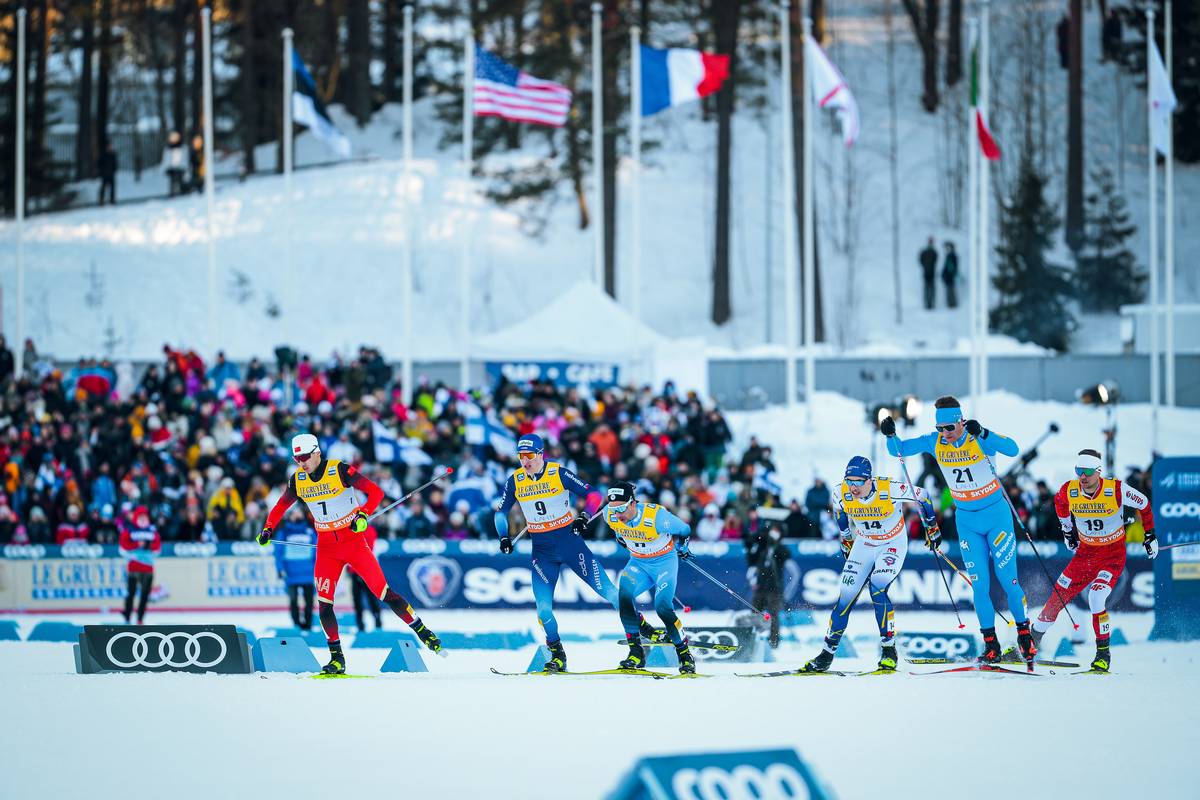
It was warm for the start of the race, about 40 Fahrenheit. The warm temperatures didn’t negatively affect the racing, and at the end of the day Golberg was able to finish first, 0.3 seconds ahead of countryman Simen Krueger (NOR). Klaebo ended up third, 2.8 seconds back. Norway took the first seven positions.
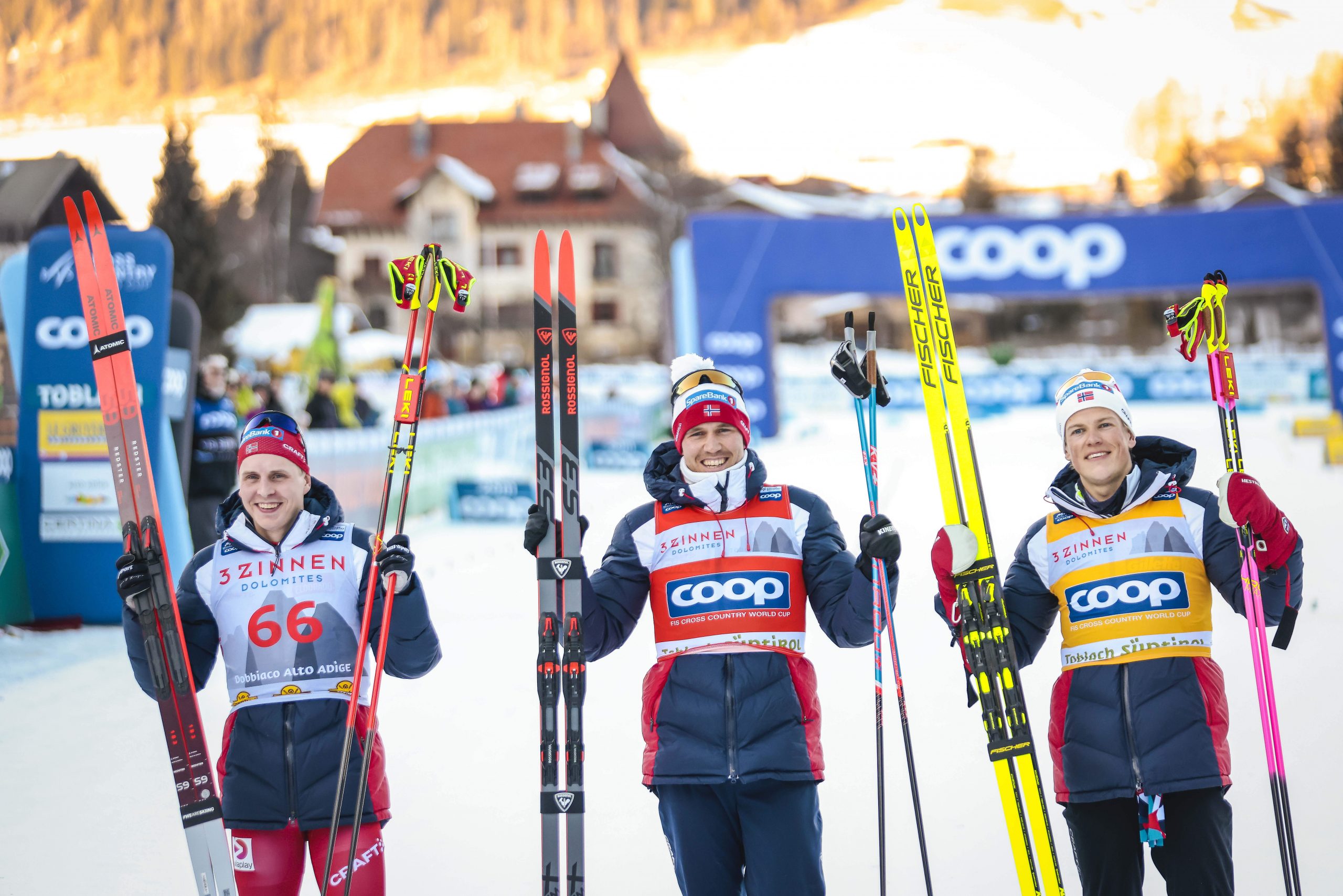
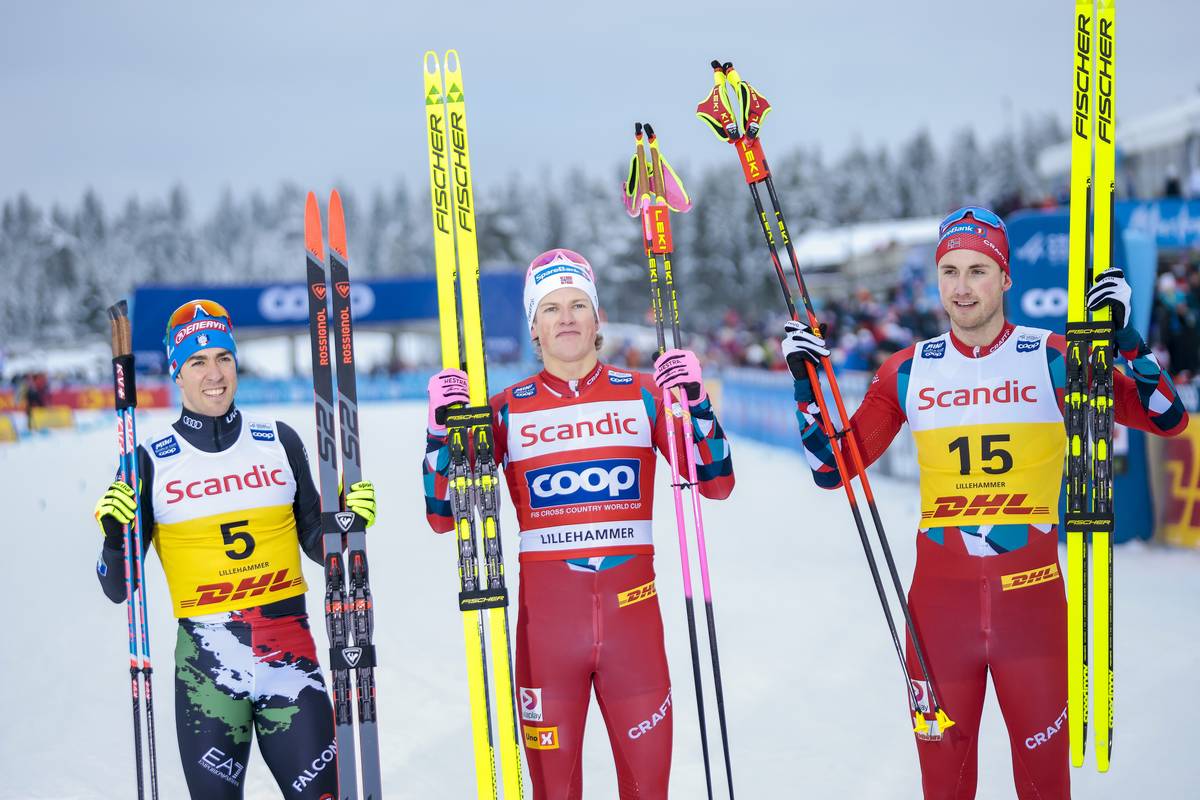
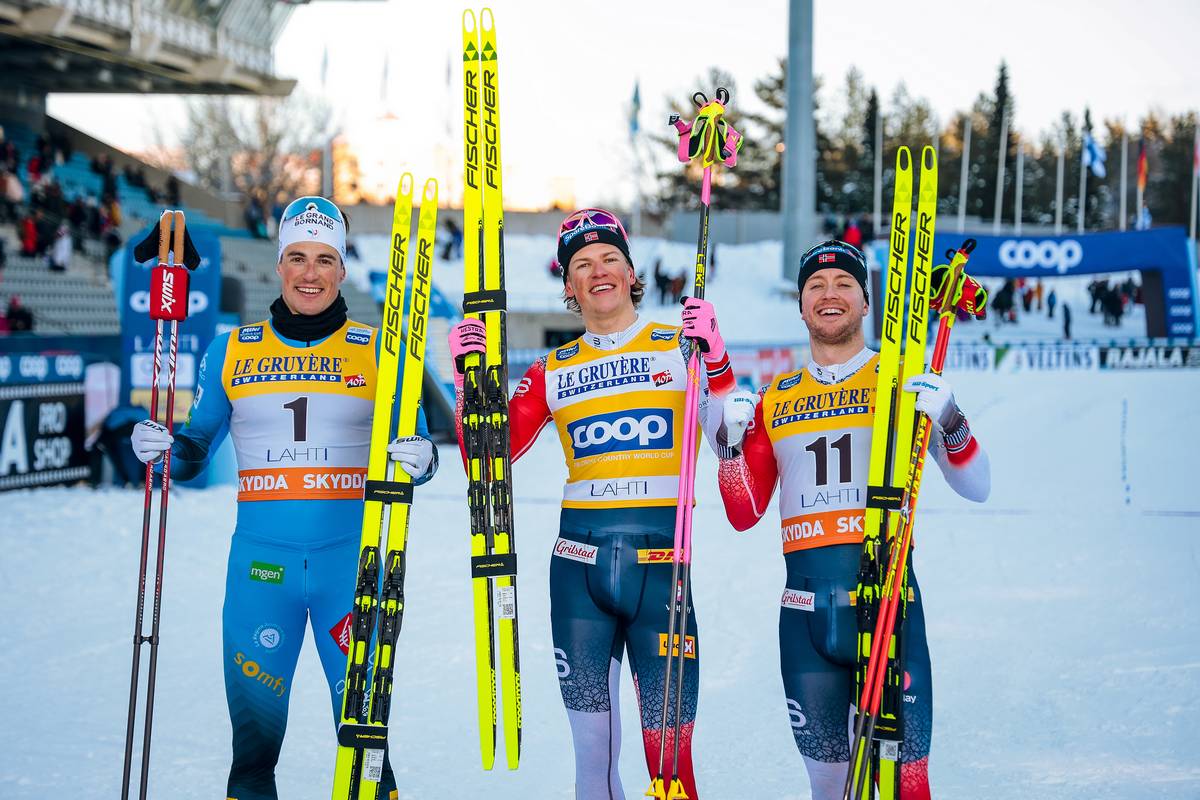
At the end of the day it was all Norway on the podium: Simen Hegstad Krueger (NOR), Paal Golberg (NOR), Johannes Hoesflot Klaebo. (NOR) (Photo: NordicFocus)
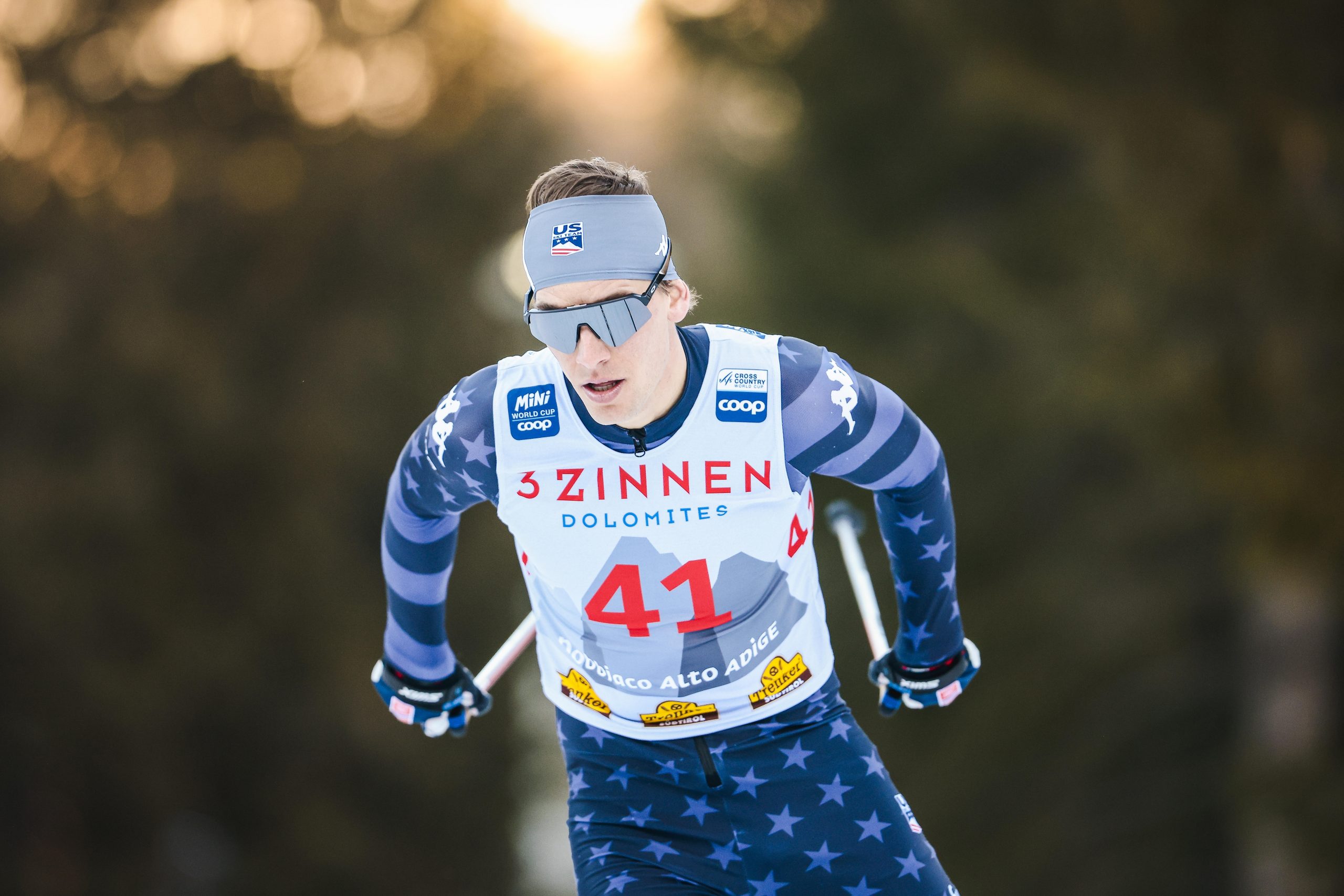
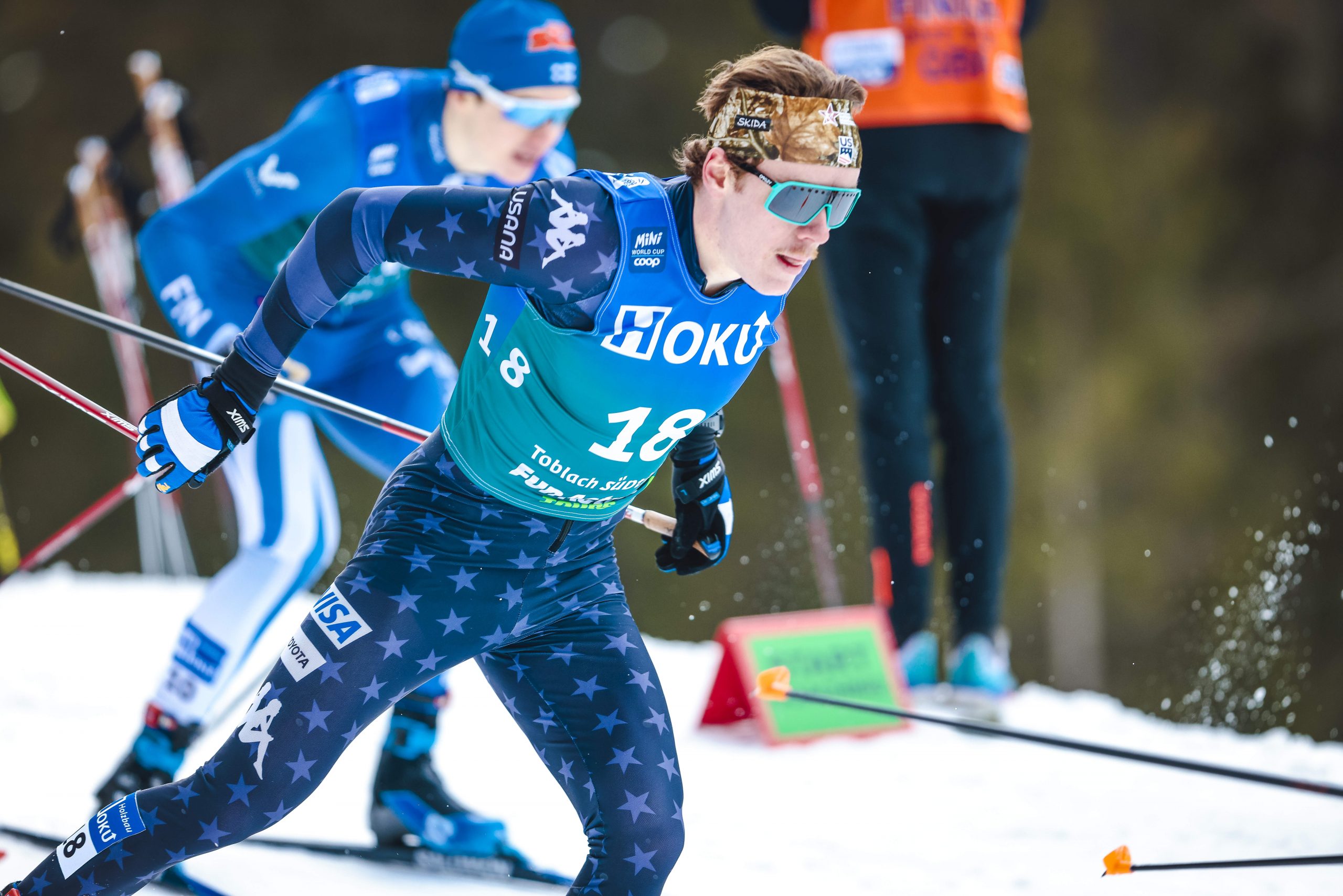
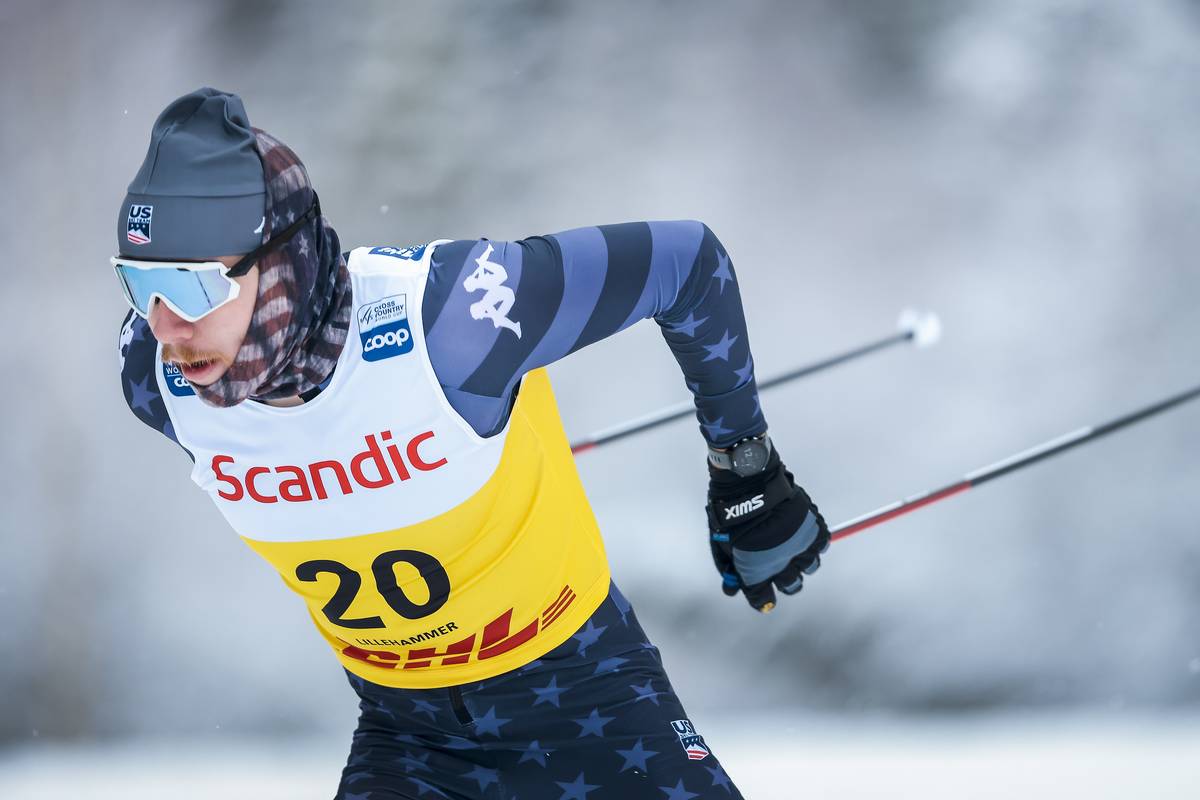
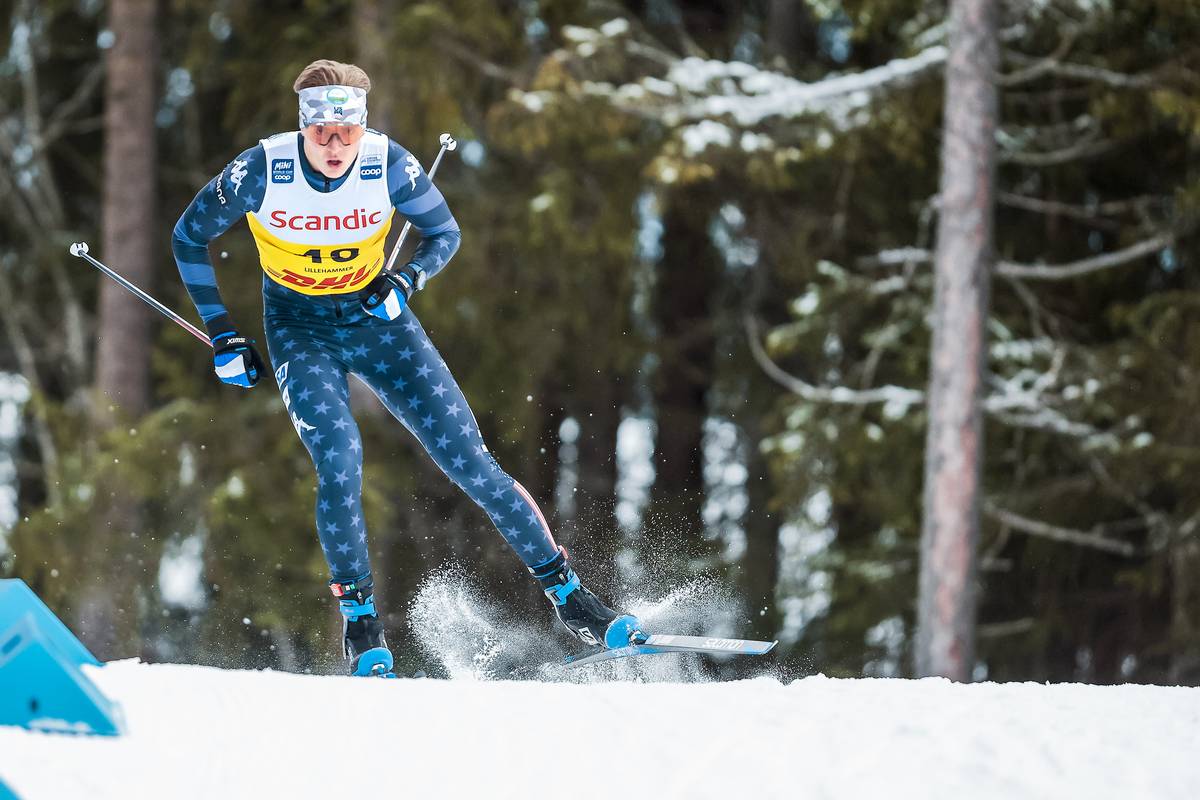
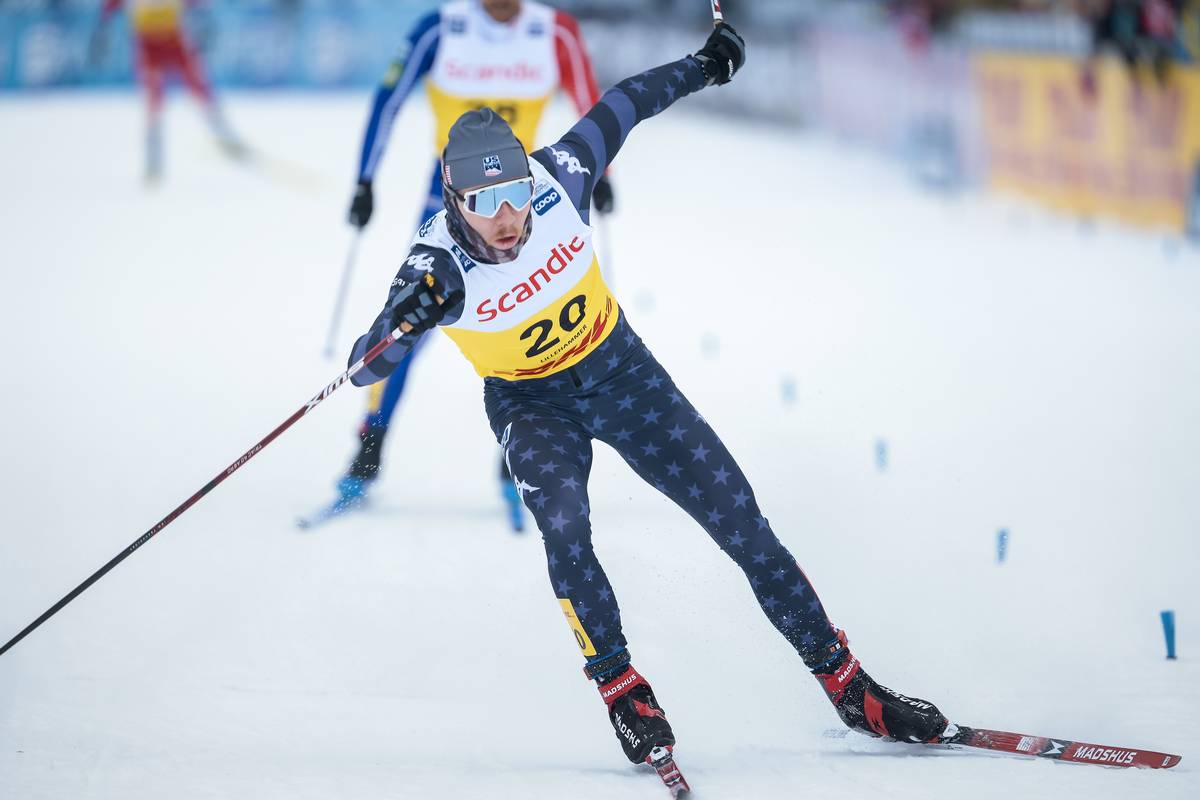
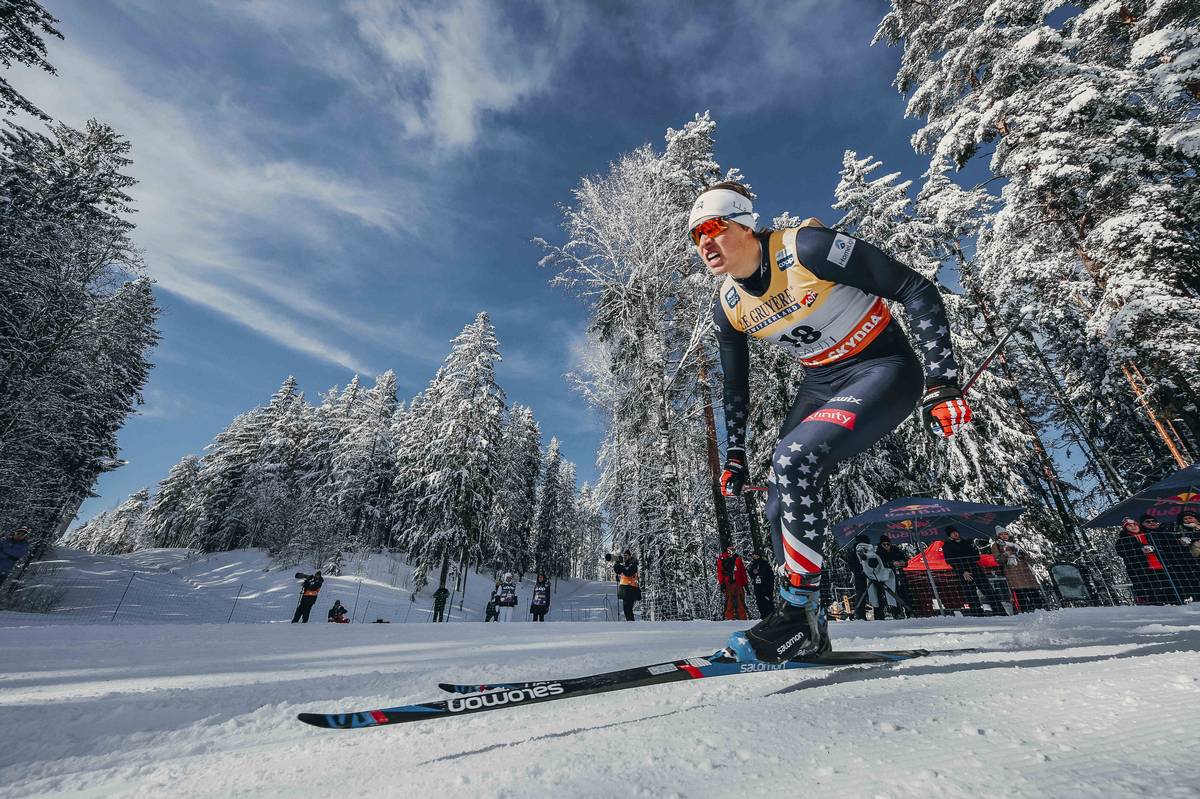
American Scott Patterson had an excellent day, finishing 14th, only 34.5 seconds off the lead. Other American finishers were Finn O’Connell 41st, Kevin Bolger 54th, Hunter Wonders 55th, and Logan Diekmann 71st. No Canadians raced today.
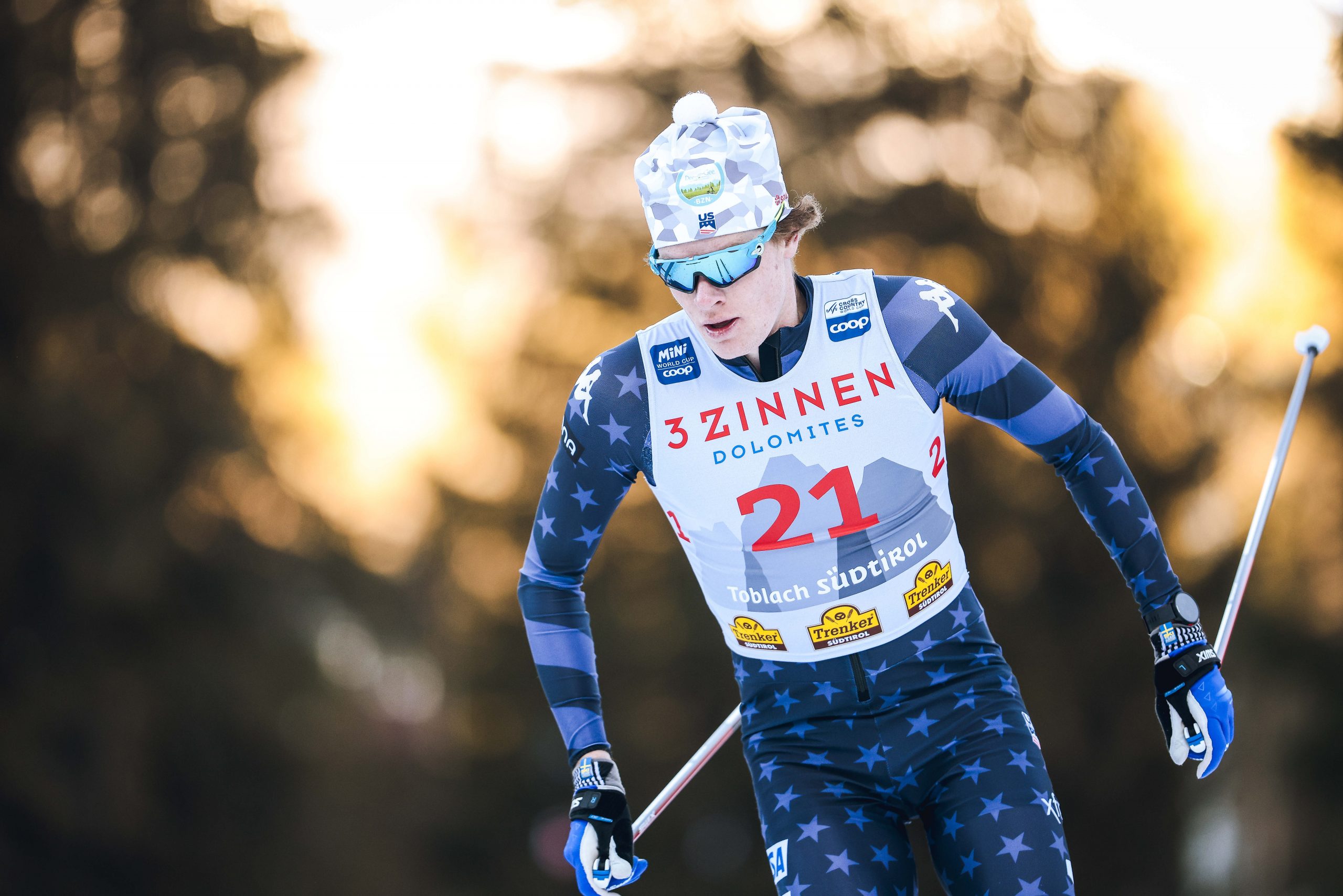
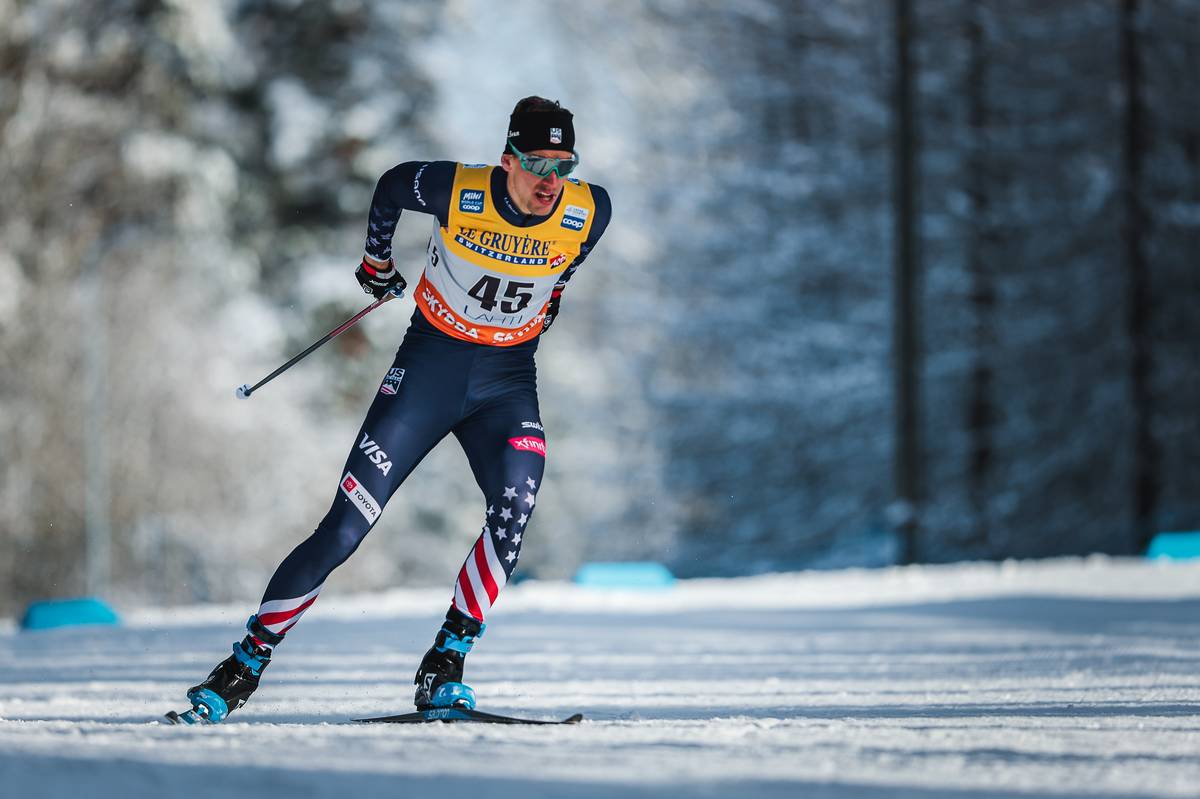
Scott Patterson masterfully navigated ski choice and pacing to place 14th. (Photo: NordicFocus)
The Race
Today’s warm weather meant that ski choice would play a large factor. Clear bases were definitely in the mix. Toward the start of the race, the sun had moved off the course and the snow firmed providing fast and challenging conditions, especially for the later starters. This made for a tough ski choice. Scott Patterson told FasterSkier that, “Ski choice was definitely about thinking ahead for the refreeze. We tested skis in the stadium initially and recognized that the really warm skis that performed well in the stadium would probably be a risky choice by race time.” Patterson continued that, “Overnight we got a bit of rain and relatively high winds. This combined to deposit an ice layer on the ski track and some pine needles and sticks from the trees. As we were starting at 3 pm, part of the course had baked in the sun during the day and gotten quite slushy. However, by the start of the men’s race the whole course was refreezing and the sun was gone. This resulted in some fast firm sections that hadn’t seen sun as well as glazed rutted parts that were quite funky to ski in.”
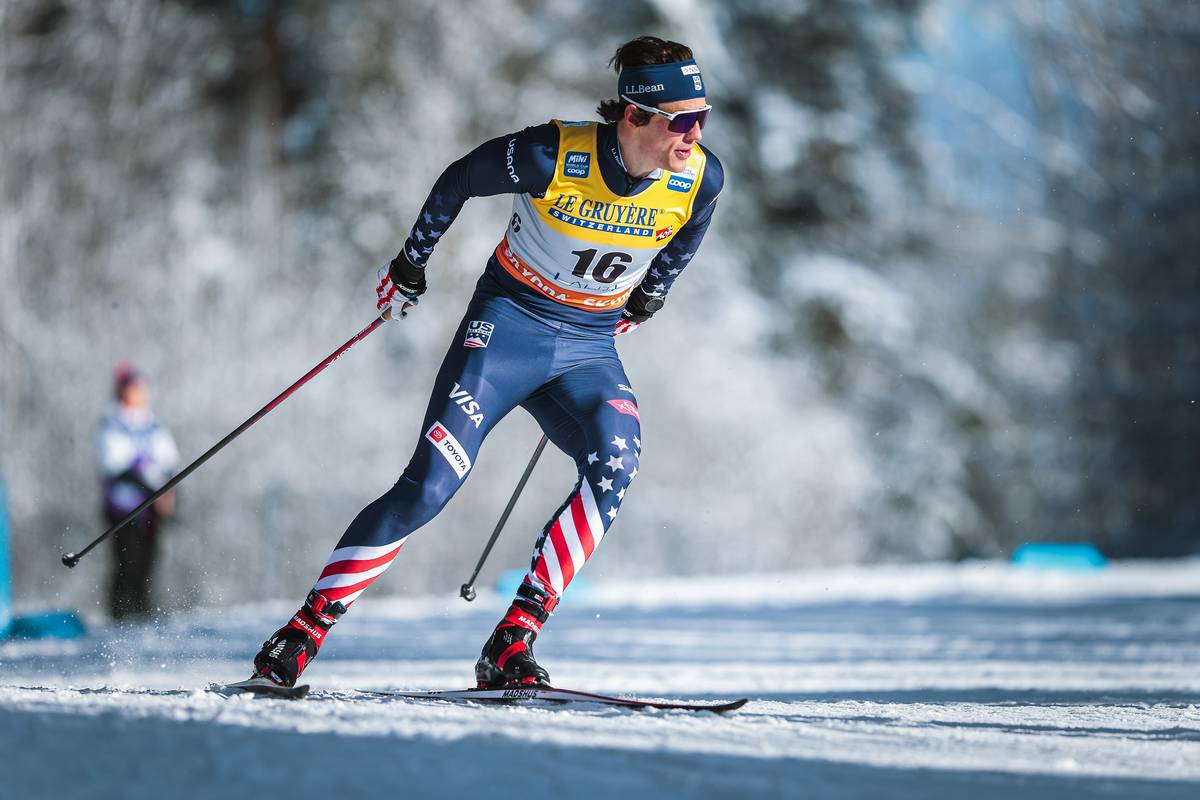
Finn O’Connell (USA) had a personal best World Cup day, finishing 41st. (Photo: NordicFocus)
U.S. coach Kristen Bourne confirmed the tricky conditions. “The track was pretty ripping fast for the women and sort of the same for the men. All of the divots and ruts from the women’s race [froze] and started to become bumpy and firm for the men. It was a weird fluctuation but was super-fast.”
As has been the pattern most of the season, today’s race would be a back-and-forth affair between the top Norwegians with Klaebo, Golberg and Simen Hegstad Krueger (NOR) trading punches and fighting for the lead all day.
Klaebo was one of the earlier starters among the pre-race favorites. Golberg and Krueger started several spots behind Klaebo, so they would have the advantage of marking their teammate. At the 1.7-kilometer mark Klaebo had taken the lead and established the early time to beat. When Golberg and Krueger reached the 1.7-kilometer mark, they were already a couple of seconds behind Klaebo.
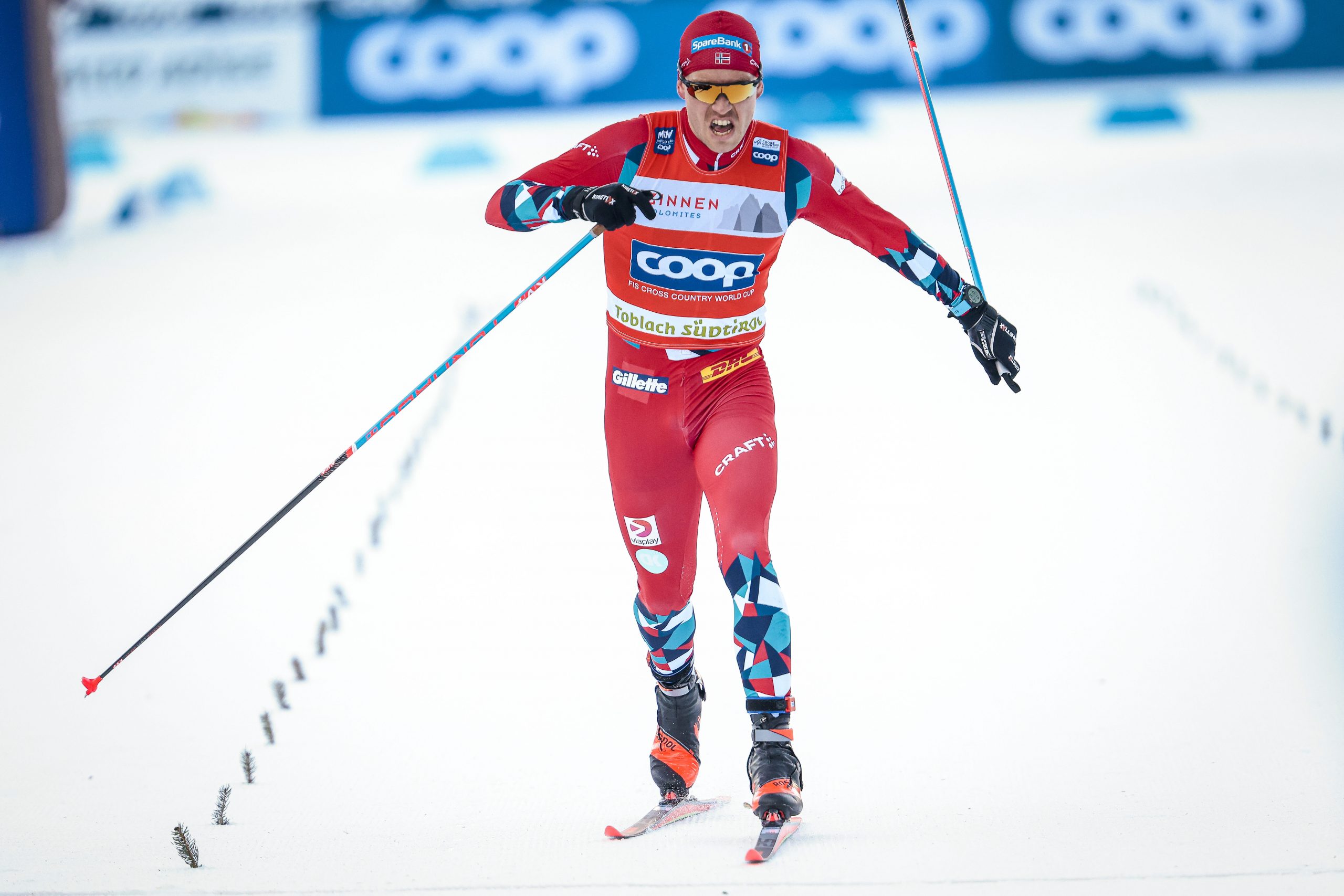
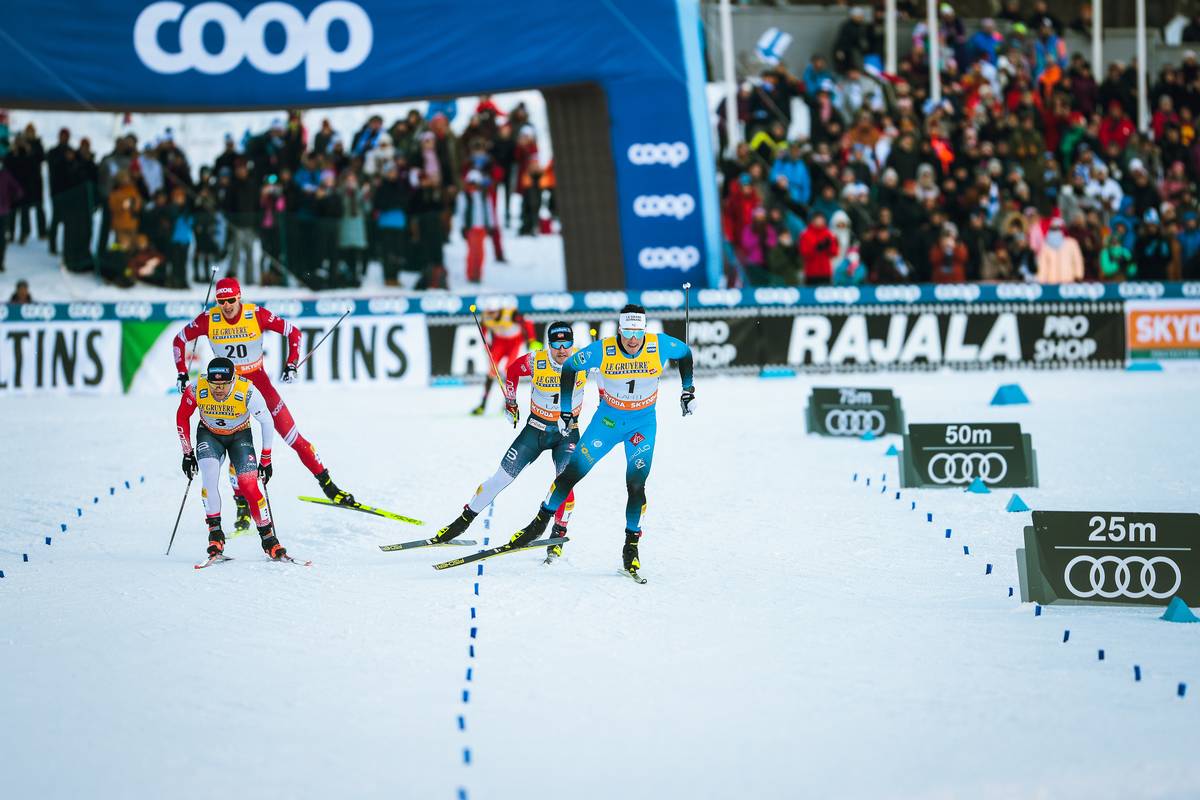
Paal Golberg’s (NOR) finishing lunge put him on top of the podium. (Photo: NordicFocus)
At 2.1 kilometers, Hugo Lapalus (FRA) decided he would take a shot at the lead and moved into first over all the skiers who had already reached this mark. His pace would only be eclipsed later by Krueger who had a later start than Lapalus. But, Lapalus’ glory was short lived, at 3.0-kilometers he had dropped back to fourth. Klaebo and Krueger were virtually tied and had retaken the lead. Golberg was now 3.2 seconds back.
Between three and five kilometers, Klaebo put in a strong burst of speed to regain his lead outright at the five kilometer time checkpoint. Golberg and Krueger trailed Klaebo by about two seconds.
As the raced played out and skiers hit the 7.1- kilometer mark, Krueger had surged into the lead with Golberg now 1.9 seconds back. Klaebo had dropped off the pace considerably and was now 9.8 seconds off the lead. This trend held up over the next kilometer as Krueger increased his lead to 5.4 seconds over Golberg. Klaebo was now a whopping 11.4 seconds off the lead.
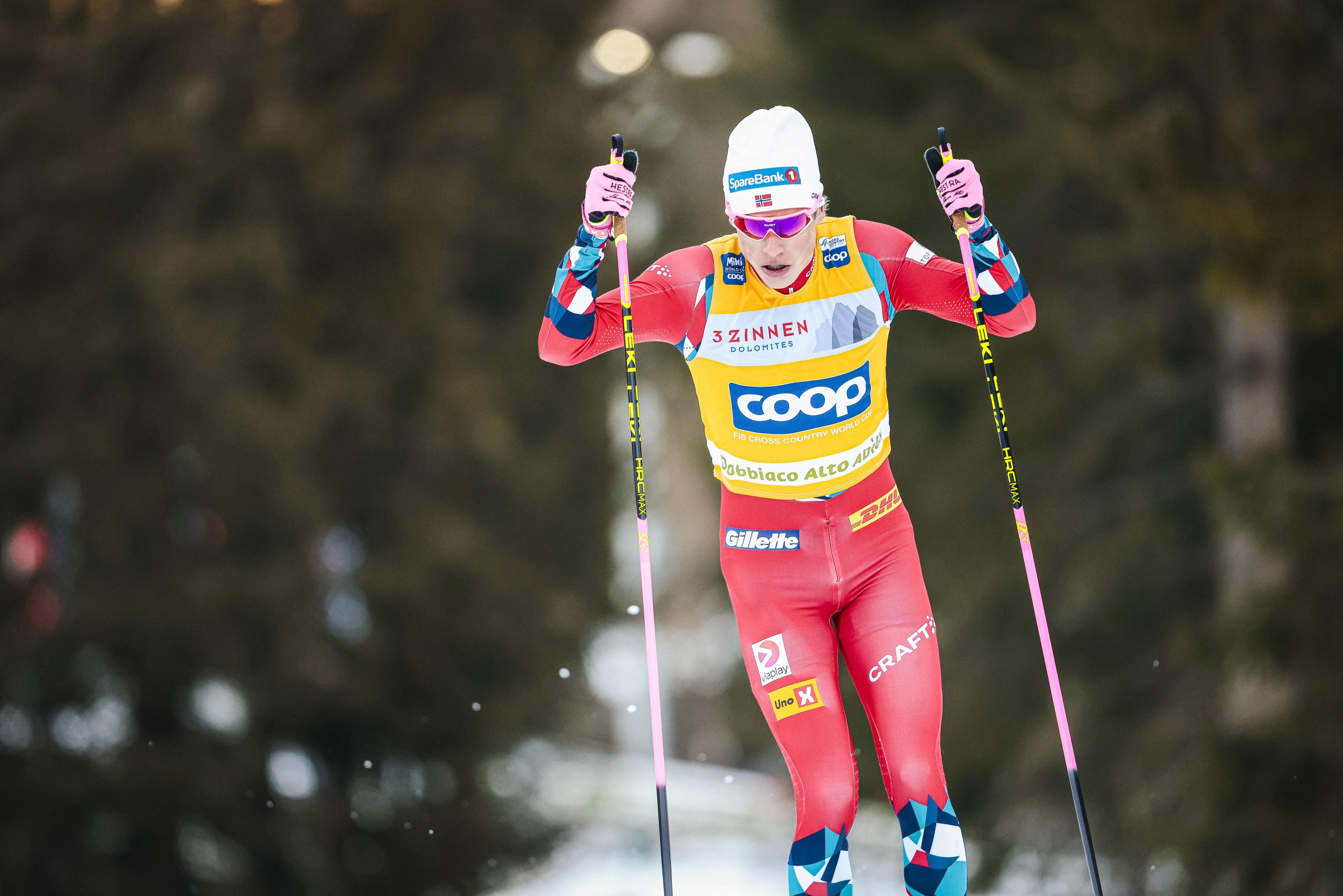
Johannes Hoesflot Klaebo (NOR) was in the hunt for the victory all day, but couldn’t overcome a mid-race deficit. (Photo: NordicFocus)
Pacing on the course was difficult, and not just for Klaebo. Patterson told FasterSkier that, “I had a few short opportunities to ski with people but mostly it was about finding my own pace and enduring through the muscular burn while keeping the tempo high.” He continued that, “It’s crucial to V2 almost all [of] the more gradual hills. Thus, I was focused on skiing smooth through the first 2km to build into the race a bit, then really turn it on and work the rest of the course as hard as I could.”
The U.S. team received advice on pacing the five kilometer loop course from veteran Jessie Diggins (USA) at their team meeting the night before the race. Bourne said that Diggins advised her teammates to “Go out as hard as you can, because once you get to 3 k, it’s pretty much all downhill from there.”
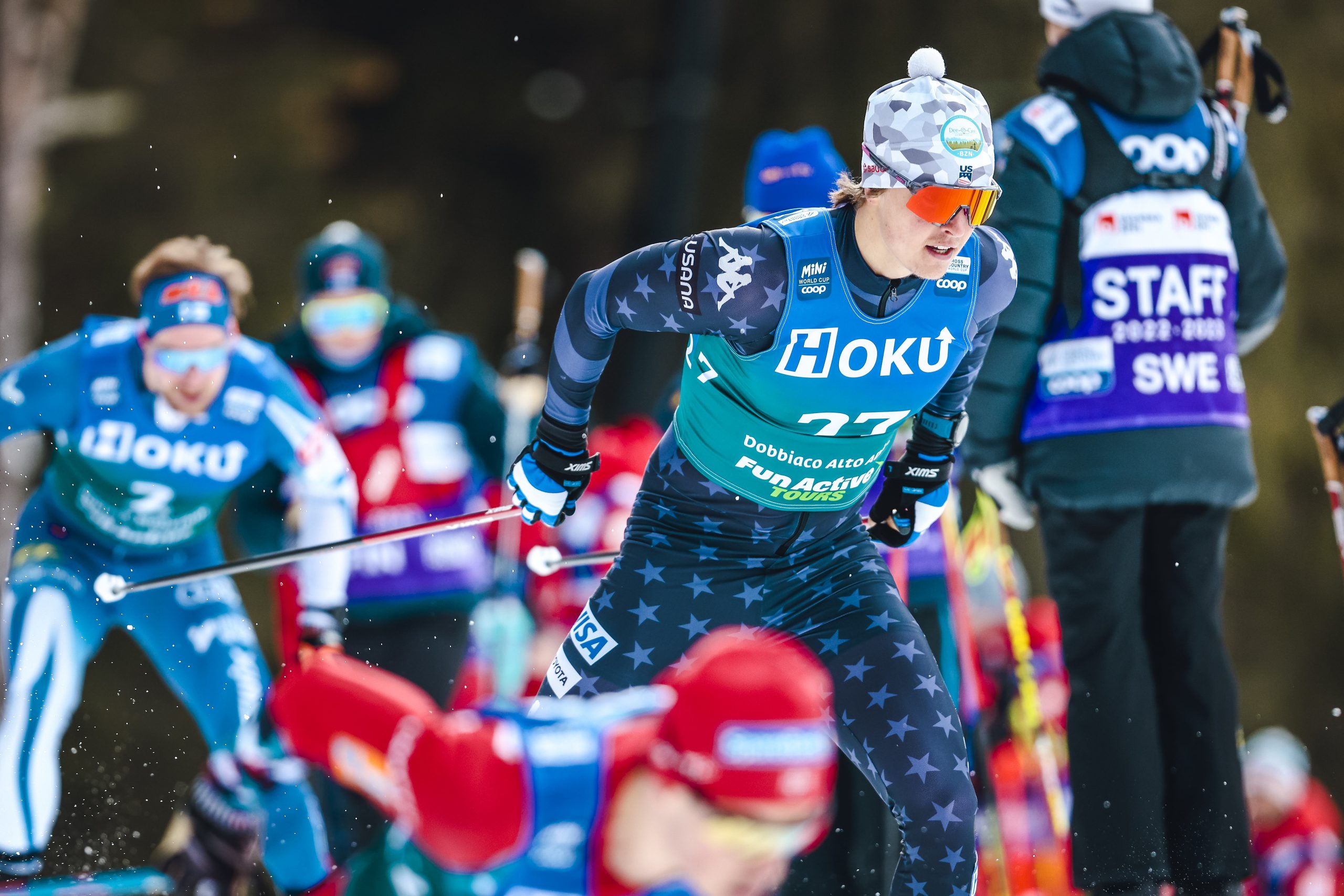
Kevin Bolger (USA) representing team USA in the Toblach 10 k. Bolger would finish 54th. (Photo: NordicFocus)
Klaebo also made adjustments and was able to turn up the speed in the last two kilometers, and coming into the finish, he put in one of his patented sprints, crossing the finish first among the racers who had finished. At this point Klaebo was in the leader’s chair, 2.4 seconds over Harald Amundsen (NOR).
But Golberg and Krueger were still lurking on the course, taking advantage of their later start. As he finished, Golberg was able to meet Klaebo’s finishing speed and went into first ahead of Klaebo by 2.8 seconds.
The only question now was whether Krueger would be able to match his teammates speed over the last two-kilometers. As Krueger came into the finish he was moving very smoothly and put in a ferocious finishing sprint but fell short of Golberg by 0.3 seconds. As it turned out, Golberg’s lunge at the finish was the difference between first and second.
Klaebo had put in an amazing final two-kilometers skiing it nine seconds faster than Krueger and three seconds faster than Golberg. But Klaebo’s slower speed in the middle of the race had given Golberg and Krueger the opening they needed to pull past him.
At the end of the day, Norwegian domination in men’s distance racing continued, Sundby’s record was intact, for the time being, and a young American continued to show great promise.
This World Cup coverage is made possible through the generous support of Marty and Kathy Hall and A Hall Mark of Excellence Award. To learn more about A Hall Mark of Excellence Award, or to learn how you can support FasterSkier’s coverage, please contact info@fasterskier.com.
This weekend, the World Cup travels to Toblach, Italy for three days of racing. First up are the freestyle sprints. This is the last full weekend of racing before the tour takes a two-week break leading into the World Championships. This timing resulted in full fields for both the women and men. The women had 57 entries on the start list—more than they’ve had in weeks—with all the heavy hitters in the women’s sprint world participating. Likewise, the men’s field had a large group of 69 starters, though many of the top American men were still in Canada for the U-23 World Championships.
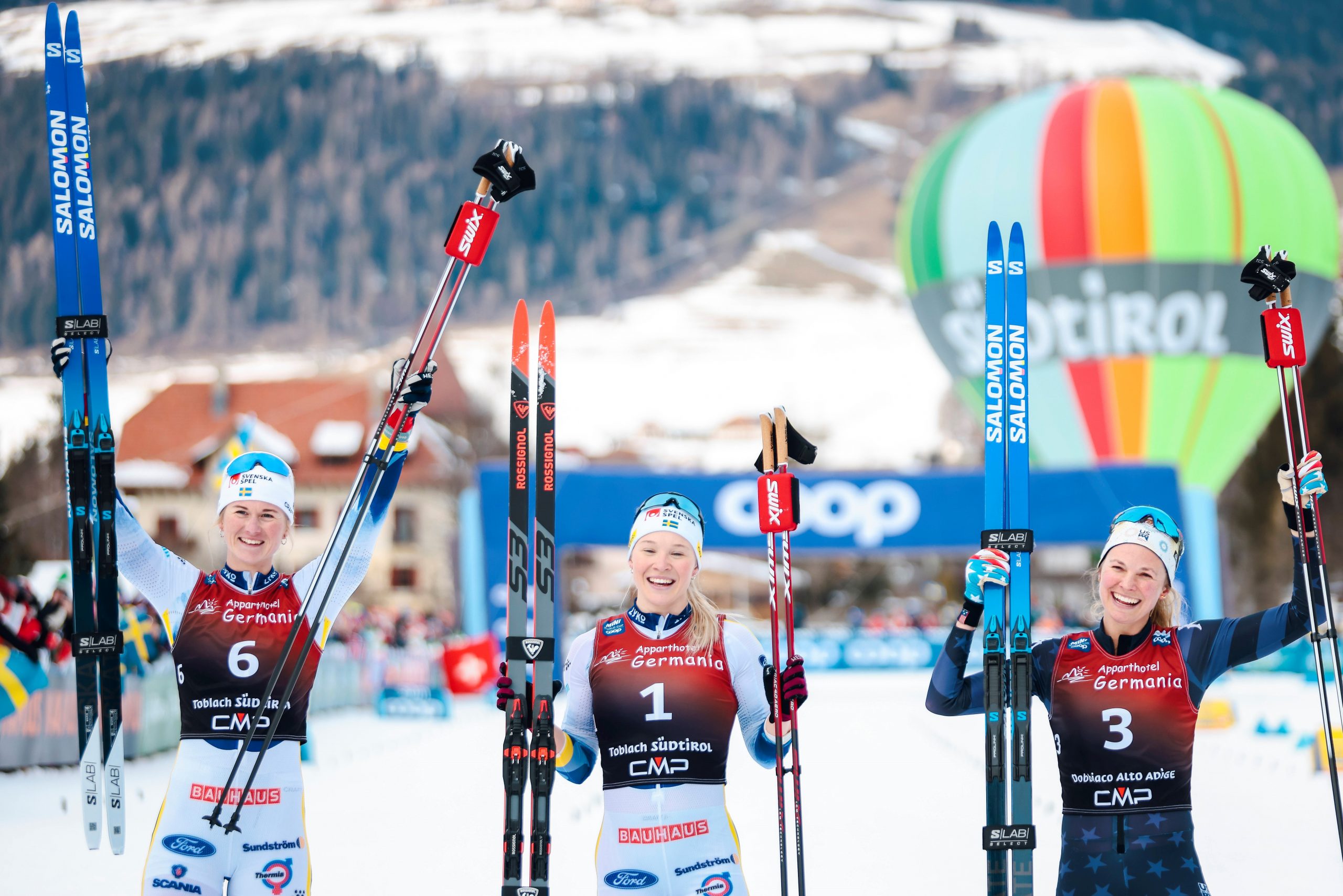
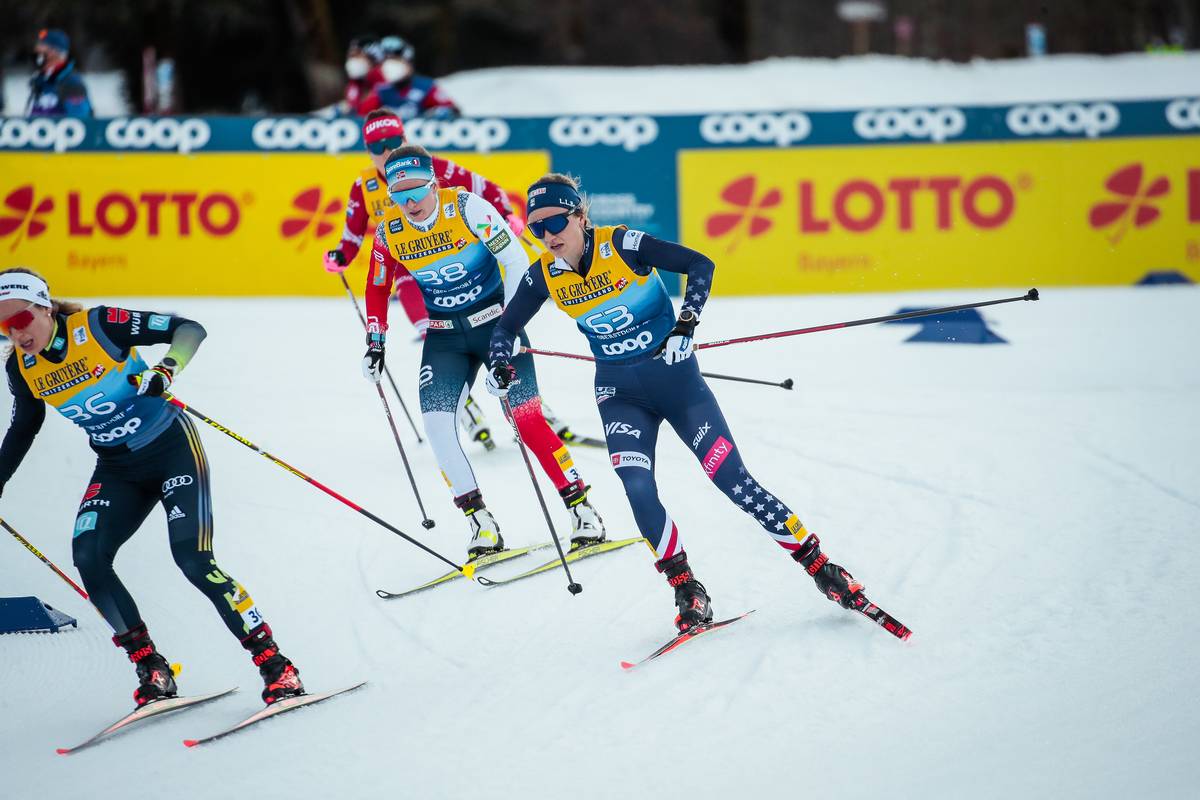
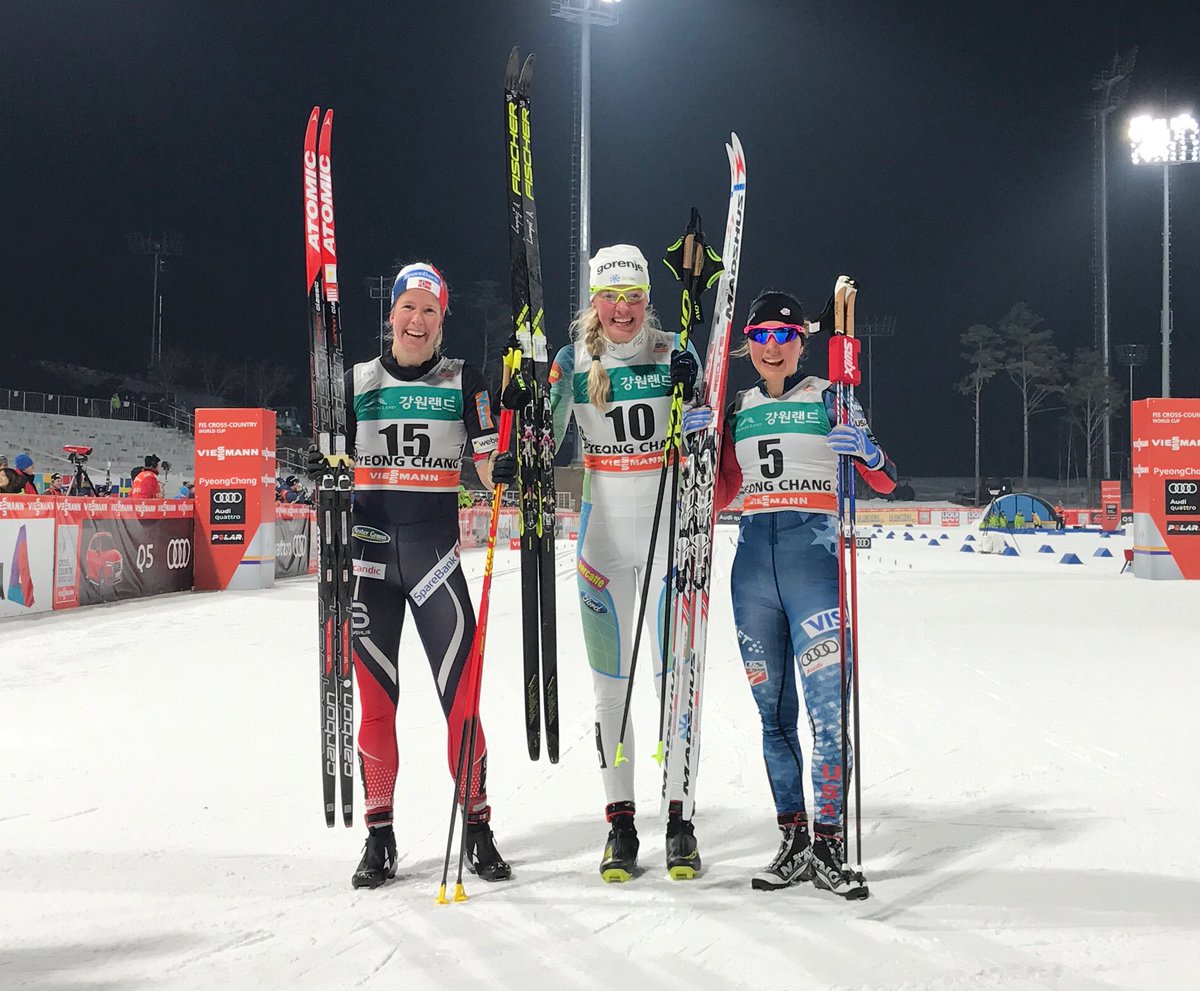
Jessie Diggins (USA) fought her way to third place on the tricky Toblach course. (l-r,) Maja Dahlqvist (SWE), Jonna Sundling (SWE), Jessie Diggins (USA). (Photo: NordicFocus)
Toblach is a tight course with few opportunities for passing. The course has short, steep climbs that would provide most of the limited passing opportunities. Otherwise, smart tactics would rule the day.
In the women’s race Jonna Sundling (SWE) finished first followed by Maja Dahlqvist (SWE). Jessie Diggins (USA) finished third. Other American finishers were Rosie Brennan, 26th, Julia Kern, 28th, Hailey Swirbul 30th, Lauren Jortberg, 32nd, Sarah Goble, 39th, and Alayna Sonnesyn, 42nd. No Canadian women participated in today’s races.
In the men’s race Johannes Klaebo (NOR) took first place, followed by Haavard Taugboel (NOR), and Federico Pellegrino (ITA).
No Canadian men participated today. The top American finisher was Ben Ogden, who finished 17th. He was followed by Logan Diekmann, 27th, Kevin Bolger, 38th, Will Koch, 45th, and Finn O’Connell, 52nd. For Diekmann, it was his first time reaching a World Cup sprint quarterfinal.
Jessie Diggins in the semifinal heat on her way to another Toblach podium. (Photo: NordicFocus)
The Women’s Race
The deep field took its toll on qualifying, but the U.S. team still managed a strong showing for the heats. For the American women, Jessie Diggins, Rosie Brennan, Julia Kern, and Hailey Swirbul qualified. Diggins posted the third fastest qualifying time and was looking to avenge last week’s sprint performance where she missed a turn and skied off the course. Diggins has a great history in Toblach. Three of Diggins World Cup victories have been in Toblach, including her first World Cup victory. In her post race comments Diggins acknowledged the special place that Toblach holds for her. The field was so deep that each quarter final had names who could be considered favorites to win it all. All of the American qualifiers were in separate quarter finals.
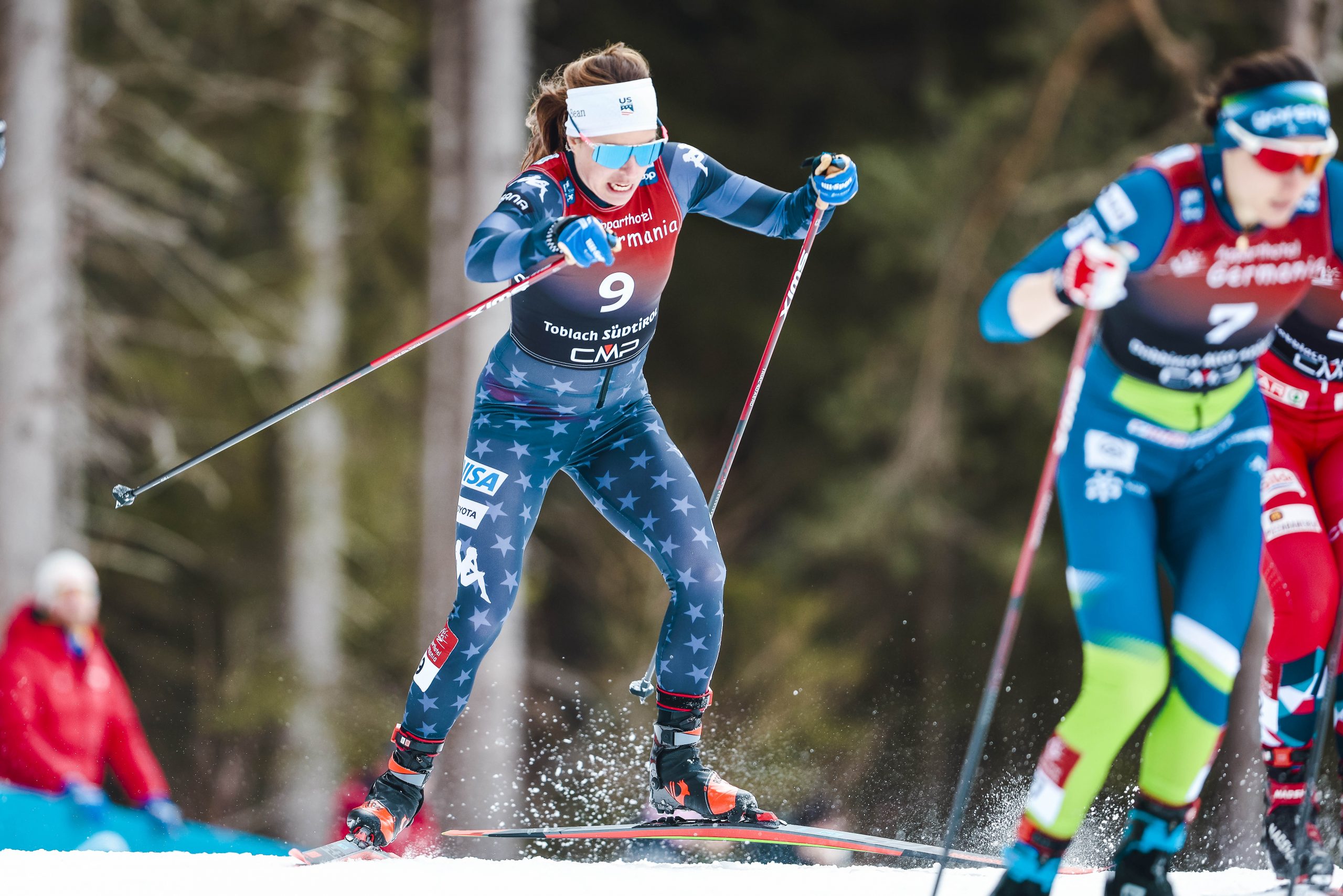
Rosie Brennan (USA) reached the heats, but got tangled up on the Toblach sprint course. (Photo: NordicFocus)
Rosie Brennan began her quarterfinal in the middle of the field, but was not able to hold the pace and faded toward the finish. She ended up sixth and did not advance. After the race, Brennan commented on the difficult Toblach course: “The course was fast and had many turns making it very tricky to find space and navigate safely. I struggled to find places to move up after getting tangled in the beginning… I’m glad Jessie could provide a light for us all on a tough day.”
In Diggins’ quarter final she went out fast and slotted in second place at the start. She passed Johanna Hagstroem (SWE) on the first hill and moved into the lead. She continued to push her advantage which was fortunate as there was a crash behind her. It didn’t matter, as Diggins powerfully gapped the field by a large amount. The gap narrowed by the finish, but Diggins won her heat comfortably. She later said that, ” The qualifier didn’t feel good, but it went well, which is sometimes a nice reminder that how you feel doesn’t always indicate how you will race.”
The sprint day began with great promise for Julia Kern (USA), who failed to advance out of her quarterfinal after tangling a ski and crashing. (Photo: NordicFocus)
In Kern’s quarterfinal she was pushed to the outside early and forced toward the back of the pack. She meticulously picked her way through the group and worked herself toward the front on the course’s steep hill moving into second. She aggressively stepped through the corners to maintain her second place standing, and looked very strong. Kern was vying for the lead when coming into the final turn she tangled skis and crashed. It was way too late in the race for a recovery. It was especially disappointing given how well she had worked through the crowd and how strong she looked.
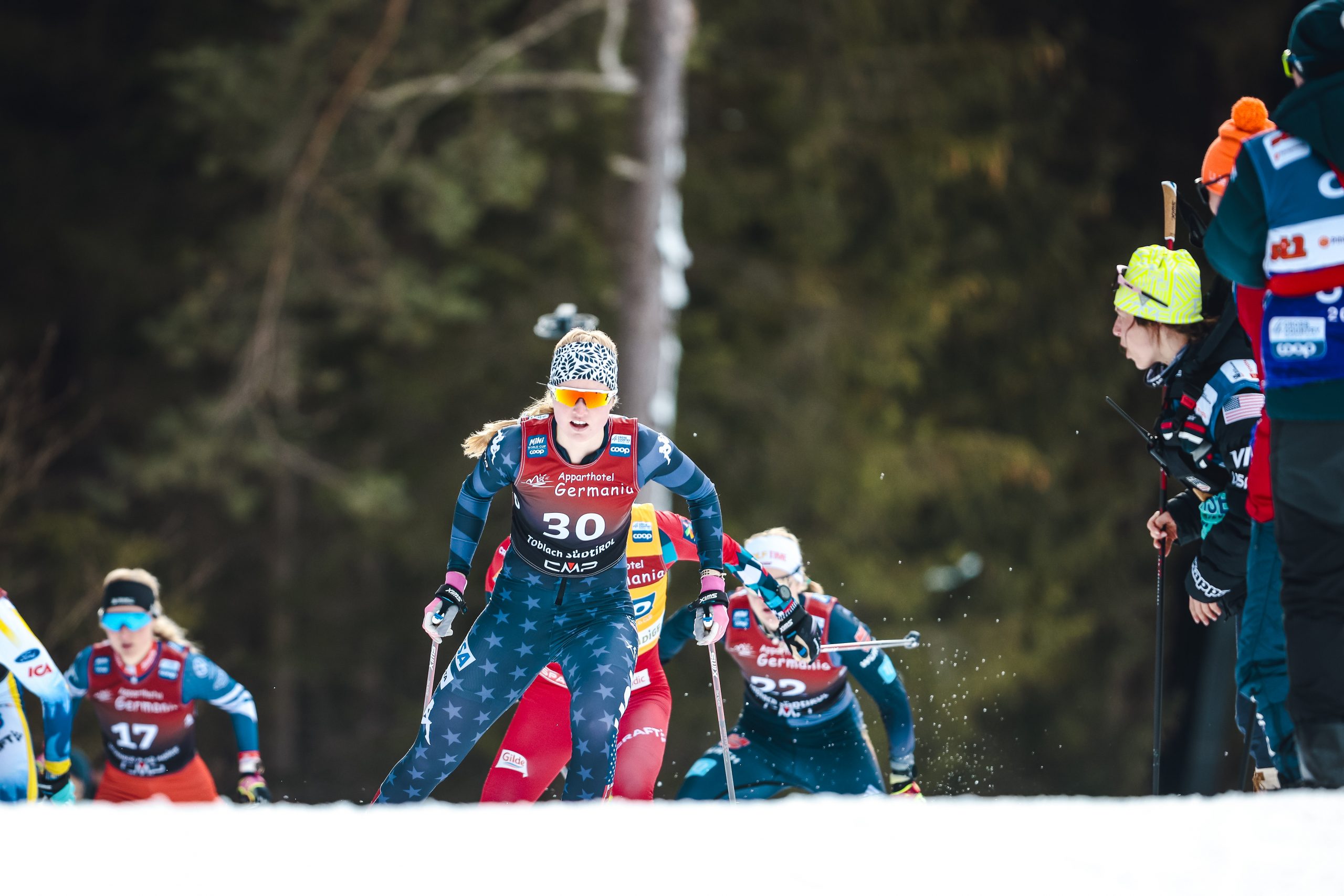
Hailey Swirbul (USA) went all in for her quarterfinal, setting the early pace. (Photo: NordicFocus)
In Swirbul’s quarterfinal she faced the unenviable task of going against Linn Svahn (SWE), Nadine Faehndrich (SUI) and Tiril Udnes Weng (NOR). Given the daunting task, Swirbul threw caution to the wind, and shot to the lead from the start trying to avoid the traffic which had claimed her teammates. It was a high risk, high reward strategy. She led throughout the first half of the race, but as she came over the steepest hill, she was dropped to the back of the pack and was gapped with no chance of catching the group. She ended up sixth in her heat. U.S. Coach Kristen Bourne had praise for Swirbul’s willingness to lead, “She got out front and was trying to execute her plan, she skied super confidently…having the confidence to lead definitely stood out today.”
That left Diggins as the only American woman to make it to the semifinals. Diggins drew an outside lane and was pushed wide and back at the start. A minute into the race, she was in fifth place. Diggins acknowledged that, “My starting speed has never been that impressive…so I needed to chill and look for my window to move up.” She pushed up the steepest hill on the course and propelled herself into the top four. But the tight Toblach course proved to be a nemesis as she didn’t have enough room to work and was again forced to the back of the pack. As the field sprinted toward the finish, she was able to somehow pick her way into third place and would have to wait and see whether her time would hold up for a lucky loser spot. The second semifinal was slower, and she was ultimately able to move on to the finals as a lucky loser.
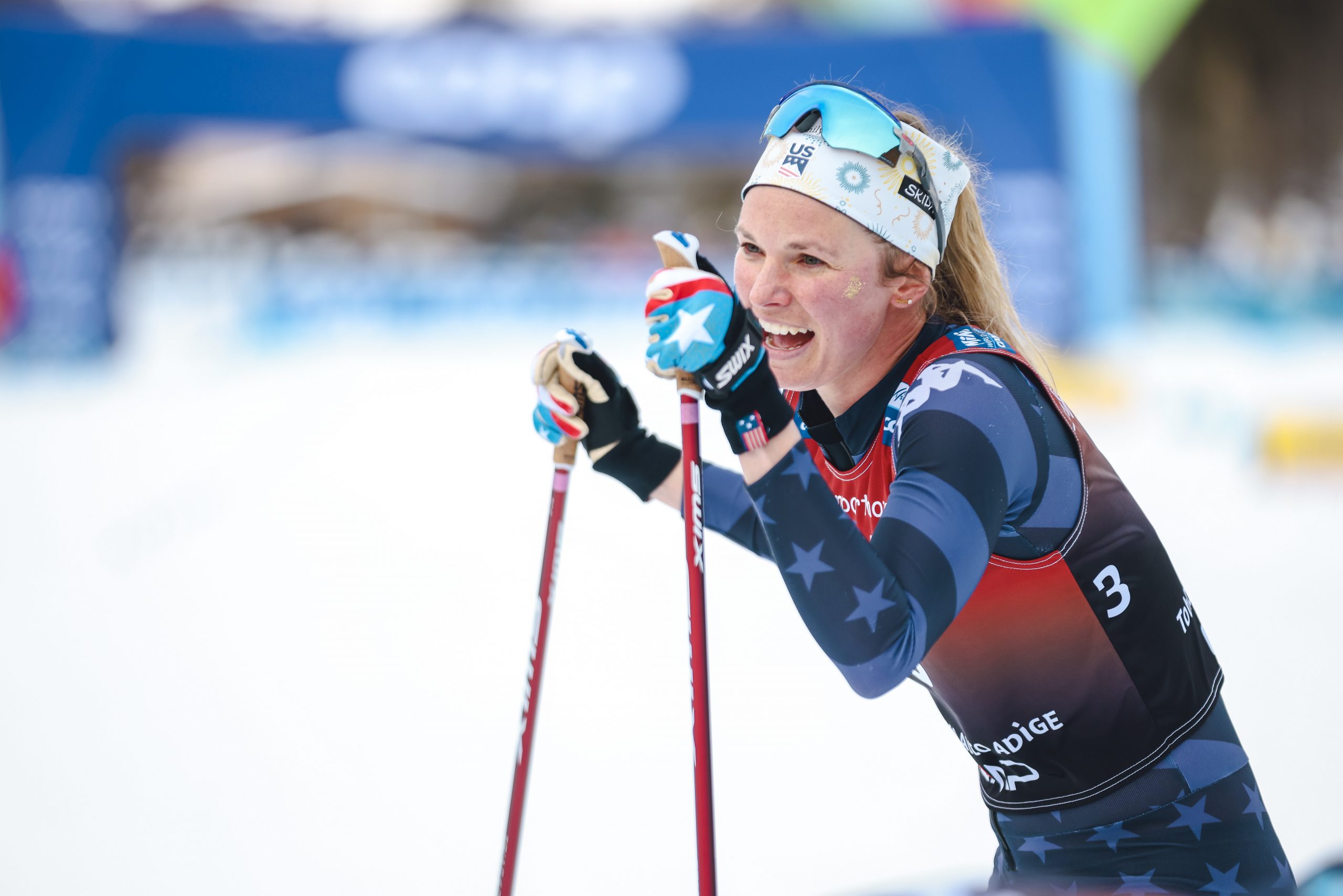
Jessie Diggins celebrates after a third place sprint finish. (Photo: NordicFocus)
In the finals, Diggins faced an intimidating field of four Swedish sprint standouts and Laura Gimmler (GER). At the start, Diggins went to the rear of the pack with a wall of Swedish skiers in front of her. Sundling took the pace very hot from the beginning. At the top of the first big hill Diggins had moved into fifth, and Sundling had not budged from the lead. Over the top of the second steep hill Diggins had moved into fourth with three Swedes ahead of her. Going into the sprint finish she put the hammer down and was able to gain a podium spot by out-sprinting Swedish sprint star Emma Ribom and finishing third. It was an impressive feat to be able to break up a Swedish quartet in such a talented field. It was an equally impressive piece of tactical skiing on a very challenging course, and showing supreme maneuverability as she worked her way through the field. As Coach Bourne noted, “It’s a pretty challenging [course] and turning left most of the time, it’s difficult to pass. It makes sense to be in the front.” Diggins was able to go against the grain and grab a podium position despite not being in the best spot toward the end of the race. Bourne continued that “She skied that so well, to tactically figure that out and get onto the podium is pretty awesome. It was one of her coolest races for me to watch…seeing her maneuver so well and confidently ”
Ben Ogden (USA) led the American men finishing 17th. (Photo: NordicFocus)
The Men’s Race
In the Men’s Sprint quarterfinals, Johannes Klaebo showed why he is the best sprinter in the world as he was able to pick his way through the field at will, starting in the back and working his way to the lead. Something no one else had been able to do all day.
Richard Jouve, last week’s hero on home soil in Les Rousses, France could not advance out of his quarterfinal.
In Ogden’s quarterfinal he advanced to the front third of the race early. At the first hill he worked to maintain contact with the top three skiers. The lead group coalesced at the finish with Ogden unable to outsprint the field and finished fourth. The time was not fast enough for a lucky loser spot and his day ended in the quarterfinal. Ogden told FasterSkier that, “Everyone in my quarter final qualifier was within a second and a half of each other so it was really tight the entire time. It ended up coming down largely to the last downhill, final corner and finishing stretch. I was just out of the semi’s in 4th but it was a decent effort given that I have been a little tired lately. Now my plan is to rest up and put all eyes on champs in Planica!”
Logan Diekmann (USA) had a career first sprint quarterfinal appearance. (Photo: NordicFocus)
For the Americans, Logan Diekmann finished sixth in his quarterfinal and did not advance. Nonetheless, it was a good day for Diekmann as it was the first time he had reached a sprint quarterfinal.
In the semifinals, Klaebo employed a similar strategy as he had in the quarters, electing not to lead from the start. He was fourth two-thirds of the way through the race and was able to find space to get by his opponents to win the heat. It was a magical sleight of hand that seemed improbable at the moment, and a tactic that, once again, only Klaebo could pull off.
In the finals, Lucas Chanavat (ITA) and Federico Pellegrino(ITA) hoped they could duplicate Jouve’s feat from last week of using the home soil advantage to defeat Klaebo. Klaebo employed a different strategy in the final than he had in the previous heats, moving relatively early toward the front of the field, but not taking the lead immediately. At the first steep hill he moved into second place and it looked like a script ski fans have seen before. Once again, two or three powerful hops on the last climb and he surged to the lead. At the finish he had a large enough margin to raise his hands in triumph well before reaching the finish line.
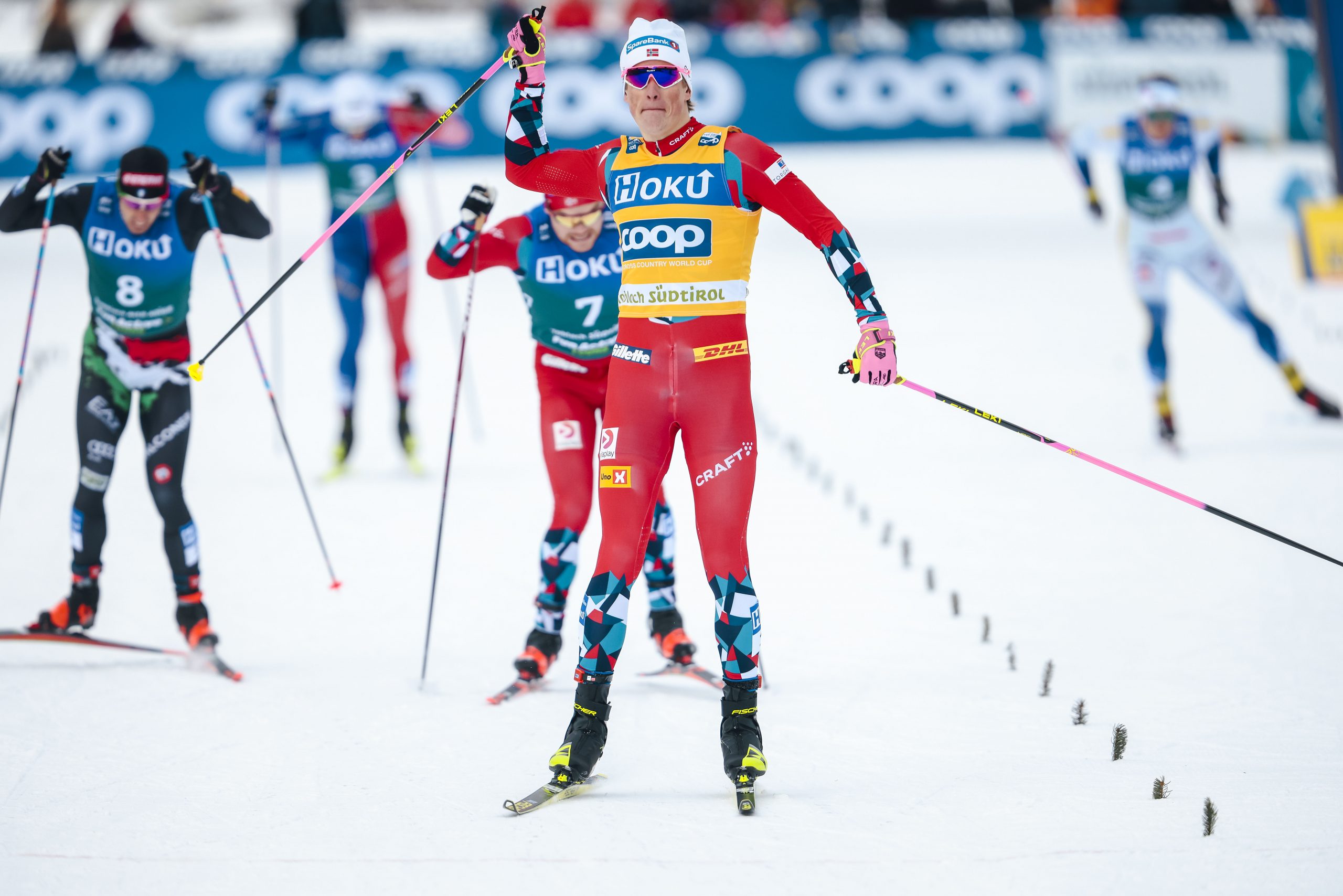
Johannes Hoesflot Klaebo (NOR) dominating on his way to victory in the Toblach sprints. He had a big enough lead to celebrate before the finish line. (Photo: NordicFocus)
This World Cup coverage is made possible through the generous support of Marty and Kathy Hall and A Hall Mark of Excellence Award. To learn more about A Hall Mark of Excellence Award or to learn how you can support FasterSkier’s coverage please contact info@fasterskier.com.
Ben Ogden (USA) raced boldly on Saturday, finishing less than a boot’s-length away from the World Cup Sprint Final. (Photo: NordicFocus)
Lillehammer, Norway—that most timeless of ski venues—provided viewers with a familiar scene on Saturday: Johannes Hoesflot Klaebo exiting the final turn in the lead, gliding away from the field en route to an easy win in an individual skate sprint. It was the 32nd win of his career in the event—exactly double the number of any other skier in history. The man behind him on that list—Federico Pellegrino (ITA)—was also 2nd behind him on the day. Even the name of the skier in 3rd place—Northug—fit the scene, though in this iteration the Northug was Even, not Petter.
So it was that the first skate sprint of the 2022-2023 season ended with a podium that could have been plucked from any skate sprint in the past half-decade. Partially because of that fact—and because Johannes Hoesflot Klaebo first staked his ground in the event before moving on to also dominating every other discipline of skiing—the skate sprint has become the archetypal stand-in for this current era of cross-country skiing.
Johannes Hoesflot Klaebo (NOR) celebrates down the finishing stretch during Saturday’s World Cup Sprint Final. (Photo: NordicFocus)
Anyone looking for winds of change in the sport would probably want to watch for little changes in the landscape of a World Cup skate sprint. On Saturday in Lillehammer, those little changes came clad in Stars and Stripes, as Americans Ben Ogden and JC Schoonmaker finished the day in 7th and 8th, respectively. Luke Jager also qualified for the heats, finishing in 27th. Three Americans in the heats, two contending in the semifinals; a year ago, that would’ve been cause for hopeful surprise, as the young potential of this current generation of young men began to peak through onto the sport’s highest level. At the beginning of this season, however, today’s qualifying crop marked more of a hopeful progression, as that group of American men looked to expand on a newfound comfort in World Cup sprinting that they’ve gained over the course of last season.
That progression was on full display once the heats started rolling. Ogden would ski out of the fourth quarterfinal heat, taking the inside lane alongside seasoned veterans Erik Valnes (NOR) and James Clugnet (GBR). Ogden marked moves by Valnes and Clugnet as they charged the uphill. Around the sharp-left that marked the beginning of lap two into the downhill again, Ogden moved to the outside, swept around the corner into the hill, and this time led the charge rather than marking it. By the time the field hit the long flat of the Lillehammer stadium, Ogden was clear in front, allowing him to avoid a tangle-up involving Valnes and Clugnet. Clugnet broke a pole and lost the chance to advance to the semifinal.
Ogden’s strategic success may be indicative of big things to come: the skier who last spring in an interview with FasterSkier claimed that he “[is] not known for my detailed race plans” had out-witted and out-skied competitors who are fixtures in World Cup sprint fields. In an interview with FasterSkier US Ski Team Head Coach, Matt Whitcomb, said that Ogden’s patience was a noticeable difference between this week’s sprint and last week in Ruka. “When Ben was leading in the heats today, he wasn’t spazzing like he was in Ruka, he was controlled. [That meant] that when he did go—he hit the gas pedal—the vehicle went a lot faster.”
Those same patient-minded tactics were the hallmark of the American’s approach throughout the day. In the next quarterfinal heat after Ogden’s, Luke Jager followed JC Schoonmaker as the latter executed the same plan. Jager fell off the pace just at the end, but Schoonmaker held off all-comers, including Richard Jouve (FRA), to win the heat and advance to the semi-finals.
Luke Jager (USA) during qualification on Saturday. He would advance to the quarterfinals, and finish the day in 27th. (Photo: NordicFocus)
On this nuanced approach to the day’s heats, US Ski Team Head Coach Matt Whitcomb pointed to Schoonmaker, Ogden, and Jager’s experience gained over the past year. “When you struggle through a season and qualify once or twice, you don’t get very much sprint experience,” Whitcomb said. “Once you get to a point where you are getting through the quarterfinals, your experience starts to double each day. And that’s what we are seeing: a year of skiing into heats and skiing them aggressively.”
Whitcomb also stressed that the key lesson learned for the talented American sprinters was patience. “For athletes that have that natural…[what I’d call] Tesla power, the key is to not use too many matches early in the heat,” Whitcomb said.
The American pair of Ogden and Schoonmaker held steady on that patience while starting together in the second semi-final of the day. In that heat, they were outnumbered by a Norwegian contingent that included World Cup Overall leader Paal Golberg, Ansgar Evensen, and Erik Valnes. The Norwegians also appeared to approach the heat with a preference for patience. A furious pace from the gun quickly gave way to a kind of stalemate in which Ogden found himself at the front of the pack, leading the first climb alongside Evensen. Paal Golberg tucked comfortably behind Ogden (indicating that Norway and USA were attempting to utilize similar tactics) as they went into the second turn around the downhill. Ogden moved to the outside; Golberg, Jouve, Evensen and Schoonmaker followed; and the five came into the stadium together. That was the crystallizing moment for the Americans on the day. Ogden and Schoonmaker, in a semi-final, fending off the World Cup Overall leader and Richard Jouve, the only other skier in the world than Klaebo to have won a skate sprint this calendar year.
Ben Ogden (USA) stretches for the line in his semifinal. Ogden finished 3rd in the heat, with JC Schoonmaker (USA) 4th. (Photo: NordicFocus)
The Americans came up just short. Golberg won the heat, besting Evensen by a boot throw. The patience of Ogden and Schoonmaker in the beginning of this relatively slow heat likely cost them a shot at the lucky loser times, as they finished 3rd and 4th, respectively. Thus, the American’s maturity was met with some decidedly bitter irony. Still, it was mature racing, and will surely be marked by a mature analysis.
In the opposite semi-final, four Norwegians matched up against Federico Pellegrino and a twenty year-old Swede named Edvin Anger making only his 3rd World Cup start. The Swede’s second start was last weekend in the Ruka Classic Sprint, where he showed a propensity for racing at full gas from the beginning of each and every heat. That crashed spectacularly in Ruka, as he was spit out the back of the pack in the semi-final, but it didn’t change his approach this week.
Anger went hard from the gun, the Norwegians filed in, Klaebo moved out from the back and moved to the front, and everyone else sprint for 2nd. This time though, Anger kept the pace. He advanced to his first sprint final, and in the process animated the pace to the degree that 3rd place Pellegrino and 4th place Even Northug advanced to the final with the lucky loser times.
Federico Pellegrino (ITA), who finished 2nd on the day after earning a lucky loser spot into the Final. (Photo: NordicFocus)
The final began as a near-replay of this semi-final: Anger went out hard, the Norwegians filed in, Klaebo moved out from the back and moved to the front, and everyone else sprint for 2nd. There was a change to the script, though: the old veteran, Federico Pellegrino, had seen Anger’s move in the semi-final, and decided to follow him this time. Result: the old veteran passed up the new kid on the block, and solidified second place on the day. Klaebo 1st place, Pellegrino 2nd place, Northug 3rd place.
The established champions still had their way, for now.
On his day progressing to the cusp of the final, Ben Ogden said in an email to FasterSkier that:
“today is a massive step for me in my [sprint progression from last year]. My goals this year are to feel more control and composure in the quarterfinal and advance regularly. Today was huge for that confidence and I’m really happy with how things turned out. Always hungry for more, but [today] was satisfying.”
JC Schoonmaker also emphasized that experience was the most important quality to his sprint success, saying in an email with FasterSkier that:
“It is tough to be so close to making it to the final, but with better tactics I know it is possible. A lot of heat skiing for me has been gaining experience and making sure that I’m learning from every race I compete in.”
Schoonmaker added that the highlight of the day was lining up next to his teammate Luke Jager in the quarterfinal, “Racing that with Luke was more fun than anything really.”
Tune in next Friday in Beitostolen to see where the boys sprint from here…
Federico Pellegrino (ITA), Johannes Hoesflot Klaebo (NOR) and Even Northug (NOR), (l-r) take the freestyle sprint podium in Lillehammer, Norway. (Photo: NordicFocus)
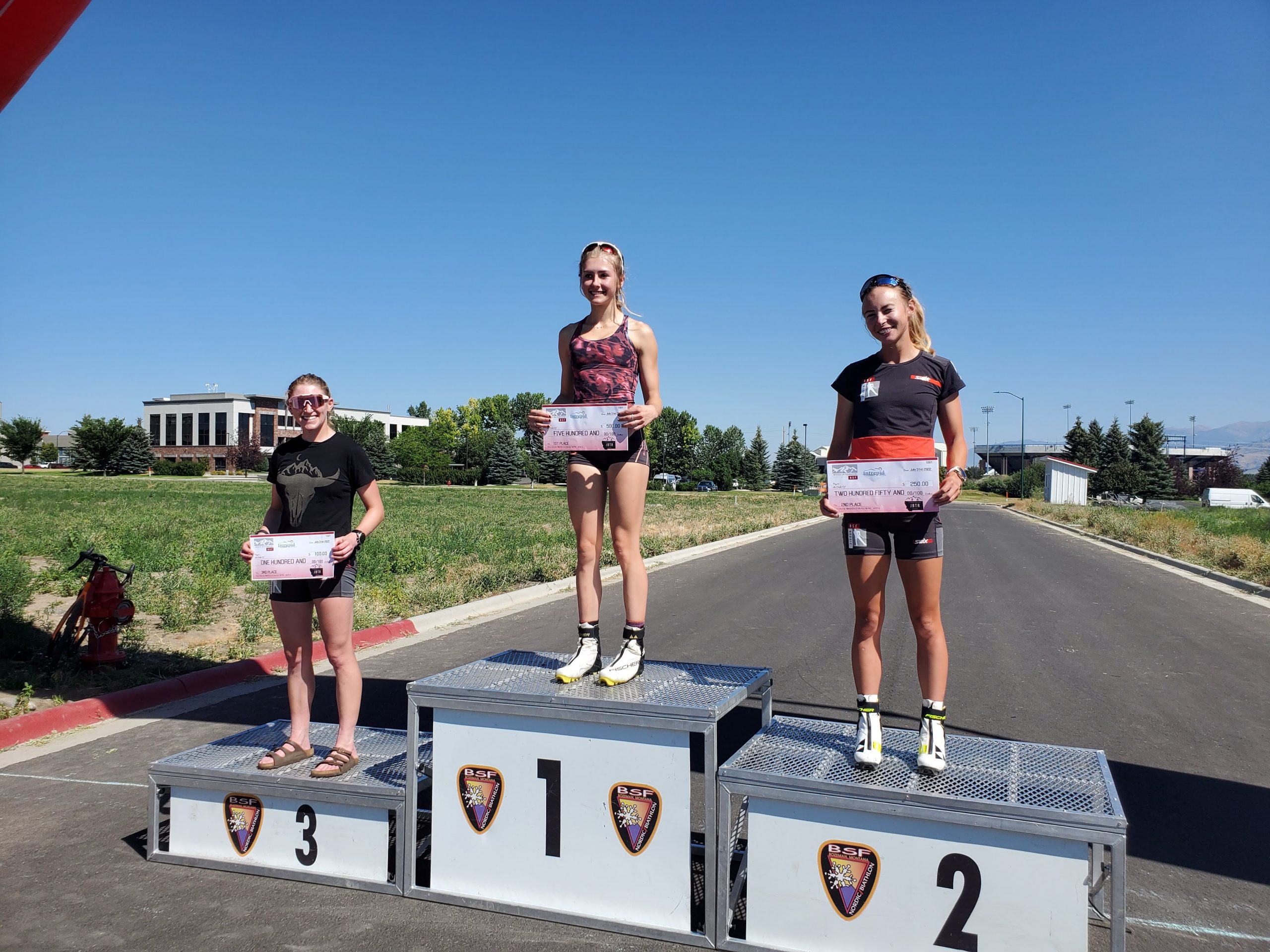
Logan Diekmann, Nina Seeman win on the streets of Bozeman, and BSF’s Rollerski races look to harness the momentum of summer training out West. Featuring Results and Video Highlights.
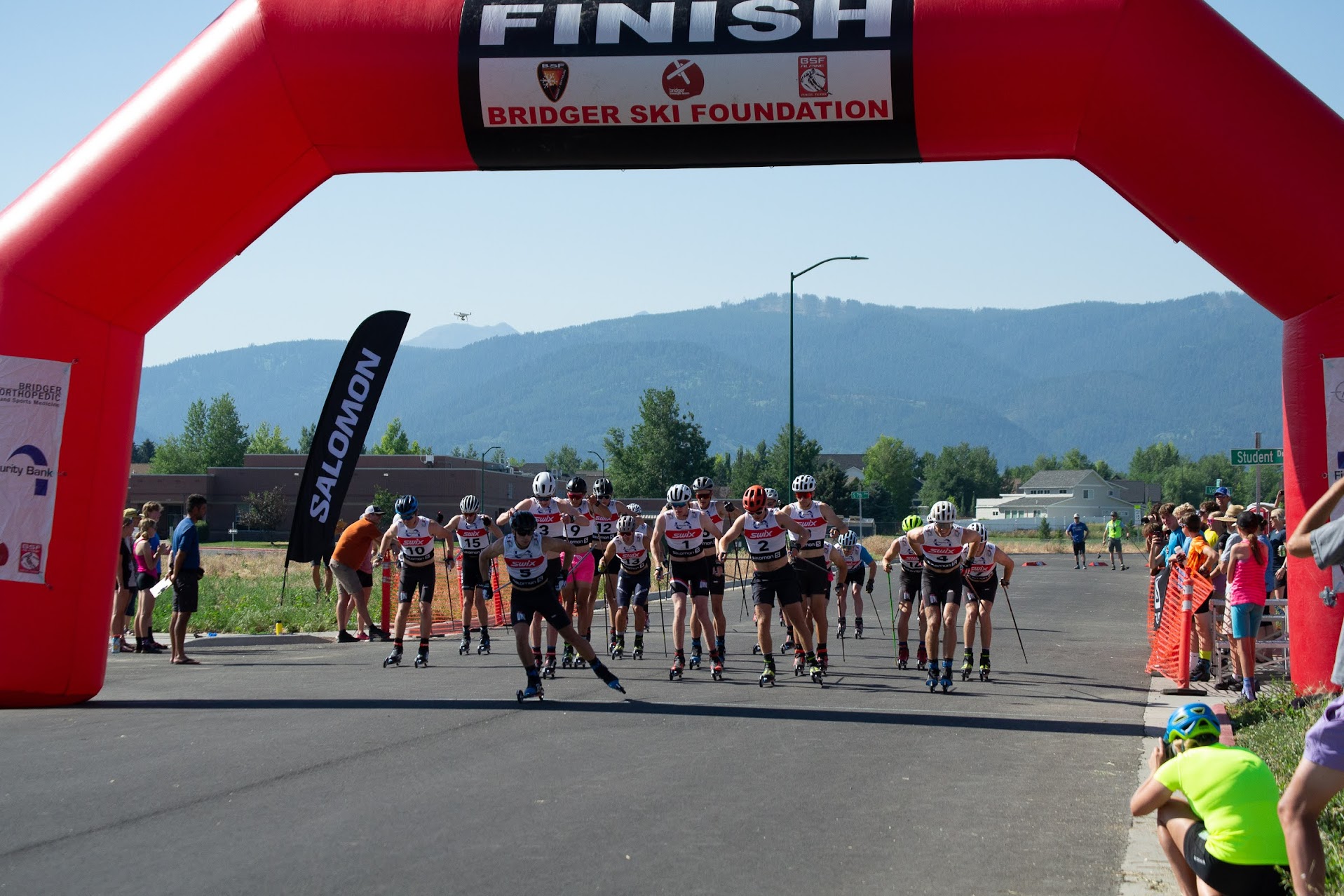
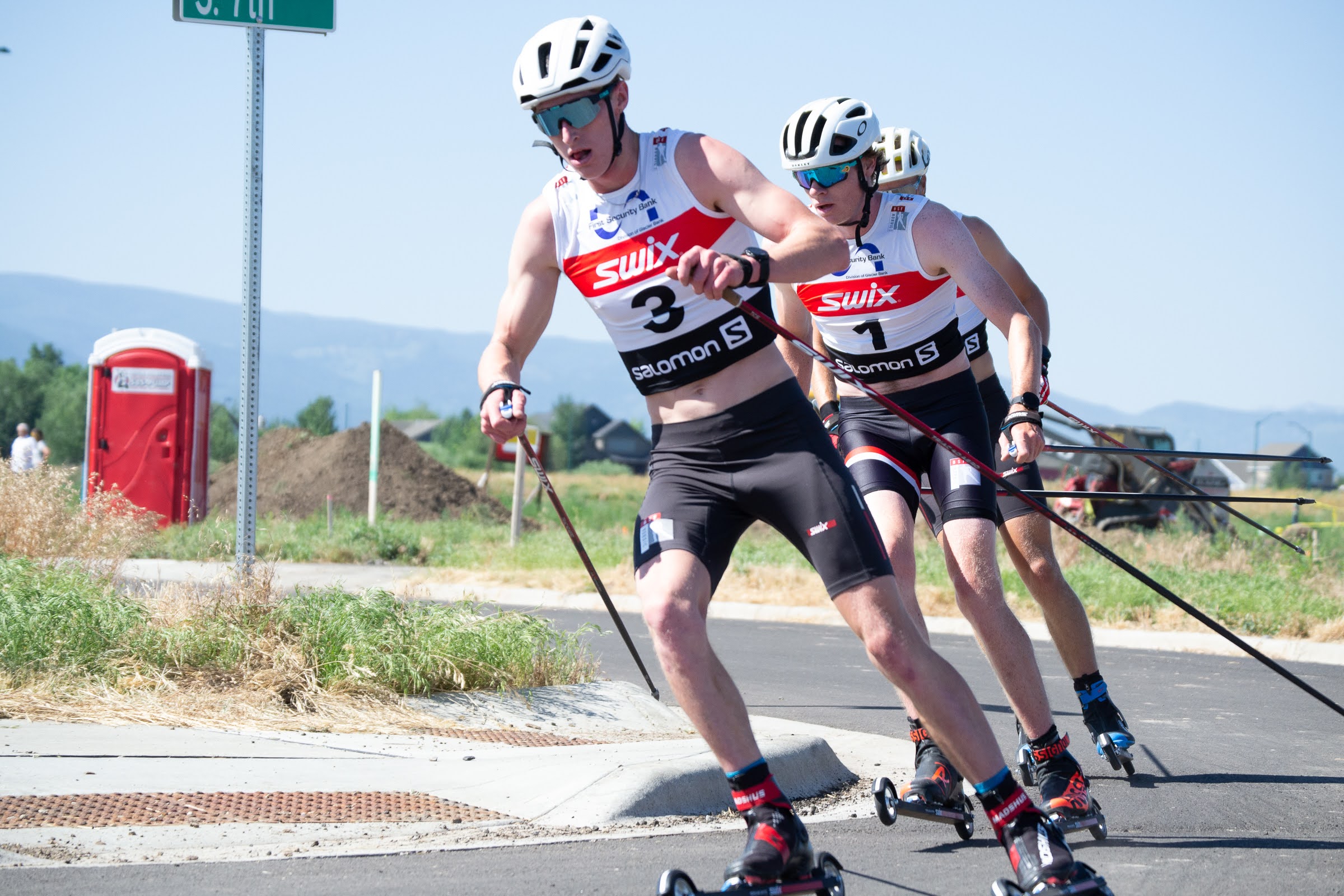
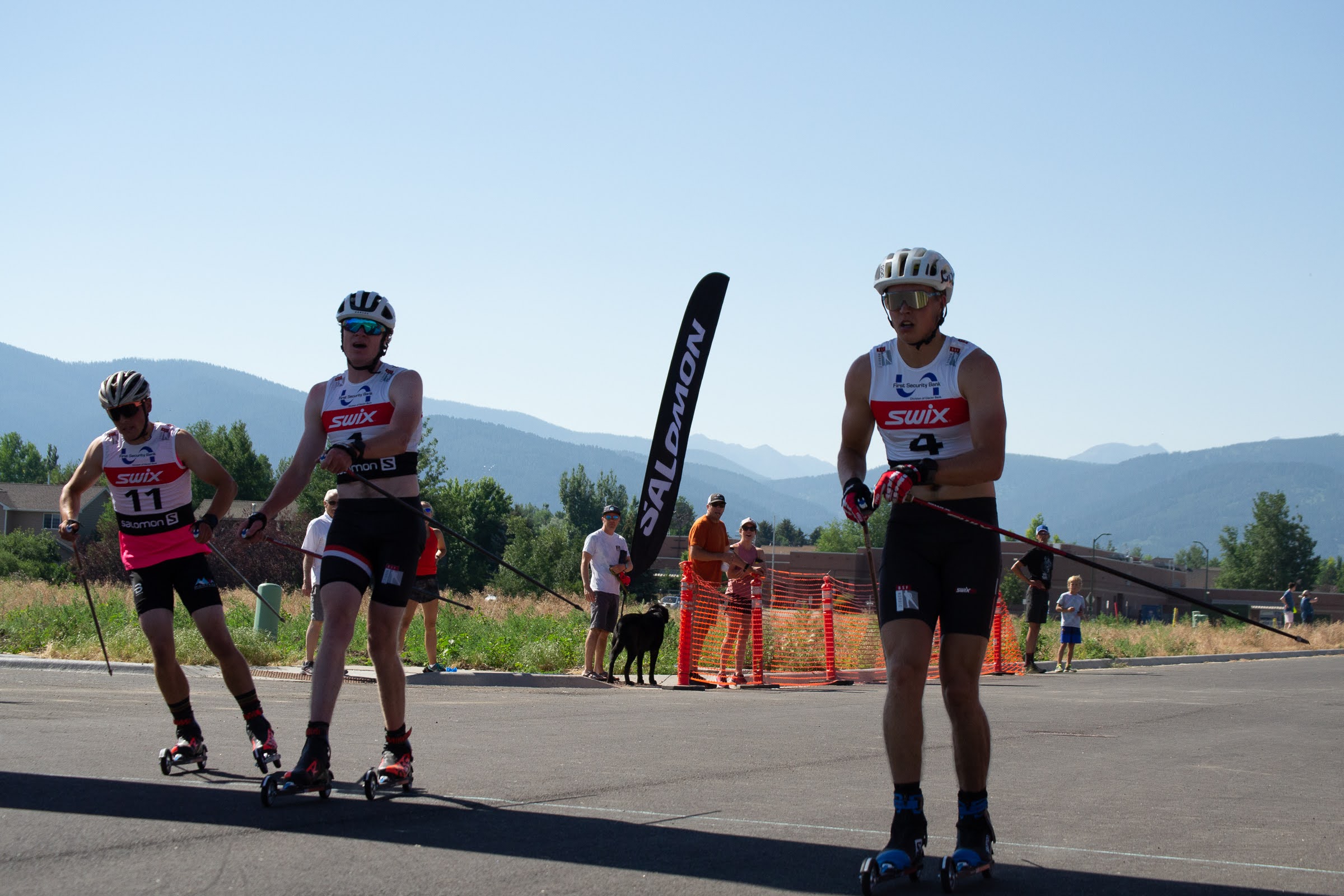
Men’s Open field rolls out at last weekend’s Jim Bridger Rollerski Races, held in Bozeman, MT (Photo: Jenny White/BSF).
BOZEMAN –Jim Bridger was a mountain man. One of those figures born firmly entrenched in the old ways back East, before he split for the Mountain West for something new. A character to chart a theme pervasive through the American vision of the West – that ability to make something new and pursue it with everything you got.
It’s a tortured and uncomplicated metaphor (Bridger was one of the first white men into the intermountain West, but of course, wasn’t the first person to existthere). But if you were going to distill that character, and tap in purely to that “Pioneer, O Pioneer” spirit, you could do worse than the Bridger Ski Foundation (BSF) Pro Team Head Coach Andy Newell.
For most of the 21st century,Andy Newell was a metonym for the very top of American men’s skiing. Through four Olympics, 220 World Cup starts, and breakthroughs every step of the way, Newell was there, making the in-roads that a generation of men’s skiers is nowpicking up on. Newell retired from racing in 2018, and in just four years has quickly transitioned his ebullient energy into setting up a coaching consulting business,Nordic Team Solutions,expanded BSF’s Nordic programming to include a successful Pro Team, and made Bozeman’s mountains and plains a popular training ground forcollegiate athletes during their summers.
Andy Newell in his latest roll as Race Director last Saturday in Bozeman. (Photo: Jenny White/BSF).
Long home to an established nordic community withMontana State’s NCAA program andBSF, the efforts of Newell and the athletes he works with have been based in an effort to re-think and try out approaches to skiing development, training, and culture in Bozeman, and in the larger U.S. Ski Community. And in the latest example, that meant looking at a nearly 30-year-old BSF-held running race and saying, why not add a rollerskiing event?
The 29th annualJim Bridger Trail Run last weekend then, also marked the 1st annual Jim Bridger Roller Ski Races. And the impetus, as for many things with Andy Newell, was to simply go all in on nordic in the pursuit of promoting the sport. “I’ve always loved racing the big European rollerski races likeBlink andToppidrettsveka. I thought this would be a fun opportunity to pair a legit rollerski event with a trail run and host them back-to-back. Having races like this is a great development tool for athletes” said Newell, in an email to FasterSkier. The races also acted as a fundraiser specifically for the BSF Pro Team, which has been one of the fastest growing and competitive programs in the U.S. since it was founded. Something that Newell talked about at length with FasterSkier earlier thissummer.
Andrew Morehouse, BSF’s Nordic Program Director also added that the impulse to bring rollerski races inspired by those in Scandinavia to the United States is one that has been successful in the East and Midwest, but hasn’t found its way out West quite yet, “We’ve seen the success of roller ski races in the East and have talked within the Intermountain Division of how we can create a meaningful roller ski race series for our athletes in the West. I think this race, along with theSchutzenski Festival in Utah (to be held at Soldier Hollow during the US Ski Team’s Fall Camp there this October), is a great step towards that goal.”
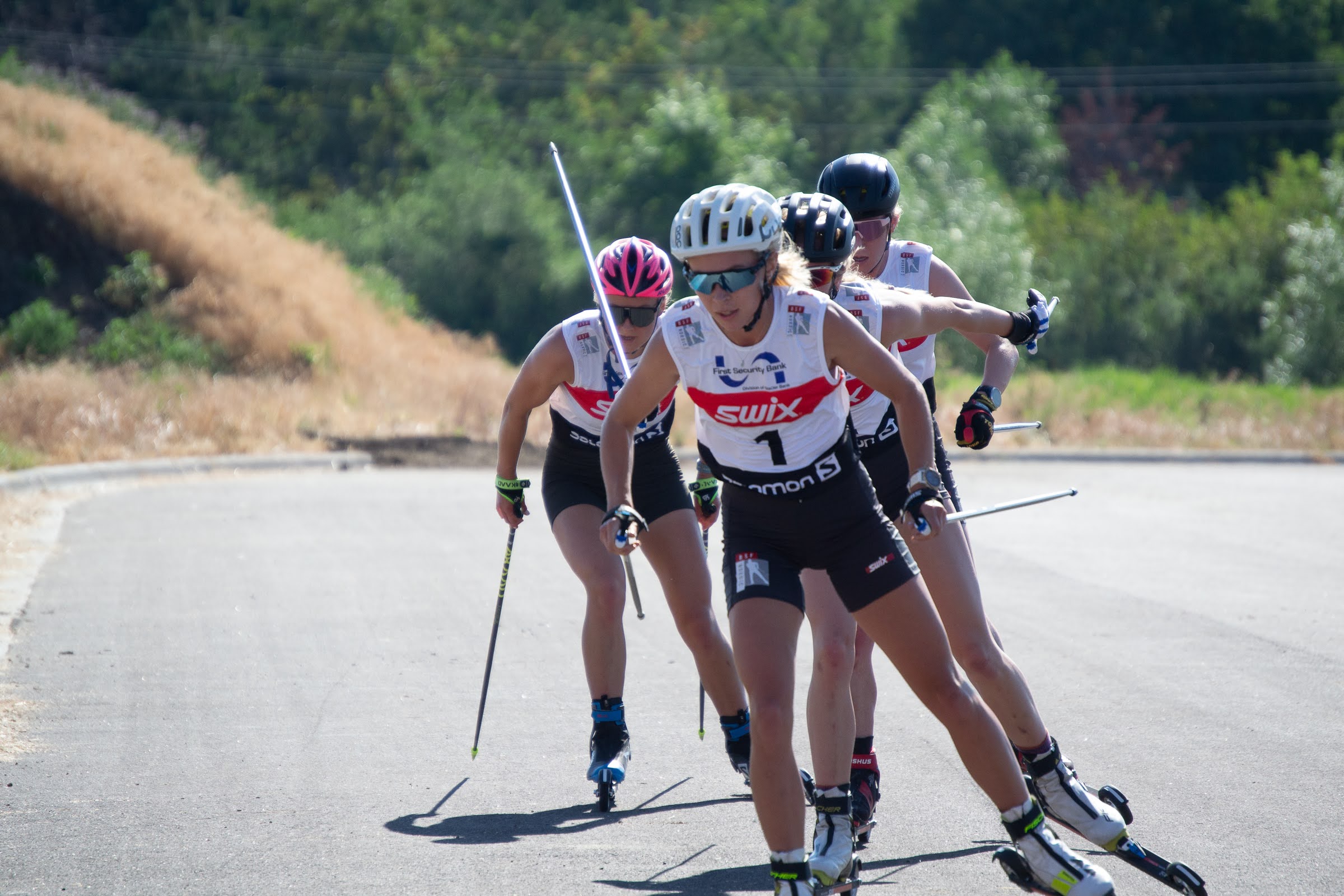
The Women’s Open field goes into a corner during their 12 k race in Bozeman last Saturday. (Photo: Jenny Smith/BSF).
Inaugural Jim Bridger Rollerski Race Report
In the pursuit to bring top-level rollerski racing to the hot, dry, and high Mountains out west, BSF’s efforts were a success.
A field full of BSF’s Pro and Comp (U14-U20) program athletes, along with racers from across the Intermountain West and a strong contingent of collegiate racers sure to show up on Eastern Carnival result sheets this winter made for an incredibly competitive and robust field.
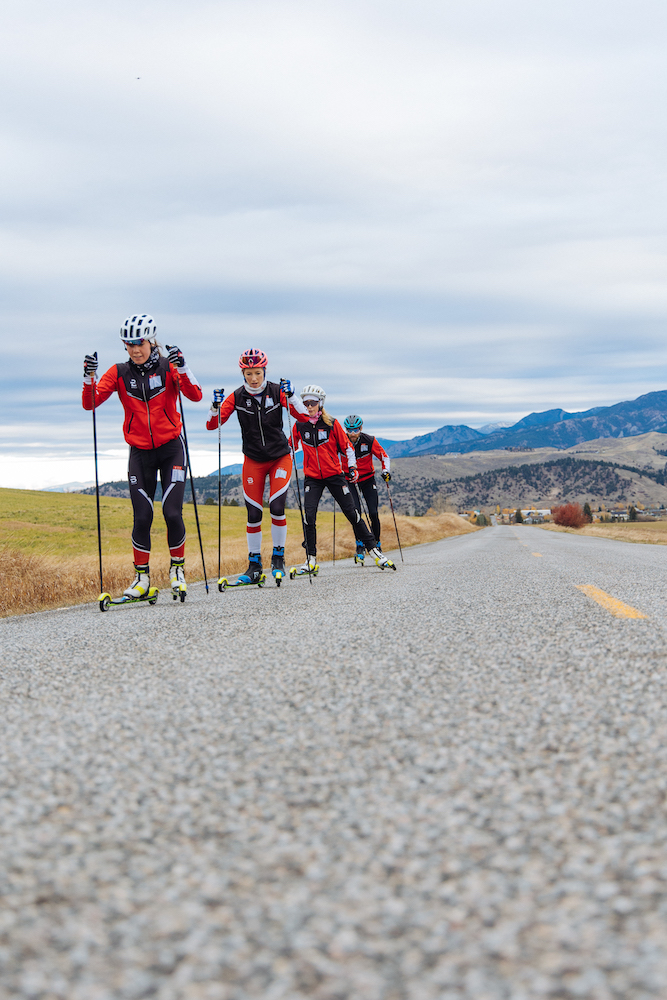
They raced distances of either 6 k for the U16/U18 fields, or 12 k for U20/Open field on a 1.5 k loop that took them around the streets south of the Montana St. campus in Bozeman. The design was in line with the vision of promotion for the event, “high speed, multi-lap races right in [town] to make it spectator friendly and exciting,” said Newell. As with many roller ski events, racers also were provided matched skis, in this case from sponsors Swix and Solomon.
All races were skate, and with relatively flat terrain on course, that made for an event in which there was hardly a V1 to be seen. This was a day for V2, and a great opportunity for athletes to work theirs at max-effort next to other skiers and see where they can tweak their power application and tempo. Rollerski races, by design, are meant to be a stepping stone in training on the way to next winter, after all.
The early going in both the men’s and women’s open field were tight-packed affairs. Racers hemmed and hawed through tight-corners to bring the top-end of the field together, until slowly but surely, those lead packs became smaller and smaller.
In the women’s field, the last couple laps saw a group containing Dartmouth College (DAR) skier Nina Seeman, along with BSF Pro members Mariah Bredal and Sarah Goble gain an advantage. There was nothing between them until the race’s end, when Seeman and Bredal broke for a final sprint, and Seeman came away the winner (27:58). Bredal finished second (27:59), with Goble coming in shortly after (28:07) to complete the podium.
Mariah Bredal (BSF) leads the Women’s field. Bredal finished 2nd overall to Nina Seeman (Dartmouth), tucked in 2nd place here. (Photo: Jenny Smith/BSF).
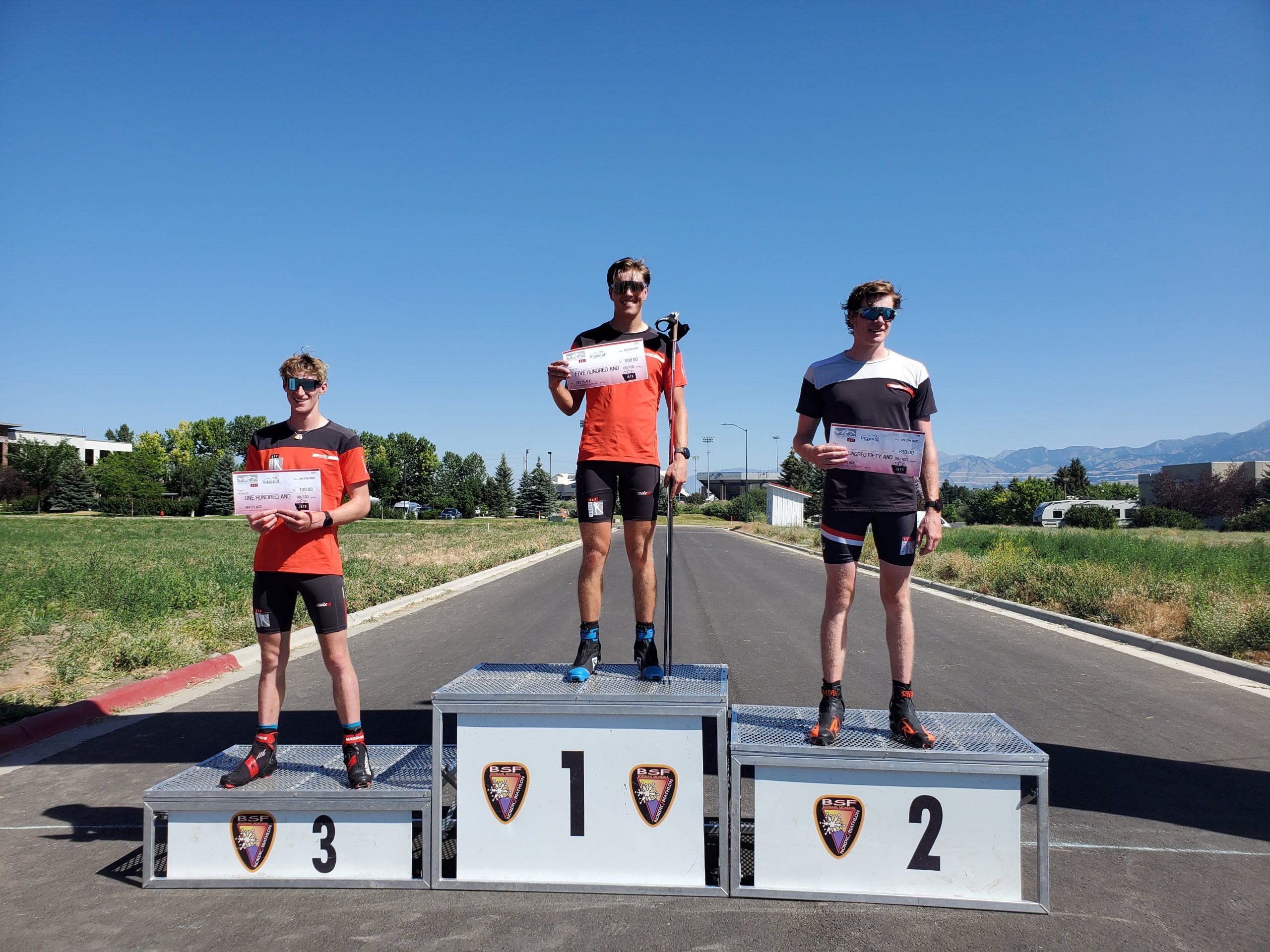
The men’s field saw a similar battle at the finish between three of BSF Pro’s leading lights. Into the final lap, Logan Diekmann, Finn O’Connell and Reid Goble were locked into a pack, with the promise of a true sprint all but assured for spectators. Goble found himself leading the pack for most of the lap, with O’Connell taking second wheel and Diekmann in third. Diekmann and O’Connell then launched their attack from behind their would-be lead-out, with Diekmann putting just enough gap over the line that the rare (and dangerous) rollerski lunge finish wasn’t needed. Diekmann in first (24:44), O’Connell in second (24:45), with Reid Goble rounding out the podium in third place (24:57).
Above – Reid Goble (BSF) leads Finn O’Connell (BSF) and Logan Diekmann (BSF) in the final lap of the Men’s Open 12 k. Below – Diekmann takes the sprint finish ahead of O’Connell. (Photos: Jenny White/BSF).
In the 12 k U20 Women’s race, St. Scholastica (CSS) skier Mia Case took the win over Park City’s Elena Grissom in second, and Sidney Benyon. The 12 k U20 Men’s race BSF’s Phin Fischer took first place ahead of Sumner Cotton (BSF) in second and third place Soren Davidson (BSF).
The inaugural BSF roller ski races were filled with fields of those who will find themselves at the top of NCAA, SuperTour, and even perhaps a World Cup this winter. That’s not bad for an inaugural running on the southside streets of Bozeman, and is yet another marker of the city, and Bridger Ski Foundation’s growth and development into a leader in the country’s ski community.
Many skiers then showed up to put impressive results up in Sunday’s Jim Bridger 10-mile Trail Run. Reid Goble (BSF) placed second overall (1:20:24), Peter Wolter (Sun Valley) was third (1:21:17), and Finn O’Connell (BSF) fourth (1:22:24). Mariah Bredal won the Women’s race (1:26:59), with Hannah Rudd (BSF) third (1:35:03), and Sarah Goble (BSF) fourth (1:37:37).
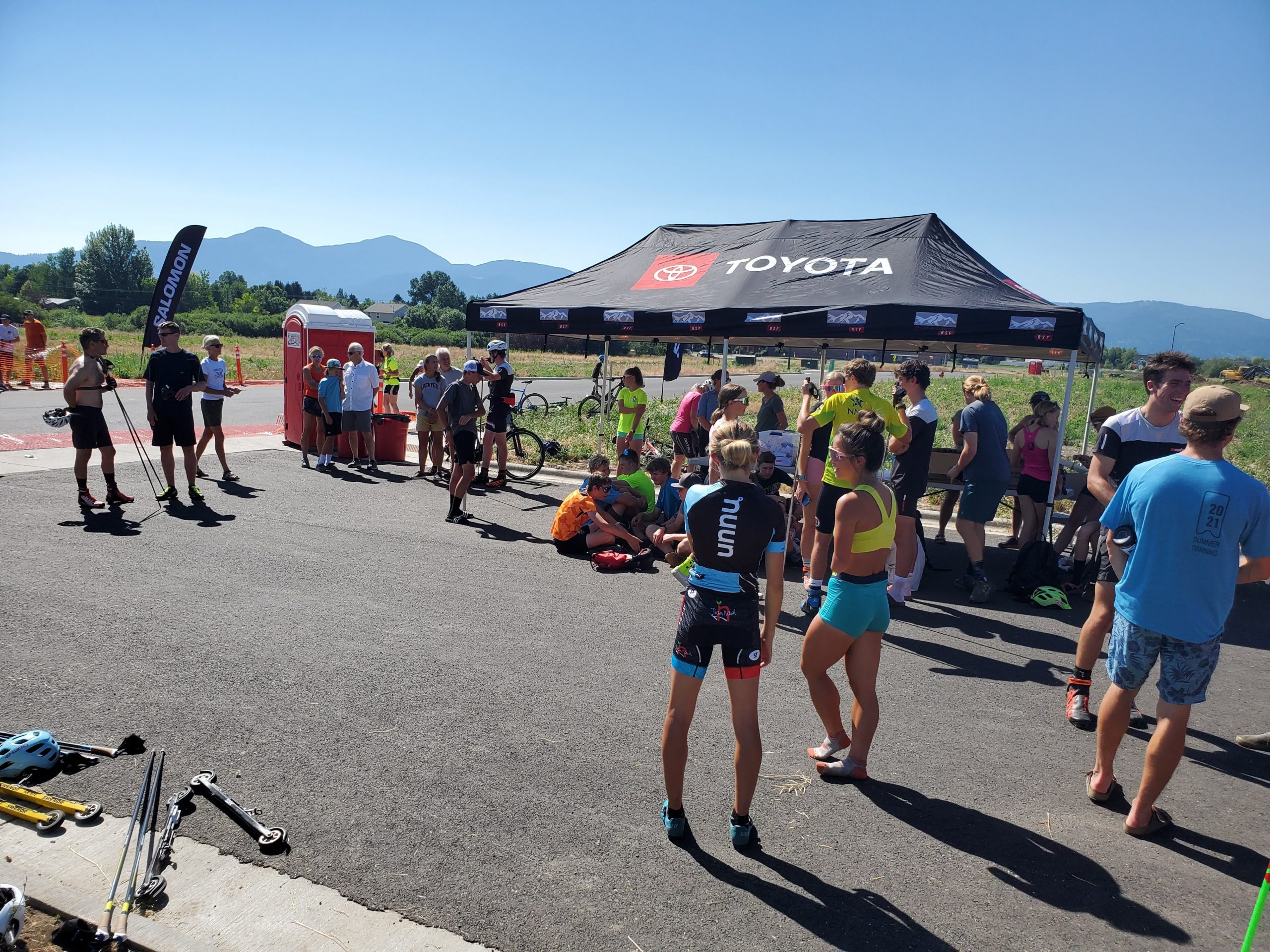
The BSF, and Bozeman, Nordic community together in Bozeman for some rollerski racing. (Photo: Jenny Smith/BSF).
In the spring of 2020, the Bridger Ski Foundation (BSF) launched a new professional racing team, led by Andy Newell, who spent nearly two decades on the U.S. Ski Team as a staple and leader of the American men’s program. Launching early in the pandemic, the BSF Pro Team had few opportunities to show their strength in the first race season, but they came on strong in 2021-22. During U.S. Nationals in Soldier Hollow in January, the BSF Pro Team had at least one athlete in the top-10 in each race, except the men’s 30 k skate, with podium performances by Mariah Bredal in the 10-kilometer classic (3rd) and Logan Diekmann (2nd) in the 1.3 k skate sprint.
After growing up in Vermont and developing as a skier at the Stratton Mountain School, and later training with the SMS T2 elite team through most of his professional career, Newell moved to Bozeman, MT in 2018 with his wife and former SMS T2 teammate Erika Flowers, who had grown up in Bozeman and taken a job there. Both at a transitional point in their ski careers, Newell would continue to pursue World Cup skiing for another two seasons, while Flowers continued to train with her sights more focused on domestic racing.
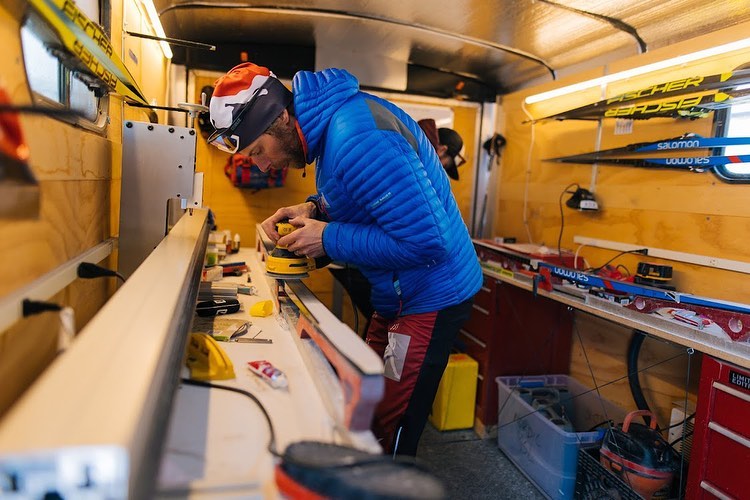
Inside the wax cabin, Andy Newell prepares skis for his athletes during the 2022 U.S. Cross-Country Championships in Soldier Hollow, UT. (Photo: Arlin Ladue / BSF Pro Team)
Over the last four years, this transition has seen Newell race his final World Cup events and officially leave professional ski racing behind, only to launch and support the thriving BSF Pro Team, alongside his online coaching business, Nordic Team Solutions. In this interview, which took place on Friday, June 3rd, Newell provides insights into this transition from athlete to coach, while also adding behind-the-scenes details of getting the Pro Team off the ground. He also speaks to the challenges of elite training groups, their role in supporting the trajectory of U.S. skiing at the international level, and what’s in store for the BSF crew this summer.
This interview has been lightly edited for length and clarity.
FasterSkier/Rachel Perkins: Starting with the timeline, in the spring of 2018, both you and Erika started to transition to ‘retirement-lite‘. And at that point, you were already talking about doing some coaching and working in athlete development. Is that when you guys moved to Bozeman? And from there, what was the evolution of your relationship with the BSF program?
Andy Newell: Well, I was actually still on the U.S. Ski Team in 2018, but we did move to Bozeman that year. I was still racing essentially full time, but at that time I started a business, Nordic Team Solutions, and with that, I launched a summer training program where I was coaching college kids, so summer of 2019 was my first year where I was kind of stepping more into a formal coaching role. Which for me felt natural because I’ve always kind of participated in and loved the whole training camp vibe.
Growing up at Stratton, Sverre [Caldwell] always had these amazing summer camps for juniors that I participated in my entire life. And then, as I became an older athlete and a U.S. Ski Team athlete, I would actually help with some of these training camps as well. And then in my years with the U.S. Ski Team, I had this program that I started calling “speed camps,” which a lot of people might remember. We would host these free clinics around the country that would coincide with the U.S. Ski Team training camp. Basically we would reach out and have a bunch of juniors come and join us for an afternoon of rollerskiing and agility courses and fun stuff like that.
So to me, it felt like a natural progression to take that a step further – once I launched the Nordic Team Solutions business, where I was running the website, to then pair that with a summer college training group. So my first year here in Bozeman, I actually ran that group independently from BSF… so I was actually not part of BSF in that first year of 2019. I was planning to race some World Cups, did race some World Cups in 2019-20, and then COVID put a quick end to our season when we were getting ready to race in Quebec and Minneapolis.
I had planned on those being my final World Cup races as a professional, to go out racing in Quebec and in Minneapolis and had spent all year preparing for those specific races. And sure enough, they were canceled. So it was like, ‘Surprise! You’re officially retired now.’ And at that point is when I signed on with Bridger Ski Foundation to be the elite team coach.
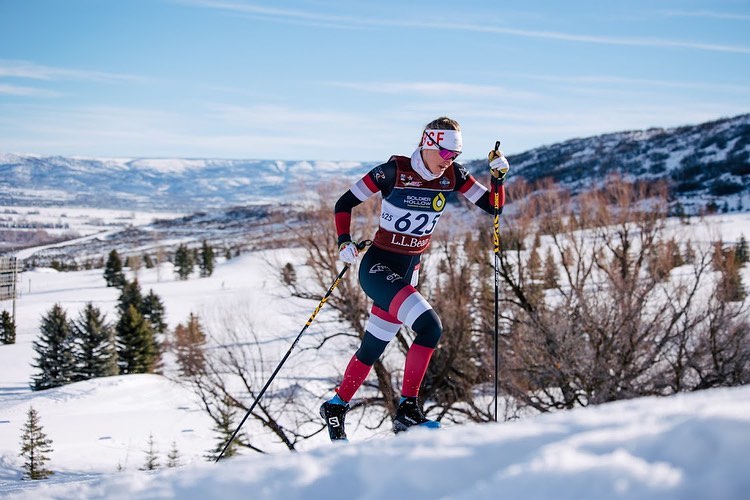
BSF Pro Team athlete Hannah Rudd races the classic sprint qualifier during a post-U.S. Nationals SuperTour event. (Photo: Arlin Ladue / BSF Pro Team)
FS: The announcement of your hiring went out in April 2020 – which kind of feels like a lifetime ago, but it also seems like it would have been a somewhat challenging time to launch a new elite team. Was the foundation already there with the BSF program or was this the onset of the elite team program?
AN: There was an elite team in 2018, but it disbanded because the coach, Rogan Brown, went on to [coach at Denver University], and there were only a handful of athletes here in Bozeman at the time. So in 2019, there was no elite team tied in with BSF, and then in 2020 when I was hired, it was essentially my job to kind of relaunch this program, and to make it a successful program.
There’s no reason why BSF should not have a successful elite team. The Bridger Ski Foundation has been around for over 70 years. It’s very well established here in Bozeman; we have a great pool of young athletes that participate in the youth skiing program – hundreds of athletes.
Andrew Morehouse was signed on as the new nordic director in 2019, and then I came on in 2020. And we shared a vision that, in order [for BSF] to be a premier club, we should have an elite team. And then basically, I had free reign to kind of do what I wanted, which I’m super grateful for – that BSF has kind of given me the ability to choose the team makeup the way I see is best, and to choose how I run the program.
We work closely with the juniors and Andrew Morehouse and the youth programs in town, so I very much have taken the model that I learned growing up at Stratton and tried to implement that here in Bozeman.
At that point [in 2020], I basically just got on the phone and started calling some different athletes that I had met or worked with through NTG camps. The US Ski Team in 2018 and 2019 would hire me to come to NTG camps or development team camps – that was part of my business as well – so I started reaching out to different athletes and mentioning to them that we were going to start a new team here in Bozeman. So I was able to recruit nine athletes initially to come to the team, which was great.
Here’s a preview of the 2021-22 BSF Pro Team. Note that one of the original 2020-21 athletes, Leah Lange, stepped back from her racing career after the team’s first season to begin coaching in Big Sky, MT.
BSF Pro Team athlete Finn O’Connell welcomes his teammate to the line during the U.S. Cross-Country Championships in Soldier Hollow, UT. (Photo: Arlin Ladue / BSF Pro Team)
FS: Can you say more about getting the team off the ground?
AN: So we launched [the Pro Team] in 2020 in the midst of COVID, which – there were so many unknowns and unique circumstances to try to convince these athletes to move to Bozeman and train here in the midst of all that was going on. And we essentially only had very unofficial racing our first season of 2020-21. Kind of a mismash of some official races, some non-official. But in hindsight, it was a nice opportunity for us to just build a team and spend a lot of time training with one another.
When you name a team like this as a coach, you have no idea what type of team culture or team vibe there’s going to be – you’re bringing all these different athletes from different colleges or different programs around the country. You want to create a team that really acts and feels like a team and you have no idea what type of form that’s going to take. So in hindsight, to have that COVID year where we just spent a lot of time training with one another, building the team here in Bozeman, was nice to lay that foundation so that we could have what was a very successful season last year in 2021-22.
FS: You’ve still got Nordic Team Solutions going on also. Has your work there shifted in any way and how do you balance your time between both of those?
AN: It has shifted in that, my first few years with NTS, I would actually hire [myself] out and go to more training camps. As I mentioned, I would help the U.S. Ski Team out with some of their NTG camps, or I would be hired by a club to go do a two or three-day training camp with them. And that has pretty much stopped, because my priority time-wise is with the BSF Pro Team. So I don’t travel so much for any other coaching duties, I mostly just travel to training camps with the BSF Team and work with them here in Bozeman.
But I do still run the website, which is a great resource for training information for ski clubs, high school coaches, college coaches, or any individual that’s looking to learn more about training. I still run that [program] on a weekly basis and in published training plans and right strength plans for various individuals.
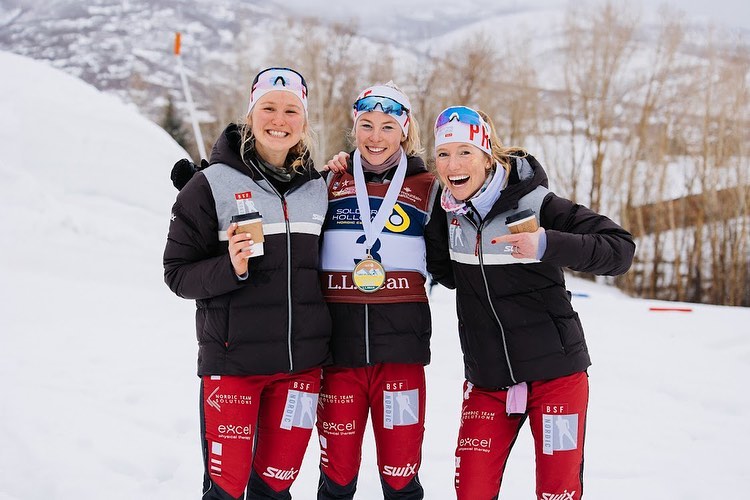
BSF Pro Team athletes (l-r) Hannah Rudd, Mariah Bredal, and Erika Flowers celebrate Bredal’s third place finish in the 10 k classic during the 2022 U.S. Cross-Country Championships in Soldier Hollow, UT. (Photo: Arlin Ladue / BSF Pro Team)
FS: In terms of Bozeman: you spent most of your career based in Vermont, though Erika has roots in Bozeman. How have you found that setting for leading this Pro Team and what are your thoughts on the training environment there?
AN: The environment for training is fantastic here in Bozeman; we have access to mountains, access to a long season of skiing. We’re just an hour and a half away from West Yellowstone where we often have early FIS races, or we’re within driving distance of Sun Valley, Canmore, all these other places that historically have early-season racing. The rollerskiing is quite good here and there’s already a great support network within the Bridger Ski Foundation community.
What is tough, with any elite team, is the fundraising aspect. I actually rebranded it as a Pro Team for a reason, because I want these athletes to be not scraping by, but to be actually making money while pursuing their dreams of being an Olympic-level racer. I think they deserve that, and I think that’s what all professional skiers deserve in the U.S.
But it’s taken us some time to get there, and we’re not there yet. Fundraising is a huge part of my job on a yearly basis; we essentially have to fundraise from scratch all the money that it’s going to cost to travel around the country, or travel to Europe with these athletes who are making World Cup or World Championships. All the wax, all the hotels, all the logistics – all of that falls on a single program budget, basically.
And I think there’s a huge potential for that in Bozeman. Bozeman is one of the fastest-growing towns in the U.S. and there are a lot of new businesses here, so I think our fundraising potential is huge. But given the fact that we started in COVID, and we’ve only been here for two years, we’re still trying to figure that piece out. And so that’s a place where we still have room to grow.
And I would encourage anyone out there who’s reading this to realize the importance of these pro teams that we have in the country… We have Stratton, we have Craftsbury, we now have the Birkie Team, we have Sun Valley. And these clubs are essentially responsible for the development of the US Ski Team. This is the club model that we have adopted. Now, you know, it’s now been 30 years since we’ve, more or less, adopted this model. And we’re not getting any money from the U.S. Ski Team to develop these athletes. These clubs are and are all self-funded. APU is a little different since it’s tied in with the university.
Unless you have a massive endowment or some other amazing bankroll that I am not familiar with, these pro teams and elite teams are fundraising their entire budgets on a yearly basis. Every single year, you have to raise the amount of money to send these [athletes] to these races. And that’s challenging, but it’s a hugely important piece of our development, because we wouldn’t have the U.S. Ski Team that we have now – we wouldn’t have the depth or the success on the U.S. Ski Team level – if we didn’t have these clubs as feeder programs. So I think it’s important that people help support these teams.
BSF Pro Team athletes Lauren Jortberg and Logan Diekmann earn their first World Cup starts in Lahti, FIN in Mar. 2022. (Photo: BSF Pro Team)
FS: Looking back over the last few years, what are some of the indicators of success that you look at in identifying what’s going well for the program? And what are some of your objectives in terms of heading into the next few seasons?
AN: That’s a great question. The goal we have here with the Pro Team is international success, and that means I don’t bring someone onto the BSF pro team [whose only] ambitions are racing SuperTour and winning the Birkie, although those are amazing achievements. Those are, for sure, stepping stones in our development. But my goal is to put people on the U.S. Ski Team, and to qualify people for World Championships and Olympics.
So international success is what we strive for, and that’s how we measure our season, and how folks are doing. Last year alone, we had three athletes achieve their first ever national podiums in Soldier Hollow. We actually qualified four different athletes for World Cup, although two of them – Finn O’Connell and Mariah Bredal – did not get to start there because they were canceled. But both Logan Diekmann and Lauren Jortberg started their first ever World Cups, which is great. We finished the year with Logan Diekmann as the overall sprint champion on the SuperTour. Finn O’Connell was the second best ranked distance skier on the SuperTour, and he also qualified for the U.S. Ski Team [as a B-Team member]. So for us, that was a solid year, and I was very proud of the way the team performed and much of the team, if not half the team, was able to have personal bests and be called up for some type of international racing, whether that was through World Cup or Opa Cup, and that’s exactly what you know I want to do. That’s my mission: to get these kids into those big international races and have them perform well.
FS: Can you speak a little bit about the depth of the team, too? Momentum seems like an important thing with elite or pro teams. Just having that critical mass of athletes that are on the same level, or have similar objectives. Is that something that you’re seeing with the BSF crew?
AN: Yeah, absolutely. I think the phrase ‘critical mass’ is for sure something that you see with these pro teams. I mean, it’s hard to deny the Jessie Diggins/Julia Kern effect that Stratton has right now. That’s a huge draw to their program.
I think, for us, considering we started with zero members of the U.S. Ski Team on our pro team, and now we have one B-Team member – I’ve just been really excited with our success so far and how the team has stayed driven and motivated and helps push one another. That’s why I do this job – I love the team environment. That’s what I lived in my entire life; I was on the U.S. Ski Team from when I was 18 years old until I was almost 36 years old.
So the concept, the feeling of being part of a team, where people are genuinely supportive of one another you share in the training process and learning process, and you’re pushing one another, that’s the most valuable and successful scenario you can have. So I’ve been glad that we’ve somehow been able to find that nice mix of motivated individuals that genuinely get along and have fun with one another, and are able to travel the country and have put together successful race weekends.
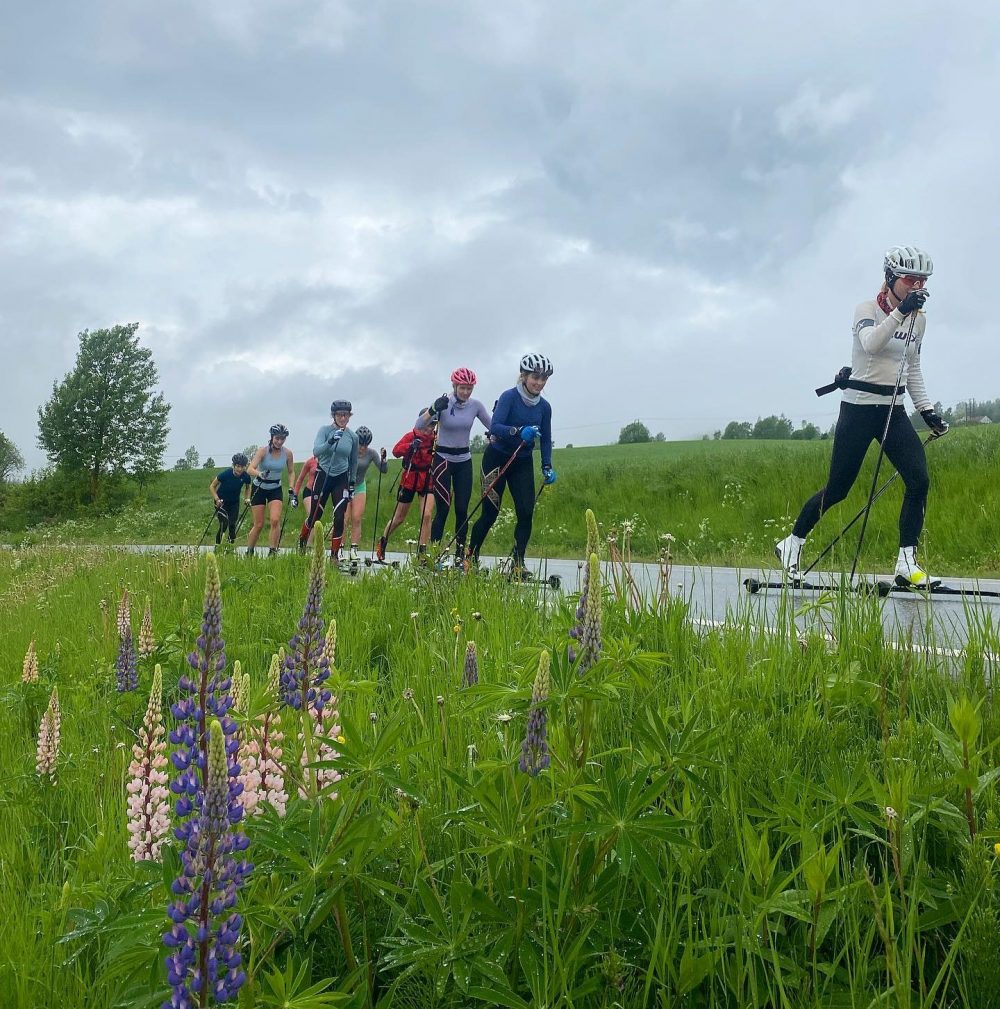
The BSF Pro Team out for a rollerski during a June 2022 camp in Lillehammer and Sjusjøen, Norway. (Photo: BSF Pro Team)
FS: Last program question: what’s new and what’s on deck for this summer? You mentioned that you guys are heading to Norway. What other summer/fall camps or projects are you guys working?
AN: [Starting with the team roster:] so far this year, we’ve added Sarah Goble to our squad squad. She’ll be a new athlete with us next year. We also have her brother Reid Goble on the team, who has been great. I think those two have a ton of potential.
We did lose Lauren [Jortberg] to Stratton – and you know how these clubs work, it’s a very friendly exchange. I’m sure we’ll find ways to collaborate, and that’s honestly what I find a lot of value in is elite teams collaborating with one another. Last year, we did a bunch of training camps with Sun Valley [Gold Team]. We joined Stratton and Sun Valley in Lake Placid training camp. We did some camps in the Midwest where we’ve had overlap with some Birkie athletes. And so I’ll continue to do that this year.
We are scheduled to go to Norway next week for a two-week camp where we’ll be in Sjusjøen for five days, and then on Sognefjellet ski fields for five days. We’ll try to overlap with some fast foreign skiers while we’re there and try to learn from some folks over there, and we’re bringing a handful of college skiers with the Pro Team as well on that trip. After that, we’ll be back here in Bozeman for the main summer training block and that’s when we do our BSF college training group as well. That runs through the end of June and into the first week of August.
So we have a solid six-week block of training here in Bozeman, which has been the staple of the BSF program the last couple years – having this really competitive college training group. It’s been so fun to see that program grow and see the success of the college training group. The first year with BSF, we had folks like Sophia Laukli on the team, and so many talented individuals. It was great to see them develop here in Bozeman and then have such amazing seasons that winter. So we’ll continue that program where for six weeks we’ll have a team of 12 collegiate athletes that join the Pro Team on daily training all the way through August.
After the summer training group ends, we’re planning to head to the Midwest for another training camp, like we did last year. We try to get to low-altitude in August. Right now we’re looking at Marquette as our training destination, and we’ll try to collaborate with Team Birkie on some sessions out there. And then we’ll be going to Park City camp in October, like we always do, to join the many clubs from around the country and the U.S. Ski Team for their [fall] camp. And then we’ll probably get on snow early here in Montana or in BC as the snow flies.
FS: How much crossover is there between the collegiate group that you have joining in the summer and the Montana State University (MSU) program?
AN: Historically there are not many MSU kids that stay in town [over the summer]. This year I think we have two MSU kids in the college training group, so that’s great. If there are MSU athletes in town, we try to prioritize them to get them onto the team to keep them within the community. But a lot of college kids go home, whether it’s Alaska or back east or the Midwest. But we do have some good crossover and I have a good relationship with Adam St. Pierre and the university. We use their facilities all the time – we just did a round of testing on the rollerski treadmill at MSU – so it’s handy to have those types of resources nearby.
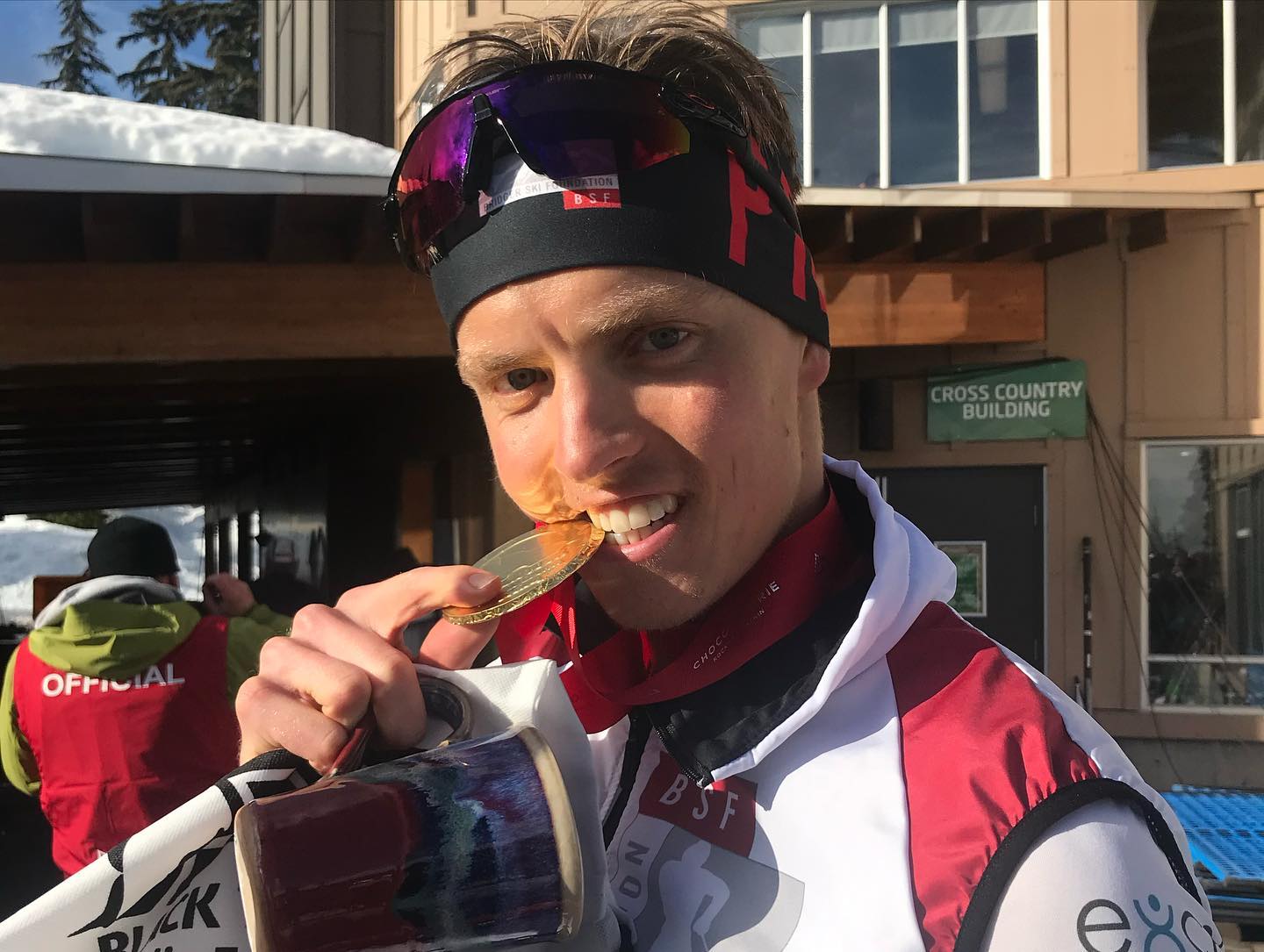
Logan Diekmann bites his medal after finishing second in the US SuperTour standings in the classic sprint in Whistler, BC during Canadian Nationals/US SuperTour finals in Mar. 2022. (Photo: BSF Pro Team)
FS: I know you’ve also got the Jim Bridger Trail Run coming up this summer, and there is a new rollerski race component. Can you share more information on that?
AN: We’re doing our first ever Jim Bridger Rollerski Race at the end of July, which is paired with our annual trail run. I’ve been working with the town of Bozeman to shut down a city block behind where the MSU campus is, and we’re going to be hosting a crit-style rollerski race on the weekend in downtown Bozeman.
We have prize money for that, and we’re getting some great sponsors on board. So that’ll be a cool event.
FS: Can you also talk about how that event supports the BSF Pro Team?
Yeah, absolutely. Like I mentioned, we as a Pro Team essentially need to raise $150,000 each year just to get the [athletes] to all the races and try to cover their expenses. That is a travel budget, a wax budget, everything – and that needs to be raised on an annual basis. For us, the Jim Bridger Trail Run is one of our biggest fundraisers.
It’s an incredible amount of work. It’s a weird part of my job to be a coach, but also an event organizer. There’s a lot of weird things that go into being a ski coach. But, if we can make the Jim Bridger event big and successful, we can actually raise a lot of money for our budget. So that’s why we put so much attention and effort into it. It’s also a good chance for us to partner with local sponsors to raise money for the Pro Team, because all proceeds from these events go directly to the Pro Team.
So historically, it’s just been a trail run, but this year I wanted to add a rollerski event for a couple reasons. One: I think it’s a huge development tool for BSF. We have so many talented youth skiers in this town. I want them to kind of be exposed to this type of high-level rollerski racing that we see in Europe. We see it all over Norway and Sweden and Germany; we need to have high-level rollerski races here in the U.S. So my secondary goal is to have this be an annual thing, where people know there’s going to be a quality rollerski race that’s super exciting to watch, fun to participate in, there’s going to be prize money and sponsors, so we can make it an annual thing and have it tied in with all the different clubs throughout the West. I’m hoping teams from Sun Valley, Park City, and all over the West will bring their athletes here to compete in this rollerski race on July 30th in downtown Bozeman.
FS: And they’re staggered, right? So people could do both theoretically?
AN: Exactly. The rollerski race is on Saturday, running races are on Sunday. The running race is 10 miles, but we also have a 5k option for the younger kids. And we have U16, U18, U20 and open class for the rollerski race. Swix and Salomon are sponsors of the event, and we’ll be getting a race rollerski fleet from Swix, so these are going to be matched rollerskis for the open men and women, so it’s going to be a legit rollerski race.
We’re hoping to livestream it too. TBD on that, but check the BSF Facebook page for live streaming.
While World Cup Finals were underway in mid-March in Falun, Sweden, a second contingent of top American skiers was lining up roughly 2,000 kilometers south to race in the OPA Cup Finals in Sappada, Italy. Located along the northern edge of Italy near the Austrian border, the small town is nestled among the spectacular, jagged massifs of the Italian Dolomites, roughly an hour’s drive east of Toblach, which typically hosts the final stages of the Tour de Ski. The team spent the week prior to competition training in Toblach, which features similarly spectacular views, along with the benefits of the delicious food and drink one might expect when traveling in Italy.
For those unfamiliar with the OPA Cup, it is an international race series featuring predominantly European athletes racing just below the World Cup level. The US Ski & Snowboard development program typically facilitates a trip to OPA Cup Finals to provide athletes who may not have earned World Cup starts the opportunity to experience high level competition overseas. Qualification is based on national rankings, beginning with those racing on the World Cup, and proceeding through the top domestic racers, depending on declines. Often, there is overlap between the teams for the FIS Junior/U23 World Ski Championship teams and the OPA Cup teams, which may conveniently allow some athletes to prolong their stay in Europe and attend both events.
“Generally the trip is geared toward athletes that are a bit older, who either have had World Cup starts or on track for that,” explained US Ski Team Development Team coach Greta Anderson.
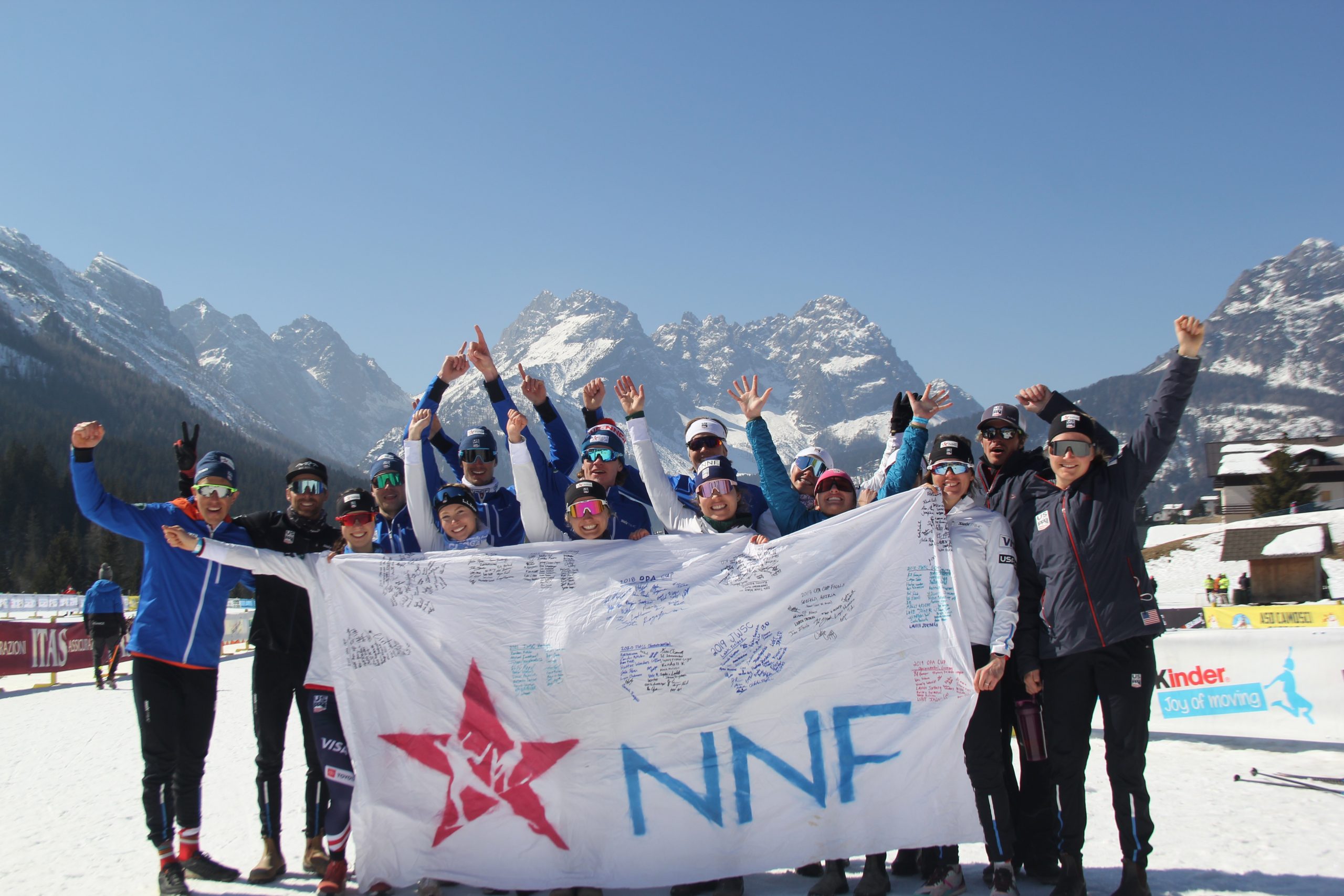
The American OPA Cup Finals team celebrates fast races and bluebird days in Sappada, Italy. (Photo: Bryan Fish/NNF)
Identifying it on its list of “Pillar Projects”, the National Nordic Foundation (NNF) helps subsidize the cost of the trip for the qualified athletes. The trip can accommodate up to 16 skiers, who are generally kept to an approximately even male to female ratio through the qualification criteria. This year, due to conflicting schedules and a number of declines, thirteen athletes attended, with nine women and four men.
In alphabetical order, the senior men included: Braden Becker (CGRP), Logan Diekmann (BSF Pro), Finn O’Connell (BSF Pro), Karl Schultz (SVSEF). Senior women included: Mariah Bredal (BSF Pro), Margie Freed (CGRP), Alex Lawson (CGRP), Hannah Rudd (BSF Pro), Becca Rorabaugh (APU), Lina Sutro (SMS T2), and Alayna Sonnesyn (SMS T2).
Finn O’Connell (2nd from L) alongside Braden Becker (L), Karl Shulz (2nd from R), and Logan Diekmann (R) at OPA Cup Finals
in March 2022. O’Connell was recently named to the US Ski Team for the 2022-23 season. (Photo: Alayna Sonnesyn)
SMS T2 teammates Alayna Sonnesyn and Lina Sutro show their love for Sappada during the Opa Cup Finals trip. (Photo courtesy of Alayna Sonnesyn)
This year, two U20 athletes headed from World Juniors in Lygna, NOR to Italy along with D-Team coaches Anderson and Bryan Fish: Kate Oldham (Aspen Valley Ski Club) and Annie McColgan (UVM).
“It’s pretty cool that we have more racers that are racing professionally or post collegiately than, I think, ever in the US, and they have more clubs and places to choose from,” said Anderson. “There were several athletes that, especially because racing was shut down on the East Coast last year and I happened to be in Alaska and wasn’t wasn’t traveling very much before I took this job, it was kind of the first time I’ve gotten to work with them, or the first time I’ve gotten to work with them in three or four years. So it was really cool to get to know Alayna Sonnesyn a little better and Lina Sutro a little better, and Margie Freed and Alex Lawson, who I’ve seen race many times, but it was the first time I’ve gotten to really work with them and get to know them. The same with Braden Becker and Karl Schultz… So it was a pleasure on the trip to get to work with some new athletes that have come through different development systems and are excited about and ready to make that next step. And this racing circuit is a really good opportunity for that.”
Anderson took the lead with organizing the trip and supporting athletes, working alongside US Ski & Snowboard Cross Country Sport Development Manager and long-time OPA Finals trip lead coach Bryan Fish. The wax support staff included BSF Pro Team head coach Andy Newell, former APU athlete and current staff member Peter Kling, and Jackson Hole comp team coach Jon Filardo.
US Ski & Snowboard Cross Country D-Team head coach Greta Anderson supports athletes during the Sun Valley SuperTour races in January. (Photo: Tobias Albrigtsen / @untraceableg)
Anderson identified the OPA Finals trip as a key development opportunity for a number of reasons: though perhaps lower pressure than World Cup, it’s a professional race circuit with small but competitively dense fields, athletes race aggressively and tactically in a style younger athletes who have not yet raced at this level may not have experienced, and it offers the opportunity for an athlete to dial in some of the small but significant factors details that support success adapting to a new and different environment following long international travel.
“Bryan’s been doing [the OPA Cup Finals] trip for a long time,” Anderson said. “So Peter Kling, who was on a coaching staff, and Becca Rorabaugh, they were like, ‘I’m pretty sure that we were on Bryan’s first ever OPA Cup trip.’ And it used to be that we started at the bottom of the results sheet and started looking upward for names. And right now we’re starting at the top and we don’t have to look very far down.”
In two days of racing, the US had seven top-10 finishes, with another set of athletes finishing well-within the top-20. Highlighting the US team was SMS T2’s Sonnesyn, who took third in the 10 k classic on Saturday the 12th, and won the 10 k skate the following day.
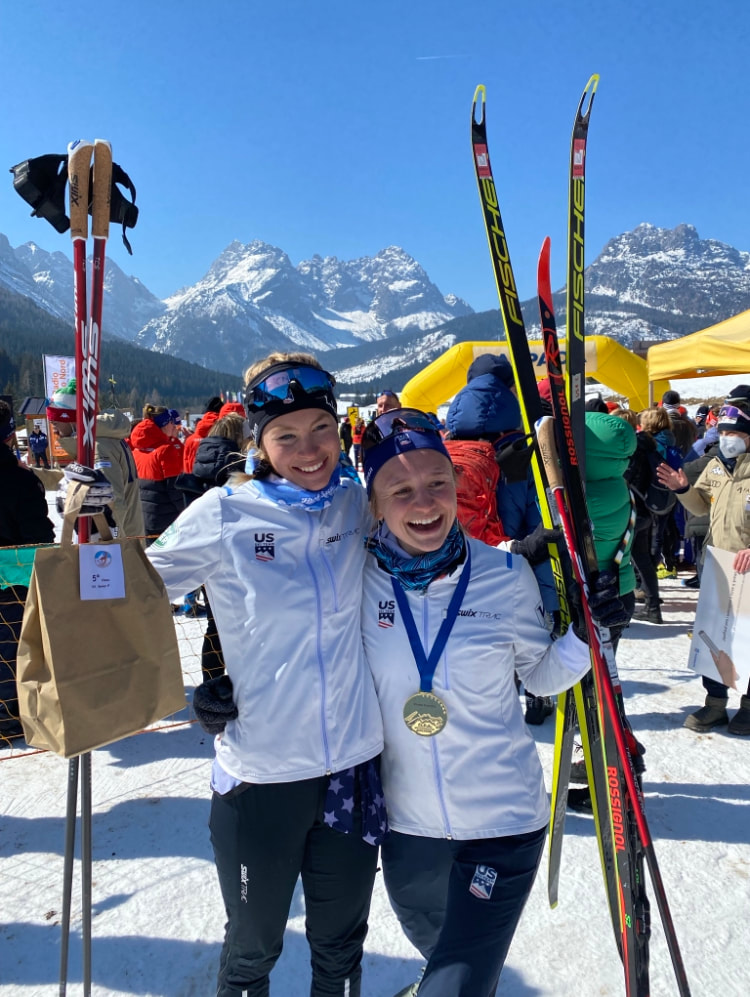
Alayna Sonnesyn (SMS T2) takes the win in the 10 k skate at Opa Cup Finals in Sappada, ITA, with Mariah Bredal (BSF Pro) finishing just behind in fifth. (Photo courtesy of Alayna Sonnesyn)
“It’s pretty special,” Anderson said of the performances in Sappada. “It’s awesome to get to see that. For Alayna to start a race and say like, ‘What’s my plan to try to win this?’ It’s not just, ‘Hey, we’re here to participate and learn,’ but ‘Hey, we’re here to participate and learn but also we’re going to try to win.’ And I think, with that comes — not only from staff but from racers — this level of professionalism. Okay, we’re going to select skis. We’re going to make sure we’re organized and in a good place. Where can we be? Where can we do feeds? How can we set you up to have the success you need to have?
“It just feels like a really good time to be an American ski racer.”
After winning two of the first five SuperTour races this season, and finishing on the podium in each of the others, Sonnesyn was offered starts at the Tour de Ski, where she hoped she could achieve strong enough international results to qualify for the Olympic Team. But these goals did not come to fruition; Sonnesyn struggled to find the same race sensations while on the World Cup and tap into the fitness she knew was still there, which was reflected in results below her expectations. She shared her disappointment openly on her blog and social media, providing a relatable and important example to her followers that the pro-skier journey is not immune to bumps in the road.
“My experience on the World Cup this year – it was quite demoralizing, to be honest,” said Sonnesyn in a call from the airport as she was on her way to SuperTour Finals in Whistler. “And then, after the Tour de Ski, I got COVID. And it just really put a damper on the whole winter for me. And I started questioning like, ‘Okay, am I fit? And I like, can I race? Well, like, what have I been training for? This is really bad timing with COVID, too.’ So I was just pretty down. But then I was able to have really great SuperTour races, back in January and February, and then to be able to race internationally again in Italy. It wasn’t a World Cup, but it was still very high level of racing. So to have it go so well kind of reaffirmed to me that I belong on the international stage. And I definitely needed that, a little bit, just to give myself more confidence moving forward and motivation as well. So I’m really excited about the races and how they went and what I did to prepare for them and kind of my mental attitude around them, too.”
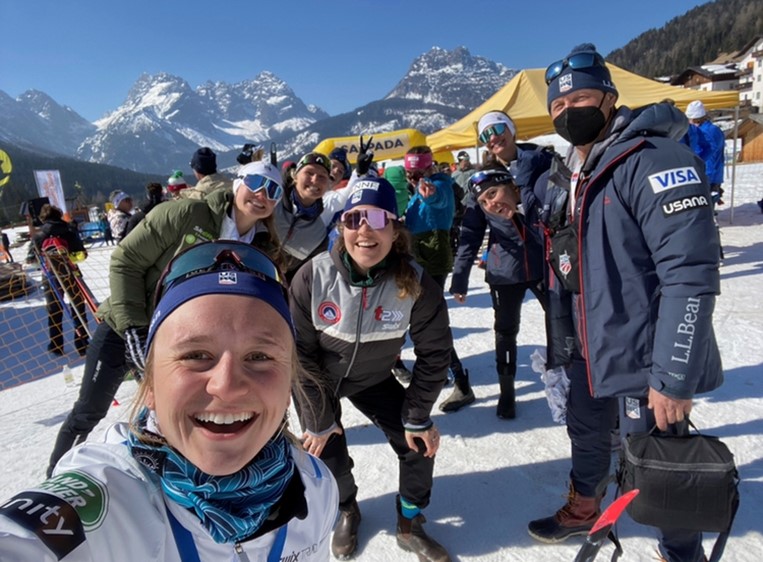
A selfie in Sappada: the American team prepares for race day at Opa Cup Finals. (Photo: Alayna Sonnesyn)
As she reflected on the trip and her experiences racing internationally over the last few seasons, Sonnesyn echoed Anderson’s sentiments about the progression of the American team at the event.
“Compared to my first OPA Cup trip, which was in 2018, I think there were maybe two or three top 10 performances. And they were exciting, but for the most part, it was kind of like, ‘We’re just here to get the experience. We’re not really sure what we’re doing.’ And I think that the way the US is developing right now, the way that new courses are being built in Cable or Duluth, or wherever it is – they are preparing us better for racing internationally. And I think that was shown in the results that we had in Sappada. And it was just so exciting during that 10 k skate on Sunday to cross the finish line in first, and then turn around and see a ton of my other US teammates come in right behind me. That’s not something that was happening four years ago. So I think we are really developing and that is a huge thanks to so many different people and so many reasons, but it’s exciting to see.”
Sonnesyn also spoke to the importance these international opportunities have provided her specifically, speaking from the perspective of what she dubbed a “bubble athlete” who has oscillated between World Cup and domestic racing over the last four seasons. She got her first World Cup starts in Quebec in March, 2019, and has been offered starts beginning in Period 2 each season since. Though this is a key stepping stone in the process toward consistent World Cup racing, she expressed that bubble athletes can have a challenging time planning seasons in advance and need to be prepared to adapt quickly to more frequent overseas travel.
“I think that every single experience that an athlete has going and racing internationally, and traveling, and competing at that higher level, it all adds up to be super beneficial and a great learning experience. For example, I have gotten really great at overcoming jet lag, which the first couple of international trips I went on, I had no idea how to handle. I tried my best to do what I could, but it’s hard. And also to know what little things you want from home, like after being in Europe for four or five weeks, what do you really want from the US?
“And then also, how do you work in a new environment? A lot of times, if you’re going over to the World Cup, sometimes you’re provided a wax tech or sometimes not, or you have to bring your own, but you have to be willing to work with whoever you get.”
Sonnesyn explained that on the Sappada trip, she had worked with each of the techs before, but on her first trip in 2018, it was her first experience working with those wax staff members. Given the importance of ski choice and wax, working together effectively is imperative to an athlete’s success, but it requires dialogue and practice.
“Being ready to communicate effectively with the staff, what do you need? How do you want your skis prepared? What do you need from a hotel? All those things seem like such small little details, but they really add up with the more experiences you have.”
Alayna Sonnesyn races in Oberstdorf, Germany during the 2021/22 Tour de Ski. (Photo: NordicFocus)
She also spoke to the differences in the style of racing between the US and her international experiences, and how a trip like Sappada better athletes for what they might encounter should they be offered a World Cup start down the line.
“When it comes to racing: the courses in Europe are very challenging and very technical. Downhills, uphills, flats – whatever it is, there’s a lot of it, and you have to be ready to go for it. And then the competitors are fierce. They know how to be aggressive in a race, and you have to know how to hold your own. So it just helps to have that experience to understand how you approach the race. How aggressive are you going to be? How are you going to pace the race? How are you going to handle others around you?”
With the highest levels of competition for our sport happening across the pond, it is easy to understand why opportunities like the OPA Cup trip provide an essential bridge for developing athletes. But it is not simply the facilitation of this trip that has led to marked improvement for the American team.
“I think we’re open to change right now,” Anderson said as she reflected on her key takeaways from the experience in Italy and her first season coaching the D-Team. “I think the US, in a year with COVID, and lots of challenges logistically and politically in the world, we handle those changes better than almost any other country does. And I think that’s really shown here.”
Alex Lawson skates to 7th in the 10 k skate during OPA Cup Finals in Sappada, ITA. (Photo: Bryan Fish / NNF)
While the OPA Cup crew was putting together a very solid day in the 10/15 k skate, the team of Rosie Brennan, Zak Ketterson, Scott Patterson, and Jessie Diggins had taken the win in the thrilling 4 x 5 k mixed relay in Falun. As the team in Sappada mingled near the finish to support the final racers as they skied through, Anderson said that a Swiss national team coach walked over and showed them the World Cup result on the phone.
Layered on top of the broader success at the OPA Cup Finals, Anderson expressed that this opened her athletes’ eyes to what might be possible for them in the years to come also. In particular, the Falun results of Zak Ketterson, a newcomer to the World Cup who ended his debut season with a 15th place finish in the 15 k skate and a mixed relay win.
“[The guys racing at OPA Cup] are like, ‘Oh, man, I beat Zak sometimes’, or ‘I’m right with him’, ‘I trained with him in college.’ The level of confidence that brings… ‘Maybe maybe I can do that too.’”
Moreover, Anderson expressed that this relay gold medal speaks to the equity of skiing in the US. “That we have good female athletes, and we have good male athletes, and we have a good balance of the two, and teams that are mutually supportive of each other,” she said. “Not every country has that.”
Boiling down the experience and her feelings as the season wraps up, Anderson concluded, “I have nothing but good things to say about our athletes right now. I’m really impressed with them. They handle the change better than anyone, and I think as a staff and from an organizational perspective, we’re trying to keep up, remove barriers, make sure they’re supported. And we’re open to trying new things, and it seems that we’re excelling in places where we’re willing to experiment and get our feet wet.”
Kate Oldham (AVSC) races the 10k classic during Opa Cup Finals in Sappada, ITA. (Photo: Bryan Fish / NNF)
Providing additional insights from the perspective of an OPA Cup Finals first-timer, FasterSkier also heard from U20 athlete Kate Oldham, who trains with the Aspen Valley Ski & Snowboard Club (AVSC) and competes for Middlebury College. Oldham took 11th place in both the 10 k classic and skate in the junior women’s category.
“Sappada was incredible,” Oldham wrote. “In congruence with the pre-camp in Toblach, the OPA Cup trip was unforgettable… My favorite ski to-date was on a long ski over the pass from Cortina to Toblach, stopping midway for trail side pastries and cappuccinos! Being with a group of older athletes was a valuable change from the World Junior trip because each team member brought new energy and experience to the group. Between that and the gelato shop next door to our hotel, the trip couldn’t have gotten much better!
Enjoying a cappuchino and pastry fueling stop while skiing from Cortina to Toblach. (Photo: Kate Oldham)
BSF Pro Teammates Hannah Rudd (left) and Mariah Bredal (right) sip cappuchinos while skiing from Cortina to Toblach during the Opa Finals pre-camp. (Photo: Kate Oldham)
“One of the things I think are most valuable about training and racing camps is the exposure to coaches and athletes outside one’s home team. For years I have been seeking out opportunities to attend regional and national camps that would bring new perspectives, training groups, and social dynamics to push me and help me adapt my own training method while making friends from schools and clubs all over the country. This winter I was lucky enough to have both my club coach and a group of skilled and passionate wax technicians/trip leaders selected from all around the US to lead the trips to Junior World Championships and OPA Cup finals. I know that over the six years I’ve been skiing competitively I have developed the competence to independently navigate high-level skiing events, but having techs to guide me through the process at the international level was extremely helpful, particularly when one of them I had worked closely with for those six years of training and racing.
“With new coaches come new perspectives. Another set of eyes, a different experience, or a new phrase can be all it takes for the pieces of new advice to click into place. Or maybe a coach has a different perspective on the bigger picture of skiing that resonates with you unlike the philosophy you previously knew… which of the infinitely wide range of mindsets in ski racing works best for you? Which one reminds you why you love ski racing? Which one helps you stay motivated through the hardest parts of the season when the last thing you want to do is get out the door for training? Which one eases the heartbreak of coming so close to a goal but falling short despite your hardest effort? Without a doubt, cross country skiing is a delicate balance of internal and external factors, but having great teammates and coaches like the ones I got to know and work with in Europe this winter is certainly a key ingredient to the recipe for success in the lifelong pursuit of excellence on the race course and off.”
There’s a war going on in Ukraine, and we touch on its impacts on the World Cup. But ski racing is also continuing, so we’re forging on, with respect for and acknowledgment of the tragedy that’s unfolding in Europe. For a few hours at least, on Thursday, the classic Drammen city sprint provided one heck of a distraction, and Devon and Nat are back to break down some performances for the ages by Norway’s Maiken Caspersen Falla, the French men and China’s Wang Qiang.
This World Cup coverage is made possible through the generous support of Marty and Kathy Hall and the A Hall Mark of Excellence Award. To learn more about A Hall Mark of Excellence Award or to learn how you can support FasterSkier’s coverage please contact info@fasterskier.com.
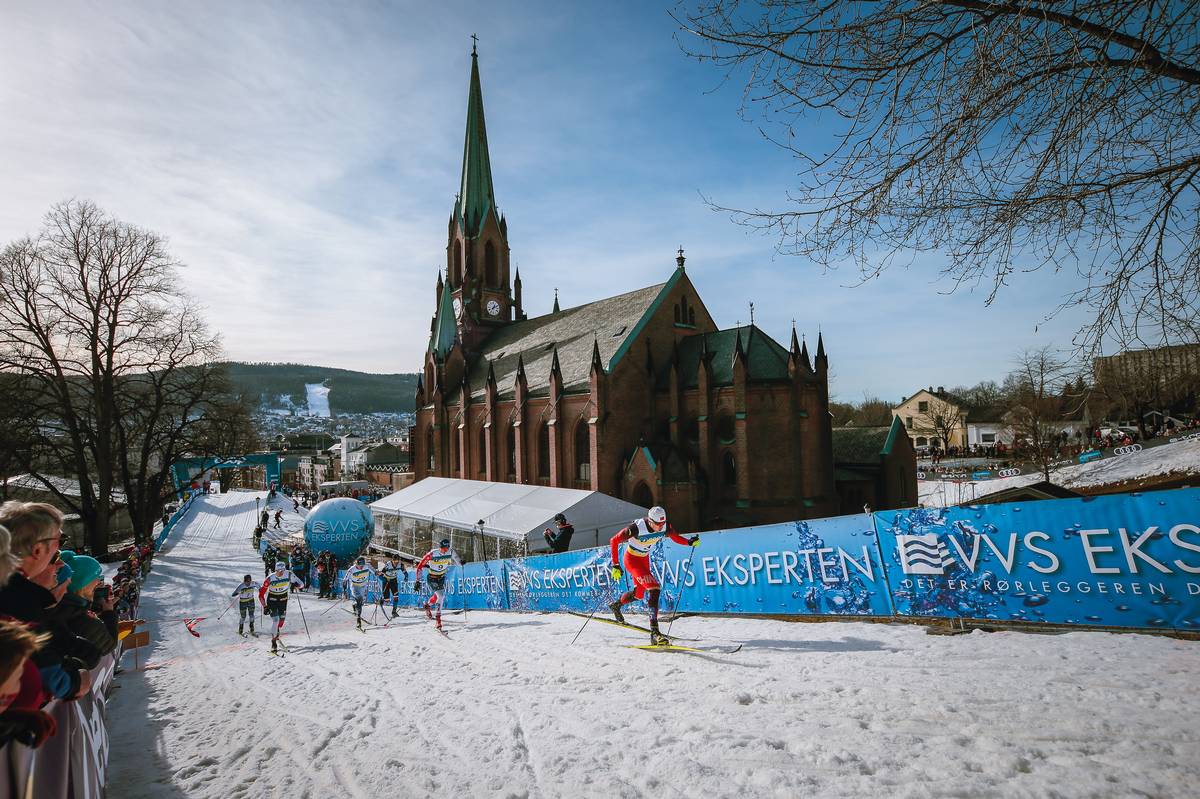
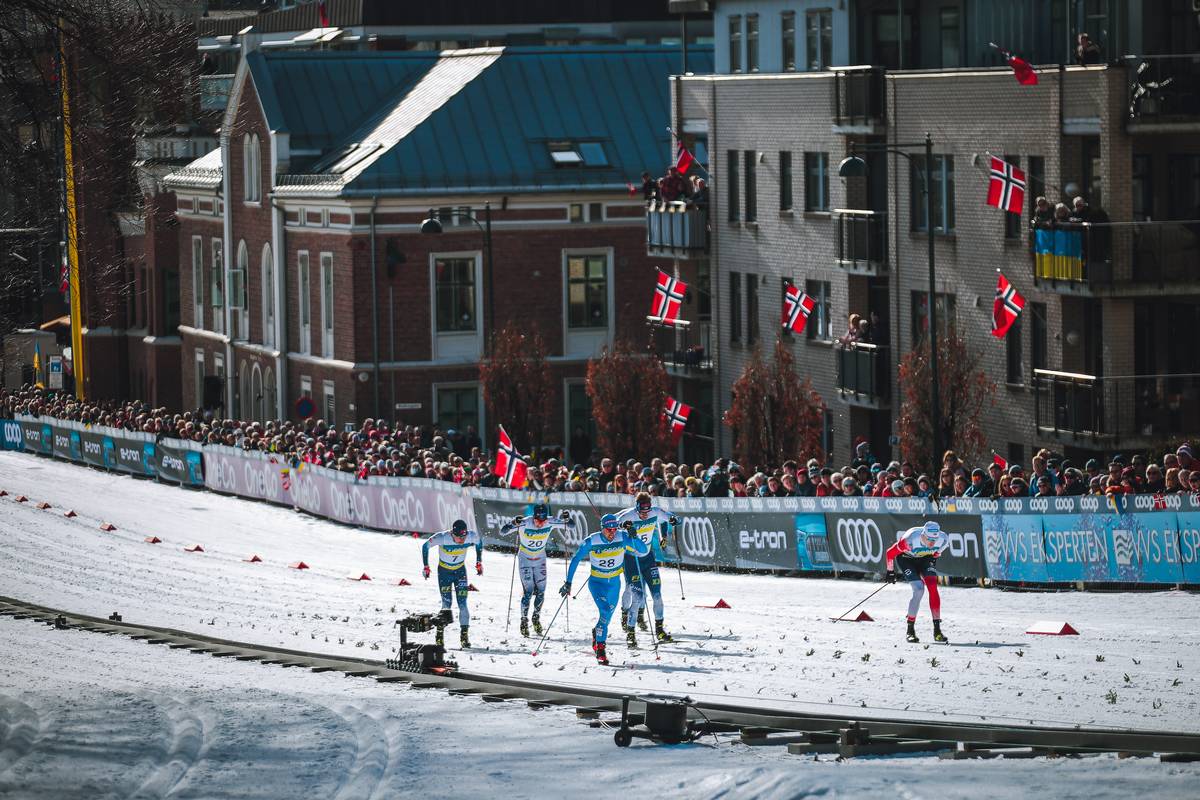
Cross country skiing’s most ancient, classic, weekend of racing in Norway (the Holmenkollen ski festival) began with a sprint through the center of Drammen, about 45-kilometers (30 mi) south of Oslo, and despite its best efforts, got caught up in these confounding and confusing times.
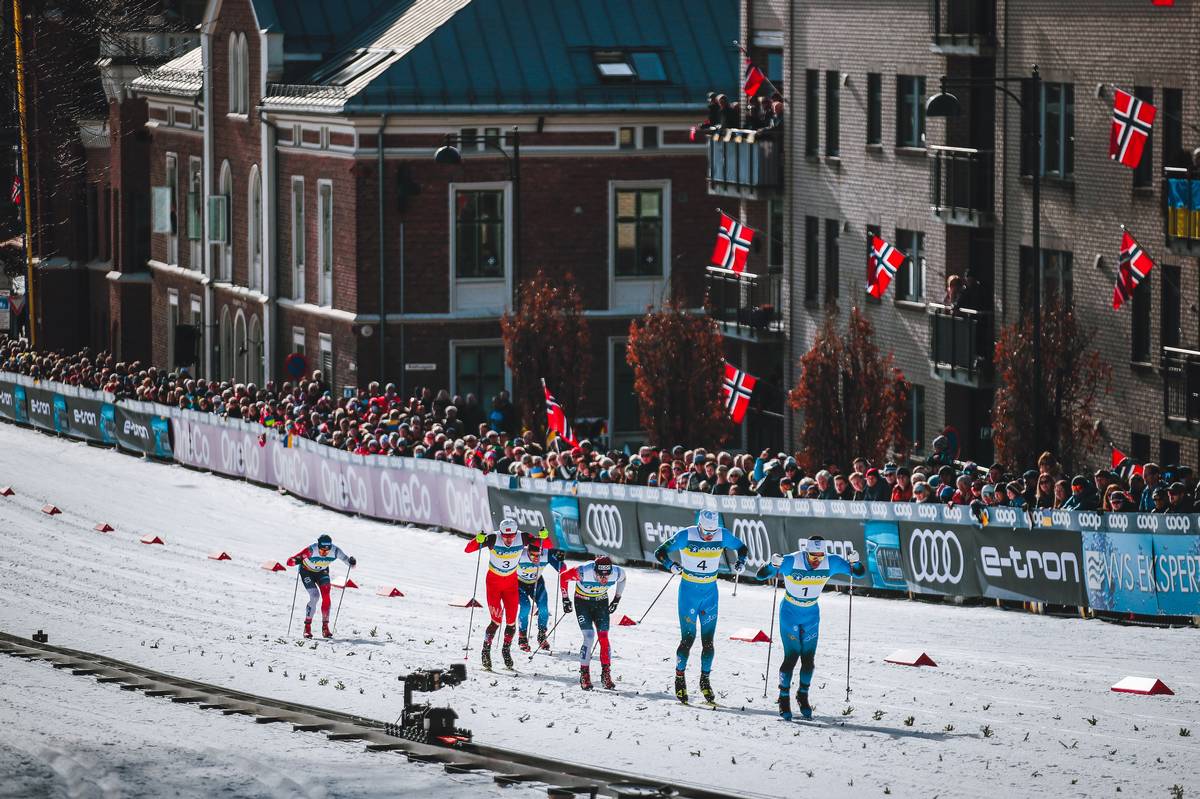
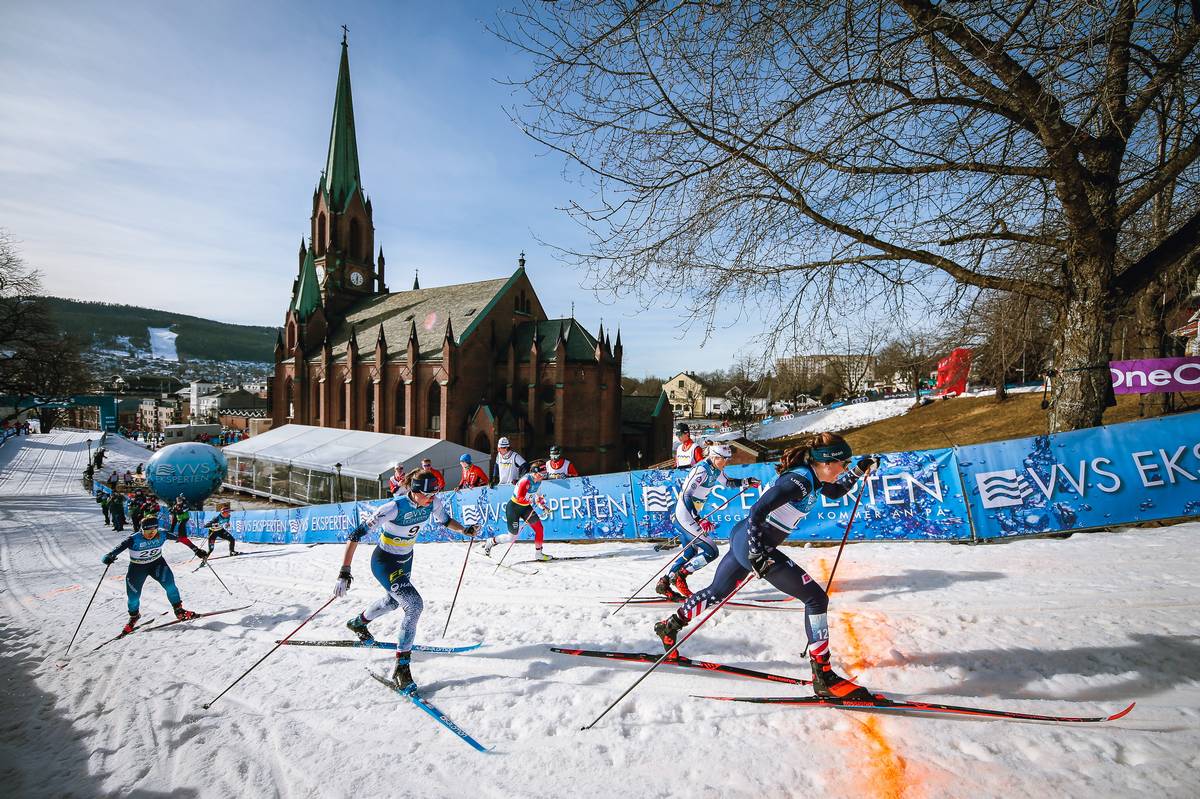
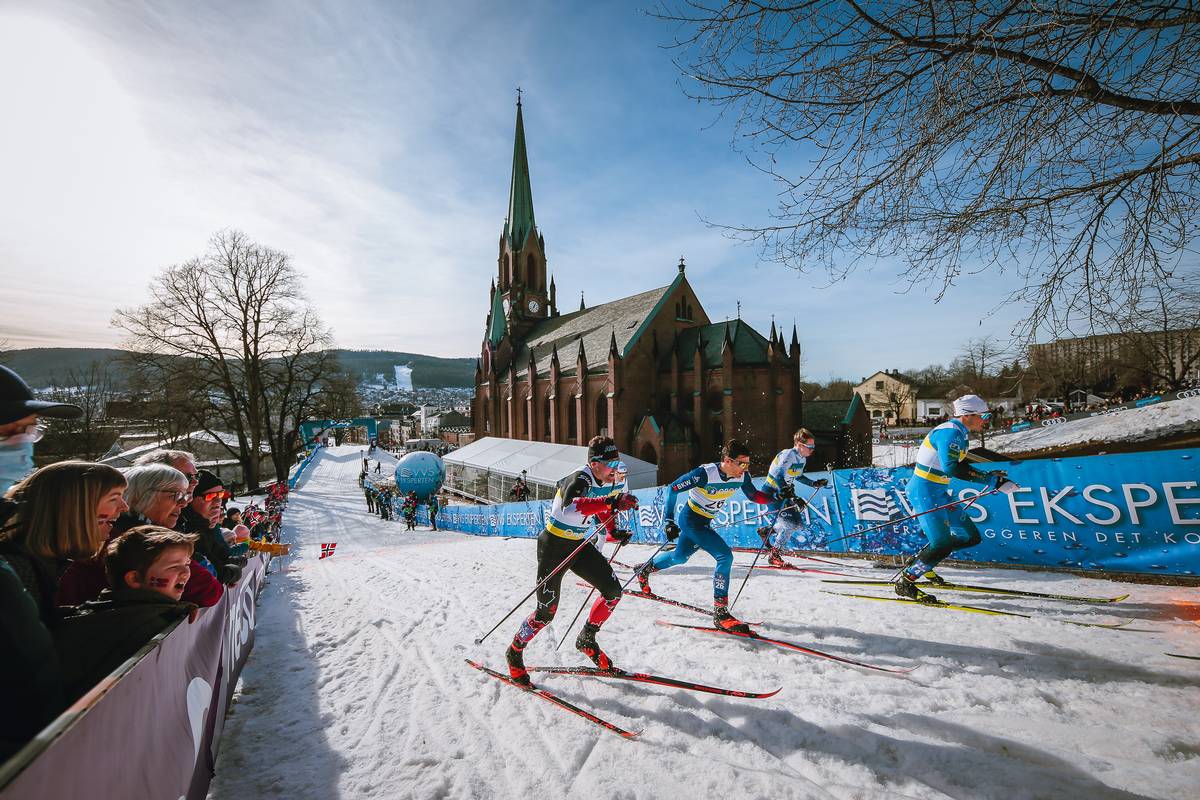
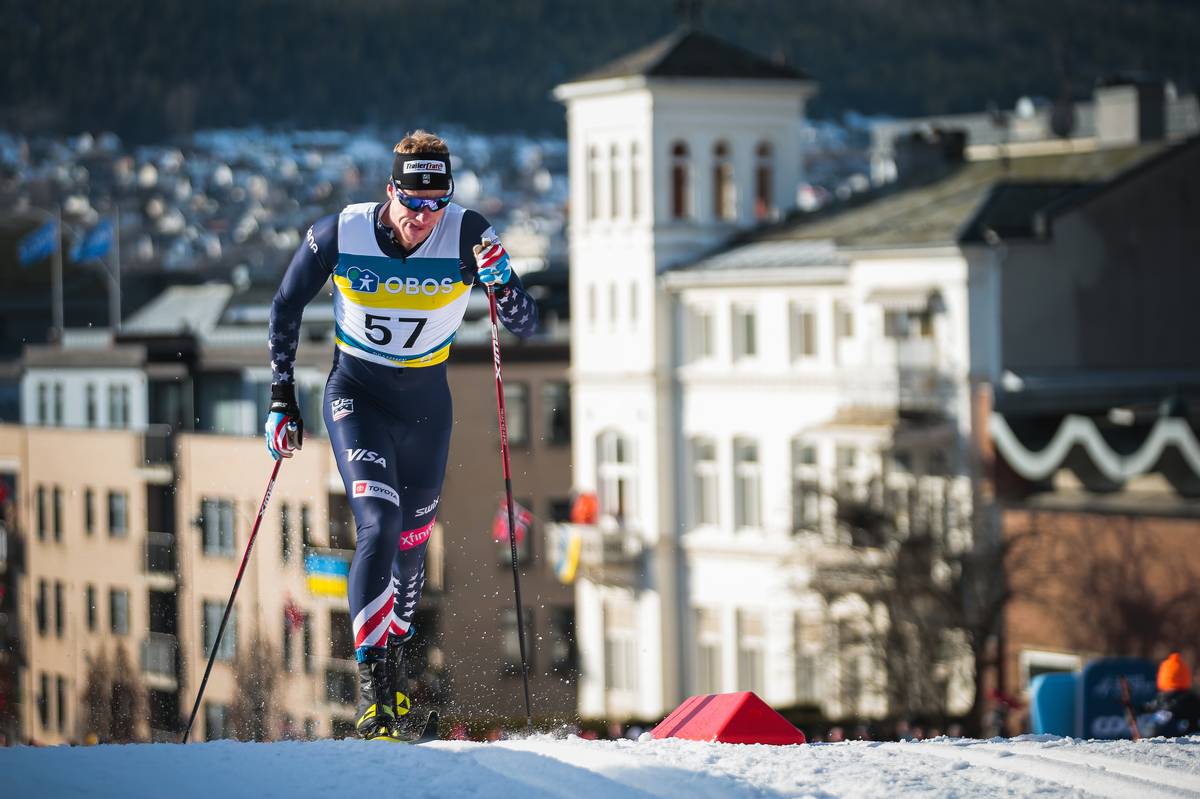
If you didn’t focus in completely, the scenes in Drammen looked pleasantly familiar in a way that could keep you in the timeless state of mind associated with Holmenkollen. It was reassuringly nice to see sprint racing return, after two years, to the type of venue that led to its exciting, spectator-friendly, rise in the first place. A genuine town-center sprint, trucked in artificial snow and all, with a genuine (and very enthusiastic) crowd.
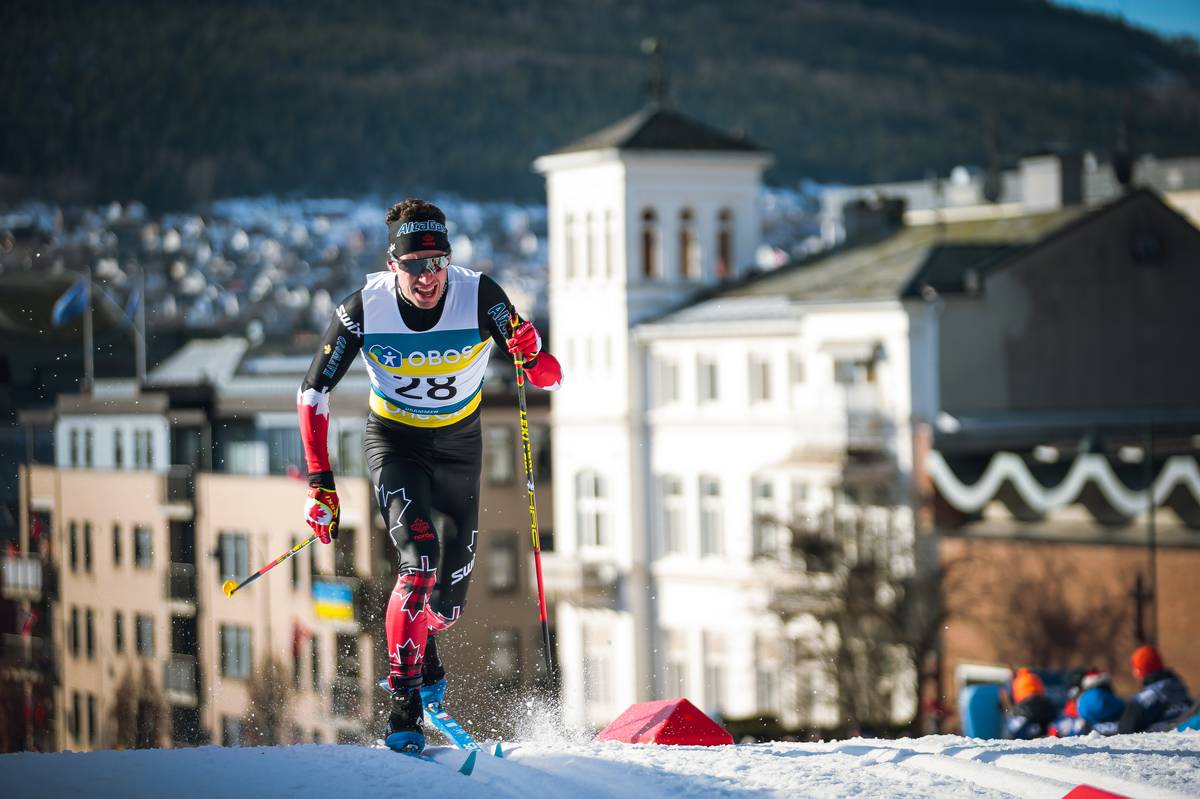
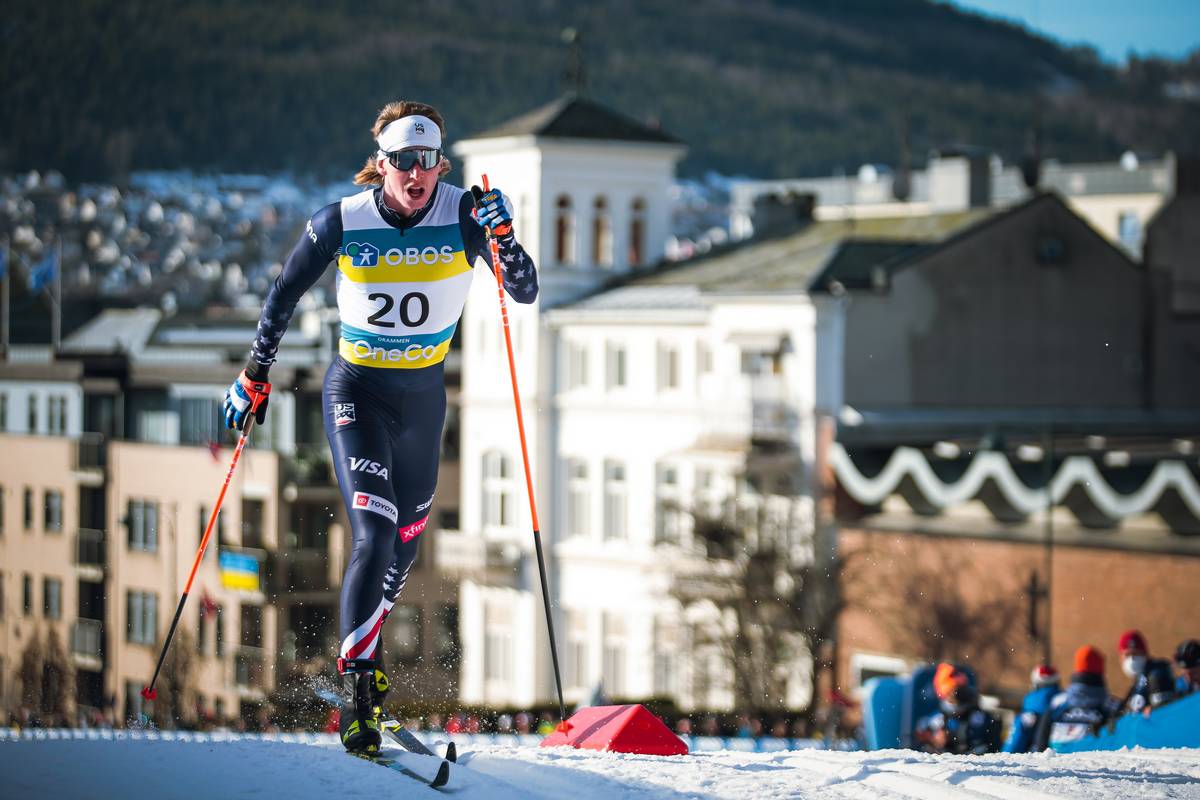
Graham Ritchie (CAN) races in the second heat of the classic sprint quarterfinals in Drammen, NOR. (Photo: NordicFocus)
Bring some focus into the racing though, particularly who was in the men’s field day, and you couldn’t help but see the upheaving forces of the moment doing their upheaving. COVID still had a heavy-hand in the field today, with the entire Norwegian men’s sprint team (who had raced in Lahti last weekend), including Johannes Høsflot Klæbo, having recently tested positive. Then, there was the FIS imposed ban on Russian and Belarusian athletes, which also went into effect this week in response to their government’s invasion of Ukraine. In all, 7 of the top 10 in the FIS Sprint Points Classification were absent from the field in Drammen. There was a spectral quality, something eerie, to just how much world events have managed to find and catch the quiet corner of nordic skiing in the past couple of weeks.
For their part, the FIS decked out Drammen in blue and yellow in a sign of solidarity with Ukraine. From bibs, to fencing boards, to the souvenir flags held in the crowd. Idealists will note the poignant gesture, especially in a country where, in a friendlier geopolitical sense, blue and yellow are the colors of neighbor and rival, Sweden. Regardless, it was a stunning way for the FIS to symbolize the implied meaning surrounding the policies they implemented surrounding Russia this week. Cynics, on the other hand, could also read it as the FIS trying to stave off some of the pointed criticism that’s been directed at larger international sport’s governing bodies like UEFA, FIFA, and the IOC surrounding their handling of Russia.
Logan Hanneman skis to 50th during the classic sprint qualifier in Drammen, NOR. (Photo: NordicFocus)
No matter the forces affecting skiing, the fact remained that there was skiing to be had. And without Norway’s top squad and Russia, it brought out the interesting prospect of watching racers who have navigated tactically around them to podium finishes all season – Richard Jouve (FRA), Lucas Chanavat (FRA), Federico Pellegrino (ITA), and Joni Mæki (FIN) among them – now represent the top of the field themselves.
In the qualifier, it was Jouve who took first place by an impressive margin, finishing in a time of 2:26.35, -2.07 sec over second place Ondrej Cerny (CZE). Following up on an impressive Olympic sprint in his home country, Chinese skier Wang Qiang took 3rd place (+2.66). Among North American athletes, the Canadian men had an impressive showing, sending three to the heats with Graham Ritchie qualifying 13th (+5.91), Antoine Cyr in 19th (+6.42), and Pierre Grall-Johnson 23rd (+6.85).
Antoine Cyr (CAN) races to 19th in qualification in Drammen. (Photo: NordicFocus)Sun Valley’s Peter Holmes races the classic sprint qualifier in Drammen, NOR. (Photo: NordicFocus)
The American men were just outside the top-30 mark necessary to race the quarterfinals, with Kevin Bolger just +0.7 off the last spot in 35th (+8.90), Logan Diekmann 39th (+9.40), Logan Hanneman in 50th (+11.19), Peter Holmes in 53rd (+12.05), and Zak Ketterson in 54th (+12.26).
The heats then, were filled with a motley mix of familiar sprint stars and younger talent from the home country Norway.
The course they raced was a classic town center sprint – a long gradual stretch going out from the start that narrowed as they hit two technique-zoned uphills leading into a hairpin. From there, it was a gradual downhill into another tight hairpin that opened up to a 4-track wide sprint finishing straight that allowed the best sprinters to open up and hit top speed.
Despite his absence, Klæbo’s tactical maneuvering and push-and-pull with pace was still felt throughout the race. Richard Jouve raced out of the first quarterfinal, and the typically aggressive Frenchmen held steady at the front of the pack, before shooting around the first hairpin turn that returned to the stadium. From there, he held control of the race to advance comfortably to the semi-finals and win the heat (2:32.98). He was followed by Sivert Wiig (NOR) in 2nd (+0.61), who would escape a tangle earlier in the race that saw Canadian Pierre Grall-Johnson fall and break a pole.
Canada’s Pierre Grall-Johnson (CAN) races the quarterfinal of Drammen’s classic sprint. (Photo: NordicFocus)
The exception to the relative care in pacing that many of the racers showed in the quarterfinals came in the third heat, where Wang Qiang from China shot out of the gate and went full bore throughout the race. By the time they hit the first technique zone, he had a comfortable gap on his competitors, who wouldn’t come back to him. In the process of taking the field out fast, Qiang had also made it by far the fastest quarterfinal at a winning time of 2:30.94. Second place Lauri Vuorinen (FIN) (+0.72), third place Pål Trøan Aune (NOR) (+0.99), and fourth place Harlad Østberg Amundsen (NOR) (+1.08) all advanced to the semi-final with two lucky losers coming out of the heat.
Wang Qiang (CHN) is off the front during the men’s quarterfinals in Drammen. (Photo: NordicFocus)
The 4th heat saw Joni Mæki (FIN) and Federico Pellegrino (ITA) follow early moves from Renaud Jay (FRA) and Ludek Seller (CZE) before reminding observers of their well-earned reputations as two of the best top-end speed racers in a finishing straight. Mæki advanced in first place (2:34.44), with Pellegrino in second (+0.62).
The semi-finals brought a similar field to the one that had advanced to the quarterfinals, with the familiar names of Richard Jouve and Lucas Chanavat joined by the young Norwegian pairing of Wiig and Amundsen, Swiss skier Jovian Hediger, and Wang Qiang.
Qiang again attacked from the start, with a lesser, but still commanding, gap established by the time he hit the first corner to head back towards the stadium. Jouve was the only skier that covered the gap off of that corner, and was able to pull along his countryman and Wiig with him before they all came together for the final sprint. There, the Frenchmen both showed their sprinting prowess, with Jouve winning the heat in 2:31.94 and Chanavat in 2nd (+0.74). Qiang’s early attack again proved to shape the field beyond his own racing, again making sure that both lucky losers, he and Wiig, came from the first semi-final.
Qiang’s attempts to force a semi-final with two lucky losers was aided by the way that the second semi-final raced, starting out at a steady pace before halting to a crawl around the first corner. George Ersson (SWE) got caught in front before Federico Pellegrino took charge on the downhill going into the stadium. By the time he rounded the corner into the finishing straight, he was in control of an otherwise tight pack. Pellegrino crossed the line in first (2:42.16) to advance to the finals, along with Norway’s Aune, who finished second (+0.16).
Federico Pellegrino (ITA) and Pål Trøan Aune (NOR) lead in the final stretch during the men’s semifinal in Drammen, NOR. (Photo: NordicFocus)
That set up a final with French pairing of Richard Jouve and Lucas Chanavat, the Norwegian pairing of Sivert Wiig and Pål Trøan Aune, Italian Federico Pellegrino, and Chinese Wang Qianq.
Qiang was subdued in the final compared to his previous heats, but then again, Richard Jouve had also stepped up the pace earlier in the final. The result was a tight pack with Jouve and Qiang at the front, with a quick but controlled pace through the early two climbs on course. Jouve took the pack into the first corner, and it was there, again emulating the absent Klæbo, where he chose to shoot around, concealing his burst of speed from the back part of the pack so that by the time they knew they needed to respond Jouve was already well on his way down the long descent.
Men’s final led out by the French pairing of Richard Jouve and Lucas Chanavat in Drammen on Thursday. (Photo: NordicFocus)
Their positioning in second and third, respectively, allowed Wang Qiang and Lucas Chanavat to try and match Jouve’s move, but as the pack hit the final stretch it became clear that Jouve hadn’t just made a move, he had made a move and followed it up with a burst of speed that left him peerless on the day.
Jouve crossed the line comfortably in first (2:32.84), with a lightly-packed sprint for the podium behind him.
Richard Jouve takes the win in Drammen. (Photo: NordicFocus)Wang Qiang became the first Chinese athlete to podium in a World Cup, finishing 2nd in the classic sprint in Drammen. (Photo: NordicFocus)
Leading that, after having shown tenacity and panache all day, was the Chinese skier Qiang Wang, who crossed the line in second (+1.59), with poles raised and a shout that stood at the end of a half-decade journey for his country. China, weeks off of having hosted the Olympic games, has earned a World Cup podium in nordic skiing, with Wang showing real promise for what may come from that country’s program.
Lucas Chanavat crossed the line in third (+2.32) to round out the top 3, while Sivert Wiig finished in fourth (+3.14), Federico Pellegrino in fifth (+5.34) and Pål Trøan Aune in sixth (+11.25).
Richard Jouve (FRA) takes the win in Drammen, NOR, with a first podium for China’s Wang Qiang, who took second ahead of Lucas Chanavat (FRA) in third. (Photo: NordicFocus)
It was an appropriate podium for a particular moment in skiing where the world’s motion on all scales has upended the familiar rituals that come with the final stretch of the World Cup that Holmenkollen traditionally marks the beginning of. The world’s best skier out in quarantine, his closest competitors removed from the competition, and the schedule for the last month of the season in flux as we enter it.
At once, we saw something familiar – Richard Jouve with a commanding performance alongside his countrymen – and something wholly new – a Chinese skier not only at a European World Cup race, but at the front. A strange, but moving race, for a strange and moving time.
Once the final results were determined, Antoine Cyr led the Canadians in 19th after finishing fourth in quarterfinal four. His Olympic team sprint partner, Graham Ritchie, was next for Canada in 21st, with Pierre Grall-Johnson 27th.
This World Cup coverage is made possible through the generous support of Marty and Kathy Hall and the A Hall Mark of Excellence Award. To learn more about A Hall Mark of Excellence Award or to learn how you can support FasterSkier’s coverage please contact info@fasterskier.com.
By Rachel Bachman Perkins and Ian Tovell
During a brief reprieve from racing, the top tier of international racing made its way from the high desert of Zhangjiakou, China to a venue tucked into snow-capped pines and nestled amongst the lakes of southern Finland. With more start spots per country than during the Games and some athletes choosing a weekend away from the World Cup, a number of new faces appeared on the start lists in Lahti for the 1.6-kiilometer freestyle sprint.
Logan Diekmann (BSF Pro) makes his first World Cup appearance in the 1.6 k freestyle sprint qualifier in Lahti, FIN. (Photo: NordicFocus)
For the U.S., these names included Logan Diekmann (BSF Pro Team) and Bill Harmeyer (SMS T2), both of whom earned their first World Cup starts this weekend via their performance on the SuperTour circuit this season. These athletes joined Kevin Bolger, Logan Hanneman, and Zak Ketterson; the Team Birkie athlete also earned his first World Cup starts earlier this year at the Tour de Ski.
Diekmann currently leads the SuperTour sprint standings with 119 points. He was second in the freestyle sprint during the U.S. Cross Country Championships in Soldier Hollow in January and skied to 5th in the sprint in both Duluth and Lake Placid.
Harmeyer was ranked third in the sprint standings with 83 points, behind Noel Keeffe who is currently racing at the 2022 U23 World Ski Championships in Lygna, NOR. Harmeyer has consistently posted top-five times in qualification during the SuperTour sprint races, and has raced into the final in three out of six SuperTour sprints. A fall in the quarterfinal during US Nationals left him in 24th after qualifying in fifth.
Bill Harmeyer (SMS T2) makes his first World Cup appearance in the 1.6 k freestyle sprint qualifier in Lahti, FIN. (Photo: NordicFocus)
Lucas Chanavat (FRA) was the top qualifier finishing the course in a time of 2:57.85. All five of the Americans finished outside the top-30 in qualification, but Canadian Graham Ritchie cracked into the heats for North America in 27th (+7.73).
The quarterfinal rounds played out mostly as expected, with Chanavat and Johannes Høsflot Klæbo (NOR) advancing from the first round after a close finish. Norway’s Håvard Solås Taugbøl and Olympic silver medalist Federico Pellegrino of Italy crossed the line first and second in heat two, spread by just 0.06 seconds. Winning the third heat, Andrew Young (GBR) crossed the line in 3:04.32, just ahead of Russia’s Gleb Retivykh (+.20).
The fourth quarterfinal heat saw a close finish, as Sindre Bjørnestad Skar (NOR) took the race to the line alongside Richard Jouve of France and Alexander Bolshunov of Russia were right at his heels. Skar won the closing sprint with Jouve +0.01 behind and Bolshunov in third (+0.07). Michal Novak (+.49) of the Czech Republic finished in fourth, with both Novak and Bolshunov narrowly missing out on lucky losers.
Fast racing in the fifth heat saw four competitors advance to the next round. Janik Riebli (SUI) won the heat in a time of 2:59.56, while China’s Qiang Wang finished second (+.10) to move onto the semis. A top prospect for the Chinese ski program, this is Wang’s first World Cup appearance since the pandemic began. Wang was fifth in qualification during the Olympic freestyle sprint in Zhangjiakou, where he took second in his heat to Norway’s Erik Valnes before being issued a disqualification for obstruction and being relegated last in the heat.
Qiang Wang (CHN) leads at the start of the fifth quarterfinal heat in Lahti. (Photo: NordicFocus)
Following the pace of the leaders, Maciej Starega (+.64) of Poland and Arnaud Chautemps (+1.61) of France crossed the line third and fourth to advance into the semis as lucky losers.
In the first semifinal, five skiers all remained close coming into the finish to vie for the two automatic spots. Pellegrino was able to hold the field off and win the semi with a time of 2:59.57, however, he was later disqualified, pushing him to sixth place. Klæbo crossed in second (+.07), guaranteeing his spot in the final, while Chanavant and Taugbøl were third (+.21) and fourth (+.37), respectively. Due to Pellegrino’s disqualification, Taugbøl was able to make it through to the final as a lucky loser.
In the second semi, Retivykh held off a push from Skar to win in 2:59.67, with the Norwegian 0.02 behind. Wang crossed third (+.34) with a time fast enough to earn the second lucky loser spot in the final.
Sindre Bjørnestad Skar leads his heat during the freestyle sprint in Lahti, FIN. (Photo: NordicFocus)
In the final, an early tangle between Wang and Retivykh as the two rounded a corner sent the Chinese athlete to the ground, losing contact with the pack.
The remaining five men stayed close as they powered through the course. Rounding the bend into the final 100 meters, four skiers remained in contention for the podium, but it was Klæbo who slingshot from the outside, putting his closing speed on display as he threw his boot to win a photo finish with Chanavat in 2:58.34, Skar and Taugbøl on their tails.
Johannes Høsflot Klæbo with a look before taking the win in the freestyle sprint in Lahti, FIN. (Photo: NordicFocus)
The Norwegian had advantage at the finish, with Chanavat just 0.04 seconds back in second place. Skar held off his teammate for the final podium spot in third (+.23), while Taugbøl took fourth (+0.58). Retivykh crossed a few meters back in fifth (+0.90), while Wang rebounded from his crash to finish 7.77 seconds behind in sixth.
A close race for second and third heads into the final 25 meters in Lahti. (Photo: NordicFocus)
“It was amazing,” Klæbo told FIS after the race. “It isn’t so many days since we competed in the Olympics, but still, it’s always fun to race.”
Klæbo commented on the excitement of racing in Lahti, which has hosted many championship events including the 2019 World Championships. He added that the racing on these tracks is often tight, which keeps it exciting for spectators – of which there were many today. When asked about racing in front of a crowd after nearly two years of empty stadiums, Klæbo smiled.
“It was amazing. I think what they have done, and finally seeing the end of the COVID situation – I think it’s amazing. It’s always great to compete against a big crowd, and it was amazing today as well.”
Johannes Høsflot Klæbo (NOR) takes the win in Lahti’s freestyle sprint ahead of Lucas Chanavat (FRA) and Sindre Bjørnestad Skar (NOR). (Photo: NordicFocus)Graham Ritchie races in the quarterfinal of the freestyle sprint in Lahti, FIN. (Photo: NordicFocus)
After finishing fifth in a tightly spread third quarterfinal heat, Graham Ritchie bumped up from his bib rank to finish 24th.
Kevin Bolger was the top American qualifier in Lahti in 33rd (+8.90), just 0.41 seconds off the mark needed for the top-30. On his tails was Diekmann in 34th (+9.14), with Hanneman close behind in 39th (+9.79). Ketterson was next for the U.S. in 49th (+12.13), with Harmeyer next in 50th (+12.28).
Kevin Bolger leads the American men in 33rd during the freestyle sprint qualifier in Lahti, FIN. (Photo: NordicFocus)Antoine Cyr (CAN) races the qualifier of Lahti’s freestyle sprint. (Photo: NordicFocus)
Outside the top-30 for Canada, Antoine Cyr was 40th in qualification (+9.99), with Olivier Léveillé next in 46th (+11.79), followed by Phillippe Boucher in 55th (+14.02) and Rémi Drolet in 58th (+15.87).
Racing continues tomorrow with a 15 k individual start classic.
After a brief break, the SuperTour picked up in Lake Placid this weekend, with a fluoro-free Period III kicking off with a 1.5-kilometer classic sprint. The frigid forecast called for overnight lows of -5 Fahrenheit, with a wind chill as low as -23F. Highs during the day were only predicted to climb into the low single digits. Qualifiers were scheduled for 10/10:45 am, with quarterfinals for the open men beginning at noon – hopefully, enough time for a few degrees of warmth to reach the trails.
The weekend competitions would be hosted on Mt. Van Hoevenberg’s new World Cup trails, which are paved for rollerski use in the summer, and played host to NENSA’s “Keys to the Castle” sprint event in September. For those familiar with the venue, the new courses are tucked into the north-facing hillside, just south of the 1980 Olympic stadium and biathlon range. The new serpentine loop intersects with the final Ks of the classic “Ladies 5” outer loop, but overall remains closer to the stadium to allow access to the recently improved snowmaking system.
Jessie Diggins (SMS T2/USST) pushes over the climb during the final round of the Keys to the Castle sprint. (Photo: Matt Whitcomb)
With a large reservoir and advanced technology, this new World Cup loop can be made winter competition ready within four days, though Van Hoevenberg’s nearly 50k of open trail might suggest that coverage is not currently an issue.
There was praise for the course from many athletes, including those that have seen both Lake Placid, and everywhere in the world beyond Lake Placid.
“It raced much more like a world cup course!” said Alayna Sonnesyn (SMS), in an email to FasterSkier. Katharine Ogden (SMS) too, said of the course, “it was WAY more fun than the old one…[which] was pretty flat.”
The course designers at Lake Placid seem to have carefully been taking notes on what makes sprint racing exciting over the course of its evolution as a discipline in the sport. An historic venue for American skiing, these developments may be a long-time coming for Mt. Van Hoevenberg, but it’s clear that they were executed with mastery so VanHo can continue to expand upon its legacy in the decades to come.
This course featured a long, final uphill climb to test a skier’s mettle, then a short, technical downhill into the finish to test their tactical brains. And in between; transitions, transitions, and more transitions.
Becca Rorabaugh (APU) said of this : “The final climb always turned into a drag race, and I liked the pitch because it favored a bit of a stride over an all-out run. Skiers still had to be alert through the downhill and finish, though; positions often changed in the stadium.”
The weekend, hosted by the Olympic Regional Development Authority (ORDA) in Lake Placid, also served as the second NENSA Eastern Cup weekend. Thus, senior athletes from American elite clubs lined up alongside regional junior racers, eastern collegiate racers, and Canadian athletes who traveled from Quebec, Ontario, and beyond. 382 athletes, 176 women and 206 men, on the start lists for the qualifier, and separate heats were run for the U18/U20 and U16 categories.
Without livestream, FasterSkier has relied on live timing and athlete interviews to shed light on how the sprint races unfolded.
Men’s 1.5-kilometer Classic Sprint
After returning from a stint in Europe where he raced the Tour de Ski, Team Birkie’s Zak Ketterson set the mark in the men’s qualifier, stopping the clock at 3:04.79. Sun Valley’s Peter Holmes skied the next fastest time in qualification (+0.72), while Étienne Hébert was just behind in third (+1.41). Hébert hails from Quebec and currently trains at the Centre National d’Entraînement Pierre-Harvey (CNEPH), based at Mont Ste Anne.
Each of these men moved smoothly through the rounds, with Ketterson getting edged out by Bill Harmeyer (SMS T2) in the first semi, and Homes and Hébert going 1-2 in the second. Racing in the second semi saw a tighter spread and faster times, bringing Julien Locke (Black Jack Ski Club) and Logan Diekmann (BSF Pro) who had finished a close third and fourth, respectively, along to the final as lucky losers.
The final featured a tight finish among the top four men, with Ketterson off the front to finish in 3:04.71, earning his second consecutive classic sprint victory. Ketterson had dominated the classic sprint in Cable, WI, and stood at the top of the SuperTour leaderboard, thereby earning start spots for the Tour de Ski. The timing of the Tour caused him to miss the subsequent classic sprint in Soldier Hollow, UT.
During the Tour, his first World Cup starts, Ketterson was less than a second shy of qualifying for the classic sprint heats in Oberstdorf, Germany, and had been roughly five second out of the Top-30 the day prior in a 15k skate. He was the only American on the men’s team to finish the Tour. After the Tour, Ketterson made a quick turnaround to attend the weekend of distance racing in Sun Valley, Idaho, where his results (15th in the 15k classic and 34th in the 10k free) were far below what might be expected from him.
Zak Ketterson races the freestyle sprint qualifier in Lenzerheide, SUI, the first event of the 2021/22 Tour de Ski. (Photo: NordicFocus)
In a post-race email to FasterSkier, Ketterson shared how he felt about the Tour and what the recovery process has been like for him.
“The Tour de Ski was a fantastic learning experience with lots of ups and downs. I am pretty happy with my performance on the Tour given it was my first time on the World Cup, but I definitely think I will be faster next time around now that I have had the experience. Post Tour I was incredibly empty, both physically and mentally. To have to change gears pretty much immediately after the last stage of the Tour and head straight to Sun Valley for some super competitive SuperTour races at high altitude was definitely a recipe for disaster on my body. I felt like I was just going through the motions and my body wanted nothing to do with those races.
“These last few weeks at home in Minneapolis provided me with some long-overdue recovery. My hunch after some really lackluster racing in Sun Valley was that there was no need to overthink anything and that the issue was probably just that I was tired. I took time at home to mentally and physically reset and started to feel a lot more like myself as the Placid races approached. Today, it all came together and I felt a lot more race-ready.”
Ketterson also commented on the improvements that have been made at the Mt Van Hoevenberg venue, explaining how it supports the growth and elevation of domestic skiing.
“I am blown away with the venue at Mt. Van Hoevenberg! The venue truly feels like it’s ready for World Cups, or even another Olympics. It’s really inspiring to see big investments into nordic skiing venues in the United States, and I can’t stress enough how big it is for us athletes. I can’t wait to come back to Lake Placid sometime later to really experience this place because I think it’s so awesome here.”
Behind Ketterson, just 0.26 seconds separated second through fourth in the men’s final. Holmes won the boot slide to snag second (+0.72), while Harmeyer took the final podium spot in third (+0.92). Hébert was just 0.06 seconds shy of the podium, ending the day in fourth (+0.98).
Harmeyer provided insights into his approach to the day, along with insights into the moves that contributed to the excitement at the finish line.
“I felt really good in the heats today,” he wrote via email. “The course was certainly difficult and tactical. Placement in the group was really important and that was especially apparent in the final. We had a group of four dudes going over the top of the final climb into the long descent before the finish. It was an absolute scramble trying to get into the tracks on that final downhill. At one point, I had my left ski in the right part of the track and Étienne had his right ski in the left side of the track. Not easy to squeeze two guys going 30+ mph into a single track but somehow, I came out ahead which was just enough to lunge at the finish for third.”
During Period I, Harmeyer took third in the classic sprint final in Cable, and was just off the podium in fourth the weekend prior after the freestyle sprint in Duluth, MN. After qualifying in fifth, a crash in the quarterfinal left him 24th in the freestyle sprint in Soldier Hollow during the U.S. Cross Country Championships. A few days later, he was 51st in the 15k classic. In the Soldier Hollow SuperTour classic sprint, Harmeyer qualified in fourth, and just missed the final to end his day in eighth.
Reflecting on the season as a whole, Harmeyer wrote, “I had a really good start to the season with some strong races in the Midwest. But overall, things have been frustrating. I’ve been struggling with some cold weather triggered exercise induced asthma that got really bad after the first supertours in the Midwest. I continued to struggle with it through a disappointing Senior nationals and decided to take a bit of time off to reset, recover and do some testing. I’m hopeful the worst is behind me and that I’ve got some good protocols lined up to prevent anything from happening in the future. My primary goal for the remainder of the season is to win the Stowe Derby, specifically the derby meister.”
Wrapping up with a comment on the venue, Harmeyer added, “The new courses at Lake Placid are sweet! The sprint course is incredibly tactical but also rewards tough, explosive skiing. I had an absolute blast out there in the heats. The distance courses are hard but I’m excited to be doing a mass start on those for this Sunday. Overall, Van Ho has done a great job with course management and their snowmaking to put together some killer courses.”
After a gap, Diekmann crossed the line in fifth (+5.81), while Locke rounded out the men’s final in sixth (+9.11).
The women’s field began right where it left off in SuperTour classic sprints, with the winner of the last race at Soldier Hollow, Katharine Ogden, (SMS) finishing the qualifier in first place (3:40.49). She was followed by Lauren Jortberg (BSF Pro Team) in second (+2.2), and Ava Thurston (Mansfield Nordic Club) in third (+6.1). The qualifier indicated, again, the overall strength of the field that has characterized this year’s SuperTour, with the heat qualifiers all within 30-seconds of each other (26.0 seconds to be exact).
That field remained tight in the quarterfinals as well. All five quarterfinals saw winning times within a mere five seconds of one other, with Katharine Ogden turning in the fastest time of the round at 3:42.77, and Alayna Sonnesyn winning her heat in 3:46.12.
Ogden commented to FasterSkier that she “didn’t really have any strategy in particular. I find that it is better for me to make strategy in the moment during sprint heats because you never know what’s going to happen out there… I just tried to conserve as much energy as possible in the quarter and semi.” It would pay off later on.
Meanwhile, also progressing to the semifinals was the APU one-two punch of Rosie Frankowski and Becca Rorabaugh out of quarterfinal 2. Despite being primarily known as a distance racer, Frankowski, came into today leading the SuperTour sprint classification and “set a blistering pace,” according to teammate Rorabaugh. With it, she pulled the duo into the semifinals together.
After all the quarterfinals were through, the semifinals were set with a who’s-who at the top of the SuperTour sprint standings, rounded out by Canadian Katie Weaver (Hollyburn XC Ski Club) and Minnesotan Margie Freed (Craftsbury).
The first semifinal featured a battle between two SMS T2 teammates, Katharine Ogden and Alayna Sonnesyn, and two APU teammates, Rosie Frankowski and Becca Rorabaugh. Frankowski again set the pace for the heat, with teammate Rorabaugh commenting that “[Rosie] is so strong on the uphills that she pulls the whole heat to a faster time.” Frankowski, however, couldn’t quite outlast Ogden and Sonnesyn, who used the downhill after the final climb to launch into the first two positions. Ogden won the heat in a time of 3:39.23, with Sonnesyn and Frankowski in second and third, respectively, by less than a second. Rorabaugh finished fourth, but along with Frankowski won the lucky loser spots into the finals – setting up another round of the SMS-APU duel.
In the other semifinal, a close battle throughout yielded a win for Lauren Jortberg (3:45.15) and a second place for Erika Flowers (+0.90). The result sent another teammate pairing into the finals, with both skiers coming from Bridger Ski Foundation (BSF).
At Lake Placid – a place that has over the past century proved to be able to gather the entire world around skiing – it was perhaps appropriate that the women’s final would bring together three teams from across the American continent. Two from Vermont (SMS), two from Montana, two from Alaska (APU), and away they went!
Katharine Ogden commented that the field didn’t waste any time: “It was pretty hard from the gun, as per usual.”
Rorabaugh, meanwhile, made a change in strategy, deciding to follow her teammate Frankowski more closely in the early part of the race. “I was trying to stay closer to the front of the pack since I had let a large gap form in the semifinal that I couldn’t make up,” she explained.
That adjustment was one that helped create a pack that was tight throughout the race, and that was a bit harder to find a position in.
Sonnesyn commented that this led to her having to adjust. “I had great energy but got tangled up a few times on the second hill, so I really had to ski from behind in the second half of the race,” she wrote. “Luckily, I had great skis and remained calm and was able to push through the final stretch.”
In that final stretch, on the final hill, a “drag race,” as Rorabaugh described it, ensued. It was instigated by Ogden, who saw the final climb as the place to make her move, and made it. She came over the top in first place.
“[I] got lucky,” she told FasterSkier. “Pat [O’Brien, SMS T2 head coach] had provided me with some really fast skis that allowed my move to stick going back down the hill.”
Perhaps it wasn’t all luck though. Ogden came across the finish line in first place (3:40.13) after winning the qualifier, her quarterfinal, and her semifinal. It was an all-around dominant performance for one of the U.S. brightest stars in the classic sprint.
Meanwhile, Becca Rorabaugh had powered through the transition into the final downhill and came up with the reward of second place (+3.40), She was followed by Alayna Sonnesyn, who remained cool, calm, and collected as she skied her way through the pack to third place (+4.29).
The final was rounded out by fourth place Rosie Frankowski (+4.74), fifth place Lauren Jortberg (+5.63) and sixth place Erika Flowers (+17.77).
The result was reached at the end of an exciting day that encapsulated the beauty of ski racing – with excitement and energy perfectly juxtaposed against the extreme absence of that energy in the air. Preparing for cold temperatures that are forecasted again for the 10k freestyle mass start tomorrow, the top finishers today all expressed that the temps are part of the appeal in the northeast this weekend.
From Rorabaugh, “I don’t mind cold temperatures – I grew up in Fairbanks, Alaska!”
From Sonnesyn, “I like to think the Midwesterner in me prepared well!”
And from Ogden, the perfect Vermont tip: “As Sverre [Caldwell] told us last night, tricky race conditions can work to your advantage if you prepare better than anyone else. Wise man :)”
From left, Becca Rorabaugh (APU), Caitlin Patterson (CGRP), and Sydney Palmer-Leger (Utah) on the podium, 2022 U.S. Nationals. (photo: John McColgan)
By Gavin Kentch and Rachel Bachman Perkins
The 2022 U.S. Cross Country Championships began in Soldier Hollow, outside of Salt Lake City, Utah, on Sunday with skate sprints. JC Schoonmaker, recently returned from Europe, took his first national championship with relative ease for the men, while Caitlin Patterson, who was the first American in all four races at 2018 U.S. Nationals, returned to her Olympic-year winning ways by taking the victory for the women. Will Koch and Rosie Frankowski won the qualifiers, the race that matters for potential domestic Olympic qualification.
Men’s Race: JC Schoonmaker Wins First National Title with Tactics and Speed
JC Schoonmaker was born in August 2000. Eighteen months later, American skier and ski journalist Cory Smith, writing on a nascent website called FasterSkier.com, observed that race tactics were important on the sprint course being used for the 2002 Winter Olympics in Salt Lake City, and that it was generally disadvantageous to be leading into the final downhill as athletes approached the sweeping lefthand turn into the finishing stretch. He discussed Kateřina Neumannová’s quarterfinal heat as an example of the potential dangers of leading throughout, if that name gives you a sense for how long ago we’re talking about.
Twenty years later, in the opening race of 2022 U.S. Cross Country Championships, the names had changed but not the physics, as time and again it became apparent that athletes’ positioning on the final downhill was the single most important aspect of the course. Multiple heats saw athletes come back from fifth or even sixth to move up through the field and advance, and the one male athlete who tried to lead his heat from the gun paid for it in the end.
Schoonmaker, the U.S. Ski Team athlete who skis domestically for University of Alaska Anchorage, understood these tactics to perfection, using the experience gained from racing into 14th in the current World Cup sprint standings (despite missing two sprints in the Tour de Ski) to position himself exactly where he wanted to be throughout the afternoon. The result was his first national title, on a sunny, high-pressure, perfect day at Soldier Hollow.
JC Schoonmaker heads out in the qualifier. (Photo: John McColgan)
We’re not going to survey every heat from Sunday’s races, on the first of four days of competition at Soldier Hollow, but it’s worth looking at the fastest qualifiers, and the day’s first quarterfinal, to set a tone for what followed.
In the qualifier, 19-year-old University of Colorado skier Will Koch may have turned some heads when he notched the day’s fastest time, 3:07.88. Schoonmaker had the day’s second-best mark, 0.47 seconds back, with Bridger Ski Foundation athlete Logan Diekmann third by over a second more.
In the day’s first quarterfinal, Koch picked up where he had left off in the qualifier, blasting off the line to set a hot pace right from the start. He was probably the only athlete all day to V2 the entire first hill leading out of the stadium. He led up the first hill, down the first downhill, up the second and main climb on the course, and into the start of the final sweeping downhill into the stadium and the finishing lanes (see course map and profile below).
Course map and elevation profile for 2022 U.S. Nationals sprint course. (photo: screenshot from race website)
But then, for the first time on the day but not the last, the athlete who led into this descent was swallowed up by the rest of the field by the time they reached the final lefthand curve. Koch was caught up, gamely contested the group sprint that ensued, but barely ran out of gas after pushing hard for the entire heat.
Koch would finish fifth in a five-man heat – despite skiing faster than he had in qualifying. For his troubles, he towed the entire heat to the day’s fastest times by far, and both lucky loser spots; fifth in this heat would have won any other quarterfinal, semifinal, or final on the day. By nearly 5 seconds.
While the top qualifier was knocked out in the first quarterfinal, the effort is not to be diminished. Indeed, Koch chose a tactic, committed to it fully, executed it well, and came within 0.05 seconds of claiming fourth in his quarterfinal to advance as a lucky loser. With that in mind, this heat set the tone for the day, as a field of observant professional athletes noticed that there was maybe not a lot to gain by leading out the heat, and a lot to lose.
As Smith wrote of these dynamics on this course 20 years ago, “The ideal situation is to spend the first three-quarters of the race in the back, avoiding mayhem and drafting. Then move up to second coming into the final turn, and use the turn to shoot out and around the leader to win the sprint. But obviously that is easier said than done when everyone else is trying to do the same thing.”
In lieu of a play-by-play of the next six quarterfinal and semifinal heats on Sunday, let’s just survey some winning times: 3:06.09 (QF1, Koch’s heat); 3:15.31 (QF2); 3:13.97 (QF3); 3:16.83 (QF4); 3:10.99 (QF5); 3:13.16 (SF1); 3:20.04 (SF2). There’s a theme there: While the heat 1 lucky losers may see Koch’s reward for pushing the pace, no one else in the men’s field chose his approach. Racing was slower-paced, but it was hard to fault the results, at least for the athletes who advanced.
(The discrepancy is perhaps even greater than that, as local observers noted that the course got progressively faster throughout the day, as it warmed up from below-zero F temperatures the night before. On quiet moments in the livestream, the difference between notably squeaky snow (for the qualifiers) and not-squeaky snow (for the heats) was apparent.)
The other, related issue was falls at the bottom of the long runout, as trailing athletes accordioned back up to the leaders, and four, five, or even six men all sought to move from a narrow tuck to a wide V2 at the same time on the same stretch of trail. Through what consistently looked like incidental contact rather than malicious contact punishable by a yellow card or other formal sanction, Ian Torchia, Bill Harmeyer, Christopher Kalev, and Brian Bushey all hit the deck in their quarterfinals. The same thing happened in the semis, too, with Karl Schulz falling in the first semifinal and John Schwinghamer in the second. Again, it certainly appeared that it was not intentional, just the results of athletes all commencing a V2 at the same time at high speed.
After one fast heat and six slower heats, six men lined up for the final: JC Schoonmaker (UAA/USST), Noel Keeffe (University of Utah/USST), Logan Diekmann (BSF), Johnny Hagenbuch (SVSEF/USST), Magnus Bøe (University of Colorado), and Andreas Kirkeng (University of Denver).
Their average age was slightly less than 22; they had probably not read Smith’s coverage of the 2002 Olympic sprint when it was first published. But they had all successfully raced two heats on this course already, and they seemed disinclined to change what had got them there.
All of which is to say that Schoonmaker’s winning time for the final, 3:21.05, was the slowest of any men’s heat that day. (Indeed, this time would have placed him fourth in the first junior boys semifinal.) Diekmann led the pack out of the stadium in the final, closely tailed by the rest of the field. The men skied fairly leisurely up the first uphill, down the first downhill, and up the second uphill.
Finally, coming into the final downhill, Bøe moved, and Schoonmaker followed. The field started racing in earnest at this point, but there was still not much separation between six athletes traveling at high speeds: Here’s the men’s field, nearly three minutes into the final, about to come up out of their tucks, navigate the final lefthand turn, and sprint into the finish:
JC Schoonmaker (far left) leads the final in the men’s skate sprint at 2022 U.S. Nationals. (photo: screenshot from livestream)
That’s Schoonmaker in the lead, Keeffe just off his right shoulder in second, Bøe (bib no. 30) in third, then Diekmann, Hagenbuch, and Kirkeng trailing slightly behind in fourth through sixth, respectively, from left to right. And, spoiler alert, these were not their final finishing positions; there was more movement yet to come.
While the camera work, free live broadcast, and Adam Verrier’s announcing were consistently superb, the limitations of the available camera angles meant that a portion of the final lefthand curve was obscured from view for a few seconds. (That curve can be seen in the video in the second half of this Instagram post from BSF.)
By the time the athletes came into view once more, Schoonmaker had positioned himself precisely where he wanted to be, on the inside of the curve, carrying a lead of multiple meters. His gap was small but consistent through the finish, which he approached with sufficient time and space to stand up and celebrate across the line.
JC Schoonmaker celebrates across the line as he wins the men’s skate sprint at 2022 U.S. Nationals. (Photo: John McColgan)
Schoonmaker’s winning time was 3:21.05. Behind him, Diekmann (+0.83) outlunged Keeffe (+.91) for second by less than a ski. Hagenbuch was another 0.20 seconds back in fourth (+1.11) , followed by the two collegiate skiers, Bøe and Kirkeng, in fifth (+2.14) and sixth (+3.47).
“I’m feeling really good after a nice relaxing Christmas at home [in Tahoe City, CA],” Schoonmaker wrote to FasterSkier after the race. “It was great to have a mental break from racing and we got absolutely dumped on with snow so that was really fun too.”
Schoonmaker also spoke to his feelings in the sprint, after a successful, but potentially draining stint in Europe, where he skied into the semifinals three times, finishing as high as 7th in Ruka, Finland.
“Today I felt pretty good and felt like I was getting better throughout the day after a little break from racing. It’s a weird course with the last downhill being so tactical but I was happy with my positioning and how I skied it. I won’t race the 30k just to make sure I’m not overdoing it but I’m really looking forward to the 15k classic, almost more than the sprints since I haven’t been doing much distance racing. I’m also just super excited to be back racing in the US and seeing a ton of friends out there!”
From left, Logan Diekmann (BSF), JC Schoonmaker (UAA/USST), and Noel Keeffe (Utah/USST) on the skate sprint podium, 2022 U.S. Nationals. (Photo: John McColgan)
It was Schoonmaker’s first national championship. His trajectory to the top of American sprinting has been quick, and recent; he finished 13th in the skate sprint at 2020 U.S. Nationals, and 14th in the classic sprint at 2019 U.S. Nationals. The last time he raced a national championship at Soldier Hollow, in 2017, he was 165th, albeit also age 16.
Women’s Race: Caitlin Patterson Times Her Move to Take the Victory
The tactical theme held fast through the women’s heats. Athletes stayed relaxed through the first two climbs of the course, using the sweeping downhill in the middle to establish position heading into a final shorter climb. Pushing over the top and into the downhill, athletes benefited from tucking into the slipstream of the leader rather than being first in the glideout, conserving energy for the final explosive push over the bridge and up through the finish lanes to the line.
Perhaps the only skier breaking from this narrative was APU’s Rosie Frankowski. Though she was third in both Period 1 SuperTour sprint races this season, Frankowski has historically been better known for her distance chops. Perhaps recognizing she’d need a fast heat to ensure lucky loser opportunities, Frankowski took the first heat of the quarterfinal out hot, dropping the field on the opening climb only to be reeled back in on the subsequent descent. As the women left the critical descent and began to skate out of the subsequent glideout, Frankowski was within a group of four women.
Powering into the final stretch, it was Frankowski matched by her teammate Becca Rorabaugh leading the way to the line, with Sun Valley’s Samantha Smith and Northern Michigan’s Katarina Hyncicova close behind. Rorabaugh took the heat in 3:43.67 with Frankowski in second. Though she qualified automatically, Frankowski’s fast start achieved the objective; it was the fastest heat of the quarters, allowing both Smith and Hyncicova to advance to the semis.
A trio of APU women on site at US Nationals. From left to right, Annie Gonzales, Rosie Frankowski, and Becca Rorabaugh. (Photo: Instagram @frankowitz)
In the semis, Frankowski repeated her approach, again pushing the pace early to establish a fast heat. Sydney Palmer-Leger (Univ. of Utah/USST) looked comfortable and content with her position as she trailed Frankowski into the sweeping downhill. Rorabaugh and Anna Bizyukova (UVM) also caught the leaders in the glideout, with Bizyukova sliding around the outside to head over the bridge alongside Palmer-Leger, setting the stage for a tight four-way spread at the finish with Frankowski and Rorabaugh on their tails.
Finishing with what would be by far the fastest times of the day, Palmer-Leger took the win in 3:38.61, edging out Bizyukova by 0.14 seconds. Half a ski length behind, Frankowski crossed in third (+0.31), with Rorabaugh fourth (+0.46). Roughly seven seconds back, Hannah Rudd (BSF) was fifth in the semi, finishing just ahead of Hyncicova.
The start of the second women’s semifinal. (Photo: Julie Oldham)
In the second semi, SMS T2 athlete Lina Sutro set a more conservative pace, leading Middlebury athlete Kate Oldham through the first two climbs. Sun Valley’s Samantha Smith made some aggressive hop-skate pushes to take the lead on climbs, but she was caught and passed on each of the subsequent descents. Sutro and Oldham charged hard over the top of the final climb, pushing into the downhill, but a strong move around the curve by Mariel Pulles (UAF) shot her to the front from fourth, while Caitlin Patterson also accelerated into the lead group.
Coming into the final stretch, it was Pulles with a narrow advantage over Patterson, with Sutro and Oldham holding on for a fast time, but no longer within reach of automatic qualification. Pulles crossed the line in 3:45.15, well behind the previous heat’s benchmark, indicating that only she and Patterson, who crossed +0.10 behind, would advance to the final.
Sutro crossed the line just ahead of Oldham for third (+0.28), followed by Oldham in fourth (+0.74). Lucinda Anderson (UNH) and Smith rounded out the second semi in fifth (+1.04) and sixth (+2.72), respectively.
In the final, a broken pole early on put Pulles at a significant disadvantage, though she held contact with the leaders. Frankowski again pulled ahead from the start, looking to be at the front, and set a pace that would not leave her opponents fresh for a fast and tactical final push.
After maintaining her position at the front through the meat of the course, Frankowski was once again swallowed up in the glideout as Patterson, Palmer-Leger, Rorabaugh, and Bizyukoga each caught and passed her. Frankowski wobbled as she found her position, looking as if some unintentional bumping of skis had taken place at the spot where we saw many crashes in the men’s quarterfinals and semifinals.
Patterson led over the bridge with Rorabaugh on her tails and Palmer-Leger in a competitive position alongside. Creating a small gap ahead of the three women in pursuit in the final straightaway, Patterson, Rorabaugh, and Palmer-Leger skied three abreast, seemingly evenly matched in the closing meters. Palmer-Leger skied with the highest tempo, but Patterson’s smooth and powerful technique carried her through the finish with the advantage, stopping the clock at 3:42.60, with Rorabaugh half a ski length behind in second (+0.24), and Palmer-Leger spaced evenly behind in third (+0.57).
Caitlin Patterson (far right), Becca Rorabaugh (center), and Sydney Palmer-Leger (far left) race to the line in the women’s sprint final at 2022 US Nationals. (Photo: John McColgan)
Bizyukova won the second-wave sprint to take fourth (+1.57), with Pulles, still racing with a dysfunctional pole, next over the line in fifth (+2.28), with Frankowski finally losing steam to finish sixth (+2.52).
Patterson was realistic after the race when she assessed her chances, while also revealing it was no secret that the final downhill was the crux of the course.
“The sprint today was really fun,” she wrote to FasterSkier late Sunday. “I went into it in no way expecting to win, but believed that it was within the realm of possibilities. The key would be to see how the final downhill played out in the heats and and try to play it well myself.”
Patterson added, “I do love downhills, but this Soldier Hollow sprint course perplexes me somewhat because it feels hard to control what’s going to happen in the race, with the way the draft might play out in those final hundred meters. I didn’t feel particularly in control during my heats, but I took advantage of whatever I could work with for positioning and made it work to move on through the quarterfinal and semifinal. I felt better in the heats than during the qualifier, but in much of the heat race I felt that the packs moved around and stayed tight together in a way that I had to tap into surges here and there rather than a consistent effort throughout the whole course. There were a lot of really tight finishes today – my own and others – and I think there were a ton of super strong skiers out there who probably got edged out by the tiniest of margins, but so goes sprint racing.”
Caitlin Patterson won the opening freestyle sprint of the 2022 US National Championships in Soldier Hollow. (Photo: John McColgan)
Turning to the final, Patterson recounted, “I was forced out wide to the right at the base of the final climb, and had to tuck in behind some people skiing up that steep hill. It wasn’t necessarily my plan to enter the downhill in 5th, but then when I pushed super hard over the top of the hill, I caught several drafts and executed good passes. When I found myself taking the lead going into the final corner, I pushed to the finish with everything I had even as I started to get a bit wobbly, and fortunately managed to hold off Becca and Sydney!”
The 30-something Patterson added, “Becca and I would like to note that no one should count us Master’s racers out of the game!”
Patterson noted that she is pleased to achieve sprint success domestically, but is seeking more international opportunities in distance races.
“Period 1 racing on the World Cup was ok for me, but not great, it felt like a bit of a slow start to wake up the distance race speed. Undoubtedly the whole World Cup field is extremely competitive right now, and the other US women are super strong which is awesome to see, but I want to get up there myself into contention! Without scoring any World Cup points in P1, it wasn’t really an option to stay and race the Tour this year, so I came back to the US to regroup and focus on Nationals racing. I believe that with strong Nationals distance race performances I may be able to earn more upcoming international racing starts, so that is my focus looking ahead.”
Juniors
A full field of juniors raced as well, going through a complete set of heats and finals after the senior athletes. Kendall Kramer (University of Alaska Fairbanks/USST) took the junior girls final over fellow Alaskan Marit Flora (APU), with Erica Laven (Täby IS Skidor) in third. Laven is from Sweden; Lauren McCollor (Northern Michigan University), fourth overall, rounded out the domestic national championship podium as the third American.
In the junior boys final, Finegan Bailey (SMS) took the win, with Trey Jones (Steamboat Springs Winter Sports Club) in second. Aidan Burt (University of Vermont) was third.
More about the course
The Soldier Hollow sprint course has historical relevance looking back to the 2002 Olympics, as discussed above. It also has prospective relevance, to the 2022 Olympics that start in Beijing in roughly a month.
Notably, and speaking of this year’s Olympics, it is “only … qualification round finish placing” that is considered for the USSS 2022 Championship Selection List, i.e., Koch and Frankowski each received a full 45 points (30 points for first plus 15 points for the national championship bonus) for winning the qualifier, regardless of their final overall placing.
While it remains an open question how many domestic athletes will be selected to this year’s Olympic team off of these races, it would be hard to find a better course to use as a basis for comparison. As Rosie Brennan noted in explaining her decision to come back home during the Tour de Ski and experience an extended period of living and skiing at altitude, the two trail systems were even designed by the same person.
In addition to their more holistic similarities, their statistics are very comparable as well, particularly the overall elevation but also the more specific details of the course profiles:
Course information for 2022 U.S. Nationals and 2022 Olympics sprint courses. (FasterSkier table by Gavin Kentch)
If an athlete is indeed picked for the Olympic team based off of their performance in this week’s sprint races, it seems fair to say that they will have achieved success on the type of course they can expect to find in Zhangjiakou.
Fast racing on the manmade tracks during the men’s sprint heats in Duluth, MN. (Photo: Hansi Johnson)
By Gavin Kentch and Rachel Bachman Perkins
The SuperTour returned this weekend with races in Duluth, Minnesota, held on the new snowmaking courses at Grand Avenue Nordic Center. The weekend included all levels of racing, with green juniors lining up to race alongside the veterans racing on the SuperTour, and a strong sense of community and cross-country ski energy across the board. Skiers like to ski; athletes were glad to be back.
Alaska Pacific University Nordic Ski Center (APU) athletes had a strong showing for the weekend, winning three out of four races. Rosie Frankowski (APU) and Alayna Sonnesyn (SMS T2) each made the podium twice. FasterSkier unofficially calculates the current SuperTour leaders as APU skiers Rosie Frankowski for the women, with 51 points after two races, and Tyler Kornfield for the men, with 42 points. The overall SuperTour leaders at the end of next weekend’s racing in Cable should receive start rights on the World Cup for Period 2, the Tour de Ski. Official USSS standings, here, have recently been updated, and accord with FasterSkier’s math.
Saturday: Freestyle sprint
Alayna Sonnesyn started out the qualifier in style, destroying the field to set the day’s fastest time for the two-lap, 1.3-kilometer course by a staggering ten-plus seconds. Several heats later, she was joined in the women’s final by a largely chalk field: Becca Rorabaugh (APU), Rosie Frankowski (APU), Julia Richter (University of Utah), and Sarah Goble (Sun Valley), who had the day’s second, third, fourth, and ninth fastest qualifying times, respectively. Katerina Hyncicova (NMU), who had been 23rd in qualifying, was the main outlier here.
Becca Rorabaugh (Bib 102) races through the heats to win the opening SuperTour sprint in Duluth. (Photo: Hansi Johnson)
Roughly three minutes later, the two women who had consistently been the top athletes in the field all day, Sonnesyn and Rorabaugh, found themselves at the top of the long descent for the second and last time in the women’s final. Sonnesyn led going into the descent, but Rorabaugh skied this segment aggressively to slingshot around Sonnesyn and was able to significantly out-glide her by the bottom of the hill. Sonnesyn made up some ground as the two of them made the lefthand turn into the stadium and the uphill finish, but Rorabaugh was never seriously threatened on her way to the line.
Rorabaugh took the win in 3:11.49, with Sonnesyn 0.47 seconds back.
Roughly four seconds later, the compact powerhouse Frankowski, traditionally identified as more of a distance skier, led Richter to the line by nearly 1.5 seconds to take third. Goble in fifth and Hyncicova in sixth made up the rest of the final.
The podium of the women’s freestyle sprint in Duluth. Becca Rorabaugh (APU) took the win ahead of Alayna Sonnesyn (SMS T2) and Rosie Frankowski (APU). (Photo: Hansi Johnson)
It was Rorabaugh’s first SuperTour win since the skate sprint at Wirth Park in February 2020. It was Frankowski’s first SuperTour podium since she was first and second at West Yellowstone in a sprint and distance race in December 2018.
“The sprint went really well for me,” Rorabaugh wrote in a post-race email. “It was exciting to get to race at a Super Tour again! I love icy conditions, I love speed, and I love head to head racing, so it was pretty ideal for me. It’s also good to know that I’m sharpening up; these results show that I can hammer when I need to which is a good sign for the season.”
Reflecting on racing at the national level after a year away, Rorabaugh continued, “It feels really good to be back and to get to race against some of the people that I haven’t seen since early 2020. It seemed like Alaska was quite separate during last season, like maybe people forgot we were up there, so it’s fun to remind everyone that we’re a force to be reckoned with.”
Few athletes were familiar with the new course in Duluth. Rorabaugh also reflected on the course and the event as a whole.
“The sprint course in Duluth is fun and it suits me incredibly well. Some might say it’s lacking a long, steep climb, but I think most would agree that the downhill and the finish stretch are exciting and fun. The finish stretch is pitched up enough that you have to have a good sprint. You can’t just carry speed all the way to the line, which keeps things spicy at the end.
“The energy in Duluth has also been great, everyone has been very welcoming and combining the Super Tour with junior races means it’s a huge event. I always enjoy getting to see the younger skiers giving it their all, and the organized chaos of big races is exciting!”
Bryan Fish, U.S. Ski & Snowboard Sport XC Development Manager, reads the men’s heat list as it’s transferred onto a white board. (Photo: Hansi Johnson)
The men’s race featured more of the same: most top qualifiers making it through to the final, and an APU skier moving up from second to outglide a competitor on the final downhill into the finish. For the men, it was the first, second, third, eight, ninth, and outlier 27th-place qualifiers in the final: Tyler Kornfield (APU), Logan Diekmann (BSF), Bill Harmeyer (SMS), Adam Witkowski (Michigan Tech), Noel Keeffe (University of Utah/USST), and Kjetil Bånerud (NMU), respectively.
Two-plus minutes later, it was Keeffe leading Kornfield into the top of the final downhill. 15 seconds later, it was Kornfield leading Keeffe into the finish lanes, as APU’s skis were once again superior. Kornfield kept his lead through the stadium to take the win in 2:47.44, narrowly ahead of Keeffe (+0.23).
Tyler Kornfield (APU), right, wins the men’s freestyle sprint in a bootslide ahead of Noel Keefe (Univ. of Utah) at the opening SuperTour weekend in Duluth, MN. (Photo: Hansi Johnson)
A few seconds later, Witkowski (+2.90) outdistanced Harmeyer (+3.36) for the final podium spot. Diekmann and Bånerud followed several seconds later.
“It feels great to get to racing again,” Kornfield wrote after the race. “Last season, I was able to race two sprint qualifiers, but I failed to qualify for the heats in both. I love racing head to head and it was difficult at times to find inspiration. Fortunately, I have a great team at APU along with Gus and JC being in Alaska, we have been able to do a few time trials to prepare for the season. That allowed me to come to the races feeling calm and prepared. Though I never know exactly how I will perform early in the season, I have been cautiously optimistic about how my body has been performing in training. I hope that I can continue the trend into next week and onto the rest of the season. My mantra for the season is to make every race count and I think I did that in the sprint.”
Earlier that day, Kornfield’s longtime partner and fellow APUNSC athlete, Rosie Brennan, had made the podium in Lillehammer in a World Cup race. USST coach Matt Whitcomb congratulated the APU program on its successful day, alongside a heartwarming photo of the World Cup crew watching the CXC Live feed of the SuperTour races in a conference room at the Scandic Lillehammer.
“It is also easy to be inspired to race well when Rosie finishes on the podium of the World Cup,” Kornfield continued in his comments on the sprint day. “I often need to be careful because it is hard to fall back asleep after checking her results at three in the morning, but this morning, it was worth it.”
Kornfield also spoke to the course and event in Duluth, praising its challenges and how they might prepare athlete to race at the World Cup level.
“The course in Duluth was great! I think it was a perfect combination of long enough working sections that were wide enough to maneuver, as well as technical/icy turns that would cost someone who might lose focus either leading into, during, or coming out of the turns. If we have more courses like this one, I believe we can keep pushing the momentum of domestic racing that will prepare us for racing in Europe. It was also great to see so many people out watching. That can be rare sometimes on the SuperTour, but there is an obvious sense of excitement and passion in Duluth that will hopefully turn into a regular SuperTour venue!”
Fast racing on the tracks in Duluth as the SuperTour returns. (Photo: Hansi Johnson)
Sunday: Freestyle distance
While athletes raced on a white ribbon with bare ground exposed on either side during the sprint, what one might call a “wintery mix” arrived in Duluth on Sunday morning. Over four inches of fresh snow fell overnight, which turned into wet icy flakes as the races began. APU coach and tech Galen Johnston shared photos of graupel-encrusted skis, which left us wondering what skiers might have looked like at the finish.
In the individual start freestyle events, senior men raced five laps of a roughly 2.2-kilometer course while senior women raced three laps.
Team Birkie’s Zak Ketterson eked out a win on the men’s side in a time of 26:33.4, beating Northern Michigan University (NMU) athlete Kjetil Bånerud by 3.4 seconds. Bånerud had started three bibs ahead and held the fastest splits until Ketterson came through. Craftsbury Green Racing Project (CGRP) athlete Adam Martin skied the third-fastest men’s time (+8.6) to round out the podium.
“10 kilometers is a tricky distance because while it seems short compared to our normal 15k distance, it’s definitely still long enough to require some good pacing,” wrote Ketterson after the race. “I was fortunate to receive a lot of splits from my coaches, as well as my old NMU coaches and others.”
Zak Ketterson on course during the opening SuperTour races in Duluth, MN. (Photo: Hansi Johnson)
Originally from Bloomington, MN, on the south side of Minneapolis, Ketterson is an NMU alumnus. While other athletes on the podium, like Frankowski and Sonnesyn, are also originally from the Midwest, Ketterson has spent his entire ski career in the region, and he felt the community support during the race.
“It was a really great atmosphere at the Grand Ave Nordic center. I really like Duluth and have very fond memories from when I raced there last year with NMU at some NCAA qualifier races. My favorite part of racing in the Midwest is that there are so many friends that cheer for me. It really feels like a ‘home’ race.”
Commenting on the season ahead, Ketterson shared, “My goals for this season are to just take it one race at a time, trying to do my best in every opportunity I get. We will see where that gets me! For now, I’m just happy to be a part of such an amazing team (Team Birkie) and to be racing again.”
Zak Ketterson pushes uphill during the 10k skate, with Team Birkie “legend”, Brian Gregg (Bib 250), matching pace behind. (Photo: Hansi Johnson)
On the women’s side, with her second podium of the season, APU’s Rosie Frankowski edged out Alex Lawson (CGRP) by just 0.9 seconds. Lawson started behind Frankowski and had been sitting in third, powering through her final lap to create a nail-biter over the final kilometer. During this final lap, Lawson overtook Alayna Sonnesyn (SMS T2), who finished third (+6.1).
The women’s top-6 after the 10k distance race in Duluth. Rosie Frankowski (APU) topped the podium, ahead of Alex Lawson (CGRP) and Alayna Sonnesyn (SMS T2). (Photo: Hansi Johnson)
Frankowski shared the following reflections on her weekend in Duluth via email:
“Before heading down to Duluth, I was pretty nervous about this weekend and tried to have realistic expectations since these races were a short, relatively flat sprint and 5k—both events that I honestly don’t typically perform that well in. However, I have been focusing on speed work, downhills and carrying speed a lot this summer behind my speedy APU teammates so yesterday’s results on a very fast course was a great surprise that boosted my confidence for today’s 5k. Today out on the course was a whirlwind. We actually raced 3 laps of a bit over 2 kilometer lap so I lucked out that it was a bit longer and the snowfall from the night before and during the race made it slower than yesterday. The course held up surprisingly well and was really not that choppy or soft except the one V-1 hill.
“I went out as hard as I could since honestly my 5k race pace often accidentally is my 10k pace and I knew that I needed to be snappy. I did slow down throughout the laps, but I honestly think most of that slowdown was on the downhill section which was where I questioned whether I should free skate, tuck, V-2, etc. I was very early in the seeded group so I didn’t really have the chance to rely on splits back or watching my competitors to determine what seemed to work best. All in all, I am super excited to walk away with the win and I am hoping this weekend of racing gives me more confidence about my short race skiing abilities, and I have to give a hats off to our APU wax techs and all of the volunteers from Duluth that made this weekend possible.”
Rosie Frankowski skis through wet falling snow to win the women’s 10k at the opening SuperTour weekend in Duluth, MN. (Photo: Hansi Johnson)
On returning to racing with a widespread field of high-level athletes, Frankowski echoed her teammate Rorabaugh’s sentiments on feeling isolated as she stayed put in Anchorage. Her words embody the many challenges we have all faced in the calculus of travel and risk-assessment during the pandemic.
“It’s nice to be back racing on a national level circuit. Last season was really challenging since us Alaskans didn’t have much opportunity to race people from out of state (due to avoiding unnecessary air travel). We had a crazy strong early season circuit with Sadie Bjornsen, Jess Yeaton and Becca all in our races, but it felt like we were just not connected with the rest of the country. I personally really struggled with turning down Period 1 World Cup starts after a teammate contracted COVID and the financial implications that COVID created with race uncertainty. Then in January, I contracted COVID and it felt like it ended my opportunities to gain World Cup starts.
“I am just thankful that this year we have more certainty about what races will happen and what the road to opportunity looks like. I also feel that as I have gotten older, I have realized that while good results are fun and exciting, the true value in racing a circuit is the relationships you create with your competitors, other coaches, officials, etc. Returning to the Supertour and Duluth (as Minnesota is my home state), I found so much joy in chatting with my fellow racers, longtime club coaches, friends from NMU [Frankowski is also an alumna], Southwest High School and LNR, and just being part of a community that wants to spend their weekend working hard out in the cold. I’m hoping that no matter where my results fall this season, and whether I make the lofty goals I’ve laid out, I can appreciate the people and connections as the true value of ski racing.”
With a win in the distance and third place in the sprint, APU’s Rosie Frankowski leads the SuperTour point rankings. (Photo: Hansi Johnson)
Coaches: Andy Newell (Nordic Pro Team), Hannah Cole (Post Grad Team)
Current roster: Finn O’Connell, Graham Houtsma, Hannah Rudd, Lauren Jortberg, Leah Lange, Logan Diekmann, Mariah Bredal, Reid Goble, Simon Zink, Erika Flowers
Who’s still on this team, or otherwise involved in American skiing, from when we did this in 2012: No one; Torin Koos and Leif Zimmermann haven’t raced in years, though the third athlete on that team, Sawyer Kesselheim, was the guide for Paralympian Jake Adicoff in Adicoff’s silver-medal performance in the B3 classification 10-kilometer classic in PyeongChang
Bridger Ski Foundation athletes, 2021. (photo: courtesy BSF)
Top results last season: While the SuperTour obviously didn’t happen, BSF sent a strong team to the American Birkebeiner, the closest anyone came to a nationwide domestic field last year. BSF athletes came away with a combined four top-10 finishes in the skate race, including O’Connell in 4th, Flowers in 5th, Jortberg in 7th, and Rudd in 9th. Graham was 12th in this race, and Diekmann 23rd. In the classic race, O’Connell was 11th and Diekmann 15th. O’Connell had a pair of podium finishes in Sun Valley in March 2021, against a loaded regional field with multiple RMISA athletes, and was third in a RMISA race in January. Diekmann tied for first in a RMISA sprint qual in January, while Jortberg was second among the women. Flowers was 6th in a separate January RMISA race. Finally, going back to the ill-fated spring of 2020, Diekmann was scheduled to make his World Cup debut in the Québec City sprints before the races were cancelled, while Flowers was among the starters for the women.
Andy Newell, Bridger Ski Foundation coach, 2021. (photo: courtesy BSF)
Coach’s comments: Andy Newell wrote:
“Off-season training for us has been super fun and productive. I’m really proud of the way the team has come tougher over the past year and a half. It’s always a risk when you create a new team from scratch, you never know what kind of team dynamic will play out. But this group does an amazing job working together, pushing one another, while also showing authentic support. We have a lot of fun.
BSF athletes on snow in Bend, May 2021. (photo: courtesy BSF)
“Our summer preparation started in May with our first ever team Bend camp with the US Ski Team. During the months of June and July we try to focus on solid, steady team training here in Bozeman alongside the BSF collegiate group and comp teams. This is an important time for the Pro Team to connect with the community and the younger members of the BSF club. Since then we have tried to prioritize high quality training camps each month. In August we had a great low altitude training camp in Cable, Wisconsin, an intensity camp with rollerski TT’s in Lake Placid in September, and our annual October training camp with the US Ski Team. I think because last season was so isolating we’ve tried to collaborate with the other elite teams as much as possible and have had a fun time working with Sun Valley, SMS, Team Birkie and others.
“The Pro Team is itching to get on snow and get the season started. We will travel to Canmore in mid-November for more on-snow training and TT’s, then focus on our final preparations for the first SuperTours in the Midwest. The athletes have big goals this year so everyone is excited to return to a legit race calendar. Although we need to prioritize SuperTour racing our ultimate goal with this team is to get everyone racing in Europe whether that’s in World Cup starts, U23s, or other championship races.
Bridger Ski Foundation athletes, 2021. (photo: courtesy BSF)
Kevin Bolger on his way to qualifying 16th overall and finishing 18th on the day: Planica, Slovenia’s World Cup skate sprint in December 2019. (Photo: NordicFocus)
You may have heard that the World Cup is returning not only to North America, but also to American soil, within the next few weeks. The world’s best skiers will be contesting sprint races in Québec City on March 14 and 15; a sprint in Minneapolis on March 17; and distance races plus a mixed relay in Canmore on March 20-22.
For all six races, including the five across the border, the U.S. has an expanded nation’s group start quota (thanks, Canada, for letting us count as Canadian for a week), meaning that a remarkable thirty skiers total will toe the line in that distinctive candy-cane uniform. Here is a brief overview of the fourteen men currently announced with start rights in the three sprints (some of the sprinters will not be racing in Canmore, where some distance-oriented athletes will have starts instead).
In alphabetical order, with pictures where available (an asterisk by a name denotes an athlete making his first World Cup start in Québec City):
Kevin Bolger of the U.S. Ski Team on his way to qualifying 32nd in the Ruka, Finland classic sprint in November 2019. (Photo: NordicFocus)
Kevin Bolger
Team and club: SVSEF Gold Team; United States Ski Team (USST) B-Team
Currently lives in: Idaho
Selected career highlights: 11th in his first-ever World Cup sprint, March 2018; 18th, skate sprint, 2019 World Championships; 1st, 2017 U.S. nationals classic sprint; 2nd, 2018 U.S. nationals skate sprint
Instagram page: @kevinbolger
Age: 26
Logan Diekmann as a University of Utah freshman (Courtesy photo)
Logan Diekmann*
Team and club: University of Utah
Currently lives in: Montana
Selected career highlights: 38th, 15km classic, 2020 U23 World Championships; 10th, classic sprint, 2020 U.S. nationals; 11 top-five finishes in RMISA races, member of 2017 and 2019 NCAA championship teams
Instagram page: @logandiekmann
Age: 22
In his return to World Cup sprinting, Simi Hamilton skis to 14th overall on Stage 3 of Ski Tour 2020. (Photo: NordicFocus)
Simi Hamilton
Team and club: Stratton Mountain School, or SMS; USST A Team
Currently lives in: Vermont
Selected career highlights: Three-time Olympian; four individual World Cup podiums, including one win; 6th, team sprint, both 2014 and 2018 Olympics; 9th, individual skate sprint, 2019 World Championships
Instagram page: @simihamilton
Age: 32
Logan Hanneman of the U.S. during the Falun, Sweden classic sprint qualifier in February 2020. (Photo: NordicFocus)
Logan Hanneman
Team and club: Alaska Pacific University, or APU
Currently lives in: Alaska
Selected career highlights: 2018 Olympian; 26th, 2019 World Championships; six individual top-30 World Cup results; two national championship podiums
Instagram page: @logan.hanneman
Age: 26
Peter Holmes during the qualifier in the 1.6 k classic sprint at the 2019 U23 World Championships in Lahti, Finland. (Photo: Doug Stephen)
Peter Holmes
Team and club: SVSEF Gold Team
Currently lives in: Idaho
Selected career highlights: 27th, classic sprint, 2019 U23 World Championships; multiple top-1o finishes, national championship and SuperTour sprints
Instagram page: @vacationholmes
Age: 24
Mulleted and proud: Luke Jager destroys the field, opening a gap of 25 seconds on the lead-off leg of the 2020 World Juniors relay earlier this month. (Photo: Doug Stephen)
Luke Jager*
Team and club: University of Utah/APU; USST D Team
Currently lives in: Alaska
Selected career highlights: Gold medal, relay, 2019 and 2020 World Juniors; silver medal, relay, 2018 World Juniors; 10th, 10km classic, 2020 World Juniors; 2nd American, classic sprint, 2020 U.S. Nationals; three podiums in RMISA races this season
Noel Keeffe during the 1.6 k classic sprint qualifier at Junior World Ski Championships in Lahti, Finland. (Photo: Doug Stephen)
Noel Keeffe
Team and club: University of Utah/Steamboat Springs Winter Sports Club; USST D Team
Currently lives in: Colorado
Selected career highlights: 12th, classic sprint, 2019 World Juniors; 3rd, skate sprint, 2019 U.S. Nationals; three top-10 finishes in RMISA races; made World Cup debut in Oberstdorf earlier this season
Instagram page: @noel.keeffe
Age: 20
APU’s Tyler Kornfield (126) celebrates as he crosses the line first in the men’s 30-kilometer classic mass start on Sunday at 2018 U.S. Cross Country Championships in Anchorage, Alaska. Eric Packer (118) finished second and Denver University’s Eivind Romberg Kvaale (124) placed third.
Tyler Kornfield
Team and club: APU
Currently lives in: Alaska
Selected career highlights: 2018 Olympian; seven national championship podiums, including three national championships; 19th, skate sprint, 2014 U23 World Championships
Instagram page: @tkornfield
Age: 29
Forrest Mahlen (APU) racing to fifth in the men’s 1.4 k classic sprint qualifier in February 2020 at the SuperTour in Craftsbury, Vermont. (Photo: John Lazenby/Lazenbyphoto.com)
Forrest Mahlen*
Team and club: APU
Currently lives in: Alaska
Selected career highlights: 10th, classic sprint, 2019 U.S. Nationals; dozens of SuperTour top-10 finishes, including one victory; 3rd, 2018 Tour of Anchorage
Instagram page: @forrest_mahlen
Age: 26
Andy Newell during the sprint qualifier in Obertsdorf, Germany, in January 2020. (Photo: NordicFocus)
Andy Newell
Team and club: Bridger Ski Foundation
Currently lives in: Montana
Selected career highlights: Four-time Olympian; three individual World Cup podiums; 5th, classic sprint, 2007 World Championships; 7th, team sprint, 2015 World Championships; top-10 in Sprint Cup standings six times from 2006–2013; made the heats in every World Cup sprint he started for nearly a decade straight
Instagram page: @andynewellskier
Age: 36
https://www.instagram.com/p/B8HtYWxHUVo/
Thomas O’Harra*
Team and club: APU
Currently lives in: Alaska
Selected career highlights: 6th, skate sprint, 2020 U.S. Nationals; 5th, 2019 American Birkebeiner; first, 2017 Tour of Anchorage; ten top-10 SuperTour finishes since 2016/2017 season
Instagram page: @thomasoharra
Age: 23
Ben Saxton races in the sprints at 2020 U.S. Nationals. (Photo: Reese Brown)
Ben Saxton
Team and club: SMS
Currently lives in: Vermont
Selected career highlights: six national championship podiums, including two national championships; dozens of SuperTour podiums; 54th, classic sprint, 2015 World Championships; 44th, Otepää classic sprint, 2018/2019 World Cup season
Instagram page: @saxtonskier
Age: 26
Gus Schumacher skis the final leg of the men’s relay at World Juniors earlier this month. (Photo: Doug Stephen)
Gus Schumacher
Team and club: Alaska Winter Stars; USST D Team
Currently lives in: Alaska
Selected career highlights: Gold medal, relay, 2019 and 2020 World Juniors; silver medal, relay, 2018 World Juniors (anchor leg for all three races); gold medal, 10km classic, 2020 World Juniors; two podiums at 2020 U.S. Nationals, including one national championship; 41st time of day, 15km pursuit, 2019 Québec City World Cup
Instagram page: @gus.schumacher
Age: 19
From left, Logan Hanneman, Hunter Wonders, and Tyler Kornfield make up the podium at a December 2018 Besh Cup race. (photo: courtesy CCAK)
Hunter Wonders*
Team and club: APU
Currently lives in: Alaska
Selected career highlights: National champion, classic sprint, 2020 U.S. Nationals; 8th place, 15km classic, 2020 U23 World Championships; fifth place, mixed relay, 2020 U23 World Championships; six top-10 SuperTour or NorAm finishes, including two podiums
Instagram page: @wonderboy_hup77
Age: 21
* The athlete is making his World Cup debut in Québec City.
Logan Diekmann (University of Utah Ski Team) racing last winter. (Photo: The University of Utah Athletics/Logan Diekmann Instagram)
This week, FasterSkier caught up with Bozeman, Montana, native Logan Diekmann, who’s entering his junior year at the University of Utah. Diekmann, 21, is spending this summer training in Salt Lake City, taking summer classes toward a degree in mechanical engineering.
Diekmann grew up in Bozeman, skiing with the Bridger Ski Foundation (BSF) through elementary, middle and high school. After graduating as Bozeman High School’s valedictorian in 2015, he took a gap year with BSF. He applied to a number of schools, with the University of Utah eventually winning out.
His first season as a Utes skier, he qualified for NCAA Championships as a team alternate. Earlier that year, he had two top-15 finishes and a fourth place in the Seawolf Invite freestyle sprint.
This past January, Diekmann advanced to the heats for the first time at U.S. senior nationals, placing 14th overall in the skate sprint. His college racing progressed from there, as he notched five top-10’s and eight top-15’s on the Rocky Mountain Intercollegiate Ski Association (RMISA) circuit.
“There was a lot of improvement from a fitness standpoint and from racing maturity standpoint,” Diekmann reflected on last season.
While he was not selected to travel to 2018 NCAA Championships, he was pleased with his improvement from his freshman to sophomore years.
“I mean, I was definitely disappointed not getting to go to NCAA’s this year, but looking back on the season, there were a lot of good takeaways,” he said. “My FIS points dropped 125 at the start of the season down to 73 by the end of the season.”
According to Diekmann, much of this development came from his summer training sessions with Salt Lake City native and recent Montana State University graduate, Karsten Hokanson, as well as his Utah teammates.
“Freshman year alone, training with guys who were four to six years older than me was kind of eye opening and hard and super challenging,” he said. “I get to ski with some of the Norway and Sweden and Europe’s second-tier national skiers that didn’t get to race the Olympics. I mean, I’ve definitely never been pushed the way I have here.”
Many of his current college teammates hail from Scandinavia, which he views as a positive, though there is some controversy over college ski teams pulling foreign athletes, particularly when it comes to NCAA’s.
“I think if I was not an athlete on the [NCAA Division 1] circuit, I would be kind of frustrated with the situation,” Diekmann said. “I’d be like, ‘What the hell? These foreign skiers are coming in and they’re taking eight of the All-American spots at NCAA’s. It takes spots away from domestic skiers who are trying to ski in college, which is super tough.
“So I understand where other people are coming from when they have issues with it,” he continued. “But as an athlete, I think that there are very few downsides for me personally because I do get to train with really fast skiers who have skied on the national level in Europe or the world level on the World Cup. The insight they have and the training advice they have is pretty cool.”
A five-time Junior Nationals competitor, Diekmann also qualified for and raced at 2017 Junior World Championships in Midway, Utah. There, he placed 27th in the classic sprint.
This summer, he’s training with conglomerate of skiers, including Utah teammates Leah Lange and Jacob Engström, Hokanson, Daniel Fisher, Dartmouth’s Taryn Hunt-Smith, Brenna Egan of the University of New Mexico, and Ben Berend of the U.S. Nordic Combined Team.
“There’s always somebody to train with, which is sweet,” Diekmann said. “It’s not ideal not having a coach, but Karsten’s dad, Bill, used to coach the Wasatch team up in Park City, so he joins us for workouts occasionally, too, and can give technique advice and take video.”
Asked to share his favorite workout, Diekmann chose hill repeats, which he does with Hokanson at least once a month at Sugar House Park in Salt Lake City.
“It’s so simple; you can do it anywhere — I mean, out your backdoor if you’re in the right spot,” Diekmann said. “The other nice thing about this is you get a combo of hard L4 [Level 4] intensity, but you’re also getting in snappy, quick bounding that really activates those fast-twitch muscles that keeps you speedy and focuses on power.”
The Workout: Level 4 hill-bounding repeats/intervals
Terrain: Uphill, about 40 meters in length
“Not super steep, but steep enough that you can bound pretty hard,” Diekmann explained.
Warmup: 35 minutes with Level 3 interspersed toward end
The set: 4 x 10 hill repeats
Should take about 20 seconds to get uphill
Walk back downhill (heart rate won’t get below 150 bpm by the time you get back down)
Usually takes about one minute to bound up and walk back down
“It’s a nice way to incorporate L3 and L4 into one set of intervals,” Diekmann said.
Left to right: Tyler Kornfield (APU), Reese Hanneman (APU) and Ben Saxton (SMS) as the top three finishers in the men’s 1.6 k classic sprint final on Monday, the last day of 2018 U.S. Cross Country Championships in Anchorage, Alaska.
ANCHORAGE, Alaska — No two races are exactly alike, the saying goes, and there’s a lot of truth to this cliché. But if you step back just a little bit, two race days can start to look awfully similar to one another.
For example, for the second time this week, a Hanneman brother won the sprint qualifier, Reese Hanneman won the final, and Alaska Pacific University (APU) put three athletes in the final and two on the podium on a perfect day for sprinting at Kincaid Park. That was the story on Monday, when Reese Hanneman led teammate Tyler Kornfield and Ben Saxton of the Stratton Mountain School (SMS) Elite Team across the line in the men’s classic sprint at 2018 U.S. Cross Country Championships. But it was also the case on Friday, when Reese was first and Kornfield was third in the freestyle sprint. It’s been a good week for the Hanneman family.
The classic sprint, the final race of this year’s U.S. nationals, had a slightly more subdued feel than the three that preceded it.
The fields were 50 percent smaller; a combined 160 athletes skied in the qualifier on Monday compared to 337 on Friday, as many juniors opted out of a race whose results did not bear on qualification for international trips and championship teams, and some athletes had already left town. The spectator numbers were smaller, measuring in the dozens rather than the hundreds after three days of packed parking lots and raucous crowds, as the first day of school following winter break sent local students back to the classroom. And the athletes were tired, too, after a full week of racing.
“I was just running on fumes out there, especially after the 30 k yesterday,” fifth-place finisher Kevin Bolger, of the Sun Valley Ski Education Foundation (SVSEF) told FasterSkier after the men’s final.
But cross-country skiers are nothing if not resilient, and so, just after 10 a.m., Dakota Blackhorse-von Jess (Bend Endurance Academy) once again led 95 men out onto the qualifying course at 15-second intervals. The temperature was 10 degrees Fahrenheit, according to the display on the stadium scoreboard. The sun had yet to rise and start burning off the morning’s dense fog. It felt cold.
“It’s a very quintessential Alaskan day,” women’s domestic podium bronze medalist Becca Rorabaugh (APU) said after. “It’s like an Alaska temperature, and I feel like a lot of the Alaskan teams have great skis, it’s hard-wax skiing, and it’s just a classic race day. It’s very Alaskan.”
Hanneman Brothers Headline Qualifier
https://www.instagram.com/p/BdsyQTkB945/
APU skiers did very well in the time-trial portion of the morning, which has added, if not exclusive, significance for Olympic qualifying purposes slightly a month before the 2018 Winter Olympics begin in PyeongChang, South Korea.
Reese Hanneman, 28, who grew up in Fairbanks, covered the brand-new, 1.6-kilometer sprint course in 3:21.93, a time good for the fastest qualifying mark on the day. And he did so by nearly three seconds. Next best was his APU teammate and younger brother, Logan Hanneman, 2.84 seconds back. Third was his APU teammate Tyler Kornfield, 4.23 seconds off Reese’s mark.
Alaska Pacific University’s Reese Hanneman during the men’s 1.6-kilometer classic sprint heats on Monday at 2018 U.S. Cross Country Championships in Anchorage, Alaska. Hanneman won the qualifier and eventually, the final for the national title.
In light of the bonus points awarded for U.S. nationals podium performances, FasterSkier’s unofficial calculations put Logan first on the 2018 Olympic Winter Games domestic sprint qualifying list, with 80 points (45 for first at U.S. nationals and 35 for second), and Reese second, with 71 points (45 for first and 26 for third).
In Monday’s classic sprint, Benjamin Ogden (SMS) was fourth in qualifying, 5.12 seconds back. Blackhorse-von Jess was fifth (+5.16), Zak Ketterson of Northern Michigan University sixth (+7.56), Cole Morgan (SVSEF) seventh (+7.61), David Norris of APU eighth (+7.85), Saxton ninth (+7.88), and Bolger tenth (+9.09).
Just like the skate sprint, Brian Gregg, of Central Cross Country (CXC), Loppet Nordic Racing (LNR) and Team Gregg, was the final athlete to make the heats, 16.53 seconds back in 30th.
“I would say all the top sprinting guys, everyone’s focusing kind of on the qualifier, more so than normal,” Reese said on Friday after he had qualified third in the skate sprint. “There’s no margin for error, and you just have to ski it absolutely as fast as possible. It’s definitely different tactics than in the heats… but if you’re fast, you’re fast.”
Reese Hanneman Wins Everything En Route to Final
On Monday, Reese was pretty darn fast. He won his quarterfinal, the first of the day, as well as his semifinal, the first of the day, to make the final with the maximum amount of rest possible. And then, of course, he won the final as well for his fourth national title — and second of 2018 nationals.
In the day’s first quarterfinal, Reese was in the lead by the first turn at 200 meters, followed closely by Bolger. The two of them had a big lead by the time they were coming off Gong Hill. The rest of the field caught up to them somewhat by the finish, but Reese and Bolger still took the top two spots with relative ease.
In the second quarterfinal, U18 skier Ogden led the field into the first turn, with Morgan and Bill Harmeyer, of the University of Vermont, right behind. Ogden was still into the lead coming back into the stadium, but Kris Freeman (Caldwell Sport) had caught up into third. Coming into the finish, Freeman won a four-way lunge for second over Thomas O’Harra (APU), Ben Lustgarten (CGRP), and Harmeyer. O’Harra’s third place in a fast heat was good enough to send him on to the semifinals with the day’s first lucky loser spot.
In the third quarterfinal, Andrew Egger (Colby College) took the lead out of the stadium, but it was Blackhorse-von Jess in the top spot by the time they came back. Blackhorse-von Jess entered the finishing stretch with a 10-meter lead. Ketterson took second, 1.2 seconds back, with Egger another second back by the finish.
From left to right: Logan Hanneman (APU), Like Jager (APU), Ben Saxton (SMS Elite Team) Nick Michaud (BSF), Scott Patterson (APU), and Jack Hegman (SVSEF) at the start of their quarterfinal in the men’s 1.6-kilometer classic sprint on Monday at 2018 U.S. Cross Country Championships in Anchorage, Alaska.
In the fourth quarterfinal, Saxton and Logan Hanneman left the stadium with the early lead, alongside a quick-starting Luke Jager (APU), one of three U18 skiers who made the senior heats. It was Saxton in the lead coming back to the stadium two minutes later, with Logan leading Jager. Saxton came into the finishing stretch with a healthy lead, but Logan made a powerful move to pull around him and come alongside. Saxton won the heat by 0.37 seconds over Logan. Yesterday’s medalist, Eric Packer (APU), was out in third.
The fifth quarterfinal was heavy on local pride, with three APU skiers and a fourth from University of Alaska Anchorage. Erik Axelsson (Montana State University) led Kornfield and Logan Diekmann (University of Utah) into the first uphill. But two minutes later it was all APU, with Kornfield, David Norris and Forrest Mahlen with a sizeable lead on the rest of the field. Kornfield took the win; Mahlen came around Norris for second, but Norris moved on with the day’s other lucky loser spot. Axelsson was nearly five seconds back of Norris in fourth.
In the first semifinal, Blackhorse-von Jess flashed his ski speed and momentum by dropping into a tuck within the first 200-meter straightaway in the stadium, then still led the field over the top of the first, smaller climb. Ogden and Reese Hanneman were nearby. When they returned to the stadium, Reese had a 20-meter lead over Ogden on the downhill. As happened throughout the day, though, that lead shrank to half that size by the time the skiers entered the finishing stretch. But Reese still had the lead, which he held to the finish. Bolger was second, 0.32 seconds back. Ogden was relegated for obstruction.
The second semifinal featured a predominantly blue color scheme, between four suits from APU and the blue accents on Saxton’s SMS suit. Saxton again led out of the stadium, with Ketterson and Kornfield close by. By the time they came off Gong Hill two minutes later, it was Kornfield in the lead, with Ketterson close behind him. Kornfield led into the finishing stretch, but Ketterson overtook him to place first in the heat.
Behind them, Logan Hanneman made a strong push for third. He closed down Saxton, edging him by 0.04 seconds for third behind Ketterson and Kornfield. In practice, both Logan and Saxton advanced to the final as lucky losers; Norris’s fifth place in this heat would have won the day’s first semifinal by nearly a second.
Reese Hanneman Wins Final, Again
Slightly after 2 p.m., six men lined up in the south end of the Kincaid Stadium. From racer’s left to right, it was Logan, Kornfield, Ketterson, Reese, Bolger, and Saxton in the starting blocks. The sun was out, the temperature was in the high teens, and the course was firm and fast. There was no wind. Conditions were once more basically perfect.
The field had a clean start at the sound of the starter’s pistol, double poling in six separate lanes over the first 200 meters slightly downhill through the stadium. As the racers turned right to go up the first hill it was the Hanneman brothers in the lead, with Kornfield immediately behind them and Ketterson to Kornfield’s right. The pack double poled up the first part of the climb, then strode up and over the top of the hill.
A quick descent followed, then a high-speed, double-pole section leading to the start of the course’s main hill. Reese pushed the pace going up the hill, and not everyone was able to respond.
“I basically started at the base of the big climb,” Reese recalled of the 24-meter vertical gain B-climb in the middle of the sprint course. “I just kind of led in the climb and then just threw down the hammer and just tried to drop everyone going up that thing, and just continue to pound it over the top and take it all the way home.”
The largest climb on the course is “tough for classic skiing,” Bolger explained. “That hill definitely adds a different dynamic to your whole approach to every heat you do. To be able to ski up that hill four times, strong, it’s a challenge.” (Bolger added that he didn’t think anyone would have attempted to double pole a hill of that size, saying that “it’s a challenging enough hill to where it’s going to rule out double poling for anyone.” But just to be sure, race organizers placed a no-double-pole technique zone up the entire length of the climb for both the qualifier and the heats.)
By the time the field descended the waterfall downhill back into the stadium, Reese had a substantial gap over Kornfield, who in turn had a sizeable lead over Ketterson.
Kornfield made up some of this gap going down and around the final 180-degree turn, but Reese still entered the final straightaway with a sizeable lead. Saxton had moved into third, ahead of Ketterson, by the time they reached the 100 meters to go mark.
Reese Hanneman (1) of Alaska Pacific University celebrates his second sprint title of the 2018 L.L.Bean U.S. Cross Country Ski Championships on Monday with a win in the classic sprint final, just ahead of teammate Tyler Kornfield (r) in Anchorage, Alaska. Ben Saxton (SMS Elite Team) rounded out the podium in third. (Photo: Michael Dinneen Photography)
Kornfield barreled down the slight uphill of the finishing straight with grace and fury, closing in on Reese with each extension of his lanky frame. But he was still in the same finishing lane as his APU teammate, getting closer to Reese, but still immediately behind him. With roughly 20 meters to go, Kornfield moved one lane to his left, then lunged as he approached the finish. But Reese’s lead was still too much, and he crossed the finish with his second sprint national title of the week.
Reese’s time for the final was 3:20.62. Kornfield was 0.2 seconds back in second.
Some distance behind them, Saxton crossed the finish line in third, 4.78 seconds back of Reese, with a slight lead over Logan and Bolger. Ketterson finished sixth, 6.83 seconds back, in his second sprint final of the week.
“He is obviously on super-good form right now,” Reese continued. “I just have to know that I have a little more speed than he does. … But he’s really cranking right now. He is skiing great, but it definitely motivated me to know to just drive that thing so hard in the final.”
The second national title in as many races was “an answer to a lot of prayers from this morning and in the heats,” Reese said. “I just feel really lucky and stoked that I could put it together and be in such good form right now in January. It was a great day, an amazing day.”
Tyler Kornfield leads his APU teammate Forrest Mahlen in the men’s 1..6 k classic sprint on Monday at 2018 U.S. Cross Country Championships in Anchorage, Alaska.
Although Kornfield was second today, he “probably got the all-around performance of the week for the men,” Reese said of his teammate. Kornfield reached the podium in every race this week save the opening 15 k freestyle individual start, where he was 14th.
Kornfield’s race series was “a dream come true a little bit,” Kornfield told FasterSkier, “a little unexpected, but I knew I had it in me. The start of the season didn’t go as planned, I got sick for a month before it started, I also sprained my wrist for another month and so I was pretty frustrated with the lack of performances, but I knew there was something there and it was just a matter of time.”
“In this sport there are a lot of ups and downs,” he continued, “and it’s really easy to get caught up in the downs and not realize that just because you have a few bad races doesn’t mean you lose your ability to succeed, so just have to keep your head up and keep trying and hoping for the doors to open.”
When it comes to possibilities for potential Olympic selection, “I don’t know anything,” Kornfield said. “I can let you know in a couple weeks.”
Mathematically speaking, Kornfield currently ranks second to APU teammate Scott Patterson on the most recent version of the Olympic selection distance points list, which reflects both distance races from U.S. nationals.
For now, Kornfield plans to leave Alaska on Tuesday (that is, today) for a previously planned trip to Austria. He plans to work out precisely what races he will contest soon; he had planned on racing a Ski Classics marathon, but is currently uncertain where he will be racing next.
While Kornfield’s week at U.S. nationals exceeded his expectations, Monday’s third-place finisher, Saxton, didn’t have the week he was hoping for.
“I came here, like many people, with goals of heading to Korea and representing the country racing in the Games,” Saxton said after the final. “I fell short of that this week and that’s nothing to be ashamed of, but I was really disappointed I wasn’t in the mix as much as I would have hoped to be. This week was difficult because I don’t feel like I put forth a representative effort.”
Saxton was quick to offer sincere congratulations to the skiers who had had more success this week.
“I am incredibly proud to know and am happy for Logan and Scott and Reese and all of the other champions from this week,” he said, “and incredibly happy that those are going to be the skiers going to over to represent us. I think it’s just, from a personal standpoint, people can understand I was disappointed not to feel like I had my absolutely best days out there, but I am really proud to end the day on a podium, representing the hard work that all my teammates and my coach and the program at Stratton have done all year, and to reward them for that work and that effort is a great feeling.”
Saxton also enjoyed the “playground mentality” of the sprint day.
“I think a lot of the times racing we can get lost in the technical aspects of it,” he mused, “but one of the reasons I love racing heats so much is, it just kind of reminds me of being back in elementary school and pointing to something in the far end of the playground, basketball hoop, or whatever it is, and just saying, ‘Let me race you there.’ And there’s no rules, there’s no anything, it’s just the feeling of you and the other person just going all out, and that’s a beautiful way to live and that’s a beautiful way to compete, and sprints are a wonderful thing like that.”
Strong Alaska Performances Throughout the Week
What a difference a year makes. One year ago this week, in the classic sprint at Soldier Hollow, APU didn’t put any athletes into the heats for the first time in at least a decade, done in by a combination of illness, seeding, weather conditions, and wax choice. This time around, head coach Erik Flora’s squad sent eight men through to the heats, six to the semifinal, three to the final, and two to the podium.*
The classic sprint capped a successful week for APU, and for Alaskan skiers more generally. Caitlin Patterson, who skis for CGRP, took all four gold medals for the women. Then APU skiers took all four golds on the men’s side, between Scott Patterson on Wednesday, Reese on Friday and Monday, and Kornfield on Sunday. Chelsea Holmes, Kornfield again, Hannah Halvorsen, Rosie Frankowski, Eric Packer, Becca Rorabaugh, and Kornfield again also stepped on the domestic podium for APU. All told, that’s 15 out of a possible 24 medals going to athletes who hail from or ski in Alaska.
(Although if you slice the data another way, there were also seven out of 12 possible medals in women’s races won by CGRP, between Patterson’s quadfecta and Kaitlynn Miller’s trifecta.)
This week’s results “just show the depth” of the team, Reese told FasterSkier after his race. “It speaks to the hard work of our coaches, especially Erik Flora. That guy will not be outworked, he just puts so much into us. I’m just really happy that we can have a week like this and go four for four in the men’s with APU, just to show that what he is doing works and how hard he works for us. … To get to this point that we can do that and crush all week and just give them a good show is really rewarding.”
“We’re all Alaska born-and-raised,” Reese added of the APU men. “Can’t beat that.”
*(Full disclosure, this reporter skis on the APU Masters team, and receives direct coaching from Flora roughly once a year at Masters Camp.)
American Wyatt Gebhardt (52) leads Gareth Williams in the men’s 20 k skiathlon at 2017 Junior World Championships on Friday at Soldier Hollow in Midway, Utah. Williams went on to place 11th, about 18 seconds ahead of Gebhardt in 12th. (Photo: FlyingPointRoad.com)
Earlier this week, Gareth Williams, 19 of Kelowna, British Columbia, had no idea what to expect in his first Junior Worlds Championships race. Was top 20 realistic? He’d soon find out.
Williams, of the Telemark Race Team, which, he explained will soon be known as the Okanagan Racers, raced to 20th to lead Canada in the men’s 10 k freestyle on Wednesday.
“Now that I have a taste of what it’s like here at Worlds, I can adjust my goals for the coming races,” Williams wrote in an email after Wednesday’s race. “I hope [Friday’s] skiathlon can go equally as well, if not better.”
He hadn’t raced a skiathlon in three years, so again, he wasn’t sure what to expect in the men’s 20 k classic-and-skate race. But he liked the idea of a top 15.
Gareth Williams (Telemark Race Team) on his way to a personal-best 11th in the men’s 20 k skiathlon at 2017 Junior World Championships at Soldier Hollow in Midway, Utah. (Photo: FlyingPointRoad.com)
Out of the start, Williams played it safe to avoid any broken poles.
“Early in the race I lost a lot of positions due to a typical Jr Men’s race, lower ranked skiers attacking from behind,” he said.
Throughout the 10 k classic leg, he chipped away at the places to come close to the front of the race, within sight of the leaders. He came into the transition with a group fighting for the top 10, and proceeded to pick off three or four more places in the 10 k skate leg, which is usually his stronger technique, Williams explained.
“I had a better kick at the end of the skate leg to try gap the group I was with, but France’s Martin Collet had an amazing last half kilometre and passed me with on a few hundred meters to go,” he wrote. “Being so close to a top 10 and seeing it slip away at the last second was tough for me.”
Williams finished the skiathlon 11th, 4.4 seconds behind Collet in 10th and 1:24 minutes behind the winner, Russia’s Vladislav Vechkanov (who finished in 49:40.5 for his second-straight gold in as many distance races this week).
“I am very pleased with this result today,” Williams noted. “It is exciting to ski that I have the speed to ski with the best Juniors in the world. Being so close to to the top 10 is my only disappointment.”
American Wyatt Gebhardt (in blue) racing to 12th in the men’s 20 k skiathlon on Friday at 2017 Junior World Championships for his best result and second top 20 of the championships. (Photo: FlyingPointRoad.com)
Finishing 12th, 18.7 seconds after him, Wyatt Gebhardt (Steamboat Springs Winter Sports Club) achieved a Junior Worlds career best as well as the top American. Considering Friday was his first-ever skiathlon, Gebhardt explained his goal was to have fun.
“From the start of the race I was able to move up to the front group early on … I was just trying to keep close to that group in the classic portion,” he wrote in an email. “[During the skate leg] I was able to pass two people and I was close to the guys dropping off [the front group], but I think I ran out of time to catch them.”
He finished 12th for his second-straight top 20 in his first Junior Worlds, after placing 19th (just ahead of Williams) in Wednesday’s 10 k skate.
“I am very happy about all my results I don’t think this week could of gone better,” he wrote.
Hunter Wonders (Alaska Pacific University) was the second American in the top 20 of the junior men’s skiathlon, racing to 18th (+1:57.9) after placing 16th in the 10 k skate.
Canada’s Philippe Boucher, of the Pierre-Harvey National Training Centre (CNEPH) finished 22nd (+3:15.7) for his first top 30 at his second Junior Worlds. Ryan Jackson (Team Hardwood) placed 31st (+3:52.5) and Remi Drolet (Black Jack) 49th (+6:57.3) out of 61 finishers.
Also for the U.S., Kam Husain (SMS) finished 50th (+6:59), and Logan Diekmann (University of Utah) was 53rd (+7:47.3).
Russia’s Vladislav Vechkanov leading Norway’s Harald Østberg Amundsen during the men’s 20 k skiathlon on Friday at 2017 Junior World Championships. Vechkanov took the win for his second-straight gold at the championships, and Amundsen finished third at Soldier Hollow in Midway, Utah. (Photo: FlyingPointRoad.com)
At the front of the race, Norway and Russia led the charge along with Italy’s Simone Dapra during the classic leg. Russia’s Egor Kazarinov, the silver medalist in Wednesday’s 10 k, was first into the ski exchange, followed closely by Vechkanov and Norway’s Harald Østberg Amundsen.
Dapra set the pace early in the skate leg before Vechkanov made his move to the front and never relinquished first, holding it to the finish for a 1.9-second win over Norway’s Thomas Helland Larsen. Amundsen was the second Norwegian on the podium in third (+2.2), Kazarinov placed fourth (+9.4) and Dapra fell off the pace to place fifth (+30.7).
“Two medals — it sounds unreal for me,” Vechkanov told the U.S. Ski Team in a post-race interview. “When I did the first race in the sprint, I didn’t feel so well. So I had a bad feeling for this week.”
He finished 10th in the classic sprint to start the week. Then he notched back-to-back wins, which were his first at Junior Worlds.
“I didn’t have a real tactic other than to do my best to stay in the group,” the 19-year-old Russian said. “The course is tight with a lot of athletes on one course so I was worried about falling. I also tried to save the tempo — not maximum — to save energy. On the last lap I increased my speed but I tried to control everything and look at the athletes around me to see how they felt. On the last lap, I tried to build a maximum gap to win this gold medal for Russia.”
“I have to admit it was the hardest race of my life,” Larsen told the U.S. Ski Team. “The Russians are so strong and are always amazing in the skating portion. It was so hard but I managed to stay with them almost to the last hundred meters.”
“I didn’t expect a medal today,” Amundsen said. “Today I felt really strong and on the skate I tried to go fast but I wasn’t strong enough on the finish but third place is really good. The last lap was tough. Me and the Russian had a gap for maybe five seconds but he was really strong in the finish.”
Katharine Ogden (SMS/USST) finishing third for bronze in the women’s 10 k skiathlon on Friday at 2017 Junior World Championships at Soldier Hollow in Midway, Utah. She is the first American to reach the podium in a Junior World Championships. (Photo: FlyingPointRoad.com)
FIS Nordic Junior World Championships (Midway, Utah): 10/20 k skiathlon
A Junior World Championships medal has been on Katharine Ogden’s mind for some time — two years, to be exact.
“Every day in training, it’s kind of something that I think about. It’s the little thing that helps me push myself,” Ogden, a 19-year-old member of the Stratton Mountain School and U.S. Ski Team D-team, said in a post-race interview with the U.S. Ski Team on Friday. “Even in the middle of June, I’ll be like, ‘You know what I want to be? On the podium at World Juniors.’ ”
She did just that on Friday, racing to third in the women’s 10-kilometer skiathlon at 2017 Junior World Championships at Soldier Hollow in Midway, Utah. In doing so, she became the most successful American at World Juniors, surpassing Lindsey Williams’s previous best of fourth place in 2003.
Ogden finished 10.4 seconds behind the winner, Norway’s Marte Mæhlum Johansen, who finished first in 27:17.3 minutes. Sweden’s Ebba Andersson took second, 6.6 seconds back. Behind Ogden, Italy’s Anna Comarella placed fourth (+51.6) ahead of Finland’s Eveliina Piippo in fifth (+58.7).
Hailey Swirbul (University of Alaska Anchorage) was the second U.S. woman in 24th (+2:21.0), while Natalie Hynes (Whitehorse) led Canada in 28th (+3:11.3).
Also for Canada, India McIsaac (Rocky Mountain Racers) finished 30th (+3:13.8), Lisle Compton (NTDC Thunder Bay) was 33rd (+3:45.5) and Annika Richardson (NTDC Thunder Bay) 41st (+4:49.3).
Also for the U.S., Lauren Jortberg (Dartmouth) finished 37th (+4:04.5) and Taeler McCrerey (University of Denver) 38th (+4:07.5).
[UPDATED] In the men’s 20 k skiathlon that followed, Russia’s Vladislav Vechkanov notched his second gold of the week in 49:40.5, outlasting Norway’s Thomas Helland Larsen by 1.9 seconds. Norway had two on the podium with Harald Østberg Amundsen in third (+2.2).
Canada’s Gareth Williams (Telemark Race Team) was the top North American in 11th (+1:24.0) for his best result at his first Junior Worlds.
American Wyatt Gebhardt (Steamboat Springs WSC) followed in 12th (+1:42.7) for his second-straight top 20 and Hunter Wonders (Alaska Pacific University) also finished in the top 20 for the second-straight race in 18th (+1:57.9).
Canada’s Philippe Boucher (CNEPH) was 22nd (+3:15.7), Ryan Jackson (Team Hardwood) 31st (+3:52.5), and Remi Drolet (Black Jack) 49th (+6:57.3).
Also for the U.S., Kam Husain (SMS) placed 50th (+6:59), and Logan Diekmann (University of Utah) was 53rd (+7:47.3).
NorAm Eastern Canadian Championships (Cantley, Quebec): Classic sprint
The NorAm series resumed at the Nakkertok Nordic Centre on Friday with Eastern Canadian Championships with classic technique sprints.
Alberta World Cup Academy’s Maya MacIsaac-Jones returned from U23s in time to win the 1.3 k A-final in 3:42.06, after qualifying sixth. Top qualifier Sophie Carrier-Laforte was second for CNEPH at her home event, 0.66 seconds behind. SMS Elite’s Anne Hart rounded out the podium at 3.40 seconds back.
On the men’s side, AWCA’s Dominique Moncion-Groulx qualified first before winning every heat on his way to victory in 3:14.84 on a slightly longer 1.4 k course. NTDC Thunder Bay’s Angus Foster was a close second, 0.09 seconds behind. Team R.A.D.’s Russell Kennedy was a comfortable third, 2.75 seconds back, on a day marked by some surprising eliminations.
The elite field is slightly smaller than usual with some athletes away in Soldier Hollow and PyeongChang. As many younger racers were stuck in school for the day, there are only about 500 starters for what is usually the largest FIS event in Canada.
FIS Cross-Country World Cup (PyeongChang, South Korea): Classic sprint
The women’s 1.4 k classic sprint podium on Friday at the pre-Olympic PyeongChang World Cup in South Korea, with Slovenia’s Anamarija Lampič (c) in first, Norway’s Silje Øyre Slind (l) in second, and American Ida Sargent (r) in third. It was the first time on the World Cup podium for all three athletes. (Photo: FIS Cross-Country/Twitter)
In the last month, we’ve seen two U.S. Ski Team members — Jessie Diggins and Sadie Bjornsen — on the World Cup podium. Add Ida Sargent to that list.
On Friday, the Vermont native raced to third in the women’s 1.4-kilometer classic sprint at the first-ever World Cup in PyeongChang, South Korea. It was the first of three days of racing in PyeongChang, which will host the 2018 Winter Olympics next season.
Sargent qualified fifth (4.76 seconds behind her teammate Sophie Caldwell, who won the qualifier in 3:40.89 minutes) and went on to win her quarterfinal in a photo finish, then placed second her semifinal (also in a photo finish), edging Russia’s Alisa Zhambalova in third by less than 0.01 seconds.
Both advanced to the final, where Sargent ultimately finished third, 1.79 seconds behind Slovenia’s Anamarija Lampič, who won in 3:41.97. Norway’s Silje Øyre Slind took second (+1.6), just 0.19 seconds ahead of Sargent. For all three women, it was their first time on a World Cup podium.
Sargent beat out Poland’s Justyna Kowalczyk for third by 0.56 seconds. Zhambalova finished fifth and Slovenia’s Katja Visnar was sixth (+17.1).
“I’m really excited about the podium and it hasn’t really set in yet,” Sargent wrote in an email on Friday. “It has been a goal of mine for a long time to be on the podium so it was a very special day! I’ve been inspired by so many fast teammates so happy to follow in their footsteps!”
All five U.S. women racing on Friday finished in the top 30 to qualify for the heats. Caldwell won the qualifier by 1.84 seconds over Kowalczyk, Caitlin Patterson qualified 22nd, Liz Guiney 25th and Liz Stephen 29th (Stephen’s first time making the heats in three years).
Jessica Yeaton, who races for Australia but trains with Alaska Pacific University, took the last qualifying spot in 30th (+26.29).
Canada’s Annika Hicks and Sadie White missed qualifying in 32nd (+32.96) and 34th (+38.96), respectively, out of 36 women.
Caldwell won her quarterfinal but finished fourth in her semifinal (behind Slind, Kowalczyk, and Sweden’s Maria Nordström, respectively) to miss advancing to the final. She placed eighth overall.
Guiney placed 24th overall after finishing fifth in her quarterfinal, Stephen was 25th after taking fifth in the same quarterfinal as Sargent (where Yeaton finished sixth for 30th overall), and Patterson was 27th after finishing sixth in her quarterfinal.
***
Both Canada’s Len Valjas and American Andy Newell reached the final in the men’s 1.5 k classic sprint on Friday, where they raced to fourth and sixth, respectively.
Valjas started the day by qualifying in second, 1.97 seconds behind Russia’s Alexander Panzhinskiy, who topped the qualifier in 3:26.78. The Canadian went on to advance in second from his quarterfinal and fourth as a lucky loser from the first semifinal. In the final, he missed out on the podium in a photo finish with Russia’s Andrey Parfenov, who took third, 0.01 seconds ahead of him.
Meanwhile, Newell qualified seventh (+5.18) and took second in both his quarterfinal and semifinal (finishing the second semifinal 0.34 seconds behind Panzhinskiy in first).
In the final, Russia’s 25-year-old Gleb Retivykh pulled off his first World Cup victory and podium with a 0.3-second win over Norway’s Sondre Turvoll Fossli in 3:30.79. Retivykh qualified sixth (+4.53) then won his quarterfinal and placed third in the same semifinal as Valjas, advancing as the other lucky loser.
“I had wait six years for my first victory and it is great,” Retivykh said, according to an International Ski Federation (FIS) press release.
Russia had two on the podium with Parfenov in third (+0.73), just ahead of Valjas. The third Russian in the final, Panzhinsky ended up fifth (+1.49), ahead of Newell in sixth (+17.19)
Three Canadian men qualified for the heats, with Jess Cockney in 16th (+10.24) and Simon Lapointe in 25th (+14.15). Bob Thompson missed 30th by one-hundredth of a second in 31st (+16.95), and Julien Locke was 36th (+17.9).
Three Americans qualified as well, with Simi Hamilton in 12th (+8.26) and Matt Gelso in 29th (+16.66). Distance skiers Scott Patterson and Noah Hoffman finished 44th (+24.21) and 48th (+25.28) out of 55.
Cockney reached the semifinals after winning his quarterfinal. In the second semifinal with Newell, he placed fifth, 5.44 seconds behind Panzhinskiy, for 10th overall.
In Cockney’s quarterfinal, Hamilton crashed and finished fourth (+41.9) for 17th overall.
Canada’s 23-year-old Lapointe finished sixth in his quarterfinal to place 27th, besting his previous World Cup best by 43 places. Gelso took 29th for his first-ever World Cup points after placing sixth in his quarterfinal.
Germany’s Janosch Brugger (4) celebrates his classic sprint win by 0.04 seconds over Norway’s Petter Stakston (1) on Monday at the first day of 2017 Junior World Championships at Soldier Hollow in Midway, Utah. (Photo: FlyingPointRoad.com)
On the first day of 2017 Junior World Championships at Soldier Hollow in Midway, Utah, there was one man who appeared to be dominating the 1.5-kilometer classic sprint from top to bottom. Norway’s 19-year-old Petter Stakston, in his second Junior Worlds, started Monday off with a qualifying win, by 0.61 seconds over Finland’s Turo Sipilä, in 3:45.33 minutes.
Then he won the first men’s quarterfinal of the day and proceeded to win the first semifinal as well.
“I felt very good today,” Stakston told the U.S. Ski Team media in a post-race interview. “I was strong in the prologue … I tried to take the lead in every single heat and just go as fast as I could.”
But Germany’s Janosch Brugger foiled his streak in the final, coming from behind in the finishing stretch to take the win by 0.04 seconds in 3:43.00 minutes.
“It was good until the last 100 meters,” Stakston reflected after placing second. “Janosch Brugger was a bit stronger and took it, but I’m very happy.”
Brugger started Monday off with the fourth-fastest qualifying time, 3.06 seconds behind Stakston. He went on to place second in his quarterfinal (by 0.48 seconds to another Norwegian, Jo Svinsås), then finished third in his semifinal, 0.6 seconds behind Stakston in first.
The 19-year-old Brugger advanced as a lucky loser to the final, where he timed his strike to take his first gold in three Junior Worlds appearances, and his first podium as well.
“I didn’t have any strategy; it’s only pushing as hard as I can,” Brugger said in an interview with the U.S. Ski Team media. “It means everything because on this day, you’re the best cross country-skier in the world and it’s exciting.”
Brugger outlasted five others in the men’s final, which included four Norwegians (Stakston, Svinsås, Herman Martens Meyer, and Thomas Helland Larsen) and Finland’s Verneri Suhonen.
Meyer reached the podium in third (+3.83), while Larsen placed fourth (+11.32), Suhonen was fifth (+12.97), and Svinsås sixth (+16.42).
All Four U.S. Men Qualify
The four American men racing on Monday qualified for the heats, with Bill Harmeyer (University of Vermont Ski Team) leading them in 11th (+7.03), Logan Diekmann (Utah Ski Team) in 23rd (+10.74), Kam Husain (Stratton Mountain School) in 27th (+11.71), and Lance McKenney in 29th (+11.91).
Two Canadians qualified in the top 30 as well, with Étienne Hébert (Montériski) in 13th (+8.57) and Reed Godfrey (Team R.A.D./Canmore Nordic) in 25th (+11.55). Antoine Blais (Skibec) missed the qualifying cutoff by 0.05 seconds in 31st for his best result at his second Junior Worlds, while Ty Godfrey (Team R.A.D./Canmore Nordic) finished 36th (+12.99).
In the heats, Harmeyer ended up fourth in the first quarterfinal, 1.13 seconds behind Stakston, but advanced as one of two lucky losers to the semifinal.
“Out from the gun, I gave it some gas, but immediately realized that these guys were going pretty fast,” Harmeyer, 19, reflected in an email after his first Junior Worlds race. “So I decided to cool down a bit, and fall in behind the two Norwegians in my heat. Things settled in pretty quick, and I just tried to stay relaxed.
“Going into the second climb, where the guys and gals courses split, I tried to make a move,” he added. “I moved up from 6th to 3rd or 4th around the outside, and was in a good position going into the final climb. Up the final climb, I got boxed out a bit, and went into the final downhill in 4th. Coming through the finish, I knew that lucky looser was a possibility, so I gave it everything I had.”
Harmeyer made it to the first semifinal, where he faced off against the eventual top-three finishers (Brugger, Stakston and Meyer). Four of the men in his semifinal made it to the final.
The Vermont native described the beginning of his semifinal as similar to his quarterfinal.
American Bill Harmeyer doing a tele turn on his way back to the stadium after a broken pole took him out of contention in the first men’s semifinal on Monday at 2017 Junior World Championships at Soldier Hollow in Midway, Utah. He finished sixth in that semifinal for 12th overall. (Photo: FlyingPointRoad.com)
“I played the same cards going into the first hill, and made the same move going into the second hill as I did in the quarter,” Harmeyer wrote. “I was in 4th or 5th going into the final climb, and the group was still tight. Thats when I went down. I’m not sure if I got tangled with myself or if I got tangled with the Russian but I went down pretty hard.”
Upon trying to stand back up, his pole snapped.
“I finally got back up and started making my way up the hill as [U.S. development coach] Bryan Fish came sprinting down with another pole,” he recalled. “At this point, the guys in the heat were already headed down towards the finish. All I could do was enjoy the race at that point!”
Harmeyer finished sixth (+23.23) and did not advance to the final to end up 12th overall.
“I’m really happy with my performance today, but more happy with the team’s performance,” he wrote. “I think it was awesome to see all the guys, and three of the girls [Julia Kern, Hannah Halvorsen, and Lauren Jortberg] make it into the rounds. The wax techs and coaches have put everything into the athletes, those guys are awesome! It’s a total honor being able to represent the USA on home soil, and I’m looking forward to an exciting week of racing to come!”
He was the lone North American to reach the semifinals after Husain finished sixth in the second quarterfinal (1.5 seconds behind Svinsås as the winner of that heat), Godfrey was fifth in the third quarterfinal (7.59 seconds out of first), McKenney was fourth in the fourth quarterfinal (2.02 seconds out of first), and Hébert finished fourth (+1.43) and Diekmann sixth (+3.98) in the fifth quarterfinal.
At the end of the day, Harmeyer led the U.S. in 12th, followed by McKenney in 20th, Diekmann in 27th, and Husain in 29th.
Canada’s Étienne Hébert (13) leads American Logan Diekmann in their classic-sprint quarterfinal on Monday at 2017 Junior World Championships at Soldier Hollow in Midway, Utah. Hébert finished fourth and Diekmann sixth in that heat for 17th and 27th overall, respectively. (Photo: FlyingPointRoad.com)
Hébert was the top Canadian in 17th overall, followed by Godfrey in 25th.
“I just knew at the beginning of the race I wouldn’t be able to go with those guys in the final 100 meters,” the 18 year old added. “They were just too big so I tried to just go for it and I did. I was able to hold them off until about 200 metres when they passed me.”
According to Godfrey, also at his first Junior Worlds, he raced the fastest qualifier he could have and enjoyed his quarterfinal.
“The most challenging part for me was the finishing stretch,” Godfrey told CCC. “I was in pretty good contention for most of the course, but the biggest difference between myself and the other guys is their power to the finish. [This performance] gives me a little extra motivation for next year.”
Stay tuned for a separate women’s classic sprint report.
Photos from Monday, Day 1 of the 2017 USANA Nordic Junior World Championships at Soldier Hollow in Midway, Utah, which kicked off with the junior women’s and men’s classic sprints. All photos: FlyingPointRoad.com. Click images to enlarge.

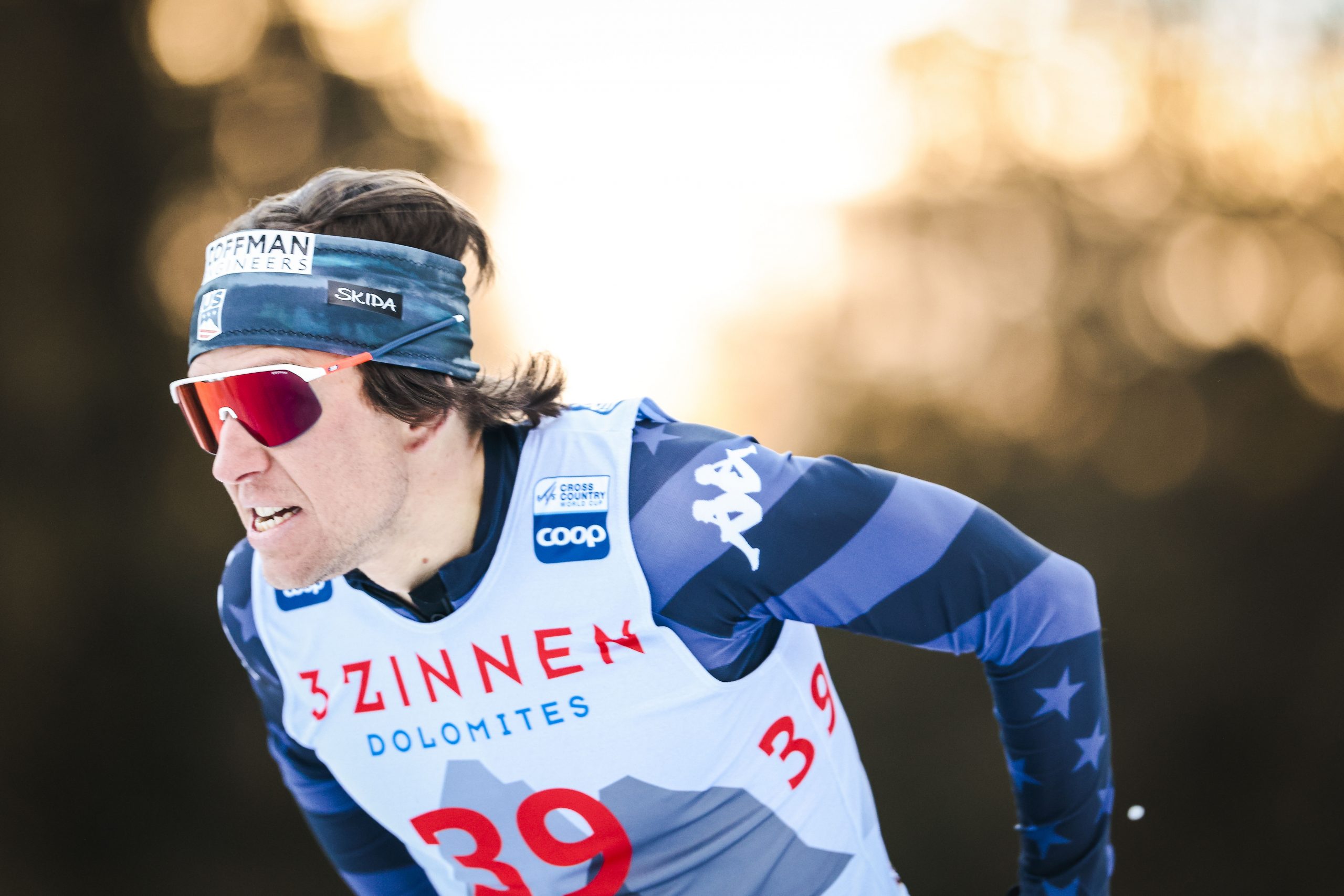
 generous support of Marty and Kathy Hall and A Hall Mark of Excellence Award. To learn more about A Hall Mark of Excellence Award, or to learn how you can support FasterSkier’s coverage, please contact info@fasterskier.com.