From the FasterSkier archive — posts syndicated from athletes’ and coaches’ own blogs between 2004 and 2012, kept online as published. Current coverage is at fasterskier.com.
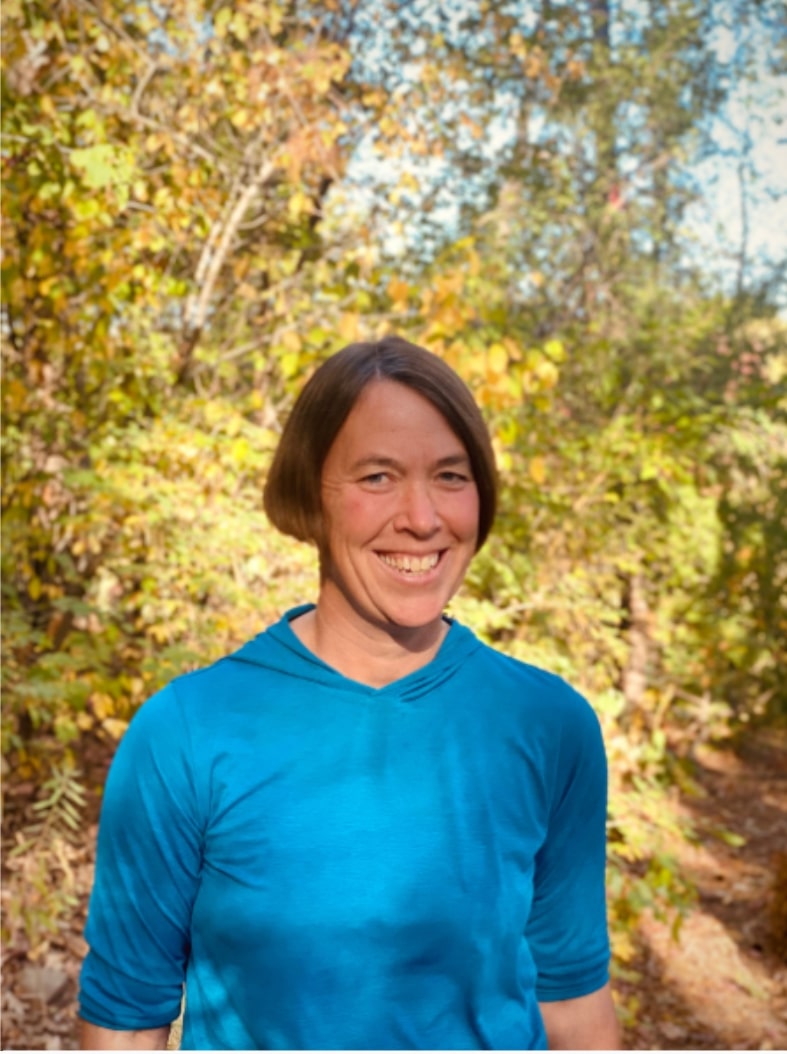
The Minneapolis Loppet Foundation announced today, November 8th, that it has hired a new Director. Meghan Cosgrove will take the reins of the organization beginning November 18th. She takes over from Claire Wilson who resigned from the Director’s position in September for family reasons. Wilson had been at the helm of the Loppet Foundation for four years.
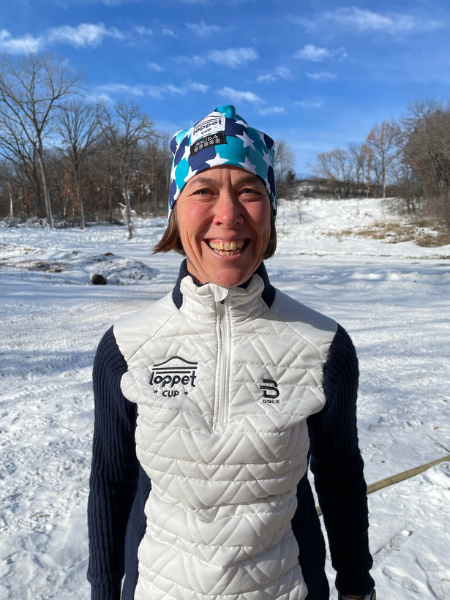
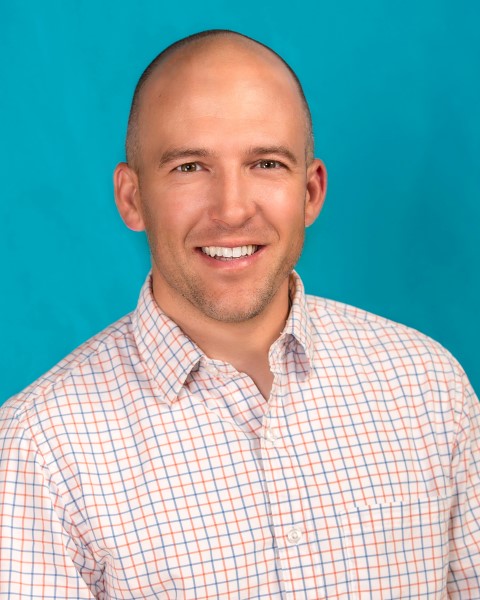
Meghan Cosgrove, the new Director of the Minneapolis Loppet Foundation. (Photo: LinkedIn)
Cosgrove’s most recent leadership post was as Executive Director at YMCA of the North for Camp Menogyn, where she spent seven years overseeing operations for teen wilderness adventures in some extremely remote areas, including Isle Royale and the Canadian Arctic. Camp Menogyn is located on the edge of the Boundary Waters area about 45 minutes from Grand Marais, Minnesota.
Cosgrove also has a background in fundraising having spent time as a major gift officer, and during her time as a YMCA Director worked with her Board of Directors to raise from $250,000-$1,000,000 annually. No doubt the Loppet Foundation will hope to put her fundraising skills to work to help sustain the organization. Cosgrove also worked as the Executive Director of YMCA camp Warren, near Eveleth Minnesota, for almost 9 years, which saw over 1,200 participants at the camp a year. When asked about choosing to move to the Foundation, Cosgrove told FasterSkier that, “I have always admired the mission of the Loppet Foundation and this was a great point in my life to put down roots in the Twin Cities.”
Prior to landing in Minnesota, Cosgrove worked in Maine as a faculty member at the Hyde School located in Bath, where among other duties she was the assistant coach for the varsity cross-country ski team.
This last spring Cosgrove was recognized for her 25 years of leadership within the YMCA. She is a Bowdoin College graduate with a Bachelor’s in Sociology and Spanish, and has a Master’s degree from the University of St. Thomas in Education.
Claire Wilson, former Director of the Loppet Foundation. (Photo: Loppet Foundation)
Cosgrove expressed her excitement at being named the new Director and gratitude to Wilson’s prior stewardship. When asked about the goals and challenges facing the Foundation she replied, “I see the Loppet as a leader in advancing equity in the outdoors. Continuing to offer high quality programs for people of all ages and continuing to remove barriers to participation in those programs will be my top priorities. Climate change is one of the biggest challenges for the Loppet. Last winter certainly highlighted that. We offer a diverse offering of programs, in all four seasons, and will continue to evolve those as we adapt to climate challenges.”
The Loppet Foundation was the principal organization responsible for the hugely successful World Cup weekend held last winter at Wirth Park in Minneapolis. It was a high profile event putting the mostly volunteer organization at the center of the Nordic ski world for a weekend.
The great crowds and jaw dropping performances in Minneapolis helped the Loppet Foundation pull off an incredible event. (Photo: NordicFocus)
Though the World Cup is what most skiers outside of Minneapolis know the Loppet Foundation for, running the World Cup weekend was really a detour from the Foundation’s primary duties. But as it turned out, the Foundation was the perfect organization to bring together a world class event with community involvement to present a one of a kind World Cup experience.
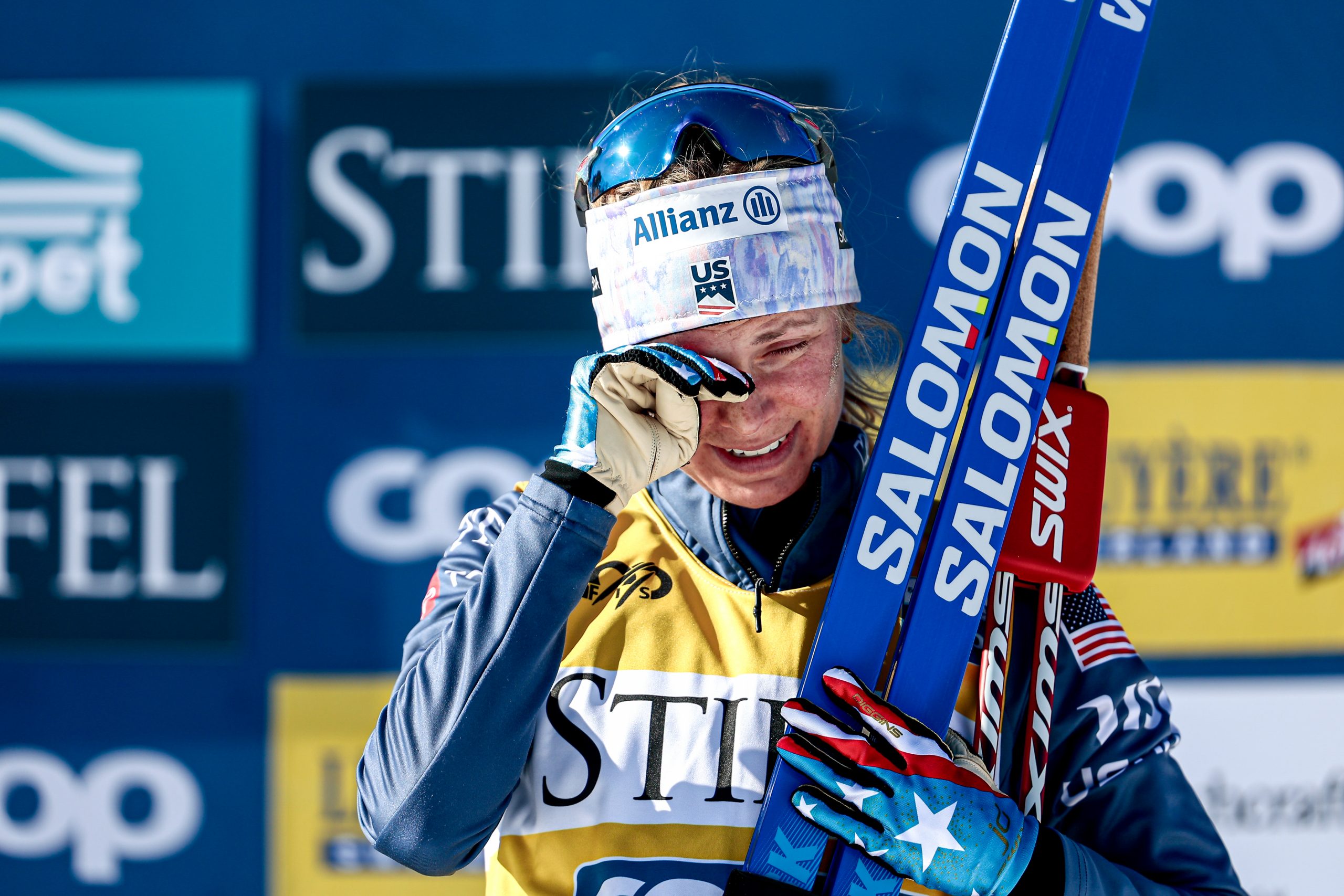
Jessie Diggins wasn’t the only person shedding a few tears during the Minneapolis World Cup. (Photo: NordicFocus)
The Foundation is a nonprofit and its primary charge is connecting people to the outdoors through experiences that grow community. It funnels 25,000 participants a year through its programs. For a mostly volunteer entity, the World Cup was an ambitious undertaking which pushed the capacity of the organization. But in the end, it delivered a memorable and unique product. It was a heavy lift for the organization, but could it happen again? “I’m sure this is something we will thoughtfully consider. There is definitely an appetite to host another World Cup here in the Twin Cities because the Loppet staff and volunteers did an incredible job welcoming the world to Wirth last winter. But we will need to carefully examine the financial demands and the person power necessary to do that again.”
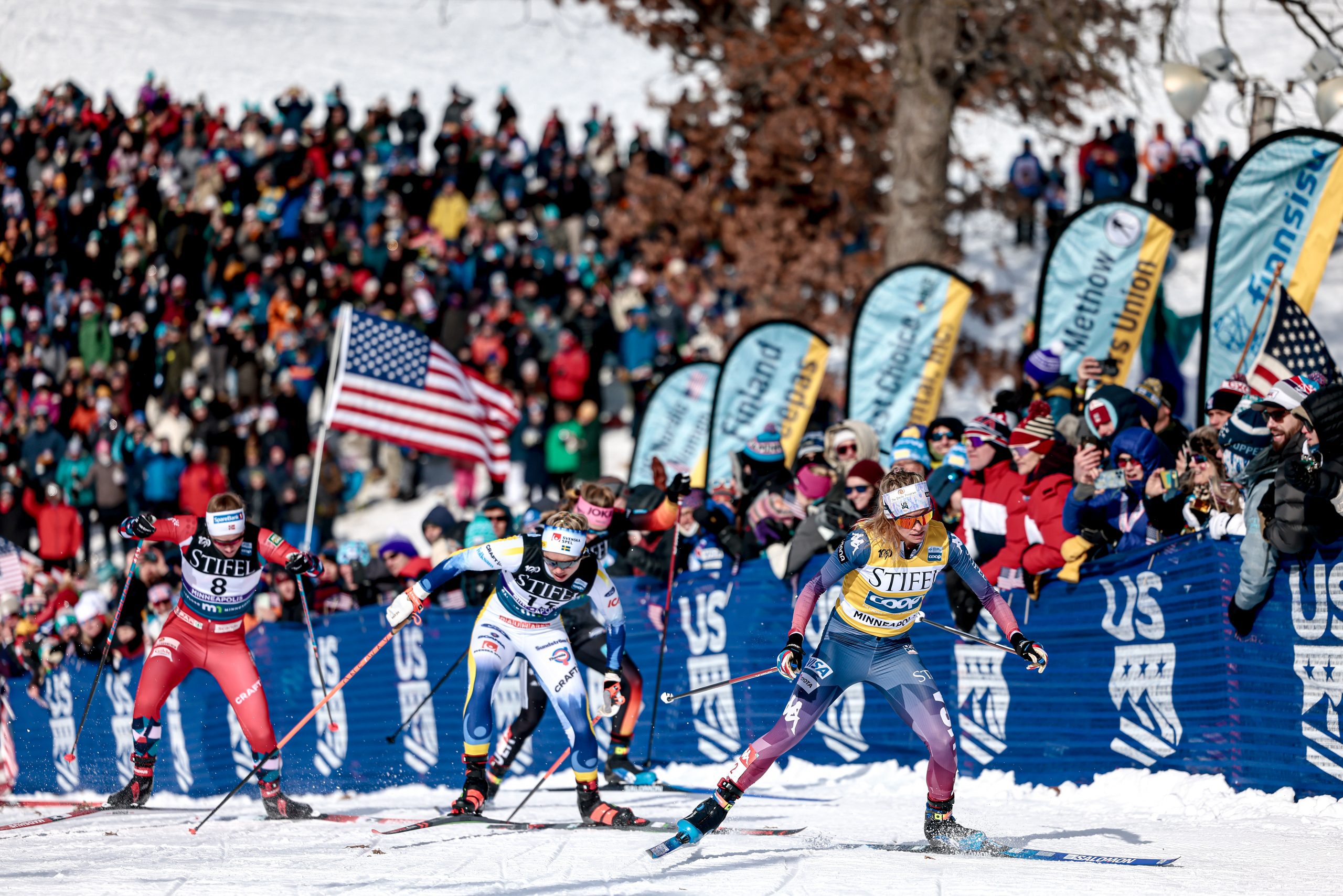
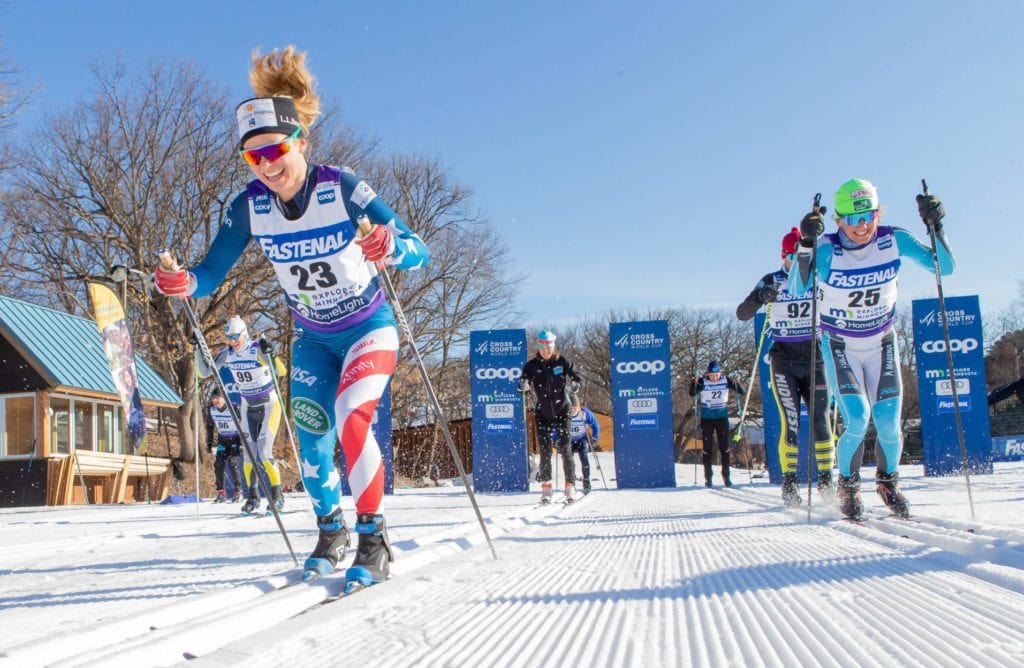
The Loppet Foundation helped form a community based event for the Minneapolis World Cup. Here, Mathilde Myhrvold (NOR), Emma Ribom (SWE), and hometown star Jessie Diggins (USA), (l-r) racing the individual sprint in Minneapolis’ Wirth Park (USA). (Photo: NordicFocus)
This coverage is made possible through the generous support of Marty and Kathy Hall and A Hall Mark of Excellence Award. To learn more about A Hall Mark of Excellence Award, or to learn how you can support FasterSkier’s coverage, please contact info@fasterskier.com.
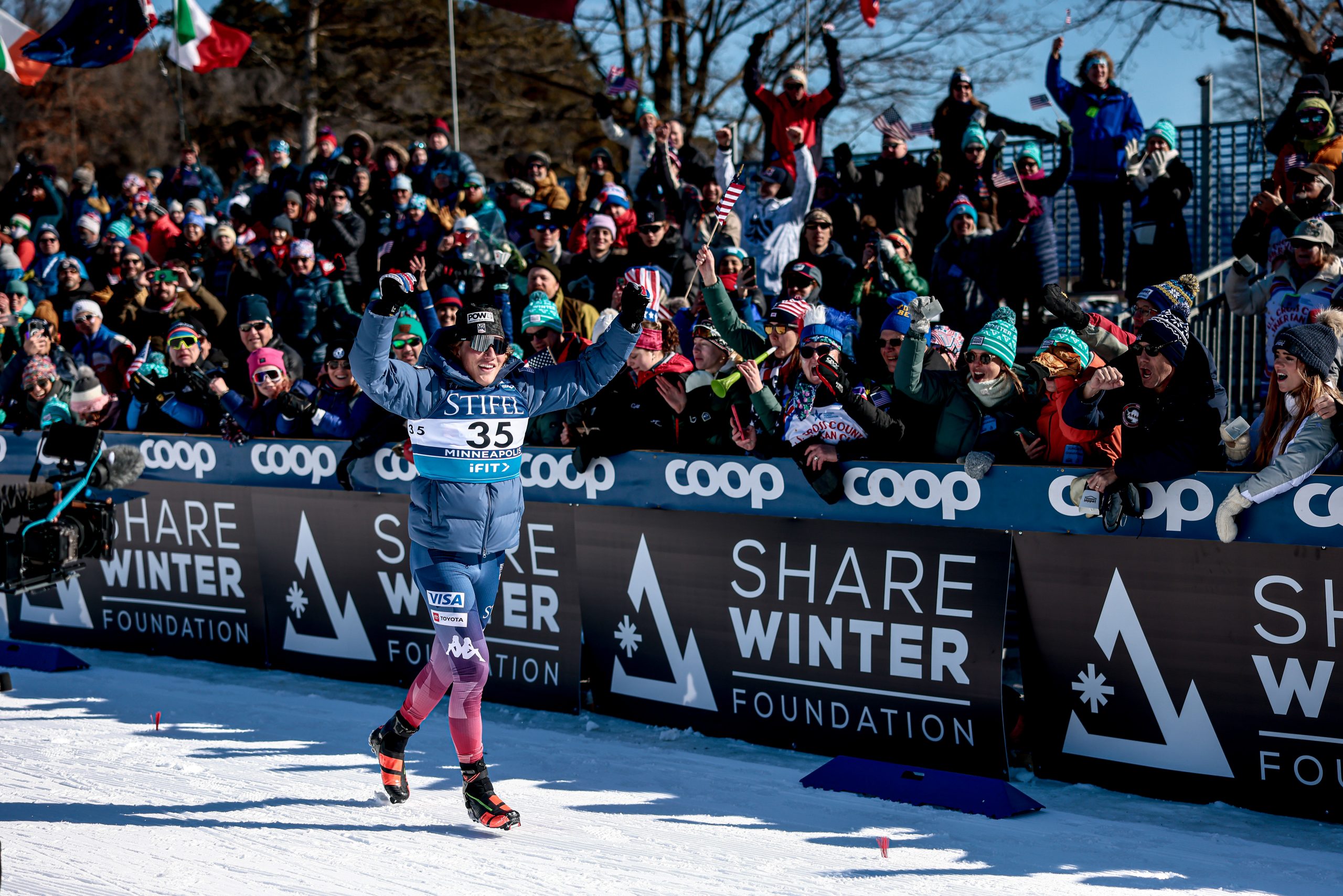
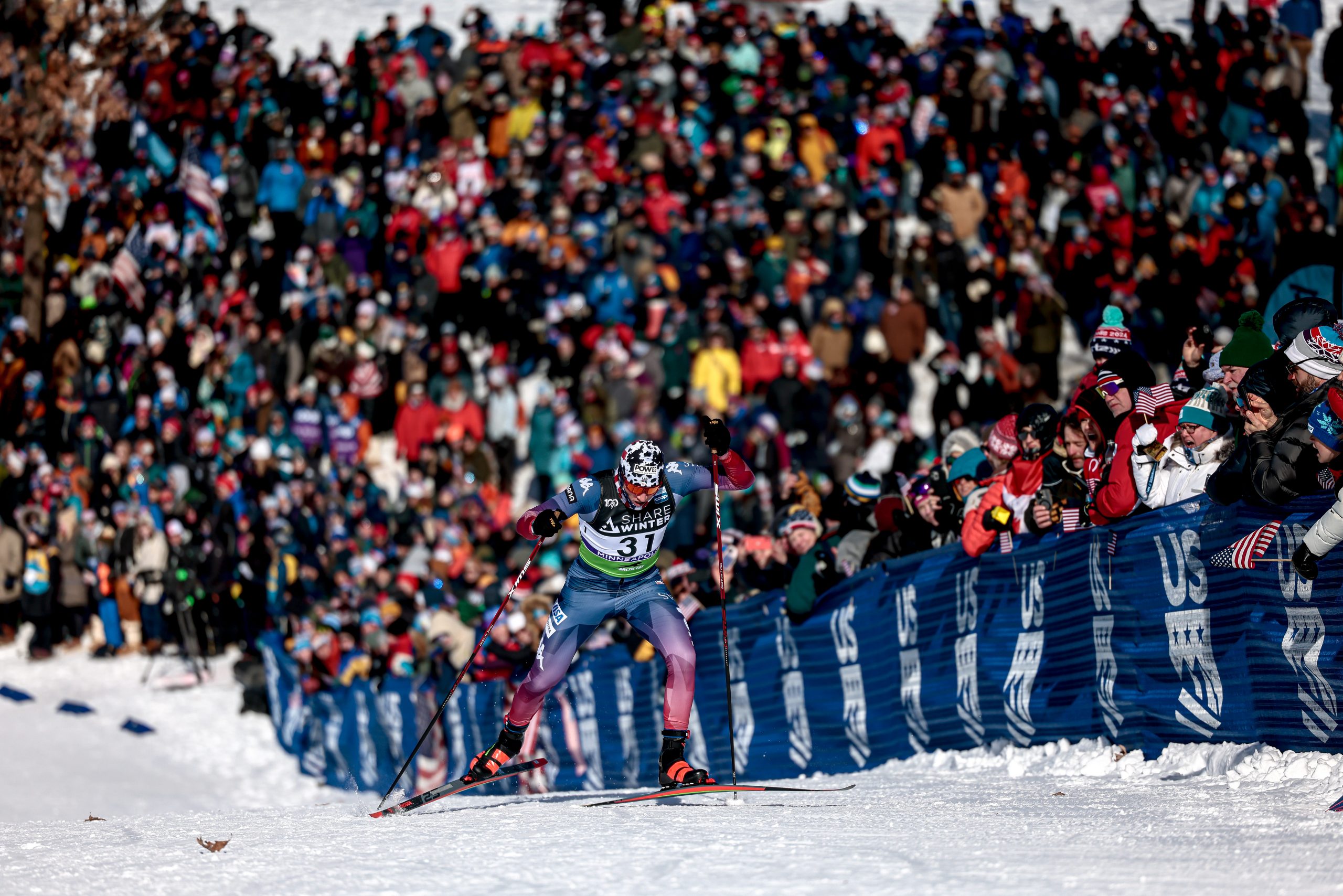
A sea of fans roared as Gus Schumacher (USA) made his way around the Minneapolis course. (Photo: NordicFocus)
After the 2018 Olympics, workers at the Minneapolis Parks and Rec Department had to start putting up posters in the old Theodore Wirth Park chalet to “Clean up your glitter.” Thousands of Minnesota high school cross country skiers who raced there were emulating Jessie Diggins’ famous race-day tradition. The glitter was making a mess, but in Minnesota’s ski-crazy Nordic community, that particular problem was a wonderful one to have. Swix pants and stray gloves dusted in pesky golden glitter-flakes only testified to more young skiers wanting to “Ski like Jessie.” After having watched her win Olympic Gold, they all had a shared idea of the world contained in that simple phrase.
Six years later—again in Minneapolis—Jessie Diggins would bring her glitter to the FIS Cross Country World Cup in Theodore Wirth Park, the first World Cup race held in the United States in over twenty years. What followed was a weekend that most witnesses would describe as “something special.” Twenty thousand American spectators attended a cross-country ski race in America, and on the second day an historic and improbable win from a young Alaskan named Gus Schumacher. It was the first World Cup win of Schumacher’s career, and the first for an American male skier in over forty years. In a banner winter for American skiers (Jessie Diggins winning her second World Cup Overall and seven American skiers finishing on World Cup podiums), Gus Schumacher’s win on home soil was a clearly an emotional apex.
Cut to last week, when the International Ski Federation (FIS) put out a fan vote on its Facebook and Instagram pages to award the “Best Distance Performance of the Year” from this year’s World Cup. Nominees included a predictable slate of Scandinavian stars—Johannes Hoesflot Klaebo, Frida Karlsson, Simen Kruger—but there was a distinctly American flavor to the list of nominees. Three different Americans, with three different performances, made the shortlist. Jessie Diggins was nominated for her early-season 10 k win in Gallivare, Sweden, while Sophia Laukli got a nod for her first World Cup win at the Alpe Cermis Hill Climb. The clear winner of the poll, though, was Gus Schumacher’s victory in Minneapolis.
The “Best Distance Performance of the Year” poll may have been little more than FIS plumbing social media engagement during the doldrums of spring. Even so, in this test of public opinion, Schumacher was the clear winner. That consensus may also be suggestive of more good things to come. As the weather warms, so does the prospect that Schumacher will earn more titles from even more lofty sources. He is likely to be on the shortlist for any kind of upcoming “Athlete of the Year,” or “Skier of the Year” award granted by ski governing bodies and media organizations. He certainly is on the shortlist at FasterSkier.
The extent to which those shortlists and awards shake out will be revealed in time. For now, this informal FIS award was a neat checkpoint smack dab in the middle of the offseason. Two months removed from the World Cup events in Minneapolis, the snow is gone from Theodore Wirth Park. The first blades of grass poking through the mud spell out a clear way forward to spring. It’s a nascent time; with it comes some nascent clarity on what exactly the Minneapolis World Cup—and Gus Schumacher’s win—mean to American skiing.
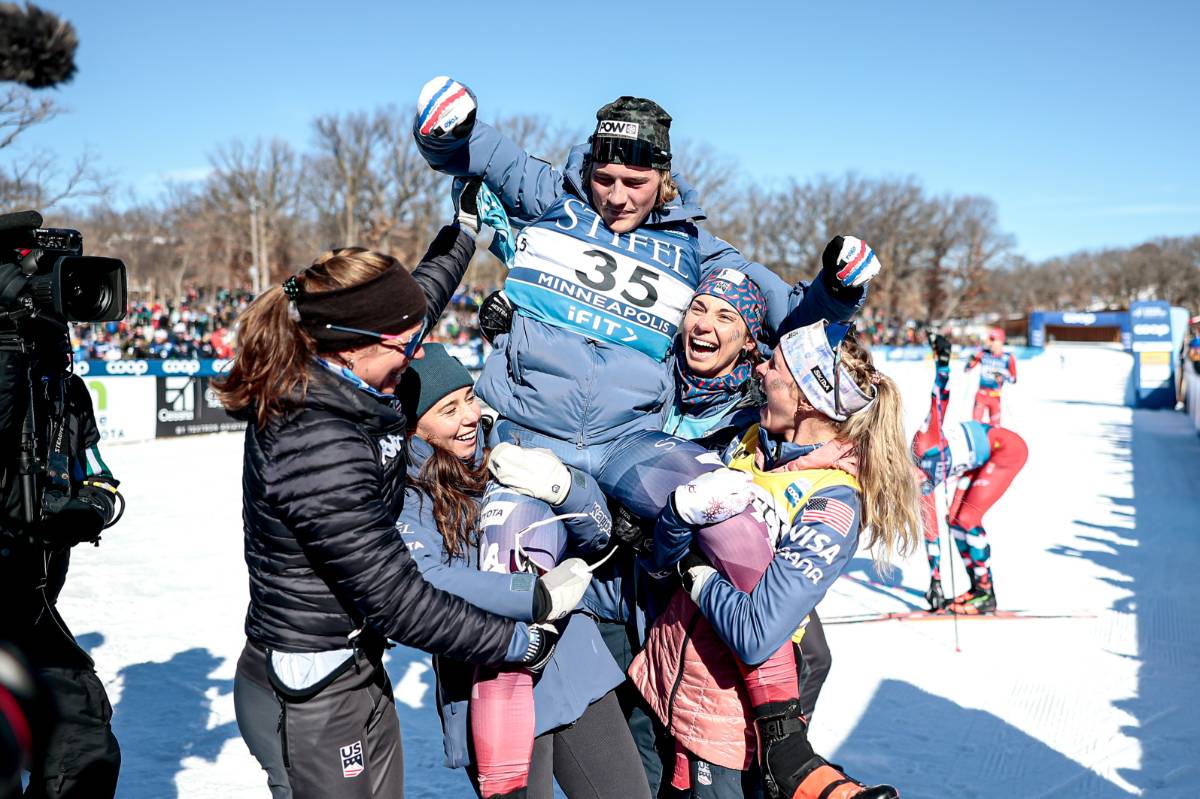
Jessie Diggins helps lift Gus Schumacher after his improbable win at the Minneapolis World Cup in February. (Photo: NordicFocus)
A look at the comments on the FIS Instagram post soliciting votes for “Best Distance Performance” reveals a unified front supporting Schumacher. The question of which individual World Cup performance stood out most to viewers and fans produced an outpouring from American skiers, World Cup champions, and Birkie Birchleggers alike. Some came to the comment section with heartfelt stories on what it was like to process the surprise win as Schumacher, himself, was processing it. How Schumacher started early with Bib 35, crossed the finish line with a 15 second lead, took his turn in the winners’ chair, and watched as every great champion of the sport crossed the finish line splitting seconds behind him until there was no other conclusion to reach: almost impossibly, Schumacher had won. Others came in with more emphatic exclamations: who should win the best performance of the year? “GUS!”
In short, Schumacher’s win in Minneapolis validated itself. If you watched it, you understood why it’s worth striving to do anything well. Why spend years building a ski community in Minneapolis, re-working and expanding a venue at Theodore Wirth Park as the Loppet Foundation did? Why combine the talents of countless individuals across the United States towards developing, of all things, cross country skiers? As Schumacher and his American teammates celebrated at the finish line, the answer became apparent: so that a skier like Schumacher could combine talent, drive, and passion in order to exceed even the expectations he set for himself. The defining characteristic of Schumacher’s win in Minneapolis, though, was Schumacher beaming in an interview immediately after. “I don’t know, this is just the best day ever!” he said.
It took a crowd of 20,000 fans raising their voices along the sides of a Minneapolis ski trail to propel Schumacher toward his unlikely victory. In doing so, the crowd—and Schumacher, himself—revealed the power of what collective energy harnessed in the right individual can do.
Of course, among the FIS “Best Distance Performance” nominees there were two other Americans who delivered the lesson just the same. Jessie Diggins in Sweden was incredible. Sophia Laukli on the Alpe, sublime. Why though, when asked to make the hard choice, did so much of US Skiing latch onto Schumacher? The difference must’ve been found in the venue: Minneapolis, a community versed in sports, versed in the sport of cross-country skiing, and versed in the lessons that sport teaches. For a weekend in February, Minneapolis was a conduit for community spanning an entire continent. Minneapolis ski fans could uniquely recall Jessie Diggins from her time starting out in Afton through to the present day when she epitomizes what skiing can teach you about life: Olympic moments, World Cup triumphs, and all the highs and lows in between.
The testament to Gus Schumacher’s win in Minneapolis, then? This summer, there are sure to be even more young skiers at practices, at camps, pursuing the challenges of cross country skiing. Theodore Wirth Park may still be the place you need to clean up your glitter, but in places throughout our Nordic community young athletes will give voice to a dream to “Ski like Gus.” That day in Minneapolis will flash in their memories, and a smile will cross their faces. “Best Distance Performance of the Year” for certain. And, by all indications, for a whole lot longer too.
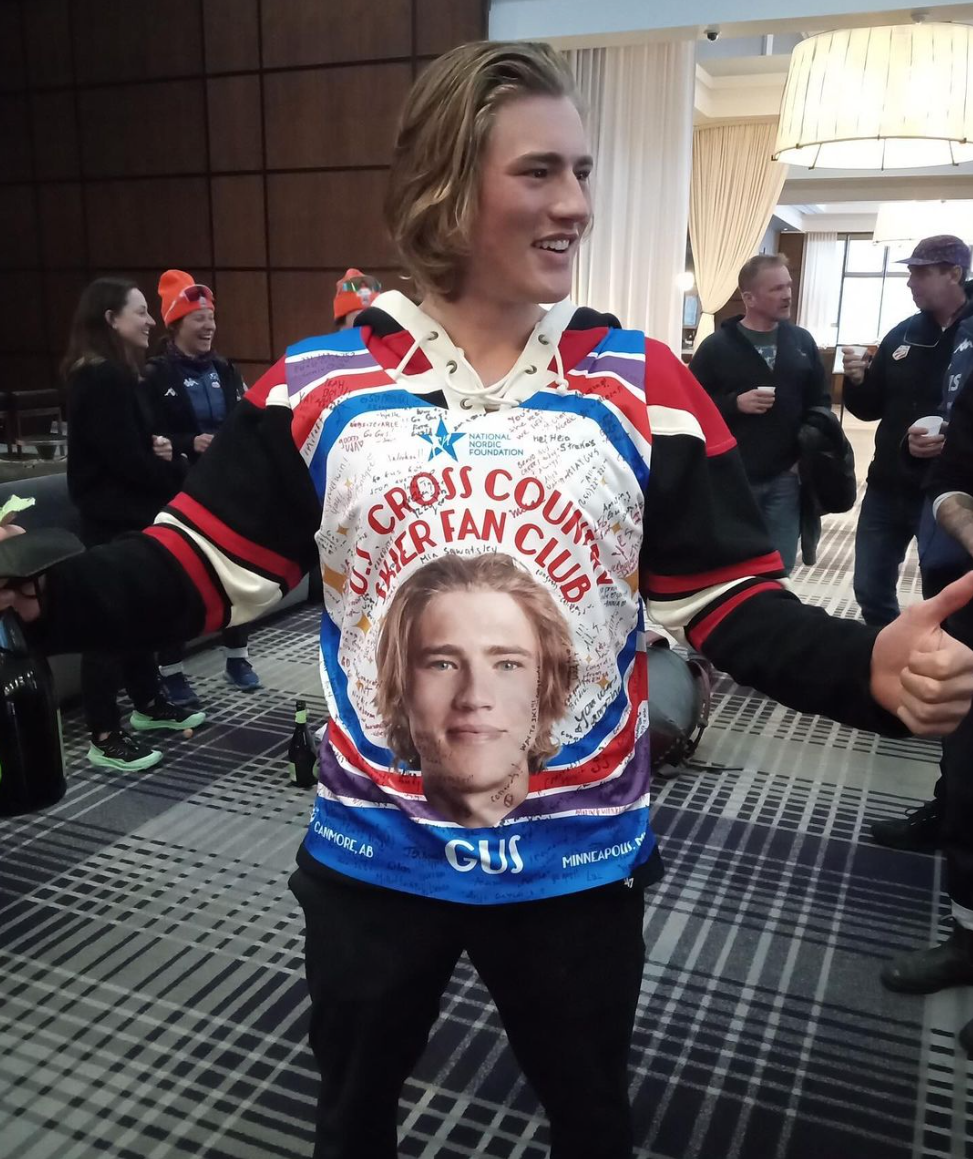
Gus Schumacher sporting a bib signed by over 500 supporters after his win in Minneapolis, donated by the National Nordic Foundation. (Photo: NNF)
This coverage is made possible through the generous support of Marty and Kathy Hall and A Hall Mark of Excellence Award. To learn more about A Hall Mark of Excellence Award, or to learn how you can support FasterSkier’s coverage, please contact info@fasterskier.com.
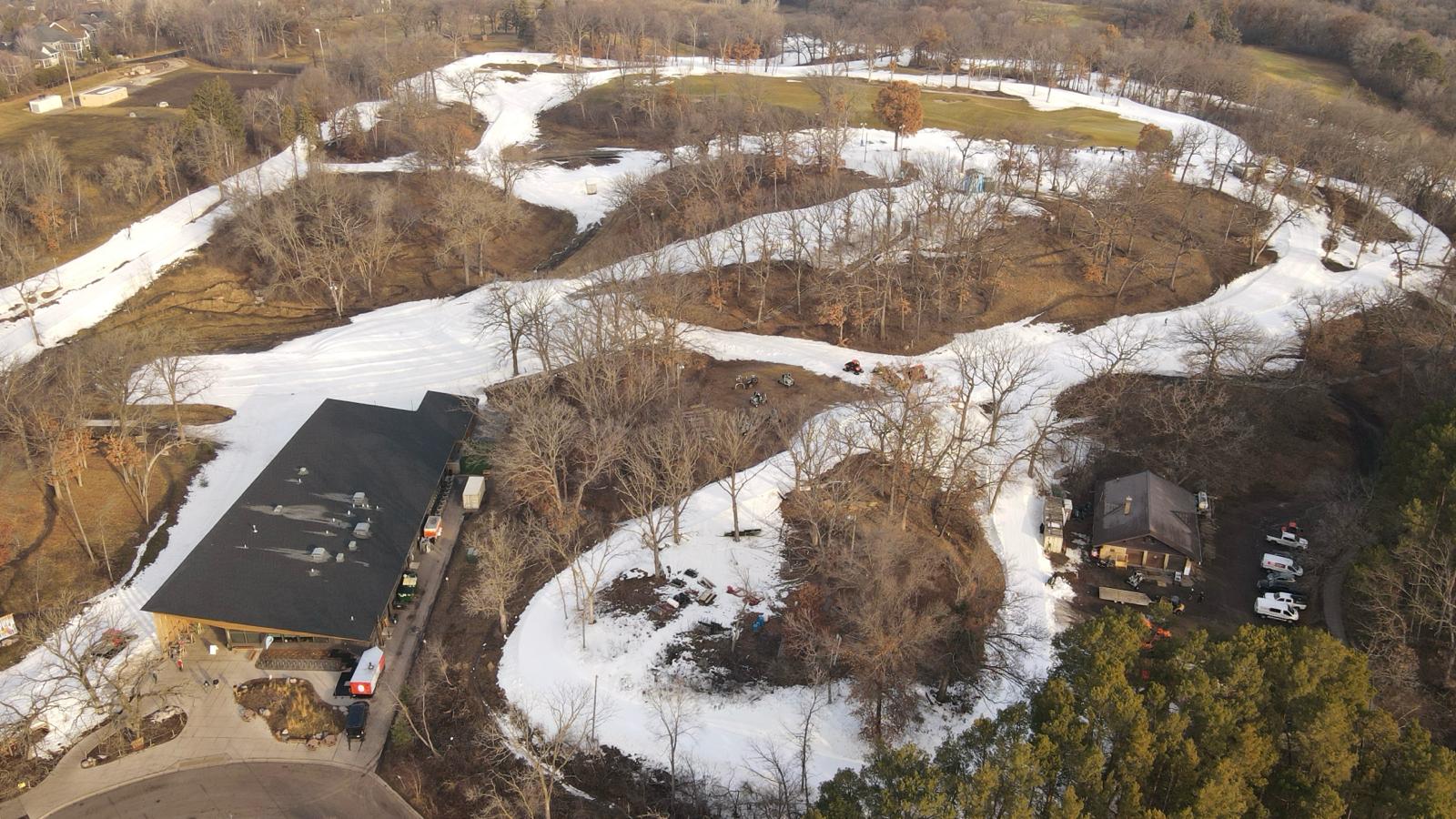
The warmest Minneapolis winter on record has forced organizers to make extraordinary efforts. Everyone is confident that there will be a course that meets expectations. (Photo: Loppet Foundation)
This has been a terrible winter for skiing in much of North America, particularly in the midwest. With temperatures consistently above freezing and little snowfall, most races in the region have either been cancelled or significantly shortened. Minneapolis —which hosts World Cup events on February 17th and 18th—has also suffered from this weather. Minneapolis’ temperatures this week have been in the mid-fifties with similar temperatures mixed with rain expected for the next couple of days. This has raised an obvious and legitimate question—will the races in Minneapolis happen as scheduled? “Absolutely,” says Loppet Director, Claire Wilson. “I am 100 percent confident that we will hold the event which meets FIS (International Ski Federation) standards. I feel 100 percent confident in our ability to pull it off, barring a catastrophic rain. Obviously, it is not going to be ideal, but FIS has seen where we are, we passed snow control. We are 100 percent on. At this point the only thing that would derail that would be if that rain predicted for Thursday was an all-day deluge. We have done everything we can do in the warmest winter on record. I feel 100 percent confident in my staff and the volunteers that we can do this. I would tell everybody, pack your bags.”
No one at the Loppet Foundation anticipated being unable to make snow in January and February. But a short cold spell last month saved the day. (Photo: Loppet Foundation)
The Loppet Foundation is the entity responsible for organizing the World Cup event in Minneapolis. In an interview with FasterSkier Tuesday evening, Wilson said that, “This second, conditions are good on the course.” She continued that “The course this morning was excellent.”
There are seven kilometers of trails covered by snow making at Wirth Park. (Photo: Loppet Foundation)
While the weather has presented incredibly trying circumstances, there have been some fortunate twists. The course was always designed to be on the snowmaking loop. “There was never another option,” Wilson told FasterSkier. When the bid was requested for 2024 Wilson specifically asked for the event to be held in February instead of March—as had been the case when the race was cancelled due to Covid in 2020. “Of course, we thought that in February we would not encounter any challenge making snow.”
The race venue, Theodore Wirth Park, has seven kilometers of trails with snow making. For Saturday’s Sprints the course will be held on a loop a little over two kilometers. Sunday’s 10-kilometer race will be laps on a 3.3-kilometer loop. On Monday, the average snow depth on those loops was two feet.
This would be a beautiful sight if it weren’t for temperatures in the 50s and rain in the forecast. (Photo: Loppet Foundation)
“We have significant snow guns, which is a very mobile system. We (make snow in) concentrated efforts then go and pick up and make snow in another area.” But even with snow making facilities, it still has to be cold enough to make snow, and that has simply not been the case. “If we had not had that polar vortex in January, I can say with almost 100 percent certainty that we wouldn’t be holding this race. We made the majority of our snow in January. That period in January saved us. We lost a significant amount of trail at Christmas with the warmup and the rain; we were able to rebuild in January but haven’t had any significant snow making since that cool down.”
Unfortunately, even with colder temperatures predicted following this week’s warm up, it will not present a green light to make more snow. “We’re challenged because the load-in (placing television facilities, advertising banners, stanchions and other structures) for the entire event has had to be quite condensed. There are literally pages of things which are being loaded in.” So even with some windows of colder temperatures, organizers won’t be fully able to take advantage of the conditions because of cameras and other structures placed near the course. “We’ll be able to make some snow, but the trail itself will be difficult to make snow on. There will not be a lot of opportunity to make more snow. It is truly a Herculean effort to save the trail that we have.” Wilson told FasterSkier that 28 truckloads of snow were hauled in Tuesday from a nearby site.
The trails are made up mostly of snow which was made in January. As of Monday, average depth was two feet. (Photo: Loppet Foundation)
Volunteers will be laying down blankets Wednesday to cover vulnerable areas. The blankets are loaners from a nearby construction firm (Mortenson Company) which reached out to the Loppet Foundation to help. The blankets are normally used to keep drying concrete warm.
Things are definitely not winter-like in Minneapolis right now. “I’m looking at green grass and people golfing across from our trail right now,” observed Wilson.
Minneapolis has been a bit snakebitten trying to host a World Cup. The 2020 event was cancelled due to Covid; the disappointment truly stung. Wilson expressed the frustration her team has experienced with their bad luck. “We are a small non-profit putting on a major international event, with majority volunteers. A lot of people experienced that trauma from the last cancellation … it took a lot of convincing to get everyone back enthusiastic about hosting again; to get hit with this, it’s hard to put into words how extraordinarily difficult it’s been and what an ask it has been of volunteers and staff. It’s been a remarkable effort for the last several months.”
Not only has the Loppet foundation had to work to get ready for the World Cup, but they still have their regular obligations. “We also work to provide Minneapolis all of the other recreational opportunities that we would in a typical winter.”
The stress level surrounding the weather has been high. “We’ve never had a January or February where we couldn’t make snow, Wilson said. “There were many things I was concerned about (hosting the event) but looking out on green grass and blooming tulips wasn’t something which we had anticipated.”
To help preserve conditions, there is a complete shutdown of the system beginning tonight, which includes grooming.
“There’s a special amount of gratitude which needs to go out from the national and international community to this local community,” Wilson said. “It was always going to be an act of heart and soul to put this together, but it is not an overstatement to say that this has been a Herculean effort. It’s a true act of love by the Minnesota Nordic community. The Loppet community is providing a very big gift of bringing this World Cup to the U.S. We’re excited to welcome everyone here.”
Hopefully, organizers’ preparations and volunteers’ diligence will be rewarded, and they’ll get a break with the weather. Either way, the final countdown has begun, and everyone is confident about having a great event.
Jessie Diggins at Wirth Park following the cancellation of the 2020 Minneapolis World Cup. (Photo: Loppet Foundation/(c) 2020 F/Go Photography)
What are European World Cup skiers asking ahead of the circuit’s first-ever visit to Minneapolis next February?
According to Jessie Diggins, “They’re like, have you heard of the Mall of America?”
In a recent media event held at Theodore Wirth Park, Diggins—with fellow Minnesotan US Ski Team member Zak Ketterson—highlighted plans to make the first FIS World Cup held in the United States in 22 years an even bigger Twin Cities attraction than a mall with a whole theme park (soon to be two!) inside of it.
Alongside Loppet Foundation Executive Director Claire Wilson, Diggins highlighted the deep significance of the Minneapolis World Cup to her and the greater US ski community, and the tangible excitement among World Cup skiers to make the trek to North America next season.
“No one racing on the World Cup right now has ever competed in the United States. None of us. It will have been 22 years.” said Diggins. That includes the Afton, Minnesota native, who has long advocated for bringing a World Cup to Minneapolis, including the successful bid in March 2020 that ultimately was cancelled due to the COVID-19 pandemic.
“I’ve always wanted to bring it back here to the community that raised me and gave me all these opportunities. I feel like I owe everything in my ski career to Minnesota—the welcoming, inclusive environment around cross-country skiing has always made me feel happy,” said Diggins.
Plenty of members of the ski community, and the Minnesota media, were present in the Loppet Adventure Sunday, but so too were the Olympic medals, Crystal Globes, and the World Championship medal that Diggins had won in the decade since she swept Junior Nationals at Wirth Park in 2011. Sure, Diggins is bringing it all back home. But for her and for US skiing, that’s a home that has been profoundly transformed by her accomplishments, and the ethos she has expressed on her way to those accomplishments.
“We are going to put on a very elite event without elitism,” said Claire Wilson. “We are here to do this with joy, and I can think of no other elite athlete that models that joy better than Jessie Diggins.”
Wilson detailed the material plans in place to bring that spirit to the event, scheduled 2024’s President’s Day weekend, February 17th-19th. Key to the Loppet Foundation is a presenting partnership with the Share Winter Foundation that will make the event free for all to attend. The partnership will also see a free-to-ski event at Wirth the day after the World Cup races.
Wilson also announced that the Loppet is committing resources to make the World Cup event “carbon neutral or carbon negative” towards “being an example” of the climate advocacy that many in the cross-country ski community, including Diggins, are doing to promote a sustainable future for the sport.
US Ski Team Member and Minneapolis native Zak Ketterson, who also participated in the event last Sunday, has seen first-hand the transformation of Wirth Park, and US skiing, to the point where bringing a World Cup is now a viable reality. “When I was racing in high school races here, the World Cup couldn’t have been further from my mind,” Ketterson commented to FasterSkier. “If you would’ve told me back then I’d be a World Cup skier with the opportunity to race in my home town, I would not have believed you.”
Diggins also reached back in her own memories of the World Cup to explain why the prospect of racing in the United States was an important milestone, saying “I remember sitting in the basement with my dad watching VHS tapes of races that had finished two years before when I was a kid. Now, kids will be able to literally reach out and touch the athletes here at home.”
The timing of the event next President’s Day weekend is meant to capture the idea of the World Cup as both a celebration of the growth of the US cross-country skiing community, and an opportunity to expand it. “In contrast to [2020] when this was a sprint race on a Tuesday,” said Wilson, “we’ll have a full weekend of racing this time around, one week prior to the Birkie. We’re hoping tens of thousands of people are going to come and make this an entire celebration of the sport of skiing in the United States.”
Zak Ketterson counts himself among the community that will head to the Twin Cities to celebrate. “I am honestly really excited about this World Cup being a built-in trip home,” he said. “It’ll be a unique experience getting to sleep in my own bed and race a World Cup the next day. I’m definitely going to have these races in the back of my mind all summer and fall.”
Diggins also spoke to the “celebration” aspect being at the heart of the athlete experience going into the World Cup next year, saying, “It would be fun to win this World Cup…I’m certainly going to try…but what I’m most looking forward to is getting to celebrate bringing the World Cup here and what it will take: so many volunteers, so many people working over the course of six years to make this happen. I know that is going to be the best feeling.”
Some of the details of what Diggins, and the World Cup field, will be racing in Minneapolis remain to be sorted out. The discipline and distances will be finalized at FIS’ Congress later this month. What other events will color the racing are also still up in the air, though Wilson has said that this World Cup event will likely be pared down and more focused on the actual racing than 2020’s full festival plans. And behind the scenes, the long process of finding the volunteer force to work the event is just in the beginning stages.
The Loppet though, is finding confidence in what was previously a source of sorrow: the cancellation of their first World Cup bid in 2020. As Diggins eloquently put it, “They’ve already hosted a World Cup, it’s just that this will be the first one with athletes racing at it.”
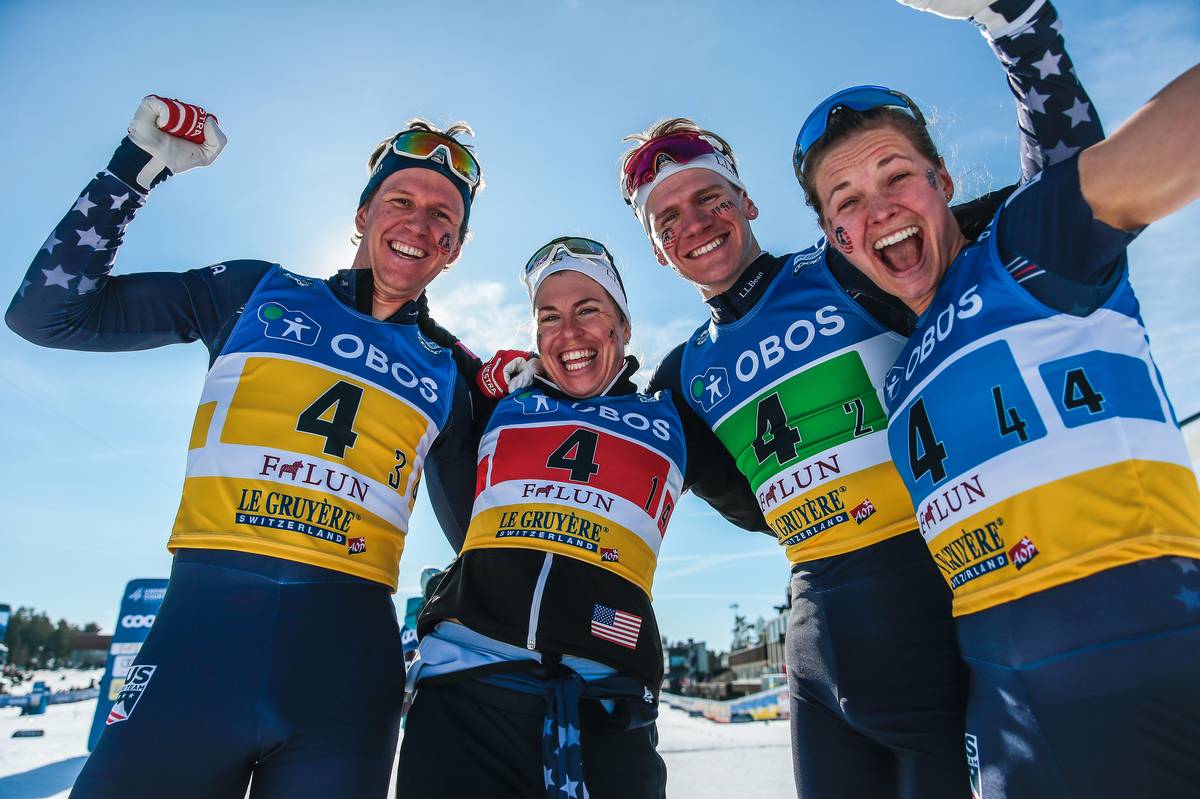
Minnesotan natives Zak Ketterson and Jessie Diggins alongside Scott Patterson and Rosie Brennan after winning the 4 x 5 k Mixed Relay in Falun last year. (Photo: NordicFocus)
Jessie Diggins skis at Theodore Wirth Park in 2020, following the cancellation of the scheduled World Cup there due to the COVID-19 pandemic. (Photo: Brian Peterson)
For the Loppet Foundation, the Minneapolis nonprofit at the heart of the Twin Cities ski community, and responsible for organizing that 2020 World Cup, the loss couldn’t be met with any emotion but sadness: two years of hard work organizing since the World Cup bid was secured in 2018—and many years before that advocating for the idea of a Minneapolis World Cup—all gone due to a world that had changed.
Working in a changing world, though, would turn out to suit the Loppet Foundation’s strengths. Since its founding 20 years ago to “Connect people to the outdoors through experiences that grow community,” the Loppet has completely transformed the cross-country ski community in the Twin Cities, Minnesota, and the greater Midwest. What started as a nonprofit organizing the City of Lakes Loppet,has grown to include a slew of recreational programming, spawned one of the country’s best competitive junior clubs with Loppet Nordic Racing, re-imagined Theodore Wirth Park’s ski trails into a world-class venue, and, indeed, organized a World Cup.
For most of the Loppet’s history, the title of Executive Director belonged to John Munger. Munger moved on from the position in 2020, replaced by current Executive Director, Claire Wilson. Since Wilson’s arrival, the Loppet has hosted Junior Nationals and SuperTours, overseen an explosion of participation in cross-country skiing in Minneapolis that has seen pass sales double five times over, and youth participation in the Minnesota Youth Ski League double too. Then, last month, it was announced that the goal for 2024 would be the same as in 2020—bring a FIS World Cup race to the United States.
Loppet Foundation Executive Director Claire Wilson. (Photo: Loppet Foundation)
This week, FasterSkier had a chance to catch up with Wilson on how the excitement around the World Cup is helping shape the Loppet’s plans, what the 2024 President’s Day weekend World Cup will actually look like, and the Loppet’s journey from lost dreams in 2020 to dreaming again of American World Cup racing in 2024.
This interview has been edited for length and clarity.
Ben Theyerl/FasterSkier (FS): How are you and the Loppet feeling about the World Cup coming to Minneapolis in 2024?
Claire Wilson (CW): The excitement here is really palpable. I have people who aren’t even connected to the skiing world reaching out to say, ‘we’ve already saved the date and we can’t wait!’ And then inside the ski community, well, I think it’s engaged everyone, here in the Twin Cities, but well beyond that as well. There are people from across the country who’ve been in contact to ask how they could help.
I was also just in Norway at Holmenkollen and Drammen with Torsten Brinkema, who’s a local filmmaker working on our promotional materials, and our whole experience there with the US Ski Team and with that wider world ski community really reiterated just how excited everyone is to finally be headed to the United States for a World Cup again.
FS: There’s definitely excitement being stirred again after a ‘near-miss’ hosting in 2020. When, after that, did the Loppet Foundation decide that a World Cup was worth doing again in 2024?
CW: It took a lot of discernment to decide if this was really something we wanted to try again, because it’s very unusual to have a relatively small nonprofit organizing something as big as a World Cup. The scale of the risk, and the opportunity, is just bigger than what most community organizations can take on.
We had to start by asking ourselves, ‘Is this in alignment with out mission? Does this help increase access to the outdoors and grow connections to the outdoors?’ We spent a lot of time listening, with staff, with the wider Twin Cities community, and eventually, we landed on yes.
Then we looked at that mission in context. In Minneapolis, growing connection to the outdoors means building our ski community to be more inclusive. The number of skiers in the Twin Cities has grown substantially in the past decade. Theodore Wirth Park has become the jewel of a world-class park system and become a world-class ski venue. So the world stage, for that venue and for our community, was the logical next step.
There was also a window we recognized here. Jessie Diggins has been supporting the idea of bringing a World Cup to Minnesota for a decade now. And right now, the US Ski Team has an especially strong contingent of athletes with Midwestern roots; Jessie, Zak Ketterson, Alayna Sonnesyn, and Kevin Bolger. This is a unique moment where we felt like we could bring all these athletes who’ve spread out across the world back home.
Community is kind of where it all come back to, really. When we went to FIS initially, they were looking at us hosting on a Tuesday in March. Then though, they came back to us and offered President’s Day weekend, where they would be the possibility to bring the ski community here to watch a whole weekend and then ski together on the Monday afterwards. It aligned the opportunity with what we felt was important and aligned with our values. It just really all came together well.
FS: I couldn’t help but notice that this World Cup also coincides with when the US ski community starts head to the Midwest for the American Birkebeiner in Hayward, Wisconsin the following weekend, too…
CW: Exactly. We’re hoping that the timing will help create a really special couple of weeks here for everyone.
FS: You mention the excitement from beyond the Midwest. Was there a sense in deciding to host the World Cup that this would be serving the wider ski community?
CW: Absolutely. As soon as the Loppet expressed interest, we had the Share Winter Foundation, our presenting partner, and US Ski and Snowboard reach out to express that this was something both organizations wanted to support us in. For both, their partnership was crucial centering this World Cup around being inclusive. Their support will make the event free and accessible, and hopefully fuel growth for the sport here far past this one event.
FS: When does being ‘inclusive’ at a World Cup event look like for the Loppet Foundation?
CW: A lot of it making it just as accessible for those who ski and for those who, maybe, don’t right now. Location-wise, this is going to be one of the most accessible World Cups for any audience to get to. We’re in the middle of a major metropolitan area, less than 20 minutes away from an international airport, with a whole lot of people that might never have thought about cross-country skiing in immediate proximity to a world-class event. And again, it’s a big deal that Share Winter is helping to make this a free event for spectators.
FS: Even though the 2020 World Cup didn’t happen, you went through the whole process of planning a World Cup event. What is the Loppet taking into 2024 from that ‘dress rehearsal,’ of sorts?
CW: We learned a whole lot. The organizing committee is pretty much the exact same from last time around, and this is my second go-around too.
The truth is, there were things that we definitely underprepared for in 2020, and having had that planning process allowed us to spot what they were so we could improve them this time.
The main area was staffing. We just realized that we need a lot of volunteers, and that it is better to overstaff than understaff an event like this.
The other thing is really recognizing that we’re in a unique position as organizers compared to the venues that regularly host the World Cup in Europe. We’re a small nonprofit. We aren’t subsidized by the government. Making this a high-quality event will take a lot of resources, and that could risk expending the Loppet in a way that severely impacts our ability to continue to serve our community. So recognizing that we are dependent on commercial sales to make this a success, and going out searching for sponsors early, is a key change.
FS: I’ll linger on the boring bureaucratic stuff for one more second. What does the process of putting in a World Cup bid and having it accepted look like?
CW: For us, it’s been a complete joint effort with US Ski and Snowboard. The governing body and the host organization put in a bid to FIS (International Ski Federation), and then there’s a lot of negotiation that really, even now, is still ongoing.
The process has been easier for us this time around because all organizations involved are invested in bringing the World Cup to North America, especially after 2020. Minneapolis was a natural spot for FIS to look at, as we are such a hub for the sport in the United States, and then it was a matter of working with Nordiq Canada to help make a North American tour for the World Cup that was going to promote the sport in both countries. I think FIS is happy, US Ski and Snowboard is happy, Canada is happy, and importantly, athletes from everywhere in the sport, not just North America, are excited to be coming here.
FS: You’ve mentioned that the challenges of the Loppet putting this on as a nonprofit. Are their advantages to that too?
CW: The biggest thing is that we’re rooted in the community we’re hosting this event in. Jessie Diggins being a big promoter, for example, that comes with her understanding and believing in the community we have here.
There’s a lot of expertise that is spread among talented individuals in this community. We just had a SuperTour. We hosted Junior Nationals. We put on the City of Lakes Loppet Festival and events throughout the year, and many of the people that will be involved at Theodore Wirth Park next year are responsible for shaping it into what it is today.
What binds us all together is a deep commitment to growing the sport, expanding access to the outdoors, and a belief in the uniqueness of skiing here. The view you get the skyline at the top of Theodore Wirth Park, that’s one-of-a-kind in the ski world, and we have a whole ski community that’s as unique as that too.
The Minneapolis skyline visible in the distance from the finish area at Theodore Wirth Park on a cold, sunny, March day during Junior Nationals. (Photo: David J Owen Photography)
FS: Part of the mission with hosting the World Cup is growing the sport. At least in Minnesota, there’s already been a pretty dramatic wave of growth underway. How are you looking to leverage that at the Loppet through this event?
CW: There was the COVID bump obviously, but why everyone is really interested in skiing in Minnesota really does go back to Jessie Diggins and how she has represented the US and Minnesota. It’s so apparent anytime there’s a high school race at Wirth—we’ve had to post signs reminding kids to clean up their glitter for goodness sakes!
The Minneapolis Parks Board keeps coming to us with record pass sales every year. Before 2018, say, the most passes they sold was around 2,000/year. We’ve been over 10,000/year for the past couple years now. At the Loppet Foundation, that’s allowed us to expand our programming, and the World Cup is probably best viewed in that light. We’re riding the momentum by bringing the inspiration that’s been driving growth from afar right here, from Jessie Diggins to Zak Ketterson to all of the skiers on the World Cup.
FS: When we talk about ‘here,’ we’re talking about Theodore Wirth Park. The ski trails have been there for a long time, but even fifteen years ago, there wasn’t really even a thought that it was a World Cup-type trail system. What has the Loppet put into that park to bring it up to this moment, where it will be a World Cup venue?
CW: I think Theodore Wirth Park is best described as the DNA of our organization. From the beginning, the Loppet’s goal was to recognize that we already had something special with a network of ski trails five minutes away from downtown, and capitalizing on it would lift the neighborhood, the Twin Cities, and skiing all at once.
What started with attempts at snowmaking quickly grew into the desire to re-work the courses there so that they would be world-class, and then, the biggest piece, was putting in the Trailhead Center. The Trailhead has become a kind of landmark in Minneapolis, and that means we’re getting people who have never been connected to the skiing and biking opportunities present here coming to us, getting engaged, joining, and adding to our community.
FS: Yeah, like that Wirth 5 k course certainly isn’t just a groomed golf course anymore…
CW: No it definitely isn’t, and that comes down to having really talented trail designers who knew what makes this space special. It’s no accident that you crest the biggest hill and get a view of the skyline, or that it’s super spectator friendly. I’ve skied this loop everyday this winter and I still find spots where I go, ‘that was really well thought through.’
Skiers from all over the country round the first corner of the Theodore Wirth Park course in the U16 Boys 5 k Classic at Junior Nationals in Minneapolis. (Photo: David J Owen Photography)
FS: Is the 5 k people are skiing now, that racers at Junior Nationals last year and the SuperTour a month ago skied, the one you’re using for the World Cup?
CW: Yes, pending final FIS approval. The distance and sprint course will be the same that skiers have been getting acquainted with the past couple of years for those big events, and will be groomed the day after too. That should allow skiers to compare their times on our course to the World’s best.
FS: That could be a humbling experience a week before the Birkie for a lot of skiers…
CW: Our hope is the cool factor outweighs any blow to confidence people will experience, for sure.
FS: Is there confirmation on the exact World Cup races that the Loppet will be hosting in terms of distances, techniques?
CW: What’s on the draft calendar is a sprint race followed by a distance race. That though, is still under negotiation, and the technique and distances are largely up to FIS’ discretion.
FS: The World Cup season just ended, but before it did the Loppet was able to send over a delegation to observe the Holmenkollen Marathon and the Drammen City Sprints in Norway. What observations did you come back with from seeing those two World Cups?
CW: It was a total thrill to experience the amount of energy over there.
Honestly, our biggest takeaway was that we don’t need a lot of additional bells and whistles. Fans and skiers will bring the energy. In 2020 here, we had such a big focus on creating ancillary events. We were going to have a big rock concert, and the Minnesota Vikings cheerleaders were going to come. But what we saw in Norway, and what I think will hold here, is that if you put on quality racing, that’s more than enough. The fans make their own fun. and are ultimately coming because they have a passion for this sport, so let them do what they do!
From our organizing perspective, that was a bit of a revelation. Operationally, this is a really complex undertaking, but programmatically, it’s fairly simple. We will put the world’s best cross-country skiers on a stage that they can do what they do, you know?
FS:And the US Ski Team was really supportive when you were over there?
CW: In the week we were there, I don’t think there was an interview that US skiers did where they didn’t mention their excitement about skiing a World Cup at home next season. Every interaction we had was just really positive.
FS: Lastly, as we look at the year between now and the World Cup, what can we expect to see from the Loppet Foundation?
CW: Around the event, we’ll be doing a lot work to highlight the athletes and people making this event possible to as broad an audience as possible. We’ll also be looking for volunteers, putting some cool promotional materials out, and the ski community will want to look for tickets when they become available.
And we’ll still be hosting our regular programming. People can still expect the City of Lakes Loppet Festival, the Luminary, our kids programming and all of that.
We probably won’t be taking on a SuperTour, or Junior Nationals, or anything on that scale, but the ski community can rest assured that we’ll still be hosting a weekend where over President’s Day where everyone, and I mean everyone, from the ski world and beyond can come to Minneapolis and celebrate skiing together.
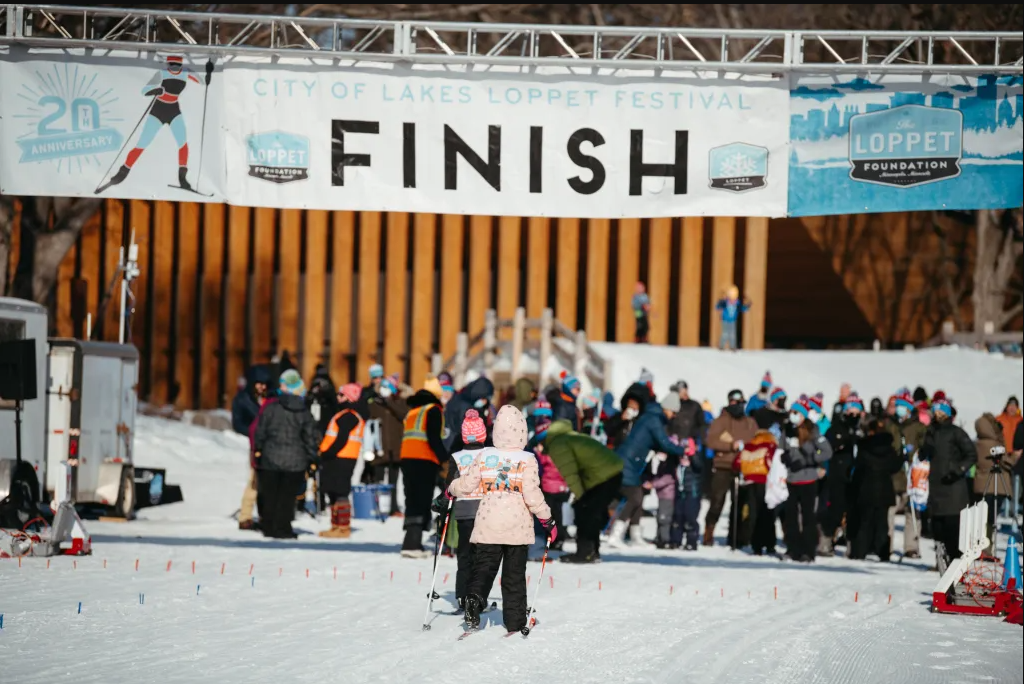
The Loppet Foundation’s City of Lakes Loppet in 2022 at Theodore Wirth Park, home of the World Cup in 2024. (Photo: Loppet Foundation).
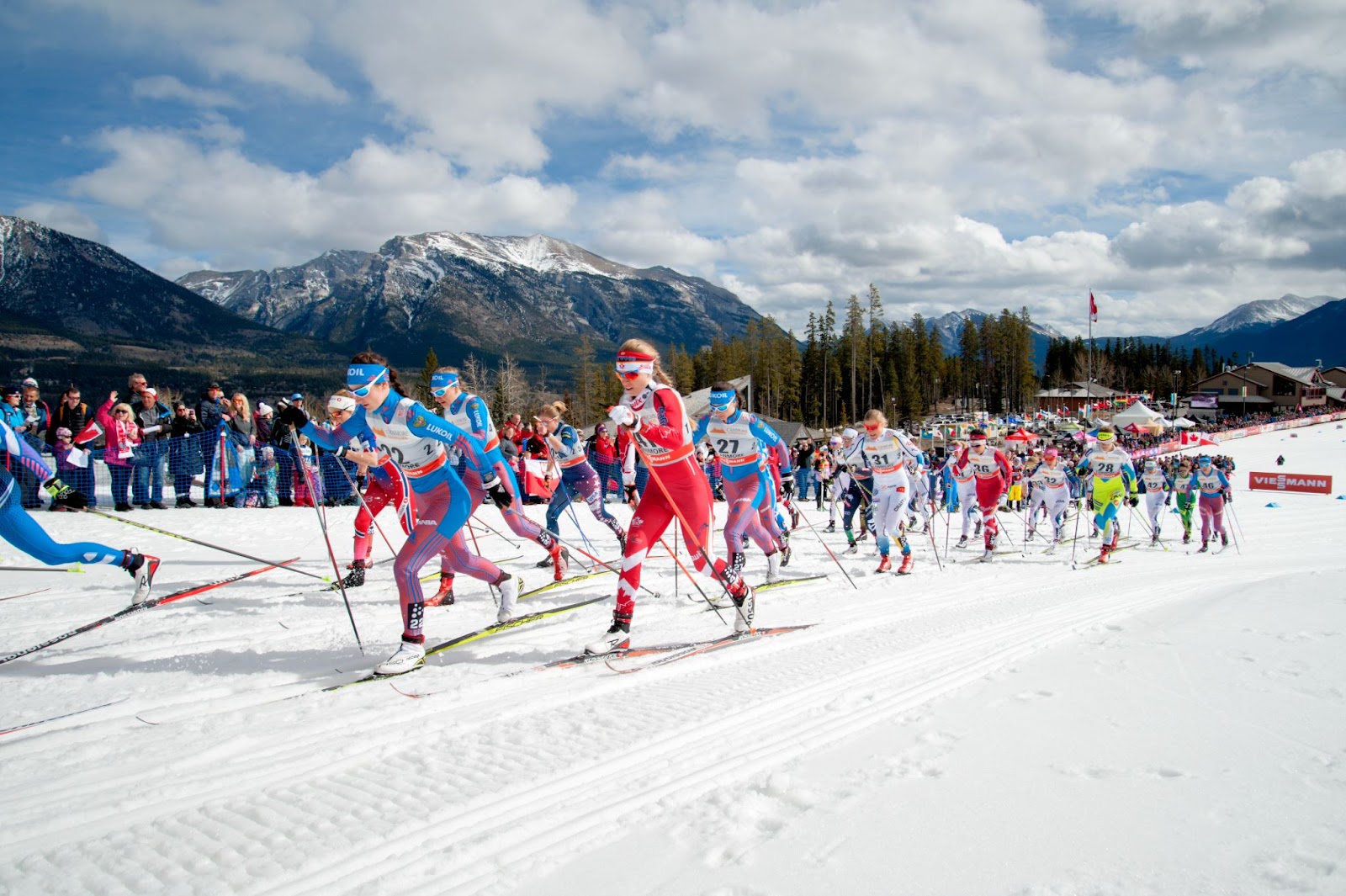
Canmore Nordic Centre Provincial Park hosted World Cup racers during Ski Tour Canada, 2016. Canmore is again scheduled to host FIS World Cup Cross Country events in February, 2024. (Photo: Pam Doyle Photography)
Canmore, Alberta—February 9-13, 2024
The Alberta World Cup Society (AWCS) will host the COOP FIS Cross-Country World Cup for three race days at the Canmore Nordic Centre Provincial Park and one City Sprint in Calgary from February 9-13, 2024. This marks the seventh time that AWCS has invited the world’s best skiers to experience Alberta’s world renowned Canmore Nordic Centre Provincial Park. And a new challenge has been undertaken by the organizing committee, hosting a City Sprint in Calgary! The Calgary City Sprint on Prince’s Island Park will be the first of its kind and all Calgarians will be invited to take part in this exciting event.
“Hosting of international events in Canada is critical for the development of Canadian skiers but also for FIS to truly deliver its mandate as an international federation,” said Stéphane Barrette, CEO, Nordiq Canada. “We are grateful to have another opportunity to partner with FIS in hosting these World Cups next February to continue building the profile of cross-country skiing around the World.”
To request additional information, please contact Nancy Richard at (403) 585-0503 or nrichard@albertaworldcup.com
Minneapolis, Minnesota—February 17-19, 2024
After their events in Alberta, World Cup athletes will travel to the United States for two more races when the Loppet Foundation, Share Winter Foundation, and U.S. Ski & Snowboard will welcome the world to Minneapolis’ Wirth Park for the COOP FIS Cross Country World Cup Feb. 17-19, 2024 (date pending final FIS confirmation). This will also mark the first time in two decades that such event has been staged on American soil
The Loppet Foundation was prepared to host a Minneapolis World Cup in March 2020, but that event was canceled due to the coronavirus pandemic. The Loppet Foundation looks forward to hosting in 2024 while building on preparations made for the 2020 event.
“We are thrilled to work with the Loppet Foundation and Share Winter Foundation to bring back a cross country World Cup to the states,” said President and CEO of U.S. Ski & Snowboard Sophie Goldschmidt. “We know that this event will be a huge success and allow our athletes to showcase their incredible talent in front of a community that has always supported this sport.”
Minnesota native, Jessie Diggins, is the most decorated American in Olympic Cross Country Skiing. (Photo: NordicFocus)
“I’m excited to give ski fans from around the U.S. a chance to see the action up close for the first time in over 20 years,” said US Team standout—and Minnesota native—Jessie Diggins. “I am so proud to represent Minnesota as one of the first American athletes to win Olympic gold in cross country, and now to bring the sport I love to the state I call home.”
The Loppet Foundation is a 501(c)(3) nonprofit organization that connects people to the outdoors through experiences that grow community. Learn more at loppet.org.
Share Winter Foundation (Share Winter) is a non-profit grantmaking organization working to improve the lives, health, and fitness of youth through winter sports, and create a more diverse, inclusive, and welcoming winter sports community. Learn more at www.sharewinterfoundation.org.
U.S. Ski & Snowboard is the Olympic National Governing Body (NGB) of ski and snowboard sports in the USA, based in Park City, Utah. For more information, visit www.usskiandsnowboard.org.
A look at what’s ahead for the Birkebeiner, and its former home at the Telemark Lodge.
When I reached out to American Birkebeiner Ski Foundation (ABSF) Executive Director Ben Popp before Christmas to set-up an interview discussing the Birkie’s plans for the now-defunct Telemark Lodge property, he was already putting plans into action. An interview would have to wait until after the holidays, because that weekend ,the Birkie was hosting a SuperTour race which would serve as a test event for its start-line venue in a bid, along with the Loppet Foundation in Minneapolis, to host an FIS World Cup in 2024.
Bringing a World Cup to Cable, Wisconsin is ambitious, but then again, when Popp is involved with the Birkie, energy and momentum are not the barriers. It’s not a question of “if”, but “how big” the end project will be. Since starting with the Birkie in 2013, he has overseen the expansion of what was already America’s largest race into a year-round docket of endurance programs.
For Popp, that expansion has been done with a forward-looking vision that is deeply rooted in his own history. A son of Wisconsin’s Northwoods, he witnessed first-hand the outsized dreams of Birkie founder Tony Wise, who at the opening of the Telemark Lodge in 1971 invited US Olympic Gold Medalist in Alpine Skiing Billy Kidd, and found his reaction to be simply, “[Telemark] is the only place where the Lodge is bigger than the ski hill!”
Ben Popp, Executive Director of the ABSF. (Photo: ABSF)
For the original Telemark, that turned out to be both an intrepid mantra, and its ultimate failing. Which leads me back to why I initially reached out to Popp – discussing the Birkie’s purchase of the now-closed Lodge and its demolition last year, and the new plans to build a dedicated Nordic Center on the former site.
Our conversation, though, turned into something much more akin to sharing a round of Leinie’s at Seeley’s famous Sawmill Saloon. Which is to say, Wisconsin skier to Wisconsin skier, cheesehead to cheesehead, Ben to Ben, we covered a lot of ground. The result is a conversation that covers the idiosyncrasies of a very specific place in the skiing landscape – Wisconsin – but by doing so gestures towards contemporaneous issues in the development of our sport in the US from a multitude of perspectives, all wrapped up into one professional – Ben Popp.
The excerpts below touch on, among other things: how the Birkie views plans for new infrastructure as supporting their mission; how skiing organizations are planning a sustainable future for the sport; and how Wisconsin skiing can develop the next generation of elite skiers from its ranks.
(This interview has been edited for length and clarity.)
FasterSkier (Ben Theyerl): The Birkie Foundation (the Birkie) now owns the former site of the Telemark Lodge, can you bring us up to speed on what’s happened since you bought the old Lodge last year, and what the plans are for the future there?
Ben Popp (BP): In February 2021, we closed on the property. As part of that agreement, we had to commit to raising the money to remove the building. That turned out to be a challenge, because generally people don’t like to give money to tear things down – that’s not very exciting.
To make up the costs, we decided to sell 250-acres on the far-western edge of the Telemark Property that didn’t have any trails on it, and to try and conserve it into perpetuity. Landmark Conservancy bought that property; it’s now the Telemark Forest Preserve.
That brings us to now. The building is down. We just applied for a $7.5 million dollar grant with the federal government to build a Nordic Center (details here) which will be LEED Platinum certified. We’re also working on a huge solar-array with Dairyland Cooperative, which would help us offset [the carbon emissions] from our snow-making operation [at the Birkie start venue and Telemark].
That’s the the nuts-and-bolts that got us to where we are now, which is the idea that Telemark is vital to: one, the economic activity of this region, and two, for the Birkie to carry out our mission of having amazing experiences while getting people outside, we need a medium, and this is the place for it.
(Photo: Telemark Education Foundation)
FS: As a follow-up, what’s the timeline looking like for the Nordic Center?
BP: The timeline is tricky. We’ll hear back on the grant in June, which with the current construction market would make breaking-ground this year very hard. We have said though, that now is the time to start planning, so that’s what we are doing.
What we’ve already started implementing is additional snowmaking, so that we could successfully host the Super Tour in December (2021). What’s interesting about that is we’ve still only invested $400,000 into it, which, yes, is a lot of money, but in the world of snowmaking is nothing. [For example,]Battle Creek (in the Twin Cities) is going to be about $5.6 million dollars. I give a lot of kudos to our crew for [what they were able to do for the SuperTour], having 3.75 kilometers of trail open before December 10th, but the reality is that was such a heavy lift, and we’re going to have to invest another $1 million into our snowmaking system to make it sustainable and reliable.
FS:The Birkie has a lot of other projects outside of Telemark. How do you see Telemark intersecting with those?
BP: That’s one of the highest priorities for us. If we look at our mission: one, putting on great events; two, being stewards of the [Birkie] trail; and three, providing opportunities for people to be active outside. Getting Telemark ready for events is critical to part one and three. You could argue that this isn’t directly related to how you improve the Birkie Trail, [part 2 of our mission]. But by way of getting more people involved, it gives us the capacity to put resources into the Trail.
FS: There also seems to be more of a faith in the Birkie Foundation to get Telemark right than past attempts at reviving the property. How have you built trust in the local community and gotten them involved in what the Birkie is doing?
BP: I think there’s two parts to it.
One, doing what you say we are going to do. [In the past,] people saying “we’re going to rebuild Telemark!” and then never having it happen just made it worse and worse. For us, starting back in 2013-14 when we said we’re going to raise $750,000 and buy an area for a new Birkie start line and build a bridge over highway 63 at OO, we got reactions of “no way, no way” and then…we did it! I think little steps like that start to prove to the community that you’re worthy of trust.
Two, it’s being really involved in the community and being open to other nonprofits. That allows us to openly invest in the community. We donate over $50,000 to the [Hayward] schools and their initiatives. Instead of us looking at simply how we leverage the assets around the community, we look at how we can partner with them so it’s good for both parties. That example is very local in Cable/Hayward, but we also help with initiatives around Wisconsin/Minnesota that need help get projects off the ground.
Like as an example I was just brainstorming with Claire Wilson (Executive Director of the Loppet Foundation in Minneapolis, MN) – how cool would it be to do some kind of exchange program where we’re going to send kids from the Northwoods to go down and experience living in Minneapolis and skiing at Theodore Wirth, and vice versa, they send kids up here and we can house them at Telemark and they get to spend a week in the woods [and make them say] “wait, where’s the stoplights?!” Those would be opportunities that would be awesome.
The remnants of the Telemark Lodge lobby in winter 2022. The Birkie has started grooming trails on the Telemark Property from the adjoining Birkie startline just a half-kilometer away. (Photo: ABSF)
FS: You’ve also startedTeam Birkie (a pro-racing development team that launched this summer) that’s already had success getting skiers to the World Cup.
BP: Yeah, we want to bring in the elite athletes to train [in Cable], that’s whatTony Wise (Telemark, and Birkiebeiner founder) used to do. I mean the U.S. Ski Team – Marty Hall and Bill Koch – they were here! They designed our trails! We need to figure out how we get our elite athletes, our role models, to stay in the Midwest and train so that they can inspire our kids here. The next Jessie Diggins can, but shouldn’t have to go out and live elsewhere, which is how it currently stands with Midwestern skiers. But they can’t spend time here if we don’t have roller-ski loops, snowmaking, and the things that they need to get better at their profession.
[Your dad] (Ted Theyerl, former Wisconsin Nordic Ski League President) has a great way of putting it. Trying to teach skiing without reliable snow is like trying to teach basketball if the gym is there only once every other week.
Team Birkie’s Zak Ketterson takes command through the heats to win the classic sprint during last December’s Gitchi Gami Games – the Birkie’s SuperTour event. (Photo: American Birkebeiner Ski Foundation.)
FS: That part is something I look at with a lot of potential based on my experience at Telemark. I intersected with the brief period [around 2010] when CXC (Central Cross Country Skiing) was trying to use Telemark Lodge as a training center. I remember going into what used to be the nightclub at the Lodge, which they were using as our dining hall, and sitting down and Jessie Diggins was at the table, and it made us juniors go “Holy crap!” That’s so inspiring.
BP: You’re right that’s inspiring!
FS: In a similar way, I wanted to get your personal perspective on what Telemark has meant to you, and the community in the Northwoods, and how that drives your plans and the Birkie Foundation’s plans?
BP: I mean I grew up in northern Wisconsin and I remember as a kid going over to Telemark and being like, “Woah, where am I? This is incredible!” Telemark was just an incredible economic and cultural driver.
I think personally my motivation is that this project is going to create a ton of opportunity, and essentially extend the reach of the Birkie Foundation and what we do. I often use a statistic when we are out on the road. If you draw a circle 50 miles around Cable/Hayward, 90% of our revenue comes from outside of that circle. But we spend over 80% of our revenue within that 50-mile Hayward/Cable circle. The bigger the Birkie gets then, the more gets spent here in our community.
FS: And now, to me, the additions of the Super Tour and the World Cup build on that spirit of Tony Wise saying we can dream big, and we can do it in Cable, Wisconsin. I was wondering if you find inspiration in that spirit? What is your “wish list” as an Executive Director for the next 10 years for the Birkie Foundation?
BP: Tony is an inspiration, no doubt about it. TheWorld Cup is a great example. Is hosting in 2024 going to be a ton of work? It is going to be a ton of work. But to do it as a part of the 50th anniversary of the Birke, bringing it full circle to Tony having the first World Cup here back in1978, and his creation of the Worldloppet, well it will: one, shine a light on the sport that we love; and two, on the Midwest, where many times even from a ski standpoint people think you just fly over it.
Then we go, “How do we get to doing it?” Well, we’ll take it step-by-step.
Tony was really vested in making sure Telemark and the Birkie benefitted his community and had a primary focus on getting people outside and being active. While [Telemark] isn’t going to be a lodge with 200 rooms, it is going to be cut from the same cloth of getting people outside, skiing in the Nordic community, and being connected to the world at-large.
That [last part] was especially important to Tony – he was a tank commander in World War II for goodness sakes, and learned to love Scandinavia and Austria along the way – so for us there must be that worldly component of the Birkiebeiner. Being a WorldLoppet and us trying to bring a World Cup here in 2024.
That gives us comfort knowing that where we’re going, well, with the historical vision Tony had, it’s one and the same.
Rosie Frankowki races the classic sprint qualifier in Cable, WI during the Gitchi Gami Games. (Photo: American Birkebeiner Ski Foundation.)
FS: Final question: The Birkie and you have been a leader in sustainability in the sport over the past couple of years, how do you see clubs, organizations, and the sports headed towards a more sustainable future? Especially the shift to going fluoro-free in waxing so it’s sustainable for the environment, but still equitable so that the best skiers are rising to the top?
BP: That’s a great question. For the Birkie, the sustainability piece is at the forefront for everything we’re doing. It’s tough because we balance the environmental, actual sustainability of the sport – skiers getting into skiing and staying in skiing – and the financial. If we go 100% and do everything possible on the environmental front, which would be the ideal, then we’re not going to be able to be financially sustainable and therefore the sport isn’t here in the Northwoods in 5 years. It’s about how you marry those three things in an optimal amount.
At the Birkie, we want to remain at the forefront for years to come.
FS: What’s your dream in that respect?
BP: My ultimate dream often comes when I think about the World Cup.
How amazing would that be to line up Jessie Diggins next to Johannes Høsflot Klæbo, next to your dad, my mom, a kid from Minneapolis who didn’t know what skiing was two years ago, a kid from the Lac Courte Oreilles reservation, and on and on.
I like to think that Klæbo may be just as inspired by a kid out on skis for her first time as I might be sitting at home watching him on the start-line. When we all get to sit at the same table, we all get to inspire each other, and that’s what I’m working towards at the end of the day.
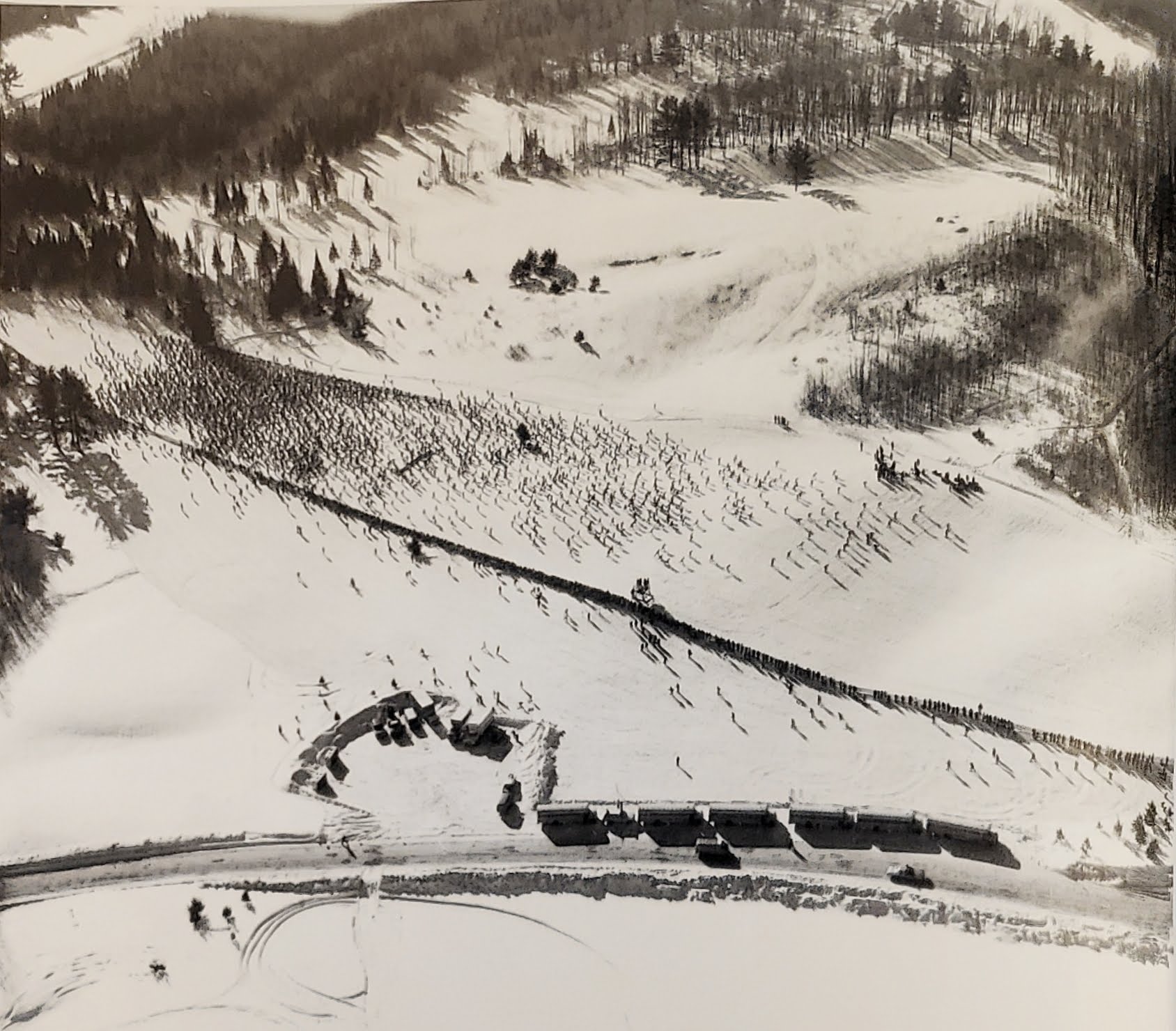
The American Birkiebeiner takes off towards Mt. Telemark in 1978. (Photo: Telemark Education Foundation)
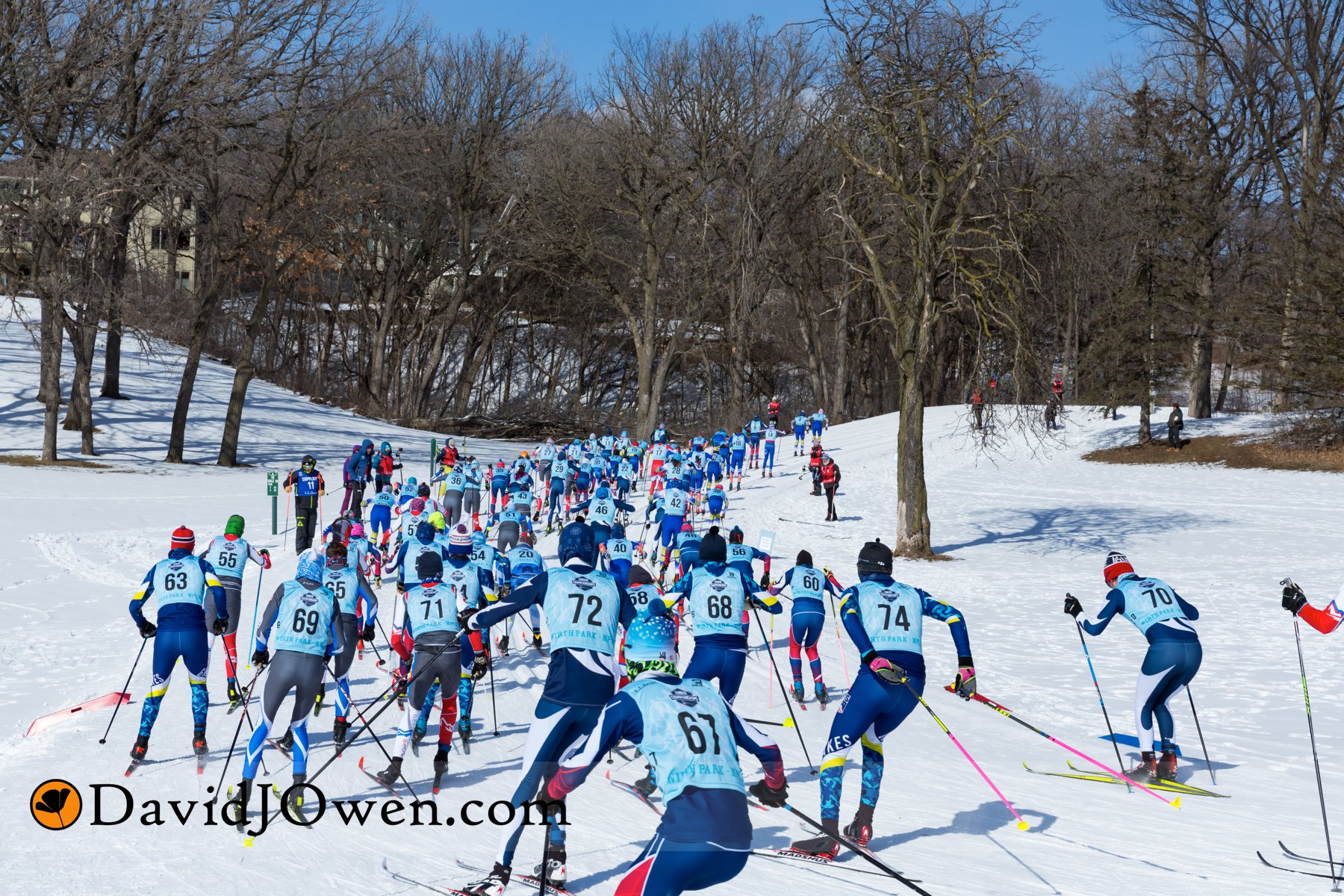
The U18 Girls field works its way past the Loppet Foundation Adventure Center at Theodore Wirth Park in Minneapolis during Junior Nationals on March 11th, 2022. (Photo: David J Owen Photography)
To trace the thread of the past, present, and future of American cross-country skiing, all you have to do is look at a golf course in Minneapolis that touches 3 of those 10,000 lakes in Minnesota; Theodore Wirth Park.
Over the past week, America’s most-skied loop played host to the US Ski and Snowboard Junior Championships (formerly Junior Nationals, or “JNs”), bringing the top under-20 year old skiers from across the nation together for the first time since 2020s JNs in Truckee, CA were forced to cancel mid-competition in the panicked early days of the COVID pandemic.
Two years later, the performances by the nation’s top junior skiers seemed to be nothing less than a brighter future put into motion. A week of skiing which saw athletes from Maine to Alaska, and anywhere in-between with enough snow, push each other, and the future of US skiing, forward.
Wirth Park Finally Gets to Host the Show
Last week marked just the second time that JNs was held at Wirth Park since its inception fifty-seven years ago.
The first was just eleven years ago in 2011, when an air of real possibility had just started to take hold in US skiing. Names like Kikkan Randall and Andy Newell were forging a path with their results on the World Cup. The Loppet Foundation, a decade into growing the sport in America’s most Nordic-centric city, was drawing up plans to turn Wirth Park, and Minneapolis, into an American Oslo. Competitors and spectators came to the 2011 Junior Olympics (as JNs was then known) with the idea that what they would see was a first glimpse into the future of skiing, in the US and beyond.
Some of what they saw was in part gimmick. The sprint race, for example, was held at night on purpose despite Wirth’s lighting being pretty much a few old trail lamps augmented with a couple of generators and some hip string lighting.
Some of what they saw though, was the real deal. Including the Female OJ (U20) skier from just down the road in Afton who won every race she could that week; Jessie Diggins.
In the intervening decade between then and now, Diggins went on to change the sport forever in the US, and actively reflected it back on the prime venue in her home state. She led the campaign lobbying the FIS to put a World Cup at Wirth on the calendar, and that vision for the future was set to be realized in March 2020.
The new homologated sprint course at Wirth had the FIS starting gates in the snow, bleachers set-up, and starting double-pole tracks set when it was canceled due to the COVID-19 pandemic on March 12th, 2020. The Loppet Foundation closed its new glass-fronted chalet a week later.
Wirth Park and Minneapolis were pushed back into looking forward to the future once again.
Two years later, the starting gates were repainted with the US Ski and Snowboard logo, the sprint course was ready, the start tracks set once again, Diggins was sending her best wishes, and Wirth Park would finally get to see its future vision for skiing come into the present.
Just how far Wirth, JNs, and skiing in the US had come, was on full display. Whereas JNs just a few years ago was only possible to follow from afar if you were willing to carefully read results sheets, the 2022 edition came with a full four camera set-up and commentary team provided by Engage Livestream Broadcasting. You could now watch nearly every corner of the Theodore Wirth Park course from anywhere, and according to Loppet Foundation, nearly 83,000 viewers did.
The Wirth course has evolved quickly in the past few years to adapt to the age of climate change, homologation, and well…live broadcasts. The traditional 5 k course at Wirth, which sent skiers out from the maples and oaks onto the windblown golf course, was eschewed to race either a 2.5 k or 3.3 k lap (depending on the distance) that concentrated the park’s unique, urban, time-tested terrain. Over the crest of the downhill that u-turned into the A-climb, skiers would view the Minneapolis skyline. On the new sprint course, they stormed up the tow rope line of a tubing hill. The middle-section made use of the out-runs for the now-demolished ski jumps, where skiing in America got its start with the Norwegians who founded Minneapolis in the 1800s.
The Minneapolis skyline visible in the distance from the finish area at Theodore Wirth Park on a cold, sunny March day during Junior Nationals last week. (Photo: David J Owen Photography)
Of course, none of this pomp and circumstance was on the minds of the skiers who looked at Wirth park’s course with one question on their mind: how do I ski it faster than anyone in the country?
A Week of Racing: the Junior Nationals Program
Over the week-long course of JNs, about four-hundred junior skiers sought an answer to that in a four-race program. They started with an individual start freestyle 10/5 k, then an individual classic sprint, then a 15/10/5 k classic mass start, and finally a 4 x 3.3 k mixed team relay. Each race was held as a separate event, meaning four distinct opportunities for athletes to win the title of junior national title. Each event also contributed to the cumulatively scored Alaska Cup – the top regional team in the country , the Junior National Club Team Classification – the top junior club, and the Roger Weston Trophy – the top high school team. Skiers competed against others in their age classes: U16s, U18s, and U20s.
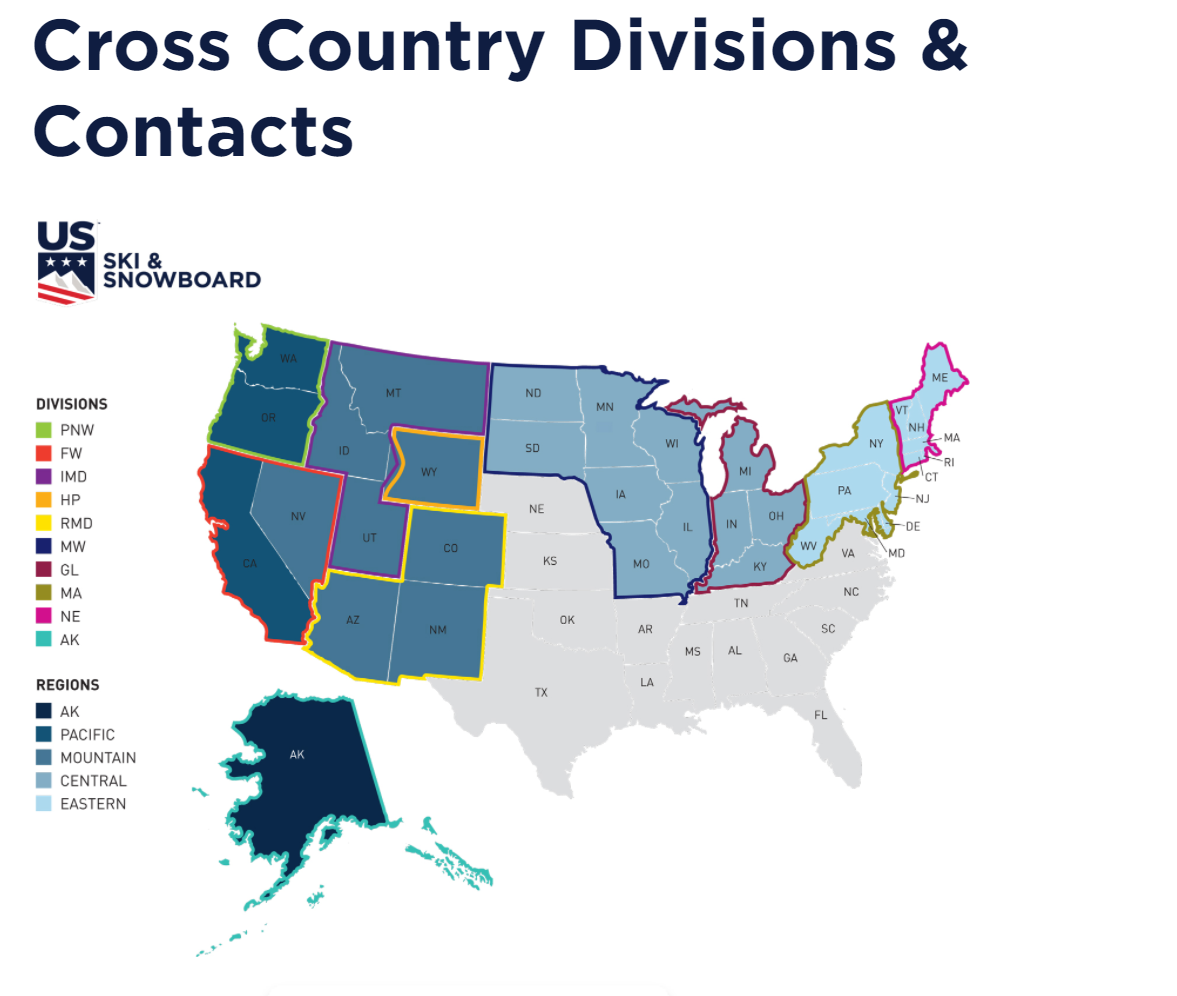
In keeping with tradition, skiers competed for their regional teams, which proves to be an ever-evolving and wonky geographical distinction at JNs. Clubs leave and move divisions, and especially when high schoolers turn to college skiers in the U20s, skiers who may be from one division might ski for another (i.e. a skier from Alaska going to school in New England might qualify for the New England U20 team). Generally the map below shows the regional break-up of teams*:
Geographical make-up of each division that competed at Junior Nationals in 2022. *Note: Wisconsin started competing with Great Lakes in 2020, and did so this year as well. (Photo: US Ski & Snowboard)
The sheer amount of racing that occurs over the week of JNs is overwhelming in a way that’s inspirational – speaking to the depth and excitement that US skiing can expect in years to come. However, there were names and performances to highlight, and so here we look briefly at each race.
Monday: Individual Start 10k/5k Freestyle
After a weekend of course preview in which the skiers of America were greeted with the local Midwestern custom of a too early March rain, the JNs program began on a sunny Monday where the temperature stayed in the mid-high 20s (Fahrenheit). The snow left from the snowstorm a week before (another Midwestern custom, the Birkie-week foot of snow) combined with the man-made base to produce fast conditions.
The week kicked off at 9:00:15 with Minneapolis’ own Greta Hansen (Midwest, Minneapolis Ski Club) starting in bib 1 in the female U18 5 k race. The female U20, U18, and U16 fields were combined in the 5 k, before being separated by class in the results.
Combining the fields yielded the first intriguing result of the week, when U18 racer Ava Thurston (New England, Mansfield Nordic Club) finished the race in 1st nearly a minute (14:18.9) ahead of 2nd place (and first place U20) Nina Seemann (+55.6 seconds). Thurston had a similar advantage over 2nd place U18 (and 3rd overall) Maggie Warner (+56.1) (Midwest, NordicWerks). In a field of the best skiers from across the country, Thurston also proved to be one-half of the extraordinary feat of being joined by a teammate on the podium. Hattie Barker, also from Mansfield (New England), was the 3rd U18 (+57.3 sec).
Thurston, who was named to the U18 Nordic Nations Cup US team (the event, set to be held outside of Trondheim, Norway was canceled at the end of January due to COVID-19), had begun a banner week.
In the U20 girls, meanwhile, Seemann topped the field ahead of 2nd place Aurora Cramer (Intermountain, Sun Valley) (+3.9 sec). The Dartmouth freshman came to US Junior Championships after having competed for the US at World Junior Championships just a few weeks ago. The U20 podium was rounded out by New England’s (Gunstock Nordic) Catherine Stow (+25.9 sec).
In the U16 girls race, host club Loppet Nordic Racing (LNR) got its first national champion on its home turf. Sydney Drevlow (Midwest) finished the 5 k in a time of 15:36.8 for 1st place, and was joined on the podium by her teammate Inga Wing (Midwest, LNR) in 3rd (+13.7 sec). In between them was Pacific Northwest’s Neve Gerard (Mt. Bachelor) in 2nd (+11.6 sec).
The U20/U18 Boys 10 k field would see similar results to their female counterparts, with top athletes having come fresh-off of qualification for the Nordic Nations trip or Junior World Championships.
Like the girls field, there was one boy who stood out immediately with his result in the skate race. Alaska Pacific University’s (APU) Michael Earnhart (Alaska) continued a breakout year that’s seen him post strong results at Junior World’s, Senior Nationals, and on the SuperTour alike, winning a junior national championship in a time of 22:02.5. He was followed in the overall by the U18 National Champion Adrik Kraftson (Midwest, LNR) (+13.1 sec), and U18 2nd place Jack Lange (New England, SMS) (+16.2). Wes Campbell (Intermountain, Park City) rounded out the U18 podium (3rd) in 4th overall (+23.5). All three U18s were set to be teammates on the Nordic Nations trip that was canceled in January, but would make-up for the chance to get familiar with each other there by seeing plenty of each other on the race course the rest of the week.
Midwestern skier Adrik Kraftson (LNR) lies on the Wirth Park snow in exhaustion after a race a JNs. Kraftson had a week of impressive results, including a 2nd in the U18 Boys 10 k Freestyle and the fastest leg in the U18 Team Relay. (Photo: David J Owen Photography)
The U20 podium was rounded out by Alaska’s Alexander Maurer (Alaska Winter Stars) (+35.0) in 2nd and University of Vermont (UVM) freshman Aidan Burt (UVM) (+37.8) in third.
The U16 boys would see a tight 5 k race. Green Mountain Valley School’s (GMVS) Tabor Greenberg (New England) delivered a big win for New England in a time of 13:37.4. He edged out Alaska’s Murphy Kimball (AWS), who was 2nd (+4.1). New England did place another on the podium though, with Stratton Mountain School’s (SMS) Micah Bruner in 3rd (+11.5).
The first day allowed skiers that had come off of the World circuit to re-establish themselves at the forefront of US skiing, and saw young promising skiers have their first “big” results on a national stage. A familiar picture for the Alaska Cup also began to take shape, with New England, Midwest, Alaska, and Intermountain all prominent at the top of the results.
Wednesday: Classic Sprint
The Minnesota sun was still high above Wirth Park, but by Wednesday skiers and coaches realized they had come to visit the land of the wind chill factor. Highs were in the single-digits with the wind blowing across the hills of Wirth.
While the new sprint course kept mostly in the park’s trees to mitigate the wind, the cold, transformed snow on a Classic day surely sent a couple of wax techs to parts of their boxes they don’t visit very often (base klister, anyone?). Then again, with the best skiers in the country come the best wax techs too.
Still, the Wirth sprint course that had been designed for the World Cup required those techs to be on their A-game. After turning out of the marsh bottom the start-area sits in, skiers were greeted by the wide, four-lane, long climb that begins all Wirth courses, before a series of rolling hills sent them straight up the steep, rope tow lift line A-climb. Then, the course twisted and turned before popping over a bridge that led to the finishing straight.
In terms of tactics, the climb-heavy course would allow only the strongest of skiers a little maneuvering. If you could stay below full-bore on the first climb, then you could throw in a commanding push over the top of the A-climb. The final half-kilometer had enough mitigating turns and bumps that would wipe out an attempt to draft into the finishing line, and so there wasn’t much reason to hold back before then.
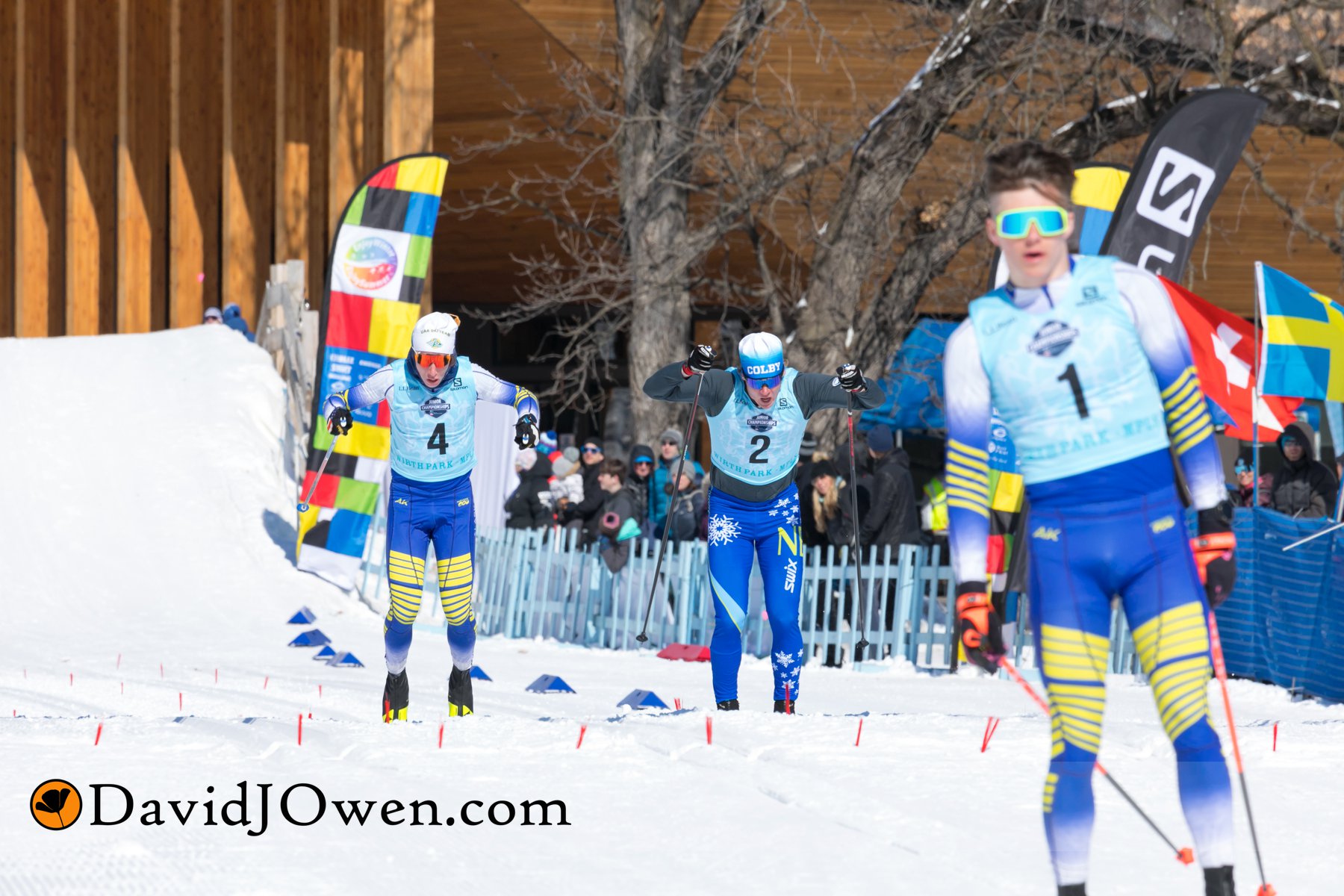
One skier who did have the capacity to use the tactic of waiting for the A-climb proved to be Michael Earnhart. In the Boys U20s final, Earnhart tucked into a pack that contained the whole field: Jack Young (New England, Colby College), Peter Hinds (Alaska, APU), Aidan Burt (New England, APU), Jack Christner (New England, Middlebury College), And Anders Weiss (Rocky Mountain, Aspen Valley Ski and Snowboard). On the A-climb, he moved out of the track and attacked, coming over the top in first. The U20 field yielded a strong response, and when they came over the top of the bridge, the gaps at the top of the climb had remained the same. Earnhart was followed by Colby freshman Jack Young who came in like a Mule (shameless bad pun) in 2nd (+0.2). Rounding out the podium was Hinds (Alaska, APU) in 3rd (+1.6 sec)
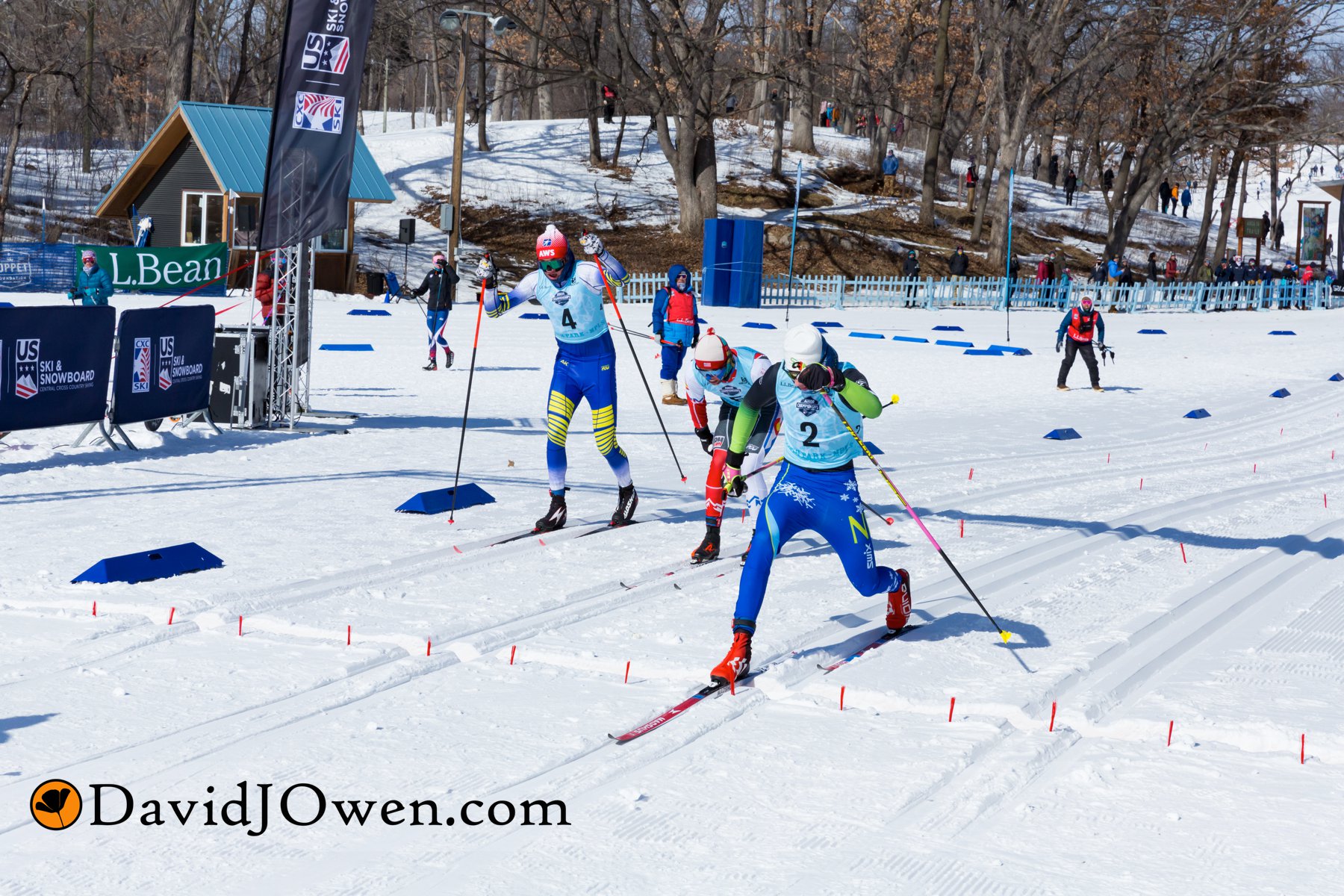
Jack Young (New England, Colby College) outsprints Peter Hinds (Alaska, APU) for second place in the U20 Classic Sprint Final behind winner Michael Earnhart (Alaska, APU). Along with the Classic Sprint, Earnhart also won both the Individual 10 k Freestyle and Classic Mass Start 15 k at JNs. (Photo: David J Owen Photography)
In the Girls U20s final Nina Seemann (New England) was able to establish a gap from the gun and hold it. She claimed her 2nd win in as many races -5.9 sec ahead of the College of St. Scholastica’s Mia Case, who raced for her home division Great Lakes (Case is from Minoqua, WI). In 3rd place, by a ski, was Northern Michigan University Freshman Lauren McCollor (+0.1).
The boys U18 final saw Finegan Bailey (New England, SMS) establish a two-man break alongside Trey Jones (Rocky Mountain, Steamboat Springs), before Bailey pulled ahead in the final stretch. Bailey won, with Jones 2nd (+0.4), and Adrik Kraftson (Midwest, LNR) taking his second podium of the week in 3rd (+5.6).
In her second breakaway win of the week, Ava Thurston (New England, Mansfield) commanded the field to win by -5.8 sec over Jackson Hole’s Kate Brigham (Intermountain). Molly Moening (Midwest, Minneapolis Ski Club), another Nordic Nations team qualifier, rounded out the podium in 3rd place (+7.9 sec).
Finegan Bailey (New England, SMS) celebrates after winning the U18 Boys Classic Sprint ahead of Trey Jones (Rocky Mountain, Steamboat Springs). Midwestern skiers Adrik Kraftson (LNR) and Benon Brattebo (LNR) sprint for 3rd in the background. (Photo: David J Owen Photography)
When the U16 boys raced their final, the runner-up from Monday Murphy Kimball (Alaska, AWS) was willing to animate the race as it hit the first hill. When they got to the A-climb, the only one in the field who could match his climbing was Midwest’s Miles Miner (Minneapolis Ski Club). The pairing raced to the finish, with Kimball opening a gap to take first and Miner in 2nd (+1.9 sec). In the ensuing sprint for third place, one of the layered nuances that makes JNs a great national gathering for the ski community played out. Winning the sprint for 3rd was New England’s Ellis Slover (+8.6 sec), who hails from Quarry Road Nordic Ski Club in Waterville, Maine. The small detail of the home club can seem small, but for a club that’s only a decade old tucked into a town in Central Maine, having a junior on a national podium takes every bit of the ski community working towards one goal, and represents a joyous breakthrough. “QRSC for the win” commented Slover’s teammate Beckett Cote on his result (who is also the author’s cousin). Indeed.
The U16 girls race saw Sun Valley’s Cora Faye Scott (Intermountain) establish a lead late in the race over a pack of three. In the sprint for the final two podium spots Maeve Ingelfinger (Intermountain, GNT) (+2.5) got 2nd and Lucy Perkins (Rocky Mountain, Ski and Snowboard Club Vail) finished third (+2.6).
The day of sprint racing saw racers who had already had top results earlier in the week show their dynamism as skiers, and those who may go on to specialize in the discipline have affirming results. The regional mix still leaned heavy towards New England, Alaska, and the Midwest, and half-way through the week, it seemed those three would be racing for the title in the Alaska Cup.
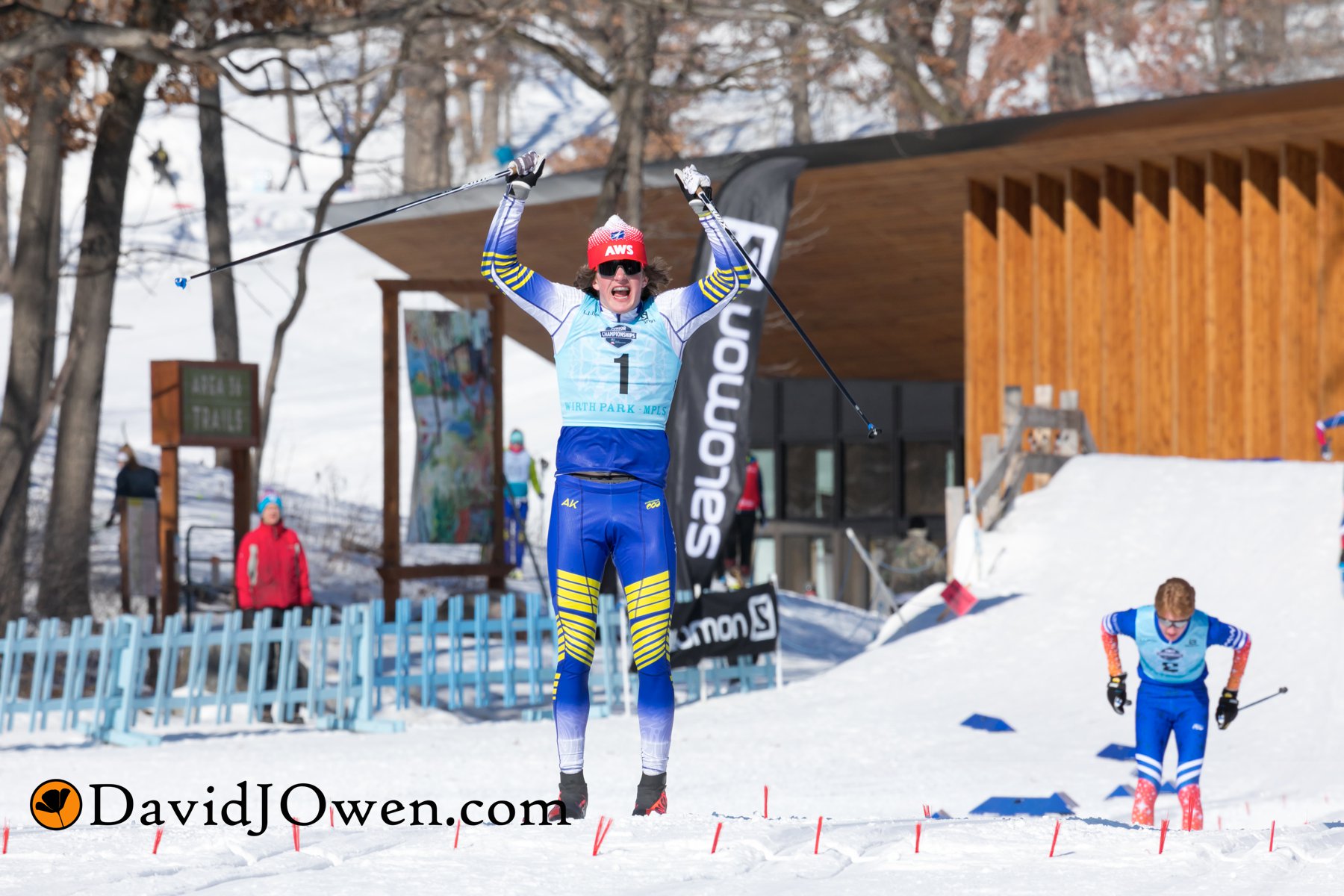
Murphy Kimball (Alaska, AWS) lifts his poles as he celebrates a national title in the U16 Boys Classic Sprint. 2nd place Miles Miner (Midwest, Minneapolis Ski Club) sprints in the background. (Photo: David J Owen)
Friday:15 k/10 k/5 k Classic Mass Start
By Friday, the air had gotten colder (highs in the single-digits) and the wind had gotten blowier (the windchill well below zero). Even worse, skiers would leave the wooded-protection of the sprint course to face the wind head-on for a u-turn hill out in the open on the golf courses fairway. It was a mass start though, so at least they’d have each other.
The closest race on the day came from the U16 Boys field, which raced 2 laps of a 2.5 k loop for their 5 k. A pack of 4 skiers came together on the second lap, which included Landon Wyatt (Intermountain, BSF), Tabor Greenberg (New England, GMVS), Benjamin Barbier (Rocky Mountain, Steamboat Springs), and Elias Soule (Alaska, AWS). Wyatt was able to make a move in the last kilometer to give him a small advantage over the field, and came away with the national championship (14:38.2). In another sprint for 2 podium places with 3 skiers, Tabor Greenberg (New England) was able to take 2nd (+1.3), and Benjamin Barbier (Rocky Mountain) 3rd (+2.0).
The U16 Girls field yielded just as impressive performances. Sydney Drevlow came back for a second convincing distance race win on the week, claiming another national championship twenty seconds ahead of the field (16:25:0). Following her was Rose Horning (Rocky Mountain, Ski and Snowboard Club Vail) in 2nd (+29.1), and the runner-up in the sprint Maeve Ingelfinger (Intermountain, GNT) in third (+33.6).
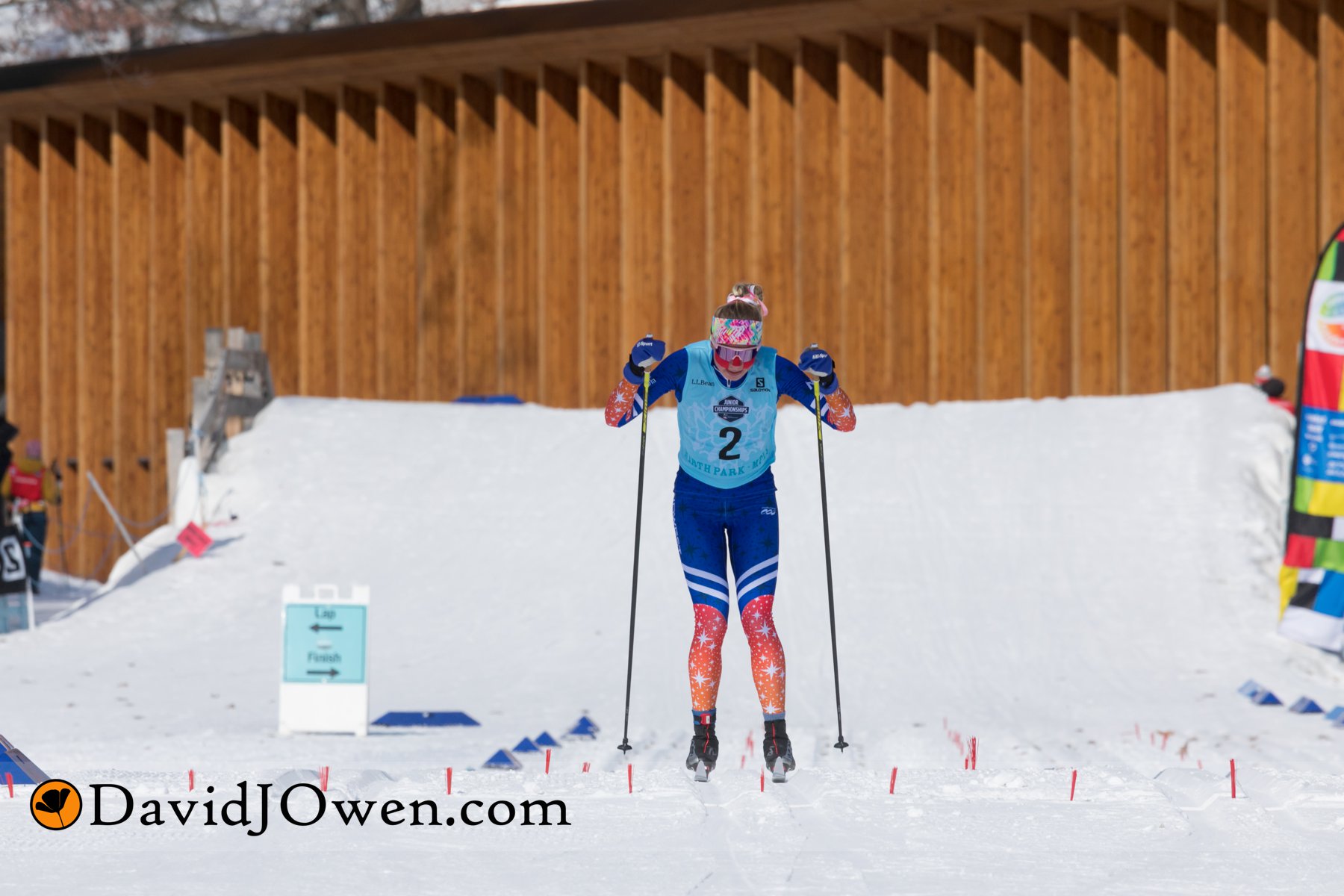
Sydney Drevlow (Midwest, LNR) finishes her second U16 national title of at year’s JNs in the Classic Mass Start 5 k. Drevlow also turned in a commanding win in the Individual Start 5 k earlier in the week. (Photo: David J Owen Photography)
Despite the change in distance, the top of the U18 Boys field still came down to a battle between the top sprinters Finegan Bailey (New England, SMS) and Trey Jones (Rocky Mountain, Steamboat Springs). At the end of 3 laps of a 3.3 k (10 k total) Bailey and Jones were locked in a sprint again. Bailey again got the edge, winning a second national championship on the week (23:57.3). Jones finished second (+0.12). Then, Wes Campbell (Intermountain, Park City) came in to pick up a second podium on the week in 3rd (+9.1).
In the U18 girls 10 k, Ava Thurston could make the gaps she had over the field something you could see with your own eyes on account of the mass start. She came in -26.6 seconds (27:41.5) ahead of 2nd place Nina Schamberger (Rocky Mountain, Summit Nordic Ski Club). Schamberger’s podium capped an impressive season for the 16 year old who made her Junior World Championship debut a few weeks ago. Molly Moening (Midwest, Minneapolis Ski Club) was 3rd for the second consecutive race (+39.1).
With her 3rd win in the JNs program, Thurston inched towards the rare distinction of winning every race at a JNs. In fact, it had only been done once before at Theodore Wirth Park. With one race to go, her path had only been walked by one skier before her – Jessie Diggins. Not bad company.
Ava Thurston (New England, Mansfield) and Nina Schamberger (Rocky Mountain, Summit Nordic Ski Club) after finishing 1st and 2nd in the U18 10 k Classic Mass Start. (Photo: David J Owen Photography)
She was walking that path, though, with two skiers alongside her. In the U20 Girls, Nina Seemann (New England, Dartmouth) came away with her third win on the week (28:50.8). Meanwhile, in the U20 Boys, Michael Earnhart (Alaska, APU) also won a third in his 15 k (40:54.8). Earnhart had a close one, with Alexander Maurer (Alaska, AWS) in 2nd (+1.8) and Aidan Burt (New England, UVM) (+1.8) in 3rd, while Peter Hinds (Alaska, APU) just missed out in 4th (+1.9). Catherine Stow finished 2nd behind Seemann (+18.5), and Aurora Cramer (Intermountain, Sun Valley) finished in 3rd (+28.0).
After three days of individual racing, JNs would turn towards resolving the issue of which region had the competitive edge in the US in 2022. The Alaska Cup, still a close contest between New England, Midwest, Alaska, Intermountain, and Rocky Mountain would be resolved the next day when individual results gave way to regional pride in the team relay.
Landon Wyatt (Intermountain, BSF) leads the U16 Boys field into the final sprint during the 5 k Classic Mass Start. Wyatt would win the race, with skiers (l-r) Elias Soule (Alaska, AWS), Benjamin Barbier (Rocky Mountain, Steamboat Springs), and Tabor Greenberg (New England, GMVS) sprinting for 2nd-4th place.Tabor Greenberg (New England, GMVS) wins 2nd place, with Benjamin Barbier 3rd (Rocky Mountain, Steamboat Springs), and Elias Soule (Alaska, AWS) 4th. Greenberg claimed victory earlier in the week in U16 5 k Individual Freestyle Race. (Photo: David J Owen Photography)
Saturday: Mixed 4 x 3.3 k Team Relays
The team relays were the one part of the program at JNs that changed between 2020 and 2022. The distance of each leg – the same; the number of skiers on a team – the same; but the gender makeup of those skiers – different. In keeping with the World Cup, the teams would feature two boys and two girls. The two boys would scramble the 3.3 k course in legs 1 and 2, while the girls would anchor in legs 3 and 4. One race apiece for the U16s, U18s, and U20s.
There was plenty of variety among how coaches approached putting together their teams, and they presented different results accordingly. There did, however, prove to be one constant across the three age classes. New England would finish in first.
It began with the U16s. New England-1 skier Tabor Greenberg (GMVS) scrambled to come in alongside the Alaska-1 skier Murphy Kimball (AWS) and hand-off in first and second, respectively, together (6:57.8). The duo’s leg was the fastest the race would see. Through the second lap, New England-1 skier Quinn McDermott (Berkshire Nordic) had kept them in front (14:09.9). Elias Soule (AWS) kept Alaska-1 in 2nd, and a strong leg from Rocky Mountain-1 skier Henry Magill (Steamboat Springs) brought them into 3rd. When the girls began to race, Beth McIntosh (Frost Mountain) built on the New England-1 lead, Rose Horning (Vail) went into the final exchange having put Rocky Mountain-1 in 2nd. Inga Wing (LNR) and Adeline Loewen (Plain Valley), meanwhile had put Midwest-1 and Pacific Northwest-1 into 3rd and 4th when Loewen skied up to Wing and came into the final exchange with her. Anchor Sydney Drevlow (LNR) was able to continue the charge for Midwest-1, and with the fastest women’s split (8:25) she moved into 2nd place. In the end, she couldn’t quite catch Annelies Hanna (Ford Sayre), who finished the win for New England-1 (31:37.7). Drevlow brought home 2nd for the Midwest-1 team (+11.2), and Pacific Northwest-1 had ridden their late surge to a 3rd behind the skiing of Neve Gerard (+12.9).
The U18s saw similar close racing throughout the race. Adrik Kraftson (LNR) scrambled with the fastest leg (6:37.5) to put Midwest-1 in first. But Intermountain-1 with Wes Campbell (Park City), New England-1 with Finegan Bailey (SMS) , and Midwest-2 with Cooper Camp (LNR) were all within five seconds. When Jack Lange (SMS) handed off to the 3rd leg though, he had skied New England-1 into first place (13:35), followed by Midwest-1 with David Isom (Minneapolis Ski Club), and Midwest-2 with Jonathon Clarke (LNR) (+4.6). Hattie Barker (Mansfield) built on New England-1’s lead to hand off to the anchor Ava Thurston (Mansfield) in first place (21:42.3). Behind, the skiing of Maggie Warner (NordicWerks) had maintained Midwest-1’s 2nd place (+13.1), and Abigail Haas (FXC) had moved Alaska-1 into 3rd (+24.1) alongside Midwest-2 with Jordan Parent (NordicWerks) in 4th (+24.2). Thurston anchored with the fastest girls leg (7:51.1) to win it for New England-1, and give New England the 2nd win of the day. Midwest-1 skied to second with Molly Moening (Minneapolis Ski Club) anchoring, and Meredith Schwartz (AWS) was able to hold off a challenge from Greta Hansen (Minneapolis Ski Club) to see Alaska-1 finish in 3rd ahead of Midwest-2 in 4th. With that 4th though, the Midwest pulled off the impressive feat of having two teams in the top 5, speaking to the region’s depth.
When the U20s started then, New England was looking for the sweep. Their bid would start with Colby’s Jack Young, who finished his leg with New England-1 in 3rd (+12.1) behind Intermountain-1 with Elijah Weenig (Jackson Hole) in 2nd (+5.6) and Alaska-1 with Michael Earnhart in 1st (6:38.2). At the 2nd exchange, Alexander Maurer (AWS) had held 1st place for Alaska-1 (13:26.6), while Aidan Burt (UVM) had moved New England-1 into 2nd (+5.8), and Intermountain-1 had held 3rd with Max Kluck (BSF) (+9.5). Then, Catherine Stow (Gunstock) put in the fastest women’s leg of the race (7:58.3) to put New England-1 into 1st (21:41.0) with a gap coming out of the final exchange. Marit Flora (APU) kept Alaska-1 in 2nd (+23.2), and Lucienne Ludwig (Sun Valley) had Intermountain-1 in 3rd (+1:00.0). Nina Seemann (Dartmouth) kept New England-1’s gap, and finished her fourth and final win of JNs with a sweep for New England on the day (30:00.7). Katey Houser (Alaska Nordic Racing) finished a 2nd place relay for Alaska-1 (+29.6), and Aurora Cramer (Sun Valley) kept Intermountain-1 in 3rd (+1:13.7).
Nina Seemann comes across the line in first place for the 4th time in 4 races at JNs last week. The Dartmouth Freshman swept the U20 Girls races while cementing New England’s Alaska Cup win at Wirth Park. (Photo: David J Owen Photography)
Team Results: Alaska Cup Settled
By the time the Team Relays finished, there wasn’t a coach or spectator in Wirth Park that needed to pull up the Alaska Cup standings to do the math on who had won. New England, after a week of strong individual and team skiing, came away with the distinction of the top region for junior skiing in the country. It was a title that they’ve become used to winning. Going back to 2014, the only thing that could stop team New England from winning the Alaska Cup was the global pandemic of the past two years (*Alaska was in first at 2020 JNs when it was cancelled mid-week, it should be noted). And it doesn’t appear anything will change as we emerge from that era.
Behind New England, the Midwest finished 2nd by less than 300 points, which was a sure sign that the development places like Theodore Wirth Park have been invested in to spur is on track. Intermountain had a strong showing coming in 3rd place, while Alaska and Rocky Mountain were also competitive in 4th and 5th, respectively.
In the Junior Nationals Club Classification, Loppet Nordic Racing maintained its streak as the top junior racing club in America. Service High School in Anchorage, Alaska won the Roger Weston Trophy for the top high school in the country.
Skiers from all over the country round the first corner of the Theodore Wirth Park course in the U16 Boys 5 k Classic last week in Minneapolis. (Photo: David J Owen Photography)
Lessons from a Week at Wirth
In winning all four races at a JNs held in Wirth Park, Ava Thurston (U18) and Nina Seemann (U20) just one other skier with that distinction; Jessie Diggins. No matter where their promising careers in skiing go (and all signs on that are far), they’ve accomplished a feat that shows a unique capacity for focus, grit, and determination appropriate to the skier they followed in the feat.
Ava Thurston (New England, Mansfield) sprints to 1 of her 4 victories at JNs last week. Alongside fellow Vermonter Nina Seemann, Thurston replicated a feat that three time Olympic medalist Jessie Diggins completed a decade earlier by sweeping her category at JNs. (Photo: David J Owen Photography)
And then again, that’s really what bringing back Junior Nationals to Minneapolis – to Theodore Wirth Park – was all about. Letting the work and dedication that’s gone into American skiing be shown by the juniors who do it best.
As Loppet Foundation Executive Director Claire Wilson said in remarks to FasterSkier “The week was the highlight of the winter – and the Loppet is proud to support the development of the sport and finally give the community a great Junior Nationals!”
Each racer that crossed the start line at Wirth did so powered by all that has been put into the ski community over the course of their young lives. The brand-new chalet that played background to a new course at Wirth was a constant reminder that people coming together to grow something they love has the power to produce big things. If you paid attention to the skiing in the foreground though, that power wasn’t broken down into pieces. In each look of determination while skiing down the trail, each smile on a face when that trail had been skied, was the reflection of a coach, parent, or teammate that shared the joy of ski racing with a young person, and who in turn let it run wild.
It’s that simple. All that we leave Minneapolis with is again an air of possibility, for where the nation-wide community of Nordic skiing will set its sights on next – a future that by the looks of last week is as inspiring as anything that’s come before it.
Rocky Mountain coach Molly Susla (Crested Butte) and athlete Sawyer Ezzell (Crested Butte) share a smile in Minneapolis during JNs last week. (Photo: David J Owen Photography)
David J. Owen is a Minneapolis-based photographer who’s work showcases the best of skiing in the Midwest. Check all of his 2022 Junior Nationals galleries here. Visit his website to see his full suite of work in skiing and beyond.
In early July, the American Birkebeiner Ski Foundation announced the launch of the Team Birkie professional racing team. The elite post-graduate training group would pull from the three primary midwestern clubs, the Loppet Foundation, Central Cross Country Skiing (or CXC), and the American Birkebeiner Ski Foundation. While the midwest has a strong culture of cross country skiing with a breadth of strong youth and masters racing teams, it has been nearly a decade since the area has had a consistent robust training group that could support athletes at the elite level. In their words, this program fills this gap to allow “the next Jessie Diggins [to] stay home to train, inspire future generations, and win Olympic medals.”
Team Birkie elite and collegiate athletes enjoys the hazy summit of Hyalite Peak during a training camp in Bozeman, MT. (Courtesy photo)
Team Birkie will be based from the Trailhead at Wirth Park in Minneapolis, headquarters of The Loppet Foundation, and led by Head Coach Caitlin Gregg, who will coach alongside co-coaches Leo Hipp and Jeremy Hecker.
Team Birkie Coaching Squad: from left to right, Leo Hipp, Caitlin Gregg, and Jeremy Hecker. (Courtesy photo)
Gregg has spent her own career training in the area alongside her husband and fellow professional ski racer Brian Gregg. The duo — known as Team Gregg — forged their own path to the upper echelon of the domestic and international cross country race scene, gaining experience in writing their own training and supporting their careers along the way. [Find Team Gregg on a 2017 episode of Nordic Nation here.]
For those unfamiliar with Caitlin, her resume spans more than a decade of elite level ski racing; Caitlin earned her first World Cup starts in Vancouver in 2009 and was slated to start at the Minneapolis World Cup and Canmore World Cup finals in March 2020 before they were cancelled because of the impending pandemic. Those recent starts would have been just over a year after the birth of her daughter, Heidi, who is now two and a half years old and can regularly be found tagging along for her parents training.
Team Birkie mini-coach Heidi Gregg writes the prescription during a strength session. (Courtesy photo)
Caitlin is a 2015 World Championship Bronze Medalist, a 2010 Olympian, and a 5 time winner of the American Birkie. She was also a member of five World Championship teams and won eight National Championship titles, with several more podium finishes. Gregg is also no stranger to disappointment; there have also been near misses for team selection, as was the case for the 2014 Olympics in Sochi and when the 2016 US Ski team nominations rolled out.
While she does not yet consider herself retired as an athlete, this transition to leading the charge and growing Team Birkie does mark a shift in the focus of her overall ski career, as we discuss in this conversation. Caitlin also speaks to the evolution of the concept behind Team Birkie and the structure of the training group for the upcoming season. She is now one of only two female coaches at her level in the US — alongside Pepa Miloucheva of the Craftsbury Green Racing Project — and the only mother. Caitlin discusses the support this requires, and how her career as a whole has provided ample insights that allow her to be a role model for her athletes.
You can find Caitlin on Instagram @Caitlincgregg (with two G’s) and follow along with Team Birkie at @teambirkie. Thanks for listening.
Team Birkie athletes Zak Ketterson (R) and Xavier Mansfield (L) share the rollerski treadmill, while coaches Leo Hipp and Jeremy Hecker provide feedback. (Courtesy photo)
Media Contact: Heidi Ledermann marketing@loppet.org
TEAM BIRKIE LAUNCHES! Three of the largest cross country ski organizations in the Central Region combine forces to start a professional racing team Minneapolis (July 2, 2021) — Central Cross Country Skiing (CXC), the Loppet Foundation, and the American Birkebeiner Ski Foundation (ABSF) are teaming up to create a high performance racing team – so that the next Jessie Diggins can stay home to train, inspire future generations, and win Olympic medals. Team Birkie is based out of the Trailhead at Wirth Park, The Loppet Foundation’s headquarters in Minneapolis. The Team will conduct training camps in the Hayward/Cable Area and around the Central Region, as well as training and competition trips around North America. The name “Team Birkie” is an homage to one of the first clubs to promote high level training for juniors, seniors and masters in the 1990’s in the Twin Cities and Hayward area. Led by former US Ski Team Coach, Steve Gaskill, Team Birkie helped several athletes achieve World Cup and Olympic starts. Steve Gaskill’s most lasting legacy with Team Birkie was educating and mentoring a whole cadre of Midwest coaches who continue to coach and organize xc ski programs around the country.
Three organizations have been working closely together for the past year to launch this team, and this effort and sentiment is summed up by Ben Popp of the Birkie Foundation, “Affording these athletes an opportunity to strive to be the best in the world takes a village, and we are excited to be a part of it.”
The theme of having the entire Central Region supporting Team Birkie athletes is the key to long term success of this program. Claire Wilson of the Loppet Foundation, “We are thrilled to be part of this regional collaboration – not only by our three organizations, but looking to all Central ski clubs, citizen ski races, and ski shops.”
“High-performance team is a much-needed athlete development program for the region that will provide a platform for the regional best athletes to excel and play mentorship roles to clubs and coaches around the region.” – Yuriy Gusev, CXC Executive Director
The Coaching Staff
Caitlin Gregg – Head Coach
Leo Hipp – Assistant Coach
Jeremy Hecker – Assistant Coach
The coaching staff will be led by the 2015 World Championships bronze medalist Caitlin Gregg. Caitlin will be supported by Leo Hipp and Jeremy Hecker. In addition to a great coaching staff, Team Birkie has two Midwestern legends of xc skiing who are mentors and training partners to our team athletes: Brian Gregg and Matt Liebsch regularly join the team for training sessions, and are able to share their years of race and training experience with the younger athletes.
Head Coach – Caitlin Compton Gregg
Caitlin Compton Gregg (caitlincgregg@gmail.com) is a 2015 World Championship Bronze Medalist from Falun, Sweden and was a member of the 2010 Winter Olympic Team in Vancouver, Canada. She has also competed at 5 World Championships – four times for Cross Country Skiing and once for Biathlon. Caitlin has also won the American Birkebeiner more times than any other athlete, and has many City of Lakes Loppet wins under her belt as well. A US Ski Team Alum and an 8-time National Champion, Caitlin has been living and training in the Minneapolis area for over 15 years and knows how to maximize every inch of terrain in our urban playground. She has used her creativity to compete and succeed at the highest level in the sport of cross-country skiing. She and her husband Brian Gregg, also a 2014 Olympian, started Team Gregg in 2013 and have enjoyed pushing their limits to succeed in results and marketing on the World Stage. When not coaching or taking care of young daughter Heidi, Caitlin enjoys sharing her passion for health and the outdoors with the youth in her North Minneapolis community.
Join Us
We are still accepting applications for the 2021-2022 season. Email Caitlin Gregg, caitlincgregg@gmail.com, with a statement of your goals and a summary of your results. Team Birkie Website– for more information on Team Criteria, Training Camps and Race Schedule.
Caitlin Gregg (right), Jazir (left), and Heidi on the lawn. (Photo: Brian Gregg)
Since 2011, Brian and Caitlin Gregg have been residents of north Minneapolis. They added daughter Heidi to the mix a year and a half ago. They are close to Theodore Wirth Park, an urban magnet for cross-country skiing with amenities like snowmaking, homologated trails, and mountain biking in the non-snow months. The Loppet Foundation, a local non-profit, was poised to host the first World Cup in the U.S. since 2001 until concerns and regulations associated with Covid-19 caused the event to be canceled.
Minneapolis has enjoyed a reputation as an arts and culture hub. The city skews left in its politics and serves as a gateway for Midwest winter sports. That image was shattered in the wake of George Floyd’s killing last month.
Like many places, Minneapolis was a reminder of how many cityscapes have historically been racist by design. Since the early 1900s, Minneapolis has segregated with the assistance of racially restrictive deeds called racial covenants. In other words, specific properties included language in their deeds preventing people of color from acquiring them.
In 1917, according to an interactive map titled Mapping Prejudice, we see a single property near the west side of Wirth with a racial covenant. By 1919 blue blobs on the map indicating impacted properties were viral near that location. Then in 1923, another cluster began to propagate adjacent Wirth’s northeast edge. As the map’s timelapse rolls into the postwar year of 1946, those two racial covenant clusters balloon. They defined the area for years.
Double click the images below to enlarge. Theodore Wirth Park is situated in the center of the respective maps.
Where the Greggs reside specifically in north Minneapolis is an area of the city that is predominantly African American. “You mention it to someone that you live in north Minneapolis and it is known as the not as nice part of town which we never really understood,” said Caitlin Gregg.
As they looked for a home to buy in 2010 and 2011, their budget was small. So were their needs. One-bedroom. One-bath. They didn’t require more. And location, location, location was a bellwether. Brian, a 2014 Olympian, and Cailtin a 2010 Olympian, desired close to home skiing. Wirth Park was their place. At the time, Caitlin worked for a nearby Boys and Girls Club and loved the neighborhood.
“’That is a bad area, what are you doing?’” was the often-heard response when informing people of their housing find said Caitlin. “And some of these are friends of ours for a long time. I lived nearby and I felt like it was a great spot for what we were looking for. I was willing to find out what the neighborhood was like for myself.”
Nighttime racing under the lights at Wirth Park. (Photo: David J. Owen Photography.)
Both for Cailtin, who spent the first 10 years of growing up in a diverse section of Manhattan, and Brian, who grew up in the bucolic Methow Valley in Washington, living true to their values is a constant. “We definitely stand out here and I think it is an experience that everybody should have,” said Brian. “In the sense that to walk into a room and be completely different than everyone else. Imagine what it would be like for a person of color to come to a cross-country ski race?”
The Greggs have worked intimately with the Boys and Girls Clubs near rural Hayward and Minneapolis and the Parks and Rec. Department in north Minneapolis. They have also collaborated with the Loppet Foundation to make cross-country skiing, mountain biking, and running accessible to the underserved and underrepresented. Their journey helping others as professional skiers began when they became involved with In The Arena, an organization linking Olympic athletes with empowering youth.
Most training logs serve the purpose of cataloging training hours by specifying items like time in zone, average heart rate, activity, and on and on. We’ve yet to see one with a column accruing time and energy given back. This is not to say many athletes have not found their cause and their voice; be it climate change, literacy, or eating disorders. The good work is out there.
It is a question being asked over and over by many pursuing excellence in nordic sport: “How is my cross-country skiing and my success in cross-country skiing helping? What is [it helping]? And how is that making the world a better place?” posed Brian as he explored how he and Caitlin have attempted to answer that question. “You have an immediate connection with people and in particular kids,” was one grounded response Brian gave.
Living in a community with omnipresent reminders of systemic racism and exclusion, the Greggs have spent significant time ruminating on their value as athletes and why they may be important to communities.
Brian Gregg holds his three-week-old daughter, Heidi, during the flower ceremony after his second place finish at the 2019 Birkie. (Photo: Instagram @goteamgregg)
“One thing that athletics does is that it shows that setting goals and setting big goals, and setting goals that honestly may be the majority of people think are not possible,” Brian said. “You can inspire others to do the same, to define their next goals and best achievements as the ones that are not easy, and probably the majority of people thought you would fail at.”
Still, the constant stress of logging hours and resting adequately, and continuing the cycle, can be a deterrent to service and advocating for change. In the estimation of both Caitlin and Brian, however, their projects in north Minneapolis have made them better athletes.
“Whether or not we are better people I am not sure, but we are better athletes because of it, I think,” Caitlin said. “It gave us perspective and really realizing that we do love skiing and we do love pursuing our goals in skiing and we can do these things simultaneously. It does not have to be one or the other.”
Caitlin recalled the times she first worked with local youth, describing herself as wearing bright colored Lycra and goofy glasses, and some sort of ski hat. We know the look as the slowly evolving concept of cross-country cool as defined by those faster than us. Others know it as something sartorially disastrous.
“I thought, ‘oh my gosh is anybody going to want to listen to us or want to be part of something that we are going to do, we are just so different’? The most incredible thing that I have learned from working with the kids and the program that we aim to do is that it did not matter. That was a huge lesson for me,” Caitlin said. It really didn’t matter to them. The most important thing was that we were there and we were present. They could count on us. They could trust us, and we came again and again and again. And we cared about them and about what they were doing. And that was needed so much and it really gave me a lot of hope.”
None of this is to say the Greggs were not rattled with the recent marches and palpable anger in Minneapolis. Caitlin said it was simply unpredictable. Like others, they were advised to wet their fences to prevent potential fires from spreading and crack their windows at night so as to keep auditory tabs on what was transpiring outdoors. One morning after one of the most tumultuous riots to date in the city, Caitlin woke before 7 AM to the sounds of a small commotion. She went to the window with some anxiety, and saw one of the local kids, Joshua (9), zipping back and forth on his bike. He had asked his reluctant and slightly older sister to watch him – that was the grumbling Caitlin had heard.
“It was one of those moments, as if ok this is cool and good things in the world are still happening and will continue,” said Caitlin.
Joshua had learned recently to ride a bike. As a shy kid, it took him too long to convey to the Greggs that he didn’t know how to ride, but wanted to learn. Caitlin and Brian are known in their neighborhood as go-tos when it comes to how to access play in the outdoors. The Greggs helped secure a bike, and they were one degree separated from being Joshua’s human training wheels. Another neighborhood local, Jazir, who still swings by the Greggs daily, became a mentor to Joshua.
Jazir came into the Gregg’s lives as a gregarious neighborhood kid. Like Joshua after him, the Greggs rallied to help Jazir find a bike. He was eventually connected with the Loppet Foundation’s mountain biking program and his trail riding love affair began. With Joshua’s new prowess on the bike as evidence, Jazir has paid it forward.
Brian says their street near Wirth Park reflects the best of Minneapolis; a spectrum of people from all walks of life in close proximity to an urban jewel in Wirth Park. Caitlin, a trained environmental and city planner, said the city’s master plan called for a light rail system to connect their neighborhood with downtown and amenities on the city’s periphery. The original vision for the light rail would have blocked local access to Wirth. Through her involvement in the neighborhood association, Caitlin advocated for a modified plan allowing for easier park access.
The 2019 Theodore Wirth Regional Park Management Plan Analysis states, “Theodore Wirth Park values the mental and physical well being of their community and visitors and supports this by creating a safe, beautiful and fun environment for all seasons.” We all know it – easy access to open space is vital.
Jazir and Heidi. (Photo: Brian and Caitlin Gregg)
Jazir helping a neighbor learn to ride. (Photo: Brian and Caitlin Gregg)
As the conversation with the Greggs waned, we didn’t touch on training or racing plans. I think we mentioned skiing once as Brian recalled a time deep in Wirth and deep in an interval session when a teenager he knew recognized him and called his name. It was an old neighbor named Quinn who was out skiing and had followed Brian’s 2014 Sochi quest. For the moment the Greggs are immersed in their full life and doing what they can to reflect and help their community.
There’s no doubt Minneapolis needs systemic change. If this moment is a tipping point, there’s optimism the city will be better off. It appears kids like Jazir and Joshua can keep Wirth local: the new light rail plan restores local entry points.
In this episode, we connect with John Munger, Executive Director of the Loppet Foundation in Minneapolis and Garrott Kuzzy, former U.S. Ski Team member who grew up near Wirth Park. From impressions of Wirth back-in-the-day to exploring how the World Cup ended up in Minneapolis, we drill down on most (but not all) things Minneapolis World Cup. That event goes down on March, 17. We cover the cost of hosting, infrastructure demands, and how the pieces are coming together a few months out from the event. Thanks for listening.
Join the Loppet team! The Loppet Foundation creates a shared passion for year-round outdoor adventure in the Minneapolis area, with programs and events serving everyone from fourth-graders learning to ski to competitive racers. We are now hiring for customer service, communications, merchandising and more! Join this stellar team and help elevate cross-country skiing and endurance sports widely at our home base in Theodore Wirth Regional Park. See all career opportunities here.
First snow trail of the season opens, new community-based programming, and a first-of-its-kind 759-acre ‘gym’
Minneapolis, MN — Staff and volunteers at the Loppet Foundation have been hard at work this
season transforming Theodore Wirth Regional Park into a winter wonderland amidst uncertain
weather conditions. Thanks to the completion of The Trailhead, Wirth Winter Recreation Area is
kicking off its 2018-19 season sooner than ever before!
Earlier this week, Loppet staff were pleased to announce the opening of about 400 meters of
skiable trail available just outside the doors of The Trailhead. This marks the earliest the Loppet
Foundation has been able to open ski trails at Wirth Park, and the first cross-country ski trail to
open in the Twin Cities this year. Loppet Foundation Trails Superintendent, Isaac Kasper, was
especially pleased by his team’s ability to pull this off.
“In this new era of the Loppet, we’ve been able to offer so much more in terms of outdoor
recreation opportunities than we ever have before.” Kasper said. “Our increased snowmaking
capacity and new grooming equipment mean more trails earlier in the season, our growing trails
team means our expertise continues to improve, and with the new building now in place, we’re
expecting community members to enjoy their best ski season yet.”
In addition to the ongoing trail work happening outside of The Trailhead’s doors, the Loppet
Foundation has also been focusing its efforts inward to create a more hospitable outdoor
recreation experience through its Club Trailhead. Leveraging Wirth Park as a 259-acre ‘gym’,
Club Trailhead provides members with access to hot showers, lockers for personal storage,
access to its strength studio, as well as group fitness classes — all with the goal of increasing
community connection to this spectacular natural resource right in North Minneapolis.
“The Trailhead is part of a deeper connection to North Minneapolis,” said Loppet Adventures
Director, Anthony Taylor. “What this project is really about is helping us realize our goal of
connecting our programming, and Theodore Wirth Park, to the community members that live
closest to this amazing place “
A project nearly a decade in the making, The Trailhead is a long-term vision of the Loppet
Foundation and part of the Theodore Wirth Regional Park Master Plan. Acting as a hub for
year-round outdoor recreation, The Trailhead is poised to create a welcoming environment for
community members to begin their own outdoor adventures while elevating Wirth Park as a
model for improving and increasing access to the great outdoors.
###
ABOUT THE LOPPET FOUNDATION
The Loppet Foundation is a 501(c)(3) nonprofit organization that creates a shared passion for
year-round outdoor adventure in the Minneapolis area, focusing on underserved youth and
families. Since 2002, the Loppet Foundation has worked to create high-quality public events,
youth education, and outdoor recreation programs for the local community. Learn more at
loppet.org.
Caitlin Gregg rocking her baby “bump” while 20 weeks pregnant at the Loppet Foundation’s Trail Loppet, an “urban trail run”, on Sept. 21 in Minneapolis, Minnesota. She and her husband Brian are expecting their first child in early February. (Courtesy photo)
The questions started rolling in this spring. How’s training going? Are you going for 2019 World Championships? What’s the plan for next winter?
When you’re Caitlin and Brian Gregg, Olympians and local superstars in the Midwest, it’s hard to keep your athletic profile on the DL. Since buying a house on Theodore Wirth Park seven years ago, the couple has immersed themselves in the greater Minneapolis community — both in and out of skiing. They’ve raced, coached and worked out alongside skiers of all levels. They’ve bolstered the Loppet Foundation and its Loppet Nordic Racing program while chasing their own athletic dreams. And for the most part, they’ve achieved everything they set out for.
But not making the Olympics last winter was a blow for both Caitlin and Brian. They had both been on the edge — the infamous bubble — but didn’t make the 20-person cut for PyeongChang.
And by Brian’s calculations, at least one of them should have.
“The naming of the 2018 Olympic Team was a surprise to me,” Brian wrote in an email to FasterSkier in late September. “After Caitlin made the team in 2010 and myself in 2014 it was our dream to both be competing in 2018. I did not expect to see so many discretionary selections and I had expected to see Eric Packer on the Olympic Team, and I thought I would be as well if they took as many as 20 athletes. I am happy to see that we took a full team of athletes, although it was hard to see us not fill all of our distance men’s starts. I believe the criteria and the selection committee failed our athletes. I still believe we have room to improve our team selection and this year is better than last year, although we still have improvements to make.”
Despite feeling that he and Packer ranked high enough on the U.S. Ski Team’s 2018 Olympic points list to make the cut, Brian wasn’t bitter. And he’s still planning to race this winter. But life for the Greggs is different this year.
Caitlin Gregg (501) winning her fifth American Birkebeiner last February in Hayward, Wisconsin, while skiing alongside her husband Brian Gregg (13), who placed 22nd in the elite men’s skate race. (Photo: ABSF/James Netz)
For one, Brian has been working full time in financial services and taking night classes to become a certified financial planner. In a major step toward that, he passed the six-hour Series 7 exam two weeks ago.
That has meant less training, which he didn’t necessarily see as a detriment. In various running races this spring, summer and fall, Brian won the City Trails Loppet (a 10-mile urban trail run in St. Paul Park, Minnesota), finishing just ahead of his good friend Matt Liebsch, then ran a 1:12:43-hour road half marathon (Grandma’s Marathon) in June in Duluth, Minnesota, won the Loppet Foundation’s Trail Loppet half marathon (in 1:20:34) on Sept. 21, and placed seventh in the Birkie Trail Run Festival’s half marathon (1:24:00) on Sept. 28.
“Now that I’m training a little less on the days where I don’t get out to do a workout, one of my big inspirations is my friend, Matt Liebsch,” Brian said on the phone in late August. “Seeing him not make the [Olympic] team in 2014, that was disappointing, but seeing how much fun he has in the sport, and we still train together four some-odd days a week. … Not all of our times are getting slower; you keep chipping away and pushing yourself.
“It’s good for your general mental health,” Brian added, referring to skiing as a lifestyle more than a job. “I just like it and I think the more people we can get into this sport and doing it, the world’s a better place that way.”
Caitlin agreed.
“We both love the sport and we’re in a really fortunate scenario; it’s pretty neat to have a husband-wife Olympic duo,” she said on the phone while sitting with Brian at his office. “It definitely happens, but the fact that we’ve been able to support each other through that is pretty cool.”
“It’s good for your general mental health. … I think the more people we can get into this sport and doing it, the world’s a better place that way.” — Brian Gregg on cross-country skiing
Caitlin and Brian Gregg are expecting their first child on Feb. 9, two weeks before the 2019 American Birkebeiner. (Courtesy photo)
While the two halves of Team Gregg are used to supporting each other at North American ski races — including an annual assortment of SuperTours and U.S. nationals — Caitlin has been doing more coaching and sideline cheering so far this year. While she had originally planned to keep her pregnancy a secret early on, Caitlin said that it became tough to dodge the training questions.
On Aug. 10, they posted an “expansion of Team Gregg” baby announcement on their Facebook page. During their Aug. 22 interview with FasterSkier, Caitlin was 16 weeks pregnant. And as of this week, now 22 weeks along, she’s past the halfway point. They’re expecting their first child — a girl — on Feb. 9, exactly two weeks before the 2019 American Birkebeiner (a ski marathon Caitlin has won a record-setting five times).
“I told her she has two weeks to get ready and in shape,” Brian jested.
“I was like, ‘Uh, yeah,’ ” Caitlin replied.
***
It’s a girl! Brian (r) and Caitlin Gregg (beneath pink confetti/candy) discovered the gender of their baby, due Feb. 9, 2019, at a gender-reveal party in August. (Courtesy photo)
The gender-reveal party (with a piñata filled with pink candy), a baby shower her high-school athletes threw her (with diapers filled with melted chocolate bars), it was all new to Caitlin.
So was the news of a blood clot in her leg in early July. During their six-hour drive home from Thunder Bay, Ontario, where Brian had competed in Canada Day rollerski races while Caitlin cheered him on, Caitlin started feeling pain in her left calf. It worsened and she went to see her doctor, which revealed she had two blood clots in her calf. She was immediately put on blood thinners and instructed not to bike, rollerski or do anything with a heightened risk of falling.
“That was super scary,” she reflected. “… The doctors were like, ‘That’s really weird, you’re the last person we thought this would happen to; you’re so young and active.’ So we haven’t gotten any answers yet as to whether it’s an underlying [condition]. … There are a couple other genetic disorders you can have, inherited blood-clotting disorders that I just never knew about, potentially, [for] my entire career. I’ll get tested for those after the pregnancy, but one of the big bummers is that I have to be on blood thinners for the remainder of the pregnancy.”
She immediately remembered Kikkan Randall’s blood clot scare in 2008 and decided to call her former U.S. teammate, a 2018 Olympic gold medalist.
“She took a good 45 minutes and just talked to me and told me about her scenario and how it was for her and what she had to go through and all of the kind of different aspects of blood clots and the pregnancy and how everything turned out great, so that was super reassuring,” Caitlin said.
While their experiences were different (Randall had two surgeries to remove a recurring blood clot in her leg well before she became pregnant in 2015), Caitlin was comforted by their conversation. Two days after they spoke, Randall announced her breast-cancer diagnosis on July 11 on social media. She had never mentioned it to Caitlin.
“To me, that was the epitome of a class act,” Caitlin said. “She didn’t once change the subject and say, ‘Don’t worry, that’s nothing,’ or belittle my fears or anxieties. She just listened and was super awesome and great mentor and very much present in what I was dealing with, so I immediately wrote her and said that was amazing, thank you so much, and I wished her the best.”
For the duration of her pregnancy, Caitlin will take two shots of blood thinners each day. In addition to her exercise limitations, she’s also been advised not to fly or take long road trips for the time being.
“For me, because the dose is so high … [the doctors are] more worried about internal bleeding and almost not knowing it, is the bigger thing,” she said. “I can still ride a stationary bike, and I can do a lot of exercises. I just have to make sure the risk of that falling — so mountain biking, riding a bike outside, rollerskiing — are kind of the big no-nos. … But I’m really looking forward to skiing on snow, especially on super-soft, powdery stuff. … Honestly other than that, pregnancy has been awesome.”
In June, Caitlin, about six weeks pregnant, ran the same Grandma’s half marathon as Brian, finishing 19 minutes behind him in 1:31:38. In an effort to qualify for the 2019 New York City Marathon, the two had registered for the 13.1-mile road race before discovering that Caitlin was pregnant. Caitlin decided to run in what she called “Level 3” while being mindful of her heart rate and feeds during the race. She said she felt “awesome,” and their finishing times did the trick, qualifying them for next year’s NYC Marathon.
Since then, she’s scaled back the racing, instead entering running races with a goal of “jogging/ walking/ pole hiking them”.
Meanwhile, Brian has been getting out for workouts whenever he has time and plans to race at least the first period of the SuperTour circuit this coming season. In an effort to qualify for his first World Championships, he is focusing on strong performances in the 15-kilometer freestyle at the Sovereign Lake SuperTour/NorAm in December in British Columbia, and the U.S. nationals distance races in early January in Craftsbury, Vermont.
“My training volume is hugely reduced this year, but I have been hitting all of my intensity sessions,” Brian wrote in an email. “My primary focus is on preparing to support my family and my baby girl, but my passion for ski training and racing will never go away.
Coach Caitlin Gregg (r) timing Sarah Olsen, a Loppet Nordic Racing junior skier, during a time trial this past spring. (Courtesy photo)
While Caitlin won’t likely be able to travel to Canada and New England to support Brian at those races, she expects to stay busy at home while working with sponsors, like Madshus, as well as the Loppet Foundation. In addition to coaching 12 college skiers this summer, Caitlin was hired as the Loppet Foundation’s director of adult programming. She’s also an assistant coach with the foundation’s year-round Trail Kids program.
“We’re both staying super busy, which I think is exhausting in a lot of ways, but it’s also really fun because it brings a lot of balance,” she said.
“Sometimes it’s good to not have a lot of time to analyze your training session,” Brian said. “You’re sort of like, ‘I’ve got an hour and a half. I’m going to just try to get everything done in this hour and a half, and then I’m going right to class or school or working with this kids.’ ”
The two are also adjusting to spending less time together. While they didn’t necessarily work out alongside each other, the Greggs frequently start and finish at the same place, which Caitlin described as “trailheading”.
“Basically you drive to the same location and say, ‘All right, I’ll see you in two hours,’ ” she said. “There are some times when [we would] play around with rollerski speed wheels … or Brian uses a weight vest and that works pretty well.”
During a summer hike on the Birkie Trail, Brian wore a backpack with a watermelon inside. Caitlin guessed it weighed 40 pounds.
“It wasn’t that big of a watermelon,” Brian quipped.
But when they’re not exercising, they’re working — which has become more full time for both of them.
“We went from spending 24 hours a day together, 360 days a year or whatever — there was maybe a couple days or weeks where one of us would be somewhere else. Now Brian’s at the office all day or I’m out coaching,” Caitlin said.
“I feel like I haven’t seen her for weeks,” Brian added.
Yet they’re still having fun, and they’re still loving their ski-driven lives in the Twin Cities. Late last month, news broke that Minneapolis will host a 2020 World Cup race at Theodore Wirth Park, right outside their door.
“Caitlin moved to North Minneapolis 10 years ago and the bulk of her training leading up to the 2010 Olympics and her 2015 World Championship medal were on the trails at Wirth,” Brian explained, referring to Caitlin’s bronze medal in the 10 k freestyle at 2015 World Championships. “I won my first Super Tour at Wirth and we strategically purchased our house 7 years ago next to Wirth because of the great training opportunities.
“It has been incredible to be a part of the amazing Midwest ski community and the growth of the Loppet Foundation,” he added. “One of the major goals of the Loppet Foundation is to promote health and wellness with underprivileged youth and families. We share this passion and it is just amazing to see our small community based organization grow … We have a large group of junior skiers and I would love to see those kids representing our home club in the World Cup, but you better believe we will be keeping those kids honest and going for a spot ourselves.”
Brian and Caitlin Gregg with their baby’s first “singlet”. According to Caitlin, TNC Endurance stands for Team Nichole Coaching. “I worked with Nicole Porath for my training plan for Grandma’s marathon (which was going awesome) and then she helped guide me with the switch to the half-marathon and how to run it once I found out I was pregnant! She is an Olympic Marathon Trials competitor and mother of two. It was/ has been really fun working with her on some running training. I am excited to work with her after the baby is born too!” (Courtesy photo)
As of last month, the Greggs are living debt-free in their home. They literally jogged to the bank before work one morning to sign the final paperwork.
In another “Team Gregg style” exercise session, they ran three miles for ice cream, then ran home. They’ve been known to run to farmer’s markets as well.
Brian vouched for Caitlin’s “intense food cravings” in the first trimester, like the ramen noodles she wanted for breakfast one morning.
“I don’t think I’ve ever seen her have a bowl of ramen in her life,” he said.
“A couple days later I was like, ‘Please take it out of the house, I can’t look at it,’ ” Caitlin said with a laugh.
While life is busy as usual for the Greggs, they’ve both welcomed the transition from “full-time athlete status” to additional work and soon-to-be parenting responsibilities.
“We’re super psyched, we’re having a lot of fun,” Caitlin said. “It helps when you don’t have so much time to think about where you were this time last year or overanalyze your training and just get out and do what you can and be thankful.”
“I’m excited the ski trail comes by the office so I’ll be able ski to work on a good snow day,” Brian said.
Asked what’s kept them in the sport this long, both were quick to answer. They absolutely love it.
“We both are very goal-oriented, but the bottom line is we have an awesome community here and we have so much fun getting out and having such great company, no matter what the level of the company is,” Caitlin said of skiing with people of all ages and abilities. “We get excited having people to push us and push other people and really kind of show that you can make it a lifestyle and make it fun and continue no matter what you’re doing.”
Jessie Diggins (U.S. Ski Team) racing in front of a North American crowd during the women’s 10 k freestyle pursuit at 2017 World Cup Finals in Quebec City. She finished the season sixth overall in the FIS World Cup. (Photo: John Lazenby/Lazenbyphoto.com)
Following the 2017 World Cup Finals in Canada, John Munger, executive director of the Loppet Foundation, received a phone call from a fellow Minnesotan. Jessie Diggins had just completed her 2016/2017 season, and she had a question for Munger. If Quebec could host a World Cup, why couldn’t Minnesota?
“She was really jealous of her colleagues in Canada,” Munger recalled in a phone interview on Sunday.
The North American home crowd in Quebec City had caught Diggins’s attention. The last time a World Cup was held in the U.S. was 2001, when she was nine. By the time she raced 2017 World Cup Finals in Quebec at age 26, Diggins, of Afton, Minnesota, wanted a World Cup in the states and as close to her backyard as possible.
“We started to talking to U.S. Ski & Snowboard last summer,” Munger explained, adding that it took until last fall for cross-country skiing’s national governing body to consider collaborating “more seriously” with the Loppet Foundation.
“U.S. Ski & Snowboard and the Loppet Foundation have worked together on smaller projects, but I think it took a while for U.S. Ski & Snowboard to realize that we’re not a little club … we do have some capacity and have run some big events,” he said.
In the last seven years, the Loppet Foundation has hosted 2011 Junior Nationals, 2012 International Paralympic Committee (IPC) World Cup races, and most recently, the 2018 Masters World Cup.
The Olympic gold Diggins won with her former U.S. teammate Kikkan Randall last February in PyeongChang, South Korea, promoted the two organizations to seize the moment.
“I think we all turned to each other and were like, ‘OK, now is the time,’ ” Munger said. “Then we pretty quickly made the decision last April to go to the FIS [International Ski Federation] meeting and and get on the calendar.”
Currently, the World Cup will be one day of freestyle sprints at Theodore Wirth Park, with a preliminary 1.6-kilometer course for the women and 1.8 k for the men.
Racers at the City of Lakes Loppet in Theodore Wirth Park in Minneapolis, Minnesota. (Photo: Bruce Adelsman/Skinnyski.com)
“It’s quite a bit different from our normal course to make it hard enough for the World Cup,” Munger said of the sprint course. “It’s going to utilize what is typically our tubing hill, which we make snow on, but is a much bigger climb than what many people do or are used to.”
He added that “there is no question” as to whether the park will make snow for the event.
“Last year we made 7.5 k [trails] of snow,” Munger said. “Our typical year is more like a 5 to 6 k loop. But even that’s a long loop, I actually think it’s probably the longest snowmaking loop in North America. I haven’t checked everywhere, but I haven’t heard of anything longer than that.”
In order to make the event happen, the Loppet Foundation will need to raise $1.6 to 1.7 million dollars. It is currently working on sponsorships and fundraising.
“We’re the ones taking on the financial risk here,” Munger said.
“It’s like a four-headed or five-headed monster,” he added of the groups involved with holding the event, which include FIS, U.S. Ski & Snowboard, the Loppet Foundation, and a host committee and volunteer organizing committee.“To make this accessible, we’ve got to have the whole community involved.
“One-point-six to 1.7 million dollars is not a lot of money if you’re hosting the Super Bowl and have hundreds of millions of dollars to throw around, but in the nordic community, that’s a big chunk of change,” he continued. “But I feel really good about the chances of getting there.”
Whether or not the race will be included as part of the 2020 World Cup Finals is still up in the air.
“We’ll know that in about two weeks,” Munger said. “The first World Cup for us is just going to be the one day, likely March 17 or 18, a Tuesday or Wednesday.”
For Diggins, it will be a dream fulfilled.
“Every sports professional dreams of getting to race in front of the community that raised them and nurtured their love of the sport,” Diggins told the Twin Cities Business. “More than anything, I want all of these young skiers to experience the World Cup atmosphere, because I never had that growing up.”
Jessie Diggins (front), seen here leading fellow U.S. Ski Team member Sophie Caldwell in a World Cup race, was key to securing a FIS Cross Country World Cup for Minnesota. (Photo: U.S. Ski & Snowboard)
The International Ski Federation (FIS) today officially confirmed that Minnesota will host a World Cup cross-country ski event in Minneapolis in March 2020. U.S. Ski & Snowboard and the Loppet Foundation will serve as hosts of the World Cup event, taking place at the new ‘The Trailhead’ facility in Theodore Wirth Park.
“A Minnesotan who brought home a gold medal has now helped us bring home the World Cup,” said host committee co-chair RT Rybak. “Now it’s time for Minnesota too, once again, show we host big events better than anyone.”
Cross country ski champion Jessie Diggins is a native of Afton, Minnesota, and the first American athlete to win a gold medal in Olympic cross country ski competition; she and teammate Kikkan Randall won the women’s team sprint at Pyeongchang earlier this year. Diggins was key to securing this international competition for Minnesota.
“Hosting a round of the World Cup is our chance to show skiers from around the world how Minnesota embraces winter — through sport and through our hospitality,” said Diggins. “U.S. Ski & Snowboard and The Loppet Foundation are excited to host a world-class competition and share our state with athletes from around the world. We’re equally excited to give ski fans from around the US a chance to see the action up close for the first time in nineteen years! I am so proud to represent Minnesota as one of the first American athletes to win Olympic Gold in cross country, and now to bring the sport I love to the state I call home.”
“When Jessie called me and asked if the Foundation would support her dream of bringing a cross country World Cup event to the U.S., my team and I responded with an enthusiastic ‘yes!’” said John Munger, Executive Director of the Loppet Foundation. “Her ask was a no-brainer for us because we, too, have dreams of sharing this spectacular sport with the world. That’s why we’ve worked hard over the last 16 years to elevate cross country skiing, and adventure sports widely, starting in our own backyard.”
“Everyone at U.S. Ski & Snowboard is delighted that we and the Loppet Foundation are able to formally confirm that the cross country World Cup will be coming back to the USA in March 2020 and to one of the great hotbeds of cross country skiing in Minneapolis,” commented Calum Clark, Chief of Systems and Operations for U.S. Ski & Snowboard. “A lot of hard work has gone into making this announcement possible, from the Loppet Foundation team in Minneapolis to the International Ski Federation (FIS), but none more so than from Minnesota’s own Jessie Diggins and the whole U.S. Cross Country Ski Team whose efforts, especially in the 2018 Olympic Winter Games, were the catalyst for the compelling concept to bring the world’s best cross country skiers to the city of Minneapolis.”
On the heels of successfully hosting Super Bowl LII, the WNBA All-Star Game, and now preparing to host the NCAA Final Four, the FIS Cross Country Ski World Cup event is yet another in a string of world-class sporting events to choose Minnesota as host.
“The Loppet has helped put Minneapolis cross country skiing on the map, and Theodore Wirth Park offers the best trails in our state,” said Mayor Jacob Frey. “Hosting a round of the Cross Country Ski World Cup is yet another chance to showcase how to do winter right and for our city to shine as we show the world that Minneapolis welcomes everyone with open arms.”
“Minnesota is the perfect host state for a cross country ski racing World Cup event,” said Beth Helle of Explore Minnesota. “Minnesota boasts more than 2,000 miles of cross-country ski trails, and the sport is integral to our winter tourism industry. Winter accounts for 24% of tourism expenditures in Minnesota, and our high-quality, groomed ski trails help ensure that skiing-related destinations and businesses are able to thrive throughout the winter months.”
Nearly a decade in the making and just opened this summer, The Trailhead is part of the Minneapolis Park and Recreation Board’s Master Plan for the park and the Loppet Foundation’s long-term vision for making lifetime endurance sports more accessible for their local community. This year-round hub for outdoor adventure will host competitive races, community events, and now an international ski competition right in Theodore Wirth Park; solidifying Theodore Wirth Regional Park as a world-class cross country venue.
More information on the World Cup event, including how to secure tickets and see the competition in action, will be available on the local organizing committee’s website, www.mnworldcup.com, or on Facebook, Twitter and Instagram @mnworldcup.
About the Loppet Foundation
The Loppet Foundation is a 501(c)(3) nonprofit organization that creates a shared passion for year-round outdoor adventure in the Minneapolis area, focusing on underserved youth and families. Since 2002, the Loppet Foundation has worked to create high-quality public events, youth education, and outdoor recreation programs for the local community. Learn more at loppet.org.
About U.S. Ski & Snowboard
U.S. Ski & Snowboard is the Olympic National Governing Body for ski and snowboard sports in the USA. One of the oldest and most established sports organizations worldwide, directly tracing its roots back to 1905, the organization, based in Park City, UT, provides leadership and direction for elite athletes competing at the highest level worldwide and for tens of thousands of young skiers and snowboarders in the USA, encouraging and supporting all its athletes in achieving excellence wherever they train and compete. By empowering national teams, clubs, coaches, parents, officials, volunteers and fans, U.S. Ski & Snowboard is committed to the progression of its sports, athlete success and the value of team. U.S. Ski & Snowboard receives no direct government support, operating solely through private donations from individuals, corporations and foundations to fund athletic programs that directly assist athletes in reaching their dreams and achieving the shared goal of being Best In The World.
Minneapolis, MN — Big changes are coming to the annual City of Lakes Loppet Festival! Now in its 17th installment, the multi-day winter festival has become a Minneapolis staple for celebrating the wonder, adventure, and fun of the winter season in Minnesota.
Now with the completion of The Trailhead, the Loppet Foundation’s long-awaited headquarters, most of this year’s City of Lakes Loppet Winter Festival events will be centered in Theodore Wirth Regional Park on the border between North Minneapolis and Golden Valley. Over a decade in the making, The Trailhead building is the latest of upgrades to Wirth Park in partnership between the Loppet Foundation and Minneapolis Park and Recreation Board.
Reversing the Course
Beginning with the 2019 festival, all point-to-point events will begin on the Chain of Lakes in Uptown and finish at The Trailhead. “We have been waiting to do this for years,” says Isaac Kasper, the Loppet’s Chief of Course. “Starting on the lakes is perfect – it gives the skiers and bikers time to spread out before hitting the narrower and hillier trails in Wirth Park.”
Events like the Junior Loppet and Minne-Loppet will also be much improved for racers in this scenario. Rather than skiing on the flat and windy Bde Maka Ska, athletes will enjoy skiing on more varied and sheltered trails in Theodore Wirth Park – complete with snowmaking infrastructure that will guarantee a great event, no matter the weather.
The Big Tent and Vendor Village will also be relocating at The Trailhead – meaning that participants and spectators alike will be able to better enjoy all that the festival has to offer in a centralized location. “We are really looking forward to focusing all of the excitement of Loppet weekend at our new home in Wirth Park,” said the Loppet Foundation’s executive director, John Munger. “Between The Trailhead, our new and expanded snowmaking, and an exciting new course, we are expecting 2019 to be our biggest year ever!”
For more information, and to register for festival events, visit the Loppet Winter Festival website.
The Minneapolis Park Board & The Loppet Foundation celebrate the historic opening of The Trailhead building in Throdore Wirth Park. (Photo: Minneapolis Park and Recreation Board)
(Press release)
Minneapolis Park and Recreation Board, Loppet Foundation celebrate opening of The Trailhead in Theodore Wirth Regional Park
New facility will serve as a jumping off point for full slate of year-round, world-class outdoor recreation opportunities
On Tuesday, July 17, 2018, officials from the Loppet Foundation and Minneapolis Park and Recreation Board (MPRB) were joined by a crowd of supporters and Theodore Wirth Regional Park users for a ribbon-cutting ceremony that marked the official opening of The Trailhead.
The Trailhead is a new 14,000-square-foot building built with bird-safe glass and a variety of northern hardwoods representative of the forest in Wirth Park. It will serve as a year-round destination for outdoor adventurers from all walks of life.
“Through years of hard work, strategic thinking, and incredible community support, The Trailhead is finally coming to fruition and we couldn’t be happier,” said John Munger, executive director of the Loppet Foundation. “Having this infrastructure in place will give us exactly the boost needed to realize our vision of an ethnically and economically diverse community coming together around a shared passion for the outdoors.”
Building highlights include:
Large indoor gathering space with seating for 250 people
Outdoor patio looking out at multiuse natural trails and the winter tubing hill
The Trailhead is located at 1221 Theodore Wirth Parkway and is open daily 7 am-9 pm.
“The Trailhead will open countless opportunities for people of all ages, experience levels and backgrounds to enjoy Wirth Park and the natural beauty we’ve been gifted in Minneapolis,” said Mary Merrill, superintendent of the Minneapolis Park and Recreation Board. “It’s a great park with incredible trails and attractions, and now we’re thrilled to add this world-class facility.”
The Trailhead was included in the Theodore Wirth Regional Park Master Plan, which calls for an area devoted to lifetime outdoor activities like cross-country skiing, trail running, mountain biking and hiking. The Master Plan was approved by MPRB Commissioners on March 4, 2015 after a five-year public engagement process that included dozens of public meetings.
“Partnerships and volunteers are crucial to maintaining and improving our beloved parks system,” said Brad Bourn, president of the Minneapolis Park and Recreation Board. “We’re proud to partner with an organization like the Loppet Foundation, which has a phenomenal reputation and proven track record of making outdoor recreation experiences available to kids and people of color who have been traditionally excluded from the outdoors.”
The MPRB and the Loppet Foundation have worked together for years to provide maintenance and programming at Wirth Park. That successful relationship expanded as part of this project. The Loppet Foundation oversees snowmaking and mountain bike trail maintenance, while the MPRB remains in charge of golf operations and golf maintenance and programming, with the exception that the Loppet provides customer service staff inside The Trailhead.
“The exciting thing about The Trailhead is how it provides this amazing on-ramp for positive experiences in the out-of-doors,” said Anthony Taylor, Adventures Director of the Loppet Foundation. “Over the years, Loppet programming has been happening in parking lots, out of the backs of trucks and trailers, and we now have this safe space for adventure to live and flourish in North Minneapolis — and realize our ultimate goal of connecting everyone with an active, outdoor lifestyle.”
ABOUT THE LOPPET FOUNDATION
The Loppet Foundation is a 501(c)(3) nonprofit organization that creates a shared passion for year-round outdoor adventure in the Minneapolis area, focusing on underserved youth and families. Since 2002, the Loppet Foundation has worked to create high-quality public events, youth education, and outdoor recreation programs for the local community. Learn more at www.loppet.org.
ABOUT THE MINNEAPOLIS PARK AND RECREATION BOARD
The Minneapolis Park and Recreation Board is a nationally accredited, independent, semi-autonomous body responsible for the Minneapolis park system. With 180 parks, the Park Board provides opportunities for all people to gather at its 102 playgrounds, 77 pools and beaches, 126 miles of dual walking and biking paths, 49 recreation centers, 47 outdoor ice rinks, 12 gardens, seven golf courses, seven dog parks and hundreds of multipurpose sports fields and courts. Public water access is offered at 12 lakes, three creeks and more than 10 miles of Mississippi riverfront, and it’s expanding with the transformative RiverFirst plans. For details, visit www.minneapolisparks.org.
The Loppet Foundation’s Minne-Loppet (Photo: Perry Nacionales)
(Press release)
The International Ski Federation (FIS) has awarded the Loppet Foundation third place in its annual “Bring Children to Snow” international campaign for the Minne-Loppet, a learn-to-ski program for elementary school children in North Minneapolis.
The campaign is aimed at engaging and encouraging younger generations to get involved in winter sports, and is open to contestants from all over the globe.
The Minne-Loppet program being named as one of the top SnowKidz programs globally comes on the heels of the program’s biggest year ever, reaching over a thousand kids in ten North Minneapolis elementary schools during the 2017/18 winter season. Combining outdoor cross-country ski lessons with an indoor classroom curriculum on health and wellness, the Minne-Loppet program works to equip kids with the tools they need to live healthy and active lifestyles beyond the 10-week program. The Minne-Loppet program culminates with a 1K race event, as part of the City of Lakes Loppet Festival.
Adventures Director Anthony Taylor has been working to grow the Minne-Loppet in North Minneapolis over the last several years and also generally to get more underrepresented groups outdoors and active through year-round programs and events.
“This is a huge honor! The Minne-Loppet really is a world-class program, and it’s also a central piece of our work to build community around an active and outdoor lifestyle. It’s amazing that our partnership with Minneapolis Public Schools, as well of the youth and families of North Minneapolis, is being recognized on a global scale by FIS,” said Taylor.
The Loppet Foundation works through a variety of program areas to bring its vision to life. From trails and recreation to youth programming to competitive racing clubs, the foundation wants to see everyone in the community outside and active throughout the year, and the Minne-Loppet program is a big part of that. Executive Director, John Munger, summed it up in saying:
“The Minne-Loppet program is a great tool for helping kids build confidence and engage with an active outdoor lifestyle. But what’s often overlooked is how it also engages the teachers, parents, and coaches with the kids and with cross-country skiing — creating a model of that vibrant and inclusive outdoor community we are working to create in Minneapolis.”
In the 2018/19 winter season, the Loppet Foundation anticipates that the program will grow to reach 1,100 elementary students in eleven schools through the Minne-Loppet. As the program continues to expand, representatives from the Loppet Foundation look forward to increased opportunities for community-wide engagement with cross-country skiing, and outdoor sports widely.