From the FasterSkier archive — posts syndicated from athletes’ and coaches’ own blogs between 2004 and 2012, kept online as published. Current coverage is at fasterskier.com.
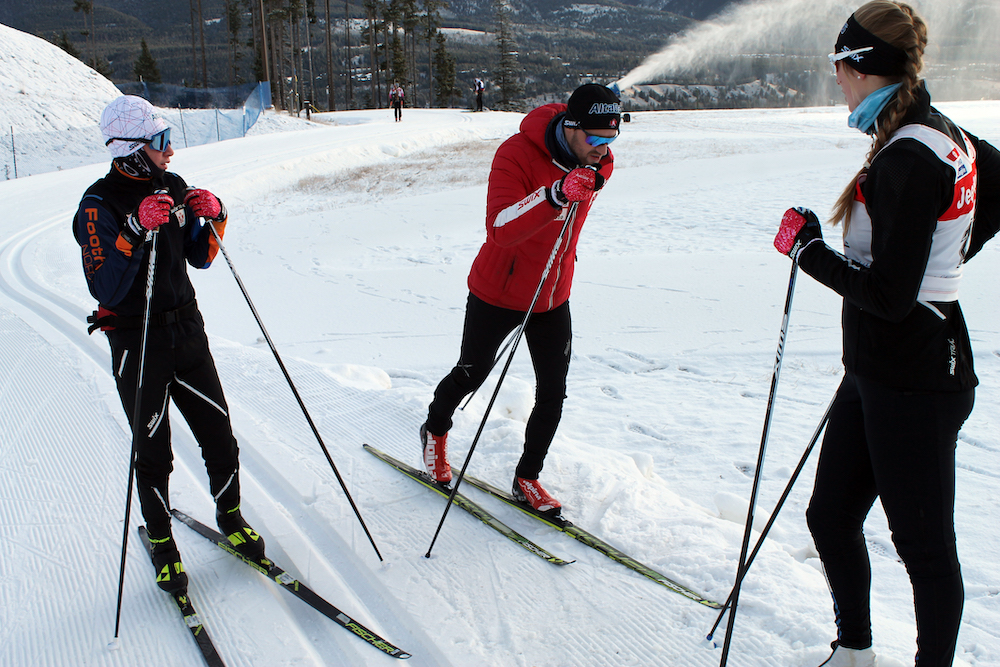
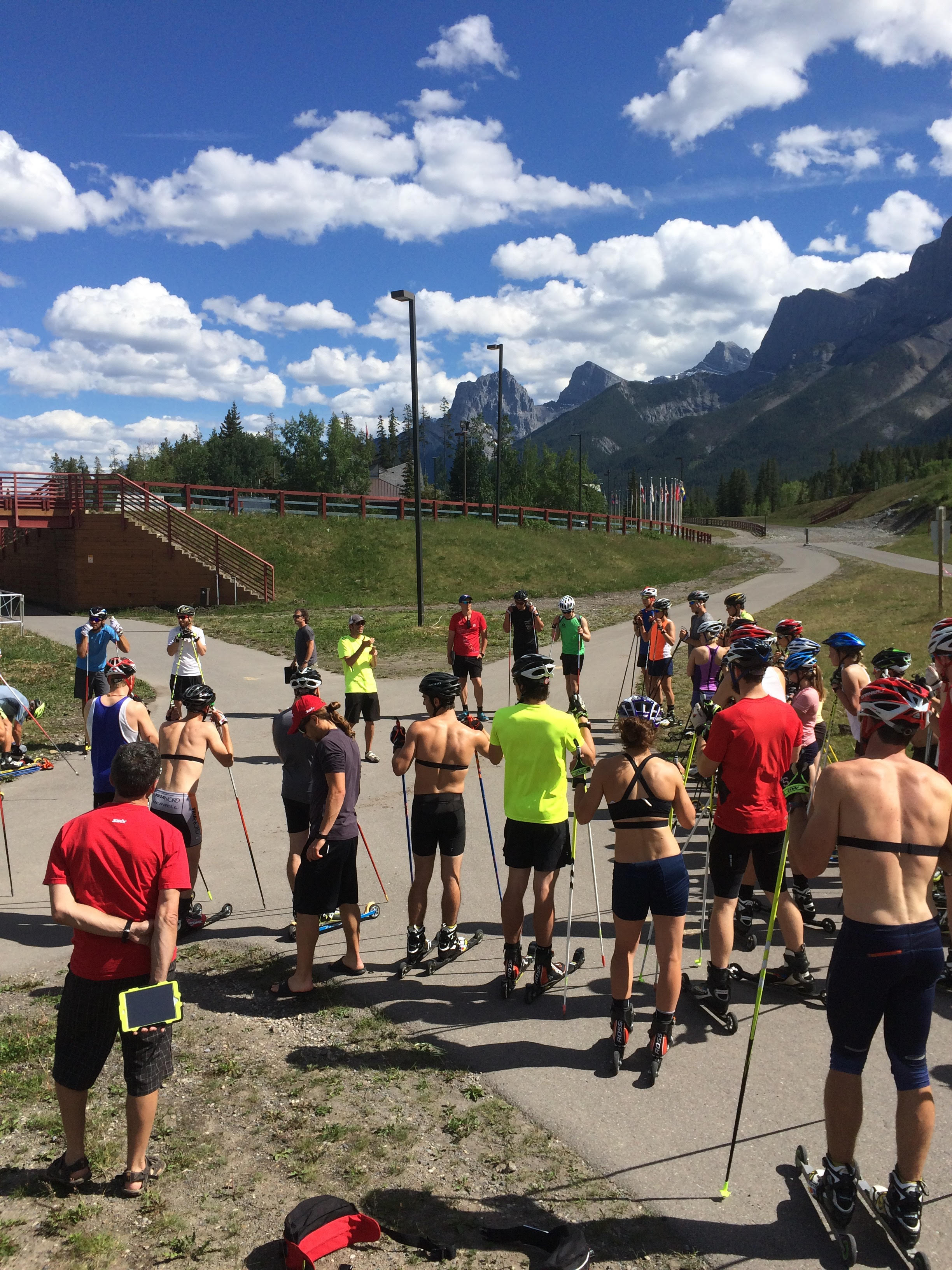
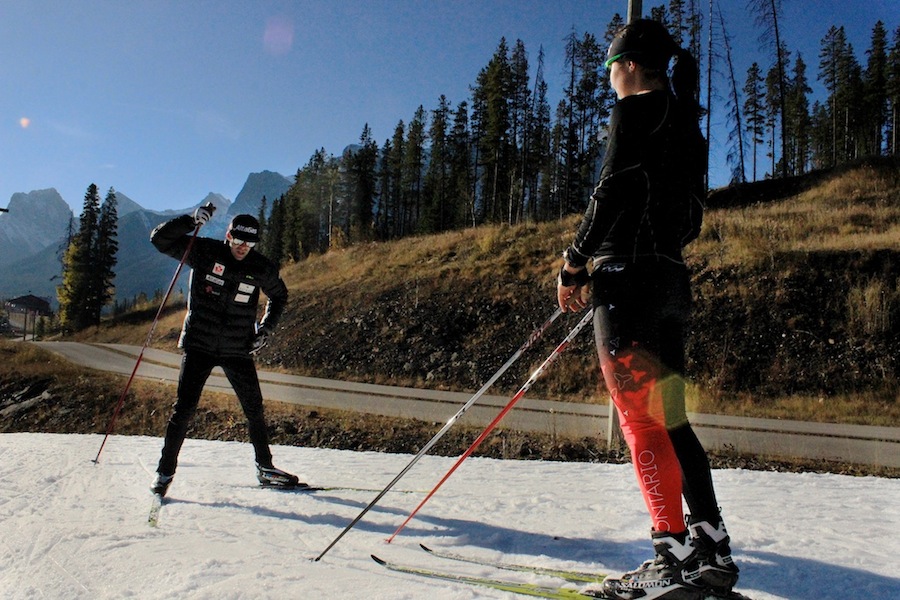
Erik Bråten talking technique with athletes at Frozen Thunder 2019. (Photo: Nordiq Canada)
When Cross Country Canada announced last March that they would be rebranding as Nordiq Canada, they were emphatic the new name was a symbol of their readiness to make changes. Those changes are starting to happen.
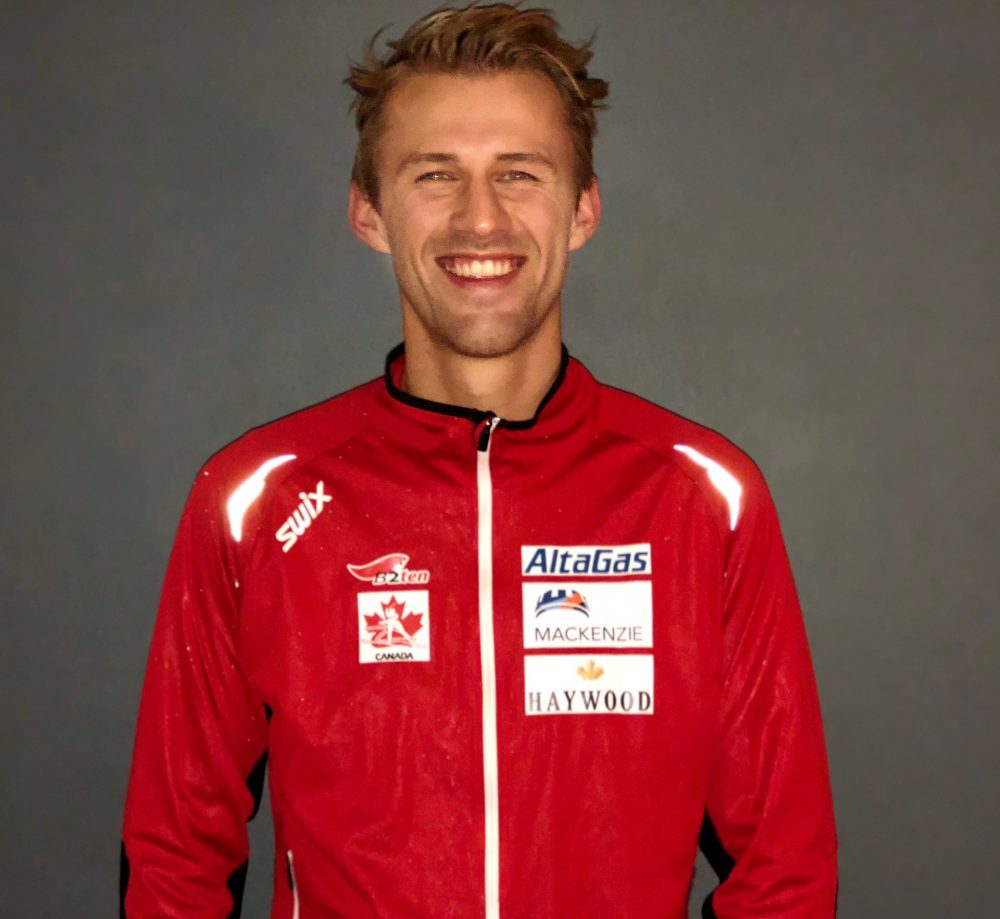
One holdover from last season is Erik Bråten, the young Norwegian brought in to shape the development pipeline. After one year on the job, Bråten is still enthusiastic and now the sole head coach.
Louis Bouchard has stepped down as National Team Coach, reverting to his preferred role at Centre National d’Entraînement Pierre Harvey (CNEPH). The role of training centres in Canada is shifting and there appears to be more change coming.
Nic Lemyre, who served as a part-time High Performance Director on a one year contract, has moved on. Joel Jacques — long time waxer, logistics manager, and long-ago racer — will take over as acting HP manager for the Olympic program while Kate Boyd has the same role for the Para program.
Dave Dyer, the long serving events lead and a perennial presence at Canadian races, is sharing that role with Jeff Ellis this year. Ellis will take over the travel and race jury duties this year before completing the transition to take over the Event Director position for next season.
For the first time ever, Canadian Championships will be combined with US SuperTour finals, a continuation of a trend towards hosting joint NorAm/SuperTour events and attemptig to raise the level of competition in North America.
The most visible changes are likely to be the Canadian presence on the World Cup. With the retirement of Alex Harvey and Lenny Valjas, Canada can no longer expect regular podiums and consistent top ten finishes. Harvey’s retirement announcement also resulted in a large change in funding for the national program, with Own The Podium dropping the sport and bringing an end to the richest period in national team history.
In the new world of financial scarcity and likely fewer podiums, the program is focused on bringing athletes up to the same performance level as the Para program.
For this and future years, the athletes nominated for World Cup period 1 will based based on the previous season’s results, allowing athletes to plan ahead and avoid peaking for qualification races in October. The selection criteria boils down to World Cup top 30’s and COC leaders. Period 2 selections will be based on results, with at least one top 30 required to stay in Europe for the next period.
For an athlete to stay on the World Cup for a full season, multiple top 12 results are required. The net effect will be more top athletes spending more time in Canada, where they can help lift the level locally and also have a better training environment.
“The vision is to integrate various performance levels and stages of athletes: World Cup, senior development, and junior development, into one cohesive high performing Team where each athlete is learning, mentoring and being pushed by their team mates to reach their peak performance,” Nordiq Canada’s CEO Shane Pearsall wrote to FasterSkier. “We want our NST athletes to continually improve and challenge themselves year over year to reach their maximum potential and ultimately the World Cup and Olympic podium.”
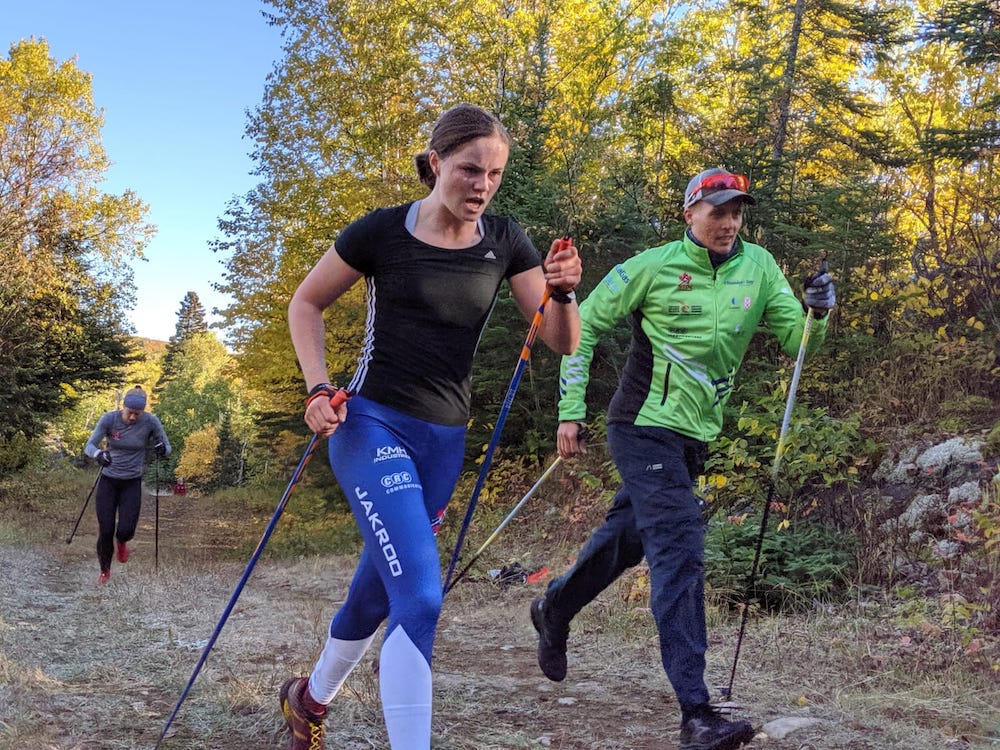
Shaylynn Loewen is supervised by NTDC TBay’s Timo Puiras at a combined NST camp. (Photo: NTDC TBay)
For period 1 this year, Dahria Beatty, Russell Kennedy, and Emily Nishikawa will be racing in Davos and Planica. Canada will skip the Kuusamo, Lillehammer, and the Tour de Ski. With the World Cup coming to Québec City, Minnesota, and Canmore in March, most athletes will get their World Cup opportunities closer to home.
“I’m not expecting anyone to be winning world cups this year, that would be a big step up,” Bråten said on the phone. “We still have Russell Kennedy doing 12th, even if it’s just one occasion, but it’s showing the level that he’s in on the best day. We’ve seen Dahria have plenty of World Cup points last year, and Lahti the year before. Katherine [Stewart-Jones] never did points, but she was top 30 at the World Championships. Of course, Emily was doing really well until she crashed in Cogne, she was top 20 with 1.5 km to go, before she fell and unfortunately had to go the hospital.”
Beatty scored World Cup points in Dresden and Lahti last season and added one more national title to her collection. Kennedy made the semi-final in the Cogne sprint last season. Nishikawa finished 25th overall in the Tour de Ski and was on her way to a best ever result in the Cogne 10km classic, moving up to 19th at the 8.1km time check.
The National Team is smaller this season, to match the smaller budget, with 8 seniors and 5 juniors. Add in Russell Kennedy, who is also a guide on the ParaNordic national team, and it is still a smaller and less experienced group.
Nishikawa is now the most experienced racer on the national team after nine seasons. Asked about her new role as a team leader at the end of a snow camp in May, she told FasterSkier “It’s been a natural progression. Just help the girls get the ski bags on the roof and make sure they’re strapped down well.”
Nishikawa is a quiet person, far more enthusiastic when talking about the upcoming Canmore World Cup than about her own successes. Asked about the season changing crash in Cogne, she said “It was bad, I couldn’t finish.” Behind all that quiet, she is the person the other athletes talk about when describing their transition into World Cup racing.
More detail on the staff, the structure, and the path ahead will follow.
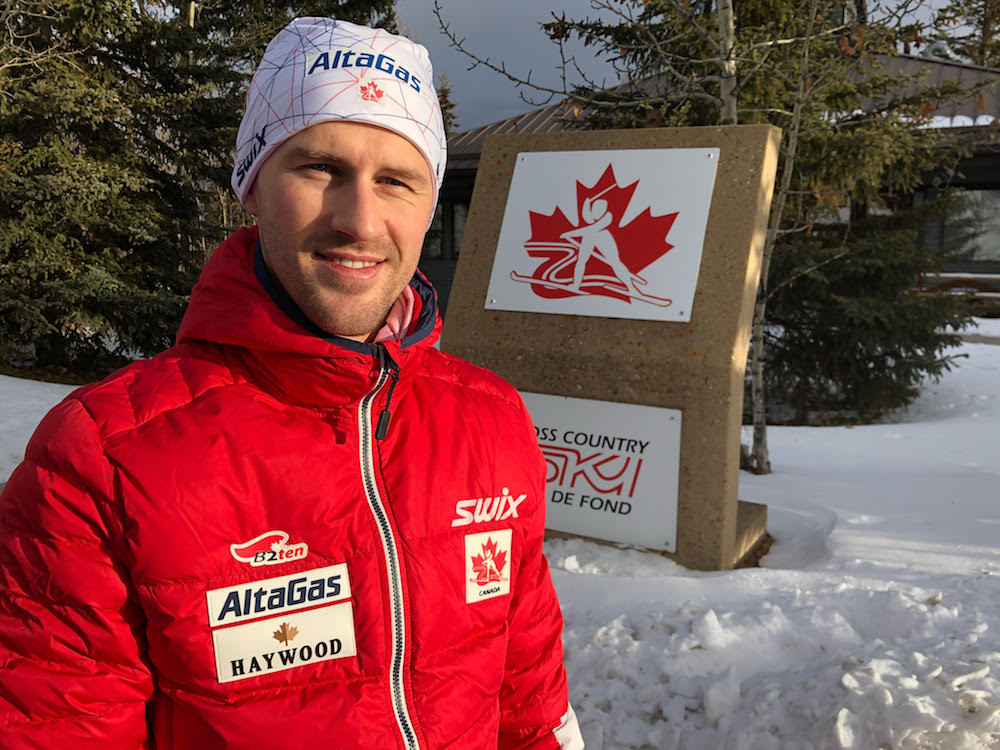
Erik Bråten, at the end of his first week in Canada. (Courtesy photo)
Cross Country Canada hired Erik Bråten as the new national team coach on November 1st, joining Louis Bouchard. After a short delay to get a work permit, Bråten arrived in Canada on November 15th.
Regular readers will know the highlights of his resume:
Graduate of the Norwegian School of Sports Science.
Previously Head Coach at Team Kollen, the junior team constituted from clubs based at Holmenkollen in Oslo.
Nic Lemyre, High Performance Consultant to CCC, described the initial division of national team roles this way.
“Louis Bouchard is the head World Cup coach, and he’s calling the shots for all the World Cup athletes, taking responsibility for their performances,” Lemyre told FasterSkier. “Erik has a support role at the World Cup level, and he’s going to have his main focus on our U23 group and junior group. Erik will have a very important role in connecting with the younger athletes, and making sure that they are going in the direction with the philosophy we want to have with the World Cup team.”
There will also be an east/west division of athlete responsibilities, with Bouchard based in Quebec City and Bråten based in Canmore.
While some may be concerned that doesn’t speak French yet, Lemyre doesn’t see that as a problem.
“[Erik] speaks cross country skiing better than anybody in our system, so I think he’s going to be fine.”
Given that Bouchard and Lemyre both have French as a first language, communication with athletes shouldn’t be an issue.
***
FasterSkier conducted an initial interview with Bråten over the phone while he was in Oslo on November 1st. The second set of questions were answered by email, when Bråten had begun settling in Canmore on November 21st.
How much time have you spent in Canada?
None. Never been there. It will be a first for me. A tourist in the U.S., that’s the closest. So it will be a totally new experience for me, and a long move.
What are you most excited about?
Well, I really love to build up a system. The opportunity to go in and help out actually building that system, that is already there, but at least Nic has talked about a few changes that he wants to make. Good ideas to develop further, which is based on how the coaches, the national coaches communicate with every athlete on the team, how we communicate with the club coaches, and how we can maybe have some gatherings or some knowledge development for the coaches, and maybe make a little clearer what the Canadian philosophy is.
What will you contribute this season?
I’m coming in at a special time of the season. It’s like races in a few weeks, and I’m coming in as a new coach. Of course, even if I had issues with anything, I can’t come in and change it. It’s another opportunity to come and contribute right away, but at the same time, just use some of the season to see what’s going on, see the training diaries, talk to the leaders, and really know the whole picture of what is the Canadian model.
I’m not coming over there and having to make a season plan in a week. I have some time to get to know information, because training is almost done. I think it’s a great opportunity to learn, to observe, and put some small things in my philosophy. We [will] start planning for next season, which starts quite soon, but the details of course come after Christmas. I hopefully have something to contribute.
How did you come to win the coaching award?
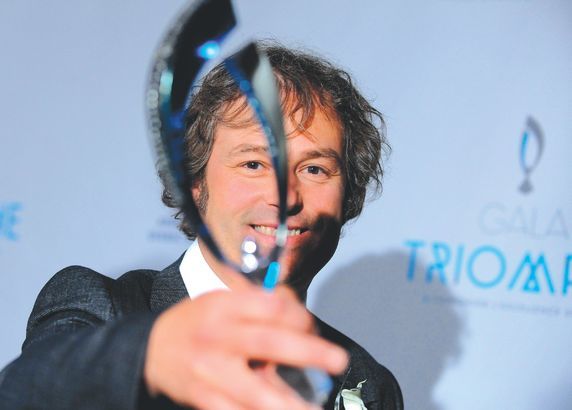
There were both coaches and athletes that nominated me separately, and the club has been doing really well for the last, well for a long time. But especially the last two or three years has been really, really good. They put a lot of weight on the Norwegian cup for juniors, because we have dominated quite extreme there for the last couple of years. That several athletes and some coaches also separately nominated me was put into consideration, because that wasn’t that usual.
Did you know Nic Lemyre in Oslo?
Well, not really. He is working at the Norwegian school of sport science and I took my education there, and had a little lab assistant role after I was done my education. Even though we have been at the same school for a long time, he as a worker and me as a student, we haven’t really known each other. We know the same people, so he had a lot of references on me that I didn’t know.
How is your French?
My French is terrible, it’s nothing. I have German in school, and Norwegian and English of course, not that my German is anything either. I really don’t know any French. Nic told me I should buckle up and learn, try to learn, some basics.
Questions by email:
Who have you met during your first week in Canada?
Over the last week I have met most people in the Canmore office, a few local athletes who are not, the National Team and some club coaches. Louis and I have established regular contact on mail and phone, the same goes for Joel Jaques [CCC’s Technical Services Coordinator] so we have a good system in place built on trust and professionalism. I met all of the female athletes in person except Cendrine [Browne], and I have met a couple of the guys. With Lillehammer next week and then Sovereign Lake and Whistler coming up I am happy to say I [will] have met most people in the system before Christmas.
Why did you choose to coach instead of race?
I was better at it and I have always liked to help others reach their potential. But I am glad I did competitive skiing as long as I did, I think I learned a lot I can use as a coach from that experience.
What makes you a good coach?
I think I am good at seeing the whole picture. It allows me to understand if the training is right, is the motivation right, are all social factors in place etc. And all these factors are important to be in place for an athlete to have the desired progression. I also think I am good at seeing my own limitations, and getting help from experts when I don’t have the knowledge in a particular area.
How will you measure your success in Canada?
I am coming in very late this season, so for the first few months the most important task for me is to get to know everybody and learn the system. But over time it’s kind of simple, better Canadian results in the World Cup, championships and most importantly Olympics.
What was your first culture shock moment in Canada?
I have not really had any big culture shock so far. It really is not that different from Norway. But the average person is much nicer here, at least the first time I meet them. Everyone thinks it’s cool I am here, and are excited to work with me so that is a big motivational boost for me.
Name one person who has helped you to be a better coach? And how?
A lot of people have been important to me of course, but I want to specifically mention two people.
The first is my mentor from my time on the Norwegian School of Sports Sciences, Thomas Losnegard. He is a professor there, and I have spent endless hours in the lab with him. He has a unique way of being so knowledgeable on all theory, but at the same time being able to translate it in to practical use for coaches and athletes.
The second person is Kristian Bjune Sveen who is Head Coach for the China National CC Skiing Xinjiang Team. We coached Kjelsås together for four years and learned a lot from each other.
What was your favourite moment on snow?
There are a lot of them, but if I can pick two …
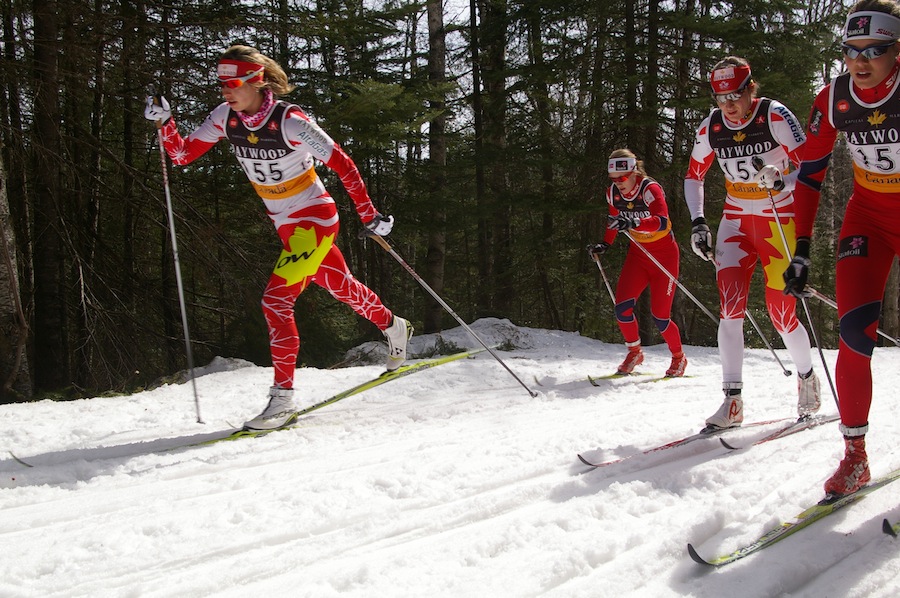
Haga visited Canada long before Bråten did, seen here in 2012: Chandra Crawford (l) leads with Norwegian Britt Ingunn Nydal (far right) on the fourth of six loops in the 30 k classic mass start at Canadian Ski Nationals on Saturday. Dasha Gaiazova (second from right) and Norway’s Ragnhild Haga (second from left) stay close behind.
The first would be as a coach. 14.jan.2017 in the Norwegian Cup for juniors for the K17, it was a sprint race. I had two athletes in the final, and they finished one and two. Right after they crossed the finish line the rest of the girls from the club stormed the finish area and celebrated together. That moment was special.
The second one would be when my good friend Ragnhild Haga won the 10k in the Olympics last season.
What does an athlete need mentally to succeed? Personalities vary widely, but what can you say about what is needed?
As you point out, personalities vary, but I think wanting to do the work that is necessary and just having fun is important. Being critical of your own training, and always wanting to do things even better, and not just copying yourself from season-to-season. And, you have to like the lifestyle. It is a lot of training, and when you are not training, you need to rest a lot, and there is a lot of traveling.
What are the different training groups you worked with?
Kjelsås is the club I coached, Team Kollen is the regional team for juniors in Oslo. Team Obos is the regional team for the seniors in Oslo.
How do you form a team from multiple clubs in Norway? How well do the clubs work together?
Clubs in Norway have widely different opinions on how to do things. But I think what is important is to find common ground, and find the things we agree that we can do better together then apart. And if we can agree on what that is, we can meet up and do that together, and do different training separately.
One of the repeated ideas from HP in Canada is that different athletes need different environments to succeed. Do they need different training philosophies as well?
A training philosophy should include that we are different and need different things. The demands you need to ski fast is the same for everyone, but which demands you are good at varies greatly. A lot of training should be done by everyone, but how much focus on different task for each individual is the big question that is different from athlete to athlete. As a coach, I therefore think that you need find what everyone should do, and put that in to camps and trainings we set up together, and then find out what each individual athlete should focus extra on in the training on their own.
When it comes to environments, I think athletes need to be good at finding the right balance for them in terms of who they spend time with when they are not with their team. And teams should use time to figure out together how they want the culture in the team to be.
With the reshuffling of Canada’s staff, up until today, CCC had not formally announced its World Cup coaching roster for the 2018-2019 season. Back on August 11th, CCC posted a job announcement for “Head Coach, Canadian Senior Cross Country Ski Team”. (Here’s a link to the formal job description.)
Today’s announcement came with news that longtime World Cup coach Louis Bouchard will be returning for another year. Bouchard leads the National Training Centre in Mont Ste-Anne, Québec and has worked closely with Alex Harvey for many years. According to the press release, Bouchard will be taking over head coaching responsibilities. Bouchard has been a World Cup Team coach for the last eight years.
CCC also revealed today that Norwegian Erik Bråten has been hired as a National Team Coach.
“Erik is a highly regarded young coach in Norway who is looking for an opportunity to contribute to our national program,” Lemyre is quoted as saying in today’s press release. “He is passionate, knowledgeable, dedicated, and driven to develop into a world-class coach. I believe he and Louis (Bouchard) will complement each other’s skillsets and will have a significant impact on the development and the performance of our nation’s best athletes. This is a dynamic duo who I believe is exactly what we need to build a medal winning program.”
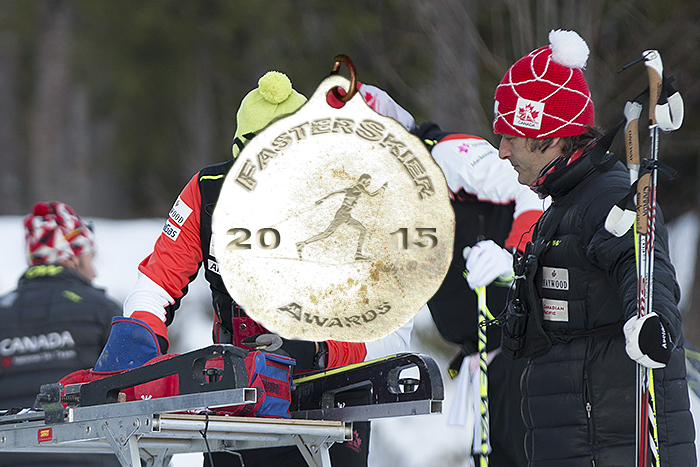
Bråten, who will turn 27 on November 6th, has been coaching in Norway for six years and was named coach of the year in 2018 by the Norwegian Ski Federation. Bråten will be based in Canmore, Alberta. His duties will include monitoring athletes in western Canada, coaching Canada’s team at World Junior and U-23 World Championships, and assisting Bouchard with a portion of the season’s World Cups and the 2019 Seefeld, Austria World Championships.
FasterSkier has reached out to Bråten for comments.
(Note: This article has been updated to reflect that Len Valjas was nominated to the B-team, rather than the A-team as previously stated.)
On Thursday, Cross Country Canada (CCC) announced its national-team nominations for the 2018/2019 season via a press release.
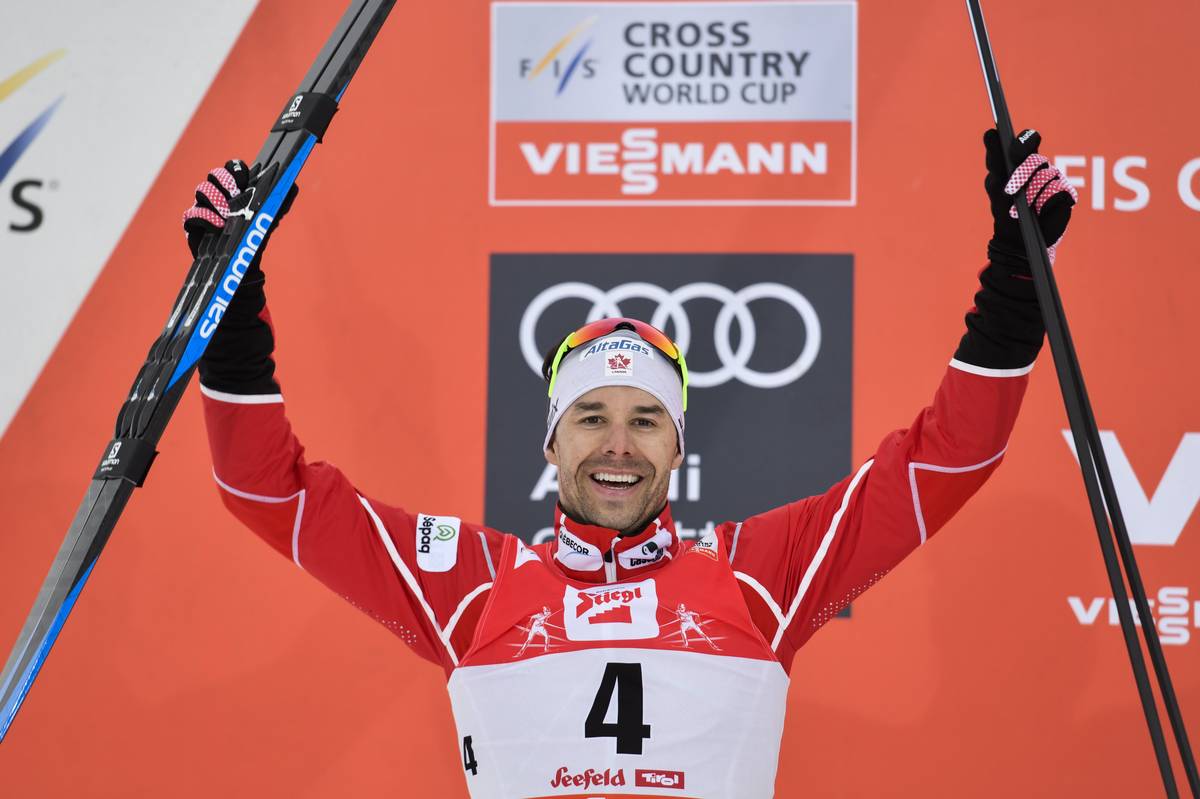
Canada’s Alex Harvey celebrating on the podium after placing second in the World Cup men’s 15 k freestyle mass start in Seefeld, Austria, last season. (Photo: Salomon/NordicFocus)
Notably, the World Cup A-team is made up of one man — Alex Harvey — after three athletes from last year’s World Cup A-team retired (Devon Kershaw, Jess Cockney and Knute Johnsgaard). Graeme Killick, of last season’s World Cup B-team, also retired. Len Valjas was nominated to the B-team, a demotion, he said, that was a result of him ending his season immediately after the PyeongChang Olympics.
“The reasoning is that I … didn’t show up to [the World Cup in] Drammen, is that I didn’t follow what the team said,” Valjas told FasterSkier on May 22. He explained he had a broken spine, which required rest and rehabilitation.
On the women’s side, Dahria Beatty was renominated to the World Cup B-team, while Emily Nishikawa and Olivia Bouffard-Nesbitt were not.
All five of last year’s U25 Team were renominated to the national team, with Cendrine Browne and Julien Locke making the jump to the World Cup B-team, while Katherine Stewart-Jones, Maya MacIsaac-Jones and Gareth Williams were renominated to the U25 Team. Also on the U25 development squad, Antoine Cyr was promoted from the junior national team, and Graham Ritchie earned his first national-team nomination.
The World Cup team will once again be led by co-coaches Ivan Babikov and Louis Bouchard.
On the Para-Nordic side, the World Cup Team grew by one despite the retirement of Chris Klebl. Six athletes and two guides were nominated to the Para-Nordic World Cup Team, while two were renamed to the Development & Prospects Team. Four other athletes round out the team as part of the Prospects Team.
Cendrine Browne (CNEPH/Canadian National U25 Team) celebrates her 11.9-second win in the women’s 15 k skiathlon on Jan. 8 at Mont Sainte-Anne NorAm Trials in Quebec. (Photo: Mario Walker/NorAm MSA 2018 Facebook)
Since March of last year, Cendrine Browne has been waiting and trying, with all her might, for another top 30. She achieved it twice last season, placing 26th in the World Championships 30-kilometer mass start and 35th in the World Cup 10 k skate in Ulricehamn, Sweden (30th with Olympic-style scoring, which counts the top-four athletes for each nation in a given race).
To meet Cross Country Canada’s (CCC) alternate qualifying criteria for the 2018 Olympics, Browne, who turned 24 this past September, needed one more top 30 at the World Cup with the same type of scoring.
She had four weekends to give it her all in late November and December.
Browne, of the Canadian National U25 Team and Centre National d’Entraînement Pierre Harvey (CNEPH), a.k.a. Pierre-Harvey National Training Centre, finished the 2017/2018 season-opening World Cup mini tour in 72nd overall with the 62nd-ranked pursuit time in Kuusamo, Finland.
“That was my first [weekend of racing] so it was tough,” Browne recalled on the phone in early January. “But the last race of the mini tour went much better. I started to have good race feelings so I knew I was going in the right direction. The next weekend was Lillehammer [Norway] and I performed pretty well there in the skiathlon.”
She finished 45th to lead two Canadian women finishers. With Olympic-style scoring, she was 31st.
“To qualify for the Olympics I had to do a top 30 so 31st was a little frustrating, but I knew I was able to do a top 30,” Browne said. “I knew I could do a real top 30, not only a four per nation top 30. But I only had four weekends to do a top 30 and I was down to two.”
Cendrine Browne racing in the World Cup 10 k freestyle on Dec. 10 in Davos, Switzerland. She placed 45th for the second World Cup distance race in a row. (Photo: Reese Brown / U.S. Ski & Snowboard)
In Davos, Switzerland, she tied her season best of 45th in the 10-kilometer freestyle and led four Canadian women, but she was still outside the top 30 with Olympic scoring. Her result at altitude (about 1,560 meters above sea level) was promising, she said, but still not quite there in terms of what she needed.
One weekend later, it all came down to two races in Toblach, Italy. There, she finished 55th in the 10 k skate and 66th in the 10 k classic pursuit.
“Maybe I had put some pressure on myself, but I felt pressure from my federation and pressure to do that top 30, and I don’t work very well with pressure,” she said. “So unfortunately when we went to Toblach, I didn’t perform at all. I was so stressed out that I didn’t even have fun racing, and I just felt awful the whole skate race. I cried a lot.”
With Period 1 of the World Cup behind her and Christmas break on the horizon, she told herself it wasn’t over yet. But she was still disappointed.
“I was supposed to stay [in Europe] for Christmas … I was so focused on Plan A that I didn’t even think about Plan B,” she said.
On the bright side, “Plan B” involved races in her home province of Quebec at Mont Sainte-Anne (MSA), where she trains with CNEPH. And she got to spent time with her family and boyfriend in her hometown of St-Jérôme, about 50 kilometers northwest of Montreal, as well as reset mentally for NorAm Olympic trials starting Jan. 5.
“I was so focused on Plan A that I didn’t even think about Plan B.” — Cendrine Browne, Canadian National U25 Team and Pierre-Harvey National Training Centre, on qualifying for the Olympics
“I was really really stressed out the week before the first race [at trials] and I was feeling the pressure again, and I really didn’t want to react the the same way as I did in Toblach so I went to see my sports psychologist,” Browne said. “She explained some stuff to me, like instead of thinking that the pressure is bad and instead of trying to run away from it, she said I have to try to accept it, and if I accept it, it would help me to go faster.”
With that in mind, Browne tried to keep everything in perspective. Then, she came out at full steam for the classic sprint on Jan. 5, the first day of MSA NorAm trials.
“I think it really worked well because I managed to sleep better the night before the race, and the morning of the race I was feeling like myself again,” she said. “I was skiing and just loving the glide as I usually do when I’m having a good day. I was smiling … and I felt free and I felt like myself. I feel like when I’m stressed out, I’m not having fun any more and that day I was having fun again.”
A self-described freestyle distance specialist, she placed second in the classic-sprint qualifier then fourth overall in the final. As the top-performing woman between the qualifier and final, excluding fellow national-team member Dahria Beatty (who had previously met Canada’s alternate qualifying criteria for the Olympics), Browne effectively secured one of Canada’s coveted quota spots at the 2018 Olympics in PyeongChang, South Korea.
While that wasn’t a done deal until a few weeks later, when CCC named its 11-athlete Olympic team, that result put Browne in the best place any Canadian Olympic hopeful would want to be.
“I can’t say I’m qualified yet because it’s kind of complicated,” Browne said on Jan. 7. “… We can only say, like Daria, Emily [Nishikawa] and I, that we have reached an Olympic criteria and that we’re in good position to go to the Olympics.”
Beatty and Emily Nishikawa, members of Canada’s World Cup Team, met CCC’s “Alternate Qualifying Criteria A” (three top-30 results) last season. According to CCC’s Olympic selection criteria, one female sprinter and one female distance skier would be selected to the Olympic team based on trials. So Browne effectively secured the female sprint spot, and as the rest of the week at MSA played out, she ended up being the top distance skier at trials as well.
On Jan. 8, Browne won the women’s 15 k skiathlon on Day 2 of the trials. Two days later, she won the 10 k classic interval start as well. In the event that the trials sprint leader was the top distance skier as well, as was Browne, the criteria was written so that the second-ranked distance skier in those two distance races would be selected.
That spot went to Anne-Marie Comeau, Browne’s former teammate. The two trained together at CNEPH three years ago, before Comeau left skiing due to an injury and concentrated on running. At last month’s trials, Comeau placed second in the skiathlon, about 12 seconds behind Browne, and third in the 10 k classic, about a minute and 5 seconds back. Browne won the classic individual start by 39 seconds over Katherine Stewart-Jones, who had previously placed fifth in the skiathlon.
“I know she has a huge VO2 max,” Browne said of Comeau, a student at the Université Laval. “She has a huge cardio and these courses were perfect for her, so I knew she could do well, but I’m really surprised that she could actually be on the Olympic team, just because she wasn’t sure she wanted to ski anymore, so that’s really a big surprise for everybody. She trained for running for two years almost, and we didn’t think she would be such a big comeback.”
(Browne is also enrolled at Laval, where she takes classes toward a bachelor’s degree in sports intervention in the fall, as well as HEC Montréal, a university business school where Browne is pursuing a certificate in administration during the summer and winter terms. “It’s important to prepare my post-career now,” she said during another interview this summer.)
While both Browne and Comeau were named to the Olympic team on Jan. 29, along with Beatty and Nishikawa on the women’s side, Browne said her results at trials gave her confidence moving forward.
“I was surprised because classic sprints usually are not my best race at all,” she said of her result in the classic-sprint qualifier to start the trials. “But I think I’m in good shape right now and that’s why I managed to do so well. Also the sprint course is really hard here, it’s like a World Cup course, so it’s made for distance skiers, I would say. Pure sprinters get tired on that course, it’s so hard. So I think it was a good course for me.”
Going into the races at MSA, Browne had been on the NorAm podium 12 times since 2013. Two of those races were sprints (both in 2015).
“I’m definitely more of a distance skate skier, without a doubt,” she said.
Four Races, Four Big Results
The MSA classic sprint marked Browne’s first time skiing heats since last year’s U.S. nationals in Utah, where she qualified fifth in the classic sprint and went on to finish 22nd after being eliminated in the quarterfinals.
On Jan. 5, she clocked the second-fastest qualifying time on MSA’s 1.2 k course, 3.13 seconds behind Beatty, who won the qualifier in 3:41.55. Olivia Bouffard-Nesbitt, of Rocky Mountain Racers (RMR), qualified third (+8.08) and Maya MacIsaac-Jones (Canadian U25 Team/RMR) qualified fourth (+8.49). Taking Beatty out of the equation, that meant Browne needed to place fourth or better in the final to lock up that women’s sprint spot. According to the CCC sprint selection process, a given athlete’s result in the qualifier and final were scored equally (one point per place, lowest points win). So Browne had 2 points after qualifying and MacIsaac-Jones had 4. In the final, MacIsaac-Jones placed second to Beatty and Browne finished fourth, bringing both of their point totals to 6. The tiebreaker, according to the criteria, was the top qualifying result, which Browne had.
Asked about home-course advantage on the trails she’s skied on for the last six years with CNEPH, Browne said the sprint course was brand new and specifically designed for the 2018 trials.
“I hadn’t tried those yet, but they’re great. They’re really hard,” she said.
In the heats, she made a point to lead early in her quarterfinal and semifinal in order to set the pace.
“The course was so hard that you couldn’t start too fast, so I went in front of everybody and didn’t go too fast on the first uphill,” Browne recalled. “My race really started at the top of the first huge pitch, and at the top of that big uphill, that’s when I started to go faster and that’s where I created a little gap.”
She won both her quarterfinal and semifinal to advance with ease to the heats, 1.5 seconds ahead of Annika Hicks, of the Alberta World Cup Academy (AWCA) in the quarter and 2.81 seconds ahead of Hicks again in the semifinal.
NTDC Thunder Bay’s Katherine Stewart-Jones (l) and CNEPH’s Cendrine Browne, both the Canadian U25 Team, after the NorAm Trials classic sprint on Jan. 5 at Mont Sainte-Anne, Quebec. (Photo: Mario Walker/NorAm MSA 2018)
In the final, Browne found herself behind Beatty (also of AWCA) and Stewart-Jones, of the Canadian U25 Team and National Team Development Centre (NTDC) Thunder Bay, at the top of the last major climb. They jumped in the tracks on either side of her, and Browne found herself without a track for the downhill.
Beatty crossed the finish line first once more (after winning both her quarterfinal and semifinal as well), finishing in 3:45.02, while MacIsaac-Jones followed 0.64 seconds later in second place. Stewart-Jones was 1.2 seconds back in third, and Browne 4.5 seconds behind in fourth. Hicks placed fifth (+10.21) and Andrea Dupont (RMR) rounded out the women’s final in sixth (+12.18).
Going into the final, Browne wasn’t aware she needed to finish fourth or better.
“I don’t really like thinking about criteria before I go into a race so I had no idea what I had just done,” she recalled. “A friend [Alexis Turgeon] told me when I crossed the finish line, he said, ’I think you got that Olympic spot!’ I was like, ‘What?’ and then the rumors started to spread and then my coaches told me it was true, I had made it. It was pretty great.”
One of those coaches was her coach, Louis Bouchard, head coach at CNEPH, also a Canadian World Cup coach and Alex Harvey’s personal coach, who attended the classic sprint at NorAm trials then left for Europe on Sunday.
“He said he was almost as stressed out as I was and he didn’t sleep before the first race,” Browne said. “It’s a relief for him as well.”
As for the distance races at trials, Browne said she had been targeting both.
“I really didn’t expect to qualify in a sprint race,” she said on Jan. 7. “I was hoping to win those [distance] races and do a spectacular criteria, so I still want to do really well in those races. I don’t want to think about the result because I only want to think about what I can control, which is my movements and how I ski, but I want to have great feelings during this race and ski really well.”
Cendrine Browne (61) leading the women’s 15 k skiathlon on Jan. 8 at Mont Sainte-Anne NorAm Trials in Quebec. She went on to take the win by 11.9 seconds over Anne-Marie Comeau (Université Laval). (Photo: Mario Walker/NorAm MSA 2018 Facebook)
On Monday, Jan. 8, she went on to win the 15 k skiathlon by almost 12 seconds after leaving the pack toward the end of the first 7.5 k classic leg.
“My goal was to start really hard and try to break away right at the start,” Browne recalled.
But she wasn’t able to shake skiers such as Beatty, MacIsaac-Jones, Comeau, or Stewart-Jones as quickly as she’d hoped. She built a small gap on the others around 6 k, but Comeau caught her before the transition to skate and Browne fell on the final climb before the exchange.
“I fell right before the downhill so I lost my gap,” Browne recalled. “And then we headed towards the ski exchange and I had some trouble with my binding and I couldn’t clip it on. It didn’t work, so I lost like another five seconds there. Anne-Marie was at the ski exchange before [me], and it took me like 2.5 k to catch up to her.”
After catching Comeau about a third of the way into the skate leg, Browne said she took the lead in an effort to drop Comeau over the next 2.5 k.
“I thought I could gap her, but I couldn’t,” Browne said. “And so on the last 2.5 k, I thought about my tactic. I saw how she skied, and I saw where I could pass her, so I stayed behind her and waited for the last big uphill, and I passed here there. … I knew I had faster skis and I knew I’m better on sections that need more power.”
With about a kilometer to go, Browne skied away to an 11.9-second victory. The next day, she raced to second in the freestyle sprint (a NorAm race but not an Olympic trials event) after qualifying in third.
She hadn’t planned on racing that second sprint of trials (and her third race in five days), but her coach, Bouchard, encouraged her to use it as intensity training before the Olympics.
“At first I wasn’t supposed to do that sprint, but … I had to race as much as I could before leaving [for Europe],” she said. “After the qualifier, I asked Louie, ‘I’m feeling really tired. Should I race in the heats?’ and he said, ‘Yeah, you should.’ … I didn’t know how it would turn out, but it turned out pretty well.”
The next day, she woke up for her fourth race of the week, the 10 k classic, not feeling as fatigued as she had on some of the previous days.
“Of course, I was tired, but I was telling myself everybody’s really tired,” Browne recalled. “My goal was to push as hard as I could during the whole race because I had to prepare as well as I could for the Olympics.”
Cendrine Browne racing to first in the women’s 10 k classic on Jan. 10 at Mont Sainte-Anne NorAm Trials in Quebec. (Photo: Mario Walker/NorAm MSA 2018 Facebook)
Despite being one of the last starters in that race, she said she wasn’t quite sure where she stood during it, so she simply pushed as hard as she could.
“It was like, I don’t wanna be second … and then it turned out that I had a really big gap,” she said. “I felt so good during that race. You don’t feel that good that often in races during the year, so I think I’m in really good shape leading towards the Olympics so that’s really exciting and it’s great news.”
Before leaving Quebec for a mid-January training camp in Livigno, Italy, Browne summarized her trials performance.
“I really wanted to show that I deserved my spot,” she said. “I qualified in a sprint race, but I really wanted to show that I was that I was good in distance racing, too, because I am a distance racer. … I guess you could say I qualified in all the events, but I just wanted to show Cross Country Canada that I that I deserved my spot and I really wanted to be safe. I think that’s what kept me going.”
And while qualifying domestically was her last resort to get to her first Olympics, Browne said it all worked out in the end.
“‘Actually I’m kind of happy I was in Mont Sainte-Anne; it gave me confidence that I really deserve my place and it was really nice to ski at home, well, kind of at home,” she said. “My boyfriend was there, my family was there, and lots of friends and everybody was cheering … it was really fun. Great atmosphere and the races were really well-organized.”
“You don’t feel that good that often in races during the year, so I think I’m in really good shape leading towards the Olympics so that’s really exciting…” — Browne
Browne and the rest of the Canadian World Cup team returned to World Cup racing Jan. 27-28 in Seefeld, Austria. There, she placed 54th in the freestyle sprint then 37th in the 10 k freestyle mass start. She was the second Canadian in the 10 k, after Nishikawa in 35th, and with Olympic-style scoring, Browne would’ve been 33rd.
“I think us three girls did really well today, considering we are just coming back from a training camp,” Browne said after the mass start, referring to Nishikawa, herself, and Beatty, who placed 45th. “So it’s really looking good for the Olympics.”
Path to PyeongChang
Last summer, Browne worked to rehab back tension and knee tendonitis. Those injuries only set her back about two weeks in July, she said, and she attended all training camps, including the Canadian women’s team camp in New Zealand in late July and early August.
“I did a total of 60 hours of training in just under three weeks and realized that despite my small injuries my shape was intact; I was as much in my place as before among these girls,” Browne said in August.
As of early January, she said she was injury free.
With more than 40 World Cup starts currently behind her, Browne said she’s reached a new level with her racing. Last year was about understanding “the importance of self-confidence,” she said last summer, “but also that the most important thing is to have fun.
“It’s easy to forget when you’re at the top level,” she continued. “When I was stressed before the start of a race, I would ask myself, ‘Why are you doing this?’ Because I like it.”
Initially, it was lining up against the best skiers in the world that intimidated her.
“In the beginning, you reach the highest level, you face the best in the world. It’s intimidating being new to the field, but I’ve learned to master this stress throughout the season,” she said. “At the end, I felt in my place.”
— François Léger Dionne, Andrea Potyondy-Smith and Gabby Naranja contributed
Canadian national-team member Cendrine Browne (r) hanging with her teammates Katherine Stewart-Jones (l) and Dahria Beatty at a training camp in Tremblant, Quebec, in May. (Photo: Dahria Beatty) La membre de l’équipe nationale canadienne Cendrine Browne (D) en compagnie de ses coéquipières Katherine Stewart-Jones (G) et Dahria Beatty lors d’un camp d’entraînement à Tremblant, Québec, en mai. (Photo: Dahria Beatty)
On Monday, Cross Country Canada announced its 2018 Olympic cross-country ski team for the upcoming Winter Games in PyeongChang, South Korea. The team includes 11 athletes: seven men and four women.
According to the press release, “each of the 11 athletes met the standard for nomination to the Canadian Olympic Committee under Cross Country Canada’s Internal Nomination Procedures for the 2018 Olympic Games, and in the process form a talented squad replete with veteran leadership and podium potential.”
“This is a team that has evolved from a group of talented athletes excited to be on the start line into a group of determined high-performers focused, and confident, in their ability to achieve international podium results,” Cross Country Canada (CCC) High Performance Director Tom Holland said in the press release. “Led by our men’s team of Devon, Alex and Lenny over the last two quadrennials, we are in the podium hunt, and will continue to push towards getting Canada back on the Olympic podium at the Nordic venue.”
As the press release points out, Canada has three Olympic medals in cross-country skiing, starting when Beckie Scott earned the gold medal at the 2002 Salt Lake City Games. She added a silver Olympic medal to her collection in 2006, placing second in the team sprint with Sara Renner. Also in 2006, Chandra Crawford won gold in the Olympic skate sprint in Turin, Italy.
The Canadian men’s relay after placing third for Canada’s best World Cup result in the men’s 4 x 7.5 k relay, with (from left to right), Lenny Valjas, Alex Harvey, Knute Johnsgaard, and Devon Kershaw. (Photo: Salomon/NordicFocus)
What a year for Cross Country Canada (CCC). For the first time in history, its men’s team stood on a World Cup relay podium. Its top skier brought home his first World Championships gold and its women’s team pulled off its fourth-best world champs relay result on record.
With the release of Canada’s 2017/2018 national-team nominations earlier this month, FasterSkier caught up with CCC’s High Performance Director Thomas Holland and the World Cup co-coach Ivan Babikov to discuss the program moving forward.
What’s changed since last year? Not much. With a strong season behind them, an Olympic season ahead and a solid coach and tech crew on board, Holland supported a sense of continuity for the upcoming season.
“We’re not changing anything this year. We’re just making little improvements, which is a great thing,” Holland said on the phone on May 23. “We’ve got stable coaching, stable technical team …. We’re just adding one more camp. We used to always do four, with cutbacks we went to three, so now we’re stepping it back up to four.”
Almost all of the 14 athletes named to the senior team are returnees, but two made the jump from the World Cup B-team to the A-team: Knute Johnsgaard and Jess Cockney. With the advance, both Cockney and Johnsgaard will join A-team veterans Alex Harvey, Len Valjas and Devon Kershaw.
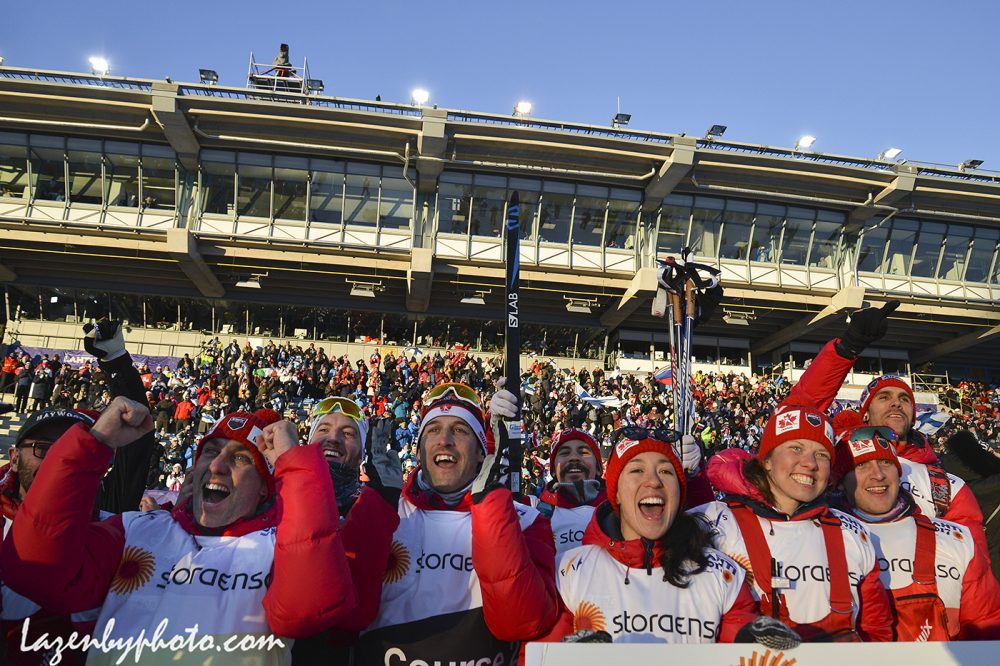
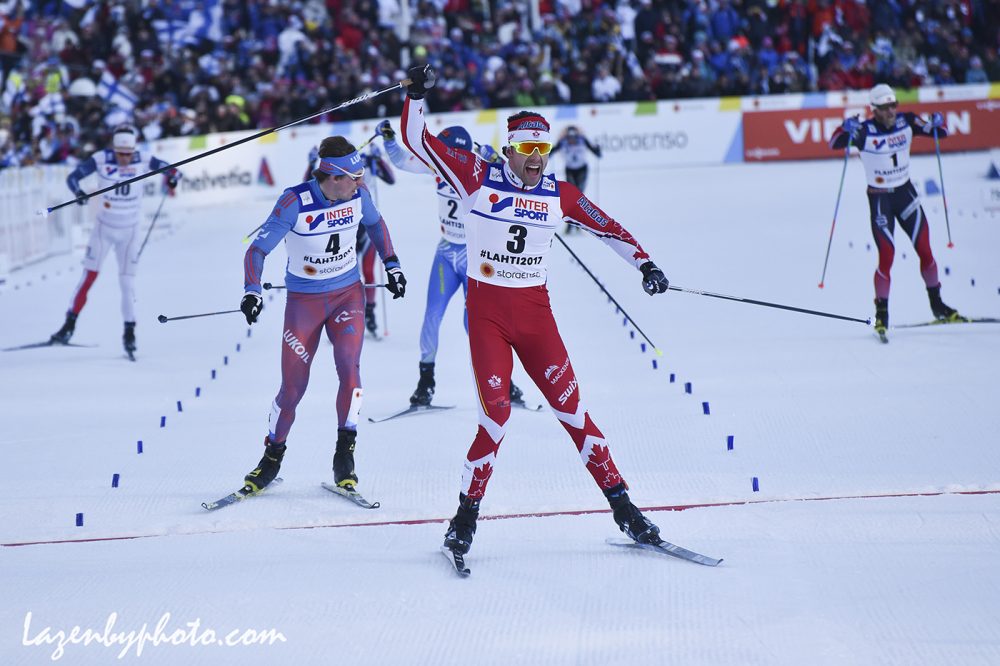
Canadian teammates, coaches and support team celebrate Alex Harvey’s win in the men’s 50 k freestyle mass start at the 2017 Nordic World Championships in Lahti, Finland. (Photo: John Lazenby/Lazenbyphoto.com)
For the second-straight year, Babikov is teaming up with Louis Bouchard, Harvey’s personal coach and head coach of the Pierre-Harvey Training Centre (CNEPH), who coaches U25 Team member Cendrine Browne as well. As World Cup co-coaches, Bouchard and Babikov are able to divide the workload and travel required throughout the year, and specifically, five months abroad.
“It’s hard to be on the World Cup circuit all the time for staff,” Babikov said on the phone. “[Louis and I] both have families, so it’s worked out well when we’re subbing for each other once in awhile so athletes have a national-team coach with them all the time. We have a good mix with his experience and my experience on the other side as an athlete. I think I’ve learned from him and it’s been great.”
While the World Cup A-team remains all-male, three women were nominated to the B-team: Emily Nishikawa, Olivia Bouffard-Nesbitt, and Dahria Beatty of the Alpine Insurance Alberta World Cup Academy (AWCA). These women will work with Chris Jeffries, head coach of the AWCA, who plans to travel with the team on certain trips to Europe as well.
Tuesday, May 30, marked the last day of the team’s first official camp of the season in Mont-Tremblant, Québec, which started May 21 and included the entire national team minus Kershaw.
According to Babikov, Kershaw would be at the second men’s World Cup team camp in Park City, Utah, from June 26-July 11. A month later, those six men (including B-team member Graeme Killick) will head to Livigno, Italy, for their third camp Aug. 16-Sept. 3, while the women’s team and Jeffries head to New Zealand for an on-snow camp.
For the fourth and final camp, both the men’s and women’s World Cup teams, along with the Canadian U25 Team, which includes Julien Locke (Black Jack), Browne (CNEPH), Katherine Stewart-Jones (NTDC Thunder Bay), Maya MacIsaac-Jones (Rocky Mountain Racers), and the senior team’s only newcomer Gareth Williams (Telemark), will return to Park City for a dryland camp Oct. 5-24. An all-encompassing Alignment camp is scheduled for early July in Thunder Bay, Ontario, but due to other camps happening simultaneously, the World Cup team members will not be attending, Babikov said.
Heading into the upcoming World Cup season, Harvey remains Canada’s lone athlete in the Red Group (top 15 in sprint or distance World Ranking list) and is accordingly the only one receiving full funding for training camps. According to Holland, the six men that form the World Cup training group (World Cup A-team plus Killick) are receiving funding from Own The Podium (OTP). He reiterated that OTP allocates funds based on medal potential.
“They’re funding the medallist people, the potential people,” he said. “Primarily, that’s Alex Harvey. We did get a medal in the relay last year on the World Cup, part of that group [Harvey, Kershaw, Johnsgaard, and Valjas] is included as well. Len Valjas had a medal on the World Cup too, [in the team sprint] with Alex … and additionally, we want a training group. They support that idea of having a good training group here around Alex. That adds up to six men.
“After that, it doesn’t change much from last year,” he continued. “There’s not a lot of money outside of that [Own the Podium support] window. There’s support on the World Cup, etc., but your question was has it changed. … We don’t have more money, we have actually less money.”
Compared to past Olympics, CCC’s budget this year is about half of what it was for the 2014 Sochi Olympics and “a lot less than what we had in Vancouver,” Holland said.
“It’s a tight budget,” he added. “I’m not going to sit here and whine about money because we also had a tight budget last year. We’ve had cuts for three years leading into last year, and still — small team, small budget — we did pretty good. Our attitude is that we have a little bit more money this year we’re getting from Own The Podium and we’re doing an additional camp for the men. … We’re not changing a lot, except adding a camp and having good preparation. There’s less money, but we’re going to get the job done.”
From his viewpoint, ongoing annual budget cuts have especially hurt development programs with a “lack of money to really invest in the future,” he said. Yet development remains a priority.
“You’ve probably heard of the ‘NextGen’ funding. Expect that there’ll be some kind of announcement this year,” Holland said. “We have a plan in place, and we’re making changes, regardless of not having a lot of money, in how we go about that next generation, in testing and development.”
In order to continue creating opportunities for up-and-coming talent, CCC is now working more closely with clubs, permitting some national-team members to continue their work with club coaches, while simultaneously training with national team. Out of nine World Cup team members, seven are not affiliated with training centres (only Harvey is listed as CNEPH and Beatty is part of the AWCA).
“We’ve never said everybody has to join a training centre,” Holland said. “I guess what we’ve said is, if you’re on the national ski team, you had to be in a training centre. … That is an option for U25 athletes, but once you’re on the World Cup team, we still have a centralized model. What we’re doing is broadening.”
Since the training-centre model was instated in 2006, the level of coaching in clubs around the country has improved, Holland explained. That makes it less essential for an athlete to belong to one of three training centres.
“They provide education and good services in six or eight clubs across the country,” he said. “You’ve got to have a club that has a coach who is well-experienced, can write a good yearly training plan that makes sense. … There’s also requirements to come and be tested here [in Canmore], for those athletes, to participate in national ski team camps, etc. So it’s not just cutting them loose, it’s more of a closely integrated model. Trying to integrate more with the divisions and the clubs. When you do that, you know your dollar goes farther.”
Bottom line, Holland reiterated that CCC is “moving ahead despite not having the resources.”
“We ran a World Cup team program with significantly less money, but we’ve been pretty good at finding ways to do things inexpensively [through] collaboration with divisions and clubs,” he said. “We’re also extending some of our national senior team programming to the clubs. That’s a big change.”
Gareth Williams (Telemark Race Team) on his way to a personal-best 11th in the men’s 20 k skiathlon at 2017 Junior World Championships at Soldier Hollow in Midway, Utah. (Photo: FlyingPointRoad.com)
Because of this change, 19-year-old Williams, in his first year on the senior team, will continue to work with his club, Telemark, while also training with the national team.
Financially, not much separates Canada’s World Cup B-team from its U25 (Under 25) Team.
“In terms of support, there’s not a lot of difference,” Holland said of the two teams. “I think it’s mainly an age factor. If you’re coming through U25, you’re expected to meet a little higher standard for that B-team. Whereas Gareth Williams, we want to look at that as more talent development. … By the time they hit the B-team, we expect them to be at the World Cup level.”
In addition to his international results last season (including an 11th place in the skiathlon at Junior World Championships), Williams was also named to the U25 development team because of the value seen in the years ahead of him.
“Gareth, as a junior, has a few years to develop for us, to put into his program,” Holland said. “We have clearly defined benchmarks of who gets on the team. For Gareth, it’s written in our criteria, top 12 at World Junior championship result.”
“We have to look to the future and look ahead and develop younger guys and give them a nod and give them recognition so they have something to work for,” Babikov said.
A few of the senior team nominations, including Bouffard-Nesbitt, who was injured in a car accident in February, and MacIsaac-Jones, who struggled with a foot injury and had surgery this spring, were based on the “force majeure” clause.
“Some people who were sick at the wrong times last year,” Holland said. “Health is a big concern … that’s a primary thing that we’ll be on top of this year. Then the other people, I wouldn’t call health. … Athletes get injured, we like to stay with them as long as we see that there’s a good recovery plan and the injuries are taken care of. I won’t say that those injuries aren’t serious. As the hockey players say, it’s day-to-day on the comeback.”
As for which Canadian skiers you can expect to see starting World Cup Period 1, Holland confirmed there will be at least 11: seven men and four women. The seven men include the five A-team members who “have met the Olympic Winter Games (OWG) Nomination Criteria outlined in CCC’s OWG Internal Nomination Procedures for the Olympics”, according to Holland, with standout results last year (in individual or team events). Killick will also start the season on the World Cup, as will Russell Kennedy as the Continental Cup leader.
The four women all competed at 2017 World Championships: Stewart-Jones (who is also the Continental Cup leader), Nishikawa, Beatty, and Browne.
And Nishikawa, Beatty and Killick all met “alternate qualifying criteria” for the Olympics.
The Olympic team size is a minimum of four men and four women, Holland explained in an email. “The primary criteria takes precedent over the alternate criteria if the maximum number of athletes is established under the primary criteria.” Olympic selections will be finalized in January.
But in the meantime, CCC will aim to host selection races for Period 1 World Cup starts on Frozen Thunder in Canmore in early November.
“We don’t have criteria yet, but potentially we would add one or two more male sprinters, and at least another female athlete,” he said of the Period 1 team. “I’m not going to get into specifics, because we still have to write the criteria, but that’s the intent coming out of our spring meetings. You’ve got a pretty good World Cup group there in November/December.
“I think it’s good to note we’re a little different, the way we do things, than the U.S.,” Holland added. “After we see what happens in December, then we look at our Olympic trials, which will be in Mont-Sainte-Anne in January. That’s how we’ll pick the rest of them.”
In terms of medal potential at the PyeongChang Winter Olympics in February, Holland said the goal is one, for starters.
“We’re just looking for a medal,” he said. “Always, two is better than one, but our focus … [is on] where our medal chances are. How do we maximize those opportunities for each? Certainly in the relay, we’ll be shooting for the bronze because we’ve done the analysis. For Alex, he’s going to ski in as many events as he can. So it depends on day to day, how he comes into the games. You know he can medal in sprints, he can medal in the 50 k, and everything in between. We’re just optimizing every opportunity.”
Alex Harvey (Canadian World Cup Team) celebrates his World Cup Finals freestyle sprint win at home on Friday in Quebec City. (Photo: John Lazenby/Lazenbyphoto.com)
QUEBEC CITY — Friday started off about as good as the Canadian men’s team could have hoped for, with five skiers finishing in the top 30 to qualify for the heats in the 1.5-kilometer freestyle sprint on the first day of World Cup Finals. According to Cross Country Canada, that’s the first time five Canadian men have qualified in a World Cup race.
Racing one lap around the Plains of Abraham in the heart of Quebec City, athletes were bolstered by an estimated 25,000 cheering spectators. While they ramped up the intensity for their Canadian skiers, they went wild for Alex Harvey.
And the Saint-Ferréol-les-Neiges native delivered in every sense possible.
Harvey started off as his team’s leading qualifier, clocking in with the fourth-fastest time, 4.14 seconds behind Norway’s qualifying winner, Johannes Høsflot Klæbo, who rounded the course in 2:39.44 minutes. Behind Harvey, four other Canadians also qualified less than seven-tenths of a second apart. Len Valjas qualified 24th (+9:28), Julien Locke of the Alberta World Cup Academy (AWCA) 25th (+9.39), Jess Cockney 28th (+9.90), and Bob Thompson of the National Team Development Centre (NTDC) Thunder Bay in 30th (+9.95) as the final qualifier in the men’s race.
For Locke and Thompson, it was their first World Cup top 30. For Cockney, it was the beginning of one of his career-best days. For Harvey, he was just warming up.
Canada’s Alex Harvey celebrates his sixth-career individual World Cup win (not counting World Championships) on Friday at 2017 World Cup Finals in Quebec City. Harvey won the freestyle sprint by 0.31 seconds over Norway’s Finn Hågen Krogh. (Photo: John Lazenby/Lazenbyphoto.com)
In Harvey’s nine years as a World Cup skier, the 28 year old has racked up six individual World Cup wins — spoiler alert — including Friday’s. He won a skate sprint one other time, three years ago in Szklarska Poreba, Poland. At World Championships, he’s accumulated five medals, with his first coming in the 2011 classic team sprint and the second World Championships gold of his career in the 50-kilometer freestyle mass start less than two weeks ago in Lahti, Finland.
After winning the longest race on the circuit, Harvey seamlessly switched gears and dominated Friday’s freestyle sprint on a wide-open course with short, steep hills organizers had to work hard to integrate.
In his quarterfinal and semifinal, Harvey raced to first in both heats in a way few others attempted to do on Friday. He led from start to finish and didn’t appear to worry too much about the draft, only making sure that he was far enough ahead so that no one else could use it to slingshot past him in the finishing stretch. He won his quarterfinal by 0.34 seconds over Simi Hamilton — the lone American man to qualify for the heats — and semifinal by 0.04 seconds over France’s Richard Jouve. That one was a little closer and didn’t give Harvey enough time to remove his pole straps before the finish, like he did in his quarterfinal while Hamilton lunged for the line to secure second behind him.
It was one of those days where it appeared everyone else was working really hard, while Harvey was simply cruising. But that was confidence and the crowd he was riding, and it was a look that worked for him.
Canada’s Alex Harvey leading his quarterfinal in the men’s 1.5 k freestyle sprint on Friday at World Cup Finals in Quebec City. Harvey went on to win the final for his second individual World Cup win this season (not counting World Championships). (Photo: John Lazenby/Lazenbyphoto.com)
In a post-race interview, Harvey explained he decided to set the pace in the fourth quarterfinal. The heats before had been almost 10 seconds slower than Klæbo’s qualifying time, so Harvey knew his quarterfinal contenders had a chance to advance more than the top-two if they skied fast enough.
He faced a similar situation in the second semifinal. Harvey said he spoke with Jouve and Norway’s Niklas Dyrhaug before their semifinal and discussed how one of them should lead, “to keep pushing, not make it easy, ’cause we want to move to the final,” Harvey said. “The strategy is actually pretty similar most of the time, but it’s a question of being able to actually do it.”
He did it and advanced to the final as the man to beat. All around the course, fans shouted for “Alex”.
Out of the gate in the men’s final, Norway’s Finn Hågen Krogh surged to the front. The six finalists launched immediately into the first and longest climb on the sprint course, just short of 250 meters long, where France’s Lucas Chanavat took the lead and Harvey skied just behind him over the top. Racers dropped back into the stadium then skated back out of it again, where Harvey moved to first in front of the two Frenchmen in the final: Chanavat and Jouve.
Krogh soon after slotted into third and attacked on the steepest climb while Harvey and Hamilton proved to have the most left to answer.
As Krogh led into the last uphill, Harvey followed, then Hamilton, Jouve, Chanavat and Norway’s Sindre Bjørnestad Skar — the last three within striking distance of Hamilton in third place. Harvey tucked behind Krogh and absorbed his draft, breaking out his powerful V2 with 100 meters remaining and leaving Krogh chasing him to the line. There, Harvey threw up his arms to celebrate, while Hamilton lunged for third in a photo finish with Jouve. The Frenchman took it by 0.07 seconds, Hamilton ended up fourth, 1.01 seconds behind Harvey, Skar fifth (+1.51), and Chanavat sixth (+1.72).
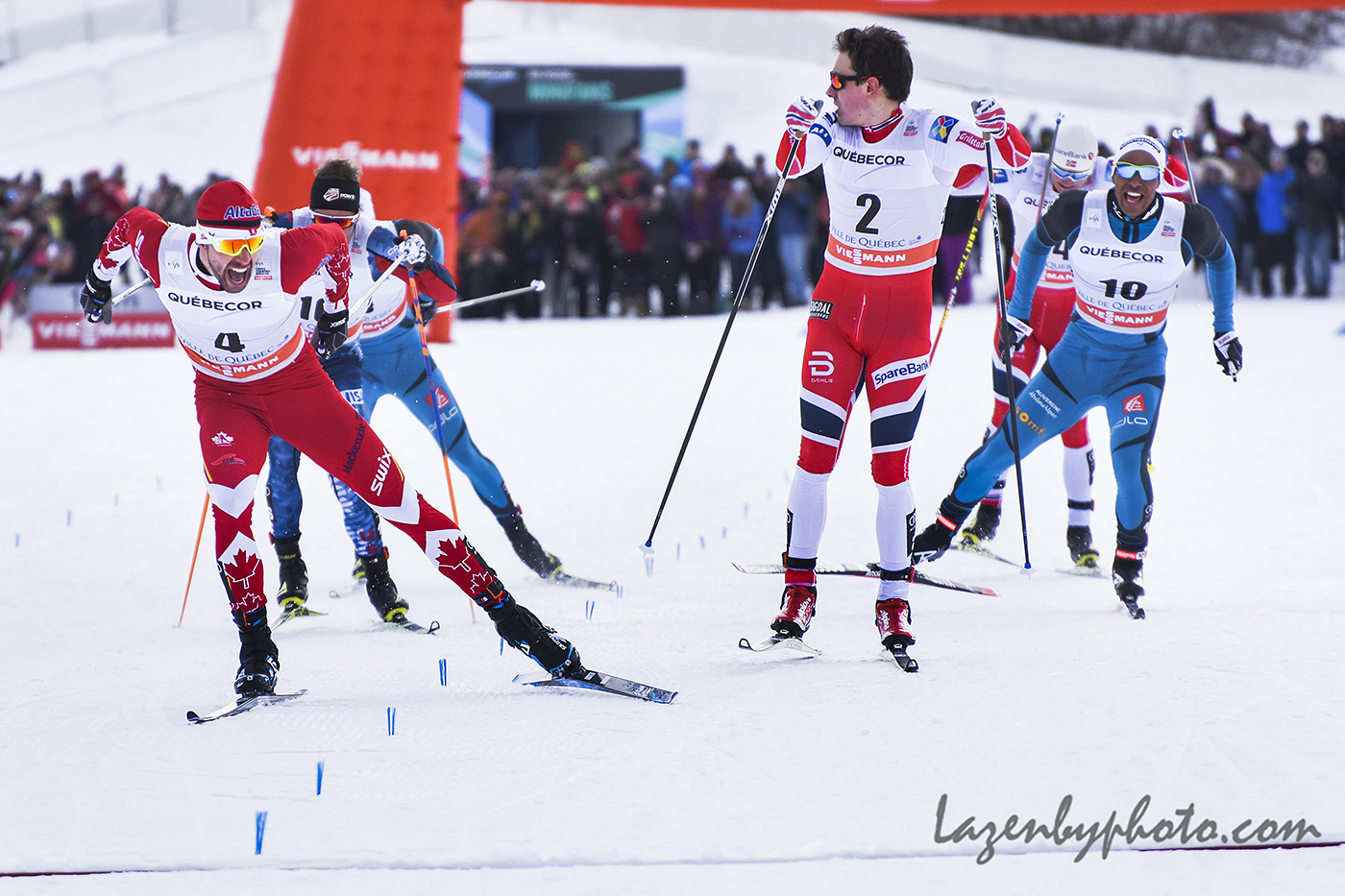
Canada’s Alex Harvey (l) coming on strong in the finishing stretch to outlast Norway’s Finn Hågen Krogh (2) by 0.31 seconds for the win in the World Cup Finals freestyle sprint on Friday in Quebec City, while France’s Richard Jouve (10) races to third, just ahead of American Simi Hamilton (behind Harvey) in fourth. (Photo: John Lazenby/Lazenbyphoto.com)
“At the last turn, I was confident,” Harvey said in French. “I looked at him [Krogh] and I knew I had him, but I was focusing on staying second because of a strong headwind in the last downhill.”
“To be beaten by the 50 k World Champion on the home stretch is tough,” Krogh told the International Ski Federation (FIS) on Friday. “I was simply not good enough.”
In the finish area, Harvey appeared about as elated as he was after the 50 k in Lahti, a reaction he said was “pure instinct.”
“But sprinting comes with greater stress, with the risk of falling, of breaking a pole…” Harvey said in French. “To cross the finish line after a sprint is like a deliverance.”
The win comes just over a year after Harvey placed second in a World Cup skate sprint in Quebec during the Ski Tour Canada. After passing Russia’s Sergey Ustiugov in the finishing stretch, he had been in first until France’s Baptiste Gros snuck up on him on the inside lane. Harvey finished half a second back in second place, but it was still a day he’d remember — his girlfriend Sophie came out on course to congratulate him.
On Friday, he made sure to lock up the win. And he was met afterward by Sophie, his sister (also named Sophie) and his dad, Pierre Harvey, alongside the finishing lanes.
“Last year it would have been nice to win,” Harvey said in English on Friday. “When I passed Ustiugov last year, I had so much more speed than him … I didn’t ease up, but I thought I was going to win … and then I saw Baptiste just blow by all of us in the corner of my eye. So I had a bit of that in my mind and just making sure it wasn’t going to slip through my finger two years in a row.”
Asked how this stacked up to his 50 k win, he said it was close.
“Today’s victory really isn’t far behind my 50 k win,” he said in French. “My second place last year here was already incredible, so to top that off with a win at home is a dream come true.”
The win comes after Harvey has competed two 50 k races, including last weekend’s Holmenkollen World Cup in Oslo, Norway, in less than two weeks and traveled across the Atlantic back to his home province.
“What surprises me is how well he recovered after the double 50 k, in which he did very well, both times,” Louis Bouchard, Harvey’s personal coach and Canada’s co-World Cup coach, said in French. “Usually in sprints, he will hang at the back and make his move right at the end in the final stretch. So tactically, he skied differently today. He felt strong to the point of leading every round right until the end. It’s also rare to see Alex qualify so strongly. His form his tremendous at this point.”
The men’s freestyle sprint podium on Friday at World Cup Finals in Quebec City, with Canada’s Alex Harvey (c) in first, Norway’s Finn Hågen Krogh (l) in second and France’s Richard Jouve (r) in third. (Photo: John Lazenby/Lazenbyphoto.com)
Pierre Harvey, a local hero and the inspiration behind the Pierre-Harvey National Training Centre, spoke with reporters after the race. Five years ago, he had been on site to witness his son’s first-career World Cup win in Falun, Sweden.
“It’s always very emotional,” Pierre said in French. “I was there when he won his first World Cup in Sweden, which I didn’t think he could ever do at the time, but winning became a familiar sight in a way. I thought he would burn himself after the qualification, but he managed to win every round after. It was impressive to see him beat Krogh, a very capable sprinter, in the last stretch.”
Asked what propelled his son on Friday, Pierre said racing at home.
“In front of friends and of a cheering crowd, along with great ski conditions, is an extra motivation,” he said. “He left home on the fifth of November, so coming back after months of racing in Europe, he really wanted to put on a show for his friends. I hope he keeps his energy levels high for tomorrow and Sunday’s races.”
Two more World Cup races remain to close out the season: a 15 k classic mass start on Saturday and 15 k freestyle pursuit on Sunday. Harvey has essentially solidified third place in the overall World Cup rankings with 57 points separating him from Finland’s Matti Heikkinen in fourth place.
“Today’s win comes with 50 points, 30 bonus seconds and 10 seconds I put on him in today’s qualification,” Alex Harvey explained. “I feel secure with this lead on him.”
Ahead of him, Norway’s Martin Johnsrud Sundby and Russia’s Ustiugov are not racing in Quebec. Sundby already locked up the World Cup overall and distance titles, and Ustiugov is still 282 points clear of Harvey in third place.
After Day 1 of 3 in the World Cup Finals mini tour, Harvey leads by 2.3 seconds over Krogh. All 74 racers remaining in the men’s field will start Saturday’s mass start together.
The Sprint World Cup podium was awarded on Friday, with Norway’s 20-year-old Klæbo in first, Italy’s Federico Pellegrino (last year’s Sprint Crystal Globe winner) in second, and Skar in third. Both Klæbo and Pellegrino were eliminated in the semifinals, with Pellegrino placing seventh and Klæbo eighth on the day.
As for third and fourth place on Friday, Jouve was thrilled with his fourth individual World Cup podium and first this season after being injured in December and January.
“It was a really good day for me,” Jouve said in French. “I passed through my quarter and semi as I wanted. I managed to stay in a good position in the finals. I had very good legs and fast skis.”
Asked what he thought of the crowd’s favoritism for Harvey, he said it wasn’t anything he couldn’t handle.
“We were here last year, and the public is pleasant and cheers for everyone,” Jouve said. “It’s normal to see them favor the local star.”
Simi Hamilton (U.S. Ski Team) racing to 16th in the men’s 1.5 k freestyle sprint qualifier on Friday at World Cup Finals in Quebec City. He qualified in 16th and went on to place fourth in the final. (Photo: John Lazenby/Lazenbyphoto.com)
Even Hamilton, frustrated with fourth, was happy for Harvey.
“He’s such a good guy. He’s such a great North American teammate. He’s always so psyched when we ski well, and we’re always so psyched when he skis well, as well as all the other Canadians,” Hamilton said. “We are really just like kind of one bigger team, us against all the Europeans we feel like sometimes, so it’s cool to see him so successful and skiing so strong. And he handles his success with so much humility and grace.
“Someone as talented as he is, and somebody who works as hard as he does, it’s awesome just to feel the energy,” Hamilton added. “He’s such a good ambassador for our sport, and I think that that’s a testament to see all these people cheering him on, because they know that he’s such a great guy, more than just a good ski racer.”
Hamilton faced Harvey in all three of his heats and followed him in every one.
“I knew that Alex and Finn were far enough ahead of us that, unless they tripped or something, that we weren’t going to catch them,” Hamilton said of the final. “So I also knew that I was ahead of Jouve and the other two that were behind us a little bit, so I knew that, especially with the tailwind, if I just skied it well that I would have held onto third. And I just didn’t do that, and it sucks. I want it back. I want to do it again. I felt good going into it, I felt like my energy was really good during the entire final, and for whatever reason, I just didn’t ski it.”
Four Canadians in Top 20
Earlier in the day, Cockney tied his second-best individual World Cup result in 10th and popped his second top 12 of the season to meet the criteria for the Canadian 2018 Olympic team. After qualifying in 28th and hanging around fourth or fifth for most of his quarterfinal, Cockney used the draft and his reserved energy to sprint from fourth to second in the finishing stretch. He finished just 0.09 seconds behind Klæbo, who won that quarterfinal, and edged Great Britain’s Andrew Young by 0.07 seconds. While Young didn’t advance, Cockney did, and he went on to place fifth in the first semifinal, 1.3 seconds behind Krogh, the winner of that heat.
Jess Cockney (Canadian World Cup Team) racing to 28th in the qualifier of the men’s 1.5 k freestyle sprint on Friday at World Cup Finals in Quebec City. He went on to place 10th on the day to tie his second-best World Cup result. (Photo: John Lazenby/Lazenbyphoto.com)
“You can see just how wide open this field is, and it’s so windy that you kind of had to be smart about where you wanted to use energy,” Cockney said of his tactics.
“I knew the start was straight into the headwind. You could come down with the tailwind behind you and make back a couple spots, or at least close the distance behind some people. And that’s just exactly what I wanted to do in the quarterfinal, and I was lucky that it worked out well, and I had some energy saved from doing that for the finishing straight. So that was really big for me.”
As for his finishing gear, Cockney laughed and said he’d like to think he’s had that all along. His trouble has been getting into the heats. In the one other World Cup sprint he qualified in this season — the classic sprint in PyeongChang — he went on to finish 10th.
“It’s funny, I’d like to think I always have some kind of sprint like that, but I never get into the sprints; my qualifying speed is still not there,” Cockney said. “Today, to actually see it on a race course and see it at a World Cup — I’m really happy with that. I can do it on a domestic level, but being consistent at an international level is still taking some time.”
Four Canadians landed in the top 20 with Valjas in 19th and Locke in 20th. Valjas finished fourth in the first quarterfinal, 1.81 seconds behind Chanavat, who won. Locke placed fourth in the third quarterfinal, 1.89 seconds behind Pellegrino as the winner of that heat.
“I’m a bit disappointed,” Valjas said. “I didn’t feel like I was able to show my potential today. I always felt boxed in, and every time I tried to make a move, there was somebody there. The course is so turny that when you’re beside somebody you get boxed in, so it’s frustrating. I think I had more speed than I showed today, but I ended up not skiing it well tactically, starting at the back.”
Asked about the conditions, Valjas elaborated that Quebec had some of the best snow that World Cup skiers have seen all year. Quebec City was hit with a massive snowstorm earlier in the week on Tuesday.
“Europe is sometimes good, but this is all-time conditions here,” Valjas said. “It’s fast, it’s wide. It’s just, with the curves, it’s harder to pass than I thought.”
Julien Locke (Canadian U25 Team/AWCA) racing to 25th in the men’s 1.5 k freestyle sprint qualifier on Friday at World Cup Finals in Quebec City. He went on to place 20th on the day for his first World Cup top 30. (Photo: John Lazenby/Lazenbyphoto.com)
On the other end of the spectrum, Locke, a 23-year-old member of Canada’s U25 Team, was pleased with his performance in his third World Cup start as it marked his first time in the points (top 30). In his first World Cup race last month, he came close in 36th in PyeongChang.
“At the start of the season, my two main goals were to go to the Korea World Cup and the World Championships,” Locke said. “And I went to Korea, and I unfortunately had a crash there, so I was really hoping for another second chance, and to qualify to come here was fantastic. It’s crazy having Alex here, a world champion coming home, and the atmosphere is incredible. So since this race was announced, doing a good sprint here was my big goal for the year.”
Thompson, 26, ended up 30th after finishing sixth in the same quarterfinal as Cockney. After making his World Cup debut at last year’s Ski Tour Canada, Thompson started this season on the World Cup in Europe and raced to 31st in the classic sprint in PyeongChang. On Friday, he scored his first World Cup points as well.
“Getting in the heats has been the goal for every sprint World Cup I’ve gone to do, which is, this is the 17th now, and I think it’s about the seventh sprint or so,” Thompson said. “… Goal number one is, get a top 30. So I got that, I can reassess, and raise the bar a little bit.”
Newell Narrowly Misses Qualifying
For the U.S., Andy Newell missed out on qualifying by eight-hundredths of a second in 31st. Erik Bjornsen was 0.98 seconds back in 33rd, and Cole Morgan (Sun Valley Ski Education Foundation) another second back in 34th.
“For Andy to be in 31st, disappointing for him,” U.S. Ski Team Head Coach Chris Grover said. “He felt good out there; he’s a little bit mystified. … And then also for Erik Bjornsen and Cole Morgan, who skied great, to be so close to going in … If we’d gotten three or four guys into the heats then I think it would have been a great start to the day. So a little disappointing to miss that opportunity.”
“I was feeling pretty good out there skiing, so I don’t know why it was slow,” Newell said. “I couldn’t figure out why.”
Bjornsen said he hasn’t raced much since World Championships and hoped Friday blew the cobwebs out.
“I was hoping for a little bit more today,” he said. “I obviously wanted to qualify … but I’m excited for the next couple days. … Tomorrow’s a 15 k classic, which is my favorite event, so yeah, hopefully I can put together some good races.”
Also for the U.S., Paddy Caldwell placed 50th, Matt Gelso 57th, Scott Patterson 58th, Jack Hegman 61st, Brian Gregg 62nd, Ben Lustgarten 69th, David Norris 70th, and Noah Hoffman 73rd.
Canada’s Andy Shields came close to qualifying in 35th, Russell Kennedy followed in 36th, Devon Kershaw 38th, Knute Johnsgaard 41st, Evan Palmer-Charrette 47th, Joey Foster 53rd, Graeme Killick 64th, Ricardo Izquierdo-Bernier 71st, Brian McKeever 72nd, and Gareth Williams 74th.
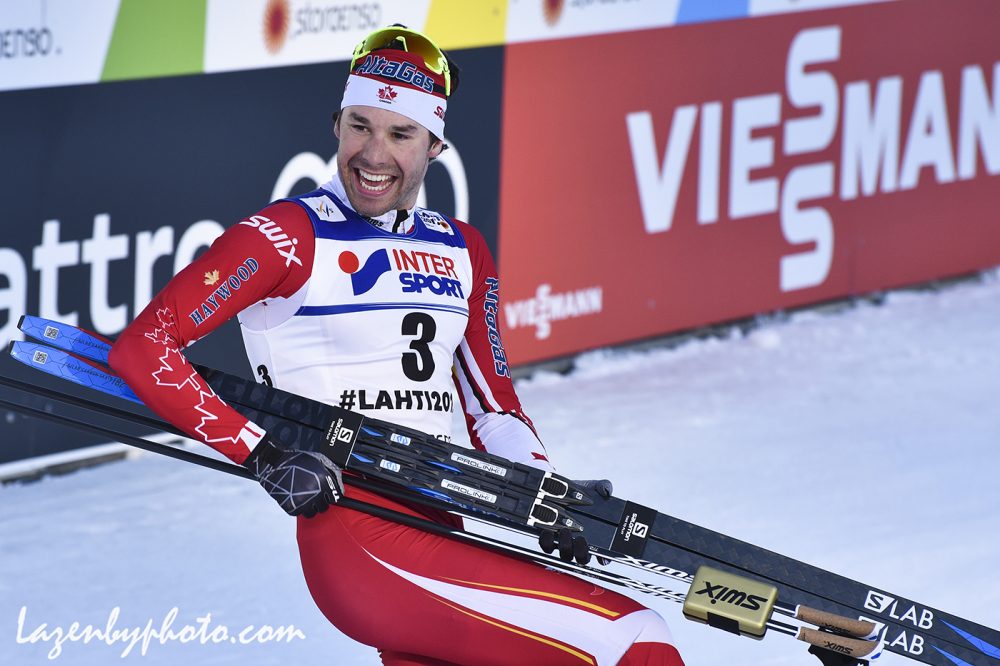
It’s real. Canada’s Alex Harvey after winning gold in the men’s 50-kilometer freestyle mass start on Sunday at the 2017 Nordic World Championships in Lahti, Finland. (Photo: John Lazenby/Lazenbyphoto.com)
LAHTI, Finland — Here’s the basics: fast and firm tracks, cloudless skies, and once again a stacked field for the final event of the 2017 Nordic World Championships: the men’s 50-kilometer freestyle mass start.
Over the course of the 50 k, Canada’s Harvey had to think about one thing: be up front near the top three in order to shadow Norway’s Martin Johnsrud Sundby’s inevitable gut punch in the last kilometer. What he didn’t have to think about was playing catch up as a skier yo-yoing off the back, or his skis — they were rockets.
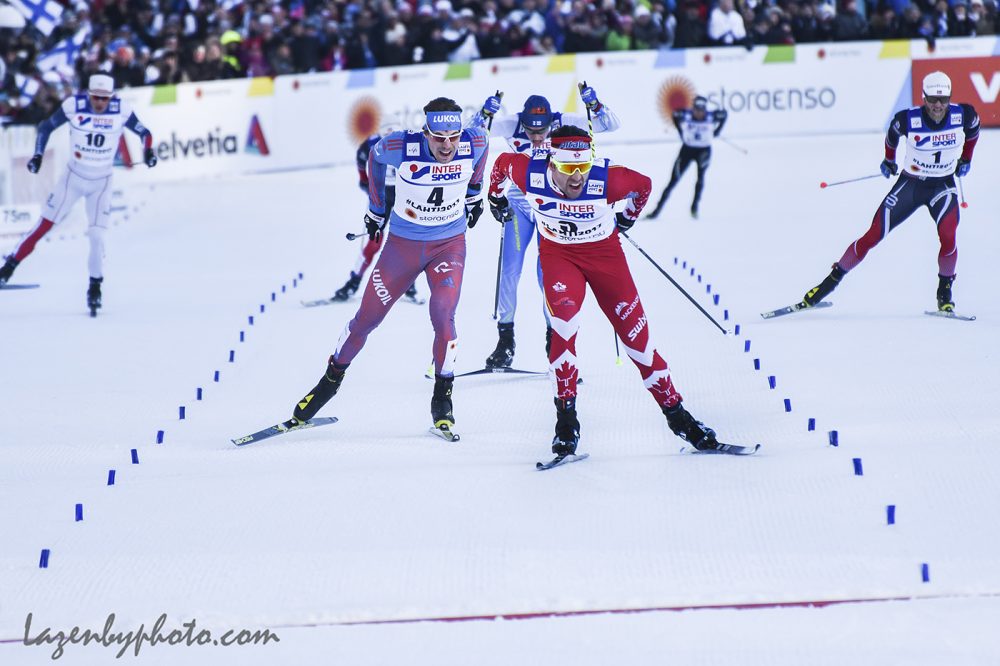
In Sunday’s closing race of Lahti World Championships, Harvey was slotted in second, sliding around “Lahti Corner” just centimeters behind Sundby. Drafting off Harvey was 2017 championships legend, Russia’s Sergey Ustiugov, who had already racked up four medals previously in the week (skiathlon gold, team sprint gold, freestyle sprint silver and team relay silver). Pulling not far behind the three was Finland’s Matti Heikkinen and Andrew Musgrave of Great Britain.
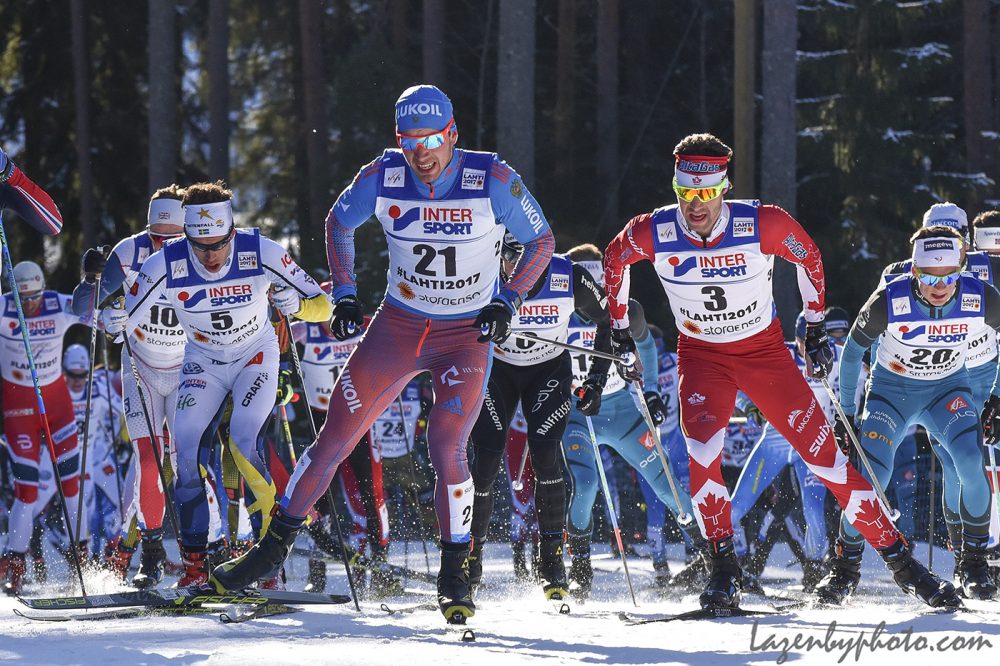
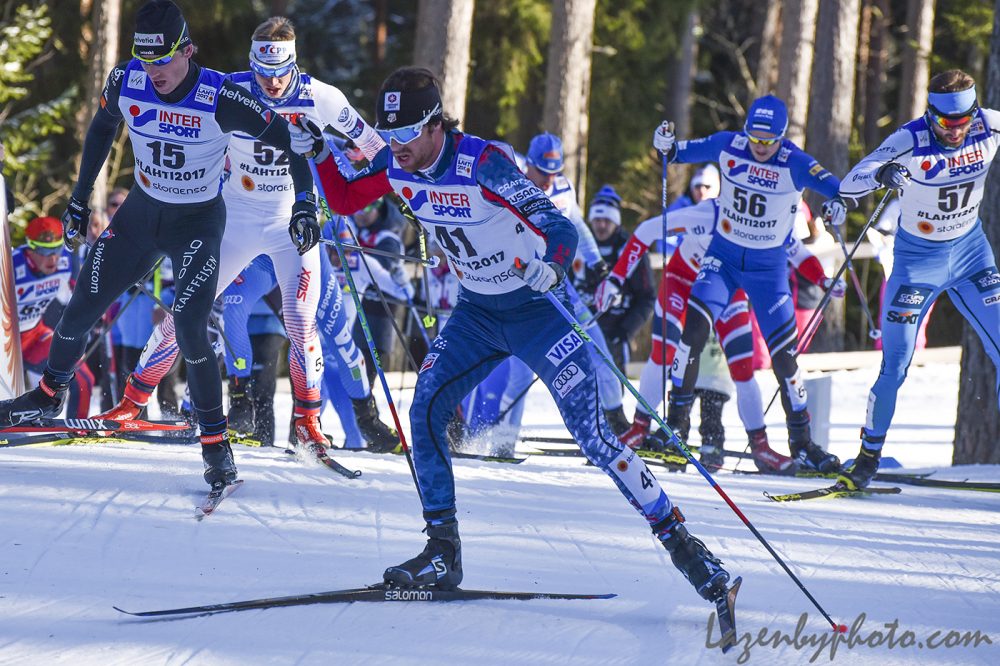
Russia’s Alexey Chervotkin (21) leads Canada’s Alex Harvey (3) and Sweden’s Marcus Hellner (5) during the men’s 50 k freestyle mass start on Sunday at 2017 Nordic World Championships in Lahti, Finland. Harvey went on to win, Hellner placed 12th and Chervotkin 13th. (Photo: John Lazenby/Lazenbyphoto.com)
“I saw the women’s race yesterday, and I figured if Marit Bjørgen could not distance herself from the other girls, then there is no way that the men will be able to do that,” Harvey said during Sunday’s post-race press conference. “I knew with the fast conditions, it was going to be a big group, and that leaves the potential for a lot of carnage, a lot of mayhem.”
For the first 10 k, skiers from various nations took pulls up front, including Sundby and Ustiugov, and Norwegians Petter Northug, Hans Christer Holund, and Anders Gløersen. After testing the field and breaking away around 8 k into the race, Gløersen was still skiing alone up front, 20 seconds ahead of anyone else at 15 k.
“Gløersen took off a bit and he was like, ‘What’s the gap? What’s the gap?’ ” Canadian World Cup coach Ivan Babikov said of Harvey. “He was always controlling the race and saving energy for the finish.”
Eventually, the main pack surged to recover the lost time. Gløersen’s off-the-front-flier only earned him camera time. The catch came just before Lahti Corner returning to the stadium around 20 k in, where Russia’s Alexey Chervotkin took over. In another 2 k, Sundby, who had been stalking in the top 10, moved to the front as if the race were all of a sudden for real.
Norway’s Anders Gløersen broke away early to lead the men’s 50 k freestyle mass start, skiing alone off the front for about 12 kilometers, on Sunday at the 2017 Nordic World Championships in Lahti, Finland. (Photo: John Lazenby/Lazenbyphoto.com)
From then on, the size of the pack atrophied with each consecutive lap. At 30 k, the pack streaming through the stadium was 24 skiers long. At 45 k, the group winnowed to a train of 19. And within another 4 k, only 13 remained: Sundby, Ustiugov, Musgrave, Harvey, Heikkinen, Northug, Holund, Gløersen, Chervotkin, Sweden’s Marcus Hellner, Norway’s Sjur Røthe, Switzerland’s Dario Cologna, and France’s Maurice Manificat.
“I wanted to be in the front, top three at least,” Harvey said, reflecting on his skiathlon tactics from last weekend, where he skied around fifth up until the final headwall and finished fifth, outside of the medals.
“I knew that Sundby’s first chance to win gold was to break everybody,” Harvey continued. “I was expecting him to leave from kilometer 1 or 49.”
Harvey guessed Sundby would be the only one who would try to break away. With that in mind he marked the Norwegian.
“He knew it would be hard to break away [and that] it will be all about the finish,” Babikov said. “He was positioning himself perfectly up the last hill and just stayed on Sundby. That was his plan, ‘I’m just gonna stay on Sundby and if he changes skis, I’ll go change skis,’ but today conditions were perfect so he didn’t.”
With ripping conditions and skis to match, Sundby never slowed nor switched skis. Neither did Harvey.
“When he waited until the last lap, I knew exactly where he was going to do it: with a k and a half to go,” Harvey explained. “I was just lucky enough to have the legs to stick on him today and from then on it started playing more into my hands.”
Canada’s Alex Harvey (5) charging to the line ahead of Russia’s Sergey Ustiugov (4), Norway’s Martin Johnsrud Sundby (1), Great Britain’s Andrew Musgrave (10) and Finland’s Matti Heikkinen (behind Harvey) in the men’s 50 k freestyle mass start on Sunday at the 2017 Nordic World Championships in Lahti, Finland. (Photo: John Lazenby/Lazenbyphoto.com)
In the closing moments of nearly every race of these world champs, the fate of winners seem come down to luck, and often someone else’s bad luck. As the leaders came into the stadium, it was as if every observer were about to witness an upset due to a tumble or a tangle.
Harvey was clean around the final turn and unscathed down the stretch.
“I wanted to hit the [Lahti] corner in second, right behind Sundby or whoever was in the lead,” Harvey said. “I knew I needed to do that in the skiathlon, too, and I tried to go around Finn Hågen Krogh there, but he’s a clever sprinter too. He knew he wanted to be second there.
“In the skiathlon it didn’t work, but today it did,” Harvey continued. “I was second the whole time and then out of that corner I did one push more than Sundby. I had really fast skis, but used the draft to slingshot and then hit the final corner in first and from there, I knew it was mine to lose more than anything else.”
Canada’s Alex Harvey (5) celebrates his first individual World Championships gold after winning Sunday’s 50 k freestyle mass start in Lahti, Finland, ahead of Russia’s Sergey Ustiugov (4), Norway’s Martin Johnsrud Sundby (1), and Finland’s Matti Heikkinen (2), respectively. (Photo: John Lazenby/Lazenbyphoto.com)
And so Harvey earned the crown: 50 k world champion in 1:46:28.9 hours.
It’s his first championships gold since winning the classic team sprint with Devon Kershaw at 2011 world champs, and fifth medal in four World Championships.
“He turned around these world champs for all of us,” Babikov said of the Canadian team. “He was solid. We were with no medals so far, and winning 50 k, he’s the king now.
“This is the legit distance and he took it today,” he added.
“It’s a long championship,” said Louis Bouchard, Harvey’s personal coach and Canada’s World Cup co-coach. “He feels every day his energy’s still there, so he knows today, if he’s good tactically, then he can do it.”
Asked how nerve-racking it was watching the final 5 k unfold, Bouchard responded, “I was pretty nervous, too much maybe. But that’s OK.”
Alex Harvey’s Canadian teammates, coaches and support team celebrate his win in the men’s 50 k freestyle mass start on Sunday at the 2017 Nordic World Championships in Lahti, Finland. (Photo: John Lazenby/Lazenbyphoto.com)
For his fifth medal of these championships (and sixth world-champs medal of his career), the 24-year-old Ustiugov crossed second for his third silver of the week, just 0.6 seconds behind Harvey. Finland’s 33-year-old Heikkinen took third (+1.4) for his first medal since 2011 World Championships.
“Today I skied within my own limits and at the end I was fresh enough to attack,” Heikkinen said in a press conference.
Asked about his not-so-characteristic finishing kick on Sunday, Heikkinen said he remembered how he faded to 20th in the 50 k classic mass start at 2015 World Championships.
“After Falun 2015 world champs, I was watching the race after and I was walking in front a mirror and I said, ‘I won’t ever again be like that after a 50 k,’ ” he said. “I’ve been training two years now at a high level [with my team] … and that’s why I’m top three in overall World Cup, so it was possible.”
Behind him in a photo finish for fourth, Musgrave capitalized on Sundby slowing before the finish — probably after the Norwegian realized he had missed out on a medal — to place fourth (+2.9). For Musgrave, who turns 27 on Monday, it was his first World Championships top 10. For Sundby, who had been on a quest all week for his first individual championships goal — it was a bummer. The 2018 Winter Olympics in PyeongChang, South Korea, will be Sundby’s next opportunity.
From a North American and perhaps international standpoint, American Tad Elliott skied the gutsiest of races. Halfway through the race, Elliott, a 28-year-old Colorado native and former U.S. Ski Team member, remained a not-too-far-off the back chaser, 27 seconds behind the lead group. His margin back slowly accrued over the remaining distance.
“At 25 k, man, some guys were really struggling and they balled it up,” Elliott said afterward. “I should have sent it a little harder but that’s how it goes sometimes in that pack. I thought I could get there, but I just missed it.”
Elliott, of Ski Club Vail, finished 27th (+3:16.8) for his best individual result in three World Championships. In recent years, Elliott has struggled with illness, which impacted his ability to train and peak. Those difficulties caused him to question whether or not his best years were behind him. Evidently not.
American Tad Elliott (41) racing to 27th in the men’s 50 k freestyle mass start on Sunday at the 2017 Nordic World Championships in Lahti, Finland.. (Photo: John Lazenby/Lazenbyphoto.com)
“I didn’t know if I wanted to come back [to skiing]. I was so sick. I was so bummed. I was like, ‘Am I ever going to get back? Am I ever going to get back to top-30 form?’ ” Elliott said. “We knew if everything went right, I would qualify for worlds … then to get top 30 here, man, I feel like I’m starting to get greedy. I’m starting to want more, I’m starting to want more opportunities. But I’m proud of this effort, I’m going to savor it a bit.”
In the first few kilometers, Russia’s Petr Sedov skied too wide on a 180-degree corner and stalled out. American Kyle Bratrud, the next skier to round the turn, was unable to avoid the Russian and collided. Soon after, due to the impact, Bratrud was unable to complete the race.
U.S. Ski Team member Noah Hoffman finished the day in 50th (+8:53.1).
Devon Kershaw was Canada’s second skier on Sunday, crossing in 38th (+5:45.5). Also for Canada, Graeme Killick and Knute Johnsgaard finished in 43rd (+7:04.0) and 55th (+12:03.3), respectively.
“[Alex’s performance] was incredible and such a big boost for our entire team,” Babikov said. “You should see all the techs, and Devon and Graeme and Knute, who didn’t really have a great race today, and they’re still so psyched for him.”
— Gerry Furseth, Jake Ellis and Alex Kochon contributed
Canadian air guitar: Alex Harvey performs his team’s signature move after winning the men’s 50 k freestyle mass start on Sunday at the 2017 Nordic World Championships in Lahti, Finland. (Photo: John Lazenby/Lazenbyphoto.com)
The men’s 15 k classic podium at Sunday’s World Cup in Kussamo, Finland, with Finnish winner Iivo Niskanen (c), Norway’s runner-up Emil Iversen in second and Martin Johnsrud Sundby in third (r). (Photo: Fischer/NordicFocus)
If Finland’s Iivo Niskanen has a classic race course, it’s clearly becoming the men’s 15-kilometer in Kuusamo, Finland. For the second time, Niskanen outlasted Norway’s Martin Johnsrud Sundby to take the overall title — the Finn’s first and only other World Cup win occurring in 2014 at the age of 22.
Now, two years later at 24, Niskanen is the only male to have repeated a victory in the Ruka men’s 15 k classic individual start, an event that has taken place in Kuusamo for the past nine years.
“I was confident when I saw the intermediate times,” Niskanen said during a post-race TV interview. “I believed that my pace is sufficient for victory.”
Starting in bib 21, Niskanen toggled between third and fourth place for the first 3 k on Sunday, while Sweden’s Calle Halfvarsson, bib 84, took the lead until the end of lap one. With two more laps to go, the Finnish skier took over the lead, superseding not only Halfvarsson, but Norway’s Sundby and Emil Iversen as well.
Norway’s Emil Iversen en route to second in the World Cup men’s 15 k classic on Sunday in Kuusamo, Finland. (Photo: Fischer/NordicFocus)
During the next 5 k, Iversen and Halfvarsson dueled for second place, with Iversen eventually coming out on top and taking the front position from Niskanen around the 10 k mark.
Within another kilometer, however, Niskanan had regained control of the lead and Iversen dropped back from the Finn by a little more than eight seconds. Sundby, who had been sitting comfortably in fourth for most of the race, began to dig deeper and reeled in Iversen with less than 5 k to go.
With less than a lap to go, Sundby made another push to surpass Niskanen, but it was too late. The Finn held him off for the rest of the final lap, and as Sundby started to lose steam, Iversen regained speed and moved back into second.
“This was good for my head and body,” Iversen told Langrenn.com. “I felt lousy yesterday but now I’m relieved. I considered not racing at all, but it turned out pretty good and I don’t completely know why.”
Iversen placed second overall, finishing 10.2 seconds behind Niskanen’s winning time of 35:27.6. Sundby took the final podium spot in third, 11.2 seconds out from the win.
“I got a beating from the other two,” Sundby said, referring to Niskanen and Iversen, in a post-race TV interview. “I feel like I did a good race … sadly I wasn’t good enough to win today.”
After leading for the first third of the race, Sweden’s Halfvarsson, who reached the podium in Saturday’s sprint final, dropped back to seventh (+21.2) by the end of the day. Within a little under 14 seconds of Halfvarsson was Canada’s Alex Harvey in 11th (+35.0).
The top North American on the day, Harvey, a 28-year-old Canadian World Cup Team member, narrowly missed Sunday’s top 10, with 1.2 seconds separating him from 10th. He said it was still a good sign of where his classic technique is headed as he begins a new season.
“I felt last year I never had a good classic race, a race that I felt like I skied well the whole way technically,” Harvey said on the phone, pointing out that Sunday was one race that he he did.
Despite feeling a little worn down prior to the start of Sunday’s race –which Harvey indicated may have prevented him from racing in a top-five position — the consistency he showed on course in his skiing mechanics were a positive for the Canadian.
“I’m still really happy with the result and not just the result itself, but also the way I was skiing,” he said.
Canada’s Devon Kershaw racing to 33rd in the World Cup men’s 15 k classic on Sunday in Kuusamo, Finland. (Photo: Fischer/NordicFocus)
After placing 25th in Saturday’s classic sprint, Harvey also explained that the weekend’s combined results were, for him, checkmarked accomplishments.
“I didn’t put too much [weight] on the sprint, so just being able to qualify yesterday was good,” Harvey said of Saturday. “I had a bit more expectation on today’s race [with] the goal [being] to get close or at least finish in the top ten.
“And I think that’s what I reached,” he added. “That’s mission accomplished for me, I’d say for both days.”
After Harvey, the second top North American man on the results sheet was Devon Kershaw in 33rd (+1:23.4), finishing just outside of World Cup points — not quite where he wanted to be, but on the right track.
“To be just outside of the points is never a great feeling,” Kershaw said, according to a Cross Country Canada press release. “[B]ut to know that I’m knocking on the door in only the first competition of a long World Cup season gives me some confidence moving forward. I’m looking forward to the next stop!”
Following him as the first American was U.S. Ski Team (USST) B-team member Erik Bjornsen in 41st (+1:37.2). These being Bjornsen’s first races on snow, he indicated that coming into the opening World Cup competition, his greater focus was getting the feel for racing again.
“I only did one day of classic skiing in the 30 days leading up to coming over here,” Bjornsen wrote in an email. “I took a fairly bad rollerski crash at Soldier Hollow which left my tail end and hand in a bad spot. My goal coming into this weekend was to not get to hung up on the results. Lillehammer has always been a good venue for me so I was trying to think of Ruka as a warm-up into the season.”
Canada’s Graeme Killick (World Cup B-team) finished 53rd (+2:12.9) and Noah Hoffman (USST B-team) was 64th (+2:42.6).
Canada’s Graeme Killick racing to 53rd in the World Cup men’s 15 k classic on Sunday in Kuusamo, Finland. (Photo: Fischer/NordicFocus)
“It’s an early race on a super-tough course against athletes that have been racing for two or three weeks and we know we just came up short today,” USST Women’s Coach Matt Whitcomb said on the phone.
Whitcomb indicated that, from his perspective, the men’s squad has had good preparation, training and fitness leading up to the opening World Cup races in Kuusamo. With goals of peaking for later World Cup competitions, such as those in the Tour de Ski and World Championships, Whitcomb explained the men’s team will continue to work into the season with the understanding that the opening races this weekend are early season races.
“They haven’t gotten fast yet and everybody has a pretty balanced head on their shoulders,” Whitcomb said of the U.S. men who raced on Sunday. “I think there is nothing wrong with being a little disappointed. I know they are right now but they’re also very realistic and they know that their season is about to open up.”
When asked about Hoffman, who made a notable increase in training hours this season, Whitcomb explained that the way Hoffman absorbs his training load as he comes out of it and into the race season may impact his early season and later performances.
“I would suggest that [Hoffman] has probably not fully absorbed that training load and good things are to come,” Whitcomb said. “I’ve already seen really nice changes in his strength level. He has spent a huge amount of time this year on general strength training and it has improved his double pole. … I think it is just going to take a couple weeks of being in Europe racing and training more normally for things to liven up.”
The Canadian coaches could not be reached for comment.
Canada’s Alex Harvey leads Norway’s Martin Johnsrud Sundby during the men’s 15 k freestyle pursuit at Stage 4 of the 2016 Ski Tour Canada in Quebec City. Harvey went on to place fourth, 1 second ahead of Sundby in fifth. (Photo: FlyingPointRoad.com/NNF)
If you’re a fan of North American cross-country skiers, it’s likely you have an affinity for Canada’s Alex Harvey. Hailing from Quebec, he’s a marketable star in his home province. That may stem from his affability or his encroachment on Norway’s “stranglehold” on the World Cup overall.
This year, for Harvey, his motivations are twofold. “The main goal is Lahti World Championship for sure, to be on the podium there,” Harvey said in a recent phone interview.
Considering past performances, it’s not far-fetched to consider Harvey a contender for the overall: he was third overall in 2014, ninth in 2015 and seventh in 2016.
“When Devon [Kershaw] was second in the overall in 2012, it was the first time I actually believed that a Canadian, or a North American man for that matter, could be on the overall podium,” Harvey said about his evolving aspirations. “Just because I saw Devon, one of my best friends, teammate, roommate from the last ten years, be on the top-three podium — that was the first year I believed it.”
The belief in an overall podium and World Championships medal coming into the season is palpable, even realistic for the 28-year-old Harvey. He is a multiple World Championships medalist who can strike both in the sprints and distance events.
“But the championships medal is more important for me,” he said. “If I have to choose between say like championship gold and first place in the overall, I’d probably take first place on the overall. But I think championships are still a bigger deal to me than second or third [overall]. That’s why I put the focus still on the championship. The overall is still in the back of my mind and I am still doing every single weekend this year like previous years, other than the weekend after the Tour de Ski.”
“Just because I saw Devon, one of my best friends, teammate, roommate from the last ten years, be on the top-three podium — that was the first year I believed it.” — Canadian Alex Harvey, on his overall World Cup aspirations
Harvey noted that he will skip the pre-Olympic World Cup in PyeongChang, South Korea, to rest up for the late-February World Championships in Lahti, Finland. Harvey explained that a small contingent of Canadian coaches and athletes will take a quick trip after the World Cup season concludes to preview PyeongChang, the 2018 Olympic venue.
With firm goals set, Harvey has been fastidious in his preparation. After the 2014/2015 season, Harvey underwent Iliac artery surgery to remedy a circulation issue in his legs. Last summer, although he felt better in certain running tests he’s used as historical benchmarks, his regiment deviated from his normal routine.
Alex Harvey snaps a photo of himself with Norway’s Martin Johnsrud Sundby (r), Devon Kershaw (l) and others while training in Livigno, Italy, this summer. (Photo: Alex Harvey/Instagram)
“Because last year when I started training again I was coming off surgery, so I couldn’t do exactly what I was used to,” Harvey said of his 2015 dryland season. “I could not do strength or any intensity for two months. So this year I was back kind of doing what I was used to pretty much doing for my whole career before the summer of 2015. That’s just normal strength in the gym twice a week and a third time doing core and then intensity once a week for May, June and July. And then switching to twice a week after that. Some speed sessions, too: two speed sessions a week. There’s really nothing new for me. But it was kind of different from last year because I couldn’t do everything I wanted last year. I just went back to what I knew worked for me.”
According to Harvey, it’s still working. There’s a five-minute double pole test, a six minute skating test, and a 25-minute running test that both Harvey and his coach Louis Bouchard have used as fitness barometers throughout his career.
“I have improved all of them by ten full seconds each time,” Harvey said of his test times. “I mean, last year the big jump was on the running test because I was able to get out of threshold and push all out. And this year I was still able to improve a little bit on the running and keep improving on the other aspects. Every year I think it is important to have some past kind of test, you need to know if things are working properly or not. We put a lot of focus on those test, but we have to keep a global perspective. But this year everything was improving, so that is good.”
If the past is any guide, Harvey, racing in his maple-leaf-emblazoned lycra, should be high up on the leaderboards. And when it’s world champs time, Harvey believes the skiathlon is his best individual shot at medaling.
Canadian teammates Devon Kershaw (l) and Alex Harvey (r) with their 2011 World Championship gold medals from the classic team sprint.
“My favorite race is the skiathlon,” Harvey said when asked about his chances in specific World Championships races. “It’s the distance race, I think I have had the most success in my career. I have medaled in both World Junior Championships, U23 World Championship, and World Senior Championships … It is the race that for me is probably my best chance.”
As mentioned, Harvey is an all-arounder. Along with his 2015 World Championships 30 k skiathlon bronze , there’s three total sprint World Championship medals accompanying the sole distance hardware.
The Norwegian odds makers might just be hedging against their teams possible demise by picking Harvey as the spoiler.
***
We asked Harvey to give our ’17 Questions for 2017′ a go. Here are his responses:
1. Biggest change in your life in the last five or so months since the ski season ended?
Not much…
2. Biggest change in your training?
This Spring I was able to start training like I did my whole career,which meant strength, intensity, speed and volume. Spring of 2015 I was only allowed volume until July!
3. Major areas of improvement you’ve seen so far?
Nothing major…I’m looking for a few seconds here and there. Overall I’m just a bit stronger, a bit faster and a bit more endurance..but nothing major! Biggest difference from last Summer is strength is back to what it was prior to my surgery.
4. Whom you’ve been working closest with this offseason (coaches or training partners)?
Louis Bouchard is still my coach after 10 years! Our National team is pretty similar to previous year, other than Babs [Ivan Babikov] is now an assistant coach! The training group in Quebec has a few new guys that can challenge and beat me, mostly in sprint time trials.
5. Best trip in the last five months (and why)?
Hawaii. After no warm vacation in the Spring of 2015, it was nice to get back there. I also started the training season in the Islands so that was a nice change!
6. Favorite cross-training?
Mountain biking.
7. Favorite non-athletic activity or pastime this summer?
Home renovations/improvement.
8. Song that was your jam this summer?
Panda – Desiigner
9. All-time favorite race moment?
The sprint on the Plaines of Abraham in Quebec City last March. The crowd rushing over the fences to come to me after the race, it felt like a bunch of college students rushed the football field of their favorite team after a big win!
10. First thing you pack in your bag when you leave for Europe?
School books. I’m always afraid I will subconsciously leave them behind.
Alex Harvey before the start of the men’s 30 k skiathlon at the 2016 Ski Tour Canada in Canmore, Alberta. (Photo: Fischer/NordicFocus)
11. Venue/event you’re most excited to visit this season?
Lahti, FIN. Been there before but Worlds in Scandinavia is always exciting.
12. Who will win the men’s and women’s World Cup titles this year?
Ingvild [Flugstad Østberg].
13. Biggest sacrifice you feel you’ve made choosing this career path?
Being away from family and friends for extended periods of time.
14. If you could change one thing about your sport, what would it be?
Doping.
15. What did you have for breakfast this morning?
Bagel with jam and brown cheese, scrambled eggs, strawberries, orange juice, coffee
Part of the Canadian crew at Stelvio Pass in northern Italy, with Devon Kershaw (r), Alex Harvey (second from r), Graeme Killick (second from l) and wax technician, Nic Bonetti, earlier this month. “Beauty first ski on the Stelvio with #squad,” Kershaw captioned the photo. “Thanks to our new Italian-stallion tech Nic for joining and showing us how’s it’s done up here! #3400m.” (Photo: Devon Kershaw/Instagram)
It’s up and it’s down with the Canadian men’s World Cup Team.
Four of its athletes are wrapping up an altitude training camp based out of Livigno, Italy. In separate emails, team veterans Alex Harvey and Devon Kershaw elaborated on the details of the camp. They were accompanied by teammates Lenny Valjas and Graeme Killick, and Louis Bouchard and Ivan Babikov split coaching duties.
The camp, perched in the Italian Alps and a ridge away from Switzerland, allows the team to stress the body in an oxygen-depleted environment. Livigno sits at roughly 6,000 feet above sea level.
The team spent a full week in Livigno rollerskiing, running and working on strength — the trifecta of dryland training. Then it was into thin air. From Sept. 1-5, the team spent five days and four nights living at 2,760 meters (9,000 feet) on the Stelvio Pass. They shuttled another 600 meters up to ski on snow while dipping down to the valley lowlands on some afternoons for dryland workouts. The three week camp began on August 24th and ends September 15th.
Kershaw explained that this type of camp has had positive benefits for him historically. “I think altitude camps have been a big reason for my success in the winter seasons over my career,” Kershaw wrote. “The stimulus you get – the load that your body is under while at higher elevations – is just better than what you can get at home (either in Canmore at 1400m or at sea level now in Oslo). To change the stimulus – put your body in different environments that stress your systems a little differently than you do at home, allows you to adapt to those changes and get (hopefully) better!”
Systematically stressing the body with oxygen scarcity, followed by ample recovery in a relatively thick oxygen-rich soup, is a vital part of the Canadians’ build up to the World Cup season.
“I think one random altitude camp wouldn’t do much for preparation but we really try to align 2-3 camps before the season, then 2-3 again with shorter exposure during the season,” Harvey clarified about their altitude-camp methodology. “So after this camp, I will have 3 weeks at home [in Quebec] at sea level, then 3 weeks living at 2400m and training in Park City, then 3 more weeks at home before I go for 10 more days in Davos living at 1600. In the Winter, we will spend Christmas in Davos and spent some time in Livigno too before World Champs, that way we get some links between each altitude exposure and really get to use the benefits of the altitude for a lot of the season.”
Mid-September is an opportune time to gauge fitness. According to Kershaw, his teammates are in impressive form.
“To be honest, I think that Graeme and Lenny have made a BIG step up in this off season,” Kershaw wrote. “They are like different people. Their shape seems all-time best at this time of the year, so I am really excited to see them race this winter. Alex is always at a very, very high level over the last years – so no surprises there as he is strong and it’s been nice to have Ivan here for a couple days now – he flew over for the week we are with the Norwegian team to learn and ask questions with their crew – as he is a new coach. Louis [Bouchard] has been the leader here for the camp and has done an excellent job.”
Alex Harvey (front) takes a selfie during a rollerski workout in Livigno, Italy, with Canadian teammate Devon Kershaw (l) and some members of the Norwegian national team, including Martin Johnsrud Sundby (r). “Intervals in AM, skate ski in PM with this crew. / Intervalles ce matin et ski en PM avec ce groupe!” Harvey captioned the photo. (Photo: Alex Harvey/Instagram)
“It feels good right now,” Harvey wrote of his fitness coming into the Italy camp. “I’ve been able to start May with normal training, so intervals, strength and distance, which is a bit different than last year where I was only allowed distance training to keep the blood pressure low in the iliac artery.
“I definitely feel stronger in the gym and on the skis,” he added. “This camp is also a good way to compare ourselves with the best in world (ie. the Norwegians). Last Winter we talked about having a camp with them and it worked out perfectly, it’s a good way to monitor where you are in your training especially in a sport like ours where you don’t have lap times like on a track or wattage numbers like on a bike.”
As Harvey alluded to in his email, access to international training partners outside the Canadian Team was one reason for the trip. Most notable of the international teams is Norway and its star Martin Johnsrud Sundby. While approaching the end of his two-month competition ban for improper asthma medication use, Sundby trained with the Canadians.
“We are doing some sessions with the World Cup boss – Sundby – and as expected he is unbelievably strong,” Kershaw wrote. “In level one training there’s not much difference really – we all train the same speed give-or-take (although some sessions he is using a 12lb weight vest), but it’s in the intensity that the level smacks us in the face. We did a level 3 double poling session a couple days ago and he was on another planet dropping everyone else like they were kids. So – not to worry – he looks poised to be dominant again this winter, haha. What we can learn from him is of course his professionalism and also his technique is near flawless – so to be exposed to that and learn has been really cool.”
According to Harvey, Sundby has been a source for training ideas as well as a fitness barometer.
“Martin is actually a pretty chill guy and super easy to talk to,” he wrote. “I’ve been asking him a bunch of questions about his training since 2014 and he’s always open to help out others figure out a better way to train. Of course, not many people can handle the total load he does but it’s nice to be able to pick his brain and get a bit more knowledge. The other big advantage of being able to train with Martin is that you know that if you can follow him on a hard workout, you’re probably in good shape! So that’s nice for confidence!”
Maintaining confidence is like walking a tightrope during the run-up to and during the four-month-long World Cup season. Kershaw noted that younger skiers should understand that altitude training, like the Canadian camp in Italy, should not be emulated without guidance.
“Altitude training is great and can be a real benefit – but only if you know what you are doing and are looking for that last little bit,” Kershaw cautioned. “If you are minutes and minutes behind don’t expect altitude training to turn you into Sundby overnight. It takes good planning and support to train at higher elevations and making sure you are monitoring your energy well is also paramount. Many a skier’s seasons over the years has been destroyed by going crazy training like a beast at altitude – so for those younger skiers reading this and wanting to try something new – just remember to plan, monitor, and execute smartly/well to get the most out of this type of thing. Also – the science shows that there are some athletes that are just plain ‘non-responders’ to altitude too – so you never really know if it’s right for you!”
“Many a skier’s seasons over the years has been destroyed by going crazy training like a beast at altitude – so for those younger skiers reading this and wanting to try something new – just remember to plan, monitor, and execute smartly/well to get the most out of this type of thing.” — Devon Kershaw, Canadian World Cup Team
As for Harvey, he had this lighthearted parting note as he and his Canadian team prepare for their next international camp in October in Park City, Utah, alongside the U.S. Team:
“It’s just really fun for us to get to train with the Norwegian boys and get to know a bit more about our sport! (We’re also excited to get to train with the Yankees soon, Hoff, EBJ, we’re coming!)”
Harvey will be in Park City from October 6th-25th. Kershaw arrives on October 10th and stays until the 26th.
Ivan Babikov and his son, Sergei, in 2008. His oldest son is now 13. (Photo: Ivan Babikov)
A ski-career-ago, Ivan Babikov (35, he’ll turn 36 on Monday, July 4), made a bold move. Back in 2003, he immigrated to Canada from Russia. With it came a new language, a new culture. Babikov’s ski results on the Canadian domestic scene ultimately fast tracked him up the Cross Country Canada (CCC) hierarchy.
In 2007, Babikov became a Canadian citizen and represented his new home country at the 2010 and 2014 Olympics. And since 2009, he’s been a pillar of the Canadian men’s national team. With a solid finishing result at the Ski Tour Canada — he placed 14th overall — Babikov seemed to have regained his confidence after beginning the season in a lull.
Canada’s Ivan Babikov (11) skiing ahead of Norway’s Petter Northug during the men’s 15 k freestyle individual start at Stage 7 of the Ski Tour Canada in Canmore, Alberta. Northug placed eighth and Babikov finished 10th on the day. (Photo: Salomon/NordicFocus)
At this year’s Canadian National Championships he placed third in the 50-kilometer classic mass start and second in the 15 k free. His results indicated he still had game amidst his Canadian peers.
FasterSkier reached Babikov on the phone Thursday for a podcast interview. Currently, Babikov is in Mont-Tremblant, Quebec, helping lead, along with national-team lead coach Louis Bouchard, his first camp in a leadership role.
Now retired from international racing, Babikov will have an opportunity to lead an experienced team toward the 2017 World Championships and 2018 Olympics.
“Right now I don’t feel really that much different,” Babikov said. “I’m still spending lots of time with them and going out for some training and some rollerski workouts. But I think I will feel it more when the season actually starts, when they are going to start racing and I’ll be on the sidelines. For now I am totally fine with what I do, I love what I do. Hopefully the guys will feel the same way; that I am doing some, that I am helping them with the stuff they need help with.”
(Press the play button below to listen to the full audio interview.)
Finland’s Sami Jauhojärvi (38) and Canadian Ivan Babikov (37) during the 15 k classic mass start at Stage 5 of the 2016 Tour de Ski in Oberstdorf, Germany, in January. (Photo: Marcel Hilger)
Note: Stay tuned for an interview with new Canadian National Team Coach Ivan Babikov. In the meantime, here’s the perspective from Cross Country Canada High Performance Director Tom Holland.
“I don’t think it’s so easy to find a head coach in North America and we’ve looked in Europe, too,” CCC High Performance Director Tom Holland told FasterSkier earlier this month. “You start out with a big look, and it’s been our preference to develop Canadians, but we also had a problem getting people that can really travel enough … we have some really good people, but they tend to get married and have families.”
Seeking a new head coach, CCC will have Louis Bouchard – the head of the Pierre Harvey National Training Centre (CNEPH) in Quebec, personal coach of Alex Harvey, and a World Cup co-coach with Wadsworth – helm the team.
Canadian World Cup coach Louis Bouchard (Photo: CCC)
“I would call him more of a lead coach than a head coach because he also operates the center in Quebec and has other duties like looking after the whole program,” Holland said. “We are going to have a team, and it means maybe I have to do more in terms of holding the pieces together and those kind of things, but that’s the model going forward. We want to have a coaching team — a Canadian coaching team — and a head coach certainly in place for 2018.”
Chris Jeffries, the high-performance director at the Alberta World Cup Academy, will be leading the women’s team, while Joel Jacques will move from lead ski technician to a team manager role.
With the hiring of Babikov, the duties of staff members have been redistributed and jobs redefined. FasterSkier caught Holland again on Tuesday for a chat about the new organizational structure.
FasterSkier: What are the job titles for Louis Bouchard and Ivan Babikov, and how are the positions distributed between your staff roster?
Tom Holland: The main coaches on the World Cup are going to be Louis Bouchard and Ivan. Louis has been around, so he will have the lead role leading to PyeongChang [the 2018 Olympics]. I’ll also be involved in making sure that team is working together.
Those other people mentioned there, they have specific roles to training and other things but not lead roles on the World Cup.
FS: So does Louis having the lead mean he will be writing all the training plans, for instance?
TH: No, he writes the training plan for Alex [Harvey]. The training plans for Canmore will be written by Ivan and the physiologists. Ivan is new, so we are giving him support systems here. He has the physiologist, he has myself, he’s going to have some mentor coaches. We have a plan. We’re not just throwing him out there. He’s going to be well-supported.
FS: The training year has already started, so what was the plan for these first two months?
TH: There are very specific individual plans for the athletes, which are already in place. With Ivan coming in the idea isn’t to create a new plan or something really different. He has been in our system and his job is to execute the plans and modify them as needed as we move through the season.
FS: So in Canmore on the men’s side, he would be working with Devon Kershaw, Jess Cockney, Lenny Valjas, and Graeme Killick?
TH: Yes.
FS: What about Emily Nishikawa [the only woman named to the World Cup team]?
TH: Our women’s team, well, most of the women are based in Canmore and coached by Chris Jeffries. Chris works with the same physiologist, so there’s some continuity there. It’s not everybody going in a different direction. We have two women on our national ski team who [aren’t in Canmore]. One is in Quebec with Louis and one is in Thunder Bay. So they get their plans from whatever center they are associated with.
FS: Was this the organizational structure that you guys had in mind when you were looking to fill the position?
TH: When you lose a head coach, you look at all the options. There are many paths you can go down. The most important thing is to have a team of coaches who work together, as opposed to bringing in someone who doesn’t fit. Ivan is starting out. He’s pretty green, but the most important thing is that he does have a coaching education and he’s very passionate about it. He’s had a couple of months doing a little bit of work with the guys.
I think the biggest thing is that he can get up and go, because he has ten years of experience on the World Cup. So he has a good relationship with these guys and he’s going to be able to look the athlete in the eye and debrief after races and give them everything they need. I’m convinced that he will be a hardworking coach just like he was as an athlete.
FS: His reputation certainly precedes him.
TH: If anything, we’ll have to slow him down. It’s already very interesting. He’s really, I wouldn’t say intense, but totally committed. To go back to what I was saying, it’s really about the team of coaches. If you don’t have that chemistry it creates all sorts of problems. But I think we’ve got that and we have the buildout past 2018, which I think it very important.
TH: He has a number of athlete support systems there. But his training plan doesn’t come from that team. It comes from Canmore. But he needs– at his level he needs training partners, so it’s a good fit. He’s coming to all our training camps, and he’s great at communicating so we know how he’s doing. He’s in Quebec now and he’ll be at all three training camps that we have. He’s skiing for Canada next winter.
FS: Good luck integrating your new staff member.
TH: Thanks. We’re pretty excited about this. It’s just nice to move on. It takes a while and it’s going now.
Babikov and Louis Bouchard to lead Canada’s World Cup athletes
CANMORE, Alta. — Ivan Babikov has officially closed the book on his successful cross-country skiing journey as an athlete, but is ready to write the first chapter of his new career as a coach with the National Ski Team, Cross Country Ski de Fond Canada announced on Friday.
The three-time Olympian will play a critical role with Louis Bouchard to help put the maple leaf back on the international podium while leading the World Cup Team on the tracks to the 2018 Olympic Winter Games and well beyond.
“Ivan was a tireless athlete who was known for his relentless pursuit of excellence throughout his 10 years on the Canadian National Ski Team. I expect the same drive and determination from him in his coaching career,” said Tom Holland, high-performance director, Cross-Country Ski de Fond Canada. “Trust and chemistry are key ingredients to any successful team. Ivan has always been one of the most respected athletes in our program. He brings tremendous experience and insight on what it takes to succeed on the World Cup. I believe that working alongside Louis (Bouchard), Ivan will be an extremely valuable tool to the success of our Team well into the future.”
Bouchard, who has been a World Cup Team coach over the lastsix years, will take the lead coaching role for the World Cup squad leading to PyeongChang 2018. Bouchard will also continue his role as head coach of Alex Harvey and the Pierre Harvey Training Centre in Quebec. Babikov will work specifically with Devon Kershaw and the men’s World Cup level athletes based in Canmore, Alta., while also serving as B-Team coach. He will also provide coaching support to the athletes in the Alberta World Cup Academy based at the Canmore Nordic Centre.
“I’m extremely excited. Coaching is something I have always targeted as a goal of mine when I was ready to stop competing,” said Babikov, who completed a high-level coaching diploma from a university in his hometown of Syktyvkar, Russia, before he immigrated to Canada. “It is my goal to share what I’ve learned and experienced throughout my career to help the younger athletes develop, and the top guys achieve excellence. I really care so much about all of the Canadian athletes – from the development to elite level – and the success of this program. I hope I can play a small role in this team of highly-dedicated coaches to help all of the athletes achieve their dreams.”
Canada’s cross-country ski athletes will continue to benefit from a national program structure, which will see a strong pool of coaches from across the country integrated into supporting World Cup coaching duties, while further strengthening the high-performance culture into the development team athletes.
Bouchard and Babikov will guide a talented group of four active coaches across the country whose focus will be on developing the next generation of Olympians from coast-to-coast. Charles Castonguay will also offer support on the World Cup, while coaching at the Pierre Harvey Training Centre.
A trio of coaches will focus on the developing women’s program. Chris Jeffries will take on the responsibility of National Ski Team Women’s Team coach, while serving as the high-performance program director of the Alberta World Cup Academy. Kathy Davies will be the technique coach for the Women’s Team, while Lisa Patterson will be the team coordinator.
“If we truly want to put Canada’s cross-country ski athletes on the Olympic podium in 2018, 2022 and beyond, then it is critical to put the Canadian system in the hands of coaches that are living and embedded in our training centres across the country,” said Holland. “A Canadian-based program brings greater stability and synergies in coaching philosophy and sport science approaches – and, ultimately, a stronger platform to breed medal-winning performances from our current- and next-generation high-performance athletes.”
Each of the coaches on both the National Ski Team will continue to report to Tom Holland who has been part of the national program since 1996 as a volunteer, and full-time with the team in 2006. Holland will play a critical role in creating a coaching environment that is seamless and integrated.
A career highlighted by a fourth-place finish at the 2013 World Championships, Babikov’s best result at the Olympics was a fifth-place result in the pursuit race at the 2010 Games in Vancouver-Whistler. He had one victory on the final stage of the Tour de Ski in 2009 to go along with two other World Cup podium finishes and three, fourth-place finishes and a handful of top-10’s on the World Cup. Babikov skis into the next stage of his life after rattling off three, top-15 finishes at the prestigious Ski Tour of Canada last March.
“Transition is never easy and I think it will be tough for me at first to be on the sidelines knowing I won’t be skiing, but I really can’t think of a better way for me to go out than having a really strong finish to the World Cup season on home snow at the Ski Tour of Canada and working with a group of athletes that have been family for me since coming to Canada,” said Babikov. “Coaching has always been in my blood. Throughout my career, I have always enjoyed spending time helping younger athletes. Realizing the end was near over the last year, I started providing more advice than normal to my teammates as well, which I think helped the guys with their preparation so I’m excited for this next challenge.”
Babikov immigrated to Toronto with his mother in the hopes of pursuing his ski career with the Canadian program in the spring of 2003. He moved to Canmore, Alta. that fall where he began racing domestically. Babikov dominated the domestic race circuit while wearing a Canadian National Ski Team uniform, but under a Russian FIS license – as part of a Canada/Russia agreement. He represented Russia at the 2006 Olympic Winter Games before competing for Canada at the 2010 and 2014 Games. He finally received his Canadian citizenship in 2007 and became a full Canadian National Ski Team member in 2009, living in Canmore with his wife and two children.
Babikov and Bouchard will lead the Canadian squad through their first training camp of the season this weekend in Mt. Tremblant, Que.
Canadians (l-r) Jesse Cockney, Alex Harvey, and Devon Kershaw after a rollerski session in Italy. (Photo: Devon Kershaw)
Fresh off of marrying his new wife Kristin Størmer Steira in northern Norway, Devon Kershaw drove to Oslo and then jetted off for a training camp with his Canadian teammates and buddies, Jesse Cockney and Alex Harvey.
“After the wedding we stayed up in Lofoten for some days together with friends and family before driving the long drive back to Oslo (20+ hours) and then we had two nights there before I flew to the Italian Alps,” Kershaw wrote in an email explaining how he ended up spending the traditional honeymoon period with male teammates. “We will do a ‘honeymoon’ in the autumn – either Italy or Copenhagen or something, but since Kristin was injured and I was really sick we took a pre-honeymoon to the Seychelles in March together which was amazing.”
With some of his teammates already in Europe for the wedding, it made sense to try to put together a training camp. So they headed to Livigno, Italy, to do some dryland training at elevation. Kershaw answered a few questions over email on his way from Oslo to Aure, Norway, after the camp.
He’s the lone Canadian competing in the Toppidrettsvecka festival there, where he finished 16th in the uphill running race on Thursday morning.
Alex Harvey and Jesse Cockney after climbing the famous Stelvio pass. (Photo: Devon Kershaw)
FasterSkier: Italy hasn’t been a staple of your summer schedule in the past, if I remember right – what was the motivation to go there?
Devon Kershaw: The camp was actually in Livigno – we didn’t do any summer skiing on the Stelvio glacier (instead we just did one workout roller skiing up the fabled pass)…. the motivation was to do a proper altitude camp in the summer again – and Livigno is a great place for higher altitude living and training. Alex was really keen for this, and was the driving force to make it happen. I was really happy to join him (Alex) and Jess – both training under Louis Bouchard (who was the coach at the camp) for the 16 days.
FS: What was the goal of the training block?
DK: For me the goal was to continue to get back to a“normal” training load. After being sick for almost three months I’ve had to be a lot more patient than any other season in my career thus far. In May I hadn’t done any training in over 8 weeks, and was still not 100%, so I started the year conservatively (lower hours, no intensity whatsoever) and have been building slowly from there. I didn’t do any harder (level 4) training until July, and even in July with my wedding it was only two sessions (the other interval sessions were still only level 3), so I am behind where I normally would be at the moment.
Jesse Cockney hitting the Italian meadows for a workout. (Photo: Devon Kershaw)
In Livigno the goal was to do a couple 25hr (roughly) weeks and the two main focuses were longer days of training (4-5hr) and secondly to have some great quality interval sessions with Alex and Jess. It’s good to be pushed and see where I am compared to those guys at this time of year and how I am recovering from the big illnesses (I had both whooping cough and pneumonia in the spring (which is why I didn’t compete in any races in February or March of 2015)).
FS: Any favorite highlights or trips from Italy?
DK: For sure the highlights in Italy were roller skiing the Stelvio – those famous 48 switchbacks are amazing. Also, we did a tough skate interval session up the Mortirolo which some professional road cyclists have dubbed “the hardest pass in Italy to race up” – and I can attest it was VERY steep and difficult! Those were the two rollerski highlights, and running we had some great highlights running some stellar passes and gorgeous trails. All in all – a great camp!
Alex Harvey and Jesse Cockney checking out some rockier terrain for a trail run. (Photo: Devon Kershaw)
FS: Is the whole men’s team in Norway for the races this week, or is this something you’re doing on your own thanks to Norway connections?
DK: I am the lone Canadian competing this weekend in Norway. Alex and Jess went home and Graeme, Lenny and Ivan are all in Canmore where they have been all summer. With our decimated budget the Livigno camp was a “pay to play” deal, and Alex and Jess have been in Europe since July 20th, so they headed home. As I am based more in Oslo now, this was a good opportunity to do some rollerski competitions – something I have never really done other than the two in the Blink festival in the South-West of Norway last year – so it’s just a fun way to do some hard sessions after a taxing altitude camp. The Americans are here though, as are a lot of the best skiers in the world – so it will be a tough but exciting three days of competitions.
FS: How is training and the body feeling so far this summer?
DK: As I mentioned above, it’s been a very different summer so far of training… I am usually in quite good shape in the summer over the last years (Babs, Harv and Lenny even gave me the nickname “summer Kersh” because I am usually quite strong in time trials and intervals throughout the summer), but this year is different. I don’t have that high-end fitness right now. I’ve had to be careful and I am stuck to my plan to come back properly so that I can be 100% ready come winter.
I have done a lot less level 4 work and my first “race-pace” effort since Rybinsk in January will be tomorrow here in Aure, NOR. That’s not normal. That said, I do feel as though I am getting stronger and better week by week which is encouraging. The motivation is still there and very high and I am really happy with the work and feelings coming out of the altitude camp in Livigno. Still, I’m down in hours for the year (I’m just over 300hr so far), I have more longer level 3 sessions, and less max or level 4 sessions. If it keeps trending up like this I am happy!
FS:When are you heading back to Canada next?
DK: I will be in Canada on September 11th for a week before our team goes for our altitude camp in Park City, UT (which runs from Sept 19 – Oct 9th) which will be nice to check in on the house in Canmore and see some friends before I head out until March and the Canada Tour!
The entire Alignment camp group, with members of the Alberta World Cup Academy, Thunder Bay and Pierre-Harvey national training centres, in Canmore, Alberta (Photo: CCC/Noel Rogers)
The idea was simple: take your best athletes, put them in the same training space as your younger, developing skiers, and hope their talent rubs off. A group of coaches discussed that concept last fall at the Canadian National Team’s annual camp in Park City, Utah. But rather than talk about it, Justin Wadsworth, Louis Bouchard, Chris Jeffries, and Timo Puiras created a plan to make it happen.
The first Alignment camp, held June 19 to July 3 in Canmore, Alberta, included about 40 skiers, mostly from Canada’s three national-training centres: Pierre-Harvey, Thunder Bay and the Alberta World Cup Academy, as well as some clubs. Coaches, strength training and physiologists came along, too.
“It was an open camp…,” Wadsworth explained in a phone interview. “We had a big group of not only athletes, but of coaches and support staff around to make sure we’ll all doing the best thing we can for the athletes.”
The national team head coach, Wadsworth credited the collective brainpower of the coaches at the Park City camp for the alignment idea, which was meant to unite the nation’s top talent for two weeks.
“To get all the athletes together in one place and really push each other is really helpful,” he said. “I think that’s part of why the Norwegians are so good; they have so many athletes that are going for so few spots [on the national team] and the competition in training is so high. I’ve seen it firsthand, being part of their camps, and it’s a healthy thing. It brings out everybody’s ‘A’ game.”
FasterSkier asked Wadsworth more about the domestic camp, and how it went in its first year.
Athletes at the first-ever Canadian Alignment camp, from late June to early July, meet during a rollerski workout at the Canmore Nordic Centre in Canmore, Alberta. (Photo: Eric de Nys)
FasterSkier: What was the goal of the alignment camp, and how successful was it?
Justin Wadsworth: It was really important, with that many people, to make sure that we were organized and executing the workouts well, so that’s where we really had a lot more preparation to really lay out each workout and the timing of it, how we were going to run it, and making sure we had enough eyes on all the groups. We had an anaerobic interval session out here and had almost 50 athletes so we had to be really on top of making sure that everyone had a good quality workout, but we also want our best athletes to make sure they’re not getting lost in the shuffle. I don’t think there was a single workout that we walked away from thinking, “Oh, that was just a sh*t-show.” It was all very well run and that was [because of] a lot of input from all the coaches working ahead of time. Overall, I think everyone came out of the camp feeling really good and having guys like [World Cup athletes] Alex [Harvey], Devon [Kershaw], Ivan [Babikov], and Len [Valjas] … they took the time to talk about their experiences before the workouts and give a little preamble. Other athletes could hear how the older athletes were going to execute [the workout]. That was really successful.
FS: Why was Canmore picked as the camp venue?
JW: For one, money. We have a lot of our resources here and the NST [national ski team] and the Alberta World Cup Academy are based here, and Canmore is a great place because we have a lot of housing available. Funding was a big part of it, getting everybody somewhere else [like New Zealand], we just don’t have the money for it right now. Our budget’s been cut half a million in two years, so we have to be really careful with our resources. The other reason we chose Canmore, we wanted to do testing for a lot of the out-of-town athletes. We basically had two or three days on the [rollerski] treadmill where athletes got tested from the different training centres. … Plus Canmore is a great place to train. Another part was the altitude; we did want to have some brief altitude exposure so we spent a couple days at Highwood Pass [the highest paved pass in Canada at 2,200 meters/7,240 feet] and a day at Sunshine Meadows [2.300 meters/roughly 7,500 feet].
FS: Where is the national team headed next for camp? How has the budget this year affected your training destinations?
Note: Three members of the Senior NST — Alex Harvey, Devon Kershaw and Jess Cockney — are currently training at altitude in Livigno, Italy. A women’s camp is taking place in Quebec, starting Aug. 9, with Emily Nishikawa (NST), Dahria Beatty (NST/Alberta World Cup Academy) and members of the Thunder Bay and Pierre-Harvey training centres.
JW:The only person funded for [the Livigno camp] is Alex. The cost of it is fairly prohibitive so only Devon, and Jess Cockney are joining Alex there, and they’re paying their own way. … We’re able to provide a little bit of funding for the national-team women to go [to Quebec] but basically we don’t have the money for a New Zealand camp this summer. We just have to get through and everyone has to keep training while on their own, or if they’re going to these camps, they’re paying for it. The next camp after that will be a camp that is funded and everyone will be going to — it’s our only real camp outside Canmore this year — and that’s in Park City. That’s an [eighteen-day] altitude camp in September and October. I’d love to have brought the team to New Zealand or to race in Norway, like the U.S. is doing, but we just don’t have the money.
FS:How have the staffing changes at Cross Country Canada affected the team?
JW: The changes that have happened, which were basically losing Tor-Arne [Hetland], hasn’t changed much as Tor-Arne just came in for camps last year. I’m still here, Louis is still in Quebec and is leading the training camp in Livigno, and I’ll be going to the women’s camp in Quebec, and then we’ll both be in Park City. In the winter, we’re just going to flip flop in sections … Having one less staff is just [because of] less money [in] the budget. Maybe it isn’t the most ideal situation, but we just have to look at the positives of it and make it happen, and get the results this year.
JW:I think it has made a big impact on the athletes. It’s definitely the biggest goal of the year, to get as many podiums as we can there and also get a lot of good results from the younger athletes. You know, we always talk about how going to Europe is hard for people because of the time changes and here we have races that are going to be in our backyard so there are no excuses. We really need to perform as a team there at all the different levels. It’s exciting, and I can’t wait for it to happen. It’s going to be a pretty fun eleven days.
Louis Bouchard (r), a Canadian World Cup Team coach and Alex Harvey’s personal coach, at work with the team’s wax staff. Bouchard is FasterSkier’s pick for 2015 Coach of the Year. (Photo: Cross Country Canada)
With the 2014/2015 season officially in the rearview, FasterSkier is excited to unveil its annual award winners for this past winter. Votes stem from the FS staff, scattered across the U.S. and Canada, and while not scientific, they are intended to reflect a broader sense of the season in review.
***
Louis Bouchard has been Alex Harvey’s go-to coach for the last decade and the man in charge of the Pierre-Harvey Training Centre — one of three national training academies in Canada — for 15 years.
Also Cross Country Canada’s co-World Cup coach, Bouchard is well known across the country and internationally. He’s won multiple awards, including the 2014 Gala Triomphe International Coach of the Year, one of 15 accolades recognizing top athletes, coaches, volunteers, and sporting events around Québec City.
Louis Bouchard, Gala Triomphe 2014 Coach of the Year (Photo: CCC/Simon Clark)
The soft-spoken French Canadian re-entered the spotlight this past February when Harvey, 26, lunged for a best-ever silver in the classic sprint at 2015 World Championships in Falun, Sweden. Not only had Harvey outdone his previous best of third in the classic sprint at 2013 World Championships, he also secured an important initial medal for Canada.
“Now we can expect so many things,” Bouchard said after the Falun sprint. “You need it for the program. You need it for the development. That is a benefit for everybody in Canada, so that is good.”
Development was key when it came to Harvey’s rise to two individual medals at 2015 World Championships in the classic sprint and the skiathlon (in which he took bronze two days later).
“He’s more stable, he has less injury, he can train more and recover more, so I think it’s normal to expect to see him get better and better at 26 years old,” Bouchard said.
Louis Bouchard (Photo: CCC)
And Bouchard is also responsible for developing a strong contingent of up-and-coming skiers in and around Québec City. Five of his athletes were nominated to the 2015/2016 national junior team (Anne-Marie Comeau, Marie Corriveau, Phillipe Boucher, Zachary Cristofanilli, and Olivier Hamel), and Cendrine Browne was one of five women named to Canada’s senior team (specifically, the C-U23 development team).
“I spend a lot of time thanking the people who occupy each of the development stages in my sport. Without them, I would not have this success,” Bouchard said after receiving his 2014 Gala Triomphe award, according to a translation. “I’m just finishing a job that was started long ago with Alex, as well as other athletes. All these people are important.
“We have developed a healthy human relationship exchange,” he added. “Alex is an academic, me, coach. He teaches me and I learn it.”
This season, Bouchard and national-team head coach Justin Wadsworth will trade off weekends heading the World Cup Team in Europe. The two have worked together with the team’s highest-level athletes for the last five years.
“Louis and I [have] a great relationship and great communication,” Wadsworth said shortly after CCC announced its integrated coaching structure in April. “I think that working relationship now is almost stronger than ever.”
Cross Country Canada’s Justin Wadsworth (l) and Louis Bouchard will share coaching duties on the World Cup Team while mentoring less-experienced Canadian coaches on the World Cup circuit for the 2015/2016 season. (Photo: Cross Country Canada/Twitter)
Canada is getting back to its roots. A year after Cross Country Canada (CCC) hired Norwegian Olympic gold medalist Tor-Arne Hetland to co-coach its World Cup Team, the national governing body is once again emphasizing homegrown coaches at the highest level of skiing.
And although national-team head coach Justin Wadsworth is technically American, he might as well be considered Canada’s own after leading its team and living in Canmore, Alberta, since 2010.
“Besides me, I think we’ll just try to work with Canadians,” Wadsworth said with a laugh on the phone on Thursday.
This season, the 46-year-old California native is at the helm again and is prepared to share World Cup coaching duties with Louis Bouchard, Alex Harvey’s personal coach and head coach of the Pierre-Harvey Training Centre in Quebec. Wadsworth and Bouchard have worked together on the Canadian World Cup Team for the last five years.
In addition to the duo, a select crew of training centre and potentially club coaches will be called upon in 2015/2016 to assist on the World Cup circuit as well, Wadsworth explained. The idea is to give them elite-level experience and form a pool of strong coaches to draw from nationwide.
“We really feel like one coach, like myself or Louis, with the addition of a younger coach [at each World Cup] will fill in nicely and really promote the coaching system that we talked about a lot,” Wadsworth said.
Tor-Arne Hetland, Swiss sprint coach from 2010-2014, at the 2014 Sochi Olympics in Russia. (Photo: FIS)
In a press release on Tuesday, CCC announced its “integrated national coaching structure,” with an emphasis on developing coaches within its own borders. The organization did not renew Hetland’s one-year contract.
“If we truly want to put Canada’s cross-country ski athletes on the Olympic podium in 2018 and 2022, then I believe it is critical at this time to put the Canadian system in the hands of coaches that are living and embedded in our training centres across the country,” CCC High Performance Director Tom Holland said in a press release.
“Tor-Arne brought many great qualities and technical savvy to our program,” Holland added. “In looking at the long-term goals of Olympic medals in 2018 and beyond, we felt that a Canadian-based program brings greater stability and synergies in coaching philosophy and sport science approaches – and, ultimately, a stronger platform to breed medal-winning performances from our current- and next-generation high-performance athletes.”
Wadsworth explained that in the aftermath of the 2014 Sochi Olympics, in which the Canadians missed the wax in multiple races and did not reach the podium, the timing wasn’t right to implement this kind of coaching system.
“I think it’s a lot brighter,” Wadsworth said of the atmosphere within CCC this year compared to last spring. “Not just because we got medals at a major championship, but I think this renewed vision … you can feel the energy there.”
And it’s not necessarily because of the money, either. Last year, CCC’s budget took about a $300,000-dollar hit in the wake of the Olympics, and Wadsworth estimates they could be down another hundred-thousand dollars or more this season. Next week, CCC will present to Own The Podium — one of its main sources of government funding — and while the outcome of those meetings is to be determined, Wadsworth said CCC is losing one if its major sponsors: Statoil.
“Definitely the pie has shrunk a little bit and we have to be more cautious with the money we have, which is sometimes a good thing … you have to spend your money more wisely,” he said. “We’re definitely not going to have an increased budget, that’s for sure, it’ll probably be slightly decreased.”
Regardless, spirits remain significantly higher than the beginning of 2014/2015 from Wadsworth’s standpoint.
“After the Olympics, I was so beat down by that experience and the fallout of it, I didn’t have the energy to build up the system and I wasn’t sure I was going to continue in April and May last year,” he said.
In the aftermath of some coaching moves last spring, Wadsworth became the national-team head coach tasked with bridging the gap between the Canada’s development skiers and World Cup athletes. He’ll do more of that this year, with a more explicit goal of better reaching out to smaller hotbeds for skiers, such as Whitehorse, Yukon, and share training or technique knowledge with clubs in those areas.
“I’m going to try to be a little bit more available for helping any coaches that are interested…” he explained.
Before last year, Wadsworth had been on the road, away from home, nearly 200 days each winter, and he needed a change — specifically less travel. Last season, Wadsworth estimated he traveled half that amount and anticipates he will only travel two days more in 2015/2016 while trading off on the World Cup with Bouchard.
“Traveling is part of being a ski coach,” Wadsworth said. “Part of what I gained from last year was gaining a bit of focus and energy back.”
“Part of what I gained from last year was gaining a bit of focus and energy back.” — Justin Wadsworth, Canadian World Cup and national team head coach
With a new physiologist and new psychologist on CCC’s Integrated Sports Team, he added that “the energy sharing and idea sharing” is at an all-time high. The addition of less experienced coaches, as well as wax technicians (to work alongside seasoned staff members), on the World Cup will require athletes to adapt, but now is the time to focus on coaching, he said.
Canadian National Team Head Coach Justin Wadsworth (l) works on offset with development skier Jenn Jackson in 2013. (Photo: Pavlina Sudrich)
“You get so focused on one thing in the program and World Cup success and I think some of [these domestic coaching priorities] in particular fell through to the side,” Wadsworth said. “It’ll be open to more than just training-centre coaches; there are key club coaches that have produced athletes [as well] … In the meetings that we have coming up next week, we really need to start figuring out the balance … and who’s going to be able to travel where and get the experience to right people.”
For Wadsworth, who was driving back to Canmore on Thursday after a three-day trip in Sweden with head wax tech Yves Bilodeau, he tentatively plans to be in Europe before the first World Cup in Kuusamo, Finland, and for the start of Period I. Bouchard will take over the second part of that period, then Wadsworth will be back with the team at the end of December for the Tour de Ski. He’ll return again for the mid-February World Cups in Falun, Sweden, before an “exploratory trip” to South Korea — the site of the 2018 Olympics — with Bouchard. Both will subsequently return home for the Tour du Canada, the final World Cups, in March.
“Louis and I [have] a great relationship and great communication,” Wadsworth said. “I think that working relationship now is almost stronger than ever.
“Tor-Arne’s done a lot of good things for our team and led the team well, but we really needed to get back to a Canadian model,” he added.
“I think I have gained enough experience internationally to come home to Norway,” Hetland said, according to a translation. “Now I’m ready for my biggest challenge as a coach.”
Hetland, Wadsworth and Bouchard worked alongside one another throughout last season and at 2015 World Championships, where Harvey earned two individual medals in Falun.
“I think [Tor-Arne] ended up where he probably would have in a year or so,” Wadsworth said.
Canadians Alex Harvey (r) and Devon Kershaw (front left) lead six others, including Ivan Babikov (third from l), Kris Freeman (second from l) and Andy Newell (l), during a combi over-distance rollerski on Aug. 15 near Stratton, Vt. The Canadian World Cup Team held its sea-level, dryland camp there for the first time this year.
What do you get when you take a Norwegian Olympic skate-sprint champion, who’s won more than a dozen individual World Cups and the overall sprint title in 2004/2005, and make him the co-World Cup coach of a tight-knit group of Canadians?
That’s yet to be seen, but if you ask Tor-Arne Hetland, 40, who previously coached the Swiss sprint team the last four years, he likes their chances.
“Knock on wood, everything is for the moment fine,” Hetland said of the eight-person squad’s collective health. “We will see when we start racing if they have done the job good enough.”
This year’s Period 1 World Cup team includes World Cup staples Alex Harvey (third in the Overall World Cup last season), Devon Kershaw, Ivan Babikov and Lenny Valjas. Joining them are additional national-team members Graeme Killick (Development B-team), Jesse Cockney (Dev. B), Emily Nishikawa (Dev.), and Perianne Jones (Dev. B).
Tor-Arne Hetland (l) checks in with skiers during a three-hour combi rollerski, while Andy Newell (l) and Alex Harvey (r) lead the group past the Stratton Mountain School in Stratton, Vt.
Period 1 includes four World Cup weekends starting this Saturday, Nov. 29, in Kuusamo, Finland, and extending through Dec. 20- 21 in La Clusaz, France (with Lillehammer Dec. 5-7 and Davos Dec. 13-14 in between).
According to Hetland, in charge of the World Cup team along with Canadian National Team Head Coach Justin Wadsworth (also with the team in Europe right now), all eight athletes — all of which went to the 2014 Olympics — will get some World Cup races in before Christmas.
Last weekend, the whole team kicked off the International Ski Federation (FIS) season in Gällivare, Sweden, with the sprinters participating in a classic sprint and the distance skiers doing a 10/15 k classic.
On Friday, Cockney, 25, placed 13th in a Norwegian Cup classic sprint out of more than 160 competitors, after taking third in his quarterfinal in a three-man photo finish for first. According to Cross Country Canada (CCC), the World Cup team did not have enough quota spots for him to compete in Saturday’s Kuusamo 1.4-kilometer classic sprint, which Harvey, Kershaw and Valjas are listed to start.
Last weekend, Harvey pulled off two podium performances in the team’s opening FIS races in Gällivare, placing second in the 1.4 k classic sprint and third in the 15 k classic. Jones won the 1.2 k women’s sprint, and Nishikawa was fourth in the 10 k classic the next day.
While the competition way up north in Sweden wasn’t quite as deep as farther south in Bruksvallarna and Beitostølen, the races were still good practice. Hetland didn’t put too much emphasis on them, focusing more on the rest of the season well beyond Kuusamo.
What about the women’s team?
Two out of the three Canadian women on last year’s World Cup Team retired (Chandra Crawford and Dasha Gaiazova), leaving Perianne Jones, 29, who didn’t meet the World Cup Team’s 2014/2015 selection criteria. Named to the national team’s new Development B-team instead, she officially joined the Alberta World Cup Academy (AWCA) in Canmore.
Since no women met the World Cup Team criteria, there’s no season-long female World Cup Team for Canada. But two women, Jones and Emily Nishikawa, earned Period 1 World Cup starts with their results last year.
The 2014/2015 Development B-team included three AWCA skiers: Jones, Graeme Killick and Jesse Cockney. Mostly U23-aged athletes make up what Wadsworth called the C-team: Browne, Dahria Beatty (AWCA) and Raphaël Couturier (CNEPH). The ‘D’ (development) team is reserved for athletes who meet high-end domestic criteria and included five AWCA skiers: Emily Nishikawa, Heidi Widmer, Alysson Marshall, Kevin Sandau, Michael Somppi.
This time of year is always exciting, he said in a phone interview two weeks ago from Davos. The team convened in Gällivare on Nov. 17 and trained there until this Wednesday. As a competitive skier up until his retirement in 2009, Hetland remembered what the calm before the start of the season felt like.
“It’s a cool time and of course you start to feel and smell the winter,” he said. “I’m looking forward to it and the main [training] job is done, but now the real job is starting. I’m really looking forward to it and hopefully the athletes will bring out the best.”
Hetland’s been working with the team since May, when the World Cup team spent a little over a week on snow at the Sunshine Village ski area in Banff, Alberta. In the spring, summer and fall since, the team’s held camps in Bend, Ore., Stratton, Vt., Park City, Utah, and on Frozen Thunder at its home base in Canmore.
Harvey attended all but two of the camps at Sunshine and Frozen Thunder, working with his personal coach Louis Bouchard — a World Cup assistant coach — and recently skiing at Forêt Montmorency in Quebec.
“I don’t believe that it is possible to have better training conditions than we’ve had in the training camps,” Hetland said. “And also the training in Quebec and Canmore, it’s not possible to find better places than this.”
After post-Olympic budget cuts last spring, those were the kind of training-venue options Canada’s World Cup Team was left with. Instead of holding international camps in popular, snow-covered places like Austria, Italy or their usual August trip in New Zealand, the Canadians saved money and cut down on travel by staying in North America.
“It’s good that we haven’t been traveling so much because the athletes are away from home all winter,” Hetland observed. “Now they are ready to go [in] Europe and hopefully they will enjoy the timing with racing.”
In terms of goals or expectations, Hetland said they’re clear within the team.
“Every athlete has their own goals and Cross Country Canada have their goals and I have seen what the athletes have done in training,” he said. “I believe the athletes can do very well and if they do everything perfect then they will be hard to beat.”
That said, he acknowledged that other skiers around the world probably trained hard, too. But the difference for the Canadians this year is that they may have trained harder than usual.
“The training philosophy has changed noticeably this season with TA at the helm of the training plan,” Kershaw wrote in an email, referring to Hetland, who co-designed training regimens for Kershaw, Babikov and Valjas with the help of Wadsworth, the team’s coach for the last four years. “More hours all around and intervals were longer in time and shorter on rest.”
At the end of the season next April, Hetland said they’ll be able to see how different the training actually was compared to years past and whether it was beneficial.
“I think most of the training is similar with what they have done earlier, but of course with a new coach in the team then there [are] some new and different things,” he explained. “Maybe not big things … but maybe some small changes are made to be faster.”
The four World Cup Team members (Babikov, Kershaw, Harvey and Valjas) have individual aspirations much like they’ve each had in the past — with Babikov focusing on certain races and the Tour de Ski, Kershaw and Harvey as what Hetland called “all-around skiers,” looking to be competitive each weekend and contend for a top overall World Cup finish, and Valjas trying to get back to his top sprinting form after a health-and-injury-plagued last season.
“Then it’s [about] not [being] too greedy and not jump into too many races and be calm enough to train a little bit and do well also in World Championships,” Hetland said.
“It’s [about] not [being] too greedy and not jump into too many races and be calm enough to train a little bit.” — Tor-Arne Hetland on Canadian World Cup Team’s philosophy for 2014/2015 race season
According to CCC’s 2014/2015 national-team selection criteria, the main goal at World Championships is podium results, specifically at least two medals and a minimum of one top-12 individual result from each athlete.
“Because of the implications to CCC’s funding, medal potential athletes will be the primary focus,” the criteria states (page 14).
Selection events include 2014/2015 World Cups, NorAms and U23/Junior World Championships in early February. At the very least, Canada will select a minimum of two athletes per gender.
Asked whether there was any pressure regarding medals at World Championships (which will be held Feb. 18 to March 1 in Falun, Sweden), Hetland laughed.
“I think you can make a business plan and also make goals for the athletes, but for the athletes, it’s still [their goals] that is the most important and [they] are making the most pressure on themselves. They know if they do the job, then the results will come.”
For more on Canada’s World Cup Team, see the mini profiles below:
Alex Harvey after placing second in the 15 k freestyle pursuit, the last race of 2014 World Cup Finals, for third overall in the 2013/2014 World Cup. (Photo: Felgenhauer/NordicFocus)
Alex Harvey
Big story: Finished 2013/2014 season on overall World Cup podium (in third) for first time in his career and first time since Kershaw did so in second in 2012/2013.
Also: Won skiathlon at 2014 World Cup Finals, a World Cup skate sprint in Szklarska Poreba, Poland, and the opening Tour de Ski stage (4.5 k skate prologue) in Oberhof, Germany. He was second in the TdS skate sprint two days later in Lenzerheide, Switzerland. Posted best-individual Canadian finish at 2014 Olympics (17th in skiathlon)
So far: 2nd and 3rd in Gällivare FIS opener (classic sprint and 15 k classic, respectively)
Been working on: “Like previous years, I increased a bit the total volume and went back to a bit more capacity work,” Harvey wrote in an email. “The main thing is Louis and I built a plan for the next quadrennial. Every year will have a specific physiological energy system that we focus on leading to [the 2018 Olympics in] South Korea.”
World Champs target races: 30 k skiathlon and 50 k classic
So far: 5th in first FIS race of season, Gällivare 15 k classic
Before Sweden: “I was in Norway for 8 days,” Kershaw explained. “It was great to hang out with the fiancé for a bit before things got going. Kristin is still injured and recovering from her fractured pelvis, so to have a little over a week after almost two months apart was super important and all around awesome for both of us. I won’t see her in Kuusamo either, so that’ll be the only time we’ll get together in November. It was nice — she’s taking her MBA, so was busy with school most days, but I was training twice (dryland) during the day, so it was all good.”
Pre-race feelings: “I’ve been feeling good lately and this whole season — but you know how xc skiing goes — you never know until you know. You know? Still, I’ve been confident and believed in what I’ve been doing which is so important. As for expectations — I expect nothing yet I’m trying to prepare for everything. Deep I know…”
World Champs targets: Individually, the 50 k classic, and as a team, the relay and team sprint
Ivan Babikov in the Frozen Thunder classic sprint. (Photo: Angus Cockney)
Also: Posted the third fastest time up Alpe Cermis, the final climb of the 2013/2014 Tour de Ski, to finish 15th overall
So far: 6th in Gällivare 15 k classic
World Champs targets: “Falun is pretty far ahead, haven’t started the World Cup season yet. :)” Babikov wrote. “But I’d look forward to the Duathlon [skiathlon] race and the team relay of course.”
Lenny Valjas:
Lenny Valjas during the Frozen Thunder classic sprint on Oct. 24 in Canmore, Alberta, in which he placed eighth. (Photo: Angus Cockney)
Big story: The youngest guy on the four-man World Cup Team, the 26-year-old Valjas is their comeback kid. “Some things just don’t work out the way you planned,” Valjas explained in a blog post. “For me, last season should have been the best one of my life, the one I was training 4 years for. Instead, it was my worst year ever.”
After arthroscopic knee surgery in June 2013, he expected to be out for six weeks. Instead, it was five months. He got back to Europe last February, shortly before the Olympics, but caught a nasty cold and was quarantined from the athletes’ village in Sochi.
“This was the hardest year of my life so far,” Valjas continued. “… I am more determined than ever to train smart (I learned a lot about myself through all this), and race hard.”
Since May, he’s been back to normal training with the rest of the team.
“He will come into the season with two knees,” Hetland said with a laugh. “Both are working, and he’s getting a little bit tired of hearing people talking about his knee. He liked the time earlier better when everybody was talking about that he was strong. I think he has trained well and has done most of the training. … He’s been looking good so we will see when the season is starting and hopefully he can be improving during the season also.”
So far: 3rd in the qualifier and 4th in the Gällivare classic sprint. “I felt strong in the race, like my old fast self,” Valjas wrote in an email afterward. “I still have some tapering to do this week but I’m excited to race the Kuusamo course.”
Several have noted that Kuusamo’s tough climbing course is suited for him.
“Looking to get back into the points after missing the top 30 last year with my knee surgery,” he wrote.
World Champs targets: For the classic-sprint specialist, it’s gotta be the classic sprint
“He will come into the season with two knees.” — Hetland, about World Cup skier Lenny Valjas
TEAM: Development B-team/Alberta World Cup Academy;
LAST SEASON: Placed 10th in Szklarska Poreba World Cup skate sprint after starting the season less than a month earlier in mid-December 2013;
THE SCOOP: After struggling to get her iron levels under control last season, Jones, 29, is back and feeling strong heading into the 2014/2015 season;
“Training has been going well, I feel much better right now than I did this time last year, so that’s a good sign!” Jones wrote in an email.
LAST WEEKEND, she won a FIS classic sprint in Gällivare, Sweden, and Oct. 24, took second in the Frozen Thunder classic sprint;
TEAM: Development Team/Alberta World Cup Academy;
LAST SEASON: NorAm winner (along with brother Graham Nishikawa, a guide on Canada’s Para-Nordic Team). Won 5 k classic at Canadian Nationals;
LAST WEEKEND: 4th in Gällivare 10 k classic
“I will be racing all the pre Christmas world cups, probably just doing the distance races,” she explained in an email. “Looking forward to lots more racing to come!”
Team: Development B-team/Alberta World Cup Academy;
LAST YEAR: 28th in 50 k classic at 2014 Sochi Olympics;
LAST WEEKEND: The 25 year old placed eighth in the 15 k classic in Gällivare.
TEAM: Development B-team/Alberta World Cup Academy;
LAST SEASON: Won 10 k classic at Canadian Nationals;
LAST WEEKEND: 6th in Gällivare classic sprint
“I’ve spent most of the training season working on strength for qualifiers and technique to ski smoother without burning all my energy in the first half of qualifying,” Cockney wrote in an email. “I feel like the goals of the training season have all been met but we won’t really know until we get a few weekends of racing behind us.”
TARGET RACE: Davos World Cup skate sprint
“If I make the World Championship team I’ll focus heavily on the classic sprint and hope to help out in the team sprint and the 4x10km relay,” he added.