From the FasterSkier archive — posts syndicated from athletes’ and coaches’ own blogs between 2004 and 2012, kept online as published. Current coverage is at fasterskier.com.

Tag: Lucas Chanavat

  • Lahti Sprint—Klaebo Remains Unbeatable

    Lahti Sprint—Klaebo Remains Unbeatable

    This coverage is made possible through the generous support of Marty and Kathy Hall and A Hall Mark of Excellence Award. To learn more about A Hall Mark of Excellence Award, or to learn how you can support FasterSkier’s coverage, please contact info@fasterskier.com.

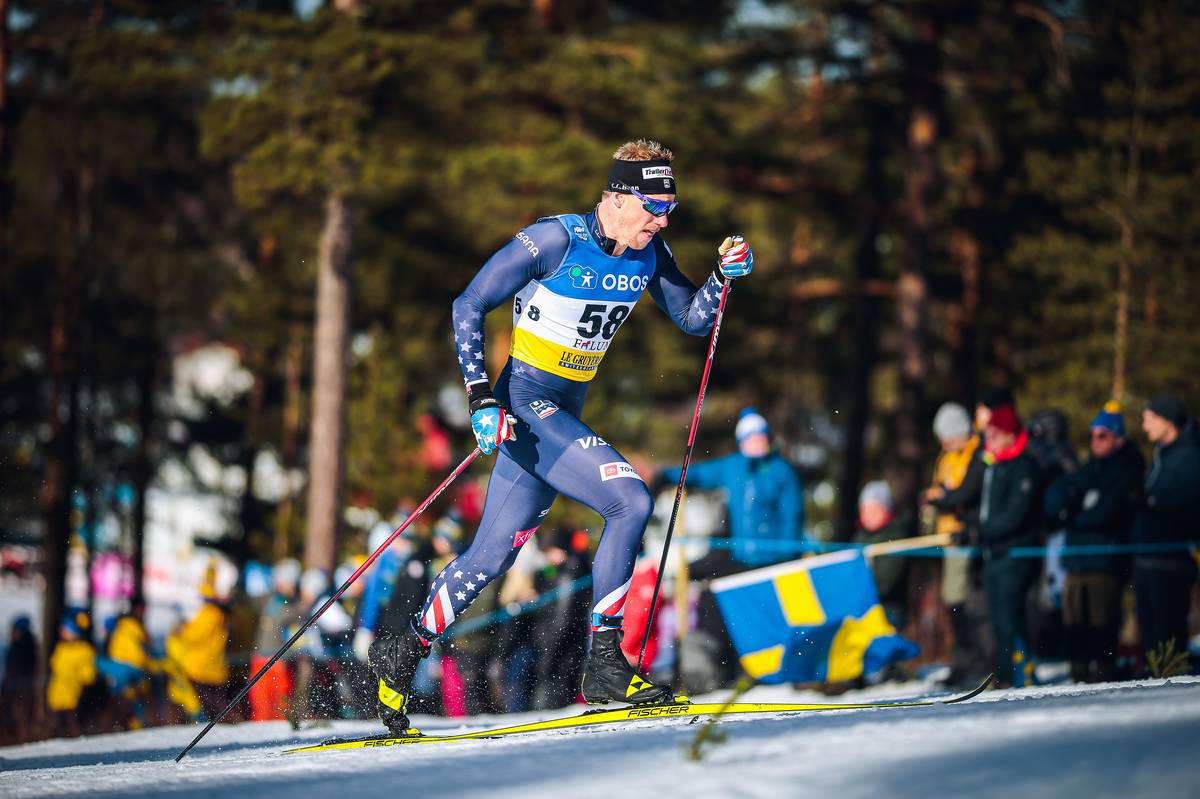
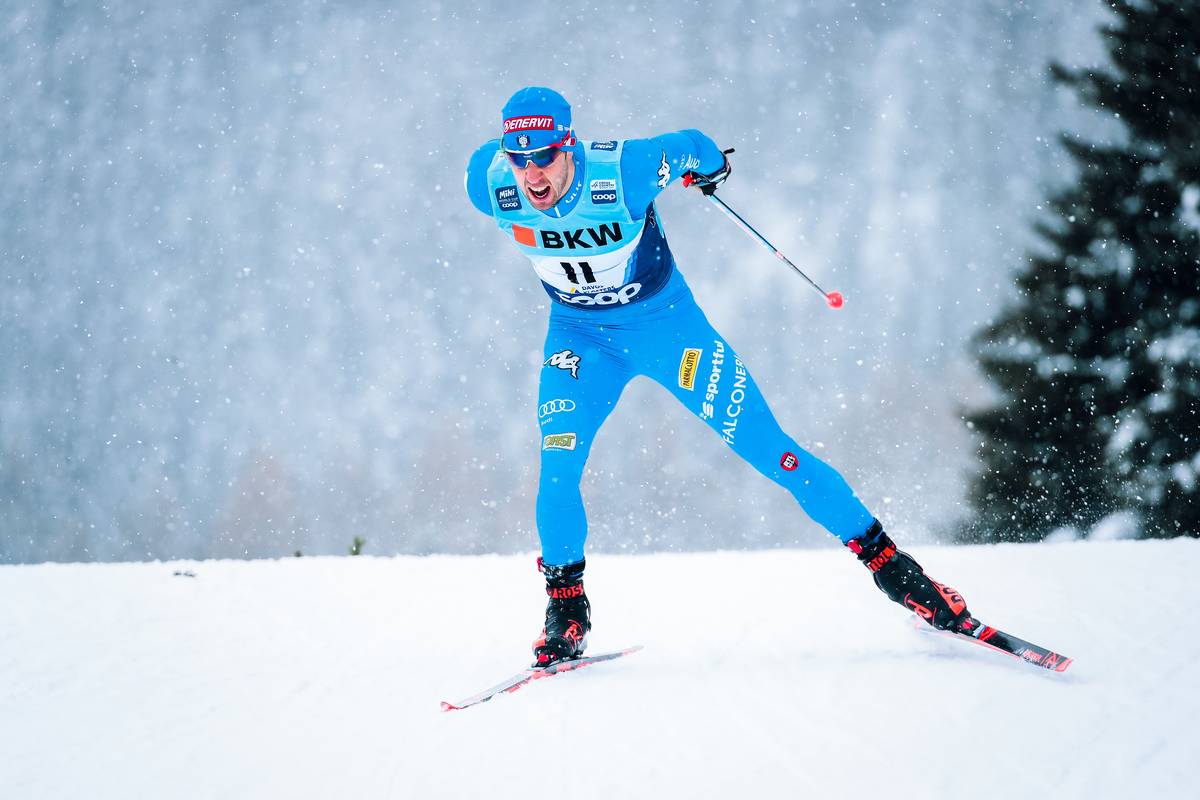
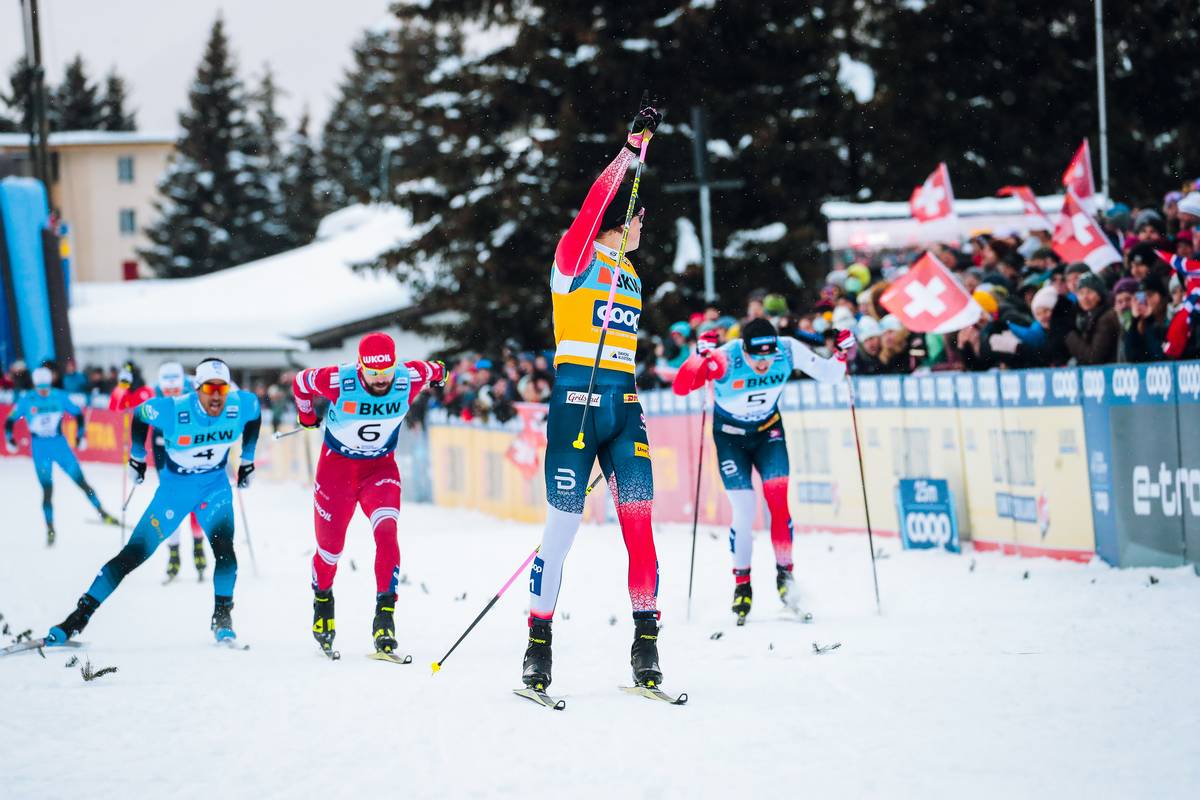
    Babe Ruth, Muhammad Ali, Michael Jordan, Michael Phelps, this guy—Johannes Hoesflot Klaebo (NOR). (Photo:  Authamayou/NordicFocus)

    “It’s Johannes Klaebo’s ski world,” said skiandsnowboardlive.com’s on-air commentator, Andrew Kastening. “And we’re all just living in it.” Truer words were never spoken . . .

    “I didn’t have a plan,” said Klaebo after his dominant performance in Lahti Finland’s World Cup Freestyle Sprint. “I just went for it at the end there and managed to get enough meters to the young guys. Next year it will be even harder, so we’re going to enjoy this now for the rest of this year. Next year, it’s going to be way harder, I think.”

    Well, we don’t really believe Klaebo’s “no plan” claim. In fact, we probably aren’t sure we believe that next year will be “way harder,” either. Not with the way this year has gone, anyway. But Klaebo’s suggestion that we “Enjoy this for now?” No problem . . .

    Ironically, Klaebo’s absolute dominance leaves ski reporters scrutinizing the strengths and weaknesses of other skiers—scanning the notoriety of other results—for stories that will continue to capture readers’ imaginations. Where the heck has Sindre Bjoernstad Skar been? And how much resentment do Even Northug and Lars Heggen harbor after being left off the Norwegian Olympic team? And, after his recent U23 World Championship (and the pedigree afforded him by his mother, legendary Nordic skier, Bente Skari), is Filip Skari the real thing? And is Harald Oestberg Amundsen still in the running for the Crystal Globe? Or does he just need a Sprint day to warm him up for the Distance races? And who the heck is Mathias Holbaek? On a normal World Cup weekend, those questions—Norwegian questions—would occupy the imaginations and fill the column inches of ski journalists. But that was before the Olympic Winter Games of Milano-Cortina . . . the Games in which Ben Ogden (USA) and Gus Schumacher (USA) created scenes of flashing silver excellence. Now, reporters have another story to report: American sprinters have arrived on the scene. If Ogden and Schumacher have any energy left after the predictable post-Olympic celebrations, then they’ll have something to say about Lahti’s Sprint results, too.

    Gus Schumacher (USA) and Ben Ogden (USA) and Gus Schumacher (USA) have ushered in a new era of American men’s skiing. (Photo:  Vanzetta/NordicFocus)

    Granted, Ogden and Schumacher had far fewer Norwegian Sprint rivals to navigate among, through, and past on the way to their Olympic silver medals. That’s the salient reminder, folks: while the the Olympics offer the most valued, most brightly glittering prizes in the skiing world, the Olympics also offer the best chance for anyone to break through the Norwegian medals-monopoly. That’s because Norway is only allowed the maximum number of Olympic starters in any event: four starters. Conversely, in World Cup races, Norway is allowed at least seven starters . . . sometimes eight (if the race is in Norway). Any non-Norwegians—Ogden and Schumacher included—will find it far more difficult to snatch headlines in Lahti’s World Cup Freestyle Sprint. For that matter, American Sprinters (including Jack Young, JC Schoonmaker, Kevin Bolger, Zanden McMullen) will find it considerably more difficult to qualify for the heats, much less to advance through to semifinals and finals.

    And all this drama occurs in the shadow of the most predictable story—the one that we’ve probably grown tired of repeating by now: Klaebo’s going to win, right? I mean, he’s won the last 13 races he’s entered (sprints,  distance races, relays, Classic, Freestyle), including the six Olympic races that he swept during the Games of Milano-Cortina. And lining up for another Freestyle Sprint on a course where he has generally shown himself to be unbeatable seems unlikely to offer much hope to his rivals. Well, there’s always silver . . .

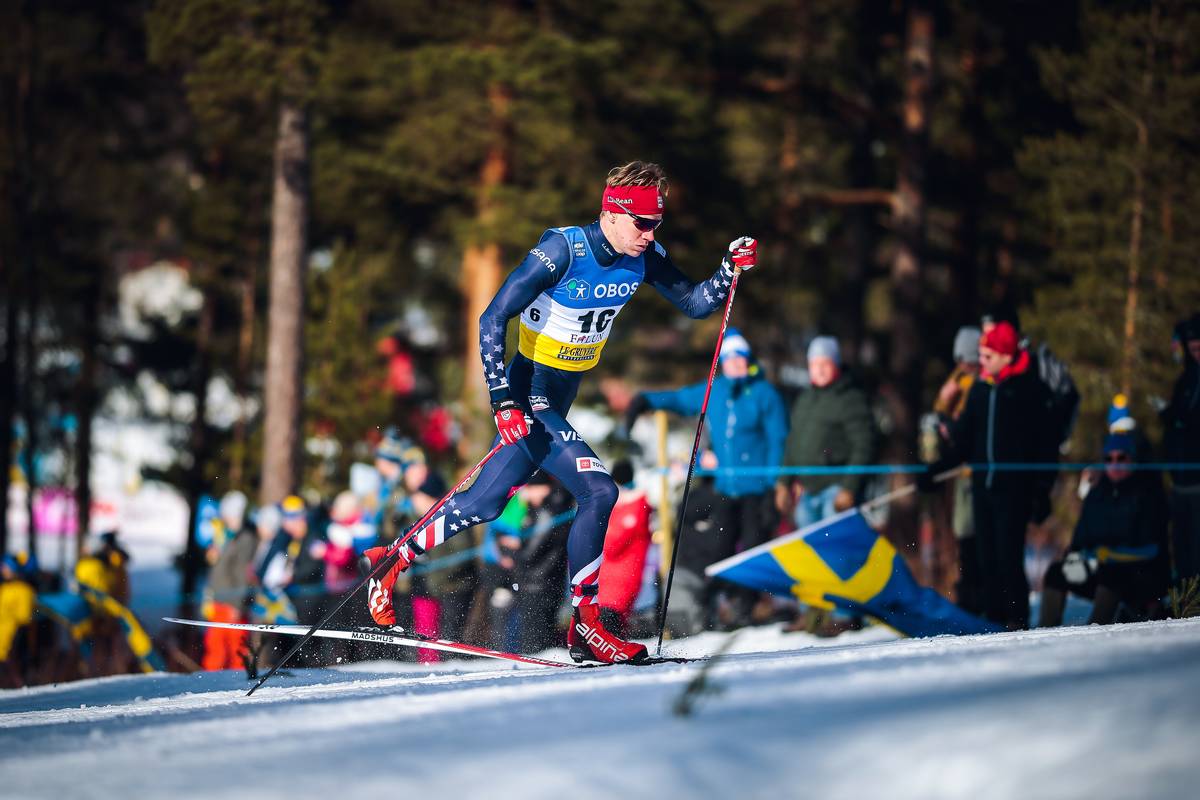
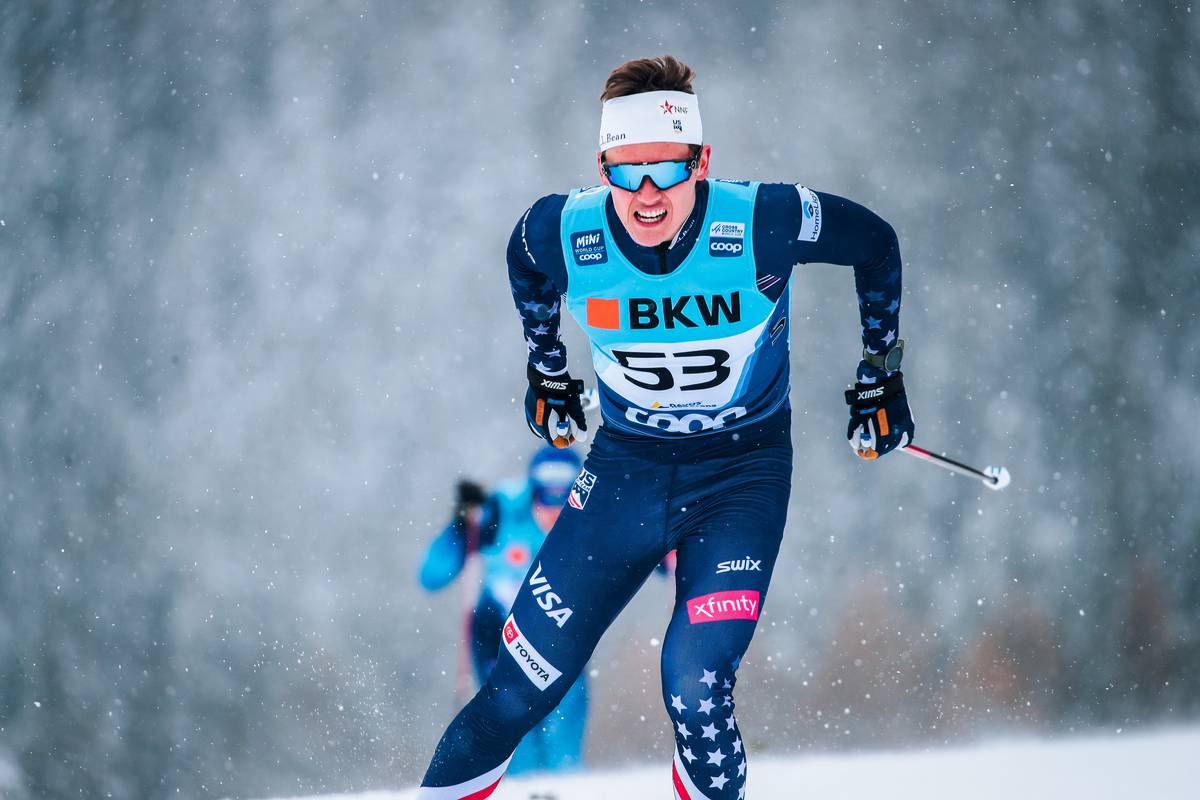
    Federico Pellegrino (ITA) is in Lahti, and so soon after he captured a magnificent bronze medal for Italy in the Team Relay. And Lucas Chanavat (FRA) is here, but he may finally have realized that he has never devised a tactic that’s even come close to allowing him the sort of success that his natural power and physical prowess would’ve suggested could be his. Among Americans, Schumacher qualified eighth. Jack Young 16th, Ben Ogden 22nd, McMullen 26th. Qualifying was won by Klaebo, followed by Chanavat and Pellegrino. The stage was set in an exciting race for silver. Sorry if that sounds like a weak set-up; we’re just calling it as we see it . . .

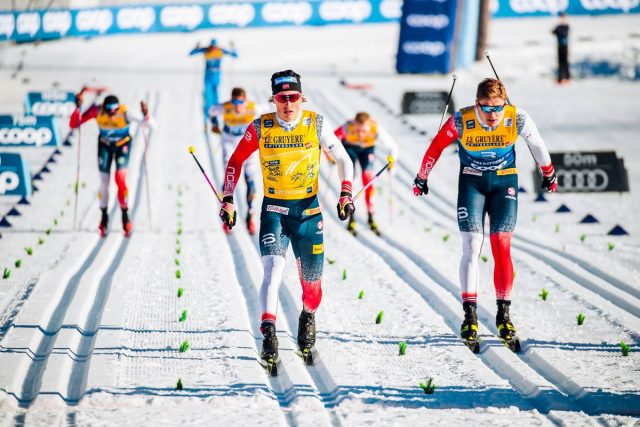
    Zanden Mcmullen (USA) held his own in a closely contested heat with Lucas Chanavat (FRA), Benjamin Moser (AUT), Lukas Mrkonjic (AUT), and Johannes Hoesflot Klaebo (NOR),. (Photo:  Authamayou/NordicFocus)
    Sprint Heats

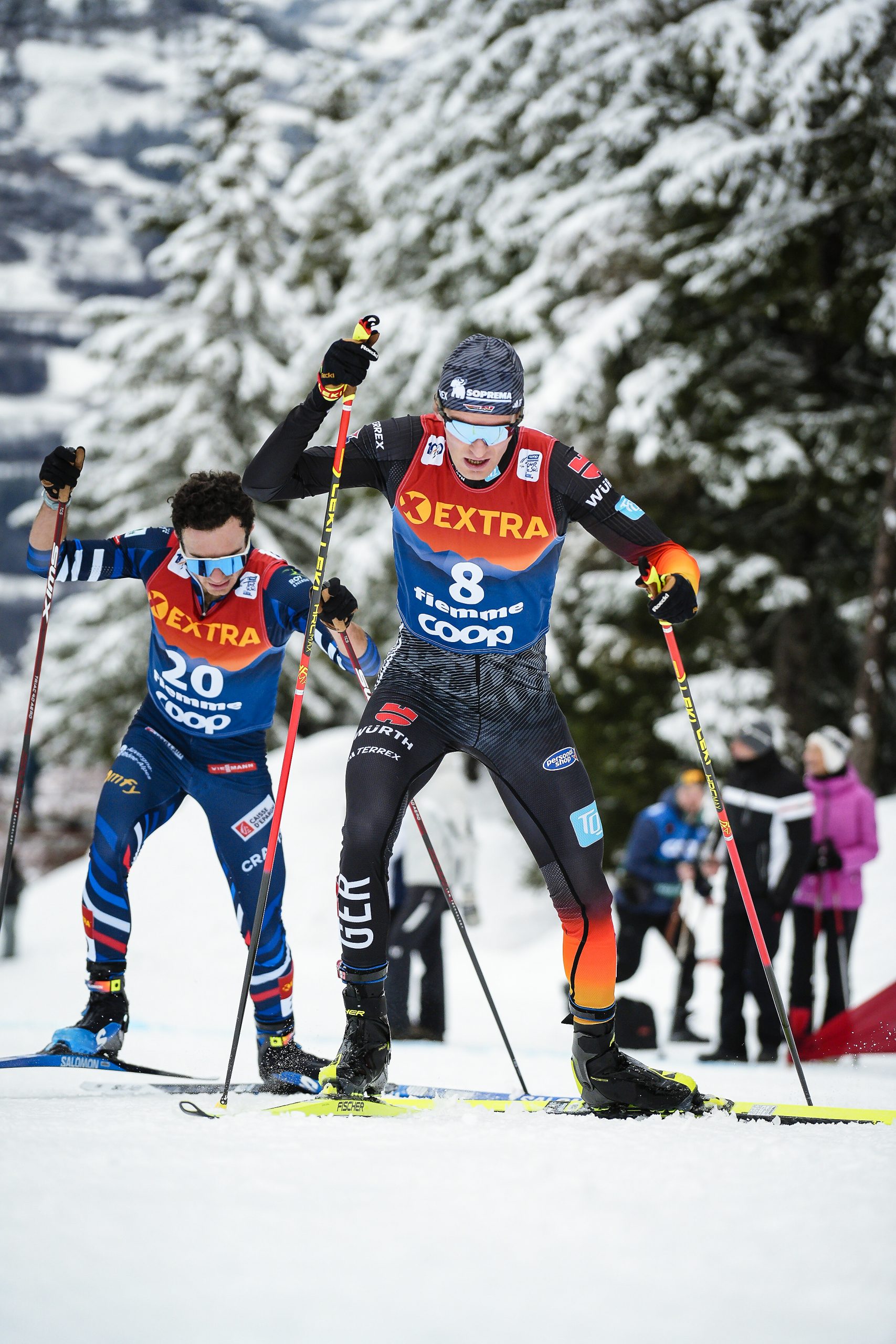
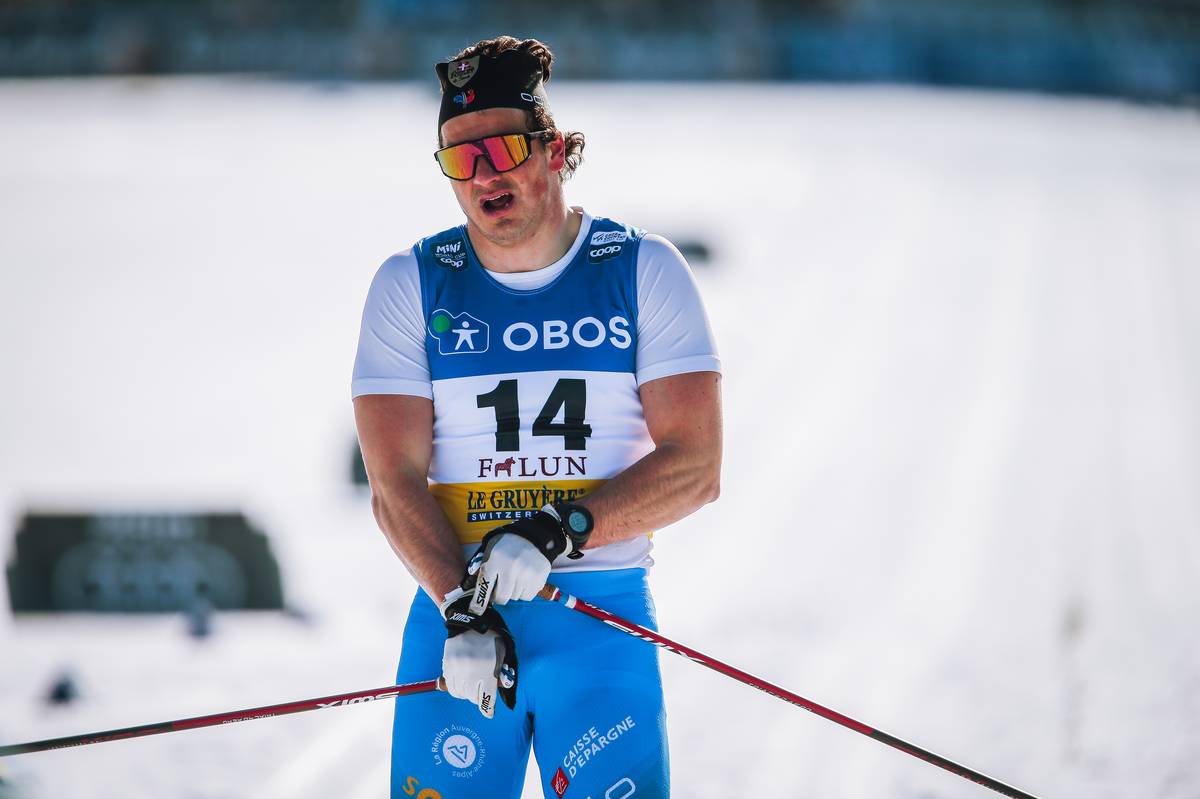
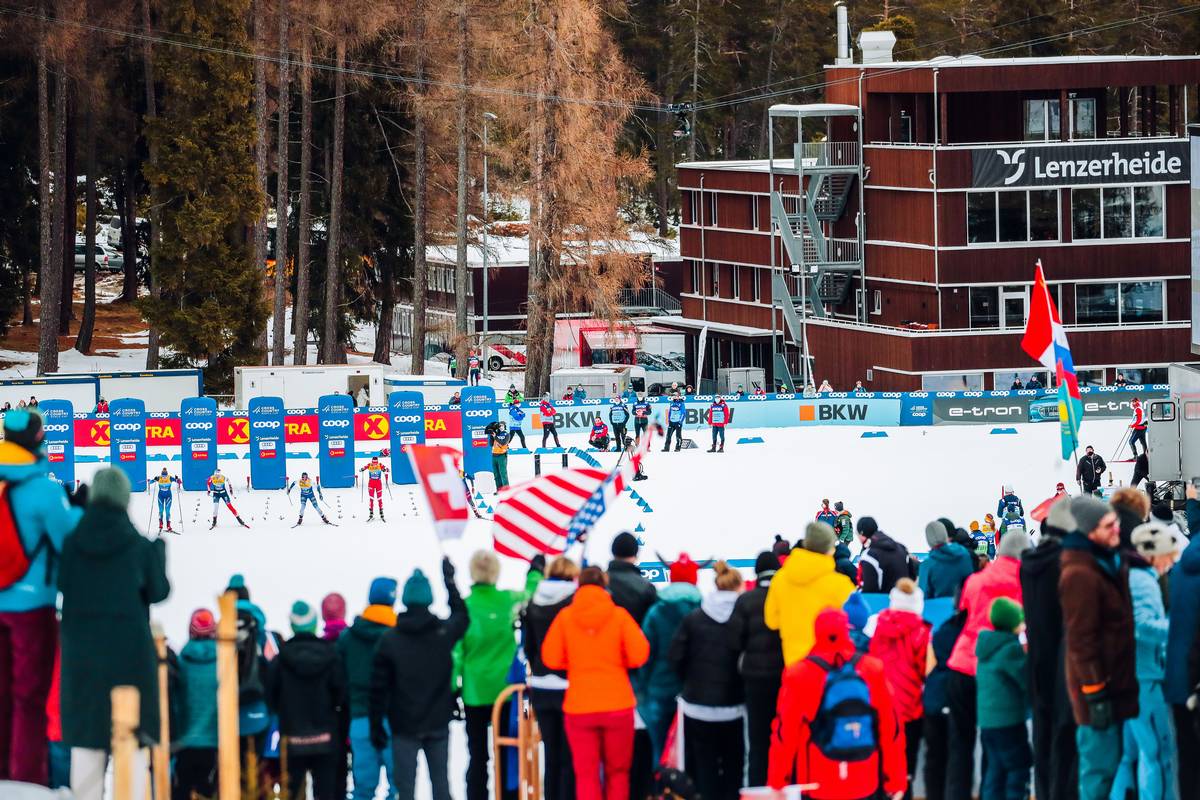
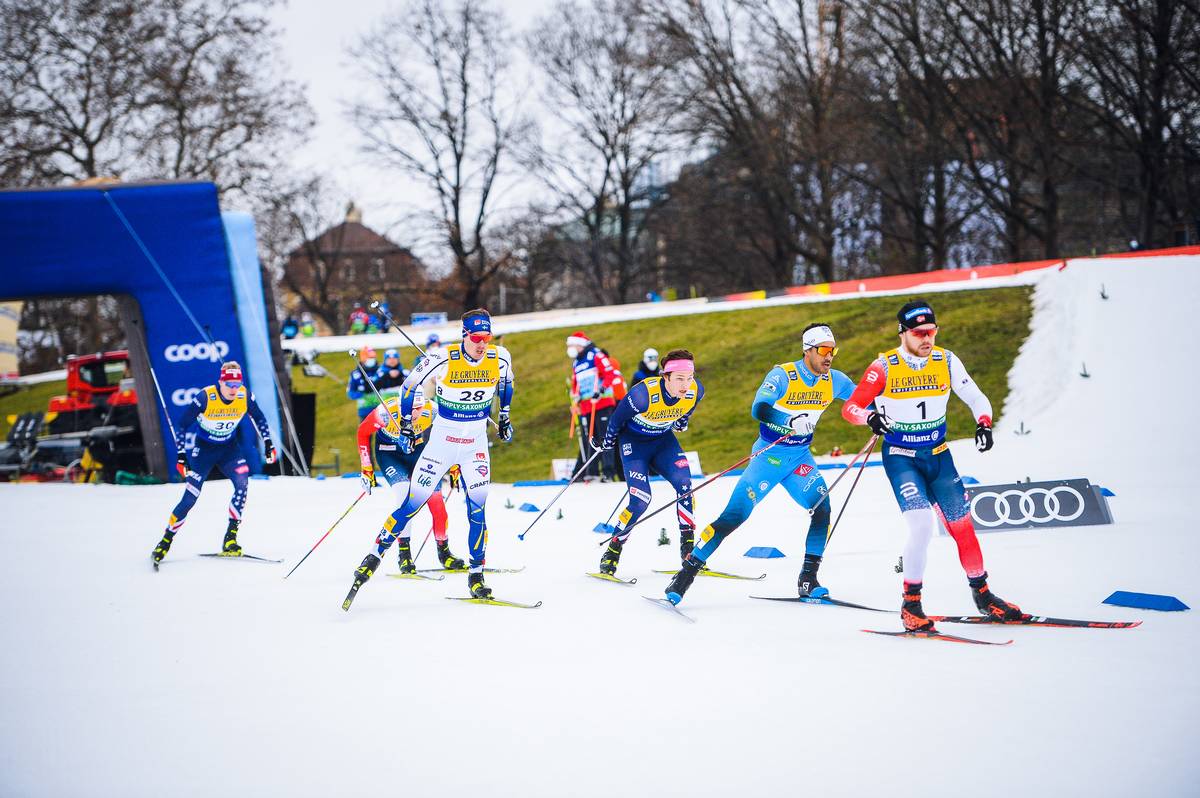
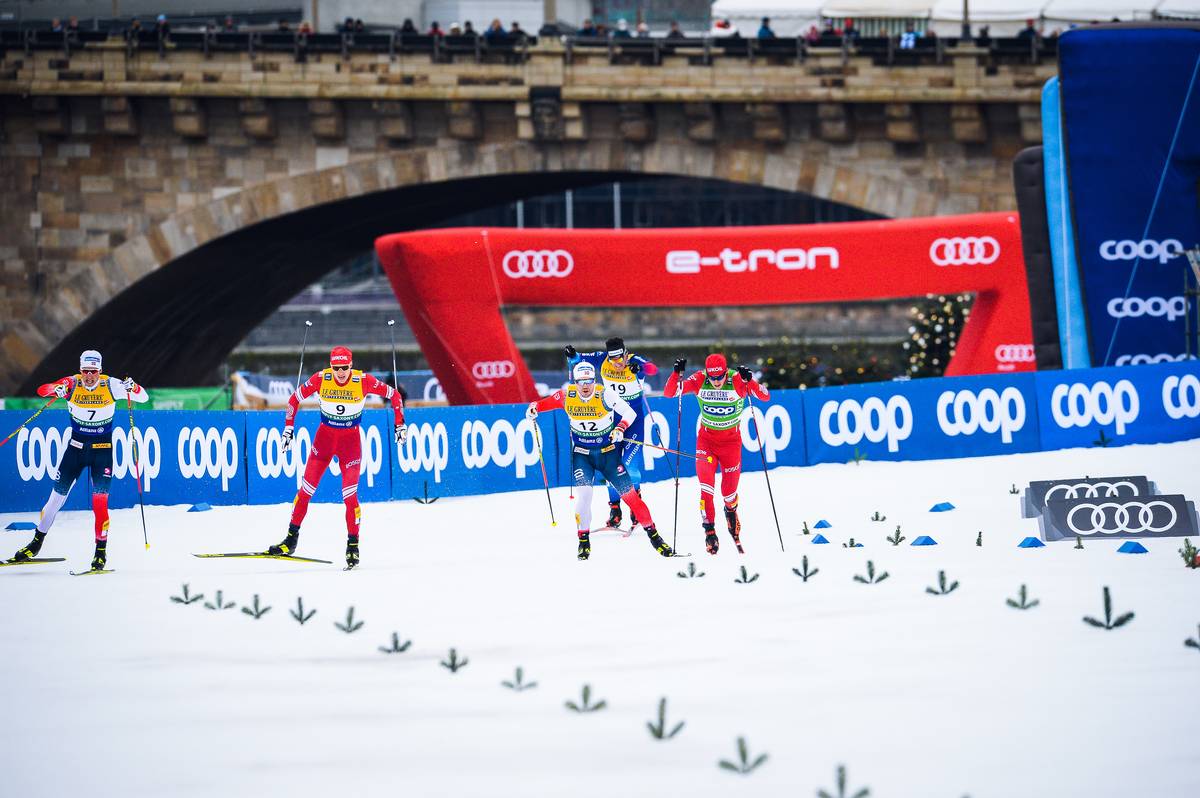
    McMullen drew the first heat alongside Chanavat and Klaebo. Chanavat wanted the lead, but not the pace. With Klaebo positioned alongside him (staying near the front and out of trouble) the course was clogged and the pace was slowed.  Ultimately,  Chanavat found himself suckered into the lead at the top of the final downhill where he surrendered the draft and was predictably passed by Klaebo. Chanavat would actually fall in the final turn, allowing Klaebo to cross the line unchallenged, and making room for Benjamin Moser (AUT in the second spot to qualify for the semifinal. McMullen would cross in a closely-contested third place, too slow to advance as a lucky loser, but good enough for 20th on the day. There was some question about Chanavat’s fall (and whether or not he was interfered with), but the slo-mo replay made it appear that he’d done the damage on his own.

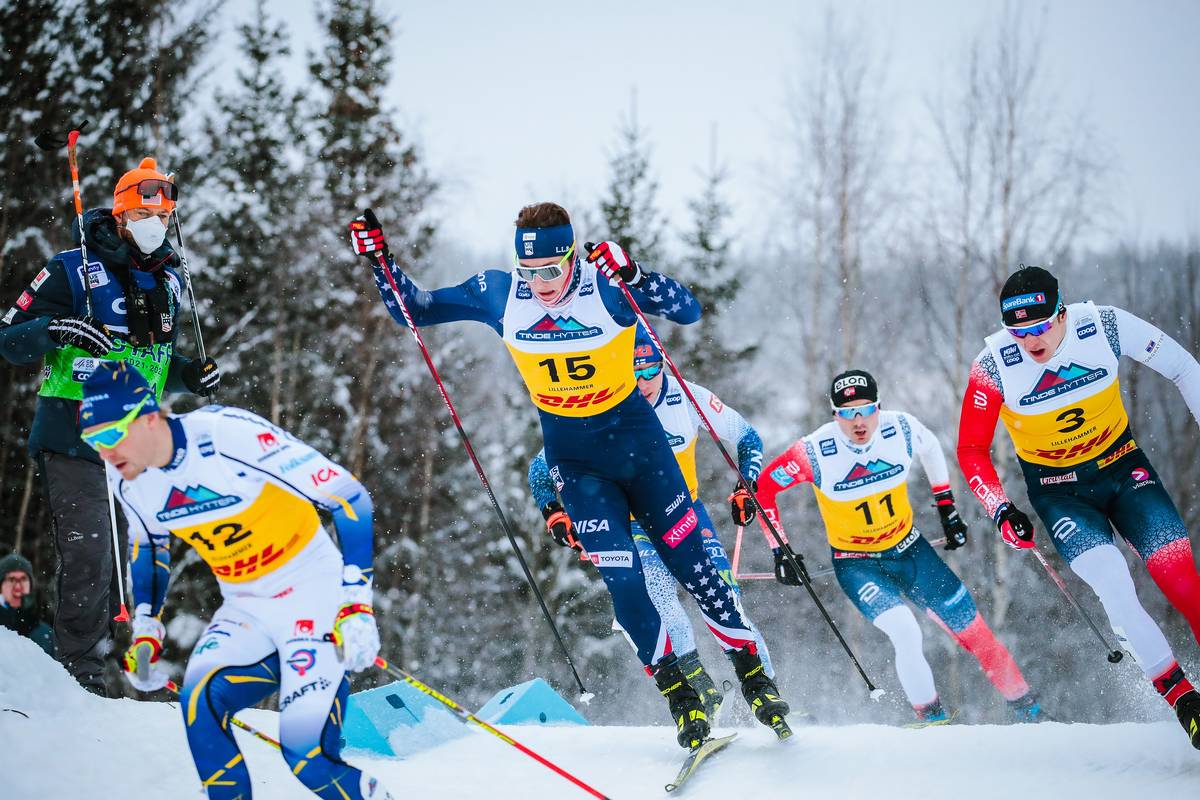
    In the second quarterfinal, Ogden decided to play his cards at the front where he was joined by Pellegrino. But coming through to make the pace was Skar (who has been absent from the World Cup scene for a few seasons, but returned to this venue in replacement of Olympic medalist, Oskar Oppstad Vike (NOR) who was injured at the recent U23 World Championships. Pellegrino would become impatient with Skar’s pace, driving forward to take the lead at the top of the final climb. But it was Heggen who would take advantage of the draft on the final downhill to take the heat win. He was followed across the line by Janik Riebli (SUI), Pellegrino, and Skar. Ogden would coast across the line a distant sixth, 28th on in the final Sprint results.

    Schumacher bided his time at the rear of the third quarterfinal, weaving through traffic to move forward into fourth position before the final downhill. Schumacher chose the outside line on the final left-hander, rocketing forward to steal an automatic ticket into the semifinal just ahead of Holbaek and Valerio Grond (SUI).

    Jack Young started at the rear of his quarterfinal, continuing to work his way through the field, but generally finding his way blocked and his momentum stymied. He entered the final downhill in fourth position, but with precieous little room to maneuver. Young came around the final turn in third, but was late to accelerate, finding himself still third at the line. In a slow heat, Young’s finishing time was not fast enough to advance. He would finish teh day in 15th.

    “My training during the Olympics absolutely allowed me to come in to Period 4 fresher and sharper,” said Young. “I felt faster today than I did in Falun, and I think I’m still on the way up.

    “Tactically, I’m making the progress I need to make,” Young continued. “I did a lot of things today in the heat that I haven’t done in the past. I was taking up space and shutting down moves made from behind me better than I ever have. In the future I need to keep skiing aggressively and find ways to get into the top two before the last 100 meters.

    Janik Riebli (SUI), Lars Heggen (NOR), Johannes Hoesflot Klaebo (NOR), Gus Schumacher (USA), Benjamin Moser (AUT), Davide Graz (ITA) in the Freestyle Sprint inLahti, Finland. (Photo:  Authamayou/NordicFocus)
    Sprint Semifinals

    Schumacher lined up next to Klaebo in the first semifinal. Klaebo was first off the line with Schumacher attached to his tails. They marked at the front by Heggen; no one wanted to get away, no one wanted to lead. Klaebo seemed to grow bored with the tactical pace, allowing himself to glide into the lead and initiating a small attack before the top of the uphill section. All day long, skiers in the lead on the final downhill have found themselves overtaken by those in the draft. But “all day long” is not enough of a precursor to undo the ski-dominance of Klaebo. He floated down the slope, surrendering no discernible advantage to those tucked in behind him. Klaebo would execute a couple of energetic pushes in the final straightaway to remain ahead of Riebli (who edged out Heggen). Schumacher never managed to make up enough ground, finishing the semifinal in fifth position, and ninth on the day.

    Chappaz skied to tactical perfection in the second semifinal, using the draft on the downhill to slingshot into the lead in the final meters. Behind him, numerous skiers were caught in traffic as Skari emerged from the pack for the automatic semifinal spot, ahead of Grond who advanced as a lucky loser.

    Sprint Final

    In Lahti’s quarterfinal and semifinal heats, Klaebo had shown that he could win from the draft, or win from the front. Subsequently, he would continue to provide a cryptic puzzle for Skari, Heggen, Chappaz, Riebli, and Grond. I mean, we expect Klaebo to win, we just don’t know exactly which way he’ll choose to do it.

    At the crack of the starter’s pistol, Klaebo rocketed forward (that much we could anticipate), controlling the front and dictating the early pace as he so often does. The rest of the skiers were left to wonder—will he just drill it at the front and drop us? Or will he lure one of us into the lead, only to slingshot around us at the end? Here’s what the other skiers must, by now, understand pretty clearly: if Klaebo makes you lead, you lose. On the other hand, if Klaebo puts his energy into keeping the lead, there’s no one who can come around him. That’s the kind of advantage a skier earns when he’s the best of all time. And the best of all time was simply not going to get beat in this little World Cup Sprint in Lahti. Heggen and Riebli did their best to follow Klaebo, but the draft effect that Heggen needed just never materialized. Heggen was in good position on the final downhill: all the laws of physics were on his side, all the likelihoods of ski race tactics were in his favor . . . still, Heggen never made up a single meter. He would hold on for second, ahead of a late-charging Chappaz. Klaebo would coast across the line for his zillionth career World Cup victory, his we-can’t-keep-track-of-how-many wins in a row.

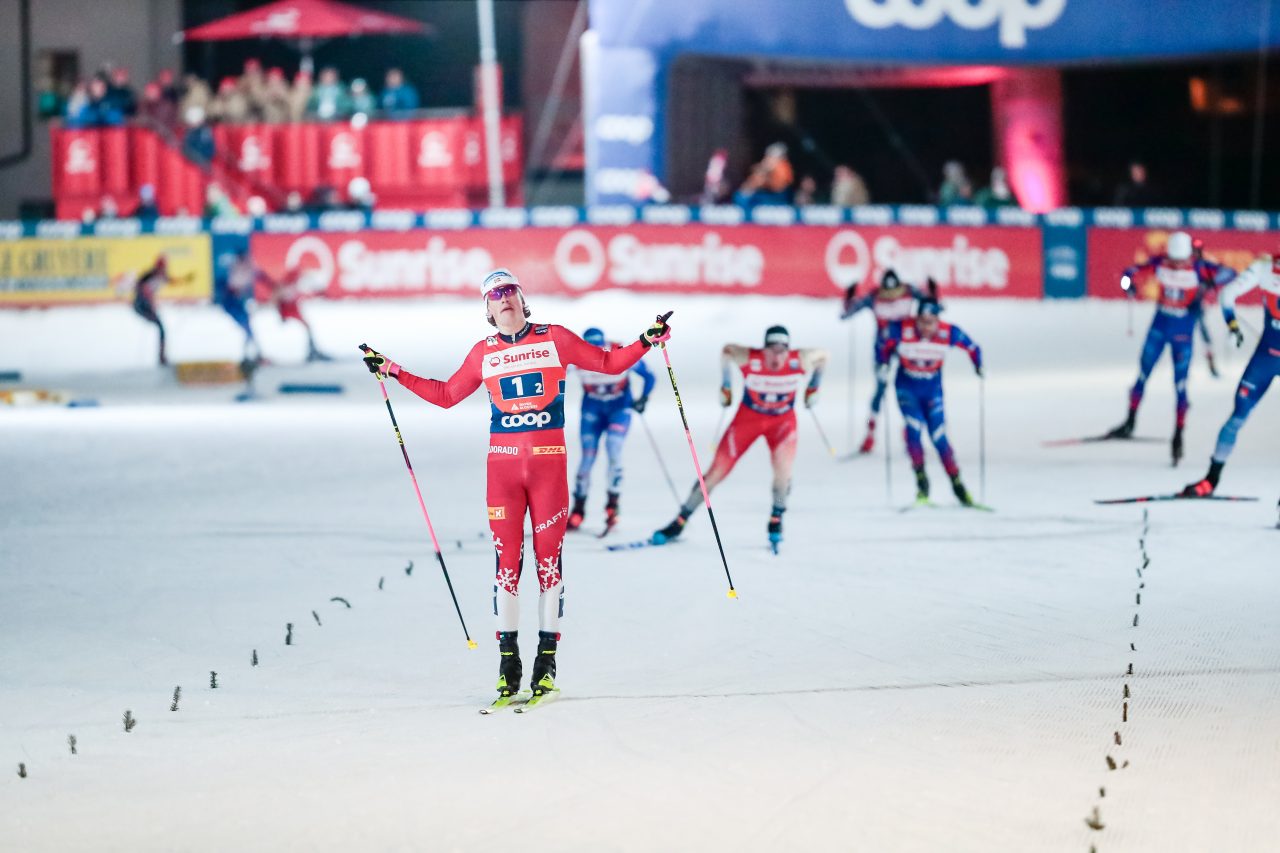
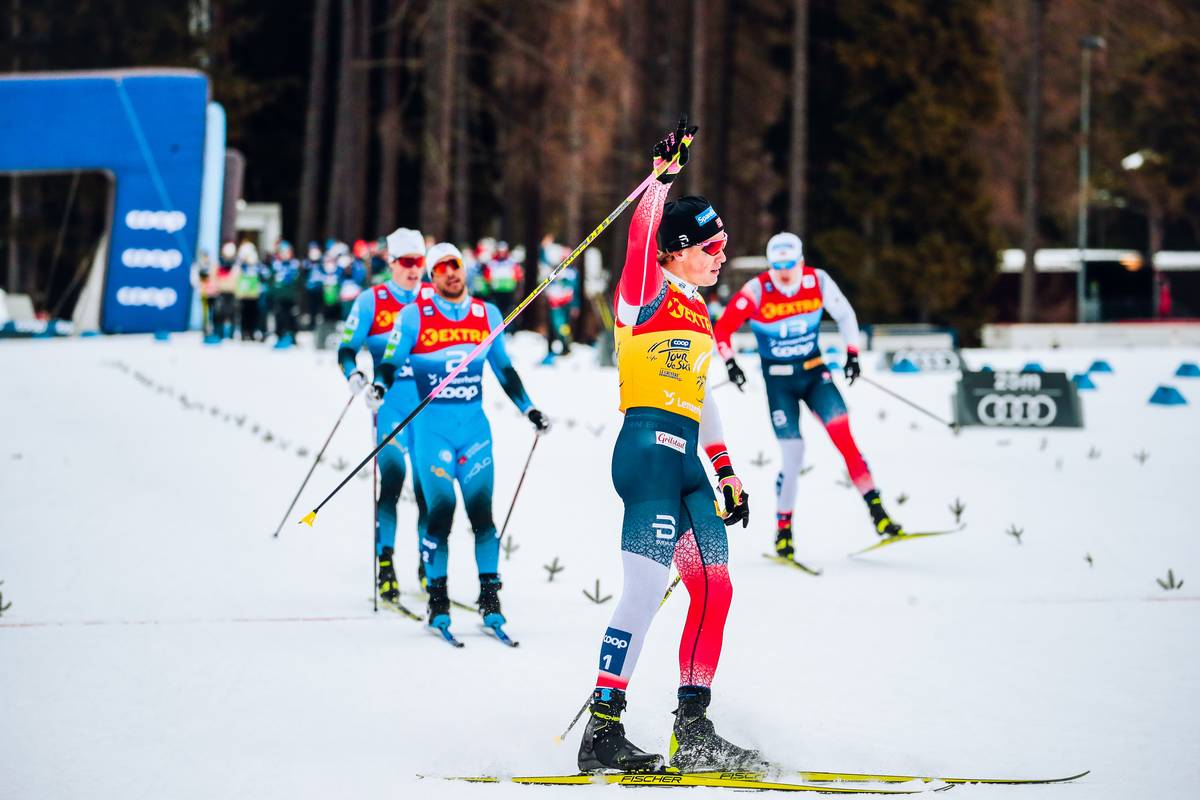
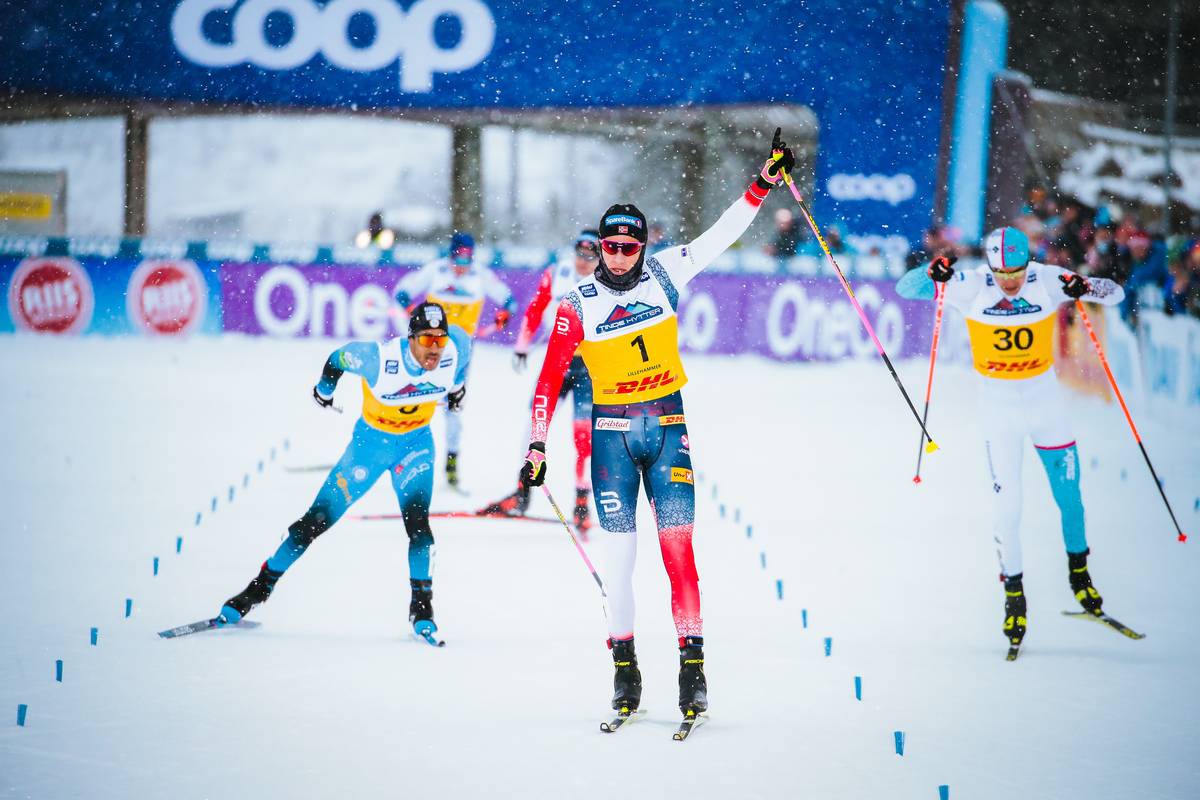
    Johannes Hoesflot Klaebo (NOR) eases up at yet another World Cup finish line. It may not be exciting any more, but it certainly remains thrilling. (Photo: Authamayou/NordicFocus)

    He doesn’t get tired, he doesn’t get sick, he doesn’t get out-maneuvered, he doesn’t get out-smarted, he doesn’t get out-sprinted. In one of the most challenging endurance sports that humans have ever contested, one guy just seems to win at will. How incredible it is to be a ski-fan in this era when one skier displays such outright dominance. The legendary Marit Bjoergen (NOR) claimed 114 wins during World Cup history’s most decorated Nordic skiing career. In Lahti, Klaebo truly began drawing within sight of that landmark number. Six races remain in the World Cup season. If he were to win out this season, Klaebo would finish the year having overtaken Bjoergen for the most-wins distinction, as well as a few others.

    “I’m tired,” admitted Klaebo. “I’m barely training between the races. I’m just racing now, but we’ll see how long we continue to do that. Hopefully, we’ll be able to do that for two more weeks.”

    There’s never been a season like this one that Klaebo is likely to complete: World Cup Overall, World Cup Distance, World Cup Sprint, Tour de Ski, and six Olympic gold medals. That’s the real story . . . and I’m so glad I’ve been here to see it. Next year may be “way harder,” predicts Klaebo. As he advises, we’ll enjoy this for now.

    Lahti Men’s Freestyle Sprint RESULTS

    Lahti Men’s Freestyle Sprint QUALIFYING

    Love Stories Like This? Help Keep Them Coming.

    Feature stories like this one take time, access, and care to produce. If you value thoughtful storytelling and independent ski journalism, please consider becoming a Voluntary Subscriber. Your support directly fuels the work we do to cover the people, places, and moments that make our sport special.

    Join the FasterSkier community!
    Johannes Hoesflot Klaebo: another win in Lahti in a season for the ages. (Photo: Authamayou/NordicFocus)


  • Fire, Ice, and Belief: Two Vermonters Deliver Under the Lights in Davos

    Fire, Ice, and Belief: Two Vermonters Deliver Under the Lights in Davos

    This coverage is made possible through the generous support of Marty and Kathy Hall and A Hall Mark of Excellence Award. To learn more about A Hall Mark of Excellence Award, or to learn how you can support FasterSkier’s coverage, please contact info@fasterskier.com.

    The lights come on early in Davos, not because they are needed, but because Davos wants them on. By mid-afternoon, the valley is already sliding toward dusk, the alpine light thinning and flattening, and the sprint venue leans into the moment the way it always has: music turned up, cowbells ringing with a little extra insistence, flames licking the edges of the course like stage cues. The effect is deliberate. This is not cross-country skiing as a quiet endurance ritual in the woods; this is cross-country skiing as spectacle.
    “Davos deliberately designs this event to feel like a rock concert,” U.S. head coach Matt Whitcomb said afterward. “They race at night, they bring in fire and lighting and music, and because it’s a two-lap course, you see the athletes twice as much. They invest in the experience, and it pays off.”
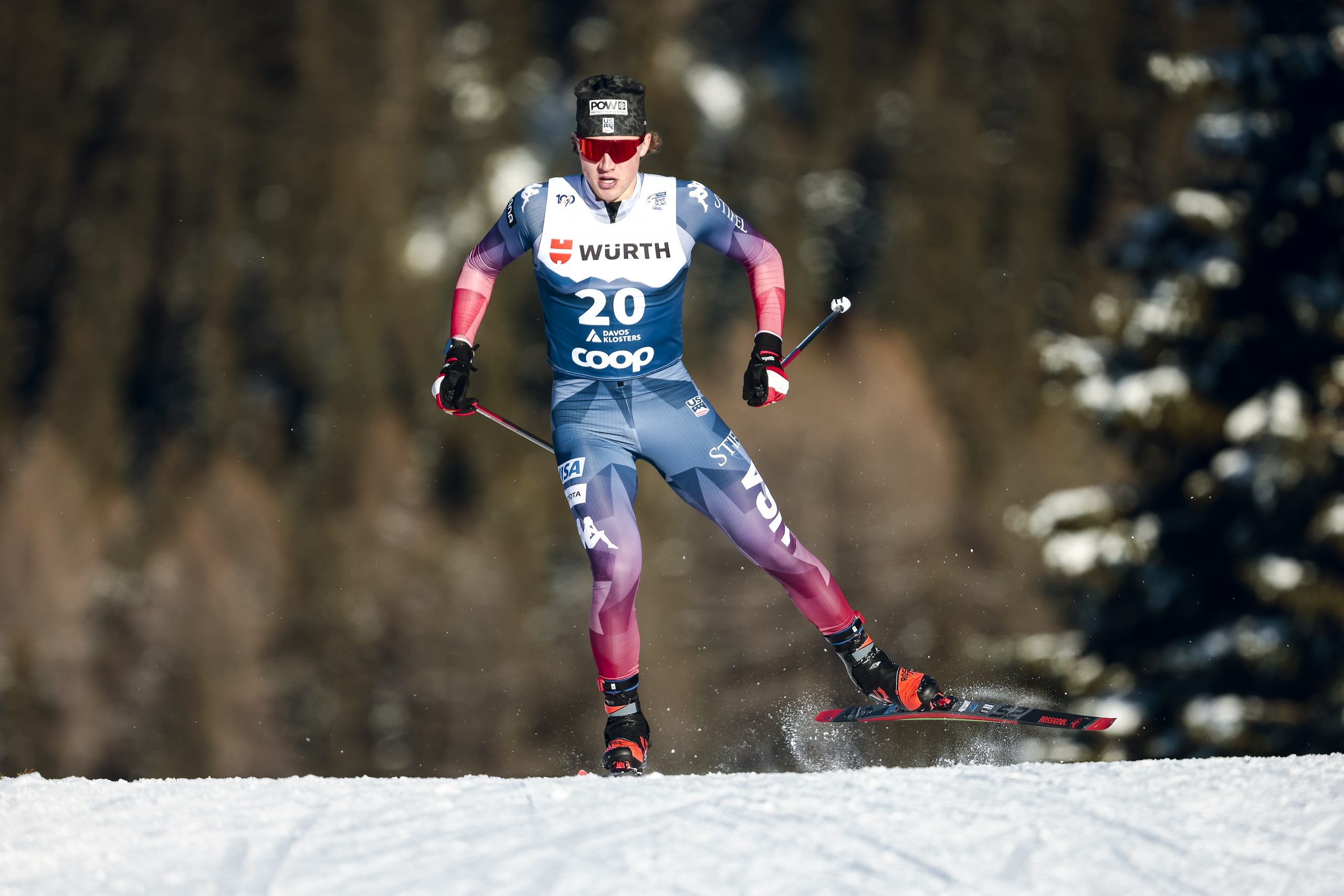
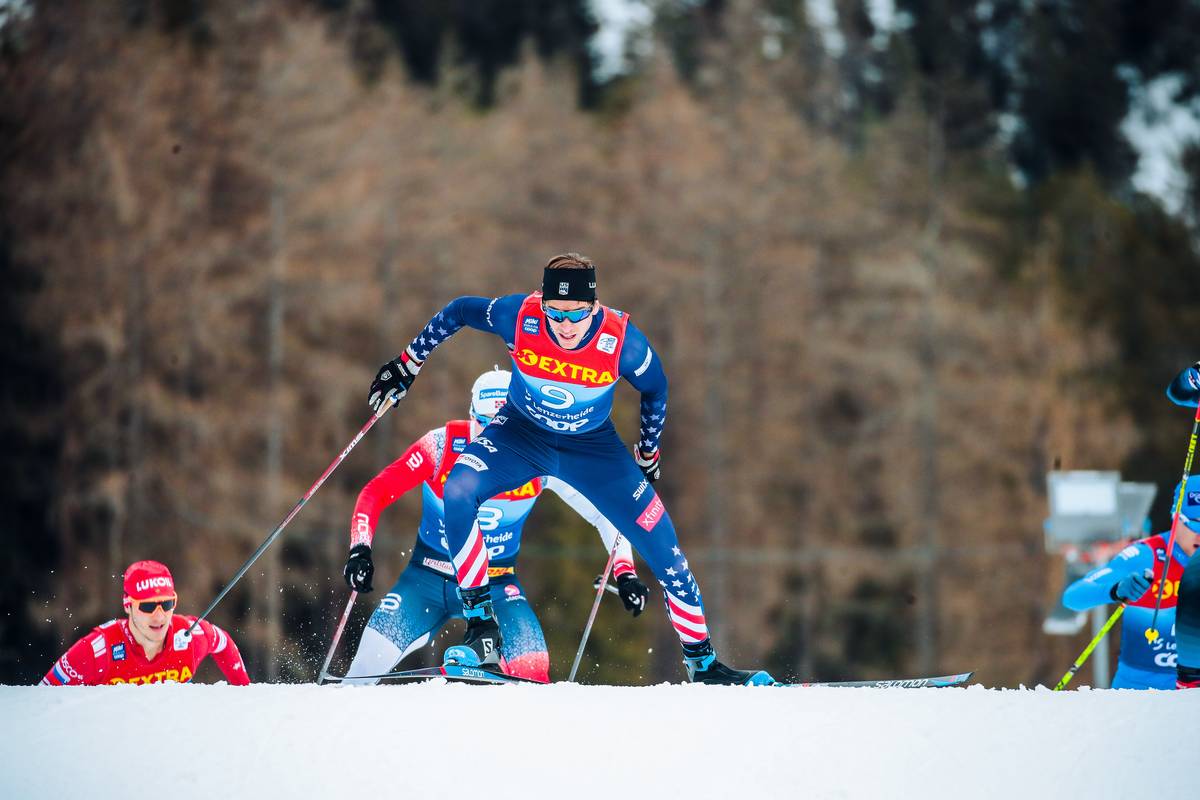
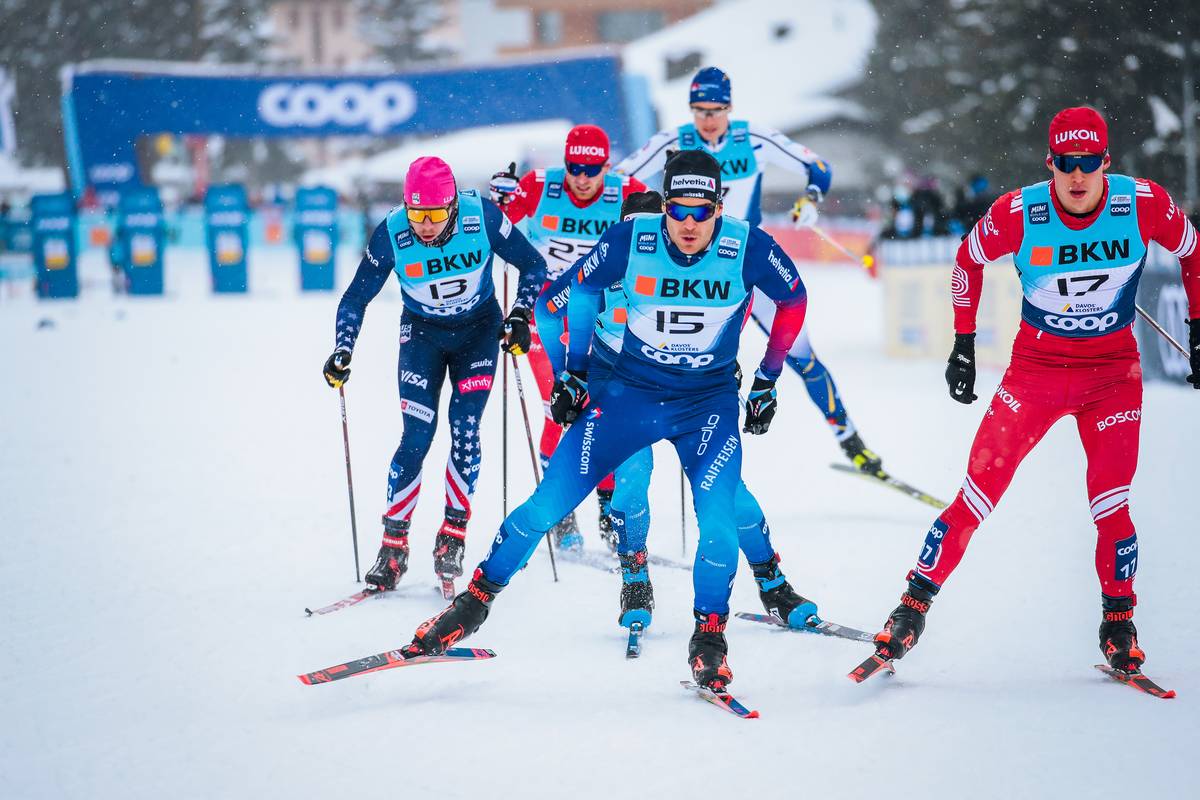
    Jack Young (USA) on his way to a fast qualification in Davos (SUI). (Photo: Modica/NordicFocus)
    On Saturday night, it paid off in a men’s freestyle sprint that delivered one of the most compelling American performances in years. Jack Young finished fourth, Ben Ogden fifth — the first time two American men had made a World Cup sprint final together in Davos — on a night when the script cracked open early and never fully resealed. Johannes Høsflot Klæbo was gone before the semifinals. A notoriously slick downhill corner became the day’s silent antagonist. And by the time Lucas Chanavat lunged across the line to win by three hundredths of a second, the story had already shifted: the U.S. men were no longer visitors to the sprint final. They were participants, with opinions about how it might have ended differently.
    For Young, the fourth-place finish marked his first World Cup sprint final — a breakthrough that felt less like a surprise than a confirmation. “This result means so, so much,” he said. “It really feels like proof that I can make it to the top in this sport. If I’d told myself three years ago that I’d finish fourth in a World Cup sprint, I would have thought I was insane.”
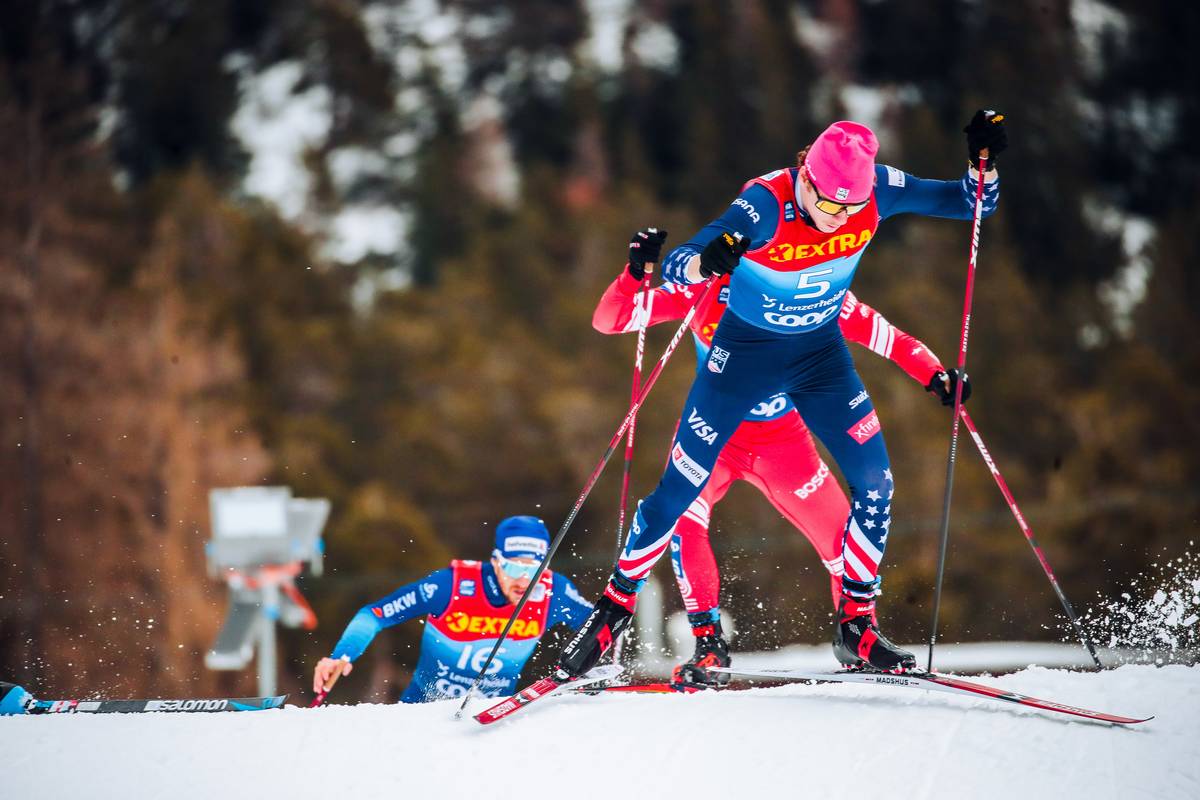
    Ben Ogden (USA) during qualification in Davos (SUI). (Photo: Modica/NordicFocus)
    A course that punishes impatience
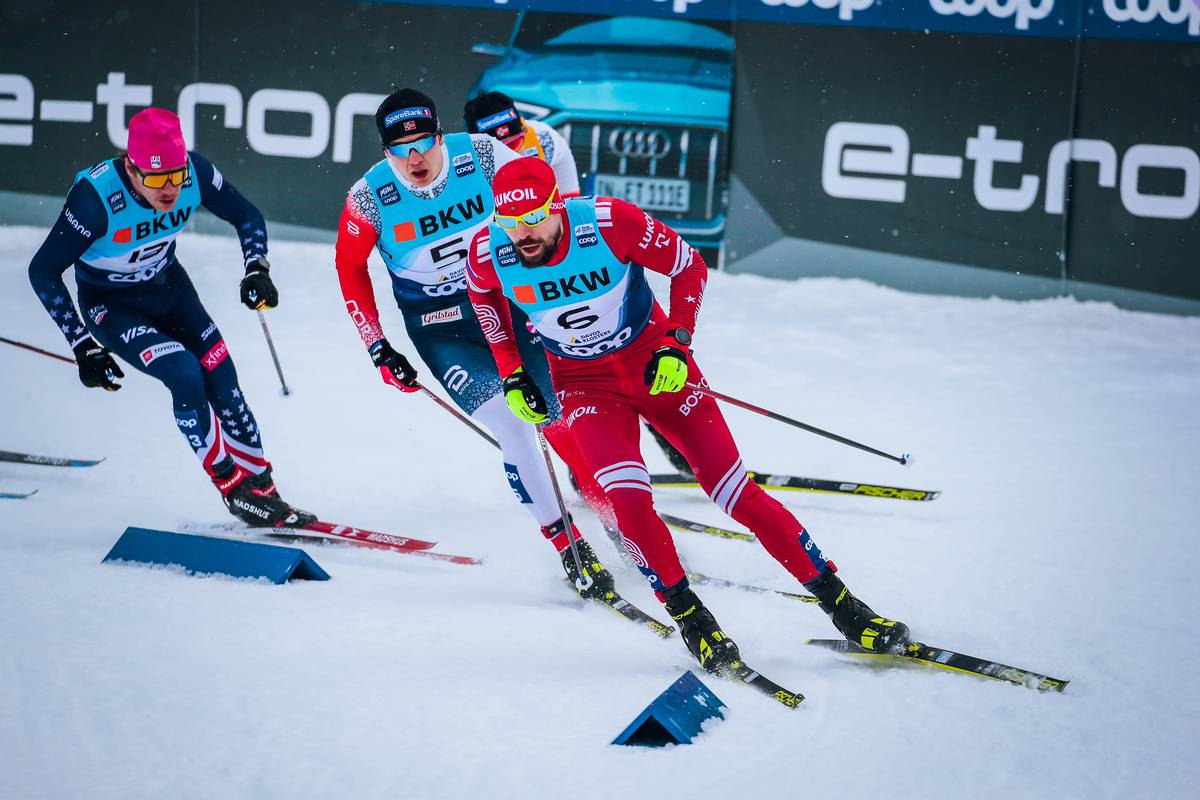
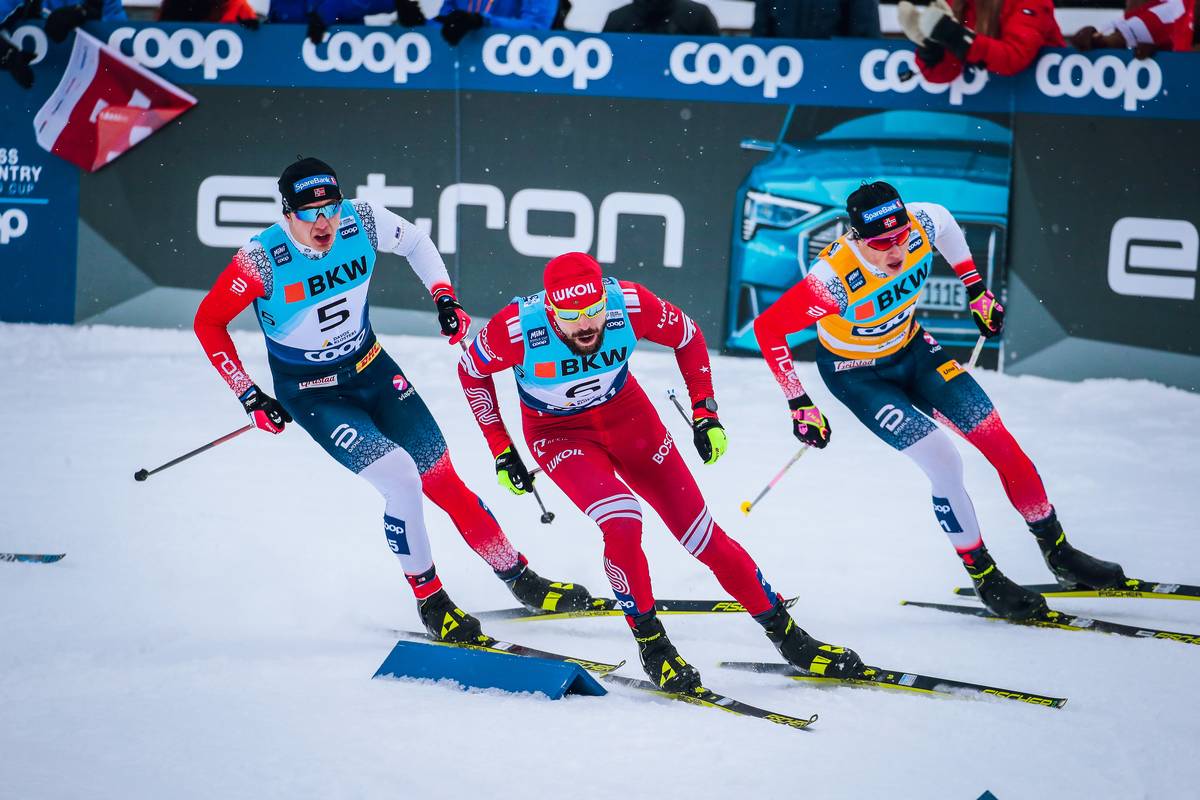
    Davos is not a long sprint, but it is not a forgiving one. Two laps of just under 600 meters pack in a decisive climb, sustained skating tempo, and — this year especially — a downhill corner that demanded respect. The snow was entirely man-made, hard and fast, and as the temperature dropped through the evening, it glazed into ice. Athletes began to talk about the corner not as a feature, but as a test.
    “That bottom corner was particularly dicey this year,” Whitcomb said. “Man-made snow turns to ice quickly, and that corner claimed a lot of people over the last couple of days.”
    Ben Ogden felt it more than once. “That last corner was really the focus,” he said. “I fell there yesterday, JC fell there in practice, and I stumbled twice in the final and ended up against the boards. It was unfortunate, but every year you learn a little more about how the ice forms there.”
    The corner changed the race’s outcome. The first time through, athletes skied it conservatively, prioritizing stability over speed. The second time, with fatigue setting in and the finish looming, choices became riskier — and more consequential.
    Janik Riebli (SUI), Jack Young (USA), and Lars Heggen (NOR), (l-r) during the heats in Davos (SUI). (Photo: Vanzetta/NordicFocus)
    Qualifying hints, early shocks
    The qualifying round suggested a familiar hierarchy, but with enough irregularities to hint that Davos might misbehave. Lucas Chanavat of France was fastest, Ben Ogden second, Klæbo third. Jack Young qualified sixth — an excellent position that put him squarely in control of his bracket.
    “That’s one of the best qualifying results we’ve ever had on the U.S. team,” Whitcomb said. “Qualifying in the top ten gives you options. It lets you race offensively instead of defensively.”
    Klæbo’s day began to unravel in the quarterfinals. Boxed in and forced wide through the downhill, he finished fourth in his heat and failed to advance. His 16-race sprint win streak ended not with drama, but with traffic — a reminder that sprinting, for all its stars, is still governed by physics and positioning.
    Ogden and Young both advanced cleanly. Ogden won his quarterfinal with authority. Young skied his with the composure of someone who knew exactly what he needed to do — no more, no less.
    Ben Ogden (USA) and the US Ski Team had a lot to celebrate in Davos (SUI). (Photo: Modica/NordicFocus)
    Semifinals: the Americans arrive together
    By the semifinals, the noise in Davos had sharpened. Chanavat advanced. Ogden advanced. And then Young did, stepping into his first World Cup sprint final with the kind of quiet efficiency that suggested the moment had not surprised him.
    “To be honest, the first thing that went through my mind standing on the start line was how tired I was,” Young said. “But I reminded myself that anything can happen in a sprint final. I don’t train just for qualifiers and quarters — I train for the full day. It was time to execute.”
    For Ogden, the significance of sharing the moment wasn’t lost. “Racing with Jack today was awesome,” he said. “He has this infectious confidence, especially here in Davos. Last year we were in the semifinals together, and this year we were in the final together. That’s a big step.”
    Whitcomb saw it as more than a statistical milestone. “To put two guys into the men’s final is a dream,” he said. “When athletes finish a race seeing the podium and knowing they can be on it, that’s when things start to get dangerous — in a good way.”
    Jack Young (USA) had every right to be celebrated after his breakout race today in Davos (SUI). (Photo: Modica/NordicFocus)
    The final: margins measured in inches
    The men’s final unfolded at full speed. Chanavat and Federico Pellegrino established themselves early, both reading the race the way veterans do — not forcing it, but shaping it. Oskar Opstad Vike of Norway positioned himself patiently, waiting for the moment when commitment would matter.
    Ogden and Young stayed connected. Coming into the final corner, Ogden had position. Young had momentum.
    “I was really gunning for that podium,” Ogden said. “I felt like I was pretty close. With fewer stumbles and maybe a little better positioning, I think I could have made it happen.”
    The corner had other plans. Ogden’s line took him over the ice and was forced wide, momentarily pinned against the boards. Young exited cleaner, carrying speed into the finishing straight.
    Chanavat and Pellegrino lunged together at the line, Chanavat winning by three hundredths of a second. Vike took third. Young crossed fourth, Ogden fifth — separated from the podium by seconds, but not by belief.
    “I finally feel like I can truly compete at the top,” Young said. “That’s a special feeling.”
    Results — Men’s Sprint Freestyle, Davos
    1. Lucas Chanavat (France)
    2. Federico Pellegrino (Italy)
    3. Oskar Opstad Vike (Norway)
    4. Jack Young (USA)
    5. Ben Ogden (USA)
    6. Edvin Anger (Sweden)
    Notables: Johannes Høsflot Klæbo (Norway), 17th, and JC Schoonmaker (USA), 27th.
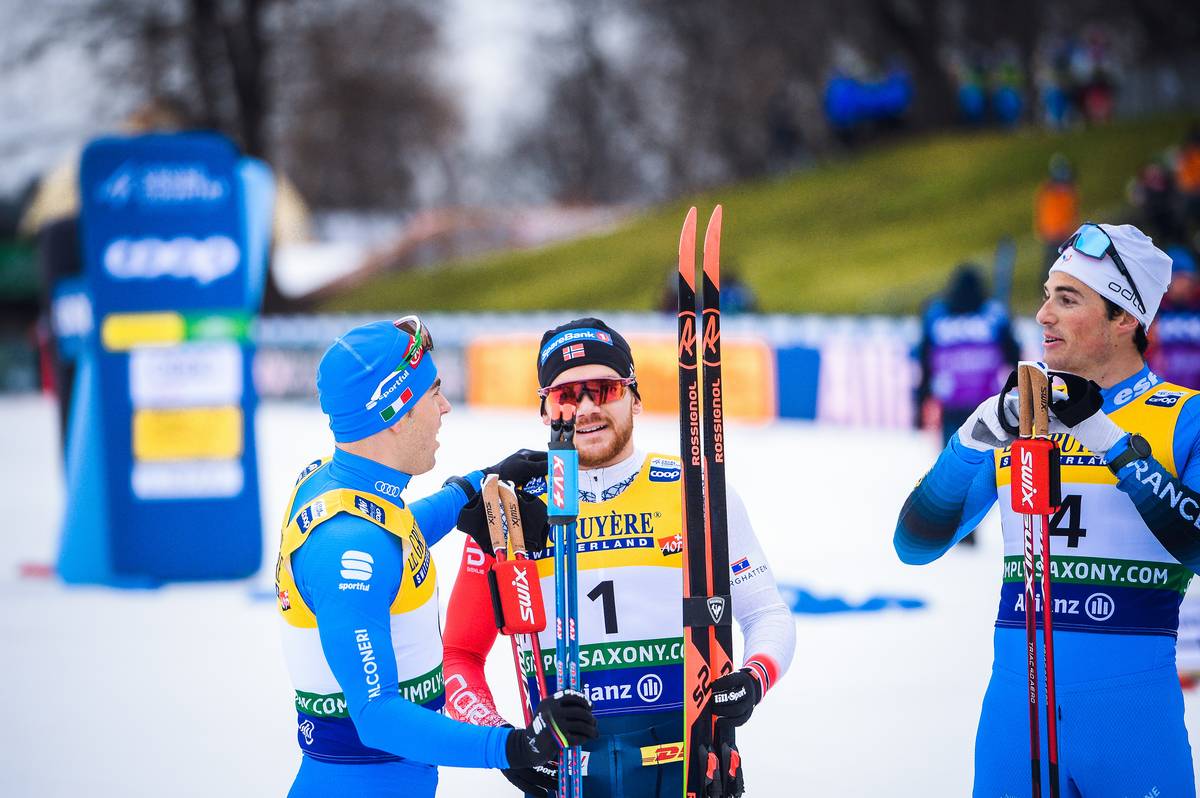
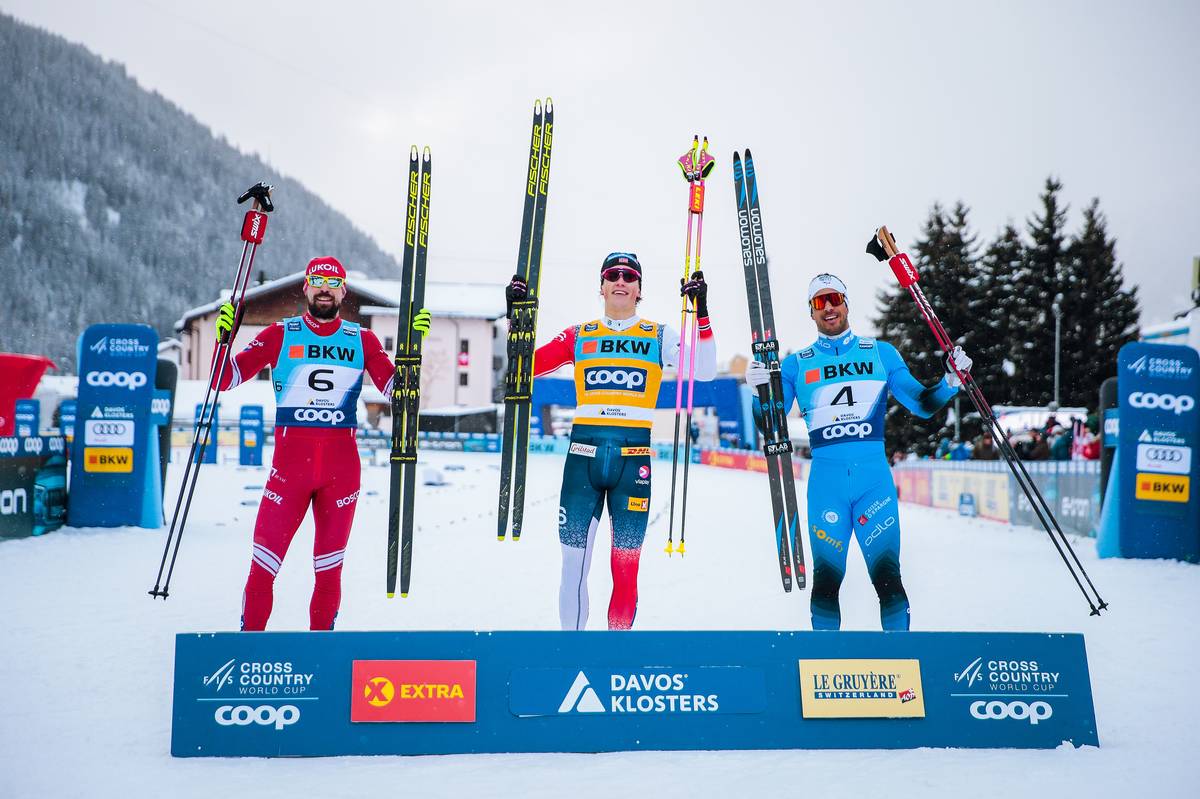
    It has been a tough trail back to the top step on the podium for Lucas Chanavat (FRA) so he was extremely excited to be standing on it today in Davos (SUI). (Photo: Vanzetta/NordicFocus)
    What Davos leaves behind
    Davos has always been good at revealing things. It reveals how athletes handle altitude, manage nerves, and respond when a race refuses to go according to plan. On Saturday night, it revealed something else: American depth at the sharp end of a sprint final.
    Young talked about the atmosphere as something that lifts him. “With all the energy, it’s easy to trick yourself into thinking you’re walking into a big arena,” he said. Ogden talked about validation — not just from results, but from proximity. “My target in these races is the podium,” he said. “It feels good to know I’m getting closer.”
    Whitcomb, standing back from it all, saw the longer arc. “We’re in a really good place with these guys,” he said. “There’s a lot more to come.”
    The flames went out eventually. The music faded. Davos returned to being a quiet alpine town under an early winter night. But for the American men — and for two Vermonters who now know exactly what a World Cup sprint final feels like in tandem — something lingered.
    Not noise. Not spectacle.
    Belief.


    Men’s Individual Sprint Final RESULTS


    Love Stories Like This? Help Keep Them Coming.

    Feature stories like this one take time, access, and care to produce. If you value thoughtful storytelling and independent ski journalism, please consider becoming a Voluntary Subscriber. Your support directly fuels the work we do to cover the people, places, and moments that make our sport special.

    Join the FasterSkier community!


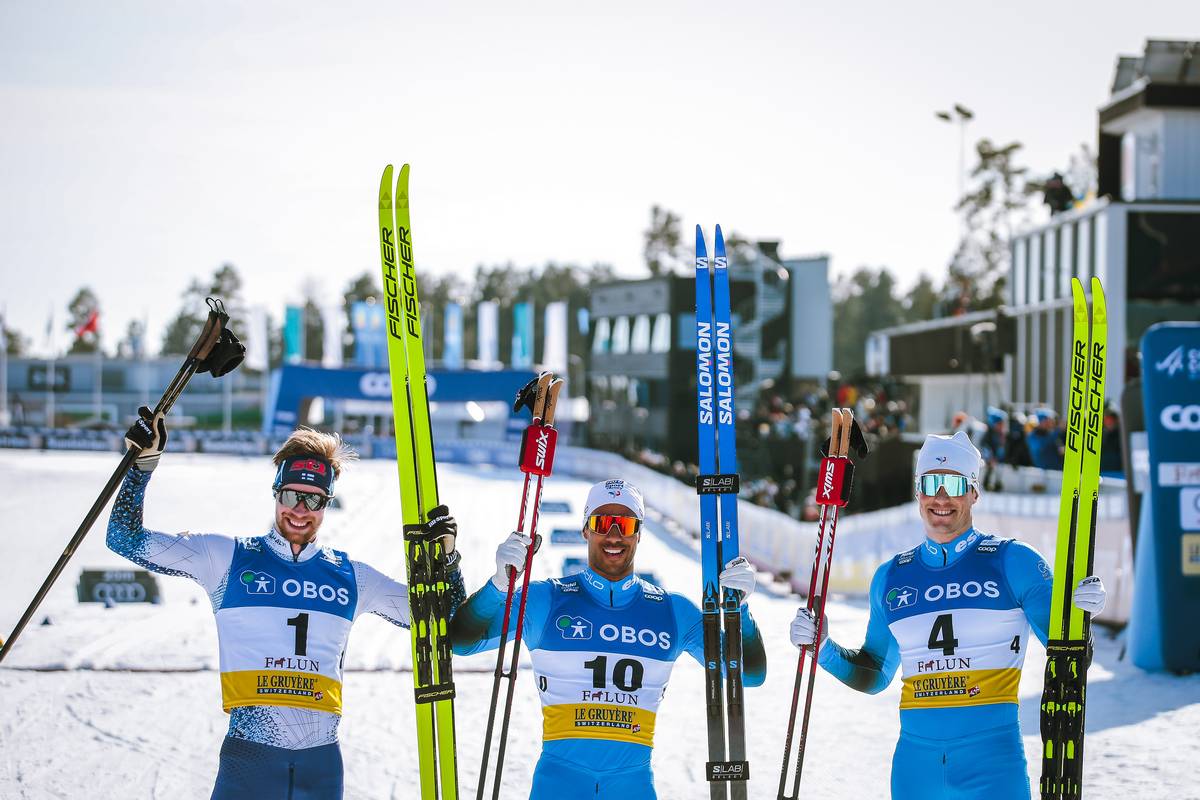
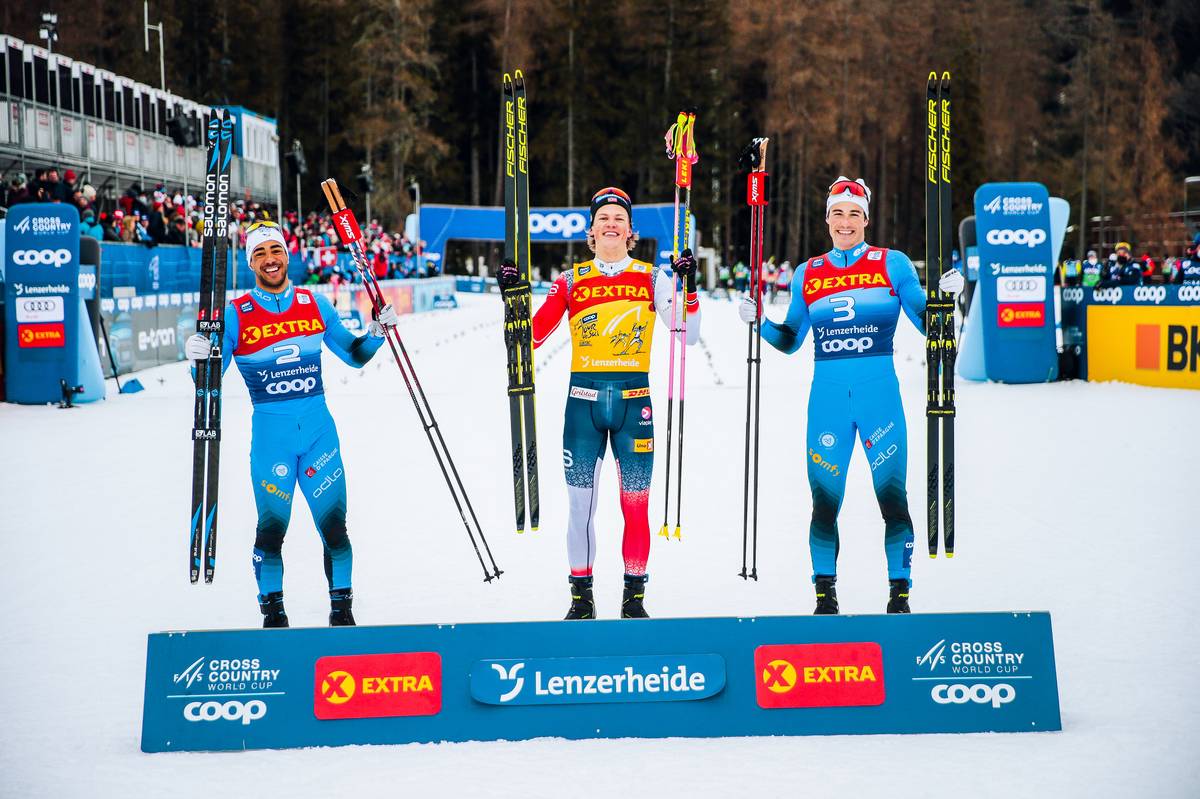
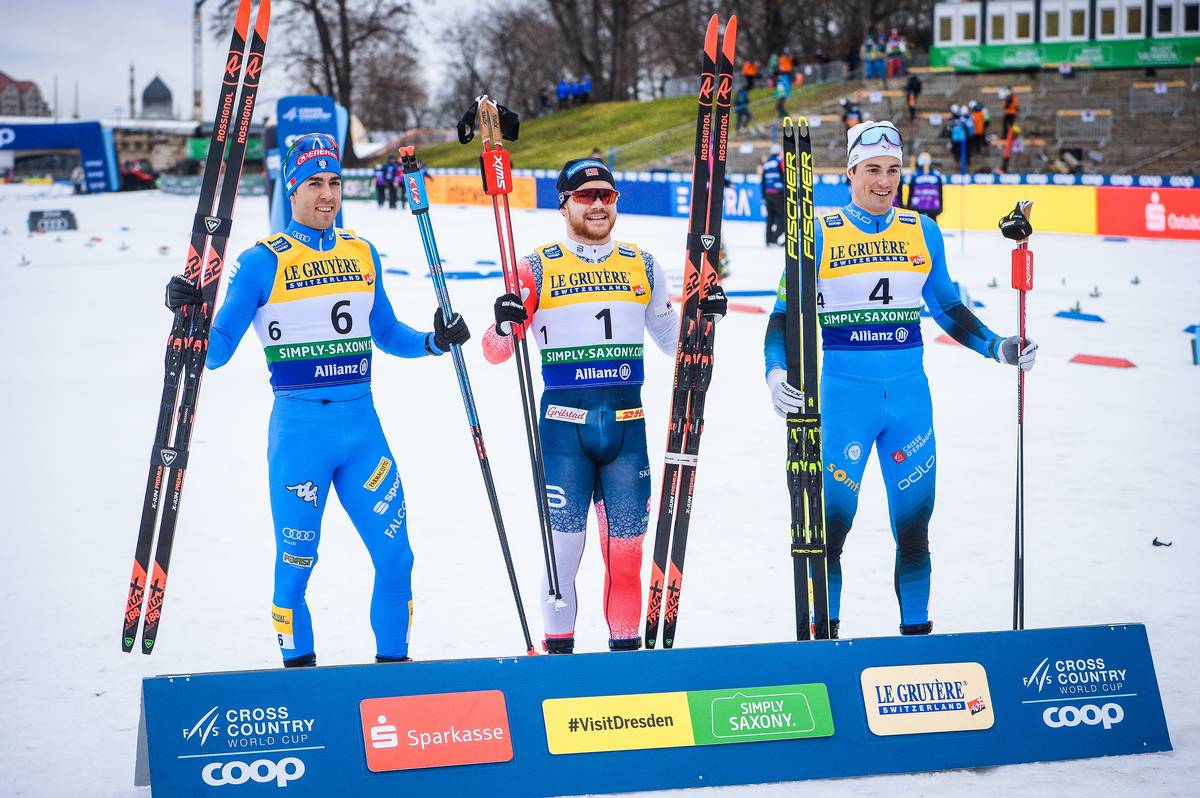
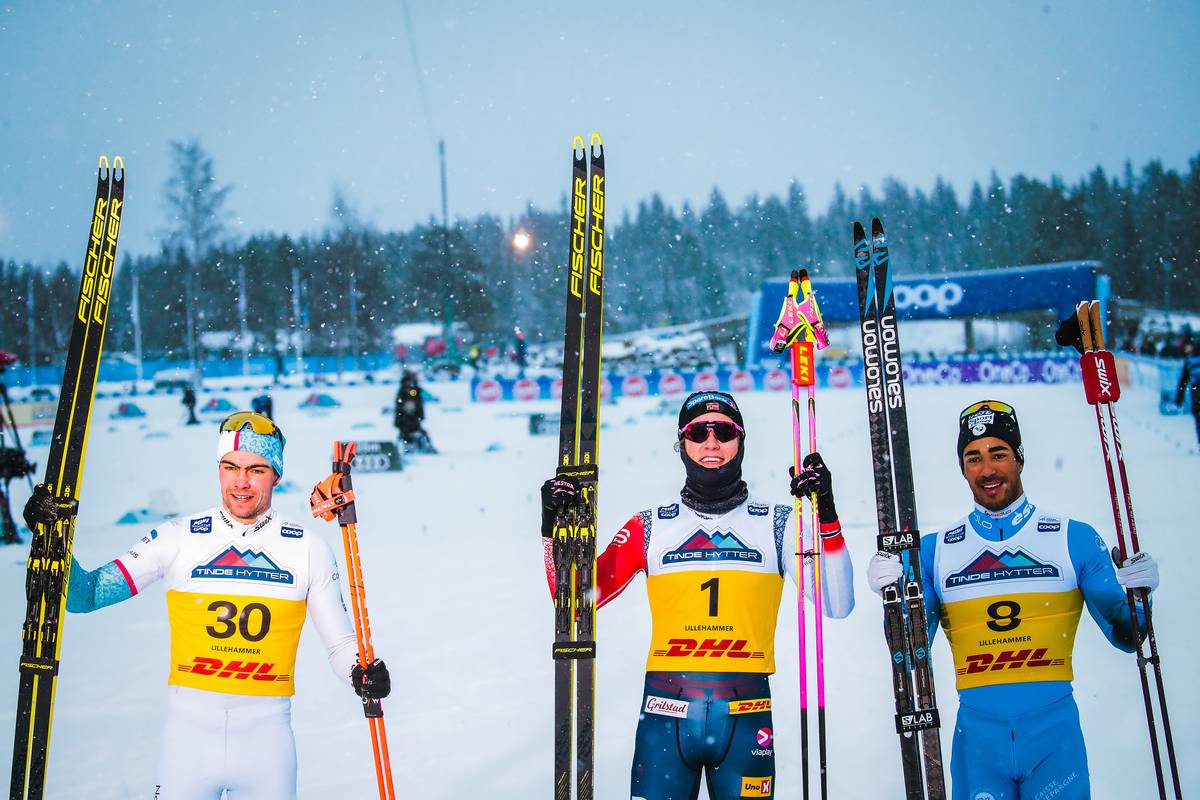
    Federico Pellegrino (ITA), Lucas Chanavat (FRA), and Oskar Opstad Vike (NOR), (l-r) on the sprint podium in Davos (SUI). (Photo: Vanzetta/NordicFocus)
  • The Devon Kershaw Show: RIP OG Tour de Ski — stages 1 and 2 recap

    The Devon Kershaw Show: RIP OG Tour de Ski — stages 1 and 2 recap

    It’s the most wonderful time of the year — or is it? The Tour de Ski has returned, but Devon has some beef with this year’s watered down format. Plus, recaps of the four races we’ve been through so far, including Jessie Diggins sprint win from heat five.

    Send feedback, hate mail and love letters to devon@fasterskier.com. You can send love letters to nat@fasterskier.com. See you in a couple of days.

    `

  • Ogden Battles Through Broken Pole in Final As Klaebo Wins Tour de Ski Stage 1

    Ogden Battles Through Broken Pole in Final As Klaebo Wins Tour de Ski Stage 1

    The 19th edition of the Tour de Ski is here once again! While many athletes have taken a conservative start to the season, skipping early races to focus on preparations for the World Championships in Trondheim later this winter, the excitement for the Tour remains high. With seven stages packed into just nine days — and rest days on Monday and Thursday — the Tour has historically seen relatively few skiers complete the entire event. However, many of the sport’s top athletes hope to compete all the way through, chasing bonus points and the opportunity to solidify their positions as World Cup leaders in this important week of racing.

    The Tour kicks off in Toblach, Italy, with a skate sprint as the opening event. The first four races will take place in Toblach before athletes transition to Val di Fiemme for the final three races on Friday, Saturday, and Sunday, marking the Tour’s conclusion.

    This course demands sharp strategy, precise lines, and well-timed pacing to finish in the front of each heat. Athletes must not only position themselves effectively on the uphills but also navigate the downhills skillfully, taking optimal lines to slingshot themselves around both the trail’s corners and their competitors. Completing two laps on this challenging course requires a careful balance of power and tactics. With the finishing stretch emerging from a downhill turn, positioning becomes crucial long before the finish line itself.

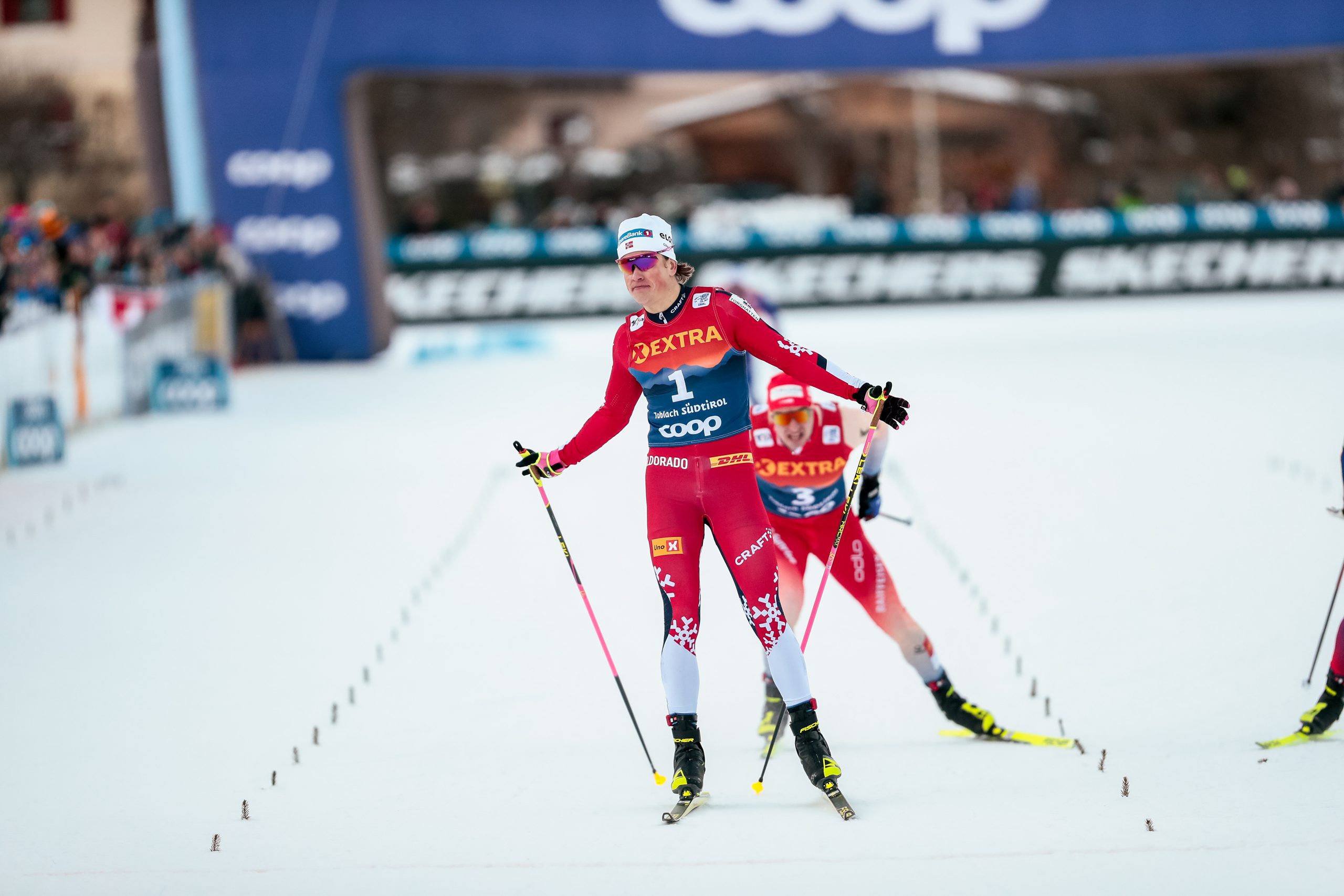
    Johannes Hoesflot Klaebo (NOR) with his trademark coast into the finish of the individual freestyle sprint in Toblach (ITA). (Photo: NordicFocus)

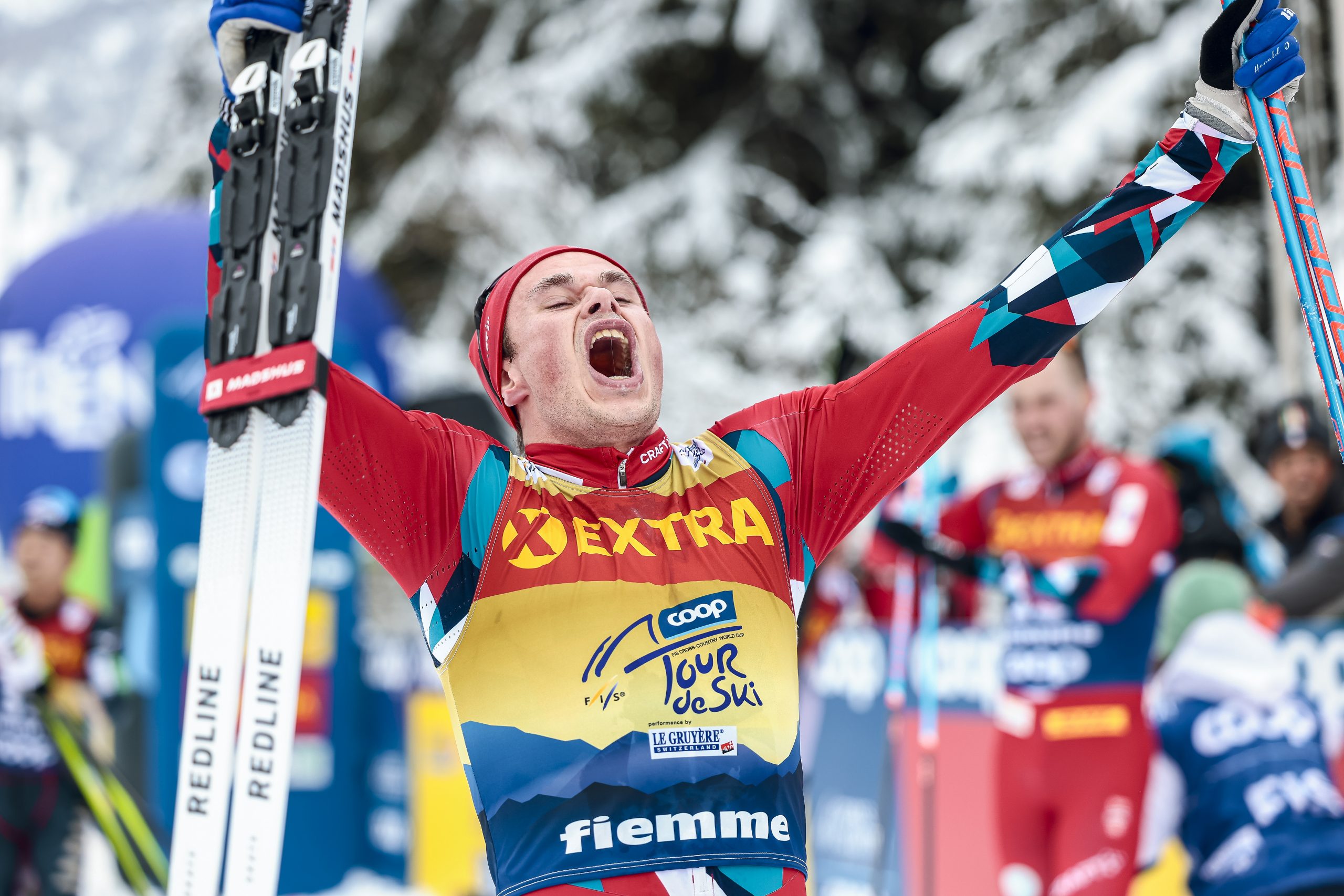
    The heats followed a familiar marching pattern to those we’ve already seen this season: with Johannes Hoesflot Klaebo (NOR) and Lucas Chanavat (FRA) skiing synchronously at the start of each heat to control pacing and claim podium positions together. Janik Riebli (SUI) followed closely behind, slipping into the final as a lucky loser, with the road paved to a podium position after competitors Ben Ogden (USA) broke a pole and Valerio Grond (SUI) slipped during the final ascent. Klaebo earned, in what appeared to be an easy win, his 95th sprint victory. “In the end, I’m really satisfied, and it’s the perfect way to start the tour,” he said upon finishing the race. 

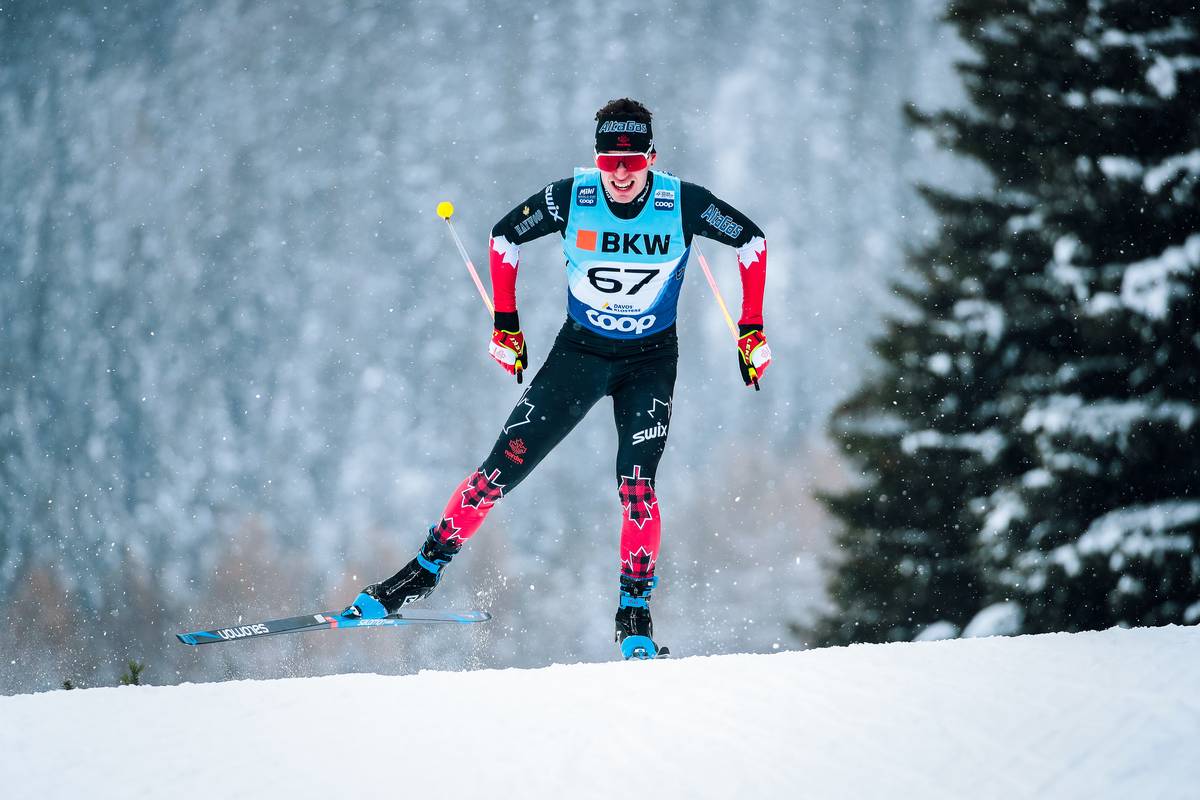
    Four Americans advanced to the heats, with Ogden finishing 6th, Gus Schumacher, 10th, JC Schoonmaker, 14th, and Jack Young, 17th. Zanden McMullen just barely missed qualification, finishing 36th. On the Canadian side, Antoine Cyr (56th) and Olivier Leveille (60th) completed the race but did not qualify for the heats.


    Men’s Sprint Quarterfinals

    In the first heat, Klaebo and Chanavat dominated from the start, skiing side by side in a controlled performance that seemed almost choreographed, easily securing their spots in the semifinal heats. Other athletes vied for these positions, Emil Danielsson (SWE) tried to pass through the middle of Klaebo and Chanavat, who accelerated and maintained their position in front. French skier Remi Bourdin also approached the pair in front over the final ascent around two minutes into the race, though could not surpass Chanavat and finished third in the heat. 

    In the second quarterfinal heat, Ogden battled Riebli head-to-head for the leader position, both holding off sprint specialist Richard Jouve (FRA). The two exchanged leads throughout the race, with Ogden making a decisive move around the inside of the final turn. This maneuver set him up for a clear finishing sprint, allowing both Ogden and Riebli to advance together to the semifinals.

    Schumacher took an early lead in the third heat, facing challenges from Niilo Moilanen (FIN) and Davide Graz (ITA). After a minute and a half, Schumacher was able to solidify himself in front, accelerating through the descent to establish a small gap ahead of the field. His competition narrowed again in the final stretch, though Schumacher maintained his position in front to advance to the semifinals alongside Moilanen. Meanwhile, Evan Northug’s race took an unfortunate turn as he broke a pole just out of the gate, forcing him to pull to the side of the trail and effectively ending his chances of progressing. Currently ranked 3rd in the overall sprint standings, Northug is a strong sprinter, but this setback could jeopardize his Tour prospects, especially given his relatively weaker performances in distance disciplines.

    Federico Pellegrino (ITA), front, Edvin Anger (SWE), left, and Jack Young (USA), right, lead their quarterfinal heat. (Photo: NordicFocus)

    Young battled against Federico Pellegrino (ITA), 12 years his senior, in the fourth quarterfinal together with strong sprinters Edvin Anger (SWE) and Erik Valnes (NOR). Valnes established an early lead out of the start, joined by Pellegrino. Midway through the race, Anger accelerated into the lead, but the top three continued to trade positions as the heat progressed. Young stayed right in the mix, maintaining a strong position near the front of the pack.

    “I started as hard as I could and put myself in position near the front of the heat. After that, there wasn’t much I could do to get around Pellegrino or Anger,” Young explained. After being boxed out in the inside of the finishing stretch, Young’s chance of qualification was low but chances at a lucky loser position seemed high, ultimately missing qualification by 0.3 seconds. “The only thing I’m wondering about is whether I could have swung out wide on the turn into the finish instead of checking my speed to get the inside,” Young reflected after the race, “that could have given me the three-tenths necessary to get a lucky loser spot.” 

    Finally, Valerio Grond controlled the pace of quarterfinal five through much of the race, battling closely against Finland’s Lauri Vourinen. Italy’s Giovanni Ticco briefly challenged Grond for the lead initially but soon fell back, ultimately finishing last in the heat. Meanwhile, Schoonmaker stayed in the middle of the pack, focusing on “bringing good momentum into hills,” and positioning himself strategically to contest the leaders in the final sprint. Although he crossed the line in third, initially appearing poised to advance to the semifinals as a lucky loser, subtle time adjustments narrowly eliminated him from contention.


    Men’s Sprint Semifinals
    Johannes Hoesflot Klaebo (NOR), Lucas Chanavat (FRA), and Ben Ogden (USA) racing out of the stadium. (Photo: NordicFocus)

    A quick look at the start list made it evident which semifinal was likely to produce the fastest times—and from which the lucky losers would emerge. Klaebo and Chanavat were set to face off again in the first heat, joined by Ogden, Riebli, and Valnes, all formidable sprinters capable of pushing Klaebo to reconsider his race strategy.

    The heat unfolded precisely as would be expected, mirroring the quarterfinals.  Klaebo and Chanavat led the pack side by side, skillfully controlling the pace around the course before Klaebo pulled ahead to take first at the line. Ogden positioned himself right behind them, confident that the speed of this heat would give him a chance at entering the final as a lucky loser. Ogden raced confidently and quickly, taking tight lines around the course and crossing the finish line in third, just behind Chanavat in second. The real drama came down to Ogden and Riebli, sprinting neck and neck to the finish, successfully securing lucky loser positions.

    The second semifinal lacked a clear favorite, leaving the top two positions wide open for the competitors to claim. Richard Jouve and Federico Pellegrino both have a strong history in skate sprints, while Valerio Grond has recently delivered impressive results in the freestyle sprint discipline. Meanwhile, Anger, Vuorinen, and Moilanen have consistently been contenders in sprint finals this season.

    Ultimately, this semifinal—perhaps aware that the lucky loser spots had already been secured by the first heat—turned out to be one of the slowest of the day. With six skilled sprinters, strategic positioning within the pack became the decisive factor in determining who would advance. Grond skied steadily from the start, moving into the lead later in the short race. In a close finish, Jouve narrowly edged out Pellegrino to claim the second qualifying spot for the final.


    Men’s Sprint Final

    Again, Klaebo and Chanavat took an early lead, executing their well-rehearsed, almost synchronized strategy to control the pace of the heat before battling it out at the finish line—a contest Klaebo typically wins.

    While their dominance played out as expected, the race for the top three positions took an unexpected turn. Ogden broke a pole early on, losing contact with the leaders as they rounded the first corner. Moments later, Grond’s skis slipped on the uphill through the stadium, causing him to fall and take Jouve down with him. With three competitors effectively out of contention, Klaebo and Chanavat remained unchallenged at the front while Riebli skied through the chaos to contend for the third podium position. 

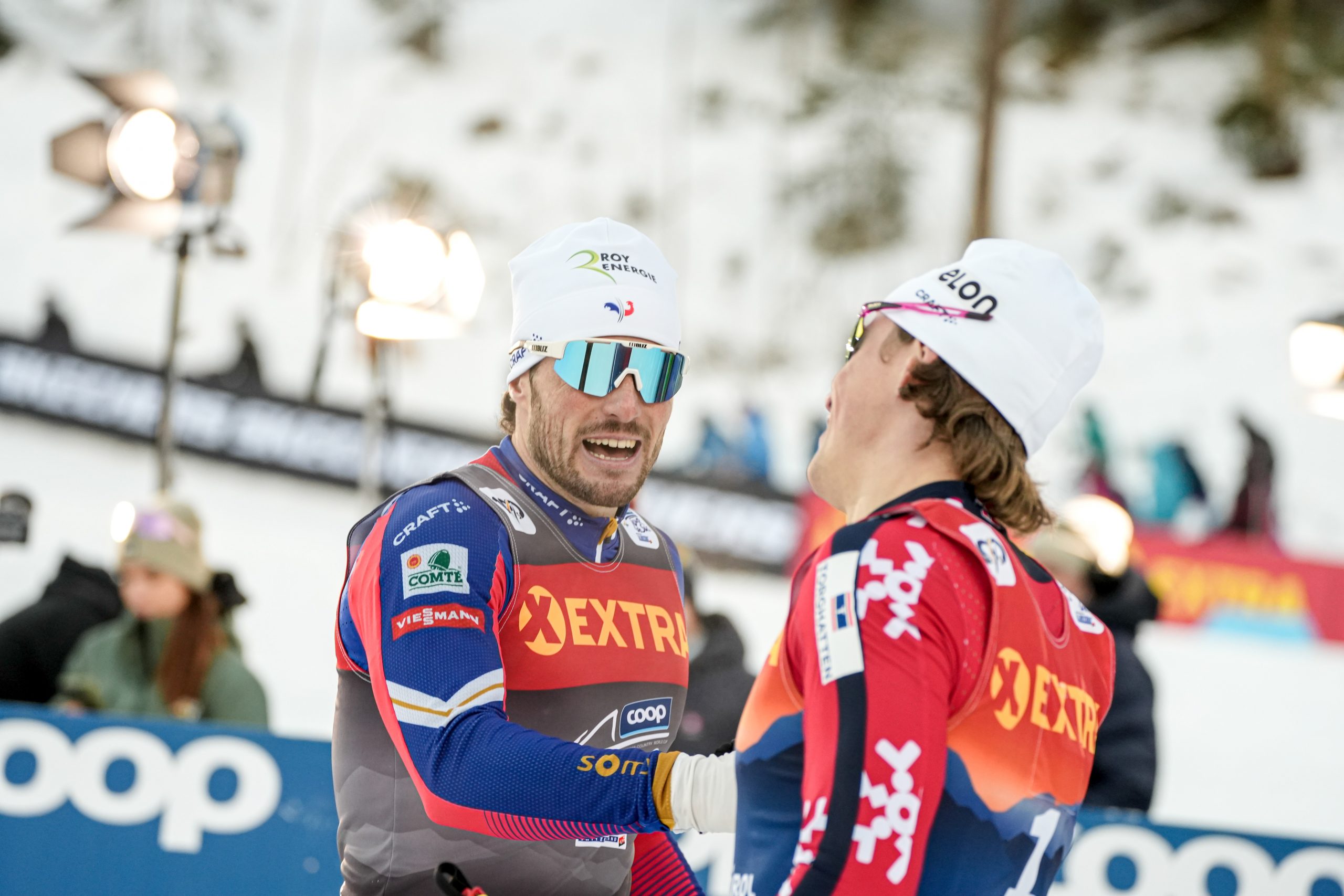
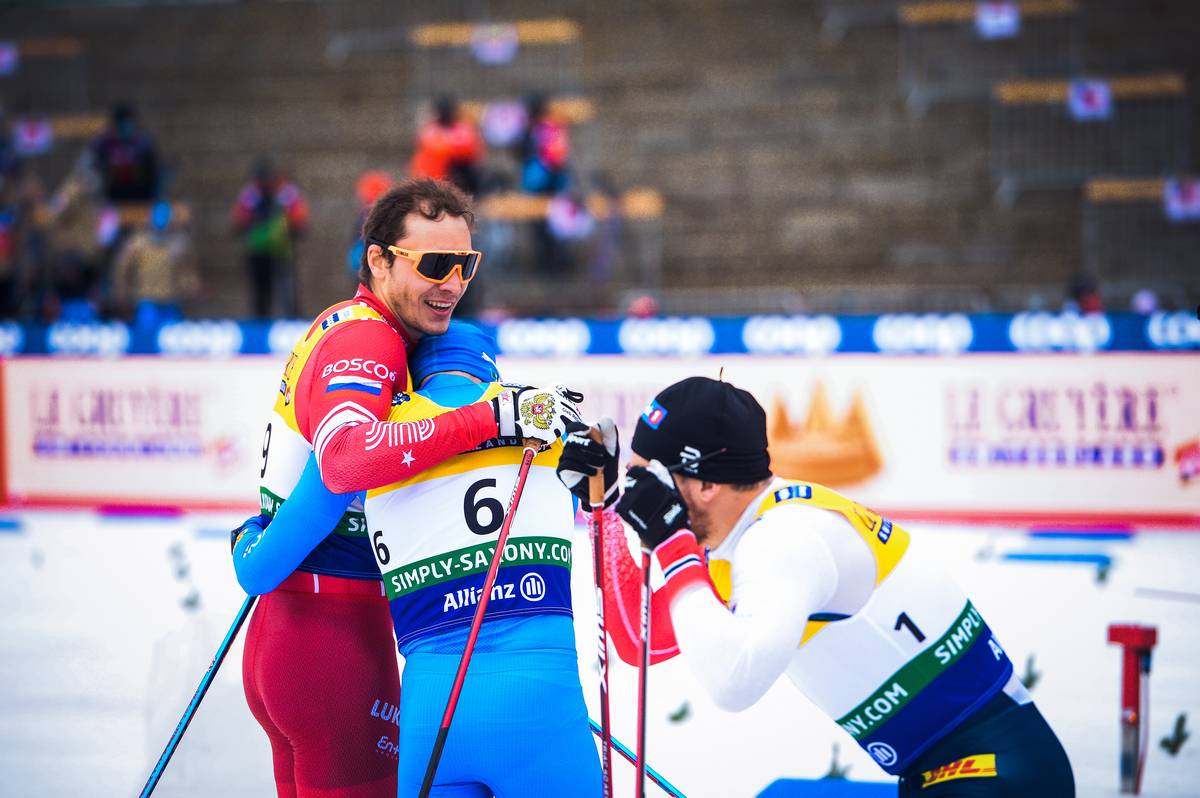
    Johannes Hoesflot Klaebo (NOR), right, and Lucas Chanavat (FRA), left, congratulating each other after the races. (Photo: NordicFocus)

    Ogden recounted the chaotic events of the final to FasterSkier after the race. “I was trying to weasel in behind Lucas [Chanavat], and someone behind me wasn’t thrilled about that,” Ogden reported, describing the battle for position that ultimately led to his pole snapping. “I was kinda able to ski with one pole, but then the exchange was incredibly hectic, and I tripped myself twice, and there was little to no hope after that.” Once Grond fell too, the two of them competed head to head for the remaining positions. 

    Despite the disappointing result, Ogden found pride in his approach to the heats. “I’m most proud of my confidence today in the heats,” he shared. “I was more nervous today than I’ve been for a while because I’ve got some memories.” He was referring to his breakthrough performance last season, which included his first-ever sprint podium on the Toblach course. “I feel like I handled it really well—skied smart and never got too frantic. It’s an unfortunate way to end after all that work, but what can you do? It’s part of the deal.”

    As for Klaebo, his victory came as no surprise, continuing his dominance in sprint racing this season. While another win may feel routine for the seasoned sprinter, Klaebo expressed excitement with his performance. “In the end, I’m really satisfied. It’s the perfect way to start the Tour,” he said with a smile. 

    With only Stage 1 of the Tour completed, Ogden is focused on the long week ahead. “My goals are to manage my energy as best as I can and make it all the way to the end!” he said, with his eyes on the Leader Bib. For now, fans can expect him to prioritize recovery, fueling for the upcoming races, and finding lighthearted distractions like browsing “clapped Jaguars and Porsches on eBay” to unwind between events.

    Men’s Freestyle Sprint Results

    Tour de Ski Overall Standings

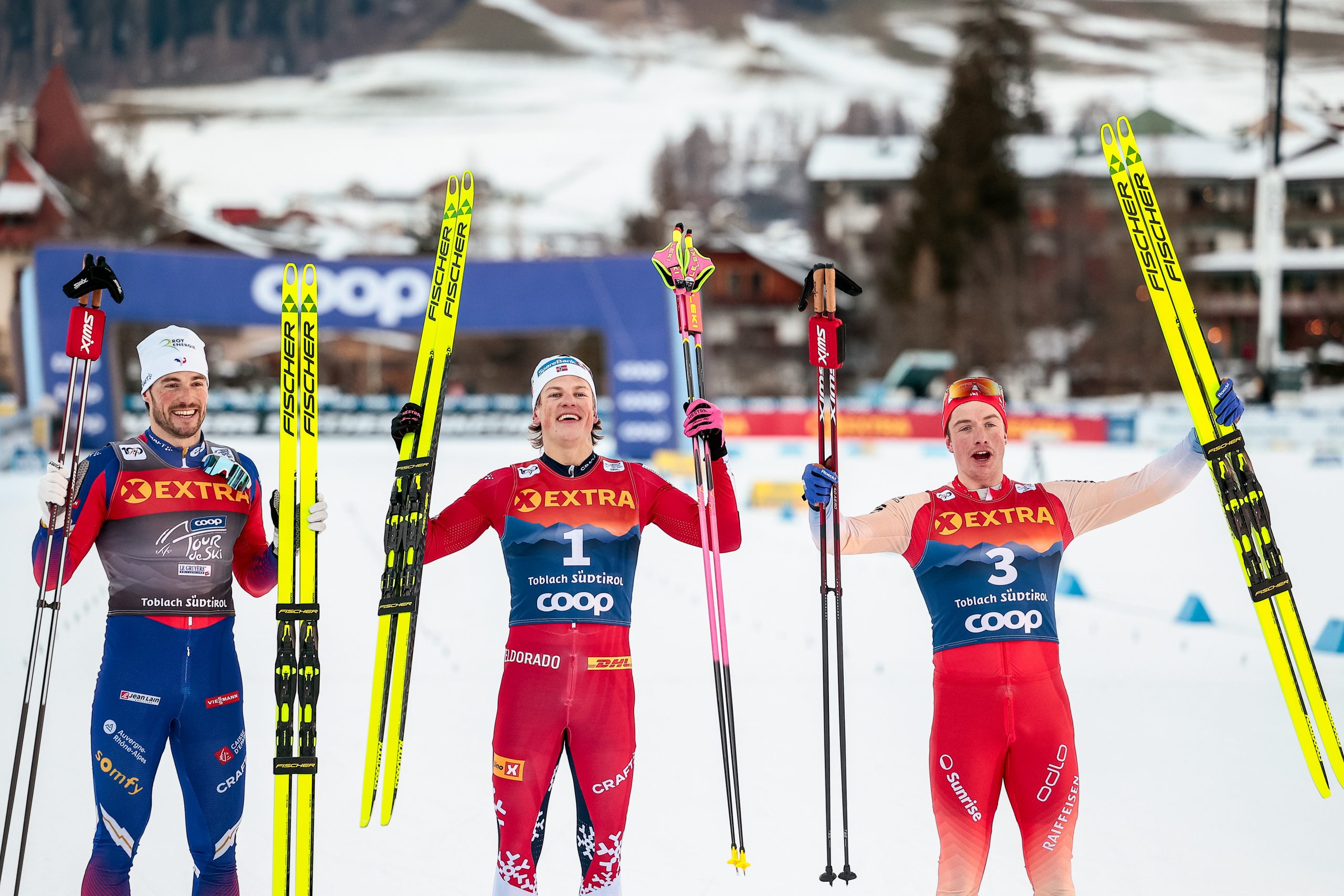
    Lucas Chanavat (FRA), Johannes Hoesflot Klaebo (NOR), Janik Riebli (SUI) topped the podium in Toblach Tour de Ski Stage 1. (Photo: NordicFocus)


  • How do you solve a problem like Johannes? The World Cup weighs in on how to dethrone him.

    How do you solve a problem like Johannes? The World Cup weighs in on how to dethrone him.

    Johannes Høsflot Klæbo, in typically dominating fashion, anchored the Norwegians to a victory in the team sprint in a World Cup in Switzerland earlier this month. (Photo: Modica/NordicFocus)

    In cross-country skiing, sprinting is a notoriously inconsistent discipline for a single competitor to dominate. The short distance leaves little time for racers to recover from even small mistakes; sharp corners and tight spaces often produce race-ending crashes.

    Which makes the track record of Norway’s Johannes Høsflot Klæbo almost impossible to comprehend.

    Klæbo, a five-time Olympic gold medalist, has won the last 10 straight sprint races he’s entered on the World Cup — the highest level of international competition. He often crosses the finish line far enough ahead of his rivals — if you can call them rivals — that he has time to unstrap his poles before crossing the finish line.

    Klæbo, 28, has won five out of the six Olympic and World Championships sprints he’s contested, and 52 of his 69 sprint World Cup starts — missing the World Cup sprint podium just once since 2018, according to data from the International Ski Federation.

    So: How do you beat this guy?

    FasterSkier, when the World Cup made its swing through Canada and Minnesota last season, decided to pose that question to an array of the circuit’s athletes and coaches. We’ve put together a kind of brief oral history below, seeking to appropriately describe Klæbo’s supremacy and the best ideas about how to take him down.

    Enjoy.

    What kind of tactics would you use to beat Klæbo in a sprint?

    Håvard Solås Taugbøl, a Norwegian World Cup racer and one of the nation’s (and globe’s) best sprinters: That’s the $1 million question. I have never managed to do it. 

    Swiss sprinter Valerio Grond: Maybe break his poles or something? I don’t know.

    French sprinter Lucas Chanavat: I mean, if I had the answer, I would have won the last one. You just focus on yourself, do the best race you can. It’s about my strengths. I think you have to be really perfect on every move you do. That’s the fun part about competing with him. It’s, like, you have to be perfect. And that’s really motivating.

    Lucas Chanavat of France alllllmost beat Klæbo at a World Cup sprint race in Switzerland last year. But he didn’t. (Photo: Modica/NordicFocus)

    Sweden’s team manager, Anders Bystrom: I think, first of all, you have to mentally know that he’s not unbeatable. Because I think many people think so. He’s shown that he is almost unbeatable, so it’s fair that people think that. But we don’t talk about him like that.

    Jonna Sundling, the Swedish Olympic champion from 2022 in the women’s sprint: I would go hard from the start, and don’t leave any power. Just go, all that I have. I don’t think I could take him in the final meters — he’s too quick for me. The men, maybe they’re scared sometimes — I don’t know, I think they can do more than what they think they can do. Maybe.

    Maja Dahlqvist, a Swedish Olympic sprint medalist: I would try to sprint him down, like waiting til the end. But I guess a lot of people try to do that, and people are not so successful.

    Grond: If he’s in his top shape, he’s almost unbeatable. He’s really, really always in a good spot. But when he’s maybe not in the best spot, you have to take advantage of this and put in an attack.

    Canadian national team coach Robin McKeever: Break his pole? 

    Swedish sprinter Edvin Anger: I think we need to push him really hard, and take our chances. I don’t think I need to go hard early, but I think I need to have a good place. And when I take my chance, I really need to take my chance. And I need to push from the place in the track that I think is best for me. I can’t wait to see what he will do, because I need to do the thing first.

    Norwegian sprinter Erik Valnes: How to beat Johannes in sprint is all about him being in bad shape. [Laughs] I think maybe it’s about the finish — or, to be able to have a good finish after a high-speed final. There are many things that have to be right to beat him. You just need to start the finishing sprint before him, and be ahead. Because as long as you’re behind him, you’re one step behind him in the mind games as well.

    McKeever: I think the only way is by surprising him. And they’re trying.

    What makes Klæbo so good at sprinting?

    Chanavat: He’s strong in every aspect of the sprint race. He has, like, amazing turns, an amazing finishing sprint, he’s insane in stamina. He’s good at everything. He’s the GOAT [Greatest Of All Time]. 

    Grond: He’s so good in every technique and part of the race, and also tactically. He’s simply the best skier in history.

    Dahlqvist: He’s good in everything. He can go hard, he can wait, he can go from the start.

    Norwegian distance specialist Simen Hegstad Krüger: He often likes to control the heat and he gets a lot of respect. And you have — I think there’s a lot of guys that think there’s no chance to beat him so they just give him room and then they give it away to him. He has earned the respect but especially in sprint you can’t give anything away and you have to take your place and take your positions. And I think he’s the best in that but I think sometimes he gets the best positions a little bit too easily.

    Klæbo wins a Tour de Ski stage just ahead of his Norwegian teammate Erik Valnes. (Photo: Modica/NordicFocus)

    Valnes: I’ve been angry with myself sometimes because of bad tactical decisions. Because many times I’ve just, in my unconsciousness — you think, ‘Just follow him, and you’ll get a good result.’ But then you will not get past him.

    Bystrom: If you meet him in a heat, you almost adapt to what he’s doing. Because you have to see, ‘Okay, what’s Johannes going to do now?’ Because you know he has this X-factor in many parts of the course. 

    Does Klæbo have any weaknesses in sprinting?

    Chanavat: You should probably ask him. That would be the best.

    Klæbo: That’s going to be a secret. [chuckles] I don’t think I will tell everyone. I think I’ll keep that for myself and I’ll tell everyone when I’m done racing. That’s my answer.

    Norwegian sprinter Even Northug: Maybe none.

    Valnes: No. That’s the thing with him. He’s not having any weaknesses. You can say, like, maybe double-poling long flats. But he’s quite good there.

    Krüger: Not that I’ve seen so far. Even in distance races, it’s not so many weaknesses to find. 

    French sprinter Jules Chappaz: I think running [uphill], like in Ruka [the Finnish ski resort that hosts the season-opening World Cup races each year]. First it was the ‘Klaebo run,’ but now I think I’m really good at it. Maybe, hopefully next year in Ruka, I can run faster, beat him. [He didn’t.] He is sick a lot of times — maybe that’s sort of his weakness. 

    Klæbo coasts to the win in Ruka this year, beating everyone, including Jules Chappaz. (Photo: Modica/NordicFocus)

    Anger: It’s a hard question. But I think we need to push him and then make him a little stressed — that’s what I think.

    Bystrom: Mayyyyyybe it’s skating without poles — using your legs to be able to, maybe, go past him. But it’s really hard to say. He’s the best. He’s shown that many times. He’s so good in so many areas. It’s hard to say there’s one where you could beat him when there’s 28 areas where you can’t beat him.

    Are there ways athletes can train over the long-term, like over next summer or multiple seasons, to beat Klæbo?

    Chappaz: Just trying to focus on ourselves. This spring, I will compete in the Ski Classics [marathon races] to improve my double poling. To look to the Olympics, 2026, with the Val di Femme finish — I hope it will improve my double poling skills, to [be able to] beat him.

    Dahlqvist: Maybe they need another team like us, like the Swedish women, because you can use your team more. So, maybe a whole team needs to be stronger, to try to beat the Norwegian. They could do team tactics in a way, like everyone knows where they will go. 

    Anger: I’m still young — I’m just 21 years old. And he has a lot of training hours. A lot more than I have. With one or two years more, with good summers, also with a lot of hours, I think it will be better for me. And maybe I will be better in the final — I’m good in the quarters and the semis right now, but maybe I miss a little in the finals. I need to be a little harder and stronger.

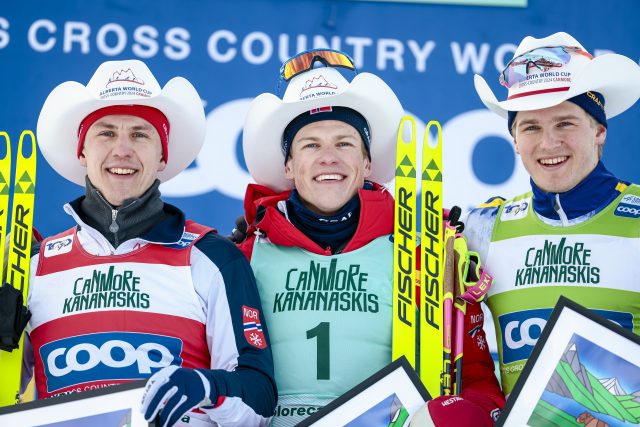
    Valnes, Klæbo and Anger pose for a podium photo after Klæbo won a World Cup sprint in Canada last year. (Photo: Modica/NordicFocus)

    Grond: We’ve just got to work hard. It’s also about learning how to ski against the best skier, for me. So, I’m trying, also, to get some experience on how they ski and where I can be better than them.

    Valnes: It’s more about improving the base level, the capacity, the VO2 max. If you have that base, from May until September, then you can build a little bit on that with specific training in October and November and just before the season starts.

    McKeever: The reality is, how do you beat Klaebo? Have him age out a little bit. 

    Northug: Training.

    Norwegian national team coach Eirik Myhr Nossum: You have to train, of course. But there were a lot of people training for the 100-meter dash, as well: Usain Bolt still won. So, if everybody in the world trains the best they can, still one will win — and it’s hard to beat Johannes. It’s possible, but he’s probably the best skier that’s ever been. And now it’s harder than ever, and he still wins.

  • The Devon Kershaw Show: Go big and go Goms

    The Devon Kershaw Show: Go big and go Goms

    Goms! These races, in Switzerland, were unambiguously awesome. Wipeouts, sun, fondue, North American podiums and breakout performances. And an Alaskan guest who watched the races firsthand.

    We really went above and beyond the call of duty this week — we’ve got sounds from the side of the trail and even a profanity-laced tirade from Devon if you stick it out to the end of the show. We’ll be on scene at the next round of World Cups, which are in a couple of weeks in Canmore, Alberta.

    A sincere thank you to everyone who’s generously pitched in to support us over the past few weeks. Email us at devon@fasterskier.com and nat@fasterskier.com. We’ll be back soon.

  • Svahn leads Sweden in Goms Sprints, Klaebo Lunges Past Chanavat

    Svahn leads Sweden in Goms Sprints, Klaebo Lunges Past Chanavat

    This coverage is made possible through the generous support of Marty and Kathy Hall and A Hall Mark of Excellence Award. To learn more about A Hall Mark of Excellence Award, or to learn how you can support FasterSkier’s coverage, please contact info@fasterskier.com.

    Johannes Hoesflot Klaebo (NOR) is all smiles again as he returned to the top of a World Cup  Sprint podium in Goms, Switzerland. (Photo: Modica/NordicFocus)

    Goms, Switzerland has never hosted a World Cup Sprint competition before, so prior experience would offer no tactical advantages to racers in today’s Freestyle Sprint. The playing field would be level, and everyone would be forced to develop a knowledge of the course—and strategies for taking advantage of its many twists and turns—together.

    Not a course that challenges racers with the thinner air of higher elevations (Davos, Switzerland, is 1,000 feet higher), Goms nevertheless offered considerable challenges including an unnaturally long flat section at the beginning, followed by steep climbs and technical descents featuring consequential ruts in soft snow. Compared to other World Cup Sprint courses, Goms also seemed quite short—the top women’s qualifier, Jonna Sundling (SWE) qualified in under three minutes. Though perhaps not quite as long as World Cup competitors are accustomed to, the Goms course succeeded in seriously challenging all who tested it.

    “The first uphill here feels forever,” said Johannes Hoesflot Klaebo (NOR) in post-race comments. And many skiers who spent too much energy pushing the pace or scrambling for position on that first hill would find themselves struggling, stumbling, or falling later in the race.

    Jessie Diggins (USA) continues to race impressively in Sprint competitions in her pursuit of the overall World Cup title. (Photo: Modica/NordicFocus)
    Women’s Freestyle Sprint

    The top American women—Rosie Brennan and Jessie Diggins—skipped the last two World Cup relays, choosing to prioritize their standings in the season-long race for the World Cup Crystal Globe. Diggins leads the chase for the overall title, while Brennan continues to hold her position in third (though the race for the podium is definitely tightening). Throughout the season, Diggins has added to her overall lead by earning numerous appearances in Sprint finals, strategically using her endurance to keep all heats fast and punishing. It’s allowed her to advance deep into semifinals and finals, and added points to her tally that other distance skiers have found themselves incapable of matching. In another nod to Diggins strategic prowess, she was able to claim top bonus points in both intermediate sprints in the recent World Cup 20 k Mass Start (on her way to a sixth place finish in the day’s results).

    World Cup Sprint leader, Linn Svahn (SWE), entered the Sprint in Goms having won the last three World Cup Sprints in a row. Sweden delivered five of the top six qualifiers (Jonna Sundling, Svann, Emma Ribom, Frida Karlsson, Johannna Hagstroem), a dominant blue and yellow front interrupted only by the presence of Victoria Carl (GER) in fifth.

    Diggins finished ninth in qualifying, and dominated her quarterfinal, a heat punctuated by an inadvertent pole-jab to the face of Frida Karlsson (SWE) in the free-skate section of the final downhill. Diggins is well known for her high-velocity freeskate, generating more speed than perhaps any other skier with this technique. Her power is reflected in the high and dynamic manner in which her poles drive behind her. Karlsson seemed to ignore that threat as she pulled up behind Diggins. Karlsson was lucky to have been wearing glasses, or the result could’ve been far more grim.

    In her semifinal, Diggins tangled skis with another racer on the final uphill. She would recover quickly, but could not regain the speed that had been lost. She would find herself eliminated, as the Goms course claimed one of the world’s best . . .

    “Today in the Sprint I definitely was struggling with the super-quick start, and the tactical nature of how the course was curving,” said Diggins. “I definitely got stuck and boxed-in in the semi, and wasn’t able to push the pace the way I needed to. And then getting tripped and falling was just the icing on the cake! But that happens in sprinting . . . and I was proud of myself for getting up right away and continuing to fight for it.”

    Samantha Smith (USA) qualified in 13th, a career best World Cup Sprint qualifying result. An untimely fall took her out of her quarterfinal, but her aggressive tactics hint at her potential in sprints to come. (Photo: Modica/NordicFocus)

    Sammy Smith (USA) delivered her best Sprint qualifier in 13th, but fell in her quarterfinal after having attempted to push the pace at the front. The Goms course claimed another contender . . .

    “Today I tried to get out faster and harder,” said Smith. “The trail was really wide as well which definitely helped and made it easier to move up. I will always try to get to the front and drive the pace if possible, but there are definitely a lot more things I need to learn and improve on before I can do that consistently!”

    Rosie Brennan qualified 17th, but did not advance beyond her quarterfinal. Among Canadians in qualifying, Lillian Gagnon finished 31st, Olivia Bouffard-Nesbitt 41st, Sonjaa Schmidt 43rd, Katherine Weaver 46th.

    Linn Svahn (SWE) won her fourth World Cup Sprint in a row on an unfamiliar course at Goms, Switzerland. After seasons of injury, disappointment, and recovery, Svahn once again stands firmly atop the World Cup Sprint standings. (Photo:Modica/NordicFocus)
    Women’s Final

    Shadows covered the course by the time of the Women’s and Men’s finals. Course conditions were likely to have changed, and downhill curves were likely to prove even more daunting. The Women’s final was comprised of five Swedes (Sundling, Svann, Ribom, Karlsson, Hagstroem) and hometown favorite, Nadine Faehndrich (SUI). Faehndrich found herself gapped on the first hill as Team Sweden stormed over the top, led by Svahn. Sundling would prove to be the most adept downhiller, but she stepped on her own pole in the subsequent uphill, and faded from contention. Svahn cruised easily across the line for the win. Sundling would recover to finish third behind Dahlqvist.

    Svahn leads the World Cup Sprint standings by 96 points over her teammate, Sundling. Diggins is tied for third with Kristina Stavaas Skistad (who did not compete in Goms this weekend).

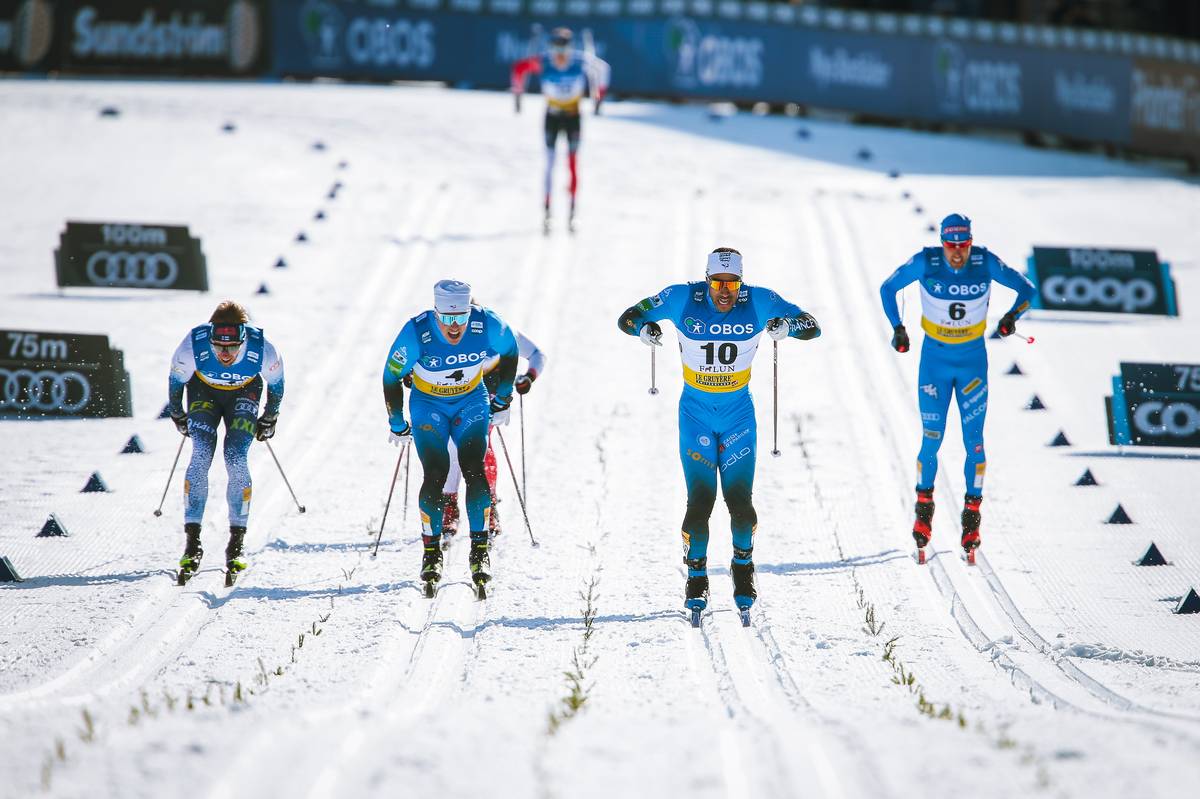
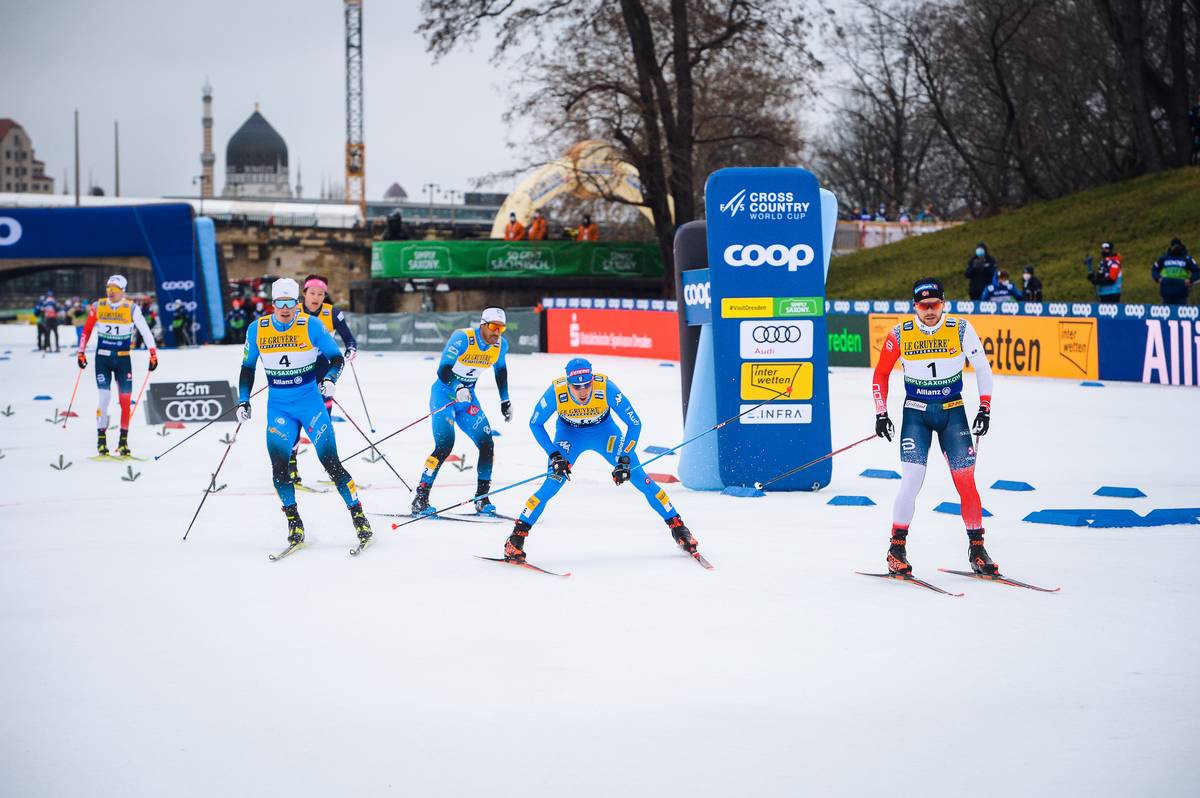
    Johannes Hoesflot Klaebo (NOR) (#2) was content to shadow Lucas Chanavat (FRA) (#1) in the quarterfinal, in the semifinal, and in the final. Ultimately, Klaebo’s greater finishing speed delivered the victory. (Photo: Modica/NordicFocus)
    Men’s Freestyle Sprint

    World Cup Sprint leader, Erik Valnes (NOR), qualified seventh, while his rival in the World Cup overall title chase, Harald Oestberg Amundsen (NOR), qualified 13th. Though Valnes was passed over in Norwegian team selections for tomorrow’s 20 k Mass Start event, both he and Amundsen will continue contesting the on-going race for the Overall Crystal Globe.

    Klaebo finished an uncharacteristic seventh in last week’s Sprint competition in Oberhof, Germany. In a remarkable testament to Klaebo’s longtime Sprint dominance, that seventh place finish marked the first time that Klaebo had failed to make a Sprint final since 2018. After the Oberhof weekend, Klaebo commented that he was feeling better since his absence due to Covid, but he hoped that he would return to his best form in weeks to come. Both Klaebo and Chanavat advanced easily out of quarterfinal 1. Chanavat again made the pace in the semifinal (that he raced alongside Klaebo). Knowing that Chanavat would utilize this strategy (as he has in nearly every heat and final this season) Klaebo seemed content to shadow Chanavat, hiding his own plans and abilities for the head-to-head race with Chanavat that was sure to be contested in the final.

    Among American men, Gus Schumacher qualified 23rd, but would be eliminated in his quarterfinal. Kevin Bolger qualified 47th, with Peter Wolter 58th. Canadian finishers in Sprint qualifying included Antoine Cyr 35th, Xavier McKeever 49th, Sasha Mason 51st, Thomas Stephen 61st, Derek Dueling 62nd, Julien Locke 65th.

    JC Schoonmaker (USA) qualified an impressive seventh in the Freestyle Sprint in Goms, and was only narrowly outsprinted to advance beyond the semifinal. (Photo: Modica/NordicFocus)

    Ben Ogden (USA) qualified a career-best third behind Chanavat and Klaebo. JC Schoonmaker—who qualified seventh—made almost every tactical mistake he could make in his quarterfinal (pinched on inside lines, too soon to the V1 on uphills, pushed to the outside on the final bend), yet still managed to sprint past Johan Haeggstroem to claim the second qualifying spot.

    “There was one route around the course that was the fastest,” said Ogden. “If you weren’t in it at any point, you had to use extra energy. But, it is not so consequential. I think if you’re in the wrong lane up the hill or around the corner, I don’t think it makes that much a different but definitely can mentally be a boost to take a bad line and still get through.”

    Ogden and Schoonmaker lined up together for the Men’s second semifinal, a closely contested heat that saw considerable bumping and jostling. Richard Jouve forced an inside line in the penultimate righthand turn, subsequently side-swiping Ogden who fell and dropped from contention. Schoonmaker sprinted with Jouve for second. Schoonmaker narrowly lost the race to the line and was eliminated. The technical, tactical Goms course had claimed two more Americans.

    “To be close to the final is bittersweet,” said Schoonmaker. “But I also think it’s cool to realize that I’m at a point where getting knocked out on the semis comes with a little disappointment.”

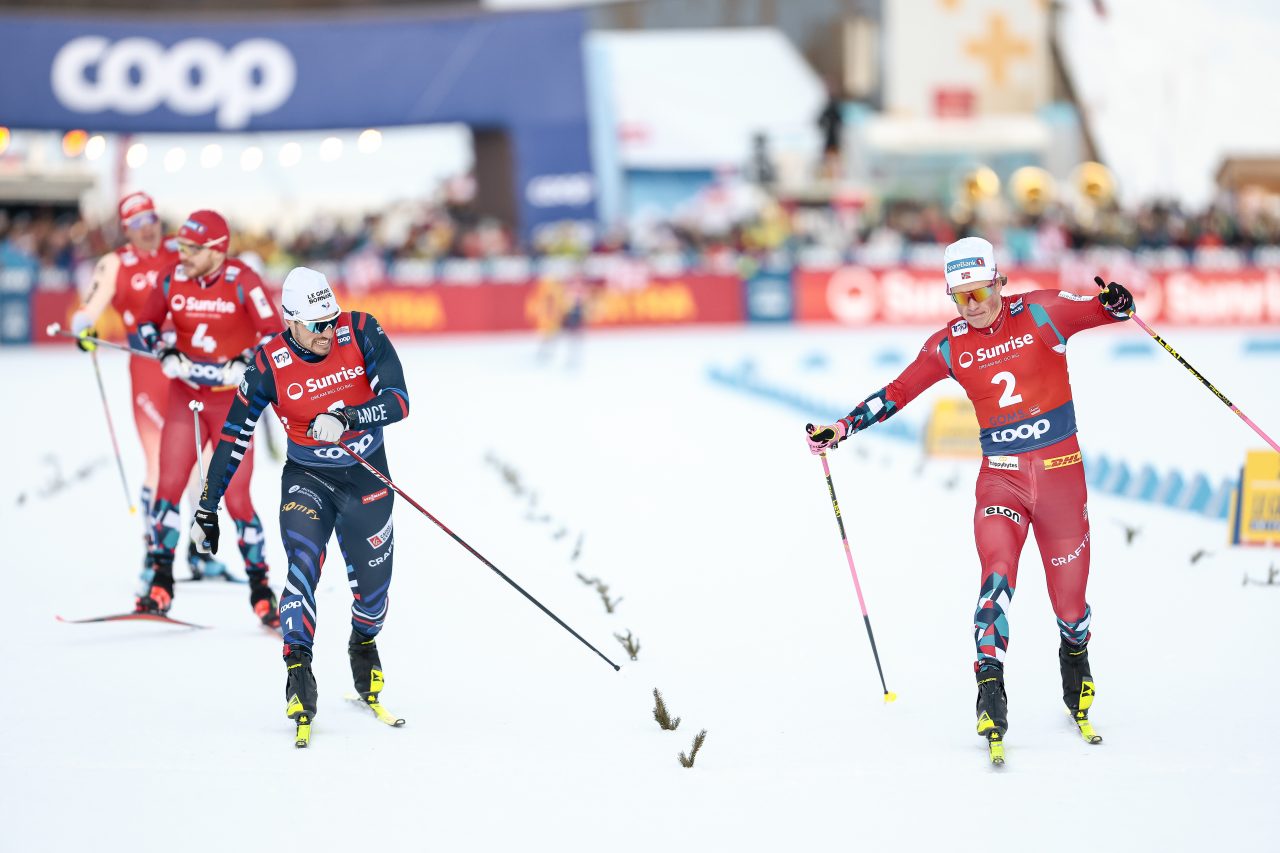
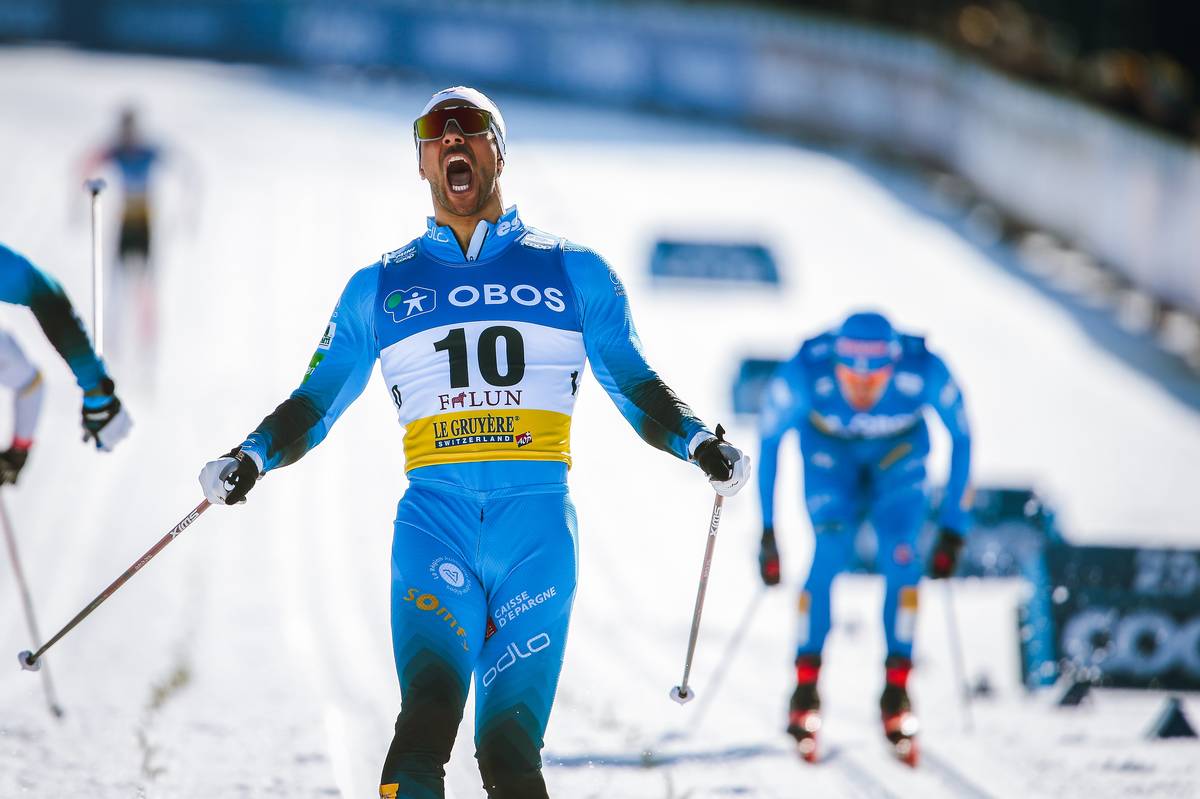
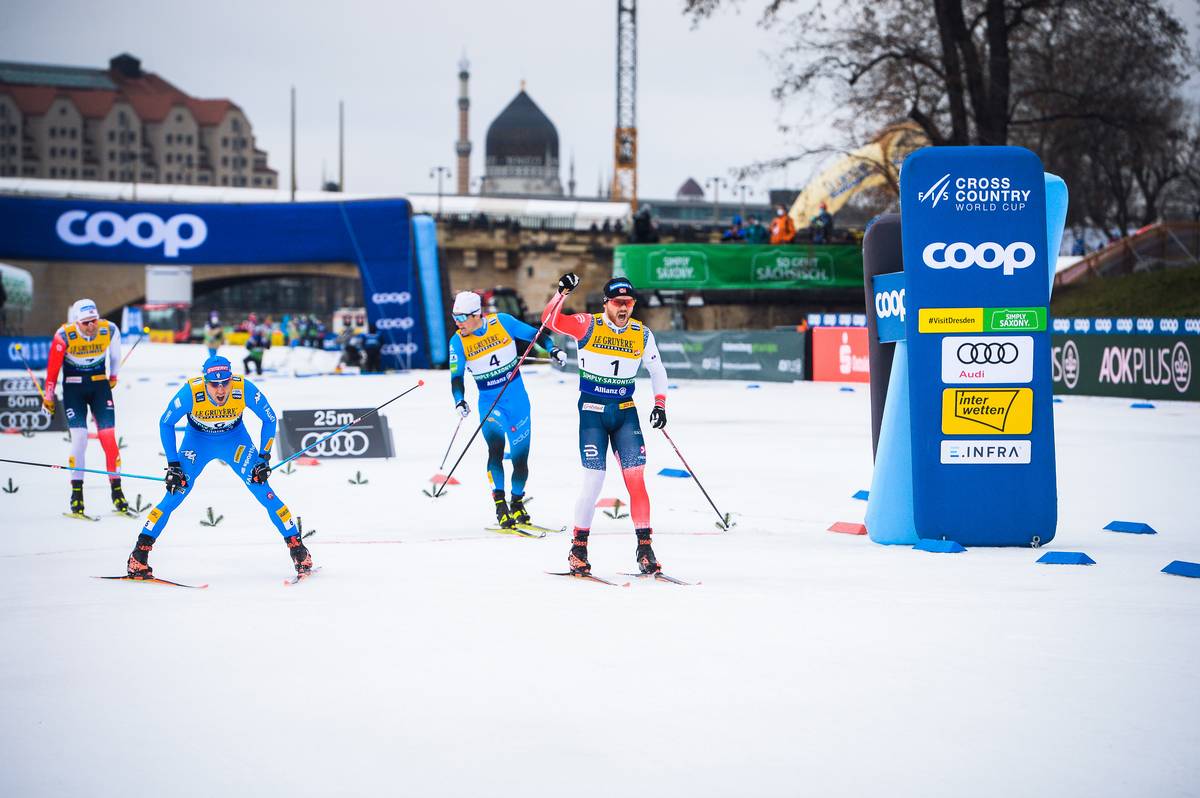
    Johannes Hoesflot Klaebo (NOR) lunges to defeat Lucas Chanavat (FRA) at the finish line of the Freestyle Sprint in Goms, Switzerland. (Photo: Modica/NordicFocus)
    Men’s Final

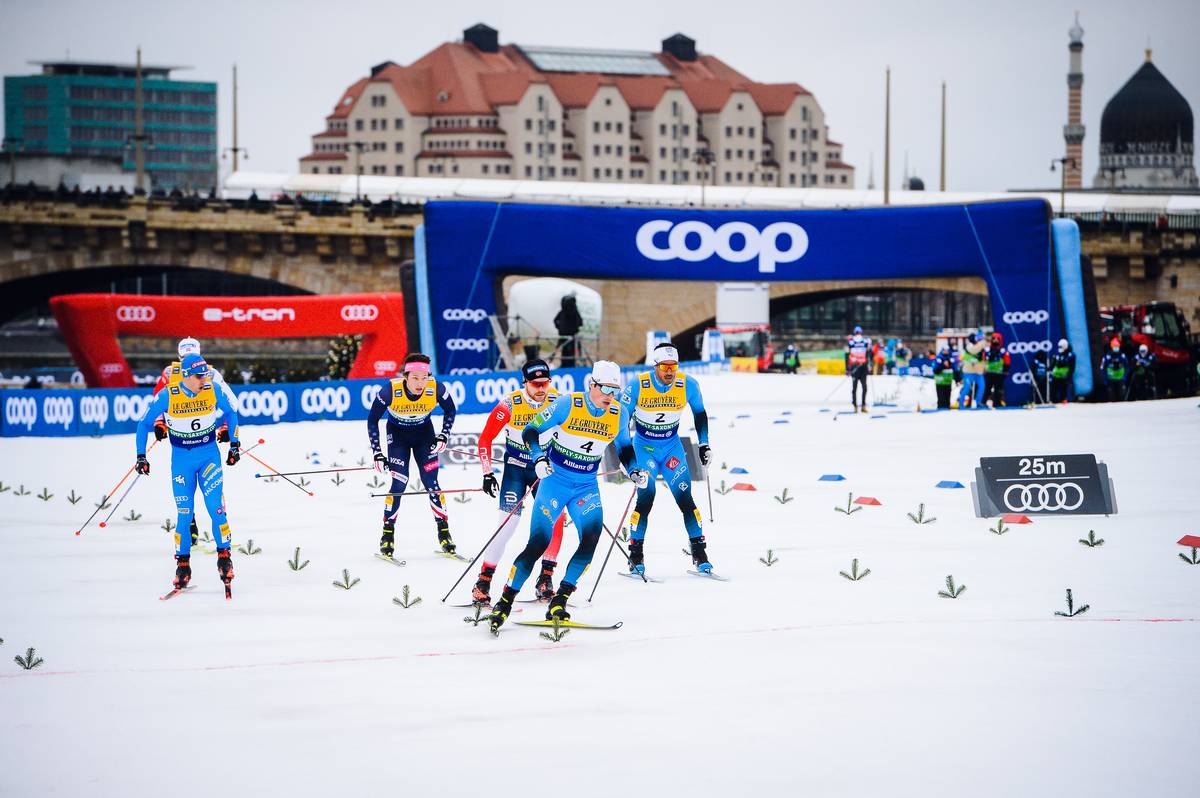
    Three Norwegians (Klaebo, Valnes, Taugboel), two Frenchmen (Chanavat, Jouve), and hometown favorite, Valerio Grond (SUI). As expected, Chanavat led out the pace with Klaebo at his shoulder. Valerio Grond made a strong move up the first hill, tangling briefly with Klaebo before slotting in behind Chanavat. Grond would skid through the next downhill curve, allowing Klaebo to move past on the inside. Chanavat and Klaebo appeared relaxed down the final hill and across the flat before the final turn, neither one seeming to be in any hurry to unleash their finishing sprint. Ultimately, no one can generate more speed than Klaebo, who overtook Chanavat in the closing meters to return to the top of the World Cup Sprint podium. Chanavat crossed a tenth of a second later, followed closely by Taugboel. All day long, Chanavat had done things his way. But, at day’s end, it was Klaebo who restored the status quo, showing that on a World Cup Sprint course, the only true way is Klaebo’s.

    “Chanavat was really strong today,” Klaebo said in post-race interviews. “I felt like he was pushing hard the whole day. I’ve been competing against him since the quarterfinal, so now I’m really tired!”

    With his victory in the Freestyle Sprint, Klaebo claimed his 73rd win in 107 World Cup starts, an astonishing winning percentage of 68%!

    Women’s Freestyle Sprint RESULTS

    Men’s Freestyle Sprint RESULTS

    Maja Dahlqvist (SWE), Linn Svahn (SWE), Jonna Sundling (SWE) on the podium of the World Cup Freestyle Sprint in Goms, Switzerland. (Photo: Modica/NordicFocus)
  • International Flair at Tour de Ski—Amundsen, Moch, Lapalus

    International Flair at Tour de Ski—Amundsen, Moch, Lapalus

    This coverage is made possible through the generous support of Marty and Kathy Hall and A Hall Mark of Excellence Award. To learn more about A Hall Mark of Excellence Award, or to learn how you can support FasterSkier’s coverage, please contact info@fasterskier.com.

    The unrelenting slopes of Alpe Cermis challenged Norwegian dominance, as France’s Jules Lapierre emerged to triumph in the final stage of the 2024 Tour de Ski. (Photo:  Modica/NordicFocus)

    The origin story of the Tour de Ski suggests that it was invented to mirror cycling’s Tour de France: multiple stages, mountaintop finishes, leader’s jerseys, thrilling competitions, glorious champions. Today’s Stage 7 of the Tour de Ski—with its finish on the high summit of Alpe Cermis— is probably what the original race organizers had in mind. Helicopters hovered over the point-to-point course that wound its way through historic ski-venues in the Val di Fiemme. At the 2.4 kilometer mark, the still-flat course wound into the stadium of Val-d’Isére (where the first Bonus Sprint in the Alpe Cermis stage would be decided). Then, following the course of the Marcia Longa—Italy’s famous ski marathon—the course traveled to the base of the Alpe Cermis Alpine resort.

    The day had begun with Amundsen holding a considerable lead in the overall standings over his countryman, Erik Valnes. Known as a good all-rounder—but really more of a sprinter—Valnes would face considerable challenges to his desire to remain on the Tour de Ski podium, as he was trailed in the standings by other skiers whose pedigrees spoke of greater climbing abilities. Martin Loewstroem Nyenget (NOR) sat only eight seconds behind Valnes, with talented climbers, Hugo Lapalus (FRA) and Friedrich Moch (GER) only another few seconds behind. The battle for podium spots would be furious and painful, with rewards and accolades for those brave enough to climb into the clouds. Valnes would have his hands full . . .

    Germany’s Friedrich Moch led Jules Lapierre (FRA) through most of the climb up Alpe Cermis, though it was Lapierre who would sprint clear for the stage win. (Photo: Barbieri/NordicFocus)
    Stage 7, Alpe Cermis

    Bonus Points Leader, Lucas Chanavat (FRA), toed the starting line after a number of less-than-stellar stages in which he would win sprint points, then ease along the course to the finish well out of contention. In the early kilometers of the Alpe Cermis stage, Chanavat led the pack toward the first Bonus Points sprint at 2.4 kilometers, hoping to secure his hold on the Points Jersey before the real climb of the day would begin. Though nipped at the line by sprint-rival, Edvin Anger (SWE), Chanavat would collect enough points to secure the victory in the points competition. Ironically, he would be required to finish the stage at the top of Alpe Cermis’ long climb in order to claim the distinction, and to collect the winner’s spoils. It would be a long day of climbing for the sprinter, Chanavat.

    After the Points Bonus sprint, it was the skier sitting in 26th place overall—Haavard Solaas Taugboel (NOR)—who went to the front to make pace. Commentators speculated on the possibility that Team Norway was tactically using lower-placed skiers to protect the lead of Amundsen, Valnes, and Nyenget. There was one last Points sprint at 6.8 kilometers (at the base of the climb), but by that time Amundsen had already gone to the front. He took the points that Chanavat and Anger coveted, seemingly determined to begin the climb in earnest. Final standings in the Points competition: Chanavat, Anger, Valnes, Amundsen, and Antoine Cyr (CAN).

    Amundsen led the field on the lower slopes of the climb, though with no real sense of urgency. In season’s past, much of the low part of the climb was defined by athletes propelling themselves via V2, maintaining that faster, more costly technique for as long as they could in attempts to break the field. Typically the last skier using the V2 was the one who would create gaps in the field and put themselves in position to win the day. Today, however, Amundsen dropped into the V1 early on, allowing a group of rivals to remain on his heels. That group settled into a lead pack of seven:  Amundsen, Nyenget, Friedrich Moch (GER), Mika Vermuelen (AUT), Jules Lapierre (FRA), Hugo Lapalus (FRA), and Beda Klee (SUI). Valnes was nowhere to be seen. The battle for podium positions began . . .

    And the course steepened: 26.5 percent (that’s steep). Klee was dropped: lead group reduced to six.

    Mika Vermeulen powered to the front as Amundsen and Nyenget faded to the rear of the lead group. By this time, Valnes had already ceded his second place position to Nyenget in the virtual Tour standings. Other podium contenders pushed to the front, fighting it out for podium places, mostly at the expense of Amundsen and a visibly-tiring Nyenget who dangled just off the back.

    With every change in pitch, a different contender would appear at the front. Finally, Moch took the lead as the group entered the tightest switchbacks, driving around each direction-change with Lapierre hard on his heels. Next in line—head down, but tempo high—Lapalus followed his countryman while Amundsen and Vermeulen settled in. Nyenget was gapped: lead group reduced to five.

    Moch and Lapierre ratcheted up the pace. Little bit by little bit, gaps opened behind them.  Lapalus watched his own ski tips, Amundsen (overall victory already in sight) marked the gaps, Vermeulen atttempted damage control: lead group reduced to two.

    Farther down the mountain, Valnes struggled; his podium position all but gone as his rivals for the podium—Lapalus and Moch—drove forward.

    Moch and Lapierre continue to show spark in their steps as they entered another 28 percent grade (murderous!). In their wake, Lapalus powered on alone (eyes still down). Amundsen and Vermeulen appeared bound to one another in their fatigue (battling to hold their positions rather than determined to drive forward). Nyenget suffered alone in no-man’s land, while resurgent Klee and Jens Burman (SWE) gave chase. Somewhere farther down the mountain, Valnes toiled in obscurity.

    The Alpe Cermis levels a bit in the final kilometer, requiring racers to shift gears, yet again. It’s a point where a different set of athletic/physiological abilities comes into play. Thirty minutes into the race, Moch and Lapierre exited the steepest sections of the climb, both breaking into a V2 skate as the horizon leveled. Lapierre drove forward into the lead, his tempo visibly quicker than Moch’s. Behind them (across an ever-widening gap) Lapalus stayed with the V1 in attempts to save energy, just in case he still had to deal with a charging (V2) Amundsen who seemed to have recovered some energy after his mid-climb lull.

    Harald Oestberg Amundsen (NOR) climbed bravely, and quickly enough to protect his overall lead in the Tour de Ski standings. (Photo: Modica/NordicFocus)

    At the finish, it was Lapierre sprinting clear of Moch, both of whom celebrated as they crossed the line. Moch knew he had skied onto the overall podium, a first for Germany since Tobias Angerer, overall winner of the first Tour de Ski in 2006/2007, finished third in the 2008/2009 tour. Lapalus finished 16 seconds behind the winner, securing his own place on the overall podium by sufficiently gapping Nyenget.

    The winner of the overall Tour de Ski—Amundsen—arrived fifteen seconds after Lapalus. Amundsen had done his job, and the biggest prize of the FIS World Cup season was his.

    Valnes finished 11th, 1:13.9 behind. All things considered, Valnes (known more for his sprinting prowess) delivered a truly impressive performance, and that in an event where careless or unfit competitors can “blow” and lose big chunks of time. Even so, he proved unable to keep pace with the climbers, and dropped from the podium into sixth overall.

    Among North American finishers, Antoine Cyr (CAN) climbed the fastest: 14th place, 1:34.2 behind the winner. Following him were Zanden McMullen (USA) 36th, Scott Patterson (USA) 42nd, and Olivier Leveille (CAN) 45th.

    Much much later, at the hard-won summit of Alpe Cermis, Chanavat crossed the line to claim the Points Championship. It’s unlikely that he’s ever skied so far or so high.

    Alpe Cermis Stage 7 RESULTS

    2024 Tour de Ski OVERALL RESULTS

    International flair on the Stage 7 podium at the summit of Alpe Cermis: Friedrich Moch (GER), Jules Lapierre (FRA), Hugo Lapalus (FRA), (l-r) (Photo: Modica/NordicFocus)
  • The Devon Kershaw Show: Davos delivers flamethrowers, snow squalls and U.S. podiums

    The Devon Kershaw Show: Davos delivers flamethrowers, snow squalls and U.S. podiums

    We’re in deep to the Tour de Ski now, after a couple of legitimately rad days of racing in Davos, Switzerland. Mikael Gunnulfsen of Norway joins us to talk about the stunning performance of Henrik Doennestad, and of course we catch you up on the latest successes of Americans Jessie Diggins and Rosie Brennan and, oh yeah, Gus Schumacher.

    Get at us at nat@fasterskier.com and devon@fasterskier.com. We’ll be back once the athletes hit the top of the Alpe Cermis.


  • Two Sprint Victories in a Row for Chanavat, Schumacher fourth

    Two Sprint Victories in a Row for Chanavat, Schumacher fourth

    This coverage is made possible through the generous support of Marty and Kathy Hall and A Hall Mark of Excellence Award. To learn more about A Hall Mark of Excellence Award, or to learn how you can support FasterSkier’s coverage, please contact info@fasterskier.com.

    Gus Schumacher (USA) continued the recent trend of American men advancing to World Cup Sprint Finals. Throughout the heats, he would play a tactical game that saw him finish a career-best fourth. (Photo: Modica/NordicFocus)

    Lucas Chanavat (FRA) did a pretty impressive thing a few days ago in Stage 1 of the 2024 Tour de Ski: he won. Ask anyone who knows World Cup Sprinting, and they’ll tell you that Chanavat was fully equipped to win:  he was supposed to win, he was expected to win. But winning is still not an easy thing to do. For much of the 2023-2024 season, Chanavat has been the second best sprinter in the world. So when the. best sprinter in the world (Norway’s Johannes Hoesflot Klaebo) is absent from a sprint race, then Chanavat should win, right? Wouldn’t it be nice if the whole world were as simple as that? But that’s not the way World Cup Nordic skiing works. Again, Davos’ Tour de Ski Freestyle Sprint appeared to be Chanavat’s to win. but he still had to DO it . . .

    The middle of the Tour de Ski is often a place where distance skiers may excel in the Sprints. Exhausted sprinters develop chinks in their fast-twitch armor as the efforts of two prior days of distance racing tends to clip their wings. Evidently, Chanavat had a plan for that typical sprinter’s dilemma: he endured considerable criticism in the press this week for his performance in Monday’s Pursuit race—he effectively walked the challenging portions of the Pursuit course, and finished (among other skiers) well outside the Tour de Ski stage cut-off time. But Tour organizers seemed reluctant to disqualify their most charismatic sprinter, so Chanavat (and the other slow finishers) were granted a waiver of the cut-off time rule. Chanavat used that reprieve to become the top qualifier in the Davos Sprint competition which he would go on the win the Sprint with relative ease ahead of Edvin Anger (SWE) and Federico Pellegrino (ITA). American, Gus Schumacher would weave skillfully through the final of Sprint final contenders to finish a career-best fourth.

    Zanden McMullen and Kevin Bolger both qualified for the heats, but neither would advance beyond their quarterfinals. Tour de Ski Points Leader, Ben Ogden, dropped out of the tour prior to today’s competition. Coaches reported that Ogden’s roommate, JC Schoonmaker had fallen ill just prior to the Tour de Ski; while the team attempted to keep Ogden healthy, it seems that he has succumbed to the cold that felled his roommate.

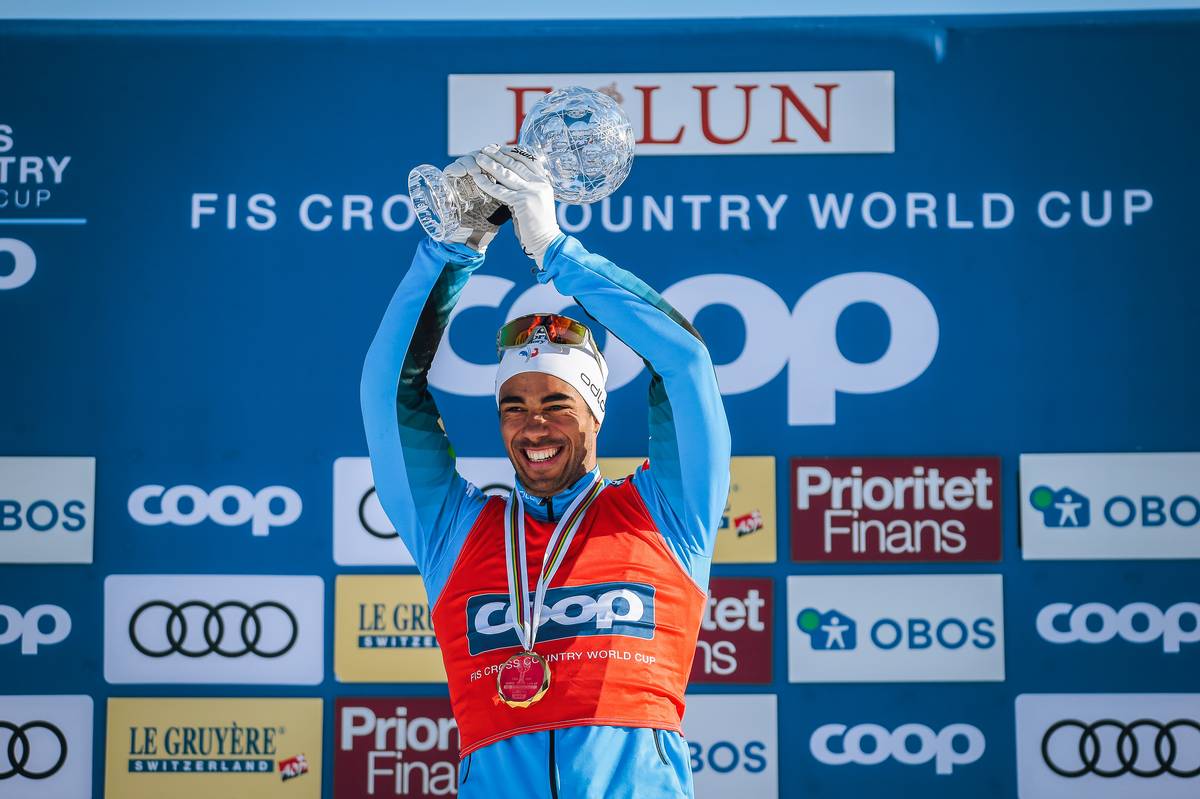
    Lucas Chanavat (FRA) raises the traditional Davos’ World Cup winner’s trophy after his victory in the Tour de Ski Stage 4 Freestyle Sprint. In the absence of Johannes Hoesflot Klaebo (NOR), Chanavat is definitely the dominant World Cup sprinter. (Photo: Modica/NordicFocus)
    Men’s Freestyle Sprint

    Chanavat won Quarterfinal 1 with ease, ahead of Benjamin Moser (AUT) and Schumacher who would advance to the semifinal as a lucky loser. Current Tour de Ski leader, Harald Oestberg Amundsen (NOR), tumbled out of the race early in the heat, appearing to have been inadvertently interfered with by Moser whose pole may have poked the tail of Amundsen’s outside ski. Completely accidental, no penalty assessed: that’s just the way things go in sprinting. Even so, Amundsen was certainly displeased as he rose dejectedly and slammed his pole furiously into the snow. He knew what an advantage had been lost. His lead over his countryman, Erik Valnes, sat at just 32 seconds. Valnes would advance to the final, but would be visibly exhausted, finishing a distant sixth. The Overall Tour de Ski standings tightened at the top, but none of the contenders looked especially sharp.

    Zanden McMullen (USA) qualified for the heats for the first time in his young career, but he would face a seriously stacked quarterfinal that included Federico Pellegrino (ITA), Evensen, Lauri Vuorinen (FIN), Renaud Jay (FRA), and Paal Golberg (NOR). Evensen led out the quarterfinal while Pellegrino sat patiently, making his move in the finishing straight to win the heat. McMullen would finish fifth.

    Kevin Bolger (USA) was the day’s 16th fastest qualifier, and he would never have a better chance to advance than through his under-powered quarterfinal heat against Janik Riebli (SUI), Joni Maki (FIN), Martino Carollo (ITA), Emil Danielsson (SWE), and Valnes. Sadly, Bolger never truly contended in the heat, finishing fourth but well behind the lucky loser time.

    Gus Schumacher (USA) celebrates his fourth-place finish with Stifel U.S. Ski Team personnel. (Photo:
    Semifinals

    Semifinal 1 matched Chanavat against Evensen, Valerio Grond (SUI), Lauri Vuorinen (FIN), Moser, and Pellegrino. Chanavat simply powered at the front without ever seeming to over-commit. He eased across the line in first place, while Pellegrino (ever the cagey veteran) passed Grond on the inside of the final turn to take the other automatic qualifying spot.

    The second semifinal gave Schumacher his chance to show what he could do, but Haavard Solaas Taugboel (NOR), Valnes, Anger, Janik Riebli (SUI) stood in his way. Schumacher sat at the back of the field throughout the two laps as Anger and Riebli pushed the pace at the front. Riebli fell on the sweeping right hand turn that inexplicably claimed so many racers in Davos’ night sprint (what’s up with that turn?), allowing Schumacher to move up into a battle for second as the field reached the final uphill. Anger and Taugboel powered across the line (an exhausted Anger nearly taking himself down in the final meters). Schumacher was overtaken by Jenssen in the finishing straightaway, but both Jenssen and Schumacher advanced to the final as lucky losers.

    Visibly exhausted by his efforts thus far in the Tour, Valnes coasted across the line sixth, far behind the winners.

    Lucas Chanavat (FRA) (l) led from the front throughout each of the day’s heats in Davos. Gus Schumacher (USA), (r) wove skillfully through each heat to finish a career-best fourth. (Photo: Modica/NordicFocus)
    Sprint Final

    As he had done all day, Chanavat led out the sprint final. Schumacher lurked in the rear, staying out of trouble and stepping gingerly through the turn that had taken down so many contenders in Davos.

    Chanavat played his tactic to the end, launching an acceleration near the top of the final uphill that none of the others could match. Anger was quickly gapped, but managed to hold off Pellegrino over the top of the hil, and down the other side to the finish line. Chanavat first, Anger second (his first World Cup podium performance), Pellegrino third. Schumacher would work his way skillfully through the field to finish a career-best fourth.

    Chanavat has had quite a week—victory in Stage 1, lethargy and ridicule in Stage 3, another victory in Stage 4—winning the races that the oddsmakers expected him to win. It really doesn’t seem likely that Chanavat’s from-the-front tactic would’ve proven successful had Klaebo been here . . . but Chanavat knew the field that he was faced with. His confidence, fitness, and skill were more than enough to produce the victory in Davos.

    Tour de Ski (Davos) Freestyle Sprint RESULTS

    Zanden Mcmullen (USA) qualified 29th, advancing for the first time into World Cup Sprint heats. He would face a seriously-stacked field in his quarterfinal where his impressive fifth-place finish was a career-best. (Photo: Modica/NordicFocus)
  • Revelations at Tour de Ski: Ogden and Hyvarinen!

    Revelations at Tour de Ski: Ogden and Hyvarinen!

    This coverage is made possible through the generous support of Marty and Kathy Hall and A Hall Mark of Excellence Award. To learn more about A Hall Mark of Excellence Award, or to learn how you can support FasterSkier’s coverage, please contact info@fasterskier.com.

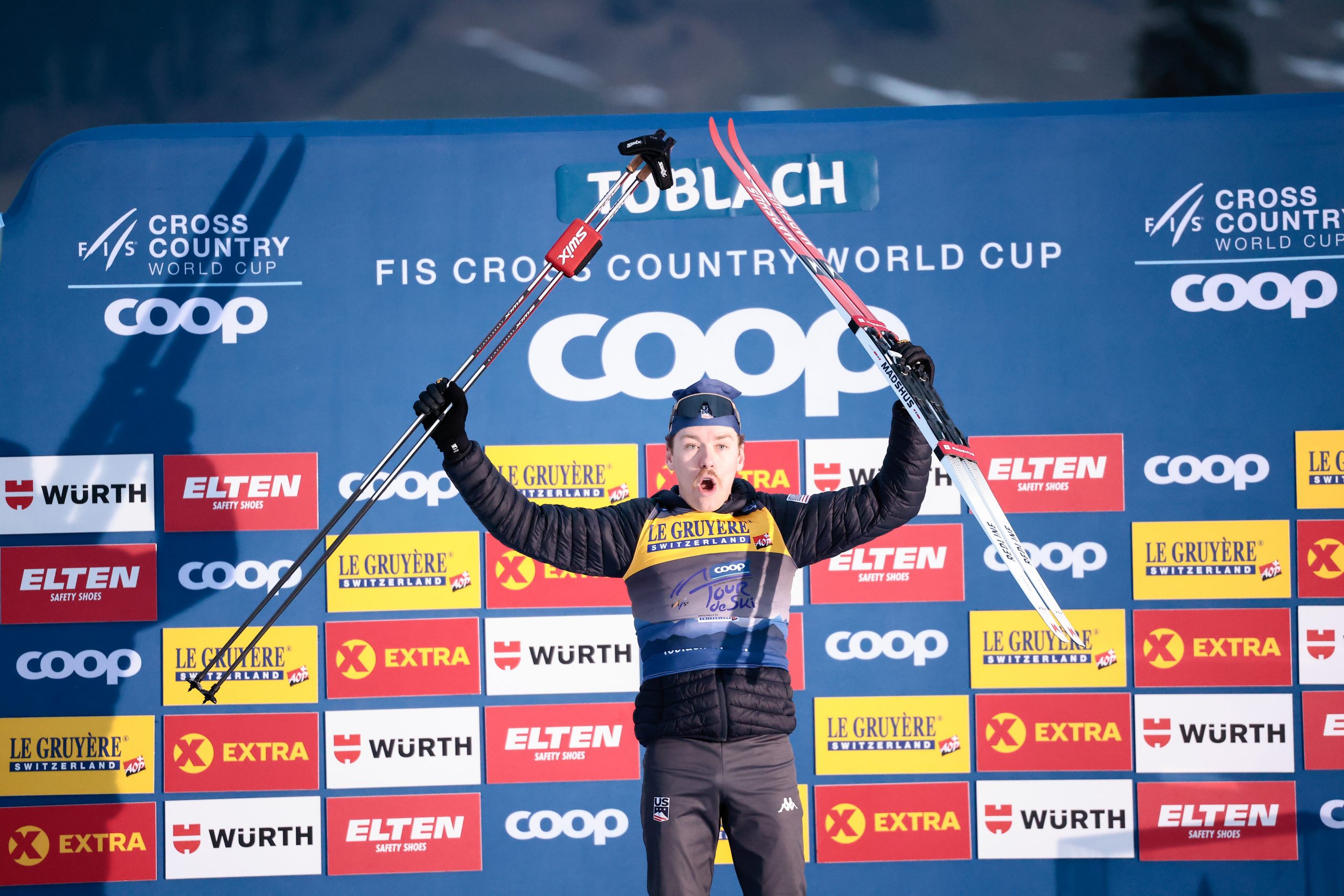
    Ben Ogden (USA) had a lot to celebrate today. He finished ninth in today’s 10 k Classic, kept his third overall position in the TDS, and took the lead in the points race. He literally did a backflip off the podium. (Photo: NordicFocus)

    On Day Two of the Tour de Ski (TDS) in Toblach, Italy, the world had a chance to see what the realignment of the men’s cross-country ski world could look like, and whether it would withstand the concerted efforts of Norway to reclaim its place at the sport’s summit. The new TDS leaders would be tested by the 10 k Classic Individual Start. With many of the favorite pre-race contenders sidelined by illness, it was a chance for other skiers to take to the spotlight, or for yesterday’s winners to try and remain in it. In the men’s race, the TDS leaders were shockingly two Frenchmen and an American. Lucas Chanavat (FRA) sat in first, followed by Jules Chappaz (FRA), and Ben Ogden (USA).

    But, after only one day of racing, it was way too early to proclaim that the giant of men’s racing— Norway—had been felled. Norwegians were still the current favorites to take the title: Erik Valnes (NOR) sat in fourth place, only 17 seconds behind the leader, and Harald Oestberg Amundsen (NOR) was fifth, 20 seconds back. The usually reliable Paal Golberg (NOR) was 24th at the start of the day. So, no tears for Norway as they still had plenty of horsepower under the hood.

    For Chanavat to stay in the lead, he would have to beat the odds by doing something he hasn’t done at the international level since he was a junior skier ten years ago: have a strong performance in a distance Classic race. History—and the odds—were against him.

    When one scans the TDF men’s standings, there aren’t any names jumping out as overwhelming favorites. Valnes is as close as it comes. It is as wide open a tour as there might have ever been, and it is yielding some of the most exciting racing that fans have seen in years. At the end of the day of racing, traditional order had not been fully re-established as the 32 year old Finnish veteran, Perttu Hyvarinen, rose to this occasion and took an unexpected win. Valnes finished second, and Amundsen was third. As expected, Chanavat and Chappaz were unable to maintain their positions, finishing 89th and 48th respectively.

    By finishing ninth, Ben Ogden (USA) was able to stay in third place in the TDS standings. (Photo: NordicFocus)

    But the day brought more good news for team USA: Ben Ogden finished ninth, which was enough to keep him in third place overall in the TDS standings. The Americans also had an excellent performance turned in by Gus Schumacher who finished 15th. Other American finishers were Scott Patterson 40th, Zanden McMullen 50th, and Kevin Bolger 72nd.

    The top Canadian was Antoine Cyr who had a strong day finishing 19th. The next best Canadian was Oliver Leveille in 57th, followed by Julien Locke in 88th.

    It was a career best day and shocking victory for Perttu Hyvarinen (FIN), who captured his first podium in World Cup racing by taking the victory. (Photo: NordicFocus)
    Men’s 10 k Classic Individual Start

    The men’s race started late today—3:00 local time—which meant that by the time skiers took to the course temperatures had warmed to a little above freezing; the trickiest range for Classic skiing. But the temperatures didn’t turn out to be an obstacle for the American squad. “I would have imagined it to be a tricky day to find kick,” said Ogden. “But to be honest, the wax techs today killed it and not one ski I tested kicked badly and none of them were particularly draggy. So major cheers to them for making it easy.”

    Antoine Cyr (CAN) had his moment amongst the early starters taking the best time among skiers on the course at the 1.7 kilometer mark, but he was soon displaced at three kilometers by Hyvarinen. It was an omen of the breakthrough day which was about to unfold for the Finn.

    Amundsen was among the first of the pre-race favorites to take the course, and at the 1.7 kilometer time check he had the fastest time of skiers on the course. When Valnes  came through shortly after, he was tied with his countryman Amundsen. But, by the time they reached the 2.3 kilometer time check both the Norwegians had dropped to third and fourth. This was due to the fact that when Ben Ogden (USA) skied through the 1.7 kilometer time-check, he became the new leader on the course, ahead of Valnes and Amundsen by over two seconds. And, Ogden was still in the lead at the 2.3 kilometer mark without any strong challengers behind him. Being in the lead also allowed him to capture TDS Bonus points handed out the 2.1 kilometer mark.

    Ogden dropped to third place by the three kilometer mark, tied with Valnes. Could lightning strike for the American two days in a row? It was a tall order, and by the half-way mark Ogden had slipped to eighth, some 18 seconds behind the lead, but still only 14 seconds from Valnes. Ogden had extra time in his pocket based upon time bonuses he acquired in yesterday’s sprints, so he was still looking strong in the overall standings. It was a tricky course to maintain consistent pacing on. “I think that with it being a slightly more double pole focused course than usual it was just tempting to go very hard out of the start,” Ogden said. “That being said, the downhills didn’t end up being particularly restful and the ‘smaller’ hills felt pretty big once you were racing.”

    Perttu Hyvarinen (FIN) might have been as surprised as anyone by today’s victory over the best in the world. (Photo: NordicFocus)

    The early finishing mark was set by Hyvarinen who has never stepped onto a World Cup podium. Even so, he turned in a very strong time, over 27 seconds ahead of the next best finishers on the course at the time he finished. As skiers with fancier pedigrees crossed the finish, Hyvarinen’s time—to the astonishment of spectators— continued to hold up. One by one, the best skiers in the world came through; Hyvarinen’s time continued to hold.

    The best in the world continued to finish with Hyvarinen continuing to hold the lead. When Amundsen finished, he was in second, but an astounding seventeen seconds behind the Finn. Then came Valnes; and he too was unable to displace Hyvarinen. One by one all of the top ranked skiers finished, and all of them fell short of Hyvarinen’s time. It was beginning to be a storybook day for Finland.

    Try as he might Erik Valnes (NOR) was unable to dislodge Perttu Hyvarinen (FIN) from the top of the podium. (Photo: NordicFocus)

    At eight kilometers, Ogden was hanging tough in sixth place; 28 seconds off Hyvarinen’s time, but more importantly only fourteen seconds behind Amundsen. As Ogden pushed toward the finish he double poled intensely, but the clock showed that he continued to lose time. When he crossed the finish line he was ninth, 46 seconds from the lead, but only 30 seconds behind Valnes. It was good enough to keep Ogden in third place overall in the Tour de Ski.

    It was a career day for Hyvarinen, and his teammates were clearly thrilled for him. After 110 starts he not only found the podium but conquered the top spot. It was yet another feel good story in a TDS where conventional wisdom has been challenged. After the race he praised his service team for giving him good skis. He seemed to take the surprise victory in stride noting that there wouldn’t be any big celebrations, though he clearly enjoyed showering his team with champagne after his victory.

    Gus Schumacher (USA) also had an excellent day for team USA. He finished 15th and that moved him into 12th in the TDS standings. (Photo: NordicFocus)

    Somewhat hidden by Hyvarinen’s surprise victory and Ogden’s performance was a fantastic day for Gus Schumacher (USA), who finished 15th. His performance was good enough to move him into 12th in the overall TDS standings, exactly one minute behind Ogden. Schumacher is still feeling good after today’s efforts. “[I’m] not crazy tired yet,” Schumacher told FasterSkier.  “[I’m] pretty psyched to feel like my skiing is just going solid lately, so looking forward to the rest of it.”

    Impact on Tour Standings

    When the racing had finished, the old order was partially restored with Norway taking the lead in the TDS: Valnes in first, Amundsen second. But American Ben Ogden disrupted the list of Scandinavians in the top and remained in third place. Norway had been restored to the top of the results list in the TDS, but still had not found the top of the podium for the day’s race, and for his surprise efforts, Hyvarinen landed in fourth place overall. No matter how you looked at it, it was still a day full of disruption to World Cup skiing with a little known Finn taking the race and an American man sitting third in the overall TDS standings. It was a pleasant surprise on which to end the year. Ogden acknowledged as much when he was asked if before the TDS began he had ever imagined himself this high in the rankings? “No,” he replied. “I sincerely did not imagine I would be third in the Tour at any point. I’m proud to be there and excited to keep fighting and see what the future holds.”

    But there was even more good news for team USA, Ogden was also leading in the points chase. He was clearly very pleased with this outcome as he literally did a backflip from the top of the podium at the end of the flower ceremony.

    10 Kilometer Individual Start Classic RESULTS


    It was a day team Finland will long remember when Perttu Hyvarinen (FIN) stepped up to fill the void left by Iivo Niskanen’s (FIN) illness to take the victory. (Photo: NordicFocus)
  • Ogden’s First Podium—Third in Tour de Ski Sprint

    Ogden’s First Podium—Third in Tour de Ski Sprint

    This coverage is made possible through the generous support of Marty and Kathy Hall and A Hall Mark of Excellence Award. To learn more about A Hall Mark of Excellence Award, or to learn how you can support FasterSkier’s coverage, please contact info@fasterskier.com.

    It was a glorious day for Ben Ogden (USA), as he captured his first ever podium and had a great start to the Tour de Ski. (Photo: NordicFocus)

    It looks like it must be pretty fun to be part of Team USA right now. Two American women (Jessie Diggins and Rosie Brennan) sit in the top three of the World Cup standings, Diggins forges a path toward the lead in the Tour de Ski, and American men advance through sprint qualifying, make finals, and race onto the podium (as JC Schoonmaker did three weeks ago in Oestersund, Sweden). Today, in Toblach Italy, it was Ben Ogden’s time to step into the spotlight. One who exudes the energy and joy epitomizing this season’s US Ski Team, Ogden smiles broadly and celebrates genuinely. American ski fans—and those of many other nationalities, as well—smile and celebrate with him.

    After a two week hiatus, the FIS World Cup resumed today in Toblach, Italy, for Day One of the Tour de Ski (TDS). Today, the Freestyle Sprints were up for grabs. Going into the weekend, the prohibitive favorite to win the Men’s Sprint—and the overall Tour de Ski title—was Johannes Hosflot Klaebo (NOR). That was before yesterday, when conventional wisdom received a giant gut-punch with Klaebo’s announcement that he was ill and would not be able to compete in the TDS.

    Klaebo’s illness quickly threw the men’s competition into disarray, and the immediate question became: “Which Norwegian would step up to fill Klaebo’s boots?” With Norwegian men having won all individual World Cup events this season, it was not a stretch to simply assume that another Norwegian would rise to the challenge. But not only was Norway missing Klaebo, it was also missing Simen Hegstad Kruger—who finished second in last year’s TDS—as he was also taken ill. With Norway missing its one-two punch, they suddenly seemed very vulnerable.

    Illness also invaded the Finnish camp with Iivo Niskanen announcing that he was sick and would withdraw from the tour.

    Lucas Chanavat (FRA) made the most of Norway’s health problems and took the victory in Toblach. (Photo: NordicFocus)

    Waiting to challenge the Norwegian dominance was France’s Jules Chappaz—silver medalist from last year’s World Championships—along with countryman Lucas Chanavat, one of the few sprinters who has shown himself capable of challenging Klaebo. With the top Norwegians out of the way, and Chappaz and Chanavat chomping at the bit, perhaps today would be the day for one of the frequent second place podium finishers to shine. An opening was also there for American Ben Ogden. It suddenly looked like it would be a tall order for one of the other Norwegians to step up and snatch victory from the grasp of one of the men who have been fighting for their chance to stand at the top of the podium.

    At the end of a tumultuous day of racing, it was Chanavat taking the victory, Chappaz in second, and Ogden finishing third to claim his first World Cup podium.

    Two other Americans made the heats: Gus Schumacher in 18th, and Kevin Bolger 24th. Other American finishers were Zanden McMullen 47th, and Scott Patterson 91st. J.C. Schoonmaker did not start due to illness. Under TDS rules, he will not be allowed to compete for the rest of the tour.

    The top Canadian was Antoine Cyr in 35th. He was followed by Olivier Leveille in 70th, and Julien Locke in 73rd.

    TDS Sprint Qualifying—and Bonuses

    Earning a fast qualifying position for Sprints is especially important in the TDS since the times from the qualification round will be used to calculate overall TDS standings. Bonus seconds are then awarded to the top 30 Sprint finishers; with first place getting a 60 second bonus. Bonus seconds are subtracted from competitors’ cumulative race times which are then used to calculate overall TDS standings.

    In the absence of the Norwegians, Chanavat took advantage of the opportunity in the qualifiers and took the first spot by over two seconds. American Ben Ogden was also in a good position having finished eighth in the qualifying rounds.

    Ben Ogden (USA) fought hard all day long and clearly preferred to be with the leaders out front in each of his heats. Ogden commented that he had a couple of awkward finishes as shown here. “I didn’t have a strategy with regards to lunging. I thought I had it in all the heats and sort of went for the lunge at the last second, and used my head instead of my foot.” (Photo: NordicFocus)
    Men’s Freestyle Sprint

    Chanavat raced wearing the leader’s bib in the first quarterfinal. He easily won his heat. American Kevin Bolger was in the second heat. He seemed to falter in the final meters, finishing fifth and would not advance. Valerio Grond (SUI) took first place in that heat, with another Norwegian contender Haavard Solaas Taugboel finishing second.

    Gus Schumacher (USA) had another good day qualifying for the heats. His fourth place finish in his heat wouldn’t hold up for a lucky loser position. (Photo: NordicFocus)

    American Gus Schumacher qualified 22nd and was in the third heat. He stayed with the leaders throughout the race and was in the top three coming toward the finish. Unfortunately, he was pushed into a bad line around the last corner and ended up fourth. At the time, it was enough to put him into the lucky loser position, but he would have to wait two more heats to see if he would advance. Ultimately, his time did not hold up.

    Ben Ogden (USA) fought hard all day, and worked at the front of every heat on his way to the final. (Photo: NordicFocus)

    The fourth quarterfinal featured Ogden. As spectators have come to expect from Ogden, he went toward the front early, and was on Chappaz’ tails right from the start. Ogden continued to hang on to second place, maintaining great position coming into the finish. Ogden fought hard all the way to the finish line, where he was in a three way photo-finish and ultimately finished second by .02 seconds. It was a fast heat and pushed Schumacher out of the lucky loser position.

    TDS favorite Federico Pellegrino (ITA) was in the last quarterfinal, taking the win with Norwegian Matz William Jenssen following him into the semfinals.

    Semifinals

    The semifinals posed an interesting quandary for the Norwegians: they advanced five skiers to the semifinals, but four of them would face each other in the first semi that also included top qualifier, Chanavat. In that first semifinal, Chanavat immediately jumped into the lead, but Grond clung tenaciously to his ski tails. Chanavat easily took the win with Grond taking second. The Norwegians would be in the unusual position of having to wait to see if any of their skiers would advance as lucky losers.

    In the second semifinal, all American eyes were on Ben Ogden who was the second highest ranked qualifier in that heat. Italian, Michael Hellweger, jumped to the lead with Ogden again tucked into third. The pace quickened significantly halfway through the race with Ogden moving up into second position. He was able to establish a gap on the field along with Chappaz who had fought to join him at the front. It was a furious sprint to the finish with Ogden and Chappaz creating a photo-finish for first place. After review, the victory went to Chappaz, but the second place finish put Ogden into the finals.

    Jules Chappaz (FRA) took second to give France first and second place and help to shut Norway off of the podium. (Photo: NordicFocus)
    Sprint Final

    The final race saw Chanavat, Chappaz, Grond, Ogden, Harald Oestberg Amunsen (NOR), and Erik Valnes (NOR) competing for the podium. It was only the second time for Ogden in a Sprint final. True to form, Ogden hung with the leaders at the start and held firm in third place; evidently his favorite spot on this highly tactical course. After the race Ogden said that, “my strategy was to try and come all the way around [the course], and block off the inside lane, which I did twice.” Halfway through, Ogden moved up to second behind Chanavat who pushed the pace from the front. It was all Chanavat, who put on a quick burst to establish a significant gap on the field while Ogden held his position in third. Ogden pushed hard all the way through in a duel with Valnes for third place. Ogden didn’t flinch one bit and was able to fend off Valnes to fight his way onto the podium. It was a first career podium for Ogden, and Norway was shut out of the podium for the first time this season . . . and the first time in memory. So, on day one of the TDS it was a new world order for the top skiers with a new American presence on the podium.

    It was a big day for many reasons for Ogden. Family members were there and got to see him race on the World Cup for the first time. “It was really special,” Ogden said. “Honestly . . . I had hoped that they would be able to see my first podium finish, but I was really stoked that they were able to see me for the first time in a World Cup.”

    The first time on the podium is obviously special, but Ogden couldn’t point to any one thing which had made the difference. He readily acknowledged that the absence of others made a difference. “If Klaebo was here, I would have been fourth. That being said, I feel like I cracked this course a little more than I had. Having a hard start was really worthwhile. ”

    U.S. coach Kristen Bourne concurred that there wasn’t any one thing which stood out for Ogden. “In [World Cup] sprinting, you have to be really strategic,” Bourne said. “You have to find tiny gaps. It does take a while to learn World Cup Sprinting. He’s been in so many heats … he’s figuring it out. I think it’s an accumulation of experience.” Ogden’s podium was meaningful for the entire team. “It was a pretty special day,” Bourne told FasterSkier. “Every time somebody gets the first podium on the World Cup, it’s a pretty special day for everyone involved. A lot of his teammates waited around for the final, people wanted to line the course and support him.”

    Illness was definitely big news today, but team USA hasn’t changed up its protocols to address this issue. Coach Bourne commented that, “We’re definitely trying to follow the same guidelines that we’ve had all season. We’re masking on planes and public transportation. We’re being very cautious about people that are coming in from traveling internationally, especially outside of the bubble.” Bourne thinks that the holiday break may have played a part in the rise of illness. “It’s pretty standard stuff,” Bourne said. “We are not the only team masking, you go to team coaches’ meetings and almost everyone there are wearing masks. But people spend time with their families during the holidays, and that expands their bubbles. You give them the opportunity to go home, rightfully so, and they try to be normal for a little bit and naturally it just exposes you to more stuff, and we’re seeing the effect of that.”

    It looks easy to be happy when you’re winning. For Team USA, it also appears that cultivating that sort of happiness is a good formula for winning, too.

    TDS Men’s Freestyle Sprint RESULTS:

    A best-ever day for Ben Ogden (USA) as he earned a spot on the World Cup podium for the first time.
    Jules Chappaz (FRA), Lucas Chanavat (FRA), Ben Ogden (USA), (l-r) (Photo: NordicFocus)
  • The Devon Kershaw Show: Recapping a soggy, fluoro-free weekend in Trondheim

    The Devon Kershaw Show: Recapping a soggy, fluoro-free weekend in Trondheim

    Eli Brown, a member of the U.S. Ski Team’s waxing and ski service staff, joins us this week to talk about his job and the new enforcement of the rules banning fluorocarbons on the World Cup circuit. We recap another strong weekend for American athletes, along with all the hijinks that happened in Trondheim, Norway at the test event for next season’s World Championships.

    The World Cup takes a break next weekend before the Tour de Ski, but we may try to squeeze in a mailbag episode. Send us questions if you’ve got ’em. Reach us at nat@fasterskier.com and devon@fasterskier.com.

  • The Devon Kershaw Show: Live from Estonia, it’s Tuesday night

    The Devon Kershaw Show: Live from Estonia, it’s Tuesday night

    Estonia put on one heck of a show at a city sprint in the nation’s capital, Tallinn, this week. We give you a full recap with the help of an on-site expert, Vahur Teppan, and break down some complaints about a new system designed to level the waxing playing field — which may not have worked.

    We’ll be back for one more recap after the Lahti Ski Games in Finland this weekend. Devon is at devon@fasterskier.com and Nat is at nat@fasterskier.com.

  • Tallinn Men’s Sprint: New Script, Same Ending

    Tallinn Men’s Sprint: New Script, Same Ending

    This World Cup coverage is made possible through the generous support of Marty and Kathy Hall and A Hall Mark of Excellence Award. To learn more about A Hall Mark of Excellence Award, or to learn how you can support FasterSkier’s coverage, please contact info@fasterskier.com. 

    Johannes Hoesflot Klaebo (NOR) conserved energy during the heats, allowing France’s Lucas Chanavat (#1) to lead through most of the quarterfinal and semifinal. Only when Chanavat’s leading pace in the final caused the field to bunch up did Klaebo decide he’d be better off in front. (Photo: Modica/NordicFocus)

    All things being equal—including the wax—it appears that the fastest skier is still the fastest skier. Johannes Hoesflot Klaebo’s (NOR) performance in today’s FIS World Cup Freestyle Sprint certainly proved that any perceived Norwegian “wax advantage” is not the only reason why Klaebo continues to dominate week after week. Under the shadowy, vaporous glow of course-lighting in Tallin, Estonia—where FIS rules had been amended to insure that all competitors enjoyed equal waxing conditions—Klaebo ran away from the field in much the same fashion he always does. Fastest skis, deepest fitness, highest speeds, most refined technique, most innovative tactics: the rest of the world couldn’t beat him last week, and this week was no different.

    Lucas Chanavat (FRA) carried his usual tactics (take the lead, set the pace) to a second place finish, followed by Even Northug (NOR) in third. North American skiers never seemed to find the right racing form as Ben Ogden (USA) was the only North American qualifier (11th). He would struggle to keep pace with the winners of his quarterfinal, and finished the day in 13th.

    Podium awards were presented by President Alar Karis, head of state of the Republic of Estonia. When’s the last time World Cup awards were presented by a head of state? Perhaps it’s a reflection of the impassioned fan base that cross country skiing enjoys in Estonia (a nation that has produced many World and Olympic champions including Kristina Šmigun-Vähi and Andrus Veerpalu).

    Wax Protocol

    The great respect afforded the awarding of prizes wasn’t the only thing that made this World Cup stop unique. FIS had announced long ago that this particular World Cup event would be governed by a new set of waxing protocols in which all competitors’ skis would be waxed by a single entity (in this case, Swix). Skiers would use their own skis, and team technicians would be allowed to apply structure, but all glide wax would be precisely the same. Broadcast announcers suggested that Swix is the sponsor of this wax-restricted event; certainly, that singular sponsorship may eventually be questioned as an unfriendly way to treat all other wax manufacturers, while also illuminating the difficulties inherent in staging any effort to “equalize” wax advantages.

    Many American junior race-regions are already governed by equality-seeking wax protocols (with race organizers announcing the glide wax days before races so that all competitors can prepare skis ahead of time). It’s a system that has inspired both proponents and detractors, with much of the criticism stemming from the ability of some skiers to acquire faster skis and or more sophisticated base-grinds. If any skier in the world would have access to the best skis available, it would be Klaebo. Maybe he proved that today . . . or maybe he just proved that he really is the fastest skier. Race commentator, Kikkan Randall described the thinking behind the move as the FIS wanting to “see if eliminating the wax factor can bring the field a little closer.” If race officials were thinking that the leader board could be reshuffled by this new wax protocol, they would exit the experiment disappointed. Klaebo really is the best skier . . . maybe even by a wider margin this week than in those weeks when Norwegian wax techs are free to apply their most secretive voodoo.

    Lucas Chanavat (FRA) celebrates his second place finish. Waiting at the finish line is the winner, Johannes Hoesflot Klaebo (NOR) who had time to finish, recover, and turn around to greet the runner-up. (Photo:  Modica/NordicFocus)
    Men’s Freestyle Sprint

    Race organizers brought in tons and tons of snow in order to create Tallinn’s two lap sprint course. The result was deep, soft snow that accumulated in the corners where course marshals attempted to rake and reconfigure rutted surfaces between heats; no one really knew what racing conditions any given corner might deliver. Is the fastest line one that follow the tracks of earlier skiers (where a racer could find their line irrevocably altered), or is the fastest line one to the outside in untracked snow, where a racer could find themselves bogged down in soft snow? There were no reliable predictions . . . other than the fact that Klaebo was likely to be the one who handled it all the best.

    “This feels like a home course,” Klaebo said in post-race interviews. “My grandpa lives here in Tallinn, and it’s special to have him here watching me as well.”

    And what’s more miraculous? The fact that Klaebo wins so many sprints? Or the fact that Klaebo qualifies for so many finals? What he accomplishes week after week is a set of racing feats that no other competitor shows the ability to do with any regularity at all. We just expect to see him in the final—and so he appears in the final. We just expect him to win—and so he wins. It’s as though Klaebo possesses the ability to watch his own races from above: he never chooses to accelerate at the wrong time, he never chooses to commit to the too-tight line, he never finds himself pinched or cut off or tangled or needing to scrub speed at an inopportune moment. Klaebo doesn’t seem interested in the shortest line or the most direct line . . . Klaebo appears far more interested in maintaining the most speed. That way, when he finally enters the finishing straight, he already has more speed than anyone else (especially on a course like Tallinn’s that offers a very short finishing straight after a tight turn). Klaebo was able to give himself room to follow a wide line around the last turn each and every time. Carry speed, stay out of trouble, sprint to the line. Maybe other racers should begin watching what he does . . . or maybe that wouldn’t make a difference, either. Maybe he’s just plain faster. Today, that was certainly the case . . .

    Like so many skiers in the soft snow of Tallinn, Estonia, Richard Jouve (FRA) struggled to maintain solid footing. Typically a podium contender, he would finish 20th on the day. (Photo: Modica/NordicFocus)

    Many regular contenders would struggle with the deep, soft conditions. Richard Jouve (FRA) looked particularly out of sorts in his quarterfinal heat, while Federico Pellegrino struggled through the tight turns and steep climbs in a manner that would not typically be his norm. As for Klaebo, he may be the most capable close-quarters ski racer in the world. He never gets tangled, never gets taken down. He seems to have an innate ability to continue accelerating even when he is busy avoiding other tips, tail, poles. Even when he tangled with Bolshunov in that infamous finishing straightaway of the 2021 World Championship 50k, it was Bolshunov who tumbled, not Klaebo.

    In the final, Klaebo again appeared happy to follow Chanavat—who obligingly went straight to the front of the field at the crack of the starter’s pistol. It seemed that the final would follow the pattern of both quarterfinal and semifinal, but at least one racer knew that would leave him on the outside looking in. Edvin Anger (SWE) drove up along Klaebo’s flank on the significant climb; that’s all the motivation Klaebo seemed to need. Seeming to dislike the clogging and in-fighting that was being inspired by Anger’s accelerations, Klaebo simply jumped away up the main climb, establishing a gap that no others could bridge. Having given himself an insumountable lead, Klaebo had enough time to wave to the crowd for the final 150 meters. Chanavat carried his own momentum across the line in second while Northug managed to out-lunge Anger for third.

    Maybe FIS’ wax protocols made a difference; maybe they didn’t. What does remain evident is that Klaebo is the best sprinter no matter who does the waxing.

    Men’s Freestyle Sprint RESULTS

    Johannes Hoesflot Klaebo (NOR) bows to the crowd in Tallinn, Estonia. His winning margin was so great that he had sufficient time to celebrate on his way to the finish line. (Photo: Modica/NordicFocus)
  • Jouve takes back-to-back classic sprint wins, earning France the 2022 World Cup sprint globe; Ritchie leads for North America with Top-20

    Jouve takes back-to-back classic sprint wins, earning France the 2022 World Cup sprint globe; Ritchie leads for North America with Top-20

    This World Cup coverage is made possible through the generous support of Marty and Kathy Hall and the A Hall Mark of Excellence Award.  To learn more about A Hall Mark of Excellence Award or to learn how you can support FasterSkier’s coverage please contact info@fasterskier.com.

    It’s the last hurrah, folks! The World Cup Finals kicked off in Falun, Sweden today with a classic sprint. While the season has been a wild ride for many reasons – spills and thrills in the Tour de Ski, COVID-cancellations, Olympic Games, geopolitical nightmares – Falun evidenced that spring is on it’s way and it’s time for the World Cup crews to head home take a break, and begin anew.

    Contrasting the dim light and long shadows of far-north Ruka, Finland at the opposite bookend of the season, the sprints in Falun were raced under bright sun, with temperatures well-above freezing, bare ground and green grass emerging from beside ski tracks.  

    Zak Ketterson leads the U.S. in 39th during the classic sprint qualification round in Falun, SWE. (Photo: NordicFocus)

    The American men, particularly in sprint, headed into the Falun weekend at a significant disadvantage. Kevin Bolger announced on Instagram Thursday that he had tested positive for COVID, while Ben Ogden, JC Schoonmaker, and Luke Jager – the remainder of the four sprint men who competed during the 2022 Olympics in Zhangjiakou – are currently competing at the NCAA championships in Soldier Hollow, UT. The sprint field as a whole has been weakened; Russian athletes were banned from competition on March 1st, while Norway’s top-six sprinters, including sprint and overall World Cup leader Johannes Høsflot Klæbo, each tested positive for COVID following the World Cup race weekend in Lahti, Finland. With no Russian’s and the top-Norwegians out, the men’s field had been cracked wide open.  

    Finland’s Joni Mæki posts the fastest time in the classic sprint qualifier in Falun, SWE. (Photo: NordicFocus)

    Finland’s Joni Mæki took the top spot in qualification, setting the mark at 2:51.58. Sivert Wiig of Norway took second in the qualifier (+0.69), with Sweden’s Calle Halfvarsson in third (+1.41). Three nations represented in the top-three.

    Though new-to-FasterSkier names made the top-30, the early heats featured little surprise. Building momentum from a podium day in Drammen last week, France sent three of its top men to the semifinals: Lucas Chanavat and Richard Jouve, who had been third and first, respectively in Drammen, plus Jules Chappaz. Long-time sprint force Federico Pellegrino of Italy also moved through with an automatic spot, joining the day’s top-three qualifiers in the next round.

    What did shake up the quarters was some trouble for the two Chinese athletes in the field. Shang Jincai, who had qualified in 25th, had a false start in heat three. Jincai looked as though he had been trying to keep himself so primed for forward momentum at the start beep, that he lost his balance, kicking a foot forward to catch himself well-before the beep and thus triggering the start. After a discussion with a jury member, while Pellegrino shook his head and raised his hands nearby, looking impatient, Jincai received a yellow card and was disqualified. 

    After stumbling on a climb and losing ground, Wang Qiang (CNH) races to 18th in the classic sprint quarterfinal in Falun, SWE. (Photo: NordicFocus)

    In the next heat, Wang Qiang, who qualified in 9th and took second in Drammen, fell when hopping out of the track to run uphill, roughly two minutes into the heat. Qiang had been in the lead, though the pack remained tight. After a few missteps, he was back to his feet, chasing as real estate ran out, while Lars Agnar Hjelmeset (NOR) and Calle Halfvarsson (SWE) took the reins at the front to go 1-2 in the heat. Qiang raced his way back to fourth, just over a second back, but it was not enough for a lucky loser spot.  

    Richard Jouve (FRA) takes control through the rounds in Falun. (Photo: NordicFocus)

    In the semis, France’s Jouve took control of the fast first heat, beginning a surge just under-two minutes in as the men ran up the steep climb and banked left to head back toward the stadium. Around the last corner, Jouve still held the lead with Mæki (FIN) just off his shoulder. Jouve pulled ahead in the double pole sprint through the lanes, while Mæki, Wiig (NOR), and Chanavat (FRA) raced each other and the clock down the final meters. At the line, it was Norway-France-Finland, spread by 0.38 seconds, fifth and sixth less than a second behind also. Each of the top-four finishers advanced into the final round.

    The second heat was significantly less smooth, though times did not reflect the chaos and were only marginally slower than the first. As the course broke down, it looked to be continually harder to keep klister free and stay upright. Heading into the final downhill in strong position to take the heat, France’s Jules Chappaz looked as if his klister snagged some loose granules of snow; as he pushed off the outside ski to stay in the curve, the ski looked unable to slide and he crashed into the abrasive corn. 

    The remaining athletes in the head narrowly dodged Chappaz, allowing Hjelmeset and Pellegrino to take the lead and eventually win the heat. Sweden’s Halfvarsson also went down earlier in the heat, looking to have similarly iced up while running up the first climb, leaving him off the back after the subsequent downhill.

    After leading into the final downhill, a dejected Jules Chappaz (FRA) recovers from a crash to finish his semifinal. (Photo: NordicFocus)

    Once again, Jouve took control of the final early, with Pellegrino marking. Mæki stayed wide on the first climb looking for better snow, but came over the top and into the curve behind the top three. Jouve, still calling the shots, led into the downhill, but he could not create any significant gaps there; Wiig, Pellegrino, Chanavat and Mæki quickly accordioned onto the backs of his ski tails.

    Looking confident and composed despite being unable to break away, Jouve remained at the front heading into the final curve. Once in the lanes, Jouve began to pull ahead a final time, creating a gap of several meters to Mæki and Chanavat, who were evenly matched in the double pole sprint. 

    Richard Jouve (bib 10) leads the men’s classic sprint final to the finish in Falun, while four athletes vie for the remaining two podium positions. (Photo: NordicFocus)

    Emptying his lungs with a triumphant cry, Jouve coasted over the line for the win in 3:03.62, while Mæki and Chanavat threw their boots forward in a photo finish for the second and third podium spots roughly half a second behind. From the slow-mo, it was Mæki with the better lunge, nipping Chanavat by 0.03.

    Just behind Wiig crossed fourth (+1.41), with Pellegrino fifth (+2.06), followed by a gap to Hjelmeset in sixth (+13.18).

    Richard Jouve (FRA) lets out a victory cry as he takes the classic sprint win in Falun. (Photo: NordicFocus)
    The men’s classic sprint podium in Falun, Sweden: Richard Jouve (FRA) took the win ahead of Joni Mæki (FIN) and Lucas Chanavat (FRA). (Photo: NordicFocus)

    “I’m very proud,” Jouve told FIS after the race. “Off myself, my team. It’s amazing.” 

    With the win today, Jouve also took the lead in the sprint World Cup standings, advancing by just six points ahead of Johannes Høsflot Klæbo (NOR). The season saw Jouve land on four World Cup podiums, finish seventh in the freestyle sprint during the Olympics, and then earn his career first World Cup win in Drammen’s classic sprint last Thursday.

    “It’s amazing,” said an emotional Jouve, seemingly in happy disbelief. “The season was very great for me, to win at the end of the season is already a dream, but to grab [the globe], it’s big. Fantastic.”

    With a win in the final sprint stage, Richard Jouve becomes the 2022 World Cup sprint champion, hoisting his crystal globe. (Photo: NordicFocus)
    French teammates Richard Jouve (left) and Lucas Chanavat (right) end their season in first and third, respectively, in the World Cup sprint standings. (Photo: NordicFocus)

    A quick review of the final standings: With 568 points, Jouve is the 2022 sprint World Cup champion, with Klæbo second (-6) and Chanavat third (-107). Italy’s Pellegrino was fourth (-238), with Norway’s Håvard Solås Taugbøl fifth (-244). 

    The US had three starters for today’s final sprint stage. Zak Ketterson led the way for the American team in 39th (+9.92), followed by Logan Hanneman in 47th (+10.79), and Peter Holmes 54th (+13.38). 

    Listen to post-race interview with U.S. Ski Team Head Coach Matt Whitcomb here.

    Logan Hanneman skis to 46th in qualification in Falun. (Photo: NordicFocus)
    Graham Ritchie leads the way for North America, finishing 20th in Falun’s individual classic sprint. (Photo: NordicFocus)

    Racing for Canada, Graham Ritchie was the sole North American to break into the heats after qualifying in 28th (+8.11). Racing in the third quarterfinal heat, Ritchie crossed fourth, roughly three seconds behind Chanavat and Pellegrino, the heat winners. The effort landed him in 20th overall once final rounds were decided. 

    Missing the top-30 by just 0.27 seconds, Antoine Cyr was next for Canada in 31st (+8.76), with Xavier McKeever next in 44th (+10.54), followed by Rémi Drolet in 57th (+14.59). 

    Antoine Cyr just misses the mark in qualification, finishing 31st. (Photo: NordicFocus)

    Racing in Falun continues tomorrow with a 15 k individual start skate.

    Results:

    Qualification | Final | World Cup Sprint Standings


  • Klæbo Takes the Win in Tour de Ski Stage 1 Freestyle Sprint; Ogden and Bolger Qualify Top 10; Three Americans in Heats

    Klæbo Takes the Win in Tour de Ski Stage 1 Freestyle Sprint; Ogden and Bolger Qualify Top 10; Three Americans in Heats

    This World Cup coverage is made possible through the generous support of Marty and Kathy Hall and the A Hall Mark of Excellence Award.  To learn more about A Hall Mark of Excellence Award or to learn how you can support FasterSkier’s coverage please contact info@fasterskier.com.


    To set the scene for the Tour de Ski, briefly turn to an episode from the event that inspired it. Cue “the Badger,” Bernard Hinault, who at the start of the 1985 Tour de France reduced the three week race down to one question: “Look at the results last year – Laurent Fignon first, me second and Greg Lemond third. Now Fignon won’t be there. What answer do you get?”

    The answer: Lemond and Hinault would battle as teammates in the greatest editions of the Tour de France ever in ‘85 and ‘86. In the end, Lemond “slayed the Badger,” besting Hinault to win the Tour in ‘86 and establish the Americans as winners at the Tour.

    An American flag flies in Lenzerheide as the Tour de Ski kicks off Stage 1. (Photo: NordicFocus)

    Switch seasons, sports, and circumstance and we can reduce this year’s Men’s Tour de Ski (TDS) to one question too: Look at the results last year – Alexander Bolshunov (RUS) first, Maurice Manificat (FRA) second, Denis Spitsov (RUS) third. Johannes Høesflot Klæbo (NOR) was not there. Now he is back. What answer do you get?

    The answer: Klæbo.

    In the first stage of this year’s Tour de Ski at Lenzerheide, the Overall and Sprint leader of the World Cup came into the freestyle sprint, and looked in control each time he headed out on the 1.5-kilometer course, winning the qualifier (2:36.66) before cruising through the quarterfinals and semi-finals to keep his yellow World Cup Sprint leader’s bib as he exited the final.

    But back-up, and you see another parallel to Lemond at cycling’s Tour, with today’s stage marking the ascendancy of the Americans. They put three in the top 30, with Ben Ogden finishing qualifying in 5th place (+5.81sec), Kevin Bolger in 9th place (+6.62), and Logan Hanneman in 30th (+9.78).

    Logan Hanneman skis through to the quarterfinals, finishing 30th in qualification. (Photo: NordicFocus)

    In the quarterfinals the first three heats were marked by somewhat conservative tactical posturing, with a field figuring out how to race the course at Lenzerheide after a two year absence. There was a good reason too. The two 750m laps are marked by a steep initial climb that after a turn gives way to a long downhill whose end is a sharp left into the stadium. That sharp left proved time and again to eliminate the gaps that attacking skiers tried to create on the first climb. It also led to opportunities to find a good position for the final sprint and pick up places in the field.

    That was how Klæbo looked to race the first quarterfinal of the day, following Lucas Chanavat (FRA) into the second downhill before launching to the outside to capture the heat in the final stretch. Logan Hanneman seemed to mirror Klæbo’s moves through the heat, tucking in behind him on the downhill the 2nd time but finding that he hadn’t pushed with the same energy, as he said in comments to Fasterskier: “Klaebo and Chanavat pushed harder than I did over the top of the climb on the second lap and all of the sudden then had some meters on me. It’s easy to think that others had faster skis than myself today since I got passed on the long downhill the second lap, but that probably only because I didn’t see what they were doing behind me. I am sure they skated harder than I did and built up more energy to come by me.” Hanneman finished the heat in 5th place.

    Kevin Bolger leading out his quarterfinal after qualifying 9th. Bolger finished the heat in 4th place, missing out on a lucky loser semi-final bid by just .76 seconds. (Photo: NordicFocus)

    Bolger and Ogden opted to race out of the 4th and 5th quarterfinal, respectively, being the top qualifier in each. In contrast to Hanneman’s approach, the two both went with the strategy of leading out the field and trying for the gap on the first downhill. Both Ogden and Bolger’s attacks had the effect of animating their heats, which led to full bore racing for the entirety of the 1.5k course and eventually faster times across the field.

    Their aggressive racing was foiled by the sharp left turn into the finishing straight, with the fields coming together and both Ogden and Bolger losing their position at the front of the field.

    Bolger came across the line of his heat in 4th place, but his move early on to set a fast pace for the heat paid off, temporarily earning him a lucky loser spot. After the 5th heat though, where Ogden finished in 5th, Bolger was knocked out of the final lucky loser spot by Alexander Terentev (RUS) by less than 0.8 seconds.

    Ben Ogden leads his heat over the first climb on course in Lenzerheide, SUI. Ogden qualified 5th. www.nordicfocus.com. (Photo: NordicFocus)

    Still, the Americans’ quarterfinal performances left them in a strong position to challenge for the points classification, which will now turn to intermediate sprint primes at various checkpoints within the next two stages’ distance races.

    It also left a semi-final field filled with familiar races from Tour de Ski’s past. Richard Jouve (FRA), Lucas Chanavat (FRA), and last year’s champion in the TDS Sprint Freestyle stage Fredrico Pellegrino (ITA). The younger sprinters who have featured on sprint podiums this season, Alexander Terentev (RUS) and Erik Valnes (NOR), were there too. Notably, last year’s Tour de Ski overall and points champion Alexander Bolshunov (RUS) was not, after being finishing 3rd place in his quarterfinal.

    And, of course, there was Klæbo.

    In the first-semi final, as the Frenchmen Jouve and Chanavat moved to the front of the pack at the beginning of the heat, Klæbo tucked in right behind them. As they came out of the first lap, Klæbo followed Pellegrino’s attack on the climb, but didn’t really look to make his move until the last downhill. Here he demonstrated an approach to the climb that was absent elsewhere in the men’s field the rest of the day, sprinting in a tuck skate to hit the apex of the final turn in a way that shut the door on the rest of the field. 

    Did he have the purest burst of speed on the finishing stretch? Probably. But it was already over before he hit that stretch, and he crossed comfortably in first place.

    Lucas Chavanat (FRA) leads Johannes Høesflot Klæbo into the downhill during their semi-final. www.nordicfocus.com. (Photo: NordicFocus)

    Chanavat and Jouve’s attacks early in the race had a similar effect on the semi-final as the Americans did in the quarterfinal. The first semi-final proved to be the faster field, and so Jouve (2nd), Chanavat (3rd), and Pellegrino (4th) all progressed to the final.

    There they were joined by two more Norwegians, Pål Golberg and Erik Valnes, who followed their countrymen’s lead in the second semi-final heat to out-sprint Renaud Jay (FRA).

    The final followed the pattern established in the previous round. Chanavat and Jouve seemed mindful that their chance to beat Klæbo most likely lied in a long-burn attack that saw him, Valnes and Golberg left out of the pack going into the second lap. Unfortunately, again, that attack met the long downhill sharp left turn.

    Klæbo seemed content to simply keep up with Pellegrino as he made a move on the final climb of the day, before sweeping to the outside and attacking the final downhill to leave the rest behind before that pesky left turn could shake-up the field again. He crossed in first place, with Jouve in 2nd (+.99) and Chanavat in 3rd (+1.26).

    Klaebo comes across the finishline 1st place, with Richard Jouve (FRA) and Lucas Chanavat in tow (FRA). (Photo: NordicFocus)

    With the win, he established himself on an early, but clear path, to retake the Tour’s Overall and Point classifications after missing last year. His win today also helped him move up the ranks in the Tour’s history, passing Dario Cologna and Martin Johnsrud Sundby’s 7 stage wins to move him into 3rd all-time with 8 – behind Sergey Ustiugov (9), and Petter Northug (13). He also extended his all-time individual sprint stage lead in TDS history to 5.

    So while we came into today’s stage with one question, we head towards tomorrow’s 15km with many. Just how much more history can Klæbo make? Will Bolshunov re-establish himself as a contender? And where do the American men go from here in this year’s Tour de Ski?

    Men’s podium in Lenzerheide after the first stage of the Tour de Ski. (Photo: NordicFocus)

    For now, the Yellow bib (“le bavoir juane” anyone?) remains on Klæbo’s shoulders, and our eyes on Lenzerheide tomorrow.

    Zak Ketterson comes over the climb in his World Cup debut. Ketterson finished 72nd on the day. (Photo: NordicFocus)

    After the semi and final rounds were decided, Bolger ended his day in 16th (+1.75), with Ogden in 21st (+1.94), and Hanneman in 25th (+5.70).

    The rest of the American men also showed strong results in the qualifier today. Luke Jager finished in 45th (+12.57), with Gus Schumacher in 55th (+13.95). Minnesota’s very own Zak Ketterson also made his World Cup debut, finishing in 72nd (+16.37) after qualifying for the Tour de Ski as the men’s SuperTour leader after racing Period 1 back in the States.

    On his race into the quarterfinals today, Logan Hanneman said “I’m feeling pretty good after today, but still longing for more. It has been a very slow and disappointing start to the season for me, for reasons I can’t explain. I am happy to be seeing progress in the right direction the last two sprints that I have done, but there is still a lot of work left to be done to reach my goals. I am looking forward to trying my hand at some distance races starting tomorrow!”

    Post-race interview with Matt Whitcomb on the course in Lenzerheide, which has suited Americans well over the years, along with additional comments on the men’s and women’s races.

    Gus Schumacher during qualifying in Lenzerheide during stage 1. Schumacher finished 55th. (Photo: NordicFocus)

    Results from Stage 1:

    Qualifier | Finals

  • Taugbøl Takes the City Sprint Win in Dresden; Schoonmaker Back in the Semis to Finish 9th

    Taugbøl Takes the City Sprint Win in Dresden; Schoonmaker Back in the Semis to Finish 9th

    The men’s podium of Dresden’s individual freestyle sprint. Håvard Solås Taugbøl (NOR) took the win ahead of Federico Pellegrino (ITA) and Lucas Chanavat (FRA). (Photo: NordicFocus)

    This World Cup coverage is made possible through the generous support of Marty and Kathy Hall and the A Hall Mark of Excellence Award. To learn more about A Hall Mark of Excellence Award or to learn how you can support FasterSkier’s coverage please contact info@fasterskier.com.

    With Christmas decor lining a ribbon of snow providing a better indication that we are nearing the end of Period I and heading into the holiday season than the surrounding green grass in Dresden, Germany, athletes took to the track in the city for yet another iteration of its thrilling sprint weekend. Humid conditions well above freezing made for fast racing on the two-lap course, which often sees spicy turns and tactics, without a significant climb to separate the field in a deciding manner. 

    If you’d like a throwback from January, 2018, here’s a video clip from Instagram where Simi Hamilton painfully face-plants, just after having broken the pole of Johannes Høsflot Klæbo. This left Hamilton with a lip full of carbon-fiber splinters and plenty of abrasions from the harsh granular track. Good times.

    After the first three weekends of racing, 21-year-old JC Schoonmaker sat in second place in the U23 World Cup standings, and 27th in the overall World Cup ranks. Showing he was ready to build on this platform, Schoonmaker smashed the qualifier, finishing third, 1.16 seconds behind Norway’s Håvard Solås Taugbøl and roughly 0.3 behind Richard Jouve of France, who qualified in second. 

    In an episode of Nordic Nation recorded earlier this week, Schoonmaker, along with teammates Ben Ogden and Gus Schumacher, discussed how their results in the early season races have encouraged them to raise their limits and take chances in their sprinting as they transition into their senior racing careers. Instead of choosing heat four or five, which they explained shows that one is limiting their potential on the day to the semifinal, they wanted to begin racing in earlier heats with the top qualifiers. Thus increasing their risk of being knocked out early, but also learning what it takes to advance further through the rounds.

    JC Schoonmaker skis to 3rd in qualification in Dresden. (Photo: NordicFocus)

    Today, Schoonmaker raced in heat one alongside Taugbøl and Jouve, along with Even Northug (NOR), Johan Häggström (SWE), and teammate Logan Hanneman, who qualified in 7th, 28th, and 30th, respectively. 

    The first lap of the race, the pace was fast but the men looked cool, each carefully navigating the hairpin curves and not racing aggressively. As they accelerated in the second lap, Schoonmaker kept himself in contact with Jouve, who was not in the lead, but still racing in a position of control at the front with Taugbøl. Dropping into a tuck coming off a roller and safely rounding the hairpin, Schoonmaker headed to the final straight behind Jouve. As they powered through the final lanes, it was Taugbøl and Jouve at the front for a photo finish, with Northug finishing just ahead of Schoonmaker close on their tails for third and fourth. 

    JC Schoonmaker marks Richard Jouve (FRA) during the first quarterfinal heat in Dresden. Logan Hanneman stays in contact with the pack in bib 30. (Photo: NordicFocus)

    As the remaining quarterfinals progressed, it became clear that Heat 1 was the fastest, allowing both Northug and Schoonmaker to advance to the semifinals. 

    Hanneman also stayed in contact through the round, finishing 1.88 second behind the leaders, but sixth in the heat. After the final rounds were decided, Hanneman’s position was 30th overall on the day. 

    Also racing in the quarters, Canada’s Graham Ritchie qualified in 16th and raced in the fifth quarterfinal heat. In a competitive position throughout the second lap, Ritchie came into the final hairpin on the inside of the curve, looking to slide up in position heading into the final stretch. Perhaps lacking real estate along the v-board, Ritchie went down, losing his position and ability to advance further. He ended his day in 26th. 

    Graham Ritchie pushes the pace in the quarterfinal in Dresden. (Photo: NordicFocus)

    A post-race Instagram story posted by Ritchie’s coach Erik Bråten captioned “sh*t happens” showed his ski tip had broken off and the base had delaminated — not ideal.

    Racing in the first semifinal, Schoonmaker looked comfortable and smooth, approaching the round in a similar way as the first in terms of his positioning heading into the second lap. 

    At the front, Italy’s Federico Pellegrino, last year’s winner, set the tone alongside Taugbøl, with Jouve in a strong position on their tails. 

    Lapping through the finish, JC Schoonmaker stays in position with the leaders to advance into the final round. (Photo: NordicFocus)

    Putting faith in his boards and catching a quick draft, Schoonmaker again dropped low coming down the last roller and into the final curve. Once again, he was following Jouve and in contact with the front of the pack, however, as they headed into the final lanes, he was only in position to take fifth in the heat, unable to advance into the final round. 

    Still a very strong overall result, Schoonmaker ended his day in 9th overall. 

    In a post-race interview, Schoonmaker discussed his decision to select heat one, along with his rollerski warm up, maintaining the headspace needed to perform between rounds, and what’s next for him over the next few weeks. A quick note, we had some trouble with WiFi connection, which interrupted some of Schoonmaker’s comments. The trials of remote reporting from eight time zones away.

    Taugbøl took the win in the first semi, with Pellegrino narrowly staying ahead of Chanavat in second and third. Jouve was just 0.3 seconds behind his teammate, leaving the two Frenchman in wait to see whether they would advance as lucky losers. 

    A close finish for the top-four, JC Schoonmaker crosses in fifth in his semifinal heat. (Photo: NordicFocus)

    Lead changes and tight racing developed the plot line of the second heat of the semis, which featured Northug and his teammate Sindre Bjørnestad Skar fighting for position at the front with two Russians, Gleb Retivykh and Alexander Terentev, who beat Klæbo in the opening sprint in Ruka and currently ranks just ahead of Schoonmaker in the U23 standings. 

    Each unable to break away at the front on the fast and flat tracks, Northug, Skar, and Retivykh came to the line in unison, throwing their boots for a three-way photo finish. Though their times were indistinguishable, it was determined that their finish order was just that: Northug, Skar, Retivykh, with Terentev a ski length behind in fourth. Men crashed in every direction crossing the line, falling to the ground and gasping for air to evidence the intensity of the effort. 

    Heading into the finish, the second semifinal was tight between two Russians and two Norwegians. (Photo: NordicFocus)

    By the clock, Jouve and Terentev were on the wrong side of the cusp for lucky loser. They ended their day in the semis, while Retivykh and Chanavat advanced to the final. 

    More lead changes and thrill, Chanavat took the lead in the first lap of the final. Lapping over the finish line for the first time, Taugbøl moved to the front while Pellegrino lurked on their tails. Down the backstretch, the Italian moved up alongside Chanavat, skiing powerfully on Taugbøl’s tails as they safely rounded the first hairpin. Not looking to cede space, Taugbøl held himself in a position of command at the front. 

    Around the final curve, Pellegrino tried to sneak around the outside of Taugbøl, but could not quite gain enough ground to find the lead. Heading into the final straightaway, Pellegrino was attacking the track with a powerful V2, but it was still Taugbøl with the advantage at the front, crossing the line just 0.15 seconds ahead of the Italian. 

    Norway’s Håvard Solås Taugbøl takes his first World Cup victory ahead of Federico Pellegrino (ITA) and Lucas Chanavat (FRA). (Photo: NordicFocus)

    In pursuit, France’s Lucas Chanavat crossed the line a ski length behind Pellegrino for the third step of the podium (+0.68), with Northug, Skar, and Retivykh crossing a few meters behind to close out the final round in fourth (+1.22), fifth (+2.01), and sixth (+6.15). 

    Today’s result marked Taugbøl’s fist career World Cup victory.

    “It feels pretty good,” he told FIS humbly after the race. “It’s of course a goal I have tried to reach my whole life, and to do that in Dresden in a show sprint venue, it’s really fun and I’m proud of myself today.”

    The men’s podium congratulates one another on their efforts in Dresden. (Photo: NordicFocus)
    Sportsmanship and respect on display at the finish of the men’s sprint in Dresden. (Photo: NordicFocus)

    Taugbøl also spoke to his highly-respected opponents with whom he shared the podium.

    “Of course to beat guys like Pellegrino and Chanavat, it’s a dream come true. If you try to count how many podiums and victories they have, I can’t count so far. So it’s amazing to be there with them.” 

    Norway’s Håvard Solås Taugbøl earned his first World Cup victory on the tracks in Dresden. (Photo: NordicFocus)

    Despite not adding another win to his resume, today’s result perhaps marks a turning point in the start of Pellegrino’s season. The Italian, who has been a force in skate sprints for many seasons now, had not raced in a final yet this season.

    In an Olympic year that features a freestyle sprint, Pellegrino will be looking to find his peak form in February. The Italian was 11th in the event at the 2014 Olympics in Sochi, and took second in the classic sprint, his weaker discipline, in PyeongChang in 2018, just behind Klæbo. 

    Italy’s Federico Pellegrino skis back into form in Dresden. (Photo: NordicFocus)

    Outside the top 30, Kevin Bolger, who was 6th in the individual sprint in Dresden last year, qualified in 42nd (+7.97). Bolger was roughly two seconds outside the top-30.

    Following Bolger, Ben Ogden finished 51st in the qualifier (+9.37), with Luke Jager in 63rd (+10.73).

    Ben Ogden races the qualifier with the spectacular skyline of Dreden in the background. (Photo: NordicFocus)

    Racing for Canada, Russell Kennedy took 48th (+8.85) in qualification. 

    The weekend of city sprinting continues tomorrow with men’s and women’s team sprints. 

    Results: 

    Qualification | Final


  • Klæbo Takes His Fourth Sprint Win in Davos; Ogden 12th

    Klæbo Takes His Fourth Sprint Win in Davos; Ogden 12th

    This World Cup coverage is made possible through the generous support of Marty and Kathy Hall and the A Hall Mark of Excellence Award.  To learn more about A Hall Mark of Excellence Award or to learn how you can support FasterSkier’s coverage please contact info@fasterskier.com.


    Three weeks in, the World Cup swings to the picturesque Alpen valley which holds Davos, Switzerland. As may be hinted by the towering mountains surrounding the glacial valley, Davos sits roughly a mile high in elevation, making this the first high-altitude stop of the World Cup season. Most seasons, that simply means less available oxygen for the athletes to consume, adding a variable that might shake up what is expected on the results sheet. 

    However, with less than two months to go until the start of the 2022 Winter Olympics, performance at altitude might carry additional weight. According to FIS, the cross country course at the Kuyangshu Nordic Center near Zhangjiakou, China tops out at 1,800 meters, just under 6,000 feet, in elevation. By concentration of available oxygen per volume, that translates to a deficit of roughly 4% relative to competition at sea level. Altitude is its own beast, and it is not always as simple as adjusting pace when it comes to optimizing performance as an athlete. 

    Altitude and rugged mountain backdrop aside, the sprint course in Davos sits on the valley floor, making it relatively flat compared to other venues. The maximum climb on the two-lap 1.5-kilometer course is just 12 meters; 30 meters or more is needed to meet the criteria of an A-Climb by FIS homologation standards. 

    The elevation profile of the two-lap 1.5k sprint course in Davos, SUI. (Photo: FIS Broadcast)

    Taking command in the qualifier, Norway’s Johannes Høsflot Klæbo set the fastest time of 2:24.16. Lucas Chanavat of France was second in the qualifier (+1.51) followed closely by Federico Pellegrino of Italy, whose name we have not yet seen in the final. That said, Pellegrino had history in his favor when it comes to freestyle sprints on Swiss snow. 

    Coming into the weekend, he had won three freestyle sprints in Davos, including last year, along with two wins in the freestyle sprint stage of the Tour de Ski in Val Müstair, SUI a couple of weeks later. Pellegrino has also won multiple times in Cogne, Italy, at a similar elevation, and has shown prowess on flat courses, including the city sprint in Dresden, Germany. 

    Federico Pellegrino (ITA) races to third in qualification in Davos. (Photo: NordicFocus)

    The Italian’s stats in Davos are only matched by Klæbo, who also has three wins at the venue. Today was the tie breaker. Who would take home a fourth wooden sled for his collection? 

    On the American front, Ben Ogden was the only athlete who qualified for the rounds today. Ogden skied to 13th (+2.87) and raced in heat five of the quarterfinals.

    The storyline of Pellegrino versus Klæbo was decided before the two could line up to face each other head to head. Klæbo advanced smoothly from the first heat, however, Pellegrino was knocked out in his quarterfinal shortly thereafter. 

    Italy’s Federico Pellegrino pushes the pace during his quarterfinal of the freestyle sprint in Davos. (Photo: NordicFocus)

    In heat two, Pellegrino took the lead in the second lap, hopskating up the primary climb and powering over the top just ahead of Norway’s Håvard Solås Taugbøl and Richard Jouve of France. Holding his position at the front as the men pushed around the final curve, Pellegrino was matched by the surging men as they each held their own finish lane while sprinting to the line. Jouve had the fastest acceleration, gaining the advantage as the three men threw their boots for a photo finish. Jouve took the heat, with Taugbøl 0.12 seconds behind, leaving Pellegrino third (+0.2) Unfortunately for the Italian, the tactical heat was too slow for him to advance to the semis. 

    In Ogden’s quarter, two Swiss men, Jovian Hediger and Valerio Grond, pulled from the front through the first lap. As the men hit the primary climb in the second lap, Russia’s Alexander Terentev, who won the opening sprint in Ruka, accelerated up the left side of the course, cresting the hill with the two Swiss men, creating a spicy final turn into the stadium. Grond caught a ski tip on his teammate’s tails, causing him to lose speed in the turn, but all of the men stayed upright. 

    Ben Ogden (Bib 13) races into the semifinal from a tight heat of the quarters. (Photo: NordicFocus)

    Terentev led in the final straight, but Ogden and Sweden’s Anton Persson, who had maintained contact throughout the heat, were rapidly gaining ground on the Swiss skiers. Coming to the line four across, the men slid over the finish, Persson in second (+0.37), followed by Grond (+0.44), and Ogden (+0.53), with Hediger just behind in fifth (+0.74). Though it was the final heat of the quarters, it ended up being the fastest, allowing both Grond and Ogden to advance to the semifinals. Hediger (SUI) could be seen swatting the ground with his pole at the finish upon seeing his result. 

    In the first heat of the semis, Ogden lined up with three Norwegians, Klæbo, Taugbøl, and Erik Valnes. The heat also contained Jouve, and Russia’s Sergey Ustiugov, who had challenged Klæbo in the quarters. 

    Ustiugov takes the lead in the semifinal in Davos. Note Ben Ogden in contact wearing bib 13. (Photo: NordicFocus)

    As the pace accelerated in the final lap, Ustiugov took to the front again, this time seeming to want a larger margin over Klæbo as they headed into the final turn and straightaway. Though the Russian led into this turn, Klæbo was able to slingshot around the outside, earning a clear lane to the finish. The Russian was on his right, with Valnes on the other side. Perhaps too confident for his own good, Klæbo stood up before the line, coasting across with a boot kick that looked like an afterthought.

    Erik Valnes (NOR), Sergey Ustiugov (RUS), Johannes Klaebo (NOR), (l-r) (Photo: NordicFocus)

    With five men still tight around him, this allowed Ustiugov to take the win, while an accelerating Jouve tried to throw his boot along Klæbo’s left side, from within the same lane, just 0.14 seconds behind the Norwegian. With multiple athletes vying for limited real estate at the finish, Klæbo had his tails skied over, sending him abruptly onto the ground just after he crossed the line. 

    Valnes was fourth in the heat, followed closely by Taugbøl; these first five men were spread by only 0.58 seconds in total. Ogden, who had lost contact in the second lap, held on for sixth in the heat (+7.28). 

    While still tight, the second heat of the semis had a clear winner, Chanavat of France. Behind him was Even Northug of Norway, followed by Terentev, whose time was not fast enough for a lucky loser spot in the final.

    The pace was pedestrian as the first lap of the final progressed, the athletes seemingly biding their time and conserving energy for a tactical second lap. Mirroring the first two rounds of racing, Ustiugov made a big push in the second time up the climb as the men powered uphill with impressive tempo. But again, as they headed downhill and around the final right-hand curve, it was Klæbo on the Russian’s tails, shooting around the outside and into the center lane as he cruised to the finish for a commanding victory. 

    This time waiting to celebrate until he was over the line, Klæbo took home his fourth win on the tracks in Davos. Ustiugov held pace for second (+0.87), followed by Jouve in third (+1.23). 

    Johannes Høsflot Klæbo takes the win in Davos, while Sergey Ustiugov and Richard Jouve accelerate to second and third. (Photo: NordicFocus)

    Off the podium, Valnes was fourth in the final (+1.31), followed after a gap by Northug in fifth (+3.74) and Chanavat in sixth (+7.95). 

    “It was an amazing day,” Klæbo told FIS at the finish. “I think it was really, really fun to race out there. I was a little bit skeptical because of the weather before we started today, but I think the conditions are really really good and it was a fair fight, which was really nice.”

    The men’s podium of the freestyle sprint in Davos. Johannes Høsflot Klæbo (NOR) took his fourth win at the venue, ahead of Sergey Ustiugov (RUS) and Richard Jouve (FRA). (Photo: NordicFocus)

    It was a blustery day with light snow peppering the athletes throughout the rounds, a contrast to the sun and blue sky we often expect from the venue. Klæbo also shared that he will have an extended stay in Davos, putting in some additional time and training at altitude. 

    “I’m going to be here now until the 22nd of December, so I have a few more days left here, and it’s beautiful now, and I see that the weather is going to be much better next week, so I’m looking forward to some nice weeks here.”

    After the final standings were firmed up, it was concluded that Ogden finished his day in 12th.

    Ben Ogden races into the semis in Davos. (Photo: NordicFocus)

    “Today was a lot of fun,” wrote Ogden in a post-race email. “For the qualifier, I knew it was going to be hard but there was a good amount of rest out there so I wasn’t afraid to pretty much pin it out from the start ,which thankfully worked out well. I was definitely slower the second time up the hill but was able to push hard over the top and get into the finish without anything catastrophic happening. I was surprised and happy to qualify in 13th.

    “In the quarter final, I figured it was going to be fast because all of us qualified so close to each other. I learned on the first lap that my skis were very fast, so when the other guys got a little gap on me over the top of the hill on the second lap, I was still hopeful. Then they made the critical mistake of sliding the first bit of the last corner, and because I was a touch behind I could step around it and set myself up well for the final straight. I bet it wasn’t pretty, but it was just enough to get me into the semi finals for the first time! Really pumped with this. I always figured I would first advance [into the semifinals] in classic, but things came together today so that was awesome.” 

    Ben Ogden puts together a career-best finish in Davos, ending his day in 12th. (Photo: NordicFocus)

    “I did, however, learn that there is a reason all the fast guys pack into quarter final 1 and 2 when I finished and learned that I had just over 10 minutes before my semi final…” Ogden continued. “The guys in the semi final were damn strong, but I was pumped to stay in it for a bit and push all the way to the finish. One step at a time! Fun stuff out there and cheers to my wax tech (the famous Jason Cork) and all the wax techs for awesome skis!”

    Luke Jager skis to 41st in the qualification round in Davos. (Photo: NordicFocus)

    Outside the heats, JC Schoonmaker was second for the Americans, finishing 41st (+6.73) in qualification, less than 1.5 seconds off the time needed to compete in the rounds. Logan Hanneman was 44th (+6.99), followed by Luke Jager in 50th (+7.93), Kevin Bolger in 51st (+8.28), and Gus Schumacher in 65th (+10.48). 

    Here is a post-race interview with U.S. Ski Team Head Coach Matt Whitcomb with insights into the altitude and conditions on course, along with individual feedback on the men and women who raced today. Whitcomb also comments on the string of victories earned by Bolger’s girlfriend, Swedish champion Maja Dahlqvist.

    Racing for Canada, Antoine Cyr skied to 36th in qualification (+6.43), followed by Graham Ritchie in 45th (+7.02). 

    Antoine Cyr leads the Canadian men, skiing to 36th in the qualifier. (Photo: NordicFocus)

    Results:

    Qualification | Final

  • Klæbo Strikes Back; Two Americans in the Semis, Three in the Top-30 in Lillehammer

    Klæbo Strikes Back; Two Americans in the Semis, Three in the Top-30 in Lillehammer

    The men’s freestyle sprint podium in Lillehammer: Johannes Høsflot Klæbo takes the win ahead of teammate Thomas Helland Larsen and France’s Richard Jouve. (Photo: NordicFocus)

    This World Cup coverage is made possible through the generous support of Marty and Kathy Hall and the A Hall Mark of Excellence Award.  To learn more about A Hall Mark of Excellence Award or to learn how you can support FasterSkier’s coverage please contact info@fasterskier.com.

    Last weekend in Ruka, a new season of World Cup racing came in like a lion. Right off the bat, there were so many storylines to follow. Here, we’ll focus on those in the men’s sprint. 

    The international cover story was the big upset: 22-year-old Alexander Terentev of Russia beat Norwegian sprint-champion Johannes Høsflot Klæbo, who has more World Cup sprint wins than any other athlete in the field. Even more entertaining: Terentev matched Klæbo’s signature run, which he typically employs to drop his competitors on a final climb, accelerating to the finish in a league of his own. Klæbo’s tactic failed. He was matched at the top of the final climb with a few hundred meters to go, and Terentev was strongest in the final stretch. This made one thing certain: Klæbo would be ready to throw down in his home country as the World Cup swung to Lillehammer. 

    As evidence, Klæbo won the qualifier with a nearly two-second lead ahead of the next athlete, Lucas Chanavat of France, with Terentev nearly three seconds back in fifth. 

    The FasterSkier cover story last weekend was the three American men – JC Schoonmaker, Ben Ogden, and Luke Jager – who qualified and finished in the top-20, led by Schoonmaker in 7th. The Americans proved they were fit, and ready for the tight and aggressive style of World Cup sprinting. Hope abounds as these men, along with those who fell just outside the top-30, showed they were capable of results that mirrored those of the women’s team, which has received the majority of the media attention over the last several seasons. 

    JC Schoonmaker is the top-American qualifier for the second weekend in a row. Schoonmaker qualified in 15th today in Lillehammer. (Photo: NordicFocus)

    Today during the 1.6-kilometer freestyle sprint in Lillehammer, the Americans showed that last weekend was not a fluke. Three men qualified for the heats, led by Schoonmaker in 15th (+5.61). Kevin Bolger was 24th in qualification (+6.25), followed by Ben Ogden in 28th (+6.63). 

    As the sprint featured in the 2022 Olympic program will also be freestyle, these events will be especially in focus as we move through the World Cup season. For the Americans, an athlete finishing in the top-8 (final results, not qualification) has met the objective criteria for team selection, essentially punching their ticket to Beijing. 

    In the quarterfinals, Bolger raced in the stacked first heat along with the top-3 qualifiers, Klæbo, Chanavat, and Erik Valnes (NOR). For the first two minutes of racing, Bolger sat confidently on the Norwegian’s tails, keeping enough contact with the leaders to vie for a lucky loser spot in the final stretch. Despite rounding the final bend in fifth, Boger skied his way into fourth, in a photo finish with Chanavat. Given the depth of his heat, Bolger ended up with a fairly comfortable lock on a spot in the final as one of two lucky losers. 

    Klæbo won this round comfortably, followed by fellow Norwegian, Thomas Helland Larsen.

    Ogden raced in heat two, where he was not able to keep himself in contention with the leaders. Ogden skied to sixth in the heat, which was won by Håvard Solås Taugbøl and Richard Jouve in a photo finish. 

    Ben Ogden stays in contact with the pack during the quarterfinal of the freestyle sprint in Lillehammer. (Photo: NordicFocus)

    Perhaps surprising given his legacy in skate sprints, Italy’s Federico Pellegrino was also knocked out in the second heat of the quarters. Pellegrino had qualified in 19th, and finished the semi together with Jouve and Taugbøl, but was ultimately not fast enough for the lucky loser spot. 

    Racing in heat five with stars and stripes on his suit, buff, and gloves, Schoonmaker tactically skied his way into the semis. The American was tucked into the leaders’ draft on early downhills, moving up on the final climb at roughly the two-minute mark. Here, Schoonmaker challenged the men at the front as they headed into the final hairpin before the closing straightaway. Coming to the line with Gleb Retivykh (RUS) and Sindre Bjørnestad Skar (NOR), Schoonmaker threw his boot forward to clinch second place in the heat, automatically advancing to the next round. 

    JC Schoonmaker skis his way into the semis during the quarterfinal of the freestyle sprint in Lillehammer. (Photo: NordicFocus)

    Guaranteed a top-12 finish, Schoonmaker was one step closer to his Olympic goal, and would race in the semi-final in back-to-back sprint races. Without a deep dive into the stats here, let’s just say: it’s been a minute since an American has done that. And he’s only 21. 

    The semis were half-Norwegian: four in the first heat with Bolger, and two in the second heat with Schoonmaker. 

    Bolger skied in the middle of the pack during the opening kilometer of his semi, again marking the leaders and staying in good position for the final push. Rounding the bend into the stadium, Bolger ended up just off pace at the back of the pack as Klæbo led the way to the finish with enough room to stand up before gliding across the line. 

    While Klæbo was comfortable in his position, the three men heading to the line on his tails were not. Again in a photo finish, Taugbøl and Jouve fought for the second spot, with Larsen alongside. Taugbøl edged out the Frenchman in the boot slide, with Larsen setting a fast time in fourth, awaiting results from the second round to determine lucky losers. Bolger finished the round in sixth. 

    Kevin Bolger marks Johannes Høsflot Klæbo during the semifinal in Lillehammer. France’s Lucas Chanavat races on the left in bib 2. (Photo: NordicFocus)

    The second semifinal was a nail biter. With numerous lead changes and a spread of just 0.5 seconds at the finish, it was anyone’s game. Schoonmaker again looked confident pushing the pace, staying in the mix with leaders throughout the meat of the course. Rounding the bend and heading into the final straightaway, he was in excellent position on the tails of Sweden’s Marcus Grate. 

    Charging down the final straight, Grate and Finland’s Lauri Vuorinen pulled ahead slightly as the remaining four men remained matched. These men went 1-2, while the remainder of the field crossed the line a ski length behind in a four-way photo finish. Ultimately, the order was determined to be: Alexander Bolshunov, Erik Valnes, Finn Hågen Krogh, then Schoonmaker, all separated by 0.1 seconds. 

    To the line, JC Schoonmaker fights for millimeters, crossing in a four-way photo finish in the semifinal.  Marcus Grate (Bib 12) holds the lead. (Photo: NordicFocus)

    Take a moment to let the names of the men finishing around Schoonmaker sink in. 

    As fat flakes began to fall, the athletes kept their warm-up layers on until the two-minute warning, springing up and down and running sprints to stay warm and sharp for the final go. On home turf, the closing round was half-Norwegian, with Klæbo, Taugbøl in their national team suits and Larsen racing in his leopard-print club suit. 

    Leaving nothing to chance, Klæbo held his ground near the front of the pack, tucking in Grate’s draft in the early downhills, and putting his foot on the gas as the men headed up the final climb with less than a minute of racing to go. Pulling ahead as they headed into the straightaway, Klæbo looked like he was on cruise control, powering through the first half in V2, before looking over his shoulder, then raising his arms in celebration as he cruised across the line alone for the win in 2:52.48. 

    Redemption: Johannes Høsflot Klæbo takes the win in the opening sprint stage of Lillehammer’s mini tour. Norway’s Thomas Helland Larsen (Bib 30) edged out France’s Richard Jouve for second and third, respectively. (Photo: NordicFocus)

    A couple of ski lengths behind him, Larsen and Jouve fought to the line for the final podium spots. The Norwegian pulled ahead as he slid across the line for second (+0.58), with Jouve just behind for third (+0.78).

    “It was a really tough race today, and it’s been quite a week from last week,” Klæbo told FIS at the finish line. “I’m really satisfied to cross the finish line first, and it was a special day.” 

    Commenting on the new course used today in Lillehammer, which, at roughly 1.6k, was nearly 200 meters longer than the previous one, Klæbo spoke favorably of the change. 

    “I think it’s really cool that we have changed the tracks a little bit. It’s something different and I think they have done an amazing job here to make this happen, and to also have this nice track. So I’m really satisfied.”

    Johannes Høsflot Klæbo congratulates countryman Thomas Helland Larsen after the two went 1-2 in Lillehammer’s freestyle sprint. (Photo: NordicFocus)

    Rounding out the top-six, Taugbøl took fourth (+1.68), ahead of Vuorinen in fifth (+4.43) and Grate in sixth (+20.73). 

    Once the final round was settled, it was concluded that Schoonmaker ended his day in 11th, followed by Bolger. Ogden ended his day in 30th. None of the Americans would hit the Olympic qualification standard today, but it remains clear that they are well within reach. 

    After returning to their hotel down in town, Schoonmaker provided the following feedback on his pacing and strategy today relative to last weekend in Ruka:

    “This course was a lot longer than Ruka, so I had to think a lot more about pacing especially in the qualifier. I tried to take it out fairly conservative so I could finish strong on the last section. In the heats, I actually had a pretty similar strategy to Ruka of trying to relax in the pack for as long as possible before trying to push to the front in the end. I tried to pick a heat that had guys who were closest to my time in the qualifier so that I would be able to hang in the pack easier than if I had chosen quarterfinal #1 with all the top qualifiers. I felt like I followed the plan well and was really happy with the way I skied.”

    Remarking on his day and racing in the semis on back-to-back weekends, Schoonmaker gave a very process-oriented response.

    “It was an awesome experience to race against so many big names and to feel like I was in the mix. I wish I had had a little bit more to give in the end of that semi to move on but still really happy with it. I’m pumped to have made semis twice in a row now because each time I get past the quarters, I’m doubling my heat experience and getting a step closer to making the final.”

    In his post-race email, Bolger explained that he found the course used today in Lillehammer to be “really cool, really fun, and very hard.”

    “I think it allowed a lot of good spectating, and I think coming into the weekend we all thought it was going to be an easier course, but we all soon found out that it it was a very challenging course — very physically demanding, and a lot of work… its also nice to do something new, instead of the same courses all the time.”

    On his approach to the day and heat selection, “It was a bit scary picking heat 1 for my quarterfinal,” Bolger wrote. “I did something similar back at world champs in Seefeld, but I knew if i could put together a good race that I could compete with those guys, and talking with [Chris] Grover, we both decided it could be a great heat to get into the semis either by qualifying out right or as a lucky loser.”

    He added that he would have preferred the second semifinal heat, but this was out of his hands.

    “Tactically though, not much changes [with heat selection], especially on a course like today where I don’t think there were so many tactics. I just wanted to ski big and own my space, I was lucky enough to take the back of Klæbo and follow him for a while, which was brutal but great. Also, I think having killer skis played a big factor in today and helped me advance as far as I did so a huge shout out to our wax crew and my tech Oleg!”

    Last weekend, in Ruka, Bolger qualified in 57th, well outside the heats. He explained that he was “searching for more this weekend”, while recognizing that racing in Norway, which allows the home country to enter additional athletes, would make it an even harder job. He equated it to narrowing the Top-30 down to a Top-15 in terms of the density of fast times and percent back needed for qualification today.

    “Coming here and putting together a really strong day and having a high result definitely boosts my confidence in myself and my training,” Bolger continued. “But it is just one race. t+There is a lot of racing to be done yet and I’m just looking forward to the opportunity to get in another good race next weekend in Davos and to hopefully have an even better day! Lastly, I think how this men’s team is vibing together and how we are all feeding off each other’s success — I owe a lot to them. Being out there today in the heats with Ben and JC gives me a lot of extra fighting strength. We all believe in each other and and get each other super hyped. I think that helps a lot on a sprint day!”
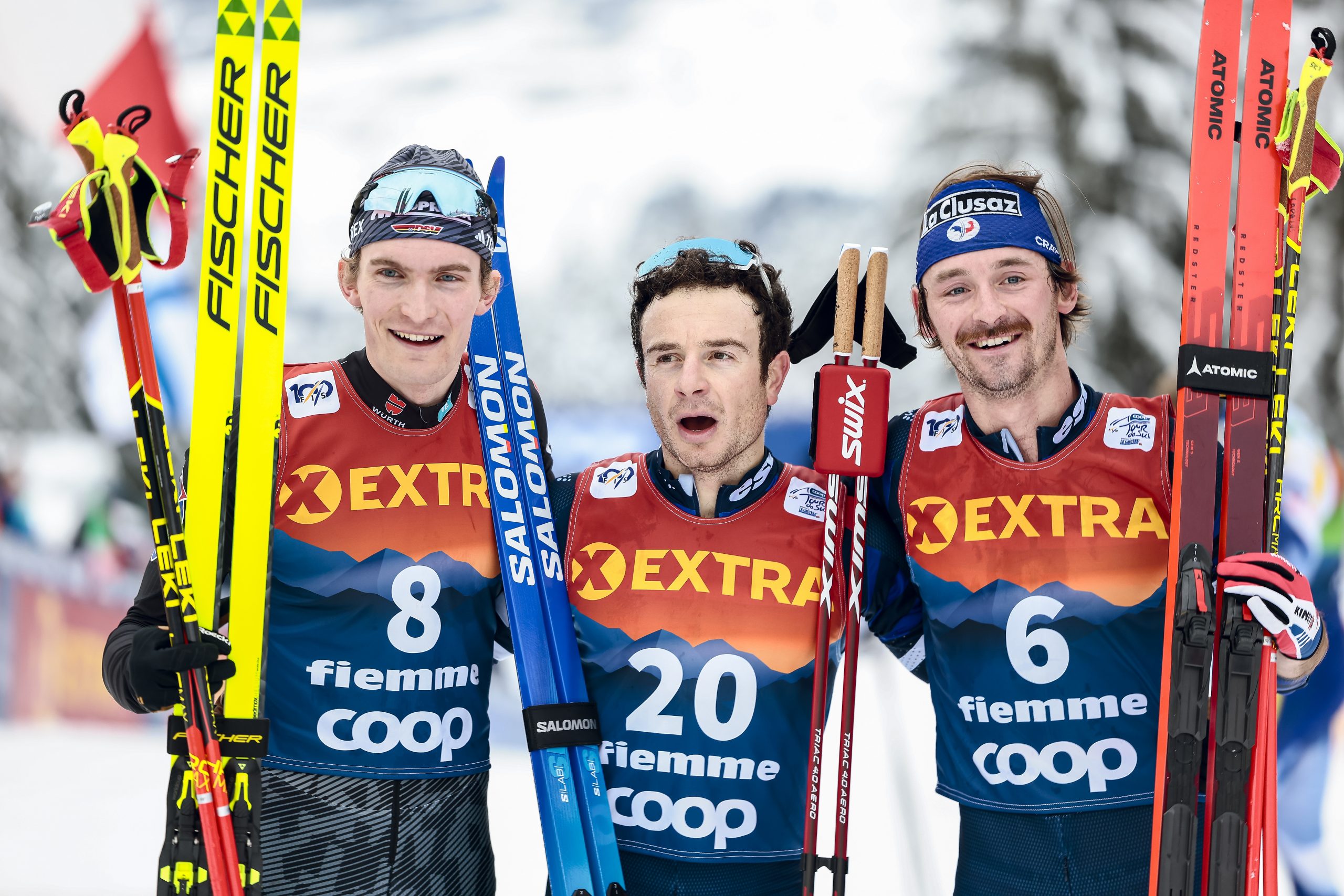
    There were several near-misses outside the top-30, including Luke Jager, who was just 0.7 seconds off the time (2:52.31) needed for qualification in 33rd. 

    Just missing the top-30, Luke Jager skis to 33rd in the qualifying round of Lillehammer’s freestyle sprint. (Photo: NordicFocus)

    Gus Schumacher qualified in 41st, just over a second out of the heats, followed closely by Canada’s Russell Kennedy and Graham Ritchie in 42nd and 43rd, respectively. 

    Rounding out the North American men’s squad, Logan Hanneman (USA) finished 45th, with Olivier Levielle (CAN) 48th, and Antoine Cyr (CAN) 56th. 

    In a post-race interview, Matt Whitcomb shared insights into the new course in Lillehammer, as well as how athletes selected their tactics for the two-lap course, his perspective on the men’s racing, and a detailed explanation of why qualification for the heats in World Cup sprinting is a unique skill that athletes need to hone.

    Leading the way for Canada, Russell Kennedy skis to 42nd in the qualifying round of Lillehammer’s freestyle sprint. (Photo: NordicFocus)

    Results: 

    Qualification | Final