Tag: Lukas Bauer

  • Olsson, Jauhojärvi, Bauer Retire, Among Others

    Olsson, Jauhojärvi, Bauer Retire, Among Others

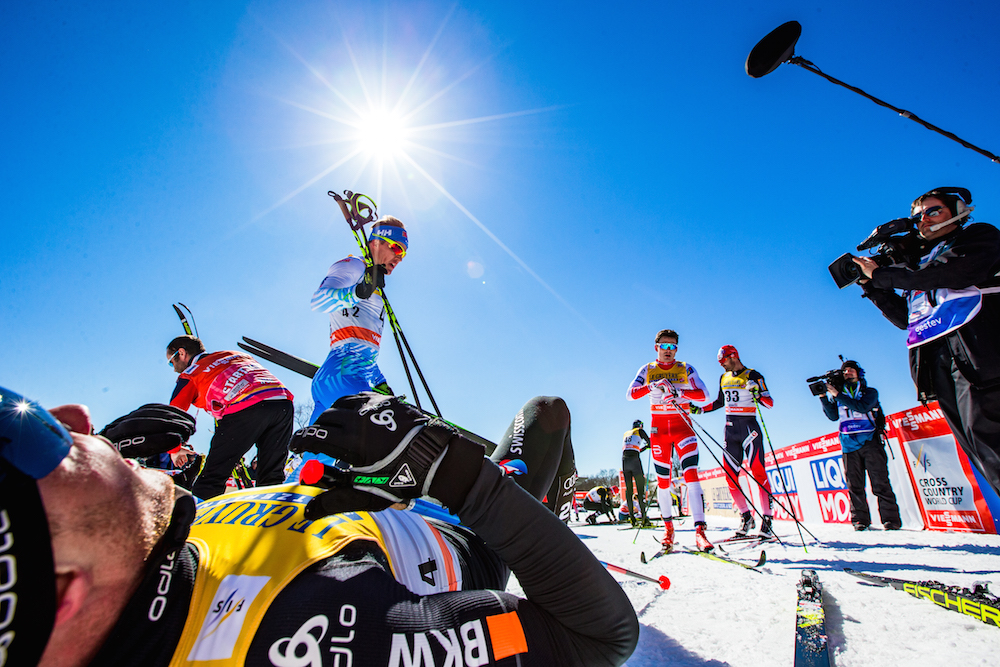
    Finland’s Sami Jauhojärvi (in blue and white) walking out of the finish area after the men’s 15 k classic mass start at World Cup Finals in Quebec City. Also pictured: Switzerland’s Dario Cologna (on the ground), and Norway’s Finn Hågen Krogh and Hans Christer Holund (33). Jauhojärvi finished 11th on the day and ultimately placed 16th overall in the World Cup Finals mini tour to end his World Cup career.

    Coming off the 2016/2017 season and less than a year out from the 2018 Winter Olympics in PyeongChang, South Korea, several international cross-country skiers and biathletes have announced their retirements. Among them are Sweden’s Johan Olsson, Finland’s Sami Jauhojärvi and the Czech Republic’s Lukáš Bauer, all of which earned medals at Olympics and/or World Championships.

    Sami Jauhojärvi
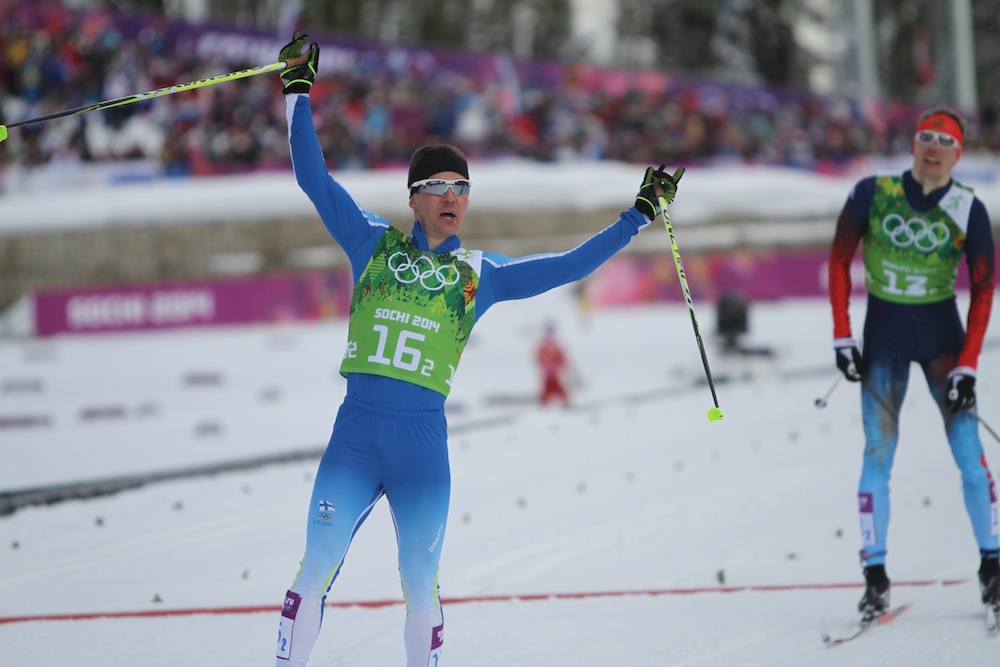
    Finland’s Sami Jauhojärvi anchors his team to gold in the men’s classic team sprint, ahead of Russia’s Nikita Kriukov, at the 2014 Sochi Olympics

    Earlier this month, Jauhojärvi, 35, publicly stated that he would be hanging up his race skis, ending his season with a third-place finish in the 50-kilometer freestyle at Finnish nationals.

    Jauhojärvi, who turns 36 in early May, competed at eight World Championships and three Olympics, winning gold with teammate Iivo Niskanen in the men’s classic team sprint at the 2014 Olympics in Sochi, Russia. He started racing World Cups 16 years ago, served on the athletes’ commission for the International Ski Federation (FIS) from 2009 to 2013 and racked up three bronze medals at World Championships. His latest bronze came in the classic team sprint (again with Niskanen) at this year’s 2017 World Championships at home in Lahti, Finland.

    “I’m not tired of skiing, but at some point it just happens that competitive instincts begin to fade,” Jauhojärvi told InsideTheGames. “By training I could be pushing my limits for a few more years, but my competition mind is done. … I do not think any more about fighting for gold medals at future Olympics.”

    Johan Olsson
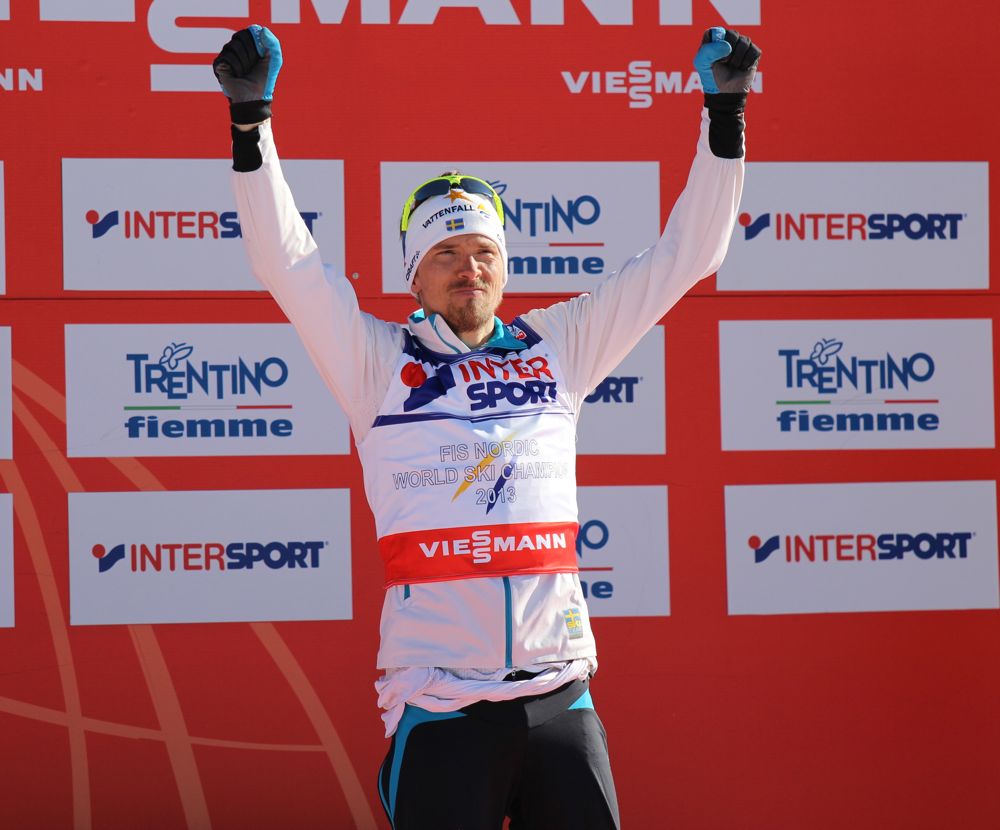
    Sweden’s Johan Olsson celebrating his first individual World Championships gold in the 50 k classic mass start in 2013 in Val di Fiemme, Italy.

    Sweden’s 37-year-old Olsson, who has also spent the last 16 years on the circuit, is also calling it a career, according to FIS. He amassed 14 world championships-caliber medals (eight at World Championships medals and six at the Olympics), making him one of the most successful Swedish skiers of all time, behind Gunde Svan and Sixten Jernberg, who each tallied 17.

    Four of Olsson’s medals were gold: he was part of the Swedish men’s 4 x 10 k relay that won at both the 2010 Olympics in Vancouver, B.C., and 2014 Sochi Games. Individually, he won the 50 k classic mass start at 2013 World Championships and 15 k freestyle individual start at 2015 World Championships on home soil in Falun, Sweden.

    Olsson cited wanting to be more present for his family, which includes his two daughters (ages 5 and 2).

    “I have had an ambition to become the world’s best skier and have had the consequences for it,” he told Expressen, according to a loose translation. “… When that burden grows bigger than the joy to keep on, it’s time to stop.

    “I have spent 15 years trying to realize my sporting dreams,” he explained. “Now I will be able to realize completely different dreams, and I will be able to be a much more present dad.”

    Olsson has been working with Swedish public television, SVT, and has expressed his desire to stay involved with skiing to build interest in the sport.

    “The question is how to make me on television,” he said of his TV career. “My paradise at the end of a race has been to stand in the interview zone and chat most of all, even though I finished 35th. Would there be enough time on television?”

    Lukáš Bauer
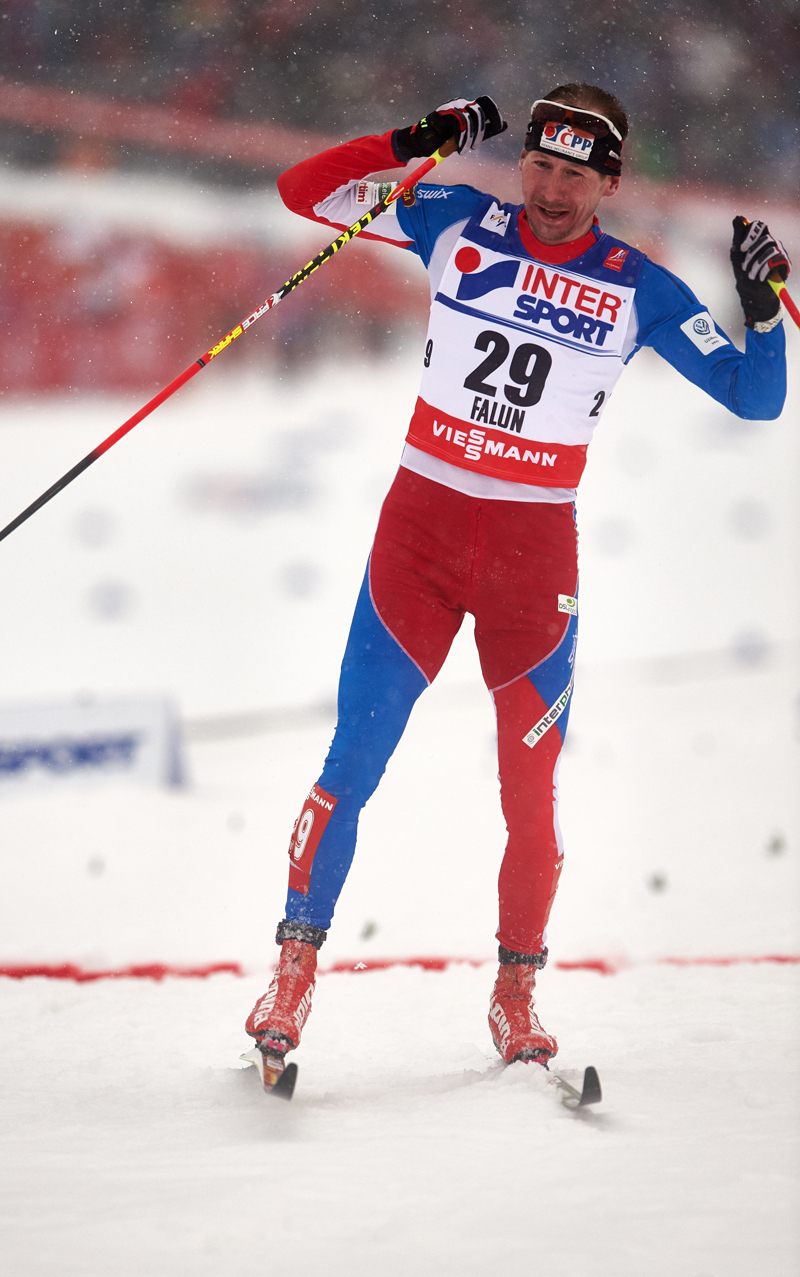
    Lukas Bauer celebrates silver in the 50 k classic at 2015 World Championships in Falun, Sweden. (Photo: Fischer/NordicFocus)

    Before the start of this past season, Bauer, 39, publicly stated it would be his last. But the decision became solidified after he finished 19th in the 15 k classic at 2017 Lahti World Championships.

    “A result that has disappointed me, after which I spent two and a half hours in the rain reminiscing of it,” he said, according to Neveitalia. “On other occasions I would have said, ‘I can redeem myself the next time,’ but not in this case because I just decided to quit.”

    He finished the season and his career out in the Lahti 4 x 10 k relay, in which the Czech men’s team placed 11th.

    The Czech Republic’s most successful cross-country skier, Bauer was the 2007/2008 Overall World Cup champion. He competed at five Olympics and 11 World Championships over 19 World Cup seasons, winning 18 World Cup races and the Tour de Ski twice, in 2008 and 2010. At the Olympics, he has a silver and two bronze medals. At World Championships, he is a two-time individual silver medalist — most recently placing second at 2015 Falun worlds in the 50 k classic mass start.

    Like Olsson, he also has two children.

    “I do not retire for a matter purely tied to my performance,” Bauer said. “If I wanted to prepare myself and I would be honored to participate in the upcoming Olympic Games, but the reality is I do not care. At home I have a wife and two children. It’s time to concentrate more on them than on sports goals. Without their support, I would never have obtained anything I collected in my career, to which I look with pride and satisfaction.”

    But he’s not completely done with skiing and plans to continue racing marathons.

    “Now I will focus on managing my team [Team Pioneer Investments] in long-distance races and I will also try to compete as much as possible, as long as the doctor will allow me,” Bauer said.

    Martin Johansson

    Sweden’s Martin Johansson, 32, is leaving elite skiing as a national A-team member who transitioned to cross-country in 2010. The move came after he won two gold medals at orienteering World Championships in 2009, but was seriously injured when he was impaled by a branch, according to Nordic Magazine. In six seasons thereafter, his career best in cross-country was fifth place in a 10 k freestyle in 2015 in Kuusamo, Finland, and he finished this year with a third-place finish in the 50 k freestyle at Swedish nationals, after which he announced his retirement on social media. Johansson competed at the last two World Championships.

    Fanny Horn Birkeland
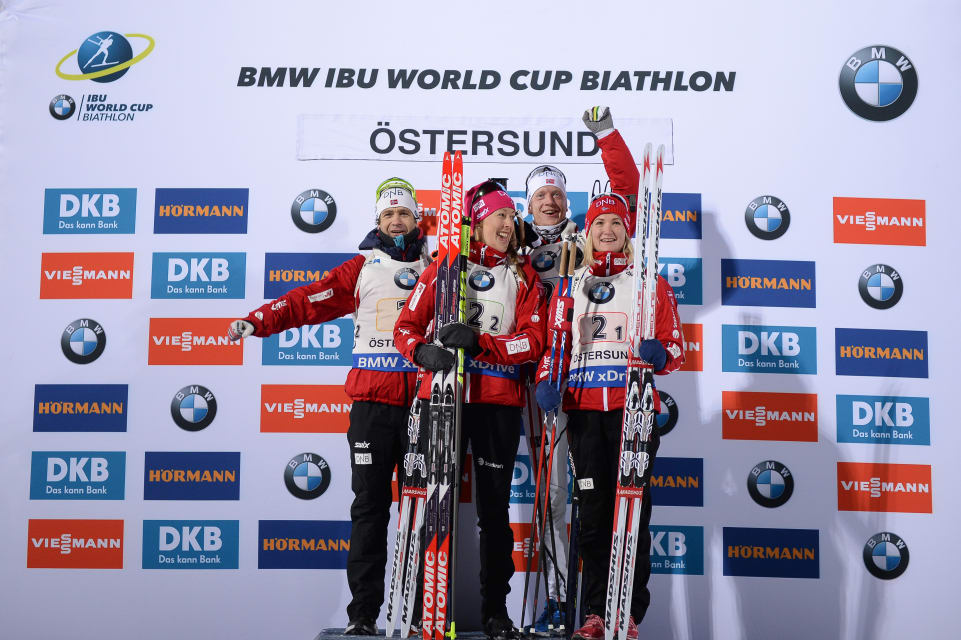
    (l-r) Norway’s Ole Einar Bjørndalen, Fanny Horn Birkeland, Johannes Thingnes Bø, and Marte Olsbu on the podium after winning the first race of the 2016/2017 biathlon World Cup season, a mixed relay in Ostersund, Sweden. (Photo: IBU)

    Norwegian biathlete Fanny Horn Birkeland announced her retirement during the last International Biathlon Union (IBU) World Cup weekend of the season. At 29, she has competed at the sport’s highest level for the last seven years, been on more than half a dozen winning relay teams, and won a 2015 World Cup sprint in Ruhpolding, Germany.

    “My plan was to go until the Olympics next year, but my form has not been so good,” Birkeland told the IBU. “I did everything to reach my goals, but still I had some trouble to make it to the top in my competitions. It is hard to put so much work into it every day and not get any results that I want. Twenty-nine is not so old, but I have been in this game for some time and it feels right now.

    “The highlight of my career was my win in the Ruhpolding sprint in 2015,” she added. “It was unreal … that was my day to get the opportunity to be on top of the podium. I wanted to do it again, but I never managed it.”

    Her husband, Lars Birkeland, also competes for the Norwegian biathlon team. “We helped each other a lot to get where we are now,” she said.

    Éva Tófalvi

    Romania’s Éva Tófalvi, 38, is also moving on from her career as a World Cup biathlete after competing at five Olympics, where her best result was 11th in a 15 k individual race at the 1998 Games in Nagano, Japan. She won an individual World Cup race during the 2008/2009 season after originally placing second (the winner, Russia’s Albina Akhatova, was disqualified for doping), making her the first Romanian biathlete to win a World Cup.
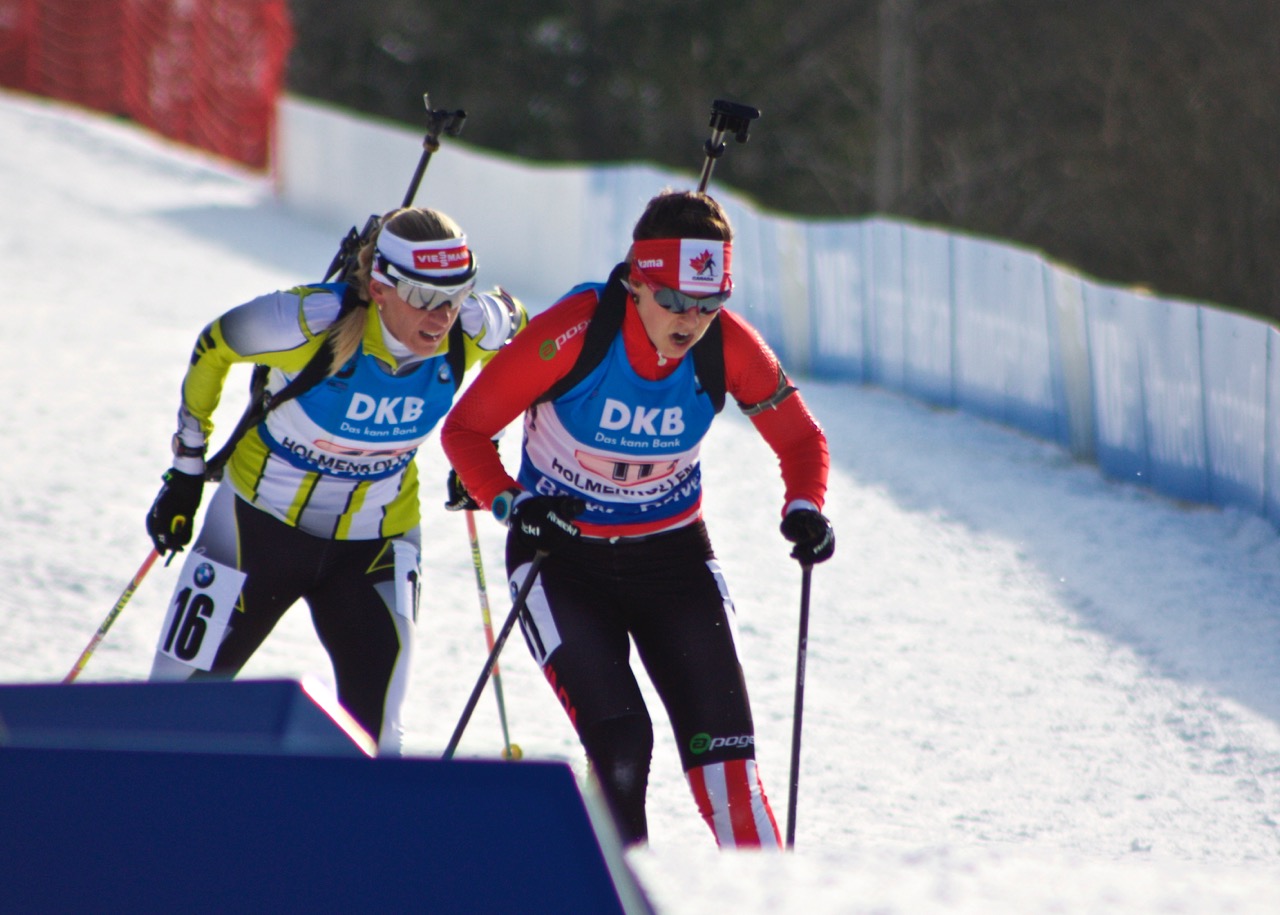
    Canada’s Julia Ransom (r) skiing with Romania’s Eva Tofalvi during the first leg of the 4 x 6 k relay at 2016 IBU World Championships in Oslo, Norway. (Photo: JoJo Baldus)

    In an interview with the IBU, Tófalvi said she wanted to wanted to focus on her personal life.

    “I am not a 100 percent sure, but I feel like it is the moment to settle down and start a family,” she said. “I know the Olympics are behind the corner, but I do not think I can invest the energy which is needed for such an event.

    “Winning World Cup is probably the most incredible memory I will ever carry,” she continued. “It is not just because of the win, but the work I know I had to put to get it. Even back then I did not have a real team behind me. My skis were not as good and I had no doctors, trainers and coaches with me like it was for bigger teams, like Norway. Winning in Hochfilzen was really special because of that, because it felt like a good prize for having had to work double as much as most to make up for what I couldn’t have.”

    Despite being left-handed, she had to learn to shoot using her right hand because Romania only had right-handed rifles.

    “In 20 years so much has changed in biathlon,” she said. “Now everything is much more professional and everyone is more focused on their careers. I think we were taking everything more lightheartedly back then. I now see girls that were born around the years I was making my debut in  he World Cup, and they are so determined that they achieve what before we would do at a much older age.”

  • Classic Northug: Norwegian Appears from Nowhere to Claim Victory in World Champs 50 k

    Classic Northug: Norwegian Appears from Nowhere to Claim Victory in World Champs 50 k

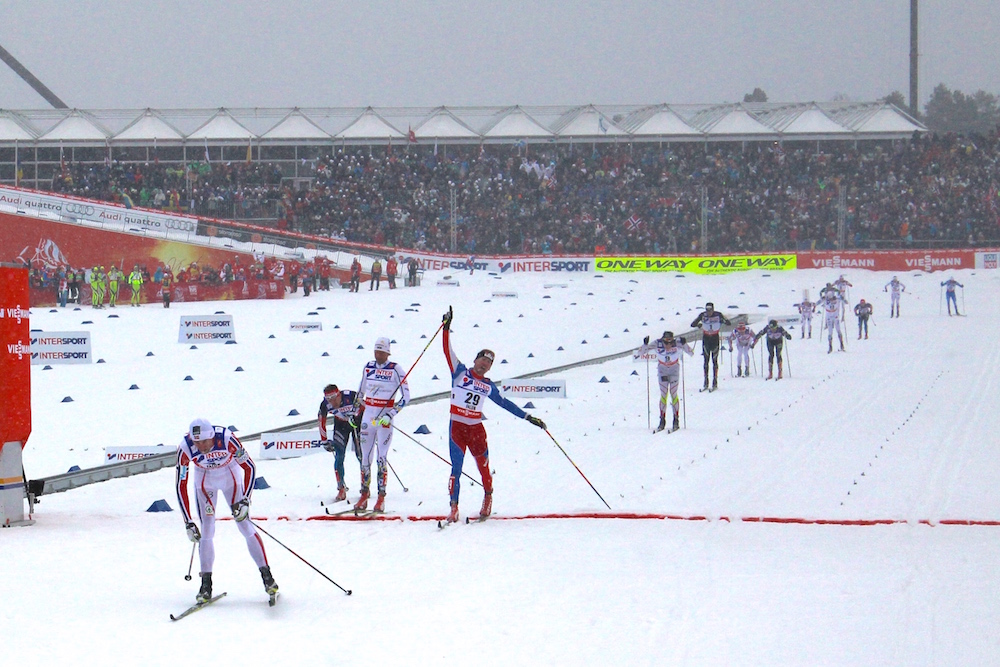
    Petter Northug catches his breath after wining the 50 k classic mass start at the 2015 FIS Nordic World Championships in Falun, Sweden. Behind him, Czech skier Lukas Bauer celebrates second as Johan Olsson crosses in third and Maxim Vylegzhanin finishes fourth.
    Petter Northug catches his breath after wining the 50 k classic mass start at the 2015 FIS Nordic World Championships in Falun, Sweden. Behind him, Czech skier Lukas Bauer celebrates second as Johan Olsson crosses in third and Maxim Vylegzhanin finishes fourth.

    FasterSkier’s coverage of the 2015 FIS Nordic World Ski Championships in Falun, Sweden, is brought to you by the generous support of L.L. Bean, now featuring a complete line of Kikkan Randall training wear.

    FALUN, Sweden — Good things comes to those who wait. If you’re Petter Northug, that good thing just happens to be a gold medal.

    Northug patiently waited until the final meters of the men’s 50 k classic mass start to win his fourth gold medal of the 2015 FIS Nordic World Ski Championships. Before the last kilometer, the Norwegian hadn’t skied above 10th position and fell as far as 48th at 5 k into the race. Nevertheless, he overcame a flying Lucas Bauer and determined Johan Olsson of Sweden in the final meters to cross the line with a time of 2:26:02.1. Bauer trailed by 1.7 seconds to take the silver while Olsson finished 2.0 seconds back for third in the snowy and soft conditions.

    The start of Sunday’s race began like most others in Falun – there was a light snow that fell on a roaring crowd of over 30,000, and conditions seemed to be stable. That soon changed as the snow developed into thick, wet flakes that piled on the tracks. With temperatures in the upper 30s, the course began to crumble as over 50 skiers took to the trails. By the end of the near two-and-a-half hour race, volunteers were forced to shovel meter-deep slush from multiple points on the trail.

    “It was very tough. I think one of the deepest conditions that I’ve ever skied,” Bauer, a veteran World Cup skier from the Czech Republic, said after his second place finish. “It was tough for everbody, it doesn’t matter if you ask first or last.”

    Despite the conditions, Northug’s three Norwegian teammates – Martin Johnsrud Sundby, Didrik Tønseth, and Niklas Dyrhaug –  commanded the race from the start as a pack of over 40 skiers developed in the early kilometers. Sundby sat out the Championships’ earlier races due to illness, and the 50 k was his first race since his recovery. Behind the Norwegians were Olsson, top-ranked Dario Cologna of Switzerland, and Alex Harvey of Canada.

    Throughout the first laps of the course – which consisted of subsequent blue and red 5 k laps that were combined to total five loops of 10 k – the leaders changed frequently and the large pack remained intact. At one point Harvey, fellow Canadian Ivan Babikov, American Noah Hoffman, and Great Britain’s Andrew Musgrave occupied the the top four spots as they crossed the 7.8 k mark.

    While Hoffman and Musgrave would soon fall from far from the lead, their Canadian counterparts did not. After the pack completed the first 10 k loop of the day, Olsson took the lead with the aim of increasing the speed of the pack. He said after the race that the slower the pace went the worse the outcome would be for both he and his teammates.

    Olsson chasing Tonseth 19 k
    Johan Olsson at the 19 k mark in the 50 k at the 2015 FIS Nordic World Ski Championships in Falun, Sweden. The Swede finished third overall after a sprint finish with Petter Northug and Lukas Bauer.

    At the front, Olsson began his lead before 10 k to just after the 20 k mark. The Swede gave a famous performance in the 2013 World Championships 50 k where he broke away at 11 k to take the victory by 12.9 seconds. Olsson said he was unable to give a similar performance due to the conditions, where falling snow and a rapidly deteriorating course resulted in slow skiing regardless of the effort. Deciding to sit back and conserve energy, the 34-year-old, sat back to let Dyrhaug take the lead before 25 k.

    “I had to take a little bit of rest when I realized that there was no use to make a large part of the work when I had been much in front for 25 kilometers,” Olsson said of his relinquished lead.

    Dyrhaug opened up a gap, which at one point neared 10 seconds. He was then replaced by an unlikely leader – Babikov.  The Canadian, who’s traditionally excelled in freestyle, skied up the hills focused on his own pace. At times he would turn around, see he was leading by several seconds, and take a break till the pack caught up.

    Babikov’s lead lasted for less than 5 k as Olsson’s teammate, Anders Södergren, took charge, hoping to push the pace and spread out the leaders. At one point Soedergren led by over 18 seconds, but his lead was chipped away by Russia’s Maxim Vylegzhanin and France’s Maurice Manificat as the snow and lack of a draft hampered his progress. The two skiers caught the Swede and and eventually overcame him after 40 k.

    “To go in the front, it turned me up,” Södergren said to FasterSkier about his lead. “I felt really strong with good stick on the skis. It was hard to be in the front with the snowfall. I was never tired but it was better to go back into the group.”

    Sodergren leading 39 k
    Södergren leads the pack at 39 k in the men’s 50 k classic at the 2015 FIS Nordic World Ski Championships in Falun, Sweden.

    With just 5 k to go Manificat and Vylegzhanin were leading the charge through the stadium, unaware of a fateful choice made behind them. Bauer, who had been in and out of the top 10 for the majority of the race decided to take his second ski exchange before the final lap of the race. It was a risky move as the Czech skier lost precious time before entering his final 5 k.

    “The first plan was [to change at] 15 then 35 but the reality was 25 and after 45 k. I think almost everyone went for exchange after 35 k and I decide in the moment that no, I would not change the skis because I had quite good skis,” Bauer said in a press conference. He explained that after 35 k he struggled to keep up with the pack because his skis were slow on the downhills. While he was able to maintain his position, he knew something had to change.

    With his second ski exchange at 45 k, the 37-year-old tackled the last climbs and curving downhills with gusto, and it was soon obvious he made the right choice.

    “I think it was quite big advantage for 5 k,” he said. According to Bauer, he knew that his finishing sprint wasn’t as strong as his competitors and needed an advantage in the last lap. Better skis were the solution.

    Moving up through the pack, Bauer eventually reached the front to ski with Vylegzhanin in the final hills of the course before the stadium. The two were joined by Olsson who lost ground on the climbs but recovered time on the downhill into the stadium.

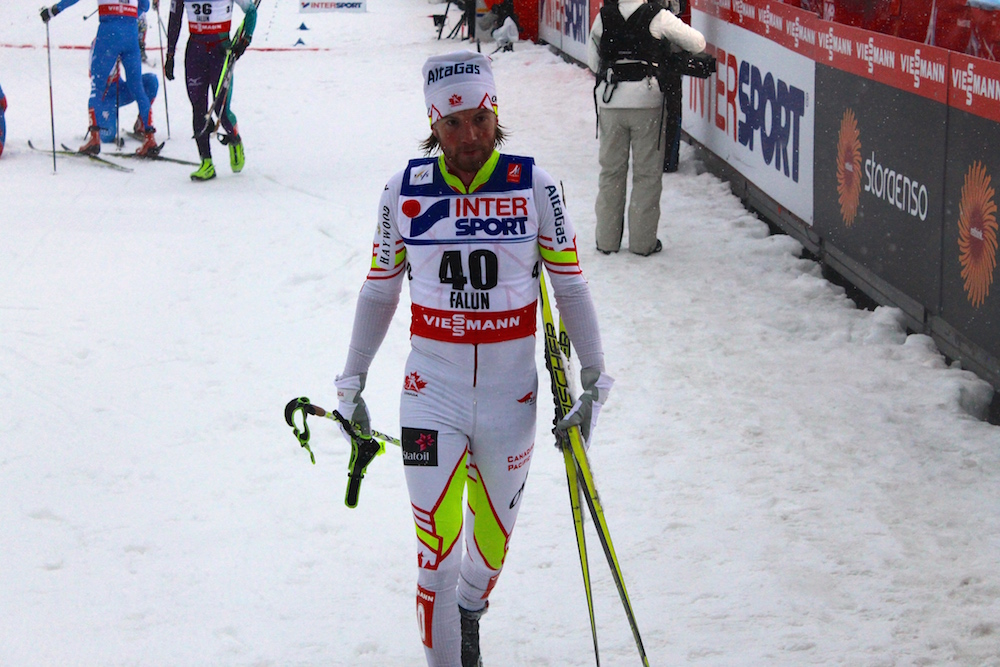
    Bauer finish
    Lukas Bauer of the Czech Republic rests after the finish of the 50 k classic mass start at the 2015 FIS Nordic World Ski Championships in Falun, Sweden. He finished second on the day.

    Behind them, Northug was making moves of his own. Leaving his steady 10th-place position, the Norwegian began to overcome skier by skier on the final two hills. Joined by Harvey, the two entered the stadium in fourth and fifth position.

    As they began to tackle the short incline on the stadium’s short horseshoe hill Northug gave a running sprint to overcome a several second deficit and make contact with Olsson, Vylegzhanin, and Bauer.

    The four entered the stadium and jostled for position. Northug stepped out of the tracks to find the faster snow between Vylegzhanin and Bauer and began to double pole with impressive intensity. Squeezing by the skiers, he inched ahead and crossed the finish line in first.

    Behind him, Bauer held on to second while Olsson barely passed the Russian, whose speed deteriorated after he decided to stay in the slower tracks. Harvey, who was unable to respond to Northug, crossed the line in fifth, 6.0 seconds back.

    “It is difficult for me to describe this. I’m just tired, empty of emotion and in a separate world,” Northug said after his sensational finish.

    The victory was Northug’s fourth at the 2015 World Championships and his 13th overall. The gold medal is also his fourth in the 50 k, with additional wins at the 2009 and 2011 Championships and the 2010 Olympics. The number ties Swedish skier Sixten Jernberg who won two World Championship titles in 1958 and 1962 in addition to the 1956 and 1964 Olympic titles.

    According to Northug, there was no particular part of Sunday’s 50 k that necessarily suited him. He explained in a press conference that his plan was to remain in the middle of the pack until the final 10 k, and then make his way towards the front.

    Northug shakes Keishin Yoshida's hand after race
    Petter Northug talks with Japan’s Keishin Yoshida after the 50 k classic at the 2015 FIS Nordic World Ski Championships in Falun, Sweden. Yoshida finished 16th while Northug won.

    After his finish, Northug told NRK Sport that one of his favorite parts about racing is the actual finish, especially in a long 50 k.

    “It is a great relief to go in the finish. The feeling of crossing the finish line first is indescribable. That is what we train for, and that is what we hope to replicate in Championships,” he said. “I have had the opportunity several times here in Falun. It is the feeling that is difficult to describe. It is so good that you do everything you can to get it back.”

    Northug has faced a turbulent year after crashing a car in May and subsequently being charged with intoxicated driving. The Norwegian rarely mentions his thoughts surrounding the incident, but said to NRK that Sunday’s win was the high of two extremes in the past year. He explained that his complete focus on training in the 2015 season has been essential to his four victories in Sweden.

    “There are two extremes, from being completely down to win four gold in a World Championships” he said. “The road has been long, it has been a lot of training, many tough sessions. But the plan we put in May has been solid. It has been very quality of what we have done and that is why I have been in such good shape that I’ve been in this Championship.”

    Unlike Northug, the second place finisher from the Czech Republic hasn’t seen a World Championships podium in many years. Bauer’s only other time on the podium was at the Liberec Worlds in 2009 where he finished second in the 15 k classic. When asked to describe what the podium meant to him, Bauer described it with one word: satisfaction.

    “It’s very nice to have again a medal in World Championships,” he siad. “I said to Johan [Olsson] that I forgot what to do in the prize giving ceremony and everything. It was a long time ago and it’s nice to return.”

    Olsson, on the other hand, is no stranger to the 2015 World Championships podium. Prior to Sunday he won the 15 k freestyle and took silver in the 4 x 10 k relay. The 50 k bronze completed the medal trifecta at the World Championships. Despite his accomplishments, Olsson said he had higher expectations for the 50 k.

    “Third place was not exactly what I had hoped for, but I will of course be happy about the medal. I too had a little bit of luck to clinch the bronze,” he said.

    Olsson attributed much of Sweden’s success at the Championships to the national team coach, Rikard Grip. The Swedish medalist explained that Grip created an atmosphere where teammates pooled their knowledge for the betterment of each skier. He also credited the mixture of skiers on the team, saying, “there’s a mix between young, offensive thinking and some old guy that has a lot of experience” in reference to himself.

    Results

  • Harvey Jockeys for Position, Finishes Fifth in Final 50 k Push at World Championships

    Harvey Jockeys for Position, Finishes Fifth in Final 50 k Push at World Championships

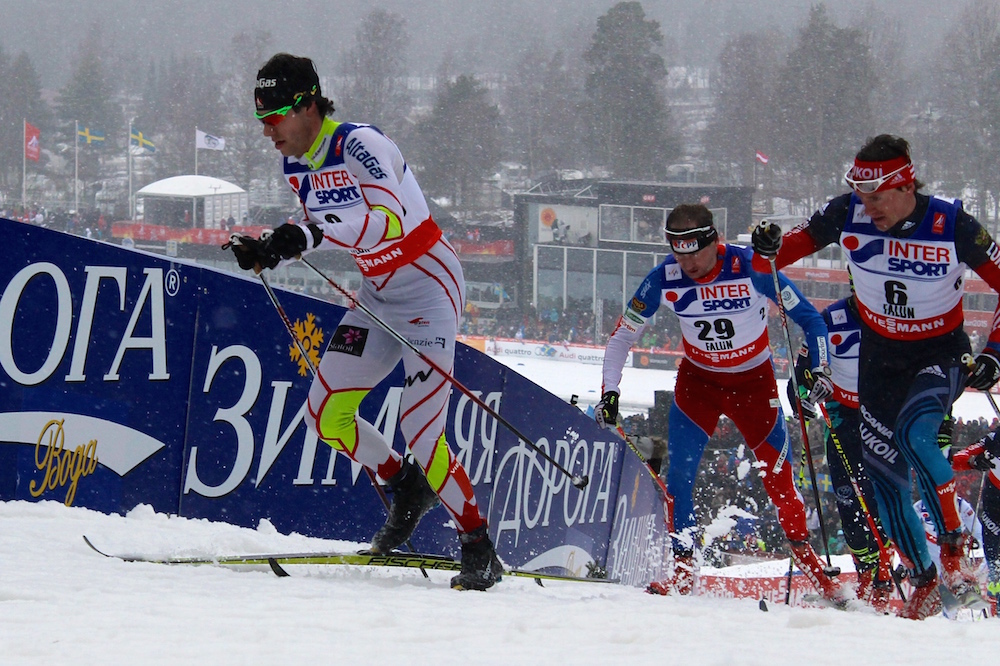
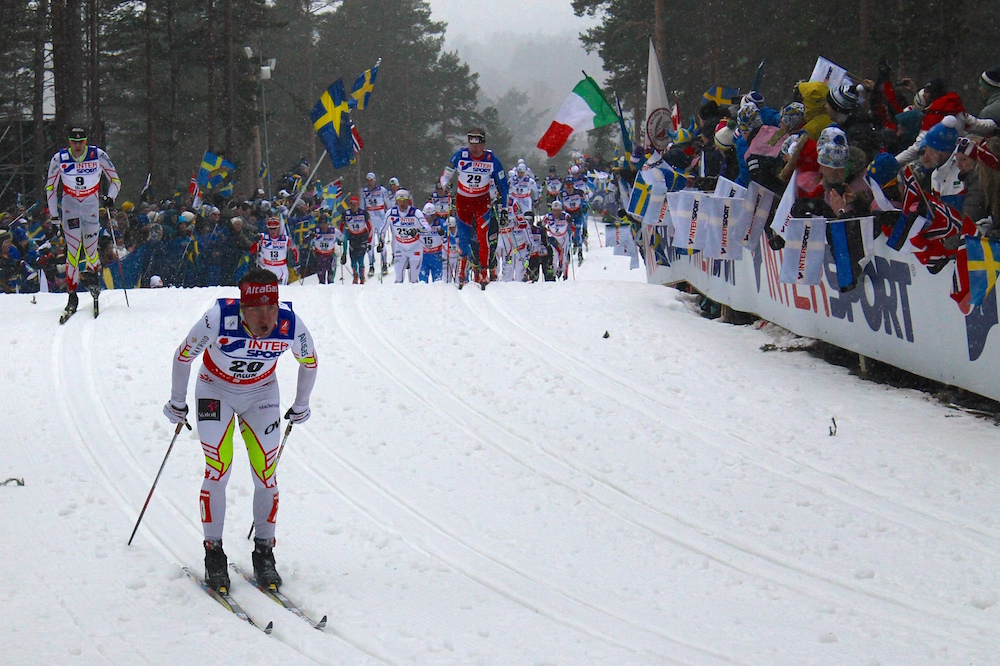
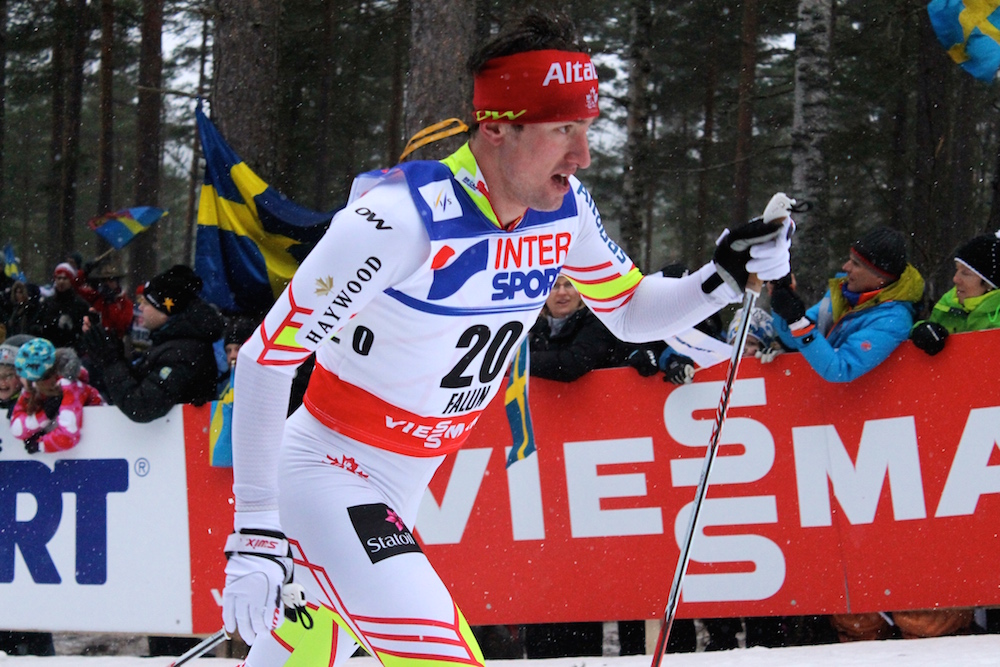
    Canada's Alex Harvey leads Russia's Maxim Vylegzhanin (4) and the Czech Republic's Lukas Bauer (29) up a steep hill around 29 k in the men's 50 k classic mass start at 2015 World Championships in Falun, Sweden.
    Canada’s Alex Harvey (l)  leads Russia’s Maxim Vylegzhanin (4) and the Czech Republic’s Lukas Bauer (29) up a steep hill around 29 k in the men’s 50 k classic mass start at 2015 World Championships in Falun, Sweden.

    FasterSkier’s coverage of the 2015 FIS Nordic World Ski Championships in Falun, Sweden, is brought to you by the generous support of L.L. Bean, now featuring a complete line of Kikkan Randall training wear.

    FALUN, Sweden — After two medals at the 2015 FIS Nordic World Ski Championships, it was easy for Alex Harvey to think what could have been in the moments after the men’s 50-kilometer classic mass start on Sunday.

    He had just been recognized at a snowy medals ceremony, held in the center of the stadium on the final day of Falun’s World Championships. But instead of a gold, silver or bronze, the 26-year-old Canadian received a wooden horse.

    Fifth wasn’t what he had gone into the race hoping for, and had he made a few different decisions during it, Harvey couldn’t help but speculate he would have been in podium contention by the finish.

    “I should have adapted my strategy better in the race and not try to go for the breaks,” Harvey said, noting the snowfall and choppy conditions made it nearly impossible to ski away from the group. “It is my best championship ever so I am really happy, but today, it felt like I could have got a bit better.”

    Conditions were as slow as they get on Sunday, once again a few degrees above freezing and with wet snowfall — which came down heavily at times during the race — that made the salted course even softer.

    “It was one of the slowest 50 k’s in modern history,” Harvey said, referring to the winning time of 2 hours, 26 minutes. “It was slow everywhere.”

    “Some places it was perfect, really nice, and some places it was just mashed potatoes,” said his teammate, Ivan Babikov. “Couldn’t ski, couldn’t walk it, especially at the beginning of [each] lap, it was really bad. … The last uphill was the worst … just going in knee-deep slush.”

    Canada's Graeme Killick skiing with eventual winner, Petter Northug of Norway (r), around 14 k of the men's 50 k classic mass start at 2015 World Championships. Killick went on to place 19th for a career-best international result.
    Canada’s Graeme Killick skiing with eventual winner, Petter Northug of Norway (r), around 14 k of the men’s 50 k classic mass start at 2015 World Championships. Killick went on to place 19th for a career-best international result.

    Canada’s third man in the race, 26-year-old Graeme Killick, found the hardest part to be the initial ascent out of the stadium.

    “It was so loose, you felt like you needed a canoe to get through [it],” Killick said.

    Harvey, Babikov and Killick all put themselves squarely in the lead pack out of the start. At 3.3 k, Harvey and Babikov were in the top seven, within 2.4 seconds of the leader (Norway’s Didrik Tønseth at the time). Upon returning to the stadium at 5 k, Harvey and Babikov skied together in seventh and eighth, still 2.4 seconds back, while Killick was another eight seconds behind in 30th.

    After topping the biggest climb on the course, affectionately known as Mördarbacken, Babikov and Harvey led the 49-man pack with American Noah Hoffman and Great Britain’s Andrew Musgrave just behind them. There, at 7.8 k, Killick was 2.4 seconds back in 13th.

    “When you’re going easy, you might as well be in the front, because then that’s when everybody’s sketchy on the downhills,” Harvey explained. “There’s guys who are not going easy just to follow that pace, and they’re sketch on the downhills. So when the pace is that slow, it’s good to be at the front.”

    At the bottom of the course at 10 k, Babikov was still in the lead, just ahead of Hoffman and Finland’s Matti Heikkinen, as well as Sweden’s defending 50 k world champion, Johan Olsson. Over the next 10-plus kilometers, Olsson took control up front, sharing the workload with competitors like Heikkinen, Tønseth and Russia’s Maxim Vylegzhanin.

    But the Swede never made the move that Harvey, for one, was waiting for.

    “Everybody thought Olsson would try to break away,” Harvey recalled. “He was trying — he would open 15-second gaps and stuff, but it would always come back on the downhill.

    “I should have read the situation better and adapted the plan more than I did,” he added. “I knew Olsson was in good shape and really motivated, but with the snow falling there was … no point trying to break away. [I] spent a lot of energy there.”

    Norway’s Niklas Dyrhaug and Sweden’s Anders Södergren spent some time in the limelight leading for much of the third of five 10 k complete laps.

    At 27.8 k, once again at the top of Mördarbacken, Harvey led again, ahead of Vylegzhanin and the Czech Republic’s Lukas Bauer, while Olsson hung in seventh, 5 seconds behind. Killick and Babikov were about 12 seconds back in the top 30.

    At 30 k, Olsson left the stadium first, 0.9 seconds ahead of Vylegzhanin and 1.5 seconds ahead of Kazakhstan’s Alexey Poltoranin in third, while Harvey skied 1.9 seconds back in fourth. Babikov was within four seconds of the lead in sixth, and Killick was just 6.2 seconds back in eighth.

    “Our skis were just amazing,” Killick said. “You can feel better than what you’re actually at so I was keeping that in mind, just trying to stay as relaxed as possible and even if I felt like I could be skiing right up at the front, just trying to stay relaxed in the top 15 there and not overdoing it on the steeps and using the skis on the downhills to get back in there.”

    Ivan Babikov (20) leads Canadian teammate Alex Harvey (l) up Little Mördarbacken around 34 k into the men's 50 k classic mass start at 2015 World Championships in Falun, Sweden.
    Ivan Babikov (20) leads Canadian teammate Alex Harvey (l) up Little Mördarbacken around 34 k into the men’s 50 k classic mass start at 2015 World Championships in Falun, Sweden.

    Team tactics weren’t a part of the plan, according to Canadian National Team Head Coach Justin Wadsworth. But with three men in the lead pack, it made the race a lot more fun for the Canadians.

    “It’s always easier to ski with your teammates,” Wadsworth said. “When they could do that, they were taking advantage of it. Everybody had good skis and you kind of feel a little something extra when you see your whole team up there in the front of the race for most of the race.”

    Like everyone else in the race, Harvey and Killick changed their skis twice, but Babikov was one of two skiers out of 45 finishers that switched just once (Japan’s Hiroyuki Miyazawa was the other).

    “I couldn’t believe that my skis were so good,” Babikov recalled.

    One reporter thought he saw him laughing at one point.

    “I was just smiling,” Babikov said. “I was enjoying myself.”

    Around 34 k, Babikov went several meters off the front of the pack while Harvey and the rest of the group followed up Lille “Little” Mordarbacken. Both he and Harvey said the pace was slow at the time — Harvey described it as Zone 2 — and at the tops of a series of hills, Babikov glanced back, stopped and waited for everyone else to catch up.

    “I didn’t realize I had a gap,” Babikov said. “It was maybe a bit foolish, but I had no idea. It was not my intention to drop the pack, I was just trying to keep the pace up [the hill] the same.”

    “I couldn’t believe that my skis were so good … I was just smiling. I was enjoying myself.” — Ivan Babikov, Canadian World Cup Team member, after leading several parts of the 2015 World Championships 50 k classic mass start

    At 35 k, Babikov and Killick blew past the pit stop to leave the stadium in first and third, respectively, with Bauer between them. Harvey opted to use his second available ski change and emerged from the stadium in 13th, 16 seconds back. Just over a kilometer later, Harvey was back in sixth, 12 seconds behind Södergren, who by then had opened up a nine-second gap on Olsson in second.

    “We said change if your skis don’t feel good; we kind of gave him the option,” Wadsworth explained. “Killick kept going and Babs kept going, but Harvey changed, and you never know, maybe that was the right [decision].”

    Ivan Babikov (Canada) leading around 34 k into the men's 50 k classic mass start at 2015 World Championships in Falun, Sweden. He went on to place 30th.
    Ivan Babikov (Canada) leading around 34 k into the men’s 50 k classic mass start at 2015 World Championships in Falun, Sweden. He went on to place 30th.

    About a kilometer later, on the far side of the course, someone skied over Babikov’s pole and broke it, Babikov said. He dropped to 24th, nearly 28 seconds out.

    “I fell out of the group; it took some energy to get back,” Babikov said. “Maybe that cost me.”

    By 40 k, the pack had pulled Södergren back in, with France’s Maurice Manificat, Vylegzhanin and Harvey leading the effort. Killick hung in 21st, 36 seconds back, and Babikov was in 27th, nearly 50 seconds out of first.

    “It was really good for two-thirds [of the race],” Babikov said. “Last 10 k, that was really rough, I started cramping everywhere. I couldn’t even sit down on the downhill.”

    Throughout the final 10 k, the pace picked up considerably, with Harvey pushing to keep himself in the medal hunt while skiing in the top 10.

    “He looked strong, but the pace was going hard and I could tell he was trying to position himself, but not quite getting into the top four,” Wadsworth said.

    That is, until he put himself in fifth by passing Switzerland’s Dario Cologna in the stadium before the finish. Coming off a high-speed downhill, he used his momentum to slip past Cologna and stay ahead of him on the final rise and curving descent toward the finishing straight.

    “With five k to go, or by the top of Mördarbacken, I started getting low-energy levels,” Harvey said. “I was still in contention on the [final steep uphill] and then I was completely spent. … There was just four guys ahead of me by [the last rise], so I was still within reach of the podium, but I couldn’t move. I couldn’t make any speed.”

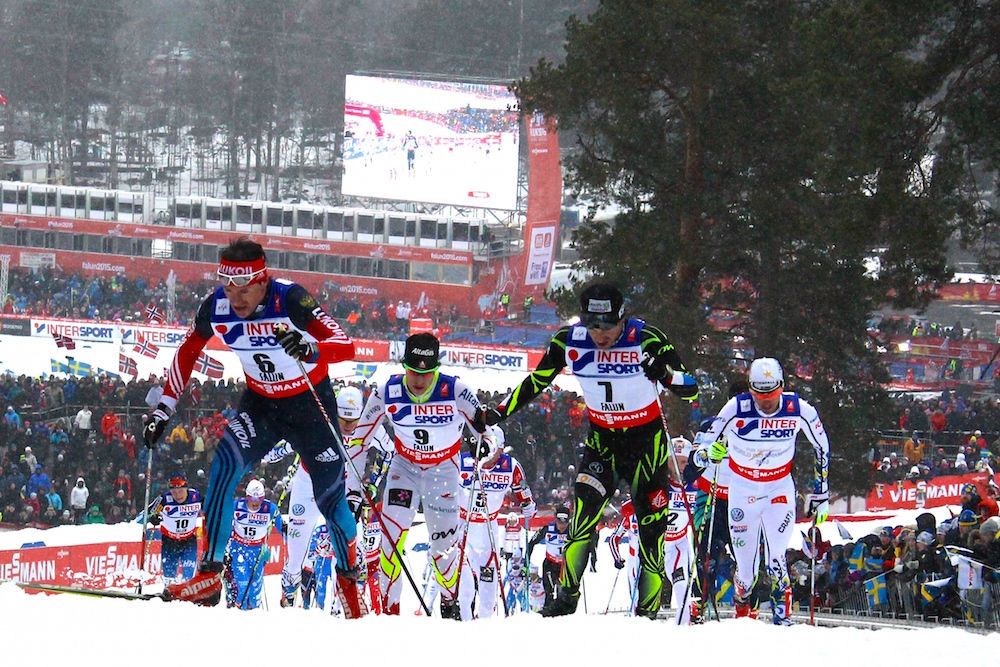
    Canada's Alex Harvey (9) works within a chase pack around 39 k with Russia's Maxim Vylegzhanin (6), France's Maurice Manificat (7), and Sweden's Johan Olsson (r) during the men's 50 k classic mass start at 2015 World Championships in Falun, Sweden.
    Canada’s Alex Harvey (9) works within a chase pack around 39 k with Russia’s Maxim Vylegzhanin (6), France’s Maurice Manificat (7), and Sweden’s Johan Olsson (r) during the men’s 50 k classic mass start at 2015 World Championships in Falun, Sweden.

    He finished 6 seconds after Norwegian winner Petter Northug, while Bauer took silver, 1.7 seconds back, and Olsson edged Vylegzhanin for third by 0.8 seconds. Harvey finished 3.2 seconds later in fifth.

    “I didn’t have anything left,” he said.

    Killick placed 19th (+1:44.1) for his best international result after placing 28th in the 50 k freestyle mass start at the Olympics last year. With that performance in mind, he said he aimed for a top 30 on Sunday.

    “I was just hoping I would hang in there and not cramp on the last few laps,” Killick said. “[When it comes to] 50 k’s, it seems like they’re really hit and miss for me. Domestically I’ve struggled to get top 15, but internationally, my best results have been in the 50. If I’m in shape, they can go really well, but I would say the focus for me [at World Championships] was the pursuit [skiathlon], which I didn’t end up doing because I got sick in Östersund two weeks ago. When that was out, the 50 became the main focus.”

    He said the fans lining the course, which included his parents and girlfriend, helped motivate him in the tough conditions.

    Graeme Killick, of the Canadian Development B-team, after finishing a career-best 19th in the 50 k classic mass start at 2015 World Championships in Falun, Sweden.
    Graeme Killick, of the Canadian Development B-team, after finishing a career-best 19th in the 50 k classic mass start at 2015 World Championships in Falun, Sweden.

    “Just the whole way up Mördarbacken, they’re cheering you the whole way,” he said. “It gives you the little bit extra to get up the hard hill like that.”

    Reflecting on his season so far and first World Championships, Killick, a Canadian National Development B-team member, said he was excited about his prospects.

    “This year I was able to start on the World Cup for the first time in my career and spend a significant portion of the year over here,” he said. “Just seeing the level and seeing how these guys train and race I think has given me a lot of ideas for next year. I’m really excited to try to take the next step and become a contender here on the World Cup.”

    Babikov finished 30th (+3:48.4), and he said he was pleased with his effort, all things considered.

    Canada's Alex Harvey after finishing fifth in the 50 k classic mass start at 2015 World Championships in Falun, Sweden.
    Canada’s Alex Harvey after finishing fifth in the 50 k classic mass start at 2015 World Championships in Falun, Sweden.

    “It was a bit too much for me at the end, just a bit of the on-and-off pace, and that’s what put me under,” he explained. “I used what I had today. I gave my 110-percent for sure.”

    With three men competing out of a possible four (Kershaw had to skip the one race he planned to compete in at World Championships after being diagnosed with walking pneumonia), Wadsworth spoke positively about their results.

    “They all skied pretty strong, and fifth place is not bad,” Wadsworth said. “We were obviously hoping for a medal, but it’s been a good championships.”

    For most everyone on the team, he said the results met or exceeded expectations. And it took a total team effort, from the wax technicians, who “nailed the skis so many times in a row” to Cross Country Canada’s high-performance director Tom Holland “running around the grocery store, buying food for our cook,” Wadsworth said.

    “We brought a strong team that came here and all did well,” he said. “That’s awesome. That’s what we’re looking for.”

    Results

  • Richardsson Triumphs at Holmenkollen 50 k, Sundby Secures Overall World Cup Title

    Richardsson Triumphs at Holmenkollen 50 k, Sundby Secures Overall World Cup Title

    Daniel Richardsson wins Holmenkollen. Photo: Fischer/Nordic Focus
    Daniel Richardsson wins the Holmenkollen 50 k. Photo: Fischer/Nordic Focus


    Daniel Richardsson of Sweden carefully paced himself throughout the grueling 50 kilometers to win in Saturday’s classic mass start World Cup at Holmenkollen in Oslo, Norway.

    The race started fast, with skiers hungry to win the bonus points located 3 k into the course at the top of the long Frognerseteren climb. Noah Hoffman of the USA called these bonus points, 15 to the winner on each lap, the “easiest points on the World Cup,” and they made for a tempting prize.

    Martin Johnsrud Sundby of Norway, the overall World Cup leader, wasted no time in trying to secure his grasp of the title, and charged ahead up the climb just minutes into the race.

    Start of men's Holmenkollen 50 k. Photo: Fischer/Nordic Focus
    Start of men’s Holmenkollen 50 k. Photo: Fischer/Nordic Focus

    Two kilometers into the course Simi Hamilton of the USA could be seen skiing up front with Sundby, climbing up toward the bonus points with Oslofjorden visible far below. Soon the pace increased up the slope and Hamilton fell back, but Hoffman managed to take second at the bonus points, just behind Sundby.

    Sundby continued to stay in front and by 10 k he was stretching the race out as it headed into the second bonus points at 11.3 k. As Hoffman described it, “I’ve never seen anything like that, where the best skier in the world decides to go the second time up the climb, not even 10 k into the race at that point. Sundby was pushing the pace at the bottom of the climb; if it was just about the points he did not need to go that early. It looked to me that he was trying to blow the race open, which he did successfully.”

    10 k into the race there were four other skiers left with Sundby: Alexander Legkov of Russia, Finland’s Livo Niskanen, Sweden’s Richardsson, and Lukas Bauer of the Czech Republic.

    After the second lap all of the leading skiers pulled into the ski exchange except for Bauer, who looked to make a breakaway on the other four men. Bauer gained a twenty-second advantage by opting not to change skis. Sundby and Legkov led the chase, and Bauer’s advantage lasted less than four kilometers. By the 20 k marker he had been caught.

    At this point Richardsson also ran into trouble when he somehow fell in the loose snow coming around a corner. “I thought it was useless, clumsy, [I’m] done,” he said of his fall. “It was a bit tricky in the curves.” Richardsson recovered, and soon caught up.

    Sundby did the majority of the work at the front of the race, cheered on by the raucous crowd at Holmenkollen. 33 k into the race Sundby took the lead pack into the exchange for the second change of skis. Legkov, Richardsson, and Niskanen followed close behind him. Bauer had been dropped by over 30 seconds.

    Shortly after the exchange it was Niskanen who was unable to stay with the pace, and by 36 k he was 18 seconds behind Sundby in the lead.

    Sundby leads the race. Photo: Fischer/Nordic Focus
    Sundby leads the race. Photo: Fischer/Nordic Focus

    With three men left in contention for the race, it was Sundby and Legkov who traded leads, with Richardsson skiing behind the two. Sundby at times appeared fatigued in the lead, stumbling at one point up a climb, and at the top of Frognerseteren he comically slouched and hung his arms when Legkov looked at him inquisitively to see if he would continue to lead.

    Yet Sundby was strong enough to make an attack up a climb at 47 k, his last bid to win the day. Richardsson managed to stay with the Norwegian, but Legkov lost contact by a couple of seconds. The Russian fought to catch up and nearly did, but soon fell back again.

    Sundby led over the last hill, and as soon as the Holmenkollen stadium came into view with 800 meters left, Richardsson took off with a burst of speed that an exhausted Sundby couldn’t match.

    Richardsson carried his lead into the finish line to win with a time of 2:07:29. Sundby was second, securing the overall World Cup title, and Legkov was third.

    After the race Richardsson told FIS, “The speed was very high from the beginning. The bonus sprints helped to increase the pace. I had a small crash in a downhill and lost some seconds on Martin [Sundby] and Alexander [Legkov]. Then I decided to take it easy and save some energy for the finish. I had a difficult summer but I always believed I could be winning again. It feels great to win in Holmenkollen. I hope a big crowd is coming to Falun next week.”

    Richardsson’s difficult summer referred to an accident that occurred outside his family home when a camper van struck Richardsson and a close friend while they were changing a tire, killing his friend instantly and causing Richardsson a femoral fracture and tore the cruciate ligament in his knee.

    Daniel Richardsson. Photo: Fischer/Nordic Focus
    Daniel Richardsson. Photo: Fischer/Nordic Focus

    Talking to Swedish newspaper Expressen after the race, Richardsson said, “It’s been a long road and walk. But I’ve always believed in this. I had a dream, and you have to believe in what you do. I found a form of exercise that works. I have become more careful in what I do.”

    A proud Richardsson met with the Norwegian royal family after the race, as the Holmenkollen tradition dictates. However, the Swede was unfamiliar with the appearance of the king and was uncertain if he was speaking with the Norwegian monarch.

    “It was a little awkward at first,” said Richardsson.  “I did not recognize him at first. He congratulated me. He thought it was a nice race and that it was funny that a Swede had won.”

    For Sundby, who finished second last year at Holmenkollen to Legkov, it was a little frustrating to be the runner up. “It sucks to be second again,” Sundby said to NRK, “but I nailed the World Cup. And that’s huge for me. I’ve dreamed about it since I was little.”

    “I really tried to win but Daniel [Richardsson] was stronger and smarter than all of us. I did not have a chance in the finish against him,” Sundby told FIS. “It was really fun to race today, we were a small group skiing upfront. The crowds were incredible. I tried to speed up in the second lap. We managed to open a good gap. We had a good dynamics in the front group.”

    Indeed, Sundby and Legkov appeared to work well together, and at one point Sundby gave Legkov a fist bump at the top of Frognerseteren.

    Sundby’s aggressive pace throughout the race may not have won him the race in the end, but he secured 81 bonus points throughout race, enough that he had secured the overall World Cup title before he even crossed the finish line.

    Only five Norwegians have won the prestigious Crystal Globe: Vegard Ulvang, Bjørn Dælhi, Thomas Alsgaard, and Peter Northug. “I’ve looked up to many of these athletes my whole life, so to be on such a list is very large,” said Sundby.

    The podium at the 2014 Holemnkollen 50 k. Martin Johnsrud Sundby, Daniel Richardsson, Alexander Legkov (l-r) Photo: Fischer/Nordic Focus
    The podium at the 2014 Holemnkollen 50 k. Martin Johnsrud Sundby, Daniel Richardsson, Alexander Legkov (l-r) Photo: Fischer/Nordic Focus

    “I’ve slept many a night out in a tent, waiting for my role models who were going out to ski the 50 k,” said Sundby to NRK, recalling the tradition among fans to sleep out on the course the night before the race. “I still remember when I was 10 years old sitting in the woods here, along with Simen Østensen, and that year [Pietro] Piller Cottrer won the race here. It’s really fun to be in the position that I am now the one out on the course.”

    “I am little bit disappointed about third place,” said Legkov, “However, I am stronger in free technique so third place in classic feels like a victory. After Sochi in Lahti I have been both mentally and physically tired. I felt in better shape today.”

    In a television interview Legkov also said, “I think Daniel [Richardsson] was a little lazy today, but it was a good tactic.”

    Holmenkollen was the final race for Tobias Angerer’s long career for Germany. The 36 year-old capped off a 15-year World Cup career Saturday that has included winning the Tour de Ski and the overall World Cup twice.


    Results:

    1. Daniel Richardson (SWE) 2:07:29.5

    2. Martin Johnsrud Sundby (NOR) +8.2

    3. Alexander Legkov (RUS) +14.5

    4. Livo Niskanen (FIN)+1:22.3

    5. Lars Nelson (SWE) +1:55.3


    North American Results:

    14. Alex Harvey

    29. Noah Hoffman

    51. Erik Bjornsen

    54. Simi Hamilton

    56. Reese Hanneman


     Full Results


  • Bauer Paces His Way To Victory in Kuusamo

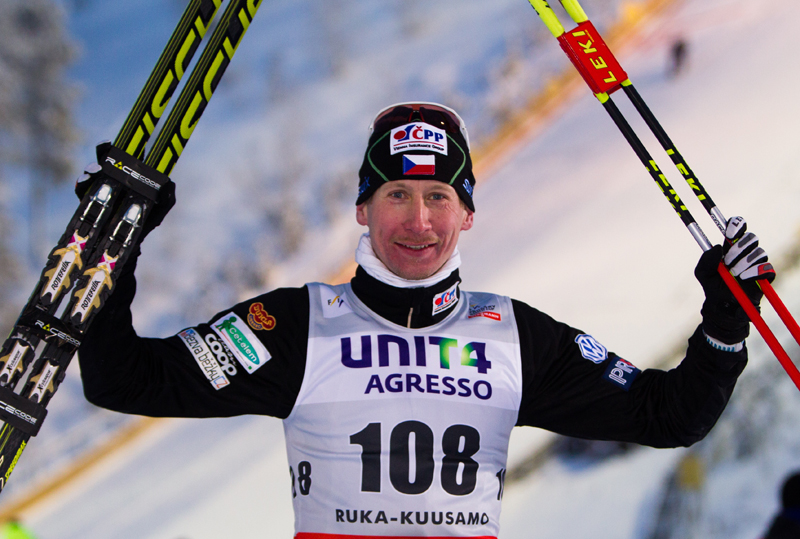
    Lukas Bauer (CZE) celebrates his win.  Photo: Fischer / Nordic Focus.
    Lukas Bauer (CZE) celebrates his win. Photo: Fischer / Nordic Focus.

    Lukas Bauer’s (CZE) masterfully paced race ousted Eldar Roenning (NOR) from the victors chair today in Kuusamo, Finland, allowing the veteran Czech to claim his first victory since 2010. Bauer’s pace in the 10k classic race saw his split times trailing throughout the first 8k to both Roenning and Dmitriy Japarov (RUS), before accelerating in the final kilometers to best Roenning’s time by just 2.4 seconds.

    Japarov took third, 5.7 seconds behind Bauer and just over three behind the Norwegian.

    Martin Johnsrud Sundby (NOR) was the early leader.  Photo: Fischer / Nordic Focus.
    Martin Johnsrud Sundby (NOR) was the early leader. Photo: Fischer / Nordic Focus.

    Martin Sundby (NOR) was the early leader followed, surprisingly, by the sprinter Pål Golberg (NOR), who ultimately placed an impressive 4th. But once Roenning hit the course, all else would trail until Japarov started. It appeared to be the Norwegian’s day as he looked comfortable on the climbs and gradually opened a gap.

    The Russian went out hard and fast, taking 10 seconds off of Roenning’s time at 3.1k. At 6.4k he increased his lead by another second. That was the high water mark for Japarov however, and he began to pay the price for his early breakneck pace.

    At the 8k split Japarov’s lead was down to 5 seconds. His energy continued to fade over the last kilometers, and visibly exhausted, he labored up the final climb to the stadium.

    Unable to maintain his lead, he finished 3.3 seconds behind Roenning.

    “I’m a bit disappointed with today’s result,” the Russian told FIS. “I was hoping for victory. On the other hand…It’s very nice to start the season with a podium. I hope I can do such result again.”

    Bauer, his splits steadily trailing throughout the race, did not appear to be a threat for the win. until 2k from the finish he turned up his pace considerably, charging up the final climb and sprinting into the stadium to snatch victory away from fellow classic specialist Roenning.

    After the race Bauer told FIS, “I have extreme experience from Kuusamo, it’s been either successful or disaster, nothing in between. It’s nice I could enjoy a great day. Yesterday’s sprint was a disaster for me, 104th place was not good. I did not feel the best today but the snow conditions fit me very well.”

    Roenning, speaking to Norwegian broadcaster NRK, said that he is “a little bitter that he [Bauer] hung on me in the first round. He got a good ending, but I’m pleased with second place. I go fast from start to finish.”

    Coming through the lap after the first 3.1km loop, Roenning found Bauer headed out of the start. The Czech caught a ride from Roenning, much to his advantage.

    Although Bauer seized his advantage in the final 2k, Roenning felt he did well at the end of the course telling FIS “I felt quite good and had a fast 2.0 km before the finish. It was an exciting competition. I have not been in the yellow bib for almost seven years. Tomorrow is skating and I have no hopes to be in top 10.”

    Three North Americans finished in the top 30. With Ivan Babikov in 21st, Noah Hoffman in 28th, and Alex Harvey in 30th.

    Complete Results

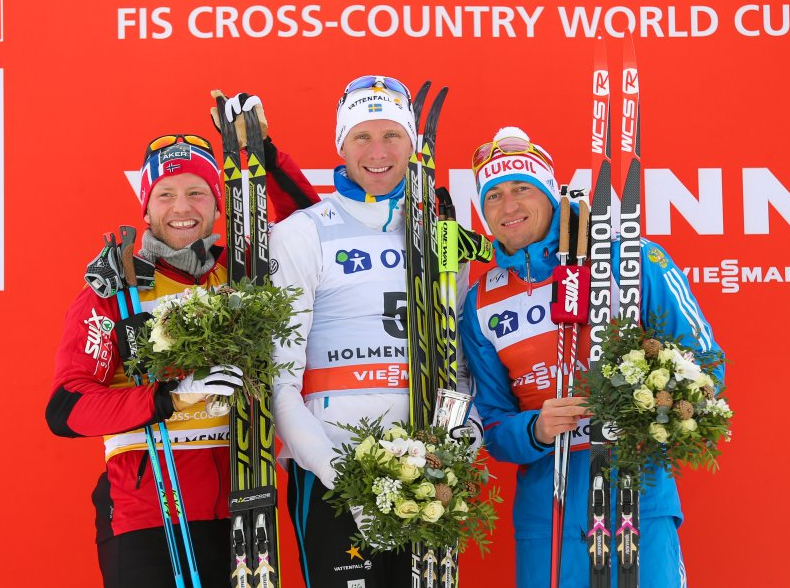
    The men's podium in Kuusamo, Finland (FIN): (l-r) Eldar Roenning (NOR),  Lukas Bauer (CZE) and Dmitriy Japarov (RUS).  Photo: Fischer / Nordic Focus.
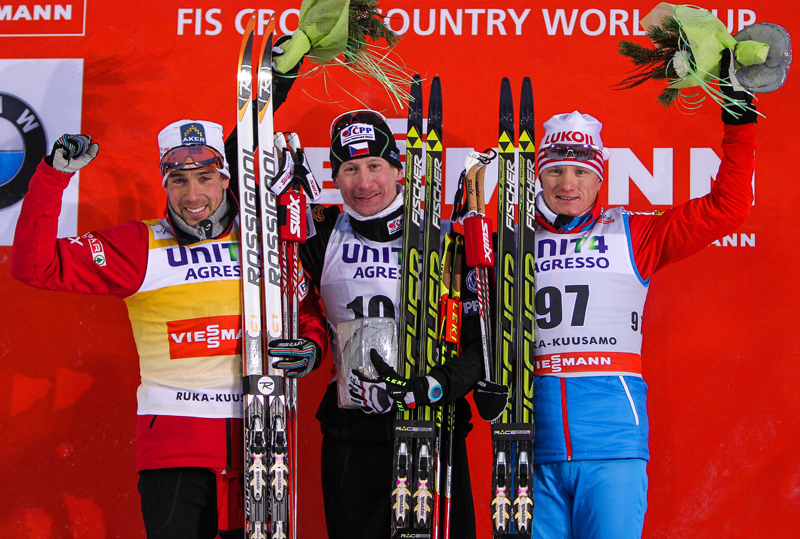
    The men’s podium in Kuusamo, Finland (FIN): (l-r) Eldar Roenning (NOR), Lukas Bauer (CZE)
    and Dmitriy Japarov (RUS). Photo: Fischer / Nordic Focus.
  • Norway’s Røthe Ousts Hellner for La Clusaz Relay Victory

    Norway’s Røthe Ousts Hellner for La Clusaz Relay Victory

    Sjur Røthe (l) anchors Norway's victory, 0.5 seconds ahead of Sweden's Marcus Hellner, in the La Clusaz World Cup 4 x 7.5 k relay on Sunday in France. Martin Jaks of the Czech Republic (second from r) took third and Russia's Ilia Chernousov crashed just before the finish for fourth.
    Sjur Røthe (l) anchors Norway’s victory, 0.5 seconds ahead of Sweden’s Marcus Hellner, in the La Clusaz World Cup 4 x 7.5 k relay on Sunday in France. Martin Jaks of the Czech Republic (second from r) took third and Russia’s Ilia Chernousov crashed just before the finish for fourth.

    Soaring into the stadium toward the finish, the men’s 4 x 7.5-kilometer relay quickly shaped up into a Norway/Sweden showdown. Surprise, surprise.

    The Czech Republic and Russia’s A-team had been consistently in the mix, yet as they sprinted down the final straightaway less than a second behind, it was clear Sunday’s World Cup relay was coming down to the two powerhouses. The only thing missing was Petter Northug.

    Sjur Røthe filled in, anchoring Norway to a half-second victory over Sweden, but not without what some considered a “cheeky” move meters before the finish. Racing head to head with Sweden’s Marcus Hellner, Røthe surged ahead and moved to the right in front of Hellner, pushing him toward the boards. Hellner stood up, slowing and settling for second, 0.3 seconds ahead of Martin Jaks of the Czech Republic. Russia’s Ilia Chernousov stumbled on his own on the other side of the track, crashing and ending up fourth (+9.3).

    It was a series of events that left some scratching their heads and others – like the Swedes – infuriated. Sweden’s coaches protested Røthe’s late move, but in the end, the jury upheld Norway’s victory.

    Røthe, they reasoned, had been ahead of Hellner when he decided to switch lanes. The Swedes saw it differently, but accepted the decision.

    “It was a riot that I did not think was quite fair,” Swedish assistant coachRobin Johansson told SportExpressen.se, according to a translation. “But we realized that it was a borderline case.”

    Swedish men’s coach Arild Monsen later told Langde.se: “It was a bit on the edge but Røthe was ahead and had the right to choose tracks.”

    The way NRK saw it: “Røthe selected [the] corridor very late, and cut that way in front Hellner and prevented Swede to accelerate towards the finish line.”

    Regardless, the Norwegians ended up on top after staying in contention from the start. Their team of Eldar Rønning, Didrik Tønseth, Martin Johnsrud Sundby and Røthe crossed the line first in 1:17:22.5. Sweden (Daniel Richardsson, Johan Olsson, Calle Halversson and Hellner) was second and the Czechs (Jiri Magal, Lukas Bauer, Ales Razym and Martin Jaks) notched their first team podium since 2008.

    Early in the first leg, Kazakhstan’s Sergey Cherepanov set the pace on the sunny and balmy day, with temperatures rising into the 40s by the early afternoon. However, the course remained shaded before the start so conditions changed drastically when the sun shifted overhead.

    As Cherepanov tagged off in first, Russia’s Evgeniy Belov held his own in second (+1.7) and Rønning handed off in third (+2.2). On the second leg, Kazakhstan’s Alexandr Malyshev dropped back and Russia took the lead with Maxim Vylegzhanin. The Czechs moved to second with Bauer, who later tagged off in first, and Sweden’s Olsson came through the exchange in third (+16.3).

    Meanwhile, the man subbing for Northug, Tønseth remained in contention 19.3 seconds back in fourth as he tagged off to Sundby for the third leg. After Sweden’s Halvarsson led early, Russia’s Alexander Legkov took control of the third leg while Halvarsson and Sundby tucked closely behind.

    The front group became a definitive four with Razym (CZE) bringing up the back. Behind them, Switzerland trailed by more than 20 seconds in fifth, leading a chase pack of Germany, Russia II and Finland. Finland’s Matti Heikkinen received a yellow card for skating during the second leg, and the Finns did not finish with anchor Sami Jauhojärvi out due to illness, according to a FIS press release. (Jauhojärvi has not raced in more than a month after his father died suddenly in late December.)

    First out of the last exchange, Røthe made a point to stay in front, leading Russia’s Chernousov, then Hellner, and finally Jaks, who brought the Czechs back into contention from 23 seconds back at the tagoff. The lead four remained within two seconds of one another with about a kilometer to go, and in the final meters, Røthe outdid the others for the win.

    It was Norway’s second victory in as many World Cup relays this season after their crew of Rønning, Sundby, Røthe and Northug won the opener in Gallivare, Sweden. There, the Norwegians beat the Swedes (Emil Jönsson, Olsson, Richardsson and Hellner) by 6.4 seconds.

    “When I spoke with Sjur before the race he said that he needed to be within 20 seconds of the leaders and that he could win for us,” Sundby said at a post-race press conference. “He showed us today that he was telling the truth. It was a great win for the team.”

    “I know I have a good sprint, but I was a little afraid [of] Hellner,” Røthe told NRK. “Thankfully it went well in the end.”

    The victory was a special one for Norway, which proved it can beat Hellner with two different anchors. “I suppose I did an OK job a substitute,” Røthe said with a smile.

    “In the relay you just never know what can happen,” Bauer said at the press conference. “Our team raced very tough today and Martin was able to bring us back to the leaders.  This is a great result for the Czech Republic. We are very happy.”

    Results


  • Cologna Sweeps Otepää; Kershaw Channels Frustrations for Third

    Cologna Sweeps Otepää; Kershaw Channels Frustrations for Third

    Devon Kershaw in the final climb at Alpe Cermis, Italy, in this year's Tour de Ski, where he was fourth overall.

    Devon Kershaw had it in his head. He wanted redemption.

    The Canadian National Team veteran hadn’t been entirely pleased with his season so far despite finishing fourth in the Tour de Ski two weeks ago. After several top 10 performances this season, Kershaw took a big hit on Saturday, finishing 40th in the World Cup classic sprint after his pole shattered in his hand and he struggled to find a replacement.

    With one chance to leave Otepää, Estonia, on a high note, Kershaw channeled his frustration into fuel and charged out of the starting gate on Sunday to clock the fastest splits for the first half of the men’s 15 k classic individual start.

    At the 2.5 k mark, he was better than Switzerland’s Dario Cologna, the eventual winner, by 11.5 seconds. Halfway through, Kershaw still had the edge by about 3 seconds. Cologna was closing, but Kershaw was having his best race of the season regardless.

    The 29-year-old Ontario native went on to finish third, 25.2 seconds behind Cologna and 1.2 behind runner-up Lukas Bauer of the Czech Republic.

    “I had such a frustrating day all around yesterday, and in the sprint [qualifier] when my pole exploded in my hand, that really crushed me,” Kershaw said in a phone interview on Sunday. “In the race today, I felt fantastic. Looking at the splits, I think I went out too hard, but didn’t feel like I died. Dario’s on a completely other planet and Bauer closed insanely well.”

    Cologna climbing at Alpe Cermis.

    Coming off a victory in Saturday’s classic sprint, Cologna started last and by 2.5 k, ranked after Kershaw, Marcus Hellner (SWE) and Evgeniy Belov (RUS). Ten kilometers later, the Tour de Ski champion and overall World Cup leader moved into first. Cologna had not only caught Kershaw in the second half of the race, he surpassed him by 15 seconds by 12.5 k.

    Meanwhile, Bauer, who won the 15 k classic in Otepää two years ago, went from 12th to third by the midway point. Starting eight spots ahead of Cologna and six behind Kershaw, the 34-year-old Bauer narrowed the gap to come within 8.4 seconds of Kershaw with 2.5 k to go. He continued to push for second place, his best result of the season.

    “I was very surprised at the beginning when I heard Devon was so fast,” Bauer said in an interview with the International Ski Federation (FIS). “I was just hoping he cannot keep the high pace all the way through. … The key to success was a good kick and skis. I think the difference [for] me and Devon was just I was more lucky today.”

    Bauer

    For Cologna, who ranks 294 points ahead of Petter Northug (NOR) in the overall World Cup standings, it was the first time he had secured back-to-back victories at one venue. Earlier this season in Rogla, Slovenia, the 25-year-old won the freestyle sprint after placing second in the 15 k classic mass start.

    “It means a lot for me to win here twice in Otepää,” Cologna told FIS. “My shape has been perfect. I was especially strong in the last lap. … [My] first races [this season] were not perfect for me, but since the Tour, I have been in really good shape. It will be difficult to keep these good results.”

    While Cologna said he received information about Kershaw during the race, he wasn’t too concerned with splits. Instead, he focused on his own pace on the challenging course.

    Kershaw said he heard splits indicating he was about 20 seconds ahead of anyone else for most of the race. At the same time, he didn’t exactly know where the top-seeded men behind him were, like Cologna and Bauer.

    Devon Kershaw (CAN) singlesticking on the final climb of the Tour de Ski in Alpe Cermis, Italy, on Jan. 8. He placed 18th in the 9 k pursuit climb and was fourth overall in the Tour.

    “I was out to win the race,” Kershaw said. “[I was] really able to shut my mind off completely and just have a cool, clear head, just really loving the movement. … It was for third but that’s OK. It’s not often in my career that I’ve been able to get into that head space.”

    While he acknowledged that every athlete, except maybe Cologna or Northug, deals with similar ebbs and flows in their mental state, Kershaw tried to ignore his past distractions and detach himself from pain. That was especially tough to do in Otepää.

    “It’s the hardest [distance course] on the World Cup, without question,” Kershaw said. “Three massive, really punishing climbs, so there’s always a big gap in Otepää. … There’s no hiding out there at all. If you’re a bit off, it’ll be exploited.”

    He said that was likely the reason Cologna pulled out such a decisive win. After Kershaw, Stanislav Volzhentsev (RUS) was fourth, 41.3 seconds behind Cologna. Another Russian, Petr Sedov placed fifth (+42.2). Both drastically gained ground on the lead group; Volzhentsev initially ranked 18th and Sedov was 21st at 2.5 k.

    Hellner ended up sixth after gradually losing time on the three-lap course. His Swedish teammate Johan Olsson was seventh, Ilia Chernousov (RUS) placed eighth, Jean Marc Gaillard (FRA) was ninth, and Sami Jauhojärvi (FIN) was 10th.

    Kershaw’s teammate, Alex Harvey, finished 19th after finishing fourth in Saturday’s sprint. Kris Freeman and Noah Hoffman scored points for the U.S. Ski Team, placing 22nd and 26th, respectively.

    While Northug opted to sit out the second weekend of World Cup races after the Tour de Ski, the Norwegian remains at the top of the Distance World Cup standings. Cologna is 25 points behind in second.

    Audrey Mangan contributed reporting.

    Men’s 15 k classic results.


  • Roenning Labors for Northug Before Taking Individual Glory, Harvey 2nd

    Roenning Labors for Northug Before Taking Individual Glory, Harvey 2nd

    Eldar Roenning (l) follows Sergey Turych (r) around a corner in the 22km classic. Roenning won the race.

    VAL DI FIEMME, Italy – Eldar Roenning (NOR) spent much of the eighth stage of the Tour de Ski working for Petter Northug (NOR), but as the final kilometer rolled around, he submitted his resignation, packed up his skis and poles, and headed out on his own.

    Roenning attacked on the final climb of the unforgiving Val di Fiemme 4.5 kilometer loop, opening a 10 meter gap entering the stadium, a lead he never relinquished on his way to his second podium of the 2012 Tour de Ski.

    Canadian Alex Harvey claimed his second career distance World Cup podium, and first since 2009, edging out Tour leader Dario Cologna (SUI).

    The penultimate stage of the Tour measured just over 22 kilometers—five times around a grueling loop that seemed to defy physics—is it possible to go up for so long, and descend so little?

    Canadian Head Coach Justin Wadsworth didn’t mince words, saying “It might be the hardest classic course ever,” pointing to the two big climbs right at the end, and the added challenge of the bonus seconds available each lap at the top of the biggest climb.

    Cologna, who described his race as “perfect,” said there were too many steep climbs and hopes that will be adjusted before next year’s World Championships, while distance specialist and two-time Tour de Ski Champion Lukas Bauer (CZE) said “It fits me good [the course], for my endurance, but it is not skiing, it is running.”

    Norwegian coach Trond Nystad added, “This is by far the hardest race in the Tour de Ski.”

    Alexander Legkov (RUS) following Giorgio Dicenta (ITA) up a large climb as the lead pack, and Legkov's Tour podium chances disappear over the crest.

    The course was modified from last year, with the biggest change being the location of the mid-race preems—one per lap. Instead of sitting down in the stadium on the flat, it now stood at the pinnacle.

    The result was a pack that strung out quickly, unusual for a men’s World Cup race, and a steady line of elite racers falling off the back.

    “They started to push from the first bang until the end,” Finnish veteran Sami Jauhojärvi told FasterSkier.

    The first of the overall Tour contenders to falter was Maurice Manificat (FRA) who entered the day in 6th, seconds from the podium. Under halfway through the race he was cooked. Alexander Legkov, (RUS), Giorgio DiCenta (ITA), and Ilia Chernousov (RUS) followed after, at varying points of the race.

    Bauer spent much of the race at the front driving the pace. The veteran saw his chances for the podium crumble in the 35k pursuit when a feed station collision left him with a broken pole.

    His goal for the day was “to be very active.” He was certainly that, pushing at the front, though never getting away.

    Roenning and teammate Niklaus Dyrhaug also had a strong presence in the front pack, but they skied with a greater purpose.

    The men were tasked with helping Northug close the gap on Cologna—working to get him set for the bonus sprints.

    From the spectator’s point of view, it can be hard to make sense of the constantly shifting positions, but Dyrhaug said the strategy worked well, as evidenced by the 55 seconds Northug earned.

    “He was really satisfied with my work, and I am really satisfied I could help him,” Dyrhaug said. “I tried to help him get in a good position in the start of the hill, and he should do the rest of the work himself.”

    Dyrhaug striding out.

    Roenning was also involved, but while Dyrhaug said “I offered myself totally,” to Northug’s cause, and that “I have never been so tired in my whole life as the last round up there [at the top of the course],” the eventual victor did not need to expend too much energy in for his teammate.

    He assisted Northug in gaining position, but never factored into the front of the sprint.

    The stocky Norwegian gained confidence during the warmup when a new pair of skis offered excellent grip in addition to good glide. Two laps in, and he knew he had the body was clicking as well.

    After 22 kilometers packed with relentless climbing, it was the last relatively small hill into the stadium that made the difference in the race.

    Russians Sergey Turychev and Dmitriy Japaov took the lead out of the downhill on the final large climb, up past the iconic Italian village church.

    The attack could have been decisive, but Harvey, who was comfortably in fifth behind Cologna was unconcerned.

    “They punched it so hard at the bottom of the second to last hill,” Harvey said. “There was zero chance they would be strong….those guys would die.”

    He made sure to stay behind Cologna, so as not to get blocked by the doomed Russians, and when Roenning moved, Harvey proved prophetic.

    Harvey across the line.

    The Canadian then made his one mistake of the race. When Cologna broke into a herringbone, Harvey did not step out and move around.

    “I was a bit stronger than Dario at the end, but I just followed him and that is when Roenning went,’ Harvey told FasterSkier.

    While he was plenty happy with second—the World Cup points, the prize money, and the advancement in the overall Tour standings, Harvey believes that if he had stayed on Roenning’s tails he could have used the draft to slingshot by for the win.

    But that is neither here nor there as Roenning would not be caught on the homestretch. Harvey held off Cologna, and a hard charging Northug, who was unable to make a dent in the now impenetrable lead of Cologna.

    While Nystad said the day was very successful for the Norwegians—in addition to Roenning in first and Northug in fourth, Dyrhaug placed 7th—the winner said “I think Petter had a little bit of a tough day today.”

    With his overall Tour chances destroyed in a catastrophic first five kilometers of the Cortina to Toblach pursuit, Northug was looking for some measure of redemption today.

    He fought hard, several times staging a running attack for bonus seconds, but never looked like his usual confident and controlled self.

    As is his wont, he collapsed at the finish, utterly spent, only this time his effort was not even good for the podium.

    Northug and Cologna lead the field out of the start.

    Even had he been in top form, Northug would have been better off stopping at the course-side church to pray for a miracle given the way Cologna is skiing.

    Swiss Head Coach Guri Hetland told FasterSkier, that Cologna was raring to go this morning.

    “He really looked forward to ski, and that is always a good sign, when he is eager to go out there,” Hetland said.

    Watching Cologna cross the line with another podium, and ahead of Northug to boot, was “a pretty good feeling” for Hetland, and while she was confident that her star skier would perform well, she is not counting the massive crystal trophies until they are well in hand.

    “As we have said from the very beginning the Tour de Ski is until they are up there tomorrow [at the top of the Alpe Cermis]. So there is no time to lie back and relax,” Hetland said. “It is about being focused until the very end.”

    Eldar Roenning celebrating his win.

    Cologna feels his 1:22 lead on Northug in the overall is “a nice advantage.”

    He said he enjoyed his day, with the cold snow, hard tracks and boisterous fans.

    Eight stages in to the Tour, he said he is tired, and that “before the race you don’t feel so good,” but once the gun goes off “it is going better.”

    Roenning fell out of the quest for the overall podium with two bad races in Oberstdorf, and then a disastrous performance in the 35k pursuit.

    He bounced back well today, and has run the Tour with extra support from his brother Berhnard, a standout skier for Montana State University in Bozeman, Montana.

    Taking a break from his business studies in Ireland, The younger Roenning is chauffeuring his brother so he can stick to his own schedule, as well as helping with ski testing.

    On the last climb when Eldar attacked, Bernhard was “freaking out.”

    It is a good sign for Roenning to take the individual victory in an event that is a preview of the 50k classic at World Championships on this very course.

    That event is the focus of next season for the Norwegian, but long before that, he has to complete the Tour.

    A much stronger classic skier, Roenning says his goal in the final climb “will be to reach the top still alive.”

    Complete Results

    Nat Herz contributed reporting

    A spent Northug is helped up at the finish.
  • Teichmann Banishes Ghosts of Sprint Finishes Past in Tour Stage Win

    Teichmann Banishes Ghosts of Sprint Finishes Past in Tour Stage Win

    Germany's Axel Teichmann after winning the second stage of the Tour de Ski, the 15 k classic pursuit, on Friday.

    OBERHOF, Germany — After several years of playing a dour second fiddle to Petter Northug (NOR), Axel Teichmann (GER) struck a different chord on Friday, besting the Norwegian at his own game with a strong attack on the last climb to win the second stage of the 2012 Tour de Ski.

    On snowy afternoon at the ski stadium in Oberhof, the race was rife with waxing challenges—temperatures holding at right around freezing, a mixture of wet new snow, which continued to fall sporadically throughout the morning, and a granular base that was mixed up with the fresh stuff in places.

    From the beginning of the race, it was clear that nobody had perfect skis, whether they were on hairies or kick wax.

    Petter Northug (NOR) skis to a second-place finish in the second stage of the Tour de Ski on Friday. Photo by Rob Whitney.

    Northug led out of the start based on his performance in Thursday’s prologue, and maintained a 20 meter gap on Dario Cologna (SUI) and Maurice Manificat (FRA).

    But any hopes of a sustained break off the front came to an end two-and-a-half kilometers into the 15 k race, when Cologna and Manificat caught Northug and the rest of the field quickly swallowed the trio.

    At that point, it would not have been inappropriate to hit the café for a cup of coffee and some schnitzel. The event had become a de facto mass start for the top skiers, and there was no chance of a true breakaway.

    The favorites all maintained solid position through the next three laps, the pace fluctuating, stragglers falling away, and later starters catching on.

    At the end of the fourth of five laps, a sudden roar was heard from the stadium crowd—three skiers for the host nation had worked themselves right to the front before the final climb up to the stadium.

    Axel Teichmann, Jens Filbrich, and Tobias Angerer—the “big three” of German cross-country skiing—along with Lukas Bauer (CZE), Dario Cologna (SUI) and Alexander Legkov (RUS), led the race up into the stadium.

    The German team has been under fire from the national press for the last two months. Early results had been poor, and media and fans alike questioned a restructuring of the country’s national squad.

    According to the German Press Officer Stefan Schwarzbach, Teichmann, Filbrich and Angerer, all long-time World Cup veterans, had lobbied for the formation of a senior training group, splitting off from the younger members of the team.

    The three men did not feel they were on the program they needed as they prepared for the 2014 Olympics in Sochi, Russia—the probable “finish line” for the career’s of the leaders of the “golden generation” of German skiing.

    Lukas Bauer (CZE) and Jens Filbrich (GER) ahead of a pack in the 15 k classic pursuit on the second stage of the Tour de Ski in Oberhof, Germany. They finished seventh and 10th, respectively.

    Despite a history of strong results, Schwarzbach said that the skiers felt they would be competing for 20th place come 2014 if they did not make some changes.

    They turned to Frank Ullrich, a legend in German biathlon as the coach of champions Sven Fischer and Rico Gross, and an Olympic and World Championship gold medalist in his own right. Ullrich, an expert on altitude training, was named supervisor of the new training group.

    With this story as a backdrop, Teichmann, Angerer and Filbrich maintained position at the front of the pack.

    The race wound down the final descents and headed up the last series of climbs to the stadium. Teichmann moved to the front on the steepest section, creating a small gap on Bauer. Still leading after a final short descent, he charged over the last rise.

    After leading early, Northug was content to sit further back in the pack. He did not look relaxed on the large clilmbs as the race progressed, straining to stay up. But there was little doubt he would be there at the end.

    As Teichmann came up over the top, one question hung over the raucous stadium: Would Northug once again get the best of Teichmann in the final 100 meters?

    The rivalry began at the 2009 World Championships, when Northug personally defeated Teichmann in both the relay and then again at the 2010 Olympics in the 50 k. The German team was very strong over those two years, and it seemed that Northug was always sprinting away from one Deutsch skier or another.

    A look at the results shows this drama is somewhat overblown, but just as an urban legend takes root, the myth of Northug as Teichmann-slayer remains strong.

    After the race, Teichmann said he had worked hard on his double pole over the last year, and was confident in his ability. But there is none better than Northug in the finish stretch, and closing 10 meters over 200 is not insurmountable.

    We will never know if the race would have been a classic showdown between two of skiing’s greats, and who would have taken the upper hand. That’s because coming into the stadium, Dario Cologna (SUI) performed what Bauer termed “a great mistake.”

    Looking down on the men's 15 k classic pursuit in the Tour de Ski in Oberhof, Germany. Photo by Rob Whitney.

    The defending Tour champion went down, taking out Finn Matti Heikinen, who then crashed into Bauer.

    Northug was able to avoid the tangle, side-stepping the pile, but he came almost to a complete stop. Cologna was back on his feet in moments and he and Northug set out after Teichmann.

    But the race for first was over. Teichmann looked over his shoulder, seeing plenty of open snow. He crossed the line cradling his arms, and appeared to be rocking a baby to sleep.

    Just behind, Cologna couldn’t keep pace and had to settle for third, giving Northug second place.

    The crowd went wild, teenage girls screaming as if at a rock concert. The cheers were for a local hero—Teichmann is native to the German state of Thüringia, and lived in Oberhof itself for over a decade.

    After the race Teichmann said the victory was “really important” for German skiing, given the recent criticism and new training system.

    “Today we showed that we are back,” he said, simply.

    He added that he expected to see Northug and to battle the Norwegian, but instead found time to celebrate.

    His motions over the line were not a Northug style performance—Teichmann recently found out that he and his wife are expecting a second child, due in June.

    Filbrich and Angerer were held up in the crash and ended up in no position to fight for the podium, ultimately finishing 10th and 12th.

    Despite the mishap, Teichmann describe the day as “a really good race for the German team. Without the fall of Dario, there may have been two more in the top six.”

    Bauer was philosophical about the crash that cost him a chance for a top-three of his own.

    “I was thinking about the podium, but you never know until you cross the finish line,” the two-time Tour winner told FasterSkier.

    Bauer attacked several times in the last lap, but was unable to break away, frustrated by a skier always on his heels, making climbing “very difficult.”

    He ended up seventh, edged out by another elder statesmen of the sport, Italian Giorgio DiCenta.

    DiCenta and Bauer posted the second- and third-fastest times on the day, bested only by Eldar Roenning, who was also one place ahead of the pair in the final rankings.

    Roenning skied all the way up to fifth from a starting position of 57th, crossing the line just behind Alexander Legkov (RUS), who spent most of the last two laps toward the front of the pack.

    Such performances are impressive in their own right, but the day clearly belonged to Teichmann and the German team.

    Biathlon may be more popular, but given the throngs of schoolchildren swarming German Head Coach and Olympian Jochan Behle looking for his autograph, cross-country success is truly appreciated here.

    From the outside, Teichmann appears reserved, to say the least. He rarely cracks a smile, and even in victory is starkly serious.

    But according to Schwarzbach, he is very emotional, just “not on the outside.”

    Apparently Teichmann “cried like a baby” after one memorable victory, and is one of the most popular men in cross-country skiing.

    “If you walk with him through the wax cabins, you feel respect from every side,” Schwarzbach said, adding that Teichmman is “probably the best team player I have worked with in 12 years.”

    The Tour now moves to Obertsdorf, Germany, a four-hour drive away. Teams travel tonight, and racing continues with a classic sprint tomorrow.

    Teichmann said he is “not going to Obertsdorf to win the sprint.” He is looking ahead to the skiathlon on Sunday, and would be happy to make the quarterfinals tomorrow.

    Complete Results

    –Nat Herz contributed reporting. 
  • Northug Cruises to Victory In Davos; Manificat and Bauer Strong in 30 K

    Davos, Switzerland – Petter Northug served notice to the World Cup field Saturday in Davos, Switzerland that the Norwegian superstar has to be taken seriously – no matter where or what the World Cup race is.

    The odds were supposed to be against Northug Saturday. The 30 k freestyle distance individual start doesn’t suit his strong mass-start finishing style. The strong distance field taking to the start line was rounding into shape, especially home-town favorite Dario Cologna. Even the venue was supposedly against him, as Northug has never won in Davos – his best distance finish in the Swiss ski-crazy valley was 13th.

    But the exciting Norwegian showed why he is the World Cup Overall leader, taking the top step of the podium by a whopping 51.4 seconds over Frenchman Maurice Magnificat. Finishing third 59.5 seconds back was distance specialist Lukas Bauer (CZE) who picked up his first podium of the young season.

    As Northug was starting last, the 8,000 strong crowd of mostly Swiss and French fans had plenty of time to wait and cheer their skiers around the four 7.5 k loops.

    The best of the early-starters was Canadian Ivan Babikov, who rocketed out of the gate to hold the lead at a number of early time checks. Babikov was locked in a battle with fellow early-starter Matti Heikkinen (FIN). Also in the mix were Norwegian Petter Eliassen, who is best known for falling in the last kilometer of the 50 k at World Championships in Oslo last February, and Martin Johnsrud Sundby (NOR), an incredibly inconsistent distance specialist.

    With Babikov and Johnsrud Sundby setting fast times, it looked like the early starters might take the day – at least until the end of the Red Group hit the first time check.

    Maurice Magnificat (FRA), who has yet to record a medal on the World Cup this year seemed to break out of his early-season slump, taking the third-fastest time on the first two laps. Marcus Hellner (SWE) also appeared to be back in form, holding a strong second at 15 k before fading slightly on the last two laps to finish fourth, 1 minute 11.8 seconds behind Northug.

    At 30 k, Petter Eliassen established the fastest of the early marks on the day, taking a seat in the reindeer-hide chair. With close splits on the last few time checks, it looked like Babikov might be in position to pull the top spot out from under the Norwegian, but the Canadian fell short at the finish – as he came through the mixed zone, he was visibly upset.

    Eliassen withstood most of the red group challengers, as did Babikov, but as the top-ranked men started to come across the line, it was clear that a new leader would emerge. Johnsrud Sundby took the lead briefly, but relinquished it shortly thereafter to Bauer, who was supplanted quickly by Manificat.

    At that point, it was merely a formality – splits were showing Northug with an insurmountable lead, and he was still attacking. In the last five kilometers, the Norwegian was hop-skating hills like it was a sprint rather than a 30 k.

    By the time he crossed the finish line, Northug had built up 51.4 seconds of buffer – more than his female counterpart Marit Bjoergen put into the women’s field, and had banished all criticism of his all-around skiing ability.

    Of particular note was Northug’s domination of the downhill sections of the course, where he was extremely fast.

    “I had good skis and I gave my best to push in the downhills as I am not so strong than Maurice [Manificat] in the uphill,” said Northug after the race.

    As for the Czech distance specialist Bauer, he showed that he is rounding in to the shape that has seen him win the Tour de Ski twice in the past.

    “I was actually not sure if it is enough for the podium but at the end I made it,” he said.

    “I am happy with it. The longer races fit me well and I like Davos.”

    Bauer was also impressed with Northug’s skiing, especially in the distance individual start event.

    “Northug is not unbeatable,” said Bauer, “it’s just really, really hard.”

    In what is probably not a surprise, all three podium-placing athletes were happy with the return to 30 k individual start racing – but none were as brash about it as Northug.

    “I don’t like mass starts,” he joked in the post-race press conference. “I like to go alone.”

     Complete Results

  • Team 10: Czech Republic

    Czech Republic

    2009-2010 Nations Cup Ranking: 11th (1640 pts)

    2010-2011 Nations Cup Ranking: 10th (1882 pts)

    Men: 7th (1695 pts)

    Women: 15th (187 pts)

    2011/2012 World Cup Team

    Men

    Lukas Bauer

    Martin Jaks

    Ondrej Horyna

    Dusan Kozisek

    Jiri Magal

    Women

    Eva Nyvltova

    Ivana Janeckova

    What You May Have Missed Last Season

    Martin Jaks racing in Estonia last winter.

    The rise of Martin Jaks as back-up for Lukas Bauer over the course of the season was downright amazing. In 2009-2010, Jaks didn’t show up much on the radar – he scored 16 points, and was most notably a cog in the machine of the Czechs surprise Olympic-bronze medal winning relay team.

    Fast forward to 2010-2011, where Jaks finished 16th in the opening 15 k skate in Gallievare, and never looked back, finishing in the points in 15 races on the circuit, and collecting a career best 438 points. That includes the entire Tour de Ski, where he also collected a bronze medal during the pursuit in Oberstorf, in what was possibly the least impressive finishing sprint last season.

    Of course, Jaks may be following a little too closely in Bauers’ footsteps. The 25 year old qualified in just two sprints on the season (both during the Tour), although he finished a surprising impressive seventh in one.

    Lukas Bauer himself was his usual strongman self, especially on the Final Climb during the Tour de Ski. The Czech slow-twitch muscle wonder topped Alpe Cermis 30 seconds faster than his closest competitor, and moving up from tenth place into third overall in the competition.

    The Czech women were very quiet, led by Eva Nyvltova who was fairly strong during Tour de Ski, finishing a season-best eighth in the skate sprint in Toblach, Italy.

    What You Need To Know for This Season

    FasterSkier's Nat Herz interviewing Lukas Bauer at World Championships in Oslo

    As per a recent interview with FasterSkier, Bauer is focusing in on the Tour de Ski again, and as he himself admitted, he needs to be better at sprinting to win his third Tour.

    Not to belabour the point, but Bauer was the only man in the top 10 not to score a single sprint point this season. He was the closest during the Tour de Ski when he finished 34th in Toblach, Italy, in a skate sprint, sandwiched in the standings between the renowned Norwegian Snorri Einarsson and elite Frenchman Benoit-Gilles Duford.

    During the off-season, the Czechs were big on biking – Bauer scaled back his usual mountain bike racing efforts to just one race, while the entire team spent a significant amount of time on two wheels.

    It was a good summer off the trails as well for the Czech team, as Bauer is now $2,500 richer, (which seeing as he’s sponsored by BMW and Husqvarna, among others, he probably needs desperately), and Jaks got married!

    The Czechs are also a man down – Martin Koukal, member of the Olympic bronze medal-winning relay team, and 2003 50 k skate World Champion has opted to ski on the Marathon Cup circuit this season. Interestingly, he also went on quite the South American adventure this summer.

    Who You Should Watch

    FasterSkier tipped Eva Nyvltova last year, and we’ll give ourselves a pat on the back for it, as she doubled her World Cup points total. And you know what? We’re going to call on Nyvltova to do it again.

    Bauer (L) leading eventual winner Petter Northug in the 50 k at 2011 World Championships in Oslo, Norway.

    While Nyvltova may not be Katerina Neumanova right now, or ever (which may be a good thing), she is the kind of solid, dependable if not flashy skier that can rack up points. At 25, she’s still young, and has just 29 career World Cup starts. Most importantly, she has shown a knack for Tour skiing, finishing 22nd and 19th in her two trips thus far.


  • “Not Successful” in Oslo, Bauer Refocuses on Tour de Ski, Overall World Cup for 2012

    Bauer (L) leading eventual winner Petter Northug in the 50 k at 2011 World Championships in Oslo, Norway.

    At the age of 34, Lukas Bauer of has already done pretty much everything a skier can hope for.

    At the 2006 Olympics in Torino, he won silver in the 15 k classic. In Vancouver four years later, Bauer took home bronze in both the 15 k skate and the relay. He owns a silver medal from 2009 World Championships in the 15 k classic, and he has twice won the Tour de Ski; in 2007-2008 he also sat atop the leaderboard on the overall World Cup.

    So what makes the Czech keep going?

    A relentless pursuit of perfection, that’s what. Bauer still hasn’t won gold in either the Olympics or World Championships. Without either major event appearing on the 2011-12 FIS calendar, he is once again shooting for podium finishes in both the Tour de Ski and the overall World Cup.

    Bauer doesn’t have one of the more outsized personalities on the World Cup; his reputation is as an honest competitor and a hard worker. He has talked in the past about doing workouts like 50 x 100 meter sprints (think about it: five kilometers worth of rollerski sprints!), a task that would make even the toughest athletes quiver in their boots. True to form, Bauer – who has excelled in individual start races but not in sprint finishes – recognizes his strengths and focuses on his weaknesses, quietly.

    But in his correspondence with FasterSkier, Bauer has been not only courteous, which was expected, but funny. He was also as willing to take the time to answer questions as any other foreign skier we’ve approached.

    FasterSkier was able to catch Bauer over e-mail from Muonio, Finland, where he is using the scant snow to prepare for the first World Cup races of the season along with most of Europe’s other national teams.

    Bauer on his way to 7th place in the 15 k classic at 2011 World Championships in Oslo, Norway.

    FasterSkier:First of all, how has your summer and fall been so far? I saw that you had ankle problems in the early summer, but

    are you feeling prepared for competition now?

    Lukas Bauer: I think that I had quite good summer and fall but for sure I had also some problems (ankle from a football match in June, and sickness in August). But I think it’s normal that sometimes your training is changed by some troubles. I’m not nervous about it and I know that when I was able to train, I trained well.

    FS: You have been training with the Germans. Why did you decide to do that?

    LB: Yes, it’s true. The system is that I’ve trained with Germans and the Oberwiesenthal group (trainer: Janko Neuber, German women’s ski team trainer; athletes: Tom Reichelt; Valentin Mättig; Monique Siegel) during my stay home, between Czech national team camps. During Czech national team camps I’ve trained with Czech team according Miroslav Petrasek, the Czech ski team trainer and my former personal trainer. The reason why I decided to change my previous training routine is not simple to explain, but I felt that I needed to change in the last two years. I had trained with this group (and also Rene Sommerfeldt) in the summer and fall of 2006 after Olympic games in Torino, and I was very satisfied. One of the reasons was that between Czech camps I had trained almost every day alone, and sometimes it is not bad if you have somebody to push you to the limits. The German group lives just five kilometers from my home. Now I have very good training partners on almost every session, and it is a benefit for everybody.

    FS: How has training with them been different than when you were just training with the Czech team?

    LB: Like I wrote before, now I did almost every session when I was at home with the group and not alone like before, which is good for motivation, more fun during long trainings, and also easier, because you can feel the coach’s support on every session. And there is also the difference in favor of various training resources (something that is special for every national team). If I can compare the Czech and German styles, then the Czechs prefer a lot of running training, and the German style prefers more rollerski training. But that is a very simple comparison and for me it was also interesting that this change open my eyes to training details, ĺike I was junior!

    Martin Jaks racing in Estonia last winter.

    FS: How are the Czechs doing? Martin Jaks had a great Tour de Ski last year.

    LB: My feeling is that my teammates had a very good summer and look stronger than last year. For sure especially Martin Jaks is

    coming ito the best age, and they all could be faster then before in the winter. But the question is the same for everybody – how successfully they transfer better running endurance to skis. But it would be great if they can be stronger. We especially we need it for relays.

    FS: With no World Championships, what are your goals for this season?

    LB: It’s simple, this season for me the goal is the Tour de Ski! And the second goal is for the overall World Cup standing, where my goal is the top three places. But if the season will go in bad direction, like if there’s no chance for the top three in the overall, then I will think about Vassaloppet.

    FS: Last year, the World Cups in the Czech Republic weren’t really suited to your style of skiing, but this year there is a long classic race. Are you focusing on those “home” races in particular, and are you excited for them?

    LB: Yes, for sure, I’m focusing on World Cup in Nove Mesto – because there is every time an excellent atmosphere and I like to ski there.

    FS: Is it ever hard to motivate yourself to train and compete when you have already had so much success?

    LB: I have no problem with races, but for sure sometimes for training, especially when is very bad weather, I need a kick [in the pants]. But without training you never get results….

    Lukas Bauer after winning the final stage of the 2011 Tour de Ski. Photo: Toko.

    FS: Looking back, how do you feel about the 2011 season? Were you happy with your results?

    LB: I’m very satisfied with my third place in Tour de Ski overall. Maybe this Tour was for me the hardest compared to previous

    Tours, because almost nothing went in the direction that I wanted and that I needed… [there were] some problems with skis, wax, some crashes, and also my rivals were very strong in the sprints, where they took a lot of bonus seconds. And with my sprint “abilities” [Bauer inserted a frowning emoticon] I had to work hard to reach third place in the final.

    World Championships in Oslo was not successful for me. Not bad, but not succesful. But it is just that some athletes were simply better in this time and also after struggling with waxing, like many teams, my seventh place from 15 k classic was nothing excellent, but also not a fiasco.

    FS: How much mountain bike racing did you do this year? Do you think it helps your skiing physically, or do you mainly do it just because it’s fun and that helps you get out the door?

    LB: I did just one mountain bike race this year, which is nothing. I decide to decrease my mountain bike racing this summer when I changed training routine with the idea of being more focused on skiing. I like mountain bike racing a lot, and when I was junior I was on the edge about whether I would continue like a skier or a mountain biker. It’s fun and also fun training.

    FS: It seems like FIS changes the rules and the race formats all the time. What new formats and new rules would you like to see?

    LB: Yes, there are many changes during last few years. I think that it is important to slow down with changes and make the rules more simple and more “viewer friendly”. And to make better TV coverage, because sometimes it is quite boring – but I’m not sure how much it is FIS and how much TV production.

    FS: When you won the relay bronze medal in Vancouver, it really proved that your country had a good team instead of just a few excellent individuals like you and Neumannova. What did that do for you and the other skiers? Have you been able to find more sponsors? Has skiing become more popular in the Czech Republic?

    LB: The relay was amazing and I think that it helped other members of relay to find more sponsors, but for me is difficult to say if and how much, because I also had an individual medal from Vancouver and some other very good results from the past, which meant that I “already had name”. But for me it was important that we reached this excellent result with the team and not “just” with individuals. It was also great for our support team (servicemen, doctor, masseuse) and for sure for our  families, because they are behind us in the shadow and without their support is not possible for us to do it.

    Bauer en route to bronze at the 2010 Olympic Games.

    About the sponsors, for sure after Vancouver I’ve found some more sponsors, but for me it was also important that when many companies were fighting with financial crises I still had sponsors, and with them I’m able to make preparations for the season like I want. Skiing in the Czech Republic looks more popular than some years before (I’m talking about how many kids are doing the sport, not about how often this sport is on TV and newspapers), but the problem is that skiing is quite an expensive sport and the young generation like computers and TV than sports. But it is the same everywhere.

    FS: What about the 2009 World Championships – corruption seems to have been a big problem. Has that led to any change in public opinion about skiing, or affected you in any other ways?

    LB: It affected me just right after WCH, when I was almost every day asked what is my opinion about [it]. I think that the investigation around WCH, if there was or wasn´t corruption, is not finished yet. But I think that after some “hot” months right after WCH it looks that public opinion is not negatively changed about skiing, there is more [just] a negative public opinion about Neumannova and her team that was organizing WCH.

    FS: I’ve heard and read that you have been trying to work on your speed in all sorts of ways, including using the SkiErg. What has your strategy been in that department and would you consider the SkiErg experiment a success?

    LB: Yes, the summer between Vancouver and Oslo, our goal was to work more on speed. Not to try be a danger for Petter Northug in sprint, but just to work to be faster for bonus points during mass start races and to be able to change speed during some attacks. I think that it was visible on some races last winter (for example the World Cup La Clusaz), but for sure, first it is important to be healthy and to be in good shape and this is something extra… And my former trainer thought the SkiErg looked like a good tool for upper body. I did some training on this machine, and some intervals. First I was surprised at how quickly your energy goes away, but we don’t do a lot of training on it. I still have it in my garage. I did little tuning, and sometimes I’m using it, but not often.

    FS: Doping seems to always be a topic of discussion with skiing, but the Veerpalu case is bigger than most. Do you think that his positive test in particular has changed anything for the sport or for you? Do you sense a greater distrust on the part of the fans?

    Bauer at 2009 World Championships.

    LB: I think that it changed nothing for sport, because, it is a pity but it’s reality that just like in normal life, also in the sport (and skiing) there are some people who will cheat the rules. My opinion is that these people were, are and will be [another sad emoticon]. And this is WADA’s job to try to catch people who are cheating the rules. What his case changed for me? Nothing

    specific. But for sure I had in my head questions without answers like: In the case that he used the doping (only he knows if he did or not) had he used the doping also in the past, when I took silver in WCH in Liberec 2009, and also in Olympics in Torino 2006, right behind him? Why did he do it just before end of his career? This was what I had in my mind, but I’ve stopped it, because I don´t know and never will know the answer. And also I’ve [convinced myself] that I don’t know it. Why? Because now I can think that I lost gold medals in a fair fight (hoping that if he used doping it was only when he was caught), because I don’t want to get medals by [default]. For me the results are not about the medals, but about emotions, and they were built there with the silver medal and there is no chance to change that.

    And about the fans? Maybe I’m crazy but my opinion is that the fans who believed that Veerpalu is a doper now will scream that they were right, and the fans who believed that Veerpalu is clean will still  believe that he is innocent, and just small part of them will change their opinion. It’s the same with every skier.

    FS: You are obviously very busy as an athlete, but your wife is quite accomplished as well. How do the two of you make time for family, and is it a challenge with so much travel and racing?

    LB: For sure, winter time especially is a hard time for my family, but it’s life and I’m happy that my family is still supporting me in my sport dreams. But the rest of the year I’m trying be home as much as possible, and this was also one reason why I changed my training routine last spring.

  • Can Bjørgen Repeat Her Dominant Performance?

    Marit Bjørgen pretty much wiped the floor with folks last year in distance events:

    As a stats guy, when I see extreme events I tend not to expect them to repeat themselves. The general principle here is called regression to the mean. Extreme events are just unlikely, so it doesn’t make sense to expect them to happen repeatedly. From a numbers perspective, Bjørgen’s season was pretty much unrivaled, so if I were a betting man I’d wager that she won’t be as dominant next year.

    At the very least, I wouldn’t expect her to win by a consistently large margins over the field, even if she actually wins nearly as many races. But you never know!

    When people have had extremely good seasons in the past, sometimes they can sustain is for a few years in a row, other times not. For example, here are some examples of some men who had a strong season but weren’t really able to sustain that level:

    Fredriksson’s 2003 campaign is the most obvious example here. Sommerfeldt had great seasons in 2003 (second place in the WC overall) and 2004 (first place) but couldn’t sustain his 2004 performance. Similarly, Bauer had an amazing season in 2008.

    Two examples of people who managed to sustain some level of dominance for more than a year or two were Björn Dæhlie and Vladimir Smirnov:

    These guys were already pretty much top of the heap, but each seemed to step things up for three consecutive seasons. Dæhlie for 1995-1997 and Smirnov for 1994-1996. Which pattern Bjørgen follows remains to be seen…

    Related posts:

    1. <Marit Bjoergen’s Best Freestyle Race
    2. <How Many WC Victories Does Björgen Really Have?
    3. <Björgen vs Skari vs Välbe


  • Jauhojaervi, Bauer Get Prize Money from 2009 Tour

    The Czech Republic's Lukas Bauer racing at the 2011 World Championships in Oslo. Bauer recently received over $2,500 in prize money owed to him by the International Ski Federation.

    Two skiers have received more than $5,000 in overdue prize money owed to them after the disqualification of a Russian skier for doping in 2009.

    This spring, both Finland’s Sami Jauhojaervi and the Czech Republic’s Lukas Bauer confirmed to FasterSkier that they had each received some 2,200 Swiss francs apiece from the International Ski Federation (FIS), for their performances in the 2009 edition of the Tour de Ski.

    Jauhojaervi and Bauer finished 10th and 11th, respectively, in the overall standings of the race, and had been elevated one position after Russian Evgeni Dementiev’s ninth place was voided due to his use of EPO, a banned blood-boosting drug.

    A little-known FIS rule required that Dementiev’s prize money be confiscated and distributed retroactively to Jauhojaervi and Bauer, but the case had stalled until a FasterSkier investigation highlighted it in November.

    In an interview last week, FIS Secretary General Sarah Lewis acknowledged that there had been an “oversight” in her organization, which she attributed to the relative rarity of such cases, and their complexity.

    “It’s such an ad hoc, unusual thing to happen—it just needs to be better followed-through,” she said. “You’ve got multiple little chains there, where there can be a breakdown. Clearly, it didn’t work as well as it should.”

    Dementiev’s case was especially drawn out: because of procedural hurdles, it was more than six months before he was suspended based on the results of a drug test that occurred in January, 2009.

    By that point, Bauer said, the Tour results had dropped off his radar, and it hadn’t occurred to him to ask after the prize money. In an interview in Oslo in March, he called on FIS to do a better job of overseeing the redistribution process.

    “I think that they have to work on it,” he said. “It was not the first case—and I’m sure it will not be the last case.”

    FIS officials had previously noted that neither Bauer nor Jauhojaervi—nor their national ski associations—had approached the federation about the missing prize money in the period following Dementiev’s disqualification. But in the interview, Lewis said that the responsibility for follow-up ultimately lay with her organization, not the skiers themselves.

    “It’s not the athletes who have to initiate the process,” she said. “The athletes…should expect that the process will be managed by FIS.”


  • Gaillard Wins Tight Tour de Barents, Majdic Wraps up Career With Victory

    Jean Marc Gaillard (FRA) edged out teammate Maurice Manificat at the line to win the second edition of the Tour de Barents, a four-stage mini-tour in the Barents region of northern Europe.

    On a unique “final climb” Gaillard teamed up with Manificat to catch overall leader Matti Heikkinen (FIN), who started the day with a 13 second lead in Rovaniemi, Finland on Sunday.

    Heikkinen started the freestyle race quickly, but was unable to hold off the two Frenchmen.

    “Matti started really fast and I had to wait for Maurice so that we could catch Matti together,” described Gaillard.

    Heikkinen was unable to manage the pace. With three rounds of the 4.4km loop, complete with wall-like climb, the course was an unforgiving 13.2k.

    The veteran Gaillard chalked up his victory to his years on the elite circuit, saying, “Maurice was probably stronger than me, but maybe experience gave me this victory.”

    The margin was just .2 seconds at the end, with Heikkinen coming across 33 seconds later.

    Lukas Bauer (CZE) was unable to make up ground despite his strong climbing ability.

    “It was really tough,” Bauer wrote on his website. “The uphill around the jumping hills was demanding, and the snow was soft due to warm weather. I skied alone the whole race and realized I could not catch the Frenchmen and Heikkinen.”

    Bauer was satisfied nonetheless, saying “I’m definitely happy about fourth place.”

    He continued, “I came here to enjoy spring skiing without stress. But whenever I put on a racing bib I want to beat everybody. The atmosphere was great with less stress than at World Cups.”

    In her last professional race, Slovenian Petra Majdic lost just three seconds of he 1:12 lead, and easily claimed the victory.

    Kerttu Niskanen (FIN) held her second spot, while Krista Lahteenmaki (FIN) overtook Alena Prochazkova (SVK) to take the final podium spot.

    Niskanen posted the fastest time of the day.

    Her younger brother, Iivo, won the Junior men’s category, a race in which American Will Wicherski finished fourth, just .6 seconds off the podium and 6:08 behind Niskanen.

    At the end of the final day, the athletes grouped up for a final lap around the stadium, thanking the crowds and organizers, and also to show their appreciation for retiring athletes Majdic, Pirjo Murnanen (FIN) and Jaak Mae (EST).

    Majdic pointed to the camaraderie of the event as one of the high points. Skieres traveled between venues on the same tour bus.

    Results

  • Majdic, Manificat Victorious in Tour de Barents Stage 1

    The North American elite racing season may be over, but there is still plenty of action to be found in Europe, including the second annual Tour de Barents, a four-stage mini-tour in the Barents region of northern Europe.

    While fields are not large – just 11 women and 35 men are contesting this year’s event – there is plenty of firepower. Petra Majdic (SLO) leads the women as she wraps up her farewell tour. Majdic is joined by young Finnish star Krista Lahteenmaki and her World Cup teammate Kerttu Niskanen.

    World Cup standouts Kristin Stoermer Steira (NOR) and Alena Prochazcova (SVK) are also competing.

    On the men’s side, 2010 Tour de Barents champion, Sami Jauhojärvi (FIN) will attempt to defend his title. He will be challenged by the French duo of Maurice Manificat and Jean Marc Gaillard as well as Lukas Bauer (CZE), John Kristian Dahl (NOR), World Champion Matti Heikkinen (FIN), Tobias Angerer (GER) and Estonian veteran Jaak Mae.

    The mini-tour kicked off this morning with a 6/12km individual start event in Tana, Norway.

    Majdic skied to a 12.8 second victory over Niskanen. Lahteenmaki was just another .8 seconds back in third.

    Prochazkova was fourth, and Italian Virginia De Martin Topranin, 24th in the 2011 Tour de Ski took fifth.

    Stoermer Steira who has not been in top form in classic events this season, struggled to a seventh place finish, over a minute back of Majdic.

    “The race was perfect for me,” Majdic said, noting she hasn’t classic skied in two weeks. “The course was great for me, because the uphills were not steep and the track was fast.”

    Manificat served notice that this year’s Tour de Barents would be no cakewalk for Jauhojärvi, who ran away with the overall title last year.

    The 25-year-old Frenchman skied to an eight second victory over Jauhojärvi. Teammate Gaillard was third +9.9 seconds, with Bauer and Heikkinen rounding out the top five.

    “I heard intermediate times well, and my finish was really good today,” Manificat said referring to on-course splits. He led at every official time check, and surprised many given that he has been known as something of a skate specialist.

    “I have worked a lot on classic during the season, and it shows,” Manificat said.

    Racing continues on Thursday with a 10/15km freestyle mass start in Inari, Finland. Following an off day on Friday, the Tour picks up with a classic sprint in Rovaniemi, Finland, before concluding with a hill climb at the same location.

    Majdic is realistic about her chances in the hill climb, so is looking to build a substantial lead in the next two stages. The sprint, especially, with bonus seconds will be critical.

    “Tomorrow’s mass start and Saturday’s sprint with bonus seconds are important for me, because I think I will not be the best on the Ounasvaara Climb on the final day,” Majdic said.

    The final climb is a new take on the format popularized in the Tour de Ski. Instead of the standard mellow terrain into wall of a hill to the finish, the Tour de Barents version features a repeated 4.4km loop.

    The women will ski the circuit twice and the men three times. The hill is 109 meters of vertical over just a 900-meter stretch. The course then drops precipitously back to the stadium, where the fun starts all over again.

    Skiers may race any of the races individually and compete for prize money, but obviously must complete all stages to be eligible for the overall title.

    There is also a junior competition – both in the individual races and for the overall Tour.

    The Barents region consists of land bordering the Barents sea, and was established following the fall of the Soviet Union with the goal of creating international cooperation for promotion and development of the area.

    Tana is a municipality in Norway consisting of numerous small townships. It is the fifth largest municipality in the country based on area but is home to only 3,000 people. Bordering Finland, official languages include Sami and Bokmål.

    Complete Results

  • Sweden Hopes for Revenge in the Classic

    Sweden Hopes for Revenge in the Classic

    Daniel Rickardsson, the tall Swede with a mean double-pole technique and the ability to ski seemingly any terrain with ease, is what keeps the Norwegians awake at night asthe 15K classic at the World Championships approaches.

    Daniel Rickardsson showing off his double pole while winning in Drammen.

    “It’s a heck of an awesome course they have out there, and the atmosphere just adds to the experience. I can’t wait to get on it,” Rickardsson said at the press conference Monday morning.

    Along with the rest of the Swedish men’s team, Rickardsson feels in shape and ready to revenge the bad wax on Sunday.

    “I will definitely be there and fight for the medals,” said the modest Swede, who doesn’t want to name himself a favorite for the gold. “I don’t want to focus on results as much as I want to focus on my race and the challenges I have to solve on the course. The race in Drammen was the best race of my career, and those are rare, but I think I should be able to race well tomorrow. I am confident,” he said, adding that he thinks the peak from Drammen is just as good now as it was then.

    Watch and learn

    Rickardsson is a joy to watch on the course. His teammates describe him as majestic and elegant, and almost impossible to match in double-pole technique.

    “I’ve always been a stronger classic skier, although I’ve made progress in skating too this last season. Double-poling has always come easily to me, and is something I’ve focused a lot on throughout my career,” Rickardsson said, understated as always.

    “I try to ski efficiently and conserve energy. I think being tall is a benefit, especially in double-poling, and I’ve always tried to use it to my advantage,” Rickardsson added.

    Anders Södergren, the veteran of the Swedish ski team and an authority on classic technique, admires Rickardsson’s skills.

    “Daniel is tall and powerful. He skis with controlled, big strides and has a wicked drive, especially in double-poling,” Södergren said, adding that everything Rickardsson does is controlled and calm, and that he handles the pressure to perform in the 15K just fine.

    “He’s totally relaxed. He’ll be fine. I don’t think I’ve ever seen Daniel nervous or stressed out,” he said.

    Marcus Hellner, who along with Rickardsson was a member of the Swedish team that won gold on the 4x10K relay at the 2010 Olympics in Vancouver, is also impressed with Rickardsson’s technique.

    “I’m envious of his double-pole technique. He skis big, solid and elegant. The drive he generates without spending too much energy is amazing,” Hellner said.

    Better wax

    The entire Swedish crew had less than perfect skis for the pursuit, but they’re not concerned about missing the wax again. Especially Rickardsson and Hellner suffered on the classic portion of the pursuit.

    “That’s all forgotten now. Wax doesn’t worry me one bit. We talked to the wax techs, and we know they work hard on giving us the best skis,” Rickardsson said, concluding that Sunday’s sticky mess is history for him.

    “I don’t waste an ounce of energy thinking about skis.”

    Northug doesn’t define a race

    While Petter Northug is sitting out the 15K classic, Marcus Hellner doesn’t feel like a medal would be worth less without him.

    Marcus Hellner winning the World Championship sprint.

    “Not at all. Northug has never been the king of the 15K classic,” Hellner said, adding that Lukas Bauer is one of the real contenders for the medals.

    Additionally, Bauer sat out the 30K pursuit, and statistically, racers who have skipped the 30K have had better odds at winning the 15K classic that follows. Bauer also often does better in his first event in a major event. On the other hand, some racers feel that having a distance race in the books helps prepare them for the next.  Other medal contenders include Martin Johnsrud Sundby (NOR) who was fifth in the 30K pursuit on Sunday, and Dario Cologna (SUI) who seems to be good at all distances.

    Sweden’s team to the 15K classic consists of Daniel Rickardsson, Johan Olsson, Marcus Hellner and Anders Södergren.

  • Toko: Field Report from Nationals

    Toko: Field Report from Nationals

    Field Report from the MOD Squad

    I wanted to report how the week here in Maine went for the MOD skiers.  It was a super week for us results wise with Torin’s two wins along with a 5th place and Sam’s 9th place in the skate sprint yesterday.

    As you are aware it was a tricky wax week with temps fluctuating in big swings on several of the race days. We were testing multiple brands of waxes every day.  We ended up racing on Toko for both of Torin’s championship days.  Were we consistently finding the HF Blue base layer to be our winner and we mixed Nordlite XCold Powder in during yesterday’s sprint.  For top coats we mainly used the Jetstream block.  For the warm day of the Classic sprint we used the Yellow block and for the Skate Sprint the Blue block was the wax for the colder conditions of the morning qualifier while we warmed it up a bit for the afternoon heats.

    Regards,

    Scott Johnston, Head Coach MOD

    Lukas Bauer after winning the final stage of the 2011 Tour de Ski. Photo: Toko.

    Bauer Wins Final Stage of Tour de Ski

    Lukas Bauer stormed to the fastest time up the Alpe Chermis winning the final stage and finishing 3rd overall in the Tour de Ski.

    Last Chance to Sign Up for Toko eBlasts before Drawing

    On 15 January, we will draw 3 names that will receive $500 of Toko product each.  The names will be selected randomly from those signed up to receive Toko eBlasts.

    Over 130 Toko Wax Seminars Scheduled

    Click here for the master schedule and to find a clinic near you.

  • Cologna Captures Second Tour Title, Canadians 7th and 10th

    Cologna Captures Second Tour Title, Canadians 7th and 10th

    Two lines of burly men, attired in identical red and white shirts, each carrying a massive cow bell that reached from waist to ground, marched in synch up the trail. They stopped in unison, and then with less then perfect acumen settled their bells and cheered. Behind came a larger crowd, carrying massive banners and countless flags.

    The Dario Cologna fan club was out in force, and the parade up the final 100 meters of the brutal Alpe Cermis course celebrated their hero’s second Tour de Ski victory.

    The Swiss Cologna grew up just over the border from the Italian site of the final stage of the 2011 Tour de Ski – the now-famous brutal climb up the alpine slope on the Alpe Cermis.

    Dario Cologna (SUI) wins the 2011 Tour de Ski (Photo: Fiemme2013)

    He did not disappoint the friends and family who made the short trip to watch him race. Starting with a 1:18 lead on rival Petter Northug (NOR), Cologna stayed calm even as Northug rapidly cut into that margin, before accelerating up the 2.6km wall and bowing to the crowd at the finish line.

    Northug made it clear that he did not think anyone would be able to catch Cologna, and that he would be racing for second. Whether that was a red herring, or he felt better than expected, Northug was obviously on the hunt from the get-go.

    The first 6.5 kilometers of the race is relatively mellow, including a long gradual descent to the base of the big hill. Northug attacked hard, and at each time check he had taken more time out of Cologna.

    He got as close as 35 seconds, and it was time to consider an actual race for the win.

    “I was a little bit nervous. I lost too much time on the flat part – I don’t know why,” Cologna told FIS following the race. “I was happy that the gap grew on the uphill.”

    There is little that Northug does not excel at on cross-country skis, but the final climb is one of them. He needed to completely close the gap before the hill started in order to have a chance.

    As soon as the grade steepened, however, Cologna was able to increase his lead. Northug never gave up the fight and while Cologna took the time to celebrate across the line, Northug sprinted through, crashing to ground, splayed on the snow exhausted as the other finishers came in.

    And now three times has Northug been a bridesmaid in the Tour de Ski. Last year, Lukas Bauer (CZE) bested him on the Alpe Cermis. The Norwegian will have to wait another year for the chance to walk the aisle as bride in what has become the premier event on the World Cup circuit.

    “My plan was to attack Dario, and that was my only goal,” Northug said. “I attacked the whole way to Alpe Cermis. After 1 kilometer in the hill I was really tired, and I had to go back to my normal pace.”

    The men's podium – Northug, Cologna, Bauer (Photo: Fiemme2013)

    Once it became obvious that Cologna would not be challenged, the only excitement at the front came from watching the antics of Cologna’s mainly mustachioed fans. The real action had shifted down the hill where the chase pack was fighting for the final podium spot.

    Martin Jaks (CZE), skiing a stellar Tour, started the day in third, but held a small 5.5 seconds lead on Canada’s Devon Kershaw. Eight skiers in all were within striking distance of third, and a chase pack formed just out of the start.

    Jaks held his small gap through the first part of the gradual terrain, but was quickly absorbed by the chasers. His teammate, Bauer, the last of those with hope for the podium had some ground to make up, and he went after it with a fury.

    The pack kept him at bay early, but as the hill approached he made contact.

    No one is better on the Alpe Cermis than Bauer, and he proved that once again. It was now every man for himself as drafting would give no advantage on a grade that reached 33 degrees.

    Jean Marc Gaillard attacked right from the bottom opening a gap immediately.

    He pulled away with Curdin Perl (SUI) not far behind, but Bauer easily chewed his way through the pack, before slipping by Gaillard on one of the switchbacks. The Alpe Cermis does not make for sprint finishes, and the podium had been settled.

    Bauer would ski away, also claiming the “man of the day” title by posting the fastest time by 32 seconds over Roland Clara (ITA).

    The Czech star did not have a great start to the Tour, and was never able to move into position to fight for the win, foiled by his lack of sprinting speed, and his inability to break away in any of the distance races. Given the challenges, he had plenty to be happy about as he crossed the line, and the veteran was clearly thrilled to be third.

    “Right after the start I did not have a good feeling about my performance. I had problems catching up with the group in front of me, but in the beginning of Alpe Cermis I felt better and better,” Bauer said at the post-race press conference.

    “The Tour de Ski was my first goal for this season,” Bauer continued. “In the beginning I had several problems, so in the end I was lucky that my dream about being top three in the Tour was reality.”

    Perl was next, greeted by teammate Cologna. It has already been quite a year for the Swiss men. They won their first ever World Cup relay earlier in the fall and today placed two men in the top-4 of the Tour de Ski.

    Clara also had a great Tour, and as the first Italian, was greeted with raucous cheers from the hometown crowd. He appeared thrilled with his fifth place finish. The 28-year-old Italian had just three top-10 World Cup finishes in a career dating back to 2005 and was hardly a favorite to crack the top-10.

    The rest of the top-10 trickled across the line. Gaillard, unable to maintain his early attack, took sixth, followed by Kershaw, who finally stayed healthy for an entire Tour and has to be pleased with his stage victory, four total podiums and seventh overall.

    “It has been quite the journey. I still can’t believe I hit the podium four times in one week. It is unbelievable,” said Kershaw after the race. “The fact I was able to take my carcass up the hill today is unreal. I’m pretty tired and I just can’t wait to get home.”

    Fellow Canadian Alex Harvey, smooth and relaxed on the flats, looked beat early in the climb, and could not manage the pace. He finished at the back of the chase group in a still very impressive tenth.

    Ivan Babikov (CAN) and Kris Freeman (USA) started together in the wave that included all skiers outside the top-20 at the start. Babikov had his usual strong performance on the final climb, posting the sixth best time, and moving into 21st overall.

    “It was not the best Tour for me this year,” Babikov told Cross-Country Canada. “I had a lot of tough luck, but I didn’t stop fighting. I knew this race was my strength. I never seem to mind the pain and it was nice to end with a good result.”

    Freeman bounced back from a tough ski day in Saturday’s mass start, but his race was not apparent to most fans.

    The top American distance skier reportedly forgot his timing transponders so all automated timing splits showed him as a “DNS.” But start he did, and he didn’t need official splits to get up the hill. He had the seventh best time of the day, 6.8 seconds behind Babikov. The performance moved him back into the top-30 overall, and he completes his first Tour in 28th.

    With half World Cup points awarded for the day, both Babikov and Freeman will add a healthy number to their total.

    Four skiers did not start the race, dwindling the field to a mere 36 skiers. Illness took a major toll on the 2011 Tour with the Germans and Russians especially hard hit.

    For those continuing on the World Cup circuit, there is little rest for the weary. Action starts again in less than a week’s time in Liberec, Czech Republic. The three Canadians and Freeman, however are all headed back to North America, and if last year is any guide, many of the Tour participants will now take some time for rest and training.

    Northug will also take some time before rejoining the circuit.

    “I will relax and take it easy when I get back home. I will probably race in Otepää and of course the Championships in Oslo. We will send my little brother to the World Cup in Liberec next weekend, so he will do my job there,” Northug said, referring to younger brother Tomas.

    Men’s Tour de Ski Final Climb “Man of the Day”

    Men’s Tour de Ski Overall Standings

    Cologna with the trophy (Photo: Fiemme2013)
  • Northug Sweeps Through TDS 20k, Cologna 2nd, Kershaw 3rd

    Northug Sweeps Through TDS 20k, Cologna 2nd, Kershaw 3rd

    Petter Northug (NOR) did everything he could, but even a “late birthday present” from rival Dario Cologna (SUI) was not enough to get the Norwegian within striking distance of the overall Tour lead.

    On a warm day, starting with drizzle, and shifting to sun, Northug displayed the top form he has been struggling to find all season in the penultimate stage of the 2011 Tour de Ski.

    In winning the 20km classic mass start event, Northug captured all five intermediate bonus sprints, leaping into second place overall.

    Northug leads out Cologna and Jaks in one of the bonus sprints.

    But the unflappable Cologna made sure to stay right on Northug’s heels, placing second every step of the way, limiting the damage to five seconds per sprint. At the end of the day all of the work only bought Northug just over 30 seconds on Cologna, and the man who has won just about everything else will have to wait another year for a Tour de Ski title.

    The 3.3km loop, virtually identical to last year, featured plenty of tough terrain, including a solid climb just before the bonus sprint, and with challenging waxing conditions many skiers struggled with kick.

    The first bonus sprint was a clear sign of things to come – bad news for any in the pack looking to make a big move.

    Lukas Bauer (CZE) struggling through a disappointing Tour in which he has never been able to get free of the main group, attacked on the climb toward the first sprint. But once again, his gap was quickly closed. As a group of six hammered down the hill into the flat run-up to the line, Northug came flying by on the outside, making up 20 meters in no time.

    He took the lead, and managed the pace, until Cologna attacked with 30 meters to the time check. Northug accelerated and took bonus.

    This would repeat in some similar fashion every lap – Northug always ending up first with Cologna hot on his heels, leaving the rest to fight for the remaining five bonus seconds.

    Martin Jaks (CZE), surprisingly the top Czech skier in the Tour, twice took those seconds, with Curdin Perl (SUI), Devon Kershaw (CAN), and Jean Marc Gaillard (FRA) claiming the third spot once each.

    Bauer made several attempts throughout the race to ski off the front, hitting the hills following the run through the stadium with desperation. But he could never get clear and repeat his 2010 performance when he and Northug blasted off the front, giving the sprint-challenged Czech the bonus seconds he needed.

    Despite the battle for bonus seconds, and the occasional attack, the race featured little drama – more an event of attrition. Skiers faded off the back, and main pack shrunk, but it was evident that it would all come down to the final half a kilometer.

    Daniel Rickardsson (SWE), content to sit in the group for the entire race, made a move off the front with 1.7k to go. He managed to open nearly twenty meters, but like every other rabbit this day, he was reeled in, and Northug, showing his crushing double pole one last time, easily took the win.

    Northug checks his lap.

    “I knew that I had to be offensive from the start, and fight for the bonus seconds,” said Northug. And after hearing that Marcus Hellner (SWE) had fallen off the pace early, Northug focused on cementing his hold on second.

    Hellner struggled mightily after starting the day in second overall, placing 23rd, nearly two minutes out.

    Cologna was happy to settle for second, and Devon Kershaw kept his impressive Tour run going, finishing on the podium for the fourth time in seven races.

    His teammate Alex Harvey challenged for several bonus sprints, but ended up fourth both times. He had another quietly impressive day, skiing consistently in good position, and crossing in fifth.

    “It was a good race for me,” said Cologna. “I had everything under control, focusing on taking some bonus seconds.”

    Cologna felt both he and Northug skied very well, but realized he couldn’t challenge the Norwegian in the sprints.

    “I saw he [Northug] would take every sprint, so I focused on coming second. You can say it was a late birthday gift from me to him,” said Cologna. Northug turned 25 on Thursday.

    Bauer slipped down to 13th, and is now over three minutes back in the overall.

    Cologna holds a 1:18 lead on Northug, and with the final climb perhaps the only ski race that does not seem to favor the Norwegian, Cologna should take the overall title tomorrow on the Alpe de Cermis.

    Northug sits in second, 1:28 up on Jaks.

    “I think it is impossible to close the gap to Dario, and I don’t think he is beatable tomorrow,” Northug said after the race. “I will focus on winning second or third place.”

    The battle for third, however, should be an exciting affair. Bauer, back in 10th, is just 27 seconds off the podium, leaving the final podium spot up for grabs.

    Northug isn’t taking anything for granted, saying “It is possible to reach the podium tomorrow, but I know it will be really hard. Lukas [Bauer] can beat me by 3 minutes tomorrow – we all know he is strong.”

    Both Kershaw and Harvey, in fourth and seventh, have as good a shot as any, and along with Bauer, will fight the likes of Perl, Jaks, Gaillard, Rickardsson, and Roland Clara (ITA) for third.

    Cologna is confident off the front, saying, “I am satisfied with the gap, if nothing happens tomorrow I think it will be alright.”

    Men’s Tour de Ski 20km Classic Mass Start – Complete Results

    Men’s Tour de Ski – Overall Standings