From the FasterSkier archive — posts syndicated from athletes’ and coaches’ own blogs between 2004 and 2012, kept online as published. Current coverage is at fasterskier.com.
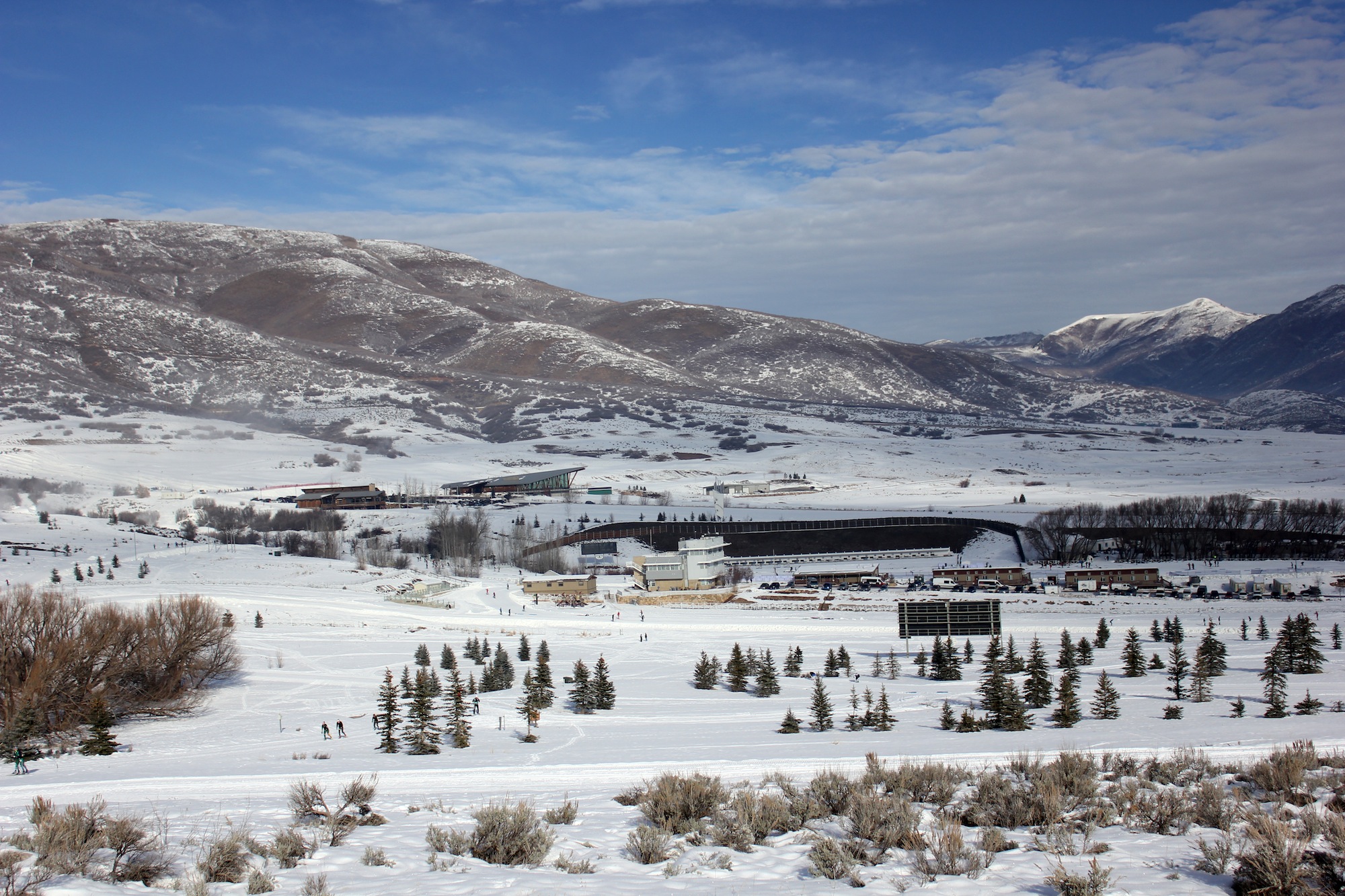
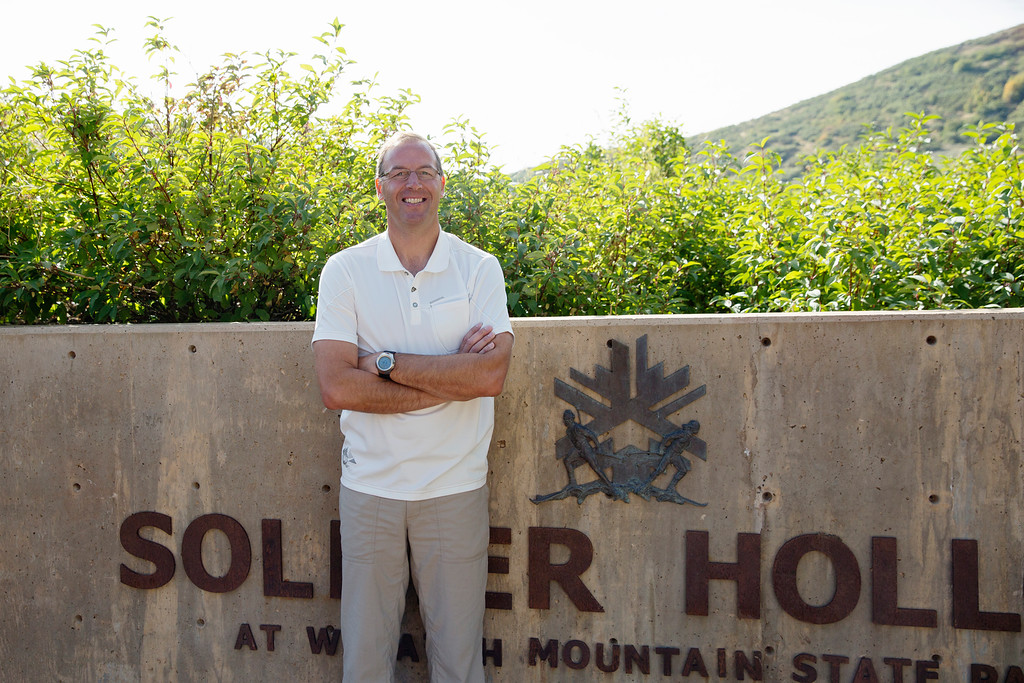
In the thick of the elite winter sport scene for more than 25 years. That would in part define Luke Bodensteiner. He strung together an Olympic cross-country ski career and ended his over two-decade stint at U.S. Ski & Snowboard as their Chief of Sport. For roughly the past year, Bodensteiner has worn two hats at the Utah Olympic Legacy Foundation (UOLF): Chief of Sport Development and GM of Soldier Hollow (SoHo), the cross-country and biathlon venue from the 2002 Games. The SoHo part of his responsibilities involves managing the complex which includes ski trails, a biathlon range, waxing outbuildings, and an iconic but dated timing building.
Chief of Sport Development involves broader management responsibilities.
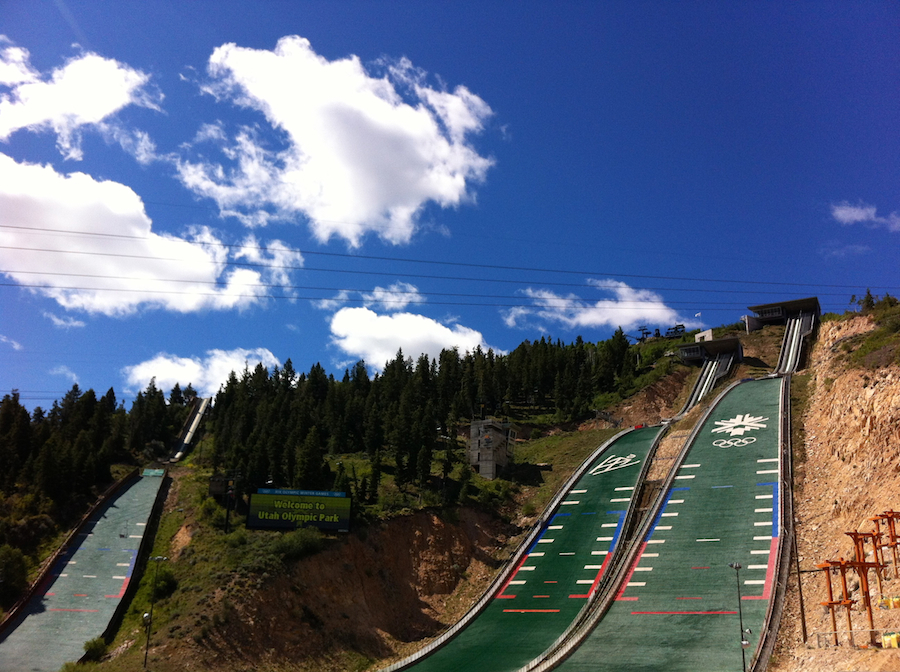
In Bodensteiner’s words, he “essentially guides all of the winter sports programs across the venues.” Considering this is a former winter Olympic site, the breadth of geography and sport-specific venue types are vast. There’s Utah Olympic Park with its sliding track and six ski jumps, Utah Olympic Oval with facilities for speed skating, and two arenas capable of housing hockey and figure skating, and the assets at Soldier Hollow.
Location of Soldier Hollow.
Location of Utah Olympic Oval.
Location of Utah Olympic Park.
Salt Lake and the surrounding region, including Park City and the Heber Valley, are again in the Olympic news. The 2002 host city, Salt Lake, is the United States Olympic & Paralympic Committee’s (USOPC) winter Olympic bid city for either the 2030 or 2034 winter Games.
The reforms allow places like Salt Lake greater flexibility as negotiations unfold, stakeholders determine new costs and benefits, and unexpected social-earthquakes manifest like COVID. The real issue is this: The IOC wants bidders who have community buy-in.
The prospects of an Olympics both excites Bodensteiner but also adds some complexity to the suite of his responsibilities. And although Salt Lake possesses the know-how and legacy venues, this is no slam dunk.
“Optimistic. But it is complicated,” Bodensteiner said when asked about Salt Lake’s prospects for a 2030 Game’s winning bid. “There is a lot up in the air right now. Tokyo is postponed and who knows what happens this year. I would say really optimistic because the IOC, on many levels, needs to present a sustainable Olympics and the budget for a Salt Lake 2030 Olympics is actually less money than was spent in 2002 because of the existing infrastructure. There are not currently that many candidates, but obviously Sapporo, [Japan] is in the mix. They have a nice bid and nice venues and they have this interesting Tokyo situation which could play in their favor or not. Barcelona, [Spain] has made some noise about making a bid but it is not probably real or realistic. Of course, Calgary bowed out in the last go-around which was fortunate for Salt Lake. So there are a lot of really positive factors for Salt Lake.”
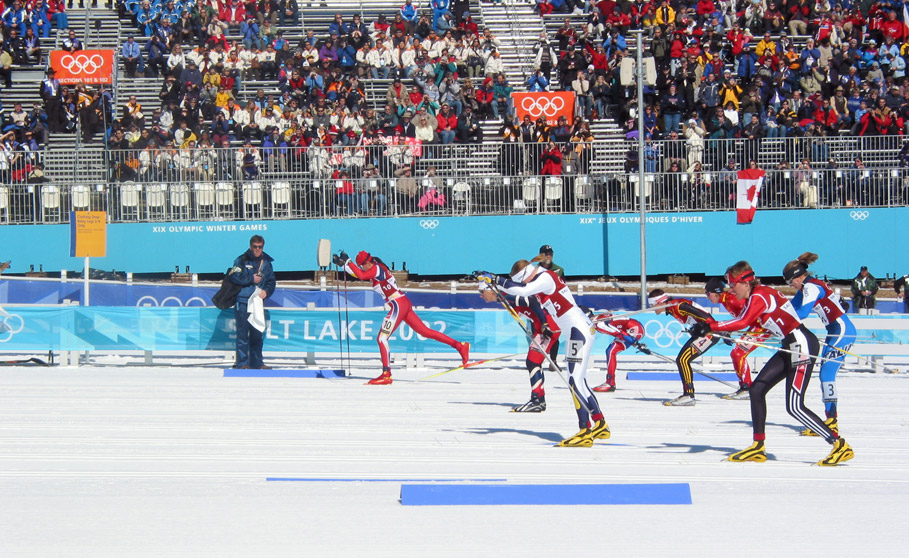
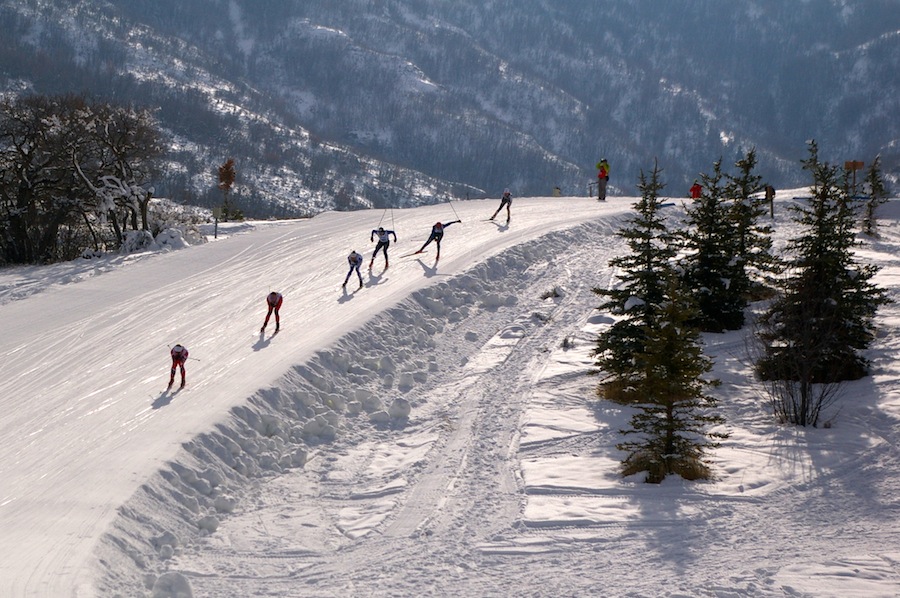
The start of a women’s race at the 2002 Olympics in Soldier Hollow
Bodensteiner also acknowledged that LA’s 2028 Summer Games could complicate a 2030 SLC bid. Domestically, there is only so much advertising budget to allocate. Back-to-back Games could be untenable from a marketing standpoint. In that event, Salt Lake could defer it’s bid to 2034.
Either way, a ten year timeline to a potential Olympics adds a real degree of earnestness to Bodensteiner’s goals as he helps reform sport development at the Utah Olympic Legacy Foundation. From a venue standpoint, the community appears in support of nascent initiatives to fund venue modernization. Something Bodensteiner says is simply rejuvenating venues to a new Olympic standard, not a complete scrape and rebuild.
I’m going to rewind here to a quote from Bodensteiner’s exit interview with FasterSkier from U.S. Ski & Snowboard back in July 2019. Here’s that exchange:
FasterSkier: You are Chief of Sport, but I am hearing you talk like someone who is less focused on medals. Is this something you have learned and absorbed at US Ski & Snowboard over twenty some odd years?
LB: You are exactly right, you get pigeonholed after you have been known as somebody who is single mindedly chasing medals at the Olympics for twelve years. That becomes your brand or your persona. It is important to, it is better to not let that happen at the end of the day.
I think it has been an evolution. And I would say in our work at the U.S. Ski Team, while we have really, I would not say single-mindedly chased performance at the Olympics although that is something that my team thought about and worked on every single day for the twelve years I was there, I think we also built out programs and philosophies and plans on where we were going.
We were also recognizing that that is a real short term perspective and there are things that you might do in the short term that will yield those kinds of results that don’t create a sustainable foundation. And so I think we have always had some level of emphasis on club development or coaches education and important things like that.
Even prior to COVID and the jolt and now sustained tremors to remove structural racism, Bodensteiner had been thinking more holistically about athletes and what success looks like. He understands his mandate involves building equity in sport not simply creating a pipeline that terminates at a single point with medal success.
“We have asked, should we be hosting the Olympics in 10 years time, what is the story we want to be told about our community through the experience of our kids?, Bodensteiner said. “If the eyes of the world are looking at us what does success look like for us? Our metrics are really focused on broadening the number of kids who are involved in our programs, improving our demographic makeup so that the participation in our programs really reflects our communities from the racial diversity perspective, gender diversity, economic diversity, so that we are not just here for the kids that can afford what we think is affordable.”
According to Bodensteiner, his first eight months in the job with UOLF were consumed with understanding the foundation’s programs and how they were similarly failing. In his words, “diagnosing where we are creating these kinks that give us effectively the same results that any other youth sports program in America gets and then rolling out the set of initiatives to start to correct those.”
He cited stats that youth most often leave organized sport at 11 years old for girls and 12 for boys. Bodensteiner says retaining those youth remains a priority while also seeing that they find success off the field.
Then life was disrupted in mid-March. Good intentions, retooled programming, and any semblance of normalcy evaporated in the short-term.
“We had to shift from looking forward to shifting to how do we get through this initial shock here and how do we bring kids back into sports? Bodensteiner said.
Harnessing Bodensteiner’s bearish sentiments about a successful Olympic bid, the change he envisions may have a 10-year arc. Yet the change has tangible incremental goals. Better retention. Youth participants reflecting the diverse population in the greater Salt Lake region. Kids who feel valued not simply for a sport result but for engaging in self-improvement.
Along with a community steering group, Bodensteiner has absorbed and processed what these positive outcomes might resemble in a decade. UOLF, like many in sport, continue to grapple with the duality of participation and performance. The Olympics can be polarizing, especially in an era when the collateral damage of chasing medals is exposed. The human costs have been real. But in Bodensteiner’s eyes, sport can be more humane and foster a culture where participation and performance aren’t fossilized in their pre-2020 form.
“We have our eyes set on 2030 and so for us, it is a long term transformation plan,” said Bodensteiner. “We have put our heads together for about three months to think this through and one of the things that really came out was that participation and performance are often viewed as opposing factors. We really want to achieve both. We want to achieve both in a way that those two factors support each other rather than pull each other apart. The ultimate success for us is to provide a high amount of accessibility and have a positive impact on athletes’ lives and have some of those kids go on to have that ultimate sport success of being on an Olympic team in their backyard in ten years time.”
With the sporting venue assets in place and a dynamic region with the legacy of Olympic hosting know-how, the UOLF might just pull it off.
Bodensteiner Hired on with the Utah Olympic Legacy Foundation
Luke Bodensteiner left U.S. Ski & Snowboard as Chief of Sport on July 15, he was named the Soldier Hollow General Manager and Chief of Sport Development on July 17. Bodensteiner’s new positions are under the Utah Olympic Legacy Foundation umbrella.
As part of his duties, Bodensteiner will oversee daily operations at the Soldier Hollow (SoHo) venue. According to the July 17 press release announcing the hire, SoHo came under Utah Olympic Legacy Foundation direction back in 2016.
“I’m thrilled to be joining an organization that’s accomplishing so much in Olympic and Paralympic sport, and which has established such a unique and powerful legacy,” said Bodensteiner in the press release. “I feel very fortunate to be joining the effort at a time when the UOLF is moving aggressively to establish a leading edge winter sport culture in Utah, for the benefit of our communities, our youth, and our state’s long-term ambitions in winter sport.”
Bodensteiner’s position of Chief of Sport Development extends across all aspects of the Utah Olympic Legacy Foundation, not only cross-country skiing and biathlon. These include ice skating disciplines at the Olympic Oval, and summer facilities for freestyle skiing at the Utah Olympic Park. During the winter, the Utah Olympic Park houses a bobsled/luge track and ski jumps. The jumps can accommodate summertime jumping.
Canmore out of the Running to Host IBU World Cups for Three to Four Years
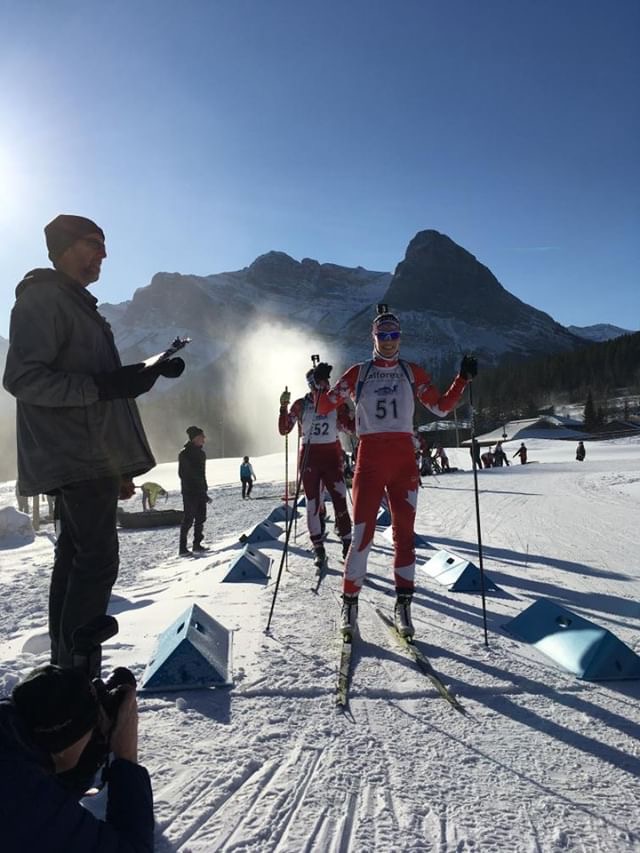
Megan Tandy (bib 51) racing in Canmore. (Photo: Matthias Ahrens)
After hosting IBU World Cup biathlon events in Canmore, Canada this past February, the Canmore Nordic Centre has been informed it will not be considered for future biathlon World Cups for the next three to four years.
Originally built to host the 1988 Winter Olympics, the Nordic Centre is need of updating to meet the IBU’s host site standards. According to a CBC News article, the venue has asked the provincial government for $13 million to modernize the facility and update the firing range.
In the article, Ken Davies, the chair of the Alberta Event Hosting Society, said the province missed the deadline for allocating the money to update the venue.
Currently, it appears the provincial government has set the nordic centre’s upgrades as low priority.
“While we recognize that Canmore Nordic Centre has a long-standing tradition of hosting World Cup biathlon ski events, $13 million in upgrades is a significant cost that must be measured against other pressing government priorities,” Jess Sinclair, press secretary to Minister of Environment and Parks, said according to the CBC article.
Borders Commission: An Independent Panel Chartered by the USOPC
This week, the Borders Commission released its 113 page report on reforming the United States Olympic and Paralympic Committee (USOPC). The USOPC was formally known as the USOC. The Borders Commission was organized to examine how the USOPC should reform.
If you follow Olympic sport in the U.S., the cultural norms and values as practiced at the grassroots, club, elite, and the highest bureaucratic levels have been questioned in recent years. The brave athletes who revealed sexual abuse in elite gymnastics are among the voices who have championed the reform movement. They remain a catalyst for the Borders Commision’s work.
The USOPC remains under the reform-minded microscope. Enter the Borders Commission. The recommendations in the newly released report are widespread.
The report states that an athlete first approach is paramount. “The USOPC and the NGBs and their Paralympic equivalents alike, must course correct, placing athletes and their well-being, at the center of all considerations and business operations,” states the report on page 31.
Other recommendations include modifying the USOPC Board to include better athlete representation, providing broader access to health care and mental health services for athletes, and more athlete-centric funding models. It is by all measures a comprehensive report aimed at creating cultural norms at all levels of sport that protect and support athletes.
“The USOPC has already made significant progress to strengthen protections and empower athletes, and we are grateful for the Borders Commission’s diligent and extensive work to ensure that progress continues,” said USOPC Chair Susanne Lyons according to the press release. “We look forward to reviewing the full report and taking appropriate actions to implement and reinforce meaningful reforms to create a culture and environment where athletes can achieve both personal well-being and competitive success.”
USOPC CEO Sarah Hirshland is quoted as recognizing that a cultural shift is due.
“As we remain laser-focused on prioritizing and supporting the needs of athletes and NGBs, we must set clear standards of organizational excellence and hold ourselves and all member organizations accountable,” said USOPC CEO Hirshland. “With changes to governance and personnel, policies and procedures – and most importantly, culture – we are a very different organization than we were one year ago, but we have more work to do. We remain committed to that reform process and will share information about additional actions we are taking as a result of these recommendations. We are grateful to the entire Commission for their dedication and hard work over these past months.”
Singularly focused on winning and the commensurate hardware that validates that supremacy, 48-year-old Luke Bodensteiner will leave U.S. Ski & Snowboard after a 23 year run with the organization. For the last 12 years, Bodensteiner has served as the organization’s Chief of Sport. His job description placed him at the helm of US Ski & Snowboard’s teams. Bodensteiner was a cross-country athlete at the University of Utah, a U.S. Ski Team member, and a two-time Olympian.
During his tenure, Bodensteiner saw the alpine, freeski, freestyle, snowboard, and cross-country ski teams excel.
FasterSkier: We read in a press release that you’ll be stepping away from your job. Can you comment on how you are feeling about stepping away?
Luke Bodensteiner: I have been at US Ski and Snowboard for a long time. I will tell you that. I have been here for 23 years and basically, it has really been my only real employer. I went to work there really straight out of college and straight out of ski racing, within weeks of graduating college which is also the year I stopped ski racing.
I have been at the organization for a longtime and doing the job I have been doing now for 12 years which is honestly a pretty long time for that type of job.
There are other things I want to do with my time. As you said, I am coming into the prime of my life, there are still some things I want to try to tackle and accomplish. I also think it is really healthy for an organization to get some new energy or new ways of doing things after a certain amount of time.
You are always trying to innovate in a job like that I mean, it can be hard to continue to bring new things to the table and an organization will need that sometimes.
FS: Can you talk about any plans you might have for the future?
LB: My job today, particularly for the last twelve years, has been focused on high performance achievement at the Olympic Games and other top level events in the elite performance side of things. I think there are two pretty fascinating angles honestly going on in sports right now. I am going to continue to work in sport and be involved with sport.
One is how youth sports have developed particularly in a place like America. And some of the interesting flaws with youth sport society here. And some are really interesting — I see some perspectives of how to change that for the better and actually being a part of that change is something that I find really challenging and really interesting.
The other area that has been super fascinating for me is the whole idea of what it means to be an elite athlete ad the transformation we are seeing with elite athletes now where they want to be far more empowered. They understand that their sports career is about far more than winning ski races or medals and want those organizations to take a more holistic look at their careers. And really what it means to be a high performing or achieving athlete at that end. Less on the performance side and more on the athlete lifestyle side. Which is an interesting evolution for me to see.
It has something we at the ski team have been going through a lot of this evolution as well. I think in today’s athletes minds, performance at the end of the day or how you are awarded or what you win or don’t win is still important and still a driving factor for athletes…but brought so much more to the table in terms of what you can do with that platform as an athlete what kind of impact you can make what kind of ownership you can have over your career. And what you learn or achieve along the way to having that kind of performance.
So there is some pretty interesting work to be done there. Not that we are not interested in doing that at the ski team, but there are a lot of pretty cool avenues to go down that path.
FS: How has the sport evolved?
Luke Bodensteiner: I think sport, in general, has evolved and in some of the ways it has evolved is both positive and potentially negative ways. I think one of the things and I am going to talk specifically about cross-country skiing here, one of the things I had the privilege of having a birds eye view watching evolve over the last twenty years was the professionalization of what goes on at that club level. I think that is one of, if not the biggest factor in the success that you see with American cross country skiing. Right now is the fact that there are more professional coaches who are completely devoted to training athletes and clubs and structures that are capable of supporting athletes down to the entry level of the sport.
That has been a real positive factor. I think we all recognize the potential negative factors and more the potential of real negative factors in some cases just in terms of what that means to the cost of the sport and kid’s ability to access the sport.
It can be pretty restrictive and more expensive than it needs to be. It can cut people out more quickly than they probably should be cut out. It does not retain athletes as long as it can or should.
FS: What are you most proud of in your career with US Ski & Snowboard?
LB: It is funny. I got involved with the team when I decided to stop ski racing in 1996. I decided to stop just because the program was in lousy shape. We did not have really great support or leadership or any clue about what we were doing. I was 25 years old and I just decided I am graduating from school this year and I am moving on. I have got more productive things to do.
But I did tell the USSA at the time, I said ‘hey if you want my perspective on what I think you could do better and what the experience of the athlete was like, I will come and share that with you because I know you guys always have this congress in the spring in Park City. And so they invited me to do that and I spent a couple of hours walking people through what my experience was and my impressions and where they could do better. And two weeks later they called me and asked me to show up for work on a Monday.
It was great because I walked in and they did not know who I was going to report to and they didn’t really know what my job was going to be. They basically pulled a card table out of a closet and plugged a phone in the wall and then told me you have got some ideas so get at it.
I came from a place like how do we make cross-country skiing better and do a better job with the cross-country team? So for me, if I think back to why I got involved in the first place, my proudest moment is what the team has achieved today because I think that has been a real collective partnership with the clubs and the communities and to just see all the levels of success that have gone on in the sport right now.
That is just so much fun for me.
FS: You led all the teams as Chief of Sport. That’s a diverse collection of niche sport cultures under one umbrella. We’re talking baggy slopestyle to aero-lycra. You come from the lycra and skinny skis side of things. Was that tough to fall in love with such wide-ranging cultures other than the one you had been immersed in for so long as an athlete?
LB: I was super into it. It is really easy to fall in love with all these other sports. And they all have something you can take away from each other and give to the other sports.
You mentioned slopestyle, there is an incredible culture in that sport and in those teams. And they are so much fun to work with. That was not a problem. I just got right into it.
The harder part for me is when I took responsibility for the whole team, all the U.S. teams, I had to be really careful to make decisions about cross-country in a different way. Because I didn’t feel it was right for me to be quote-unquote, “the cross-country guy”, and do what I wanted to do with that program or that team at the expense of everything else.
I really had to force myself to think about the greater good. Look, when I got hired into this job as Chief of Sport, my boss, Bill Marolt at the time, I asked him “what do you want to get out of this position what does success look like for me?”
And he said, “well, give me a team that is the best in the world.”
So I completely bought into that. And that created a different decision making dynamic for me. Prior to that, I spent a ton of time fighting for resources for cross-country, fighting for attention trying to push things forward. And then when I got responsibility for all the sports, I just did not, I could not do that anymore. I had to take a different approach.
FS: Do you have a different idea now of what it means to be the best in the world than maybe you did at the outset?
Great question. That is a great question. And I don’t have an answer. I think the organization being the ski team and I think it is not easy. I think a lot of sports organizations in the U.S. and around the world are starting to ask themselves the same question. Is it just about winning more medals at the Olympics?
We have always taken the approach that that outcome validates a lot of the work that we did. But, at the same time when you are so focused on that kind of outcome, it influences the way you make decisions. And like I said, you tend to make shorter term decisions and things like that. I think there is probably a different definition out there. I think a lot of organizations right now are asking themselves what that is and how you know when you have achieved that or arrived there and how you use those metrics to really challenge yourself to drive forward with urgency and full commitment.
That was one of the great things when Bill Marolt said we are going to be the best in the world, and he was really definitive about what that looked like, it just supercharges the entire organization. Everybody got focused and pushed so hard towards that goal.
It became this incredible rallying cry. What the next rallying cry is that creates that same sort of urgency and effort, it is important to find it. I am not certain we have the answer yet.
FS: As part of bringing change to skiing and youth sports, you spent some time in Norway learning from some of the best. What did you learn?
You guys are aware I have been spending a lot of time with the sport leadership in Norway and you guys wrote an article about some of the stuff I did most recently there. They have got a youth sport culture that deservedly is gaining a lot of attention and I think has people focusing on some really interesting aspects of what they do and what that has done for kids and for the sport in general in Norway.
And so, working towards trying to activate some of those principles in a culture, a youth sports culture that is far different than that is pretty compelling leadership task.
FS: What were you actually seeing in Norway? I mean we are still talking about a culture that produces not just happy kids, but some athletes that are all about crushing the competition.
This whole thing started for me post PyeongChang where Norway had such an incredible performance there. And I told myself and my team, ‘hey we really have to understand what is going on there and what has led to this and we have to spend time there and spend some time with the leaders there and quiz them on what they do. And get a feel for what they believe and things like that.
We did that and I spent a bunch of time with Inge Andersen, who was the head of the Olympic committee there for many many years and who is one of the people who has really been driving this kind of sport culture.
It is the real deal. I think people will always find examples where you will have a kid who is super driven to win medals or has parents who are super driven by results or things like that. But from an overarching cultural perspective, the culture that sets the expectation for the people that are working in that system does everything that HBO and others have promoted that they do.
And it is a real ethos that built that culture through leadership and expectation I think it is not easy to perpetuate that. That’s because I think they see sports are under pressure by parents and there is a city dynamic where it is families, whether it is near Oslo or some of the larger populations, that are just driven to have their kids win and be a superstar personality in sport.
And look, half of my family lives in Norway, so I am super familiar with a kids experience in youth sport there and it is all of those things that they say – it is super inclusive. It is very welcoming. It is very much focused on personal development and fun and comradery.
And of course they have hundreds of hundreds of experts with incredible technical and tactical knowledge of sport who can do a great job coaching but it really is about getting kids out there and making sure that they have fun. And they explore and work together and all these things that we hear about are really true.
FS: You are Chief of Sport, but I am hearing you talk like someone who is less focused on medals. Is this is something you have learned and absorbed at US Ski & Snowboard over twenty some odd years?
LB: You are exactly right, you get pigeonholed after you have been known as somebody who is single mindedly chasing medals at the Olympics for twelve years. That becomes your brand or your persona. It is important to, it is better to not let that happen at the end of the day.
I think it has been an evolution. And I would say in our work at the U.S. Ski Team, while we have really, I would not say single-mindedly chased performance at the Olympics although that is something that my team thought about and worked on every single day for the twelve years I was there, I think we also built out programs and philosophies and plans on where we were going.
We were also recognizing that that is a real short term perspective and there are things that you might do in the short term that will yield those kinds of results that don’t create a sustainable foundation. And so I think we have always had some level of emphasis on club development or coaches education and important things like that.
But I will tell you what, post-2018 for me was a real turning point philosophically because I had seen, we obviously in 2010 became the best in the world, we set the world record for the most medals won at an Olympic Games with a ski and snowboard theme and it was amazing. When you do that, the only next success is to do it again and win even more medals.
What happens is you start to get into these short term cycles of OK, four years from now how do we take what we have and make that even better?
What I have found I that you exhaust that over time. Versus what Norway did which is totally interesting to me, is they built something over 30 years. They really started down this path in the early 90s. And while it took them many years to get to that outcome of being the best ski and snowboard nation in the world.
That is going to perpetuate. They have built something that is sustainable. It won’t just peel away in four years or eight years or twelve years.
That to me became really interesting in terms of how do you create that kind of culture and system that just does the right thing with kids and is super inclusive and retains kids. Teaches them all the great things about sport without being in a rush to cut them out. To focus resources and things like that. And what can that ultimately do for the health and quality and the brand of sport in your community.
FS:The idea that an NGB is obligated to an athlete during that period of post-Olympics or post-retirement when they may have been in the system for eight years or ten years is gaining traction. And what I mean is, even for those athletes skiing on the World Cup, on the cusp of the World Cup, in your mind what are the obligations of an NGB to help those athletes navigate that next piece of their lives? And it may be in the form of stipends for education or ensuring affordable health care for a window of time, I am just curious about what your thoughts are?
LB: I think there is a big obligation there. I think it obviously the athletes who are involved in elite sport are driven for whatever reason drives them. There is an obligation by the NGBs and the teams to empower that desire in those athletes and do it again to provide those athletes with guidance and expertise that allows them to get the most out of their capabilities. And look, the NGBs get a lot out of the athletes as well when they do that.
It is a very symbiotic relationship the athletes, also because we create such an interesting and fulfilling pathway for athletes that isn’t always a career oriented pathway. Most of the athletes aren’t making any money, they quit when they are 30 years old and may not have had a job and may not have an education and that is a problem. There is an obligation to help an athlete through that transition into their second career. What that looks like is variable by NGB and I think the USOC can play a big role in that.
But I think there’s an obligation to help shepherd that athlete through and to get them on their way to their second career whether that is helping through education or through mentoring or through connecting them through possible careers, sort of those things. I think it is on the shoulders on the NGBs.
If the NGBs have not been able to help that athlete establish their sport as a professional career then I think you know the NBG has also taken something from that athlete’s success.
It is different by NGB as well. The best NGB is not trying to be flush in money and suck that out the athletes, they are trying to create value with the athletes and to give back to the athletes. There is some balance necessary between the resources that you used to help an athlete achieve that dream — the NGB has a responsibility to carry that forward with the athletes.
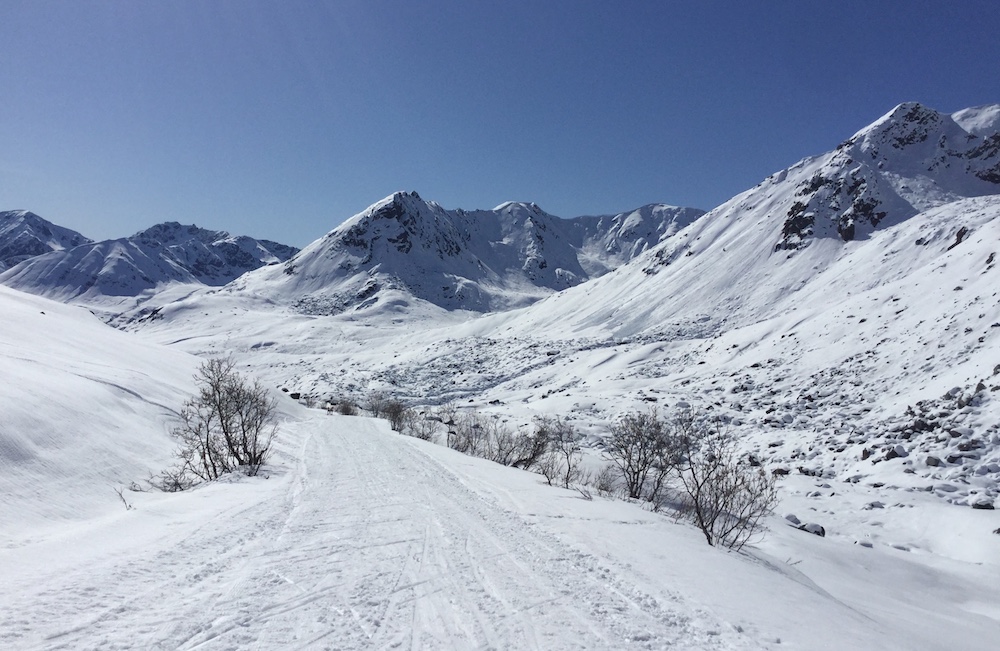
David Norris (APU) and Luke Jager (University of Utah) (very small skiers on trail in center background) ski up Archangel Road, Talkeetna Mountains, Alaska, on May 1, 2019. (photo: Gavin Kentch)
If you’re reading this website, you’re probably well aware that the nordic skiing training year begins on May 1. In a sport where most races happen between November and March, and demand of athletes that they repeatedly race to the point of nearly losing consciousness, the preparation for race season had better start a long time before that. As the well-worn, but accurate, saying has it, skiers are made in the summer.
Embracing the start of May – either May 1 per se, or a conveniently located Monday a few days on either side of that date – as Skier’s New Year is nothing new. Indeed, here’s Luke Bodensteiner, at the time a struggling Olympic hopeful, in the opening lines of his book Endless Winter: An Olympian’s Journal, describing a training day 26 years ago this week: “Monday, May 3: Salt Lake City, Utah. This is it. Training begins today for the 1994 ski racing season. The focus this year is on the Winter Olympics to be held in Norway in February, but the season won’t end until the final races are over in April. … It isn’t like I ever really stopped training, but now instead of pick-up basketball and soccer, back-country alpine skiing and the odd midnight kayak trip with my roommates, training has to get serious. … My little black wristwatch suddenly rules my day.”
Or here’s a notably ambitious Cory Smith, in the ur-skier blog “Somewhere Between Obscurity and Oblivion,” writing on April 26, 1999, while acknowledging that he was doing so five days earlier than custom and generic expectation would suggest: “April 26: Yes, I know that it is still April, but I am writing in my May journal. That is because today is the official start of the 1999-2000 training year. To preserve a sense of continuity it is just easier to assume that May is the first month of the year and squeeze a couple extra April days into the month. I hope this doesn’t screw up your crop planting or biological clock or anything. So what did I do to kick off the year? I went for a run. I know, it’s not very exciting, but you have to start somewhere. Besides, I am only supposed to be training 8-12 hours per week this month, so I shouldn’t do too much the first day. But at last I am underway and ready to prepare for an even better winter next year.”
Or here’s Noah Hoffman, writing on April 30, 2014, in a post entitled, “Start of the Training Year”: “Today was my first scheduled training day of the year. … I started my two hour double pole outdoor roller ski session (Double poling is the only outdoor roller skiing I’m allowed to do right now.) before 7 a.m.” (Andhere’s the follow-up, from May 1: “I am SORE today! Yesterday was my first real training day of the year. It was all upper body based (with a two hour double pole and strength), and now I can barely lift my arms.”)
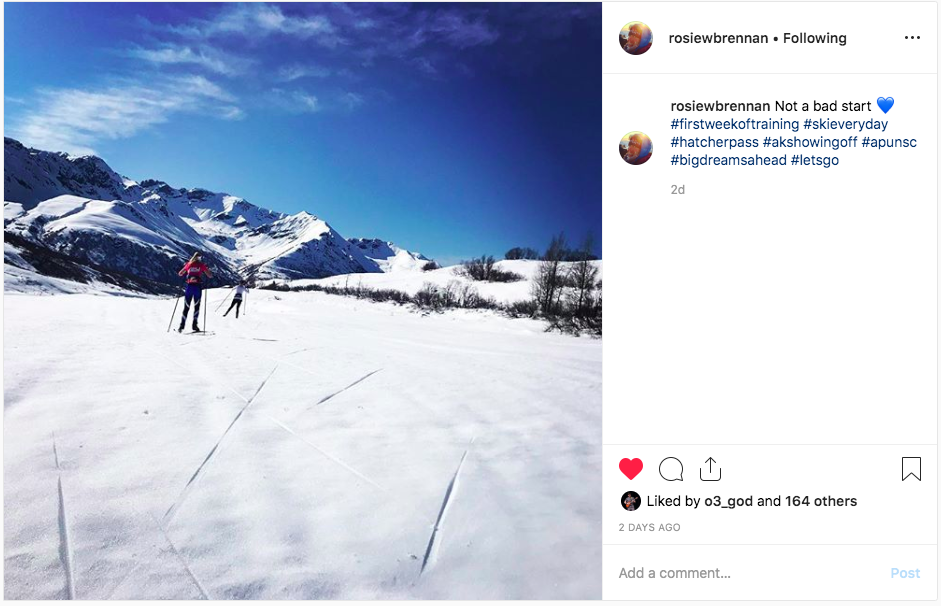
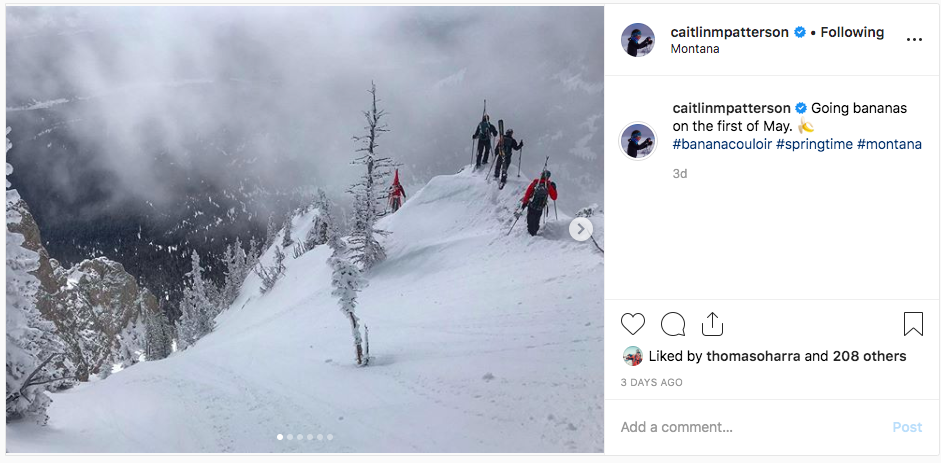
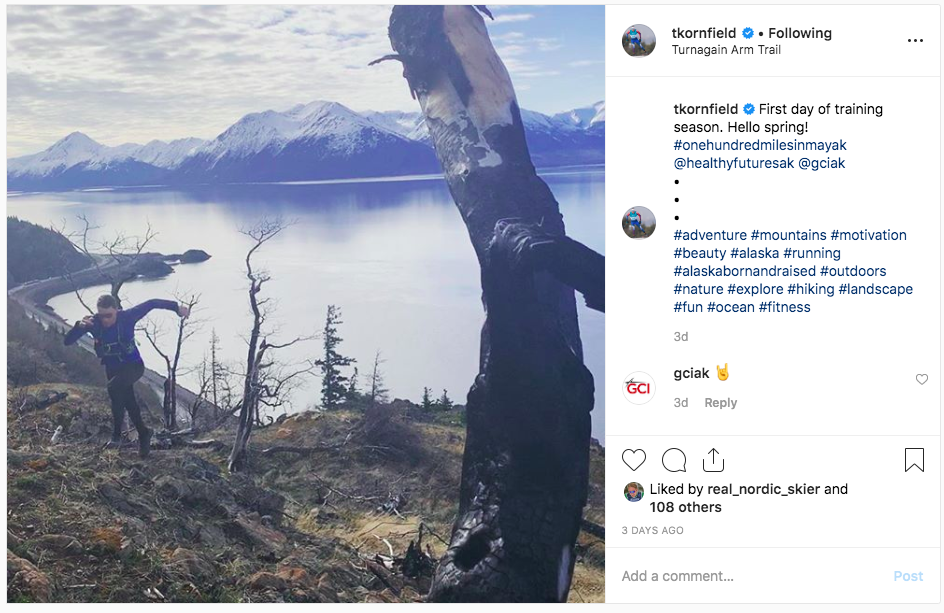
While Instagram has largely replaced blogs (or a book (!)) as the platform of choice, the message has changed far less than the medium: Early May is perpetually a time for new beginnings, new hopes, big plans, and maybe a self-effacing crack about being out of shape or needing to go find one’s rollerskis. Here is a look at how an unscientifically selected group of athletes marked the occasion online, with the only emphasis being on athletes who were posting about new training rather than about new sponsors (corporate sponsors being more characteristic of European skiers than their impoverished American counterparts):
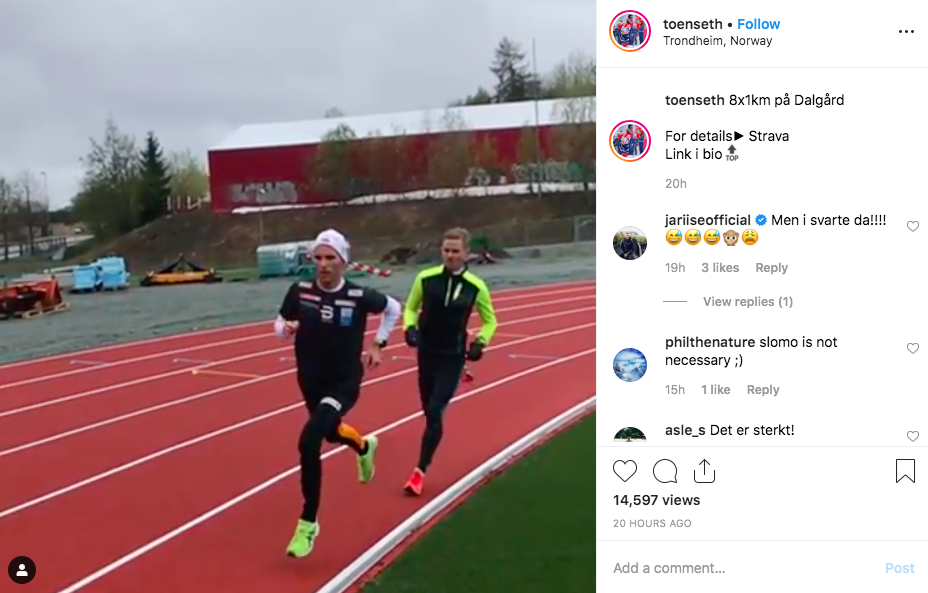
(per Strava link in bio: splits of 3:06, 2:59, 2:56, 2:55, 3:01, 2:59, 2:57, 3:03, with 80-90 seconds recovery. 2:55/km is a 4:42 mile pace, for those of us who measure skiing in km but running in mi. And what were you doing at 8:47 a.m. Saturday morning?)
Martin Benes, who has coached at Sugar Bowl Academy for the last seven years, was recently hired as head coach of U.S. Paralympics Nordic. (Photo: U.S. Paralympics)
(Note: This article has been updated to include the hiring of Miles Havlick as the University of Utah’s head nordic coach, which was announced Monday afternoon.)
There have been several notable career changes in North American nordic skiing this summer. Here’s a quick look at who moved where:
Robert Lazzaroni, the nordic director at U.S. Ski & Snowboard, will soon begin his new role as Salomon’s nordic regional commercial manager for the Americas. (Photo: Salomon)
Robert Lazzaroni:from U.S. Ski & Snowboard to Salomon. Last week, Salomon announced via a press release that Lazzaroni, of Park City, Utah, will join its staff as nordic regional commercial manager for the Americas, starting Aug. 27. For the last three years, Lazzaroni served as nordic director at U.S. Ski & Snowboard in Park City. Before that, he was program manager at Utah Olympic Park, and before that, a nordic division manager for Rossignol and later One Way Sport. Asked about his new job at Salomon, Lazzaroni told FasterSkier he’d be willing to talk more in depth after he starts. Until then, he’s still employed at U.S. Ski & Snowboard.
According to U.S. Ski & Snowboard’s Chief of Sport Luke Bodensteiner, many of Lazzaroni’s duties as nordic manager “have been or will be distributed across existing staff, and we’re taking the opportunity to re-align our staffing positions to make sure that we have an efficient structure that supports our priorities of athlete development, coach education, and strong domestic competition,” he wrote in an email to FasterSkier. “This will likely require hiring an additional position, but the nature of that job is TBD based upon where we determine that we need the human resource to support those priorities.” Bodensteiner expected to know more about the shift in staff responsibilities later this month.
Martin Benes:from Sugar Bowl Academy to U.S. Paralympics Nordic. Also last week, the U.S. Olympic Committee announced the hiring of Martin Benes as its new head coach of U.S. Paralympics Nordic Skiing. He replaces Eileen Carey, who was promoted to program director following the departure of John Farra (to USA Triathlon) this spring. Benes began coaching as an assistant ski coach at Bates College, then spent the last seven years as head nordic coach and director at the Sugar Bowl Academy near Truckee, California, according to his LinkedIn profile. As head coach of the U.S. Paralympics program, he will “lead the development of annual and seasonal training plans for the national team, track athlete performances, workout data, sport science data and annual progress reports, contribute to the U.S. Paralympics athlete identification and development strategy, and assist in planning travel and logistics for the Nordic skiing program to competitions, camps and events,” according to the press release.
“It’s an incredibly exciting time to join the program following such a successful performance in front of the world at the Paralympic Winter Games PyeongChang 2018,” Benes stated in the press release. “I’m eager to get started in my role so we can continue to strengthen the program and win medals on the international stage.” He’s set to begin on Aug. 20.
Fredrik Landstedt:from the University of New Mexico to the University of Utah. Late last month, the University of Utah announced it had found a new director of skiing to replace Kevin Sweeney. Landstedt had been a staple on the University of New Mexico (UNM) Ski Team for the last 21 years, spending the last 11 years as head coach of both the nordic and alpine programs (and 10 years before that as head nordic coach). His decision to take the job at Utah came less than 24 hours after the UNM Board of regents unanimously approved a proposal to eliminate four sports starting in the 2019/2020 season, according to the Albuquerque Journal. Those sports are men’s and women’s skiing, men’s soccer, and women’s beach volleyball. The proposal would also significantly impact funding for cross country and men’s track and eliminate the women’s diving program. In the meantime, UNM announced assistant coach Joe Downing will assume the role of interim head skiing coach.
“I am honored to have the opportunity to lead a program with such a rich history,” Landstedt stated in the Utah press release. “Utah has a strong winning tradition and the support that the University provides its ski team is incredible. I look forward to bringing NCAA titles back to Utah!”
Miles Havlick in November 2015 in West Yellowstone, Montana.
Also at the University of Utah, Miles Havlick: new head nordic coach. In a press release on Monday, the university announced that Havlick, one of its former skiers and a two-time NCAA champion (2012 and 2013), was hired to head up its nordic team for the coming season. Havlick, 28, skied for the the Sun Valley Ski Education Foundation Gold Team after college and won the 42-kilometer Australian Hoppet Worldloppet last August. He delved into coaching last summer in Australia with the Birkebeiner Nordic Ski Club and Victorian Junior cross-country ski team, and last winter, was an assistant coach and wax technician for the Australian junior national team at Junior World Championships. Havlick also waxed for the Australian national team last March in China. He has also assisted the Utes ski team, most recently as an assistant coach at 2018 NCAA Championships.
Eliška Hájek Albrigtsen:from Central Cross Country to the University of Alaska Fairbanks. After spending the last year filling multiple roles with Central Cross Country (CXC) out of Madison, Wisconsin (including CXC Team head coach and junior development coach), Albrigtsen has accepted an assistant-coaching position with the University of Alaska Fairbanks Ski Team, replacing Josh Eide. Albrigtsen was a four-time All-American skier for the University of Colorado Boulder and an NCAA champion in 2011.
Cross Country Canada seeks senior national team coach: Two days ago, the CCC headquarters in Canmore, Alberta, put out an announcement for applications for a full-time senior national team coach. The position indicated it requires both domestic and international travel. “Reporting to the HPD [high-performance director], the Senior National Team Head Coach (NST Head Coach) is responsible for leading the technical delivery and alignment of Senior National Ski Team (Senior NST) programs in order to achieve podium performances at Olympic Games and FIS World Championships,” the job description stated. “The NST Head Coach will have the responsibility to plan, coordinate and monitor the training and competition of NST athletes in line with CCC’s collective goals.” CCC’s senior team includes 10 athletes, five of which are on the World Cup Team. The other five are on the U25 (under-25) Team. View the job posting here.
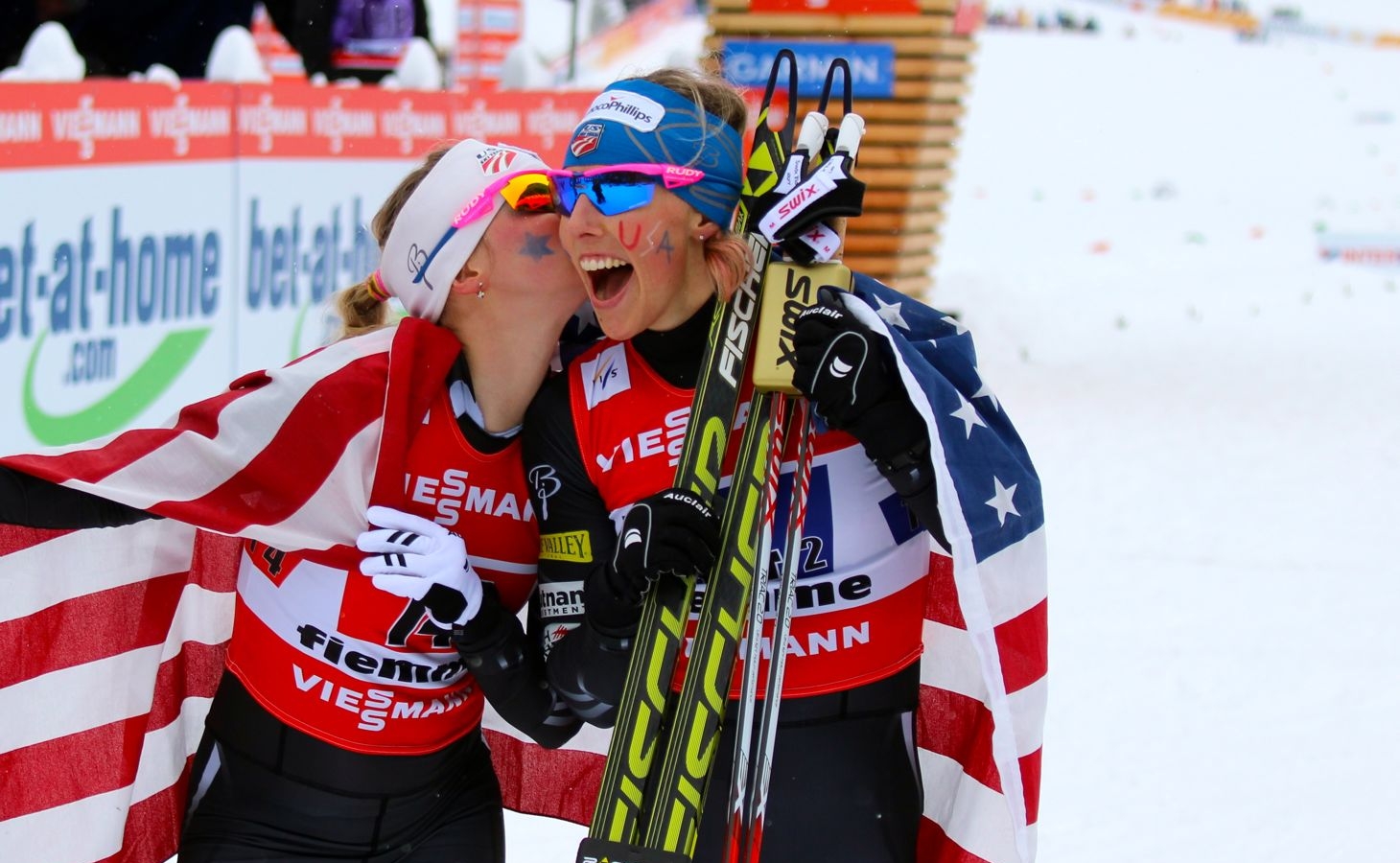
Americans Kikkan Randall and Jessie Diggins jumping for joy after placing first in the 2018 Olympic team sprint on Wednesday night in PyeongChang, South Korea, ahead of Sweden’s Charlotte Kalla (l) and Stina Nilsson (second from l) in second place and Norway’s Marit Bjørgen (second from r) and Maiken Caspersen Falla (r) in third. (Photo: FlyingPointRoad)
PYEONGCHANG, South Korea — There was a lot to process Wednesday, what with the U.S. women’s team sprint Olympic gold medal and all. But now that we’ve had a little time to breathe, FasterSkier wanted to bring you the best of the interviews that didn’t make our initial race reports. (Don’t worry, plenty more on this historic gold to come!)
Kikkan Randall, Team USA’s first-leg skier:
“It’s an amazing feeling. This is something the American team has been working for a long, long time. We’ve had one other medal back in 1976 from Bill Koch and for me, I’ve been on this Olympic path for the last 20 years. We’ve known it’s possible, but of course it takes putting together the right day, and it’s just an amazing validation for our team that’s worked so hard and what this can do for cross-country skiing back in the United States, it’s just so exciting.”
Kikkan Randall en route to gold with Jessie Diggins (not shown) in the women’s freestyle team sprint at the 2018 Olympics in PyeongChang, South Korea. (Photo: FlyingPointRoad)
On whether she knew this would be a historical race for Norway’s Marit Bjørgen (with her 14th Olympic medal):
“I knew that Marit’s been skiing really well all week and that she would be tough competition and knew she would be strong going up that second climb. When I arrived here, I saw the hill and thought, ‘That’s a good hill for Marit, and it’s a good hill for Kikkan.’ Marit is probably the greatest skier of all time and it’s been an honor to race with her, and of course it’s really fun for us to get our historic day and that gold medal, but also an amazing accomplishment for Marit to be the most successful Winter Olympian of all time.”
On her foot injury and Olympic prep:
“I had a foot injury that came in December and it caused me to change my training a little bit, and I also didn’t do as much training as I wanted to. I think that once I did start racing again, every race helped me get better. The skiathlon here was definitely a challenge; it was a tough course and I really struggled in the classic, so it took a lot just to keep my mind calm and relaxed and just think about one race at a time, and I was happy that things went better in the 10 k. It was a real honor to get named to our relay because it was tough to pick that team, but I was happy to have another strong leg there and then it was another anxious wait to see if I would even be named to this team. So as the Games went on, this is the event that I looked forward to most and have looked forward to the most over the last four years, and it was really a good feeling that my confidence was actually getting better and my feelings were getting better as we got closer.”
On how she hopes this medal will impact her sport in the U.S.:
“What’s really cool is I don’t think we’re gonna have to wait another decade for this to happen again. We have an amazing group of junior skiers and U23 [athletes] that are coming up. They won a medal in the relay at the World Juniors last year, we had another girl that was on the podium twice at World Juniors this year, our junior men were on the podium at World Juniors, so I think the door has been opened and what I hope this gold medal really means is what those kids dream about, being in this position someday and they really feel it’s possible, and the Olympics has the power to do more inspiration than any of the other races that we do that are typically in Europe. So it’s really cool to finally get the high profile and give those kids the belief and hopefully also to get more people to start cross-country skiing because they saw it here and they get excited and they want to go try it.”
On the Norwegian crown prince, Norwegian prime minister and Swedish king all attending the Games, and whether she thinks an American president will ever be at a cross-country ski race:
“Actually, when President Obama first got inaugurated I had a dream that I was sitting on Air Force One talking to him about cross-country skiing and telling him that it was a really cool sport but didn’t get enough attention, and he said when he became president he would help make cross-country higher profile, but that’s about the closest I’ve ever gotten to a president at a cross-country ski race.”
Jessie Diggins, Team USA’s second-leg skier:
“Team sprints are so much fun and I’ve been looking forward to this day for a year since the Lahti team sprint ended so I guess watching Kikkan do her leg so well and getting us in a position where we were going to get a medal, I was just watching that like, ‘Oh, well, OK, we’re gonna try to make it a gold one, then. We have nothing to lose.’ I really wanted to make this happen for this team, and we always said any medal we got was going to belong to the team. It was a team that got us here and gave us this opportunity and pushed us so hard in training all summer long and so I just had a lot of belief going in that last lap.”
Jessie Diggins (14) edges Sweden’s Stina Nilsson (r) for gold, while Norway’s Maiken Caspersen Falla (l) races to bronze, in the women’s freestyle team sprint final at the 2018 Olympics in PyeongChang, South Korea. (Photo: Noah Hoffman)
On what was going through her head during the final:
“Lap 2, I started to push the pace because I thought, ‘Both of these girls are really, really strong sprinters and I’m an OK sprinter, but I need everyone else to get pretty tired if I have a shot.’ ”
“That last corner, I don’t know what I was thinking except for just, ‘Go, go, go!’ because you really gotta dig really deep and I was in a lot of pain, for sure, but when your team is counting on you, you have to give it everything you have.”
On what it means to team up with Randall:
“I feel really lucky to have these, like, older sisters and role models on the team that I really look up to, every single one of them, and they’ve really shown me what is possible and shown me that it’s OK to dream really, really big. It means a lot to me because if this is the last team that [Kikkan and I] get to team sprint together, it’s like, ‘OK, I gotta make it a good one. I’ve gotta go out with a bang.’ And it’s so cool because Kikkan’s been this big role model in my life since before I got on the national team and it’s just such an honor to get to race with her every time and get to share those pre-race giggles and high fives and get to paint up the face.”
On her first words with Randall after finishing:
Americans Kikkan Randall (l) and Jessie Diggins on the top step of the 2018 Olympic team sprint podium after beating Sweden and Norway for gold on Wednesday at the Winter Olympic Games in PyeongChang, South Korea. (Photo: FlyingPointRoad)
“I think I asked her, ‘Did we just win the Olympics?’ because it didn’t feel like it was real and it still doesn’t feel like it’s real, but I just was so excited and so happy and also I couldn’t feel my legs.”
On handling any perceived pressure:
“For me, it’s been hard to not let it get inside my head and to race for myself because when I’m having fun, that’s when I’m actually dangerous on the race course and you get one too many people saying, ‘I believe that you’re going to go win!’ it becomes less fun because I don’t do it just to win, that’s not the whole end game for me. Having this awesome team atmosphere — we’ve been playing games, we’ve been dancing, we’ve been watching movies, we’ve been having a really good time here at the Olympics — and making sure that within our own little bubble that we keep it relaxed and keep it fun and keep a happy team vibe, I think that’s been a huge key for me, and kind of being able to go through the mixed zone with selective listening and make sure I’m still racing for me and for my team.”
On how this medal will affect future generations of U.S. skiers:
“I’m so excited to put some facepaint and put the socks on those kids because they are coming up hot and they’re working so hard and it’s so cool to see that we’re not going to retire and leave this gaping hole, there’s people coming up to take our places.”
Chris Grover, U.S. Ski Team Head Coach:
U.S. Ski Team Head Coach Chris Grover (l) with Jessie Diggins after Diggins and Randall won gold in the women’s freestyle team sprint at the 2018 Olympics in PyeongChang, South Korea. (Photo: FlyingPointRoad.com)
On choosing Randall as the first leg:
“We anticipated that it would probably be Marit or [Ragnhild] Haga that was skiing this leg for Norway, and we did think that it would also be Charlotte Kalla who was skiing for Sweden. So we knew there would be some great skaters, some great aerobic athletes that were in that capacity. We thought Kikkan, the way that her skate fitness has been coming on over the last few races here at the Olympics, we thought that her fitness could at least help us hang on to those ladies if they were really going to go, and we were just really pleasantly surprised that Kikkan was able to match them no problem throughout the day. That was exciting. Both women looked so in control in the semifinal that we knew they were going to have a crack at a medal in the final.”
On watching Diggins and Sweden’s Stina Nilsson racing for gold in the finishing stretch of the final:
“With Stina, she obviously was in incredible form in some of the other races here. Maiken [Caspersen Falla] as well, they obviously went first and second in the individual sprint, so there was gonna be no gimmies at all in the finish. We would have been so exhilarated and happy just to have a medal of any color, but for Jessie to have such a fantastic day and to be able to pull off the win was beyond our expectations.”
Tiger Shaw, U.S. Ski & Snowboard President and CEO:
“We are just flying high. I mean, I am still just numb with what those women have achieved; Kikkan, Jessie and the whole team, and the coaches and the techs and trainers … I’m speechless.”
“The culture of that team is just unbelievable, and they have conquered the world, coming from obscurity led by a single woman into a dynamic men’s and women’s team that is absolutely stunning. It makes one of the best stories I think in sport.”
On watching the race unfold:
“I was so excited there was a group of three and not a group of four because then you knew we had almost for sure a medal in the bag, and then all of a sudden you realized Jessie could get it done. And she came around that last corner and down that stretch and beat the best sprinter in the world. We were just screaming our brains out in amazement. Just thinking of the energy and the excitement of that I’ll never forget that for the rest of my life.”
Luke Bodensteiner, U.S. Ski & Snowboard Chief of Sport:
Jessie Diggins with U.S. coach after Diggins and Kikkan Randall won gold in the freestyle team sprint at the 2018 Olympics in PyeongChang, South Korea. (Photo: FlyingPointRoad)
On other sports taking notice of this U.S. cross-country team’s success:
“I have gotten so many messages now from people here in Team USA saying … head of speed skating got one saying this is the best moment of the Games for the entire Team USA. Our head coach in alpine texts me said, ‘I have never seen such a possessed, will-not-lose moment in my entire career.’ … This makes this hugely successful Olympics.”
On medal chances:
“I think we came in feeling like team sprint was not only our best opportunity for a medal, but probably a pretty high likelihood for us, honestly. But there is a difference between getting in there for a bronze medal and winning the thing outright. And that’s not something we… well, I guess we dreamed of it, but it’s not something we would have called out coming in here. So they lifted their game and they skied out of their minds. Kikkan would not be dropped, she covered all those moves on the climb, and of course the way Jessie finished it off was best in the world right there.”
“I was right on the finish line. … You could see a meter out that [Jessie] had this thing and people broke down in tears there, lots of hugs and tears.”
Charlotte Kalla, Sweden’s first-leg skier:
Jessie Diggins (l), Sweden’s Stina Nilsson (r) and Norway’s Maiken Caspersen Falla (behind) heading into the last 100 meters of the women’s freestyle team sprint final at the 2018 Olympics in PyeongChang, South Korea. (Photo: FlyingPointRoad)
“We are very happy for Kikkan and Jessie. They are so worthy of this gold medal.”
On skiing with Randall for a long time and whether these will be Kalla’s last Olympics as well:
“I don’t know. It may be the last. Kikkan, she has meant a lot for the whole team in the USA, and we have a special relationship because Kikkan has been several times in Sweden training with us, and I know in Vålådalen especially, where we exercised this [last] August, we pushed each other really really hard. She is an impressive skier.”
Marit Bjørgen, Norway’s first-leg skier:
“I’m very, very happy for Jessie and Kikkan today for taking a gold medal, and I feel also special that Kikkan is there. She also started [her first] Olympics in Salt Lake [like] me so I’m very happy for them, and I also think that’s very important for our sport, too, that they [won], so I’m very, very happy for them.”
Johannes Høsflot Klæbo, Norwegian men’s team-sprint winner:
On whether they were surprised about the win of the U.S. women:
“No, I’m not surprised. I think the way they managed to do the last round, it’s quite cool to see, and for sure it’s quite good for the sport and yeah, I think it’s amazing.”
Martin Johnsrud Sundby, Norwegian men’s team-sprint winner:
“I think all athletes admire the head of Jessie Diggins. That’s fantastic.”
***
One of the team sprint press conferences, with (from left to right) Sweden’s Stina Nilsson and Charlotte Kalla, a Russian translator and Denis Spitsov, American Kikkan Randall, Norway’s Marit Bjørgen and Maiken Caspersen Falla, France’s Maurice Manificat, a translator, and France’s Richard Jouve, on Wednesday night at the 2018 Olympics in PyeongChang, South Korea. (Photo: FlyingPointRoad)
Sadie Bjornsen (U.S. Ski Team) during the classic leg of the women’s Olympic 15 k skiathlon at the 2014 Winter Olympics in Sochi, Russia. She placed 31st in her Olympic debut.
If you read FasterSkier, two aspects of our coverage generates the most reader comments: doping violations and their adjudication, and team-selection criteria. Although here we are, two days away from the PyeongChang Olympics’ Opening Ceremony with Sochi doping still plaguing the news, as the title suggest, this piece is about team selection.
On Jan. 26, U.S. Ski & Snowboard revealed its 2018 U.S. Olympic Team — a list 20 skiers deep comprised of nine men and 11 women. The U.S. Ski & Snowboard press release announcing those selections used this statement to describe the roster: “The team includes 20 athletes who qualified for the team through World Cup results as well as domestic racing results at the L.L.Bean U.S. Cross Country Championship.”
The buzz following Olympic team selection followed two major threads, one focused on team size, the other on the selection of non-U.S. Ski Team (USST) women sprinters.
In considering why team size remains a concern, let’s zip back to 2014 when the USST was allocated a quota of 17 athletes for Sochi. The team that headed to Russia was 14-athletes deep; seven men and seven women. The remaining three U.S. spots were were reallocated to other nations. At the time, U.S. Ski Team Head Coach told FasterSkier that the small team was by design.
U.S. teammates Sadie Bjornsen (l), Kikkan Randall (c) and Jessie Diggins at the finish of the women’s 2014 Sochi Olympic relay, in which they placed ninth with Liz Stephen.
“With seven women and seven men, we have our start positions filled,” Grover said in 2014. “Seven and seven was the magic number for us.”
One line of reasoning is that a smaller team is more easily managed and the potential for medals are higher.
An Olympic cycle later, the current iteration of the U.S. Cross-Country Olympic team is six skiers larger. That’s partly a function of the depth of the U.S. women’s team on the World Cup and partly a function of how the Olympic selection criteria was interpreted during the team nomination process.
In explaining how the team was named, U.S. Ski & Snowboard Chief of Sport Luke Bodensteiner said that U.S. Ski & Snowboard (formerly USSA) was not mandated to use all of its quota spots for the 2018 Olympics.
“That is a decision we made,” Bodensteiner said on the phone. “We received, across all of sports at U.S. Ski & Snowboard, 110 quota spots, and we accepted all 110. However, we have 109 athletes; one athlete is participating in two different disciplines.”
Bodensteiner clarified that the uneven split of nine men and 11 women on the cross-country team was a result of the women’s depth both domestically and on the World Cup. He explained that the selection criteria does not specify how the spots are distributed between men and women.
“It is really based on results achieved on World Cup ranking and then the Olympic selection list points,” Bodensteiner said. “As it worked out, more women scored more points, actually scored more rankings in the World Cup than the men, and then more selection points than the men on the women’s side. So we just applied down the sort of next-best points in most cases, and that is why [we] have two more women than men and that is just a function of the women scoring more substantial points in the tryout events.”
Practically speaking, a larger team means more variables to manage but clear upsides for the broader cross-country community.
“Filling quotas presents clear positive possibilities and also some challenges to both mitigate and maximize…,” Bodensteiner said. “We try to take everything into account like utilizing start positions in the Olympics and how large a team quota we get. There are challenges for a bigger team, in particular, when you exceed the start possibilities. In cross-country, we have a number of athletes that probably won’t compete. That creates challenges like issues with health, waxing skis, and maintaining a positive team spirit. On the other side, there’s the positive: we have a lot of cross-country athletes going to the Olympics. It is a great experience generally, and something the community appreciates, that the athletes have that opportunity.”
Bodensteiner communicated that several athletes are not expecting to start races in PyeongChang are onboard in terms of fulfilling U.S. Ski & Snowboard’s performance outcomes in PyeongChang.
“We have also had quality discussion with athletes that we have no place to start,” Bodensteiner said. “We have been able to share our concerns that with a large team, we’d like dynamics that do not distract from winning medals. We spoken about how we mitigate those concerns and we have oriented those athletes in terms of how to help mitigate and work together to establish the way to go about doing business. They have been good, highly productive discussions.”
Team Selection: Nominations from the World Cup Qualifying Criteria
Let’s start with the low-hanging fruit, the athletes who met the following objective criteria: “Any eligible athlete that posts a top-8 individual final World Cup result during the selection period [Nov. 23, 2017, through Jan. 15, 2018] in the following events will be selected to the Team: Sprint C, individual start 10/15 km F, and 15/30 km Skiathlon.”
Sophie Caldwell (U.S. Ski Team) racing to sixth in the individual freestyle sprint at the 2014 Winter Olympics in Sochi, Russia. (Photo: Fischer/NordicFocus)
U.S. Ski Team members Sadie Bjornsen, Sophie Caldwell and Jessie Diggins automatically qualified for the Olympic team by meeting the top eight in an Olympic event threshold. Bjornsen qualified on Nov. 24 in Kuusamo, Finland, with a second place in a classic sprint. Caldwell qualified in the same race in eighth place. Diggins made the Olympic team on Dec. 12 in Lillehammer, Norway, when she placed sixth in a classic sprint. (Regarding both Bjornsen and Diggins, each scored multiple top-eight results in Olympic events during the selection period; we’ve simply specified the first instance each skier automatically qualified.)
Three skiers down, 17 to go.
The second-tier of the objective criteria reads as follows: “Athletes ranking in the top-50 in the distance World Cup standings or the top-50 in the Sprint World Cup standings as of January 15, 2018 shall be selected to the team.”
Rosie Brennan, Kikkan Randall, Ida Sargent, Liz Stephen, Erik Bjornsen, Simi Hamilton and Andy Newell jumped the top-50 hurdle.
Let’s run through the men first. On Jan. 15, Hamilton was ranked 15th, Newell 36th and Bjornsen 49th on the World Cup sprint list. Bjornsen was also ranked 41st on the distance list.
For the women, Sargent was ranked 13th on the World Cup Sprint list and Randall 19th. We’ll get back to this in a moment, but Brennan was ranked 43rd on the sprint list and 34th on the distance list. Liz Stephen ranked 35th overall on the distance list.
Some of the chatter heard after the Olympic team selection had to do with a portion of the criteria stating that no more than five athletes per gender would be selected based on sprint results, including all of World Cup sprint results, World Cup sprint rankings, and the domestic OWG points list.
So far we’ve discussed six more skiers, bringing us to nine athletes, all current members of the U.S. Ski Team (USST) and all qualified from their World Cup results.
U.S. Ski Team Head Coach Chris Grover wrote in an email that he believed the World Cup-based criteria served the purpose of fielding the most competitive team.
“From my perspective, the objective World Cup criteria worked well,” Grover wrote. “The fastest athletes were selected to the PyeongChang team.”
He also acknowledged that the inclusion of overall results from the Tour de Ski’s (TdS) final hill climb as part of major championship qualification criteria would be revisited.
“One bit of criticism/feedback that we received was that the Final Climb from the Tour de Ski should not be included in the selection period, because it is a special event that is not representative of the races at a major Championships,” Grover wrote. “I think this is a valid point. The Final Climb has been in our criteria for years, and nobody has complained until this season. Although we believe this race has been effectively useful in identifying our aerobically fit skaters, we are very open to removing it from future criteria and closing the World Cup distance selection period one day earlier. This is something we can discuss with the Cross Country Committee this spring.”
Non-World-Cup-Based Nominations
Filling out a team large enough to fill the four-starters-per-nation race quota allowed the coaches and selection committee to refer to the 2018 Olympic Winter Games (OWG) points list (click “2017/2018 SuperTour Points” under “Resources” on right side of page). That points lists kept a running total for the season’s first two SuperTour weekends and weighted results at 2018 U.S. Cross Country Championships in Anchorage. (For sprinters, points were allocated only for qualification results, not the final results.) The rankings were then further organized by an athlete’s two best sprint results and two best distance results in separate columns on the spreadsheet (note: those columns were blank on Monday morning.)
For the men, team selection appears to have been rather straightforward. The top-three ranked distance skiers were selected off the OWG points list. In order, those athletes were USST member Scott Patterson, Alaska Pacific University’s (APU) Tyler Kornfield and former USST member Noah Hoffman.
Patterson, who is in his first season as a USST member, did not score World Cup points in Period 1 and declined an offer to race the TdS as his path to Olympic qualification. Patterson contested U.S. nationals as his potential qualifying route to the Games. Patterson won the 15 k skate and placed sixth in the 30 k classic mass start.
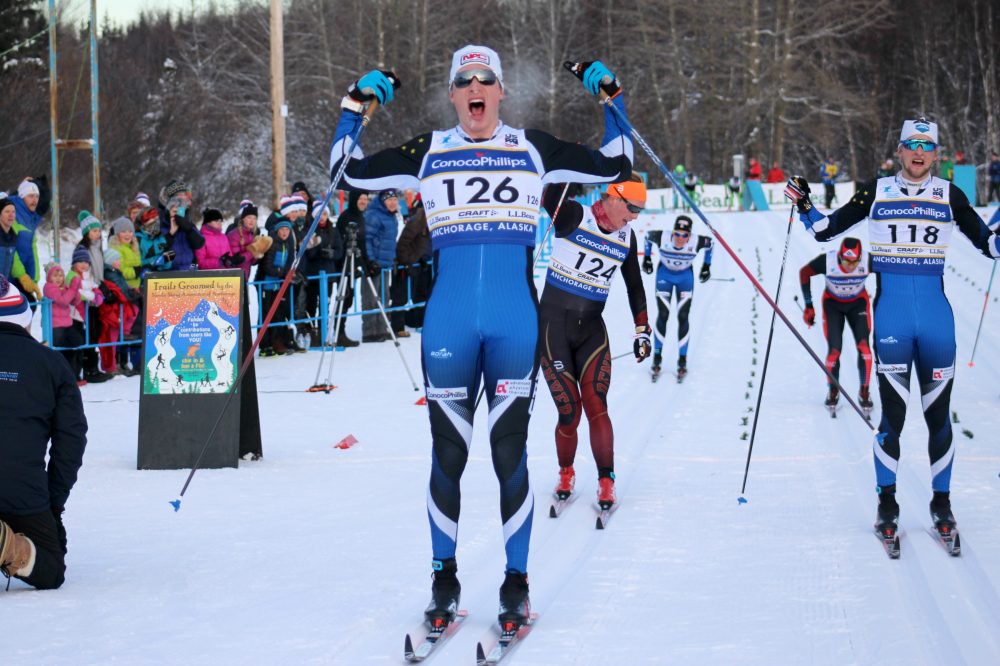
APU’s Tyler Kornfield (126) celebrates as he crosses the line first in the men’s 30-kilometer classic mass start on Jan. 7 at 2018 U.S. Cross Country Championships in Anchorage, Alaska. Eric Packer (118) finished second and Denver University’s Eivind Romberg Kvaale (124) placed third. Kornfield reached the podium in three out of four races at 2018 U.S. nationals.
Second on the OWG list was Kornfield, who won the 30 k classic mass start, placed 13th in the 15 k skate, qualified sixth in the skate sprint and third in the classic sprint. He also placed third overall in both the classic and skate sprints at nationals. Kornfield’s all-around point scoring catapulted him into the team selection conversation.
Third on the list was Hoffman, who placed second in the 15 k skate at nationals and fifth in the 30 k classic mass start. Hoffman also scored World Cup points in 28th in the Lillehammer 30 k skiathlon, a race loaded with home-field Norwegian talent.
Paddy Caldwell, also in his first season as a full-fledged USST member, played his qualifying hand by remaining in Europe and racing the TdS. In his first winter racing full time on the World Cup, Caldwell has popped solid results. His nascent 2017/2018 World Cup resume is highlighted by the 19th-fastest time of day in Kuusamo’s 15 k skate pursuit and the 19th-fastest time of day on the TdS’s final climb 9 k skate pursuit. However, Caldwell landed outside the top-50 bubble on the World Cup distance list.
Patterson was selected as the highest-ranking athlete on the 2018 OWG selection list. As specified in U.S. Ski & Snowboard’s Olympic team press release, Patterson’s selection, according to U.S. Ski & Snowboard, was not a discretionary pick.
However, Hoffman, Kornfield, and Caldwell were all selected to the Olympic team by discretion. Bodensteiner, himself a former U.S. cross-country Olympian, explained over the phone that Hoffman, Kornfield, and Caldwell were nominated to the team by head coach Grover. Those nominations were then reviewed and approved by a three-person committee composed of Bodensteiner, U.S. Ski & Snowboard President Tiger Shaw, and former USST member Holly Brooks as the athlete representative.
Bodensteiner provided firsthand insight into Caldwell’s nomination and approval process.
“Chris Grover presented to the committee whether Paddy was qualified to be part of roster,” Bodensteiner said. “From an athlete-management standpoint, Paddy is somebody we have all agreed has got high potential for the future and the coaches were very interested in getting him into this environment [on the World Cup] and let him race a lot and developing him that way. We could have declined to accept Chris’s nomination of discretion. When I think of developing Paddy, for him it is not necessarily about performance in this Olympics but about future Olympics. Also, in thinking of his development, you don’t want to pull a guy like that out of racing for a month. We agree from an athlete management standpoint we want to make sure he has that experience. On our phone call about Paddy, Chris Grover does get into specifics about [Paddy’s] recent results. Paddy will get a start and maybe more in PyeongChang.”
It should be noted that in an interview about team selection this past summer, Grover stated that development occurs at many lower levels, like Europa Cups, World Juniors, etc., but “It does not and should not come at the World Championships or the Olympics. … It’s not a development trip; it’s a competition trip at the very highest level.”
At the same time, the criteria allows use of discretion for “Indication of medal potential in future Olympic or World Championship competition (such as international age group results and rankings) that would be materially enhanced by selection to the team.”
In the past, that “future medal potential” option for discretionary selection has rarely been used.
“We haven’t used it that way,” Grover said this summer. “Obviously the language is there if we were to choose to use it, but in the past we really have not used it that way, and I don’t anticipate using it going forward into this season. … We want … the fastest skiers on the start line in Korea, and those are the ones that we’re gonna be selecting.”
In PyeongChang, it’s likely that Patterson, Hoffman, Bjornsen and Paddy Caldwell will form the core of the U.S. Olympic men’s distance starts, with Kornfield getting several warranted race opportunities. Hamilton also skied himself into the Olympic distance race start mix by placing 12th in the 15 k skate mass start in the final pre-Olympic World Cup weekend in Seefeld, Austria. The 15 k skate at the Olympics is an individual start.
Factored into the men’s Olympic sprint-start equation are brothers Logan and Reese Hanneman. The Alaskan brothers (both members of APU) were the two highest ranking sprinters on the OWG list. Logan, the younger of the two, placed first and second in the U.S. nationals classic and skate sprint qualifiers. Reese placed third and first, respectively. Older brother Reese also doubled up by winning both the skate and classic sprint crowns. According to the U.S. Ski & Snowboard Olympic team press release, neither Hanneman was considered a discretionary pick.
Depending on Erik Bjornsen’s race schedule, the U.S. coaches will have a core of Newell, Hamilton, the Hannemans, and Bjornsen for the classic sprint. In case of illness, Kornfield has sprinting chops as well. He’s a former two-time classic sprint national champion who reinforced his sprint cred with his double-podium performance in the sprints at the 2018 nationals.
Time to bring the discussion back to the women’s Olympic team selections. To restate, Diggins, Sadie Bjornsen, Sophie Caldwell, Sargent, Randall, Brennan, and Stephen all qualified objectively with their World Cup results. That’s seven female athletes, which leaves four spots remaining on the 11-athlete women’s Olympic cross-country team.
“We acted on the principle that we wanted to maximize start rights in each race,” Bodensteiner explained. “There was an interesting dynamic to women’s team. We have a generous quota and the need to fill spots. Our top women are going to race quite a bit and they ultimately exhaust start options for other skiers.”
In other words, this team is in PyeongChang to medal. Yet even with that caveat, “slam dunk” could be used to describe the nomination of Caitlin Patterson, of the Craftsbury Green Racing Project (CGRP). She was the top American in all four races contested at nationals. She won the 10 k skate, and both the skate and classic sprints, and was the first American in the 20 k mass start classic (and second overall). Patterson was selected off the OWG point list as the highest ranking female athlete.
Caitlin Patterson (Craftsbury Green Racing Project) racing to 52nd in the freestyle sprint qualifier at the last World Cup on Jan. 27 in Seefeld, Austria. The next day, she placed 23rd in the 10 k freestyle mass start. (Photo: Fischer/NordicFocus)
With the exception of Caitlin Patterson, Scott’s older sister, who again reinforced her Olympic readiness with a 20th place in Planica’s 10 k classic, start spots remain scarce for non-USST women skiers at the Games. That said, three more domestic-circuit-based female skiers were nominated to the Olympic team: Annie Hart (Stratton Mountain School T2 Team), Kaitlynn Miller (CGRP) and Rosie Frankowski (APU).
Frankowski was second on the distance OWG points list after placing fourth and second*, respectively, in the 10 k skate and 20 k mass start classic at Nationals (*she was the second American, third overall in the mass start). According to Grover in an email, Frankowski remains an “alternate” for the distance events.
If we don’t include Hart and Miller yet, we’re at 18 athletes total, nine men and nine women.
According to Bodensteiner, initially the U.S. Olympic Committee (USOC) relayed that U.S. Ski & Snowboard had a quota of 18 cross-country athletes.
“Once we get that quota, we are required to make an entry,” Bodensteiner explained. “So we do the selection, in this case on 18 athletes. We do the entry, and then it is a couple days later when you start with this reallocation. It is really hard to determine what is going to happen there. Because you don’t know if Norway is going to give back a spot, or Germany or even a Macedonian. You just don’t really know what is going to happen.”
According to Bodensteiner, the U.S. was reallocated a 19th team spot. Soon after the additional reallocated spot, the USOC informed U.S. Ski & Snowboard that a 20th quota spot was added.
“That creates some interesting dynamics for selection because then you select your team, and couple days later, in this case, a 19th quota drops,” Bodensteiner said of the team-naming process. “And the coaches had done all their nominations about coach discretion that they wanted to do. And when we hit 19, and then eventually 20, and made a subsequent selection, that is a fairly dynamic process as well.”
For both the 19th and 20th spots, which Bodensteiner confirmed were Hart and Miller respectively, the selection committee in consult with the USOC, decided to go strictly off the point hierarchy from the women’s domestic list.
“Ultimately we decided to accept [the 19th and 20th spots], and at that point did not elect to use anymore coach’s discretion and just re-apply the procedure, with the athlete on objective criteria that had the next-best selection points,” Bodensteiner said.
Hart topped the OWG sprint list. Yet, as mentioned earlier, the criteria is written in a way to seemingly cap the number of sprinters at five in either gender. Last year, as a result of the the strict interpretation of those guidelines used to select the U.S. team for the Lahti World Championships, no domestic sprinter was selected to the World Championship roster. (Sophie Caldwell, Diggins and Randall all advanced to the final in that event. Diggins earned silver, Randall bronze.) The requisite lack of sprint opportunities for U.S. based women skiers at cross-country events like World Championships or the Olympics may be the cost of fielding perhaps the strongest women’s sprint team in the world. Sophie Caldwell, Diggins, Bjornsen, Randall and Sargent are internationally recognized sprinters. Even in a best-case Olympic scenario, one of these podium threats will be cheering during sprint qualifications, as only four can start a given race.
Yet the U.S, Olympic team will bring six female sprinters to PyeongChang. Bodensteiner stated that despite the language in the criteria (“will not exceed”), capping the number of sprinters at five per gender is not absolute.
“That is where, as I have explained with the quote-unquote sixth sprinter, that it was not a selection that was made in that allocation of 18,” Bodensteiner said. “That was made basically in consultation with the USOC and an external review to decide what’s the most fair application of the criteria in terms of filling the 19th position. That is where we as a selection committee would have looked at the athlete with the next highest selection points even knowing this athlete would be a reserve but we defaulted to the person who had the highest selection points.
“Annie is an interesting spot in thinking about how deep to get, and looking at outstanding results in sprinting, rather than choose lower on the distance list,” he continued. “It made sense to choose and recognize exceptional results. Discretion allows the committee to fill start rights and use the criteria in the most equitable way possible.”
Miller and Caitlin Gregg were tied for third on the women’s OWG distance points list. With their two best races considered, each athlete earned 56 points. Miller was selected over Gregg by applying the criteria’s tie-break procedure.
As a notable aside, multiple athletes alleged to FS, in writing but off the record, that Olympic team selection had been influenced by internal arbitration, external civil litigation, or the threat of either or both of these. However, both the existence and outcome of arbitration procedures are confidential, and multiple docket searches in state and federal courts revealed no lawsuit that had actually been filed.
Asked whether the USOC had been prompted to begin arbitration to either open up more Olympic team spots or be included on the team beyond the original 18 athletes selected, Bodensteiner stated that the USOC helped guide those particular selections.
“I guess what I will tell you, there is always an opportunity for independent review,” Bodensteiner said. “And that is where the USOC is really involved with us and we have a lot of discussions with them, like what’s the proper application of the procedure in terms of being applied fairly and equitably with the 19th selection and probably the 20th. We had done a lot of consultation with the USOC on both those selections.”
Bodensteiner also made clear that it is in every interested party’s right right to advocate for themselves.
“The athletes have the protection to challenge a selection position,” Bodensteiner explained. “It can be any reason they feel wronged. It is also not part of public record. They have the opportunity to make a complaint to USOC — they oversee the whole process. The USOC also approves the selection criteria, they have influence over it. Yet, they do not tell us to fill our quotas. So, the athlete can file a complaint to the USOC and they, the USOC, will moderate the discussion with the athlete who feels they wrongly have not been selected. If we can not come to terms, it is referred to an arbitrator.”
As far as FasterSkier has been informed, at least one athlete, and potentially more, was involved in official arbitration in connection with the 2018 U.S. Olympic cross-country selections. The USOC is not a government funded agency and it’s arbitration records are not public documents.
“That is not public record, we have dealt with that in the past, that is as deep as I want to get,” Bodensteiner said. “It is interesting when you get into application of criteria. Despite what you write specifically, they are open to interpretation. We maintain fidelity to criteria as much as possible. Some people will feel that wasn’t the right process. I understood to be something different. We will always go on and rewrite if there are any ambiguities and make better criteria.”
As of Wednesday morning, FasterSkier was still seeking comment from the the USOC regarding the reallocated spots — spots 19 and 20 — on the U.S. Olympic cross-country team.
Moving forward, Grover wrote that Hart will be a reserve for the classic sprint and Miller a reserve for the distance events.
It’s full steam ahead with 20 U.S. cross-country athletes in PyeongChang. As the final rosters take shape in what on paper could bring the U.S. its first Olympic cross-country medal in almost two generations, coaches like Grover and the USST women’s coach Matt Whitcomb will be carefully penning out each race’s start roster for the Games.
In the often black-and-white world of elite ski racing, Bodensteiner conveyed he, too, could imagine the pressure exerted on both the athletes and coaches in the Olympic pressure cooker.
“It takes pretty adept coaching to work the athletes through that and deal with the athletes who don’t get selected to race in each competition,” Bodensteiner said about the tough race start decisions facing the team. “That can be a tough thing for athletes for sure. You can imagine the pressure on the team sprint race right now. That is going to be a pretty difficult challenge for those guys. I anticipate it will be a tough one for the athletes. There’s a very high potential to get a medal there and there are certainly more than two athletes that are probably thinking they should be on that team.”
The Games begin on Feb. 10 with the women’s 15 k skiathlon.
The newly rebranded U.S. Ski & Snowboard’s “one team” photo united under its “single, iconic mark”, according to CEO Tiger Shaw. (Photo: U.S. Ski & Snowboard press release)
Earlier this month, a group of leaders from World Taekwondo stood smiling before flashing cameras and their newly unveiled organization logo. Since 1973, the sport’s governing body was known as the World Taekwondo Federation, using the acronym WTF to represent its globally recognized organization and mission. But recent “negative connotations” associated with the abbreviation moved the group to change its logo and drop the word “federation”.
As with World Taekwondo’s case, there are a number of reasons a company or organization may choose to change brands. If the rebranding of World Taekwondo took away something unwanted, the U.S. Ski and Snowboard Association’s (USSA) recent decision to rebrand to U.S. Ski & Snowboard is somewhat the opposite.
Since the early 1990s, U.S. Ski & Snowboard had four different brands, that of USSA — which served as the organization’s parent brand — along with three national-team logos: U.S. Ski Team, U.S. Snowboarding, and U.S. Freeskiing.
The old U.S. Ski Team, U.S. Snowboarding and U.S. Free Skiing logos.
Now, after 112-years in the business, U.S. Ski & Snowboard has decided to unite all teams under one core image: a crest sporting the letters “US” and three white stars floating above two mountain peaks, as well as two diagonal red stripes at the shield’s bottom.
The single core image will be adapted for the following tiers: a master mark (just the U.S. crest),
Master mark
an organizational mark (the master mark accompanied by the words “Ski & Snowboard”),
Organizational mark
and the team mark (the master mark accompanied by the respective national team names).
Team mark
“Our brand was strong. It wasn’t that we needed to start over, it was just we needed to clean things up and get refocused,” Tom Kelly, U.S. Ski & Snowboard Vice President of Communications, said of the USSA brand during a phone interview last week. The rebrand launched on June 18.
(Article continues below)
The idea to change the logo emerged during a USSA strategic planning meeting Kelly attended back in June 2015. He and Luke Bodensteiner, USSA’s executive vice President of athletics, were fueling the winds of change.
“We wanted to provide more value to users of that USSA brand,” Kelly said.
“One of the initial pushes with the rebrand was to figure out how to get some of those more broad-based or grassroots skiing and snowboarding [groups] connected with the ski brand,” Bodensteiner told FasterSkier. “To that point, everything had been separate with USSA and USSA racing; that went all the way down to junior racing or recreational racing. The teams were all separate and they shouldn’t be. It’s all one effort and ideally one family.”
Seeking assistance from outside its own walls, USSA created a task force was created that included Nike Senior Strategic Advisor Jeanne Jackson, who had two children compete with the USSA system, and United States Olympic Committee (USOC) Chief Marketing Officer Lisa Baird, a chief engineer for the USOC’s redesigned brand for Team USA, among others.
“What Jeanne Jackson did when she started this, was she posed the question to us, and this is a very Nike-type thing, she said ‘Do you want to be a house of brands, or do you want to be a branded house?’” Kelly explained.
For U.S. Ski & Snowboard, the answer was the latter. To fashion the brand, eight different agencies pitched potential templates before one was chosen — all at no cost for U.S. Ski & Snowboard.
“That’s the beauty of it,” Kelly said of the rebrand. “Everything is pro-bono. So we feel really good about that, that we were essentially able to execute that with no costs.”
When the U.S. Ski Team (USST) underwent a brand and logo change nearly 20 years ago in 1999, the cost amounted to more than $50,000 dollars, according to Kelly. Thanks to the pro-bono work done by i.d.e.a, a San Diego-based consulting firm and U.S. Ski & Snowboard’s ultimate pick, all of the national teams in the organization (nordic, alpine, freeskiing, freestyle, snowboarding) are now under the same logo.
“The U.S. Ski Team had a strong brand and a high level of brand equity, but the philosophy is that by bringing all the sports under one image that that might help create greater equity in the brand,” Bodensteiner said.
The USST will remain an official entity under the new brand. All teams will now share a Facebook page dubbed U.S. Ski & Snowboard. USSA Nordic’s Twitter account (@USSA_Nordic) will no longer exist and has been integrated instead into an @usskiteam Twitter account. On Instagram, @usnordicskiteam has been integrated into @usskiteam. The idea in combining social media outlets is to reach a broader audience — nordic fans may be more likely now to be exposed to the news feeds of others sports and vice versa.
“It will be one U.S. Ski and Snowboarding [Facebook] page and it will be varied content throughout all sports all the time — a little bit of alpine, a little bit of nordic, a little bit of freeskiing,” Courtney Harkins, content media manager for U.S. Ski & Snowboard explained on the phone. “It’s going to be really good thing for the cross-country team as well because you have chance to make freeskier fans of Jessie Diggins.
“I think it’s a cool way to broaden and magnify the somewhat specialized fans of cross-country skiing,” Harkins continued. “For example, on the USSA nordic page we had 12,000 fans and now we have a 170,000.”
As of right now, U.S. Ski & Snowboard has made a conscious decision not to acronym its name. The word association was dropped because it was not seen as an “essential component” to the organization’s name.
“As a general rule, acronyming is a bad brand practice,” Kelly wrote in a follow-up email to FasterSkier. “It creates a collection of letters that is not easily recognizable to the majority of people who cross paths with the brand. We’ve been seeking to avoid acronyms for some years, but USSA was ubiquitous. We will always use U.S. Ski & Snowboard and not abbreviate it or create an acronym. And we appreciate users respecting that.”
Ultimately, beyond bringing all U.S. Ski & Snowboard teams under one roof, the rebrand also brings a much simpler connection for its partners both new and old. Toyota, which recently became the official vehicle for U.S. Ski & Snowboard, will now only have one mark to take into consideration for its sponsorship.
“The partners are uniformly thrilled about it because it makes it so much easier for them, than it was before,” Kelly said. “So if you’re a Visa, for example, previously there were three sometimes four different marks they were involved with … that had become a real issue. It was complex, it was expensive and now we’re down to one.”
U.S. Ski & Snowboard is currently in the process of changing its staff email addresses. The “usskiandsnowboard.org” website domain currently redirects readers to ussa.org as the new one has not yet been launched. The decision to do somewhat of a “soft opening” with the brand played into the decision to hold-off.
“You’ll see on our website, we have re-skinned it with the new mark,” Kelly said. “We have a new website developed and it’s in the the wings, but we just chose not to launch it. It was just one more thing to do this week that we felt let’s wait.”
“Once we launch [usskiandsnowboard.org], which will hopefully be this summer, could be later summer, but it’s not going to be in the next few weeks, as soon as we launch that, we will then point any old primary urls to the new site,” Kelly continued. “So you’ll still be able to go to ussa.org and get there, but it won’t be our polished domain.”
U.S. nordic skiers Scott Patterson (1), Ben Lustgarten (14), Kris Freeman (9), Brian Gregg (behind Patterson) racing head to head in the 30 k classic mass start at 2017 U.S. nationals at Soldier Hollow in Midway, Utah. Lustgarten went on to win for his first national title.
Note: This is part of a series on the 2018 Winter Olympic selection criteria for the U.S. cross-country ski team. Read this parallel article for specifics on the criteria itself.
***
When considering the criteria recently posted by the U.S. Ski Team regarding how cross-country athletes will be selected for the 2018 Olympics in PyeongChang, South Korea, it’s useful to know some context about how selections are made in other sports.
As described in a parallel piece, the criteria have three main components: a World Cup qualification process via top-eight results on one of five different days between November and mid-January, or else a top-50 World Cup ranking; discretion; and standings from the U.S. SuperTour and national championships.
Some aspects of these criteria are consistent with common practices in other disciplines under the umbrella of U.S. Ski & Snowboard and across other winter national governing bodies.
Others are not.
For instance: of all of the U.S. Ski & Snowboard disciplines, the cross-country criteria were the last to be approved. The final signature of approval came on May 30, 2017, and the document was not posted online until June; on the other end of the spectrum, the freestyle skiing criteria got its last signature in June 2016.
Secondly, though criteria for many of the ski and snowboard disciplines include discretionary clauses, few are featured as prominently as the discretionary clause is in cross-country skiing. Few individual winter sports use discretion so prominently, with the exception of figure skating (a judged sport).
But at the same time, the lack of a guaranteed nomination route via domestic racing is not unusual, as several other sports will fill their Olympic rosters based only on international competition results.
So considering different aspects of the criteria, which are in line with national best practices? Which likely came from cross-country team staff? Which are in line with, and perhaps generated from, U.S. Ski & Snowboard’s overall philosophy?
Who knows what, when
Most straightforward issue to address is the timing of Olympic criteria approval. Criteria were released later for cross-country skiing than for any other U.S. Ski & Snowboard discipline; in addition, sports independent of U.S. Ski & Snowboard: biathlon, bobsled, skeleton, luge, short- and long-track speedskating, hockey and curling had already published their criteria.
Figure skating criteria could not be found on the U.S. federation’s website, but the official selection procedure had already been described on the NBC Olympic site.
That means that cross-country skiing was the very last set of 2018 U.S. Winter Olympic team criteria to be published, a deviation from past Games. The 2014 Olympic criteria for cross-country skiing were signed in June 2012, more than a year and a half before those Olympics.
“At best we would like the selection procedures to be made available to the athletes a year before the evaluative events that may be used to select [the Olympic team,” said Rachel Isaacs, a sport performance bid liaison for the U.S. Olympic Committee (USOC) who previously served as the organization’s team leader for sport performance.
With the first World Cup races less than six months away at the time the criteria were posted, that didn’t happen this year.
Isaacs said that the time frame is not a requirement, and that the organization offers flexibility. That means that there are no strict consequences for publishing criteria late.
“We do realize that that can’t always be the case,” she said of the year-in-advance standard. “The informal guideline would be to make sure that the athletes know if a World Cup season is going to be used, certainly prior to the World Cup season starting … But we wouldn’t mandate that the first event of a World Cup season in 2017 — it wouldn’t be a year prior to that. We understand that they are still developing their selection criteria and qualification process.”
In this case, the 2018 Olympic criteria for cross-country skiing are more or less identical to those used for 2017 World Championships, although U.S. Ski Team Head Coach Chris Grover said that there had been discussions about whether to implement any changes.
Isaacs also didn’t see a problem with the fact that the qualification period for the World Cups themselves was long past by the time the criteria were posted.
“I think athletes know that the World Cup season is always part of, and I do want to emphasize a part of, the selection process,” Isaacs said, indicating that athletes should have known that qualifying for the early-season competitions would be important.
As to the question of whether athletes might have planned their previous season differently if they knew the criteria further in advance — or built a multi-year training plan differently, or a single-season training plan that accounted for having to peak multiple times – Isaacs was dismissive.
“Any athlete knows what she or he needs to do to best prepare themselves along with their coaching staff or whatnot,” she said, adding that responsibility for preparing did not rest with national team staff who develop selection criteria.
Discretion in the main criteria
The most controversial part of the criteria is likely to be the placement of discretion before a domestic qualifying mechanism.
(Discretion also comes heavily into play at the World Cup level, discussed later in this piece.)
After World Cup results and standings, the next way to qualify for the Olympics is via discretion: “If team positions remain open after the application of criteria 1 above, the USSA Cross Country Head Coach may use discretion (See Section 2 below) to determine team nominations.”
(Note: USSA refers to the U.S. Ski & Snowboard Association, which until June 19 was the name of what is now simply U.S. Ski & Snowboard, for which there is no official abbreviation.)
The reason for that, according to U.S. Ski & Snowboard Executive Vice President for Athletics Luke Bodensteiner, would be to prevent a situation where the team roster had already been filled via objective criteria and coaches could not nominate a key athlete who had somehow not met the criteria.
“We’ve got some interesting factors in cross-country, like with the team sprint, where arguably a different kind of athlete is best — and there aren’t that many team sprints to evaluate from,” he said in an interview. “The coaches have the ability to pick that roster in ways that don’t pin them down to results that may not be reflective of true performance.”
The criteria specify that athletes may be selected via discretion if they have indicated the potential for Olympic success via results in the 2016/2017 or 2017/2018 season, have a recent positive trend towards success that would suggest strong performances at the Games, or show potential for medals in future Olympics in such a way that participating in this Olympics would be beneficial for development.
But for cross-country skiing, discretion is listed as the second criterion just as it was for the 2014 Olympics and 2015 and 2017 World Championships.
That is a departure from other U.S. Ski & Snowboard disciplines.
In alpine skiing, discretion is only listed as the last possible mechanism in a cascade of criteria – it is only to be used if four previous objective criteria, all based on World Cup results, fail to fill the team.
And in snowboarding and freestyle skiing criteria, discretion is not even listed together with the objective mechanisms and is rather only described in a separate section of the criteria. There, too, discretion is to be used only if the objective criteria fail to fill the team roster.
In nordic combined and jumping, discretion is listed as the second criterion – like cross-country skiing (which lists its two World Cup qualifying mechanisms together under one heading) – but the criteria also state, “There is no requirement that section 1.3.2 [discretion] be used for nominating athletes to the team.” That sentence appears nowhere in the cross-country criteria.
Bodensteiner suggested that the different disciplines could not be directly compared, because alpine skiing, for example, has no Continental Cup-based qualifying mechanism.
“Rather than looking at alpine having discretion as their last piece, I think the primary difference between alpine and cross-country is there’s not that third tier of domestic selection in alpine,” Bodensteiner said. “There’s more of a push to say, if we don’t have athletes that gain selection through the World Cup, then we probably don’t fill our quota.”
Outside of skiing, some sports, like figure skating and hockey, use discretion exclusively with no objective criteria. Bobsled uses discretion widely; while there are objective standards for bobsled pilots, the pushers are assembled into teams based on discretion after having met minimum requirements through a long selection process.
There are yet other sports which use objective criteria for most of the team selection, but deal with the possibility of a key athlete failing to meet the objective criteria for some reason by guaranteeing coaches the ability to use some discretion.
In biathlon (as discussed on this site yesterday), one discretionary selection is hard-coded into the process – for the last athlete for the five-man or five-woman roster, meaning that the first four spots are already automatically filled by athletes best meeting the objective criteria.
For bobsled pilots and for skeleton, too, the criteria state that if the U.S. receives more than one quota spot at the Olympics, the last team selection will be made via discretion. (If the U.S. gets only one sled, it will be selected based on objective criteria.)
Such a system of leaving the last spot to discretion would seem to fulfill Bodensteiner’s idea of picking “an athlete” via discretion in case their suitability for a team event was not captured by individual results, for instance.
Yet there is no cap in the cross-country skiing criteria for how many athletes could be selected via discretion. In the recent past, zero, one or two athletes per Championships have been picked using discretion.
Bodensteiner seemed wary of using discretion in general, saying that “I know from experience that using discretion — particularly in the Olympics — is painful and it’s really not worth the challenges that it can create… unless this is something that really supports a medal objective.”
But he stood behind the prominent inclusion of discretion in the cross-country criteria, even though it seemed anomalous among the other disciplines he oversees.
“We put it in after the World Cup selection just to have that ability to make that assessment there, pick an athlete through discretion if we need to and then use the third criteria to fill up the team if we elect to fill up the team,” Bodensteiner said.
And when pressed on whether that meant that only a small number of athletes would gain Olympic starts via discretion, Bodensteiner demurred.
“We always want to leave the door open because you can never really anticipate everything that happens,” he said.
International vs. domestic results
Another aspect of the criteria sure to raise discussion is that it would be possible to fill the Olympic roster without ever dipping into the field of athletes who compete primarily within North America.
The first two criteria for Olympic qualification come from the World Cup. First priority will be given to athletes who notch top-eight results in the period between Nov. 23, 2017 and Jan. 15, 2018 in classic sprints (in Ruka, Finland; Lillehammer, Norway; and the Tour de Ski stage in Oberstdorf, Germany), the 10/15 k freestyle individual start in Davos, Switzerland, or the 15/30 k skiathlon in Lillehammer.
Second priority goes to athletes ranked in the top 50 of the distance or sprint World Cup standings at the end of this selection period.
Add a discretionary selection or two, and particularly on the women’s side, it’s easy to imagine a team that completely bypasses athletes racing on the SuperTour and at U.S. nationals.
There were just two domestic skiers nominated to the women’s World Championships teams in each of 2015 and 2017 (Caitlin Gregg both years, and Rosie Brennan in 2015 and Chelsea Holmes in 2017; between the three of them are one World Championships medal and two top-20 finishes).
And the whole women’s team to the 2014 Olympics was picked based on World Cup results.
International-based qualification priorities may rankle athletes who have not been offered World Cup starts and whose only opportunity to qualify for the Olympics is through domestic results. But in the wider world of U.S. sports, it isn’t all that unusual.
As noted above, U.S. Ski & Snowboard’s Olympic selection criteria for alpine skiing completely bypass any domestic competitions, relying instead solely on international results.
Ski jumping and nordic combined offer Olympic spots to the winners of Olympic trials (and only the winners, not also runners-up). But that is their first criteria, and all the rest are based on international results at the World Cup or Continental Cup level. Thus, if a World Cup athlete wins trials, the team will end up filled only with athletes competing internationally (barring the use of the discretionary clause). Domestic athletes have no direct opportunity to fill spots at the bottom of the roster.
Outside of skiing, luge also bases all of its selections on the results of international-level competitions. Bobsled makes all of its objective selections based on international results, with the last spot being filled by discretion.
Providing a domestic qualification route is not mandated or even suggested by the U.S. Olympic Committee.
“There is definitely a range [of selection strategies] from the national governing bodies,” said Isaacs. “The sports are the experts. They tell us how they think they will pick the best team and we work with them to ensure a fair process.”
Who gets to the World Cup?
The key to making good team selections based on international results, it seems, is to get all of the best athletes to those international competitions. With World Cup results being the only way for cross-country skiers to absolutely guarantee a trip to the 2018 Olympics, who gets to even go to the World Cup may become critically important.
And while U.S. Ski and Snowboard wishes to generally avoid using discretion to pick an Olympic team, that masks a potentially essential role discretion might play: in determining who races on the World Cup and can shoot for those top-eight finishes or top-50 rankings.
For Period 1, the only athletes guaranteed starts are those with a top-50 overall World Cup ranking from the previous season (Jessie Diggins, Sadie Bjornsen, Liz Stephen, Sophie Caldwell, Kikkan Randall, Ida Sargent, and Simi Hamilton), a top-30 Sprint Cup or Distance Cup ranking (Andy Newell), and the 2016/2017 SuperTour champions (Scott Patterson and Chelsea Holmes).
And the only athletes guaranteed Tour de Ski starts by the U.S. Ski Team are those who are sitting in the top 30 of the World Cup overall or distance rankings at the conclusion of Period 1. The top 20 athletes in the Sprint Cup are also now guaranteed spots by FIS, outside of each country’s specific quota.
That means that in order for any other athlete to qualify via the World Cup mechanism, they would need to be offered World Cup starts via discretion. The World Cup criteria state that “Discretionary selections, if any, may be based on a variety of factors, including competitions conducted outside of the selection period.”
Bodensteiner stated that he supported the cross-country coaching staff in their ability to make discretionary picks at the World Cup level.
“We’re using discretion maybe more on a strategic basis,” he said. “With Tour de Ski, there is sensitivity about team size and just our ability to really service the best athletes in that kind of environment. You also have specific considerations in terms of which actual disciplines and techniques are being competed in those different blocks of World Cup… But I also know [Head Coach Chris Grover] is using some of his ability to select athletes into the World Cup to think forward in terms of preparing an athlete over successive years for international success.”
A top-eight World Cup finish is, obviously, not easy to obtain.
Nor is a top-50 ranking, although last season Caitlin Patterson, racing Period 1 as the SuperTour winner, came close, ranking 54th on the distance list at Christmas. That wasn’t far from unprecedented: in 2011 Holly Brooks, the previous year’s SuperTour champion, was 20th on the distance list at Christmas. That 2011/2012 season, Diggins won the SuperTour. She went home for Christmas in 2012 ranked 40th on the World Cup distance list.
(For men, such successes by SuperTour leaders sent to the first period of World Cup racing have been rare.)
Providing specific athletes with a chance to notch an Olympic-qualifying body of work on the World Cup may or may not go into that decision-making process regarding who gets starts.
But the question of who heads to the World Cup will likely to come into play, especially on the men’s side.
While the World Cup criteria state that “USSA policy mandates that team selection criteria shall be principally objective (or performance-based) and that available start rights and team spots will not necessarily be filled,” only three men have objectively qualified to start World Cups in Period 1.
Grover has already stated that he tentatively plans to send three more men to the World Cup for Period 1 – U.S. Ski Team (USST) members Erik Bjornsen and Paddy Caldwell, along with Noah Hoffman, who was not renominated to the USST this season.
If one of the planned six men does not end up on the World Cup this fall – due to illness, injury, or some other factors – the USST might invite someone else. But even that is not straightforward.
“World Cup Period 1 is a little problematic for athletes,” Grover said in an interview earlier this month. “If making the Olympics, for example, is a primary goal, which it is for most of the top senior athletes, it’s a little problematic for an athlete to decide whether they want to attempt to do that domestically, or on the World Cup. Obviously it’s easier to do that domestically. Not that it’s easy, but that it’s easier, for sure, to qualify at home versus to qualify on the World Cup. So if, for example, one of those six men weren’t able to make it, we might look at inviting another athlete, but I wouldn’t be surprised if we get turned down on that particular offer.”
In terms of who such an offer might go out to, there are no written, clear-cut standards for what an athlete must do to receive one. It’s discretion, or nothing.
“It’s pretty challenging to figure out, after a dryland training season, who is the next best athlete,” Grover said. “Everybody has just been training on their own domestically, in their clubs. And according to everybody, the training is going very well – but it’s quite hard at that point to reach down and say, OK, this is going to be the next best person to bring up.”
In Conclusion
Both U.S. Ski & Snowboard and the USOC document that fairness and openness are important in the selection process.
“One of the keys that we have is that there’s always basically an objective pathway to the Olympics,” Bodensteiner said.
“If it wasn’t fair – if it was picking somebody’s best friend or cousin – we would tell them that these would not be approved and they need to go back and redo the draft,” Isaacs said of the potential situation of a national federation writing criteria which didn’t meet USOC standards.
But fairness and an open path to the Olympics are in the eye of the beholder.
“Sometimes that might be really limited,” Bodensteiner said of the ability to qualify outright for an event. “In cross-country, sometimes it’s pretty limited. But there’s still the objective opening for an athlete to have that pathway.”
A view of Soldier Hollow’s stadium from the highest point of the 5 k Olympic course as seen in January 2014, with the timing building and Soldier Hollow Charter School (white building) at the center.
As the 2016/2017 race season approaches, plans are proceeding for the International Ski Federation’s (FIS) Nordic Junior/U23 World Championships to return to the U.S. With both the U.S. Cross Country Championships (which take place Jan. 7-12) followed by Junior Worlds (Jan. 30-Feb. 5), the Utah Olympic Legacy Foundation (UOLF) has a full plate this winter.
Scheduled for just two-and-a-half weeks after U.S. nationals at Soldier Hollow, preparations are well underway.
“Without a doubt it’s the largest nordic event we’ve had in Utah since the 2002 [Winter Olympic] Games,” said Greg Poirier, the organizing committee’s technical advisor who has been instrumental in bringing the championships to Park City and Soldier Hollow, Utah. “And it’s been 30 or 31 years since we’ve had Junior World Championships in this country.
“This has been a dream of mine for quite a while, to bring the championships back to the USA,” he said.
The last time Junior Worlds took place in the U.S. was 1986 in Lake Placid, N.Y. Senior World Championships goes back even further to 1950. That year, Lake Placid was supposed to hold the senior championships, but could only host the jumping events due to lack of snow. The cross-country events were moved to Rumford, Maine.
“If it goes well, pat me on the back; if it goes bad, then I had nothing to do with it,” Poirier, who previously coached for U.S. Nordic Combined when his hometown was awarded the upcoming Junior Worlds in 2015, said with a laugh.
According to Poirier, the UOLF and Soldier Hollow are ready to host the championships.
“If we did nothing from now to January 30, facility-wise, we’re ready to go,” he said in early August. “From a technical point of view, I think we’re on schedule. The courses, the ski jumps, the actual competitive side of the event. If athletes showed up tomorrow, we’re ready. We still have to build the stadium and make everything kind of pretty.”
The jumping facility in Park City, Utah, as seen in 2012. (Photo: Mikko Kokslien)
In addition to women’s individual ski jumping and a co-ed team competition, Poirier said that the 2017 Junior Worlds will have a women’s ski jumping team event, which includes four women per team “just like the men’s competition. It’s something the [local] organizing committee wanted to do,” he said.
Poirier initially approached the local organizing committee (OC), seeking approval for this women’s team event. The local OC then asked the U.S. Ski & Snowboard Association (USSA) to ask FIS to add it to the championships program. FIS did so, based on its desire to include women’s ski jumping as a team event for years to follow. Poirier said they were still several years away from women’s nordic combined events.
Logistically, Junior Worlds are a bigger event than U.S. nationals. UOLF Vice President of Sport and Venues Marc Norman expects more than 800 athletes and 400 support staff. The cross-country and nordic-combined skiers and their support staff will be housed in Midway, Utah (near the Soldier Hollow venue), while jumpers and their coaches will stay in Park City (near the jump hills). In contrast, Norman expected about 450 skiers, including some from Canada and Australia, to compete at 2017 U.S. nationals. He anticipated more than 300 volunteers for Junior Worlds, compared to about 100 for nationals.
The Soldier Hollow Charter School, a K-6 public charter school located in the heart of the ski stadium, operates partly in the timing building. Because the school will closed for vacation during Junior Worlds, organizers will have access to the whole building. While school will be in session during U.S. nationals, by agreement, there will be designated space in the building for timing.
Updated Sprint Course
While the distance courses remain the same, there will be changes to the sprint course Soldier Hollow has used for the last several years. The long downhill to the stadium after the last big climb will be broken up.
Racers start their descent on the final downhill of the “old” sprint course at 2013 U.S. nationals at Soldier Hollow in Midway, Utah.
“The sprint is kind of clustered up,” Luke Bodensteiner, USSA’s executive vice president of athletics, said on the phone in August. “It’s become a 200-meter race at times. So they’ve made some modifications … to break up that last long downhill.”
Previously, racers would crest the last climb and descend into a downhill straightaway. That created a substantial draft, helping the tail end of a broken-up group regain contact on that final downhill.
According to USSA Nordic Director Robert Lazzaroni, the revised sprint course will also be used for nationals. Lazzaroni serves as the USSA advisor on the 2017 Junior Worlds organizing committee.
While the facility side of preparation is going well, finding dollars has been a challenge.
“I know they feel they’re behind,” Bodensteiner said. “They’re concerned about how fundraising is going. We remain optimistic it will be a financially healthy event. That’s a concern with any of these events, and Junior Worlds is no exception.”
“The base budget to put on the event is $365,000,” Norman wrote in an email in late September. “We also have an enhanced budget that would allow us to exceed the minimum FIS requirements at a cost of $465,000. Hopefully we can find additional sponsors, suppliers, and donors that will help us close the gap to the base budget and even allow for us to do some or all of the enhanced pieces (more event look, athlete functions, event broadcast, etc…).”
Bodensteiner explained that there was no guaranteed revenue source, and said that organizers would “have to really hump” to raise funds. “Before we decided to bid for the event, we collectively identified enough revenue sources that were reliable that we could make it work. There’s still a little bit of unknown, but it’s not atypical for events to be in that position.”
SMST2 senior skier Ben Saxton, who has been to a total of four Junior/U23 World Championships, paces a young skier during the U.S. Ski Team’s dryland training camp at Soldier Hollow last month. (Photo: Liz Arky)
As of mid-October, USANA Health Sciences, a nutritional supplement company, had signed on as the title sponsor for 2017 Junior Worlds.
“We are still working on sponsorships for the event to fully meet our budget,” Norman wrote on Oct. 12.
“Junior Worlds is a little different beast than other events that we run,” Bodensteiner said. “The World Cup events that we run, you have a broader media footprint. You’re looking at national and in some cases international sponsors for those. They’re easier to get out in front of. With the Junior Worlds here, even though it’s an international event, it’s going to be reliant on local sponsorship. Oftentimes those don’t materialize until the last minute.”
When asked if hosting the Junior Worlds bid would lead to USSA bidding for World Cup events, Bodensteiner hesitated.
“We’re at the point where we’re anticipating it,” he said.
“We haven’t found a financial pathway that makes it realistic,” he said.
Bodensteiner outlined some of the cost differences between hosting Junior World Championships and a World Cup in a follow-up email.
“The main cost drivers are prize money (both for the races hosted and a share of the season overall prizes), lodging and travel cost reimbursement for the top group of athletes and their staff (and a number of Continental Cup athletes), event production (grooming, timing, snowmaking, staffing, wax rooms, course installations, travel costs for various FIS officials, medical evacuation, etc), and TV production (camera installations on course, cabling, satellite truck to send a live signal, production crew to shoot, edit the feed and graphics, etc),” he wrote. “Obviously some of this gets recouped through the sale of sponsorship and TV rights. FIS also keeps a portion of the advertising rights for its own purposes, which do not get passed along to the host organizer.”
If U.S. athletes achieve the goals set by USSA, will there be additional funding for junior cross-country development?
“When we budget for our programs, we always look at results at different levels,” Bodensteiner said. “We look where ‘our best bet is’ and allocate support to be the best in the world. Results at multiple levels including Junior Worlds are always a consideration.”
Last season’s 2015/2016 U.S. Nordic Ski and Nordic Combined teams pose for a photo shoot in October 2015 in Park City, Utah. (Photo: USSA)
American cross-country skiing does not have a trials system. That is, selection to the U.S. team for international championship events – the Olympics and World Championships – does not involve having everyone show up in the same race (or race series) on the same day, top finishers make the team. Championship teams used to be picked this way; Luke Bodensteiner writes memorably in Endless Winter: An Olympian’s Journal of his experiences at Anchorage’s Kincaid Park for the 1994 U.S. Olympic Trials. (Spoiler alert: as the subtitle suggests, he made the team.)
But the current approach is somewhat more elaborate, including ranking lists and points and a variety of criteria that are primarily objective, but are also supplemented by discretionary factors. As we approach the winter of 2016/2017, and the country’s top skiers await the first intervals of fall with dreams of competing at the FIS Nordic World Ski Championships in Lahti, Finland, FasterSkier breaks down the selection criteria that set forth the ways in which a U.S. athlete may be named to the team.
New selection criteria: Last winter’s results are out, this winter’s results are in
The U.S. Ski and Snowboard Association’s (USSA) full selection criteria for Lahti are available here. This document reflects the final stage of a long process. In January 2015, shortly after he had shared the selection criteria for the 2015 World Championships in Falun, U.S. Ski Team Head Coach Chris Grover wrote on his blog about his intent to work on updating the criteria before it came time to select athletes for Lahti.
“I’ve organized a working group of top US coaches this summer and fall to help us create a new selection criterion for Lahti 2017,” Grover wrote in response to a question about the interaction between objective and subjective criteria. “One important aspect of this new criteria is creating a head-to-head format in fall SuperTour racing (including U.S. Nationals) that provides an athlete with a clear path to Championship selection, without the guesswork of looking for races with low points. We are currently running the criteria by our legal department to ensure that, like all of our criteria, it’s fair, clearly understandable, and complies with the Amateur Sports Act.” *
Eighteen months later, in June 2016, Grover wrote that he was “excited” about the updated selection criteria for the U.S. team for Lahti. He wrote that “the Objective and Discretionary selection procedures in [the new] criteria are very similar to what we have used in the past. The big change, however, comes in how Additional Team Selections are made. In the past, additional selections have been made using FIS or USSA points, which are created by scoring points races on a year-round continuum. This new criteria relies on head-to-head SuperTour and U.S. Nationals racing in the fall/early winter of the season of the Lahti Championships themselves.”
Grover wrote that the new criteria are intended to reduce the temptation for athletes to chase FIS or USSA points, or even to “willingly manipulate the results of races” with an eye to improving points.
He added, “This criteria rewards head-to-head competition in the season of the Championships. Athletes who skied fast in the spring of the previous season no longer have a potential advantage over those athletes skiing fast in the current season. The criteria provides a clear path for athletes to the World Championships. The athlete that is winning races is most likely going to make the Team. The guesswork of improving one’s FIS or USSA points is removed.”
U.S. Ski Team Women’s Coach Matt Whitcomb concurs. As he told FasterSkier earlier this summer, the new focus on results solely from the 2016/2017 race season is “definitely a criterion that focuses more on how athletes are skiing closer to the Championships. It’s a very important concept, I think, that from what I can tell the entire ski community is behind.”
(Concern over what is effectively a year-long window for the development of USSA points, and the implications of making championship-team selections on this basis, is not of recent vintage. In December 2001, Cory Smith, at the time an elite American skier, blogged about his disfavor with selecting skiers for the 2002 U.S. Olympic team on the basis of the most recent USSA points list, when the relatively low-key races held at Spring Series 2001 ended up having a disproportionate effect on the USSA rankings list used for Olympic selection many months later.)
Inside the selection criteria: World Cup success as an objective path to selection
The 2013 U.S. World Championship team poses in Val di Fiemme, Italy, after Kikkan Randall and Jessie Diggins (front right, and left, with flag) won the women’s freestyle team sprint.
The selection criteria themselves include a mix of objective standards and discretionary options. Performance on the World Cup is the easiest and most direct way to merit selection to the team, but there is also the option of skiing on via domestic results on the SuperTour. Probably.
Starting with objective standards: The objective standards look solely to an athlete’s performance on the World Cup. An athlete will be automatically selected to the World Championships team if they have either (1) a “ranking in the top-50 in the Distance World Cup standings or the top-50 in the Sprint World Cup standings as of January 16, 2017,” or (2) a “top-8 individual final World Cup result” in one of three selected race formats between the start of the upcoming World Cup season and Jan. 16, 2017. (The full document explains various tie-breaking procedures and additional principles; for example, a top-8 individual sprint finish trumps a top-50 sprint points ranking.)
The three specified race formats in which a top-eight finish will lead to team membership are “Sprint F, individual start 10/15 km C, and 15/30 km Skiathlon.”
This does not account for all of the individual races in the first half of the World Cup calendar – individual races in other formats include a classic sprint in Ruka, a classic sprint in Lillehammer, a 5/10 k skate in Lillehammer, a 15/30 k skate in Davos, and six of the seven races in the Tour de Ski (all save the opening skate sprint).
In an email to FasterSkier, Grover explained that this distinction is by design. “Only individual events in the specific format we are racing in Lahti qualify for top-8 automatic qualification,” he wrote. “Classic sprints [which will be held in Lahti in the team sprint format] are not included in this specific part of the criteria because the aerobic and anaerobic demands of team sprint are different enough from individual sprint.”
Grover addressed the possibility that an athlete could achieve a top-eight individual result on the World Cup, but do so in some race format other than the three designated ones of skate sprint, 10/15 k individual start classic race, and full-distance skiathlon.
“An athlete that has scored a top-8 in any event will most likely score enough [World Cup] points in that single race to make the top-50 discipline qualification standard,” he wrote. And “at the end of the day, we want any athlete that can finish in the top-8 on the [World Ski Championships] team. We also have discretion to use in the event that a top World Cup performance by a given athlete fails to qualify them outright for the Lahti Team. The top-8 criteria has an element of redundancy in it, but it is important in the event that an athlete only gets 1/2 points for that performance if it comes during the Lillehammer mini-tour [on December 2-4] or the [Tour de Ski].”
The possibility of discretionary picks
Grover had alluded to USSA’s discretion to make additional selections. As the criteria document states, “The USSA may select additional athletes to the Team using coaches’ discretion, using factors other than objective criteria.” (This language is unchanged from the criteria that governed selection to the U.S. team for Lahti in 2015.)
These discretionary factors include everything from results in last season’s races to “attitude,” “illness or injury during the selection period,” and “Indicia of medal potential in future Olympic or World Championship competition, which would be materially enhanced by selection to team.” Finally, a catch-all provision states that USSA may make discretionary selections for nearly any other reason if the objective criteria do not reach the desired goal: “Other unanticipated failure of objective criteria to select an athlete likely to achieve competition results consistent with USSA program goals for World Championships.”
Whitcomb told FasterSkier in July that making discretionary picks was “one of the harder parts” of his job as a coach, stating, “We love not to do it.” Though he added, “But in any criteria, discretion can often be one of the most important pieces.”
Inside the selection criteria: SuperTour success as a likely but not guaranteed path to selection
After USSA selects athletes via objective criteria based on World Cup performance, then, potentially, via discretionary factors, “any remaining positions” for the Lahti team “may be filled by considering the athlete ranking highest on the 2017 Championship Selection List.” (Technically speaking, the document says that remaining positions may be filled rather than will or shall be filled, meaning that USSA would not be strictly required to name a leading domestic skier to the team if it did not want to.)
The scoring system for the 2017 Championship Selection List is explained in detail in the full selection criteria document. Briefly put, the list takes an athlete’s two best finishes “in a single discipline (sprint or distance)” and looks for the highest point total, based on awarding SuperTour points on a standard basis plus bonus points for a top-3 podium finish at U.S. Nationals. Notably, the window in which these performances may occur is only the first half of the 2016/2017 season, and does not – unlike the rolling USSA standard points list – include the second half of the 2015/2016 season.
The highest ranked athlete on this list (who was not otherwise selected via objective criteria or discretionary factors) “may be recommended by the Head Coach to the Selection Committee, who may nominate additional selections.”
The “Head Coach” is Grover. The “Selection Committee” is not literally defined elsewhere in the selection criteria document, but the document does discuss a “discretionary selection review group comprised of the USSA President and CEO, the Executive Vice President, Athletics, and the athlete representative from that sport who is a member of the USSA Board.” Grover clarified in an email that, in practice, the discretionary selection review group is the same as the “Selection Committee.”
The USSA President and CEO, Executive Vice President for Athletics, and cross-country skiing athlete representative are currently Tiger Shaw, Luke Bodensteiner, and U.S. Ski Team member Rosie Brennan, respectively.
Looking back and looking forward
So how did this all play out in practice when it came time to select the team for Falun? Two years ago, eight athletes qualified objectively via their World Cup results. Another eight athletes were selected based on the most recent USSA points list. Finally, one athlete was selected via discretion.
Specifically, Sadie Bjornsen, Sophie Caldwell, Jessie Diggins, Kikkan Randall, Ida Sargent, Liz Stephen, Simi Hamilton, and Andy Newell qualified for the U.S. team for Falun via objective criteria based on their World Cup rankings in the 2014/2015 season. Rosie Brennan and Caitlin Gregg for the women, plus Erik Bjornsen, Dakota Blackhorse-von Jess, Kyle Bratrud, Kris Freeman, Matt Gelso, and Noah Hoffman for the men, were then “entirely selected from the fourth publication of the USSA points list,” FasterSkier wrote soon after the selections were released. Finally, Ben Saxton was added to the team a few weeks later following his strong results at 2015 U23 World Championships in Almaty, Kazakhstan.
“Brennan and Gregg were the top two domestic skiers on both the distance and sprinting lists [as of mid-January 2015],” FasterSkier wrote at the time. “Hoffman, Freeman, Gelso, and Bratrud were the first four skiers in the distance rankings, while Blackhorse-von Jess and Erik Bjornsen were the top skiers (apart from Newell and Hamilton) in the sprint rankings.”
The U.S. team for Lahti is tentatively scheduled to be announced on Jan. 23, 2017. The first race at World Championships is the skate sprint on Feb. 23.
* Footnote: The Amateur Sports Act of 1978, officially known as the Ted Stevens Olympic and Amateur Sports Act, 36 U.S.C. §§ 220501 et seq., “establishes a legal framework for protecting the participation opportunities of Olympic sport athletes,” one commenter explains. The Act mandates the creation of an Athletes’ Advisory Council, and describes procedures under which an athlete may submit eligibility disputes to binding arbitration. A related provision, section 9.1 of the Bylaws of the U.S. Olympic Committee (USOC), states that USOC “shall, by all reasonable means, protect the opportunity of an amateur athlete to participate if selected (or to attempt to qualify for selection to participate) as an athlete representing the United States” at the Olympics or World Championships.
A University of Alaska Anchorage skier carries a Seawolves team flag at the 2016 NCAA Skiing Championships last March at Howelsen Hill in Steamboat Springs, Colo. (Photo: Jamie Schwaberow/NCAA Photos)
ANCHORAGE, Alaska – As the 2016 special session of the Alaska Legislature comes down to the wire, it’s clear that state funding for Alaska’s two National Collegiate Athletic Association (NCAA) cross-country ski programs is going to be substantially reduced as part of widespread cuts to the state university system.
But by exactly how much, and with what effects, and whether there will still be two NCAA ski programs in Alaska once the budget is finalized and the dust clears, are all still up in the air approaching the Wednesday deadline for the end of the session – and may not be resolved until several weeks after that.
That’s where things currently stand, according to representatives of the University of Alaska Anchorage and University of Alaska Fairbanks athletic departments and cross-country ski programs.
Background: Two NCAA programs, lots of oil money
The state of Alaska has two universities whose athletic programs have NCAA affiliation: the University of Alaska Anchorage (UAA) Seawolves and the University of Alaska Fairbanks (UAF) Nanooks. (The state’s other well-known cross-country ski program is affiliated with Alaska Pacific University, or APU, which is not an NCAA member school and does not receive direct state funding as controlled by the Alaska Legislature.)
UAA is a member of the Rocky Mountain Intercollegiate Ski Association (RMISA) along with eight other schools from the western half of the Lower 48.
UAF has historically been a member of the Midwest-based Central Collegiate Ski Association (CCSA), although it may be moving to the RMISA as early as next season, according to UAF Head Nordic Coach Nick Crawford. UAA has 13 varsity sports teams. UAF has 10.
Etienne Richard of the University of Alaska Anchorage at the 2016 NCAA Skiing Championships in Steamboat Springs, Colo. (Photo: UAA)
Historically, both programs have received funding from the University of Alaska system, and have produced successful skiers. UAA boasts six individual nordic championships in its history, and a steady string of All-American performances. UAF claims three individual championships. Both schools have sent skiers to NCAA Skiing Championships virtually every year since 1981.
The schools’ performances have not changed, but their state funding might. The State of Alaska has historically been flush with oil money. There has been no state income tax since 1980, there is no state sales tax, and the state famously – in the form of dividend payments from the state’s sovereign wealth fund, the Alaska Permanent Fund – pays people to live there. As recently as last fall, every qualifying citizen in the state received more than $2,000 dollars. The city of Valdez, Alaska, paid out $10,000 in total prize money for a January nordic ski race, drawing the money largely from taxes on the Trans-Alaska Pipeline, whose southern terminus is in Valdez.
But within the last two years, the price of Alaskan oil has plummeted, from (in round numbers) close to $100 per barrel to less than $50. Crude prices are now at a 12-year low. And 80 to 90 percent of state spending has historically come from oil revenues – with no state income tax or sales tax, and relatively few other industries in the state, there have been few other sources of funding. The result is that the state faces a yawning budget deficit, in an amount equal to at least two-thirds of its budget (maybe closer to three-fourths depending on the current price of oil), and few viable options for closing it.
The current session of the Alaska Legislature, which is set to close Wednesday, May 18, has been marked by several months’ worth of partisan dispute over the proper use of Permanent Fund revenue to help close the gap. And publications ranging from NPR to the Alaska Dispatch News (ADN) to The New York Times have documented Alaska’s extremely resource-dependent economy, and the resulting outsized effect of a fall in oil prices. “Oil money no longer pays the bills here,” one Times article began.
The effects of falling oil prices
In this economic climate, everything is on the table when it comes to balancing the state budget, including college sports. (For what it’s worth, it is fair to say that Alaska is hardly Alabama or Tennessee when it comes to college sports fandom. There are no college football teams in the state. College hockey has its fans, but UAA hockey often struggles to draw 3,000 fans in a 6,000-seat arena for its home games.)
The UAA athletic department has an annual budget of $10.5 million. As UAA Athletic Director Keith Hackett told a local television station earlier this year, “We could potentially have a reduction of $1.7 million and that would be about a third of our general dollars that we receive annually, so it’s a significant impact.”
A potential cut of $1.7 million to an overall budget of $10.5 million is a reduction of slightly more than 16 percent. This is the third consecutive year in which the UAA budget has been cut.
Manon Locatelli of the University of Alaska Anchorage double poles out of the start of the 2015 Seawolf Invite at Kincaid Park in Anchorage, Alaska. (Photo: Sam Wasson/Sam Wasson Photography)
As Hackett explained in a recent email to FasterSkier, “I was given my budget reduction amount on April 18 and it was confirmed to me on April 23.”
He stated that he and several athletic-department staff members have been working hard to implement cuts in the least painful manner possible.
“With a reduction of this size we have to look at vertical vs. horizontal reductions to minimize the impact on all teams and programs,” Hackett wrote. (He told the ADN that a “horizontal” cut is one that affects all sports to some extent, as opposed to a “vertical” cut, in which one sport is excised entirely.)
Hackett wrote to FasterSkier that he and his staff are “look[ing] at a wide range of criteria” in working out a reduced budget: “NCAA requirements, conference requirements, Title IX requirements, revenue and expense data, and how we can minimize the impact on all of our teams and Student-Athletes.”
The first three of these requirements, which are presumably non-negotiable if UAA would like to retain its NCAA status and/or its federal funding, are significant. As previously explained in the ADN, the school’s NCAA Division II membership requires a minimum of 10 sports, including at least two “team” sports per gender – that’s men’s and women’s basketball, women’s volleyball, and men’s hockey. And the school’s conference membership in the Great Northwest Athletic Conference means that UAA has to have five specific sports – basketball (men’s and women’s), cross-country running (men’s and women’s), and volleyball.
There’s some overlap there, but the math is clear: “That leaves seven UAA sports unprotected by NCAA and GNAC membership requirements,” the ADN reported. “Those sports are men’s and women’s skiing, men’s and women’s indoor track, men’s and women’s outdoor track, and gymnastics.”
Michael Friess coaches both men’s and women’s outdoor track, men’s and women’s indoor track, and men’s and women’s cross-country running. That’s an impressive six out of 13 NCAA varsity sports, and only one head coach salary. And two of those sports, men’s and women’s cross-country running, are “protected” by virtue of conference membership requirements.
No one is officially saying that this leaves UAA cross-country skiing particularly vulnerable – Hackett and his crew are still working on budget decisions, so there was no official statement on that matter. But UAA Head Nordic Ski Coach Andrew Kastning seems to have seen the writing on the wall.
In early April, Kastning wrote to several dozen members of the local ski community to help solicit support for his program. The email subject line was, “A chance to help the UAA Ski Team.” The recipients were a mix of local UAA ski alumni, club program directors, community supporters, and prominent local nordic Olympians. A copy of the email was shared with FasterSkier.
Kastning explained that falling oil prices had forced the state and university system to “look at making deep cuts to programs and services in order to balance the budget.” He continued: “I have been around long enough to know that this means bad news for ski teams, which are usually the first on the chopping block since we are not a mainstream sport, do not compete in the GNAC, and do not produce revenue.”
UAA’s Hanna Slotte racing at the 2015 Seawolf Invite in Anchorage. (Photo: Sam Wasson/Sam Wasson Photography)
In his email to potential supporters, Kastning requested, “please take a few minutes, and think of a short story, or experience as to why you are a better person thanks to your ski racing experiences in college, how being a part of our ski team helped you be where you are today,” and to write about this to the University president. He suggested that supporters communicate “that you sincerely hope he doesn’t narrow the opportunities of future student athlete ski racers from having the same experiences you did.”
On May 7, the ADN ran an article titled, ‘From Shootout to entire teams, UAA sports are under scrutiny as budget cuts loom.’ On May 9, Kastning again reached out to local supporters. “If you read [this article] then you already know that our ski team is not out of the woods yet,” he wrote, and again asked supporters to speak to university administration about “the value of Collegiate Skiing in Anchorage, Alaska.”
In an email exchange with FasterSkier, Kastning initially declined to comment: “I’m going to delay answering these questions until we know exactly what will happen,” he wrote, referring to the state budget situation and funding for the program.
Kastning later emailed a more detailed statement: “We have been given every indication from our Athletic Administration to move forward with plans for next year. I have six true freshman women and two freshman men arriving on campus next fall and am extremely excited to begin working diligently with them all to become the best college skiers in the country. Though the budget crisis in Alaska will certainly have its effect on all state programs, the future of the UAA Ski Team is strong provided we are given the resources to compete.”
Timeline for budget decisions
It is currently mid-May. The Alaska Legislature is required to finish its session by Wednesday. There will be no final budget set until that time, but it seems safe to assume that, whatever happens, funding for the state university system is not going to be increased in the final version of the budget, nor will new funding sources suddenly arrive to make up for the yawning gap in oil revenue.
Different parties have different understandings of the timeline for budget decisions and potential program reductions or cuts. As Hackett wrote, he had a confirmed budget reduction amount in hand as of April 23 (and has since been working on how to implement a reduction of that amount). For his part, Kastning wrote, “We have heard that a final answer will be given on or after May 20th.”
The next University of Alaska Board of Regents meeting, meanwhile, will be held June 2-3 in Anchorage. The Board of Regents has stated that it will hear an update from Strategic Pathways, a university-wide efficiency and cost-reduction study, and approve the 2017 Fiscal Year budget at that meeting.
Hackett also noted the “New fiscal year begins on July 1. Decisions need to be made in advance of the new FY [fiscal year].”
The 2017 conference schedule for RMISA member schools has not yet been posted.
Relative security in Fairbanks
University of Alaska Fairbanks women’s nordic-team skiers pose for a photo last season: (from left to right) Hannah Rowland, Anne-Tine Markset, Nichole Bathe, Martina Himma, Ann-Cathrin Uhl, and Sarissa Lammers. (Photo: Nick Crawford)
Three hundred miles to the north, Nick Crawford, coming off his first season as UAF’s cross-country skiing and running head coach, feels relatively secure about the safety of his program.
“Our team security might be a little stronger than UAA’s,” Crawford said in a recent phone interview with FasterSkier. Indeed, Crawford said, while UAF is hardly immune to the budget pressures that are squeezing the UAA athletic department, “we’ve been assured that it’s business as usual through 2017.”
The biggest reason for Crawford’s equanimity is simple math: a school must offer 10 varsity sports to have NCAA member status. (The rule is widely understood as preventing a school from offering solely the two revenue sports of football and basketball, and so requiring them to effectively subsidize a broader range of offerings across other, non-revenue sports.) UAA currently has 13, and so, in blunt mathematical terms, has some sports to spare. UAF only has 10 varsity sports. To cut any of them would be to deny NCAA status to the school’s Division I men’s hockey team (as well as all other teams).
As Crawford noted, “With the 10-sport minimum that we’re at, we’re in a fundamentally different place than they are [in Anchorage]. If we go, the whole athletic department goes.”
Crawford also pointed out that, of the school’s 10 sports, “I’m head coach for four of them,” that is, men’s and women’s cross-country running and cross-country skiing. Crawford further stated that UAF has already “been hit much harder by athletic department cuts than Anchorage has,” including a recent 30 percent reduction in ski scholarships, and he felt fortunate that the cut allocated for this year “is not terribly severe.” He said that UAF already receives much less state aid for athletics than UAA: “We’re already operating a lot more cost-effectively for the state, so to speak,” than UAA is.
Crawford cited an independent outside consultant’s report from January 2016, which concluded that “UAF athletics is already far exceeding peer group institutions in terms of generated revenues, and is realistically close to reaching capacity” (this is largely a reflection of the popularity of men’s hockey within the Fairbanks community).
The report also stated, with regard to UAF’s 10-sport minimum for NCAA status, “UAF currently is sponsoring the minimum number of sports. While it would be possible to modify UAF’s sports, realistically the current offerings make the most sense. Eliminating men’s ice hockey is a logical topic for debate given its cost, but as is discussed later there would be significant negative consequences as well.”
As the report’s executive summary concludes, “Given the financial climate in the state of Alaska, it is understandable that there is necessary budget impact for intercollegiate athletics at UAF. However, given the reductions that have already been executed, it is hard to identify additional sources of savings without severely incapacitating the athletics program.”
(A comparable outside consultant report does not seem to exist for the UAA athletic department. This does not necessarily mean that UAA likewise would not be hard pressed to “identify additional sources of savings without severely incapacitating the athletics program.” UAA has also experienced cuts to its athletic department budget in recent years.)
Premature eulogies?
It is important to emphasize that no final decisions have been made about the Fiscal Year 2017 budget, for either the University of Alaska system as a whole or the UAA athletics department specifically. But, as Kastning wrote to supporters, ski teams “are usually the first on the chopping block.” It seems fair to say that there is at least the potential that the UAA nordic ski team will not exist in a few years, or will perhaps exist in a greatly reduced form.
Crawford, the UAF coach, would not welcome such a development. It would be “really unfortunate” if the UAA program were cut, Crawford said. “One thing that’s really hard about these sort of things is, they take a long time to come back. It may be a short-sighted cost reduction … to make a cut like this, but it takes a long time to return to what we have now.”
The first words out of Crawford’s mouth in last week’s phone interview were, “We want UAA to have a team – it’s mutually beneficial to have both teams in Alaska.” Crawford cited the Alaska Nordic Cup, a low-key November weekend race series between the two schools held in Anchorage and Fairbanks in alternating years, as “a great example of why we value having another team in Alaska.” That’s “just a really healthy example of our collaboration between the two teams,” Crawford noted.
As Crawford noted, the “best case scenario for everyone is that athletics remains where it is right now, with the same state funding that it’s had.” Barring that, Crawford suggested that he would prefer to see a joint nordic program operating out of just one school before either school’s ski program got cut entirely, although he made clear that he thought the state of Alaska could support two NCAA programs.
The perennial question of the appropriate role of college skiing
Brian Gregg, a 2014 U.S Olympian and former University of Alaska Anchorage skier, at the Seeley Hills Classic last winter. (Photo: Once in a Blue Moon Studio/Kelly Randolph)
Brian Gregg, a 2014 Olympian and three-time SuperTour distance champion, is one of the more prominent alums of the UAA ski program. When asked whether he would like to answer some questions about what UAA skiing had meant to him, Gregg promptly responded with a 600-word email titled, “UAA Ski Team, a vital part in my pathway to the Olympics.”
Gregg states that UAA played an integral role in his own personal and athletic development. “When I was 15 years old I wrote down my dream of representing the USA as an Olympic ski racer,” Gregg wrote. “I loved skiing, I loved working hard, unfortunately I wasn’t super fast… yet. I transferred to UAA at the beginning of my Junior year and my ski career began to take off. Where I had thought that I was training hard, smart and consistent my coaches and teammates helped open my eyes to the actual work and preparation to become a great skier. I went from fighting my way from being one of the last three finishers at NCAA as a freshman to finishing in the lead pack my Senior year at UAA. UAA helped to teach me the tools and steps needed to turn my dream into a focused goal and an eventual reality.”
Gregg also praises the education he received at UAA, explaining that studying business management prepared him for his current job of managing the two-member Team Gregg.
“Although I am now based in Minneapolis, my bond with Alaska will never break,” he wrote. “I enjoy returning to the state for vacation, racing, and an annual trip to teach cross country skiing for a week in the villages” with the Skiku program.
Gregg believes that it is important to have an NCAA ski program in Anchorage alongside APU.
“Cross country skiing is one of the largest sports in Alaska. With winter arriving early and departing late, Alaska is an ideal place for cross country skiing,” he wrote. “It is important for their to be multiple high level programs in the state as it fosters a healthy competition. The strengths of the programs will ebb and flow. In the early 2000s the UAA team was actually stronger that the APU team and now the APU team is arguably the strongest program in the country. That being said, many of the athletes and staff were students at UAA and several were first exposed to Alaska through their decision to study at UAA.”
(The Bjornsen siblings are two of the more prominent athletes who initially skied for UAA before transferring to APU. Both are current members of the U.S. Ski Team.)
Perhaps unsurprisingly, in light of his personal background (not only did Gregg ski collegiately for UAA, his wife, Caitlin Compton Gregg, skied for Northern Michigan University), Brian believes in the importance of a vibrant NCAA ski program in this country.
“NCAA skiing is a huge opportunity that we have for the development of ski racing in the United States,” he wrote. “Some of the college programs have budgets that are greater than the National teams. Cross country skiing is a sport which requires time to develop. For many skiers, myself included, the path to success requires multiple years of training and commitment. The collegiate system is a way to build that training volume and the training years while also preparing yourself for a career beyond athletics.”
Finally, on the enduring question of the significance of American nordic roster spots often being filled by exchange students from Nordic countries, Gregg explains that he sees the benefit: “When I first began looking into US NCAA programs I found it frustrating the number of foreign athletes. My opinion on this changed quickly though when I realized the tremendous benefit of having different people, thoughts and cultures come together with a common goal. I learned so much about ski racing and life from my foreign teammates. One of the best parts about college is the gathering of many different views and thoughts.”
Back in Alaska, Crawford had similar sentiments.
“College skiing is a huge development pipeline,” he said. “The recent article on Ian Torchia made me smile — I really agree with this. … I think what we’re seeing is our World Cup skiers, more and more as a percentage, are going to college, doing NCAA skiing first.”
Alternate funding sources?
The many virtues of college skiing notwithstanding, it seems fair to say that it is not going to become a revenue sport like football or basketball any time soon. In that light, the fact that the USA Triathlon Foundation recently committed $2.6 million in seed money over several years to help develop triathlon as an NCAA sport came as some interest.
(There are currently eight schools with burgeoning NCAA-affiliated triathlon programs, currently all for women only; college triathlon was funded through the NCAA “emerging sports program … created to help schools provide more participation opportunities for female athletes”). If at least 40 schools sponsor triathlon within the next decade, it can become an NCAA championship sport.)
Luke Bodensteiner, the U.S. Ski and Snowboard Association (USSA) executive vice president for athletics, applauded these efforts of the USA Triathlon Foundation, but clarified that no comparable source of money exists for collegiate skiing under the USSA umbrella.
“There’s not a bucket or category of funds [within USSA] that would be allocated specifically for NCAA programs,” Bodensteiner told FasterSkier in a recent phone interview. “I would suspect that those are monies that are unrestricted, and that could be spent in any way.” And, Bodensteiner explained, USSA does not have a comparable source of funds.
“I suspect that triathlon undertook this [initiative] with an eye to developing a talent pipeline [for the pro ranks],” Bodensteiner added. He clarified that, “USSA has taken a pretty big interest in NCAA athletes in general.” For example, he said, it has “hired a new liaison, whose role is mostly in optimization of the NCAA athletes, to allow athletes to train and compete” more effectively.
Next steps
While the specifics remain up in the air, some things seem apparent at this time: Alaska Permanent Fund revenue will have to be used to make up much of the state-budget deficit; the UAA athletic department is going to see its budget reduced in some amount; cross-country skiing is generally more vulnerable at UAA than at UAF because UAF cannot cut any varsity sport without losing NCAA status for all sports.
FasterSkier will publish updates on this story as they become available.
***
Full disclosure: The author took math and science courses at UAA in the late 1990s; this was to bolster his high school curriculum, and he has never attended UAA as a full-time student. Also, the author skied in the November 2015 Alaska Nordic Cup Invite as a member of an open relay team not affiliated with either UAA or UAF.
Fresh snow at the Canmore Nordic Centre in Canmore, Alberta: an Olympic legacy venue that now regularly hosts Canadian-based FIS Cross Country World Cups and IBU World Cups. (Photo: Pavlina Sudrich)
There’s an unspoken sentiment amongst many cross-country insiders that what we think of as the modern-day International Ski Federation (FIS) Cross Country World Cup is in fact a European Cup. Cross-country ski racing is more popular in Europe and commands sizable television audiences — in other words European events make money — so the arguments goes that FIS rarely schedules North American-hosted World Cups. FIS nordic races run primarily in Europe.
The first official FIS-sanctioned World Cup season was 1981/1982. The next year, 1983, Anchorage, Alaska, and Labrador City in Newfoundland and Labrador hosted the final two World Cup race weekends. In 1984, Fairbanks, Alaska, hosted another World Cup. Early on, North American venues were included on the FIS calendar in ’85, ’87, (’88 Calgary Olympics), ’89, ’91, ’94, ’95, and 2001 in Soldier Hollow. (The 2002 Salt Lake Olympics’ cross-country events were held at Soldier Hollow in Midway, Utah.)
If you crunch a bit of basic World Cup-hosting data on the FIS website, you’ll note numerous maple-leaf flags and an absence of U.S. stars and stripes. Since 2001, the World Cup has visited Canada six different seasons.
The Ski Tour Canada: a high point for Canada and reminder of American ski fans’ desire to bring World Cups to the U.S.
If this year’s eight-stage Ski Tour Canada (STC) was a pinnacle moment for Canada’s cross-country racing scene, it was a void south of the border in the States: it’s been 15 years since U.S. cross-country skiers have raced a World Cup on home snow.
“It’s obviously not a lack of desire to host an event,” said Luke Bodensteiner, U.S. Ski & Snowboard Association (USSA) executive vice president of athletics, about the absence of American based-cross-country World Cups. “Across all our sports we host a lot of World Cup events each year. We know we have the organizational capability, we know how the marketing aspects work, we developed over time great relationships with excellent host sites that we can count on year in and year out. It’s also very well scrutinized business decision based on fulfilling our sponsors needs and driving maximum TV ratings and making sure we don’t take on overburdensome costs.”
As a governing body based in Switzerland, FIS remains eager to expand its brand. “FIS was very motivated for us to have an East Coast urban style event like you saw in [Quebec], and we did a fair amount of exploration actually in New York, New York City,” Bodensteiner said.
Discussions and potential partnerships between Cross Country Canada (CCC) and USSA were a possibility when mapping out the most recent Canadian World Cups. But the dollar signs didn’t add up for the American side.
“The kind of the numbers that we had come to together for a top event or a two-race stop would have been roughly 1.8 million [dollars] in expense,” Bodensteiner said of a USSA and FIS exploration of possible U.S. host sites. “It is not an inconsequential amount, for sure.”
Businesses and nonprofits like USSA and CCC don’t exist to bleed money. If $1.8 million is a starting point for potential venues, then it needs to make financial sense for all the stakeholders.
Mark Duperreault, the Alberta World Cup Society’s Canmore STC organizing committee chair, said the cost of hosting includes funding the travel and living expenses of Red Group athletes (ranked in the World Cup top 30) to the equivalent of 125 Swiss Francs per athlete per day (about $130 U.S. dollars). Considering both sprint and distance Red Groups, male and female, Duperreault said he budgeted for more than 100 total athletes. That sum doesn’t include funding for FIS staff like a race director, an event coordinator and a media coordinator, which CCC was also responsible for. The host organization is also tasked with funding the immense cost of producing the event’s video broadcast feed.
Then there’s the prize money.
“It is quite high,” Duperreault said. “There’s prize money for the overall, sprint cup prize money, we had the daily prize money for the Tour leader, we had the stage prize money, and then there is always in the rules all these overall contributions to the overall World Cup. So we distribute some of that.”
Funding World Cups
Then how exactly did the Canadians pull off the Tour? Comparing Canada’s ability to viably finance World Cups with that of the U.S., a glaring difference exists. In Canada, government funding for international-level sporting events is available. CCC, in its efforts to budget for hosting World Cups, can rely on funding at three distinct tiers of government: the national, provincial and municipal levels.
Starting at the top of the funding pyramid is a national government body called Sport Canada. Sport Canada has cultivated a well-defined hosting program with clear eligibility requirements. Dave Dyer, CCC’s director of events, said Sport Canada will fund about 35 percent of an event’s total budget.
Sport Canada also requires provincial government buy-in; its monetary support is formalized only when funds are also allocated at the provincial level. Keeping it simple, Sport Canada matches what the provincial and/or municipal government contribute.
“So one dollar from the feds equals one dollar from the provinces,” Dyer said.
Sport Canada also limits its support to 35 percent of an event’s overall budget.
“If you use the matching principle on the 35 percent, you probably get up to 60 percent of the initial funding from public sources,” he added.
Referring to the $1.8 million USSA estimates it would cost for a World Cup weekend, Dyer noted those numbers reflect a minimum investment.
“I think those are pretty accurate numbers and I suspect they got some of those numbers from us because we certainly shared with USSA the costs of running the races in 2012,” he said. “In 2012, we had two races in Quebec City and three out in Canmore. So, I think that probably $2 to 2.4 million is probably a good estimate for a weekend of races.”
Using Dyer’s approximation that 60 percent of the cost of Canada’s World Cups were publically funded, and a conservative total cost of $2 million per event weekend, there’s an estimated $1.2 million of total government backed funding per Canadian race weekend. That’s a big financial burden lifted off CCC’s shoulders.
Call it a subsidy or a community development investment, when asked if Canadian World Cups were possible with no government funding, Dyer was deadpan in his reply: “I’d say no,” he responded.
Even with over half the dollars coming from public funds to cover the cost of hosting , CCC still perceives hosting domestic World Cups as a risk.
“I’d say losing money is not an option,” Dyer said when asked if Canada would host World Cups even if they lost money. “We work pretty hard on a budgeting perspective, both in terms of revenue generation as well as holding a line on expenses, so we don’t get ourselves into a situation where we are losing money.”
Dyer explained that long before submitting official proposals to Sport Canada, they have already entered into discussions with major funding partners. “No one likes surprises and I think the funding partners appreciate that approach and in fact encourage that approach,” he said.
“Losing money is not an option. We work pretty hard on a budgeting perspective … so we don’t get ourselves into a situation where we are losing money.” — CCC Director of Events Dave Dyer
In the U.S., without major public funding from national, regional, or municipal governments, organizers like USSA would be responsible for raising millions more to host World Cups compared to CCC.
The Revenue Stream — Television Rights
Attendance at all eight STC stages were free. With no gate revenue, World Cup organizers get a short-term return on their investment by selling TV broadcasting rights.
Norway’s Invild Flugstad Østberg (r) being interviewed by FIS’s Jeff Ellis after she won the women’s 10 k freestyle at Stage 7 of the Ski Tour Canada in Canmore, Alberta. World Cups are highly produced broadcast intended for international distribution. (Photo: Madshus/NordicFocus)
Canada’s model, in terms of selling World Cup television rights, is straightforward. Dyer says they sold the international rights to Infront Sports and Media, who in turn sold those rights to partners in Europe interested in broadcasting World Cups — networks like NRK in Norway, RAI in Italy, and the ubiquitous Eurosport. It would then be individual broadcasters, like Eurosport, who are responsible for selling advertising spots in each specific broadcast market.
CCC sold its domestic broadcast rights to the Canadian Broadcast Corporation (CBC), a public broadcaster, and TVA-Sport in Quebec.
FIS’s hosting template for cross-country World Cups places a huge burden on host sites like those in Canada. During the STC, CCC was responsible for producing the World Cup broadcast. That means things like running television cable throughout the venue, as well as renting satellite trucks and cameras.
Televising World Cups in the U.S. is a non-starter.
“Our TV market is substantially different … and in some cases we have even for long times had to purchase time on networks to show the events,” Bodensteiner said. “And the marketing aspect of it has kind of prevented us from making it a good business-based decision to run an event and not lose a ton of money in the process.”
The key piece here is that USSA has in the past had to pay a network to broadcast an event, according to Bodensteiner.
Reading between the lines, USSA could sell its international rights easily, but the domestic market is another story. In Canada, the CBC made the STC available for free on its website rather than televise it. In the U.S., no domestic television market exists for cross-country skiing or at least on a scale that makes sense for USSA to take a financial risk, produce the event and try to sell domestic broadcast rights. (NBC Sports does stream cross-country World Cups live on its website. Streamed events begin with a brief commercial. During the event there’s no commentary; it’s a raw feed from the host site. And to watch the feed you must have NBC Sports as part of your subscription cable or satellite TV package.)
“One of the weaknesses when you look at the cross-country World Cup versus, say the biathlon World Cup, the IBU’s model is substantially different from FIS,” Bodensteiner said of the International Biathlon Union (IBU). “The IBU really holds all of the marketing rights and all the TV rights. They basically go to where they want to go and they take on the vast majority of costs, and things as well as the revenues … versus FIS where it is like all the costs fall back onto the host organizer.”
Max Cobb, executive director of the US Biathlon Association (USBA), explained that organizing committees and the USBA have fewer hosting responsibilities when compared to their cross-country counterparts.
The IBU sells its television rights to a broadcast cooperative called the EBU, or European Broadcast Union.
“The European Broadcast Union is responsible for the televisions broadcast and they cover the costs of that either through bartering with their members within Europe, or when the event’s outside Europe, they cover the costs directly,” Cobb said. “They are completely responsible for the production, they contract with broadcasters, they hire the crew, so they do it themselves. The organizing committee is only responsible for the integration of the broadcast work and the competition so everybody can play nice in the sandbox, so to speak.”
When hosting a biathlon World Cup, the broadcast production costs are a minor part of the organizing committee’s and USBA’s overall event budget. The IBU also covers the prize money. Cobb said biathlon World Cups in the U.S. should be revenue neutral. The organizers receive a percentage of the marketing rights that are sold — these include stadium banner ads as well as television spots.
In February, the IBU World Cup returned to North America for the first time in five years, stopping in Canmore, Alberta, followed by Presque Isle, Maine.
“I know almost everybody hosting World Cups just has the marketing company do the whole package,” Cobb explained. “So that means there is a guaranteed revenue for the organizers.”
The logic follows that those revenues cover the costs organizers take on.
The big risk organizing committees face is if local weather or snow conditions cancels the event. In that case, the organizers wouldn’t get the full value of their marketing share.
“As long as you are actually able to conduct the event, the risk is relatively low,” Cobb added. He also explained that the hosting venue is responsible for paying the room and board for the top 25 men and women while the teams pay for their own travel costs.
The financial reality for USSA appears much different than it does for USBA when comparing the risks of hosting World Cups. Bodensteiner knows that bringing cross country World Cups back to the U.S. will require some creative financing.
“The thing that has been daunting for us in cross country is just the magnitude of the likely loss that we take. It is potentially very very heavy,” Bodensteiner said. “So far that hasn’t made sense to us from a business analysis standpoint.”
Legacy and Nation’s Group Start Rights
With all that financial gloom, there is an upside: the infrastructure legacy.
Canmore is a legacy Olympic venue. Although the original plan for trails, waxing huts, and media accommodations debuted in the late eighties, over the years the facility has gone through several capital improvements. After the Olympics and then post-World Cups, locals can use the Canmore Nordic Centre, elite athletes can train there, and as it has been modernized, organizations like FIS and the IBU see the site as attractive known quantities. (Along with the STC, Canmore hosted an IBU World Cup this season.)
Dyer described benefits of hosting World Cups, like community and athlete development and increased media attention. Then there are intangible benefits like promoting cross-country skiing and young skiers being inspired by watching their heroes.
Chris Grover, head coach of the U.S. Ski Team (USST), donates some of his time serving as the chairman of the FIS Cross Country World Cup and Continental Cup subcommittee.
“The World Cup and Continental Cup committee actually is the committee that decides who gets World Cups where they are and what kind of World Cups they are, what distances and what technique, what date it is, what countries, what venues all those sorts of things so we make a lot of those types of decisions,” Grover said, clarifying his subcommittee’s role.
As a subcommittee member and as a coach, Grover knows the real costs and hard-to-measure benefits associated with hosting races. With a keen interest in developing the next generation of athletes, Grover also understands that exposure to international racing and World Cup culture is key for U.S. skiers.
For skiers not regularly on the U.S. or Canadian World Cup teams, earning a “quota” spot can be decisive. These are the extra start rights host nations receive. As part of a longstanding agreement with FIS that came about since North American stops are not regularly built into the calendar, Canada and the U.S. have a reciprocal agreement. They piggy-back on one another. For example, during the STC, both the U.S. and Canada were granted extra starts as part of what is called the Nation’s Group. Since Canada has taken on most of the hosting burden over the years, it’s the U.S. that rides Canada’s back.
On the surface, more start rights means more international exposure and better prepared athletes. But is buying those Nation’s Group spots by hosting World Cups in the U.S. worth the costs?
American Simi Hamilton during his “victory lap” after finishing third in the men’s freestyle sprint at Stage 1 of the Ski Tour Canada in Gatineau, Quebec. (Photo: John Lazenby/lazenbyphoto.com)
“It’s not a totally cut-and-dry kind of scenario,” Grover said. “Because if you take a look at what happened in Canada, we had 11 men that started there in that Tour. Only four of the men scored World Cup points and that’s actually the same as it was all season and those four men are the same athletes that are already on the U.S. Ski Team: that’s Erik [Bjornsen], and Noah [Hoffman], and Andy [Newell], and Simi [Hamilton]. None of the other men in this big start group took a World Cup point over eight races in every discipline, altitude and sea level.”
The U.S. women were supposed to have 13 STC start spots, but Caitlin Patterson did not start because of illness. Of the 12 starters, two women scored World Cup points for the first time, Chelsea Holmes and Katharine Ogden.
“So they took advantage of the opportunity,” Grover recounted. “But the vast majority of the other athletes were not able to ski very close to that top international standard level. So the scenario that we have right now is that if we were to host a World Cup in the U.S., we would have all these start rights, but we don’t have, in our current scenario, we don’t have enough athletes who are really ready to have any kind of performance at the World Cup level … We had four athletes on the guys’ side that were ready to compete. That’s quite a juxtaposition to some other nations, especially the stronger nations, say Norway or Russia, who bring in a Continental Cup leader and that athlete is 16th in the race or they are 12th or whatever, and they are really ready to compete at that level.”
If getting international exposure, as some would argue, is a major piece of getting U.S. skiers to the next level, Grover explained they are already meeting that goal with none of the downsides associated with hosting World Cups.
“International exposure is key, but we have so many opportunities to do that if you look at the projects that we have available for our top U.S. athletes; starting with Youth Olympic Games, going to U18 Scando Champs, World Juniors, U23 [World Championships], Europa Cup,” Grover said. “We have lots of opportunities to go to Europe and compete against the best skiers in the world.”
Then there’s the World Cup. Each World Cup period — a World Cup season is comprised of four periods — the U.S. can start its male and female overall SuperTour leaders. Grover noted that the U.S. grants its overall, sprint and distance leaders World Cup starts in Period 3 or 4, for a total of up to three woman and three men in addition to the team quota, based on the World Cup rules*.
Eric Packer after winning his first national title in the classic sprint at 2016 U.S. Cross Country Championships in Houghton, Mich. (Photo: Christopher Schmidt)
Eric Packer, an Alaska Pacific University (APU) skier, earned his first-career World Cup starts at the STC as the overall SuperTour leader for Period 3. After leading the overall SuperTour at the end of the season, Packer will also begin next season on the World Cup.
“The U.S. men, I think, need to further step up their game, and I am part of that,” Packer said. “We had a lot of guys on the team [at the STC], myself included, that weren’t scoring points and weren’t all that close, and we need to get better, for sure.”
Packer is a model of Grover’s reference to skiers having opportunities to race internationally. He raced at Junior World Championships and two times at U23 World Championships. As he moves forward, Packer is poised to exploit more opportunities to race at the highest level of the sport. Those starts, however, must be earned on the SuperTour rather than from the U.S. Nation’s Group quota: the World Cup’s North American return is tentatively slated for the 2020 World Cup season.
Still, Packer made a comment that highlights what the cross-country community communicates to those young people striving to be the best. “The short-term cost-benefit may not really pay off,” he said. “If you extract yourself from that and look at the mile-high view, what that whole effort [to host World Cups] communicates is that high-level skiing, international skiing, is super important to us — that’s something that we as a skiing nation value. That’s something that is maybe overlooked in the importance of hosting a World Cup.”
One thing is for sure: dollars and cents will dictate decisions to host World Cups moving forward. At present, the numbers don’t seems to be appealing enough to convince USSA and local organizers that it’s in the interest of U.S. cross-country skiing to bring World Cups back. From the U.S. perspective, perhaps it’s hard to argue from that Canada, with its government-sponsored financial support, shouldn’t be doing the heavy lifting.
*World Cup rules state that “up to three Ladies and Men have the right to start outside of the quota in the World Cup Period 3 or 4. Each COC Cup is responsible to chose before the 30th of September in which period these 3 additional quotas will be used and have to communicate that to the FIS office. The allocation of the three additional quotas between the COC overall, distance and sprint rankings is determined by each COC. These additional quotas are nominative, the athletes can not be substituted if they can not start due to force majeure.”
American biathlete Tim Burke (left) won silver in the 20 k individual at 2013 World Championships. (Photo: USBA/NordicFocus.)
Editor’s note: The World Anti-Doping Agency (WADA) has its Executive Board and Foundation meetings in Colorado Springs on Tuesday and Wednesday. These are the most obvious times for the agency to determine any future and continuing action on the unfolding Russian doping scandal. As you can read in our editorial here, there are many questions which should be addressed coming from the nordic world, which was specifically mentioned in the report but not investigated.
Having competed internationally in biathlon for 15 years, Tim Burke was not completely surprised by the WADA Independent Commission report.
The 300+ page document found rampant doping in Russian track and field and incompetent anti-doping enforcement by RUSADA, the country’s anti-doping agency.
What surprised him was what came next.
“For me, what is a little bit of a shock is that I really expected to see a bigger outcry from the nordic community,” said Burke, who has seen many a doping scandal come and go. “Especially from other athletes. I have been really shocked to see what I take as pretty much silence from a lot of the athletes. I see everyone tweeting about their new sponsors, when they should be talking about fighting for clean athletes.”
And that gets to the reality of the scandal in the nordic world. While the WADA report leads to questions which are highly relevant to nordic sports – cross-country skiing, biathlon, and nordic combined – few people are publicly asking these questions. They seem wary of the balancing act required to call for action and investigation without antagonizing particular teams – or athletes they have gotten to know through a career of racing at the World Cup level.
That doesn’t make the questions any less important.
Yet few ski organizations are taking them on, at least not in a way that’s visible to outsiders. The International Ski Federation, has quietly taken appropriate action, like suspending a FIS Medical Committee member with ties to the scandal. But they never announced having done so.
The International Biathlon Union, meanwhile, has yet to release an official statement about the implications of the scandal, although representatives like President Anders Besseberg and Vice President for Medical Issues Jim Carrabre have responded individually to media interview requests.
“That’s just disappointing,” said Burke, who in 2013 became the first American to win a World Championships medal in more than 25 years, in terms of the IBU response. “I would have expected that after a report like that where biathlon was specifically mentioned, that the IBU would at least have a press release about it that they would look further into it.”
Burke clarified that he thought the IBU was doing a good job with its testing, calling them “the forefront of testing in endurance sport.”
Chris Grover says that success by his athletes on the international stage – like U.S. teammates Jessie Diggins (l) and Kikkan Randall, here celebrate a gold medal in the freestyle team sprint at 2013 World Championships in Val di Fiemme, Italy – proves that cross country skiing is at a near level playing field. But he still wants answers about out-of-competition testing in other countries.
Chris Grover, the head coach of the U.S. Ski Team, was more measured in his response. But he was certainly worried by what he saw in the report.
“People are concerned about it,” he said. “Athletes and coaches at the highest level of international skiing are very concerned… It definitely highlighted some things that we thought there was a chance might be happening. And it turns out that they probably are.”
He outlined the biggest fear and frustration brought up by the report: that although there are clues about doping in skiing, athletes still can’t be certain whether they are or are not competing against a clean field.
“For us in the USA in cross-country skiing, it’s really a big issue because we have a tradition of competing 100% clean,” Grover said. “We are competing clean now. We will be competing clean in the future. So when we know that there is some sort of cheating happening in the background, of course it is incredibly disheartening for everybody that’s involved, whether that’s the athletes, the staff, the coaches, the community, or the clubs.”
But he also highlighted the reasons that even if they are frustrated, athletes – both in the U.S. and internationally – don’t seem to be engaging with this issue on social media, for example.
“It’s a difficult balance for everybody involved,” Grover said. “Of course we don’t want to make any sort of accusations against any one nation, against any particular individuals, without some sort of concrete proof. So the WADA Independent Commission report comes out and raises important questions, but those questions need further investigation with regards to cross-country ski racing. There’s not yet proof.”
Burke agreed that athletes probably feared a backlash should they speak out about the report or Russia in particular.
But that didn’t bother him.
“I know personally, a lot of my fans and followers are Russian,” he said. “I definitely expect to have some backlash from that. But I really don’t care. I’d much rather have that and fight for clean sport.”
For both Burke and Grover, the biggest question was how often other athletes are getting tested outside of competition. Unannounced visits from doping control officers are the hallmark of a successful anti-doping program, and the WADA report showed that there are many ways around this at RUSADA.
“With USADA and WADA and what the FIS does, there’s an extremely good network for testing USA athletes,” Grover said. “The athletes from the U.S. are getting tested in all those places. At every camp. At their home, and then throughout the winter. We appreciate the fact that we’re tested often. But the question for me is, is that really happening around the world? Not only in Russia, but in every country that’s competing in cross-country skiing.”
Burke agreed.
“One of the biggest concerns for sure has to be the out-of-competition testing in Russia,” he said. “It sounds like, from that report, that it has been a joke. I’m curious to hear what kinds of solutions they are going to come up with for RUSADA.”
Both said that they were confident in the work their federations (the IBU for biathlon and FIS for skiing) were doing, but that given unequal testing in athletes’ home countries, there were still concerns.
And the sports may very well differ in the levels of doping. In biathlon, several Russians (as well as a Ukrainian and a Lithuanian) have been caught doping in the last few years.
In skiing, it has been a little while since the last Russian doping case- and even the others, like Austria’s Johannes Dürr, are far between.
“If I think back to 2010 and the years leading up to that, there were some Russian athletes who were getting busted for cheating on a pretty regular basis,” Grover said. “That has changed. Does that mean that they have cleaned up their program? Quite possibly. Either that, or there’s some sort of sophisticated level of cheating that is not being caught. But I don’t know the answer to that.”
And that’s one reason that he wanted to reassess levels of out-of-competition testing everywhere.
“We need to know if there are certain athletes who are eluding testing, or certain camp locations or times of the year where athletes are eluding testing,” Grover said. “The WADA Independent Commission report brings up some really poignant questions for cross-country specifically.”
While Burke urged athletes to speak up, Grover believed that one of the most effective ways to get WADA to follow up on these questions was through higher-level pressure and diplomacy.
“I think that the most effective way to do it is through the leadership of the U.S. Ski and Snowboard Association,” he explained. “It is definitely something that is on the radar screen of Luke Bodensteiner and Tiger Shaw, and something where they have been involved in the past. I think the most effective way is for them to continue to talk to the right people at the FIS who can then talk to the right people at WADA, to make sure that they are doing everything possible to make sure there is enough testing as is practical.”
Practical: not a word most people use to describe anti-doping efforts. But that doesn’t matter.
“Those testing programs cost a lot of money,” Grover conceded. “That’s a real challenge. FIS and WADA are already spending a lot of money on testing, and then you have a situation where not every national anti-doping agency across the world has the kind of resources that USADA has, for example… But it’s worth it. The money spent on ensuring that you have a clean sport is really critical because it builds fan trust that the sport is legitimate, that what you’re seeing is actually real.”
Going into the season, the U.S. teams are working hard not to let the specter of doping get to them.
Or for some, maybe it’s not so hard.
“It doesn’t really change anything for me,” Burke said. “Look, competing in biathlon, during my career, I can’t even remember how many doping cases I’ve seen. But there have been quite a few. The vast majority of them have been from Russia. At this point in my career it doesn’t really affect me. I’m just focusing on being my best.”
And Grover said that his team’s success in the past few seasons have proven that they should worry, but not much.
“What I’d say is the most comforting, is that I know, and the athletes on the U.S. Ski Team know, that on the right day if they are fully prepared they can go out and win a World Cup, or win a World Championship,” Grover said. “They have proven that they can do that. So the sport is close to, if not at, a level playing field in that if the athletes put it together on the right day they are going to go out there and win.
“That’s the most important thing to focus on,” he concluded. “We will always have a few outliers who are trying to game the system by doping. But I’d say that the great thing about cross-country skiing right now is that those folks, if there are any at the moment, are in the absolute minority.”
On Thursday, the U.S. Ski and Snowboard Association announced Robert Lazzaroni has accepted the position of nordic domestic program director, a new position within the organization meant to fill the vacancy of outgoing nordic manager Joey Caterinichio. (Photo: USSA)
(Press release)
PARK CITY, UT (Aug. 4, 2015) – The U.S. Ski and Snowboard Association (USSA) has named longtime nordic business leader and enthusiast Robert Lazzaroni as its new nordic domestic program director. Lazzaroni will be responsible for administering domestic programs in partnership with USSA nordic clubs, including membership, club development, competition management, rankings, judges/officials education and other overall program tasks in cross country, ski jumping and nordic combined.
Lazzaroni brings over 20 years of nordic knowledge, on both the athletic and sport business side, to the USSA’s team. He spent 17 years as the nordic division manager for Rossignol, helping to grow sales and market share to position Rossignol as one of the top nordic suppliers in the U.S. Lazzaroni most recently managed the nordic programs at the Utah Olympic Park where he doubled the number of participants and increased revenue by 40 percent in the first year.
“A key focus of this new position is to further grow and develop the USSA’s nordic programs,” said USSA Executive Vice President, Athletics Luke Bodensteiner. “Robert’s experience in this area, complemented by his business and management background, will be of great value as we look to better serve our current members and provide more opportunities for kids to get involved, particularly with cross country.”
This past season, the USSA empowered special task forces in each sport to look at the best ways to grow membership. A product of these task forces is the new membership structure present in cross country. Lazzaroni will continue to work with the cross country task force and sport committee to further expand membership.
As a club leader, master skier and parent of a junior skier, Lazzaroni has interacted with a variety of the USSA’s programs in different capacities. He actively engaged in the USSA’s Club Development process this past season, earning the Park City Nordic Ski Club a gold certification as well as USSA’s Club of the Year award. His experience as a club leader, and one that has been through the USSA Club Certification process, will serve him, nordic clubs and the USSA well in continuing to expand this program in the nordic sports.
“I see a great way to improve our sport by spreading best practices across the nation,” said Lazzaroni. “My ultimate goal is to help develop better programs across the country with well-educated coaches, a good understanding of long-term athlete development, better competition resources and an increased number of participants. The USSA is the legitimate organization in the country to lead these efforts and I’m proud the lead the charge.”
USSA Nordic Manager Joey Caterinichio (l) speaks to USSA Vice President of Communications Tom Kelly about the 2014 USSA Congress. (Photo: USSANetwork/Youtube)
Joey Caterinichio, a longtime figure in the cross-country skiing community, announced last month that she plans to step down as nordic manager at the United States Ski and Snowboard Association (USSA).
Beginning the position in 2012 after John Farra left to join the U.S. Olympic Committee as high-performance director of the Paralympic Nordic Program, Caterinichio has served as the manager of one of the largest branches of the organization for roughly three years.
Caterinichio’s journey to USSA began long before her time as an administrator. A native of Anchorage, Alaska, she raced throughout high school, college and beyond. She then became a coach and founder of the Alaska Nordic Racing in Anchorage. Over her years of training young athletes, she attended 18 junior nationals as a team leader or head coach for the Alaska region. Caterinichio also began working with Kikkan Randall when the three-time World Cup sprint champion was a U14 and on multiple Team Alaska trips.
Joey Caterinichio (l) at the 2010 Olympic Winter Games with Kikkan Randall, one of her former junior athletes. The USSA nordic manager announced that she plans to leave her position when a replacement can be found. (Photo: USSA)
Caterinichio was also the chief organizer for U.S. nationals when they were held in Anchorage in 2009 and 2010.
When Caterinichio took over the managerial role in 2012, she oversaw several projects regarding reorganization of USSA’s nordic branch — from updating websites and contacts to easing scheduling procedures. During her time as manager, Caterinichio went to two World Championships and the 2014 Olympics, where she served as an organizer and general support.
During her time on the international circuit, she observed what it took to be the best in the world and brought what she learned to her work with domestic skiing. According to Caterinichio, the link between the U.S. Ski Team (USST) athletes racing in Europe and the athletes competing on home soil is crucial in maintaining a healthy ski racing community.
“It’s super important that our domestic athletes have some sort of tangible reach to the international athletes,” she said in a phone interview. “Between criteria, our SuperTour, sending athletes to the World Cup, and making domestic skiers part of World Championship teams, I feel that it was one of the best parts of the jobs. “
Over the years in the position, Caterinichio said that her main focus has been to lay the groundwork for clubs around the country to develop strong athletes.
“There’s been a lot of work by the clubs that’s forwarded skiing in the United States over the years,” Caterinichio said. “I came from the field, so with the trust of my colleagues I came into USSA trying to help make USSA have a better light in what it can offer folks. That was my goal.”
Caterinichio pointed to the new membership policy recently announced by USSA as a project that aims to make USSA and skiing in the United States more accessible.
“It’s going to make cross-country bigger,” she said pointing to decreased membership fees. “Right now there’s roughly a thousand members in cross-country. Now we’ve lowered the prices so much that our goal is 10,000 members.
“The task was to increase membership within USSA and do it in conjunction with working with everyone instead of alienating them,” she added. “A national governing body is important for any athlete to belong to. It happens in swimming, it happens in hockey.”
Caterinichio said that one of the main reasons for her departure was USSA’s need for someone based in Park City. While she has performed her work from Alaska for the past three years, the new membership program will require someone on-site. According to her, her replacement may require a team rather than an individual.
In a USSA press release, Executive Vice President of Athletics Luke Bodensteiner explained that the position for nordic domestic program director will be based at USSA’s Center of Excellence in Park City. The association is seeking applicants “with a deep background in cross country ski racing and with strong marketing and administrative skills. It’s anticipated that the position will start in Park City by mid to late summer,” the release stated.
“This is a substantially different job than Joey has undertaken, incorporating many of her responsibilities, but additionally focusing on club education/development, growth of participation in USSA and its programs, and expanded external relations,” Bodensteiner wrote in an email to FasterSkier. “The team manager-related activities that were a large part of Joey’s job are not included in this position, and will be handled separately.”
As of mid-July, the position was closed while USSA evaluated candidates. “But pending the outcome of
that we’d be happy to continue to evaluate additional applicants if we don’t fill the job in this round,” Bodensteiner wrote.
Caterinichio plans to stay in her current position until there is a sufficient replacement. Once her role has been filled, she will stay with USSA in a volunteer capacity.
“I’d love to continue to work with USSA and consult,” she said, adding that she’ll also continue working with the National Nordic Foundation (NNF) and possibly work in a business venture unrelated to skiing.
“Caterinichio has worked to increase the quality level of USSA cross country events and played a strategic role in managing the membership task force the past year,” the USSA press release stated. “She will remain on during the transition and will continue to be engaged with the USSA as she has for over two decades.”
APU Head Coach Erik Flora with his wife, Gretchen, and one of his children, Oskar, at 2014 SuperTour Finals in March in Anchorage, Alaska. (Photo: Chris Hodel)
When Erik Flora checked his email late last month, he was on Eagle Glacier — about 6,000 feet straight up in the air from Girdwood, Alaska, and a helicopter ride away from mainstream civilization for 17 days with his Alaska Pacific University (APU) nordic team.
In his inbox sat a congratulatory email, much like the ones he had received from the U.S. Ski and Snowboard Association (USSA) in the past as multiple-time coach of the year. But this one was from the U.S. Olympic Committee, naming him National Coach of the Year — something no other cross-country coach had achieved before. In the award’s 18-year history, he was the fourth USSA coach to receive it.
The head coach of APU’s nordic team and director since 2006, Flora, 41, was dubbed the top coach of any of U.S. Olympic sport in 2013.
“I had no idea it was coming; it’s such an incredible honor,” Flora said on the phone after a morning rollerski session in Anchorage on Thursday.
This weekend, he’ll head back up to Eagle Glacier with the U.S. Ski Team women and the rest of the North American Women’s Training Alliance — about 14 select skiers.
“We’ve been working hard to build this program … and the coordination between helping athletes get to the next level,” he said. “It was really nice to get recognized for that.”
Years ago when Flora started with APU in 1998 as a masters coach and later a junior coach, he recalled working with a young and particularly promising skier, Kikkan Randall.
“I remember making a comment that I felt she could be one of the top skiers in the world in both distance and sprinting,” he said. “I remember a lot of people going, like, ‘Wow, that’s a big goal,’ but it’s funny because even as an athlete that’s what I saw. I saw it was totally possible to have World Cup medals in the U.S., I just felt the preparation wasn’t quite right.”
“I saw it was totally possible to have World Cup medals in the U.S., I just felt the preparation wasn’t quite right.” — Erik Flora
A former international competitor, Flora raced at Junior World Championships, U.S. nationals, and achieved NCAA All-American status. He won the Tour of Anchorage three times and notched Continental Cup top 10s, but didn’t quite reach what he considered to be his true potential.
That hunger, or desire, allows him to relate to his skiers — which he feels might be his biggest asset as a coach.
Erik Flora preps skis at the 2014 SuperTour Finals in March in Anchorage, Alaska. (Photo: Chris Hodel)
“My goal was to be an international-class skier and I didn’t necessarily reach my goals,” he explained. “I bring that experience of trying to be that U.S. skier trying to compete with the best in the world, but not maybe looking back and seeing all the places I could’ve worked and made that next step.”
That paired with his philosophy that nordic skiing is a team sport and that every hardworking athlete is in the “same boat” also makes the difference at APU, he said.
In Randall’s case, she went on to become the first U.S. female to win a World Cup gold medal, and claim a World Championships silver in 2009 and later gold in the 2013 World Championships team sprint. No other American has won an overall Sprint World Cup title, let alone three of them — in a row.
And Randall isn’t Flora’s only claim to fame. Four of the seven women on APU’s current elite team are either past or present U.S. Ski Team members; three of them (Randall, Sadie Bjornsen and Holly Brooks) competed at the 2014 Sochi Olympics.
Of the seven men on the team, two ranked first and second in the overall 2013/2014 SuperTour standings (Reese Hanneman and Erik Bjornsen). Lex Treinen was just outside the top three in fourth overall.
Looking at this year’s squad, which includes almost 20 additional training partners in town for the summer, Flora said the team’s depth as well as chemistry makes it one of his most exciting yet. Moreover, he considers himself to be more of a consultant than a coach, stepping back to let his athletes push and encourage one another.
“Both on the men’s and the women’s team you have this incredible team dynamic,” he said. “As far as a four-year [Olympic] outlook and where we are now, I just see this momentum as something that’s just getting rolling.”
APU Head Coach Erik Flora at the 2014 Winter Olympics in Sochi, Russia. (Photo: Rob Whitney)
At the last Olympics, Randall was widely considered a gold-medal favorite in the individual skate sprint. Having her and the rest of APU’s top-tier athletes around throughout the offseason elevates the quality of training sessions, Flora explained. By watching Randall, Brooks, or either of the Bjornsen siblings, aspiring skiers can see what it takes to reach their level.
“What people see is if they can do it, I can do it,” he said. “It kind of trickles through the group … to be out in the rain day after day … after a three-hour [workout] and knowing that you have to get up and do it all again the next day…” That’s what keeps them invested for the long haul.
“Maybe the most important thing that we’ve done is everyone on the team likes to train,” he added. “We want to be some of the world’s best skiers, this is what I think it’s going to take, let’s go give it a try. So everyone comes with all this enthusiasm and excitement.”
As an athlete in the 1990s, he remembers working just as hard, but training in smaller groups — nothing like the 40 to 50 skiers that were out rollerskiing at Kincaid on Thursday. For that reason, Flora said that he and others like him were probably 20 to 30 percent off the mark with their training.
“James Southam [a two-time U.S. Olympian, former APU skier and current USSA board member] and I were saying that this is what we always wanted as athletes,” Flora said. “It’s awesome. Man, if this was just here when I was younger — maybe that’s the best part about it is that it’s here.”
In the last eight years, Flora has seen his APU program rise to unprecedented success and become a U.S. nordic leader. He didn’t think it would come this quickly.
“It’s what I’ve always wanted to build,” he said.
While Flora wasn’t sure whether an official awards ceremony would follow the USOC recognition, Luke Bodensteiner, USSA’s executive vice president of athletics, explained in an email that Flora was first nominated by various sport committees within USSA.
From those choices, USSA selected its coach of the year — Flora — and nominated him for USOC coach of the year. The Olympic Committee then narrows each national governing body’s top pick down to three finalists, and finally, one award winner.
“I’ve long been impressed with Erik’s abilities as a coach, and proud of what he’s accomplished,” Bodensteiner wrote. “For him to be recognized in this way — as the best coach in U.S. Olympic sports — is an awesome statement about the quality of his coaching, his leadership and sense of urgency, and his commitment to performance.”
Bodensteiner added that the recognition is also a testament to cross-country skiing on the whole in the U.S., and the “high levels of accomplishment it’s been able to achieve.
“For a cross country coach to be a standout like this among all other Olympic sports shows that our coaches are working at a very high level of technical knowledge, detail and strong leadership,” he wrote. “And it validates the very strong work that the USSA’s community of coaches has done in the areas of athlete development and performance, education, and collaboration.”
U.S. Ski Team Head Coach Chris Grover noted that Flora was “very deserving” of the award for his hard work in bringing APU to its current standard, which he considered instrumental in the U.S. development pipeline.
“We made a strong bid within USSA to have Erik nominated as the USSA Coach of the Year, and he went up against some very accomplished candidates from the other skiing and snowboarding disciplines,” Grover explained. “Once the nomination arrived at the USOC, our testimonials and the results of the APU athletes did the talking.”
Flora is currently in the thick of APU’s preparation season after starting 21 consecutive days of camp earlier this week. The U.S. men’s team arrives on Monday and will start with dryland in Anchorage while the women finish up their on-snow camp on the glacier.
“I got this incredible award, at the same time we’ve got our head down and preparing,” he said.
And while it hasn’t completely set in, “I’ve enjoyed it,” Flora added.
Happier times: The U.S. captured individual gold and silver in the large-hill competition at the 2010 Olympics in Vancouver, British Columbia, with Billy Demong (c) and Johnny Spillane (l). Four years later, the U.S. Nordic Combined program will no longer be directly funded by USSA.
Editor’s Note: This is the second article in a series about U.S. Nordic Combined, which was recently informed it would no longer receive direct USSA team funding after July 31, 2014. Stay tuned for updates and more on how USSA makes financial decisions.
***
Imagine being a 23-year-old athlete with what you believe to be the best days ahead of you in terms of performance. In four years’ time, you could very well be at the top of your game in what would be your third Olympics. At least that’s what the plan is.
Then imagine having that dream take a major hit when you’re told you might have to pay your own way to achieve it. Four more years of coming up with some $40,000 dollars a season for travel and racing expenses — not including coaches and other support staff.
U.S. Nordic Combined’s Taylor Fletcher works to close a one-minute starting deficit as the first leg of the 4 x 5 k team event at 2013 World Championships in Val di Fiemme, Italy. Following his lead, the Americans placed third for their first medal in a World Championships team event. (Photo: Fiemme2013)
That’s the reality that Taylor Fletcher faced Monday morning while sitting alongside his brother and teammate Bryan in a meeting with the U.S. Ski and Snowboard Association (USSA) president and vice president. The two U.S. Nordic Combined skiers, along with teammate Billy Demong, were informed that their sport would no longer receive financial support from USSA.
“You work so hard and you put your effort toward becoming the best athlete you can,” Fletcher said on the phone Wednesday. “To get that message and to have that happen at the beginning of a new season and beginning of a World Championship year, it takes a lot of steam out of you and it really pisses me off.”
The estimated $3 million dollars that previously funded their team for a four-year Olympic cycle was now gone. Annually that broke down to between $580,000 and $650,000 in a non-Olympic year, a figure USSA Vice President of Athletics Luke Bodensteiner first told Steamboat Today and confirmed with FasterSkier on Wednesday.
“I’m still trying to grasp what’s going on and why they don’t see that our team has the potential,” Fletcher added. “We had a World Championship medal last year, I’ve had an individual [World Cup] podium, Bryan’s had an individual podium … and we’ve had the last two Olympic flag bearers. No one else on USSA has done that.”
Now put yourself in Bryan’s shoes. Now 27, he teamed up with his brother, Demong, and the recently retired Todd Lodwick to capture an unprecedented bronze in the 2013 World Championships team event. Bryan is outside the realm of his parent’s health insurance and will no longer have medical costs covered by USSA. That’s a big deal for anyone, let alone someone who rockets some 95 kilometers per hour down a jump and into the air, and pushes their body to extreme limits in cross-country ski races.
Bryan Fletcher jumping last season at the Utah Olympic Park in Park City, Utah. (Photo: U.S. Ski Team)
To top that off, Bryan’s got a wedding to pay for with his fiancé, Nicole Thorsen, in late September.
“I don’t know if I’m gonna end up having to work to pay for the season,” Bryan said. “In all reality for me, it’s not really an option. I have some school that I’ve already signed up for, I have a wedding to plan in September and to pay for, too. The cards are stacked against me a little bit. … Going into the season, it’s unclear as to how much we’re gonna have to step up. … I think that for most of us athletes, we’ve given all we can give and we’re riding it out.”
That’s the case for most of the athletes and coaches at U.S. Nordic Combined after the team learned the news early Monday morning at USSA’s headquarters in Park City, Utah. In a phone conversation, head coach Dave Jarrett said he was surprised by the decision, considering it was the beginning of a new quadrennial, or four-year Olympic cycle. In retrospect, he said maybe he shouldn’t have been.
“I had a sense for a while that something wasn’t right,” Jarrett said. “Planning started as normal and then it took a slight detour with the timeline of how you get things done. It became clear that something wasn’t right. I knew something wasn’t totally clear.”
Jarrett said Bodensteiner had given them a heads up that this was a possibility beforehand.
“We got a message Saturday night saying that we were gonna have an all-coaches-and-staff meeting with [CEO] Tiger [Shaw] and Luke,” Taylor recalled. “From that I could grasp that it wasn’t gonna be good. I was hoping for a budget cut at the most.
“They sat us down and they were kind of like, yeah, budget cuts are going around the table left and right and we have to invest in the sports we feel are a worthy investment,” he added. “Unfortunately, it brought us to the decision that we can no longer support nordic combined and based off the data that we have we don’t feel that there’s podium potential in 2018 or 2022. We’re gonna do what we can keep you guys afloat, but as of July 31st, if you guys don’t have the funds, you’re on your own. And they kind of just got up and left.”
USSA’s Decision Outline: (according to an email from Vice President of Athletics Luke Bodensteiner)
“Viability – Factors influencing the long-term and stable viability of each sport and discipline were examined. These factors included the cost of providing and maintaining sufficient elite-level and athlete recruitment training facilities, international participation, and financial costs/benefits of required sport programming. Potential – Short-term success potential (4-5 years) was analyzed through a thorough assessment of the existing and potential elite athlete pool. Critical factors included specific athlete performance projections, Performance Band analysis, numbers of existing podium potential athletes, and a sport’s ability to transfer and develop elite talent from other sports.Also assessed were opportunities to positively affect Strike Rate – the ability to deliver podium potential athletes to the Olympic podium with greater certainty. These included opportunities in technology, data tracking, human performance, athlete safety and protection, Olympic venue strategies, and the availability of talented human resources.Sustainability – The long-term sustainability of each sport and discipline was assessed by looking at both the historical track record, and the conditions for future sustainability.A historical record of sustained Olympic performance indicates a strong existing sport infrastructure and culture, likely to continue to generate success in the future.Measures indicating the conditions of future sustainability included participation numbers and trends, athlete recruitment opportunities, certified and professional coaches, the ability of the sport community and industry to sustain the sport infrastructure capable of generating Olympic success, and the ability of the sport infrastructure and development systems to regenerate teams of podium potential athletes.”
According to Bodensteiner, who spoke with FasterSkier during his lunch break on Wednesday, the decision was part of a long-term plan that had been part of USSA’s discussions since 2008.
“It’s a decision that’s obviously taken a while to make because it’s not an easy decision and it’s not one that anybody wants to have to make,” Bodensteiner said.
The foundation for such decisions, what Bodensteiner referred to as “an overall strategic planning framework and a resource allocation process,” was essentially laid in 2008 and approved by USSA’s board in 2010. After the Vancouver Winter Olympics that year, USSA stopped funding three sports as national teams: ski jumping, ski cross and parallel snowboarding. It was a new model USSA was trying: maintain a partnership with these sports while leaving them to self govern.
From USSA’s perspective, “… it’s more of an opportunistic way to manage [those sports],” Bodensteiner said. Doing so lifts restrictions on sponsorships, such as those that might appear on one’s uniform, and gives athletes of those sports greater freedom when it comes to reaching out for money — all of which goes directly to them. The catch is, they have to generate it themselves.
At the same time, USSA directly funds athletes at “the very top level,” he said. “It’s not the easiest model — it definitely takes more relationship management. It puts more emphasis on sports-specific support groups to shoulder a lot of the administrative side of the sports, but it’s also been used with success. I look back to World Championships in 2013 and athletes from each one of those sports [ski jumping, ski cross and parallel snowboarding] won medals.”
By why cut a sport whose athletes have already proven they can win medals, and a lot of them? At the 2010 Olympics, nordic combined took home four medals — 44 percent of those awarded in their sport. Since 2007, the team has tallied six World Championships medals, including the aforementioned bronze — the first time U.S. Nordic Combined medaled in a team event at worlds.
“They tell you every year: better results, more money,” Taylor said. “Since 2003, Johnny [Spillane] got a World Championship medal, 2007: Bill got a World Championship medal, 2009: they swept the individual events at World Championships, 2010: we got Olympic medals, 2013: World Championship medal. I don’t know what else you really need to do. We’ve never had the money to go and contest for the [World Cup] overalls in the last couple years. We’ve always had to skip one or two competitions to make it work. That’s the hard part to swallow.”
Bodensteiner said it was a matter of assessing future performance potential, which USSA has done over the last several years.
“You’ve got Lodwick who’s retired, you’ve got Demong who may ski past next season, but that’s not certain, but then you also look at results, trends in terms of where those athletes have come from and where they’re headed,” he said. “It’s not to say, in our assessment, that Bryan and Taylor don’t have the potential to win a medal in PyeongChang, [South Korea,] the differentiation comes in how strong that chance is and where you have an athlete that has a potential for a medal, that may be a smaller statistical probability than an athlete in another sport who’s a very strong, likely medal candidate.”
As for Demong, there’s a chance he may not continue his career into next season. While he hadn’t planned on another Olympics, he told FasterSkier after the end of the Sochi Games that he was considering competing for another season to help bridge the gap in developing the sport. On Tuesday, he didn’t say he was retiring, but told Steamboat Today, “I’ve had a pretty good run. To me it really discourages the legacy we worked so hard to build. It has had its head cut off.”
The bottom line is, USSA has a published vision to be “the best in the world” in Olympic skiing and snowboarding. Part of the nonprofit’s decision to stop funding nordic combined after July 31, 2014, stems from their analysis of the sport at all levels — including development — and performance projections through not only the 2018 Olympics, but the 2022 Winter Games as well.
USSA VP Luke Bodensteiner (Photo: USSA)
Bodensteiner explained that USSA uses a number of different measures to determine if an athlete is destined for greatness, or Olympic medals, or not. Some of the most effective methods involve “retroactive statistical analysis,” looking at a pool of international skiers who’ve had success at the highest levels going back to see when they hit “key performance markers, i.e. how good does an athlete have to be statistically at Junior Worlds or at what age do they have to score their first World Cup points,” he said.
From there, they can generally determine whether a given athlete is on that track or not. “Of course there are now and again outliers to that system, but what your’e really trying to look for is the trend of an athlete’s performance,” he added.
They also look at Olympic performances over the last four Olympic cycles (16 years) to predict medal-earning potential based on an athlete’s long list of rankings or results.
“It’s tough to project … [but] it’s actually been fairly reliable,” Bodensteiner said. “We’ve been able to project our overall Olympic achievements with not great accuracy, but enough to really get a sense of where we steer our resources.”
So that’s the decision, one that Jarrett encouraged his athletes and the U.S. nordic-combined community to find solutions to rather than fight it.
“I think everyone’s upset and they don’t understand how an NGB cannot be supporting any of the sports it’s supposed to be a national governing body of,” Jarrett said. “That’s a business decision. … They’re not gonna change their mind no matter how hard you try. Let’s reach out to contacts and see if we can’t find a solution.”
According to the Fletcher brothers, that’s what they’ll be doing over the next several weeks — trying to seek ways to fund their future in the sport. But first, they said Demong encouraged them to get back to training, work hard and focus on their job as athletes, and they’ll sit down and brainstorm next week.
“The development team, they have to pay for their skis,” Taylor said. “They have to pay for a fair share amount of their expenses. The NNF [National Nordic Foundation] has stepped in and thank God for them because half the guys on the team wouldn’t be able to do this because we don’t have the money. Then to have to pay for airfare, lodging, food while we’re over there, that’s gonna be running upwards of forty grand a year to go to all the competitions. I don’t have that and I know Bryan’s the same way, and I definitely don’t want to be taking out loans to do a sport just because you love it.”
While the big question is whether nordic combined can raise enough money on its own to support its coaches and staff, USSA reserves some funds to provide top athletes. As for how much that might be, Bodensteiner said that will likely be decided in early May. The organization is halfway through its budgeting process, which takes three to four (and sometimes more) weeks, he said.
Based on what teams like women’s ski jumping have received, Taylor believed that would be in the ballpark of around $40,000, and he was unsure whether that would be allocated individually or shared throughout the team.
“They [told us], if you guys can’t come up with the funding, then we’ll turn to direct athlete support and that will go to the top guys on the team,” Taylor said. “They didn’t give any sense of how much that is. Everyone’s kind of left in the dark. I think based off ladies’ ski jumping it was, I think, $40,000 for the team. In that case, that’s not gonna go very far.”
Bodensteiner explained that money is tight — as it usually is — at the start of a new Olympic cycle. USSA is operating with a smaller budget its usual $20 million dollars, a figure Bodensteiner published on USSA’s website last July. Roughly more than 20 percent of that comes from the U.S. Olympic Committee (USOC), according to the USOC’s 990 tax form. A spokesperson for the USOC could not be immediately reached to explain how grant money is allocated to USSA.
Ideally, USSA would like for the Olympic Committee to fund it evenly across a four-year period for greater stability in financial resources, but as it stands, the grant money flows in greater quantities for the Olympics and takes a hit the year after, Bodensteiner explained.
“They haven’t set their funding for next year, but they made it clear to all winter NGB’s that, hey we are not gonna provide the same level resources to you that we have in the past. We’re shifting to summer now,” he said, adding that the USOC is now focused on the Summer Olympics. “That’s been the case as long as I’ve worked with USOC so it’s not unpredictable, but certainly it creates some challenges each post-Olympics season.”
As for what will happen to the USOC grant money that previously went to nordic combined, Bodensteiner said it will be spread across the remaining USSA sports.
“All the revenue comes into one space at the end of the day and gets allocated out,” he explained. “Where we’ve been able to reduce expenses on nordic combined, either by spending less or raising more through an alternative funding stream, what it’s allowed us to do is reduce less out of the other sports. We’ve been challenged this year to basically reduce the athletic budget by a given amount.
“The choices that we have to make are, do we reduce everybody by the same percent, and everybody takes a hit? Are there places that we can extract more so that we’re protecting other programs in different ways? If you think about taking that much resource that we’ve typically spent on nordic combined, that’s resource that we don’t have to take out of cross-country or out of snowboarding or freestyle or alpine.”
Asked how much the budget was reduced and how much USSA spends on other sports annually, like cross-country skiing and alpine, Bodensteiner declined to answer. However, he said nordic combined’s $580,000-$650,000 yearly budget made it the third most costly sport at USSA, behind cross-country skiing and alpine — listed in no particular order.
“We stay away from budget figures because what we want to avoid — I just told you cross-country spends more than freestyle or snowboarding, for example — we want to get away from those kind of discussions, i.e. cross country hasn’t won an Olympic medal since 1976 and mogul skiing has won every year,” Bodensteiner said. “What we’ve really done is set up a funding mechanism that’s far more analytical and strategic, and we essentially make decisions that way versus having kind of unfounded debates at the board level about what’s more popular, what’s had a better track record.”
At the end of the day, USSA took a sizable chunk of its pie to put toward other sports within its financial umbrella. Now, those with a vested interested in U.S. nordic combined are looking toward the future.
“There’s a lot of people that believe in us and I think we believe in ourselves and we can find these funds and we can continue to build a strong program,” Bryan said. “Nordic combined was on the rise in North America in popularity and definitely in Europe. We have one of the largest TV viewerships of any sport. I think that eventually you put it out there that we need the support and hopefully people will come.”
“I feel like I’m just getting to my potential and I definitely don’t wanna give this dream up,” Taylor explained. “I mean, this is what I’ve lived for and trained for and this is what I want to do for the next four years at least. I have no doubts that 2018 is the best opportunity for me to capture Olympic medals. I definitely don’t want to give this up for something that I had no control of.”
Hans Karlsen has an audacious vision. He wants to stage a World Cup sprint in New York City’s Central Park.
Karlsen is no dewy-eyed newbie. Emigrating from Norway, he skied for the University of Vermont in the 1980s. In addition to Norway’s Surnadal alpine ski center, Karlsen operates High Point Cross Country Ski Center in the northwest corner of NJ. When there’s snow on the ground, people clamor to ski there.
The odds may seem long to those who live in more traditional ski climes, but the relentlessly positive Karlsen believes it can happen. With major media outlets and a population of 8 million crammed into a few square miles, what better stage in the U.S. could there be for a World Cup sprint than New York?
When asked who takes the initiative to get a World Cup event going, USSA or an organizing committee, USSA Executive Vice President Luke Bodensteiner responded that it isn’t completely clear.
“The chicken or the egg might be a good way to describe it,” he replied. “There’s not a lot standing in the way” of putting on a U.S. World Cup in three years.
Could Central Park host a World Cup city sprint? (Photo: Gryffindor, Wikipedia Commons)
At present, the FIS cross-country calendar is designed to go outside Europe every other year. The key is planning ahead – far ahead. The World Cups at Canmore scheduled for December 2012 went on FIS’s calendar four years ago. The current FIS calendar is planned as far as the Pyeongchang [South Korea] Winter Olympics in 2018.
Bodensteiner looks for an organizing committee (OC) that has experience running other major competitions. He told me that USSA deploys its own staff, working alongside the OC, to ensure that the race is successful, but that “It also takes a massive time commitment from the local OC” to lay the groundwork for a successful race meet.
For a group with the right credentials, Bodensteiner stressed flexibility when scheduling an event. Long-standing races have traditional calendar spots that probably won’t change. For instance, it’s unlikely anyone’s scheduling a new race for the second weekend of March: it’s the traditional date for the Holmenkollen.
CXC Executive Director Yuriy Gusev confirmed that he’s exploring the possibility of putting on a World Cup. While it’s not a done deal, he said he was “making good progress.”
“If we’re gonna do this [organize a World Cup], we won’t do it just once,” Gusev said. He believes that organizing a North American tour as it were – coordinating a U.S. World Cup with races in Canada – makes for a better proposition to FIS. The logistical challenges of getting the World Cup circus to North America for just one race are enormous.
Alberta World Cup Society is the OC behind Canmore’s World Cup races. According to chairman Ken Hewitt, their goal is to be on the FIS calendar every other year. Like Gusev, Hewitt believes that coordinating multiple World Cups in North America makes them an easier sell to FIS.
Money And Dump Trucks
In addition to CXC, Gusev is also on the board of the Madison Winterfest, which organizes the SuperTour sprint in downtown Madison, WI. Using a million gallons of water, organizers made snow over approximately 72-86 hours for last year’s race. It took 85-100 dump truck loads to transport the snow two miles to the race site.
Fans arriving for the 2012 Milan, Italy City Sprint.
And they couldn’t just bring it whenever they wanted. CXC had a 5-hour time window to lay out the race course. Madison’s narrow streets limited the amount of heavy equipment organizers could use at any one time.
Had the snowmaking venue been farther away from the race site, Gusev felt it would be much more difficult to put on the sprint.
Marco Mapelli, competition director for January’s Milan city sprint, put long-distance snowmaking in perspective. Milan’s OC made snow in the mountains 36 miles outside Milan. Over three nights, dump trucks hauled 2400 cubic meters of snow to Milan, where volunteers spread it out the 630-meter track. The distance and the price of diesel combined to cost Milan’s OC around 250,000 euros – over $306,000 U.S. – to haul snow and spread it over the course.
Five full time employees collaborated with 242 volunteers to make Milan’s World Cup happen.
Patrice Drouin is the President of Gestev, the company organizing Quebec’s World Cup sprints this coming December. Talking to FasterSkier, Drouin felt that building a race course in downtown Quebec was a bigger challenge than finding sponsors. Located in Quebec’s historic district, the race site is on what Drouin characterized as “fragile ground.” As Gestev’s corporate philosophy has a strong green component, Drouin prefers to make snow on site, minimizing fossil fuel consumption. Making snow off site and trucking it into the city is his last choice.
“From our end, we’re taking all the necessary steps” to be ready for 2015, said Gusev. CXC are reviewing fundraising, trail homologation and venue. While they’re looking at all the options, he anticipates that the races would be at the Telemark Resort. Gusev cautioned that venue is partially dependent on what sponsors and FIS want to see. Many different groups are involved and Gusev “wants to make it work for everyone.”
Financing A North American World Cup Is A Challenge
Logistics is one part of the equation; the other is funding. If you want to put on a World Cup, figure on spending between $1.5 million and $2 million dollars. According to Hewitt, the amount depends on whether one hosts two, three, or four races. For the Quebec World Cups, Drouin put the figure closer to $2 million.
According to Hewitt, one-third of that amount goes to the cost of setting up the venue for a TV broadcast; another third goes to the OC’s FIS obligations (Red Group and officials’ travel, lodging, meals etc.). The remainder covers all other costs associated with the venue and the race.
No one organizes a ski race to get rich, and multiple factors constrain a race organizer’s potential revenues from a North American World Cup. Those interviewed weren’t looking for windfall profits; rather, they’re looking to cover the costs of putting on the race, along with what might be termed a small surplus that can be re-invested back into the sport.
The Quebec OC has financial support from the provincial and municipal governments, and Drouin is also seeking sponsorships from private business. “We have three sponsors on board. We will get more,” Drouin told FasterSkier.
Switzerland’s Dario Cologna racing in the 2010 World Cup in Canmore, Alberta. Photo: Win Goodbody
“There will be no profit after the event,” he added. All the effort to put on the race is to “bring the sport to another level” and expose cross-country skiing to more people. Legacy funding for Pierre Harvey National Training Centre is built into Quebec’s budget and is not dependent on turning a profit.
AWCS also depends on government support to cover a major portion of event costs. “Their funding makes the event possible,” Hewitt said.
An October press release cited $675,000 in support from the Alberta provincial government and Travel Alberta, it tourism arm. The Canadian federal government kicked in another $250,000. If their World Cup costs $1.5 million, then government funding covers 62% of their costs.
Hewitt said although Canada doesn’t have a strong tradition of corporate engagement in sport, that the climate for sponsor development is improving. He added that Cross Country Canada (CCC) had been successful developing corporate sponsors.
Hewitt looks to come away from a World Cup weekend with $50,000 – $100,000 that AWCA can invest in athlete development, official development or future event planning. While this legacy money is built into the budget, he hopes to enhance that amount with a possible budget surplus.
CXC already has one major, anonymous private donor to help bankroll a potential World Cup, and are looking for more. It’s unlikely that a state or municipal government would step in with funding on the level that Canmore has lined up. Gusev said that a variety of state grants are available, ranging from $5000 up to $25,000.
For Gusev, “It’s not just about ski racing.” With proceeds from the Madison SuperTour, CXC has given back to the local community. Gusev said that CXC has supported Right to Play, a local humane society and Madison Children’s Hospital, among others. If CXC’s World Cup efforts come to fruition, Gusev said he’d likely re-invest any surplus into another elite race, saying it would benefit the local economy.
Television: In The U.S., A 900-Pound Gorilla
Although Alberta World Cup might spend $500,000 to set up for a TV broadcast, Hewitt said they’d only recover a fraction of that in TV revenue.
“In North America, the market is not yet mature enough in cross-country to produce significant broadcast revenues,” Hewitt told FasterSkier. He said that the Alberta World Cup Society wasn’t able to recoup the costs of setting the venue up for TV through sale of television rights.
“The management and sale of broadcast rights in North America – either Canada or the U.S. is a different ballgame than it is in Europe,” he continued. In Sweden, for example, “… they can sell domestic broadcast rights that enable them to recover a significant amount of their broadcast costs.
“It’s an important point, because for us, in frustration, is that when we do WCs in North America, we inherit a financial model for broadcast and other things that are based on European experience. And FIS knows this. And we’ve expressed the difficulty with making their financial models work well in North America.”
At least Canmore and Quebec City are able to sell their domestic broadcast rights. Bodensteiner told FasterSkier that it’s unlikely that anyone would buy domestic rights to an U.S. World Cup.
“The TV model is really the biggest challenge,” agreed Bodensteiner. “The financial requirements far outweigh the revenue that the FIS model generates.”
Typically, Bodensteiner explained, USSA buys blocks of television time for events and then sells advertising. This works for alpine or snowboard: based on past events, an alpine or snowboard OC can estimate the audience size and the price range they can set for ads. Further, USSA is able to integrate TV ads into a broader marketing program for their sponsors.
With the last U.S. World Cup happening at Soldier Hollow in 2001, cross-country has no such history. In addition, media buyers generally purchase advertising time three to six months prior to when it’s televised. Working on a three-year lead-time, with virtually no precedent, a U.S. World Cup OC would be in unknown territory as it tries to price broadcast advertising. Depending on ad sales for revenue carries more financial risk than if they could sell domestic broadcast rights.
Drouin is more interested in quality than quantity for his sponsors. He wants to build a TV program that highlights Quebec City’s architecture and history along with the race. By controlling the TV production, he feels he can guarantee visibility for his sponsors.
By contrast, a bike racing commentator speculated that television rights for the Tour de France may be worth between USD $13.5 million and $22 million.
In Europe, there’s much greater demand for cross-country. Bodensteiner cited a huge demand for TV coverage in Poland as Justina Kowalcyk raced for the first time on home soil. He pointed out that most Americans are unfortunately unfamiliar with U.S. skiers.
Universal Sports bought the broadcast rights to selected World Cup races in the 2011-12 season, airing the Tour de Ski, two Polish races, the sprint in Russia and the WC Finals. Responding to an e-mail inquiry, Universal’s Megan Bondi wrote that Nielsen doesn’t track their programming. She was unable to provide ratings numbers for their cross-country programming.
Bodensteiner said that FIS’s model isn’t 100% successful in Europe either. TV and marketing rights don’t cover the event’s costs. In some European countries, he said, local/provincial governments or tourism boards may cover a big chunk of the cost to put on a race.
FIS’s principal sponsors also take 80 percent of the marketing space – the banners – on a race course. Their marketing guide stipulates that only one local sponsor may display banners. And that sponsor can’t be in the same business as any of FIS’s sponsors. For example, an energy company would be ineligible because it would compete with Vattenfall. Hewitt explained that this makes it tough to line up local sponsors.
However, Drouin thinks there are plenty of sponsorship opportunities, adding, “There is more left than what is taken by FIS.”
FIS’s marketing strategy even extends to the Internet. They provide race organizers with a logo to display on their web sites.
Bodensteiner feels that FIS’s marketing program is stable and well-defined. However, the “what it’s worth piece doesn’t equal what it costs.”
Impact On Ski Culture May Be The Best Return On Investment
One benefit of a domestic World Cup is the additional start rights opportunities afforded under Nations Group rules. Athletes not on the US team have an opportunity to ski against the best in the world. At present, American skiers get Nations Group starts when the World Cup comes to Canada.
If you look at successful skiers on the World Cup, many got their start in a Nations Group World Cup, said US head coach Chris Grover.
Grover feels that the athletes who get to the elite level will do so regardless of whether they get a Nations Group start. “It takes more than one World Cup to build the success of a program, but it couldn’t hurt,” he said.
In a follow-up e-mail, Bodensteiner wrote that a race that yielded a strategic gain for USSA could offset a monetary loss. “There are times when it might make sense for us to risk or plan a loss on an event when there’s a strategic opportunity available. This could be to build a sustainable property, to secure a World Championship bid, to provide a strategic athletic advantage, to improve training infrastructure, etc.”
With a domestic World Cup, not only would athletes get a chance at a first World Cup. Just as important to Grover, a domestic World Cup would raise cross-country’s visibility in the U.S.
Starting At Square One
At press time, there’s no date for a World Cup in the U.S. In a follow-up interview, Gusev said that CXC are continuing to explore their options and move forward.
Karlsen has just started the process. If anything, his way forward is more nebulous than CXC’s. His biggest limiting step may be navigating the layers of red tape in New York’s municipal bureaucracy.
On a drenchingly humid, hot July day, a writer accompanied Karlsen and his partner Bill Brown as they scouted potential race loops in Central Park. In the south end of the park, one potential site would have been easy for making and spreading snow; but it was technically uninteresting. Other trails in the park’s southern half were too narrow. But further north, they found a trail wide enough for multiple athletes skiing abreast. With its elevation change, one could envision an uphill finish with the city’s skyscrapers in the background.


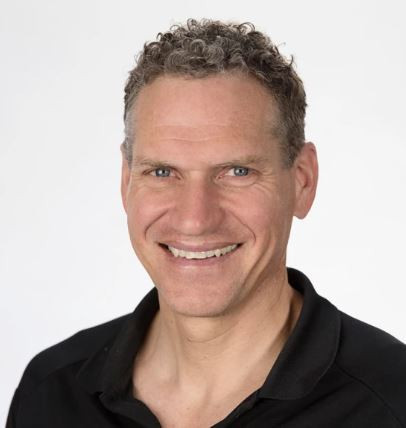 In the thick of the elite winter sport scene for more than 25 years. That would in part define Luke Bodensteiner. He strung together an Olympic cross-country ski career and ended his over two-decade stint at U.S. Ski & Snowboard as their Chief of Sport. For roughly the past year, Bodensteiner has worn two hats at the Utah Olympic Legacy Foundation (UOLF): Chief of Sport Development and GM of Soldier Hollow (SoHo), the cross-country and biathlon venue from the 2002 Games. The SoHo part of his responsibilities involves managing the complex which includes ski trails, a biathlon range, waxing outbuildings, and an iconic but dated timing building.