From the FasterSkier archive — posts syndicated from athletes’ and coaches’ own blogs between 2004 and 2012, kept online as published. Current coverage is at fasterskier.com.

Tag: Lydia Blanchet

  • Gus Schumacher Leads the Way in First Besh Cup Weekend

    Gus Schumacher Leads the Way in First Besh Cup Weekend

    The Chugach Mountains and a winter sunrise, seen in this file photo view from the parking lot at Government Peak Recreation Area, Palmer, Alaska, in February 2018. (photo: Gavin Kentch)
    The Chugach Mountains and a winter sunrise, seen in this file photo view from the parking lot at Government Peak Recreation Area, Palmer, Alaska, in February 2018. (photo: Gavin Kentch)

    Note: FasterSkier is accepting submissions for regional race reports, including for juniors racing. If you would like to see a particular race circuit covered and have the writer with the will to do it, please have them email info@fasterskier.com. Be sure to include a link to results, and preferably a few original race photos with proper credits.

    GOVERNMENT PEAK RECREATION AREA, outside Palmer, Alaska — On a day that had a decidedly old school feel, one of the state’s newest racing venues took center stage, as Government Peak Recreation Area successfully hosted the opening Besh Cup races of the 2018/2019 Junior Nationals qualifying series this past weekend on less than a week’s notice.

    Saturday morning saw U18 boys and up cover 15 kilometers, on a hilly two-lap course; U18 girls and up raced 10 k, on an even hillier two-lap course. It was classic technique, it was interval start, it was cold, and the trees were draped with fresh snow. It felt like a World Cup race circa 1990.

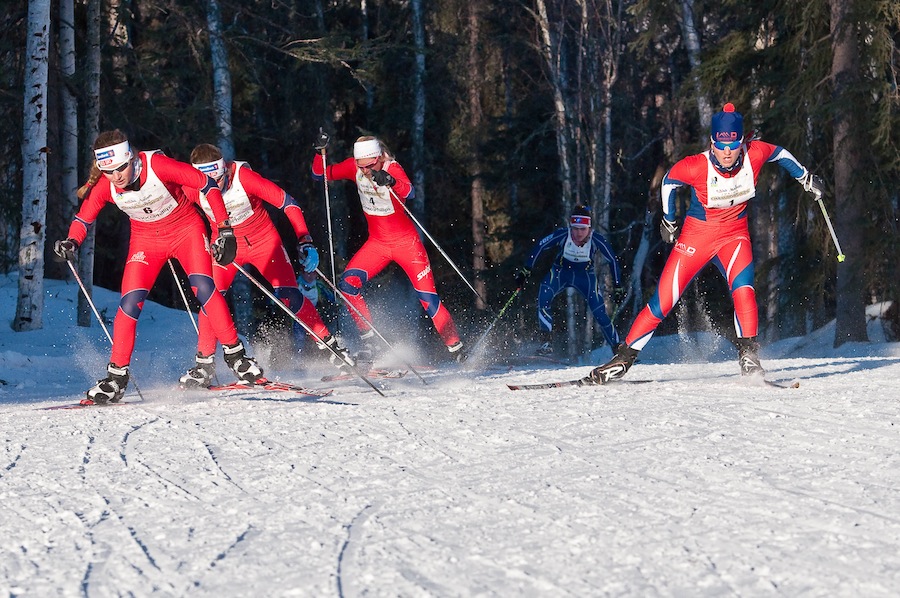
    Senior women Hailey Swirbul, Rosie Frankowski, and Lydia Blanchet. (photo: courtesy CCAK)
    Senior women Hailey Swirbul, Rosie Frankowski, and Lydia Blanchet. (photo: courtesy CCAK)

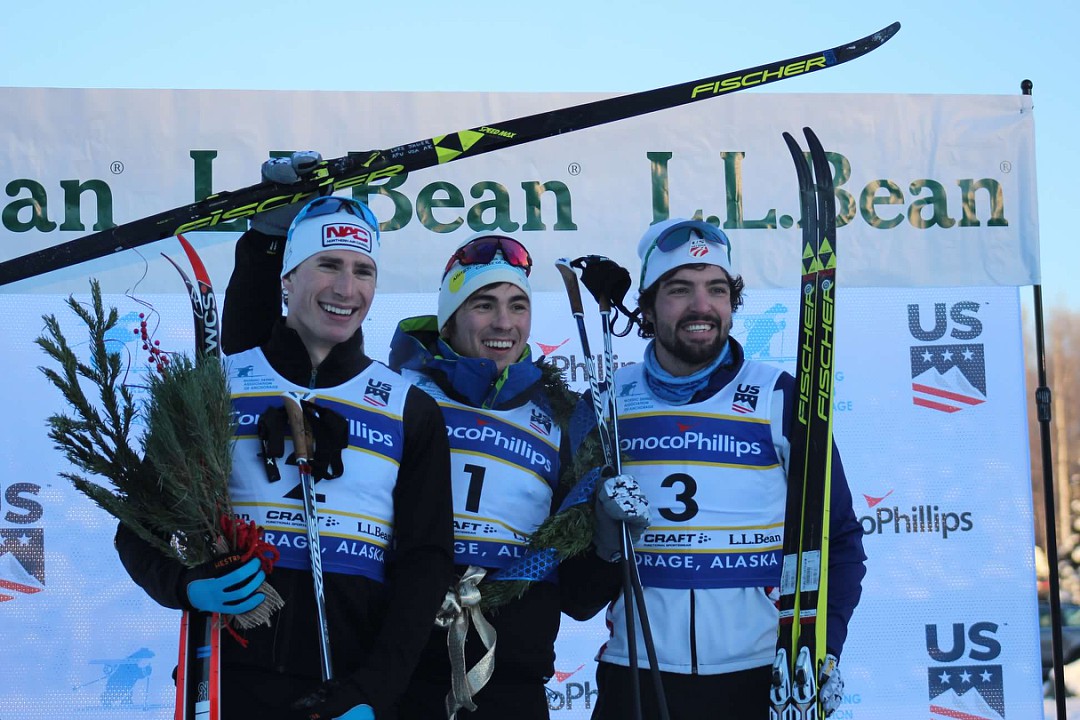
    The comparison isn’t totally bathetic, given the overall leaderboards for Saturday’s races: Rosie Frankowski, Hailey Swirbul, and Kendall Kramer for the women, and Gus Schumacher, Luke Jager, and Hunter Wonders for the men. That’s an Olympian and a three-time World Juniors medalist for the women, and three-fourths of this spring’s breakthrough World Juniors silver medal relay team for the men. Oh, plus the 16-year-old Kramer, who was third in the junior women’s 5 k classic mass start at 2018 U.S. Cross Country Championships and who may have a pretty bright future in this sport herself.

    Saturday: distance classic races

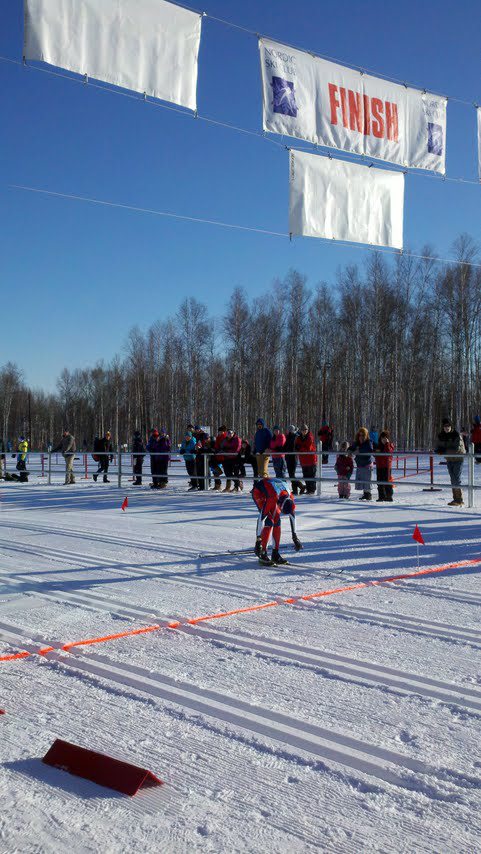
    Male racers set out at 11 a.m. Saturday morning from the compact stadium at Government Peak Recreation Area (GPRA), a labor of love by the Mat-Su Ski Club and the Palmer and Wasilla ski community over the past ten years. They headed out on a course that is a poor man’s Davos distance course, with consistent climbs and V2-able false flats for the first two-thirds of the loop, giving way to a working downhill and a sharp drop back to the stadium. Or to just below the stadium, actually; the course ends with a grueling B-climb immediately before the finish (see next picture, below right). The obvious challenge is to pace the uphills easily enough the first time to ski the downhills and flats efficiently, then do the same thing a second time in lap 

    After roughly 80 racers had covered two 7.5 k laps in the day’s first race, leaving the stadium at 30-second intervals, it was Schumacher who had done this most efficiently, covering 15 k in 43:23.11. Jager (+12.36) and Wonders (+26.53) made up the overall podium. The top three senior athletes were Wonders, Logan Hanneman (fourth overall), and Tyler Kornfield (fifth).

    The top three U20 racers on the day were Schumacher, Jager, and Ti Donaldson, who was seventh overall. Leading the U18 racers were Zanden McMullen (15th overall), Everett Cason (16th), and Max Germain (19th). 50-year-old Adam Verrier, a 1994 Olympian, was the top Master in 47th. Behind Schumacher, who skis for Alaska Winter Stars, in first, Alaska Pacific University (APU) showed its depth by putting six skiers in the top 10 and 10 in the top 16.
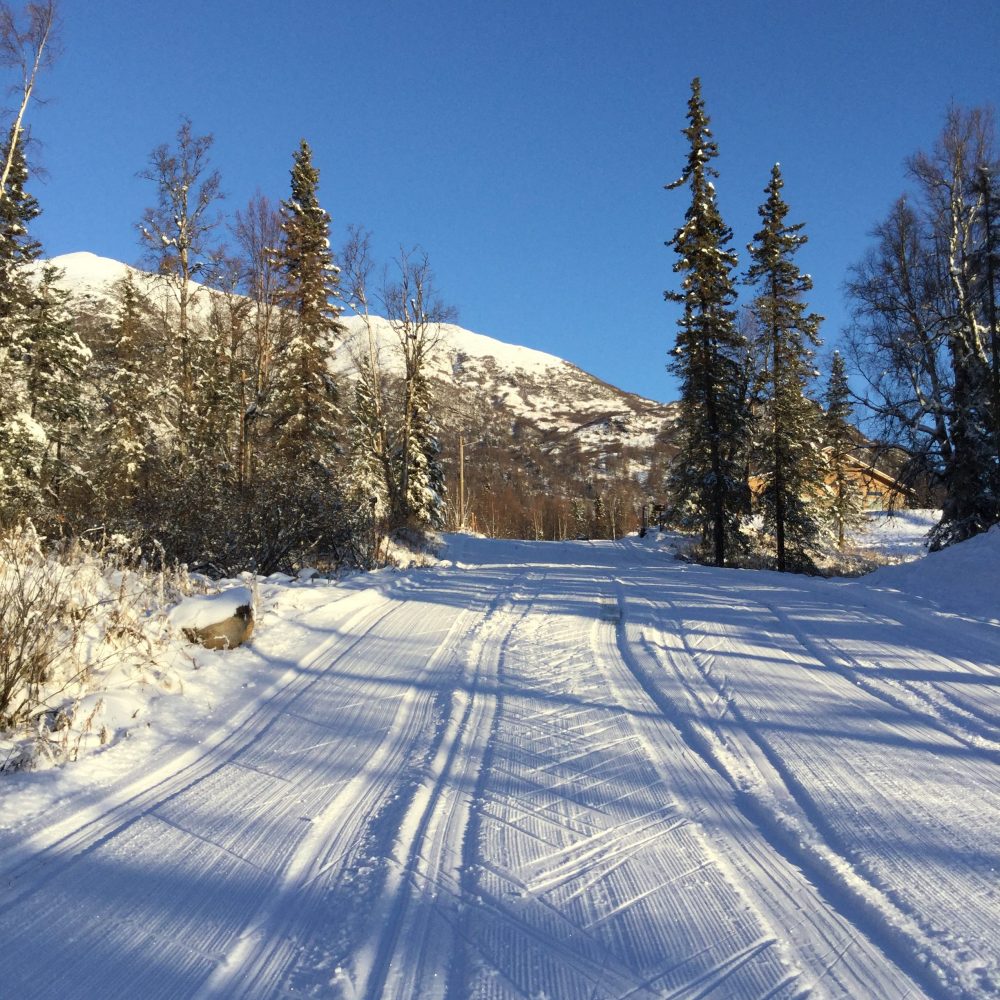
    Part of the final climb leading back up to the stadium on the comp loop, seen in this file photo view from Government Peak Recreation Area, Palmer, Alaska, November 1, 2018. (photo: Gavin Kentch)
    Part of the final climb leading back up to the stadium at the end of the Government Peak comp loop, seen in this file photo view from November 1, 2018. (photo: Gavin Kentch)

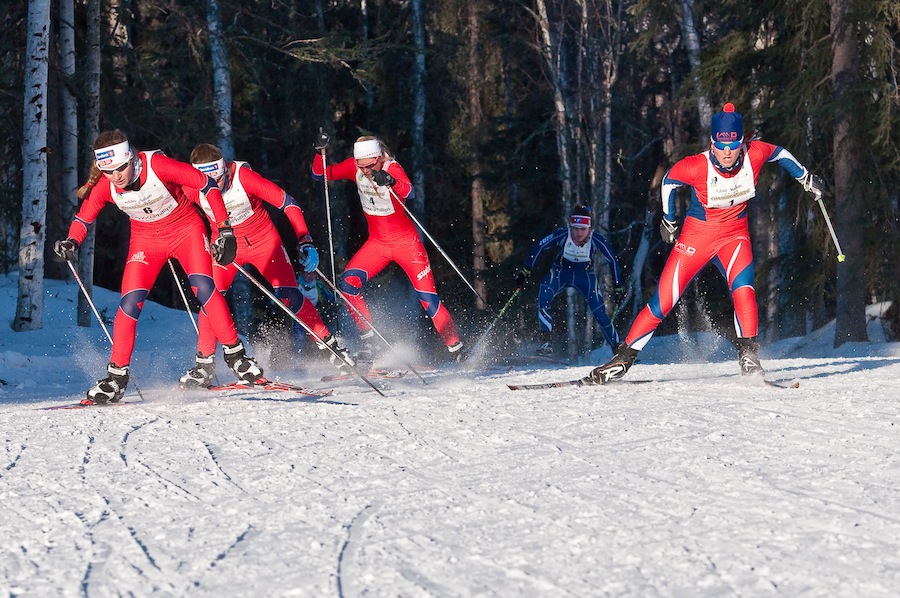
    The day’s second race saw 43 women, age U18 and up, take on two laps of the Davos-lite 5 k course described above. Two laps of 5 k at Government Peak is in many ways harder than two laps of 7.5 k, as the longer course adds 2.5 kilometers of gently rolling terrain near the end of the homologated (or perhaps homologation-pending) 5 k course. The 5 k course has no such recovery intermezzo, and the final climb of the first lap segues into the first climb of the second lap for a difficult extended climb with negligible recovery.

    After two laps and 10 k classic, the day’s last starter, Rosie Frankowski, posted the fastest time, finishing in 32:28.01. (While snow conditions are obviously extremely variable from one venue and race to the next, making time comparisons unreliable, and Frankowski did not have World Cup skiers in front of her to chase on Saturday, the fact that Frankowski has previously skied a World Cup 10 k classic in 27:44, on a homologated course in Falun with 365 meters of total climb, suggests that the new Government Peak comp loop deserves respect.)

    Frankowski’s APU teammate, Hailey Swirbul, was second on Saturday, 22.39 seconds back. Kramer (+1:42.15) was third, ahead of a top-10 otherwise composed of skiers from the University of Alaska Anchorage and local Dartmouth College skiers home for winter break.

    buy flonase online

    The top three senior athletes were Frankowski, Swirbul, and Lydia Blanchet, who was fourth overall. The U20 podium was Jenna Difolco (seventh overall), Molly Gellert (17th), and Maggie Meeds (23rd). Somewhat ahead of them were the three fastest U18 skiers: Kramer, Adrianna Proffitt (11th), and Ivy Eski (14th). M4 skier Alison Arians, in 18th, was the top Master.
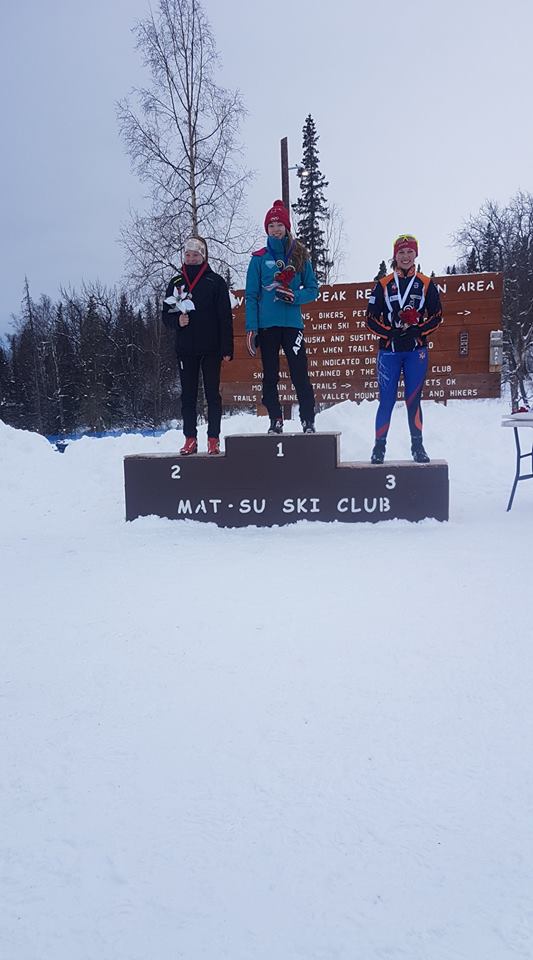
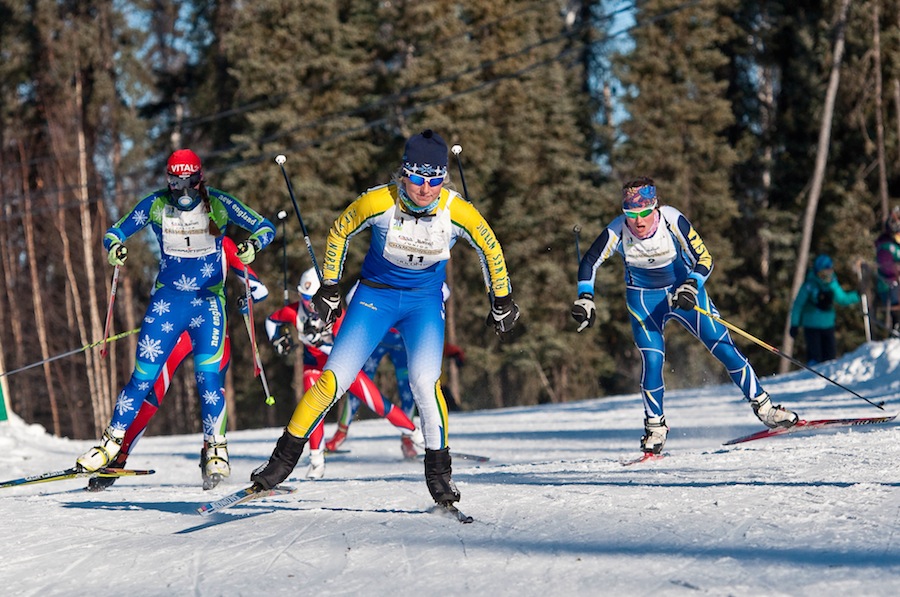
    U16 girls Katey Houser, Marit Flora, and Victoria Bassette. (photo: courtesy CCAK)
    U16 girls Katey Houser, Marit Flora, and Victoria Bassette. (photo: courtesy CCAK)

    Next out on the course were 51 U14 and U16 boys, who did a single lap of the comp loop. U16 skier Aaron Maves, like Frankowski before him, lived up to his top seeding, finishing one lap in 16:35.99. Second and third went to Konrad Renner (+18.99) and Eli Merrill (+36.83), also both U16 athletes. The top U14 skiers in this race were Skyler Amy (22nd overall), Murphy Kimball (23rd), and Aven Elsberg (26th).

    Moments later came the start for the first of 49 U14 and U16 girls, as organizers efficiently put roughly 250 total athletes out on course at a venue that is a one-hour drive from Anchorage and sees a mid-December sunrise some time after 10 a.m. U14/U16 girls likewise did one lap of the 5 k comp loop.

    Quincy Donley had the highest seed and final start position for this race, but 5 k later it was penultimate starter Marit Flora who took the victory. Flora finished in 18:23.47. Donley was 22.78 seconds back in second. Meredith Schwartz (+48.59) was third.

    All three podium finishers were U16 girls. The top three U14 finishers in the race were Heidi Schumacher (12th overall), Sammy Legate (15th), and Zarah Laker-Morris (24th).

    Sunday: distance freestyle races

    After the U12, U10, and U08 skiers finished up the first day’s races, and the afternoon’s sunset time of 3:33 p.m. threatened, volunteers took down the course, coaches packed up waxing equipment, and tired racers began the trek back to Anchorage homes or Mat-Su hotel rooms. The first volunteers were officially on site by 7:30 a.m. Sunday morning to assist with parking, although doubtless some people had returned to the venue by long before then.

    Day two of racing brought some differences – freestyle instead of classic, shorter distances, and slightly warmer temperatures – but more repeat podium finishers than not across the day’s races.

    The first division on course was again U18 boys/U20/Seniors/Masters men, this time with 78 starters going out at 15 seconds apart. Sunday’s skate race was 10 k freestyle interval start, twice around the 5 k comp loop (precisely the same as the senior women’s 10 k classic the day before). The top three overall were unchanged from Saturday’s 15 k classic: Gus Schumacher, then Jager, then Wonders, the World Juniors silver-medal relay team united once more. Schumacher’s time on Sunday was 26:17.07. Jager (+15.56) and Wonders (+42.74) were the only other two athletes to break 27 minutes on the hilly course.
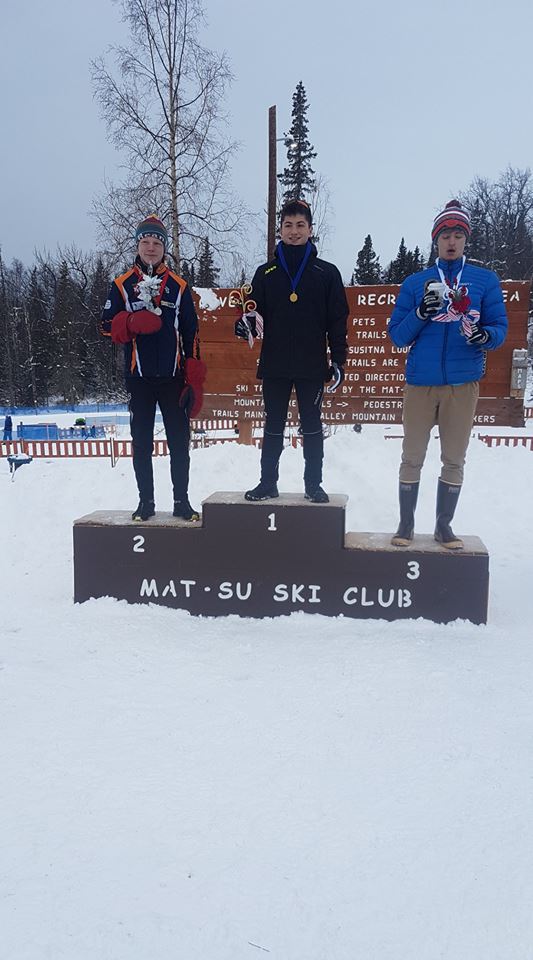
    U16 boys Josh Baurick, Konrad Renner, and Aaron Maves. (photo: courtesy CCAK)
    U16 boys Josh Baurick, Konrad Renner, and Aaron Maves. (photo: courtesy CCAK)

    The U20 leaders on Sunday were again Schumacher, Jager, and Donaldson, who was fourth overall. The senior podium was Wonders (third overall), Thomas O’Harra (fifth), and Forrest Mahlen (sixth). Best times for U18 skiers went to McMullen (seventh), Cason (11th), and Germain (16th), precisely the same U18 podium as in the 15 k classic. Much as on Saturday, behind Alaska Winter Stars skier Schumacher in first, APU placed seven athletes in the top 10.

    The first Master, among eight Masters finishers on Sunday, was M1 skier Cody Priest, 30, a former skier and runner at the University of Alaska Fairbanks, in 25th overall.

    Soon after the last of the Senior men collapsed across the finish line, the first of the U16 boys headed out for one lap of the 5 k course. (All races on both days were interval-start.) First on Sunday was Renner (15:21.27), improving on his second-place finish from the day before. Josh Baurick (+9.17) was second, with Maves (+17.20) staying on the podium but moving down to third after his victory on Saturday.

    Next up were 43 U18 girls/U20/Seniors/Masters women. Neither Frankowski nor Swirbul raced on Sunday, but their APU teammate Jessica Yeaton, who skis domestically with APU but competes internationally for her native Australia, did after not racing on Saturday. Yeaton was seeded third in the 5 k skate but ended up first, covering one 5 k lap in 14:47.25. Kramer (+26.15) moved up to second overall on Sunday, with Emma Tarbath (+46.32) third, barely a second ahead of Lydia Blanchet in fourth. Anna Darnell was the fifth and final woman to break 16 minutes on the hilly course.

    The senior women’s podium was Yeaton, Tarbath, and Blanchet. The top three U20 finishers were Jenna Difolco (seventh overall), Molly Gellert (ninth), and Emma Jerome (21st). The top three U18 finishers were, again, Kramer (also second overall), then Ivy Eski in eleventh overall, barely ahead of Annika Hanestad in twelfth. Arians (15th) was again the first Master.

    U14 boys were the next race out on the course. Sunday brought a 3.75 k skate, on a course that covered most of the 5 k comp loop used throughout the weekend, but elided one major climb and the only rolling section from the top part of the course. The technique and the distance were different, but the U14 podium was precisely the same as on Saturday: Amy (13:29.76), then Kimball (+2.05), then Elsberg (+7.19).
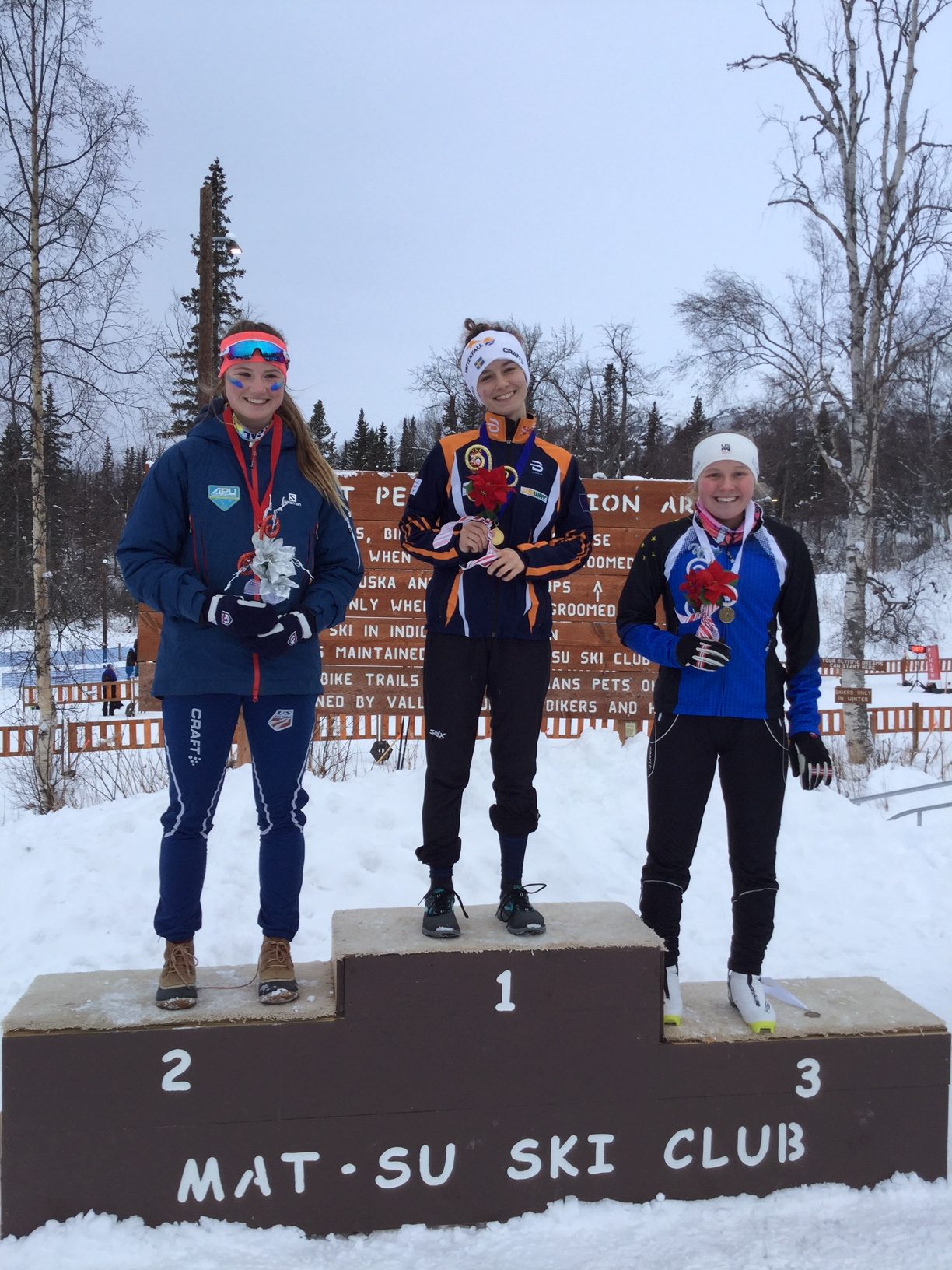
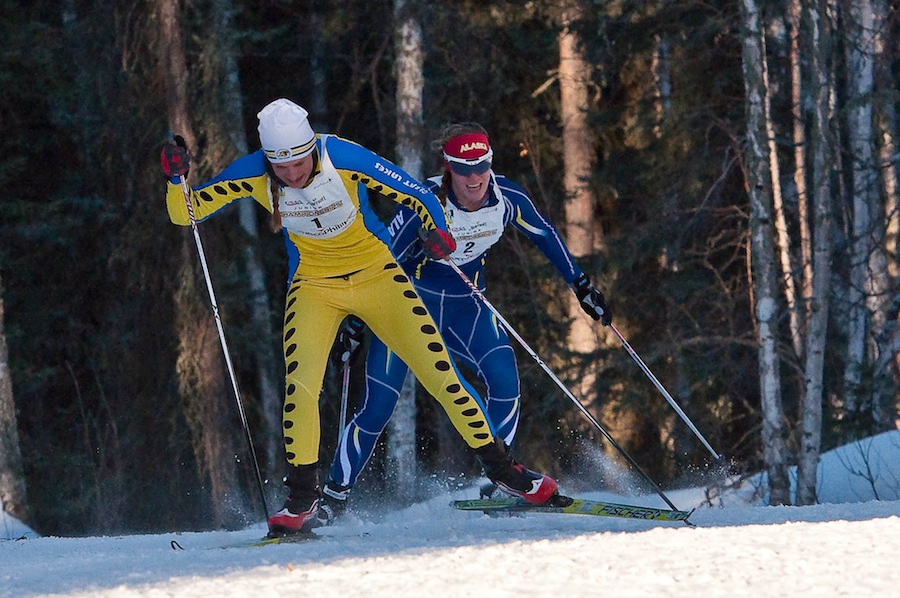
    U18 girls Ivy Eski, Kendall Kramer, and Annika Hannestad. (photo: Gavin Kentch)
    U18 girls Ivy Eski, Kendall Kramer, and Annika Hannestad. (photo: Gavin Kentch)

    Finally, U14 and U16 girls headed out on the same 3.75 k loop. Marit Flora took her second victory of the weekend by a substantial margin, finishing in 12:13.98. Katey Houser (+30.59) and Victoria Bassette (+32.64) collected their first podia of the weekend.

    The overall podium was again all U16 racers. The U14 leaders were Legate (tenth overall), Heidi Schumacher (16th), and Nora Hulse (24th).

    Reflecting the depth of skiing in southcentral Alaska, the roughly 250 entrants for the weekend’s races included a healthy six former Olympians (Rosie Frankowski, Logan Hanneman, Tyler Kornfield, Adam Verrier, Casey Wright, and Jess Yeaton) and four World Juniors medalists (Gus Schumacher, Luke Jager, Hailey Swirbul, and Hunter Wonders), as well as additional senior national championship podium finishers, most of the rest of the APU Elite Team, a dozen or more NCAA skiers, and scads of past Team Alaska Junior National members.

    Both races were FIS races, as well as certified for National Rankings List purposes by U.S. Ski & Snowboard. FasterSkier unofficially calculates the USSA penalty at a healthy 41.99 points for the men’s distance races.

    Thoughts on the weekend

    Two common themes emerged after talking with a handful of the weekend’s podium finishers: One, these races are a good introduction to the season and to bigger races still ahead. And two, the new Government Peak courses are great. But hard.

    As two-time U18 champion Zanden McMullen told FasterSkier Sunday afternoon, “Yesterday I was definitely hurting in the race, but I was proud to come out on top. I definitely felt a lot better today. I’m pretty happy going into the season, where I am; I still have a little work to do before Senior Nationals, but I’m super excited.”

    U20 men Luke Jager, Gus Schumacher, and Ti Donaldson. (photo: courtesy CCAK)
    U20 men Luke Jager, Gus Schumacher, and Ti Donaldson. (photo: courtesy CCAK)

    Two-time overall champion Gus Schumacher expressed similar sentiments, telling FasterSkier, “I wanted to use [these races] to get into racing more, and get some more races under my belt, so I felt better at the bigger races. But obviously, to get into good racing shape, you want to be trying to race as best you can, so that was kind of the goal, to be able to start getting my racing speed to its top level.”

    Schumacher, who is undefeated in five local races this year, including the Race to the Outhouse #1 hill climb at Hatcher Pass the preceding weekend and a sprint and distance race in Fairbanks in the Alaska Nordic Cup in early December, described his current shape as “pretty good.” He elaborated that he plans to add some more intensity soon, but thinks that he is “coming into my race form, and it looks pretty good. Good to have these fast boys around me to push me every day.”

    Schumacher plans to do some trials with Alaska Winter Stars, possibly collaborating with APU, before flying to Craftsbury on December 29th for senior nationals.

    Two-time U18 champion (and double overall podium finisher) Kendall Kramer sounded similar notes, but was somewhat more introspective when asked what her weekend results told her about her current fitness and the upcoming race season.

    “I got invited to a lot of national camps this summer,” Kramer said to FasterSkier, “and I think being exposed to so many different training groups and training styles – I really diversified how I trained this year, and so I’m happy that it’s working out for me. It’s less stressful, and I’m putting less pressure on myself.”

    Kramer, who had never previously raced at Government Peak, described the new courses as “really, really tough.” She seemed to recognize that the course profile was advantageous to her, while stopping short of actually saying that she had enjoyed them when asked if she had liked the courses: “I mean, yes, being super small and light and getting up hills – I wouldn’t pick this venue, necessarily. But I think it was good for me.”

    Ivy Eski, who claimed a pair of U18 podium finishes on the weekend, was more effusive.

    buy zyrtec online

    “I love it,” she told FasterSkier. “It was really fun. I definitely want to race here again. The courses are amazing.”

    Eski also praised the “really good snow and super good grooming,” calling it “overall really a great weekend.”

    U18 boys Everett Cason, Zanden McMullen, and Maxime Germain. (photo: courtesy CCAK)
    U18 boys Everett Cason, Zanden McMullen, and Maxime Germain. (photo: courtesy CCAK)

    And McMullen, who had also never raced at this venue, similarly said of the new courses, “They’re tough, but I like them. You definitely have to be on top of it to be able to push it and go fast.”

    Are they as hard as a nationals course? he was asked. “I definitely think they could be,” said McMullen, who has raced throughout the U.S. as well as in Finland. “Because if you don’t ski it correctly, you could be hurting.”

    * * *

    The overall success of the weekend is noteworthy only in light of two facts: That the Mat-Su Ski Club had never hosted an event at this level before, and that it did so on less than a week’s notice, as poor trail conditions throughout southcentral Alaska forced governing body Cross Country Alaska (CCAK) to have a series of competition committee meetings and teleconferences during the week of December 3 to decide where in the state to send 250 athletes and their parents for a weekend of racing. (Anchorage and Fairbanks are a six-hour drive apart, nearly the twice amount of daylight in Fairbanks in mid-December; the decision to move a race weekend is not made lightly.)

    On Sunday evening, December 9, CCAK announced the decision of the Competition Committee to have the opening Besh Cup weekend at the Government Peak ski trails. Six days later, skiers were pouring into the carefully managed, not-really-large-enough parking lot for the weekend’s first race, with overflow parking stretching hundreds of yards down one side of the access road. Notwithstanding the venue’s youth and the Mat-Su Ski Club’s relative inexperience, all races on both days appear to have gone flawlessly. (Full disclosure, this reporter contributes money to Mat-Su Ski Club for grooming each year, but was not otherwise involved in organizing or supporting these races save for paying an entry fee for both days to race as a Masters athlete.)

    The Mat-Su Ski Club, which pulled off two days of impeccable grooming without the aid of large-scale grooming equipment, is currently fundraising for the purchase of a PistenBully groomer.
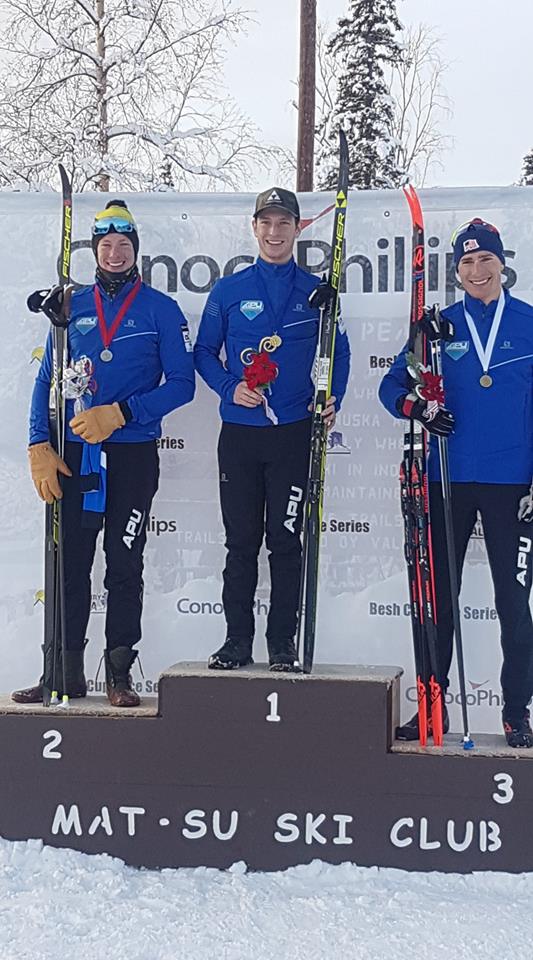
    Senior men Logan Hanneman, Hunter Wonders, and Tyler Kornfield. (photo: courtesy CCAK)
    Senior men Logan Hanneman, Hunter Wonders, and Tyler Kornfield. (photo: courtesy CCAK)

    Next up

    Besh Cup racing for Team Alaska selection continues with two more weekends of racing, currently scheduled for Soldotna on January 19-20, 2019, and Fairbanks on February 2-3. There are traditionally two interval-start distance races, two mass start distance races, and two sprint races throughout the six-race Besh Cup series, three races each of skate and classic. CCAK will announce future race details in advance of upcoming race weekends, after atypically starting the season with two consecutive interval-start distance races due to the last-minute move to Government Peak.

    2019 Junior Nationals will be held at Kincaid Park in Anchorage from March 9-17, 2019. Recent snowfall has brought the trails there from, as CCAK recently described them, “ice/grass rinks” to skiable within the past week (that is, after the decision was made to move the races).

    While relatively warm temperatures hindered the Nordic Skiing Association of Anchorage (NSAA)’s ability to make snow through the early winter, leading to NSAA running the snowmaking system for only 48 hours through November 28, the snowmaking system did survive the 7.0 earthquake of November 30 unscathed, NSAA Business Manager Erin Beam told FasterSkier in an early-December email. “NSAA has tested it since the earthquake, and there are no apparent damages or problems,” she wrote at the time. “It’s certainly incredible it wasn’t worse.” NSAA has made some snow at Kincaid within the past week or so, in addition to grooming the natural snow on most trails.

    Results and media: Saturday classic (all races) | Sunday skate (all races) | FIS results (all races) | Current 2019 Team Alaska points list | CCAK podia photo albums: Day 1, Day 2

  • Friday Rundown: U23 Worlds Skiathlons; Eastern Canadian Champs

    Friday Rundown: U23 Worlds Skiathlons; Eastern Canadian Champs

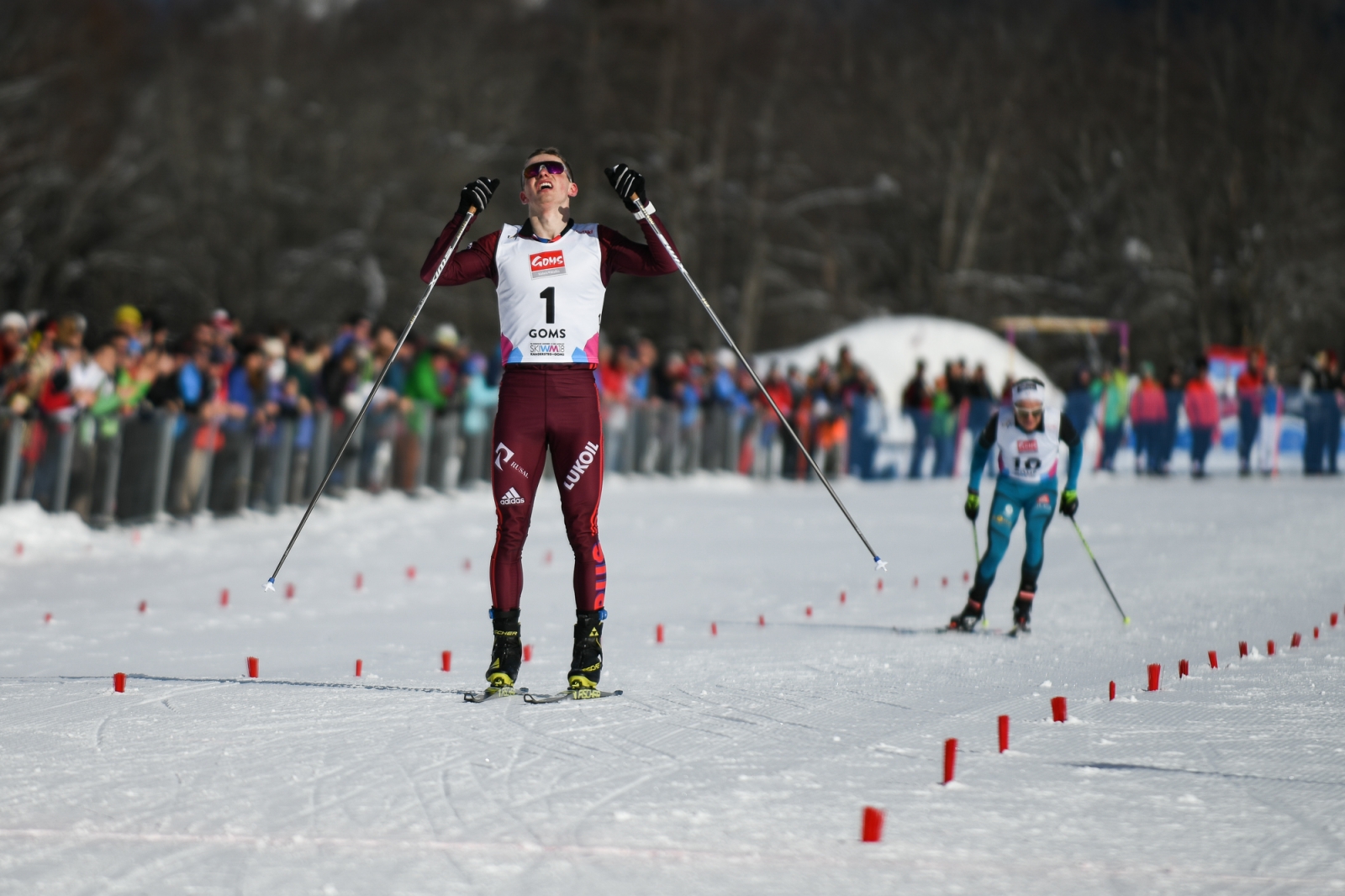
    Russia’s Denis Spitsov celebrates his first U23 World Championships gold on Friday ahead of France’s Jules Lapierre in the men’s 30 k skiathlon in Goms, Switzerland. (Photo: JWSC2018.ch)

    (Note: This article has been updated to include comments from Americans Lauren Jortberg and Ian Torchia.)

    U23 World Championships (Goms, Switzerland): 15/30 k skiathlons

    On the final day of U23 World Championships racing in Goms, Russia stole the show in the women’s and men’s skiathlons.

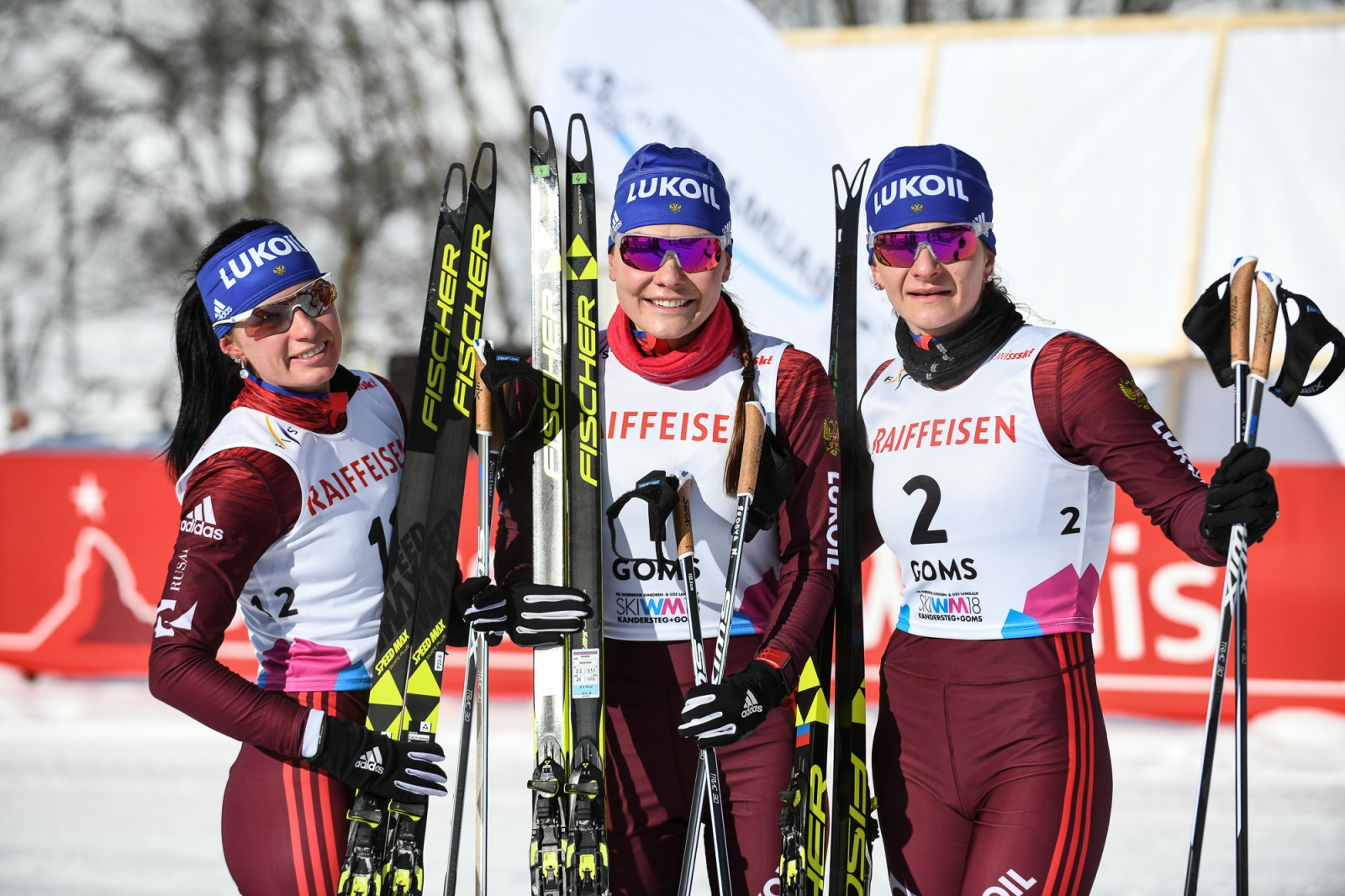
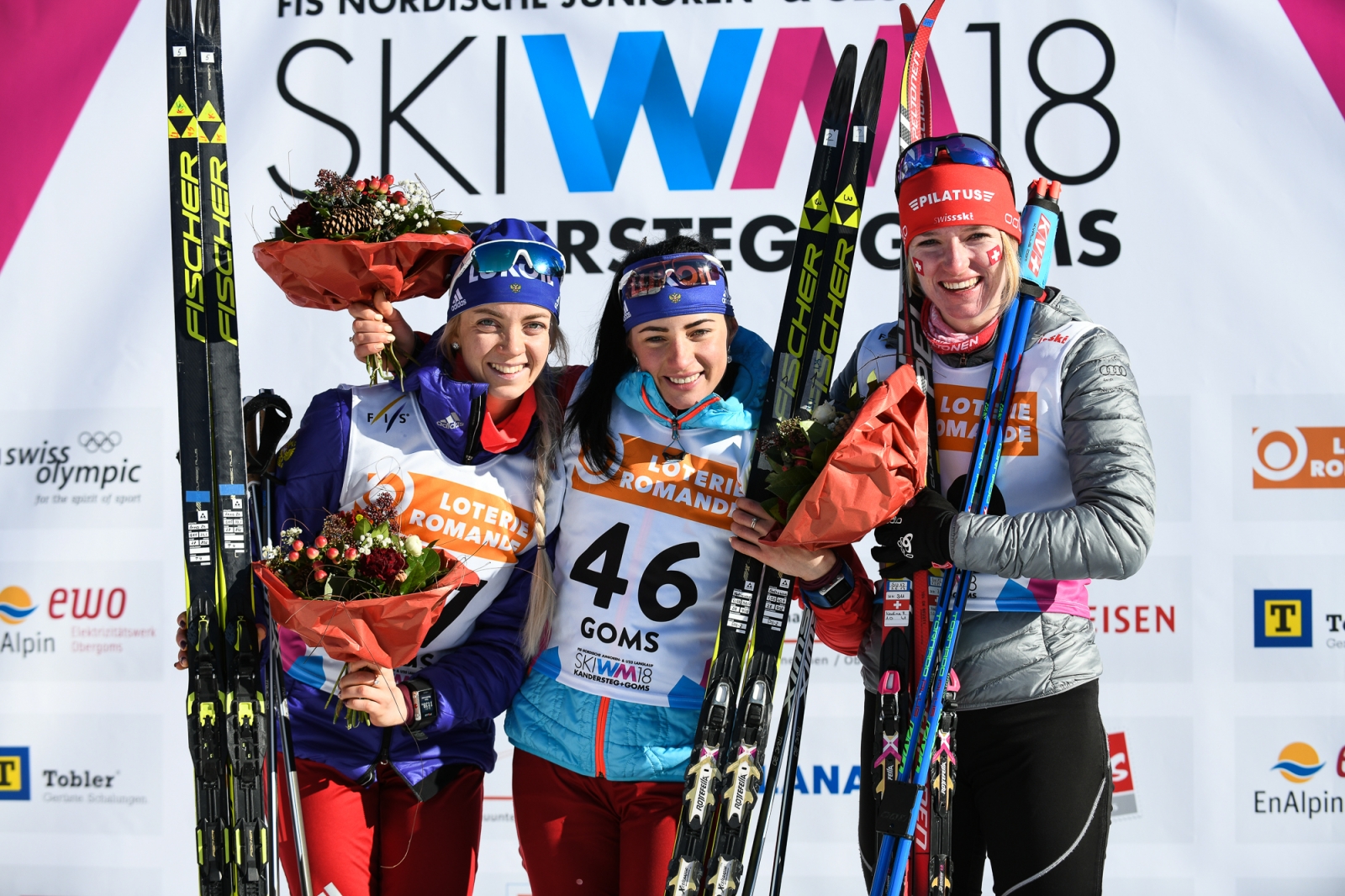
    The all-Russian women’s 15 k skiathlon podium at U23 World Championships on Friday in Goms, Switzerland, with Anastasia Sedova (c) in first, Natalia Nepryaeva (l) in second and Yulia Belorukova (r) in third. (Photo: JWSC2018.ch)

    Anastasia Sedova led them in the first race of the day on Friday, the women’s 15-kilometer skiathlon, which she won in 44:03.6 minutes. Russia swept the podium and had four in the top five with Natalia Nepryaeva in second (+10.7) and Yana Kirpichenko in third (+37.2), and Yulia Belorukova in fourth (+1:58.0). Germany’s Pia Fink placed fourth (+1:33.5).

    The race was the first of the week for the 22-year-old Sedova, a World Cup regular, and it was her second individual gold medal at her second U23 World Championships (she won the 10 k classic in 2016).

    “Good preparation for the Olympic Games,” Sedova said during an in-arena interview after the race. “I am very lucky today. Good atmosphere, good weather today.”

    Kirpichenko won the 10 k classic earlier this week and Nepryaeva placed third in the freestyle sprint in Goms.

    “It’s hard to say how to describe the race, but Anastasia is a really good skier,” Nepryaeva said after. “She was really good today. So for me it was hard to support her during the race. Today she was much better than me.”

    American Lauren Jortberg (Dartmouth Ski Team) led the North Americans in 29th (+5:29.9) for her best distance result at the Junior/U23 World Championships level.

    “Early in the race I was right over 30th place, and I was trying to maintain contact with the big group ahead of me,” Jortberg, a Dartmouth sophomore from Boulder, Colorado, wrote in an email. “The pace of the classic leg was really fast. A couple of the girls in the race are heading to the Olympics in a few days so it was a really hot start!”

    She came through the transition at the race’s halfway point in 31st, about 3:47 behind the leaders.

    “I am a much better skater so I felt like I really put the hammer down on the skate leg and moved up a lot,” Jortberg wrote. “The skate course was much easier than the classic course, but I feel like I skied the massive climbs better than the girls around me. I focused on having a really high tempo over the hills and skiing the downhills technically well because there was no rest on the course.

    “I’m pleased with my performance today, and I’m excited about my results this week as a whole,” she added. “I’m definitely leaving here hungry for more because I don’t think it was my best week, but I think it was really solid. This is the most competitive field I’ve ever raced against so it feels really good to know that I’m not too far off their level!”


    Also for the U.S., Lydia Blanchet placed 38th (+7:11.1) and Nicole Schneider was 40th (+8:04.3). Julia Kern did not finish.

    Canada’s Katherine Stewart-Jones (Canadian National U25 Team/NTDC Thunder Bay) placed 31st (+5:39.0) and Maya MacIsaac-Jones was 42nd (+8:08.8), while Laura Leclair and Sophie Carrier-Laforte were lapped.

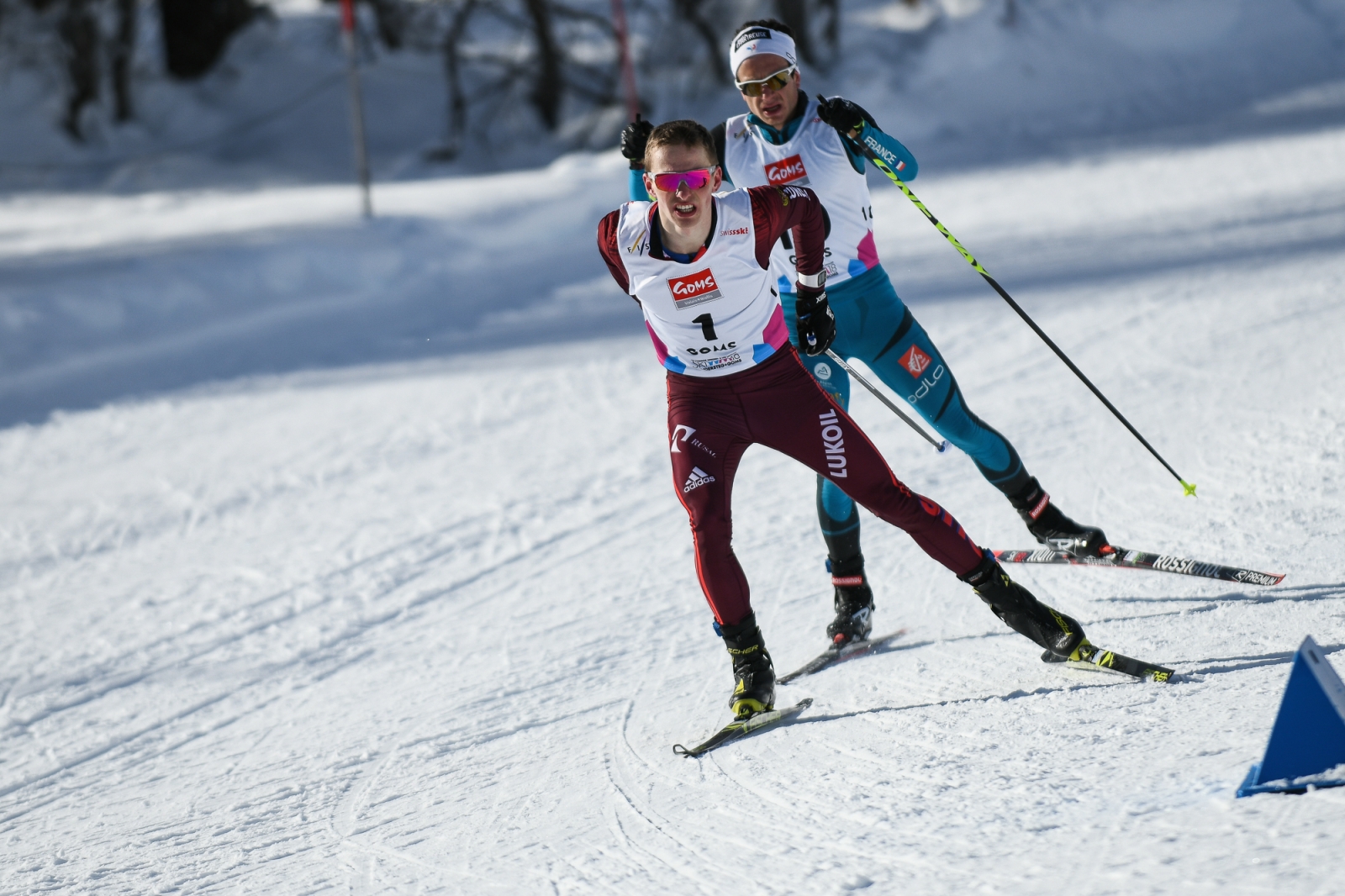
    Russia’s Denis Spitsov leads France’s Jules Lapierre during the men’s 30 k skiathlon on Friday at 2018 U23 World Championships in Goms, Switzerland. Spitsov went on to win by 2.9 seconds over Lapierre. (Photo: JWSC2018.ch)

    In the men’s 30 k, Russia’s Denis Spitsov took the win in 1:18:14.9 hours, just 2.9 seconds ahead of France’s Jules Lapierre. Norway’s Ole Jørgen Bruvoll placed third (+21.5), ahead of Russia’s Ivan Yakimushkin in fourth (+23.2), and Andorra’s Irineu Esteve Altimiras in fifth (+36.4).

    The gold was the first for Spitsov, 21, who previously placed second in the 15 k classic earlier this week. He has two individual bronze medals from last year’s U23 Worlds (in the 30 k skiathlon and 15 k freestyle).

    American Ian Torchia (U.S. Ski Team/Northern Michigan University) placed 27th on Friday (+6:05.7). Only 33 men finished, and he was the only North American that didn’t get lapped.

    “Between the 3700 feet of climbing, a 2.5km loop, and the top dogs having World Cup podiums…half the field got lapped,” Torchia wrote in an email. “Definitely added some motivation in the final 2 laps to see Spitsov and Lapierre slowly catching up.

    “I felt I skied technically better in skate and struggled on the classic leg,” Torchia explained. “Took a hard tumble halfway through the classic leg and had to take half a lap to recover from that. Found a hole in my suit close to my groin afterward which was a little unnerving!”

    At the end of the week, he noted that he felt “more fired up than coming in. Funny how being 6 minutes back can do that,” he wrote. “It was an eye-opening experience to get back on the international stage after 2 years and I will take these lessons of racing to the rest of the season in the Ishpemimg Super Tour, Steamboat NCAA’s, and Craftsbury Spring Series. Also already thinking of ideas on how to change and optimize my training to make the jump to the top level.”
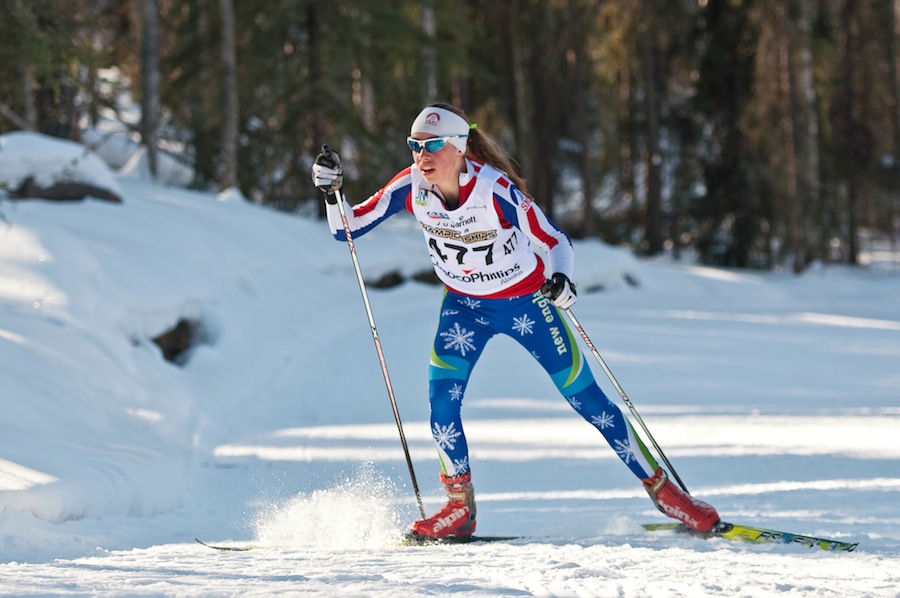
    Americans Andrew Egger, Zak Ketterson and Thomas O’Harra also competed, as did Canada’s Alexis Dumas, Gareth Williams, Philippe Boucher, and Ricardo Izquierdo-Bernier.

    Results: Women | Men 

    ***

    Stratton’s Ben Saxton (l) edging Julien Locke (r) by eight-hundredths of a second for the win in the men’s 1.4 k classic sprint A-final on Friday at Eastern Canadian Championships in Gatineau, Quebec. (Photo: Becca Rorabaugh (APU) on her way to winning the women’s 1.3 k classic sprint qualifier on Friday at 2018 Eastern Canadian Championships in Gatineau, Quebec. (Photo: Rob Smith/CCC)

    NorAm Eastern Canadian Championships (Gatineau, Quebec): Classic sprints

    Eastern Canadian Championships opened in Gatineau on Friday with classic sprinting, and Americans Becca Rorabaugh and Ben Saxton ended the day with wins in the women’s and men’s A-finals, respectively.

    Becca Rorabaugh (APU) on her way to winning the women’s 1.3 k classic sprint qualifier on Friday at 2018 Eastern Canadian Championships in Gatineau, Quebec. (Photo: Rob Smith/CCC)

    For Rorabaugh, the win is her second straight after the Alaska Pacific University (APU) skier won the women’s 5-kilometer freestyle at last weekend’s SuperTour in Craftsbury, Vermont. She edged last weekend’s classic-sprint winner, Kaitlynn Miller, of the Craftsbury Green Racing Project (CGRP), by 0.41 seconds for the win in 3:23.15 minutes in Friday’s 1.3 k classic sprint final. It was an all-American podium (and all-American final) with Erika Flowers, of the Stratton Mountain School (SMS) T2 Team, just another three-hundredths of a second back in third (+0.44). Liz Guiney (CGRP) followed in fourth (+2.51), Rosie Frankowski (APU) was fifth (+3.88), and Corey Stock (Bridger Ski Foundation) placed sixth (+6.1).

    Rorabaugh had started the day by qualifying first in 3:26.95, then won both her quarterfinal and semifinal. Miller qualified third and won her quarterfinal and semifinal as well.

    In the men’s 1.4 k classic sprint, Saxton (SMST2) nipped Julien Locke (Canadian U25 Team/Black Jack) at the line by 0.08 seconds for the win in 3:04.54. Patrick Stewart-Jones (Alberta World Cup Academy) placed third (+5.53), Kris Freeman (Caldwell Sport) was fourth (+5.94), Kevin Bolger (Sun Valley Ski Education Foundation) fifth (+7.42), and Julian Smith (NTDC Thunder Bay) sixth (+11.63).

    Locke initially won the qualifier in 3:08.37, then won the first quarterfinal and first semifinal as well. Saxton qualified sixth, then advanced in second in his quarterfinal about a second behind Smith, and Saxton won the second semifinal.

    Easterns continue Saturday with 10/15 k freestyle races and conclude Sunday with 10/15 k classic pursuits.

    Results: Qualifier | Heats

  • Under 23 Questions: Lydia Blanchet

    Under 23 Questions: Lydia Blanchet

    Lydia Blanchet (Dartmouth Ski Team) during the 10 k freestyle at 2018 US nationals last month in Anchorage, Alaska. (Photo: Betsy Arnold)

    In an effort to showcase the North Americans competing at this week’s International Ski Federation (FIS) 2018 Nordic Junior/U23 World Championships in Goms, Switzerland, we asked those qualifying athletes several questions about themselves — actually, we had them fill in the blanks. Here we have 20-year-old Lydia Blanchet, of the Dartmouth Ski Team, who’s representing the U.S. at her first U23 Worlds. 

    Blanchet notched a top 30 this week in the 10 k classic, where she finished 30th, and placed 32nd in the freestyle sprint and 38th in the 15 k skiathlon in Goms.

    ***

    “My full name is Lydia Anne Blanchet, but you can call me Lydia Anne Blanchet.

    I was born and raised in Anchorage, Alaska, and I learned to ski with the Anchorage Junior Nordic League at Kincaid Park, and later with APU.

    I spent the time between U.S. nationals and Junior/U23 Worlds catching up with work from the first week of classes and getting settled in my new apartment.

    The hardest and coolest workout I did in the last training year to prepare for this was running the 22 miles from the rim of the Grand Canyon to the Colorado River and back with my best friend and teammate Taryn Hunt-Smith this fall on our geology field program.

    Lydia Blanchet (Dartmouth Ski Team) on the Athabasca Glacier in Banff this past September on a Dartmouth geology field program. (Photo: Laura Hutchinson)

    This is my first time in Switzerland and first time racing internationally, and so far it’s been a dream!

    One difference I’ve noticed between Switzerland and the U.S. is the toilet flushers.

    Skiing and racing in the Alps is like skiing in a story book. Usually racing at altitude is painful for me because I’m a sea level girl through and through. There are humongous, beautiful mountains around where I live, but I train by the ocean!

    One of the things I’m most excited about for Junior/U23 Worlds in Goms is getting to meet skiers from every corner of the world.

    One race I’m especially targeting there is the skiathlon, but I’m excited for all of them.

    I really hope I can chat/make friends with someone from Kazakhstan and ask them if they really are the greatest exporters of potassium.

    My favorite thing at the breakfast where we are staying are croissants with jam and brie.

    Fondue is what my family used to eat on New Year’s. The cheese here is enough to make me move to Switzerland. And the chocolate is enough to make me stay for the rest of my life.

    If I had a totally free day here and didn’t have to worry about race fitness or training, I’d spend it doing a 45 minute sled run down an alpine resort—which I did with my dad on Tuesday!

    The best way to follow me on social media is on Instagram @blanchetlydia.”

    Lydia Blanchet (Dartmouth Ski Team) getting some air at the top of the tram by the U.S. team’s hotel in Goms, Switzerland. (Photo: Thomas O’Harra)
  • Wednesday Rundown: U23 Worlds 10/15 k Classic (Updated)

    Wednesday Rundown: U23 Worlds 10/15 k Classic (Updated)

    The women’s 10 k classic podium at 2018 U23 World Championships, with Russia’s Yana Kirpichenko (c) in first and Anna Zherebyateva (l) in second, and Switzerland’s Nadine Fähndrich (r) in third. (Photo: JWSC2018.ch)

    (Note: This article has been updated to include comments from Americans Lydia Blanchet and Ian Torchia.)

    U23 World Championships (Goms, Switzerland): 10/15 k classic

    Russia put two in the top three in both the women’s and men’s races on Wednesday at U23 World Championships in Goms, and for the second-straight race, Canada’s Katherine Stewart-Jones landed in the top 30.

    In the women’s 10-kilometer classic, Russia’s Yana Kirpichenko pulled out a 13.9-second victory over fellow Russian Anna Zherebyateva, finishing with the winning time of 27:46.1 minutes. Switzerland’s Nadine Fähndrich returned to the podium for the second race in a row (after placing second in Monday’s skate sprint), finishing third, 29.6 seconds behind Kirpichenko.

    In Monday’s sprint, Kirpichenko qualified fourth and ended up fifth in the final. She is a bronze medalist in the 15 k skiathlon at last year’s U23 Worlds.

    Stewart-Jones, of the Canadian National U25 Team and National Team Development Centre (NTDC) Thunder Bay, started relatively early on Wednesday in bib 19 and ultimately placed 29th, 3:07.3 out of first. She sped up as the race progressed, from 40th at 2.4 k to 32nd at 5 k and up to 30th at 7.4 k.

    So far in all five races she’s competed in over the last two years at U23 Worlds, Stewart-Jones has finished in the top 30. Her best result is 21st in last year’s 15 k skiathlon, and at the Junior Worlds level, she had a best individual result of 14th in the 10 k skiathlon in 2015.

    American Lydia Blanchet (Dartmouth Ski Team) started fifth on Wednesday and ended up 30th (+3:10.4) after skiing in the top 30 throughout the race. Her Dartmouth teammate Lauren Jortberg followed in 34th (+3:28.9) and Nicole Schneider was 49th (+5:23.8). Julia Kern did not start.

    For Blanchet, a Dartmouth junior, this week marked her first time racing at the Junior/U23 World Championships level. So far, she has placed 32nd in the freestyle sprint and now 30th in the classic distance race.

    “This is my first time racing internationally, and I tried to go into the races with no expectations,” Blanchet explained in an email. “I was excited to get as close as I did to qualifying for the sprint, but it was definitely bittersweet—missing heats by 0.3 seconds left me regretting some of the smaller details of my race. Still, it is really exciting to know that I can compete on the world stage!”

    After the sprint, she made a goal of finishing in the top 30.

    “I really like hilly, rolling courses—especially ones with very technical downhills—and this course definitely fit that bill,” she wrote of the classic distance course. “I am really happy with my race, all things considered. I didn’t feel great while I was racing – my legs flooded pretty hard a few km’s in – but I think I did a good job of holding myself together and staying strong mentally. I know I have the ability to do even better, which is motivating and exciting. I am looking forward to get to ski head-on against the whole field in the skiathlon, and I’m excited to try and pick my way forward from my bib number. I’m also really excited to go home and race carnivals with the Dartmouth team.”

    Canada’s Laura Leclair finished 40th (+4:20.9), Sophie Carrier-Laforte was 43rd  (+4:19.2) and Maya MacIsaac-Jones 47th (+4:47.3) out of 53 finishers.

    Nicole Bathe of the Midwest-based Central Cross Country (CXC) Team, who races for Great Britain, placed 37th (+3:43.8), for her second top 40 of the week after placing 39th in the skate sprint.

    Norway’s Mattis Stenshagen racing to the win in the men’s 15 k classic at 2018 U23 World Championships in Goms, Switzerland. It was his first gold medal and podium at U23 Worlds (he earned silver two years ago in the 15 k freestyle at Junior Worlds and also gold in the relay that year). (Photo: JWSC2018.ch)

    In the men’s 15 k classic that followed, Norway’s Mattis Stenshagen edged Russia’s Denis Spitsov by 4.8 seconds for the win in 36:28.3. Also for Russia, Ivan Yakimushkin placed third, 35.2 seconds back.

    Canada’s Alexis Dumas, of the Pierre-Harvey National Training Centre (CNEPH) was the top North American in 31st, 2:51.7 out of first. He worked his way up from 40th at 5 k to 35th by 10 k, and finally just 0.2 seconds outside of 30th at the finish.

    American Ian Torchia (U.S. Ski Team D-team/Northern Michigan University) followed in 32nd (+2:55.9) and Bill Harmeyer (University of Vermont) finished 39th (+3:43.3). Also for the U.S., Thomas O’Harra placed 43rd (+4:17.3) and Zak Ketterson was 57th (+5:37.6).

    Torchia, an NMU junior, has been to two Junior Worlds in 2015 and 2016, but this marked his first U23’s.

    “The jump from juniors to U23s is quite a leap. I missed the first year of being a U23 last year due to mono so getting back into international racing was a shock to the system,” he explained in an email.

    As for his goals for the 10 k, he was hoping for a top 15 or 20, but moreover “wanted to race smart and feel good out on the course technically and physically,” Torchia wrote. “This was the hardest course I have ever raced with 600m of climbing throughout the 15k and I was excited to showcase my striding ability out there…

    “However, from the first km I was in the pain cave (even though I didn’t open that fast!) and it was a fight the entire way,” he continued. “I need to work on staying technically strong when hurting and I did not do a good job of executing that today. The eventual second place Russian started as I was looping around for my 2nd lap so I was able to see and feel what a podium performance looks like. Going to have that image in my head throughout the next year!”

    For Friday’s 30 k skiathlon, Torchia wrote that he would be “throwing all place goals out the window and focusing on skiing technically well and racing smart. Looking forward to channeling my last skiathlon in Kazakhstan which went really well [he placed 11th in the 20 k at 2015 Junior Worlds] and moving up from my starting position.”

    Canada’s Gareth Williams finished 41st (+4:00.2) on Wednesday, Philippe Boucher was 45th (+4:22.7) and Ricardo Izquierdo-Bernier 47th (+4:24.3) out of 63 finishers.

    Results: Women | Men

  • Monday Rundown: Leclair Leads North Americans in 15th in U23 Worlds Sprint (Updated)

    Monday Rundown: Leclair Leads North Americans in 15th in U23 Worlds Sprint (Updated)

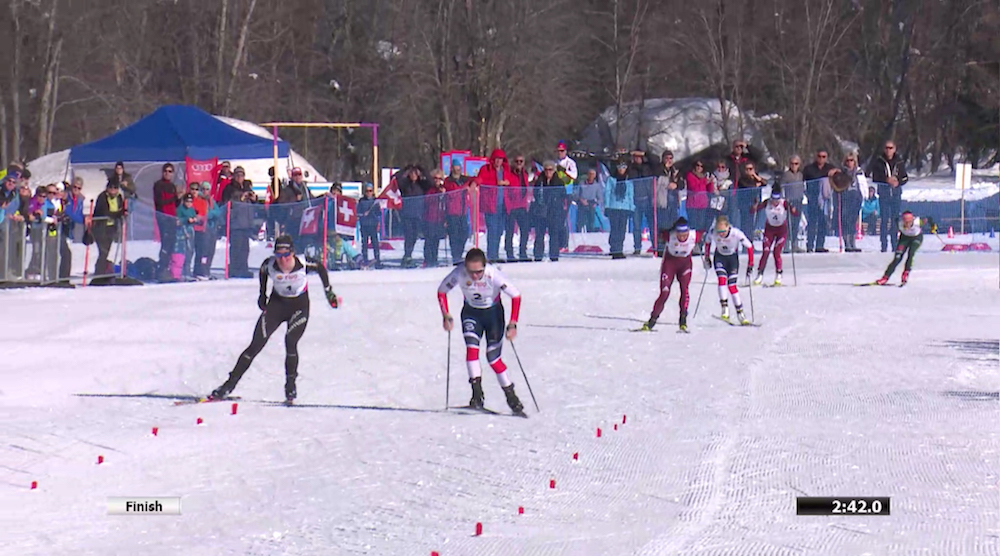
    Norway’s Tiril Udnes Weng (second from l) and Switzerland’s Nadine Fähndrich (l) battle for first down the finishing stretch of the women’s final for the gold medal in the U23 World Championships skate sprint in Goms, Switzerland. Weng won it by eight-hundredths of a second. (Screenshot: Swiss Ski livestream)

    (This article has been updated to include comments from Canada’s Laura Leclair, Katherine Stewart-Jones and Maya MacIsaac-Jones, as well as American Julia Kern.)

    U23 World Championships (Goms, Switzerland): Freestyle sprints

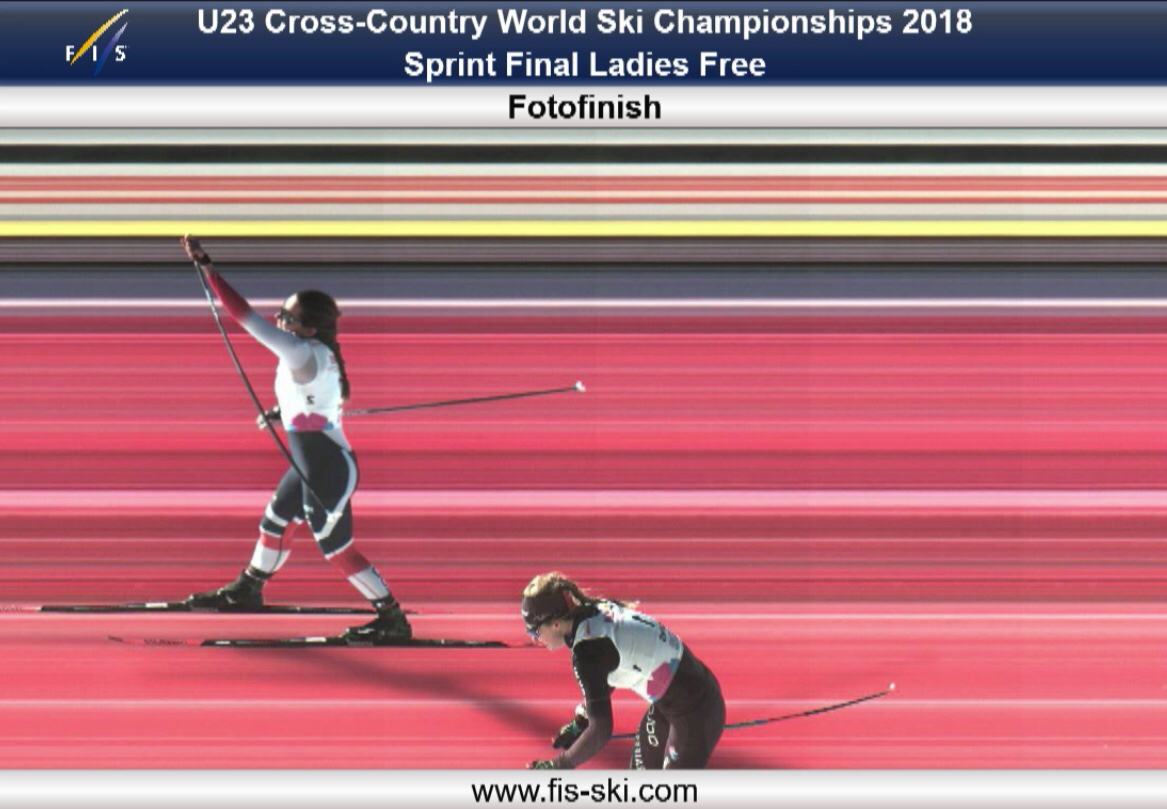
    On the first day of U23 World Championships racing in Goms, Switzerland, Norway’s Tiril Udnes Weng tallied her first individual world title in the women’s 1.2-kilometer freestyle sprint, winning the A-final in 2:50.24 minutes, just 0.08 seconds ahead of Swiss World Cup regular Nadine Fähndrich in second. Another World Cup skier, Natalia Nepryaeva of Russia finished third, 4.78 seconds out of first.

    Weng, 21, is no stranger to World Cups, either. Just two days ago, she qualified 11th in the World Cup skate sprint in Seefeld, Austria, and went on to place 17th overall.

    On Monday, she qualified second, 0.2 seconds off Fähndrich’s top qualifying time of 3:03.51. Weng then placed second to Nepryaeva in the fourth quarterfinal, a heat that included Canadians Maya MacIsaac-Jones and Katherine Stewart-Jones, both of the Canadian National U25 Team. While Sweden’s Moa Olsson finished third in that quarterfinal and advanced as a lucky loser based on time, the two Canadians did not. MacIsaac-Jones had previously qualified in 19th and Stewart-Jones in 22nd. Overall, MacIsaac-Jones placed 18th and Stewart-Jones was 23rd on the day.

    In an email, MacIsaac-Jones explained her goal had been to make the semifinals.

    “My strategy was to stick behind the top two girls, and hang on as best I could,” she wrote of her quarterfinal. “As Canadians we tend to be pretty good at downhilling, so I tried to use that to my advantage. I wasn’t quite able to stick with the top girls over the crest of the big hill, but I was happy to be fairly competitive in the heat overall!”

    Still, the top 20 was her best result in her fourth trip to Junior/U23 Worlds.

    “I’m disappointed of course to have missed out on making the semi-final, but I feel I did the best I could with what my body had on the day so I’m happy with that,” she continued. “It was of course exciting to get my first top-20 , but also disappointing because I felt like my body wasn’t moving as well as it was at trials a few weeks ago (I got sick right after arriving in Europe which probably didn’t help with that).”

    For Stewart-Jones, this marks her fifth Junior/U23 World Championships.

    “Over the years I have learned that it’s just another race, and that I don’t need to treat it any differently,” she wrote in an email on Tuesday. “Coming into te race I knew that I was in the best shape I’ve been all year, but I also had only done one skate sprint qualifier  and no heats) this year so I wasn’t sure what to expect.”

    Her goal had been to reach the semifinals and finish in the top 12.

    “I am happy with how I skied the qualifier. The quarterfinal was tough,” Stewart-Jones wrote. “My teammate Maya and I ended up being in a really fast heat. I felt like I skied well technically but I don’t think I skied it how I needed to to have a chance of moving on. I tried holding on to the top 2 girls over the top of the first hill and ended up losing time on the second… I think it would have made more sense to lay back a bit over the top of the first to save some gas for the end.”

    Stewart-Jones as well as MacIsaac-Jones came incredibly close to making Canada’s 2018 Olympic team based on their results at NorAm trials earlier this month.

    “Overall, I am happy with how the body feels but disappointed with how I skied tactically,” Stewart-Jones wrote. “Not making the Olympic team was definitely more frustrating than it was disappointing. The whole ordeal was a bit exhausting, with first missing out on the 4th spot by less than a second and then being 12th on the list of [11] quota spots, it was really as close as it gets. I’m doing my best to fuel that frustration into positive energy so that I can perform at my best here. I am really looking forward to the next 2 races!!”

    Norway’s Tiril Udnes Weng (l) and Switzerland’s Nadine Fähndrich in a photo finish for first in the women’s freestyle sprint final at U23 World Championships on Monday in Goms, Switzerland. Weng won it by eight-hundredths of a second. (Screenshot: Swiss Ski livestream)

    Fähndrich won both her quarterfinal and semifinal leading up to the final, and Weng won the second semifinal by 0.59 seconds over Nepryaeva. In the final, Weng had the edge.

    “I dream about winning, that’s the goal of my season,” Weng said during a post-race interview in the arena. “So it felt good to win.”

    Three Canadians made the heats, with Laura Leclair of the Pierre-Harvey National Training Centre (CNEPH) qualifying in 26th then placing third in her quarterfinal, 2.75 seconds behind German winner Nadine Herrmann. That put Leclair 15th overall on the day in her first U23 World Championships race.

    “As it is my first time at Worlds and my first year in a big category (U23) I was coming here for experience,” Leclair wrote in an email on Tuesday. “Experience to ski internationally, in Europe and against the best. Of course, I was hoping to perform but I never anticipated a top 15.

    “Since I was seeded 30th, I was a little skeptical of making it through the qualifier,” she continued. “Qualifying 26th was a very exciting moment.”

    In her quarterfinal, she said the pace didn’t pick up until about halfway up a long uphill out of the start, a climb that lasted for about a minute and a half.

    “I was in a strong position (4th) but it was hard to make my way to the top,” Leclair wrote. “At the top of the big hill, a girl broke a pole and I was able to pass her and push over the hill into the downhill in order to come closer to the two girls in front. The last uphill felt like it was just give or take. Obviously, I chose the give option and gave it all I had into the finish. My heat wasn’t one of the fastest so I wasn’t a lucky loser but I am very happy of how I skied that course.

    “This season has been full [of] surprise,” she concluded. “Just qualifying for Worlds in Canada was one! I am very happy that all my efforts and my dedication to the sport are paying off. For the rest of the week, I want to have some strong races, especially in the skiathlon and maybe surprise myself again.”

    Two Americans qualified in the top 30 as well, with Lauren Jortberg (Dartmouth Ski Team) in 14th and Julia Kern (U.S. Ski Team/Dartmouth/Stratton Mountain School T2 Team) in 21st. Jortberg went on to finish fifth in her quarterfinal, 7.28 seconds behind German winner Pia Fink, and Kern finished sixth in Fähndrich’s quarterfinal, 22.28 seconds out of first. Overall, Jortberg placed 22nd and Kern was 27th.

    In an email, Jortberg, who competed at U23 World Championships last year at Soldier Hollow in Midway, Utah, explained her goal was to qualify for the heats.

    “I honestly had no idea what to expect in Goms this year because Soldier Hollow felt just like US Nationals and the Super Junior National Qualifiers I’d been going to for the past ten years,” Jortberg, a Dartmouth College sophomore, wrote on Monday. “Obviously the competitors from all over the world was different, but was easy to visualize what is going to be like. The venues are similar in many ways because there are very few trees making it very open and a great spectators course.

    “A big difference between Goms and Soldier Hollow is the little towns everywhere,” she continued. “The first ski we did here, we skied through the roads and through a town. There are ski trails everywhere here, we could even ski from the venue to the hotel (which is pretty far)! For the ski courses, I think Goms is one of the most challenging ski courses I’ve ever raced on. There are huge climbs are incredibly technical downhills! Its a one of the most exciting places I’ve ever raced, I love it so much.”

    As for her racing on Monday, she wrote that she was “really psyched because I felt really strong and smooth in the qualifier! I was a bit bummed because I had to scrub a fair amount of speed skiing behind a girl I caught on the really technical downhill. The heats were really fun!! I had a great starting position and skied really smooth up the big climb. Then I took a very gutsy move on the downhill to sling shot into first place on the inside corner around the downhill turn. Unfortunately right after that I got caught up in a tangle on the last climb, and then I lost contact with the lead group. I was bummed to get caught up in a tangle, but it was really cool to be able to ski with these girls!”

    Overall, Jortberg described the day as “pretty incredible.”

    “My motto has always been that sprints are funny because ‘anything can happen’ for the good and bad!” she added. “I’m pretty excited for the rest of the week of racing even though this race was my main target. These courses play really strongly to my strengths so it should be fun to see what I can do!”

    Kern explained in an email that she’s been sick for the past month so her main goal was to start Monday’s race. But for a long time leading up to this race, she had envisioned a top 10.

    “Regardless of how I was feeling, one of my goals was to ski with good technique because that is something you can always control,” Kern wrote. “I was pretty content with my qualifier, given being sick. Skiing out there today, I had no idea if I would surprise myself and my illness wouldn’t impact my skiing or if I was just going to feel absolutely terrible. I was happy with how I placed given how I felt.”

    In the heats, she wanted to stay in contact with leaders up the course’s big climb, then try to “drop the hammer on the downhill and last uphill.”

    “However, my quarterfinal did not play out that way,” she wrote. “The pace was hot from the start, with bib #1 [Fähndrich] gunning from the start. I stuck with the heat until part way up the first climb, where I started to lose the leaders. I did not feel good and I had no energy so I was not able to hold the pace of the other competitors. I had considered not doing the heats because I felt pretty wiped after the qualifier, but the competitor inside me couldn’t just walk away from my favorite thing—sprint heats.

    “Given my current health state, I feel okay about my day, but I am obviously bummed because this was the race I was looking forward to most this season,” Kern added. “I am looking forward to getting healthy in time to race the 10k classic, or at the very least the skiathlon!”

    Also for the U.S., Lydia Blanchet missed qualifying by 0.32 seconds in 32nd, as did Canada’s Sophie Carrier-Laforte, who was 3.68 seconds out of the top 30 in 34th. American Nicole Schneider finished 44th.

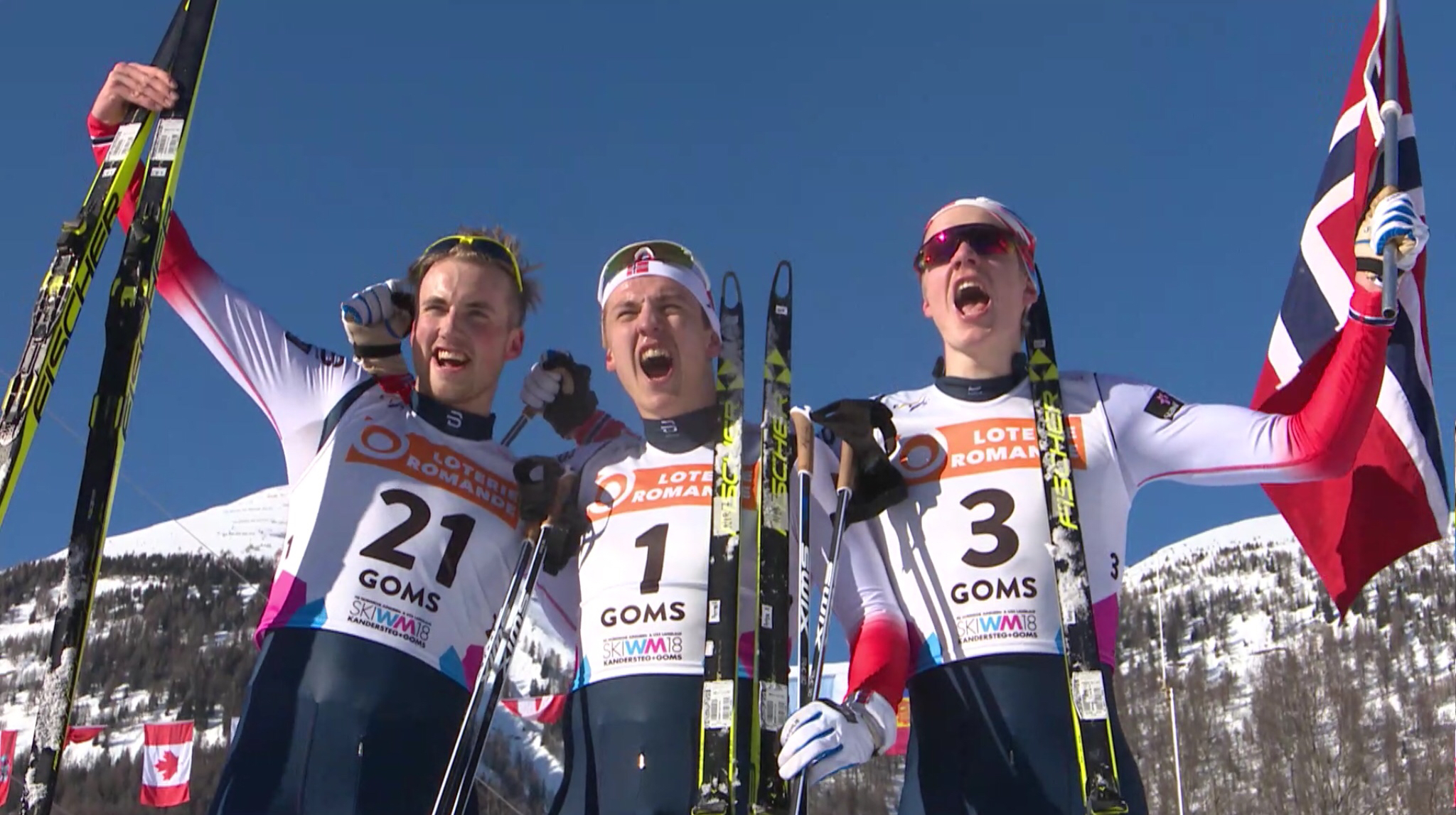
    The all-Norwegian men’s freestyle sprint podium on Monday at U23 World Championships in Goms, Switzerland, with Erik Valnes (c) in first, Jan Thomas Jenssen (l) in second and Even Northug (r) in third. (Screenshot: Swiss Ski livestream)

    In the men’s 1.5 k skate sprint on Monday, Norway swept the men’s podium, with Erik Valnes winning his first World Championships medal in 2:56.38, Jan Thomas Jenssen finishing 0.24 seconds back in second, and Even Northug placing third (+6.34).

    For the 21-year-old Valnes, this marked his first U23 World Championships (or Junior Worlds for that matter). He’s competed in two World Cup sprints this season, placing 22nd in the skate sprint earlier this month in Dresden, Germany, and 27th in a classic sprint in December in Lillehammer, Norway.

    Valnes started Monday by winning the qualifying round in 3:00.18, by 0.77 seconds over Sweden’s Anton Persson, then won his quarterfinal and semifinal, both by nearly half a second, before besting his fellow Norwegians in the final.

    “Fun to take the gold medal at the end,” Valnes said during a televised in-arena interview after the final. “It was my biggest goal this year, so it means a lot, of course. A gold medal is always good to have.”

    No North American men qualified for the heats. Canada’s Ricardo Izquierdo-Bernier placed 40th, Antoine Briand was 41st, Philippe Boucher 42nd, and Olivier Hamel 60th.

    For the U.S., Bill Harmeyer finished 46th, Andrew Egger was 47th, Thomas O’Harra 64th, and Zak Ketterson 65th.

    Results: Women’s qualifier | Women’s final| Men’s qualifier| Men’s final

  • U.S. and Canada Annouce Squads for FIS World Junior & U23 Championships

    U.S. and Canada Annouce Squads for FIS World Junior & U23 Championships

    The women’s 10 k classic podium on Wednesday at the NorAm trials in Mont Sainte-Anne, Quebec, with Cendrine Browne (1) in first, Katherine Stewart-Jones (2) in second, and Anne-Marie Comeau (3) in third. Dahria Beatty (l) placed fourth. Comeau and Stewart-Jones are both on the U23 World Championships roster, although it’s likely that one or both of them will end up focusing on the Olympics instead. (Photo: Cross Country Canada/Instagram)

    The U.S. and Canada have named their squads for FIS Cross Country World Junior and U23 Championships, set to begin later this month in Goms, Switzerland.

    Both countries’ selections include athletes who excelled against the senior fields at recent domestic races (U.S. National Championships and NorAms) which served as selection races for Olympic teams.

    In fact, Canada’s U23 women did so well against their senior compatriots that it’s unclear who will represent Canada at the Championships and who will do so at the Games. Anne-Marie Comeau (Université Laval), Maya MacIsaac-Jones (Rocky Mountain Racers), and Katherine Stewart-Jones (NTDC Thunder Bay/Nakkertok) were all on the podium in different competitions at Mont Sainte Anne, Quebec, last week at Canadian Olympic Selection Races.

    Comeau was second in the 15 k skiathlon and third in the 10 k classic, earning herself a probable Olympic berth when each country’s Olympic quota size is finalized. However, she does not currently have the five sub-100 FIS point races on her resumé which are required to compete in the Olympics.

    Then-21-year-old Ricardo Izquierdo-Bernier CNEPH racing his first World Cup during the men’s freestyle sprint qualifier at World Cup Finals in March. He won the senior men’s 15 k classic at the NorAm selection series this week. (Photo: John Lazenby/Lazenbyphoto.com)

    “Anne-Marie is looking at different options now to find those races in North America,” Cross Country Canada High Performance Director Thomas Holland explained in an email.

    Meanwhile, Stewart-Jones is next on the distance ranking list, and could get an Olympic call if Comeau is unable to get those points, or if an additional quota spot opens up after better-ranked countries finalize their rosters. Despite fighting off illness through the race weekend, Stewart-Jones finished second in the 10 k classic at the end of the selection series.

    “I know that I have qualified for U23 World Champs,” Stewart-Jones told FasterSkier. “That trip leaves on [January] 15th. I’m keeping my fingers crossed for Olympic selection but I will probably not know until the 21st.”

    Meanwhile, MacIsaac-Jones was second in the classic sprint final after qualifying fourth in the final, missing taking the open women’s sprint spot for PyeongChang by just one place. That spot went to Cendrine Browne instead, taking her out of the distance rankings and opening the way for Comeau and/or Stewart-Jones.

    Some of the men who ended up on Canada’s U23 squad also competed well against the seniors. Ricardo Izquierdo-Bernier (CNEPH/Fondeurs-Laurentides) won the men’s classic distance race at the NorAm week, and both he and Olivier Hamel (CNEPH/Skibec) were in the final of the skate sprint. Gareth Williams (Telemark) was on the podium in the 30 k skiathlon, where Philippe Boucher (CNEPH/Skibec) finished fifth.

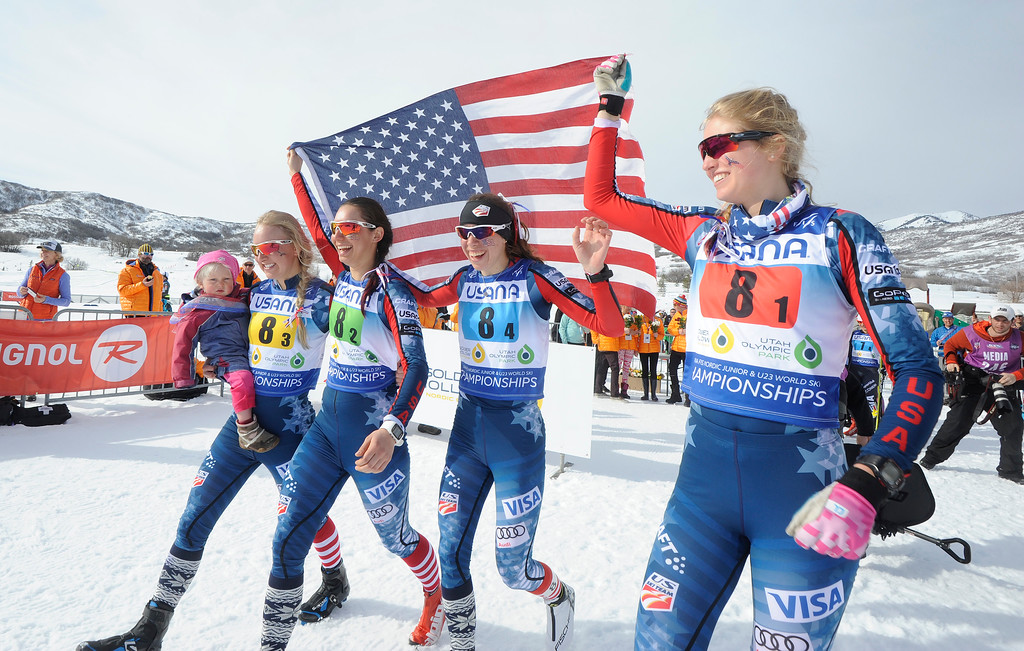
    The U.S. women’s relay after taking a historic third in the 4 x 3.3 k relay at 2017 Junior World Championships on Sunday at Soldier Hollow in Midway Utah, with (from left to right) Hannah Halvorsen (holding her baby sister), Julia Kern, Katharine Ogden, and Hailey Swirbul. (Photo: U.S. Ski Team/Tom Kelly)

    The U.S squad, meanwhile, is headlined by Hannah Halvorsen (Alaska Pacific University/U.S. Ski Team), Julia Kern (Stratton Mountain School T2/Dartmouth College/U.S. Ski Team), and Hailey Swirbul (University of Alaska Anchorage), who return from last year’s World Juniors medal-winning relay team.

    Kern is now a U23, and is competing at the World Cup sprints in Dresden, Germany, this weekend. Back in the U.S., Swirbul finished eighth in the women’s 10 k skate at U.S. Nationals, while Halvorsen was fifth in the skate sprint after qualifying fourth.

    Joining Swirbul and Halvorsen on the junior team will be two men who turned heads in the senior races at U.S. Nationals. Gus Schumacher (Alaska Winter Stars) finished sixth overall in the men’s 15 k skate and eighth in the skate sprint. Ben Ogden (Stratton Mountain School) was ninth in the 15 k skate and then qualified fourth in the classic sprint, before finishing the day in 12th overall.

    The U.S. U23 team includes Zak Ketterson (Northern Michigan University), who finished just off the podium in fourth in the skate sprint at U.S. Nationals and followed it up with sixth in the classic sprint; Alayna Sonnesyn (University of Vermont), who was eighth in the skate sprint and sixth in the 20 k classic mass start; Lydia Blanchet (Dartmouth College), sixth in the classic sprint; Andrew Egger (Colby College) and Thomas O’Harra (Alaska Pacific University), tenth in the skate and classic sprints, respectively; Bill Harmeyer (University of Vermont), 11th in the skate sprint; Ian Torchia (Northern Michigan University/U.S. Ski Team), 12th in the 30 k classic; and Lauren Jortberg (Dartmouth College), who never finished out of the top 15 in the three senior races she entered at U.S. Nationals.

    Rosters


    Junior Men

    USA:
    Luke Jager, Alaska Pacific Nordic Ski Center
    Ben Ogden, Stratton Mountain School
    Karl Schulz, Univ. of Vermont
    Gus Schumacher, Alaska Winter Stars
    Canyon Tobin, Alaska Pacific Nordic Ski Center
    Hunter Wonders, Alaska Pacific Nordic Ski Center

    Canada:

    Antoine Cyr, Centre National d’Entraînement Pierre-Harvey / Skinouk
    Félix Longpré, Club Nordique Mont Sainte Anne
    Etienne Hébert, Alberta World Cup Academy / Montériski
    Graham Ritchie, National Team Development Center Thunder Bay / Big Thunder
    Reed Godfrey, Canmore Nordic


    Junior Women

    U.S.:
    Margaret Gellert, Alaska Winter Stars
    Hannah Halvorsen, Alaska Pacific Nordic Ski Center / U.S. Ski Team
    Kathleen O’Connell, Montana State University
    Hannah Rudd, Univ. of Alaska-Anchorage
    Sofia Shomento, Dartmouth College
    Hailey Swirbul, Univ. of Alaska-Anchorage

    Canada:

    Natalie Hynes, Whitehorse
    Annika Richardson, National Team Development Center Thunder Bay / Hollyburn
    Hannah Mehain, Sovereign Lake Nordic
    Catherine Reed-Metayer, Skibec
    India McIsaac, Rocky Mountain Racers


    U23 Men

    US:
    Andrew Egger, Colby College
    Bill Harmeyer, Univ. of Vermont
    Zak Ketterson, Northern Michigan University
    Thomas O’Harra, Alaska Pacific Nordic Ski Center
    Ian Torchia, Northern Michigan University / U.S. Ski Team

    Canada:

    Gareth Williams, Telemark / Canadian National Ski Team
    Olivier Hamel, Centre National d’Entraînement Pierre-Harvey / Skibec
    Ricardo Izquierdo-Bernier, Centre National d’Entraînement Pierre-Harvey / Fondeurs-Laurentides
    Alexis Dumas, Centre National d’Entraînement Pierre-Harvey / Skibec
    Philippe Boucher, Centre National d’Entraînement Pierre-Harvey / Skibec
    Antoine Briand, Centre National d’Entraînement Pierre-Harvey / Skibec


    U23 Women

    U.S.:
    Lydia Blanchet, Dartmouth Ski Team
    Lauren Jortberg, Dartmouth Ski Team
    Julia Kern, Stratton Mountain School / Dartmouth College / U.S. Ski Team
    Nicole Schneider, Northern Michigan University

    Canada:

    Anne-Marie Comeau, Université Laval
    Maya MacIsaac-Jones, Alberta World Cup Academy / Rocky Mountain Racers
    Katherine Stewart-Jones, National Team Development Center Thunder Bay / Nakkertok
    Laura Leclair, Centre National d’Entraînement Pierre-Harvey / Chelsea Nordiq

    Press Releases:

    U.S. Ski & Snowboard

    Cross Country Canada

  • ‘It Felt Surreal,’ Patterson Closes Out U.S. Nationals with Win No. 4

    ‘It Felt Surreal,’ Patterson Closes Out U.S. Nationals with Win No. 4

    Caitlin Patterson (c) atop the podium for the fourth-straight race of the week at 2018 U.S. Cross Country Championships in Anchorage, Alaska, joined by Finland’s Jasmi Joensuu (l) of the University of Denver, in second and Patterson’s CGRP teammate Kaitlynn Miller (r) in third. (Photo: Michael Dinneen Photography)

    Note: This article has been updated to reflect the fact that U.S. Ski Team member Jessie Diggins was the top American in four consecutive U.S. nationals races in 2012, winning the freestyle sprint, 10 k skate and 20 k classic mass start outright and placing second to Canada’s Dasha Gaiazova in the classic sprint (but topping the podium as the first American). This week, Caitlin Patterson, of the Craftsbury Green Racing Project, became the first woman since Diggins to be the top American in four U.S. national races as well.

    ***

    ANCHORAGE, Alaska — Maybe there’s something to be said for growing up in Alaska. Or maybe there’s something to be said about the mystique of Kincaid Park, its surrounding Tordillo, Chugach and Alaskan mountain ranges all bathed in sunlight at the start on the last day of 2018 U.S. Cross Country Championships during the women’s 1.5-kilometer classic sprint.

    Caitlin Patterson (Craftsbury Green Racing Project) approaching the finish line of the women’s 1.5 k classic sprint final on Monday, the last day of 2018 U.S. Cross Country Championships in Anchorage, Alaska. She won the final for her fourth-straight national title of the week. (Photo: Michael Dinneen Photography)

    Be it either of those, Caitlin Patterson became the first woman since U.S. Ski Team (USST) member Jessie Diggins, to earn four consecutive titles at a single U.S. nationals. Diggins did it in 2012 in Rumford, Maine, two years after Kikkan Randall, a USST member who trains with Alaska Pacific University (APU), swept four races outright at Kincaid. (Both Randall and Patterson grew up in Anchorage; Randall was born in Salt Lake City, born in McCall, Idaho. Patterson, 27, attended South Anchorage High School while Randall, 35, went to East Anchorage High).

    Even if Patterson, who’s currently based out of Vermont with the Craftsbury Green Racing Project (CGRP), had not won the final event of 2018 nationals, she had already posted a banner week. She started it by racing to first in the opening women’s 10 k freestyle individual start last Wednesday, amidst slushy ski trails, falling wet snow and a standard dark Alaskan winter morning sky.

    After a training day on Thursday, she returned to the Kincaid trails on Friday — which had transformed from 48 hours before — racing once again to first, this time in the women’s freestyle sprint for her first sprint title.

    Saturday brought another training day before Patterson returned on Sunday for the women’s 20 k classic mass start.

    Hedda Bångman, a Swedish freshman at the University of Colorado at Boulder (CU), racing to fourth in the qualifying round of the women’s 1.5 k classic sprint on Monday at 2018 U.S. Cross Country Championships in Anchorage, Alaska.

    Up against Sweden’s Hedda Bångman, a University of Colorado at Boulder (CU) freshman, and Rosie Frankowski (APU), the two of whom led much of Sunday’s four-lap race, Patterson had met her match. However, Frankowski’s fall on the final hill paired with Patterson’s strong skiing led Patterson to finish as the day’s top American. Bångman took the outright win while Patterson placed second overall, ahead of Frankowski in third. The two were first and second on the U.S. podium.

    If she had left it at that, Patterson would have tied Rosie Brennan — of the U.S. Ski Team and APU — who won three out of four U.S. nationals races in 2015.

    But Patterson took it one step further.

    With no training or rest day in between, the CGRP skier joined the remaining U.S. nationals field on Monday. Some skiers had already left, including Australian and APU skier, Jessica Yeaton, who flew out Monday morning to prepare for next weekend’s World Cup in Dresden, Germany.

    Based on her qualifier alone, it might have seemed Patterson was beginning to feel the effects of four days of racing since last Wednesday. She qualified seventh, 4.77 seconds behind the fastest qualifying time of 3:41.40, posted by Finnish skier and University of Denver (DU) junior Jasmi Joensuu.

    “Today qualification was really good, I felt really good,” Joensuu said after the race. “But then, my throat is really sore after the qualification … so I didn’t know if I could race actually. But I decided to race, I knew that I could win this race. I knew that there were some good girls but they also had 20 k yesterday, which I didn’t race, so that was good for me.”

    With Joensuu, 21, having sat out Sunday’s mass start and Patterson having expended herself over 20 k, the Finn may have had a leg up on the American.

    What Joensuu had not counted on was Patterson’s familiarity with the course and what the American had learned from Friday’s freestyle sprint.

    “I think that bottom corner was a really good one for me all week and in the skate sprint I figured out how to ski it with good momentum,” Patterson said after Monday’s race, referring to the slightly inclined corner about 100 meters before the finish. “Even with that big gap that she put on the hill, I think just knowing how to ski the hill here at Kincaid … the finish stretch was mine.”

    Craftsbury’s Caitlin Patterson (207) and Kaitlynn Miller (second from r) and Jasmi Joensuu, of the University of Denver, lead their semifinal during the women’s 1.5 k classic sprint on Monday at 2018 U.S. Cross Country Championships in Anchorage, Alaska.

    In their semifinal, though Joensuu had gapped both Patterson and and another CGRP skier Kaitlynn Miller at the top of Gong Hill — the sprint’s final major climb — both Craftsbury skiers had caught Joensuu by the bottom of the descent’s corner back towards the finish.

    A similar scenario played out in the final.

    “In the final I did a tactic, I would ski the uphill as fast as I can, I don’t save anything and that almost worked,” Joensuu recalled.

    Joensuu and Petra Hyncicova, a CU senior from the Czech Republic, had pushed hard out of the start of the final, followed by Patterson and Miller, as well as Dartmouth skier Lydia Blanchet and APU’s Becca Rorabaugh.

    “I tended to lose time in the beginning of the race and then catch back up,” said Blanchet, who had to catch a plane within an hour of finishing the final. “I had great skis and downhills are one of my strengths.”

    While the two non-Americans raced to the front halfway through the course’s major climb, Blanchet, Rorabaugh, Miller, and Patterson hung behind. Then halfway through the final hill, Joensuu attacked, attempting to distance herself from the pack.

    By the top of the hill, she had done just that, with 4 meters separating her from the rest of the field. Miller and Patterson followed, tucked into the downhill swooping curve.

    As Joensuu disappeared behind the trees blocking the corner from spectator’s view, Miller and Patterson were already hot on her heels. Using her momentum, Patterson swung around Joensuu and emerged from the corner first, double poling with a sizeable lead to her fourth victory in a row in a time of 3:39.58.

    “It felt surreal coming down the finishing stretch today, realizing that I couldn’t hear people behind me and realizing that it was going to be number four,” Patterson said. “I could not have imagined this if I tried, but I’ve just had really good feelings all week. Great support from the staff and waxers and everything, and it’s fun being back here in Anchorage, especially.”

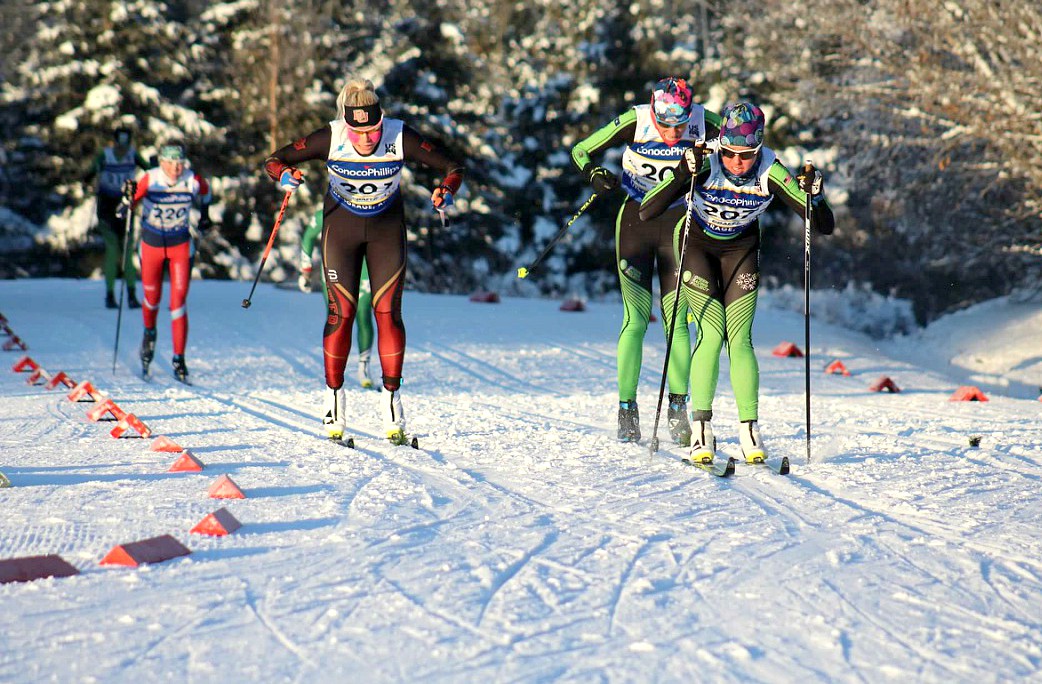
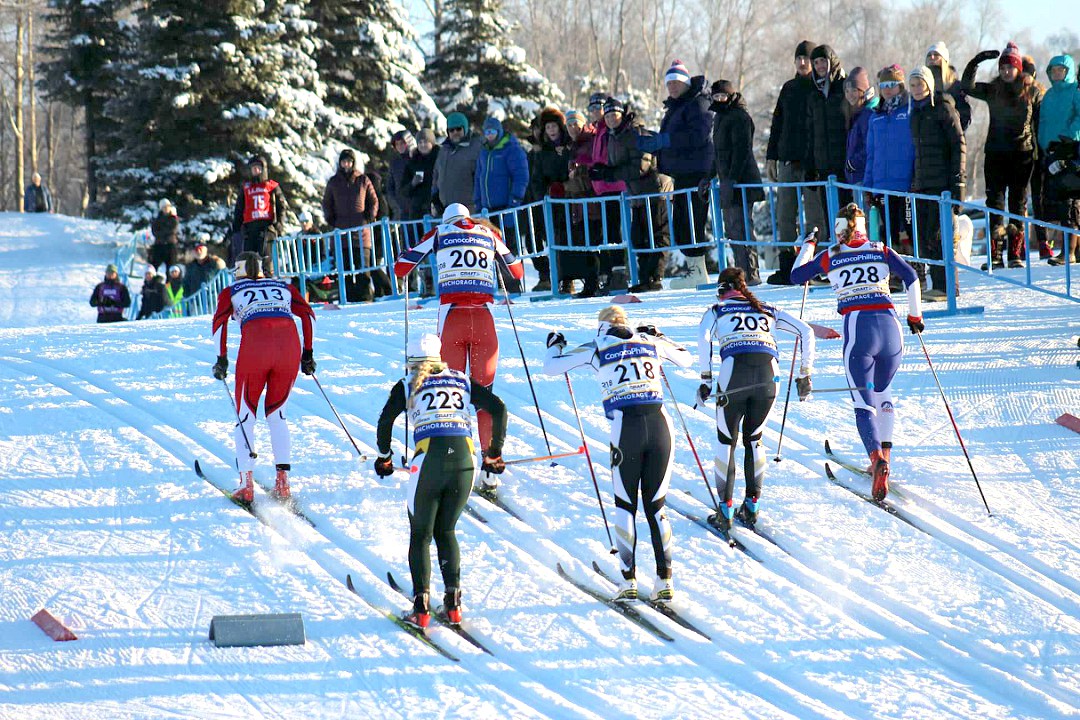
    The fifth women’s classic sprint quarterfinal heat on Monday at 2018 U.S. Cross Country Championships in Anchorage, Alaska, with CXC/Peak Nordic’s Felicia Gesior (208) leading with Corey Stock (213) of the Bridger Ski Foundation, and Northern Michigan’s Nicole Schneider (223), the University of Colorado Boulder’s Christina Rolandsen (218) and Petra Hyncicova (203), and Mae Chalmers of SMS (228) chasing.

    Finishing second, 2.36 seconds behind Patterson, was Joensuu. Capturing third for her third American podium this week was Miller (+3.9). Miller finished second to Patterson in Friday’s freestyle sprint and was the third American in Sunday’s 20 k.

    “I’m really pleased with how everything panned out,” Miller said. “To me the big sign of improvement has been in my skating and I was really excited with my skate sprint and obviously really excited with yesterday and today as well, but it’s nice to see my skating moving up a little bit.” 

    Despite being the 2016 national classic sprint champion, Miller, of Elmore, Vt., explained she entered Monday’s race with nothing held over her head.

    “I don’t ever go into a race expecting a certain result,” she said. “Anything can happen, even to strong, very experienced skiers … [but] it is exciting to be in the mix.”

    Though Miller also explained she “felt pretty tired” by the time she lined up for the final on Monday, she also acknowledged that she was, in all likelihood, not alone.

    “I think that was the situation for all of the women out there today, after the 20 k yesterday. It was sort of like, well, the snap isn’t there, the energy isn’t quite there, but everyone was in the same boat,” she said. “Everyone’s making the best of it, and your body knows what to do once you get to the start line.

    “All things considered, I felt great, had a really great result, and I’m very happy with it,” Miller added.

    Becca Rorabaugh (APU) during the women’s 1.5 k classic sprint on Monday at 2018 U.S. Cross Country Championships in Anchorage, Alaska. After finishing second in the qualifier (as the top American) she finished fourth overall in the final and was the third American on the day.

    Rorabaugh finished fourth overall (+9.92) and was the third American. The Fairbanks native, who has spent the last 10-plus years living and training in Anchorage, was the top American qualifier on Monday, 1.31 seconds behind Joensuu in first overall.

    “I was extremely excited with my qualifier,” Rorabaugh said. “It was rather unexpected. I was the first American and I had one really good qualifier in West Yellowstone this year but the other two so far have been pretty medium for me, so I was really excited really happy with this morning.”

    Though the qualifier is what counts for the Olympic points list, Rorabaugh indicated that was of less importance to her than just “getting her qualifier back.”

    “It’s been a couple years since I’ve been having a very strong qualification in sprint racing so I was just trying to work on having enough energy and having enough heat pumped to really crush a qualifier first thing in the morning,” she said.  

    “I wanted to have something special at home,” she added, referring to the friends and family that came to Kincaid to watch her race. “So it was good to have something at the end of the week.”

    With firm tracks, cold temperatures reading around 10 degrees Fahrenheit and a low sun in the sky, Rorabaugh described the final U.S. nationals event as “a quintessential Alaskan day.”

    “That was quite nice,” she added.

    Rounding out the final was Hyncicova in fifth (+10.03) and Blanchet in sixth (+11.21).

    “Today I was kind of tired. I finally hit the jet lag over the weekend,” Hyncicova, the two-time defending NCAA champion, said. “But … making the final, and even being third in the quarterfinal is awesome. It’s just proving that I am kind of in good shape so that’s a good start of the season.”

    Rounding out the remainder of the women’s top 10 was Bångman in seventh, Sun Valley Ski Education Foundation skier, Kelsey Phinney in eighth, Central Cross Country’s Felicia Geisor in ninth and Stratton Mountain’s Erika Flowers in tenth.

    In the junior women’s classic sprint, Wasatch Nordic’s Sarah Morgan took the win in 3:54.93. Novie McCabe (Methow Valley Nordic) placed second (+1.5) and her teammate teammate Ella-Sophie Kuzyk placed third (+6.66).

    Results: Women’s qualifier | Women’s final | Junior women’s final

    –Ian Tovell, Andrea Pontyondy-Smith and Gavin Kentch contributed

    Highlights video by Max Romey Productions

  • Monday Rundown: U.S. Nationals; MSA NorAm Trials

    Monday Rundown: U.S. Nationals; MSA NorAm Trials

    Left to right: Tyler Kornfield (APU), Reese Hanneman (APU) and Ben Saxton (SMS) the top three Americans in the men’s 1.6 k classic sprint final on Monday, the last day of 2018 U.S. Cross Country Championships in Anchorage, Alaska.

    U.S. Cross Country Championships (Anchorage, Alaska): Classic sprint

    Women’s report

    Men’s report

    Caitlin Patterson did it. With a classic-sprint win on Monday, she successfully capped off an undefeated 2018 U.S. Cross Country Championships, as the top American woman in all four races over the past week in Anchorage, Alaska.

    Patterson, of the Craftsbury Green Racing Project, qualified seventh then won the women’s 1.5-kilometer final by more than 2 seconds in 3:39.58 minutes. Finland’s Jasmi Joensuu, a junior at the University of Denver (DU), won the qualifier and ultimately finished second in the final, 2.36 seconds behind Patterson.

    Craftsbury once again had two on the podium with Kaitlynn Miller placing third overall (+3.9) as the second American. Becca Rorabaugh, of Alaska Pacific University (APU), was the top American in the qualifier in second overall, then placed fourth in the final (+9.92) and reached the U.S. podium in third.

    Petra Hyncicova, a University of Colorado Boulder (CU) senior from the Czech Republic, placed fifth overall (+10.03), and Lydia Blanchet, a Dartmouth College U23 skier, finished sixth (+11.21) and was the fourth American woman.

    Joensuu, 21, of Kuortane, Finland, started the day by winning the qualifier in 3:41.4, while Rorabaugh followed in second, 1.31 seconds back. Hyncicova qualified third (+1.85), CU’s Hedda Bångman (who won Sunday’s 20 k classic) qualified fourth (+2.92), and Miller qualified fifth (+2.93). Anne Hart of the Stratton Mountain School (SMS) Elite Team clocked the sixth-fastest qualifying time (+3.88), and Patterson followed in seventh (+4.77).

    From there, Patterson won both her quarterfinal and semifinal, besting Miller and Joensuu in the latter by 0.66 seconds and 2.63 seconds, respectively. Blanchet placed fourth in that same semifinal (+5.15) and advanced to the final as a lucky loser with a fast-enough time, along with Joensuu (Patterson and Miller automatically advanced in first and second).

    With her 4-for-4 record at 2018 nationals, Patterson is the most successful woman at U.S. Cross Country Championships since U.S. Ski Team member Jessie Diggins was the top American in all four races at 2012 nationals in Rumford, Maine.

    In the men’s classic sprint final, Reese Hanneman (APU) captured his second title in as many sprints this week (after winning the freestyle sprint on Friday). He won the qualifying round by 2.84 seconds in 3:21.93, and later the final by a 0.2 seconds in 3:20.62. Kornfield placed second, and Ben Saxton (SMS Elite Team) rounded out the podium in third (+4.78).

    Logan Hanneman, the winner of Friday’s freestyle-sprint qualifier, finished second to his older brother Reese in Monday’s classic-sprint qualifier, then went on to reach the final and place fourth overall (+5.42). Kevin Bolger (Sun Valley Ski Education Foundation) placed fifth (+5.52), and Zak Ketterson (Northern Michigan University) was sixth (+6.83).

    Results:

    Women’s qualifier | Women’s final

    Men’s qualifier | Men’s final

    ***

    NorAm Trials (Mont Sainte-Anne, Quebec): 15/30 k skiathlons

    The women’s 15 k skiathlon podium on Monday at NorAm trials at Mont Sainte-Anne, Quebec, with Cendrine Browne (c) of the Pierre-Harvey National Training Centre (CNEPH) and Canadian U25 Team in first, Anne-Marie Comeau (l) of Laval University in second, and Dahria Beatty (Alberta World Cup Academy/Canadian World Cup Team) in third. (Photo: Cross Country Canada/Instagram)

    Cendrine Browne won the women’s 15-kilometre skiathlon in 43:01.9 minutes on Monday at the Mont Sainte-Anne (MSA) ski trails to put an exclamation point on her presumptive selection for the PyeongChang Olympics. Browne, of the Centre National d’Entraînement Pierre Harvey (CNEPH)/Pierre-Harvey National Training Centre, which is based in nearby Saint-Ferréol-les-Neiges, broke away with Laval University’s Anne-Marie Comeau during the classic leg to take a 20-second lead that she held to the finish.

    Comeau faded slightly to take second, 11.9 seconds back, qualifying for U23’s and putting her name in the hat for the upcoming 2018 Olympics. Either Comeau or the winner of Wednesday’s classic interval start should take that potential Olympic berth as Canada’s top female distance skier not already qualified. Browne has theoretically earned a spot as the top women’s sprinter, besides Dahria Beatty, who won the sprint and already met Canada’s Olympic qualifying criteria.

    “It now has to go before the selection committee,” Cross Country Canada’s High Performance Director Thomas Holland wrote in an email on Friday.

    After trials races were shuffled around due to extreme cold, with temperatures near -20 Celsius on Sunday at MSA, it warmed up to a balmy -8 degrees Celsius (17 Fahrenheit) by mid-afternoon on Monday. Both the women’s and men’s skiathlons were held, which not only served as one of two distance races for Olympic selection, but for Junior and U23 World Championships as well.

    In the race for third place, Beatty outsprinted a group of four to take the final podium spot, 19.9 seconds behind Browne and 0.3 seconds ahead of their fellow Canadian National Team member Maya MacIsaac-Jones, of Rocky Mountain Racers (RMR) and U25 Team. Just 0.2 seconds out of fourth, Katherine Stewart-Jones, of the National Training Development Centre (NTDC) Thunder Bay and national U25 Team, placed fifth (+20.4) and CNEPH’s Laura Leclair was another second back in sixth (+21.4).

    Almost 55 seconds passed before the seventh-place finisher came across the line, which was Zina Kocher (Foothills Nordic) skiing alone (+1:15.8). Another 49 seconds later, Jaqueline Mourao of Brazil’s national team placed eighth (+2:04.9), ahead of Zoë Williams (Carleton University) in ninth (+2:11.3), and Andrea Dupont (RMR) in 10th (+2:11.5).

    In the junior women’s 10 k skiathlon, Whitehorse’s Natalie Hynes won in 30:19.8 to punch her ticket to Junior Worlds in Goms, Switzerland, from Jan. 28-Feb. 3. India McIsaac (RMR) finished 0.7 seconds back in second and Orford’s Alexandra Racine completed the podium in third (+32.8).

    The men’s 30 k skiathlon podium at NorAm trials at Mont Sainte-Anne, Quebec, on Sunday, with Knute Johnsgaard (c) of Canada’s World Cup Team in first, Graham Nishikawa (r) of the Canadian Para-Nordic Team in second and Gareth Williams (Telemark Nordic/Canadian U25 Team) in third. (Photo: Cross Country Canada/Instagram)

    On the men’s side, Canadian World Cup Team member Knute Johnsgaard, who met qualifying criteria for PyeongChang last season, shook off a slow start to the World Cup season with a win in the NorAm trials men’s 30 k skiathlon, finishing in 1:13:30.9.

    Graham Nishikawa, who’s already destined for the PyeongChang Paralympics as a guide on the Canadian Para-Nordic Ski Team, finished 1 second back for second place. The 34-year-old Nishikawa edged out first-year senior national-team member Gareth Williams, 20, of Telemark Nordic and the national U25 Team, by 0.5 seconds. Williams was the top U23 athlete to qualify for this year’s U23 World Championships.

    The top 6 finished within 41 seconds of the podium, with Jack Carlyle (AWCA) in fourth (+5.8), Philippe Boucher (CNEPH) in fifth (+13.9), and Scott Hill (BXC) in sixth (+40.7). World Cup Team member Len Valjas led the next group across the line in seventh (+1:28.6), followed by Bob Thompson (NTDC Thunder Bay) in eighth (+1:29.4), Alexis Dumas (CNEPH) in ninth (+1:35.5), and Ricardo Izquierdo-Bernier (CNEPH) in 10th (+1:35.7)

    CNEPH’s Antoine Cyr won the junior mens 15 k skiathlon in 50:13.1 to earn a spot at Junior Worlds. Félix Longpré, of the local M.S.A. ski club, finished second (+15.7) and Thomas Manktelow was third (+49.0), just ahead of his Alberta World Cup Academy teammate Étienne Hébert in fourth (+49.3).

    After Sunday’s racing was postponed due to temperatures well below the legal race limit, the remaining trials schedule includes freestyle sprints on Tuesday (for Junior and U23 World Championships qualifying purposes only), and classic interval starts on Wednesday.

    Results

  • The Road to Jackson: Dartmouth

    The Road to Jackson: Dartmouth

    In the fifth and final part of “The Road to Jackson” series on Eastern Intercollegiate Ski Association (EISA) teams competing at NCAA Skiing Championships, we hear from five out of the six Dartmouth College skiers (Abigail Drach, Lydia Blanchet, Lauren Jortberg, Fabián Štoček, Luke Brown, and Cal DeLine) that qualified for the season-ending championships in Jackson, N.H.

    “I’m really happy with my individual results, but it’s just so much better when your whole team is also sharing the same happiness.”

    See also: EISA season in review | Part I: Williams | Part II: UNH | Part III: Colby | Part VI: UVM

  • Junior Nationals: Miller Surprises Norwegians in J1 Sprint; Blanchet & Gesior Notch Gold

    Junior Nationals: Miller Surprises Norwegians in J1 Sprint; Blanchet & Gesior Notch Gold

    Annika Miller of Payette Lakes (r) takes on Lotta Weng (6) and her Norwegian teammates in Thursday's J1 girls freestyle sprint A-final at the 2013 Junior Nationals in Fairbanks, Alaska. (Photo:
    Intermountain’s Annika Miller of Payette Lakes (r) takes on Lotta Weng (6) and her Norwegian teammates in Thursday’s J1 girls freestyle sprint A-final at the 2013 Junior Nationals in Fairbanks, Alaska. (Photo: bertboyer.zenfolio.com. Proceeds go to NNF)

    (Via jn2013fairbanks.us)

    FAIRBANKS, Alaska — Spectators watching halfway through the Junior 1 national championship girls sprint race on Thursday must have wondered whether three Norwegians were on their way to a sweep.

    At that point, twins Tiril and Lotta Weng seemed in control, while fellow Norwegian Lisa Kvamme trailed slightly and American Annika Miller fought to stay close.

    The next time spectators in the Birch Hill Recreation Area stadium spotted the skiers one tough climb and several hundred meters later, many must have been shocked to see Miller en route to a clear win at the U.S. Cross Country Junior Nationals.

    “I really wanted to (win). I was like ‘You know, the U.S. needs to be on top today,’ ” said Miller of Team Intermountain, whose win was no fluke considering that she finished the qualifying round in first as well.

    But keeping up with the Norwegians, who competed as guests and are not eligible to claim U.S. Championship medals, was no easy task.

    “I was really worried coming up that first hill because they were just hammering,” Miller said.

    Miller, from McCall, Idaho, quietly stalked the Norwegians and then charged past them on the final East Ramp uphill.

    “I was kind of neck-and-neck with them coming up the last hill and then just off the top they just didn’t have enough left, I guess,” Miller said. “And so I hammered the top and hoped they didn’t have too much of a draft and just went for it.”

    It was a risky strategy that could have backfired had the Norwegians hopped in Miller’s slipstream and slingshotted past her at the bottom of the hill leading into the flat finishing stretch.

    Instead Miller won going away in 3 minutes, 4.14 seconds. Tiril Weng was runner-up a half-second behind, Lotta Weng placed third and Kvamme finished a distant fourth.

    The other two skiers in the A Final, Marion Woods of Alaska and Zoe Snow of New England, placed fifth and sixth, respectively, but won the U.S. silver and bronze medals.

    Hannah Halvorsen (Sugar Bowl Academy) leads New England's Julia Kern (1)  and Alaska's Lydia Blanchet (2) in Thursday's J2 girls freestyle sprint A-final at the 2013 Junior Nationals in Fairbanks, Alaska. Blanchet went on to win, Kern was second and Halvorsen placed third. (Photo:
    Hannah Halvorsen (Sugar Bowl Academy) leads New England’s Julia Kern (l) and Alaska’s Lydia Blanchet (r) in Thursday’s J2 girls freestyle sprint A-final at the 2013 Junior Nationals in Fairbanks, Alaska. Blanchet went on to win, Kern was second and Halvorsen placed third. (Photo: bertboyer.zenfolio.com)

    In the J2 girls race, Lydia Blanchet of Anchorage could hardly believe she won.

    “It just hadn’t crossed my mind that I could be a sprint champion,” said Blanchet, who considers herself more of a distance skier.

    That Blanchet, the 2013 Alaska High School Skimeister, would top Julie Kern of New England seemed improbable, given that Kern was the defending J2 sprint champion and won Thursday’s qualifying round.

    Blanchet grabbed the lead halfway through the 1-kilometer course with a nifty move on the inside of a tight corner. She held off Kern by 0.46 seconds and was never seriously threatened on the homestretch.

    “I knew (Kern) was there. It wasn’t until I looked around and didn’t see anyone’s shadow that I kind of started realizing that ‘Oh my gosh, I might be able to win this race,” Blanchet said. “To pull this one off is just a good confidence boost for me.”

    Hannah Halvorsen edged New England teammate Leah Lange to win bronze.

    In girls OJ, Felicia Gesior credited her fast skis.

    Clearly her talent had plenty to do with the decisive victory that gave Great Lakes its first gold medal of the championships.

    Gesior, who competes for Northern Michigan University, placed 11th in the same race a year ago at Soldier Hollow, Utah. This time she and Stephanie Kirk of Alaska, the top two qualifiers, broke away from the pack early on. Gesior bided her time just behind Kirk for half the race, then blew past her on the final climb of the 1.25-kilometer course.

    “Once I was gone, I kind of went,” Gesior said.

    As Gesior powered through a stiff headwind on the finishing straight, Kirk struggled home 5.75 seconds later. Celia Haering of Alaska took bronze.

    Complete results

    Felicia Gesior of Great Lakes leads Alaska's Stephanie Kirk in the OJ girls freestyle sprint A-final at 2013 Junior Nationals in Fairbanks, Alaska. (Photo:
    Felicia Gesior (Great Lakes) leads Alaska’s Stephanie Kirk in the OJ girls freestyle sprint A-final at 2013 Junior Nationals in Fairbanks, Alaska. (Photo: bertboyer.zenfolio.com)

    For more photos from 2013 Junior Nationals, visit bertboyer.zenfolio.com. Proceeds go to the National Nordic Foundation (NNF).

  • Junior Nationals: Alaska, New England Dominate J2 Relays

    Junior Nationals: Alaska, New England Dominate J2 Relays

    Katharine Ogden (Stratton Mountain School) racing to a J2 girls victory in Monday's 5 k freestyle opener at the 2013 Junior Nationals in Fairbanks, Alaska. (Photo:
    Katharine Ogden (Stratton Mountain School) racing to a J2 girls victory in Monday’s 5 k freestyle opener at the 2013 Junior Nationals in Fairbanks, Alaska. The first leg of New England’s relay, Ogden went on to win gold with her team on Tuesday. (Photo: bertboyer.zenfolio.com. All proceeds go to NNF)

    (Via jn2013fairbanks.us)

    FAIRBANKS, AK — Not even a navigational gaffe could derail the New England J2 girls in Tuesday’s 3X3k classic relay at the U.S. Cross Country Junior Nationals.

    Katharine Ogden, the lead skier for New England, lost the substantial lead she’d gained on Rocky Mountain’s Hailey Swirbul after she accidentally skied into the finish lane instead of the lap lane — despite large signs that directed skiers — as she approached the end of the first leg. Ogden was thus forced to backtrack out of the finish lane and into the correct exchange lane.

    Instead of having a lead of perhaps 10 seconds, New England’s second skier, Leah Brams, inherited a 6-second deficit to Rocky Mountain.

    It wasn’t the first time Ogden made the error.

    “For the last qualifier me and Julie (Kern) and Katharine all went the wrong way,” Brams said. “We were like ‘It’s never happening again.’”

    But it happened again on another sunny day with temperatures in the teens at the Jim Whisenhant Trails at Birch Hill Recreation Area. The mistake added a little drama but wasn’t worth fretting about for New England.

    “I wasn’t that worried,” Brams said. “I was a little nervous, but I ski better when I have someone to pace off.”

    Brams proceeded to build a nearly insurmountable 26-second lead by outpacing RM’s Jordan Floyd. New England anchor Kern then coasted home to secure the national championship in 34 minutes, 1 second. The dominant victory was no surprise — Ogden, Kern and Brams swept the J2 podium in the 5K freestyle on Monday.

    Intermountain's J2 boys relay anchor Zach Williams finishing second with a team time of 30:30.4 in the 3x3.3 k, just 6.6 seconds behind Alaska's Max Donaldson, who notched his second victory in two days. (Photo: facebook.com/pages/JN-2013-Fairbanks/153097771413595)
    Intermountain’s J2 boys relay anchor Zach Williams finishing second in the 3×3.3 k, just 6.6 seconds behind Alaska’s Max Donaldson, who notched his second victory in two days. (Photo: facebook.com/pages/JN-2013-Fairbanks/153097771413595)

    Alaska anchor Lydia Blanchett, with the fastest third leg, rallied to win her team the silver-medal in 34:46 while Rocky Mountain slipped to third in 35:11.

    The boys J2 race also played out as expected, with Alaska’s Jake Bassett, Tristan Sayre and Max Donaldson leading from start to finish.

    “Yesterday we all got top four so we knew we were the favorite (team),” Sayre said.

    Bassett skied the scramble leg and tagged to Sayre with a 4.2-second lead over Intermountain’s Logan Diekmann.

    Sayre then busted the race open with the fastest second-leg to increase the gap to 18 seconds.

    “I was pretty frantic at the start … then I relaxed because that’s what everyone was telling me to do,” Sayre said.

    Sayre, from Fairbanks, made up some of his ground on the seemingly interminable “Sidewinder” hill, the second of two major climbs on the 3.3-kilometer course.

    Donaldson, Monday’s runaway winner, had the honor of clinching the gold medal on his hometown trails.

    While Donaldson was able to ski without anyone threatening him, he would have welcomed more pressure.

    “It would have been nice to ski behind someone and maybe pass them in the end,” Donaldson said.

    Intermountain held on for second place in 30:30 while New England won bronze in 30:41.

    Complete results

  • Kern Skirts Tie to Lift New England; Alaskan Boys Claim J2 Relay Title

    Kern Skirts Tie to Lift New England; Alaskan Boys Claim J2 Relay Title

    Julia Kern of New England (left) edges Alaska's Lydia Blanchet in a photo finish for first in the J2 girls 3×3 k relay on Saturday at the 2012 Cross Country Junior Nationals at Soldier Hollow in Midway, Utah.

    All 2012 Cross Country Junior Nationals coverage is brought to you through the generous support of The Memory Clinic, in Bennington, Vt., committed to caring for the mind since 1987. Currently conducting clinical research on the Alzheimer’s disease vaccine.

    MIDWAY, Utah – For a few minutes on Saturday, it appeared to have happened again.

    According to the live-timing board, Julia Kern of New England and Alaska’s Lydia Blanchet tied for the second straight race at the 2012 Cross Country Junior Nationals, this time with the help of their respective teams in the 3×3-kilometer freestyle relay.

    It couldn’t be, and it wasn’t.

    Julia Kern (right) of New England gets ahead of Alaska's anchor, Lydia Blanchet, during the J2 girls 3×3 k freestyle relay at the 2012 Junior Nationals in Soldier Hollow on Saturday.

    Upon video review, race officials at Soldier Hollow determined that Kern had the edge in the finish-line lunge, giving New England (with Zoe Snow and Katharine Ogden) the J2 girls relay victory.

    Blanchet and her teammates, Sarrissa Lammers and Taryn Hunt-Smith, were second by 0.2 seconds.

    After tying Blanchet’s time in the 5 k classic individual start on Friday, Kern couldn’t believe they could be dead-even again.

    “It’s kind of crazy that we had a photo finish again,” she said. “They gave us a really good challenge.”

    After Ogden (Stratton Mountain School) passed off to Kern (Cambridge Sports Union) in second, Kern had the fastest anchor time in 6:41.1. Blanchet wasn’t far off, tagging off in first and skiing the second fastest split in 6:41.8.

    Kern had to pass her for the victory and her third Junior Nationals title of the week. She essentially did so at the line.

    “It was a really amazing finish,” Kern said.

    Earlier in the race, she played it safe.

    “I decided to go behind her,” Kern said. “[Blanchet] paced it slow, and I didn’t want her to pull away. At top of bridge she stopped; she didn’t want me to draft her.”

    Lydia Blanchet (right) of Alaska tries to avoid New England racer Julia Kern, who fell after winning the photo finish in the J2 girls 3×3 k relay at the 2012 Junior Nationals on Saturday.

    By the long downhill before the last climb, Kern was in front. Blanchet of Alaska Pacific University held on until the very end and the two sprinted alone to the line, where Kern collapsed after the finish and sent Blanchet swerving.

    The Midwest’s team of Racquel Wohlk, Vivian Hett and Alayna Sonnesyn finished third, 31.4 seconds out of first.

    “I planned on holding back the pace and killing it on Hermod’s [Hill],” Blanchet said of her race strategy. “She stayed with me the whole way. … I was gonna try to slingshot around her on the hill and that didn’t really work. I don’t know, my downhills weren’t that great today.”

    Fourth at the first handoff, Hunt-Smith (APU) brought them to first. She planned to hold back on the first hill, but feeling good, decided to go for it and ended up behind the leader, Abbey Habermehl of Rocky Mountain.

    “I had super-fast skis and passed her on a tuck,” Hunt-Smith said. “I went for it on Hermod’s and heard [Ogden] behind me. It was such a motivator.”

    “Alaska pushed us so hard,” Ogden said, after trailing Hunt-Smith and Habermehl on the infamous climb. “I started out pretty much right in there with top four. I ended up being pretty far behind the leader until the downhill on bottom of Hermod’s, then I passed the two Rocky Mountain girls. The hill was probably my strong point.”

    Snow, who jumped out to the second-place position for New England, said she was initially boxed out, but double poled her way to the front by the first hill.

    “On the last hill, I really tried to kick it in, finish strong,” Snow said.

    She came in 0.8 seconds behind the leader, Gretchen Burkholder of Steamboat Springs. Her Rocky Mountain team went on to place fifth after another Rocky Mountain squad in fourth.

    2012 Junior Nationals J2 girls 3×3 k freestyle relay podium: 1. New England, 2. Alaska, 3. Midwest

    Alaskan Boys Win Relay

    Things were pretty hectic from the start of the J2 boys relay on Saturday. With 19 eager 14- and 15-year-olds vying for first, the field remained thick and tough to navigate.

    A select few made it through.

    Alaska's Thomas O'Harra (left) skis out of the exchange zone after receiving the tag from teammate Jacob Volz (second from left). Jack Elder of New England passes off to Koby Gordon in the J2 boys 3×3 k relay at Junior Nationals.

    Sam Miller of the Bridger Ski Foundation gave a solid effort to put his Intermountain squad ahead at the first handoff, and Jack Elder (New England/Cumberland) skied a blistering second leg to bring his team to second.

    At the end of the day, consistency mattered, and Alaska came out on top.

    After Tanner Ramey (Alaska Winter Stars) initially put the team in third, Jacob Volz picked off racers to tag off in first. Friday’s 5 k classic winner, Thomas O’Harra held the lead and edged Intermountain’s Karsten Hokanson (Wasatch Nordic Ski Academy) for the win.

    The Alaskans completed the course in 17:57.3, and Intermountain (Miller, Peter Neal and Hokanson) finished 2.5 seconds behind for second place. New England (Ben Hegman, Elder and Koby Gordon) placed third (+17.1).

    “The tag-off was crazy; the second leg on our other team [Matthew Muffolato] broke a pole,” Ramey said. “I planned to draft off the leaders for most of it and try to take the lead at the end, which worked decently.”

    After Ramey positioned his team in third, Volz (APU) picked off the two skiers in front of him, one from Intermountain and the other from Far West.

    2012 Junior Nationals
    New England's second leg of the J2 boys relay, Jack Elder (Cumberland) leads Alaska's Jacob Volz (APU) around a downhill curve in the middle of their 3×3 k race at Junior Nationals on Saturday. Volz later passed Elder to tag off to his anchor in first.

    “I just got in behind a few people up the hollow,” Volz said of the first climb. “Down at bottom of Hermod’s, I felt good so just took it up the hill and passed a bunch of people.”

    With a bond between the three teammates that dates back to middle school, O’Harra (APU) said he was bursting with excitement in the exchange zone.

    “I saw that Jacob was winning and that pumped me up,” O’Harra said. “I just went out there and kept nothing from myself, you know?”

    Second heading up the final climb, his skis helped him on the descent.

    “My coaches are really good waxers; they had awesome skis in general,” O’Harra said. “I was pretty confident I could win.”

    The win was O’Harra’s second Junior Nationals victory in as many days. He had not topped the podium before Friday.

    Complete relay results 

    2012 Junior Nationals J2 boys 3×3 k freestyle relay podium: 1. Alaska (center), 2. Intermountain (left), 3. New England (right)

    Audrey Mangan contributed reporting.

  • Blanchet, Kern Tie For Gold; O’Harra Wins J2 Boys 5k

    Blanchet, Kern Tie For Gold; O’Harra Wins J2 Boys 5k

    The J2 girls' 5 k podium: a tie for first, and all three within 1.5 seconds of each other.

    All 2012 Cross Country Junior Nationals coverage is brought to you through the generous support of The Memory Clinic, in Bennington, Vt., committed to caring for the mind since 1987. Currently conducting clinical research on the Alzheimer’s disease vaccine.

    MIDWAY, Utah — After fifteen excruciating minutes of pushing one’s body to its absolute limit, grabbing seconds here and there around tight corners, through transitions, and in a lunge for the finish, it’s hard to imagine someone else skiing a course exactly as fast.

    Lydia Blanchet (AK/APUNSC) striding up Hermod's Hill.

    And yet ties do happen in individual-start races, as Julia Kern (NE/Cambridge Sports Union) and Lydia Blanchet (AK/APUNSC) learned first-hand after finishing Friday’s 5 k classic at Soldier Hollow, each in 15:01.4

    Kern, the winner of the classic sprint earlier this week, came through as the early leader in the 15-second interval start race, maintaining a margin of over 24 seconds ahead of the next closest finisher. Many top seeds started early, but Blanchet didn’t come through until a few minutes later.

    When her name appeared at the top of the jumbotron with the exact same time as Kern’s, Blanchet had mixed feelings.

    “It was kind of bittersweet,” she said. “Half of me was like, ‘Oh my gosh I just won Junior Nationals,’ but the other half was like, ‘Oh, one tenth of a second anywhere out on the course…’ But I’m happy for both of us.”

    Kern was also satisfied to share the top of the podium.

    “With tenth of a second, it’s close enough—and we both deserved it. We skied hard,” said Kern.

    Julia Kern (NE/CSU) getting her toe across the line.

    Though their end results were the same, the two girls approached the race from slightly different angles. Blanchet wanted to “go as hard as I could for the whole thing,” while Kern planned to ski the first gradual hill at a steady pace and “kill it on the flats where everyone would be tired.”

    Hermod’s Hill, as usual, was a focal point—if not in strategy then certainly in the post-race rehash of the race experience.

    “I got to the top of Hermod’s and I was like, ‘Whoa, I’m tired,’” said Kern, who had to break out of the tracks to herringbone over the very top. But keeping in mind that it was her last individual race of the week, she pushed through it.

    Kern’s New England teammate Katharine Ogden (NE/Stratton Mountain School) finished only 1.5 seconds behind the two winners, making the J2 girls’ race the closest contest of the day.

    With their tie on Friday, Blanchet and Kern are each walking away from Soldier Hollow with two individual gold medals. Saturday’s 3 x 3 k relay is still to come.

    O’Harra Breaks Out For First National Title

    Thomas O'Harra (AK/APUNSC) on his way to a national title.

    Alaskan racer Thomas O’Harra turned heads at Junior Nationals on Monday, clocking the fastest qualifying time in the 1.3 k classic sprints by nearly five seconds. Second in the J2 B-final and eighth overall, that wasn’t exactly the result he was looking for, especially not after last year.

    At the 2011 Junior Nationals in Minneapolis, O’Harra as a first-year J2 took second in the sprint. This year, the Alaska Pacific University skier was set on gold.

    The 15-year-old achieved it on Friday, winning the 5 k classic individual start in 13:31.4. O’Harra edged Cully Brown of Rocky Mountain/Durango by 2.4 seconds, and Peter Holmes (FW/Tahoe) was third (+19.6).

    “It’s been my goal since last year, and I feel awesome,” O’Harra said. “I knew I was in the mix most of race. I got splits that I was a couple seconds behind for most of it, then I just got to bottom of Hermod’s [Hill] and I just put my head down and skied as hard as I could.”

    The conditions reminded him of Eagle Glacier in Alaska, where he spent part of his summer at a junior camp training on similar snow in balmy weather.

    “It was a couple of days just like this, same tracks, same temperatures, so it’s nice,” he said. “It paid off.”

    Despite his preparation, the course still hurt.

    “I was pretty deep oxygen debt,” said O’Harra. “I knew I had to push myself harder than I ever had, and I was lightheaded.”

    Regardless, he felt like he had acclimated and said his coaches did a good job of helping its athletes, most of which come from sea level, adjust to altitude.

    Another Alaskan, Matthew Muffoletto (Alaska Winter Stars) made the top 10 in eighth. Sam Miller (IM/Bridger) was fourth, Jack Elder (NE/Cumberland) placed fifth, and Karsten Hokanson (IM/Wasatch) was sixth. Peter Neal (IM/Jackson Hole) finished seventh, Ben Hegman (NE/Mansfield) was ninth and Koby Gordon (NE/Stratton) was 10th.

    Complete results.

    The J2 boys' 5 k podium.
  • On Punishing 5 k Skate Course, Hokanson and Blanchet Prevail

    On Punishing 5 k Skate Course, Hokanson and Blanchet Prevail


    Karsten Hokanson (far left) on his way to winning his first national title at Soldier Hollow.

    All 2012 Cross Country Junior Nationals coverage is brought to you through the generous support of The Memory Clinic, in Bennington, Vt., committed to caring for the mind since 1987. Currently conducting clinical research on the Alzheimer’s disease vaccine.

    MIDWAY, Utah — When he woke up before the mass start skate race on Wednesday morning, Karsten Hokanson (Intermountain/Wasatch Nordic Ski Academy) felt a bit ill. The 5 k course at Soldier Hollow was home turf for the J2, who is a junior at the Winter Sports School in Park City, Utah.

    “I kinda wanted to see how it went,” said Hokanson after clinching the win in the freestyle mass start. “But, it was a really good race.”

    With the home-course advantage on Wednesday, Hokanson took it easy out of the start, hovering around the tenth position. He gradually turned it on towards the end, using Hermod’s Hill—the enormous wall of a climb towards the end of the course—to start his attack.

    The J2 boys podium.

    “It was really hard, but that’s where I’d planned on making a move,” said Hokanson.

    Hermod’s Hill was a deciding factor for nearly every distance race that took place on Wednesday, sapping skiers of every bit of strength they had. Those who attacked too hard risked fading later, while those who saved just enough for the long final straightaway prevailed.

    In Hokanson’s case, his ability to stay on his feet helped also him towards the gold medal. He moved within striking distance of the front on the big climb, and on the “whale’s tail” of a descent on the other side, the race leader lost control and fell, losing valuable momentum. Hokanson came screaming by and held the position all the way to the finish, clocking in at 12:23.7 on the icy, fast course. Tanner Ramey (AK/Alaska Winter Stars) took silver 9.7 seconds back and Peter Holmes (FW/Tahoe XC) finished third (+11.7).

    At the 2011 championships in Minneapolis, Hokanson finished in the top-10 in both individual distance races. One year can make a big difference, as his gold medal-performance shows. This is Hokanson’s first national title, and when asked if he thought a repeat was a possibility for Friday’s interval start classic, he shrugged. Nothing is guaranteed.

    “We’ll see, I don’t know… It depends on how I feel and how it plays out,” he said.

    J2 boys 5 k results

    At Her First Junior Nationals, Blanchet Notches 5 k Win

    The J2 girls podium. 1. Lydia Blanchet (AK), 2. Julia Kern (NE) 3. Alayna Sonnesyn (MW).

    With hardly any expectations prior to the start of the J2 girls 5 k, Lydia Blanchet (AK/Alaska Pacific University NSC) pulled off her first career Junior Nationals title, finishing 5.8 seconds ahead of Julia Kern (NE/Cambridge Sports Union). Alayna Sonnesyn (MW/Sisu Ski Club) was third (+6.3).

    For all three skiers who ended up on the podium, the 5 k mass start freestyle was a waiting game. They came to Soldier Hollow from sea level, and no one wanted to make a move too early and risk digging herself into a hole. As a result, the lead group kept an inconsistent pace, no one wanting to take the lead.

    For the winner, the race played out perfectly. Blanchet skied towards the back of the lead pack in the early kilometers and gradually moved up.

    “Everything happened just how I wanted,” said an awestruck Blanchet. “I was in third on Hermod’s Hill, and managed to pass people on that screamer downhill, and it was just to the finish from there.”

    “I don’t think it could have turned out any better for me.”

    The pace was a different experience for those at the front for the early sections.

    “It was a rugged race—it went fast, slow, fast, slow,” said Kern.

    “Then it was just, like, pain cave on the hill,” she said of the long ascent to the high point of the course at the top of Hermod’s.

    After the podium ceremony, Blanchet still couldn’t quite believe her luck in winning.

    “I don’t think it’s hit me yet,” she said. “This is my first year at JNs. I was just kind of checking out the scene and it turns out I can compete at this level. It’s really, really exciting for me.”

    Blanchet’s reaction is a reminder of what these Junior National championships do best: open athletes’ eyes to exactly where they stand against the rest of the country and inspire them to come back next year even stronger.

    J2 girls 5 k results