From the FasterSkier archive — posts syndicated from athletes’ and coaches’ own blogs between 2004 and 2012, kept online as published. Current coverage is at fasterskier.com.
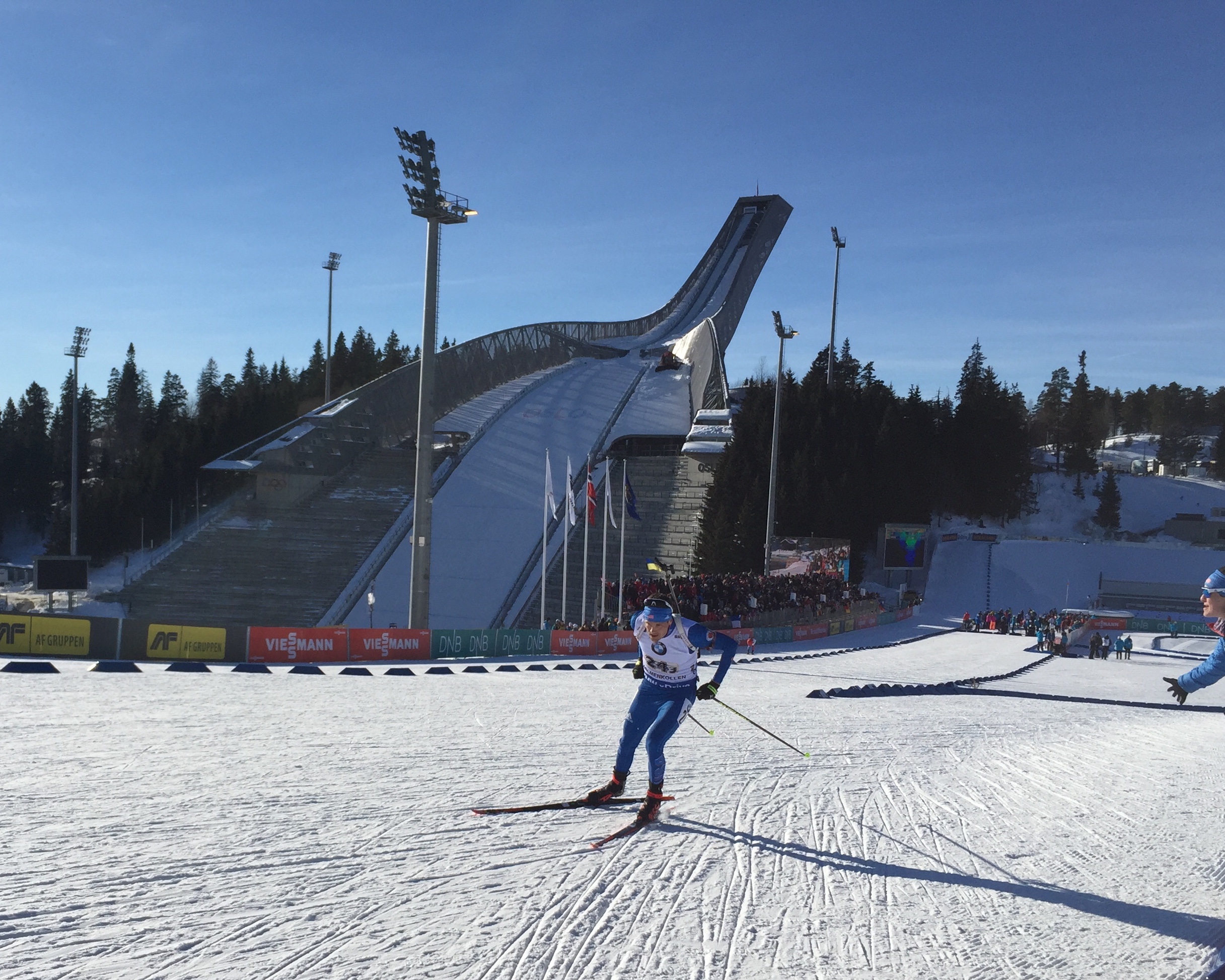
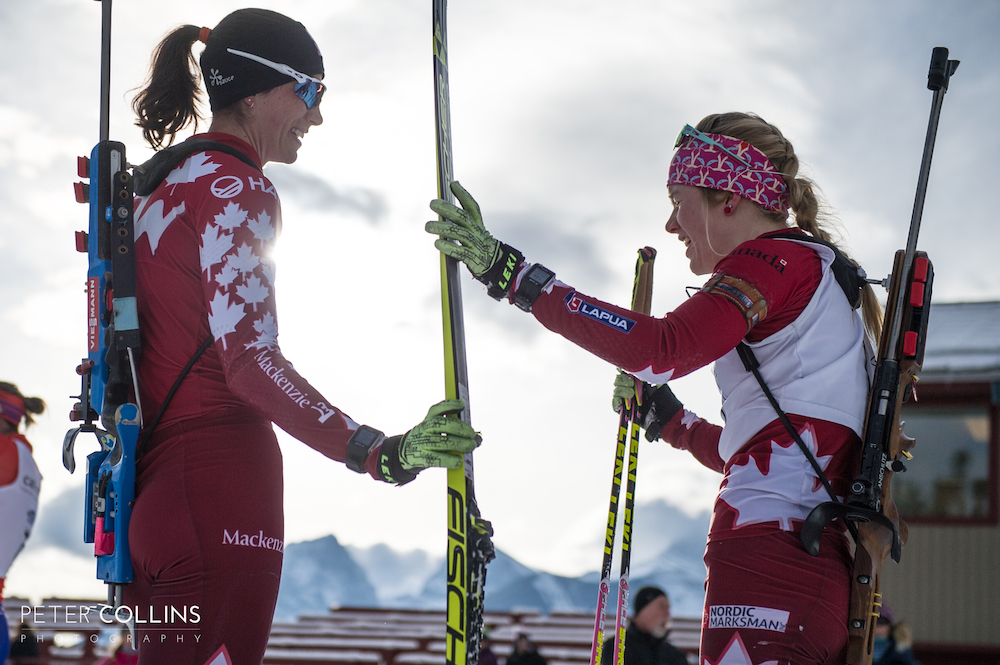
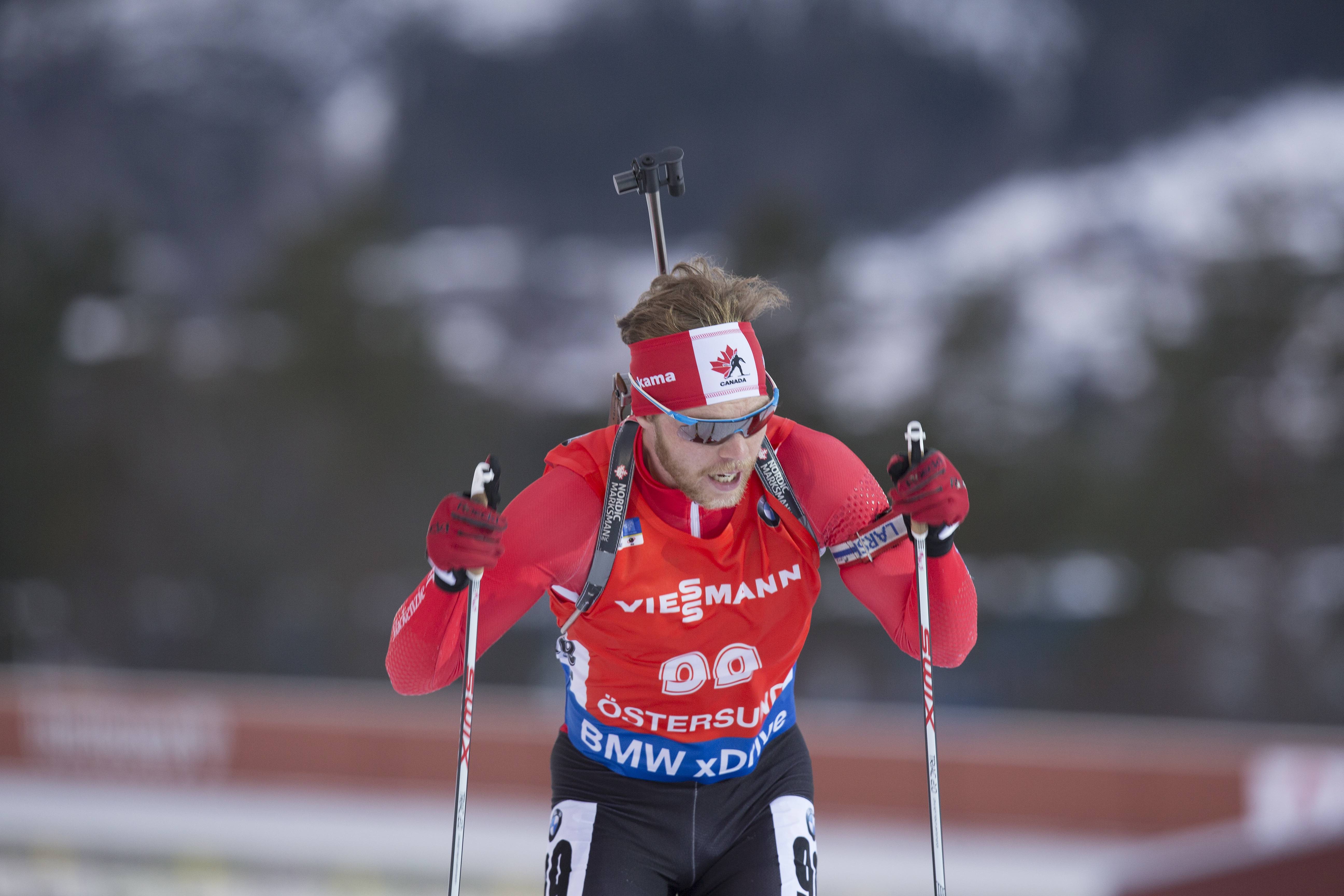
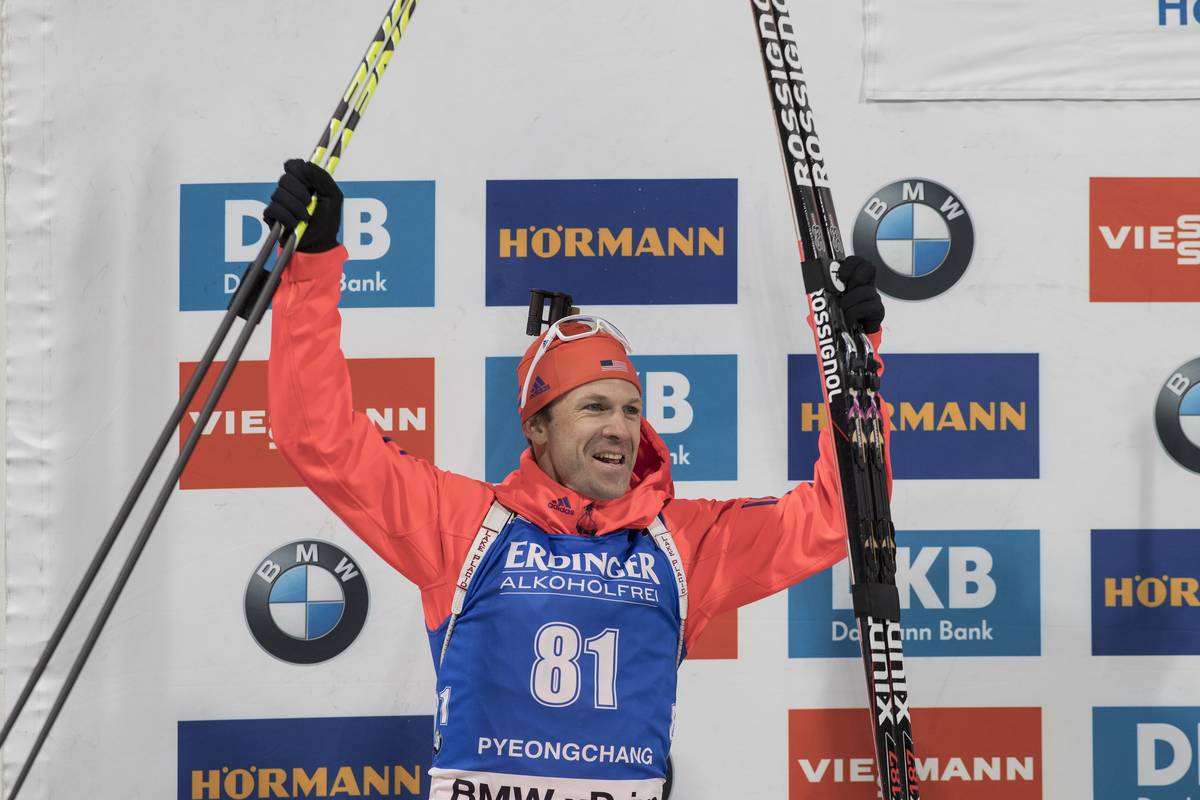
Clare Egan (r) cheers on her US Biathlon teammate Tim Burke in the final World Cup race of his career, as he races the third leg of the U.S. men’s relay at the IBU World Cup in Oslo, Norway.
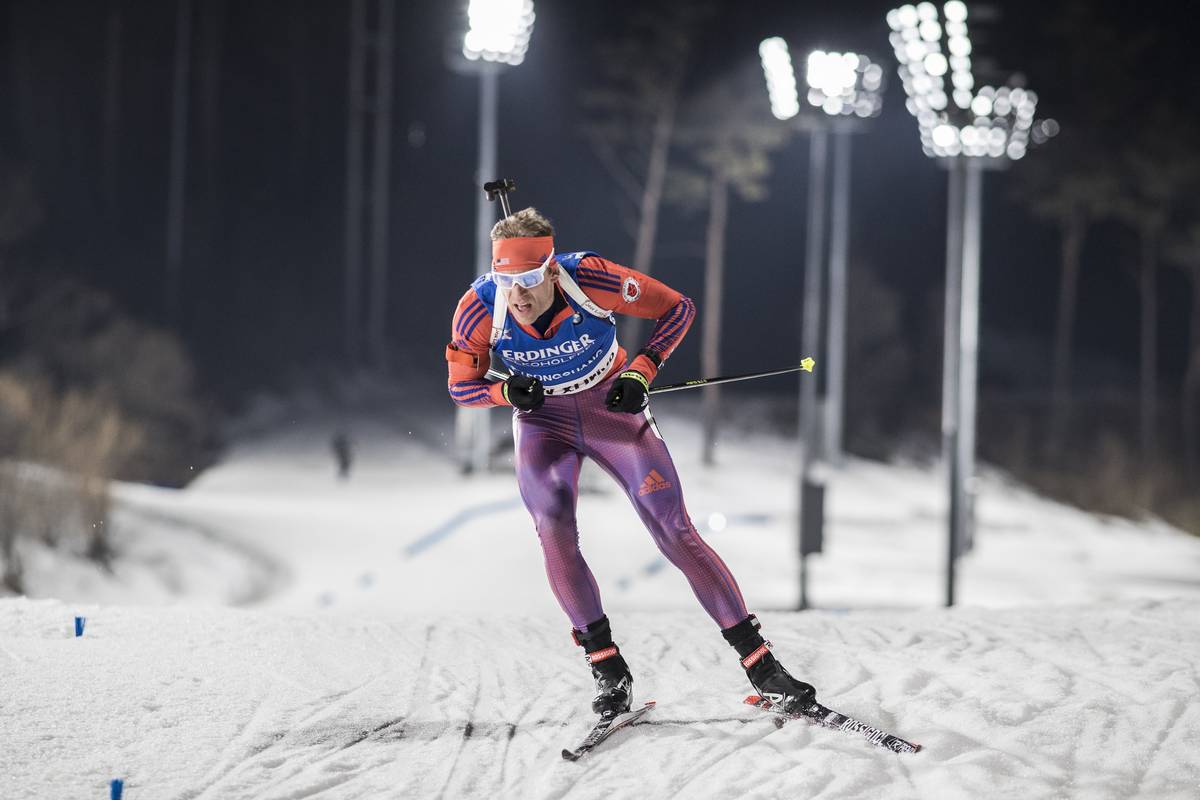
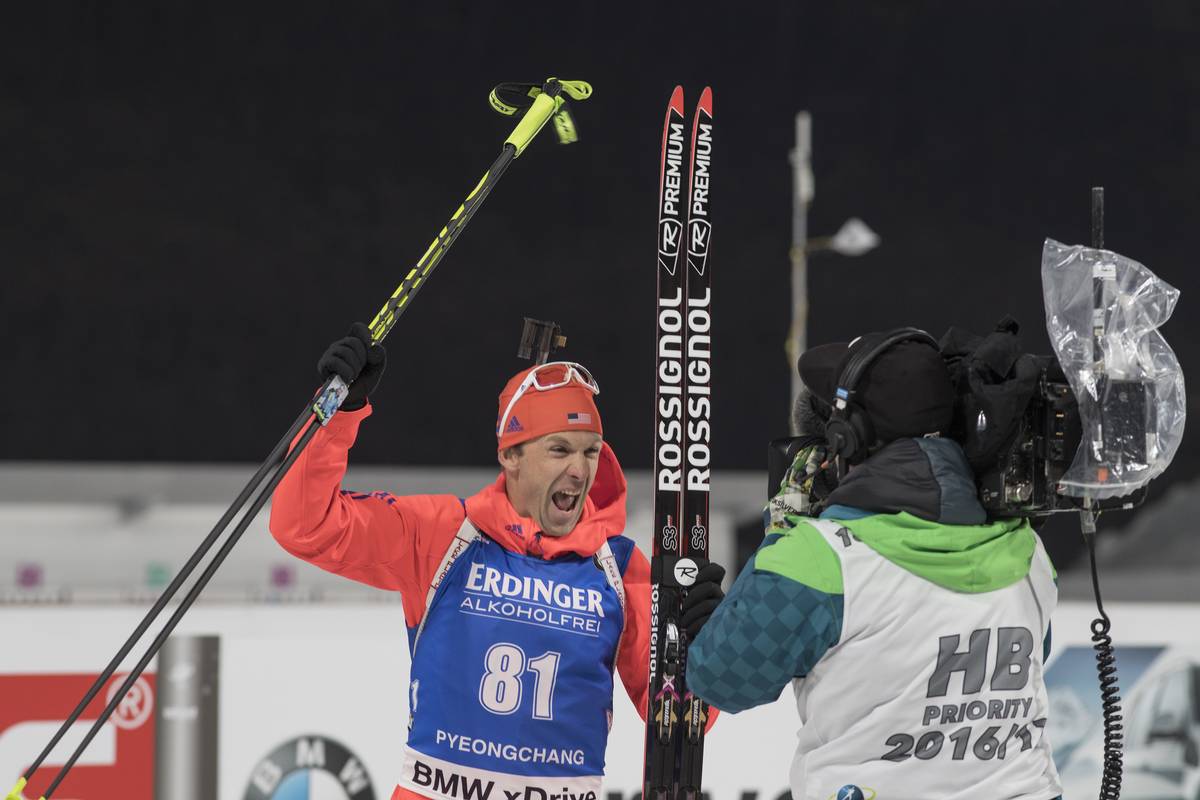
OSLO, Norway — In some ways, Sunday’s 4 x 7.5-kilometer men’s relay was very special for the U.S. biathlon team.
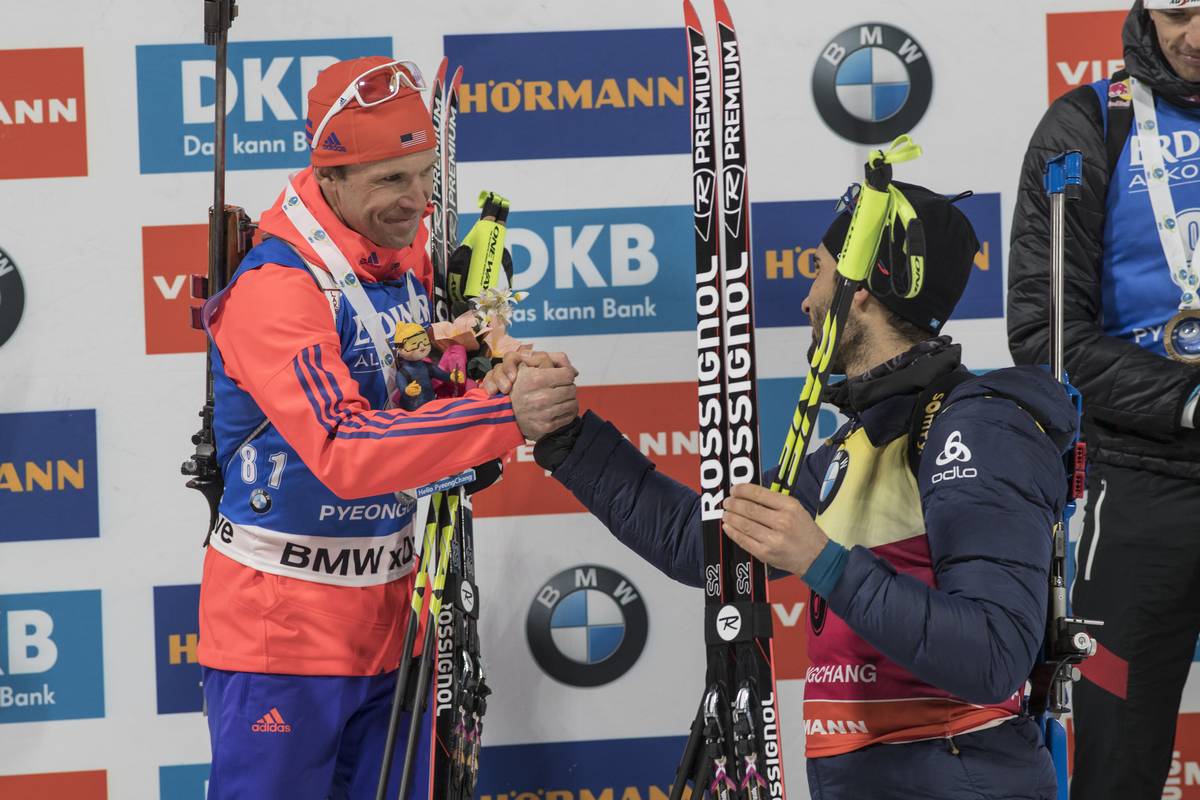
Two stalwart members – World Championships gold medalist Lowell Bailey and silver medalist Tim Burke – were retiring. It would be the last race of their long international careers.
In other ways, though, the team wanted it to just be a normal race. Their goal was to put together a good relay and a good result.
“Nothing’s changed in terms of, it’s about getting the best result we can,” Bailey said after leading off the relay and tagging teammate Sean Doherty in seventh place, having used just one spare rounds. “At the end of the day, that’s what we all want, and I couldn’t be happier if that’s how my career ended.”
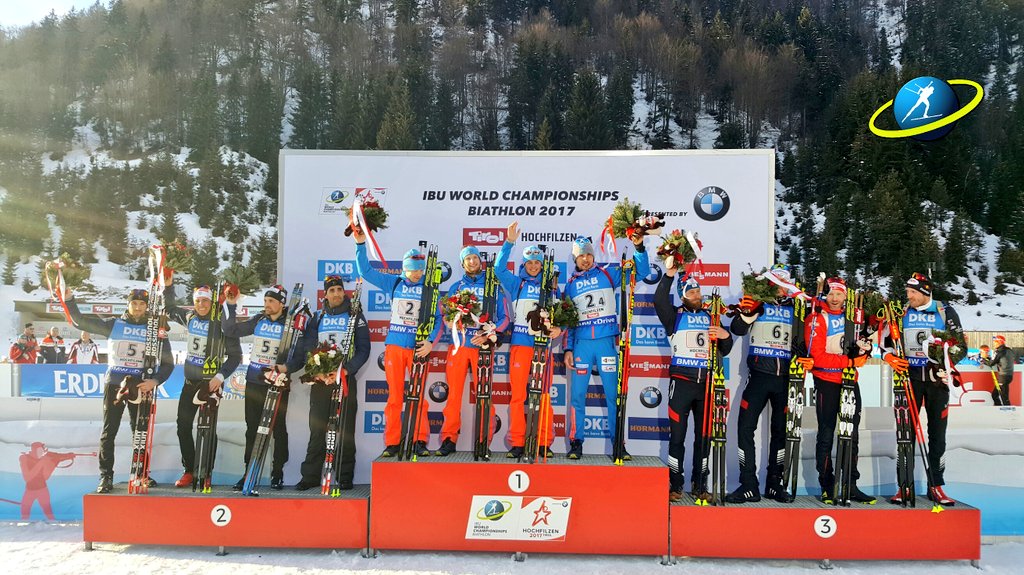
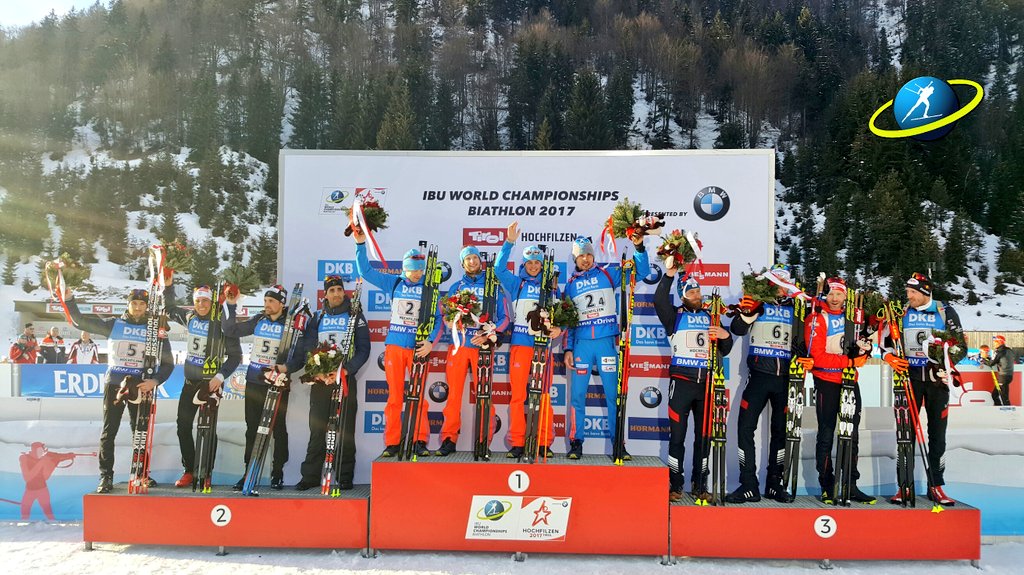
After Bailey’s relay leg, the team moved around quite a bit within the top 10, but by the race’s end, they came back to seventh place, 2:01.5 behind Norway, who took a blowout win over Austria (+50.3) and Russia (+56.9).
All the American men had good skiing, with their relay legs ranked fourth (Bailey), eighth (Doherty), sixth (Burke), and eighth (Leif Nordgren) for ski times, respectively. Together, they used eight spare rounds – far more than the winning Norwegian team’s three, but similar to many other teams in the middle of the field.
“That’s solid,” Burke said. “See how tight it is up front, besides Norway with the big lead? Other than that, it’s really close. We’re in the mix. You always want more, but it’s a solid result … the Olympic relay, we were very happy with. The sixth place there [in PyeongChang, South Korea], we were right there. That was a great race for us, but this is solid as well.”
Even though the U.S. had started in bib 24, in the very back of the mass start, Bailey had been able to find his way through the crowded pack and move up to seventh place. He then used a spare round in prone, dropping to 12th, but with clean standing and his good skiing, moved the U.S. back into contention.
“It didn’t seem it, but it took a lot of mental energy and focus to execute a good race,” Bailey said. “I told myself this morning that I just wanted to go out on a high note. I wanted to go out with a good result. And, I’m really happy to have shot clean in standing, clean from the clip in my last stage as a World Cup biathlete. That feels good. I’ll always remember that — that I went out with a clean stage.”
After Bailey, Doherty used two spare rounds and moved up to sixth place.
“I had a little ride there for the first lap, which was nice, and got into a good rhythm,” he said. “I had one spare [in each stage] … no harm there. It’s not ideal because it would have been really good to try to get contact with that kind of pack of four or five guys that were kind of together ahead, but we’re still right in it.”
Burke had clean shooting in prone to stay in sixth place, but used two spare rounds in standing and dropped to 10th, where he stayed until he tagged off.
Given his emotions, however, he was more than happy with just two spare rounds.
“I was more nervous for this race than nearly any other race in my career,” he admitted. “I was like, pull it together, because the other guys are counting on you today. So I tried to approach it like any other race, but honestly, it was a challenge to keep bringing myself back into the race mentally. I’m was happy to have stayed out of the penalty loop.”
Nordgren anchored the team and despite using all three spare rounds in standing, he moved up to eighth place when he left the range and passed another racer on the trails to bring the team home in seventh.
“I’ve been here a long, long time, and an top eight today is very different than a top eight when I came on the World Cup 14 years ago,” the 36-year-old Burke said, looking back over his career. “It’s so close now. There’s so many good teams. So it’s a solid result.”
The fact that he and Bailey, also 36, were here competing is a result of many changed plans over the last decade. The two initially planned to retire after the 2006 Olympics in Torino, Italy.
“The original goal was 2006 or bust,” Bailey said. “You know, like make the Olympic team, be an Olympian and move on. I’m so glad I didn’t follow through with that, because, you know, it’s a great feeling and accomplishment to make an Olympic team, but biathlon is so much more than that.”
“… It’s a great feeling and accomplishment to make an Olympic team, but biathlon is so much more than that.” — Lowell Bailey, US Biathlon
Both retiring athletes plan to stay involved with biathlon in one way or another. Bailey is a board member at the Crosscut Mountain Sports Center in Bozeman, Montana.
“I wouldn’t even say goodbye, because I intend to still be in contact with everyone and I really want to see US Biathlon move forward in the next four to ten years,” Bailey said. “I think the future is bright, and we have some great athletes that still have a lot to contribute on the World Cup. But then also, there’s new athletes out there right now that will come onto the World Cup stage. The future definitely is bright.
“I can honestly say biathlon has made my life so much better,” he continued. “So I feel very fortunate to have been introduced to the sport so many years ago. And it’s taken me on a wild roller coaster ride.”
Burke is not sure of his plans moving forward, but won’t be saying goodbye to biathlon permanently either.
“Nothing’s set in stone yet,” he said. “I really want to take a few months to myself right now. You know, I’ve been married for three years; I’ve never spent any anniversary with Andrea. We just built a new house last year. I haven’t really spent any time in it. I’ve missed all my nieces and nephews’ birthdays for the last eight years. I’m so excited to have more time with my family and friends, and try and make up for some lost time there.
“But I will absolutely stay in biathlon in one way or another,” he continued. “I’d like to think I’ve learned a lot in the 14 years I’ve been on the World Cup. Done some things right. Made a ton of mistakes. I would love to be able to share those experiences with the next generation coming up.”
Burke said that while he had been a wreck and barely able to focus on his race in Saturday’s pursuit, with the prospect of his last World Cups weighing on him, at the same time he wasn’t fully processing that his career was over.
“It’s weird. I don’t honestly I don’t know if it’s truly hit me,” he said. “It might take weeks. It’ll probably be May 1 when my body’s telling me, ‘OK, time to get back into training routine. Time to open up the training log. All right, what’s the plan?’ I think it’s going to take a long time for all to settle in and for me to really reflect back on my career. Yeah, it’s a lot of emotion.”
Even for those not retiring, it was a memorable day.
“It is special, for sure,” Doherty said. “It’s an honor to race with these guys and to have raced with them for the few years that I have. It has been great.”
As the sun shone, the team and a staff drank champagne and then stood out in the middle of the stadium soaking it all in.
“You know, it’s such a beautiful venue and a great place to compete,” Bailey said of Holmenkollen. “It’s about the history, and the course obviously is spectacular. But, you know there’s a little bit of luck involved in World Cups, and you can have really bad weather and you can have good weather, and this is the best weather we’ve had the whole year. I feel kind of blessed to be able to experience my last World Cup in these conditions, with the sun out and everyone smiling. I’ve never really thought about it or pictured it, but if I have, this is what it would look like.”
The Canadian team of Christian Gow, Scott Gow, Brendan Green, and Macx Davies finished 16th (+5:42.4) with 10 spare rounds.
“I’ve been kind of out of gas since like I got pretty sick after the Olympics, and I just haven’t been able to build my shape back,” Christian Gow said. “It’s been an arduous couple race weekends — even if the shooting’s good, I’m physically just exhausted. So, it’s disappointing to feel that way. … After the [Olympic] peak, you need to rebuild a bit, and I wasn’t able to do any of that because I had to take a week off or something like that [due to illness]. So, yeah, I’d rather be strong at the Olympics and then not as strong at the end of the year, but it doesn’t make it easier in the moment.”
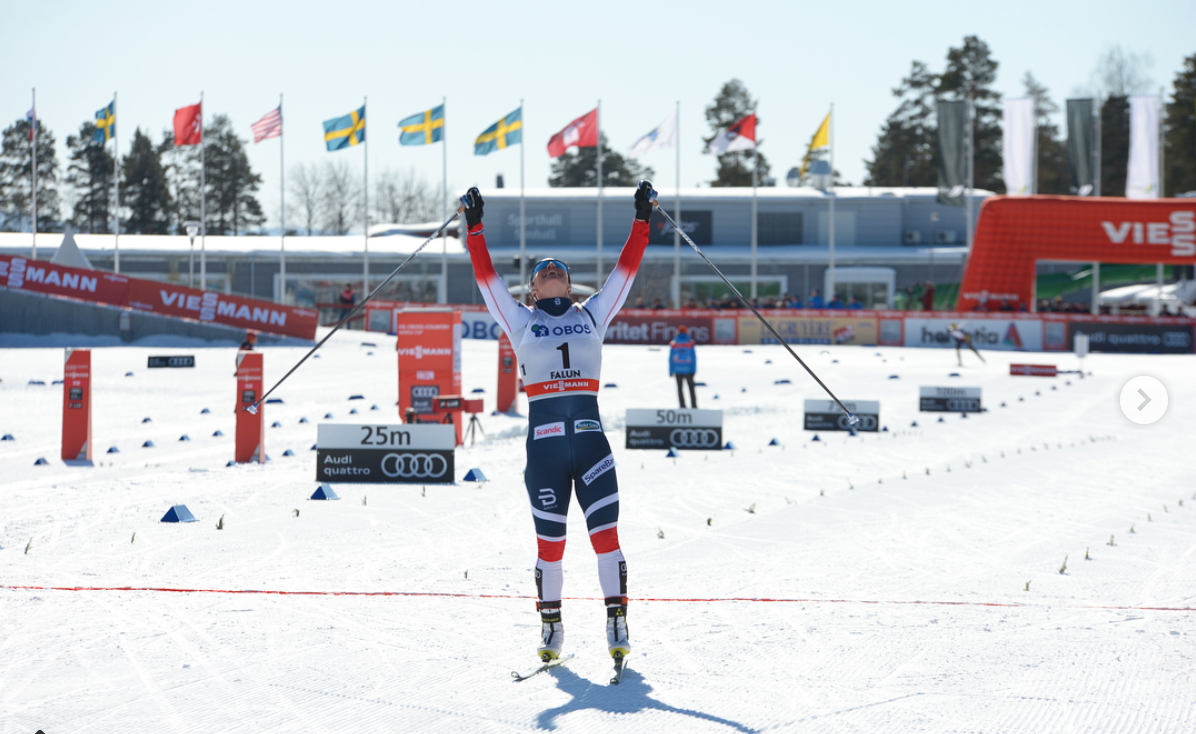
Norway’s Marit Bjørgen celebrates her overall win in the last race of 2018 World Cup Finals, the 10 k freestyle pursuit, on Sunday in Falun, Sweden. (Photo: Svenska Skidspelen/Instagram)
FIS Cross Country World Cup Finals (Falun, Sweden): 10/15 k freestyle pursuits
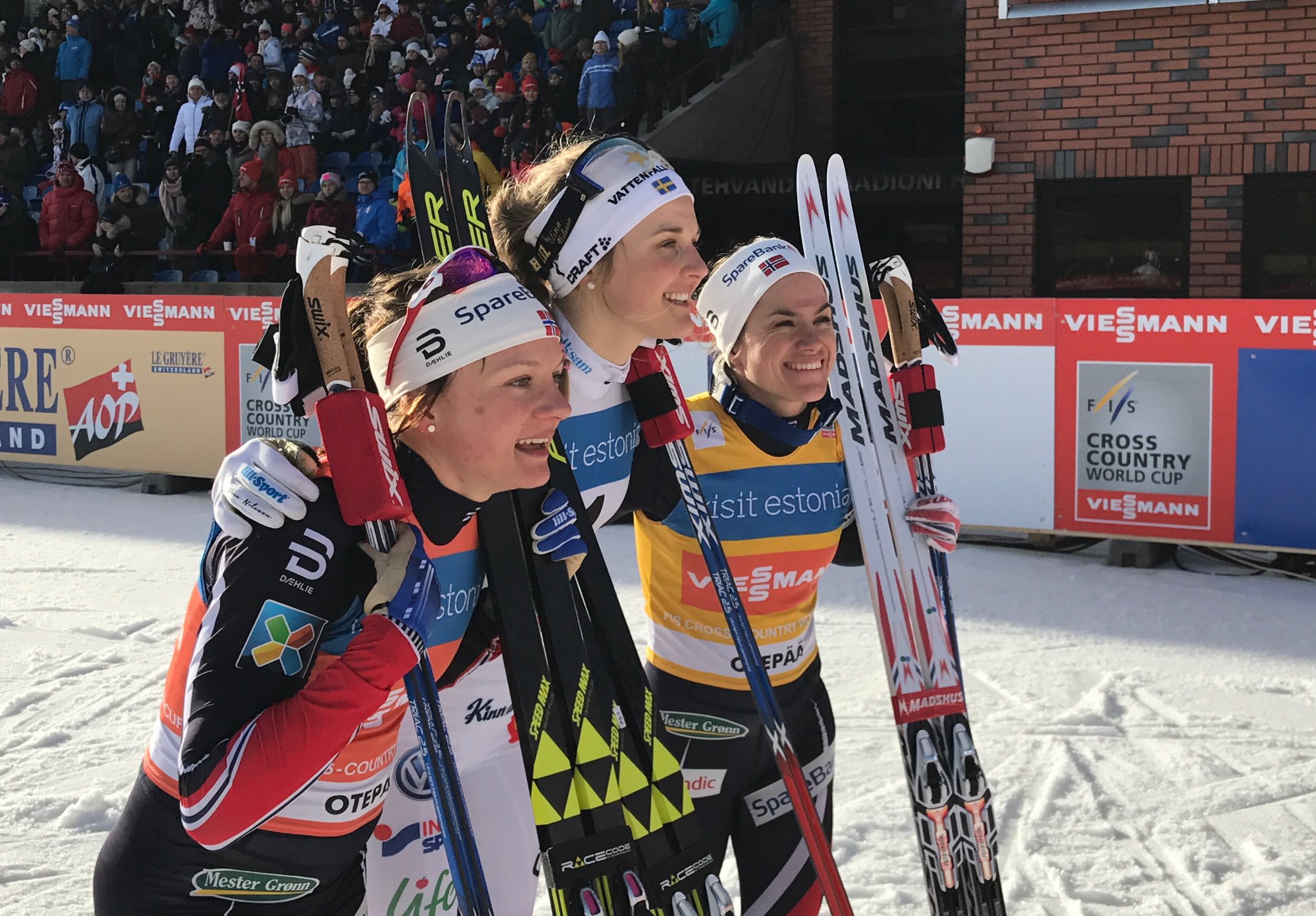
In the last women’s race of the World Cup season, U.S. Ski Team members Jessie Diggins and Sadie Bjornsen made it one they’ll remember for a long, long time as Diggins raced to second in the 10-kilometer freestyle pursuit and Bjornsen outlasted two Norwegians for third. The two finished the World Cup Finals mini tour in second and third, respectively, behind Norway’s Marit Bjørgen who won it in 24:18.9 minutes.
Bjørgen started with a 36-second cushion to her Norwegian teammate Ingvild Flugstad Østberg in second. Diggins started third, 41 seconds back, just ahead of Finland’s Krista Pärmäkoski in fourth (+43.0), based on their cumulative performances over the last two days of the mini tour (skate sprint and 10 k classic mass start).
While Østberg, Diggins and Pärmäkoski formed a chase pack, Diggins dropped them in pursuit of Bjørgen on the first lap. The American continued to push the pace throughout the three-lap race, coming within 16.7 seconds of Bjørgen at the finish.
Meanwhile, during the pursuit, a chase group of five, which included Bjornsen, caught Østberg and Pärmäkoski. The group of seven dwindled to three on the last two climbs, where Bjornsen and Norway’s Astrid Uhrenholdt Jacobsen and Ragnhild Haga broke away in a race for third.
The three were even entering the finishing stretch, where Bjornsen then beat them in a final 100-meter push to the line. Bjornsen claimed third (+1:11.5) for her fourth podium of the season and first in a distance skate race. Haga followed in fourth (+1:12.0) and Jacobsen fifth (+1:12.8), while Pärmäkoski placed sixth (+1:16.2), Sweden’s Charlotte Kalla seventh (+1:17.9), Østberg eighth (+1:19.0), Sweden’s Jonna Sundling ninth (+1:30.5) and Ebba Andersson 10th (+1:44.7).
Bjornsen now has five-career individual World Cup podiums to her name, and this is the first in a skate race longer than 5 k.
Diggins clocked the fastest time of day in 23:54.4, while Haga was second-fastest (+10.7) after starting the race in 17th. Bjørgen’s time ranked third, Jacobsen was fourth-fastest and Bjornsen fifth-fastest.
Diggins’s performance elevated her to second in the Overall World Cup standings, just 40 points behind Norway’s Heidi Weng (who placed 18th in the pursuit) in first for the second-straight year. Østberg slipped to third overall, 22 points behind Diggins. In the Distance World Cup, Weng took the title by 63 points over Østberg in second, while Diggins was another 32 points back in third.
Bjornsen ended up sixth in the Overall World Cup and 10th in the distance standings.
Also for the U.S., Caitlin Patterson raced from 46th at the start to 35th (+3:58.4) with the 22nd-fastest time of day, Sophie Caldwell placed 36th (+4:00.7), Kikkan Randall finished her last World Cup race in 43rd (+4:33.3) with the 29th-fastest time, Rosie Frankowski placed 46th (+4:41.3), Liz Stephen 50th (+4:57.2) in her final World Cup race, Kaitlynn Miller 56th (+6:13.8), and Ida Sargent 57th (+7:06.4).
For Canada, Cendrine Browne picked off 10 places to finish 39th (+4:14.4) with 27th-fastest time of day, Emily Nishikawa finished 48th (+4:43.7), Dahria Beatty 54th (+6:04.3), and Zina Kocher 60th (+9:28.4).
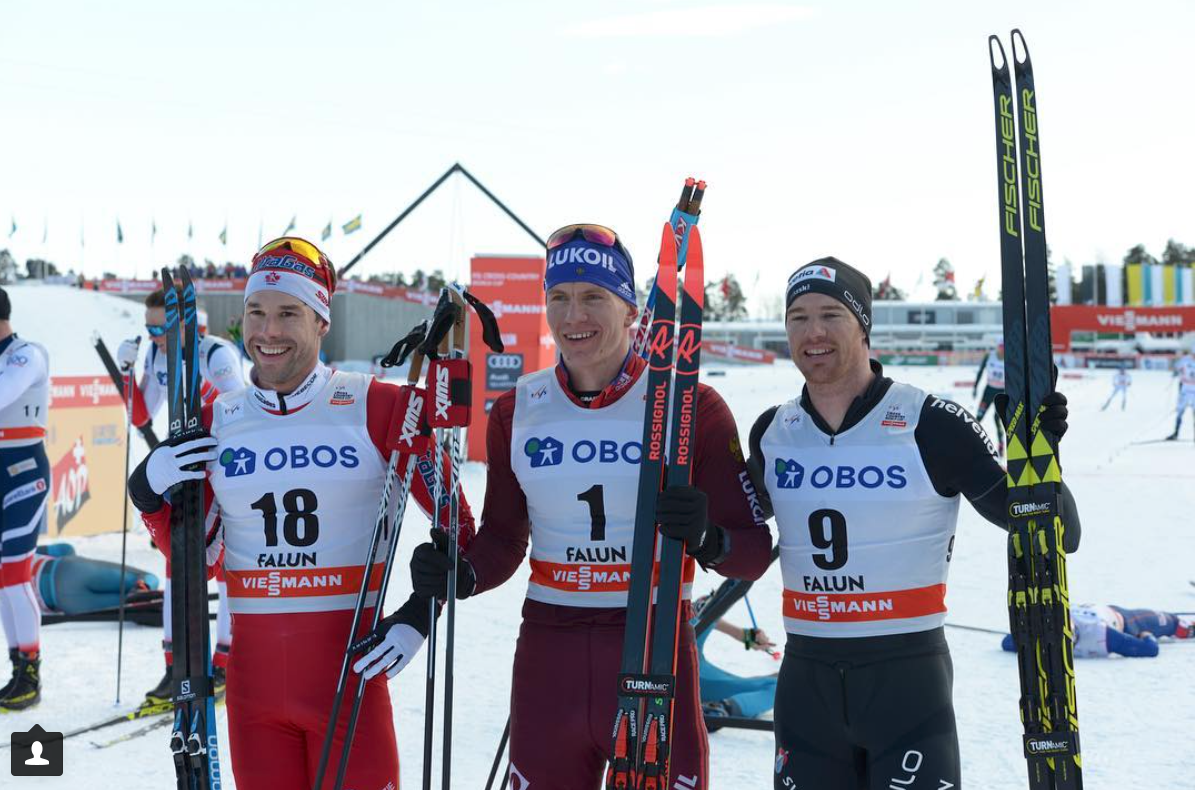
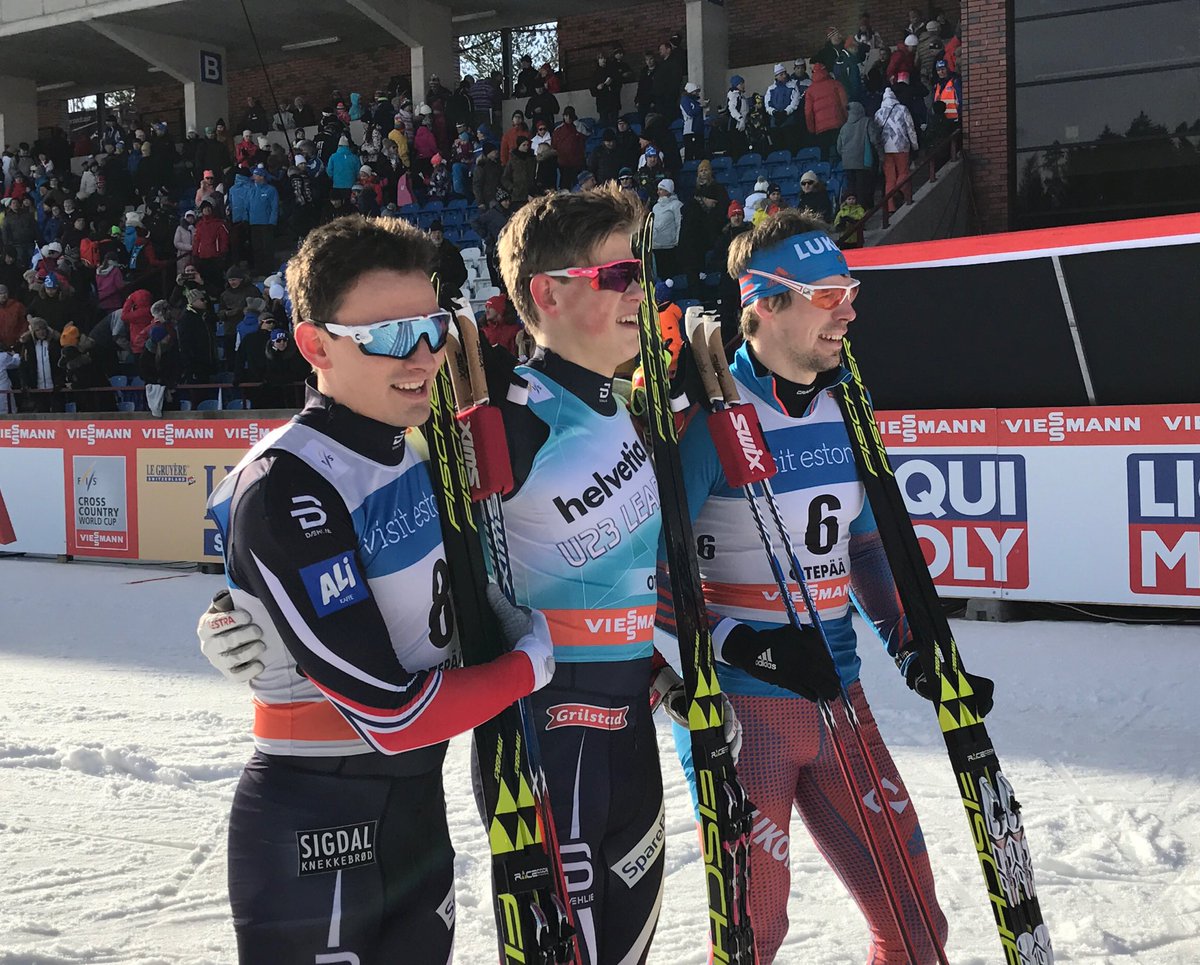
The men’s 15 k freestyle and 2018 World Cup Finals podium, with Russia’s Alexander Bolshunov (c) in first, Canada’s Alex Harvey (l) in second and Switzerland’s Dario Cologna (r) in third. (Photo: Svenska Skidspelen/Instagram)
In the men’s 15 k freestyle pursuit that followed, Russia’s Alexander Bolshunov started 38 seconds clear of Norway’s Johannes Høsflot Klæbo in second, and Sweden’s Calle Halfvarsson and Italy’s Federico Pellegrino headed out together another second later in third and fourth, respectively.
Norway’s Martin Johnsrud Sundby started the race in seventh (+53.0), and Switzerland’s Dario Cologna followed in ninth (+56.0), while Canada’s Alex Harvey started 1:16 back in 18th.
While Bolshunov skied the entire race on his own and won the weekend mini tour in 35:03.3, a number of racers battled for second, with Sundby moving into second in the chase pack, ahead of seven others, less than 2 k in. Several skiers found themselves at the front of that group, including Cologna, Halfvarsson, and even Harvey (with Harvey leading the chase at 9.3 k), while the time gap to Bolshunov grew.
With about 2 k to go, the group was down to six. Harvey attempted an attack, but Cologna matched him. Then, on one of the course’s final climbs, Cologna made his move to get a slight gap, but lost his balance slightly on the downhill, allowing Harvey to catch back up.
With one last uphill to go, Harvey was in the driver’s seat in second, Cologna in third and Sundby in fourth. That order held to the finish, with Harvey claiming second, 47.1 seconds behind Bolshunov, Cologna placing third (+47.5) and Sundby fourth (+48.7). Just behind them, Russia’s Maxim Vylegzhanin crossed in fifth (+50.3), ahead of Norway’s Hans Christer Holund in sixth (+51.7), Halfvarsson in seventh (+54.1), and Norway’s Sjur Røthe in eighth (+54.9). Nearly 10 seconds later, Norway’s Niklas Dyrhaug outlunged two Russians for ninth (+1:04.1): Denis Spitsov in 10th (+1:04.2) and Andrey Larkov in 11th (+1:04.3).
Harvey, who finished the season in fourth in both the Overall and Distance World Cup standings, won the time of day in 34:34.3. Holund had the second-fastest course time, 1 second off Harvey’s time, after starting the race in 22nd.
Harvey’s Canadian teammate Devon Kershaw tallied his fifth-straight distance top 30 in 28th (+2:21.9), after starting 27th, and Graeme Killick finished 56th (+4:33). Julien Locke did not start.
For the U.S., Erik Bjornsen clocked the 22nd-fastest time en route to 38th (+3:10.4), after he started 51st. Simi Hamilton improved 10 places to finish 49th (+4:07.8), Scott Patterson and Paddy Caldwell worked together to move up from 72nd and 73rd, respectively, to 58th (+4:41.5) and 59th (+4:41.6), respectively, at the finish. Kevin Bolger placed 60th (+4:43.5) and David Norris 64th (+5:09.8).
While Klæbo slipped from second to 25th in the pursuit (+1:45.8), the Norwegian still won his first Overall World Cup by 119 points over Cologna in second. Sundby placed third, 29 points out of second and 82 points ahead of Harvey.
Cologna claimed the Distance World Cup Crystal Globe by 41 points over Sundby, and Holund reached the Distance World Cup podium in third, 58 points out of second and just 5 points ahead of Harvey in third. France’s Maurice Manificat had been third heading into the final day of racing, but finished the pursuit in 26th (+2:11.9) and dropped to fifth in the final distance rankings.
In her last race of the season, Susan Dunklee returned to the podium. The American started fourth in Sunday’s 10-kilometer pursuit at the International Biathlon Union (IBU) World Cup in Oslo, then made her way into third by the final shooting stage. Dunklee shot 18-for-20 (1+0+1+0) and finished 29.5 seconds behind the winner, Darya Domracheva of Belarus, who missed two targets as well (1+0+1+0) and finished first in 30:37.4. Slovakia’s Anastasiya Kuzmina started the race in first (ahead of Domracheva in second) and ended up second (+9.2) with four penalties (0+2+2+0).
Canada’s Julia Ransom and Rosanna Crawford finished together in 51st and 52nd, respectively, both 4:52.4 out of first. Ransom had four penalties (0+1+1+2) while Crawford missed five (1+3+1+0). Emma Lunder did not finish.
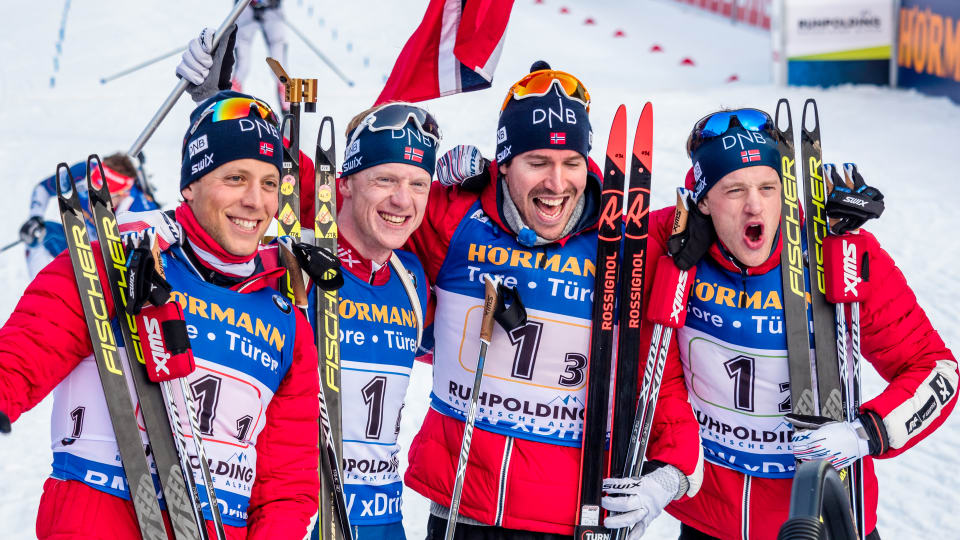
In the men’s 4 x 7.5 k relay on Sunday, Norway’s team of Lars Helge Birkeland, Henrik L’Abee-Lund, Tarjei Bø, and Johannes Thingnes Bø used just three spare rounds to clean eight shooting stages and took the win in 1:13:13.7 hours. Austria finished 50.3 seconds back in second place, with Dominik Landertinger, Felix Leitner, Simon Eder, and Julian Eberhard, with a total of five spares. Russia’s Maxim Tsvetkov, Anton Babikov, DmitryMalyshko, and Anton Shipulin raced to third (+56.9) with just four total spares.
The U.S. men placed seventh (+2:01.5) with eighth spares, after Lowell Bailey put the team in seventh on the first leg. Sean Doherty skied them up to sixth on the second leg, Tim Burke slipped to 10th on the third leg, and Leif Nordgren posted the seventh-fastest anchor leg to put them in seventh at the finish.
Canada placed 16th (+5:42.4) with Christian Gow, Scott Gow, Brendan Green, and Macx Davies. The team had been in 19th at the final exchange, but Davies skied them up to 16th with the 14th-fastest anchor leg. In all, they used 10 spares.
Susan Dunklee (US Biathlon) racing to fourth in the women’s 7.5 k sprint on Thursday at the IBU World Cup in Oslo, Norway. It was her best individual result of the season by two places. (Photo: USBA/NordicFocus)
Susan Dunklee had been looking for something all season, a sort of spark. And while the U.S. biathlete hadn’t necessarily found it on Thursday, she had still pulled off fourth place in the women’s 7.5-kilometer pursuit at the International Biathlon Union (IBU) World Cup in Oslo, Norway.
“I feel like right now I’m relying on good habits to carry me through the rest of the season,” Dunklee, 32, of US Biathlon, said in a phone interview on Thursday. “Normally you need more than just that, you need that spark.”
Last year in Oslo, Dunklee placed seventh in the sprint. They year before, she finished eighth in the 2016 Oslo World Championships sprint at the Holmenkollen biathlon venue.
The flower ceremony for the IBU World Cup women’s sprint on Thursday in Oslo, Norway, which American Susan Dunklee appeared in after placing fourth. (Photo: IBU/Biathlonworld)
On Thursday, she shot clean (hitting all 10 of her targets) and finished 35.7 seconds behind the winner, Slovakia’s Anastasiya Kuzmina, and 6.5 seconds out of third, which went to Ukraine’s Yuliia Dzhima.
The race was Dunklee’s last World Cup sprint of the season, since US Biathlon (along with several other teams) is boycotting next week’s final World Cup in Tyumen, Russia.
“I feel like that spark has been missing a little bit so I was really surprised to be able to put this one together,” she said. “But maybe there was too much spark, maybe I wanted things too much and now I’m finally kind of letting go a little bit and that’s what I needed to do all along.”
A two-time Olympian who raced at five World Championships, Dunklee has been competing internationally in biathlon for the last nine years after a relatively late start in the sport. The daughter of Stan Dunklee, a two-time Olympic cross-country skier, she started skiing at age 2 but didn’t learn to shoot until age 22 when she joined US Biathlon’s development program after graduating from Dartmouth College.
And despite currently being the veteran member of the US Biathlon women’s team, Dunklee said she still gains a great deal from her younger teammates. Clare Egan, 30, who switched from cross-country ski racing to biathlon five years ago, raced to a career-best 13th in last week’s sprint in Kontiolahti, Finland.
“I was definitely inspired by Clare’s race last week,” Dunklee said. “I’ve never seen her so composed and confident out mixing it up with the top ladies in the field and that got me excited for the team. … I often feed off of other people performing well.”
US Biathlon had another breakthrough on Thursday when Sean Doherty finished 14th in the men’s 10 k sprint later in the afternoon in Oslo. It was his season best as well and just one place short of tying his career-best individual World Cup result of 13th (which he achieved in a sprint during the 2015/2016 season in Presque Isle, Maine).
“Sean just had his best result of the season today, so the whole team’s kind of rounding into form just in time,” Dunklee said of the season’s end.
Slovakia’s Anastasiya Kuzmina racing to her fifth World Cup win of the season in the 7.5 k sprint in Oslo, Norway. (Photo: IBU/Biathlonworld)
Kuzmina, who won the women’s race in 21:31.8 minutes with one prone penalty (1+0), started the sprint a minute and a half behind Dunklee, who headed out of the gate in bib 10. Despite cleaning both stages, Dunklee knew she was in second on her final loop after hearing about the kind of race Kuzmina was having. The Slovakian posted the fastest overall course time to overcome her early penalty and beat Belarusian Darya Domracheva, who shot clean, by 8.9 seconds. Dzhima also shot 10-for-10 (as did the rest of the top-seven women) and finished 29.2 seconds off Kuzmina’s winning time.
While Dunklee initially finished first and was bumped to second by Kuzmina just under a minute later, she knew there were plenty of later starters capable of strong performances that could bump her off the podium. Considering that, Dunklee, who skied the 18th-fastest course time and had the 14th-fastest range time, said she was “very happy” to finish in the top six and earn flower-ceremony recognition.
Asked how she felt about the last races of the season, Dunklee said she was trying not to overthink it.
“I’m not looking at it like this is the last sprint, I’m looking at it like, well, just one more,” she said. “I’m going to try to put everything I can into doing the best I can this weekend because there’s nothing else to save it for.”
While Dunklee will start Sunday’s 10 k pursuit 36 seconds back in fourth based on her sprint result, her three teammates missed the sprint top 60 required to qualify for the pursuit. Egan finished 68th (+2:44.8) with three penalties (1+2), Joanne Reid was 75th (+3:02.2) with three misses (1+2) and Emily Dreissigacker placed 83rd (+3:24.8) with three penalties (2+1) as well.
Meanwhile, three Canadian women qualified for the pursuit. Rosanna Crawford placed 38th (+1:51.8) with one standing penalty (0+1), Julia Ransom was 46th (+2:10.1) with one miss (0+1) and Emma Lunder in 57th (+2:28.2) with one penalty (0+1) as well. Also for Canada, Sarah Beaudry finished 84th (+3:30.7) with three penalties (1+2).
Sean Doherty (US Biathlon) racing to 14th in Thursday’s 10 k sprint for a season-best individual result at the IBU World Cup in Oslo, Norway. (Photo: USBA/NordicFocus)
In the men’s sprint that followed, Doherty was one of nine in the top 14 that shot clean, and he finished 47.1 seconds out of first. Norway’s Henrik L’Abée-Lund won the race with perfect shooting for his first World Cup win with a time of 26:10.3.
Four years ago, Doherty made his World Cup debut in Oslo, where he finished 82nd in the sprint. He explained in an email that he has fond memories of the venue.
“The skiing on and off the race course is fantastic and it’s always a special atmosphere,” wrote Doherty, now 22.
He started in the middle of the field in bib 53 and kept himself competitive with the race leaders with flawless shooting and the 33rd-ranked course time. His overall range and shooting times ranked 24th and 26th fastest, respectively.
Norway’s Johannes Thingnes Bø, who started 30 seconds behind him in bib 54, went on to finish second, 6.1 seconds behind L’Abée-Lund. Bø led throughout the race even after skiing a penalty lap after his standing stage (0+1), but lost time to his teammate, L’Abée-Lund, on the last loop.
“That’s what you hate, being in the lead after the last shooting and not in the lead in the finish,” Bø told German broadcaster ARD after in an English interview. “It’s not the best feeling, but I fought with what I had, just wasn’t enough.”
“He was a great marker for me to chase,” Doherty said of Bø. “After cleaning heading out onto the [last] loop I knew I was having a good one.
“I felt strong skiing today, which in turn helps your confidence on the range,” Doherty continued. “As for the good shooting I have been working on some good things in the days leading up to today and I was able to execute my race plan on the range as I wanted. Which I am very happy about.”
He was pleased to put together a complete race in the last sprint of the season, especially considering how it sets him up for Saturday’s 12.5 k pursuit.
“It feels good to end the season on some good momentum and it is fun to be towards the top of a extremely competitive field,” Doherty said. “Now I am just looking forward to the possibilities of the pursuit.”
Henrik L’Abée-Lund (top) and his Norwegian teammate Johannes Thingnes Bø after they placed first and second, respectively, in the men’s 10 k sprint at the IBU World Cup in Oslo, Norway. (Photo: IBU/Biathlonworld)
In the pursuit, L’Abée-Lund will start six seconds ahead of Bø in second and seven seconds ahead of France’s Martin Fourcade in third. Fourcade placed third on Thursday, 6.9 seconds back, after shooting clean but falling and breaking a pole on a downhill.
“I just tried to push one more time in the downhill to get more speed and I pushed aside my ski, I fell, I broke my pole, and I lost seconds for the victory today,” Fourcade told ARD in English. “It’s a good place close to Johannes [for the pursuit], but today wasn’t my time.”
Austria’s Julian Eberhard, who placed fourth, just 0.2 second behind Fourcade, will start the pursuit at the same time as Fourcade.
With one race to go, Fourcade leads the overall World Cup Total Score standings by 37 points over Bø in second.
“It will be tough, it will be almost impossible,” Bø said of beating him. “Today I was ahead but I have to beat him in every race and actually make more points [than him].”
A total of four American men qualified for Saturday’s pursuit, with Lowell Bailey finishing 42nd (+1:41.1) with two penalties (0+2)), Leif Nordgren 43rd (+1:43.3) with one miss (0+1) and Tim Burke 57th (+2:12.8) with four penalties (2+2). In his second World Cup start, Alex Howe finished 89th (+3:39.5) with four misses (3+1).
For Canada, the Gow brothers qualified for the pursuit, with Scott Gow placing 49th (+2:02.1) with one penalty (0+1) and Christian finishing 56th (+2:12.3) with clean shooting. Brendan Green finished 71st (+2:31.3) with two penalties (1+1) and Macx Davies was 96th (+4:27.2) with four penalties (2+2).
“There is no special secret,” Kuzmina said of her five World Cup wins and Olympic gold (in the mass start) this winter. “It’s hard work before the season, good work together with my team, great support from my family and that is all.”
Born in Russia and the sister of Russian biathlete Anton Shipulin, she said she’s looking forward to the Tyumen World Cup.
“Tyumen is my home, where I was born, and I am really really excited for the time there and to see my family,” she said.
Racing in Oslo continues with the women’s relay and men’s pursuit on Saturday, followed by the women’s pursuit and men’s relay on Sunday.
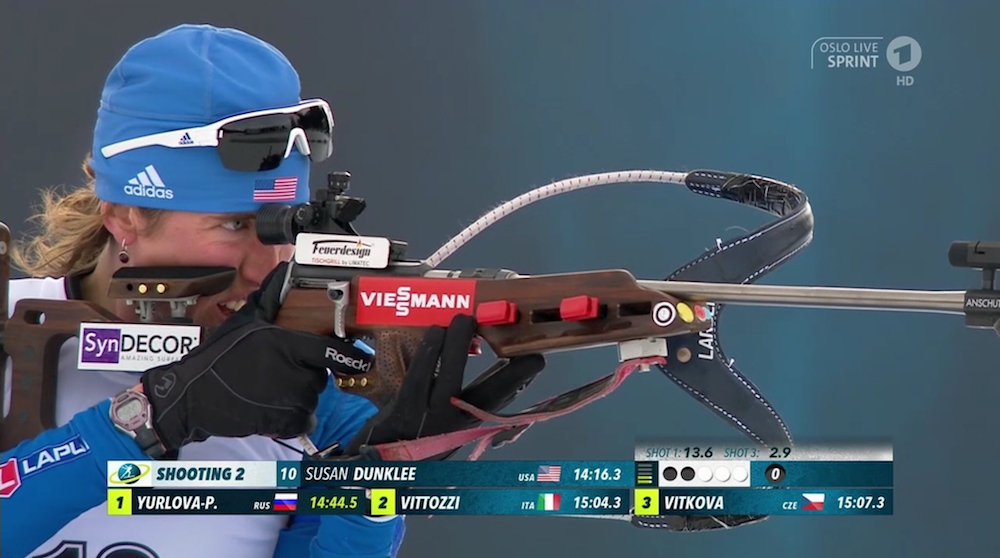
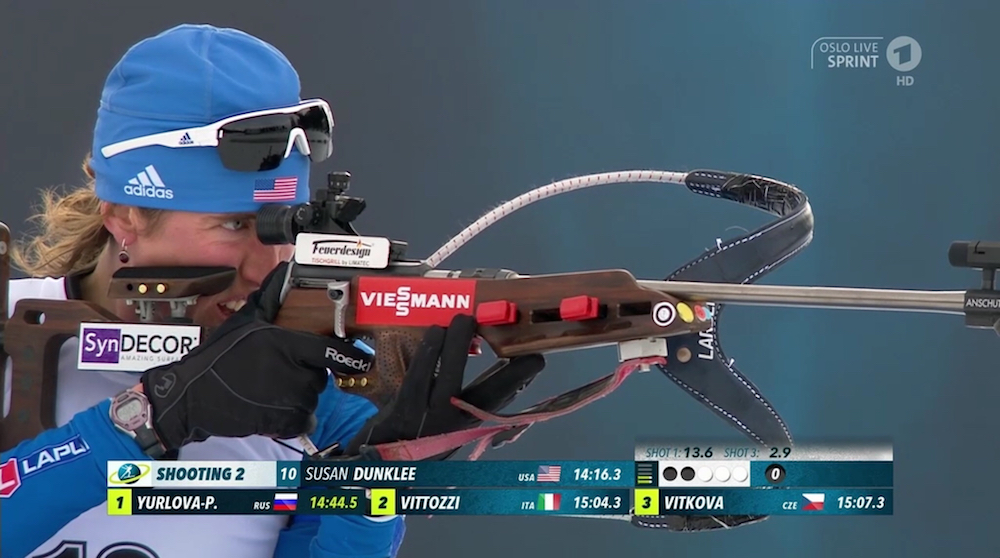
American Susan Dunklee cleaning her second-straight shooting stage of the women’s 7.5 k sprint on Thursday at the IBU World Cup in Oslo, Norway. (Screenshot: ARD broadcast)
IBU World Cup (Oslo, Norway): Women’s and men’s sprints
In her last International Biathlon Union (IBU) World Cup sprint of the season, Susan Dunklee (US Biathlon) raced to a season-best fourth place in the women’s 7.5-kilometer sprint on Thursday at Holmenkollen in Oslo. Dunklee shot clean and finished 35.7 seconds behind Slovakia’s Anastasiya Kuzmina, who had a single prone miss (1+0) but skied the fastest course time to win in 21:31.8 minutes.
Darya Domracheva of Belarus finished 8.9 seconds back for second place with perfect 10-for-10 shooting. The rest of the top-seven finishers also shot clean, with Ukraine’s Yulia Dzhima placing third, 29.2 seconds out of first and 6.5 seconds ahead of Dunklee.
Rosanna Crawford led Canada in 38th (+1:51.8) with one penalty (0+1), and two of her teammates also qualified for Sunday’s pursuit by finishing in the top 60: Julia Ransom in 46th (+2:10.1; one penalty) and Emma Lunder in 57th (+2:28.2; one penalty). Sarah Beaudry finished 84th (+3:30.7; three penalties).
Four Americans competed, with Clare Egan finishing 68th (+2:44.8; three penalties), Joanne Reid 75th (+3:02.2; three penalties) and Emily Dreissigacker 83rd (+3:24.8; three penalties).
Sean Doherty (US Biathlon) racing to 14th in Thursday’s 10 k sprint for a season-best individual result at the IBU World Cup in Oslo, Norway. (Photo: USBA/NordicFocus)
In the men’s 10 k sprint that followed, Sean Doherty (US Biathlon) raced to his best result of the season as well, and was one place away from tying his career best, placing 14th with clean shooting.
Doherty finished 47.1 seconds off the winning time set by Norway’s Henrik L’Abée-Lund, who notched his first World Cup win in 26:10.3. He also shot clean, while his teammate Johannes Thingnes Bø missed one in his standing stage to come 6.1 seconds short of winning at the finish. Bø finished second, while France’s Martin Fourcade placed third (+6.9) after shooting clean but falling on a downhill and losing valuable time.
Doherty posted the 24th-fastest overall range time, 26th-fastest shooting time and 33rd-ranked course time. The 22-year-old New Hampshire native was one of nine men in the top 14 that shot clean. His individual World Cup career best is 13th, which he notched during the 2015/2016 season in a sprint in Presque Isle, Maine. His 14th place on Thursday bested his 17th-place finishes in a sprint and a pursuit earlier this season.
Four out of five of the American men competing qualified for Saturday’s pursuit, with Lowell Bailey finishing 42nd (+1:41.1; two penalties), Leif Nordgren 43rd (+1:43.3; one penalty) and Tim Burke 57th (+2:12.8; four penalties). In his second World Cup start, Alex Howe finished 89th (+3:39.5; one penalty).
Canada’s Scott Gow and Christian Gow qualified for the pursuit, with Scott placing 49th in the sprint (+2:02.1; one penalty) and Christian finishing 56th (+2:12.3) with clean shooting. Brendan Green finished 71st (+2:31.3; two penalties) and Macx Davies was 96th (+4:27.2; four penalties).
Fredrik Lindström crosses the line first to secure a gold medal for his Swedish teammates in the men’s 4 x 7.5 k relay on Friday to close out biathlon competitions at the 2018 Olympics in PyeongChang, South Korea. (Photo: FlyingPointRoad)
Remember when it was a big deal when Sweden won a Biathlon World Cup? The team in bright yellow has made it a habit at the 2018 Winter Olympics, winning their first Olympic relay gold and fourth medal over the last two weeks on Friday — the last biathlon race of the PyeongChang Games.
“It’s dreams coming true at that moment,” Fredrick Lindström, the Swedish men’s 4 x 7.5-kilometer relay anchor said in a post-race press conference on Friday. “It’s my third Olympics and to be on top with these guys feels great. I don’t know what to say.”
Lindström had taken gold in perhaps the most ideal way for an athlete in his position, by heading out on the last 2.5 k loop in first place, almost 41 seconds ahead of anyone else. While he had missed his first shot in the final standing stage of the race, Lindström cleared it with the use of one spare bullet. Meanwhile, his closest challenger for the win — Norway’s Emil Hegle Svendsen, who had followed him into the range and lined up alongside him to shoot — missed his first two targets and went on to miss more, ending up with a penalty lap after using all three spares.
That was the end of gold for Norway and for Svendsen, who was all too familiar with the penalty lane in the closing moments of an Olympic relay. Four years ago in the men’s relay in Sochi, Russia, Svendsen as Norway’s anchor had been in the medal hunt until the final shooting. There, he used all of his spares and still left a target standing, which sent him to the penalty lap. After leading by as much as 20 seconds in the middle of that race, Norway finished fourth.
But as they say, that’s biathlon. And on Friday, it was Sweden’s day and Lindström skiing on his own for a 2.5 k victory loop around the course. But he didn’t slow down. As the 28 year old skated up the final climb, he was greeted by several members of his team bowing up and down in a unison to celebrate the history that was about to be made. Lindström descended down into the stadium, not looking back and still pushing toward the line, before skiing to the sidelines a few meters before the finish to grab a small Swedish flag.
Fredrik Lindström crosses the line first to secure a gold medal for his Swedish teammates in the men’s 4 x 7.5 k relay on Friday to close out biathlon competitions at the 2018 Olympics in PyeongChang, South Korea. (Photo: FlyingPointRoad)
It wasn’t like the oversized French flag Martin Fourcade had been seen waving earlier in the Games, in the pursuit and again in the mixed relay. It was understated, like Sweden’s biathlon team before these Olympics, but he waved it proudly as he crossed the line to a sea of swarming teammates.
Sweden (with Peppe Femling, Jesper Nelin, Sebastian Samuelsson, and Lindström) finished first with a cumulative time of 1:15.16.5 hours and a total of seven spares and zero penalties. Skiing alone and finishing 55.5 seconds behind them, Svendsen crossed the line in second for Norway (with teammates Lars Helge Birkeland, Tarjei Bø, and Johannes Thingnes Bø), after tallying 12 spares and one penalty.
In stark contrast to Lindström’s wide-eyed smile as he finished, Svendsen, 32, who had previously earned bronze in the mass start and silver with Norway’s mixed relay in PyeongChang, hung his head. His teammates met him at the finish and tried to improve his mood, but he was down.
“It was a good battle. We wished each other luck before the start and it was a good fight,” Lindström said of contending with Svendsen for two out of three loops.
Norway’s third-leg skier Johannes Thingnes Bø (1) racing his team into fourth to first in the men’s 4 x 10 k relay at the 2018 Olympics in PyeongChang, South Korea. (Photo: FlyingPointRoad)
Johannes Bø had tagged Svendsen in first at the last exchange, 0.4 seconds ahead of Sweden, with Samuelsson handing off to Lindström. In the prone stage that followed, both Lindström and Svendsen cleaned without a miss. They left the range together, more than a minute clear of Germany’s Simon Schempp in third (who had missed three but avoided a penalty three spares). Germany had been 13.7 seconds back at the last exchange.
“Emil had to go first the first loop, I went first the second loop, and on the shooting we were equal until that standing,” Lindström reflected. “I don’t know, I was the lucky man today. I feel proud that I managed that situation and to bring the gold to Sweden.”
Even without gold, Svendsen is the third-most medaled biathlete in Olympic history, according to the International Biathlon Union (IBU). A four-time Olympian, he has eight medals, four of which are gold.
“I think that’s awesome,” Svendsen said when asked about his medal tally at the press conference. “It feels very good and yeah, what can I say? Thank you.”
Finishing more than a minute after Norway and exactly 2:07.1 minutes behind Sweden, Germany (with Erik Lesser, Benedikt Doll, Arnd Peiffer, and Schempp) placed third after Schempp incurred a penalty in the final standing stage. While he was still far enough ahead of Austria’s Dominik Landertinger to hang onto bronze, that penalty put Schempp nearly a minute behind Svendsen at the start of his last loop.
While he waved to the crowd as he finished, Schempp later said he wasn’t happy with his performance. The German team accrued 10 spares and three penalties (two of which came in Doll’s second leg).
“I just was disappointed in my race,” Schempp told German broadcaster ARD of his finish-line body language, according to a translation. “But at the end of the day we won the medal. That is the most important thing, that’s what matters, but of course, I can’t be satisfied with my shooting bouts. It was so incredibly gusty … I waited crazily long with my spare shots today because I thought the gusts would be over soon and then I could shoot. But unfortunately that was not the case, so I was on the range forever, losing a lot of time and then still didn’t hit every target. It was like a vicious cycle.”
Lesser and Canada’s Christian Gow Up Front
Sweden had positioned itself for a medal from the gun, with first-leg skier Femling tagging Nelin in fifth, 27.3 seconds back, at the first exchange. Germany’s Lesser had put his team in first on that leg with near-perfect shooting — cleaning prone and using one spare in standing (0+0, 0+1). Lesser tagged Doll 18 seconds ahead of Slovakia in second, which had put itself in contention with a flawless first leg from Matej Kazár. (Slovakia dropped to 15th on the second leg and was lapped on the third leg.)
Canada’s first-leg skier Christian Gow (12) leading the field, including France’s Simon Desthieux and Germany’s Erik Lesser (far l), to the top of a climb in the men’s 4 x 7.5 k relay at the 2018 Olympics in PyeongChang, South Korea. (Photo: FlyingPointRoad)
Canada attracted some serious TV time when Christian Gow took the lead on the first climb out of the stadium. He went on to hit five targets in a row in prone and left the range in second, 1.2 seconds behind Lesser in first. One loop later, Gow had slipped to eighth and about 20 seconds back when he needed three spares to clean. He ended up tagging his brother and teammate Scott Gow in ninth, about 48 seconds out of first.
“It wasn’t planned, for sure,” Gow, 24, told FasterSkier after about his decision to lead on the first loop. “Right at the top of the first climb, everyone was kind of moving over to the right, staying in kind of two lines, and there’s quite a bit of space there, so I took the opportunity to move up just because I’ve done so many relays where you’re stuck in the middle of the pack. … I saw an opportunity to get to the front — I didn’t think it would be the front — but that’s what ended up happening, and I just did my pace and no one wanted to pass me.
“I’m really happy to have cleaned the prone for sure because it’s great if you can lead it, but if you can’t knock down the targets it doesn’t mean too much,” he continued. “In the standing I’m trying to be a bit easier on myself, just because it’s a new situation to be way up in the front like that and having a great day. I wish I would have held it together a bit better than I did. I think I let the nerves get to me a little bit more than I should of, but a lesson learned and I’m happy with the first two-thirds [of my race].”
Sweden’s Steady Rise
Nelin raced Sweden into second place, 16 seconds behind the Czech Republic in first by the second exchange. He cleaned prone with one spare and avoided a penalty with three spares in standing while Germany’s Doll, who had been skiing alone in first before the standing shooting, dropped to fifth and almost 38 seconds back with two costly penalties.
The Czech Republic’s Michal Šlesingr cleaned standing without a miss to take the lead with one loop to go in the second leg, 6.8 seconds ahead of Austria’s Simon Eder in second. Nelin followed another 8 seconds back in third, and tagged just 0.2 seconds ahead of Austria in the exchange.
The third leg saw Johannes Bø, who had been tagged 31 seconds back in fourth, put Norway in first with a clean prone and a single spare in standing. Samuelsson, who had previously taken silver in the 12.5 k pursuit and placed fourth in the 20 k individual race at these Olympics, put Sweden in a position to win gold, using just one spare to clean prone and shooting without a miss in standing. He latched onto Bø, leading the Norwegian on their final loop and handing off to Lindström just 0.4 seconds behind Norway.
The Swedish men’s gold-medal relay team, with Peppe Femling, Jesper Nelin, Sebastian Samuelsson, and Fredrik Lindström, after winning the last biathlon race of the 2018 Olympics in PyeongChang, South Korea. (Photo: FlyingPointRoad)
Earlier this season, Sweden won the men’s relay at the IBU World Cup in Oberhof, Germany. The order was the same, except Martin Ponsiluoma skied the first leg, rather than Femling. While the win was a big deal for Sweden, it was against a slightly watered-down field, with some of the top biathletes opting to skip the Oberhof World Cup at the start of the new year.
Friday’s victory marked Sweden’s first Olympic relay gold in biathlon after it earned bronze in 1976 in Innsbruck, Austria, and again in 1992 in Albertville, France.
“It means a lot. It’s the first medal for men’s relay team in biathlon for Swede,” Samuelsson said. “Of course we are really satisfied. We did four good races everyone today and we’re super happy.”
U.S. Ties Olympic-Best 6th
While Austria finished Friday’s relay in fourth (+2:52.5), and France placed fifth (+3:26.6), the U.S. men tied its country’s best Olympic relay result in sixth (+3:50.2) with Lowell Bailey, Sean Doherty, Tim Burke, and Leif Nordgren. They had been 10th after Bailey’s first leg, in which he used two spares in each stage, and improved to sixth, then fifth on Doherty’s and Burke’s legs.
Doherty used just one spare in prone and cleaned standing without a miss, leaving the range in sixth and 42 seconds back with one loop to go. He then tagged Burke in sixth, about 54 seconds out of first, and Burke held that position with a flawless prone stage followed by three spares in standing. He picked off one place on his last loop to tag Nordgren in fifth, 1:38.8 minutes back.
The second-leg skier in the U.S. men’s relay, Sean Doherty racing his team into sixth on Friday at the 2018 Olympics in PyeongChang, South Korea. They went on to finish sixth to tie the best U.S. Olympic relay result. (Photo: FlyingPointRoad)
“I’m real happy about that,” Doherty, 22 and in his second Olympics, said of his shooting. “I feel like I struggled with the prone earlier on [at these Olympics] and I got that kind of dialed in today, which was nice. Standing was good. I had a little break in the wind and I took full advantage. I shot pretty fast, pretty aggressive, but I hit all five from the clip and that’s what really moved things up.
“We had a few days after the individual [race] to go back to the drawing board, come back to some of the fundamentals of shooting,” Doherty explained. “It’s nice to kind of reinforce that I’m capable of hitting targets and fixing things. When you’re not shooting well, you don’t have to keep not shooting well, if that makes sense.”
Nordgren incurred the team’s only two penalties on his prone stage, but because of the strung-out field, he hung onto sixth, losing time to those ahead of him. He used three more spares in standing but stayed out of the penalty lap, finishing about about 24 seconds behind France in fifth.
“Honestly it is a little disappointing,” Nordgren said after. “I know we were gunning a lot more as a team. I had some mistakes there in prone, too. That hurt a lot since we were right there in contention with some top teams in the world…
“I will say we had amazing skis today so I pushed really hard on the first loop and I think I got a couple seconds on [Austria’s] Landertinger,” Nordgren added. “And then just in prone … I was just getting thrown around by the wind. It is has given me trouble the whole couple weeks here I obviously never quite figured it out.”
In addition to tying the best U.S. relay result at an Olympics (of sixth place in the men’s relay at the 1972 Olympics in Sapporo, Japan), sixth was a big improvement for this team, which placed 16th at the 2014 Sochi Olympics. It was also the best Olympic relay result for Bailey and Burke, after they placed eighth in the 2014 mixed relay and ninth in the 2006 Olympic men’s relay.
Tim Burke (l) on the range during a difficult standing shooting with France’s Martin Fourcade. While Burke cleaned with three spares, Fourcade had to ski a penalty lap in the men’s 4 x 7.5 k relay at the 2018 Olympics in PyeongChang, South Korea. (Photo: FlyingPointRoad)
Asked whether this was his last Olympic race, Burke said it was.
“Today was a good for me so yeah, I would say yes,” the 36-year-old four-time Olympian said. “Biathlon is a crazy sport; it is so up and down from one race to the next. The emotional rollercoaster is amazing. I am done though.
“It has been my life for so long. It is what I know. It is what I love,” he added. “But it is time for the young guns to step up and take my place.”
Bailey told reporters while the race was still going on that he was glad to finish his Olympic career with a race that didn’t include any penalty laps.
“On a day like today, you saw that France was in the loop, now Germany, so the top nations are in there,” he said. “I cannot tell you how challenging this range is. It is so much different than most of the other ranges we shoot on.
“Every Olympics has been different,” Bailey, also 36 and a four-time Olympian as well as 2017 world champion, reflected of his career. “In Sochi I had my career best with eighth place in the individual, and I will always have that. I will always know what I am capable of. That said, I know what I am capable of and I didn’t reach the bar that I set for myself. But all four Olympics have been honestly an incredible honor to put on Team USA uniform and go out there and compete for my country.
“I know that it’s time to make the next step, to make the next transition,” he continued. “I’m really excited for our future, my family’s future. And I’m really excited for the future of US Biathlon.”
Canada 11th
Canada’s Scott Gow leading American Sean Doherty on the second leg of the men’s 4 x 7.5 k relay at the 2018 Olympics in PyeongChang, South Korea. (Photo: FlyingPointRoad)
Canada finished the race in 11th (+5:40.3). Scott Gow had brought them up to seventh with perfect shooting on both his stages (0+0, 0+0) and tagged Macx Davies about a minute out of first.
“My race pan today was to really emphasize the wind flags, and if it changes direction don’t be afraid to correct for it,” Scott Gow said. “In standing when I came in, it was quite windy, so I just waited a extra couple of seconds and then started to shoot when I felt like it was calm. It is hard to remember that sometimes because you are in the race mode and you just want to get it over with so you can try and just get back on course, so I was happy with that execution.”
Davies, in his first Olympic race, needed three spares to clean prone and slipped to 10th, then had a penalty in standing to leave the range in 12th with one loop to go. He tagged Canada’s anchor Brendan Green in 13th, 4:29 behind. Green went on to use one spare in each of his shooting stages (0+1, 0+1) to bring the team up to 11th at the finish.
Macx Davies skiing the third leg for Canada’s 4 x 7.5 k men’s relay at the 2018 Olympics in PyeongChang, South Korea. (Photo: FlyingPointRoad)
“It wasn’t a great race for me, but I fought through it and pushed myself so that’s all I can ever really do,” the 25-year-old Davies said. “Coming into this race I was kind of just excited to get an Olympic start. We didn’t know if I was in or not until yesterday morning. Then kind of sitting around today, slowing realizing that it was happening tonight and getting a little bit more nervous and a little bit more excited as it went on. That was exciting.
“Being part of the team, being part of Team Canada, it’s such a great feeling, great atmosphere,” Davies added. “Everyday you see someone do something amazing and that just inspires you to keep pushing yourself and do everything in your power to succeed.”
As for Green, he said it’s safe to say these were his last Olympics.
“I’ve been to three Games now and they’ve all been very unique and special in their own way,” the 31-year-old Green said. “I think Korea did a great job hosting. Volunteers are spectacular and so friendly. It’s too bad the weather didn’t cooperate a little bit more, but we did our best We all fought hard and I think we’ll be going away motivated and looking forward to more.”
What’s Next?
While the IBU World Cup season resumes March 8-11 in Kontiolahti, Finland, then makes its next stop in Oslo, Norway, March 15-18, both the Canadian and U.S. teams have stated they will boycott the season-ending World Cup in Tyumen, Russia, March 22-25.
“The latest decision by the IBU was to send the World Cup tour to Tyumen, Russia for our World Cup final,” Bailey said on Friday. “Team USA is boycotting. The Czech team is boycotting. Canada is boycotting. We are trying to rally more support. I know that as an [IBU] athletes’ rep, we had almost every country had athletes that wrote letters to the IBU saying that we do not want to go to Tyumen. We don’t think it’s the right thing for clean sport, and still, the executive board with Anders Besseberg at the helm decided that it was in their best interest to go to Tyumen. So it’s time for a change. IBU leadership needs to change. Besseberg needs to step down. He’s lost the trust of the athletes.”
“We won’t go to Russia,” Green said. “Instead we’ll go back to Canada for nationals. … I think until Russia is compliant we’ll probably continue to take a hard stance until things change.”
Fredrik Lindström of Sweden crosses the line after securing a gold medal for his Swedish teammates in the men’s relay to close out biathlon competitions at the 2018 Olympics in PyeongChang, South Korea. (Photo: FlyingPointRoad)
Germany were the favorites coming into this men’s relay and Erik Lesser started them off with a near-perfect relay leg to sit in first place, but shooting collapses by Benedikt Doll and Simon Schempp left the team with bronze medals at the finish.
On a windy, gusty day, the relay instead came down to a race between Norway and Sweden. Coming into the last shooting stage Fredrik Lindström of Sweden and Emil Hegle Svendsen of Norway were stride for stride. Each missed their first shot in standing, but Lindström pulled himself together and hit the next four shots, then hit the final target using a spare round. Svendsen, on the other hand, kept missing and ended up skiing a penalty loop – just as he had when anchoring the Norwegian team in the Olympics in Sochi four years ago.
A strong leg from Tim Burke, who cleaned prone and then survived on spare rounds while chaser Martin Fourcade of France headed to the penalty loop, helped the U.S. secure a best-ever sixth-place finish in the Olympic men’s relay. (Photo: FlyingPointRoad)
Then, that left Norway off the podium. This time, Norway still earned silver, as behind him Schempp had his own shooting woes.
An exciting relay with multiple lead changes in the end turned into something of a blowout, with Lindström able to celebrate on his final loop before joining overjoyed teammates Peppe Femling, Jesper Nelin, and Sebastian Samuelsson at the finish. It was the first Olympic relay gold medal in the history of Swedish biathlon, and the team did it with phenomenal shooting – just seven spare rounds despite difficult conditions. They were the only team to avoid the penalty loop, which most teams visited more than once.
The Norwegian squad of Lars Helge Birkeland, Tarjei Bø, Johannes Thingnes Bø, and Svendsen finished 55.5 seconds back. The Germans with Lesser, Doll, Arnd Peiffer, and Schempp crossed the line +2:07.1, and the Austrian squad of Tobias Eberhard, Simon Eder, Julian Eberhard, and Dominik Landertinger were the first ones out of the medals, +2:52.5.
The American team of Lowell Bailey, Sean Doherty, Tim Burke, and Leif Nordgren finished sixth, +3:50.2, tying the best-ever men’s relay finish by an American team at the Olympics. They had 14 spare rounds and two penalty loops.
The Canadian squad of Christian Gow, Scott Gow, Macx Davies, and Brendan Green finished 11th, +5:40.3, with 11 spare rounds and a penalty loop.
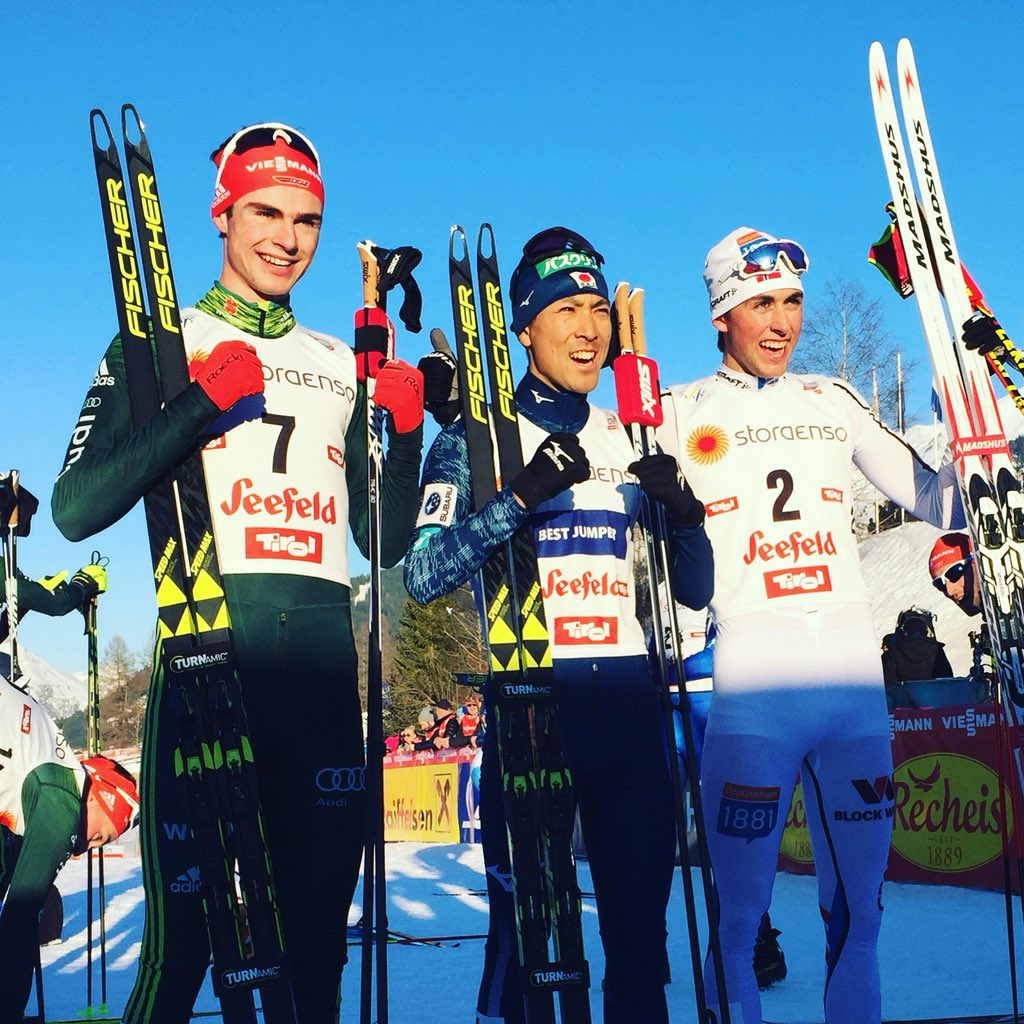
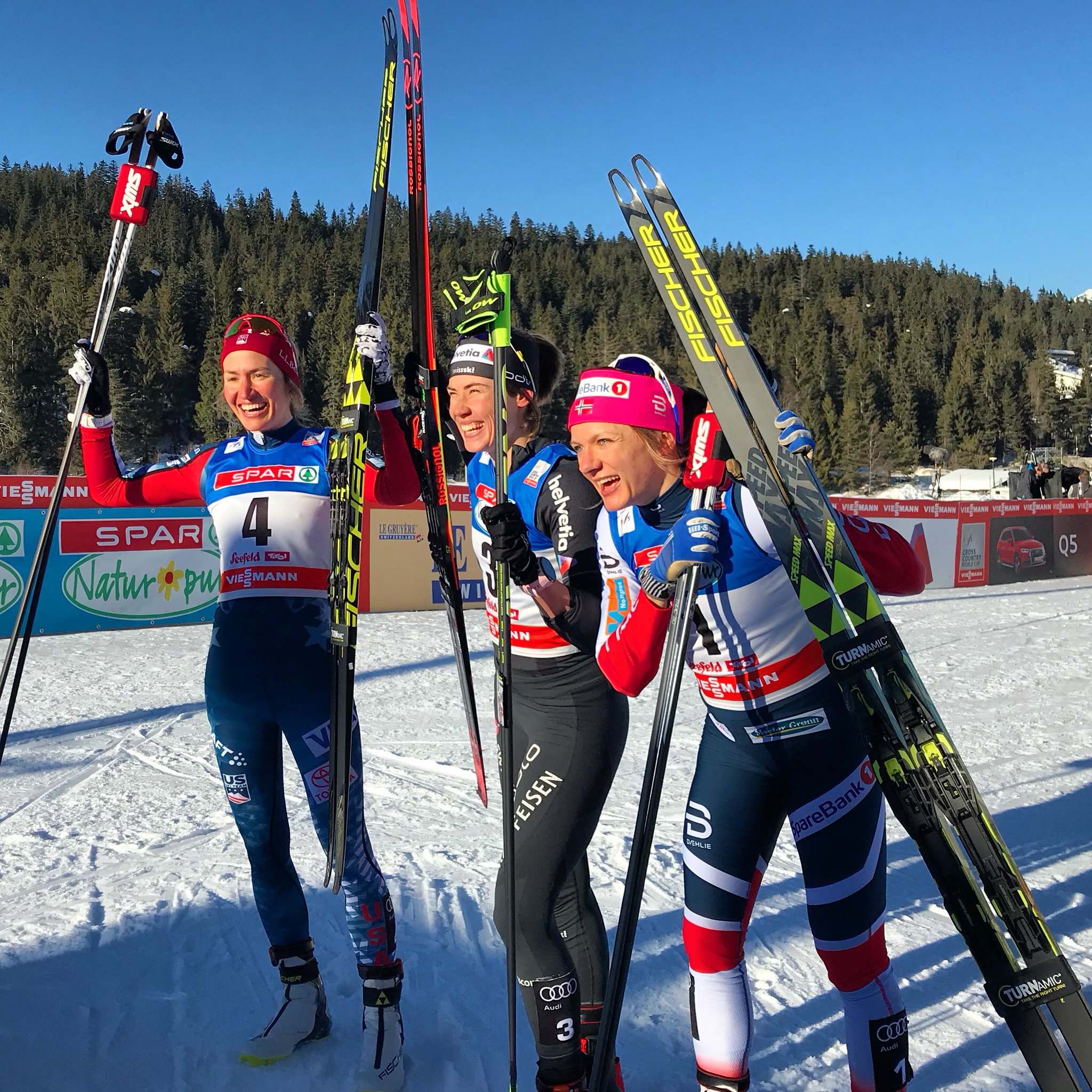
The podium for Day 2 of the Seefeld Triple Nordic Combined World Cup, with Japan’s Akito Watabe in first (c), Germany’s Vinzenz Geiger (l) in second and Norway’s Jarl Magnus Riiber (r) in third. (Photo: FIS Nordic Combined/Twitter)
FIS Nordic Combined World Cup (Seefeld, Austria): Normal hill/10 k
Two of the same men from Friday repeated on the podium on Day 2 of the Seefeld Triple Nordic Combined World Cup, with Japan’s Akito Watabe notching his second-straight win on Saturday.
Norway’s Jarl Magnus Riiber, who finished second on Friday, placed third in Saturday’s individual normal hill/10 k Gundersen, while Germany’s Vinzenz Geiger placed second, more than a minute behind Watabe.
Watabe jumped to first and started the 10 k with a 25-second head start on Riiber in second. Geiger started seventh, 1:45 minutes back, and rose to second at the finish, 1:05.5 behind Watabe (who won in 23:28.5) and 3.4 seconds ahead of Riiber in third (+1:08.9).
For the second day in a row, Norway’s Jan Schmid narrowly missed the podium in fourth (+1:14.1), up from fifth after the jump.
Taylor Fletcher was the lone American competing on Day 2, and he ended up 31st, up 10 places after jumping to 41st. Fletcher started the 10 k race 4:44 out of first then finished 3:52.9 behind Watabe.
The Seefeld Triple concludes Sunday with the individual normal hill/15 k Gundersen.
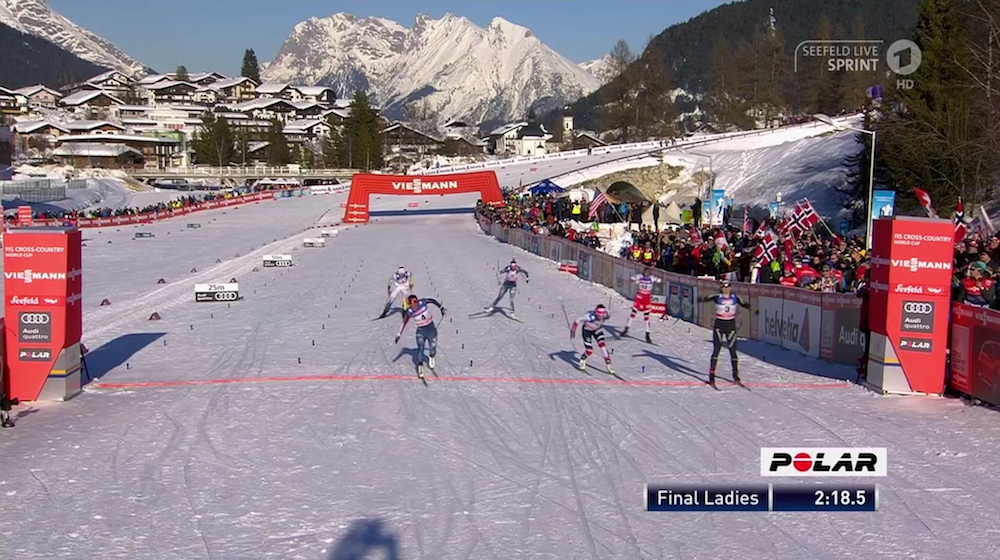
American Sophie Caldwell (l) and Switzerland’s Laurien van der Graaff (r) tied for first on Saturday in the women’s 1.1 k freestyle sprint final at the World Cup in Seefeld, Austria, while Norway’s Maiken Caspersen Falla placed third. (Screenshot: ARD broadcast)
FIS Cross Country World Cup (Seefeld, Austria): Freestyle sprints
It doesn’t get any closer than that. On Saturday, American Sophie Caldwell and Switzerland’s Laurien van der Graaff tied for first in the women’s 1.1-kilometer freestyle sprint final at the World Cup in Seefeld, Austria. They both finished within one-hundredth of a second of each other to take the victory — the last sprint before the Olympics — in 2:18.65 minutes.
Norway’s Maiken Caspersen Falla finished 0.21 seconds later for third place.
The women’s freestyle sprint podium at Saturday’s World Cup in Seefeld, Austria, with American Sophie Caldwell (l) and Switzerland’s Laurien van der Graaff (c) tying for first and Norway’s Maiken Caspersen Falla (r) placing third. (Photo: FIS Cross Country/Twitter)
“I broke my pole in the semifinal, then I got really tired,” van der Graaff said in a post-race interview with the International Ski Federation (FIS). “But I still believed I can be with Maiken and Sophie, and that I could catch them in the final was just great.”
Norway and the U.S. both had two in the final, with Kathrine Rolsted Harsem of Norway placing fourth (+1.34), Sweden’s Linn Sömskar finishing fifth (+1.83) and American Sadie Bjornsen taking sixth (+2.26).
Falla had raced to first in the qualifying round with a time of 2:21.44, Italy’s Greta Laurent qualified second (+1.43), van der Graaff third (+1.66), Caldwell fourth (+1.84), and Bjornsen fifth (+2.01).
Van der Graaff then won her quarterfinal and placed third in the first semifinal, 0.77 second behind Caldwell, who won it. Falla was second in that semifinal (+0.16) and van der Graaff advanced as a lucky loser.
Caldwell and Falla went head to head in every heat, with Falla winning their first quarterfinal by 0.08 seconds over Caldwell in second.
Bjornsen won her quarterfinal and finished second to Harsem in the second semifinal.
A third American, Kikkan Randall also qualified for the heats, placing 18th in the qualifier then finishing third in her quarterfinal (1.33 seconds behind Sömskar in first) to end up 14th overall.
Canada’s Dahria Beatty placed 30th in the qualifier to nab the last spot in the rounds, then finished fourth in her quarterfinal (1.65 seconds behind Laurent in first) for 20th overall.
For the U.S., Ida Sargent missed qualifying by about half a second in 37th (+8.20), Rosie Brennan finished 42nd (+9.86) and Caitlin Patterson was 52nd (+13.0).
Also for Canada, Emily Nishikawa finished 51st (+12.68) and Cendrine Browne was 54th (+13.34).
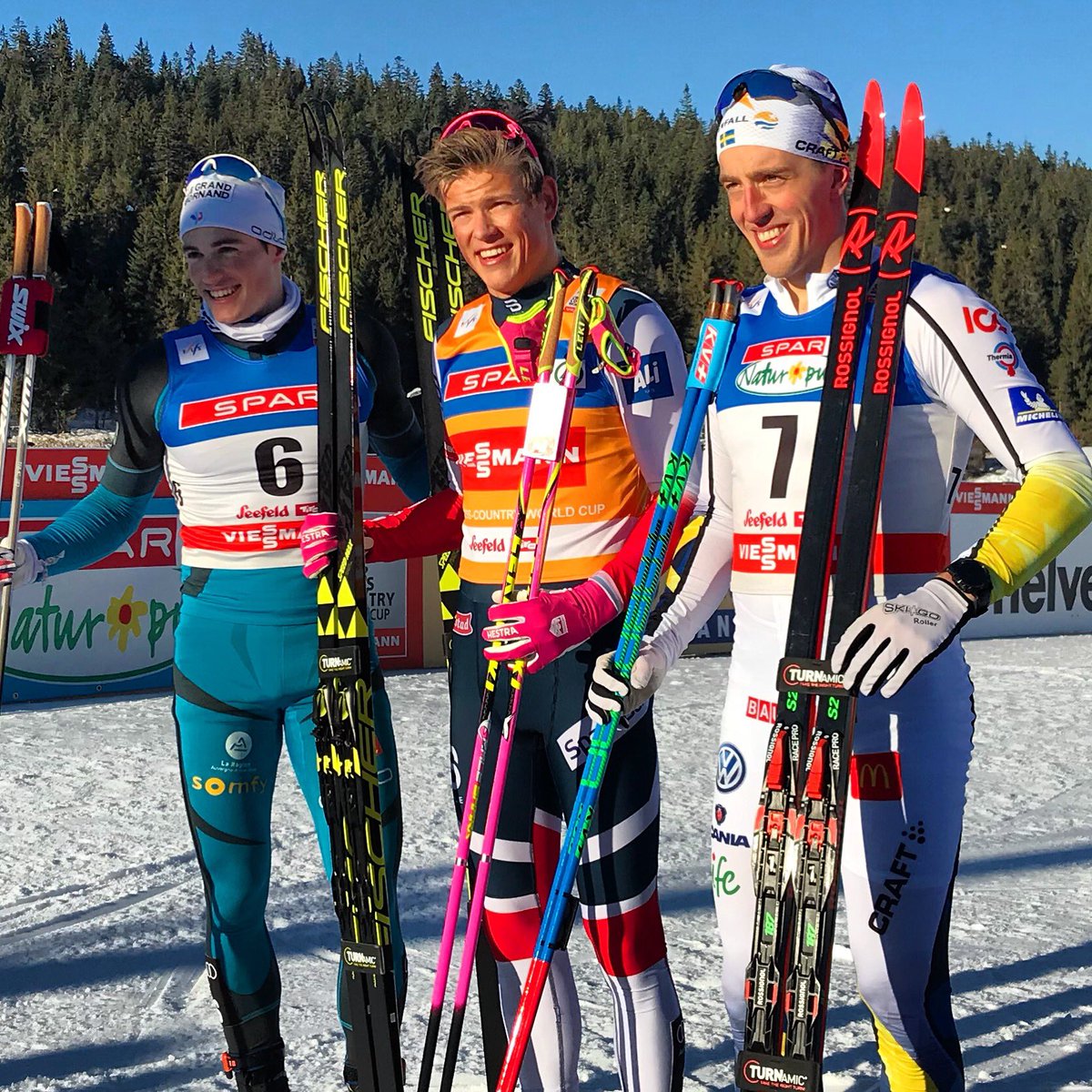
The men’s 1.4 k freestyle sprint podium at the World Cup in Seefeld, Austria, with Norway’s Johannes Høsflot Klæbo (c) in first, France’s Lucas Chanavat (l) in second and Sweden’s Calle Halfvarsson (r) in third. (Photo: FIS Cross Country/ Twitter)
The men raced 1.4 k, with Norway’s Johannes Høsflot Klæbo qualifying first in 2:46.89 then winning his quarterfinal and semifinal before putting the hammer down for one last time in the final, finishing first in 3:02.66.
France’s Lucas Chanavat placed second in the final, 0.48 seconds back, after qualifying sixth, winning his quarterfinal and placing second in the first semifinal (0.33 seconds behind Klæbo). Sweden’s Calle Halfvarsson took the third spot on the podium after finishing 0.97 seconds after Klæbo. Halfvarsson had previously qualified seventh, taken second in his quarterfinal and advanced as a lucky loser in third in the first semifinal (0.52 seconds behind Klæbo).
Italy’s Federico Pellegrino missed the podium in fourth (+1.06), Russia’s Gleb Retivykh placed fifth (+1.17), and Norway’s Emil Iversen was sixth (+5.57).
Canada’s Alex Harvey and American Simi Hamilton both made it to the semifinals, where they finished fourth and fifth, respectively, and did not advance to the finals. Harvey had qualified for the rounds in 22nd and won his quarterfinal, then raced in the second semifinal, where he finished fourth, 0.47 seconds behind Iversen in first. That put Harvey eighth overall on the day.
Hamilton clocked the fifth-fastest qualifying time, 6.46 seconds back from Klæbo’s top time. The U.S. Ski Team member then placed second to Pellegrino in his quarterfinal and was fifth in the first semifinal, 2.61 seconds behind Klæbo. Overall, Hamilton placed ninth.
Also for the U.S., Erik Bjornsen finished 37th in the qualifier, 0.89 seconds out of the top 30 and 11.99 second out of first, Logan Hanneman was 39th (+12.52), Andy Newell 42nd (+12.90), Reese Hanneman 65th (+17.91), and Ben Lustgarten 76th (+21.88).
Canada’s Len Valjas placed 40th (+12.72), Julien Locke 43rd (+13.31), Knute Johnsgaard 51st (+14.74), Bob Thompson 58th (+16.55), Graeme Killick 61st (+17.28), and Devon Kershaw 70th (+19.53).
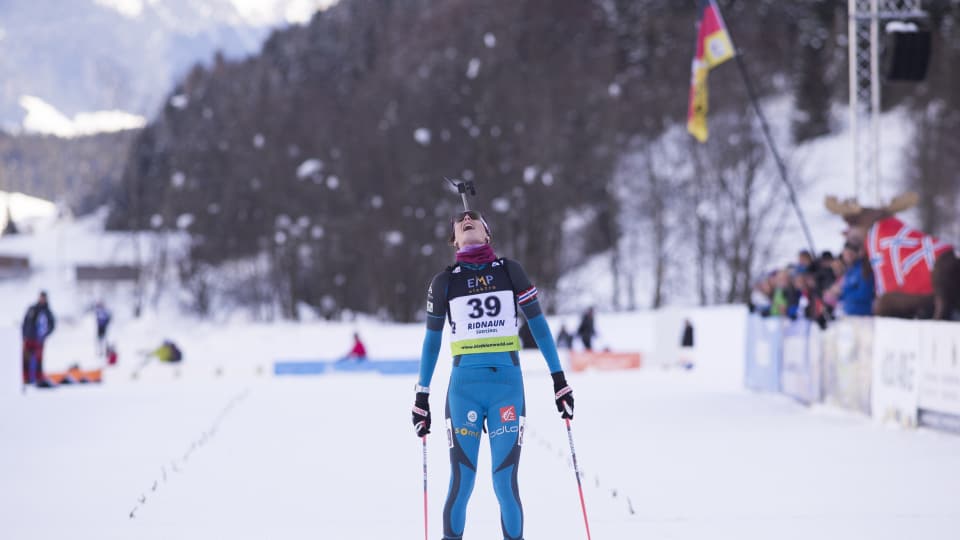
France’s 22-year-old Chloé Chevalier racing to her second win and third podium of the week in as many individual races at 2018 IBU Open European Championships on Saturday in Ridnaun, Italy. (Photo: IBU/Biathlonworld)
IBU Open European Championships (Ridnaun-Val Ridanna, Italy): Men’s and women’s pursuits
France’s Chloé Chevalier picked up her second win and third podium of the week at the International Biathlon Union (IBU) Open European Championships on Saturday in Ridnaun, Italy, winning the women’s 10 k pursuit, while Russia’s Alexander Loginov rose to the top step of the podium in the men’s 12.5 k pursuit on Saturday.
Chevalier started the women’s pursuit in second, 13 seconds behind Ukraine’s Iryna Varvynets (who won Friday’s sprint and thus started first), and shot clean to take the lead after the third stage — where Varvynets missed one. Chevalier went on to clean the final stage for perfect 20-for-20 shooting and crossed the line first in 29:25.4. Varvynets finished second, 11.0 seconds back after missing a single target in the first standing (0+0+1+0), and France had two on the podium with Julia Simon in third (+43.2). Simon also shot 19-for-20, with her miss coming in the second prone stage (0+1+0+0).
“Three medals in three races is definitely more than I had expected,” Chevalier, 22, told the event’s organizers on Saturday. “Today I saw that Iryna shoots faster than I, and so I really gave my all in the track. Even if it might not look like it, after the many races in the last few days I am noticing that I am getting more and more tired.”
American Chloe Levins rose from 59th at the start to 42nd at the finish (+4:11.8), with three clean stages and two misses in the first standing (0+0+2+0). She had the 28th-fastest overall range time and 30th-ranked shooting time.
In the men’s pursuit, Loginov started first as Friday’s sprint winner Latvia’s Andrejs Rastorgujevs did not start. Loginov held the lead throughout the race despite two misses — one in the first stage and another in the last stage (1+0+0+1) — and secured the win in 32:22.1. Bulgaria’s Krasimir Anev started second, 19 seconds after Loginov, and held his place as well, shooting clean and finishing second, 27.6 second back.
“I am really happy here in Ridanna and the results reflect that,” Loginov, 25, told organizers. “Not to start in the individual event on Wednesday was the right decision because the last few days had been very demanding with six races in eight days. I am cross with my two errors in the shooting range, but very happy with my performance in the track.”
Russia had two on the podium with Evgeniy Garanichev in third (+1:10.7) after Garanichev started in bib 19 and overcame three penalties (1+0+2+0) with the fastest overall course time.
Canada’s Macx Davies started 27th and finished 35th (+4:33.9) with five misses (3+0+2+0), while American Alex Howe rose from 53rd at the start to 43rd (+5:53.5) with five penalties (2+2+1+0).
The 2018 Open European Championships conclude with the single mixed relay and mixed relay on Sunday. American Susan Dunklee and Lowell Bailey are on the start list for the single mixed relay, Canada’s Carsen Campbell and Sarah Beaudry. For the mixed relay, the U.S. has entered Levins, Maddie Phaneuf, Paul Schommer, and Alex Howe.
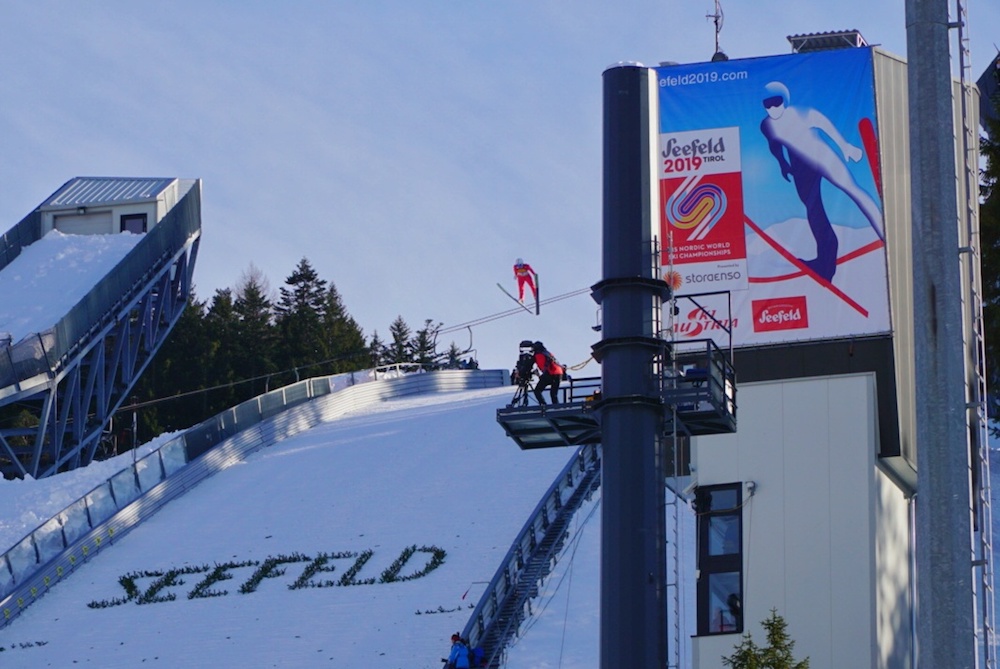
The jumping portion of the Nordic Combined World Cup Seefeld Triple on Friday in Seefeld, Austria. (Photo: Garrott Kuzzy / LumiExperiences.com)
Nordic Combined World Cup (Seefeld, Austria): Individual normal hill/5 k
On the first of the three-day Seefeld Triple Nordic Combined World Cup, Japan’s Akito Watabe took the win and Taylor Fletcher was the top American in 28th in the individual normal hill/5-kilometer Gundersen on Friday.
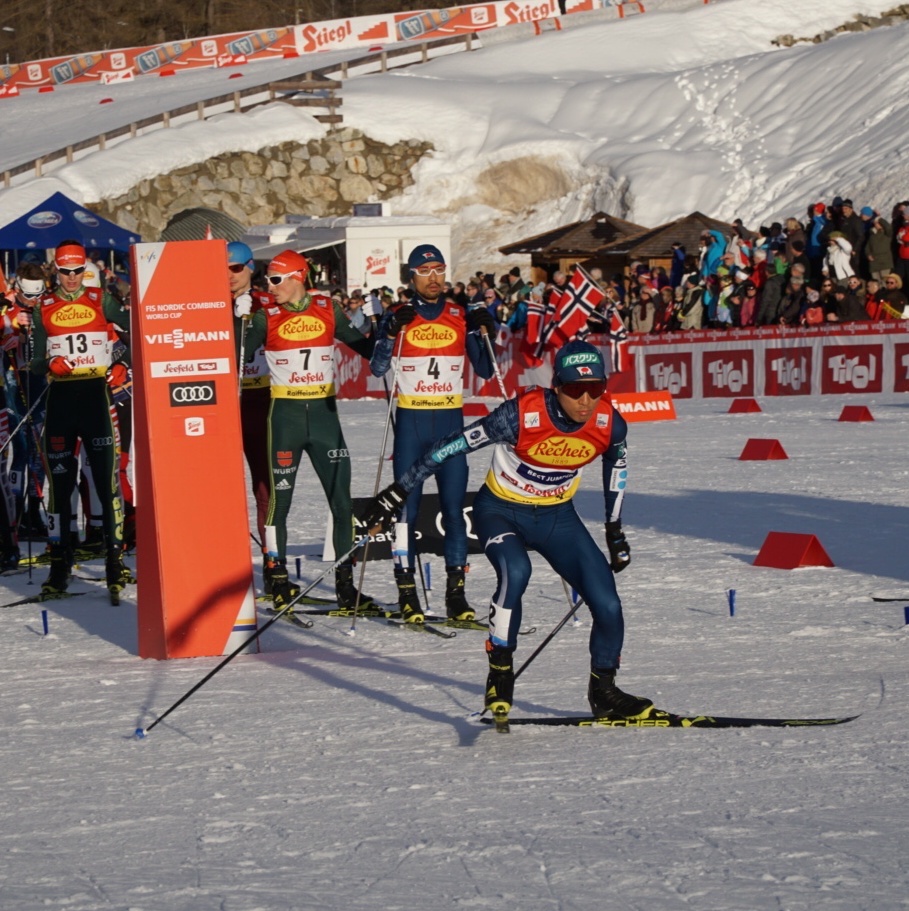
Japan’s Akito Watabe heading out of the gate second in the 5 k Gundersen on Friday at the Seefeld Triple Nordic Combined World Cup in Seefeld, Austria. Watabe went on to win the race by half a second. (Photo: Garrott Kuzzy / LumiExperiences.com)
Watabe put himself in second in the jump portion and started the 5 k ski race 21 seconds behind Norway’s Jarl Magnus Riiber in first. Watabe caught Riiber and beat him at the finish line, taking the win in 11:22.3 minutes, while Riiber followed 0.5 seconds back in second place. Germany’s Fabien Rießle followed in third, 32.4 seconds out of first, after starting the 5 k in sixth and 1:03 minutes back.
Norway’s Jan Schmid jumped to third and ended up fourth (+37.8). Watabe’s brother, Yoshito Watabe placed fifth (+47.2), losing one place in the ski race after jumping to fourth.
Two Americans competed, with Fletcher jumping to 30th and ending the day in 28th, and Jasper Good finishing 52nd (+3:45.6) after jumping to 49th. Both are headed to the 2018 Olympics next month in PyeongChang, South Korea.
Taylor Fletcher (USA Nordic) starting the 5 k Gundersen on Friday at the Seefeld Triple Nordic Combined World Cup in Seefeld, Austria. He started in 30th and finished 28th. (Photo: Garrott Kuzzy / LumiExperiences.com)
***
U.S. SuperTour (Craftsbury, Vermont): Classic sprints
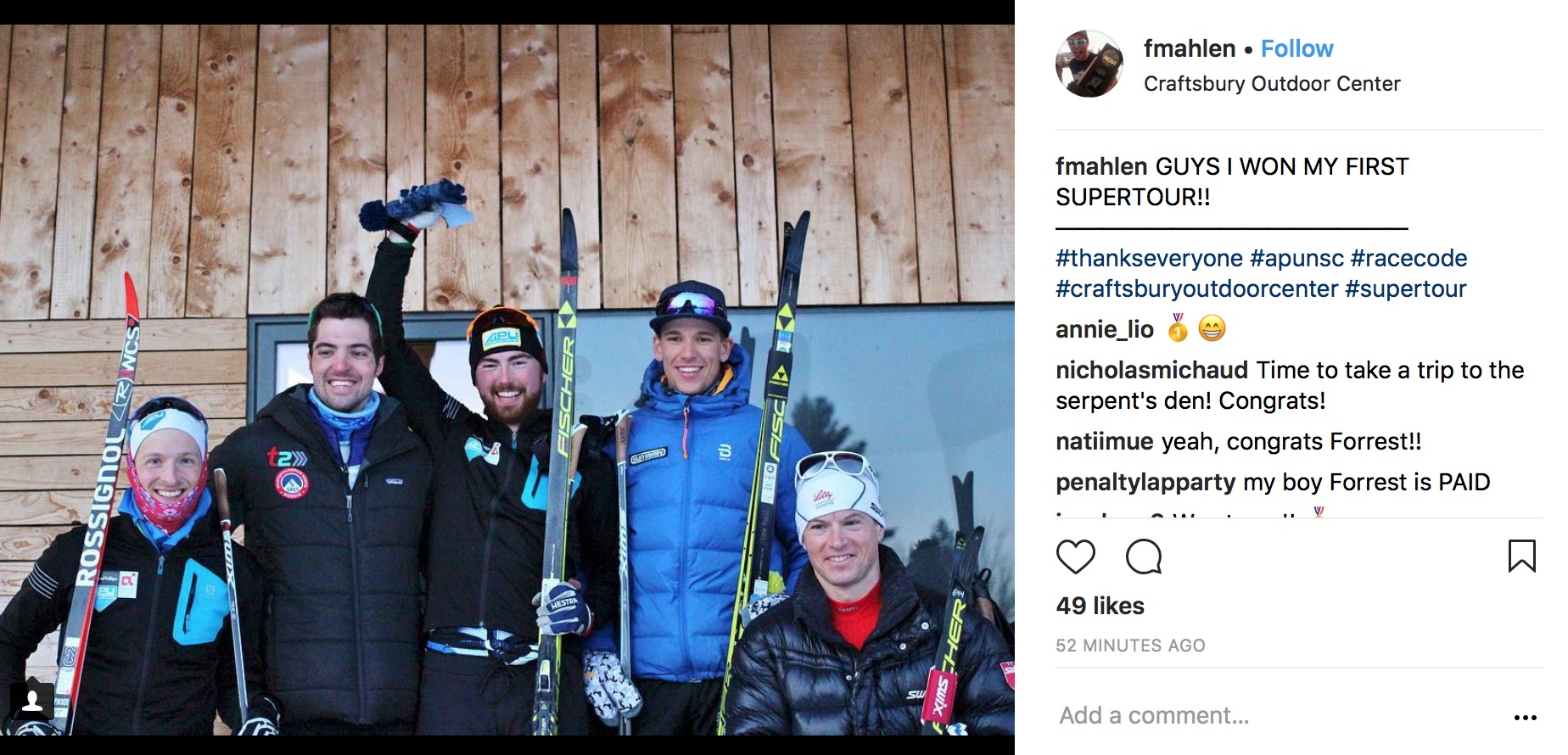
Forrest Mahlen (APU) celebrates his first time atop the SuperTour podium on Friday after winning the men’s 1.4 k classic sprint final in Craftsbury, Vermont. (Photo: Forrest Mahlen/Instagram)
Kaitlynn Miller and Forrest Mahlen won their respective classic-sprint finals at Friday’s SuperTour in Craftsbury, Vermont.
The 1.4-kilometer classic sprint kicked off a three-day race weekend at the Craftsbury Outdoor Center. On Saturday, the Craftsbury Marathon will be held (not a SuperTour event), followed by 5/10 k freestyle SuperTour races on Sunday.
Miller, of the Craftsbury Green Racing Project, started Friday by winning the women’s qualifier. She went on to win both her quarterfinal and semifinal before topping the final as well in 3:40.9 minutes. Also on Friday, it was formally announced that Miller was named to the U.S. Cross-Country Ski Team’s Olympic squad, which will compete in PyeongChang, South Korea, Feb. 10-25.
Kelsey Phinney, of the Sun Valley Ski Education Foundation (SVSEF), placed second in the women’s final, 0.63 seconds back, and Felicia Geisor (CXC Team) was third (+1.67). Erika Flowers, of the Stratton Mountain School (SMS) T2 Team placed fourth (+3.2), Canada’s Olivia Bouffard-Nesbitt (Rocky Mountain Racers) — fresh off NorAm Western Canadian Championships last weekend in Alberta — finished fifth (+5.46), and Alaska Pacific University (APU) skier Rosie Frankowski (who also made the U.S. Olympic team) placed sixth (+6.27).
On the men’s side, APU’s 24-year-old Mahlen qualified fifth, then won his quarterfinal and semifinal before taking the final for his first-career SuperTour win in 3:06.81. Ben Saxton (SMST2) initially won the qualifier and won his quarterfinal as well before placing second to Mahlen in the first semifinal. Saxton ended up 0.55 seconds back in second place in the final, just three-hundredths of a second ahead of Kevin Bolger (SVSEF) in third place (+0.58). Another half second back, Kris Freeman followed in fourth, just 1.09 out of first, Eric Packer (APU) was fifth (+1.39) and Canada’s Andy Shields (Lappe Nordic), who also competed at Western Canadian Championships last weekend) sixth (+8.99).
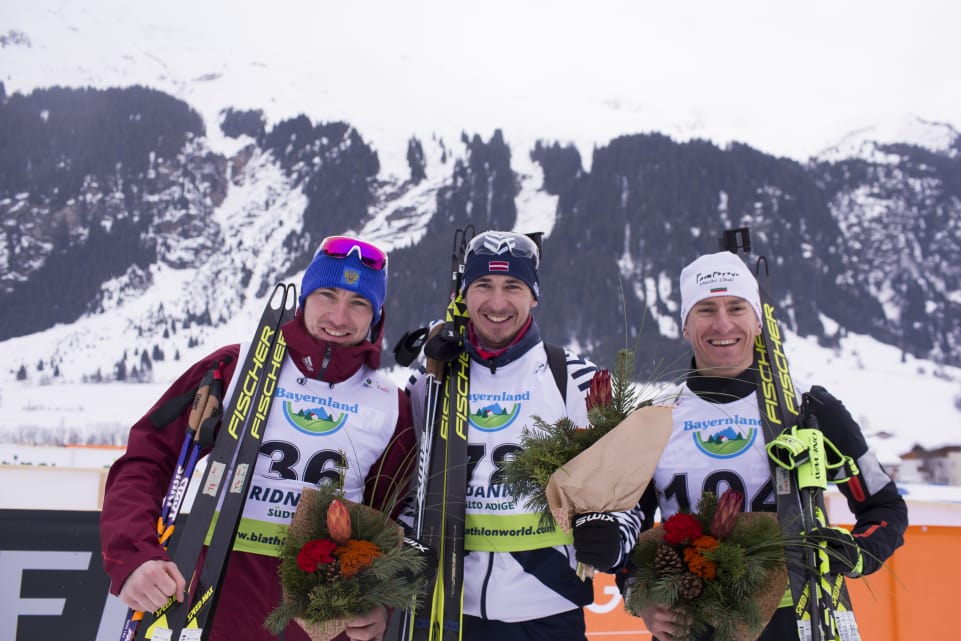
The men’s 10 k sprint podium at IBU Open European Championships, with Latvia’s Andrejs Rastorgujevs (c) in first, Russia’s Alexander Loginov (l) in second, and Bulgaria’s Krasimir Anev (r) in third. (Photo: IBU/Biathlonworld)
IBU Open European Championships (Ridnaun-Val Ridanna, Italy): Men’s and women’s sprints
Canada’s Macx Davies led the North Americans on Friday on Day 2 of the International Biathlon Union (IBU) Open European Championships in Ridnaun, Italy, placing 27th in the men’s 10-kilometer sprint with 9-for-10 shooting (1+0). Davies finished 1:32.3 minutes behind Latvia’s Andrejs Rastorgujevs, who took the win in 24:03.0 with a single penalty as well (0+1).
Russia’s Alexander Loginov placed second, 5.5 seconds back, with one penalty (1+0), and Bulgaria’s Krasimir Anev shot clean to finish third (+24.5).
“At the [last] World Cup in Anterselva [Italy], I have had a difficult time in the shooting range, and so I spent a lot of time in the last few days working on my shooting,” Rastorgujevs told the IBU after. “Today it was clear that all this hard work paid off. It is also a great motivator for Olympic gold.”
For Davies, who’s also headed to the Olympics next month, the result tied his best individual result this season after he placed 27th in an IBU Cup sprint earlier this month in Osrblie, Slovakia.
Canada entered four in the men’s race, with Carsen Campbell finishing 75th (+2:34.6) with one miss (0+1), Aidan Miller placing 91st (+3:18.2) with three penalties (1+2), and Matt Hudec finishing 119th (+4:31.6) with four misses (1+3).
Five American men raced, with Alex Howe finishing 53rd (+2:15.1) with one penalty (1+0), Jake Brown 84th (+3:02.0) with four misses (1+3), Jakob Ellingson 85th (+3:07.0) with one miss (1+0), Max Durtschi 111th (+3:50.1) with four misses (3+1), and Paul Schommer 114th (+3:59.8) with four penalties (2+2) as well.
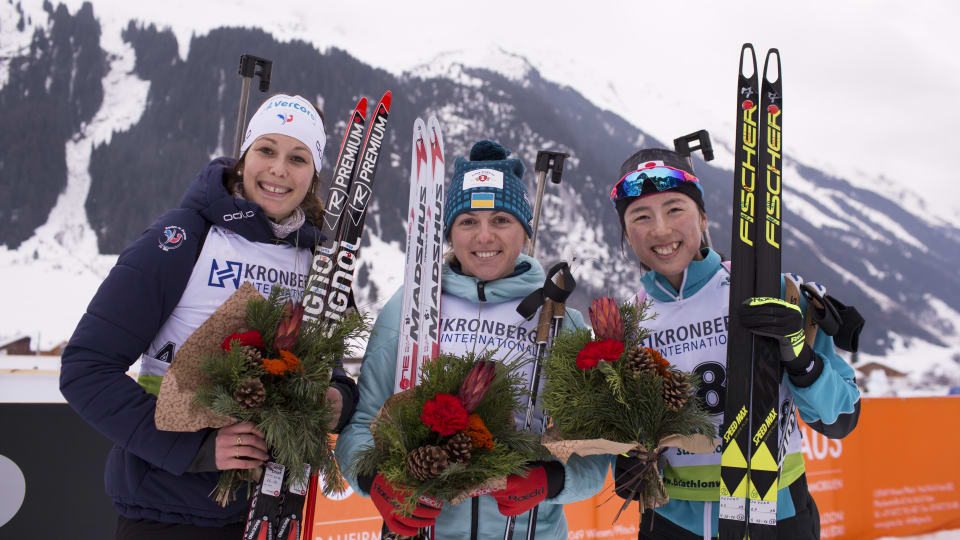
The women’s 7.5 k sprint podium at IBU Open European Championships in Ridnaun, Italy, with Ukraine’s Iryna Varvynets (c) in first, France’s Chloé Chevalier (l) in second, and Japan’s Fuyuko Tachizaki (r) in third. (Photo: IBU/Biathlonworld)
In the women’s 7.5 k sprint that followed, Chloe Levins of the U.S. was the top North American in 59th, 2:01 behind the winner Iryna Varvynets of Ukraine. Varvynets shot clean and posted the fastest finishing time of 20:54.1, 12.5 seconds faster than France’s Chloé Chevalier, Wednesday’s 15 k champion who had one miss (0+1) on Friday and ended up second. Japan’s Fuyuko Tachizaki reached the podium in third (+15.5) and was one of four women in the top five that shot clean (only Chevalier did not).
“After the individual competition on Wednesday, I was not at all happy with my shooting,” said Varvynets, who placed fifth in the 15 k. “Today I therefore concentrated especially hard in the shooting range. It was my luck that not many finished without errors, otherwise it would probably not have been enough for the victory.”
“Two races, two medals — it could not have gone better for me,” Chevalier said. “In the standing shooting I missed the first disc and got a little nervous, but thankfully, there were no further errors.”
Tachizaki called the bronze medal a “big dream come true”.
“The focus of my season had been the Olympics and I ‘only’ took part in Ridanna as part of the preparations, but with this result I have exceeded everything I have achieved so far,” she said. “At the end of the race I did not only fight hard in the track, I was already dreaming of a medal. Now I’m in seventh heaven.”
Levins had one miss in each stage (1+1), as did fellow American Maddie Phaneuf, who finished 63rd (+2:19.0) with two penalties. Clare Egan followed in 70th (+2:34.2) with four misses (3+1), Deedra Irwin was 85th (+3:38.1) with four penalties (1+3) as well, and Jennie Bender 97th (+5:52.8) with six misses (3+3).
Two Canadians started the race, with Sarah Beaudry finishing 76th (+3:02.9) with four misses (1+3). Erin Yungblut did not finish.
Open European Championships continue Saturday with the men’s and women’s pursuits. The top 60 from the sprint qualify, which, for the North Americans, means Davies, Howe, and Levins.
The championships end Sunday with single mixed and mixed relays.
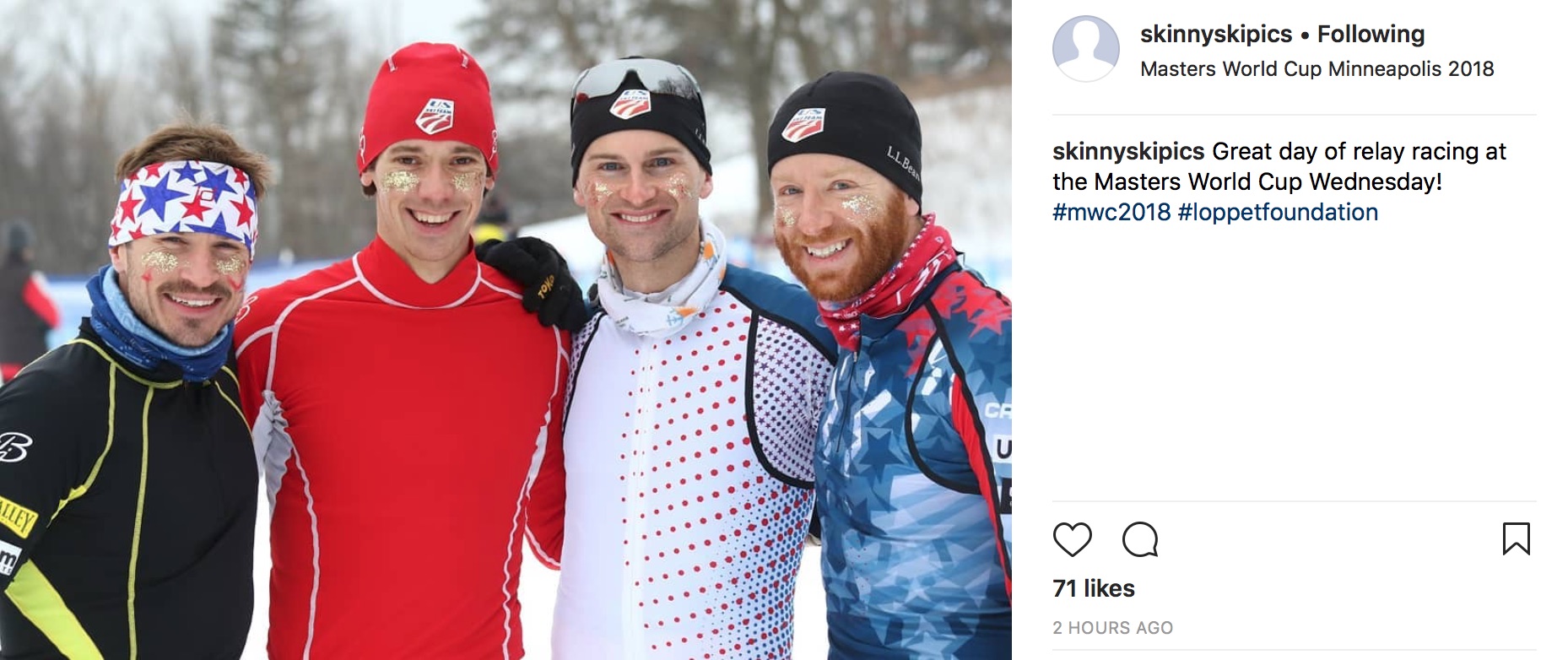
Matt Liebsch (l) and his men’s age-group “1” 4 x 5 k winning relay team on Wednesday at 2018 Masters World Cup in Minneapolis, Minnesota. (Photo: SkinnySki/Instagram)
2018 Masters World Cup (Minneapolis, Minnesota): 4 x 5 k relays
Matt Liebsch, 34, anchored the winning relay of the youngest men’s age group (AG 1) at 2018 Masters World Cup on Wednesday, crossing the line in 45:57.2 minutes (the fastest relay time of the day) and teaming up with fellow Americans Christopher Harvey, Mark Johnson and Zach Varty. Two teams competed in that age group’s 4 x 5 k relay, with Italy finishing second, 1:22.6 minutes back.
The U.S. won all five women’s 4 x 5 k relays on Wednesday, and eight total between the men’s and women’s age groups. Finland had the second-most relay victories with five in the men’s categories.
Canada won the men’s AG 4, beating out four other teams with Gabriel Babin, Bruce Macneil, Luc Tremblay, and Michel Labrie, who finished the 4 x 5 k in 49:41.9. Germany placed second (+36.4), and the U.S. third (+54.1).
Piotr Bednarski, head coach of Loppet Nordic Racing, which is based out of Theodore Wirth Park, anchored the men’s AG 5 to a win in 49:39.1, with teammates Rune Harkestad, Dennis Paul and David Sjogren.
Masters World Cup continues with 15/30/45 k classic distance races on Thursday at Wirth Park.
Day 4 Age Group (AG) 4 x 5 k Relay Winners
Men:
AG 1: USA (Christopher Harvey, Mark Johnson, Zach Varty, Matt Liebsch) 45:57.2
AG 2: Finland (Jouni Leinonen, Mika Kilpeläinen, Johan Gustafsson, Joachim Gustafsson) 47:53.4
AG 3: Russia (Ivan Batyutenko, Andrey Lushnikov, Sergey Degtyarev, Aleksandr Pushkarev) 46:43.3
AG 4: Canada (Gabriel Babin, Bruce Macneil, Luc Trembley, Michel Labrie) 49:41.9
AG 5: USA (Rune Harkestad, Dennis Paul, David Sjogren, Piotr Bednarski) 49:39.1
AG 6: USA (Milan Baic, Odd Bersvendsen, Kent Murdoch, Barry Makarewicz) 48:48.3
AG 7: Finland (Heikki Ruokonen, Tapio Tikkanen, Timo Pullinen, Aito Pennanen) 51:56.3
AG 8: Finland (Leino Nisula, Pauli Halonen, Yrjo Teravainen, Harri Makela) 54:58.4
AG 9: Finland (Veikko Piirainen, Tapio Ikaheimonen, Paavo Raisanen, Vaino Paakko) 58:18.9
AG 10: Finland (Alpo Virtanen, Tapio Wallenius, Jouko Laiho, Riku Kyllonen) 1:02:39.7
Women:
AG 1: USA (Kathleen Dewahl, Tamra Kornfield, Davya Flaharty, Gina Chythlook) 56:49.3
AG 2: USA (Bonnie Weiskopf, Kim Rudd, Mary Mckelvey, Mary Wellington) 56:23.9
AG 3: USA (Elizabeth Youngman, Kelly Milligan, Jan Guenther, Kelly Skillicorn) 56:23.6
AG 4: USA (Kate Ellis, Magdenla Bowen, Joann Hanowski, Muffy Ritz) 1:00:33.6
AG 5: USA (Gabriele Andersen, Constance Meek, Dagmar Eriksson, Kati Campbell) 1:14:23.4
France’s Chloe Chevalier after winning the women’s 15 k individual on Day 1 of IBU Open European Championships in Ridnaun, Italy. (Photo: IBU/Biathlonworld)
IBU Open European Championships (Ridnaun-Val Ridanna, Italy): 15/20 k individual
The International Biathlon Union (IBU) Open European Championships opened Wednesday in Ridnaun (Val Ridanna), Italy, with several North Americans competing in the women’s 15- and men’s 20-kilometer individual races.
Austria’s Felix Leitner racing to the win in the first race of 2018 IBU Open European Championships, the men’s 20 k individual, on Wednesday in Ridnaun, Italy. (Photo: IBU/Biathlonworld)
Canada’s 23-year-old Carsen Campbell raced to 19th in the men’s 20 k, shooting 19-for-20 (1+0+0+0) and finishing 3:18.5 minutes behind the winner, Austria’s Felix Leitner, who clocked the fastest time in 53:32.8 — also with one penalty (0+0+0+1).
Leitner, 21, won by 43 seconds over Tomas Krupcik of the Czech Republic, who also had a single penalty in the last standing stage (0+0+0+1) and placed second.
Germany’s Philipp Horn reached the podium in third (+56.6), with 19-for-20 shooting as well (1+0+0+0).
According to an IBU press release, Leitner is one of the youngest athletes to win the 20 k, the longest race on the circuit.
“I had many problems with my shooting lately, but today it was probably the best in the last two seasons,” Leitner said, according to the release. “I believed in myself and knew that I have to run fast from the beginning, and if the shooting would be as good as during the training, I could be in the top.”
Campbell, of Biathlon Canada’s National “Z” Team, was the top North American in 19th in his second trip to Open European Championships. Previously, his best individual result was 64th last year.
Paul Schommer led the U.S. men in 46th (+5:22.6) with three penalties (0+1+1+1). Max Durtschi also shot 17-for-20 (1+0+1+1) and ended up 56th (+6:18.5), Jakob Ellingson followed in 58th (+6:23.5) with two penalties (0+0+1+1), and Jake Brown finished 74th (+8:06.7) with seven penalties (1+1+3+2). Alex Howe did not start.
For Canada, Macx Davies, a senior national team member who is headed to the Olympics, placed 67th (+7:32.7) with five penalties (2+2+1+0). Matt Hudec was 96th (+12:00.5) with six penalties (0+2+1+3), and Aidan Miller 105th (+14:49.0) with nine penalties (2+1+1+5).
In the women’s 15 k that followed, Sarah Beaudry, of Biathlon Canada’s Senior National Team as well as Olympic team, was the top North American in 23rd, 4:55.6 out of first. Beaudry, 23, shot 18-for-20, with her two misses coming in the first prone (2+0+0+0).
France’s Chloe Chevalier won the women’s race, with spring-like temperatures around 6 degrees Celsius, in 46:32.9 with a single penalty, also in the first stage (1+0+0+0). The second- through fourth-place finishers all shot clean, with Italy’s Alexa Runggaldier placing second (+47.7), Russia’s Victoria Slivko taking third (+55.9) and Ukraine’s Yuliia Zhuravok missing the podium by half a second in fourth place (+56.4).
“After that penalty in the first prone, I relaxed and did not worry about the result,” Chevalier said after, according to an IBU press release. “I just enjoyed being out on the tracks on a beautiful sunny. Maybe the key to success is relaxing and not worrying about the result.”
Two Canadian women entered the event, with Erin Yungblut finishing 83rd (+13.19.9) with eight penalties (2+3+1+2).
Chloe Levins was the top American woman in 60th (+7:18.6) with four penalties (1+2+1+0), and Maddie Phaneuf, who made US Biathlon’s Olympic team, followed in 65th (+8:10.8) with four misses as well (1+2+0+1). Deedra Irwin finished 82nd (+13:15.8) and Jennie Bender was 87th (+15:05.0), both with 10 penalties apiece.
Open European Championships continue Friday with the men’s and women’s sprints, followed by pursuits on Saturday and relays on Sunday.
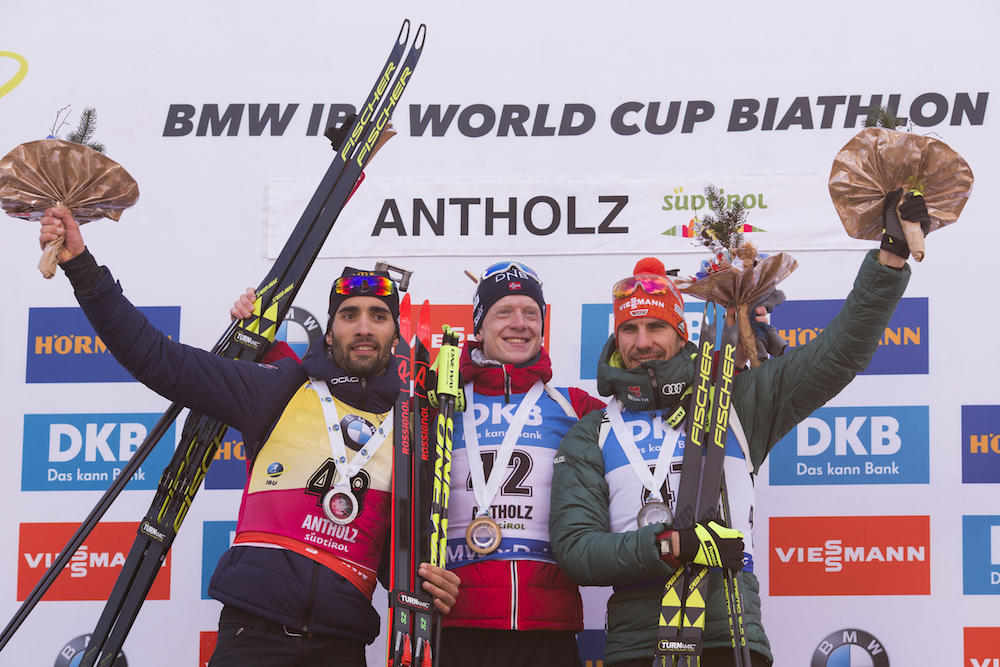
Norway’s Johannes Thingnes Bø racing to another win in the men’s 10 k sprint on a bluebird day on Friday at the IBU World Cup in Antholz, Italy. (Photo: Manzoni/NordicFocus)
IBU World Cup (Antholz, Italy): Men’s 10 k sprint
One prone penalty wasn’t enough to keep Johannes Thingnes Bø from his third-straight victory (and ninth this season, including relays) as the 24-year-old Norwegian won the men’s 10-kilometer sprint on Friday at the International Biathlon Union (IBU) World Cup in Antholz, Italy.
Bø started 42nd of 109 men and had to navigate tricky wind conditions, along with the rest of the field. After missing one target in the prone shooting, Bø left the range in third, 4.8 seconds behind the race leader at the time, Austria’s Julian Eberhard, and 2.6 seconds behind his Norwegian teammate Lars Helge Birkeland in second.
Throughout the race, Bø set the fastest course times and took a sizable lead over Birkeland and Eberhard after standing, which he cleaned and left the range 33.5 seconds ahead of Birkeland, who had also hit all five standing targets. Eberhard missed two to slip 1:11.6 minutes back.
Bø went on to cross the finish line in 23:19.3 minutes, faster than France’s Martin Fourcade (who started behind him in bib 48 and cleaned both stages), as Fourcade finished 12.8 seconds back in second.
The men’s 10 k sprint podium at the IBU World Cup in Antholz, Italy, with Norway’s Johannes Thingnes Boe (c) in first, France’s Martin Fourcade (l) in second, and Germany’s Arnd Peiffer (r) in third. (Photo: Manzoni/NordicFocus)
Germany’s Arnd Pfeiffer started 47th, just ahead of Fourcade, and raced to third (+42.2) with clean shooting as well.
“In the sprint, you almost always have to shot clean,” Bø reflected after, according to an IBU press release. “After my prone miss, I knew a podium would be hard, but you never know; you fight hard. With zero in standing, I knew there was a chance … I had the times from the start and knew I had good speed today … Martin is almost always stronger than me on the last lap, but today I was not tired.”
Fourcade pointed out that this was his best sprint result in Antholz, a high-elevation venue at some 5,200 feet above sea level, since 2011, “so I am pretty satisfied,” he told the IBU.
Pfeiffer told German broadcaster ARD that he latched onto Fourcade for the last loop.
“At least I was clean on the shooting range today, that was not so easy,” Pfeiffer said, according to a translation. “I am pretty proud I managed to do that today. This was not my best day on the course, even if the position might insinuate something else. I had to toil quite a bit, and was lucky that Martin came by for the final [loop], who also wasn’t in his top shape today.
“In the end of course the result was great, I haven’t been on the podium in an individual-start race so far this season,” Pfeiffer continued. “So I am happy about 100 percent shooting accuracy and hopefully being on the podium if everything works out.”
Russia’s Anton Shipulin missed the podium by about four seconds in fourth (+46.3) with one standing miss (0+1), France’s Emilien Jacquelin placed fifth (+53.7) with clean shooting, Birkeland ended up sixth (+1:07.8) with zero penalties as well, Eberhard was seventh (+1:21.7) with two misses (0+2), Russia’s Anton Babikov eighth (+1:27.8; no penalties), Vladimir Chepelin of Belarus ninth (+1:32.3; one penalty), and the Czech Republic’s Ondrej Moravec 10th (+1:35.4; no penalties).
US Biathlon’s Lowell Bailey racing to 41st in the men’s 10 k sprint at the IBU World Cup in Antholz, Italy. (Photo: US Biathlon/NordicFocus)
Three out of five Americans qualified for Saturday’s pursuit, with Lowell Bailey leading them in 41st (+2:22.0) after one standing miss (0+1). Notably, he had the fifth-fastest overall shooting time.
Tim Burke was just another 0.4 seconds back in 43rd (+2:22.4) with three penalties (1+2), and Leif Nordgren finished 50th (+2:33.1) with two penalties (1+1) and the second-fastest overall shooting time and third-fastest range time.
Macx Davies, who was selected to Biathlon Canada’s Olympic team, was the top Canadian in 66th (+2:58.2) with three misses (1+2). Carsen Campbell finished 82nd (+3:27.9) with two penalties (2+0), Matthew Hudec was 89th (+3:40.6) with one miss (0+1), and Aidan Miller 107th (+5:00.3) with five penalties (3+2).
The men’s and women’s pursuits will be held Saturday in Antholz at 7:15 a.m. for the women and 9 a.m. for the men EST. Watch live on the Olympic Channel.
Western Canadian Championships (Red Deer, Alberta): Freestyle sprints
Olivia Bouffard-Nesbitt (c) holds off Zina Kocher (l) and Annika Hicks (r) to win the women’s 1.2 k freestyle sprint final on Friday at the NorAm Western Canadian Championships in Red Deer, Alberta. (Photo: Doug Stephen)
The NorAm series shifted west to to Red Deer, Alberta, for the fourth weekend of racing.
Olivia Bouffard-Nesbitt (Rocky Mountain Racers) won the women’s 1.2-kilometre freestyle sprint A-final in 3:09.12, edging out Zina Kocher (Foothills Nordic) and Annika Hicks (Alberta World Cup Academy) by 0.4 and 0.77 seconds, respectively. They qualified in the same order in a small women’s field of 20. Organizers opted to skip the quarterfinals and pinned the top 10 women from the qualifier in two semifinals.
Jess Cockney (302) winning the men’s 1.2 k freestyle sprint final ahead of Russell Kennedy (r) on Friday at the NorAm Western Canadian Championships in Red Deer, Alberta. (Photo: Doug Stephen)
The men’s 1.2 k qualifier had 38 starters, and 22 advanced to the quarterfinals. After qualifying in second, 0.16 seconds off the top time set by Russell Kennedy (Team R.A.D.), Jess Cockney (Canadian World Cup Team) won his quarterfinal and semifinal and ultimately the men’s final in 2:24.29, 1.09 seconds ahead ofKennedy in second. PatrickStewart-Jones (Alberta World Cup Academy) grabbed his first podium of the season, taking third (+1.70).
Western Canadian Championships usually draw a smaller field than Easterns: more Canadians live within reasonable driving distance of Eastern Canadian Championships (hosted by Nakkertok in Cantley, Quebec) than live in all three times zones of western Canada combined.
With many of the top athletes in Europe doing final elevation camps for the Olympics and U23s/Junior World Championships, the Western Championships’ open and junior categories were particularly small this year with 287 athletes total.
The Norwegian men’s relay after winning the 4 x 7.5 k on Friday at the IBU World Cup in Ruhpolding, Germany, with Lars Helge Birkeland (l), Tarjei Bø (far r), Emil Hegle Svendsen (second from r), and Johannes Thingnes Bø (second from l). It was their second win of the season (after winning with Ole Einar Bjørndalen, Henrik L’Abée-Lund, and Erlend Bjøntegaard, and Birkeland in the first men’s relay of the 2017/2018 season in Hochfilzen, Austria. (Photo: IBU/Biathlonworld)
IBU World Cup (Ruhpolding, Germany): Men’s 4 x 7.5 k relay
Less than a week after Sweden won the men’s 4 x 7.5-kilometer relay in Oberhof, Germany, with an up-and-coming group, Norway posted its second win (in three relays) this season, with an all-star lineup on Friday in Ruhpolding, Germany.
Lars Helge Birkeland, Tarjei Bø, Emil Hegle Svendsen, and Johannes Thingnes Bø took the lead during Johannes Bø’s anchor leg and ultimately the win in 1:13:11.1 hours, 24.9 seconds ahead of France in second and 53.4 seconds ahead of Russia in third.
On a bluebird day with no wind in the range, according to an International Biathlon Union (IBU) press release, the Norwegians avoided the penalty lap and used seven spares to clean. First-leg skier Birkeland put them in second with near-perfect shooting (0+0, 0+1), just 0.4 seconds behind Germany’s Erik Lesser, who cleaned without any spares, in first. (Birkeland was also on the Norwegian team that won the first relay of the season in Hochfilzen, Austria.)
Norway remained in second during Tarjei Bø’s second leg, in which he had to use three spares to clean prone (0+3, 0+0). He tagged Svendsen in second, 0.6 seconds behind Italy, which had risen to first thanks to Lukas Hofer’s fast skiing and solid shooting (0+0, 0+2).
Svendsen slipped slightly to third place by the final exchange despite only needing one spare to clean (0+0, 0+1), but was still just a second out of first at the tag. France had moved into first place with a predictably strong third leg from Martin Fourcade (0+0, 0+0), in which he brought the team from seventh to first place, just ahead of Italy’s Dominik Windisch and Norway’s Svendsen.
Johannes Bø skied the third-fastest anchor leg and cleaned prone and used two spares in standing (0+0, 0+2) to overtake France’s Antonin Guigonnat and Italy’s Thierry Chenal, who slipped to second and seventh, respectively, by the finish.
Guigonnat shot well, requiring just one spare (0+1, 0+0), but finished nearly 25 seconds after Bø for second place. Russia reached the podium with Anton Shipulin picking off two places, after being tagged in fifth.
In all, France had zero penalties and six spares, with Simon Desthieux, Quentin Fillon Maillet, Fourcade, and Guigonnat, and Russia used a total of just four spares and had no penalties with Alexey Volkov, Maxim Tsvetkov, Anton Babikov, and Shipulin.
Germany finished fourth (+1:26.5) with zero penalties and 10 spares, with Lesser, Benedikt Doll, Arnd Peiffer and Simon Schempp. After Doll dropped to fifth on the second leg, they skied in fourth on the last two legs.
Austria took fifth (+1:39.8) with zero penalties and six spares, with David Komatz, Simon Eder, Daniel Mesotitsch, and Dominik Landertinger. Sweden followed in sixth (+1:50.6) with zero penalties, six spares and three of the same men who won last Sunday’s relay (Sebastian Samuelsson, Martin Ponsiluoma and Fredrik Lindström) with new member Torstein Stenersen. Italy finished seventh (+1:58.5) with one penalty and 11 spares.
Of 26 teams in the relay, Canada placed 14th (+3:22.3) with one penalty and 10 spares, and the U.S. finished 24th (+16:21.6) with eight penalties (four of which stemmed from cross-firing) and 13 spares.
Notably, the U.S. had been fourth and just 3 seconds out of first after Lowell Bailey’s first leg, which he cleaned without any spares (0+0, 0+0). Leif Nordgren then dropped to 22nd with a penalty in each of his shooting stages (1+3, 1+3) and the 25th-ranked second-leg time. Tim Burke as the team’s third leg had to ski two penalty laps as well (0+2, 2+3), and anchor Sean Doherty was penalized for cross-firing in his last standing stage (0+1, 4+1), according to a US Biathlon press release, and the team was hit with four additional penalties.
“We have a solid team and I know we didn’t show our true potential today,” Bailey said, according to the release. “But the most important relay is still to come. We’ll just have to wait until then.”
“I was happy to put together a good race on the track and in the range,” he said. “The first lap was a bit of a roller derby with no easy way to get to the front. I was fortunate to clean without extra rounds because this allowed me to leapfrog up to the lead pack exiting the range. I tried to keep an even pace for loop two and I thought I would be able to hang in second or third, but no one wanted to pass so I had to lead for most of the loop.
“I had struggled in standing in the previous race so I wanted to get back to taking good shots in standing,” he added. “Although I didn’t shoot as quickly as some of the other guys, I felt good about the stage and the fact that I didn’t have to use extras. It was a fight to catch the lead group on the last loop, but fortunately I had some help from [Italy’s Thomas] Bormolini (of Italy) and we worked together to get back in contact with the lead group.”
Canada finished 14th with Christian Gow, Scott Gow, Macx Davies, and Brendan Green. On the opening leg, Christian Gow put them in 11th with clean prone shooting and just one spare needed to clean standing (0+0, 0+1), but they slipped one spot to 12th with a penalty on Scott Gow’s second leg (0+0, 1+3). Davies then dropped two more places to 14th despite avoiding the penalty lap (0+3, 0+1), and Green held that position to the finish (0+1, 0+1).
The women’s 4 x 6 k relay will be held Saturday in Ruhpolding, with Canada starting Emma Lunder, Julia Ransom, Sarah Beaudry, and Rosanna Crawford. For the U.S., it will be Susan Dunklee, Clare Egan, Emily Dreissigacker, and Joanne Reid. Watch it live on the Olympic Channel at 8:30 a.m. EST.
France’s Martin Fourcade after winning the men’s 20 k individual at the IBU World Cup in Ruhpolding, Germany, by more than a minute on Wednesday. (Photo: IBU/Biathlonworld)
IBU World Cup (Ruhpolding, Germany): Men’s 20 k individual
For France’s Martin Fourcade, the difference between a miss on the last shooting stage of the men’s 20-kilometer individual International Biathlon Union (IBU) World Cup on Wednesday versus perfect shooting wouldn’t have ultimately changed his result in Ruhpolding.
Despite the one-minute penalty, which was tagged onto his total time after his lone miss of the day, Fourcade still won by a minute. The Czech Republic’s Ondřej Moravec, who started 2 1/2 minutes ahead of him in bib 18 (while Fourcade wore bib 23), had successfully cleaned every stage, shooting 20-for-20, and initially crossed the finish line first — about a minute and 23 seconds ahead of former race leader Simon Eder of Austria.
But Moravec’s moment in first was fleeting as Fourcade burst into the stadium, not yet letting off the gas, seconds after Moravec finished. Fourcade took the win in 44:27.9, 1:01 ahead of Moravec in second. To indicate how fast Fourcade’s last loop was, it’s worth noting that he was 30 seconds ahead of Moravec with 4 k to go. On that final 4 k loop, he doubled his time ahead of second place.
Fourcade’s win came four days after his last race in Oberhof, Germany, the 12.5 k pursuit, which he also won.
“We are in a biathlon routine now,” he said, according to an IBU press release. “It was hard to find strong motivation with not much recovery or training this week. … Today I wanted to beat my record of podiums in a row. Today was my 14th [individual podium, including last season] in a row and I am really proud of this. I am very happy with my competition as well. Ruhpolding is place that I really love and I am happy that I continued my success here.”
Norway’s Johannes Thingnes Bø achieved his eighth-straight podium in third, 1:06.3 behind Fourcade with a single miss on the last stage as well (0+0+0+1).
“I heard the speaker, so I knew Martin had missed,” recalled Bø, who started behind Fourcade in bib 29. “I knew if I could shoot clean, there was a small chance I could beat him. I tried and missed. That was my tactic: to go for the win, not save the podium.”
He left the range for the last time 48.3 seconds back from Fourcade in first.
Michal Krcmar (l) and Ondřej Moravec (r) after reaching the flower ceremony in fifth and second, respectively, on Wednesday at the IBU World Cup in Ruhpolding, Germany. (Photo: IBU/Biathlonworld)
Germany’s Roman Rees shot clean and placed fourth (+1:19.1) for his first-career World Cup top 10, and the Czech Republic had two in the top five with Michal Krcmar in fifth (+1:36.6) for his best result of this season.
For Moravec, second place marked his season best as well, after finishing outside the top 10 in previous races this season.
“This podium is really important for me,” he told the IBU. “My first trimester was really bad; my shape was not good especially for the shooting. I also missed a lot of the summer training so did not have the best preparation … I am very please at how I was able to focus and have success in this race.”
Austria’s Dominik Landertinger followed in sixth (+2:21.9) with one penalty and Eder ended up seventh (+2:23.8) with one miss as well.
While the one-minute penalty per miss did not faze Fourcade, it led several North Americans to drop out of top-20 contention, particularly Tim Burke (US Biathlon), who had been in 16th after cleaning the third shooting stage. Burke had cleaned his first stage then missed one on the first standing, but was back in the top 20 with a clean third stage. On the final standing, he missed his first two shots, causing him to look up for a moment to refocus. He cleaned the last three, but still ended up with two additional minutes of penalties that put him 36th at the finish, 4:35.0 out of first (0+1+0+2).
Sean Doherty (US Biathlon) racing to 31st to lead his team in the men’s 20 k individual on Wednesday at the IBU World Cup in Ruhpolding, Germany. (Photo: US Biathlon/NordicFocus)
Sean Doherty led the U.S. men in 31st after missing two targets between the first prone and first standing stages. Ranked 76th after the second stage, he recovered to 53rd after a clean third stage and then 32nd after hitting all five targets on his last stage (1+1+0+0). With two penalties, Doherty finished the race 4:13.6 back in 31st.
“I am happy with the race today,” Doherty said, according to a US Biathlon press release. “I left some room for improvement on the range. It was a big step in the right direction from last week. We had very fast conditions on the course today and our waxing staff did a great job as usual.”
All three U.S. starters finished in the top 40, with Lowell Bailey in 37th (+4:36.4) with three misses (0+2+0+1).
Biathlon Canada was led by Christian Gow in 34th (+4:30.7), for his career-best in a 20 k individual race. After starting in bib 2, he cleaned his first and third stages to put himself in 32nd with one stage to go, within 28 seconds of the top 20. But a miss on his last standing put Gow in 39th leaving the range for the last time, and he ended up 34th at the finish (0+1+0+1).
“My shooting was just OK today,” Gow wrote in an email. “I would have liked to hit one more for sure and then I would have been completely satisfied with the race. I felt more nervous than normal in the range, and my two misses were a direct result of being a bit hesitant on the shooting mat.
“I am pretty happy with today overall,” he added. “I think this is the best skiing I’ve had in an Individual race and my best placing as well. I do wish I could have one or two shots back, but overall I am happy.”
Also for Canada, his older brother Scott Gow finished 55th (+5:13.2) with three penalties (0+1+1+1), Brendan Green placed 78th (+6:53.7) with four misses (1+0+2+1), and Macx Davies was 91st (+8:02.4) with five penalties (1+1+3+0), out of 107 finishers.
The Gow brothers and Green raced Sunday in the men’s 4 x 7.5 k in Oberhof, where they placed 10th.
“Honestly, I have been feeling pretty tired after the 3 days of racing in a row last weekend,” Christian wrote. “Our travel wasn’t too bad, but it still didn’t feel like much of a rest day.”
The Ruhpolding World Cup continues Thursday with the women’s 15 k individual (starting at 8:30 a.m. EST on the Olympic Channel). Another men’s 4 x 7.5 k relay will follow on Friday, then the women’s 4 x 6 k relay on Saturday, and the men’s and women’s mass starts on Sunday.
The women’s 10 k classic podium on Wednesday at the NorAm trials in Mont Sainte-Anne, Quebec, with Cendrine Browne (1) in first, Katherine Stewart-Jones (2) in second, and Anne-Marie Comeau (3) in third. Dahria Beatty (l) placed fourth. (Photo: Cross Country Canada/Instagram)
The NorAm trials at Mont Sainte-Anne (MSA), Québec, concluded Wednesday with the 10- and 15-kilometer classic interval starts. On the line were NorAm points, U23 and World Championships invitations, and for the women, what may well be the last Olympic spot on the Canadian team.
The action started with the men’s 15 k classic, which Ricardo Izquierdo-Bernier of the Pierre-Harvey National Training Centre (CNEPH) won in 39.07.8 minutes to punch his ticket to U23 World Championships later this month in Goms, Switzerland. He won the race ahead of Scott Hill of Barrie Cross Country (BXC) in second, who skied a fast final lap to come within 6.9 seconds of first.
Canadian Para-Nordic teammates Graham Nishikawa and Brian McKeever finished third (+30.0) and fourth (+37.4), respectively, with Nishikawa as McKeever’s guide in Paralympic events having the edge in the interval-start race the two skied on their own (Nishikawa started 64th and McKeever 55th).
According to Nishikawa, the two have been entering NorAm events that fit into their preparation for the PyeongChang Paralympics. Nishikawa wrote a quick email on his way to the airport on Wednesday.
“Happy with my week overall in MSA. Shape is good. Skis were good. Will keep improving into Korea for Paralympics,” he wrote after his second distance podium of the week.
In the women’s 10 k classic, Cendrine Browne (Canadian National U25 Team/CNEPH) continued her strong showing at trials with her second victory and fourth top-four result, taking the win in 29:47.0.
Katherine Stewart-Jones, of the U25 Team and National Team Development Centre (NTDC) Thunder Bay, and Anne-Marie Comeau (Université Laval) were virtually tied for second after the first lap, but Stewart-Jones held the speed to take second, 39.2 seconds behind Browne and 24.3 seconds ahead of Comeau in third.
About 16 seconds later, Maya MacIsaac-Jones, of the U25 Team and Rocky Mountain Racers (RMR), finished fourth (+1:21.0) ahead of Dahria Beatty, of the Canadian World Cup Team and Alberta World Cup Academy, in fifth (+1:26.6).
The selection criteria are complex, but a quick calculation suggests that Comeau, who placed second to Browne in Monday’s skiathlon, gets the provisional women’s distance spot for the PyeongChang Olympics (since Browne already established herself as the sprint leader), and Stewart-Jones, who was fifth in the skiathlon, gets the U23 Worlds berth. Stay tuned for updates and official selections.
The junior men’s 10 k classic podium on Wednesday at the NorAm trials in Mont Sainte-Anne, Quebec, with Antoine Cyr (c) in first, Félix Longpré (2) in second and Étienne Hébert (3) in third. (Photo: Cross Country Canada/Instagram)
CNEPH’s Antoine Cyr took his third win of the week in the junior men’s 10 k, finishing in 25:57.3, well ahead of local Félix Longpré (MSA) in second (+48.2) and Étienne Hébert (AWCA) in third (+55.6).
In the junior women’s 5 k, Hannah Mehain (Sovereign Lake Nordic/National Junior Team) took the win in 15:22.7, just 2.7 seconds ahead of skiathlon winner Natalie Hynes (Whitehorse Ski Club/National Junior Team) and 15.0 seconds ahead of Tuesday’s skate sprint winner Annika Richardson (NTDC Thunder Bay/National Junior Team) in third.
Biathlon Canada’s Emma Lunder (l) and Julia Ransom (r) after finishing 18th and 27th in the women’s 10 k pursuit on Saturday at the IBU World Cup in Annecy, France. (Photo: Glen Crawford)
Two hundred and thirty biathletes, 115 men and 115 women, will earn the right to be called a 2018 Olympian — 10 of whom will be Canadian.
The top-six teams in last season’s International Biathlon Union’s (IBU) final Nation’s Cup ranking can bring a full team of six men and six women to the Games. Canada’s men’s finished ranked 13th while the women ranked 15th, so each squad can bring five athletes.
Biathlon Canada’s criteria for the Games team are heavily weighted toward biathletes who can demonstrate success on the IBU World Cup. The Biathlon Canada High-Performance Working Group (HPWG) developed what it calls Internal Nomination Procedures (INP), which formulated the qualifying guidelines for PyeongChang. The Olympic qualification period, as established by Biathlon Canada, began last season on Nov. 25, 2016, and ends Jan. 22, 2018. Since the criteria began at the onset of last season’s World Cup, it also included results at the 2017 IBU World Championships.
The INP includes Priorities 1, 2, 3.1-3.7 and a Priority 4, a tiered and sequential system of results standards. Athletes meeting Priority 1 will be named to the team first, before those meeting Priority 2, and so on. In the event of a tie when determining rankings in the first three priorities, an athlete’s next-best World Championship or World Cup result during the qualification period will be used to break the tie.
It’s a tight go for all Canadian biathletes: there’s only 10 spots open, and each nation represented in the Olympics can field a maximum of four athletes in any individual biathlon race and a single team in the relay events.
“You can see pretty quickly here that the only way for anyone to get on the team now, and to supplant some of these people, is they need to score results on the World Cup,” Biathlon Canada’s High Performance Director Roddy Ward said on the phone in mid-November.
Ward was referring to this document detailing Olympic criteria standards met by specific athletes since June 1, 2017. Based on results from the first two World Cup weekends, positions have changed a bit when analyzing results through Dec. 9.
No Canadian biathletes have met Priority 1: a single top-eight individual or top-three relay result at a World Cup (WC) or World Championship (WCH).
Moving down one rung on the Olympic qualifying criteria standards and potential Olympic team spots begin to fill up. Prior to this year’s start of the IBU World Cup, Rosanna Crawford had already fulfilled Priority 3.1’s standard: three times in the top 30 on the World Cup or at World Championships (so had Scott Gow and Ransom, who will meet Priority 3.1 even if Ransom does not score another top 16 to meet Priority 2; she has turned in several more top 30’s, too).
Christian Gow (Biathlon Canada Senior National Team) racing to ninth in the men’s modified sprint at Biathlon Canada’s team trials in Canmore, Alberta. With the third-best performance percentage of the trials, Gow was the fourth man named to Canada’s IBU World Cup team for the first trimester of racing, and he has since turned in four top-30 World Cup results. (Photo: Peter Collins/petercollinsphoto.com)
Christian Gow is also currently qualified under the 3.1 standard after placing 21st, 26th, 29th, and 30th in races this season, and shooting consistently well in the process.
By doing so, Smith has definitely met Priority 3.2 benchmarks — two top-40 WC/WCH results — as have Brendan Green and Megan Tandy, both two-time Olympians already.
Green has several top 40’s from last season, and a 33rd-place finish in the pursuit in Hochfilzen. Tandy turned in her top 40’s last season as she did not qualify for the World Cup tour at trials in November, but has since torn it up on the IBU Cup circuit, collecting finishes of ninth, 11th, and 18th over two weekends of racing.
Macx Davies currently meets Priority 3.3 criteria: two top-60 WC/WCH results. Like Tandy, he started the season on the IBU Cup; there, he collected two top-30 results. Megan Bankes partially meets 3.3 after her 60th place on the first World Cup weekend, and is locked in for Priority 3.4 — one top-three World Junior Championship (WJCH) result after winning the individual race at 2017 IBU Junior World Championships.
The objective criteria set forth by Biathlon Canada extends through Priority 3.7 to determine the Olympic team, but as five athletes on both the men’s and women’s sides have already met higher priority criteria, they will not be used.
Julia Ransom (Biathlon Canada) racing to ninth in the women’s 15 k individual at the IBU World Cup opener in Östersund, Sweden. In her first World Cup race of the season, it was Ransom’s career-best result and Biathlon Canada’s best individual result since 2015/2016. (Photo: Biathlon Canada/NordicFocus)
Here’s the summary for the five available spots on the men’s and women’s side. Currently the women’s rankings are as follows: Ransom 1st, Lunder 2nd, Crawford 3rd, Tandy 4th, and Bankes 5th.
On the men’s side, it’s: Scott Gow 1st, Christian Gow 2nd, Smith 3rd, Green 4th, and Davies 5th.
As made clear by Ward earlier, the primary road to qualifying for PyeongChang is on the IBU World Cup. Even before this year’s results, the women already had four skiers meeting criteria from their World Cup results and a junior skier with a podium at Junior Worlds.
Similarly for the men, as of June 1, four skiers had fulfilled minimum criteria, while Smith recovered from illness he also had a 43rd place to partially meet Priority 3.4 — the two times in the top-60 benchmark.
“Just by virtue of this criteria, closed Olympic trials is not going to happen,” Ward said.
For now, 10 spots are open, and those spots are technically spoken for by skiers with World Cup opportunities.
Then there’s that 10-letter word — discretion.
This for sure can be debated, but in the case of making Canada’s Olympic biathlon team in 2018, it appears very clear what the criteria are.
“This is how we use discretion,” Ward began. “Either through current or historical results. That could be 50 results in the past or what is happening right now. For example, historical results would be how we prequalified Julia Ransom and Rosanna for the first tour here on the World Cup. That was based on last year’s results. Current result demonstrate the ability or the potential to meet Biathlon Canada’s objectives for the high-performance program.
“There is data on everything. But you know some form of discretion is necessary. You can never build criteria that is absolutely perfect in every scenario. Completely unrealistic. If you have to build with some notion of fairness and objectivity and also to give yourself a little bit of wiggle room to use discretion in those certain scenarios that pop up every year.”
Scott Gow (Biathlon Canada) after placing 16th in the IBU World Cup men’s sprint last month in Annecy, France. (Photo: Glen Crawford)
Once at the Olympics, as previously mentioned, only four athletes can start for each country in each competition. That means that a fifth team member on both the men’s and women’s side will be watching from the sidelines. And who that is will be formally known: of the 10 Canadian biathletes headed to PyeongChang, the fifth qualifier for the men’s and women’s team will be considered an alternate.
“The top-four ranked athletes in each gender get individual start rights, and the relays are up to coach’s discretion,” Ward stated.
In an email from Ward on Dec. 27, he noted Tandy, Beaudry and Carsen Campbell would get World Cup starts when the IBU World Cup resumes Jan. 4 in Oberhof, Germany.
“Due to their strong results on IBU Cup, they have earned an opportunity on the WC and to score criteria for the Olympics,” Ward wrote. “With a Sprint, Pursuit, Relay in Oberhof this will very likely be the last weekend to change the Olympic ranking. Qualifications end January 15th after Ruhpolding WC.”
Those three biathletes will join Lunder, Random, Smith and both Gow brothers all of whom have been racing on the IBU World Cup.
“This means we will also have a very strong team at IBU 4 with Davies, Green, Crawford, Moser, Bankes,” Ward explained further. “After WC/IBU4 there will very likely be another change up as we shift gears towards Olympic preparation and finalizing our top 4 who will start the Individual races at the Games.”
Three World Cup weekends remain until the PyeongChang qualification period concludes.
Emma Lunder, of Biathlon Canada’s Senior National Team, racing to second in the women’s modified sprint on Friday, Nov. 10, the last day of Biathlon Canada’s team trials. After reaching the podium three times in three races, she was selected to the IBU World Cup team for the first trimester. (Photo: Peter Collins/petercollinsphoto.com)
Note: This article has been updated to include comments and verification from Biathlon Canada High Performance Director Roddy Ward, and explain the modified shooting format used for Friday’s sprint.
***
Almost exactly two weeks before Biathlon Canada sends the rest of its World Cup team to Europe for the first trimeter of International Biathlon Union (IBU) World Cup racing, the national team held trials this past Tuesday through Friday on snow in Canmore, Alberta. Three sets of races in four days (all sprints*) determined which Canadian men and women will start the season at the World Cup opener in Östersund, Sweden, Nov. 26-Dec. 3.
The national-team trials, also known as the “Tour 1 Selection Trials”, ultimately boil down to what Biathlon Canada calls performance percentages, which measures an athlete’s finishing time in a given race against the average of of the top-three finishers’ times in that race. One bad race isn’t a deal-breaker; they consider the best two out of three. At the end of the trials, an athlete’s top-two results (specifically their performance percentages) are averaged for their overall ranking.
Going into the trials, two women and one man on Biathlon Canada’s senior team had prequalified for the first World Cup tour (World Cups 1, 2 & 3): Rosanna Crawford, Julia Ransom and Scott Gow, according to a national-team program dated Aug. 30, 2017.
According to the same document, two additional women’s spots and three men’s openings remained. Those went to the two highest-ranked women at the Nov. 7-10 trials — Megan Bankes and Emma Lunder, respectively — and the top-three ranked men — Nathan Smith, Brendan Green and Christian Gow, respectively.
Emma Lunder (r) with fellow Biathlon Canada national-team member Rosanna Crawford after the women’s modified sprint at Biathlon Canada’s team trials in Canmore, Alberta. Lunder placed second in that race to secure one of the last two spots on Canada’s IBU World Cup Team, while Crawford, who had been pre-selected for the team, placed sixth in that race. (Photo: Peter Collins/petercollinsphoto.com)
All of the eight aforementioned athletes were nominated to Canada’s 11-member National Senior Team in June. The three remaining biathletes are Sarah Beaudry, who had the third-best overall women’s percentage at trials, Megan Tandy, who ranked fourth and was reportedly coming off an illness after traveling from Germany, and Macx Davies, who ranked seventh in the men’s final percentages after Matthew Hudec of the Biathlon Alberta Training Centre (BATC) in fourth, Carsen Campbell (BATC) in fifth, and Jules Burnotte (Biathlon Estrie) in sixth. (Scott Gow, Crawford and Ransom were not factored into the final percentages.)
The eight athletes that just missed the World Cup team will start the season on the IBU Cup. Four men and four women earned spots on Canada’s IBU Cup team as a direct result of their performances at trials: Hudec, Campbell, Burnotte, and Davies, and Beaudry, Tandy, Nadia Moser (BATC), and Leilani Tam von Burg (BATC).
Biathlon Canada’s High Performance Director Roddy Ward described the recent team selections as “straight-up trials”. Based on its published criteria, Biathlon Canada has the option to use discretion in choosing a fourth man and fourth woman for its IBU Cup team, but instead stuck to results, selecting the fifth- through eighth-ranked athletes at trials.
“We filled the team based on trials,” he explained on the phone on Sunday.
Ward said he was “feeling really good” about how the World Cup team shook out, with four of their top men returning to the circuit. He mentioned that Smith is healthy and back at full strength, and noted Green’s consistency at trials.
“On the women’s side, it’s just really good competition … with places changing every day,” he continued.
Most of the 16 athletes selected to Canada’s World Cup and IBU Cup teams spent much of the offseason together “time-trialling and integrating,” Ward said, which has brought up the level of training as well as made for closer competition among them.
“My hope is we go to the World Cup and do well and go to the IBU Cup and do well,” he said.
The Canmore trials began with sprints on Tuesday, which Beaudry and American Lowell Bailey (US Biathlon) won. The only woman to shoot clean, Beaudry topped the women’s 7.5-kilometer sprint by 8.9 seconds over Crawford with a finishing time of 21:57.7 minutes. Crawford missed one in each shooting stage (1+1) for second place and Lunder placed third, 21.1 seconds back, after a single standing miss (0+1). Tandy followed in fourth (+1:05.5) with two penalties (1+1), and Joanne Reid was the top American in fifth (+1:13.9) with one miss (0+1).
Christian Gow (Biathlon Canada Senior National Team) racing to ninth in the men’s modified sprint on the last day of Biathlon Canada’s team trials in Canmore, Alberta. With the third-best performance percentage of the trials, Gow was the fourth man named to Canada’s IBU World Cup team for the first trimester of racing. (Photo: Peter Collins/petercollinsphoto.com)
In the men’s 10 k sprint, Bailey also cleaned to beat out Smith by 13.4 seconds with a finishing time of 25:02.5. Smith had to ski one penalty loop after a prone miss (1+0) and Green placed third (+14.5) after two prone penalties (2+0). Scott Gow and his younger brother Christian finished fourth (+29.4) and fifth (+38.8), respectively, and Tim Burke (US Biathlon) was the second American in sixth overall (+1:11.0).
On Thursday, Smith won the second sprint of the week outright with a 26.1-second victory in the men’s 10 k with perfect shooting and a finishing time of 24:25.3. Green once again followed in second with clean shooting as well, and Artem Prima of Ukraine took third (+1:09.3) with two misses (2+0). While the Americans didn’t compete on Day 2 of the trials, Team Ukraine did, accounting for nearly the same amount of competitors (40 in the men’s race, 20 in the women’s race, compared to 40 in the men’s race and 26 in the women’s race two days earlier).
Scott Gow finished fourth in the Day 2 sprint (+1:17.0), followed by Hudec in fifth (+1:29.4).
In the second women’s 7.5 k sprint, a new winner emerged, but second through fourth place were exact repeats from Day 1. Bankes claimed the win in 22:03.5 with clean shooting, while Crawford followed in second, 26 seconds back with two standing penalties (0+2), Lunder placed third (+1:02.8) with two prone misses (2+0), and Tandy was fourth (+1:16.2) with two prone penalties (2+0) as well. Beaudry placed fifth (+2:16.6) with three penalties (2+1).
After sitting out the first two days of trials, Ransom won Friday’s modified sprint (6.8 k for the women) by just a tenth of a second over Lunder. Ransom hit all of her targets and posted the win in 20:20.4, and Lunder was just off her mark in second place after “cleaning” as well. Per the modified format, each athlete could use up to three spare bullets per shooting bout, similar to a modified relay.
“We all know [sprints] are important races; they lead to pursuits they lead to mass starts,” Ward explained. “We want to make sure we’re picking good biathletes, but also favoring on the ski-speed side.”
In addition to giving an athlete more chances on the shooting range, the relay format showed who could excel in those types of races, Ward said.
Julia Ransom (6) racing to the win in the women’s modified sprint on the last day of Biathlon Canada’s team trials on Nov. 10 in Canmore, Alberta. (Photo: Peter Collins/petercollinsphoto.com)
As a result of the modified-sprint format, the top-five women avoided the penalty loop. Bankes placed third, 6.7 seconds off Ransom’s time. Bankes’s BATC teammate Nadia Moser finished fourth (+8.6), ahead of American Susan Dunklee (US Biathlon) in fifth (+18.6). Crawford finished sixth (+48.0) with two penalties (2+0) and Tandy placed seventh (+1:13.9) with one miss (1+0).
In the men’s modified 7.5 k sprint on Friday, Smith emerged as the top Canadian for the third-straight race, winning in 18:42.0 with “clean” shooting. The top-eight men hit all their targets. Green finished second (+11.5) once again, and Scott Gow improved to third (+36.4).
Prima followed in fourth (+41.5), his Ukrainian teammate Sergey Semenov finished fifth (+1:05.9), Campbell and Burnotte tied for sixth (+1:08.2), and Davies placed eighth (+1:20.2). Christian Gow finished ninth (+1:40.9) with one penalty (1+0), Burke was the top American in 10th (+1:47.7), followed by Bailey in 11th (+1:47.9). Both Americans finished without any penalties.
Both the U.S. and Ukrainian teams raced two out of the three days of trials, contributing to the total field size of 45 men and 26 women on the last day. Ward emphasized that those teams’ presence made for “some really good competition”, and added that having Canadian juniors race alongside seniors (same distances, same races) showed them a clear path to reaching the World Cup level.
US Biathlon held the last of its own trials last month and planned to finalized its IBU World Cup team after its Canmore training camp.
For the Canadian World Cup team, Green and the Gow brothers planned to leave Sunday for Sjusjøen, Norway, where they’ll race at Norwegian biathlon trials. According to Ward, Lunder will depart on Thursday for Sjusjøen, where she’ll start her season with the first IBU Cup sprint on Nov. 23 before meeting the rest of the World Cup team in Östersund. Smith, Crawford, Ransom and Bankes planned to leave Canada on Nov. 22.
Most of the IBU Cup team will depart on Dec. 1, while Campbell and Beaudry will start their seasons earlier at the IBU Cup opener Nov. 23-26 in Sjusjøen.
(*Why were all of these trials sprint races? When it comes to individual events, IBU Cup and IBU World Cup venues typically open with sprints to determine which athletes qualify for the remaining races of the week at each stop. For instance, the top 60 in the sprint qualify for the following pursuit race, and approximately the top 30 in the overall World Cup rankings qualify for mass starts.)
Richard Boruta, head coach at the Biathlon Alberta Training Centre, died in a climbing accident on Aug. 9. (Photo: Jane Robertson)
Few nordic ski racing and biathlon venues are as awe-inspiring as the Canmore Nordic Centre in Alberta, Canada. Just south of the venue, amidst the geologic upheaval that is the Canadian Rockies, punches the Three Sisters — a string of iconic Canmore mountains. While descending from a technical route on the Middle Sister earlier this month on Aug. 9, Richard Boruta, a seasoned climber, died in a climbing accident. He was 49.
At the time of the accident, Boruta was attempting the Three Sisters Traverse as part of his 50th year, as he was turning 50 in October. It was Boruta’s first time on the climbing route.
Boruta was a fixture of Canadian biathlon’s high performance and development scenes since 1998 when he immigrated to Canada from his native Czech Republic. Most recently, he was named Biathlon Canada’s male coach of the year for 2017. It was his third time receiving the award.
His Canadian coaching career began with Canmore’s Rocky Mountain Racers (RMR). Boruta advanced to become the Canadian national team’s head coach in 2002. He remained in that position until 2006, after seeing his athletes compete at the Torino Olympics. Post-Torino, Boruta left the national team to become more involved in the development side of the sport.
In 2011, Boruta became the head coach of the newly formed Biathlon Alberta Training Centre (BATC).
Zina Kocher waves to the home crowd after placing second in an IBU Cup sprint two seasons ago in Canmore, Alberta. (Photo: Pam Doyle)
Zina Kocher, a three-time Canadian Olympic biathlete, fostered a deep connection to Boruta as she emerged onto the Canadian biathlon radar. Kocher told FasterSkier on the phone that she qualified for the national championships in 12th grade at age 17. To her surprise, she placed in the top 10, and Boruta took notice.
At biathlon nationals, the arrangement was for athletes to attend with the regional coach, not their specific club coach. Boruta was the Alberta regional coach for the event and by default helped guide Kocher. Boruta asked Kocher to join RMR, where he was then coaching.
“I had friends already on that team,” Kocher said. “I decided to try for the summer.”
That short-term arrangement quickly evolved. Kocher decided to bump the summer commitment up to a year long stay.
“I was enrolled in college and then I decided to train full time and do it for one year and see if I could make the world junior team,” Kocher recalled. “They had a lot of faith in my ability and they pushed me to go for it. I made the world junior team … I made my first Olympics in 2006, and I spent all that time being coached by Richard.”
Kocher remained on the national team from 2006 to 2011. During that time she worked primarily with other coaches. After a performance downturn in 2011, Kocher decided to train with Boruta and BATC. Until her retirement in 2016, Kocher was coached by Boruta for all but the year following the Sochi Olympics when she trained with the national team. (For the 2016 competition year, Kocher was coached by Boruta as a member of BATC.) From 17, until her retirement at 32 years old, Boruta helped shape Kocher.
“I feel like he changed a lot himself from the time he was first coaching to the end,” Kocher reflected. “At the beginning, he was quite Eastern European, he was strict. I cried a lot. It was hard. He pushed me, he constantly challenged me, he always expected more from me. If he said ‘good job,’ you did awesome. Those comments he kept to the end, but he turned maybe more Canadian. Near the end, if I got emotional, he would just give me a big hug. He didn’t say anything. It was just a hug.”
Macx Davies (Biathlon Canada) racing to a career-best 10th in the IBU World Cup 10 k sprint in Ostersund, Sweden, last December. (Photo: Biathlon Canada/NordicFocus)
Macx Davies, of Biathlon Canada’s national senior team, was also mentored by Boruta at BATC. For his first two years after high school, Davies said Boruta helped him form a knowledge base that eventually led him to a national-team nomination.
“During those two years we developed a working relationship and he taught me how to be a full-time athlete,” Davies wrote in an email. “From how to train in proper zones, to hitting targets, to being a well-rounded individual, Richard helped shape who I am today.”
Davies reiterated a point that Kocher made several times: that Boruta was even-keeled, calm and perfectly suited for a sport like biathlon where unsteady nerves can sink an otherwise stellar ski performance.
“As a coach, Richard was the most calm and soft-spoken I ever had,” Davies wrote. “Whether you are racing for a spot on the Olympic team or doing a time trial at home, he was the same calm, supportive and helpful coach, always there to give you a smile, head nod, and if you did really well an illusive high-five!”
Boruta’s life work was still firmly immersed in the present as he coached Megan Bankes, a rising star for Biathlon Canada. At 19 years old, Banks is coming off a season where she won two individual gold medals at the 2017 IBU Junior World Championships. Despite being named to the senior national team, Bankes still trained with Boruta as a member of BATC.
Canada’s Megan Bankes takes a bite out of her gold medal after winning the junior women’s 12.5 k individual at 2017 IBU Junior World Championships in Osrblie, Slovakia, and becoming the first Canadian woman to do so at Biathlon Youth/Junior Worlds. (Photo: Airat Aitniakov)
Helping athletes reach their potential was Boruta’s bread and butter. And for Boruta’s clan of biathletes, that potential often meant the international stage. According to Roddy Ward, Biathlon Canada’s high-performance director, half of the current national team moved through BATC under Boruta’s tutelage.
“Richard was a key player in helping Canada close the gap to the international podium,” Ward wrote in an email.
Ward first met Boruta while competing as a junior biathlete. In 2006, when Ward returned to Canmore for a coaching position, he became professionally linked to Boruta.
“Since 2011, Richard coaching BATC and myself coaching National Team we worked more closely together, often working together with athletes in a NT camp based program (Megan Bankes, Julia Ransom, Emma Lunder, Sarah Beaudry), combining for many training sessions, camps, testing, races etc.,” Ward explained.
The data and spreadsheets, the periodization and hours trained are part of developing an athlete. A coach may tinker with more technique one year, more volume the next. Yet one aspect of the coaching equation difficult to change is the personality each coach brings to the athlete-coach relationship. Ward noted that by observing Boruta, he came to understand that some of what Boruta practiced could, in fact, make his own coaching more effective.
“Early in my career I would notice a contrast to Richard and myself on the range while explaining the day’s training,” Ward emailed. “I would be almost yelling the directions while athletes chatted among themselves and ran around not listening (I’d often have to give directions multiple times), while Richard would talk very quietly (like he always does) while all his athletes listened very closely so they could actually hear the directions. I thought there was something to that and started to apply this technique in my own way.”
Kocher said Boruta understood his inherent strengths. “One time we did this one truth and two lies,” Kocher said. “I’ll never forget because the truth was ‘I believe in nonverbal communication.’ That was him. He didn’t say a lot of words and what he said was valuable and it meant a lot.”
Ward also absorbed the Boruta “less-is-more” tenant.
“Talk less and listen more,” Ward wrote. “When you do say something it will have a bigger impact. I used to talk too much, give too much direct feedback, be too assertive. Now I let the athlete lead more, don’t always give them answers immediately, try to listen more than talk. It’s made me a better coach and teacher.”
But there were days when Boruta could scream encouragement. And in those moments, when the coaching lessons had been ingrained, Boruta revealed his love for seeing others achieve.
“He was someone who didn’t show a ton of emotion,” Kocher said. “Yet when he showed emotion it was passionate. I remember this happened a few times. A long time ago, for the first time, I was going to make a pursuit. I was a first year senior and had just done a World Cup as a junior. Back then I had never made the top-60. Then in the third World Cup in December, in 2003 I guess, I was in Slovakia. It was a windy day and I shot zero-zero. I just remember leaving the range just like super confidently. I had just shot clean for the first time in my life. Literally, Richard was running beside me on the hill. Somehow he had left the range and he was on the hill and he was cheering me on telling me I could get a top-10. And the course was really open and he was able to come out while I was finishing the climb and hitting the next downhill. Then he was suddenly on the next hill. He was cheering me on that one, and then he was near this bridge near the finish. He just found his way onto all these spots on the course to get me to go harder, and he was at the finish line. I remember his passion a lot from that day.”
Boruta is survived by his wife Kamila and three sons Michal, Thomas and Lukas, his mother Jirina, father Richard, and granddaughter Sophie.
Julia Ransom racing to 18th place in the 15 k individual at 2017 World Championships; that result was a career-best, and tied her for the second-best result by any Canadian athlete all season. (Photo: Glen Crawford)
Biathlon Canada has named 11 athletes to its senior national team for 2017-2018. The group is headlined by three athletes who scored World Cup top-20’s last season: Scott Gow, Julia Ransom, and Rosanna Crawford. Also returning is 2015 World Championships silver medalist Nathan Smith, who sat out most of last season recovering from a virus.
The senior team does not distinguish between ‘A’ and ‘B’ squads this year, instead functioning as one group.
“We are one Senior National Team because 1) there is no differences in service or resources to the athletes in Canmore with respect to training this year, and 2) we are one team on this path to the Olympics together, on equal footing,” newly hired High Performance Director Roddy Ward wrote in an email to FasterSkier.
Biathlon Canada saw its funding from Own The Podium cut this season, which means that all of the athletes will be spending more training time in Canmore and less time on the road this summer and fall. (Note: stay tunedfor a follow-up piece on the funding situation in the coming weeks.)
The youngest member of the senior team is Megan Bankes, who received the nod after winning gold in the 12.5 k individual at World Junior Championships.
The national team will also include a ‘Z’ team of up-and-coming athletes transitioning to the senior ranks, a junior national team, and a youth development squad.
Matthias Ahrens continues as head coach, with Ward maintaining his role as the women’s national team coach while also taking on the high performance director duties. Andy Holmwood remains as general manager and Jacqueline Akerman as the athlete and coach development manager.
Senior National Team
Megan Bankes (Calgary, AB)
Sarah Beaudry (Prince George, BC)
Rosanna Crawford (Canmore, AB)
Macx Davies (Canmore, AB)
Christian Gow (Calgary, AB)
Scott Gow (Calgary, AB)
Brendan Green (Hay River, NT)
Emma Lunder (Canmore, AB)
Julia Ransom (Kelowna, BC)
Nathan Smith (Calgary, AB)
Megan Tandy (Prince George, BC)
US Biathlon’s Lowell Bailey (l) is congratulated by France’s World Cup Total Score winner Martin Fourcade during the medal ceremony of the men’s 10-kilometer sprint at the 2017 IBU World Cup in PyeongChang, South Korea. Bailey finished second and Fourcade third behind Austria’s Julian Eberhard (r). (Photo: USBA/NordicFocus)
A screenwriter for a Hollywood thriller hardly could have written a more suspenseful albeit a little convoluted race dramaturgy: Whenever you thought, ‘All right, this has to be it,’ and ‘It’s over now,’ another corkscrew plot twist happened and a new hero emerged.
And one of those heroes was US Biathlon’s Lowell Bailey. But at the end of the day he wasn’t the last man standing at the top.
A year ahead of the 2018 Olympic Winter Games in PyeongChang, South Korea, the International Biathlon Union (IBU) World Cup is testing the redesigned venue, and on Friday the men’s 10-kilometer sprint was on the schedule.
With most of the favorites opting for late start groups, the athletes in contention after the two shooting stages and intermittently taking the lead in the finish kept on changing. First there was Italy’s Dominik Windisch. Then, starting only two positions later, Austria’s Dominik Landertinger immediately replaced the Italian. After a while Landertinger’s teammate Simon Eder became a challenger until he missed two shots in standing, and Ukraine’s Artem Pryma shot clean but skied slower. Then Germany’s Erik Lesser looked like a potential winner before missing his final shot, and came within seconds of Landertinger’s time with a fast last loop. Finally, France’s Martin Fourcade bested Landertinger’s time despite two penalties by skiing the fastest course time of the day overall and on the final loop.
Lowell Bailey (US Biathlon) racing to second place in the men’s 10 k sprint at the IBU World Cup on Friday in PyeongChang, South Korea. (Photo: USBA/NordicFocus)
And then along came Bailey, starting five positions behind Fourcade in bib 81. Bailey kept his recent clean shooting streak alive and managed to take the lead, leaving the range for the last time with a 15-second lead, and 33 seconds to Fourcade who had come back on the course even farther behind.
On the last loop, Bailey’s lead began to shrink precariously but he preserved a few seconds, even increasing it again on the last few hundred meters to finish 4.7 seconds faster than Fourcade.
‘Ding-Dong! The witch is dead!’ viewers partial to Bailey and remembering the classic movie ‘The Wizard of Oz’ might have thought at this point. But was it undeniably and reliably dead? For a few minutes it seemed like another perfect, happy movie ending awaited Bailey. But this time maybe it rather was a slasher movie with a villain who just doesn’t seem to die.
If this race had been the movie ‘The Shining’, Bailey was coming to save the day like Scatman Crothers’s supernaturally-gifted character Hallorann driving through a snowstorm to save the little boy Danny, and only minutes after he arrives back in the ominous Overlook Hotel suddenly WHACK! Jack Nicholson’s character kills him with an axe.
Lowell Bailey (US Biathlon) celebrating his third-career podium in the men’s 10 k sprint on Friday at the IBU World Cup in PyeongChang, South Korea. (Photo: USBA/NordicFocus)
That must be a little bit how Bailey felt when he had managed to stay ahead of the usually dominant Fourcade, mobilizing his last energy reserves, but then had to look on as Austria’s Julian Eberhard emerged as the next athlete to shoot clean and skied even faster. A lot faster. After the final standing shooting he had a 20.6-second lead, and on the last loop he increased that to 40.7 seconds when he crossed the line with a winning time of 23:11.1 minutes.
Bailey could be seen on the TV broadcast mouthing what looked like, “Wow,” when he saw the time difference.
“I’m happy with the way things went,” Bailey later told FasterSkier on the phone. “Eberhard had an incredible race and he’s just such an amazing skier that he’s pretty darn hard to beat when he shoots clean.”
With the second place, Bailey tied the best World Cup sprint result of his career, after also finishing on that position in Kontiolahti, Finland, during the 2013/2014 season. For Eberhard, it was the third World Cup victory of his career and his second one of the season, all in sprints.
“Conditions were very difficult today, and I already feared I had made a mistake with my start group pick,“ Eberhard said in an interview with Austrian TV broadcaster ORF. “But I just said to myself, ‘So what? Just go full throttle and make a good race.’ From the first meter to the finish, everything just worked out perfectly. … Of course I am very happy and overjoyed.”
Eberhard added at the post-race press conference that winning a medal in the men’s relay at the IBU World Championships at home in Hochfilzen, Austria, made things easier for him and his teammates.
Austria’s Julian Eberhard racing to a 40-second victory in the men’s 10 k sprint on Friday at the IBU World Cup in PyeongChang, South Korea. (Photo: IBU)
“The World Championships were much pressure for us, so when I came here I just thought, ‘I feel much more free than the last weeks,’… I am really satisfied with this competition today. I love these tracks, and even the shooting range.”
“Sometimes you have these waves as an athlete, sometimes you can have also the opposite,” Bailey said at the press conference. “I have been on this path since World Championships. I feel good physically and mentally, and confident on the shooting range and on the tracks. I am really happy with this race. I didn’t really know what to expect, and just told myself to go out and do the best that I can.”
Fourcade in third place, 45.4 seconds behind Eberhard, was the only athlete who managed to reach the podium despite a penalty, after incurring one in each shooting stage (1+1). He was also the only athlete in the top seven with two misses.
“My prone was quite good. But my standing is so disappointing,” Fourcade said at the press conference. “I did 99 percent of the job, and forgot to do the 1 percent left. It’s only my fault if I miss it, and I can only blame myself. But it will not change the result today. Julian was so fast and shot clean. When he has that kind of day, when you want to have a chance, you also have to shoot clean.”
Lord of the Globes
Yet third place was still good news for Fourcade. With that result, the French biathlon star secured his sixth-straight overall title for the World Cup Total Score. Russia’s Anton Shipulin as the closest contender is now 360 points behind after finishing 23rd on Friday (+1:30.3 with 3 penalties), as well as Germany’s Simon Schempp, currently in third who did not make the trip to South Korea following an illness, are both mathematically unable to catch up to Fourcade in the remaining races of the season. Bailey currently sits in ninth place in the Total Score ranking.
“That’s amazing. I even didn’t realize it at the finish, I was focused on what I can do better at next year’s Olympics, but then the [French] TV team told me that I won the globe [trophy],“ Fourcade said at the press conference. “I will always remember the first time in Khanty-Mansiysk when I won my first overall total globe. I said it was too difficult, I will never fight for that again. It’s like ‘Lord of the Rings’, it’s something you have to do. It’s why I love my sport, this big crystal globe. It’s what I fight for. It means so much for me to join [Norway’s] Ole Einar Bjørndalen in this ranking. He was a [role] model when I was young, and he still is. So I am proud to be on his level winning six globes.”
Bailey’s Race Day
After spending a quiet training block in Ruhpolding, Germany, Bailey said after Friday’s race that he and his U.S. team had come to South Korea with a good feeling.
Lowell Bailey (US Biathlon) celebrates his second place in the men’s 10 k sprint at the IBU World Cup in PyeongChang, South Korea. (Photo: USBA/NordicFocus)
“I think we just have a really positive energy within the whole staff right now. Everyone is feeling good coming out of world champs and I think motivated to continue onto these next three weeks,” he said.
Bailey explained he had been confident after staying healthy through World Championships, and “I have been able to rely on my shooting more consistently and I’ve had good ski speed throughout the year.”
But the conditions in PyeongChang were still difficult for the experienced biathlete for the sprint, with very different wind during the ‘zeroing’ target practice than during the race.
“Prone was really challenging today,” Bailey said of his shooting experience. “The wind progressively just got stronger and stronger, so it was challenging because I had to shade different and aim differently for every shot. So I’m really happy with the way the prone went. And then I think sometimes you have a little bit of luck, so when I came into standing the wind had died down quite a bit.”
When he left the range, Bailey was about 16 seconds ahead of Ukraine’s Pryma, who had shot clean but with a slower last loop would end the day only in 10th position (+1:07.7). Fourcade starting five bibs ahead of Bailey had left the range behind his split time, but with a furious last loop would soon set the time to beat in the finish.
“As I was leaving the stadium, the jumbotron monitor showed my split so I could see that I was in first…,” Bailey recalled of the start of his final loop. “On the first hill they [my team’s staff] told me that I had 13 seconds, I think, so I just did the best I could, and if I look at my race, my best lap was probably my first lap and then I was fighting for every meter. Thankfully we had good material today, good skis. I lost some seconds at the beginning of the course but then I was able to stay even toward the back end of the course.”
Bailey said in the press conference that he had no information from his coaching staff on Eberhard while he was on the final loop.
The men’s 10 k sprint podium at Friday’s IBU World Cup in PyeongChang, South Korea, with Austria’s Julian Eberhard (c) in first, American Lowell Bailey (l) in second, and France’s Martin Fourcade (r) in third. (Photo: USBA/NordicFocus)
“It’s probably a good thing they didn’t tell me about Julian. All information I got was that I was in first place [over Fourcade] and that was what I was fighting for,” he said. “I am pretty sure I didn’t have 40 seconds in me. So I didn’t know about Julian. He skied an incredible race today and he has a good lead tomorrow [for the pursuit].”
On a course with bumpy tracks that looked slightly improved from the women’s sprint a day before and with only a few hundred fans in attendance, mostly making a permanent background noise with drums and other instruments instead of the excited ‘Yay!’ or disappointed ‘Owww’ comments often heard from the stands during shooting stages at European World Cups, the venue in PyeongChang still leaves some room for improvement, or at least is a little unusual race experience.
However, Bailey was satisfied with how things look one year out from the Olympics, after a redesign of the courses since the last time PyeongChang hosted an international biathlon championship eight years ago.
“They made some significant changes since 2009 World Champs,” Bailey told FasterSkier. “They’re changes that I think play to my strengths, so I’m happy with the course and this is a really challenging range, so I was ecstatic to be able to shoot clean today.
“Biathlon it’s a tough sport because there’s so many factors that go into a successful result and I just feel very fortunate that I have not only one of the best support teams in the world but also the support of my family,” Bailey continued. “They’re behind me 100 percent. I know that I can go out there and be first or last, and they still support me through all of this so that’s a big calming presence.”
In the last five non-relay races, including four at World Championships, Bailey has not placed outside the top six. And in all of those races, he has only incurred one miss.
Behind Bailey, Austria nearly had a second athlete on the podium with Landertinger finishing fourth (+48.1) after shooting clean, just 2.7 seconds behind Fourcade in third.
“The shooting was super, I really pulled through twice,” Landertinger, who was just one place short of his first individual podium finish of the season, told ORF. “But on the course it didn’t work well for me. The first loops were extremely flaccid, maybe I still felt the time difference. The final loop was better, unfortunately it just wasn’t enough for the podium. That is really sad. Maybe it will work out tomorrow.“
Germany’s Lesser finished fifth (+50.3) after missing the last shot of his competition (0+1) and having to ski through the penalty lap.
“Missing the last shot is always annoying, but I can be happy about a fifth place with one penalty,” Lesser told German broadcaster ARD. “I’d have wished for that at world champs… I’m still struggling with the travel here. On the first day I woke up at 2:30 p.m. local time and ate rice and curry for breakfast, then I tried to adapt but fell asleep only at 4 or 5 a.m. when you’d want to make breakfast. So I screwed up that adaptation.”
Also within one minute back, Italy’s Windisch placed sixth (+54.1) with one penalty in prone (1+0).
“I am really happy, the perfect start for this stage,” Windisch told the IBU in an interview. “Also for the Olympics, I feel good for next year. It was not easy, because of the wind I had tears in my eyes so I had to shoot very slow, but I am happy that I hit them.”
Three Canadians, Two Americans Qualify for Pursuit
Three Canadians finished in the top 60 to qualify for Saturday’s pursuit, with Scott Gow leading them in 27th place (+1:40.3).
Scott Gow (Biathlon Canada) racing in the men’s 12.5 k pursuit at 2017 IBU World Championships in Hochfilzen, Austria. In Friday’s 10 k sprint at the IBU World Cup in PyeongChang, South Korea, he finished 27th. (Photo: Glen Crawford)
“I like PyeongChang,” Gow wrote in an email. “It’s very different being in Asia, but our accommodation is very nice and the food has been pretty good. The venue is also very good. There is a great variety of ski trails in the cross country area, but biathlon is limited to only the race trails. The race courses are very hilly and the downhills are somewhat technical, especially when it’s icy, but they are fun to race on and it’s a good challenge.”
“The shooting conditions were moderately tricky,” he reflected on his shooting stages after incurring one penalty in each (1+1). “The wind was quite high during zero and became more variable during the race. I had to correct my sights when I came into prone, and it’s hard to say if I missed because of wind or if it was because I pulled the shot. In standing I started thinking about wanting to clean and as soon as I did I threw myself off my rhythm. Frustrating mistake there, but otherwise I was pleased with how my shooting felt.”
“I really wish I had hit all my targets today, because my skiing was quite strong,” he concluded. “I was surprised to end up in the top 30, but I think a lot of poor shooting by a lot of athletes helped me.”
One position behind Gow, his teammate Brendan Green finished 28th (+1:42.1) with one miss (0+1) for his best result this season.
“My feeling so far here In Korea has been really up and down,” Green wrote in an email. “I came down with a cold just before we traveled to Korea and I think recovering from that combined with jet lag has been a bit tough on my body.
“Overall I am very happy with today’s result given how my season has been going,” he wrote of his first individual top 30 of the season. “I think what made the difference for me today was being able to execute solid shooting in what were challenging conditions. The snow conditions were also quite difficult to race in tonight but I did my best and gave it my all.”
Similar to Bailey, Green was happy to see some changes made to the course since he last raced in PyeongChang at the 2009 World Championships.
“It was my first season on the World Cup and I remember feeling really overwhelmed with the course and conditions back then,” Green wrote. “The track was terrifying and I remember a lot of wind. So far the weather and ski conditions have been similar to 2009, but they’ve made some really good changes to the tracks since then in making the course overall less aggressive and safer.
“It has been a very challenging year for me,” Green reflected on his season so far. “I am not exactly sure what went wrong, but it’s been a tough struggle since the first World Cup. It’s obvious my body did not respond well to one or more elements in my training this past year. At this point I am taking it race by race. I’ve had to stop thinking about where I typically should be performing … to only focusing on executing the best race I can on each given day, and then assessing that.”
Scott Gow’s brother Christian Gow also qualified for the pursuit in 56th (+2.33.6) with two prone penalties (2+0). Nathan Smith finished 88th (+3:32.5) with two standing misses (0+2) in his first World Cup race since early December following an illness that also kept him out of World Championships, and Macx Davies finished 98th (+4:20.2) with four penalties (3+1).
Leif Nordgren (US Biathlon) racing to 37th in the men’s 10 k sprint at the IBU World Cup in PyeongChang, South Korea. (Photo: USBA/NordicFocus)
For the U.S., Leif Nordgren placed 37th (+2:03.7) with two misses (1+1) to qualify for the pursuit, along with Bailey.
“For me, the race had some ups and some downs,” Nordgren said according to a US Biathlon press release. “I was pretty happy with the way I skied and I like the tracks here so far. The conditions tonight had a little bit of everything… some very dry windblown snow, some parts of very wet, slushy snow, and some hard-packed glaze. I’m disappointed in my shooting. I missed the last shot on both prone and standing, which is by far the most annoying one to miss. I’ll have to make some adjustments to make sure that doesn’t happen in tomorrow’s pursuit.”
“It’s really nice to have him performing well,“ Nordgren said of Bailey’s successes. “It’s a great inspiration and I hope we can both capitalize tomorrow in the pursuit.“
Their teammate Sean Doherty finished 80th (+3:13.3) with two penalties (1+1), and could be seen on the broadcast almost taking a wrong track on the course at one point, having to ski back a few meters.
The fourth U.S. starter Paul Schommer, in the second World Cup race of his career, finished 101st (+4:38.1) with five misses (3+2). Mostly racing the IBU Cup and Open European Championships this season, Schommer previously achieved 33rd place in the 20 k individual at the World Cup in Antholz, Italy, in January.
The men’s 10 k sprint podium at Friday’s IBU World Cup in PyeongChang, South Korea, with Austria’s Julian Eberhard (c) in first, American Lowell Bailey (l) in second, and France’s Martin Fourcade (r) in third. (Photo: IBU)
IBU World Cup (PyeongChang, South Korea): Men’s 10 k sprint
US Biathlon’s Lowell Bailey kept his clean-shooting streak alive with another one of his personal best results on Friday, racing to second in the men’s 10-kilometer sprint at the International Biathlon Union (IBU) World Cup in PyeongChang, South Korea.
Bailey started 81st and hit all 10 targets in the two-stage race to cross the finish line in first, 4.7 seconds ahead of France’s Martin Fourcade, who locked up the 2016/2017 overall World Cup title with an eventual third-place finish on Friday.
An even later starter in bib 90, Austria’s Julian Eberhard rocketed to his third-career World Cup victory (and second win this season), cleaning both stages and topping Bailey’s time by 40.7 seconds. That bumped Bailey to second place and Fourcade to third, for Bailey’s second World Cup podium this season (including his win in the 20 k individual at IBU World Championships).
In the last five non-relay races, including four at World Championships, Bailey has not placed outside the top six. And in all of those races, he’s only had one miss.
Bailey is up to ninth in the World Cup Total Score standings. Fourcade ran away with the season-long title in first, now that he’s 360 points ahead of Russia’s Anton Shipulin in second.
While Eberhard and Bailey shot clean on Friday, Fourcade missed two — one on each stage (1+1) — but made up for it with the fastest course time. Eberhard had the second-fastest course time and fastest shooting time of the 102-man field.
Austria nearly had two on the podium with Dominik Landertinger finishing fourth (+48.1), 2.7 seconds out of third, with clean shooting.
Three Canadians finished in the top 60 to qualify for Saturday’s pursuit, with Scott Gow in 27th (+1:40.3) with two penalties (1+1), Brendan Green following in 28th (+1:42.1) with one miss (0+1) for his first individual top 30 of the season, and Christian Gow in 56th (+2.33.6) with two prone penalties (2+0). Nathan Smith finished 88th (+3:32.5) with two standing misses (0+2) in his first World Cup race since early December, and Macx Davies finished 98th (+4:20.2) with four penalties (3+1).
For the U.S., Leif Nordgren placed 37th (+2:03.7) with two misses (1+1) to qualify for the pursuit, along with Bailey. Sean Doherty was 80th (+3:13.3) with two penalties (1+1) and Paul Schommer 101st (+4:38.1) with five misses (3+2).
FIS Nordic World Championships (Lahti, Finland): Nordic Combined 2 x 7.5 k team sprint
The nordic combined 2 x 7.5 k team sprint podium on Friday at 2017 Nordic World Championships in Lahti, Finland, with Germany’s Johannes Rydzek and Eric Frenzel in first (c), Norway’s Magnus Moan and Magnus Krog in second (l) and Japan’s Yoshito and Akito Watabe in third (r). (Photo: FIS Nordic Combined/Twitter)
[UPDATED] Johannes Rydzek and Team Germany completed the World Championships sweep on Friday, with Rydzek teaming up with Eric Frenzel to win the final nordic-combined competition of 2017 Nordic World Championships in Lahti, Finland: the 2 x 7.5-kilometer team sprint.
Rydzek won all four NoCo competitions over the past week, including two individual events and two team events.
On Friday, he and Frenzel, the defending World Cup champion, jumped to second and started the 2 x 7.5 k cross-country race 16 seconds behind France’s Maxime Laheurte and François Braud, who jumped to first. The Frenchmen both posted jumps of 125 meters for a total of 264.2 points. Frenzel and Rydzek, meanwhile, scored 256.1 points after jumps of 125.5 and 122 meters.
The Germans pulled off a 1-second win over Norway, finishing in 28:45.8 minutes, while Norway’s Magnus Moan and Magnus Krog claimed silver after starting the ski race in fourth, 24 seconds behind France. Together, the Norwegians posted the fastest course time, and Moan skied the fastest 7.5 k (13:53).
“It’s still unbelievable,” Rydzek told German broadcaster ARD. “The race today was so suspenseful again, down to the last curve with the lapped athlete [Russia]. I knew that I am very fast on the homestretch, and had explicitly looked at that section before the race. Eric did a great job today, and despite all circumstances pointing against us we managed to do it again today. Just cool to be back on the top of the podium with Eric.”
Just a couple hundred meters before the finish, Rydzek used the moment when they approached the lapped Russian athlete to slingshot between him and Krog and gained a decisive edge.
“I was scared of that situation with the lapped athlete, because that was really close,” Frenzel told ARD. “I thought, ‘What is he doing out there?’ But in the end you can rely on Johannes to solve that like a world champion, that was top.
“We knew ahead of time that Lahti suits us well, that we can be good here if the conditions work out,” he added. “So we are very happy to be able to go home with so many medals.”
Japan took the final spot on the podium after brothers Yoshito and Akito Watabe jumped to third, started 18 seconds after France, and held their position to finish for third place, 10.2 seconds after Germany.
Austria’s Wilhelm Denifl and Bernhard Gruber missed bronze by half a second in fourth (+10.7) after starting in fifth, and France ended up fifth (+11.5).
Nearly a minute later, Italy placed sixth (+1:10.6) and Finland seventh (+1:10.7). The Czech Republic followed in eighth (+1:26.4), and the U.S. was ninth (+1:48.1) with Bryan and Taylor Fletcher after starting 12th and 2:08 out of first. The Fletcher brothers recorded the second-fastest course time out of 14 teams.
“Taylor did a good job stepping up in competition and it gave me motivation to step up as well,” Bryan said, according to a U.S. Ski Team press release. “Unfortunately I wanted it a little too much and didn’t have the jump I am capable of.
“The races went well but we were just too far back,” he continued. “We had the second fastest time as a team overall, which is solid and continually shows our strength on that side of the sport.”
FIS Nordic World Championships (Lahti, Finland): Men’s 4 x 10 k relay
The men’s 4 x 10 k relay podium at 2017 Nordic World Championships, with Norway (c) in first, Russia (l) in second, and Sweden (r) in third. (Photo: FIS Cross-Country/Twitter)
The men’s 4 x 10-kilometer relay as the last team event of 2017 Nordic World Championships came down to a two-way battle for gold between none other than Norway and Russia on Friday in Lahti, Finland,
The two teams skied in either first or second throughout the four-leg race, with Russia’s Andrey Larkov tagging Alexander Bessmertnykh 2.9 seconds ahead of Norway’s first leg Didrik Tønseth, then Bessmertnykh coming through the second exchange just half a second ahead of Norway’s Niklas Dyrhaug.
Behind them, Finland skied alone in third place at the race’s halfway point, but was ultimately swallowed by the chase pack on the third leg.
On that third leg, Norway’s Martin Johnsrud Sundby worked hard to drop Russia’s Alexey Chervotkin, and eventually did so, coming through the final exchange 17.7 seconds ahead. That gave Norway’s anchor Finn Hågen Krogh just enough of a gap on Russia’s Sergey Ustiugov, and he was able to hold off Ustiugov by 4.6 seconds at the finish to give Norway the gold in 1:37:20.1 hours.
Russia claimed silver and Sweden outlasted Switzerland for bronze after Calle Halfvarsson attacked in the final kilometer to drop Finland’s Matti Heikkinen and Germany’s Lucas Bögl. Halfvarsson finished 2:31.8 minutes out of first, and just 0.2 seconds ahead of Switzerland’s Curdin Perl for third place for Sweden (which included teammates Daniel Rickardsson, Johan Olsson and Marcus Hellner).
Switzerland was fourth (+2:32) with Jason Rueesch, Jonas Baumann, Dario Cologna and Perl, Finland fifth (+2:42.4) with Sami Jauhojärvi, Niskanen, Lari Lehtonen, and Heikkinen, and Germany sixth (+2:42.8) with Thomas Bing, Jonas Dobler, Florian Notz, and Bögl.
France finished seventh (+3:52), Italy eighth (+5:29.8), Kazakhstan ninth (+5:30.6), and the U.S. 10th (+5:31.3). The U.S. team (Kyle Bratrud, Erik Bjornsen, Tad Elliott, Simi Hamilton) skied in 11th for most of the race before Hamilton moved them up to 10th with the sixth-fastest anchor leg.
Canada (Graeme Killick, Devon Kershaw, Alex Harvey, Len Valjas) ended up 12th after being lapped on the last leg. In 14th at the first exchange, Kershaw moved them up to 13th, then Harvey put them in 12th with one leg to go.
The men’s 4 x 7.5 k relay podium at 2017 IBU World Championships on Saturday in Hochfilzen, Austria, with Russia (c) in first, France (l) in second, and Austria (r) in third. (Photo: IBU World Champs/Twitter)
HOCHFILZEN, Austria—Redemption, validation, national pride: just a few of the things that were on the line in today’s 4 x 7.5 k relay at IBU World Championships.
For Austria, it was clear: a good performance on home soil was critical. The team hadn’t won a medal yet despite eight chances to do so.
For Germany, the question was whether their accomplished men’s team could live up to the expectations set by its younger women’s team, which has won every relay this year, including at World Championships.
For Norway, there had been no gold so far, but the men wanted to defend their title from last year’s Championships in Oslo.
Russia? Relays were seeming like the best way to take medals. They had earned bronze in the mixed relay, but been locked out ever since. Plus, the team has been embroiled in politics. Things were getting complicated.
France’s Martin Fourcade has dominated the whole season, but only won one gold at World Championships. Would the relay be the place he could finally get a second?
Plus, Canada won bronze in the team event last year, and the U.S. men’s team, often a top-six threat, was looking to capitalize on the energy from Lowell Bailey’s gold in the 20 k individual.
Any number of teams wanted a slice of the podium. But there were only three steps, and only one set of gold medals.
Out of the start, a team that nobody had expected shot to the front: Latvia. Andrejs Rastorgujevs, always one of the fastest skiers in the field, decided to make a breakaway already on the first loop. He then quickly cleaned prone and continued to lead on his own through the second loop.
Using spares in standing, though, the strategy didn’t seem to pay off. Germany staked a claim as soon as he faltered, with veteran Erik Lesser cleaning both shooting stages with no spare rounds and then attacking the final loop. He tagged off to Benedikt Doll with 5.8 seconds on the competition.
“Erik is such a great finisher,” U.S. lead skier Lowell Bailey – who tagged off 12.4 seconds back in fourth place, after using one spare round – said of Lesser. “In that situation he is nearly unstoppable. Hats off to him. He knows how to ski relays.”
While Lesser had thrown down, many teams weren’t so far behind him. By the end of the third leg, Benedikt Doll had thrown away Germany’s lead with poor shooting and six teams were still within 32 seconds of first place. Gone were the U.S., Canada, and Norway. Anton Babikov had turned in a hero’s performance to take Russia to the front, and his team was now chased by Austria, France, Germany, Ukraine, and Italy.
Anton Shipulin had taken over for Russia with a slight lead over Austria and France. Martin Fourcade, the French anchor, chased hard, and passed Austria’s Dominik Landertinger. With a clean prone from both Fourcade and Shipulin, the race narrowed. But Shipulin still had some seconds of cushion when he came in for standing.
He needed them: Shipulin used one spare. Fourcade shot quickly, cleaned, and tried to catch the Russian. He left the range 4.2 seconds back, setting up a battle between two of the top men on the World Cup.
“Today the last round for me was the most difficult, because I knew that Martin Fourcade is a very strong athlete,” Shipulin said through a translator at the press conference. “I was just trying to run faster than him.”
It turned into the battle that wasn’t, however, with Shipulin pulling away and coasting to a 5.8-second win for Russia.
“I think it was too complicated for me today,” Fourcade said. “I am not in my best shape. Anton was really strong on the track. I tried in the beginning of the race to catch him, and I almost did it. But then he had a bit more power than I had.”
While the Russian fans weren’t the most numerous in the stands, they were among the most passionate. And the team had delivered for them.
“I feel relieved for our team and our country,” Shipulin said. “I think it has been almost ten years we have not won any [World Championships] in the relay. So we are just really lucky and really happy, and we are going to celebrate.”
(Russia did win gold at the 2014 Olympics.)
Behind Fourcade and Shipulin, Landertinger of Austria and Simon Schempp of Germany were both trying desperately to secure a podium spot, but there was only room for one.
Schempp initially appeared to have better skis on the downhills on the front end of the loop. But on the major climb on the back end, Landertinger accelerated and Schempp was utterly unable to follow. To the monstrous roar of the crowd, Landertinger skied into the stadium to take bronze with his three teammates.
“It was very, very hard,” Landertinger told Austrian broadcaster ORF. “Simon is one of the best anchor skiers I know. When I skied out of the range after the shooting and saw him just four or five meters behind me, I knew it would be very difficult. I probably looked at that climb a hundred times in training, and it was pretty clear I would do my attack there. And thank God that worked out great.”
Schempp was deflated, but said that Germany needed to have an overall better team performance to secure a podium. Eight spares wouldn’t to it.
“It wasn’t enough for the podium today,” he told German broadcaster ARD. “I gave everything I had, everything that was left. Unfortunately we were not convincing on the shooting range today.”
Doll apologized too: four of the eight spare rounds came from him, including three in the standing stage, which had dropped the team to seventh at the time.
“Everyone did their best, I also tried to do my best,” he said. “But I just didn’t have it in my head today. I am really sorry about that, it really hurts because half the used spares were on me. I might have to give out a bar round tonight. I have to take a large part of the blame on me.”
For the Austrian team, the medal was long-awaited and cause for celebration.
Leadoff skier Daniel Mesotitsch was also the leadoff guy when Austria took bronze on this same course back at 2005 World Championships.
“It feels just as great as back then,” the 40-year-old told ORF. “There is no better feeling than winning a medal at home with the team. We are all overwhelmed by our emotions. I was briefly feeling sick to my stomach even watching [the last loop]. I was a lot more nervous than during my own loop.”
But now, a medal is theirs.
“It’s beautiful,” Landertinger said. “Really, really beautiful. And I have to say, what I experienced today with those fans, I already got goosebumps coming into the arena today. And I am proud that I can race here. And now with this medal I achieved the goal I had, and I am brutally happy now.”
U.S. Team Seventh, Just Out of Top-Six Goal
Bailey delivered as the U.S. team’s leadoff racer, using just one spare round and staying near the front for the whole race. After the team could not contest the first few relays of the season, they lost valuable Nations Cup and relay points and started with a high bib number. Bailey had to make up the time on the range, rather than the trails.
“There was no where to go –it’s actually fairly narrow for a World Championships Course,” Bailey said. “There wasn’t a lot of room to work. With the high bib number you actually hit the [shooting] point [on the range] before a lot of other people, so I really was just focusing on getting my first shot off quick. I did, but I missed it unfortunately. The key is just in that first prone is keeping enough contact, so I really pushed the pace in shooting and pushed that extra round so I could maintain contact.”
While he was confident coming off his gold medal on Thursday, Bailey was also tired. He wasn’t sure how he was going to feel, or if he would be able to make up time on the trails once the pack thinned out enough for him to move.
“I was a little nervous about today, because the last 48 hours have been a little bit wild and I slept two hours the night after the individual,” he admitted. “I didn’t go to bed late. I just lay there and Erika and I were both wide awake, occasionally like, ‘Are you sleep?’ ‘No, are you sleep?’ ‘No, shit.’ You have to put your feet back on the ground, back in the ski boots.”
By the time he tagged off to Leif Nordgren, the U.S. was in fourth place, more or less where they wanted to be.
Then, Nordgren cleaned prone and moved into second place, 0.4 seconds behind Germany’s Doll. Really right where they wanted to be.
“I kind of took my time a little bit in prone,” Nordgren said. “I wanted to make sure I hit all five targets not using any extras, so that went really well.”
The pair were soon consumed by a chase back, but that didn’t bother Nordgren.
“I left the range right with Doll there for the lead, and then he didn’t push super hard the second loop so it was no problem staying with him. But of course it allowed some guys from behind to catch up, which, no big deal.”
In standing, Nordgren used one spare, dropping to fifth, and then stayed in sixth place on the trails. Despite losing places, he was still just 17.7 seconds out of the lead.
“I think I paced the race really well,” said Nordgren. “I was right there. I couldn’t quite close the gap, but you know, I think I kept us right in there, so yeah, I am happy.”
Tim Burke used one spare in prone and three in standing, and blamed his spare rounds partly on exhaustion.
“I feel so bad on the skis, it’s such a fight from the first kilometer,” he said. “By the time I got to standing my legs were cramping, and I — yeah. It’s so much easier when you’re feeling good, you can push and recover and get in the flow. When you’re just fighting the whole loop to try keep your head above water, and then you hit the mat to shoot, it’s just brutally hard.”
Despite a performance that left him frustrated, the U.S. was still in seventh place when Sean Doherty took over to race the anchor leg. He used two spares in prone and then cleaned standing, heading out on course in seventh place and on the hunt: Ukraine was just 3.2 seconds ahead.
The top six was not meant to be, though.
“I just didn’t have it in the legs today and that’s pretty frustrating,” Doherty said after crossing the line seventh, +1:50.5. “You know, to be so close to sixth there and not have the gear on the last lap to push it through. I gave it all I had and just didn’t have enough.”
With a total to eight spare rounds – not bad, but more than Russia’s three or France’s four – the team was missing the last little bit that would have gotten them to where they wanted to be.
“I would say we were hunting for the top six, and you know, Leif and Lowell got us off to such a great start,” Doherty said. “Unfortunately, I wasn’t able to really follow up on that. I think we all had it in us, just couldn’t quite get that critical mass.”
Canada 13th in Hunt for Medal Defense
Last year, the men’s relay was the best moment in several Canadian team members’ sporting careers. They won an unexpected bronze medal and were the sensation of World Championships.
This season, Nathan Smith has been out with a virus. That gave Macx Davies a chance to start. But overall, the team couldn’t match their form from the year before. With ten spares overall, they crossed the line 13th, +3:35.5.
“I was just hoping to have a good race for myself,” said Davies, for whom it was the first World Championships relay start. “It is hard to put any [results goals] on relays because it is a team event, and I am not the other three guys… It hasn’t been bad, it just has been a little too slow, especially a few too many spares for us. We need to miss less than the other nations if we ski, or if I ski, like I did today.”
“I could have definitely done better than I did today,” said leadoff racer Christian Gow, who had three spares. “Too many mistakes on the range, but I am at least happy with my skiing… I think it was a pretty good ski day. I think it is the closest I have been with that many spares. The skiing was pretty decent, but I dropped the ball in the range.”
-Gerry Furseth, Harald Zimmer, and Ian Tovell contributed
The men’s 4 x 7.5 k relay podium at 2017 IBU World Championships on Saturday in Hochfilzen, Austria, with Russia (c) in first, France (l) in second, and Austria (r) in third. (Photo: IBU World Champs/Twitter)
IBU World Championships (Hochfilzen, Austria): Men’s relay
[UPDATED] Russia’s four-man relay team hit nearly every target on Saturday, using a total of just three spares to clean 40 targets, and stayed out of the penalty loop to capture gold in the men’s 4 x 7.5-kilometer relay at the International Biathlon Union (IBU) World Championships in Hochfilzen, Austria.
It was the last team event and the second-to-last day of the championships, with the men’s and women’s elite mass starts remaining on Sunday. Anton Shipulin anchored the Russians to first, 5.8 seconds ahead of France’s Martin Fourcade, after Shipulin cleaned his prone stage and used one spare in standing to hold onto the lead his team built. Fourcade cleaned both stages to secure silver for his team, and Austria took bronze (+20.1) with anchor Dominik Landertinger.
After Russia’s Alexey Volkov used one spare in each of his shooting stages and came through the exchange in seventh, Maxim Tsvetkov and Anton Babikov both cleaned without any spares to bring the team into fourth, then first, respectively.
France’s first leg Jean-Guillaume Béatrix shot clean as well and tagged Quentin Fillon Maillet in second. Fillon Maillet then needed one spare in prone, but cleaned standing to take the lead, tagging Simon Desthieux in first. Desthieux used three spares in prone, but avoided the penalty lap before tagging Fourcade in third, 12 seconds behind Austria in second. Fourcade closed the gap and clinched second, and France combined for a total of just four spare rounds.
Austria achieved bronze in front of a home crowd with Daniel Mesotitsch, Julian Eberhard, Simon Eder, and Landertinger combining for 10 spares and no penalties.
Finishing 8.5 seconds after Austria, Germany placed fourth. Italy was a minute and a half out of first in fifth, Ukraine took sixth (+1:41.3), and the U.S. placed seventh (+1:50.5) with Lowell Bailey, Leif Nordgren, Tim Burke, and Sean Doherty. Bailey initially put the team in fourth at the first exchange, 12.4 seconds out of first, then Nordgren tagged Burke in sixth, 17 seconds behind. Burke used four spares to clean and tagged Doherty in seventh, about a minute back. The Americans used a total of eight spares but had no penalties.
Canada finished 13th (+3:35.5) with Christian Gow, Scott Gow, Macx Davies, and Brendan Green. They were 39 seconds out of first and in 12th place after Christian Gow’s first leg, then slipped to 14th before Davies moved them back into 12th by the last exchange. Canada had a total of 10 spares and zero penalties.
FIS Cross-Country World Cup (Otepää, Estonia): Freestyle sprint
In the last World Cup before the upcoming 2017 International Ski Federation (FIS) Nordic Ski World Championships next week in Lahti, Finland, five U.S. women qualified in the top 12 of the women’s 1.3-kilometer freestyle sprint, and Jessie Diggins reached the final on Saturday in Otepää, Estonia.
Diggins started the day by placing 12th in the qualifier, 3.93 seconds behind Sweden’s Stina Nilsson in first (and her U.S. teammates Kikkan Randall in third, Sophie Caldwell in fourth, and Ida Sargent in 10th) before winning her quarterfinal and semifinal. In the final, Diggins wad gapped by the leaders on the final climb and finished fifth (+6.82).
The women’s freestyle sprint podium at the Otepaa World Cup on Saturday in Estonia, with Swedish winner Stina Nilsson (c), Norway’s Maiken Caspersen Falla (l) in second and Heidi Weng (r) in third. (Photo: FIS Cross Country/Twitter)
Nilsson won the final in a time of 2:49.96 minutes, just ahead of Norway’s Maiken Caspersen Falla (+0.27) who lost her balance and her speed with it on the last corner. The two had broken away from third place and Nilsson led into the final straightaway and held Falla off for the win. Norway took second through fourth with Heidi Weng in third place (+3.75) and Astrid Uhrenholdt Jacobsen in fourth (+4.91).
Randall initially finished her quarterfinal in third position and would have been out, but advanced when Russia’s Natalia Matveeva was relegated to last for obstruction. In the same semifinal as Diggins, Randall fell cresting a small hill over a tunnel and finished fifth (+13.30) for ninth overall on the day.
Caldwellplaced second in her quarterfinal heat behind the day’s winner Nilsson, then stumbled halfway up a climb early in her semifinal, but stuck with the pack to finish fifth (+1.83) for 10th overall.
Sargent raced in the same quarterfinal as Falla and narrowly missed advancing to the semifinal in third place, fewer than 0.2 seconds behind Switzerland’s Laurien van der Graaff in second and 0.35 seconds behind Falla, who won that heat. Sargent placed 13th on the day.
Sadie Bjornsen qualified 25th and finished fourth (+2.82) in the same quarterfinal as Randall for the 25th overall.
Canada’s Dahria Beatty also qualified for the sprint heats in 30th place, and finished sixth in her quarterfinal for 29th overall.
Also for Canada, Cendrine Browne finished the qualification in 48th place and Katherine Stewart-Jones was one position behind in 49th.
Also for the U.S., distance specialists Chelsea Holmes and Rosie Brennan placed 58th and 60th, respectively.
The men’s freestyle sprint podium on Saturday at the World Cup in Otepaa, Estonia, with Norway’s Johannes Høsflot Klæbo (c) taking his first World Cup win, Norway’s Finn Hågen Krogh (l) in second, and Russia’s Sergey Ustiugov (r) in third. (Photo: FIS Cross Country/Twitter)
In the men’s 1.6-kilometer sprint, Norway’s Johannes Høsflot Klæbo achieved the first World Cup victory of his career in a time of 3:06.53 minutes, holding onto a lead he had created with an attack right out of the start gate in the final. His teammate Finn Hågen Krogh placed second (+0.60), taking the inside lane in the last turn to push reigning Tour de Ski winner Sergey Ustiugov of Russia to third (+1.0).
For the North Americans, it was a day of narrow misses.
For the U.S., Simi Hamilton started his race day by qualifying in seventh position, and placed second in his quarterfinal. He then closely missed out on the final after placing fourth in his semifinal in a four-way sprint photo finish (+0.33), just 0.04 seconds behind the third place and lucky loser time of Norway’s Håvard Solås Taugbøl, who advanced. Hamilton ended the day in eighth overall.
Canadian World Cup Team member Alex Harvey snuck into the sprint heats in 29th place in the qualifier, then just missed out on advancing from his quarterfinal in a photo finish for second with Great Britain’s Andrew Young, who took it by 0.04 seconds. Harvey finished third in that heat, 0.6 behind Italy’s Federico Pellegrino, for 15th for the day. Young went on to finish sixth in his semifinal for 12th overall, and Pellegrino advanced as a lucky loser from the same semifinal and was fourth in the final (+4.77).
American Andy Newell qualified 16th and finished sixth (+1.89) in his quarterfinal for 27th overall.
Canada’s Len Valjas missed qualifying for the heats in 40th place, as did his teammate Devon Kershaw in 50th.
American Erik Bjornsen was 53rd, and for Canada, Jesse Cockney 54th and Knute Johnsgaard 56th. In his World Cup debut, Benjamin Lustgarten placed 64th in the qualifier.