From the FasterSkier archive — posts syndicated from athletes’ and coaches’ own blogs between 2004 and 2012, kept online as published. Current coverage is at fasterskier.com.
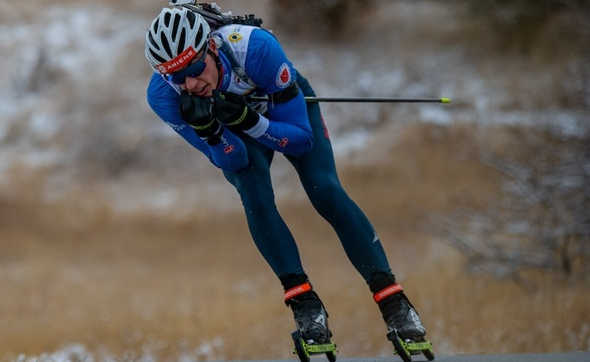
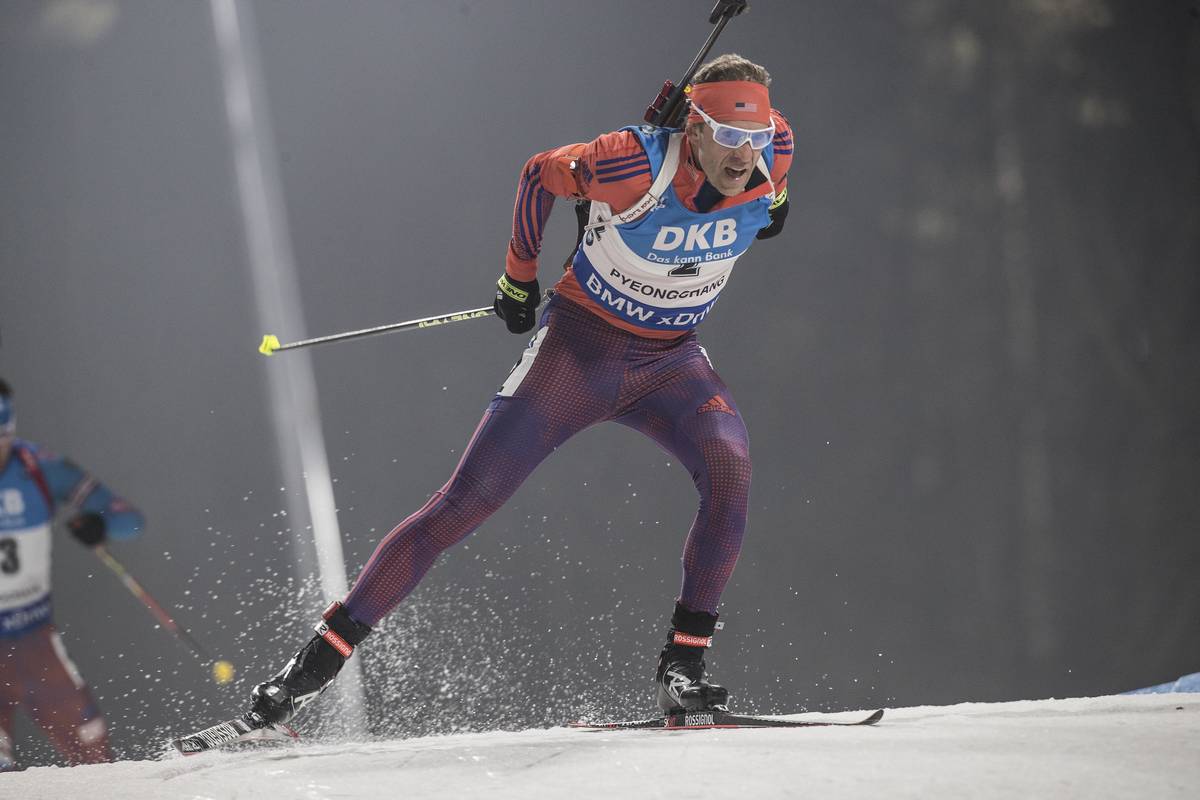
Paul Schommer was named to the IBU Cup roster for the start of the 2019-20 season Photo: Rachelle Weymuller)
(Oct. 28, 2019) — Following the completion of the U.S. Biathlon Fall Festival and IBU Cup Trials held over the weekend in Soldier Hollow, Utah, 15 athletes have been nominated to the U.S. Biathlon teams competing at the opening events of the 2019-20 season.
“We had an impressively competitive trials this season, with several lead changes throughout the competitions,” said U.S. Biathlon Director of High Performance Lowell Bailey. “I feel really good about the teams we are sending and their ability to compete with the world’s best on the international stage.”
Six members of the 2018 U.S. Olympic Team have been selected to compete at the first three International Biathlon Union World Cup events on this year’s calendar, including women’s Olympic Team members Clare Egan (Cape Elizabeth, Maine), Susan Dunklee (Barton, Vt.), Joanne Reid (Grand Junction, Colo.) and Emily Dreissigacker (Morrisville, Vt.). Named to the men’s World Cup team are 2018 Olympians Sean Doherty (Center Conway, N.H.) and Leif Nordgren (Hinesburg, Vt.), along with Travis Cooper (Kenai, Alaska) and Alex Howe (Gilford, N.H.).
The IBU kicks off its 2019-20 World Cup season in Oestersund, Sweden, Nov. 30-Dec. 8. That will be followed by World Cups in Hochfilzen, Austria, Dec. 13-15, and Le Grand Bornand, France, Dec. 19-22.
Named to the U.S. squads competing at the IBU Cup competitions in Ridnaun-Val Ridanna, Italy, Dec. 12-15, and in Obertilliach, Austria, Dec. 18-21, are Kelsey Dickinson (Winthrop, Wash.), Hallie Grossman (South Burlington, Vt.) and Maddie Phaneuf (Old Forge, N.Y.) on the women’s side, and Lars Hammernes Leopold (Truckee, Calif.), Max Durtschi (Ketchum, Idaho), Paul Schommer (Appleton, Wis.) and Jake Brown (St. Paul, Minn.) on the men’s side.
“It’s an exciting time for U.S. Biathlon, with several new names in the mix on our international teams. It will be fun to watch,” Bailey added.
On May 26, Maddie Phaneuf wrote a crisp and revealing blog post about her struggle with mental health issues after the 2018 Olympics. The blog post was titled Invisible Battles, and like many who suffer from a mental health crisis, her struggle was real but often difficult to discuss candidly. Phaneuf does a great service to the community by describing the symptoms she experienced and how she sought help from mental health professionals.
Phaneuf was eventually diagnosed with Post Traumatic Stress Disorder or PTSD as a result of falling ill with strep throat during the 2018 Games and being unable to race. The myopic pursuit of excellence and fulfilling the Olympic dream took an unexpected turn in PyeongChang that left her feeling like a fraud. She questioned her identity as an athlete as she contemplated leaving the sport. The let down of being named to the Olympic team then falling ill and not racing precipitated a downward spiral for the now twenty-four-year-old.
“When we learn about PTSD we usually tie it with war veterans, so it’s not common for people to associate PTSD with athletes,” Phaneuf wrote in her post.
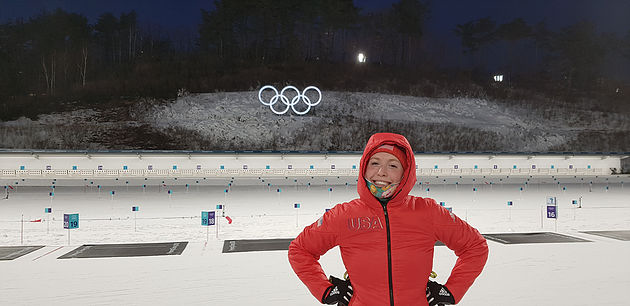
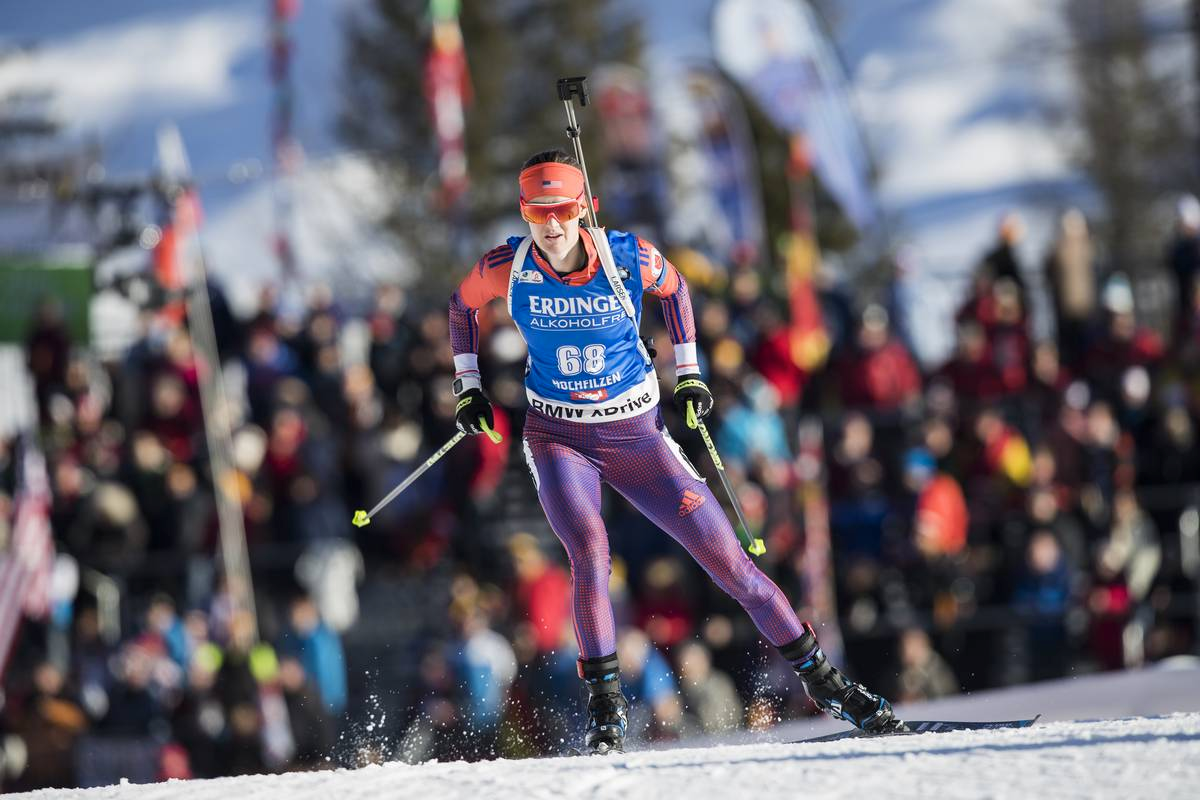
Maddie Phaneuf at the 2018 PyeongChang Olympics. Phaneuf used this image in her blog post and titled it “Before shit hit the fan…” (Photo: courtesy Maddie Phaneuf)
In this episode, we speak with Phaneuf who has relocated to Lake Placid, New York after a stint in Boulder, Colo. She has since rekindled balance in her life and is pursuing a spot on the US Biathlon team. She also reflects on the importance of seeking professional help. That’s also a recommendation FasterSkier promotes.
Here’s some advice from Phaneuf on finding balance and maintaining wellness that was included in her blog post:
If you’re interested in non-therapy ways I’ve found help me feel more balanced and generally happy, here’s that list. Again, I’m not a health professional, if you’re struggling – talk to a professional.”
Getting outside and exercising
Less screen time
Journaling my feelings
Mediating or practicing Savasana
Surrounding myself with people I love
Getting enough sleep, eating well, and staying hydrated
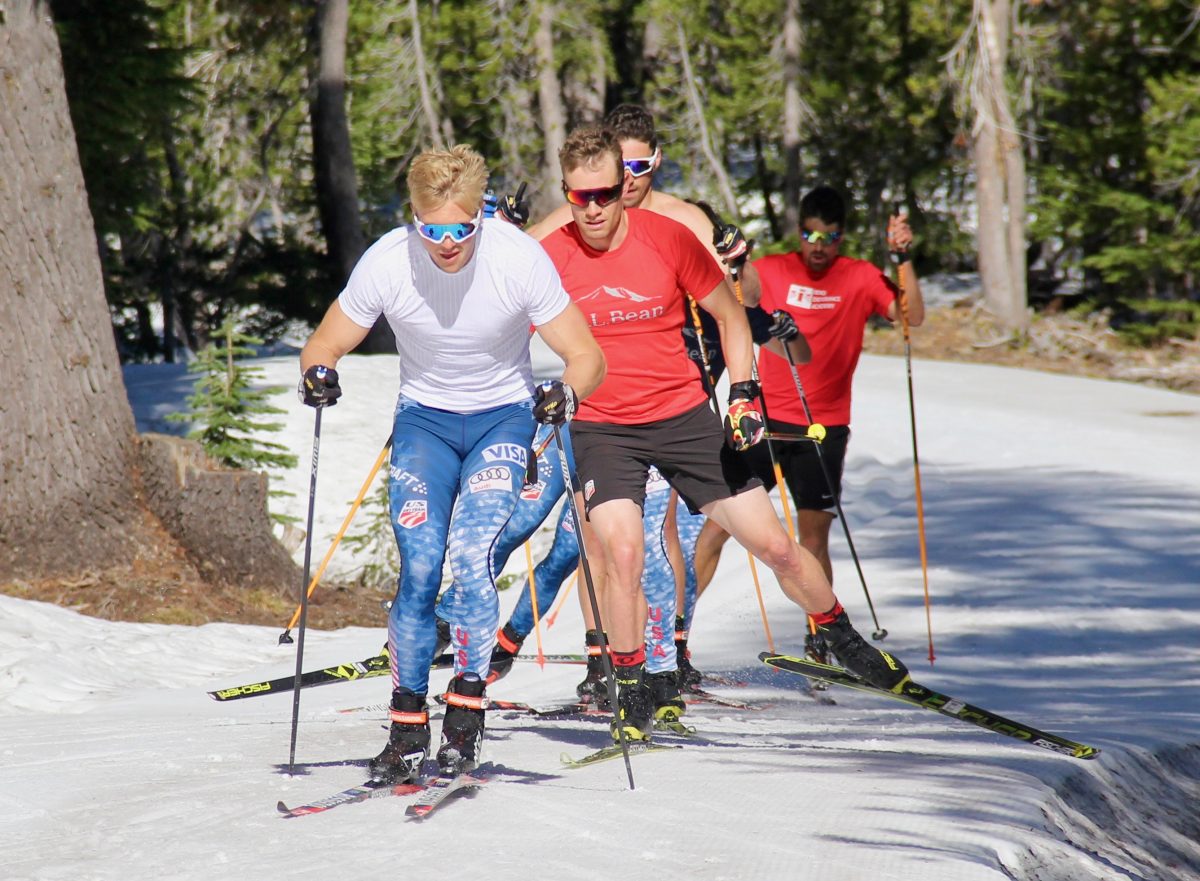
Erik Bjornsen, Simi Hamilton, Ian Torchia, Scott Patterson, and Akeo Maifeld-Carucci at the 2018 Bend on-snow camp. (Photo: Bryan Fish)
It’s late May. Athletes are a month into official training for the 2019/2020 season. Here’s some recent news of note from the domestic and international nordic ski world.
German cyclist confesses to doping following Seefeld sting
The police action in Seefeld, Austria, at the time of the 2019 World Championships that led to the arrest of several athletes and this remarkable and candid interview with Estonian skier Karel Tammjärv has led to another athlete leaving their sport. Former German pro cyclist Danilo Hondo was removed from his position as a national team coach with the Swiss Cycling Federation, after allegedly being named by German doctor Mark Schmidt as one of Schmidt’s doping clients during a custodial interrogation by Austrian police, Cycling News reported earlier this month. The article reports that Hondo paid Schmidt 30,000 Euros a year for his services. Hondo initially denied his involvement with Schmidt, but later confessed in an interview with German broadcaster ARD, Cycling News reports. He was dismissed from his coaching position soon after.
Maddie Phaneuf and mental health among endurance athletes
In a recent blog post, American biathlete Maddie Phaneuf writes candidly and publicly about her struggles with mental health after an untimely illness left her unable to race at the 2018 Winter Olympics in Pyeongchang.
“It took me nearly a year to figure out I was dealing with something much bigger and harder for me to handle on my own,” Phaneuf writes, “and that I needed to seek professional help from a therapist. Little did I know that I was experiencing Post Traumatic Stress Disorder from my experience at the Olympics. It’s hard for me to even write that because I’m afraid people will doubt it’s legitimacy. When we learn about PTSD we usually tie it with war veterans, so it’s not common for people to associate PTSD with athletes.”
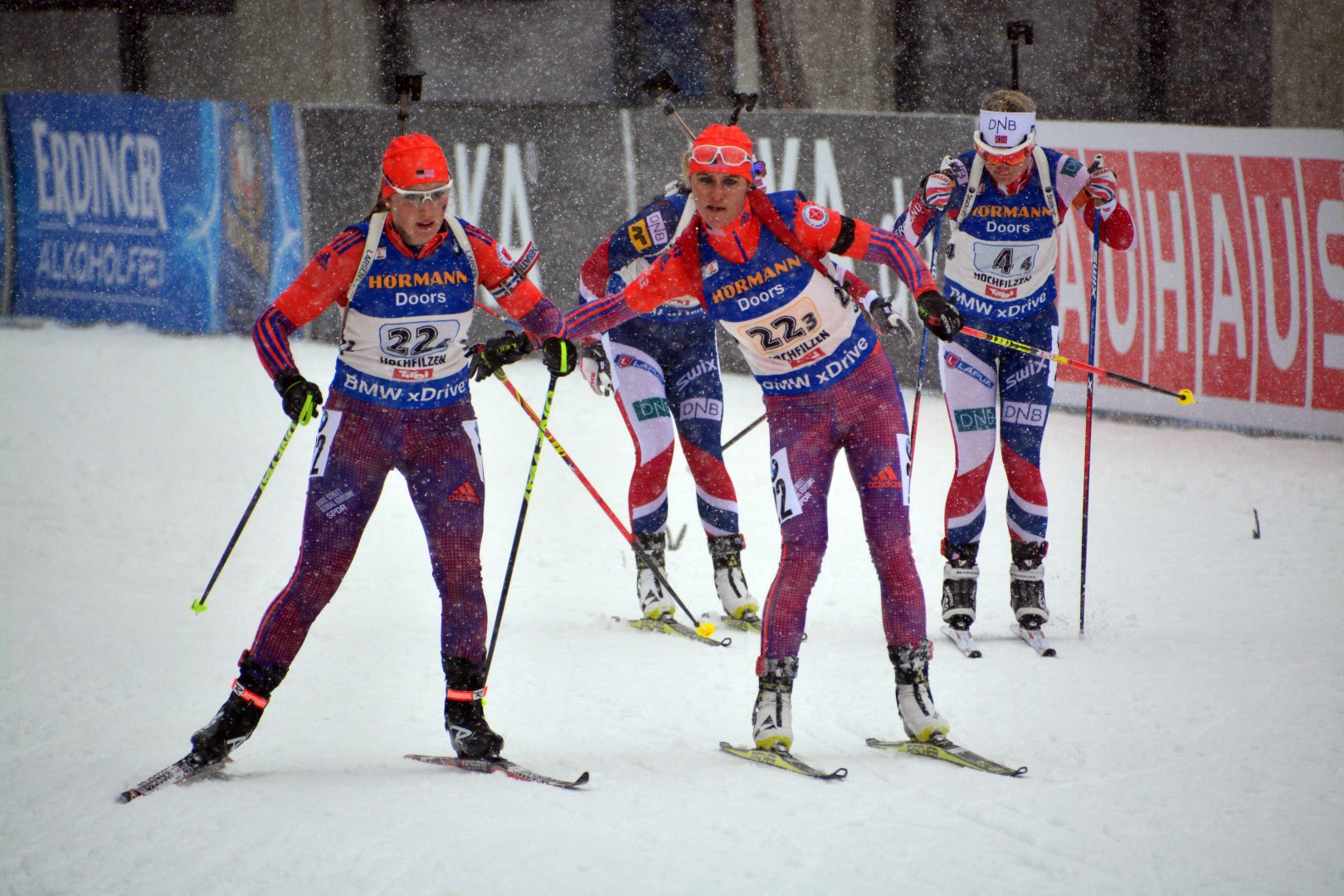
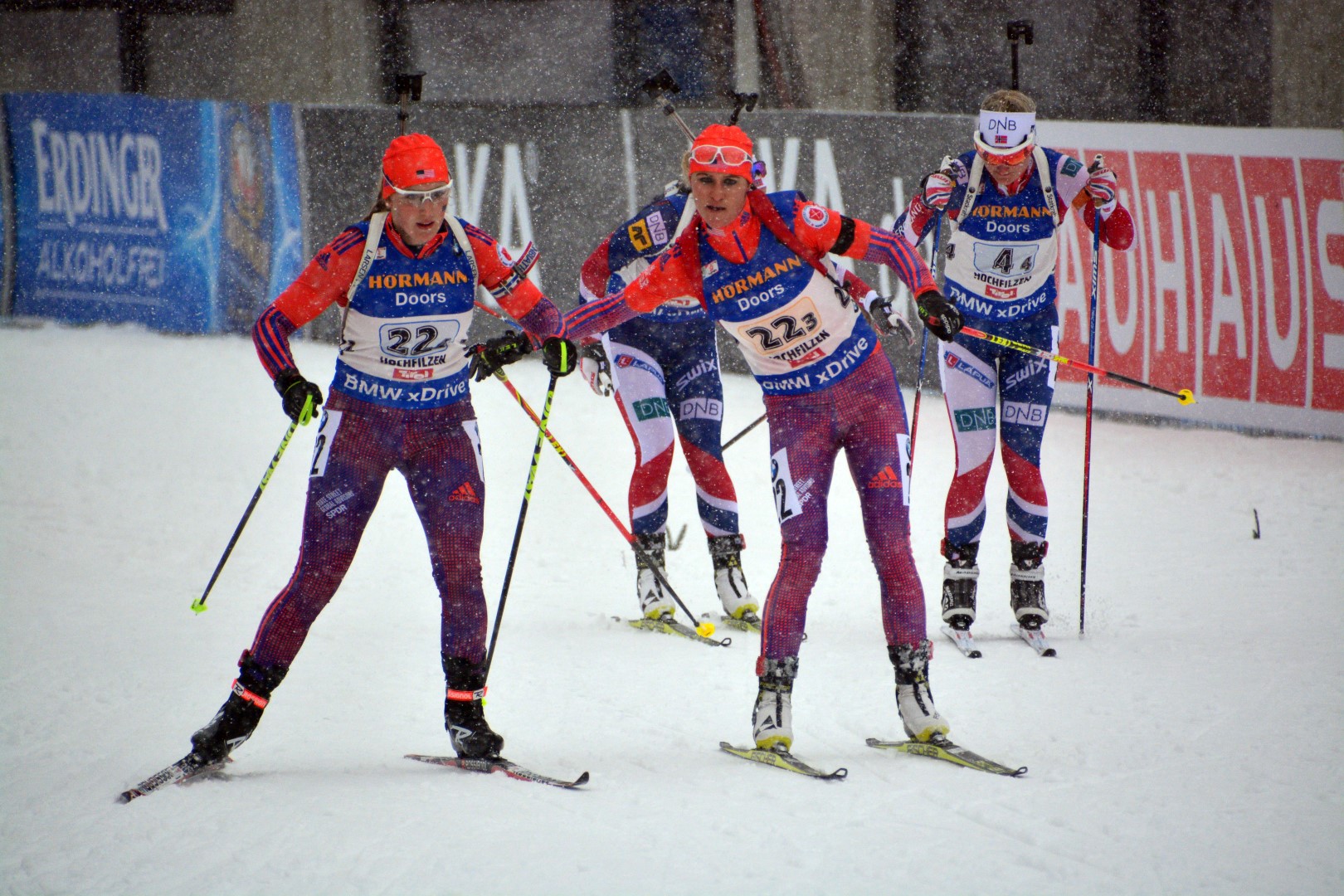
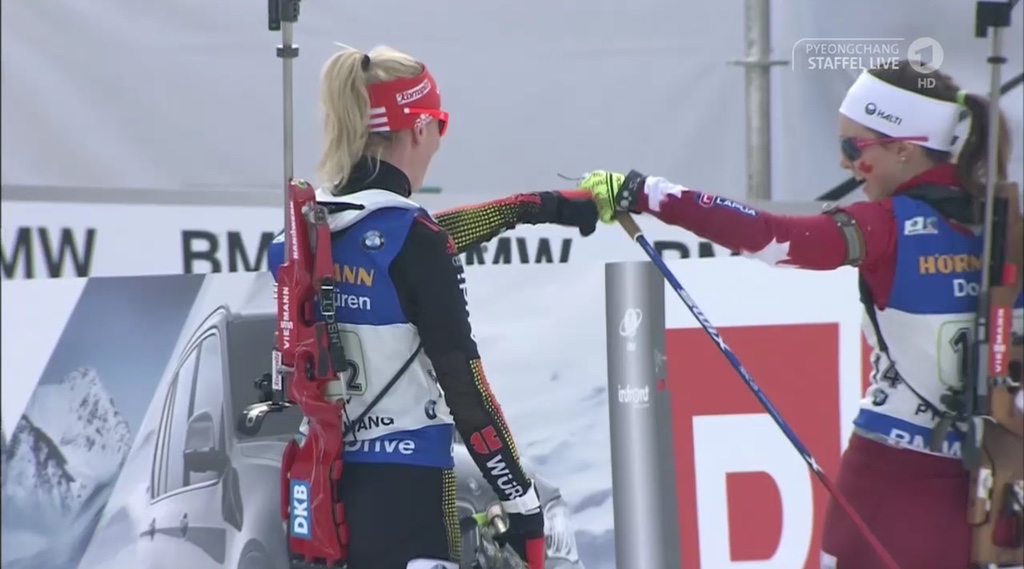
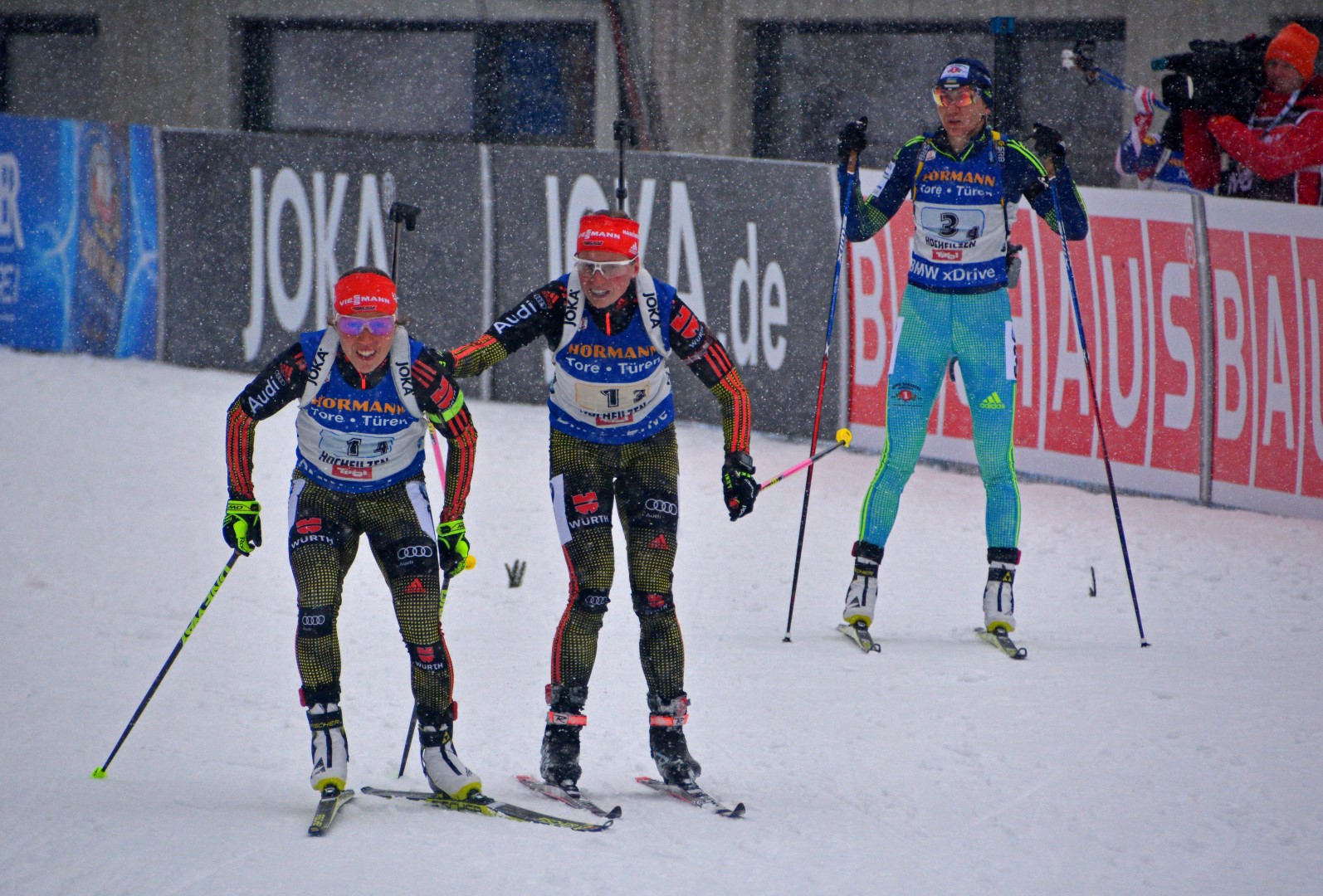
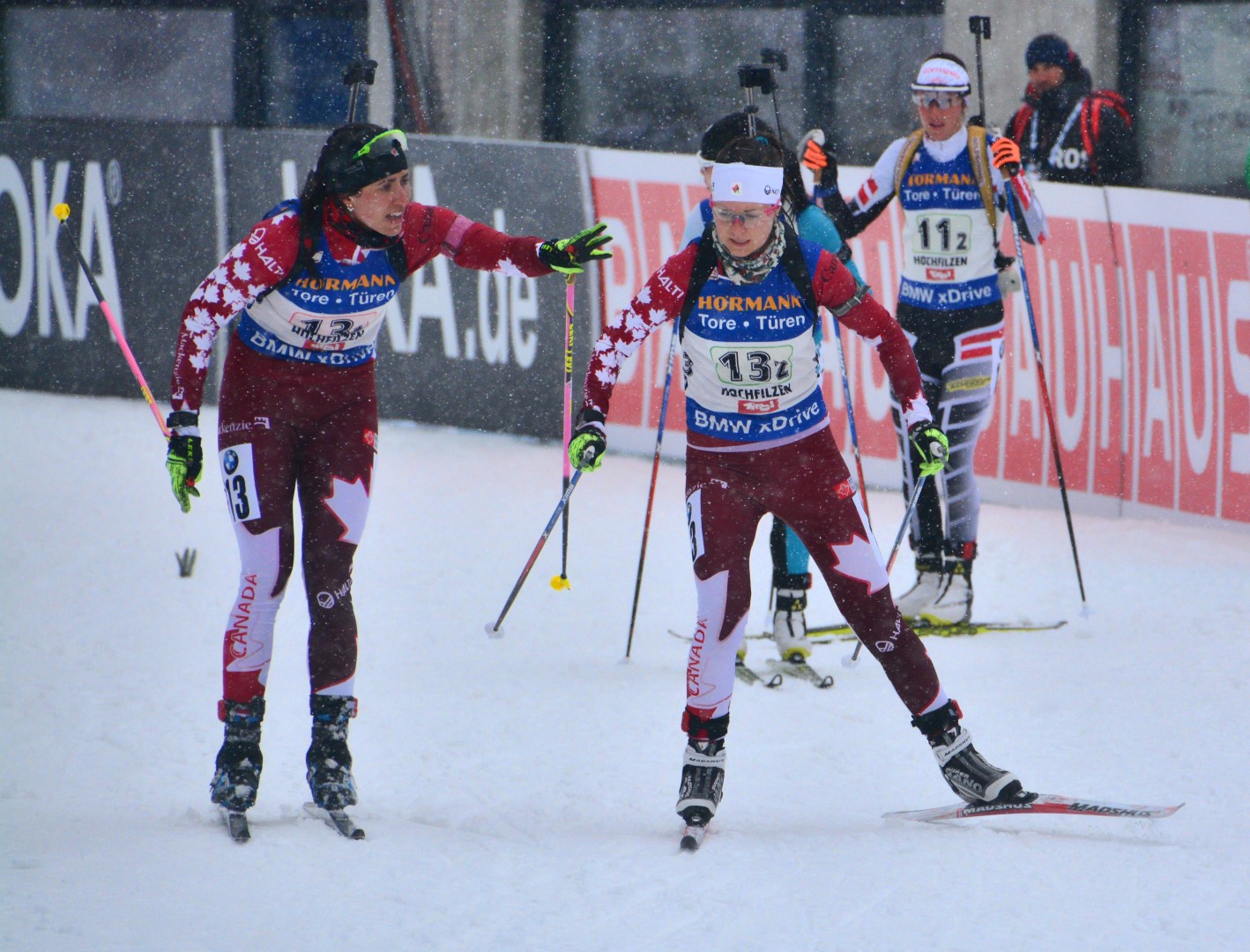
Joanne Reid (r) tagging U.S. teammate Maddie Phaneuf in 12th during the final exchange of the women’s 4 x 6 k relay on at the 2017 IBU World Championships in Hochfilzen, Austria. (Photo: Glen Crawford)
Phaneuf nonetheless sets forth many common symptoms of PTSD, and explains how her experience at the Olympics left her exhibiting nearly all of them.
Phaneuf concludes, “I hope this post helps break the stigma of mental illnesses within the athletic community, and opens peoples eyes in tackling that hardest step: asking for help.”
(Canadian skier Maks Zechel sounded similar notes in a piece for FasterSkier written in January 2018, writing, “This past April, I decided to face my mental health issues that I had always known existed, but never understood or recognized for what they were. What an awkward thing to talk about, mental health, but it shouldn’t be. Our minds have to be taken care of with the same attention that we give our bodies through training and recovery. It doesn’t matter what it is that makes you begin to acknowledge your difficulties, but it has to be done; it is grossly underestimated just how permanent unchecked mental health issues can be. I didn’t acknowledge my health issues because I cared about my health, but I did care that it was starting to affect the way I raced, and although not the most important reason, it was enough to motivate me to work on my mental ‘fitness.’” Zechel added, “Not everyone wants to talk about their mental health issues, but many need to.”)
Jessie Diggins hosts “Meet the D-Team”
All three levels of the U.S. national team – the A-Team, B-Team, and D-Team – recently convened in Bend, Oregon, for an on-snow spring camp. This gave the athletes the chance to rack up the kilometers skiing in the morning, and the miles running or mountain biking in the afternoon. It also gave Jessie Diggins the chance to work on her whimsical interview skills. In a series of Instagram video posts, Diggins checks in with the entire D-Team save Kendall Kramer. For more on Johnny Hagenbuch’s favorite kind of dinosaur, Novie McCabe’s favorite flavor of gum, Ben Ogden’s lifetime cumulative skateboards built, and other important news of the day, check out Diggins’s Instagram page. Part I is here, Part II here, and Part III here.
Kendall Kramer collects ninth and tenth state high school championships
The only D-Team skier not present in Bend was Kramer, whose junior year at Fairbanks’s West Valley High School ended during the camp. By staying home Kramer was able to add to her collection of Alaska state high school championships, when she won both the 1,600 and 3,200 at last weekend’s state track and field championships at Machetanz Field in Palmer, Alaska, the Anchorage Daily News reported. Kramer clocked 4:56.15 to take the metric mile and 10:27.18 to win the longer race, in both cases taking the win over Anchorage skier Ava Earl.
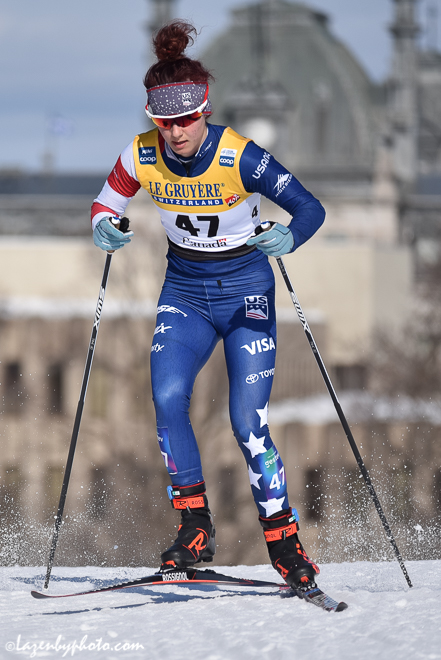
Kendall Kramer from Fairbanks, Alaska during the women’s 10 k skate pursuit at 2019 World Cup Finals. (Photo: John Lazenby/lazenby photo)
Kramer’s ten (and counting; she still has her senior year ahead of her) Alaska high school individual championships include the 2018 and 2019 Skimeister award for lowest combined time at the cross-country skiing state meet, the 2017 and 2018 state cross-country running titles, and the 1,600/3,200 double at all of the 2017, 2018, and 2019 state track and field championships. On the track, Kramer has lowered her time in the 1,600 from 5:14.80 to 4:56.15 since 2017, and from 11:04.47 down to 10:27.18 for the 3,200.
U.S. Ski & Snowboard awards
Earlier this month, U.S. Ski & Snowboardnamed its athletes and coaches of the year, with official awards presented at the U.S. Ski & Snowboard Congress in Park City on May 16. Awards for nordic and nordic combined skiers and coaches were as follows, as quoted from a USSA press release:
Athletes of the year, nordic: Junior Worlds Men’s Relay Team: “In a storybook ending to a very successful Junior World Championships, the men’s 4x10k [sic] relay team took gold – the first ever gold won by the USA at the FIS Junior World Cross Country Ski Championships. Three of the four athletes had set the stage a year earlier winning silver.” The team was Johnny Hagenbuch (Ketchum, Idaho/SVSEF), Luke Jager (Anchorage/APU), Ben Ogden (Landgrove, Vt./SMS), and Gus Schumacher (Anchorage/Alaska Winter Stars).
Athlete of the year, Ski Jumping/Nordic Combined: Tara Geraghty-Moats: “Nordic combined skier Tara Geraghty-Moats (W. Fairlee, Vt.) played a vital role in the rapidly-growing women’s nordic combined international field, winning 10 Continental Cups and taking the season title in a year where the international field more than doubled. Geraghty-Moats also took the U.S. title and landed a berth as a special ski jumper on the U.S World Championship Team. As an athlete advocate, she served an important pioneering role with women’s nordic combined which will join the World Championships in 2021.”
International coach of the year, nordic: Jan Buron, Alaska Winter Stars: “A veteran club coach, Jan Buron of the Alaska Winter Stars program has developed many top athletes. This past season his work with junior skier Gus Schumacher, whom he has coached for the athlete’s entire career, led to the USA winning gold in the men’s relay at the Junior World Championships.”
International coach of the year, ski jumping/nordic combined: Jan Druzina, Junior/Continental Cup Ski Jumping Coach: “Jan Druzina came to USA Nordic as a Junior Team and Continental Cup coach for men’s ski jumping a year ago. Since then, he has visited every club to speak with coaches and parents, working together to build a strong junior program. The result was a definitive step up this year with Andrew Urlaub and Patrick Gasienica qualifying for their first World Championships and Urlaub taking a top-30 at Junior Worlds plus three top-30 Continental Cups.”
Domestic coach of the year, nordic: Alasdair Tutt, Nordic Ski Club of Fairbanks: “Kendall Kramer, coached by Alasdair Tutt, was 4th in the 15km mass start classic in her first time at Junior World Ski Championships. Kendall will also represent USA at the 2020 Youth Olympic Games.”
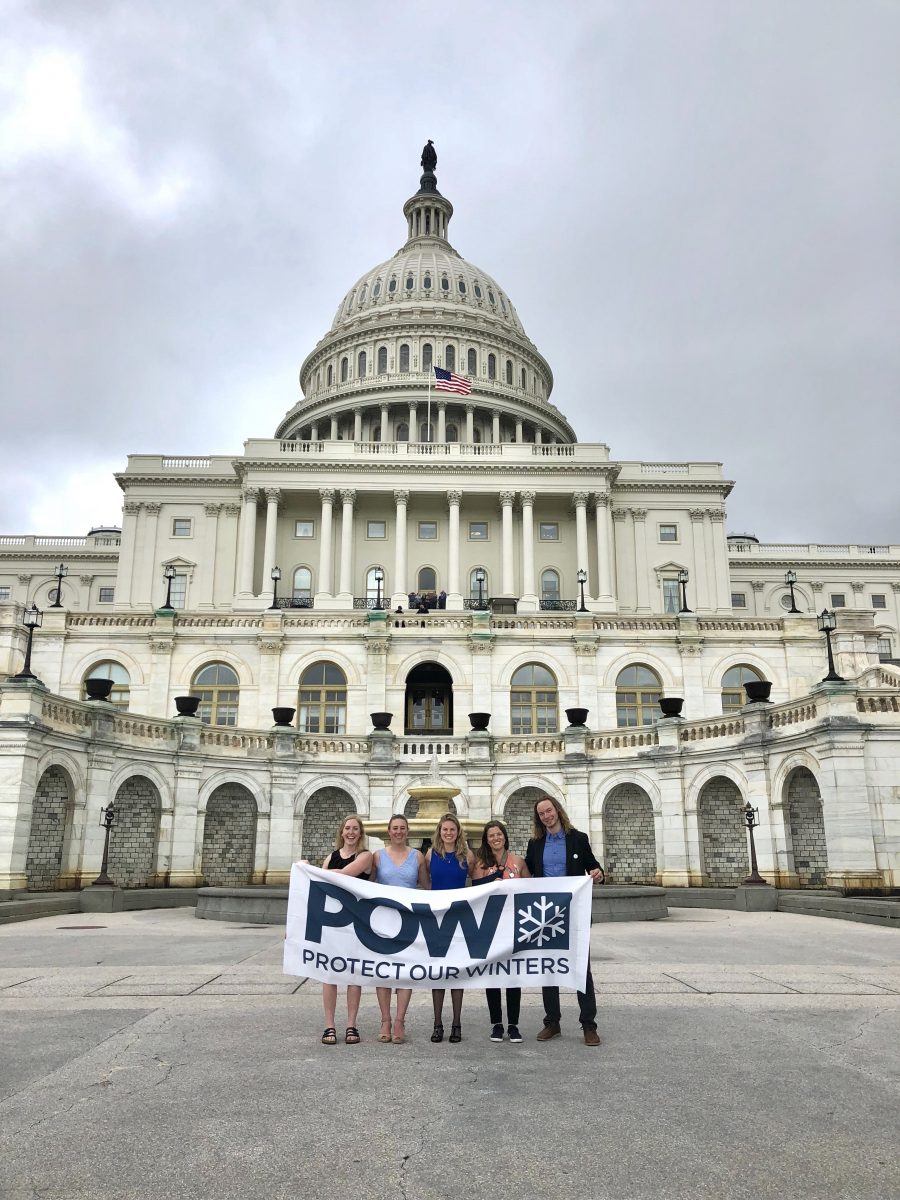
From left to right: Maddie Phaneuf, Arielle Gold, Jessie Diggins, Stacey Cook, and David Wise in front of the U.S. Capitol in late April in Washington, D.C. (Photo: Barbara Weber/Protect Our Winters)
Young and empowered. Twenty-three-old Maddie Phaneuf, a 2018 Olympic biathlete and member of the US Biathlon’s national team, has been finding her voice this short offseason as she lobbied members of the U.S. Senate and House of Representatives in Washington, D.C., on April 25. Phaneuf, along with 2018 U.S. Winter Olympians Jessie Diggins, Arielle Gold (snowboarding), David Wise (freestyle skiing), and Stacey Cook (alpine skiing), spoke in D.C. on behalf of the Citizens’ Climate Lobby and Protect Our Winters (POW).
“I have been working with POW for about a year now,” Phaneuf explained on the phone on April 24. “I have been helping them out as a winter-sports athlete giving presentations to schools and teaching kids about climate change and its impact.”
Phaneuf may have been destined for winter sports, but until the age of 8, her life was a snow-void. Phaneuf was born in Virginia and spent her early childhood in South Carolina. Her limited exposure to snow consisted of a single freak snowfall where the snow melted within a day. Fortunately for US Biathlon, Phaneuf said her father wanted his children to experience the full spectrum of the seasons and relocated the family to Old Forge, New York, in the Adirondack Mountains.
“The whole town is really into skiing, whether it be downhill or nordic,” Phaneuf said of Old Forge, where her parents still reside. “So my parents wanted us to get into that because it would be a great way to experience winter in the Adirondacks, and for us kids to stay active.”
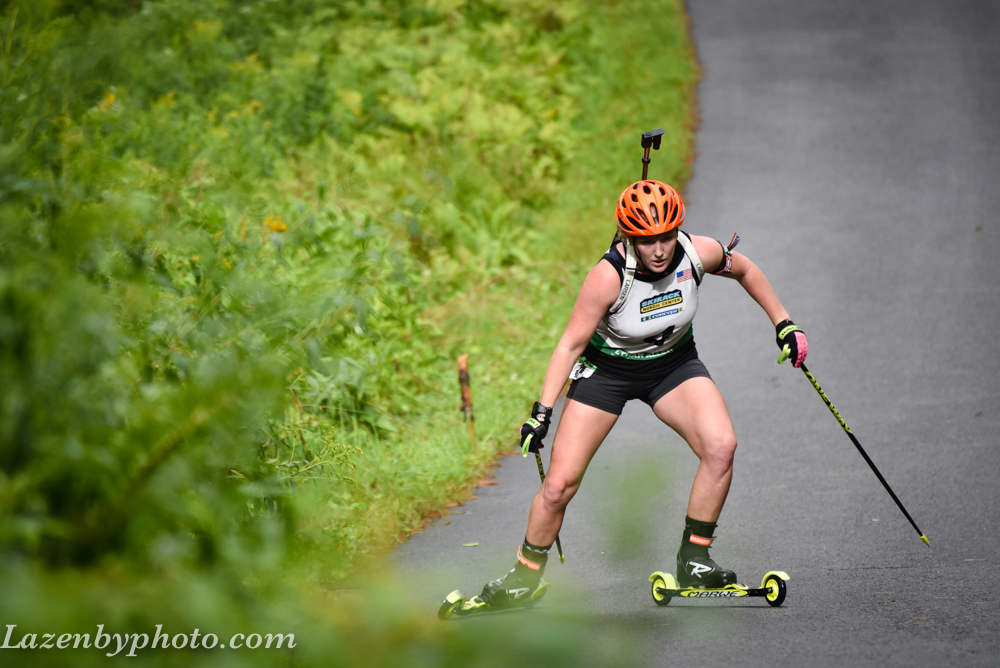
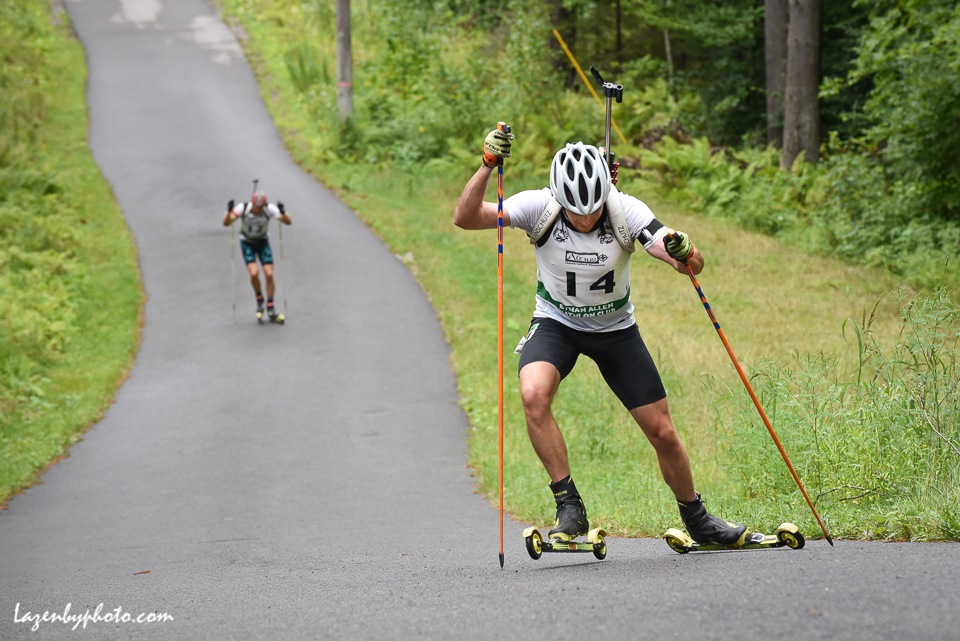
Maddie Phaneuf (USBA/PBSC) racing to fourth in the women’s mass start last August at 2017 US Biathlon Rollerski Championships in Jericho, Vt. (Photo: John Lazenby/Lazenbyphoto.com)
Nominated to US Biathlon’s X-Team in 2014, Phaneuf climbed the ranks and to reach A-team status last season. Last month, she was named to the B-team, part of the US Biathlon’s top-tier High Performance Team. While continuing to train and race with the national team, she planned to move from Lake Placid, N.Y., to her new training base in Boulder, Colorado, this summer.
New York’s North Country, where Old Forge is located, is a reliably conservative region. At least on electoral maps, the politics can skew towards an anti-climate-change perspective. However, Phaneuf said she has felt backed by Old Forge as she explains her point of view to others.
“My hometown is very supportive of me,” Phaneuf said. “I went into the local school and they were excited to learn about my climate-change presentation. But I am sure there are parents that don’t necessarily agree with what I am saying, but they are not going after me.”
Politics and athletics can be a non-starter for athletes. Being outspoken about a cause, in particular, one as divisive as climate change, can alienate an athlete — especially on social media. But Phaneuf has used the resilience she has developed in the fickle sport of biathlon to weather the storm and move forward with her activism.
Phaneuf admits she is still learning how to navigate the potential minefield of exercising her free speech. This past February, Phaneuf penned an op-ed piece for Syracuse.com, expressing her belief that change must be enacted to save winter, and by extension, our ability to sustain the winter sport economic engine and way of life in places like the North Country.
Phaneuf was eventually alerted to the many negative comments her piece received when she posted it on her personal Facebook page.
“I went to the article and 90% of the comments were bashing me,” Phaneuf explained. “Saying I am too young, I have never experienced anything — what am I talking about? Not even bashing climate change but bashing me personally … When I shared the climate-change article I wrote, one guy replied something like, ‘What’s up? You are not posting things about the Olympics. This is bullshit. I don’t want to read this. I want to follow you.’ I replied, ‘OK, the Olympics are over. It’s my offseason. I think it is irrelevant to post things about the Olympics right now because we aren’t there. And I want to show my followers what I do in my free time. Just because you are an athlete doesn’t mean you can only post about training and racing.”
Phaneuf recognizes that her Olympic-team nomination has given her more exposure. She said her Facebook page went from 1,000 to 4,000 likes during the 2018 Olympics in February. As she had matured, Phaneuf explained she’s become wiser when it comes to engaging detractors.
“I have been trying better than in the past,” Phaneuf said. “In the past, I would reply to all the comments kind of aggressively, like ‘what do you mean?’ But now I take a step back and simply read the comments. I understand everyone on the internet is human and all have their own opinion. I just try to not respond unless they are trying to put words in my mouth or saying other things about me, then I will respond and clarify the facts in a respectful way.”
The halls of Congress, on most days, are not the wild west of internet commenting. The tone is soberer. There is the understanding that change comes about from the steady persistence of advocacy, lobbying and voting at the ballot box.
Two weeks ago in D.C., the talking points for Phaneuf and the other athletes present were clear They were to speak about the following: What impacts have they witnessed regarding climate change? How is climate change impacting their sport? How might climate change impact future Winter Olympics?
The athletes also spoke of the regional economic boost snow availability brings certain regions across the U.S. (POW and Citizens’ Climate Lobby cite that in New York alone, the outdoor-recreation economy contributes $41.8 billion dollars and provides 313,000 jobs.)
US Biathlon’s Maddie Phaneuf outside the D.C. office of U.S. House Representative Elise Stefanik (New York). (Photo: Barbara Weber/Protect Our Winters)
The Congressional briefing was a bipartisan event sponsored by Senator Michael Bennet of Colorado and Senator Susan Collins of Maine. The athletes also met with Senator Tina Smith of Minnesota, Senator Dean Heller of Nevada, Congresswoman Elise Stefanik from Phaneuf’s district in New York, Congressman Scott Tipton of Colorado, and Congressman Mark Amodei of Nevada.
“It was good,” Phaneuf said on April 26, the day after her D.C. experience. “I was definitely nervous going into it. I had never been in the position of talking directly to congresspeople or senators. They definitely heard our message. It was definitely more chill than I expected it to be. I was afraid it was going to be judgmental and scary. … The biggest part of our day was simply talking about our own experiences with climate change. And not getting too much into the politics.”
Although Phaneuf has chosen to emulate a long line of athlete activist, her biathlon career remains a priority as she transitions from upstate New York and her residency at the Lake Placid Olympic Training Center to her new base in Boulder.
Phaneuf’s B-Team status comes on the heels of what she calls her “worst season ever”. Although qualifying for Olympics, Phaneuf said she struggled before the Olympics and spent her time in PyeongChang, South Korea, bedridden.
“I struggled a lot with fitness last summer and lost tons of training,” Phaneuf said of the start to her 2017/2018 racing season. “Then I didn’t make the World Cup team in the first period, and then I made the IBU Cup team, but was not performing well and barely made the Olympic team. [In PyeongChang] I got sick the day of my first race and got strep throat and a virus on top of that. I was totally out for two weeks. Being at the Olympics and being around that atmosphere and being so close to racing — having that stripped away from me, made we want to figure how to get better at training and do a lifestyle change. This is why I am moving to Boulder.”
A new training season has begun for Phaneuf. In the meantime, she’ll be juggling her sport with her more seasoned political voice.
“I don’t think I have ever voted in midterm elections,” Phaneuf said of the midterm elections set for this November. “I don’t think I ever thought of it as a big deal. So we are are trying to get the word out because it is a big deal. We want to elect people who will actually listen to us.”
US Biathlon’s Maddie Phaneuf (l) gets tagged by teammate Joanne Reid during the final exchange of the women’s 4 x 6 k relay at 2017 IBU World Championships in Hochfilzen, Austria. The team finished 14th. (Photo: Glen Crawford)
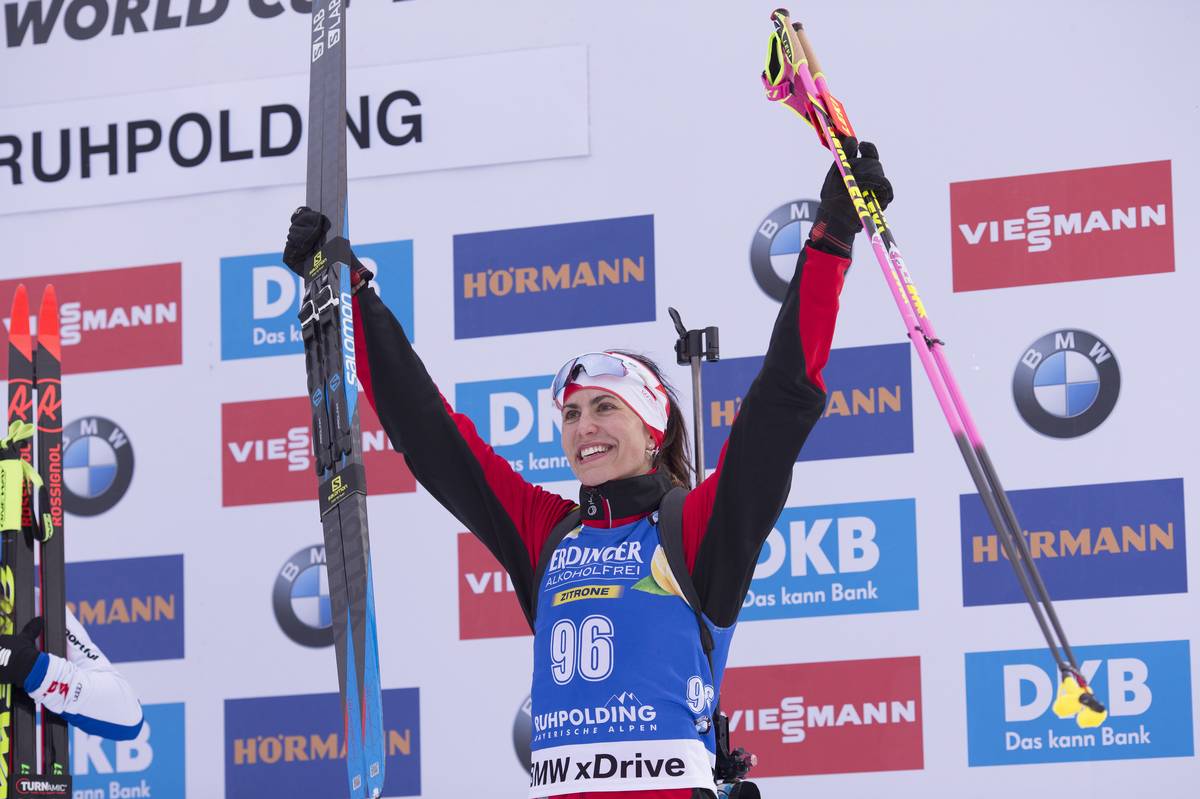
Emily Dreissigacker tags off to Joanne Reid in the women’s World Cup biathlon relay in Ruhpolding, Germany. Both women are on the roster for the U.S. for the next year of international biathlon. (Photo: USBA/NordicFocus)
For the first time in years, the roster features more women than men. Following the retirements of Lowell Bailey, Russell Currier, and Tim Burke, Alex Howe (Craftsbury Green Racing Project) netted his first senior national team nomination, and joins 2018 Olympians Sean Doherty and Leif Nordgren, as well as Paul Schommer (Moose Nordic).
On the women’s team, all five members of the 2018 Olympic team have been renamed: Susan Dunklee, Clare Egan, and Emily Dreissigacker (all Craftsbury Green Racing Project), Joanne Reid (Colorado Biathlon), and Maddie Phaneuf (Polar Bear Ski Club). Dunklee and Egan recently said that they were not certain yet about retirement, but appear on the roster. The newest addition to the women’s senior team is Chloe Levins, who finished all three individual races at 2018 World Junior Championships in the top seven.
The “A” team athletes will be primarily based in Lake Placid, New York, while designated “B” team athletes (Phaneuf, Schommer, and Howe) will be based at regional training centers or with clubs, according to national team selection documents.
The federation has also named a development squad of Deedra Irwin (Wisconsin Biathlon), Travis Cooper and Jake Ellingson (National Guard Biathlon), Jake Brown (Loppet Nordic Racing), and Max Durtschi. All saw international race starts last season.
In addition, an 11-member Junior Development Group has been named, many of whom we interviewed this winter – see the links below to read about their experiences at World Youth and Junior Championships.
High Performance Team – Women
Susan Dunklee (Barton, Vt./Craftsbury Green Racing Project), A1 Team Clare Egan (Cape Elizabeth, Maine/Craftsbury Green Racing Project), A2 Team Chloe Levins (Rutland, Vt.), A3 Team Joanne Reid (Boulder, Colo./Colorado Biathlon), A3 Team Emily Dreissigacker (Morrisville, Vt./Craftsbury Green Racing Project), A3 Team Maddie Phaneuf (Old Forge, N.Y./Polar Bear Ski Club), B Team
High Performance Team – Men
Sean Doherty (Center Conway, N.H.), A1 Team Leif Nordgren (Marine, Minn.), A3 Team Paul Schommer (Appleton, Wisc./Moose Nordic), B Team Alex Howe (Gilford, N.H./Craftsbury Green Racing Project), B Team
Development Team – Senior Women
Deedra Irwin (Pulaski, Wisc./Wisconsin Biathlon)
Development Team – Senior Men
Travis Cooper (Kenai, Alaska/National Guard Biathlon) Max Durtschi (Sun Valley, Idaho) Jake Brown (Houghton, Mich./Loppet Nordic Racing) Jakob Ellingson (Minnetonka, Minn./National Guard Biathlon)
Youth and Junior Development Group – Women
Helen Wilson (Eagle River, Alaska/Alaska Biathlon Club) – 20-for-20 interview Lexie Madigan (Truckee, Calif./Auburn Ski Club) – 20-for-20 interview Emma Stertz (Grand Rapids, Minn./Mt. Itasca Biathlon) – 20-for-20 interview Grace Gilliland (Eagle River, Alaska/Alaska Biathlon Club) – 2017 20-for-20 interview Sarah Beaulieu (Fort Fairfield, Maine/Outdoor Sports Institute) Arianna Woods (Bozeman, Mont./Bridger Biathlon Club)
Youth and Junior Development Group – Men
Vasek Cervenka (Grand Rapids, Minn./Mt. Itasca Biathlon) – 2017 20-for-20 interview Garrett Beckrich (Grand Rapids, Minn./Mt. Itasca Biathlon) – 20-for-20 interview Tim Cunningham (Springfield, N.H./Saint Lawrence University) – 20-for-20 interview Eli Nielsen (Stehekin, Wash./Methow Valley) – 20-for-20 interview Marcus Gore (Vail, Colo./Casper Mountain Biathlon Club)
Sweden’s Hanna Öberg on her way to a gold medal in the women’s 15 k individual at the 2018 Olympics in PyeongChang, South Korea. Öberg skied the sixth-fastest time and shot 20/20. (Photo: IBU/Biathlonworld.com)
PYEONGCHANG, South Korea — It was a day for firsts here at the 2018 Winter Olympics.
At the Alpensia Biathlon center, athletes for the first time saw mild temperatures, blue skies, and — perhaps most importantly for success in the individual race — tame winds. All welcome firsts at what’s been a blustery and downright chilly Games, and it came just a day after the race jury postponed the women’s 15 kilometer individual race due to high winds.
But another first was the most stunning. Twenty-two year old Swedish biathlete Hanna Öberg skied with panache and shot with zen-like nerves on the biggest athletic stage of her life to win gold in the rescheduled 15 k.
“It’s really big for me that I could take this step,” she said in a press conference. “And to have my parents here, it means a lot, and also my boyfriend. To share this with everyone means the most to me. It’s really big.”
The individual race is relentless in its capacity to shatter nerves. Five three-kilometer loops in total and twenty shots — four shooting rounds alternating prone and standing — and each miss carries a draconian one-minute penalty.
Anything can happen on individual race day. Shoot clean and the podium’s top step is within grasp. Miss and you plummet through the rankings. That means opportunity, but also stress.
While many of her competitors have experience trying to manage that stress (successfully or not), Öberg hadn’t been here before.
Sweden’s Hanna Öberg at the flower ceremony celebrating her gold medal in the women’s 15 k individual at the 2018 Olympics in PyeongChang, South Korea. (Photo: IBU/Biathlonworld.com)
“I’m 22 years old and last season was my first in the World Cup, and also my first World Championships, in Hochfilzen,” Öberg said, laughing at the incredible spot she had climbed to. “The season before that, I took two gold medals at the Junior World Championships. That’s also the last time that I shot four zeros in a competition.”
Öberg has only notched three top-10′s on the World Cup, and before Thursday’s golden performance, Öberg’s fifth in the pursuit here matched a career best.
But shoot clean in this race, and you’ve made your own opportunities to grab gold.
Opportunity knocked for Öberg after three clean shooting rounds. She left the range in first place on her fourth ski loop and kept pace, setting herself up for a tense five shot sequence. Enough Swedish fans populated the stands to cheer as each of Öberg’s targets fell. The final 3 k loop remained tense for the what ifs for the young Öberg: a snagged V-board or a corner skied too wide could mean a medal gone.
None of that happened, of course.
Öberg stopped the clock in 41:02.7, but she had to wait nearly half an hour to know that she had sealed the deal. She had an early bib and among the many athletes behind her in the start order was last season’s world number one, Laura Dahlmeier of Germany, a late starter in bib 80.
But Dahlmeier only shot 19/20, and couldn’t catch Öberg’s time on the tracks, ending up with a bronze medal instead.
“I think not just me, I think everybody knows that it was a really, really great day for Hanna,” Dahlmeier – who won the other two gold medals awarded so far at these Olympics – said in the press conference. “I think it was her first time to be on the podium, and it’s really great to be on the podium at the Olympics. It must be one of the best days of her life… with a clean shooting and good skiing performance, you can win a race. And today not so many athletes shot zero, I think just three athletes. It’s great for her and also for the whole Swedish team.”
“Of course I’m surprised,” Öberg said of her win. “I could not believe this before and I knew that maybe this performance today could have taken me to a medal but that I would win this race, it’s just unbelievable.”
Slovakia’s Anastasiya Kuzmina on course in the 15 k individual at the 2018 Olympics in PyeongChang, South Korea. Kuzmina finished second to earn her second medal of these Olympic Games, two match two sprint gold medals from 2010 and 2014. (Photo: IBU/Biathlonworld.com)
If it was a surprise for Oberg, it was a turnaround for Sweden, which did not send a women’s team to the 2014 Olympics because the Olympic Committee did not feel that any of the biathletes had the potential for acceptably strong results.
But in the 15 k, Linn Persson finished 11th and Mona Brorsson 14th; Brorsson was also 10th in the pursuit.
“I just want to say, I’m super impressed with Sweden,” American biathlete Susan Dunklee said in the finish area, when Dahlmeier was still out on course. “Holy shit. In 2014, Sweden did not take a women’s team to the Olympics. I felt so bad for the one woman on the team who was on the bubble for that and they decided not to take her, which I thought was really stupid. And then turn around, four years later, you have a potential gold medalist here, [and] couple of the top 10’s or something?”
The two pre-race favorites were Anastasiya Kuzminaof Slovakia and Dahlmeier, both of whom were already medalists at this Games.
Kuzmina placed second in the 10 k pursuit on Monday. If Öberg kept it together considering her lack of championship experience, Kuzmina faltered twice on the range despite hers. Kuzmina raced to gold in the 2014 Olympic sprint, and gold and silver in the 2010 Olympic sprint and pursuit, respectively.
Germany’s Laura Dahlmeier at the finish of the women’s 15 k individual biathlon competition at the 2018 Olympics in PyeongChang, South Korea, where she won bronze. (Photo: IBU/Biathlonworld.com)
Despite suffering a single miss in the first standing and second prone rounds, for two misses total, Kuzima finished with a time just 24.7 seconds behind Öberg’s. The Slovak made up her two-minute shooting penalty on the skis, clocking the fastest ski time for each of her five ski loops to earn her first career championship medal in the individual format race.
“To be honest, I have to say that this is the event which I had the smallest ambitions from [in] for all the individual-start events here,” Kuzmina said during the press conference. “But I told myself that this is another chance to get a medal, and I wanted to do everything like in training, everything perfectly, fully focused [on] each shoot.”
Germany’s Dahlmeier, a double-gold medalist in PyeongChang, having won the sprint and pursuit, won bronze (+41.2). She had a single penalty in her first shooting round.
“With the first shooting I had this miss and just tried to stay focused,” Dahlmeier said. “I know it with one miss, it must be possible to reach the podium, but it’s better to have a clean shooting, and after the first miss, I tried to stay focused.”
Shooting clean the remainder of her rounds, Dahlmeier charged on the skis. Of her five ski loops, two were the second fastest splits, three the third fastest.
Her German teammate Franziska Preussof Germany finished fourth, +59.0 with clean shooting, and Paulina Fialkovaof Slovakia placed fifth (+1:02.3) with one missed shot. Poland’s Monika Hojniczfinished sixth (+1:54.8) with one missed shot as well.
Three North Americans in Top 30
American biathlete Susan Dunklee was the best placed North American in 19th (+3:26.3), after two misses on the range.
Posting a 66th place on Saturday’s 7.5 k sprint, Dunklee had not advanced to contest the pursuit, which was disappointing for last year’s World Championships silver medalist.
“I’m still bummed about that day,” Dunklee said of the sprint. “But I think one of the things that biathlon does is train you how to be resilient and how to pick yourself up over and over again. It was certainly not the first day that sort of things happened to me. Maybe it’s the first day at a really big, big stage like this, but I think I’ve had lots of experience over the years for refocusing. You have to let yourself be sad for a few hours but then you have to set a deadline and say, OK, by this time of day, I’m going to just start only allowing myself to focus on the positives again and move forward.”
Thursday’s 15 k proved more to Dunklee’s liking. She’s mending a cold which she says has left her feeling sapped.
“I was so happy to have that extra day off [due to the wind postponement] and I’m slowly getting over this cold,” Dunklee explained. “It’s getting better and better each day but it’s not quite 100 percent. I felt like I could focus on the shooting range. My head was a little bit more clear, less foggy, so that was really nice.”
Dunklee’s teammate Joanne Reid finished 22nd (+3:34.1), for her best-ever result in top-level international competition, with just one missed shot. Reid was not scheduled to race Thursday’s 15 k individual, after finishing 86h – second from last – in the sprint.
Instead, Reid’s teammate Maddie Phaneuf had originally been penciled in for the individual, but came down with strep throat earlier in the week.
“I am really happy that I had a good race, just because I took Maddie’s spot here,” Reid added. “I didn’t want to go out there and have a bad day. And she is really disappointed that she didn’t get to race, so this one’s for her.”
Reid made the best of her opportunity. With her limited experience on the 3 k loop, Reid said her strategy required her to dial the pacing back slightly.
“There is nothing technical out here,” Reid said. “So you really are hammering, short recovery, you’re hammering, short recovery, you’re hammering, and then it’s this long downhill into the range. And if you are not really careful your legs will start shaking and that will throw off your shooting. So you have to be really focused the whole time and that can be really hard in a 15 k.”
Also for the U.S., Clare Egan finished 62nd (+6:53.6) with four penalties and Emily Dreissigacker 67th (+7:09.2), also with four penalties.
For Canada, Rosanna Crawford led the way in 26th (+3:48.7) with two penalties — both occurred in her first shooting round. During her interview, Crawford was upset for second-guessing herself during that round.
“I’m just frustrated,” Crawford said. “I made a correction in prone and then corrected back and missed where I corrected back to. I think I definitely could’ve hit 20. I know it’s a hard thing to do in biathlon, but I was feeling really confident on the range. I’m just really mad that I didn’t trust myself. This was my best chance to have a top 10. Hopefully I’ll qualify for the mass start but we’ll have to see.”
For now, Crawford remains on the “waiting list” for the mass start. Two athletes will have to drop out for a start position to open up for the Canadian.
“As I was warming up, I was like, ‘you have to trust yourself, you have to trust yourself’, and then I just didn’t do it,” Crawford said. “The next prone and the next standings, I did trust myself and I made a correction. All the hits were centered, so I definitely learned a lot. It’s unfortunate that you have to learn a lesson in an Olympic race. You wish that you could just go out there and do what you know how to do.”
Canadian Sarah Beaudry was close behind Crawford in 29th (+3:58.4) with one missed shot. It was the second-best result of her career, behind a 23rd-place World Cup finish in Oberhof, Germany, this January.
“Overall I’m really happy hitting 19 in my first Olympic race, and especially in race like the individual where it really counts,” Beaudry said. “I was really happy with that, especially because the last couple weeks I’ve been struggling with my prone position a bit, and I really felt confident and solid in my prone, so that was nice.”
Also for Canada, Emma Lunder finished 54th (+5:49.4) with three penalties and Julia Ransom was 74th (+8:31.4) with five missed shots.
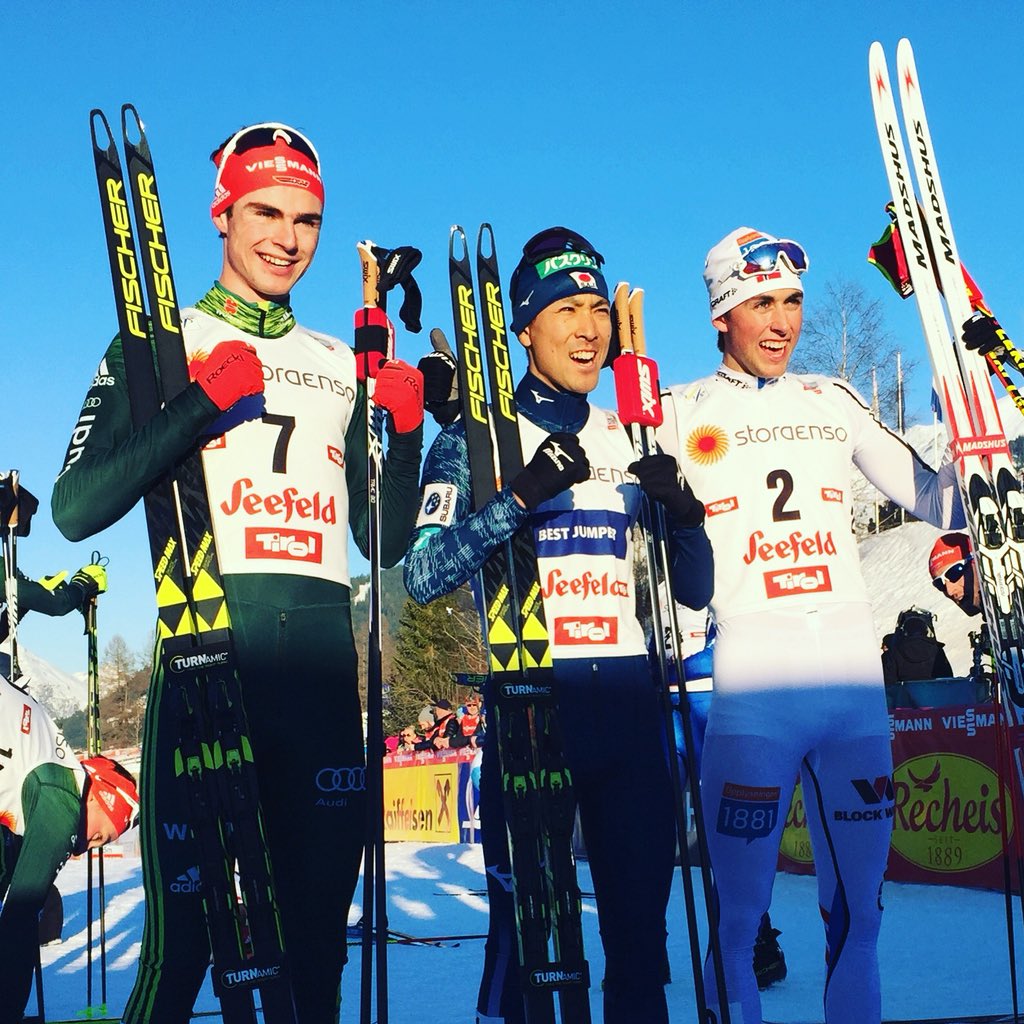
The podium for Day 2 of the Seefeld Triple Nordic Combined World Cup, with Japan’s Akito Watabe in first (c), Germany’s Vinzenz Geiger (l) in second and Norway’s Jarl Magnus Riiber (r) in third. (Photo: FIS Nordic Combined/Twitter)
FIS Nordic Combined World Cup (Seefeld, Austria): Normal hill/10 k
Two of the same men from Friday repeated on the podium on Day 2 of the Seefeld Triple Nordic Combined World Cup, with Japan’s Akito Watabe notching his second-straight win on Saturday.
Norway’s Jarl Magnus Riiber, who finished second on Friday, placed third in Saturday’s individual normal hill/10 k Gundersen, while Germany’s Vinzenz Geiger placed second, more than a minute behind Watabe.
Watabe jumped to first and started the 10 k with a 25-second head start on Riiber in second. Geiger started seventh, 1:45 minutes back, and rose to second at the finish, 1:05.5 behind Watabe (who won in 23:28.5) and 3.4 seconds ahead of Riiber in third (+1:08.9).
For the second day in a row, Norway’s Jan Schmid narrowly missed the podium in fourth (+1:14.1), up from fifth after the jump.
Taylor Fletcher was the lone American competing on Day 2, and he ended up 31st, up 10 places after jumping to 41st. Fletcher started the 10 k race 4:44 out of first then finished 3:52.9 behind Watabe.
The Seefeld Triple concludes Sunday with the individual normal hill/15 k Gundersen.
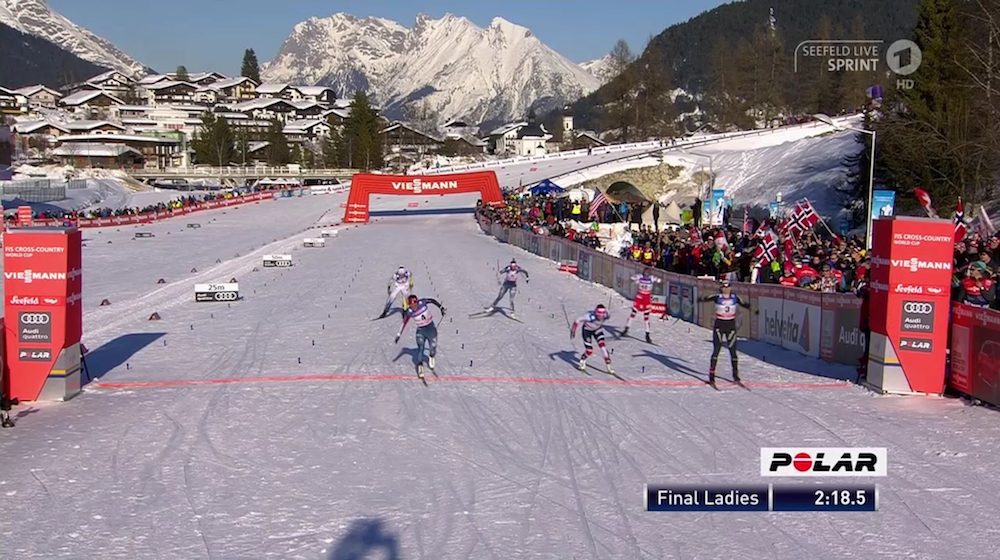
American Sophie Caldwell (l) and Switzerland’s Laurien van der Graaff (r) tied for first on Saturday in the women’s 1.1 k freestyle sprint final at the World Cup in Seefeld, Austria, while Norway’s Maiken Caspersen Falla placed third. (Screenshot: ARD broadcast)
FIS Cross Country World Cup (Seefeld, Austria): Freestyle sprints
It doesn’t get any closer than that. On Saturday, American Sophie Caldwell and Switzerland’s Laurien van der Graaff tied for first in the women’s 1.1-kilometer freestyle sprint final at the World Cup in Seefeld, Austria. They both finished within one-hundredth of a second of each other to take the victory — the last sprint before the Olympics — in 2:18.65 minutes.
Norway’s Maiken Caspersen Falla finished 0.21 seconds later for third place.
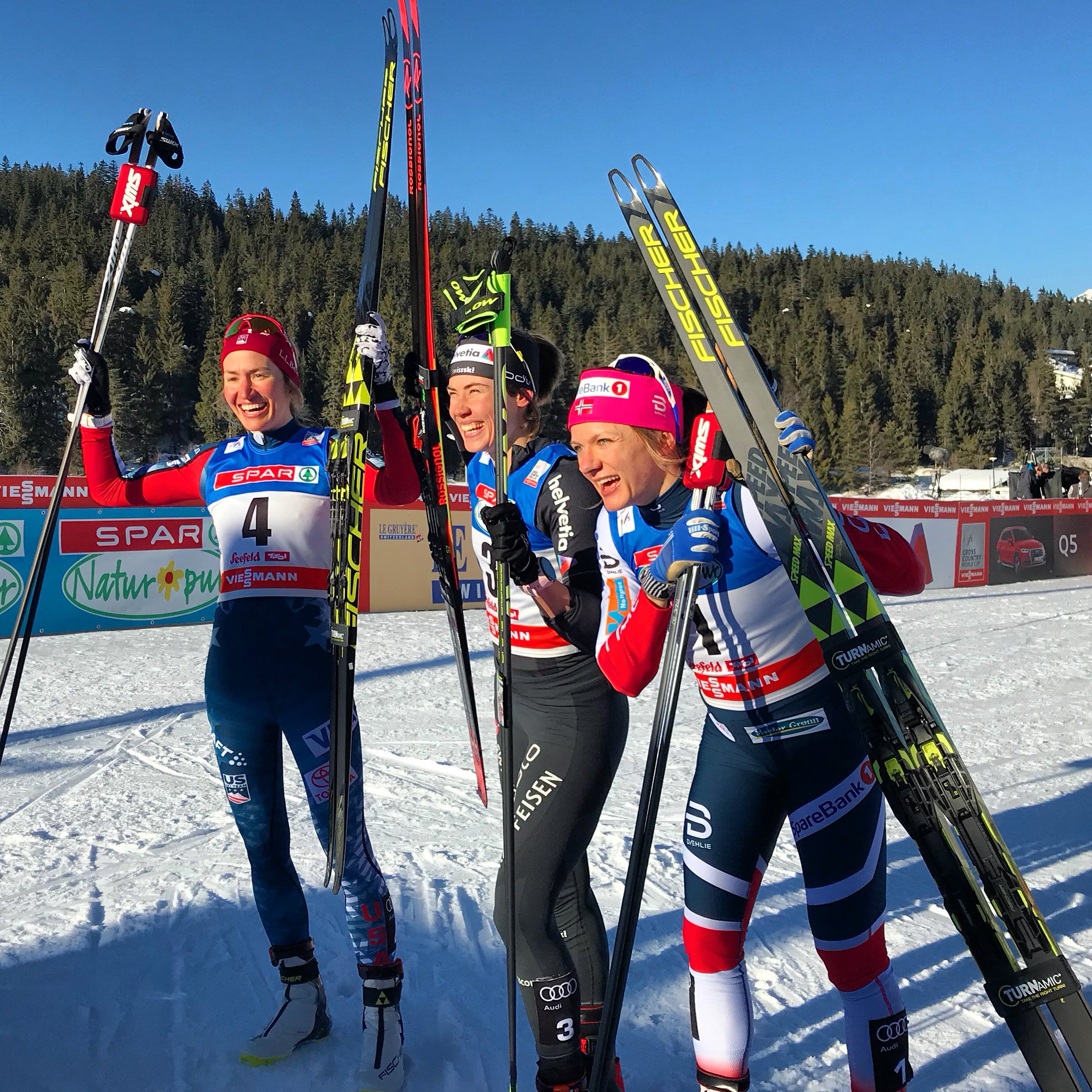
The women’s freestyle sprint podium at Saturday’s World Cup in Seefeld, Austria, with American Sophie Caldwell (l) and Switzerland’s Laurien van der Graaff (c) tying for first and Norway’s Maiken Caspersen Falla (r) placing third. (Photo: FIS Cross Country/Twitter)
“I broke my pole in the semifinal, then I got really tired,” van der Graaff said in a post-race interview with the International Ski Federation (FIS). “But I still believed I can be with Maiken and Sophie, and that I could catch them in the final was just great.”
Norway and the U.S. both had two in the final, with Kathrine Rolsted Harsem of Norway placing fourth (+1.34), Sweden’s Linn Sömskar finishing fifth (+1.83) and American Sadie Bjornsen taking sixth (+2.26).
Falla had raced to first in the qualifying round with a time of 2:21.44, Italy’s Greta Laurent qualified second (+1.43), van der Graaff third (+1.66), Caldwell fourth (+1.84), and Bjornsen fifth (+2.01).
Van der Graaff then won her quarterfinal and placed third in the first semifinal, 0.77 second behind Caldwell, who won it. Falla was second in that semifinal (+0.16) and van der Graaff advanced as a lucky loser.
Caldwell and Falla went head to head in every heat, with Falla winning their first quarterfinal by 0.08 seconds over Caldwell in second.
Bjornsen won her quarterfinal and finished second to Harsem in the second semifinal.
A third American, Kikkan Randall also qualified for the heats, placing 18th in the qualifier then finishing third in her quarterfinal (1.33 seconds behind Sömskar in first) to end up 14th overall.
Canada’s Dahria Beatty placed 30th in the qualifier to nab the last spot in the rounds, then finished fourth in her quarterfinal (1.65 seconds behind Laurent in first) for 20th overall.
For the U.S., Ida Sargent missed qualifying by about half a second in 37th (+8.20), Rosie Brennan finished 42nd (+9.86) and Caitlin Patterson was 52nd (+13.0).
Also for Canada, Emily Nishikawa finished 51st (+12.68) and Cendrine Browne was 54th (+13.34).
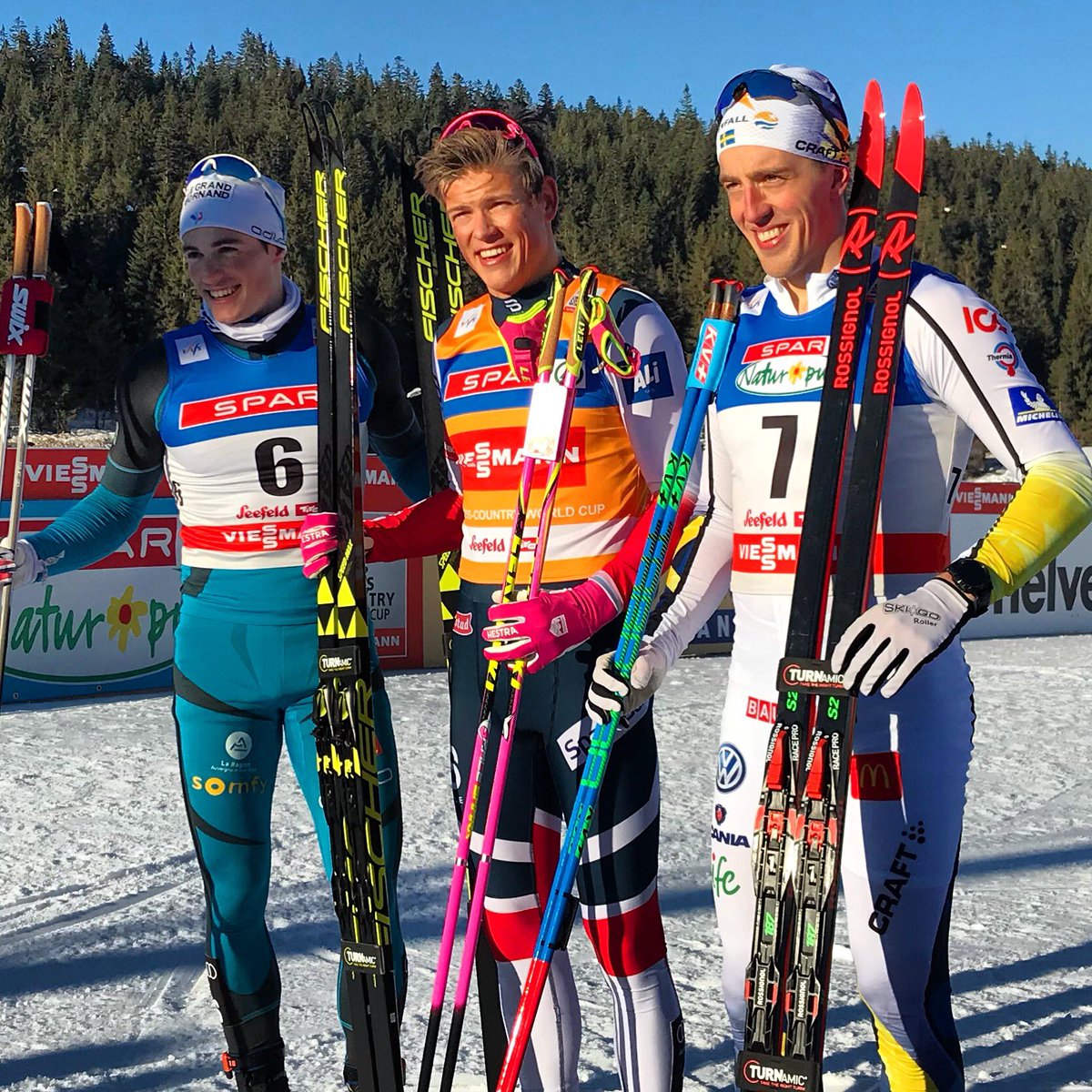
The men’s 1.4 k freestyle sprint podium at the World Cup in Seefeld, Austria, with Norway’s Johannes Høsflot Klæbo (c) in first, France’s Lucas Chanavat (l) in second and Sweden’s Calle Halfvarsson (r) in third. (Photo: FIS Cross Country/ Twitter)
The men raced 1.4 k, with Norway’s Johannes Høsflot Klæbo qualifying first in 2:46.89 then winning his quarterfinal and semifinal before putting the hammer down for one last time in the final, finishing first in 3:02.66.
France’s Lucas Chanavat placed second in the final, 0.48 seconds back, after qualifying sixth, winning his quarterfinal and placing second in the first semifinal (0.33 seconds behind Klæbo). Sweden’s Calle Halfvarsson took the third spot on the podium after finishing 0.97 seconds after Klæbo. Halfvarsson had previously qualified seventh, taken second in his quarterfinal and advanced as a lucky loser in third in the first semifinal (0.52 seconds behind Klæbo).
Italy’s Federico Pellegrino missed the podium in fourth (+1.06), Russia’s Gleb Retivykh placed fifth (+1.17), and Norway’s Emil Iversen was sixth (+5.57).
Canada’s Alex Harvey and American Simi Hamilton both made it to the semifinals, where they finished fourth and fifth, respectively, and did not advance to the finals. Harvey had qualified for the rounds in 22nd and won his quarterfinal, then raced in the second semifinal, where he finished fourth, 0.47 seconds behind Iversen in first. That put Harvey eighth overall on the day.
Hamilton clocked the fifth-fastest qualifying time, 6.46 seconds back from Klæbo’s top time. The U.S. Ski Team member then placed second to Pellegrino in his quarterfinal and was fifth in the first semifinal, 2.61 seconds behind Klæbo. Overall, Hamilton placed ninth.
Also for the U.S., Erik Bjornsen finished 37th in the qualifier, 0.89 seconds out of the top 30 and 11.99 second out of first, Logan Hanneman was 39th (+12.52), Andy Newell 42nd (+12.90), Reese Hanneman 65th (+17.91), and Ben Lustgarten 76th (+21.88).
Canada’s Len Valjas placed 40th (+12.72), Julien Locke 43rd (+13.31), Knute Johnsgaard 51st (+14.74), Bob Thompson 58th (+16.55), Graeme Killick 61st (+17.28), and Devon Kershaw 70th (+19.53).
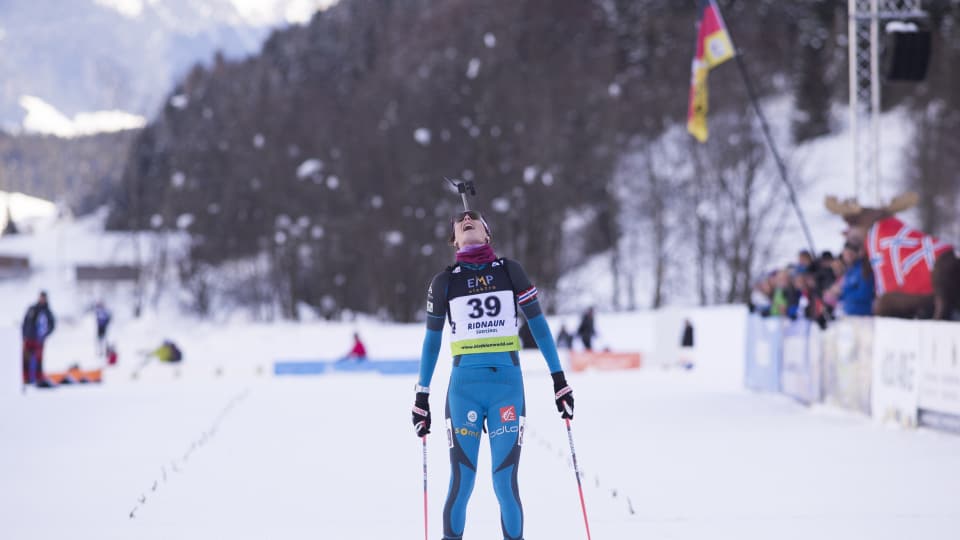
France’s 22-year-old Chloé Chevalier racing to her second win and third podium of the week in as many individual races at 2018 IBU Open European Championships on Saturday in Ridnaun, Italy. (Photo: IBU/Biathlonworld)
IBU Open European Championships (Ridnaun-Val Ridanna, Italy): Men’s and women’s pursuits
France’s Chloé Chevalier picked up her second win and third podium of the week at the International Biathlon Union (IBU) Open European Championships on Saturday in Ridnaun, Italy, winning the women’s 10 k pursuit, while Russia’s Alexander Loginov rose to the top step of the podium in the men’s 12.5 k pursuit on Saturday.
Chevalier started the women’s pursuit in second, 13 seconds behind Ukraine’s Iryna Varvynets (who won Friday’s sprint and thus started first), and shot clean to take the lead after the third stage — where Varvynets missed one. Chevalier went on to clean the final stage for perfect 20-for-20 shooting and crossed the line first in 29:25.4. Varvynets finished second, 11.0 seconds back after missing a single target in the first standing (0+0+1+0), and France had two on the podium with Julia Simon in third (+43.2). Simon also shot 19-for-20, with her miss coming in the second prone stage (0+1+0+0).
“Three medals in three races is definitely more than I had expected,” Chevalier, 22, told the event’s organizers on Saturday. “Today I saw that Iryna shoots faster than I, and so I really gave my all in the track. Even if it might not look like it, after the many races in the last few days I am noticing that I am getting more and more tired.”
American Chloe Levins rose from 59th at the start to 42nd at the finish (+4:11.8), with three clean stages and two misses in the first standing (0+0+2+0). She had the 28th-fastest overall range time and 30th-ranked shooting time.
In the men’s pursuit, Loginov started first as Friday’s sprint winner Latvia’s Andrejs Rastorgujevs did not start. Loginov held the lead throughout the race despite two misses — one in the first stage and another in the last stage (1+0+0+1) — and secured the win in 32:22.1. Bulgaria’s Krasimir Anev started second, 19 seconds after Loginov, and held his place as well, shooting clean and finishing second, 27.6 second back.
“I am really happy here in Ridanna and the results reflect that,” Loginov, 25, told organizers. “Not to start in the individual event on Wednesday was the right decision because the last few days had been very demanding with six races in eight days. I am cross with my two errors in the shooting range, but very happy with my performance in the track.”
Russia had two on the podium with Evgeniy Garanichev in third (+1:10.7) after Garanichev started in bib 19 and overcame three penalties (1+0+2+0) with the fastest overall course time.
Canada’s Macx Davies started 27th and finished 35th (+4:33.9) with five misses (3+0+2+0), while American Alex Howe rose from 53rd at the start to 43rd (+5:53.5) with five penalties (2+2+1+0).
The 2018 Open European Championships conclude with the single mixed relay and mixed relay on Sunday. American Susan Dunklee and Lowell Bailey are on the start list for the single mixed relay, Canada’s Carsen Campbell and Sarah Beaudry. For the mixed relay, the U.S. has entered Levins, Maddie Phaneuf, Paul Schommer, and Alex Howe.
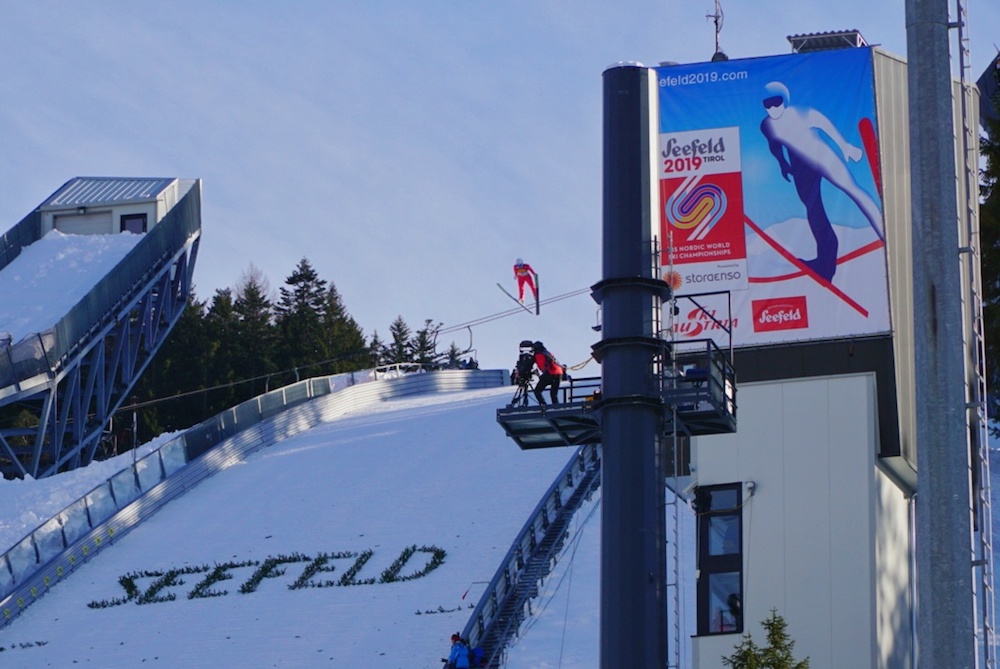
The jumping portion of the Nordic Combined World Cup Seefeld Triple on Friday in Seefeld, Austria. (Photo: Garrott Kuzzy / LumiExperiences.com)
Nordic Combined World Cup (Seefeld, Austria): Individual normal hill/5 k
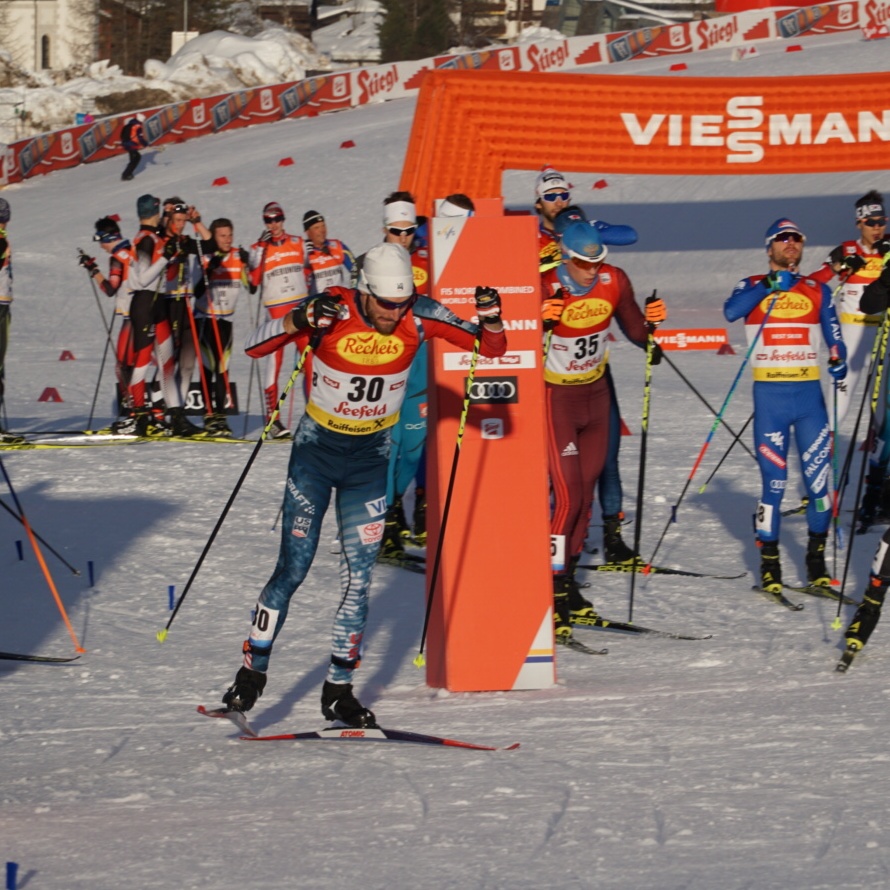
On the first of the three-day Seefeld Triple Nordic Combined World Cup, Japan’s Akito Watabe took the win and Taylor Fletcher was the top American in 28th in the individual normal hill/5-kilometer Gundersen on Friday.
Japan’s Akito Watabe heading out of the gate second in the 5 k Gundersen on Friday at the Seefeld Triple Nordic Combined World Cup in Seefeld, Austria. Watabe went on to win the race by half a second. (Photo: Garrott Kuzzy / LumiExperiences.com)
Watabe put himself in second in the jump portion and started the 5 k ski race 21 seconds behind Norway’s Jarl Magnus Riiber in first. Watabe caught Riiber and beat him at the finish line, taking the win in 11:22.3 minutes, while Riiber followed 0.5 seconds back in second place. Germany’s Fabien Rießle followed in third, 32.4 seconds out of first, after starting the 5 k in sixth and 1:03 minutes back.
Norway’s Jan Schmid jumped to third and ended up fourth (+37.8). Watabe’s brother, Yoshito Watabe placed fifth (+47.2), losing one place in the ski race after jumping to fourth.
Two Americans competed, with Fletcher jumping to 30th and ending the day in 28th, and Jasper Good finishing 52nd (+3:45.6) after jumping to 49th. Both are headed to the 2018 Olympics next month in PyeongChang, South Korea.
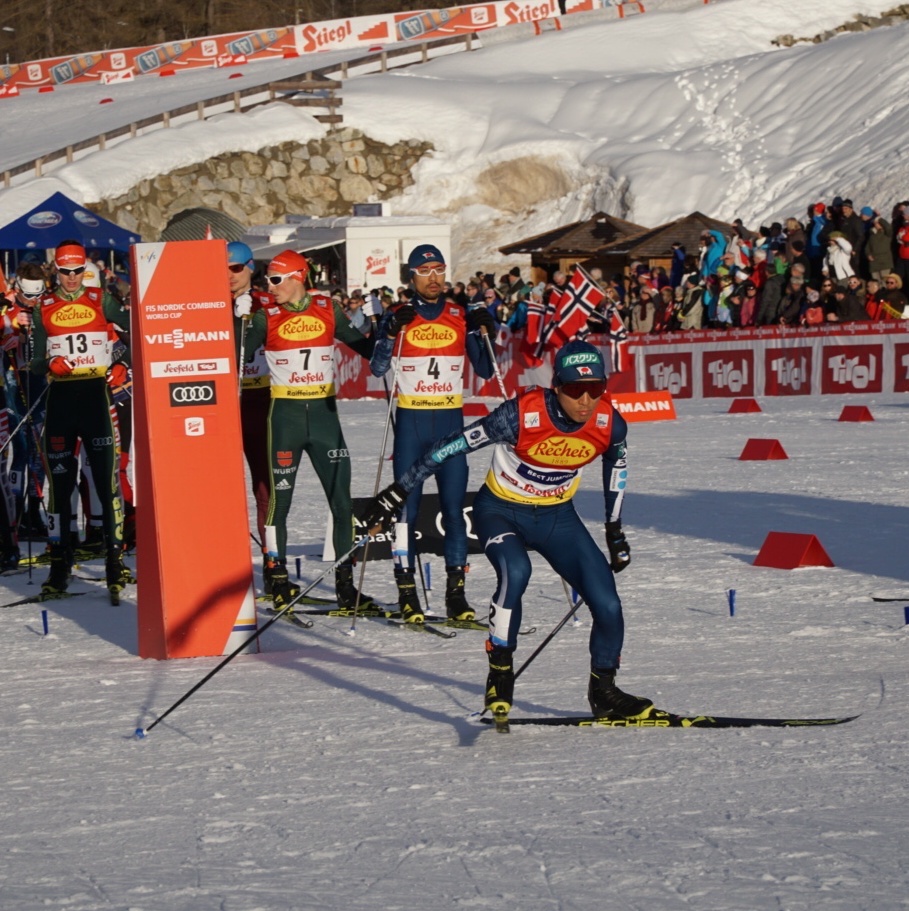
Taylor Fletcher (USA Nordic) starting the 5 k Gundersen on Friday at the Seefeld Triple Nordic Combined World Cup in Seefeld, Austria. He started in 30th and finished 28th. (Photo: Garrott Kuzzy / LumiExperiences.com)
***
U.S. SuperTour (Craftsbury, Vermont): Classic sprints
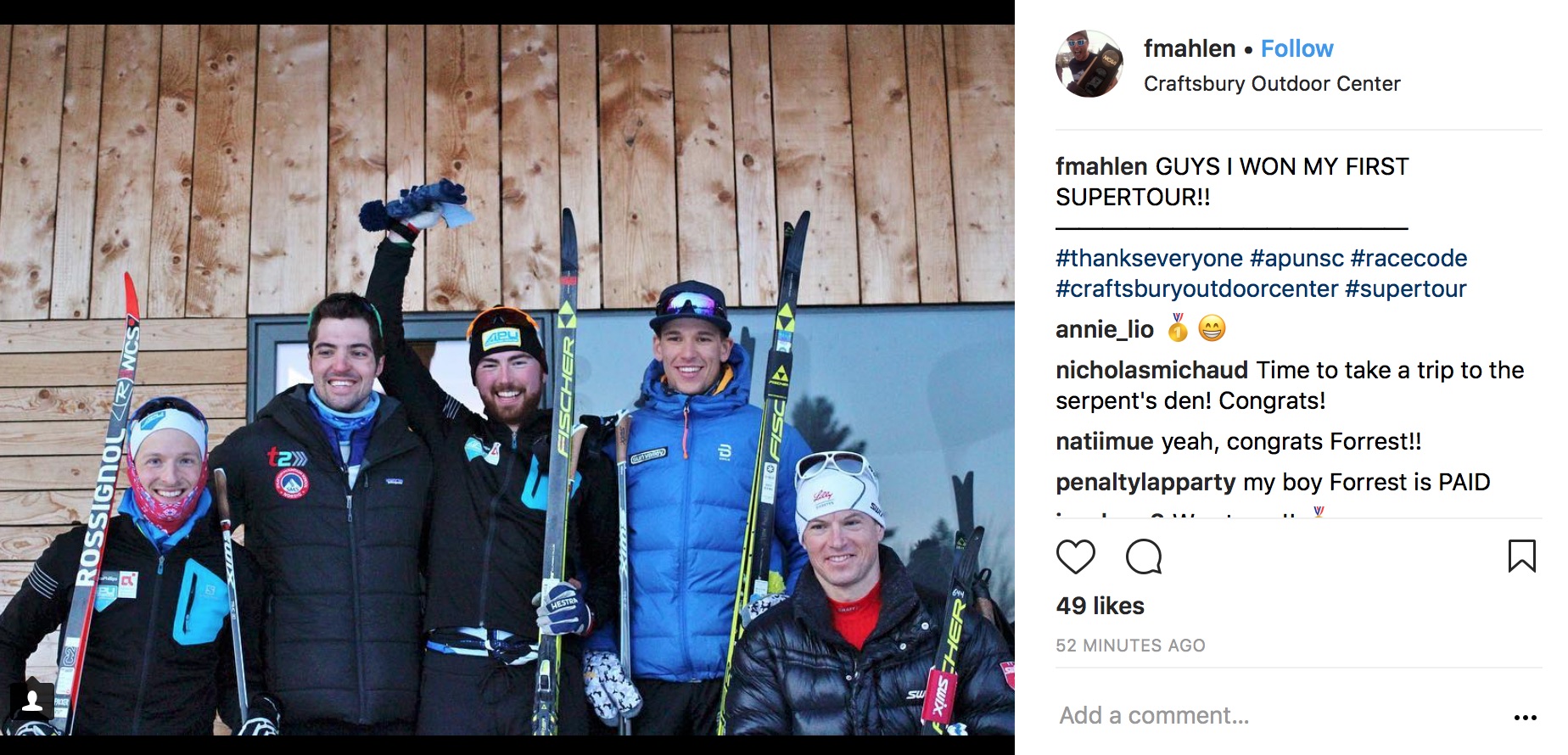
Forrest Mahlen (APU) celebrates his first time atop the SuperTour podium on Friday after winning the men’s 1.4 k classic sprint final in Craftsbury, Vermont. (Photo: Forrest Mahlen/Instagram)
Kaitlynn Miller and Forrest Mahlen won their respective classic-sprint finals at Friday’s SuperTour in Craftsbury, Vermont.
The 1.4-kilometer classic sprint kicked off a three-day race weekend at the Craftsbury Outdoor Center. On Saturday, the Craftsbury Marathon will be held (not a SuperTour event), followed by 5/10 k freestyle SuperTour races on Sunday.
Miller, of the Craftsbury Green Racing Project, started Friday by winning the women’s qualifier. She went on to win both her quarterfinal and semifinal before topping the final as well in 3:40.9 minutes. Also on Friday, it was formally announced that Miller was named to the U.S. Cross-Country Ski Team’s Olympic squad, which will compete in PyeongChang, South Korea, Feb. 10-25.
Kelsey Phinney, of the Sun Valley Ski Education Foundation (SVSEF), placed second in the women’s final, 0.63 seconds back, and Felicia Geisor (CXC Team) was third (+1.67). Erika Flowers, of the Stratton Mountain School (SMS) T2 Team placed fourth (+3.2), Canada’s Olivia Bouffard-Nesbitt (Rocky Mountain Racers) — fresh off NorAm Western Canadian Championships last weekend in Alberta — finished fifth (+5.46), and Alaska Pacific University (APU) skier Rosie Frankowski (who also made the U.S. Olympic team) placed sixth (+6.27).
On the men’s side, APU’s 24-year-old Mahlen qualified fifth, then won his quarterfinal and semifinal before taking the final for his first-career SuperTour win in 3:06.81. Ben Saxton (SMST2) initially won the qualifier and won his quarterfinal as well before placing second to Mahlen in the first semifinal. Saxton ended up 0.55 seconds back in second place in the final, just three-hundredths of a second ahead of Kevin Bolger (SVSEF) in third place (+0.58). Another half second back, Kris Freeman followed in fourth, just 1.09 out of first, Eric Packer (APU) was fifth (+1.39) and Canada’s Andy Shields (Lappe Nordic), who also competed at Western Canadian Championships last weekend) sixth (+8.99).
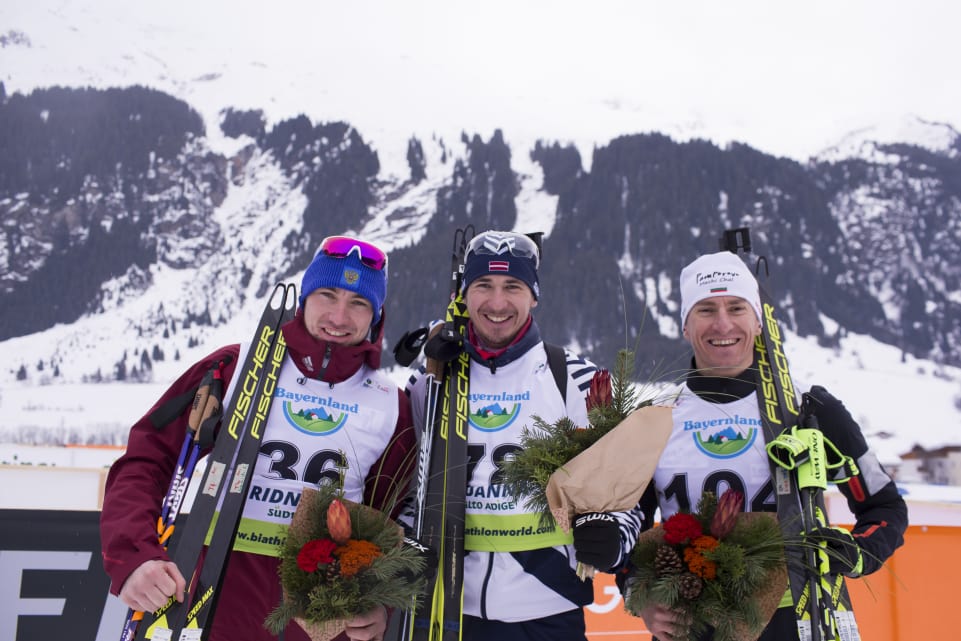
The men’s 10 k sprint podium at IBU Open European Championships, with Latvia’s Andrejs Rastorgujevs (c) in first, Russia’s Alexander Loginov (l) in second, and Bulgaria’s Krasimir Anev (r) in third. (Photo: IBU/Biathlonworld)
IBU Open European Championships (Ridnaun-Val Ridanna, Italy): Men’s and women’s sprints
Canada’s Macx Davies led the North Americans on Friday on Day 2 of the International Biathlon Union (IBU) Open European Championships in Ridnaun, Italy, placing 27th in the men’s 10-kilometer sprint with 9-for-10 shooting (1+0). Davies finished 1:32.3 minutes behind Latvia’s Andrejs Rastorgujevs, who took the win in 24:03.0 with a single penalty as well (0+1).
Russia’s Alexander Loginov placed second, 5.5 seconds back, with one penalty (1+0), and Bulgaria’s Krasimir Anev shot clean to finish third (+24.5).
“At the [last] World Cup in Anterselva [Italy], I have had a difficult time in the shooting range, and so I spent a lot of time in the last few days working on my shooting,” Rastorgujevs told the IBU after. “Today it was clear that all this hard work paid off. It is also a great motivator for Olympic gold.”
For Davies, who’s also headed to the Olympics next month, the result tied his best individual result this season after he placed 27th in an IBU Cup sprint earlier this month in Osrblie, Slovakia.
Canada entered four in the men’s race, with Carsen Campbell finishing 75th (+2:34.6) with one miss (0+1), Aidan Miller placing 91st (+3:18.2) with three penalties (1+2), and Matt Hudec finishing 119th (+4:31.6) with four misses (1+3).
Five American men raced, with Alex Howe finishing 53rd (+2:15.1) with one penalty (1+0), Jake Brown 84th (+3:02.0) with four misses (1+3), Jakob Ellingson 85th (+3:07.0) with one miss (1+0), Max Durtschi 111th (+3:50.1) with four misses (3+1), and Paul Schommer 114th (+3:59.8) with four penalties (2+2) as well.
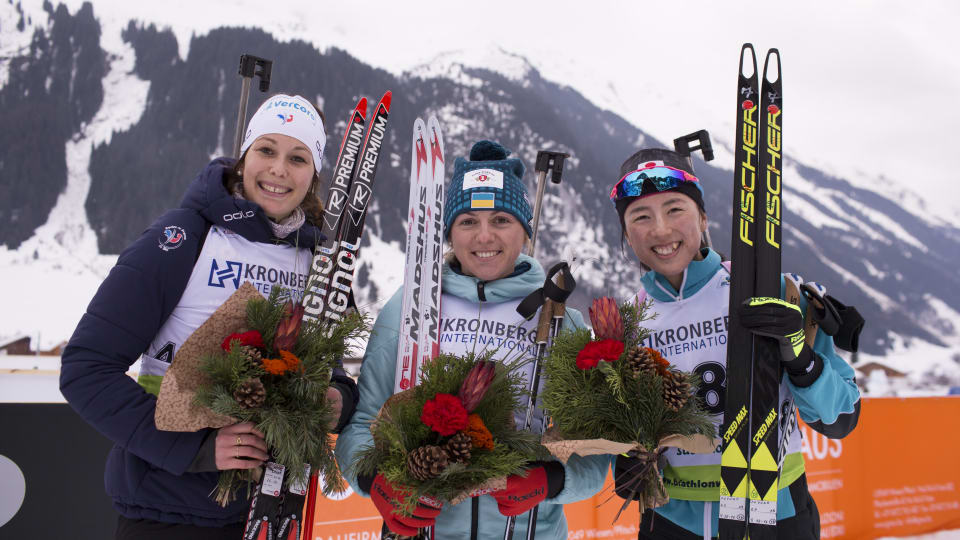
The women’s 7.5 k sprint podium at IBU Open European Championships in Ridnaun, Italy, with Ukraine’s Iryna Varvynets (c) in first, France’s Chloé Chevalier (l) in second, and Japan’s Fuyuko Tachizaki (r) in third. (Photo: IBU/Biathlonworld)
In the women’s 7.5 k sprint that followed, Chloe Levins of the U.S. was the top North American in 59th, 2:01 behind the winner Iryna Varvynets of Ukraine. Varvynets shot clean and posted the fastest finishing time of 20:54.1, 12.5 seconds faster than France’s Chloé Chevalier, Wednesday’s 15 k champion who had one miss (0+1) on Friday and ended up second. Japan’s Fuyuko Tachizaki reached the podium in third (+15.5) and was one of four women in the top five that shot clean (only Chevalier did not).
“After the individual competition on Wednesday, I was not at all happy with my shooting,” said Varvynets, who placed fifth in the 15 k. “Today I therefore concentrated especially hard in the shooting range. It was my luck that not many finished without errors, otherwise it would probably not have been enough for the victory.”
“Two races, two medals — it could not have gone better for me,” Chevalier said. “In the standing shooting I missed the first disc and got a little nervous, but thankfully, there were no further errors.”
Tachizaki called the bronze medal a “big dream come true”.
“The focus of my season had been the Olympics and I ‘only’ took part in Ridanna as part of the preparations, but with this result I have exceeded everything I have achieved so far,” she said. “At the end of the race I did not only fight hard in the track, I was already dreaming of a medal. Now I’m in seventh heaven.”
Levins had one miss in each stage (1+1), as did fellow American Maddie Phaneuf, who finished 63rd (+2:19.0) with two penalties. Clare Egan followed in 70th (+2:34.2) with four misses (3+1), Deedra Irwin was 85th (+3:38.1) with four penalties (1+3) as well, and Jennie Bender 97th (+5:52.8) with six misses (3+3).
Two Canadians started the race, with Sarah Beaudry finishing 76th (+3:02.9) with four misses (1+3). Erin Yungblut did not finish.
Open European Championships continue Saturday with the men’s and women’s pursuits. The top 60 from the sprint qualify, which, for the North Americans, means Davies, Howe, and Levins.
The championships end Sunday with single mixed and mixed relays.
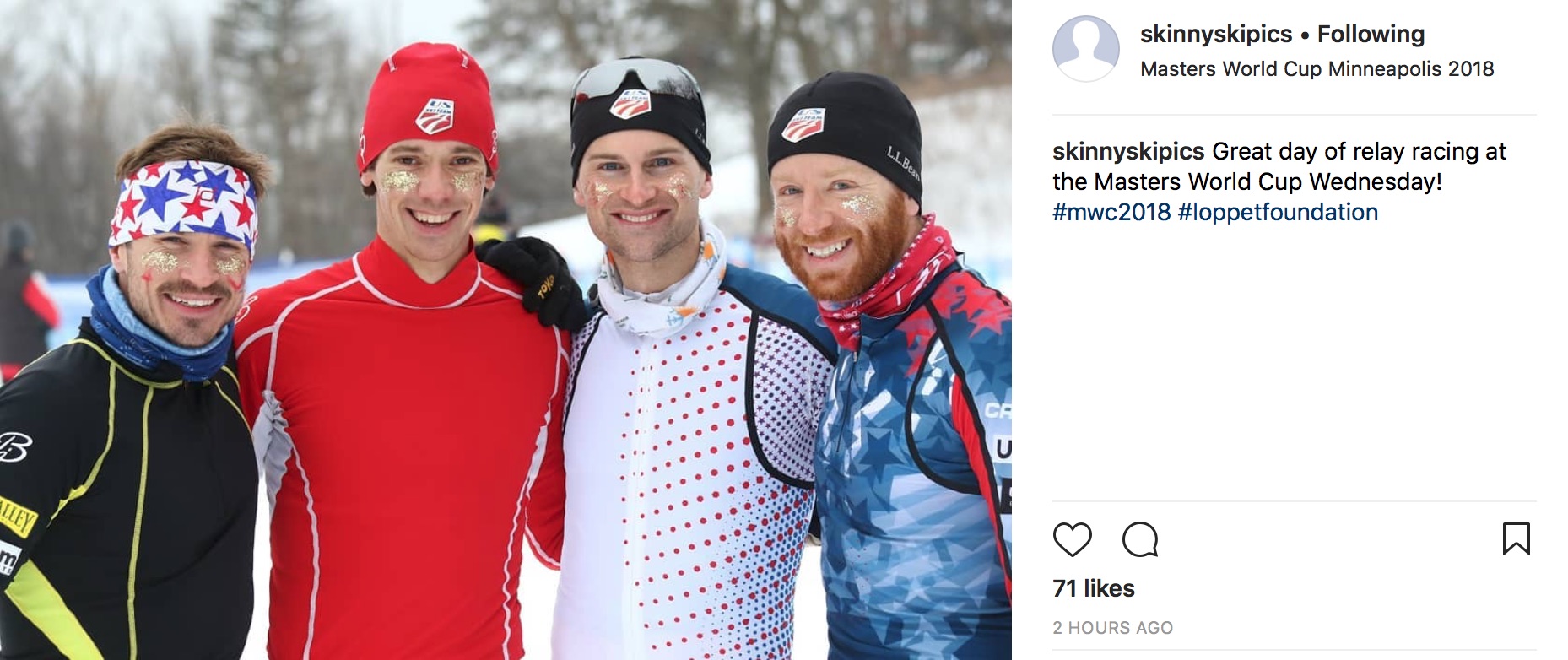
Matt Liebsch (l) and his men’s age-group “1” 4 x 5 k winning relay team on Wednesday at 2018 Masters World Cup in Minneapolis, Minnesota. (Photo: SkinnySki/Instagram)
2018 Masters World Cup (Minneapolis, Minnesota): 4 x 5 k relays
Matt Liebsch, 34, anchored the winning relay of the youngest men’s age group (AG 1) at 2018 Masters World Cup on Wednesday, crossing the line in 45:57.2 minutes (the fastest relay time of the day) and teaming up with fellow Americans Christopher Harvey, Mark Johnson and Zach Varty. Two teams competed in that age group’s 4 x 5 k relay, with Italy finishing second, 1:22.6 minutes back.
The U.S. won all five women’s 4 x 5 k relays on Wednesday, and eight total between the men’s and women’s age groups. Finland had the second-most relay victories with five in the men’s categories.
Canada won the men’s AG 4, beating out four other teams with Gabriel Babin, Bruce Macneil, Luc Tremblay, and Michel Labrie, who finished the 4 x 5 k in 49:41.9. Germany placed second (+36.4), and the U.S. third (+54.1).
Piotr Bednarski, head coach of Loppet Nordic Racing, which is based out of Theodore Wirth Park, anchored the men’s AG 5 to a win in 49:39.1, with teammates Rune Harkestad, Dennis Paul and David Sjogren.
Masters World Cup continues with 15/30/45 k classic distance races on Thursday at Wirth Park.
Day 4 Age Group (AG) 4 x 5 k Relay Winners
Men:
AG 1: USA (Christopher Harvey, Mark Johnson, Zach Varty, Matt Liebsch) 45:57.2
AG 2: Finland (Jouni Leinonen, Mika Kilpeläinen, Johan Gustafsson, Joachim Gustafsson) 47:53.4
AG 3: Russia (Ivan Batyutenko, Andrey Lushnikov, Sergey Degtyarev, Aleksandr Pushkarev) 46:43.3
AG 4: Canada (Gabriel Babin, Bruce Macneil, Luc Trembley, Michel Labrie) 49:41.9
AG 5: USA (Rune Harkestad, Dennis Paul, David Sjogren, Piotr Bednarski) 49:39.1
AG 6: USA (Milan Baic, Odd Bersvendsen, Kent Murdoch, Barry Makarewicz) 48:48.3
AG 7: Finland (Heikki Ruokonen, Tapio Tikkanen, Timo Pullinen, Aito Pennanen) 51:56.3
AG 8: Finland (Leino Nisula, Pauli Halonen, Yrjo Teravainen, Harri Makela) 54:58.4
AG 9: Finland (Veikko Piirainen, Tapio Ikaheimonen, Paavo Raisanen, Vaino Paakko) 58:18.9
AG 10: Finland (Alpo Virtanen, Tapio Wallenius, Jouko Laiho, Riku Kyllonen) 1:02:39.7
Women:
AG 1: USA (Kathleen Dewahl, Tamra Kornfield, Davya Flaharty, Gina Chythlook) 56:49.3
AG 2: USA (Bonnie Weiskopf, Kim Rudd, Mary Mckelvey, Mary Wellington) 56:23.9
AG 3: USA (Elizabeth Youngman, Kelly Milligan, Jan Guenther, Kelly Skillicorn) 56:23.6
AG 4: USA (Kate Ellis, Magdenla Bowen, Joann Hanowski, Muffy Ritz) 1:00:33.6
AG 5: USA (Gabriele Andersen, Constance Meek, Dagmar Eriksson, Kati Campbell) 1:14:23.4
France’s Chloe Chevalier after winning the women’s 15 k individual on Day 1 of IBU Open European Championships in Ridnaun, Italy. (Photo: IBU/Biathlonworld)
IBU Open European Championships (Ridnaun-Val Ridanna, Italy): 15/20 k individual
The International Biathlon Union (IBU) Open European Championships opened Wednesday in Ridnaun (Val Ridanna), Italy, with several North Americans competing in the women’s 15- and men’s 20-kilometer individual races.
Austria’s Felix Leitner racing to the win in the first race of 2018 IBU Open European Championships, the men’s 20 k individual, on Wednesday in Ridnaun, Italy. (Photo: IBU/Biathlonworld)
Canada’s 23-year-old Carsen Campbell raced to 19th in the men’s 20 k, shooting 19-for-20 (1+0+0+0) and finishing 3:18.5 minutes behind the winner, Austria’s Felix Leitner, who clocked the fastest time in 53:32.8 — also with one penalty (0+0+0+1).
Leitner, 21, won by 43 seconds over Tomas Krupcik of the Czech Republic, who also had a single penalty in the last standing stage (0+0+0+1) and placed second.
Germany’s Philipp Horn reached the podium in third (+56.6), with 19-for-20 shooting as well (1+0+0+0).
According to an IBU press release, Leitner is one of the youngest athletes to win the 20 k, the longest race on the circuit.
“I had many problems with my shooting lately, but today it was probably the best in the last two seasons,” Leitner said, according to the release. “I believed in myself and knew that I have to run fast from the beginning, and if the shooting would be as good as during the training, I could be in the top.”
Campbell, of Biathlon Canada’s National “Z” Team, was the top North American in 19th in his second trip to Open European Championships. Previously, his best individual result was 64th last year.
Paul Schommer led the U.S. men in 46th (+5:22.6) with three penalties (0+1+1+1). Max Durtschi also shot 17-for-20 (1+0+1+1) and ended up 56th (+6:18.5), Jakob Ellingson followed in 58th (+6:23.5) with two penalties (0+0+1+1), and Jake Brown finished 74th (+8:06.7) with seven penalties (1+1+3+2). Alex Howe did not start.
For Canada, Macx Davies, a senior national team member who is headed to the Olympics, placed 67th (+7:32.7) with five penalties (2+2+1+0). Matt Hudec was 96th (+12:00.5) with six penalties (0+2+1+3), and Aidan Miller 105th (+14:49.0) with nine penalties (2+1+1+5).
In the women’s 15 k that followed, Sarah Beaudry, of Biathlon Canada’s Senior National Team as well as Olympic team, was the top North American in 23rd, 4:55.6 out of first. Beaudry, 23, shot 18-for-20, with her two misses coming in the first prone (2+0+0+0).
France’s Chloe Chevalier won the women’s race, with spring-like temperatures around 6 degrees Celsius, in 46:32.9 with a single penalty, also in the first stage (1+0+0+0). The second- through fourth-place finishers all shot clean, with Italy’s Alexa Runggaldier placing second (+47.7), Russia’s Victoria Slivko taking third (+55.9) and Ukraine’s Yuliia Zhuravok missing the podium by half a second in fourth place (+56.4).
“After that penalty in the first prone, I relaxed and did not worry about the result,” Chevalier said after, according to an IBU press release. “I just enjoyed being out on the tracks on a beautiful sunny. Maybe the key to success is relaxing and not worrying about the result.”
Two Canadian women entered the event, with Erin Yungblut finishing 83rd (+13.19.9) with eight penalties (2+3+1+2).
Chloe Levins was the top American woman in 60th (+7:18.6) with four penalties (1+2+1+0), and Maddie Phaneuf, who made US Biathlon’s Olympic team, followed in 65th (+8:10.8) with four misses as well (1+2+0+1). Deedra Irwin finished 82nd (+13:15.8) and Jennie Bender was 87th (+15:05.0), both with 10 penalties apiece.
Open European Championships continue Friday with the men’s and women’s sprints, followed by pursuits on Saturday and relays on Sunday.
Rosanna Crawford (Biathlon Canada) celebrates her first-career IBU World Cup podium on Thursday in the women’s 15 k individual in Ruhpolding, Germany. (Photo: Salomon/Nordic Focus)
IBU World Cup (Ruhpolding, Germany): Women’s 15 k individual
It’s been a long time coming, but on Thursday, Rosanna Crawford, 29, achieved her first podium on the International Biathlon Union (IBU) World Cup circuit.
It came in Ruhpolding, Germany, in the longest-format race for the World Cup women: the 15-kilometer individual. In the four-stage race, which adds a minute penalty to a competitor’s time for each missed shot, Crawford of Canmore, Alberta, shot a perfect 20-for-20. She said she had never done that before in a World Cup race.
“I really like the Ruhpolding range,” Crawford said in a post-race phone interview, after finishing third behind Italy’s Dorothea Wierer and Finland’s Kaisa Mäkäräinen, respectively. “This was my first World Juniors, my first World Cup and now my first podium, so it’s a pretty special place for me.”
Wierer won the race with 20-for-20 shooting as well, starting 24th and finishing with the fastest time of 41:29.0 minutes. Mäkäräinen as the 12th starter missed out on first place due to a single miss in the first prone (1+0+0+0) and ended up 12.7 seconds back in second place.
Crawford, one of the last starters in bib 97, turned heads throughout the race with each passing clean bout. With one extra breath before her last shot, she successfully hit her last target and left the range with a huge smile.
“I think I almost started crying,” she recalled.
She finished 21.7 seconds out of first, and almost 25 seconds clear of fourth-place finisher Yulia Dzhima of Ukraine. Even a Ukrainian coach was cheering for Crawford on her last loop.
“That last lap was so cool,” Crawford said. “Right past the penalty loop, the Ukrainian coach was like, ‘You’re one second, — or whatever time I was — from first,’ and it was amazing. I think this really describes what the biathlon family actually is. It’s not the IBU. It’s the coaches and the athletes and the wax techs and the fans.”
Her teammates and coach, Roddy Ward, awaited her arrival in the finish pen.
“Canada’s not on the podium every day so they let them sneak by to give me a hug so that was really special,” Crawford said.
Her result is her first non-relay top 10 since a pursuit in December 2014, where she placed seventh in Pokljuka, Slovenia. The race before that, she placed fourth in the Pokljuka 7.5 k sprint, which was had been career best — until Thursday.
“Who knew that I would get my first podium in an individual?” Crawford mused. “I was laughing at that myself.”
The U.S. was led by Susan Dunklee in 27th (+3:02.7), who had one penalty in each of the first three stages (1+1+1+0).
Canada’s Julia Ransom placed 34th (+3:35.0) with two penalties (1+1+0+0), Sarah Beaudry was 53rd (+4:18.6) with two misses as well (0+1+1+0), and Emma Lunder finished 67th (+5:21.7) with four penalties (1+0+2+1).
Two Americans raced, with Clare Egan finishing 57th (+4:26.3) with three penalties (0+1+0+2).
“Certainly the highlight for me today was watching Rosanna crush it,” Dunklee wrote in an email. “Her whole team, athletes and staff, were overjoyed. It’s inspiring to see and lends positive energy to all the North Americans going forward.”
She also pointed out that her U.S. teammates Emily Dreissigacker and Maddie Phaneuf placed fifth and 11th, respectively, with clean shooting in the IBU Cup women’s 15 k individual, also on Thursday.
“That spark is exactly what our team needs right now and the timing is spot on,” Dunklee continued. “We will field our first women’s relay this weekend. It has been a challenging season so far living and traveling with such a small crew, trying to stay upbeat and carry the team with a skeleton group.”
The World Cup men’s 4 x 7.5 k relay is scheduled for Friday at 8:30 a.m. EST, with both Canada and the U.S. entering teams. (Men’s relay start list)
The women’s 4 x 6 k relay is on Saturday at 8:30 a.m. EST, with the men’s and women’s mass starts following on Sunday in Ruhpolding.
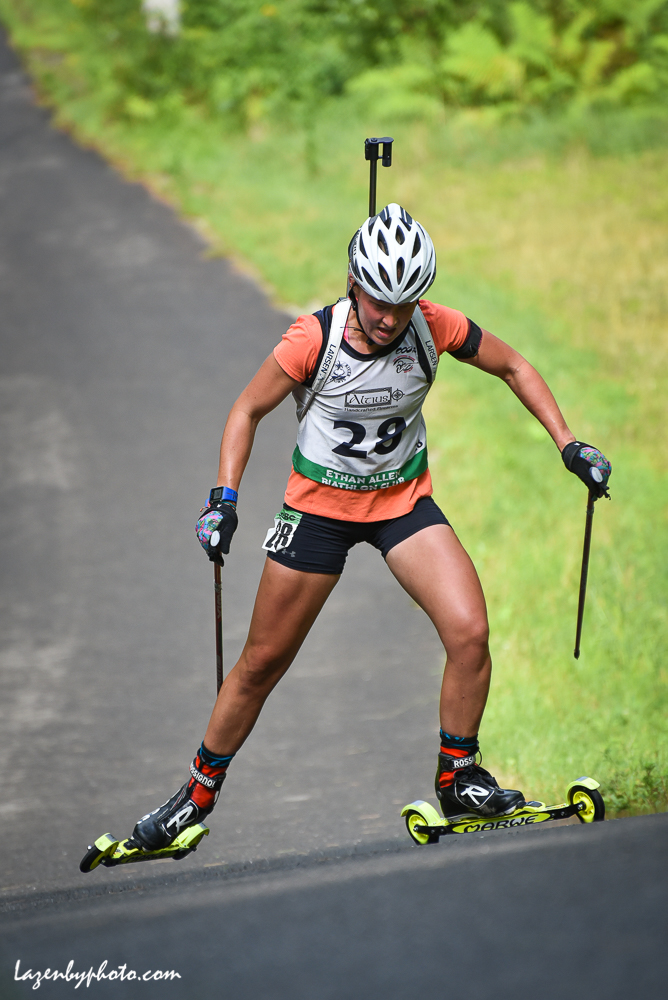
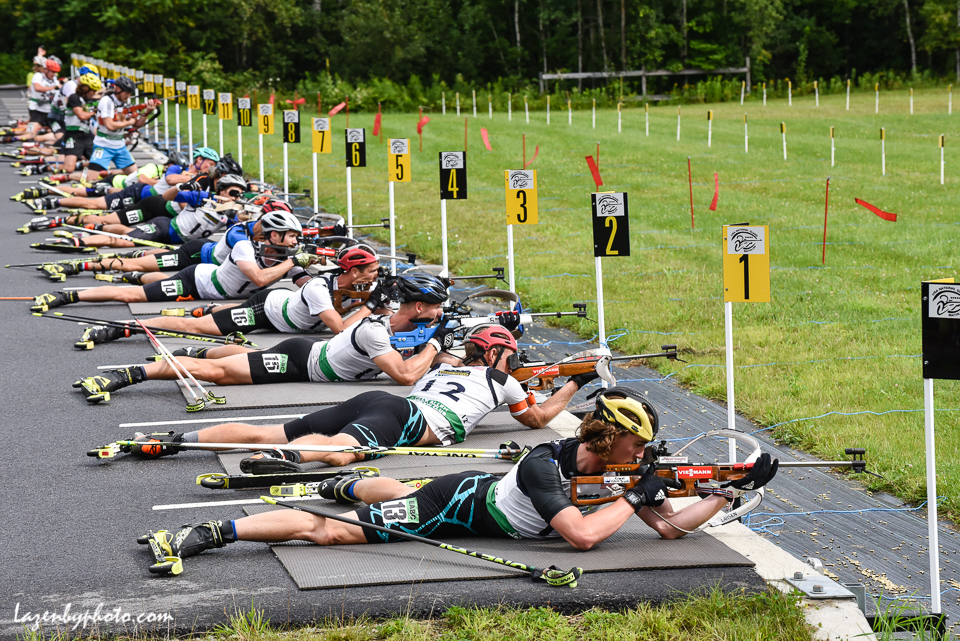
Kelsey Dickinson (Craftsbury Collegiate Summer Team) racing to third in the women’s sprint at US Biathlon Rollerski Championships on Aug. 12 in Jericho, Vt. Dickinson had more strong performances this past weekend to secure a spot on the World Cup in December. (Photo: John Lazenby/Lazenbyphoto.com)
For some American biathletes, there was a lot on the line in Jericho, Vermont this past weekend.
Saturday and Sunday were rollerski biathlon competitions that served as the third and fourth of a four-race team selection series. Six athletes – Susan Dunklee, Clare Egan, Lowell Bailey, Leif Nordgren, Sean Doherty, and Tim Burke – had already booked their places for the first period of World Cup racing thanks to results from last season.
But between one and three places still needed to be filled on the U.S. team, and the Jericho races – the first two were held at the Vermont biathlon complex in August – would be used to select a team for a pre-season camp in Canmore, Alberta. From there, the squad would be winnowed down for the December World Cup.
Kelsey Dickinson (College of St. Scholastica) racing to 26th in the women’s 15 k freestyle mass start at 2017 NCAA Skiing Championships on March 11 at the Jackson Ski Touring Center in Jackson, N.H. (Photo: Flyingpointroad.com)
One College of Saint Scholastica student, Kelsey Dickinson, booked her place on the World Cup. A St. Scholastica alumnus, Paul Schommer, all but did the same – he was selected to the camp, and is highly likely to also go on to the World Cup.
Two more women, Joanne Reid of Colorado Biathlon and Emily Dreissigacker, of the Craftsbury Green Racing Project, were selected for the camp and will have to compete for the last World Cup spot.
Even for the pre-qualified athletes, it was a weekend of important competitions, a chance to hone stills practiced over the summer and start visualizing the international competitions that will start in just six weeks.
“It’s an important marker – it’s not nothing,” U.S. Biathlon Association Chief of Sport Bernd Eisenbichler said in an interview this morning. “We try to really run the trials like a national-level race. The Jericho crew led by John Madigan did an awesome job to put a real race on, not just a time trial. You have a bib number on, you want to perform and you want to execute the things you’ve worked on throughout the summer.”
The Women: Three Trials Race Winners Heading to Canmore
With the pre-qualified duo of Dunklee and Egan excluded from ranking results, Dickinson won the trials series in best-three-of-four scoring. Even with Dunklee and Egan in the results, she was only off the podium once in the four-race series.
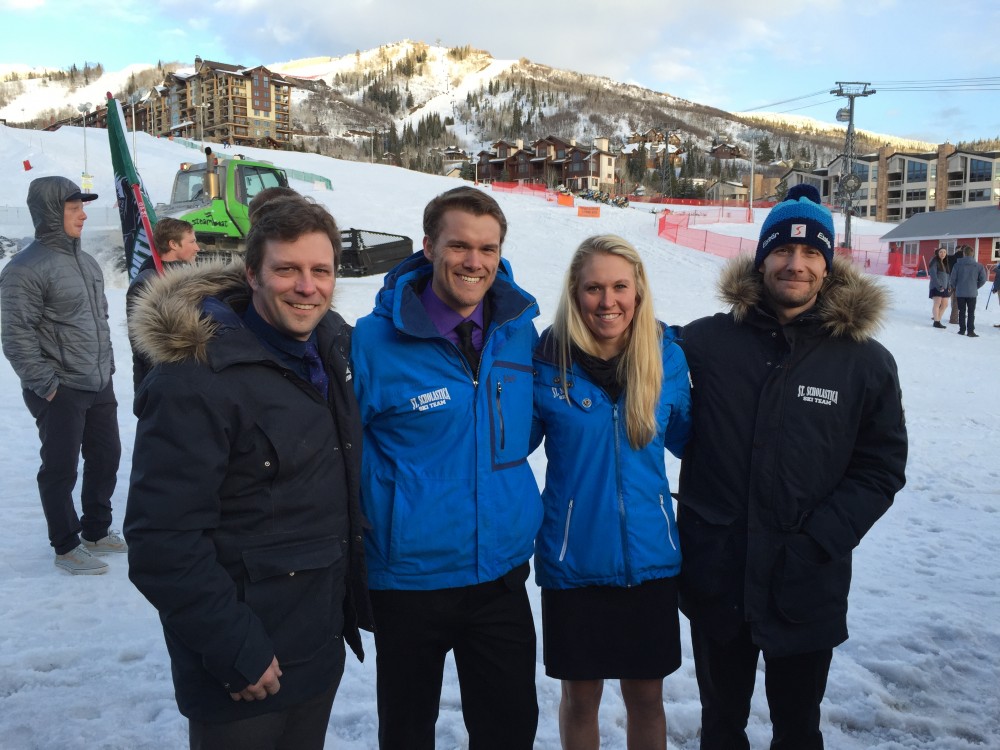
Chad Salmela (far left) with 2016 NCAA qualifiers Reitler Hodgert and Kelsey Dickinson as well as assistant nordic coach Josh Tesch at 2016 NCAA Championships in Steamboat Springs, Colo. (Photo: Chad Salmela)
“I’m really pleasantly surprised and impressed also with how she did that, with being outside the team environment,” Eisenbichler said.
Dickinson was formerly an athlete at the Maine Winter Sport Center (now the Outdoor Sports Institute), but when that program shuttered its senior funding scheme in the spring of 2015 she felt she had no choice but to go back to school. Since then she has worked with coaches Chad Salmela and then Maria Stuber, and become an NCAA qualifier for Saint Scholastica in cross-country skiing.
Dickinson spent this summer at the Craftsbury Outdoor Center training for biathlon, along with Dreissigacker and other development athletes.
“I know that she worked quite a bit with the Craftsbury team, which was a smart move, but overall we have to give her a lot of compliments for really doing this development,” Eisenbichler said of the student-athlete. “I just talked very briefly with her on Sunday, to let her know that she won the trials… she told me pretty straightforward that biathlon is first, and she will make it work. So I have no doubt that she will make it work with her school.”
Dreissigacker and Reid have shorter histories with biathlon, something that Eisenbichler highlighted. Dreissigacker ended up second on the ranking list, after winning Saturday’s 7.5 k sprint outright.
“She hasn’t been in this sport not such a long time, and her biggest accomplishment right now is that she is so stable with the shooting part now already,” Eisenbichler said. “On the weekend, we had a pretty windy day on Sunday, and she was still able to shoot [just one penalty]. And the same thing on Saturday plus winning that race. I think that she really made the next step towards being a complete biathlete, although there is still some work to do from the physical side and on the skiing side.”
Dreissigacker has spent the last two seasons racing on the second-tier IBU Cup, where she scored her first top-20 finish in March.
Then, there’s Reid, who made a fast jump to the World Cup when she started the sport. Last season, Reid hit the top-30 in the first World Cup competition of the year, and was also a World Championships team member.
After the Jericho trials, U.S. Biathlon was only supposed to nominate up to two women: the trials winner (which turned out to be Dickinson) would receive an automatic World Cup spot, and one other athlete could be selected by discretion to go to the Canmore camp.
But the International Competition Committee also selected Reid, who had beaten both Dickinson and Dreissigacker in one of the trials races.
“It was an extraordinary discretionary choice,” Eisenbichler said. “She had, two times, health issues in the summer. I don’t want to get into details of that, but it was significant health issues that justify a discretionary choice in our eyes. And she was on the whole weekend the fastest skier last weekend.”
So, five women are headed to Canmore, and either Reid or Dreissigacker will go on from there to the World Cup.
“We are taking all the ladies who were able to win one of the trials races,” Eisenbichler said of the rankings system that excluded pre-qualified Dunklee and Egan. “The decision for the fourth World Cup starting spot… will be made after looking at the training in Canmore and also at the races we will do together with Biathlon Canada at the end of the camp. It’s not trials races. [The decision] is a combination of looking at the training, the performance level, and the racing at the end of the camp.”
Athletes who didn’t make the cut, like 2017 World Championships team member Maddie Phaneuf, will have another chance to make the World Cup or Olympic team after Christmas based on a separate set of trials races.
Dunklee qualified for the Olympic team after winning a silver medal in the World Championships mass start. At least one more woman will be picked for the Olympic team based on December World Cup results, but not more than two; that means at least one spot will be up for grabs come January.
Men: Schommer Shines
With four men already pre-qualified for the World Cup, there is only one quota spot up for grabs. The trials winner would be sent to Canmore and possibly one more athlete based on discretion.
After the first two races, in August, both Schommer and National Guard Biathlon’s Travis Cooper had one “win” (excluding the pre-qualified athletes) to their name.
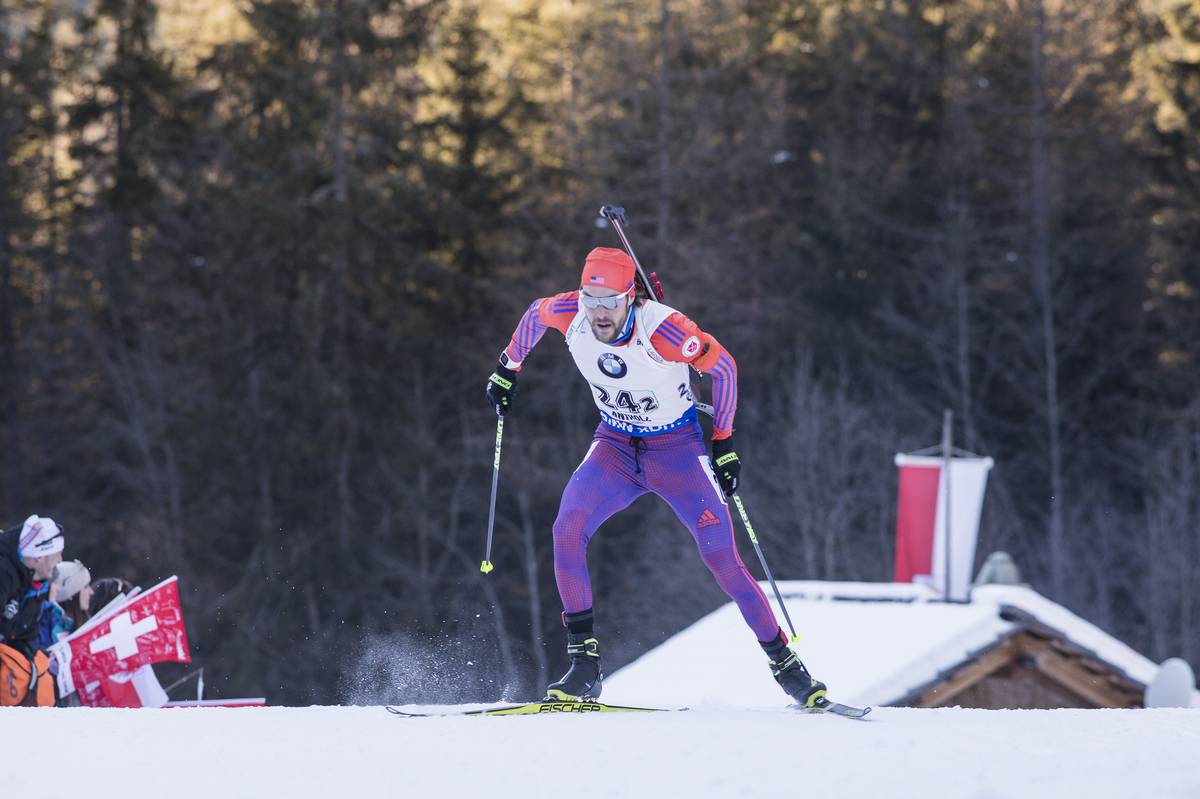
Paul Schommer, of US Biathlon’s National Development Group, racing to 33rd in his first IBU World Cup race, the men’s 20 k individual in Antholz, Italy, in January 2017. (Photo: USBA/NordicFocus)
But in the October races, Cooper didn’t continue the streak. Schommer did, placing second on Saturday just four seconds behind Bailey, and fourth on Sunday.
“Paul is the clear winner of the trials by 5%,” Eisenbichler said. “If we look at the second place in the trial points, this is Russell Currier, and Paul beat him in every race of the four races. So Paul really made a big step forward this summer. He got himself mixed in with the World Cup athletes, the pre-qualified ones. He has a really high performance level right now and I’m really happy to see that… if everything goes normal he will also get the call for the World Cup team in December.”
Currier was not chosen for the camp on a discretionary basis, so Schommer – who turned in a 33rd-place finish in his World Cup debut last season – is nearly a lock for the December competitions.
He was new to biathlon after his time at Saint Scholastica, but has quickly made strides in the sport.
“The goal of bringing this Talent ID project forward in 2014 was to have someone in contention for a relay spot, pushing the other four athletes on the men’s side, and having also a good shot at being very competitive at the Games,” Eisenbichler said. “And I’m again very pleased to see that this project worked.
“Compliments to Paul with how he approached it,” he continued. “He has done it professionally now for just 2 ½ years. I think he learned a lot last season, being at the World Championships as a reserve athlete, doing some World Cups, and a lot of international races like European Championships and IBU Cups. He learned a lot, absorbed a lot. But he was also able also to put the work in during the spring, summer, and beginning of the fall to get to a higher level. I’m really pleased where he is right now – he will be a very strong contender for the Games.”
As with the women, Currier and others will have another chance to qualify for World Cup and Olympic racing in January.
World Cup Athletes On Track
For these athletes, qualification woes are now mostly behind them. Up next is the camp in Canmore, which will start on October 23.
Lowell Bailey (USBA) en route to second in the men’s mass start at US Biathlon Rollerski Championships on Aug. 13 in Jericho, Vt. (Photo: John Lazenby/Lazenbyphoto.com)
“It’s most important to have snow kilometers and work on technique,” Eisenbichler said of the camp. “Per Nilsson, our technique guru, will be there for the entire camp so the focus for sure for most of the athletes is to work on technique on skis. Following up from the May work in Bend and the summer work in the Oberhof ski hall. For us it’s really important to have this frequent snow contact in summer and fall.”
After that, athletes will have about ten days at home before heading over to the World Cup. There, a different kind of qualification may be on their minds. Dunklee and 2017 World Champion Lowell Bailey are qualified for the Olympics already, but one or two more athletes of each gender can make that team through strong performances at the December World Cup.
And ultimately, they are looking to perform well once they get to the Olympics.
For the athletes who didn’t have to worry about World Cup qualification last weekend, Eisenbichler said that the races were still an important marker, but also didn’t serve the same function as for those who still needed to snag their spots.
“These races are kind of markers on the way for these pre-qualified ones, but it’s not really trials races for them,” he explained. “It’s a little bit different to come into the races with full training, compared to preparing at least a little bit for them as you have to if you need to qualify.”
As a result, some of the World Cup regulars didn’t turn in their best days, but on the whole, that didn’t bother team staff.
“He came out of a really good and hard block of training,” Eisenbichler said of Tim Burke, who finished fifth and seventh this weekend. “He had super time trials the week before in Lake Placid, so we feel very confident that he is on the right track. This week he was very tired from training, and then racing is not that easy on a high level. For sure he wanted and expected to be on a higher level, especially on the shooting part. But I’m not worried about him.”
Likewise, Leif Nordgren placed 13th on Saturday with six penalties, but turned things around on Sunday to finish third overall.
“It was a really bad race on Saturday,” Eisenbichler said. “He really had to put his head down on Sunday. Even if you are pre-qualified, you have a responsibility to be competitive at these races. That’s clear. So he did that on Sunday, and that was good to see, it was really important for us.”
Bailey won both races over the weekend and shot perfectly on both days. Dunklee didn’t race, as she was getting over a cold. Doherty placed third on Saturday and second on Sunday, and Eisenbichler was pleased with that.
“Sean showed some really big improvement on the skiing, which was expected after he went through the mono stuff last year,” he said. “So that’s back on track. Still the prone shooting for Sean needs work and improvement for the World Cup. It’s not good enough right now.”
And Egan won Sunday’s race.
“We are pretty pleased with what we saw throughout the summer,” Eisenbichler said of her training. “With skiing especially, technique-wise she is getting on a higher level. She didn’t have a super race on Saturday, but had a better day on Sunday. And it’s still for her getting the momentum for a good complex biathlon performance. And that’s pretty normal for mid-October. I think she’s on the right way.”
Susan Dunklee (USBA/CGRP) leading the pack in the women’s mass start on Sunday, Aug. 13, at USBA Rollerski Championships in Jericho, Vt. She won by nearly 47 seconds. (Photo: John Lazenby/Lazenbyphoto.com)
Special thanks to John Lazenby for providing photos from 2017 US Biathlon Rollerski Championships in Jericho. For a full gallery, click here.
Note: This article has been updated to include comments from Lowell Bailey, Susan Dunklee and Bernd Eisenbichler.
***
This past weekend, the US Biathlon Association (USBA) Rollerski Championships returned to Jericho, Vt., for two days of racing at the Ethan Allen Firing Range inside a National Guard military base. Just as it has in the past, the format included men’s and women’s sprints on Saturday followed by mass starts on Sunday, and this year, the races drew nearly 100 competitors from across the U.S. and even some from Canada.
US Biathlon’s Lowell Bailey (r) on his way to winning the men’s sprint at US Biathlon Rollerski Championships on Aug. 12 in Jericho, Vt. (Photo: John Lazenby/Lazenbyphoto.com)
A perennial winner at Jericho, Lowell Bailey won the senior men’s 10-kilometer sprint on Saturday in 24 minutes, 58 seconds with a single standing penalty (0+1).
“Summer nationals is a good chance to assess where you are in the training season,” Bailey wrote in an email. “Of course, roller skiing is quite a bit different than on-snow skiing, and it is important to keep that in perspective when assessing the results. However, I’m happy with the way the weekend went and I feel like I am on track in terms of where I want to be in the training season.”
Fellow US Biathlon A-teamer Sean Doherty placed second, just 5.2 seconds back, with two prone misses (2+0). Rounding out the top three, Biathlon Canada’s Nathan Smith (the lone Canadian in that race)placed third, 21.4 seconds behind Bailey with a single standing miss as well (0+1).
Another 0.2 seconds back in fourth overall, Travis Cooper of National Guard Biathlon was the third American after shooting two prone penalties (2+0). A total of 23 racers competed in the senior men’s event on Saturday, compared to 11 in the senior women’s sprint. (Other categories included girls, boys, youth, junior, and masters.)
Susan Dunklee (US Biathlon/Craftsbury Green Racing Project) racing to a win this past Saturday, Aug. 12, in the women’s sprint at US Biathlon Rollerski Championships in Jericho, Vt. (Photo: John Lazenby/Lazenbyphoto.com)
In the women’s 7.5 k sprint, Susan Dunklee, of US Biathlon and the Craftsbury Green Racing Project (CGRP), won despite five penalties (2+3) in a time of 22:10.7.
In an email, Dunklee described the conditions as “very hot and muggy.”
“Between that and the uphill range approach, these races have some of the most difficult shooting conditions we see all year,” she explained in an email.
“I’ve been working on learning new wind shooting skills this summer,” Dunklee wrote. “It has been going well in practice but truly trusting those skills under race pressure is a mammoth challenge. The goal is to build that trust before winter. My shooting percentages weren’t great this weekend, but I am happy about the way I stuck to my work plan on the range.”
Dunklee finished 46.9 seconds clear of her teammate and runner-up Joanne Reid (USBA/Colorado Biathlon), who had a miss in each stage (1+1).
A minute behind Dunklee, Kelsey Dickinson, representing Craftsbury’s Collegiate Summer Team, placed third with four penalties (3+1). No Canadian senior women competed on either day.
On Sunday, racers returned to the range for the men’s and women’s mass starts, where Dunklee proceeded to take another victory with a time of 40:12.8 and seven penalties (1+2+2+2).
Her teammate Clare Egan (USBA/CGRP) placed second, 23.6 seconds back with five misses (1+0+2+2), while Dickinson repeated in third (+33.8) with five penalties as well (2+0+1+2).
Biathlon Canada’s Nathan Smith (14) leading US Biathlon’s Lowell Bailey (l) up a climb in the men’s mass start on Sunday, Aug. 13, at US Biathlon Rollerski Championships in Jericho, Vt. Smith went on to win by 21.3 seconds over Bailey. (Photo: John Lazenby/Lazenbyphoto.com)
In the men’s mass start, Smith cleaned two stages and tallied three penalties (1+0+0+2) en route to the win in 38:09.8. Bailey finished 21.3 seconds back in second after three misses (1+0+1+1), and his teammate Tim Burke (USBA) took third (+1:09.8) with five penalties (2+1+2+0).
“I was happy with how the first day of racing went, but I definitely could have been more aggressive in the Mass Start’s standing stages,” Bailey reflected. “The wind came up during the shooting and I let that distract me a little bit when I should have stayed with my planned cadence and shooting speed.”
“With faster shooting, I may have been able to catch Nathan’s wheel and contended for the win on the last loop,” he continued. “As it was, those two standings left me with an insurmountable gap for the final loop.”
Paul Schommer was the third American in fourth overall (+1:23.0) with six misses (2+1+2+1).
The USBA Rollerski Championships typically serve as the first of two weekends of trials (the other being in October) for US Biathlon in selecting a pre-World Cup training camp group. From that group of athletes, the U.S. usually fills out its early season International Biathlon Union (IBU) World Cup roster.
In an email, USBA Chief of Sport Bernd Eisenbichler explained that two athletes particularly stood out with their performances this weekend.
“On the women’s side Kelsey Dickinson and on the men’s side Travis Cooper made a big improvement compared to last year and even last season and both will get rewarded for that with a camp invitation to [Lake Placid] in mid-September to work with the A Team and the National Team Coaches,” Eisenbichler wrote.
“I was happy to see a very competitive men’s field and a growing women’s field as well,” he continued. “We could see, that it was the first real races this summer and as Jericho is a pretty hard range to shoot at, we saw a good reminder what to work on still, especially on the shooting side. The A Team comes from a really long and hard block of training, so they weren’t fresh at all going into the races, so for sure, you make a few mistakes more, as if you would be preparing fully for a race weekend like you would e.g. do for a [World Cup] weekend.”
US Biathlon’s Sean Doherty (front) and Lowell Bailey (12), along with their competitors, taking aim during a prone shooting stage of the men’s mass start at 2017 USBA Rollerski Championships on Aug. 13 in Jericho, Vt. (Photo: John Lazenby/Lazenbyphoto.com)
Susan Dunklee and Lowell Bailey celebrate after finishing second in the World Cup single mixed relay in Kontiolahti, Finland. Austria won the competition. (Photo: IBU/Twitter)
The U.S. Biathlon Association (USBA) has named five women and six men to its senior national team for the 2017/2018 season, and 14 more athletes to its several development teams.
The nominations are headlined by Lowell Bailey and Susan Dunklee, both of whom won individual medals at 2017 World Championships in Hochfilzen, Austria. They are joined on the “A” team by their World Championships teammates Clare Egan, Joanne Reid, Maddie Phaneuf, Tim Burke, Leif Nordgren, and Sean Doherty.
“This year it really culminated in a perfect way,” USBA Chief of Sport Bernd Eisenbichler said. “The best thing about it — besides being so successful and having a dream season — is that the upcoming and younger athletes, like Leif, Sean, Maddie, Joanne, and Clare, they see now that it’s not only the athletes from Norway and Germany succeeding. At some races we took medals and then we also proved it on the Olympic course. It’s giving a lot of confidence to the whole program.”
Leif Nordgren skiing the second leg of the men’s 4 x 7.5 k relay at the IBU World Cup in Antholz, Italy, where the U.S. finished sixth. (Photo: USBA/NordicFocus)
The men’s relay team notched sixth- and seventh-place relay efforts this season, and Nordgren picked up four top-30 finishes despite missing almost half the season with an injury. Doherty also missed almost half the season due to illness, but came back to earn a top-20 in the Kontiolahti pursuit at the end of the season. Veteran Burke collected four top-30’s over the course of the year.
On the women’s side, Egan and Reid picked up two and one top-30 finishes apiece, and Phaneuf had a 10th-place pursuit result on the IBU Cup.
Also snagging an “A” team nomination is Paul Schommer, who came from the senior development team to land consistent World Cup starts from the middle of the season onwards. Schommer had a top individual finish of 33rd in the individual in Antholz, Italy, and contributed to an eighth-place mixed relay effort in Kontiolahti, Finland.
“Paul had a great season for his second year in biathlon, and made really big improvements,” Eisenbichler said. “He showed that he can be a really good alternative, or even more than that, for the men’s relay and other relays too. He showed that in Korea and especially in Kontiolahti in the mixed relay there. He had a top-35 result at his first World Cup, so we felt that he is really very close to the big guys and separated himself from the athletes who were performing with him at the beginning of the season in the IBU Cups.”
Clare Egan racing to 20th place in the women’s 7.5 k sprint at the 2017 IBU World Championships in Hochfilzen, Austria (Photo: USBA/NordicFocus)
Landing on the “B” team are Emily Dreissigacker (Craftsbury Green Racing Project) and Russell Currier (Outdoor Sports Institute). Currier started the year on the World Cup, finishing 34th in the pursuit in Oberhof, Germany, before moving to the IBU Cup. Dreissigacker racked up five top-30 finishes on the IBU Cup circuit this season.
“They will get a lot of camp time in Lake Placid,” Eisenbichler said of the “B” team. “They will also get direct coaching from the National Team coaches. In Emily’s regard it’s from Jean Paquet, and in Russell’s regard from Jonas Johansson. So they have not only access to the training plan from the ‘A’ Team, but also their individualized plan from the national team coaches. They will spend about seven to eight weeks in Lake Placid from May to August.”
Chloe Levins, who finished fourth in the youth women’s pursuit at World Youth and Junior Championships this season, and IBU Cup racer Jake Brown comprise next season’s “X” Team, which is seen as consisting of athletes who are expected to make the jump to the “A” team within two years.
“The ‘B’ team should be very close to the World Cup, and we expect ‘B’ Team members to be able to really chase the World Cup team for the next season and to have a really good shot for the Olympic Games,” Eisenbichler explained. “That’s the difference between the ‘B’ Team and the ‘X’ Team. The ‘X’ Team is still a development team, for athletes who just started biathlon or young athletes, as we have this year.”
Chloe Levins (11) with her US Biathlon support team (from left to right: Erik Lewish, Travis Voyer, Mathias Zacherl, Robert Gorgos, and Algis Shalna) after her fourth-place finish in the youth women’s 7.5 k pursuit, her career best in her third IBU Youth World Championships, on Sunday in Osrblie, Slovakia. (Photo: USBA)
USBA has also named a five-member Senior Development Team, consisting of Hallie Grossman and Alex Howe (Craftsbury Green Racing Project), Siena Ellingson (Mount Itasca), Travis Cooper (National Guard Biathlon), and Max Durtschi.
And the Junior Development Team consists of athletes with some of the top U.S. results at World Youth and Junior Championships: Vasek Cervenka (Mount Itasca, 16th in youth individual), Cody Johnson (Outdoor Sports Institute, 46th in junior sprint), Jake Pearson (Casper Mountain Biathlon Club, 49th in youth individual), Amanda Kautzer (Michigan Tech/Loppet Nordic Racing, 42nd in youth pursuit), Grace Gilliland (Alaska Biathlon, 46th in youth individual), and Helen Wilson (Alaska Biathlon, 62nd in youth individual). Lexie Madigan of the Auburn Ski Club was also named; she qualified for the World Youth Championships team but was younger than the minimum age set by the International Biathlon Union to compete.
“The setup is, they are regionally coached with consulting from the National Team coaches,” Eisenbichler said. “They can get access to the training philosophy, but they are coached by their own regional or club coaches. But they are also invited to Lake Placid, the seniors for two camps, and the younger ones for one camp. At the [Rollerski National Championships] in mid-August, we will re-evaluate their performance levels and see who gets more invitations later on towards the fall.”
The team nominations are as follows:
National Team Women
Susan Dunklee (Barton, Vt.), A 1 Team
Clare Egan (Cape Elizabeth, Maine), A 2 Team
Joanne Reid (Boulder, Colo.) A 3 Team Maddie Phaneuf (Old Forge, N.Y.) A 3 Team Emily Dreissigacker (Morrisville, Vt.) B Team
National Team Men
Lowell Bailey (Lake Placid, N.Y.), A 1 Team
Tim Burke (Paul Smiths, N.Y.), A 2 Team
Leif Nordgren (Marine, Minn.), A 2 Team Sean Doherty (Center Conway N.H.) A 2 Team Paul Schommer (Appleton, Wis.) A 3 Team Russell Currier (Stockholm, Maine) B Team
X Team Women
Chloe Levins (Rutland, Vt.)
X Team Men
Jake Brown (Houghton, Mich.)
National Development Group – Senior Women
Hallie Grossman (South Woodstock, Vt.) Siena Ellingson (Minnetonka, Minn.)
National Development Group – Senior Men
Max Durtschi (Sun Valley, Idaho) Alex Howe (Craftsbury, Vt.) Travis Cooper (Kenai, Alaska)
National Development Group – Youth/Junior Women
Amanda Kautzer (Plymouth, Minn.)
Grace Gilliland (Eagle River, Alaska) Helen Wilson (Eagle River, Alaska) Lexie Maddigan (Truckee, Calif.)
Lowell Bailey (US Biathlon) racing to ninth in the men’s 12.5 k pursuit on Saturday at the IBU World Cup in PyeongChang, South Korea. (Photo: USBA/NordicFocus)
The North Americans kept the momentum rolling two weeks after the International Biathlon Union (IBU) World Championships, with US Biathlon’s Lowell Bailey busting out a second place and Susan Dunklee placing fifth in back-to-back races over the last four days in PyeongChang, South Korea. On Sunday, the Canadians showed they’re rounding back into top form in team events, with its men’s team placing seventh and women’s team taking eighth for season bests in the relays. Here are the most interesting quotes that didn’t make it into the race reports (links below).
On the break after World Championships & the leadup to PyeongChang:
“After Worlds I went home to Canmore and enjoyed five days of R&R with some easy skiing. The ski conditions were very good and it was nice being able to relax in my own place and sleep in my own bed.”
– Scott Gow, Canada
“Rosanna [Crawford] and I traveled to France for five days to visit and train with Anais Bescond, who races for the French team. It was a nice break and was fun to ski and sightsee somewhere new. We also enjoyed some amazing wine and cheese!”
– Brendan Green, Canada
“It was really nice, there was great skiing, 30 kilometer loops in two different areas, we ate a lot of cheese and took part in a night race called ‘Nocturne de sleep’ where you ski 200m and then have to trade off giant underwear to each other in a team sprint style race, over your race suit of course! “
– Rosanna Crawford, Canada
“Over the past 10 or so days since World Champs I took a few days off to kind of rest, recover and just sort of try to step away from that high-intensity environment. Most of the team members went just outside of Ruhpolding [Germany] and we had a pretty relaxing training camp there. I didn’t shoot for the first couple days, and then just tried to get back into my normal routine…. we had pretty good travel from Ruhpolding, and we came here on the early side compared to a lot of other teams and I think that was an advantage.”
– Lowell Bailey, U.S.
“Last week I was home in Germany with my son, the best possible recharge for my heart and soul, but unfortunately my little guy got really sick towards the weekend which resulted in me coming down with a cold as soon as I arrived here in Korea. I simply cannot understand how it is that coming from a week of compromised training, with a cold and jet lag I am finally feeling good! I am definitely not complaining, although I clearly have some figuring out to do post-season.”
– Megan Tandy, Canada
On taking it day by day:
“Each race is a new opportunity and I try and do my best despite how I feel physically or mentally. I will spend time at the end of the season analyzing areas of my training where things went wrong for me. I am no doubt frustrated and disappointed after putting in so much hard work this year, but I am still motivated. There have been some really tough days this season, but I know I can challenge for the podium when I am in my best form and that’s what I will continue to chase next season.”
– Green
On sloppy snow in Sunday’s relay:
“Apparently the average high at this time of year is around 0ºC, so I guess we just ended up having unseasonably warm weather. Definitely not the easiest conditions, but the snow was managed well and late evening races allowed the snow to usually refreeze.”
– Nathan Smith, Canada
“That big puddle in the stadium was the only part of the course that was like that. I avoided it once or twice and went through it once or twice, I don’t remember exactly. I would say it didn’t seem to make too much of a difference for me, it seemed that that section was slow no matter where you went. Our skis were good today and actually went through the really wet stuff pretty easily.”
– Christian Gow, Canada
“The conditions have added to the difficulty both for us racers but also for the wax techs. Overall, the race organizers did a really good job preparing the course give the tough conditions.”
– Paul Schommer, U.S.
“It’s tough to ski when it’s 100% artificial snow and 40 degrees [Fahrenheit]. I was impressed that the snow actually held up for the entire week of racing. I’m hoping they have a deeper base next year, and handle the weather a bit better.”
– Maddie Phaneuf, U.S.
On the PyeongChang range:
“The range can be fairly windy, like tonight during the men’s race, and there isn’t much shelter if it happens to be a windy day, although I’d say it’s been 50/50 so far in terms of wind or no wind.”
– Scott Gow
On the PyeongChang trails:
“The course, in a sprint, has two hills, and my strategy was to push after the second climb, and push the downhills all the way into the stadium… , the two kilometer loop cuts out the second hill, so it’s a lot different from the sprint course. It’s just one giant climb that goes on forever, and then coming back into the range. It’s a couple of different pitches. There are a couple of short, flat downhill sections, but no longer than a couple seconds, and then you hit the really big part of the climb, about halfway through the loop. It’s a monster. Then it’s just downhill with lots of corners.”
– Susan Dunklee, U.S.
“I love this course! Uphills are my strength when I am in good shape and this is one of the hilliest 2.5 kilometer course I have ever raced on.”
– Tandy
“I really like this 2 kilometer loop, it’s hard off the start but you can really make up a lot of time on the top of the course and then the downhill back to the stadium.”
– Crawford
“The courses here are tough, but I like them. I preferred [the pursuit]’s 2.5 k course to the 3.3 k, but I think they are both good and challenging courses. I think that for next training season we will be focusing on getting ready for the climbs here and, with that preparation, I do think this could be a good venue for me.”
– Christian Gow
“We’ve timed how long the extended climb takes. You literally go from the low point to the high point in a single climb. That’s nearly unheard of on the World Cup. So we will be training for those long extended climbs, because you leave the starting gate, and you hit a one-kilometer steep climb, which is actually over the international limit, at times, for the grade… They’ve done a lot of work on the downhills, and improved them a lot. I’ve talked with the technical delegates, and I think they plan to bank some of the turns next year, that aren’t banked now, and that’ll make a difference. It’s a really challenging course.”
– Bailey
“In some ways this course is similar to Kontiolahti, with really steep hills. Historically I’ve done better with those grades instead of gradual 1-skate grinds. So I think if I’m in shape I could do some good performances here next year.”
– Smith
“I think in general our entire team (men’s and women’s) had great results at this course. It makes all of us excited to see what next year brings.”
– Phaneuf
On goals for the rest of the season:
“Because World Champs was a success, I feel like you still have a large part of the season left and I wanted to finish it out as best I can and really focus on these last three World Cups. So I spent the rest of the time [after World Champs] focusing on the races here and preparing of those, and just working on my skiing and shooting just like any other preparation for World Cup.”
– Bailey
“My goals are to maintain the ski shape I am in and bring my shooting back up to a higher level. I’m feeling quite good this week so I think the skiing aspect is definitely possible, and my shooting goal is achievable if I can get into the right head space.”
– Scott Gow
“It’s been nice to see the Olympic venue and test out the trails. I think it was the right decision to come here but I also think it’s the right decision to go home. These last 3 races have been just what I needed to motivate my self for one more season. Of course there is that little voice in the back of my head that’s saying the what if’s of finally skiing well to see what I can do, but there will be lots of opportunities for that next year.”
– Crawford (who is heading home instead of finishing out the World Cup season)
On cracking the top 30:
“Overall I am very happy with today’s result given how my season has been going. I think what made the difference for me today was being able to execute solid shooting in what were challenging conditions. The snow conditions were also quite difficult to race in tonight but I did my best and gave it my all.”
– Green, after the 10 k sprint
“This top 30 was an important part of me qualifying for some funding next year as well as a part of my Olympic qualification. Nothing is guaranteed until the end of the season of course, but squeaking into the top 30 today will open up some opportunities for next season.”
Germany’s Maren Hammerschmidt (left) and Canada’s Julia Ransom fist-bump for a job well done halfway through the 4 x 6 k relay at the IBU World Cup in PyeongChang, South Korea, on Sunday. Germany won the race, and Canada ended up eighth.
To nobody’s surprise, Germany came out on top in the women’s World Cup relay in PyeongChang, South Korea, where biathletes are checking out next year’s Olympic venue.
Nadine Horchler, Maren Hammerschmidt, Denise Herrman, and Franziska Hildebrand cruised to 22.8-second win over Norway in the 4 x 6 k event, completing a clean five-for-five sweep of all the relays this season despite resting top star Laura Dahlmeier and relay regular Vanessa Hinz.
Sure, France made a valiant effort to best the Germans, and nearly succeeded, before Celia Aymonier – who had come into the last shooting even with Hildebrand – was stuck with two penalty loops. After that disaster, the French ended up sixth.
But perhaps the biggest surprise was to see Canada constantly in the podium mix through three of four legs of the relay. Canada’s best-ever women’s relay finish, fourth place, came in 2014, and so far this season their results had landed between 10th and 18th place.
The women’s podium of Germany, Norway, and Czech Republic after the IBU World Cup relay in PyeongChang, South Korea. (Photo: IBU/Twitter)
Yet several team members were feeling the best on skis that they had all season, and Rosanna Crawford, Julia Ransom, Megan Tandy, and Emma Lunder combined for just seven spare rounds and no penalty loops, tying them for the best shooting of the day with Sweden.
“It has been a bit disappointing for us this year in relays,” Crawford wrote in an email. “In the first two relays we only used four and three spares total for the team, but we were really missing the ski speed. So it’s nice to have things come around for the final relay.”
Crawford started out by using four spare rounds, more than half the team’s total, and yet found herself constantly at the front of the race. She left the standing stage in tenth, and tagged off even with Anais Chevalier of France in first place.
“Even though I was quite disappointed with my shooting and needing four spares, it felt amazing to be able to ask my body to go faster and for it to respond,” Crawford wrote. “My last loop was really great… I just keep chasing each woman down, until it was just me and France!”
Crawford actually had the fastest ski time of all scramble-leg athletes. With that as a start, Ransom took the tag and cleaned both stages, although she said that doing so was harder than it looked.
“Today I had to work very hard for every standing shot,” she explained in an email. “It definitely wasn’t an easy shooting day for me (regaining my confidence after the relay at World Campionships). However, I was so happy to pull it together and hit them all. It’s a confidence-booster for me for the next two weekends of racing.”
Ransom’s confidence was also boosted by the previous day’s pursuit, where she had clocked the 25th-fastest ski time. For several loops, she skied with Germany’s Hammerschmidt and France’s Anais Bescond.
“Yesterday’s pursuit ski speed proved to me that I can really trust my fitness and perhaps push for faster times,” she wrote. “Skiing today with Anais and Maren felt comfortable! I felt like I belonged there.”
On the final loop of their relay leg, Hammerschmidt put the hammer down and left Bescond and Ransom behind. But Ransom still tagged off in third, 17 seconds behind Hammerschmidt and 2.4 seconds behind Bescond.
Tandy cleaned prone, regaining second place as other teams struggled on the range.
“When I left prone in second position I was pretty excited, but also a little bit surprised and relieved that I was still up there,” she wrote. “I didn’t feel too nervous, I mostly felt determined and excited. I was just reminding myself of my own game plan: how I wanted to ski, what I wanted to focus on during shooting.”
Tandy then used a spare in standing; she tagged off in fourth, 36 seconds behind the leaders. While she had felt good in the pursuit, her legs lost her a few places on the trails in the relay.
“I felt much more tired today than yesterday and it was a very tough fight out there,” she wrote in an email. “My poor legs were just done…I guess three races with a cold that to you! But I was composed on the shooting range, handled the wind well and gave it my best effort. Of course I wish I hadn’t missed my last standing shot, but I can be satisfied with one spare.”
That left it to Lunder to either win or lose sight of a podium position. For Lunder, the newest member of Canada’s World Cup team, it was a new experience.
“I’ve definitely never been tagged in a position like this in a World Cup relay before,” she wrote in an email. “Although it was a bit nerve-wracking to continue seeing Canada in the top three, I decided to just see what I could do today and not worry about any result or placing. I was pretty happy with how I handled things – I was our World Champs anchor as well, so that was a good practice run for today.”
Like Tandy, Lunder had been feeling under the weather, and got sick after World Championships. The top three slipped away, more because of skiing than shooting. Lunder used two spares in prone, but then quickly cleaned standing. She simply couldn’t hold her position on the trails.
“My skiing has felt quite weak this week, but even with slow skiing I’m happy to have brought my shooting up to a higher level,” she wrote. “I definitely felt a bit shaky in prone, but after hitting my two spares I was fairly confident in the rest of the race. I’ve been so happy with my consistent standing this year, and knew if I just focused on my cues it would be a good shooting bout, which it was.”
The team was thrilled to hang on to an eighth-place finish (+ 1:34.0) at the end of the day, even if some members wished they had skied or shot better.
“I am really proud of our women’s team right now,” Crawford wrote. “Julia did an incredible job skiing with Anais [Bescond] and cleaning both stages, Megan was also clutch on the range and holding her own on the skis, and Emma has been so amazing at standing this year that I knew she would be able to keep up in the top eight.”
“The relay was a good indicator of our potential,” Ransom agreed. “We all fought hard and put together a great performance. I was obviously thrilled to be tagged off right at the front! It’s very motivating to be going head to head with the top teams.”
Susan Dunklee collected the fastest ski time of all women on the second leg of the 4 x 6 k relay in PyeongChang. (Photo: US Biathlon Association/NordicFocus.com)
The United States had immediately gotten a tough start, with leadoff racer Clare Egan skiing a penalty loop in standing; she tagged off to Susan Dunklee in 19th place. Dunklee had collected fifth-place finishes in both the sprint and pursuit this week and skied the fastest of all second-leg skiers in the relay, but was still able to make up only 5.5 seconds on Hammerschmidt and move the team to 14th.
Joanne Reid, the third American, also used two spare rounds, moving the team up another three places to 11th. Finally, Maddie Phaneuf used three spares in standing and the Americans finished 14th (+3:08.3).
“Today’s relay was mediocre for me,” Phaneuf wrote in an email. “I felt okay on the skis but still not great. I was really happy with my prone, I took some wind clicks coming in and was pleased that it worked. Our team was the only team that cleaned all of the prone stages from the clip [without spares]! So that was exciting. I was pretty bummed with my standing, missing three from the clip, but was happy with how I handled the pressure to hit them with my spare rounds. I still can’t remember exactly what happened, I do recall it being a bit gustier when I was shooting. I felt like I was making progress on my standing during training and the Sprint race, but today I just wasn’t focused I guess.”
The women were not particularly satisfied with the result, but knew that they could do better.
“There are a lot of fighting hearts on this team,” Reid said in a USBA press release. “We’re not always the team with the best shooting, but I think every one of us has enough love for our teammates that we choose to fight for them, and for our staff that have put so much work into making our race successful… we are aware of every piece we have to work on, and every one of us is dedicated to the process of learning and training and practicing until we can make it to the top. One team, one goal. See you in 2018, PyeongChang, and we’ll be stronger then.”
Canada’s Alex Harvey (3) celebrates his win in the men’s 50 k freestyle mass start, his first individual gold medal at a World Championships, on Sunday at 2017 Nordic World Championships in Lahti, Finland. He beat Russia’s Sergey Ustiugov (l) by 0.6 seconds while Norway’s Sjur Røthe (9) can be seen coming in for sixth place, behind (not pictured) Finland’s Matti Heikkinen, Great Britain’s Andrew Musgrave and Norway’s Martin Johnsurd Sundby, respectively. (Photo: NBC Sports screenshot)
FIS Nordic World Championships (Lahti, Finland): Men’s 50 k freestyle mass start
After a week of missing out on the medals at 2017 Nordic World Championships, Canada’s Alex Harvey, a four-time World Championships medalist from 2011, 2013 and 2015, achieved his first individual gold medal in the final race of this year’s World Championships in Lahti, Finland.
Harvey, 28, won the men’s 50-kilometer freestyle mass start in a drag race to the finish. Entering the final descent into the stadium with Norway’s Martin Johnsrud Sundby and Russia’s Sergey Ustiugov, Harvey rode his fast skis past both of them then had the most finishing kick in the final straightaway for a 0.6-second victory. He finished in 1:46.28.9 hours, while Ustiugov followed him across the line in second and Finland’s Matti Heikkinen from behind for third (+1.4), after passing Sundby around the outside of the last corner.
Canada’s Alex Harvey (c) celebrates gold in the men’s 50 k freestyle mass start on Sunday at 2017 Nordic World Championships in Lahti, Finland, with Russia’s Sergey Ustiugov (l) and Finland’ Matti Heikkinen (r) joining him on the podium in second and third, respectively. (Photo: Cross Country Canada/Twitter)
Sundby appeared to miss a pole plant soon after Heikkinen passed him and let off the pace a few meters before the finish. That’s where Great Britain’s Andrew Musgrave continued to accelerate and took fourth place, 2.9 seconds behind Harvey and 0.1 seconds ahead of Sundby in fifth. Norway’s Sjur Røthe followed another 0.4 seconds back in sixth, Switzerland’s Dario Cologna was seventh (+8.9), Norway’s Petter Northug eighth (+12.3), France’s Maurice Manificat ninth (+13.4), and Norway’s Hans Christer Holund 10th (+14.3).
“I had really good skis,” Harvey said in a post-race interview with FIS. “I knew if I came into the corner in second place, that was the optimal position. So I was able to fight hard and hit that last corner in second and slingshot by Martin along the flat and then that was good after that.”
“This is the best race of my life, for sure,” he added. “So I’m really happy.”
Tad Elliott (Ski Club Vail) led the Americans in 27th (+3:16.8). Noah Hoffman (U.S. Ski Team) finished 50th (+8:53.1) and Kyle Bratrud (CXC Team) did not finish.
Canada started four men, with Devon Kershaw finishing 38th (+5:45.5), Graeme Killick 43rd (+7:04), and Knute Johnsgaard in 55th (+12:03.3).
For Harvey, the medal is his fifth at three World Championships and his first individual gold after winning the classic team sprint with Kershaw in 2011.
IBU World Cup (PyeongChang, South Korea): Men’s and women’s relays
Between the men’s and women’s relays on Sunday at the International Biathlon Union (IBU) World Cup in PyeongChang, South Korea, Canada had two teams in the top eighth, with its men’s team finishing seventh in the 4 x 7.5 k and women’s team eighth in the 4 x 6 k. Behind them, the U.S. men finished 10th and U.S. women 14th.
France won the men’s relay by 33.8 seconds over Austria, using a total of 10 spare rounds but avoiding the penalty lap. Martin Fourcade anchored France to the win in 1:12:09.5 hours, after Jean-Guillaume Béatrix initially tagged them in first, his older brother Simon Fourcade raced them into second with near-perfect shooting (using just one spare to clean), and Simon Desthieux picked off one more place to give Fourcade a 16-second lead for the final leg.
Austria achieved second place with Lorenz Wäger, Simon Eder, Julian Eberhard, and Dominik Landertinger combining for zero penalties and nine spares.
Norway finished third (+45.4) with Vetle Sjåstad Christiansen, Ole Einar Bjørndalen, Vegard Gjermundshaug, and Henrik L’Abée-Lund. They had one penalty on Gjermundshaug’s third leg, and used a total of eight spares.
Canada’s Christian Gow, Scott Gow, Nathan Smith, and Brendan Green finished seventh (+3:03.1) with zero penalties and nine spares. After Christian tagged his older brother Scott in ninth, Scott raced them into sixth place before Smith slipped four places to 10th at the final exchange. On the final leg, Green raced them into seventh, requiring two spares to clean.
The Americans finished about nine seconds later in 10th (+3:12.8) with Lowell Bailey, Leif Nordgren, Paul Schommer, and Sean Doherty combining for zero penalties and nine spares, just like Canada. Bailey had originally put them in second at the first exchange, Nordgren dropped to seventh, then Schommer to 13th, before Doherty finally brought them back to 10th out of 24 teams.
In the women’s relay, Germany pulled off a 22.8-second win over Norway, with one penalty and eight spares. Nadine Horchler put Germany in third at the first exchange, then Maren Hammerschmidt raced them into first by the race’s halfway point. From there, Denise Herrmann, a former cross-country World Cup regular, had to ski a penalty lap and tagged off in second, 13.5 seconds out of first. With teammate Laura Dahlmeier sitting out the relay, Franziska Hildebrand anchored Germany to the win in 1:07:35.6 after she used just one spare to clean.
Norway placed second with Kaia Wøien Nicolaisen, Hilde Fenne, Tiril Eckhoff, and Marte Olsbu accumulating one penalty and 11 spares. Olsbu beat out the Czech Republic’s Gabriela Koukalová by one-tenth of a second at the finish, as the Czechs placed for third (+22.9), with Jessica Jislová, Eva Puskarčíková, Lucie Charvátová, and Koukalová (with a total of one penalty and nine spares).
Canada took eighth (+1:34) with Rosanna Crawford, Julia Ransom, Megan Tandy, and Emma Lunder. Crawford tagged in second at the first exchange, Ransom slipped one place to third, Tandy lost another place to tag in fourth, and Lunder ultimately anchored them to eighth.
The U.S., with Clare Egan, Susan Dunklee, Joanne Reid, and Maddie Phaneuf, finished 14th (+3:08.3) with one penalty and 10 spares. After Egan had a penalty on the first leg, Dunklee skied the fastest second leg to move the team from 19th to 14th, then Reid put them in 11th by the final exchange. Twenty-one teams competed in the women’s race.
Ski Classics 90 k Vasaloppet (Sälen to Mora, Sweden)
John Kristian Dahl (r) of Team United Bakeries outlunges Ski Classics sprint leader Andreas Nygaard (r) of Team Santander for the win in Sunday’s 90 k Vasaloppet in Mora, Sweden. (Photo: Visma Ski Classics)
[UPDATED] In Sunday’s 93rd annual 90-kilometer Vasaloppet from Sälen to Mora, Sweden, the ninth event of the Ski Classics series, John Kristian Dahl (Team United Bakeries) outlasted Andreas Nygaard (Team Santander) by one-tenth of a second for the win in 3:57:18.1 hours. The race came down to a five-way fight for first, with Stian Hoelgaard (Team Leaseplan) finishing 0.6 seconds back in third. The top 15 men were all within 21.7 seconds of the podium, and Brian McKeever, a member of Canada’s Para Nordic Ski Team, placed 20th (+2:31.1).
“It has been a fight all day,” Dahl said, according to a Ski Classics press release. Three days ago, he had been unsure about starting the Vasaloppet following a back injury. “I was tired already after 30 k and had to let go of the lead group, but I fought my way back taking it step by step and hill by hill.”
In the women’s race, Britta Johansson Norgren (Lager 157 Ski Team) broke away from the field to win by 1:37.9 minutes in 4:19.43.4.
Astrid Øyre Slind (Team United Bakeries) finished second, and Sara Lindborg (Team Serneke) placed third, 9 minutes and 4.2 seconds behind Norgren. Kateřina Smutná (Team Santander) dropped out of the race about halfway through.
“I am very tired but also so happy to win today,” Norgren said, according to the press release. “It felt pretty easy until Oxberg [Sweden] with 30 k to go, but then it got really tough and I had to fight all the way to the finish.”
It was Norgren’s first Vasaloppet win after placing second the last three years. She increased her lead in the overall Ski Classics to 215 points over Smutná, while Tord Asle Gjerdalen continues to lead the men’s overall standings ahead of his Santander teammate Nygaard, who is 349 points behind in second place. Gjerdalen did not race Sunday’s Vasaloppet.
Susan Dunklee racing to fifth in the women’s 7.5 k sprint at the IBU World Cup in PyeongChang, South Korea, site of the upcoming 2018 Winter Olympics. (Photo: USBA/NordicFocus)
For a while in Thursday’s 7.5-kilometer sprint, the first International Biathlon Union (IBU) World Cup race since IBU World Championships two weeks earlier, it looked like Susan Dunklee was on track for another podium.
The 35th starter on Thursday in PyeongChang, South Korea, she crossed the finish line in third, 59.7 seconds behind Germany’s Laura Dahlmeier in first and 51.3 seconds behind Norway’s Tiril Eckhoff in second. Dunklee had cleaned the prone shooting stage then missed her second shot in standing to leave the range in fourth as she started her final loop.
Early in that 2.5 k loop, Dunklee’s time slipped slightly to fifth. She was racing the clock and for precious places, and she clawed her way into third at the finish.
American Susan Dunklee (35) at the flower ceremony with Finland’s Kaisa Mäkäräinen (70), who placed fourth, and Ukraine’s Yuliia Dzhima (4), who finished sixth, in the IBU World Cup women’s 7.5 k sprint on Thursday in PyeongChang, South Korea. Dunklee placed fifth for her fifth top five of the season (including World Championships). (Photo: USBA/NordicFocus)
Ultimately, Dunklee was bumped off the podium to fifth — for her fifth top five of the season (say that five times fast).
Dahlmeier won it, as the 18th starter with clean shooting and a finishing time of 20:43.7 minutes. France’s Anaïs Chevalier in bib 51 raced to third with fast, clean shooting (posting the second-fastest range time and third-fastest shooting), ending up 41.6 seconds off Dahlmeier’s time.
Then there was Finland’s Kaisa Mäkäräinen, the 70th starter, who had to ski two penalty loops after standing (0+2) but skied the second-fastest overall course time to put herself in fourth at the finish (+58.7), just one second ahead of Dunklee.
Reflecting on her race, Dunklee explained in an email that she tried to be patient, especially on the final loop. Conditions in at the brand-new Olympic venue in PyeongChang weren’t easy with what Dunklee described in an email as “a patchwork of glazed, icy and slow patches.”
She explained that volunteers had been working with hand tools before the start to smooth out the course, which she felt helped “substantially.”
“I think the course is good for me: big climbs with technical descents,” Dunklee wrote. “I focused on pushing the last half km of the loop where I thought other people would be tired. And our techs made great skis for these challenging conditions.”
On that last loop, Dunklee received splits that she was seconds out of the top three.
“That helped me fight,” she wrote. “I also caught a good ride with Marie Dorin Habert my last loop…”
Dorin Habert, of France, who had started 67th and left the range for the last time in third with perfect shooting, did not finish her final loop. She reportedly withdrew after feeling nauseous.
Dunklee, who spent three days on a mini vacation in Barcelona before training in Ruhpolding, Germany, and arrived in South Korea last Sunday, will start Saturday’s 10 k pursuit in fifth, exactly one minute behind Dahlmeier in first and one second behind Mäkäräinen. Beyond that, she has 18 seconds to make up to third.
She wrote that she was looking forward to sticking with Mäkäräinen out of the start, “but I still plan to race my own race,” and “as always the key is to stay focused on the process of performing well.”
Asked how she was feeling at this point in the season, Dunklee wrote, “More relaxed and carrying a good dose of confidence after Hochfilzen.”
Germany’s Laura Dahlmeier racing to her fifth-straight win on Thursday in the IBU World Cup 7.5 k sprint in PyeongChang, South Korea. She shot clean and skied fastest for her eighth individual victory of the season. (Photo: IBU)
Dahlmeier raced to her fifth-straight win on Thursday, holding off Eckhoff (in bib 29) by 8.4 seconds after all three podium finishers (including Chevalier) shot a perfect 10-for-10 despite tricky wind. Dahlmeier posted the fastest overall course time and gradually sped up each loop for her eighth individual win this season. At World Championships, she took gold in five out of six races (two being relays).
“I try to keep the focus high, to give everything every time for the competitions,” the 23-year-old Dahlmeier told German broadcaster ARD. “That is not completely easy, there were a few days of distraction in between [World championships and now] where I tried to relax and do something very different away from biathlon. Then we had a long and arduous travel, but that’s true for everyone. Now the start times are also a bit weird, 8:15 p.m. local time. I just tried to take that as it is and managed to do that very well.”
She tried not to be overly critical of the course conditions, yet explained they weren’t ideal.
“To me it felt like ski-club championships. We used to have self-made loops there. That’s pretty much how the course was today,” she said. “… Conditions were really not easy. Very wavy, uneven, old snow with freshly fallen snow on top. In some parts also very dirty. So really changing conditions, in some parts a shaky track with icy patches. Not easy, but I think I got lucky with my first start group, conditions were probably still better for that. And in those conditions, the gaps on the course became a bit bigger today.”
Germany’s head coach Gerald Hönig told ARD he was “incredibly impressed” with Dahlmeier, who leads the World Cup Total Score by 86 points over Gabriela Koukalová, who finished 21st (+1:43.4) on Thursday with two penalties (1+1).
The women’s 7.5 k sprint podium at the IBU World Cup in PyeongChang, South Korea, with Germany’s Laura Dahlmeier (c) in first, Norway’s Tiril Eckhoff (l) in second and France’s Anaïs Chevalier (r) in third. (Photo: IBU)
“The Laura Dahlmeier success story is continuing here,” Hönig said. “She really confirmed her level of consistency, and the successes in Hochfilzen are a difficult baggage to carry into the next races. Really difficult days for her in the aftermath of the World Championships, respectively the trip here, though that is true for most of the athletes. But I can only say hats off to how Laura always manages to execute her goals.”
She’ll start the pursuit 8 seconds before Eckhoff. Asked how she’d spend her rest day on Friday, Dahlmeier said she didn’t have an exact plan.
“I probably won’t go on the range and the courses are not so inviting that I need to go cross-country skiing. Maybe some cross-running and coordination,” she said. “And if the timing works out then I’d like to visit some local temple.”
Three out of four U.S. women qualified for Saturday’s pursuit, and all four Canadian starters qualified with a top 60 in the sprint.
Rosanna Crawford led the Canadians in 30th (+1:54.9) with one prone miss (1+0). She was followed by teammates Megan Tandy in 39th (+2:14.8), Julia Ransom in 41st (+2:19.5) and Emma Lunder in 51st (+2:38.2), all of which had one standing penalty (0+1).
Americans Clare Egan and Joanne Reid finished 33rd (+1:59.5) and 35th (+2:07.6), respectively. Each had one standing miss as well (0+1). Maddie Phaneuf finished 68th (+3:07.7) with one standing penalty (0+1), missing the top 60 by 14.4 seconds.
The men’s 10 k sprint takes place Friday morning at 5 Eastern time, 7 p.m. Korea time.
The women’s 4 x 5 k relay podium at 2017 Nordic World Championships on Thursday in Lahti, Finland, with Norway (c) in first, Sweden (l) in second, and Finland (r) in third. (Photo: FIS Cross-Country/Twitter)
FIS Nordic World Championships (Lahti, Finland): Women’s 4 x 5 k relay
The Norwegian women’s team got a much-needed lift from Astrid Uhrenholdt Jacobsen, the third leg of its 4 x 5-kilometer relay, on Thursday, who tagged her teammate Marit Bjørgen nearly a minute ahead of anyone else. From there, Bjørgen anchored the Norwegians to a 1:01.6-minute victory for her third gold of 2017 Nordic World Championships in Lahti, Finland.
Meanwhile, Sweden and Finland battled for silver, with Sweden’s anchor Stina Nilsson overtaking Finland’s Krista Parmakoski coming out of the final downhill into the stadium then leading her down the finishing stretch. Nilsson finished half a second ahead of Parmakoski for second place, while Finland claimed bronze (+1:02.1).
The U.S. was next across the line, after Jessie Diggins worked to close a 21.5-second gap to third place at the final exchange. While Diggins came within roughly 16 seconds of Nilsson and Parmakoski, that was as close as she could get and she finished fourth (+1:33.8), 31.7 seconds out of the medals.
The Canadian women’s 4 x 5 k World Championships relay team, (from left to right) Emily Nishikawa, Dahria Beatty, Katherine Stewart-Jones, and Cendrine Browne, after tallying the third-best relay result for the Canadian women at a World Championships on Thursday in Lahti, Finland. (Photo: CCC/Twitter)
Canada placed 10th (+4:16.2) out of 16 teams in the women’s relay, for the best result for the Canadian women’s program since a sixth place in the 4 x 5 k relay at the 2001 World Championships (and third-best result ever), according to Cross Country Canada.
Norway took control during the first 5 k leg, where Maiken Caspersen Falla stuck with Poland’s Justyna Kowalczyk, who set a fast pace out of the start. Only three were able to remain with Kowalczyk: Falla, Finland’s Aino-Kaisa Saarinen and Sweden’s Anna Haag, while Kikkan Randall of the U.S. fell off the pace and skied alone in fifth. Randall came through the first exchange 24.5 seconds behind Falla in first and 16.4 seconds behind Haag in fourth.
On the second classic leg, Sweden’s Charlotte Kalla set a blistering tempo out of the start to catch Norway’s Heidi Weng 8 seconds ahead. Finland’s Kerttu Niskanen went with Kalla as the two bridged the gap to Norway. Later in that leg, Kalla began to fade while Niskanen took control and entered the exchange in first, just 0.4 seconds ahead of Weng. Kalla came through another 12.3 seconds later in third. American Sadie Bjornsen had worked hard to close the gap to third but tagged 23.5 seconds out of third in fourth (+36.2).
On the third leg, Jacobsen opened the race up for Norway, building a 56.7-second gap to second place during her skate leg, while Sweden’s 19-year-old Ebba Andersson pushed hard in the final kilometers to put her team in second. Finland’s Laura Mononen struggled with Jacobsen’s pace and dropped to third (+58.3). Meanwhile, Liz Stephen of the U.S. held onto fourth and tagged Diggins 21.5 seconds out of third at the final exchange.
From there, the Sweden/Finland fight for second place began. A minute ahead of them, Bjørgen skied comfortably in first, and behind them, Diggins skied alone in fourth.
Russia’s anchor Anastasia Sedova was tagged 45.5 seconds behind the U.S. in eighth (behind Germany, Poland and Switzerland), but passed those three teams to end up fifth (+2:28.6), 54.8 seconds behind the U.S.
Germany finished sixth, Switzerland seventh, Poland eighth, Italy ninth, and Canada 10th, with Katherine Stewart-Jones, Emily Nishikawa, Cendrine Browne, and Dahria Beatty racing for Canada. Stewart-Jones put them in eighth at the first exchange, Nishikawa slipped one spot to ninth, then Browne lost another spot for 10th, which Beatty held to the finish.
IBU World Cup (PyeongChang, South Korea): Women’s 7.5 k sprint
[UPDATED] The International Biathlon Union (IBU) World Cup circuit resumed on Thursday after nearly a two-week break coming off IBU World Championships, drawing competitors to PyeongChang, South Korea, the site of the upcoming 2018 Winter Olympics.
The women’s 7.5 k sprint podium at the IBU World Cup in PyeongChang, South Korea, with Germany’s Laura Dahlmeier (c) in first, Norway’s Tiril Eckhoff (l) in second and France’s Anaïs Chevalier (r) in third. (Photo: IBU)
Coming off five gold medals (in six races) at World Championships, Germany’s overall World Cup leader Laura Dahlmeier picked up where she left off, winning the women’s 7.5-kilometer sprint by 8.4 seconds with perfect shooting and a finishing time of 20:43.7 minutes.
Norway’s Tiril Eckhoff came closest to her in second, after also shooting clean, and France’s Anaïs Chevalier put herself in the mix with clean shooting as well to end up third (+41.6).
One second behind Finland’s Kaisa Mäkäräinen, who finished fourth (+58.7) despite two standing misses (0+2), was American Susan Dunklee in fifth (+59.7). The 35th starter, Dunklee initially finished third (before being bumped off the podium by Chevalier, then one more spot by Mäkäräinen).
Dunklee missed one shot during the standing stage (0+1) and posted the eighth-fastest course time for her fifth top five of the season (including her second place in the mass start at World Championships).
“I tried to be patient,” Dunklee wrote in an email after Thursday’s race. “I focused on pushing the last half km of the loop where I thought other people would be tired. And our techs made great skis for these challenging conditions.”
She passed two competitors on her last loop, one of which had passed her earlier in the final 2.5 k. Dunklee described the conditions as “a patchwork of glazed, icy and slow patches. A large number of volunteers were working on it with hand tools right before the start and I think that helped substantially,” she wrote. “I think the course is good for me: big climbs with technical descents.”
Rosanna Crawford led the Canadians in 30th (+1:54.9) with one prone miss (1+0), and Megan Tandy placed 39th (+2:14.8) with one standing penalty (0+1), just ahead of Julia Ransom in 41st (+2:19.5), who had one standing miss as well (0+1). All four Canadian women qualified for Saturday’s pursuit, with Emma Lunder placing 51st (+2:38.2) after one penalty (0+1).
For the U.S., Clare Egan and Joanne Reid finished 33rd (+1:59.5) and 35th (+2:07.6), respectively, both with one standing penalty (0+1). Maddie Phaneuf missed the top 60 to qualify for the pursuit in 68th (+3:07.7) with one miss (0+1).
After being in contention for a podium, France’s Marie Dorin Habert did not finish, reportedly because she felt nauseous.
Germany’s Vanessa Hinz leading the first leg of the women’s relay, followed closely by France’s Anais Chevalier and Norway’s Kaia Woeien Nicolaisen on Friday at IBU World Championships in Hochfilzen, Austria. (Photo: Glen Crawford)
HOCHFILZEN, Austria — Coming into the women’s 4 x 6-kilometer relay at World Championships, there was certainly one overwhelming favorite: Germany.
Not only had the German women won every relay in the World Cup season so far, but the German mixed relay team won gold to kick off the Championships. Plus, anchor leg Laura Dahlmeier had two individual gold medals to her name and one silver so far.
“As a team we tried to put no additional pressure on us, at least not more than we already had,” Maren Hammerschmidt told German broadcaster ARD. “For me, I can say that it was not easy to resist the pressure today. I think that was similar for my colleagues.”
While the weather in Hochfilzen changed today from the hot, bright sun athletes had adapted to all week – instead, a snowstorm dumped wet flakes onto the course and slowed down the skis — the German team weathered the storm and again came out on top.
It hadn’t seemed like a given. On the first leg of the relay, it looked like it was going to be a fight.
Vanessa Hinz led the race out of the start and cleaned prone, just like you would expect from the best team in the world. Then she used two spare rounds in standing, which provided an opening for other teams.
“In standing the second miss annoyed me greatly,” Hinz told ARD. “I just wanted to do it too fast because I noticed Anais [Chevalier] next to me had already begun shooting, so I got too distracted by that. At least I managed to hit the spares so it was alright.”
France’s Chevalier used only one spare round, leaving the range in first place. Lisa Vitozzi of Italy also used just one spare, and left 6.3 seconds back. Chevalier, the bronze medalist from the sprint, extended her lead by another 1.2 seconds by the time she tagged off.
“For sure everybody wants to hand over first, but not everybody could,” Hinz said in a press conference. “With ten seconds back, it was quite okay.”
Hammerschmidt received the tag in third place, and despite four spare rounds, pulled the Germans into second.
That was partly because the previous leader, Celia Aymonier of France, struggled, using all three spares to hit her standing targets, and slowly.
Germany’s Franziska Hildebrand (c) tagging her team’s anchor Laura Dahlmeier (l) in first during the women’s 4 x 6 k relay on Friday at IBU World Championships in Hochfilzen, Austria. (Photo: Glen Crawford)
“I’m in good shape, but on the last shooting my leg was shaking and the mat was wet, so I [slipped] a little bit,” she said of the snowfall. “So it was really hard for me to shoot. But I am happy to put all my extra [bullets] in, so it’s okay, it’s enough for my teammates. They are strong.”
On the third leg, Alexia Runggaldier – the bronze medalist in the pursuit – faltered on the range, losing Italy’s lead with two spare rounds in prone. That gave Germany’s Franziska Hildebrand all the room she needed. With two clean sheets, she moved her team into the lead and they never looked back.
“I was very happy to shoot two times clean and I could give a little bit of time forward to Laura,” Hildebrand said.
Laura: the one everyone was waiting for. Dahlmeier didn’t disappoint, skiing the fastest anchor leg despite already being in the lead. She used three spare rounds, but even then held the lead and delivered another gold medal for Germany – and her fourth of the Championships, a feat no other German biathlete has ever accomplished.
The German team of (l-r) Laura Dahlmeier, Franziska Hildebrand, Maren Hammerschmidt, and Vanessa Hinz celebrate World Championships relay gold. (Photo: Evgeny Tumashov/IBU/Twitter)
“Of course that is gigantic,” Dahlmeier told ARD. “But I mostly want to point out that we were a really really good relay today, like already during the whole season. It’s just a lot of fun that we are now on the podium together, a great day for us.”
The other Germans agreed, and emphasized that despite the high expecatations, they were simply happy to work together.
“I think we are a strong team, and we had very good results in the past during World Championships,” Hildebrand said. “We can do it all together and have fun.”
While Italy had faded to just out of the picture, the fight for silver was intense. Gabriela Koukalova of the Czech Republic, Olena Pidhrushna of Ukraine, and Marie Dorin Habert of France all left the final stage within 10 seconds of Dahlmeier, and more than that, within four seconds of each other.
“During the last loop I was remembering the last year all the time,” Pidhrushna said. “In every relay last year, it was the fight on the last loop for me.”
The three women skied together for about half a loop, until Pidhrushna’s skis proved superior on a downhill and she glided past the other two. She took the opening and put in a surge up the next hill. Koukalova dropped first, undone by seemingly slower skis, and Dorin Habert couldn’t hang on either. Silver belonged to Ukraine.
“When I overtook the girls under the bridge I realized, this was my chance and now I have to jump for a medal,” Pidhrushna said. “And so I did, and it worked and I’m really happy.”
She finished 6.4 seconds back. France earned bronze (+8.1) and the Czech Republic was left in fourth place (+14.0).
“I’m very happy about this medal with all the team,” Dorin Habert said in a press conference. “It was very stressful for me. I know that Olena is a very good finisher. And of course Gabi is just crazy, she is the top this season, so in my head it wasn’t very easy to make it. So I’m happy to get this.”
Perhaps the happiest woman on the podium was Anastasiya Merkushina of Ukraine. Just 22 years old, she was appearing at her first senior World Championships.
“I have no words because it’s too much emotions for me,” she said in the press conference. “I cannot believe that this is my first World Championships and silver medal, it’s too big. I did not expect this result. Of course I believe in my team, but it’s really great.”
U.S. 14th, Canada 16th
Neither the U.S. nor Canada had perfect shooting days, with 13 spare rounds apiece; Canada also had two penalty loops.
Clare Egan racing the first leg of the U.S. women’s 4 x 6 k relay at IBU World Championships on Friday in Hochfilzen, Austria. (Photo: Glen Crawford)
Both teams had good, yet frustrating starts.
The U.S. started in bib 22, after they did not field relay teams for the first part of the season and thus lost out on team ranking points.
“The first leg, it’s so slow [with the new snow] to pass and it takes so much energy that my coaches basically said, ‘Unless there’s room in a good track to go around, don’t bother’,” Clare Egan said. “So I looked at it almost as a 4 k race after the first stage.”
She used one spare round in prone, and then took all three in standing. Despite that, she managed to move up on the trails on every single loop, and tagged off in 16th.
“I was really hoping to clean the prone so that I would be in a good position for that second lap, but I missed my first shot,” Egan said. “Then standing, maybe that 4 k approach meant I was a little over the redline in my shooting. I went really slowly [with the shooting], that was the problem, but I hit my targets. I missed two and then I missed the first spare. Then I had two targets, two bullets, and I’m just really happy that I managed that situation well.”
Susan Dunklee took over and skied the fastest second-leg time among all teams, cleaning prone and then using two spares in standing. Like Aymonier, she struggled with the copious wet snow falling on the range.
“The standing, the mats are really slippery, and I almost fell over just trying to stand up on the mat,” Dunklee said. “Then I just didn’t really take the time to set up in my position, I just felt like my legs were going out from under me the whole time.”
By the time her work was done the U.S. was in seventh place, and had moved from 1:20.7 back to just 36.7 seconds back from the lead.
“I really like having big packs of people in front of me,” Dunklee said. “It’s just really thrilling to chase them down. The course… it’s one of those glazed days where your shin muscles get all tight and it is hard to sprint. So you have to stay right in the middle where people have skied. I had to be a little patient, and when I went I had to go hard, 100%, for a few cycles just to get around people.”
Joanne Reid (r) tagging U.S. teammate Maddie Phaneuf (l) in 12th during the final exchange of the women’s 4 x 6 k relay on Friday at IBU World Championships in Hochfilzen, Austria. (Photo: Glen Crawford)
Joanne Reid took over, using four spares, then Maddie Phaneuf used three spares on the anchor leg. The team finished +3:37.0.
“The last loop was so hard,” Phaneuf said. “The snow was just so slow compared to every other day this week. The Swiss girl [Elisa Gasparin] I was with when I left the range did one long impulse up a hill when she passed me and I didn’t have any energy to stay with her. I tried, but nope. I knew there was nobody behind me anywhere, so I just tried my hardest to get to the finish line.”
For Canada, Rosanna Crawford kicked things off by using just two spare rounds, and shot fast, but was tripped up on the trail.
“I was pretty angry on my first loop,” she said. “I had moved up quite a few spots and then the Austrian [Dunja Zdouc] kind of shoved into me, and I spun around facing the wrong way so I lost a lot of time on that first loop, which I’m super pissed about. But the rest was good and the last loop was good, I was catching some girls.”
Austria was later disqualified when Julia Schwaiger used four spare rounds in her prone shooting stage; only three are allowed.
Canada’s Rosanna Crawford (l) tagging her teammate Julia Ransom in 13th in the women’s 4 x 6 k relay on Friday at IBU World Championships in Hochfilzen, Austria. (Photo: Glen Crawford)
Crawford tagged off in 13th. But with Julia Ransom skiing two penalty loops in standing, the team dropped to 20th. Megan Tandy pulled Canada back to 16th, and Emma Lunder regained 16th after slipping to 17th after a few more spare rounds on the range. The team finished +5:59.4.
“Even though we weren’t in an amazing position, it was still my first World Championships relay, so I wanted to make sure I enjoyed it,” Lunder said. “Last year here at the World Cup in the relay we were 10th. And we also had a 10th in Ruhpolding this year where we shot super well. But I think maybe it just wasn’t there for everyone today. Korea is our last chance this year, so we’ll see what we can make happen.”
Germany’s Laura Dahlmeier jumps for joy after winning her third gold of the 2017 IBU World Championships, in the 15 k individual. (Photo: Glen Crawford)
HOCHFILZEN, Austria—Every women’s race of the World Championships so far, the question has been: where’s Laura Dahlmeier?
And in every race, the German has has turned in fantastic performances. Close to perfect on the range, fast on her skis, winning a medal each time.
The 15 k individual was no exception. A late starter, Dahlmeier had just one miss, in her first prone stage, and then all was clear as she raced to another gold medal. This time, it was by 24.7 seconds over Gabriela Koukalova of the Czech Republic, the winner of the sprint.
“I think Laura is in amazing shape, and it’s very difficult to beat her,” Koukalova said in a press conference. “Because, what can I say, she is unbelievable. Stronger, faster, better concentration, there is no chance.”
Dahlmeier herself was calm as she concluded something not so different
“It’s a special moment for me — the third gold medal, the fourth [overall] and I think the ninth medal since Oslo [World Championships 2016],” she said. “It’s amazing. One race after the other I can show my best performance, and it’s really great to be on the podium and on the first position.”
Most of the top women started in the last seed group, hoping for the shade to speed up the tracks in the late afternoon. Mari Laukkanen of Finland – who will represent her country at FIS Cross Country World Championships in a few weeks – set the early time to beat, with one missed shot and a blistering ski time.
Her time held up for 25 minutes, until Koukalova crossed the line with one penalty and a faster ski speed. Clean-shooting Alexia Runggaldier of Italy slotted in between them, and finally Dahlmeier’s time knocked everyone down a notch.
“I thought that it could be possible if I shoot clean,” first-time World Championships medalist Runggaldier said. “But then I thought, okay, there are the best people of the whole world that will be competing at this competition. So if I am lucky then I will be good, and if it’s not like this then nothing happens. But I am really happen that I shot four times clean… I think both [Dahlmeier and Koukalova] can shoot four times clean.”
Laukkenen ultimately ended up with the wooden medal, +1:56.8. Fifth place went to Ekaterina Avvakumova (+2:03.6), a Russian who transferred her citizenship to Korea, and sixth (+2:06.7) to Susan Dunklee of the United States.
Other North American results:
Julia Ransom, Canada, 18th Place
Julia Ransom. (Photo: Glen Crawford)
Ransom went into the individual with a brand-new attitude.
“I’ve been sort of frustrated the last couple weekends ,with sickness in Antholz and just having a hard time getting my groove, so I decided today to just leave nothing behind,” she said. “Shoot fast, ski fast, not worry about the consequences. It was just fun racing, so it was awesome.”
The strategy worked: Ransom missed just one shot, and raced to an 18th-place finish (+3:48.2), her best international result to date.
“I think I came in with too many expectations from last year and I forgot to just race because I love it and race for myself and not for carding or not for criteria not for anything, just because it’s super fun,” she said.
Clare Egan, USA, 22nd Place
Egan notched her second top-25 of the Championships, and is turning in some of her best racing ever at this event.
In the individual, she collected another personal best: with just two missed shots, she achieved 90% shooting in a four-stage race for the first time.
Furthermore, she did it by cleaning each of the first three stages. She was pleased that she didn’t completely falla part on the final shooting stage, given that she was in line for perhaps a top-six finish – which would have been a huge personal best – if she had cleaned.
Clare Egan waves to the crowd after crossing the finish line in the top ten. She was later bumped down. (Photo: Glen Crawford)
“After I cleaned my first standing stage, I knew I would have three clean stages because I was so confident about the prone ,” she said. “I’m happy with my last standing, too, I’ve never cleaned three stages of a four-stage race before so I’ve never been in that position before. Of course I could have handled it better, but I’m pretty happy with two misses… I’m totally fine with that. I hit more than I missed. I was a little shaky for sure.”
Egan also had the 26th-fastest ski time. That netted her 22nd place, +3:55.0.
“She is really able to be up there, and I want to see her up there more often,” U.S. Biathlon Association Chief of Sport Bernd Eisenbichler said. “We will work for the next season to have her more constantly up there in the top 20, because I think she can be up there any given day. She is in a higher level for the skiing performance now. There is still too much up and down, but she took a step forward this year.”
Megan Tandy, Canada, 43rd Place
With two missed shots, Tandy ended up +5:14.0. While she was happy with 90% shooting, she wished the effort had netted a better result.
“Actually it was a good race,” she said. “But I have been feeling actually awful this season. I haven’t had a good ski feeling since November… I am starting every race maybe feeling good for 800 meters, and then I am not racing, I am just surviving. Today I had some fight, and I hit 18 so I should be happy. But I am just watching the results list, because for me to qualify for funding [Spot Canada funding] next season I need one more top 30.”
That didn’t happen. But Tandy thought that the tools she had developed to get her through this race, and this season, would continue to serve her well in the future.
“I kind of came into the race prepared to not think about anything but the process,” she said of the pressure for results. “I had really specific keywords for the shooting, both prone and standing, as well as really key tactical goals for the course. When I am standing on the shooting mat I am thinking about trigger pressure and black targets, and those are the only two things in my head.”
Joanne Reid, USA, 56th Place
Reid split a bullet on the last shot of her first stage, but rather than be frustrated, she took responsibility.
“It was way off from the rest of my group, so that was all me,” she laughed.
After starting the season with a sensational performance in the 15 k individual in Österund, Sweden, Reid’s four misses today seemed imperfect. But she refused to let any one shooting stage get to her.
“I come into the range each time ready to focus on that bout,” she said.
That helped her clean the last stage, something she was particularly proud of. She finished +6:36.7, and also had a faster last standing stage than usual, clocking in at 27 seconds.
“I actually do have the speed capability, but I can’t always put all the pieces together yet,” she wrote in an email. “I’ve been working really, really hard at improving the speed over the course of the season, but it never seems like the time to implement it in a race. There’s always teammates counting on me, or an individual in which you have a minute penalty per miss, or the sprint in which you must make the pursuit, or the pursuit in which you aren’t supposed to miss the prone targets, or…. or…. or. This stage today was quite fast, and was all in the prone ring, and so was my fast standing stage in the pursuit (all in the prone ring). I think I have to trust myself.”
Rosanna Crawford, Canada, 62nd Place
Crawford had a rough start to her race: three missed shots in prone, right off the bat.
Rosanna Crawford. (Photo: Glen Crawford)
“That was so strange!” she said. “Usually my prone goes well, and this was just all over the place. I don’t know what happened. But actually, I find that when I miss early, it’s easy to get it turned around because the pressure is totally off.”
She did turn her shooting around, cleaning each of the next three stages. But her skiing time was not enough to make up for the missed shots and Crawford finished +7:01.5.
“15 k is really hard for me, and when it’s hot – I just can’t handle the heat,” she said. “So it was tough.”
Emma Lunder, Canada, 64th Place
Lunder had one more missed shot than her teammate, and finished +7:17.9.
“It had good and bad parts,” she said. “I missed two in my first shooting, so that was a little bit tough, trying not to think about that while I was skiing. And then the rest of my shooting I was a lot happier with, but then to miss one in the last bout – I was just so tired… it was such a hot race, and everyone was out there just dying. It was a good effort for sure.”
Maddie Phaneuf, USA, 87th Place
It was the second competition of World Championships for Phaneuf, a first-year-senior who had made the Championships a major goal.
“I felt like coming into it I was going to feel so overwhelmed, but it just kind of feels normal, like another World Cup,” Phaneuf said. “In the beginning of the season, I haven’t had that many World Cup starts, it was just so overwhelming and I wasn’t quite ready to experience it. But now that I’ve done a handful of them this season, it feels much more comfortable and I feel like I deserve to be here, which is exciting.”
Normally a strong shooter, Phaneuf missed two shots in each of her standing stages. That left her with 87th place overall, 9:38.3 behind the pace set by Dahlmeier.
“Recently I’ve just been struggling with my standing,” she said. “I’ve been hitting the targets in training but in the races I keep missing two every time. It’s really annoying. I think I shoot clean in prone and then I come into the range [for standing] and I try not to think about the result, but I need to figure out how to push that out of my head because it keeps messing me up.”
Eisenbichler saw this as a learning experience for the youngest member of the U.S. women’s team.
“Maddie is here to learn, more or less,” he said. “For sure we want to have great results for her as well, but it’s her first World Championships in the senior category. We must work on the [skiing] shape. She’s a strong shooter, she can shoot clean on any given day in an individual race, but the shape needs some work, this was obvious today again. We will make sure that we approach this with the right tactics for the next season.”