From the FasterSkier archive — posts syndicated from athletes’ and coaches’ own blogs between 2004 and 2012, kept online as published. Current coverage is at fasterskier.com.
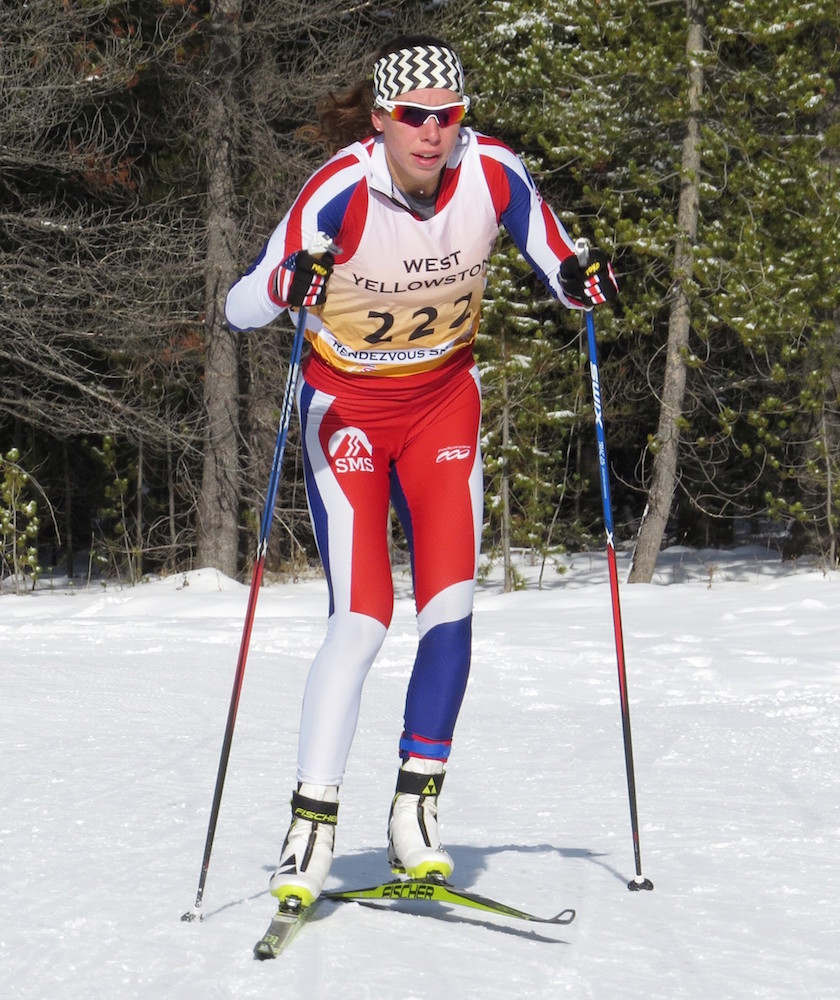
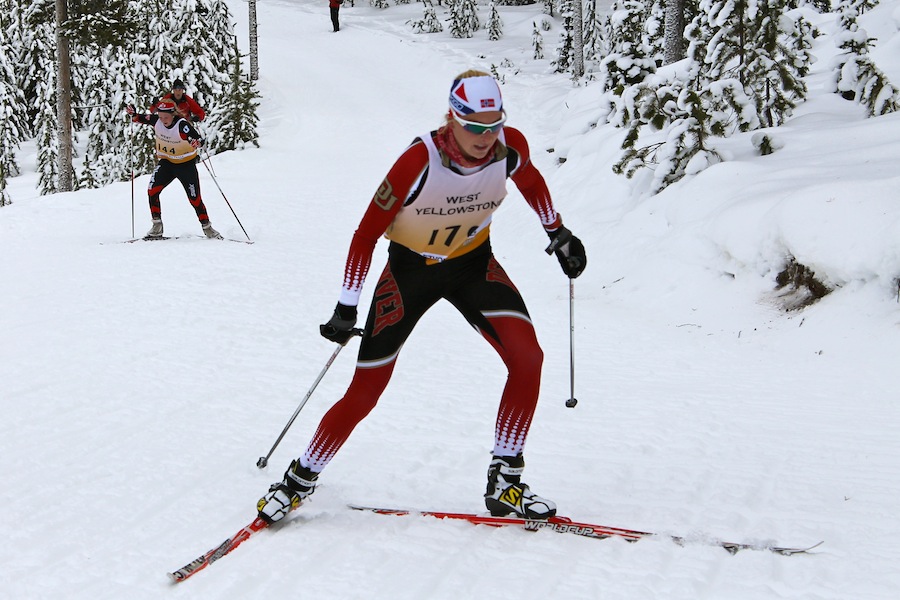
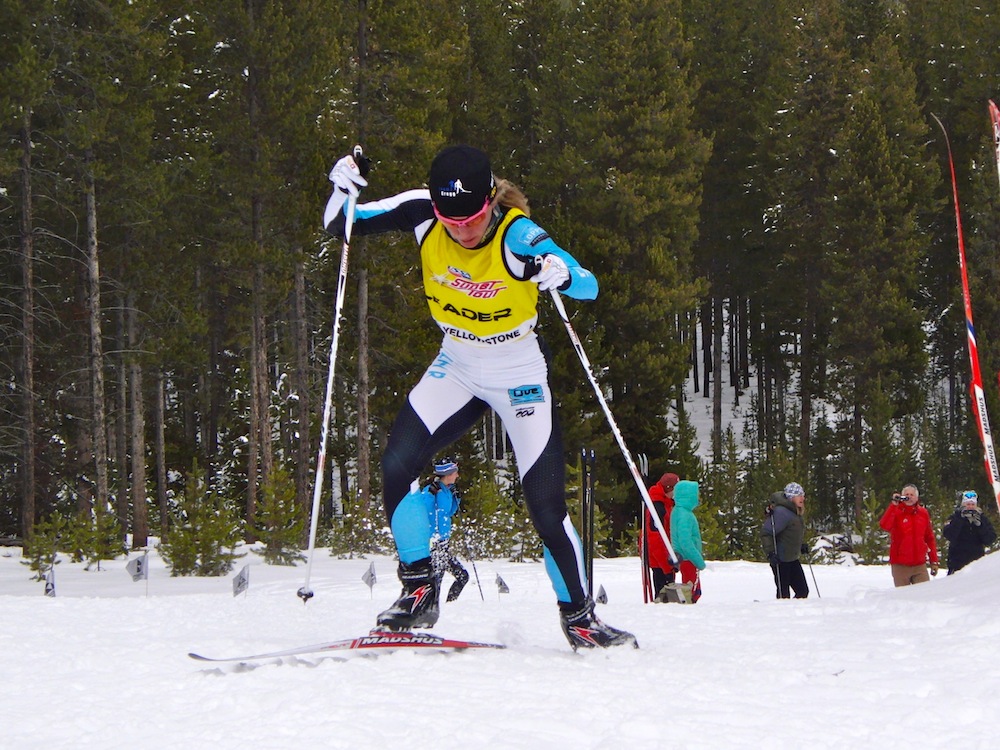
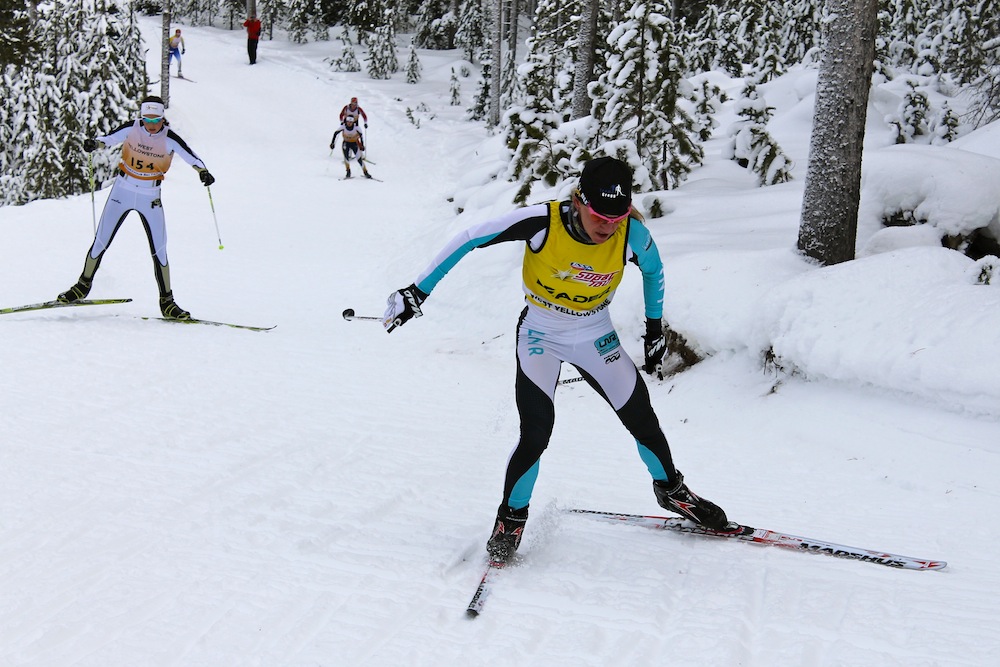
Katharine Ogden (SMS/USST) racing to an 11-second win in the women’s 5 k freestyle FIS race on Friday in West Yellowstone, Mont. (Photo: Ian Harvey/Toko)
The first official cross-country ski races of the season in the Lower 48 were held Friday in West Yellowstone, Mont., and for the first time in a long time, they weren’t U.S. SuperTour races.
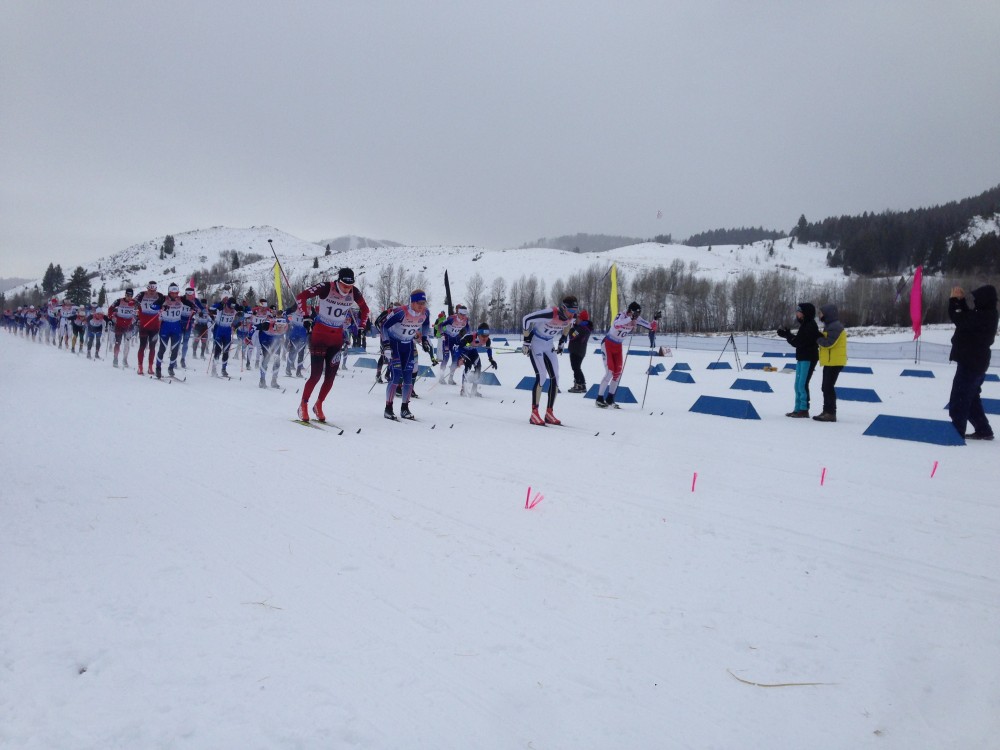
But they were International Ski Federation (FIS) sanctioned and once again a big part of the West Yellowstone Ski Festival, which has been known to attract 3,500 skiers and has been an early season tradition for more than 30 years.
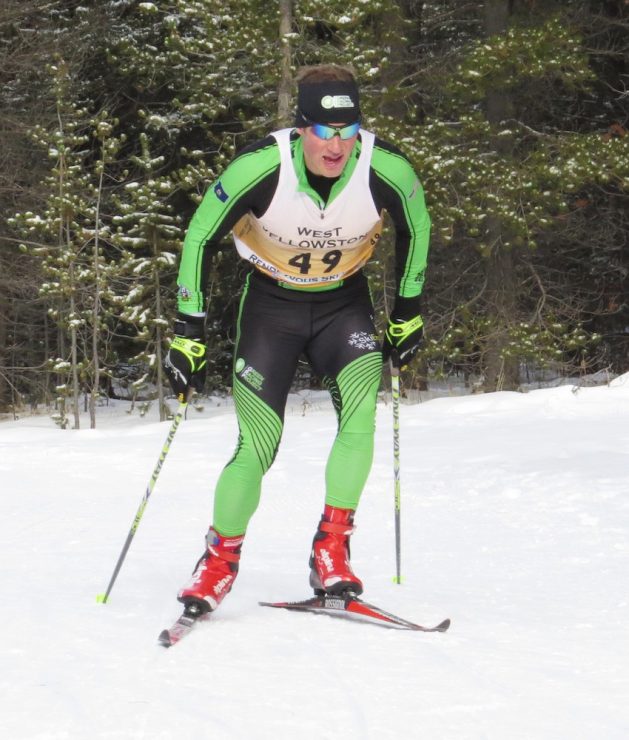
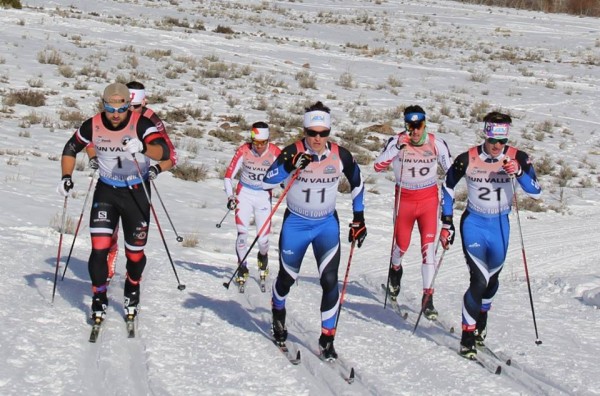
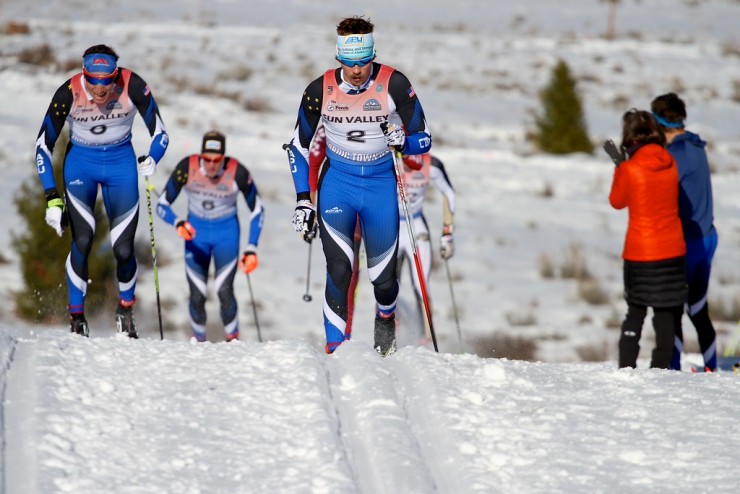
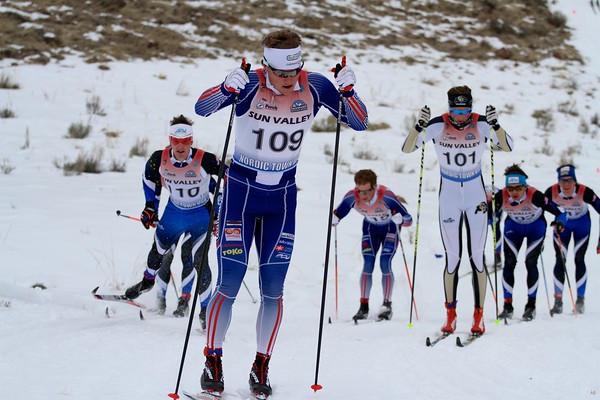
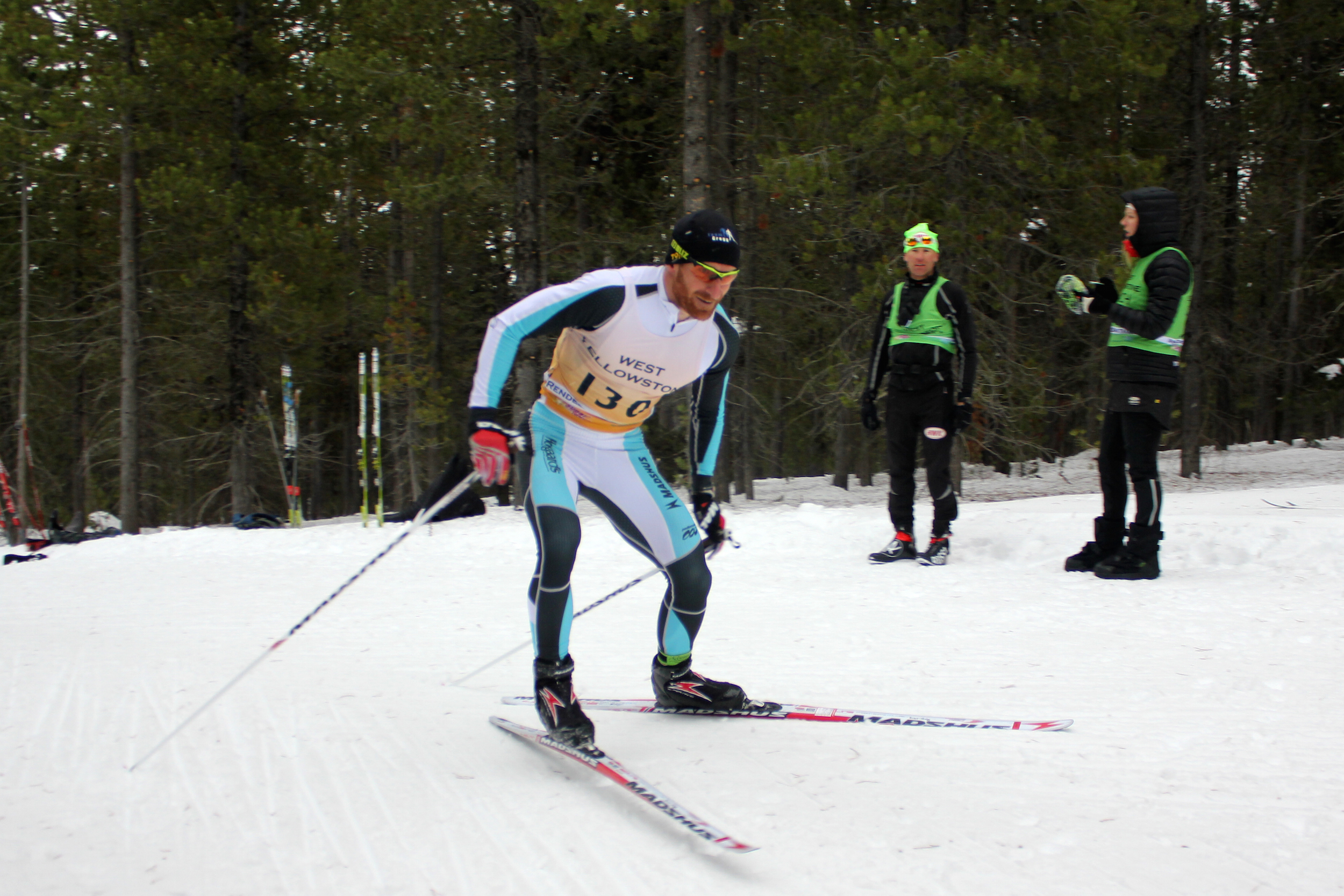
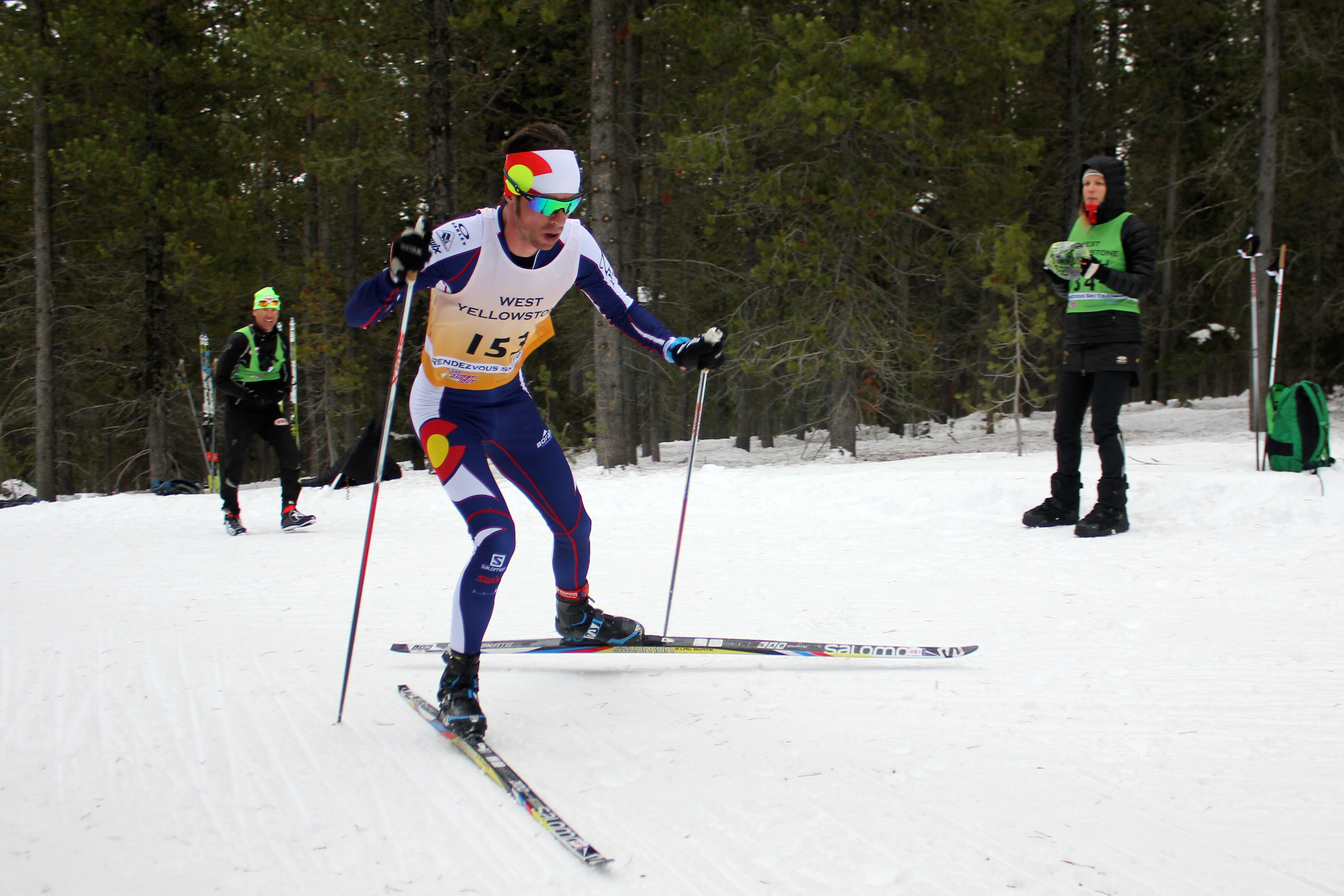
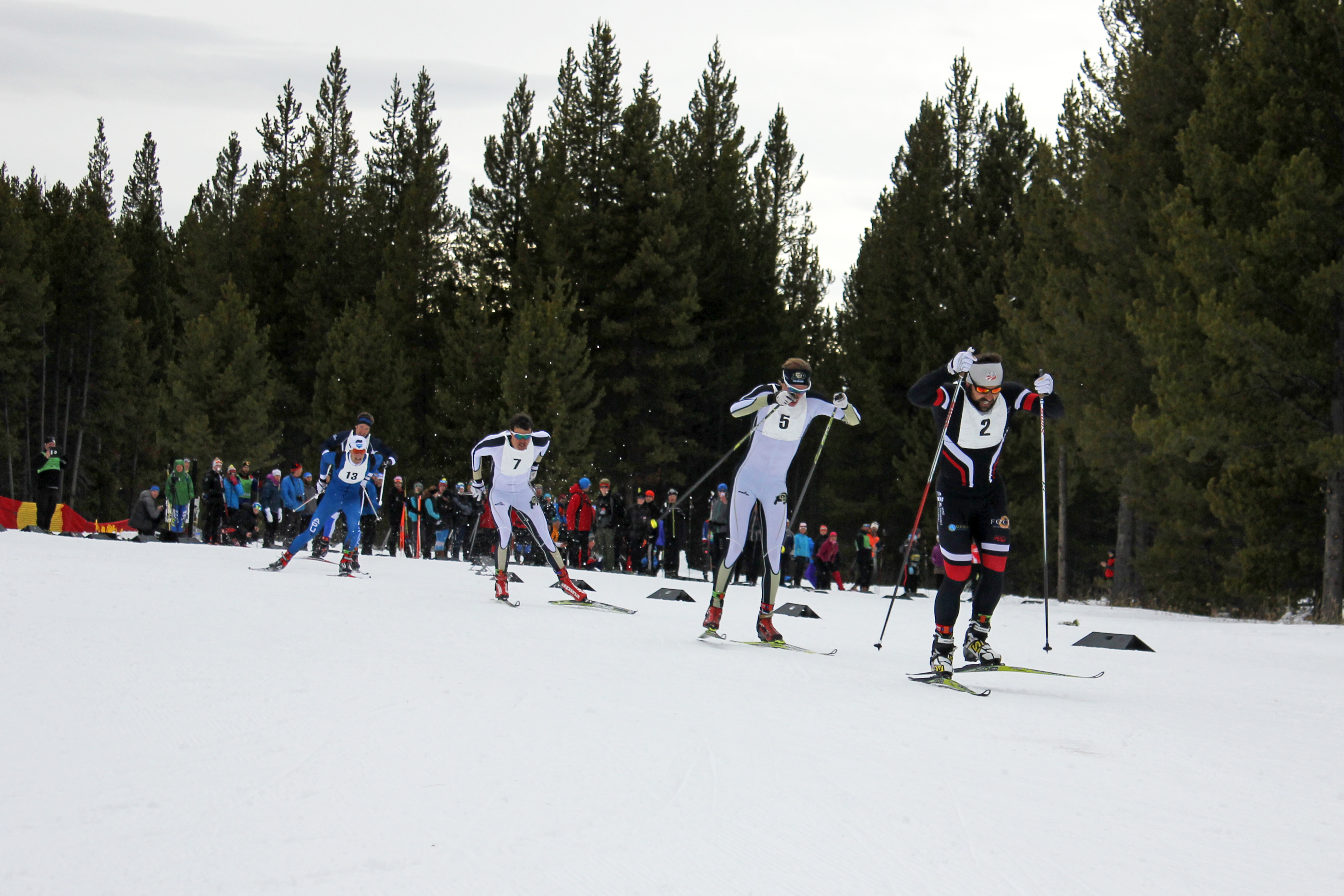
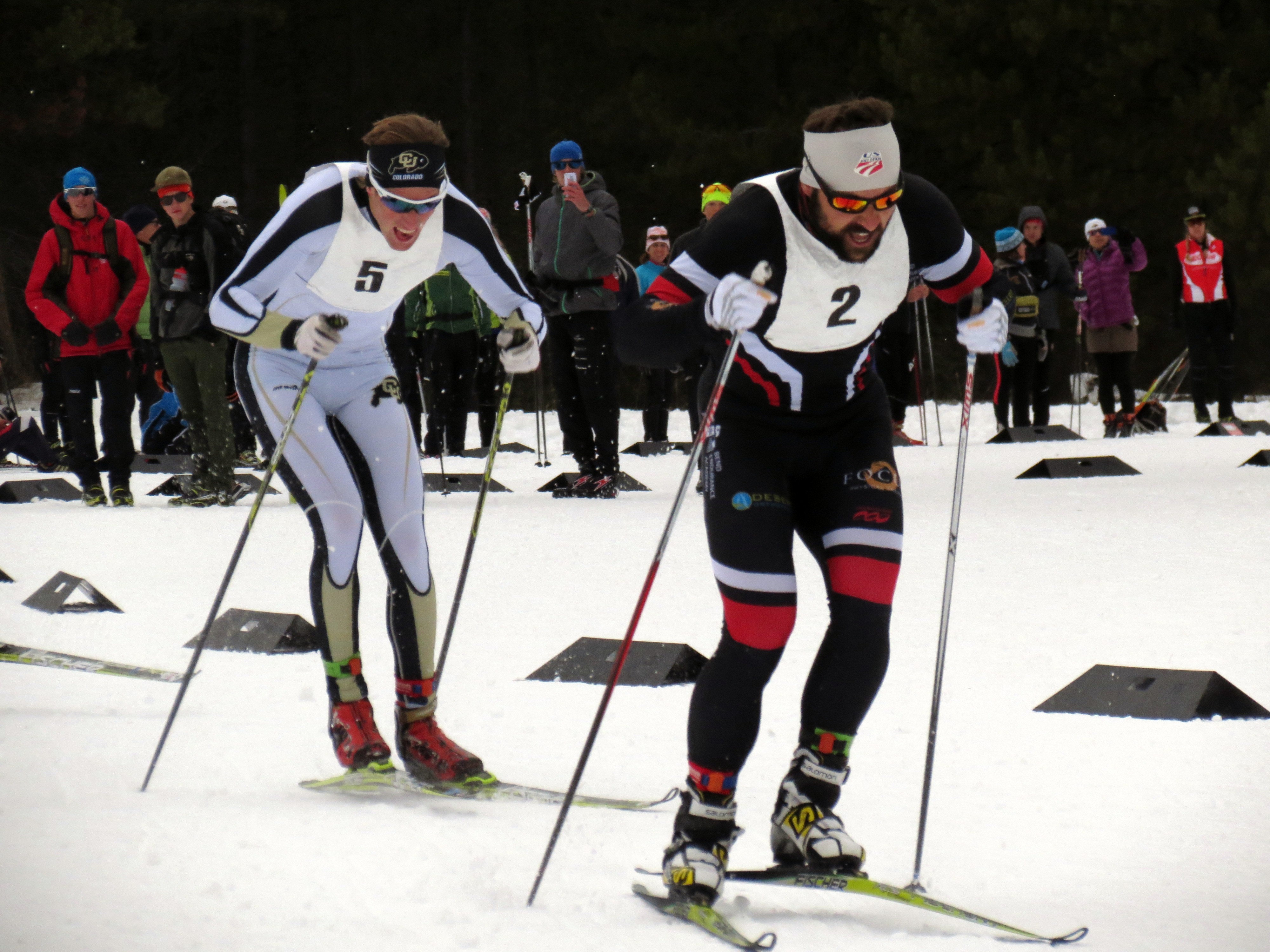
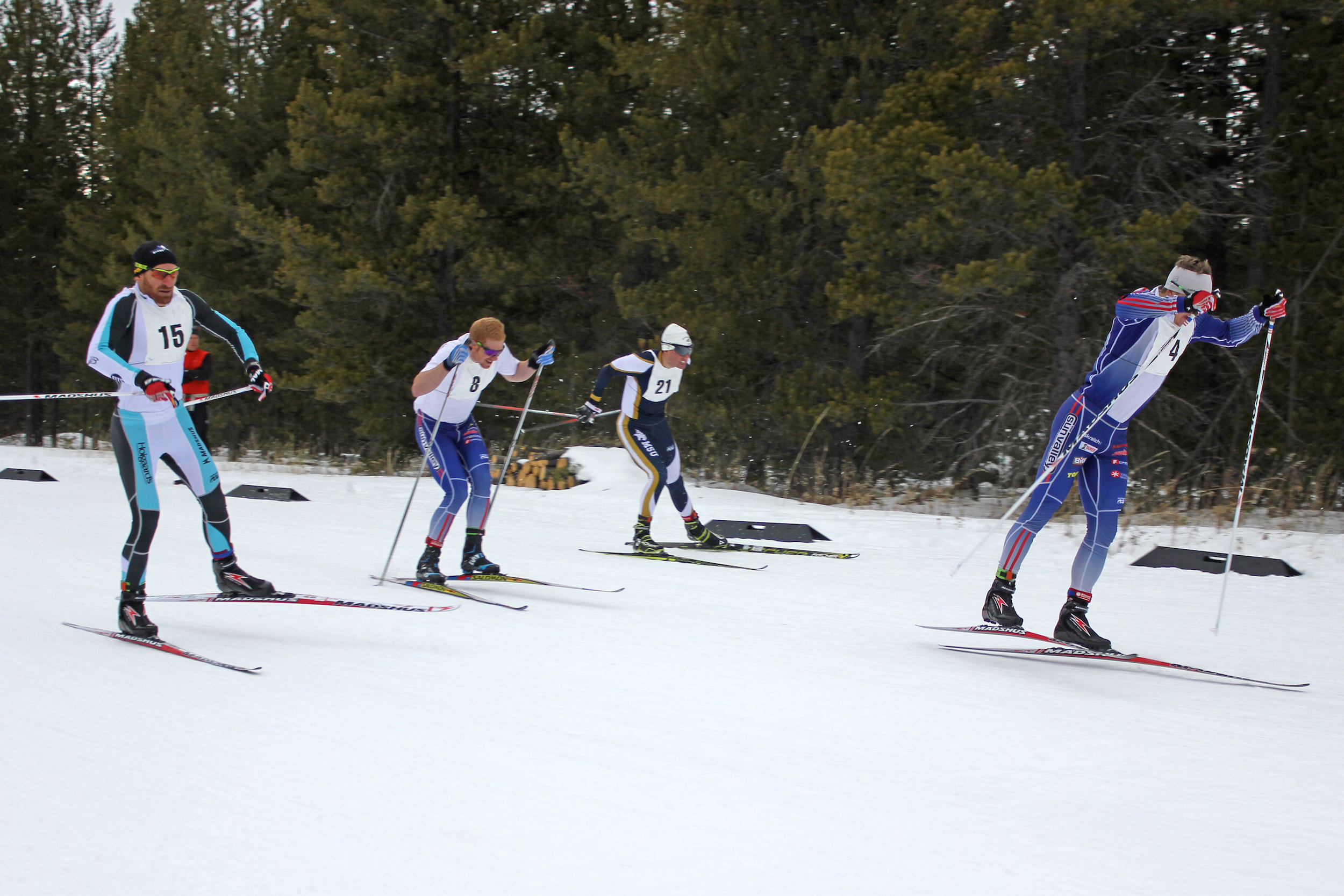
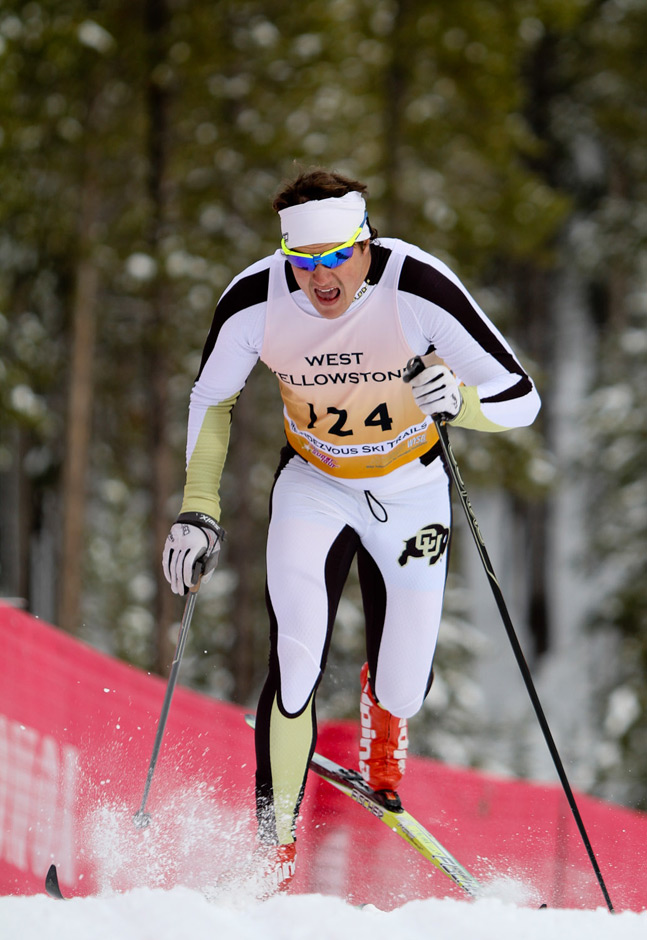
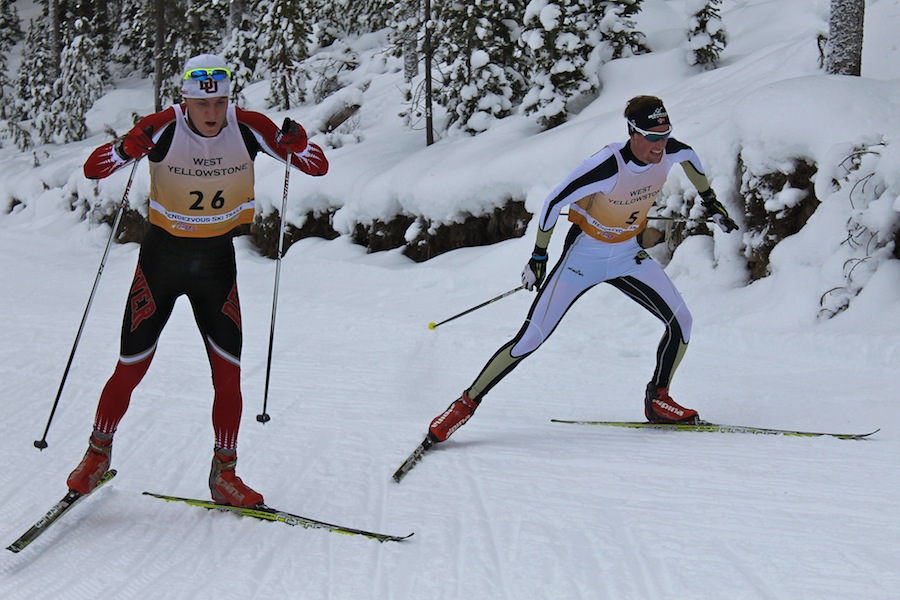
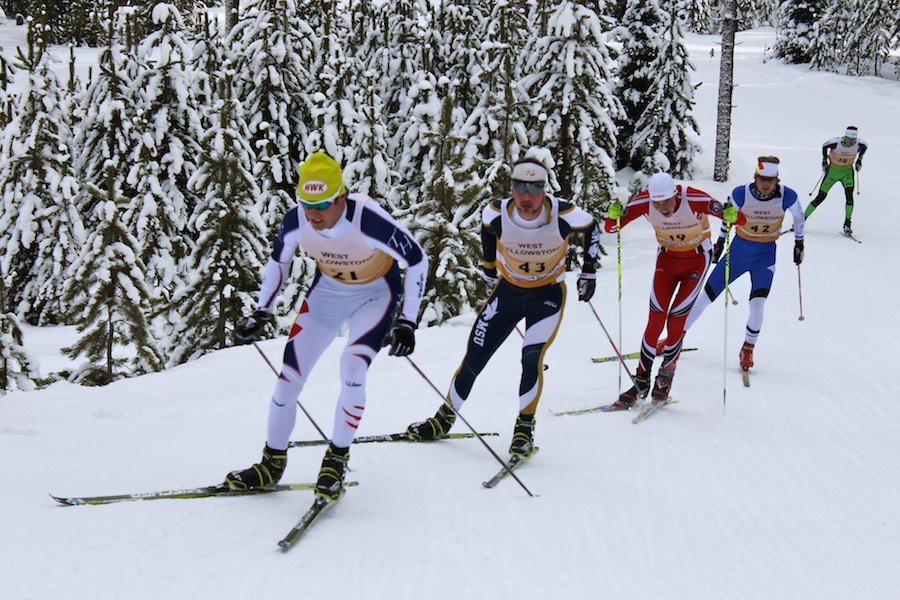
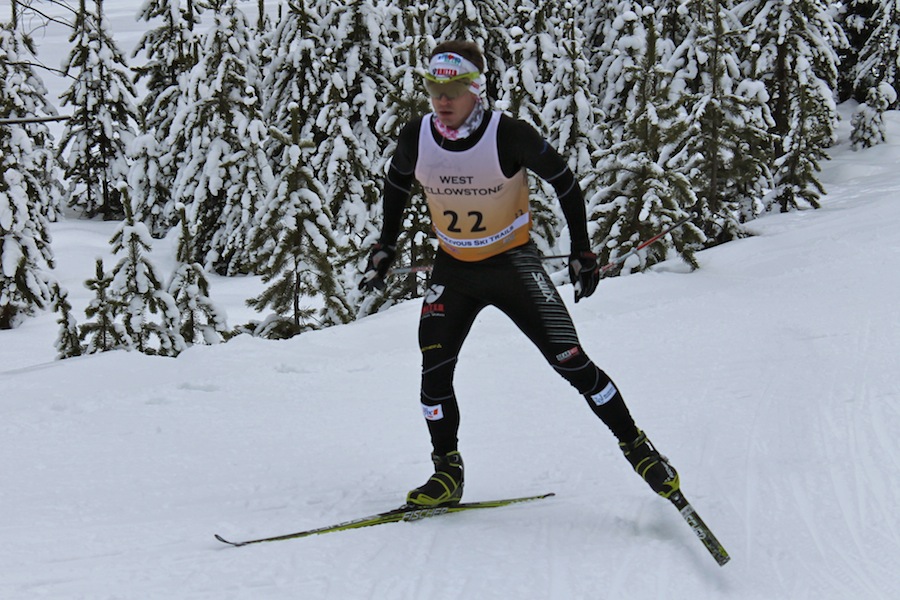
Paddy Caldwell, of the U.S. Ski Team’s D-team, Dartmouth College and the Stratton Mountain School (SMS) T2 Team, won the men’s 10-kilometer freestyle on Friday at the Rendezvous Ski Trails. He bested nearly 90 in the men’s race, putting down the fastest time in 20:32.4 minutes, which was 26.7 seconds ahead of runner-up Rogan Brown, of the Sun Valley Ski Education Foundation (SVSEF). Mads Strøm, a Norwegian-born University of Colorado-Boulder (CU) senior and two-time NCAA champion, placed third, 31.1 seconds behind Caldwell.
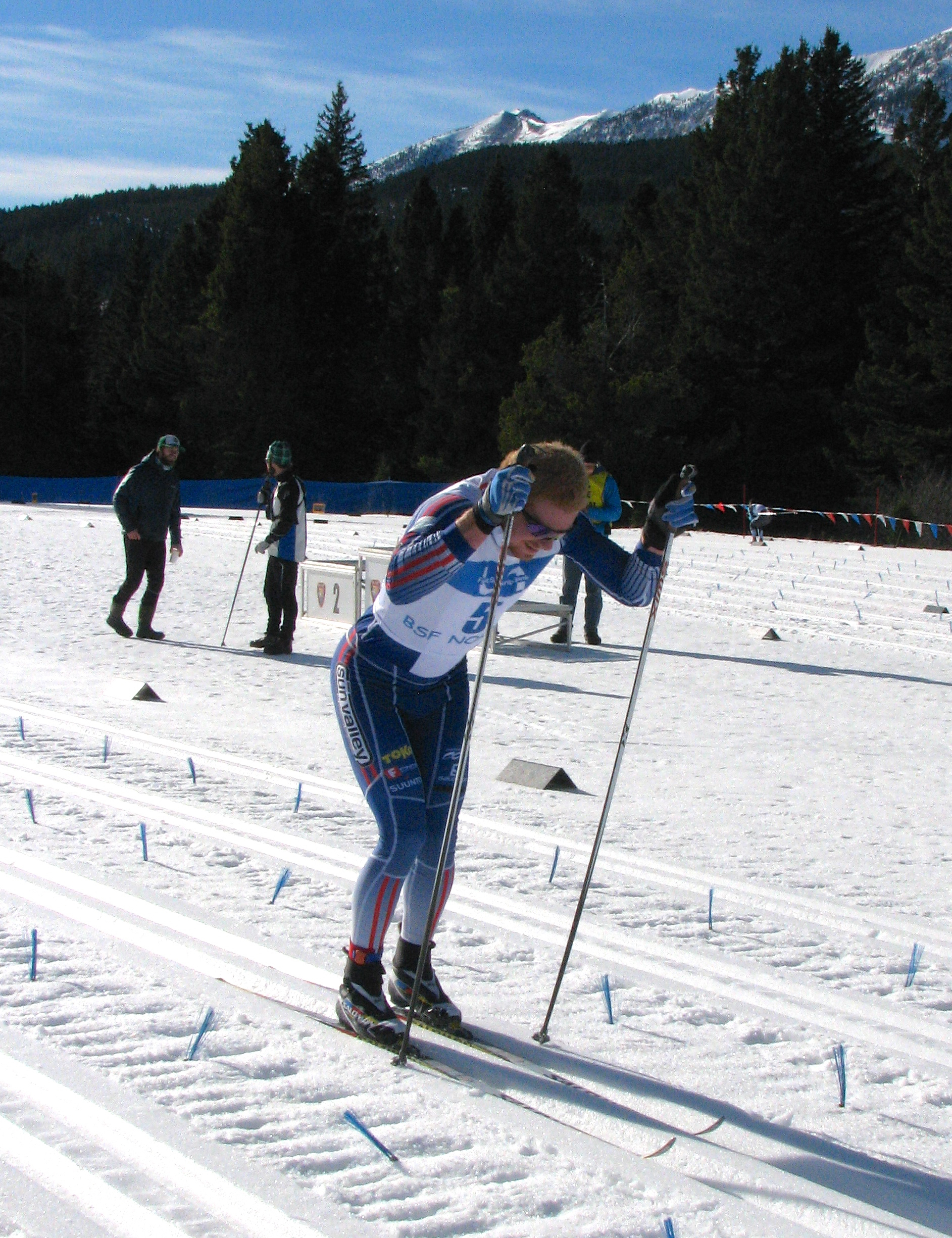
Just 0.2 seconds off the podium, Sun Valley’s Jack Hegman placed fourth (+31.3), and Ben Lustgarten, of theCraftsbury Green Racing Project (CGRP), was close behind in fifth (+32.4), as was Silas Talbot, of the Bridger Ski Foundation (BSF) Elite Team, in fifth (+37.4).
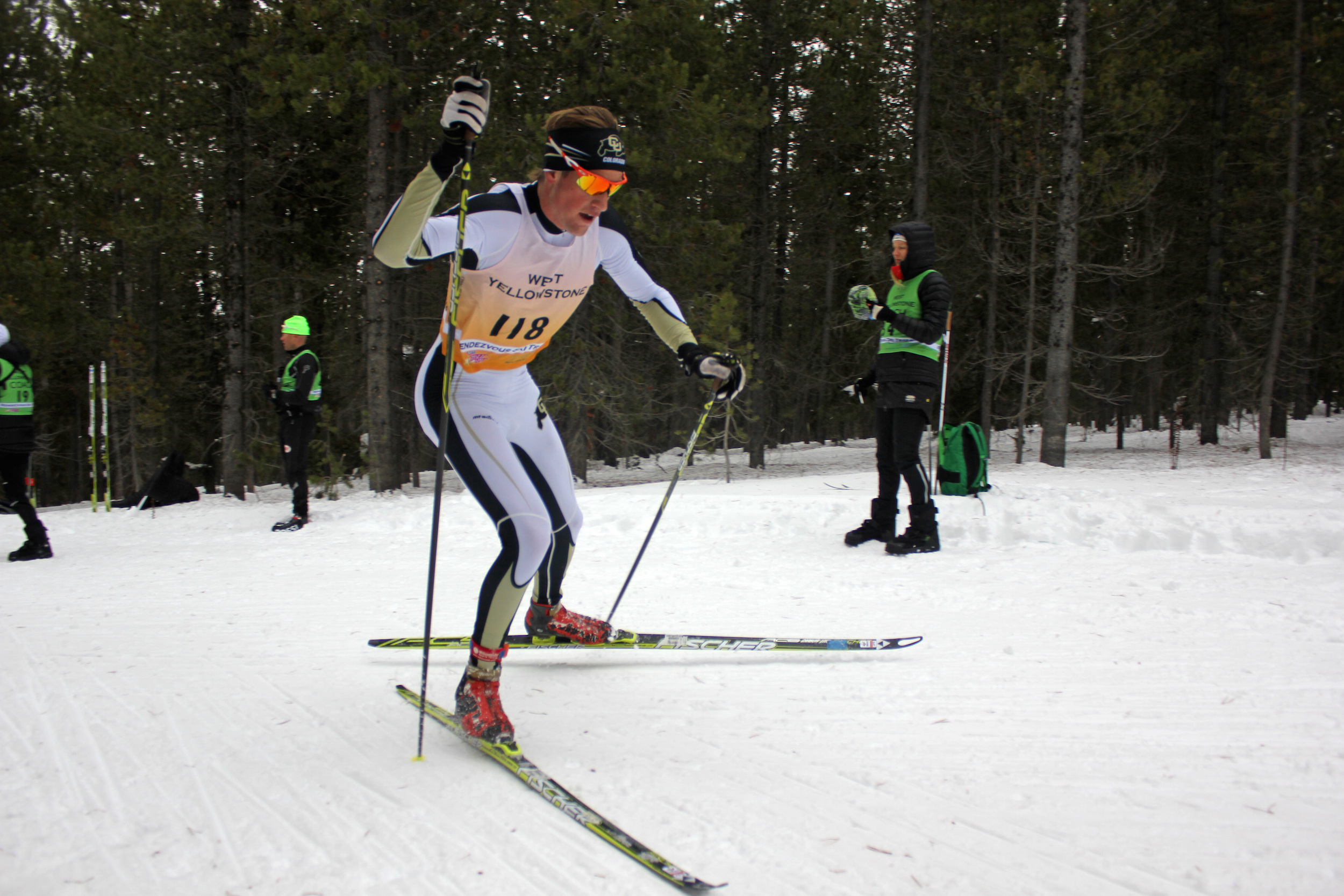
Rounding out the top 10, Karsten Hokanson (Montana State University) placed seventh (+53.6), Patrick Johnson (Far West) was eighth (+56.7), and Norway’s Petter Reistad (CU) and Welly Ramsey (Farmington Ski Club) tied for ninth (+57.6). Oscar Ivars (University of Utah) took the next spot in 11th (+1:01.5).
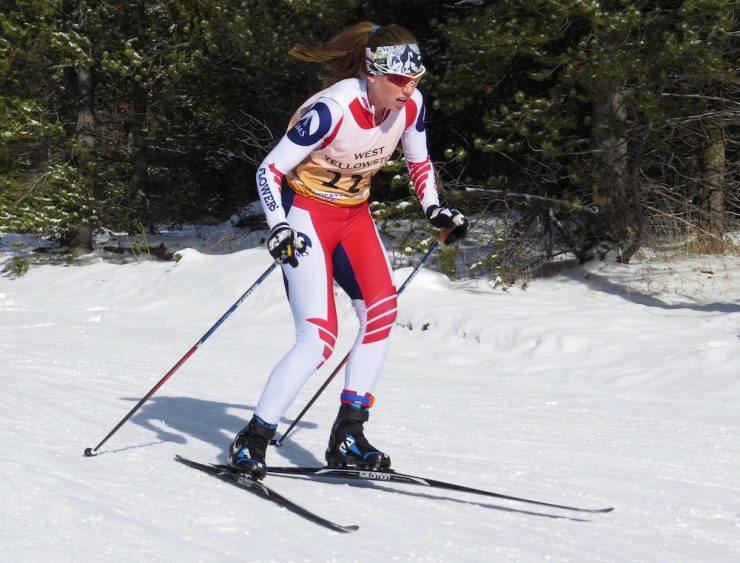
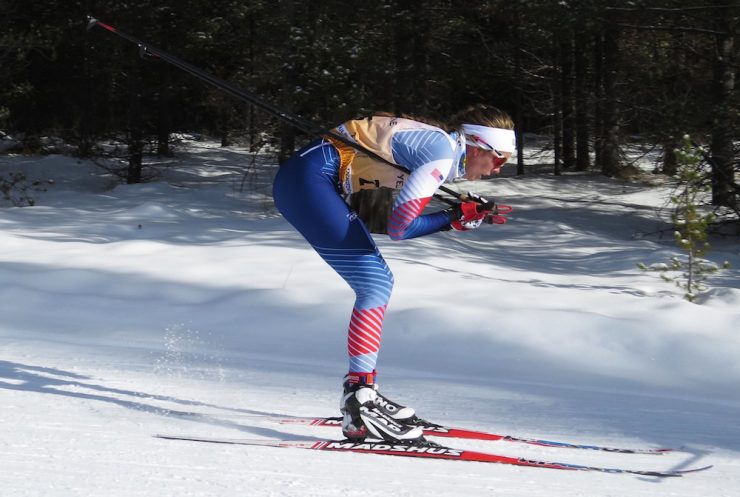
In the women’s 5 k freestyle, Katharine Ogden, another U.S. Ski Team (USST) D-team member who trains with SMS, took the win. She beat out CU’s Petra Hyncicova, originally from the Czech Republic, by 11.8 seconds with a winning time of 11:45. One of Ogden’s training partners, Erika Flowers (SMST2) placed third (+13.3).
Craftsbury’s Liz Guiney took fourth (+19.4), Jennie Bender (BSF) was fifth (+22.4), Mary Rose (SVSEF) sixth (+27.0), Anne Hart (SMST2) seventh (+32.8), Christina Rolandsen (CU) eighth (+34.7), Kaitlynn Miller (CGRP) ninth (+36.5), and Hannah Halvorsen (Sugar Bowl Elite Team/USST D-team) 10th (+36.8) in a tighter women’s field, which included 76 finishers.
FIS racing continues at the Rendezvous Trails on Saturday, with 5/10 k classic races scheduled.
In related news, the first SuperTour races of the season — which were supposed to take place next weekend, Dec. 3-4 — were canceled. At the top of the Bridger Ski Foundation’s SuperTour event page, it now reads: “Bozeman SuperTour Cancelled: Due to lack of snowfall the races are not able to be run.” The SuperTour opener doubled as the first races of the Canadian NorAm season as well.
Just like in the U.S., Cross Country Canada (CCC) intended to use Bozeman as part of its selection races for 2017 World Championships and the Continental Cup leader (COC) World Cup spots. Now instead of considering an athlete’s best three results out of seven race days, CCC will consider three out of five.
“Bozeman was part of our NorAm COC series selection process; however now that Bozeman is cancelled it’s not in the picture,” CCC High Performance Director Thomas Holland wrote in an email to FasterSkier on Friday night.
“Are you ready for some more West Yellowstone fun? ‘Cuz we’re hosting the SuperTour next weekend December 3 & 4,” the post read. “Saturday Freestyle Sprints, Sunday 15k/10k Classic; 5k U16 Classic. Registration site is in progress but will be on ysfraces.athlete360.com. And can you volunteer? Send us a message at info@skirunbikemt.com to give us your info. Thanks!”
“The altitude at West Yellowstone is too high to use it as a selection race for the Canadian team – will not count for the FIS COC series,” Holland wrote.
We’ll post more information as it becomes available.
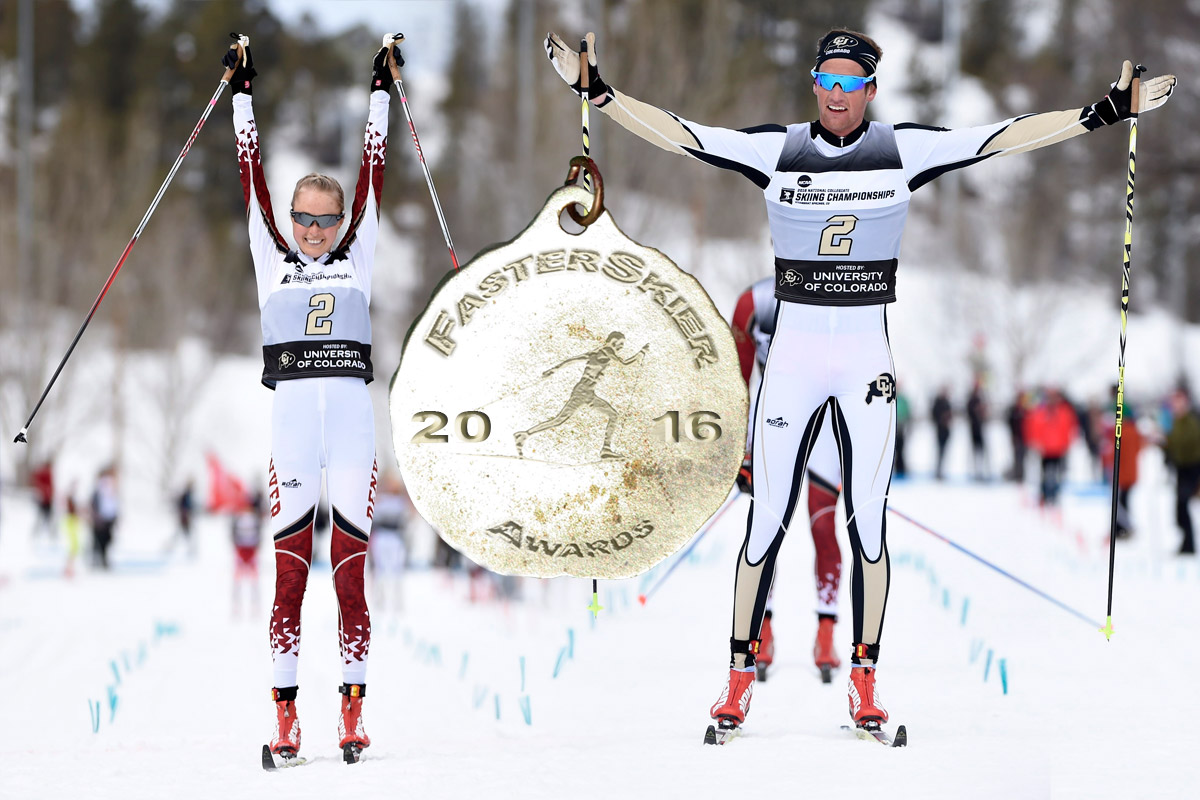
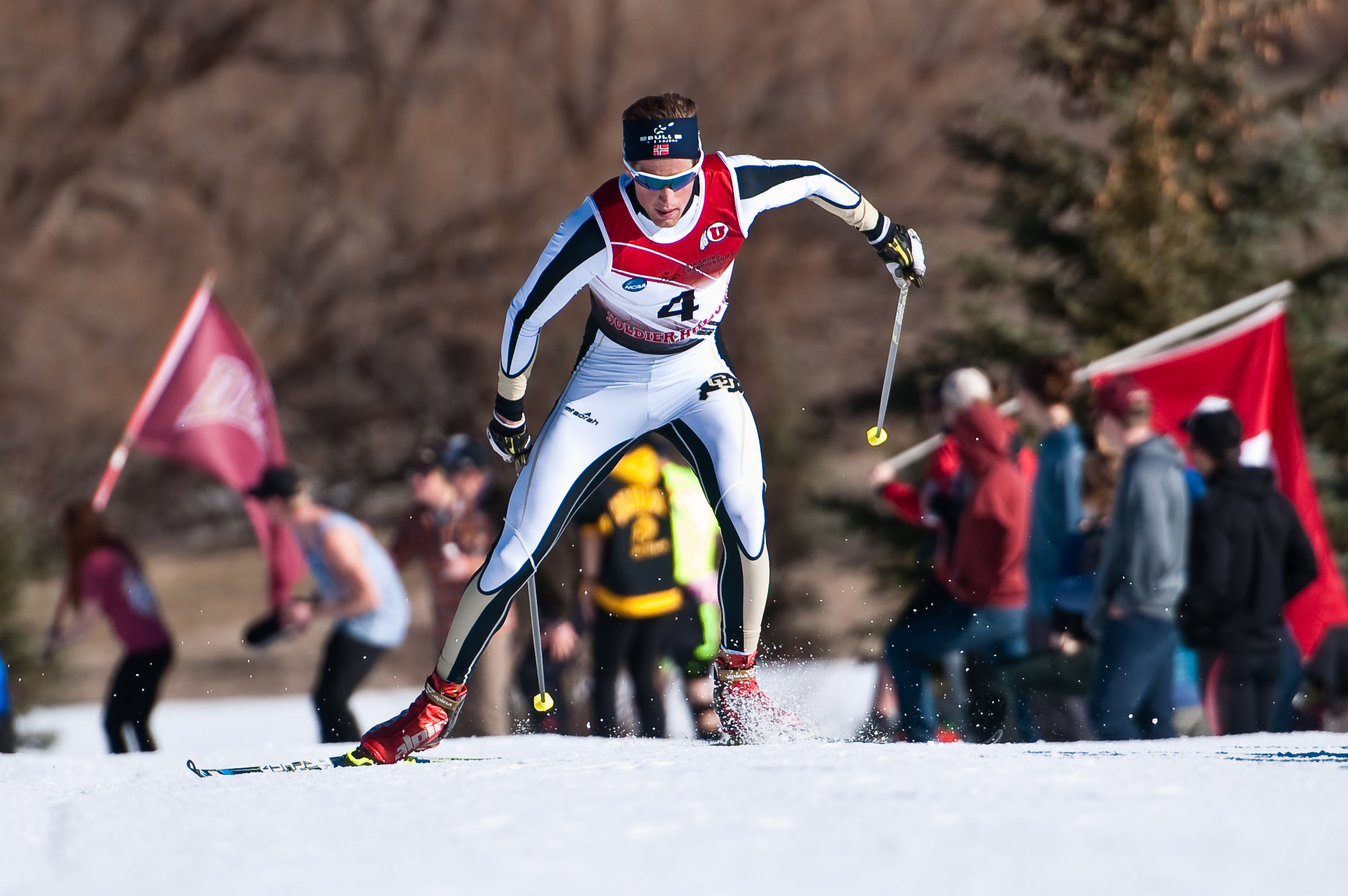
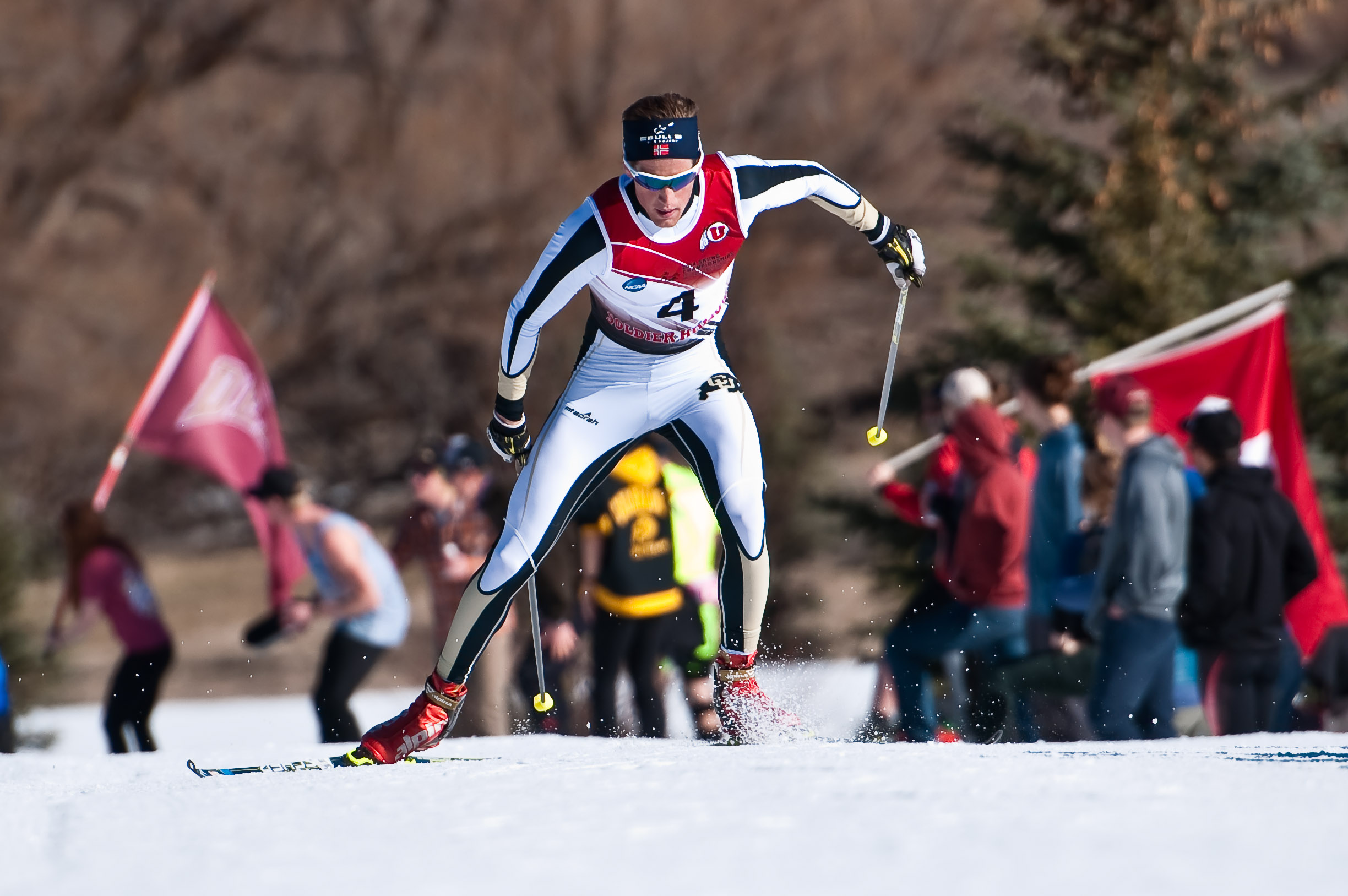
FasterSkier’s Collegiate Skiers of 2016: Mads Strøm and Linn Eriksen. (photo: Curtis Snyder of the CU Sports Information Dept. and Jamie Schwaberow/NCAA Photos).
With the 2015/2016 season officially in the rearview, FasterSkier is excited to unveil its annual award winners for this past winter. Votes stem from the FS staff, scattered across the U.S. and Canada, and while not scientific, they are intended to reflect a broader sense of the season in review.
We kicked off the series Monday with Juniors of 2016: Katharine Ogden and Sean Doherty. This second set of honors goes to outstanding male and female skiers on the U.S. NCAA collegiate circuit.
***
Mads Strøm, University of Colorado-Boulder
Even after tallying four wins in a row and six victories this past season, the University of Colorado-Boulder (CU) junior Mads Ek Strøm was still nervous before his final competitions of the 2016 college race season.
Nerves, however, didn’t stand a chance with the 24-year-old Norwegian.
By the time he finished the men’s 10-kilometer freestyle — the first of two nordic races at the NCAA Skiing Championships event this year in Steamboat Springs, Colo. — Strøm had skied to his seventh win of the season and fifth win in a row, securing himself as the most distinguished CU skier of all time.
Prior to Strøm, the most season wins accomplished by a CU skier were six, set first in 1989 by Per Kare Jakobsen and then again in 1999 by Ove Erik Tronvoll.
“I was so nervous,” Strøm said of coming into the 10 k, according to CUBuffs.com. “I just had to find good skis, good pacing, and push it as hard as possible. It was definitely the best win of the year. Pulling it off when it matters the most is great.”
An Oslo native, Strøm began attending CU in 2014. He made his debut on the NCAA Championships podium during his freshman year, when he won the 2014 men’s 20 k freestyle race at Soldier Hollow in Midway, Utah.
One podium only warranted more. After his freshman year, Strøm continued to chase the top spots, garnering 25 career podium finishes and 13 individual titles by the time he won this year’s men’s 10 k event, according to CU’s Sport Information Specialist Curtis Snyder.
However, Strøm’s goal for this college season wasn’t to win just one of the NCAA Championships races. He wanted both.
“Obviously I wanted to win,” Strøm had told FasterSkier after he finished second in the men’s 15 k classic mass start Sun Valley SuperTour in December — before the college season started. “I haven’t gotten quite there yet because I have been training almost 100 hours every month since May. I’ve planned that in one month from now I’m going to be in better shape and my plan is to win both races at NCAA’s.”
Strøm’s plan to wait and win worked. When he crossed the finish line first in the men’s 20 k classic mass start, the second nordic race of NCAA Championships, Strøm accomplished his season goal and much more.
After winning eight out of 12 races in the collegiate race schedule, Strøm now holds the record for most season victories of any CU skier, alpine or nordic.
“He became the fifth CU skier to sweep the individual NCAA Championships in program history, joining John Skajem (alpine, 1987), Line Selnes (1988, Nordic), current Nordic assistant Jana Weinberger (2006, Nordic), Maria Grevsgaard (2008, Nordic) and Lucie Zikova (2008, alpine),” Snyder wrote in an email regarding Strøm’s NCAA podium sweep.
The Norwegian’s achievements this season don’t end with the collegiate race scene. Strøm also finished fourth and ninth at the SuperTour season opener in West Yellowstone, Mont., in the 15 k freestyle and sprint, respectively.
The following SuperTour in Sun Valley Idaho, also saw Strøm ski to second in the men’s 15 k classic mass start and 11th place in the classic sprint.
Strøm, who plans to major in business and would like to one day compete at the Olympics, will return to CU next year for his final nordic ski season as a senior.
Linn Eriksen, University of Denver
One out of two. For every two college races University of Denver (DU) sophomore Linn Eriksen raced this year, she won one. That includes the final nordic college race of the season at NCAA Championships: the women’s 15 k classic mass start.
Also from Oslo, Eriksen, 21, commanded this year’s NCAA Championships mass start, striding away to a 19.9-second victory over the University of New Mexico’s (UNM) Kati Roivas.
Though Eriksen has stood at the top of the podium before as Norway’s four-time Junior National Champion, her victory in this year’s 15 k was her first NCAA title, as well as her first NCAA podium appearance.
Her breakthrough at this year’s NCAA’s also helped the Denver Pioneers to their 23rd national championship.
“Moritz [Madlener] and Linn [Eriksen] have led the team all year and they did it again today,” DU head nordic coach David Stewart said according to a DU press release. “Linn skied a masterful race, leading from start to finish, breaking away on the last lap to ski to a solo win.”
Eriksen’s other notable accolades from the season include first-place finishes in women’s 5 k freestyle and 15 k classic at the Montana State University invite, victories in both races at the UNM invite, second place in the 5 k freestyle at the University of Utah invite, third place in the 15 k classic CU invite, second place in the 5 k freestyle at the DU Regional race, and her top-10 finish in the first race of NCAA Champioships, the 5 k freestyle where she placed eighth.
After finishing the season as an All-American in both NCAA Championships races, Eriksen’s name will not go unnoticed at the start of next year’s college race season, her junior year.
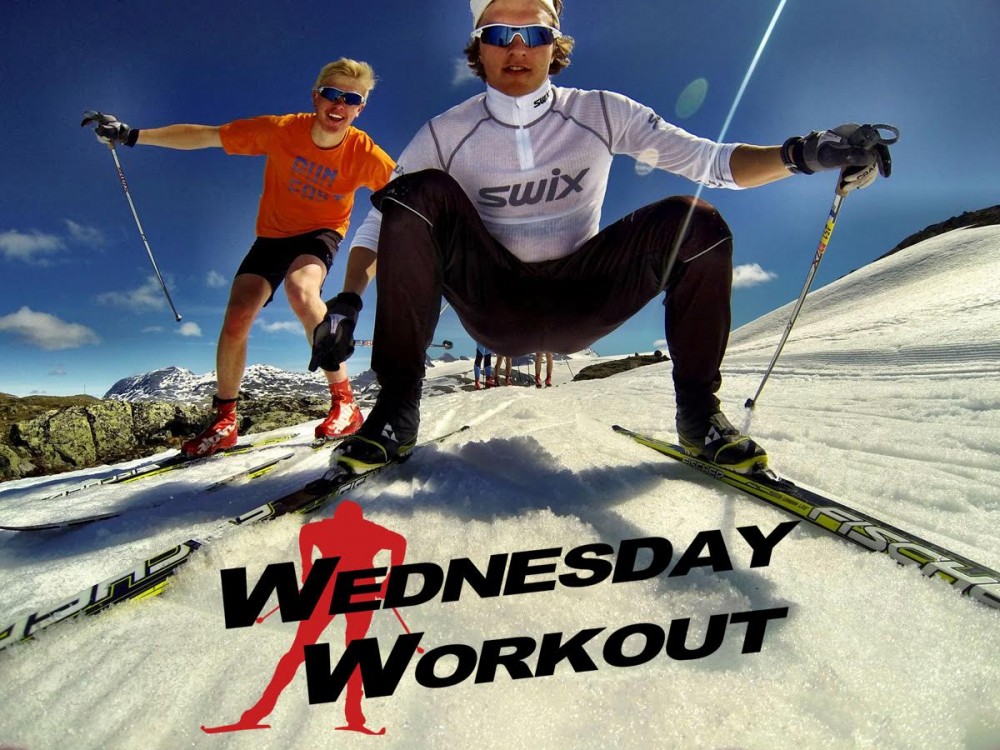
Petter Reistad (front), who recently finished his freshman season at the University of Colorado-Boulder, crust cruising in 2013 in Sognefjellet, Norway. (Courtesy photo)
Itching for an excuse to say ‘Sayonara’ to scheduled skiing and ‘Hello’ to more impromptu spring-skiing experiences? Look no further as this week, FasterSkier provides an ideal Wednesday Workout for the nordic wanderer, courtesy of Petter Reistad of the University of Colorado-Boulder (CU).
***
Sunscreen, sunglasses and snow. When it comes to spring workouts, it’s not just the freeing feeling of skiing around in Ray-Bans and beach-like weather that makes crust skiing an essential workout for this time of year, it’s also the satisfaction that spontaneous skiing provides after a season of structured ski training.
Petter Reistad, coming off his freshman season a CU and an All-American in both races at this year’s NCAA Skiing Championships, says the best training plan for the spring is no plan at all.
“What I like about spring is that you can do what you want, you don’t have to follow a plan anymore,” said Reistad, a 21-year-old from Bærum, Norway, on the phone. “It’s really nice to, instead of following a trail for a 15 k loop, to just go and aim for a mountain. You can ski up [to the top] and then ski [back] downhill where ever you like.”
For those lucky enough to have mountains and snow nearby, Reistad’s spring training regimen proposes a simple schedule: Pick a peak and send it.
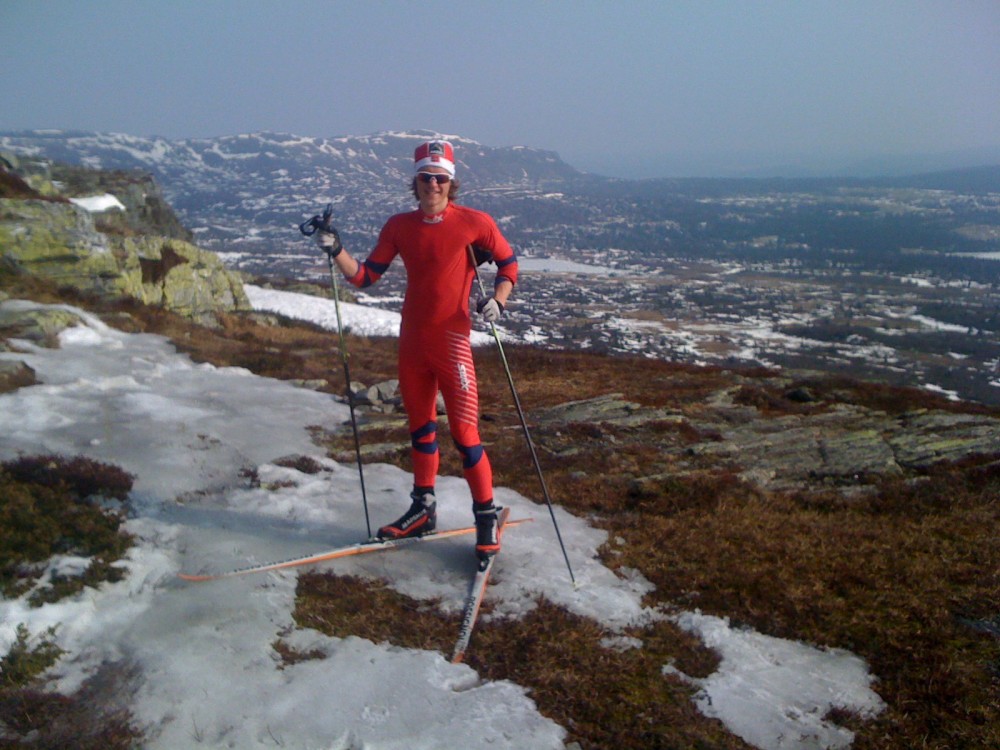
Petter Reistad taking advantage of the last bit of snow during a crust-cruising trip in Skeikampen, Norway, back in 2011. (Courtesy photo)
“Going for a trip like that is a little bit more of an expedition, than just a normal workout,” Reistad said. “But nothing is like being free on skis and the spring crust gives you an awesome opportunity to do so.”
In terms of snow crust, the spring season also provides the cream of the crop. For Reistad, spending a few spring workouts trekking mountain tops on skis is not only about the novelty of blazing trails where none were before, but also experiencing some of the season’s premium crust-cruising moments.
“The reason why [this workout] is also a good thing to do in the spring is that during the rest of the season, you have more snow and different cold kinds of snow,” he said. “But in the spring, colder temperatures up in the mountains [combined with] the snow heating up during the day, forms this really nice crust.”
While Reistad has done plenty of crust skiing in Norway, this year will mark his first adventure cruise on Colorado snow crust. Before making moves for the mountains, however, he plans to first catch up on schoolwork. Predicting that snow will stick around in the Rockies until mid-May, he and a few other CU teammates, including fellow Norwegian, Mads Strøm, who won both men’s nordic races at this year’s NCAA Championships, will set out for Crested Butte, Colo.
“It has been a really good year,” Reistad said regarding his first year of college ski racing in the U.S. “I’ve been second in some races this year and I must say, it’s really good to have [Strøm] on the team. Having good teammates is important because you can both train with them and compete even harder with them … it is more fun when you give them something to think about during the race … and I would really like to beat [Strøm] once next season. That’s a goal for next year.”
Reistad will have that chance next ski season, during his sophomore year and Strøm’s senior year at CU.
The Workout
– Start sometime early in the morning, 7 a.m. seems a solid choice, according to Reistad
– Spend an undetermined amount of time skiing snow crust
– Mid-workout, stick a bottle of soda in the snow for later
– Spend more undetermined amounts of time skiing snow crust
– Stop and enjoy a cold soda (if you can recall its original location)
– Re-apply sunscreen and spend a little more time crust cruising before the sun makes the snow too soft to ski on
Total Workout Time: Depends on when you start and how strong the sunshine is, but Reistad estimates 3-4 hours should do the trick
Reistad’s Crust-Cruising Checklist
In order to find freedom within the spring crust cruising workout, Reistad recommends shedding training schedules and sticking to the bare minimum. A few items he suggests as indispensable to a spring ski trip are listed below, followed by the workout itself.
Sunglasses and Sunscreen: Carrying cases of clothing is less of a priority for the CU skier when it comes to cruising snow crust. “I’m excited because you don’t need that much clothes as in the regular season because it’s just heating up so amazing in the spring,” Reistad said. “So sunglasses and sunscreen are the most important things [to pack] because you get so sunburnt.”
Oranges and Chocolate: Not your average culinary combination, Reistad argues that the mixture of sweet and tangy makes for the most desired treat during a spring trip to the mountains. “In Norway, a very typical thing to eat around this time of year — Easter and spring — is oranges,” he said. “So I will pack some chocolate and some oranges. That’s just a great combo.”
A Bottle of Coke: Share a soda on snow crust. “Nothing is like a cold Coke on a trip like that,” Reistad said. “Make sure to make it cold in the snow in the middle of the trip before drinking it.”
A Camera Phone: For any cross-country skier looking to make the crust-cruise workout complete, Reistad also says shameless self-promotions on social media make the workout all the more worthwhile. “You should probably bring your phone, too, to make sure to Instagram the whole thing after,” he said. “A trip gets so much better when you can show it off to everyone.”
(Ed. note: FasterSkier recommends having a phone with you at all times during workouts in the event of an emergency.)
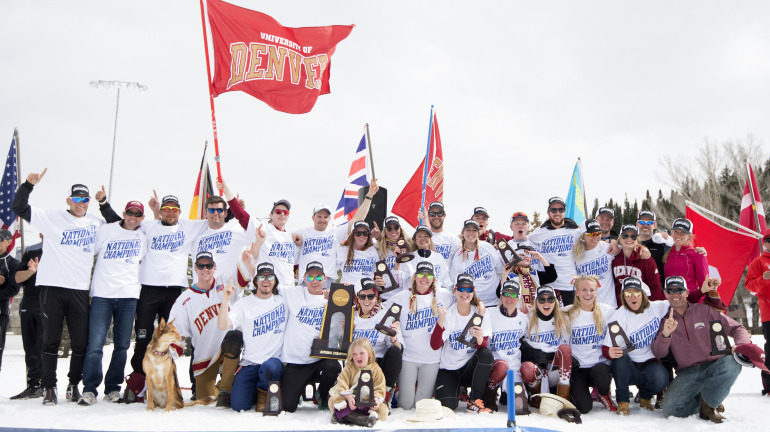
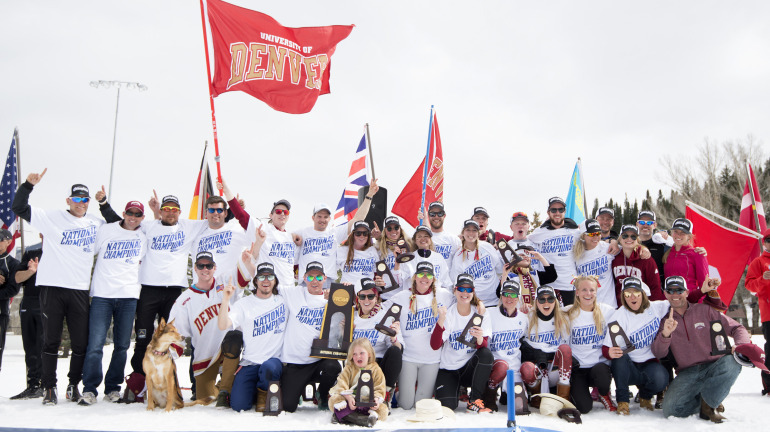
The University of Denver celebrates its victory during NCAA Division I Men’s and Women’s Skiing Championships at Howelsen Hill in Steamboat Springs, Colo. (Photo: Jamie Schwaberow/NCAA via DenverPioneers.com)
After the University of Denver (DU) alpine team pulled the Pioneers into the lead on Friday, surpassing Montana State University (MSU) by 15.5 points with one day remaining in the NCAA Skiing Championships, the DU nordic team took that lead and ran with it on Saturday for Denver’s 23rd national skiing title.
DU won the four-day 2016 championships with 567.5 points, 76 more than the University of Colorado-Boulder in second and 82.5 ahead of University of Utah in third. Colorado (CU) hosted the championships at Howelsen Hill in Steamboat Springs, Colo., with two days of alpine racing interspersed with two days of nordic.
“Alpine set us up with a lead that we were able to build on, so this was a balanced team win with both alpine and nordic adding almost the same points to the team total,” Denver Head Nordic Coach Dave Stewart said, according to a DU press release. “Alpine has had a dominant season and it was very special to put it all together this week at NCAA’s.”
The men’s 20-kilometer and women’s 15 k classic mass starts ended the championships on Saturday, with CU sophomore Mads Strøm winning his second NCAA title in as many races at this year’s championships (and third overall in the last three years).
Denver sophomore Linn Eriksen skied away from the 39-woman pack to win in 54:37.6 minutes, 19.9 seconds ahead of Kati Roivas of the University of New Mexico (UNM). Ane Johnsen (CU) placed third (+21.2) to round out the podium, while Denver had three in the top 12 with Aja Starkey in sixth (+42.9) and Taeler McCrerey in 12th (+1:10.0).
In the men’s race, Strøm edged Denver’s Moritz Madlener by 1.7 seconds at the finish, winning the 20 k in 49:41.9 and thus becoming the third CU athlete in history (and sixth skier) to win at least three individual NCAA titles, according to a CU press release. Another 17 seconds back, Niklas Persson (Utah) placed third (+18.7). For Madlener, it was his second podium in as many races after placing third in Thursday’s 10 k freestyle.
“I really had to focus – I’m happy that I had that rest yesterday,” Strøm said of Friday’s off day for nordic. “A lot of things happen when you win a race. A lot of people want to talk to you. I just had to recover a little bit and try to find some good skis again and just have a smart tactic. I just like to stay behind people, let them do the work and finish strong.”
The 24-year-old Norwegian explained he switched up his strategy when his teammate Petter Reistad chose to double pole.
“He didn’t use any kicks, so he had to go hard from the start and just try to ski away from people,” Strøm said. “That really helped me out because other teams had to chase him and I could slip in behind and just ski with them until they eventually caught him. I could just stay in a pack and just save as much energy as possible. My skis were really good and on the last lap I saw there were pretty much only three guys left. I knew all of us were pretty good sprinters so I just tried to tire them out a bit all the way to the top.”
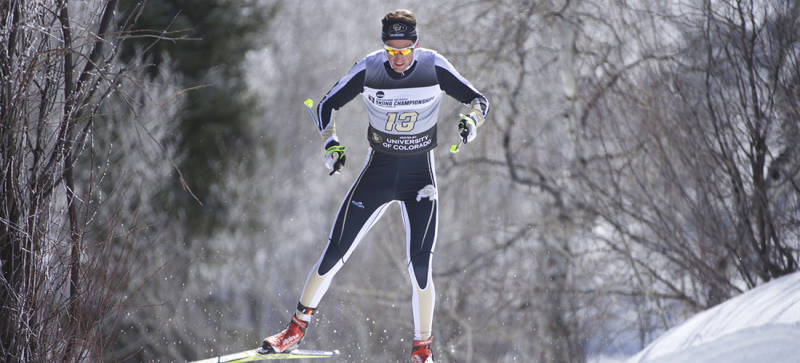
Mads Strøm racing to the first of his two consecutive wins at 2016 NCAA Skiing Championships: Thursday’s 10 k freestyle in Steamboat Springs, Colo. Strøm won the men’s 20 k classic mass start on Saturday by 1.7 seconds. (Photo: CUBuffs.com)
Coming into the final descent, Strøm told himself that second wouldn’t cut it.
“I said, ‘OK, I’m going to sacrifice everything. Either I go down or I’m just going to gap,’ and I gapped. I looked back, and I said, ‘OK, just sprint from here. Just go for it,’ ” he said.
Reistad placed ninth (+1:35.4) as a freshman and the second CU Buff in the top 10. In the women’s race, Colorado had two skiers in the top five, with Johnsen in third and Jesse Knori in fifth (+36.2).
Contributing to the team win, Denver had three men in the top 13 with Dag Frode Trolleboe in 10th (+1:42.3) and Lars Hannah in 13th (+2:21.3).
Aside from winning the overall, Denver also had 15 All-Americans, the most of any team this year, according to an NCAA press release. On Saturday, Eriksen and Madlener were named to the women’s and men’s classical first teams, respectively, while Starkey and Trolleboe earned second-team honors.
“I am so incredibly proud of the young men and women on our team,” Stewart said. “They came into this championship knowing that it would take nothing less than their best to win a title for DU, and they did just that. The conditions were challenging today with rising temperatures through the morning, but everyone brought such composure and focus to the race that I believe the tough conditions worked in our favor.
“Moritz and Linn have led the team all year and they did it again today,” he added. “Moritz just missed his first individual national title in a close sprint finish, but his two podium performances this week were huge for the team. Linn skied a masterful race, leading from start to finish, breaking away on the last lap to ski to a solo win. Aja had the race of her life in sixth and Dag Frode had his two best races of the season when the team needed him.”
Stewart added that the championships came during exam week, requiring every member of the team to take their final exams in advance.
“These guys are truly model student-athletes and it is my pleasure to be able to coach them,” he said. “We are thrilled to be bringing our 23rd national title back to DU! To end the championship with two exceptional nordic performances, with both men and women winning the team score, was the best ending to the five championships wins I have been a part of over the last 10 years. This one tops them all! To have all six of our nordic athletes earn All-American honors is just incredible. I’m speechless.”
Note: FasterSkier is seeking photos from the nordic races at 2016 NCAA Skiing Championships. Please email info@fasterskier.com with photos of top finishers or for more info.
***
Two juniors, one from Montana State University (MSU) and the other from the host team, the University of Colorado-Boulder (CU), claimed the ultimate collegiate titles on Thursday at 2016 NCAA Skiing Championships in Steamboat Springs, Colo.
It was the first of two days of nordic racing at Howelsen Hill, and Anika Miller (MSU) and Mads Strøm (CU) emerged as the individual winners in the 5- and 10-kilometer freestyle races, respectively.
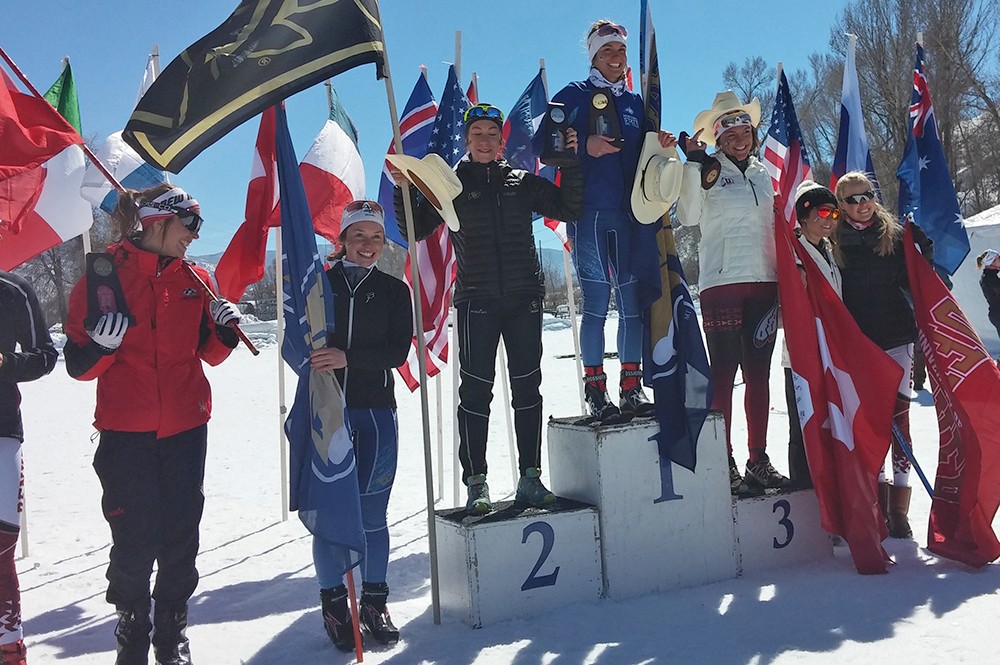
The women’s 5 k freestyle podium on the first day of nordic racing at 2016 NCAA Skiing Championships in Steamboat Springs, Colo. Anika Miller (MSU) placed first, Petra Hyncicova (CU) finished second and Utah’s Sloan Storey took third. (Photo: MSUBobcats.com)
Miller led four Bobcats in the top 10, winning the women’s 5 k freestyle individual start in 13:06.1. Her teammate, Cambria McDermott, placed fourth, 9.4 seconds back.
“When I finished, I had no idea how I’d done actually until my teammates jumped on me and were screaming,” Miller told NCAA.com. “I had no idea. I just started crying.”
A native of McCall, Idaho, Miller bested second-place finisher Petra Hyncicova (CU) by 7.9 seconds for the win, becoming the first MSU skier to win an individual title since 1978, when Dan Brelsford (now the director of skiing) won the slalom race, according to an MSU press release. She is also the first female skier to win an individual title for MSU.
Just one-tenth of a second behind Hyncicova, Sloan Storey (University of Utah) reached the final step of the podium in third.
An NCAA champion in 2014, Strøm achieved his second freestyle title in the men’s 10 k freestyle on Thursday in 22:06.8. His time proved to be 10.6 seconds faster than runner-up Ian Torchia of Northern Michigan University (NMU). Denver University’s Moritz Madlener placed third (+19.8).
For Strøm, the win was his fifth in a row and seventh total this season, according to a CU press release.
“It feels awesome, it feels amazing,” the 24-year-old Norwegian told CUBuffs.com. “For ten months this has been my goal and to accomplish my goal is amazing. I was so nervous. I knew there was going to be a mass crowd out. I just had to find good skis, good pacing, and push it as hard as possible. It was definitely the best win of the year. Pulling it off when it matters the most is great.”
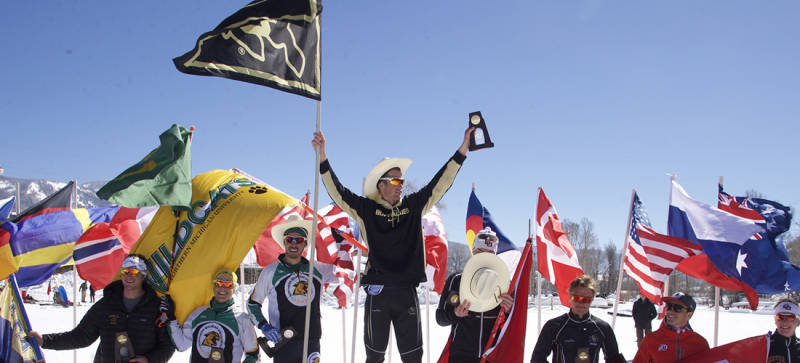
Mads Strøm of the University of Colorado-Boulder celebrates his win in the men’s 10 k freestyle on Thursday at 2016 NCAA Championships in Steamboat Springs, Colol. (Photo: Jamie Schwaberow/NCAA via CUBuffs.com)
Strøm explained he had to “push it all the way to the end,” so hard that he was physically ill across the line.
“I was so tired in the end,” he added. “As soon as I crossed the finish line, I had to lie down.”
With his seventh win, Strøm is the winningest male nordic skier in CU history. He exceeded the amount of wins of Per Kare Jakobsen (who won six races in 1989) and Ove Erik Tronvoll (six in 1999). It was also the 89th individual win by a Buff, the most of any school in NCAA history, the CU release stated.
For women’s runner-up Hyncicova, a 21-year-old sophomore from the Czech Republic, second stood as her best result of the season and matched her career best.
“It was so hard, but it was really nice in the end. I didn’t hope for getting second, so it’s really nice,” Hyncicova told CUBuffs.com. “I really didn’t have any idea what I was hoping for. In each race you want to win, but I didn’t expect that I would win here because I was always around fifth [place] this season. I went to Romania a couple of weeks ago [for U23 World Championships], so I was really tired and didn’t feel that great.
“I was really nervous before the start,” she added. “But once I saw everyone here — the alpine’s and everyone who cheered for us — I was like, ‘Yes I have to do it. I have to do it for the team.’ ”
Team Standings (through 4 races):
Montana State: 282
Utah: 264
Denver: 263
Colorado: 214.5
Vermont: 154
New Mexico: 139.5
Dartmouth: 126
Alaska Anchorage: 124
Northern Michigan: 122
Middlebury: 81
“I feel somewhat relieved but happy,” CU Nordic coach Bruce Cranmer said. “Compared to racing, coaching is way more stressful. You are worried about everyone and getting the right wax. I am still trying to calm down. I get so fired up.
“Mads did great,” Cranmer added. “The guy that got second [Torchia] is one of the top U.S. [skiers] that went to World Juniors. [Mads] was on really good form before he got here, so I had high expectations without trying to get too caught up.
“As for Petra, we were hoping for a top five finish. That is we thought she was capable of. … For her to finish in second is awesome. … She does really well in skating.”
Late last month, Torchia led the U.S. junior men in Romania with his top individual result of the week in 15th in the 15 k freestyle. It was his second-best at Junior Worlds since placing 11th last year in the 20 k skiathlon.
Following Torchia in second, Northern Michigan had three in the top 10 with Adam Martin in fourth (+28.4) and Jake Brown in ninth (+56.1).
“We knew that if we had a good day, all three of those guys were capable of winning and we just didn’t know which one,” said NMU Head Coach Sten Fjeldheim told NCAA.com. “We weren’t shocked or surprised that they’re all in the top 10, but you never know at altitude.”
The base elevation of Steamboat Springs’ Howelsen Hill is about 6,700 feet.
Through four events (two cross-country and two alpine) at 2016 NCAA Championships, Montana State leads the team standings with 282 points and Utah is second with 264. Denver is a close third, with 263 points after two days of racing. With a win and second-place finish on Thursday, CU moved into fourth in the standings, with 214.5 points.
MSU’s previous team best was seventh, which it achieved last year with 259 points. The University has already exceeded that total at the halfway point of the championships. Racing wraps up Saturday with 15/20 k classic mass starts.
“The momentum definitely helps our mindset, but the bottom line is we’ve got to go out and race the same way that we race everyday. That’s the way to succeed,” MSU Head Coach Matthew Johnson told NCAA.com. “Trying to mix it up and change it for the championship isn’t going to go well. Coming in with too much excitement isn’t going to go well, but skiing like we’re in the lead and skiing like we’re champions is going to do well for us.”
SUN VALLEY, Idaho — With the conclusion of the second weekend of SuperTour races in Sun Valley, here’s a collection of race photos we couldn’t fit into the original race recaps.
(From left to right) Deedra Irwin (SVSEF) and Veronika Mayerhofer (University of Utah) out in front during the women’s SuperTour 1.3 k classic sprint Saturday in Sun Valley, Idaho. (Photo credit: Hank Dart)
(Left to right): Chelsea Holmes (APU), Kaitlynn Miller (CGRP), Caitlin Patterson (CGRP), Becca Rorabaugh (APU), and Veronika Mayerhofer (University of Utah) during the women’s SuperTour 1.3 k classic sprint final Saturday in Sun Valley Idaho. Rorabaugh went on to finish first in 3:48.6, Miller second (+1.01), Patterson third (+1.3) , Mayerhofer fourth (+3.76), Holmes fifth (+4.01) and Hannah Halvorsen (Sugar Bowl Ski Academy) (not shown) in sixth (+23.2). (Photo credit: Hank Dart)
Kaitlynn Miller (CGRP) (r) leads Deedra Irwin (SVSEF) (l) and rest of her semi-final Veronika Mayerhofer (University of Utah), Becca Rorabaugh (APU), Katharine Ogden (SMST2/USST) and Rosie Frankowski (APU) during the women’s SuperTour 1.3 k classic sprint on Saturday in Sun Valley, Idaho. Miller advanced to the final and finished second over all, just 1.01 seconds behind race winner Rorabaugh. Mayerhofer also advanced to the final where she finished fourth overall (+3.76). (Photo credit: Hank Dart)
Left to right: Dakota Blackhorse-von Jess (Bend Endurance), Kevin Bolger (University of Utah), Tad Elliot (SCV), David Norris (APU), Ben Saxton (SMST2), and Thomas O’Hara (APU) during the men’s SuperTour 1.3 k classic sprint on Saturday in Sun Valley, Idaho. Blackhorse-von Jess went on to win the overall final event in 3:00.45. (Photo credit: Bryan Fish)
Right to left: Miles Havlick (SVSEF) leads Scott Patterson (APU), Alex Howe (CGRP), Logan Hanneman (APU), and Lex Treinen (APU) during the third quarter final of the men’s SuperTour 1.3 k classic sprint on Saturday in Sun Valley, Idaho. (Photo credit: Bryan Fish)
Left to right: Ben Lustgarten (SVSEF), Matt Gelso (SVSEF), Niklas Persson (University of Utah) , and Tyler Kornfield (APU) (behind Persson) racing during their quarter final of the men’s SuperTour 1.3 k classic sprint on Saturday in Sun Valley. Persson and Kornfield advanced all the way to the final, where Kornfield placed third overall (+4.11) and Persson in fifth (+9.06). (Photo credit: Hank Dart)
Left to right: Tyler Korfield (APU), Logan Hanneman (APU), Reese Hanneman (APU), Niklas Persson (University of Utah) and Petter Reistad (University of Colorado-Boulder) battle it out Saturday during their semi-final of the men’s SuperTour 1.3 k classic sprint in Sun Valley, Idaho. Reese Hanneman, Kornfield, Reistad, and Persson all advanced to the final. (Photo credit: Hank Dart)
Dakota Blackhorse-von Jess (center) wins the men’s SuperTour 1.3 k classic sprint on Saturday in Sun Valley Idaho. Reese Hanneman (APU) (l) finished second (+1.13), Tyler Kornfield (APU) (far right) in third (+4.11) and Eric Packer (APU) in fourth (+6.02).
Left to right: Josefin Nilsson (University of Utah), Sloan Storey (University of Utah), Julia Kern (SMST2/USST) and Becca Rorabaugh (APU) navigate a downhill turn during the women’s 10 k classic mass start on Sunday in Sun Valley Idaho. Rorabaugh went on to place second overall (+9.7). (Photo credit: Hank Dart)
Chelsea Holmes (APU) leads Caitlin Patterson (CGRP) during the women’s SuperTour 10 k classic mass start on Sunday in Sun Valley, Idaho. Holmes won the race in a time of 31:29.0. Patterson went on to finish third overall, 16.3 seconds back from Holmes.
Left to right: Kaitlynn Miller (CGRP) leads Veronika Mayerhofer (University of Utah), Rosie Frankowski (APU), and Katharine Ogden (SMST2/USST) downhill back into the coach’s climb during the women’s SuperTour 10 k classic mass start on Sunday in Sun Valley, Idaho. Miller placed sixth overall (+54.6), Mayerhofer fourth (+43.0), Frankowski fifth (+54.4), and Ogden seventh (+1:08.6). (Photo credit: Hank Dart)
Right to left: Veronika Mayerhofer (University of Utah) strides up the coach’s climb while Katharine Ogden (SMST2/USST), and Rosie Frankowski (APU) stay hot on her heels during the women’s SuperTour 10 k classic mass start on Sunday in Sun Valley, Idaho. Mayerhofer went on to finish fourth overall (+43.0), Ogden seventh (1:08.6), and Frankowski fifth (54.4).
Becca Rorabaugh (APU) charges to a second place finish overall, 9.7 seconds behind the race winner Chelsea Holmes (APU) during the women’s SuperTour 10 k classic mass start on Sunday in Sun Valley, Idaho.
Chelsea Holmes (APU) in front of Caitlin Patterson (CGRP) during one of the downhills in the women’s SuperTour 10 k classic mass start on Sunday in Sun Valley Idaho. Holmes took first place overall, Patterson third (+16.3). (Photo credit: Hank Dart)
The start of the men’s SuperTour 15 k classic mass start on Sunday in Sun Valley, Idaho. (Photo credit: Hank Dart)
The men skiing their first lap of the men’s SuperTour 15 k classic mass start on Sunday in Sun Valley, Idaho. (Photo credit: Hank Dart)
Left to right: David Norris (APU) follows Miles Havlick (SVSEF) as does Ben Lustgarten (SVSEF), and Mads Strøm (University of Colorado-Boulder) during the men’s SuperTour 15 k classic mass start on Sunday in Sun Valley, Idaho. (Photo credit: Hank Dart)
(Left to right): Ben Lustgarten (SVSEF), Reese Hanneman (APU), David Norris (APU), Lex Treinen (APU), and Rogan Brown (SVSEF) during the men’s SuperTour 15 k classic mass start on Sunday in Sun Valley, Idaho. Treinen finished third overall (+1:00.7), Norris seventh (+1:08.8), and Lustgarten ninth (+1:26.8). (Photo credit: Hank Dart)
Scott Patterson striding to the win in the men’s SuperTour 15 k classic mass start on Sunday in Sun Valley, Idaho.
(Right to left): Kyle Bratrud (CXC) leads Eric Packer (APU), Lex Treinen (APU) and Ben Lustgarten (SVSEF) during lap three of the men’s SuperTour 15 k classic mass start race on Sunday in Sun Valley, Idaho. Bratrud went on to finish fifth overall, (+1:01.9), Packer third, (+33.9), Treinen fourth, (+1:00.7) and Lustgarten ninth (+1:26.8).
Mads Strøm (University of Colorado-Boulder) (l) finishes second overall (+31.6) ahead of third place Eric Packer (APU) (+33.9) during the men’s SuperTour 15 k classic mass start on Sunday in Sun Valley Idaho.
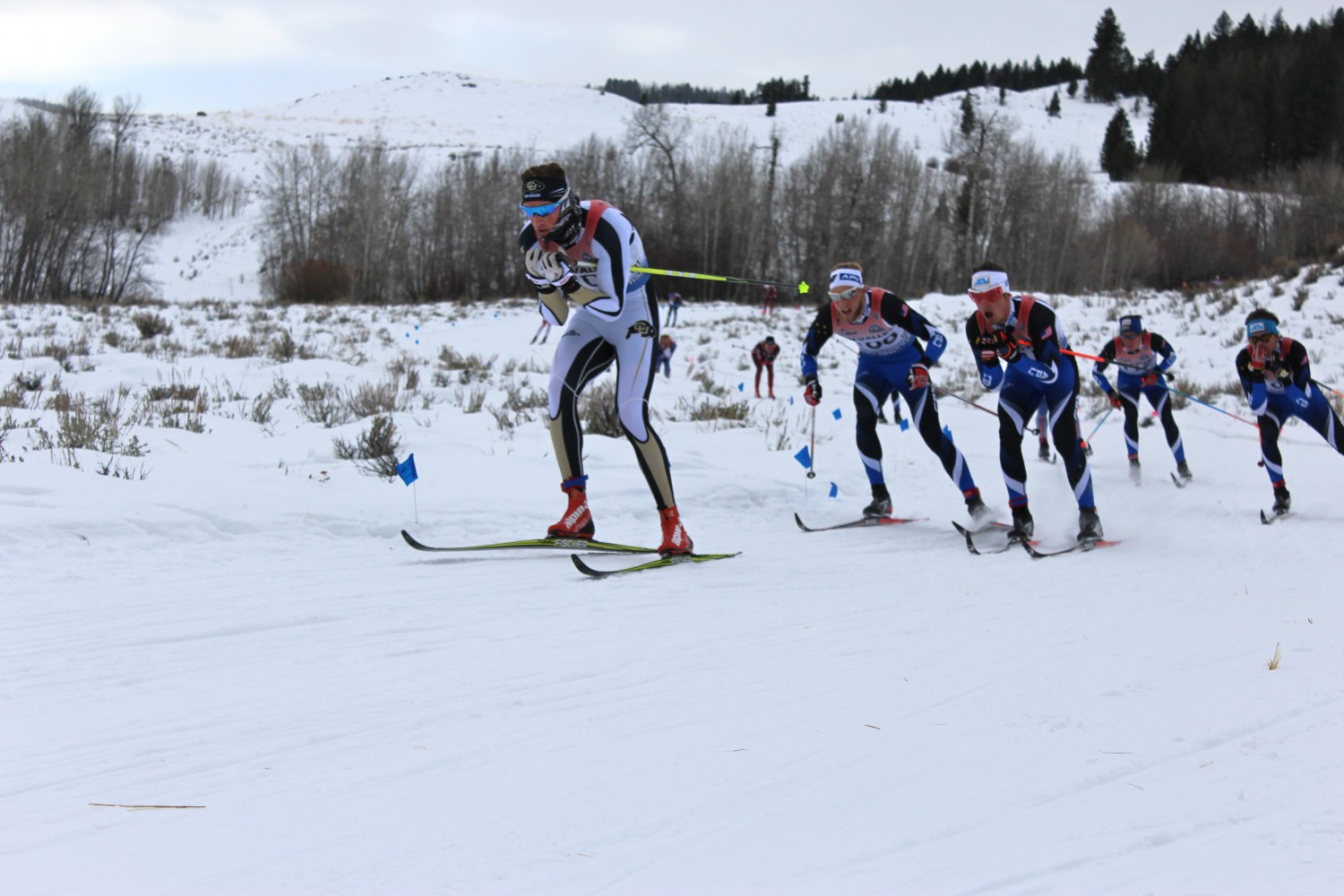
Mads Strøm of the University of Colorado-Boulder (front, center, in white) leads Niklas Persson (left), Matt Gelso (second from left, in blue), Paddy Caldwell (far right), and the rest of the men’s field out of the start in the 15 k classic at the Sun Valley SuperTour on Sunday.
SUN VALLEY, Idaho — Alaska Pacific University (APU) skiers Scott Patterson and Eric Packer know a thing or two about persevering through pain. Both have dealt with recent frightening incidents, Patterson with a pulmonary embolism last fall and Packer when he took a rocky tumble this past June. Despite their misfortune, neither let the mishaps hold them back. On Sunday, the duo proved how far they have come since, finishing first and third, respectively, in the Sun Valley SuperTour 15 kilometer classic mass start.
The men started at 11 a.m. under cloudy skies and light snow flurries. From the beginning, it was clear that the APU athletes were looking to make a statement; the blue-and-black uniforms were ubiquitous in the lead pack. The Sun Valley spectators enjoyed their presence as well, rooting them on as they rounded the course.
Eventual second-place finisher Mads Strøm, however, was excited to try to spoil the APU party. Early on in the six-lap race, he established himself as a threat, skiing comfortably towards the front of the pack. The University of Colorado-Boulder skier then used the strong APU presence around him as extra motivation to ski fast.
Mads Strøm (University of Colorado-Boulder) leads APU skiers (from l to r) Eric Packer, David Norris, Scott Patterson, and Lex Treinen during the men’s SuperTour 15 k classic mass start on Sunday in Sun Valley, Idaho.
“Going around [the course], everyone just cheering for APU. I was out there all alone,” Strøm said in a post-race interview. “I was like, I’ve got to beat some of these guys. I have to. For everybody else, I have to beat some of them at least.”
After two laps where the leaders stuck together, only three seconds separated the top 17, the group broke apart. APU’s David Norris made an aggressive move up Coaches’ Climb on the third lap, and only a handful of racers were able to respond.
“Norris made a bit of a surge up the biggest hill and I kind of got stuck behind a couple people and pushed over the top,” Patterson explained. “That kind of jump started me into gear.”
Shortly thereafter on the third lap, the 23-year-old Anchorage native took the lead and didn’t relinquish it, keeping his distance ahead of any potential challengers all the way through the finish. Patterson crossed the line in 40:35.9, over 30 seconds ahead of the runner up.
Though Norris made the early move to break the pack apart, he was unable to hold the pace, falling back on the fifth lap while a battle for second place developed between Strøm and Packer.
In the last kilometer before the finish, the two were still neck and neck, battling for position on the final climb. Packer led Strøm over the top, but a mistake on the downhill caused him to lose some momentum and created an opportunity for Strøm.
Scott Patterson (APU) striding to a decisive lead during the the men’s SuperTour 15 k classic mass start on Sunday in Sun Valley, Idaho.
“It was the last kilometer of a race at altitude, so I knew we were both hurting and that’s a thing to keep in mind; everybody else is hurting as bad as you are,” Packer explained of the Lake Creek venue, some 6,000 feet above sea level. “So I tried to put in a big attack over the top and then almost crashed on the downhill, and when I bobbled Mads came by and he took me at the line.”
Strøm also was feeling confident heading into the finish. Combining good skis, a desire to disrupt an APU one-two finish and some strong skiing, he was able to claim the second podium spot, 31.6 seconds behind Patterson and 2.3 seconds ahead of Packer.
“I knew I had fast skis going down and I know I’m a fast finisher after 15 k, I was like, I can’t let them go one-two,” said Strøm, originally from Oslo, Norway. “I have to mix it up a bit at least. But it was fun. [Packer] really tried hard and I just got some confidence in the last hill that, yeah, I should get this.”
While he was pleased with his race, Strøm said it’s just a step towards his larger focus for the season, NCAA championships, which the University of Colorado will host March 9-12 in Steamboat Springs, Colo.
“Obviously I wanted to win. I haven’t gotten quite there yet because I have been training almost 100 hours every month since May,” Strøm explained. “I’ve planned that in one month from now I’m going to be in better shape and my plan is to win both races at NCAA’s.”
Eric Packer (left) and Mads Strøm (right) fight for second place on the last hill of their final lap.
For Patterson and Packer, who also grew up in Anchorage, the APU skiers were excited with their races and happy to have given it their all in Sun Valley. Overcoming their misfortunes only made the moment more special.
“Every day that we get to race is just an awesome opportunity to go out and have fun,” Packer reflected. “After having a really close call and having a big fall in the mountains, everything, you look at it with a new perspective. I just feel so lucky to be out here really.”
“I mean, watching him fall in the mountains was definitely an eye opening thing,” Patterson recalled. “We were lucky there and it’s sweet to have Eric here [on the podium]. And then, this is my first year racing this first circuit so, I mean, I’m happy to be here too, happy to not have a ski sticking out of my leg.”
One spot from the podium in fourth was another APU skier, LexTreinen, who finished 26.8 seconds after third and 1:00.7 behind Patterson. About a second later, Kyle Bratrud of Central Cross Country (CXC) placed fifth (+1:01.9).
After two weekends of racing, the SuperTour takes nearly a month break before resuming with U.S. Nationals on Jan. 3 in Houghton, Mich.
Brian Gregg (Team Gregg/Madshus) (r) leads University of Colorado’s Mads Strøm during the last lap of the men’s SuperTour 15 k freestyle on Saturday in West Yellowstone, Mont. Gregg went on to win it by 5.5 seconds over training partner and friend Matt Liebsch (not shown).
Mads Strøm (University of Colorado-Boulder) leads Brian Gregg (Team Gregg/Madshus) at one point of the men’s SuperTour 15 k freestyle on Saturday in West Yellowstone, Mont. The two switched leads throughout the race; Gregg won and Strøm finished fourth.
Canadian Kevin Sandau (r) racing to a fifth-place finish in the SuperTour 15 k skate on Saturday in West Yellowstone, Mont. Here he’s seen leading fellow Alberta World Cup Academy teammate and sixth-place finisher, Knute Johnsgaard an Tad Elliott of Ski & Snowboard Club Vail.
Lustgarten (SVSEF) captures seventh, 37.7 seconds back from race leader Gregg, during the men’s SuperTour 15 k freestyle on Saturday in West Yellowstone, Mont.
One final time up the coach’s climb for Rogan Brown (SVSEF) during the men’s SuperTour 15 k freestyle on Saturday in West Yellowstone, Mont. Brown went on to place eighth overall, 52.2 seconds back from race leader Gregg.
In reverse start order, Matt Gelso (SVSEF) (r), leads Eric Packer (APU) (center), and Nick Hendrickson (University of Utah) during lap two of the men’s SuperTour 15 k freestyle on Saturday in West Yellowstone, Mont. Gelso went on to finish ninth overall, 53.5 seconds back from the race winner Gregg.
Lex Treinen (APU) chases a group during his second lap in the men’s SuperTour 15 k freestyle on Saturday in West Yellowstone, Mont. Treinen went on to place 10th overall, 1.04.1 back from race winner Gregg.
WEST YELLOWSTONE, Mont. — An athlete is often only as good as his or her training partner. Such was the case for the Hanneman brothers as seen in Friday’s SuperTour sprint and again on Saturday during the men’s SuperTour 15-kilometer freestyle individual start at the Rendezvous Ski Trails.
This time, however, the one-two podium pair belonged to good friends and Twin Cities training partners, Brian Gregg (Team Gregg/Madshus) and Matt Liebsch (Gear West/Salomon).
“Matt and I train a lot together back in the Twin Cities,” said Gregg, the 15 k winner by 5.5 seconds in 35:25.1. “We do a lot of intervals and time trials together.”
While the two share no blood relation, they do share a breadth of respect for each other.
“[I’m] super impressed with Matt because he also has a full-time job and three kids,” said 31-year-old Gregg.
“Maybe that’s something Caitlin and I need to start on,” he added. Gregg’s wife, Caitlin, was named to the U.S. Ski Team this year after taking bronze at 2015 World Championships in the 10 k freestyle.
Matt Liebsch (Gear West/Salomon) races to second during the SuperTour 15 k freestyle on Saturday in West Yellowstone, Mont.
Liebsch, 32, was equally excited for his buddy’s overall win.
“I’m hoping he can get SuperTour Leader so he can get [race] start rights over in Europe [and] go see his wife,” Liebsch said.
The overall U.S. male and female leaders at the end of two SuperTour weekends will earn a trip to Europe after U.S. nationals in January to start World Cups in Period 2. Gregg put himself in that position two years ago leading up to the 2014 Sochi Olympics.
For Gregg and Liebsch, their close training over the years translated into a close finish in Saturday’s distance race, despite starting more than 9 minutes apart. Liebsch started 16th; Gregg went out 53rd.
Gregg skied much of his race with the man who started 15 seconds ahead of him, Mads Strøm of the University of Colorado-Boulder. Strøm went on to place fourth, 14 seconds behind Gregg and 0.7 seconds back from Scott Patterson (Alaska Pacific University) in third.
“[My start was] definitely a lot faster than I’ve gone out in the past,” Gregg said. “In the past, I’ve probably been 15 seconds down to the leaders at the top of the coach’s climb. This year I was right even with [the leaders].”
Gregg believed his uncharacteristic charge out of the start gate was the right call.
“It was nice, because I’d make a big pull, then I’d get tired, then Mads would pull, then he’d get tired, and we sort of switched off leading a little bit,” he said.
While Strøm and Gregg jostled throughout the race, Patterson spent much of his race solo.
“The only time I really had a group was when people were behind me,” Patterson said.
“Oscar Friedman [of Dartmouth] skied with me for two laps,” he added. “It’s nice to have someone on your heels, but not quite as good as trading off the lead.”
Friedman went on to place 13th. During the race, Patterson heard he was in contention.
Scott Patterson of APU leads Dartmouth’s Oscar Friedman during the men’s 15 k skate SuperTour race in West Yellowstone, Mont.
“I was getting some splits early on that I was leading Matt Liebsch,” he said. “I was a little bit disappointed they got me in the end.”
This being the first time Patterson has ever raced in West Yellowstone, the 23-year-old Alaska native called it a solid start to his season.
“Last fall I had a fairly significant injury and that’s what kept me away from these races,” Patterson said. “But I knew a I had a good summer training and a good fall [this year] and I was definitely going in looking for a spot on the podium.”
Rounding out the men’s top five after Strøm in fourth (+14.0) was Canada’s Kevin Sandau of the Alberta World Cup Academy (AWCA) in fifth (+20.2). Sandau’s teammate Knute Johnsgaard was sixth (+34.5), and Sun Valley took the next three places with Ben Lustgarten in seventh (+37.7), Rogan Brown in eighth (+52.5) and Matt Gelso in ninth (+53.5). Lex Treinen (APU) was 10th (+1:04.1)
While Patterson plans to race next weekend’s SuperTour races in Sun Valley, Idaho, Liebsch and Gregg said they were undecided.
“I’m supposed to be working next weekend, so I don’t know we’ll see,” said Liebsch, who manages Gear West nordic sales and service. “I’m probably going to go home and train and go to nationals and do the distance races and just see how things go there.”
Gregg, on the other hand, will either plan to race the SuperTour weekend or take advantage of the altitude training in Sun Valley instead.
Regardless of what happens next weekend, Gregg and Liebsch were grateful for being able to train together and contribute to each other’s success.
“Brian drags me out of bed a lot of mornings to do intervals,” Liebsch said. “We’re literally the same speed in most workouts so, it’s cool to be right around him [in races].”
With temperatures above 40 degrees Fahrenheit, the men take off in Sunday’s SuperTour 15 k classic mass start at Bohart Ranch near Bozeman, Mont.
BOZEMAN, Mont. — In yet another thrilling men’s SuperTour finish, Mads Strøm of the University of Colorado outsprinted Miles Havlick of the Sun Valley Ski Education Foundation (SVSEF) Gold Team on Sunday to win the men’s 15-kilometer classic mass start at Bohart Ranch.
Strøm finished fast and icy three-lap course in 40:55.3, holding off Havlick by 0.7 seconds. Havlick’s teammate Matt Gelso racked up another SuperTour podium in third (+9.9), after placing third in Saturday’s classic sprint. Brian Gregg (Team Gregg/Madshus) finished 27.4 seconds back in fourth.
Kris Freeman (Team Freebird), who was fourth in Saturday’s sprint, finished another 10 seconds back in fifth. Strøm’s CU teammate, Rune Ødegård, placed sixth (+48.4) after starting the final 5 k lap in second.
Havlick jumped out to an early lead and held it for most of the race, entering the last lap 8 seconds ahead of the chase group of Ødegård, Freeman, Gregg and Gelso. Strøm was 15 seconds behind.
Mads Strøm (CU) celebrates after winning the men’s SuperTour 15 k classic mass start near Bozeman, Mont., while Miles Havlick (SVSEF) finishes 0.7 seconds behind.
“I noticed my skis were running pretty well, better than other guys in the pack, so I just decided to pick up the pace and see what would happen,” Havlick said of the first 10 k.
However, Havlick felt the gap closing throughout the last 5 k, and was caught by Strøm as they entered the stadium.
“I was hoping I could get him at the finish, because I know I have a pretty good finishing speed,” Havlick said. “But this time he got me.”
Strøm said that while he was “struggling” through the first two laps, his double poling was strong and he felt his confidence grow throughout the race. By the final lap, he was warmed up and ready to make his move.
“With four kilometers left I got the killer instinct and just tried to win. I double poled as much as I could – that’s one of my strongest strides,” the 23-year-old Strøm said.
As Gelso and Havlick began to pull away down the final stretch, Strøm hung with them, double poling past Gelso and catching Havlick on the final hill. He then passed Havlick in the stadium and held him off in a furious sprint to the finish.
After a disappointing result in Saturday’s sprint — when Gelso and Havlick beat him in the quarterfinals — Strøm was “really satisfied” with the result. “I feel great,” he said.
Gelso skied a strong final lap, separating himself from Gregg, Freeman and Ødegård while trying to catch his teammate.
Matt Gelso (SVSEF) double poles through the stadium on his way to his second third-place finish of the weekend in the men’s SuperTour 15 k classic mass start near Bozeman, Mont.
“I was feeling pretty good, my skis were really fast, and I threw down hard to try to catch Miles,” Gelso explained. “But I did it such that I would gap the people I was with, so that I wouldn’t drag everybody up to my teammate. I made a conscious effort to go hard.”
However, Gelso did bring Strøm along with him.
“He’s good at conserving, sitting in and then going hard when it’s important,” Gelso explained.
After racing through slushy snow on Saturday, Gelso enjoyed the firmer conditions, saying the course was much faster than during the sprint. However, he noted that the racers had to be incredibly careful on some sections and corners, especially where the previously wet snow had been groomed.
In those places, “the corduroy got melted in so it was like smooth ice, and that was a little bit scary,” he said. “You can’t hold a plastic edge in that.”
Meanwhile, the course was kinder to Havlick than it was on Saturday — “I definitely wanted to stay on my feet today,” he said. Havlick fell during his sprint semifinal of the sprint and missed advancing to the final.
Havlick was excited about what he called “the first really good result for the season.”
“It’s a confidence builder,” said the former NCAA champion in the 20 k. “I know my form is coming around.”
The next SuperTour races take place Jan. 4-10 at U.S. nationals in Houghton, Mich.
Matt Gelso (SVSEF) en route to a 9.6 second win over Brian Gregg (Team Gregg/Madshus) in Saturday’s 15 k freestyle in West Yellowstone, Mont.
WEST YELLOWSTONE, Mont. — Matt Gelso’s strategy in Saturday’s SuperTour 15-kilometer freestyle individual start was to traverse the 5 k course as hard as he could from the beginning of the race. The Sun Valley Ski Education Foundation Gold Team (SVSEF) member saw only two possibilities – he was either going to ‘blow up’ or rely on fitness to earn a place on the podium. Either way he was going all out.
After finishing three laps of the demanding course, it was clear that Gelso had accomplished the latter of the two outcomes, crossing the line in 36:20.2 to earn the top spot in the first domestic distance race of the season.
“I just wanted to go out hard and since it’s early season, see what happens … I struggled the last lap, but I was able to ski smooth and ski smart. I had a flat ski and that’s super important on this course, because a lot of it’s about skiing smooth and powerful,” Gelso said in a post-race interview.
The 26-year-old started the race with little knowledge of where he ranked among his fellow competitors during the course of the 15 k. Because Gelso started near the front of the A-seed, splits had little meaning during his first and second laps.
According to Gelso, it wasn’t until the third lap that he learned he was battling University of Colorado’s Mads Strøm for first place from on-course splits. Gelso said the splits gave him confidence to keep himself going and hang on to the top position.
On a day where many racers had slow skis due to warmer-than-average temperatures and winds that showered a mix of new snow and dirt on the trials, Gelso said the Sun Valley wax crew gave him impeccable skis.
Brian Gregg (Team Gregg/Madshus) finished second in Saturday’s SuperTour 15 k freestyle in West Yellowstone, Mont.
Furthermore, Gelso pointed to a 10 k time-trial that he and fellow Sun Valley teammates performed earlier in the week as a reason for his succes. Utilizing the same 5 k loop as Saturday’s race, Gelso said the time-trial helped him understand how to ski the course’s terrain, which is known for its lack of rest.
The other two members of the Sun Valley’s Gold Team also benefited from the team’s preparation, as both finished in the top-ten with Ben Lustgarten placing seventh (+58.2) and Miles Havlick finishing eighth (+1:13.2).
While Gelso was working to outlast Strøm, another skier was getting dangerously close to winning the race.
Brain Gregg (Team Gregg/Madshus) began his 15 k conservatively and was 13 seconds back from Gelso at the 5 k mark. However, as the race continued Gregg maintained his pace while others slowed.
It was a conscious strategy by Gregg, who has seen what it takes to be successful in West Yellowstone over his years of racing. He pointed to retired Bridger Ski Foundation athlete and multiple West Yellowstone SuperTour victor, Leif Zimmerman, as a prime example of someone who was able to make up ground in the final kilometers.
That’s exactly what Gregg did. According to the 30-year-old, he was 23 seconds behind Gelso at the 12.5 k mark but was able to reduce the deficit to 9.6 seconds by the time he crossed the finish line.
Although Gregg was unable to overcome the entire 23-second deficit he was happy to finish the day in second.
Mads Strøm (CU) fought for first but ultimately ended third in the 15 k freestyle in West Yellowstone, Mont. as part of the opening SuperTour weekend.
Strøm, who eventually finished third (+12.4), won the same event in the 2013 West Yellowstone SuperTour.
While he couldn’t match his previous performance, he fought for the victory throughout the majority of the race.
Strøm explained that the previous day’s sprint had left him lethargic throughout the first third of the race. However, around the 6 k mark he began to feel fresh and energized as he learned there was a contest for first between him and Gelso.
“I tried to fight as much as possible but I wasn’t able to get as much as I hoped to in the last 3 k,” the University of Colorado skier said.
Rounding out the top five were two skiers who faced the stomach flu only three days prior: Kris Freeman (Team Freebird) and Tad Elliott (Ski and Snowboard Club Vail Elite).
“Both Tad and I got a stomach virus, so I was vomiting three days ago. Yesterday I felt really, really flat and you have to be sharp in a sprint… Today was a step in the right direction but I didn’t feel like myself and I’m a little bummed,” Freeman said of Friday’s sprint race and Saturday’s fourth place finish.
Freeman, a favorite to win the the 15 k, had strong first lap in which he posted the second-fastest time. Once on the second and third laps, however, he was unable to maintain his speed after losing much of his energy to the illness.
Kris Freeman had a strong first lap in West Yellowstone but ultimately finished fourth in the SuperTour 15 k freestyle.
“I’ve had a great lead up to the season. I felt like I was in awesome shape here and I really thought I was going to stomp it, but instead life happens. I’ve been here before and I can’t let it bother me too much,” he said.
Elliott, who dealt with the Epstein-Barr Virus for most of the previous year, said that he had been feeling especially strong before he came down with the flu on Thanksgiving night. While he was unsure whether he would start Saturday’s race, he made the final decision to give the 15 k a shot after warming up just minutes before the race.
Once on course, Elliott explained that a combination of coaching, fast skis, and experience helped him progress from ninth place after 5 k to fifth as he crossed the finish line.
“Having the flu and having the fever wasn’t ideal but I think part of the reason for [my success] today was our coaches…I felt like my skis were some of the best in the field, to be honest, they were super quick. Being an experienced skier I think helped too. I did well on my splits out there,” he said of his race.
The two skiers finished roughly thirty seconds apart, with Freeman crossing the line 18 seconds from the lead and Elliott finishing 43.4 seconds back from Gelso.
Other notable results from Saturday’s race include Colorado’s Rune Ødegård in sixth (+49.2), GearWest/United XC’s Matt Liebsch in ninth (+1:18.8), and the USST’s Paddy Caldwell in tenth (+1:25.7).
All of the top-five finishers expressed that their races were solid starting points for the season, but were wary of putting too much emphasis in Saturday’s results
Tad Elliot (SSCV) progressed from 9th to 5th over the course of three laps in Saturday’s SuperTour 15 k freestyle in West Yellowstone, Mont.
“It’s always good start on a positive note so that you have so you have that positive feedback on your training, but it’s the last week of November and we’re racing all the way through the end of March,” Gregg said of his takeaway from the race.
For Gelso, the biggest benefit of winning Saturday’s race was the FIS and USSA points he would earn from the day’s effort.
“Today will be good in FIS and USSA points and that’s a consideration for World Championships,” he said, referencing USSA’s consideration of USSA points for World Championship selections.
The fact the they are distance points is especially promising for Gelso and other top finishers, as it is likely the U.S. coaching squad will be looking for more domestic distance skiers rather than domestic sprinters to fill their quota for the championships.
Gelso also explained that the SuperTour points he earned from the victory would be important in his quest to be SuperTour leader so that he could earn starts on the World Cup in either period 2 or period 3 of this year.
However, such a feat is a far away, and to maintain his momentum throughout the season, Gelso said that he’s working to maintain his fitness and consistency.
“I’ve got to keep my training consistent and focused so I don’t peak up here and then dive off into the great depths when U.S. Nationals and the rest of the season comes around. So, I’m definitely going to be focused on keeping the race fitness and general fitness up,” he said.
Dakota Blackhorse-von Jess of Bend Endurance Academy (r) leads (from r-l) Mads Strøm (CU), Rune Oedegaard (CU), and Eric Packer (APU) in the A-final of Friday’s Super Tour freestyle sprint in West Yellowstone.
WEST YELLOWSTONE, Mont. — Dakota Blackhorse-von Jess used a strong finish to edge out two skiers from the University of Colorado in Friday’s men’s 1.5 k skate sprint in West Yellowstone, Mont., marking the first U.S. SuperTour race of the season.
The 28-year-old Blackhorse-von Jess, of the Bend Endurance Academy, took command of the lead after the final hill when the University of Colorado’s Mads Strøm made a last-ditch attempt to pass him on the outside. The 23-year-old Norwegian had been working with CU teammate and fellow countryman Rune Malo Ødegård to hold second and third position throughout the race, waiting for the opportunity to make a move on Blackhorse-von Jess. However, Strøm finished in second while Ødegård, 25, crossed the line in third.
Eric Packer of Alaska Pacific University (APU) finished fourth, 2.98 seconds after Blackhorse von-Jess. Welly Ramsey of the Maine Winter Sports Center (MWSC) finished in fifth (+3.52). Canadian Andy Shields of the Thunder Bay National Development Centre (NDC) was 36.49 seconds back in sixth place, though FasterSkier was unable to locate Shields to determine what happened on the course.
Dakota Blackhorse-von Jess of the Bend Endurance Academy pushes in front of the University of Colorado’s Mads Stroem during the A-final of the SuperTour men’s freestyle sprint in West Yellowstone, Mont. (Photo: Toko)
Blackhorse-von Jess was second in qualifying (after Stratton’s Ben Saxton) and made it safely through the quarterfinal and semifinal rounds, though he emphasized the challenging nature of the early-season race.
“West Yellowstone’s a hard place,” he explained. “I’m tired, everybody’s tired. You know, it’s just hard being here.”
However, he said winning is a good “confirmation of fitness,” and he was happy with his strategy.
“It just became apparent to me I had the speed at the end, but to really maximize it you need to be first on the hill,” he said, “So, that’s what I did. Worked out great.”
He said being in front was especially an advantage on the rolling course, as the corners are close together and “the straight line provides no opportunity for passing.”
Only 0.9 seconds behind Blackhorse von-Jess, Strøm was disappointed to not have overcome Blackhorse-von Jess, but recognized his attempt to take the lead was too little, too late.
“He went away from the other guys and I just tried to get past him and he was faster than me,” Strøm explained.
Strøm was happy for his Colorado team, saying they generally expect to do better in distance races. Having two skiers on the podium in the sprint was well above their expectations.
Ødegård was pleased with his third-place finish, echoing Strøm in saying the race went “a lot better than expected.”
The Norwegian has suffered from injuries and illness throughout the past year, including an ankle surgery, a meniscus tear and a bout of strep throat. Despite that, he said he was better in a skate sprint than he has ever been.
Ødegård and Strøm finished seventh and fifth, respectively, after qualifying, then comfortably made it through their quarterfinal races. They ended up racing together in the first semifinal, where they skied a strategic race and helped each other maintain and finish in the first and second positions.
Despite being happy with his race, Packer was a victim of the course’s lack of passing opportunities. According to the 24-year-old Alaska native, he started out in third or fourth and never had a real chance to move forward during the race.
“The final went out pretty hard and with this course it’s really difficult to pass,” he explained.
Packer qualified in 13th, surviving a competitive quarterfinal while squeaking through the semifinal to make it to the A-final.
Sun Valley’s Miles Havlick leads (from l-r) Brian Gregg (Team Gregg/Madshus), Matt Gelso (SVSEF), and Forrest Mahlen (MSU) in Friday’s B-final at the 2014 SuperTour freestyle sprint in West Yellowstone.
Finishing fifth, Ramsey was ecstatic about advancing to the A-final. The 23 year old is an accomplished distance racer, having finished eighth at last year’s 15 k at U.S. nationals, but hasn’t considered himself to be a sprinter in the past. Starting the day by qualifying in 12th, he finished just behind Blackhorse-von Jess in the men’s first quarterfinal. Then he led Blackhorse-von Jess going into the last hill during the second semifinal, before the eventual winner passed him on the closing stretch.
“I’m pretty stoked that I’m able to sprint this year,” Ramsey said, emphasizing how much technical work and “on-snow” time during the fall has helped him out.
The day started off well for Saxton, a 21-year-old U.S. Ski Team and SMST2 athlete, who was first after qualifying.
“I think the qualifier today rewarded smooth skiing and I don’t think very many people would list smooth skiing as one of my attributes thus far,” Saxton explained.
However, he fell behind Ødegård and Strøm in the semifinal and faded on the final hill, then ended up 11th overall after falling behind in the B-final. In that race, he said his right hamstring “balled right up” going into the tuck, leaving him unable “to put forward the effort” that was representative of his abilities.
Sun Valley’s Miles Havlick, who was fourth after qualifying, won the B-final, barely nudging out Brian Gregg (Team Gregg/Madshus) and Forrest Mahlen (Montana State University). Alaska Pacific University’s Lex Treinen was put out of the race at the start, falling immediately after the gun sounded.
Paddy Caldwell (SMST2) also suffered a race accident earlier in the day. After qualifying in 22nd, one of his poles broke at the top of the final hill during the fourth quarterfinal. Alex Schulz of Craftsbury Green Racing Project was on the inside, and as they rounded the curve Schulz’s ski and Caldwell’s pole collided.
There were certain issues on Day 1 of the event involving timing, bib numbers and placement into semifinals. Races and results were postponed, and athletes at times questioned when or if they would be racing.
SuperTour racing continues for the men on Saturday in West Yellowstone with the 15 k freestyle individual start. Snow is expected to fall throughout the day, making for interesting racing conditions.
The University of Denver won the 2014 NCAA Championships for the 22nd time this past weekend in Park City, Utah. Check out some amazing photos of the event taken by superstar photographer Bert Boyer. All proceeds from photo sales will be directly donated to NNF. Buy them here: http://bertboyer.zenfolio.com
Anja Gruber (UVM), first, 5 k individual classic. (Photo: http://bertboyer.zenfolio.com) All proceeds from photo sales will be directly donated to NNF.
Sylvia Nordskar (DU), second, 5 k individual classic. (Photo: http://bertboyer.zenfolio.com) All proceeds from photo sales will be directly donated to NNF.
Eva Severrus (UNM), third, 5 k individual classic. (Photo: http://bertboyer.zenfolio.com) All proceeds from photo sales will be directly donated to NNF.
Rune Malo Ødegård of CU races to first in the 10 k individual classic at the 2014 NCAA Championships in Soldier Hollow. (Photo: http://bertboyer.zenfolio.com) All proceeds from photo sales will be directly donated to NNF.
Pierre Guedon (DU), second, 10 k individual classic (Photo: http://bertboyer.zenfolio.com) All proceeds from photo sales will be directly donated to NNF.
Niklas Persson (Utah), third, 10 k individual classic. (Photo: http://bertboyer.zenfolio.com) All proceeds from photo sales will be directly donated to NNF.
Women’s 5 k individual classic podium: Sylvia Nordskar (DU), Anja Gruber (UVM), and Eva Severrus (UNM). (Photo: http://bertboyer.zenfolio.com) All proceeds from photo sales will be directly donated to NNF.
Men’s 10 k individual classic podium from the first day of Competition at the 2014 NCAA Championships: Pierre Guedon of DU (2nd), Rune Ødegård of CU (1st), and Niklas Persson of Utah (3rd). (Photo: http://bertboyer.zenfolio.com) All proceeds from photo sales will be directly donated to NNF.
Sylvia Nordskar (DU) leads Rosie Frankowski (NMU) and Eva Severrus up Hermod’s in the women’s 15 k freestyle mass start. (Photo: http://bertboyer.zenfolio.com) All proceeds from photo sales will be directly donated to NNF.
Sylvia Nordskar (DU), third, 15 k freestyle mass start. (Photo: http://bertboyer.zenfolio.com) All proceeds from photo sales will be directly donated to NNF.
Rosie Frankowski (NMU), second, 15 k freestyle mass start. (Photo: http://bertboyer.zenfolio.com) All proceeds from photo sales will be directly donated to NNF.
Eva Severrus (NMU), first, 15 k freestyle mass start. (Photo: http://bertboyer.zenfolio.com) All proceeds from photo sales will be directly donated to NNF.
Mads Strøm (CU), first, 20 k freestyle mass start. (Photo: http://bertboyer.zenfolio.com) All proceeds from photo sales will be directly donated to NNF.
Max Olex (UAF), second, 20 k freestyle mass start. (Photo: http://bertboyer.zenfolio.com) All proceeds from photo sales will be directly donated to NNF.
Mats Resaland (NMU) (l), third, 20 k freestyle. (Photo: http://bertboyer.zenfolio.com) All proceeds from photo sales will be directly donated to NNF.
The women’s 15 k freestyle mass start podium: Sylvia Nordskar (DU), Eva Severrus (NMU), and Rosie Frankowski (NMU). (Photo: http://bertboyer.zenfolio.com) All proceeds from photo sales will be directly donated to NNF.
The women’s podium in the 15 k freestyle mass start at the 2014 NCAA Championships in Park City, Utah. The University of Denver won the its 22nd NCAA title on Saturday. (Photo: http://bertboyer.zenfolio.com) All proceeds from photo sales will be directly donated to NNF.
The men’s 20 k freestyle mass start podium: Mats Resaland (NMU), Mads Strøm (CU), and Max Olex (UAF). (Photo: http://bertboyer.zenfolio.com) All proceeds from photo sales will be directly donated to NNF.
The men’s podium in the 20 k freestyle mass start at the 2014 NCAA Championships in Soldier Hollow. (Photo: http://bertboyer.zenfolio.com) All proceeds from photo sales will be directly donated to NNF.
Denver’s Sylvia Nordskar leads Rosie Frankoski of Northern Michigan and Eva Severrus of New Mexcico in the second lap of the 15 k freestyle mass start at the NCAA Championship in Midway, Utah. Nordskar finished third, while Frankowski ended in second and Severrus crossed the line in first.(Photo: http://bertboyer.zenfolio.com) All proceeds from photo sales will be directly donated to NNF.
“It’s special but it’s also something that we really expected.”
That was the sentiment of the University of Denver’s nordic head coach Dave Stewart after his team not only claimed the overall NCAA title, but also the overall nordic title in Midway, Utah, on the final day of the national collegiate skiing championships.
The win marks the 22nd overall championship for Denver, the most any school has ever won. It is also the university’s eighth championship since 2000 and Stewart’s fourth title.
“It means a lot. The goal of our program is to win the NCCA championship. We have that expectation and that history,” he said in a post-race interview.
After handily winning both men’s and women’s nordic races on Thursday, the team did’t fare as well in the mass starts with two skiers making the top 10.
“We had an amazing day on Thursday and not so good of a day today, but we came out on top for nordic, and I’ve never done that for nordic in my eight years of coaching.”
The Denver nordic team has built off strong training and an excellent team atmosphere all year to claim the championship. After winning the regular-season RMISA title, the Pioneers were hungry for the NCAA crown.
The title will certainly mark a great end to the college careers of six graduating seniors. Makayla Cappel, Trygve Markset, Katie Gill, Elena Breed, Jessica Jortberg, and Connor Wallace will leave Denver this spring on the tails of another historic NCCA win.
Men’s 20 k: Colorado Break Away
University of Colorado’s Mads Strøm entered Saturday’s 20 k freestyle mass start with determination. Thursday’s 10 k classic, in which he had finished fourth, had not gone well for him and he was ready to gain redemption.
Mads Strøm of Colorado leads the field in the men’s 20 k freestyle mass start during the last day of the 2014 NCAA Championships. Strøm handily won after breaking away on the last lap.(Photo: http://bertboyer.zenfolio.com) All proceeds from photo sales will be directly donated to NNF.
From the shot of the gun he kept within the pack, biding his time until he could make his move at the opportune moment.
Roughly halfway into the race, the freshman from Norway looked back to gauge the competition. To his surprise the majority of the field was on his and his fellow teammate Rune Østegård’s tails.
“I tried to make a move on the third lap just to see if anyone was able to keep up and we were able to open up a gap. So I knew that I had to ski really fast on the last lap to make up a big enough gap because coming up from behind was such an advantage,” he said of his tactics in the second half of the race. “I used all the motivation from Thursday.”
And create a gap he did. Joined by Østegård, Strøm gave it his all as he climbed the hills of the Hollow, a gradual yet unforgiving kilometer of uphill leading out of the stadium. As the pair continued their attack around the course, the pack trailed farther and farther behind them.
Suddenly, he was alone. Østegård, Strøm’s “best friend and biggest competitor,” had fallen back halfway through the 5 k loop, thus leaving the top spot at the most esteemed college race of the season ripe for the taking.
Skiing into the final stretch, there was no one to see but Strøm. Barely looking tired, he elatedly crossed the finish line, knowing he had won his first NCAAs.
University of Alaska Fairbanks’ Max Olex races up the last hill of the men’s 20 k mass start at the 2014 NCAA Championships. He passed seven people on the hill en route to his second place finish. (Photo: http://bertboyer.zenfolio.com) All proceeds from photo sales will be directly donated to NNF.
“This was one of two goals. That was nationals in Norway in January, which I did really good,” the freshman said. “And then there was, of course, NCAAs. I really wanted to win both races, that was my goal.”
Behind Strøm in second was Max Olex, a senior at the University of Alaska Fairbanks who never made the podium in a collegiate race before Saturday. The German, who broke his shoulder blade in November, had a slow start to the season. Coming into NCAAs he decided to have an open mind.
“It’s always a goal at NCAAs to make the better half of the field, especially for me, looking at the season seeing how it went,” Olex said. “I came here this morning and I knew that these are my conditions and I had the matching skis. I knew what I was training the last two years. I trusted in what I did here and that was what I got today.”
“Definitely the best race of my life,” he added.
Coming in third was New Mexico’s Mats Resaland, a sophomore from Norway. After initially racing at the front of the pack, he soon realized there was no need to waste energy.
“It was kind of crowded out there. In the first lap I was in the front but then I dropped back because there was nothing to stress about,” he said. “It’s four laps, and I picked up seven spots on the last hill.”
Women’s 15 k: And Then There Were Three
The women’s 15 k freestyle mass start wasn’t as cut-and-dry as the men’s race. From the beginning of the distance race, Denver’s shining star, Sylvia Nordskar led the pack with the hopes of dropping most of the competition.
Eva Severrus of the University of New Mexico leads Rosie Frankowski of Northern Michigan up Hermod’s Hill at Soldier Hollow in Midway, Utah. Severrus won the NCAA Championship by outlasting Frankowski in the final stretches of the 15 k.(Photo: http://bertboyer.zenfolio.com) All proceeds from photo sales will be directly donated to NNF.
“I was going in the lead to try and split up the group. We did, so that was good, but I got very tired after that,” she explained.
Rosie Frankowski of Northern Michigan University started in the front and did her best to stay at a relaxed pace as the Norwegian led.
“We went up the first hill and everyone was together the first lap and it was a pretty relaxed pace. It was smart because it’s at altitude,” she said.
“Then on the downhill I did not do it well and I snowplowed a bunch and so I lost a lot of places and then in the stadium I knew that I had an uphill and that I needed to try and work it back. In the second lap it started separating a little bit. I was in the front pack.”
While Nordskar led and Frankowski navigated the downhills, Eva Severrus, a Slovenian from the University of New Mexico, was waiting to make her move.
“I just tried to stay with the girls in the front,” she said. “Then I took over the lead one kilometer before the [stadium] in the second lap.”
From there it was a three-way race between Severrus, Frankowski and Nordskar as all the other competitors struggled to stay in striking distance. Exhausted from leading in the increasingly choppy conditions, Nordskar started to lose ground and the other two started to pull away.
“Then we were three at the last loop and I just had to fight so hard to keep up with them. It got so soft and that’s not my favorite conditions,” she said.
Up ahead, Severrus and Frankowski were battling for the top position. On the hills, Frankoski would use her climbing strength to challenge the Slovenian, while on the downhills Severrus would pull away.
Finally Severrus glided away, leaving Frankowski behind on one of the long downhills of the course. Despite the gap, Severrus was still nervous.
Sylvia Nordskar of the University of Denver skied her way to third place in the 15 k mass start at the 2014 NCAA Championships. (Photo: http://bertboyer.zenfolio.com) All proceeds from photo sales will be directly donated to NNF.
“I was so scared that she would catch me because I’m dying,” she said of her final meters.
It seemed that Severrus’ fears were justified as the two skiers made their way up Hermod’s Hill, the last climb before the finish. After skiing aggressively, Frankowski inched closer and closer. Near the top of the hill Frankowki made contact with the University of New Mexico skier.
However, the final downhill would prove to be Frankowski’s weakness as Severrus pulled away once again. This time there was no hill for Frankowski to make up time.
“I tried to catch her at the top of Hermod’s and then just tried to hang on and tried to make it into the finish without falling,” said Frankowski of her competitor.
Frankowski crossed the finish line in second, the only American to make the podium in a nordic race throughout this year’s NCAAs.
Coming in after Frankowski, was Nordskar who ended her day in third, her second podium of NCAAs.
“I’m so excited. That was the goal this season,” she said of her finish and her team’s overall win.
An NCAA banner hangs at the 2013 NCAA Skiing Championships in Vermont. The 2014 Championships are set to begin Wednesday in Park City Utah. Photo: Flyingpointroad.com (All proceeds benefit NNF)
FasterSkier’s coverage is made possible through the generous support of Madshus.
One-hundred and forty-eight. That’s the number of skiers who have descended upon the ski town of Park City, Utah, to participate in the 2014 NCAA Skiing Championships. The championships will be hosted by the University of Utah, who last had the honor in 2000. The four day event, which consists of two alpine and two nordic races, begins Wednesday and continues through Saturday.
The cross country portion of the event will take place at Soldier Hollow in Midway, Utah, the site of the 2002 Olympic Games and many national events, including the 2014 U.S. Cross Country Championships.
The weather in Utah looks to be warm and wet with highs in the mid 40s to lower 50s and precipitation expected on Thursday and Friday, making for tricky waxing and racing conditions.
Given the nature of course, sloppy conditions, the field, and the stakes, the competition is set to be fierce. Several schools will be in the hunt for the title of america’s fastest skiing school, but only one will walk away with the championship title.
Last year at the 2013 NCAA Championships in Ripton, Vt., it was the University of Colorado that came out on top followed by the University of Utah and the University of Vermont. Colorado’s chances in Utah seem a more slim in 2014, as they were unable to win a collegiate weekend all season. However, with a strong showing for men’s nordic, the Buffs may be able to make up for their other weaknesses.
The University of Utah is hungry to break a three-year-streak of finishing second at NCAAs. After winning last weeks Rocky Mountain Intercollegiate Ski Association (RMISA) Championships, Utah goes into this week’s races with confidence and energy. Having the home advantage should certainly help Utah as well. However, if they want the title that’s slipped out of their hands the past three years, they’ll have to rely less on their alpine team and see better results from their nordic squad.
It would be asinine to discount the University of Vermont, whose skiers have been looking especially strong this year. In the 2012 Championships they demonstrated that they could tackle western altitudes with ease in Bozeman, Mont. And with Soldier Hollow looking to be warm and wet this week, the conditions may favor eastern skiers who are used to rough easter weather.
The East
The eastern skiers are as strong as ever this year with the undefeated University of Vermont setting its sites on another NCAA victory. The 2012 champions have a strong team in both alpine and nordic which has contributed to their uncontested dominance this season.
Anja Gruber (University of Vermont) racing to fourth in the 10 k classic mass start at Soldier Hollow for her best U.S. nationals result by more than 20 places. (Photo: Bert Boyer/http://bertboyer.zenfolio.com/) All proceeds from photo sales will be directly donated to NNF.
The east finds its greatest strength in its women. Anja Gruber, a native of Germany, has been UVM’s shining star this year, and finishes the regular season as the top-ranked skier in the Eastern Intercollegiate Ski Association (EISA). Last year’s NCAA 5 k classic champion, she placed fourth at the 2014 U.S. nationals at Soldier Hollow on the same course where the NCAAs are being held. Throughout the season the senior has been a top contender in the EISA circuit, consistently winning all but one classic race and finishing in the top three in every freestyle race.
UVM’s talent doesn’t stop there, with sophomores Linda Danvid-Malm of Umea, Sweden and Stephanie Kirk of Anchorage, Alaska, showing that Gruber isn’t the only catamount with claws. Danvid-Malm has been dominant in freestyle, winning three out of six EISA races this season. Kirk, who competed in Italy as part of the U23 World Championships, has been a consistent performer as well highlighted by a spectacular win in the 15 k skate mass start at the EISA Championships at Middlebury College last weekend.
Annie Hart of Dartmouth College has been the only real threat to Vermont’s dominance all season, having been the only non-UVM woman in the east to win a scored collegiate race this season. Consistently on the podium in classic races, Hart finally saw her hard work pay off at the EISA championships when she won the 5 k classic. With the same event being held on Thursday, Hart is hungry for a national championship title. Corey Stock, also of Dartmouth, has had a decent season as well, ranking fifth in the eastern points standings.
While not as dominant as their women, the UVM men shouldn’t be taken lightly. Their lead skier, Scott Patterson of Fairbanks, Alaska, has won three of the six collegiate races he’s participated in this season. Patterson made the headlines earlier this year when he riskily tried to break away from the men’s field in the 30 k mass start. Unsurprisingly, the move failed on the national level, but a similar move with in a collegiate field may be what Patterson needs to secure a title..
Sophomore Jorgen Grav is another UVM skier to watch in Soldier Hollow. The Oslo, Norway native finished fifth in the EISA rankings, followed by teammate Rogan Brown of Durango, Colo., in sixth.
Silas Talbot of Dartmouth racing in the 2013 NCAA Championships at Middlebury, Vermont.
Two Dartmouth College skiers have the chance to dethrone the dominant catamounts. Paddy Caldwell and Silas Talbot have both been atop the results this year both winning multiple carnival races. Caldwell skied to a convincing win in the men’s 20 k freestyle at the ESIA Championship and was named 2014 rookie skier of the year for the region.
A notable emission from this year’s NCAA Championships will be Ben Lustgarten of Middlebury College. Lustgarten had a spectacular year which started with strong skiing at the 2014 U.S. National Championships, continued with racing at the U23 World Championships, and finished with a win in the 10 k classic (by 50 seconds!) at the EISA Championships. Lustgarten would have been a top contender in Soldier Hollow this year but due to an knee injury he sustained in the 20 k mass start at the EISA Championships the senior will be on the sidelines.
—
The West
Unlike the east, there has been no clear contender for the top spot in the west. At the beginning of the season it looked as if the University of Denver might be ready for another NCAA Championship, but by the time the RMISA Championships was over last week, Denver had finished fourth, roughly 60 points behind the winner, the University of Utah. Despite the end-of-season falter, Denver still held the top spot in the regular season standings demonstrating their potential.
Sylvia Nordskar of the University of Denver racing in West Yellowstone, Montana earlier in the 2013/2014 season.
Sylvia Nordskar of Bærum, Norway, is the most-likely woman from the West to capture an NCAA title. The University of Denver freshman has either won or placed second in every collegiate race that she has competed in this season and has no signs of stopping.
Senior Makayla Cappel, a Sun Valley native skiing for Denver, became a late-season standout after winning the 5 k classic and taking third in the 15 k freestyle mass start at the RMISA Championship in Minturn, Colo. After dealing with illness upon her return from the World University Games in Italy, Cappel recovered from a slow start to her season to rocket herself onto the first team All-RMISA. Rounding out the Denver women is Silje Benum, who has also had many top finishes this season.
Only two non-Denver skiers have been able to top Nordskar this season. The first is Marine Dusser of the University of Alaska Anchorage, who was third in the women’s 15 k in 2013 and has had several wins in the RIMSA circuit this year. The second is Slovenian Eva Severrus of the University of New Mexico, a freshman who has helped New Mexico improve its standings in the west.
Sloan Storey of the University of Utah is another western woman to watch. Storey joined the U.S. contingent at the Junior World Championships in Italy earlier this year and made first team All-RMISA after and exemplary collegiate season.
Rune Ødegaard racing in the West Yellowstone Super Tour.
Like its women’s team, the Denver men were the top team in the west during the regular season. The trio of Moritz Madlener, Pierre Guedon and Trygve Markset made the Pioneers proud in 2014 and hope to continue the trend into the NCAA Championships. However, they’ll need to have a better performance than they did at the RMISA Championships, where they garnered only 46 points compared to the University of Colorado’s 93.
Norwegians Rune Ødegård and Mads Strøm, a junior and freshman, have been the top skiers from Colorado throughout the latter half of the 2014 collegiate season. After sitting out the first two weekends of collegiate racing the duo has consistently been in the top five. Ødegård won last year’s 10 k classic at the 2013 NCAA Championships and looks to continue that success into 2014.
The University of Utah men have shown that the best skiers in the west aren’t just based in Colorado. Niklas Persson, Oscar Ivars, and Noe Bellet have all performed well this season, garnering spots on the second team All-RMISA. However, all three will need to up their game if they want to outpace the Catamounts and the Buffs.
Colorado, Denver, and Utah have had steady competition from the 2013 RMISA skier of the year, Lukas Ebner of the University of Alaska Anchorage. The senior, who hales from Germany, hopes to build on a season that has included multiple podiums.
—
Central
The Central Collegiate Ski Association (CCSA) has traditionally trailed the east and west in terms of results at past NCAA Championships, which is reflected in the small numbers of qualifiers from the region. Despite that fact, there are several top performers who have a chance at an NCAA podium in Utah.
Rosie Frankowski of Northern Michigan University in the 20 k freestyle mass start at U.S. Nationals at Soldier Hollow.
RosieFrankowski, a senior of Northern Michigan University, has had an excellent season and looks to continue her speed into her time in Utah. Frankowski finishes her regular season as the top skier in the CCSA.
Freshman Nicole Bathe of University of Alaska Fairbanks has turned out to be quite the powerhouse in classic races. Bathe has had excellent start to the season after finishing third in the classic sprint at the 2014 U.S. Cross Country Championships.
Fellow Fairbanks teammate Logan Hanneman looks to be the top male competitor for the CCSA in Utah. The junior finished fifth in the freestyle sprint at U.S. Nationals earlier this season.
—
Whether Colorado can reclaim its title, Utah can snap its second place curse, or Vermont use the sloppy conditions to their advantage, the NCAA Championships will be an exciting display of talent from the fastest skiers in the country.
The 5 k and 10 k classic will take place this Thursday at 10 a.m. and 12 p.m. MST. The Championships will conclude with the 15 k and 20 k freestyle mass starts on Saturday, also at 10 a.m. and 12 p.m, MST. Watch the action unfold live on the NCAA site and check FasterSkier for reports.
Mads Strøm (University of Colorado) starting his first of three times up Tele Hill in the SuperTour 15 k freestyle individual start on Saturday in West Yellowstone, Mont. Strøm won the race by more than 14 seconds.
WEST YELLOWSTONE, Mont. – Mads Strøm is a 22-year-old full-time student in his freshman year at the University of Colorado (CU), yet he’s been training like it’s his job.
In Saturday’s SuperTour 15-kilometer freestyle individual start – the second and final race in West Yellowstone – it showed as Strøm beat more than 120 men, completing the three-lap course at the Rendezvous Ski Trails in 34:22.9 minutes. He finished 14.1 seconds faster than runner-up Brian Gregg (Madshus/Team Gregg) and was 20 seconds ahead of Sylvan Ellefson (Ski & Snowboard Club Vail/Team HomeGrown) in third.
“I know I’m fast, but we’ve been training almost 30 hours this last week so [on Friday] I didn’t feel that good,” said Strøm, who spent the summer working out with his home club Bærums Verk IFin Oslo, Norway. He was coming from a good place after last season, when he talliedplaced 26th at Norwegian nationals in April in the 50 k classic.
It could’ve been West Yellowstone’s altitude of nearly 7,000 feet, about 1,500 feet higher than that of his college town in Boulder, or the effects of the first race of the season: the 1.3 k freestyle sprint. Strøm didn’t advance through the quarterfinals on Friday after being knocked out in a photo finish with eventual winner Emil Johansson, of Sweden, and Skyler Davis (Stratton Mountain School T2 Team).
Mads Strøm, a Norwegian freshman at the University of Colorado (r), passes Moritz Madlener (University of Denver) on Tele Hill during Saturday’s SuperTour 15 k freestyle individual start in West Yellowstone, Mont.
That left Strøm “kind of pissed off actually,” he said, which he used as fuel as the fifth starter on Saturday. Without many splits to work with early on, Strøm simply went fast. After the first lap, he heard was fighting for a top three – mostly with Ellefson – and 14 seconds out of first. One lap later, he was within 1 second of the lead, and by the third time around, up to 17 seconds ahead.
“I was really pushing it really hard on that last lap,” Strøm said.
Meanwhile, Ellefson and Matt Liebsch (XC United/Team StrongHeart), who started 30 seconds apart, respectively, were duking it out as well. Starting 6 minutes behind Liebsch, Gregg was also gunning for a top three, making all three SuperTour favorites push even harder along the working course, with little opportunity to rest.
From the splits Ellefson was getting, he heard Strøm was “just crushing it” on the first lap, but slowing on the second lap. “Then [he] got pissed off on his third lap and finished hard,” Ellefson said. “My goal being the first person in the A-seed was to set a good time. I think I went out just a little bit too hard.”
Ellefson said he suffered the effects on the last two laps, feeling less snappy like he would’ve liked, but “was able to hold a solid pace.”
“I have mixed feelings about today,” Ellefson said. “I am really happy with the result, but I wasn’t totally happy with the way my body felt.”
Brian Gregg (Madshus/Team Gregg) en route to second in the West Yellowstone SuperTour 15 k skate.
Gregg knew where he stood in regards to Ellefson and Liebsch, who ended up fourth, but wasn’t sure about Strøm. Down by 20 seconds on the first lap, he focused on building into the race, like his former coach Scott Johnston of the Methow Olympic Development squad had advised.
“I have a tendency to start out too hard and sort of fade in that last little bit,” Gregg said. “[I] tried to stay a little relaxed, but I was a little worried that I was so far back from those guys.”
Ultimately, Gregg’s plan worked. “I was able to pace pretty well,” he said as the second-place finisher (and top American), which puts him in a good spot for early season racing.
“My two focus races are this 15 k and then the 15 k at Silver Star next weekend,” Gregg said.
Unlike many SuperTour skiers, including his wife, Caitlin, Brian Gregg won’t be heading to Bozeman for the second series next weekend, instead opting to race the season-opening NorAm in British Columbia. Several Americans will venture to Canada for the first two weekends of NorAms (in Silver Star and Rossland) in an effort to boost their FIS points.
On Saturday, Caitlin won the women’s 10 k skate for her second win of the weekend. That puts her in a prime spot as the overall SuperTour leader shooting for World Cup starts in January.
“It was very good to have a win yesterday, and I actually was pretty happy about my sprint result, too,” said Brian Gregg, who qualified in 26th and narrowly missed advancing out of the quarterfinals in third. “We’re pretty excited about where our fitness is, and we have the whole family out here for Thanksgiving.”
Team Gregg gathers Saturday after Caitlin won and Brian placed second in West Yellowstone (from left to right): Jim and Jan Gregg, Brian and Caitlin Gregg, and Chad and Alieta Gregg.
Standing with his parents, brother and sister-in-law, and Caitlin after Saturday’s races, Gregg referred to them all as Team Gregg.
“My mom brought the sewing machine to sew all the [sponsor] patches on our uniforms,” he said. “And then my brother and sister-in-law and my dad were out there doing the splits, [and I had] a couple friends out there …”
One of his good friends, Liebsch was missing his family, which typically travels from the Twin Cities to watch him in West, but he understood the decision. His wife, Marybeth, wanted him to focus on racing, he said. And she was also due with their third child in late March/early April.
“I just talked to her, she’s a saint,” Liebsch said. “I was pretty sad that she didn’t make it out here with the kids this year, but we will make it out another year as a family. … This was not quite the result I was looking for today, but a good start.”
Despite feeling pretty good, Liebsch said he was still working into the race season.
“I didn’t have top gear when I tried to push it,” he said. “I didn’t feel like I went any faster that effort. I just skied really big and smooth and then tried to close as hard as I could.”
Up on Gregg for the first two laps, he knew what his friend was capable of. “I did intervals with him a week ago and he was moving really fast,” Liebsch said. “So I knew he would probably ski pretty well out here.”
Syvlan Ellefson (SSCV/Team HomeGrown) leads a train his second time up Tele Hill in Saturday’s 15 k skate at the West Yellowstone SuperTour. Ellefson had skiers racing behind him most of the race.
Liebsch focused on catching Ellefson, who put time into Liebsch on the first lap. Liebsch ended up 10.8 seconds behind Ellefson, just off the podium. Next weekend, Liebsch will also race at Silver Star.
“This is a big season, trying to make the Olympic team,” he said. “I really would like to ski that 50 k skate at Sochi. We are all kind of gunning for race wins and low FIS points. We are not overseas racing, but maybe some of us might go over, it depends. I know nationals is really important, so I am targeting that this year.”
Strøm said he was excited for the NCAA season and will try to race at Norwegian nationals in January. “We’ve been training a lot and trying to do good races here, too, to show that we are able to ski fast even though we are living in the U.S. and studying full time,” he said.
In fifth place, NCAA champion Rune Ødegaard (CU) finished 55.7 seconds behind Strøm, and Miles Havlik (Sun Valley Ski Education Foundation) was sixth (+1:06.6). Tyler Reinking (Bridger Ski Foundation) finished seventh, Niklas Persson (Utah) was eighth, Pierre Guedon (Denver) placed ninth, and Sawyer Kesselheim (Montana State University) was 10th.
— Lander Karath and Matt Voisin contributed reporting
WEST YELLOWSTONE, Mont. — A look at the top 10 and some others in the men’s 15-kilometer freestyle individual start on Saturday — the second and last race of the West Yellowstone SuperTour. Read more.
Mads Strøm (University of Colorado) starting his first of three times up Tele Hill in the SuperTour 15 k freestyle individual start on Saturday in West Yellowstone, Mont. Strøm won the race by more than 14 seconds.
Sylvan Ellefson (SSCV/Team HomeGrown) leads Kevin Bolger (Utah) up Tele Hill in the West Yellowstone 15 k skate. Ellefson went on to place third.
Pierre Guedon (DU) on his way to placing ninth in the West Yellowstone 15 k skate.
Matt Liebsch (XC United/Team StrongHeart), who placed fourth in the West Yellowstone 15 k skate.
Miles Havlik (SVSEF), sixth
Erik Bjornsen (APU/USST), 11th
Sawyer Kesselheim (Montana State University) en route to 10th in the West Yellowstone 15 k skate.
Tyler Reinking (Bridger Ski Foundation), who placed seventh in the West Yellowstone 15 k skate.
Niklas Persson (University of Utah), eighth
Brian Gregg (Madshus/Team Gregg) en route to second in the West Yellowstone SuperTour 15 k skate.
Rune Ødegård (University of Colorado), fifth
Tad Elliott (SSCV/Team HomeGrown), 15th
Matt Liebsch (XC United/Team StrongHeart) on his way to fourth in the 15 k skate at the West Yellowstone SuperTour.
Syvlan Ellefson (SSCV/Team HomeGrown) leading a train his second time up Tele Hill in Saturday’s 15 k skate at the West Yellowstone SuperTour.
Mads Strøm, a Norwegian freshman at the University of Colorado (r), passes Moritz Madlener (University of Denver) on Tele Hill during Saturday’s SuperTour 15 k freestyle individual start in West Yellowstone, Mont. Strøm won the race by more than 14 seconds.
Erik Bjornsen (APU/USST) leads Peter Hegman (CGRP) up Tele Hill. Erik Bjornsen (APU/USST), 11th
Erik Bjornsen (APU/USST), 11th
Brian Gregg (Madshus/Team Gregg), second
Niklas Persson (University of Utah), eighth
Miles Havlik (SVSEF), sixth
Tucker McCrerey (Utah) takes the outside corner at the top of Tele Hill. McCrerey went on to place 19th in the 15 k skate at the 2013/2014 West Yellowstone SuperTour opener.
Racers going down and up Tele Hill in Saturday’s SuperTour 15 k freestyle race at the Rendezvous Ski Trails in West Yellowstone, Mont.
Tele Hill
Matt Liebsch (XC United/Team StrongHeart), fourth
IMG_1159
Ryan Scott (SSCV/Team HomeGrown) looks back to see his teammate Sylvan Ellefson at the top of Tele Hill
Caitlin Gregg (Madshus/Team Gregg) on her way to winning Saturday’s West Yellowstone SuperTour 10 k freestyle individual start by 1:21.4 minutes in 25:45.6. It was her second win of the weekend in as many races, and she did it after her husband, Brian, placed second in the men’s 15 k skate.
WEST YELLOWSTONE, Mont. – Watching her husband round the 5-kilometer race course at the Rendezvous Ski Trails three times on Saturday, Caitlin Gregg (Madshus/Team Gregg) had a sense it was going to be another good day.
Less than 24 hours after winning the qualifier and every heat of the women’s 1.3 k freestyle sprint – including the final – on Friday, Gregg was witnessing her hubby Brian make a run for SuperTour podium as well. He ended up second in the men’s 15 k freestyle individual start, 14.1 seconds behind Mads Strøm, a Norwegian freshman at the University of Colorado (CU).
Congratulating Brian afterward, Gregg maintained her focus for her 10 k freestyle race, and Brian didn’t waste time getting out on the course to cheer her on. She had played it cool all morning, not letting Friday’s victory take hold of her – or the cold symptoms she was fighting when she woke up Saturday.
“I pretty much used that mind over matter thing: I just said, let’s go with it,” Gregg said. “I was walking around this morning and I was super chill and super calm because I didn’t want to use up any extra energy before the race. … I told Brian, basically, ‘I want to kick my own butt today.’ ”
The second A-seed in a field of 83 women, Gregg knew her best gauge during the race would be her own intuition; back splits wouldn’t be available. So she pushed – hard on the first lap and even harder on the second at nearly 7,000 feet above sea level.
Having faith in her summer altitude training in places like Utah, Canada and Truckee, Calif., and results in unofficial races, such as the Frozen Thunder distance time trial on Nov. 1 in Canmore, Alberta (which she won), Gregg didn’t worry about red-lining or taking herself out of contention.
That all-or-nothing attitude resulted in her second straight victory in as many SuperTour races this season. Gregg won the 10 k by more than a minute and 20 seconds in 25:45.6.
After arriving in West Yellowstone about a week and a half before the races, Gregg said she mostly trained alone to practice the feeling of skiing hard in strategic parts of the course.
“I was able to work on some pacing tactics and different aspects of the terrain to know where to find the seconds,” she said. “I think that was a huge advantage … because when I did see the start list, I knew that it would be more of a time trial.”
Caitlin Patterson (Craftsbury Green Racing Project) races to second in Saturday’s 10 k freestyle individual start on the final day of the West Yellowstone SuperTour.
By the time she ascended the most significant climb on Saturday, Tele Hill, it was clear to coaches timing their own athletes that Gregg was way ahead of anyone else. Caitlin Patterson of the Craftsbury Green Racing Project (CGRP), who ultimately placed second, said Gregg was 25 seconds ahead of her around two kilometers in, when Patterson was in third.
“That was a little bit of a shock but I tried not to let it bother me too much,” Patterson said. “It’s good to hear splits, but to some extent you have to just keep trucking along, especially at altitude when weird things can happen.”
Bonking is a very plausible reality for most skiers in a distance race at high elevations – less oxygen makes it difficult to dig deeper and easy to slow down. And with choppy conditions on the uphills on a damp day in the mid-30s, the hardest parts of the course were even tougher.
But bonking wasn’t part of Gregg’s plan. She didn’t really consider it, and by her second and final time up Tele Hill, she was well over a minute ahead of anyone else.
“I’ve been joking with some people that this year is one of those years to just go big and see what happens, and to put it all out there,” Gregg said. “If I don’t do that, I’ll never know. I figure if I do and it doesn’t happen at least I gave it my all.”
Caitlin Gregg (Madshus/Team Gregg) gets ahead of the pack the second time up Tele Hill at the Rendezvous Ski Trails in West Yellowstone, Mont.
By it, Gregg means qualifying for the 2014 Olympics in Sochi, Russia, which would be her second Olympics since the 2010 Vancouver Games. She could do so by continuing to lead the SuperTour circuit through next weekend’s races: a classic 10 k and classic sprint in Bozeman, Mont. On Friday, Gregg said she was grateful the SuperTour opened in West Yellowstone with skate races to boost her confidence.
The male and female SuperTour leaders will earn World Cup starts in Europe in January, giving them an opportunity to show their capable of solid international results as well. From there, a U.S. Olympic team will be named.
For Team Gregg, Saturday’s results were a step in the right direction toward that goal; Brian was the top American in the 15 k.
“It’s incredible,” Gregg said. “It’s so fun when this stuff happens.”
All the preparation she and Brian did, especially through last winter with Methow Olympic Development Coach Scott Johnston, paid off. Since forming Team Gregg for this season, Caitlin said she’s been writing her own training plan.
“We are super grateful for the training [we did with him],” Gregg said of Johnston. “He has some really innovative ways for training and I think that’s been really helpful for Brian and I. … I’d say he one of the best technique coaches I’ve ever, ever worked with.”
In second place, Patterson was a little discouraged by finishing 1:21.4 minutes behind Gregg.
“I never like being beaten by so much, but Caitlin Gregg must’ve been really flying today, and I can see that she’s in really great shape,” Patterson said.
Kate Fitzgerald (APU) holds her own in third while ascending Tele Hill for the second time on Saturday. She went on to place third in the West Yellowstone SuperTour 10 k freestyle individual start.
After turning up her tempo after the first couple kilometers, Patterson heard she was in second for most of the race. She stayed there, finishing 24.4 seconds ahead of Kate Fitzgerald (Alaska Pacific University) in third.
For Patterson, the key was skiing conservatively to start, but making sure she wasn’t holding back too much. “I did a pretty good job pacing, not bonking at all,” she said.
“Podium was my goal [so] I’m happy with it, definitely,” she added. “I would’ve liked to have been closer to the lead, but there’s nothing I can do about that now except ski faster next race.”
Third most of the race, Fitzgerald kept her position with an 11-second margin over Sylvia Nordskar (University of Denver) in fourth. She had a sense it was going well, feeling “big and powerful” and remembering to stay in control.
“It was just steady work the whole time, just keeping it steady and not freaking out at any one certain part,” Fitzgerald said. “You couldn’t really kill the uphills. There’s not enough time to recover if you tap out.”
“I’m pretty stoked to have a podium,” she added. “It’s a big year and everyone is really excited about the Olympics. I think it’s pretty sweet.”
Following in fifth, Erika Flowers of the Stratton Mountain School T2 Team (SMST2) finished 2:02.6 back from Gregg. Independent skier Cambria McDermott was sixth, Eliska Hajkova (CU) placed seventh, Annie Pokorny (SMST2) was eighth, Jessica Yeaton (Montana State University) took ninth, and Mary Rose (Sun Valley Ski Education Foundation) was 10th.
Team Gregg: Caitlin and Brian (second from r) with their longest-running sponsor, Toko rep Ian Harvey (r), and a Midwest fan in West Yellowstone, Mont.