From the FasterSkier archive — posts syndicated from athletes’ and coaches’ own blogs between 2004 and 2012, kept online as published. Current coverage is at fasterskier.com.
The women Ski Coaches Association is excited to announce our new GearUP program. This program is designed to help reduce barriers for women ski coaches by partnering women coaches with an equipment brand rep to outfit them with gear, provide brand specific knowledge, and create industry connections.
Madshus, Fischer, Rossignol and Salomon will each work directly with two women coaches for the duration of the 2022-23racing season.* The eight coaches selected for this program will be outfitted with at least one pair of classic and one pair of skate skis, two pairs of boots, two pairs of Swix poles and other coach-approved swag!
Why GearUP? We believe this program will help level the playing field for women in ski coaching careers through:
mentoring and networking with another male-dominated profession that is important for coaching success and advancement – the gear industry.
reducing the personal expense required to purchase and update racing equipment that can impact a coaches credibility in the profession.
increasing access to the gear related expertise required to excel on the snow everyday and behind the scenes on race day.
Developing and retaining women coaches at all levels of the sport supports athletes, other coaches, and the organization/ski community as a whole. Check out WSCA’s Why Women Coaches Matter page for more information!
Through the mentorship aspect of this program, coaches will increase their knowledge to accurately fit a ski to an athlete, understand what makes great skis for certain conditions and how to properly prepare them, have a contact list of connections from their partnered brand, understand the brand’s product line, and gain other useful skills. The program will include 3-4 structured sessions with reps and coaches through the season to increase networking and knowledge about gear and waxing.
Women with any levels of experience currently coaching at the middle school level or above are encouraged to apply.
Application period opens October 1 and closes October 14. Decisions will be communicated by the October 21st with program kickoff on the 30th.
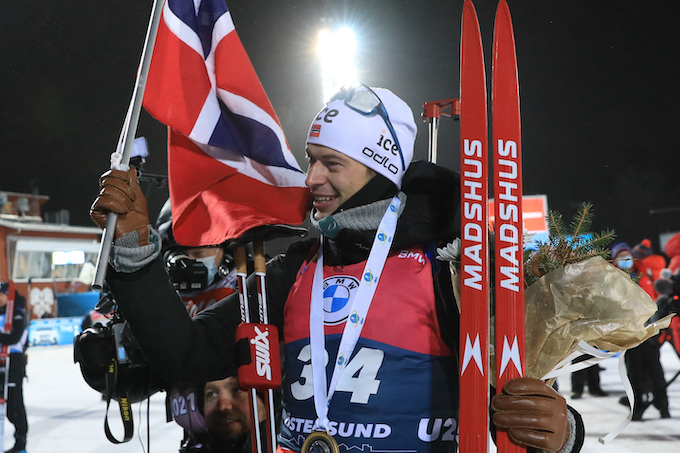
Sturla Holm Laegreid (NOR) – IBU World Cup Biathlon, individual men, Oestersund (SWE). (Photo: NordicFocus)
For Team Madshus the World Cup opener proves to be business as usual, picking up where they left in March.
Sturla Holm Lægreid (NOR) skis like a bullet, shoots clean at the range and goes straight for the podium in the 20-kilometer normal competition at the IBU World Cup opener in Östersund on Saturday.
Additionally on Saturday, Sivert Bakken (NOR), who won the national season opener in Norway two weeks ago, pulls off an impressive sixth place in the World Cup opener.
“Yes, that’s me at the on the far right. First World Cup flowers,” Bakken posts to his Instagram account after the 20-kilometer normal competition.
The 23-year-old followed suit on Sunday, and pulled off a solid eighth place in the 10-kilometer sprint after nailing every target both prone and standing.
The Östersund season opener was only his second World Cup: Bakken raced his first World Cup in Oberhof (GER) last season – in an empty stadium at the peak of the Covid pandemic.
Also, Roman Rees (GER) had a solid race on Saturday. Shooting clean the first and second time at the range and missing only once the third time, he was long in contention for the podium. But despite missing two targets the last time, Rees skied liked a bullet throughout the race and ended up 14th.
The IBU World Cup continues in Östersund (SWE) with sprint, pursuit and relay races for men and women December 2 to 5.
Story continues below
Sivert Bakken pulling into 6th place in the 20km normal competition at the IBU World Cup in Östersund (SWE) on Saturday. )Photo: Nordic Focus)
At the 3-day FIS cross-country World Cup opener in in Ruka (FIN), US National team rookie Ben Ogden shows off speed and potential finishing eighth in the sprint qualifier on Friday. The 21-year-old followed up with a 13th place overall in the sprint.
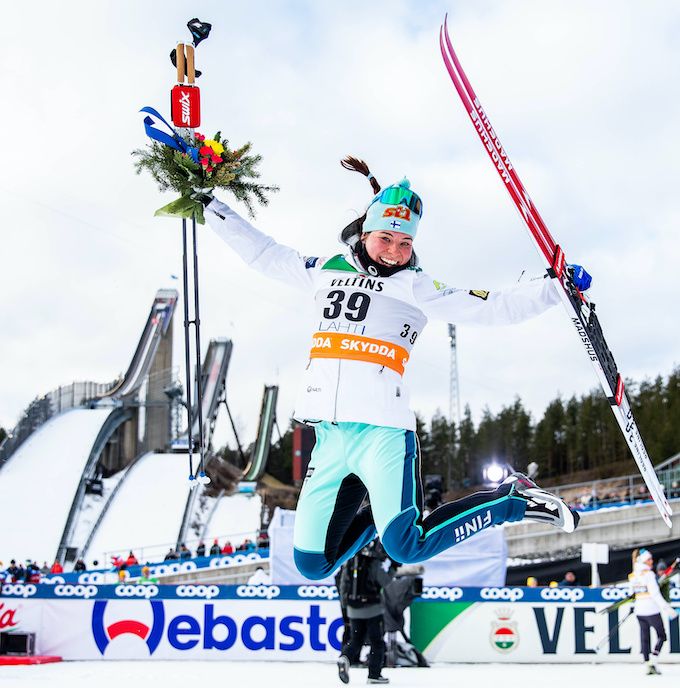
On Saturday, World Cup veteran Krista Pärmäkoski (FIN) pulled into a strong fifth place in the 10-kilometer classic race, setting herself up nicely for the pursuit on home turf Sunday afternoon. While several skiers chose to skip the pursuit, Pärmäkoski braved the frigid temperatures and pulled into fourth place, half a second from the podium. She now sits in third place overall after the World Cup opener.
The FIS World Cup now moves on to Lillehammer (NOR) featuring sprint, 10/15km skate and relays on December 3 to 5.
Ben Ogden (USA) at the FIS World Cup sprint in Ruka (FIN) on Friday. Photo: Nordic Focus
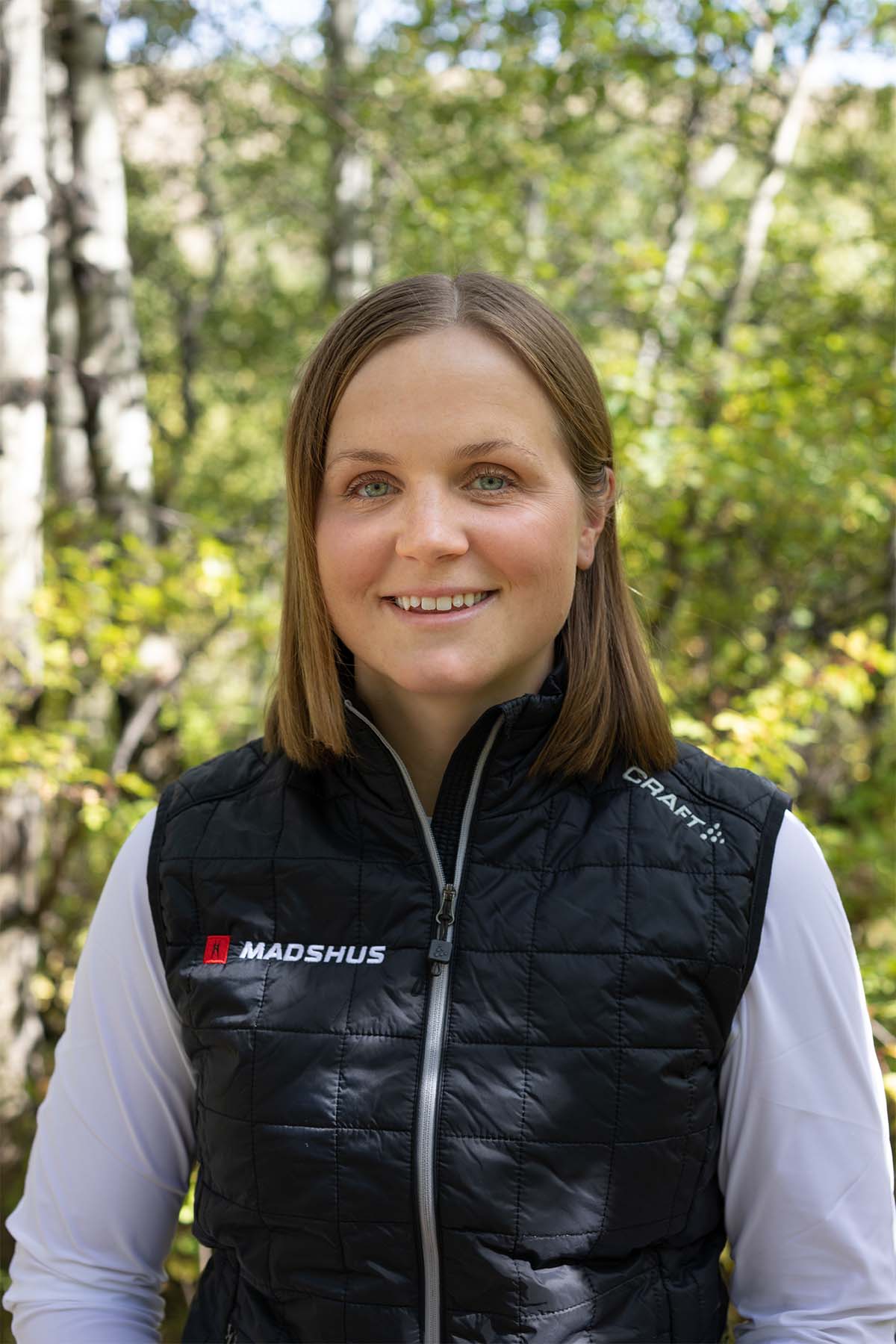
Lina Hutlin steps into the role of Race and Service Manager for Madshus. (Photo: Madshus)
At the end of September, Madshus USA announced that they had hired Lina Hultin as the new Race and Service Manager. According to the press release, “Lina will work towards finding, developing, and retaining the most talented and influential Nordic athletes in every age category. She will also work closely with the rest of the Madshus team to develop, and execute, a club and coach program that supports the brand and its dealers throughout the country.”
Hultin is Swedish and came to the United States in 2014 to pursue a Masters degree in Exercise Science and Nutrition at Montana State University. As part of this academic opportunity, Hultin was awarded a scholarship for racing with MSU Nordic. Faster Skier caught up with Hultin to learn more about her background and what led her to this position at Madshus. The following interview has been edited slightly for clarity.
Faster Skier: Can you tell us a little about your background?
Lina Hultin: It’s a cliché but for me, growing up in Scandinavia meant I started skiing as soon as I could walk. That’s how my family spends time together, we ski, bike, run, and have fika, ( preferably the activity and fika combination). I entered my first ski race was when I was five years old. Nothing intense or competitive, just a snowy field with blueberry soup at the halfway mark. After a few winters of little snowfall, my parents decided to move further north to a little town called Bruksvallarna. It’s a Nordic skiers paradise, and we quickly got involved with the local Nordic team. Shortly after the move, at age seven, I got really serious about racing (yeah, I was that kid). We had a 5k groomed Nordic track outside of the school I attended, so there was no stopping me at that point. I skied all day, every day during the 7+ month winter.
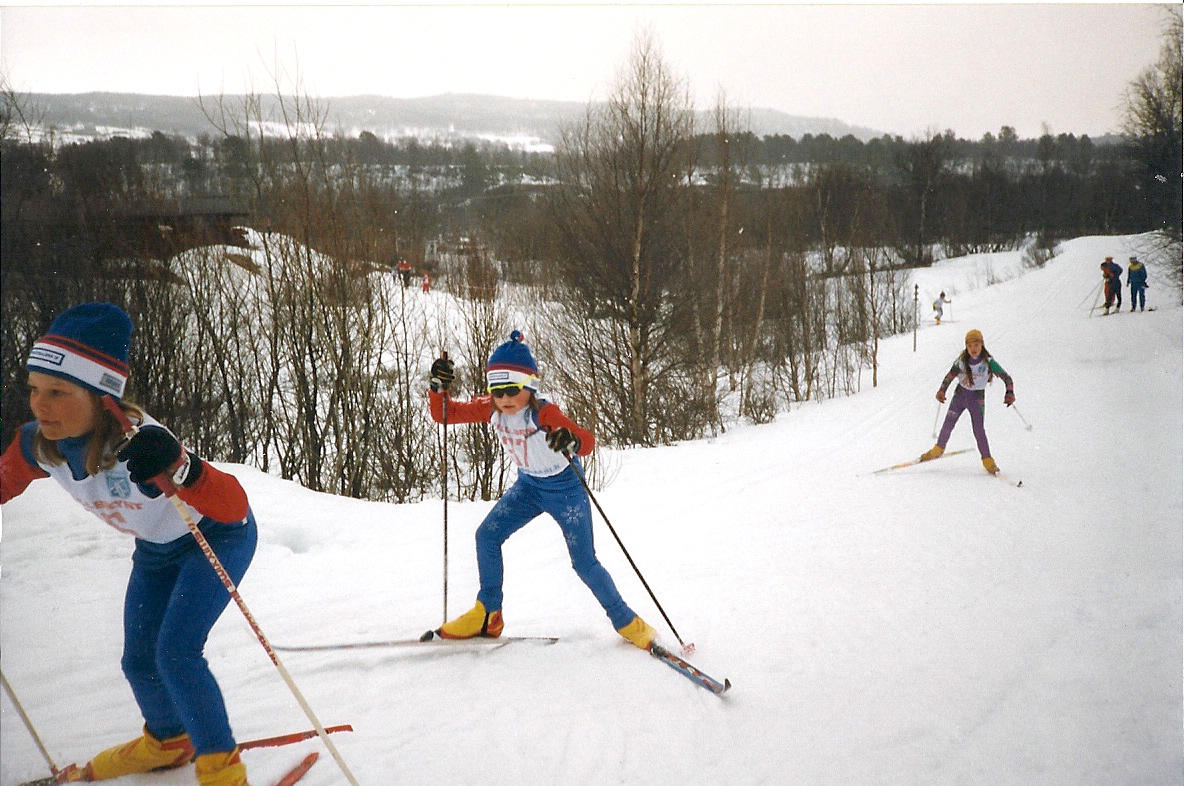
Lina Hultin age seven, getting after it in a ski race. (Photo: Lina Hultin)
I spent my high school years away from home at a Swedish high school skiing program (like most Swedish Nordic skiers do). I tended to perform best in sprints, I placed 5th in the Swedish Junior National Championships in 2009. I decided very young that I wanted to be the best. In my search for constant improvement, I became passionate about learning how the body reacts to training and how to perform optimally. So, when I heard about an undergraduate program in Meråker, Norway, where a group of world-class Nordic athletes study exercises physiology and sports performance, I had to apply! I got in as the only female athlete that year (together with Emil Iversen, Finn Hågen Krogh, Tomas Northug.. ). After being accepted I moved to the small village of Meråker, a town whose highschool and undergraduate alums have produced 24 Olympic medals in Nordic skiing and biathlon.
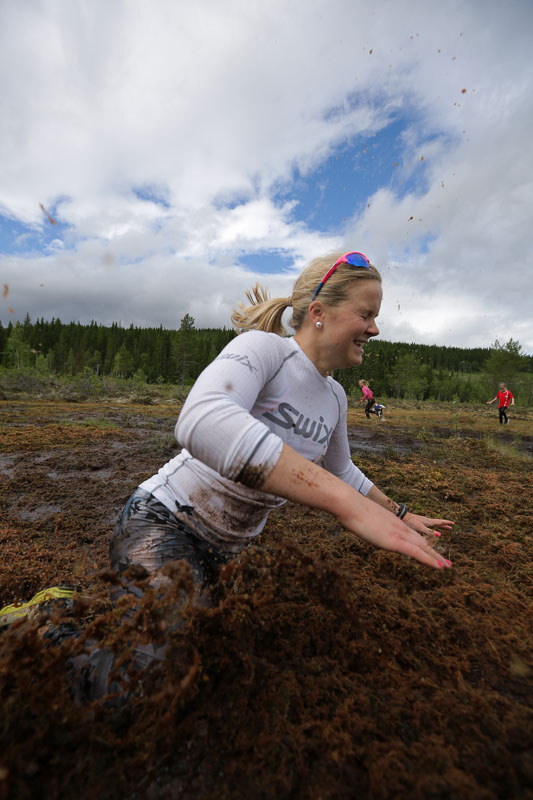
The perils of Norwegian bog running, Lina Hultin gets a taste of the mud (Photo: Adam Karls Johansson)
In this village, skiing is religion, and successful skiers become gods. However, even if you didn’t quite reach this status, there was a place for everyone who attended. I discovered the magic in the Norwegian success was their ability to share knowledge with one another. I will never forget the rainy fall mornings (when it has already been raining for two weeks straight) at 8am when I would start doubting why I was once again getting ready for an intensity session, only to show up alongside more than one hundred athletes, ready to do the same workout. The athletes ranged from freshmen in high school who just had decided to focus on skiing, to athletes who had podiumed in the previous season’s Olympics. There was room for everyone and it gave me the sense that it was just a matter of putting in the effort and time before I would be able to keep up with the fastest in the group. It felt like there were no secrets, no magic tricks, just smart training in an abundance, and in good company.
To fully submerge myself in the culture, I joined the Norwegian team Henning Skilag. The club is run by Audun Kolstad and his brother Esten. Both in their 70’s with an infinite passion for skiing. Audun coached Petter Northug when he was in high school. Audun is a man of very few words, with a big heart and fitness any 70-year-old could only dream of. No matter how many hours we ran in the Norwegian bog, he was always right there running with us, while Esten was providing the fika. During my time in Norway I was able to produce some top 10 sprint performances in Norwegian cups. In my last race in Norway, I got to ski the sprint relay in the Norwegian National Championships with my teammate Kari Vikhagen Gjeitnes. This is another experience I will never forget since I was right there with the best athletes in the world, feeling like I belonged.
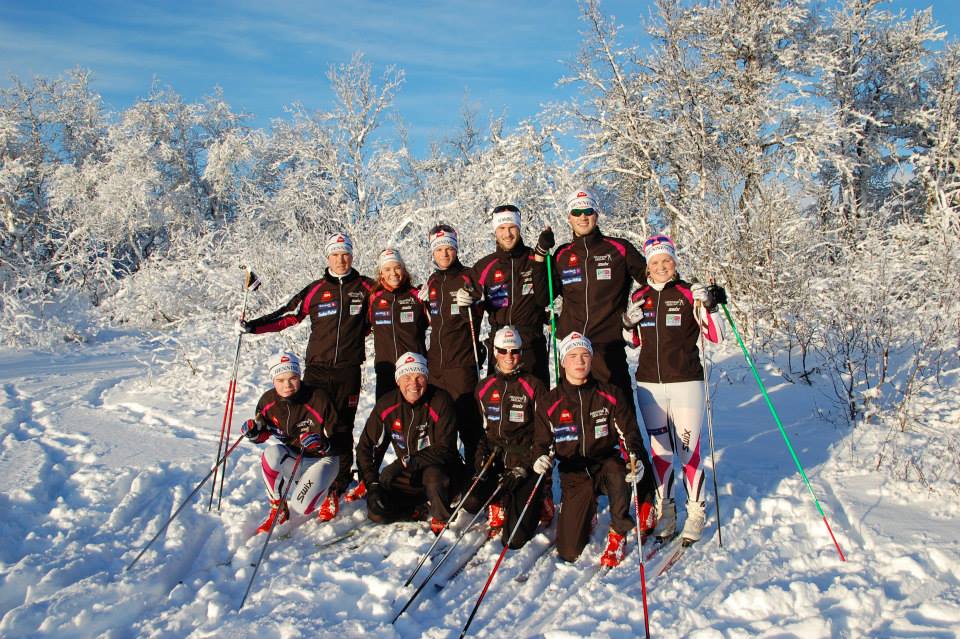
Team Henning Skilag, Lina Hultin standing to the right (photo: Henning Skilag)
After finishing my bachelor’s degree in Sports and Physical Education, I knew I wanted to keep studying (preferably full-time) but my love for racing was still strong. I always knew in the back of my mind that college skiing might be an option but, at age 22 I was starting to run out of time. Luckily, the MSU team had a spot left to fill and they had a Master’s program where I could study human performance in a lab with a roller ski treadmill (I later realized that was rare at the time in the US).
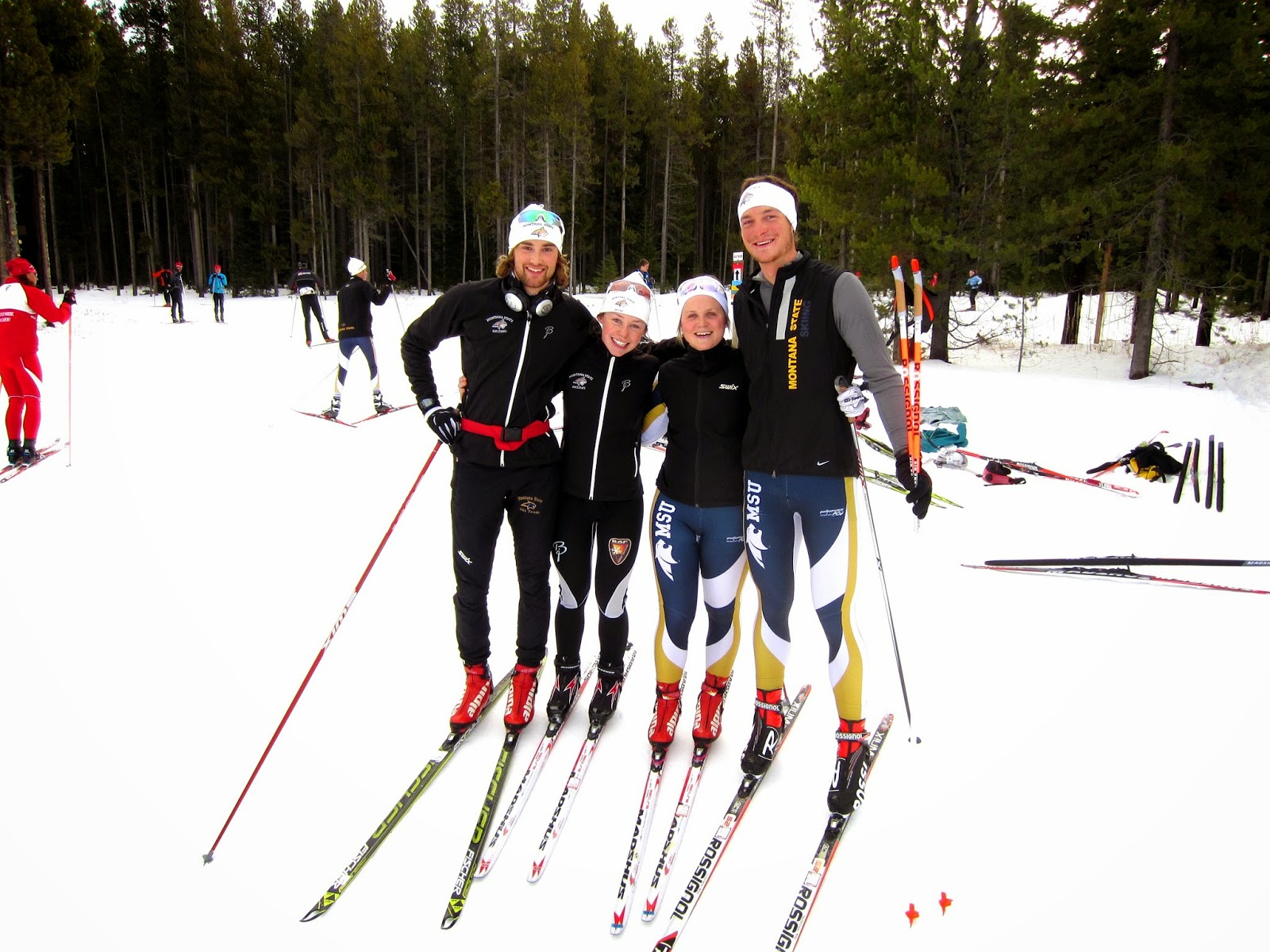
Lina Hultin (second from right) with MSU teammates (photo: MSU skiing)
I had never been to the states before, but after seeing the success of the US team and watching them at races in Sweden and Norway I was really curious to learn more about the emerging ski culture that was beginning to be established. I landed in Bozeman, Montana in August of 2014 and had no idea I had arrived in such a special place. The Nordic ski culture might not be apparent at first glance, but this town has more groomed trails and terrain for training than one can cover in years (and lots of sun! the sun is always shining and if it’s not, it’s snowing). Being a part of college sports in the US made me realize how much inspiration and knowledge can be drawn from other sports. I was thrilled at the idea of so many different ways and paths one can take in order to reach the same goal, it’s humbling and opens up a world of possibilities.
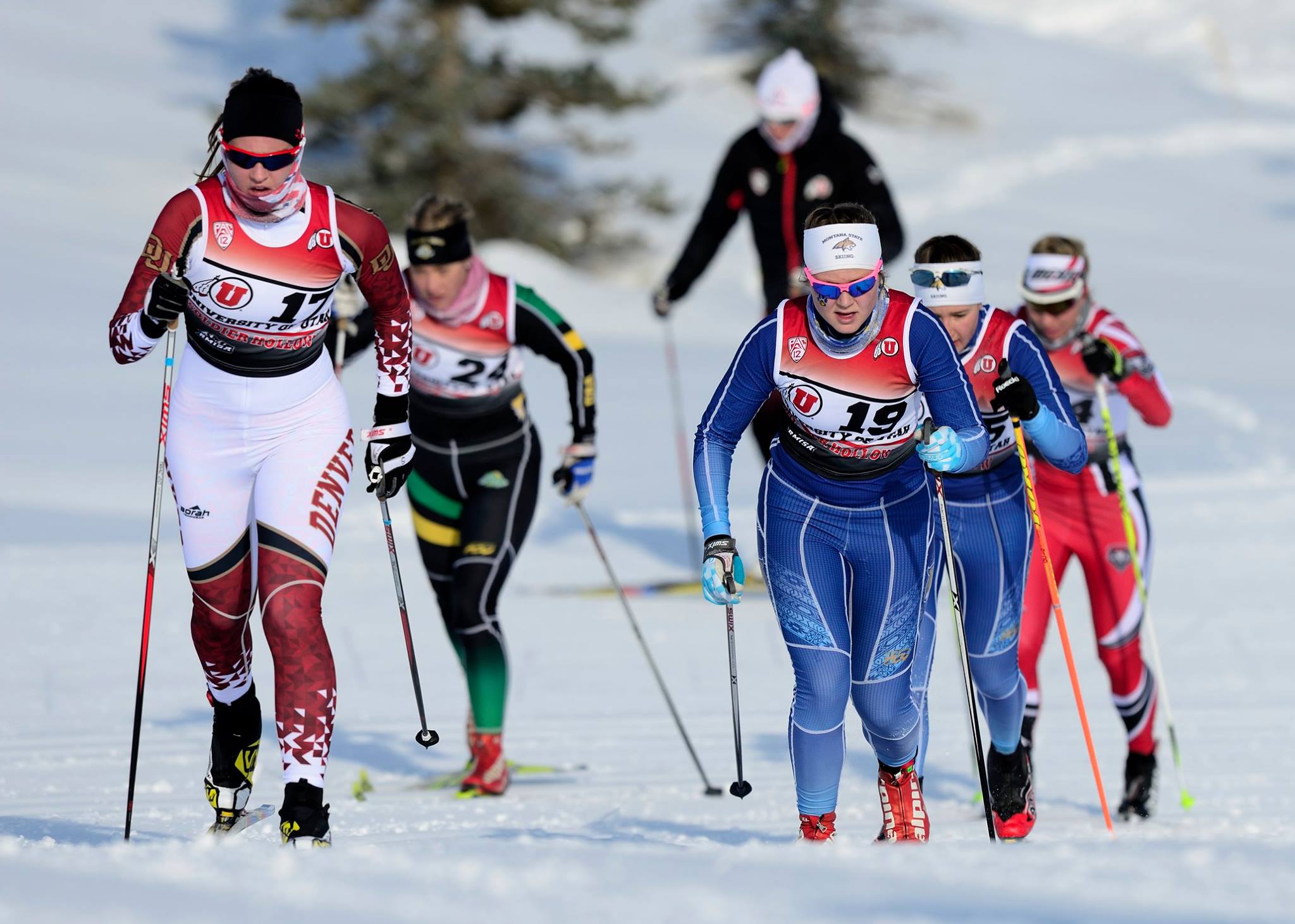
Lina Hultin (right) racing at the Utah Invitational for MSU (Photo: MSU Skiing)
FS:What has been your history with the Madshus brand?
LN: Growing up there were really two dominant (go-to) brands for skis in Scandinavia, and Madsus was one of them. Having an older brother, I got to inherit his skis, which happened to always be Madshus skis.
Lina Hultin (left) and her brother, looking stylish. (Photo: Lina Hultin)
After performing well as a junior I got in contact with Madshus and got my first pair of brand new skis. I always felt a great deal of support from them, both in Sweden and Norway. I have been happy with the company’s products, so I kept skiing on Madshus for my seventeen-year long ski career. I have some favorite’s, including my Madshus klister skis (on which I beat the family record time in the Swedish Vasaloppet) and my Madsus Zero skis (which work in way warmer and way colder temperatures than you would expect from a zero ski).
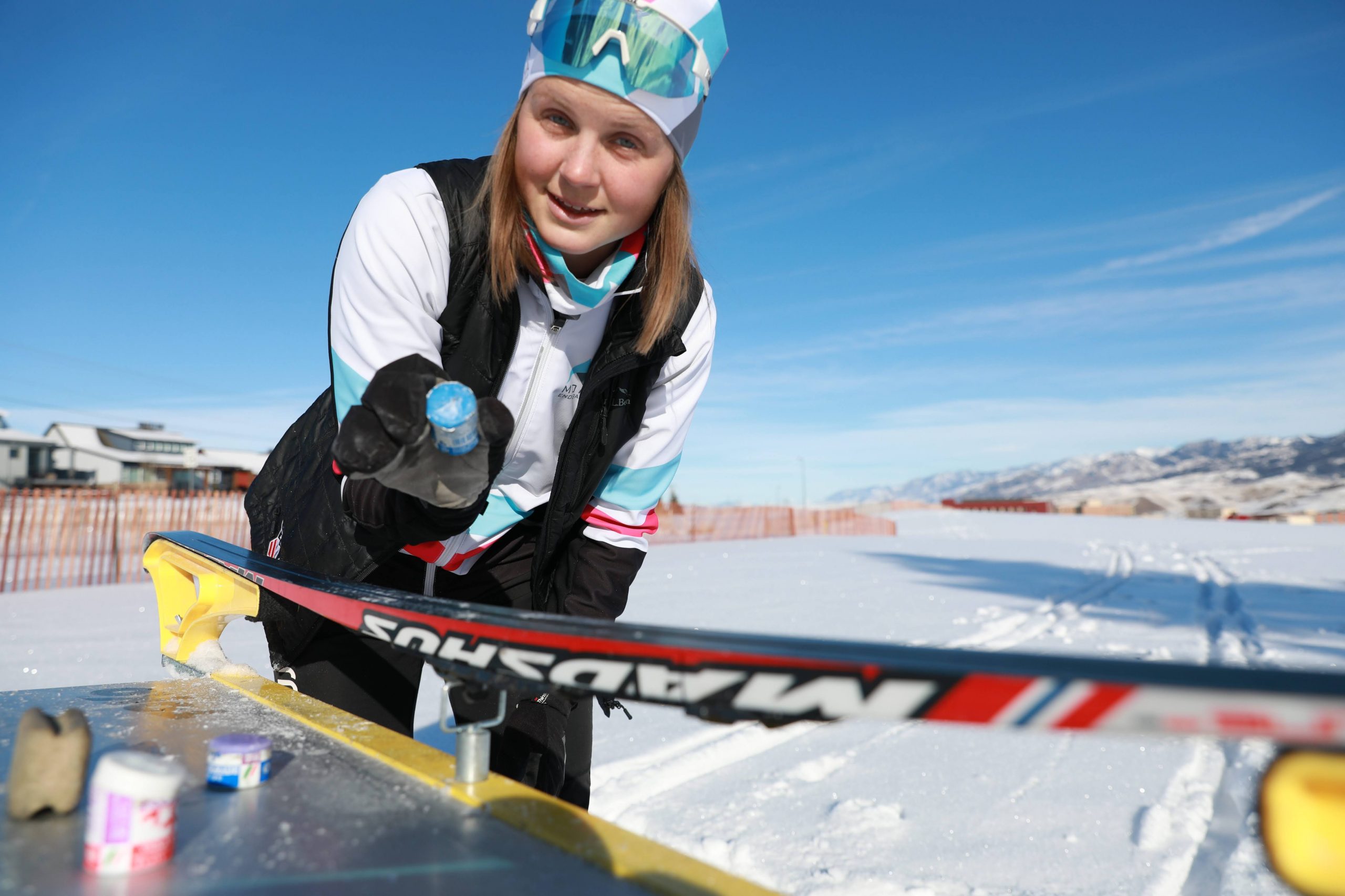
Lina Hultin gives a kick-wax demonstration (photo: FS archives)
FS: What about this new position at Madshus excites you the most?
LN: I am looking forward to being able to explore a whole other side of the skiing world. I have been coaching in the US for five years and have done my fair share of wax tech-ing but I have yet to learn about the supplier side of things. I’m excited to have the opportunity to work and learn firsthand from Bryan Cook who has years of experience in the industry. I’m also thrilled that I will be continuing to work closely with athletes, helping them to perform at their best.
FS: What do you think will be one of the more challenging aspects of the job?
LN: It’s always challenging to learn something new, but I have always been curious and eager to learn so I think I have that going for me. I guess I will figure that out as soon as the season starts! Madshus is a forward-thinking brand and I’m stoked that I get to be part of such a great team.
FS: Any other thoughts or comments?
LN: I’m very thankful for my US skiing family and for the warm welcome I have always felt being a part of this great community. I am especially grateful for the support, encouragement, and network I have found through being a part of the Women’s Ski Coaches Association. Go check them out!
Lizzie Larkins, Lina Hultin and Kate Johnson at Park City this week for the NEG/National team training camps (Photo: Women Ski Coaches Association)
Madshus racers take home a handsome bouquet of podiums from Toppidrettsveka, including the overall victory for the weekend, looking promising for the upcoming Olympic season.
The annual summer roller ski festival in northwestern Norway featured four races in three days, and was once again open for international racers.
Toppidrettsveka 2021 opened with a marathon race on Thursday, August 19, where Madshus racers parked the competitors: Astrid Øyre Slind truly set the standard, winning the 55-kilometer double-pole race in Hitra by almost two and a half minutes. Madshus’ rising World Cup talent Hedda Østberg Amundsen claimed second place, and beat Olympic-legend-turned-long-distance-pro Marit Bjørgen by nearly a minute and a half.
In the men’s 55-kilometer double-pole race, Madshus rookie Sivert Wiig clinched second place, ahead of the entire Ski Classics elite and only seven seconds behind marathon pro Max Novak.
Friday, August 20, featured two uphill mass start events midday: a double-pole race and a skate race, both on the same brutal 3-kilometer course from Årvågsfjorden to Brekka in Aure. In the women’s skate race, Madshus rising young team claimed both first and second place with Karoline Simpson-Larsen 15 seconds ahead of Elena Rise Johnsen. In the men’s skate race, Harald Østberg Amundsen finished second and nailed his second podium for the weekend.
Moving on to the sprints on Friday evening, Rise Johnsen was second in the qualifier and won every heat including the final, bagging her second podium for the day.
On Saturday, August 21, Rise Johnsen capped her race weekend with another podium, winning the thrilling sprint finish in the 15-kilometer skiathlon at Knyken. With first place in the skiathlon, the 21-year-old also secured the overall victory for the three-day roller ski festival.
Elena Rise Johnsen (NOR) won two of the four events at Toppidrettsveka 2021, earning her the overall victory for the prestigious roller ski festival in northwestern Norway. Photo: Martin Riseth/Toppidrettsveka
For the next generation of Swedish World Cup racers, the upcoming winter is well underway.
Make a note of these names: Edvin Anger, Måns Skoglund, Tilde Bångman, Nils Bergström, and Erik Larsson. These young racers are training hard, aiming high, and will put Sweden on the map.
Anger, Skoglund and Bergström are all part of the Swedish junior national team this season, while Bångman was on the junior national team last year and is now racing with her club team. All of them have already helped themselves to medals at international level, including the FIS Junior Nordic World Championships and the 2020 Youth Olympics.
Larsson, who has posted several top 10 finishes at the IBU Junior World Championships, is a part of Team Autoexperten. The team is a national development team for both junior and senior biathlon racers at the cusp of stepping into the national A team.
“There’s a lot of drive and energy in this team, and we are super excited for the upcoming season,” says John Vikman, brand manager for Madshus Sweden.
Thobias Fredriksson helping racers with ski testing during the recent season kick-off in Torsby (SWE). Photo: Madshus
The fresh-faced crew just finished their first Madshus team camp of the year, which took place in the ski tunnel in Torsby (SWE).
On the agenda: evaluating the past season, setting new goals for next, and dialing in their gear for the upcoming race season with former Olympic gold medalist Thobias Fredriksson, who is now a part of the sales and marketing team for Madshus Sweden.
Hailey Swirbul (USA) posted her first World Cup podium this weekend, on the same course where she earned her first World Cup points last season.
“WAIT, WHAT!?!? Am I seeing that right?? I came in third?? I just raced my heart out, and my skis were amazing. I am so excited,” the 22-year-old cross-country skier said after her 10-kilometer skate race in Davos (SUI) on Sunday.
For Swirbul, the podium was both a surprise and a milestone.
“A takeaway I wrote down from this weekend: I don’t have to be the strongest or the lightest or the fittest or the smartest or even the happiest to have a great race. But I DO need to focus on what I enjoy about skiing and not worry about doing things perfectly. Easy to get caught up in that mindset so I wrote it down as a lil’ reminder,” Swirbul wrote on her Facebook page on Monday.
Hailey Swirbul (USA) after her first FIS World Cup podium with 3rd place in the 10km skate race in Davos (SUI) on Sunday. Photo: Nordic Focus
Additionally, Madshus biathletes pulled off a successful World Cup weekend in Hochfilzen (AUT). On Sunday, Sturla Holm Lægreid helped Norway to first place in the relay for the second time this season, his third ever World Cup victory. 45 seconds later, Roman Rees and Benedikt Doll could cheer Germany into third place.
On Saturday, World Cup veteran Anaïs Bescond helped France to second place in in the women’s relay where she skied the first leg for her team.
For the record, Lægreid also posted two individual top-10 results in Hochfilzen, coming in ninth in the 10-kilometer sprint on Friday and moving up to sixth place in the 12.5-kilometer pursuit on Saturday.
“Incredibly stable and reliable, and overall a very enjoyable skiing experience”
The new skin ski model Madshus Endurace Intelligrip® was rated the best overall skin skis in a large, comprehensive skin ski test comparing skin ski models for recreational skiers from all the major ski manufacturers.
Madshus Endurace Intelligrip received top honors in a comprehensive test of 2020-21 skin skis. Photo: Madshus.com
Best overall performance and feel
The skis in the test were rated according to performance on several key properties: weight, glide, grip, turning and handling, double-poling, ski feel and price.
“Incredibly stable and reliable, and overall a very enjoyable skiing experience,” was the verdict of the jury.
The Madshus skis were “best in test” on turning and handling and overall ski feel, and were also the lightest of the tested ski models. Additionally, the test panel points out that the Madshus Endurace Intelligrip® skis feel fast in the track, while providing reliable grip – among the best in the test.
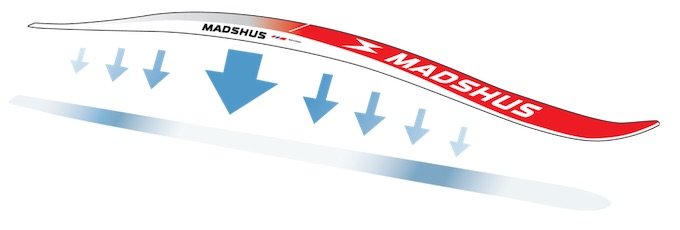
Engineered with carefully tuned camber, flex and pressure distribution, the Madshus Endurace Intelligrip skin skis provide an “incredibly stable and reliable, and overall a very enjoyable skiing experience” according to the latest test of 2020-21 skin skis.
Defining the industry standard
The recent “best in test” award for the Madshus Endurace Intelligrip® model is not the first time Madshus Intelligrip skin skis receive the top honors in consumer tests.
Last year, the Madshus Redline Intelligrip® outperformed all the other top racing skin skis in a large test of high-end skin skis.
With this week’s “best in test” for the new Madshus Endurace Intelligrip® , Madshus skin skis defines the industry standard in all the major categories: Race performance, recreation and touring.
The integrated skin is made from 70 percent mohair and 30 percent nylon, creating the perfect balance between reliable grip, excellent glide and durability.
Sturla Holm Lægreid (NOR) crushed his competitors in the IBU biathlon World Cup opener on Saturday and earned his first World Cup victory. On Sunday, turbo junior Helene Fossesholm (NOR) posted the second-fastest time of the day in the 10-kilometer pursuit at the FIS Nordic World Cup opener.
“It hasn’t quite sunk in yet. I never imagined I would win,” Lægreid said after his race, which took place in in Kontiolahti (FIN).
The 23-year-old dominated the 20-kilometer individual competition, shooting clean at the range and dropping his competitors on the course, winning the by nearly 20 seconds.
“First, the coaches said I was even with Tarjei (Bø) and Johannes (Thingnes Bø), and then I was in the lead. It was insane to get those,” Lægreid said.
The IBU season opener was only his fifth World Cup competition. Last winter, Lægreid won the silver medal at the IBU European Championships in Minsk (BLR) on March 1. He was then named to the national team for the World Cup in Nove Mesto (CZE) on March 6 and 8, where he finished 13 and 15. The next week, he was 10 and 11 at the World Cup in Kontionlahti, which were the last World Cup events of the 2019-20 season. In April, Lægreid was named to the Norwegian A-Team.
Sturla Holm Lægreid (NOR) won the IBU world cup opener in Kontiolahti (FIN) om Saturday, his first World Cup victory and his 5th World Cup race so far in his career. Photo: Nordic Focus
Meanwhile, just a few hours north of Kontiolahti, the FIS cross-country World Cup kicked off the 2020-21 season with a three-day mini tour in Ruka (FIN), where turbo junior Helene Marie Fossesholm capped the weekend with her very first top-three World Cup finish.
The 19-year-old posted the second fastest stage time in the 10km pursuit, just eight-tenths of a second shy of first place.
After placing 38th in the sprint on Friday, Fossesholm finished 9th in the 10-kilometer classic race on Saturday. Combined, the two first races left her in 15th place for the pursuit on Sunday, starting nearly a minute and half behind the leader. But pushing relentlessly through the brutal course, she worked her way up to sixth place overall.
“I’m super content with my effort today, and particularly with how I paced myself. I managed to hold back just a little out of the gate, which was key on this course. There is a hard hill in the first kilometer that will cost you if you are too eager at the start, but I skied smart and was able to stay strong the whole way,” Fossesholm says after her race.
“But I have to admit I’m a little annoyed that I was less than a second from having the fastest time of the day,” the ambitious junior adds.
Be warned.
19-year-old Helene Marie Fossesholm (NOR) posted the 2nd-fastest time in the 10-kilometer pursuit that capped off the 3-day mini tour at the FIS World Cup opener in Ruka (FIN) on Sunday. Photo: Nordic Focus
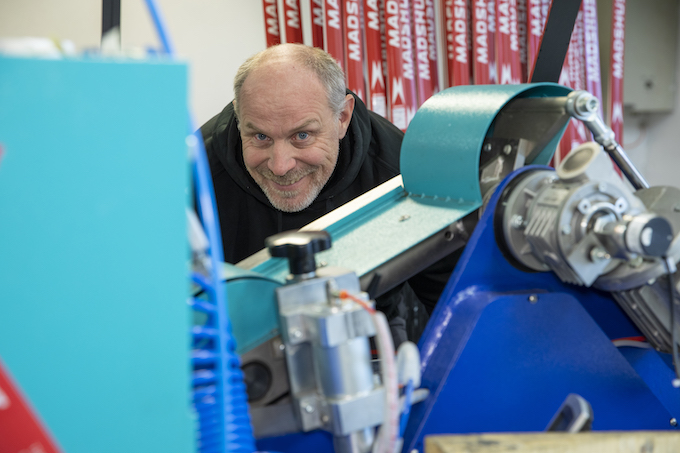
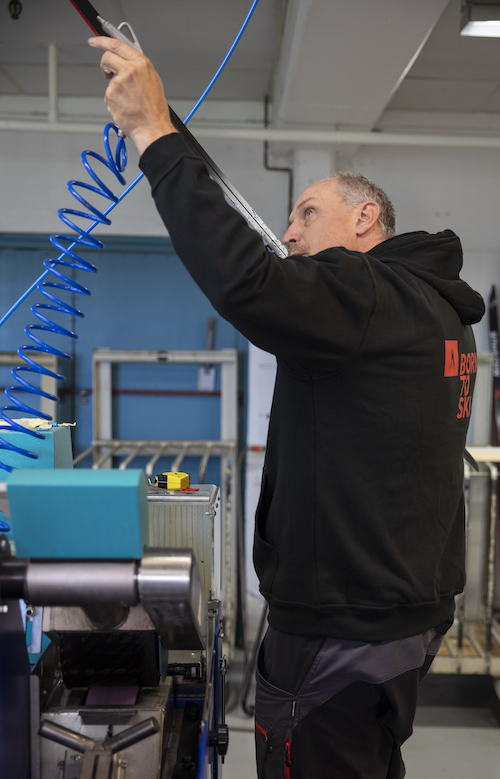
Meet Håkan Nordbäck, head of the Madshus grinding department.
While the geometry, flex, camber and materials that make up the construction of the ski are the most important factors determining the glide and properties of ski, grinds and structures contribute significantly to enhancing the speed of the ski, along with glide wax and topping products.
Now that both the International Ski Federation (FIS) and the International Biathlon Union (IBU) are banning all fluorocarbon-based ski wax and toppings starting with the 2021-22 season, grinds and structures will be even more important.
At Madshus, we have a dedicated staff in charge of our grinding services right in the factory. This allows our grinders to work closely with the engineers and ski testers in order to develop and provide the fastest and most versatile grinds and structures.
Story continues below
Håkan Nordbäck, head of the grinding department at Madshus. Photo: Stefano Zatta
What are grinds?
At the very basic level, grinds and structures are patterns etched into the ski base with the purpose of creating better glide in different snow conditions. The words grind and structure is often used interchangeably, and can refer to both machine grinds and manually applied structures, but there are distinct differences between the two.
A grind is a pattern ground into the base of the ski with a stone grinding machine, and is performed by a ski service shop (that hopefully has a lot of experience and expertise doing this). The stone grinder etches structure, a specific pattern, into the base of the ski that is designed to provide better glide in specific snow conditions. While a few years ago there were only a few of these machines in the whole country, grinding has become a business for a number of ski shops all over the country that are now offering grinding as service.
Manual structure is applied with a hand tool that either stamps or cuts a pattern into the base. This step is often done after all glide waxing, toppings and other grooming is finished. A stamped manual structure usually disappears after the next hot waxing, while a manual structure that is cut into the base can last longer.
Why grind your skis?
The short version: To speed up your skis.
In wet conditions there is too much water between the base and the snow, and the structure’s job is to drain the water away from the base and thereby reduce the suctioning effect. In these conditions, a coarse structure with a deep pattern will work best.
When it’s cold, there is not enough moisture between the base and the snow. In these conditions, a fine structure without deep groves will contribute to create a thin film of water between the base and the snow, which speeds up the ski.
We caught up with Håkan Nordbäck, head of the Madshus grinding department, to check out all about grinding.
Story continues below
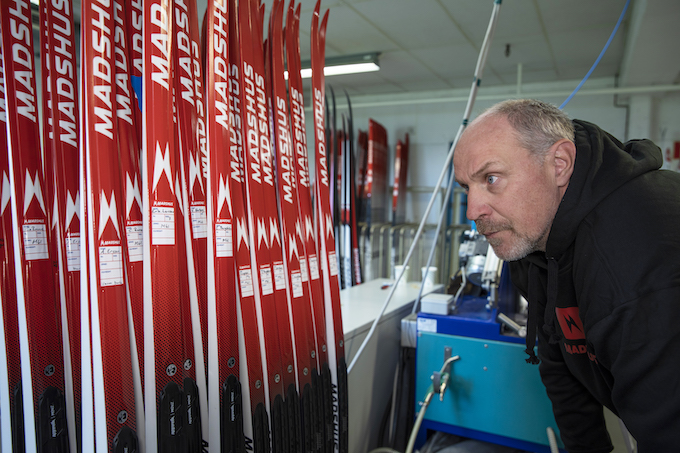
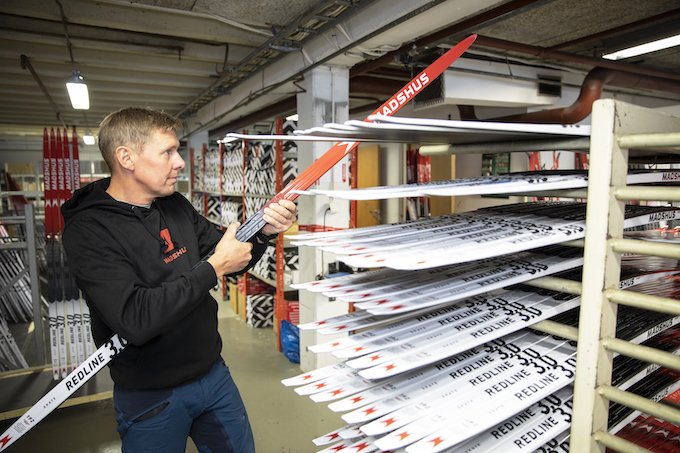
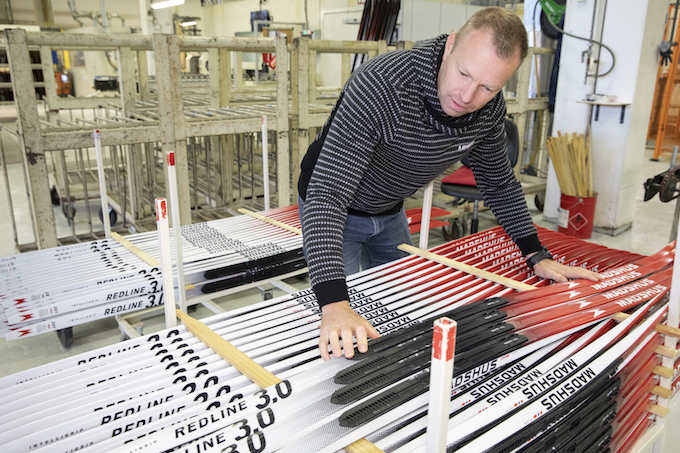
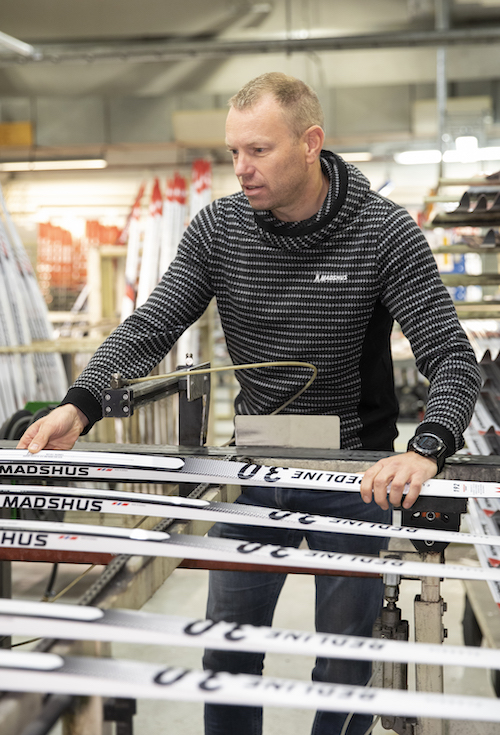
Håkan Nordbäck, head of the grinding department at Madshus, checking out the bases on a pari of freshly ground Redline 3.0 skis. Photo: Stefano Zatta
What’s new in grinds this season?
“Well, for starters, we bought two brand-new grinding machines. That’s really exciting,” Nordbäck says.
In terms of different patterns and structures, the grinding staff is constantly working on and improving the grinds, based on the testing and feedback from both the World Cup skiers and the product developers.
“We are always looking for new patterns to try and ways to tweak the tried and trusted grinds to make them even better. But one difference this year, is that we are simplifying the grind menu,” he says.
So, for the 2020-21 season, there are three main grinds: a fine grind for temperatures below minus 6-7 degrees Celcius, a medium grind for temperatures between minus 6/7 C and 0, and a coarse grind for warmer conditions from freezing and above. These are called M61-f (cold), M61 (medium) and M63 (warm), respectively.
Is there a difference between the grinds for classic and skate skis?
“No. The grinds are the same. But how you apply them differs a bit. Given the same conditions and temperatures, you generally use a slightly coarser grind on classic skis than on skate skis. That’s because the snow acts a little different in the track and outside the track.”
How do you go about that process?
“Developing new grinds is a time-consuming process. We have to test them over time, in different conditions and at a high level, which is where we use the World Cup racers,” Nordbäck says, pointing out that the goal is to find patterns that perform well in a wide range of conditions and temperatures.
“Conditions often change over the course of a race, especially in long events such as the Birkebeiner and Vasaloppet. Changing temperatures and the number of skiers using the course changes the snow structure. The same is true if parts of the course are exposed to sun while others are in the shade, or if it the weather changes between dry and precipitating,” Nordbäck explains.
Finally, the grinds also need to be possible to reproduce with consistent results, and should be fairly durable, so that they can be used for a long time without losing their properties before the ski needs to be reground.
Håkan Nordbäck, head of the grinding department at Madshus, making sure all the skis are correctly labeled before shipping them off to the racers. Photo: Stefano Zatta
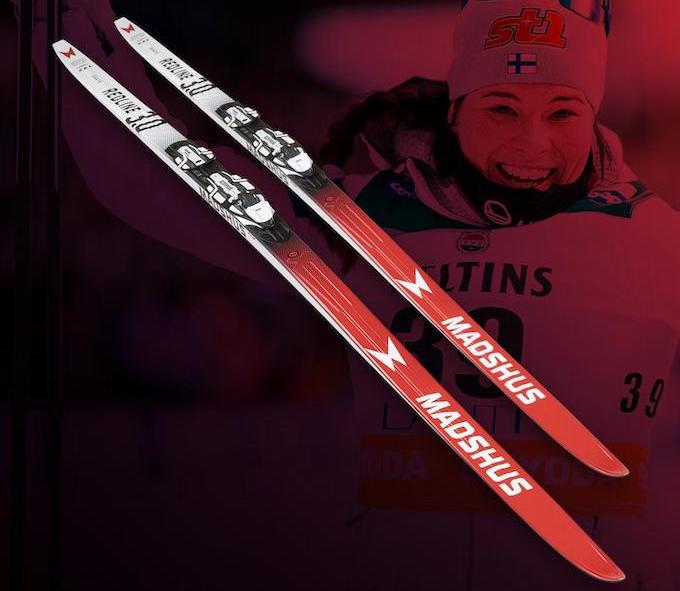
The all new Redline 3.0 skis are hitting the market right now, after three years of intense research and development, testing and collaboration with the top Madshus athletes.
So, what’s the big deal with the new Madshus Redline 3.0? Let’s hear it from four-time Olympic medalist Krista Pärmäkoski. The 29-year-old Finn, who is entering her 13th season on the World Cup level, is aiming for gold again at the 2021 FIS World Championships in Oberstdorf (GER) in February.
You have tested these skis for a while now. In your opinion, what is the biggest differences between the new Redline 3.0 compared to the previous Redline 2.0 models?
“Both the new classic and skating skis have changed a lot from 2.0 to 3.0. But to start with the skate skis, the new Redline 3.0 goes extremely well in uphill terrain, and the tips of the skis feel super light because the flex profile of the ski has changed a bit. The new Redline 3.0 skate skis are also stable to ski and really easy to control. And of course, I like the new design as well!”
Krista Pärmäkoski with the all-new Madshus Redline 3.0 F2 Skate ski.
What kinds of advantages do the Redline 3.0 skis give you, and where do you feel the biggest difference from earlier?
“For classic skis, we have done lot of work and testing in order to find good flex profiles, and during the last season most of my racing skis already had the new profile. In developing the Redline 3.0, we were also careful to keep all the good features from the old skis and then improved them even more. As a result, the new Redline 3.0 classic skis are easier to ski, it is easier to get perfect kick and the grip is more reliable. And finally, they also feel really fast on downhill sections.”
The Madshus Redline 3.0 is no less than a small revolution three years in the making. There are huge changes under the hood on the new Redline 3.0 models headed for retailers this season. Madshus engineers explain what’s under the top coat of the all-new Redline 3.0 models.
The new Redline models are the result of intense product development, rigorous testing and an open-mindedness to question established methods and principles of ski construction and manufacturing, all in close communication with our top athletes and proven on the World Cup. Their feedback and experiences, requests and demands are carefully collected and thoroughly analyzed in order to develop the fastest, most reliable skis on the market.
What’s the difference between Redline 2.0 and Redline 3.0?
“There are three major factors determining the properties of a ski. The geometry of the ski, that is the thickness of the various sections of the ski, is one. The other is the flex and camber, and the third factor is the materials from which the skis are made. The geometry is the only factor we haven’t changed in the Redline 3.0 compared to the Redline 2.0. The flex and camber and the composition of the materials,” explains Bjørn Ivar Austrem, Technical Director (CTO) at Madshus and in charge of innovation and product development at the factory in Biri, Norway.
Story continues below
Redline 3.0
The all new groove
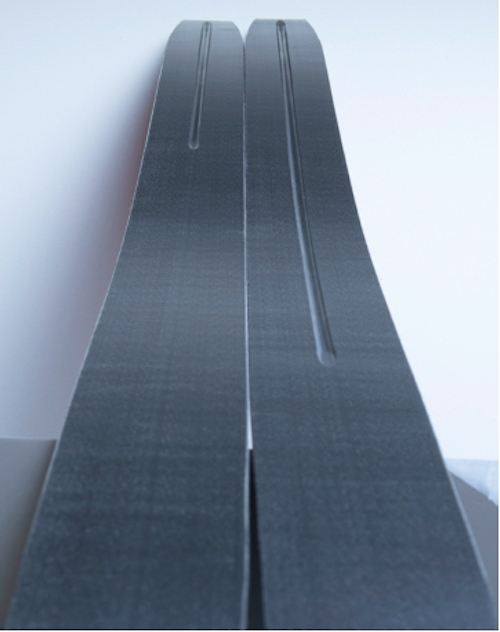
While there are huge changes to the inside of the ski in the new Redline 3.0, the design of the groove on the base of the ski is one of the most visible differences from previous models. The groove is shorter on all the new Redline 3.0, but different on all models depending on which conditions they are engineered for. On some models the groove is entirely eliminated on parts of the ski.
“The groove provides stability to the ski, but because our skis are very stable to start with, we are able to adjust the length of the groove depending on what kinds of conditions the ski is intended for. That allows us to engineer a ski with the optimal combination of liveliness and stability,” Austrem says.
He explains that the technology behind the groove design is based on principles of physics, but applied somewhat differently on skate skis and classic skis.
Classic skis for cold and dry snow, typically hard wax conditions, come with a groove only on the tail part of the ski. Classic skis for warmer and wetter conditions have grooves from tip to tail.
“The cold conditions models are designed with a short groove in order to increase the contact surface on cold, sharp snow crystals, and provide a better feel for the snow. At the same time, this construction also increases the surface area of the kickwax zone and provides better grip,” says Austrem, and continues:
“The warm conditions skis are engineered with a full groove in order to improve the glide in wet snow.”
There are two versions of the Redline 3.0 skate skis: The F2 for hard, fast conditions with a long groove, and the F3 for softer, slower snow with a short groove.
“A long groove on skate skis provide more stability as needed in hard, fast conditions, while a short groove provides optimal flow and allows the skier to adjust the direction of the ski more easily in softer, slower conditions,” Austrem says.
Story continues below
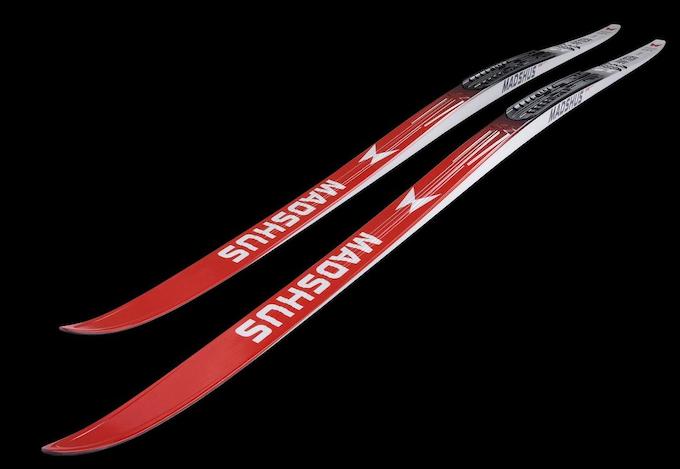
The short and the long Race Groove on the new Redline 3.0
New flex profiles and more carbon
Moving on to the composition of materials in the new Redline 3.0, the biggest difference is that the new Redline 3.0 have significantly more carbon than previous models.
“We are always striving to find new and better materials that combined with solid geometries and correct flex and camber provide optimal glide and skiing experience, and for classic skis, reliable kick without compromising glide. On the Redline 3.0 models, we have added more carbon and developed a different layup of the carbon, resulting in both skate and classic skis that are livelier and more dynamic,” Austrem says.
The flex profiles are also reengineered, for both the skate and classic models. The skate skis come in two versions: one model with a stiffer flex for hard, fast conditons, and one with a softer flex for softer, slower conditions.
“With two different flex profiles, we can position the pressure points of the ski more accurately, which improves the properties of the ski. A ski with stiffer flex with a taller camber is more responsive and dynamic, but in softer conditions a ski with softer flex and a lower camber delivers more consistent response,” Austrem explains.
Story continues below
Dynamic Tuned Response: Madshus’ innovative construction concept represents an entirely new way of optimizing the ski to the conditions in which they’re designed to excel in dynamic response to the conditions the skier encounters over the course of a race.
For the Redline 3.0 Classic skis, the flex and camber is adjusted to allow the ski to close more easily, depending on snow conditions. This provides a better use of the area in the kickwax zone, providing better grip without sacrificing glide. The flex and cambers on the classic skis are also engineered and adjusted for different snow conditions, and the Redline 3.0 classic come in two versions: One for cold conditions and one for warm conditions.
Redline 3.0 Cold has a slightly lower camber, less splay and medium long pressure points. Additionally, the Redline 3.0 Cold comes with a groove only on the tail end of the ski.
The Redline 3.0 Warm has a taller camber in order to make room for klister and soft waxes. The Redline 3.0 Warm also has more splay and the pressure points are somewhat shorter than on the Redline 3.0 Cold. The groove looks more traditional, runs through the kickwax zone and most of the length of the ski, although it is shorter than what has been conventional for classic skis.
Story continues below
World Cup service tech Peter Blom is double-checking the flex and stiffness of a freshly produced batch of Redline 3.0 skis at the Madshus factory in Biri, Norway. Photo: Stefano Zatta
Additionally, the classic ski is also available as a skin ski: The Redline 3.0 IntelliGrip. This ski comes with the same construction as the Redline 3.0 Classic Warm.
The double-pole classic ski Redline 3.0 DP is based on the construction from Redline 3.0 skate skis, with flex and properties specifically developed for long-haul double-poling in the classic tracks.
For junior skiers, Madshus features two Redline 3.0 models: One for skating and one for classic. These skis are based on the same technology and materials used in the World Cup models, but the Redline 3.0 junior skis are carefully modified and adjusted to fit the movement patterns and body size of younger athletes.
Isn’t it really expensive to develop skis in this way?
“Yes. But cost and budgets are no issue in the Redline engineering process. That’s the whole concept of the Redline models: We spare no effort or resources, not in the engineering process and product development, nor in the production,” Austrem concludes.
Bjørn Ivar Austrem, CTO at Madshus, explains that with the Redline 3.0, Madshus spares no resources. The objective is simply to produce the best ski on the market. Photo: Stefano Zatta
When the country began shutting down in March, sporting good retailers initially shuddered. It appeared many if not all sectors of the economy would bottom out.
“Everything was dicey in February and starting early March,” said Boulder Nordic Sport (BNS) founder Nathan Schultz about the onset of the Covid-19 pandemic. I was about to head off to Italy for the World Masters to wax there. Everybody in the Midwest was getting ready for the World Cup. And then everything got canceled. Things got serious really fast.”
Early on, Schultz decided to curtail BNS operations. He advised his employees to take advantage of the Federal Government’s Paycheck Protection Program (PPP) until he and his advisors could settle on a long-term plan of action.
For BNS and many ski purveyors, March can be a lucrative month – a time to create some financial padding before the dry season. By April, ski and winter accessory sales normally dip as the sun tracks higher in the sky. It’s a timeworn business cycle.
“This March and April were scary,” said Schultz who noted his March revenues dipped roughly 75 percent.“And in April, people were still kind of holed up and April is not usually a big month for us. But to have it go from a little bit to nothing is pretty hard. We were definitely scared about the end on the ski side.”
Back in 2018, Schultz merged BNS with Boulder Cycle Sport – a Boulder based specialty bike shop. Schultz’s close proximity to the bike side of the outdoor retail market was a front seat for the unexpected: a run on bikes during the pandemic’s onset.
In March and April, Boulder Cycle Sport’s bike staff agreed to reduce their hours by 50 percent. Doomsday scenarios were not so far fetched. But as the mercury rose and Colorado’s front range greened-up, Boulder’s denizens, known for their high output energy, became stir crazy like the rest of the nation under lock down. Schultz recounted, “everybody started riding bikes because that was all they could do. It went from zero to 500 percent.” With the uptick in sales, the bike staff transitioned to full time and any interested ski employees were offered hours on the bike side of the business. The experience in Boulder was no anomaly. Bike sales blew up across the nation. Mainstream media outlets reported that wait times for new bikes could be months. From kid-bikes, cruisers, road and gravel bikes, to fat tire steeds, they all were in high demand.
This was true for Boulder Cycle Sport where zero to 500 meant they could sell bikes as fast as they received them. According to Schultz, May, June, and July were all “crazy good”. “It went from ‘super scary’, to ‘wow are we going to be able to survive this?’ to ‘this is amazing we are selling everything that we have.’”
Boulder Cycle Sport does not simply cater to the high-end customer looking to drop 10 k on electronic shifting and featherweight carbon. “We definitely have everything,” added Schultz. “We want to be the neighborhood bike shop. So, we have all types of bikes.”
That bike spectrum spans starter kids bikes, to mid-price commuters, along with a full menu of price points for customers seeking an entry-level or pro-level race bike. No matter, the low, middle, and high end of the bike market was selling out. With brisk sales coupled with factory closures, supply chain disruptions became a common topic. Some bike models remain hard to come by as are some spare parts. “It is at the point right now in the bike world where the supply has been nearly exhausted,” said Schultz.
The exhaustion of the supply chain does not necessarily mean bike manufacturers will full-tilt-boogie ramp up production to meet demand. In an article and radio piece for Marketplace, Chris Rodgers, a supply chain analyst for S & P Market Intelligence said this: “The [bike] industry wasn’t running with lots of spare capacity to start with. What the industry doesn’t want to do is double its capacity to meet the increased demand, and then we turn round in the winter or next year when everyone’s got a bike and suddenly you’re left with a factory that’s too big and machinery or staff that aren’t being used anymore.”
In the short-run, we may see bike shortages persist as manufacturers remain cautious and steady in what could become a massive boom-bust cycle.
Retailers like BNS-Boulder Cycle Sport sell skis too. They know that as cycling use decreases during the winter, ski use increases. Needless to say, they have been informed by the cycling industry’s vagaries. That has shop owners like Schultz consumed with positioning themselves with just enough gear to meet a potential surge in demand for cross-country ski equipment.
Schultz received a positive data point early on. “On the rollerski side of things, it picked way up, about twice what it normally is,” Schultz said. “And it seems like more and more people are coming to us early and they are saying we want to get into nordic skiing this year and we don’t want to miss out. They are coming in at the end of August instead of October and November when they usually show up.”
Testing Madshus newest high end ski, the Redline 3.0 at Sjusjøen (NOR) this spring. Photo: Stefano Zatta/Madshus
The conversations on and off the record here at FasterSkier are the same regarding a potential boom in cross-country ski sales – bullish. One reason for the optimism is alpine areas are now revealing their winter operating procedures. Nationwide they include policies like online reservations for parking and skiing, limited if any food service, and a concerted effort to remain open and profitable by enforcing social distancing the moment a skier arrives, to the moment they leave. Industry wide, these are considered some of the best-practices to ensure financial viability and skier safety.
“People are going to be looking for other winter sports,” said Schultz. “Even if the alpine world were normal, I think the nordic world would still be blowing up because people are looking for a way to get outside and away from people. Backcountry skiing and nordic skiing are great opportunities to do that.”
Cross-country ski shops are figuratively grabbing the bull by the horns as they expect a similar dynamic to the bike industry: an increase in gear sales. However, there’s the hope that supply chains remain fluid. In other words, well supplied.
“The ski industry has had time to anticipate this, everybody I’ve talked to, they are bullish, they have raised production a huge amount and they are all in it,” Schultz said. “What we have been doing is we have been placing backup orders to bulk up and if we don’t sell what we think we will, we will probably modify those orders a little bit. I think all of those vendors are expecting it is going to be a big year and they are probably going to run out of product and they are trying to balance that equation — not get too bullish and have too much inventory because that kills. That is the biggest killer of retail, but we still need to have enough that we don’t run out.”
The Supply Side
Lillehammer, Norway World Cup, a USA Technician working on Rossignol Skis. (Photo: Nordic Focus)
“It is going to be an interesting year, from what we are seeing from the cross-country side, which I am sure you will hear from everybody, everybody is betting on nordic,” explained Jeff Courter, Nordic Category Manager for Group Rossignol North America.
Courter said he expects all segments of the nordic category to grow, yet the greatest increase is expected to come from entry and mid-price point models. The same trend as in the bike market.
Pre-season orders for skis are received almost a year in advance of the following winter. Skis for 2020-2021 were likely pre-ordered in the fall of 2019. That allows suppliers like Rossignol, Fischer, and Madshus, all of which were contacted for this story, to ensure the raw materials for ski production are secured and demand is met.
“We have multiple factories in various parts of Europe,” Courter said. “The difficult thing with us, as I am sure most of the other suppliers are coming up against this too, with all of this massive increase in demand the problem is that the timing of this is a bit off. We have to put in all of our orders almost, not quite, a year ago, last fall over the course of last winter. All of our orders were in with the factories before all of the lock downs when the quarantine happened and, of course, now, the subsequent massive increase in demand.”
Courter said that Rossignol was able to keep production going through August, a time when much of Europe normally shuts down for holiday. “Since everyone already had six weeks off in the spring, all of our factories kept working to catch up and gain ground to be back where we should be in terms of delivery date and also just availability of product,” said Courter.
For now, sourcing materials for skis has not been an issue for Rossignol. The same can be said for Fischer. Steve Reeder, Fischer’s National Sales Manager for Nordic Skiing in the U.S. said in many ways Fischer’s supply chain is almost totally vertically integrated. Reeder used the example of their wood core skis as evidence.
“The wood core skis are built in our Ukrainian factory and that is literally a tree to ski factory, there is a wood mill on-site,” said Reeder. “You pull in the driveway and giant logs are being fed into a building where they are turning them into sheets for cores.”
Fischer’s higher-end skis, those with more complicated builds like the Speedmax which offers a lighter “Air Core”, are fabricated at Fischer’s plant in Ried im Innkreis, Austria.
Globalization has become the norm. Ski companies, which also produce boots, are well versed in navigating complex supply chains when sourcing material from outside their vertical chain. “Base material, that is probably one of the things they have to buy,” said Reeder. “I believe we have a good supply of that on hand. Most of that is Central European sourcing so there were not big concerns. We do some boots constructed in Europe, but we do a good chunk in the Far East, Indonesia, Cambodia, and those facilities got all of their componentry out the door and on the way to the factory before things shut down in Europe. So they were actually in very good shape and we have had stellar delivery on those products this year.”
Lenzerheide, Switzerland World Cup: Sweden’s Ebba Andersson tests her Fischer fleet. (Photo: Nordic Focus)
Like Rossignol, Fischer took preseason orders for this winter’s stock nearly a year ago. Reeder also expects Fischer to have mid-season reorder capabilities for most of their lines. For some product, Reeder said stock vaporized in August when under normal circumstances he would have a supply buffer well into January. Fischer is now considering options to increase its production capacity on select models.
Norway based Madshus is known to operate a nimble factory able to produce small-batch ski runs. Bryan Cook, U.S. Sales Manager for Madshus, says they too are positioned to prevent ski scarcity.
The autumnal equinox just passed. In the market for news skis? This is often the time to begin sniffing around as dealers swap out spring and summer gear for snow sliding options. Time will tell if ski shops experience a supply pinch like bike retailers. It appears ski manufacturers have read the tea leaves. Optimism reigns. For now, it seems that optimism will be met with a solid supply of skis as the cross-country segment looks for a boost in sales.
Hailey Swirbul (USA) racing in Oestersund, Sweden. Photo: Nordic Focus.
Madshus athlete Hailey Swirbul (USA) shares her strategies for getting the job done and preparing for the upcoming season amidst the corona pandemic that has hit the United States harder than any other Western country.
“I’m trying not to stress out about it. The virus is out of my control. But of course, we are concerned. In our team, we no longer talk about what we will do if someone in the group gets infected with Covid-19. Now, we talk about when someone gets it,” Swirbul says.
“I feel like a lot of Americans don’t take the virus seriously. They totally ignore the restrictions, don’t wear masks in crowded public spaces, and act insanely irresponsibly, and that’s very frustrating for the rest of us. As elite athletes we are depending on staying healthy, so I avoid public places as much as possible,” Swirbul says.
The 21-year-old US Ski Team racer lives and trains in Anchorage, Alaska, where infection rates and restrictions have been less than many other places in the United States. But Swirbul and her fellow training buddies still have felt the impact of the devastating virus.
“Nobody knows if or how we will get to compete this fall and winter. We were not able to travel to the glacier for our usual on-snow summer training here in Alaska, and there haven’t been any training camps with the full US Ski Team,” Swirbul says.
Last winter, Swirbul posted her best ever results on the World Cup in Davos (SUI) in the beginning of the season, proceeded to win both the sprint and the 20-kilometer classic event at the 2020 US National Championship, and was preparing for a second peak toward the last part of the season. But then the corona pandemic hit and closed down racing, traveling and life as we knew it in March. As spring turned to summer, the United States topped the global statistics of corona infections and deaths.
Hailey Swirbul (USA) at the FIS World Cup in Falun (SWE) last winter. Photo: Nordic Focus
Up to 30 hours of training in a week “Fortunately, outdoor workouts have not been restricted in Alaska, and while we can’t easily travel or do camps with everyone, we have a strong group of skiers locally who train together. But we are careful to keep social distance. We only train alone or in small groups, and I have also been focusing on other things than I’ve been doing the past few years,” Swirbul says.
In a typical week, Swirbul does one interval session on foot and three roller ski workouts with the local team at Alaska Pacific University. Additionally, she does at least one long distance workout of about three to four hours, either alone or with some of the other local athletes, and several strength sessions.
For an average week, that adds up to about 20 to 22 hours of training. But on big weeks Swirbul can hit almost 30 hours. Occasionally, she also has recovery weeks where she drops the training volume to 12 to 15 hours.
Tweaking the training program
While outdoor training is fairly uncomplicated as long as the training groups are small, gyms have been closed for months. Accordingly, Swirbul has used the pandemic as an opportunity to tweak her strength and conditioning routines this summer and fall.
Normally, she would do three or four strength sessions per week, with at least two of them being longer workouts at the gym. This year, she’s done nearly all of it at home.
Instead of doing weights at the gym, Swirbul has focused on plyometrics and explosive strength. She found that a tree branch can be used for pullups. And she picks up her dog for extra weight when she’s doing squats.
“I look at this season as an experimental year. I keep doing what I can do and who knows, maybe it will pay off and I won’t be any slower. After all, there is no perfect recipe for training, and the most important thing is consistency,” Swirbul says.
Connor Green (right) testing skis in Sognefjell, Norway. (Photo: Zach Caldwell)
Twenty-three-years-old, a mechanical engineering degree from Harvard in hand, and a love for cross-country skiing. Lots of opportunity.
Connor Green, raised in Rochester, New York, deep into cross-country skiing, and a brain fixated on asking questions and solving problems through better engineering has brought his services to Biri. He is a product engineer with Madshus AS in Norway. Green was interviewed this past May. After hearing that Green worked for Madshus through a Caldwell Sport blog post, the obvious choice was to learn more about the American in Norway.
Green grew up ski racing for Rochester Nordic Racing and raced for Harvard’s cross-country ski and running programs. He graduated in 2018.
FasterSkier: How did you first incorporate your love of skiing with your engineering studies in college?
Conor Green:The first project which would have been applicable to skiing came sophomore year when I built a system for roller skis which measured the skier’s force output and provided real-time feedback. It was bare-bones prototype level stuff, but it could indicate whether you are providing a sharp, early kicking action or if you have late kick and it allowed me to visualize that force relationship while roller skiing.
So that would have been sophomore spring. But that project didn’t come from nothing. There were other classes freshman year and in high school which helped along the way. Growing up I was always tinkering, and over time all those skills bleed into each other and build up.
When I got to a project like the rollerskis, I already had the skills to be able to do that, and for the things I didn’t know I had the confidence that I could learn them quickly. That’s another important lesson with engineering; the skills are very transferrable and you’re often learning how to learn. A given project might not be relevant in someone’s career, but the skills and thought process behind figuring out a solution to the problem certainly will be.
FS: In many ways, for someone with your skill set and interests, you have landed the perfect job. Can you explain how you ended up working for Madshus?
CG: I had contacted my current boss, Bjørn Ivar Austrem, probably as early as my sophomore year to inquire whether or not they had any summer internship opportunities. I told him about my background and he always took the time to respond, but they never had any openings. And now I realize that is more a function of how businesses work in Norway. Most companies more or less shut down in July. Everyone takes three to four weeks of vacation in the summer so having a summer internship, where one of the three months would be spent on vacation, from a logistical standpoint doesn’t make sense.
That was a big part of why nothing opened up. But once I came to the end my time at Harvard and was trying to figure out where to go next, I wanted to find a place I would be happy, be that the US, Norway, or elsewhere in the world. I figured I am never going to have as much freedom to move wherever I want, I am never going to be as good at Norwegian as I was right then, so at that point I started looking for jobs in Norway and contacted Bjørn Ivar. The timing there seems to have worked out quite well.
FS: So what exactly is your role with the company?
CG: My specific title is product engineer, but that doesn’t really describe everything I’m doing on a day to day basis. Yes, I’m generally working on products, but I am also designing and building tools and software for the men and women on the production floor to be more efficient and to better understand the products we are making, for quality control, sorting skis, pairing skis, whatever helps the company. I think a better description of my job might be providing Madshus with competitive technical advantages. I get to work with the race team developing skis to provide our athletes with a competitive advantage, but I also get to work with the production workers building tools to provide them a competitive advantage compared to our rivals. On a day-to-day basis I’m trying to apply technical knowledge and skills such that Madshus products and processes are improved.
It is not a super big company, so I get to wear a lot of hats which is a lot of fun for me. I’m certainly not doing the same thing every day.
FS: From an engineering perspective, can you speak a bit about building skis at Madshus?
CG: So my belief and feeling is that the replicability of skis from Madshus is state of the art. All the materials we are using are extremely standardized. We are using engineering grade foams, we are using standardized fibers, carbon, glass, plastic materials. It is all very controllable. We use very little of what I might call variable raw materials.
So be it wood in their core and sidewalls, be it cellulose based materials, or other highly variable raw materials, purely from controlling what goes in it is a lot harder for some other manufacturers to do that. If there’s more variability on the input, you’re naturally going to have larger variation in what comes out.
For me, when I make X, Y, and Z changes to a ski, and then test it — I know those changes come from X, Y, and Z, and not some random variation in the process.
FS: Here in the U.S., many skiers rely on a ski-picker to find that magic pair of skis at the factory. In a controlled environment like Madshus, what is the role of a ski picker?
CG: My understanding is that at a company like Madshus the role of ski picker is not so much sorting dud skis from good skis, it’s more about fitting the desired ski qualities to skiers. Every series of skis we are trying different things. Because there are so many different snow conditions, so many variables, so many different weights of skiers and there are so many different techniques of skiers … being able to find one ski to rule them all for everybody in all conditions is not a super realistic goal.
We can work towards it for sure, and skis which are made as general stock for ski shops are made with more “universal” cambers than what we do for our race room. There is always going to be some degree of variation needed at the top end of racing and this is where ski pickers come in. From one series to the next, we have a slightly different goal for the camber, for what those skis should be. We might try moving the highpoint relative to the balance point, we might try adjusting the pressure zones, any number of changes in the camber can be made which all influence the skis produced in that series. Changing the camber changes how the ski’s properties are expressed on snow, and this is something we have very exacting control over and can more or less pick and choose what we want based on our current ski theory and goals of the series of skis. But, at the same time, you need something that works on snow. And that is where the role of the ski picker comes in—using experience and intuition to best match the camber of groups of skis to skiers based on their individual needs.
FS: I think Madshus is highly mechanized and has the ability to produce one off skis to test. If you have an idea, is it fairly easy for you to prototype that ski?
CG: One hundred percent. If I have an idea I can make and test that ski in a very short time period. I think this flexibility is one thing that is amazing about Madshus. It’s possible to have an idea showering in the morning, come into work and make the ski, and then have it testing after work.
It’s definitely more mechanized here than many other factories, but there’ll always be a human element. For example, something like setting the camber. That is something which would be very difficult to fully automate, even with AI and where that progresses in the coming years, there will likely always be a human at the end making decisions. But in general yes, our factory is highly mechanized and our factory workers are therefore very skilled.
I cannot speak too much about specific processes as that’s proprietary, but depending on what I’m looking to change I can make a pair of prototype skis in as little as a few hours. However, something like changing the thickness profile of the ski requires new molds and therefore has a much longer lead time. I’ve tried to focus most of my efforts on things which I can prototype and test quickly, and this process has allowed me to learn a lot in a short period of time.
FS: It is easy to get the impression here in the U.S. that producing good skis and acquiring those skis involves a bit of luck and magic. Dispel the myth for us.
CG: My impression had always been that in North America, and I think in Europe as well, that the ski industry has this magic about it and everything is super-secret and everyone is trying to copy each other or replicate a special pair of gold medal skis from 1998 or whatever.
You know, they find one pair of skis that worked or won a race for an athlete and they have been trying to replicate it ever since. There is so much of this mystique associated with ski production and it is not necessarily the case.
Skis are great objects to study for a lot of different reasons because they are simultaneously so complex and yet so simple. At the simplest stage you have two pressure zones and a supported span in the middle and everything that is happening in between that can be calculated from basic theory, it’s very by the book. You learn it your first year in engineering school. But skis are also used dynamically and dynamic effects are more difficult to describe in one or two equations. On top of this skis are all made of composite materials which further pushes skis from simple theory to hand-waving art. Humans have been making things with metals and wood for thousands of years, we’ve gotten pretty good at it, but manufacturing with carbon fiber has only existed for the last 50 to 100 years and as a result there’s still a lot we’re figuring out. As a field our of understanding composites are rapidly progressing. The general point is that skis are cutting edge in one way and very basic in another, but critical thinking and an understanding of physics will get you very far, while practical testing in the lab and on snow can fill in the gaps.
This is the biggest myth that I would dispel: the idea that skis are an un-understandable thing and that inquisitive and curious people should not bother trying to learn about them. I often talk with people and they say something to the effect ‘I wonder what would happen if I did ___ in a ski?’ and they say it off the cuff, assuming the answer is never going to be known. But really, these are often questions grounded in good thinking and lead to promising prototypes. At the very least I can come up with some theories as to why what the predominant effect would be and make my best guess.
In summation: skis are not magic.
Connor Green testing skis prior to the 2019 Birkebeiner. (Photo: Zach Caldwell)
FS: Can you speak more directly to the variability in skis and how that plays out at the elite level?
CG:I think one thing that convolutes the whole discussion of “good skis” is the variability of snow and skiers. Some days the ski selection is everything right? If you think about breaking down skis on race day into three groups you have wax, you have structure, and you have ski choice. Some days it does not matter what ski you choose if you have the right structure and wax. Other days ski choice is everything. The specifics about why that ski choice was everything is a further variable I need to try and understand. This is definitely something that need to keep in mind whenever I am looking at racer data or getting feedback on skis from particular races.
Think about say, skier A is super unhappy with their skis they were slow and losing time the whole race. Then I either watch the race or look at other results for the race. I ask where were the rest of their teammates who had the same wax? How did they do? If they all had bad races it is probably not the skis. Or it’s at least a lower probability that it is the skis.
We need to ask deeper questions other than was this ski was awesome? Was this ski garbage? This is something racing tends to do anyways. It tends to polarize results, especially with so many people involved from wax techs to the athlete themselves.
We usually get qualitative results from the athlete or wax tech. We find out whether they are generally pleased with their skis to get a read on that. Because obviously if you have athletes that are always disappointed with their skis you need to get them new material and find something they’re happier with.
One thing which is an enormous help for me now is the EmPower system. Every single ski we make in the factory has its camber curves measured and saved in our database, so when an athlete repeatedly prefers certain skis in races I can search the serial number and use the data to start finding out why they like that ski and understand trends over a wider dataset. Using both big data and small data is useful in guiding decisions, and both are important in their own ways. This is yet another area which sets Madshus apart from other manufacturers and helps me to be more effective and make more informed decisions while doing my job.
FS: Lastly, to break into the ski industry in Europe, what is your advice?
CG: My first recommendation is to learn the language of the place you are going. For the ski industry or any other, learning the language of the country you’re moving to before moving will make the whole transition easier. Fluency isn’t necessarily required, but make sure you’re comfortable enough that you don’t immediately need to default to English. If you can do that then you’ll learn the language very quickly just by living your life. Besides that, placing a priority on education will provide a leg up and help you bring something more than just a background in skiing to the ski company.
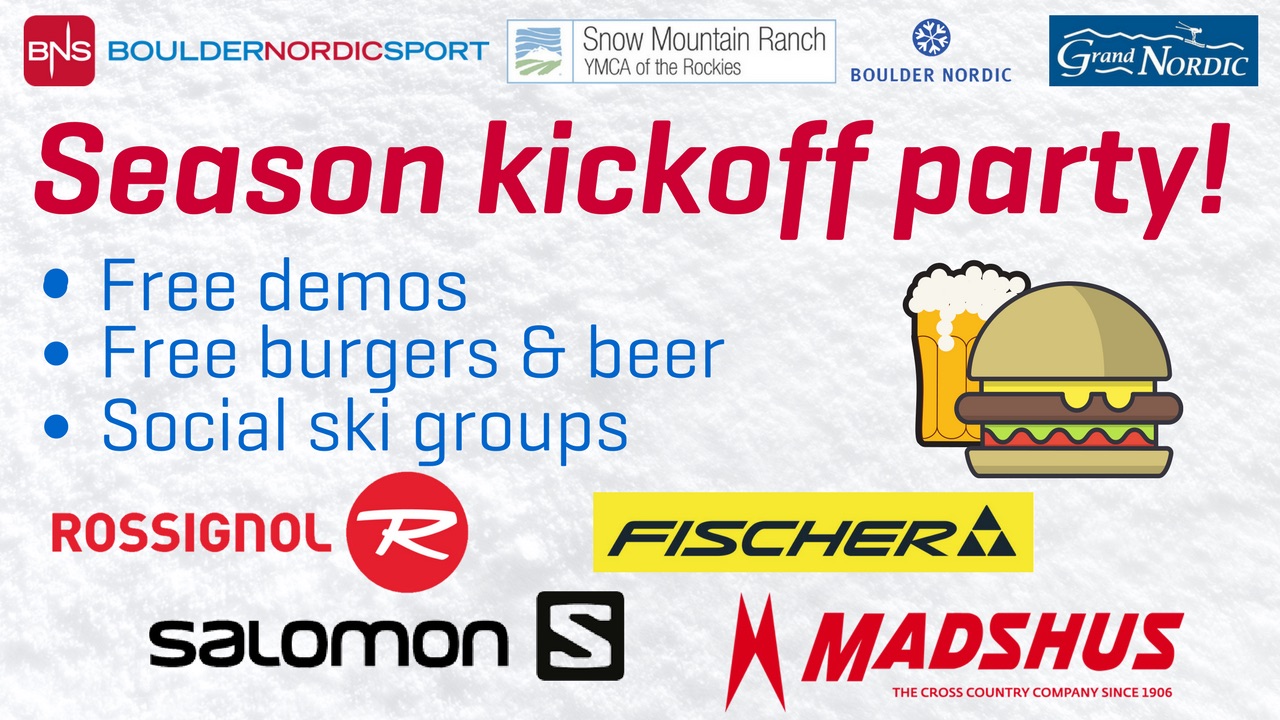
BOULDER, CO—Boulder Nordic Sport, is excited to announce the first-annual Season Kickoff Party at Snow Mountain Ranch on December 2, 2017. In partnership with YMCA of the Rockies, Rossignol, Fischer, Madshus, Salomon, Boulder Nordic Club and Grand Nordic, this is an opportunity to spend the day trying out the latest gear, connecting with skiing friends, and enjoying après ski fun!
Featuring free equipment demos throughout the day, the Season Kickoff party will include a complementary biergarten with burgers, beers, and brats; afternoon social ski groups, and more.
Want to make a weekend out of it? Snow Mountain Ranch offers lodge rooms and cabins, many of which are a comfortable walking distance from the ski trails. Off-season lodging prices are available the weekend of December 2-3 at snowmountainranch.org/lodging.
Tell your friends, bring your family, and join BNS to welcome the 2017-2018 ski season!
***
About BNS: Boulder Nordic Sport brings World Cup Service to everyone with full-service ski shops in Boulder, CO; Bloomington, MN, Portland, ME and online at bouldernordic.com. BNS specializes in professional ski service using Tazzari stone-grinding equipment as well as sales and advanced fit of cross-country skis, equipment, and technical apparel. BNS imports Holmenkol and SkiGo wax lines and carries a full line of wax and professional tuning equipment from over ten wax brands.
Information about Boulder Nordic Sport and the new BNS Magazine are available at www.bouldernordic.com.
Madshus, providers of high quality Nordic sks, boots, and poles, has added a new athlete to the U.S. team. Nordic Skier Liz Stephen has joined the Madshus team roster, and will represent the brand in domestic races as well as international competition.
Stephen grew up in East Montpelier, Vermont and began as a promising alpine racer. However, she crossed over to cross country as a sophomore in high school, right when Burke Mountain Academy had rebooted its Nordic program. In the last five years, she has rocketed in her status as a distance skier and is now known as one of the best climbers in the world.
Stephen’s most recent accomplishments include best finisher for the United States at the 2015 Tour de Ski with a fifth-place overall effort. Stephen also fought in the 2016 Tour de Ski, where she posted the second-fastest hill climb during the 9k Alpe Cermis during the final stage. Apart from those highlights, Stephen is a two-time Olympian and four-time World Championship team member.
“I am so excited to be joining the Madshus team,” said Stephen, “after getting a chance to do some early season testing in May on the skis, I am so optimistic and excited about the product and what it has to offer!”
“We are thrilled to be welcoming Liz to Team Madshus this season,” said Jill Nazeer, Madshus U.S. Marketing Specialist. “Liz has a clear talent and passion for the sport and we look forward to supporting her as we continue to develop the highest performance Nordic skis possible.”
For more information about Madshus Athletes, product, and technologies, go to: www.madshus.com.
About K2 Sports: K2 Sports, based in Seattle, Wash., has achieved unparalleled success through innovative product offerings and great customer service. The company operates 10 brands and is globally renowned for its non-traditional advertising, graphics, and high performance products throughout its portfolio. With wholly-owned subsidiaries in Canada, Central Europe, Japan, Korea, and Scandinavia and distribution in more than 60 countries, K2 Sports continues to assert its position as a global leader across multiple categories of sporting goods. For more visit: http://www.k2sports.com
Norway’s Ole Einar Bjørndalen, 41, training at Natrudstilen in Sjusjøen, Norway, before the preseason biathlon races there in November. (Photo: Stefano Zatta/Madshus)
Ole Einar Bjørndalen opened his 23rd World Cup season with a victory on Wednesday, winning the 20-kilometer individual in Östersund, Sweden. The victory, which was technically his 94th World Cup win, came almost 20 years after he won his first World Cup in January 1996.
The 41-year-old Norwegian biathlete is the winning-most winter athlete in history with more Olympic medals and world champion titles than anyone else. With eight Olympic golds and 19 World Championships wins, the 2016 World Championships in Oslo, Norway, remain his over-arching goal. To become a world champion on home turf in Holmenkollen, a feat he has yet to achieve, would be the jewel of his crown.
After two decades of competing at the top level, the King of Biathlon took some time to reflect on the changes and developments in the sport in an exclusive interview with FasterSkier.
“The overall level of the athletes has changed a lot. When I first started, there were a lot fewer who skied really fast,” Bjørndalen said at the Madshus factory on Nov. 26 in Biri, Norway.
A Madshus athlete since 2004 (and a Rossignol skier before that), he said he believes both the improvements in equipment and increasing professionalism across the field have contributed to raising the overall level of international racing.
More refined
Ole Einar Bjørndalen takes aim during the 2015 IBU World Championships in Kontiolahti. (Photo: Norges Skiskytterforbund/NSSF)
One of the biggest changes was the transition from coarse-bore to fine-bore rifles, which occurred about five years before Bjørndalen started on International Biathlon Union (IBU) World Cup.
“We have used the same weapon and the same mechanical setup during the entire time I’ve been active,” Bjørndalen said, noting that the weapon change made the shooting times drop significantly.
“[Norwegian biathlete] Eirik Kvalfoss would use a minute to shoot one series. These days, none of the best racers use more than 20 seconds,” he added.
The venues have also become bigger and better, and attract more spectators, which also contributes to the growth of the sport.
“Now, there are never less than 5,000 spectators at the stadium at World Cup races, and often we will have more than 35,000,” Bjørndalen said.
Less natural snow and more manmade
Over the years, Bjørndalen has seen the climate change and noticed less snow than when he first started racing. While the lack of snow often affects the venues and events, but he said organizers are making due.
“The climate change has been here for a while, especially in Germany and Central Europe. There is definitely less snow, but at the same time, the organizers have become very good at making snow, storing snow and developing strategies to handle the changes,” he said.
“Manmade snow is very good in that it is very predictable, and it often provides more even conditions for everyone than natural snow,” he added. “With manmade snow, it doesn’t matter as much whether you start early or late in the competition.”
Better gear
Above all, he said the evolution of the equipment has been the biggest factor driving the sport forward.
“With the skis in particular, it seems like there is a small revolution almost every season,” Bjørndalen said. “Skis are now a lot lighter, more stable and faster, and there are entirely different materials used for both bases and construction than when I first started racing.”
Ole Einar Bjørndalen testing skis in Beitostølen in the spring of 2014. (Photo: Per Wiik/Madshus)
In his mind, moving to shorter, flatter tips was one of the biggest improvements in skis, and he played a key role in that development.
“I was one of the first to cut my tips, and I shortened them by five centimeters,” he said. “That cut delivers a much faster return of the ski, and you’re ready to make a new push and stride sooner. We beat Fischer to the punch on that. I cut my tips about two weeks before they were going to launch their hole-tip. I’ve been told that this caused a bit of chaos and confusion at Fischer. They didn’t know what to think of my tips.”
Ski boots have also made some leaps since Bjørndalen started racing, becoming both stiffer and lighter and better suited for skating.
“With the new integrated carbon sole construction that came last season, the boots are even stiffer and still lighter,” he explained. “And with less material, you have better contact with the snow and more control of the ski.”
The combination of all the equipment improvements has contributed to the biathletes both skiing and shooting faster than 20 years ago, but that doesn’t diminish the amount of work today’s athletes put in each day.
According to Bjørndalen, athletes now put in far more training hours at the range and on physical conditioning than when he started racing in the 1990s.
Product development adds a dimension
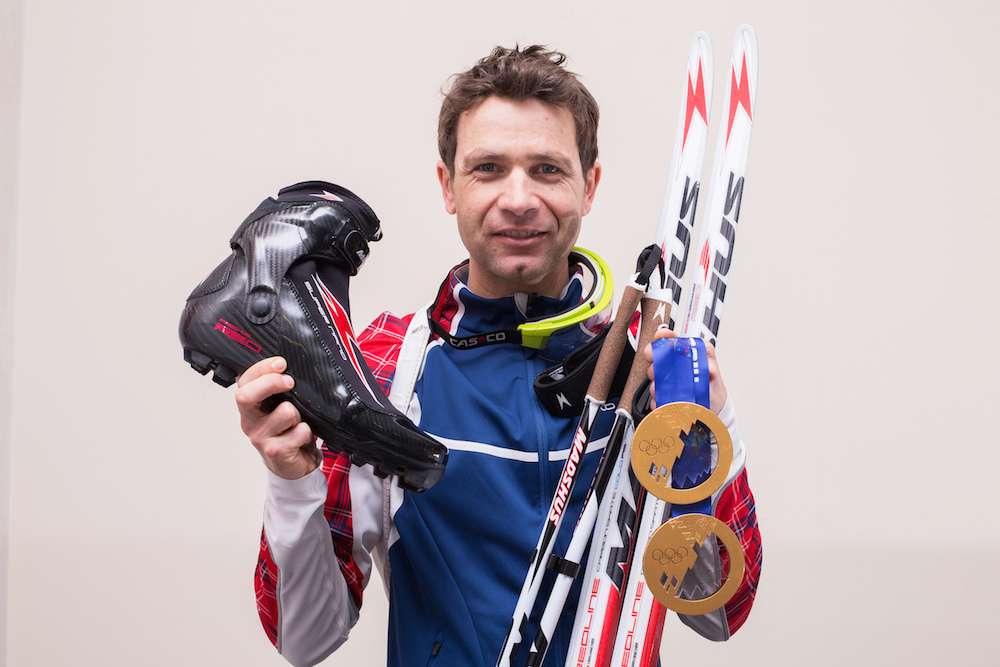
Ole Einar Bjørndalen with his medal haul from the Sochi Olympics. The Norwegian won gold in the 10 k sprint and mixed relay. (Photo: Madshus/NordicFocus)
Being involved with the factory and the Madshus product development team is important to Bjørndalen, as is sharing his experiences and contributing to the advancement of the sport, which he said gives his career an added dimension and motivates him.
“You can put is this way: sport is training, and equipment is development,” he said. “Biathlon is still a young sport, and there is a lot more to gain. To be a part of that development is extremely exciting to me.
“Being an active part of the research and development, and being included and involved in all the processes is a major reason why I switched equipment,” he said of his switch to Madshus in 2004. “Madshus is really on the cutting edge of equipment, they are extremely good at research and development and the process from idea to innovation is fast.
“With Madshus, you call and discuss an idea, and 24 hours later, their product engineers are after it,” Bjørndalen said. “With other brands, it can take weeks.”
From 200 to 2 pairs of skis
Bjørndalen is known for being a stickler about details in everything he does, and equipment is no exception. He is interested in both waxing and tuning, and he takes his time selecting the skis for his quiver.
“I am interested in waxing and the technical aspects of tuning skis. I do a lot of waxing with my training skis, but for races I don’t get to spend much time in the wax room,” he said.
However, picking skis for each competition is the responsibility of the athlete. Generally, Bjørndalen brings two pairs of skis to the venue the morning of a race, and there is a lot of effort that goes into picking those pairs.
“I typically test 10 to 12 pairs of skis the day before a race, and prior to the race season, I test maybe 200 pairs in order to find those 10 to 12 pairs that stand out,” he explained. “All the top racing skis are really good. But some pairs are damned good, and those are the ones I’m after. Some seasons I have to test more to find them, sometimes I find them right away.
“Sport is training, and equipment is development. Biathlon is still a young sport, and there is a lot more to gain. To be a part of that development is extremely exciting to me.” — Ole Einar Bjørndalen, Norway’s winning-most Winter Olympian and 19-time world champion biathlete
“The Redline series was a huge step up for the whole industry when they entered the market three seasons ago, especially the classic skis,” he added. “The difference between the Redline classic skis and their predecessor is substantial.”
He would know. Although all biathlon competitions are skate races, Bjørndalen spends a lot of hours on kick wax.
“I do a lot of classic skiing, which is really important in order to get better at skating,” he said.
The seasoned veteran is known for constantly seeking new insights and research on everything from training and equipment, to diet and lifestyle, to gain the split-second margin that separates the winner from the rest of the field.
However, in the first World Cup race of his 23rd season, Bjørndalen won by more than a hair. He didn’t miss a single target. The last time he raced a perfect 20 k was ten years ago. He skied like a tornado with perfect technique, milking each glide and getting the most from every push off. At the end of the day, Bjørndalen was almost half a minute ahead of second place.
“I had not expected that I would do so well, but I know I’m in good shape,” Bjørndalen told NRK at the time. “I don’t have too many secrets. I have strong motivation. Maybe that’s the secret.”
WEST YELLOWSTONE, Mont. — FasterSkier walked the floor of the 2015 Yellowstone Ski Festival Expo and found some interesting gear hidden behind those piles of stickers and schwag. Mohair-skin skis, carbon-soled boots and athlete-inspired clothing were common themes among the exhibitors. Take a look through our gallery below.
Podiumwear sales rep Kyia Anderson shows off one of the custom ski suits that Jessie Diggins helped design. A portion of the sales goes toward supporting Diggins.
BeFAST Sportgear, based in St. Paul, Minn., showed off their American spirit with this trendy neck gaiter.
Borah Teamwear showed off its new one-piece suits. This suit, made for Alaska Pacific University, uses an innovative seamless design that builds the suit as a whole rather than a sewn-together top and bottom.
New for 2015, Salomon’s Carbon Skate Lab features a ThinPly carbon construction and three different base setups, cold, wet and universal.
Rossignol’s R-Skin is built on the popular Rossignol Delta chassis and is perfect for a quick, worry free and wax-free ski.
Madshus introduced the Terrasonic IntelliGrip. A skin ski featuring a graduated mohair base, it’s great to grab and go. (Photo: Madshus)
Fischer’s Twin Skin joined the plethora of new mohair skin skis. The offset skins free up the ski in the gliding phase, and the 70-percent mohair to 30-percent poly mixed skin is replaceable. The skin length varies depending on ski length.
Alpina Sports is bringing their footwear line to the U.S. The line includes performance light hiking shoes, casual footwear and hiking boots.
Fischer’s new Speedmax skate boot uses a full carbon sole and reduced padding in the liner to cut weight for a maximized performance.
The Alpine Elite 2.0 skate boot features a one-piece carbon sole and a proprietary carbon weave along the edges of the carbon heel counter to eliminate any hot spots.
Yoko’s 9100 Kikkan Randall Edition poles feature a 100-percent CNT (carbon nano-technology) shaft with a design inspired by Kikkan’s style. The YXG Kikkan signature gloves include three models featuring different levels of wind stopper, plus a separate race line inspired by Randall’s international-racing success.
The Nano Carbon Race 100 UHM Poles by Madshus feature a new black-on-black graphic and heat-moldable pole straps.
SEATTLE, Wash. (November XX, 2015) – Madshus, the world’s leading performance Nordic ski company, is excited to announce its co-branded promotional contest with highly regarded Devil’s Thumb Ranch Resort and Spa in the Colorado Rocky Mountains. This easy, enter-to-win contest brings the two leading brands in the Nordic industry–Madshus and Devil’s Thumb Ranch–together to promote the sport of Nordic skiing and get people excited about winter.
“Everything about the contest is geared towards relaxation and creating a unique experience, from the Madshus skis and gear that winners will be receiving, to the amazing venue that Devil’s Thumb Ranch provides,” stated Carmi Schulman, US marketing coordinator at Madshus. “It truly is an opportunity to experience the best of what Cross-Country skiing has to offer.”
Established in 1938, Devils Thumb Ranch Resort and Spa offers rustically upscale accommodations, fine dining and an array of winter and summer recreational activities to get people fully experiencing Colorado’s outdoors with its 6,000 acres of trails and spaces. Known for its Nordic trails, Devil’s Thumb Ranch Resort and Spa turns into a winter wonderland come the snowy season.
The contest will be opened to the public from November 15, 2015 to January 15, 2016 and anyone in the U.S. is encouraged to apply for a chance to experience the best of what Nordic skiing has to offer. Both Madshus and Devil’s Thumb have generously donated a grand prize package for one lucky winner valued at $5,000.
The prize package includes:
Airfare travel for two
Two full set ups from Madshus including the Terrasonic Intelligrip Classic ski, Nanosonic Carbon Classic Boots, and Nano Carbon Race 100UHM Poles
Two nights stay at the Devil’s Thumb Ranch Resort and Spa in its main lodge*
*Not valid during holidays periods. Subject to availability. Blackout dates apply. Advance reservations required. Does not cover taxes or gratuity. No cash value. Does not apply to previously booked reservations. Does not apply to other promotions.
Two trail passes per person
Breakfast and dinner for two each day at Heck’s Restaurant
The world’s oldest ski brand, Madshus’ Norwegian heritage dates back to 1906. From the original woodworking craftsmanship of its founder, to today’s state of the art production processes and materials, Madshus is the standard to which all other Nordic skis are held. Whether for World Cup level racing, fitness skiing, cruising, metal-edge touring, or cross-country downhill, Madshus continues to apply that same keen craftsman’s eye to each ski, boot, and pole it produces. Over 100 years since it’s founding, Madshus’ storied commitment to the art and craft of ski making resonates today in the same consistent standard of excellence all performance Madshus skiers have come to expect. Madshus is a member of the K2 Sports family of world-leading winter sports and outdoor recreational brands.
About Devil’s Thumb Ranch Resort and Spa
Devil’s Thumb Ranch Resort & Spa is a highly regarded and environmentally friendly year-round Ranch resort and spa offering rustically upscale accommodations, fine dining and an array of winter and summer outdoor activities. Located in the Colorado Rocky Mountains, 65 miles west of Denver and 10 minutes from Winter Park, Devilís Thumb Ranch Resort & Spa encompasses 6000 acres at the foot of the Continental Divide with two grand lodges, stables, spa, two restaurants and 130+km of groomed Nordic trails.
US Ski Team Athlete Ida Sargent Joins Team Madshus
Seattle, WA (Aug. 26, 2014) — Madshus, the world’s leading performance Nordic ski company, is pleased to announce that Olympian and US Nordic Ski Team Member, Ida Sargent has signed an exclusive deal with Madshus skis and boots. The deal is effective October 1st, 2015 and will see Sargent race on Madshus equipment for the upcoming World Cup season.
“I tested Madshus skis and boots for the first time this summer and was immediately blown away! The skis were fast and very responsive underfoot, and the control of the Super Nano boot is impressive! I am very excited to join the Madshus team and am looking forward to an awesome winter,” stated Sargent.
Photo Credit: Nordic Focus
Since being named to the US Ski Team in 2011, Sargent, a sprint specialist, has amassed over 75 World Cup starts, posted numerous Top 10 finishes, and achieved a career best 5th place finish in the Classic Sprint event in Ruka, Finland in 2014.
“We’re thrilled to be welcoming Ida to the Madshus family. She’s proven herself a standout athlete on the US Ski Team with an impressive list of results, and we’re confident she’s poised for great future success on the international stage. Her personality and work ethic are a great fit for our brand,” stated Chris McCullough, Madshus USA Brand Director.
Hailing from Orleans, Vermont and a graduate of Darmouth College, Sargent joins Madshus’ elite roster of World Cup athletes, including fellow US Ski Team members: Noah Hoffman, Caitlin Gregg, and Bryan Fletcher.
To learn more about Madshus and its team of athletes, please visit www.madshus.com.
About Madshus
The world’s oldest ski brand, Madshus’ Norwegian heritage dates back to 1906. From the original woodworking craftsmanship of its founder, to today’s state of the art production processes and materials, Madshus is the standard to which all other Nordic skis are held. Whether for World Cup level racing, fitness skiing, cruising, metal-edge touring, or cross-country downhill, Madshus continues to apply that same keen craftsman’s eye to each ski, boot, and pole it produces. Over 100 years since it’s founding, Madshus’ storied commitment to the art and craft of ski making resonates today in the same consistent standard of excellence all performance Madshus skiers have come to expect. Madshus is a member of the K2 Sports family of world-leading winter sports and outdoor recreational brands.
For more information on Madshus news and products, visit madshus.com.