Tag: Magdalena Neuner

  • Why Did Germany Flame Out in Sochi – And Will They Be Back?

    Why Did Germany Flame Out in Sochi – And Will They Be Back?

    Screen Shot 2014-11-26 at 11.47.26 PMThe German nordic sports experience at the 2014 Olympics could perhaps be summed up on the last day of competition.

    In the men’s 50 k, Germany entered four men. The finishers were led by Thomas Bing, about to turn 24 years old, in 36th place.

    Next came Axel Teichmann, more than ten years Bing’s senior. Then two biathletes – Arnd Peiffer and Erik Lesser, in their 50 k debuts on the world stage and within a minute of Teichmann’s time.

    Four years earlier, Teichmann had captured silver for Germany in the same event, but on that day in February he labored to 39th place, more than four minutes behind the winning Russian skier. While Germany still had a few of their stars from days past on their roster, they were mostly stars no more.

    Peiffer and Lesser had teamed up for a silver medal in the biathlon relay the day before, but they surely were not on fire in the 50 k (understandably). While they treated the race as a fun way to end their Games – and some other biathletes and nordic combined skiers probably would have jumped at the chance to do the same thing – their participation brought up an uncomfortable question: can Germany find nobody else?

    To say that Sochi was a disappointment for Germany would be an understatement. While expectations were somewhat tempered by their team’s performance so far that year, it was hard not to remember Vancouver. There, biathlete Magdalena Neuner won two golds and a silver, Simone Hauswald shared the podium with her when she earned bronze in the mass start, and the relay also took bronze.
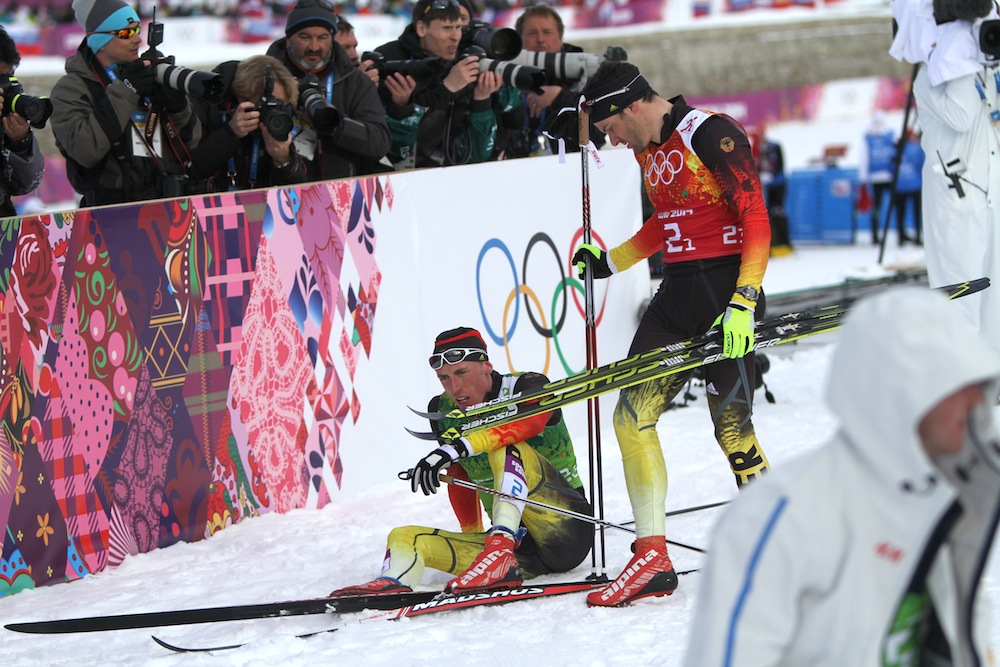
    Germany's Tim Tscharnke (l) after the finish of the 2014 Olympic team sprint with teammate Hannes Dotzler. The two finished seventh after Tscharnke fell a few hundred meters before the finish as a result of a tangle with Finnish anchor Sami Jauhojärvi. Finland took gold and Germany placed seventh.
    Germany’s Tim Tscharnke (l) after the finish of the 2014 Olympic team sprint with teammate Hannes Dotzler. The two finished seventh after Tscharnke fell a few hundred meters before the finish as a result of a tangle with Finnish anchor Sami Jauhojärvi. Finland took gold and Germany placed seventh.

    In cross country, Nystad and Evi Sachenbacher-Stehle had teamed up for gold in the Vancouver team sprint, Teichmann and Tim Tscharnke took silver in the men’s event, the German women were second in the relay, and the men won two individual silver medals.

    For a little perspective: in 2014, Germany came away with three medals, total, in cross country and biathlon combined.

    Where to start with the embarrassments? Was it Sachenbacher-Stehle testing positive for a banned stimulant? Or was it Tscharnke falling down in the final stretch of the team sprint and, instead of getting up and likely earning bronze, lying in a heap whimpering about how he missed out on gold?

    In a Deutscher Olympischer SportBund report obtained by FasterSkier, the country’s Olympic committee assesses the success of each sport at the 2014 Olympics, and looks for actionable plans to move forward and upward. The document runs more that 230 pages and not only focuses on each sport individually, but also on funding partners, medical and logistical support, and what other countries are doing to succeed. It’s an impressive analysis of a huge and complex system.

    A Cross Country Team Too Old and Too Young

    “Denise Herrmann and Josef Wenzl improved in the world rankings in the 2013/2014 season and even at times led the Sprint Cup,” the report noted of young German skiers. “But the pre-Olympic season was marked by a disappointing World Cup, and the coaching change in 2012 didn’t bring the expected turnaround.”

    Herrman was one of the great hopes for Germany – a medal in the skate sprint seemed very possible for the 25-year-old (and if that doesn’t sound “young”, the report notes that the average age of a medalist was 28 for women and 29 for men). But like other favorites including Marit Bjørgen and Kikkan Randall, she didn’t make the final.

    That was symbolic of the single medal and three top-8 finishes by German skiers, their worst performance at an Olympic Games since 1998.

    While performances by the team’s young stars showed that maybe they weren’t ready for literally the biggest stage in the sports world, the squad was also filled with older athletes. The single medal came in the women’s relay, where 36-year-old Nystad was helped earn bronze and the team came into the sprint finish with the leaders.
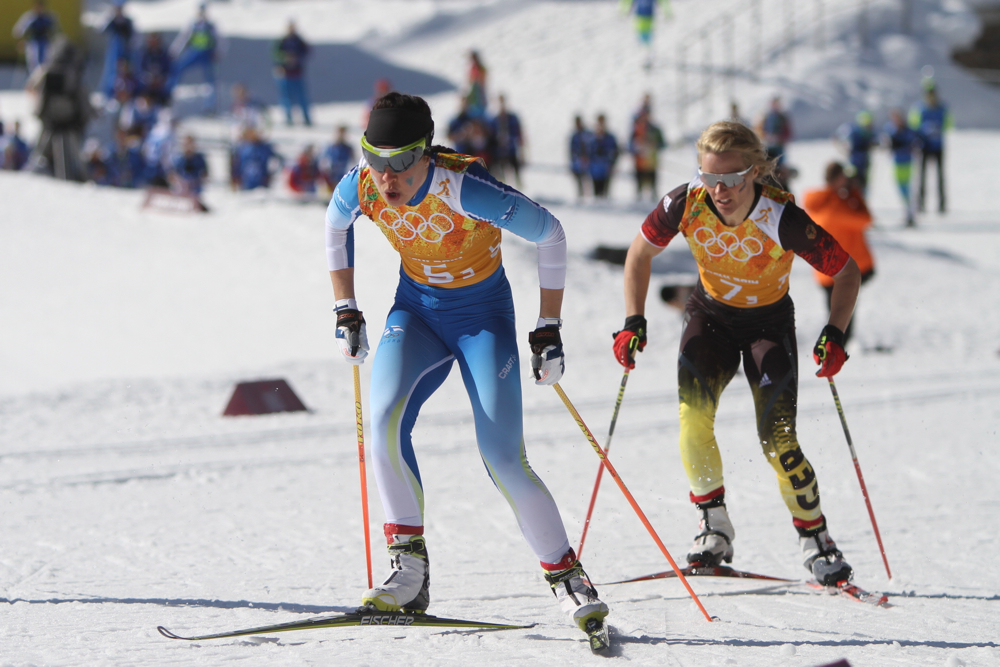
    Kerttu Niskanen of Finland leading Claudia Nystad of Germany in the Olympic relay. Nystad completed her comeback from retirement with a bronze medal.
    Kerttu Niskanen of Finland leading Claudia Nystad of Germany in the Olympic relay. Nystad completed her comeback from retirement with a bronze medal.

    The report noted that Nystad was the oldest medalist in cross-country skiing. But they didn’t say what the rest of the team’s aging veterans accomplished: because Teichmann didn’t contribute much, nor did 36-year-old Tobias Angerer. None of the women who competed in the 15 k skiathlon were under the age of 30.

    Nordic sports are particularly difficult to analyze, the report noted, with different techniques and physiological demands of uphill and flat sections, aggression needed on downhills, transitions essential on rolling terrain, and equipment and ski service becoming increasingly important.

    But the best athletes, the report explained, are in general among the best at each of these different aspects, and having a weakness in one area can’t necessarily be compensated for by excellence in another area due to the high level of competition in the field.

    What do they recommend to get German skiing back on track? For once thing, they focus on a “long-term development structure” and suggest that the objectives and tasks be reworked after observing other country’s strategies for developing cross country skiers.

    Another recommendation is that while providing for an athlete’s development, not to treat them as machines: “An essential prerequisite of all participating institutions is to in close cooperation control the sport, but also the personal development of the athletes and to focus on the achievement of future excellence in high-performance.”

    Finally, the committee noted that the ski association’s current strategy of setting up different training groups seems to be effective, but that it should look towards biathlon and nordic combined for how to systemize development at the junior level.

    If there’s more talent coming up, there may finally be starts for them. Teichmann, Angerer, and Katrin Zeller retired. Nystad is back in action and had a strong race in Beitostolen, Norway, this weekend.

    What Happened to Biathlon?
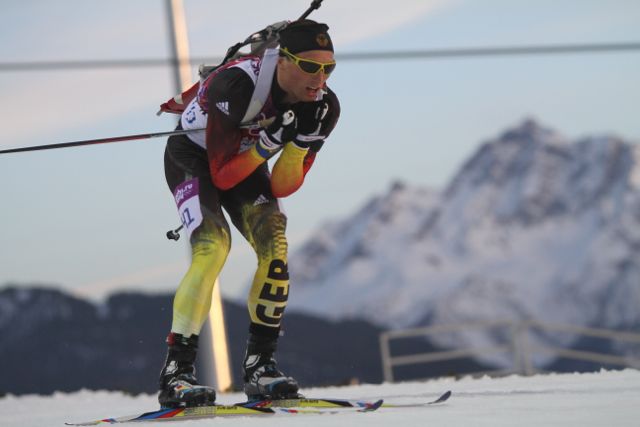
    Erik Lesser of Germany en route to a silver medal in Sochi.
    Erik Lesser of Germany en route to a silver medal in Sochi.

    Biathlon was an unmitigated disaster for Germany at the Sochi Olympics. On the second page of the biathlon section of the report, the committee addresses an ugly truth: the medal rankings. Germany collected two medals, one silver and one bronze, which landed them in fourth place (although there were several ties; five teams were better, two the same). The Czech Republic surged past them with five medals.

    “Besides the established nations of Germany, France, Russia, and Norway, increasingly athletes from Austria,the Czech Republic, Slovenia, and Canada are gaining podiums and placing among the world leaders,” the report noted.

    Echoing a sentiment expressed by many of the sport’s observers, the committee crunched some numbers and showed that biathlon is, in fact, getting increasingly competitive: the same level of performance that might have won a medal in the past just doesn’t cut it anymore.

    “In order to achieve podium finishes, the men at maximum about 1.2 percent behind in skiing, and hit targets at a rate of of about 98 percent. The previously assumed requirement to be 1.5 percent back and a 95 percent hit rate are therefore obsolete now… in the women’s field, a hit rate of 96 percent and maximum ski speeds less than 2.0 percent back are needed to reach medal placings… the best individual performances in the opening contest, the sprint, were… clearly behind the world leaders in both skiing and hit rate as well as in the shooting times. Because they were immediately dependent on the sprint results, the prospects were thus low for the subsequent pursuit.”

    Forget medals – it didn’t get any better for Germany when considering top-8 performances: in other words, they weren’t even close to winning more medals. The team had only three top-eight finishes (discounting those from Evi Sachenbacher-Stehle after her doping ban). Norway and the Czech Republic led the way with 11, while France had 10. Germany’s three tied it with the United States, Canada, and Slovakia.

    The women’s team, the report noted, was highly variable. After the Vancouver Games, three stars retired (Kati Wilhelm, Martina Beck, and Simone Hauswald), while Magdalena Neuner called it quits after the 2012 World Championships in Ruhpolding, Germany.
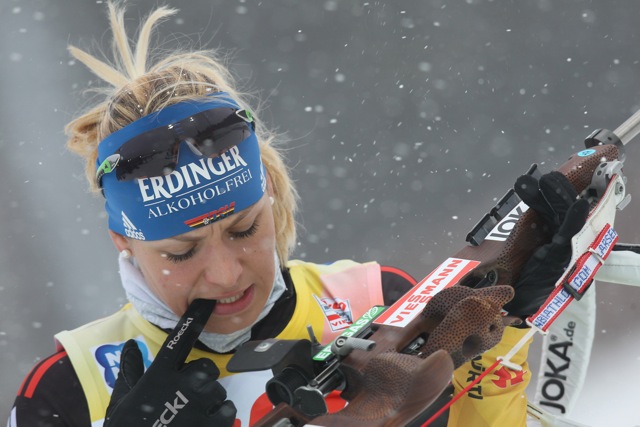
    “[The team] ultimately consisted of two juniors (Franziska Preuss, Laura Dahlmeier); a very experienced senior athlete (Andrea Henkel); an experienced, former cross-country skier – with considerable training effort for the stabilization of the shooting performance (Evi Sachenbacher-Stehle); and an athlete who in comparison to previous years increased her experience but at events as big as Sochi still has far to go (Franziska Hildebrand). The challenging tracks in Sochi required a high level of competition experience with regard to the race schedule. Their could succeed in competition only on the basis of a high level of physical and mental performance. These parameters within the existing team structure are pronounced insufficient for an Olympic Winter Games.”
    Magdalena Neuner, a three-time World Cup champion, double Olympic gold medalist, and winner of 17 World Championships medals, has been critical of the DSV's biathlon program. Photo: NordicFocus/Fischer.
    Magdalena Neuner, a three-time World Cup champion, double Olympic gold medalist, and winner of 17 World Championships medals, has been critical of the DSV’s biathlon program. Photo: NordicFocus/Fischer.

    Since the Olympics, Neuner has publicly criticized the Deutscher Skiverband (DSV, the governing body for snow sports) and accused them of being behind the times and resistant to change.

    “Times have changed, and the level of the World Cup has increased,” she told Der Spiegel. “[They] didn’t want to think differently… the team needs someone who has a bit more sensitivity for the young girls. The World Cup is a tough business. And because they are currently not as successful, it is even harder. Now they need a coach who is fully behind them.”

    In a separate conversation with Sport1, Neuner said that far too much pressure had been put on the likes of Dahlmeier and Preuss, who just two years before had been competing at the Youth Olympic Games.

    Her leadoff leg of the women’s relay was tough to watch – she fell, and also had her rifle sight clogged with snow. Perhaps additionally discombobulated by Sachenbacher-Stehle’s doping result, Preuss tagged off three minutes behind the leader and in tears. She was 19 years old, and has since made it clear that she never wants to revisit the memory.

    “It’s always difficult in the first World Cup season, and especially at the Olympics for young athletes: the pressure is greater than they had ever imagined,” Neuner told Sport1. “You think you’re now relaxed on the World Cup, but it is different than before. The public attention is so high and the pressure as well.”

    She also said that the trainers did not sufficiently individualize training plans, and as a result many of the athletes were often exhausted and sick. Neuner trained more or less independently of the national team during her most successful years.

    Neuner has since been in contact with the DSV, and they have reportedly offered her a position to advise them.

    Henkel – who has medals from three Olympics and teamed up on relays with the strongest German biathletes ever, from Uschi Disl to Neuner – has since retired, married longtime boyfriend Tim Burke, and is planning a life in the U.S. German media is calling the very young German women’s team perhaps the most challenging squad since the reunification of East and West Germany.

    “You shouldn’t compare these girls to what was before, but give them some time to develop and not have a lot of worry,” the told news.de.

    What About Everyone Else?

    How does Germany apply the same logic to other countries? The report also contains information on each of Germany’s main rivals: France, Canada, Norway, Russia, and the United States. A few interesting assessments:

    France, it notes, won 15 medals – but all came in ski and snow sports, a “problem” noted by the head of the French effort and which will be targeted for expansion in coming years. How does France fund their efforts? Among other things, through the military, customs, and border patrol, which provides athletes with salaries. 60 percent of the medals won came from athletes in these programs, and only in jumping was the success unrelated.

    “There is a positive trend in the spending from 2010 to 2013, for the key role of competitive sports the Institute for French High-Performance Sports [INSEP] used 63 percent of its total expenditures, or about 21 million euros. The budget for research projects amounted in 2012 to about 18 percent or 5.8 million euros and in 2013, about 12 percent or 3.9 million euros. Research and development activities to support the development of competitive sports staffed 18 employees of the Research Department of the INSEP.”

    In assessing Canada, the report mentioned the governments Athlete Assistance Program (AAP) and discusses Own the Podium (OTP) at length. It concludes:

    “Given increasingly costly global funding for sports and declining sponsorship in Canada, it needs to be clarified whether Canada can afford wider sports funding at present. The summer sports have obtained more financial due to the larger number of sports, despite fewer medals. After Sochi there is again, as before in 2013, debate about the questions: is it important for the summer sports to be equally successful as the winter ones? Is success in some sports more important than others? Does Canada have to be equally successful in Olympic and Paralympic Games?”

    And how does the U.S. succeed? Germany marvels at the U.S. Olympic Committee’s very different funding strategy:

    “With the relaunch of the USOC site ‘Team USA,’ the creators succeeded with the new website and numerous promotions to make an increasingly patriotic, emotionally-tinged connection between the American ‘consumers’ and Team USA. According to the 2012 Annual Report of the USOC, 130 million Americans are ‘fans’ of the Olympic Movement and at the end of 2012, USOC social media sites had more than 3.5 million followers. Team USA is 34 business partners, sponsors and suppliers – including Coca Cola, Dow Chemical, Samsung, VISA and Nike. The message [is that] that all Americans are part of the team behind the team USA and that without the willingness to provide financial support for the athletes a successful performance in the international arena is not possible…”

    Can German nordic sports get their mojo back this season? We’ll have a hint at an answer this weekend: the FIS Cross Country World Cup kicks off in Kuusamo, Finland, and on Sunday the first IBU Biathlon World Cup will be held in Östersund, Sweden.

  • In Packed Soccer Stadium in Germany, Biathletes Put on a Show; Burke and Dunklee Tenth At Schalke

    In Packed Soccer Stadium in Germany, Biathletes Put on a Show; Burke and Dunklee Tenth At Schalke

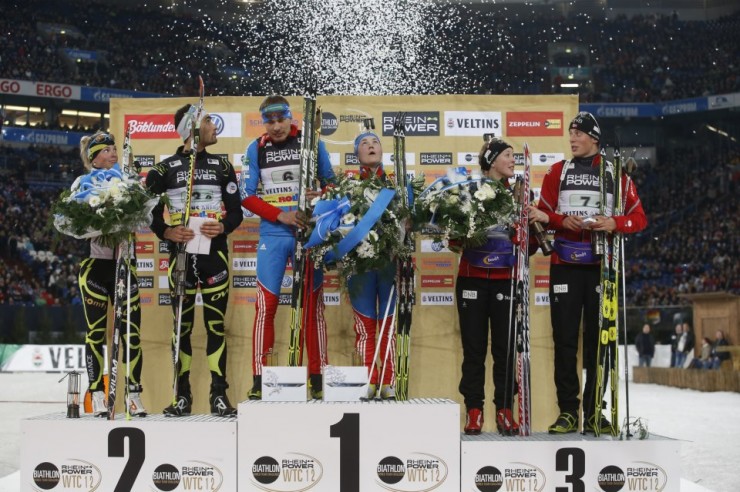
    Anton Shipulin and Ekaterina Yurlova of Russia, center, celebrate after their victory in the pursuit relay at the World Team Challenge on Sunday. They bested Martin Fourcade and Marie Dorin Habert of France (left) and Fanny Welle-Strand Horn and Lars Helge Birkeland of Norway (right). Photo: Biathlon auf Schalke / K. Rabas.

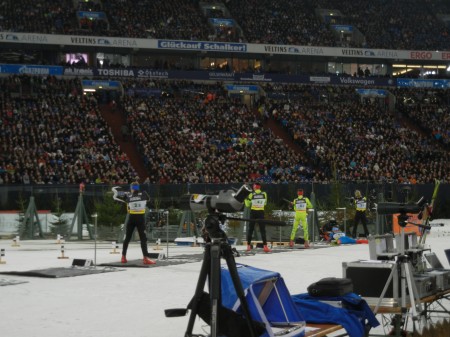
    Who would think of holding a biathlon race inside a soccer stadium with 50,000 fans?

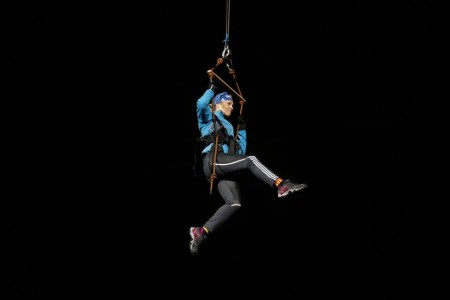
    Who would think of dropping retired German star Magdalena Neuner into the stadium on a trapeze, while the theme from the James Bond film “Skyfall” blared in the background?

    Who would think of asking elite biathletes to do three competitions in a single day?

    The answer to all of these questions is the organizers of the RheinPower World Team Challenge 2012, an event that has been held at the Veltins Arena in Gelsenkirchen, Germany, for the last ten years. Usually the home of the FC Schalke 04 football club, the arena was outfitted with plenty of snow, a bridge, a tunnel, and a shooting range backed by bulletproof glass so more spectators could be crammed in to watch.

    “[I’ve] never seen anything like it,” U.S. biathlete Susan Dunklee told FasterSkier after completing her first World Team Challenge on Saturday. “Very loud, but dark in the stands so it was easy to zone the crowd out. It became one roaring creature rather than thousands of individuals.”

    And the day wasn’t just about biathlon; there was also a celebrity shooting competition (won by Alexandra Popp, the striker of the German football team) and plenty of other entertainment.

    Magdalena Neuner making a dramatic entrance to the arena. Photo: Biathlon auf Schalke / K. Rabas.

    But biathlon was the centerpiece, including a farewell to Neuner, who retired at the end of last season as the second-winningest woman in the history of the sport. After her special entrance, she highlighted a women’s-only race – which was actually won by Dorothea Wierer of Italy by three seconds over Neuner, with each accumulating three penalties. Wierer meant to wait at the finish and let Neuner cross before her, but ended up slipping across the line first anyway.

    There was also a tribute to Michael Greis, another German star who announced his retirement after the first few competitions of this World Cup season. With 11 World Cup wins, he was ninth on the all-time list.

    The main competitions consisted of teams of two athletes, generally from the same country although Carl Johan Bergman of Sweden and Kaisa Makarainen of Finland joined forces again after winning a previous edition of the World Team Challenge.

    First, they competed in a “shoot-out,” to see who could clean four stages in a row, prone-standing-prone-standing, the fastest. Spare rounds are allowed to hit targets that were originally left standing. There was no skiing involved and results haven’t been published online, but Dunklee reported that she and teammate Tim Burke each finished in the middle of the pack.

    “The shootout didn’t really count for anything, it was just something they have for the show and for fun,” Dunklee wrote in an e-mail. “It is very similar to a drill we do in the summer called the ‘American Test.’ We do it a little differently in practice; we don’t use spares and if you miss more than three you are DQ’ed. During the competition, I did get a little shaky and over excited trying to load the spares, which is great practice for relays.”

    The scene during the biathlon shootout, with some of the 50,000 fans filling the stands around the shooting range. Photo courtesy of Susan Dunklee.

    After a little break the teams faced a mass start competition unlike anything they will ever see on the World Cup. Much like a cross country sprint relay, each member of the team skied a loop and shot before tagging off to their teammate. But the men and women each did four laps of the 1200 meter track, which wound outside of the stadium after exiting via a tunnel, as well as penalty loops if they missed shots.

    In the mass start, the women started on the range, as well, so had an extra prone stage. That made a total of 45 targets for each team in the race – hence the higher-than-usual penalty counts that would seem staggering on the World Cup.

    The French team of Marie Dorin Habert and Martin Fourcade won the mass start by 1.6 seconds over Vita Semerenko and Sergey Sednev of Ukraine. Fanny Well-Strand Horn and Lars Helge Birkeland of Norway were third. Dunklee and Burke were ninth out of ten teams. (Field size was limited by the ten-point range that could fit inside the arena.)

    Just an hour and a half later, the teams lined up again, this time for a pursuit based on the results of the mass start. 40 more shots, and a lot more small loops awaited them.

    “I have never done a biathlon race with quite so much lactic acid in my system,” Dunklee wrote. “It was a lot like a xc sprint relay.”

    The French held onto the lead for most of the race, but at the end were passed by Ekaterina Yurlova and Anton Shipulin of Russia, who took the overall crown. The Norwegians were third again, followed by Andrea Henkel and Andi Birnbacher of Germany; the Americans slipped to tenth.

    That was despite near-perfect shooting by Burke, said Dunklee.

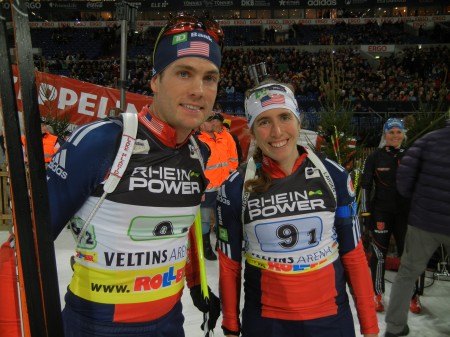
    Tim Burke and Susan Dunklee in the Schalke stadium. Photo courtesy of Susan Dunklee.

    “Tim shot awesome (4 misses total between the two races),” she explained. “I struggled with one disaster stage of four misses during each of the races. But I felt good that majority of my stages were 0’s or 1’s despite the head to head pressure, the jetlag, and hearing my name over the loudspeaker.”

    Unlike Burke, who has competed at Schalke before, Dunklee was a newbie to the strange formats, 1200 meter loop, 100-meter long tunnel leading to the outdoor portion of the course, and all the rest.

    While both suffered from jetlag, Dunklee had a particularly tough transition to German time: she had been scheduled to fly out two days before the race, but her flight was canceled due to the winter storm that pummeled the east. As such she arrived at 7 a.m. and left to race at 3 p.m., with just a few hours to relax and adjust in between.

    “As soon as I entered the arena, adrenaline kicked in and woke me up,” Dunklee wrote.

    All in all, the experience was unique, she said, but not completely irrelevant to regular World Cup racing.

    “My goal was to enjoy the experience and treat it was a learning and training opportunity,” she wrote. “The crowds are huge and the head to head pressure on the range defines this event. The more I can expose myself to things like this, the more prepared I will be for the World Cup. Dealing with pressure on the range is something you must learn by doing… My shooting groups crept higher and higher as my system became more stressed and I started overheating. That created another great opportunity to understand myself better as a shooter – my race groups of shots may differ from my zero.”

    Dunklee shared a video touring the Schalke course, which can be seen at the link on YouTube.

    The IBU World Cup resumes in Oberhof, Germany, on Thursday with a women’s relay. A men’s relay follows on Friday and then sprint and pursuit competitions will be held over the weekend.

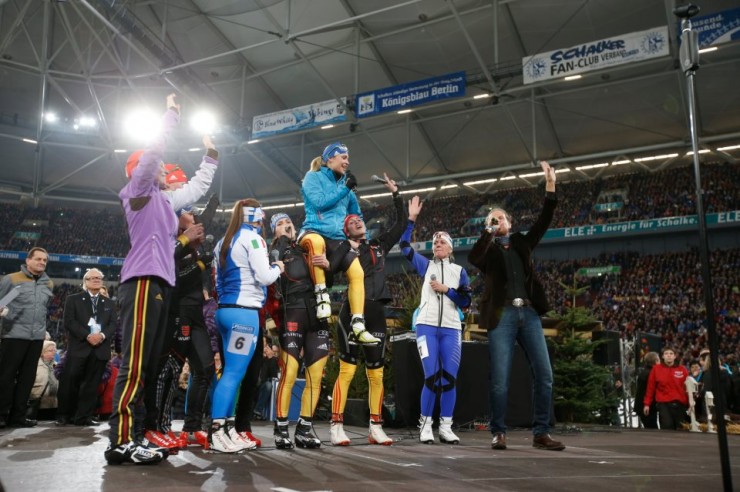
    Magdalena Neuner was hoisted onto her teammates’ shoulders after placing second in the women’s race behind Dorothea Wierer of Italy (blue tights, number six). Biathlon auf Schalke / K. Rabas.
  • For Germany’s Olympic Champion Andrea Henkel, Americans are “A Second Team”

    For Germany’s Olympic Champion Andrea Henkel, Americans are “A Second Team”

    Germany’s Andrea Henkel (second from right) with American biathletes (l-r) Sara Studebaker, Susan Dunklee, Annelies Cook, and Hannah Dreissigacker in Utah last week. (Dreissigacker courtesy photo)

    Soldier Hollow, the Utah venue that played host to the nordic events at the 2002 Olympics, is no stranger to big-name athletes. Just a few weeks ago, World Cup sprint champ Kikkan Randall was there training with the cross-country national team. The medal-winning nordic combined team skis there regularly.

    But last week, Utah had a visit from another of the nordic world’s most recognizable athletes: Germany’s Andrea Henkel, who joined the U.S. biathlon team for a part of their annual fall camp in Utah. Henkel, who enters the 2012 season as the most decorated woman currently on the World Cup circuit, hadn’t returned to Soldier Hollow since she won two gold medals back in 2002.

    “It’s nice to come back,” she told FasterSkier in an interview on Wednesday. “It has been lots of good memories, fun memories too, not just about the races. When you have a good time somewhere it’s nice to come back and just enjoy it.”

    Despite the high quality of the Soldier Hollow trail system, neither the FIS cross country World Cup nor the IBU World Cup have returned to Utah since those Olympics, a fate that seems likely to befall the Vancouver venues as well.

    “Biathlon is a European sport,” Henkel said. “I would like it if we came to the U.S. more, but you often get the question, ‘what is biathlon?’ They just have no idea of it, or that there was some [American] who was leading the World Cup, even.”

    Sara Studebaker (USA) and Andrea Henkel (GER) in the mixed relay at 2012 World Championships.

    Time recently spent with the Americans and at the former Olympic site has made Henkel muse on the support for programs in countries like the U.S., where biathlon doesn’t get top billing. In her own home country, it’s the most popular winter sport, and biathletes, especially those as successful as Henkel, are followed by the media as closely as if they were Hollywood celebrities.

    “It’s hard for teams who don’t get real respect,” she said of conditions on this side of the Atlantic. “Maybe having more World Cups in America would make it better for them. It would be nice to have more World Cups in America – maybe the future will bring it.”

    With the schedule often set far in advance, it seems unlikely that any World Cups will return to the States while Henkel is still competing. But by all appearances, the future is bringing the German star her a fourth Olympic appearance, which will give her the chance to see a venue in another surprising place: the Black Sea, where Sochi is situated.

    And the magic, and medal potential, is still there. Although the 2012 season was so often a battle between Henkel’s teammate Magdalena Neuner and Belorussian Darya Domracheva, Henkel took a win of her own in Oslo. It was her 16th regular-season victory to go with one individual Olympic gold, four individual world titles, and five relay wins at championship events.

    That longevity – and Henkel’s humble attitude about it – seems incredible to the U.S. women she was training with in Utah.

    “As we travel around Salt Lake and the Heber Valley, she has been reminiscing about that experience,” national team member Susan Dunklee, who now battles Henkel on the World Cup, wrote in an e-mail. “I am impressed not only at how long she has been competing in biathlon, but how long she has been competing at the highest level. During the Salt Lake Olympics, I was stressing about the upcoming Vermont State High School Championships… biathlon wouldn’t be on my radar for another six years.”

    U.S. as a Second Home

    More overdistance fun. Photo: Dreissigacker.

    Henkel estimates that she began visiting the U.S. four or five years ago, after she started dating American biathlete Tim Burke. At first, she would train on her own or with the men’s team. Back then, the women were intimidated and shy around Henkel, but that broke down in the coming years as the trips to Lake Placid began racking up and Henkel started to spend more time training with the women.

    “Before I met her, Andrea had seemed so larger than life, but when I met her, I couldn’t believe how small she actually was,” Dunklee wrote. After a few years, Henkel and her personality became part of the team: “She is known for blunt honesty. She tells it like it is, and it is refreshing to hear her opinions.”

    Things changed for Henkel in 2010, when her teammates Kati Wilhelm, Simone Hauswald, and Martina Beck all retired. Although she’s had plenty of teammates retire in the course of her career, Henkel said the post-Vancouver rush was the toughest: the four women were the same age and had trained and competed together for years. Between that and the impressive length of Henkel’s career, it’s easy to see why she began looking for new ideas to stay engaged in her training.

    “I have been doing this for a while, and I have to get my motivation from something,” she said. “It’s been so long that if I have the same focus year in and year out, I would be tired already or maybe I wouldn’t be doing it anymore, even.”

    Henkel says that the Americans are “like a second team,” and the feeling is mutual. Dunklee thought that the sense of camaraderie was one of the biggest benefits Henkel might get from training with her team. The German system is different in that there are multiple training centers around the country and the national team comes together mainly for camps, which are generally short – just one week.

    “The last couple years, the US women’s team has become very close,” Dunklee wrote. “Andrea fits right in with that. Besides training with us, she has joined us for shopping trips on rest days, volunteered her home kitchen for birthday cake baking, and shared an occasional bottle of wine with our team and staff. Of course I want to beat her on race day, but I am also psyched when she does well. Our whole team is.”

    Veterans Train Different

    And while the U.S. women have never been as strong as the Germans, they have improved over the last few years into a faster group that has more to offer Henkel in terms of training.

    Henkel skiing her way to a mass start win in Oslo, Norway on last season. Photo: NordicFocus/Fischer.

    “The team had started changing already when I started coming here,” Henkel said, noting that the hiring of dedicated women’s coach Jonne Kahkonen had helped substantially. “It’s good training.”

    Of course, it helps that biathletes like Dunklee have had one of the sport’s biggest stars to learn from. Initially, the American worried that if she spent too long skiing around behind Henkel, she would be annoying. As she has gotten to know the German better, she’s no longer as nervous about that. And besides trying to pick up specific technique, the U.S. women say that Henkel’s attitude in general is something to emulate.

    “She is one of the world’s most talented and most experienced biathletes,” Dunklee wrote. “She has high expectations for herself but also lots of perspective, which keeps her even keeled. Her professional attitude towards training and racing rubs off on our team and that has been a very positive thing… and having her around sets the bar higher and gives us a measuring stick. It’s awesome!”

    Henkel’s German coaches don’t mind when she travelled to the States: “they know that I train very hard, and they trust that I’m working,” she said. Henkel talks to them regularly while she’s gone to assess what she should be doing for training. Although her plan is different than the Americans’, she tries to jump in with them as much as possible if the day’s goals line up well enough, simply because it’s easier.

    But that doesn’t always happen. Henkel has been competing at the World Cup level since 1995, more than ten years longer than Studebaker and Dunklee have even been biathletes.

    “The German’s have a slightly different philosophy than we do, but Andrea’s training is different more just because she’s been training for a lot longer than most of us,” wrote Sara Studebaker. “She’s at the point in her career where she has the endurance and the volume, so speed and intensity are more important in her plan than the endurance piece.”

    As such, Henkel often jumps in interval workouts and time trials; last week she swept the two time trials at Soldier Hollow that were used to pick athletes to send to the World Cup. She told FasterSkier that she was surprised she did so well; even for such an experienced athlete, flying across eight time zones is no small thing, and she arrived recovering from a cold and initially struggled to adjust to the altitude.

    “I was shooting really badly in the beginning,” Henkel laughed. “It got better in the last few days, and skiing was okay I think. I didn’t prepare for the race, but not everybody could. For me it was good to race again, to go this speed. So it was good for my motivation and my mind.”

    2013: Still Nerves, Still Pressure

    Henkel flew home to Germany on Sunday, and in a week she’ll head to Muonio, Finland, for final World Cup preparations with her team. Then, she’ll fly to Ostersund, Sweden, and stay with the Americans again for a few days before the first World Cup races. When she hits the start line, she’ll have butterflies.

    “The first race is the one I’m the most nervous about,” she said. “You get to figure out what you have done already for the last year, and see where you are, what you can do and what you can’t do anymore.”

    Henkel crossing the line for gold as the anchor leg of the German relay at 2012 World Championships. Photo: NordicFocus/USBA.

    For instance, one thing that has changed over the years is Henkel’s shooting speed and accuracy. These days, she says, she’s less “comfortable” on the range, although she’s always working to change that. In big races, though, she still seems to have nerves of steel: at World Championships in 2012, it was Magdalena Neuner who had to hit the penalty loop in the women’s relay, while Henkel anchored the team to a 28-second win with perfect shooting.

    And for Germany, that’s important. At the end of last season Neuner retired at age 25, leaving a big gap in the roster. For so many years, the German women have been the team to beat in relays; Henkel grew up, athletically, in a climate where if you couldn’t podium, you wouldn’t even have a shot at making a relay team.

    “We had a very strong team in 2010, the strongest team we ever had,” Henkel said of the squad that hadn’t even included Neuner. “ At that time I think the coaches expected that every race, somebody would be on the podium. We shouldn’t expect this anymore so much. The new team is very good and we can still have some podiums and good relays, but it won’t be like it was in 2008 to 2010.”

    In terms of day-to-day life, Henkel said that Neuner’s retirement didn’t affect her much; even last year, Neuner was doing some training on her own with her coach. She’s more concerned with trying to minimize the pressure put on her by Germany.

    “I know that now, for sure, they expect that somebody will be [doing well] and they expect that person will be me,” she said. “Luckily there is also Tina Bachmann, who is able to go to the podium.”

    As Dunklee had said, Henkel has high expectations for herself, so the pressure is as much internal as anything else. But, the star explained, she’s just doing the best she can.

    “I don’t want to push myself too much in terms of pressure,” she said.

    Although the World Cup schedule is much the same from year to year, there are small changes that can break up the monotony for a career athlete, and this year has an extra special opportunity: the first chance to compete on the trails in Sochi, where Henkel will chase her fifth Olympic medal.

    “It’s not often that we see something new,” Henkel said. “But last year we saw something new with Nove Mesto, and this year we will see Sochi. I have seen some pictures already, and I’m really excited to go there and check it out. Hopefully the tracks there will be good for me!”

    What does that mean?

    “I’d like it to be more challenging than Vancouver was, for example,” she explained. “But still doable. And the range should be not too easy, but doable. You need to have a little challenge in both the shooting and the skiing.”


  • In New Trend, Domracheva Uses Superior Shooting to Best Neuner in Khanty-Mansiysk

    In New Trend, Domracheva Uses Superior Shooting to Best Neuner in Khanty-Mansiysk

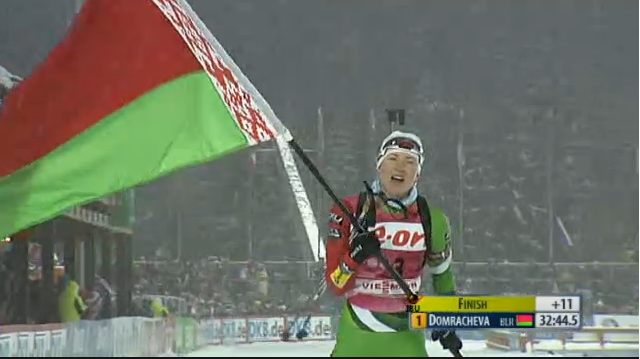
    Domracheva celebrating another victory by waving a Belorussian flag.

    It’s not that Darya Domracheva hasn’t been fast before.

    No, that’s not what makes her form in the last several weeks so impressive. She’s always been fast: the 25-year-old Belorussian biathlete has won eight races and picked up 27 more podiums, including Olympic bronze, in the past few seasons.

    But in many of those victories, Domracheva has won by sheer force of will, digging in to the intense head-to-head competition offered up by the World Cup field. This year, her triumphs in the Hochfilzen pursuit and Antholz mass start came despite having one more penalty than the second-place finisher. She only has one sprint victory, and hasn’t won an individual-start race since the very first competition of this season in Östersund, Sweden.

    Recently, Domracheva’s shooting under pressure has taken a step up to the next level, with great rewards. Today in Khanty-Mansiysk, Russia, Domracheva didn’t have to make up so much ground on her skis because even before the final stage, she had one fewer penalty than Magdalena Neuner of Germany, her most frequent adversary. As snow continued to fall at the Siberian venue, the two came into the range for their last bout together, with Vita Semerenko of Ukraine doggedly tucked in behind them.

    Women's podium, l-r: Kaisa Makarainen, Darya Domracheva, Vita Semerenko.

    Just as she had done in the pursuit at World Championships two weeks ago, Domracheva carefully cleaned her final stage. In this case, the others finished shooting before her but were forced to hit the penalty loop. It was a familiar scene: in Ruhpolding, Neuner had come into the range well before the Belorussian, but missed shots while Domracheva cleaned and sailed past her onto the trail.

    “I was very happy with my last shooting stage,” Domracheva said in a press conference after today’s race. “I had good concentration; there were three girls together on the shooting line, and it was not so easy.”

    Domracheva deliberately slowed her shooting to ensure hits.

    “I saw that [Neuner] had two misses, and in my mind I knew that I should clean here.”

    Domracheva left the range with a 22-second advantage over Semerenko, who had missed one shot, and had such a large cushion by the time she re-entered the stadium that she stopped to pick up a full-sized Belorussian flag. It fluttered above her in the final meters, and she waved the green and red colors in jubilation, bowing as she crossed the line.

    The win secured Domracheva the crystal globe for leading the pursuit standings; it was her first discipline title of any sort, and she finished 20 points ahead of Neuner.  Neuner, who holds the lead in the overall rankings, was relegated to fourth place thanks to her penalties in the final stage, and actually lost time to Domracheva on the final loop.

    Semerenko left the range in second, but was only about twelve seconds ahead of Kaisa Makarainen of Finland, who had also cleaned that stage. After barely two minutes, the Finn was pulling even with the Ukrainian. Makarainen made the pass and jetted off down the trail, ending up second.

    Last year’s overall World Cup winner and the 2011 World Champion in this event, Makarainen hasn’t had such good luck this year. She finished up the pre-World Champs period with a thrilling pursuit victory in Kontiolahti, Finland, but then fell ill and missed a crucial training block heading into Ruhpolding. Her only medal at the Championships was bronze in the pursuit.

    “I was motivated to come here,” Makarainen said of her recent troubles. “I maybe skied better yesterday. I felt pretty tired in my legs today, but I like the course here. It fits me well and that helped in the race today.”

    Semerenko, who started the day with bib two after placing second in yesterday’s sprint, was overwhelmed to see her second podium in as many days. Early in the race, she had cleaned her prone stages, but been passed on the trails by Neuner and Domracheva. By the time she hit the fourth loop, Semerenko dug in, refusing to be dropped by the two faster skiers. Even though it took a toll and she was unable to hang onto second in the end, she was still pleased.

    “My task was to shoot clean,” the Ukrainian, who missed a shot in each standing stage, wondered aloud in the press conference. “I did not think it would be possible to stay in the top three… I cannot believe that I stayed in the top three.”

    Tora Berger of Norway finished fifth and Helena Ekholm of Sweden sixth.

    * * *

    Susan Dunklee (USA) battling Marie Dorin Habert (FRA) for eighth place. Photo: NordicFocus/USBA.

    Far enough from the front to be out of contention for the win, but not so far as to be out of the picture entirely, Canada’s Zina Kocher and American biathlete Susan Dunklee battled through the slow conditions.

    Starting just a second apart in ninth and tenth, the two worked together for three loops, cleaning both prone stages and remaining in the top ten.

    “It was a pretty darn exciting [race], and I my favorite part was working with Zina for the first three laps,” Dunklee told FasterSkier in an e-mail.

    In the first standing stage, the two parted ways, with Dunklee cleaning and moving into seventh while Kocher had one penalty and stayed in tenth. But even after separating, the two were well-matched. They missed a shot apiece in the final stage, and their ski times were within three to seven seconds of each other on each loop.

    Dunklee finished ninth on the day after losing a sprint finish to Marie Dorin Habert of France – which she said was one of the only negative things she could find about her race.

    Dunklee was all smiles despite losing to Habert. Photo: NordicFocus/USBA.

    “I started the last loop right behind Marie and let her dictate the pace,” Dunklee explained. “I was confident that I could catch her in a finishing sprint, but I wasn’t very smart about making my move. I sprinted hard up the last uphill into the stadium, but I got stuck on the outside of the corner going over the top and she won the battle. I should have tried to pass her earlier.”

    Despite ending on a slightly sour note, the result was still her best in World Cup racing (she placed fifth in the individual at World Championships) and tied the best four-stage shooting of her career.

    Like Domracheva, Dunklee said her approach on the range was to be careful.

    “My shooting felt very deliberate again today as it as been for the last few races, but I wasn’t entirely in the zone,” she said. “I was more aware than I should have been of what was going on around me. Tora [Berger] shoots fast in standing! Next year I plan to cut down my range times substantially, but right now I am happy to be hitting targets.”

    Dunklee’s teammate Sara Studebaker had a less satisfying day on the range, missing two shots in the first stage and slipped ten places, from 37th to 47th, right off the bat.

    “It’s always hard to miss in the first stage of a pursuit because you lose contact and it’s tough to come back,” she told FasterSkier. “But I felt that I skied a smart race and am happy with the outcome all things considered.”

    After climbing her way back up to 42nd, Studebaker missed two more shots in the last stage. She wound up 44th.

    It wasn’t the way she had hoped to end the season; after struggling to find last season’s form in the first half of the year, Studebaker had placed 15th in the sprint in Kontiolahti, and hoped that it was a sign of things to come for World Championships and these races in Russia. That’s not the way it turned out, however, and the Finnish sprint will end up as her only top-20 of the season.

    “I’m definitely not satisfied with my season this year, but I am looking forward to making some changes and coming back stronger,” Studebaker said. “I had some moments of brilliance with Oslo and Kontiolahti and several other races in the top-40, so I know the potential is there!”

    Canada’s Megan Imrie was lapped and did not finish the race.

    Full results

  • Domracheva, Never One to Give Up, Capitalizes On Neuner’s Late Shooting Errors and Claims First Championship

    Domracheva, Never One to Give Up, Capitalizes On Neuner’s Late Shooting Errors and Claims First Championship

    Domracheva and Neuner shooting side by side in the second prone stage.

    RUHPOLDING, Germany – In Saturday’s World Championships sprint, Darya Domracheva of Belarus tried her hardest to best Germany’s Magdalena, but it was to no avail.

    On Sunday, their battle spilled over into the 10 k pursuit, with the two women at many times so close that they shared the shooting range with each other. Each was confident that they could be the first across the finish line.

    “I am very strong at the moment,” Neuner said, referring to her turn in the mixed relay and her dominating victory in the sprint.

    Domracheva had a different source of inspiration.

    “In biathlon, nothing is impossible,” she said in a press conference. “[Whether] you are more seconds behind or less seconds behind, always you have a chance for the win.”

    Neuner leading Domracheva early in the race.

    But despite two worthy adversaries, there was only room for one at the top of the podium. For most of the race, it looked like the title was Neuner’s to lose. Starting with a 15-second advantage, the German took off out of the start like a bullet. After the first stage, she and Domracheva were both clean, and Neuner had added a second to her lead. After another stage, they both had one miss, and the lead was 12 seconds. And then in the third stage, Neuner was in and out in a flawless 25 seconds, while Domracheva took 35 and missed one shot.

    With a 33 second lead, Neuner appeared to be on her way to gold again, in a reprise of Martin Fourcade’s performance earlier in the afternoon. She cruised around the two-kilometer loop in perfect control, her trademark combination of power and tempo keeping her far enough in front of Domracheva to stay comfortable.

    But then in the final stage, something went wrong for Neuner. She missed two shots and headed to the penalty loop. Meanwhile, Domracheva came into the range, cleaned, and left again. For the first time all day, she had a lead: 13 seconds.

    Neuner is fast, but so is the Belorussian, and Neuner was no match for Domracheva on the trails. While Domracheva skied the quickest closing loop – just as she had done for every other loop all race – Neuner bogged down, only turning in the eighth-best loop time and finishing 25 seconds back for silver.

    Domracheva, victory in hand, leaving the range.

    “I feel really good right now because this was one of my dreams and it has come true,” Domracheva told the television commentator. “I always say that you should dream big, and your dreams will come true.

    “I dreamed about it from the first day I started training, when I started skiing at six years old,” she added in the press conference.

    It was not only Domracheva’s first World Championships title but also the first for Belarus. She has won six World Cup races over the course of her career and many of those have come, like today’s title, at the very end; Domracheva’s never-give-up attitude and ski speed are well-known on the circuit.

    On Sunday, it was also her shooting which earned her the win.

    “I saw that Magdalena was really fast on the range today, but I was really concentrated on my shooting,” Domracheva said. “It was a fight only between me and my targets.”

    The pressure on Neuner – like that on all of the Germans – has been intense this week, and the star admitted that on Sunday it had gotten to her.

    “We have seen that it’s not easy,” she said. “Today I had a few seconds in the race where I was a little bit nervous, where it was a little bit too much for me.”

    But over and over, she repeated that even though her thousands of fans might be disappointed with her performance – even though the German public demands nothing but gold, gold, gold – she was happy with all of her races so far at this Championships.

    Neuner cresting the hill out of the stadium.

    “My goal was to get six medals, and I already am World Champion, which is something that I wanted to achieve,” she said. “We still have three competitions ahead of us, and I am very happy with silver, I have to say. It’s a shame to have these two mistakes at the shooting range, but still, I am satisfied.”

    Once Neuner made those errors and saw Domracheva skate past the penalty loop without stopping to visit, she knew the race for gold was over. Instead of trying to catch the Belorussian, she focused on soaking up the atmosphere at biathlon’s biggest venue.

    “I really enjoyed winning my third medal, and I also tried to enjoy going into the finish zone with the atmosphere that was there,” she said.

    As in the sprint, Neuner and Domrachava were untouchable to the rest of the field.

    For most of the race, Marie Laure Brunet of France sat in third, and seemed to be headed for pursuit bronze again; she was third in this event at the 2010 Olympics. In the final stage, however, Brunet missed a shot, and Russia’s Olga Vilukhina slipped past.

    Tora Berger and Olga Vilukhina.

    Vilukhina, who accrued only a single penalty over the course of the race and almost immediately moved into fourth position after starting eighth, found motivation in thinking of another race here in Ruhpolding, where she had finished fourth.

    “I remember in 2008 at the Junior World Championships, there was a pursuit competition and I was fighting with Brunet for bronze,” she said in a press conference. “At the last shooting [today] there were Brunet, Berger, and I, and I heard that they both had penalties, so I knew that the only thing I had to do was shoot clean. And then I went on to win bronze.”

    This was the first podium of Vilukhina’s career, and she was overwhelmed when she crossed the finish line 1:15 behind Domracheva, burying her face in her hands.

    That sentiment was still strong an hour later at the press conference.

    “I really don’t know what to say,” she mused. “Sitting here with these athletes is just such an honor for me.”

    Brunet’s penalty allowed not only Vilukhina to pass her, but also Tora Berger of Norway and Helena Ekholm of Sweden. Russia’s Olga Zaitseva of Russia finished seventh, while the sprint bronze medalist, Vita Semerenko of Ukraine, dropped to eight. Marie Dorin Habert of France and Anna Maria Nilsson of Sweden rounded out the top ten.
    full results

    In front of TV cameras and the thousands of fans packing the stadium, Domracheva and Neuner share a postrace hug.
  • World Championships Sprint Roundup: Bergman’s Baby, Neuner Is Cold As Ice, and Much, Much More

    World Championships Sprint Roundup: Bergman’s Baby, Neuner Is Cold As Ice, and Much, Much More

    Tarjei Bø of Norway leading Jaroslav Soukup of the Czech Republic on the range; Bø, who finished third in this race last season, placed 17th.

    RUHPOLDING, Germany – With more than 250 racers contesting yesterday’s World Championships 7.5 and 10 k sprints, there was plenty of news that didn’t make it into our race reports – both from international stars and from our own interviews with U.S. and Canadian athletes. Here are some of the notable bits that we couldn’t fit in:

    – Bronze medalist Carl Johan Bergman of Sweden wasn’t really expecting a medal yesterday, but he was expecting something else – a baby. His wife, Norwegian biathlete Live Kjersti (Eikeland) Bergman, was due yesterday but hasn’t yet given birth. “Carl Johan is always very focused when he is there, for the most part,” she told Swedish daily Expressen before promising to “keep the baby in” until after Sunday’s pursuit so he could concentrate on winning another medal.

    – Bergman and French gold medalist Martin Fourcade hammed it up in the press conference when a journalist asked Bergman “what kind of person Fourcade is for you.” After making some jokes with his competitor, Bergman answered the fairly awkward question by saying Fourcade was an excellent biathlete, and that at least they had a good ski company in common (Rossignol).

    – The translation is a little rusty, but Norwegian biathlete Synnøve Solemdal basically called gold medalist Magdalena Neuner “cold as ice” in an interview with broadcaster NRK. “It looks like she is relaxing on a Sunday before each race,” said Solemdal, who had much more trouble, missing four shots and placing 32nd. “She just stands there and enjoying herself and looking very relaxed. It does not seem like she has any nerves. It’s fun to watch… She has so much pressure on her, just like all the Germans. What she did today deserves respect, and it has been a big inspiration for me.” The piece included shots of Neuner being mobbed by German media, and reported that she was so busy that she didn’t make it to the press conference until an hour and a half after she finished the race.

    – In other Norwegian news, NRK reported that Ole Einar Bjørndalen has cut his shooting times in half since the 2002 Olympics, where he won four gold medals. The legend placed 21st in the sprint, but is not out of the running for the pursuit; he won the last World Cup pursuit in Kontiolahti, Finland.

    – Teammate Lars Berger boasted earlier that he could win the sprint. Instead, he missed four shots and placed 32nd.

    – The men’s race was rough for the home country. Despite high expectations, the team was led by Andreas Birnbacher in 16th place. The race marked the return of double Olympic gold medalist Michael Greis, who underwent foot surgery in August. He contested a few World Cup races this season, but the 35-year-old hadn’t competed since mid-January; he finished 26th yesterday.

    – Thanks to the combination of ice and slush, quite a number of biathletes fell during yesterday’s races; Tim Burke made it through cleanly, but was sporting a bloody shin from a bobble during his warmup. Ever gracious to the athletes, Eurosport put together a highlight clip of all the crashes, which you can watch here.

    JP Le Guellec of Canada, who placed 14th, was actually impressed with how the organizing committee, led by TD Max Cobb, who is also the president of the U.S. Biathlon Association, dealt with the challenges of warm temperatures, sun, and slush. “I think the organizing committee did a really good job at salting the place, and making the more important spots harder,” he told FasterSkier. “But the sun is blaring, so there’s only so much you can do.”

    – Teammate Megan Imrie agreed, saying, “I’ve seen it a lot worse here with the slush, and I’ve also seen it very icy. So these conditions, I’ll take them.”

    -Meanwhile, Megan Heinickeis representing Canada at World Championships despite skiing just one World Cup this season; she lives in Germany and is not on the national team program, but attended trials races and qualified for the team. She was disappointed with her sprint but said that the pursuit might be better. “I think I’m just one of those people who has to get some carbon out of the system – generally I do better in the second race of back-to-back races, so I’m hoping I’m a little more engaged somehow,” she told FasterSkier.

    – U.S. racer Sara Studebakerwas upset after the mixed relay, but she thinks she’s on an upward trajectory after tying for 49th in the sprint, a result she called “fine” but nothing special: “If it keeps going from here it could be really good. I think pursuits suit me well – I can shoot well, usually. That can help a lot, and especially with prone, if you can shoot well then you can move up.”

    Susan Dunklee was probably the best American hope for a good finish in the sprint, but she struggled right out of the start, missing three shots in prone. She spent the rest of the race pushing the pace on the trails and made the pursuit. ” That’s kind of my eternal strategy, is always to just take it out on the course, on skis, any time the shooting goes wrong,” she said.

    – Starting last in bib 118, Dunklee bumped a few people down the results sheet long after they thought they were safe. Teammate Annelies Cook received a bump, although she was expecting it, as she knew Dunklee was behind her. Starting with bib 115, Cook crossed the line in 60th, which would have made the cut for the pursuit. But Bib 116, Dorothea Weirer of Italy, finished one spot in front of her, and then Dunklee crossed the line and Cook ended up 62nd. “It just sucks,” she said. “So close. I was gaining and I knew it was really close, but then [Weirer] came in and pushed me out, and Susan came in… I’m bummed that I missed [three] shots. I think it was a decent race for me, otherwise.”

  • Neuner is Perfect on the Range, Perfect on the Trails, and a Perfect Teammate As She Wins Sprint Title

    Neuner is Perfect on the Range, Perfect on the Trails, and a Perfect Teammate As She Wins Sprint Title

    Germany's Magdalena Neuner passing Eva Tofalvi of Romania en route to gold.

    RUHPOLDING, Germany – What Norway is to skiing, Germany is to biathlon. And the thousands of German fans filling the Chiemgau Arena today wanted only one thing: German gold.
    They’d been denied that pleasure in Thursday’s mixed relay, where a combination of shooting errors and a last-minute time reduction for the Norwegians bumped the German team from what seemed like a sure win down to third place.

    And in the men’s sprint earlier today, the top German was Andreas Birnbacher in 16th. The race – which like so many this year turned out to be between Martin Fourcade and Emil Hegle Svendsen – was exciting, but it wasn’t what the crowd had come for.

    In the women’s 7.5 k sprint, however, the fans’ appetites were finally satisfied: as the late afternoon sun slowly but surely slipped into the mountains, Magdalena Neuner, who last year was named Germany’s female Athlete of the Year, picked up a 15-second win over Darya Domracheva of Belarus.

    Neuner leading Michela Ponza of Italy.

    Neuner, who turned 25 in February, claims to be retiring at the end of the season, and she made the most of her last World Championships sprint.

    “I did enjoy the atmosphere,” she said through a translator in the postrace press conference, refusing to bow to the usual protocol of speaking English now that she’s here in her home country. “I was very relaxed. I was looking forward to the race and I really tried to soak up the atmosphere. I focused on myself, and I focused on what was important. That really brought me to victory today.”

    The top five competitors all shot clean, an unusual occurrence this season and especially rare in sprints. Neuner won six of eight sprints in the World Cup season so far, and half of those victories came with a penalty. (Olga Zaitseva of Russia won the other two, but finished 16th today.)

    Domracheva, starting 12 bibs ahead of Neuner, shot clean and had reason to believe that she might win. A regular podium finisher, she usually has more penalties than the German.

    “I am really excited about my clean shooting today,” she said. “It is the best shooting for the season. When you have a clean shoot, it is always fun and a good emotion for you.”

    Domracheva had the fastest ski time of the day as well. But what stopped her from climbing the final step of the podium was slow shooting: she took 28 more seconds to shoot over the course of the two stages than Neuner, her frequent rival.

    “In my prone shooting, I had some problems with my first bullet, and then I tried to be concentrate more on my next shoot,” Domracheva said.

    Domracheva coming out of the start gate.

    Knowing that Domracheva had shot clean may have put more pressure on Neuner, but she said she was unaware of what had happened on the range before her.

    “I didn’t know what Daria had done,” Neuner said. “I really focused on myself. I didn’t know the shooting scores, but I knew that with no penalties on the shooting I would be sure to get near the top. It was a great feeling especially with the crowds around me.”

    The one thing that could have made Neuner’s day better? She said she wasn’t a fan of the soft, slushy ruts that developed in the seemingly tropical sun here in Ruhpolding.

    But it didn’t slow her down much.

    “I am in good shape, we have seen that during the last two competitions,” Neuner said. “If the course was a little bit harder it would be better, because I don’t like the deep snow too much. But I would say I am very close to 100 % right now.”

    Vita Semerenko of Ukraine was the final podium finisher; this is the second World Championships bronze of her career. But even though she was third in the individual race at last year’s event, Semerenko was not expecting to match that today. Only six different women have finished on the podium in the eight World Cup sprints this season and she was never one of them.

    “This year, it is really a surprise for me,” said Semerenko, whose season-best finish before today had been fifth. “It was a very fast competition and I am very glad to have won bronze.”

    Semerenko.

    Semerenko had a few demons to overcome on the Ruhpolding range. Despite being seeded third, the Ukrainians finished a disappointing 14th place in the mixed relay on Thursday. While nobody on the team had a banner day, Semerenko was the only one to ski a penalty loop, after an error-filled prone stage.

    “After the relay I was really not satisfied, and today it was really difficult for me in the shooting because I knew what had happened two days ago,” she said. “The most important part was shooting clean and I managed to do that.”

    Semerenko finished 37 seconds out of gold, and today Neuner and Domracheva were truly in a class of their own. Only five competitors managed to finish within a minute of the German; that group was capped by another perpetual foil, Tora Berger of Norway, who missed one shot and finished 52 seconds back in sixth.

    Helena Ekholm of Sweden and Marie Laure Brunet of France, who usually get on the podium if they shoot perfectly, were out of luck today and finished fourth and fifth.

    “I’m very happy,” Ekholm, who has had one of her worse seasons in recent years, told Swedish broadcaster TV4. “When the best shoot cleanly, I’ve still got a chance. It’s a very good position – I’m just in the running for a medal tomorrow, instead.”

    Svetlana Sleptsova and Olga Vilukhina of Russia shot clean to finish seventh and eighth, followed by Marie Dorin Habert of France and Anastasiya Kuzmina of Slovakia rounding out the top ten.

    Before leaving the press conference, Neuner requested to make an unsolicited statement.

    “There’s just something I’d like to say,” she began, before addressing the assembled journalists regarding teammate Arnd Peiffer’s penalty in the last stage of the mixed relay.

    “There was an article in the Bild Zeitung, which is a German tabloid, and it said that ‘Arnd ruined Lena’s gold medal’,” Neuner said. “And I think this is not something one should write. I think Arnd did a great race, he made sure that we would win bronze, and maybe next time people might want to think more about what they are going to write.”

    Then she sat back in her chair and looked at the hundreds of media workers typing away on their computers, daring them to disagree.

    The message was clear: don’t mess with Neuner, on the trails or off. She’s not just a good biathlete, but a teammate, too.

    Full results

  • Makarainen Rallies For Surprise Home Victory in Kontiolahti; Kocher Returns to Top Ten For First Time Since 2009

    Makarainen Rallies For Surprise Home Victory in Kontiolahti; Kocher Returns to Top Ten For First Time Since 2009

    Sara Studebaker (USA) racing in the sprint in Kontiolahti, Finland on Sunday. Photo: NordicFocus/USBA.

    As the clock ticked down in Sunday’s 10 k pursuit race in Kontiolahti, Finland, the home crowd became more and more tense. Their star, Kaisa Makarainen, sat in second place – which was good. But it looked increasingly as if the win was out of reach, as World Cup leader Magdalena Neuner of Germany was skiing faster and making no more errors than the Finn.

    Then, halfway through the race, Makarainen caught a break. As she pulled into the range for the first of two standing stages, Makarainen watched Neuner miss a shot – and then promptly cleaned all five of her own targets to take the lead.

    Makarainen’s face probably wouldn’t have betrayed any emotion even if it wasn’t covered in pink physio tape to ward off frostbite in the frigid conditions, but she must have felt like she had won a tiny victory already. After starting the pursuit 12 seconds behind Neuner, she was finally in front for the first time.

    “I knew that Magdalena would be tough to beat, but I had to concentrate on what I was doing,” the Finn said in a press conference after the race. “I could not do anything that would affect what she did.”

    Makarainen didn’t hold her lead for long; she left the range just four seconds ahead of the German, and was quickly caught. Neuner had a slight edge coming into the final, seminal standing stage, and it looked as though it might be over for the hometown fans.

    But then Makarainen caught an even bigger, and more unexpected break, as Neuner missed two shots and headed to the penalty loop.

    “Today there were two mistakes too many,” Neuner told the press.

    While Makarainen seized the opportunity to hit her targets and skate to a 35-second victory, Finnish flag in hand, Neuner had a harder task. She left the penalty loop one second ahead of Olga Zaitseva of Russia and six ahead of Darya Domracheva of Belarus.

    Zaitseva was not a threat on the trails, but Domracheva?

    “I am glad to at least held off Dasha, because that means something,” Neuner said. “I’m kind of proud of that.”

    Neuner herself is one of the fastest skiers on the circuit, but the Belorussian is often even faster. Today, she made up the gap to Neuner just as she reached the finish line; after both put in a furious, but exhausted, charge, Neuner emerged in second place, just 1.1 seconds ahead of Domracheva.

    Like Neuner, Domracheva had missed a total of four shots, but she’d started even farther back than Makarainen. Such comebacks are not unusual for Olympic and World Championship medalist, but she admitted that she wished it wasn’t always necessary to rely on ski speed to make up for errors on the range.

    “I think I like to make some problems for myself and find a solution,” she said in the press conference. “But that is not the best way [to race]. I have enough time before the World Championships to find some answers for my shooting.”

    Makarainen has faced some of the same challenges this year, and battled shooting errors as she struggled to match last year’s performances, which landed her the overall World Cup crown. She’s been on the podium this season and picked up a win in Nove Mesto, Czech Republic, but racing on home turf – she is from just 25 minutes away in the town of Joensuu – was clearly a boost.

    “I was motivated and especially focused,” she said in the press conference. “It was a good day for me.”

    Makarainen now sits third in the overall World Cup rankings, behind Neuner and Domracheva.

    * * *

    Perpetually just out of the frame of the television cameras, Canada’s Zina Kocher was making a comeback of her own – not from shooting errors, but from several years of frustration.

    “It has taken some patience this season as I have been close to breaking through the top ten, and the opportunity has been there for me numerous competitions this year,” Kocher told FasterSkier. “Last time was 2009, the year of the 2010 Olympics, in December – I was tenth and fourth in the sprint and pursuit that week.”

    Kocher’s 12th-place finish in Saturday’s sprint represented her best result of the season, and she upped the ante with a ninth-place effort on Sunday. It was the first time she had finished in the top ten since December, 2009; after a podium earlier in her career, Kocher had missed a season with mononucleosis and struggled with back injuries. Last season was her worst in recent memory, and she failed to score World Cup points even once.

    “Definitely a good confidence booster to be back in the top 10,” Kocher wrote in an e-mail shortly after the race. “FINALLY is how it feels!”

    Kocher was on the right track almost immediately, cleaning the first prone stage and moving up into eighth position. She hit the trails again in a group that included Olga Vilukhina of Russia, Tina Bachmann of Germany, and Anastasiya Kuzmina of Slovakia.

    Kocher’s luck didn’t last; she eventually missed four shots, just like Neuner and Domracheva, and left the range for the final time back in her original 12th-place position. But the Canadian pushed hard over the final two kilometers, turning in the third-fastest closing loop and moving up to ninth by the finish.

    “You never know what’s going to happen in a pursuit and a lot depends on those around you,” Kocher said. “When I missed my last shot, I noticed that others around me had also missed one shot, so we were all in the penalty loop together… then it just comes down to a fast last lap.”

    Kocher was traveling separate from the rest of the Canadian team, and said that she appreciated having the flexibility to attend this weekend’s races, which wouldn’t have been possible if she had still been a member of the national team.

    “There have been times like this week, when I have a bit more flexibility and can decide with my coach what is best for me,” Kocher said. “I think there comes a time in an athlete’s career when this is very important. If I was on their program I would have been at home, doing as they are doing.”

    U.S. biathlete Sara Studebaker started the race with a chance just like Kocher’s: she was in 15th position after the sprint, and could have moved into the top ten with clean shooting. It didn’t seem out of the question, given that Studebaker had turned in her first perfect race on the range in the sprint.

    But it wasn’t to be, and the American went from having her best shooting day of the season to one of the worst. She missed a total of six shots and her 44th-fastest ski time didn’t allow her any leeway. Studebaker dropped to 36th by the end of the 10 k race.

    “Today’s race was tough for sure,” she wrote in an e-mail after the race.

    Unlike many top competitors, Studebaker had raced Friday’s mixed relay, and she thought that three races in a row had finally gotten to her; at the finish she collapsed to the ground, looking even more exhausted than many of her peers.

    “I was pretty tired skiing and I think that carried over to the range for me,” she said. “By the last lap my body couldn’t hold on to anyone who was around and I was happy just to finish. It was good to still get a few World Cup points with such a tough race, though. It was just a long last couple of weeks for me!”

    Teammate Annelies Cook struggled on the range as well, starting off with four penalties in the initial prone stage. While her shooting improved in the subsequent bouts, she was unable to overcome the errors and was eventually lapped and pulled from the race.Top of FormBottom of Form

    Full results

  • North American Women Unable to Capitalize on Sprint Results; Studebaker Leads Way With 25th in Biathlon Pursuit

    North American Women Unable to Capitalize on Sprint Results; Studebaker Leads Way With 25th in Biathlon Pursuit

    Magdalena Neuner of Germany won today's World Cup pursuit in Oslo, Norway. Photo: NordicFocus/Fischer.

    After what was perhaps the best day ever for North American women on biathlon’s World Cup circuit, U.S. racer Sara Studebaker was offered a unique way to approach the coming pursuit.

    “There’s a bunch of you all hungry for more,” Studebaker’s brother Luke told her. Then he delved into new territory.

    “[You are] like a pack of North American grey wolves, once endangered to the point of extinction but now flourishing under revamped federal policies. Tomorrow you gulp the overabundant Euro-Elk down to a more manageable population, all this under the shade of newly rebounding aspen groves.”

    In Thursday’s sprint in Oslo, Norway, Canada’s Megan Imrie had led the way in 17th, with the last North American, Susan Dunklee, 46 seconds behind her in 35th. Every one of the women FasterSkier talked to after that race conveyed how excited they were about the group’s success, and about the potential to move up in the pursuit.

    So did they do it? Did Studebaker’s wolf pack notch another record-setting day?

    Well, not quite.

    “It was clearly a little bit rougher day for us as a team and a continent than in the sprint, but we all had moments of brilliance,” Studebaker told FasterSkier after the race.

    Studebaker leading Kocher on the Holmenkollen course. Photo: NordicFocus/USBA.

    The wolf pack had diminished by one before the race was even over, with Annelies Cook being lapped and consequently pulled. Cook had scored her first World Cup points on Thursday, finishing 33rd, but missed five shots in the first three stages on Saturday.

    “Biathlon giveth and it taketh away,” she wrote on her blog.

    And Imrie, who had led the way in the sprint, dropped to 41st with five penalties. She told FasterSkier that she was tired and disappointed in her skiing, and called the race “a tough one.”

    Instead of Imrie, Studebaker led the way in 25th after starting in 22nd and shooting clean for most of the 10 k, four-stage race. In the final standing bout, she missed two shots, which dropped her out of the top 20.

    “It was a little crazy to move backwards with only two penalties, but there was some really good shooting out there, and I’m happy with my race overall,” she told FasterSkier. “I feel like I’m in a good spot right now: my skiing is coming on and I’m feeling good, and my shooting is solid.”

    Studebaker said she wasn’t sure what happened in the final shooting stage, but hypothesized that the range approach might have done her in. It’s downhill, which would generally be seen as easy, but Studebaker pointed out that tucking into the range can leave athletes’ legs shaky and unstable when they need to stand perfectly still.

    “I felt good about my approach, and was super confident after my first standing, but sometimes you just miss,” she said. “It was a bummer, but that’s biathlon! I can’t really complain about 90 % shooting.”

    Studebaker was followed by Canada’s Zina Kocher, who slipped from bib 25 down to 29th place on the back of four penalties.

    Kaisa Makarainen of Finland, who eventually finished fifth. Photo: NordicFocus/Fischer.

    “Four misses is too much, especially on a day like today,” Kocher said. “I felt a little bit more tired than in the sprint, and then lost a sprint finish to [Norwegian] Elise Ringen after the final climb. I had been pushing my pace earlier on in the race and just didn’t have enough gas to stay ahead of Elise as she turned on the sprint before the downhill to the range.”

    Kocher said that she hadn’t had problems with the cold temperatures, which started out at -23 Celsius in the morning before warming to -14, or about six degrees Fahrenheit, by race time. And despite having slightly tired legs, she was already looking forward to “another chance to fight” in her next race.

    And Susan Duklee, too, was happy with her race. The American started and finished in 35th, maintaining her position despite five penalties.

    “I definitely had hoped to hit more targets in prone today, but I’m really excited about my standing,” Dunklee wrote in an e-mail, alluding to the fact that four of those five penalties came in prone. “I had been struggling with that in the last couple of races. I finished my bib number and didn’t lose any places- that’s progress for me.”

    Even though the women couldn’t entirely capitalize on their starting positions, Studebaker, Dunklee, and Kocher all looked at the bigger picture and believed that it had been a good weekend for the teams.

    “I’m still riding the energy from our team result the other day, and it was amplified even more when we saw how well the U.S. Ski Team girls did in Russia,” Dunklee said. “This week has been a tremendous confidence booster, and with only a few weeks until World Championships, this is a great time for the team to come on strong.”

    Kocher had the most tangible excitement, since her performance qualified her for Sunday’s 30-woman mass start. Once a mainstay in mass starts, Kocher hadn’t been invited to participate much recently, so this was a big step.

    “I’m incredibly pumped to be racing a mass start again,” she said. “It has been a very long time since I last qualified! I qualified in the first mass start of the season in 2010, but before that it was 2006-2007, the year before I had mono, that I was consistently doing them.”

    Of all the North American women, only Dunklee has participated in a mass start so far this season. Having more different women compete in the highest-profile races was one symptom of what Studebaker said were the rising fortunes of North American biathlon.

    “I think we’re slowly letting the Europeans know that they can’t count us out,” she said. “It seems like we’re all feeling strong just in time for the most important part of the season, which is key. We have plenty of opportunity to do a little more hunting.”

    Magdalena Neuner of Germany led the race from start to finish, winning by 36 seconds despite accruing two penalties. A clean-shooting Olga Zaitseva of Russia placed second and Darya Domracheva of Belarus third.
    Full results

    Tora Berger of Norway, who finished fourth and failed to snag a podium for the home country. Photo: NordicFocus/Fischer.
  • U.S., Canadian Women “Show Europe That North America Can Mix It Up” In Oslo Sprint

    U.S., Canadian Women “Show Europe That North America Can Mix It Up” In Oslo Sprint

    Sara Studebaker led the U.S. in World Cup action with a season-best 22nd-place finish. Photo: NordicFocus/USBA.

    After a gray winter that seemed to always be either snowless or stormy, the world’s best biathletes were thrilled to head to Antholz, Italy two weeks ago, where the sun finally shone in the Alps.

    The North Americans, it seems, are even happier to be in Oslo, Norway, where the World Cup kicked back into action with a pair of sprint races on Thursday.

    “There is a good vibe here in Oslo,” U.S. biathlete Annelies Cook told FasterSkier.

    Sure thing: of five North American women who started, all finished in the top 35, which they believed had never happened before.

    “Today was not only a great day for the US, but also for the Canadian women,” said Cook’s teammate Sara Studebaker. “[It’s] always great to show Europe that North America can mix it up.”

    “We’re all so happy for one another,” Cook agreed.

    The field was slightly smaller on Thursday, with only about 75 starters compared to 95 two weeks ago in Antholz. U.S. Biathlon Association President Max Cobb said that while all the major teams were in attendance, several brought reduced squads due to the recent Under-26 Championships in Slovakia and the high cost of staying in Scandinavia.

    But although the fields might not have been large, they were certainly talented. Germany’s Magdalena Neuner won the sprint with perfect shooting, extending her lead in the overall World Cup standings; second-place Darya Domracheva of Belarus and third-place Tora Berger of Norway are now ranked second and third in the overall standings as well. Only three of the top 20 women decided to sit the weekend out.

    That made the North Americans’ performances even more noteworthy. The group was led by Megan Imrie of Canada, who collected a career-best 17th-place finish after shooting ten for ten.

    “I was a little sick last week so I knew skiing wouldn’t be as strong as I would like,” Imrie explained while describing her race strategy. “I focused solely on the shooting process, taking each shot one breath at a time. The targets in Holmenkollen just wanted to fall today.”

    Imrie’s performance put her 1:46 behind Neuner and roughly 20 seconds out of the top ten.

    Canadian teammate Zina Kocher had an opposite experience en route to 25th place: she skied the ninth-fastest course time, but missed three shots, keeping her out of a top finish.

    Susan Dunklee (USA), 35th place. Photo: NordicFocus/USBA.

    “Definitely, shooting was frustrating,” Kocher told FasterSkier. “I seem to have a three-miss curse for sprint races this year! I’m not sure what happened in my prone, [because] everything felt good.”

    After missing twice in the initial prone stage, Kocher was ranked just 51st in the field. But aggressive skiing allowed her to claw her way up the results sheet despite missing another shot in standing.

    “Skiing was great, I had a ton of energy to push for every second,” Kocher said. “I’m hungry for more racing, and body feels great after this last training break.”

    Studebaker led the Americans and while her 22nd-place finish was a season-best, she seemed more excited for the quintet’s overall success.

    “It’s great to have an individually good day, but when the whole team does well it’s extra special,” Studebaker said.

    She did say that her finish was a good confidence boost given a long series of frustrating results so far this season; Studebaker finished one spot higher than she had in this race last year, with Oslo sprints now making up two of her top six World Cup finishes (she also placed 17th at World Championships last year).

    “I had a good training block last week, so I was ready to really go for it here in Oslo,” Studebaker said.

    Imrie agreed, saying that for the Canadians, who are heading back to Canmore after this weekend to train in preparation for World Championships, all systems were go as soon as they got to Norway.

    “It’s clear that our team has flicked their performance ‘on’ switch for this final weekend,” she wrote in an e-mail. “We’re all so happy with the direction we’re headed. Personal bests in Oslo are especially great – a feel good result, hugs all around, and then famous Norwegian waffles hot off the press. They will fuel me through the pursuit.”

    Another idea that might motivate her in Saturday’s race is the knowledge that four North Americans are chasing her down. Cook finished a career-best 33rd and fellow American Susan Dunklee 35th.

    Dunklee has had a breakthrough season, and the result was in line with her previous finishes; she skied the 14th-fastest course time and was hampered, like Kocher, by three penalties.

    Cook, however, had something of a breakthrough of her own, scoring World Cup points for the first time. She missed only one shot, which seemed like a victory in itself after some bad shooting days in previous races, she said.

    “Sometimes it seems like biathlon is a sport where you accidentally do well,” Cook mused in an e-mail. “It can be so unpredictable. I was so psyched to have a good day on the range – I really needed that for my confidence.”

    Cook cited fast skis and cheering from the hordes of schoolchildren lining the course as a few more reasons she flew around the trails.

    “It was a really good mental course for me, where I could focus on getting to the top of the one long climb, have a good rest and then finish the next before coming into the range,” she added.

    The one factor that could have curbed the North Americans’ enthusiasm about Oslo was the weather, which forecasted frigid temperatures for the weekend, so much so that Norwegian biathletes Lars Berger and Ole Einar Bjørndalen reportedly urged organizers to consider canceling the races. But the Canadian women didn’t seem fazed.

    “It was a bit cold today, a humid minus 10 [Celsius], so like a good Manitoba girl, I employed every hand warming strategy in the book,” Imrie said, pointing out the reason that cold races can be even tougher for biathletes than skiers: bulky gloves and mittens don’t work with rifle triggers.

    And what if temperatures hit the minus 18 Celsius predicted for the weekend?

    “A good warmup and lots of long underwear will be key,” Kocher said.

    Full results

    Cook en route to a career-best 33rd place. Photo: NordicFocus/USBA.
  • Domracheva Makes Up for Early Error With Surprise Ascent to Victory; Dunklee 27th in First World Cup Mass Start

    Domracheva Makes Up for Early Error With Surprise Ascent to Victory; Dunklee 27th in First World Cup Mass Start

    American World Cup rookie Susan Dunklee (bib 27) in the mix behind Marie Laure Brunet of France in the 15 k mas start. Photo: NordicFocus/USBA.

    Mistakes can be a powerful motivator.

    In Sunday’s 12.5 k mass start in Antholz, Italy, the two biathletes with the fastest course times were the ones who really, desperately wanted to make up for errors in the very first shooting stage of the day. In that prone stage, both and Darya Domracheva of Belarus and Kaisa Makarainen of Finland – currently ranked second and third in the world, respectively – missed two shots.

    In a mass start, missing even one shot in the initial stage can be disastrous. While there aren’t always attacks early, being off the back – way off the back – while the rest of the field coasts along, feeding off each other’s momentum, is decidedly difficult.

    After completing their required penalty loops, Makarainen and Domracheva sat in 25th and 26th in the 30-woman field, 50 seconds behind the leaders. The pair set to work, turning in the fastest times on the second lap.

    After that charge towards the front, Makarainen was again stymied, missing a total of five shots over four bouts on the range. Despite skiing the second-fastest time of the day, she was unable to move up higher than 11th place.

    Domracheva, however, made the effort part of a longer, steady ascent through the pack. After cleaning the second prone stage, she had improved to tenth. By midway through the third lap, she had moved into third.

    “I think that some bad situations like this make me stronger and give me more motivation,” Domracheva later said in a press conference.

    As Germany’s Magdalena Neuner and Slovakia’s Anastasiya Kuzmina followed the course out of the woods and wound their way through open fields and past a rustic alpine cabin, Domracheva ditched the chase pack and tried to cut into their lead, reducing the deficit to 21 seconds by the time she reached the crowded area surrounding the stadium.

    All three women cleaned, although Neuner lost a few seconds when her rifle jammed and she had to pause to remove a bullet. In the next kilometer, Domracheva cut another seven seconds out of the lead. By they time they hit the shooting mats, the Belorussian was only six seconds behind – the leaders hadn’t even started shooting.

    Spending so much energy chasing could have tired Domracheva, and the big question was whether she would be punished for her efforts in the final standing shoot, when athletes’ legs turn wobbly and their shots can become erratic.

    “It was just a fight between me and my targets, nothing more,” Domracheva said of the effort. “It is easy to say this, but hard to do.”

    Still, she managed to clean, and instead it was the leaders who choked. Kuzmina missed one shot and Neuner two. While they headed to the penalty loop, Domracheva took off, her victory all but certain.

    The next five athletes also missed shots, meaning that Kuzmina could ski to second and Neuner to third despite their late mistakes.

    For Kuzmina, who won the sprint at the 2010 Olympics but has not impressed so far this year, the podium finish was an important confidence boost as the season progresses towards World Championships.

    “It is unbelievable for me to be here,” she said in the press conference. “Today was good test for my shape. It know it is possible to fight with these strong women… I hope that I can come back for the rest of the season.”

    Still, the happiest of all was Domracheva, whose move from 26th to first was impressive and unexpected.

    “Antholz is a very good place for me,” she said. “It’s perfect for my technique.”

    * * *

    A single North American woman made the 30-woman field: Susan Dunklee was handed her first-ever mass start position after finishing 17th in Thursday’s sprint. By doing so, she became the first American woman this season to earn the honor.

    “I am excited for the mass start!” she wrote in an e-mail the morning of the race. “It will be a good learning experience for me, an opportunity to practice patience during a race.”

    Dunklee did just that; in the first loop, the American, who is capable to turning in top splits on her skis, relaxed in the middle of the pack. Despite the excitement that accompanies a mass start, she was calm on the shooting range and was one of just eleven women to clean the initial stage. She left the range in ninth.

    “As for sitting in the top ten on the second lap: I figured I’d give my parents a reason to get nervous back home,” she joked after the race. “They like to watch the instant results.”

    After that, Dunklee’s race became a roller coaster ride. She missed two shots in the second stage, dropping to 23rd, but then cleaned the third stage and moved back into the top 20.

    Through it all, she stayed focused.

    “The crowd was big and loud, but it felt like tunnel vision during race,” Dunklee said. “The world consisted of the track, the range, and the competitors around me.”

    In the final stage, her luck took another dive when she missed a devastating three shots.

    “The last stage certainly could have gone better, but I’m happy with where my head was while I was shooting it,” she told FasterSkier. “I was not over-thinking things or worrying about people around me.”

    After leaving the range in 28th, she passed a flagging Katja Haller of Italy and moved up to 27th by the finish.

    “I finished at my bib number and I can’t complain,” she said of the result.

    All in all, despite the disastrous final shooting stage, Dunklee found plenty of things to be positive about in the race – mainly, how she dealt with the added stress of the format, which is rarely contested in the U.S. and only several times a year on the World Cup.

    “It’s a great feeling to have cleaned two stages under that head-to-head pressure, the first one being especially important for maintaining a good place,” she said. “I felt relaxed on skis for almost the entire race- it helps me to have people to ski behind.”

    As for capitalizing on those two stages that she did clean?

    “Another time,” she wrote.

    Full results

  • After Cross-Firing Debacle Removes Neuner, In Tears, From Contention, Berger Emerges From Confusion To Take Pursuit Victory

    After Cross-Firing Debacle Removes Neuner, In Tears, From Contention, Berger Emerges From Confusion To Take Pursuit Victory

    Eventual winner Tora Berger of Norway leads Magdalena Neuner of Germany on the first lap of Sunday's 10 k pursuit in Nove Mesto, Czech Republic. Photo: NordicFocus/Fischer.

    Of all the nordic disciplines, biathlon is perhaps the one where small errors make the biggest difference. A centimeter here, a millimeter there – missing a target by that much, or little, can have drastic impacts on an athlete’s results.

    On Sunday, however, Magdalena Neuner didn’t make a small error. She made what is perhaps the worse mistake in biathlon: cross-firing.

    Coming into the third shooting stage of the 10 k pursuit with a sizeable lead, the German skied onto the mat in lane one, settled into a stable standing position, took a deep breath, and began shooting. She hit a target and kept going.

    The first sign of trouble was that the fans filling the stadium in Nove Mesto, Czech Republic, were silent instead of cheering for her hits. After four shots, Neuner realized that she was shooting at the targets in lane two, not lane one. She picked up her rifle, refocused, and hit the remaining shots on her own target – then had to go ski four penalty loops.

    “It’s very annoying because [the four shots] were in a very tight group,” German women’s coach Gerald Hönig told the press.

    In other words, Neuner shot perfectly – just in the wrong place. Coaches are not allowed to have contact with athletes during the race (for several reasons including the obvious ones of gun safety), so Hönig was left to watch, more or less powerless, from several meters away.

    Cross-firing isn’t common, but it does happen. U.S. biathlete Carolyn Treacy Bramante crossfired in the sprint at 2007 World Championships. And at almost the same time that Neuner made her mistake on Sunday, so did someone else; Canadian Danielle Vrielink had to adjust after another athlete fired into her lane at the Youth Olympic Games in Innsbruck.

    Neuner lost over a minute and a half while stuck on the penalty loop, and the rest of her race was wrecked. While she skied the fastest overall time, she paid for it: out of physical and psychological exhaustion, the 28-time World Cup winner missed three shots in her final standing stage as well, and was left with seventh place after leaving it all on the course in a blistering-fast last loop.

    Neuner was in tears after crossing the finish line.

    “I have to admit I had to cry,” she told the press after the race. “I was so focused and just didn’t look at the number on the stand. That’s never happened to me and I am really angry.”

    “After penalty loops I always have more and more rage in my belly and only want to ski as fast as I can, and I at least was able to do that,” Neuner told German newspaper Welt.

    It might seem like eventual winner Tora Berger of Norway benefitted immensely from Neuner’s errors, but that would be an oversimplification because Berger also suffered the ramifications of the cross-firing disaster. She was in second place when she entered the range, arriving just as Neuner was leaving and owning only a slight lead on Russia’s Olga Zaitseva.

    Berger, who was not surprisingly oblivious of the situation, skied into lane two and Zaitseva into lane three. But while Zaitseva settled in and started shooting, Berger suffered a jolt: her targets were already white, dropped erroneously by Neuner. After frantically calling and gesturing to officials, she had to scoot behind Zaitseva and into lane four. Then, Berger missed two shots.

    “I tried to talk to the official, but he was not watching and it took him a while to see what was happening,” Berger said in the postrace press conference. “I was a little disturbed about that, and it was probably the reason I had the two penalties.”

    After the finish, officials subtracted six seconds from Berger’s time to make up for the confusion on the range.

    Zaitseva also missed two shots, and the pair hit the penalty loop together. They saw Neuner, but then left her to finish her 600-meter series of left-hand turns.

    When the dust had settled, sharpshooters Helena Ekholm of Sweden and Marie Laure Brunet of France had taken the lead. While so many of their competitors – including Darya Domracheva of Belarus – were stuck in the penalty loop, the pair had cleaned all their targets.

    Domracheva, Berger, and Zaitseva, however, are the better skiers, and formed an intimidating chase pack. They closed the 14-second gap to Ekholm and Brunet in about a kilometer and a half, and the five entered the range together to face one final test.

    There, Berger showed her true capabilities and dropped all five targets in quick succession; she was the first athlete to finish the group, and left before the others. Brunet and Ekholm cleaned as well, but Zaitseva and Domracheva missed a shot each.

    At this point it was obvious that Berger – who is matched perhaps only by Neuner and Zaitseva in her ability to both ski and shoot impeccably – would take the win. She attacked the final loop with her signature fast tempo.

    Ekholm, who is one of the circuit’s best shooters but used strong skiing as well to win the overall World Cup title in 2009, caught and passed Brunet and finished second. Despite at one point glancing nervously over her shoulder to see whether Domracheva would make up the 20 seconds and overtake her, Brunet hung on for third.

    Ekholm, who had started the pursuit over a minute and 20 seconds behind Neuner in bib 9, had said before the race that she could be happy with a top-five finish.

    “I knew that I could never reach the top three, because everyone in front of me were not making any mistakes,” she explained in the press conference, as surprised as everyone else at the turn the race had taken.

    Both Ekholm and Brunet shot perfectly, hitting all 20 targets.

    “I was ‘focused,’ as the Americans would say,” Brunet wrote on her blog, before noting that she had celebrated her first podium of the season with a trip to McDonald’s.

    * * *

    Sara Studebaker improved twelve places in the pursuit. Photo: NordicFocus/USBA.

    Canada’s Zina Kocher started the pursuit in 23rd place, and saw the potential to move into the top ten. Things didn’t play out as she had planned, however, starting with subpar skiing.

    “Skiing has felt okay this week but lacking punch, and today was similar,” Kocher told FasterSkier. The Canadian has had ski times among the top ten in several races this season, but on Sunday only managed the 22nd-fastest split.

    Then, she missed three shots in the final stage.

    “The race was going decently well for me until the last standing, as I was maintaining between 16th and 20th,” she said. “But I came into the last standing and struggled with the wind and shaking legs.”

    To top it all off, she followed her penalties up with a crash.

    “Adding to the frustration of my last standing, leaving the penalty loop I collided with a Ukrainian who was going into the loop,” explained Kocher. “I took the penalty sign between my legs with me and we both landed in a heap outside of the loop.”

    Although the week in Nove Mesto didn’t live up to expectations, Kocher is still ranked 29th in the overall World Cup standings, which is something she can be happy about.

    “It’s been a difficult week with the conditions, so I’m stoked to be leaving for Italy,” Kocher said of moving on. “Antholz is alway sunny and beautiful with amazing food, so spirits will rise.”

    Teammate Megan Imrie started with bin 44 and moved up a single place to 43rd after missing six shots, including four in the final stage; until that point she had been in the top 30.

    For the Americans, Sara Studebaker and Annelies Cook were the only starters, and they had a somewhat unusual challeng on their hands.

    Because Friday’s sprint race took place in conditions that significantly deteriorated over the course of the afternoon, times from the competition were spread out more than usual. Cook started with bib 51 out of 60 possible starters, and Studebaker with bib 54; both were over three minutes behind Neuner. But with a two kilometer loop, which took top racers as few as five minutes, and athletes being pulled from the course if they were lapped before the leaders completed the final shooting, the Americans needed to stay focused and avoid errors if they wanted to finish.

    It was “serious motivation,” said Cook.

    “The course was much easier and faster today, and I was a little nervous to get caught,” she wrote in an e-mail to FasterSkier.

    Initially, the motivation was productive. Cook cleaned her first stage and moved into 38th. But after that, things took a turn for the worse.

    “I just did not have a good day after that on the range and I ended up missing eight, which is really bad,” Cook said. “It’s almost like I shot so much this week that by the time I went today the focus just wasn’t good enough to deal with the windy conditions. Plus, my fingers were totally frozen and it was hard to feel the trigger.”

    Cook was probably helped by the cross-firing debacle that took place at the front of the field. If Neuner had dropped all five tagets, the race would have played out differently, and much more quickly; Cook may have been lapped. As it was, the American finished eight minutes behind Berger.

    “It is too bad I shot so poorly because there was a lot of opportunity to have a good day. But it is what it is. I feel like my ski form is getting there and I am more able to tolerate the pain of racing now and less afraid of hurting.”

    Studebaker, on the other hand, was able to conquer some of her shooting demons. She missed only three shots and leapfrogged 12 places into 42nd, narrowly missing out on the World Cup points which are awarded to the first 40 finishers.

    “Today was much better for me,” Studebaker told FasterSkier. “I felt much better on skis and was happy with how things went on the range. It’s always tough to be almost in the points, but I was able to move up despite starting pretty far back. It was a good race for me and I’m looking forward to Antholz.”

    Both Americans agreed with Kocher, and said they would be relieved when they made it to Italy.

    “Hopefully Antholz will bring some more relaxing weather for us all,” Cook said. “It’s mentally tiring to have to battle tricky conditions all of the time.”

    Full results

  • In Nove Mesto’s Blizzard of Deteriorating Conditions, Zaitseva Keeps Clean and Russia Places 3 in Top 6

    In Nove Mesto’s Blizzard of Deteriorating Conditions, Zaitseva Keeps Clean and Russia Places 3 in Top 6

    24th-place Svetlana Sleptsova of Russia was lucky to start before things turned nasty. Photo: NordicFocus/Fischer.

    This year’s World Cup biathlon schedule has presented a confusing dichotomy: it seems like races are either characterized by a lack or snow, or too much of it – sometimes at the same venue, just days apart.

    While panning television shots of athletes racing along thin white ribbons in the woods has become all too common, so too have the fuzzy, gray screens where cameras struggle to pick skiers out through heavy snowfall.

    The Nove Mesto stadium at the beginning of the race….

    “We’ve had a lot of tough condition races this year,” U.S. biathlete Sara Studebaker told FasterSkier. “I like to think that it’s just going to make us tougher and better in the long run.”

    Friday’s 7.5 k sprint race in Nove Mesto, Czech Republic, was no exception. What began as a pleasant day turned into a blustery snowstorm as the first starters emerged from the woods the range for their prone shoot.

    As more and more snow built up on the tracks, which at the start were “icy as a skating rink” according to American Susan Dunklee, the race turned into a nightmare – particularly for the latest starters, who weren’t able to ski even one loop on the icier trails. In addition, the wind became strong and variable, sometimes coming from one direction and at other points the complete opposite.

    “You could get lucky and come into the range when there wasn’t too much wind, or you could come in with some big gusts,” Studebaker said.

    … and at the end.

    The women’s hair was visibly blowing in the wind, and many had to take clicks on their rifle sights as they hit the shooting mats, or sometimes even in the middle of their stage. A few had to stop and brush the snow off of their sights.

    “I would not wish [these conditions] on my worst enemies,” said U.S. women’s coach Jonne Kahkonen.

    Only one of the 92 women was able to drop all the targets, and that was Olga Zaitseva of Russia. In a sprint, which features two shooting stages for ten shots total, the number is usually much higher.

    “I waited for the wind three or four times,” the Russian said in a postrace press conference. “On one shot, the rifle moved but it was a hit. I was the lucky one.”

    In Zaitseva’s case, the old phrase “luck of the draw” held some weight. The Russian started with bib 13, and while she definitely encountered challenges on the range, neither her skiing nor her shooting included conditions as tough as those faced by later starters.

    Berger pushing through for the podium. Photo: NordicFocus/Fischer.

    Second-place Tora Berger of Norway started several minutes behind Zaitseva, but was still in the first third of the field. She was impressed with Zaitseva’s shooting, and not disappointed with her result given her two penalties.

    “It was not easy to shoot,” she said. “The wind was so strong at times. It was not so bad when I was out there, but I think it was very hard for some of the late starters.”

    Magdalena Neuner of Germany placed third, and remains atop the overall World Cup standings. With her victory today, Zaitseva passed Kaisa Makarainen of Finland to move into third place. Makarainen had won Wednesday’s individual, but today missed six shots, including all five in her standing stage [meaning that she “dirtied”], and still managed to finish 14th.

    It was a good day for Russia, with not only Zaitseva’s victory but several more finishers in the top ten. Olga Vilukhina continued her best-ever season with a fifth-place finish, while Ekaterina Glazyrina improbably placed sixth despite starting with bib 55.

    The North Americans were led, as usual, by Canada’s Zina Kocher, who finished 23rd. Starting with bib 29, Kocher had a decent first shoot, accruing a single penalty, but then a disastrous standing stage. She was left to ski three more penalty loops before heading to the finish.

    “[It was a] definitely disappointing last standing,” she told FasterSkier. “I did what I could and went for it in standing, and then blasted out of there for a fast last lap.”

    Neuner in the snow. Photo: NordicFocus/Fischer.

    Her last lap was indeed fast – she ranked 12th over those 2.5 k and moved up ten places from when she had left the range. On the whole, though, Kocher was not particularly satisfied with her experience today.

    “Today was an extremely gusty day in the range and on the tracks,” she said. “A preposterous day actually. I was lucky to have started when I did, as snow started to dump after I was finished and the track slowed down a lot for the other competitors.”

    Even though Kocher, who had placed 15th in Wednesday’s sprint, was left looking for more, she has one more chance to get it in Nove Mesto. In Sunday’s pursuit, she will start almost two and a half minutes behind Zaitseva, but only 20 seconds out of the top 20 and one minute out of the top ten. With her ski speed and 20 opportunities for her competitors to make shooting errors, a lot is possible.

    “For the pursuit Sunday, I will once again just focus on moving up the ranks with good shooting,” the Canadian said. “The trick will be mastering the wind if it is similar to today.”

    After a career-best 20th place on Wednesday, teammate Megan Imrie slipped to 44th in the sprint on the back of five penalties.

    She finished one place and three seconds ahead of Dunklee, who was the first American on the results sheet. Dunklee did her Canadian competitor one worse and missed six shots. Her prone stage was particularly rough; she racked up four misses only 2.5 k into the race.

    “When I started the race, it was partly cloudy with a little bit of sunshine,” she wrote in an e-mail to FasterSkier. “When I came in for my first shooting, it had just started blizzarding.”

    With bib five, Dunklee had some of the best luck of the day, but couldn’t capitalize. Still, there were several great aspects of her race – she had the 12th fastest ski time over the 7.5 k race. That included a fourth-fastest first lap, which Dunklee said was deliberate after she never found her zip in Wednesday’s individual.

    “I did start today’s race fast because I wanted to feel like I was in the race right from the start,” she explained.

    Like so many other early starters, she felt fortunate that she’d at least had the chance to excel, even if she didn’t have her best race. Some teammates, she said, had been doomed from the start.

    Things turned blustery for Cook of the U.S.

    “Today was a very complicated weather day, and that impacted much of what you see on the results sheet,” she said. “By the time the last starters got on course, they didn’t have a fair chance. They were plowing through centimeters of new snow and could barely see the targets.”

    That group included Annelies Cook, who started with bib 71. Despite the poor visibility, Cook managed to hit seven of ten targets. And even though the tracks were slow, she placed 51st, good enough to qualify for the pursuit on Sunday.

    “Had Annelies started earlier, she probably could have made points (top 40), but that’s racing,” Studebaker said of her teammate’s performance.

    Studebaker will join the Dunklee and Cook on Sunday after finishing 54th with four penalties. It is the first time all season that three Americans will appear in the event, which includes only the top 60 finishers from the previous sprint.

    “I had a rough standing stage, but in general I feel okay about my race,” Studebaker said.

    The Idaho native has had several frustrating weekends so far this season, and has not shown the form that earned her four top-20 finishes last year. With the U.S. men having weaker performances in January than they had in December, Studebaker responded to questions about the team’s shape by saying that the main goal was to at their best in March for World Championships.

    Neuner working on her rifle. Photo: NordicFocus/Fischer.

    “For me, I know I’m not exactly where I had hoped to be right now, but I’m making slow improvements on the skis and am feeling confident that our plan, to be fast for World Championships, is going to work,” she told FasterSkier. “It’s for sure a bit frustrating for all of us after the season we had last year, but we’re learning to just evaluate ourselves on where we are, and looking forward.  The big thing for us right now is to be making progress.

    “Today was a better feeling on the tracks for me than Wednesday, so that’s an improvement, and I have to be confident that will continue.”

    The final U.S. racer, Tracy Barnes, was literally one of the last women to start, and her 87th-place finish reflected her bad luck. By the time Barnes was competing, the weather was no longer merely bad, but had become dangerous.

    “We couldn’t cool down on the warm-up loop due to the danger of falling trees,” Dunklee said.

    While there have been plenty of storm-marred races in the last few years, Neuner of Germany perhaps summed up the Nove Mesto sprint the best.

    “It was a crazy race,” she said. “We have seen some crazy days before, but this was special.”

    Full results

    The IBU debuted a new "leaders' box", which Berger, Neuner, and Zaitseva were able to enjoy while the storm raged outside. Photo: NordicFocus/Fischer.
  • Makarainen Gets Birthday Win in Nove Mesto 15 k – With Photo Gallery

    Makarainen Gets Birthday Win in Nove Mesto 15 k – With Photo Gallery

    By this time last year, Finland’s Kaisa Makarainen had won two World Cups, podiumed in five more, and sat atop the rankings on the World Cup.

    The 2011-12 season is shaping up differently, not just for Makarainen, but for the other women as well. On Wednesday Makarainen became the fifth athlete – each from a different country – to win a World Cup. The 22-second victory, which came despite having one more penalty than second-place finisher Helena Ekholm of Sweden, was her first of the season, although she’d been on the podium three times; she’s currently ranked third in the overall standings.

    In an individual race, which features 15 kilometers of skiing and four shooting stages, each missed shot is penalized by a minute of added time. Makarainen was the second-fastest skier on the course, and covered the distance 54 seconds slower than Darya Domracheva of Belarus. But Domracheva missed four shots, adding up to four minutes of time penalties, and finished fifth, while Makarainen only missed twice.

    The pacing was a deliberate move by Makarainen, and seems to have paid off.

    “I knew that these were hard tracks, so I started slowly in the first couple of loops,” she explained in a press conference. “With all of the wet, soft snow, I thought it was a good idea not to use all of my energy in the beginning.”

    At this point in the season, anything could happen at the top of rankings. The first four women, Magdalena Neuner of Germany, Domracheva, Makarainen, and Olga Zaitseva of Russia, are separated by less than 100 points. A victory counts for 60 points.

    “Kaisa did not surprise me today,” Neuner said. “The competition is very difficult in each race this year. You have to fight to the finish in every competition to make the podium.”

    Neuner had won both races in Oberhof, Germany last weekend, so it’s notable that she finished third, 32 seconds behind Makarainen, today.

    Makarainen, who turned 29 on Wednesday, believed that she had been helped by a little bit of birthday magic.

    “I was pretty relaxed today, maybe because it was my birthday,” she said in the press conference. “Two penalties are pretty good for me. Even though I was relaxed, I felt that it was not so easy shooting. but I handled it okay and the rest of the race was okay.”

    Full results

    All photos below are by NordicFocus and courtesy of Fischer USA. Click to enlarge.


  • Neuner Bounces Back to Win Oberhof Sprint; U.S. Women Struggle In First Race Back from Break

    Neuner Bounces Back to Win Oberhof Sprint; U.S. Women Struggle In First Race Back from Break

    Susan Dunklee racing in Oestersund, Sweden earlier this year. Photo: nordicfocus.com courtesy of USBA.

    After an extreme and unexpected implosion in Wednesday’s relay, Magdalena Neuner of Germany scooted out of the stadium without talking to the press.

    On Friday, she was able to hold her head high after hitting all of her targets and skiing to a 37-second win over Darya Domracheva of Belarus in the 7.5 k World Cup sprint in Oberhof, Germany.

    “It was important for me to delete that last race,” she said in the post-race press conference. “In biathlon, you have good and bad days, and today I just pushed that delete button and had a great day.”

    The crowd of 18,000 rabid fans couldn’t have agreed more. The crowd quieted as she shot her standing stage – the same place where she had missed all five targets just two days before – and then exploded in cheers and applause after she cleaned.

    “On a perfect day like this, you se the importance of shooting clean,” she said.

    Far behind her, the trio of American women struggled to achieve the results they were looking for.

    For Susan Dunklee, who led the Americans on multiple occasions in the first period of World Cup racing, the difficulties were as much technical as anything else. The problems started with a jammed bullet.

    “In the process of fixing that, I thought I had ejected a round, so I hand loaded my fifth shot while there was actually still a bullet in the magazine, which caused a second jam,” she explained to FasterSkier. “Then I had to take out the extra round from the magazine before skiing off – it’s a safety rule.”

    As a result, Dunklee spent a minute and ten seconds “shooting”, or about 40 more than she usually does. Without that added time, she would have placed in the top 20 for the first time in her young career.

    But as it was, hammed bullets and all, she was left to tie for 35th place with Fukuyo Suzuki of Japan. Dunklee pointed out that the shooting itself was pretty good; she only had two penalties, which she said felt good. Next race, however, she hopes to spend less time on the range.

    As for the skiing, Dunklee had trouble getting going, but eventually hit her stride.

    “This a very difficult course to ski,” she said. “The Bergsteig climb is very hard at the start of the loop, and that is followed by three more sizable hills. It took me awhile to find the faster gears, but I think that kept me from starting too hard and blowing up.”

    Dunklee’s teammate Sara Studebaker missed three shots and didn’t have her best day on skis either, ending up 56th.

    “It was the first race back after a break, and I think it was a little tough for all of us to really feel 100 percent physically or mentally today,” she wrote in an e-mail to FasterSkier. “It’s always tough to just jump back in race mode.”

    However, she would not have changed anything about her ten-day break from the circuit – staying in Europe, she said, wouldn’t have made her any faster.

    “For me, going home over break was absolutely necessary,” she wrote. “I felt like I was able to rejuvenate and get away from biathlon for a while, which is what I needed. We’re going to be over here until March if we make World Championships, and that’s too long for most of us to be away from home without a break.

    “In order to be mentally ready for this stretch of racing, I needed to be home over the holidays.”

    Studebaker also faced another foe in the Oberhof trails themselves, which she said were not her favorite.

    “I have a kind of love-hate relationship with Oberhof,” she explained. “I hate the inconsistent and tough weather that’s more often than not thrown at us, it’s a really tough course, especially in these softer conditions. But the fans make the atmosphere here so fun and amazing. Today was not a great race for me, but I feel pretty lucky to get to race at a venue like this; it’s very exciting.”

    Dunklee agreed, and pointed out that unlike the last two races, which threw rain, wind, and snow at the relay teams, today was actually quite mild.

    “Conditions were the nicest they’ve been all week,” Dunklee said. “Slight and shifting breezes, not gale force winds. We didn’t have to contend with a blizzard either. The course was a little soft on a couple of the uphills, but considering all the new snow we’ve had the past couple days, it was great.”

    The last American, Annelies Cook, missed five shots and placed 76th.

    “I know that I can shoot well, but there is something missing or going wrong and I haven’t figured it out yet,” she wrote on her blog.

    The Canadians don’t have a team in Oberhof, but did give a start to Megan Heinicke, the top Canadian woman at the 2010 Olympics who is currently living in Germany with her husband. In her first individual World Cup of the season, she placed 64th.

    Since none of the North Americans are qualified for the 30-woman mass start race on Sunday, they have some time on their hands for the rest of the weekend.

    For Dunklee, the light schedule provides a chance to explore the culture of biathlon’s heartland, which is a new experience for the World Cup rookie.

    “I hope we can get out and cheer on the men,” she said. “It would be fun to fully appreciate the tens of thousands of fans here without worrying about the stress of a race.”

    What else is on her to-do list? Something that most people forget biathletes even do.

    “I hope to head out on a longer classic ski in the new snow,” she said. “We’ve had very few days this winter when we’ve been able to get out on a loop that is longer than 4 k.”

    Full results


  • After Devastating Implosion By Neuner, Russia Takes Women’s Relay Victory, Fourth Consecutive Win

    After Devastating Implosion By Neuner, Russia Takes Women’s Relay Victory, Fourth Consecutive Win

    Germany's Magdalena Neuner enters the stadium for the final shooting stage of Wednesday's World Cup relay.

    The best biathletes in the world got a warm welcome in Oberhof, Germany, on Wednesday – in fact, they could be forgiven if they felt that they were in the Thuringian version of a tropical storm.

    Although it didn’t actually rain during the evening race, the temperatures hovered just around freezing, humidity was close to 100 percent, and the wind, despite averaging around two meters per second, was recorded to gust up to 35 miles per hour at a nearby weather station. Add that to the dearth of snow resulting from the weekend’s downpour, and it just doesn’t look like winter in Oberhof.

    But women from 14 countries gamely raced through the woods on a white ribbon of packed snow, and thrilled the crowd in an evening relay under the lights of the stadium.

    And that white ribbon was a character in the race, too: the trucked-in snow was deep, rutted in places, and slow nearly everywhere. Fanny Welle-Strand Horn of Norway, Jenny Jonsson of Sweden, and Nadezhda Skardino of Belarus tangled on an early uphill as they tried to awkwardly skate through the wet mush, causing two of them to fall. Even on the very fist lap, the top women threw huge snowplows as they approached downhill corners. On some of the course’s gradual uphills, they appeared to be barely moving as they strained to keep up their V2. The course’s lights glistened in the wet puddles left in the ski tracks.

    The start of the women's relay.

    There were plenty of surprises in the initial legs of the relay. At the first handoff, top seed Norway was stuck in 11th place, nearly two minutes behind the first-place French, after Horn had to visit the penalty loop twice.

    On the opposite end of the spectrum, 11th-seeded Slovakia was still in podium position at the second handoff. It was expected that their star, Olympic gold medalist Anastasiya Kuzmina, would turn in a strong leadoff leg, but less so that teammate Jana Gerekova could move the team into second place. Add the fact that Gerekova collided with German skier Tina Bachmann and broke a pole, and her performance becomes even more impressive.

    But mistakes in the early going are easy to erase, and standout performances are easy to negate. In the case of Norway, Elise Ringen skied the second-fastest second leg and used only two spare rounds on the gusty range, moving the team from 11th to fifth.

    “Elise Ringen… made the race for us,” teammate Synnøve Solemdal said in the postrace press conference.

    “I had decided to be aggressive from the gun, and I think I succeeded,” Ringen told Norwegian state television.

    As in any relay, the surprises that made the most difference were the ones at the end. And as far as surprises go, the late errors were so great that the 19,000 fans packing the Oberhof stadium were practically speechless.

    Germany’s golden girl, eight-time World Champion Magdalena Neuner, had skied away from Russia’s Olga Vilukhina on their second loop and entered the stadium for the race’s final shooting stage with a 15-second lead.

    Even if she had to use a spare round, victory seemed certain. The German fans in the stadium were cheering wildly, waving flags and holding up “Magdalena Neuner” banners.

    German fans in disbelief after Neuner's fourth miss.

    Then, Neuner missed a shot.

    “I had a good feeling,” Neuner told German press after the race. “I wondered why the target didn’t drop.”

    So she kept shooting, confident in herself. The crowd quieted. She missed another shot. The boos were louder. Then another miss. Neuner later said that she was eventually “resigned” that she couldn’t knock down the targets; she at least took a long pause before her fourth shot. There were gasps as she quickly missed twice more.

    For any World Cup athlete to miss all five targets in a stage – to “dirty” – is practically unheard of, but for the very best? The development was more shocking than any of the convoluted plot twists in “Storm of Love,” the star’s favorite soap opera. The crowd was still trying to process what had happened as Neuner loaded the first of her spare rounds, a luxury only available in relays.

    Finally, she hit a shot.

    Neuner, stuck on the shooting range.

    But by the time she had missed with her second spare round, Vilukhina had left the shooting mat beside her. Neuner missed again and had to do something she’s probably never done before, at least not at this level: ski four penalty loops.

    After an agonizing minute and a half on the range and then another 1:44 on the penalty loop, Germany, which just three minutes earlier had been leading the race, was far behind Russia, Norway, and France, and had no chance of reaching the podium.

    At the front , Tora Berger of Norway was attempting to chase down Vilukhina; the two were separated by 13 seconds after shooting. But the German fans were in such shock that they didn’t put their usual zest into spectating – they barely cheered at all as third-place Sophie Boilley of France knocked down her final target.

    Vilukhina was almost certainly under more pressure than she ever had been before, and accepted the challenge. Despite an attack by Berger, the Russian didn’t give up even a second over the first half of the loop, which seemed unbelievable when watching Berger’s furious tempo and drive. By the end of the race, Vilukhina was slowing down, so exhausted that her poles dangled limply at her sides as she negotiated a mashed-potatoes downhill. But she had the victory in hand and crossed the finish line six seconds ahead of the Norwegian.

    Russia had ended the first period of World Cup racing on a high note, with Olga Zaitseva winning both the sprint and the pursuit and then anchoring the first-place mixed relay in Hochfilzen, Austria. With today’s win, her team has made it four in a row.

    “I hope we can be the dominant team in biathlon; we have worked very hard for it,” said leadoff skier Anna Bogaliy-Titovets in a press conference.

    As for the French, who crossed the line a 1:06 off the Russians’ pace, they were just relieved to be on the podium after Boilley replaced an ill Marie Laure Brunet.

    “Without our leader Marie, we did not expect this, but it is a very nice surprise to start the New Year up here,” said Anais Bescond.

    Neither the U.S. nor Canada entered a team.

    Full results

  • Kocher Improves to 23rd in Biathlon Pursuit; Dunklee, Studebaker 43rd and 44th for U.S.

    Kocher Improves to 23rd in Biathlon Pursuit; Dunklee, Studebaker 43rd and 44th for U.S.

    Susan Dunklee (USA) competing in the sprint in Hochfilzen, Austria on Friday. Photo: US Biathlon / nordicfocus.com.

    Is it possible that Magdalena Neuner has checked out of biathlon?

    The German biathlete – who recently announced that she would retire at the end of the season at the young age of 24, and held a huge press conference to discuss her decision – slipped from first to third in Saturday’s World Cup pursuit. True, she had two penalties, but so did winner Darya Domracheva of Belarus. And true, she only lost by three seconds, but the Neuner of old would have outsprinted her competitors.

    Neuner, however, explained her performance in a different way. She has said that she is focusing on World Championships, which will be held in Ruhpolding in March.

    “The power was not there today, but as I have previously said, I am not quite in top form yet,” Neuner said in a press conference today. “However, I am headed in that direction and in a good place now. My running was good today, I finished third and being so close to Darya is not so bad.”

    She has a point. It was the fifth World Cup win for the Belorussian, and the second this season. Domracheva had the fastest ski time of the day.

    “The other girls are very strong and that made last loop very hard for me,” she said in the press conference. “Most importantly, sometimes the power of your mind is as important as the power in your body. That is what carried me to the finish.”

    Olga Zaitseva of Russia moved from third up to second, just 0.3 seconds behind Domracheva.

    Zina Kocher of Canada, who has had a strong start to the 2012 season, started the pursuit with bib 33. After missing a shot in each prone stage, she cleaned in standing and skied up to 23rd place.

    “I’m really happy with my shooting today,” Kocher told FasterSkier. “Shooting well is really crucial to moving up in a pursuit. And cleaning standing and skipping the penalty lap is such a great feeling!”

    Only one woman, Anna Bogaliy-Titovets of Russia, cleaned all four stages and six women had a single penalty, meaning that Kocher’s shooting was among the best in the field. But despite the lack of clean sheets, the Canadian said that conditions were perfect.

    “Pursuits are a difficult mental game, because you are around so many athletes skiing, and so many are shooting all at once that it is easy to be caught up in the excitement,” Kocher said to explain the stats.

    “First you want to keep up and pass others around you and ski fast, but if you have gone too hard, you may find shooting incredibly difficult with a high heart rate and high lactate, and be distracted by someone shooting faster or cleaner than you…. It is very important to stay in control.”

    Kocher did just that, and continued to produce vastly improved results over last season. She is currently ranked 24th in the overall World Cup.

    “What is most important is that today gave me a lot of confidence and a reminder that, oh yah, I do know how to flip the targets to white when it matters most,” she said.

    Kocher was the only Canadian who qualified for the pursuit, but tomorrow the Canucks will field a full relay team with Kocher, Rosanna Crawford, Megan Imrie, and Megan Heinicke.

    Two Americans competed in the pursuit, and despite wildly different start numbers, Susan Dunklee (bib 37) and Sara Studebaker (bib 58) finished just under five seconds apart in 43rd and 44th places.

    Dunklee had a rough time on the shooting range, missing three shots in each of the prone stages. By the time she had finished two loops, she had dropped to 54th.

    “In prone I never found my rhythm or my focus,” Dunklee wrote in an e-mail. “I wasted a lot of time on the mat and had slow shooting times compared to normal. I’ve had plenty of races in the past where I’ve gotten off to a rough start in the range but pulled it together for a strong finish, and I was confident I could turn things around in standing today.”

    She did – after collecting a single penalty in her first standing stage and cleaning the second, Dunklee was able to move up to 43rd.

    She also had some added motivation at the end of the race.

    “Coming out of the penalty loops after the second lap, I saw the race leaders coming into the range for their third shooting and I realized I was battling just to finish the race,” Dunklee said. “I really don’t like the idea of getting pulled from a race.”

    Rather than getting lapped and consequently pulled from the race, Dunklee turned on the afterburners. It also helped that she caught up to Studebaker, who had passed her during the first loop.

    “We connected at the start of the last lap and worked together to past three women together before the finish,” Dunklee wrote.

    Just like last weekend in Sweden, Studebaker was able to improve in the pursuit after a frustrating sprint. She felt like she was missing the form that brought her top-20 finishes and a 34th-place overall ranking.

    “The race today was a definite step in the right direction for me,” Studebaker told FasterSkier. “Today the skiing was much better; having so many people so close together made it easy to catch rides with other skiers, which certainly helped. I know there’s still another level for me to reach, though, so being patient in making that happen is my focus for now.”

    The American women are looking forward to tomorrow’s relay, where Dunklee and Studebaker will be joined by Laura Spector and Tracy Barnes. Barnes was originally nominated to the IBU Cup team for this period of racing, but with sister Lanny, who was named to the World Cup squad, falling ill, Tracy was pulled up for the relay.

    “The relay tomorrow will be fun,” Studebaker said. “We didn’t have the chance to do many last year, so we’re all really excited to get a relay start so early. I think if we all have a solid day on the range we can have a good result, but either way it will just be fun to do a race as a team!”

    Full results

  • Berger Jets to Pursuit Victory, Leaving a Fading Neuner Fighting for the Podium

    Berger Jets to Pursuit Victory, Leaving a Fading Neuner Fighting for the Podium

    Susan Dunklee (USA) fighting through a race that hurt. Photo: nordicfocus.com courtesy of USBA.

    Sunday’s 10 k pursuit in Ostersund, Sweden was set up to be a barnburner from the moment the previous day’s sprint ended.

    With Olympic and World Champions Tora Berger and Magdalena Neuner separated by just 0.2 seconds and last year’s overall World Cup winner Kaisa Makarainen lurking 15 seconds behind, there was no doubt that things would get exciting.

    Germany’s Neuner and Norway’s Berger skied the first lap together, a study in contrasting styles. Berger’s short, choppy aggression and high tempo were matched by Neuner’s smooth, powerful strides, and by pushing each other the pair notched the fastest opening laps on the day.

    All three women shot clean in prone, and Makarainen of Finland soon skied her way up to the two leaders. By the middle of the second lap, the trio was working together at a furious pace which nobody else in the field could match.

    But in the second prone stage, Berger was the only one of the three to clean. She headed out onto the course while the German and the Finn hit the penalty loop – and proceeded to have the fastest third loop in the entire field even though she already held a roughly 30-second lead.

    From then on, the question of who might win wasn’t very interesting. Berger dominated, skiing faster than any other woman in the field . Out of her two standing shooting stages, she only missed a single shot. Berger is known for her skiing – she recently finished in the top five in a cross country World Cup race – so when she shoots that well, it’s game over.

    Behind her, Neuner, who had won her 25th World Cup just a day before, was quietly imploding.

    By cleaning the first standing stage while Neuner missed two shots, Makarainen took the lead and headed out onto the trails by herself. She, too, was never again in doubt of her position – despite missing a shot in her last stage, she still finished over 50 seconds ahead of Neuner.

    Berger, focused on the task at hand.

    After the two penalties, it appeared that Neuner might be out of the race. On the next lap she looked tired and appeared to be uncharacteristically dragging. But the champion managed to pull it together for her last stage, in which she only missed one shot, and then proceeded to turn on the afterburners.

    “I was a little tired today,” Neuner admitted in a press conference after the race. “I need a little break, so I will go home for a day and see my family.”

    For a period during the last two kilometer loop, Neuner was battling Valj Semerenko of Ukraine and Svetlana Sleptsova of Russia. Coaches ran along the side of the trail screaming; the women churned at the loose, fresh now in the trail, trying for all they were worth to break away from one another.

    “It was very hard on the tracks,” Berger said in a press conference. “The uphills were deep and the rest was very slow.”

    And even though Neuner had looked like toast before, she was the one who managed to do it. By the finish she had put several seconds into Semerenko, while Sleptsova brought in fifth place.

    Most of the North American women moved down in the pursuit, not up, foiled by shooting woes. Zina Kocher of Canada started in 15th position, within striking distance of the top ten, but she missed six shots and wound up 24th instead.

    “Frustrating day,” she wrote in an e-mail to FasterSkier. “I wanted more today. Unfortunately, my first prone the whole group was high… and then my first standing, all the misses were splits. So all very close, just bad luck! I definitely was a bit nervous today and that could have cost me those precious shots!”

    Overall, Kocher is off to a strong start and is currently ranked 24th in the overall World Cup standings. Two teammates also competed in the pursuit: Megan Imrie, who dropped from 33rd to 43rd, and Rosanna Crawford, who improved from 55th to 51st.

    On the American side, Susan Dunklee again led the team, although she slipped from 28th to 32nd thanks to five missed shots.

    “I skied first lap with [Tina] Bachmann, as she started immediately ahead of me,” Dunklee told FasterSkier. “Three quarters of way through first lap, I realized I was really tired and that the rest of the race was going to hurt.”

    It was Dunklee’s first pursuit at the World Cup level and she thought she adjusted well to the pressure.

    “I’ve always struggled with shooting in pursuits in the past- entering the range in a big pack is very exciting and distracting,” she said. “Cleaning the first stage was a huge confidence boost for me, especially because I had pushed hard on the skis.”

    While Dunklee was doing penalty loops after her third shooting stage, she found teammate Sara Studebaker, who was quietly skiing from 46th up to 39th.

    “I was so tired at that point, I struggled to focus on the targets,” Dunklee said. “Skiing around her helped me get back into my rhythm.”

    Studebaker was pleased to have moved up in the pursuit and scored her first World Cup points of the season.

    “My shooting was right on,” she wrote in an e-mail. “I’ve been feeling good on the range all week, so it was nice to actually put it together in the race. The skiing was tough today. There was a huge snowstorm right after the men’s race that laid down a bunch of fresh, slow snow. Everyone was struggling with the skiing conditions, I think.”

    Studebaker, who had a breakout season last year and finished ranked 34th in the overall World Cup, has had a slow start in Ostersund. But she wasn’t worried.

    “I’ve had a couple solid weeks of training leading into these World Cups, which didn’t make me super fresh and fast for this weekend, but laid a good base for later in the season,” she explained. “Now I’m just focusing on the coming weeks and going by my feel more for training to get where I want to be ski wise. Being patient is sometimes very hard for us athletes, but I learned a long time ago that you have to believe in the plan!”

    Full results


    Dunklee after the third World Cup race of her career. Photo: nordicfocus.com courtesy of USBA.
  • Neuner Edges Berger By 0.2 Seconds in Ostersund Sprint, Setting Up Exciting Pursuit

    Neuner Edges Berger By 0.2 Seconds in Ostersund Sprint, Setting Up Exciting Pursuit

    Laura Spector (USA) in the 7.5 k sprint World Cup in Ostersund, Sweden on Saturday. Photo: Sam Merrens.

    Today in Ostersund, Sweden, two women returned to the spots they’re used to occupying on the World Cup biathlon results sheet.

    For Germany’s Magdalena Neuner, that spot was at the top. The 24-year-old won her 25th World Cup after placing third in a wind-dominated individual race earlier this week. For any other champion, an occasional bad day is standard. But Neuner is so good that seeing her finish over a minute and a half behind Darya Domracheva of Belarus was, well, strange.

    In Saturday’s 7.5 k sprint, Neuner eked out a 0.2-second victory over Tora Berger of Norway. The pair both missed a single shot in the standing stage and were battling for the whole race; Neuner had the advantage of being later in the start order, so she knew exactly what she had to do in the last loop to win.

    Neuner actually had a larger lead coming into her last shoot, but the wind – which has foiled racers all week – slowed her down.

    “I had to wait quite a long time,” Neuner said in a press conference. “I had no choice, but then I had only one penalty so that was the right thing to do.”

    Neuner and Berger are hands-down two of the best skiers on the circuit, and although Berger has only twelve wins to her name, they are frequent adversaries. In the press conference, they bickered about who would lead the way in Sunday’s pursuit.

    “I will follow Magdalena,” Berger said, which is technically correct at least to start since she will have that 0.2-second deficit.

    “We will see,” Neuner replied.

    A bit farther down the results sheet, Zina Kocher also returned to the spot she’s used to. The Canadian has a World Cup podium and a handful of top-10 finishes to her name, but in 2011 she had only a single top-20 finish, placing 17th in a sprint in Slovenia. More often, she placed in the 50s or 60s – or even the 80s.

    But only two races into the 2012 season, she’s already topped her best finish from the year before. Kocher placed 15th in the sprint despite three penalties.

    “Every single race felt like a struggle last year, but I’ve just felt incredibly calm racing this week,” Kocher said in a Biathlon Canada press release. “I knew after the trials that my shape was much better than last year and that was a big relief. I’m just having a ton of fun.”

    How did she get back on track? After losing her “A” team nomination, Kocher left the national team program and joined the new Biathlon Alberta training center with her very first coach, Richard Boruta. Kocher believes that the change was what she needed and explains a lot about her return to form.

    “I needed a different environment that I positively felt confident in, to start with,” she wrote in an e-mail to FasterSkier.

    But besides just feeling happy to rejoin Boruta, Kocher has been training differently this year.

    “Definitely we upped the anti with high intensity volume, and this was key for me,” she said. “I seem to respond better to harder training and less long low intensity volume. Plus we worked more on technique with a focus on getting my poles forward, hips more forward, and gliding more.”

    Whatever she’s done, it has worked. Kocher had the fifth-fastest ski time of the day and was the highest-placing racer with three penalties. She was actually 0.2 seconds faster on her skis than Berger, who jumped in the opening cross country World Cup earlier this year and finished fourth.

    Kocher is that speedy, too.

    “My body just wants to go and I feel great on the skis right now,” she said in the Biathlon Canada press release.

    Kocher’s teammate Megan Imrie had a strong race of her own, finishing 33rd with two penalties. It was just the fifth time in her career that she has collected World Cup points – and in Thursday’s individual, she was 41st, just one spot outside the cutoff. To say that Imrie is off to a good start would be an understatement.

    Rosanna Crawford, the third Canadian, placed 56th, meaning that all three team members will start tomorrow’s pursuit.

    Dunklee. Photo: Sam Merrens.

    For the Americans, there was an unfamiliar face leading the way: Susan Dunklee.

    While Dunklee has been a member of the national team for several years, this weekend was the first time she actually received World Cup starts. She’s made the most of it, finishing 45th on Thursday and then 28th today.

    She may be new to the big show, but talking to her about the race, she acts like she’s already a veteran.

    “[It was] blustery and it unexpectedly started blizzarding a few minutes before the start,” Dunklee wrote in an e-mail. Her solution? “I tried to shoot on a far right point in prone, where I would be protected from wind.”

    Racing is racing is racing, and Dunklee has approached her first World Cups as if they are just any other competition. She’s learned from her brief experience, too. On Thursday, she started out with the third-fastest opening lap; today, her pace was more measured.

    “I thought it might be good to try to pace my laps a little better this time,” she said. “Soon out of the start gate I fell in with a German coming out of the range, [Tina] Bachmann I think. I decided to ski with her for my first lap, as long as she was passing people.”

    Dunklee did have a steadier effort, combining the 35th-fastest ski time of the day with a very respectable two penalties.

    It’s one of the best debuts by a U.S. biathlete in years, and it says almost as much about U.S. biathlon as it does about Dunklee herself. Sara Studebaker, Lanny Barnes, and Laura Spector – who finished 46th, 65th, and 73rd today – all received World Cup starts early in their careers, in part because there were a smaller number of fast women in the country.

    As soon as the women rose to the top of the American field, they were shipped off to Europe, where they placed 70th, 77th, and 62nd in their first races at the senior level.

    Studebaker. Photo: Sam Merrens.

    Despite the rough early results, the strategy hasn’t been a bad one; all three have top-20 World Cup finishes under their belts. But the very fact that Dunklee didn’t make her World Cup debut until she was ready to excel shows that the U.S. team is getting deeper. Dunklee had to out-compete racers like Olympian Tracy Barnes and 2011 World Championship team member Annelies Cook to receive her spot on this year’s World Cup team.

    “We as coaches want to keep the bar high and send the athletes out to the competitions when they are ready, either the IBU cup or the World Cup,” U.S. women’s coach Jonne Kahkonen told FasterSkier. “And Susan did exactly this path; more IBU cup races and European Champs last year, and this year she is ready to take the racing into the next level.”

    Kahkonen was happy to see a new face leading the team after Spector and Studebaker were the driving forces behind last year’s results.

    “It is good to see that there are others that are ready to take the next step,” he said. “This takes hopefully some pressure off of Sara and Laura.”

    While none of the three older athletes had their best races today, the coach was confident that they would find their form. He mentioned that some of the team had been sick the previous week, and that while the women had managed to avoid falling ill, their immune systems may have been fighting something off.

    Studebaker will start in tomorrow’s pursuit, with the goal of simply moving up as many places as possible.

    “Just out of the points in today’s sprint,” she tweeted after the race. “Chance for redemption in tomorrow’s pursuit!”

    For Dunklee, there’s no need for redemption. She’ll simply be out there having fun and continuing to chart new territory.

    “I think half the battle happens before the start of the race,” she wrote. “I just want to feel relaxed and confident and let the training take care of the rest.”

    Full results

    Barnes. Photo: Sam Merrens.
  • Burke, Johnson, and Studebaker Finish 21st, 22nd, and 23rd in Oslo Sprints

    Burke, Johnson, and Studebaker Finish 21st, 22nd, and 23rd in Oslo Sprints

    Studebaker cresting a hill with the city of Oslo in the background. Photo: nordicfocus.com courtesy of USBA.

    Despite coming off of a successful World Championships in which they led the count with eight medals (including two relay golds), the Norwegian team was unable to keep their hot streak going when the World Cup landed on home turf in Oslo.

    At Holmenkollen Stadium on Thursday, the best the team could muster was a second-place finish by Tora Berger in the women’s 7.5 k sprint. She finished over 30 seconds behind Magdalena Neuner of Germany, even though both racers had a single shooting penalty.

    “I would like to have a win here at Holmenkollen, but Neuner is in really good shape now so it will be hard,” Berger said in a press conference after the race.

    On the men’s side, overall World Cup leader Tarjei Boe missed four targets in the standing stage, much to the crowd’s dismay. He spent almost a minute and a half in the penalty loop – and when the top four finishers all shoot clean, that’s hard to overcome. He finished 44th overall, and didn’t accumulate a single World Cup point.

    His teammate, veteran Ole Einar Bjorndalen, skied uncharacteristically slowly, notching only the 20th-best ski time of the day. He finished 13th overall. Only Emil Hegle Svendsen and Lars Berger were able to crack the top ten, finishing sixth and tenth with one and two penalties respectively.

    Instead, the Germans owned the podium, with Andreas Birnbacher collecting his first World Cup win and Alexander Wolf finishing third. Birnbacher did not met the press after the race, but Wolf did, saying that the podium held particular meaning to him as it has come at the end of a rough season.

    “It has not been my best year,” he said. “I did not make the team for the World Championships, so I stayed at home and trained. After that, it is great to be on the podium.”

    While the Germans are a biathlon powerhouse and won only one fewer medal than the Norwegians last week, it was perhaps more of a slap in the face that the Swedes placed two men in the top five, both ahead of the home team’s top finisher. Bjorn Ferry finished second, just ten seconds behind Birnbacher, and 21-year-old Fredrik Lindstrom finished fifth.

    For the Americans, results today were a mixed bag. Three athletes made the top 30, which is one of the better team results recently – especially considering that at the recent World Championships, the best teams were only allowed to start four athletes, rather than the five or six allowed in World Cup competition. But the other four racers didn’t make the top 60, and as a result won’t get to race again in Oslo.

    Burke. Photo: nordicfocus.com courtesy of USBA.

    Tim Burke led the team in 21st. He had two penalties and skied the 21st-fastest course time, ending up just over a minute and a half behind Birnbacher. However, with large time gaps at the top of the results sheet – Wolf was over forty seconds behind his winning teammate – Burke is still in a good position for Saturday’s pursuit. He sits only 25 seconds behind tenth-place Berger, or just over a penalty loop back.

    “It was a really hard race on a tough course today,” Burke said in a USBA press release, echoing the sentiments of so many skiers two weeks ago. “The snow was quite slow, so skiing was tough. But I am really motivated now to show some great last races so I’ll continue to give everything!”

    Haley Johnson and Sara Studebaker finished 22nd and 23rd, one of the best days for the women’s team in recent history. They each had one penalty, and will start the pursuit separated by approximately one second.

    “Today’s race definitely was my best result of the season, and the best in over a year,” Johnson told FasterSkier.

    For Studebaker, 23rd wasn’t a season-best – she finished 17th in the individual at World Championships last week – but nonetheless exciting.

    “I definitely felt a bit tired from all the racing and travel of the past few weeks, but I was really happy with my effort,” she wrote in an e-mail. “Again I was able to have a really solid last loop, and with only one penalty I’m very pleased with my shooting. This is a tough course and the wind was tricky today. I feel much better now than I did last year at this time and that makes me feel really good about my overall fitness.”

    For the women, today’s results had added significance: it was the last race scored for Nations Cup points, and the U.S. locked up 15th place.

    “I am able to be [in Oslo] because of a discretionary decision to bring three women instead of just two to the final World Cup to secure our 15th team position,” Johnson explained. “This international ranking will guarantee us four start spots on the World Cup next year, instead of three… This is a great accomplishment for the women of USBA. I am very grateful for this opportunity and I am glad I have been able to make the most of it.”

    The U.S. women started the season off ranked 20th, which was unfortunate given a rules change over the summer. In an effort to reduce field sizes, the IBU changed quota sizes and divided countries into six classes instead of five. As a result, the U.S. lost a start spot – but over the course of the 2010-2011 season, the women have pulled themselves up to 15th, the lowest ranking in the next tier up.

    “[The] women now have four starts in the World Cup for next year – that is great news!” wrote U.S. Biathlon Association President and CEO Max Cobb.

    It’s an especially impressive accomplishment because in the beginning of the season, USBA only sent two women to the World Cup – so they didn’t even have three women to score points. At the time, it seemed like this would hinder the acquisition of a fourth starting position, but with Studebaker and Laura Spector each notching top-30 finishes, starting a mass start, and generally having the best seasons of their careers, they were able to do it anyway.

    Spector struggled today, missing six shots and finishing 72nd. On the whole, the U.S. athletes were separated by a wide gulf: three had good or even exceptional races, and the rest failed to finish in the top 60, the cutoff for Saturday’s pursuit. For the men, Leif Nordgren finished an agonizing 61st, only 0.1 seconds away from a spot in the pursuit. Lowell Bailey finished 74th and Jay Hakkinen 84th.

    The Canadians had a frustrating day with the only two starters, Brendan Green and Scott Perras finishing 62nd and 64th, one and six seconds away from qualifying for the pursuit.

    Full results: men / women

    Burke. Photo: nordicfocus.com courtesy of USBA.