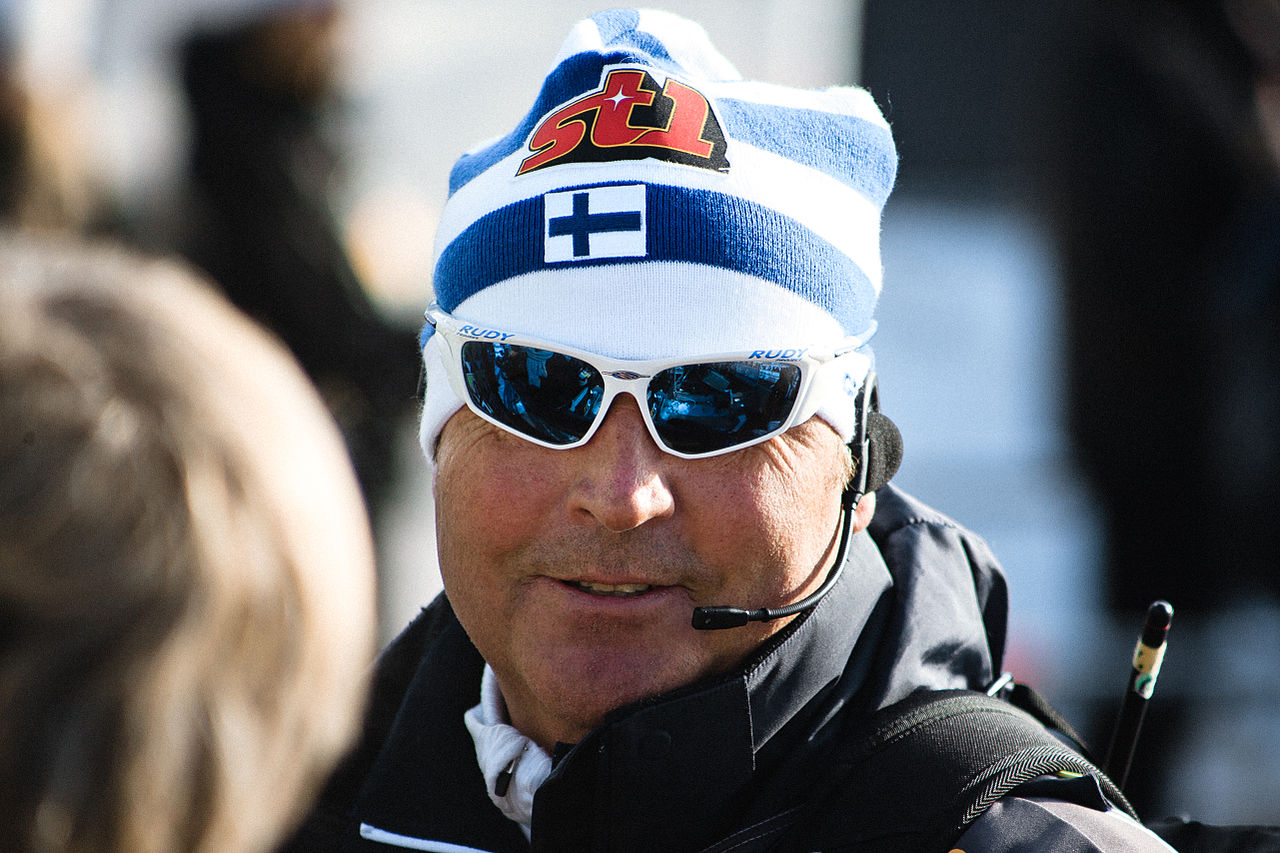
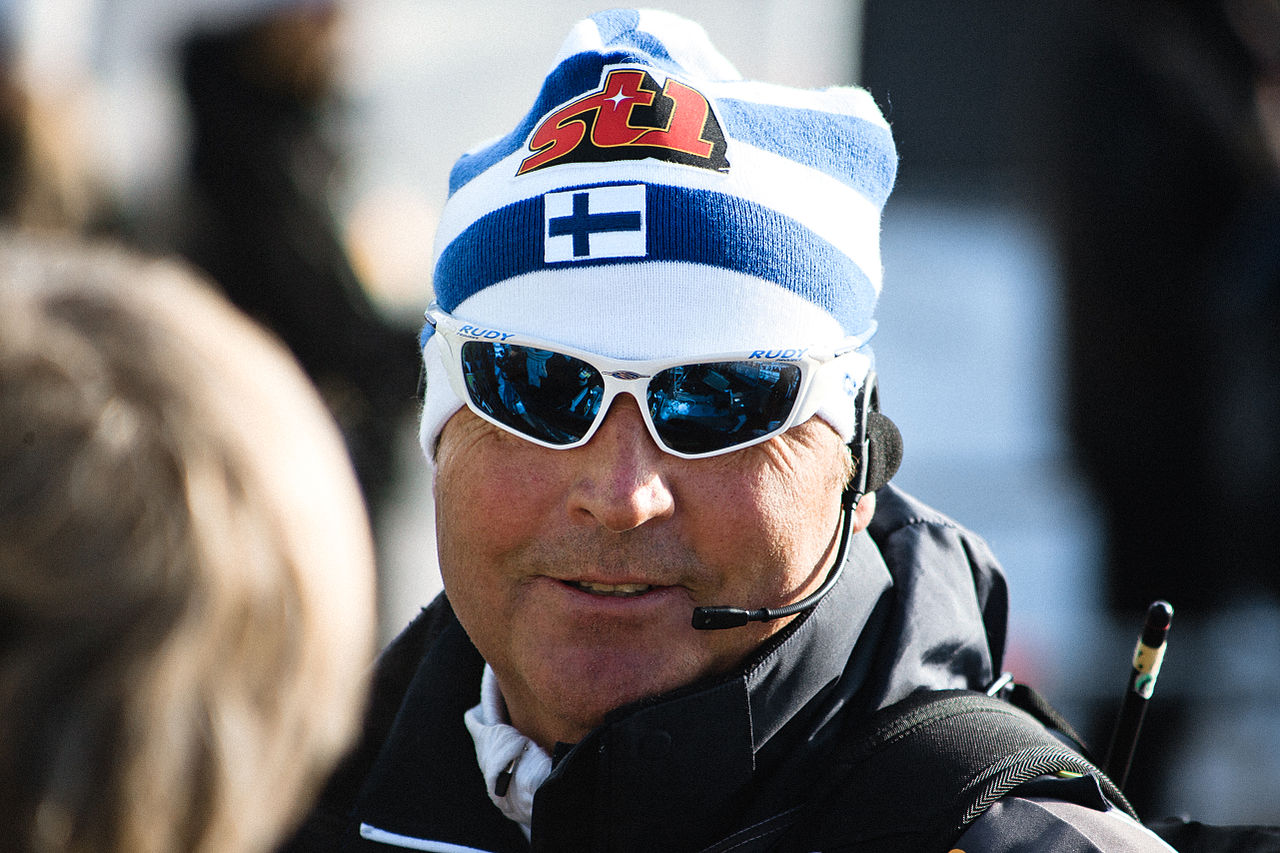
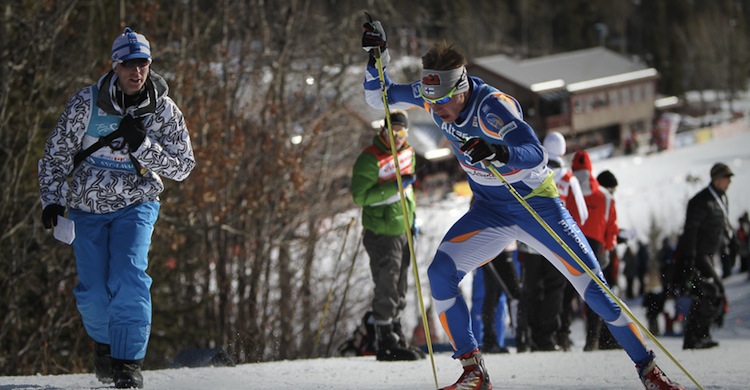
We haven’t seen the last of Magnar Dalen. After eight years as head coach of the Finnish National Ski Team, Dalen, 50, saw an end to his contract in March, and was replaced earlier this month by Reijo Jylhä, 53, and Eero Hietanen, 51. Each signed four-year contracts, but Dalen was retained as a personal coach for Anne Kyllönen, according to The Ilta-Sanomat.
The new head coach, Jylhä held the position before Dalen, leading the national team from 2001 to 2006, when Dalen came on. Hietanen, the team’s new manager, assisted Dalen from 2006 to 2010. In 2010, Dalen was named Finnish Sports Gala Coach of the Year.
In an email to FasterSkier, Dalen explained he anticipated change at the end of last season.
“[I] have been more or less ready last year that this will be my last year in Finland,” he wrote. “It’s time to go for new challenges. And for Finland to continue whit [sic] domestic coaches.”
He said his retirement after eight years might not be a record for Finland, “but not many have been for 8 years in a row,” he wrote. “I am happy about [these] years, many have reached gold medals, like Kuitunen, Saarinen, Heikkinen, Muranen, Roponen, Jauhojärvi, Ivo Niskanen. Other whit medals are Kerttu Niskanen, Krista Lahtenmaki. The future is bright for skiteam Finland.”
While he has yet to officially announce his plans for next year, Dalen told the Sanomat he’ll be a private coach for Kyllönen. He told FasterSkier he’ll also work with a private marathon team, organizing trips to races, taking care of equipment and wax, coaching certain athletes “litlebit [sic] of many things. Still things are coming to the table.
After the 2015 World Championships in Falun, he expects to look for national-team work again.
“[I] have worked in Norway, Sweden, Finland …. time for something new, challenging and difficult,” he wrote. “My goal is always to help athletes to realise their dreams.”
As for other coaching changes among international teams, wife-and-husband duo Guri and Tor Arne Hetland left the Swiss Ski Team separately after four years with the squad. While Guri, the former head coach, was unsure of her next move, Tor Arne was hired as a Canadian World Cup coach.
In their place, Slovakia’s Ivan Hudac took the reigns of Switzerland’s World Cup Team, and Swiss-Ski was expected to hire another coach to assist him.
In Germany, Frank Ullrich remains head coach, assisted by Stefan Dotzler (women’s coach), Bernd Raupach (sprint coach) and Cuno Schreyl (men’s coach), the team’s World Cup coaches each in charge of one of three training bases in Oberstdorf, Ruhpolding and Oberhof. Andreas Schlütter was promoted to sports manager.
France’s head coach Christophe Deloche resigned, leaving Francois Faivre to work as the men’s team manager with women’s manager Anaël Huard. According to FIS News, the men’s sprint coach position has not yet been filled.
After several years as Italy’s head coach, Silvio Fauner left the team and Giuseppe Chenetti was selected to replace him, with the help of World Cup coaches Paolo Riva and Constantin Pierluigi. Sandro Pertile became nordic sports director, and Marco Selle will coach the junior team.
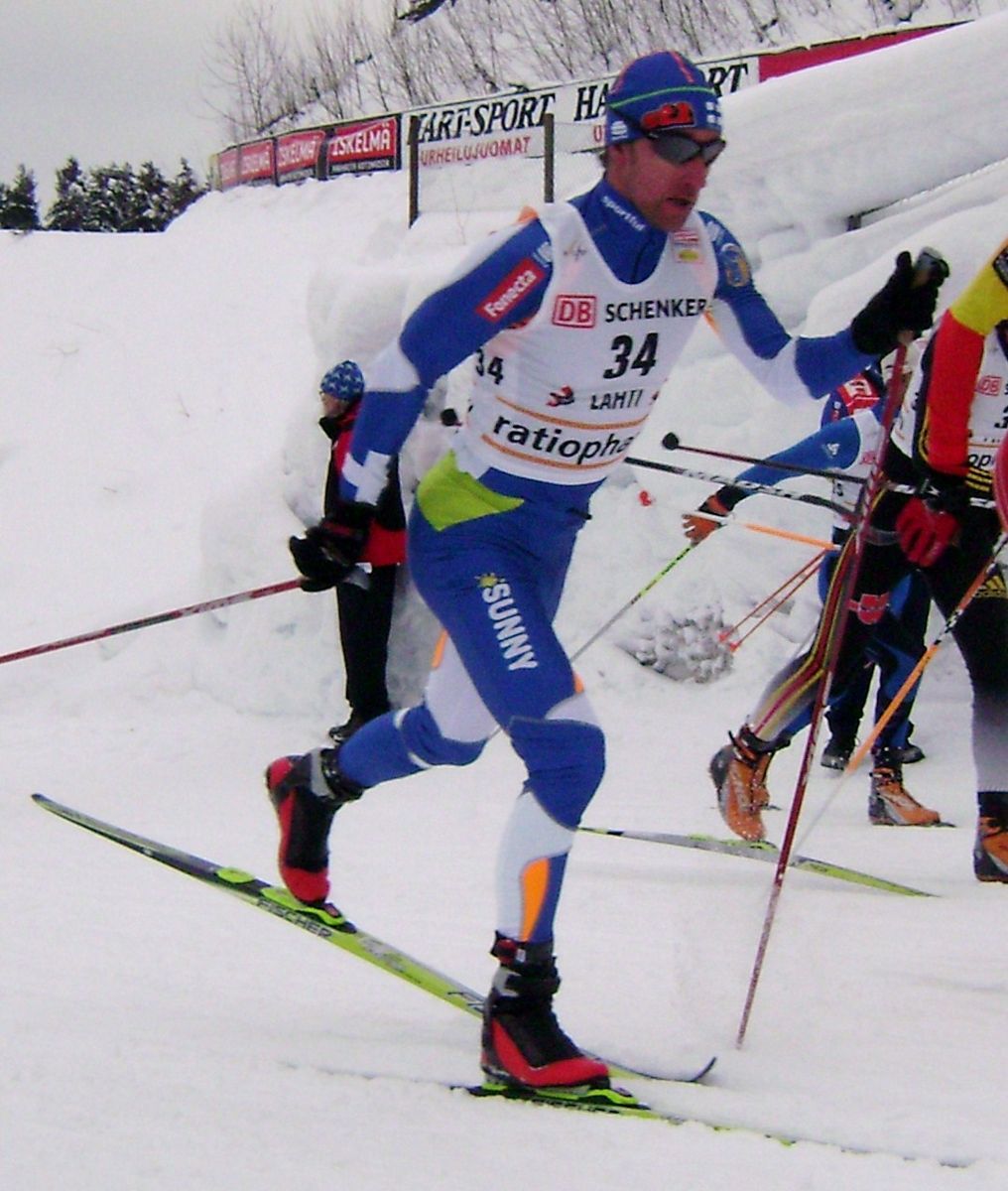
Finnish cross country skier Tero Similä at Lahti Ski Games 2010. In March 2014, Similä tested positive for EPO. (Photo: Wikimedia Commons)
The Finnish Ski Association confirmed yesterday that cross country skier Tero Similä tested positive for the blood-doping drug recombinant erythropoietin (EPO), based on a test administered in March. Both the “A” and “B” samples have now tested positive, and it is up to the Finnish Antidoping Agency to recommend a sanction, which the Finnish Ski Association will administer.
“I have been tested on a regular basis since 1999 and during that time I have given dozens of blood and urine samples. In March 2014 the FINADA doping sample proved to be positive. I do not have a test result for any comments. I want to make it clear that this issue has nothing to do cross-country Association and the Ski Federation… After this release, I will not comment on the matter any more in public.”
Similä will also face an additional fine, because last fall he signed an agreement with the rest of the cross country athletes which included a prohibition against doping. The penalty for violating this agreement is reportedly in the six-figure range (in Euros).
Similä is a career athlete who made his first World Cup appearance in 2001, in fact because of doping. After placing ninth at World Junior Championships the prior season, Similä was competing on the Continental Cup. When six Finnish skiers were disqualified for blood doping at 2001 World Championships, new athletes were called up for the post-Championships World Cups. Similä got his first start at the end of the season in Falun, placing 74th.
Although the six disqualifications at those Championships loom large over Finnish skiing – and sport in general – it is doubtful that Similä had much contact with the athletes or system at that time, as he was still an up-and-coming athlete and not on the “A” team along with them.
He has raced fairly consistently on the World Cup ever since, and was a member of the 2006 Olympic team. Despite over a decade of racing, he never broke the top 30 on the World Cup and his most notable finishes were in relays, for instance at the 2006 Olympics where Finland placed 10th. This year, he failed to break into the top 50 in three weekends of World Cup competition and spent more time on the Continental Cup.
One of his best results of 2014 came when it counted, at Finnish National Championships. Similä, 34, placed third behind Matti Heikkinen and Ville Nousiainen in the 10 k classic. He bested Iivo Niskanen, who went on to turn in a heroic fourth-place performance in the 15 k classic at the Olympics, by eight seconds, and Sami Jauhojärvi, who went on to win gold in the Olympic team sprint, by another eight.
While Finland has tried to put the legacy of blood doping behind them, it has proven difficult. Similä’s case is not the first to revive these old tensions: in 2011, Juha Lallukka tested positive for human growth hormone (HGH). Lalluka denied having used the substance, and the Finnish arbitration board for sport overturned his ban, saying that the detection limits for HGH were unreliably set.
Lallukka was back competing this winter; his only competition in the FIS database was the same 10 k classic at Finnish National Championships, where he placed seventh.
Although both cases brought forth old prejudices about the ability of the Finns to stay clean, it does not seem clear whether or not they represent any kind of systematic doping. For instance, Similä was not part of the national team, training instead with a team based in Rovaniemi, northern Finland.
Magnar Dalen, the outgoing Finnish head coach (who is originally Norwegian) hypothesized that Similä used performance-enhancing drugs to try to earn his way onto the Olympic roster.
“I am reasonably confident that this is a black sheep, and not part of a system,” Dalen told Norway’s NRK broadcaster, according to a translation. “It’s some skier who does not belong at the Olympics, and that’s always part of these seasons. Unfortunately it always tends to be this desperate attempt near the end of a career… It is always boring, but we must distinguish between individual cases and the scandals in 2001 which were organized by the national leadership.”
What is unclear, however, is how long into the past Similä’s EPO use may reach, or if he used the drug at any other point during his career. Among other issues, the test was administered in March, so if Similä was using EPO in order to make the Olympic team his use of the drug must have extended back at least several months.
“Catching the EPO in March for the first time feels not so believable,” former Swedish star Mathias Fredriksson told the Expressen newspaper. “He should have [been caught] earlier in that case. And then the question is whether he has been tested earlier in the year. Has he been tested many times and not been caught? Then you wonder how reliable the tests are? Is it so that you can take EPO without getting caught?”
Finnish administrators were visibly frustrated with the case, which they perceive as setting them back from the significant progress they have made since the 2001 disaster.
“It’s a very tedious job, because recently Finnish cross-country skiing has been very positive,” Mika Kulmala, Executive Director of the Finnish Ski Association, told the Helsingen Sanomat.
But Fredriksson, for one, wasn’t willing to give them a pass based on recent good behavior.
“Apart from this case, I know that something about the organization in Finland,” he told Expressen. “There are back some leaders who were around during the last scandal, when it was organized doping. [I] think it’s wrong that you did not delete those characters completely… It is remarkable that you do not take it more seriously, you do not shut the door completely for them. It is sad.”
Similä has previously been coached by Reijo Jylhä, although not recently. Jylhä was recently hired to replace Dalen as the national team coach.
“Most of all, it’s sad,” Jylhä told Hufvudstadsbladet, a Helsinki newspaper. “He has had a long and great career and performed equally well, though he never quite reached the top. It is sad that his career should end this way.”
Jylhä, who led the Finnish team after the 2001 scandal until 2006, said that he and fellow incoming team coach Eero Hietanen learned of the positive test the same day that the Finnish Ski Association finalized their contracts. They discussed the matter and decided that it did not affect their decision about taking the jobs, but that it emphasized the need for greater supervision throughout the Finnish system.
“The Ski Association and the athletes’ union must get athletes to undertake stronger [controls],” he said. “There cannot be athletes who are outside the target groups who we don’t keep track of. We must be able to trust anyone involved in national activities.”
Marit Bjørgen celebrates a 2.6-second victory over Norwegian teammate Therese Johaug in Saturday’s 30 k freestyle mass start, the last women’s race of the Sochi Olympics.
FasterSkier’s coverage is made possible through the generous support of Swix.
KRASNAYA POLYANA, Russia — Wouldn’t it have been fun to be a fly on the wall, or on the headband of one of the three Norwegian women leading the Olympic 30-kilometer freestyle mass start on Saturday?
The dialogue between Marit Bjørgen, Therese Johaug and Kristin Størmer Steira throughout the three-lap race must’ve been interesting. Who called the shots? Who decided when to lead when? Who directed the charge?
Then again, it sounded like it was fairly straightforward and a matter of executing a plan that didn’t really need verbal cues. With the three skiing alone for the last 20 k of the race, it was basically like a long training session. If anything, the chatter was probably conversational.
After Johaug led early out of the start, the Norwegians’ defining break came at the end of the first 10 k loop. They had already put some time into the women behind them up the unrelenting 2.5 k climb back to the stadium. There, they stuck with their team plan and skipped the first of two possible ski changes. Sweden’s Charlotte Kalla in fourth followed Johaug, Steira and Bjørgen, respectively, just under 5 seconds back.
A full lap later, Kalla was down to 31st, two and a half minutes back behind Bjørgen. No one else was close to the Norwegian trio; Eva Vrabcova-Nyvltova of the Czech Republic led the chase 50 seconds back.
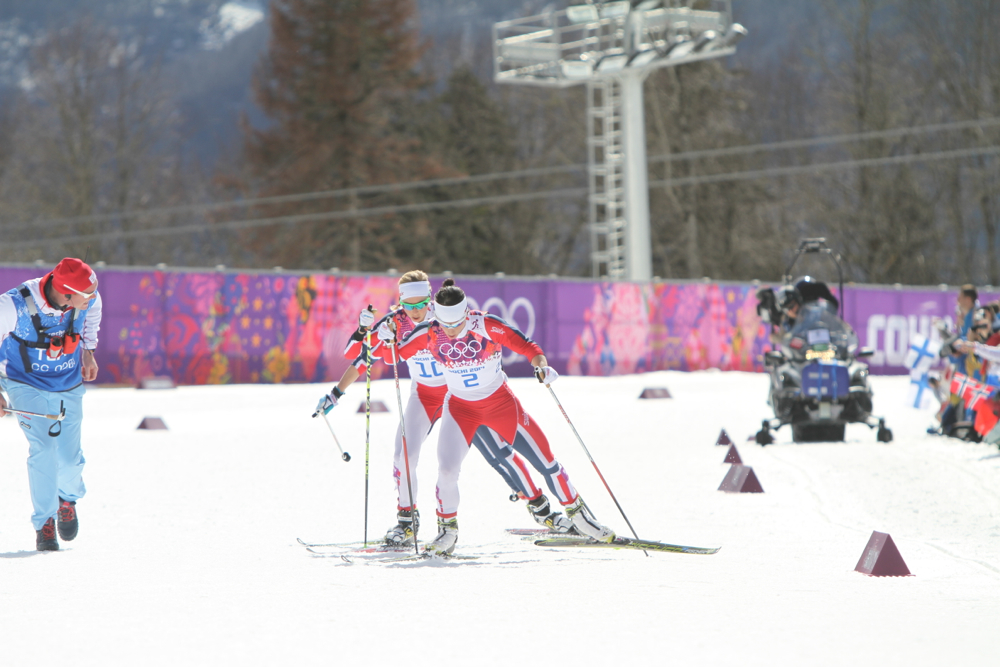
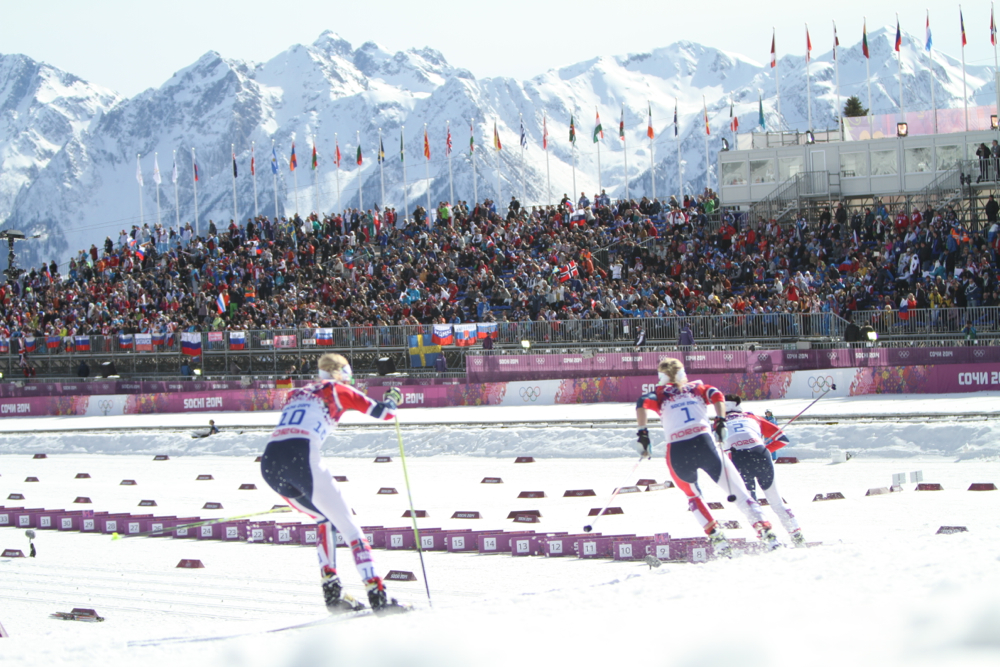
Norway’s Marit Bjørgen leads teammates Kristin Størmer Steira (10) and Therese Johaug (behind) up one of the steep climbs in the 30 k freestyle mass start on Saturday, the final women’s race of the 2014 Sochi Olympics, while Norwegian women’s sprint coach Roar Hjelmeset runs along side them. Bjørgen won by 2.6 seconds over Johaug in second, and 23.6 seconds ahead of Steira in third.
“We have a plan to go as a team the first 20 [kilometers] and after that they have to go for each other,” Norwegian women’s coach Egil Kristiansen said afterward.
According to Johaug and Steira, they had also been instructed to change skis before the final 10 k. They made the executive decision not to, fearing what some 30 seconds in the transition area would cost them.
“Me and Therese decided not to change skis; I think Marit was a bit more insecure,” Steira said in a press conference. “She was in the stadium looking around and she was thinking, if I do the ski change then the other two won’t. We talked about it and got some messages from coaches around 15, 17 k and they told us to change the skis and we were like, ‘No, no we’re not doing it!’ ”
Bjørgen, the well-established queen of cross-country skiing, went with the consensus. Unlike teams like the U.S., which switched to fresh skis at both 10 and 20 k, the Norwegians wore the same pair from start to finish.
The plan worked as they finished nearly a minute ahead of anyone else, with Finland’s Kerttu Niskanen closing hard at the front of the 11-person chase pack and edging Vrabcova-Nyvletova by 0.2 seconds for fourth.
Aside from who would win the race for fourth, the top story of the day materialized in the last few hundred meters of the final climb. Johaug led up the long hill from the lowest point of the course a few kilometers before the finish. Bjørgen sat in second and Steira started to waver in third, allowing some daylight between her and the other two for the first time in the entire race.
Up to that point, the three had generally skied single file on the tails of one another, taking feeds simultaneously and even chatting when the terrain allowed.
Now, Johaug was starting to push. The sense was that Bjørgen would make a move; where was the question.
The 33-year-old Bjørgen, who had already notched two Olympic golds in Sochi, charged over the top of the steep hill before the finish, passing Johaug and immediately gapping her on the downhill.
Johaug, 25, chased her down into the finishing lanes, which ended with a horseshoe-shaped loop and false flat that was actually slightly uphill. Bjørgen took the victory by 2.6 seconds over Johaug with a winning time of 1:11.05.2. Steira finished 23.6 seconds after Bjørgen for bronze, her first individual Olympic medal.
“I’ve tried so many times and I finally succeeded,” Steira, 32, told reporters. “It’s amazing. … It’s been a lot of hard work, but also a lot of fun. [I was] smiling all the way, but when I crossed the finish line, I felt emotional.”
It was Norway’s first Winter Olympics medal sweep since 1994, and 12th overall in the history of the Games.
For Bjørgen, the gold was her sixth, adding to her total Olympic haul of 10 medals, which made her the most successful woman in Winter Olympics history. She equaled the total gold medals won by former Russian speed skater Lidia Skoblikova and former cross-country skier Lyubov Ivanovna Yegorova, also from Russia, and tied former nordic skiers Stefania Belmondo of Italy and Russia’s Raisa Smetanina for 10 Olympic medals.
But her ratio of six golds, three silvers and one bronze beats them all.
“I am not thinking about how many medals I have,” Bjørgen said in a press conference. “This year, for sure this 30 k has been motivation for me. I am really happy … with my teammates also … it’s very good for our teammates. I think when I’m finished skiing I can think about how many medals I have.”
While she plans to compete through the 2015 World Championships in Falun, Sweden, Bjørgen said this Olympics will likely be her last.
“I think in four years is a long time, and I’m not getting younger,” she said. “I’m also thinking to have a family. I was also thinking to compete in Falun and we’ll see after that. … It’s hard to sit here and say what I will do in four years.”
Marit Bjørgen leads Norwegian teammates Therese Johaug and Kristin Størmer Steira into the stadium during the 30 k freestyle mass start, the last women’s race of the Sochi Olympics.
Johaug notched her best individual finish at the Olympics and second medal at these Games (after bronze in the 10 k classic). Four years ago, she and the Norwegian women’s team won gold in the 4 x 5 k relay. This year they placed fifth behind Sweden, Finland, Germany, and France, respectively.
“We knew we were stronger than that,” Johaug told reporters.
As for her own race, Johaug knew an attack was coming from Bjørgen, who’s typically stronger than her on the flats. While Johaug’s strength is climbing, she said her legs seized a bit on the last hill.
“I know that Marit is really strong in the last hill and she had a lot of power,” Johaug said. “I tried to do my best, but she was better than me today. … I’m really happy with my second place, but what I’m most happy for is we are three girls in the top three. It’s a big day for my team and for Norway.”
It was also the final women’s cross-country race of the Olympics, and it left Bjørgen with as many golds as she accumulated in Vancouver. At those 2010 Games, she was second in the 30 k classic and won gold in the classic sprint, 15 k skiathlon, and relay. This year, she defended her skiathlon title, then went on to win the team sprint with Ingvild Flugstad Østberg, and finally the 30 k.
“It’s incredible,” she said. “This has been a goal for me for a long time.”
Despite skiing in eighth through 12.5 k, Poland’s Justyna Kowalczyk pulled out of the race after someone apparently accidentally kicked her broken foot.
“Immediately after starting I got a minor collision with another skier,” the 10 k classic Olympic champion, Kowalczyk told Poland’s TVP, according to a translation. She had received injections in her foot before her races in Sochi to numb the pain. But on Saturday, someone’s ski hit her in a part of it that wasn’t numb.
“Eventually I got so much pain that I could not continue,” she said.
While Kowalczyk has declined to elaborate on when she plans to retire, she’s said this is her last Olympics.
“I am very upset,” she told TVP. “It was not how I wanted my Olympic career to end.”
Germany’s Nicole Fessel and Bulgaria’s Teodora Malcheva also did not finish.
As for Kalla, who ended up 34th, her Swedish teammate said the result was not unexpected after she had been “lying in bed” sick for the last few days, according to EuroSport. Aftonbladet reported that she had a cold.
Finnish head coach Magnar Dalen said his team was “very happy” with fourth.
“Norway had a very strong team with four skiers, and one of them had a bad day and three had a good day, so then the medals was gone,” he said, referring to Norway’s fourth woman Heidi Weng in 19th. “Then we was winning the league number 2, so we’re happy about that.”
“That is not an abnormal … high altitude, hard track, skating race,” he said of the Norwegian sweep. “It was just sad that Charlotte Kalla had been sick and was not able to fight with them.”
“It’s nice to see them skiing, helping each other, working as a team and building up the distance to the others,” Swiss head coach Guri Hetland said. “It’s impressive, and it’s impressive what Marit does. I think it’s her 18th gold medal in championships or Olympics. So that’s amazing. For them, it’s normal. They are training together, they are pushing it, and that’s also the reason why they are so strong.”
Østberg said her teammates have been “really focused since the relay, trying not to think about the skis.” Ultimately the Norwegian team went out on a high note, along with its waxing staff.
“At some point [we knew] they would figure out what to do with the skis,” Østberg said.
— Nat Herz and Chelsea Little contributed reporting
Heck, the whole Russian team has been shut out of the medals at their home Olympics.
Finland’s 22-year-old Iivo Niskanen after notching his first World Cup top-10 on Jan. 18 in the 15 k classic in Toblach, Italy. (Photo: Gerry Furseth)
But what about the flip side – the athletes who have amazing, unexpected performances on skiing’s biggest stage?
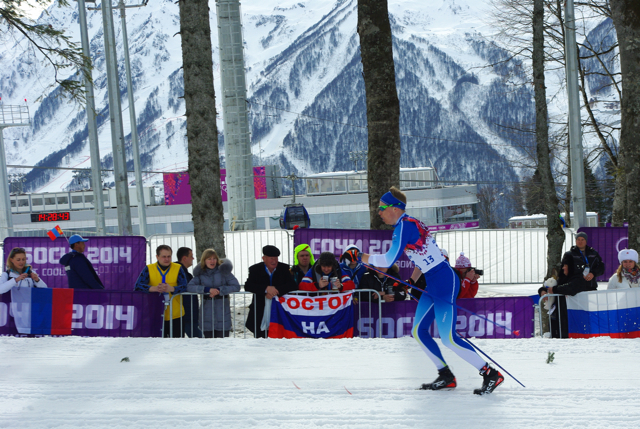
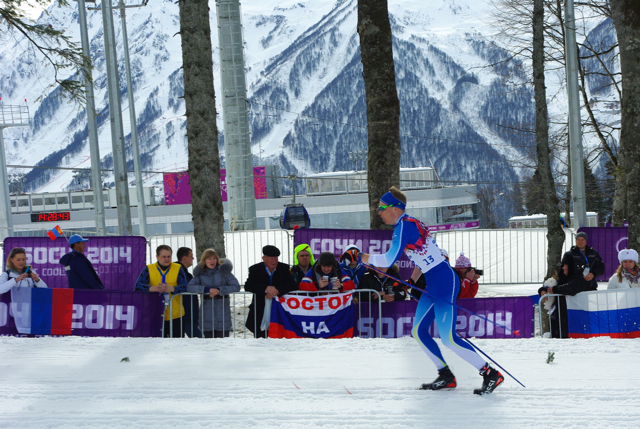
That happened to Iivo Niskanen, a 22-year-old Finn, in the 15 k classic race today. Starting unheralded in bib 13 – the seeded group didn’t start until bib 36, and the World Cup leader was in bib 53 – Niskanen quietly put together an amazing race. As soon he finished, Niskanen moved into the leader’s chair.
“If it was a very good race, I was hoping top 15, that could be possible,” Finnish coach Magnar Dalen told FasterSkier.
Niskanen is hardly a no-name skiing. Just take his last name: it’s already familiar to ski fans since his siter, Kerttu, is a staple on the Finnish team. Earlier this season she won a stage of the Tour de Ski.
And the younger Niskanen himself has been winning recently too. He considers himself a classic specialist and took top honors in this same format at U23 World Championships a few weeks ago.
But that kind of winning doesn’t usually translate so easily to the Olympics. Niskanen wasn’t kicked out of that chair until Dario Cologna of Switzerland, already a gold medalist in the 30 k skiathlon, crossed the line and moved into the lead. Cologna had caught Johan Olsson of Sweden, who moved into second place. But this was still before any of the top seeded group of skiers had started.
Niskanen’s times, though, were holding up. After all the best skiers had passed through the intermediate checkpoints, the young Finn was still ranked second at eight kilometers and third at 12.5 kilometers.
In the end, with a little more information to go on, Daniel Richardsson of Sweden made a mad charge over the last few kilometers and moved from fourth, behind Niskanen, into third, bumping the Finn out of bronze by 0.2 seconds.
“I was happy when I crossed the finish line, but now I’m just annoyed,” Niskanen told Ilta-Sanomat, a Finnish newspaper.
So it wasn’t a medal – the Finns are yet to win one at these Games after Aino-Kaisa Saarinen missed bronze by two seconds in the 10 k classic – but according to Dalen, that might not matter.
“That is like the most exciting thing you can have,” he said. “Of course it’s a little disappointing that you are 0.2 from the medal, but always in my 26-year career in coaching the best thing is to see a star be born. And the medal was not there today, but there will come a lot of them in the future. I’m very sure about it.”
While Dalen said that there were no morale problems within his team – Matti Heikkinen, “usually a good Championship skier”, got sick ten days ago and so could not expect to pull any heroics, and Saarinen quickly got over her disappointment – a surprising run by a young skier will definitely be good for team spirit.
“That’s helping,” Dalen said. “It’s good and especially to have a little bit of an unknown athlete making their breakthrough during the Olympics when it’s more difficult to do the top races. It’s lifting up the future.”
What was unique about Niskanen’s result? So early in his career, he is a very different athlete than his older teammates, who have already earned medals in international competition. Having no pressure, Dalen suggested, maybe even helped the 22-year-old turn in a good performance by just thinking of the Olympics as a normal race.
And his preparation was certainly much simpler than that of his more famous teammates.
“He came and tested two pairs of skis and he just took two minutes to test his skis,” Dalen laughed. “Then he said, this is my race pair. He is a little bit different: he is not testing ten pairs of skis and measuring things. He’s doing fast decisions, and then it was full focus for his race.”
That quick decision-making turned out to work just fine, as Niskanen not only skied strong and aggressively, but also happened to have one excellent pair of skis between the two he was chosing from.
“That Finnish guy came by me really fast,” U.S. skier Erik Bjornsen marveled, remembering when Niskanen flew by him from 30 seconds back. “I tried to stay with him but he had really fast skis and he was also just killing it.”
For Finland, a team facing retirement in the next few years from 35-year-old Saarinen, 30-year-old Heikkinen, 32-year-old Sami Jauhojärvi, and 35-year-old Riita-Liisa Roponen, Niskanen’s result is particularly meaningful.
“It’s giving our sponsors hope for the future,” Dalen said. “And we have World Championships coming up in 2017 in Lahti again. This is three years ahead so the interest in World Championships will increase a lot. So maybe the fourth place was more important than people think.”
A view of the men's course for Stage 7 of the Tour de Ski.
TOBLACH, Italy – Stage 7 of the Tour de Ski, which took place Thursday, is the event’s crown jewel: a 35-kilometer point-to-point race that sent competitors up an over a mountain pass, with the craggy Dolomites as a stunning backdrop.
Or, to be more precise, it sent male competitors up and over a mountain pass, with the craggy Dolomites as a stunning backdrop. The women, meanwhile, skied three laps of a standard five-kilometer course on the trails in Toblach, never heading up high to the rugged alpine scenery.
We checked in with a number of coaches and athletes to see what they thought of the discrepancy.
Marit Bjoergen (NOR): “For us it is better, because when [there is] a group, and…one in front, it is hard to go in front. But for us, when the track is round, it is easier to go alone. I think it is better to do it like this.”
Rickard Grip (Swedish women’s coach): “Actually, I think it’s a little boring that they go on this normal 5 k track for three laps. I think it would be interesting to see if the ladies started where the men will start. They wouldn’t [have to] go the first three or four k—the men go all the way down here, then they go the 5 k loop, then in the finish. So, I think maybe the women could go on the track to here, and then not make any laps [on the 5 k loop), or maybe do a really short one, or something.”
“I think it would be interesting to see about that, because it’s a little bit boring that they just go [in Toblach].”
Kikkan Randall (USA): “Last year I was kind of up in arms about, ‘Hey, why do the guys get to do a cool point-to-point race, and we don’t?’ But after skiing here, I felt like it was a really good course, and it still accomplishes, you know—people gapping together, people spreading out. And I think for us to do a point-to-point course, it was going to be mostly downhill, so I think it’s a good venue…there’s still plenty of exciting racing.”
Sami Jauhojaervi (FIN): “The [35 k] track is not the best possible for ladies. A lady who is skiing alone will lose from one to three minutes, compared to a group, which can change the leader all the time. It would change too much. The time differences in ladies are already now big—too big.”
“Of course, us men, it’s nice to have some challenge, but of course on the lady’s side, it’s huge gaps. And those would be even more huge. So the number three [lady] would start in the wave, [if] they would do this 35 k.”
On an alternative: “They could, for example, in this stadium—they could do some uphill, and then come down from another track. For five kilometers, flat-uphill, seven kilometers to 10 down, then some loop in the stadium.”
Astrid Jacobsen (NOR): “Of course we could race 35, but I think the day we should race 35, we should also have the same distance for the shorter races. Like, [in the prologue in Toblach], we had three [k], they had five [k]. And I think also—it’s bigger gaps between the women and the men, so if we had a 30 k, it would be really not interesting any more. Because I think it would just be one skier, [then] two minutes, one skier…[That way], we’d get too big differences between the skiers, and then it’s not so much action any more…I think 30 k tomorrow would be maybe not so fun to watch.”
Magnar Dalen (Finnish head coach): “I feel that it should have been much better that the women had the same type of race [as the men]. Because the race they have tomorrow on this hard track [the 5-kilometer loop] just separates the real good engine skiers more. If the ladies had had the same as the men—maybe five kilometers shorter, but still with a slight downhill—it would have been very interesting for the overall. Now, the Tour will be like [settled] tomorrow. Not who is one and two, but all the others behind will have big problems, and impossibilities for the podium.”
“It’s a hard track [the one the women are skiing]. It’s an extremely hard track at high altitude. (Toblach is at roughly 4,000 feet above sea level.) I don’t see any reason—why are the girls skiing a harder track than the boys?”
On the feelings of the Finnish women: “They want to have it the same as we had at the beginning of the Tour de Ski—then they were starting [the same course as the men].”
Charlotte Kalla (SWE): “I don’t know. I’m very focused that it should be 15 kilometers…it’s enough with 15 kilometers.”
“It would be fun to go from one place to another, but I don’t want to go 15 kilometers downhill.”
As far as coaching goes, Magnar Dalen has been around the block. Formerly the head coach of the Swedish team and head wax tech for the Norwegians, Dalen has been in charge of the Finnish program for the last four years.
When Dalen took over Finland’s team in 2006, the women were already strong, with Virpi Kuitunen and Aino-Kaisa Saarinen finishing sixth and 12th in the World Cup overall the year before. But the men’s program was suffering—their best finisher was Sami Jauhojarvi, in 44th. By last year, though, they had four women in the top-ten, with Jauhojarvi in fifth. The program seems to work.
We sat down with Dalen for an interview at Silver Star Resort, where part of his team was preparing during the last week before the Olympics, to talk about training and development, doping, and the Games.
FasterSkier: Can you start out by giving us a sense of your team’s travel and preparation for the last month leading into the Olympics?
Magnar Dalen: It actually started directly after the Tour de Ski, because that was like one of the big targets for the season. After that weekend we had some athletes that were very tired…like Matti Heikkinen and Sami Jauhojarvi, so they didn’t ski the next World Cup race in Otepaa. After Otepaa there were the Finnish championships, in an extremely cold period, so that was disturbing a little bit. We had many days with temperatures at -20, -30 degrees, so it was quite difficult to do really hard training and intervals training. That was the only stone on the road so far.
Everybody has had good pre-camps, and the team is healthy—we don’t have any sickness at the moment, and we hope that it can stay that way until the Olympics.
FS: Do you feel like you give up anything by racing the Tour de Ski?
MD: No. It’s just like—you need some very hard training periods during the competition season, and that was for many of our athletes a well-planned peak of very hard training. We used it not only as a competition; we used it also as a part of trying to be in the best possible shape for the Olympics.
FS: And in terms of the kind of training you guys have been doing in Silver Star over the last two weeks?
MD: It’s very individual—what each athlete needs according to where they are in that curve that hopefully is leading to the peak. So some need to push very hard and some need to take it very, very easy. And we have had pre-camps in three different places. We are using Silver Star for those high altitude-positive persons that normally deliver their best results after a high-altitude training camp, and also who have their focus on the start of the Olympics. And then we have a second group that has stayed in high altitude or medium-high altitude in Middle Europe—they are not focused on peaking in the beginning of the Championships. Their peak is meant to come later, at the end of the Championships. And then we have those that are sprinters, or those who are most homesick—they are kept at home in Finland and travel directly to Whistler. So it’s the three-way system.
FS: Is that a challenge, managing the training for all the athletes in three different places?
MD: First you have to think about what would happen during a five-week stay in a big group. I know that the last week, people will get mentally very tired—they are starting to miss home. Even if everybody on the team is good friends, there are always some irritating things inside the group. So that’s why I did it that way—I wanted to split them, and then it’s very fun for everybody to meet in Whistler. Then they have two weeks together and everybody will talk about what they have done in Silver Star, and what they have done in Ramsau and Toblach, so then they have a good starting point. Hopefully that will last for the whole period.
Finland's Ville Nousiainen racing at the Canmore World Cup. (Coach pictured is not Dalen.)
FS: Do you worry about not having a final measuring stick like the Canmore World Cup?
MD: To be worried, that’s a part of our work—you’re worried all the time (laughs). But when you have adult skiers that you know quite well, then telephone and internet and mail and so on is good enough. Mainly it is that the results you’re having at the Olympics are normally the results of what you’ve done for a whole year, especially the last eight months of your training season. And then these two, three last weeks—that’s mostly to stay on the high way, and not make things complicated.
…Then Look at the Results List
FS: Can you talk about your goals for the team at the Olympics?
MD: That’s very easy. It’s to ski as fast as possible, then look at the results list after, and find out how good it was (laughs).
FS: So you don’t have any objective goals for the Games?
MD: Nope.
FS: Do the athletes feel the same way?
MD: No, of course, they want their personal goals and their dreams like everybody does. But no medals are won by speaking before the races. They are delivered after the skiing.
FS: How many athletes do you have [for the Games]?
MD: 17. We are not using all the spots, but that’s the number of athletes we have that we have some kind of hope that they can deliver some top results.
FS: Have you decided who will race each of the races?
MD: For the beginning, that is decided, but then it’s played out depending on the results they are delivering. The relay team—that will be ready after the sprint relay team.
FS: Is it nice being able to prepare here, away from the intense pressure in Finland?
MD: That’s very good. It’s one of the biggest benefits you can have—you can stay quite quiet, and everybody can live their whole lives and have some recovery. We know that when we’re arriving at the Olympic Village, then a lot of stress is coming.
FS: How do you manage all of that attention?
MD: With media we make very clear rules—what times we will have press conferences, when different kinds of information will be delivered. Then we have special places in the stadium where athletes and journalists can meet, and they have to book these different times. So it’s kind of run like a factory.
FS: Having experienced this with Sweden and with Norway, is the pressure as intense for Finland?
MD: Oh, Norway is very special. The interest is enormous. So it’s kind of—they are in a little bit of a special situation with that.
FS: Maybe that gives you guys a bit of an advantage?
MD: Well, on the other side, it’s like, all things with the media and so on are giving a benefit to your national team. The Norwegians have so much experience—they are used to handling it. I don’t feel like that’s adding extra pressure to them—it’s more that they just have to use more time to do the planning and so on.
Scandinavia in Context
FS: We were wondering if we could talk a little bit about the differences between the Scandinavian countries. You’ve coached so many different elite level national programs—could you draw some comparisons between the cultures?
MD: The top skiers who are fighting for medals—if they are coming from Norway, Sweden, or Finland—it’s very similar. The kind of training they are doing, the kind of self-confidence they have, and so on, so that’s not very big. I think if you look into—maybe the Eastern European countries—then you can talk about a very different culture, how everything is organized. But Europe or Canada and maybe the U.S. team—I think it’s quite similar.
FS: In terms of the different development systems—is that true too?
MD: Yeah—the development system. What can I say about that? In one way, it can be many good things coming from that side, but on the other side, it can also be a little bit too complicated. If there is too much detail, it can be a blocked system. So I personally look very much for the individual athlete, and try to prepare them to make their own decisions and trust their own capacity, and work with the weak sites. That’s the most important. Many times I’ve said, “try to find your three weakest points.” It can be double-poling or diagonal technique or downhill, or whatever. Work with the three weakest points and try to make your strongest points stronger. Then you have a good working system.
FS: And whether you’re from Norway, Sweden or Finland, everyone’s going to have those three weaknesses?
MD: I think that’s like—almost all top skiers in the world have learned a new way of double poling technique, which has changed very much during the last ten years. Now there are maybe more things happening in skating techniques, like everybody is getting better at closing their legs when they are putting their skis down to the snow, instead of being open and wide. So still, the most important is to have a strong engine and a very strong head, combined with a tolerance of a lot of pain.
FS: And the way that the athletes respond to the coaching and the feedback that they’re getting, there’s not really very much difference in the culture and the way that works between the three Scandinavian countries?
MD: No—in all countries you have those athletes who have a lot of self-confidence and can make all their own decisions. You also always have some athletes that more or less need the timetable for when they should brush their teeth (laughs).
Skiing and School—“This Balance Thing”
FS: We know the club system is very strong in Norway—is it similar in Finland? Is that how a lot of your younger skiers come up?
MD: Yeah—that’s the base, the local ski club in your local area. There is normally some older man or woman who is fascinated with cross country skiing, and they try to organize trainings two or three or four times a week. People are meeting and they are working in that group and trying to have fun together. And out of that group grows someone that finds out that, “wow, I really like this sport, and I want to put more into it,” and then they are maybe moving to a bigger ski club, or normally they have to go to a ski gymnasium system. Then they are getting in contact with professional coaches and so on.
But I feel that most of the athletes—Norway, Sweden, and Finland—even when they are up at the highest level, they still have a good contact down to their starting point.
FS: Are the skiers just below the national team level—are they very well supported by their local clubs, or their ski gymnasiums?
MD: That’s the main problem in Finland, to make the economics good enough. To have the possibility of training full time is very difficult.
FS: Compared to Norway, for example?
MD: It’s very difficult to get private sponsors at a level that you can go all in for cross country skiing.
FS: So once you get to the highest level, it works well, but if you’re just below…
MD: It’s very hard. And you have to—nowadays you need to have a kind of education to have a normal standard of life after your career. And if you go thirty, forty years back, you could go skiing and then you could work with your body in the forest, or that type of thing—when you stop skiing you immediately could start to work. But nowadays it’s not working that way, so there are many athletes who have a hard time with, “should I [ski], or should I continue harder with the studies?” There’s all the time this balance thing.
FS: Does anyone try to do both—school and study, and race?
MD: Then you’re coming to the individuals again. There are different skiers—some have the possibility to give the body good training and still they can work with hard studies and get to a very high level of studying, like Anders Soedergren. There are some that are very well educated during the time that they are doing their top skiing. But some are putting everything for top skiing, and if they don’t succeed with their career, they have to start with a lower rank out in normal life.
FS: Is that something that’s part of your role as the head coach—to try to remedy that?
MD: No—I feel that when they come up to my level, then they are professional skiers. And you do have personal meetings with the athletes, and especially those that haven’t succeeded, and the things that they are worried about for the future are coming up. They don’t know if they will take the risk to continue with cross country skiing for two more years—they maybe will start to study and ski. When I have that on the table, I know that the chance of getting to the top in cross country skiing is getting very small.
FS: It seems like it’s a subtle difference, but in Norway, there are more opportunities later in life for people who choose skiing as their career? Do you agree?
MD: Cross country skiing is enormously popular in Norway. You are getting a lot of support from clubs and from areas and from the National Team and so on. So they have the best system at the moment to care for and make the possibility for many skiers to concentrate on skiing. But that’s very good work that they have done for many years. They are getting the apples down…
FS: So then do you think for a country like Finland, or a country like the United States, where there isn’t that much public support or very many opportunities after skiing for their skiers—do you there is a way to ever build programs that will be able to compete with Norway, in terms of their numbers?
MD: Not in the numbers of top skiers. But even if you are from Kenya you still have the possibility to be the best skier in the world. You just have to be very motivated and you have to go all in, if you use the poker language. And if you think that everybody else has better possibilities than you, you will always be a loser. You have to think that it’s the body and the brain and the tolerance of pain, and then of course you have to work with technique and train on the right terrain, and so on. But that is what is good in sport—that it is possible to reach medal level if you have strong enough motivation.
Riika Sarasoja (FIN) in Canmore
FS: It’s just maybe a more lonely pursuit.
MD: Yeah, but that’s also, for some athletes, the right way. They are that kind of social person who has a better chance for success if they do it alone. For others it can be that the group is taking their energy. We are seeing many examples of that—athletes coming from the outside and coming up to a high level, and then they go into a team and get everything prepared for them, and they are not climbing any more. It’s like going out—because everything is served.
FS: So maybe here, it’s a different kind of person and a different kind of athlete that would be successful, compared to someone in Norway.
MD: Yup. If you look at [Justyna] Kowalczyk on the ladies side, she is coming from a not cross country country, but I am sure that she has enormous motivation to try to get to the top of the world, and she is there today.
FS: You’ve been around the sport for a while, and in the past 10, 15 years the American program has been coming up. We were wondering if you had been able to observe them at all over that period, and what you could say about the improvements that they’ve made?
MD: That’s difficult for me. I just noticed that Kris Freeman is a very strong skier, and he is one of those twenty, thirty men skiers that have a possibility to make a medal in Vancouver. Behind him, I don’t have a very good picture. Kikkan was very good in sprint skating, short tracks. Newell—a little bit down for him this year compared to earlier—let’s hope he can do it in the Olympics. Torin Koos—that was a surprise in Canmore.
Eating the Fish
FS: We were doing some research—in your contract, we read that you have a clause that states you can resign at any point if Finland is involved in a doping scandal. Is that correct?
MD: Yes. And also if I should be involved or have knowledge of any of my skiers using illegal things, I have to pay 50,000 euros.
FS: Is that something that the national federation set up, or that both parties wanted?
MD: Well, I didn’t set up that I wanted to pay… (laughs).
FS: Because we know that Finland has had a couple of controversies in the past. We know in Norway they have a very strong anti-doping culture—we’re wondering if there’s anything you can tell us about those differences. Because it seems like then with Russia, it’s something that’s more acceptable—it seems to be a bigger issue. How does Finland fit in?
MD: That’s a very big subject to go inside, and you need to know how these different systems are working. So what many times we may be complaining about in Russia is that we see this athlete using this and this. We have to understand that the athlete’s opinion or the athlete’s wish is zero in those countries. If they say that today there are two dishes, fish and meat, and the coach says, “today you eat fish,” then you eat fish. If you try to take the meat, then you are off the team. It’s exactly the same. If they say that “this is vitamin C,” then you take vitamin C, and you don’t ask if it’s really vitamin C.
FS: So then in Finland, what is the public’s opinion on these kinds of issues?
MD: I think they are doing things correct from the federation and from the government, and from Finnish sports overall. They are putting in place very hard rules and also giving out punishments if somebody is not playing inside the paper.
FS: So in addition to FIS and WADA, the federation also is part of this?
MD: Then we have to also recognize that the Finnish federation has now been totally switched around. So actually the cross country is out of the federation, and made its own new federation—that has been on the way for two years, but it was finalized five months ago. We built everything again from the economics, to the marketing, to the sponsors, competitions. Instead of being in a big, big organization, it’s separated out, and we have more control over our economics. I got my budget for next season, and I know that it’s 437,000 euros, and that is what I have.
FS: As a Norwegian, you’ve worked now in Sweden and Finland—are there any kind of loyalty issues there?
MD: No. It has changed so much in the last ten years. Ten years ago it was like, everybody was working in their own country. But then people started working here and there, and now it’s like an international business life, like, “okay, we need a wax man.” “Okay, we’ll grab that one from Sweden.” Or, “okay, we need a physio,” and the Italians grab that from Finland, and a coach moves like this, too. So the whole system is very open.
FS: What do you think is driving those changes?
MD: It’s a kind of picture of the whole world—that everything is getting internationalized.
FS: Globalization?
MD: Yeah, globalization.
FS: Lastly—we spoke with Justyna Kowalczyk in Canmore, and she said that she was training five to six hours a day and 1200 hours a year. What is the range that the Finnish athletes are training in terms of volume?
MD: It’s between 700 and 900 hours. The average for medalists at World Championships and the Olympics is 800 hours.
FS: That’s both men and women?
MD: Yup—men and women both do the same amount of training in all countries, as far as I know. At least in Norway, Sweden, and Finland they are training around the same number of hours, and then we always have the specific things, like how you count strength training. Is it from when you walk inside the strength room, or is it only the seconds where your muscles are working?