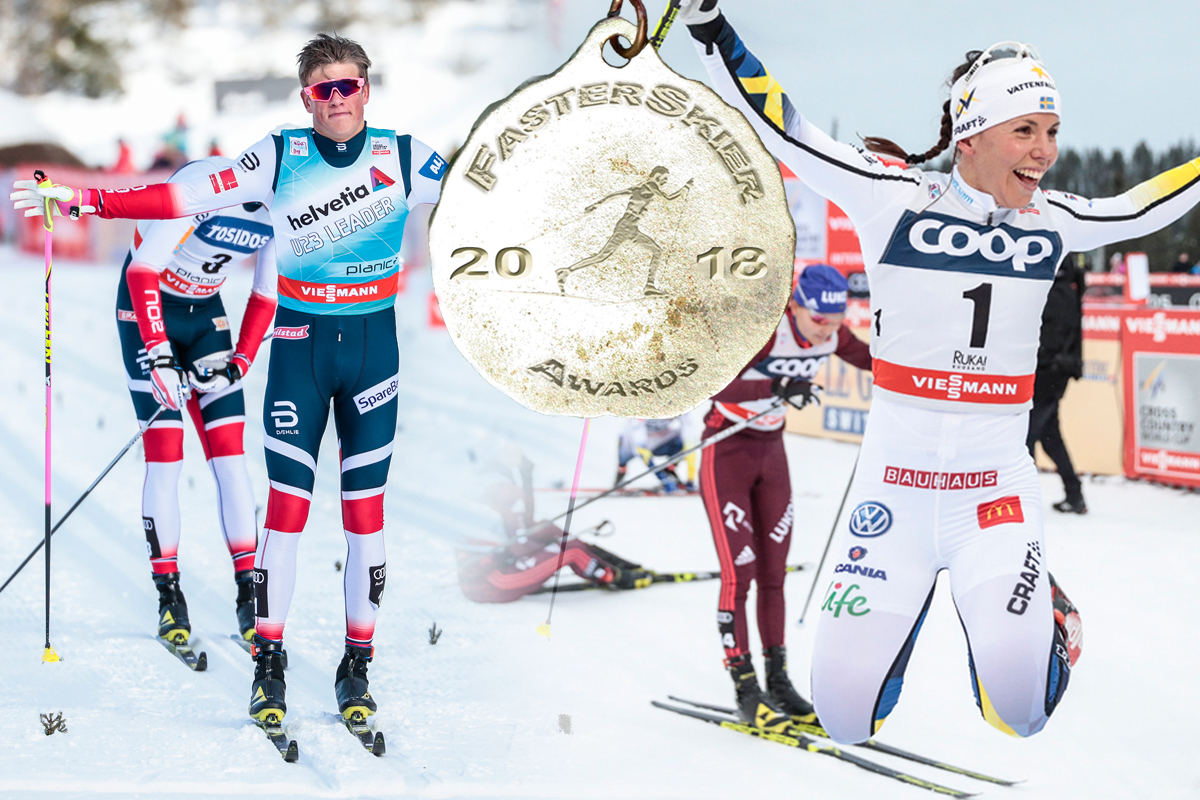

With the 2017/2018 season officially in the rearview, FasterSkier is excited to unveil its annual award winners for this past winter. Votes stem from the FS staff, scattered across the U.S., Canada, and Europe, and while not scientific, they are intended to reflect a broader sense of the season in review. This set of honors goes to the international skiers of the year.
Previous categories: Junior Skiers of the Year | Collegiate Skiers of the Year | Biathletes of the Year| Para-Nordic Skiers of the Year | NoCo Skier of the Year | Canadian Breakthrough Skiers of the Year | American Breakthrough Skiers of the Year| Coach of the Year | U.S. Continental Skiers of the Year| Canadian Continental Skiers of the Year| International Performances of the Year
***
Charlotte Kalla
In her results and her consummate focus on honing in on championship-performance skiing, Sweden’s 30-year-old Charlotte Kalla is a master of showing up when it counts and a maestro of peaking.
In this Olympic year, Kalla only contested 12 World Cup events. She skipped the Tour de Ski (TdS) for a pre-Olympic altitude camp (as did several other top skiers), yet she was on everyone’s radar in the buildup to the Games.
One can imagine Kalla and her coach Magnus Ingesson — now a Swedish national team coach — mapping out the season with scalpel-like precision. She came to the opening weekend in Kuusamo, Finland, ready for Level 5 racing. She won the mini-tour title there after placing second in the 10 k classic and winning the 10 k freestyle pursuit on back-to-back days.
A week later, in Lillehammer, Norway, Kalla won the 15 k skiathlon, proving she can kill in skate technique, but her classic skiing is also world-class. The Swede won again on Dec. 16 in Toblach, Italy, in the 10 k skate. (The next day, Kalla placed sixth in Toblach’s classic pursuit.)

As far as fitness during Period 1, that was affirmed. While skipping the TdS, Kalla began her Olympic buildup. She didn’t race again on the World Cup until Jan. 21 in Planica, Slovenia. There, she placed second in the 10 k classic.
Kalla contested eight World Cups before the Olympics and won four. Her Planica podium proved she hadn’t relented any of her top racing gears between mid-December and the end of January.
Kalla has historically been an athlete able to prime for the big events. She’s won a total of 12 World Championship medals. Between the Vancouver and Sochi Olympics, Kalla had captured two gold and two silver medals.
In the opening race at this year’s PyeongChang Olympics, Kalla won the 15 k skiathlon. She then racked up three silver medals in the 10 k freestyle, 4 x 5 k relay and freestyle team sprint. Her eight Olympic medals make her Sweden’s most decorated cross-country skier. She is also the first Swedish women to have won three Olympic golds. (Gunde Svan won six Olympic medals: four gold, one silver and one bronze.)
Kalla’s limited World Cup schedule put her sixth in the 2017/2018 Distance World Cup standings and seventh in the Overall World Cup.
Johannes Høsflot Klæbo
The man in pink — pink poles, pink glasses, pink gloves — 21-year-old Norwegian Johannes Høsflot Klæbo earned 168,449 Swiss Francs on the World Cup. That’s nearly $175,000 U.S. dollars. All those World Cup winnings mean one thing: it was the year of Klæbo.
Combined, Klæbo had 14 World Cup podiums (including stage races) this year. He had a single third place, two second places, and a whopping 11 first places. There’s more to this than simply the ka-ching of his bank account.

It’s not as if Klæbo has been seasoned with age, learned to temper his efforts for the long-haul effort of a total World Cup campaign. His race efforts were a full-body immersion starting on Nov. 24 in Kuusamo, Finland. There, he swept the three-race Ruka Triple. He won the next three races: two in Lillehammer and one in Davos, Switzerland.
Klæbo’s win in the Lillehammer 30 kilometer skiathlon was striking. He looked gassed as he was dropped by teammate Martin Johnsrud Sundby on the courses last significant climb. Klæbo never bowed to Sundby. He kept his losses in check, regrouped, and through his last-kilometer catch-up effort, put Sundby on warning. Klæbo won. Sundby placed second.
In his last race before skipping the Tour de Ski for a training block, he won the 15 k classic pursuit in Toblach. That proved to be his last distance win in a World Cup or Olympic race this season.
When considering Klæbo’s sprint season, his efforts were nearly a clean sweep. He entered nine World Cup sprints. He won seven and placed second and third in his other World Cup sprint starts. That all amounted to him winning his second-consecutive Sprint World Cup Crystal Globe.
His cumulative performances this season also brought him his first Overall World Cup Crystal Globe. In doing so, he also became the youngest Overall World Cup champion since Gunde Svan came out on top of the 1983/1984 World Cup season. Svan was 22 at the time.
Certainly Klæbo will have to dust his Crystal Globes and we’re assuming more will come his way. He’ll also have to spend considerable time in the offseason posing for Olympic medal shots with sponsors and supporters.
Klæbo flew back to Norway after the Olympics with three gold medals. He won the classic sprint, freestyle team sprint and 4 x 10 k relay. His sprint win made him the youngest cross-country Olympic champion in in the history of the Winter Games.
All the metrics on winning and podiums doesn’t speak to how Klæbo has made us talk about the sport. His name is a verb: “to Klæbo” — as in, run-stride or simply run-run when it comes to classic technique on the steeps. Klæbo may kill it in pink, but his non-traditional classic skiing gears are in fact something that may be his real legacy.
The upside to all of Klæbo’s winning when considering his opponents, is that eventually he’ll age and slow down. That slow-drip decay might take a decade. Ten years is a long time for neon-pink to remain in fashion. Klæbo’s race performances this year were peerless. The pink, it was omnipresent on the podium, and most likely will be trending for years to come.
Honorable Mention: Dario Cologna
Wait. Who? Yeah. Thirty-one-year-old Swiss skier Dario Cologna. He was the comeback kid this season. To come back, in the first place, you must have been somewhere before. Cologna, in the past, has seen his fair share of podiums and championship medals. He was the first three-time winner of the Tour de Ski, and he’d won the Overall World Cup title three times.
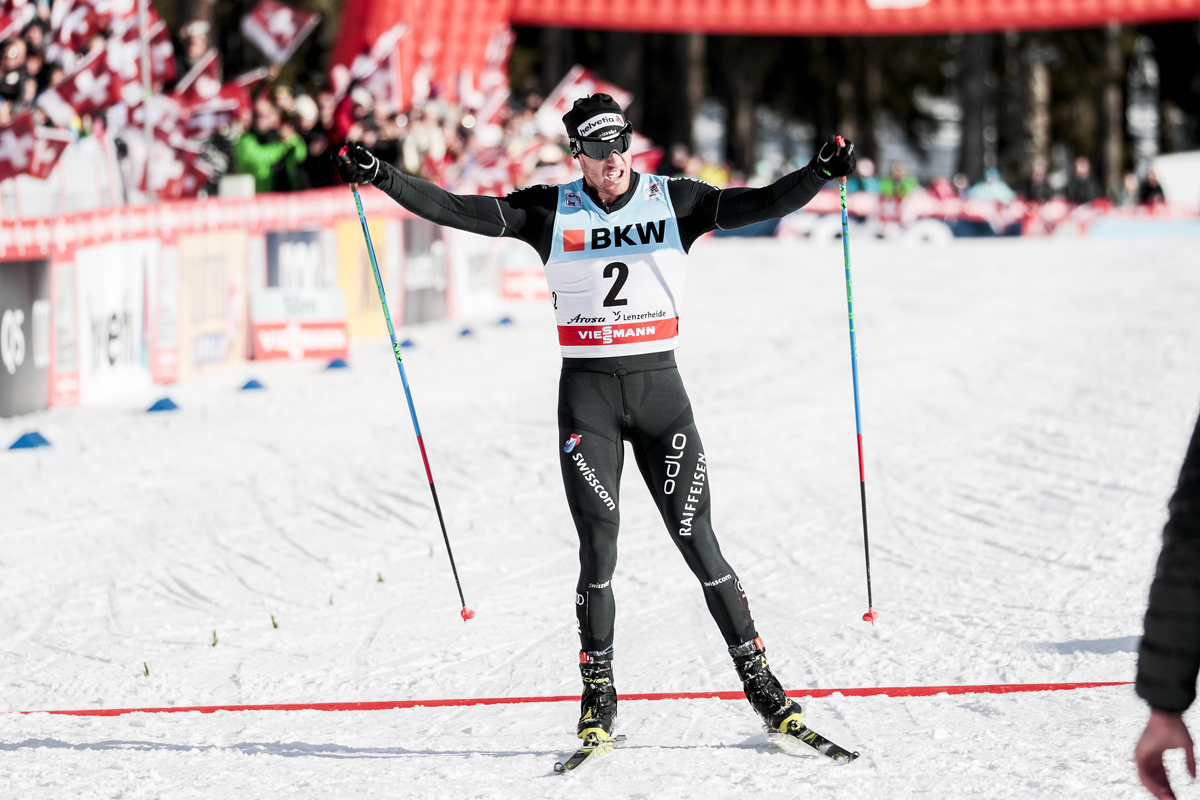
Recently, Cologna has battled injuries and more fit skiers seeking their own opportunities on the international stage.
After beginning the season in Kuusamo with a 37th, a 29th, and a 17th overall placing in the three-race mini tour, it seemed certain this year wouldn’t see a rejuvenated Cologna. That reading of the tea leaves was wrong. He went on to win a fourth TdS this season. He first turned heads by winning the TdS second stage 15 k classic. It was the Swiss star’s first World Cup win in three years.
It was an Olympic year. And Cologna’s TdS win put him on the PyeongChang radar.
“Of course that I am back, that I can beat everyone,” Cologna said of his form after his TdS overall win. “That surely is a good sign for myself, that everything is all right, and now it’s about preserving and showing this form at the Olympics.”
Prior to PyeongChang, Cologna had won gold in the Vancouver 15 k skate, and gold in Sochi’s 30 k skiathlon and 15 k classic. He went on to stamp his name among the sport’s best by winning the PyeongChang 15 k skate. He becomes the first Olympic cross-country skier to win three golds in the 15 k event.
Cologna has been around. But this season he came around again — asserting his relevance and legacy.
Honorable Mention: Jessie Diggins
By the end of the World Cup season, Jessie Diggins, 26, of the U.S. Ski Team ranked second in the overall standings. Norway’s Heidi Weng won the Overall World Cup with 1476 points, and Diggins slotted in just behind with 1436 points. Reviewing the entirety of the season, Weng and Diggins went head-to-head in every World Cup race, including the TdS, except for two races in Lahti, Finland.
The Lahti races were held the weekend after the PyeongChang Olympics. Weng scored a 26th and fifth place, good enough for 50 World Cup points on the weekend. Diggins lost the overall by a margin of 40 points. Maybe, just maybe, had Diggins raced in Lahti, we’d be talking about Diggins winning the Overall Crystal Globe.
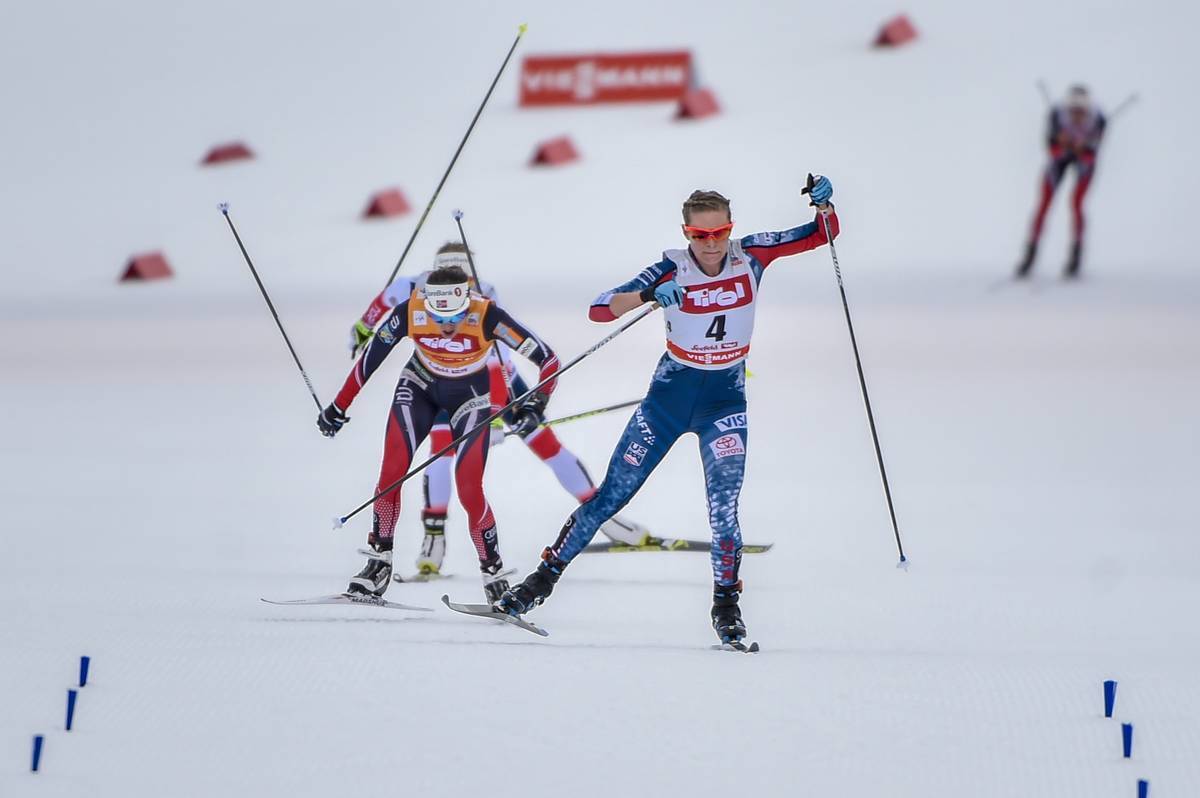
But she missed those races for good reason. Diggins and her teammate Kikkan Randall were in high demand for media appearances in New York City. For nearly a week, the U.S. gold-medal duo ran the talk-show gauntlet and made well-deserved sponsorship appearances. They, too, were spreading the message that U.S. cross-country skiing was well worth the nation’s interest beyond the two-week Winter Olympic bubble.
But let’s get back to the World Cup. A thorough reading of the season’s results shows Weng came into the season hot. Her top-notch performances were sustained through the TdS, which she won. Although the overall World Cup winner, Weng failed to medal at the Olympics and faded hard after her fifth place in the Lahti skate sprint.
Diggins, on the other hand, was a bit more mellow — from her own podium-expectation standards — at the season’s start. She earned her first World Cup podium, a third place, in her 12th start this past season.
Something must have clicked from there. The rest of Diggins’s season was a tear on the sharp end. Diggins went on to place third overall in the TdS. She won the 10 k mass start skate in Seefeld, Austria, on Jan. 28, right before the Olympics.
In PyeongChang, Diggins simply set the U.S. bar for consistent skiing at an insane level. She raced every Olympic cross-country event — an exhausting schedule by any measure. She placed fifth three times, sixth once, and seventh once. And of course, there was that gold medal with teammate Randall in the team sprint. Those levels of show-up-and-ski performances are astounding.
It’s even more remarkable when considering she was less than three seconds out of bronze in the 15 k skiathlon — she placed fifth. She was also less than four seconds out of bronze in the 10 k skate — she again placed fifth behind Marit Bjørgen of Norway and Krista Pärmäkoski of Finland. Those two skiers tied for third place.
Post-PyeongChang, there was, for good reason, that missed Lahti weekend. Back on the World Cup grind, Diggins raced the final five races and missed the podium just twice. Her three podiums after the Olympics were a third place in the Drammen classic sprint, second in the Holmenkollen 30 k classic, and second in the Falun World Cup Finals 10 k skate pursuit. She also skied the fastest time of day in the Falun pursuit to clinch second place in the World Cup Finals mini tour.
Clearly, Diggins was on a roll during and after the TdS. So it’s not so far-fetched in our mid-April quarterbacking to think Diggins could have nailed those two Lahti races and won the overall. Again, Weng and Diggins were on two opposite trajectories heading into and out of PyeongChang.
Absolutely a historic season for Diggins.