

From the FasterSkier archive — posts syndicated from athletes’ and coaches’ own blogs between 2004 and 2012, kept online as published. Current coverage is at fasterskier.com.

Tag: Maia Dahlqvist

  • Svahn Two-for-Two, Dahlqvist Claims Sprint Crystal

    Svahn Two-for-Two, Dahlqvist Claims Sprint Crystal

    This coverage is made possible through the generous support of Marty and Kathy Hall and A Hall Mark of Excellence Award. To learn more about A Hall Mark of Excellence Award, or to learn how you can support FasterSkier’s coverage, please contact info@fasterskier.com.

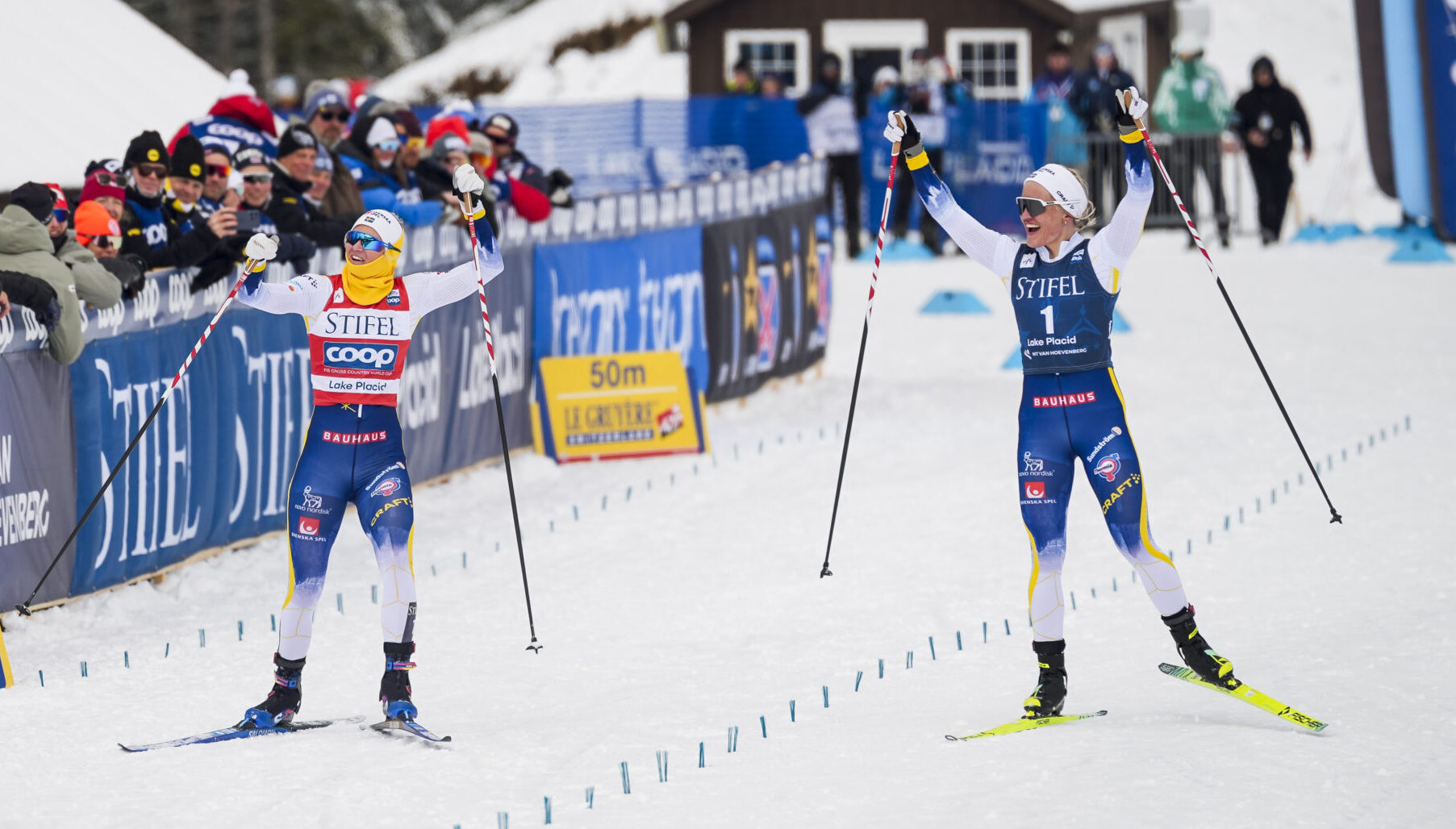
    Team . . . Maja Dahlqvist (SWE) wins the Sprint Crystal Globe, Linn Svahn (SWE) takes the World Cup Sprint win. (Photo:  Thibaut/NordicFocus)

    Team Sweden must face tricky circumstances in selecting its team for World Cup Sprint events, but their dilemma is made simpler by the apparent set of protocols the team follows when deciding who will race. Typically, Sweden brings only those skiers who can earn spots on the podium. Everyone else is racing back home in what we can only imagine must be the must competitive B-Team event in the world of women’s sports. In Lake Placid’s Freestyle Sprint, Sweden’s roster consisted of Jonna Sundling, Linn Svahn, Johanna Hagstroem, Maia Dahlqvist, Moa Ilar, and Emma Ribom (who did not start today’s Freestyle Sprint). That’s a fairly impressive set of starters: Sundling is 2022 Olympic Champion (and world champ from 2025), Svahn is 2026 Olympic Champion, Dahlqvist leads the World Cup Sprint standings, and Hagstroem is poised to win this year’s World Cup if Dahlqvist were to falter. Put those skiers on the starting line of a Sprint final, and it will be very difficult for any other nation to truly challenge them.

    And that is precisely what Team Sweden did . . . though not without needing to come through a chaotic and unexpectedly close Freestyle Sprint final. In the end, Svahn notched her second victory of the weekend (after yesterday’s 10 k Classic victory) ahead of Sundling and Dahlqvist (who claimed her fourth World Cup Sprint Crystal Globe). Team Sweden swept its second straight podium of the World Cup final . . . with one race (tomorrow’s 20 k Mass Start) still to be run.

    “It was so much fun—all these people, all this cheering—it’s amazing,” said Sundling.

    “Honestly, I was just trying to do as good race as I could for the day,” said Dahlqvist. “The bonus would just be the points for the overall. I just wanted a good race for today.”

    “It’s like my second home, honestly! So many people screaming my name,” said Dahlqvist.” It was really cool.”

    Twelve Americans entered Lake Placid’s Freestyle Sprint qualifying: Jessie Diggins, Samantha Smith, Julia Kern, Alayna Sonnesyn, Lauren Jortberg, Rosie Brennan, Erin Bianco, Hailey Swirbul, Ava Thurston, Renae Anderson, Emma Albrecht, and Nina Schamberger. Diggins, Smith, and Kern all advanced beyond qualifying with Diggins advancing into the semifinals.

    Jessie Diggins (USA) continues to cherish every finish line. Her retirement is a celebration, but one fans wish could be delayed a bit longer. (Photo: Thibaut/NordicFocus)
    Freestyle Sprint

    Diggins drew the first heat where she would meet up with Sundling and Faehndrich. That top-heavy field seemed to insure that this would be a fast heat, one likely to produce a lucky loser or two. Diggins’ strategy throughout the season has remained consistent: use her speed to keep heats fast, claim at least a lucky loser spot, and rely on her endurance to give her chances later in the heats when pure sprinters may be spent.

    Diggins bobbled a bit out of the start gate, allowing Sundling to burst forward to set the early pace (Sundling is typically a fast-starter and aggressive pace-setter; she was likely to try that, anyway). Diggins needed to work a bit to get around Julie Myhre (NOR) on the first uphill, but from then on it was a three-woman race. That triad was interrupted when Diggins stepped on Faehndrich’s pole basket, sending the Swiss woman tumbling in a hairpin right-hand turn. Diggins lost some speed behind the tangle of skis and poles, but she would recover before the finishing straightaway. Faehndrich would pull off a miraculous recovery of her own, hopping back to her feet after her fall, chasing down the pack, and sprinting past Diggins into the third spot. The two of them would wait to see if their times would be fast enough to advance as lucky losers.

    Svahn led a moderate-paced Heat 2, confident that no one else would be eager to lead. Jasmi Joensuu (FIN) went to the front in the loose snow of the final uphill, only to find her efforts eclipsed by Svahn swooshing out of the draft on the subsequent downhill. Svahn would advance easily, followed by Joensuu. Slow heat . . . Faehndrich and Diggins still safe.

    Kern re-entered the World Cup scene after a few idle weeks following the Olympic Games where she had begun feeling some pulmonary stress. She appeared recoved with an impressive 17th place qualifier, but her performance in theheats made it clear that she may still be a bit rusty. Kern got pinched out of position numerous times in the quarterfinal, then lost her balance rather dramatically on the last right-hander before the finishing straightaway. Her speed having been lost, Kern would cross the line sixth. Her day would end with a mnmnmnmn place finish. For Faehndrich and Diggins . . . so far, so good.

    Smith has repeated a pattern in recent world Cup Sprints, dropping to the rear early in each heat, only to unleash a torrential sprint in the closing meeters. Smith found an open lane to drive forward on the first uphill, puling even with Maia Dahlqvist (SWE) at the summit. Smith once again found a lane on the final uphill, hop-skating past Lotta Udnes Weng (NOR) before expertly pinching her out of second position. Smith entered the downhill well positioned on the tails of Dahlqvist. Smith’s good tactics would not continue as the field reached the final flats. Weng was able to wind past her, as well as Federica Cassol (ITA) who crowded Smith into abbreviated skate strokes in the finishing meters. Smith would finish fourth in the heat, and mnmnmnmnm in the day. Faehndrich and Diggins? Still in lucky loser positions with only one quarterfinal remaining.

    Faehndrich and Diggins kept their fingers crossed that the final heat would be a slow one. It was a nervous position to occupy: Hagstroem highlighted the Quarterfinal 5; she’s a skier who often ignites the pace to exhaust her rivals . . . but her first strokes out of the start gate indicated that would not be her strategy on this day. Hagstroem would hold the lead across the finish line ahead of Coletta Rydzek whose clever footwork allowed her to sprint forward to claim the second automatic advancement spot. Hagstroem’s languid pace allowed the advancement of both Faehndrich and Diggins. the home-crowd breathed a sigh of relief.

    Semifinals

    Diggins lucky loser journey continude in Semifinal 1 where her desire to push the pace found itself in the backseat compared to the similar desires of Svahn and Sundling. The Swedish pair rocketed to the front as Diggins trailed the field. But it quickly became apparent that Sundling and Svahn had no interest in setting a fast pace—they only wanted to clog the front, daring others to take the lead. On Lake Placid’s Sprint course, taking the lead had proven to be a self-destructive tactic, while attacking from behind had proven to be a risky one. Diggins found an open lane on the final climb, but found the pace too high to allow her to advance.
    The Swedes had looked supernaturally calm and relaxeda t the front, but on the final downhill the dangers of Lake Placid’s Sprint course revealed themselves again as Svahn was absorbed by skiers rushing from the rear, and Sundling found herself edged out of the lead by Anja Weber (SUI). The Swedes would call upon their superior speed to fight back into the lead before the finish line. Myhre would cross third, followed by Joensuu in fourth. Diggins would cross fifth to finish ??? on the day. The Swedes apeared relieved—and a little bit shell-shocked—in the finish area. They’d be unlikely to commit those tactical errors again.

    Dahlqvist and Faehndrich—#1 and #2 in the current World Cup Sprint standings would face off in the second semifinal. After the grinning embarassment of an initial false start, Dahlqvist would allow her teammate, Hagstroem, to vault into the lead, followed closely by Faehndrich and Rydzek. Hoping to distance herself from Dahlqvist, Faehndrich drove to the front on the final uphill. using Hagstroem as a way to block any other pursuit. Faehndrich and Dahlqvist would cross the finish line togehter, followed by lucky losers, Hagstroem and Rydzek.

    Linn Svahn and Jonna Sundling led the Swedish sweep at Mt. Van Hoevenberg. (Photo: Thibaut/NordicFocus)
    Sprint Final

    Svahn, Sundling, Hagstroem, and Dahlqvist highlighted the Sprint final, where they were joined by Faehndrich and Rydzek. With three closely-bunched contenders (Dahlqvist, Hagstroem, and Faehndrich) in the year-long Sprint World Cup competition all being present in the final, the Crystal Globe would be decided in this race. Sundling an Svahn set the pace, Faehndrich and Dahlqvist marked them closely. Hagstroem and Rydzek trailed. With Dahlqvist leading by only six points over Hagstroem—and with Faehndrich only a few more points behind them—the mathematical possibility existed for the cup to change hands at the finish line. In the end, Svahn pulled away from Sundling, and Dahlqvist separated herself from Faehndrich. Sweden would sweep the podium, and Dahlqvist would cross the finish line with arms raised as the winner of the Sprint Crystal Globe.

    World Cup Final Women’s Freestyle Sprint RESULTS

    World Cup Final Women’s Freestyle Sprint QUALIFYING

    Love Stories Like This? Help Keep Them Coming.

    Feature stories like this one take time, access, and care to produce. If you value thoughtful storytelling and independent ski journalism, please consider becoming a Voluntary Subscriber. Your support directly fuels the work we do to cover the people, places, and moments that make our sport special.

    Join the FasterSkier community!
    Team Sweden is the dominant team at the Lake Placid World Cup Final. Norway’s men’s team will just need to work harder. (Photo: Thibaut/NordicFocus)

    World Cup racing continues this weekend from Lake Placid and Mount van Hoevenberg:

    Sunday, March 22

    12:30 pm | Men’s 20km Mass Start Free

    2:30 pm | Women’s 20km Mass Start Free

    4:30 pm | ONE LAST LAP w/Jessie Diggins & the Retiring Stars

  • More Than One Tactic—Svahn Masters Falun Sprint

    More Than One Tactic—Svahn Masters Falun Sprint

    This coverage is made possible through the generous support of Marty and Kathy Hall and A Hall Mark of Excellence Award. To learn more about A Hall Mark of Excellence Award, or to learn how you can support FasterSkier’s coverage, please contact info@fasterskier.com.

    Linn Svahn (SWE) can afford to ignore all the recommended tactics normally employed on Falun’s infamous Sprint course. She’s just too fast. (Photo: Thibaut/NordicFocus)

    Falun’s Sprint course rewards experience . . . but not every skier who possesses that experience pays very close attention. Skiers can get distracted by how they feel, by how their heat is shaping up, by the tactics of others. Sometimes, that sort of counter-punching can prove profitable. Not in Falun . . . not on most days anyway.

    In Falun, skiers prepare for an infamous and well-known draft on the penultimate downhill . . . they either deal with that draft, or they find themselves out of contention. By now, every skier should know that whomever is leading at the top of the significant downhill is almost certain to be swallowed up by the field. Leading is a mistake, and it appears nearly impossible to establish enough of a lead to overcome the advantage gained by skiers speeding up from behind. Falun represents perhaps the most tactical—and most obvious—of all World Cup Sprint courses. And it will manufacture that same crucial factor next year when the World Championships are staged on this very same course. If skiers take advantage of watching replays of these races, they’ll begin to see that there’s only one tactic to employ in Falun . . . unless, of course, you just happen to be lots faster than everyone else, like Linn Svahn.

    In the Sprint final, Svahn found herself forced to the front by a cagey Kristine Stavaas Skistad who positioned herself to take advantage of Falun’s infamous draft. What Skistad did not anticipate was the raw speed that Svahn would bring to the Final. Stuck as she was at the front, Svahn simply engaged the after-burners on the course’s penultimate uphill—a tactical decision that had proven disastrous for every other skier in Falun’s Sprint heats. Accelerate there, and you’re all but certain to get caught on the downhill. But Svahn is riding the crest of a wave that has carried her to the very top of the Sprinting world. The same speed she employed to claim dominant wins in both the Classic Sprint and Team Sprint in the Olympics a week ago continued to propel her to the top step of the podium in Falun. Skistad set things up well in the Sprint Final, but Svahn was simply too strong.

    Nadine Faehndrich (SUI) continued her recent podium run in third place ahead of Coletta Rydzek (GER), Maia Dahlqvist (SWE) and Johanna Hagstroem (SWE).

    Americans qualified two skiers into the heats—Jessie Diggins and Sammie Smith—both of whom would find themselves undone by Falun’s infamous draft in their quarterfinal heats. Diggins would finish the day 17th, Smith 23rd.

    Canada’s Liliane Gagnon would qualify seventh, confirming her arrival on the international Sprint scene by advancing to the semifinal where she wold finish tenth on the day.

    Liliane Gagnon (CAN) announced her arrival as a World Cup Sprint contender with a brilliant 10th place finish in Falun. (Photo: Authamayou/NordicFocus)
    After the Olympics . . .

    The Olympics are over, the biggest pressure is off, the medals are stowed safely away. Now it’s back to the re-start of the World Cup season that these skiers began months ago. Returning, as the skiers do now, to the post-Olympic season, this is a time when we may find out who is truly worn out from the Games, contrasted with who may have mis-calculated their peak for the Olympics, but may now find themselves in top shape as all those who collected Olympic medals are strangely and uniquely vulnerable.

    The weeks following the biggest competitions are sometimes full of surprises, especially when a few of the medal-winners and event-dominators choose to stay home. Who can blame them? They spent weeks and months and years and careers building up to those Olympic Games. And those who succeed in claiming the medals that the media expected must then run the loving gauntlet of media attention and sponsor responsibilities that accompany Olympic success. After the Lake Placid Olympics in 1980, where the immortal speedskater Eric Heiden had proven to be unbeatable (winning all five of the five speedskating events), Heiden signed up for the All-Around World Championships, where he promptly got beat. Lesson learned: just because you’re the best one week doesn’t guarantee you’ll be the best every week . . . not after the insistent press, the pressing sponsorship responsibilities, and the adoring crowds have gotten done with you, anyway.

    Diggins entry into the Falun’s World Cup Freestyle Sprint was significant for another reason: after today, she stands alone as the skier who has recorded more individual World Cup starts than any other. (Photo: Jason Cork/FasterSkier)

    Switzerland has one of its medalists on the starting line, but not the other. Nadine Faehndrich is here, but no Nadja Kaelin (medalist in both the Team Sprint—with Faehndrich—and the 50 k). Sweden has its newly crowned Sprint Queen, Linn Svahn, in the lineup, but Jonna Sundling—Sweden’s former Sprint Queen—has stayed home. And of course the USA’s Jessie Diggins was here . . . isn’t she always here? Every weekend, every event, every starting line, Jessie Diggins lines up to race. That’s why she’s seemed nearly impossible to best in the season-long World Cup standings: she’s almost always signed up to race, and she’s almost never out of contention. It’s an astonishing level of durability and prolonged excellence, one that we’ll be able to enjoy and appreciate for only a few more weeks until her retirement . . . until that racer who we’ve known would always be there is no longer there. Believe me, we’ll miss Jessie Diggins terribly in seasons to come.

    But, for the time being, Diggins has a World Cup Overall title to defend . . . a defense that would benefit from a few more Sprint points. Her fourth place qualifying time would reward her efforts, but she would ski impatiently in her quarterfinal, fining herself undone by the strategic draft that heat-leaders give up on Falun’s Sprint course. Diggins would finish fourth in a heat that was not fast enough to offer advancement as a lucky loser.

    “It was my 357th World Cup start,” said Diggins. “It was just a really cool chance to feel extra grateful to my team, to look back on why that was possible, and to look at the bigger message for me here, that asking for help with my mental health got my physical health to a place where I could race this hard for this long . . . And the season isn’t over yet!”

    Samantha Smith (USA) just keeps getting stronger week after week. (She would qualify 19th, and finish the day 23rd). Photo: Thibault/NordicFocus)
    Tactics on Display

    The first quarterfinal involved Skistad and Svahn. Skistad dangled at the back mid-heat, but glided forward on the final downhill to finish second behind Svahn.

    Liliane Gagnon (CAN) qualified seventh at the start of the day, and she skied strongly in the second quarterfinal (won by Switzerland’s Nadine Faehndrich) to claim a lucky loser spot, and a space in the semifinal.

    Diggins headlined Quarterfinal 3. She led from the start but seemed hindered by slower skis onthe significant downhill. Diggins ran out of gas in the final straightaway as the heat was taken by Coletta Ryzek (GER) ahead of Moa Ilar (SWE).

    Sammie Smith (USA) began the day aas the 19th qualifier, continuing to show the form that saw her named to the US Olympic Team. Smith lined up in Quarterfinal 5 where Julie Myhre (NOR) and Johanna Hagstroem (SWE) provided the early pace. Smith has begun to reveal a strategic preference: allowing herself to drop back into the field early on, then charging forward late in the race. She did that again in Falun, storming up the final climb. Unfortunately, experience suggests that the draft given up on Falun’s Sprint course is often the deciding factor, and Smith (like Diggins before her) found herself swallowed up on the descent. Hagstroem would take the heat win, ahead of Julie Bjervig Drivenes (NOR).

    “I felt like I skied the hills really strong today and was disappointed with some of my tactical decisions,” said Smith. “Unfortunately, Falun is notorious for a large draft on the final downhill. I was trying to ski to my strengths today, but I should have been more patient and tried to tuck behind other skiers so I didn’t get drafted so much.”

    “The more time I have on skis, the more races I get to do, the better I feel,” Smith continued. “I’m really looking forward to the last few weeks of the season.”

    Kristine Stavaas Skistad (NOR) showed that she understood the tactics that Falun’s Sprint course dictates, but Linn Svahn (SWE) was just too fast. (Photo: Authamayou/NordicFocus)
    Tactics Confirmed—Sprint Semifinals

    Semifinal 1 offered Skistad a chance at Redepption after a disappointing fifth place finish in the Olympic Classic Sprint,and she perhaps better than anyone else seemed to understand the importance of utilizing Falun’s draft. Gagnon streaked forward to contend with Svahn and Faehndrich, while Skistad and Rydzek—famously fast closers—lingered at the back. Skistad easily coasted back into contention in the draft of the long downhill, and was able to get to the tails of Svahn before the finish line. Those two would move on to the final while Rydzek and Faehndrich would wait to see if they would move forward as luckylosers.

    The second semifinal involved a slate of Swedes: Moa Ilar, Moa Lundgren, Hagstroem, and the cagey veteran, Dahlqvist, who rarely leads in the early stages of heats. True to form, Dahlqvist hovered around third or fourth. Hagstroem would ski the downhill draft section to perfection, launching into the lead at the bottom, and followed across the line by Dahlqvist. Again, experience ahead of speed.

    Linn Svahn (SWE) established a gap ahead of Kristine Stavaas Skistad (NOR) in the Sprint final. Usually, Falun’s course would not reward such audacity, but Svahn was able to hold her advantage to the end. (Photo: Authamayou/NordicFocus)
    Tactics Defied

    In the ongoing defense of her lead in the season-long Sprint standings, Dahlqvist had done her job in just getting to the Final. Her lead would be protected for another week in her quest to finish the season wearing the Sprint leader’s red bib. But the other skiers in the Final had other challenges in mind. Team Sweden’s Hagstroem, Svahn, and Dahlqvist matched up against Skistad, Faehndrich, and Rydzek. Skistad went to the front, where it appeared she would control the pace (and force others to go around her into the lead). Her tactic seemed to be working as Svahn found herself at the front. Skistad must’ve been pretty satisfied with that positioning . . . satisfied, that is, until Svahn applied the power. In just a few strokes, Svahn accelerated up the hill where no one else dared acccelerate, creating a massive gap that left Skistad in an unexpected panic.

    While Skistad may be one of the fastest sprinters in the world, her strength is definitely not in quick acceleration. Though Skistad would chase gamely, Svahn was gone, the finish line photo making the result appear far closer than it really was. Faehndrich would hold on for third ahead of a fast-charging Rydzek. Dahlqvist would finish fifth, holding her lead in the World Cup standings, but seeing her lead shrink in the wake of Faehndrich’s podium performance. That season-long race is definitely tightening, and appears likely to be decided in the final World Cup weekend in Lake Placid.

    Falun Women’s Freestyle Sprint RESULTS

    Falun Women’s Freestyle Sprint QUALIFYING

    Love Stories Like This? Help Keep Them Coming.

    Feature stories like this one take time, access, and care to produce. If you value thoughtful storytelling and independent ski journalism, please consider becoming a Voluntary Subscriber. Your support directly fuels the work we do to cover the people, places, and moments that make our sport special.

    Join the FasterSkier community!
    The victory lap in Falun. Linn Svahn (SWE), Kristine Stavaas Skistad (NOR), Nadine Faehndrich (SUI). (Photo: Thibault/NordicFocus)
  • Gold at the End of Linn Svahn’s Long Path

    Gold at the End of Linn Svahn’s Long Path

    This article was made possible through the generous support of our voluntary subscribers who have helped put our Nat Herz on the ground at the Olympics. If you value coverage like this, please support FasterSkier with a voluntary subscription.

    Linn Svahn (SWE) has long looked like the best sprinter in the world, but she has only rarely had the chance to prove it. After years of injury and delay, finally she earns Olympic gold. (Photo:  Barbieri/NordicFocus)

    PREDAZZO, ITALY — Checking today’s ESPN home page makes it clear that the Olympics don’t seem to occupy the American imagination like they once did. I remember the Olympics as being a bigger deal—a set of events that captured the imagination of the world, an international spectacle that occupied the media spotlight. Life magazine, Time magazine, Sports Illustrated:  all devoted their covers and countless pages to Olympic events when they were upcoming, to the results when they became available, to the impact that these performances had on the viewing public. There was something bigger about it, something that seemed to separate it from mere sport, something that seemed to elevate it above mere commercialism. These weren’t just athletes; these were Olympians.

    They still are . . . Over in Italy, the Olympians are parading in ceremonies and competing in events and collecting medals while national anthems resonate in the crisp mountain air … but ESPN covers only the sports that matter to most Americans: NFL Football and NBA basketball and NHL hockey and MLB baseball and PGA golf, followed by men’s college basketball and women’s college basketball and college softball and MLS soccer and WCW Wrestling and the lingering stories surrounding Super Bowl commercials and Super Bowl halftime shows. And waaaaay beneath all that, we find a mention of the American gold medal in Team Figure Skating and the final helicopter flight of Lindsey Vonn’s legendary career. Thus far in Milano-Cortina, Olympic performances haven’t proven sufficient to capture the attention of a jaded viewing public. The only story American’s are likely to follow in cross-country skiing is that of reigning World Cup Champion, Jessie Diggins. Even with that accolade in hand—even being a defending medalist in the Olympic Sprint—Diggins does not find herself appearing often in the daily conversation that dominates column inches over at ESPN.

    Strength and grit, tactics and tenacity: Julia Kern (USA) earned her way through to the Olympic Sprint final. (Photo: Vanzetta/NordicFocus)

    And it really is too bad that ESPN may overlook another tremendous story that unfolded in the Women’s Classic Sprint, as the long-suffering Linn Svahn—whose history of injury and ill-fortune has repeatedly interrupted what could’ve been a legendary career—finally grabbed the medal that has always appeared to be within her reach. Svahn led a Swedish sweep of the podium ahead of Olympic and World Champion, Jonna Sundling and the ever-crafty veteran, Maia Dahlqvist. Svahn delivered a performance that cements her place in the history of cross-country skiing. After a long, long wait, Linn Svahn is Olympic champion.

    Though it appeared that Americans were still struggling with waxing issues in the soft snow of Val di Fiemme, Team USA saw four skiers advance through qualifying: Jessie Diggins (20th), Sammy Smith (26th), Julia Kern (28th), and Lauren Jortberg (30th). Those qualifying placings did not inspire a tremendous amount of confidence in what was likely to be a lightning-fast day of sprinting. Ultimately, it was Kern who would ski with power and grace in advancing to the Olympic Sprint final where she would finish sixth. Diggins may still be suffering the effects of her crash in Saturday’s Olympic Skiathlon; Diggins skied bravely, but could be seen clutching her injured ribs after placing fourth in her quarterfinal. She would finish the day in 17th.

    “My qualifier didn’t go as well as planned,” said Kern. “But it was enough to qualify, and I always get stronger in the rounds. And I had really good skis and played to my strategy and knew I had a strong finish and really never gave up and was hanging really tough when I was pretty tired. And so I went the lucky loser route today, which was my strategy. And that obviously has a cost. So come the final, I was completely spent, but I didn’t know it, and I really gave it my all, tried to be in the mix, and I had left everything on the course to get to the final. And I don’t have any regrets about that. I think that’s what I needed to do to get there. And that’s where I’m skiing right now.”

    “Obviously it was 30th, but I think it still wasn’t really, like, my best qualifier,” said Jortberg. “I think there’s still a lot of room to move there, which is cool. And I think had it not been in such a stacked heat, I think it would have maybe been a slightly different quarterfinal for me, but we’re still really proud of how I skied. I think I made a couple tactical errors out there.”

    Ultimately, the final American placings were Kern 6th, Diggins 17th, Smith 19th, Jortberg 30th.

    “Really exciting to have my Olympic debut,” said Smith. “And I wish I would have done a few things differently in that heat. Like what? I mean, I think I tried to make a move on the left side on the hill. I could have potentially been able to make more time over the top, but it’s pretty incredible opportunity and just excited to be out here and racing.”

    Smith explained the challenge and the complexity of competing in the Olympics while simultaneously enrolled at Stanford: “I’m taking material science and engineering. I’m taking environmental law class. I’m taking a creative nonfiction class, doing an independent study as well with a psychology professor,” said Smith. “And then I’m also taking physics. Stanford probably has more Olympians per capita than most places. It’s actually pretty cool. We have four winter Olympians from Sanford this year. So Eileen Gu is competing for China in big air and slope style, Zoe Atkin in half pipe and big air, and then Brandon Kim in speed skating. So it’s pretty cool that there’s four of us. The school’s been incredibly supportive, and I’m excited for all of us to compete.”

    Sprint Quarterfinals

    Jortberg and Smith lined up together in a quarterfinal that was packed with stars and contenders including Sundling, Kristine Stavass Skistad (NOR), and 2025 World Cup Sprint champion, Jasmi Joensuu (FIN). Sundling went to the front, setting the pace ahead of Skistad, providing a possible preview of the tactics likely to define the Sprint final. Jortberg and Smith dropped to the back where they appeared incapable of overcoming the blistering pace set by Sundling. Over the top of the ultimate downhill, Sundling led Joenssu as Skistad appeared to struggle. But the finish line lies at the far end of a straight downhill, and Skistad’s fast skis and gliding ability were able to dismantle Joensuu. Skistad would follow Sundling across the line to claim automatic spots in the semifinal. Smith would finish fourth to sit in a lucky loser position after the first quarterfinal.

    Quarterfinal 2 included Kern, Nadine Faehndrich (SUI), and the day’s top qualifier, Svahn. Faehndrich and Svahn made the pace in the heat, though Faehndrich would fade from contention in the late stages. The suprising Italian, Caterina Ganz, would drive forward to claim the second spot to advance to the semifinal behind Svahn; Kern was able to hold her position in the pack moving forward into third place, a status that would allow her to claim a lucky loser spot in the semifinal.

    Johanna Matintalo (FIN) took the third quarterfinal ahead of Laura Gimmler (GER). Julie Bjervig Driveness (NOR) would move into the fastest  lucky loser, spot pushing Kern down a spot, but allowing her to remain in contention with two heats remaining.

    Still sore from a crash in Saturday’s Skiathlon, Jessie Diggins (USA) gave her all in her Olympic Sprint quarterfinal. (Photo: Vanzetta/NordicFocus)

    Diggins started in the fourth quarterfinal alongside Maia Dahlqvist (SWE). They appeared to be the strongest in their heat, and Diggins sprinted directly to the front to set the pace. But the snow in Val di Fiemme was unusually slow, which did not favor the leaders, especially with the course profile that descended steadily to the finish line. Diggins paid the price for leading early, finding herself passed by the field, and unable to improve her position in the finishing straightaway. Diggins would end her day with a fourth place finish in the quarterfinal from which Dahlqvist and Federica Cassol (ITA) would advance.

    “I didn’t realize it right after it crashed, when I bruised my ribs,” said Diggins. “But then afterwards, you feel it; right now they really hurt. So I’m doing the best I can. I know I’m in good shape and I really want to make the team proud and I’m just trying the best I can . . . I needed to figure out how to manage this for Thursday. I hope that my body’s feeling better, but my energy is good and I’m excited to be here.  I think I’M not a best shape in my life. I just need everything to come together in the right moment. But I know there’s possibility there. So I’m going to keep coming and bring my best.”

    Sprint Semifinals

    Kern found herself in a semifinal crowded by the résumés of Svahn, Sundling, and Skistad. Sundling and Svahn would claim hte automatic qualifying spots, while Kern would overcome a mid-race loss of speed to finish fourth (behind Skistad) to reside in a lucky loser spot (behind Skistad) with one semifinal remaining. Ultimately, the second semifinal involved fewer stars, and a field that seemed less likely to produce fast times and lucky losers. Driveness and Dahlqvist advanced out of the second semifinal, allowing lucky loser spaces for Skistad and Kern.

    Linn Svahn (SWE) streaking toward her Olympic Sprint gold medal. (Photo: Barbieri/NordicFocus)
    Olympic Classic Sprint Final

    Six months ago, FasterSkier’s Editor-in-Chief made a bold and confident confident call, predicting that Julia Kern would qualify for the Olympic Sprint final. While that early prediction may have been a reflection of the proud Massuchessetts roots he shares with Kern, it also reflected his knowledge of World Cup and Olympic skiing, and his understanding of just what it takes to ski and compete at this level. The Editor knows his stuff, and Kern has proven herself entirely deserving. That Kern advanced to the Olympic Classic Sprint final came as no surprise to Fasterskier.

    But Kern was not alone in the final. The cast of characters in this Sprint drama was one that left no room for pretenders or understudies. Kern lined up alongside Skistad, Sundling, Svahn, Dahlqvist, and Driveness. At the crack of the starter’s pistol, Team Sweden began to assert itself as Sundling drove straight to the front. This has been the tactic that has earned Sundling World and Olympic championships, and it came as no surprise to see her at the front. She was followed by Svahn as Skistad appeared overcome by the early pace. At the mid-race point, Dahlqvist eased her way past Skistad, and Team Sweden headed for the podium. At the finish, it was the power of Svahn that drove across the line ahead of Sundling and Dahlqvist. Linn Svahn’s long path had finally delivered her to the destination that fans had always imagined. After years of injury and disappointment, after seasons of patience and impatience, Linn Svahn finally wears the Olympic gold medal.

    Julia Kern (USA) used all her experience and every bit of her energy to advance to the Sprint fFinal. (Photo: Barbieri/NordicFocus)

    “I am really happy with today,” said Kern. “It’s been a challenging season. I haven’t made it out of the quarterfinals this year. So to make it to the finals of the Olympics Is a huge accomplishment, and I’m really proud of it because I fought really hard today.

    The typical ESPN viewer may find other events to be more compelling, but the thrill of competing in an Olympic Games is not lost on the athletes: “I’ve never raced with the rings on my bib,” said Jortberg. “There’s a lot going on, which is super cool, and I feel like I just feed off that.”

    Women’s Olympic Classic Sprint RESULTS

    Women’s Olympic Classic Sprint QUALIFYING


    On the ground reporting by FasterSkier’s Nat Herz.


    Help Support Our Olympic Coverage!

    FasterSkier has our own Nat Herz on the ground at the Olympics, which is a significant financial lift for us. If you value the thoughtful work and access FasterSkier provides at championships like this one, please consider becoming a Voluntary Subscriber. Your support directly fuels our work to cover the people, places, and moments that make our sport special.

    Join the FasterSkier community!
    An all-Swedish podium in the Women’s Olympic Classic Sprint: (L-R) Jonna Sundling , Linn Svahn , Maja Dahlqvist. (Photo:  Vanzetta/NordicFocus)
  • Ilar Surges, Diggins Rebounds in Oberhof 10 k

    Ilar Surges, Diggins Rebounds in Oberhof 10 k

    This coverage is made possible through the generous support of Marty and Kathy Hall and A Hall Mark of Excellence Award. To learn more about A Hall Mark of Excellence Award, or to learn how you can support FasterSkier’s coverage, please contact info@fasterskier.com.

    Moa Ilar (SWE) continued to solidify her position in  the chase for the overall World Cup. she stands second, 149 points behind Jessie Diggins (USA). Ironically, the strongest Swedish skiers—and those who will be the strongest contenders for medals in Milano-Cortina—may be Ilar’s teammates who stayed away from Oberhof. (Photo: Authamayou/NordicFocus)

    When it comes to World Cup cross-country ski racing, season-long progress can be difficult for spectators and commentators to assess. It’s always hard to tell: are skiers getting faster? Are they fading? Or are they holding steady? This is the time of the season when event results begin to swirl and performances can become confusing. Three weeks from now, when the Olympics begin in Milano-Cortina, today’s winners could find themselves on the podium, or off the back. It’s all about the accuracy of their progression, the physiological and psychological costs of their efforts, their ability to remain healthy, and their commitment to the training peak that comes before the taper. And each skier handles it differently.

    Jessie Diggins races . . . that’s what she does. Others rest, others taper, others plan and plot, others pick and choose. Diggins races, a level of every-week race commitment that has decorated her trophy case with three World Cup Crystal Globes. Diggins has said that she doesn’t rely so much on “tapering” for big events as she intends to continue progressing through the races of each successive week. It’s a strategy that has seen her reach extraordinary levels, but not always at the times when she might’ve hoped. Last season, Swedish contenders went home to train and recover in the weeks leading to the World Championshp in Trondheim. It was a successful strategy, as Swedish women—Ebba Andersson, Frida Karlsson, and Jonna Sundling—definitely dominated those events. The Swedes are, once again, back at home in the weeks before the Olympics. It will be fascinating to watch events unfold in the two weeks of Olympic racing. The Swedish strategy may work again . . . but on the days that those races are run, they’ll be forced to deal with the power and the intensity and the will of Jessie Diggins.

    Olympic Talk

    Much of the media coverage of late has been about Olympic qualification: will Norway continue to make their would-be Olympians jump through hoops? Will the USA consider finishes at US Nationals, rankings in SuperTour, point standings on the World Cup . . . or will coaches exercise discretion in filling the team? Those are interesting discussions—rife with intrigue and opportunity, with aspiration and realization, disappointment and heartbreak—but it’s also a conversation that concentrates more on likely Olympic also-rans, and less on the skiers whom fans really follow. Even in talent-rich Norway, the skiers most likely to claim medals in Milano-Cortina have already been named to the team. Same for Sweden. Same for the USA. The contenders are well known, and their tickets to the Olympics were punched long ago. So while some Olympic hopefuls continue working to climb the rankings toward eventual places on their Olympic teams, the races in Oberhof highlighted the efforts of those who may contend for medals in Milano.

    And the Norwegians just keep coming . . . who is this Karoline Groetting getting her first world Cup start in Oberhof? Kristin Austgulen Fosnaes knows: Groetting is the upstart who nearly undid Fosnaes’ hopes of qualifying for an Olympic spot in Milano-Cortina. Fosnaes continued to elevate her profile with a win in the Norwegian National Championships 10 k, potentially paving the way for her naming to the Norwegian Olympic Team. She was followed onto the podium by Groetting who has now placed her name into the running for Olympic Team selections. Fosnaes has been a regular on the roster of the Norwegian Ski Team, but one who has from time to time, been viewed with skepticism by her countrymen, especially after her leaden performance in last season’s World Championship Team Relay in Trondheim all but handed the gold medal to Norway’s arch rival, Sweden. Fosnaes is a fine skier, a skier who would be a franchise player on the national team of nearly any other ski-country in the world. In any other country, Fosnaes would’ve been named to her Olympic Team two months ago. But as a skier competing for  Norway, she’s forced to keep racing and racing, always hoping to sufficiently impress the committee that selects the Norwegian Olympic Team. How interesting it is, then, that Fosnaes was not on the starting line today in Oberhof. Either she thinks she’s secured a spot on her Olympic team, or the committee selecting that team has already decided to stop looking at her. Either way, the focus today was on Groetting.

    Karoline Groetting (NOR) delivered quite a World Cup debut, leading the field through many of the early checkpoints, and finishing in fifth place on the day. Perhaps more important in her quest to be named to her nation’s Olympic Team, Groetting was the fastest Norwegian finisher in Oberhof. (Photo: Reichert/NordicFocus)
    Oberhof 10 k Classic

    With the Olympics remaining at the forefront of many contenders imaginations—and with resting for those races becoming a priority for many of those competitors—there were plenty of stars missing from today’s 10 k Classic start list: Finland’s Classic specialist, Kerttu Niskanen, is not on the starting line. Nor are Sweden’s Ebba Andersson or Frida Karlsson, Norwegians Astrid Oeyre Slind, Heidi Weng, Karoline Simpson-Larsen, or Kristin Austgulen Fosnaes (who is still yet to be named to Norway’s Olympic Team).

    Chasing an Olympic berth of her own, American Hailey Swirbul was the final starter of the day in Oberhof; she seems to be making the very most of her return to World Cup racing.

    “The smiles have been genuine!” beamed Swirbul. “I’m making sure to enjoy this life the most I can (but) I did not enjoy the feelings in the middle of this 10k today though, I won’t lie. I think a lot of us who came from Nationals, straight to international travel, straight to the World Cup were fighting some demons out there. It feels the most challenging, in my opinion, to find the will to keep fighting when your body feels heavy and the suffering feels unrewarding. But that’s also what keeps us coming back: the days where you can keep leaning into the discomfort and be in the fight and be rewarded for it is like no other feeling!”

    “I was the last starter today,” Swirbul continued. “So I was getting splits to know where I stood. An interval start race is a unique mind game because you can’t gauge if the imaginary people on front of you are pulling away or starting to fade. You just have to focus on your own race and get around the course as fast as you can, regardless of how others pace. That is easier said than done, especially with higher expectations on the World Cup. I try to remember that I don’t need to do anything that I haven’t done before. I just want to try to race my own race, regardless of the stage it’s on.”

    Contenders in Oberhof included Sweden’s Jonna Sundling, Maia Dahlqvist, and Moa Ilar (who is chasing Diggins in the season-long chase for the FIS Crystal Globe), Austria’s Teresa Stadlober, and newly discovered Norwegian phenom, Karoline Groetting. An early starter wearing bib 7, Groetting led the field at many of the early splits, and crossed the finish line with an advantage of 30 seconds over her nearest rival, and 37 seconds over her more famous countrywoman—and long-time national team member—Tiril Udnes Weng. But while Groetting settled into the leader’s chair, the more recognizable contenders began racing: Ilar, Stadlober, Sundling, and Diggins.

    Diggins was 15 seconds behind Ilar at the 2.6 kilometer checkpoint. Ilar led again at the 5.8 kilometer mark, coming across 13 seconds ahead of Groetting. At the finish line, Karoline Hennig-Doetzler (GER) challenged Groetting’s time, but fell just six seconds short. Groetting dodged another bullet when Maia Dahlqvist crossed the lone a mere .1 seconds behind Groetting’s finishing time. It was a tremendous finish for Dahlqvist—best known as a sprinter—as she continues to show great form in the approach to Milano-Cortina where she will certainly be a capable partner for Sundling in the Team Sprint event.

    It was later revealed that Diggins unusual split times resulted from her suffering quite a dramatic fall when her tip got caught in soft snow at the course’s edge.

    “I think that the reason my splits looked a litle funny is that I had a crash on one of the downhill corners. I caught my tip in some really deep sugar, and used my arm as a brake to keep myself from sliding off the course!”

    “It was time lost, and it was also a lot of adrenaline lost,” Diggins continued. “But it was honestly a really great practice in mental toughness, in refocusing, my energy and my attention on ‘what can I do in this moment. How well can I ski?’ I’m just really glad that’s really all that the crash was.”

    Ilar crossed the finish line with an advantage of 31 seconds over Groetting, but there were still other stars shining brightly out on Oberhof’s Classic course. Stadlober had begun the chase back at 7.6 kilometers when she was still 17 seconds behind Ilar. The gap narrowed to 10 seconds at 9 kilometers, and Stadlober was pouring it on. Over the final kilometer, the Austrian flew in pursuit of the Swede, only to find herself falling short by the narrowest of margins. Ilar would hold on to win by .7 seconds showing that hers is the best Classic skiing form today. Even so, she was surrounded by serious rivals—Stadlober in second, Sundling in third, Diggins in fourth, Groetting in fifth—who may be on their way up.

    18.01.2026, Oberhof, Germany (GER):
    Rosie Brennan (USA) – FIS world cup cross-country, 10km, Oberhof (GER). www.nordicfocus.com. © Authamayou/NordicFocus. Every downloaded picture is fee-liable.

    Rosie Brennan has continued to navigate her return to world-class form. “I’m still living in a day-by-day world, trying to figure everything out,” she said. “I had some really good training at home but have struggled again for the last two weeks. I haven’t been able to discover a pattern, so I truly feel I have no control over when my body is ok and when it isn’t, and now I’ve added some vascular complications to the whole thing. I had to come race this weekend to qualify for the Olympics and I am very pleased to have accomplished that! Now I need to look forward as best I can to the Games and try to prepare as best as possible.

    “Erik Flora is over here now,” Brennan continued. “Which will help that process immensely. But overall, it’s been a long year and change of living in an unknown, complicated medical world.”

    Brennan would finish the day in 30th, followed by Hailey Swirbul 33rd, Novie McCabe 35th, Alayna Sonnesyn 45th, Sammy Smith 49th, Kendall Kramer 54th. Alison Mackie led her Canadian teammates in 31st, followed by Sonjaa Schmidt 36th, Katherine Stewart-Jones 38th, Amelia Wells 56th.

    Now trailing by only 149 points, Ilar trimmed a bit of Diggin’s advantage in the World Cup overall race. And Ilar’s plans for the season? She was quite frank in her response to those asking if she’s going for the World Cup overall win now. “Of course I am,” Ilar smiled.” I would lie if I said anything else!”
    And what about the others who stayed home this weekend? We shouldn’t forget the impending return of Andersson, Karlstad, Niskanen, Slind, Weng, and Simpson-Larsen. The plot thickens.


    Oberhof Women’s 10 k Classic RESULTS

    FIS World Cup Distance STANDINGS (entering Oberhof)

    Teresa Stadlober (AUT), Moa Ilar (SWE), Jonna Sundling (SWE) on the podium in Oberhof . (Photo. www.nordicfocus.com. © Authamayou/NordicFocus. Every downloaded picture is fee-liable.