From the FasterSkier archive — posts syndicated from athletes’ and coaches’ own blogs between 2004 and 2012, kept online as published. Current coverage is at fasterskier.com.

Tag: Maike Caspersen Falla

  • Falla Gets What She Came For; Diggins Exceeds Season Goal in Sixth in Classic Sprint

    Falla Gets What She Came For; Diggins Exceeds Season Goal in Sixth in Classic Sprint

    The all-Norwegian women's classic sprint podium at Stage 5 of the Ski Tour Canada, with Maiken Caspersen Falla (c) in first, Ingvild Flugstad Østberg (l) in second, and Astrid Uhrenholdt Jacobsen (r) in third.
    The all-Norwegian women’s classic sprint podium at Stage 5 of the Ski Tour Canada, with Maiken Caspersen Falla (c) in first, Ingvild Flugstad Østberg (l) in second, and Astrid Uhrenholdt Jacobsen (r) in third.

    CANMORE, Alberta — The Canadian Rockies were an intimidating backdrop for the fifth stage of the Ski Tour Canada (STC) on Tuesday at the 1.5-kilometer classic sprint. The mountains surrounding Canmore rise and lift and simply dominate the valley. It’s as if nothing else matters. It’s hard to look away.

    Like those mountains, Norway’s Maiken Caspersen Falla commanded the World Cup sprint show. Coming down the homestretch during the finals, you couldn’t ignore her. She won the final in 4:09.26 minutes to earn the win and honor of standing atop two podiums — after the race, she was awarded the Sprint Crystal Globe, which she had secured earlier during the STC’s Stage 3 freestyle sprint.

    Joining Falla on Tuesday’s sprint podium were two of her teammates, after Astrid Uhrenholdt Jacobsen has placed second, 7.07 seconds behind her, and Ingvild Flugstad Østberg took third (+8.66).

    Finland captured fourth and fifth with Krista Parmakoski (+18.03) and Anne Kyllönen (+19.07), respectively. U.S. Ski Team (USST) member Jessie Diggins placed sixth, 21.96 seconds behind Falla, for her first final and best result in a World Cup classic sprint.

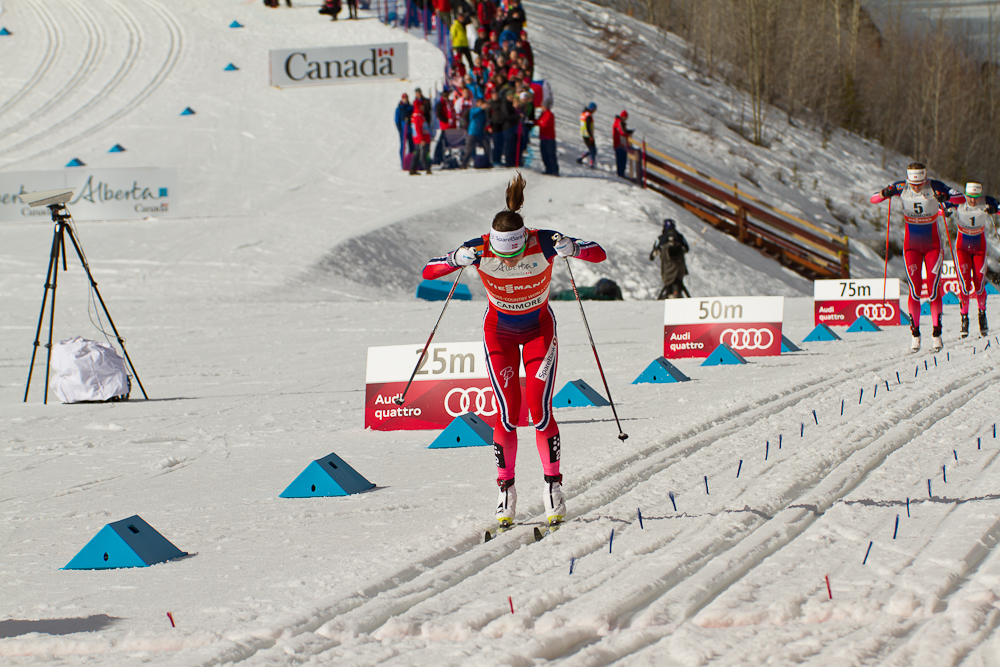
     Norway's Maiken Caspersen Falla powers down the homestretch to win Tuesday's classic sprint final by 7 seconds over teammate Astrid Uhrenholdt Jacobsen (behind) at Stage 5 of the Ski Tour Canada in Canmore, Alberta.

    Norway’s Maiken Caspersen Falla powers down the homestretch to win Tuesday’s classic sprint final by 7 seconds over teammate Astrid Uhrenholdt Jacobsen (behind) at Stage 5 of the Ski Tour Canada in Canmore, Alberta.

    The time gaps were huge and were a quantifiable way of defining what the Canmore crowds witnessed in the final: an uncontested Falla 20 to 30 meters ahead of her closest competitors as she raised her hands across the line.

    The win capped an astonishing streak. Falla is undefeated in classic sprints since she began with a win last March in Drammen, Norway. Sophie Caldwell of the U.S. Ski Team (USST) won the classic sprint during this year’s Tour de Ski, but Falla did not start that day.

    In the post-race press conference, Falla spoke of how she comes for one thing: the win.

    “When I am starting a ski race I am always wanting to win,” she said. “My shape is so good, and I know I have the possibilities to stand on top of the podium. You never know when you get the possibility again. When your shape is so good you just have to enjoy it and do the best you can.”

    Her best was the best in the end. But in the morning qualifier, Østberg, who will finish second-overall in the Sprint World Cup standings, qualified first, nearly a full five seconds ahead of Falla, the second qualifier.

    Østberg seemed to be on cruise control until the final. She won the first quarterfinal by almost 2 seconds and the first semifinal by half a second. If the old fable about the tortoise and the hare has anything to do with World Cup sprinting, then Østberg was the hare.

    In the final she faded and faded in Falla’s wake. Remember those big time gaps — 7.07 and 8.66 seconds back to second and third.

    “It was a tough final a tough sprint today,” Falla said at the press conference. “It was a long course and we had to fight to the end. The three of us [Falla, Østberg and Jacobsen] got some meters and Maiken got some meters on me. On the last uphill we had to fight all the way to the finish. It was so hard I didn’t have any power left at the end. It was a great day for Norway and we had great skis. I’m in good shape and had great skis. It was a great day here in Canmore.”

    Three Norwegians lead the women's classic sprint final up a climb out of the stadium, with Ingvild Flugstad Østberg (1) up front, Astrid Uhrenholdt Jacobsen (5) and eventual winner Maiken Caspersen Falla (second from r). Falla won the final by 7 seconds over Jacobsen, and Østberg placed third in Canmore, Alberta. (Photo: Peggy Hung)
    Three Norwegians lead the women’s classic sprint final up a climb out of the stadium, with Ingvild Flugstad Østberg (1) up front, Astrid Uhrenholdt Jacobsen (5) and eventual winner Maiken Caspersen Falla (second from r). Falla won the final by 7 seconds over Jacobsen, and Østberg placed third in Canmore, Alberta. (Photo: Peggy Hung)

    Runner-up Jacobsen mentioned a dicey sweeping righthand corner racers had to navigate at top speed. She addressed the corner because she remains in third overall in the STC’s standings. Norwegian Heidi Weng still holds the Tour lead in 1:04.04.5, with teammate Therese Johaug just 3.1 seconds behind in second overall. Both Johaug and Weng fell separately on that corner in their quarterfinals and placed 16th and 17th, respectively, on the day.

    “Before the quarterfinals they put some salt out on the curb,” Jacobsen said. “I was a bit prepared for going in and out of the salt, when I came out of the salted area there was a lot of snow and I think that’s what took [Johaug and Weng] out, and also a lot of the guys. It was a difficult curb.

    “I was really bummed they fell,” she added. “It’s always more fun to ski more fairly against each other. I think Therese and Heidi will be not really tired tomorrow. So maybe they will run out the same tomorrow and not look back. You have to ask tomorrow maybe it was a good thing that they fell for them.”

    Diggins Can Stride

    Diggins posted the best North American result and a career best in a classic sprint. Qualifying in 13th, 14.58 seconds behind Østberg’s winning time of 3:41.61, Diggins charged to a quarterfinal win in the first heat of the day. She placed fourth in the first semifinal, the fastest of the two semifinals by five seconds. Diggins moved into the finals as a lucky loser.

    Jessie Diggins (U.S. Ski Team) strides to sixth in the Ski Tour Canada's Stage 5 classic sprint on Tuesday in Canmore, Alberta.
    Jessie Diggins (U.S. Ski Team) strides to sixth in the Ski Tour Canada’s Stage 5 classic sprint on Tuesday in Canmore, Alberta.

    But luck has nothing to do with her consistency this season.

    “I went into the season with my one of my big goals was to qualify in a classic sprint because until this year I had never done it,” Diggins said in an in-person interview afterward. “So getting to be in a final, it was like, ‘What?’ ”

    Diggins praised the wax techs for her slick skis on what was undoubtedly a tricky day. Think sun, then clouds, and some flurrying. Firm tracks in the morning deteriorated, melted, and in places became non-existent as the snow broke down.

    “It was obviously a very tricky day, it started snowing at one point, what do you do in that situation? But I think they handled it really well and did a great job and I was really impressed with the service team,” Diggins said.

    Asked if she was nervous before the final, she remarked she simply felt good.

    “Mostly just happy because in a tour, to make the final is really important because of the bonus time,” Diggins said. “I was like, going into today if there is anyway I can make the semis that would be great because the closest I could get to the front, the better the time. Getting to make the final I was like, ‘Yes.’ ”

    Diggins was a fan favorite in Canmore.

    “It was so cool that whole hill was chanting my name,” she recalled. “They were like ‘Jessie!’ ‘Jessie!’ I wish I was skiing faster because they are so psyched. I just got really tired at the end.”

    For Diggins moving forward, it’s all sixes. Entering Wednesday’s sixth stage, the 15 k skiathlon, she ranks sixth overall, 1:39.8 minutes behind Weng.

     Sophie Caldwell (USST) placed 11th overall in Tuesday's STC Stage 5 classic sprint in Canmore Alberta.

    Sophie Caldwell (USST) placed 11th overall in Tuesday’s STC Stage 5 classic sprint in Canmore Alberta.

    Caldwell ended up 11th in the sprint after qualifying in ninth (+12.42). Despite fighting a cold, Caldwell reached the semifinals as a lucky loser, but was eliminated in the first semifinal, finishing sixth behind Diggins.

    “I’ve been sick since the [Quebec] sprint day,” Cadwell told FasterSkier. “I was starting to feel like it was starting to go away and then when we traveled it went to my head. I am definitely feeling better today than yesterday.”

    With a small cough and some congestion, Cadwell is still undecided if she’ll continue the STC.

    “I haven’t made that call yet. I think who knows, it is a lot easier for me to feel good for a sprint than it is for a distance race. It could be a stretch to try to keep racing. But we will see,” she said. “Best-case scenario, I raced it out of me and I should try again, but that might be wishful thinking.”

    Cadlwell mentioned she has never finished the Tour de Ski. “That’s a noble pursuit going into the [STC] … You have to be on top of everything, recovery, refueling, etc. That takes a while to learn,” she said.

    A day after her 22nd birthday, Canadian U23 Development Team member Dahria Beatty had a breakout performance. Tuesday marked Beatty’s 13 World Cup start. Of those 13 races, six have been sprints, Beatty has never qualified. That changed in Canmore. The Whitehorse native created her own fate by qualifying 29th (+18.95).

    Seated in the fourth quarterfinal, which was won by Jacobsen, Beatty said she was encouraged to head up to the front.

    “It was awesome, I have never started so fast in my life,” Beatty recalled. “I didn’t know what happened. I had a lot of energy and coaches were saying, ‘Race and don’t be afraid to go to the front.’ So I found myself at the front in the beginning and then the climb.”

    Canada's Daria Beatty (r) racing alongside overall World Cup leader Therese Johaug of Norway en route to a World Cup career best of 15th in Tuesday's classic sprint, Stage 5 of the Ski Tour Canada in Canmore, Alberta. (Photo: Peggy Hung)
    Canada’s Daria Beatty (r) racing alongside overall World Cup leader Therese Johaug of Norway en route to a World Cup career best of 15th in Tuesday’s classic sprint, Stage 5 of the Ski Tour Canada in Canmore, Alberta. (Photo: Peggy Hung)

    Beatty was in the quarterfinal where Johaug fell. And when the Norwegian crashed and subsequently hammered to make contact once she righted herself, it motivated Beatty. “I just kept pushing hard and Johaug took a tumble so she was able to pull me back to contact a little bit. My skis were running really well.”

    With good form and good skis, Beatty fed off the crowd and knowledge of Canmore’s trails.

    “I pushed really hard and missed out on the lucky loser position by I think 0.3 of a second,” Beatty said. “It was by far my best result ever … My best result at World Juniors is [15th] so to have that on the senior World Cup level is amazing.”

    The result was a confidence booster.

    “I’ve not had so much experience yet. You always feel a little bit like maybe I’m not quite good enough to be here,” Beatty said. “But having a day like this makes me go, even if some days aren’t that great. There is something in there that I can be able to compete at this level and that’s nice to know.”

    “I didn’t know what happened. I had a lot of energy and coaches were saying, ‘Race and don’t be afraid to go to the front.’ So I found myself at the front in the beginning and then the climb.” — Dahria Beatty, 22, after placing 15th in Tuesday’s classic sprint for her first World Cup top 30

    American Sadie Bjornsen raced to 18th. Already establishing herself as an elite racer among the World Cup ranks, she too, like Diggins, has a top-10 overall rank heading into Wednesday’s skiathlon. Ninth overall in the Tour, Bjornsen said her day played out with the good and the bad.

    “I felt really good in the warmup and the qualifier was a little interesting,” Bjornsen said. “It just didn’t feel like my greatest. And the heats, it was like everything went pretty well and the finish coming down the hill I just lost a bit.”

    As the STC moves onto its last three stages, Bjornsen is talking like a seasoned veteran; matured, centered, and able to navigate the highs and lows.

    “The Tour de Ski, you just have to keep your head down and roll through disappointment just right through to the next day,” Bjornsen explained. “If you are excited you try to not get too excited, but use it towards having some confidence in the next race … In Canmore with such hard courses, and the high altitude … I’ve been just telling everyone I’m getting ready for the war.”

    American Ida Sargent qualified 18th and placed 22nd overall in the STC's Stage 5 classic sprint in Canmore, Alberta.
    American Ida Sargent qualified 18th and placed 22nd overall in the STC’s Stage 5 classic sprint in Canmore, Alberta.

    The fourth American and USST member  to qualify for the heats was Ida Sargent, who posted the 18th fastest qualifying time (+15.51). Sargent ended up 22nd on the day after finishing fifth in the first quarterfinal. Asked about her race, Sargent deadpanned, “It felt like a sprint.”

    She also was able to articulate what the day was like for most athletes: a relentless course, slow conditions, and the unwavering altitude.

    “It was just a tough day out there,” Sargent said. “The conditions were really slow this afternoon and there wasn’t really any recovery. It was just tough.”

    Also for North America, Americans Annie Hart (Stratton Mountain School T2 Team) and Kaitlynn Miller (Craftsbury Green Racing Project) finished in 36th and 38th respectively. They were followed by Rosie Brennan (USA) in 41st, Olivia Bouffard-Nesbit (CAN) 42nd, Emily Nishikawa (CAN) 44th, Katherine Stewart-Jones (CAN) 46th, Caitlin Gregg (USA) 47th, Cendrine Browne (CAN) 50th, Jennie Bender (USA) 51st, Jenn Jackson (CAN) 52nd, Maya MacIsaac-Jones (CAN) 53rd, Katharine Ogden (USA) 54th, Sophie Carrier-Laforte (CAN) 56th, Chelsea Holmes (USA) 57th, Annika Hicks (CAN) 59th, Alannah Maclean (CAN) 60th, and Liz Stephen (USA) 61st.

    Racing continues Wednesday with the sixth stage of the Tour, the women’s 15 k skiathlon and men’s 30 k skiathlon.

    — Gabby Naranja and Gerry Furseth contributed reporting


    Qualifier | Heats | Tour standings (through Stage 5)

    Jessie Diggins after finishing sixth in Tuesday's classic sprint final in Canmore, Alberta, for her career best in a World Cup classic sprint. With three stages to go in the Ski Tour Canada, Diggins ranks sixth overall. (Note: Diggins changed her suit between the qualifier and the heats)
    Jessie Diggins after finishing sixth in Tuesday’s classic sprint final in Canmore, Alberta, for her career best in a World Cup classic sprint. With three stages to go in the Ski Tour Canada, Diggins ranks sixth overall. (Note: Diggins changed her suit between the qualifier and the heats)
  • Falla Queen for a Day, Wins Stockholm City Sprint; Caldwell 11th, Diggins 15th

    Falla Queen for a Day, Wins Stockholm City Sprint; Caldwell 11th, Diggins 15th

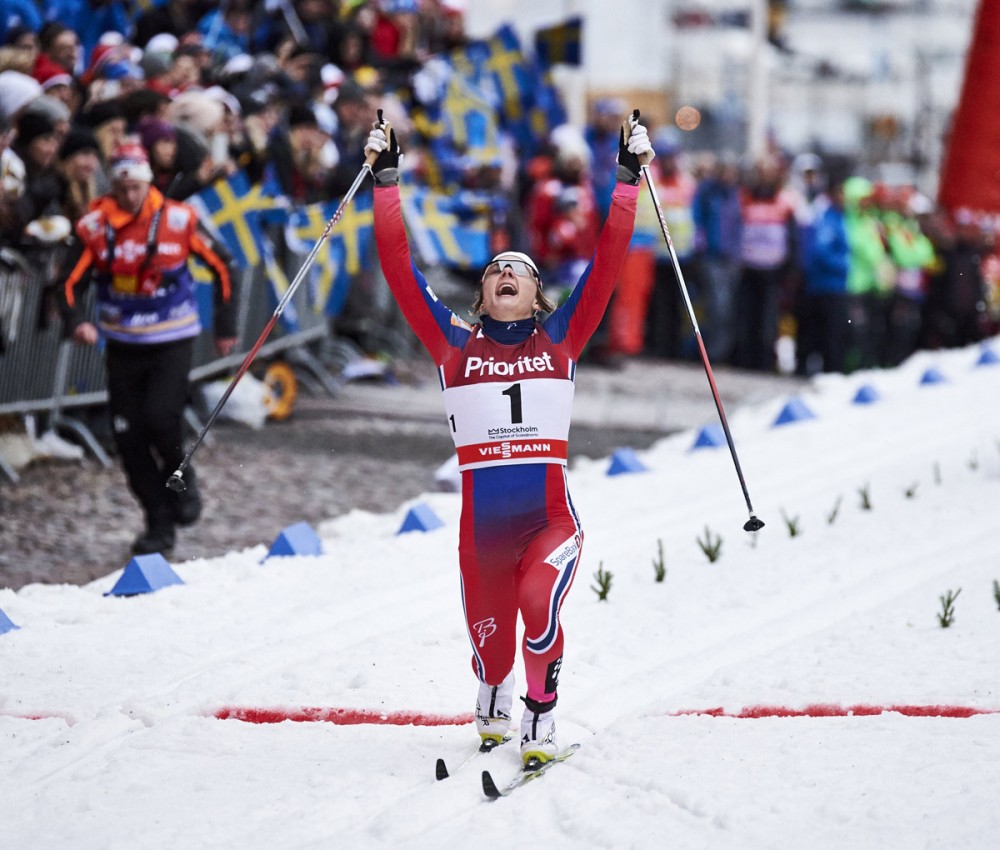
    11.02.2016, Stockholm, Sweden (SWE): Ingvild Flugstad Oestberg (NOR), Maiken Caspersen Falla (NOR), Stina Nilsson (SWE), (l-r)  - FIS world cup cross-country, individual sprint, Stockholm (SWE). (Photo: Fischer/NordicFocus)
    Maiken Caspersen Falla of Norway (center) won the World Cup sprint in Stockholm, Sweden, on Thursday, ahead of teammate Ingvild Flugstad Oestberg (left) and Sweden’s Stina Nillson (right). (Photo: Fischer/NordicFocus)

    Thursday’s women’s 1.2 k classic sprint in Stockholm was a royal affair.

    The World Cup, with all its high-tech wax and made-for-television city-style sprints, made its home for a day in the heart of the Swedish capital. The roughly U-shaped sprint course, which featured a straightaway that double backed on itself after a tight and deteriorating 180-degree corner, embraced the historic Stockholm Castle- official residence of the Swedish Royal Family.

    Yet, when she finally toed the line, Norway’s Maiken Caspersen Falla was the day’s sprinting queen. After setting the standard as the first qualifier in 3:10.31, she won the final in a speedy 3:09.38.

    “My self-confidence is very high in classic sprinting, but I never go into it and think I’ll win,” Falla told Norwegian daily VG. “Today I felt good.”

    Teammate Ingvild Flugstad Østberg skied to second, a full 3.39 seconds back, while Sweden’s Stina Nilsson salvaged a host nation podium in third (+4.37). Sweden also secured fourth and fifth overall, with Hanna Falk (+5.22) and Jennie Öberg (+6.26). Russia’s Evgenia Shapovalova was the lone non-scandinavian in the final, skiing to sixth, 12.7 seconds behind Falla.

    “She has a violent speed at the end,” Østberg told Norwegian broadcaster NRK of her winning teammate. “We others are not there. It is simply another league, but I’m satisfied with another second place.”

    American Sophie Caldwell, currently sixth in the Sprint World Cup standings, was the best placed North American, finishing 11th. Her teammate Jessie Diggins skied to 15th on the day.

    From the beginning, it was a tight qualifier. Only a single second separated first from eighth. And only 1.61 seconds back in ninth was the first North American qualifier, Caldwell. Diggins qualified 21st (+5.13). U.S. skiers Sadie Bjornsen in 37th (+8.32), Ida Sargent in 49th (+12.6), Jennie Bender in 56th (+18.5), and Caitlin Patterson in 58th (+20.77) were locked out of the heats, along with the lone Canadian, Andrea Dupont of Rocky Mountain Racers, who finished 52nd (+16.71).

    11.02.2016, Stockholm, Sweden (SWE): Maiken Caspersen Falla (NOR) - crosses the line in first -- FIS world cup cross-country, individual sprint, Stockholm (SWE). (Photo: Fischer/NordicFocus)
    Maiken Caspersen Falla (NOR) crosses the line in first in Stockholm, Sweden. (Photo: Fischer/NordicFocus)

    Queen for a day

    Falla, the Stockholm Castle’s sprint queen, finished the day with a flurry of 1’s on the result sheet. Qualifying first, first in her quarterfinal, first in her semifinal, and first overall, Falla never allowed the tactics of others or the deteriorating soft course to stymie her efforts.

    Østberg won the first semifinal in 3:11.45. That pace, although not blistering for the day, produced the two lucky losers advancing to the finals, Falk and Shapovalova.

    Falla’s semifinal, out of which only she and Nilsson advanced, ran even slower. Falla stopped the watch in 3:12.68.

    That time was not indicative of Falla’s reserves. Come finals, Falla had enough spare energy to dominate — she would beat that time by 3.3 seconds.

    Moments after the gun, it was three skiers across for the first one hundred meters — Öberg, Østberg, and Falla. Those three set the pace, still three across striding up the first hill. Down that hill, Falla began to pull away slightly, as the group entered the 180-degre turn. Falla led out while Østberg settled into the back three or four spots, looking momentarily gassed.

    Up and over a bridge, while Østberg moved forward, is when Falla made it her race.

    Coming off that hill, and into the long uphill striding drag to the finish, Falla skied like a sprint champion, crossing the line uncontested- although she still stretched for the line at the finish, as if to make an exclamation point. Østberg came in second, Nilson in third.

    With the win, Falla won her fourth consecutive classic sprint and her fourth World Cup classic sprint of the past five. Not only did she steal Sweden’s show with the win, she supplanted Nilsson for the top spot in the Overall World Cup sprint standings.

    And the drama didn’t end there: to snag second, Østberg slotted in ahead of Nilsson in the classic tracks, a move that some on the Swedish team felt was obstruction. The team filed a protest to have the Norwegian relegated, but it was denied.

    “I will not be bitter, but I think that the rules should be the same for everyone,” Nilsson told VG. “But I’m not going to get hung up on this. I’m happy with my race.”

    Consistent? Nilsson was sore because in the previous World Cup sprint, in Drammen, Norway, she was relegated off the podium for obstructing Finland’s Krista Parmakoski. The move was similar to the one Østberg made on Thursday.

    “Actually, I think it’s what happens in the sprint,” Nilsson’s teammate Öberg told VG. “But Stina Nilsson was disqualified in the previous race, and it was almost the same incident. And now I think it is a bit strange to apply it for one individual and not for another individual.”

    Despite Falla’s comfortable win, it remains a tight race for the sprint overall. Falla is in first with 480 points, Østberg in second with 476, and Nilsson now in third with 474. Norway’s Heidi Weng, who sat out Thursday’s sprint, sits fourth overall, with 252 points.

    With the six points separating first through third for the overall, the sprint crystal globe won’t be decided well into the Ski Tour Canada.

    In a post-race interview with FIS, Falla spoke of her sprint authority.

    “I’m always really nervous and just kept trying to do my best- I’m always telling myself, always do my best,” she said. ” Today, I didn’t feel that my power was so good as in Drammen, I was just thinking and focusing on technique and try to do like big movements, I really had a good focus on the technique. And I think that’s what’s important today with all the soft conditions.”

    According to a FIS press release, Østberg, who just last Sunday raced a best-ever second at the Holmenkollen 30 k classic while Falla sat out, could feel those kilometers in her legs.

    “I can say that this is the first time that I have felt some fatigue from previous racing,” she told FIS. “The 30 km was tough last weekend and I think I felt it in the finals. I am happy for Maiken. She was better than I was today and I can’t believe that it’s another podium for me this season.”

    Nilsson, who before this race was leading the Overall World Cup sprint standings, acknowledged Norway’s strength.

    “It was great to race in front of the home crowd. I tried as hard as I could but Maiken and Ingvild were stronger, but I am happy with how it went today to be on the podium again,” Nilsson said according to the FIS press release.

    If Nilsson remains in the overall hunt, in the 19 years since the inception of the sprint World Cup, she could be the first Swedish women to win the sprint crystal globe.

    11.02.2016, Stockholm, Sweden (SWE): Sophie Caldwell (USA) - FIS world cup cross-country, individual sprint, Stockholm (SWE). where she finished 11th. (Photo: Fischer/NordicFocus)
    Sophie Caldwell strides to 11th overall in the FIS world cup cross-country, individual sprint, Stockholm (SWE). (Photo: Fischer/NordicFocus)

    Peaks and Valleys for the U.S.

    Caldwell led the U.S. results.

    In an email, she wrote the Stockholm sprint course was a brute. “The course was extremely difficult not necessarily because of the terrain, but because of the lack of recovery. I liked that the hills were a little steeper and the flats were a little flatter than the course in Drammen. That played more to my strengths. Because of the slow conditions, you basically had to work all the downhills and there was very little time to recover.”

    Her 11th overall included a win in her quarterfinal heat, further evidence that she is emerging as a top sprinter in any race. “My strategy in the quarter was to hop in behind someone fast and to try to conserve some energy for the final stretch. I think it worked out quite well, but it was a really hard effort.”

    That first place quarterfinal effort sapped her. “I was definitely feeling a little tired in the semi,” Caldwell wrote.
    “I chose to go with skis that kicked really well and I think that worked well in my quarter before I got tired, but in my semi it was a quick pace from the beginning and maybe my skis were gliding a little slower and kicking a little better than others, but I didn’t have the energy to stay with the fastest people on the flats and downs.” In the closing half-kilometer of her semifinal, won outright by Østberg, Caldwell faded — she finished sixth (+9.93).

    Caldwell plans on racing this Saturday’s  5 k classic in Falun, then a skate sprint in Lahti, Finland on February 20th. After that, it’s a flight back Stateside for Ski Tour Canada prep. During all that time, while Caldwell focuses on what she can control, the FIS score keepers will be updating the tally for the sprint overall standings. “I try not to pay too much attention to the standings,” Caldwell wrote. “I feel like the best thing you can do is go out and race your hardest each week and getting hung up on things like points or rankings can only take away from that. I’ll be where I’ll be at the end of the season, but I’m more focused on each race as a new day than an overall ranking. Before this season, I sat down with Matt to write out some goals. I suggested top ten in the sprint standings at the end of the year and he said “how about top 5?”. I don’t know if I’ll end up in the top five at the end of the year or not, but knowing that I’ve been flirting with being in the top 5 at any point during the season is something that I will be proud of.”

    Diggins, placing 15th, was also a qualifier. She remains happy with her improving classic skiing.

    “I was psyched to qualify, especially as classic sprinting is traditionally my worst event and I’ve been working so hard to improve my technique and power,” Diggins wrote in an email. “I went for kick over glide today which was a gamble and the double poling was nuts as the tracks were falling apart- it made for an exciting day! … It’s always a good day at work when you get to race around a royal palace…can’t ever overlook how cool it is to be here!”

    Bjornsen, who skied to 37th, felt her day could have been improved upon, but she remains forward thinking as her consistent season progresses.

    “I have been struggling with my classic skis a lot this year, and today I tried a new approach,” Bjornsen explained in an email. “Unfortunately it didn’t work out, and I wasn’t able to get my brain to commit to the change. Sprint racing leaves no room for error, so I was on the wrong side of the error today.”

    After the Stockholm sprints, Bjornsen sits 14th in the Overall World Cup.

    “Fortunately, we have many races in the year, and so it is never effective to spend too much time focusing on a dip,” she wrote. “I know I classic ski in the top ten, and I know I know how to kick a classic ski. The two most important things to remember looking forward to what is coming next!”

    Ida Sargent’s is a name usually in the points on classic sprints days. Having planned to start last Sunday’s Holmenkollen 30 k classic, she pulled out due to illness. In Stockholm, where she finished 49th, she was still recovering.

    “Today was very frustrating for me and I was definitely hoping for more,” Sargent emailed. “I love racing in Stockholm and it’s my favorite city sprint but I unfortunately didn’t put one together today. I got sick last week and today was the first day back to training for me so I felt asleep during the qualifier. Normally I’m toeing the line of blowing up in the qualifier but today after not having done any intensity in over a week, I couldn’t get going and couldn’t find my normal pop. I also did not do a good job testing my skis today and struggled on the last uphill. I wanted to have fast skis with so much double poling in the course but I felt like I was spinning my wheels and running in place on the last uphill. Our techs did a great job with skis but I need to improve my ability to test my skis in the stressful situations of the city sprints. It was still a fun atmosphere and I’m looking forward to getting in some more training and racing this weekend to feel like my normal self again!”

    Placing 58th, Caitlin Patterson explained in an email that she came away  Stockholm with a learning objective. “I felt fairly good physically and had a good warm up, but during the race I allowed myself to get bogged down in the deep slush and I know I lost time on many of the transitions. It wasn’t my best of races but certainly there are many things I can learn from evaluating my own performance as well as watching the top athletes cruising around the course, making that slush look far more ski-able than it felt.”

    Bumped up to the World Cup, Patterson steamrolls ahead in venues effusing  both rarefied old world ski culture and the modern world’s quick urban tempo. “It’s hard to even describe it, such a juxtaposition of chaos with the structured format of a ski race, all with a spectacular old-city backdrop,” Patterson wrote of her time in Stockholm.

    Racing continues on Saturday in Falun, Sweden with a women’s 5 k  and a men’s 10 k classic.

    -Chelsea Little contributed reporting.

    Results | World Cup Sprint Overall

  • Østberg Skis Big for First World Cup Victory in Davos Sprint

    Østberg Skis Big for First World Cup Victory in Davos Sprint

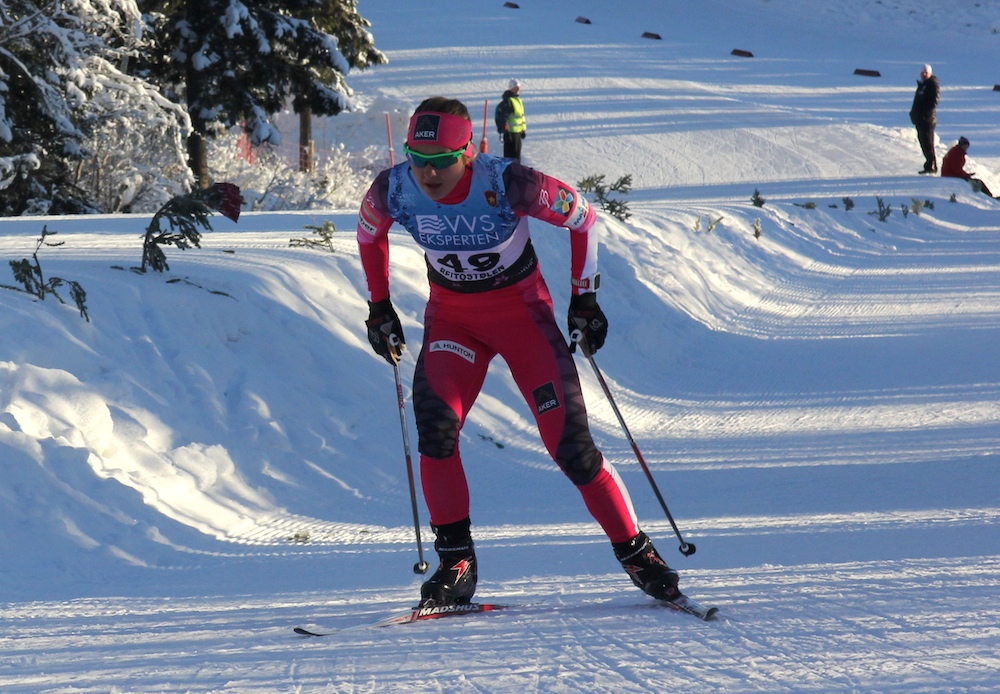
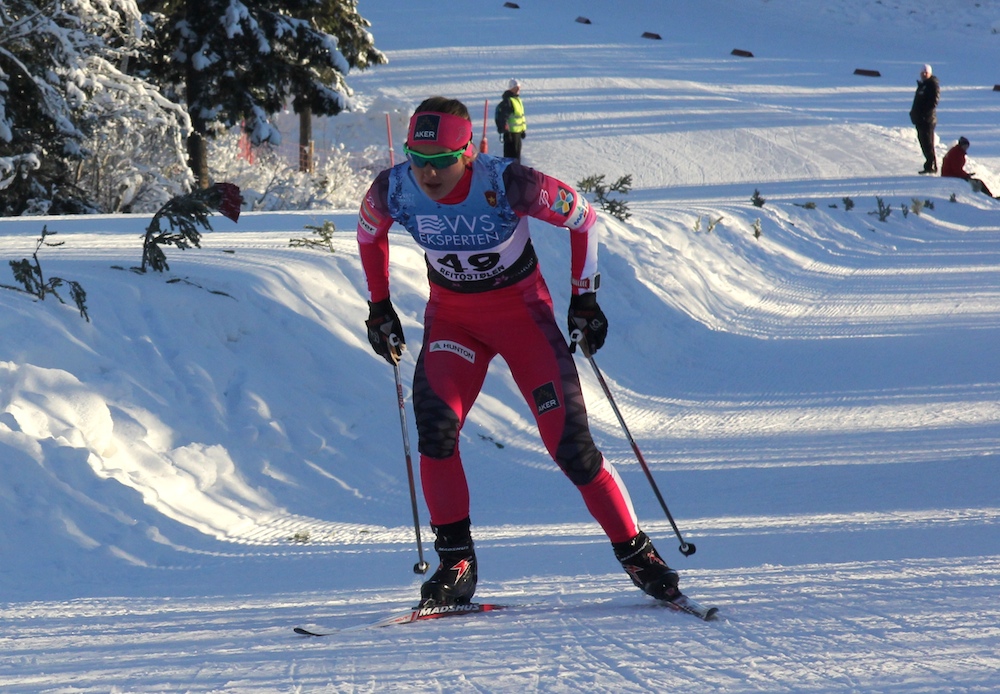
    Ingvild Flugstad Østberg racing to fifth in her first FIS race of the season, the 10 k skate on Nov. 22 in Beitostølen, Norway. (Photo: Inge Scheve)
    Ingvild Flugstad Østberg racing in Beitostølen, Norway. The Norwegian convincingly won the 1.3 k freestyle World Cup sprint in Davos, Switzerland, Sunday.  (Photo: Inge Scheve)

    Which Norwegian and by how much?

    That seems to be the ongoing question in the early races of the 2014/2015 World Cup season, with Norwegian dominance for both the men and women since the first competition in Ruka, Finland.

    Sunday in Davos, Switzerland, it was Ingvild Flugstad Østberg who came out on top in the 1.3 k freestyle sprint – and it wasn’t even close.

    Heading into the race, Østberg had the number one bib as the fastest qualifier. She skied to a time of 2:34.46, barely beating out teammate Marit Bjørgen (+0.47). Bjørgen won the mini tour sprint in Lillehammer earlier in December, which was the only other freestyle sprint race of the season.

    Once in the quarterfinals, Østberg again demonstrated her strength. Her time of 2:34:48 was the fastest of the round. The second fastest time in the quarterfinals was held by teammate Heidi Weng, who was in Østberg’s heat and finished second behind her. The second fastest quarterfinal winning time was 2:37.46 by Bjørgen.

    The first semifinal heat featured Østberg, teammate Celine Brun-Lie, Swedes Stina Nilsson and Charlotte Kalla, and Rikka Sarasoja-Lilja of Finland.

    Østberg set yet another fastest time going 2:33.78 in her heat. Nilsson was second finishing 1.50 seconds back. Brun-Lie was able to regroup from a broken pole at the start of the race and finished in third place. Just behind her In fourth position was Weng, who along with Brun-Lie, qualified for the final as a lucky loser.

    The second women’s semi final featured Bjørgen, Maiken Caspersen Falla of Norway, Germans Denise Hermann and Hanna Kolb, Ida Ingemarsdotter of Sweden, and Katja Visnar of Slovenia.

    Falla took the lead from the start and carried the group up the first climb. The pack stayed together for the majority of the race, with Bjørgen holding back until the final climb, where she  passed Falla to take the lead coming to the finish. Bjørgen’s winning time was 2:36.43, with Falla finishing 0.19 behind her.

    With the semifinals complete, the roster of the final was set and it featured five Norwegians. The only non-Norwegian was Nilsson.

    Leading the charge out of the gate was Østberg. Nilsson was close behind until she broke a pole in the first 30 seconds of the race. She was handed two poles before she continuing, but the rest of the pack was long gone by the time Nilsson had regrouped.

    With Nilsson out of the picture, Østberg picked up the pace and led the pack through the rest 1.3 k course. Falla followed Østberg closely as she pulled away, but never truly challenged Østberg.

    When the race was finished, Østberg had once again set the fastest time of the day, clocking in at 2:33.72. Falla finished 0.57 behind her for second.

    “I’m very happy for the victory. I have been working for this so long and it is a great feeling. I felt strong from the prologue and my plan was to ski in front and push hard from the beginning” said Østberg in a post-race interview with FIS. “I was so close to a World Cup victory sometimes. To cross this line first alone was delightful.”

    Today’s win was Østberg’s first-ever World Cup victory. Her only other win was a sprint stage in last year’s Tour de Ski, which is considered a Stage World Cup.

    Second place finisher Falla said after the race that she was proud of Østberg and that her result was a result of dedicated work.

    “I knew Ingvild would push hard from the beginning and I tried to follow her but she was little bit better than me. I am proud of her. My goal this winter is to fight for the sprint World Cup and the beginning of the season has been great with three final appearances in three sprints,” she said to FIS.

    Rounding out the Norwegian podium was Brun-Lie, who said tried a new strategy in today’s race.

    “I had a very good race today. I tried to stay mentally focused and concentrated. Usually my tactics is to ski in the front the whole time but today I decided to stay back and move forward in the second lap. It worked every time in the heat,” she said in an interview with FIS.

    In fourth position was Bjørgen who explained that the Norwegian sweep was an indication Norway’s teamwork was paying off.

    “We are a very strong team. I think that we are training together and pushing each other, and that is how we are getting on a higher level,” Norwegian Marit Bjørgen said of her team to FIS.

    Bjørgen also said that she was not surprised by Østberg’s win.

    “I saw it coming,” she said to FasterSkier. “I was saying, she has to wait a little bit, it will come soon. And it really did. Today she was so strong.”

    Bjørgen, who is rarely ever off the podium, said that the younger girls on her team are becoming more competitive and it’s becoming harder to maintain her usual dominance.

    “I was getting more tired and more tired as the day went on. With the younger girls today it was really hard” Bjørgen said after her race.

    The other finishers were Weng in fifth and Nilsson in sixth. With her finish, Nilsson took over the U23 leaders bib. Bjørgen will retain the leader bib as World Cup racing returns to Davos next week as a result of the previously scheduled races in La Clusaz, France being cancelled due to poor conditions.

    Women’s results

  • Randall Wins Skate Sprint In Davos, Ending Bjoergen’s Streak

    Randall Wins Skate Sprint In Davos, Ending Bjoergen’s Streak

    Kikkan Randall entering the finish lane on her way to winning the skate sprint in Davos by 1.7 seconds. Photo: Fischer/Nordic Focus.

    Davos, Switzerland — Marit who?

    At least that’s how it appeared in the World Cup in Davos, Switzerland, on Sunday, during the 1.5 k freestyle sprint, as it was American Kikkan Randall who destroyed the field rather than the usual Marit Bjoergen devastation.

    The Alaskan native blasted her way to her second consecutive World Cup sprint victory of the year, skiing away from the other five women in the final, leaving Russian Natalia Matveeva to grab second place, just ahead of Maiken Caspersen Falla (NOR).

    Straight from the qualifier, it was obvious Randall was going to be tough to beat. In the two-lap 1.5 k course, she started just two skiers back of Bjoergen. Ater the Norwegian set the second-fastest qualifying time behind Natalia Matveeva, the U.S. Ski Team (USST) veteran swooped in and stopped the clock.

    Randall was 0.11 seconds faster than the Russian – and almost a full second up on Bjoergen – in winning the qualifier.

    As the top seed, Randall was placed in the first quarter-final, and skied strongly from the gun. After taking control, and using her smooth V2 to cruise, only Caspersen Falla was able to stay reasonably close. Randall easily took the win, advancing through to the semi-finals.

    Randall rounding a corner coming into the stadium. Photo: Fischer/Nordic Focus.

    In the semi-final, Randall was matched up against some strong competition: 2007 sprint World Champion Astrid Jacobsen (NOR), and Dusseldorf surprise bronze-medal winner and Davos native Laurien Van Der Graaf (SUI) both qualified through to the next round.

    But they might as well have been J2s for all they could do against Randall.

    Taking the lead from the gun, Randall avoided the traffic on the first corner — a hairy 180-degree bend that curved straight into the only real climb on the course. After attacking the hill hard, she never looked back, stretching the field into a single line behind her as she built a massive lead to win comfortably by over a second, punching a ticket to her third sprint final of the year.

    Bjoergen was in the second semi-final. Owner of 49 World Cup victories and undefeated on the season, the seemingly invincible Norwegian seemed poised to qualify for the final, and create the Randall-Bjoergen face off that the fans desired.

    But with the red-hot Russian Natalia Matveeva as well as arch-rival Justyna Kowalczyk, and surprising Vibeke Skofterud (NOR), Bjoergen was not a lock.

    And early on, it was clear that Bjoergen was not going to dominate the heat. Kowalczyk squeezed into the lead around the first corner, and tore hell-bent up the first climb — only Matveeva and Canadian Chandra Crawford were able to keep pace. Bjoergen was left at the back as they rounded the corner and headed for the second lap, giving her just 750 meters to find her way into a qualifying position — not unheard of, but certainly difficult, even for Bjoergen.

    Chandra Crawford on her way to 9th in Davos. Photo: Fischer/Nordic Focus.

    As Kowalczyk and Crawford began to tire, paying for their first-lap enthusiasm, Matveeva pushed the pace, opening up a large gap on the downhill. Sweden’s Hanna Brodin found herself in second place rounding the final turn, with a couple of meters gap back to Kowalczk and the hard-charging Bjoergen.

    Bjoergen sling-shotted around the corner in Kowalczyk’s wake, and narrowly passed the Pole in the charge to the line, finishing third. Her late charge was impressive, but not quite good enough — the first semi was quicker, robbing Bjoergen of a spot in the final as the lucky loser.

    The streak was over, but the final was still to come. The 9,000-strong crowd, heavy with Norwegian and Swiss fans, were waiting to see who would supplant Bjoergen on the top step of the podium.

    The Norwegians had Maiken Caspersen Falla and Heidi Weng to support. Weng (World Junior Champion last year in the 10 k pursuit) barely qualified for the heats; she finished 30th in the individual start, just 0.08 of a second separated her from 31st place Yelena Kolomina (KAZ). Just 21 years old, Caspersen Falla is a strong skate sprinter — she has two World Cup medals in skate sprints in her short time on the circuit.

    Meanwhile, the Swiss were excited about Davos native Laurien Van Der Graaf, who had her break-through World Cup race last weekend in Dusseldorf, Germany, where she collected the bronze medal. Van Der Graaf qualified fourth, and the young woman had the crowd on her side.

    Hanna Brodin (SWE) and Matveeva rounded out the final, the latter riding a hot streak similar to Randall’s after finishing second to the American last weekend in Dusseldorf.

    Randall crossing the line with a dominating lead. Photo: Fischer/Nordic Focus.

    Matveeva led the way out of the tracks, skiing neck-in-neck with Randall approaching the first corner. The two climbed the hill together, and Randall pushed hard over the top, and rode a pair of fast skis into the lead on the downhill section of the course, taking the lead into the second lap.

    Matveeva closed up the gap instantly and took the lead, while Caspersen Falla, Van Der Graaf and Brodin all packed in tightly just behind Randall. As the group rounded the 180-degree corner, it looked like the race was going to go down to the wire. But Randall instantly launched a massive attack on the hill, powerfully hop-skating her way to the top. Only Matveeva was able to stay close, but as the two crested the hill, Randall refused to let up, hammering her way down the backside. As a result, the current Sprint Cup leader built a 50 meter lead on the field with half a lap to go — and still she kept charging.

    As she rounded the final corner and sprinted for the line, it was clear that Randall was untouchable. Matveeva and Caspersen Falla were left to pick up the pieces as Randall cruised to the finish, letting up only briefly to celebrate before crossing the line 1.7 seconds clear of the competition.

    A fading Matveeva just barely managed to out-last the fast-finishing Caspersen Falla at the line to collect her second silver medal in as many weekends. Sweden’s Brodin finished fourth, 2.5 seconds behind, while Van Der Graaff had to settle for fifth.

    When the smoke cleared, Randall was shell-shocked.

    “I don’t even believe it just happened,” said Randall in response to the stadium interviewer’s first question, sounding a little stunned.

    In an interview with FasterSkier after the race, Randall explained that her good position was the key to winning.

    “The hill was my strong point,” she said. “I didn’t want to lead, and when I made that strong move on the uphill, it was the perfect set-up for me.”

    As for the big gap in the final, Randall said she never even thought about where the other women were.

    “In my mind they are always there,” she said. “You never take anything for granted in sprint racing.”

    While Randall was excited about the win, she wasn’t shy about spreading around the credit — her fast skis, the great atmosphere in Davos, the team’s accommodation at Hotel Kulm, and the crowd all helped her to victory.

    “The training life leading up to the race is so nice [in Davos]” she said.

    “I had amazing skis, and I really want to share this with the team — they do such a good job of taking care of absolutely everything and letting me just race.”

    As for Bjoergen, Randall said that it was “a bit of a bummer” the Norwegian wasn’t in the final.

    “She’s the gold standard we all compare ourselves with,” said Randall. “It would have been nice to test myself against her, but all five women were plenty challenging.”

    Randall now has a week to digest the fact that she leads the Sprint Cup standings by 46 points, and is ranked third in the World Cup Overall standings before another weekend of World Cup action in Rogla, Slovenia.

    But tonight, she has some celebrating to do. She’s eating dinner with Anna Haag and Emil Joensson (SWE), whom she and Liz Stephen trained with last summer, and then spending some time enjoying the win with the whole U.S. Ski Team.

    Full results.

    Matveeva, Randall and Caspersen Falla on the podium. Photo: Fischer/Nordic Focus.