From the FasterSkier archive — posts syndicated from athletes’ and coaches’ own blogs between 2004 and 2012, kept online as published. Current coverage is at fasterskier.com.

Tag: Maiken Caspersen Falla

  • Sundling Dominates Final Sprint; Kern Finishes a Close Fourth

    Sundling Dominates Final Sprint; Kern Finishes a Close Fourth

    This World Cup coverage is made possible through the generous support of Marty and Kathy Hall and the A Hall Mark of Excellence Award.  To learn more about A Hall Mark of Excellence Award or to learn how you can support FasterSkier’s coverage please contact info@fasterskier.com.

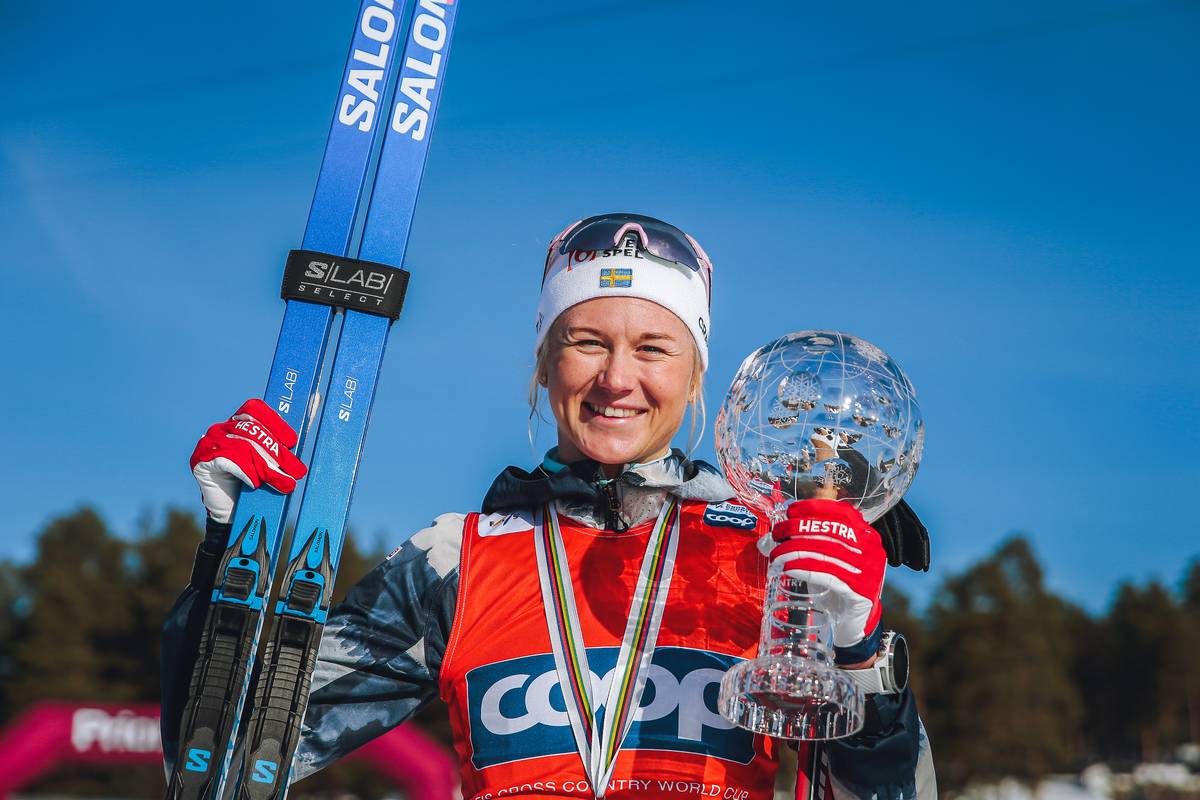
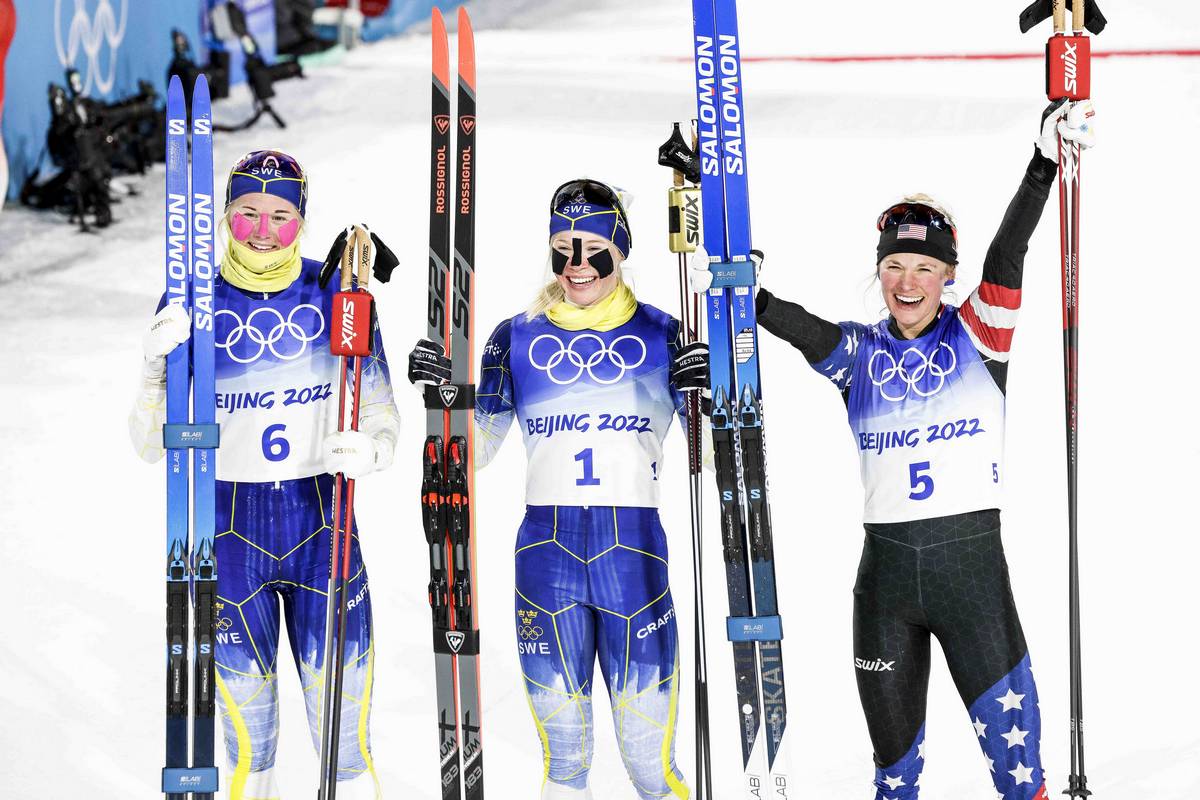
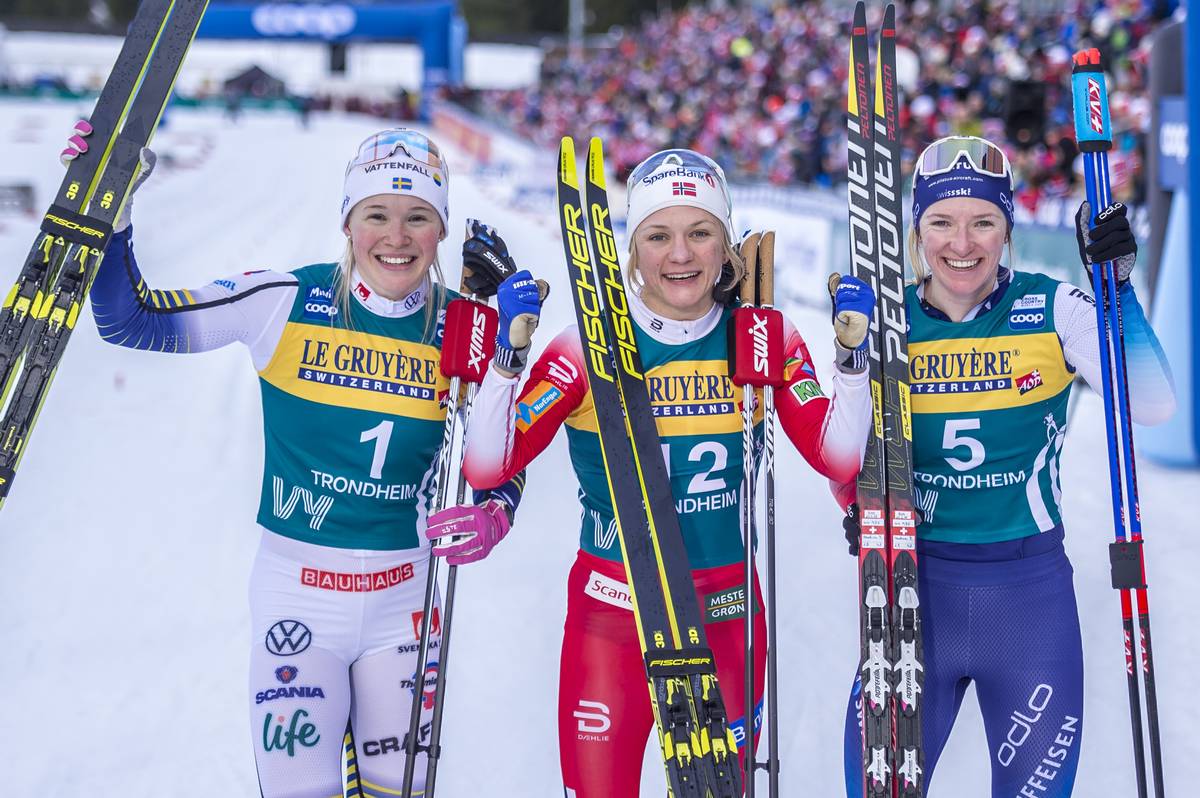
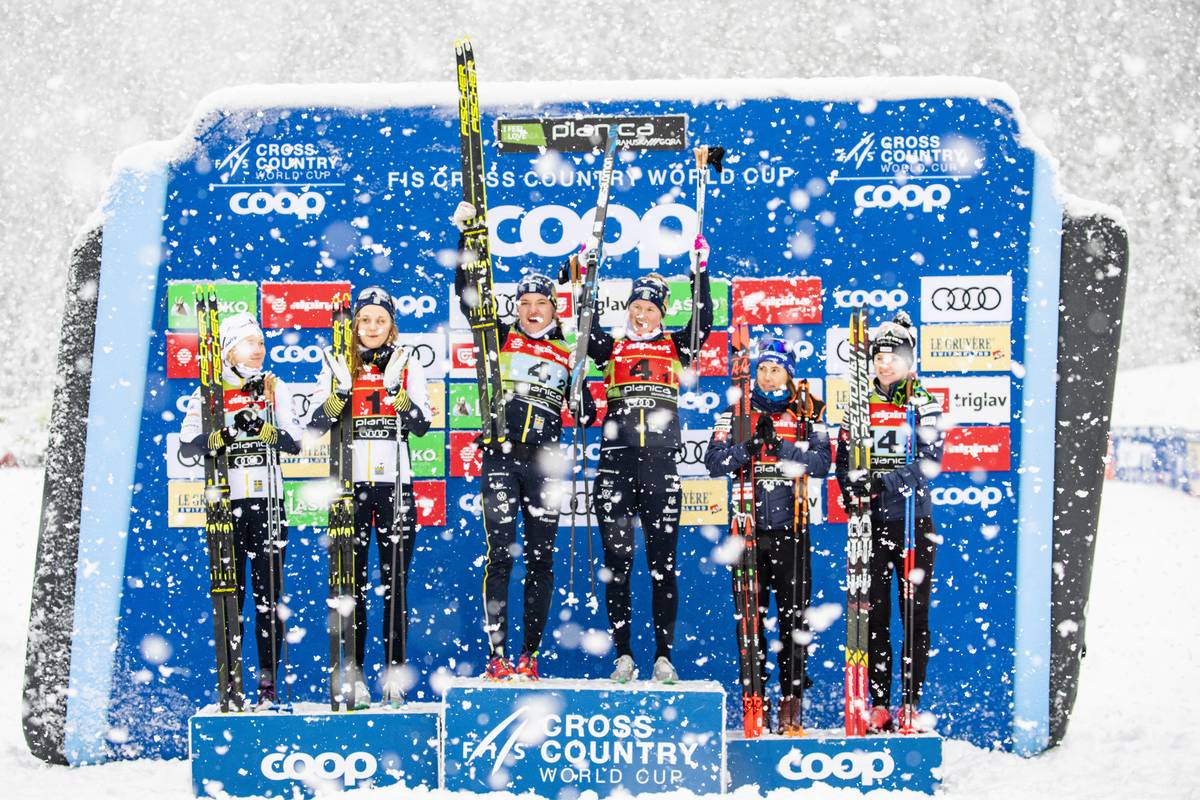
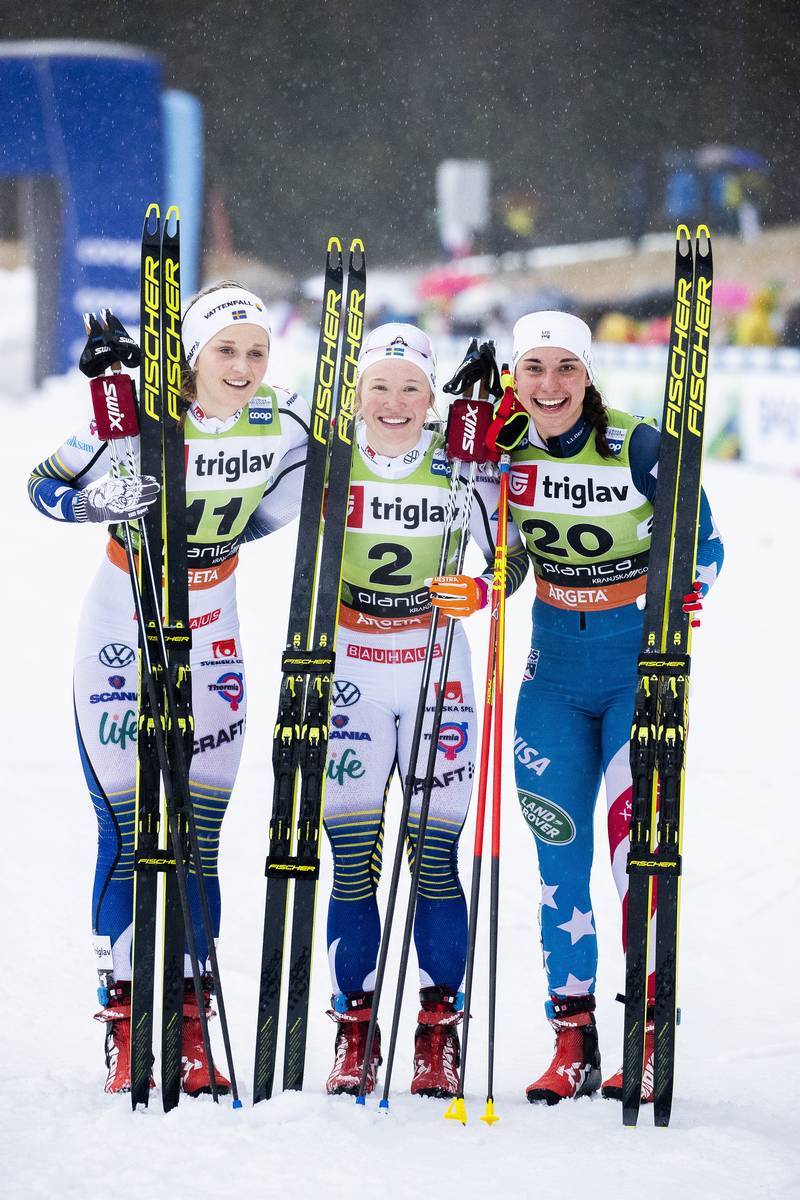
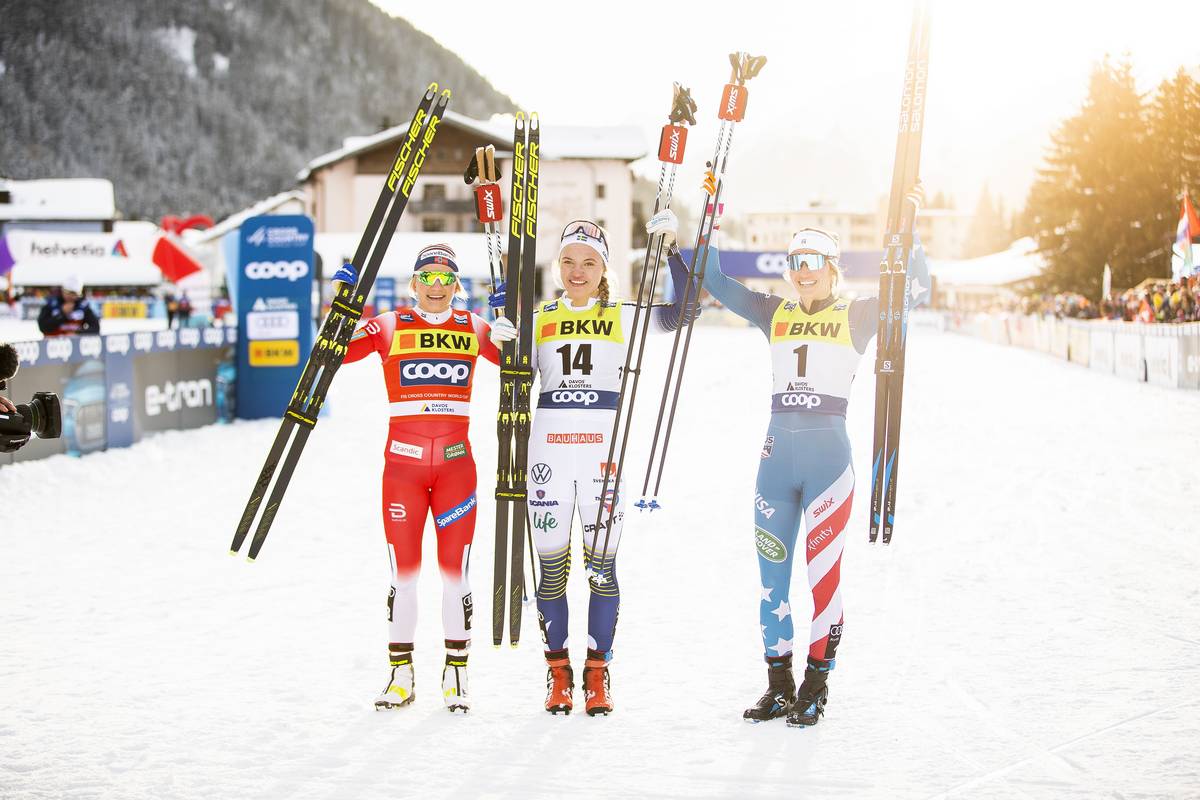
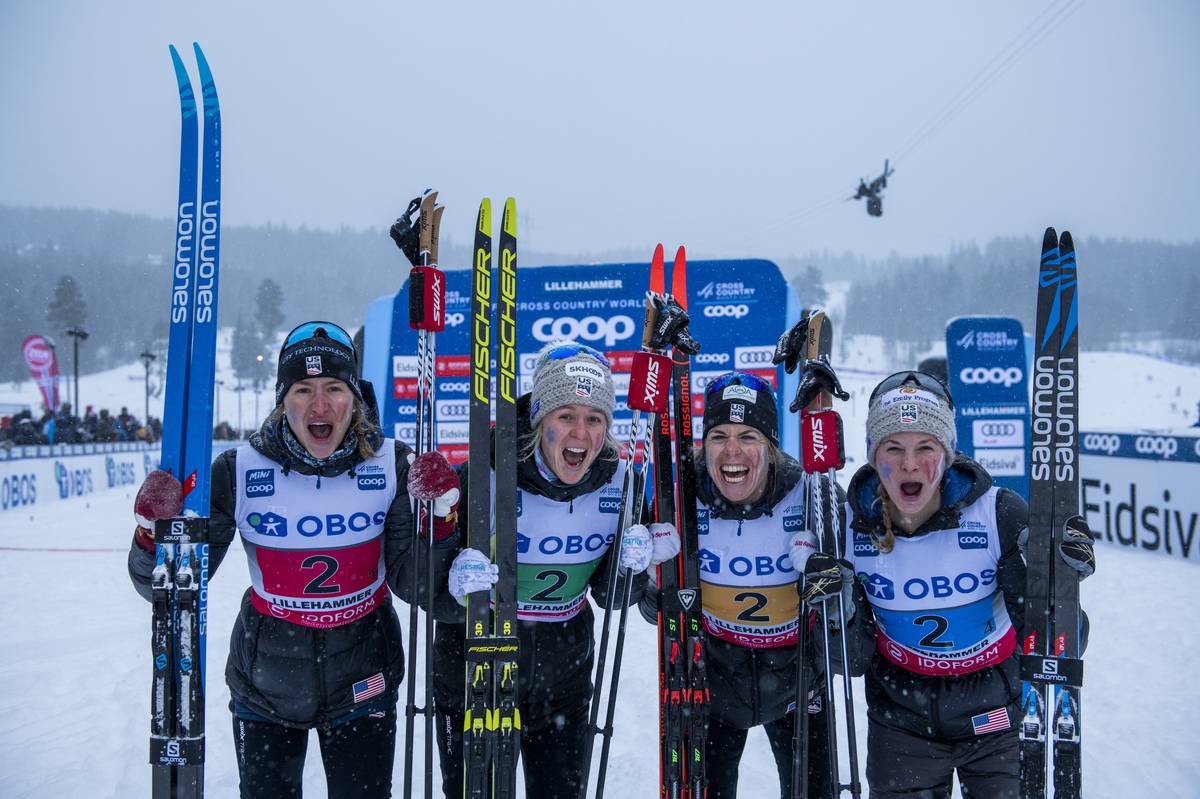
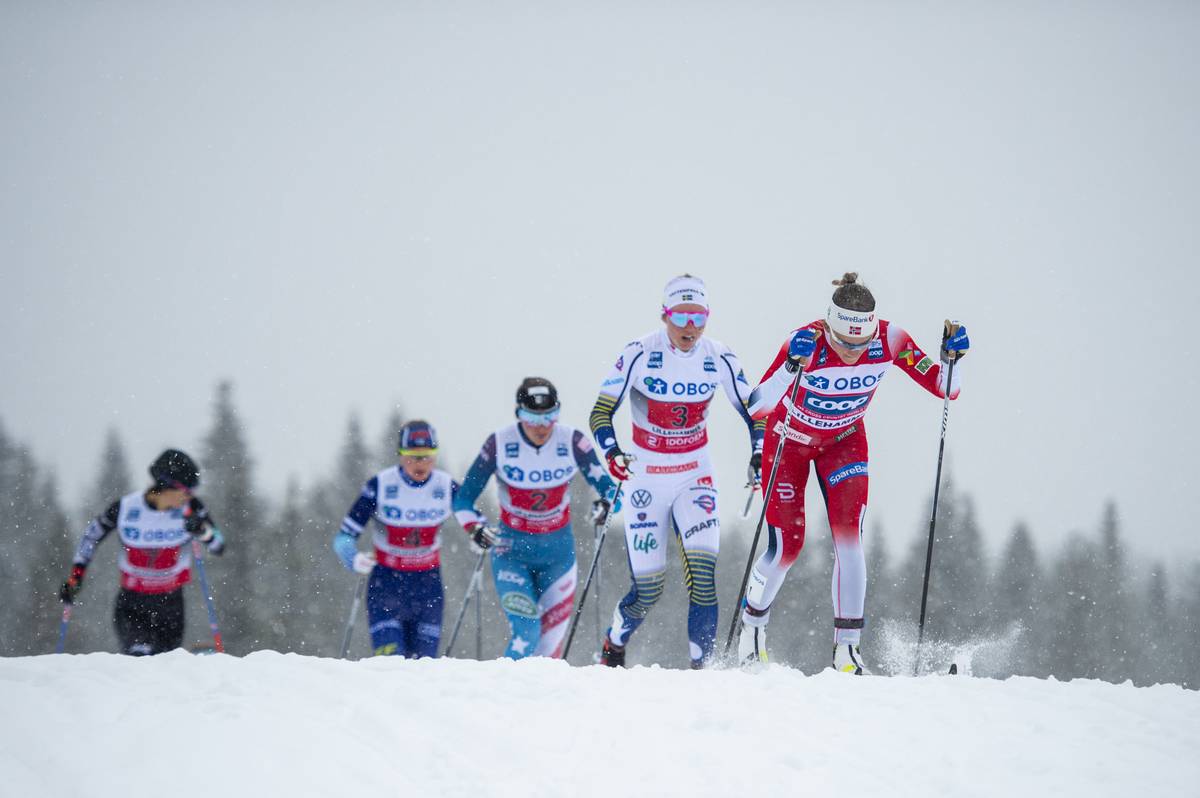
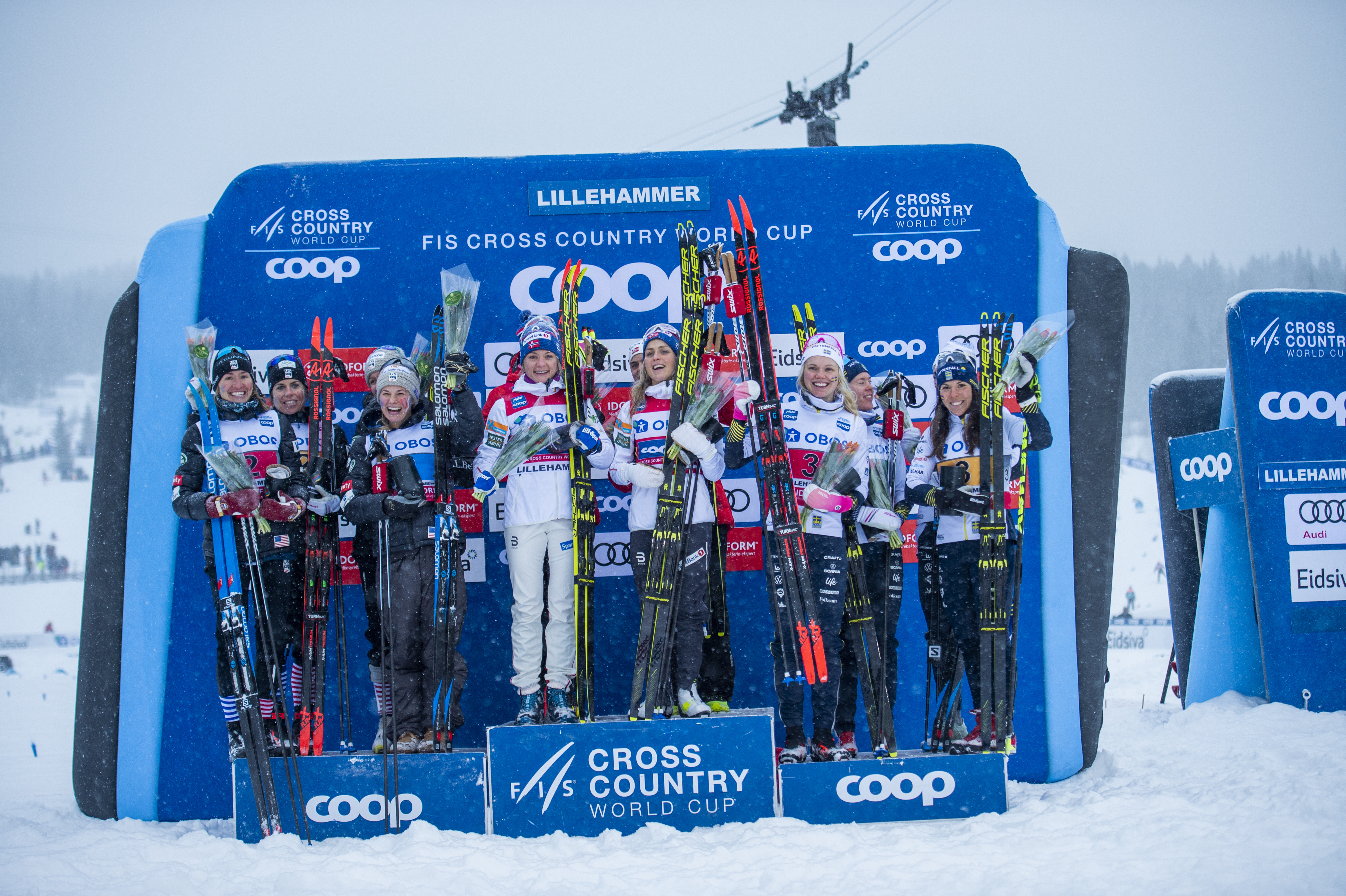
    Women’s 1.4 k classic sprint podium in Falun, Sweden: Jonna Sundling (SWE) took the win ahead of Anamarija Lampic (SLO) and Maja Dahlqvist (SWE). (Photo: NordicFocus)

    We’ve arrived at the final weekend of World Cup racing. After the cancellation of the finals scheduled to take place in Tyumen, Russia and the difficulty of finding a last-minute replacement, these three days of racing in Falun, Sweden will be the culmination of the 2021/22 World Cup season. On a warm sunny day, in full spring conditions, the women executed an exciting classic sprint on the familiar 1.4 k Falun sprint course. With this being the last sprint of the season, it was also a day to cement the places in the running for the overall women’s sprint globe (none of the team events happening Sunday will influence the rankings). 

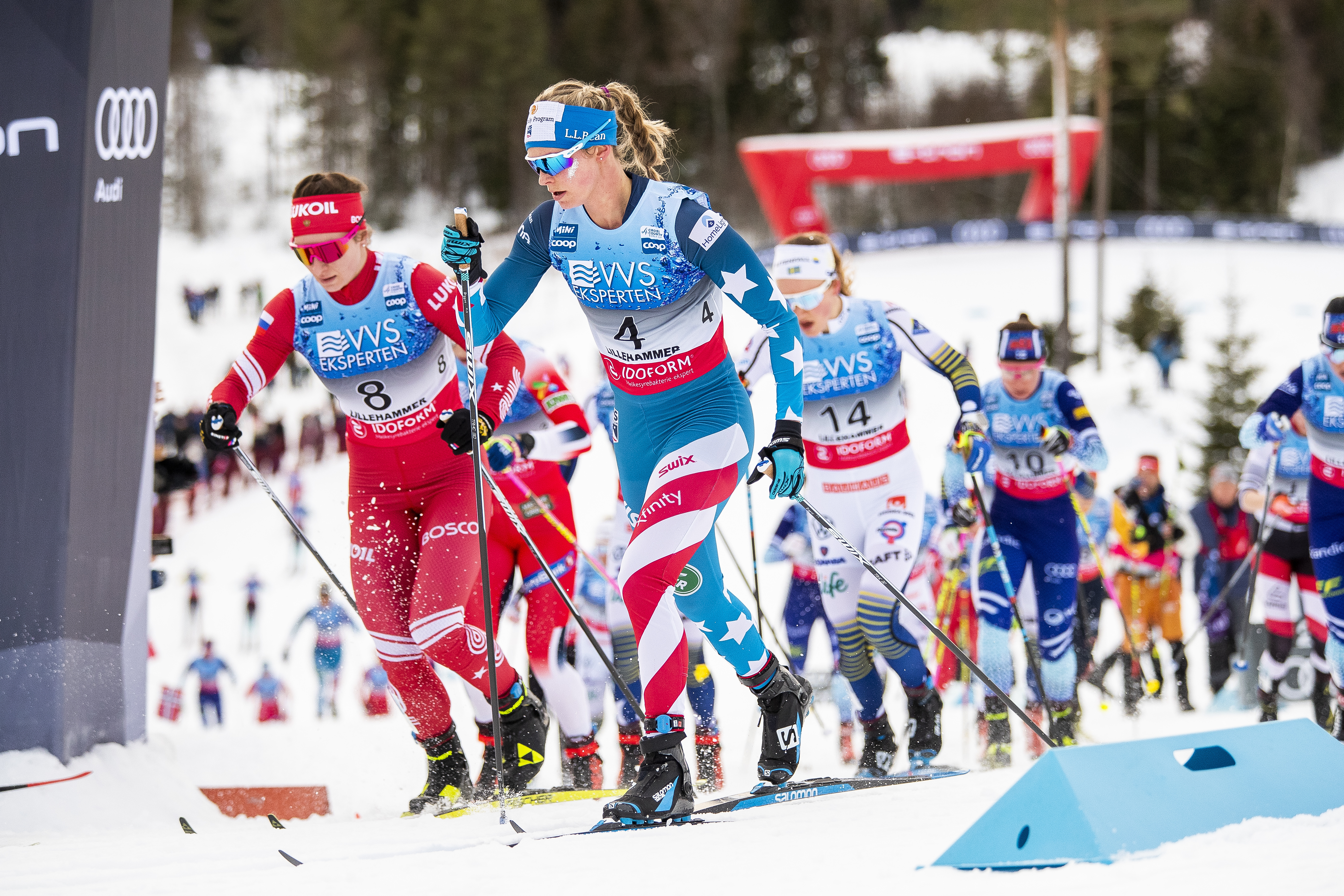
    Starting with a bang, Jonna Sundling of Sweden won the qualifier by an astonishing margin of +8.41 seconds, ahead of runner up Jasmi Joensuu of Finland. The American’s put three women into the quarter-finals, led by Rosie Brennan in 7th (+9.61). Julia Kern qualified in 17th position (+12.30), followed by her teammate and roommate, Jessie Diggins in 18th (+12.49). 

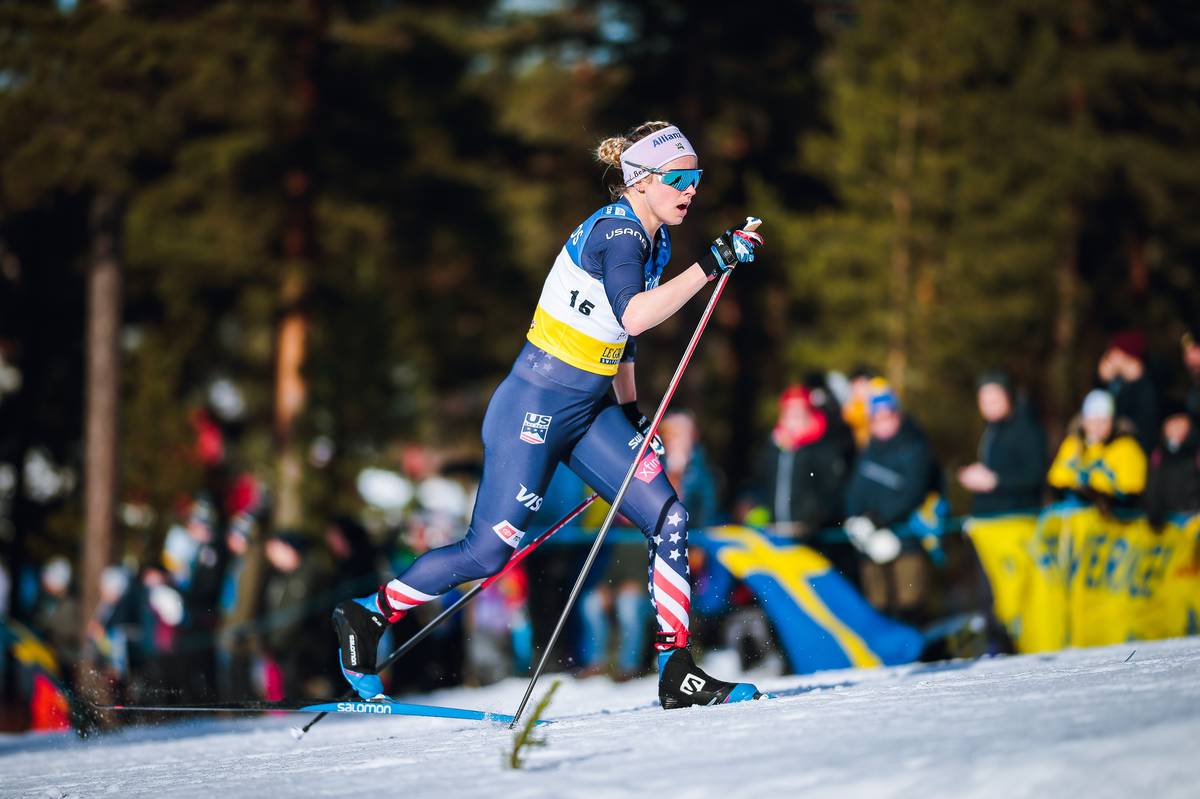
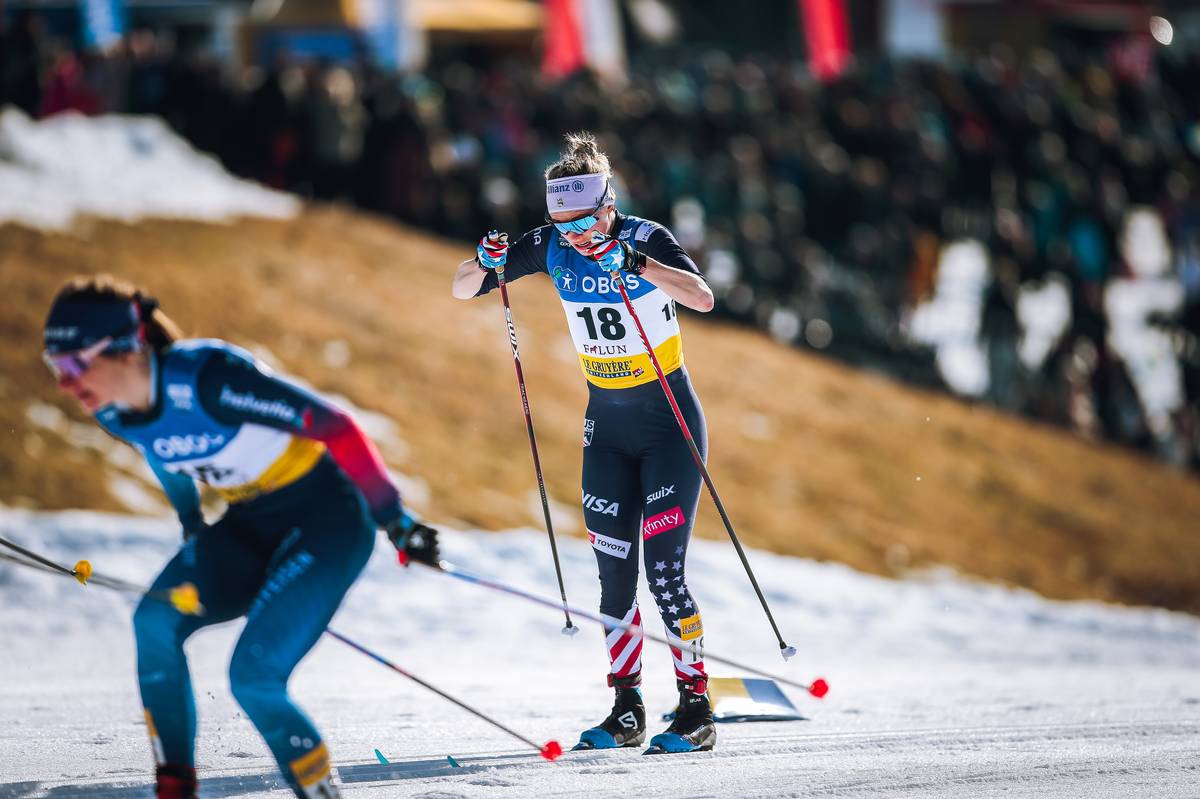
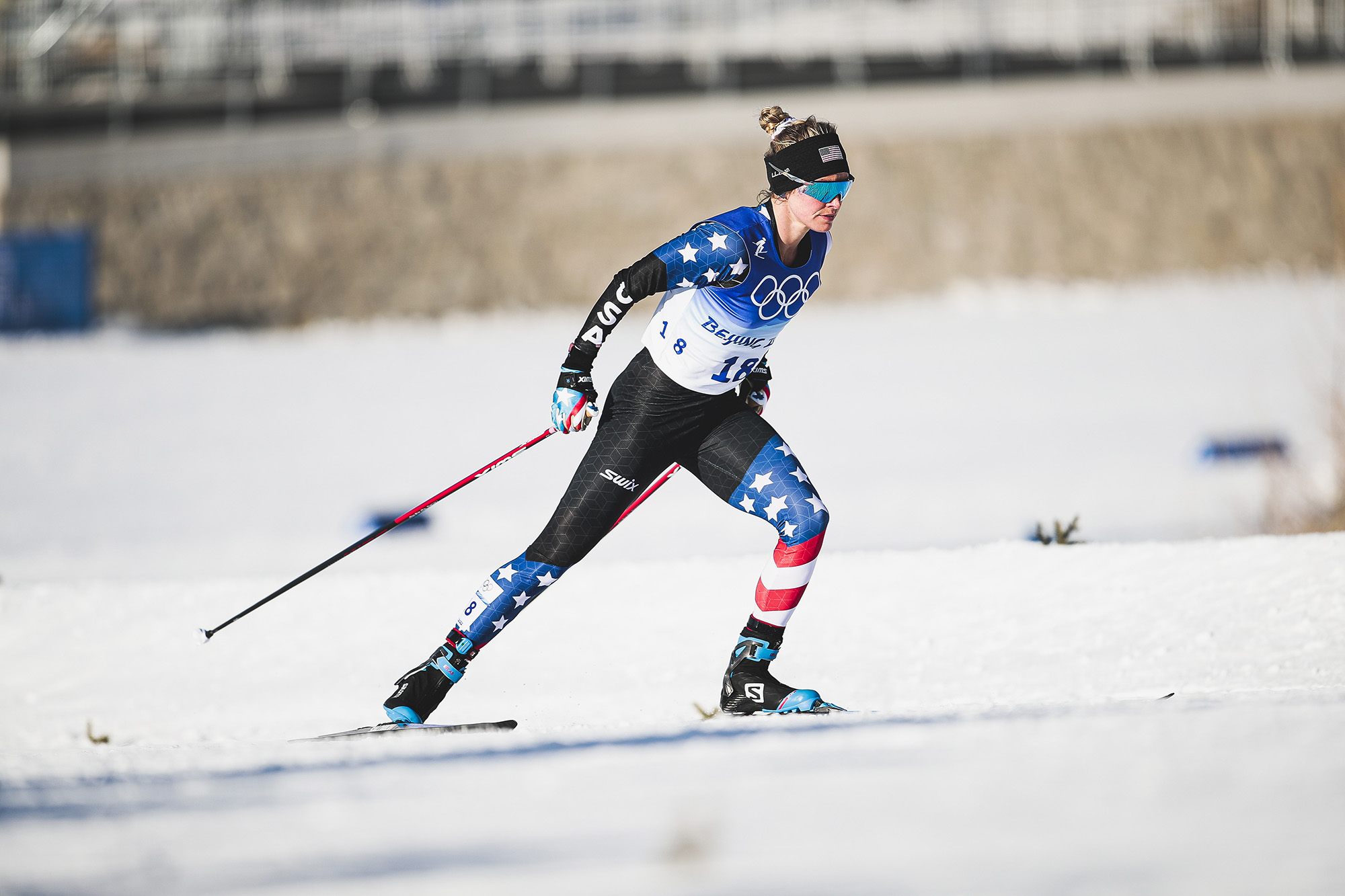
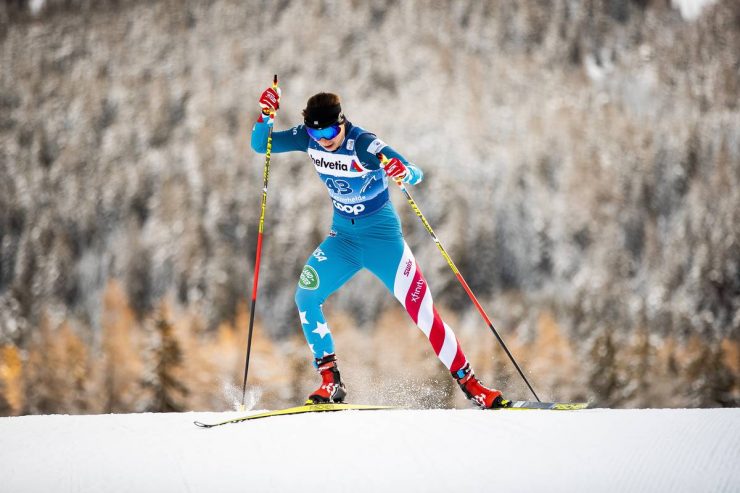
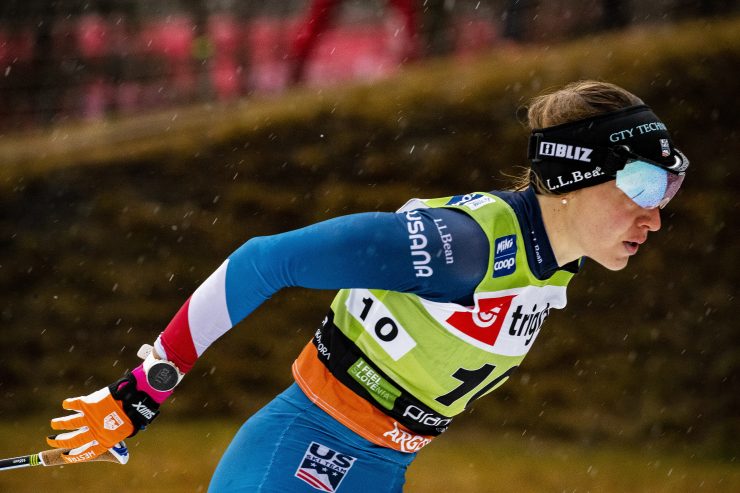
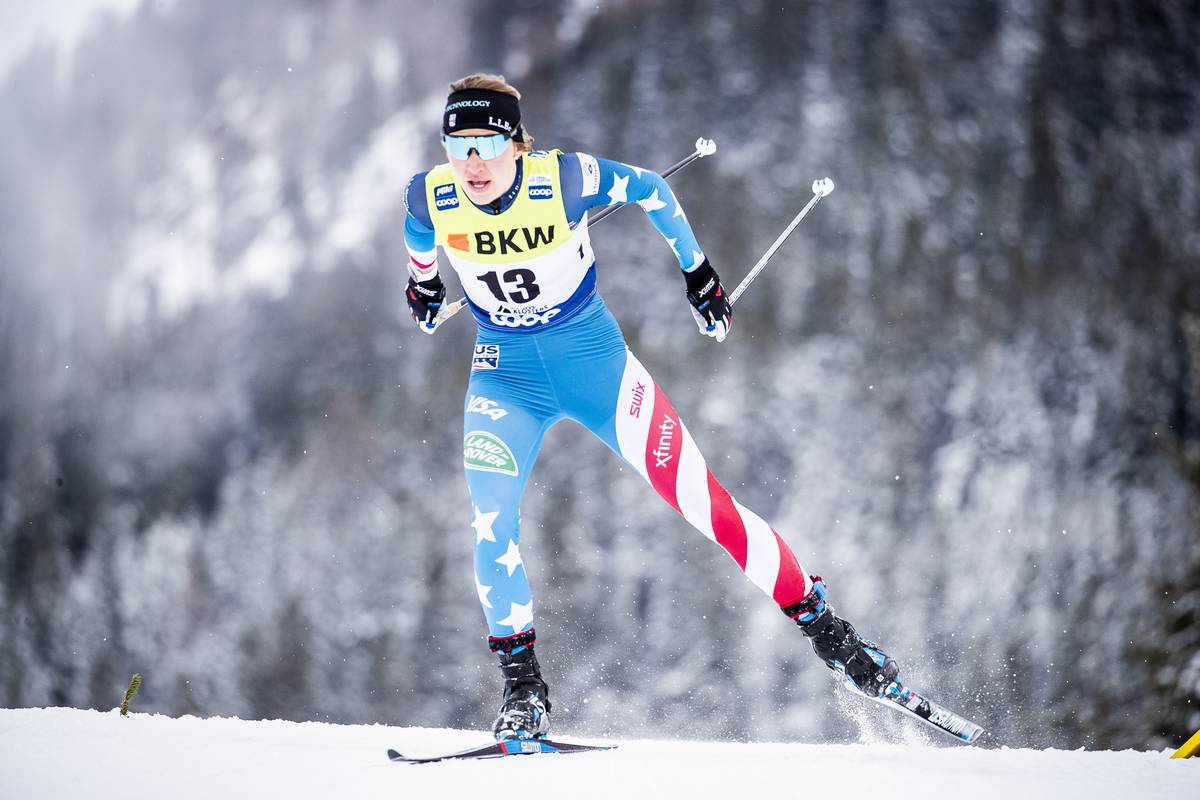
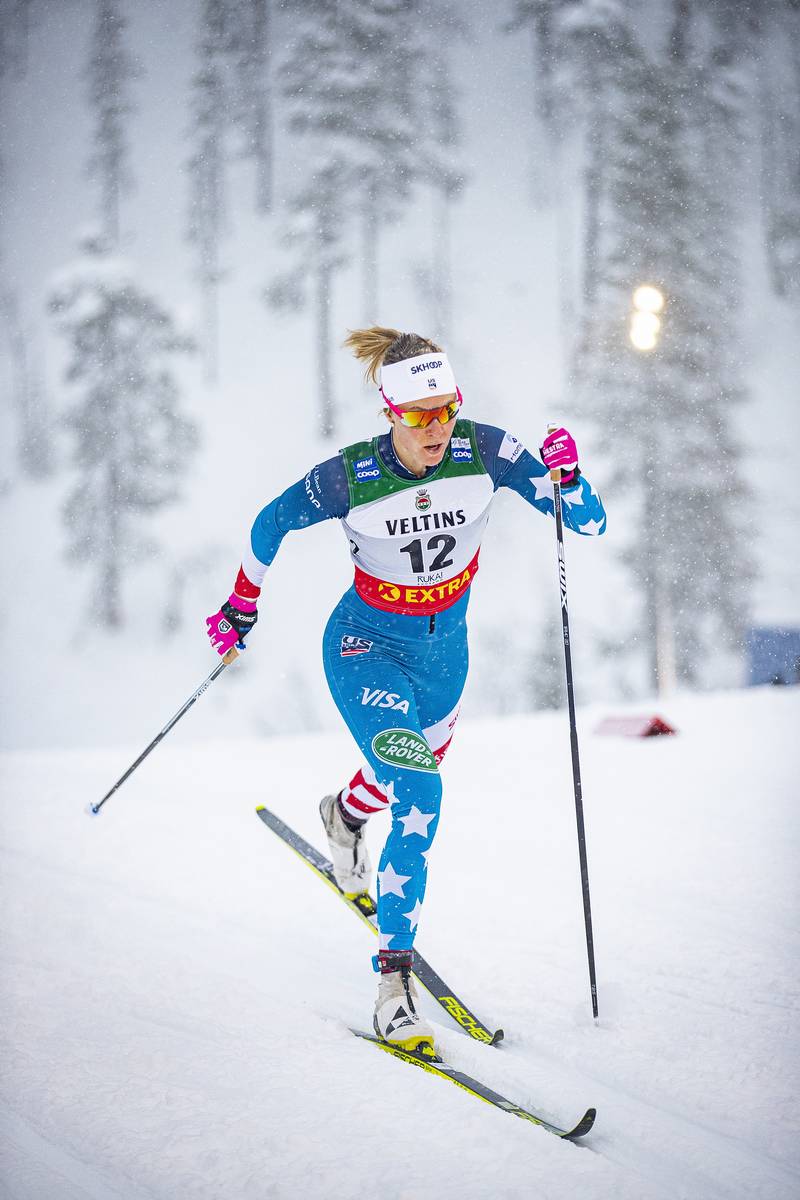
    Jessie Diggins on her way to 18th place in the qualifier. Diggins ultimately ended her day 19th. (Photo: NordicFocus)

    These were the only three American women competing today as unfortunately some late-stage positive covid tests barred the rest from competing. Having made it through a winter of international travel, living, and competing during the Omicron surge, Hailey Swirbul and Katherine Ogden announced on Monday that they had both tested positive in Norway. Lauren Jortberg, who had her World Cup debut in Lahti, Finland two weeks earlier, came directly to Falun to prepare for this weekend, only to test positive on Wednesday. 

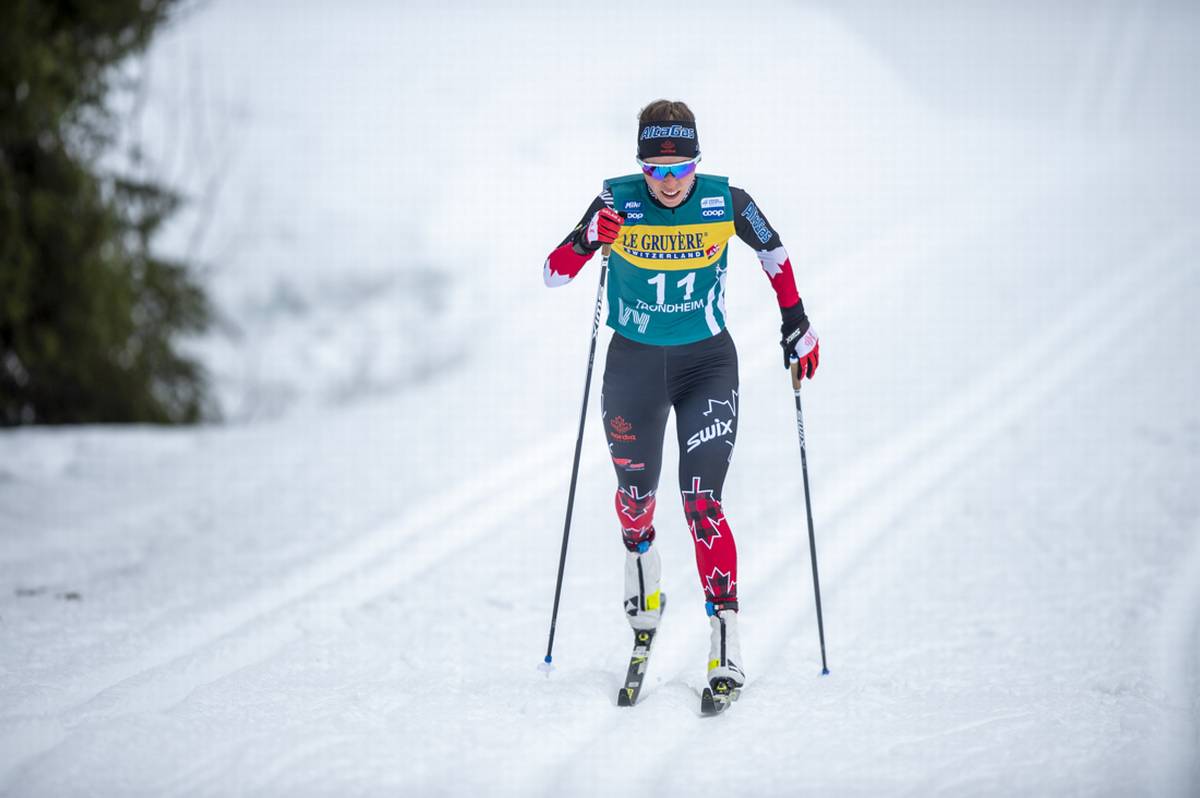
    No Canadian women made it into the top thirty, their first finisher was Olivia Bouffard-Nesbitt in 32nd (+17.54). Katherine Stewart-Jones led a string of fellow country-women, finishing 37th (+19.49), followed by Dahria Beatty in 38th (+19.75) and Jasmine Drolet in 39th (+20.08). After competing at World Juniors in Lygna, Norway, Drolet joined the senior women and made her first World Cup appearance in the Holmenkollen 30 k last weekend where she finished 42nd. 

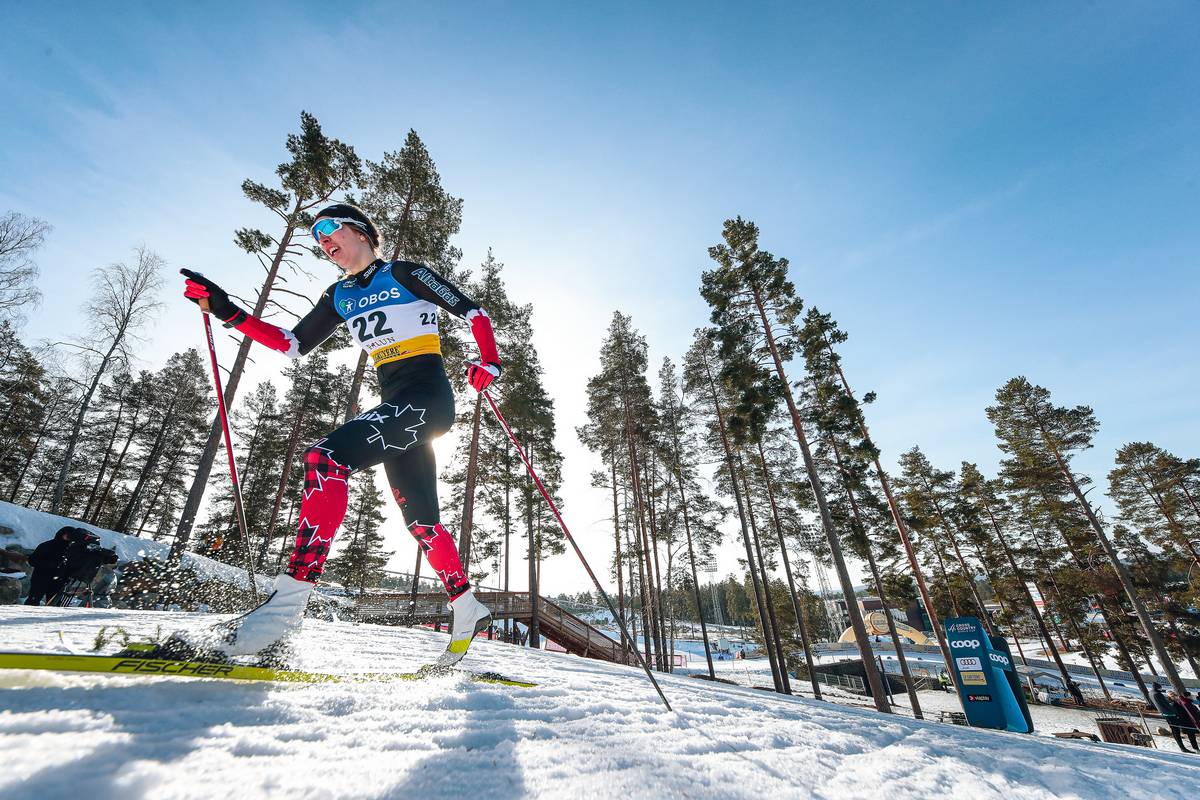
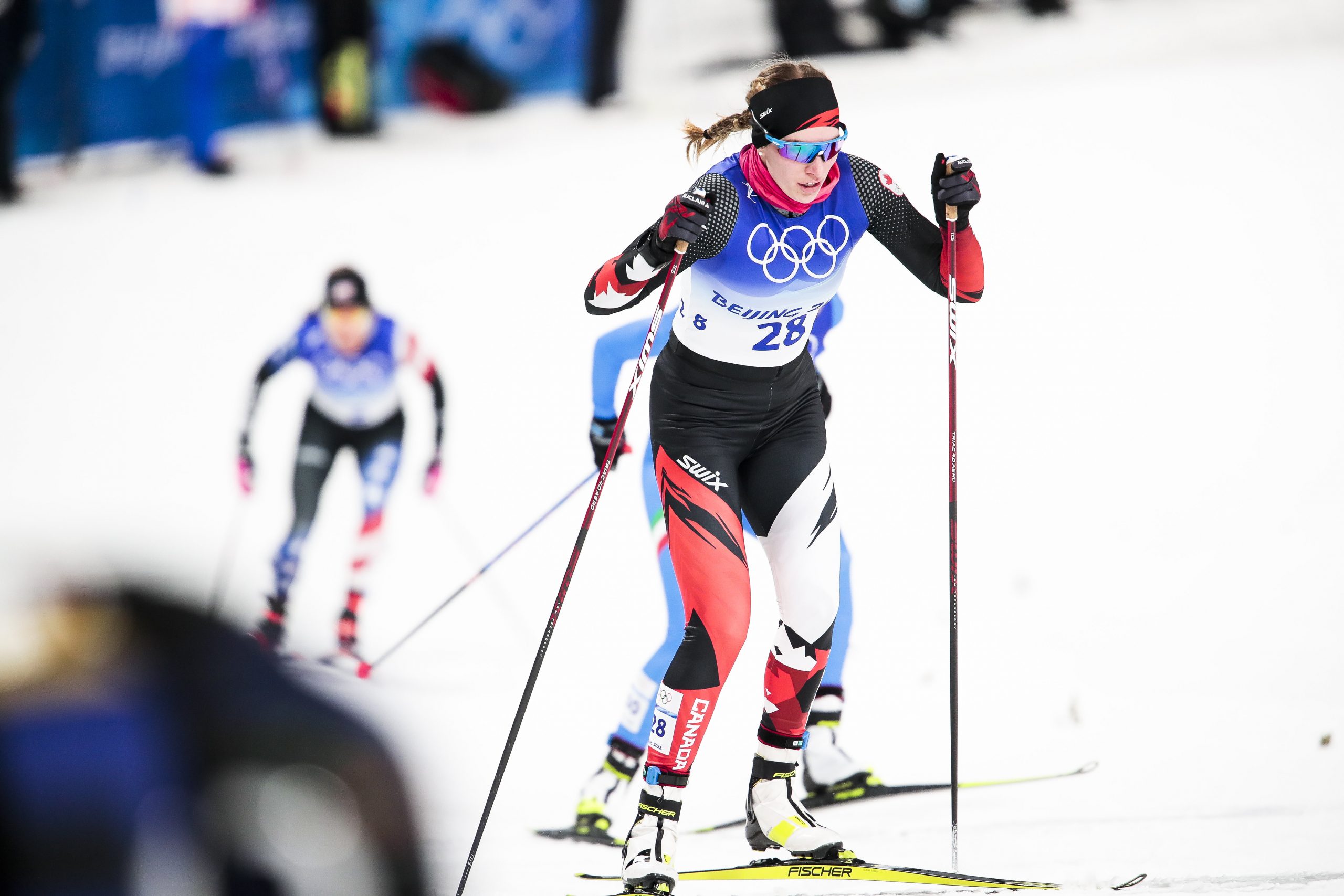
    Dahria Beatty (CAN) racing to 38th in the classic sprint qualifier on Friday (Photo: NordicFocus)

    As crowds of fans gathered, the women’s quarterfinals kicked off at 12:15 local time. In the first heat, a fast pace bought three women tickets to the semi finals, led by Anna Svendsen of Norway. After winning the classic sprint qualifier in Drammen, Norway last week only to fall in the quarter finals, Johanna Hagström (SWE), skiing on a home course, made it safely through in second. Kerttu Niskanen of Finland took third but with a fast enough time to snag a lucky loser position.

    Heat two was controlled entirely by Sundling as she skied easy out front, spreading the rest of the field. Behind her came Johanna Matintalo of Finland and Julie Myhre of Norway who made it to the semis as the second lucky loser. Brennan (USA) finished fourth, +3.39 behind Sundling, ending her day in 16th overall. 

    Rosie Brennan races the quarterfinal after qualifying 7th. (Photo: NordicFocus)

    “It was warm and wild out there today,” wrote Brennan after the race. “This course is quite technical and has some challenging downhills which has made it a tough course for me in the past so I was ready to make some progress today. I had a good qualifier and that gave me some confidence for the heats. I had a very stacked heat which can go either way for me. I struggled finding space to move on the uphills which is my strength and that ultimately cost me moving on to the semi-finals by less than a second. In the bigger picture, I do think I made some strong progress on some of my weak spots on this course and I am really excited about that. I am also still feeling good and excited to race which bodes well for the rest of the weekend.”

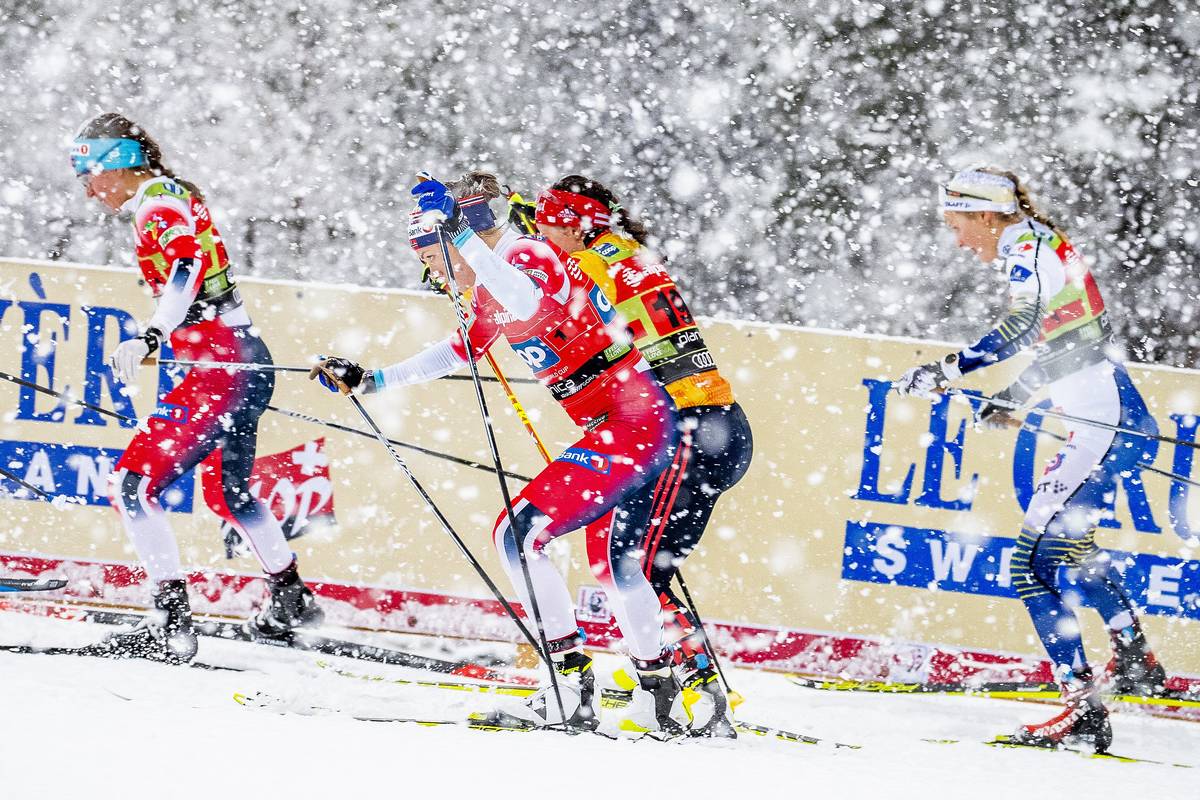
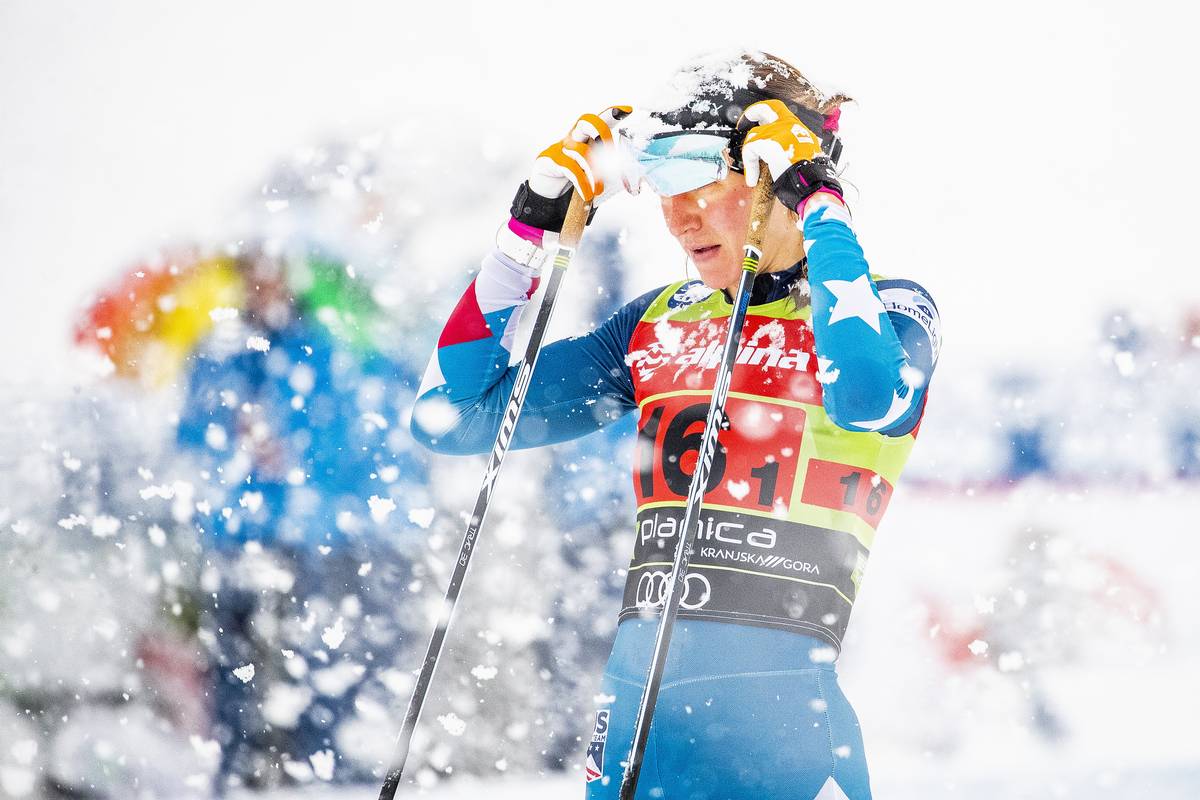
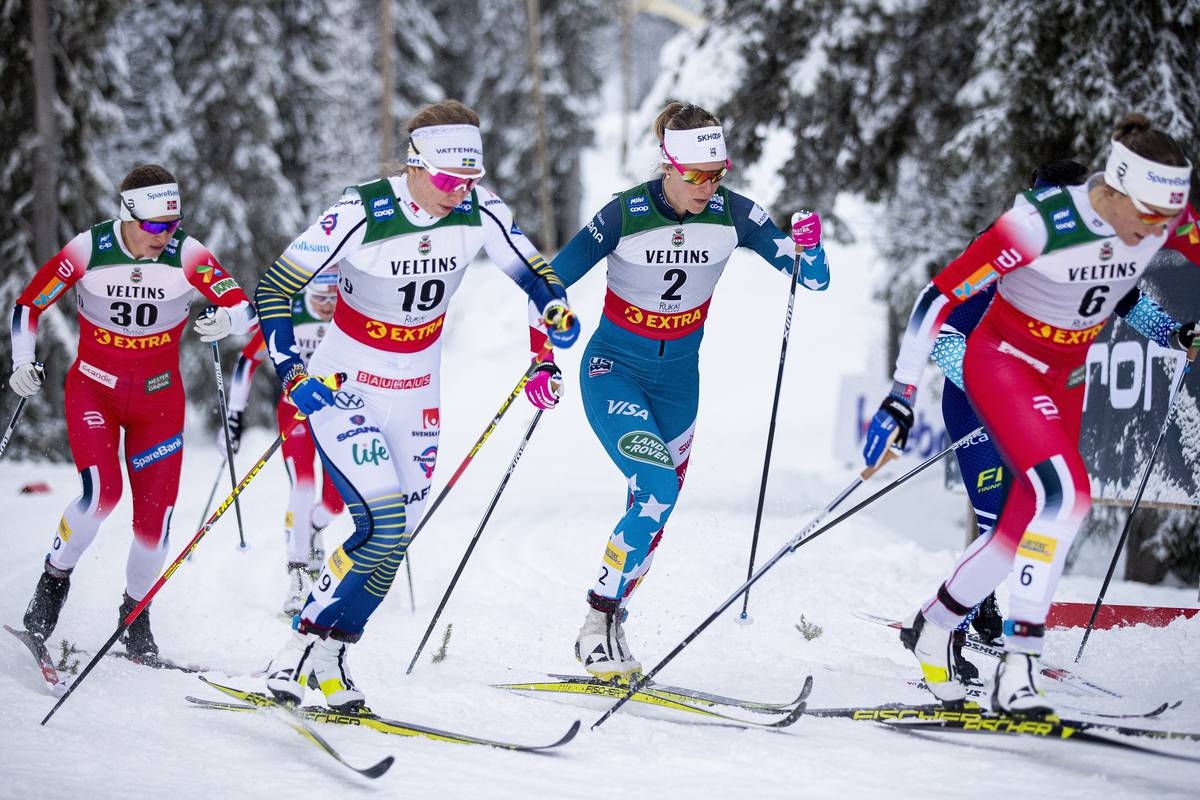
    In heat number three, Anamarija Lampic of Slovenia took on the lead, as Diggins and Moa Lundgren of Sweden chased. Entering the final straight Nadine Fähndrich of Switzerland employed her blistering finish speed to surpass both Diggins and Lundgren, and nearly overtake an unsuspecting Lampic. This left Diggins in fourth place in a heat that was not quick enough to make lucky loser. Diggins ends the sprint season in fourth place in the overall sprint standings with 351 points; having entered the day in third with 339 points, she was bumped off the podium by Sundling. 

    Jessie Diggins races in heat number three in the 1.4 k classic sprint in Falun. (Photo: NordicFocus)

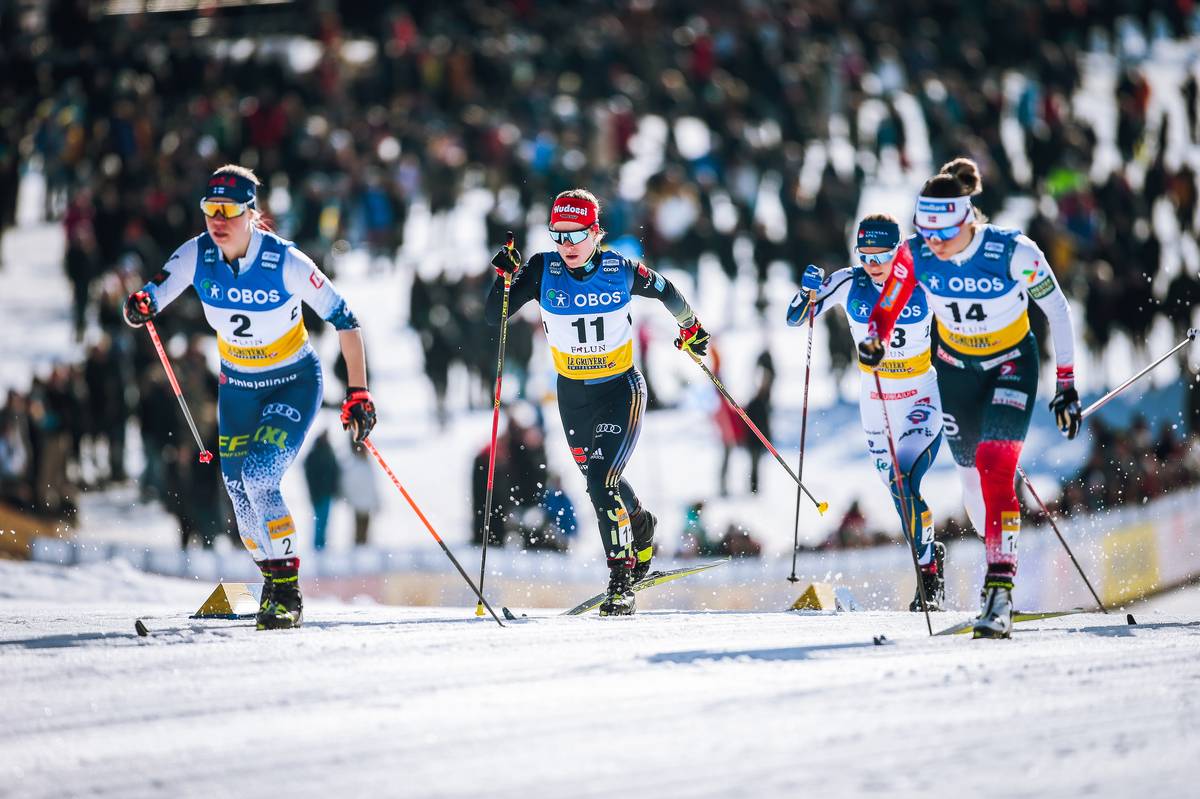
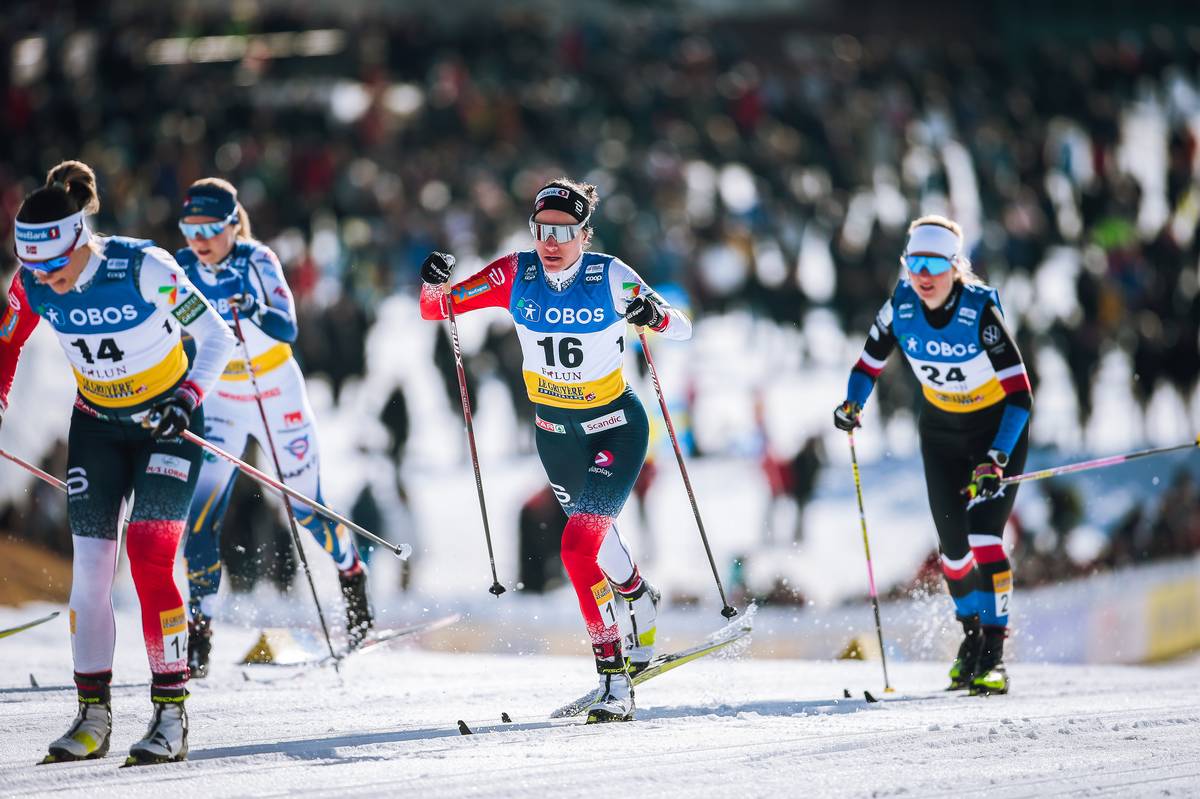
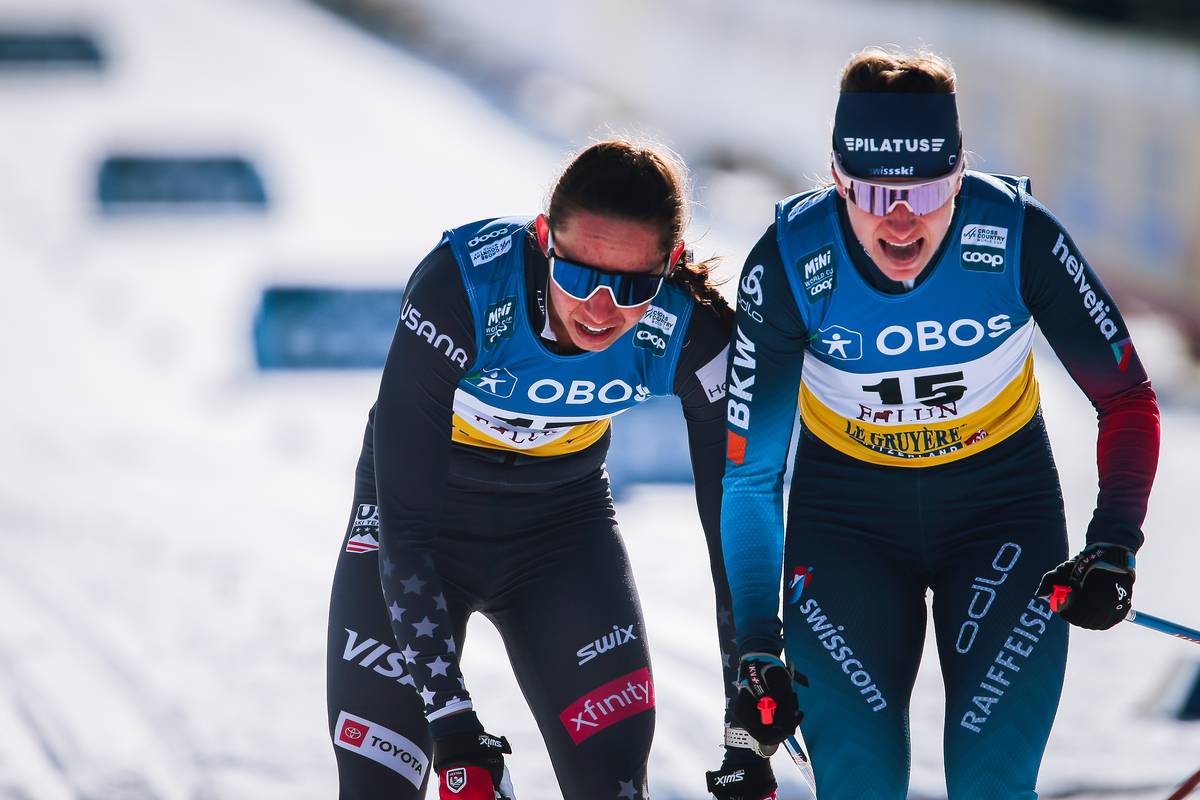
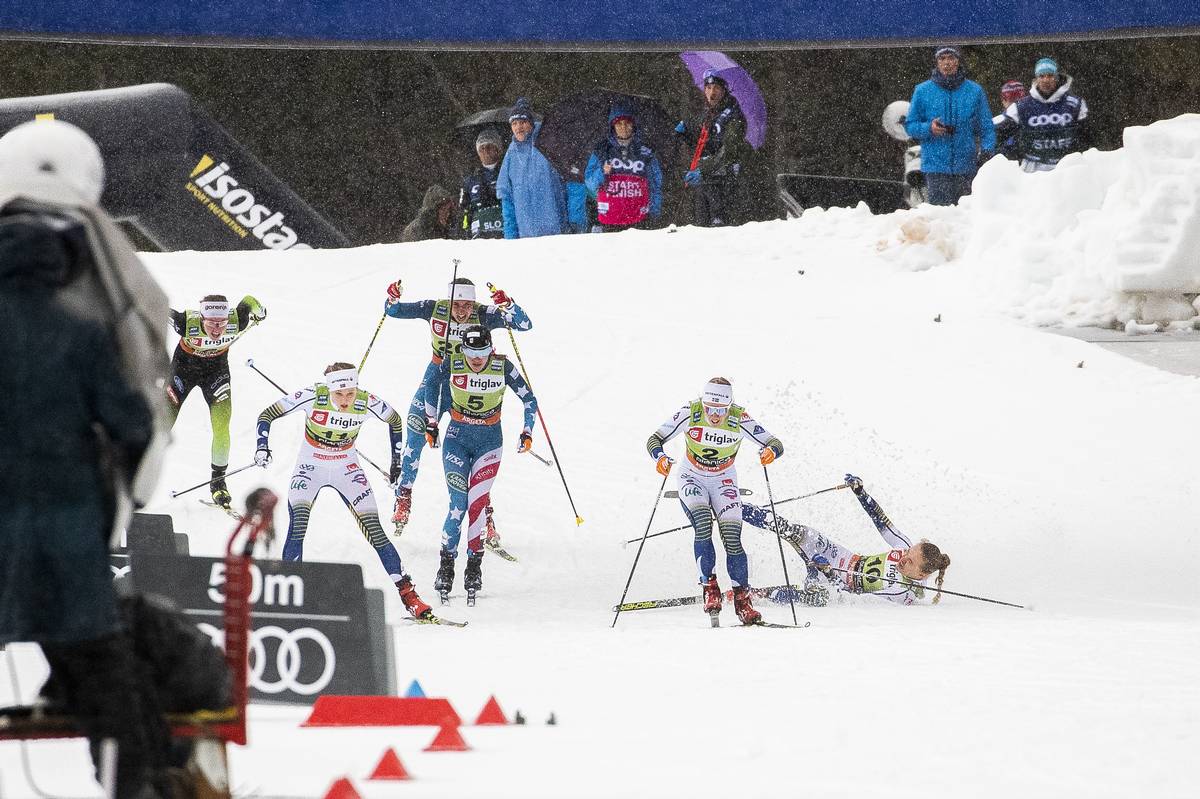
    Heat four saw an easy pace from the gun, with the pack largely staying together. With all six athletes still in touch as they crested the big climb, Kern navigated into third place on the ensuing tight downhill corner. An injection of speed from Maja Dahlqvist (SWE) over the next rise split the pack as Lotta Udnes Weng (NOR) shadowed, followed by Kern still in third. In the long downhill glide-out, Weng overtook the Swede, entering the final corner in first. Right with her were Kern, Dahlqvist and Laura Gimmler of Germany. A close finish saw Kern out double-pole Dahlqvist to take the win, with Weng coming second. However, a disqualification for Weng bumped Dahlqvist into second and thus have her a ticket to the semi-finals. 

    Jasmi Joensuu (FIN) and Maiken Caspersen Falla (NOR) duke it out in the quarter-final (Photo: NordicFocus)

    After a redeeming win in Drammen last week, Maiken Caspersen Falla of Norway charged off the startline for heat five. Joensuu (FIN) and Heidi Weng (NOR) took up the chase and eventually overtook Falla on the long descent back into the stadium. Together the two Norwegians pulled away from the Finn as Joensuu faded slightly. Falla finished first and Weng, with a scream of satisfaction, crossed in second. 

    Heidi Weng (NOR) racing in quarterfinal heat number five (Photo: NordicFocus)

    Echoing her moves from the quarter-final, Sundling (SWE) approached semi-final number one in the same manner, skiing smooth and easy out front. Lampic (SLO) followed with some occasional slips on a mushy course. Those front two continued to pull away, Sundling making it look easy as she found herself well clear of the rest of the competition. Lampic maintained second position and Matintalo (FIN) came in third, though was not quick enough to move onto the final. 

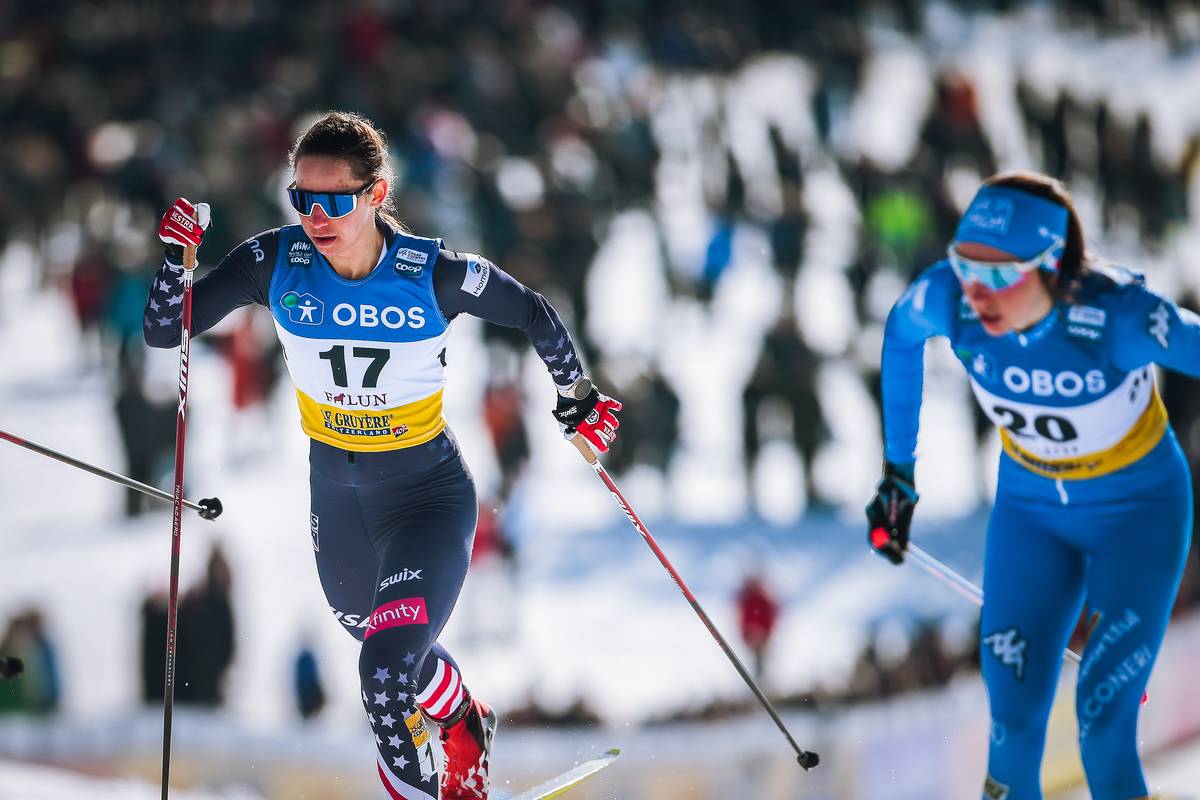
    In the second semi-final, Falla (NOR) took the lead, again trailed by Weng (NOR). Once again, Kern (USA) moved into third position on the tight middle downhill portion, setting herself up well. A fall from Weng on the next hill took her out of contention as Dahlqvist (SWE) moved into second position, Kern still in third. Switching tracks, Dahlqvist stumbled but managed to stay on her feet as Kern took the lead into the final corner. Kern held onto first position with some strong double poling and behind her Dahlqvist, Falla and Fähndrich all qualified for the final in second through fourth positions respectively. 

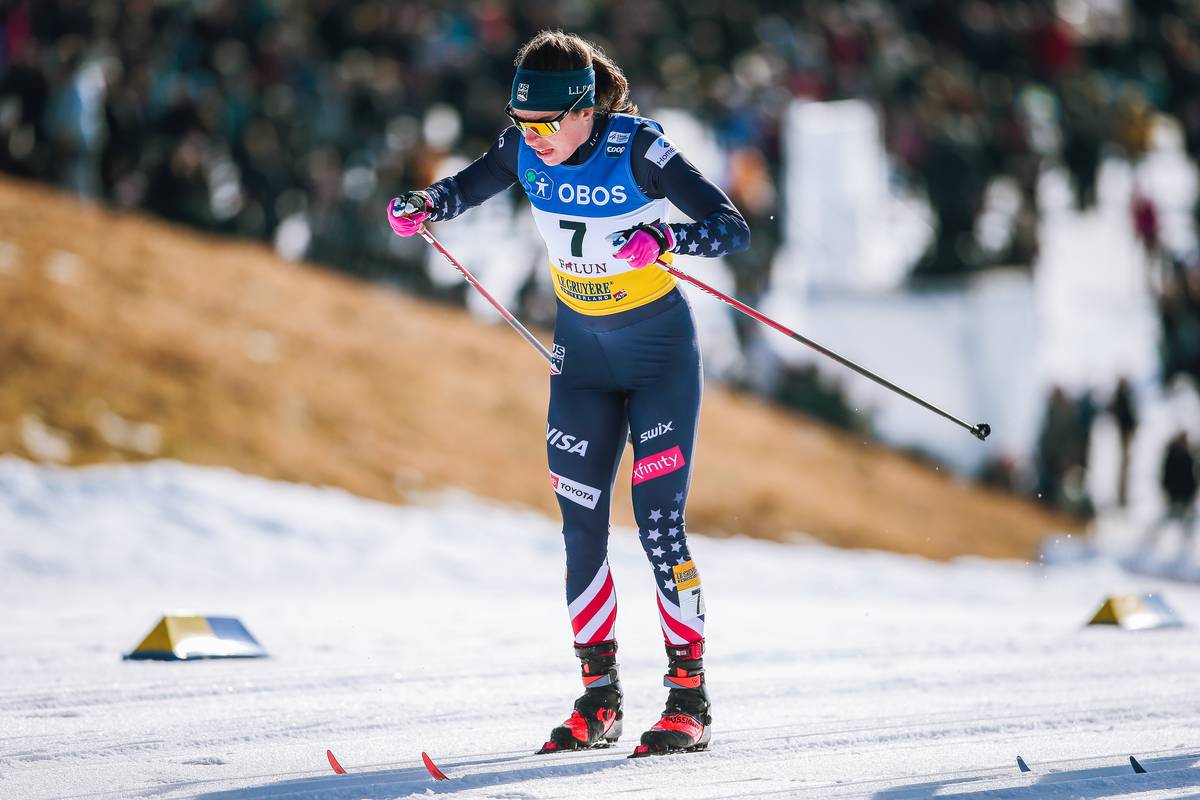
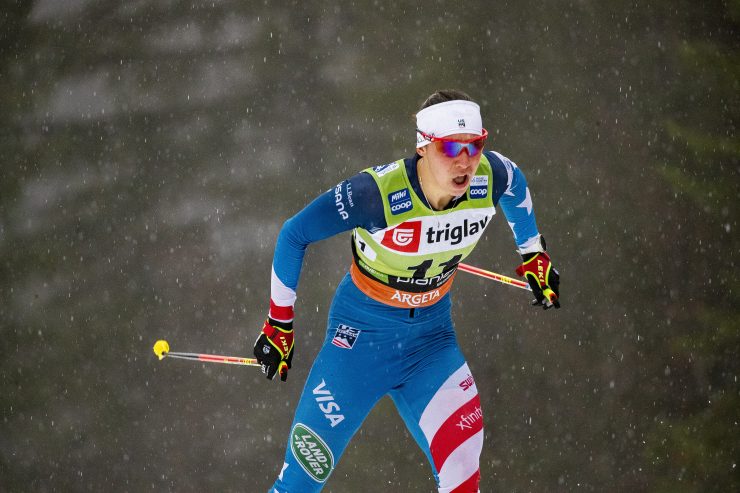
    Julia Kern, closing out fast (Photo: NordicFocus)

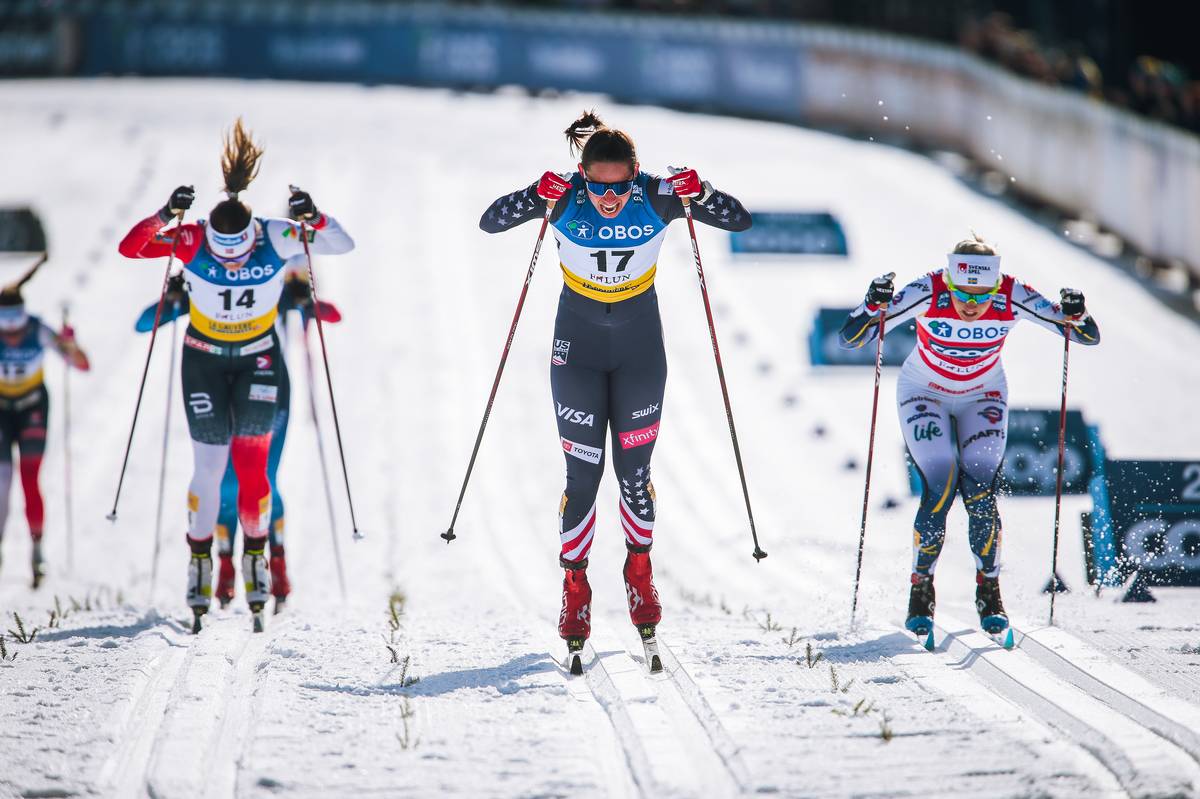
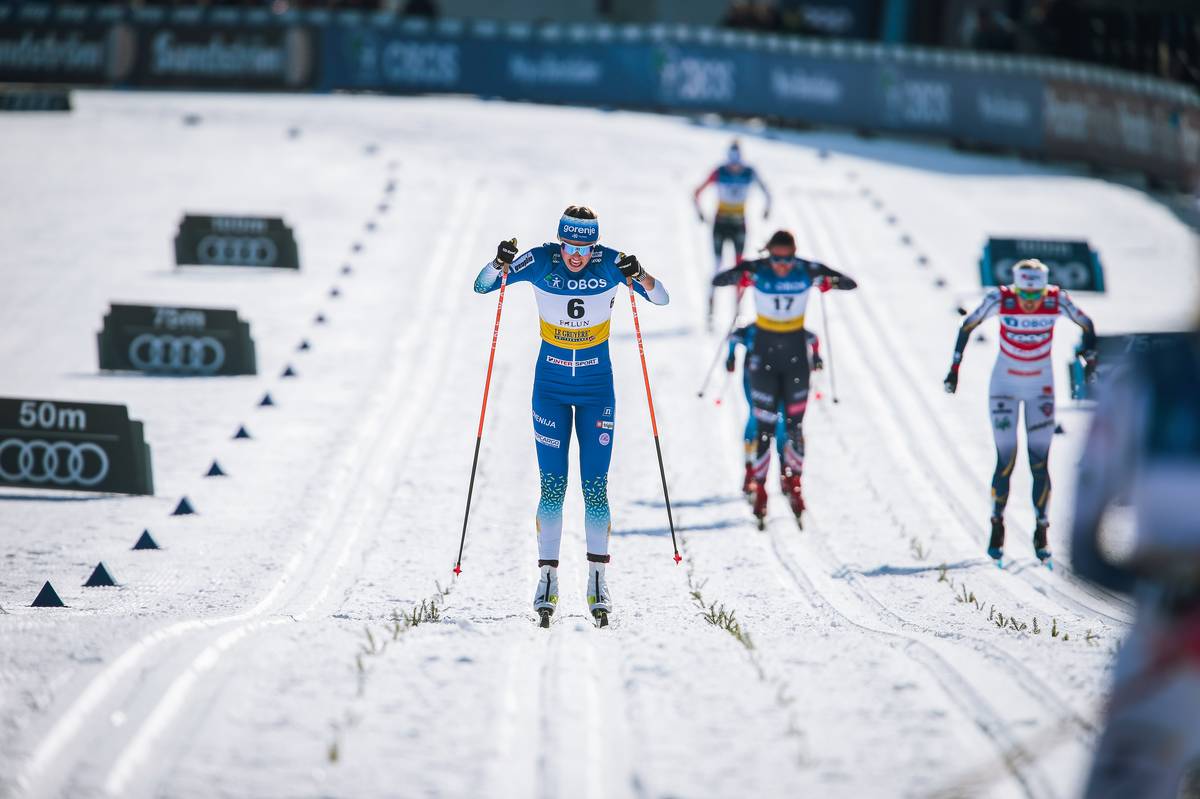
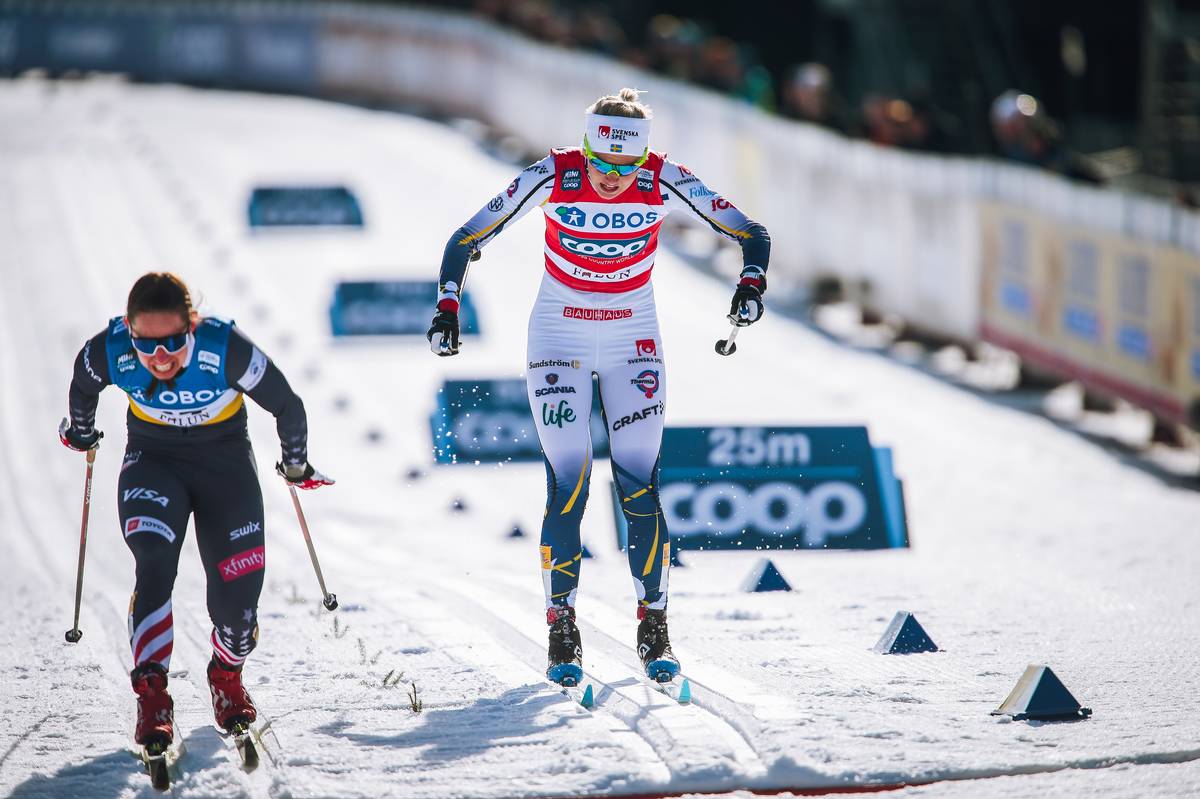
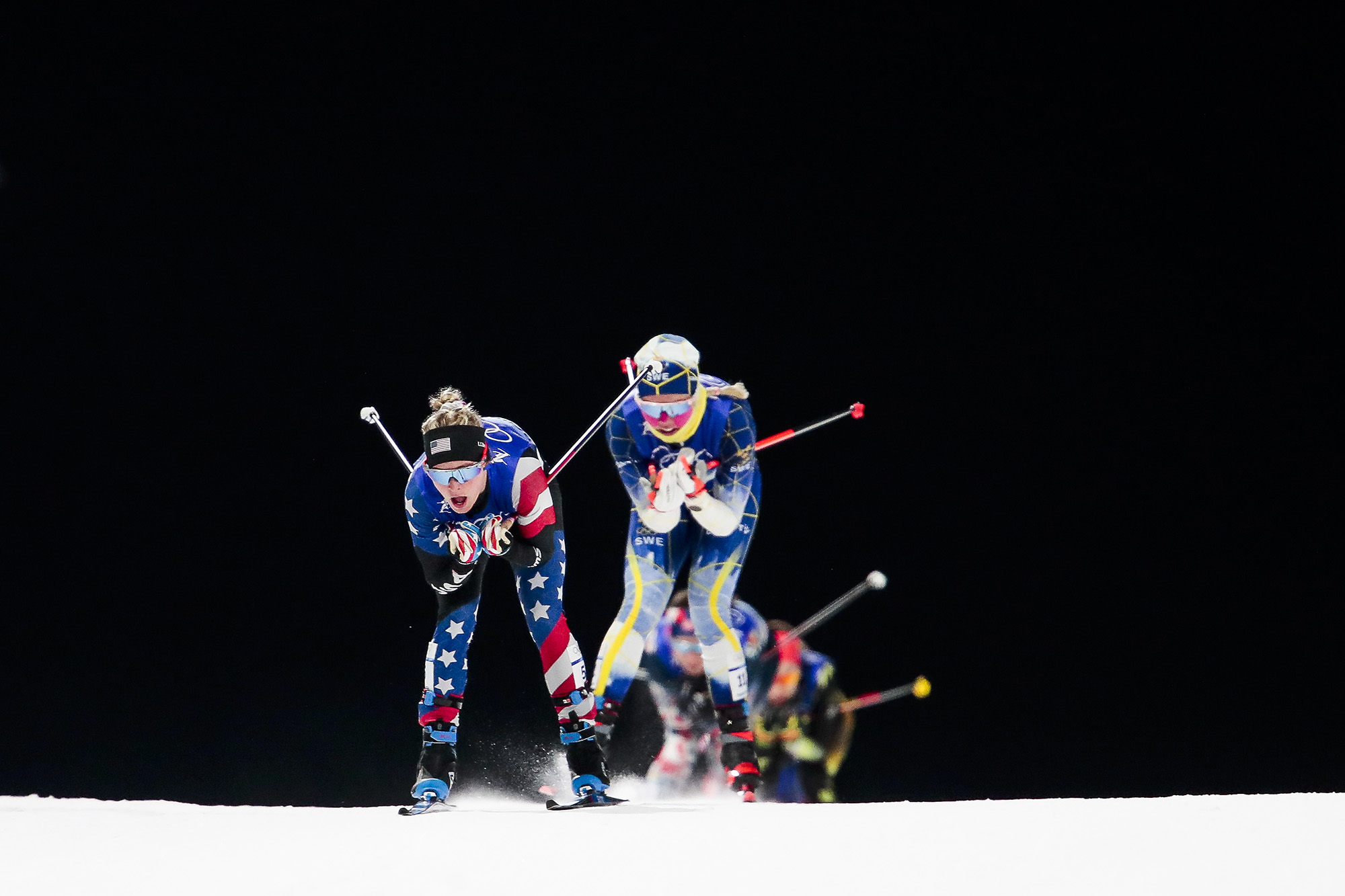
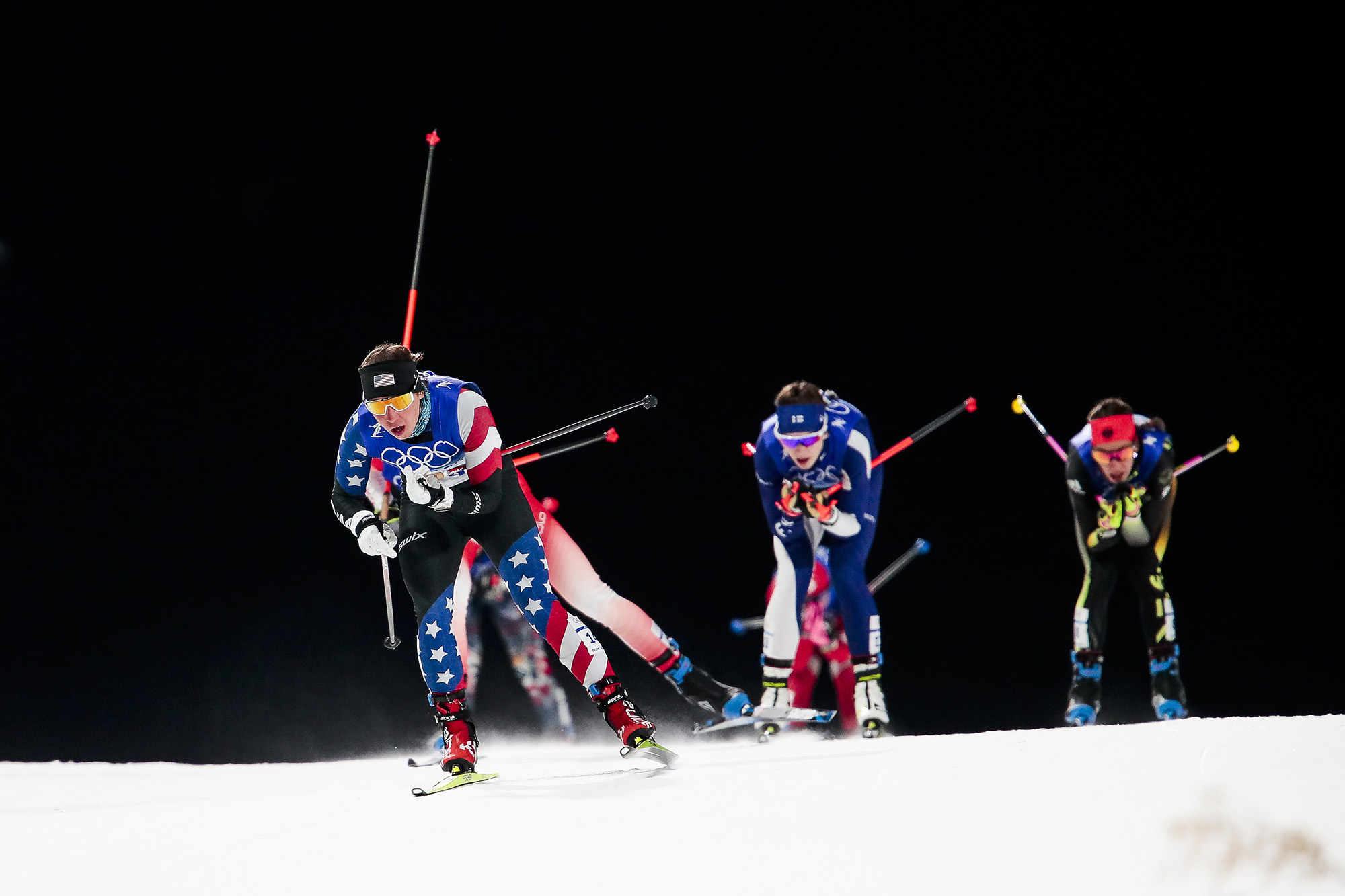
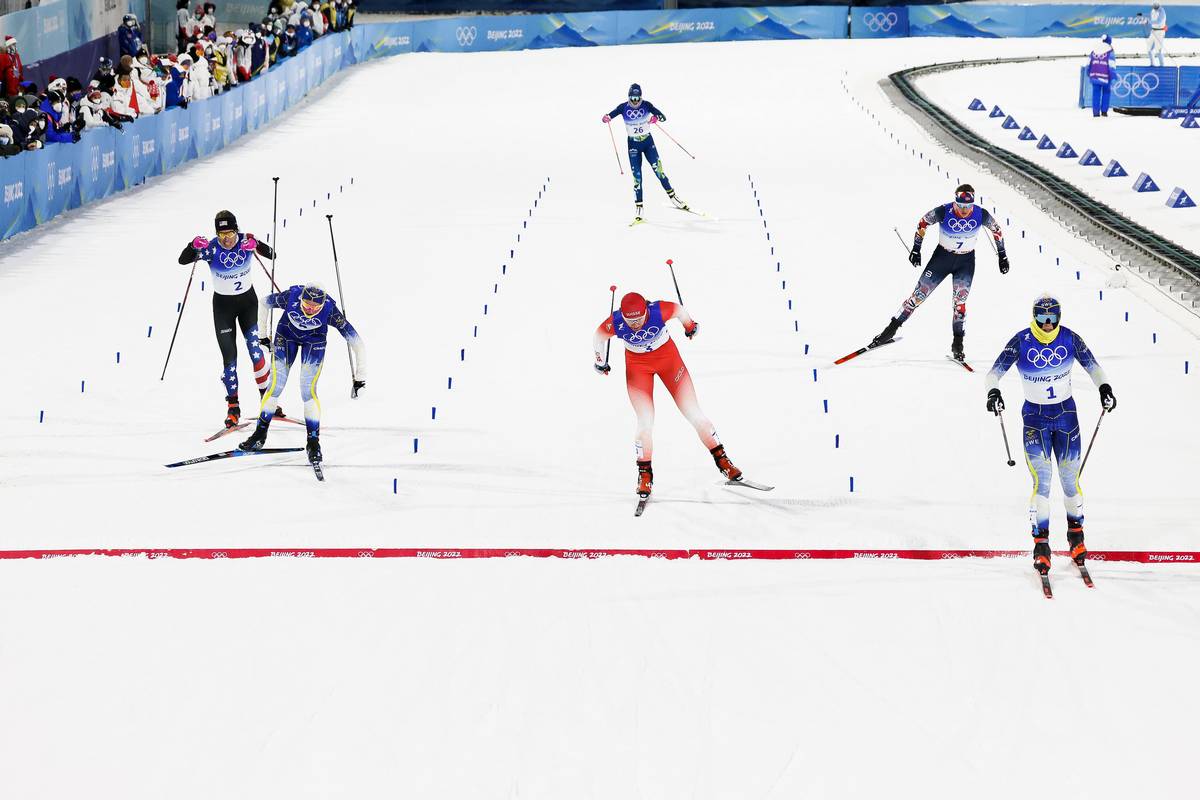
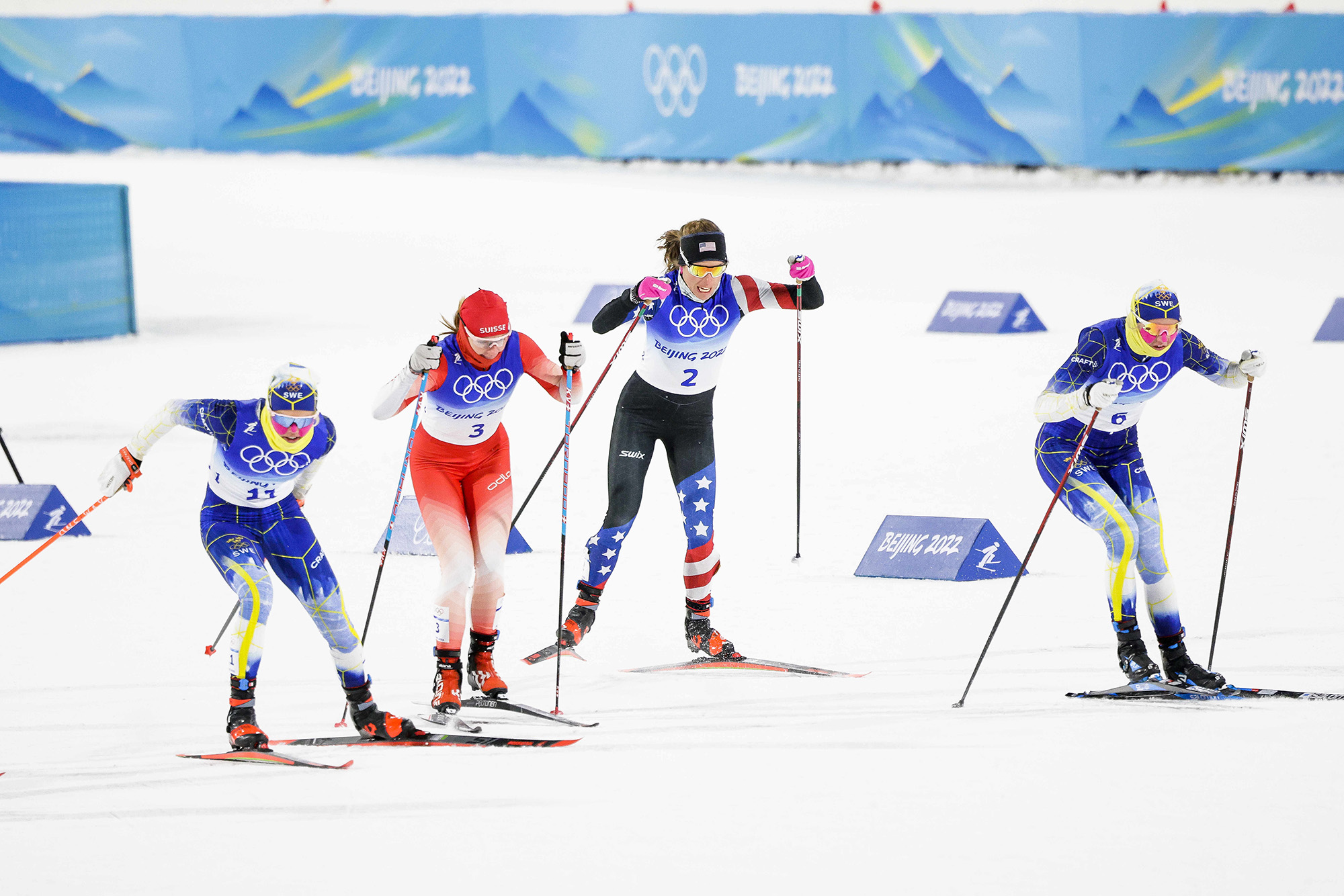
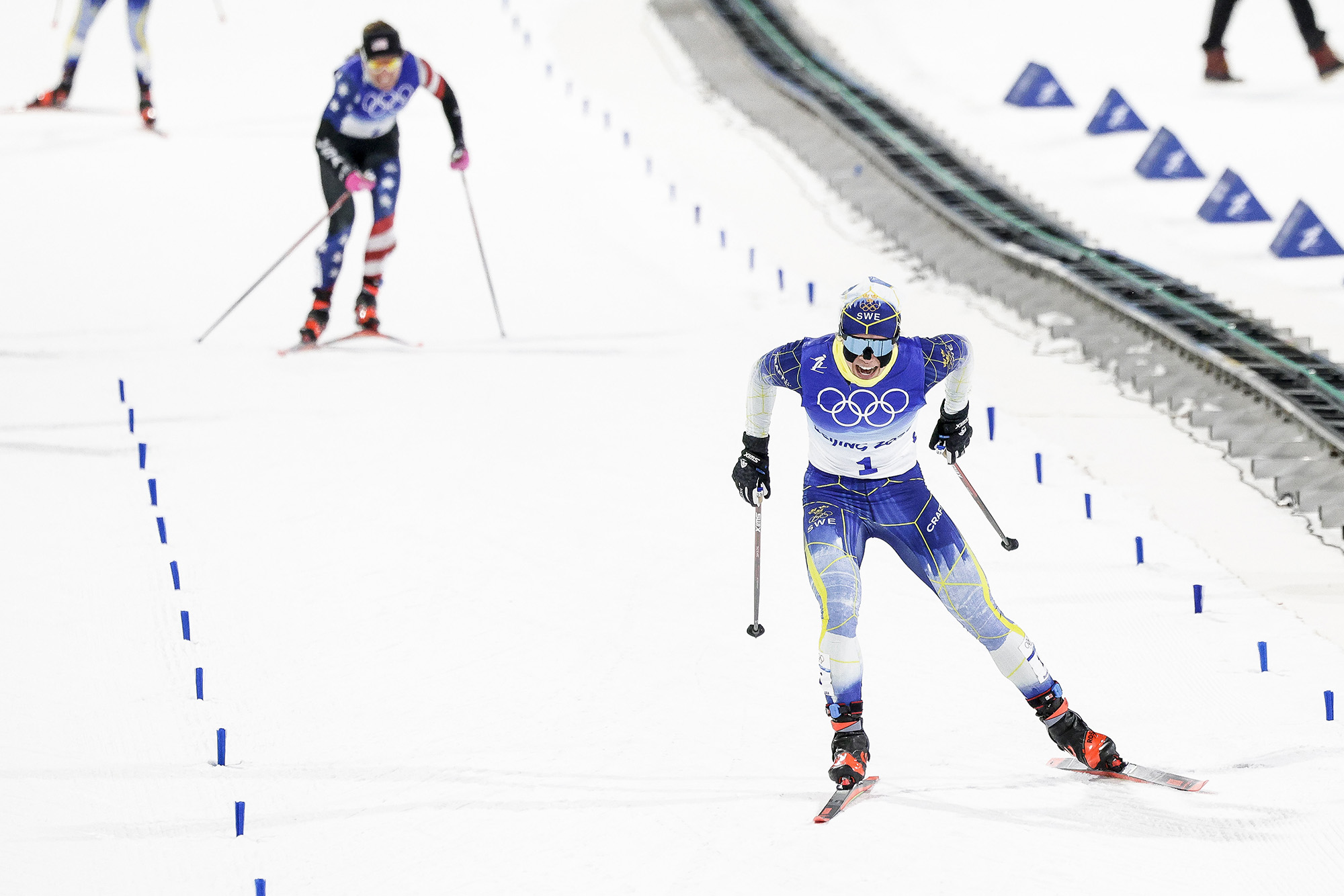
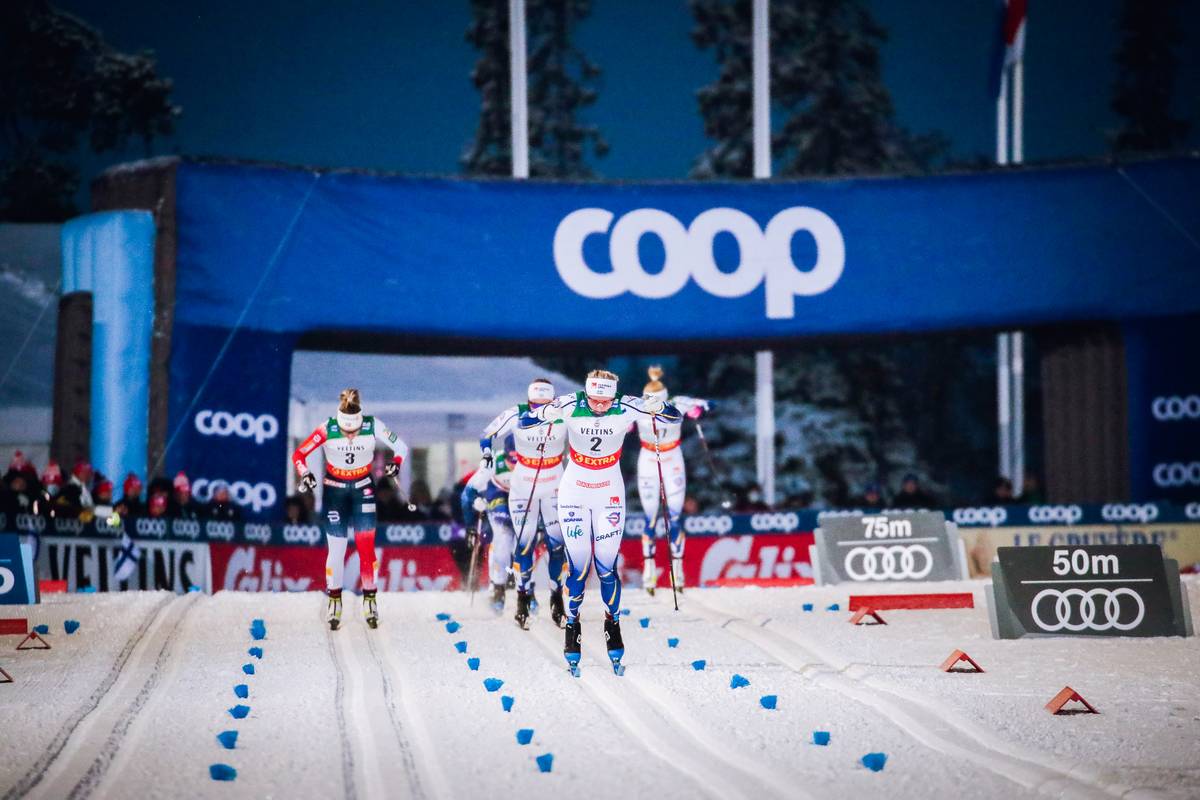
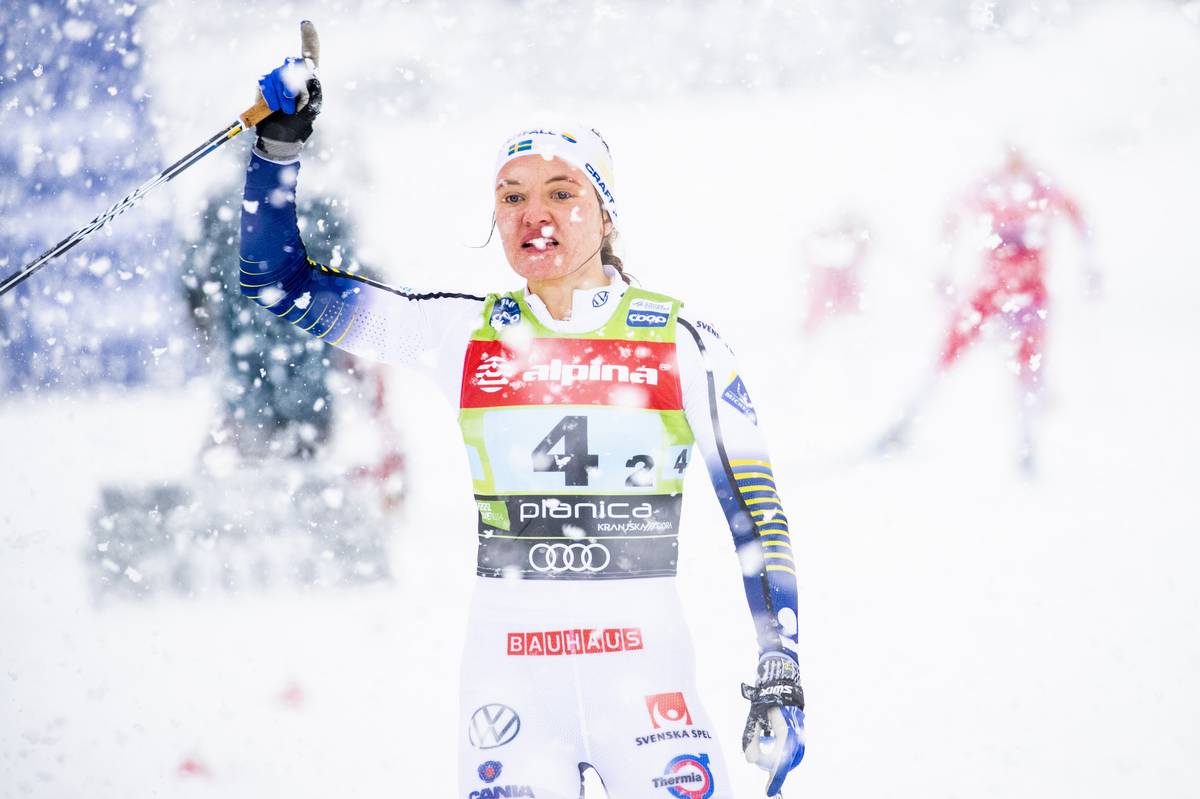
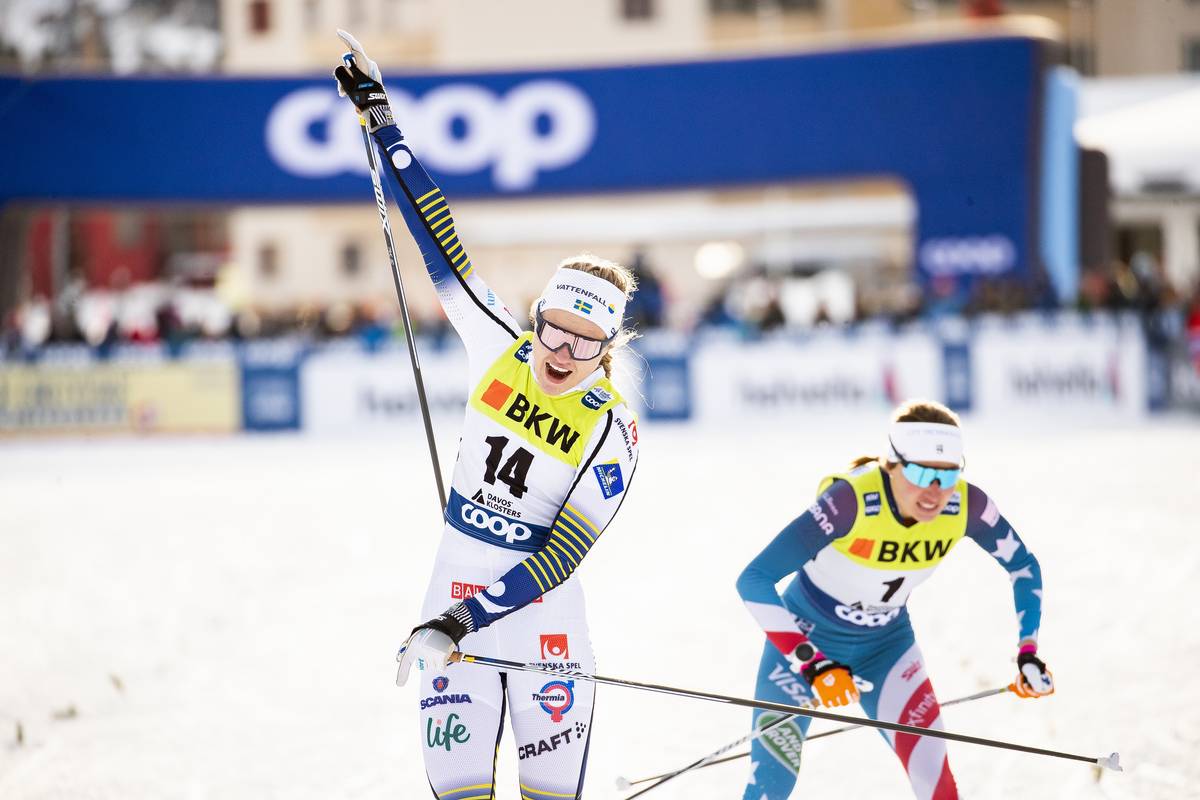
    Making her first sprint final since a stage race in Lenzerheide, Switzerland in December, Kern was all smiles on the start line as the athletes lined up for their final round. Right away, Sundling and Lampic began to pull away from the rest of the field. Up the A-climb, Sundling broke into a herringbone, clearly moving fast as she increased her lead. Dahlqvist who had been in third was overtaken by Kern who topped the hill in third. Lampic was holding strong in second, though being chased by Kern. Navigating the remaining corners and descents, Sundling cruised easily to the finish with enough of a lead to give a celebratory wave before crossing the line.

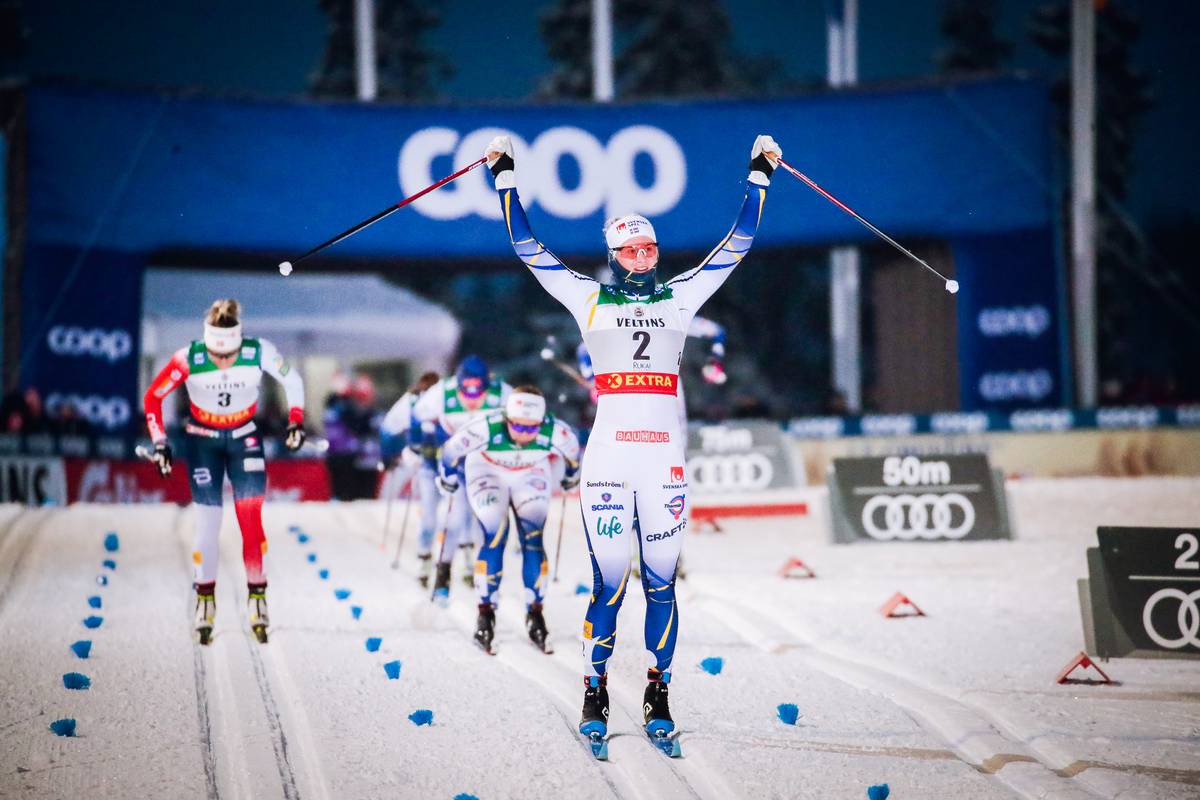
    No challengers around, Jonna Sundling cruises to victory. (Photo: NordicFocus)

    Coincidentally, Sundling won by the same margin over Lampic (+8.41 seconds) as she had on second-place qualifier Joensuu (FIN) earlier this morning. “I don’t know what is behind this result today, but the last weeks I’ve been feeling really good and it’s nice to keep the shape still,” said Sundling after her dominant victory. She added, “I didn’t compete so much in the beginning [of the season] because of injury but my motivation is on top and so is my shape, and it’s just fun to ski right now.”

    Behind them, Dahlqvist was finding a second wind in the finish straight and overtook Kern to finish in third. Kern finished fourth, matching her season personal-best from Lenzerheide where she also finished fourth, in a skate sprint. 

    Anamarija Lampic (SLO) heads towards a silver medal as behind her Maja Dahlqvist (SWE) overtakes Kern (USA). (Photo: NordicFocus)

    “[Kern] was really smart through the quarters and semis,” reflected coach Matt Whitcomb, “where she would ski really smooth through the first climb, and position herself really well. And normally what was happening is she was both being smart tactically and feeling very good today and that just led to a break between positions 3 or 4 and allowed her to get away. And her doublenpole punch at the end was as good as I’ve ever seen her today.”

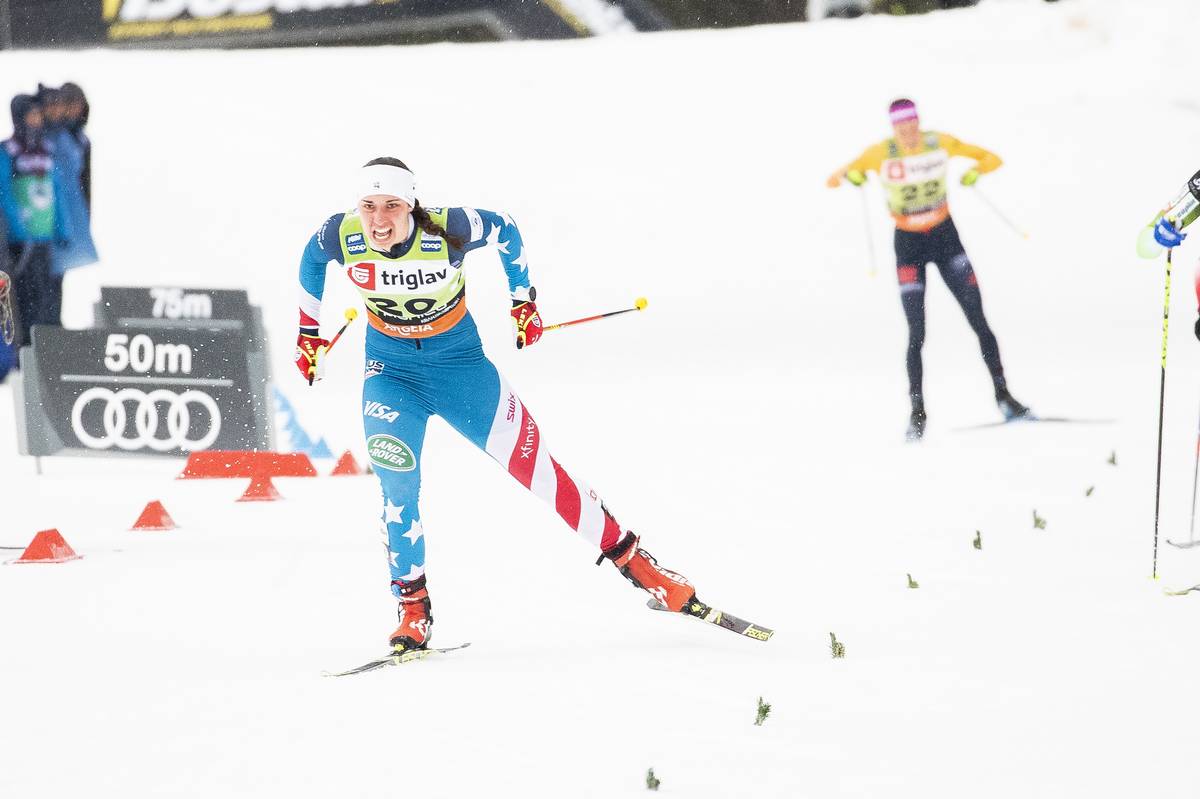
    Julia Kern after fending of Nadine Fähndrich (SUI) to finish fourth in the 1.4 k classic sprint. (Photo: NordicFocus)

    Regarding the final in which Kern seemed to have a lock on third but lost out in the closing stages Whitcomb said, “We talked about if there was a big mistake she made and we decided she could do the same thing 10 times and maybe land on the podium four or five times. She had some stumbles, had those things not happened, it would have been a little bit closer between her and Maja [Dahlqvist], but I don’t want to discredit Maja, she had all kinds of fire in the finish today.”

    He added, “It was cool, Julia’s parents are out here today, she has raced well when her parents are watching. It’s important to point out that she was fourth and not fifth, she fended off a hard-charging Fähndrich and we’re really happy with her performance today.”

    Listen to the full interview with U.S. Ski Team Head Coach Matt Whitcomb here.

    Julia Kern races through the heats in Falun. (Photo: NordicFocus)

    Kern has put together a string of strong performances in the final period of World Cup racing, placing in the top-10 in each of the last three sprints. These results come on the tails of a first Olympic appearance that left her wanting more, after having rebounded early-season from a 2020/21 season she had described as challenging.

    “It’s a bit of a bittersweet ending,” Kern said in a call. “We’ve been on the road for so long now that, after the Olympics, especially, I was feeling excited to go home. But now when things are going well and I’m feeling really good, I don’t want to go home and I don’t want the season to end. I’m happy to end on a high note and find my stride after a frustrating Games. It’s just kind of reminded me how important having some sense of normalcy is, and I’ve kind of embraced that more after the Games. I think that’s paid off, plus some hard work, and I’ve had a little extra fire from the frustration after the games. Happy to end the season this way, and [we have] another shot tomorrow, so I’m excited for that race.”

    Commenting on how these strong results and better energy feed momentum, Kern discussed a mid-week training session she felt primed her for today’s sprint.

    “Now that I’ve been having really good energy in training… I have to give a big shoutout to our staff. On Tuesday this week, I did an interval workout here on the courses. I had Matt, Kate [Barton], and [tech] Chris Hecker out there with me, racing me around the course doing speeds, throwing elbows, pulling tactical moves, practicing the slingshot. Those types of sessions are super valuable for me when I put the energy to put in a good interval session. I learned so much from that session, and it gave me the confidence here today to ski well in the heats and be ready for anything.”

    Kern continued with a laugh that her family is her fourth place good luck charm, as they also watched her race to fourth in Lenzerheide, SUI during the Tour de Ski, ending with a comment on the American team as the season draws to a close.

    “I think our team has done a really incredible job, working through all the different colleges this season has brought. When things get tough, we bring out humor and come together. I just feel more and more appreciation for the team. My wax tech Eli and I have worked really hard all season together to start linking together some classic performances. We’ve had four classic races in a row now, and pretty much all personal bests, so that’s been a really fun relationship to build and [I appreciate] all the hard work the wax team puts in.”

    Full post-race interview with Julia Kern. Apologies for the bad echo — working through the kinks as we work our way along the audio learning curve.

    Julia Kern edges out Maja Dahlqvist (SWE) in the classic sprint semifinal in Falun. (Photo: NordicFocus)

    Dahlqvist already had the sprint globe on lock, but her third place finish today only reinforced her strength in sprint racing this season as she racked up 638 points throughout the year. She began the season with four straight wins and earned a silver medal in the Olympic skate sprint last month. A fourth place finish in Drammen was the only time this season in which she did not finish on the podium in a sprint event.

    “It feels really really, super duper good,” said Dahlqvist about taking home the globe. “I’m super happy with that.” 

    Sweden’s Maja Dahlqvist is the 2022 World Cup sprint champion. (Photo: NordicFocus)

    Last year’s sprint globe winner, Anamaria Lampic (SLO) finished second this year with 506 points. After today’s victory, Sundling (SWE) overtook Diggins (USA) to move into third in the sprint standings with 442 points. Delaying her start to the season after sustaining an injury in an early-season FIS race, Sundling’s first World Cup start was Dresden in mid-December where she finished second in the individual skate sprint. She did not take part in the Tour de Ski, but returned to the World Cup circuit in dominant fashion, after collecting three Olympic medals, one of each color, and taking fourth place in the 30 k.

    In the final three weekends of World Cup racing, Sundling landing on the podium in four out of the five races she entered, including a third place finish in the legendary Holmenkollen 30 k classic last weekend. 

    Anamarija Lampic (SLO) congratulates the days winner, Jonna Sundling (SWE) (Photo: NordicFocus)

    Racing continues tomorrow with a 10 k skate interval start for the women. Sunday will feature two new team events, with a mixed relay happening in the morning followed by a mixed team sprint in the afternoon. 

    Results:

    Qualification | Final | Sprint Overall Standings

  • The Devon Kershaw Show: Distract yourself with Drammen

    The Devon Kershaw Show: Distract yourself with Drammen

    There’s a war going on in Ukraine, and we touch on its impacts on the World Cup. But ski racing is also continuing, so we’re forging on, with respect for and acknowledgment of the tragedy that’s unfolding in Europe. For a few hours at least, on Thursday, the classic Drammen city sprint provided one heck of a distraction, and Devon and Nat are back to break down some performances for the ages by Norway’s Maiken Caspersen Falla, the French men and China’s Wang Qiang.

    You can email us at devon@fasterskier.com and nat@fasterskier.com. We’re still hoping to catch up with an Olympic mailbag episode soon once things settle down.

    Rosie Brennan leads her quarterfinal during Drammen’s classic sprint. (Photo: NordicFocus)
  • Falla Earns Sixth Drammen Victory on Home-ground; Kern leads Americans in 7th, Three in Top-20

    Falla Earns Sixth Drammen Victory on Home-ground; Kern leads Americans in 7th, Three in Top-20

    This World Cup coverage is made possible through the generous support of Marty and Kathy Hall and the A Hall Mark of Excellence Award.  To learn more about A Hall Mark of Excellence Award or to learn how you can support FasterSkier’s coverage please contact info@fasterskier.com.

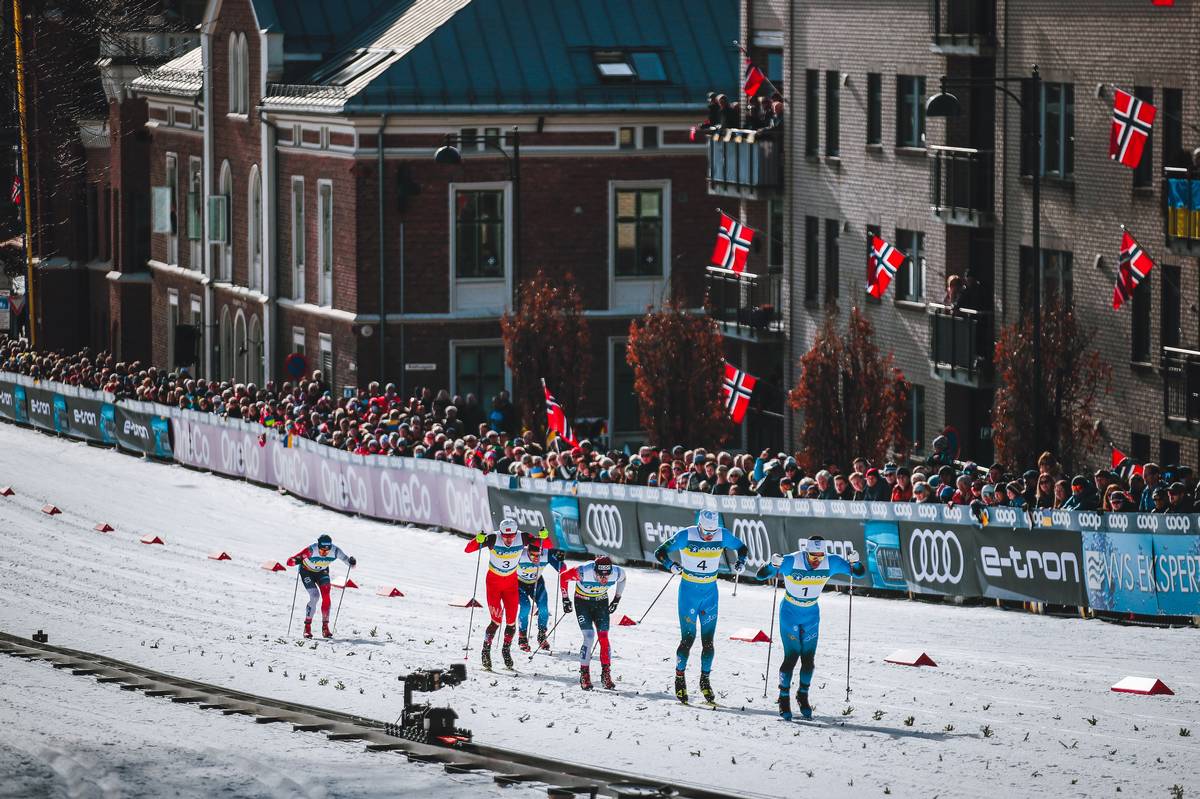
    Returning to Norway after last year’s coronavirus induced hiatus, the World Cup picked up with a 1.2-kilometer classic city sprint in Drammen. With the Russian and Belarusian athletes banned from competing thanks to a recent decision by FIS, the size of the field was slightly reduced. Last weekend’s skate sprint in Lahti, Finland saw 62 racers on the women’s side, whereas today’s qualifier had only 53 finishers. 

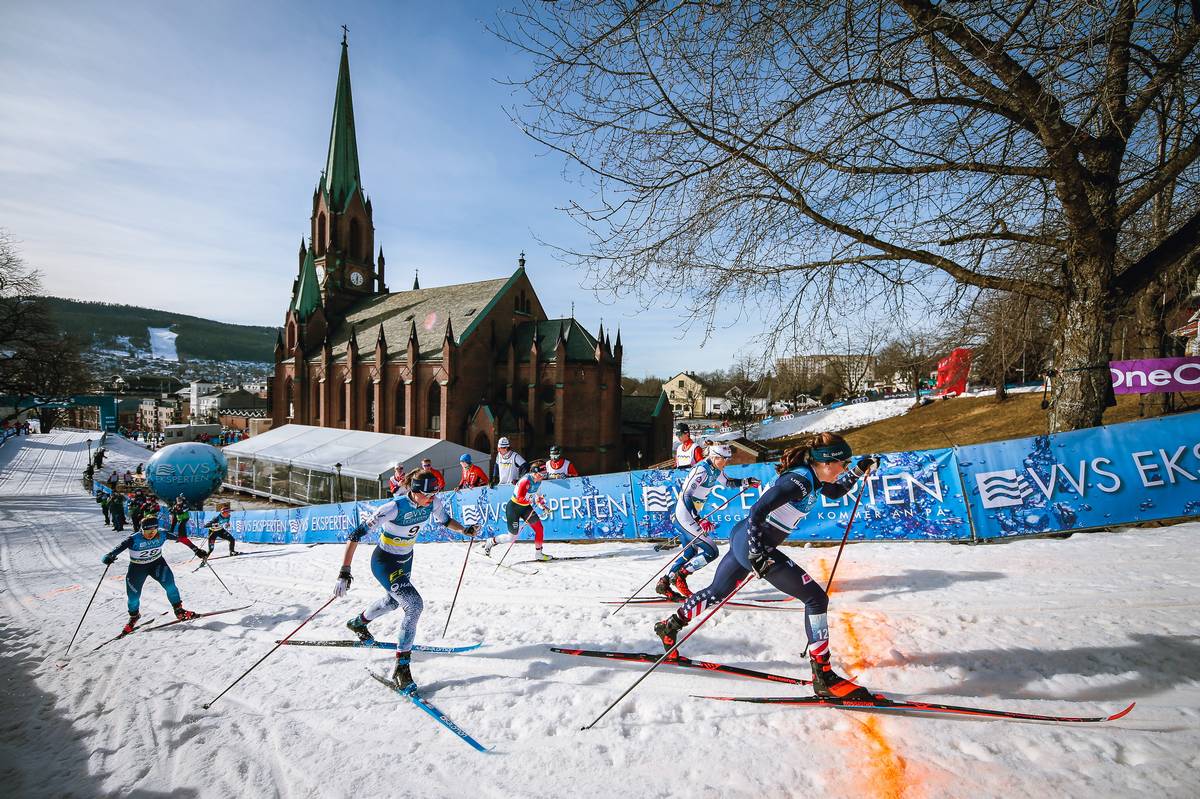
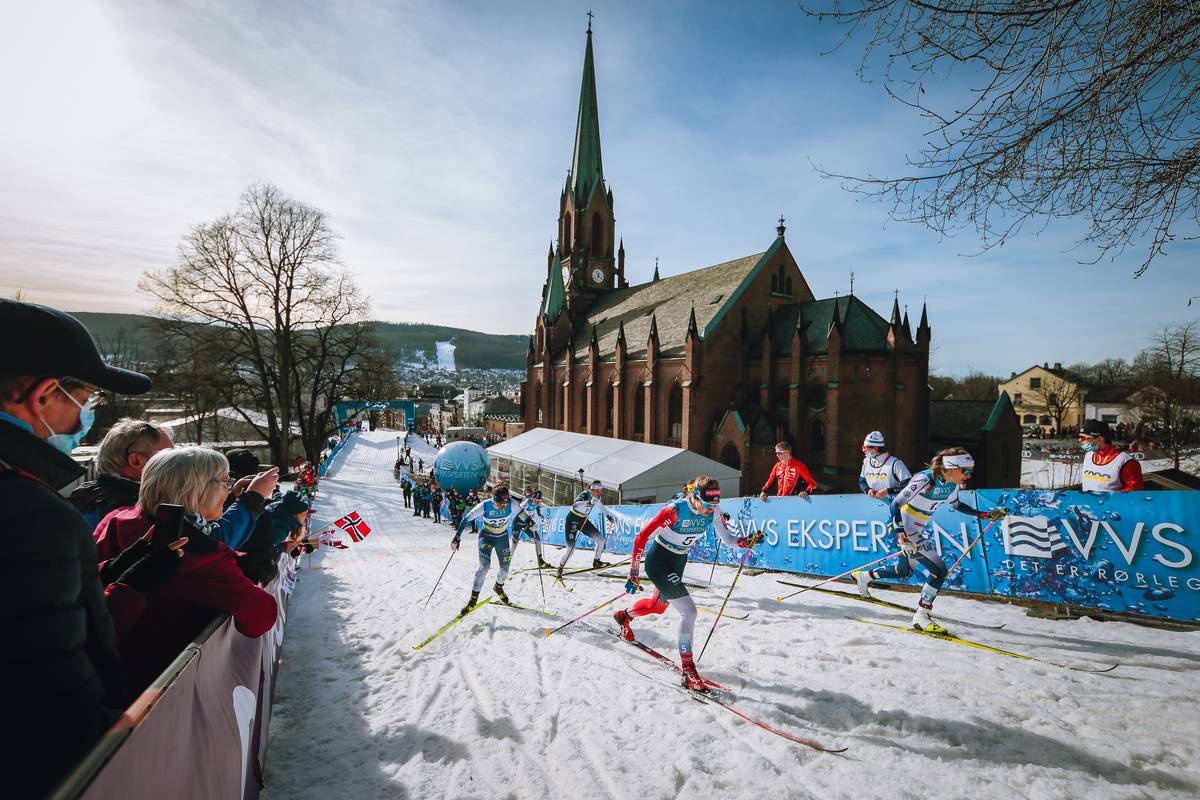
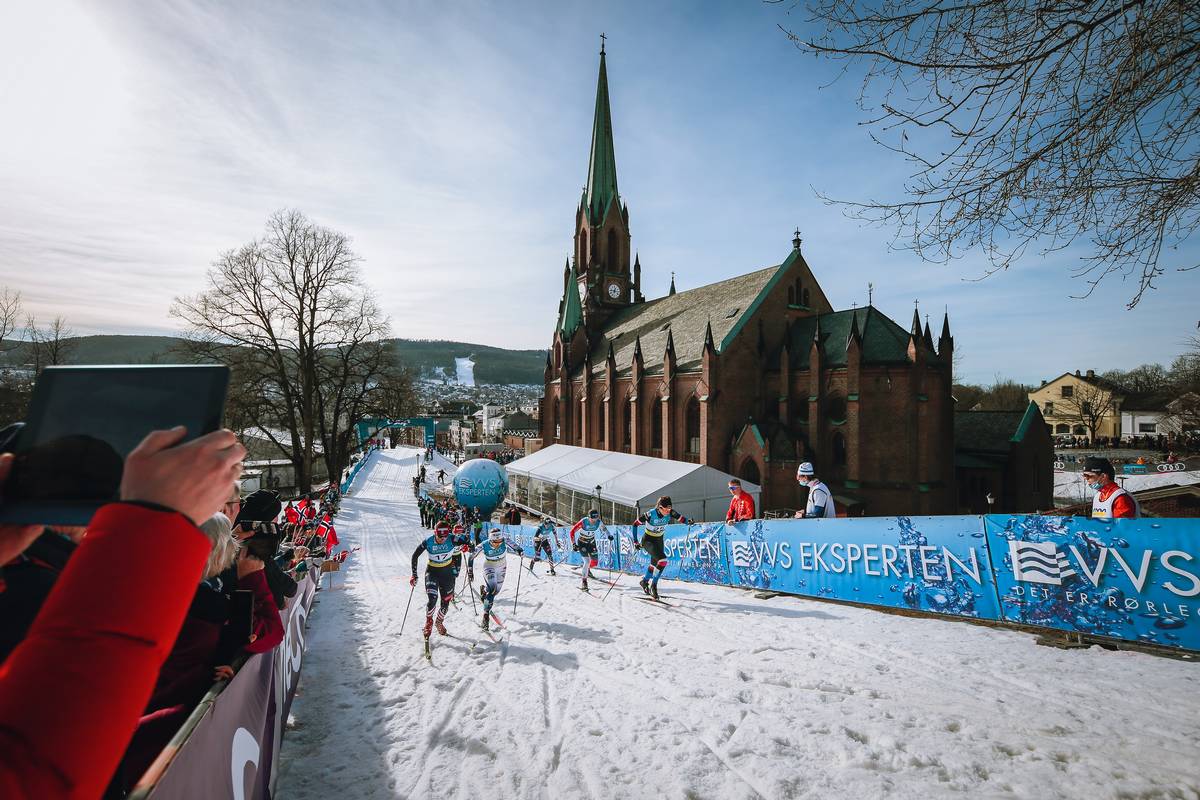
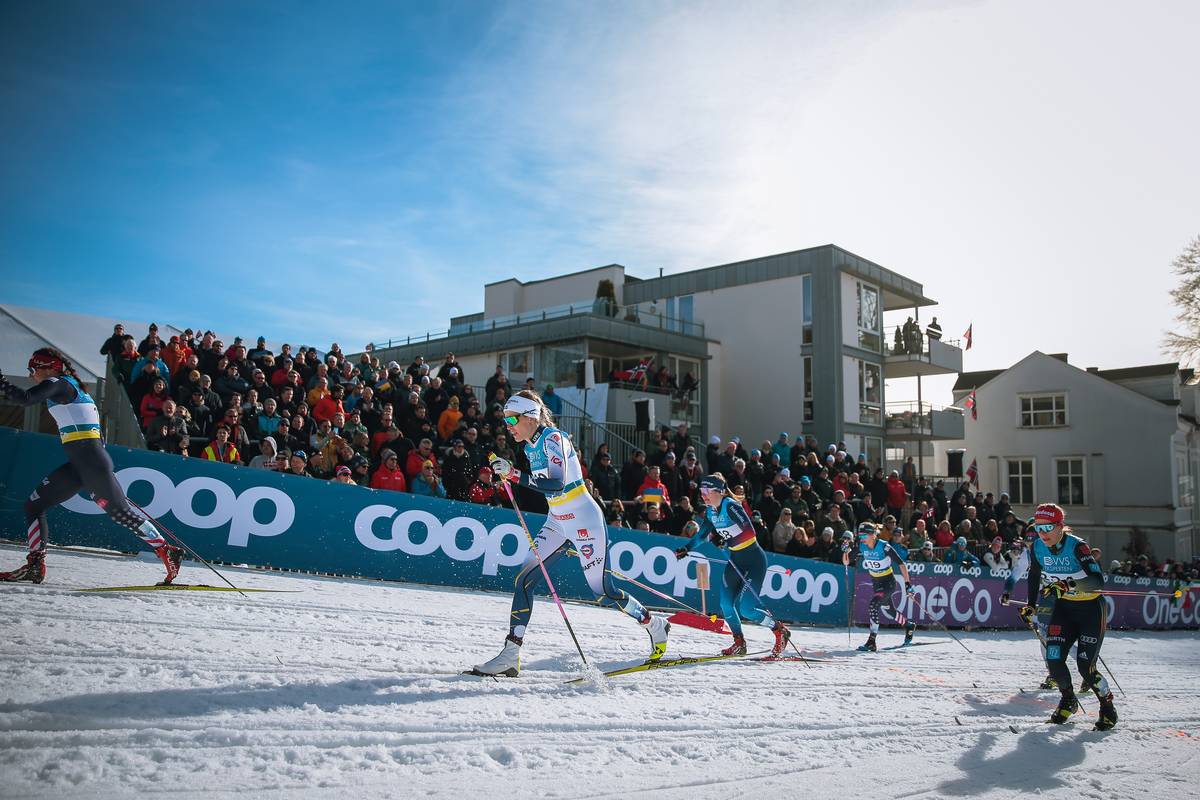
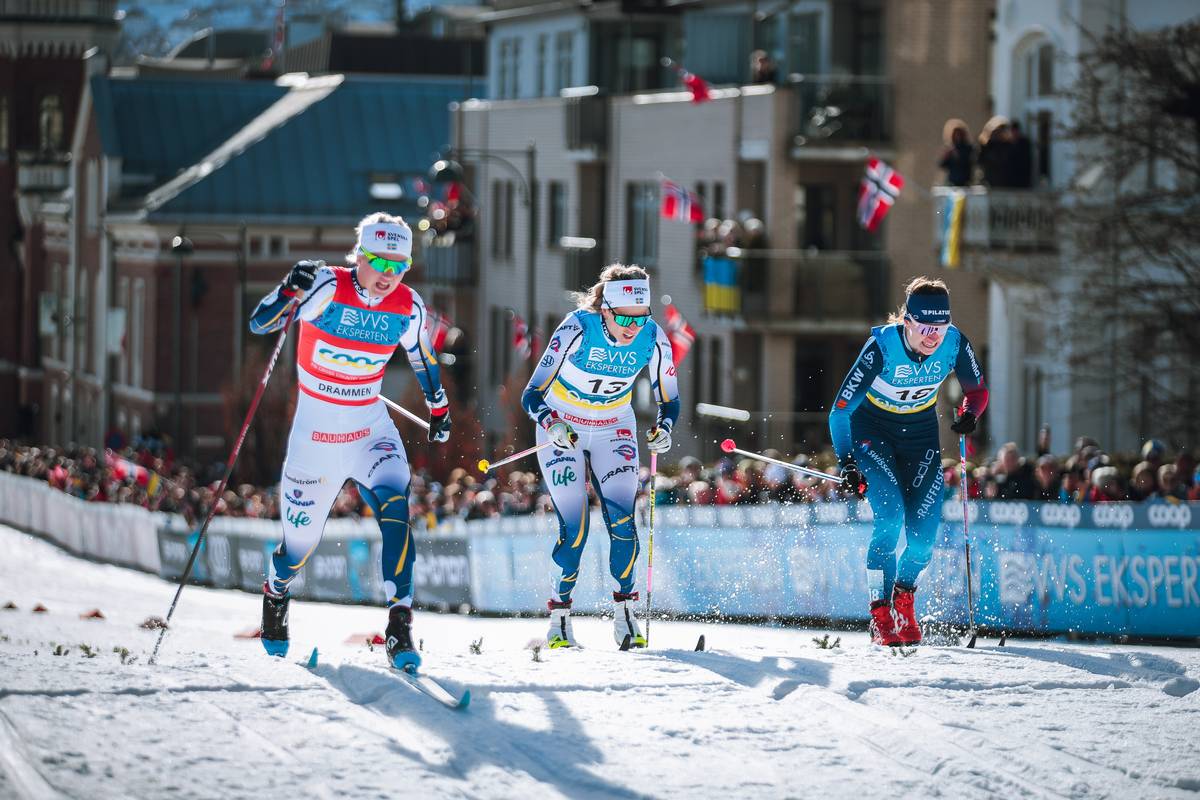
    Katri Lylynpera (FIN), Kerttu Niskanen (FIN) and Hedda Østberg Amundsen (NOR) duke it out on the initial climb in the Drammen city sprint in front of excited crowds (Photo: NordicFocus)

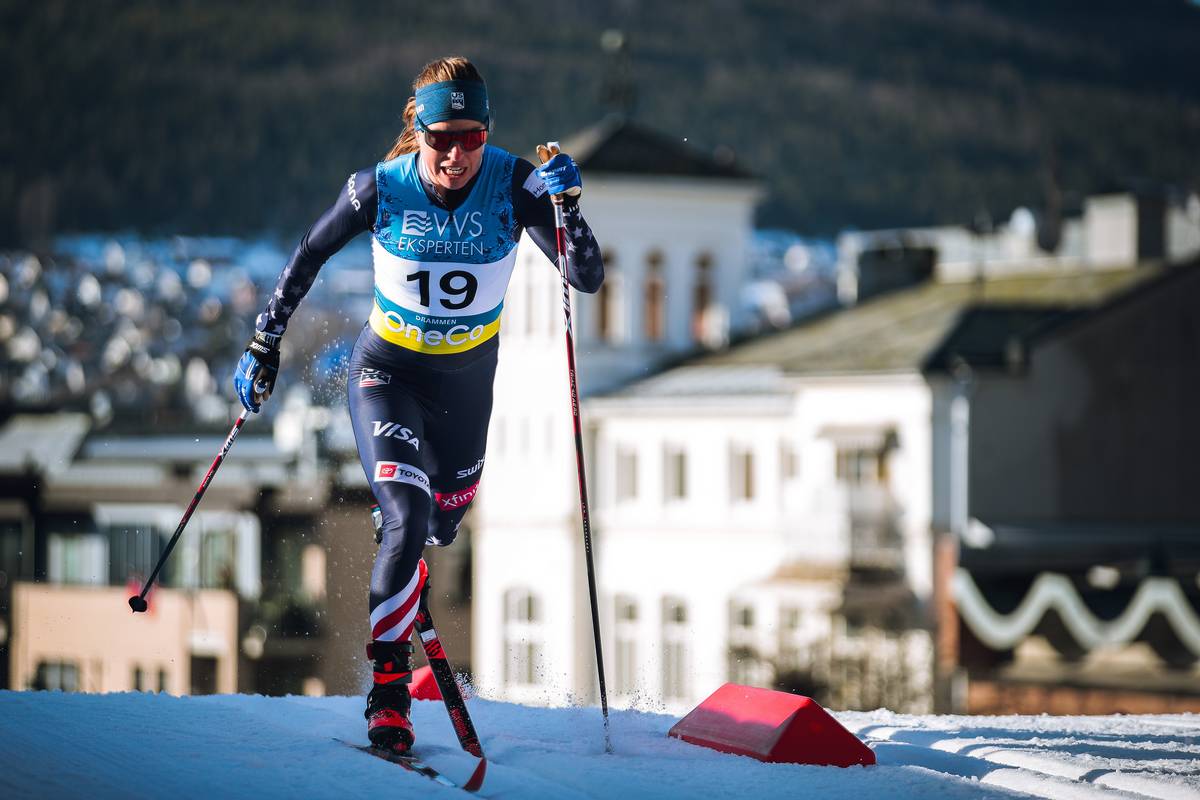
    Unlike the largely flat city sprint in Dresden, Germany earlier the season, the Drammen course features significantly more climbing and descent. This combined with the soft snow and tight trails led to lots of mishaps throughout the rounds, providing drama for the fans that packed the sidelines in stands and along the sideboards. In a show of support for Ukraine, the country’s blue and yellow colors were displayed on the sponsor boards that line the track, on the athletes’ bibs and in the flags and hats born by the spectators. 

    Johanna Hagström wins the women’s sprint qualifier (Photo: NordicFocus)

    The qualifier was won by Johanna Hagström of Sweden in a time of 2:48.88. Rosie Brennan was the first American qualifier in 12th position, +4.30 back from Hagström. Julia Kern qualified in 17th, (+4.97) and Jessie Diggins was the final American woman through to the heats in 19th (+5.11). Hailey Swirbul came in 36th (+9.05), Katharine Ogden finished 44th (+10.98) and Alayna Sonnesyn ended 52nd (+18.14) after hopping on a plane following her Birkie win last weekend. 

    The Canadian women all finished outside the top thirty, led by Olivia Bouffard-Nesbitt in 40th (+10.21). Dahria Beatty came in 41st (+10.37), Katherine Stewart-Jones in 48th (+13.86), Laura Leclaire in 51st (+17.20) and Cendrine Browne in 53rd (+18.85). 

    Temperatures were warm and springlike, above 40°F, as the athletes lined up for the heats. The first heat featured the second-fastest qualifier and this year’s Olympic sprint gold medalist, Jonna Sundling of Sweden. Brennan (USA) also elected to go in heat one, and she and Sundling took on the lead out of the start. A move by Johanna Matintalo of Finland on the first climb took out Sofie Krehl of Germany, resulting in a yellow card for Matintalo.

    Rosie Brennan leads her quarterfinal during Drammen’s classic sprint. (Photo: NordicFocus)

    On the descent, Julie Myhre of Norway moved to the front, aided by a pair of speedy skis. Rounding the tight corner at the bottom of the course, Myhre and Sundling were in the lead, Brennan having dropped slightly. With a powerful double-pole Sundling pulled clear of the field to take the first qualifying position easily. A tight three-way finish between Myhre (NOR), Laurein Van der Graaff of Switzerland and Brennan, went in favor of Myhre. This left Brennan in fourth place, with a time not quick enough to make lucky loser. 

    Rosie Brennan leads the American women in the classic sprint qualifier in Drammen, NOR, placing 12th and ultimately finishing 17th overall. (Photo: NordicFocus)

    “Drammen is such a cool event and I really love doing the city sprint thing at least once during the season,” wrote Brennan after the race. “It’s been a few years since I’ve raced here and with so many improvements in my sprinting since then, I felt I could have a good day today. As with all city sprints, a big part of it is not getting too pushed around and that part I did a bad job of today. After a decent qualifier, I got way to pushed around and skied over in my quarterfinal to move on. I had a strong finish and thought maybe it was enough but I lost another lunge this weekend. It’s always a tough way to get out because it’s so close, but that is such a big part of sprinting. I guess I will have to work with master lunger Tyler [Kornfield] (Brennan’s partner) and see if I can improve on those close finishes in the future. In the meantime, it’s a fast turn around to Holmenkollen so I will be focusing on recovery.”

    The second heat saw another fall on the initial climb, Lucia Scardoni of Italy got bogged down in deep snow and broke a pole, taking herself out of contention. In the end, Maja Dahlqvist of Sweden strided to victory, with Anamarija Lampic also qualifying. 

    Lucia Scardoni of Italy goes down on the hill (Photo: NordicFocus)

    In heat three, Lotta Udnes Weng of Norway and Jasmi Joensuu of Finland got tangled on the hill. The third time in three sprints that Joensuu has broken a pole in the quarterfinals. Maiken Caspersen Falla of Norway proved again that the Norwegians had ripping skis as she gained on the downhill and put in a fast finish, Nadine Fähndrich of Switzerland and Laura Gimmler of Germany also qualifying from this heat. 

    As in Lahti last weekend, roommates Julia Kern and Jessie Diggins chose the same heat, both going in quarterfinal number four. All athletes making it up the initial climb without a fall, it seemed like this might be the first heat to get away without any spills, only to have the fastest qualifier, Hagström (SWE), wipe out on the downhill. Losing all her speed at the wrong moment, Hagström was out and the two Americans capitalized on this. Diggins entered the final turn in first, followed by Kern. On a deceptively long finishing straight, Kern continued to press hard, besting Falla’s time from the prior heat. Behind her, Diggins battled a surge from Katharina Hennig of Germany, ultimately both of them qualifying for the semis. 

    Julia Kern and Jessie Diggins race in the fourth quarterfinal in Drammen, finishing first and second in the heat. (Photo: NordicFocus)

    “I didn’t know what to expect going into today,” shared Kern, “I’ve only done Drammen once and was around 60th or so, so I was really excited to have qualified in this iconic sprint.”

    The final quarterfinal heat saw a relatively chill pace. In the end, Anna Dyvik of Sweden took first and Katri Lylynpera of Finland also qualified, finishing second. 

    Moving into the semi-finals, the first heat hosted two Norwegians, two Swedes, a German and a Slovenian. It was the Slovenian, Lampic, who took the pace out hot from the start. She was followed closely by Sundling and Dahlqvist as they rounded the corner at the bottom of the course.

    Anamarija Lampic (SLO) and Jonna Sundling (SWE) lead the first heat of women’s semifinal in Drammen. (Photo: NordicFocus)

    Coming from the back, Falla (NOR) went wide to get a clear track into the finish and put in an impressive burst of speed. She took the win followed by Sundling (SWE) as Lampic dropped to third. Dahlqvist came in fourth but given the fast pace, both qualified in lucky loser spots. 

    The second semi featured higher bib numbers, with the lowest qualifier being Dyvik of Sweden in bib 13. Both Kern and Diggins were in this heat and when the gun went off, Kern shot to the front. Her quick start was matched by Dyvik but on the first climb, Kern began to pull away. Over the top, she appeared to have created a gap to the rest of the field, however she was quickly reeled in and passed by Dyvik (SWE) on the descent, her ski speed no match for those of the Swede.

    Julia Kern (top left) leads the second semifinal, racing with Jessie Diggins, in Drammen, NOR. (Photo: NordicFocus)

    Fähndrich (SUI) also pulled ahead of Kern and those front three maintained their respective positions exiting the final corner. Fähndrich nearly fell in a sudden loss of balance but managed to stay on her feet and came across the line in second, behind Dyvik. Despite her efforts out of the start, Kern finished third and the heat was not as quick as the first. Diggins came in fifth to end her day in 10th position. 

    “It was a really cool atmosphere out there, that was super fun to see,” Diggins shared with FasterSkier. “They always do a great job here, everyone was out cheering and it really felt like spring World Cup out there. It was sunny, it was warm and honestly the course held up pretty well given that it’s snow that they had to truck in and it is super warm. But there were a lot of crashes out there, it was sort of crazy, wild skiing.”

    Diggins continued, “Andy Newell reminded us last night that in Drammen you just have to embrace the chaos. It was cool to get out there and I’m feeling really lucky to be able to be racing right now.”

    For Kern, her approach was to stay flexible. She said, “I knew the start was important, but I also had a flexible approach since in tight city sprinting you never know where you slot in out of the start. I ended up almost tangling and finding my open lane on the right out of the start, and it ended up being the tactical move that I liked. My body was feeling good, I’ve had great energy the past two weeks and my skis were climbing well.”

    Lining up for the final, it was Dyvik, Sundling, and Dahlqvist for Sweden, with Falla for Norway and Fähndrich for Switzerland. Out of the start, Sundling went to the front, eager to take on the lead work as four skiers slotted in behind her. Over the top of the course Sundling, Falla and Lampic had pulled clear of the others.

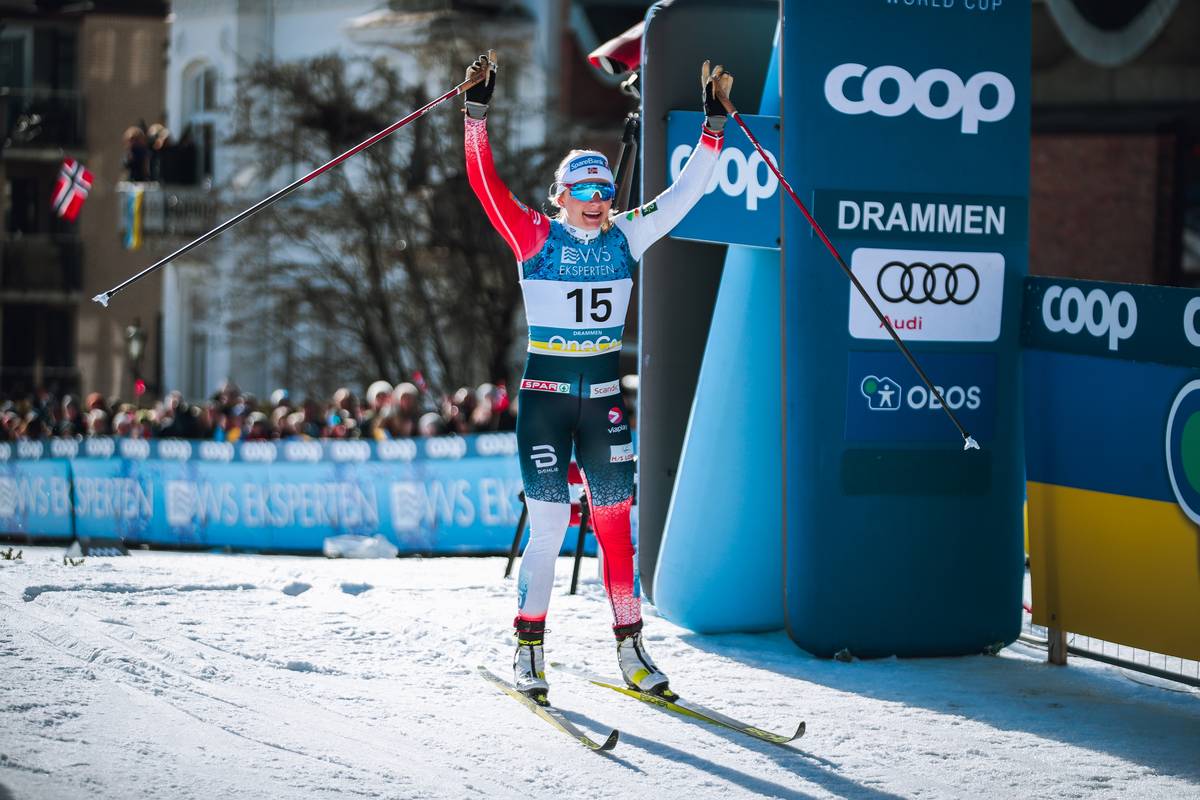
    As they exited the bottom corner, Falla cut wide once again. With all three skis abreast, Sundling looked strong and had a slight lead. But Falla executed another incredible change of pace, switching to diagonal stride and edging ahead of the Swede she crossed the line in first. 

    Maiken Caspersen Falla (NOR) races to the line to win her career sixth sprint on the streets of Drammen, NOR. (Photo: NordicFocus)

    “I felt so good,” said Falla in a FIS interview afterwards, “it’s so good to be back here in Drammen, to have a good atmosphere and it was a really good day.” Falla has had a challenging season, the only other time she made a sprint final was back in November in the first weekend of racing in Ruka, Finland.

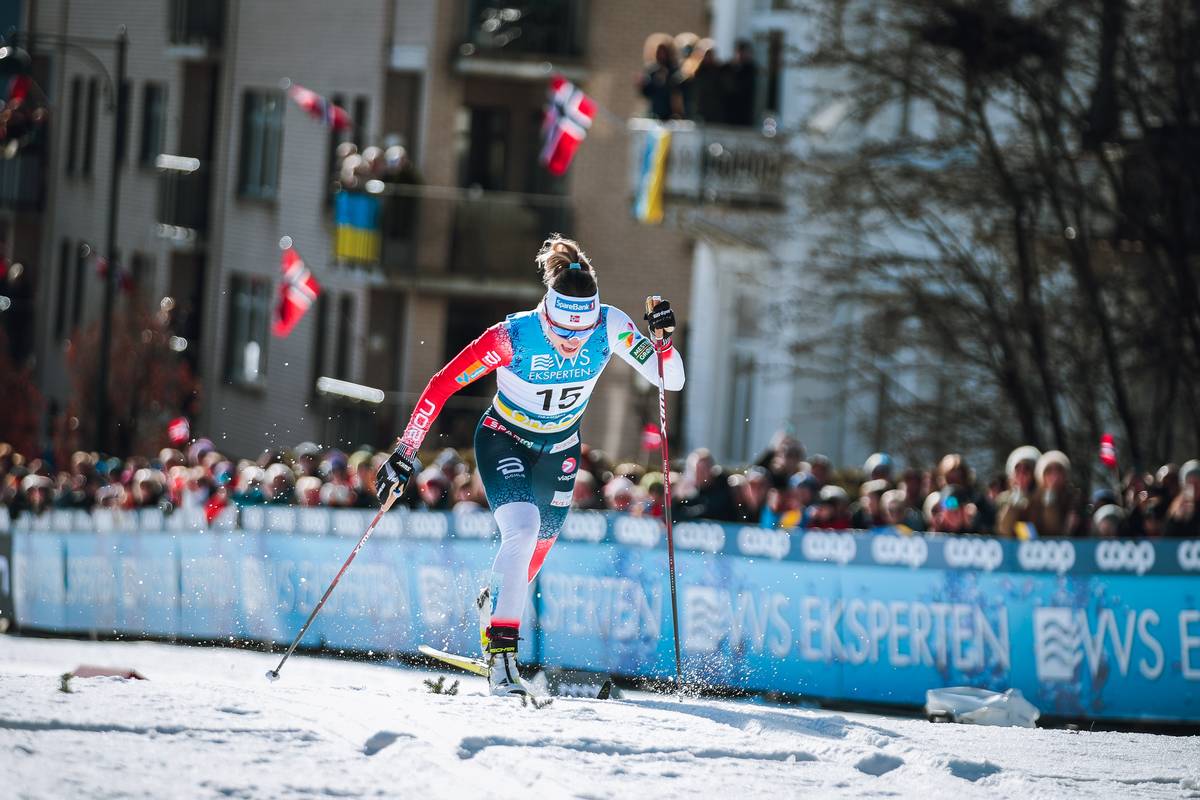
    The Drammen event is something of a favorite for Falla however, she has won it on five occasions prior to today, her last win here coming in 2019. “It is really good to be back,” continued Falla, “I’ve been watching a lot of ski races on TV this season. I’m so happy to be here and to finish the season in a good way.” 

    Maiken Caspersen Falla (NOR) celebrates her sixth win in Drammen. (Photo: NordicFocus)

    Behind Falla, Sundling finished second, continuing to show her strength in sprint racing with yet another podium finish. Lampic finished third, her fourth third-place finish of the season. For Dahlqvist, who finished fourth, it was her first time off the podium in a sprint yet this year. 

    Maja Dahlqvist (SWE), Anna Dyvik (SWE), Nadine Fähndrich (SUI)(l-r) head to the line to take fourth through sixth, respectively, in the women’s classic sprint final in Drammen, NOR. (Photo: NordicFocus)

    Results: Women’s sprint

  • Diggins Writes History as First American Woman to Earn Individual Olympic Medal With Bronze in the Freestyle Sprint

    Diggins Writes History as First American Woman to Earn Individual Olympic Medal With Bronze in the Freestyle Sprint

    This World Cup coverage is made possible through the generous support of Marty and Kathy Hall and the A Hall Mark of Excellence Award.  To learn more about A Hall Mark of Excellence Award or to learn how you can support FasterSkier’s coverage please contact info@fasterskier.com.

    The History:

    A survey of the last five Olympic cycles shows a clear trend in American women’s sprint results: upward. In the 2002 Games in Salt Lake City, no Americans qualified in the freestyle sprint. Tessa Benoit was the top qualifier in 38th, with an up-and-coming Kikkan Randall next for Team USA in 44th. Randall was then 20 years old. 

    In the freestyle sprint four years later in Torino, Randall was the only American to qualify for the heats. She was 10th in qualification, then moved to 9th in the final standings. Switching to classic for the 2010 Games in Vancouver, Randall again qualified in 10th to be the only American in the heats, this time racing her way up to eighth. 

    And then there was Sochi. 

    The 2014 Games in Sochi were a turning point for the American squad, with all four women qualifying inside the Top-30 in the freestyle sprint. This time, a new name topped the list for qualification: Sophie Caldwell in 9th. Not to be overlooked, USA also had Jessie Diggins 12th, Kikkan Randall 18th, and Ida Sargent 25th.

    Racing in her first Olympiad, Caldwell (now Hamilton) entered uncharted territory as she won her quarterfinal to advance into the semis, which she finished in a thrilling boot slide to be 0.1 seconds behind heat winner Ingvild Flugstad Østberg of Norway. Though she crashed in the final, she again moved the needle upward for the Americans by finishing sixth in the final heat. 

    The remaining American women also finished inside the Top-20, though none made it beyond the quarterfinals. Diggins was 13th, Randall 18th, and Sargent 19th.

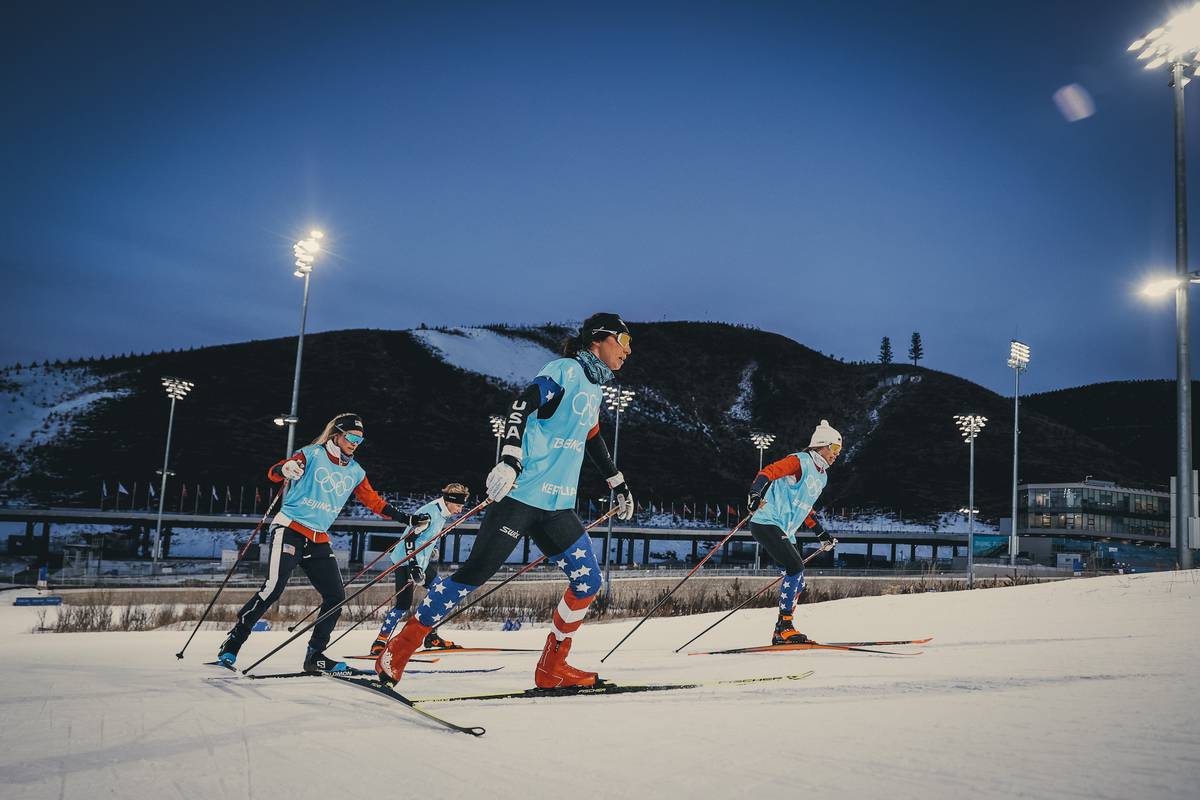
    The American women’s sprint team prepares for the individual freestyle sprint. (Photo: NordicFocus)

    Carrying momentum from these Games through the next Olympic quad, the Americans had three women in the Top-30 for the classic sprint in PyeongChang in 2018, with Sargent just outside in 33rd. 

    This time it was Diggins in 7th – the top Olympic qualification result of any American woman – with Sadie Bjornsen 9th, and Caldwell 12th. 

    Despite it being her weaker technique, Diggins raced with confidence, landing in second in both her quarter and semi to advance automatically into the final. Losing touch with the leaders, Diggins repeated Caldwell’s historic result to finish 6th overall. 

    Perhaps a less apparent victory, Caldwell also raced into the semis, finishing 8th overall after taking third in her semi and missing a lucky loser spot in the final by just 0.18 seconds. Bjornsen was eliminated in her quarter after taking third in her quarter, on the wrong side of the lucky loser mark, but just barely, to end her day in 14th. 

    Fast forward four years and get excited. 

    Rosie Brennan (USA) on her way to the 2nd fastest time during qualification. (Photo: NordicFocus)

    Sweden’s Jonna Sundling smashed the qualification round of the 1.5-kilometer freestyle sprint, setting the mark at 3:09.03. The next name on the list? Rosie Brennan in second (+5.80), ahead of Nadine Fähndrich (SUI) in third (+6.62), Yulia Stupak (ROC) fourth (+7.98), and… Diggins in fifth (+8.69). 

    Have you been reading closely? Both Brennan and Diggins both exceeded the previous best result in qualification from any American woman in history. 

    Also posting a strong qualifier, Julia Kern was 14th in qualification (+11.66), rebounding from Saturday’s skiathlon which left her wanting more. The final American starter, Hannah Halvorsen, finished 43rd (+20.10)  in qualification – outside the Top-30, but still above Randall’s result from her first Olympic Games 20 years ago.

    Jessie Diggins (USA) skis the 5th fastest time during qualification. (Photo: NordicFocus)

    You may be wondering about the spread of times; the top-10 were nearly 11 seconds apart. After a quick descent out of the stadium, the course in Zhangjiakou features a 30-meter climb – nearly 100 vertical feet – followed by a sweeping downhill that leads back toward the stadium. From there, athletes face a 14-meter climb back into the stadium, finishing with a gradual rise to the line. Combined with cold dry snow, these factors can contribute to an above-average spread amongst the top qualifiers. 


    Here we go: the heats.

    Brennan lined up alongside Sweden’s Sundling in the first quarterfinal heat. With nerves running high, a false start brought the six women back into the gate after the first starting beep. On the second go, the women pushed through the wands cleanly, but on one of her first doublepole pushes, Brennan caught the edge of her boot, dropping down to her knees and losing any momentum she had picked up as the field rocketed away from her. 

    Not willing to let the day end there, Brennan collected herself and focused on the task at hand, regaining contact with the group at the bottom of the climb and grinding her way into second position, looking strong as she crested the top of the hill just behind Sundling and rounded the curve to head into the descent. 

    After stumbling out of the start, Rosie Brennan (USA) charges back to the front of her quarterfinal heat. (Photo: NordicFocus)

    Given the effort required for such a comeback, would there be enough left in the tank for the B-climb or had the matches been burned early? With Sundling holding steady in the lead Brennan was challenged by Slovenian sprint champion Anamarija Lampic as the women pushed up the final climb, but found another gear for a commanding second-place finish, +2.4 behind Sundling, but +0.7 ahead of Lampic, who would advance as a lucky loser. 

    The second heat featured medal favorite Maja Dahlqvist of Sweden, who qualified in sixth. Norway’s Tiril Udnes Weng set the pace, leading up the A-climb with Dahlqvist alongside, and Russia’s Natalia Nepryaeva on their tails. Powering out of the B-Climb, Dahlqvist held the advantage at the front, while Nepryaeva and Weng slid over the line in a photo finish for second and third. A closer look showed Weng’s boot accelerate as she reached forward, just in time to nip Nepryaeva at the line by 0.03 seconds for the automatic advancement to the semifinal. The second heat was six seconds slower than the first, leaving Nepryaeva out of the running for a lucky loser spot.

    A fast third heat saw Nadine Fähndrich of Switzerland and Maiken Caspersen Falla advance automatically, pulling Germany’s Victoria Carl over the line as the second lucky loser.

    Dancing and smiling in the start gate, Diggins got out with a clean start, positioned near the front and looking powerful as the women headed into the downhill curve out of the stadium. Around this curve, she was pushed to the outside as she skied defensively to dodge potential snags with the other skiers’ equipment, leaving the curve near the back of the pack.

    Jessie Diggins (USA) leads Emma Ribom (SWE) in the early rounds. (Photo: NordicFocus)

    Then, Diggins put on a show up the climb. Steadily moving up along the outside, she was perfectly balanced in a crisp V2 while other were in V1, catching the Swedish leader Emma Ribom. Leading over the top, Diggins kept the pace high to take the sting out of other sprinters. Carrying momentum out of the descent and again holding a strong V2 up the B-Climb, Diggins carried her lead through the finish to win by over 2 seconds, with Ribom next. There was no doubt that Diggins was looking good heading into the semi.

    In the final quarter, Julia Kern pushed the pace in the first half, positioning herself in the lead as the pack headed out of the climb. She held her position through the downhill and around the hard right turn, carrying momentum into the hill. Perhaps paying for her efforts early on, Kern was dropped on the final climb as Veronika Stepanova (ROC) and Sofie Krehl (GER) broke away before heading into the stadium. Kern kept herself in the fight, staying in contact with Alina Meier (SUI) through the false flat to the finish, but ended up fourth in the heat, +3.5 back from the leader and behind the mark needed for a lucky loser spot in the semis. A gusty and tactical performance in her first Olympic sprint appearance.

    Julia Kern (USA) led her quarterfinal early during the individual freestyle sprint. (Photo: NordicFocus)

    To regroup: we now have two Americans in the semi, matching the previous best result from 2018.

    Lining up in the first heat of the semis, Brennan got out of the start smoothly, tucking into the back of the back to safely descend out of the stadium and carry momentum out of the left-hand bend and into the A-climb. 

    Following the effective, albeit unforeseen, strategy from her first round, Brennan pushed her way up the A-Climb, moving from sixth place into the lead. The American kept the effort high as she pulled Sundling, Dahlqvist, Fähndrich. Brennan charged the downhill, stepping powerfully around the right hand bend to head into the B-climb at high speed. In the second climb, the two Swedes, Sundling and Dahlqvist, worked their way around Brennan, with Fähndrich also accelerating. No relief until the finish, Brennan did not let up in the undulating terrain that follows the B-climb, rounding the final curve in fourth place just behind Dahlqvist.  

    After setting a fast pace for the heat, Rosie Brennan finishes fourth in her semifinal to advance as a lucky loser. (Photo: NordicFocus)

    Sundling stretched out the spread of the top-four in the final stretch to take the win in 3:11.94, with Fähndrich second, Dahlqvist third, and Brennan fourth, +1.35 behind Sundling. Brennan’s efforts to keep the pace hot contributed to a lightning fast heat, with Sundling’s time nearly four seconds faster than the top finish in the quarterfinal. This left Brennan in good standing for a lucky loser spot in the final, but she would need to hold her breath to see what the second heat would decide.

    The second semi was quick out of the gate, with Sweden’s Ribom leading up the start of the A-climb. Diggins was comfortably tucked into the pack, beginning to set her race plan into action as she V2ed steadily up the side of the track, holding her form longer than the others as she moved into the lead. Nearing the high point, Diggins switched to a rapid tempo V1 with Norway’s Falla matching pace to head out of the climb in first and second. 

    Diggins sat in a low tuck at the front, stepping around the sweeping left-hander and heading into the B-Climb with Ribom and Falla trying to match pace and challenge at the front. Ribom moved ahead near the top of the climb to lead into the final curve. Diggins sat on the Swede’s tails, with Stepanova alongside. A bobble zapped some of Diggins’ momentum and could have been devastating, but the American kept her composure and stayed upright, staying in contact with Ribom as they headed into the finish lanes. 

    With Ribom in the lead, Diggins powered toward the finish line to secure a second place auto-qualifier spot for the final. She crossed the line +0.4 behind Ribom’s mark of 3:15.22, with Falla and Stepanova crossing in third and fourth a few meters back. 

    As the second heat times were roughly four seconds slower than the first, Brennan could let out a sigh of relief. The second lucky loser spot was now hers. 

    And now, we watch history unfold. Two American women in the final, as Brennan and Diggins set a new mark for the stars and stripes. 

    The final lineup saw Sundling, Dahlqvist, and Ribom racing for Sweden, alongside Diggins and Brennan, with Fähndrich representing Switzerland in red.

    Emma Ribom (SWE), Nadine Faehndrich (SUI), Rosie Brennan (USA) and Maja Dahlqvist (SWE), (l-r) get up to speed at the beginning of the women’s individual sprint final. (Photo: NordicFocus)

    Taking charge from the start, Sundling skied with authority, smoothly leading her teammates Dahlqvist and Ribom up the A-climb to put Sweden in first through third heading out of the climb. Diggins was fourth as they crested the high point, with Fähndrich on her tails and Brennan just behind.

    Utilizing the speed of her skis and her strength in the downhill, Diggins moved up alongside the Swedes in the descent, looking for position heading into the final climb. Maintaining her command of the race, Sundling rocketed off the front to gap the remaining five women who all remained in contention for a medal leaving the climb.

    Ribom quickly fell off the pack, leaving Dahlqvist leading a tight group of four over the undulating terrain that led to the final bend before the stadium. Diggins and Brennan looked to be boxed out as they headed around the final curve in third and fourth, respectively, but the Americans were patient versus panicked, which could put them at risk of a fall. 

    Coming out of the curve, Diggins accelerated around Fähndrich to challenge Dahlqvist for the silver medal. Brennan followed her teammate to surge past the fading Swiss athlete, setting the stage for a three-way sprint for two podium positions.

    Sundling had gold on lock, nearly three seconds ahead as she crossed the finish line in 3:09.68. 

    Jonna Sundling (SWE) with a commanding victory in the individual freestyle sprint comes to the finish with Rosie Brennan (USA) in the background on her way to fourth. (Photo: NordicFocus)

    In her wake, Dahlqvist and Diggins were taking it to the line, with the Swede carrying a slight advantage in the final meters. Still, with Brennan close behind and both Fähndrich and Ribom off the back, the Americans were almost guaranteed their first individual medal in history. 

    Skiing their fastest splits of the day, Dahlqvist held her ground to the silver medal (+2.88), with Diggins on her right, less than a ski length back for bronze (+3.16).  

    Jessie Diggins crosses the line in third to earn the first individual Olympic medal in women’s cross country ski history. (Photo: NordicFocus)

    Just over a second back, Brennan crossed fourth (+4.49), for the second best individual finish in American women’s history. The Americans maintained a gap to Fähndrich in fifth (+7.21) and Ribom sixth (+11.11). 

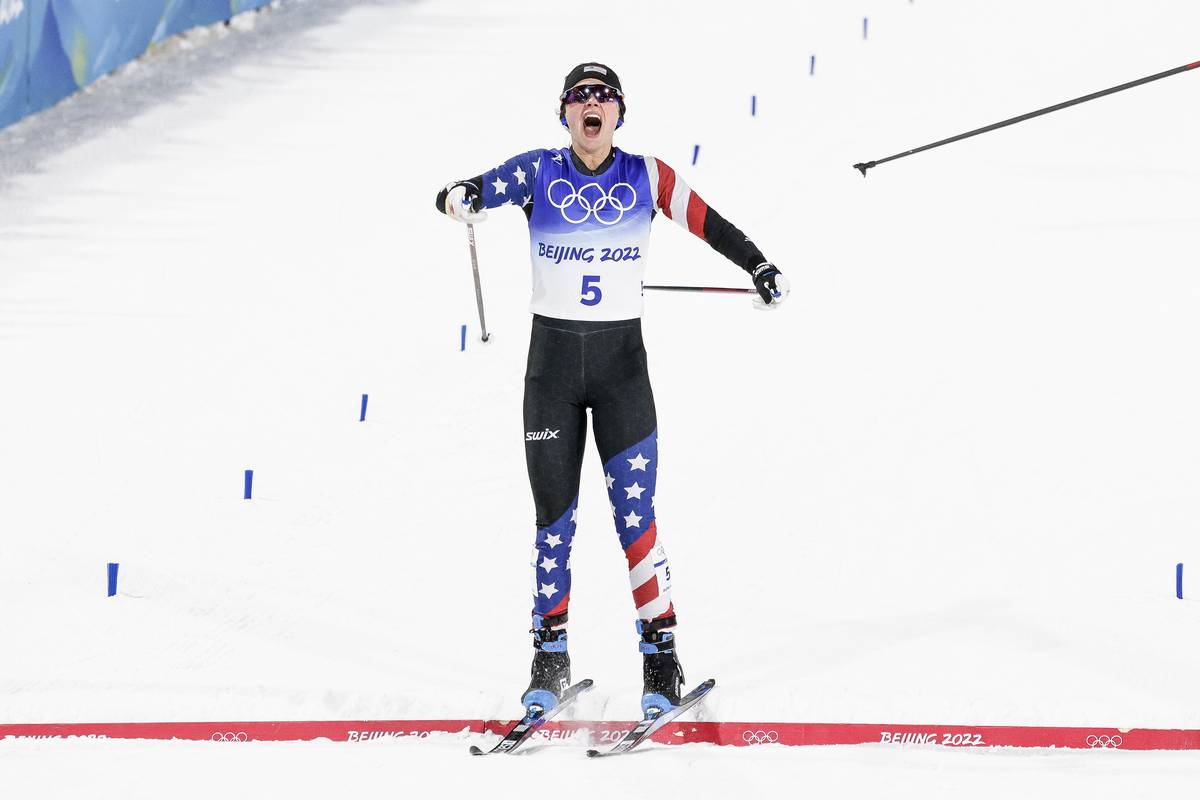
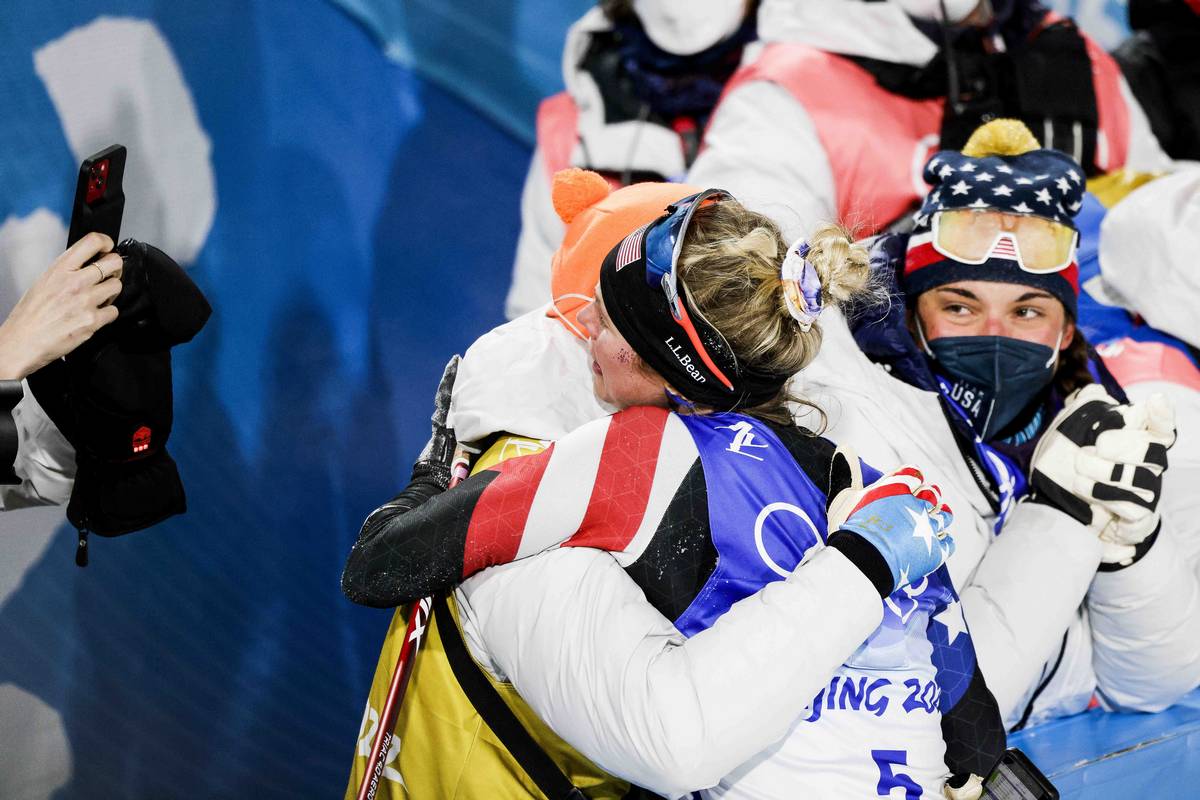
    Diggins collapsed to the ground, overcome by the emotion of what she had accomplished. Perhaps a testament to her team-centric approach, she was heard saying, “Good job, Rosie!” between gasps, as she got back to her feet to immediately hug the coaches, support staff, and teammates that lined the edge of the course.

    Jessie Diggins hugs her coaches and teammates after finishing third in the individual freestyle sprint in Zhangjiakou. (Photo: NordicFocus)
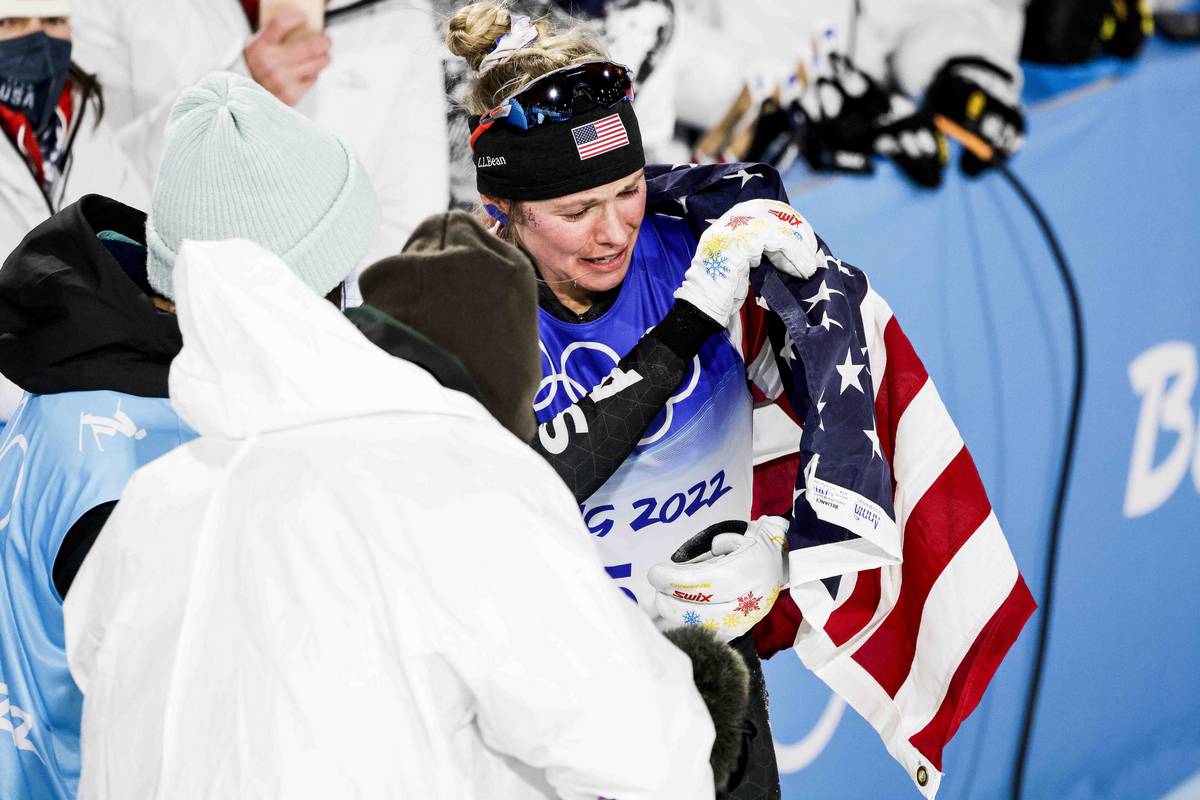
    An emotional Jessie Diggins wraps the American flag around her shoulders after taking bronze in the freestyle sprint. (Photo: NordicFocus)

    Tearfully wrapping an American flag around her shoulders, Diggins was aglow as she savored the moment before heading back to the finish to stand alongside Sundling and Dalhqvist for the podium shot. 

    Jonna Sundling (SWE) takes gold in the freestyle sprint, ahead of Maja Dahlqvist (SWE) and Jessie Diggins (USA). (Photo: NordicFocus)

    Though she was the one whose name would be highlighted in history books, Diggins focus on the importance of those around her remained at the forefront as she celebrated the many victories of the American team in today’s event. 

    “It was so cool to be there with Rosie,” Diggins said in the mixed zone. “She’s skiing so amazingly well… and I’m just so grateful. That’s the overwhelming emotion, because it takes so much from such a huge team to make this happen. And we had obviously amazing skis, but also amazing teammates for years and years and years, helping me train, pushing me, supporting me – amazing coaches, amazing volunteer staff. You can’t even imagine how much it took from so many people, and so I’m just so thankful because I feel like this medal belongs to about 1000 different people. And I hope they really feel that and know that.”

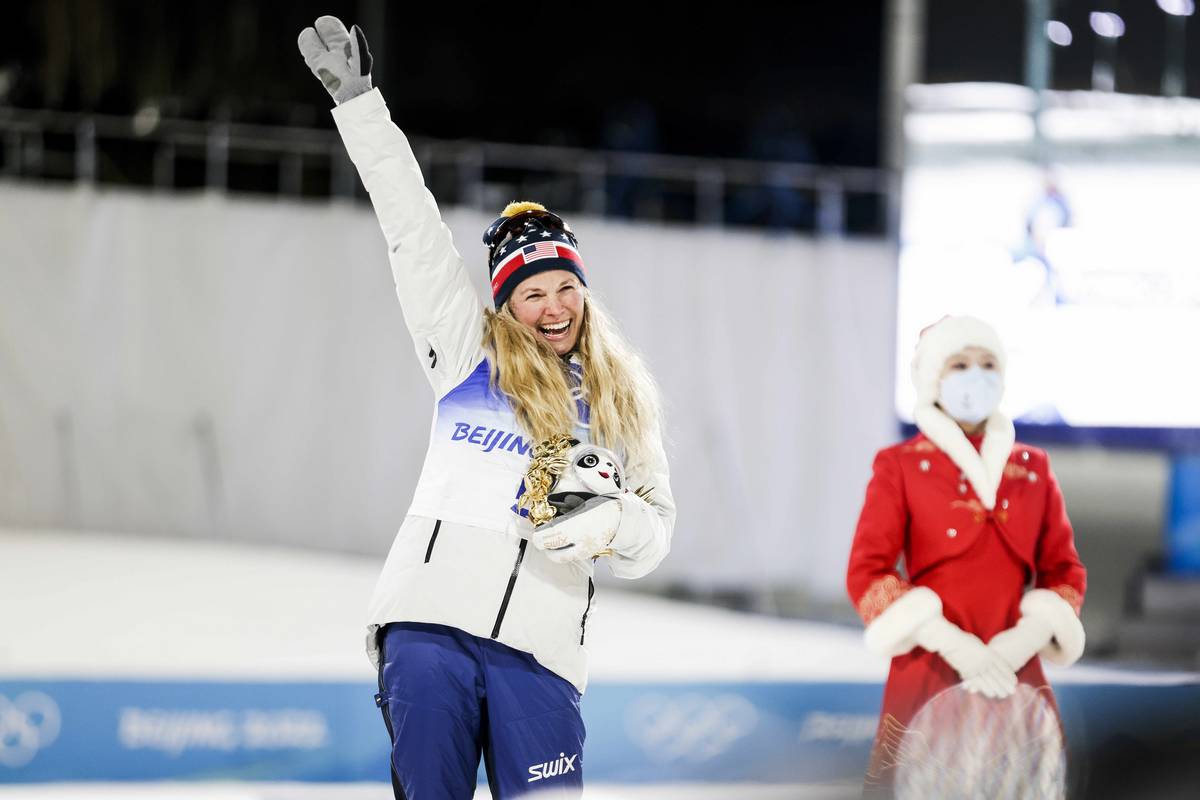
    Jessie Diggins takes Olympic bronze in the freestyle team sprint. (Photo: NordicFocus)

    Of her approach to the course, Diggins gave a simple response, acknowledging that she has a way of blacking out while having great races, “which is really annoying,” she laughed, “because I’d love to be able to remember exactly what I did.”

    “I was just so focused on trying to push as hard as I could,” Diggins explained. “Just trying to ski as well as I could and stay balanced. The snow felt a little greasy, so especially in the finishing lane, just trying to put as much power as I could into every single push. And honestly, that’s all I can remember.”

    Jessie Diggins (USA) on her way to the USA’s first ever individual women’s medal in the Olympics. (Photo: NordicFocus)

    Perhaps the FasterSkier audience needs no reminder that Diggins came into the 2022 Games as a gold medalist, having won the freestyle team sprint with Kikkan Randall in 2018, a day that brought many Americans, including this writer, to tears. Diggins was asked to reflect on the last four years, and the progress she’s made in her career. 

    “The last four years, I’ve really found my voice,” Diggins said confidently. “I’ve really found a lot of my purpose, and I feel like I’ve grown a lot. But also, I’m exactly the same person in pretty much every other way. I think one of the big things has been dealing with is the pressure and expectations, because there’s been a lot of it, and it hasn’t been easy. So for me, I think it was such a victory just to make it to the final and know that I’m skiing well. I came into this as prepared as I could be, which one of my biggest goals was to come in prepared. The second goal, cross the finish line with nothing left. And the third goal was to just have fun, and keep focusing on the process, because that’s what gets me where I am today. Like win, lose, or draw, it’s just focusing on the process and, and executing those process goals to the very best of my ability, because then I’m always proud of how I finished. I’m just proud of this effort today as I was at the skiathlon, even though they were different outcomes.”

    Jessie Diggins was all smiles as she passed through the mixed zone following her bronze medal performance in the women’s individual sprint. (Photo: Nat Herz/FasterSkier-ADN)

    Fourth place at the Olympics – fourth in the world on its most prestigious stage – is both a truly incredible feat and perhaps the most challenging final rank to wrap one’s head around. The “wooden medal”, just shy of the Olympic hardware skiers dream about from their youth. 

    “Fourth place was hard,” Brennan said honestly in the mixed zone. “You feel really happy and also frustrated at the same time. I have a lot of mixed emotions about it. But I did everything I could today, and maybe not everything went perfectly my way. But I have to be happy with that at the end of the day.”

    Jessie Diggins (USA) and Rosie Brennan find their position in the early moments of the women’s final. (Photo: NordicFocus)

    Asked what she would have said if four years ago, someone told her she would be in this position, Brennan laughed, “I probably wouldn’t have believed it so much.”

    She talked through a rough start to the day, sharing that she has always struggled with start gates and had spent the last six weeks practicing to ensure a clean start.

    “So, there I was on the ground, I was like, ‘So much for all that practice.’ But I knew my strength was in the climb, so I just had to pull it back [together] and focus on the all the time I had left and see what I could do to try and make it up.” 

    On her approach through the heats, Brennan played to her strengths, recognizing she could take the lead, work the hills, and not let her heats unfold as a casual first 1200 meters with a tactical final sprint that might leave her in the dust.

    “My strength lies more in the endurance aspect of it,” she explained. “I tried to just keep the pace high so that I could count on being a lucky loser – by having a fast heat time. So that was my strategy in the semifinal, and it worked. Once I got to the final, I tried to then be a little more smart about my racing. I tried to be patient and wait until the last climb. I was a little far back, so I kind of got the door closed on me to make it through. So I had to kind of adjust and go for a strong finish sprint, which isn’t always my strength. But I did all I could do.”

    With Ben Ogden racing into the semis in the men’s race, it was an historic day for the American program as a whole. Speaking to this landmark day, Brennan concluded with an inspiring message for those who dream of following in their footsteps.

    “I think it shows the growing depth in our country. And I hope it shows a lot of people just to have some patience and keep training, keep going for it. You never know where you’ll end up.”

    Jonna Sundling (SWE) takes gold in her first Olympic appearance in the women’s freestyle sprint. (Photo: NordicFocus)

    Taking a closer look at the winner, Sundling is the 2018 World Champion in the freestyle sprint. Returning from injury, she has built her way into the season. Though Dahlqvist has shined as the undefeated World Cup star for Sweden, Sundling has crept up alongside, taking second to Dahlqvist in the individual sprint in Dresden, and working together to win the team sprint. Sitting out the Tour de Ski, Sundling beat Dahlqvist in their next matchup in a Scandinavian Cup race in Falun, Sweden.

    This is Sundling’s first Olympic appearance, though she and Dahlqvist will be a likely pairing in the classic team sprint next Wednesday.

    Once the final rounds were complete, Kern’s final placement was determined to be 18th. This marks a significant step forward from her first appearance in the skiathlon, where she finished 53rd. 

    Julia Kern (USA), who finished in 18th place overall, pushes to the finish during her quarterfinal round. (Photo: NordicFocus)

    “It was really tough out there, but a lot of fun to have a challenging course and give it my all,” Kern told FasterSkier in the mixed zone.

    Dahria Beatty 28th in qualification (+14.51) to be the only Canadian woman to make the heats. Beatty raced in the first semifinal, where she finished fifth in the heat to finish 25th on the day. 

    Just 0.7 seconds off the top-30 mark, Cendrine Browne was 35th in qualification (+15.82) with Olivia Bouffard-Nesbitt close behind in 40th (+16.89). Laura Leclair rounded out the Canadian team in 58th (+26.28). 

    Dahria Beatty (CAN) races in the quarterfinals on her way to 25th place overall. (Photo: NordicFocus)

    An Australian dual citizen who is a long-time APU team member, Jessica Yeaton was 52nd (+23.82) in the qualifying round. 

    Results:

    Qualification | Final

  • Dahlqvist Wins the Opener in Ruka; Three Americans in the Top-20

    Dahlqvist Wins the Opener in Ruka; Three Americans in the Top-20


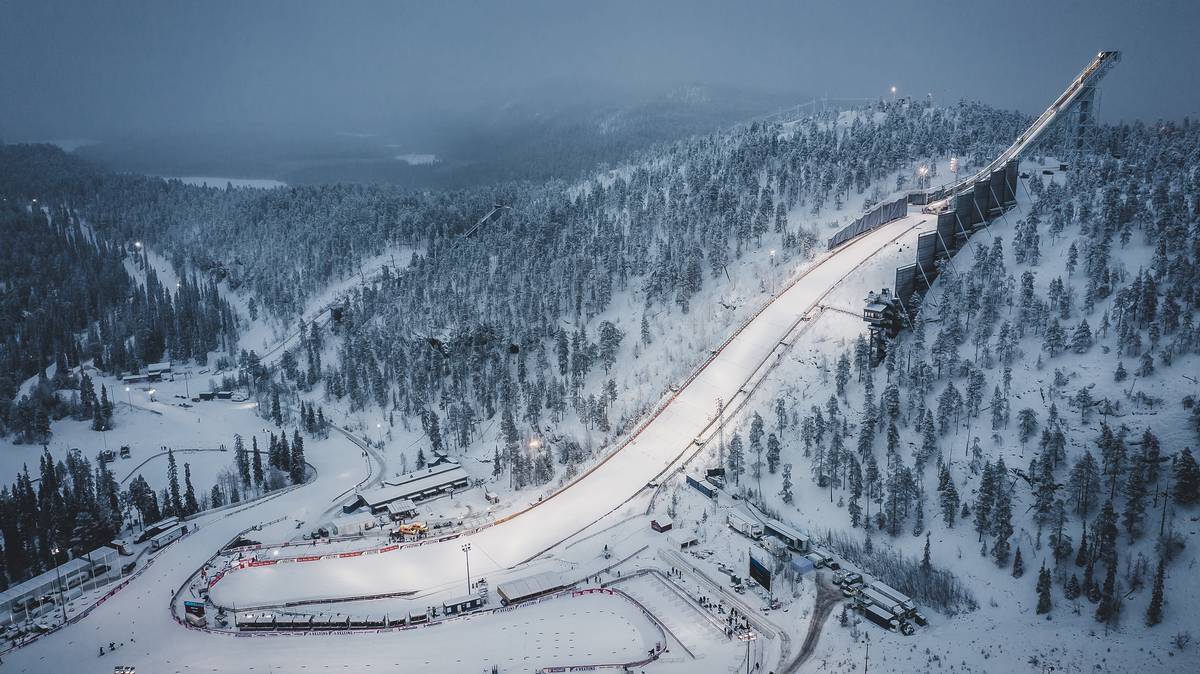
    An aerial view of the wintery venue in Ruka, Finland. (Photo: NordicFocus)


    This World Cup coverage is made possible through the generous support of Marty and Kathy Hall and the A Hall Mark of Excellence Award.  To learn more about A Hall Mark of Excellence Award or to learn how you can support FasterSkier’s coverage please contact info@fasterskier.com.
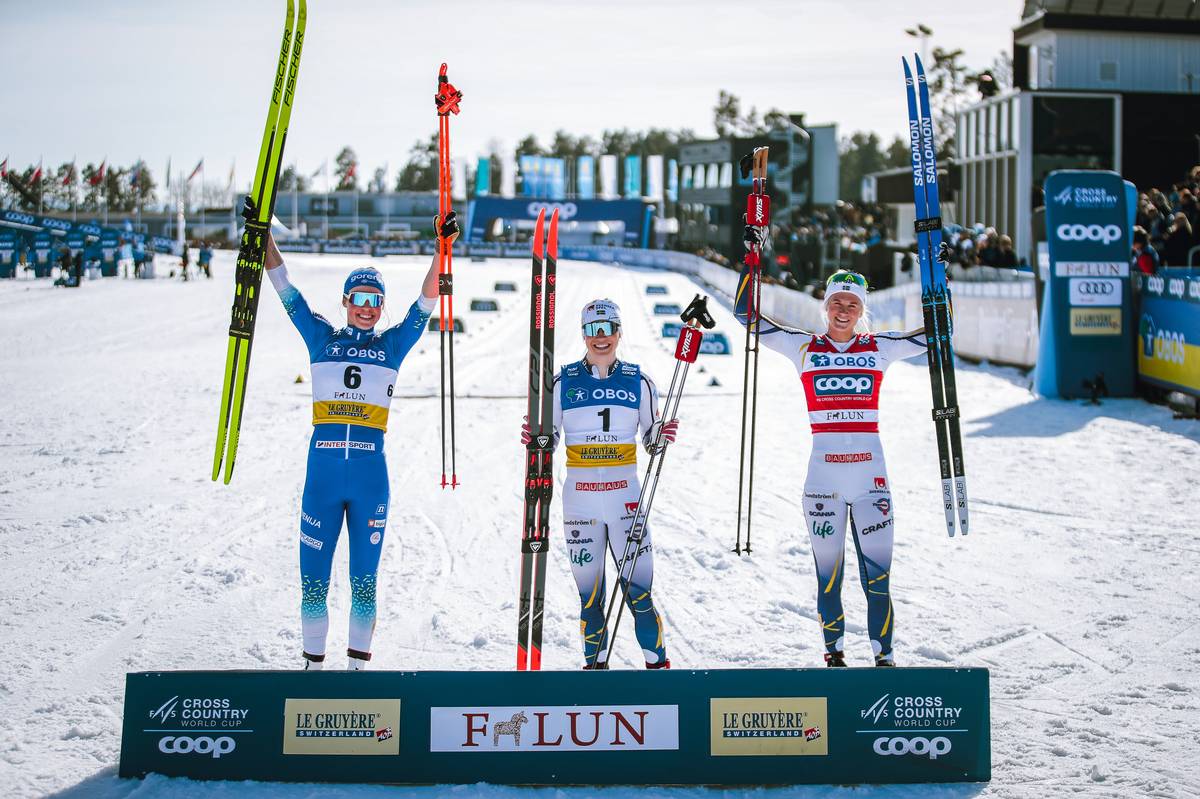
     

    And so it begins. The first round of World Cup racing took place in Ruka, FIN today with conditions one might expect in late November at almost 66 degrees North latitude: long shadows, low light, and squeaky tracks, with strong, eager athletes kicking and gliding around a 1.4-kilometer loop. The temperature showed in the athletes’ appearance, as they were bundled with mittens and buffs through the heats, layering with jackets and vests on the warm up and between rounds. Perhaps good practice for the forecasted conditions in Zhangjiakou, China, during the upcoming Olympics. 

    While Jessie Diggins normally comes into form later in the race season once she has a handful of races under her belt, she surprised herself with her opener in Ruka. Diggins may not be considered a favorite for classic sprints, but she has shown time and time again that she should never be ruled out in a classic race. Today, she raced the fastest qualifier with a time of 2:58.85, 0.77 seconds ahead of the next woman.

    Jessie Diggins with the surprise win in the qualifying round of the classic sprint in Ruka. (Photo: NordicFocus)

    In an interview with FIS before the rounds, Diggins credited her techs for preparing her winning skis, laughing that “no one looks at her in a classic sprint qualifier.” (We expect there might also be a fitness component at play here.) In terms of a return to the World Cup, she expressed her excitement that the season is upon us.

    “I feel great,” she said. “It’s so fun to be back in Europe, back with my team. This is such cool energy. For me, it feels like the first day in school. I just love being here with these people.”

    Heading into the rounds, Diggins selected the fifth and final quarterfinal heat.

    Also among the top-30 qualifiers were Rosie Brennan in 8th (+1.90) and Julia Kern in 21st (+5.6). Kern raced in the second heat of the quarters, while Brennan selected the fourth.

    Rosie Brennan skis to 8th place in the qualifying round in Ruka. (Photo: NordicFocus)

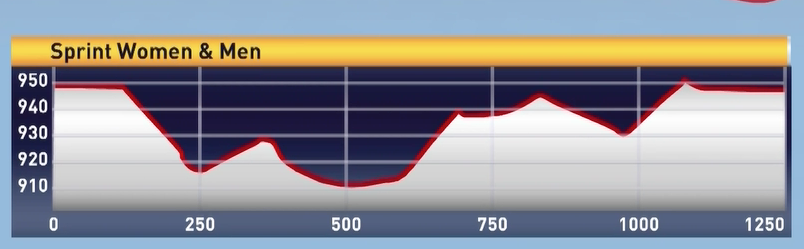
    A quick note on the sprint course in Ruka. You’ll notice from the profile that the A-climb begins just before the 1k mark, leading into a false flat before winding into the final straightaway to the finish. There is no downhill out of this climb; athletes simply climb a little over 20 vertical meters, then fight the subsequent flood of lactate as they make their way to the finish.

    The course profile in Ruka. (Photo: FIS Broadcast)

    In the second quarterfinal, a pair of Swedes, Maja Dahlqvist and Anna Dyvik, got out quickly to establish position at the front. Kern tucked in behind the Swedes out of the gate, then made a commanding move using momentum from the first descent to put herself at the front of the pack for the first climb. Heading up the A-Climb, the Swedes began to pull ahead, along with Slovenia’s Anamarija Lampič. Kern held her position in fourth place into the stadium and across the line, however, the time was not fast enough to secure a lucky loser position and she was knocked out. 

    During Brennan’s heat, she remained tucked into the middle of the group at the halfway mark. She dialed the effort up a notch on the A-climb, but as she neared the top, there were still four women vying for the lead. Brennan was tucked in on the tails of Finland’s Johanna Matintalo coming down the final stretch to take third in the heat. Unfortunately for the American, this was less than half a second off the time needed for a lucky loser spot in the semis.

    Diggins took the lead early in her quarter, her fast skis having allowed her to capitalize on the first downhill. She held her ground into the A-climb, where Krista Pärmäkoski and Katri Lylynpera, both of Finland, followed by Sweden’s Frida Karlsson, caught the American, leaving the climb as a pack of four. 

    Jessie Diggins holds the early lead in the quarter final of the classic sprint in Ruka. (Photo: NordicFocus)

    In the final stretch, Karlsson gained ground with her double pole to take the win just ahead of Lylynpera. Diggins crossed the line in a photo finish with Pärmäkoski, but timing showed that the American was 0.04 seconds behind the Finn, leaving her in fourth for the heat, which did not see any lucky losers.  

    Despite not advancing further in the rounds, Diggins said she knows she is “exactly where I need to be” at this point in the season. She acknowledged how much she has put in with her coaches to improve her classic skiing, and sees this as a positive indicator of the progress they’ve made. Here’s more from Jessie:

    Post-race audio clip from Jessie Diggins.

    Jessie Diggins holds the early lead in the quarter final of the classic sprint in Ruka. (Photo: NordicFocus)

    In the first round of the semis, all six women remained tight through the halfway mark. You’ve probably caught on to the theme of the day: positioning oneself at the front heading out of the A-climb proved critical for final placement. Deciding moves were made here. Using this tactic, Johanna Hagström (SWE) and teammate Dahlqvist ran powerfully uphill to pull ahead. The women entered the final straightaway side-by-side, but Dahlqvist soon made ground on her teammate, taking the win in the round. Russia’s Natalia Nepryaeva was close on the women’s tails, closing the gap in the last 50 meters and sliding across the line just behind Hagström in third, not quite fast enough for a lucky loser spot in the final.

    Moving on to the second round. Russia’s Yulia Stupak led the women through the first half. On the A-climb, Norway’s Maiken Caspersen Falla held the lead with Lylynpera close behind. Moving from the back of the pack into third, Karlsson took the inside around the curve heading into the stadium. She steadily gained ground on the other women in the double pole sprint to the line, edging Lylynpera out at the line to take the heat. Falla took third, with Matintalo close behind. As the second was the faster heat of the semis, both of these women advanced to the final. 

    In the final round, Sweden was looking to repeat their podium sweep from last year in Ruka. With Dahlqvist, Hagström, and Karlsson in the final, the possibility remained on the table.

    Despite a brief failure in grip and consequent slip, Dahlqvist charged the A-climb to put herself in excellent position for the final meters. A few stride lengths behind, Falla and Hagström were matched as they vied for the second and third podium spots.

    The final straightaway as the women head for home in the Ruka Classic Sprint. (Photo: NordicFocus)

    As they rounded the final left-hand bend into the stadium, the Swede had enough space to take the preferred line into the second track from the left of the curve heading into the final straight, leaving Falla to make a lane change behind her. This advantage carried Hagström to the line for second (+1.77) with Falla just behind for third (+2.02). 

    Sweden’s Maja Dahlqvist takes the win in Ruka. (Photo: NordicFocus)

    “I couldn’t say better — perfect start,” Dahlqvist told FIS after the race. “I had really good shape and my skis were so good, so I just wanted to ski fast. I couldn’t wait for the uphill, and that’s never happened with me before.”

    This is Dahlqvist’s second World Cup win, but 13th time on the podium. She was second in last year’s classic sprint opener in Ruka.

    Maja Dahlqvist (SWE) takes the win in Ruka ahead of teammate Johanna Hagström. (Photo: NordicFocus)

    Off the podium, Finland’s Matintalo finished fourth in the final (+3.21) with teammate Lylynpera next over the line for fifth (+3.74). Karlsson was sixth across the line (+3.97) to close out the final heat.

    Once final rankings from the heats were solidified, Brennan was deemed the top American in 15th, with Diggins just behind in 16th. Still inside the Top-20, Kern ended her day in 18th. 

    Rosie Brennan skis to 15th in the classic sprint in Ruka. (Photo: NordicFocus)

    Reflecting on her opener, Brennan shared the following in a post-race email:

    “Ruka is such a unique course and being the first race of the season, it’s always hard to know what to expect. My goal was to be in the mix and skiing well. I am happy with my effort and really happy to be underway with racing. I think this was my best result in Ruka so even though I always want more, I am happy to be where I am right now. I felt I was missing a little top end speed today, but feel that I am on track and moving in the right direction. I’m excited to do some distance racing and to continue working out the kinks this weekend.”

    Kern also posted her career-best result in Ruka. She finished outside the heats in 40th last year. Remarking on this progress, Kern wrote:

    “I was really happy with the energy I brought today, with the added bonus of figuring out how to qualify in Ruka. The final climb is always the crux on this course; every year it gets greasy, washed out and tricky. I am proud with how I skied with confidence and figuring out how to ski the last part of that final climb fast will hopefully come with more days skiing on snow! I am excited that the season has started and feel that I am in a much better place coming into the race season this year.”
    In a post-race interview, Whitcomb shared his thoughts on Diggins’ win in the qualifier, along with Brennan’s result and the outlook for the women’s program heading into the season. We did have some technical issues on the call. You’ll notice that the first question was cut off, which was regarding the cold conditions in Ruka and whether there is any additional emphasis by the team or techs on cold events this year, considering the Olympic venue is predicted to be very cold.

    Outside the heats, Hailey Swirbul was 37th in the qualifier (+8.59). Katharine Ogden was next for the U.S. in 52nd (+12.23), immediately followed by Hannah Halvorsen in 53rd (+12.95). Novie McCabe was 61st (+16.43), with Sydney Palmer-Leger closing out the American team in 66th (+21.61). 

    Hannah Halvorsen skis the qualifying round of the classic sprint in Ruka. (Photo: NordicFocus)

    Results:

    Qualification | Final

  • Sweden’s Sundling Cruises for First Championship Gold in the Classic Sprint

    Sweden’s Sundling Cruises for First Championship Gold in the Classic Sprint

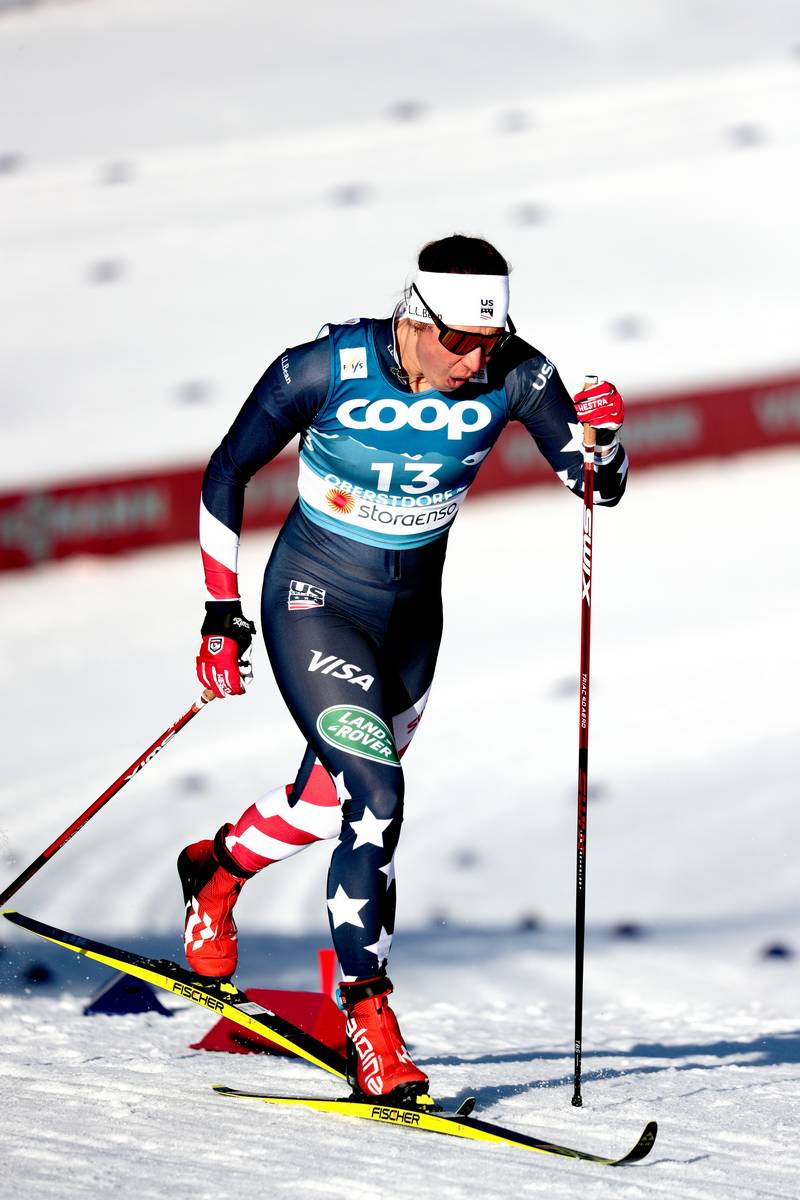
    Jonna Sundling of Sweden wins the women’s classic sprint at the 2021 Oberstdorf World Championships. (Photo: NordicFocus)

    This World Championship coverage is made possible through the generous support of Marty and Kathy Hall and their A Hall Mark of Excellence Award. To learn more about A Hall Mark of Excellence Award or to learn how you can support FasterSkier’s coverage please contact info@fasterskier.com.

    After qualifying events on Wednesday, World Championships kicked off in earnest in Oberstdorf, Germany with the Classic Sprint event Thursday morning. Due to unseasonably warm temperatures, the start times were pushed earlier in the day to optimize course conditions and hopefully preserve snow for the remainder of the competition.

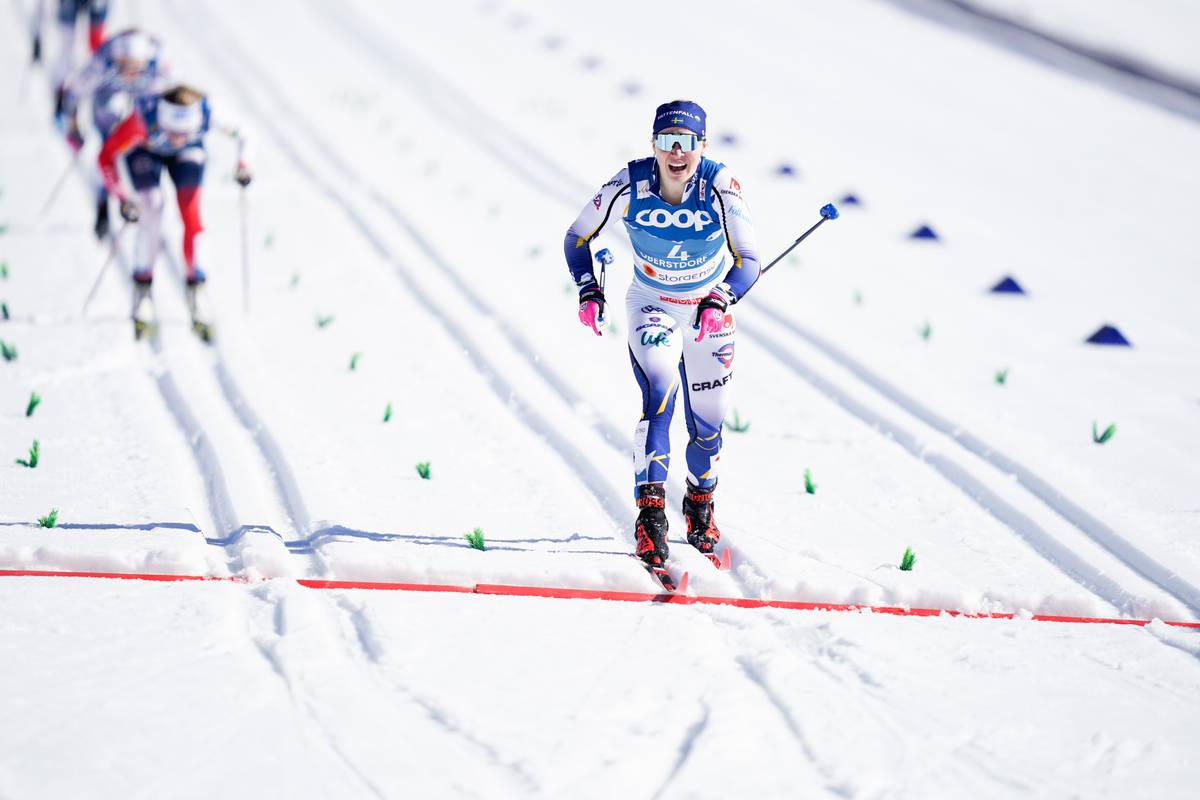
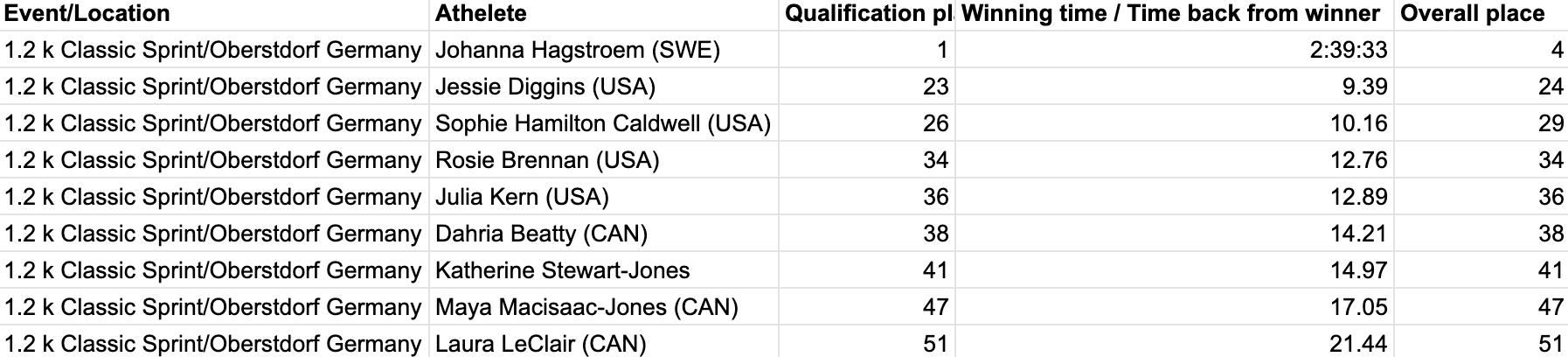
    The women raced a 1.2 k course, with Johanna Hagström winning the qualifier in a time of 2:39.33. After her qualifier, Hagström said, “it felt really great, I was focused on being calm and do[ing] fast skiing by good technique so I think I got it.”

    Johanna Hagström of Sweden during the women’s classic sprint qualifier. (Photo: NordicFocus)

    Jumping ahead to close the day out, top honors went to her Swedish teammate, Jonna Sundling, who won the final in a time of 2:36.76.

    On a salted course, which despite the sun’s radiation held up, the sustained final climb proved to be an effective make-it or break-it moment in terms of dictating the results narrative. Throughout the quarter-final rounds, gaps formed as the leaders crested the hill well ahead of their competitors. Notably, after two false starts at the beginning of Heat 5, one for technical issues and the second the result of Tatiana Sorina (RSF) jumping the gun, a crash by Johanna Matintalo of Finland forced Sorina well off-course to avoid a tangle though she seemingly was not disqualified for her deviation. Observers of the sport will note that Russian athletes are representing the Russian Ski Federation and not “Russia” during these championships. This is the result of a recent Court of Arbitration for Sport ruling.

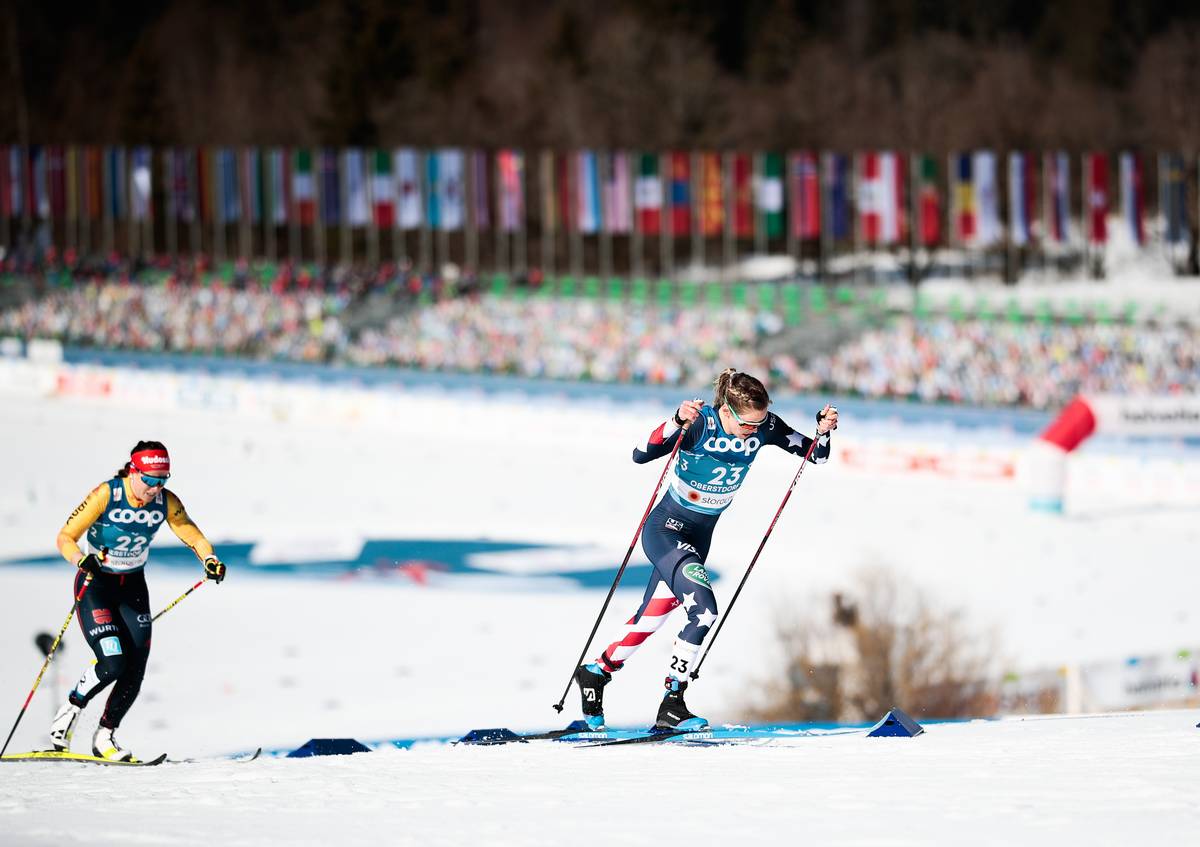
    Sophie Caldwell Hamilton of the U.S.s racing in qualification. (Photo: NordicFocus)

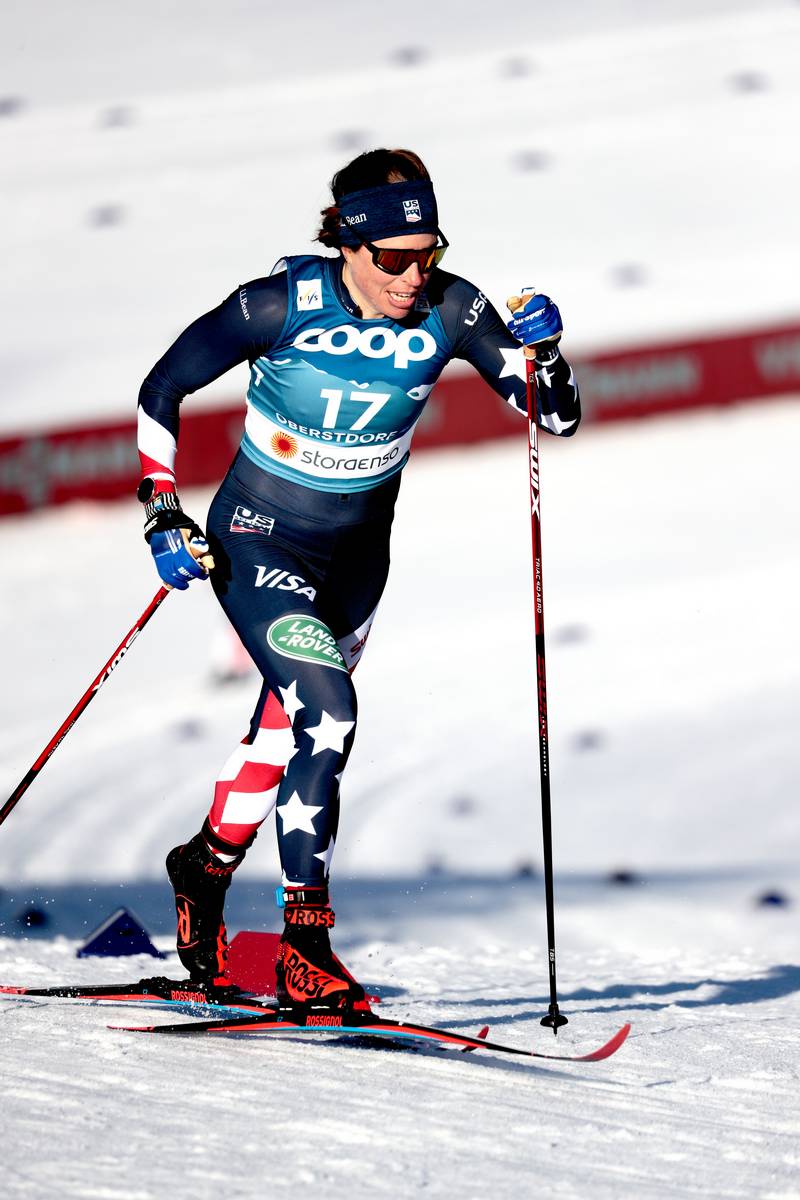
    Two U.S. women qualified for the heats, Jessie Diggins in 23rd and Sophie Hamilton Caldwell in 26th. Hamilton Caldwell raced in quarterfinal number two where she finished 6th, concluding the day in 29th position. Diggins chose heat four and finished 5th for an overall place of 24th.

    After her race, Diggins shared with the U.S. Ski Team, “I am really really excited to be here, first of all, I feel like really lucky that we are getting to race at all. I think this is pretty incredible when I think back to how we were looking at this season back in November, the fact that we have made it here to World Champs and they are happening is really really cool. For me personally, I came into this World Champs feeling like I have prepared the very best that I could. I even tried to acclimate to the heat as much as possible because it is super super hot and sunny here.”

    Johanna Hagström (SWE), Jessie Diggins (USA), (l-r) racing in the heats. Diggins went on to place 24th overall. (Photo: NordicFocus)
    Katharina Hennig (GER), Jessie Diggins (USA), (l-r) during the fourth heat in Oberstdorf. (Photo: NordicFocus)

    Regarding today’s race Diggins said, “So today, in the qualifier, just went out and I think I definitely was still waking up my body I think from pre-camp so it definitely felt like I need to find that next gear. But was happy to have made it into the heats. And then in my heat, I felt like I did a good job not overheating staying out of the sun when I could. Getting a great warm-up and skis dialed in with Cork. And I think we had very competitive skis. On the last uphill, I definitely was mentally trying to churn the legs and get the gears going and I just felt like my body just ran out of energy. I know I prepared the best I could and now am just focused on hydrating, fueling, getting out of the snow and getting ready for a lot of races up ahead. I am really proud of my effort, I felt like I pushed as hard as I could and I don’t have any regrets.”

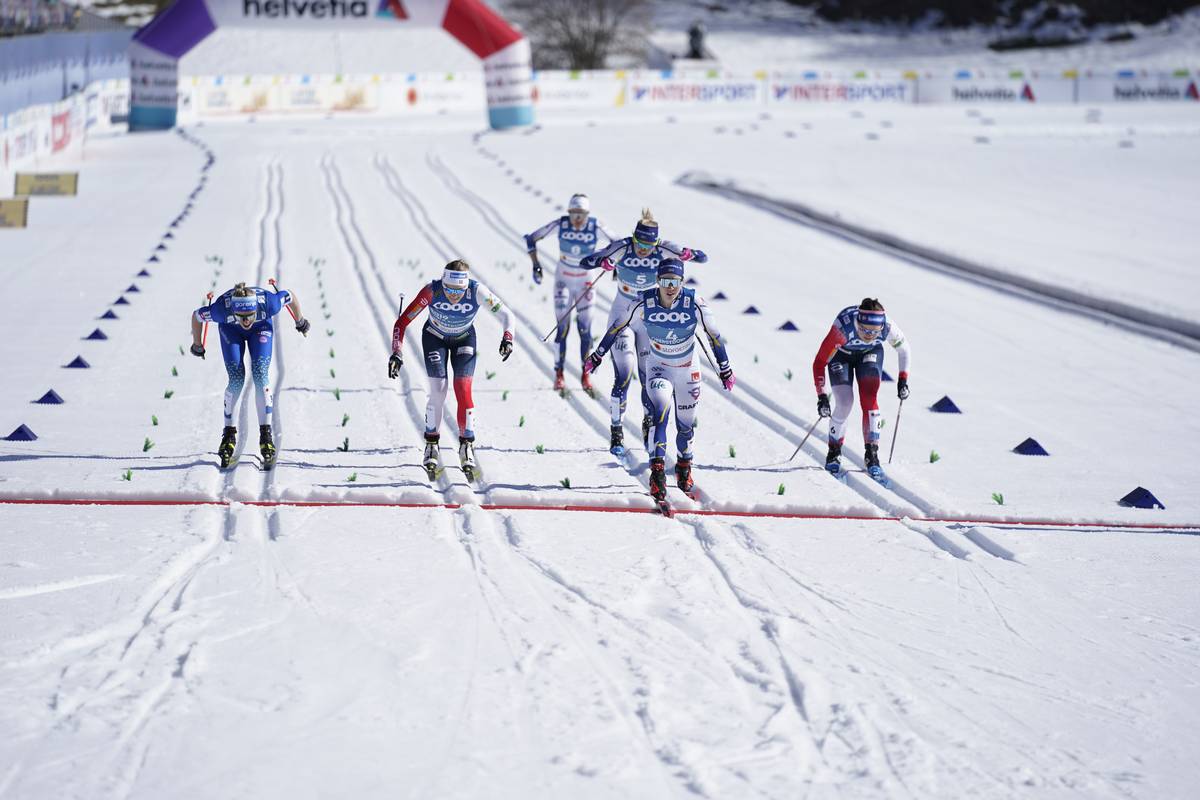
    Maiken Caspersen Falla (NOR), Maja Dahlqvist (SWE), and Jonna Sundling (SWE), (l-r) finishing a tight first semifinal. (Photo: NordicFocus)

    In a stacked first semi-final heat, Sundling of Sweden and Maiken Caspersen Falla of Norway advanced automatically with both lucky losers also coming from this heat, Norway’s Ane Appelkvist Stenseth and Slovenia’s Anamarija Lampic. A false start at the beginning of semi-final number two resulted in a yellow-card for Hagström though she still qualified in second place. Lotta Udnes Weng of Norway had a stumble and fall at the top of the first climb, nearly taking out her sister and fellow competitor, Tiril Udnes Weng (NOR). Tiril Udnes Weng recovered to win the semi-final ahead of Hagström.

    For the final, three Norwegians, two Swedes and one Slovenian lined up to complete the first medal event of the 2021 World Championships. For the first climb, the group stayed largely together but as they entered the second and final hill Sundling turned on the burners. Gapping the field, she crested over the top alone, with Falla some paces behind. Entering the final straights, Sundling was unchallenged as she swept across the line, arms raised, to claim her first-ever championship medal.

    Sundling soloing in for the win. (Photo: NordicFocus)


    With the win, Sundling scores her first career championship gold. (Photo: NordicFocus)

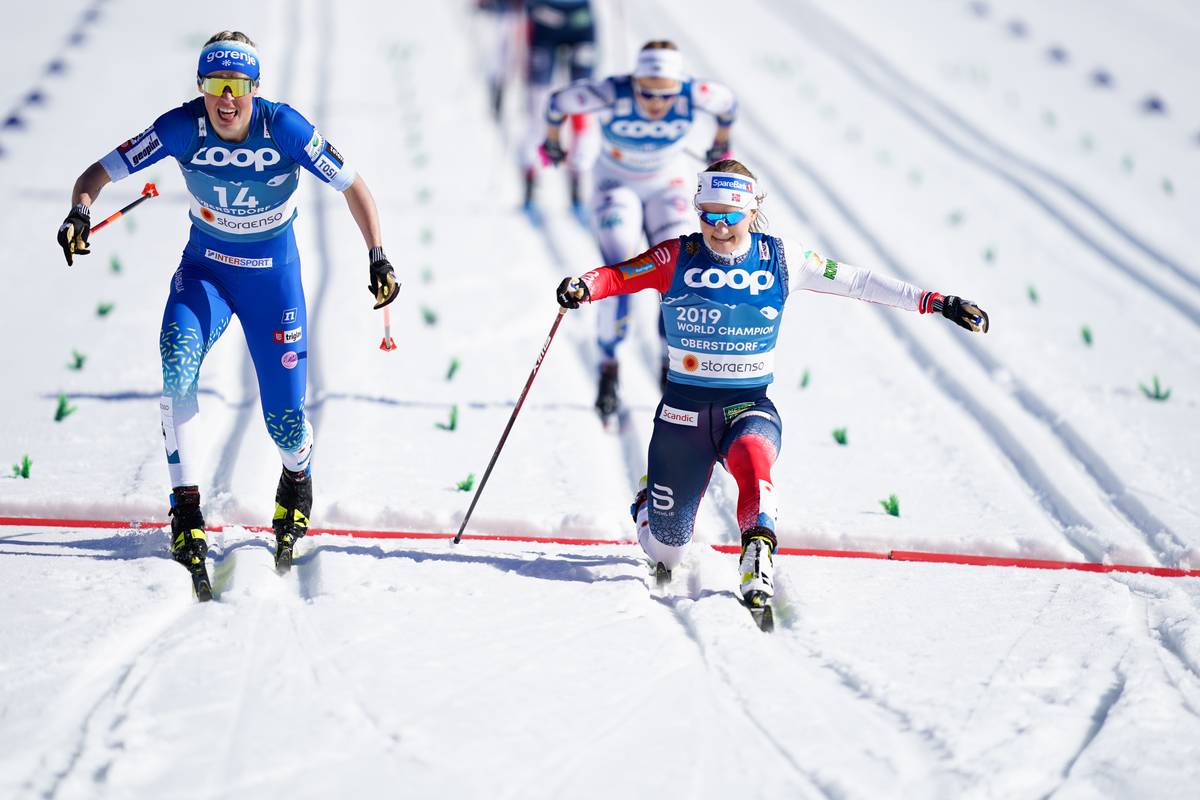
    Behind her, a battle for second and third position was playing out as Lampic was quickly closing in on Falla. Both skiers threw their feet forward for a photo-finish lunge that ultimately went to Falla, leaving Lampic with bronze. Hagström finished fourth, Stenseth fifth and Tiril Udnes Weng (NOR) placed sixth.

    Throwing toes at the line, Anamarija Lampic (SLO) and Maiken Caspersen Falla (NOR), (l-r). Falla placed second with Lampic third. (Photo: NordicFocus)

    Sundling has three individual World Cup victories to her name, all coming from freestyle sprint events. At the Seefeld World Championships in 2019 she finished fourth in the skate sprint. After her victory today Sundling said in an interview with FIS, “I am so so happy, I have dreamt of this and to get this victory, it’s amazing. I’m really really happy.” When asked about the rest of the field she said, “[my competitors] were so strong, it is a fast and tough track and I think everyone did a really good job today and I’m really satisfied to be the first over the finish line of course.”

    Falla, the 2019 and 2017 Sprint World Champion, takes home her fifth individual championship medal after placing second. This is Falla’s second international race of the year as she sat out much of the season. For Lampic, this third-place finish marks her first individual World Championship podium. In Seefeld in 2019, Lampic placed second in the team sprint with teammate Katja Visnar.

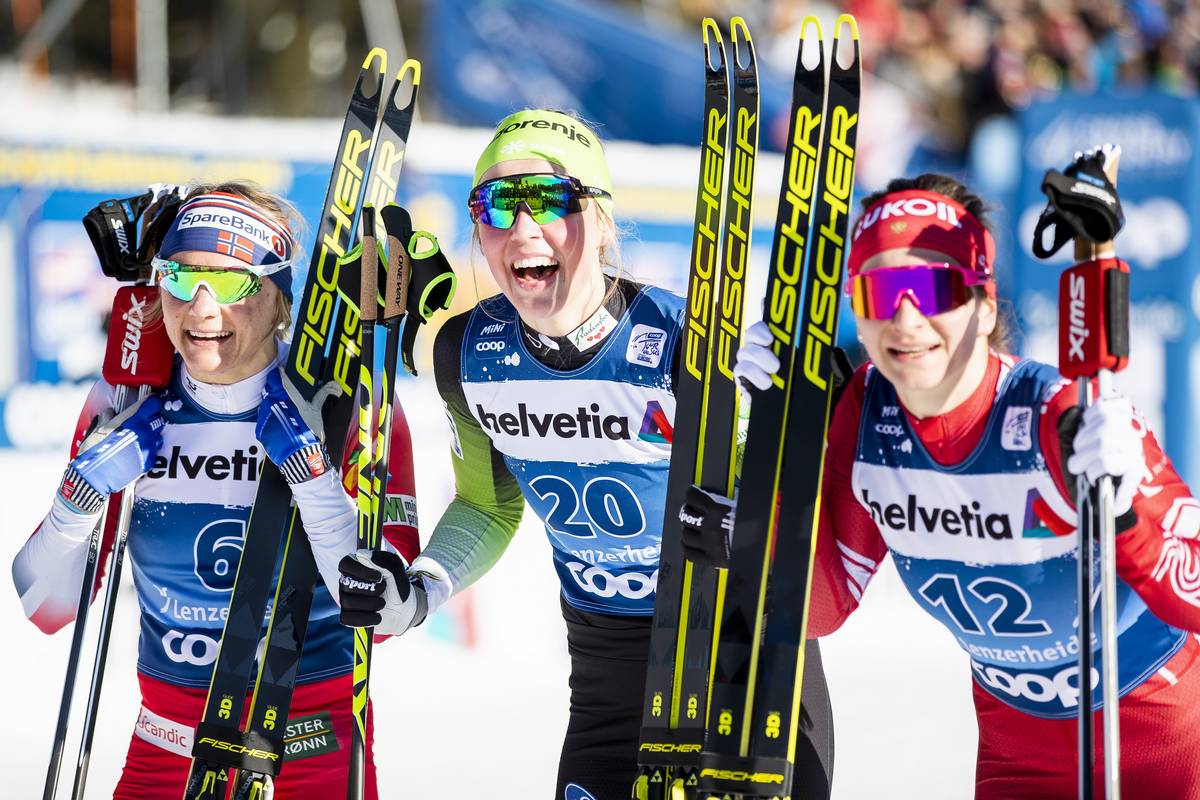
    The women’s classic sprint podium: Maiken Caspersen Falla (NOR) second, Jonna Sundling (SWE) first, and Anamarija Lampic (SLO), (l-r). (Photo: NordicFocus)


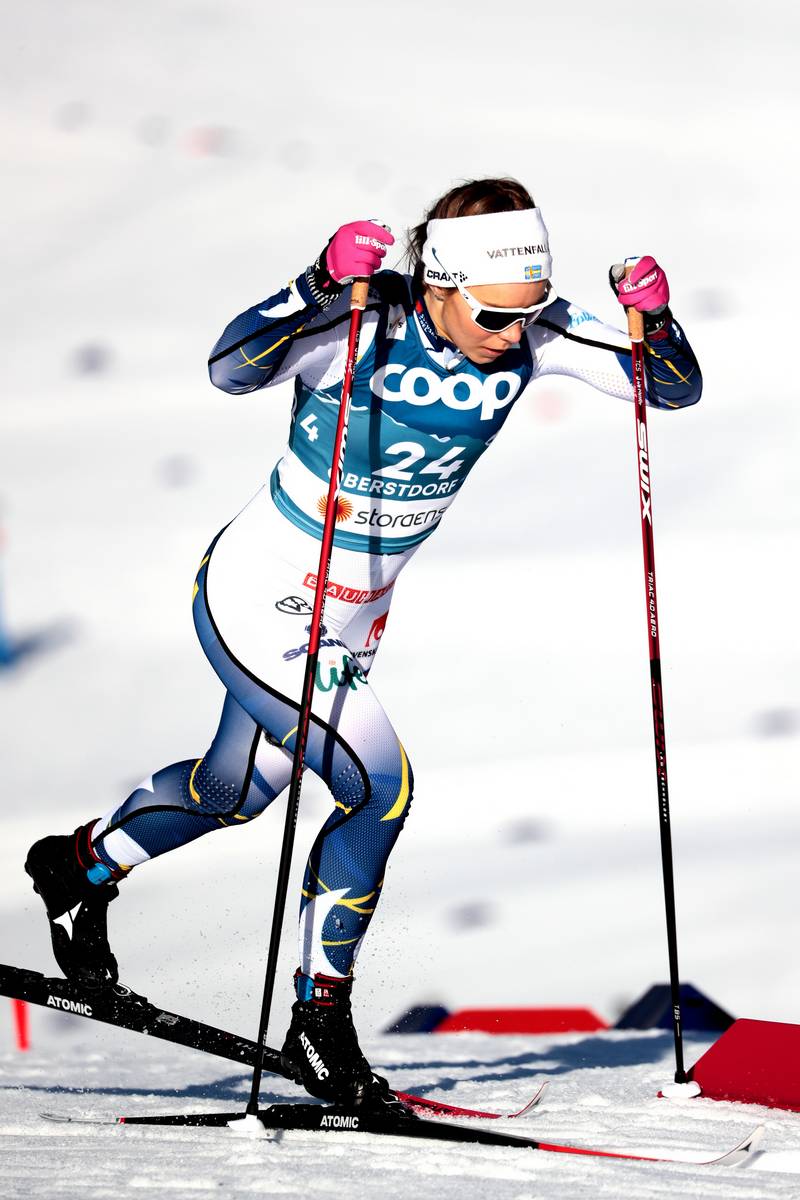
    Rosie Brennan racing in qualification. (Photo: NordicFocus)
    Julia Kern racing in qualification. (Photo: NordicFocus)
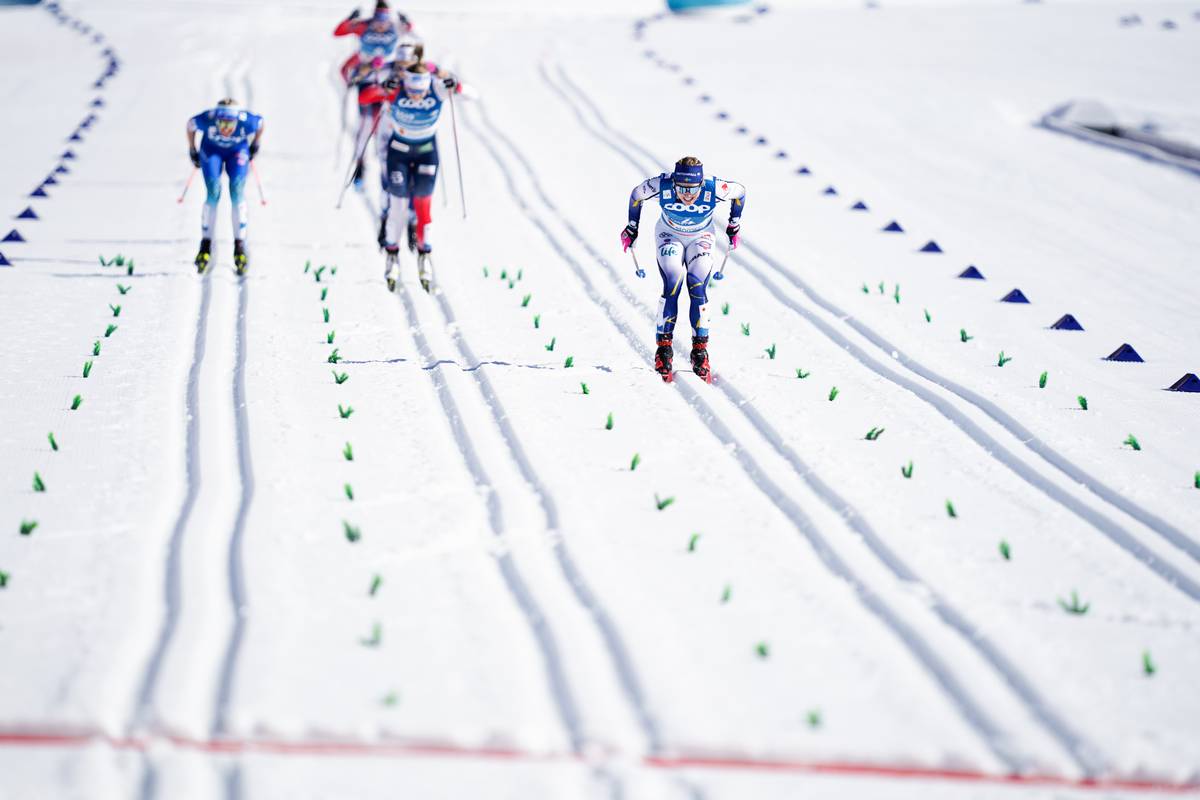
    Dahria Beatty was the top Canadian placing 38th. (Photo: NordicFocus)

    Racing continues Saturday with a 15 k skiathlon for the women. Looking forward, when asked about her feelings going into the skiathlon Diggins said, “sometimes after a camp especially at altitude, you need to do a hard effort to just sort of blow the rust out of the gears. And so I think that was really great, and yeah it is kind of nice because in skiathlon it is a very different energy system than a sprint. I am really excited to again just send it with everything I have. That is all I can promise, is that I am going to cross the line being totally gassed.”

    Results: Women’s Final | Women’s Qualifier

  • Norway’s Blink Festival: Rollerski Racing with Some Social Distance

    Norway’s Blink Festival: Rollerski Racing with Some Social Distance

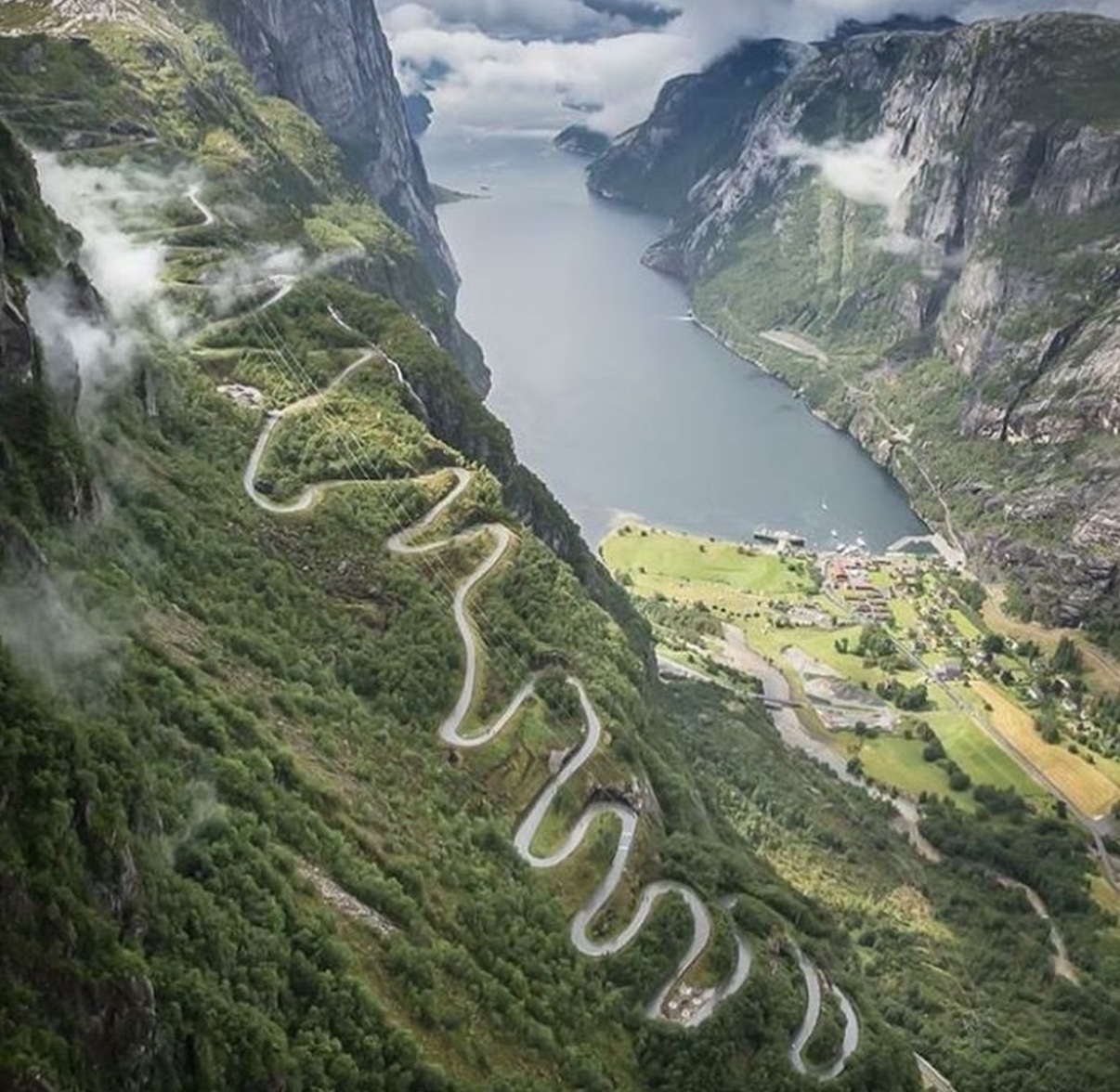
    The sinuous Lysebotn Opp rollerski course. (Photo: Blink 2020 screenshot)

    Times are what they are. Precautions are the name of the game. This year’s Blink Festival in Norway played to a reduced field and limited spectators due to COVID precautions. Some races, as will be noted, included modified race rules to limit close contact between athletes. 


    Lysebotn Opp – 06/08

    The Lysebotn Opp is perhaps the marquee event. It features lovely fjord views and a grueling 7.5-kilometer uphill skate switchbacking up a mountainside. In normal years, the Lysebotn Opp is a mass start event. This year, however, it was an individual start affair.  

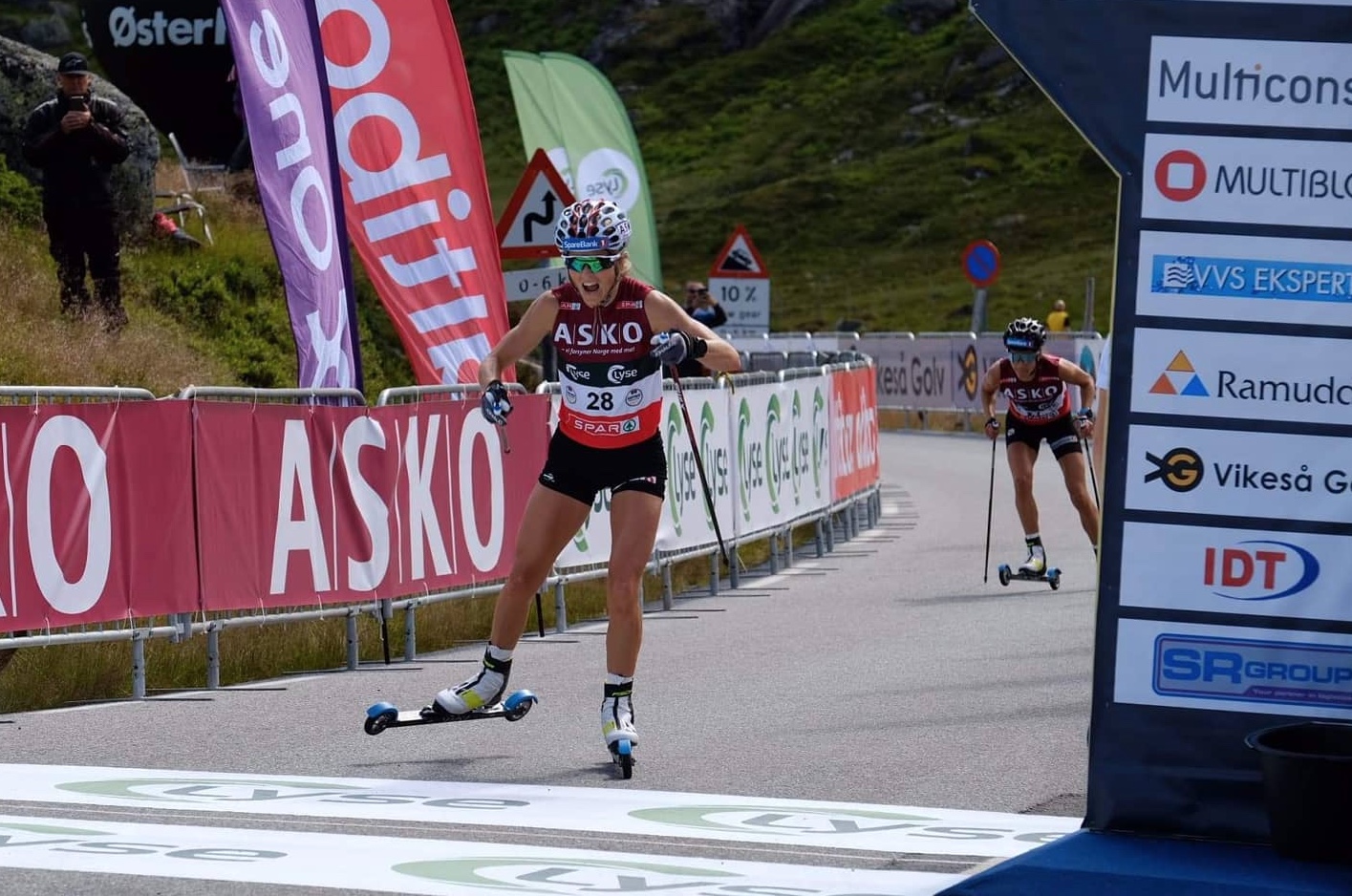
    Therese Johaug won the women’s event in 33:11 minutes. Heidi Weng placed second (+00:34), and Helene Marie Fossesholm was third (+02:20). All three skiers are from Norway with Johaug and Weng seasoned veterans with Fossesholm an upstart 19 year old relatively new to the elite level scene. Fossesholm won two individual golds at the 2020 Junior Worlds winning both the 5 k classic and the 15 k mass start skate. According to FIS, she has competed in three World Cups and notched a fifth place in last season’s 10 k mass start skate in Falun. 

    Full Women’s Lysebotn Opp Results


    For the men, Norway’s Simen Hegstad Krüger won in 29:25. Hans Christer Holund was third (+01:02), and Håvard Moseby third (+01:21). Moseby, the relative unknown on the podium is 21 and placed third in the 2020 U23 Worlds 30 k mass start skate. 

    Full men’s Lysebotn Opp Results


    Therese Johaug (bib 28) winning the 2020 Lysebotn Opp. (Photo: 2020 Blink Festival FB page)

    Skate Sprint – 07/08

    The second day of cross-country racing featured a skate sprint. For those used to larger fields and six-skier-deep heats, things looked a bit different. This was head-to-head racing, two racers per heat, as skiers advanced to the finals. Racers were required to remain in their respective lanes throughout the race which resulted in no drafting. 

    Norwegian sprinter Maiken Caspersen Falla won the day with Mathilde Skjærdalen Myhrvold placing second overall. Myhrvold lost the final by 1.4 seconds. Myhrvold is 22 years old and has raced two World Cups, both in Norway. 

    Kristine Stavås Skistad (21) placed third overall. She lost to Falla in the second semi in a photo-finish. 

    Women’s Sprint Results


    Johannes Høsflot Klæbo did as he does: win sprints. The star of the show placed first in the final, 1.5 seconds in front of second place GjøranTefre. At 25, Tefre raced nine World Cups last year with his best result an eighth place in Oberstdorf’s classic sprint. Klæbo has won the last four World Cup sprint titles. Erik Valnes placed third overall. He lost out to Tefre in the second semi by 0.1 seconds. 

    Men’s Sprint Results


    10 k / 15 k Classic – 08/08

    In the individual start 10 k classic, run on a 2.5 k closed loop, Tiril Udnes Weng won in 24:57.9 minutes. Fossesholm raced to second place, 3.9 seconds back, with Johaug in third (+12.1). 

    Women’s 10 k Classic Results


    Klæbo took the crown in the men’s 15 k classic over a field that featured some of Norway’s top distance talent. He won in 35:08.9, just 0.2 seconds ahead of Moseby, who was second overall in the Lysebotn Opp. Daniel Stock was third (+2.1). 

    Men’s 15 k Classic Results

    If you are looking for more, as in the view-from-the-comfort-of-home experience, Norwegian broadcaster NRK has archived the 2020 Blink Festival races. You can find a menu of races here.

  • Johaug Crushes Stage 6 for Ski Tour Overall Win; Diggins Leads U.S. in Sixth (Updated)

    Johaug Crushes Stage 6 for Ski Tour Overall Win; Diggins Leads U.S. in Sixth (Updated)

    Therese Johaug, untouchable during Stage 6 of the Ski Tour 2020. (Photo: NordicFocus)

    We’ll start with the weather: think all over the place. A moving target for meteorologist with moisture spitting from the skies, and air masses swirling this way and that making the trees sway like a mamba line along the course. A wax tech’s nightmare scenario? Yes. It certainly trended in that direction.  

    By all measures, this was Therese Johaug’s, Norway’s latest version of a cross-country skiing record-breaker, stage and tour. Of six stages total, she won five outright, with the lone exception, Saturday’s Stage 5 classic sprint in Trondheim.

    Stage 6 featured a 15 k classic pursuit. Call it a pursuit, however, on the race’s sharp end, this was a runaway. Although the field was, in theory, pursuing Johaug, she simply put more time into her challengers on Sunday. She began 2:33 ahead of Norwegians Heidi Weng in second, while Ingvild Flugstad Østberg set off another second back. 

    Johaug expanded her lead at the finish, by over a minute, to Weng and Østberg. Johaug won the pursuit in 41:13.8. Weng placed second (+3:40.8) with a slight gap over Østberg, who toed the line 0.7 seconds further back. Sweden’s Ebba Andersson, the day’s fourth starter at 4:48, lost time to0, finishing 5:54.3 back to end the Ski Tour in fourth overall. 

    “I felt really good today and the waxers had done a really good job the whole Ski Tour and today as well I have the perfect skis,” Johaug told FIS after the race. “When the skis are good and the shape is good I can just go out there and enjoy all the people that come here and cheering us.”

    As far as time of day, Johaug took that prize as well. However, Norway’s Astrid Uhrenholdt Jacobsen placed fifth overall and had the second-fastest race time, 44.8 seconds off Johaug’s winning mark. Krista Pärmäkoski of Finland notched the third-fastest time of day (+1:04.4). 

    Jessie Diggins of the U.S. was the top placed North American in sixth (+8:40.1). (She skied the 17th fastest time of day.) 

    “Today, like yesterday, was a crazy day in terms of weather and waxing. It kept snowing on and off, the sun coming out and then the wind picking up as more snow came down! I was pretty much skiing an individual start race as I was alone the entire time, but I was really proud of my pacing and efforts as I held my placing without anyone to work with. There was a really tricky time in the middle of the race when the skis weren’t kicking very well (for much of the field, I think) but I was able to refocus and reset and keep pushing as hard as I could.

    “As for the overall tour, I’m really happy with my efforts and how I hit my goals for every race. One of my big goals was to see each day as an entirely separate opportunity and to not put pressure on myself for the overall tour, since there are so many factors that I can’t control that play into that placing. But by hitting my own process goals for each race and staying consistent I was able to have a tour that I’m proud of.

    “I’m really proud of our tech team and coaches for their tireless efforts day in and day out through this tour. It’s been exhausting but they’re the hardest working guys out there!”

    Sadie Maubet Bjornsen ended her tour in 10th (+9:43.8). With the big time gaps, the second wave of skiers (the mass start) began with Pärmäkoski in bib 13, starting at 8:08 back. Maubet Bjornsen (bib 12), began 16 seconds ahead and was the initial target of the wave starters. Maubet Bjornsen held off a charging Pärmäkoski for over 5 k. 

    “Wow, I made it!! That was one heck of a tough tour! Things were looking mighty rough to begin with, but I knew I had to just keep fighting and believing!,” Maubet Bjornsen emailed. 

    “But among some challenging times, there were some glimmering hopes in there. Tours are my favorite types of racing, because you have to be so resilient and such a fighter. Day after day, you have to put your fatigue and emotions aside, and just stay so positive. 

    “The tummy troubles at the beginning of the tour were particularly tough! It was scary to start a tour so depleted, but I was thankful we had our nutritionist, Susie Parker Simmons around to help me stay on my feet! From there it was just a matter or fighting for every second from there on.

    “Today was a totally wild scene! Conditions were constantly changing, and it was hard to find the perfect skis! I knew the name of the game was to just keep fighting, because everyone would be struggling at some point out there. I managed to find something to work, and went through some highs and lows out there in the 15k which brought me to 10th overall in the tour! I’m super happy and satisfied with that, given the little fatigue hole I had to crawl out of this past month. Thank you to our team for helping make a tricky classic day at the finish of the tour possible to fight with the others. 

    “I’m looking forward to taking a rest now, and finding the energy to finish the end of the season strong, for the third tour of the season. 

    “Thanks to the Ski Tour 2020 for bringing some different types of racing. While it wasn’t always the best type of races for my strengths, it was so refreshing to visit some new locations with some different types of events! These are some of my favorite memories this season! 

    “And of course, hugest thanks to the staff. We couldn’t race day after day like this without them!!! They are the heroes.”

    Sadie Maubet Bjornsen (bib 12) racing to 10th overall in the Ski Tour 2020. (Photo: NordicFocus)

    Rosie Brennan, starting in bib 10, 7:27 behind the first starter Johaug, placed 12th (+9:53.3).

    “Today was a very challenging day,” Brennan wrote in an email. “Due to the massive time gaps in the overall, the wave started at bib 13 so I had a big pack starting not too far behind. The conditions were very challenging with snow, sun, rain and everything in between and some very icy tracks. I did my best to stay in front of the wave but just didn’t have the skis or the energy to make it happen today. I am very disappointed in myself. After having a great tour, it was hard to end on this note, but I am doing my best to look at all the positives from the tour as a whole and make a nice little work list to improve on the things that were so tough today.”

    Rosie Brennan (stars and stripes) during Stage 6 of the Ski Tour 2020. (Photo: NordicFocus)

    Also for the U.S., Julia Kern placed 30th (+14:51.4), Caitlin Patterson 36th (+16:38.4), Katharine Ogden 42nd (+20:26.6), Rosie Frankowski 43rd (+20:36.7), Sophie Caldwell 44th (+21:41.2), and Alayna Sonnesyn 48th (+24:34.6). 

    Canada’s Katherine Stewart-Jones placed in the points for the tour overall, by finishing 29th in the pursuit (+14:46.3). Cendrine Browne was 33rd (+15:47.5), and Emily Nishikawa 35th (+16:08.4). 

    Katherine Stewart-Jones during Stage 5 of the Ski Tour 2020. (Photo: NordicFocus)

    This stage concludes the Ski Tour. Racing continues in Lahti, Finland next Saturday. 

    Results | Overall Standings | Winner of the Day

    The women’s Stage 6 and overall Ski Tour 2020 podium: Heidi Weng (NOR) in second, Therese Johaug (NOR) first, and Ingvild Flugstad Østberg (NOR) third, (l-r). (Photo: NordicFocus)
  • Stage 5 Ski Tour 2020: Championship Style Classic Sprinting

    Stage 5 Ski Tour 2020: Championship Style Classic Sprinting

    A full-on championship course in Trondheim, Norway where the World Championships will go down in the mid-2020s. That’s a long way off. This much was true: the venue, like this tour, has been kind to Norway. Maiken Caspersen Falla and Johannes Høsflot Klæbo pleased the home fans. And yes, with all the fans, it seems this might be a venue to revisit in the near future.

    One more day, a Stage 6 15 k/ 30 k classic pursuit to go.


  • Falla Steps up For the Trondheim Win; Five U.S. Skiers in the Heats

    Falla Steps up For the Trondheim Win; Five U.S. Skiers in the Heats

    The day began in Trondheim with a centimeter of snow, which then transitioned to big blue skies for the thousands of fans attending the fifth stage of the Ski Tour 2020, a 1.5 k classic sprint. The Norwegians can throw a cross-country race party. The scene, despite the different setting, was reminiscent of the festive cowbell and camp-out sideshow of Holmenkollen’s Frognerseteren. It’s not quite the Yankee stadium of cross-country skiing, but a sign that in the hot-beds of the sport, fans arrive in droves. 

    The sprint course was more traditional, meaning this was no simple VO2 max test of an effort — that went down on Stage 3, in  Åre, Sweden as athletes ascended an uber steep alpine ski hill to close out that event. Trondheim’s classic sprint was bolstered by two punchy climbs on a three-terrace course, long and fast glide outs, and two speedy corners which swung skiers through a 180-degree direction change to keep it spicy.   

    Sweden’s Jonna Sundling laid down the fastest qualifying time in 3:22.75, shadowed by her teammate, Linn Svahn, 0.24 seconds back. Maybe, not surprisingly, Therese Johaug was the third-fastest qualifier, 0.83 seconds back. Johaug won her first career sprint on Stage 3 of the Ski Tour. 

    Jonna Sundling of Sweden in bib 1, during her quarterfinal of the Stage 5 classic sprint in Trondheim, Norway. (Photo: NordicFocus)

    The U.S. packed five skiers into the heats. Sadie Maubet Bjornsen qualified in 10th (+6.20). Rosie Brennan in 11th (+6.34), Sophie Caldwell 15th (+7.32), Jessie Diggins 20th (+8.58), and Julia Kern 24th (+9.54). Yet the story on the U.S. women’s side ended earlier than their highwater mark norm, which is most often, representation in the six skier final. In no uncertain terms, this is the golden age of U.S. women’s cross-country skiing. A stars and stripes void marked the semis and final. No U.S. skiers advance beyond the quarterfinals. 

    In the third quarterfinal, Kern and Brennan lost contact with Sundling and Tiril Udnes Weng who came in 1-2, respectively. Kern was fourth in the heat (+3.7), Brennan fifth (+7.71). 

    Maubet Bjornsen and Diggins fell off the pace as well in the fourth heat, placing fourth and fifth respectively. Both were over four seconds off Norway’s Anna Svendsen’s pace of 3:19.34 who won that quarterfinal. 

    22.02.2020, Trondheim, Norway (NOR):<br /> Sadie Maubet Bjornsen (USA) - FIS world cup cross-country, individual sprint, Trondheim (NOR). www.nordicfocus.com. © Thibaut/NordicFocus. Every downloaded picture is fee-liable.
    Sadie Maubet Bjornsen during the Stage 5 classic sprint in Trondheim, Norway. (Photo: NordicFocus)
    “It was an extremely tricky weather day with a combo of rain/snow/sun, and everything in between,” Maubet Bjornsen emailed.
    “I was excited to put together a solid qualifier, but felt like a few adjustments would allow things to be even better for the heats. My body felt sharp and powerful, so I knew the key for me was to be quick out of the start, and do my favorite thing… ski from the front. I was quick out of the start, but struggled to hold the speed up the first climb. Since climbing is generally my strength, it’s unclear whether it was skis, body, or both that held me back. But, that’s how ski racing is. You can’t overthink anything too much, you just keep believing, and chasing away!
    “It is the tour of crazies for me, so I’m going to let it go, and look on to “the chase” tomorrow. With the tour ending with a 15k classic, I am sitting just outside top 10 overall, and really hoping to climb my way within that tomorrow. Let’s see if I can channel all amounts of frustration towards some constructive racing in the final day!”

    The last U.S. athlete eliminated was Caldwell. She placed third in the fifth quarterfinal, 1.53 seconds back on Norway’s Heidi Weng in first. Caldwell placed 14th in the final standings, Maubet Bjornsen 16th, Kern 20th, Brennan 21st, and Diggins 23rd. 

    Sophie Caldwell (bib 15) during her quarterfinal in Trondheim: Stage 5 of the Is Tour 2020. (Photo: NordicFocus)

    Post-race interview with U.S. World Cup Coach Matt Whitcomb

    Wintry weather moved in during the men’s quarterfinals. The blue-bird scene morphed quickly into an intermittent snowglobe. With the swift winds swirling around the stadium, the snow squalls eventually moved on as the semifinals progressed. 

    The 12 skier field in the two women’s semis consisted of six Norwegians, four Swedes, and two Swiss skiers in Laurien van der Graff in the first semi, and Nadine Fähndrich in semi two.  Fähndrich kept Swiss hopes alive by advancing to the finals after winning her semi. 

    The first semifinal featured Norway’s Maiken Caspersen Falla and Sweden’s Sundling. These two athletes were the skiers to watch. For Falla, by her own high standards, this has been an offseason, as the young Swedish sprint team has pushed her aside for precious top-of-the-podium real estate. Falla won the opening World Cup sprint in Ruka, Finland, otherwise, it’s been a first-place void for the former Crystal Globe sprint winner.

    In bib 12, Maiken Caspersen Falla strides it during her quarterfinal in Trondheim. (Photo: NordicFocus)

    In Falla’s semi, she and Sudling took first and second, respectively, with Astrid Uhrenholdt Jacobsen and Linn Svahn of Sweden in close contact, only a few tenths of a second back. In the final, Falla was locked in. Although at moments Sundling was side by side with Falla, the Norwegian dictated the decisive move off the front. Over the second climb, at roughly 2:25 into the race, Falla powered over the hill and into the glide out transition with only Sundling able to match two meters back. 

    Falla took the win in 3:15.55 with Sundling in second (+0.48). Fähndrich was third (+2.88), Anna Dyvik of Sweden fourth (+3.71), Svendsen fifth (+5.26), and Heidi Weng sixth (+6.64). 

    “This feels always like the [World Championships] so crowded and so many people screaming my name at the start and after the finish,” Falla told FIS after the race. “It’s an amazing atmosphere and I’m so happy to be here. There has been some hard distance races for me now. The 30 k and also 10 k was really hard so I’m really happy that I stayed in the tour, didn’t go home and got this opportunity to win here and race in this amazing atmosphere.”

    This was Falla’s 21st individual sprint win. She sits second overall in total World Cup sprint wins. Marit Bjørgen of Norway still reigns with 40 World Cup sprint victories. For Fähndrich, this was her second career individual podium. Prior to her third place on Saturday, the Swiss skier posted up a second place in Cogne, Italy’s 2019 10 k classic for her first World Cup podium.

    Hands up: Nadine Fähndrich earns a third place for the Swiss in Trondheim. (Photo: NordicFocus)

    Katharine Ogden in 37th was the top-U.S. skier outside the top-30. Alayna Sonnesyn placed 42nd, Caitlin Patterson 48th, and Rosie Frankowski 51st.

    For Canada, Emily Nishikawa finished in 34th, Katherine Stewart-Jones 35th (+14.19), Cendrine Browne 40th, 

    The Ski Tour overall looks certain for Johaug who placed ninth in Saturday’s sprint. She leads with a total time of 2:19:28. Weng remains in second (+2:33), and Ingvild Flugstad Østberg third (+2:34). Østberg finished 22nd in Stage 5.  This Norwegian trio is the likely overall podium, as Sweden’s Ebba Andersson is fourth at 4:48 back. Racing concludes for the Ski Tour on Sunday with Stage 6, a 15 k classic pursuit for the women.  

    Norway’s Therese Johaug (yellow bib) the Ski Tour’s overall leader was the third overall qualifier. (Photo: NordicFocus)

    Qualification | Results | Overall Ski Tour Standings 

    The women’s Stage 5 podium: Jonna Sundling (SWE) in second, Maiken Caspersen Falla (NOR) first, and Nadine Faehndrich (SUI) third, (l-r). (Photo: NordicFocus)
  • Overall Leader Bib Changes Hands; Diggins and Bjornsen Narrow Gap to Overall Lead

    The women’s podium of Stage 2 of the 2019/2020 Tour de Ski. Anamarija Lampic of Slovenia (center) took first ahead of Norway’s Maiken Caspersen Falla (left) and Russia’s Natalia Nepryaeva (right). (Photo: NordicFocus)

    Day two of the Tour de Ski offered the American women the Sisyphean task of earning back time after a miss on ski and wax selection in Stage 1 prevented them from performing to their capability. This was particularly so for Jessie Diggins, a favorite for the overall tour podium who finished the first stage in 29th 1:20 behind Norway’s pace-setting Theresa Johaug. Her teammate Sadie Maubet Bjornsen, also a top all-arounder, was in the same position. Maubet Bjornsen ended Stage 1 in 30th.

    The initial run of the TdS in Lenzerheide, Switzerland is about not digging yourself into a time-deficit hole. A podium is nice, a win even better. But the primary objective is to not lose too much time to the leaders. At the start of Stage 2, Diggins and Bjornsen were in that hole. 

    Backs against the wall and a significant boulder to push ahead of them, the two would need to make it into the final of the 1.5-kilometer freestyle sprint to make significant headway on the tour leaders. A podium finish would be ideal. Since time differentials in sprint racing are small, it would be imperative to earn bonus seconds based on their final standings: 60 seconds for a win sliding down to 42 seconds for sixth. 

    As Johaug, the overall leader heading into the second stage, was not a podium threat in the sprint event, it was almost-certain that she would lose time on her chasers, increasing the opportunity for the Americans and other overall podium hopefuls. 

    Knowing the task at hand, Diggins bravely faced the new day with resolve. 

    “Now I get to focus on doing what I love best: fighting my way back,” she wrote on Instagram. 

    Julia Kern powers to a seventh place result in qualification during Stage 2 of the 2019/2020 Tour de Ski. (Photo: NordicFocus)

    Surely enough, four Americans landed in the top ten in qualification: Sophie Caldwell in 1st, Diggins 3rd, Maubet Bjornsen 4th, and Julia Kern 5th. Rosie Brennan also qualified for the heats in 28th. The final member of the American squad, Katharine Ogden, finished 60th in qualification. 

    And on to the quarters five Americans went. With the momentum and energy of the team, the boulder budged. 

    Racing in the lightning-fast first heat of the rounds, Diggins fought at the front with leaders Maiken Caspersen Falla (NOR), Anamarija Lampic (SLO), and Anne Kjersti Kalvå (NOR). Last year, Falla was the ranked second overall in the World Cup sprint standings and Lampic was ranked 6th. 

    Diggins was unafraid to push the pace and spend time at the front. She showed her balance on her feet as she took on the fast descents and icy corners of the course, holding her position. In the final straightaway, Falla and Lampic took off from the front, leaving Kalvå and Diggins fighting for lucky loser positions. With the fate of a fast heat and their stick-to-the front pacing —  their times would have won any other round — Kalvå and Diggins easily advanced to the next round. 

    Charging to the finish in the second heat of the quarter-final in Stage 2 of the 2019/2020 Tour de Ski. Jonna Sundling of Sweden holds the lead on the far left with Rosie Brennan tucked into the back left. (Photo: NordicFocus)

    The Americans continued to shine in the rounds. In the second heat, Brennan mixed it up with the leaders but lost contact with the pack, finishing fifth in her heat. In the slowest third heat, Caldwell patiently followed the pedestrian pace, then showed her top gears in the final sprint to win the round. Maubet Bjornsen took second in the fourth heat to advance, and Julia Kern took third in a three-way photo finish for the top spot in the final heat. 

    Three Americans advance to the semis. 

    Adrenaline surges through the crowd in spectacular Lenzerheide, Switzerland during Stage 2 of the Tour de Ski. (Photo: NordicFocus)

    Again, the first round of the semis was stacked with Falla, Lampic, Diggins, and Caldwell battling with Natalia Nepryaeva of Russia and Jonna Sundling of Sweden. Showing her grit, Diggins won the heat for an automatic spot in the finals, while Caldwell finished fifth. The spread of finishers in the heat was less than one second. Maubet Bjornsen finished second in heat 2, also advancing to the final. 

    Two Americans in the final. The pieces were coming together. 

    Diggins kept herself in contention for a podium spot throughout the final, matching each of her opponents moves, never losing contact and often controlling the pace from the lead. Maubet Bjornsen held strong in the middle of the pack.

    Leaving nothing on the course, Diggins jump skated each of the rollers, powering in a no pole skate into a tuck on the descent. She raced with grit over every meter.

    Rounding the final curve into the straightaway, she sat in fourth behind Lampic, Falla, and Nepryaeva who had begun to accelerate off the front. Matching their tempo but unable to close the gap, Diggins crossed the line in fourth, doubling over as she gasped for air.

    Racing with the fire for which she is known, Jessie Diggins gasps for air after taking 4th in Stage 2 of the 2019/2020 Tour de Ski. (Photo: NordicFocus)

    In a close finish with Falla, Lampic took the win in 3:06.2 with the Norwegian 0.03 seconds behind her. Nepryaeva finished third (+0.47), with a half second gap to Diggins. After falling off the lead pack, Maubet Bjornsen finished 5th (+4.78), and Tiril Udnes Weng sixth (+5.29).

    By centimeters, Anamarija Lampic takes the win in Stage 2 of the 2019/2020 Tour de Ski ahead of Maiken Caspersen Falla (left) and Natalia Nepyaeva (right). (Photo: NordicFocus)

    Because they were quickly on the road to the next venue, the American women were unavailable for phone calls and instead chose to send comments on their performance via email.

    “Today was a great day,” wrote Diggins. “I was so proud of the entire team for staying positive, rebounding from yesterday and for keeping it super professional; nobody was mad, everyone just learned the lessons from the skis that day and then moved onwards. For me, it was important to just focus on what I can control and have confidence in my fitness that I knew was there.”

    In response to a query on handling the pressure of offsetting her deficit in the overall standings, Diggins offered a process-oriented response.

    “It was definitely crucial to my tour to make the finals, but instead of focusing on the outcome I focused on skiing every step of the way as well as I could!”
    Jessie Diggins smiles as she walks away from a 4th place finish in Stage 2 of the 2019/2020 Tour de Ski. (Photo: NordicFocus)
    “Now I’m looking forward to Toblach — a venue with many many positive memories for me!” she concluded.

    Maubet Bjornsen also remarked on the positive energy taking vengeance on the first stage provided. She explained that with “impossibly slow skis”, it felt like a success to lose only 1:20 to the leaders. Maubet Bjornsen added that it was not just the athletes looking for a do-over in Stage 2.

    “The tech team worked extra hard to find a solution and our entire team came back strong today! Although it was an imperfect start, positivity and constantly fighting are the two keys to this incredibly exciting event. I sometimes think the winners of the TDS are not the most physically fit people, but the most mentally tough.”

    Like Diggins, she too is eager for a second go in the next round of racing in Stage 3 and hopes to continue whittling down her gap to the overall tour leaders.

    “I look forward to the next stop in Toblach for another attempt at a 10 k skate, hopefully with an equal revenge as today. I have some precious seconds to try to win back still. One day at a time.”

    She finished by saying that they are driving away from Lenzerheide “with some tired legs, but rejuvenated souls!”

    Seeking revenge, Sadie Maubet Bjornsen flies to a fourth place finish in qualification during Stage 2 of the 2019/2020 Tour de Ski. (Photo: NordicFocus)

    Overall Tour Standings

    Noteworthy for the overall standings, tour leader after Stage 1 Therese Johaug qualified in 21st and raced in the speedy first heat with the eventual winner. She finished in fifth, just behind Diggins. Had she raced in any other round, the distance phenom, who is not known for her sprinting, would have advanced as well. Her result put her in 23rd for the day, earning six bonus seconds.

    Though she slid back to third in the overall rankings, this result maintained her threat for the overall tour victory. Johaug is only five seconds out of first place heading into three distance stages where she will have the opportunity to create a gap over the field before the Stage 6 sprint. In the fifth stage, a mass start classic in Val di Fiemme, Italy, she will also have the opportunity to earn bonus seconds at various checkpoints, giving her further insurance on the following sprint day. 

    After a third place finish in Stage 2, Natalia Nepryaeva takes over the overall leader bib in the 2019/2020 Tour de Ski. (Photo: NordicFocus)

    Now wearing the leader’s bib, Nepryeava’s sprint podium moved her into the lead with a cumulative time of 31:18. She finished sixth in the first stage. Demonstrating her potential in the competition, Nepryaeva dueled with Norway’s Ingvild Flugstad Østberg throughout the 2018/2019 tour to finish second overall. The Russian won the first distance stage and took second in the final four stages.

    Lampic, who finished 50 seconds behind Johaug for 20th on Saturday’s distance race, moved into third overall, one second behind Nepyraeva. Last year, she finished 22nd in the tour. 

    Slovenia’s Anamarija Lampic smiles in delight after winning the second stage of the 2019/2020 Tour de Ski. (Photo: NordicFocus)

    Posting consistent results in the first two stages, Tiril Udnes Weng’s 7th in Stage 1 and 6th in the sprint put her in fifth overall, followed by her cousin Heidi Weng who was second in the first stage but 32nd in qualification leaving her out of the rounds. 

    Cutting their time back in half, Diggins sits in 11th place, 39 seconds behind Nepryaeva, followed by Maubet Bjornsen in 12th (+41). The overall podium continues to be up for grabs. 

    Racing continues Tuesday December 31st in Toblach, Italy with 10 k freestyle, followed by a 10 k pursuit start classic on Wednesday. 

    Final Results | Qualification | Overall Tour Standings After Stage 2

  • With Winter Arriving in Planica, Sweden Asserts their Dominance with Team Sprint Win

    With Winter Arriving in Planica, Sweden Asserts their Dominance with Team Sprint Win

    At 20 years old, Sweden’s Linn Svahn has learned to close. She was part of Sweden II’s team-sprint winning team in Planica, Slovenia. (Photo: NordicFocus)

    With the tight racing and jostling for position the team sprint presents, another factor was in the mix during Sunday’s Planica, Slovenia women’s 7.2-kilometer freestyle team sprint: big, fat, and plentiful snowflakes. 

    Saturdays’ rainy, and lightning ridden sprint racing on an artificial snow loop, had a 180-degree backdrop flip-flop with a white winter arriving in Planica in time for the holidays and a World Cup TV broadcast. A several inch veneer of fresh snow covered the tracks.  

    Coming into Sunday’s race, recent team sprints have been dominated by Sweden. They have won four consecutive team sprints, and six of the last seven. And as much as last season’s World Cup Sprint Crystal Globe winner Stina Nilsson is a rock for the nation, Sweden’s team sprint reign owes much to Maja Dahlqvist. She’s been part of a Swedish three-peat: Dresden (skate) 2018 with Ida Ingemarsdotter, Lahti (classic) 2019, and again in Dresden (skate) 2019. 

    Sunday, to close out Period I on the World Cup, Dahlqvist was paired with Sweden’s newest World Cup upstart, Linn Svahn, 20, on team Sweden II. On paper at least, the coaches gave the nod for team I designation to Nilsson and Jonna Sundling. 

    With ten teams represented in the final, the U.S. pairing of Sophie Caldwell and Julia Kern looked formidable. Fresh off Kern’s first career World Cup podium on Saturday and Caldwell’s near podium miss in fourth, they placed second in the team sprint semi-final B to Switzerland’s Laurien van der Graaf and Nadine Faehndrich. The Swiss won that heat by 1:05 over the U.S. (Caldwell and Kern were also teamed up last season in Dresden’s team sprint where they placed fourth in a photo finish.)

    Also represented in the final and a usual podium snagger was Norway I with Maiken Caspersen Falla, and Ane Appelkvist Stenseth. Despite their perceived dominance, Norway has not won a team sprint in the last seven attempts. The last women’s team sprint victory for the storied nation came way back in January 2014, when Maiken Caspersen Falla and Ingvild Flugstad Østberg won the classic team sprint in Nové Mesto. Although Falla is proven, Stenseth, 24, is a World Cup podium-contender newcomer. According to FIS, she has contested 10 World Cups. She’s placed fourth twice in individual races — most recently in Ruka’s classic sprint last month. 

    World Cup Coach Matt Whitcomb’s post-race comments on the U.S. women’s team sprint 

    With the wins and losses stats laid out, the final was a race around, tag the partner, race around, repeat affair for several laps. With near blinding snow and slow tracks, teams skied conservatively with no attacks of note. 

    The single blip to the pack racing early on was the collapse of an inflatable arch across the course due to a heavy snow load. Several course attendants scurried to right the arch. There was no stop to the racing, only a momentary snafu to an otherwise peaceful snowglobe scene.

    Heavy snow, collapsing arch. Planica women’s team sprint. (Photo: NordicFocus)

    That all changed on the fifth of six laps total. At the base of the course’s first climb, Nilsson for Sweden I had been tucked into the pack. She worked her way to the right gliding out of traffic for a clear lane to the top. She jump skated to the lead 15:00 minutes into the final. Carrying her speed into a working downhill, Nilsson broke the race apart. 

    Sweden II (Dahlquvist), and Norway I (Falla), were the other two teams able to match Nilsson’s push at the sharp end. 

    Sweden I, Sweden II, Norway I, Norway II, Switzerland, and the U.S. came through the final tag first through sixth, respectively, with a 7.8 second gap from the U.S. in back to Sweden I in first. 

    Late on that final lap, with 18 minutes of racing elapsed, Sweden I and II, as well as Norway I looked to be the podium in the making. But with perhaps the race effort of the day, Switzerland’s Faehndrich began reeling in the three team group. Twenty seconds later, the Swiss were locked on, making it a four team affair. 

    Julia Kern (USA), Linn Svahn (SWE), Victoria Carl (GER), Ane Appelkvist Stenseth (NOR), (l-r) during the women’s team sprint in Planica, Slovenia. (Photo: NordicFocus)

    On the final climb, Sweden I and II accelerated, dropping Norway I, with the Swiss matching for a moment, then dropping back slightly for a solid third place nearly guaranteed. 

    The Swedish drag race for first went to Sweden II’s Svahn: they won in 19:13:55 minutes. Sweden I was second (+1.01), and Switzerland third (+1.13). Digging into the recesses of FIS data, Sunday’s third place was Switzerland’s best World Cup team sprint result. They placed fifth in last season’s Dresden team sprint. Norway I placed fourth (+7.58), and the U.S. fifth (+9.72). 

    The joys of the podium: Swiss teammates Nadine Faehndrich and Laurien Van Der Graaf (l-r) after their third place in the team sprint in Planica, Slovenia. (Photo: NordicFocus)

    “I am happy that after a couple of fourth and fifth places it finally worked out,” van der Graaf stated, according to a translation from the Swiss Ski Federation. “When I tagged off to Nadine in fifth place I was very confident that she would make it.”

    Fähndrich said: “For me it was optimal that the top 3 didn’t go all out early on. Thus I could catch up and still had enough energy in the end.”

    Norway’s Maiken Caspersen Falla (center) during the 2019 Planica team sprint. (Photo: NordicFocus)

    On the ski-wax service side of the race, U.S. World Cup Coach Matt Whitcomb explained in a post-race interview that today’s team sprint included a rule that no team could modify skis during the races. In team sprint additions past, it was common to see trackside techs applying and buffing a topcoat between relay legs. According to Whitcomb, Caldwell’s skis for the final were simply not in play. “So we made a mistake early in the finals,” said Whitcomb. “We had to eat it. And we did.”

    Visor type of day for Sophie Caldwell during the women’s team sprint in Planica, Slovenia. (Photo: NordicFocus)

    World Cup Coach Matt Whitcomb’s take on the weather and Caldwell’s skis

    FasterSkier will have a Period I breakdown and Tour de Ski preview later this week. The Tour de Ski begins on December 28.

    Results Team Sprint Finals

    The women’s team sprint podium from Planica: Sweden I’s Stina Nilsson Jonna Sundling in second, Sweden II’s Maja Dahlqvist and Linn Svahn in first, Switzerland’s Laurien Van Der Graaf and Nadine Faehndrich (in third (l-r). (Photo: NordicFocus)  
  • Julia Kern Lands Her First World Cup Podium Behind Sweden’s Sundling and Nilsson; Caldwell 4th

    Julia Kern Lands Her First World Cup Podium Behind Sweden’s Sundling and Nilsson; Caldwell 4th

    A rainy women’s podium after the 1.2-kilometer skate sprint in Planica, Slovenia. Sweden’s Jonna Sundling took the win followed by her teammate Stina Nilsson. Julia Kern (USA) took third. (Photo: NordicFocus)

    Temperatures over 40 degrees Fahrenheit, steady rain that peppered camera lenses, sparse broods of fans huddled under umbrellas, and a ribbon of white farmed snow. After a wintery start to the season in snowy Ruka, Lillehammer, and Davos, athlete’s found their spring-like gear racing the 1.2-kilometer freestyle sprint in Planica, Slovenia. With many “all-arounders” choosing to sit out the sprint focused weekend to rest for the upcoming Tour de Ski, the intimate subset of athletes contained many of the World Cup’s top short track athletes. 

    The profile of the 1.2-kilometer sprint course in Planica, Slovenia. (Photo: Screeshot FIS)

    Last week’s podium finisher Sophie Caldwell was the fifth fastest qualifier, 0.56 seconds behind top finisher Laurien van der Graaff of Switzerland. Caldwell faced off with Jonna Sundling of Sweden in the first heat of the quarter-finals, leading their peers through a smooth heat and crossing the line 0.03 seconds apart with Sweden in front. 

    Continuing to make a statement that she belongs with the sharp end of the field, Julia Kern qualified in 20th and raced in the fifth heat of the quarter-finals where six unique countries were represented. 

    After a conservative start, Kern was tucked at the back of the pack at the halfway mark of her quarterfinal, out of trouble when Czech athlete Theresa Beranova lost control on a fast corner and slid off the track. With a high-tempo fury, she surged around the left side at the start of the climb at the 500 meter mark to take control for the second half of the race with Maja Dahlqvist of Sweden. 

    Attacking on the climb with 200 meters to go, Kern surged again. Her tempo was matched by the Swede’s until Dahlqvist suddenly caught an edge and fell to the ground. Peerless, Kern flew to the finish line, her braid whipping back and forth with each powerful V2 push. 

    In the semi’s, Caldwell faced a pack of three Swedes, Sundling, last week’s surprise champion Linn Svahn, and 2019 sprint crystal globe winner Stina Nilsson. Also in the first heat was Norway’s top sprinter Maiken Caspersen Falla and Ane Appelkvist Stenseth. Rounding a fast turn, Falla stepped on the tip of Stenseth’s ski and the two tangled to the ground, now out of contention. Caldwell skied to third in the heat, crossing the line in a close finish with Sundling and Svahn. Her time was fast enough to secure a lucky loser spot in the final. 

    In her semifinal, Kern tucked into the middle of the pack, matching Anamarija Lampic of Slovenia and Johanna Hagstrӧm of Sweden. Repeating the power move that worked in the quarter, Kern seized her opportunity to surge to the front on the climb, maintaining her position over the crest of the hill and down the straight away to the finish solidifying her first spot in a World Cup final. Lampic finished second in the heat (+0.57). 

    Three Swedes, two Americans, and one Slovenian in the final. 

    Julia Kern locks eyes on the finish as wins her semi-final heat of the 1.2-kilometer freestyle sprint in Planica, Slovenia. (Photo: NordicFocus)

    Racing in front of her home crowd, Lampic took an early lead in the final, tailed closely by her competitors. Just before halfway, Nilsson and Sundling took control on the climb with the Americans following closely. 

    Anamarija Lampic (SLO) celebrates finishing 5th place in front of a home crowd in Planica. (Photo: NordicFocus)

    Coming into the straightaway, Svahn and Nilsson caught ski tips. Svahn lost her balance falling backward just in front of Caldwell, who managed to smoothly dodge the crash, accelerating to the finish. 

    In a dual with between teammates, Sundling slid her boot across the line for the win, stopping the clock at 2:32.6, Nilsson 0.22 seconds behind. 

    In a finish line interview, FIS called Sundling’s performance an “adventurous victory” given the weather.

    “It was crazy,” agreed Sundling. “It was thunder and rain and now snow.”

    Powering in their wake, Caldwell and Kern locked eyes on the finish. In the final meters, Kern outmatched Caldwell’s speed, throwing her boot over the line just ahead of her veteran teammate. She finished 0.79 behind Sundling, and Caldwell took 4th (+0.91). Lampic finished 5th (+1.49), followed by Svahn (+48.51) who skied slowly to the line looking furious.

    Sophie Caldwell (black headband) congratulates Julia Kern on her first World Cup podium (3rd). (Photo: NordicFocus)

    Julia Kern. 22-years-old. First World Cup final, first podium. 

    The Americans embraced, their backs rising and falling rapidly as they simultaneously laughed and caught their breath. 

    Kern carried momentum from last weekend’s strong performances in Davos; Kern was 15th in the freestyle sprint and 19th in the 10 k. In her post-race interview, she discusses her mindset as she entered uncharted territory in the final and why she was excited for the suboptimal rainy conditions in Planica. She also shares what’s next for her this season.

    Post-race interview with Julia Kern.

    An ecstatic Julia Kern celebrates her first podium performance with her coaches after the 1.2-kilometer freestyle sprint in Planica, Slovenia. (Photo: NordicFocus)

    Matt Whitcomb provided further insight into Kern’s attitude heading into the race, the tactics the team discussed, and her performance in the heats.

    Post-race interview with Matt Whitcomb on Julia Kern’s first podium


    Sophie Caldwell gathers herself after racing the 1.2-kilometer skate sprint in Planica, Slovenia. (Photo: NordicFocus)

    Post-race interview with Sophie Caldwell

    Though her vision of herself has changed over the years, Caldwell identifies short fast courses like Planica as a place she can excel. She shares insight into the course and her tactics, as well as her plans for Christmas and the following weeks.

    Sophie Caldwell dodges a crash with less than 200 meters to go in the 1.2-kilometer skate sprint in Planica, Slovenia. (Photo: NordicFocus)

    Post-race, Whitcomb analyzed Caldwell’s journey through the heats and her feelings on finishing just off the podium.

    Post-race interview with Matt Whitcomb on Sophie Caldwell’s performance.

    Canada’s only entrant Dahria Beatty qualified in 29th. She took third in the first heat of the quarter-finals, just over half a second behind Caldwell and Sundling. As her time was not fast enough to earn a lucky loser spot, she did not move onto the semi’s and ended the day in 16th. 

    Qualification | Final Results


  • Caldwell Adds Third Place to Her Davos Resume

    Caldwell Adds Third Place to Her Davos Resume

    Picture perfect. Sophie Caldwell on her way to qualifying first in the 2019 Davos, Switzerland skate sprint. She was third overall for the day. (Photo: NordicFocus)

    (An earlier version of the story mistakenly stated Caldwell had placed second. FIS live timing had Caldwell in second place. Apologies for the error.)

    When Davos is good, it is good on a global scale. With the Swiss valley blanketed in snow, and a gauze of high clouds keeping the race proceedings just a notch away from perfectly sun-shiny, the World Cup’s 1.5-kilometer freestyle sprint was won by twenty-year-old Swede Linn Svahn. According to the International Ski Federation, this was Svahn’s second career World Cup start. She placed 21st in last season’s skate sprint in Falun. At World Juniors, she was fourth in the 2019 classic sprint in Lahti, Finland. Add Svahn to the growing stable of Swedish A-list skiers on the early side of their twenties. 

    Linn Svahn of Sweden in for her first career World Cup win. Arm raised crossing the line first in Davos, Switzerland. Sophie Caldwell (bib 1) placed third. (Photo: NordicFocus)

    As the remaining meters became scarce in the women’s final, Svahn and her lickety-split skis took a ten-meter gap up and over the last climb. Barely separated  from the chasers into the final straight, she took a clean win in 2:38.54.

    Even Svahn seemed surprised by the result. In near-perfect English, as the camera zeroed in for a podium shot, she blurted the not uncommon expression of “What the &uc!” to describe her astonishment. Her hot-mic moment was spot on.  

    For North America, it was a very good day. The results were clear: every North American entered qualified for the heats. For the U.S. Ski Team (USST), Sophie Caldwell qualified first at 2:45.15. Her speed was indicative as she had a 1.47 second gap on the second-fastest qualifier, Stina Nilsson of Sweden. 

    Sadie Maubet Bjornsen (USST) qualified in 5th (+2.76), Jessie Diggins (USST) 6th (+2.91), Julia Kern (USST)  23rd (+8.37), and Hailey Swirbul (USST) 28th (+9.92). 

    Post-race interview with World Cup Coach Matt Whitcomb

    With her first World Cup start of the season, Canada’s Dahria Beatty qualified in 30th (+10.48). One-fifth of the sprint qualifiers hailed from the left side of the Atlantic. 

    As Caldwell progressed through the sprint bracket, she tapped into her big and smooth technique. She won her quarterfinal and the first semi-final. In that semi, stacked with Stina Nilsson and Maiken Caspersen Falla of Norway, Caldwell played coy. She let others take flight off the front during the first of this two-lap course. Moa Lundgren of Sweden took the pacesetting chore as she made a separation on the first lap, but she was eventually pulled in. 

    On the second time up the course’s punchy hill, Caldwell moved up the left side and took it wide on the final right hand corner. Into the finish, she shot to the front for the semi-final win. 

    It was a good sign for Caldwell. 

    Sophie Caldwell’s post-race interview 

    In the final, Falla took the helm and led five skiers in a line up the first hill. Caldwell sat in third.  Not until roughly 2:10 minutes into the final did any real move occur, and that was Svahn’s. Caldwell and Falla eventually came drag racing down the line for a photo finish. Both were unofficially 0.55 seconds behind Svahn. But Falla out-toed Caldwell to take second. 

    Since 2013, Caldwell has sprinted here seven times. Five times she’s placed in the top-10. Her third place today piggy backs on a second place result in Davos last season.

    Kern was 15th overall on the day, Maubet Bjornsen finished her day in 16th, and Diggins in 17th. 

    Kern has rebounded from elbow surgery this summer and some minor bumps in her training. Davos proved to be a course and scene where she was able to click. According to Kern, today’s result was a “big step forward, which was exciting.”

    Julia Kern (bib 23) skiing to 15th overall in the 2019 Davos, Switzerland skate sprint. (Photo: NordicFocus)

    Julia Kern’s post-race interview 

    Swirbul placed 30th for her first career World Cup points. In her post-race interview, Swirbul noted that she is trying to embrace “skiing like me.” In other words, she is finding her own “best” technique that she describes as skiing “like a noodle”. Finding out she had a sprint start only a few day’s ago, Swirbul made the best of the opportunity.   

    Hailey Swirbul’s post-race interview 

    Canada’s Beatty placed 25th overall. Last weekend she posted solid results on the OPA Cup where she was third in a skate sprint.

    “I was happy with my day today,” Beatty emailed. “It’s always encouraging to make the heats in my first World Cup of the season. It is a good starting point and I look forward to trying to improve on today’s performance as the season progresses. I had some strong racing last week at the OPA in Slovenia and my race shape is feeling good right now so I am really looking forward to tomorrow’s 10km skate here in Davos.”

    Racing continues tomorrow with a 10 k interval start skate for the women.

    The 2019 Davos, Switzerland 1.5 k skate sprint podium:
    Maiken Caspersen Falla (NOR) in second, Linn Svahn (SWE) in first, and Sophie Caldwell (USA) in third, (l-r). (Photo: NordicFocus)

    Qualification results | Results

  • Twelfth Consecutive Relay Win for Norway; USA Comes Back for Second

    Team USA celebrates their hard fought second place finish at the 2019 4 x 5-kilometer relay in Lillehammer, Norway. (Photo: NordicFocus)

    Athletes warmed up amidst fat falling snowflakes as a storm blanketed Lillehammer, Norway. The gun fired, and a flurry of this snow clouded the boots, poles, and relay socks as a wave of skiers strode their way up and out of the Birkebeiner Stadium for the first leg of the women’s 4 x 5-kilometer relay. 

    With outstanding performances in the first two World Cup race weekends, it is clear that the U.S. women are hot. They made their fitness and strength evident in back to back performances; three in the top 20 on day one in Ruka, three in the top 15 on day two, and three in the top ten in the final stage. Again in yesterday’s skiathlon, 2nd, 8th, 16th, Jessie Diggins, Sadie Maubet Bjornsen, and Rosie Brennan showed that they were ready to throw down in the relay and compete for a top-spot. With an 11th place finish in the classic sprint in Ruka and experience in the relay, Sophie Caldwell was selected for the fourth spot.   

    Despite this depth, the U.S. has struggled to land on the podium in the relay. Last year during the World Championships in Seefeld, a similar team (Julia Kern raced in Caldwell’s position) battled to rebound from eleventh a challenging first leg. Maubet Bjornsen and Brennan clawed up the ranks to hand off to Diggins in sixth, who could only pick off one additional team while struggling in the heat. The foursome finished fifth.

    During the PyeongChang Olympics the year prior, Caldwell, Maubet Bjornsen, Kikkan Randall, and Diggins also raced to a gutsy fifth place finish, the best Olympic relay result for the United States. Here also the Americans struggled during the scramble leg. Caldwell started strong, knowing that on a good day she belonged with the leaders, but fell off the pace in the second half of her leg, tagging off over a minute behind in eleventh. Could the U.S. put together four strong legs in Lillehammer?

    Norway’s Maiken Caspersen Falla leads the charge ahead of Emma Ribon (SWE) and Sophie Caldwell (USA) during the 4 x 5-kilometer relay in Lillehammer, Norway. (Photo: NordicFocus)

    Norway’s sprint champion Maiken Caspersen Falla kicked off for the home team, asking her competitors to keep pace or be left behind. She explained to FIS after the race that her strategy was to stay out front to avoid accidents in the tough conditions. 

    After the first 2.5 k lap, there were six teams matching Falla’s effort, but skiers appeared unduly taxed by racing through the deep soft snow. Where yesterday they kicked up the tracks on the grueling hills for which the Lillehammer course is known, today, women spent more time running outside them in the loosely packed powder, burning matches left and right. 

    By the first exchange, only four remained with Norway: Finland, Sweden, Japan, and Russia I. Despite matching Falla stride for stride and keeping the U.S. in great position through 3.3 k, Caldwell succumbed to fatigue and fell off the lead along with the Russia II team. She tagged off to Maubet Bjornsen in seventh with a 26 second deficit. 

    Post race interview with Sophie Caldwell.

    In the second classic leg, Finland’s Kerttu Niskanen challenged Astrid Jacobsen of Norway for the lead, with Sweden and Russia on their tails. Niskanen overtook the Norwegian after the first lap, Jacobsen unable to keep pace. 

    “I was struggling really hard, but it was a good fight,” Jabosen told FIS after the finish.

    Maubet Bjornsen attacked the course, quickly overtaking the Russia II team and moving into fifth. As she climbed, head coach Matt Whitcomb could be heard shouting encouragement.

    Sadie Maubet Bjornsen charges to advance USA’s position in the second leg of the 4 x 5-kilometer relay in Lillehammer, Norway. (Photo: NordicFocus)

    Post-race interview with Sadie Maubet Bjornsen

    “Come on buddy! You’ve got this, Sadie! Keep your eyes on ‘em, Sadie!” Whitcomb cheered as she closed the gap to Sweden. 

    By the second exchange, Niskanen had begun breaking apart the field, leaving Jacobsen and Natalia Nepraeva of Russia trailing seven seconds behind. After an equivalent gap, Sweden tagged their first skater, with the Maubet Bjornsen holding strong in fifth 13 seconds behind. 

    Norway has won the last eleven World Cup relays and was not ready to go down without a fight, particularly in their home country. They deployed their ace in the hole, Therese Johaug, who exploded off the front. She rapidly took back the lead and didn’t look back, creating a cushion of nearly 50 seconds within 5 k. 

    “I had a really good race today,” Johaug told FIS. “Especially these conditions are perfect for me and also these hard tracks are perfect. I feel I did a really good job today and the rest of the team also did really good work. We are really happy to be first place.”

    Skating for the U.S.on the third leg, Rosie Brennan maintained Maubet Bjornsen’s progress through the field, quickly overtaking Russia 1 and gaining on Finland. She spent over a kilometer simply grinding on her own, leaving nothing behind to advance her team. She made contact with the Finns by the 3.3 k checkmark and accelerated to leave them behind. 

    “Relay’s are so fun and also stressful because you never know what’s going to happen until it’s over so it requires everyone to give their best no matter what place or what is happening around you,” Brennan wrote in an email to several news outlets. “Sadie tagged me off in a place where I could visually see teams in front which was exactly what I needed to get a solid chase going on. I love the grind of slow days so I just started to grind away and realized quickly that I was gaining time so I just kept the grind going.”

    Brennan tagged off to the anchor, Diggins, in third place just nine seconds behind Sweden. 

    “I was working hard to catch Sweden and couldn’t quite get there but at least tagged off to Jessie with them in sight and she’s not someone you want to race against on relay day so I had full faith in her ability to reel them in,” Brennan explained. “The Lillehammer relay was my first podium back in 2015 so it felt good to not only be back, but to upgrade by one. I am super happy with my leg and really happy for all the girls work out there today. “

    Post-race interview with Rosie Brennan

    With Johaug’s sizable gap, Heidi Weng hammered through the course without looking back for pursuers. She stopped the clock at 1:02:22.4 for Norway’s 12th consecutive World Cup win. The team has not been beaten since February, 2011 when the Italians were victorious in Rybinsk, Russia. 

    With Sweden in her sights, Diggins accepted the challenge of working the U.S. into second. By the halfway mark, she closed the gap to the youngest member of the Swedish team, Moa Lundgren. Diggins launched a high tempo attack on each hill, pulling away from the fading Swede. The American charged relentlessly through her final lap, crossing the line with a 20 second gap over Sweden. U.S.A. finished 48.9 seconds behind Norway. 

    The scrambler and the anchor of the 4 x 5-kilometer relay in Lillehammer, Norway. USA finished second. (Photo: NordicFocus)

    Post-race interview with Jessie Diggins

    FasterSkier spoke with Matt Whitcomb following the race to discuss the selection process, the team’s performance, and the team’s early standout performances. For the U.S., the puzzle is not so complex that podiums are an impossibility. Whitcomb noted that placing athletes in high-stress situations in a scramble leg, despite the possibility of losing contact with the leaders, is simply a risk inherent to sport.

    Post-race interview with Matt Whitcomb on the selection process.

    The women’s podium of the 4 x 5-kilometer relay in Lillehammer, Norway. The home country took the win with the United States in second and Sweden in third. (Photo: NordicFocus)

    Whitcomb explained the role that depth plays in an overall relay performance and the top three splits of the second through fourth American skiers.

    Post-race interview with Matt Whitcomb on the overall relay performance.

    Jessie Diggins leads the chase pack on her way to a second place finish in the 7.5/7.5-kilometer skiathlon in Lillehammer, Norway. (Photo: NordicFocus)

    Whitcomb reflects on Diggins’ performances in Lillehammer, contrasting it to the previous year. He comments on the season training and performance plan, and the positive energy that the outstanding women’s performances has given the team.

    Post-race interview with Matt Whitcomb on Post-race interview with Matt Whitcomb on Diggins’ skiathlon performance and the team’s early season success.


    Full results

  • A Big Day for Maubet Bjornsen as she Places Third in the Ruka Classic Sprint

    A Big Day for Maubet Bjornsen as she Places Third in the Ruka Classic Sprint

    Sadie Maubet Bjornsen (bib 2) in speedy form during the 2019 Ruka, Finland classic sprint. (Photo: NordicFocus)

    A big day for Sadie Maubet Bjornsen of the U.S. Ski Team (USST) in Ruka, Finland. She placed third overall in the women’s 1.4-kilometer classic sprint. 

    Italy’s Lucia Scardoni established the time to beat in the qualifier, 3:03.01. Maubet Bjornsen played her fitness cards early as she qualified in second, 1:15 seconds back. 

    “It has been an interesting fall battling through some frustrating tendinitis in my feet that didn’t allow me to run or ski a whole lot for three months, so I wasn’t quite sure what to expect coming into this season,” Maubet Bjornsen emailed to several outlets. “I knew I had strengthened my brain, but it is hard to know what to expect when you are doing less than ideal training to try to survive. I also have a  new wax technician, so I was excited to see what we could put together in our short ten days of working together. But all the stars aligned, and I had an incredible day!”

    29.11.2019, Ruka, Finland (FIN):<br /> Sadie Maubet Bjornsen (USA) - FIS world cup cross-country, individual sprint, Ruka (FIN). www.nordicfocus.com. © Modica/NordicFocus. Every downloaded picture is fee-liable.
    Sadie Maubet Bjornsen on her way to qualifying in second place during the 2019 Ruka, Finland classic sprint. (Photo: Nordic Focus)

    Post-race interview with the U.S. Ski Team’s World Cup Coach Matt Whitcomb and his comments on Maubet Bjornsen.

    Bjornsen’s route to the finals included a second place in her semi. The final was dominated by the eventual winner Maiken Caspersen Falla from Norway. Up and over the final striding hill, she was gone and untouchable for the win in 3:07.09. Sweden’s Jonna Sundling placed second (+2.33).

    Maiken Caspersen Falla of Norway takes the win in the 2019 Ruka, Finland classic sprint. (Photo: NordicFocus)

    For her part, Maubet Bjornsen’s double poling kept her in it down the stretch — she out sprinted Norway’s Ane Appelkvist in a photo finish for third place. This was not an uncharacteristic early season result for Maubet Bjornsen, she placed second here in 2017’s classic sprint.

    The Ruka, Finland classic sprint women’s podium: Sadie Maubet Bjornsen (USA), Maiken Caspersen Falla (NOR), Jonna Sundling (SWE), (l-r). (Photo: NordicFocus)

    “The quarterfinals and semifinals went through perfectly. I managed to slip into the right places, and run up that hill with my own lane,” Maubet Bjornsen wrote. “When the finals arrived, I found myself in trouble at the halfway point. Some tangling at the corner left me kind of stuck. I’m not sure if my ski or my pole was stuck under someone… but I tried to just be patient and let them get off without breaking any equipment. When I finally got to go, I was ready to fight with every bit! Rounding the final corner, I was still in fourth place, but confident I could find one more gear change right at the end… and that is what I did. As I lunged, I knew I had given it all. Which amounted to a third place, which was super exciting. In a perfect world, I would have loved to fight for the win without the tangle, but the season is very young, and there a tons more races to come! 

    “Enormous shout out to our team, and my new wax tech, Per Erik Bjornstad, for some amazing skis!! I couldn’t have run up that hill the way I did today without those! And also impressive to see my teammates fighting today as well! There is a fun season ahead!”

    Sophie Caldwell advanced after qualifying fourth (+2.61). Jessie Diggins (USST) and Rosie Brennan (USST) qualified 12th and 29th respectively. In the final results, Caldwell ranked 11th, Diggins 17th, and Brennan 25th.

    Caldwell moved on to the first semi-final where she was in the mix until the final climb. She eventually faded to place sixth. 

    “I was happy with today,” Caldwell emailed to FasterSkier. “I’ve only made the semis one other time in Kuusamo (I think), so any day I can do that here is a good day. I felt great in my qualifier and went very hard in my 1/4 and was definitely still. Feeling it in my semi. It’s a short, but very tough course, so you can go backwards pretty quickly once you get tired. So overall a pretty good day and I was happy with my skis!”

    Sophie Caldwell during the 2019 Ruka, Finland classic sprint qualifier. She qualified fourth and placed 11th on the day. (Photo: NordicFocus)

    Post-race interview with the U.S. Ski Team’s World Cup Coach Matt Whitcomb and his comments on Caldwell.

    Diggins and Brennan both contested the fourth quarterfinal where they were knocked out. Diggins placed fourth (+1.13) and Brennan fifth (+2.94). Sweden’s Sundling won that fast heat in 3:05.68.

    “As for the sprint today: Due to some illness and challenging weather conditions in AK, I was unable to get any sprint time trials or simulations in this year so I really had close to no expectations for today’s race,” Brennan wrote in an email to several outlets. “Being a little more on the slow twitch side of things, I am very satisfied with the race today. I was particularly happy with how I was skiing and felt my fitness was good. My speed was not quite there, but I believe that will come in time. We are also adapting to new regulations from the FIS on course access and given all the changes, I was really happy with the process and skis that our staff put together today. I’m looking forward to getting a few more races under my belt this weekend.”

    Rosie Brennan during the 2019 Ruka, Finland classic sprint qualifier. (Photo: NordicFocus)

    Post-race interview with the U.S. Ski Team’s World Cup Coach Matt Whitcomb and his comments on Brennan.

    Jessie Diggins during the 2019 classic sprint qualifier in Ruka, Finland. (Photo: NordicFocus)

    Post-race interview with the U.S. Ski Team’s World Cup Coach Matt Whitcomb and his comments on Jessie Diggins and the hunt for the World Cup overall.

    Also for the U.S., Julia Kern (USST) placed 43rd, Hailey Swirbul (USST) 60th, Caitlin Patterson (USST) 82nd, and Rosie Frankowski (APU) 83rd.

    Racing continues tomorrow in Ruka with a 10 k classic for the women and a 15 k classic for the men. 

    Women’s Qualifier Results | Women’s Results 


  • Sprint and Distance Rollerski Racing from the Sommarland Skifestival in Norway

    Sprint and Distance Rollerski Racing from the Sommarland Skifestival in Norway

    Women’s Kanalrennet winner Therese Johaug. (Photo: Kanalrennet FaceBook)

    Notable for the Norwegian names in the field, several Brits, and a lone American, a series of sprint and distance rolllerski races were held this past week in the Telemark region of Norway. Jessie Diggins of the U.S. Ski Team spent the week in Norway training with the Langrenns Rekruttlag ski team prior to the weekend’s racing. 

    On Friday, organizers held a skate sprint called the Sommarlandsprinten. 

    Women’s Podium: 

    1. Maiken Caspersen Falla, Gjerdrum IL 2:24.28
    2. Anna Svendsen, Tromsø Skiklubb +1.22
    3. Heidi Weng, BUL IL +1.41  

    Women’s sprint bracket: (click bracket for large view)


    Men’s Podium:

    1. Sindre Bjørnestad Skar, Bærums Verk og Hauger IF 2:14.98
    2. Pål Trøan Aune, Steinkjer Skiklubb +0.22
    3. Andrew Young, Storbritannia +1.26

    Men’s Sprint Bracket: (click bracket for large view)


    Sunday featured the Kanalrennet, a 50-kilometer classic rollerski race with the women’s event won by the high turnover queen Therese Johaug. Diggins placed fifth in the women’s field. Athletes raced twice around a 25 k loop, featuring three climbs per lap. 

    Women’s Results:
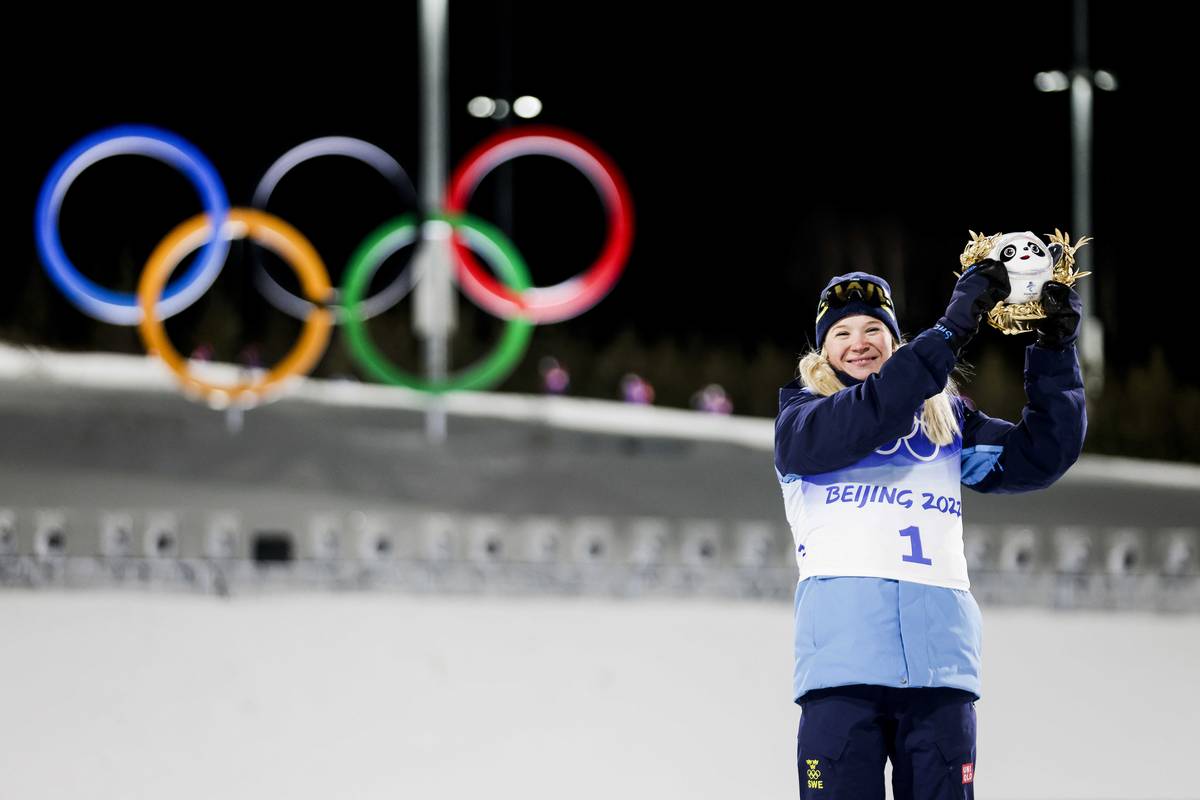
     

    Men’s Top-30 Results:
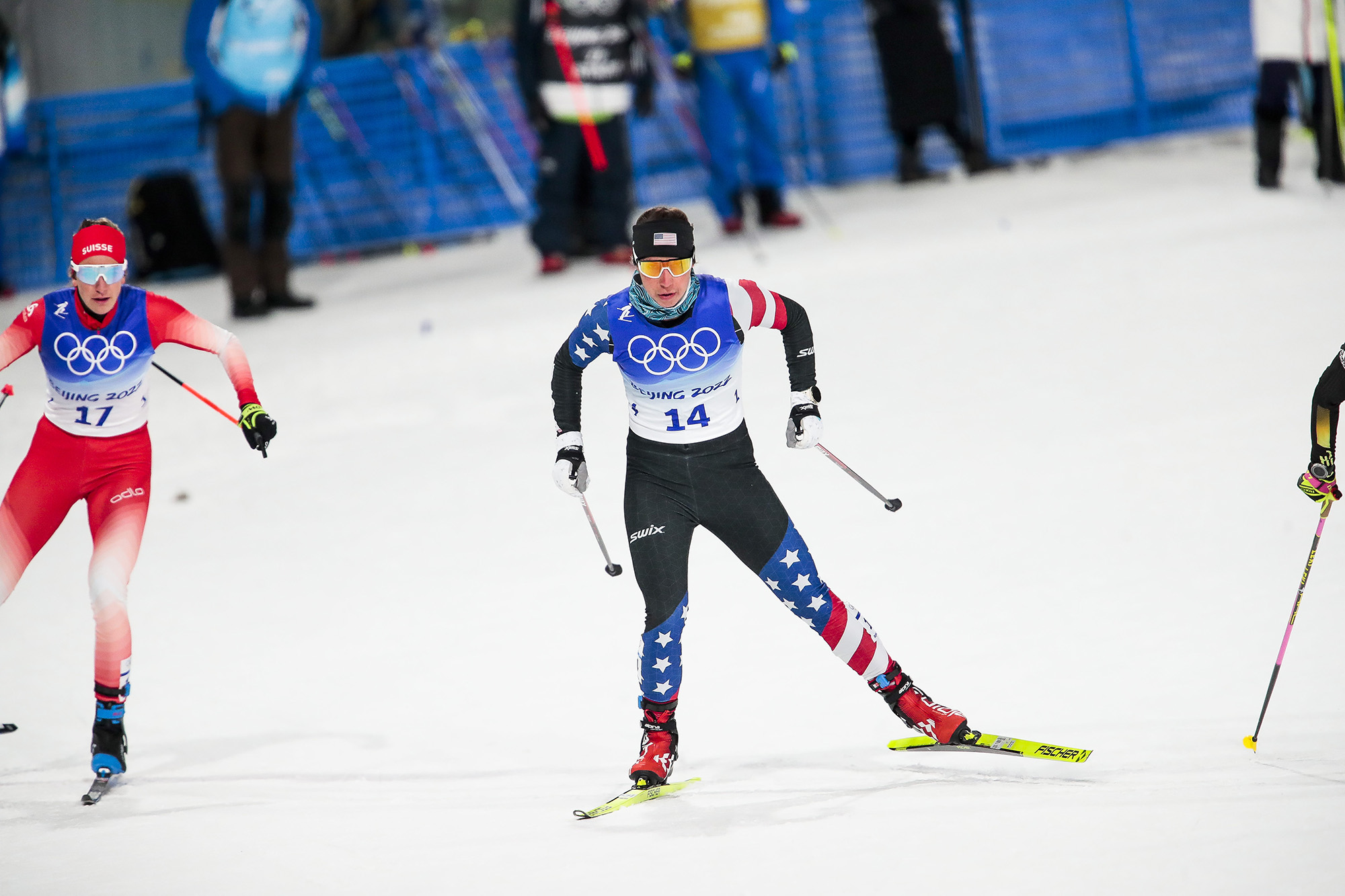
  • Nilsson Grasps Sprint Cup with Québec Win: Bjornsen sixth, Caldwell seventh, Diggins 10th
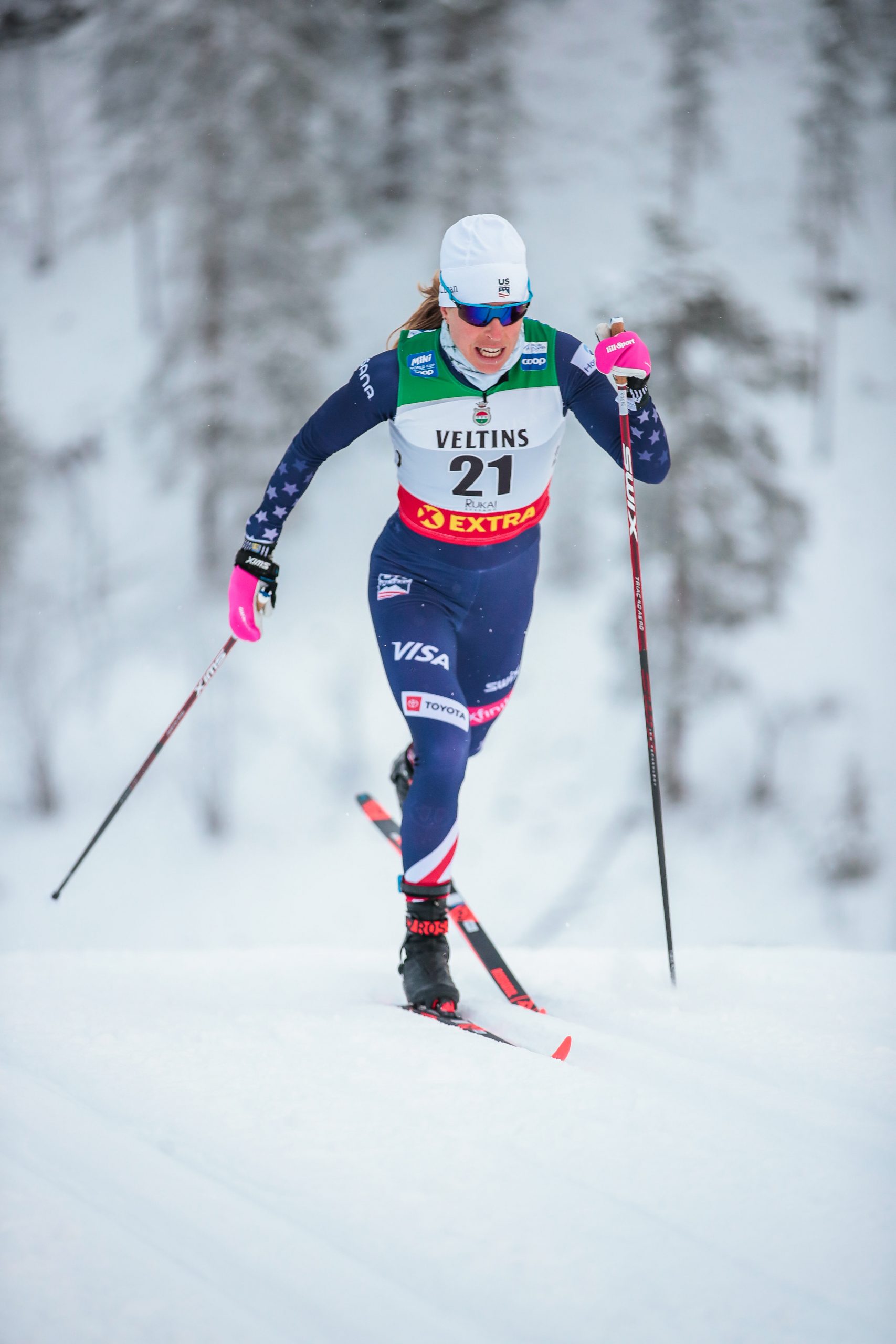
    Nilsson Grasps Sprint Cup with Québec Win: Bjornsen sixth, Caldwell seventh, Diggins 10th
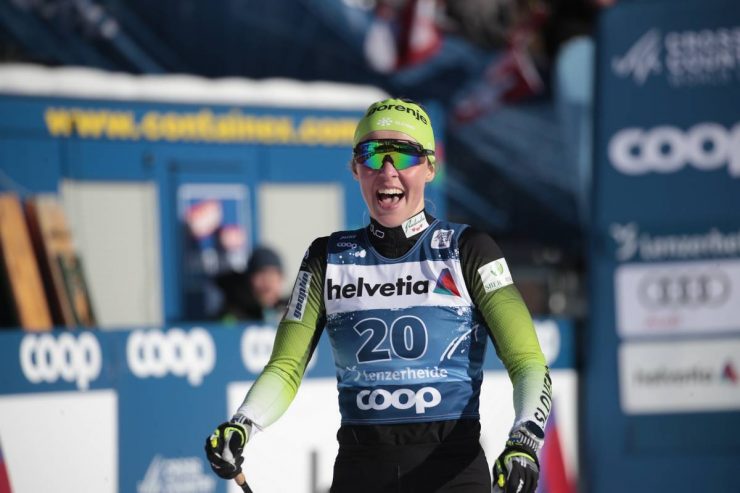
    The women's sprint podium. L to R, Maja Dahlqvist, Stina Nilsson, Jonna Sundling. (Photo: John Lazenby)
    The women’s sprint podium. L to R, Maja Dahlqvist, Stina Nilsson, Jonna Sundling. (Photo: John Lazenbylazenbyphoto.com)

    There was wind. Some snow. And certainly 1.6-kilometers of soft leg-sapping snow during Friday’s freestyle sprint in Québec. This was no 2.5 minute in duration hard-pack speed fest. It was a grind. Take off too early and plenty of real estate remained for a decaying fade. Sit back, control the effort, ride the draft a bit on the skier train and the slow snow could, in fact, keep those more tempered athletes in the game.

    This much was clear: it was a near four-minute sprint effort that blurred the lines of the sprint-endurance divide.

    Sweden’s Stina Nilsson proved her endurance sprint cred with the win. After qualifying in second behind her teammate Jonna Sundling, Nilsson won her quarterfinal, her semi, and the final for her 18th career World Cup sprint victory. With the win, Nilsson could prep to fly the sprint crystal globe back to Sweden.

    Nilsson came to Québec with a 33 point lead on Norway’s Maiken Caspersen Falla for the sprint cup. The math does not lie. Nilsson earned 50 points for the win, whereas Falla earned 40 points after placing fourth overall. As a result, Falla placed second in the sprint cup standings with a deficit of 43 points.

    According to the International Ski Federation (FIS), Nilsson’s crystal globe win is a first for a female cross-country skier from Sweden. This excludes the globe for U23 standings on the World Cup.)

    During Friday’s final that featured four Swedes including Nilsson, Sundling, Maja Dahlqvist, and Frida Karlsson, as well as Falla and American Sadie Bjornsen, the power in numbers proved true. With Nilsson in first, Dahlqvist placed second, and Sundling third.

    1-2-3 the Swedes came into the finish straight. Nilsson and Dahlqvist separated themselves as they sped down the last one hundred meters. The toes did the work across the line as Nilsson and Dahlquist crossed for a photo finish. Nilsson won in 3:44.80 with Dahlqvist 0.01 seconds back.

    “The conditions were really hard today,” Nilsson told FIS after the race. “It was hard to find a perfect tactic because the wind was so strong and not so good to be first on the last downhill but in the end, I wanted to go hard in the last uphill because that is my strongest part. So I went for it and I was so glad that it was my toe before Maja’s.”

    Sophie Caldwell of the U.S. during her sprint qualifier in Quebec. (Photo: John Lazenby/lazenbyphoto.com)

    The U.S. women were positioned well on the day. Bjornsen qualified in fourth, Sophie Caldwell in seventh, and Jessie Diggins 15th.

    Caldwell moved to the semis after placing second in her heat. In the first semi, Caldwell placed third and did not advance. Yet, is was her twenty-ninth birthday and the cheers were loud for the native Vermonter.

    “My parents, my sister, my brother, my cousins, my grandpa, friends, it’s awesome,” Caldwell rattled off when asked who was in Québec to support her. She placed seventh overall and ranked fourth in the final standings for the sprint cup.

    Maja Dahlqvist leads Sadie Bjornsen in the fourth semifinal. (Photo: John Lazenby)
    Maja Dahlqvist leads Sadie Bjornsen in the fourth semifinal. (Photo: John/lazenbylazenbyphoto.com)

    Bjornsen ultimately advanced to the semis after placing second in her heat. Diggins bumped to the semis as a lucky loser in the quarterfinals. (That quarterfinal proved to be the fastest by nearly nine seconds.)

    Soft, slow, and somewhat slushy conditions were no deterrent for Bjornsen. “You know, believe it or not, I happen to love these conditions,” Bjornsen said in the mixed zone. “It’s what I train on all summer on the glacier, so I have a lot of practice, but it was very soft.”

    Paired up in the Bjornsen-Diggins semi was Sweden’s Charlotte Kalla — a formidable distance skier who last made a World Cup sprint final in 2014. Rounding a tight left-handed corner, Diggins was positioned on the inside when Kalla moved towards the apex and collided with Diggins. Then Bjornsen, only feet behind, became tangled too.

    “It looked like Jessie and Kalla collided,” Bjornsen said of the snafu. “But the problem was my skis were stuck underneath them. So I had to just stand there and really hope they got up fast, but they kept sliding on each other and stuff, and I was almost like ‘COME ON,’ and it was just like ‘wait,’ … I’m glad Jessie got up and we both were kind of fighting with each other, it was a huge surge to get back on the group, so it was a miracle I somehow still qualified.”

    On a course with slower snow and times that looked epic compared to some shorter and faster sprint courses in Europe, Bjornsen and Diggins pulled off a miraculous chase. After the tangle with Kalla, the two looked way, way … way back. Diggins and Bjornsen charged. Meter by meter they made the catch to the leading trio of Dahlqvist, Falla, and Karlsson. But they were never comfortably locked on. Into the finish, Bjornsen and Diggins went head to head with Bjornsen ending up fourth and Diggins fifth. And with that semi’s speed, Bjornsen became a lucky loser.

     In the final, Bjornsen placed sixth to end her day.

    “I was definitely feeling the effort from the semi-final, I just barely had anything left, so it was definitely not the final I would have dreamed of, but given what happened in the semis I have to be happy,” Bjornsen explained. “You know, it’s been an interesting season, for the first time I put full emphasis on the World Championships, and those did not go as I dreamed, but no regrets, I’m stoked that I tried that. That being said, it was a bummer to not participate in all the races along the way, and so it’s nice to end and begin on great notes because I definitely had a lot of excitement, and I know I made an improvement this year, which is always important, leading into next year just feeling some encouragement, and also extra excitement for racing in Minneapolis next year.”

    Diggins is known for her drive. That grit was evident as she chased in her semi after the Kalla roadblock.

    “I was on the inside so I had nowhere else to go and she just came in a little too tight and yeah, it happened, it’s frustrating,” Diggins said in a phone call. “I had to work really, really hard to get back up and I was working so hard downhill skating through everything. And you fly over from Europe, picking skis you think you’re going to need for the weather and then the weather totally changes, it is what it is.”

    Remaining positive, Diggins noted the cacophony of cheers as she began her day.

    “I don’t think I have ever, in my life probably, had some many cheers on a qualifier for a sprint,” she said. “That was the most exciting, cool, fun experience. The wall of noise when I started was just inspiring, it was just one of those really cool things that you just gotta appreciate and soak up the atmosphere when you can.”

    Despite the snafu on the course and the almost-advancing effort during her chase, Diggins said believes she is in a solid place for the two remaining races.

    Jessie Diggins of the U.S. during her sprint qualifier in Quebec. (Photo: John Lazenby/lazenbyphoto.com)

    “I am proud of how I worked every inch of the course and gave it my best effort,” she said.  “I was actually really happy with how I was skiing and I know I’m in really good shape and I’ve known that from the last couple weekends of racing. So that was a really good confidence booster. Today it was definitely frustrating to have that mishap happen because it was kinda like ‘man I can’t catch a break here.’ We caught back up but it burned a couple of matches. I know I’m in good shape and I’m happy, I’m in a good place mentally. So I’m just finishing out the season with my best efforts every day.”

    With the sprint races concluded for the season on the World Cup, the U.S. placed three skiers in the top-eight in the sprint rankings. Beyond Caldwell’s fourth overall, Diggins finished seventh in the standings, Bjornsen eighth.

    Sprint Results.

    -David Brown, Kelsey Dickinson, Gerry Furseth, and Gretchen Burkholder contributed.


    Double click the images below to enlarge.

  • Nilsson Takes the Falun Duel with Falla; Bjornsen in 10th, Caldwell 11th

    Nilsson Takes the Falun Duel with Falla; Bjornsen in 10th, Caldwell 11th

    Women’s podium from the Falun, Sweden 1.4 k skate sprint. From left to right, Maiken Caspersen Falla of Norway in second, Stina Nilsson of Sweden in first, and Maja Dahlqvist of sweden in third. (Photo: @fiscrosscountry Instagram screenshot)

    The two skiers have commanded the wins this season for the overall sprint cup. Stina Nilsson of Sweden and Norway’s Maiken Caspersen Falla remain the speed skiing torch bearers. Only Nilsson and Falla have won multiple sprints in 2018/2019. Falla won the World Championship sprint in Seefeld and the last three of four individual sprints coming into  Falun’s sprint on Saturday.

    Earlier in the season Nilsson went on her own run — winning four individual sprints in succession. Yet in the past two World Cup sprints, Nilsson tripped up her winning pattern and did not podium as she recovered from a hip injury suffered in mid-January during a semi-final in Otepää, Estonia.

    Have no fear Swedish fans. The athlete that closed out the women’s 4 x 5 k relay for the World Championship win recently, arrived to treat the home country fans to a win.

    The only imperfection on what became a perfect day was her third place in qualification. Nilsson’s teammate, Maja Dahlqvist, took the top-spot honors as she qualified with the fastest time of 2:55.0. Nilsson’s time was 2.81 seconds behind. Otherwise, Nilsson won her heat, the first semi, 0.52 ahead of Caspersen, and the final, 0.67 ahead of the Norwegian.

    To simplify things, Nilsson won the final in 3:07.72. But for the first half of the final, it appeared Falla would control her own top-step fate. Down the sweeping and banked downhill curve at 1:40 through a morass of sugar snow Falla came through clean and in front. (That sweeping curve did take out several skiers which we’ll get to in a bit.)

    A little less than a minute later, after she had remained in Falla’s shadow, skiing just off her tails, Nilsson came around on the final climb with a hefty V2 and formed enough of a gap to be a meter or two ahead into the final straight.

    Stina Nilsson in charge during the Falun, Sweden skate sprint. (Photo: fis-ski.com screenshot)

    With her fifth sprint win of the season, Nilsson maintains a narrow lead for the sprint cup. She leads with 576 points over Falla, who trails in second overall with 543 points. A single sprint race remains — a skate sprint on March 22 in Quebec, Canada.

    “We definitely can feel the spring,” Nilsson told the International Ski Federation (FIS) after race. “The conditions were hard for us to manage especially the downhill curves. I think all of us were quite afraid when we went down there because their were so many crashes today. I also knew this sprint was real important for the sprint World Cup.”

    The tenuous conditions, with deep sugar snow here and there out on course, took a toll on the qualifying U.S. skiers.

    “It was one heck of a tricky sprint race out there today,” Sadie Bjornsen of the U.S. Ski Team (USST) emailed. “With tough snow conditions, course time was limited, which made for some interesting snow. Deep and punchy! My qualifier was a fun surprise, and made me feel really good about my fitness right now. After a little frustration in Drammen on Tuesday, I was looking forward to getting onto this course.”

    That qualifier surprise was a fourth place qualifying time. And she advanced to the semis after placing second to Dahlqvist in her heat.

    “My quarterfinals worked out perfect, and I felt great about my tactics and skills on the course,” Bjornsen added. Yet the skier’s good fortunes waned in the semis.

    “As I took off for the semi finals, the snow had started to refreeze, so it was unbelievably tricky skiing. I had myself in a perfect position leading over the top of the first climb, and came out of the corner ready to fire away. Unfortunately, the Slovenian stepped on my ski, and I went down briefly. The stop/go gave me enough of a flood in my legs that I wasn’t able to make the gap back up. I was pretty bummed afterwards, because I knew our heat was moving fast, so that fourth place position was going to be lucky loser.”

    Her fall aside, Bjornsen’s stop/go rebound earned her a 10th place overall as she preps for tomorrow’s 10 k skate.

    “I have a good healthy amount of anger that I know will help push me through those 10k of skating tomorrow,” Bjornsen explained. “The good news is I feel great, and I am ready to put the frustration to the course!”

    Sophie Caldwell’s (USST) path to her 11th overall was marred less by a stop/go and more of a slide on harsh granulated snow.

    Before the tumble, she qualified in 14th, 8.41 seconds off the leading time.

    “The course was definitely funky today with some deep skiing, especially on the downhill corners,” Caldwell emailed. “Even though the course isn’t particularly long, it’s one of the hillier courses we race, so it’s important to try to conserve some energy for the long finish stretch. My qualifier honestly felt pretty awful because I think I took it out a little hot and got flooded, but I was pleased when my quarter final felt much better and tactically I think I skied it pretty perfectly and was able to conserve some energy through the hills and have a strong last part of the course.”

    Slip, slide, and away: Sophie Caldwell during her fall in the Falun, Sweden skate sprint. (Photo: @sophiecladwell instagram screenshot/nordic focus)

    Despite her sensations, Caldwell won the first heat and lined up in the first semi with Nilsson and Falla. Caldwell, skiing in the rear of the train of skiers, took a rough slide when she lost her footing while schussing through a corner.  

    “As far as my fall in the semi goes, I’m not exactly sure what happened,” Caldwell wrote about her spill. “I was not proud of how I skied the first downhill because it kind of took me out of contention, but there was a lot of snow plowing going on and I kind of just had to follow. Then on the second downhill I must have hit some of the soft stuff and got shot out wide and landed pretty hard on my chest and knee, but I think I escaped with only a few bruises! Exciting day out there for sure.”

    The American cross-country staple, Jessie Diggins (USST) also became a deep sugar snow stat. Instead of being taken out in the semis like Caldwell and Bjornsen, Diggins fall came about halfway through the course on the banked downhill corner. In front. In control. Diggins set the tempo in her heat.

    ibuprofen

    Then down she went.

    “I’m totally ok after the fall! I had amazing skis and my energy and fitness are in a great place, so although it’s always a bummer to crash out of a race, I am really happy with how I skied and how fast I was moving out there,” Diggins explained in an email. “I fell on the steep 180 corner, and honestly I don’t know what I would have done differently to avoid the fall – it came out of nowhere, suddenly I hooked a tip or hit some icier snow and it threw my weight back. There was half a foot of loose, wet and heavy snow out there and we saw a ton of crashes and near misses on some fast and tight corners today!”

    Diggins rounded out the U.S. results in the top-30 with a 28th place overall. As has been documented, it’s been a whirlwind year for Diggins. After Sunday’s race in Falun, it will be time for Diggins to head back across the Atlantic and into the throng of Quebec’s ski fans.

    “I’m very fortunate to have so many family members coming to Quebec to cheer and I’m so happy and excited to see them, and sometimes knowing you’ve only got one weekend of World Cups left leaves you with better energy than, say, a month out from the end,” explained Diggins.
    I love the crowds in Quebec and I’m exited to throw down my absolute best efforts!”

    Sunday’s racing features a 10 skate for the women and a 15 skate for the men.

    Results.

  • Saturday Race Rundown

    Saturday Race Rundown

    Women’s podium from the Falun, Sweden 1.4 k skate sprint. From left to right, Maiken Caspersen Falla of Norway in second, Stina Nilsson of Sweden in first, and Maja Dahlqvist of sweden in third. (Photo: @fiscrosscountry Instagram screenshot)

    FIS World Cup Falun, Sweden 1.4 k Freestyle Sprint

    On a day when sugary snow course picked off skiers trying to advance during Falun, Sweden’s 1.4-kilometer freestyle sprint, Stina Nilsson, yes of Sweden, took the win. She won the final in 3:07.72 over Norway’s Maiken Caspersen Falla  in second (+0.67). The day’s top qualifier, Maja Dahlqvist, placed third (+2.14).

    The Americans entered in the race were some of the key players who tumbled on course. Jessie Diggins (USST) qualified in 21st and was leading the second quarter final when she fell on a sugared downhill to place 28th overall. Both Sadie Bjornsen (USST), ranked fourth after qualification, and Sophie Caldwell advanced to the semis.

    Caldwell took a belly slide on the the course’s funky downhill to place sixth in her semi and finish 11th overall. In the second semi, Bjornsen was eliminated after placing fifth. She finished 10th overall.

    ponstel online

    Also for the U.S., Julia Kern (USST) placed 34th, Ida Sargent (USST) 37th, Rosie Brennan (APU) 53rd, and Kaitlynn Miller (CGRP) 61st.

    Results

    In the men’s 1.4 k skate sprint, Norway’s Johannes Høsflot Klæbo continued his winning ways with another sprint victory. He won the final in 2:52.38,  0.1 seconds over teammate Emil Iversen. Another Norwegian, Sindre Bjørnestad Skar, placed third (+0.28).

    U.S. skier Simi Hamilton (USST), who qualified in 16th, bowed out in the quarterfinals after placing fifth in his heat. Hamilton was 22nd overall. Kevin Bolger (USST) advanced to the heats where he was eliminated to end up 27th overall.

    Also for the U.S., Logan Hanneman (APU) placed 39th, and Ben Saxton (SMS T2) was 60th.

    Alex Harvey of Canada ended his race in 31st. He was the only Canadian entered.

    Men’s Results