From the FasterSkier archive — posts syndicated from athletes’ and coaches’ own blogs between 2004 and 2012, kept online as published. Current coverage is at fasterskier.com.
This coverage is made possible through the generous support of Marty and Kathy Hall and A Hall Mark of Excellence Award. To learn more about A Hall Mark of Excellence Award, or to learn how you can support FasterSkier’s coverage, please contact info@fasterskier.com.
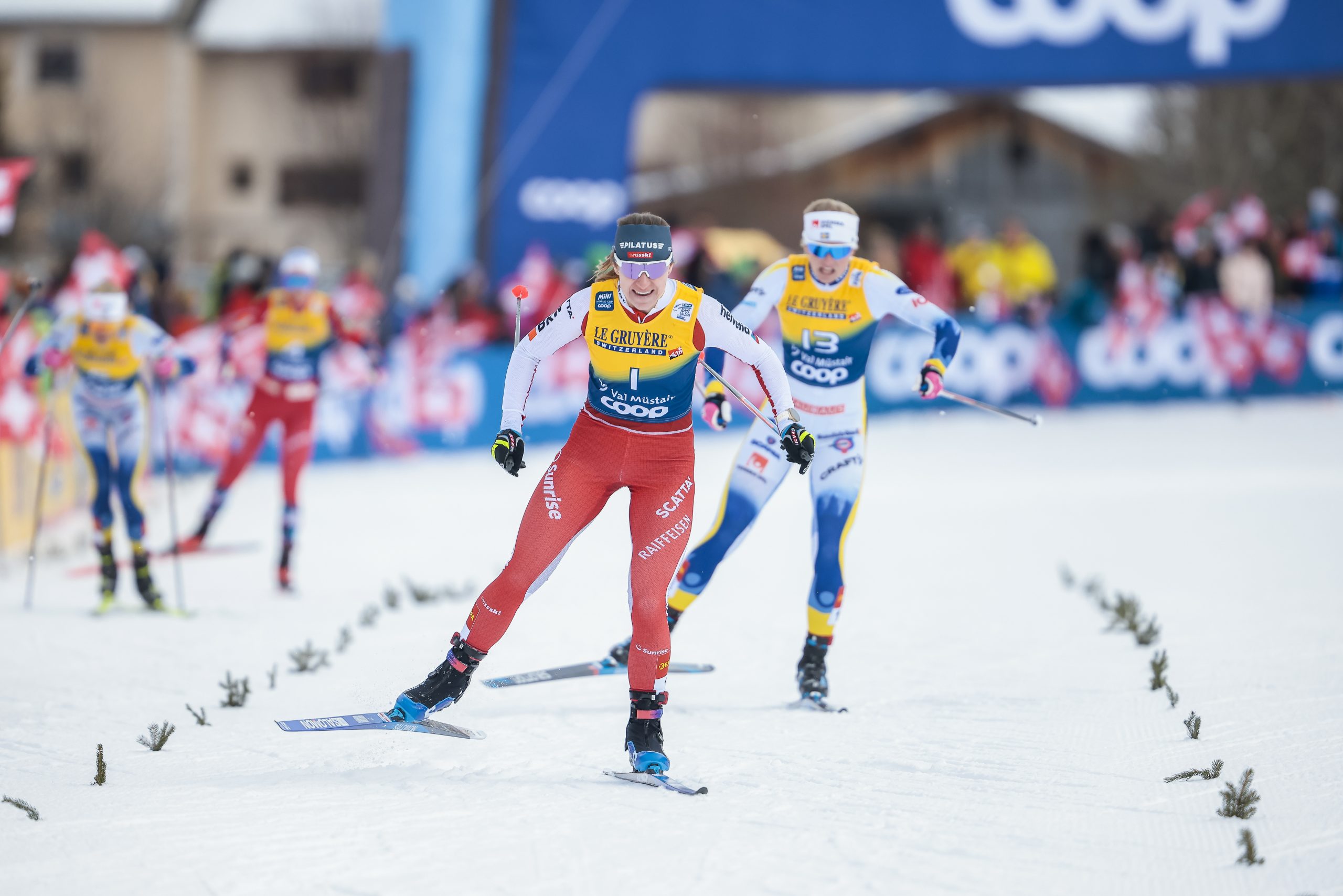
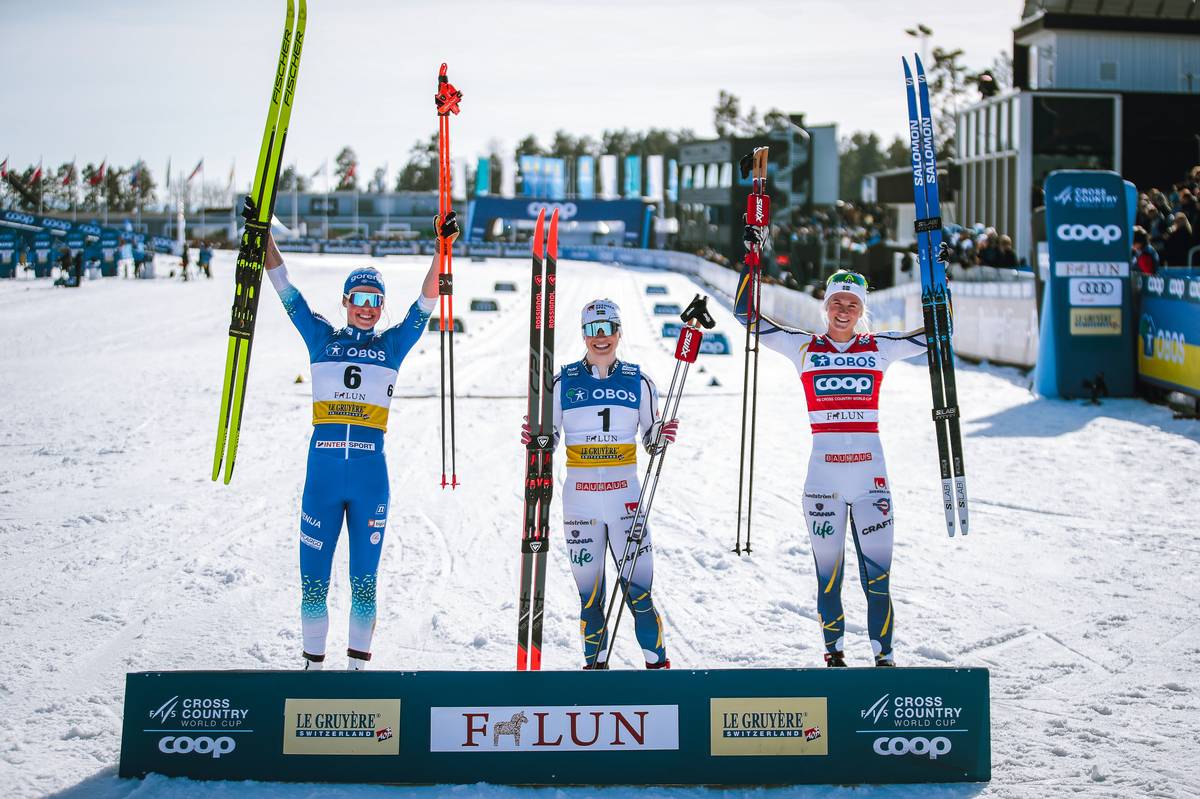
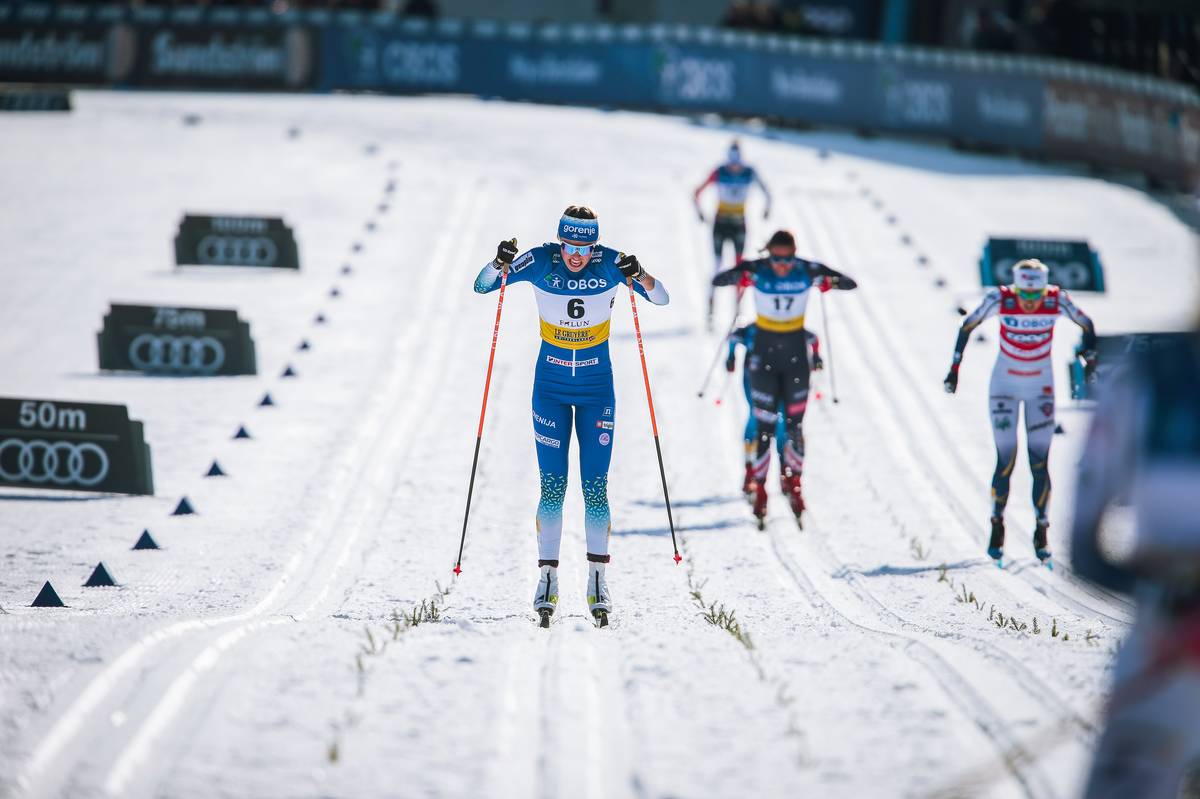
The women’s sprint final comes into the finish in Drammen, Norway with: Laura Gimmler (GER), Ane Appelkvist Stenseth (NOR), Jonna Sundling (SWE), Nadine Faehndrich (SUI), Johanna Hagstroem (SWE), and Kristine Stavaas Skistad (NOR), (l-r). (Photo: Nordnes/NordicFocus)
The snow was trucked in, the rock band was playing near the finish, and Norwegian children cheered from second-story windows along the course. On a rare midweek World Cup race day in Drammen — a small city just southwest of Oslo where the sprint course loops through the streets, wraps around an old fountain, and finishes on the snow-covered steps of an iconic church — Jonna Sundling of Sweden took home another World Cup sprint victory.
Sundling won the women’s classic sprint, going stride for stride with Norway’s Kristine Stavaas Skistad before pulling away in the final meters. Switzerland’s Nadine Faehndrich, racing her final classic sprint before retirement, earned the bronze.
It was Sundling’s fifth individual World Cup victory of the season and the latest chapter in an intensifying rivalry with Skistad that has captivated ski fans, especially Scandinavian ones, for the last few seasons. From the World Championship final in Trondheim last year to the Olympic final in Milano Cortina, Sundling, with the rest of the Swedish sprinters, and Skistad have been locked in a tactical chess match. On Thursday in Drammen, it was Sundling who played the final move.
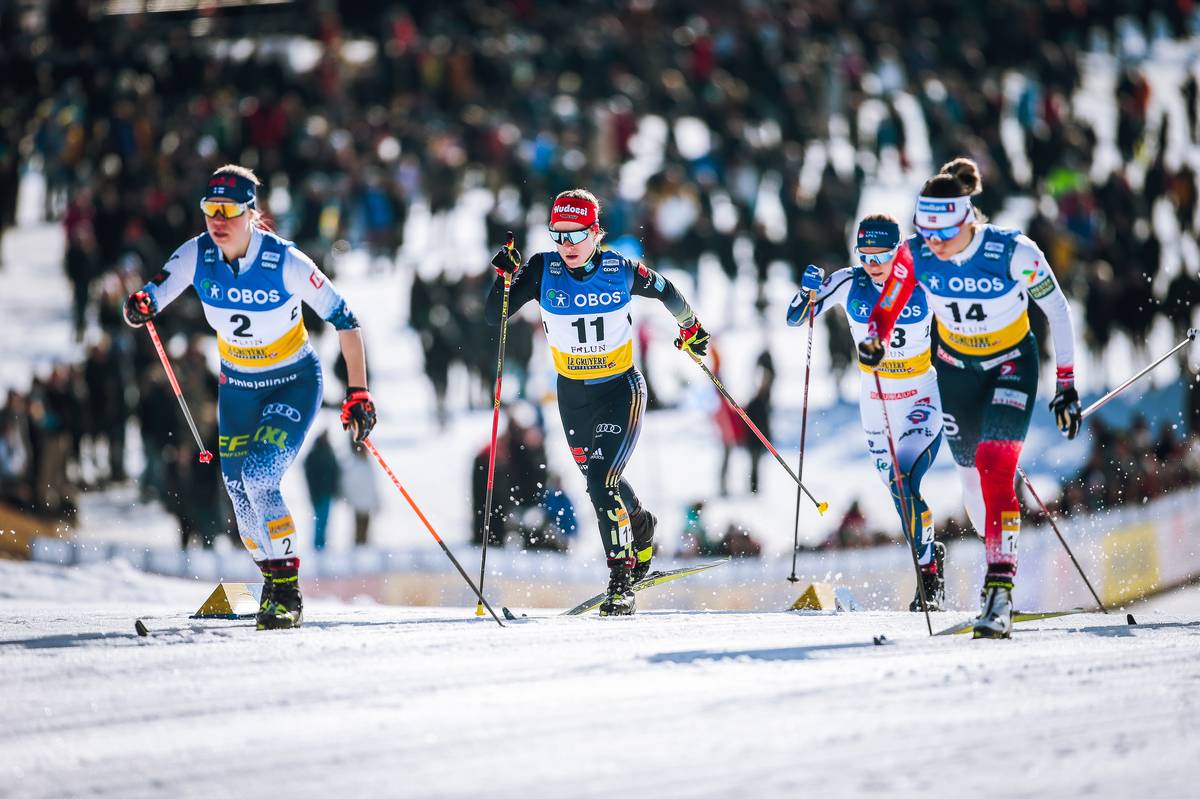
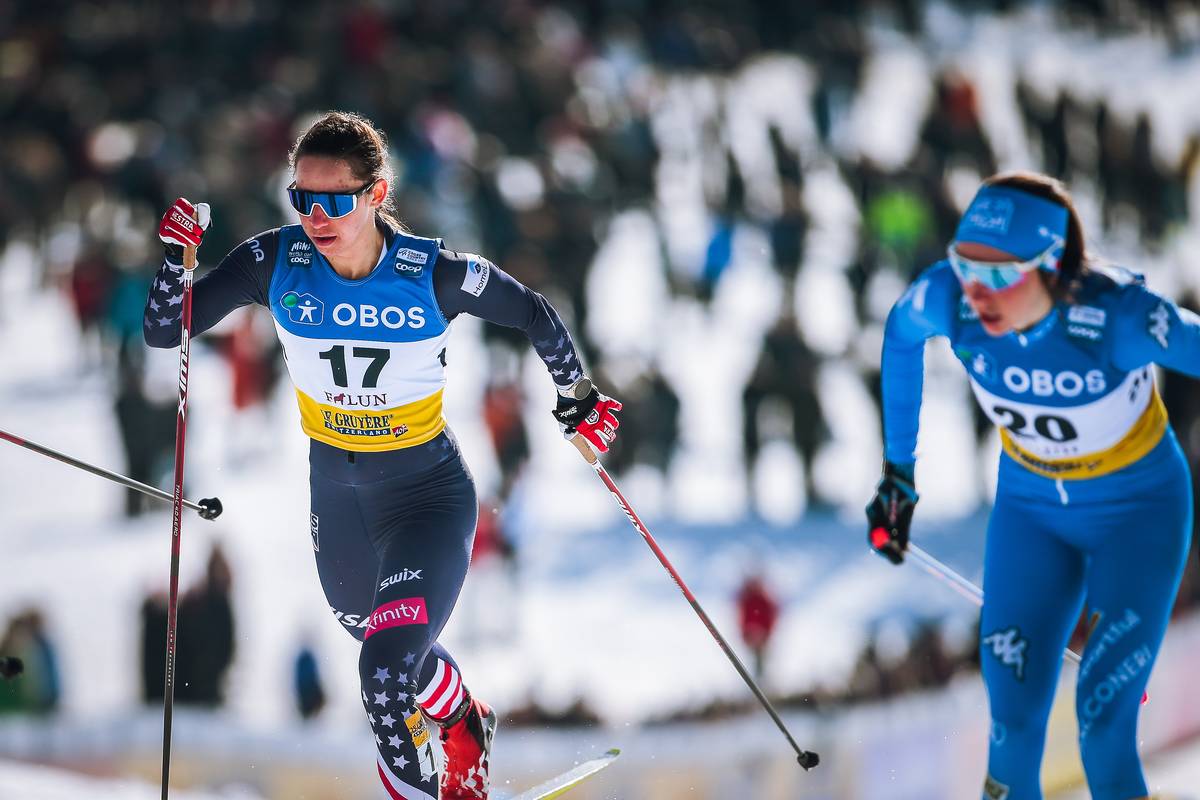
Quarterfinal number one heads up the first climb with: Barbora Antosova (CZE), Mathilde Myhrvold (NOR), Jessie Diggins (USA), Melissa Gal (FRA), (l-r). (Photo: Nordnes/NordicFocus)
Qualification and Quarterfinals
Sweden’s Linn Svahn, the reigning Olympic sprint champion, posted the fastest qualification time at 2:41.87 — nearly three seconds clear of Sundling’s 2:44.39. But qualification speed, as World Cup sprinting always reminds us, is only the entry ticket.
Two Americans advanced to the heats. Jessie Diggins, the overall World Cup leader wearing the yellow bib in what she called a “full circle moment,” qualified 17th in 2:50.91. Rosie Brennan, seeded 28th, also made the top 30.
Diggins chose Quarterfinal 1 alongside Sundling and Skistad — a loaded heat. Skistad took the win with Sundling second via a photo finish, just 0.18 seconds separating them. Diggins fought hard for third, advancing as a lucky loser after finishing just 0.22 seconds behind Sundling.
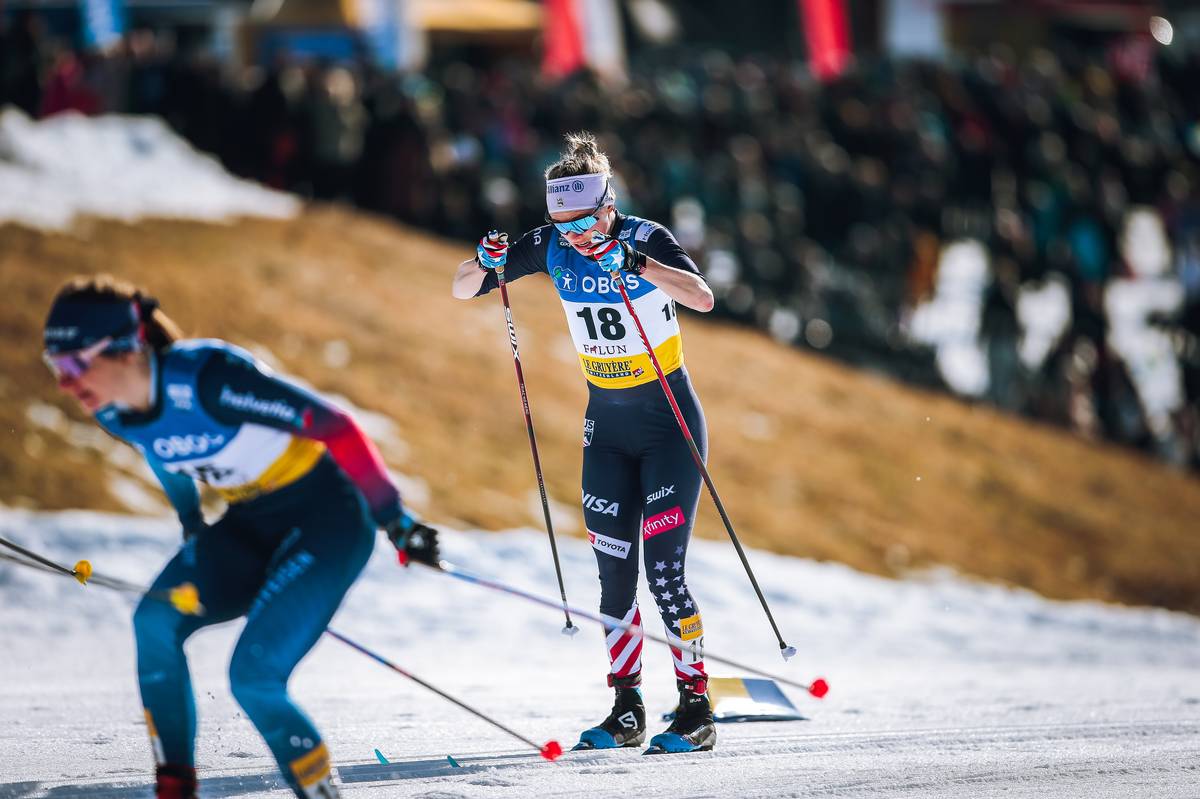
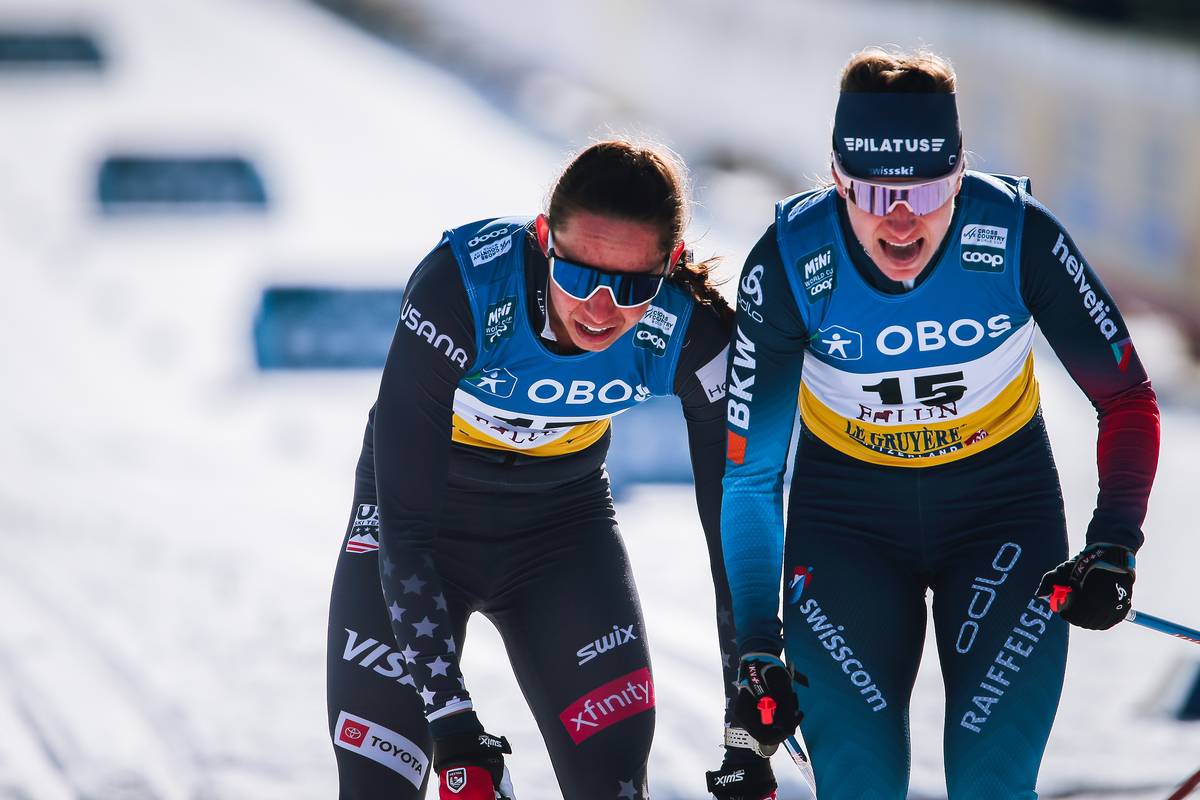
Rosie Brennan (USA) said after the race, “Drammen is one of my favorite races, it’s a fun course and always has a lively atmosphere.” (Photo: Nordnes/NordicFocus)
Brennan’s day ended in the quarterfinals. Racing in Heat 3, she bobbled heading into the downhill and lost the draft, which was a costly moment on a course where the slipstream effect was enormous all afternoon. She finished fifth in her heat.
“I was happy to get a chance in the rounds, but the conditions were very tough,” Brennan said. “They salted the course, and it was skiing great in the qualifier and then got really icy for the rounds. Anyway, I bobbled into the downhill and lost the draft and then just don’t have the power I need to pass that many people up the finish stretch, so I was disappointed to not be more in the mix.”
Meanwhile, Svahn survived a scare of her own… as her quarterfinal rounded the fountain that anchors the bottom of the course behind the start gates, five of the six athletes ended up in a pile and Svahn seemingly had the most bodies and equipment to navigate as she got back out on the course, but somehow recovered to advance. The Olympic champion’s troubles, however, were only beginning.
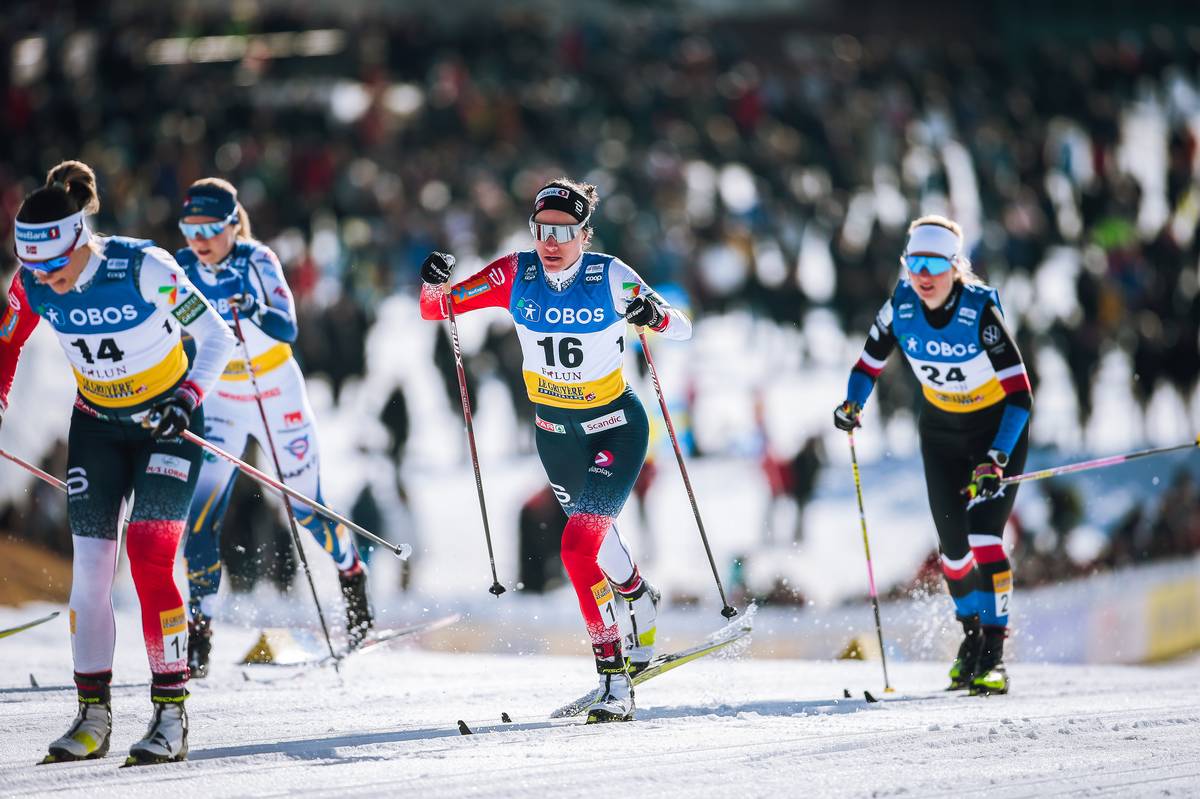
Maja Dahlqvist (SWE) and Jessie Diggins (USA), (l-r) during the second semifinal. (Photo: Nordnes/NordicFocus)
Semifinals
The two semifinals told entirely different stories, and the contrast between them shaped the final.
In Semifinal 1, Skistad took the win with Sundling second, just 0.20 seconds back. Both advanced automatically. Behind them, Svahn finished third and would not advance.
Semifinal 2 was a different race entirely. Johanna Hagstroem and Ane Appelkvist Stenseth pushed the pace from the gun, stringing the field out over the first climb. But on the long downhill, the draft did its work. Faehndrich and Laura Gimmler of Germany surged past, using the slipstream to slingshot into the lead.
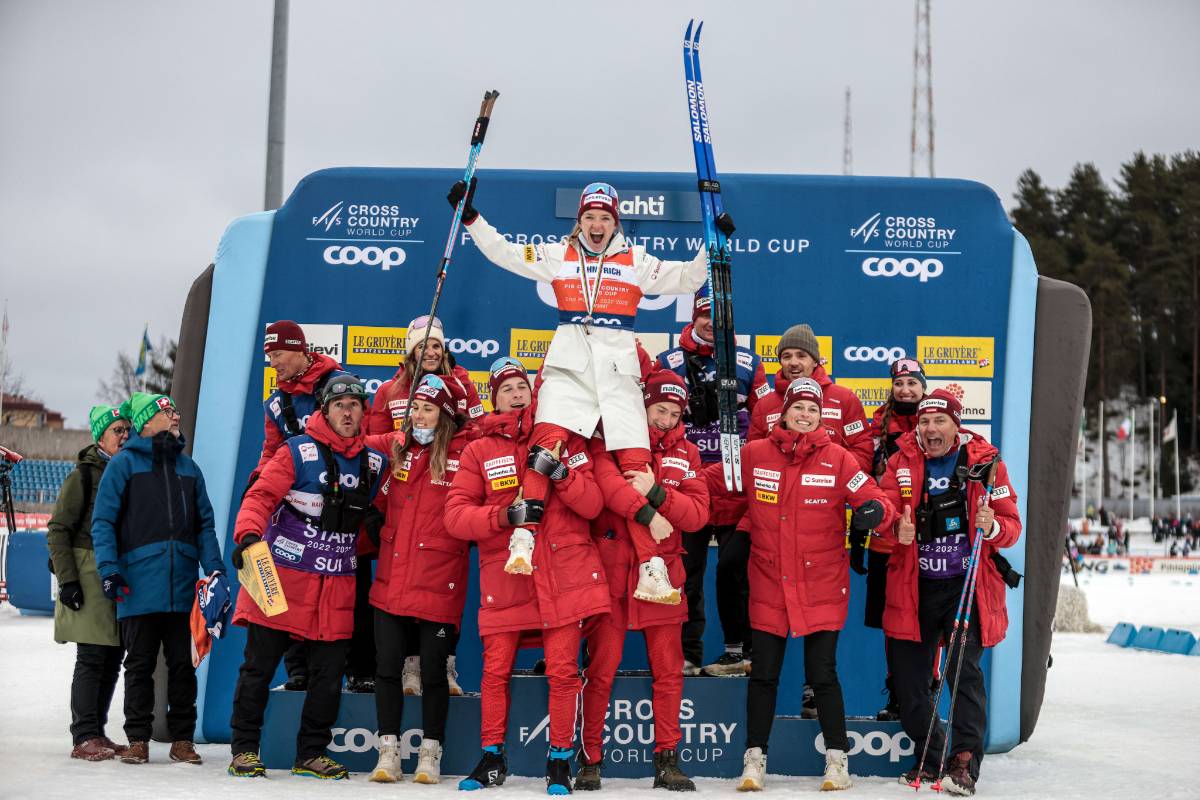
Nadine Faehndrich (SUI), who is planning to retire after the season, found a little extra Drammen magic today as she finished on the podium in third. (Photo: Nordnes/NordicFocus)
Faehndrich won the heat decisively. Gimmler was second. The fast overall times meant Hagstroem would advance along with Stenseth, who just out-lunged Diggins for fourth and the second lucky loser position.
For Diggins, the day ended in 10th. But she left Drammen at peace.
“This was really cool because the Drammen area was my first ever World Cup start and it was a skate sprint,” Diggins said. “So it’s kind of a very full circle moment to close it out with a classic sprint here as the last classic sprint of my career.”
She had tried something new in the heats, sitting in the draft instead of going to the front, a departure from her usual aggressive approach. “Normally, because literal strength is not my strength, I usually just try to go really, really hot and try to go off the front,” she said. “I was like, nope, I don’t think that’s gonna work for me here with the crazy draft and slingshot effect. I was taking a lot of notes in warm-up, and in the quarterfinal, I had the smallest tuck of my life. It was just really fun to try to believe in myself as more of a pure sprinter and to try to be a little more tactical.”
She acknowledged she ran out of power in the semifinal, but had no regrets. “I still felt like I executed my plan to the best of my ability, and that’s always a cool feeling.”
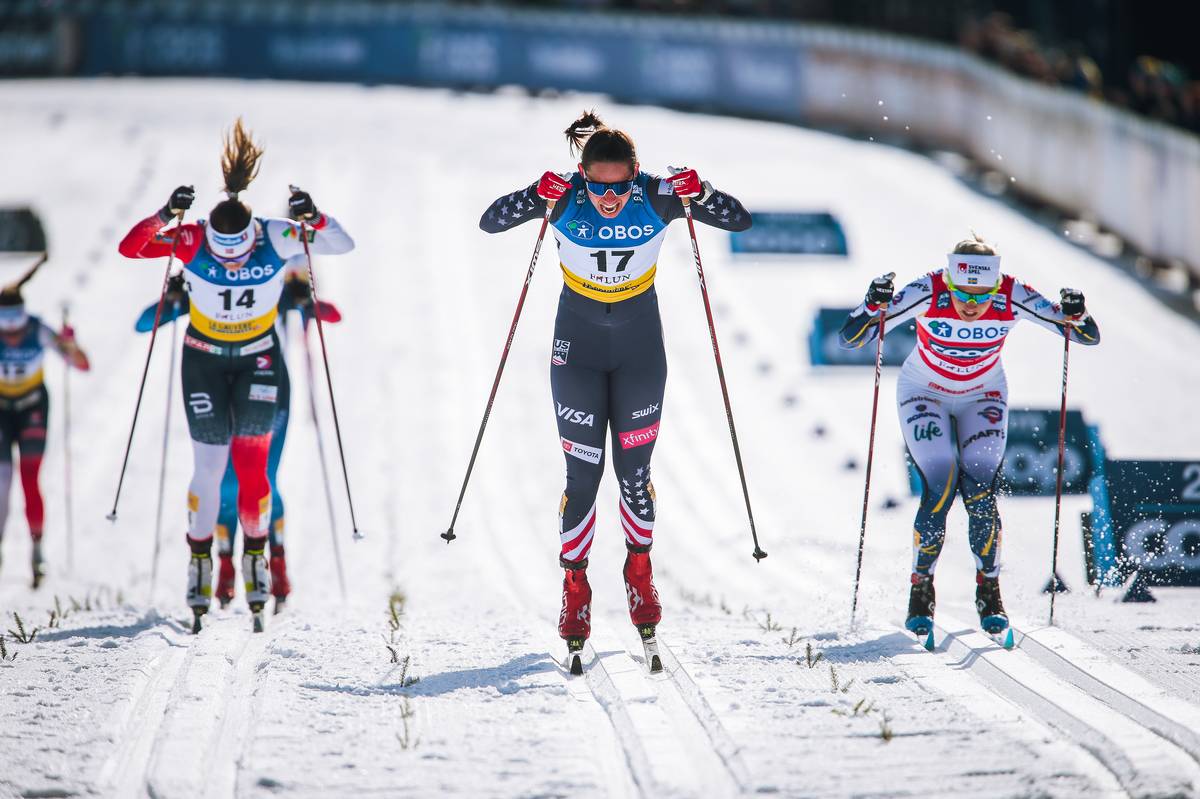
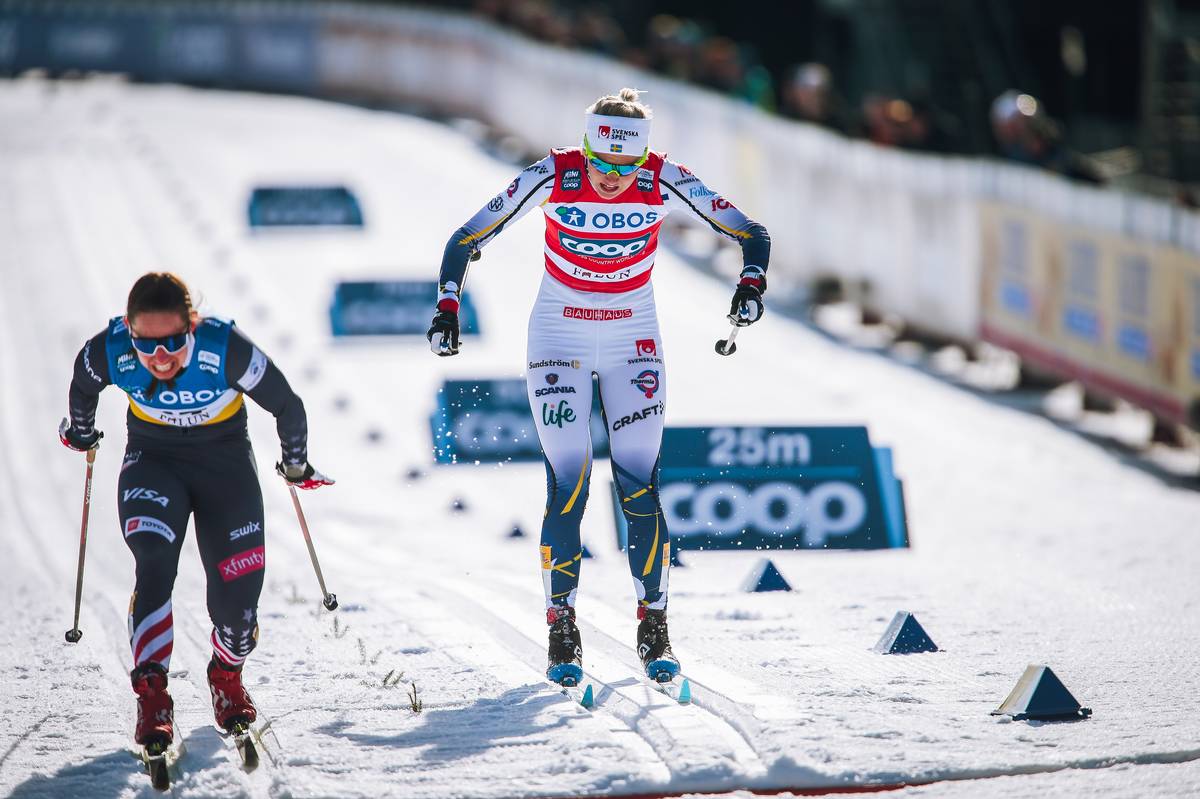
Jonna Sundling (SWE) crosses the finish line just ahead of Kristine Stavaas Skistad (NOR) for the win in Drammen, Norway. (Photo: Nordnes/NordicFocus)
The Final
Six women lined up for the final: Sundling and Hagstroem for Sweden, Skistad and Stenseth for Norway, Faehndrich for Switzerland, and Gimmler for Germany. Svahn and Maja Dahlqvist, the Olympic gold and bronze medalists in the sprint classic, were both absent.
On the opening climb, Skistad sat behind Sundling in a familiar posture — patient, conserving, waiting for the right moment. As Kikkan Randall mentioned on the broadcast, Skistad almost never leads into a downhill. She baited Gimmler into taking the front position, then tucked into her slipstream.
Coming off the descent and around the final hairpin, Faehndrich made her bid, surging past Gimmler and into third. But the race was between the two women everyone expected.
Sundling and Skistad skied side by side on the final climb, and what followed was a scene that encapsulated their rivalry. Stride for stride, shoulder to shoulder, neither yielding a centimeter. Sundling’s transition from double pole to striding was fractionally sharper — she carried more momentum through the final meters — and she crossed the line with a small advantage.
“It is usually very tight in Drammen, but today it was extremely tight,” Sundling said on air afterward. “Till the last meter. I was like, okay, I need to continue all the way over the finish line. It was tough, but I’m happy that I was the first person over the line.”
For Faehndrich, the bronze was a fitting farewell. The 30-year-old Swiss racer, who announced her retirement this season, now sits third in the sprint World Cup standings at 700 points — just behind Hagstroem (708) and within striking distance of leader Dahlqvist (720) heading into the final sprint of the season in Lake Placid next weekend.
Jessie Diggins (USA) gave her fans something to cheer about during her quarterfinal when she charged to the finish line. (Photo: Nordnes/NordicFocus)
Looking Ahead
Diggins continues to lead the overall World Cup standings with 1,961 points, 275 points ahead of Sweden’s Moa Ilar, a margin that appears insurmountable with four races remaining. The distance globe, too, seems firmly in her grasp. But the sprint crystal globe race is wide open: Dahlqvist, Hagstroem, and Faehndrich are separated by just 20 points at the top of the standings, and the final sprint in Lake Placid could decide everything.
For Diggins, there’s another milestone ahead — she’s only a few nights away from sleeping in her own bed before racing in front of an American crowd at the World Cup Finals. “Very, very, very excited about that,” she said.
The World Cup moves to the historic Holmenkollen venue in Oslo on Saturday for the Women’s 50 k Freestyle Mass Start, before the season concludes in Lake Placid, New York, March 20-22.
Feature stories like this one take time, access, and care to produce. If you value thoughtful storytelling and independent ski journalism, please consider becoming a Voluntary Subscriber. Your support directly fuels the work we do to cover the people, places, and moments that make our sport special.
This coverage is made possible through the generous support of Marty and Kathy Hall and A Hall Mark of Excellence Award. To learn more about A Hall Mark of Excellence Award, or to learn how you can support FasterSkier’s coverage, please contact info@fasterskier.com.
Jonna Sundling (SWE) during qualification in Lahti, Finland. (Photo: Authamayou/NordicFocus)
The World Cup season returned to Finland this weekend, closing a circle that began more than three months ago in Ruka. In the time since Olympic teams were selected, dreams realized or deferred, experience forged, and farewells offered week after week as the long winter wears on. If the stakes in Lahti feel slightly lower than they did earlier in the season, they are tightening in another way — especially in the races for the Crystal Globes.
With only a handful of races remaining in the season, the women’s Freestyle Sprint offered more than just another podium. The fight for both the Sprint Crystal Globe and the Overall Crystal Globe continues to tighten.
In tricky conditions, Sweden’s Jonna Sundling emerged as the day’s winner, navigating the heats with authority before closing out the final to claim victory.
“I think all day it’s been difficult with the conditions because it seems so nice, but when you ski it’s like icing underneath,” Sundling said in a post-race interview with FIS on the broadcast. “There were some challenges with the skiing, but I’m glad that I could ski as I did today and go all the way.”
The victory marked a strong return for Sundling, who said she had recently been dealing with a cold and missed racing in Falun before arriving in Lahti.
One of the most interesting moments of the women’s race came when Kristine Stavaas Skistad (NOR) was disqualified during the semifinals for what appeared to be a very minor incident. She received a yellow card for the incident, and because she was already carrying one from a previous violation, she was disqualified. (Photo: Authamayou/NordicFocus)
A Tactical Sprint Course
The Lahti freestyle sprint course rewarded patience as much as power. After the individual qualification round, the top 30 athletes advanced into the head-to-head heats — five quarterfinals of six athletes each, with the top two finishers and the two fastest “lucky losers” advancing to the semifinals.
From there, the field narrowed again: two semifinal heats would determine the six skiers racing for the win.
While the course appeared straightforward on paper, athletes quickly discovered the conditions made positioning critical. The climb before the final hairpin offered one of the few reliable passing opportunities before the long run to the finish, which saw the race often gather back together around the final corner before the finishing stretch. And throughout the heats, several favorites discovered how narrow the margin for error could be.
Maja Dahlqvist (SWE) got out well, but was unable to advance from the quarterfinals. (Photo: Authamayou/NordicFocus)
Globe Leaders Falter
Two of the athletes who have dominated the sprint standings this season — Maja Dahlqvist (Sweden) and Nadine Fähndrich (Switzerland) — both saw their days end earlier than expected, failing to advance beyond the quarterfinals.
Their early exits added intrigue to the sprint globe race as the season heads toward its final stretch.
Meanwhile, Sundling continued to build momentum, advancing smoothly through her heats despite the difficult snow conditions.
“I’m super motivated,” Sundling said of the final weeks of the season in the broadcast interview. “It’s my favorite time of the year.”
Hilla Niemela (FIN), Johanna Hagstroem (SWE), and Jessie Diggins (USA) (l-r) charge up the opening climb of the Freestyle Sprint in Lahti, Finland. (Photo: Authamayou/NordicFocus)
Diggins Attacks, But Falls Short
For the United States, Jessie Diggins came closest to advancing deep into the rounds.
In her quarterfinal, Diggins launched a decisive move on the final climb, surging to the front of the group in an effort to create separation before the tight hairpin turn at the top of the hill. Over the crest, she continued the attack, aggressively no-pole skating the downhill in an attempt to open a gap.
For a moment, the tactic appeared to work.
But the chasing group quickly organized behind her, the draft pulling them back together on the descent into the stadium. Sweden’s Johanna Hagström surged in the final meters, lunging at the line to edge Diggins and end the American’s day in the quarterfinal.
Diggins said the Lahti crowd helped make the experience memorable.
“It was so cool to hear the crowd roaring. There were so many people out, really filling the stadium and along the course. It’s just a very cool environment. It was sunny and beautiful, which made it really fun.
“I was really happy with my energy today. I feel like I skied a pretty good race and did everything I could. But again this year, I feel like I just don’t quite have that ultimate power, especially in the finishing stretch.
“I’m excited for tomorrow and just excited to be finishing out my last stretch here in Europe. That feels really special. It’s kind of cool to take a moment to reflect on my many years spent on the road in Europe. That chapter is coming to a close now, which is really cool and really special. I’m just grateful thinking back on all the memories over all the different years.”
Rosie Brennan (USA) fighting to maintain contact with the group as Gina Del Rio (AND) takes the opening climb out fast during their quarterfinal. (Photo: Authamayou/NordicFocus)
Brennan Knocked Out in Quarterfinal*
Veteran American Rosie Brennan also reached the quarterfinals but was unable to advance.
Lauren Jortberg (USA) on her way to 37th place in qualification in Lahti, Finland. (Photo: Authamayou/NordicFocus)
Jortberg Reflects on Qualification Miss
For Lauren Jortberg, the Lahti sprint was a reminder of how thin the margins can be in World Cup qualification.
Jortberg finished 37th in the qualification, just outside the top-30 cutoff needed to advance to the heats. After the race, she said the conditions on the Lahti course made it difficult to find the right balance between glide and stability.
“There was kind of an ice sheet underneath with some sugar on top,” Jortberg told FasterSkier after the race. “So it was hard to find skis that were running really well while also being able to push off and plant well. It made the skiing a little tricky, but that’s pretty typical for what we’ve seen in Lahti the last few years.”
Jortberg also felt she left something on the course in terms of pacing.
“I think I just didn’t pace it very well,” she said. “I probably paced it too much. I didn’t really finish feeling that tired, so that was a bit of a bummer.”
Part of that caution, she explained, stemmed from having dealt with illness in the days leading into the race.
“I had been sick the last week, so I think I held back a little bit,” Jortberg said. “That’s frustrating because I felt really good and I think I could have been competitive today.”
Even so, Jortberg said the past months of racing have helped build confidence as she continues gaining experience on the World Cup circuit.
“One of the big takeaways from these World Cup weekends is that when I can put down a really solid qualifier, I’m very much in the mix,” she said. “Even though today wasn’t a great qualifier, I wasn’t that far out of the heats, so I think that’s something I can take confidence from going into the next few weekends.”
Julia Kern (USA) during qualification. (Photo: Authamayou/NordicFocus)
Julia Kern Trying to Get Back to Form*
Julia Kern, returning to racing after illness following the Olympic Games, placed 44th in the qualification round.
Albrecht Gaining World Cup Experience
Emma Albrecht, competing in her fourth World Cup weekend, finished 48th in the qualification round in Lahti as she continues gaining experience at the highest level of the sport.
Albrecht said one of the biggest adjustments to racing on the World Cup has been the razor-thin margins in sprint qualification.
Emma Albrecht (USA) gaining experience during the qualification in Lahti, Finland. (Photo: Authamayou/NordicFocus)
“The biggest adjustment to racing at this level is how tight the race margins are,” Albrecht told FasterSkier after the race via email. “The U.S. SuperTour field is obviously not as competitive, and it has been a shift — especially in sprinting — to have to have a fast qualifier. You are no longer guaranteed to make heats.”
The Lahti sprint course also served as a reminder of the confidence and technical skills required to compete in crowded sprint fields.
“Today’s qualification reminded me to take up space on the course and not be afraid of a little hop skate,” she said.
Even with the challenges, Albrecht said the experience is fueling motivation heading into the offseason.
“This weekend is making me very excited for summer training,” she said. “A field as deep as this really highlights weaknesses on course. I would love to become a more efficient jump skater and be more confident in my high-speed V2. I’m definitely walking away with a lot of motivation to improve.”
Liliane Gagnon (CAN) charges up the first climb during her quarterfinal, where she narrowly missed advancing to the semifinals. (Photo: Authamayou/NordicFocus)
Canadian Results
Canada’s top performance came from Liliane Gagnon, who finished third in her quarterfinal — just short of advancing to the semifinals.
Teammates Olivia Bouffard-Nesbitt and Katherine Weaver placed 43rd and 46th, respectively, in qualification.
Jonna Sundling (SWE) celebrates the win while Coletta Rydzek (GER) and Johanna Hagstroem (SWE) lunge for third behind her. (Photo: Authamayou/NordicFocus)
The Season’s Final Push
With only a handful of races remaining on the World Cup calendar, the results in Lahti could prove important in shaping the final standings.
For Sundling, the victory served as both a return to form and a statement heading into the closing weeks of the season.
“I’m looking forward to the rest of the season,” she said.
For others — particularly those chasing the Crystal Globes — the margin for error continues to shrink.
And with more racing still ahead in Lahti this weekend, the battle for the season-long trophies is far from settled.
*We hope to add more quotes above from athletes if we hear back from them, but wanted to get this race report posted in a timely fashion.
Love Stories Like This? Help Keep Them Coming.
Feature stories like this one take time, access, and care to produce. If you value thoughtful storytelling and independent ski journalism, please consider becoming a Voluntary Subscriber. Your support directly fuels the work we do to cover the people, places, and moments that make our sport special.
The highs were high and the lows were low in the Olympic team sprint in Italy, with the Ogden-Schumacher men’s team claiming silver and the Diggins-Kern women’s pair finishing out of the medals. Devon and Nat break the whole thing down.
We’ll be back after Saturday’s men’s 50 k. Reach us at devon[at]fasterskier.com and nat[at]fasterskier.com. We’re really grateful for all the support during the Olympics — thanks for notes and encouragement.
A reminder: This is a homegrown podcast done by two guys working long hours and late nights. We’re also paying real money to be here in Italy. If you can, support the show and FasterSkier’s ongoing coverage with a voluntary membership. We’re also offering a bonus during the Olympics: a WhatsApp group with notes on Nat’s experiences in Italy, the food he’s eating, interview transcripts and more.
Send nat[at]northernjournal[dot]com a confirmation of your voluntary membership and the number he should use for WhatsApp and we’ll get you signed up. You can also Venmo him directly at @nat-herz if a membership isn’t for you. We’re suggesting a minimum of $10, but we also won’t turn anyone away who wants to join because of an inability to pay.
Help Support Our Olympic Coverage!
FasterSkier will have our own Nat Herz on the ground at the Olympics, which, to be honest, is a very big financial lift for us. If you value the thoughtful work and access FasterSkier provides at championships like this one, please consider becoming a Voluntary Subscriber. Your support directly fuels the work we do to cover the people, places, and moments that make our sport special.
This article was made possible through the generous support of our voluntary subscribers who have helped us put our Nat Herz on the ground reporting at the Olympics. If you value coverage like this, please support FasterSkier with a voluntary subscription.
Jonna Sundling (SWE) follows Jessie Diggins (USA) during the Olympic Women’s Team Sprint in Tesero, Italy. (Photo: Vanzetta/NordicFocus)
PREDAZZO, ITALY — Eight years ago, on a different continent, the words “Here Comes Diggins!” by Chad Salmela vaulted American cross-country skiing into a new era. On Wednesday in Val di Fiemme, the event that changed everything for the United States returned to the Olympic stage.
The Women’s Freestyle Team Sprint has long been one of the Americans’ signature races. In the PyeongChang 2018 Winter Olympics, Kikkan Randall and Jessie Diggins delivered the nation’s first Olympic gold medal in cross-country skiing. Last March in Trondheim, Diggins and Julia Kern claimed World Championship silver.
On Wednesday, Diggins started the race in the first leg, handing off to Kern for the anchor leg, as they had in their previous medal run. They hoped for one more shared championship moment.
It was not to be. The Americans finished fifth, in a race that required not just fitness but flawless execution. Sweden’s Jonna Sundling and Maja Dahlqvist took gold. Switzerland’s Nadja Kaelin and Nadine Faehndrich secured silver. Germany’s Laura Gimmler and Coletta Rydzek won bronze after a late-race crash by Finland opened the door in the final turn.
For the Americans, the margin was not dramatic. But close, at this level, does not bring home a medal.
Jessie Diggins (USA) and Jonna Sundling (SWE), (l-r) come through the stadium during the Olympic Women’s Team Sprint. (Photo: Vanzetta/NordicFocus)
“Honestly, left it all out there.”
The Team Sprint is one of the sport’s most punishing formats. Two skiers qualify individually; their times are combined to determine which 15 nations reach the final. In that final, the athletes alternate laps — three each — on a course that offers no reprieve.
Often, one skier brings distance strength, and the other sprint speed. For the United States, Diggins and Kern blur those categories. Both are capable of driving pace. Both can finish.
From the gun, Diggins did what she has done throughout her career: she went to the front.
She and Sundling stretched the field immediately, driving into the Zorzi Climb, the race’s defining ascent. The early order — Sweden, the United States, Norway, Canada — hinted at the nations prepared to dictate terms.
Jonna Sundling (SWE) stretches her lead. (Photo: Vanzetta/NordicFocus)
When Sundling surged later in the race, Diggins expected it.
“I knew she was probably going to do that,” Diggins said afterward. “And I was like, just do the best that you can do. You know, like, you can’t control anything except your effort and your heart. And I was like, skiing out of my body, and I just did everything that I could, and I’m proud of that.”
That theme — control what you can — carried through her reflections.
“Honestly, I almost passed out like four different times,” she said. Then, clarifying: “No, from going that hard, no regrets. Honestly, left it all out there. I feel like we did everything we could, and that is the only thing you can control at the end of the day.”
Julia Kern (USA) and Jessie Diggins (USA), (l-r) gather in the finish area after the race, Diggins racing in the US team’s relay socks for the final time. (Photo: Barbieri/NordicFocus)
One final lap with ‘Relay Socks’
By the last exchange, Sweden had carved out daylight. Switzerland began clawing into Finland’s hold on silver. Behind them, Germany, Norway, the United States, and Finland battled for bronze.
On the final descent, Finland’s anchor, Jasmin Kahara, lost her balance in the sweeping right-hand turn and fell, sliding out on her stomach. Germany and Norway slipped past in their tucks. Kern, just meters behind, fought to the line, but the podium had narrowed to two.
Coletta Rydzek (GER) brings home the bronze medal for Germany with Norway’s Julie Bjervig Drivenes just off camera. (Photo: Vanzetta/NordicFocus)
As they drove for the line side by side, aerodynamically no-pole skating with everything they had, it was clear this was going to be close. Germany claimed bronze while Norway left empty-handed in fourth. Just behind, Kern brought the United States to the finish in fifth.
For Diggins, the moment carried a different weight. It was, by her admission, her last Olympic relay leg.
“I love racing with this girl. I’m so, so proud of her,” she said of Kern. “And, yeah, it’s emotional to feel like I’m never gonna pull on those relay socks again.”
When asked whether there was a sense of handing the event forward, she reflected on the arc of her career — from her first team sprint world title in 2013 to the growth of youth programs back home.
“It’s just really cool to be part of the evolution of American skiing,” she said.
Julia Kern (USA) and Nadine Faehndrich (SUI), (l-r) find their lines around a tricky corner. (Photo: Vanzetta/NordicFocus)
Whitcomb knows they can win
For Head Coach Matt Whitcomb, the analysis was candid and clear-eyed.
“Yeah, it was a good race,” Whitcomb said. “Of course, this is an event that we know we can win, and we didn’t today.”
In a format this tight, small imperfections are decisive.
“For even a bronze medal to happen, both legs have to be firing exquisitely,” he said. “We swung as hard as we could. We did our best. We were prepared to win today, and we just didn’t.”
Of Kern’s anchor leg, Whitcomb offered both empathy and affirmation.
“Julia is an incredible performer, and one thing you can always trust from her is that you’re gonna get her absolute best,” he said. “We saw it on the final climb. I was happy with how she climbed. Just didn’t quite have the entire thing today, and that’s okay.”
Jessie Diggins tags Julia Kern (USA), while Jonna Sundling tags Maja Dahlqvist (SWE), (l-r) in the exchange zone between laps. (Photo: Vanzetta/NordicFocus)
Diggins in the best fitness of her life
Diggins has raced these Games managing injury concerns, including rib pain after a fall in the opening Skiathlon. But when asked whether her fitness was lacking, she pushed back.
“I feel like I’ve come into this with the best fitness in my life,” she said. “And that’s one of the only things I could control.”
There is comfort, perhaps, in that certainty — in knowing preparation was not the missing piece.
“I was skiing out of my body,” she said. “And I just did everything that I could.”
In Olympic-level team sprinting, that is sometimes enough. On Wednesday, it was not quite.
But the American women did what Diggins described as the only thing you can in cross-country skiing: you have to leave it all on the course without regret.
FasterSkier will have our own Nat Herz on the ground at the Olympics, which, to be honest, is a very big financial lift for us. If you value the thoughtful work and access FasterSkier provides at championships like this one, please consider becoming a Voluntary Subscriber. Your support directly fuels the work we do to cover the people, places, and moments that make our sport special.
This coverage is made possible through the generous support of Marty and Kathy Hall and A Hall Mark of Excellence Award. To learn more about A Hall Mark of Excellence Award, or to learn how you can support FasterSkier’s coverage, please contact info@fasterskier.com.
Jonna Sundling (SWE) and Laura Gimmler (GER), (l-r) during the heats of the World Cup Freestyle Sprint in Oberhof (GER). (Photo: Authamayou/NordicFocus)
By the time the stadium lights fully took over in Oberhof, the snow had begun to change its mind.
What started as a pliable winter surface—the kind that both softens and creates mistakes—tightened as the temperature dropped, and each pass of a ski left a polished, glistening trail under the lit German night. The Thuringian Forest, quiet by geography but loud by reputation, had settled into one of those evenings that reward certainty. Edges held if you trusted them. Hesitation showed immediately. And in an Olympic season, there was very little room for either.
Saturday’s women’s Freestyle Sprint marked the World Cup’s return after the Tour de Ski, but the pause had not dulled the stakes. For several nations—and particularly for the United States—Oberhof represented the final sprint in the window that matters most for Olympic selection. That context did not announce itself loudly. It rarely does. Instead, it threaded through the day in subtler ways: in heat selection, in how aggressively athletes protected space, and in the quiet tension between racing for today and building the version of yourself you’ll need in February.
At the front, the results followed familiar lines. Jonna Sundling (SWE) qualified near the top and then won every round she entered, finishing the job decisively for her 15th individual World Cup victory. Coletta Rydzek (GER), fed by a home crowd that never stopped leaning forward, closed hard for second. Maja Dahlqvist (SWE) completed the podium in third, another entry in Sweden’s sprint abundance—a luxury that, paradoxically, can complicate Olympic selection rather than simplify it.
But Oberhof was not only about dominance. It was about positioning, intent, and the quieter victories that occur well outside the top three—where a season can tilt not with a trophy, but with a single, well-timed decision in a quarterfinal.
Hailey Swirbul (USA) take the first corner during her quarterfinal in Oberhof (GER). (Photo: Authamayou/NordicFocus)
A Course That Punishes Drift
Oberhof’s sprint course is deceptive in its simplicity: an out-and-back layout, one major climb, a technical descent, and a finishing stretch that arrives already under load. What separates it from more straightforward sprint venues is how early it demands decisions. The opening stretch funnels athletes into a tight corner almost immediately, compressing the field before it has a chance to stretch. The central climb—long, steep, and increasingly rutted and churned as the day progresses—forces skiers to declare themselves sooner than they might like.
There is little room to hide here. Miss the first corner, and you’re fighting for oxygen before the race has found its rhythm. Drift into the wrong line on the climb, and the surface punishes you. Get boxed entering the final turn, and momentum disappears instantly. Oberhof rewards skiers who are decisive without being reckless, aggressive without being impatient.
Those dynamics shaped the day for the Americans in distinctly different ways, producing four very different American stories inside the heats—plus one clarifying, unfortunate footnote that mattered for selection math and for morale: Alayna Sonnesyn (USA) did start, but crashed and did not finish.
Jessie Diggins (USA) during qualification in the World Cup Freestyle Sprint in Oberhof (GER). (Photo: Authamayou/NordicFocus)
Before the Racing: Compassion, and a Reminder Not to “Try Harder”
On paper, the Olympic selection criteria reads like a legal document—because, in many ways, it is one. It is also, inevitably, a psychological environment: a room everyone lives in, even when no one speaks about it.
U.S. Head Coach Matt Whitcomb described the team’s internal emphasis heading into Oberhof in terms that had nothing to do with points or spreadsheets.
The first message, he said, was simple: have compassion—for yourself and for your teammates.
“This is a stressful job,” Whitcomb said. Some athletes may feel safely “inside” the team; others may feel perched on the edge; others may already feel disappointment. And the team, he stressed, needs to remember that everyone is absorbing the same pressure in different ways. “Read the room,” he said, especially if you have a great race—take care of each other through a stressful period.
His second point was the one that, in a sprint weekend like this, can save an athlete from the most common selection-week mistake: mistaking urgency for a new identity.
Because “this may be one’s last opportunity,” Whitcomb said, it’s tempting to believe you can manufacture something extra—try harder, ski differently, do something dramatic. But that instinct is usually the trap.
“You can’t try something dramatically different,” he said. “What you have to do… is you ski the way that got you here.”
In Oberhof, Whitcomb felt the athletes largely did that. The plans were executed; warm-ups and routines stayed intact. “We qualified a bunch of people,” he said. The day simply didn’t convert into the results they wanted.
That, too, is sprinting: sometimes you do many things right, and the course—plus the speed of the other nations—still asks for more.
Jessie Diggins (USA) during qualification in the World Cup Freestyle Sprint in Oberhof (GER). (Photo: Authamayou/NordicFocus)
Racing as Training: Jessie Diggins
For Jessie Diggins (USA), Oberhof was never meant to stand alone.
Coming off the Tour de Ski, Diggins framed this weekend not as a test of peak form, but as a carefully placed piece of a longer arc: racing as a training stimulus, not a destination.
“Essentially, I’m using these races as training stimulus,” Diggins said. “It’s a chance to get more reps—working on the tactics, working on communication, just working on all the little things that you really can’t practice any other way unless you’re racing World Cup.”
That philosophy has long guided Diggins’ career. She has rarely spoken about “peaking” the way outsiders want athletes to: as a clean line on a calendar, a simple on/off switch. For her, form is something you keep building in public, in the only environment where it truly exists—under the clock, in contact, with consequence.
“So [I’m] keeping the training load really quite high,” she explained, “but just recovering enough that I can still punch some hard race efforts and have that be part of the training and the lead-up. And for me, that’s always been a really important thing.”
She added a line that sounds like personal preference until you watch her career and realize it’s closer to a blueprint: “I think I race well when I am racing pretty often. I might not do every single race, but just enough that I feel like I’m using them as a really helpful part of my lead-up.”
Diggins’ day ended in the quarterfinals—13th overall on the official results sheet. But that early exit doesn’t necessarily conflict with the way she described the weekend. In an Olympic season defined less by accumulation than timing, Diggins tends to measure progress in subtler signals than finish position: how quickly the body responds, how efficiently it recovers, whether the details are sharpening rather than dulling.
Oberhof, in that sense, fits neatly into the plan. Not every race has to be a verdict. Some are simply data—hard efforts taken at speed, recorded by the body, filed away for February.
Samantha Smith (USA) during qualification in the World Cup Freestyle Sprint in Oberhof (GER). (Photo: Authamayou/NordicFocus)
A Wild Arc, Embraced: Samantha Smith
If Diggins arrived in Oberhof as a veteran calibrating form, Samantha Smith (USA) arrived by a far less conventional route—one that still feels almost implausible when you say it out loud.
The last couple of months, Smith said, have been “wild.” She helped Stanford reach the NCAA soccer final. She put her skis on for the first time this season in December. She raced into shape at U.S. Nationals. And suddenly, she was back on a World Cup start line—aware of the stakes, but determined not to let the stakes steal the experience.
“I’m so grateful for the opportunities that I’ve had,” Smith said. “To have a chance to play for Stanford has been such an incredible journey… and now to be back skiing, it feels great to be out here and competing with everyone.”
Smith kept returning to the same theme: presence. She likes the work itself—the daily process—whether it’s skis or soccer.
“I really enjoy the process,” she said. “I love to train, I love to race, I love to play soccer games. So [I’ve] just been trying to focus on enjoying every moment… embracing the opportunities that I have and just trying to be very present.”
That presence mattered on a day when nerves were unavoidable.
“Coming in today, I was definitely nervous,” Smith said. “I feel like the first World Cup races of the year are a bit nerve-wracking, especially when you haven’t had a ton of time on snow or a ton of opportunities to really gauge fitness.”
So she narrowed her goals to what she could actually execute: ski clean; work transitions; be diligent in the “working sections” where Oberhof can hand you time or take it away quietly.
“I didn’t really have an outcome goal,” she said. “It was just to ski hard, do what I could, and if I got into heats, to really compete.”
And then, in her quarterfinal, came the moment that extended her day—and changed, materially, what this weekend could mean.
Smith described herself as not being in the position she wanted over the first big hill. She could see the risk: that the heat would compress into a pure sprint finish, where you either have the lane or you don’t. And then—briefly—she did.
“Into the last climb before the finish, I saw a window on the inside,” Smith said. “I saw the space open up, and I just tried to take it. To be honest, I wasn’t really expecting that it was going to open up.”
It did. She went. And she made the move that sprint racing requires: the one that looks obvious in replay and feels like a gamble in real time.
“I was worried it was going to come down to a complete sprint finish at the end,” she said, “but I think I got pretty lucky… There was a bit of open space, and I was able to make my way up.”
The reward was tangible: Smith advanced to the semifinals and finished 12th overall. Just as important—at least in the language of selection criteria—she also climbed to 42nd on the women’s Sprint World Cup standings after Oberhof.
In a season where criteria can hinge on ranking thresholds, that is not a small detail. It is the kind that turns a good day into a consequential one.
Whitcomb’s reaction captured the strange emotional geometry of selection weekends: elation, paired with an awareness that someone else is hurting.
“We’re absolutely ecstatic with Sammy,” he said—and then, almost immediately, he acknowledged the other side of it: “It’s always bittersweet because on literally every race I’ve ever been to, there have been people that have good races and then people that are really disappointed.”
In sprinting, the margins are often only a few meters. In Olympic selection, those meters can echo.
Hailey Swirbul (USA) during qualification in the World Cup Freestyle Sprint in Oberhof (GER). (Photo: Authamayou/NordicFocus)
Joy Without Illusion: Hailey Swirbul
For Hailey Swirbul (USA), the day began with something rarer than confidence: uncomplicated joy.
“I was genuinely excited just to be back racing and to make the rounds today,” Swirbul said. “It felt like a treat. Honestly, I wasn’t expecting it. I was hopeful that I might have that opportunity, but getting to be in the heats was really fun.”
What stood out wasn’t that she smiled—it was why.
“My smiles were genuine out there,” she said, “and I felt an excitement and joy to get to be part of it, rather than a fear or pressure… to live up to some expectation that I might set for myself.”
Swirbul approached qualifying with a clear-eyed strategy built around her own technical history. She identified the steep jump-skating (V1) section that had dominated the day’s conversation and made a choice.
“There’s a lot of pressure, a lot of expectation around that steep V1 hill in the middle of the course,” she said, “and that’s just historically not my strength… I felt like I was able to do the working sections well.”
The plan worked. She advanced into the heats and finished 22nd overall.
In the quarterfinal, the course delivered its blunt lesson: once you lose contact, you often don’t get it back.
“I maybe tried to ski my own race a little too much,” Swirbul said. “Once you’re off the main pack, it’s really hard to get back on… I was excited to have a strong finish… but it’s just not enough at this level.”
The sentence contains both honesty and optimism—because Swirbul wasn’t treating Saturday as an endpoint. She was treating it as preparation for what, in her case, may be the weekend’s more natural opportunity: Sunday’s 10-kilometer classic interval start.
“I’m excited—really looking forward to the classic 10 k tomorrow,” she said. “I’ve had a couple of good ones this year, so [I] hope I can keep the momentum going.”
And then she said something that explains why so many distance skiers quietly enjoy sprinting before a 10 k: it’s a way to wake the system up.
“I do actually really like racing a sprint, especially a qualifier plus a quarter right before a 10 k,” she said. “I think that’s kind of ideal race prep for 10 k. So I’m hoping that can help power me through tomorrow’s race.”
Swirbul’s mindset for Sunday, she said, would be built on a simple distinction: what she can control, and what she can’t.
“Every course and every day has so many variables… out of my control,” she said. “So I just want to try to control what I can and do my best at those things.”
It’s a professional skier’s sentence. It’s also, in an Olympic season, a survival skill.
Lauren Jortberg (USA) during qualification in the World Cup Freestyle Sprint in Oberhof (GER). (Photo: Authamayou/NordicFocus)
Boldness, Not Regret: Lauren Jortberg
Lauren Jortberg (USA) did not set out to lead her quarterfinal. It happened anyway, fast and almost accidentally—the kind of start that changes your entire heat because it changes your options.
“I took control early… wasn’t necessarily on purpose,” Jortberg said. “I just had a really fast start, and there’s a big corner right away, so I wanted to have good positioning there.”
She connected that early positioning to what she sees as a strength: the major climbs. In Oberhof, you don’t get to drift into those climbs. You arrive either with space or without it.
“I wanted… good positioning for the major climbs,” she said. “I feel like that’s one of my strengths.”
Late in the heat, the day turned on a familiar sprint mechanism: contact and congestion at exactly the wrong time.
“I got a bit of a tangle… into the final turn,” Jortberg said. “I lost all my speed there.”
Importantly, she rejected the clean narrative that would blame her early assertiveness for the late cost.
“I don’t necessarily think that leading… came at a cost,” she said. “I just think… I lost all my speed when we got tangled.”
And then she said what, in an Olympic-selection sprint, many athletes think, but not all athletes will say out loud: she did not come to Oberhof to hide.
“With the Olympic implications, I don’t really want to sit in the back and just chill,” Jortberg said. “That’s not really how I like to race heats.”
She described her approach as an attempt to avoid the passive sprint fate: getting boxed in, stuck behind, hoping someone else would make a mistake.
“I just really want to try to ski well,” she said. “At least [I] tried to move… and try to ski my best out there rather than just… getting boxed.”
Jortberg finished 29th overall. But what she took from the day was not despair—it was proof of belonging.
“A lot of my confidence is just knowing that I really can ski with these women who are really strong,” she said. “That’s important for confidence moving forward.”
Even in a heat that didn’t break her way, she will leave Oberhof with something World Cup weekends can either confirm or erase: the belief that she belongs on this stage.
Maja Dahlqvist (SWE), Jonna Sundling (SWE) and Iris De Martin Pinter (ITA), get set to start their semifinal in the Freestyle Sprint in Oberhof (GER). (Photo: Authamayou/NordicFocus)
The Final, and the Moment That Changed It
The women’s final unfolded at speed—and then, briefly, at the mercy of chance.
Sundling drove the pace as expected, forcing the field into single-file. Dahlqvist tracked smoothly. Rydzek hovered, patient and dangerous. Behind them, Iris De Martin Pinter (ITA) skied with poise well beyond her years, positioned to contend.
And then she wasn’t.
De Martin Pinter fell, fracturing the race at the worst possible moment—the kind of incident sprinting produces with brutal efficiency. Sundling’s growing gap became decisive. In a course that rewards momentum and punishes disruption, the fall functioned like a door closing: abruptly, unfairly, and permanently.
Sundling closed the remaining distance with authority. Rydzek surged for second. Dahlqvist held on for third.
Jessie Diggins (USA), Hilla Niemela (FIN), Nicole Monsorno (ITA), Milla Andreassen (NOR), Samantha Smith (USA), Alina Meier (SUI), (l-r) come around the first corner of their quarterfinal. (Photo: Authamayou/NordicFocus)
Skis, Speed, and the Truth You Can See on a Downhill
No sprint weekend exists in a vacuum. Equipment matters, and in Oberhof, that reality was visible in the most unforgiving place: the downhills where small gaps become facts.
Whitcomb, careful about specifics because he had not yet been fully able to review the race video, acknowledged what many observers sensed: the U.S. skis were close, but not quite at the level of the very best nations on the day.
“I think that’s a safe and fair assessment,” Whitcomb said. He emphasized that the team was competitive—but in sprinting, “competitive” is often not enough.
“You need the best skis to go up against other teams that have the best skis,” he said, citing nations that, on this day, appeared to have exceptional speed.
It’s the part of sprinting that can feel cruelest to athletes: you can execute your plan, hit your cues, make good tactical decisions—and still watch a gap open on a downhill you skied correctly. In Oberhof, where the course magnifies drift, ski speed is not a luxury. It is oxygen.
Samantha Smith (USA) for the first time advanced into the semifinals in the World Cup sprint in Oberhof (GER). (Photo: Authamayou/NordicFocus)
Selection Without Ceremony
For the United States, day one in Oberhof didn’t resolve Olympic selection questions. It narrowed them.
U.S. Ski & Snowboard’s selection language ties nomination, in part, to World Cup standings thresholds, with specific mention of Top 50 (or Top 45 under certain conditions) in the Sprint or Distance World Cup standings on January 18, 2026.
Inside that structure, Saturday’s most significant American movement belonged to Smith.
With her semifinal, she, in just one World Cup race, vaulted to 42nd in the Sprint World Cup standings. That is the kind of number that changes the texture of a season, because it moves her into the zone where the objective criteria has been met.
The other Americans’ days mattered in quieter ways. Diggins stayed on her February-focused arc, treating racing as stimulus and sharpening. Swirbul used the sprint as both a joyful return to the rounds and a deliberate set-up for Sunday’s classic 10k, a race she believes suits her. Jortberg confirmed her willingness to race with intent rather than hide from consequence, even when the margin for error is razor-thin.
And Sonnesyn’s crash—real, abrupt, and emotionally expensive—served as a reminder that selection seasons do not always give you clean data. Sometimes they give you a fall, a DNF, and the long work of resetting.
Jonna Sundling (SWE) comes to the line for the win in the finals. (Photo: Authamayou/NordicFocus)
What Remains
By nightfall, the snow had hardened completely. The course no longer absorbed uncertainty. It reflected it.
Some athletes left with podiums. Others left with confirmation, calibration, or unfinished business. In an Olympic winter, not every race is meant to answer questions outright. Some exist to refine them—to strip them down to what actually matters.
Whitcomb’s framing, in that light, felt less like a coach’s speech and more like a survival manual for the next month: be compassionate; don’t weaponize the criteria against each other; and when the moment arrives, resist the temptation to become someone new out of panic.
You can’t “try harder” into an Olympic team. You can only ski the way that got you here—cleanly, boldly, and with enough self-trust to hold your line when the window opens.
In Oberhof, Samantha Smith did exactly that. And for one night in the German cold, that single choice—one inside lane, one late move—was the difference between a good day and a consequential one.
Feature stories like this one take time, access, and care to produce. If you value thoughtful storytelling and independent ski journalism, please consider becoming a Voluntary Subscriber. Your support directly fuels the work we do to cover the people, places, and moments that make our sport special.
This coverage is made possible through the generous support of Marty and Kathy Hall and A Hall Mark of Excellence Award. To learn more about A Hall Mark of Excellence Award, or to learn how you can support FasterSkier’s coverage, please contact info@fasterskier.com.
The night sprint in Davos has a way of making the sport feel louder than it usually allows itself to be. The course is short, the laps repeat, the crowd sees the same faces twice, and the organizers lean into the spectacle—music, lights, flames—until the whole thing starts to resemble a winter street festival that happens to include the fastest skiers in the world. “They deliberately design this event to feel like a rock concert,” U.S. head coach Matt Whitcomb said, pointing to the night racing, the lighting, and the two-lap format that keeps the athletes close and visible.
But the women’s sprint on Saturday didn’t need help finding drama. It had its own: a final that turned into a study in timing and patience, a surprise runner-up, a home-country podium that felt like the whole point of staging a race like this in the first place, and an American women’s team day that—depending on where you stood—looked either like incremental progress or a reminder of how narrow the margins are when you’re trying to turn good skiing into the kind of skiing that survives the heats.
At the front, Jonna Sundling (Sweden) won the women’s sprint free in 2:31.86, edging Mathilde Myhrvold (Norway) by 0.08 seconds (2:31.94). Nadine Fähndrich (Switzerland) rounded out the podium in third at +2.60, a result made sweeter by the route she took to get there: she advanced into the final as a lucky loser and still skied her way onto the podium when it mattered most.
Behind them, the final was saturated with familiar sprint power: Maja Dahlqvist (Sweden) finished fourth, Linn Svahn (Sweden) fifth, and Laura Gimmler (Germany) sixth—three Swedes in a Davos final, again, in a venue that has long amplified Sweden’s particular talent for fast, hard, repeated efforts under bright lights.
Kristine Stavaas Skistad (NOR), Laura Gimmler (GER), Jonna Sundling (SWE), Nadine Faehndrich (SUI), (l-r) during the sprint heats in Davos (SUI). (Photo: Vanzetta/NordicFocus)
A course that asks for control more than courage
Davos is not a long sprint, but it’s demanding in the way short races can be demanding: there’s nowhere to hide, and every mistake is immediate. The compact two-lap circuit rewards rhythm and positioning—especially on the downhill into the technical corner that has been a recurring storyline in Davos when the surface hardens.
Whitcomb, talking about the venue more broadly, framed Davos as a place where experience matters —not only experience racing hard, but racing smart: managing altitude, managing risk, and understanding that “good” in Davos can disappear fast if you’re constantly reacting rather than shaping.
That’s why Sundling’s win felt so Sundling: not flamboyant, not chaotic, but efficient—an athlete with enough power to force the pace and enough composure to let the final come to her.
Mathilde Myhrvold (NOR) and Jonna Sundling (SWE), (l-r) lunge for the sprint final finish line in Davos (SUI). (Photo: Vanzetta/NordicFocus)
The final: Sundling’s patience, Myhrvold’s moment, Fähndrich’s home lift
If you didn’t know the result, you might have expected a Swedish one-two. Sundling and Dahlqvist were both in the final, and Sweden brought three athletes onto the start line. But sprint finals aren’t always about the most decorated name; they’re about who can keep their speed intact after a day of qualifiers, quarters, and semis—after the accumulation of small sprints that feel, by the end, like one long race done in pieces.
Sundling and Myhrvold made the final feel like a contest of timing. Sundling’s skiing had the taut confidence of someone who knows exactly what she wants from the last 200 meters; Myhrvold skied like someone who believed she could take it from her. They hit the line separated by less than a tenth of a second.
And then there was Fähndrich—third, at home, on a night designed for the crowd to matter. If Sundling’s win was clinical, Fähndrich’s podium was emotional in a quieter Swiss way: the sense that the event’s atmosphere wasn’t just decoration; it was fuel.
Julia Kern (USA) and Nicole Monsorno (ITA), (l-r) in the quarterfinals in Davos (SUI). (Photo: Vanzetta/NordicFocus)
The U.S. women: progress, frustration, and the line between them
For the U.S. women, Davos was not the same kind of headline day the men had produced a few hours earlier. But it also wasn’t empty. It was the kind of day coaches talk about carefully: pieces moving in the right direction, while also acknowledging that “right direction” still has to show up in a bracket.
Whitcomb didn’t sugarcoat the overall result. “Honestly, a little lackluster on the women’s side today,” he said, adding that the athletes themselves would agree with that assessment. At the same time, he pointed to specific positives—the kind that matter in the arc of a season.
He said Jessie Diggins “skied competitively” and “narrowly missed advancing,” and he emphasized that the difference between making semifinals and missing them is often a single decision in a single corner. He also singled out Julia Kern as an athlete whose level is rising: “Julia is definitely skiing on another level than she has been for the first couple of weekends,” Whitcomb said, framing it less as a sudden leap and more as a build—more weekends of consistent racing, more reps in heats, more time at speed until the pieces become routine.
Kern’s own description of her day fit that exact narrative: detailed plan, sharper qualifier, more of a feeling of normalcy returning—plus the kind of bad luck sprinting specializes in.
“I’m proud of making a detailed race plan and starting faster in the qualifier today,” Kern said. “I felt much more like myself out there and was able to play the tactical game with some good moves, even though it ended with an obstruction by another athlete. I’m excited to take this fresher energy into tomorrow and build on the endurance base I feel like I have going into the distance race.”
It’s a very Kern quote: pragmatic, technical, forward-looking. Not a lament—more a calibration.
The deeper truth of sprinting is that it doesn’t always reward “feeling better” immediately. Sometimes it rewards it tomorrow, or next week, or in the next venue where a better qualifier and a cleaner first heat finally align. That’s why Whitcomb’s view was pointed but not pessimistic: he sees the level rising, and he sees that the team standard is higher than the day’s outcome.
“We should be putting multiple women in the semifinals,” he said. “And it’s time to start doing that.”
Jessie Diggins (USA) during qualification in Davos (SUI). (Photo: Modica/NordicFocus)
Why Davos matters beyond the podium
Davos is always a little odd in the calendar. It arrives after the first wave of races has introduced the season’s storylines, but before the season has fully decided what it wants to be. It’s high enough to punish sloppy energy management, tight enough to punish poor positioning, and loud enough to make athletes feel—at least for one night—that they’re racing in an arena rather than on a trail.
That can be destabilizing, in a good way. It can pull surprise finalists into the light. It can elevate a lucky-loser path into a podium. It can turn a planned, steady day into a messy one. And it can expose the difference between skiing fast and getting through rounds—a difference that isn’t always about fitness.
For Sweden, Davos once again looked like a venue built for their sprint depth: three in the final, the winner on top. For Norway, Myhrvold’s second place was a reminder that the sport is always producing new sprint threats, even in an era dominated by familiar names. For Switzerland, Fähndrich’s third place felt like the perfect use of home advantage and crowd energy.
And for the U.S. women, it was a day that asked a familiar question: how close is “close,” really?
Kern’s answer—embedded in her quote—was that she’s trending toward the skier she knows she is, and she’s carrying that energy forward into the distance race. Whitcomb’s answer was both sharper and more structural: good signs are not the same as results, but good signs are still worth something if they’re backed by consistent racing.
Recap: Women’s Sprint Free, Davos
Jonna Sundling (SWE) — 2:31.86
Mathilde Myhrvold (NOR) — +0.08
Nadine Fähndrich (SUI) — +2.60
Maja Dahlqvist (SWE)
Linn Svahn (SWE)
Laura Gimmler (GER)
Mathilde Myhrvold (NOR), Jonna Sundling (SWE), and Nadine Faehndrich (SUI), (l-r) share the sprint podium in Davos (SUI). (Photo: Vanzetta/NordicFocus)
The quieter ending Davos can leave you with
By the time the final ends, the flames are still there, the music is still there, and the crowd is still leaning over the fencing as if the night could produce one more surprise. But the athletes are already drifting toward tomorrow—toward the distance race, toward the next chance to turn “better” into “through,” toward the next bracket that won’t care how good your plan was unless it shows up as a place on the right side of the line.
That’s the strange promise of Davos: it amplifies everything. It amplifies winners. It amplifies near-misses. It amplifies the feeling that a season can pivot in a single night sprint—sometimes in front of flames and floodlights, sometimes in a quiet tactical mistake that only the skier can feel.
Sundling won because she was the best sprinter on the night and skied like she knew it. Myhrvold took second because she refused to concede the finish until the last step. Fähndrich climbed onto the podium because sprinting still leaves room for the athlete who keeps the door open long enough to walk through it.
And the U.S. women left Davos with a different kind of narrative—less celebratory, more unfinished. Kern put it plainly: she felt more like herself, she played the tactical game, and she’s taking that energy into tomorrow. In a season built out of weekends, that’s how momentum often begins: not with a single clean headline, but with the gradual return of a feeling an athlete recognizes—and a plan that, sooner or later, stops being interrupted.
Feature stories like this one take time, access, and care to produce. If you value thoughtful storytelling and independent ski journalism, please consider becoming a Voluntary Subscriber. Your support directly fuels the work we do to cover the people, places, and moments that make our sport special.
Whew. The weather in Trondheim hasn’t let up, and neither has the racing.
Norwegian marathon skier and TV commentator Petter Soleng Skinstad joins us for the recap. We’ll back back tomorrow; as always, Devon’s email is nat@fasterskier.com.
Julia Kern and Jessie Diggins after winning a silver medal in the Trondheim team sprint. (Federico Modica/NordicFocus)
This coverage is made possible through the generous support of Marty and Kathy Hall and A Hall Mark of Excellence Award. To learn more about A Hall Mark of Excellence Award, or to learn how you can support FasterSkier’s coverage, please contact info@fasterskier.com.
Maja Dahlqvist (SWE) claims Classic Sprint victory in Cogne, Italy ahead of Nadine Faehndrich (SUI) and Laura Gimmler (GER). The victory marked Dahlqvist’s return to the top of the podium for the first time in four years. (Photo: Authamayou/NordicFocus)
Two weeks ago, Jessie Diggins—hampered by a lingering injury (plantar fasciitis)—was compelled to double pole her Classic Sprint qualifyier, leaving her in 40th that day. Since then, Diggins has been spotted a time or two testing out her rehabilitative Classic abilities, though not usually at more than a Classic-shuffle around the Cogne race venue. Nonetheless, the defense of her lead in the World Cup overall standings encouraged Diggins to line up for the Classic Sprint (on a course with mandatory Stride-zones that would not allow a full double-pole strategy). Diggins is a gamer, a brave competitor, and a race-day innovator: she would qualify 17th, advance into the heats, and finish fifth in her semifinal (good for 10th on the day) claiming even more points in the season-long chase for the Crystal Globe.
“Today felt like an amazing little personal miracle,” said Diggins. “With the normal timeline of 6-8 weeks for healing, there’s no way I should’ve been able to do that today.”
Diggins was the sole American qualifier in Cogne, entering the day leading the overall World Cup lead over Astrid Oyre Slind and Victoria Carl (neither of whom were competing in today’s Sprint competition). Any points Diggins could add to her total would serve to pad her lead even further.
Among other Americans, Kate Oldham finished 38th, Alayna Sonnesyn 42nd, and Erin Bianco 44th.
Canadian Olivia Bouffard-Nesbitt qualified 23rd. She appeared to suffer from slow skis in her quarterfinal, finishing that heat in sixth for an overall 26th place finish.
The Cogne Classic Sprint field lacked a certain number of significant contenders: no Jonna Sundling (SWE), no Linn Svahn (SWE), no Kristina Stavaas Skistad (SNOR), no Victoria Carl (GER). In the absence of those sprinters, Jasmi Joensu (FIN) stood poised to take over the lead in the season-long World Cup Sprint standings from Sundling. As the top qualifier on the day, Joensu continues her run of good form and fast skis, and hoped to find success in Cogne. Like Joensu, Maja Dahlqvist (SWE) has been on something of a run of late. it’s great to see her back in contention after four seasons without a win. She may be stepping out of the shadows cast by her Swedish teammates just in time for the World Championships later this month in Trondheim.
Four years from her last World Cup Sprint win, Maja Dahlqvist returns to winning form in Cogne, Italy. (Photo: Authamayou/NordicFocus)
Women’s Sprint
The Sprint course at Cogne is a bit of a drag race. Only a few small bumps force the skiers into a momentary herringbone. One of those bumps is poised at the head of the finishing straight, and appeared likely to affect the results for those skiers who could accelerate over the crown and dive down the other side.
Diggins lined up in Quarterfinal 3 alongside Germany’s Laura Gimmler (who has raced brilliantly of late) and Switzerland’s Nadine Faehndrich. Faehndrich has been known to take out a heat very fast, and that’s what she did in the quarterfinal, leading the field to the fastest time among the heats. Diggins’ lingering injury was on every spectator’s mind, though she managed to stride well enough in the compulsory striding sections of the course to maintain her position near the lead. Accelerating well over the final bump, Diggins double-poled furiously down the finishing straight ahead of a hard-charging Gimmler, who was forced to initiate a quick lane change to keep from running up on the tails of Faehndrich. Gimmler would actually take the heat win with a well-timed lunge. Just behind Faehndrich, Diggins would hold a lucky loser spot until she was bumped out by Johanna Hagstroem (SWE) and Lotta Udnes Weng (NOR), who competed in Quarterfinal 5. Diggins would finish the day in 13th, doing more than enough to preserve and protect her lead in the overall World Cup standings.
Classic Sprint Semifinals
After a disqualification (technique infraction) for Johanna Hagstroem (SWE), Diggins found herself lining up in the semifinal alongside Joensu, Dahlqvist, and Gimmler. Diggins would race gamely, though on skis that seemed less speedy than those of her competition.
“I was just so excited to be able to go race today and have my foot feel okay!” beamed Diggins. “Granted, I was still being incredibly careful. I still did more spin biking than anyone in the World Cup has ever seen, and I also was trying very hard to do as little striding on my left foot as possible. I was trying to be incredibly conservative and playing it really safe.”
When asked about tomorrow’s 10 k Freestyle, diggings remained optimistic. “Time will tell,” she said. “Hopefully, things still feel really good tomorrow, but right now, I’m really happy with (today’s) race . . . just feeling happy, that’s all!
Pre-race favorite Joensu would fade noticeably mid-race, finishing sixth in the semifinal. Her 11th-place finish would not reap the points she had hoped for, but it would be good enough to overtake Sundling for the current lead in the World Cup Sprint standings.
Dahlqvist and Gimmler would advance to the final, finishing 1-2.
In the second semifinal, Ane Appelkvist-Stenseth (NOR) and Faehndrich would drive to the finish unchallenged. Even so, this heat proved to be the faster of the two semifinals, with both lucky losers—Weng and Coletta Rydzek (GER) both advancing to the final in lucky loser positions.
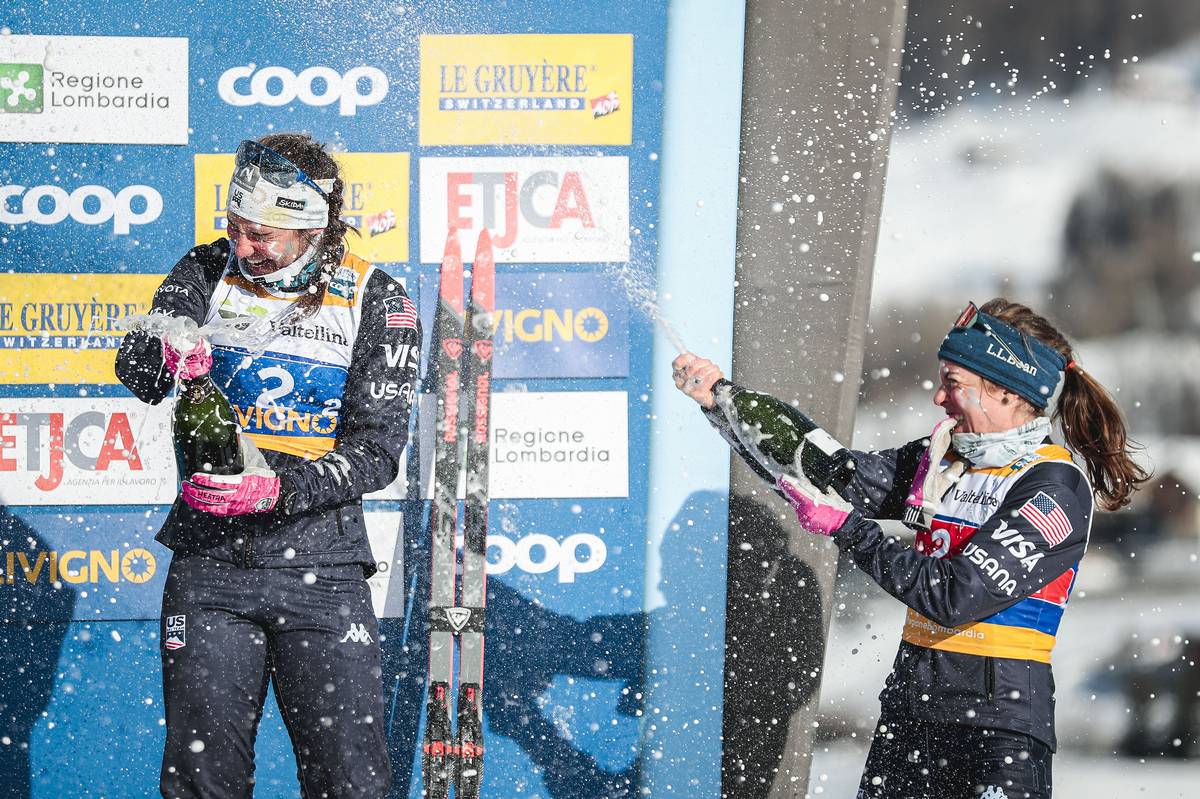
A champagne shower on the podium for Maja Dahlqvist (SWE). Her return to the top step after a four-year hiatus is definitely cause for celebration. (Photo: Vanzetta/NordicFocus)
Classic Sprint Final
Stenseth has not had many opportunities in World Cup Sprint finals, and she appeared determined not to waste this one. She pushed the pace from the start, followed closely by and Gimmler. But Stenseth’s inexperience only set the table for hungry, seasoned sprinters like Dahlqvist and Faehndrich who held their positions mid-race, and made moves on the short, punchy uphills to overtake and gap Stenseth. She would fade to fourth, as Dahlqvist surged to the victory ahead of Faehndrich and Gimmler.
It was an impressive return to the top of the podium for Dahlqvist who has spent the last few seasons being overshadowed by her own Swedish teammates. But with Sundling watching from home, with Johanna Hagstroem disqualified earlier in the competition (technique infractions), and with Svahn yet to return to full strength, Dahlqvist was more than capable of carrying the Swedish flag, and holding it high.
“It was about time,” Dahlqvist smiled. “It was a really good day for the waxers, and for me.”
When asked about her strategy in the Final, Dahlqvist grinned again. “Win, or die!”
It’s the most wonderful time of the year — or is it? The Tour de Ski has returned, but Devon has some beef with this year’s watered down format. Plus, recaps of the four races we’ve been through so far, including Jessie Diggins sprint win from heat five.
Send feedback, hate mail and love letters to devon@fasterskier.com. You can send love letters to nat@fasterskier.com. See you in a couple of days.
Johannes Høsflot Klæbo, in typically dominating fashion, anchored the Norwegians to a victory in the team sprint in a World Cup in Switzerland earlier this month. (Photo: Modica/NordicFocus)
In cross-country skiing, sprinting is a notoriously inconsistent discipline for a single competitor to dominate. The short distance leaves little time for racers to recover from even small mistakes; sharp corners and tight spaces often produce race-ending crashes.
Which makes the track record of Norway’s Johannes Høsflot Klæbo almost impossible to comprehend.
Klæbo, a five-time Olympic gold medalist, has won the last 10 straight sprint races he’s entered on the World Cup — the highest level of international competition. He often crosses the finish line far enough ahead of his rivals — if you can call them rivals — that he has time to unstrap his poles before crossing the finish line.
Klæbo, 28, has won five out of the six Olympic and World Championships sprints he’s contested, and 52 of his 69 sprint World Cup starts — missing the World Cup sprint podium just once since 2018, according to data from the International Ski Federation.
So: How do you beat this guy?
FasterSkier, when the World Cup made its swing through Canada and Minnesota last season, decided to pose that question to an array of the circuit’s athletes and coaches. We’ve put together a kind of brief oral history below, seeking to appropriately describe Klæbo’s supremacy and the best ideas about how to take him down.
Enjoy.
What kind of tactics would you use to beat Klæbo in a sprint?
Håvard Solås Taugbøl, a Norwegian World Cup racer and one of the nation’s (and globe’s) best sprinters: That’s the $1 million question. I have never managed to do it.
Swiss sprinter Valerio Grond: Maybe break his poles or something? I don’t know.
French sprinter Lucas Chanavat: I mean, if I had the answer, I would have won the last one. You just focus on yourself, do the best race you can. It’s about my strengths. I think you have to be really perfect on every move you do. That’s the fun part about competing with him. It’s, like, you have to be perfect. And that’s really motivating.
Lucas Chanavat of France alllllmost beat Klæbo at a World Cup sprint race in Switzerland last year. But he didn’t. (Photo: Modica/NordicFocus)
Sweden’s team manager, Anders Bystrom: I think, first of all, you have to mentally know that he’s not unbeatable. Because I think many people think so. He’s shown that he is almost unbeatable, so it’s fair that people think that. But we don’t talk about him like that.
Jonna Sundling, the Swedish Olympic champion from 2022 in the women’s sprint: I would go hard from the start, and don’t leave any power. Just go, all that I have. I don’t think I could take him in the final meters — he’s too quick for me. The men, maybe they’re scared sometimes — I don’t know, I think they can do more than what they think they can do. Maybe.
Maja Dahlqvist, a Swedish Olympic sprint medalist: I would try to sprint him down, like waiting til the end. But I guess a lot of people try to do that, and people are not so successful.
Grond: If he’s in his top shape, he’s almost unbeatable. He’s really, really always in a good spot. But when he’s maybe not in the best spot, you have to take advantage of this and put in an attack.
Canadian national team coach Robin McKeever: Break his pole?
Swedish sprinter Edvin Anger: I think we need to push him really hard, and take our chances. I don’t think I need to go hard early, but I think I need to have a good place. And when I take my chance, I really need to take my chance. And I need to push from the place in the track that I think is best for me. I can’t wait to see what he will do, because I need to do the thing first.
Norwegian sprinter Erik Valnes: How to beat Johannes in sprint is all about him being in bad shape. [Laughs] I think maybe it’s about the finish — or, to be able to have a good finish after a high-speed final. There are many things that have to be right to beat him. You just need to start the finishing sprint before him, and be ahead. Because as long as you’re behind him, you’re one step behind him in the mind games as well.
McKeever: I think the only way is by surprising him. And they’re trying.
What makes Klæbo so good at sprinting?
Chanavat: He’s strong in every aspect of the sprint race. He has, like, amazing turns, an amazing finishing sprint, he’s insane in stamina. He’s good at everything. He’s the GOAT [Greatest Of All Time].
Grond: He’s so good in every technique and part of the race, and also tactically. He’s simply the best skier in history.
Dahlqvist: He’s good in everything. He can go hard, he can wait, he can go from the start.
Norwegian distance specialist Simen Hegstad Krüger: He often likes to control the heat and he gets a lot of respect. And you have — I think there’s a lot of guys that think there’s no chance to beat him so they just give him room and then they give it away to him. He has earned the respect but especially in sprint you can’t give anything away and you have to take your place and take your positions. And I think he’s the best in that but I think sometimes he gets the best positions a little bit too easily.
Klæbo wins a Tour de Ski stage just ahead of his Norwegian teammate Erik Valnes. (Photo: Modica/NordicFocus)
Valnes: I’ve been angry with myself sometimes because of bad tactical decisions. Because many times I’ve just, in my unconsciousness — you think, ‘Just follow him, and you’ll get a good result.’ But then you will not get past him.
Bystrom: If you meet him in a heat, you almost adapt to what he’s doing. Because you have to see, ‘Okay, what’s Johannes going to do now?’ Because you know he has this X-factor in many parts of the course.
Does Klæbo have any weaknesses in sprinting?
Chanavat: You should probably ask him. That would be the best.
Klæbo: That’s going to be a secret. [chuckles] I don’t think I will tell everyone. I think I’ll keep that for myself and I’ll tell everyone when I’m done racing. That’s my answer.
Norwegian sprinter Even Northug: Maybe none.
Valnes: No. That’s the thing with him. He’s not having any weaknesses. You can say, like, maybe double-poling long flats. But he’s quite good there.
Krüger: Not that I’ve seen so far. Even in distance races, it’s not so many weaknesses to find.
French sprinter Jules Chappaz: I think running [uphill], like in Ruka [the Finnish ski resort that hosts the season-opening World Cup races each year]. First it was the ‘Klaebo run,’ but now I think I’m really good at it. Maybe, hopefully next year in Ruka, I can run faster, beat him. [He didn’t.] He is sick a lot of times — maybe that’s sort of his weakness.
Klæbo coasts to the win in Ruka this year, beating everyone, including Jules Chappaz. (Photo: Modica/NordicFocus)
Anger: It’s a hard question. But I think we need to push him and then make him a little stressed — that’s what I think.
Bystrom: Mayyyyyybe it’s skating without poles — using your legs to be able to, maybe, go past him. But it’s really hard to say. He’s the best. He’s shown that many times. He’s so good in so many areas. It’s hard to say there’s one where you could beat him when there’s 28 areas where you can’t beat him.
Are there ways athletes can train over the long-term, like over next summer or multiple seasons, to beat Klæbo?
Chappaz: Just trying to focus on ourselves. This spring, I will compete in the Ski Classics [marathon races] to improve my double poling. To look to the Olympics, 2026, with the Val di Femme finish — I hope it will improve my double poling skills, to [be able to] beat him.
Dahlqvist: Maybe they need another team like us, like the Swedish women, because you can use your team more. So, maybe a whole team needs to be stronger, to try to beat the Norwegian. They could do team tactics in a way, like everyone knows where they will go.
Anger: I’m still young — I’m just 21 years old. And he has a lot of training hours. A lot more than I have. With one or two years more, with good summers, also with a lot of hours, I think it will be better for me. And maybe I will be better in the final — I’m good in the quarters and the semis right now, but maybe I miss a little in the finals. I need to be a little harder and stronger.
Valnes, Klæbo and Anger pose for a podium photo after Klæbo won a World Cup sprint in Canada last year. (Photo: Modica/NordicFocus)
Grond: We’ve just got to work hard. It’s also about learning how to ski against the best skier, for me. So, I’m trying, also, to get some experience on how they ski and where I can be better than them.
Valnes: It’s more about improving the base level, the capacity, the VO2 max. If you have that base, from May until September, then you can build a little bit on that with specific training in October and November and just before the season starts.
McKeever: The reality is, how do you beat Klaebo? Have him age out a little bit.
Northug: Training.
Norwegian national team coach Eirik Myhr Nossum: You have to train, of course. But there were a lot of people training for the 100-meter dash, as well: Usain Bolt still won. So, if everybody in the world trains the best they can, still one will win — and it’s hard to beat Johannes. It’s possible, but he’s probably the best skier that’s ever been. And now it’s harder than ever, and he still wins.
This coverage is made possible through the generous support of Marty and Kathy Hall and A Hall Mark of Excellence Award. To learn more about A Hall Mark of Excellence Award, or to learn how you can support FasterSkier’s coverage, please contact info@fasterskier.com.
It was a special day for Johanna Hagstroem (SWE) as she notched her first individual World Cup victory. (Photo: NordicFocus)
Last year the theme for much of the women’s sprint season was whether anyone from team Sweden could defeat Kristine Stavaas Skistad (NOR). However, this year, things will be different, for at least a while. Sweden still presents an incredibly formidable team of Sprinters, with Emma Ribom, Johanna Hagstroem, Jonna Sundling, Linn Svahn, and Maja Dahlqvist headlining the Sprint roster and creating the most powerful women’s Sprint team in cross-country. But the rivalry with Skistad will have to wait as she is sidelined from abdominal surgery, and a date for her return to racing is uncertain. So, the duel between Sweden and Skistad is delayed for now with no one knowing what Skistad’s form will be like when she returns. Expectations for today’s Sprint were further complicated when Sweden lost some of its firepower early in the day when Emma Ribom withdrew before the start of the heats after having qualified 18th.
Jessie Diggins (USA) looked good early in her heat, but couldn’t keep up with the pace. (Photo: NordicFocus)
The bad luck for Norway and Sweden created an opening for other teams which America’s Jessie Diggins, Rosie Brennan, and Julia Kern would have loved to fill. But it was a tough day for the American women with only two qualifying for the heats with Diggins qualifying in 27th and Brennan in 28th.
The first day of Sprinting is a big of an adjustment. “What is different is the technique on snow,” said Diggins. “I think that becomes one of the biggest things. At this point I’ve had maybe 10-12 hours of Classic skiing on snow. Ruka especially is a course that is super technically demanding … that’s the thing that’s hardest to get used to because it’s so different than roller skiing. You have to do pretty specific motions in order to close down your skis and kick.” She continued that, “I am pretty much where I normally am this point of the year. I really like to work into the year and I really like to work into my fitness, and so right now, I’m not super sharp, and that’s ok. I don’t expect to be. I’m not at all surprised by where I am right now. I think the base fitness is fine and the sharpening will come later. ”
Instead, it was the hometown favorites from Finland who took advantage of the opening day change of pace and qualified seven racers and raised the hometown hopes for a Finnish woman to be standing on the podium at the end of the day. The Finnish onslaught was noted by Brennan. “It seems the Finns were flying this morning. I think they had some incredibly good skis, and that’s really cool to see. It’s been a little while since they’ve had a super-super strong team, so that’s awesome, and it was really great to see. Homefield advantage is always fun.”
In the end form was maintained, but with different characters playing key roles as Sweden yet again found a way to the top of the podium with Johanna Hagstroem taking her first World Cup individual victory. But there was renewed optimism in the Norwegian camp as Norway found a new hope in Sprinting with Julie Myhre coming in second, Maja Dahlqvist (SWE) finished third.
Other American racers were Julia Kern in 41st, Renae Anderson 42nd, Erin Bianco 43rd, Alayna Sonnesyn 44th, and Lauren Jortberg 48th.
Kern was happy to just be in Ruka given the back injury she’s been fighting. “Qualifying is always really challenging here and I’ve never really had much buffer room. I’m proud of how I skied. I’m just really psyched to be at the start line right now. “Kern revealed that since her back injury, “it has been just a battle to be able to ski and train, and do everyday things. So, I’m happy to be at the start, and obviously wanting a lot more. “She acknowledged that she is uncertain about her fitness. “I always race into form, especially given a disruptive fall of training. Ruka is such a special beast … and from the first to second weekends, things can change a lot.”
The only Canadian competitor today was Katherine Stewart-Jones: she finished 45th.
Ruka is a technical and physically challenging course with a large hill close to the finish which usually plays an outsized role in determining the winners. At least today, the skiers wouldn’t have to contend with the difficult at freezing waxing conditions they faced yesterday, as today’s temperatures were in the mid-teens at the start of the competition.
The Quarterfinals
Rosie Brennan (USA), pictured qualifying, had a golden opportunity in her heat when three skiers went off course. (Photo: NordicFocus)
Rosie Brennan (USA) was in the second heat and would face the Sprint champion from last year Linn Svahn, and the formidable Victoria Carl (GER). Brennan was boxed out early at the start and was pushed toward the back of the pack immediately. But in the blink of an eye, she was catapulted into third place when the three leading skiers tangled in the first turn, including pre-race favorite, and last year’s Sprint champion Linn Svahn, and went crashing off the course. Suddenly the race was down to three skiers. Brennan immediately took advantage going to the front of the remaining pack of three. But she couldn’t hold that lead going up the final hill and ended up battling for second with Carl. Carl was able to glide away from Brennan going into the stadium finishing second with Anne Kyllonen (FIN) winning the heat. Brennan finished third. Her time was not fast enough to qualify as a lucky loser and after only the second heat, her day would end. “It was definitely scary to watch those three girls said Brennan.” She added that, “I saw Linn take flight and I was quite worried that they were severely hurt so I had a moment of wondering whether I should stop or not because people’s safety is more important than a ski race.” She then decided to push the pace as much as she could. “Not for any other reason than just wanting to continue to open up my body and make a hard effort and maybe take some sprint out of somebody, because I know I don’t have the speed that I want right now.”
Jessie Diggins (USA) was unable to move past the quarter-finals. (Photo: NordicFocus)
Jessie Diggins was in the fourth heat. It was in a very competitive field with Nadine Faehndrich (SUI), Laura Gimmler (GER), Katharina Hennig (GER) and Frida Karlsson (FIN) in the field. The field stayed together early with Diggins looking to have quick skis as she had to stand up early on to avoid running up on her competitors. The group stayed together up the first challenging hill with Diggins keeping an outside line. Faehndrich then pushed to the lead with Diggins up toward the front of the pack. Going into the start of the final hill all the skiers were still grouped together as the final charge began. But Diggins couldn’t keep up with the pace and was pushed off the back. She dropped back even more toward the end of the race and finished sixth. Her day was also over. She attributed her inability to keep pace as being, “a technique and ski decision thing on the final hill.” She continued that, “I made the mistake of not asking for extra kick, I had tested my skis and I thought I was in a good place with them, but in hindsight I needed more kick.” Diggins said that the lack of kick caused her to ski “hesitantly, tiptoeing up the hills to not slip.” Diggins took full responsibility for the lack of kick wax. “That’s on me. It’s important for me to communicate with my tech. I own the fact that I thought I had enough kick, and I was wrong with that.”
Norway has new hope in Sprinting with Julie Myhre (NOR) coming in second. (Photo: NordicFocus)
The Semi Finals
Jasmi Joensuu (FIN) continued to keep Finnish hopes alive as she took off to an early lead, but racers quickly consolidated and they were one big pack going into the first hill in what quickly turned into a very tactical race. Sundling was able to put in a last second sprint to take the win along with Dahlquist who finished second. Joensuu hung on for third and would keep Finnish hopes alive by advancing to the finals. But so far, the Swedes had been able to overcome the Finn’s numeric advantage and were beginning to assert themselves.
Finland’s Sprint hopes were riding on Jasmi Joensuu (FIN), (far left), but ultimately Finnish fans would go home empty handed. (Photo: NordicFocus)
In the second heat it was an unusual position for Johanna Hagstroem as she was the only Swedish skier. But the lack of teammates didn’t deter her. Going into the final hill Hagstroem displayed a preview of what fans would see in the finals and put in a huge burst of speed to shoot to the front. All day long, Hagstroem looked like she had something extra to offer on the big final hill and she worked her advantage perfectly throughout the heats. Her only mistake was slowing up too much coming into the finish line where she was joined by Coletta Rydzek (GER) in what became a photo-finish. But Hagstroem was still able to eke out the win.
The Finals
Sweden fielded three skiers in the finals with Sundling, Dahlqvist, and Hagstroem qualifying. After its initial surge of qualifying seven skiers, Finland was down to only one skier remaining; Jasmi Joensuu. She joined Norway’s Julie Myhre, and Rydzek.
The emotion of Johanna Hagstroem’s (SWE) first win was showing during and after the race. (Photo: NordicFocus)
The Swedish trio went to the front early with Rydzek gamely hanging with them. Things again turned very tactical with all the skiers slowing down on the first climb with no racer wanting to lead. It wasn’t until the big hill at the final that things opened with Hagstroem putting in another incredible burst which ultimately catapulted her to victory.
It was a special day for Hagstroem as she took the victory which was the first win of her career. Julie Myhre (NOR) hung on for second with Dahlqvist finishing third. Myhre’s podium had to provide team Norway with some level of solace giving them hope that someone would step up in Skistad’s absence.
After the race Hagstroem said that, “I cant believe it. It feels crazy.” She continued that “I had a really good day. I like Ruka and love the last hill.” She explained that as part of her strategy she likes to go outside of the track and run on her skis. “I kept thinking don’t screw it up. I’m in shock.”
The incredible promise of the beginning of the day for the Finns turned sour when after qualifying seven racers, none of them could make it to the podium.
It was also a rough day for team USA who will hope to rebound next weekend in Lillehammer, Norway when the Sprints will be in the Freestyle technique and hopefully their fortunes will improve.
Johanna Hagstroem (SWE) – FIS world cup cross-country, individual sprint, Ruka (FIN). (Photo: NordicFocus)
The three Norwegian podium finishers sport their new cowboy hats Sunday. From left: Johannes Hoesflot Klaebo, Paal Golberg and Mattis Stenshagen. (Photo: NordicFocus)
CANMORE, Alberta: We’re three days into a six-race series of World Cup racing in North America and I’m just one guy, which means there hasn’t been time to share all the fun little stories and subplots that have been filling my notebook.
I’m summarizing a few of the better ones here. Stay tuned for more notes and some feature stories after Tuesday’s final race in Canmore. If you have ideas for stories, tips or feedback for us, drop us a line at info@fasterskier.com.
Canmore mayor says thanks but no thanks to nearly-naked Krüger
Canmore is situated in the spectacular Canadian Rockies, but Alberta’s prairies start just down the highway to the east, and the events here celebrate the province’s cowboy culture with branded 10-gallon hats awarded to the podium finishers.
Simen Hegstad Krüger of Norway won the first men’s race in Canmore in spectacular fashion Friday, and swiftly proceeded to defile the prize: In an Instagram post from the Norwegian team’s account later that day, he posed for a photo, naked, with only the cowboy hat preserving the image’s PG rating.
This post from the Norwegian team needs no explanation.
“Dear Mayor Sean Krausert,” the post said, tagging the mayor of Canmore. “There is no need for you to come to work on Monday. This guy rules your city until he leaves on Tuesday. Have a good and peaceful long weekend.”
The next day, the post had been deleted. But after Norway swept the podium in Sunday’s men’s race, they published a new photoshopped image with five team members all posing naked with tastefully-placed hats and another offer that Krausert and his staff could have “two more days off, if you want.”
Reached Sunday, Krausert said he was not aware of the posts, then, after I sent them to him, responded with a laugh-crying emoji.
“Really…what can I say!!” he said. I said that he could, in fact, say whatever he wanted, to which he responded: “While I appreciate the offer, I’ll be at work on Monday so these incredible athletes can focus on skiing and enjoying Canmore.”
Krüger said the idea for the original post came from his teammate Didrik Tønseth. “We had some fun about it, but then I figured in the morning that it is enough — maybe we can take it down,” he said, adding that no one instructed him to remove it.
Tønseth told me, cheekily, that the Norwegian men had been failed by their “back-up crew, back in Norway,” which includes their “oldest and wisest” teammate, Sjur Røthe. The crew, Tønseth explained, is supposed to review all posts from the team’s Instagram account but didn’t because of the eight-hour time difference between Alberta and Europe.
“It’s a lot of things we post that stop in the committee back in Norway,” Tønseth said. “Sjur is the athlete representative, but he was asleep, so it was his mistake, I think. Not ours.”
Unfortunately for Røthe, it was too late in Norway for me to reach him for comment.
A car crash derailed Jortberg last month. She’s back now.
U.S. skier Lauren Jortberg is racing in Canmore just two weeks after a crash that left her with “pretty bad” whiplash and totaled the car she was driving — and she nonetheless placed 19th in Saturday’s skate sprint.
“Honestly, I think it was for the better, looking back on it,” she said after the sprint. “I was having kind of a tough season and kind of just needed to have a little gratitude for life and everything — and have a scary situation that makes you appreciate everything more.”
Lauren Jortberg racing earlier this year. (Photo: Nordic Focus)
She added: “I wouldn’t recommend it, definitely. But it definitely gave me some perspective that skiing isn’t everything.”
Jortberg, who races with the SMS T2 team in Vermont, said she was leaving a race in Craftsbury late last month and was driving on a dirt road in freezing rain when she had a head-on collision. Her car had gotten caught in a rut while she was driving around a turn.
“It was pretty traumatic and scary,” she said.
An ambulance came to the scene, and while Jortberg didn’t go to the hospital, she said she was suffering some “pretty bad symptoms” that stopped her from training for the next week.
“But I feel a lot better now,” she said. “And we have a great staff here, and they’re really taking care of me.”
Skistad fans the flames of a feud that…may not actually be much of a feud
One of the fun ongoing subplots of the past year of racing on the World Cup has been the up-and-coming Norwegian sprinter, Kristine Stavås Skistad, poking at her Swedish rivals.
Skistad, 25, has been the only woman to consistently puncture the dominance of the Swedish sprinters, who often put as many as three or four women in the six-person final heats on the World Cup. And when she wins, she seems to relish rubbing it in — or trying to, anyway.
Skistad’s ski-related snark appears to date back several years: An informed observer pointed me toward this objectively hilarious Instagram photo she posted from the World Junior Ski Championships in Finland five years ago. In it, Skistad smiles as she wins a gold medal in the sprint, while a clearly enraged Frida Karlsson of Sweden, who’s now a superstar on the World Cup, appears poised to smash her ski pole into the snow. “No caption needed,” Skistad wrote.
No caption needed.
In Saturday’s skate sprint, Skistad delivered not just a win but also another provocative gesture—a kiss, blown in the direction of the three Swedes who finished directly behind her.
The Scandinavian media is delighting in what appears to be a budding rivalry: On Saturday, a Swedish television channel that was covering the Canmore races played a clip that analogized Skistad to a villainous character from the horror film “The Ring.”
The Swedes themselves, however, appear generally unperturbed.
“I feel like she sees us more like a rival than we really see her,” Maja Dahlqvist, one of the Swedish sprinters, told me. “We’re kind of friendly to her, and I think that maybe annoys her more. It doesn’t affect us at all—it’s not anger.”
Johanna Hagström, another Swedish sprinter, said it’s a “little bit annoying” that Skistad is such a strong finisher. But she said the team’s read on Skistad is that she’s actually “really shy.”
“She doesn’t speak that much—but on social media, she’s very cocky,” Hagström said. She added: “It’s really fun that she’s doing it. But I would never do that.”
Hagström said she also thinks it’s good for the Swedish women to have other strong sprinters to compete against, and to give them motivation for summer training.
Diggins works on saying ‘no’
Nearly 30,000 tickets have been distributed for next weekend’s World Cup races in Minneapolis, which is setting up to be something of a homecoming celebration for Jessie Diggins, the U.S. star who grew up in Minnesota.
Diggins is adored by fans, but the attention on her is making for an “exceedingly high” level of intensity and pressure, she told reporters after Friday’s race.
“There’s a lot going on in my life right now. That’s the magic of having races at home is, it’s something you wanted and something I have worked for and advocated for for six years,” she said. “But at the same time, it comes with a lot of pressure and a lot of expectations and a lot of obligations for my time.”
She added: “But that’s something I’m trying to role model well, for not just me but my teammates — like, it’s okay to be able to focus on your race, it’s okay to say no to things.”
Saying no to things, however, is not always easy, she said.
“It’s exceedingly difficult, and I struggle with it,” she said. “That’s something that I have to keep reminding myself is, I can’t do everything. Can’t possibly do it—it’s not possible. So we’re going to pick and choose, and kind of shoot for the happy medium.”
I ended the interview by cheerfully pointing out that the Devon Kershaw Show, the FasterSkier podcast, is “ready for a yes” any time.
Breakout Austrian star on doping doubts: “I get it.”
Austrian racer Mika Vermeulen has been having a breakout season, and earned his first podium finish in Friday’s distance race.
But Austrian cross-country racers have been implicated in doping scandals multiple times — most recently during the World Championships in Austria in 2019, where one of the country’s athletes was caught in the middle of a blood transfusion.
Mika Vermeulen races Friday. (Photo: NordicFocus)
Vermeulen was not implicated in that scandal and no evidence has ever emerged to cast doubt on his own performances. But I’d heard him bring up the subject on his own podcast previously, and also heard from one person in Canmore who had doubts about Vermeulen’s results.
So I asked him, gently, what he wants people to think when he performs well, in light of the Austrian team’s history.
“With all the shit that’s been happening on our team, and the last few years, yeah, I get it,” he said. “But the only thing I can do is keep on being good, being on my level. And I can tell you I’m not going to be caught, because I don’t do anything.”
He added: “That’s the only thing I can do: Be on the level not just once but many and many times. And I just keep telling people I believe in myself, and I invite everyone to believe me.”
We’re back, in less than 24 hours since hour last pod. Devon is burning the midnight oil in Norway to bring you this new episode recapping the excellent sprint races in Canmore today. Stay tuned for another episode after tomorrow’s race and a bonus episode where Nat will interview Sweden’s William Poromaa.
Email us at devon@fasterskier.com and nat@fasterskier.com with questions, comments and race predictions. We’ll be back.
Goms! These races, in Switzerland, were unambiguously awesome. Wipeouts, sun, fondue, North American podiums and breakout performances. And an Alaskan guest who watched the races firsthand.
We really went above and beyond the call of duty this week — we’ve got sounds from the side of the trail and even a profanity-laced tirade from Devon if you stick it out to the end of the show. We’ll be on scene at the next round of World Cups, which are in a couple of weeks in Canmore, Alberta.
A sincere thank you to everyone who’s generously pitched in to support us over the past few weeks. Email us at devon@fasterskier.com and nat@fasterskier.com. We’ll be back soon.
A couple of years ago, Swedish Olympic medalist cross-country skier Maja Dahlqvist matched with U.S. sprinter Kevin Bolger on Tinder. They’ve since become one of their sport’s highest-profile couples.
The two of them, during an altitude camp in Utah last month, joined Nat for a joint interview.
We’ll be back as the World Cup season kicks off in a few weeks. Send your questions, comments and hate mail to devon@fasterskier.com and nat@fasterskier.com.
Johannes Klæbo, Kevin Bolger and Maja Dahlqvist rollerski through downtown Park City together during their respective altitude camps last month. (Nathaniel Herz/FasterSkier)
This World Cup coverage is made possible through the generous support of Marty and Kathy Hall and A Hall Mark of Excellence Award. To learn more about A Hall Mark of Excellence Award, or to learn how you can support FasterSkier’s coverage, please contact info@fasterskier.com.
After Maja Dahlqvist (SWE) qualified third in Saturday’s classic sprint, the tension rose to a fever pitch. With ten bonus points earned, Dahlqvist had cut the Sprint Crystal Globe gap between herself and Nadine Faehndrich (SUI) in half. After five months of racing, the two sprint rivals were separated by just 12 points. The statisticians sharpened their pencils.
In remarks to FIS media before the decisive heats kicked off, Dahlqvist said she “had nothing to lose” in chasing Faehndrich. “Maybe,” she added, “my teammates can help me.”
In skiing, an individual’s relationship to a greater team is often cited. On the final day of the World Cup Sprint season, though, a self-sacrificing action converted teamwork into literal World Cup points, and a Crystal Globe . . . thanks to the selfless actions of Dahlqvist’s teammate, Moa Ilar (SWE).
Moa Ilar (SWE) sacrificed her quarterfinal race to save her teammate Maja Dahlqvist’s (SWE) shot at securing the Sprint Crystal Globe. Dahlqvist seized the chance, winning her second Sprint title with a fourth place finish in Lahti, Finland. (Photo: NordicFocus)
As Dahlqvist wound through the course in her quarterfinal, she was followed by her teammate, Ilar. The Lahti course offered a long-climb with a one-hundred eighty degree turn on the way up, and a one-hundred eighty degree turn on the way down. Dahlqvist had led all the way through, but the pack was tight with Ilar following the whole way. Ane Appelkvist Stenseth (NOR) had followed too, with Katharina Hennig (GER) fighting back to the front. On the final downhill, Hennig glided and glided until she was right up on Dahlqvist. Then, in an instant, she moved her ski and caught Dahlqvist’s pole. It was a clean break, and with it went Dahlqvist’s prospects for advancing. Continuing gamely—with only one pole— Dahlqvist sprinted as well as she could, but her chances of advancing faded with each single pole plant. That was until on the final stretch, when another skier vying for a bid to the semifinals noticed Dahlqvist’s plight. Moa Ilar looked over, seemed to do a quick calculation of what was at stake for Dahlqvist, and stood up to allow her teammate to finish ahead of her. Selflessness, generosity, nobility: Ilar had sacrificed her own race, and kept Dahlqvist’s season alive.
Battle for the Crystal Globe
Dahlqvist would have a chance. But first, Nadine Faehndrich was performing heroics of her own. In a quarterfinal where Tiril Udnes Weng (NOR) and Jessie Diggins (USA) were embroiled in their own pitched battle for the Overall World Cup, the Swiss skier hung on through every pace increase and shot through the pack in a sprint to earn a place in the semifinals.
The long road that began in Ruka last fall ultimately led to Lahti this spring. The second semifinal featured both Dahlqvist and Faendrich, head-to-head. Dahlqvist finished the heat second ahead of Faehndrich in fourth. Dahlqvist was into the Finals, and Faehndrich was out. A quick set of calculations revealed that Dahlqvist needed to finish no worse than fifth in order to claim the season-long Sprint crown. When Dahlqvist finished the day in fourth place, she knew that her performance would bring smiles, celebrations, and a Crystal Globe.
Maja Dahlqvist (SWE) overcame a 22 point gap to secure her second Sprint Crystal Globe on Saturday. (Photo: NordicFocus)
Women’s Classic Sprint
The conclusion of the World Cup Sprint chase captured the spotlight all day, but the continuing rivalry of Kristine Stavaas Skistad (NOR) and Jonna Sundling (SWE) would be played out at the finish line. In the Final, Sundling produced a burst of speed early on the course’s biggest climb. As the race wound into the stadium, though, Skistad was back in the picture, reeling in the Swedish World Champion. In the finishing straightaway, Skistad shot around the outside, unleashing a finishing double-pole that had brought her victory at the last four World Cup sprints, and did so again today. Skistad first, Sundling second, and Tiril Udnes Weng (NOR) adding to her remarkable season in third.
Kristine Stavaas Skistad (NOR) and Jonna Sundling (SWE) continued their streak at the top of the sprint field, with Skistad winning her fifth straight World Cup Sprint. (Photo: NordicFocus)
In the finishing area, the Swedes all embraced each other as champions. In that final embrace, a season in which the Swedish team had demonstrated their preeminence over the World Cup sprint field found its fitting ending. The one Norwegian among them, Skistad, had secured a conclusion which added emphasis. She will put her skis on the start line of the Ruka sprint course next November having not lost a World Cup sprint in 2023. Jonna Sundling, the only other winner in a sprint this year- the World Championships no less – will be there too. After three consecutive weeks of exciting sprint duels, the duo have established a choreography that all ski fans will look forward to revisiting when the snow falls again.
Julia Kern (USA) secured her career-best seventh place in the World Cup Sprint standings after Saturday’s race. (Photo: NordicFocus)
USA Qualifies Three: Julia Kern Finishes Season in Top 10
The Americans qualified three for heats today, with Jessie Diggins, Julia Kern, and Rosie Brennan all taking the starting line in different quarterfinals.
Kern took the line in the first quarterfinal, alongside Skistad and Emma Ribom (SWE). Ribom was the heat’s main mover, pushing the pace as the field hit the steep climb. Skistad made her way back to Ribom, while Kern pushed from the back of the pack to put herself firmly in the race. The American faded slightly in the stadium, but managed to maintain her position in third place (a lucky loser spot until Laura Gimmler (GER) and Jasmi Joensuu (FIN) bested her in the next heat).
“I knew I had more in me after the qualifier. I felt ok in my heats, nothing went wrong, nothing was really amazing, but I gave it what I had, and I’m proud of how I finished strong.” said Kern in post-race comments.
Rosie Brennan ended up sixth in a hard–charging heat that produced the other lucky loser. While Jessie Diggins, skiing in the fifth quarterfinal alongside Weng and Faehndrich came out in fourth place.
Diggins saw positive signs on Saturday for what might be ahead tomorrow, saying post-race that, “it’s fun to feel like I’ve had decent energy at the end of the year. When it comes down to the end of the season, what you have is what you have.”
With the Sprint World Cup concluded, Julia Kern has officially secured her career-best position in the season-long sprint standings. Kern finished seventh, improving upon her eighth place finish in last year’s campaign.
Jessie Diggins (USA) is all smiles headed into the World Cup season finale tomorrow. Diggins sits second place in the Distance classification, 22 points separating her from Kerttu Niskanen (FIN). (Photo: NordicFocus)
Distance Classification Finale
With her podium today, Weng wrapped up the World Cup Overall. The Norwegian sits 154 points ahead of Diggins who holds a firm grasp on second place Overall, 99 points ahead of third place Kertuu Niskanen (FIN). Those skiers will still be the main focal point of tomorrow’s 20 k Classic World Cup finale.
In the Distance classification, Niskanen holds a 22 point lead over Diggins. Further down the standings, Brennan sits just 4 points ahead of Heidi Weng (NOR) for fourth place in the Distance classification, vying to make it a second time in three seasons that the American duo of Diggins and Brennan have both finished top five.
Sunday, then, will be another race for the number-crunchers. Context for what that means in terms of excitement? Look no further than Saturday’s race. The gap that Maja Dahlqvist overcame to win the Sprint Crystal Globe; 22 points. Jessie Diggins’ deficit to Kertuu Niskanen heading into tomorrow; 22 points.
Holy smokes, that was an epic weekend of racing. Devon and Nat are joined by Tony Cyr, the breakout Canadian star, and a mystery guest drops in later on in the episode.
We break down the sprint and two distance races held at the festive French venue in Les Rousses. And we promise, we’ll get you a mailbag episode before World Championships starts in a few weeks. Get at us at devon@fasterskier.com and nat@fasterskier.com.
Canadian Tony Cyr skis in front of Norway’s Martin Loewstroem Nyenget at last weekend’s World Cup in Les Rousses, France. (Photo: NordicFocus).
It’s been a couple weeks since you last heard from us. The World Cup and the Devon Kershaw Show are back from a hiatus with a recap of the high altitude sprint weekend in Livigno.
Devon and Nat break down the individual and team sprints from the Italian Alps, including some strong American performances. We’re still planning a mailbag episode in the not-too-distant future, so keep those questions coming: devon@fasterskier.com and nat@fasterskier.com. We’ll be back soon.
Americans Julia Kern and Rosie Brennan celebrate after a 3rd place finish in Sunday’s team sprint. (Photo: Nordic Focus).
A rivalry renewed: Johannes Hoesflot Klaebo (NOR) and Federico Pellegrino ((ITA) at the finish line of the 2023 Tour de Ski Stage 1 Sprint in Val Mustair, Switzerland. Klaebo would finish first, with Pellegrino second. (Photo: NordicFocus)
The FIS World Cup tour returned from a two-week holiday break, reconvening in Val Mustair, Switzerland for Stage 1 of the 17th Tour de Ski. A daunting mid-season challenge, the Tour de Ski (TDS) consists of seven stages contested over nine exhausting days, concluding next Sunday atop the Alpe di Cermis in Val di Fiemme, Italy.
At the start of this year’s tour, all eyes were on Johannes Hoesflot Klaebo (NOR), who finds himself in a prolonged battle for FIS World Cup points with Norwegian countryman, Paal Golberg. The Overall Crystal Globe competition is likely to be decided by their performances in the Tour de Ski, and today’s Freestyle Sprint stage may have been a taste of coming attractions. Showing speed and tactics that his rivals could not match, Klaebo coasted to the win in Val Mustair, followed by Federico Pellegrino (ITA) and Sindre Bjoernstad Skar (NOR).
Americans experienced results both good and bad: Ben Ogden qualified a remarkable 4th, but would suffer a broken pole at the very start of his quarterfinal and finish the day in 13th. JC Schoonmaker was the 21st qualifier, but would finish 6th in his quarterfinal and settle for 26th on the day. American results in qualifying also included Gus Schumaker 50th, Zak Ketterson 59th, Finn O’Connell 67th, Kevin Bolger 74th, Hunter Wonders, 80th, Scott Patterson, 94th.
Ogden offered an in-depth description of that broken pole, and the psychological process of re-grouping during a sprint race: “Today when I broke that early pole all I was thinking was how to catch up. I knew that my strength was in the flatter V2 before the steep climb, so I really just pinned it immediately after getting a new pole and surprised myself with how quickly I could get back to where I wanted to be amongst the other guys. My brain then went pretty quickly to damage control as I tried to evaluate how much energy I had used there. I was lucky to be feeling strong today and it didn’t really affect me too much. I think I was a little flustered and not exactly where I needed to be in the last minute or so, so that cost me a spot in the semi final, but I know that this could have happened regardless of the pole incident. It can be nice for the head to blame it on the pole, but overall it was just another learning experience out there and hopefully next time I can be in a better position and get through.”
Canadian Graham Ritchie qualified 14th, ultimately finishing the day in 21st, ahead of countrymen Antoine Cyr 32nd, Russell Kennedy 33rd, Olivier Léveillé 55th, Sam Hendry 85th, and Remi Drolet 91st.
Nadine Faehndrich (SUI) celebrates her Stage 1 win in Tour de Ski, 2023. (Photo: NordicFocus)
In the Women’s field, the Stage 1 Sprint seemed most likely to be won by a sprint specialist while TDS contenders vied for finishing positions that would place them near the head of the field in Sunday’s 10 k Pursuit. The day played out much that way (though with a few surprising developments) as World Cup Sprint Leader, Nadine Faehndrich (SUI), took the win, followed by Maja Dahlqvist (SWE), and Lotta Udnes Weng (NOR).
Julia Kern (USA) raced to 6th in sprint qualifying, but saw her day ended by a fall in the semifinal. She would finish the day in 11th. (Photo: NordicFocus)
Julia Kern (qualifying 6th) and Rosie Brennan (qualifying 14th) would’ve had high hopes for the day, but Kern tumbled in a rutted corner to finish sixth in her semifinal (finishing 11th on the day), while Brennan faded in her quarterfinal and failed to advance, ending the day in 14th. Other American qualifying places included Alayna Sonnesyn 38th, and Sophia Laukli 69th.
Among Canadians in qualifying, Katherine Stewart-Jones finished 48th, followed by Dahria Beatty 56th, and Lillian Gagnon 66th.
Naturally, the surprising story in qualifying was the performance of Jessie Diggins, whose qualifying time was only fast enough for 40th place (failing to qualify for the quarterfinal heats). Via her Facebook account, Diggins later commented on her own performance, saying, “Sometimes your body feels great and your brain is ready and it just doesn’t work out—and that’s ok. The only things that’s not ok is to give up.” That’s quintessential Diggins. She will enter Stage 2 in a position well behind her main rivals, but with racing abilities like those Diggins has so often shown, her chances to contend for the overall TDS crown are likely to improve with each passing kilometer.
TDS Women’s Freestyle Sprint
Sprint Quarterfinals are sometimes treated as a bit of an afterthought in typical race reporting, but in Val Mustair, much of the action that’s likely to affect the week’s results occurred in the quarterfinals. Sweden’s Frida Karlsson—a serious contender for the TDS crown—advanced out of a fast quarterfinal in which she drove the pace. That speed in Karlsson’s heat—and a high-quality field in the second quarterfinal—forced Kern to employ a different strategy than she might normally undertake, leading out the first lap ahead of L. Weng and Dahlqvist. The strategy seemed to be working, as Kern distanced Dahlqvist on the uphill. Even so, Dahlqvist showed her class by attacking over the top, and scorching the downhill to win the heat. Kern held on for second, narrowly ahead of L. Weng in third (who would claim a lucky loser spot).
Brennan dangled off the back of the pack at the start of quarterfinal 5, but worked her way back through the field at the end of lap one. Looking for space to pass, she took a very wide line up the hill, advancing two places into third, a position she was unable to improve before the finish. Her finishing time was not fast enough to claim a lucky loser spot. Brennan would end the day in 11th.
Nadine Faehndrich (SUI) speeding to victory in the 2023 Tour de Ski Stage 1 Freestyle Sprint. (Photo: NordicFocus)
Throughout the heats, Faehndrich continued dancing up the hill, showing a top speed that none of the others possessed. L. Weng and Karlsson claimed lucky loser spots in their semifinal, which could prove to be truly significant in the week long tour standings.
The sprint final included Karlsson, Maja Dahlquist (SWE), L. Weng, T. Weng, Faehndrich, and World Cup distance leader Anne Kjersti Kalvaa (NOR). Having already shown that she is the fastest skier on the Val Mustair course, Faehndrich went straight to the lead, immediately gapping the field on the first hill. She navigated the subsequent downhill poorly, allowing the field to reel her in as they passed through the stadium at the end of lap 1. But the second time up the hill was a replay of the first, with Faehndrich’s higher tempo allowing her to gap the field and stay away through the finish. Dahlqvist surged in the finishing straight to push L. Weng down into third.
With the Women’s Stage 1 Sprint concluded, the TDS overall contenders are now identifiable: T. Weng, L. Weng, Kalvaa, and Karlsson . . . with Americans Diggins and Brennan poised to strike. Faehndrich has now won consecutive World Cup sprint events in her home country and in front of Swiss fans. “At the moment, it’s like a dream,” she said.
Klaebo (NOR, in third position) sets up the turn wide, carrying more speed and avoiding ruts that troubled other racers. (Photo: NordicFocus)
TDS Men’s Freestyle Sprint
The Val Mustair sprint venue consists of a two lap course with a significant mid-lap uphill, followed by a challenging, S-turn downhill that empties into the finishing straightaway. It was those S-turns that would prove significant in the day’s strategy, and in the mastery Klaebo displayed in his course management. His choice to set up the turns far wider than his rivals (carrying far more speed and avoiding ruts that worried so many racers) was key to his cruising to ultimate victory.
Klaebo may be the world’s premier sprinter; nonetheless, he found himself overtaken in the finishing stretch two weekends ago by his longtime rival, Federico Pellegrino (ITA) who appears to be drawing much positive energy from the recent birth of his first child. Always one who seems to ski and race with joy, Pellegrino is riding a wave of optimism and success that saw him challenging Klaebo in the Stage 1 Sprint at Val Mustair. The stage was set for an excellent Sprint competition.
As in the women’s sprints, the Men’s quarterfinals offered insight into the way the day would go, and demonstrated the ease and confidence with which Klaebo seemingly races. Boxed out on the uphill where he would usually make his move (and caught behind a stumbling Chanavat who stepped on his own pole, but managed to recover), Klaebo bided his time, then incorporated an entirely different line on the curving final downhill. He set up the turn so wide that it looked as if he was exiting the race course . . . only to re-set on the second half of the S, rocketing past all other racers. He entered the finishing straight with a commanding lead that he would hold easily through the finish.
The day’s second quarterfinal also proved significant, as Ogden—the fourth qualifier—suffered a broken pole in just the first few meters of racing. Coaches were on hand to deliver a quick replacement, but Ogden would spend a great deal of energy clawing his way back to the field before the first climb. Continuing to improve with each passing week, Ogden’s form may be at a career high point, but the effort of chasing no doubt depleted his finishing sprint, and Ogden would fail to advance out of his quarterfinal, finishing the day in 13th.
Reached for comment after his day of racing, Ogden offered a new American perspective on his expectations—and occasional frustrations—in World Cup racing. “There are minutes and hours after these races where all you can think about is what could have been,” he said. “But then when you take a step back it’s easy to put things into perspective and remember that it wasn’t more than two years ago when skiing in a world cup heat was a reach-goal of mine. So, the bottom line is at the moment, yes, immensely frustrating but in the big picture, I am happy with where I’m at as an athlete, and I’m stoked for every opportunity over here. ”
Klaebo’s semifinal included Chanavat, Renaud Jay (FRA), Sindre Bjoernstad Skar (NOR), and Pellegrino. Despite that gathering of stars, Klaebo advanced easily, employing his wide-turn strategy and coasting to the finish line. Pellegrino came second, with Chanavat and Skar advancing as lucky losers. A sprint final showdown between Klaebo and Golberg was not to materialize, as Golberg appeared a bit fatigued—or even a bit disinterested—in his semifinal, allowing Michal Novak (CZE) and Richard Jouve (FRA) to advance.
Sprint dominance on display: Klaebo (NOR) speeds to the win in Val Mustair. (Photo: NordicFocus)
The problem to solve in every World Cup sprint final remains the same: what to do about Klaebo? He has tremendous speed, he’s tactically brilliant, and he’s supremely confident. Perhaps the only strategy is to try to run him off his feet. Good luck with that . . .
The men’s sprint final involved Klaebo, Jouve, Pellegrino, Skar, Novak, and Chanavat. From the gun, the tall Frenchman went straight to the front, perhaps determined to make the pace so fast that a long day of sprinting would finally tire Klaebo. Chanavat led to the hill, where Klaebo’s wider line allowed him to float to the front in the company of Pellegrino who drove his speed over the top of the rise and into the lead. Again, Klaebo chose the widest line through the corners, maintaining speed and gliding through to the front. The second time up the hill he simply turned on the after-burners, and the race was all but over. His sinuous downhill line carried him to the finishing straight which he was able to ease across with no worry of being caught. Pellegrino collected second, ahead of Skar.
Commenting in a post-race interview on the elevation of Val Mustair, Klaebo remarked, “Sprinting here at 1600 meters is really tough . . . I’m pretty glad I made the decision to stay in Davos for Christmas.”
Klaebo leads the Tour de Ski after Stage 1, ahead of his main rival, Golberg, who earned 10th place on the day. Stage 2 may reveal which of them was able to preserve their energy in the interest of a week-long battle that’s just getting started.
Racing at the Tour de Ski continues on Sunday in Val Mustair with Men’s and Women’s 10 k Classic Pursuits.
This World Cup coverage is made possible through the generous support of Marty and Kathy Hall and the A Hall Mark of Excellence Award. To learn more about A Hall Mark of Excellence Award or to learn how you can support FasterSkier’s coverage please contact info@fasterskier.com.
Women’s 1.4 k classic sprint podium in Falun, Sweden: Jonna Sundling (SWE) took the win ahead of Anamarija Lampic (SLO) and Maja Dahlqvist (SWE). (Photo: NordicFocus)
We’ve arrived at the final weekend of World Cup racing. After the cancellation of the finals scheduled to take place in Tyumen, Russia and the difficulty of finding a last-minute replacement, these three days of racing in Falun, Sweden will be the culmination of the 2021/22 World Cup season. On a warm sunny day, in full spring conditions, the women executed an exciting classic sprint on the familiar 1.4 k Falun sprint course. With this being the last sprint of the season, it was also a day to cement the places in the running for the overall women’s sprint globe (none of the team events happening Sunday will influence the rankings).
Starting with a bang, Jonna Sundling of Sweden won the qualifier by an astonishing margin of +8.41 seconds, ahead of runner up Jasmi Joensuu of Finland. The American’s put three women into the quarter-finals, led by Rosie Brennan in 7th (+9.61). Julia Kern qualified in 17th position (+12.30), followed by her teammate and roommate, Jessie Diggins in 18th (+12.49).
Jessie Diggins on her way to 18th place in the qualifier. Diggins ultimately ended her day 19th. (Photo: NordicFocus)
These were the only three American women competing today as unfortunately some late-stage positive covid tests barred the rest from competing. Having made it through a winter of international travel, living, and competing during the Omicron surge, Hailey Swirbul and Katherine Ogden announced on Monday that they had both tested positive in Norway. Lauren Jortberg, who had her World Cup debut in Lahti, Finland two weeks earlier, came directly to Falun to prepare for this weekend, only to test positive on Wednesday.
No Canadian women made it into the top thirty, their first finisher was Olivia Bouffard-Nesbitt in 32nd (+17.54). Katherine Stewart-Jones led a string of fellow country-women, finishing 37th (+19.49), followed by Dahria Beatty in 38th (+19.75) and Jasmine Drolet in 39th (+20.08). After competing at World Juniors in Lygna, Norway, Drolet joined the senior women and made her first World Cup appearance in the Holmenkollen 30 k last weekend where she finished 42nd.
Dahria Beatty (CAN) racing to 38th in the classic sprint qualifier on Friday (Photo: NordicFocus)
As crowds of fans gathered, the women’s quarterfinals kicked off at 12:15 local time. In the first heat, a fast pace bought three women tickets to the semi finals, led by Anna Svendsen of Norway. After winning the classic sprint qualifier in Drammen, Norway last week only to fall in the quarter finals, Johanna Hagström (SWE), skiing on a home course, made it safely through in second. Kerttu Niskanen of Finland took third but with a fast enough time to snag a lucky loser position.
Heat two was controlled entirely by Sundling as she skied easy out front, spreading the rest of the field. Behind her came Johanna Matintalo of Finland and Julie Myhre of Norway who made it to the semis as the second lucky loser. Brennan (USA) finished fourth, +3.39 behind Sundling, ending her day in 16th overall.
Rosie Brennan races the quarterfinal after qualifying 7th. (Photo: NordicFocus)
“It was warm and wild out there today,” wrote Brennan after the race. “This course is quite technical and has some challenging downhills which has made it a tough course for me in the past so I was ready to make some progress today. I had a good qualifier and that gave me some confidence for the heats. I had a very stacked heat which can go either way for me. I struggled finding space to move on the uphills which is my strength and that ultimately cost me moving on to the semi-finals by less than a second. In the bigger picture, I do think I made some strong progress on some of my weak spots on this course and I am really excited about that. I am also still feeling good and excited to race which bodes well for the rest of the weekend.”
In heat number three, Anamarija Lampic of Slovenia took on the lead, as Diggins and Moa Lundgren of Sweden chased. Entering the final straight Nadine Fähndrich of Switzerland employed her blistering finish speed to surpass both Diggins and Lundgren, and nearly overtake an unsuspecting Lampic. This left Diggins in fourth place in a heat that was not quick enough to make lucky loser. Diggins ends the sprint season in fourth place in the overall sprint standings with 351 points; having entered the day in third with 339 points, she was bumped off the podium by Sundling.
Jessie Diggins races in heat number three in the 1.4 k classic sprint in Falun. (Photo: NordicFocus)
Heat four saw an easy pace from the gun, with the pack largely staying together. With all six athletes still in touch as they crested the big climb, Kern navigated into third place on the ensuing tight downhill corner. An injection of speed from Maja Dahlqvist (SWE) over the next rise split the pack as Lotta Udnes Weng (NOR) shadowed, followed by Kern still in third. In the long downhill glide-out, Weng overtook the Swede, entering the final corner in first. Right with her were Kern, Dahlqvist and Laura Gimmler of Germany. A close finish saw Kern out double-pole Dahlqvist to take the win, with Weng coming second. However, a disqualification for Weng bumped Dahlqvist into second and thus have her a ticket to the semi-finals.
Jasmi Joensuu (FIN) and Maiken Caspersen Falla (NOR) duke it out in the quarter-final (Photo: NordicFocus)
After a redeeming win in Drammen last week, Maiken Caspersen Falla of Norway charged off the startline for heat five. Joensuu (FIN) and Heidi Weng (NOR) took up the chase and eventually overtook Falla on the long descent back into the stadium. Together the two Norwegians pulled away from the Finn as Joensuu faded slightly. Falla finished first and Weng, with a scream of satisfaction, crossed in second.
Heidi Weng (NOR) racing in quarterfinal heat number five (Photo: NordicFocus)
Echoing her moves from the quarter-final, Sundling (SWE) approached semi-final number one in the same manner, skiing smooth and easy out front. Lampic (SLO) followed with some occasional slips on a mushy course. Those front two continued to pull away, Sundling making it look easy as she found herself well clear of the rest of the competition. Lampic maintained second position and Matintalo (FIN) came in third, though was not quick enough to move onto the final.
In the second semi-final, Falla (NOR) took the lead, again trailed by Weng (NOR). Once again, Kern (USA) moved into third position on the tight middle downhill portion, setting herself up well. A fall from Weng on the next hill took her out of contention as Dahlqvist (SWE) moved into second position, Kern still in third. Switching tracks, Dahlqvist stumbled but managed to stay on her feet as Kern took the lead into the final corner. Kern held onto first position with some strong double poling and behind her Dahlqvist, Falla and Fähndrich all qualified for the final in second through fourth positions respectively.
Julia Kern, closing out fast (Photo: NordicFocus)
Making her first sprint final since a stage race in Lenzerheide, Switzerland in December, Kern was all smiles on the start line as the athletes lined up for their final round. Right away, Sundling and Lampic began to pull away from the rest of the field. Up the A-climb, Sundling broke into a herringbone, clearly moving fast as she increased her lead. Dahlqvist who had been in third was overtaken by Kern who topped the hill in third. Lampic was holding strong in second, though being chased by Kern. Navigating the remaining corners and descents, Sundling cruised easily to the finish with enough of a lead to give a celebratory wave before crossing the line.
No challengers around, Jonna Sundling cruises to victory. (Photo: NordicFocus)
Coincidentally, Sundling won by the same margin over Lampic (+8.41 seconds) as she had on second-place qualifier Joensuu (FIN) earlier this morning. “I don’t know what is behind this result today, but the last weeks I’ve been feeling really good and it’s nice to keep the shape still,” said Sundling after her dominant victory. She added, “I didn’t compete so much in the beginning [of the season] because of injury but my motivation is on top and so is my shape, and it’s just fun to ski right now.”
Behind them, Dahlqvist was finding a second wind in the finish straight and overtook Kern to finish in third. Kern finished fourth, matching her season personal-best from Lenzerheide where she also finished fourth, in a skate sprint.
Anamarija Lampic (SLO) heads towards a silver medal as behind her Maja Dahlqvist (SWE) overtakes Kern (USA). (Photo: NordicFocus)
“[Kern] was really smart through the quarters and semis,” reflected coach Matt Whitcomb, “where she would ski really smooth through the first climb, and position herself really well. And normally what was happening is she was both being smart tactically and feeling very good today and that just led to a break between positions 3 or 4 and allowed her to get away. And her doublenpole punch at the end was as good as I’ve ever seen her today.”
Julia Kern after fending of Nadine Fähndrich (SUI) to finish fourth in the 1.4 k classic sprint. (Photo: NordicFocus)
Regarding the final in which Kern seemed to have a lock on third but lost out in the closing stages Whitcomb said, “We talked about if there was a big mistake she made and we decided she could do the same thing 10 times and maybe land on the podium four or five times. She had some stumbles, had those things not happened, it would have been a little bit closer between her and Maja [Dahlqvist], but I don’t want to discredit Maja, she had all kinds of fire in the finish today.”
He added, “It was cool, Julia’s parents are out here today, she has raced well when her parents are watching. It’s important to point out that she was fourth and not fifth, she fended off a hard-charging Fähndrich and we’re really happy with her performance today.”
Listen to the full interview with U.S. Ski Team Head Coach Matt Whitcomb here.
Julia Kern races through the heats in Falun. (Photo: NordicFocus)
Kern has put together a string of strong performances in the final period of World Cup racing, placing in the top-10 in each of the last three sprints. These results come on the tails of a first Olympic appearance that left her wanting more, after having rebounded early-season from a 2020/21 season she had described as challenging.
“It’s a bit of a bittersweet ending,” Kern said in a call. “We’ve been on the road for so long now that, after the Olympics, especially, I was feeling excited to go home. But now when things are going well and I’m feeling really good, I don’t want to go home and I don’t want the season to end. I’m happy to end on a high note and find my stride after a frustrating Games. It’s just kind of reminded me how important having some sense of normalcy is, and I’ve kind of embraced that more after the Games. I think that’s paid off, plus some hard work, and I’ve had a little extra fire from the frustration after the games. Happy to end the season this way, and [we have] another shot tomorrow, so I’m excited for that race.”
Commenting on how these strong results and better energy feed momentum, Kern discussed a mid-week training session she felt primed her for today’s sprint.
“Now that I’ve been having really good energy in training… I have to give a big shoutout to our staff. On Tuesday this week, I did an interval workout here on the courses. I had Matt, Kate [Barton], and [tech] Chris Hecker out there with me, racing me around the course doing speeds, throwing elbows, pulling tactical moves, practicing the slingshot. Those types of sessions are super valuable for me when I put the energy to put in a good interval session. I learned so much from that session, and it gave me the confidence here today to ski well in the heats and be ready for anything.”
Kern continued with a laugh that her family is her fourth place good luck charm, as they also watched her race to fourth in Lenzerheide, SUI during the Tour de Ski, ending with a comment on the American team as the season draws to a close.
“I think our team has done a really incredible job, working through all the different colleges this season has brought. When things get tough, we bring out humor and come together. I just feel more and more appreciation for the team. My wax tech Eli and I have worked really hard all season together to start linking together some classic performances. We’ve had four classic races in a row now, and pretty much all personal bests, so that’s been a really fun relationship to build and [I appreciate] all the hard work the wax team puts in.”
Full post-race interview with Julia Kern. Apologies for the bad echo — working through the kinks as we work our way along the audio learning curve.
Julia Kern edges out Maja Dahlqvist (SWE) in the classic sprint semifinal in Falun. (Photo: NordicFocus)
Dahlqvist already had the sprint globe on lock, but her third place finish today only reinforced her strength in sprint racing this season as she racked up 638 points throughout the year. She began the season with four straight wins and earned a silver medal in the Olympic skate sprint last month. A fourth place finish in Drammen was the only time this season in which she did not finish on the podium in a sprint event.
“It feels really really, super duper good,” said Dahlqvist about taking home the globe. “I’m super happy with that.”
Sweden’s Maja Dahlqvist is the 2022 World Cup sprint champion. (Photo: NordicFocus)
Last year’s sprint globe winner, Anamaria Lampic (SLO) finished second this year with 506 points. After today’s victory, Sundling (SWE) overtook Diggins (USA) to move into third in the sprint standings with 442 points. Delaying her start to the season after sustaining an injury in an early-season FIS race, Sundling’s first World Cup start was Dresden in mid-December where she finished second in the individual skate sprint. She did not take part in the Tour de Ski, but returned to the World Cup circuit in dominant fashion, after collecting three Olympic medals, one of each color, and taking fourth place in the 30 k.
In the final three weekends of World Cup racing, Sundling landing on the podium in four out of the five races she entered, including a third place finish in the legendary Holmenkollen 30 k classic last weekend.
Anamarija Lampic (SLO) congratulates the days winner, Jonna Sundling (SWE) (Photo: NordicFocus)
Racing continues tomorrow with a 10 k skate interval start for the women. Sunday will feature two new team events, with a mixed relay happening in the morning followed by a mixed team sprint in the afternoon.

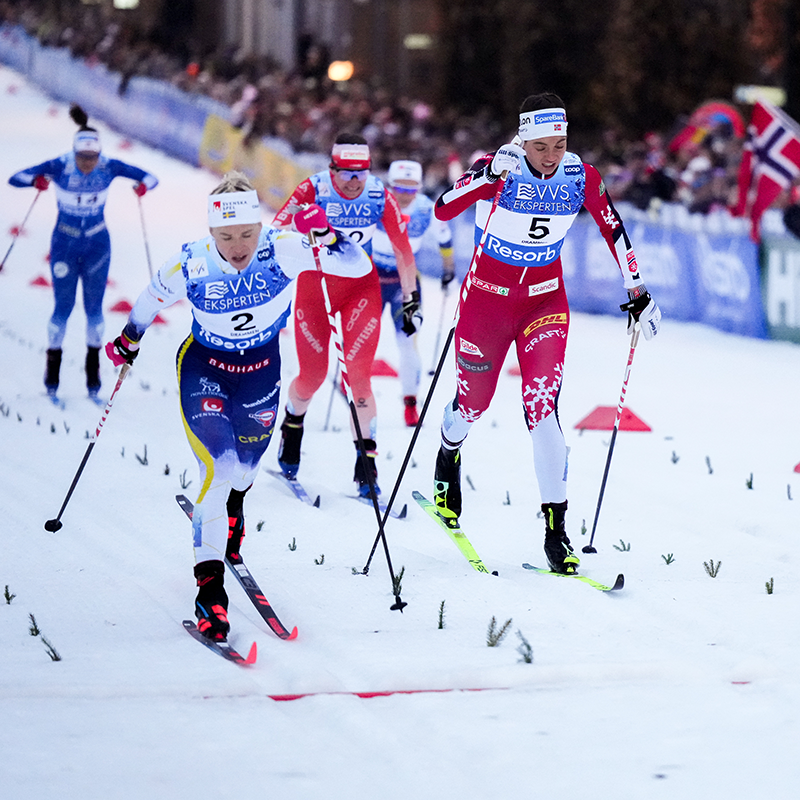
 This coverage is made possible through the generous support of Marty and Kathy Hall and A Hall Mark of Excellence Award. To learn more about A Hall Mark of Excellence Award, or to learn how you can support FasterSkier’s coverage, please contact info@fasterskier.com.