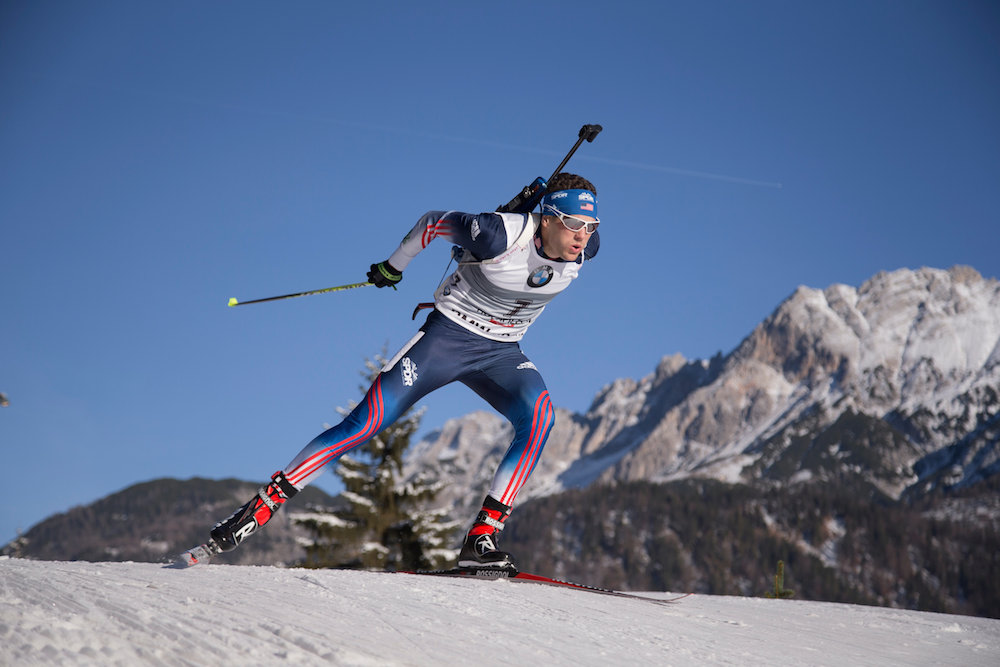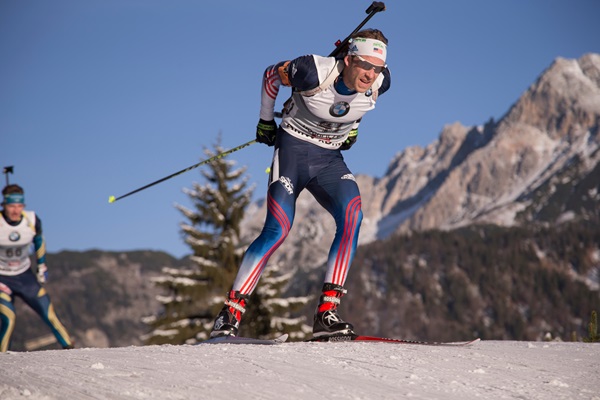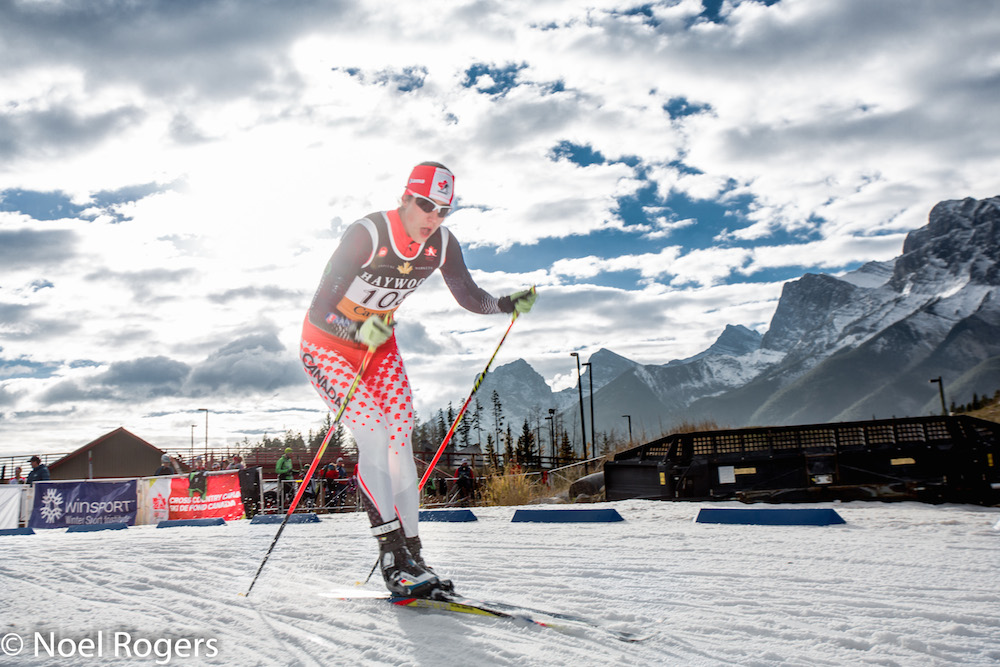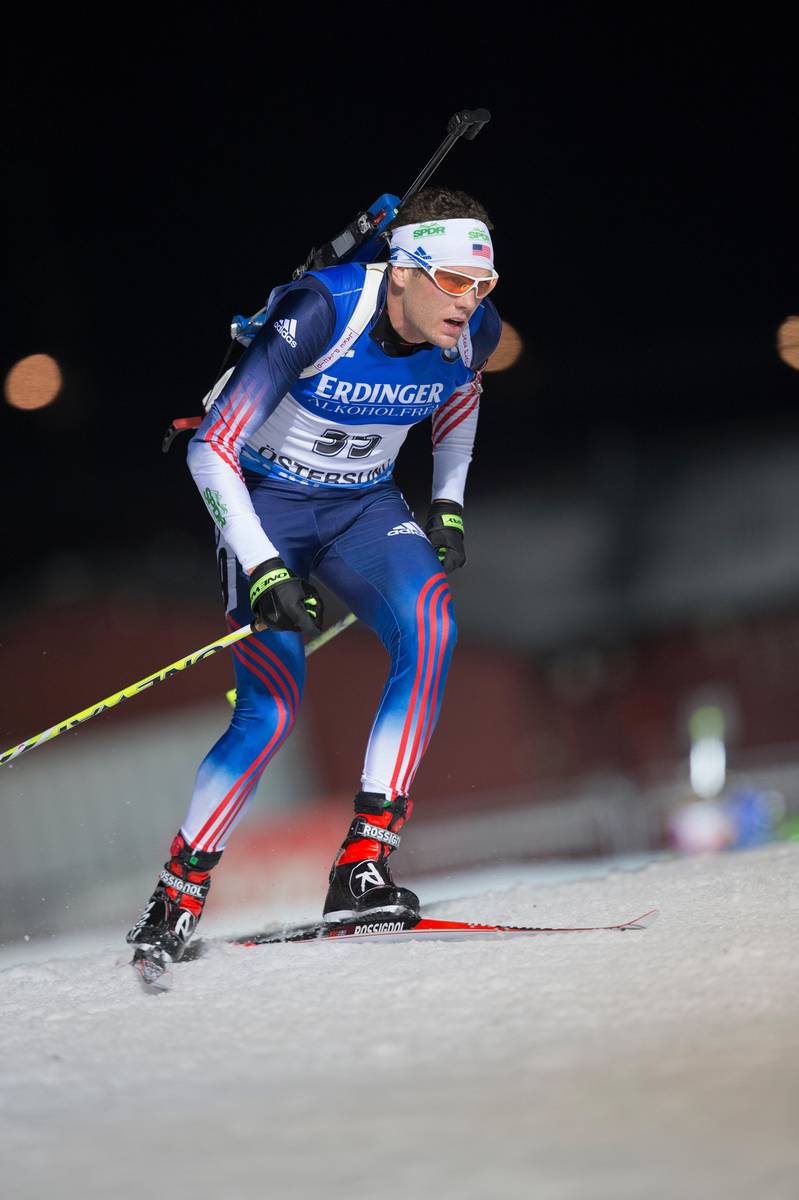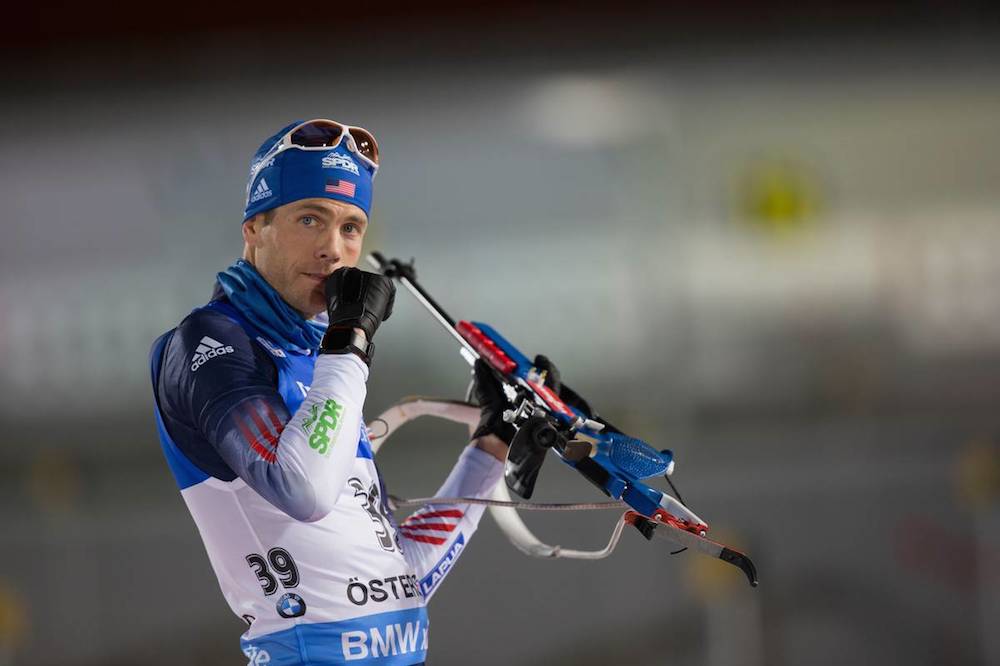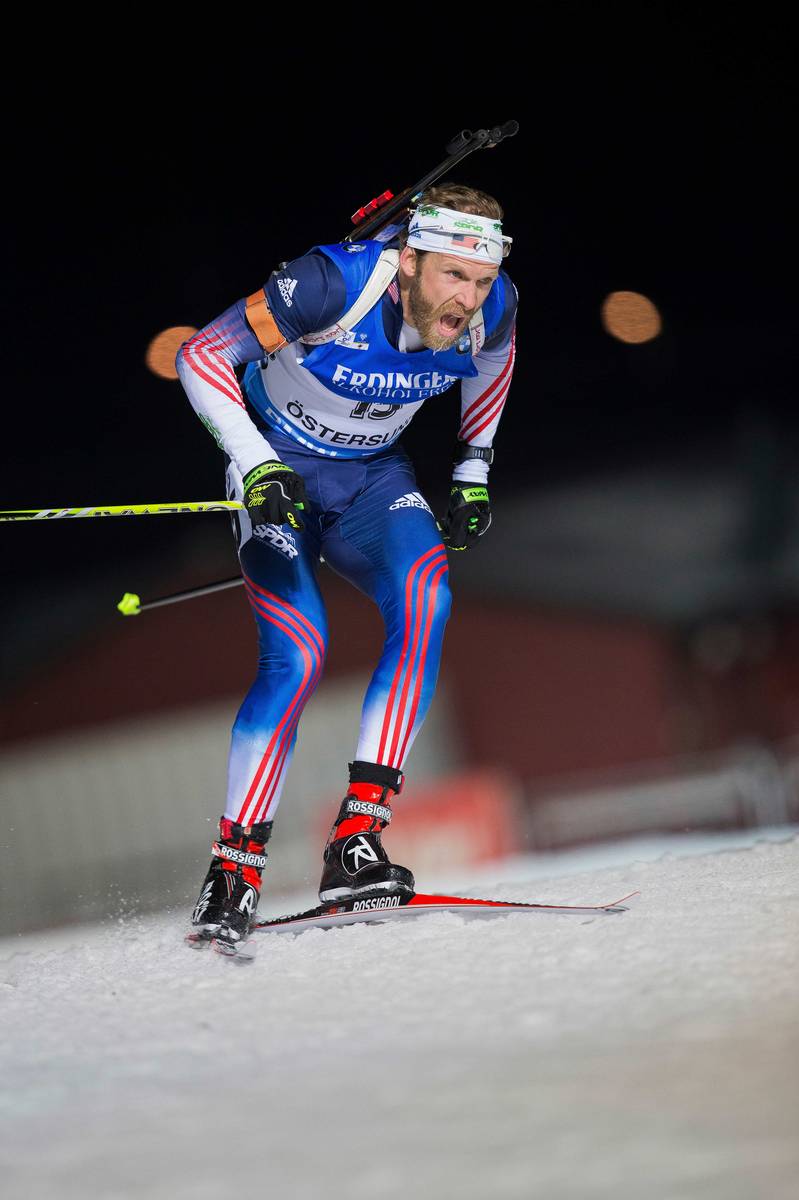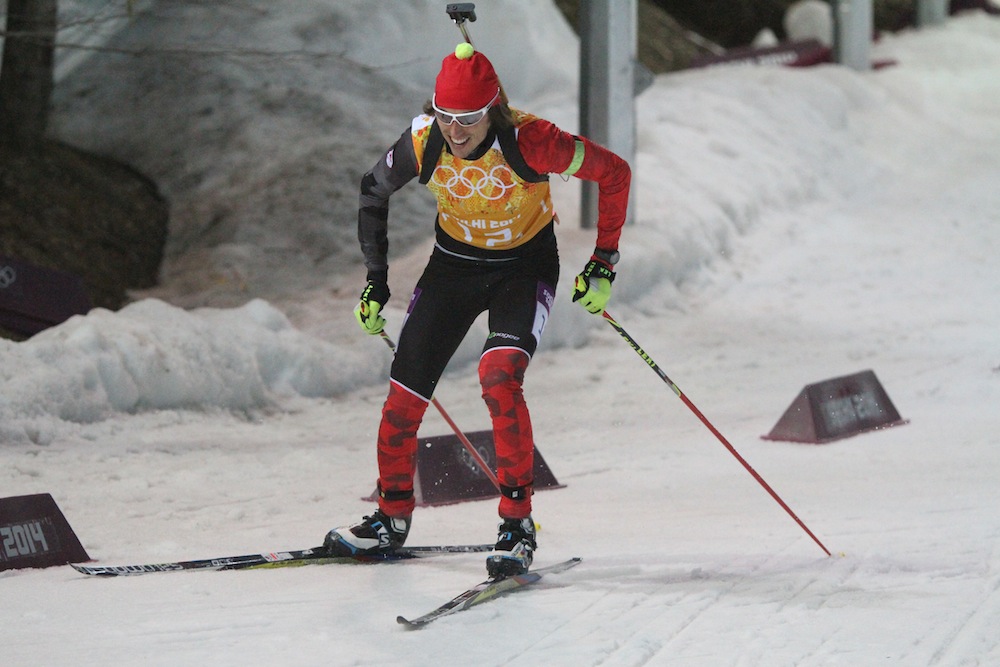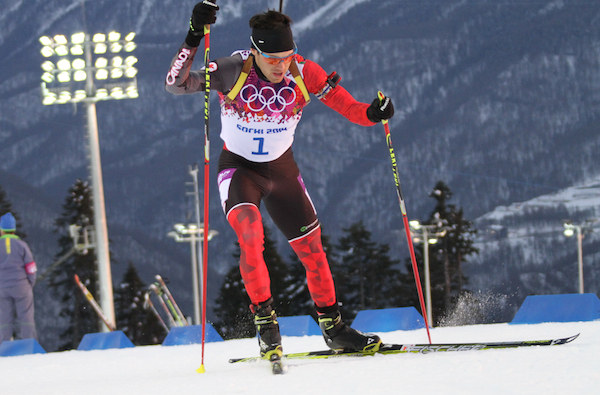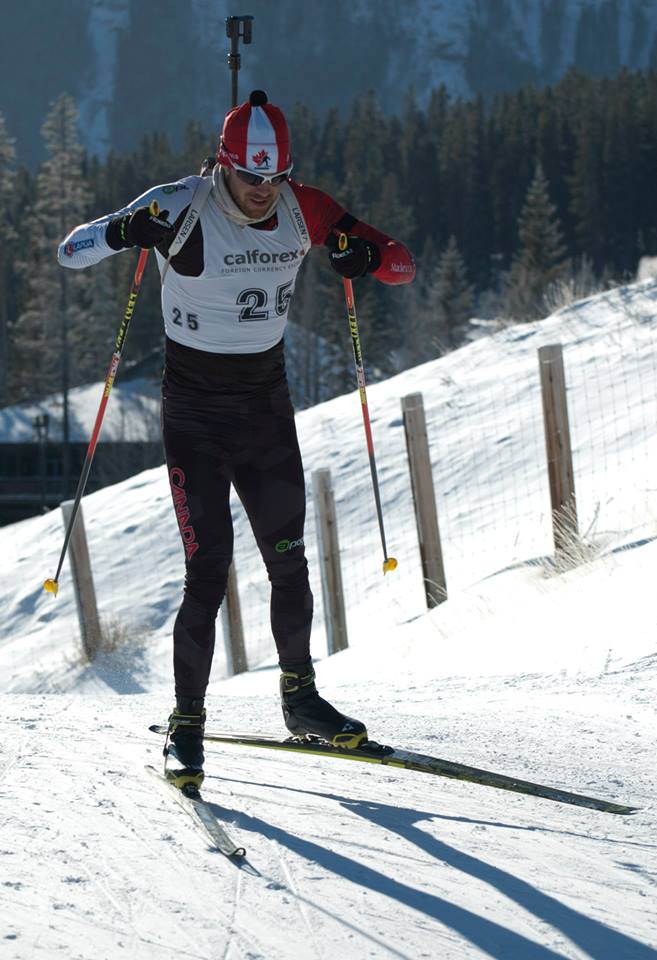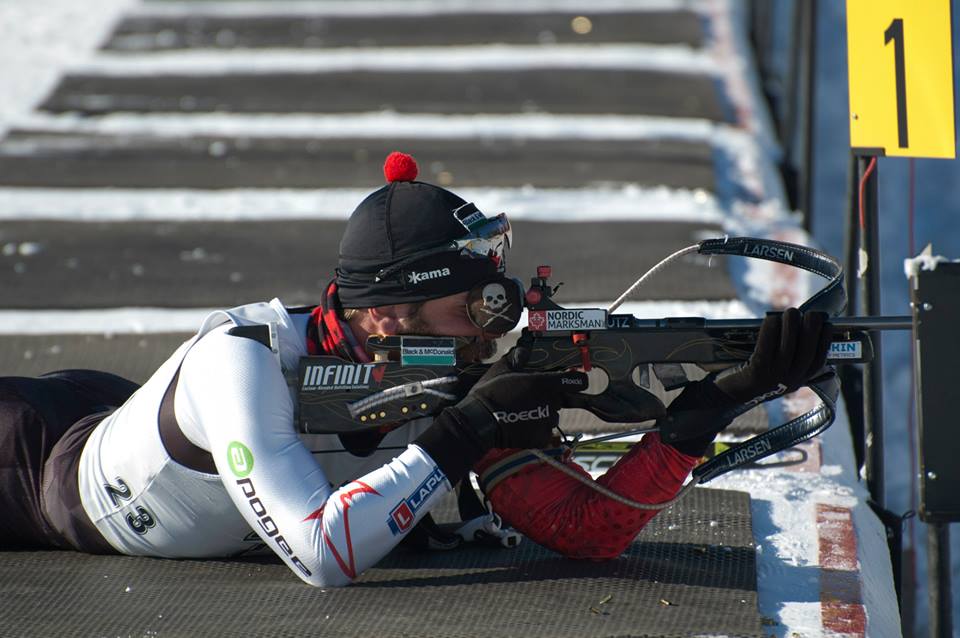
Tag: Marc-Andre Bedard

  • Canadian Men Tie Team-Best Sixth in Hochfilzen; Russia Drops Field by Last Lap

    Canadian Men Tie Team-Best Sixth in Hochfilzen; Russia Drops Field by Last Lap

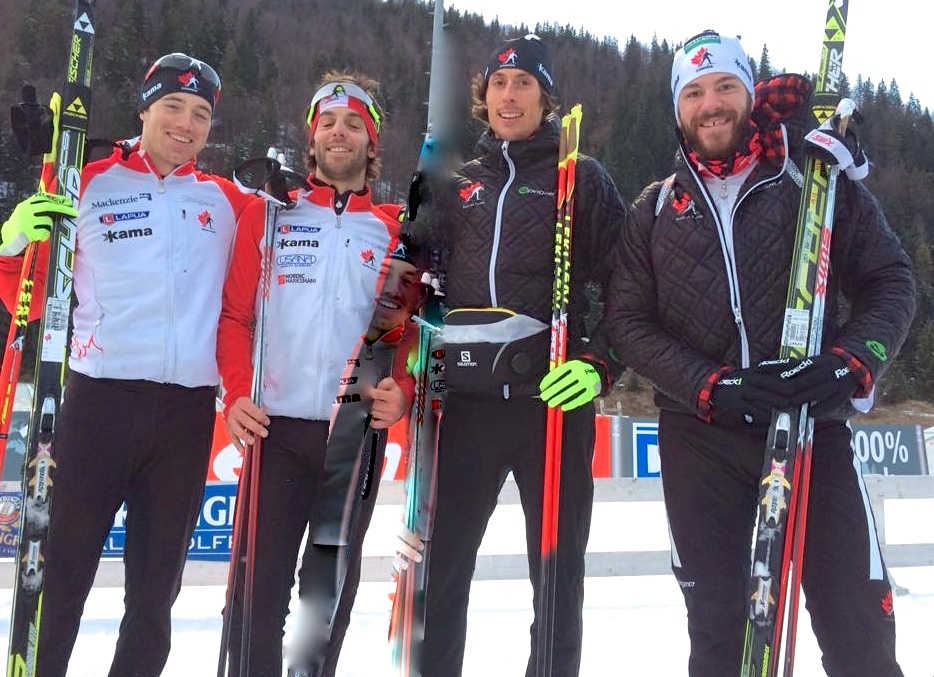
    The Canadian men's 4 x 7.5 k relay, which tied a team-best sixth on Saturday at the IBU World Cup in Hochfilzen, Austria. (Courtesy photo)
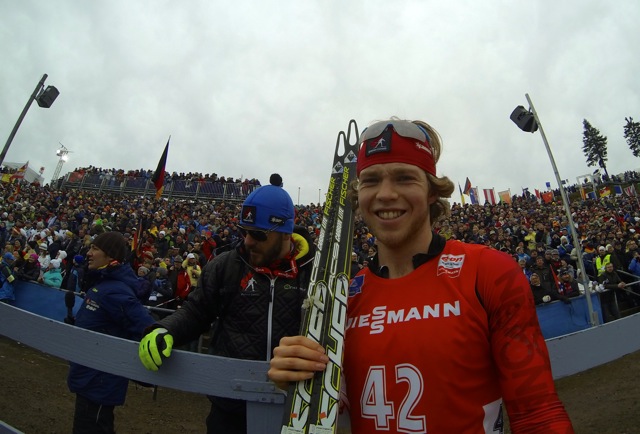
    The Canadian men’s 4 x 7.5 k relay, which tied a team-best sixth on Saturday at the IBU World Cup in Hochfilzen, Austria. From left to right, Nathan Smith, Scott Perras, Brendan Green, and Marc-Andre Bedard. (Courtesy photo)

    Note: This article has been updated to include quotes from Canadian national-team head coach Matthias Ahrens.

    Just a couple steps from the podium on Saturday, the Canadian men’s 4 x 7.5-kilometer relay team was pretty psyched to get flowers — and chocolate, and a “sweet medal,” and cash, according to third-leg Marc-André Bédard.

    They had been in the hunt for sixth, which tied each of their career bests in the team event and was worthy of the flower ceremony, since the first leg of Saturday’s IBU World Cup relay in Hochfilzen, Austria.
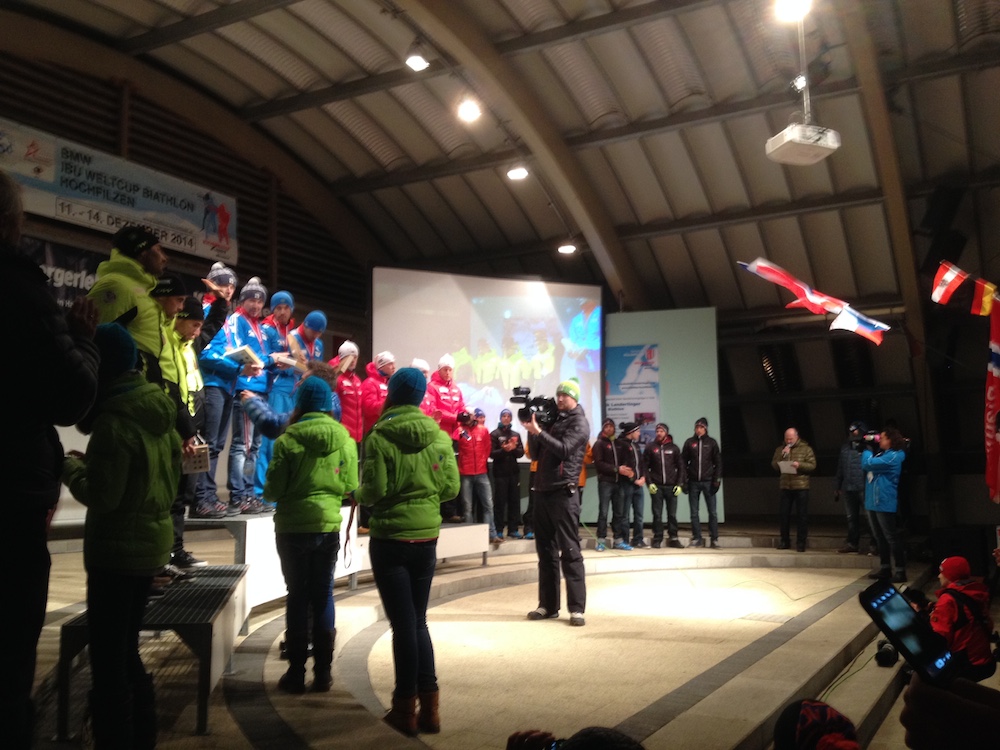
    The Hochfilzen World Cup men's relay awards ceremony on Saturday night, with Canada (far right) in sixth. (Photo: Matthias Ahrens)
    The Hochfilzen World Cup men’s relay awards ceremony on Saturday night, with Canada (far right) in sixth. (Photo: Matthias Ahrens)

    Temperatures were colder than Friday’s sprint, their skis seemed to be running great, and by the first exchange, the Canadians were well on their way to the top-eight Nathan Smith thought they were capable of on a given day.

    Saturday turned out to be especially impressive, Smith explained.

    “After yesterday’s disappointing showing for our team in the sprint I was unsure of what to expect today,” Smith wrote in an email, referring to his 44th-place finish, which led the Canadian men in Friday’s 10 k sprint. Teammate Brendan Green was 49th, Bédard placed 82nd and Scott Perras was 100th.

    On Saturday, they tagged off in that order.

    Smith started first in the 24-team field and found himself drifting toward the back of the pack — farther than he would have liked. After his first shooting, where he had to use three spare rounds, he was 21st, nearly 37 seconds behind Sweden and Italy in the lead. France and Russia hovered a few seconds behind in third and fourth, and the Americans — with Lowell Bailey leading off — ranked ninth, 14.5 seconds back, after Bailey missed one prone.

    In an email, Bailey in bib 20 explained he started six rows back, based on the IBU’s new start rules, which he considered “a significant disadvantage for teams with higher bib numbers.”

    “I was able to make it up into the top five during the first loop but it was definitely tough starting with bib 20,” he wrote in an email. “I disagree with the change and I think it gives the lower bib numbers an advantage that they didn’t have with the previous format. That being said, I was able to work my way through the field, but it took a lot of effort and I expended a lot of needless energy trying to pass.”

    While Bailey was satisfied with his shooting, using one spare on each stage, Smith was stressing over prone.

    “I was pretty worried in prone,” Smith wrote. “I’m not sure exactly what went wrong there, but it felt exactly the same as the prone in [Friday’s] sprint. I knew I was feeling good skiing though so I just tried to ski hard and hopefully catch some teams off guard that were skiing in groups.”

    By the second stage, the Canadian was up to 12th with a clean bout. He went on to post the fastest course time of his leg on his third-and-final lap.

    “I felt strong and tried to make up time on the second half of the course where all the climbing is,” Smith explained. “My last lap felt amazing. I passed a lot of people and it was actually ranked 1st for that leg. I had hoped to put Brendan in a slightly better position, but given 3 extra, I’m pretty happy that the deficit was only 25 seconds.”
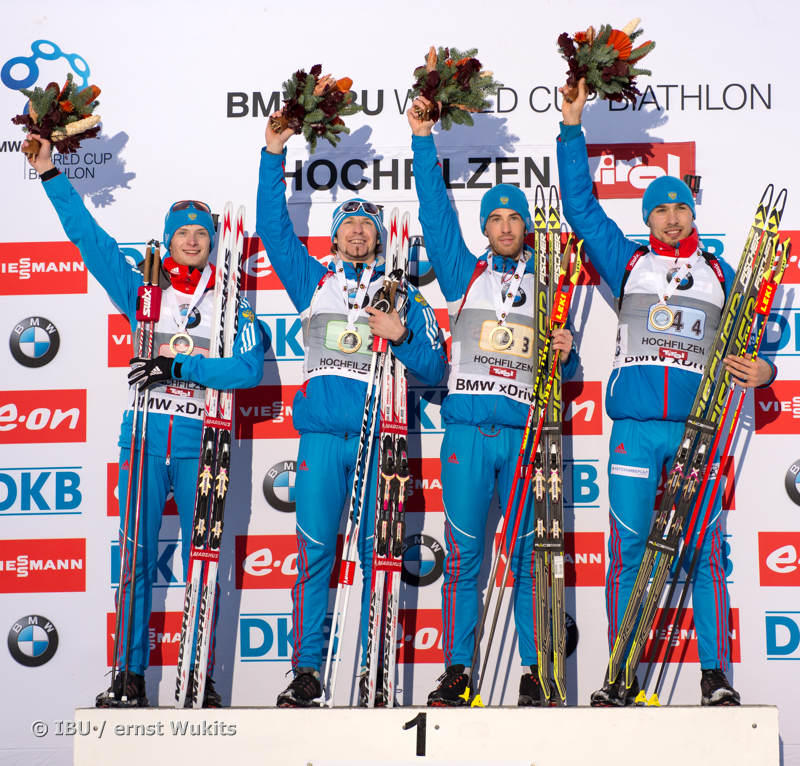
    Russia won the men's relay on Saturday at the IBU World Cup in Hochfilzen, Austria. (Photo: IBU/Ernst Wukits)
    Russia won the men’s relay on Saturday at the IBU World Cup in Hochfilzen, Austria. From left to right: Maxim Tsvetkov, Timofey Lapshin, Dmitry Malyshko, and Anton Shipulin. (Photo: IBU/Ernst Wukits)

    Smith tagged Green in seventh, 25.7 behind Friday’s sprint winner, Johannes Thingnes Bø of Norway in first — who missed one in prone. France’s Simon Fourcade cleaned to put his team 12 seconds back in second, and Ukraine tagged in third (+14.4) after 10-for-10 shooting from Dmytro Pidruchnyi.

    The U.S. slipped to 15th during Bailey’s leg as a result of less-than-ideal skis, second-leg Tim Burke explained.

    “I knew right away when I saw Lowell’s race that he was having a problem with skis,” Burke wrote after his team placed 14th overall. “Unfortunately, I did not have time to change my skis and we were using the same grind. The temperature dropped more than we thought at race time and the snow really dried out. We simply ended up on too big of a grind.”

    Heading out 56 seconds behind the leaders, Burke remained hopeful that he could pick a few teams off. He ended up using two spares in prone and another in standing.

    “I definitely made a mistake in prone when I tried to push the pace a little too much and ended up pulling the last two shots,” he wrote. “After standing I ways able to pick up a few spots on the last loop but we were still far from where we should have been after two legs.”

    Meanwhile, Green cleaned both stages for Canada to improve to sixth. He led Italy’s Dominik Windisch, who started a second behind him, on his first lap. The two entered the range together, and despite Windisch using one spare, they left together as well.

    “I was able to work off him for my second lap and relax a little bit more in certain areas before standing,” Green explained. “I knew my skiing should be decent if worked with him so I didn’t try and do anything too heroic on course and more just tried to settle into a solid pace.”

    After his standing stage, Green was up to sixth, 39 seconds behind Russia’s Timofey Lapshin up front. Lapshin and Norway’s Emil Hegle Svendsen both cleaned standing to leave the range together, and France’s Jean Guillaume Beatrix used one spare to fall slightly off the pace, eight seconds back in third. Windisch missed three and dropped to ninth.

    On the long climb back up to the stadium, Svendsen led Beatrix and Lapshin, while Austria’s Simon Eder tried to close the 12-second gap in fourth. Germany’s Andreas Birnbacher trailed by another 12 seconds in fifth — 14.7 seconds ahead of Green.

    “I always feel a ton of pressure during relay races,” Green reflected. “But last year we had multiple strong relay performances where we were contending at the front of the race, so I’m sure those experiences helped me out today…

    “When setting up the next teammate for the tag, it’s ideal if you can tag them with other nations close by so they have people to work with skiing,” he added. “If that scenario works out, perfect, but if not that’s fine, and we’re always doing our best to tag as close to the lead as possible.”

    Green handed off to Bédard in sixth, 50 seconds behind Norway and France, neck-and-neck for first, and 24 seconds behind Germany in fifth. Russia tagged off 7.8 seconds back in third, and the U.S. came through in 11th, 1:55 behind the leaders.

    Upon receiving the tag, Bédard — the team’s newest member and the only one not to experience sixth place in the relay in Antholz, Italy, last January (former national-team member J.P. LeGullec scrambled in that race) — he focused on keeping his cool and trying not to lose too much ground.

    “It was a bit lonely during the first 2 laps but I tried to go as hard as I could knowing that it would be super short,” Bédard wrote.

    He used one spare in prone and three in standing to slip one place to seventh behind Italy’s Thomas Bormolini after his second stage.

    “On the final lap I took extra time on the range to clear my targets and the Italian came back strong cleaning his, so I had to fight back 8-10 seconds,” Bédard explained. “I got to him pretty fast. I felt good so I attacked right away but he kept up to me and we ended up together.”

    Bédard and Bormolini entered the final exchange at the same time, 1:56.4 behind Russia. After Dmitry Malyshko cleaned, Russia remained the definitive race leader heading into the final leg, more than 17 seconds ahead of Norway’s Lars Helge Birkeland in second. Birkeland used five spares — two in prone and three standing to account for half of Norway’s 10 total spares at the end of the day.

    France’s Simon Desthieux, who missed two standing, trailed Birkeland by 0.7 seconds through the tag zone in third.
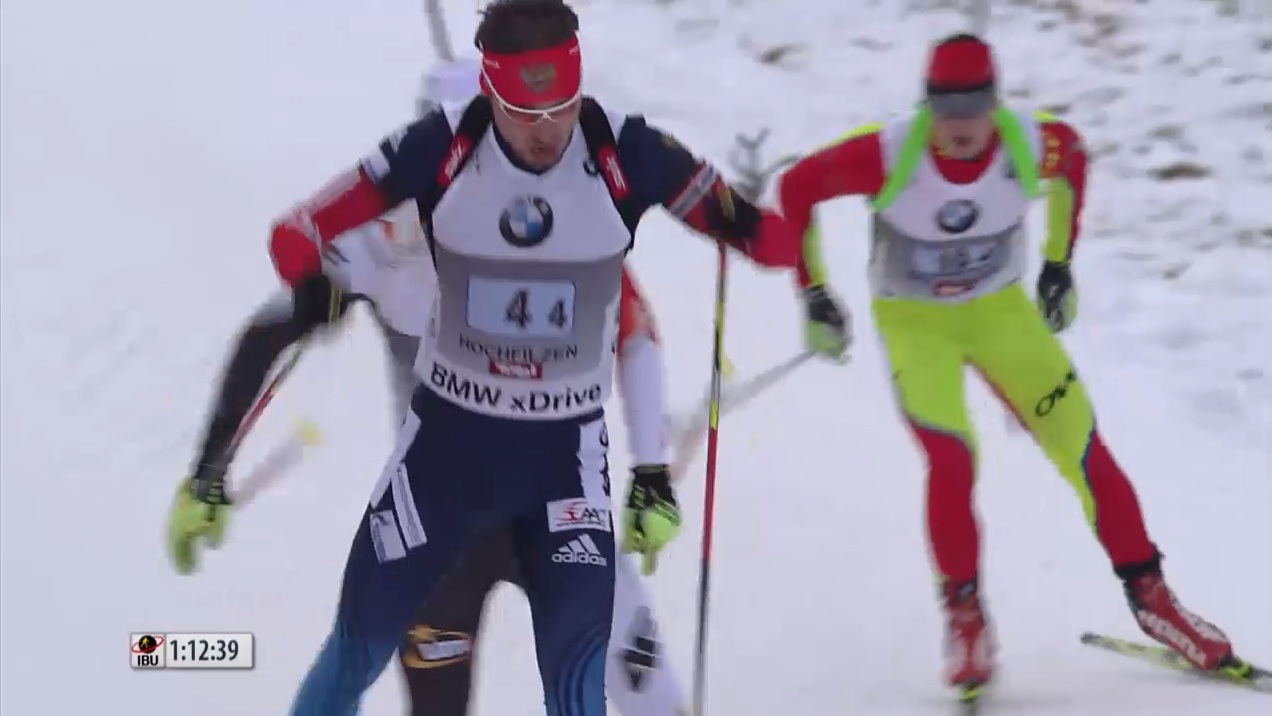
    Russia's Anton Shipulin laps several teams en route to a 20-second victory for the Russian men's team in Saturday's 4 x 7.5 k relay in Hochfilzen, Austria.
    Russia’s Anton Shipulin laps several teams en route to a 20-second victory for the Russian men’s team in Saturday’s 4 x 7.5 k relay in Hochfilzen, Austria.

    At the front of the race, it was all about chasing Russia with anchor leg Anton Shipulin ultimately cleaning both stages to bring it home. France’s Martin Fourcade and Norway’s Tarjei Bø duked it out for second, with Fourcade missing one prone and Bø missing three standing to drop to third.

    Then there was Austria and Germany, some 35 seconds behind Russia after prone and 48 seconds back after standing, racing for fourth.

    “The gaps were quite big when I started,” Canada’s anchor, Perras wrote. “My race was all about getting into the prize ceremony.  I couldn’t even see 4th or 5th.”

    He missed two prone and three standing for five total spares — half of what Canada ended up with.

    “In prone I shot a bit slow. I threw my first spare round down range to try and leave the range with Italy,” Perras explained.

    Italy’s Christian Martinelli used one spare in prone to exit the range 15 second ahead of him. Perras made up that time on the second lap and entered the range with him, then reclaimed sixth. While Perras missed three that bout and Martinelli missed two, Perras left the range 22 seconds ahead.
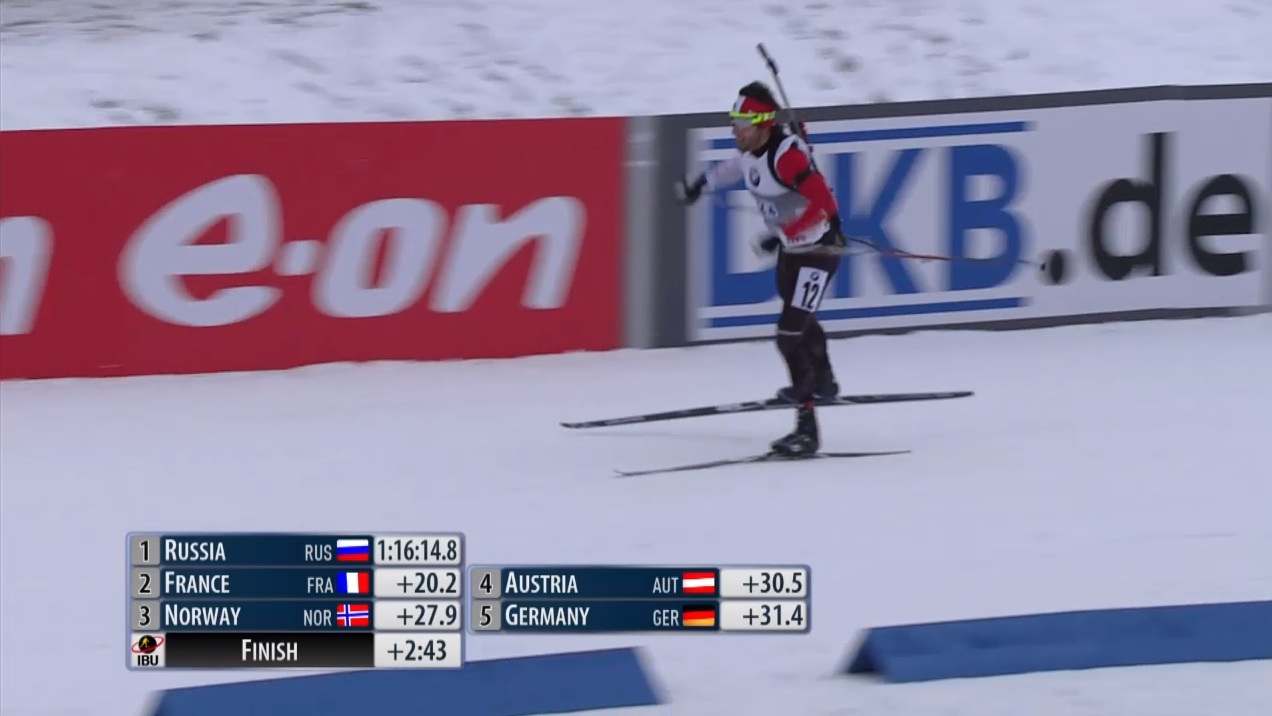
    Canada's anchor Scott Perras pushing for sixth in the finishing straight of Saturday's IBU World Cup 4 x 7.5 k men's relay in Hochfilzen, Austria.
    Canada’s anchor Scott Perras pushing for sixth in the finishing straight of Saturday’s IBU World Cup 4 x 7.5 k men’s relay in Hochfilzen, Austria.

    “I had no idea how close Italy was to me or any team for that matter,” Perras explained of his last lap. “I fought the whole way. I was fighting for my teammates out there.”

    He secured sixth to match the team’s best from Antholz, finishing 2:55.4 behind Russia, which won in 1:16:14.8 after using just one spare round. Fourcade cleaned standing and outsprinted Bø by 7.7 seconds to lock up silver for France (0+4), 20.2 seconds behind Russia, and Norway took third (0+10).

    Dominik Landertinger cleaned prone and used one spare in standing to finish fourth for Austria (0+7), 30.5 behind Russia, and Germany’s Simon Schempp also cleaned the first stage then missed one standing to finish 0.9 seconds later in fifth for his team (0+9).

    “Matching a top finish is always a must, we obviously want to get better and better,” Bédard wrote. “But it was great to be [in] the flower ceremony.”

    “I think we are happy to get back there so early in the year,” Perras explained. “It sets the bar for the whole team. It makes everyone want to work harder, coaches, wax techs and athletes to repeat or better days like today.”

    In an email, Canada’s national-team head coach Matthias Ahrens called their performance “solid … especially in the shooting range taking the opportunity of other team’s weaknesses,” he wrote in an email. “This was an important result for our team in building confidence towards their individual races. This also applies for our women’s team who had a decent result [11th] with 2 young athletes, one being a junior in her first [World Cup] race.”

    While the Canadian men ended the day with zero penalties and 10 spares, the Americans, which were lapped during Russell Currier’s anchor leg, ended up with four penalties and 14 spares.

    After Burke tagged Leif Nordgren in 11th, Nordgren used three spares and had to ski a penalty loop on his first stage, then slipped to 12th. In standing, he used all three spares again and had three more penalty loops to leave the range in 17th.

    He tagged Currier in 17th, nearly five minutes behind the leaders. Currier went on to use two spares in prone and one in standing before being pulled on his last lap.

    “We are not reading too much into this result as a team,” Burke wrote. “We know we are far better than what we showed today. In one way, at least everything went wrong for us on the same day.”

    “I think we are capable of a podium,” Bailey noted. “The field is incredibly strong on the men’s side this year and a few small mistakes make a big difference on the results list. If we are perfect, we have a chance at the podium.

    “Tomorrow is a new day,” he added. On Sunday, Burke and Bailey will start 13th and 17th, respectively in the pursuit. Nordgren, who also qualified, will head out 51st of 60 men.

    Smith and Green will also be hunting for a top 30 after starting in 44th and 49th, respectively.

  • Thingnes Bø Pulls Out Fast-and-Flawless Hochfilzen Sprint; Burke Goes ‘All Out’

    Thingnes Bø Pulls Out Fast-and-Flawless Hochfilzen Sprint; Burke Goes ‘All Out’

    Tim Burke racing to 13th in the men's 10 k sprint at the IBU World Cup on Friday in Hochfilzen, Austria. (Photo: USBA/NordicFocus)
    Tim Burke racing to 13th in the men’s 10 k sprint at the IBU World Cup on Friday in Hochfilzen, Austria. (Photo: USBA/NordicFocus)

    Note: This article has been updated to include comments from Canada’s Nathan Smith.

    Tim Burke knows you have to get a little weak in the knees to achieve the performance of a lifetime. Or something like that.

    Friday’s IBU World Cup 10-kilometer sprint in Hochfilzen, Austria, wasn’t exactly that race for the U.S. biathlete — he’s had plenty of top 10s and top 15s in his career — but it was headed in that direction.

    “One of my big goals this year is to really try to attack every race and give myself the best chance I can to get on the podium,” Burke said on the phone after Friday’s race.

    As the seventh starter of 105 men on an unusual 2.5 k loop (shorter because of Hochfilzen’s lack of snow; racers had to ski two uninterrupted loops between the first and second stages), Burke started fast and tried to hold it the pace throughout the three-lap race.

    He ended up cleaning prone and hitting every target but his last in standing.

    That was the one he wanted back — but he also acknowledged that he pushed himself to the brink.

    “I came into that last stage really gassed; I definitely went all out after the start,” Burke said.

    After organizers trucked in snow to hold the races, conditions were fast and solid on a just-above freezing, sunny afternoon. According to Burke, he experienced good conditions and no wind during his race. It was just a matter of fatigue when it came to the last stage.

    “After the third and fourth shot, I was starting to shake a little bit and couldn’t really hold it together for that last shot,” he said. “I feel like right now in men’s biathlon, it’s so competitive that there are always a bunch [of guys] who are going to take a gamble, and I realize that to get the podium now, I really need to get right to the edge and sometimes over the edge, and that’s the way I want to start every race.”

    That’s also the way he finished it. Glad to have just 2.5 k to go on his last lap, Burke crossed the line in Burke fourth. He would eventually end up 13th.

    “Even after the miss, I still thought I could be up there in the top-ten today,” he said. “Normally at this range, you see a lot of penalties because it’s a challenging approach to the range.”

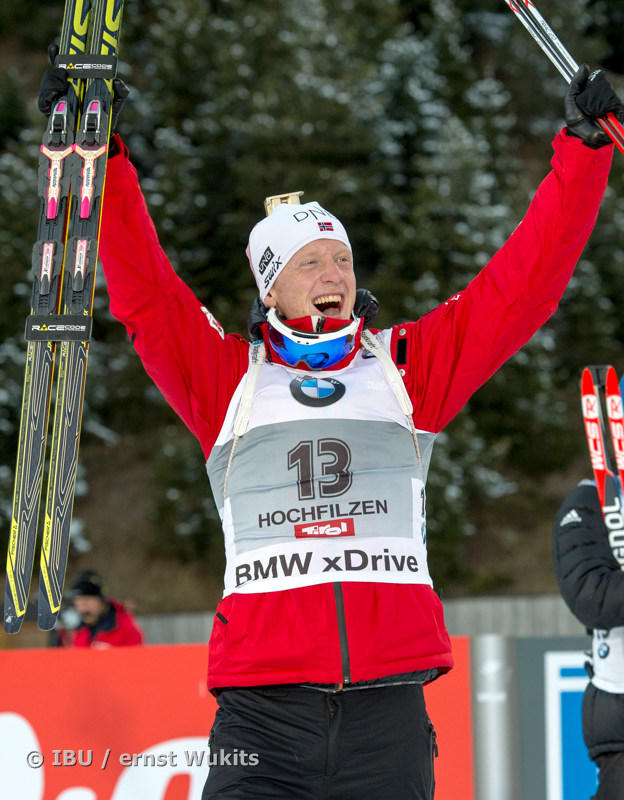
    Johannes Thingnes Bø celebrates his 10 k sprint win at Friday's IBU World Cup in Hochfilzen, Austria. (Photo: IBU/Ernst Wukits)
    Johannes Thingnes Bø celebrates his 10 k sprint win at Friday’s IBU World Cup in Hochfilzen, Austria. (Photo: IBU/Ernst Wukits)

    After the start, racers headed straight down into the valley before turning around for a long grind back to the top. Burke said that type of “gradual climbing” was what suited him best. To his surprise, several others hit most of their targets as well. The top four — Norway’s Johannes Thingnes Bø, Germany’s Simon Schempp and Andreas Birnbacher, and Austria’s Dominik Landertinger, respectively — all cleaned.

    At the end of the day, Burke knew his one miss probably cost him the podium, but he continued to focus on the positives and was pleased he took the risk. His course time ranked ninth-fastest overall.

    “I’m really happy with my ski speed right now; I think it’s probably my strongest start ski-speed wise that I’ve ever had,” he said.

    Burke finished 39.6 seconds behind Bø, who took the lead from fellow Norwegian Emil Hegle Svendsen, who started second, after starting 13th and quickly cleaning prone. Hegle cleaned as well, but missed one standing and gradually fell farther behind the 21-year-old Bø, who notched the fastest course time.

    Bø finished in 24:34.9, beating Schempp by 14.3 seconds for the win on Day 1 of the second World Cup of the season. Birnbacher was 17.9 seconds back in third, and Landertinger finished 22.5 seconds after Bø in fourth. He edged Slovenia’s Jakov Fak by 0.4 seconds, and Bø’s older brother, Tarjei, cleaned for sixth (+26.7).

    In fact, sixth through eighth place finished with perfect shooting. France’s Martin Fourcade was seventh (+27.8) and Russia’s Dmitriy Malyshko eighth (+29.2). Svendsen, the overall World Cup leader, placed ninth (+30.9) with a single miss.

    Friday’s sprint finishes determine the start order and time back for Sunday’s 12.5 k pursuit.

    “I stayed really close today, only 39 seconds back and I’ll start in a big group of guys,” Burke explained. “It should be an exciting race. I think a lot of guys will be contending for the podium.”

    Lowell Bailey (US Biathlon) racing to 17th in Friday's 10 k sprint at the IBU World Cup in Hochfilzen, Austria. (Photo: USBA/NordicFocus)
    Lowell Bailey (US Biathlon) racing to 17th in Friday’s 10 k sprint at the IBU World Cup in Hochfilzen, Austria. (Photo: USBA/NordicFocus)

    Burke’s teammate Lowell Bailey also landed in the top 20 for the U.S. on Friday, cleaning and tying Bulgaria’s Krasmir Anev for 17th, 57.6 seconds behind the winner.

    On Saturday, Bailey, Burke, Leif Nordgren, and Russell Currier will team up — in that order — in the men’s 4×7.5 k relay. “Anything can happen for sure,” Burke said.

    Nordgren placed 51st on Friday (+2:19) to qualify for the pursuit, with a single miss in prone. Currier was just outside the top-60 needed to qualify, finishing 61st with three penalties — two prone and one standing.

    Nathan Smith led the Canadians in 44th with three misses as well — two prone, one standing, and 1:57 behind the winner. Brendan Green placed 49th with two prone penalties (+2:13.9).

    In an email, Smith explained more than half of their team came down with a cold in Östersund.

    “I felt tired and on the edge during the travel day Monday. Thankfully I managed to turn things around and feel good again,” he wrote. “My prone just plain did not feel very solid. I fought for the shots but they didn’t come easily. Standing was pretty good but my first shot, which missed, I pulled a little early.”

    Smith felt better about his skiing.  I felt like today could have been a top-20 ski time but I didn’t quite make it,” he said. “Usually I feel better race to race, so maybe on Sunday I’ll be there.”

    In Sunday’s pursuit, he’ll aim for a top 30, and “with an amazing race, perhaps top 20,” he said. “I’m farther back than I’d hoped.”

    In an email, Green explained he was frustrated to open with two misses.

    “My shots throughout that bout were consistently high but I think that’s something I should be able to work through going into [Saturday],” he wrote. “Standing felt solid with a nice rhythm which I’m happy with.”

    Struggling with back pain since the start of the season in Sweden, Green explained that it wasn’t quite 100 percent, but it hadn’t kept him from doing any of his planned workouts this week, either.

    “The travel day from Sweden was hard on it but I’ve been able to get daily treatments here which are definitely helping it from getting any worse,” he wrote. “I’m hoping that over Christmas I’ll be able to spend time with my physio and sort things out to a more manageable level again.  Hopefully I won’t have too many issues with the rest of the season in the new year.”

    As for how he felt skiing on Friday, he wrote that it was “slowly starting to come along.  I’m definitely disappointed with my start to the season thus far and with my form, but I know there is the potential there for a lot more and hopefully I will get a glimpse of that soon. The course seemed to hold up fairly well and although we had to ski a double 2.5km loop after prone the race still went by pretty fast.”

    In Saturday’s relay, Smith will start for the first time, followed by Green, Marc-André Bédard, and Scott Perras. On Friday, Bedard placed 82nd with three misses (2+1) and Perras was 100th with six penalties (3+3).

    “I’ve never been anything but 3rd or 4th leg,” Smith wrote, “so it’s going to be a new experience for sure! I want to tag Brendan off in a position where he can be right in there with the lead pack. A good result right now for where we’re at is top 8.”

    “I know we’ll all be focused on doing our job during each leg of the relay and racing to the best we can,” Green wrote. “We’ll see at the end of the day how we stack up against other nations.”

    Results

  • Canada’s Smith, Crawford Tough it Through the Rough to Make Östersund Pursuit

    Canada’s Smith, Crawford Tough it Through the Rough to Make Östersund Pursuit

    Rosanna Crawford racing to the win in Monday's distance race at Frozen Thunder in Canmore, Alberta. (Photo: Noel Rogers/Bow Valley Photography)
    Rosanna Crawford racing in Canmore, Alberta, in October 2014. Crawford was the top Canadian woman in Ostersund, Sweden, today. (Photo: Noel Rogers/Bow Valley Photography)

    It was a rough day, literally and metaphorically, for the biathletes competing Saturday in Östersund, Sweden. Artificial snow, saved snow and shoveled snow made for a treacherous course, though winds were calm.

    Two Canadians broke through the bumpy conditions to have strong races in the IBU World Cup men’s 10-kilometer and women’s 7.5 k sprint — Nathan Smith and Rosanna Crawford finished ninth and 12th, respectively. The rest of the Canadian team did not fare as well, with no other skiers finishing in the top-60 to advance to Sunday’s pursuits.
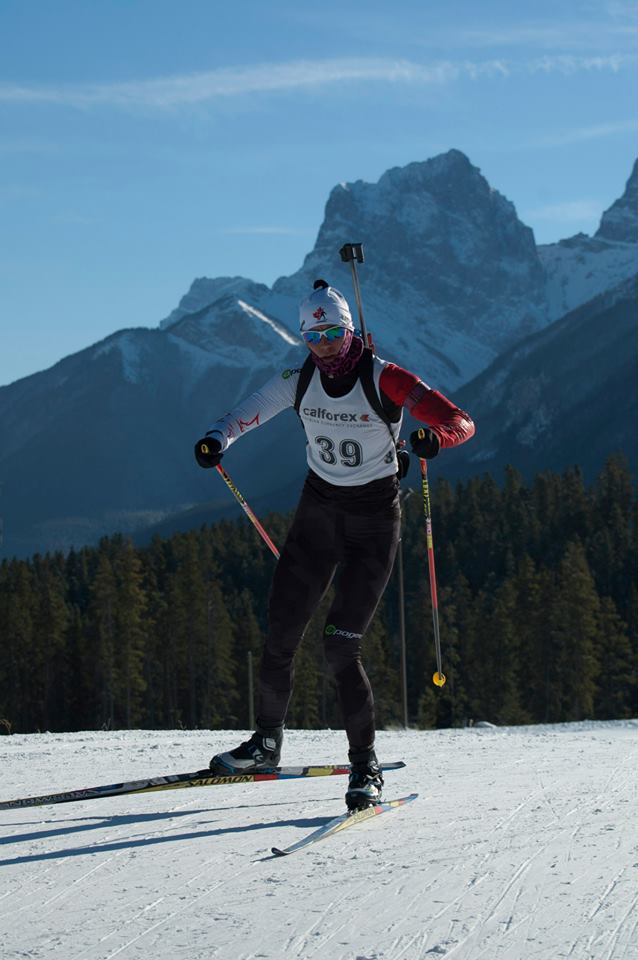
    Smith shot clean to earn his ninth-place finish, while the next Canadian man to finish was Marc André Bédard in 61st (+2:39.1) who missed one target in standing, and Brendan Green (+2:42.1), who missed one in prone and two in standing. This is only Smith’s fourth career top 10, and Canada’s first top 10 of the season.

    “Obviously, I’m really happy with the result,” Smith told FasterSkier. “A top 10? I don’t have that many of those, yet.”

    For the Canadian women, Crawford was happy with her race, finishing in 12th place (+1:10.3), in spite of missing a target in both prone and standing. But the women’s side was similarly disappointing, with Zina Kocher as the next Canadian woman in 66th place (+2:34.9, +4), and uncharacteristically bad shooting plaguing both Megan Heinicke, who finished 82nd (+3:23.6, +2) and Audrey Vaillancourt, who finished 88th (+3:31.7, +3).

    An email to head coach Mattias Ahrens went unanswered as of this writing.

    Scott Perras did not start due to a cold: “It’s really too bad,” he wrote in an email. “I am normally pretty healthy throughout the race season. This is my first DNS at any level of racing and I don’t much care for it.”

    Smith’s strong result can be credited due to what he called “one of [his] best shooting races ever,” having the 10th-fastest shooting time of the day (+2.9) with no misses.

    “After the individual I was pretty disappointed with my standing shooting,” he said. “So I took a day off of shooting and then yesterday I really focused on having really high quality in training, and the same with today during the race. I just tried to be very disciplined, I guess I could say. And it really paid off.”

    “It’s not the best that I’ve been on skis in the last year and a half,” he added, “but it’s good still. Just not my best.”

    For her part, Crawford was somewhat disappointed in her shooting, and in fact appeared to be having a pretty ho-hum race after the 2nd lap, being in 27th place. But on that final lap, she turned it up, delivering the 7th-fastest course time and moving herself into 12th place.

    “This is kind of funny,” Crawford laughed. “I’ve always been kind of the opposite – a really strong starter and then have struggled with finishing loops, but Zina Kocher and I got to train together a lot this year and that’s always been her strength, so being able to work with her all summer long I think has been very beneficial to me to getting that finishing speed.”

    Though course conditions were poor, neither Smith nor Crawford complained. Smith benefited from being an early starter, before course conditions deteriorated too much. He highlighted some of the downhill corners as being particularly treacherous.

    “They shoveled [the corners], so I didn’t really know what to expect,” he said. “They were okay because you just sort of bounce over the bumps.  But then, as each lap went on, the ruts got deeper. I’m sure that, for the last starters, it was pretty scary on those corners.”

    Crawford thought that the poor course conditions matched her strengths.

    “I’ve always been pretty strong on downhills, so I think that’s a huge advantage for me on a course like this,” she said. In fact, relative to other skiers, course conditions probably helped her out. “It didn’t hurt me, for sure.”

    As for her shooting, Crawford made no excuses:

    “It was pretty calm on the range, so it was definitely all me. A little bit more focus can go a long way.”

    Though Crawford had told FasterSkier that she was hoping for top-10, she was far from disappointed with her finish.

    “I’m not expecting to be in the top-10 every single race,” she said. “If I’m consistently in the top-25/top-15 area that’ll make me happy,” adding that she’d still like to get more top-10 finishes this year than she did last year.

    “And for sure to be on the podium at least once this year,” she added.

    After such a grab bag of results feelings on the the time are pretty mixed.

    “Obviously some of us have had great races,” Smith said. “But I’m sure Brendan and Marco, and the other girls, are pretty disappointed about not making the pursuit.”

    Smith and Crawford are looking forward to tomorrow’s pursuit with differing baselines for what to expect. Smith is looking forward to what he regards as his best format, while Crawford is apprehensive about what she regards as a weakness.

    “It’s a shooting race,” Smith said. “I think shooting speed is more important, which is probably my biggest strength. I can take advantage of that as long as I hit most of the targets.”

    Crawford echoed that assessment, but a bit more apprehensively.

    “Pursuits were a bit of a weakness for me last year, shooting wise,” she wrote in response to follow-up questions. She hopes to simply hold her position and stay in the top 15, but that she’ll be happy if she is able to follow her range plan and “stay focused on myself and not get caught up in what’s going on around me.”

    Results: Men / Women

    Chelsea Little contributed reporting

  • Burke, Bailey Land Top 20 in Challenging 20 k in Östersund (Updated)

    Burke, Bailey Land Top 20 in Challenging 20 k in Östersund (Updated)

    Tim Burke (US Biathlon) racing to 11th on Wednesday in his first individual World Cup of the season: the 20 k in Östersund, Sweden. (Photo: USBA/NordicFocus)
    Tim Burke (US Biathlon) racing to 11th on Wednesday in his first individual World Cup of the season: the 20 k in Östersund, Sweden. (Photo: USBA/NordicFocus)

    Note: This article has been updated to include comments from Lowell Bailey and Brendan Green.

    An athlete would be lying if they said they didn’t want their first race of the season to be a breeze, and for just about everyone but Norway’s Emil Hegle Svendsen on Wednesday in the first IBU World Cup individual race of the season — it wasn’t.

    Svendsen remained the only perfect shooter out of 100 finishers, and topped the men’s 20-kilometer in Östersund, Sweden, in 53:25.6 — more than a minute and 17 seconds faster than anyone else.

    The next three finishers came out with one penalty apiece (Ukraine’s Serhiy Semenov in second, Michal Slesingr of the Czech Republic in third, and Germany’s Erik Lesser in fourth), but the shooting after that was all over the map. It usually is, but it was even more so on Wednesday, no thanks to various high winds cutting across the range.

    American Tim Burke, who started 39th of 102, hung consistently in the top 10 throughout the race despite missing one on each of the first three stages.

    Teammate Lowell Bailey started before him in bib 15 on a 6-degree Celsius (43 Fahrenheit) afternoon. Bailey cleaned his first and third stages, missing just one on the first standing, to put himself in sixth his third time leaving the range.

    Burke went on to clean his final standing for 17-for-20 shooting, just like Bailey, who ended up missing two on the last stage. Not long after their finish, the two men sat in 10th and 17th, respectively, only to be bumped by a few late starters.

    One of them was 22-year-old Frenchman Quentin Fillon Maillet, who tallied a career best in 10th. After starting 98th, he knocked Burke from 10th to 11th, 3:32.8 behind Svendsen, a position Burke was satisfied with despite three minutes of penalties.

    Tim Burke takes a moment on the range during Wednesday's 20 k in Östersund, Sweden, where he ended up 11th with three penalties. (Photo: USBA/NordicFocus)
    Tim Burke takes a moment on the range during Wednesday’s 20 k in Östersund, Sweden, where he ended up 11th with three penalties. (Photo: USBA/NordicFocus)

    “I was pleased with my shooting today considering it was tricky with the wind,” Burke wrote in an email. “Normally 3 penalties in an Individual would not be good enough for 11th place but there were a lot of penalties because of the conditions.”

    Bailey slid slightly to 20th (+4:50) behind Fillon, Russia’s Maxim Tsvetkov in 18th and Italy’s Thomas Bormolini in 19th.

    “It was challenging, for sure,” Bailey said of the conditions, according to a US Biathlon press release. “The weather warmed up quite a bit before the race which made for some pretty icy, mushy downhills and the track deteriorated pretty quickly. And the added wind made it even more challenging on the range.”

    At the 2014 Olympics in Sochi, Russia, Bailey placed eighth in the same event and appeared to be in contention for another top 10 on Wednesday until the final stage. He spent nearly a minute in the range, almost longer than anyone else on that stage, waiting for the wind to calm.

    “It was pretty windy in the final stage and I made the decision to stay and wait out the gusts to try and hit as many shots as possible,” Bailey explained in an email. “I waited an extra fifteen seconds for that last shot because I really wanted to hit it. Unfortunately, I not only waited extra time, but then I missed the shot!  That’s biathlon though.  I wasn’t really that nervous but I’m disappointed that I couldn’t get out of the final shooting with one less miss.

    Lowell Bailey (US Biathlon) racing to 20th on Wednesday in his first individual World Cup of the season: the 20 k in Östersund, Sweden. (Photo: USBA/NordicFocus)
    Lowell Bailey (US Biathlon) racing to 20th on Wednesday in his first individual World Cup of the season: the 20 k in Östersund, Sweden. (Photo: USBA/NordicFocus)

    “I was excited for today’s race as it is the first time to see where your fitness level is compared to the rest of the international field,” he added. “A lot can change over the course of the year, but it is always good to start off with a solid result to get things going. … I’m hoping for increased ski speed as the season progresses. It’s a good place to start though.

    Burke, who skied the eighth- and ninth-fastest course times on the last two loops (for the eighth-fastest course time overall), explained his racing form felt “pretty solid” throughout the race.

    “The hardest part for me was actually the first two loops,” he wrote. “I felt that I struggled a little in the fist two loops with my technique. I have not had so many hard efforts on snow yet, so I am definitely still fine tuning my technique. By the last few laps I felt like I nailed down my ski placement and timing.”

    After helping his team achieve one of their best results of seventh in Sunday’s mixed relay, Burke took an easy day of training followed by some light speed on Tuesday.

    “I felt good during my speed the day before so I expected to feel strong for the Individual,” he wrote. “This year I experimented with a few new training ideas. Starting in October, I started feel better than ever in some of my intense training sessions but you never really know how that feeling will stack up in a World Cup. [Wednesday] was a good indicator for me that my new training ideas have worked well but it is also still very early in the season.”

    Also for the U.S., Leif Nordgren placed 71st with four penalties (0+2+1+1) and 9:47.7 back from the winner. Russell Currier was another 13.2 seconds back in 74th, with seven misses (3+1+3+0).

    Canada Outside Top 40

    Brendan Green was the top Canadian in 49th (+7:23.5) after starting 30th and falling out of contention early with four penalties in the first two stages (2+2+0+0). Nathan Smith, who started eighth, ended up 54th with seven misses (1+3+1+2).

    Brendan Green racing at the 2014 Olympics in Sochi, Russia.
    Brendan Green racing at the 2014 Olympics in Sochi, Russia.

    “It was a pretty frustrating day, both for myself and the team,” Green wrote in an email. “The wind in general was quite strong and also inconsistent which made the shooting tough. I did what I could to try and hit each shot with the wind I was dealt but unfortunately that still resulted in 4 misses after my first two bouts of shooting. 

    “I had an idea from what I could hear and see each time I was in the stadium that there were a lot of misses amongst the field, even with the top names, so I knew it was that kind of day,” he added. “I was able to manage the wind better for my last two bouts and fortunately was able to finish the day without any more misses.”

    Green explained he’s been struggling with back problems since arriving in Östersund, and that led him to skip the mixed relay. Since then, he explained the problem seemed to have settled and he was looking forward to the individual.

    “I typically should be able to ski fairly well on a course like here in Ostersund but during the race I felt like I was hanging on for survival as opposed to skiing an aggressive 20km,” he wrote. “I think we had some issues with the skis as well.

    “Although I’m disappointed with my opening race and expected a lot more from myself, training has been going well and I’m looking forward to this weekend,” Green added. “After returning to the World Cup circuit last year I was really unsure what to expect and how my body and mind would hold out after a year off, but I proved to myself that I am still capable of solid results and am looking to build off of where I left off last season.  Hopefully my strongest results and best shape will be in Finland for the World Championships.”

    Nathan Smith of Canada finished 13th in the first Olympic race of his career.
    Canada’s Nathan Smith racing to 13th in the first Olympic race of his career: the sprint in Sochi, Russia.

    Smith explained that his first standing, where he missed three, was a bit windy, but that didn’t excuse three penalties.

    “I’m not sure what exactly happened there but it definitely threw me off for the remaining shooting stages,” he wrote. “Prone actually felt really solid but I just made a couple silly mistakes by rushing a little.

    “The course wasn’t perfect by any means, but the warm temperatures actually did help the snow conditions compared to previous days when it was colder,” he added. “A couple of the hills near the stadium were getting chopped up but thankfully the largest climbs were still in excellent condition.”

    Some of these climbs, however, greeted competitors with strong headwinds. And while the course held up well overall, Smith explained there was some deterioration, especially on some of the shorter uphills.

    With his initial goal of a top 16 out by the second shooting, he tried to put together a decent race  by cleaning the final two stages.

    “Unfortunately that did not happen. Once I was stuck with the bad shooting I didn’t really have any expectations and just focused on skiing relaxed and smooth,” he wrote. “It’s often tougher to push 100% when you know you’re out of the running because of poor shooting. Even still I’m satisfied with my skiing form.”

    At the end of the day, he had the 21st-fastest course time overall.

    “Although I only felt average out there, my course time was still quite good,” Smith wrote. “So hopefully on a day where I feel amazing I can be right up in the top 10. I’m going to refocus my shooting and perhaps be a little more cautious in Saturday’s sprint.”

    Marc-André Bédard finished 61st with four penalties (0+1+1+2) and 8:40.6 behind the winner.

    Despite earning his spot on the World Cup team as early as a few weeks ago (and buying his plane tickets late), Bédard explained he was relieved to get to Sweden after some quality on-snow time in Quebec City.

    “I did not expect to be in great shape and to shoot that well because I had such a crazy summer racing off road triathlons and OCRs but I knew I was going to give it my best and enjoy every moments, which I did!” he wrote in an email of the World Cup team trials Nov. 13-14 in Canmore, Alberta.

    Waking up Wednesday morning, he recalled feeling happy and thankful for the individual start after racing to 17th with the team on Sunday.

    “These trails are a lot like home too and I love to ski here so I was exited to race new tracks that I feel good in,” he wrote. “I wasn’t to sure how to approach it and if I was going to survive it so I started really conservative, skiing with others and picking up the speed more and more.”

    Looking at his results, Bédard figured he should have pushed his pace more. He started 86th, which didn’t leave him with optimal conditions, but he was used to it.

    “I’ve always started later being on fewer [World Cups] and I’d say 9/10 races it’s almost a handicap to start late,” he wrote.

    Not only is it harder to warm up and adjust the rifle, late starters also have to wait often more than an hour before their turn. The lighting, wind and the snow conditions often change in this time, and Bédard explained that makes the wax technicians’ jobs tougher — especially in 6-degree temperatures — after they test skis two hours before a race.

    “You have to give it your best and hope it doesn’t affect you too, too much!” he wrote. “I didn’t go in with much of any goals, I have so little information on my shape and speed this year that I just took it as it goes and try to learn and improve from there. My shooting has been amazing so I was exited about this and looking forward to a 90%+ performance, which I was doing great before the end but I ended up missing my last 2 shots which put a stop to the party! But I’m still quite happy with a 80% for pretty hard shooting conditions.”

    Canada’s fourth man, Scott Perras placed 73rd (+9:51) with six penalties (1+3+1+1).

    The women’s 15 k individual kicks off Thursday at 17:15 CET (11:15 a.m. EST).

    Results

  • After Leading Early, Kocher’s Shooting Woes Drop Canada in Östersund; Finish 17th (Updated)

    After Leading Early, Kocher’s Shooting Woes Drop Canada in Östersund; Finish 17th (Updated)

    Rosanna Crawford (CAN) on the range in Östersund in 2012.
    Rosanna Crawford (CAN) on the range in Östersund in 2012.

    Rosanna Crawford felt like many other biathletes just before the start of yesterday’s World Cup mixed relay in Östersund, Sweden: anxious.

    “I was super nervous all day today, not really knowing what to expect,” Crawford told FasterSkier. “It’s been a long summer so to get that first one over with is a bit of a relief… I think I was extra nervous today because it was a team event. I’ve never started the season with a team event. You don’t want to let anybody down.”

    Once the gun went off, Crawford quickly snuck her way to the front of the pack.

    “Everyone went right, so there was a big opening to the left and I was able to get to the front straight away,” she said.

    Near the leaders coming into the first shooting, Crawford quickly cleaned her five prone targets and headed out in first place.

    The nerves were out of the way and Crawford was back on the World Cup, exactly where she left off. In her last race of the season in Oslo, Norway, in March, she got her first World Cup top ten. And as usual, it came thanks to near-perfect shooting: Crawford used only one spare round in standing.

    “I had a pretty rough day on the range yesterday during race prep,” she explained. “I was missing a lot of targets. So that kind of rattled the nerves a little bit. But I just reminded myself that I’m a good shooter, and at those races in Canmore I was able to hit the target, and this is just like any other race. There’s just a few more people watching I guess.”

    She went on to tag off in fifth place, less than five seconds behind the leader. It was a solid opening for Canada.

    Zina Kocher took over and was quick on her skis, but struggled mightily on the range. Kocher used three spare rounds in prone, and then three more in standing – and hit the penalty loop twice in standing as well. The team sat in 16t place, almost two minutes back, by the time she tagged off.

    “I missed my last shot split at 6, and then once I started the spares the wind picked up,” Kocher wrote in an e-mail about her prone shooting. “I corrected to the left but not enough, split 2 at 3, and then for the 3rd spare I checked the wind again, and it died so corrected back to where I was. Unfortunate.”

    Canadian Head Coach Matthias Ahrens wrote that Kocher had “tremors which she was not able to get rid of” in her standing shooting. Besides the missed shots, it took her well over a minute to complete each shooting stage – adding to the time back.

    “It’s taking me some time to debrief this race and understand the lessons learned today,” Kocher wrote. “This summer and fall I’ve spent a lot of time on the mental aspect of shooting, but today I faced the same past demons. The standing shakes got the best of me and literally I could not shake it. It’s day 1, and there’s still a whole season ahead of us.”

    Kocher had not shot well this season up until the World Cup opener, including in trials races in Canmore. Ahrens explained that she had been selected for the relay based on a time trial from the day before, in which she and Audrey Vaillancourt, who had better performances at trials, competed for the spot.

    “Zina showed decent shooting performances lately,” Ahrens wrote.

    Canada’s chances of a top-six finish were effectively gone, but Nathan Smith and Marc-André Bédard made a go of it as best they could. The team finished 17th, 3:41 behind the leaders.

    “I wasn’t supposed to race the relay so by getting this chance I was super happy however it went,” Bédard wrote in an e-mail. “I obviously was pretty bummed out when I saw what happened, but I went in knowing how far the 15th and 16th guys were so I pushed, mostly to get a good feel of this course that’s new for me and I loved it! I shot really good again and feel really solid even with the evident lack of shooting for the last months.”

    Both men shot well: Smith used one spare in standing, and Bédard two. In fact, Crawford, Smith, and Bédard combined for some of the best shooting in the field. No other three-athlete combination could beat their four combined spares.

    “I think they are pretty happy,” Crawford said of her male teammates. “I know Nathan didn’t feel great on his skis, but I think they were both happy with their shooting and it was good to sort of blow some steam out and get ready for the individual races.”

    For Bédard, it was particularly rewarding to get to race in the opening relay. He raced just one World Cup weekend last year, in Oberhof, and only a World Championships the season before. Last season, he was primed to race and turned in strong early results on the IBU Cup – but Canada’s men’s team was so strong that despite that, he didn’t get the call.

    Since then, Bédard has been focusing primarily on obstacle racing, where he and girlfriend Claude Godbout can make more of a living than through biathlon. But he turned in excellent races at trials in Canmore and found himself nominated for the opening World Cups for the first time in his career.

    “It feels awesome to be here finally and to be racing with Nathan and those guys that have proven their worth last season and again, I’m just enjoying myself and giving it my best!” he wrote. “I raced long endurance events all summer so I believe my speed might not be on par but my “threshold” speed is pretty solid. My shooting hasn’t been better in 14 years so I am looking forward to the 20 k! It’s a distance I’ve never loved before, but embrace now.”

    Crawford was philosophical about the team’s performance, but looked forward to doing better in the future.

    “It was too bad with Zina, but that’s the way it goes sometimes,” she said. “I guess we’ll just have to think about it in the next mixed relay, if we’ll start in a different order, or put in a different team. It all depends on how people are feeling.”

    As for Canada’s leading lady, she has big goals for the season – once the long 15 k individual on Thursday is behind her.

    “I am definitely more inclined to the shorter races,” she laughed. “15 k will feel long. But with some good shooting I think for sure top 30 is possible, so that will be the goal on the day. For an individual race my goals are much different than for a sprint or pursuit – I think this year a podium is definitely possible with all the chips falling into place, with good shooting and strong skiing. So that’s definitely one of my goals this year.”

    Full results

  • Biathlon Canada Wraps Up Trials, Selects World Cup and IBU Cup Teams

    Biathlon Canada Wraps Up Trials, Selects World Cup and IBU Cup Teams

    Nathan Smith racing to his second-straight win in two races at Biathlon Canada's World Cup/IBU Cup trials in Canmore, Alberta, which determined Canada's teams for World Cups 1, 2 and 3 this winter. Smith was prequalified. (Photo: Justin Brisbane)
    Nathan Smith racing to his second-straight sprint win on Friday at Biathlon Canada’s World Cup/IBU Cup trials in Canmore, Alberta, which determined Canada’s teams for early season international races this winter. Smith was prequalified for the World Cup. (Photo: Justin Brisbane)

    Canadian World Cup and IBU selection races wrapped up Friday, with some shuffling of finishers making for a very close race for the available international starts. For the second-straight day in a row, the men raced a 10.2-kilometer sprint and the women raced 7.2 k on the modified Frozen Thunder course (with loops of 3.4 k and 2.4 k, respectively).

    Mark-Andre Bedard (Team Quebec) shooting a perfect prone on Friday in the second sprint of Biathlon Canada's World Cup/IBU Cup trials. He went on to miss one standing to place third overall and make the World Cup team. (Photo: Justin Brisbane)
    Mark-Andre Bedard (Team Quebec) shooting on Thursday in the first sprint of Biathlon Canada’s World Cup/IBU Cup trials. He went on to miss one standing to place third overall and make the World Cup team. (Photo: Justin Brisbane)

    The men raced first, with Nathan Smith again claiming the win in 26:30, besting Biathlon Canada teammate Brendan Green in second by 33 seconds. Marc-André Bédard (Team Quebec) took third. All three of the podium finishers had a single miss on the day.

    Bédard ended up with the highest-combined race percentage of all athletes who were not pre-selected for the World Cup. The lone male member of Team Quebec competing at the trials in Canmore, Alberta, Bédard said, “I felt like an underdog again.”

    Despite opting not to train with the national team this year, he was still able to earn a spot on the early-season World Cup team. Bédard spent most of his summer competing in extreme-obstacle races (like the Obstacle Course Racing World Championships), for which he said he trained the hardest of his career.

    “It’s not a surprise for me to have done well [today], but it truly is surprising I made it to the World Cup,” Bédard said after Friday’s race. “I’ve never been able to get on [the World Cup] this early and this year I decided to enjoy the sport and take it as it comes.”

    Bédard joins pre-selected athletes Smith and Green, as well as, World Cup veteran Scott Perras on Canada’s World Cup team.

    The men’s IBU Cup team is made up of Maxc Davies, Carson Campbell, and brothers Scott and Christian Gow.

    Rosanna Crawford (Biathlon Canada) racing to her second-straight victory of Canada's World Cup/IBU Cup trials in Canmore on Friday. She missed two standing, but finished 32 seconds ahead of anyone else for the win. Crawford prequalified for World Cup starts. (Photo: Mark-Andre Bedard shooting a perfect prone on Friday in the second sprint of Biathlon Canada's World Cup/IBU Cup trials. He went on to miss one standing to place third overall and make the World Cup team. (Photo: Justin Brisbane)
    Rosanna Crawford (Biathlon Canada) racing to her second-straight victory of Canada’s World Cup/IBU Cup trials in Canmore on Friday. She missed two standing, but finished 32 seconds ahead of anyone else for the win. Crawford prequalified for World Cup starts. (Photo: Mark-Andre Bedard shooting a perfect prone on Friday in the second sprint of Biathlon Canada’s World Cup/IBU Cup trials. He went on to miss one standing to place third overall and make the World Cup team. (Photo: Justin Brisbane)

    In the women’s 7.2 k race on Friday, Crawford notched her second-straight victory in 23:50, 32 seconds ahead of Biathlon Canada teammate Audrey Vaillancourt, despite two standing penalties. Vaillancourt had one standing miss and finished 42 seconds ahead of  junior Sarah Beaudry (with one prone and one standing miss) in third.

    Vaillancourt was the top woman outside of the pre-selected team, earning her a World Cup start with Crawford and two other national-team members: Zina Kocher and Megan Heinicke.

    Starting out the season on the IBU Cup tour are Beaudry, Emma Lunder, Julia Ransom, and Claude Godbout.

    Lunder, who is new to the national team as well as the Biathlon Alberta Training Center, wrote in an email that she’s excited to join her new teammates, Ransom and Beaudry, on the IBU Cup this year.

    “I’m really excited to be heading overseas to race,” she wrote. “I’m happy with how the trials races went, of course there are a few things I want to work on in the next few weeks, but I’m feeling good about the season!”

    Having made her World Cup debut last year, Lunder said she’s motivated to work her way up to the World Cup circuit with her sights set on qualifying for World Championships. If that doesn’t pan out, she added that racing at home for IBU Cups 7 and 8 in Canmore will be her season highlights.

    This year, Biathlon Canada chose its early season World Cup/IBU Cup teams through a selection process instead of allocating quota spots off selection races. According to High-Performance Director Christopher Lindsay, the availability of more quality athletes makes creating a strong team more probable. With more Canadian biathletes becoming eligible for international racing by meeting set high-performance standards, Lindsay said both coaches and the high-performance committee could ensure their athletes would be competitive on the world stage.

    Friday’s results

    The Shakedown

    Starting at World Cup 1:
    Rosanna Crawford (pre-selected based on meeting Biathlon Canada World-Cup B standard for overall performance in 2013/2014)
    Megan Heinicke (selected based on 2013/14 in-season results as ranked by the 2014/2015 AAP and Squads & Teams Criteria List)
    Zina Kocher (selected based on 2013-14 in-season results as ranked by the 2014-2015 AAP and Squads & Teams Criteria List; and a combination of key out-of-season time trial and competition results as per NTP)
    Audrey Vaillancourt (best percentage at Nov 13-14 Time Trial; and 2013/14 in-season results as ranked by the 2014-2015 AAP and Squads & Teams Criteria List)
    Nathan Smith (pre-selected based on meeting Biathlon Canada World-Cup B standard for overall performance in 2013/2014)
    Brendan Green (pre-selected based on meeting Biathlon Canada World-Cup B standard for overall performance in 2013/2014)
    Marc-André Bédard (best percentage at Nov 13-14 Time Trial outside of the pre-selected athletes)
    Scott Perras (selected based on 2013/14 in-season results as ranked by the 2014/2015 AAP and Squads & Teams Criteria List; and a combination of key out-of-season time trial and competition results as per NTP)
    ***
    Selected to IBU Cup Tour 1:
    Sarah Beaudry (best percentage at Nov 13-14 Time Trial; and a combination of key out-of-season time trial and competition results as per NTP)
    Emma Lunder (best percentage at Nov 13-14 Time Trial; and a combination of key out-of-season time trial and competition results as per NTP)
    Julia Ransom (best percentage at Nov 13-14 Time Trial; and a combination of key out-of-season time trial and competition results as per NT )
    Claude Godbout (best percentage at Nov 13-14 Time Trial)
    Scott Gow (pre-selected based on meeting Biathlon Canada IBU Cup B standard for overall performance in 2013/2014)
    Christian Gow (best percentage at Nov 13-14 Time Trial; and a combination of key out-of-season time trial and competition results as per NTP)
    Macx Davies (best percentage at Nov 13-14 Time Trial; and a combination of key out-of-season time trial and competition results as per NTP)
    Carsen Campbell (based on best percentage at Nov 13-14 Time Trial)
    ***
    Selections for starting spots at World Cups 2 and 3 will be determined based on results from World Cup 1, World Cup 2, IBU Cup 1, IBU Cup 2, the Nov. 13-14 time trials, and NorAm Cup #1.
    — above information from Chris Lindsay, Biathlon Canada high-performance director
  • Smith, Crawford Win Opening Sprints of Canadian World Cup/IBU Cup Trials in Canmore (Updated)

    Smith, Crawford Win Opening Sprints of Canadian World Cup/IBU Cup Trials in Canmore (Updated)

    Rosanna Crawford racing to the win in Monday's distance race at Frozen Thunder in Canmore, Alberta. (Photo: Noel Rogers/Bow Valley Photography)
    Rosanna Crawford racing to the win in the cross-country distance race on Oct. 27 at Frozen Thunder in Canmore, Alberta. She win on to win her second-consecutive race at Frozen Thunder on Thursday with a victory in the 7.5 k sprint at Canada’s IBU World Cup/IBU Cup trials. (Photo: Noel Rogers/Bow Valley Photography)

    Day one of the Canadian World Cup and IBU Cup selections races took place at the Canmore Nordic Center on Thursday. The sprint race format consisted of three laps of the 3.4-kilometer Frozen Thunder loop for men, and three laps of the 2.4 k track for the women.

    Cold temperatures dropping well below -20 degrees Celsius (-4 Fahrenheit) made the tracks hard packed and squirrelly for racers. The 10.2 k men’s race started at noon due to the cool morning with women’s 7.2 k following 45 minutes later.

    In the men’s race, Biathlon Canada’s Nathan Smith claimed the first victory of the season, clocking in at 26:57 minutes. Despite two misses in his last bout of shooting, Smith maintained strong ski speed to land on top of the podium. Marc-Andre Bedard of Team Quebec was just 12 seconds with perfect shooting for second. Macx Davies (Biathlon Canada) rounded out the top three another 25 seconds back, with three penalties.

    “Wasn’t looking for anything else than give my best and have fun!” tweeted Bedard after the race. The former Olympian has been focusing on obstacle racing for much of the year.

    The women’s race saw national-team veteran Rosanna Crawford take the win, with just one miss and the fastest time of 23:35. Emma Lunder, a new member to Biathlon Canada and the Biathlon Alberta Training Center, also had one miss and fought to stay with Crawford on her final lap for second overall, 1:08 back. Audrey Vaillancourt, another national-team member as well as an Open European Championship winner, finished in third, 9 seconds behind Lunder, with two penalties.

    Chilly morning for our first of two races up at the Nordic Center, happy to hit 9/10 when it’s hard to feel your fingers!” Crawford posted on her facebook fan page.

    Racing continues Friday with another set of sprints. Crawford, Smith and Brendan Green prequalified for World Cups 1, 2 and 3, and Scott Gow prequalified for IBU Cups 2 and 3 (although he’s aiming for a World Cup spot instead).

    In all, Canada has eight male and eight female quota spots, with four from each gender being tapped for the World Cup and four selected to the IBU Cup after trials. Qualifiers are expected to have shot at least 80 percent in two races this year, and come within 90 percent of the average of the podium finishers’ times at trials. The high-performance committee will review all results and select the team based on results and consistency, with a major focus on trials but also including other considerations as well.

    For more on selection criteria, click here.

    Thursday’s results

    ***

    About the author: Evan Brian Paul Girard is a student, an athlete and an adventurer. He grew up in a small town in Saskatchewan called Oxbow with a population of about 1,200. Biathlon Saskatchewan’s provincial coach Doug Sylvester introduced him to the sport at age 17. Having never cross-country skied or shot a target rifle, Girard was nearly a decade of training behind his fellow competitors, and he spent the next two years training with Biathlon Saskatchewan. In the spring of 2013, he was accepted as a member of the high-performance team, Rocky Mountain Racers, based out of the Bow Valley in Canmore. In December 2013, he competed for Canada for the first time as a biathlete at the Winter Univerisade in Trentino, Italy.

  • Skiing in a Football Stadium: Laval’s Inaugural Sprint Draws Nearly 125 Racers

    Skiing in a Football Stadium: Laval’s Inaugural Sprint Draws Nearly 125 Racers

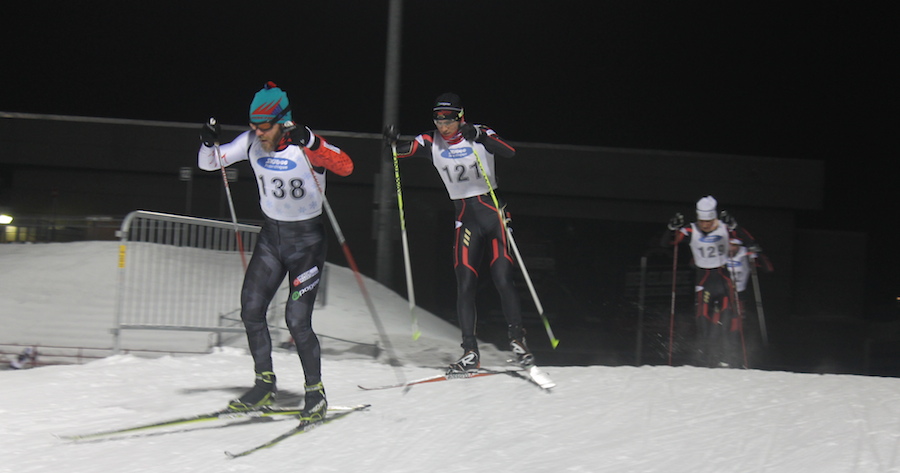
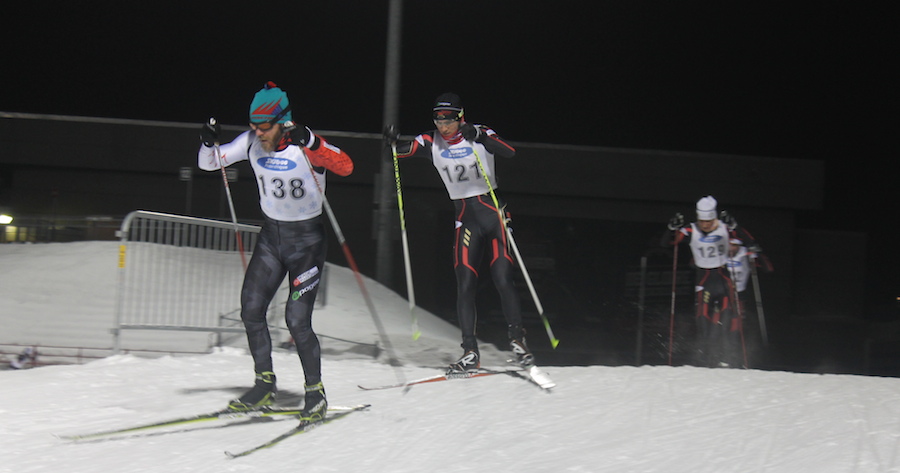
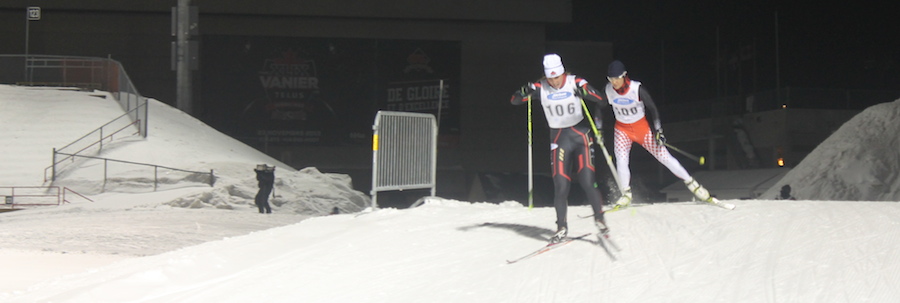
     Marc-André Bédard leads David Grégoire in the first-ever Sprint Rouge et Or on Jan. 28 at Laval University's football stadium. Grégoire went on to win the lap-by-lap elimination sprint, in which skiers rounded a 400-metre course designed by Pierre Harvey and tried to stay in the top six.
    Marc-André Bédard (l) leads David Grégoire (second from l) in the first-ever Sprint Rouge et Or on Jan. 28 at Laval University’s football stadium. Grégoire went on to win the lap-by-lap elimination sprint, in which skiers rounded a 400-metre course designed by Pierre Harvey and tried to stay in the top six.

    QUEBEC CITY — After the World Cup sprints took place in the historic part of the city last year, Quebec City recently saw another spectacle in cross-country skiing, with Laval University bringing the action even closer to the crowd. With the help of local Olympic skiing hero Pierre Harvey, organizers created Sprint Rouge et Or with a “last-to-go” formula, a new event on the athletics track at the Rouge et Or football stadium.

    This past Tuesday night, close to 125 athletes participated in the inaugural race on manmade snow at the Laval University campus. The cold temperature didn’t stop the enthusiasm of skiers from ages 7 to 54, and a couple of “retired” skiers even put their skis on.

    Harvey, the father of Quebec’s current nordic-skiing favorite Alex Harvey, designed he 400-metre track complete with several bumps — some as high as 10 meters — to challenge the skiers. On Tuesday, it was well-groomed with hard-packed snow.

    Compared to other urban sprints, the biggest difference and advantage was that spectators could visually follow racers from start to finish, seeing all of the action. The big screen at the opposite end of the field was great for zooming in on the expressions and emotions of skiers as they passed by the camera.

    With a friendly atmosphere, good vibes filled the stadium as well-known commentator Randy Ferguson gave the play-by-play. The evening started with a sprint prologue for all 11 categories. The beauty of the event was that anybody could enter it.

    “We had a great participation of skiers in the region but also outside,” event director Martin Guay said in a Rouge et Or press release, according to a translation. “The course was world-class through the snow HKD Turbo and the work of the groomer Printoh, Inc., not to mention the efforts of volunteers and field staff of the Department of Sports Laval University.”

    Camille Pepin leads Claude Godbout in the women's race at the inaugural Sprint Rouge et Or on Jan. 28 at Laval University's snow-covered athletics track in Quebec City. Godbout went on to win and Pepin placed second.
    Camille Pepin leads Claude Godbout (r) in the women’s race at the inaugural Sprint Rouge et Or on Jan. 28 at Laval University’s snow-covered athletics track in Quebec City. Godbout went on to win and Pepin placed second.

    Last-to-go

    The big show started at 21:00 [9 p.m.] with the last-to-go: eight laps for the women and 10 for the men. Racers had two laps to position themselves in the pack before elimination started, after which the last four skiers on each lap were pulled out. The idea was to have six or seven skiers remaining for the final lap.

    The women separated quickly after Canadian national-team biathlete Claude Godbout broke away at the beginning of the second lap. Only Camille Pepin of Laval could match her pace. There were a couple of good battles at the end of the pack to stay in the race. Godbout ended up winning, Laval’s Pepin and Myriam Paquette finished second and third, respectively.

    The men’s race was closer to the finish with a pack of 20 fighting sticking together. After 10 laps, Laval’s David Grégoire outsprinted biathlete Marc-André Bédard and Frédéric Touchette (Laval) to take the win. Bédard placed second and Touchette was third.

    Overall it was a great evening despite some delays; most everyone seemed to really enjoy the moment. After expecting a smaller turnout for its first event, organizers are planning future sprints there and hoping to one day fill the 15,000-capacity stadium.

    While the spectacle drew participants from various regions in Quebec, organizers are considering inviting athletes from other Canadian universities as well as the U.S. According to the release, the Rouge et Or team already participates annually in about half a dozen of NCAA races in the northeastern U.S.

    “We’re already thinking about next year!” Guay said.

    Results: Prologue | Final results

  • Davies Leads Canada in Biathlon World Cup Debut

    Davies Leads Canada in Biathlon World Cup Debut

    Macx Davies (bib 42) in the thick of things in Saturday's World Cup pursuit, behind Leif Nordgren (USA). Photo: USBA/NordicFocus.
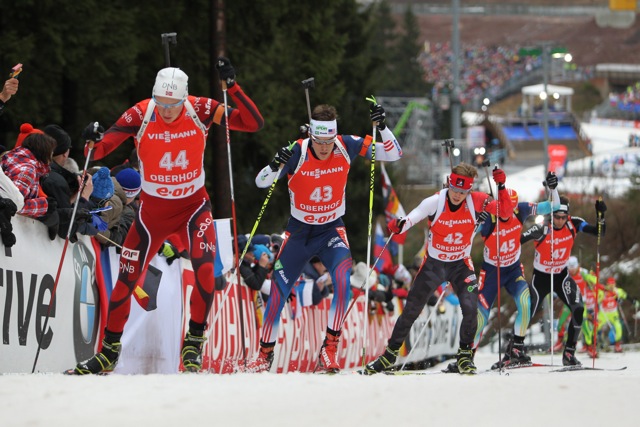
    Macx Davies (bib 42) in the thick of things in Saturday’s World Cup pursuit, behind Leif Nordgren (USA). Photo: USBA/NordicFocus.

    Of all the places to make your World Cup biathlon debut, Oberhof, Germany, isn’t one of the easier ones. It’s known for it’s bad conditions: fog, wind, rain, and no snow. And being in Germany, the heartland of biathlon, the fans are many, and they are loud.

    It’s a particularly big adjustment if you’re from North America, where there are basically no fans for this sport at all.

    “On the finishing loop I kept thinking there was someone behind me because the cheering was pretty loud, but it was cheering for me, and I was not expecting that,” Canada’s Macx Davies told FasterSkier about Friday’s World Cup sprint in Oberhof, his very first start at the sport’s highest level. It was quite a debut, as he missed two shots and placed 42nd, earning a spot in the next day’s pursuit.

    With the newly-nominated Olympic team sitting out this weekend of racing so that they can gain some extra training time at home, Biathlon Canada had a unique opportunity with this weekend’s competitions: they gave the starts to their current second-tier squad, earning a few IBU Cup veterans a consolation glimpse of the big stage and, more importantly, introducing some rookies to the circuit for the first time.

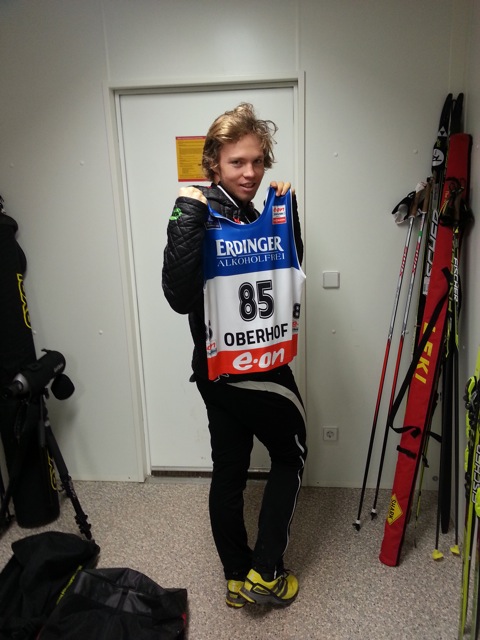
    Davies showing off his first World Cup bib. Photo: Roddy Ward.
    Davies showing off his first World Cup bib. Photo: Roddy Ward.

    “The purpose of the tour was to create experience at the World Cup level, in particular those athletes we are grooming for 2018 and beyond,” development coach Roddy Ward wrote in an e-mail. “We believe it is important for our athletes to know where they are against the athletes at the ‘next level’, when they are ready. This helps them develop and improve, maybe even as important as training itself.”

    Hence, Davies – who just turned 21 and placed eighth in the individual race at World Juniors last season – was out there connecting with the German fan base.

    The group wasn’t entirely without leadership: Marc-André Bèdard is a 2010 Olympian with a wealth of World Cup experience, and his girlfriend Claude Godbout has a much more extensive IBU Cup resumé of IBU Cup racing than her younger teammates, along with World Cup starts from Maine back in 2011.

    “It was great to have Marco here with the team,” Ward said of Bédard. “Marco has raced here before and has had many WC starts. He provided a lot of good insight and mentorship to the young athletes.”

    Rookie Breakthrough

    Bédard, however, didn’t get the chance to show his best stuff. He crashed in the sprint and was out of the pursuit, a tough blow after top-10 IBU Cup performances earlier this season.

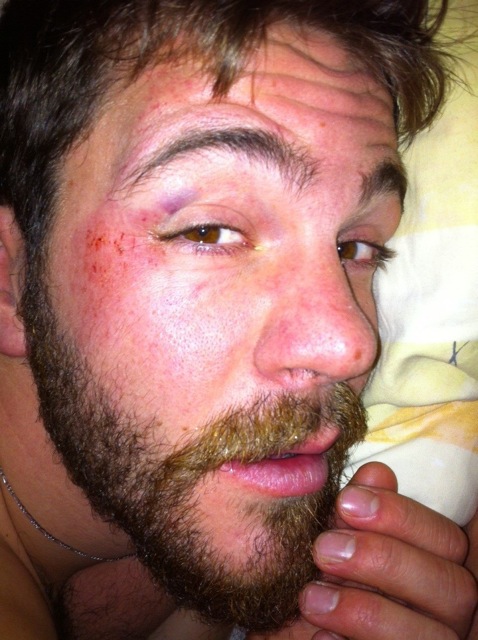
    “I crashed hard, breaking, my ski, pole, ripping my suit and my face… and my ego… I was seeking redemption here but it crashed my face instead,” he wrote in an e-mail. “I’m not sure about [whether it was a] concussion, but I’ve had them in the past and this time I did not lose memory, so that’s a good sign.”

    Bedard showing off his bruises...
    Bedard showing off his bruises…

    So, with Bédard out of the picture, it was up to Davies to represent the Canadian men (Matt Neumann was also on the squad, but did not start Friday’s race). He quickly found himself in the thick of things.

    “I started the sprint in front of [German star] Andreas Birnbacher, so there was a lot of noise coming into my first shooting because he was 15 or 20 seconds behind me,” Davies said. “So there was that, and then a very loud cheer when he shot clean and left the range, for sure. Besides that, I just caught glimpses of him throughout the race. It was nice to know that I was skiing somewhat on par with him.”

    Davies had a good feeling about his ski speed, based on Olympic trials before the squad left the country. Although he hadn’t shot well in those races, his skiing kept him in the mix and compared well with the men who had just come off the World Cup, like Brendan Green.

    Ward called Davies’s skiing “particularly impressive”, and the result was thanks in large part to an aggressive last lap, with the 33rd-fastest time over the final 3.3 kilometers out of anyone in the field.

    In Saturday’s pursuit, however, Davies had a good start but couldn’t turn in anything quite as fast. It was also a very different type of racing.

    “It was less than ideal to miss a couple on the first bout, for sure,” Davies said of missing two shots right off the bat. “That makes it hard to come back. It was challenging, just trying to stay with everyone on the skis and knowing that where I could make the most improvement on placing was on the range – it definitely put a bit more pressure on the first shooting.”

    Davies ended up with four penalties total and a 54th-place finish.

    “Macx delivered a solid first World Cup pursuit,” Ward wrote. “It really is a very different race environment than anyone is used to who are not World Cup regulars.”

    Getting the Picture

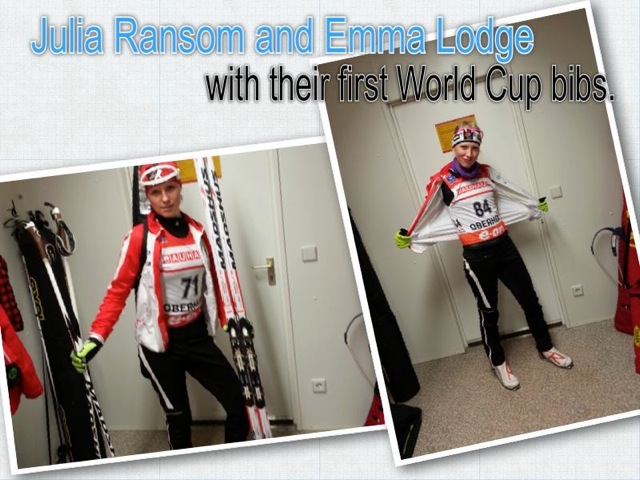
    Lodge and Ransom with their bibs. Photo: Roddy Ward / Eat Sleep Train.
    Lodge and Ransom with their bibs. Photo: Roddy Ward / Eat Sleep Train.

    In the women’s races, Godbout showed her experience and led the women with 52nd place in the sprint, going on to place 55th in the pursuit. Audrey Vaillancourt, a member of the 2013 World Championships team, placed a heartbreaking 61st in the sprint, missing the pursuit by one spot.

    Emma Lodge and Julia Ransom had their first World Cup starts in the sprint, and were unable to turn in Davies’s kind of success.

    “The race wasn’t really what I had hoped for – I was excited and ready to go but struggled with shooting,” Ransom wrote in an e-mail. A World Juniors silver medalist in 2012, she missed two shots in prone and three in standing for 50% shooting overall and 82nd place.

    “While it certainly wasn’t the race that I wanted to have, it was an excellent learning experience and I am looking forward to my next start,” agreed Lodge, who missed four shots total and placed 83rd just behind Ransom.

    But even if these rookies didn’t stun with their results, they accomplished the other goals that Ward set out: seeing what level they need to be at when they hit the World Cup for real, and learning how to deal with the trappings of the big stage.

    “Racing my first world cup in Oberhof was an amazing and inspiring experience that I won’t soon forget!” Lodge wrote in an e-mail. “Although the crowds were loud, especially when the Germans were around, I tried to use that energy to my advantage instead of being intimidated but I’ll admit to being a little starstruck at times… I kind of feel like I’ve been preparing for this start since I started biathlon when I was a little kid.”

    Ransom echoed her sentiments.

    Davies at the pursuit. Photo: Marco Bedard.
    Davies at the pursuit. Photo: Marco Bedard.

    “It was such an amazing experience!” she gushed. “This race was truly a step up in professionalism and excitement.To race along side the world’s best was very humbling. What struck me the most were the fans. I knew Oberhof was popular venue, but I had never before heard 30, 000 people cheer all at once before! And if you happened to come in with a German athlete, the crowd would become louder with each shot, or make a disappointed sigh for each miss. A good test of focus.”

    The athletes had clearly thought about how to deal with all of the sensory overload, and how to keep it from interfering with their races.

    “I guess that going into it, it came into my mind that, well, this is the World Cup,” Davies said. “It was making me nervous and excited, and a lot of emotions. But getting down to it I was thinking of it as just a race to do, and not who I’m racing and where I am.”

    For Ransom, it wasn’t that tough to block out individual cheers. It was more the wall of noise that was new.

    “I thought the crowd would be a distraction for me but it was so loud that it turned into white noise,” she wrote.

    After a Taste, Back to Work

    Next weekend in Ruhpolding, the regular World Cup squad will hit the trails again and this squad will have to make do with IBU Cup starts. It will be a letdown in some ways, but a relief in others.

    “I think it will seem very, very, very quiet,” Davies laughed. “I still can’t get over how loud the fans were here. But I think it will be good because it’s not too much of a step down in competition, but enough that it makes it more exciting to be fighting for top 20 or top 10 rather than just making the pursuit.”

    Ward, who had actually never coached at a World Cup before, believes that this weekend’s races gave his athletes a little more motivation to deliver results at the second-tier race series.

    “It was a lot of fun and a great experience,” Ward wrote. “I don’t think I could ask for a better introduction than Oberhof. All the fans and noise is really something to see and hard to describe…. I’m quite certain everyone will be working hard to get back to the World Cup sooner rather than later!”

    international race reports: sprints / pursuits

    results: men’s & women’s sprints / men’s & women’s pursuits

    Davies (center) at the start of the pursuit. Photo: Marco Bedard.
    Davies (center) at the start of the pursuit. Photo: Marco Bedard.
  • Widmer, McKeever Earn First Individual Titles at Canadian Nationals

    Widmer, McKeever Earn First Individual Titles at Canadian Nationals

    Heidi Widmer (AWCA) on a mission to capture her first individual national title at  2013 Canadian Nationals on Sunday in Whister, B.C. There, she was the top Canadian and third overall in the 5 k freestyle individual start.
    Heidi Widmer (AWCA) on a mission to capture her first individual national title at 2013 Canadian Nationals on Sunday in Whister, B.C. There, she was the top Canadian and third overall in the 5 k freestyle individual start.

    WHISTLER, B.C. – Heidi Widmer of the Alberta World Cup Academy (AWCA) didn’t win Sunday’s 5-kilometre freestyle individual start at Canadian Nationals outright, but she took home her first individual national championship at the age of 22.

    American Caitlin Gregg of Central Cross Country (CXC) made the trip to Canada and took the overall win in 12:02.9 on a fast-and-warm day at Whistler Olympic Park.  She was happy with her race and is feeling that this event will be good preparation for the U.S. SuperTour Finals in April.

    Caitlin Gregg (CXC) en route to the overall win in Sunday's 5 k freestyle individual start at Canadian Nationals in Whistler, B.C.
    Caitlin Gregg (CXC) en route to the overall win in Sunday’s 5 k freestyle individual start at Canadian Nationals in Whistler, B.C.

    University of Colorado-Boulder senior Eliska Hajkova took second place, 10.9 seconds behind Gregg. Along with some Colorado teammates, she decided to celebrate spring break in Canada this year. A Sochi hopeful, she wanted to test herself against an international field before returning home.

    Hajkova was excited by her race, particularly enjoying the fast snow and low elevation (900 metres compared to Boulder’s elevation of 1,650 m).

    “The [course] has hard uphills and tricky downhills, but it is so fun to race,” she said. “The trails here, oh my God, this is really a heaven for skiing.”

    The fastest Canadian, Widmer was third overall, 22.4 seconds behind Gregg.

    “It was definitely a lung burner, but I am very happy and ecstatic,” she a day after winning the team sprint with Marlis Kromm. “It is my first Canadian championship, so I am really happy with that.”

    “It was a really fast course today and good conditions, but different than we expected,” she added. “I wanted to finish stronger than I started. Five k is about pushing right from the beginning and trying to hold off that blow up as long as possible.”

    Nakkertok’s Alana Thomas was second Canadian and fourth overall (+32.7) and Alysson Marshall (AWCA) brought some upside to a rough season, collecting the bronze less than two seconds behind Thomas.

    “It was a pretty decent distance race for me,” Marshall said. “I am happy with how it turned out.”

    Asked what her season highlight was, she responded “Later this week!” A sprint specialist, she is looking forward to the classic sprints on Thursday and the classic interval start on Tuesday to provide that highlight.

    Julia Ransom (Biathlon Alberta) was the top Junior Woman in eighth (+48.9). She was not the top biathlete on the day, edged out by Canadian national-team biathlete Rosanna Crawford, also from Canmore.

    Fresh off Sochi, McKeever notches first Canadian title

    Brian McKeever (Canadian Para-Nordic Ski Team) after notching his first national title at Canadian Nationals on Sunday in Whistler, B.C. There, he won the 10 k freestyle individual start just days after flying back from IPC World Cup Finals in Sochi, Russia.
    Brian McKeever (Canadian Para-Nordic Ski Team) after notching his first national title at Canadian Nationals on Sunday in Whistler, B.C. There, he won the 10 k freestyle individual start just days after flying back from IPC World Cup Finals in Sochi, Russia.

    In the men’s 10 k freestyle individual start, Canadian Para-Nordic Ski Team member Brian McKeever collected his first national title in 21:18.1.

    A perennial winner in International Paralympic Committee (IPC) events with 10 Paralympic medals and an unbeaten streak on the World Cup this season, the 33-year-old visually-impaired skier started fast on Sunday. He posted one of the fastest splits up the opening climb and kept up the tempo.

    Graeme Killick (AWCA) started faster, but faded on the second lap to concede the silver medal to teammate Graham Nishikawa, who was 14 seconds behind on the first climb.

    “You never really know how you are going to feel after getting off the plane from Russia,” McKeever said after flying from IPC World Cup Finals in Sochi just 48 hours prior.

    “First national championship win in my career,” he said. “I am really happy about that.”

    About 10 seconds behind with three kilometers remaining, Nishikawa finished strong, 11.6 seconds behind McKeever.

    The 5 k ‘blue’ loop, best known as the second loop of the 2010 Olympic 50 k course, has a testing final kilometre, with the steep climb from ‘Way Out’ followed by a rolling section into the Hermodt’s hill before the drop into the stadium.  Many racers bled time on the apparently easy Hermodt’s on the second lap, Killick included. With 3 k remaining, Killick was close to McKeever.

    “I lost a lot of it probably coming to the stadium here,” Killick said.

    Coming off two golds at IPC World Cup Finals and two at IPC World Championships this season, Brian McKeever returned to Canada to claim his first national title on Sunday in the 10 k freestyle individual start in Whistler, B.C.
    Coming off two golds at IPC World Cup Finals and two at IPC World Championships this season, Brian McKeever returned to Canada to claim his first national title on Sunday in the 10 k freestyle individual start in Whistler, B.C.

    Hearing how McKeever one-skated the final climb, Killick laughed and said that wasn’t an option for him.  Killick held on for bronze, 23.0 seconds out of first.

    “It was super-fast conditions,” Nishikawa said. “Just go from the gun and a lot of pain. I usually start slow and hopefully pick it up. I am happy with my effort, it hurt a lot so that’s a good thing.”

    Nishikawa’s also coming off some intense racing at World Championships in Val di Fiemme, Italy, but said he’s recovering.

    “[Today] feels better than yesterday, so I am looking forward to Tuesday a lot,” he said.

    Killick was also upbeat, saying “it was good for a skate race.”  In a 10 k individual start, “you have to keep your speed up all the time, and I think I was almost there, but not quite.”

    Like the others, Killick enjoyed the conditions, describing them as “nice and fast, good speed. It held up better than when we were testing yesterday.”

    While the men’s podium was all-Canadian, the U.S. took fourth and sixth with Sylvan Ellefson (Ski & Snowboard Club Vail/Team HomeGrown) and Bryan Gregg (CXC), respectively.

    Marc-André Bédard (Biathlon Canada) led a good showing of biathletes, placing fifth overall and fourth Canadian (+30.4) to match his result at Canadian Nationals last year, where he was fourth in Quebec.

    Results: women | men

    2013 Canadian Nationals 10 k freestyle men's podium, with winner Brian McKeever (third from r), Graham Nishikawa in second (second from l), Graeme Killick in third (second from r), Sylvan Ellefson in fourth (second from l), Marc-Andre Bedard in fifth (r) and Brian Gregg in sixth (l).
    2013 Canadian Nationals 10 k freestyle men’s podium, with winner Brian McKeever (third from r), Graham Nishikawa in second (second from l), Graeme Killick in third (second from r), Sylvan Ellefson in fourth (second from l), Marc-Andre Bedard in fifth (r) and Brian Gregg in sixth (l).
    2013 Canadian Nationals 5 k freestyle women's podium
    The top-three Canadian women in Sunday’s 5 k freestyle individual start at Canadian Nationals in Whister, B.C., with Heidi Widmer (c) in first, Alana Thomas (l) in second and Alysson Marshall in third.


  • Vaillancourt, Smith Collect Mass-Start Titles at Canadian Biathlon Nationals

    Audrey Vaillancourt (Quebec) completed her set of three titles at 2013 Canadian Biathlon Championships on Tuesday with a photo-finish victory over Megan Heinicke (Biathlon BC) in the 12.5 k mass start in Whistler, B.C.

    “We both deserved to win today,” Vaillancourt wrote in an email. “I’m just glad I managed to have a better stretch.”

    Vaillancourt shot clean at Whistler Olympic Park to finish in 34:54.0. Heinicke was just 0.2 seconds behind and missed one shot (0+0+1+0).

    “Today skiing didn’t feel as good as during the weekend,” Vaillancourt wrote, “So I focused more on shooting and it worked very well; I had a perfect day on the range.”

    Vaillancourt enjoyed her first mass start of the season: “On the last lap we came out of the range together, so I knew this was going to be a really tough one,” she wrote. “We both tried to drop each other at different places on the course, but we were both dead tired and ended up together for the final sprint! It has been a photo finish for the win!”

    Corrine Malcolm (U.S. Biathlon) took third place in 36:38 (1+0+1+0), 30 seconds ahead of Julia Ransom (Biathlon BC) in fourth.

    “Today was actually the best I’ve ever shot in a race,” Malcolm wrote.  “Unfortunately I lost a little bit of time when I accidentally started to ski onto the 2km cut off on our second loop.  Luckily [Canadian biathlete] Rosanna [Crawford] saw me veer off and was able to yell to me to turn around. By the time I made it back to the right trail Julia was coming by and I was able to get in with her and ski nice and relaxed.  Julia and I stayed together until the last shooting stage where I cleaned and she missed her final shot.”

    Ransom’s time of 37:08 (2+0+1+1) was good enough for third Canadian, but shooting was perhaps not surprisingly the difference for the 20 year old who started her first Cross Country World Cup earlier this season in Canmore, Alberta.

    In the men’s 15 k mass start, Nathan Smith (Alberta/Biathlon Canada) struck back after Sunday’s starting error by dominating the day. He won by 44 seconds in 37:53 despite missing three shots (1+0+0+2) during what he described as ideal shooting conditions.

    “I missed that first shot prone and was a little concerned, but after that I felt comfortable and in control,” Smith told Biathlon Canada. “I know I didn’t win the pursuit race, but I feel like I’m in great shape and accomplished what I came here to do.”

    Marc-André Bédard (Quebec) was second in 38:37 with four misses.

    “Shooting was perfect 3 out of 4 times,” he wrote in an email.  “[I] missed 4 at my first standing!”

    Although disappointed by his shooting, that should not be a problem next week when Bédard competes at Canadian cross-country nationals. “I’m hoping to repeat or do better than my 4th at the 15 free last year!” he wrote.

    Bill Bowler took third place to lead a large American contingent with his second podium. He finished 43 seconds behind Bédard, and also had four penalties (0+1+2+1).

    “I felt good on the skis,” Bowler wrote. “Definitely better than in the races earlier this week.”

    He agreed that the conditions weren’t a problem. “It was a perfect day for racing with fast tracks,” he wrote. “The weather in Whistler can be volatile so it was nice to have sun and solid conditions.”

    Kurtis Wenzel (Alberta) grabbed the Canadian bronze with 39:31 (0+0+1+1), good for fourth overall.

    Biathlon wraps up Wednesday with the relays.  The Sea to Sky Nordic Festival continues with cross country nationals (March 23 to 29), nordic combined (March 28 to 30) and ski jumping (March 28 to 30).

    Mass-start results

  • For Biathletes Bédard and Godbout, Spartan Lifestyle is Anything But

    For Biathletes Bédard and Godbout, Spartan Lifestyle is Anything But

    Canadian biathlete Claude Godbout, who has won two of the four Spartan races she has entered, training on the Dachstein glacier in Ramsau, Austria. Her training camp is being facilitated by Spartan organizers, who flew her and boyfriend Marc-André Bédard to Slovakia to compete. Courtesy photo.

    As FasterSkier wrote last summer, Canadian biathletes Marc-André Bédard and Claude Godbout joined the Spartan Race craze almost on a whim, albeit a whim that hinted at the possibility of a payout.

    A year later, the partners have competed in three more of the notoriously brutal obstacle races, and neither has missed the podium yet. In June in Montreal, Bédard placed second among men and Godbout third among women. A month later in Pennsylvania, Bédard was again second while Godbout won the women’s race, and last weekend in Slovakia, both Quebec natives won the first-ever Spartan event held in continental Europe.

    So: running over hill and dale, crawling through mud and barbed wire, climbing fences, jumping over fire, dodging blows from gladiators … is this going to become a second career for the 2010 Olympian and his girlfriend, who also has World Cup experience?

    Godbout and Bedard after their double victory in Slovakia. (Courtesy photo)

    Probably not. After all, both are aiming for the Sochi Olympics, which are just a year and a half away. Earlier this summer, Godbout told FasterSkier that the 2014 Games were her main focus.

    “This is pretty much as big as it can go for me,” Bédard said in an interview from Ramsau, Austria. “We’re biathletes so we need to focus on that. This is fun for us and it’s good cross-training, but we’re not training at all to be good at it. It just happens that way, cross country skiers are good overall physically, so for us it’s easy to perform well.”

    National-team coaches were not initially pleased when the pair mentioned heading to Slovakia for a race (their trip was paid for by the organizers). But the biathletes are set on making Spartan racing work for biathlon and tried to think outside the box.

    “We were able to negotiate to get a training camp while we were in Europe, since they were sending us anyway,” Bédard said. “Instead of just sending us for five days and doing the one race, we get to stay here for longer [until the end of the week]. We’re having a good training camp right now in Dachstein. Our coaches were pretty happy about that, because otherwise we wouldn’t have gone to the Dachstein this year.”

    Bedard climbing a rope, one of the obstacles in the Slovakian race. (Courtesy photo)

    Spartan organizers helped the Canadians get a car, and they are staying in some apartments owned by Fischer, Bédard’s ski company. Bédard has been to Ramsau several times before, so it’s easy for him to get around; the duo also has several contacts in town and regarding the glacier.

    “We get a free trip to Europe and a free training camp, so that’s amazing,” Bédard said.

    Why would organizers go so far out of their way to help a few biathletes? According to Bédard, it has a lot to do with publicity. While more than 400,000 people have participated in Spartan races so far, the bulk of those entrants are in the United States. The franchise is already successfully expanding into the Canada, but it wants to go farther.

    And not just geographically: organizers dream of a day when Spartan racing is a competitive, more or less professional sport. Already in the U.S., some races put up prize money and there are bigger purses for end-of-season points leaders. In order to encourage that development race promoters need top athletes to show up to the starting line. And with their records, Godbout and Bédard definitely qualify. For the Pennsylvania event, Godbout was even featured on a poster advertising the top women who would be competing.

    And in Slovakia, organizers offered up $10,000 to anyone who could beat Bédard. They also arranged for the pair to go on the country’s equivalent of Good Morning America to introduce Slovakia to the concept of Spartan Racing and demonstrate how they conquer some of the typical obstacles. According to Bédard, it was as a “very weird” experience.

    “Really we don’t even know what happened!” he laughed. “They filmed us doing a bunch of stuff and asked us a bunch of questions, but it was funny because it was all in Slovakian so in between the questions in English they were just talking, talking, talking in Slovakian. We still haven’t seen the footage.”

    Godbout readying herself for the “spear throw” in Slovakia. (Courtesy photo)

    Since the champions are putting in their time to do publicity for the franchise, it’s worth the organizers’ effort to keep them racing, even if it means subsidizing a few more days in Europe.

    And while the training camp in Austria is an exciting development, it’s not the only way that Spartan racing is helping out the Canadians’ biathlon careers. In Pennsylvania, the two combined for over $2,000 in prize money, which Bédard said was more than either had ever won in a biathlon race. Becoming part of the Spartan world has gained them sponsors, too.

    “It’s not only that we get the checks from them, but those people are really into sports and love competition, so they want to help us,” Bédard said. “There’s a lot of contacts [to be made] … they have brought us a couple of sponsors already, and I’m sure these races this weekend can help. We got good money out of this and it will definitely help us for the winter.”

    He and Godbout use their appearances as a platform to tell people about their day-to-day job as athletes, too.

    “People know that we train for biathlon, and we put that at the front, that we are biathletes, and this helps our sport,” Bédard explained. “Especially in the states, people don’t even know what this is, so it’s really in a lot of different ways that we’re trying to get the most out of this.”

    But while plenty of Spartan participants are interested in biathlon, Bédard said there was a big difference between his attempts to promote his “real” sport career and his experience when he talks about Spartan races. He may be raising awareness about biathlon, but he doubts that he is gaining the sport any new athletes.

    “We talk about our sport to people and they are happy to hear about it, they even want to hear more, but they’re not going to go out and buy some cross-country skis and a gun,” he said. “It doesn’t really touch them personally because they don’t see themselves doing that. These races are more people-friendly. With all the videos and stuff they make it seem like it is hell, but really it just challenges people physically, and getting people off their couches is huge.”

    Although Bédard is unlikely to defend his original title from the 2011 Spartan Beast in Killington, Vt., on Sept. 22 — he has already done three of the races this year and his coaches aren’t keen on losing him to another, despite the allure of $4,000 in prize money — he and Godbout said that they’d do a few of the races next summer if they could fit them into their regular national-team training schedule, and particularly if the organizers keep catering to their needs as biathletes. One key to their participation is removing the cost of competing.

    “We’re not ready to put money into it, because we are already struggling to be able to race in our sport,” Bédard said. “But if we’re able to do more training camps like this, like doing one race and then being able to do a sweet training camp, then that’s a really good deal, to my ears. If it happens that they still want us next year, and I think they will, then I think, why not? It’s good cross-training and it’s fun.”

    Bedard denying his challengers the $10,000 they were offered to beat him in Slovakia. (Courtesy photo)
    Godbout waiting to demonstrate some Spartan skills on Slovakian television. (Courtesy photo)
  • Biathletes Shine In Cross Country at Canadian Nationals, SuperTour Finals

    Rosanna Crawford – here in her 10 k pursuit victory – won all three races at Canadian Biathlon Championships, before shifting gears to contest cross country nationals. In the sprint, she qualified seventh and placed tenth.

    Much like the U.S. and Canadian ski teams, many members of the North American biathlon squads have returned from Europe and decided to hop in some straight cross country races. Here’s a roundup of the results.

    – At SuperTour Finals in Craftsbury, Vermont, U.S. national team biathletes Susan Dunklee and Annelies Cook have contested both races so far in the mini-tour. Dunklee recently returned from Khanty-Mansiysk, Russia, where she raced Friday, Saturday, and Sunday in the final World Cup races of the season; before that she was in Ruhpolding, Germany, for World Championships, where she placed fifth in the 15 k individual. Dunklee finished fifth in the 3.2 k skate prologue, 19 seconds behind Jessie Diggins, 12 behind Holly Brooks, and 11 behind third-place Sadie Bjornsen. In the 9.6 k classic mass start, Dunklee placed 15th, just over three minutes behind Bjornsen.

    Cook also raced at World Championships, where her top individual finish was 62nd but she turned in a seminal leg in the women’s relay, which placed 11th. Cook had then returned to the States to sweep the sprint, pursuit, and mass start races at U.S. Nationals for biathlon, picking up three quite dominating wins. In Craftsbury, she placed 13th in the prologue, 26 seconds behind Diggins, and 20th in the classic mass start, about three and a half minutes behind Bjornsen.

    – After sweeping their respective mass start, sprint, and pursuit races at Canadian Biathlon Championships in Valcartier, Quebec, Rosanna Crawford and Marc-Andre Bedard made the short drive over to the same event for skiing. They understandably decided to skip out on the 5/10 k classic race, which fell just two days after they had finished their own national championship series, but made their debuts in the 10/15 k skate.

    Bedard, in this instance racing for Skibec, finished fourth behind Alex Harvey, Ivan Babikov, and Devon Kershaw. He was 2:25 behind Harvey and 40 seconds behind Kershaw. Bedard had not been particularly happy with his ski speed at biathlon World Championships two weeks earlier, where his times were consistently the slowest of the Canadian men and he had a top finish of 52nd. But at his national biathlon championships, Bedard had said that he seemed to be in better form. In the skate sprint, he raced to 50th place in qualifying, and wound up 41st once the juniors were removed from the results – a bit under three seconds away from making the quarterfinals. Bedard sat out the 50 k.

    Crawford started out by placing 15th in the 10 k skate, 1:48 behind a victorious Emily Nishikawa. She instead made her mark in the skate sprint, where she qualified in seventh, 7.92 seconds behind her sister, Olympic gold medalist Chandra Crawford. “Got to battle Chandra in the semis, but sadly was not aggressive enough!” Rosanna Crawford tweeted after the race. Her effort was good for tenth overall. Unlike Bedard, Crawford decided to pony up for the long mass start, and was excited to battle her sister; while Rosanna didn’t necessarily expect much in a 30 k classic race (the longest female biathletes race is 15 k, and they always skate in competition), Chandra is known as a sprinter. The older sister, however, skied to a convincing win while Rosanna placed 15th.

    – Several of Canada’s junior biathletes also made the hop over to Mont Sainte Anne for cross country nationals.

    Sarah Beaudry of the Caledonia Nordic Ski Club, who finished 26th in the youth sprint at World Junior and then skied up to 20th in the pursuit, placed an impressive ninth in the junior girls’ 5 k classic, 54 seconds behind Marte Haakenstad Braaten of Norway and 42 behind the top Canadian, Katherine Stewart-Jones of Nakkertok. In the junior girls’ 10 k skate, she matched that result by placing ninth again, this time 2:47 behind Suzanne Stevenson. In the girls’ sprint, Beaudry qualified in second and finished fourth. In the same division, Youth Olympic Games teammate Danielle Vrielink placed 14th in both the 10 k and the sprint.

    Representing Rocky Mountain Racers, Stuart Harden, the Canadian who almost won the Youth Olympic Games pursuit but was relegated to seventh after skipping a penalty loop, made a habit of matching that result. In the junior boys’ 7.5 k skate, he placed seventh, 50 seconds behind Alexis Dumas of Skibec. Then he qualified in 14th in the junior boys’ sprint before winning the B-Final and placing seventh overall. Canmore biathlete Aidan Miller placed 24th in the 7.5 k skate.

    In the junior women’s sprint, Canmore teammates Julia Ransom and Emma Lodge met in the B-Final and placed 8th and 10th overall. In the 20 k classic mass start at the end of the championships, Ransom, who was the silver medalist in the youth women’s pursuit at World Junior Championships, placed 10th, just under five minutes behind runaway victor Maya MacIsaac-Jones. Lodge finished 25th.

    Canmore’s Maxc Davies and Skibec’s Albert Bouchard placed 11th and 20th in the junior men’s sprint. Davies then placed 23rd in the junior men’s 30 k classic race.

    2012 World Junior Champion in the men’s individual, Kurtis Wenzel, raced as a senior at cross country nationals and placed 35th in the sprint. Wenzel, who had picked up a medal in the senior division of biathlon national championships a week earlier, finished the week by matching that in the 50 k classic mass start.

    Finally, Canmore biathlete Kirsten Gillett placed second in the juvenile girls’ sprint, but first place went to American Brooke Mooney, so Gillett was named Canadian champion. Gillett placed 15th in the interval start skate.

  • The Big Guns are Back: Notes, Quotes & Video from Canadian Nationals

    The Big Guns are Back: Notes, Quotes & Video from Canadian Nationals

    MONT SAINTE-ANNE, Québec — While Alex Harvey was the man of the day at Canadian Ski Nationals on Tuesday, Devon Kershaw, Lenny Valjas and the remaining World Cup crew (including Chandra Crawford, Dasha Gaiazova, Alysson Marshall and Kevin Sandau) also met a strong welcome after flying into Québec late Monday night and racing the next day.

    Cross-country ski fans, friends, family and media outlets came out to Mont Sainte-Anne to catch a glimpse of the nation’s top skiers in their flashy red suits. Several competitive skiers showed up as well for a shot at contending with some of the world’s best.

    Some quotes from the 15 k:

    Marc-André Bédard (Canadian Biathlon Team/Québec), 4th

    The first thing I did was ask Alex if he was coming to nationals. He was like, ‘Of course I’m coming.’ I was like, ‘OK, I need to go just to see how I do against them.’ That was fun. I’ve been friends with him since I was a kid when we were in Mont Sainte-Anne together.

    There’s lots of biathletes who make podiums on lots of World Cups … so we know that the top biathletes are pretty much the same as the top cross-country skiers. I’m not a top biathlete; I’m just hoping to do good and those guys [Devon Kershaw, Alex Harvey, etc.] are the best skiers so it’s really cool to be not so far behind them.

    I wish I could do more cross-country, but it’s rare that the opportunity comes, especially with the strong guys. 

    [Note: Bédard said he last competed at Canadian cross-country nationals in 2007.]

    David Greer (Pierre-Harvey National Training Centre), 5th

    Alex was really moving today. He started 45 seconds behind me and caught me at about 2 k. I tried to stay with him for about 10 seconds and decided I’m probably better off just racing my own race. That wasn’t very encouraging, but later in the race I felt better and better and then got encouraging splits.  

    End of the season, a lot of people are fried and not super pumped about the racing, but it was definitely super fun having those guys here because we don’t get to race with them very often. You see them racing World Cups all year so it’s the one chance we have to measure ourselves against them. I was definitely looking forward to it.

    Brent McMurtry (Pierre-Harvey National Training Centre/Senior Development Team), 6th

    I was getting splits off of Devon and Ivan [Babikov] I was third. Devon caught me for 30 seconds after two-and-a-half kilometers or something, but I was not going the same speed as him. It was good motivation because once he caught me and went by, I was able to keep him in sight for the next two laps so I sort of knew I was at least a little bit competitive. 

    Devon was second in the World Cup, Alex last weekends had two podiums. You know that when you’re two minutes back, it’s two minutes off the best in the world. It’s not where I want to be and not where I think I can be, but at the same time, it’s not so bad.

    I’m staying at Alex’s house; they’re good friends of mine. It was funny sitting around at breakfast [Tuesday] morning with Devon and Alex. Their season is done and talking about things other than skiing and just life. It’s nice to have them around. 

    Erik Carleton (Rocky Mountain Racers/National Para-Nordic Team), 8th

    It’s my only chance to race against our World Cup team. … I knew it would be, for sure, at a different level. When Alex passed me [about halfway through], I just saw the pace he was going. I stayed with him a bit, then the last lap was pretty tough after that. … You can just see he’s really efficient and he keeps pulling away. He was gone on the last lap.

    Tuesday’s complete results


  • Harvey Embraces Homecoming, Wins 15 k at Canadian Nationals

    Harvey Embraces Homecoming, Wins 15 k at Canadian Nationals

    Canadian Nationals
    Canadian National Ski Team member Alex Harvey rounds the stadium at his club's trails in Mont Sainte-Anne, Québec, in the 15 k freestyle individual start on Tuesday. Harvey won the race by nearly 33 seconds.

    MONT SAINTE-ANNE, Québec – Alex Harvey had no idea what he was in for. Or maybe he did.

    Fourteen hours after he and several other Canadian National Team members stepped off a plane in Québec City and concluded a 32-hour trip back from the World Cup Finals in Sweden, Harvey was back in his native Saint-Ferréol-les-Neiges, Québec, preparing to race again.

    If it had been up to Harvey, he would have slept in a little later. His mom woke him up with a kiss on the cheek at 7:30 a.m. Tuesday before she left for work. Regardless, he was pretty excited about his his first day at Canadian Ski Nationals, hosted by his Club Nordique Monte St. Anne.

    Alex Harvey talks to the media after posting what turned out to the fastest 15 k freestyle time at Canadian Ski Nationals on Tuesday.

    The 23-year-old generated about as much hype as one can expect at a cross-country ski race in North America. Several news outlets flocked to the Quebec City International Airport at 10:30 Monday night to see Harvey and his celebrated teammates, including overall World Cup runner-up Devon Kershaw and Lenny Valjas.

    Late Wednesday morning, Harvey’s fans followed him to the trails where he warmed up. They asked for his autograph, snapped photos and showered Kershaw with attention as well.

    After both finished Wednesday’s 15-kilometer freestyle individual start, Harvey and Kershaw hardly made it out of the finish pen. Sweaty and spent after racing in nearly 20 degrees Celsius (68 degrees Fahrenheit), both found they were even more sought after as two of the top finishers.

    Harvey crushed his competition with the help of resounding cheers every time he skied through the stadium, winning the three-lap race in 40:54.1. His World Cup teammate, Ivan Babikov was second, 32.9 seconds back, and Kershaw finished third (+1:44.8).

    “It was hard,” Harvey said of the combination of travel, lack of sleep and challenging snow conditions on Tuesday. “I talked with Devon after the race. It might have been the hardest race of the season for both of us. It was so slow out there.”

    Alex Harvey (CNST) on the second of three laps in the 15 k freestyle individual start at Canadian Ski Nationals on Tuesday.

    Harvey pulled through by pushing hard from the start. Five kilometers in, he led by 18.6 seconds over Babikov, Tuesday’s 10 k classic champion. Kershaw was 19.7 seconds back in third, affirming that the local hero was truly on a roll.

    He kept up the pace through the second lap, coming into the stadium 11.7 seconds ahead of Babikov. Kershaw was still in third, but nearly 52 seconds back.

    “I didn’t know how it was going to be here,” Harvey said, referring to his recent highs, including a World Cup Finals victory in Falun, as well as some of the lows this season.

    “It ended up being good and with the fans, the crowd, just everybody being so psyched. I didn’t have a choice to ski fast or not,” he said.

    Just minutes before his race, Harvey spoke to a group of young children in French. They sent him off with a chant that echoed around the stadium throughout the afternoon: “Ahh-lex! Ahh-lex!”

    “They had banners and singing songs so it was really special to see all these 8-year-olds just having the best time,” Harvey said. “It motivated me for the win, for sure.”

    Kershaw said the homecoming experience was humbling. Seeing how famous Harvey was in Québec and how excited people got about him, the team and the sport, was great for cross-country skiing, he said.

    It also made Harvey that much harder to outdo.

    “There was no chance I was going to beat Alex today,” Kershaw said.

    With a tendency to open hard in races, especially individual starts, Kershaw discovered he was six seconds down on Harvey about 2 or 3 kilometers in.

    Canadian National Team member Devon Kershaw (l) leads Eric Wolcott (Black Jack) up a hill during the 15 k freestyle individual start at Canadian Ski Nationals on Tuesday.

    “He closes way harder than me so the victory was going to be Alex’s, absolutely,” Kershaw added.

    While skating in soft conditions wasn’t his specialty, Kershaw said he felt good until about 7 k, where he broke a pole. The handle ripped off and he skied the next kilometer without a pole.

    “There was nobody out there; it’s not the World Cup,” he laughed.

    When he did get a pole, it was 140-centimeters long, which was about 20 centimeters too short. He found better replacement soon after and finished the race with a 157 ½.

    “It was a real struggle today and the conditions were really hard,” Kershaw said. “It’s kind of frustrating for some bad luck to happen, but the World Cup season’s over so let’s not get too greedy.”

    Babikov was happy with his result considering he started ahead of Kershaw, Harvey and nearly 160 others in the men’s open race.

    “I was just trying to ski my race, ski strong throughout the whole three laps,” Babikov said. “It was really hard to do because it’s so soft and it was hard to pole. It didn’t matter if you had poles or no poles.”

    Canadian Nationals
    Ivan Babikov (CNST) wears the leader's jersey at Canadian Ski Nationals in the 15 k freestyle individual start on Tuesday after winning Monday's 10 k classic race. Babikov placed second on Tuesday.

    He was impressed with his teammates’ performances after one long day of travel.

    Upon leaving Falun, Sweden, at 2 a.m. on Monday, they flew to Frankfurt, where their flight to Canada was delayed. Once in Montreal, the men’s and women’s national team members found they had five hours to kill because of a missed connection. Harvey said they enjoyed some St-Hubert Chicken for a pre-race meal and arrived in Québec City around 10:30 p.m.

    By the time Harvey fell asleep, he said it was 6 a.m. Falun time.

    While he and the rest of the national team planned to recover for Thursday’s sprints, recently moved from Québec City’s Plains of Abraham to Mont Sainte-Anne, several outsiders to Canadian cross-country were also looking forward to the competitive sprint day.

    Canadian biathlete and World Championships team member Marc-André Bédard was encouraged by his performance in Tuesday’s 15 k, where he placed fourth (+2:25.7) despite starting nearly 45 minutes after the frontrunners. Because he and several other biathletes didn’t have FIS points, they were seeded near last.

    “What was really hard was to pass people all race,” Bédard said. “It felt like I said ‘track’ 200 times today.”

    Without any splits throughout the race, he had no idea where he stood or where he finished for several minutes after the race.

    “I had no expectations … I was hoping to be in the top 20, top 30, it’s hard to say,” he said. “I’m really tired, too. I wanted to have fun and I’m really happy with the result.”

    Pierre-Harvey National Training Centre athletes David Greer and Brent McMurtry placed fifth and sixth, respectively. Baptiste Gros of France was seventh and Erik Carleton (Rocky Mountain Racers/National Para-Nordic Team) finished eighth before catching a flight to Finland with Brian McKeever for the IPC World Cup on Thursday.

    Michael Somppi (Thunder Bay National Development Centre/NST) was ninth and Kevin Sandau (Alberta World Cup Academy/NST), who flew in with the national team Tuesday night, was 10th.

    Men’s 15 k freestyle results

  • Crawford, Bédard Finish Job at Canadian Championships with Pursuit Wins

    Crawford, Bédard Finish Job at Canadian Championships with Pursuit Wins

    Rosanna Crawford (r) looks back at Claude Godbout before leaving the range to ski one penalty lap on the last stage of the 10 k pursuit at the Canadian Biathlon Championships in Valcartier, Quebec, on Sunday. Crawford went on to win by 11.6 seconds over Godbout.

    VALCARTIER, Québec – As she rounded the penalty loop at Myriam Bédard Center on Sunday, Rosanna Crawford looked up and threw down her headband.

    Winning the pursuit wasn’t going to be a walk in the park at the Canadian Biathlon Championships, and the 23-year-old from Alberta needed all the firepower she could muster.

    Rosanna Crawford soaks up her 10 k pursuit victory at the 2012 Canadian Biathlon Championships in Valcartier, Quebec, on Sunday.

    But the shooting portion was over; Crawford missed one shot in each of the last three stages for three total misses. The final one proved to be the most crucial.

    A few seconds behind, Claude Godbout of Québec had worked her way from starting fourth, 15 seconds after Crawford, to skiing in second in the 10 k pursuit. After shooting clean on the last standing stage, she was in contention for first.

    Watching Godbout emerge from the range, Crawford sped up to exit the penalty and skied out in front of her. The two raced together for about half of the 2.5 k loop, then Crawford capitalized on the long downhill and secured an 11.6-second victory over Godbout.

    “Halfway around the penalty loop, I hear the range go crazy so I knew that she had shot clean,” Crawford said. “Right when I heard them cheer I was like it’s on! … She led up the hill and then over the last little bump, I just hammered ahead of her. I had amazing skis today so I was able to rocket down the downhills and get to the finish line first.”

    Crawford was pleased with making 17 shots, although she would have liked to have matched her performance on Thursday, when she made 18 to win the 12.5 k mass start. She went on to win Saturday’s 7.5 k sprint.

    Canadian pursuit champion Rosanna Crawford (r) congratulates runner-up Claude Godbout on Sunday.

    “Skiing has really felt amazing these past four days,” Crawford said after sweeping each race at nationals. “I’m really happy with it and shooting was really good, too.”

    As for the psychological aspect of starting first in a pursuit with competitors staggered 5 seconds behind, Crawford said she focused on her own race. She successfully dropped Yolaine Oddou (Québec), who started 5 seconds back in second and finished third (+2:16.9) with four missed shots.

    “I just try to … take it one shot at a time, one loop at a time, never really getting ahead of myself,” Crawford said. “It’s just another race but there’s people that are really close behind you.”

    Godbout was the biggest threat, closing the gap on Crawford on each lap on her home course. She knew her skis weren’t as fast as Crawford’s and compensated by challenging her on the climbs.

    “I knew that to win, I had to gain so much time in the uphill and hope that she wouldn’t catch me on the downhill,” Godbout said. “I was pushing really hard to try to stay with her, but then she beat me at the end.”

    Godbout was especially happy to start strong and shoot clean on the first and last stages.

    “Yesterday, I missed three standing, and I was with [Crawford] and she cleaned. At the mass start, same thing happened, she missed one and I missed three,” Godbout said. “Today was exactly the same and I was like, ‘Don’t screw up.’ ”

    After the race, Godbout said her sports psych congratulated her for keeping it together. She said racing 15 minutes from home helped.

    “It’s always fun to race in your hometown,” she said. “We train so hard here and we know the trails perfectly. Just to sleep in your bed is awesome. I think I’m spoiled to do it in my home.”

    2012 Canadian Biathlon Championships women's pursuit podium: 1. Rosanna Crawford (center) of Alberta; 2. Claude Godbout (left) of Quebec; 3. Yolaine Oddou (right) of Quebec

    Bédard Completes Men’s Sweep

    In the men’s 12.5 k pursuit, Marc-André Bédard of Québec started in front and stayed there – but not without a little excitement.

    Bédard missed one shot on the first prone, which would have been fine if Scott Gow (Alberta) wasn’t right behind him. Last year’s national pursuit champion, Gow shot clean on the first stage pass Bédard and force him to play catch up after his penalty.
    2012 Canadian Biathlon Championships men's 12.5 k pursuit podium: 1. Marc-André Bédard (center) of Quebec; 2. Scott Gow (left) of Alberta; 3. Vincent Blais (right) of Quebec
    He did and the two skied together into the second stage, where both cleaned. Fresh off the World Championships in Ruhpolding, Germany, Bédard proceeded to put the hurt on and created a gap that culminated into a runaway victory.

    Bédard beat Gow by 1:46.1 to win the pursuit in 40:57, capping off a perfect showing at Canadian Championships. After flying to Canada last Monday, he won every race from Thursday on. Considering the jet lag, he wasn’t sure how he’d fare.

    “I was expecting to win, but I was definitely trying to do my best,” Bédard said. “I saw from the first race on that I was faster and I felt good, so from there I wanted to bring them all home, I guess.”

    Bédard missed four total shots, including two on the last standing.

    “On my last shooting, I was shaky and I was pretty tired,” Bédard said. “That was kind of playing with fire, but I did my loops quick. I didn’t know where Scott was, but I knew if I was with him or in front of him that I should be all right because I still had some energy to fight.”

    Gow, who fell behind on the third of five laps, missed one shot on the first standing and three on the second. That gave Bédard even more room to breath after opening hard.

    “I had already a good lead so that was fun to be able to finish so easy and enjoy it on the last lap,” he said.

    The best shooter of the day with one miss, Vincent Blais (Québec) finished third, 2:29.8 behind Bédard.

    Gow said it was beneficial to start closest to Bédard (5 seconds behind) and chase him. Even when he built a significant lead, it helped Gow secure second.

    “It kind of just kept me in the race from the get-go,” Gow said. “I think if that hadn’t happened, the race could have been totally different, if I didn’t have him to ski with. When he got really far ahead, I had to push even harder to catch up so it was still good.”

    After his penalty lap on the third stage, Gow realized Bédard might be out of reach. He needed to clean the last standing to come close, and he missed three. Regardless, Gow was happy with his effort in his last biathlon race of the season and pleased with his fitness overall.

    “Second place is still really good so I’m happy to end it with second,” Gow said. “That’s still fine for me.”

    Complete Canadian Championships results

    ***

    Note: Many of the senior men and women will next head to the nearby Canadian Ski National Championships at Mont-Sainte-Anne, Quebec, and participate in strictly cross-country races. 

    Bédard was excited to race against Alex Harvey in the 15 k freestyle individual start on Tuesday and the skate sprints on Thursday. Gow will finish his season with the 15 k skate and skate sprints.

    Crawford said she would do Thursday’s 10 k skate race, the skate sprints and the 30 k classic mass start. She looked forward to racing against her older sister and Canadian National Ski Team member, Chandra, for the first time. 

  • Bedard and Crawford Victorious Again in Valcartier, Set Up for National Championship Sweeps

    Marc-Andre Bedard at World Championships in Ruhpolding, Germany earlier this month.

    On the second day of Canadian Biathlon Nationals in Valcartier, Quebec, one thing looked exactly the same: Rosanna Crawford and Marc-André Bédard finished atop the results sheet.

    This time, the field was faced with 7.5 and 10 k sprints, with each competitor facing a prone and then a standing stage.

    In the men’s race, Bédard raced to a six and a half second victory over Scott Gow of Alberta, despite having three penalties to Gow’s one.

    “I had won my first title here on Thursday in the 15 k and I repeated that feat today with another victory in the 10 k sprint,” Bédard wrote in an e-mail. “I missed three targets, but to ski in front of my supporters gave me wings and I took victory over one of my World Cup teammates.”

    Gow, who placed third almost two minutes behind Bédard in the mass start on Thursday, was pleased with his performances so far.

    “The race did go well today and so far I’m two for two in medals which is great,” he told FasterSkier. “I do feel like I’m ending on a good note, and it’s a continuation of how the season has been for me so far.”

    Kurtis Wenzel, who won gold at World Junior Championships earlier this season, placed third, 48 seconds behind Bédard.

    In the women’s race, things were more spread out, with Crawford taking a 53-second win over Yolaine Oddou despite missing one shot while Oddou cleaned. Melanie Schulz placed third, also with one penalty.

    “Yesterday’s mass start definitely let me know that I am at top form right now and with some good shooting that being on top again should happen!” she wrote in an e-mail. “Skiing felt really strong today and after my last shooting I didn’t really know where anyone else was sitting, so I just made sure to hammer all the way.”

    Adding to Crawford’s confidence was an atmosphere of fun spring skiing.

    “The sun was trying to break through the fog, but the course was nice and fast and there wasn’t any wind on the range,” she said, describing more or less perfect biathlon conditions.

    Gow agreed.

    “Overall, really nice day, and it was also nice to be able to have a decent result,” he said.

    Both Crawford and Bédard will try to go three for three in tomorrow’s pursuit, which has been modified so that time gaps are not maintained from today’s results, but are instead five seconds between each athlete.

    “I’ll start tomorrow with bib number one and hopefully I’ll keep it,” said Bédard.

    “I think I should be able to pull off a sweep, unless something goes horribly wrong in the range,” Crawford said. “But that’s the great thing about biathlon – you never know who’s going to win!”

    Results

  • Crawford, Bedard Tops on Opening Day at Canadian Biathlon Championships

    Crawford, Bedard Tops on Opening Day at Canadian Biathlon Championships

    Marc-Andre Bedard crosses the finish line for a big victory in the men's 15 k mass start. Photo: Biathlon Courcelette.

    After spending literally only a few days in North America since arriving home from biathlon World Championships in Ruhpolding, Germany, Marc-André Bédard wasn’t overly confident in himself going into Canadian Championships at the Myriam Bédard Cener in Valcartier, Quebec.

    “I have only just returned from World Championships and I didn’t much know what to expect with the time change and my fatigue,” he wrote in an e-mail to friends, media, and sponsors. “But it seems that my form is showing itself to be good and maybe I can pull a ‘Martin Fourcade’.”

    Quebec's Vincent Blais edges Maine Winter Sports Center's Raleigh Goessling for fourth place. Photo: Biathlon Courcelette.

    At the end of the day Bédard was one step closer to replicating the famous Frenchman’s victories in the sprint, pursuit, and mass start, only instead of being at World Championships, Bedard is on home turf racing in the suit of Quebec, his home province. Despite five penalties in the four-stage race, Bédard skied to a 1:12 win over fellow Quebecois Patrick Côté. It is his first senior title.

    “My victory was sadly not without errors,” he wrote. “The lead changed four times and my form saved me, because my shooting wasn’t 100%.”

    Not only that, but Bédard ended up skiing a little farther than he had to.

    “In my second stage, I wanted so much to leave the range quickly that I didn’t look at my targets very well and I thought I had missed two,” he wrote, explaining that he’d actually only missed one. “Then I did two loops even though I only had to do one. With six loops I won all the same. This race was full of new developments and it finished in my favor!”

    Crawford en route to the win. Photo: Biathlon Courcelette.

    Côté skied two less than that, having only four penalties, all of which came in the standing stages during the second half of the race. Scott Gow of Alberta placed third, 38 seconds behind Côté.

    In the women’s 12.5 k mass start, Rosanna Crawford and Claude Godbout battled for the first four loops, each shooting 0-1-1 through three stages. But when it came to the final bout, Crawford cleaned and Godbout missed three shots, leaving Crawford to ski to a 1:25 win.

    “It’s always nice to shoot well in the important races,” Crawford wrote in an e-mail to FasterSkier. “Claude and I were together all the way to the last shooting – coming into the range I knew that hitting all five was going to be key if I wanted to win. It would have been fun to do battle with Claude on the last loop though.”

    For Crawford, the form she showed today was encouraging, but at the same time tough, as she just missed being named to the World Championships team; despite having strong results at IBU Cup races in Canmore in February, Megan Heinicke and Yolaine Oddou had stronger results and made the trip to Ruhpolding. Crawford wished she could have skied this well in Canmore.

    Godbout on the range. Photo: Biathlon Courcelette.

    “I have been working hard with our assistance coach Roddy Ward,” she said of the time since Canmore. “I really feel like I am getting it and skiing much better than at the beginning of the season or even at the Canmore races. Not making the World Champs team was really hard to swallow and watching the races was pretty tough too, but no matter what I was cheering hard for our girls, hoping for the best results. Being Canadian Champ is bitter sweet, great to be on top, but knowing that if I could have been skiing like this in Canmore I might have made the team.

    “But wondering about ‘what ifs’ is never a good thing,” she concluded.

    Oddou placed third with seven penalties, 1:54 behind Godbout.

    Canadian Championships continue on Saturday with sprint races.


  • Skiing, Shooting Woes Combine In Disappointing Day for Canadian Men

    Skiing, Shooting Woes Combine In Disappointing Day for Canadian Men

    Jean Phillipe Le Guellec leads Michael Greis of Germany during the individual race.

    RUHPOLDING, Germany – As has been the case so many times this week, the Canadian men’s team was simply not satisfied after the 20 k World Championships individual on Tuesday.

    “The course was nice,” Jean Phillipe Le Guellec told FasterSkier, struggling to find some positive notes from the race.

    His performance, he said, was not one of them.

    “My shooting was just – there was nothing I could do,” he lamented. “You can’t come in too hard to the range, it’s impossible to do because you have that long downhill. There was no wind. It was easy conditions. I have no excuse, I have no idea what the hell happened. They just didn’t go down.”

    Le Guellec, who finished 14th in the sprint, usually paces the Canadian team – and without partner in crime Brendan Green, the squad has relied on him more than ever this week for strong results.

    But in the individual, where errors are penalized by a minute of added time rather than a 150 meter penalty loop, Le Guellec missed six shots over four stages. He didn’t have a single clean five-target bout.

    That dropped the Shannon, Quebec, native to 71st, the last of the Canadian men.

    Instead of Le Guellec, the team was led by Scott Perras, who missed three shots and placed 45th.

    “It was definitely my best race so far, mostly because of the shooting,” Perras told FasterSkier. “I got to ski around a lot of good guys, so that definitely helped me out in the early part. My form is not quite where I want it to be still. I don’t know why.”

    After finishing in the top 30 in a pair of sprints earlier this season, including in Oslo just three weeks ago, Perras had high expectations that he was peaking for World Championships. But he placed 50th in the sprint and 54th in the pursuit, and has felt sluggish all week.

    “In between Christmas and now I felt good,” he said. “It was nice, and then here, it’s just rough during the days even when I’m not skiing. The skiing is actually better than the other 23 hours of the day. I was just hoping for more.”

    Nathan Smith finished 61st and Marc-Andre Bedard 69th with four penalties apiece.

    For Le Guellec, even though the race was a disappointment, he was perhaps not as frustrated as he might have been in other years. At the end of last season, Le Guellec came down with mononucleosis and missed several months of training.

    “Coming into the season I had no expectations whatsoever,” he explained. “I had to take two months off after the season, and then obviously you get sort of de-trained in a way. After that I was doing zone one and I was going like 180 [beats per minute heart rate]! I was going bonkers.

    “So I’m happy with the season,” Le Guellec concluded. “My Worlds started strong, but they ended with a – I wouldn’t say a bad note, but I was hoping for better. Right now I only have half the training load that most people had for the last year, so we’ll see. The relay is on Friday, and I’ll try to have fun then and just enjoy the rest of them.”

    Full results

    Race Report

  • Canada’s Le Guellec, Kocher Finish 26th in World Champs Pursuits; Team’s Seven Starters Have Mixed Success

    Canada’s Le Guellec, Kocher Finish 26th in World Champs Pursuits; Team’s Seven Starters Have Mixed Success

    Canada's Megan Imrie (2nd from left) was already attacking on the first hill out of the stadium.

    RUHPOLDING, Germany – Two Canadians had high hopes for Sunday’s pursuit: Jean Phillipe Le Guellec was 14th after Saturday’s World Championship sprint, and teammate Zina Kocher 18th. They were poised, it seemed, to have career-best finishes.

    Le Guellec had never finished in the top ten at World Championships, but started just 12 seconds outside it on Sunday. Kocher was shooting for a top-16, which would have guaranteed her funding through Athletics Canada for the next season.

    Bjorn Ferry (SWE), Le Guellec, and Dominik Landertinger (AUT).

    But neither of them hit the mark, and both ended up 26th at the end of the day.

    Le Guellec later wrote in an e-mail that he “wasn’t in such a good mood” after his 12.5 k, four-stage race.

    “Looking at results, obviously I stumped down quite a bit,” he said. “The race was going ok until the last shooting basically.”

    Le Guellec started off strong, cleaning his first stage and moving into the top ten, where he skied with Lowell Bailey of the U.S. and Andreas Birnbacher and Simon Schempp of Germany. Even after missing a shot in the second stage, he dropped no lower than 11th, and was back into ninth after a clean third stage.

    But in the last stage, he missed two shots. Le Guellec’s ski speed also didn’t do him any favors – he said after the sprint, too, that he had felt slow – and rather than regaining places on the final loop, he lost them.

    “I came out of the penalty loop in 17th,” he explained. “The last lap was no different [than the others], and I got passed by seven guys in the last kilometer of the race. I had nothing in the tank to fight back and dropped to 26th.”

    The Canadian, who placed 11th in this event at the 2010 Olympics, was very frustrated with his skiing; his course time was just the 38th-fastest of the day, and with only a single athlete (Roland Lessing of Estonia) cleaning the race, his solid shooting could have gained him more spots.

    “My skis were fast once again, but my ski shape was not great, and it’s not like the sprint where I felt not so good but actually did decent,” Le Guellec lamented. “I was getting passed by trains on all laps. With only a day of rest before the individual, I’m hoping my form will be better.”

    Kocher (r) and Poland's Krystyna Palka in their first standing bout.

    Kocher faced an opposite problem in her 10 k pursuit. Starting 18th, she immediately missed two shots and dropped to 27th.

    “Right off the bat, it had me a little bit off my game from the get-go,” she told FasterSkier in an interview at the finish line. “At the beginning I kept it easy, that was kind of my plan, just to draft and come in sure of myself. It didn’t quite work out when I missed two.”

    Kocher had discussed earlier the difficulty of dealing with the 16th-place requirement, and she said that after her initial errors, some of the pressure actually disappeared. After cleaning the second stage, she skied in the low twenties, and it seemed that with half the race still remaining, she might reach her goal after all.

    “When I was around 20th, I was like, ‘okay, I’m back in the game,’” Kocher said.

    But she struggled in standing, missing one and two shots in the two stages, and wound up, just like Le Guellec, in 26th.

    “I guess it was just a really hard race,” she said. “On that last standing I was getting pretty shaky. It was pretty hard work skiing today. So it’s not what I wanted, I really wanted 85 or 90% shooting, and that would have put me in that top 16 for sure.”

    Now, both racers are left looking forward to the longer, four-stage individual races which will be held Tuesday and Wednesday. His next race would be a challenge, Le Guellec admitted, especially in the deep, soft snow that has characterized the competitions so far.

    “The 20 k course is very demanding, and this is without taking conditions into account,” he wrote.

    Kocher was more positive, and pointed out that with two top-thirty finishes, she was in good shape to snag a position in the exclusive mass start race.

    “I’m psyched for the individual, and now I might have a good chance for the mass start,” she said.

    The Rest of the Canucks

    Megan Heinicke and Italy's Michela Ponza approaching the range.

    Team Canada started the day on Sunday with lots of opportunities – they had put a total of three women and four men in the pursuit out of four possible starters in each race in the sprint. The rest of the team had started much lower down the results sheet, but there potential to move up.

    Of the remaining starters, Megan Imrie and Megan Heinicke both gained at least ten places, with Imrie advancing from 51st to 39th and Heinicke from 52nd to 42nd.

    Imrie used strong shooting to make her move, only missing a single shot and gradually picking up a few places in each loop. Her racing earned her World Cup points, which are awarded to the top 40, for just the sixth time this season.

    Heinicke just barely missed that cutoff, but had a strong race as well, cleaning both prone stages and then missing a single shot in each standing stage.

    In the men’s race, Nathan Smith started 45th and after going zero-one in prone had moved up to the low 30s. But in his first standing stage, he had difficulty with the wind and missed three shots, dropping back down further than his starting position. He missed a single shot in the final stage and finished 43rd.

    Nathan Smith leading Scott Perras around the penalty loop.

    “Even the [stage] where I hit four, it was a hard four to hit,” Smith said of the standing stages. “It wasn’t easy. Maybe I should go a little bit easier into the range – I went a little bit too hard on the last large hill because I was trying to stay with guys.”

    Despite the frustration of his shooting, Smith told FasterSkier that he thought his skiing had improved from Saturday, and that it was good to have head-to-head competition and better peers on the trails, compared to the sprint where he was seeded with mostly slower skiers.

    “It was fun,” Smith said. “Especially on the flat part, there was some headwind, so it was a lot easier to stay behind someone. I think I only got to do that one lap – sometimes I had to pull the guys. But you could tell that there was a big difference.”

    Scott Perras started 50th and ended 54th on the back of six penalties, while Marc-Andre Bedard moved up from 55th to 52nd.

    Bedard said the race was “rough, but fun,” and that his four penalties were not enough to gain spots at this level of competition.

    “The fastest skiers are already up front,” he explained. “So to climb up from far behind – if you’re top 30, that’s good for moving around, but if you’re in the back, like 50s, to climb up then the others in front have to do very badly, because usually on the World Cup nobody shoots under 80%.”

    Like Le Guellec, Bedard said his skiing could use some work – but he wasn’t completely discouraged about his prospects for the individual race.

    “The skiing was not so strong, so I really concentrated on my shooting,” he said. “That pace was good for the individual, but a little too slow for the pursuit.”

    Full men’s and women’s results

    Men’s and women’s race reports

    Marc-Andre Bedard in action.