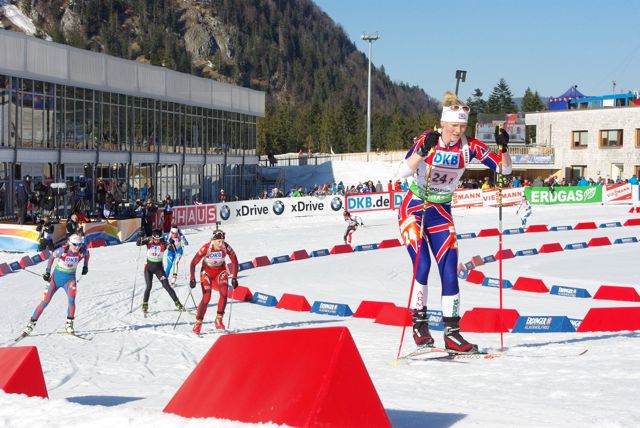
At the end of the 2012 season, longtime title sponsor Skandia dropped their support of the British Biathlon Union. One of the many consequences was that national team coach Walter Pichler, a German with a successful athletic career of his own who had previously coached the U.S. team, left the squad.
“That was a big dip for us,” biathlete Amanda Lightfoot told FasterSkier back at the first World Cups of the season in Östersund, Sweden. “But the Army has helped out magnificently.”
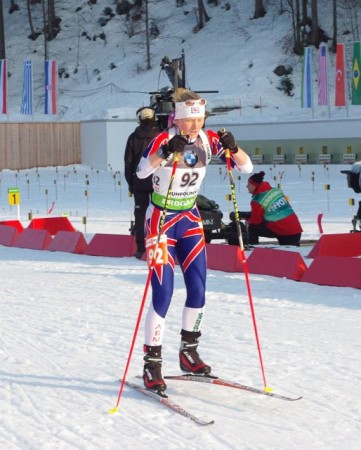
As a result, the Brits were still on the circuit. After finishing in the points (top 40) at each of the last two World Championships, 25-year-old Lightfoot was unsatisfied with her results in Östersund, where she finished 93rd in the 15 k individual and 75th in the 7.5 k sprint; in the coming weekends she placed 78th in the sprint in Hochfilzen, Austria, and 95th in the sprint in Pokljuka, Slovenia.
Whether the lull in results is a result of the changes to her governing body is unclear. But one thing is certain: things have changed for Lightfoot and her teammates. They used to spend considerable time training in Ruhpolding, Germany, with Pichler. Now, Lightfoot has joined teammate Lee-Steve Jackson outside of Lillehammer, Norway, where she works with local coaches as well as Scott Banes, a former athlete. Mark Walker is now the head coach of the team.
“I miss Walter of course, but what can I do,” Lightfoot said. “It’s been better than what I thought. I’m training on my own mostly. I had a week training camp with [the Norwegians], and then there’s opportunities to go once or twice a week and train along side them, if it fits into your program.”
That’s a plan that Jackson has been on ever since the 2010 Olympics.
“I moved to Lillehammer to get in and around the best athletes who do biathlon and see what they are actually doing, and do my best to close the gap,” he told FasterSkier in Östersund.
At 32 years of age and now with a total of seven World Championships appearances under his belt, Jackson has been in the sport of biathlon long enough that he needed a step up. In Lillehammer, he found it. Training in Scandinavia is completely different than anything he had experienced before, he said.
“For them, for every level, it’s a lifestyle,” he said. “There are so many athletes at every level, and they’re still training really hard. They sacrifice a job and an education to train full time whether they’re in the national team or just a club team.”
And in terms of high level biathlon, Lillehammer is the place to be. Not only does the bulk of the Norwegian national team train there, but also a collection of other athletes, such as Carl Johan Bergman of Sweden, who picked up two medals at last season’s World Championships.
Like Lightfoot, Jackson mainly trains alone. But he said that he also sometimes joins Norwegian stars Emil Hegle Svendsen and Tarjei Bø, both of whom are World Champions and overall World Cup winners, for a run or a bike ride. What better way to learn what it takes to succeed?
“When it comes to a race, if you want to go fast you have to adopt that lifestyle,” Jackson said. “That’s an important thing. In a lot of other countries, and in our country, it’s a sport. But for them it’s a lifestyle from the age of four or five.”
(To see what Jackson thinks it takes to get better, check out the tattooed marksman’s summer training video from this off-season.)
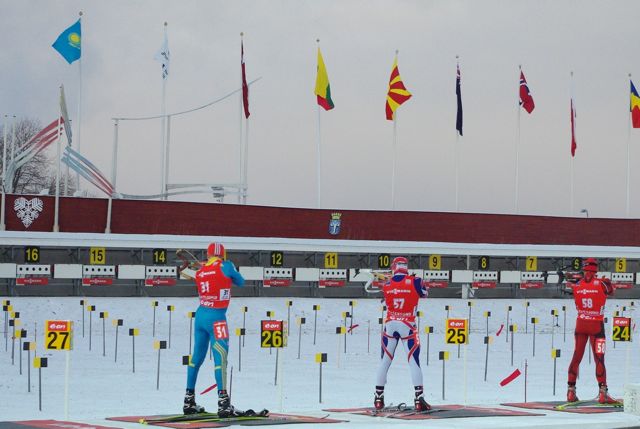
Jackson is on a quest to score his first World Cup points, and seemed to be on track in Sweden after finishing 57th in the sprint and 58th in the pursuit. After that, he slipped to the mid-90’s in the sprints in Hochfilzen and Pokljuka. But when FasterSkier talked to him after the Östersund pursuit, he was optimistic about the season and didn’t think that those top-60 performances were the best he had to offer.
“I only had two test races before [the first World Cup],” Jackson said. “Because of our circumstances with the women, we missed the mixed relay which would have been a nice preparation. But the sprint and today were much better. I’m not mentally in a place to push beyond my limits yet. So physically, I’m good, but mentally I know that I can hurt myself much more.”
While the men were able to put together a relay team in Hochfilzen, where they placed 22nd of 25 teams, the women weren’t so lucky. With less depth to the team, the budget can’t support sending unqualified athletes to the big show. So while Marcel Laponder has joined Jackson on the World Cup, with a top finish of 87th in the Hochfilzen sprint, Lightfoot is the only Brit representing in the women’s races.
As arguably the highest-achieving member of the team, she may have had the most to lose with the changes to the union. But the stakes are just as high for the other World Cup racers. At that level, other teams have an incredible support system, which is lacking fot the Brits.
“On the bottom level it isn’t that huge,” Jackson said of the loss of Skandia. “We get paid from the military so that’s enough for us to keep ourselves, and there’s enough money from the IBU to keep going to all the races. But on things like coaching and support staff we suffer a lot because we can’t pay them to come and do the job.”
On the British Biathlon Union’s website, they list only two sponsors on their sponsor page and a gaping hole optimistically blares, “It could be you!”
Although Lightfoot’s shooting has been imperfect so far this season – and she sorely needs it to improve, as her 36th-place performance in last season’s World Championships sprint came from a clean slate – improving her form on skis has actually been one of her biggest focuses this summer and fall.
“Skiing-wise, it feels much better,” she said. “This summer that had been my main focus, and keeping the ski speed there. I’ve changed a few things with my technique this year, so I just need to pull together my shooting. It’s not quite there yet, but it will come.”
Besides the Norwegians, experts of ski technique themselves, the British cross country skiers Andrew Musgrave and Andrew Young also train in Lillehammer.
“We’ve almost gathered a small team there,” Jackson joked.