From the FasterSkier archive — posts syndicated from athletes’ and coaches’ own blogs between 2004 and 2012, kept online as published. Current coverage is at fasterskier.com.
This weekend in Davos, Switzerland the World Cup returns for the high life. Many World Cuppers consider Davos to be a high elevation venue and with the thinner air comes a tinge of lung burn as skiers pace themselves around the 5-kilometer loop used for distance events. (Davos sits around 5,000 feet in elevation.) The 5 k loop features a long and steady climb up and out of the valley. Then a technical descent with a few dicey turns ensues when skiers tip down over the high point.
On Sunday, the women race a 10 k skate individual start, while the men ski three times around the course for 15 k.
The sprint course is simple enough. Skiers loop twice around a mostly oval circuit with a few climbs and turns thrown in before diverting from the loop for the burn down the final straight. The sprints are scheduled for Saturday.
In this Davos World Cup preview, Andy Newell gives the low down on how to thrive on the sprint course and keep the effort in check on the Davos distance course.
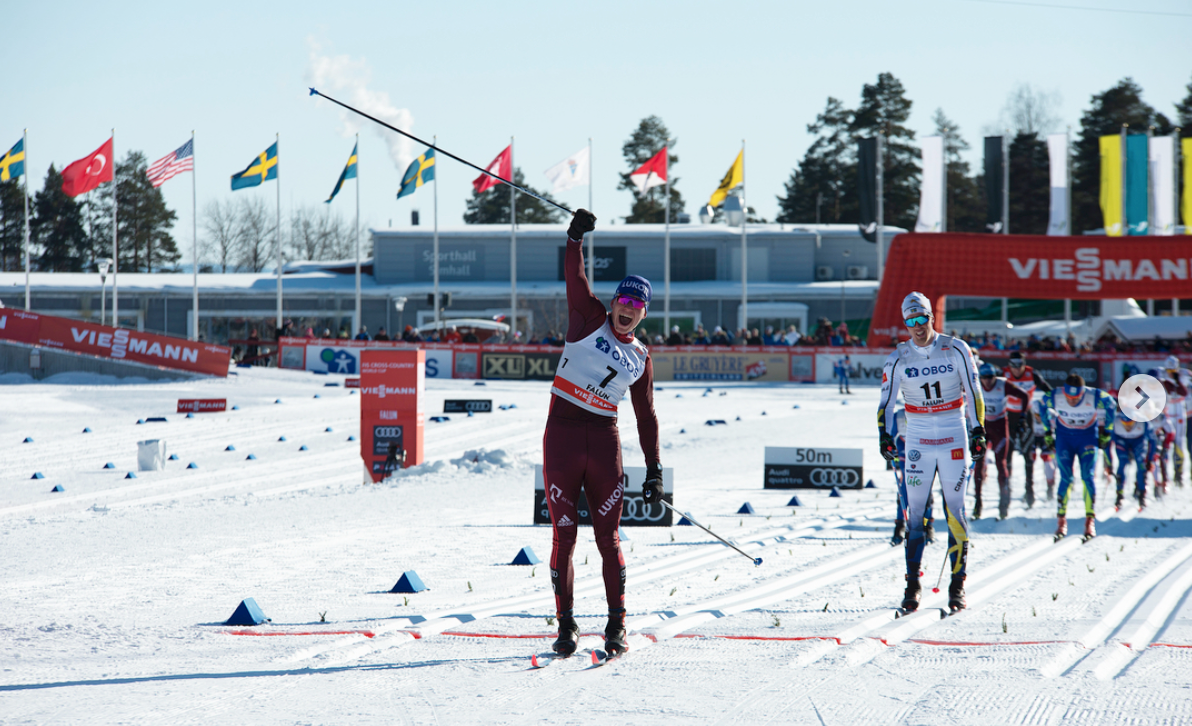
Russian Alexander Bolshunov celebrates as he wins his first-career World Cup, a 15 k classic mass start, just ahead of Sweden’s Calle Halfvarsson (11) at 2018 World Cup Finals in Falun, Sweden. (Photo: Svenska Skidspelen/Instagram)
Saturday was the second day of World Cup Finals mini tour, held in Falun, Sweden, which conclude the 2017/2018 season. Friday’s first stage began with a skate sprint, while Saturday featured a 15-kilometer classic mass start for the men.
As the season is no longer young, the fitness for some athletes frayed, a mass start could offer the opportunity for some to hide in the pack and others to exploit. On a sunny and cold Saturday in Falun, the leading distance skiers on the World Cup were unable to separate. The terrain was World-Cup hilly, yet the pace was never decisive enough to shatter the field.
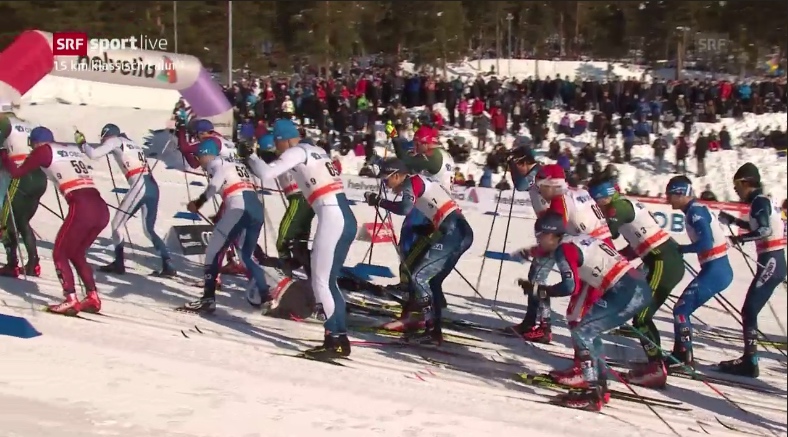
That field was 91-skiers full. 182 poles. 182 skis. Churning from the start, only those skiers in the front rows of the start pyramid could pole and stride away unscathed. As is the nature of 91 skiers fighting for classic-track scarcity — the lanes taper down in number — pile-ups are the norm. So while some skiers like U.S. Ski Team members Erik Bjornsen and Scott Patterson lost time in a starting-scrum spill, others were looking for brighter opportunities up front.
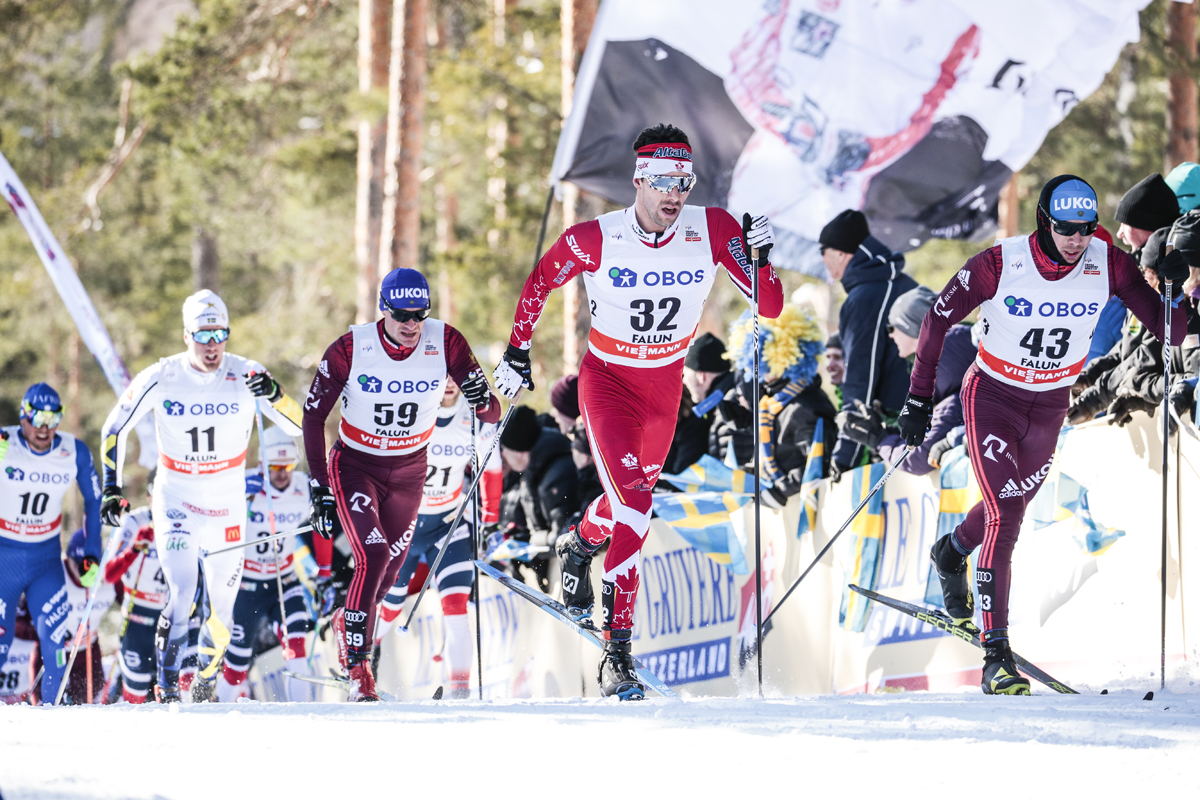
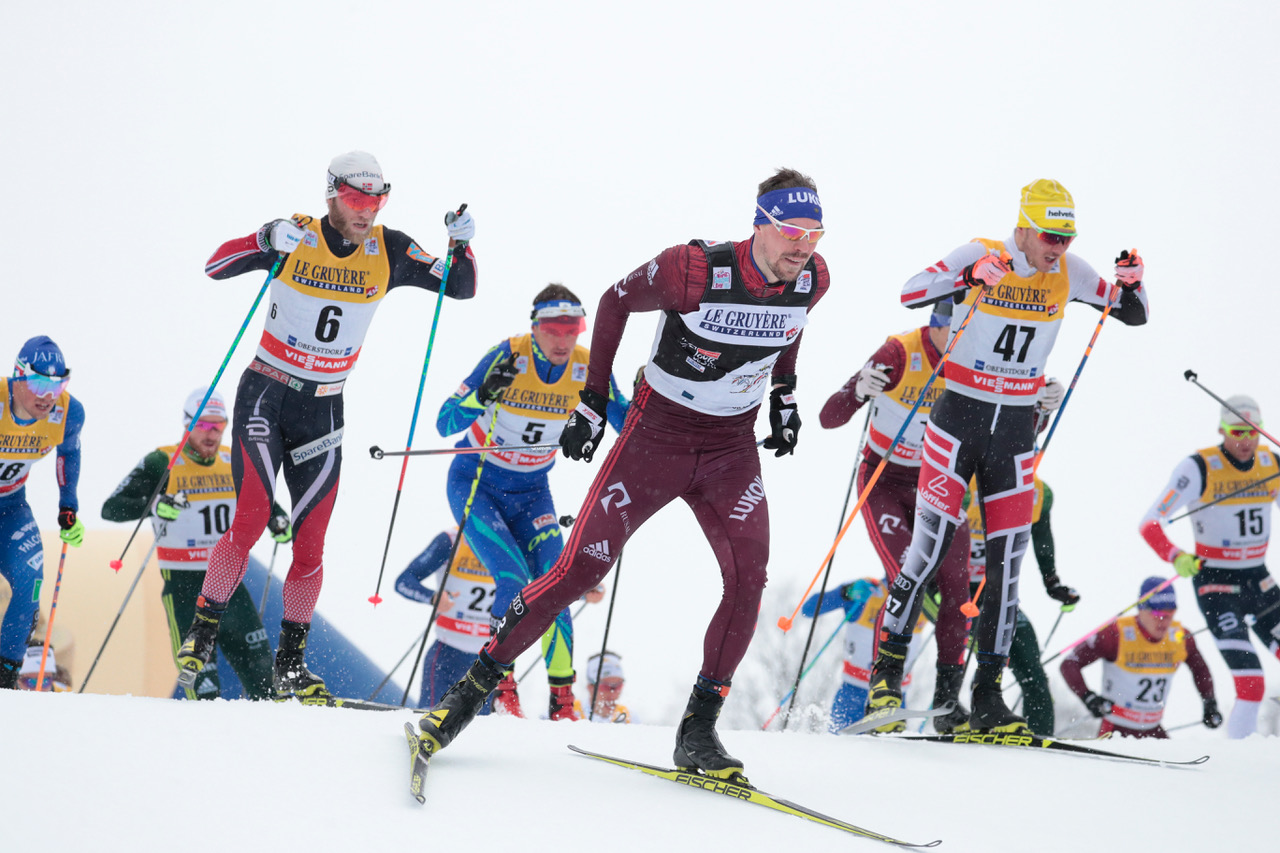
Russia’s Alexey Chervotkin (43) and Canada’s Alex Harvey (32) lead another Russian Maxim Vylegzhanin 59), Sweden’s Calle Halfvarsson (11) and Italy’s Francesco De Fabiani (10) up a climb during the men’s 15 k classic mass start at World Cup Finals in Falun, Sweden. (Photo: Fischer/NordicFocus)
From the start the pace was hot. There was Finland’s Iivo Niskanen, Sweden’s Emil Jönsson, Norway’s Johannes Høsflot Klæbo, Martin Johnsrud Sundby, Niklas Dyrhaug, Canada’s Alex Harvey, Kazakhstan’s Alexey Poltoranin, Russians Alexey Chervotkin and Alexander Bolshunov, and Swedes Calle Halfvarsson and Marcus Hellner, all in either a strung-out or condensed formation 3.75 k into the race. Skiers were slowly slipping off the back. But even with the surging up front, the tactics playing out appeared to place a premium on safety in numbers.
Bolshunov surged at 4.5 k to snag the highest-value time bonus. Otherwise, for much of the race, identifying specific skiers was a task in itself. Coming down the hills a third through the race, the top-50 skiers were a sinuous and continuous line separated by 17.7 seconds. At the bottom of climbs, the compressive part of the accordion effect was in play. Skiers in front could push, those behind became a more dense cluster of lycra-clad athletes.
Despite the prevalent pulsing of pace, skiers like Chervotkin and Harvey had their moments of pluckiness. Each paced a long line of skiers through the 9.3 k mark. But clear at this point was that the pattern of this race would be defined by the collective mass of skiers that began the mass start. Yes, time gaps would balloon a bit by the finish, but at 12 k (the second time bonus), a gap of 1.7 seconds separated first through 35th place.
The move that mattered in this race came from the birthday boy, Halfvarsson. According to FasterSkier’s reporter on the ground, the Swedish crowd serenaded Halfvarsson, 29, with a happy birthday rendition prior to the start. Maybe it was birthday stoke, maybe it was an acknowledgment that with age comes fewer opportunities to seize the win, but with one kilometer to go, Halfvarsson ran like Klæbo. Up and over the hill, the Swede forged a small gap on the 30-plus chasers.
Again on the last short incline before the speedy descent into the stadium, Halfvarsson performed a masterful high-step run. Only Bolshunov at this point could suck up near the Swede’s tails. For a moment, rounding into the final straight, it looked like Halfvarsson’s icing on his birthday cake would be a Falun stage win.
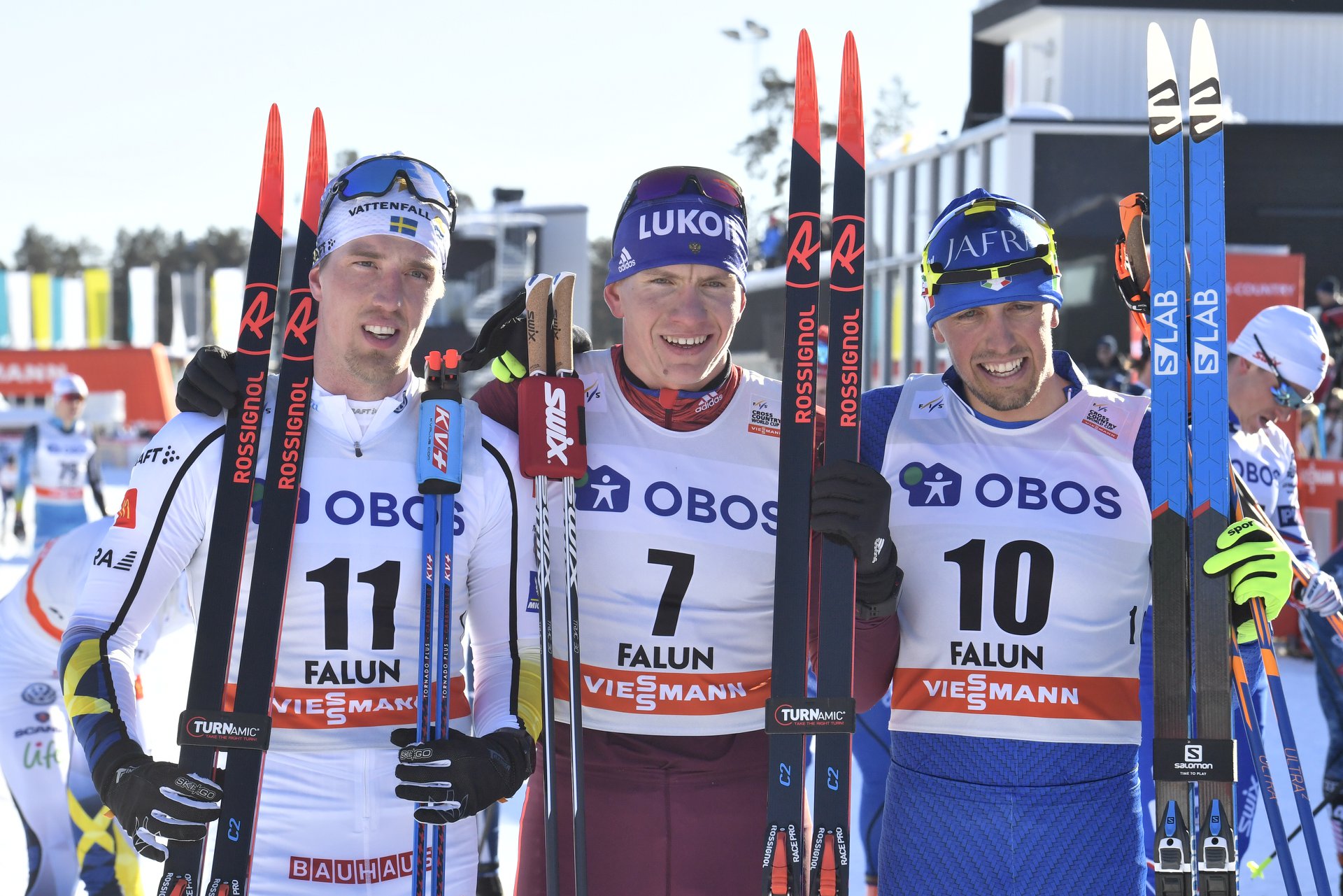
The men’s 15 k classic mass start podium at 2018 World Cup Finals in Falun, Sweden, with Russia’s Alexander Bolshunov (c) in first, Sweden’s Calle Halfvarsson (l) in second, and Italy’s Francesco De Fabiani (r) in third. (Photo: FIS World Cup Svenska Skidspelen/Facebook)
Halfvarsson came into the straight out of the tracks. As he zeroed in to begin the double-poling finish, the birthday boy stumbled slightly slotting into the nearest lane. Bolshunov flew by with a supreme double pole and took the win in 36:59.8. Halfvarsson placed second (+1.3), Italy’s Francesco De Fabianithird (+3.1), Poltoranin fourth (+3.7) and Chervotkin fifth (+5.2).
For the 21-year-old Bolshunov, it was his first-career World Cup win. Prior to Saturday’s win, Bolshunov had stood on the podium six times in his first full season on the World Cup. (Bolshunov’s only World Cup start last season was in Drammen, Norway, in March 2017.) Along with Klæbo, also 21, Bolshunov has risen into one of the sport’s top athletes. He claimed three silvers and a bronze medal in PyeongChang. His two individual Olympic medals were a second in the 50 k classic mass start and third in the classic sprint.
“I have had many second and third place finishes this season so I am very happy to finally have a win,” Bolshunov told the International Ski Federation (FIS) after the race. “This feels good. I will do what I can tomorrow for another good result but for now, I will enjoy this win.”
Sunday’s final men’s race of the season and last race of the three-stage mini-tour, will be a 15 k freestyle pursuit. Bolshunov leads the mini-tour standings in first with a total elapsed time of 38:37 minutes. Klæbo, who finished 22nd (+13.6) on Saturday, sits in second (+38.0), while Halfvarsson is third (+39.2).
The Swede took away the positives from the day’s near-win in front of the home crowd.
“I tried today to get a win but it was too much,” Halfvarson told FIS. “Off the final corner, I was really tired. I am still happy with second place. I have been on a podium a few times this season and always third. So at least second place is an improvement even if I didn’t manage the win.”
Canada’s Alex Harvey was the best placed North American in 20th place (+10.7). He’ll begin Sunday’s pursuit in 18th (+1:16.1).
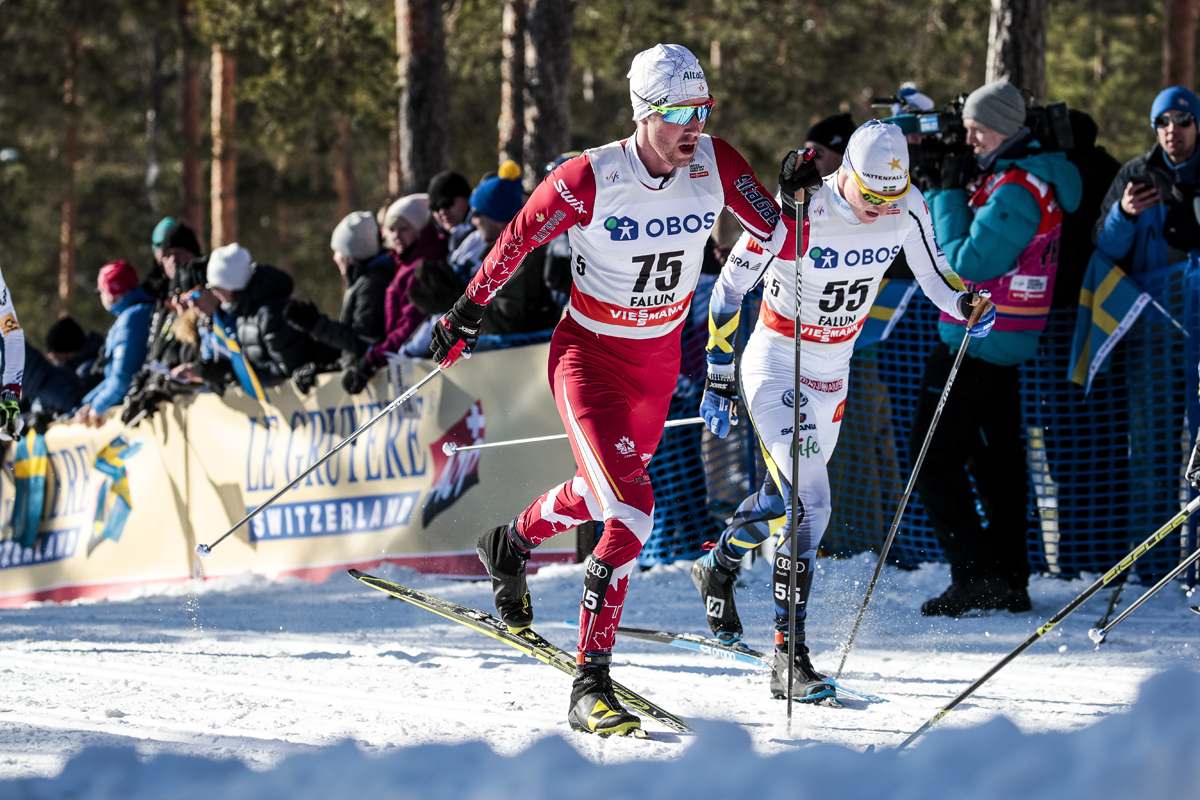
Canada’s Graeme Killick (75) skiing with Sweden’s Jens Burman during the men’s 15 k classic mass start at World Cup Finals in Falun, Sweden. Killick went on to finish 41st. (Photo: Fischer/NordicFocus)
Teammate Devon Kershaw finished 26th (+14.6) for his fourth-straight race in the top 30 (including his 26th-place finish in the Olympic 50 k classic). Graeme Killick placed 41st (+1:13) and Julien Locke was 81st (+3:29) for Canada.
“I felt quite good today,” Kershaw said after the race. “I was a little disappointed with the last kilometer because I was kind of out of position a little bit after Mördarbakken and couldn’t quite get up through traffic, but it’s really close. And a little disappointed to be 26th again; it seems like that’s kind of where I’ve lived all year, but it was a good race for me.”
Kershaw, a 35-year-old staple of the Canadian team, has been seeking a return to top form.
“Just races like today where I feel good and can execute decently well,” Kershaw explained. “To be honest this year I am super motivated after the championship. I’ve [been] having major, major asthma issues at the Olympics and that really really affected me and it took a long time to get a little better, but I felt like by the time I got to Lahti I was feeling quite a bit better. So that really helps, I mean, I can breathe again and I’m feeling good.”
Kershaw is expected to mull over the prospects of continuing his ski career in the coming weeks.
“We’re not sure, I’ll talk to the wife next week [Norwegian former elite skier Kristin Størmer Steira],” Kershaw said of his future plans. “You know there’s a lot of issues right now in Canada so I’ll have to think about it. A lot of guys are saying that they’re gonna call it a day. And I’m not getting any younger, but I still feel quite good, and I mean a race like today shows that I can still compete with the best in the world so that’s motivating, but we’ll definitely have to take some weeks to think about it.”
Nowhere to go: U.S. skiers Erik Bjornsen (bib 57) and Scott Patterson (bib 67) stuck in a pile-up after the start of the men’s 15 k mass start classic at World Cup Finals in Falun, Sweden. (Screenshot: SRF Sport broadcast)
For the U.S., Erik Bjornsen finished 52nd (+1:47.1), Simi Hamilton 62nd (+2:06.4), Kevin Bolger 69th (+2:27.1), David Norris 70th (+2:31.2), Scott Patterson 71st (+2:40.6), Paddy Caldwell 75th (+2:52.7), and Andy Newell 86th (+4:47).
Patterson’s race did not go as planned.
“I was in a big pile-up right at the start,” Patterson told FasterSkier after. “I was the second-to-last one out of the stadium and then the first time up Mördarbakken, my ski fell off. So I skied halfway down, got my ski back on, just turned back around and then just like stupidly chasing the rest of the race. …
“I felt OK,” Patterson added. “[Without] those two stupid things it would have been a good race. But I was so far off and then it was really hard to get back to the pack and then it was like, ‘Well, I can’t get to the pack. I am here with those guys.’ ”
Lately, Patterson, 26, has been a highlight for the U.S. distance skiing prospects. The first-year U.S. Ski Team member notched three individual top-20 results at last month’s Olympics, including 11th in the 50 k classic. Last weekend in Oslo, Norway, Patterson proved that was no fluke, as he placed 16th in a traditionally deep field at the Holmenkollen 50 k skate.
World Cup Finals conclude with 10/15 k freestyle pursuits on Sunday.
— Gabby Naranja, Harald Zimmer and Alex Kochon contributed
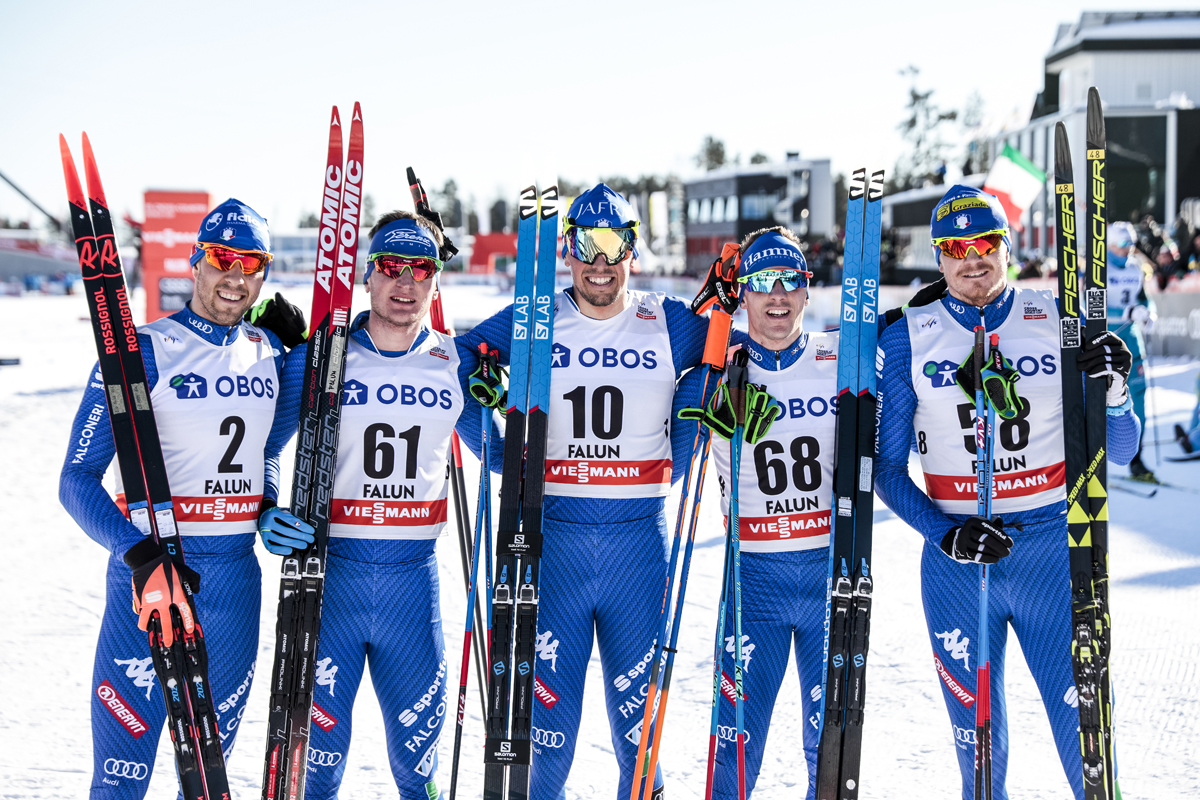
The Italian men’s team after Saturday’s 15 k classic mass start at 2018 World Cup Finals in Falun, Sweden, with (from left to right) Federico Pellegrino, Giandomenico Salvadori, Francesco De Fabiani, Maicol Rastelli, and Dietmar Nöckler. (Photo: Fischer/NordicFocus)
Norway’s Johannes Høsflot Klæbo celebrates his team-sprint win with Martin Johnsrud Sundby (not shown), while Alexander Bolshunov of the Olympic Athletes from Russia (l) pushes for silver on Wednesday at the 2018 Olympics in PyeongChang, South Korea. It was his third-straight gold of the week. (Photo: FlyingPointRoad)
With a gold medal for their team already in the bag on Wednesday, Erik Bjornsen and Simi Hamilton put their heads down for the start of their own race at the 2018 Olympics. The men’s 6 x 1.4-kilometer freestyle team sprint final was scheduled to start just minutes after the women’s team sprint final ended, a race which saw Americans Kikkan Randall and Jessie Diggins capture the first Olympic gold for the U.S. in cross-country skiing.
It was motivating and inspiring, even confidence-boosting, Bjornsen reflected after his race in an in-person interview with FasterSkier. But he and Hamilton had their own medal hopes to tend to.
Like most of the men’s finalists, they weren’t able to watch the women’s race beforehand and came out onto the course shortly before the start of their final.
“I was warming up and kind of focusing on my own race, but I saw that they took the win when I was running to the start,” Bjornsen explained. “ … We were ready to match them.”
“I did not even see a second and I’m really bummed out that I didn’t,” Canada’s first-leg skier Len Valjas told FasterSkier after. “But so happy for the U.S., that’s amazing, like it actually gave us some positive energy before the race hearing who won. Our techs and coaches ran into our room, like, ‘Did you hear about the girls’ race?’ So it’s a win for North America. It just makes today even sweeter.”
American Erik Bjornsen (6) skiing with Canada’s Len Valjas (7) during the men’s 6 x 1.4 k freestyle team sprint at the 2018 Olympics in PyeongChang, South Korea. (Photo: FlyingPointRoad)
Both the American and Canadian men’s teams qualified for the 10-team final on Wednesday evening in PyeongChang, South Korea. Bjornsen and Hamilton had advanced with a fast-enough time after placing third in the second semifinal, while Valjas and his teammate Alex Harvey moved on as well (also as “lucky losers”) after finishing fifth in that semifinal.
The U.S. had some confidence going into the final after a semifinal performance that saw Bjornsen take the lead on the second-to-last lap, ahead of Norway. Hamilton held onto first for most of the the final lap until Norway’s Johannes Høsflot Klæbo passed him shortly before the finish, and France’s Richard Jouve passed Hamilton in the finishing straight as well, putting the Americans in third.
For the final, it was all about the medal hunt for Bjornsen and Hamilton, who placed fifth in last year’s World Championships classic team sprint in Lahti, Finland, just ahead of Canada in sixth, for the best U.S. men’s result in a team event.
Russia had won that 2017 world-champs team sprint with two athletes who were banned from competing at these Olympics, Nikita Kriukov and Sergey Ustiugov, and Italy placed second with Dietmar Nöckler and Federico Pellegrino. After an infamous tangle coming out of the final downhill, Finland ended up third with Sami Jauhojärvi (who retired after last season) and Iivo Niskanen, and Norway finished fourth with Klæbo and Emil Iversen. Norway opted for Klæbo and Sundby for its Olympic team-sprint squad on Wednesday, and Sundby later proved that he was worthy of the pick.
Ever since World Championships, it’s safe to say this is the race that had been primarily on Bjornsen’s and Hamilton’s minds for the better part of the last year.
They came out with a mission on Wednesday, putting themselves in the mix early in the final, alongside Canada.
Sweden’s first-leg skier Marcus Hellner leading during the men’s freestyle team sprint at the 2018 Olympics in PyeongChang, South Korea. (Photo: FlyingPointRoad)
Sweden set the pace for the first two laps, with Marcus Hellner starting them off and Calle Halfvarsson holding their lead on the second leg. They tagged off in first through the first two exchanges, just ahead of Norway and the Olympic Athletes from Russia after the first lap, then ahead of France, Norway and Russia after Lap 2. By the end of Hellner’s second lap, Sweden was still in first, tagging off in front of Norway, France and Russia, all within 1.3 seconds of first. Germany followed in fourth, 2.9 seconds back, and Bjornsen tagged the U.S. in fifth (+3.2).
The Americans had been hanging in fifth and sixth throughout the first half of the race, even after Bjornsen crashed at the beginning of his second leg. Heading into the first uphill after the exchange, Bjornsen skated over the tails of Nöckler’s skis ahead of him. He fell down and by the time he got back up, was in 10th — last place — starting back up the hill. Bjornsen recovered to put the U.S. in sixth, 3.2 seconds out of first, with three laps to go.
“It was super disappointing when I went down, but I mean, it was only halfway through the race and I just got up, and that’s for sure not going to be the end of it for us today,” Bjornsen said. “Unfortunately, I kind felt like I let the team down there a bit. I think that was one mistake that may have made a huge impact on our race today, but you know, that’s ski racing, that’s the way it goes sometimes. Unfortunately it’s at the Olympics.”
Hamilton was quick to respond to his teammate’s comments.
“In absolutely no way did Erik let any of us down, especially me,” Hamilton said. “I watched that on the big screen, I have been at a lot of team sprints on the World Cup, World Champs, Olympics, that always happens to someone, and 99 percent of the time, that person, especially if it’s in the finals, just gives up, whether it’s the first leg, second leg, third leg, they just give up. And Erik, he never does that, no matter what happens to him, what happens to us, he just fights ’til the absolute very end.
“It’s cliché to say that, but that’s what he does,” he continued. “That’s the only way he knows how to operate. … I am incredibly proud to be always be racing with Erik, to be training with him, to be rooming with him.”
The two Americans, who are rooming together in the Olympic Village, went on to lose a few more seconds and two places during Hamilton’s second leg, after which he tagged Bjornsen in eighth, 8.3 seconds out of first.
At the front of the pack, Klæbo had made a game-changing attack on the final climb of that leg, following Russia’s Alexander Bolshunov up it then making a few swift strides to get around him several meters from the top. As Klæbo jump-skated up and over and away from them, Bolshunov, Halfvarsson and France’s Jouve almost looked as if they were standing still, leaving them several seconds behind as they chased him toward the exchange.
Klæbo tagged Sundby 1.7 seconds ahead of Russia in second, 2.2 seconds clear of Sweden in third, 3 seconds ahead of Italy in fourth, and 3.3 seconds ahead of France in fifth. A couple more seconds back, Germany followed in sixth (+5.7), Finland in seventh (+6.0), the U.S. in eighth (+8.3), and Canada in ninth (+11.0), ahead of the Czech Republic in 10th (+12.8).
Sundby dug deep for his final 1.4 k lap to extend Norway’s lead to 5.1 seconds at the last exchange. For the first time all race, Klæbo took his hat off and prepared for his last time around the PyeongChang sprint course with Sweden, France and Russia about six seconds behind him.
Simi Hamilton (6) racing with Italy’s Federico Pellegrino (3) and others out of the exchange of the men’s 6 x 1.4 k freestyle team sprint semifinal at the 2018 Olympics in PyeongChang, South Korea. (Photo: FlyingPointRoad)
Bjornsen had skied the Americans back into sixth, 11.7 seconds back at the last exchange. Valjas tagged Harvey in eighth, 26.6 seconds out of first.
While Hamilton chased Pellegrino, who started 0.3 seconds ahead of him out of the exchange, over the next lap, the two kept Halfvarsson, Jouve and Bolshunov in their sights. Ultimately, however, they were unable to close the gap to fight for the medals.
The three-man chase group, led by Bolshunov, didn’t let off as they pursued Klæbo, who appeared untouchable as he rounded the course. As they sped down the final descent toward the finish, Klæbo pushed over the last little rise, looked back and appeared to exhale as he relaxed his shoulders. But it wasn’t over. Bolshunov was charging hard and Klæbo couldn’t let off just yet. The 21-year-old Norwegian took another breath then about a dozen or so more V2 pushes in the finishing straight. A full four seconds before the line, he let off and secured his third gold of his first Olympics in 15:56.26 minutes, 1.71 seconds ahead of Bolshunov (and Denis Spitsov of the Olympic Athletes of Russia) in second. Jouve outsprinted Halfvarsson to give France (with teammate Maurice Manificat) its second-straight bronze (+2.02), after France placed third in the men’s 4 x 10 k relay, and Sweden finished the race in fourth (+3.07).
About 15 1/2 seconds later, Pellegrino crossed the line in fifth (+18.55) for Italy, 2.17 seconds ahead of Hamilton in sixth (+20.72). The Czech Republic came through in seventh (+28.57) with Martin Jaks and Ales Razym, Harvey anchored Canada to eighth (+35.6), Finland finished ninth (+36.04) with Martti Jylhä and Ristomatti Hakola, and Germany placed 10th (+45.94) with Sebastian Eisenlauer and Thomas Bing.
“For our race tonight, we’re proud of what we accomplished,” Hamilton reflected. “Obviously, it’s always our goal to be on that podium. I think we both know that we can be up there and maybe someday we will. … If we are going to do that someday, there’s no way were going to do it without trying, so tonight was another one of those attempts, and it was a super-fun race, did everything we could, came up short, but we fought hard.”
“I guess we will have keep skiing and fight for it,” Bjornsen said, later adding, “We’re coming back for a gold.”
Canada’s Alex Harvey jets out of the exchange during the men’s 6 x 1.4 k team sprint semifinal at the 2018 Olympics in PyeongChang, South Korea. The Canadians went on to finish eighth. (Photo: FlyingPointRoad)
For Valjas, who had slipped to 10th on his second leg but brought his team back to eighth after Harvey put them in ninth with two laps to go, a top 10 at the Olympics on any day was a good one. He previously raced on Canada’s 4 x 10 k relay that finished ninth.
“I actually got a chest cold two days ago so it was kind of a game-time decision,” Valjas said after of Canada’s decision to start him with Harvey. “The team really wanted me to start this even if I’m not 100 percent, and honestly it felt pretty good. I think it was my legs that gave out before my lungs so I’m glad I did start because I felt horrible coming on the bus here. I was like, ‘How am I gonna race against these guys? Like, even healthy I’m gonna suffer.’
He explained that the course didn’t exactly suit his strengths with its long climbs.
“The first work section is a minute with no break,” Valjas said. “I was just trying to use the flats and the downhills like what I’m good at and the rest I was just surviving…
“Honestly for me on this course, at the World Cup last year, I had a terrible team sprint,” he added, reflecting on his 13th-place result last year with teammate Jess Cockney at the pre-Olympic World Cup in PyeongChang. “And I was good shape then. Jess raced great, I was just getting dropped. For me, another top 10 in the Olympics and I’m thrilled how it went and so happy that Alex had some punch in the end there. The 50 k [on Saturday], I’ll be out here cheering. It’s looking great for [Alex] and I’m glad I could help him in his race prep.”
Norway’s Johannes Høsflot Klæbo and Martin Johnsrud Sundby (1) embrace after Klæbo anchored the two-man team to first in the 6 x 1.4 k freestyle team sprint at the 2018 Olympics in PyeongChang, South Korea. (Photo: FlyingPointRoad)
For Norway, the gold medal was its fourth in five men’s races so far at these Olympics. Klæbo has won three of them (individual classic sprint, relay and team sprint) and Sundby two (relay and team sprint).
In a post-race press conference, Sundby, 33, had nothing but praise for his young teammate.
“I think the whole cross-country world at this point is looking on what Johannes does, how he does it, and why he is so fast,” Sundby said. “… We are close and are able to learn so much from this guy. He’s 21 years old. Today we were both extremely nervous for the competition. … Anything can happen, and these tracks are so tough, this sprint track. It’s a lot of uphill and a really tough downhill, and you don’t get any rest at any point, so we were not looking forward to it, but its really good to finish it.”
While Russia’s Spitsov said they had been going for gold, he explained through a translator that they were “not very lucky.”
“We had a small tactical mistake and we lost a few seconds through that when he was basically being blocked, lagging behind the French guy,” he said at the press conference. “We tried to catch up but we couldn’t. Johannes was stronger and faster.”
France’s Maurice Manificat (r) with teammate Richard Jouve after they earned bronze in the men’s freestyle team sprint final at the 2018 Olympics in PyeongChang, South Korea. (Photo: FlyingPointRoad)
For France, the bronze medal was a big deal. It was the first for the 23-year-old Jouve in his first Olympics. Manificat previously raced in France’s bronze-medal relay.
“Second medal and also with Richard, it’s unbelievable,” Manificat said at the press conference. “Three days ago a medal in distance with my teammates on the distance team, and it was a hard choice the last day with our sprinter Lucas Chanavat; he was really sad to not be part of this relay, but I think with this medal, it was for all for the team … and we are so happy together as you could see in the [finish] and to share it with Richard. [He was] unbelievable in the final [lap], it was so crazy, so thanks to him and thanks to all team’s waxers, we had such good skis, so it was perfect.”
— Jason Albert, Gabby Naranja, Ian Tovell, and Harald Zimmer contributed
The men’s 6 x 1.4 k freestyle team sprint podium at the 2018 PyeongChang Olympics, with Norway’s Martin Johnsrud Sundby and Johannes Høsflot Klæbo (c) in first, the Olympic Athletes of Russia’s Denis Spitsov (l) and Alexander Bolshunov (second from l) in second, and France’s Maurice Manificat (second from r) and Richard Jouve (r) in third. (Photo: FlyingPointRoad)
Team USA after Kikkan Randall and Jessie Diggins (c) won gold in the women’s freestyle team sprint on Wednesday at the 2018 Olympics in PyeongChang, South Korea. (Photo: FlyingPointRoad)
(Note: This rundown has been updated to include comments from Canadians Emily Nishikawa and Dahria Beatty.)
The medal hunt is over. In the final team event of the 2018 Winter Olympics, the U.S. women got the job done on Wednesday in PyeongChang, winning not just a medal, but the first Olympic gold in the history of U.S. cross-country skiing.
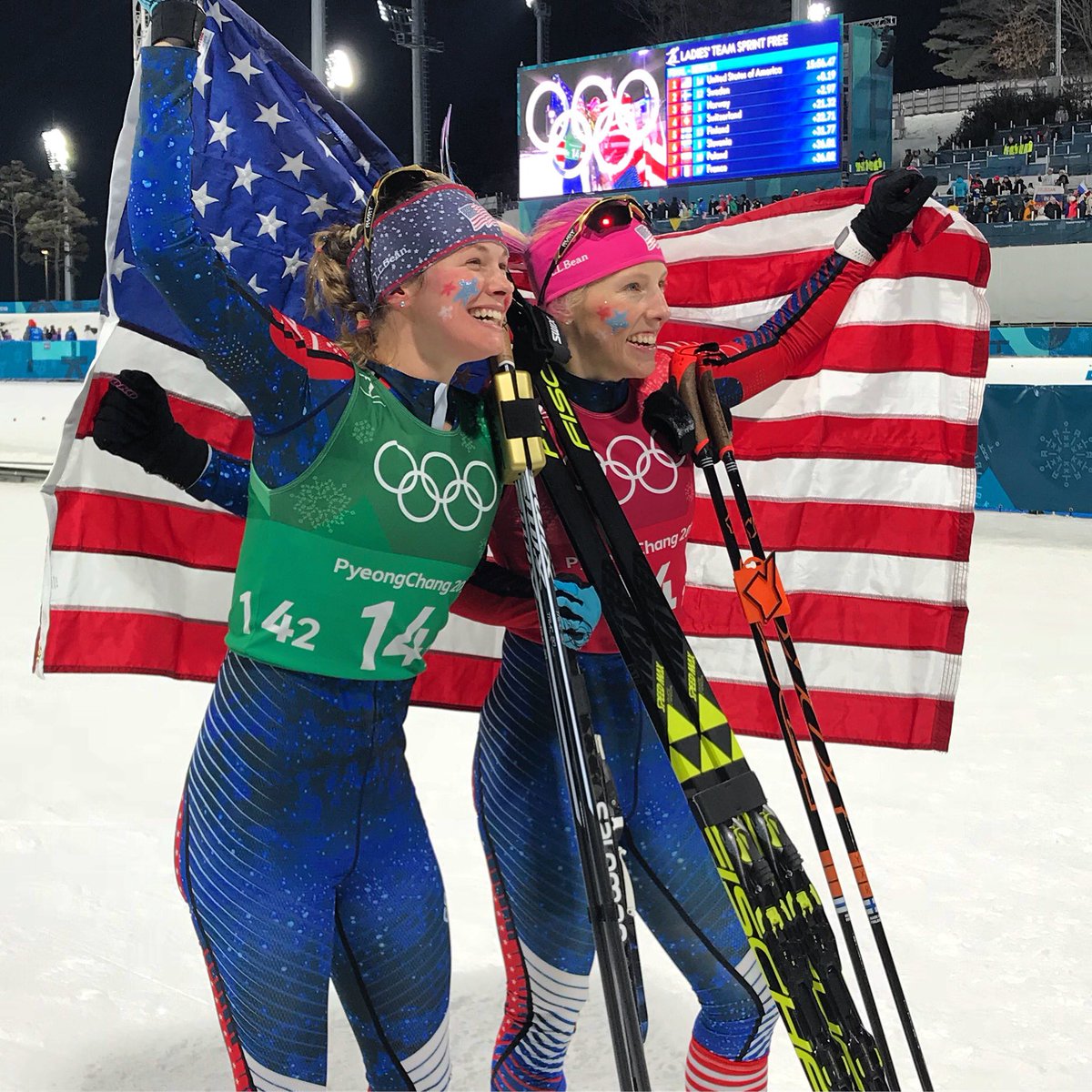
Jessie Diggins (l) and Kikkan Randall soak up their win in the women’s freestyle team sprint on Wednesday at the 2018 Olympics in PyeongChang, South Korea. (Photo: FIS Cross Country/Twitter)
Kikkan Randall and Jessie Diggins teamed up in the 6 x 1.25-kilometer event, with Randall tagging Diggins in third at the final exchange, just 0.7 seconds behind Norway’s Marit Bjørgen in first and 0.5 seconds behind Sweden’s Charlotte Kalla in second. With 1.25 k to go, Diggins charged ahead on the first climb, with Norway’s Maiken Caspersen Falla and Sweden’s Stina Nilsson chasing her in second and third, respectively. They were about 10 seconds clear of Switzerland in fourth at the final exchange.
Falla moved into first at the bottom of the final grueling climb. Halfway up, Diggins and Nilsson jostled to position themselves in second, and over the top, Diggins slotted into third.
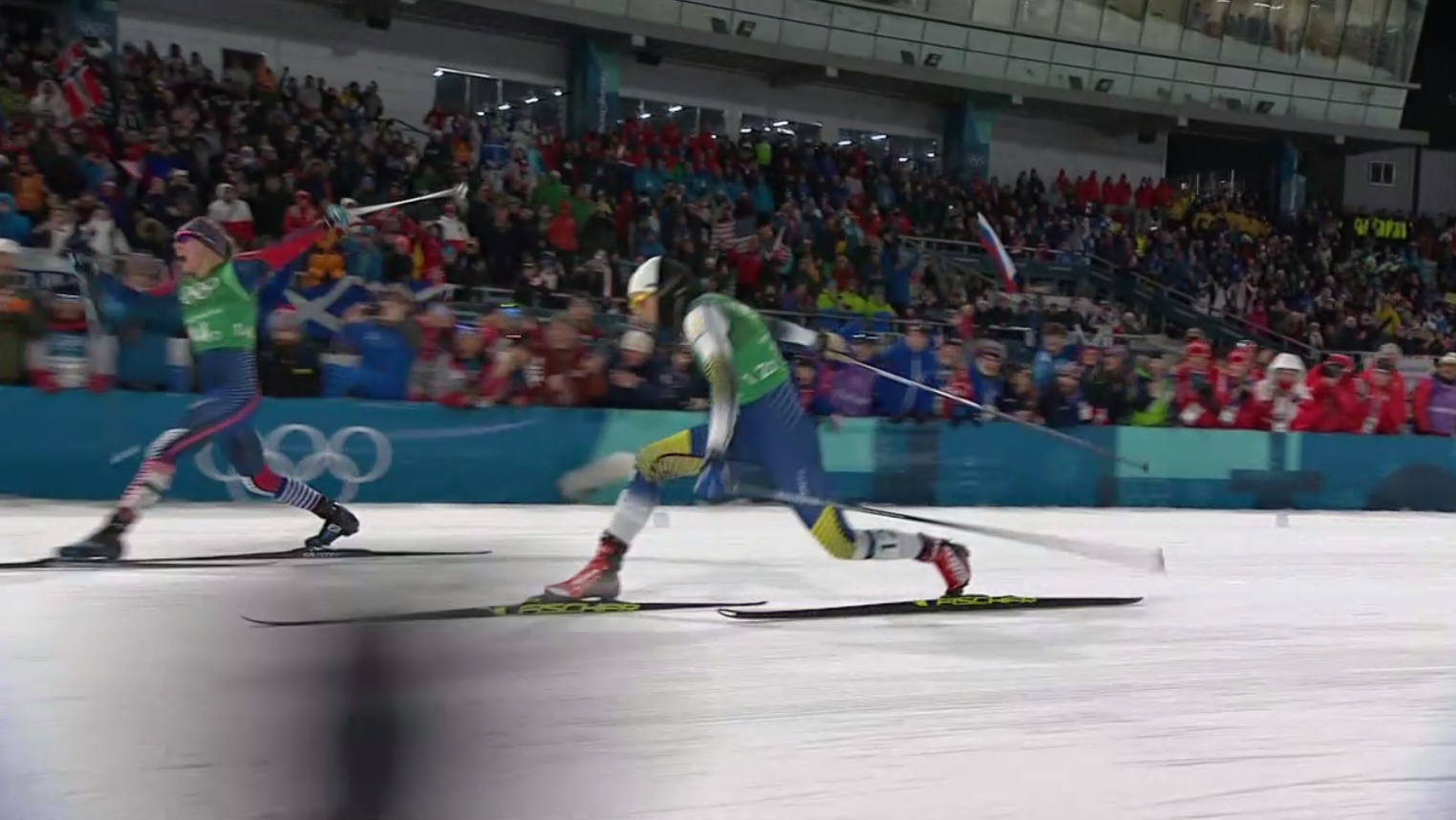
Riding fast skis on the downhill toward the stadium, Diggins stayed out of trouble while Nilsson nearly rode up onto Falla’s skis. While Nilsson used the draft to get into first coming out of that downhill, Diggins eyed a specific line, saw the opening between the two and took it to move into second. As Nilsson entered the finishing straight, Diggins was right there with her, even pulling into first as they came within 50 meters of the line. The gold became a reality, as Diggins outlunged Nilsson by 0.2 seconds at the finish with a time of 15:56.4 minutes, and Falla crossed 3 seconds back in third.
Jessie Diggins (l) lunging for gold in the women’s freestyle team sprint, 0.2 seconds ahead of Sweden’s Stina Nilsson at the 2018 Olympics in PyeongChang, South Korea. (Screenshot: NBC broadcast)
Gold for the U.S., silver for Sweden, bronze for Norway. With her 14th Olympic medal, Bjørgen became the most decorated Winter Olympian of all time, while Randall and Diggins earned their country’s first Olympic gold.
In the men’s 6 x 1.4 k team sprint final that followed, Johannes Høsflot Klæbo once again anchored another Norwegian victory, teaming up with Martin Johnsrud Sundby for Klæbo’s third medal of his first Olympics. With a strong second leg from Klæbo, the Norwegians gapped the field, and Sundby extended that gap to 5 seconds over Sweden by the final exchange. Klæbo rounded the final lap alone, still charging for the win and only letting up a few meters before the line to celebrate as he crossed in first with a time of 15:56.26.
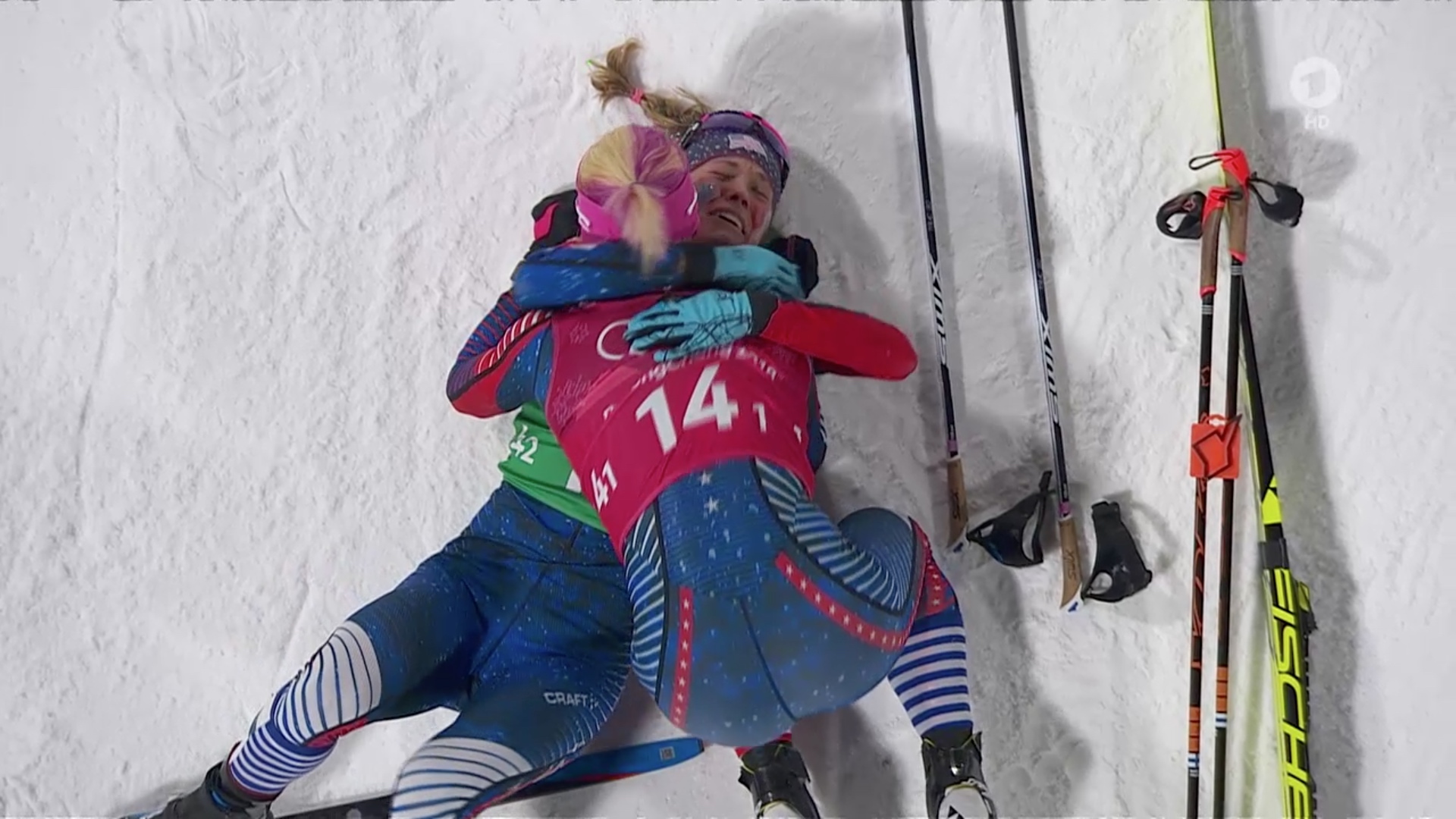
Kikkan Randall (14) and Jessie Diggins embrace as they celebrate their freestyle team sprint gold on Wednesday at the 2018 Winter Olympics in PyeongChang, South Korea. It is the first U.S. cross-country skiing gold medal in Olympic history, besting Bill Koch’s individual silver medal in the 30 k at the 1976 Winter Olympics. (Screenshot: ARD broadcast)
Alexander Bolshunov of the Olympic Athletes from Russia pushed to catch Klæbo on the last lap and motored for silver, finishing 1.71 seconds back. He teamed up with Denis Spitsov fortheir second-straight silver medal of the Games (after placing second in the 4 x 10 k relay) and Spitsov’s third medal (after placing third in the 15 k freestyle).
France (Maurice Manificat and Richard Jouve) placed third (+2.02) with Jouve edging Sweden’s Calle Halfvarsson by about a second for bronze, while Sweden placed fourth (+3.07) with Marcus Hellner and Halfvarsson. It was the French men’s second-straight bronze medal after placing third in the relay.
Italy (Dietmar Nöckler and Federico Pellegrino) was next across the line in fifth place, 18.55 seconds out of first, while the U.S. men (Erik Bjornsen and Simi Hamilton) followed in sixth (+20.72). Bjornsen crashed shortly after the start of the third leg (his second leg) after skiing onto the tails of Nöckler’s skis up the first climb out of the stadium. That put the American in last place near the bottom of the hill, but Bjornsen rebounded to tag off in sixth, just 3.2 seconds out of first. Hamilton slipped to eighth and 8.3 seconds back on the next leg, and by the last lap, it was Hamilton chasing Pellegrino for fifth place, which Italy ultimately took about 2 seconds ahead of him at the finish.
Canada’s Len Valjas and Alex Harvey finished eighth (+35.6), with Harvey holding off Finland in ninth by half a second at the line, after slipping as far back as 10th on Valjas’s second leg.
Semifinals
Earlier in the day, the Norwegian men and women, Russian men, and American women each won their semifinal heats as the field was narrowed to ten teams for each final.
In the first women’s semifinal, Bjørgen and Falla posted an easy win by 6.6 seconds. Switzerland’s Nadine Fähndrich and Laurien van der Graaff bested Slovenia’s Alenka Cebasek and Anamarija Lampic for second place.
In the second semifinal, Randall and Diggins claimed the win, with Kalla and Nilsson finishing second, just 0.7 seconds back; Diggins and Nilsson didn’t sprint for bragging rights, seemingly saving energy for the final. Russia’s Natalia Nepryaeva and Yulia Belorukova finished third (+2.1).
Only the top two finishers from each semifinal automatically advance to the final, but Slovenia and Russia qualified as “lucky losers” based on their time. Also qualifying for the final were Finland (MariLaukkanen and Krista Parmakoski), Poland (Justyna Kowalczyk and Sylvia Jasckowiec), France (Aurore Jean and Coraline Hugue), and Germany (Nicole Fessel and Sandra Ringwald).
The Canadian women’s team of Emily Nishikawa and Dahria Beatty finished seventh in the second semifinal, and were two spots out of making the final (the Czech Republic had a faster time than the Canadians but also did not advance).
“The first four legs we were right in there with the group,” Nishikawa told FasterSkier after their semifinal. “I think our second heat was quite a strong heat, it stayed together until the fifth leg. That’s where I blew up a little bit, but I did everything I could. … Dahria skied amazingly well, she was able to still catch Italy again on the sixth leg.”
“We knew that the first three, four teams would be quite strong: USA, Sweden, Russia and Finland,” Beatty said. “So we knew everyone else, we could ski with them in the group, so we were trying to stay with that kind of middle group ’cause we knew five or six would probably be qualifying from our heat. … I think we did a really good job of skiing a race where we were right in there. … I think we came something like 11 seconds short of what we needed…
“Even though we didn’t qualify it was nice to be able to go catch one team on the last lap there and finish strong,” Beatty added. “Our coaches were cheering amazing out there, and had some cheering from the American coaches, too. So there was a lot of motivation on the course to really fight to the line.”
In the men’s semifinals, Russia’s Spitsov and Bolshunov and Sweden’s Hellner and Halfvarsson at some points appeared to be running away with the first heat, but by the finish Germany (Sebastian Eisenlauer and Thomas Bing) and Finland (Martti Jylhä and Ristomatti Hakola) were within three seconds in third and fourth.
For the U.S., Bjornsen took charge of the second semifinal on the fifth lap, and Hamilton kept the lead into the final downhill. Klæbo passed him late in the game and claimed the win along with teammate Sundby, and Hamilton appeared unconcerned as Jouve passed him in the finishing straight as well to put France (with Manificat) in second; based on time, the U.S. advanced as a lucky loser.
Also in the men’s final were Italy (Nöckler and Pellegrino), Canada (Valjas and Alex Harvey) — who finished fifth in the second semifinal — and the Czech Republic (Martin Jaks and Ales Razym).
Canada’s Len Valjas (l) and American Andy Newell scrambling during the first leg of the men’s 4 x 10-kilometer relay on Sunday at the 2018 Olympics in PyeongChang, South Korea. (Photo: FlyingPointRoad)
PYEONGCHANG, South Korea — Zooming in on the leaders of Sunday’s nordic race, the Olympic broadcast stream focused on a red Norwegian suit set against the backdrop of Russian maroon. The televised showdown presented for the men’s 4 x 10-kilometer relay final leg was shaping up to be between the Olympic Athletes from Russia and Norway: Denis Spitsov verses Johannes Høsflot Klæbo. As the two skiers struck out for Lap 2 of 3 of the final 10 k leg, both spectators and screen apprehensively followed.
Had the camera panned 250 meters ahead, it might have caught the flurrying ski tails of American Noah Hoffman, dashing the top of the 3.3 k lap’s initial climb. Around 45 seconds earlier, Hoffman had been tagged into the race as the anchor leg for the U.S. men. His hot start was not just for show or a final push to the front. If he wanted to prevent the U.S. team from an eliminatory pull, he would need to stay ahead of Spitsov and Klæbo.
A cat-and-mouse game between the leaders certainly could buy the U.S. skier a little more time to pad the time gap. But until then, he sifted a reductionist race: Stay in the game. Don’t get caught by Klæbo.
American Noah Hoffman anchoring the U.S team during the men’s 4 x 10-kilometer relay on Sunday at the 2018 Olympics in PyeongChang, South Korea. (Photo: FlyingPointRoad)
“The highlight for me was watching these guys stick with their guys,” Canada’s Len Valjas said of his relay teammates in a post-race interview with FasterSkier. “And another one was watching Noah stay away from Klæbo. We were all yelling, cheering for him. That was amazing.”
The relay had more than one race in the works. Hoffman staying in front of Klæbo was one. Canada’s Graeme Killick catching Sweden was another.
After Valjas scrambled the first classic leg, he came through the exchange in 10th, handing off to Killick for the second classic leg. As Killick headed out for his first lap, Sweden was four places and 38.3 seconds ahead.
The 28-year-old Canadian, in his second Olympics, was by no means deterred. Working kilometer by kilometer, Killick strode past the Czech Republic’s Martin Jaks, Germany’s Thomas Bing and eventually Sweden’s Daniel Rickardsson.
After moving up three places, Killick went through the second exchange in seventh with the seventh-fastest time, passing off the race to Russell Kennedy. Going into Leg 3, 2.6 seconds separated the Canadians from the tag between Sweden’s Rickardsson and Marcus Hellner. All said and done, Killick had made up 40.9 seconds to catch and pass Sweden.
“Everyone, I think, skied to a higher level today,” Killick told FasterSkier after. “We were all able to dig deep for our teammates and make sure we pass off in good position.”
“Anything can happen in a relay and that’s one of the reasons it’s always exciting to get on the start line and do your best,” Killick continued. “When I tagged off Russell, he was with Hellner … It was cool to see everyone dig so deep and just fight for the team.”
Racing Canada’s third relay leg, Kennedy, a 26-year-old Olympic rookie, held tight to Hellner through the first lap. And again through the second. And through the first half of the third. It was not until around the final major climb, that Hellner broke away from Kennedy’s red maple-leaf suit.
Canada’s Graeme Killick racing the second leg of the men’s 4 x 10-kilometer relay on Sunday at the 2018 Olympics in PyeongChang, South Korea. He brought the team from 10th to seventh with the seventh-fastest second-leg time. (Photo: FlyingPointRoad)
“I was psyched when I saw GKill killed it, and gave me an amazing position,” Kennedy said after. “But I was also a bit nervous because … I was walking to the line with Hellner and I was like, he’s an Olympic champ. I got to stick with him and hold on, and that’s what I did. I just locked on, the wax techs gave me amazing skis today, and I held on as hard as I could. He threw in a sprint at the top of the hill, blew me up, but I was psyched to have made it almost three laps with him.”
Hellner has two relay gold medals from the Olympics, one from 2014 and another from 2010, as well as two 30 k skiathlon golds from the 2010 and 2014 Games. The 32-year-old Swede is also a multiple-time World Championships medalist with several top-10 World Cup 15 k freestyle results. While Kennedy considers himself more of a sprinter, Sunday’s performance may perhaps change his perspective.
“I was just thinking, don’t blow. Do it for the team,” Kennedy said. “I knew that if I could hand off to Knute in a good position, were were in a really good position for us. Can’t ask for much more than that. I gave it everything for sure. I was just happy we caught the Slovakian guy so Knute had someone to ski with. But yeah, amazing day for me, for sure. I felt really good.”
Canada’s Knute Johnsgaard (12) racing the final leg of the the men’s 4 x 10-kilometer relay on Sunday at the 2018 Olympics in PyeongChang, South Korea. He anchored the team to ninth for its second-best Olympic relay result. (Photo: FlyingPointRoad)
After skiing the seventh-fastest third leg, Kennedy came through the exchange in eighth and handed off to teammate Knute Johnsgaard, also in his first Olympics, for the final freestyle leg. Johnsgaard kept the Canadians ahead of the Czech Republic, staving off Kazakhstan until the final kilometer and a half.
“It was pretty tough for me, especially the sprint hill,” Johnsgaard, 25, said. “We knew it was going to be hard. We did the best we could.”
Canada finished in ninth, 3:41 seconds off first, which was taken by Norway’s lineup of Didrik Tønseth, Martin Johnsrud Sundby, Simen Hegstad Krüger, and Klæbo in a time of 1:33:04.9. The ninth place ties the country’s second-best Olympic relay result, which was set at the Calgary Games in 1988. Canada’s best relay finish was in 2010 when the team placed seventh with Devon Kershaw, Alex Harvey, Ivan Babikov, and George Grey.
Harvey opted not to race Sunday’s relay, and Johnsgaard started in his place.
In last year’s World Championships team relay in Lahti, Finland, with Harvey on the team, the Canadians were lapped out of the race.
“We’ve had some terrible luck with relays. I think we did great today,” said Valjas, a 29-year-old two-time Olympian. “It’s not our A-team; we knew that coming in. I think we performed amazing and I’m super happy with how it went. Especially all these guys staying with some serious big names in cross-country skiing. I’m impressed, these guys were fighting hard and I’m proud of all of them.”
Alongside the Canadian’s solid team performance, the U.S. had several personal highlights. Scrambling in the first leg was American Andy Newell in his second race of the week (after placing 37th in the individual classic sprint) and potentially, the 32 year old’s last Olympic race.
“The sprint day was really disappointing, because I knew I had a lot more to give in the qualification. To be just out was frustrating, I know I had a much better result than that in me, and my body is feeling better than that result,” Newell told FasterSkier on Sunday. “To be able to come back and get another start, it was great.”
Having scrambled in Olympic relay races before, Newell explained that allowing the pace to burn off the front was part of his plan. Through the first lap he was 2.3 seconds off the lead pace. Around 5 k, he was racing with Canada, Estonia, Austria, the Czech Republic, Switzerland, and Germany around 6 seconds back. With around one lap to go, Kazakstan’s Alexey Poltoranin bulldozed to the front and began pushing pace. Newell stuck to his racing plan.
“It’s a high-pressure event. Somebody who has raced first legs for their country before, talk about being nervous the night before, when you know you’re going to go off and the rest of the team’s counting on you,” Newell said. “Relays … there’s so much national pride, no matter what team you come from. Whether it is a Norway/Sweden rivalry or and Canada/U.S. rivalry, they all go back and have their history.”
“I probably haven’t raced a 10 k in probably over a month, talk about nerve racking,” Newell continued. “To step to the line with Poltoranin, some of these guys, when you know they are much better 10 k classic skiers than I am.”
Poltoranin has reached the World Cup podium numerous times in distance classic races. On Sunday, Newell came through the exchange in 12th, 1:28.8 minutes behind Poltoranin in first.
“I just have to go and be like, ‘A minute twenty back, it feels like a bad race, but these guys are the best in the world. … It sounds bad, but we have to do what we call damage control a little bit, try to ski with the guys we can ski with, and put our team in the best position we can,” Newell explained.
American Resse Hanneman racing the second leg of the men’s 4 x 10-kilometer relay on Sunday at the 2018 Olympics in PyeongChang, South Korea. In his first Olympic race, after being tagged in 12th, he came through the second exchange in 14th. (Photo: FlyingPointRoad)
He passed off to American Reese Hanneman for the second classic leg. The event was Hanneman’s debut Olympic race. The 28-year-old Alaska native was called on to the team as the first alternate.
“Skiing with the top 13 classic skiers in the world … for me, it became apparent that I was going to have to really focus and make it hurt to minimize the time I was going to lose to them,” Hanneman said. “I could barely see or stand up by the end of it. I’m not happy with how I performed, but I’m happy with how deep I was able to dig.”
Hanneman tagged off to Scott Patterson in 14th, who then took the American’s first freestyle leg. Creeping up on Patterson were the race leaders. He geared up through all three of his laps, holding off both Norway’s Simen Hegstad Krüger and Russia’s Alexey Chervotkin.
“All the coaches were out there going, ‘You’ve got two minutes. You’ve got 1:39,’ just the whole way,” Patterson said, referring to his time back to the leaders. “It’s not the direction you want to be getting splits, but that’s where we were.”
“Also, we knew with Erik [Bjornsen] sitting out, with Simi [Hamilton] sitting out, with Paddy [Caldwell] sick, we knew were in a little bit of a tough shape for today, so not getting lapped was a bit of goal going in,” Patterson added.
With Hoffman anchoring the final three laps, the Americans achieved their goal. Don’t get caught by Klæbo became ‘Klæbo can’t catch me.’
“They weren’t charging their second lap — my first lap — but I knew they would be charging on the last lap and I knew I needed every second I possibly could, so I went out hard,” Hoffman said. “I was just viewing it as a 6.6 k race. Like the last lap doesn’t matter at that point, just got to get there. I did everything I could and it was close but I am pretty psyched that we as a team made it.”
The Americans finished the relay in 14th (+9:24.2) out of 14 teams.
“You never know how its going to go down,” Hoffman said of relays. “Unless you are scrambling you don’t know what the start is going to be like, where you’re going to be, if you’re going to be alone, if you’re going to be with people, you got to be adaptable, you got to be able to make your own plan out there.
“This was my first time ever anchoring a relay so that’s pretty cool experience,” Hoffman added. “I had a lot of support finishing. … Even though we were a long ways back the crowd seemed to stick around for me, which was pretty fun.”
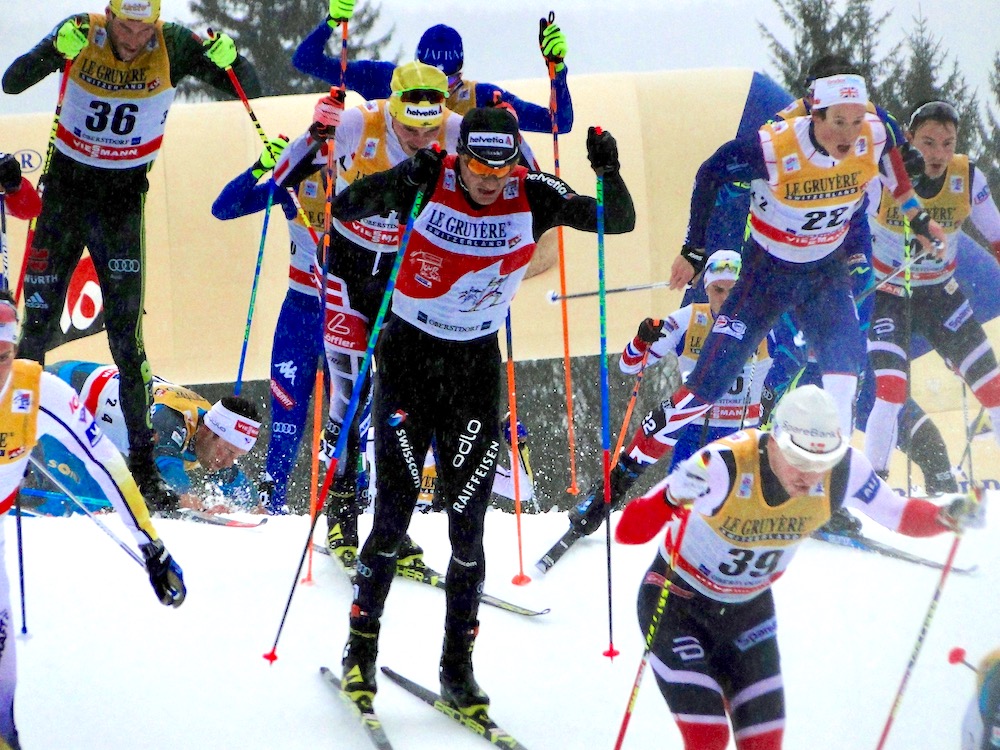
This pretty much sums up Stage 5 of the 2018 Tour de Ski, with a France’s Adrien Backscheider (an early race leader) crashing in the background while Switzerland’s Dario Cologna (red Tour leader’s bib) and Great Britain’s Andrew Musgrave (22) and others chase Norway’s Sindre Bjørnestad Skar (39) and others not shown in the men’s 15 k freestyle mass start on Thursday in Oberstdorf, Germany. (Photo: Harald Zimmer)
Like ants swarming a bread crumb — skating ants — on ice. That was one image that could be conceived from the men’s 15-kilometer freestyle mass start on Thursday, which served as Stage 5 of the 2018 Tour de Ski in Obertsdorf, Germany.
After high winds and fallen trees Wednesday in Obertsdorf left race organizers scrambling to set a new course for Thursday’s distance races, the end result was a 2.1 k loop (the women’s sprint course plus a flat section) with a maximum climb of 16 meters per lap for both the men and the women. The men rounded it seven times for 14.7 k and the women lapped five times for 10.5 k.
While Oberstdorf’s distance courses are typically “challenging and hilly and filled with attacks and strategic moves”, according to U.S. Ski Team Women’s Coach Matt Whitcomb, Thursday’s race was mostly flat. “It was probably the flattest race that many of these athletes have ever raced on the World Cup so it made for a really exciting pack race.
“[The organizers] just couldn’t use the course with the hills because the trees and the forest were unstable,” Whitcomb explained on the phone Thursday evening. “They also didn’t have time to clear the wood that fell. There were six or seven huge trees that fell on the course.”
It had also rained on Wednesday — in fact, a lightening storm struck the venue and led to the cancellation of Stage 4 after the women’s qualifier — so organizers opted to salt the course to preserve it as much as possible for the mass starts. It was raining again on Thursday, leaving the course icy with a thin coat of slush on top by the time the men raced after the women.
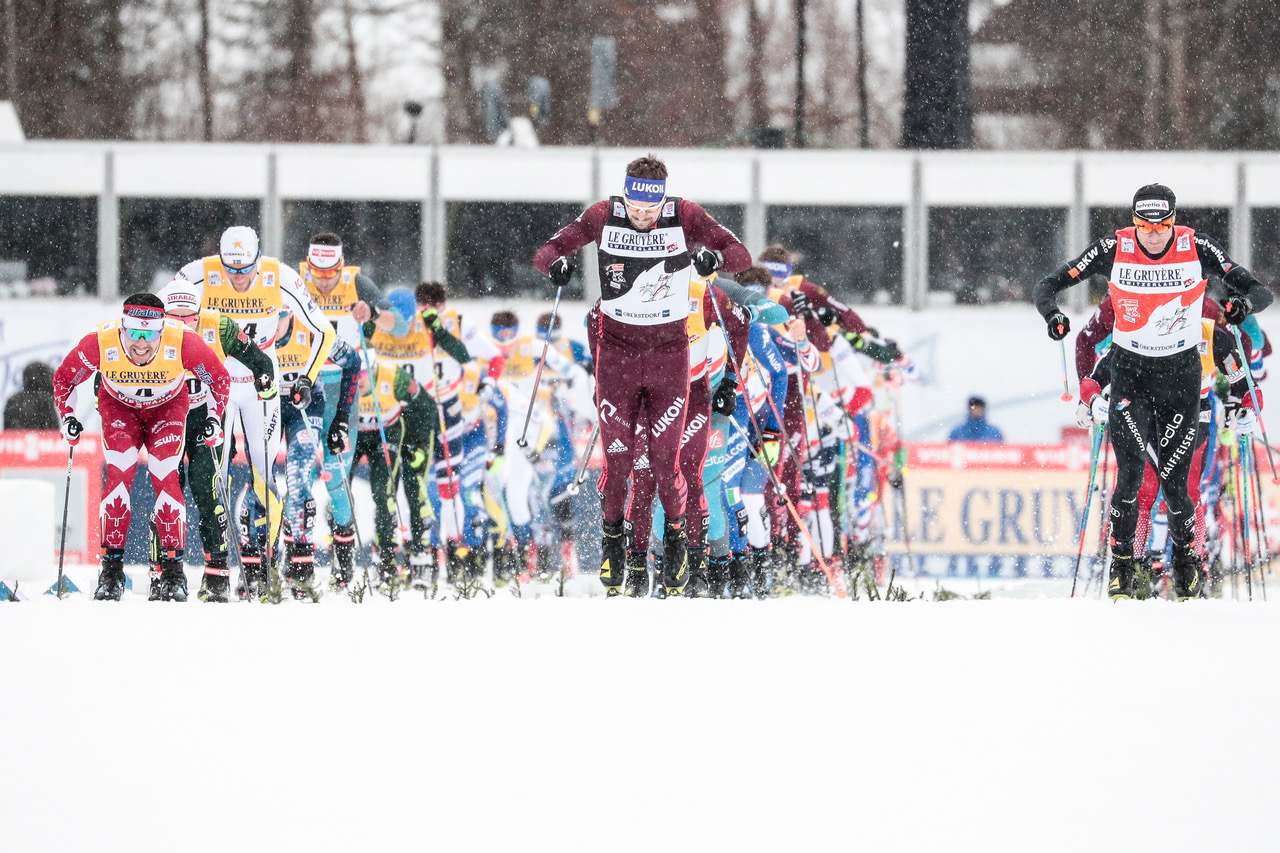
Start of the men’s 15 k freestyle at Stage 5 of the 2018 Tour de Ski in Oberstdorf, Germany, with Canada’s Alex Harvey (4), Russia’s Sergey Ustiugov (black bib) and Switzerland’s Dario Cologna (red Tour leader’s bib) up front. (Photo: Fischer/NordicFocus)
The men’s field, led by Russians Sergey Ustiugov and Alexander Bolshunov for almost all of the first lap, completed Lap 1 of seven in 4 minutes and 16 seconds (with Sweden’s Calle Halfvarsson leading through the checkpoint). There, at 2.1 k, all 67 starters were within 16 seconds of the lead.
One lap later, as Great Britain’s Andrew Musgrave led the large group through the stadium, just ahead of Norway’s Martin Johnsrud Sundby, Switzerland’s Dario Cologna, and Canada’s Alex Harvey, only one man had been dropped. Sixty-six still skied within 19 seconds of first.
Crashes dotted the entire race, with Bolshunov going down at least twice. Mostly, skiers tripped over one another on the slightly rolling course. Harvey even broke a pole at one point in the middle of the second-to-last lap. In a phone interview on Thursday, the lone Canadian in this year’s Tour de Ski (TdS) estimated he witnessed several crashes per lap.
“I saw for sure between 10 and 15 crashes that happened within my surroundings,” Harvey said.
For the first two laps, Harvey positioned himself in the top five, coming through the 3.6 k sprint bonus in fifth place to earn six bonus seconds (which count toward the overall Tour standings). On Lap 3, he dropped back to around seventh, still within 2 seconds of Musgrave and Norway’s Didrik Tønseth, who swapped the lead throughout the third lap.
On Lap 4, Cologna moved to the front, just ahead of Musgrave, Tønseth, Sundby and 30 others within 10 seconds of first at 7.8 k. There, Harvey was back in 30th, 9.2 seconds back. About 1.5 seconds behind him at 8.4 k, the end of Lap 4, was American Erik Bjornsen in 36th.
“I didn’t want to fall that far back, but I made a couple bad decisions, like picking wrong lanes and it was just a bit of a slower lane on one hill, so you’d lose five, six spots,” Harvey recalled. “Somebody would fall in front of you or in your lane, so then you’d come to a stop and lose 10 spots, so it was just real mayhem there. But my plan was to try to stay in the top five, top 10 all day, but I just didn’t do that.”
Lap 5 saw Cologna, Sundby, Tønseth, and even France’s Clement Parisse at the front of the pack, while Harvey moved back up to around 20th, just 3.5 seconds out of first.
On the penultimate lap, Harvey broke a pole.
“I had been kind out of position for a lap and half by then, so I was just trying to find ways to move, going on the outside, I think somebody just stepped on my pole, but it’s hard to tell,” he said.
Despite dropping to what he estimated to be 40th on that sixth lap, Harvey recovered, thanks to the tightly packed group, and lapped through the stadium in 27th, 5.3 seconds behind Tønseth in first.
Over the final 2.1 k, Harvey continued to pick off the places. One and a half k later, he was up to eighth, 3.4 seconds behind Norway’s Sindre Bjørnestad Skar in first.
“I was really focusing on staying outside the whole time, never going for the inside lane and then maybe people were starting to get tired a little bit, even though the course was not hard and the course was fast,” Harvey said. “… I think a lot of it was luck.”
In the final meters, when everyone at the front of the race turned it up another notch and Norway’s Emil Iversen attacked on the final rise before descending into the stadium, Harvey came out on top off a three-way photo finish for fifth place, edging Musgrave in sixth and Norway’s Finn Hågen Krogh in seventh. All three were within 4 seconds of first place, which went to Iversen.
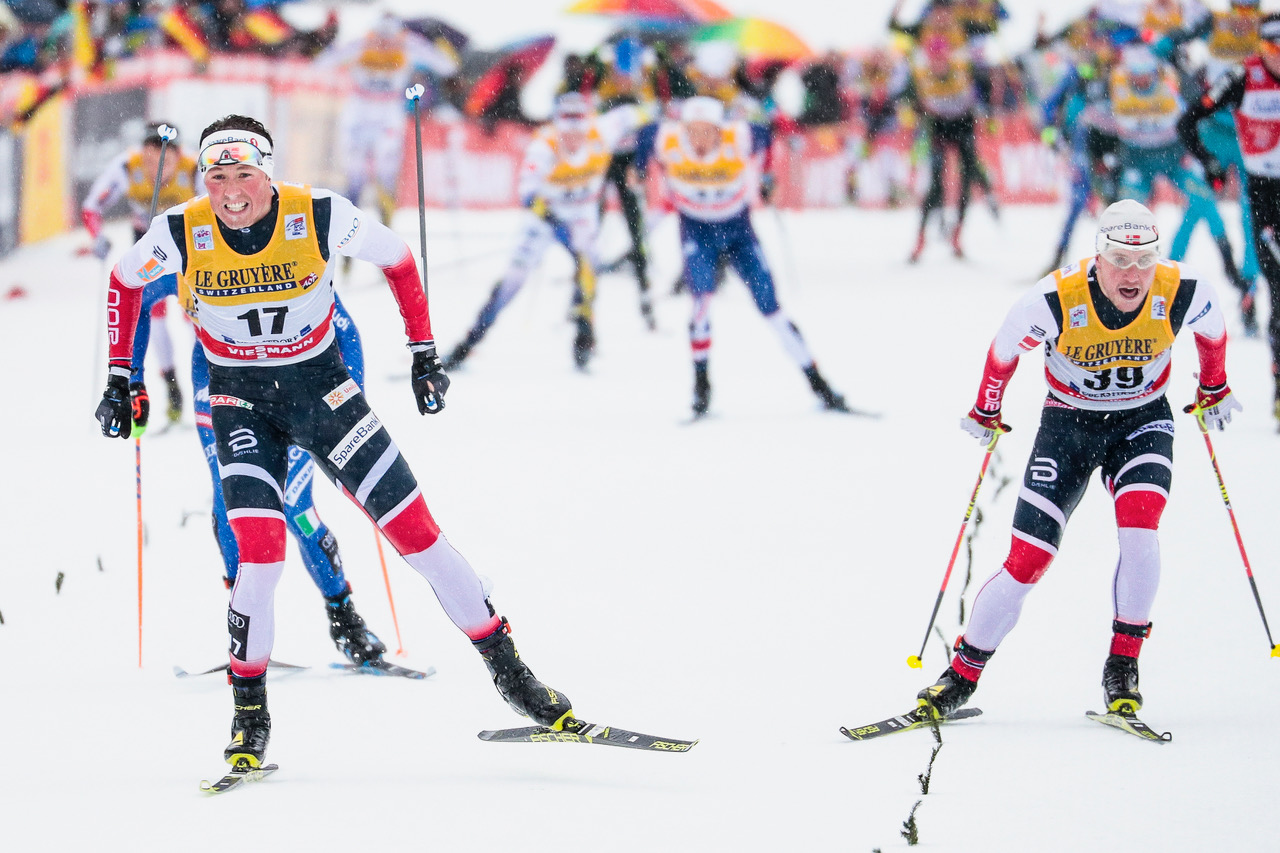
Norway’s Emil Iversen (17) racing to the line with his teammate Sindre Bjørnestad Skar (39) for first in the men’s 15 k freestyle mass start on Thursday, which Iversen won by 0.4 seconds for his first win and podium of the season, and the first for a Norwegian man in the 2018 TdS. (Photo: Fischer/NordicFocus)
The win was Iversen’s first of the season, and Norway’s first on the men’s side in the 2018 TdS, and puts him in 13th, 2:13 minutes out of first, with two stages remaining.
“It was a fight from the start to the end, and I just had to be in my head… doing the right things,” Iversen told reporters in English after the race. “I did that really good today so I am satisfied with that.”
Iversen crossed finished first in 29:49.8, just 0.4 seconds ahead of his Norwegian teammate Skar in second place. Italy’s Francesco De Fabiani — who had been 34th at 8.6 k, seven seconds back and just ahead of Bjornsen — claimed third place, just 0.9 seconds behind Iversen. Cologna finished fourth (+3.7) to extend his overall TdS lead, followed by Harvey in fifth. Harvey is still fourth in the Tour, now 1:23.1 behind Cologna.
Asked if he was mostly focused on finishing close to Cologna, Harvey said he was actually keeping track of Bolshunov, who ended up 40th (+15.9) on Thursday. Heading into Stage 5, the Russian U23 skier was third in the Tour, 6.3 seconds ahead of Harvey in fourth. So Harvey knew that even 6 bonus seconds at one of two sprint bonuses on the course could be the difference between third or fourth in the standings.
At the first bonus sprint, where Harvey picked up 6 seconds, Bolshunov picked up 3. Then, at the second bonus sprint at 7.8 k, the Russian clocked through in sixth for 5 seconds. Harvey was 30th there for zero. At the end of the day, Harvey held onto fourth in the standings, 1:21.3 minutes behind Cologna, 30.1 behind Ustiugov, who’s still in second, and 15.5 behind Sundby, who improved to third. Meanwhile, Bolshunov slipped to fifth, 3.6 seconds behind Harvey.
“… He ended up crashing on the last lap, I think,” Harvey said of Bolshunov. “I was focusing more on the guys that are closer to me because Dario, he’s so solid, he never really has a bad day. I think a lot of people — nobody’s giving it to him, but it’s going be hard to get back on him, so I think people are starting to fight more for second place. It was more about Bolshunov and Ustiugov.”
Russia’s Sergey Ustiugov leading Norway’s Martin Johnsrud Sundby (6), Austria’s Dominik Bauldof (47), Kazakhstan’s Alexey Poltoranin (5) and the rest of the men’s field during the men’s 15 k freestyle mass start at Stage 5 of the Tour de Ski. (Photo: Fischer/NordicFocus)
Ustiugov finished 28th on Thursday (+11.1) and now trails Cologna by 53 seconds in the overall. Sundby finished eighth (+4.2) and picked up 23 bonus seconds in Thursday’s mass start to move up from sixth to third overall (+1:07.6).
“For sure, it has been difficult weather, difficult conditions for those who make this race, and I think you can argue in a lot of ways today, the race was difficult and blew many racers’ chances, both with the difficulties with the skis and poles,” Sundby told reporters in English after. “But I am happy that they decided to do the race. They found a short track we could ski in and no cancellation I think that was good.
“My main goal for the season is Olympics,” Sundby continued. “I think we use this Tour for, one: I love the Tour de Ski; it’s a beautiful competition, and two: to get in better shape for the Olympics. That is the main goal this season, but I still want to fight for the first [in the Tour]. It looks a bit a long ahead at this point, but we have two more races to go.”
For Harvey, the race was also about distancing himself from some of his biggest threats in the final climb on Sunday, such as Sweden’s Marcus Hellner, who entered Stage 5 in 10th and about 35 seconds behind him overall, and France’s Maurice Manificat, who was previously 36 seconds behind him in 14th overall. They’re still at least 37 seconds behind Harvey after Manificat finished 10th on Thursday to move up to 10th overall (+1:59.0), tied with Germany’s Thomas Bing, who placed ninth Thursday to put himself ninth overall (+1:59.0). Hellner follows in 11th overall (+2:05.3) after finishing 22nd in Stage 5.
“I think for me today was a really good opportunity to make some time, especially on the guys close behind me, like Manificat and Hellner,” Harvey said. “I didn’t lose much, but I kind of missed the opportunity to give myself a bit more of a cushion for the climb, so that’s mostly what I’m bummed out about. That and looking at the schedule of the Tour, [this mass start] was for sure where I thought my best chance at a podium would be. So I’m a bit bummed out that I missed out on that, but it’s part of the game.”
In a Cross Country Canada press release, Harvey was quoted on his frustration with the mass start being held on a short, narrow and relatively easy course.
“It’s just too bad, the organizing committee or the jury should have just made it a sprint or an individual start,” Harvey told FasterSkier. “It was just kind of a stupid race. I was lucky that I ended up not losing too much time but I didn’t feel like I raced. It was easy the whole time, with just nerves the whole time, trying not to fall and stay out of trouble, even though nobody I think was able to stay fully out of trouble today.”
Bjornsen ended up 32nd at the finish, 11.7 seconds out of first, and leaves the TdS in 20th (+3:10.7). After initially planning to race the entire Tour, he spoke with Whitcomb about withdrawing after Stage 5 on Tuesday night.
“Erik is in a great spot,” Whitcomb said. “He’s had a really strong period [1 on the World Cup]. He’s skiing a really strong Tour. He’s made a distinct step forward this year, and we want to not lose sight of the goal of doing well at the Olympics. Erik’s a guy where in a number of events, but especially in the team sprint, a medal could be on the table for him, so we’re really focused on making sure we don’t tap things too deeply when we don’t need to. So Erik decided to ski through today, then head to Ramsau for a little rest, then a training camp.”
“It was a hard decision since I’m feeling good and sitting in 20th place,” Bjornsen wrote in an email. “There is a team sprint coming up in a little over a week [in Dresden, Germany] that I want to prepare for. There are only a couple team sprints each year and I feel that is my best chance of stepping onto a World Cup podium. I can’t let those opportunities pass me by.”
“I was pretty disappointed with my result,” Bjornsen wrote of Thursday’s mass start. “I’ve been feeling strong and felt like I wasn’t able to use my fitness out there today. It was great practice skiing in a tight pack. The finish came way too fast.”
Also for the U.S., Paddy Caldwell raced to 39th on Thursday (+15.5), and Andy Newell was 53rd (+43.2) while Simi Hamilton did not start. Newell and Hamilton have also decided to leave the Tour, as they had originally planned after Oberstdorf, and head to Ramsau, Austria, in advance of the Dresden city sprint World Cup weekend Jan. 13-14.
“I chose to race today because I had held back a bit in the last skate race on stage 3 to rest up for the sprint, and then sure enough It was canceled,” Newell wrote. “So I felt like I still had some good energy and It was worth having one more hard race.
“I felt a lot better racing today than in the distance races at altitude so I was stoked about that,” he added. “It was raining and icy and fast so it made for an exciting time. Lots of crashes and broken poles for sure, it felt more like rollerski racing with such a tight pack. Aside from several small tangles on the uphills, I tried to avoid trouble and was happy to ski with the main pack during the the majority of the race.”
“Kind of a weird stage for sure but I think it’s actually good for the TDS,” he wrote. “Adds some excitement and plays to a different skill set to race on an icy flat course like that. Racing is racing. We have an all uphill stage of the TDS, I think it should be customary to have a flat one:) similar to cycling.”
He leaves the Tour in 65th (+9:37.1), while Caldwell will continue in his first-ever Tour de Ski ranked 60th (+6:58.2) out of 67.
“I felt like I was skiing with new people all the time,” Caldwell wrote in an email about Stage 5. “It was a very dynamic and chaotic race. There were countless crashes and tangles out there. Absolute mayhem. Poles breaking every climb and at least one serious pile up every lap.
“I am happy with my performance today though it is bittersweet being so close to the points and the top guys,” he wrote of his 39th-place stage result. “It has been a pretty rough Tour for me so far fighting a cold, but today was definitely a step in the right direction. Right now I am just hoping to keep working out this cold and be able to put together good efforts for the next two races.”
“I actually thought he skied fantastically today,” Whitcomb said, “and he’s sounding much better tonight so I think there’s quite a bit of hope for Paddy. He’s looking good right now.”
Other notable withdrawals from the Tour include Sweden’s Halfvarsson and Finland’s Iivo Niskanen. Halfvarsson placed 54th on Thursday to leave the Tour in 24th overall. Niskanen did not race in Oberstdorf.
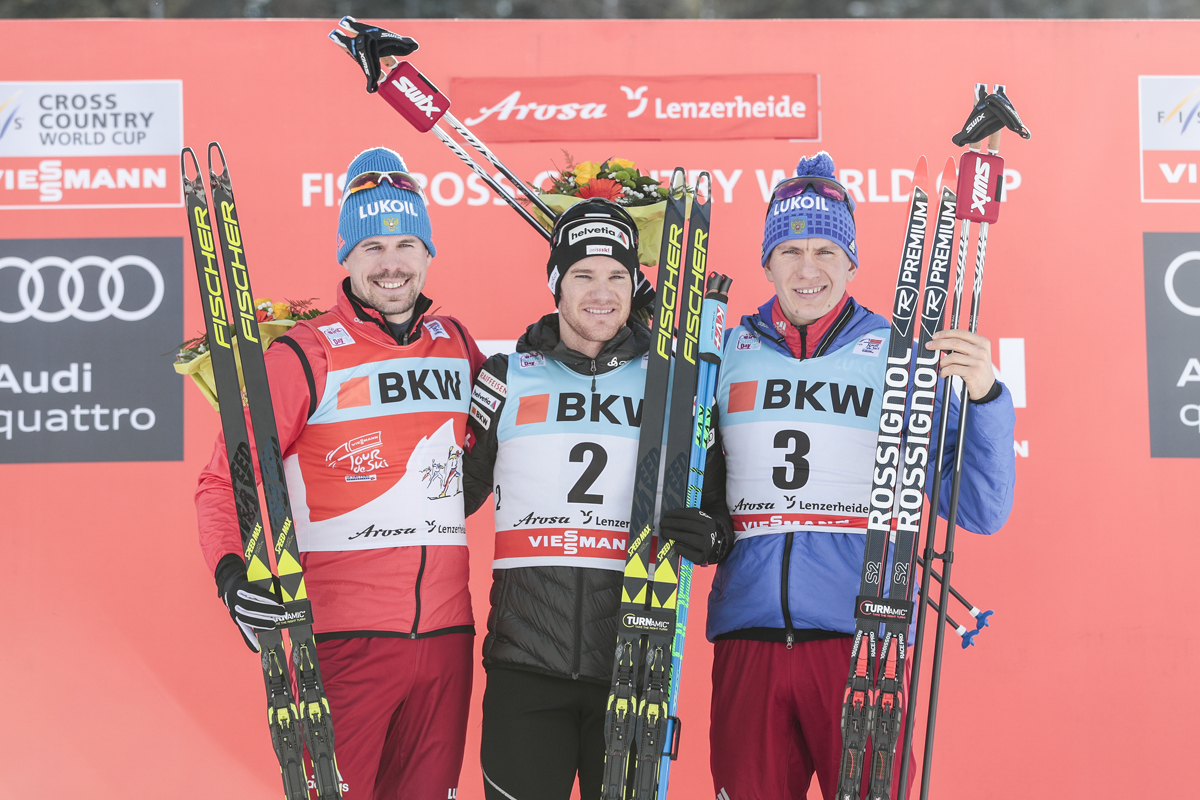
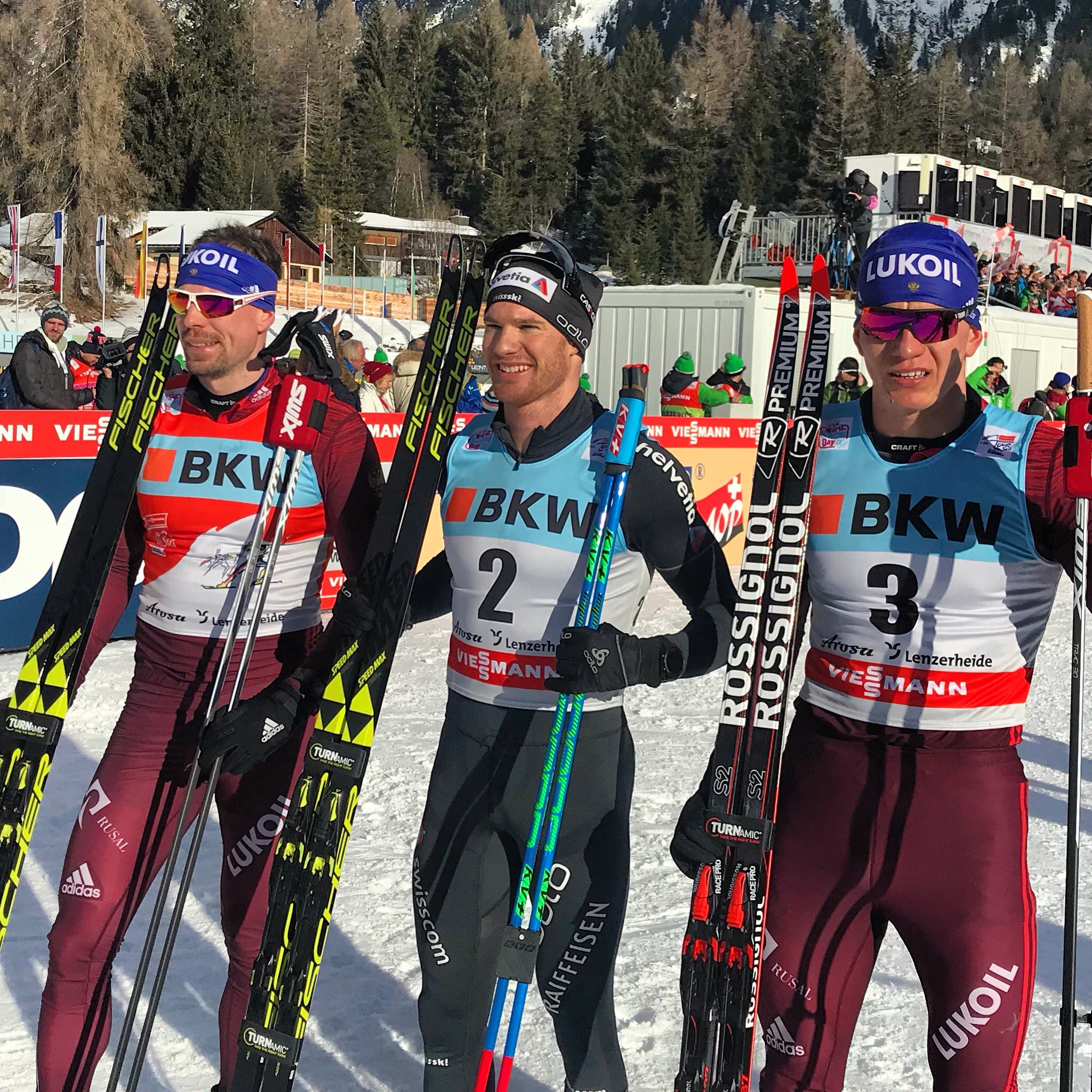
The men’s 15 k freestyle pursuit podium at Stage 3 of the 2018 Tour de Ski on Monday, with Switzerland’s Dario Cologna (c) in first, and Russia’s Sergey Ustiugov (l) in second and Alexander Bolshunov (r) in third in Lenzerheide, Switzerland. (Photo: Fischer/NordicFocus)
The Tour de Ski (TdS) theater was treated to a solo-skier drama during the Stage 3 men’s 15-kilometer freestyle pursuit on Monday in Lenzerheide, Switzerland.
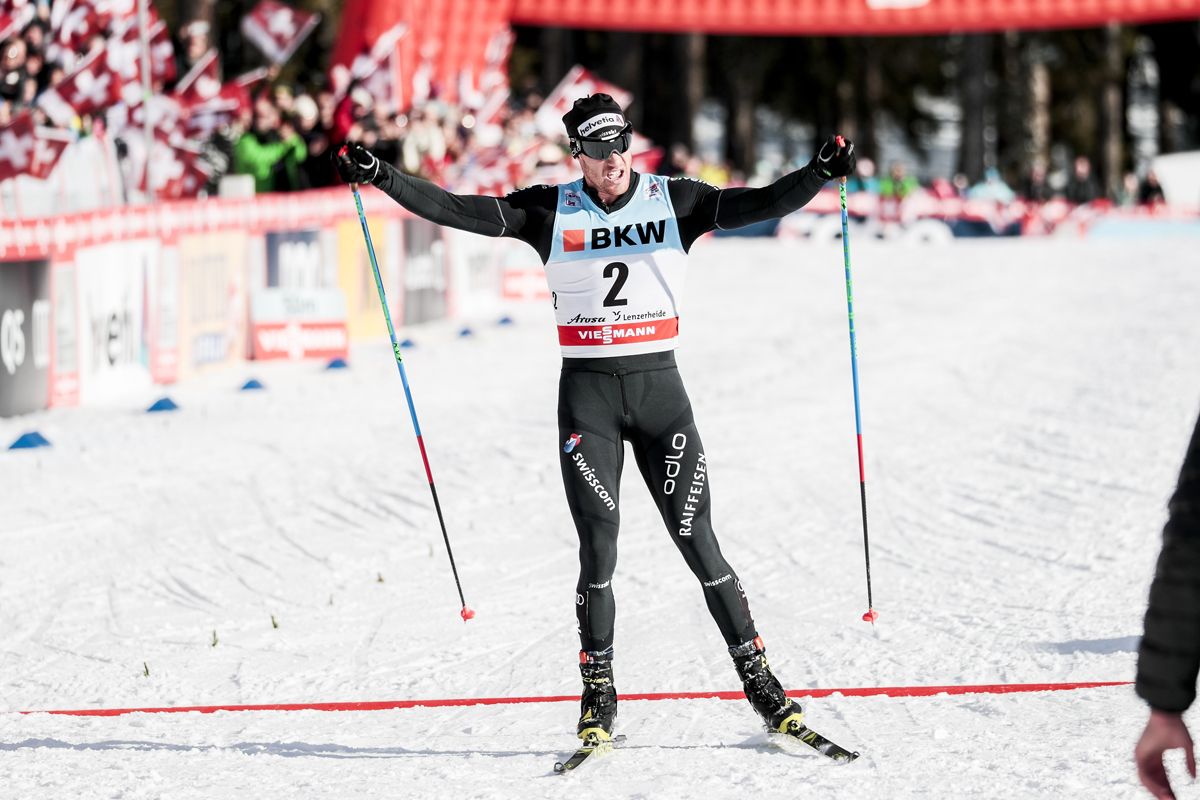
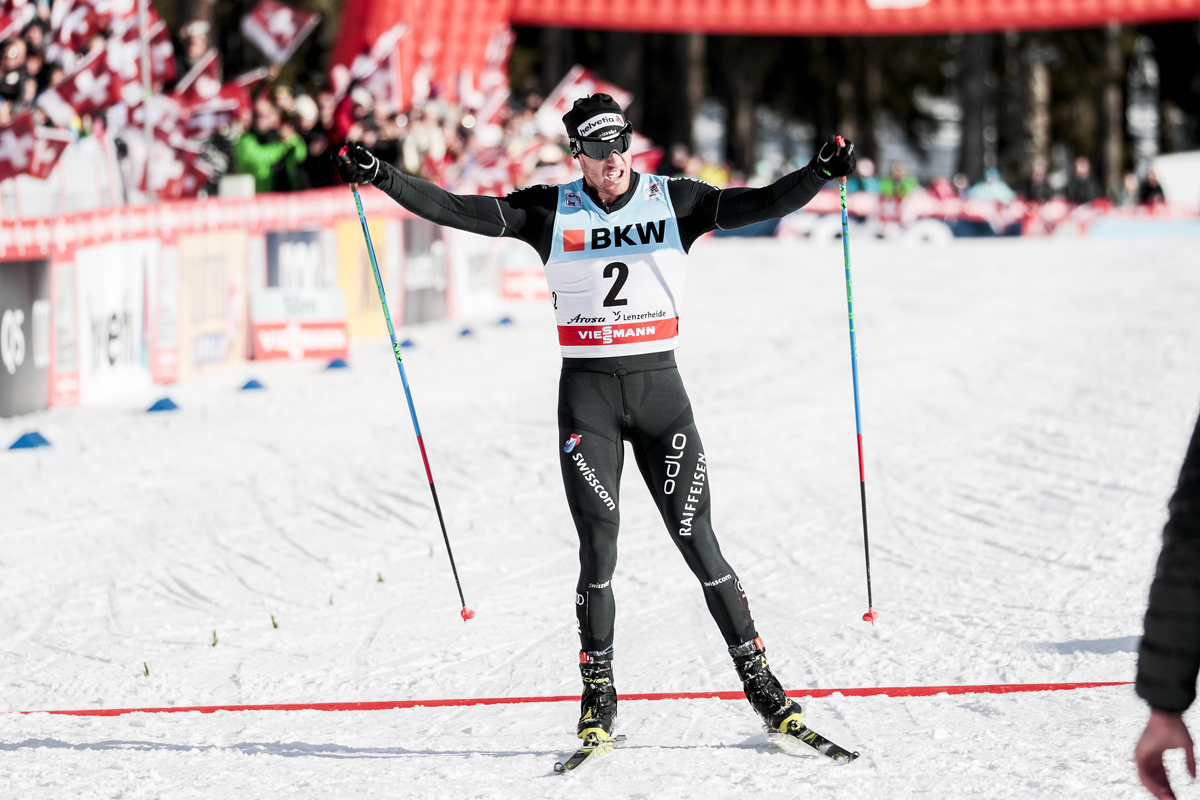
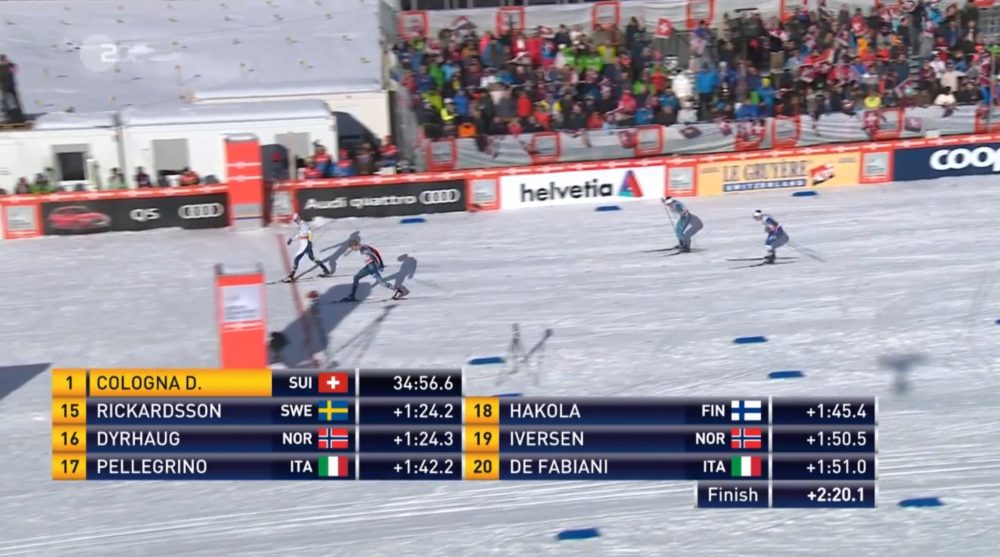
On New Year’s Day, it was a homegrown skier, Switzerland’s Dario Cologna, who stole the show winning the race in 34:56.6 minutes. Cologna is a three-time Tour de Ski winner, who until Saturday’s 15 k classic stage win, hadn’t won a World Cup race in three years.
“It was an amazing day already yesterday,” Cologna told the International Ski Federation (FIS) in a post-race interview. “Today I didn’t plan to already go away [from Ustiugov] on the second loop, but I felt very good. It was amazing with the crowd again here, with a home crowd it gives you so much energy. The last loop was very tough, Sergey came back strong, but I was just pushing and really wanted this win. It was one of these amazing days.”
Russia took the remaining podium spots with Sergey Ustiugov in second, 17.6 seconds behind Cologna, and U23 skier Alexander Bolshunov in third (+45.5). The lone Canadian in the race, Alex Harvey, outsprinted a six-man group to finish in fourth (+46.8). Kazakhstan’s Alexey Poltoranin was fifth (+47.1), Norwegians Martin Johnsrud Sundby sixth (+48.1) and Hans Christer Holund seventh (+48.2), Russia’s Alexey Chervotkin eighth (+49.9), Finland’s Iivo Niskanen ninth (+51.5), and Sweden’s Marcus Hellner 10th (+1:21.7).
For the last day in 2017 and the first in 2018, Cologna is ringing in the new year with a vigorous resurgence. On paper before the race, Cologna’s potential top spot on the podium seemed possible, but based on recent stats, uncertain. Yes, Stage 2’s win was a statement, but a horde of would-be winners and chasers weren’t far back from Cologna at the start.
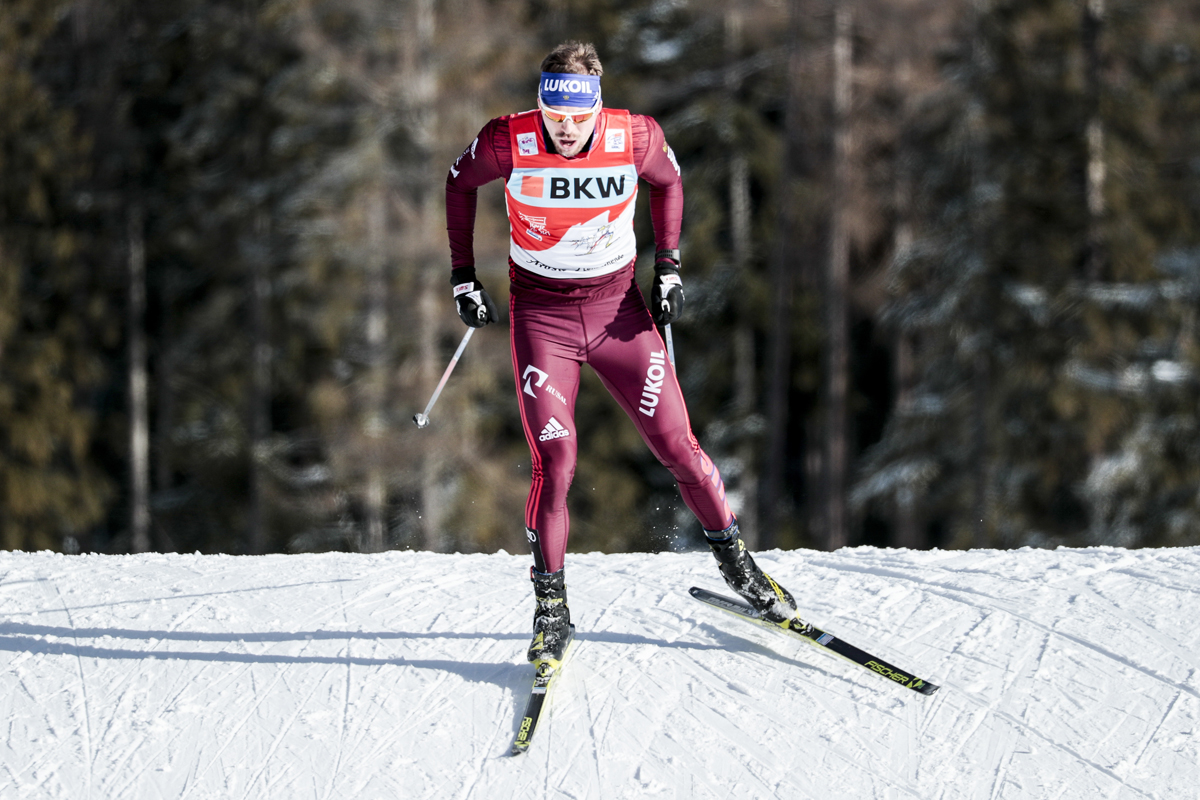
Russia’s Sergey Ustiugov racing to second in the Stage 3 men’s 15 k freestyle pursuit at the 2018 Tour de Ski on Monday in Lenzerheide, Switzerland. (Photo: Fischer/NordicFocus)
As the red-bibbed Tour leader, Ustiugov started first with only a 0.01-second wisp of time before second skier, Cologna, skied away. One-two, they were gone, with Bolshunov 12 seconds back, and the likes of Sundby and Harvey 39 seconds and 53 seconds behind, respectively.
In a quote to media after his Saturday win, Cologna noted he was hoping to pace together with Ustiugov from the start to keep the chasers at bay. The duel-with-Ustiugov tactics looked like they might play out for the duration — Ustiugov is known as a near-impossible skier to break.
At 2.7 k, it was a Cologna-Ustiugov tandem; they were separated by 0.4 seconds. But the impressions of the physical strain on 25-year-old Ustiugov were apparent — the strained facial expressions, the suddenly faltering technique. Cologna, on the other hand, looked like he had turned back the clock to his old dominating ways — the 31 year old’s skiing was big, smooth, and powerful.
At 4.7 k, Ustiugov was 7.3 seconds back. In the next k, Cologna pulled ahead. By 5.8 k, the time gap to Ustiugov had ballooned to 19.3 seconds. And with no apparent flaws evident in Cologna’s skiing, it was game over — Cologna eventually skied across the line on a blue-sky Swiss day waving to the home crowd.
“I was surprised myself. It really was my tactic to ski together exchanging in the lead, and initially that worked very well,” Cologna told Swiss broadcaster SRF, according to a translation. We regularly exchanged, and then he suddenly couldn’t quite keep up. I had thought that he started extremely fast, I barely could hang on at the beginning, but then he paid a little for that. I was surprised myself. But later he was able to recuperate and kept the gap constant. For me, it worked out great.”
The Tour takes a rest day on Tuesday and will ramp up again for a Stage 4 classic sprint in Oberstdorf, Germany, on Wednesday. After that, the distance races reign until the Tour concludes with the Stage 7 final climb in Val di Fiemme, Italy.
“It’s looking good right now,” Cologna told SRF. “Classic sprint is surely my weakest discipline in this tour. Ustiugov will try to win again and then he might be ahead. But then we have three distance races again, and I have shown that I can hold up. The starting position is better than ever. And now I’ll try to pull through.”
Swiss skier Dario Cologna makes it two wins in a row after a three-year a World Cup victory drought. Cologna won Stage 3 men’s 15 k freestyle pursuit at the 2018 Tour de Ski on Monday.(Photo: Fischer/NordicFocus)
For now, Cologna asserts with understated confidence that he can crack last year’s TdS winner Ustiugov.
“I think when you are in this position that has to be the goal. It won’t be easy, the day after tomorrow you can win another minute [in bonus seconds] and that rather will go to Ustiugov than to me. So it’s still very wide open. One also knows that he can rest up very quickly. And the others are also not out of the picture yet, there are some very strong athletes behind who will try everything they have, but I will also give it my best.”
Harvey 4th, Bjornsen 22nd
As the ninth starter in a sea of podium-shot skiers, Harvey had to ski strategically from the go. Sundby, starting sixth and 14 seconds in front, was a world-class rabbit to chase. Soon after, by 2.1 k, Harvey had locked onto Sundby.
“I talked with Holund just before the race and since I was starting just ahead of him, like a second, we agreed that I would just start fast and try to reel in Chervotkin first and then do the first 2 k in the front,” Harvey explained on the phone about his race plan. “Then [Holund] said he was going to help if he felt good, so he was able to help to close the last I don’t know 6 seconds to Sundby. … I was expecting Sundby go a bit hard. I don’t know if he was playing it conservative knowing that the course bites you in the ass on the last lap with the slow snow condition, or if he felt a little tougher today, but it was a bit unexpected to be coming back on him. At like 3 k we were back on him — it was fairly fast to close 15 seconds on him.”
At 6 k, Harvey was part of a strong group of seven skiers, all of whom except Finland’s Ristomatti Hakola, were glued together until the final straight. Beyond Harvey and Hakola, the group included Holund, Poltoranin, Sundby, Niskanen, and Chervotkin.
“The group was working well, but it was kind of such slow snow on the climb that no one was feeling good enough to do really good pulls,” Harvey said. “We would do a pull, and then your legs would get so tired and people would move over but it was the same for everybody. … It was really hard actually. The snow on the climbs especially was cold and dry, and then the downhills were a bit faster, but it was really hard, especially muscularly on the legs.”
“I was trying to help a bit on the sections I am the best, and I had really good skis,” Harvey said. “I was trying to, on the flatter sections where it’s more high speed, take some lead, and on some downhills push some baskets if I am following. I know on the steep terrain, the long grindy hill is maybe not my strength compared to Sundby — they were doing a lot of the work there — I was trying to push it on the flat and the more high-speed sections. … when you are in a pack with Sundby, it is kind of up to him to try to break us. I think everyone knew he was the strong man of the group, he is not the World Cup overall leader now, but he still is still one of the favorites, he is top-three overall.”
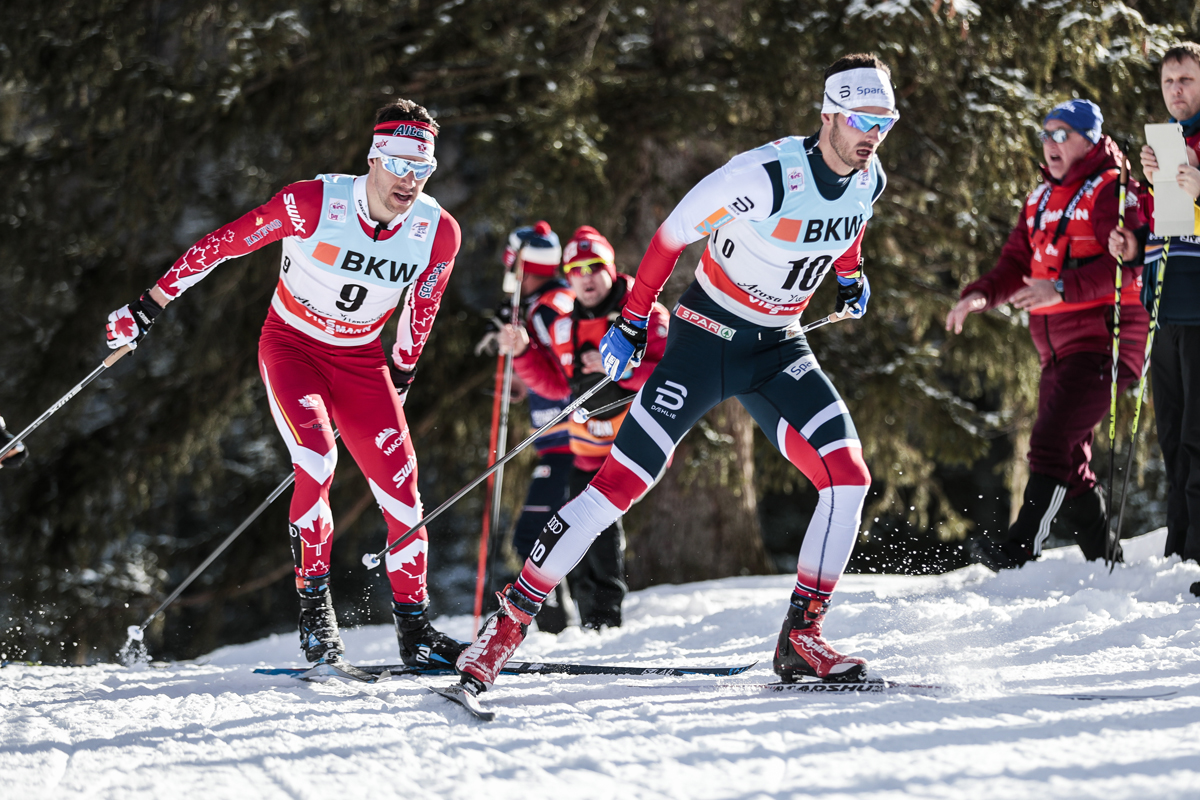
Canada’s Alex Harvey (9) and Norway’s Hans Christer Holund (10) during Stage 3 men’s 15 k freestyle pursuit at the 2018 Tour de Ski on Monday. Harvey placed fourth in the race. (Photo: Salomon/NordicFocus)
In the closing kilometer, Bolshunov’s gap on the Harvey pack was closeable. Perhaps with a few more meters and coupled with Bolshunov’s fade starting around 13 kilometers, Harvey could have snagged the last podium spot. Harvey showed he’s still a standout finisher by outsprinting his cohort and nearly catching Bolshunov as he captured fourth place — 1.3 seconds behind Bolshunov.
“I knew with the good skis, I could have a good kick at the end if I was feeling OK,” Harvey said. “So my card was more to be in good position for the last two k instead of trying to break the group.”
Harvey plans on finishing the Tour. The Quebec native explained he’s being treated well after the other Canadian who started the Tour, Devon Kershaw came down with an illness and withdrew after Stage 1.
“We still have five wax technicians; I still have seven total staff working just for me,” Harvey said. “It’s actually pretty sweet. With the small group it is really quick to turn around, we drove out of the hotel 15 minutes ago and we saw the French guys pulling in, so they hadn’t showered yet, they hadn’t packed their bags so we are probably 30 minutes in front of them. It makes it good for the recovery and more seamless for all the transitions. I am really lucky.”
With time bonuses factored in, Cologna leads the Tour standings with 1:12:46.6 hours of cumulative time. Ustiugov is in second, 22.6 seconds back, Bolshunov third (+55.5), and Harvey fourth (+1:01.8).
Harvey is joined by several skiers closely separated from fifth to ninth. Poltoranin is fifth overall (+1:02.1), Sundby sixth (+1:03.1), Holund seventh (+1:03.2), Chervotkin eighth (+1:04.9), and Niskanen ninth (+1:06.5). Hellner sits in 10th (+1:36.7).
For the U.S., Erik Bjornsen’s distance skiing remains a highlight. He kept his personal streak of skiing into the top 30 in every distance race he’s entered this season alive. Bjornsen notched a 27th in Saturday’s classic pursuit, a result that set him up for success on Sunday. He started one spot and 11 seconds behind World Cup overall distance leader, France’s Maurice Manificat.
Right away, Manificat set a too-hot pace. By 2 k, the Frenchmen had moved up to 19th place (+1:37.0), while Bjornsen bumped to 26th (+1:57.7). Manificat, in fact, skied the fastest time of day, covering the 15 k in 34:41.8 minutes.
The U.S. Ski team’s Erik Bjornsen (blue suit near the finish) about to toe the line during the Stage 3 men’s 15 k freestyle pursuit at the 2018 Tour de Ski on Monday. Bjornsen placed 22nd. (Photo: screenshot from SRF)
Bjornsen soon found his groove and his mates for the remaining kilometers.
At 10 k, Bjornsen skied in 28th place in a dense ski train of approximately 11 skiers. The group accounted for places 32nd through 23rd.
For another 2 k, Bjornsen seemed married to his 28th spot. But, seeking an opportunity, Bjornsen, along with Sweden’s Calle Halfvarsson and Britain’s Andrew Musgrave, moved to the front and pushed the pace of what would be a line of close-in-contact chasers.
In the final kilometers, the Bjornsen group closed nearly ten seconds on Cologna. With his constant up-tempo pressure and smart skiing, Bjornsen finished in 22nd place (+2:20.7) with the 26th-fastest time of day.
Bjornsen goes into the rest day now placed 22nd in the Tour and 2:35.7 minutes behind Tour leader Cologna.
“He’s really consistent,” U.S. Ski Team Head Coach Chris Grover said on the phone from the U.S. “He is really strong every event whether in a distance race, sprint, classic, skate. I think he wanted a little bit more out of the classic a day ago, I know it was a tough waxing day for all of those guys.”
Bjornsen is now faced with deciding if he stays or goes as it relates to the Tour. Grover stated Bjornsen will contest the Stage 4 sprint in Oberstdorf, but will then determine his race plan.
“He can have some great races in Oberstdorf,” Grover noted. “He will be one that is actually trying to make the decision, that at what point coming out of Oberstdorf where it makes sense to complete the entire Tour or whether it makes sense for him to stop and race in Dresden.”
The Dresden World Cup weekend runs Jan. 13-14 and features a freestyle team sprint. That team sprint in Dresden is the only opportunity to contest that event before the Olympics. (The team sprint is also an Olympic event and Bjornsen is targeting the team sprint at the Games.)
“He is the one that is keeping his eye on that possibility,” Grover explained. “He’ll make his own determination after the next two days of racing which path he wants to go on. Both of them are great ways to go. It just depends whether he wants to really try to move up in the last few of the TdS standings or if he feels like it is more valuable for him to be in a tactical sprint experience of the team sprint.”
Also for the U.S. Ski Team on Monday, Simi Hamilton placed 48th (+4:13.9), Paddy Caldwell 68th (+6:04.4) and Andy Newell 74th (+8:15.6).
After Sunday’s racing, Caldwell, who had intended to finish the whole Tour, sits 51st in the Distance World Cup standings. For the 23-year-old Caldwell to meet the objective criteria for an Olympic spot, he’ll need to be in the top 50.
“He knew the deal going in,” Grover said of Caldwell’s decision to race the Tour. “He knew that he would have to qualify using World Cup or he would have to qualify using U.S. National Championships and racing SuperTour in the fall. For him, he felt like it was more valuable to race World Cup to gain the experience and have a lot of starts during this period. He has weighed the options and he fully realizes that he may not qualify for the Olympics if he chooses what could be the more difficult path. He really felt like the World Cup was the more valuable experience for him because he wants to be a World Cup skier in the future and he wants to be someone who is having good results on the World Cup in the future.”
Grover also recognized Caldwell’s presence at the Tour as beneficial in the long run.
“As the youngest guy on the team, he’s skiing all of these races, in all of these venues for the very first time,” Grover said. “For him, it is about building experience for the future. If you can just go and learn these venues and learn these course, learn how to manage his energy in a Tour de Ski, in a seven-stage, nine-day event, that is really critical. That will be the kind of preparation he needs for the future.”
Tuesday is a rest day for Tour skiers. Racing resumes on Wednesday in Oberstdorf with a classic sprint.
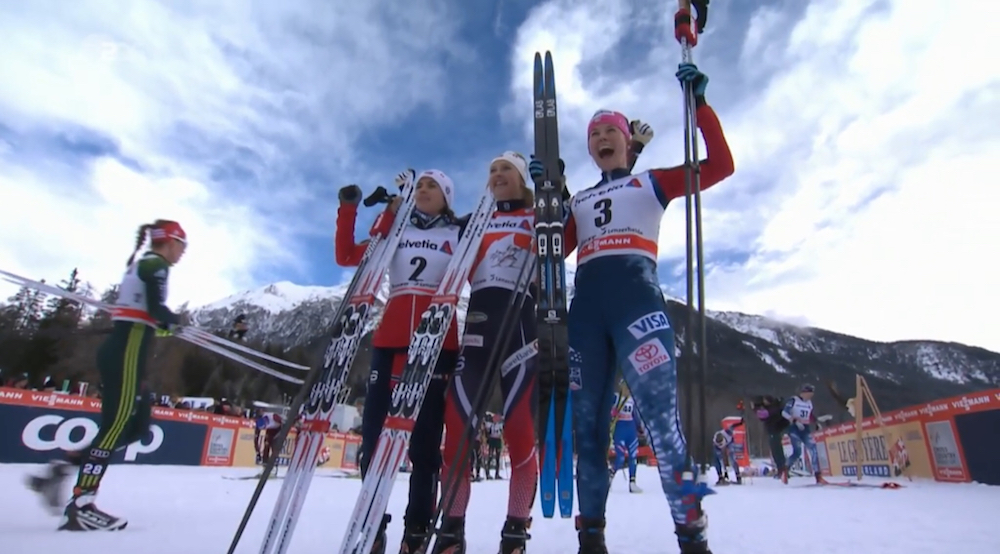
The women’s freestyle pursuit podium at Stage 3 of the Tour de Ski, with Norway’s Ingvild Flugstad Østberg (c) in first and Heidi Weng (l) in second and American Jessie Diggins (r) in third on Monday in Lenzerheide, Switzerland. (Screenshot: ZDF broadcast)
Tour de Ski Stage 3 (Lenzerheide, Switzerland): 10/15 freestyle pursuits
In the first three stages of the Tour de Ski (TdS), three different American women have reached the podium. Jessie Diggins became the latest in Monday’s New Year’s Day 10-kilometer freestyle pursuit in Lenzerheide, Switzerland.
Heading into Stage 3, the last one in Switzerland before the Tour moves to Oberstdorf, Germany, Diggins ranked third overall in the TdS. She started the pursuit in that place, 1:05 minutes after Tour leader Ingvild Flugstad Østberg of Norway. More than 30 seconds ahead of her, another Norwegian Heidi Weng headed out of the start in second place, 33 seconds after Østberg. And 10 seconds behind Diggins, her U.S. teammate Sadie Bjornsen started fourth, 1:15 out of first and just two seconds ahead of Russia’s Natalia Nepryaeva in fifth.
The women’s race then became a demonstration of strength and grit as Østberg kept herself out of reach, leading by a comfortable margin at every checkpoint and securing her second-straight win in 26:48.1 minutes. Weng could see her, and Diggins could see Weng, but neither linked up, as Weng finished second, 27.8 seconds after Østberg, and Diggins held onto third (+1:16.9) for her first podium of the season.
Behind Diggins, Finland’s Krista Pärmäkoski rose from eighth and 1:35 back at the start (starting behind her Finnish teammate Kerttu Niskanen in sixth and American Sophie Caldwell in eighth), to fourth at the finish, 1:45.9 out of first. Pärmäkoski outlasted Bjornsen by 0.3 seconds and Niskanen by 0.7 seconds at the finish to put herself in fourth overall in the Tour standings with four stages remaining, while Bjornsen placed fifth (+1:46.2) and Niskanen sixth (+1:46.6).
Norway’s Astrid Uhrenholdt Jacobsen moved up from 15th at the start to seventh at the finish (+1:59.9) with the fifth-fastest time of day. Austria’s Teresa Stadlober won the time of day, covering the course in 26:20.6 and improving from 22nd to 11th.
The U.S. had three finish in the top 20 with Caldwell placing 18th (+2:59.2) after skiing with a group of nine, led by Jacobsen and Switzerland’s Nathalie von Siebenthal, until the last of three laps. Caldwell fell off the pace around 7.5 k and skied the remainder of the lap alone to put herself 18th overall in the tour.
Liz Stephen started 37th and moved up to 31st (+4:07.7) with the 26th-fastest time of day (1:27.2 behind Stadlober). Rosie Brennan started 33rd and finished in that position (+4:17.9), and Ida Sargent finished 55th (+6:09.2) after starting 31st. Sixty-one women remain in the tour with four stages to go.
Cologna Takes Control
The men’s 15 k freestyle pursuit podium at Stage 3 of the 2018 Tour de Ski on Monday, with Switzerland’s Dario Cologna (c) in first, and Russia’s Sergey Ustiugov (l) in second and Alexander Bolshunov (r) in third in Lenzerheide, Switzerland. (Photo: FIS Cross Country/Twitter)
[UPDATED]
One second wasn’t enough for Russia’s Sergey Ustiugov to keep Dario Cologna at bay on the Swiss skier’s home turf, as the two started the men’s 15 k freestyle pursuit in first and second, respectively, with just 1 second between them on Monday in Lenzerheide.
Cologna took the lead after the first lap, around 3.7 k, and never relinquished as he scored his second-straight stage victory in Stage 3 of the Tour de Ski. Cologna previously won Sunday’s 15 k classic, but was second based on time back in the overall Tour standings to Ustiugov.
Between 3.7 and 4.7 k, Cologna put about six seconds into the Russian and was more than 19 seconds ahead of him by the 5.8 k checkpoint. Ustiugov skied around 22 seconds back at 10 k, still 15 seconds clear of another Russian Alexander Bolshunov in third and 43 seconds ahead of another one of his teammates Alexey Chervotkin in fourth.
Meanwhile, Canada’s Alex Harvey skied in fifth place with the six-man chase group Chervotkin was leading. Norway’s Martin Johnsrud Sundby took charge of that group by 13.3 k, while Harvey remained in fifth.
At the finish, Cologna took the win by 17.6 seconds over Ustiugov, crossing the line in 34:56.6. Ustiugov placed second and Bolshunov third (+45.5), while Harvey charged hard for the podium and placed fourth (+46.8). The Canadian beat Kazakhstan’s Alexey Poltoranin by 0.3 seconds for fourth, while Poltoranin settled for fifth (+47.1), Sundby sixth (+48.1), Norway’s Hans Christer Holund seventh (+48.2), Chervotkin eighth (+49.9), Finland’s Iivo Niskanen ninth (+51.5), and Sweden’s Marcus Hellner 10th (+1:21.7).
Cologna leads the Tour by 22.6 seconds over Ustiugov, Bolshunov is 55.5 seconds back in third, and Harvey 1:01.8 minutes back in fourth, just ahead of Poltoranin in fifth (+1:02.1), Sundby in sixth (+1:03.1) and Holund in seventh (+1:03.2).
Erik Bjornsen is up to 22nd in the Tour standings with four stages to go, 2:35.7 out of first, after placing 22nd on Monday and finishing 2:20.7 behind Cologna. The U.S. Ski Team’s leading man started 25th and skied the 26th-fastest time of day.
Can you guess who won the men’s time of day? France’s Maurice Manificat, who has a tendency to win these FIS points races, with a course time of 34:41.8. Manificat started 24th and skied up to 14th at the finish. Harvey’s time ranked fourth, 7.8 seconds slower than Manificat’s, while Holund was fifth fastest (+8.5) and Cologna sixth fastest (+13.2).
Four American men raced the third stage of the Tour, with Simi Hamilton finishing 48th (up from 54th at the start), Paddy Caldwell finishing 68th (up from 74th), and Andy Newell finishing 74th (after starting 69th). Overall, Hamilton, a sprint-focused skier who hadn’t planned on racing the whole Tour, according to U.S. head coach Chris Grover, is 48th in the Tour, 4:28.9 out of first. Caldwell is 68th (+6:19.4), and another sprinter, Newell 74th (+8:30.6) out of 77 men remaining in the TdS.
Sweden’s Charlotte Kalla (c) after winning the 2017 Ruka Triple and her first World Cup race since 2015. She won Sunday’s World Cup 10 k freestyle pursuit by 9 seconds over Norway’s Marit Bjørgen (l) and was nearly 34 seconds ahead of Norway’s Ragnhild Haga (r), who placed third. (Photo: FIS Cross Country/Twitter)
FIS Cross Country World Cup (Kuusamo, Finland): 10/15 k freestyle pursuit
Sweden’s Charlotte Kalla took down the fiercest contender women’s cross-country skiing has ever seen, challenging Norway’s Marit Bjørgen on the final lap of the women’s 10-kilometer freestyle pursuit on Sunday then successfully holding her off to the finish.
Kalla entered the final day of the three-day Ruka Triple mini tour with a 2-second lead on Bjørgen out of the pursuit start. Bjørgen quickly caught her and led for much of the four-lap race — until the last lap. The two skied alone, at least 30 seconds ahead of their nearest chasers, with three other Norwegians, Ragnhild Haga, Ingvild Flugstad Østberg and Heidi Weng leading Austria’s Teresa Stadlober and Sweden’s Stina Nilsson at 8.6 k.
Before that marker, Kalla had already launched her attack and was 6 seconds ahead of Bjørgen with 1.4 k to go. The Swede continued to push the pace and extended her buffer to Bjørgen, entering the stadium alone and winning by 9.7 seconds. For Kalla, a 2015 World Champion in the 10 k freestyle, it was her first World Cup win since 2015.
Bjørgen took second and Haga outlasted her teammates for third place (+33.9). Weng finished fourth (+38.0) and Østberg fifth (+40.2), then Stadlober in sixth (+41.0) and Nilsson in seventh (+46.7). Russia’s Natalia Nepryaeva led in the next chase group for eighth place (+1:01.6), followed by Sweden’s Ida Ingemarsdotter in ninth (+1:10.1) and American Sadie Bjornsen in 10th (+1:18.0). Another U.S. Ski Team (USST) member Jessie Diggins was close behind in 12th (+1:35.7), about five seconds behind Norway’s Kathrine Rolsted Harsem in 11th (+1:30.3).
The USST had four in the top 30, with Kikkan Randall rising from 48th at the start to 25th (+2:41.1) and Rosie Brennan improving from 34th to 28th (+2:43.2).
While Haga’s time was the fastest of the day in 25:41.8 (compared to Kalla’s finishing time of 25:50.1, which was third-fastest of the day behind Weng in second), Randall’s time was eighth fastest, Diggins was 10th fastest and Bjornsen 11th fastest of 79 in the last women’s race of the opening World Cup weekend.
Also for the U.S., Ida Sargent finished out the tour in 38th, Sophie Caldwell was 39th, Liz Stephen 56th, Chelsea Holmes 60th, and Julia Kern 73rd.
Canada’s Emily Nishikawa placed 69th overall and Cendrine Browne moved up two places to finish 72nd, while Dahria Beatty was lapped.
Klæbo Sweeps Opening Weekend
The men’s 15 k freestyle pursuit podium on the last day of the Ruka Triple in Kuusamo, Finland, with Norway’s Johannes Høsflot Klæbo (c) in first, Norway’s Martin Johnsrud Sundby in second, and Russia’s Alexander Bolshunov in third. (Photo: FIS Cross Country/Twitter)
In the men’s 15 k freestyle pursuit later in the day in Kuusamo, Johannes Høsflot Klæbo lost his 38-second buffer to the men’s field, but won the race after outlasting fellow Norwegian Martin Johnsrud Sundby, Russia’s Alexander Bolshunov and Canada’s Alex Harvey, respectively.
While Klæbo started the pursuit 38 seconds ahead of Bolshunov in second place, Sundb started 1:05 minutes back in 10th and Harvey was 1:23 behind in 12th.
Klæbo remained 32 seconds ahead of Bolshunov at 5 k, at which point Sundby led a chase group in third, followed closely by Sweden’s Calle Halfvarsson, Norway’s Didrik Tønseth, Kazakhstan’s Alexey Poltoranin, Russia’s Evgeniy Belov, Norway’s Emil Iversen, Finland’s Iivo Niskanen, and Norway’s Pal Golberg, respectively.
Harvey skied in the next group back with Sweden’s Marcus Hellner, Norway’s Hans Christer Holund, France’s Maurice Manificat, and Russia’s Alexey Chervotkin, all of which were in the top 15 at 5 k.
Over the next 2.5 k, Bolshunov cut his distance to Klæbo to 20 seconds, and at 7.5 k, Sundby was skiing alone another five seconds back in third.
Sundby caught Bolshunov and the two reeled in Klæbo over the next kilometer, catching him around 8.6 k, while 11 seconds back, Harvey led a chase group with Chervotkin, Niskanen, Holund, Poltoranin, and Manificat at 8.6 k.
Harvey lapped through the stadium at 10 k right behind Bolshunov in first, while Tønseth followed in third and Klaebo in fourth. Sundby remained in seventh, less than 2 seconds back.
At 12.5 k, 12 skiers remained in 2.6 seconds of the lead, but 1 k later, that number had dwindled to four within 3 seconds of first: Sundby, Harvey, Tønseth, and Klæbo. Bolshunov kept himself in contention just 3.8 seconds behind, and on the final climb, it became evident the race was between Klæbo, Sundby, Bolshunov, and Harvey. They finished in that order, with Harvey dropping off the pace in the finishing stretch.
Klæbo took the win in 36:23.2, just 0.4 seconds ahead of Sundby in second, while Bolshunov took third, 1 second behind Klæbo. Harvey was another 0.6 seconds back in fourth, and the Canadian’s time stood up as the fifth fastest of the day, behind Manificat in first (34:50.9). Manificat tied Holund for placed eighth overall (+8.2), behind Chervotkin in fifth (+6.2), Niskanen in sixth (+7.2), and Tønseth in seventh (+8.1).
Erik Bjornsen led the U.S. men overall in the tour in 26th (+1:43.6) for his third-straight race in the World Cup points. Also for the U.S. Ski Team, Paddy Caldwell raced to 19th for time of day (after starting 70th and finishing 51st in the pursuit).
Canada’s Devon Kershaw also landed in the points for the second-consecutive day in 29th (+1:47.8).
American Noah Hoffman finished the Ruka Triple in 39th (up from 45th at the start), Scott Patterson was 55th and Andy Newell 75th for the U.S.
Canada’s Len Valjas placed 44th overall, Graeme Killick 68th, Knute Johnsgaard 81st, and Julien Locke 83rd.
While France came in the favorites in the single mixed relay, starting a team of Martin Fourcade and Marie Dorin Habert, it was Austria who put on a master class and skied to a comfortable win today.
Simon Eder tags off to Lisa Theresa Hauser for Austria during the single mixed relay World Cup in Ostersund, Sweden. The pair raced to a 16.5-second win. (Photo: IBU/biathlonworld)
The Austrian duo of Lisa Theresa Hauser and Simon Eder used only two spare rounds over the course of 40 shots, the best shooting in the field by a wide margin. They led nearly the whole race and ended up with a 16.5-second victory over Germany’s Vanessa Hinz and Erik Lesser. The Germans used nine spare rounds to clean all their targets, but Lesser was aggressive on the skis and made up ground on the trails to finish 16.2 seconds clear of the rest of the field.
There, drama ensued on the last loop. Kazakhstan’s Maxim Braun came through a crash caused by Italy’s Thomas Bormolini, who was skiing in third place on the penultimate downhill and also took out Ukraine’s Dmytro Pidruchnyi. That allowed Braun, along with teammate Galina Vishnevskaya, to just barely hold on to third place. Their shooting – with five spare rounds between them, the second-best in the field – allowed this, their best relay showing ever.
Fourcade, who had left the range in seventh, came through the fray to put France into fourth, followed by Sweden (Linn Persson and Sebastian Samuelsson), then Ukraine (Pidruchnyi and Vita Semerenko) and Italy (Bormolini and Alexia Runggaldier).
Both the U.S. team of Emily Dreissigacker and Leif Nordgren and the Canadian team of Rosanna Crawford and Christian Gow were lapped. Crawford was in second position more than halfway through the race when she fell on a downhill, losing a large amount of time and affecting the functioning of her rifle once she reached the shooting range.
Later in the day, countries sent four-athlete teams out for regular mixed relays. Despite an imperfect start on the shooting range, the Norwegian team of Ingrid Tandrevold, Tiril Eckhoff, Johannes Thingnes Bø, and Emil Hegle Svendsen came away with a 5.3-second win over Italy’s Lisa Vitozzi, Dorothea Wierer, Dominik Windisch, and Lukas Hofer.
The German team of Franziska Preuss, Maren Hammerschmidt, Benedikt Doll, and Arnd Peiffer was third, +6.4, and Slovakia close behind in fourth.
Canada’s Emma Lunder, Julia Ransom, Scott Gow, and Brendan Green finished 15th, +3:28.0, and the U.S. team of Susan Dunklee, Clare Egan, Paul Schommer, and Sean Doherty 21st, +4:47.6.
Sweden’s Charlotte Kalla racing to a win in her first race of the 2017/2018 season, the women’s 5 k freestyle in Gällivare, Sweden, on Friday. (Photo: Sporteventgallivare/Instagram)
Sweden’s Charlotte Kalla and Hanna Falk went 1-2 in Sweden’s season-opening International Ski Federation (FIS) race on Friday in Gällivare, with Kalla winning the women’s 5-kilometer freestyle by 8.8 seconds in 12:58.1 minutes. Falk, her teammate on the Swedish women’s team, placed second and Russia’s Yulia Belorukova took the third spot on the podium, 10.3 seconds out of first.
The host nation had three in the top four, with Ida Ingemarsdotter in fourth (+16.1). Switzerland’s Nathalie von Siebenthal finished fifth (+17.8), Russia’s Yulia Tchekaleva placed sixth (+23.4), and Russia’s Natalia Nepryaeva was seventh (+25.0).
Kikkan Randall of the U.S. Ski Team raced to eighth (+27.2), just ahead of Sweden’s Evelina Settlin in ninth (+32.0) and Russia’s Anna Nechaevskaya in 10th (+33.5). Japan’s Masako Ishida was just 0.3 seconds out of the top 10 in 11th.
In an email, Randall explained that she decided to venture to Europe earlier this year to get some racing in ahead of the World Cup.
“We also wanted a little extra time to let Breck adjust to the 10hr time change!” she wrote of her 1-year-old son, who will be traveling the World Cup circuit with Randall and her husband, Jeff Ellis, this winter.
(Article continues below)
Most of the U.S. Ski Team arrived in Rovaniemi, Finland, on Thursday, Nov. 16 (with the exception of Andy Newell, who is racing this weekend in Beitostølen, Norway, with Noah Hoffman). The rest of her teammates planned to train at the Santasport Olympic training center in Rovaniemi until Nov. 21, when the entire team will meet up in Kuusamo (also known as Ruka), Finland — the site of next weekend’s World Cup opener.
“I’m happy with my start today,” Randall wrote of Friday’s race. “It took my a couple km’s to get going today but I felt like I was finding my rhythm in the 2nd half of the course. It’s my first hard session this week after the travel over so today was a good jolt! It was a competitive field and I was satisfied to be in the mix.”
Ninety-two women raced the Gällivare 5 k skate, compared to 56 women on Friday in Beitostølen (Norway’s FIS season-opener). Randall planned to race the 10 k classic on Saturday in Gällivare, then skip Sunday’s classic sprint.
“It’s great to be back around other World Cup skiers again and I’ve always liked Gällivare so it’s nice to be back here,” she wrote. “My former wax tech lives here and has been taking great care of us. … Looking forward to meeting up with the team in Ruka next week.”
With 46 Swedes and 23 Russians accounting for most of the women’s field, Canada’s Emily Nishikawa put herself in the mix in 26th, 54.9 seconds behind Kalla. Nishikawa’s Canadian World Cup teammate Dahria Beatty placed 56th (+1:38.3).
For Nishikawa, who’s known as a distance skier, the top-30 result was notable in that a 5 k falls somewhere between a sprint and a distance race.
“5km is such a hard distance, and it is over so fast, but it is a lot of fun,” Nishikawa wrote in an email. “I have been able to work on my sprinting a bit more this summer as I have been injury free, so I’m looking forward to seeing more speed in my racing this season.”
She planned to race all three days in Gällivare, including Sunday’s sprint.
“With these races, I am just hoping to fine tune my fitness and get some hard intensity in to feel sharp for the upcoming World Cup races,” added Nishikawa, who’s entering her fifth World Cup season as a leading member of the Canadian women’s World Cup Team. “Today’s race was a really hard effort and I am happy with how I skied today.”
In the men’s 10 k freestyle on Friday, another one of the Russians sanctioned by the International Olympic Committee (IOC), Evgeniy Belov won in 23:08.5. He was 6.5 seconds faster than his Russian teammate Sergey Ustiugov, who placed second. Ustiugov is the defending Tour de Ski champion and Overall World Cup runner-up.
Switzerland’s Dario Cologna placed third, 7.6 seconds out of first, and Russia swept fourth through ninth, with Sweden’s Marcus Hellner following in 10th (+36.4). Out of the five actively competing skiers the IOC sanctioned earlier this month, all five raced on Friday in Gällivare, which was legal considering FIS had not ruled they can’t.
Four of those skiers are men. In addition to Belov, Maxim Vylegzhanin placed 14th (+43.2), Alexander Legkov followed in 15th (+45.9) and Alexey Petukhov finished 23rd (+56.7) out of 157 finishers on Friday.
Devon Kershaw (front) training with U.S. Ski Team sprinter Andy Newell in Sjusjøen, Norway, last week. (Photo: Noah Hoffman)
Ahead of them, Canada’s Devon Kershaw ended up 12th (+39.9), tying another Russian Artem Maltsev (who is not on the IOC-banned list) with identical times.
“My stance on the whole Russian fiasco is unchanged,” Kershaw wrote in an email, referring to a previous email he wrote to FasterSkier earlier this week when asked how he felt about the IOC-banned Russians competing in FIS events. “I find the entire thing both disturbing and hilarious. The fact that FIS is risking their credibility like this makes no sense to me. Apparently there will be an emergency meeting of sorts tomorrow about it (with FIS I’m assuming but I haven’t heard much about it) – so we’ll have to all wait and see what they come up with.
“As for seeing Belov win – I mean, that’s no surprise,” Kershaw continued. “He’s shown that he’s a force when he’s in form. But yeah, the fact that he and others have been recently banned for life by the IOC are winning races after that news came out just shows the Mickey Mouse club that our sport has become.”
As for his own race, Kershaw wrote that he felt great about it. The course suited him well without too much hard climbing. “… You kind of need to be pushing the whole way around. I really like courses like that,” he wrote.
The conditions, however, with about 10 to 15 centimeters of new snow from the early morning that continued into the race, made the course slower, which Kershaw found to be more challenging.
“But that is another reason why I am so satisfied with the effort today. Individual start skating in soft conditions? Not my favourite, so I’m happy how I was able to execute things,” he wrote. “For me to be in the mix in a 10km skate like that feels great. I had good energy all race and hit my technical goals for the race too, so I have to be satisfied.”
Kershaw and the rest of Canada’s Period 1 World Cup team arrived in Gällivare last Sunday. Over the last week, they’ve been testing equipment and getting into a race routine ahead of the World Cup opener, he explained.
“I changed various things with my training this year so it’s exciting to see how my body feels in the beginning of a new season,” Kershaw wrote. “… My goals are really to just be calm and execute well – which means going into the racing with no expectations other than to ski as technically well as possible while working on the whole pacing thing (which can be challenging at the beginning of the season when you don’t have that many races in the body). I’ll look to have another well executed race tomorrow and the results will be what they will be.”
Canada’s NorAm leader at the end of last season, Russell Kennedy (Team R.A.D.) was the next-best Canadian in 48th (+1:35.7), followed by Len Valjas (World Cup Team) in 49th (+1:37.0). Jack Carlyle (Alberta World Cup Academy) placed 67th (+2:07.2), Julien Locke (National U25 Team) was 72nd (+2:10.9), Graeme Killick (World Cup Team) 90th (+2:32.2), Brian McKeever (Para Nordic Team) 97th (+2:39.0), and Jess Cockney (World Cup Team) 119th (+3:10.7). Knute Johnsgaard (World Cup Team) did not start.
Racing continues in Gällivare this weekend with 10/15 k classic individual starts on Saturday followed by classic sprints on Sunday.
Sweden’s Stina Nilsson celebrates the 10th World Cup victory in two seasons in the women’s 1.3 k freestyle sprint in Otepää, Estonia, in January. (Photo: Fischer/NordicFocus)
Welcome to World Cup Windup, where we check in with the top-10 teams from last year’s FIS Cross Country World Cup tour before the season starts with the Ruka Triple in Kuusamo, Finland, on Nov. 24.
SWEDEN
Overall in Nations Cup Last Year: Second
Women’s Ranking 2016-2017:Second
Men’s Ranking 2016-2017:Third
Who’s Back:
Stina Nilsson, second in the Sprint Cup and fourth in the World Cup overall; Hanna Falk, third in the Sprint Cup; Marcus Hellner, who finished sixth in the World Cup overall; Charlotte Kalla, ninth overall; Calle Halfvarsson, who won two World Cups; and Jens Burman and Jonna Sundling, the runner-up and fourth-ranked skiers in the for the World Cup U23 standings. Plus, 2014 Olympic team sprint bronze (soon-to-be-silver) medalists Emil Jönsson and Teodor Peterson, and Ida Ingemarsdotter, who teamed up with Nilsson for silver in the same event in 2014.
Who’s Missing:
Sweden’s Marcus Hellner – who had something of a comeback last season – leads Germany’s Florian Notz during the third leg of the men’s 4 x 10 k relay at 2017 World Championships in Lahti, Finland. Sweden ultimately placed third and Germany sixth. (Photo: John Lazenby)
Sweden’s wily and bold distance specialist, Johan Olsson. Olsson announced his retirement in April at age 37 after winning back-to-back World Championships 50 k titles in 2013 and 2015, and contributing to Swedish relay gold at the 2010 and 2014 Olympics. “I have spent 15 years trying to realize my sporting dreams,” he explained at the time. “Now I will be able to realize completely different dreams, and I will be able to be a much more present dad.”
Pre-Season Results:
The Swedish team had a sprint race in late October in Idre, on a course made to resemble the profile of the 2018 Olympic sprint course in PyeongChang, South Korea. Some athletes were away at an altitude training camp, but Hanna Falk dominated the women’s sprint over Maja Dahlqvist and Linn Sömskar. Calle Halfvarsson won the qualifier but fell in the final; instead, Teodor Peterson edged Oskar Andersson in a tight finish.
Other than that, most of the top athletes have not raced yet. National team member Emma Wikenwon a season-opening race in Bruksvallarna, Sweden, this past weekend. “It felt good! I chose to compete here today because I usually feel that it takes a couple races for me to get started,” she told Swedish media.
Recent Drama:
Calle Halvarsson racing last December, before he got sick and took a long break from the World Cup. (Photo: Fischer/NordicFocus.com)
Despite flashes of undeniable brilliance, Calle Halfvarsson’s career has been plagued by gaps in the race results because he has often been sick mid-season. This year he had an operation to fix his sinuses and hopes that it will allow him to race at the top of the field all season. “I hope I’ve found the solution,” he said. “I feel a difference. I have kept myself healthy.”
Stina Nilsson, the most successful Swede last season, talked about how she has dealt with the fame that has gathered around her in the last three years since her breakthrough on the World Cup. “The attention itself is not a driving force for me, and sometimes it can be tough to handle,” she said on the Swedish podcast Ur spår. “It’s a thing I have a bad conscience about: I don’t have the patience I want to, when people come up and want to talk cross-country skiing with me. As I breathe and live in my ski bubble for so many hours a day, I want to make some breathing holes — I have to be just human Stina, where I can focus only on myself.”
Sweden’s Charlotte Kalla racing to the win in the Lysebotn Opp, a 7.5-kilometer uphill climb, at the 2017 Blink Ski Festival on Thrusday in Lysbotn, Norway. (Photo: Axelar/Arild Aarnes)
Kalla, meanwhile, has decided to skip the Swedish national team’s pre-Olympic training camp in Sapporo, Japan, and prepare instead in Seiser Alm, Italy, at altitude. Who else will be there? Marit Bjørgen, who is in turn skipping the Norwegian team’s pre-Olympic camp. Kalla noted that the two have discussed that they will both be training in the same place and that they will undoubtedly run into each other on the trails. “I really hope we can help each other,” Kalla said.
But on to how to stay current on the Swedish team. As has been the case for quite some time, Sweden’s first couple of skiing Anna Haag (Instagram / Twitter) and Emil Jonssön (Instagram / Twitter) have among the best-curated social media presences out there. Haag in particular posts regularly and provides shots of her daily life, Swedish culture, herself with her husband, and the rest of the Swedish team.
And Marcus Hellner (Instagram) and Teodor Peterson (Instagram) both provide consistent looks inside their training, but also of their lives with their young children.
Asker til topps uphill running test, featuring author Maks Zechel (front) and his teammate Ola. (Photo: Lars-Erik Nygaard)
Editor’s Note: The following is the fourth post in a series proposed by Maks Zechel, a 19-year-old Canadian cross-country skier embarking on his first season training abroad. He recently made the big move to Norway, where he’ll be training and racing with Team Asker for the next nine months. Through these updates, Maks hopes to share his personal “observations, stories, and lessons learned” to help close the gap between North American and Scandinavian nordic skiing. Previous posts: #1,#2 and #3.
***
Tuesday, Aug. 15, 2017:
It is late at night when I finally get the message: “Meet at Føyka stadium, 9:00am, for practice, 10x2min zone 4 double poling.” I panic. In less than ten hours I will be meeting my new teammates for the first time. My initial reaction is defensive: “I can’t do this. It’s too late. Maybe if I had more time to prepare…. I’ll just do the workout on my own.” I know what to expect, and it terrifies me.
Views of the Black Forest, Germany, 2011 (Photo: David Zechel/Dad)
When I was 13 years old I went to a school in Germany for a year; nobody spoke English and I barely spoke any German. On my first day of school, I walked through the school doors alone. Somebody asked me what my name was, and I replied “I don’t know,” only realizing what they had said after they looked at me like I was crazy. I ended up having an amazing year in Germany and I am still in contact with some of the friends I made there.
Seven years later, the thought of yet again integrating myself with a peer group in a country where I don’t know anyone and can’t speak the language, makes me nervous. It was time for me to make some decisions, time to step up and seize my opportunities. I did not come all the way to Norway to train in solitude for fear of the awkwardness that comes with learning a new language and meeting new people. This may have been just one practice, but to me it was a decision point on whether or not I had what it took to make this trip successful.
I went to practice. I arrived 20 minutes early and waited, breathing in the thick air of anticipation. Slowly, the rest of the team started to arrive. I greeted each of them with a smile, a handshake, and “Jeg heter Maks (My name is Maks)… I am from Canada.” Almost everyone spoke English well, and even if they didn’t, we all spoke the language of “I think I’m going to puke” at the end of the interval session. I rollerskied home from training, giddy with happiness. This was why I put myself into these situations that scare me, because the friendships formed and the memories made are more rewarding than staying in my comfort zone.
Asker til topps uphill run course (Red = very high heart rate, ouch)
After Tuesday’s intensity workout we transitioned quickly to the team’s second testing camp of the year. The “lactate-party” started on Friday evening with a brutal 5.8-kilometer mass-start uphill running test. The race started with a lap of the track in the center of town, then climbed steadily to the halfway point, where the course entered the forest and followed steep, narrow trails requiring all of my willpower just to keep running. The race finished on top of Hagahogget, a rocky peak with an incredible view over the fjord and surrounding towns. I ended up third, far behind the winner, Erland, who happens to run an 8:50-minute 3,000 meter.
The next morning we began the second test, a 4.4 k mass-start uphill double-pole race. It was difficult to go from racing at 7 p.m. the night before to racing again at 9 a.m. the next morning, but it reminded me a lot of afternoon distance race starts followed by early sprint qualifiers the next day, something that I experienced last year at U.S. nationals in Soldier Hollow and Canadian Nationals in Canmore.
Day 3 started off with one of the tests I had been looking forward to the most: a 9.5 k individual-start skate time trial at the Holmenkollen rollerski track. After driving up a long road out of Oslo, I arrived at arguably the most recognizable nordic sports stadium ever built. In the center of everything is the spectacular ski jump. Rollerskiing over the top of the course, you are treated to a panorama of Oslo, the Inner Oslofjord, and all the surrounding towns. Warming up around the course brought me back to the 2011 World Championships, which took place at Holmenkollen. I watched the races live on TV while I was living in Germany. There are many iconic moments from that World Championships that I remember clearly to this day (although I must admit, I regularly re-watch the races).
As we are rollerskiing, my new friend, Erland, points out special parts of the track. The last hill before you enter the stadium is called “Hellenbakken,” named after Swedish skier Marcus Hellner and the attack he made on that hill which won him sprint gold over Norwegian favourite Petter Northug in front of thousands of Norwegian fans. I ask Erland if the stadium is called “Harvey stadium.” No answer, but he laughs amiably. Now, rollerskiing exactly where it all took place, I can see the asphalt turn to snow and Alex Harvey crossing the finish line. He puts a finger to his lips in response to a stunned and silent Norwegian crowd as he and Devon Kershaw take team sprint gold ahead of Norwegian legends Ola Vigen Hattestad and Petter Northug. The crowd may have been speechless, but 13-year-old Maks was yelling in excitement at German Eurosport.
The Holmenkollen rollerski course is filled with the types of steep climbs common in winter ski races, but almost non-existent in summer rollerski races. There were two or three hills per lap where I was forced to offset, something that I have never done before in a rollerskiing race effort. This type of dryland training is invaluable to winter racing success.
View from Hagahogget, end of the uphill running test. (Photo: Maks Zechel)
With the morning time trial finished, we completed the testing camp with a flat, double-pole sprint qualifier in the afternoon. Four race efforts in three days, and five intensities in a week; not a gentle introduction to Norwegian ski training. The amazing part about this weekend was having many strong teammates to compete with. Everyone has different strengths, and depending on the test, I had between five and 10 skiers with whom I was competitive. I did not have the best four race efforts of my life, but I am excited to be training with people who are around my speed, and to have others who are pushing all of us to reach new levels.
Some schools of thought may disagree with cramming this many intensities into such a short period of time, but Team Asker puts a big emphasis on recovery after these intensity blocks. Athletes only ever post on social media about their most “epic” workouts, so it is easy for skiers to think that they need to be doing these ridiculous workouts all the time. I think it is important to recognize the purpose of these workouts, and also gain an understanding of the training that surrounds these big workouts. With regard to Team Asker’s testing week, I appreciated becoming familiar with the difficulty of back-to-back race efforts — the refocusing and the physical shock that one experiences from competition — all in the risk-free safety net of summer training. The next testing week will take place in five weeks’ time and I am excited to give it another shot.
I have to acknowledge how welcoming and kind the Asker Skiklubb community has been. I have already made many friends and have talked to numerous parents who have sought me out just to get to know me. It is never difficult for me to find a ride to training with a teammate, and everyone helps me feel comfortable, while at the same time pushing me to learn Norwegian and become a bigger part of the team. I am having no difficulty working with the coaches, who are excited to have me join the team and want more skiers like me to come train with them as Team Asker grows.
Have I convinced you yet?
Norwegian Word of the Week:
Hjem. Home.
Due to popular request, a picture of another, smaller, roommate of mine. (Photo: Maks Zechel)
About Maks: Maks Zechel is a competitive cross-country skier who secretly wants to become a professional mile runner. He loves hiking and going on canoe trips with his family, as well as peanut butter cups in ice cream. Johan Olsson is his favourite skier and he hopes to race the Cortina-Toblach stage of the Tour de Ski one day. He enjoys writing about his experiences. Follow him on Instagram @makszechel.
Canada’s Alex Harvey leading Norway’s Niklas Dyrhaug (2) and Johannes Høsflot Klæbo (r) up a short, steep climb during the men’s 15 k freestyle pursuit on Sunday, the last day of the 2016/2017 World Cup season, at World Cup Finals in Quebec City. Harvey went on to place second, Klæbo won the photo finish, and Dyrhaug placed third. (Photo: Gretchen Powers)
FIS Cross-Country World Cup Finals (Quebec City): 10/15 k freestyle pursuits
Even after Sunday’s 15-kilometer freestyle pursuit, Alex Harvey had a busy day ahead of him with three different podiums to stand on: one for placing second on the day, another for placing second in the Distance World Cup, and yet one more for finishing the season in third in the Overall World Cup.
It was a suitable ending for Harvey’s storybook three-day venture in Quebec City, after he won Friday’s skate sprint and placed fourth in Saturday’s 15 k classic mass start.
Starting third the pursuit third, 23 seconds behind Norway’s Johannes Høsflot Klæbo in first and 1 second behind another Norwegian Niklas Dyrhaug in second, Harvey set a blistering pace from the gun and caught Dyrhaug around 5 k in.
From there, the three jockeyed for the ideal position and ultimately, the win with over the next 10 k. The chase pack was closing on them slightly, but not enough to be a threat. A loose dog on course at the end of their third lap caused a little alarm as it ran alongside the three leaders, but didn’t affect any of the racers to be a problem.
On the fourth and final lap, just before one of the last long descents into and out of the stadium, all three nearly came to a stop — none of them eager to lead, fearing their attack out of the ensuing draft.
Klæbo finally decided to go first, and he put in a sprint in an attempt to catch the others off guard. The three remained together all the way to the finish, lining up side by side as they squared off for the final 100-meter showdown. In a photo finish for first, Klæbo took it by less than a one-hundredth of a second over Harvey in 32:44.5 minutes, and Dyrhaug settled for third, one-tenth of a second back.
The third Norwegian in the top four, Sindre Bjørnestad Skar outlasted the six-man chase pack that followed the top three across the line. Skar finished fourth, 26.1 seconds out of first, just 0.4 seconds ahead of Switzerland’s Dario Cologna in fifth. Also in that group, Sweden’s Marcus Hellner posted the fastest time of the day (31:55.5) to finish sixth overall (+26.8) Norway’s Sjur Røthe followed in seventh (+27.2), Russia’s Andrey Larkov placed eighth (+27.6), and Great Britain’s Andrew Musgrave ninth (+30.6).
American Erik Bjornsen (33) racing to the 11th fastest time of day in the men’s 15 k freestyle pursuit at World Cup Finals on Sunday in Quebec City, for his career-best World Cup result. He finished 25th overall. (Photo: Gretchen Powers)
For time of day, American Erik Bjornsen broke through in 11th for his best World Cup result. He placed 25th overall (+2:19.1), just ahead of Canada’s Devon Kershaw in 26th (+2:21.4). Kershaw was 19th for time of day.
Four Americans landed in the points (top 30) for time of day, with Paddy Caldwell in 25th, David Norris 27th, and Scott Patterson 30th.
Overall in the pursuit, Patterson finished 41st (+3:45.6), Norris 43rd (+4:15.9) and Caldwell 46th (+4:25.6).
Also for the U.S., Andy Newell placed 44th, Simi Hamilton 45th, Noah Hoffman 52nd, Jack Hegman 57th, Brian Gregg 58th, and Cole Morgan 65th.
Among the Canadians, Graeme Killick finished 42nd, Knute Johnsgaard 53rd, Len Valjas 54th, Evan Palmer-Charrette 60th, Bob Thompson 61st, Brian McKeever 62nd, Joey Foster 64th, Andy Shields 66th, Russell Kennedy 67th, Jess Cockney 68th, Gareth Williams 71st, Ricardo Izquierdo-Bernier 72nd, and Julian Locke 73rd.
The women’s 10 k freestyle pursuit podium on Sunday at World Cup Finals, with Norway’s Marit Bjørgen (c) in first, Heidi Weng (l) in second, and Sweden’s Stina Nilsson (r) in third. (Photo: Gretchen Powers)
In the women’s 10 k freestyle pursuit earlier in the day, Marit Bjørgen caught her Norwegian teammate Heidi Weng almost immediately after starting 1 second back in second, and the two skied together well ahead of anyone else for the rest of their three-lap race.
After leading for most of it, Bjørgen ultimately took the win, entering the finishing stretch slightly ahead of Weng and holding her off by 1.2 seconds across the line with a time of 22:36.1. For Bjørgen, it was her second win in two days, after winning Saturday’s 10 k classic mass start, and she ended her first full season back since having a child ranked second in the Distance World Cup. Weng won both the Distance and Overall World Cup titles.
Bjørgen also won for the time of day (22:35.1). Weng’s time ranked second and Sweden’s Stina Nilsson was third for both time of day and overall after moving up from seventh and outlasting the chase pack.
Nilsson finished exactly a minute after Bjørgen and 1.9 seconds ahead of her Swedish teammate Ida Ingemarsdotter in fourth (+1:01.9). Finland’s Krista Parmakoski finished fifth (+1:05.6) and ended the season second in the Overall World Cup and third in the Distance World Cup.
Norway’s Ingvild Flugstad Østberg started third but ended the day in sixth (+1:19.8) after skiing alone for a good portion of it, well behind Bjørgen and Weng and just ahead of the hungry chase pack. Østberg finished her season in third in the Overall World Cup.
Sadie Bjornsen (U.S. Ski Team) racing to the fifth-fastest time and 10th overall in the women’s 10 k freestyle pursuit on Sunday at World Cup Finals in Quebec City. Dyrhaug placed third. (Photo: Gretchen Powers)
Sadie Bjornsen led the U.S. women with the fifth-fastest time of day in 10th overall (+1:27.2). Jessie Diggins moved up from 20th to place 16th (+2:14.8) with the 14th fastest time of day. Diggins ended up sixth in the Overall World Cup and seventh in the Distance World Cup.
Emily Nishikawa was the top Canadian woman in the pursuit in 38th (+4:52.7) and Cendrine Browne followed in 40th (+4:54.7).
For the U.S., Sophie Caldwell placed 36th (+4:26.1), Rosie Brennan 42nd, Caitlin Patterson 43rd, Chelsea Holmes 45th, Julia Kern 46th, Kaitlynn Miller 52nd, Liz Guiney 53rd, Becca Rorabaugh 54th, Erika Flowers 56th, and Jennie Bender 60th.
Also for Canada, Dahria Beatty finished 50th, Annika Richardson 55th, Frederique Vezina 57th, Katherine Stewart-Jones 58th, Andrea Dupont 59th, Annika Hicks 62nd, Sophie Carrier-Laforte 63rd, Sadie White 64th, Lisle Compton 65th, Katherine Weaver 66th, Laura Leclair 67th, and Mia Serratore 68th.
It’s real. Canada’s Alex Harvey after winning gold in the men’s 50-kilometer freestyle mass start on Sunday at the 2017 Nordic World Championships in Lahti, Finland. (Photo: John Lazenby/Lazenbyphoto.com)
LAHTI, Finland — Here’s the basics: fast and firm tracks, cloudless skies, and once again a stacked field for the final event of the 2017 Nordic World Championships: the men’s 50-kilometer freestyle mass start.
Over the course of the 50 k, Canada’s Harvey had to think about one thing: be up front near the top three in order to shadow Norway’s Martin Johnsrud Sundby’s inevitable gut punch in the last kilometer. What he didn’t have to think about was playing catch up as a skier yo-yoing off the back, or his skis — they were rockets.
In Sunday’s closing race of Lahti World Championships, Harvey was slotted in second, sliding around “Lahti Corner” just centimeters behind Sundby. Drafting off Harvey was 2017 championships legend, Russia’s Sergey Ustiugov, who had already racked up four medals previously in the week (skiathlon gold, team sprint gold, freestyle sprint silver and team relay silver). Pulling not far behind the three was Finland’s Matti Heikkinen and Andrew Musgrave of Great Britain.
Russia’s Alexey Chervotkin (21) leads Canada’s Alex Harvey (3) and Sweden’s Marcus Hellner (5) during the men’s 50 k freestyle mass start on Sunday at 2017 Nordic World Championships in Lahti, Finland. Harvey went on to win, Hellner placed 12th and Chervotkin 13th. (Photo: John Lazenby/Lazenbyphoto.com)
“I saw the women’s race yesterday, and I figured if Marit Bjørgen could not distance herself from the other girls, then there is no way that the men will be able to do that,” Harvey said during Sunday’s post-race press conference. “I knew with the fast conditions, it was going to be a big group, and that leaves the potential for a lot of carnage, a lot of mayhem.”
For the first 10 k, skiers from various nations took pulls up front, including Sundby and Ustiugov, and Norwegians Petter Northug, Hans Christer Holund, and Anders Gløersen. After testing the field and breaking away around 8 k into the race, Gløersen was still skiing alone up front, 20 seconds ahead of anyone else at 15 k.
“Gløersen took off a bit and he was like, ‘What’s the gap? What’s the gap?’ ” Canadian World Cup coach Ivan Babikov said of Harvey. “He was always controlling the race and saving energy for the finish.”
Eventually, the main pack surged to recover the lost time. Gløersen’s off-the-front-flier only earned him camera time. The catch came just before Lahti Corner returning to the stadium around 20 k in, where Russia’s Alexey Chervotkin took over. In another 2 k, Sundby, who had been stalking in the top 10, moved to the front as if the race were all of a sudden for real.
Norway’s Anders Gløersen broke away early to lead the men’s 50 k freestyle mass start, skiing alone off the front for about 12 kilometers, on Sunday at the 2017 Nordic World Championships in Lahti, Finland. (Photo: John Lazenby/Lazenbyphoto.com)
From then on, the size of the pack atrophied with each consecutive lap. At 30 k, the pack streaming through the stadium was 24 skiers long. At 45 k, the group winnowed to a train of 19. And within another 4 k, only 13 remained: Sundby, Ustiugov, Musgrave, Harvey, Heikkinen, Northug, Holund, Gløersen, Chervotkin, Sweden’s Marcus Hellner, Norway’s Sjur Røthe, Switzerland’s Dario Cologna, and France’s Maurice Manificat.
“I wanted to be in the front, top three at least,” Harvey said, reflecting on his skiathlon tactics from last weekend, where he skied around fifth up until the final headwall and finished fifth, outside of the medals.
“I knew that Sundby’s first chance to win gold was to break everybody,” Harvey continued. “I was expecting him to leave from kilometer 1 or 49.”
Harvey guessed Sundby would be the only one who would try to break away. With that in mind he marked the Norwegian.
“He knew it would be hard to break away [and that] it will be all about the finish,” Babikov said. “He was positioning himself perfectly up the last hill and just stayed on Sundby. That was his plan, ‘I’m just gonna stay on Sundby and if he changes skis, I’ll go change skis,’ but today conditions were perfect so he didn’t.”
With ripping conditions and skis to match, Sundby never slowed nor switched skis. Neither did Harvey.
“When he waited until the last lap, I knew exactly where he was going to do it: with a k and a half to go,” Harvey explained. “I was just lucky enough to have the legs to stick on him today and from then on it started playing more into my hands.”
Canada’s Alex Harvey (5) charging to the line ahead of Russia’s Sergey Ustiugov (4), Norway’s Martin Johnsrud Sundby (1), Great Britain’s Andrew Musgrave (10) and Finland’s Matti Heikkinen (behind Harvey) in the men’s 50 k freestyle mass start on Sunday at the 2017 Nordic World Championships in Lahti, Finland. (Photo: John Lazenby/Lazenbyphoto.com)
In the closing moments of nearly every race of these world champs, the fate of winners seem come down to luck, and often someone else’s bad luck. As the leaders came into the stadium, it was as if every observer were about to witness an upset due to a tumble or a tangle.
Harvey was clean around the final turn and unscathed down the stretch.
“I wanted to hit the [Lahti] corner in second, right behind Sundby or whoever was in the lead,” Harvey said. “I knew I needed to do that in the skiathlon, too, and I tried to go around Finn Hågen Krogh there, but he’s a clever sprinter too. He knew he wanted to be second there.
“In the skiathlon it didn’t work, but today it did,” Harvey continued. “I was second the whole time and then out of that corner I did one push more than Sundby. I had really fast skis, but used the draft to slingshot and then hit the final corner in first and from there, I knew it was mine to lose more than anything else.”
Canada’s Alex Harvey (5) celebrates his first individual World Championships gold after winning Sunday’s 50 k freestyle mass start in Lahti, Finland, ahead of Russia’s Sergey Ustiugov (4), Norway’s Martin Johnsrud Sundby (1), and Finland’s Matti Heikkinen (2), respectively. (Photo: John Lazenby/Lazenbyphoto.com)
And so Harvey earned the crown: 50 k world champion in 1:46:28.9 hours.
It’s his first championships gold since winning the classic team sprint with Devon Kershaw at 2011 world champs, and fifth medal in four World Championships.
“He turned around these world champs for all of us,” Babikov said of the Canadian team. “He was solid. We were with no medals so far, and winning 50 k, he’s the king now.
“This is the legit distance and he took it today,” he added.
“It’s a long championship,” said Louis Bouchard, Harvey’s personal coach and Canada’s World Cup co-coach. “He feels every day his energy’s still there, so he knows today, if he’s good tactically, then he can do it.”
Asked how nerve-racking it was watching the final 5 k unfold, Bouchard responded, “I was pretty nervous, too much maybe. But that’s OK.”
Alex Harvey’s Canadian teammates, coaches and support team celebrate his win in the men’s 50 k freestyle mass start on Sunday at the 2017 Nordic World Championships in Lahti, Finland. (Photo: John Lazenby/Lazenbyphoto.com)
For his fifth medal of these championships (and sixth world-champs medal of his career), the 24-year-old Ustiugov crossed second for his third silver of the week, just 0.6 seconds behind Harvey. Finland’s 33-year-old Heikkinen took third (+1.4) for his first medal since 2011 World Championships.
“Today I skied within my own limits and at the end I was fresh enough to attack,” Heikkinen said in a press conference.
Asked about his not-so-characteristic finishing kick on Sunday, Heikkinen said he remembered how he faded to 20th in the 50 k classic mass start at 2015 World Championships.
“After Falun 2015 world champs, I was watching the race after and I was walking in front a mirror and I said, ‘I won’t ever again be like that after a 50 k,’ ” he said. “I’ve been training two years now at a high level [with my team] … and that’s why I’m top three in overall World Cup, so it was possible.”
Behind him in a photo finish for fourth, Musgrave capitalized on Sundby slowing before the finish — probably after the Norwegian realized he had missed out on a medal — to place fourth (+2.9). For Musgrave, who turns 27 on Monday, it was his first World Championships top 10. For Sundby, who had been on a quest all week for his first individual championships goal — it was a bummer. The 2018 Winter Olympics in PyeongChang, South Korea, will be Sundby’s next opportunity.
From a North American and perhaps international standpoint, American Tad Elliott skied the gutsiest of races. Halfway through the race, Elliott, a 28-year-old Colorado native and former U.S. Ski Team member, remained a not-too-far-off the back chaser, 27 seconds behind the lead group. His margin back slowly accrued over the remaining distance.
“At 25 k, man, some guys were really struggling and they balled it up,” Elliott said afterward. “I should have sent it a little harder but that’s how it goes sometimes in that pack. I thought I could get there, but I just missed it.”
Elliott, of Ski Club Vail, finished 27th (+3:16.8) for his best individual result in three World Championships. In recent years, Elliott has struggled with illness, which impacted his ability to train and peak. Those difficulties caused him to question whether or not his best years were behind him. Evidently not.
American Tad Elliott (41) racing to 27th in the men’s 50 k freestyle mass start on Sunday at the 2017 Nordic World Championships in Lahti, Finland.. (Photo: John Lazenby/Lazenbyphoto.com)
“I didn’t know if I wanted to come back [to skiing]. I was so sick. I was so bummed. I was like, ‘Am I ever going to get back? Am I ever going to get back to top-30 form?’ ” Elliott said. “We knew if everything went right, I would qualify for worlds … then to get top 30 here, man, I feel like I’m starting to get greedy. I’m starting to want more, I’m starting to want more opportunities. But I’m proud of this effort, I’m going to savor it a bit.”
In the first few kilometers, Russia’s Petr Sedov skied too wide on a 180-degree corner and stalled out. American Kyle Bratrud, the next skier to round the turn, was unable to avoid the Russian and collided. Soon after, due to the impact, Bratrud was unable to complete the race.
U.S. Ski Team member Noah Hoffman finished the day in 50th (+8:53.1).
Devon Kershaw was Canada’s second skier on Sunday, crossing in 38th (+5:45.5). Also for Canada, Graeme Killick and Knute Johnsgaard finished in 43rd (+7:04.0) and 55th (+12:03.3), respectively.
“[Alex’s performance] was incredible and such a big boost for our entire team,” Babikov said. “You should see all the techs, and Devon and Graeme and Knute, who didn’t really have a great race today, and they’re still so psyched for him.”
— Gerry Furseth, Jake Ellis and Alex Kochon contributed
Canadian air guitar: Alex Harvey performs his team’s signature move after winning the men’s 50 k freestyle mass start on Sunday at the 2017 Nordic World Championships in Lahti, Finland. (Photo: John Lazenby/Lazenbyphoto.com)
Norway’s Finn Hågen Krogh with the victory stoke as he wins the 4 x 10 k relay at the 2017 Nordic World Championships in Lahti, Finland, by 4.6 seconds over Russia’s Sergey Ustiugov (behind). (Photo: John Lazenby/Lazenbyphoto.com)
LAHTI, Finland — There were three medals up for grabs during Friday’s 4 x 10-kilometer relay at 2017 Nordic World Championships on Friday. Yet after the scramble leg, two distinct races: Norway and Russia’s dance for gold, and what eventually became a four-way tango between Finland, Sweden, Switzerland, and Germany for bronze and silver.
Russia’s Andrey Larkov and Norway’s Didrik Tønseth first strung out and then smoked the field late in their leg. By the tag to their second-leg skiers, Norway and Russia were twenty seconds up.
Russia’s Alexander Bessmertnykh leads Norway’s Niklas Dyrhaug as they sustain the break during the second leg of the 4 x 10 k relay at the 2017 Nordic World Championships in Lahti, Finland. (Photo: John Lazenby/Lazenbyphoto.com)
That margin grew to thirty seconds, as Russia’s Alexander Bessmertnykh and Niklas Dyrhaug finished Leg 2 and the transition to skating began.
Coming in just a half a minute later in third place, was Finland’s Iivo Niskanen, giving the fans a premature taste of the podium.
Racing the third leg was Norwegian Martin Johnsrud Sundby. Russia tried to match the Norway’s trump card with Alexey Chervotkin. The 21-year-old Chervotkin skied the third leg for Russia in both team relays that took place this season: the first in Nove Mesto, Czech Republic, the other in La Clusaz, France, where the team placed second both times to Norway.
However, the World Championship leg was the first time Chervotkin matched up against Sundby this year.
Late in the leg, it was unclear what Sundby’s strategy would be as the young Russian shadowed the 32-year-old Sundby move for move. With Sergey Ustiugov up for the Russians in the anchor leg against Norway’s Finn Hågen Krogh, many armchair-relay strategists would have thought the Norwegian’s line up ploy was a dud.
Not until 1.2 kilometers left in the leg did Sundby make a sufficient gap. At that point, the time spread from silver to gold was only eleven seconds. Not exactly a huge buffer for Krogh.
Norway’s Martin Johnsrud Sundby, marked by Russia’s Alexey Chervotkin (4), during a critical third leg of the 4 x 10 k relay at the 2017 Nordic World Championships in Lahti, Finland. (Photo: John Lazenby/lazenbyphoto.com)
By Sundby’s tag to the anchor skier, he had gifted Krogh a 17.7-second margin for error. The rhetorical question at the start of the fourth leg: when will Ustiugov catch Krogh?
“He’s the worst the worst guy you can have in back of you,” Krogh said during a press conference, referring to Ustiugov. “He made the race tough for me.”
At 1.3 k into that fourth leg, Ustiugov was 8.8 seconds back. In another 1.2 kilometers, it ballooned again to 11.6 seconds, and then it contracted again to 5 seconds with 3.8 k to go. But until the finishing stretch, when Krogh rounded the final turn with a 100-meter lead on the Russian, was Norway a sure win.
Krogh crossed first in a time of 1:37:20.1 hours for the ninth-consecutive Norwegian championship 4 x 10 k relay gold. Finishing 4.6 seconds later in second place was Russia’s Ustiugov.
“It’s not just for us, it’s the whole team,” Sundby said during a press conference of their ninth world-champs relay gold. “It’s for the waxers, it’s for the trainers. When you go the relay for the Norwegian team, you feel you’re going for your country. So it’s a massive victory for us.”
What kept the capacity crowd engaged was not so much the battle for gold and silver, but the fate of the on-again, off-again Finns.
Let’s back up to when Niskanen tagged off to Finnish skier Lari Lehtonen for the first freestyle leg. At that point, the Finns were in third, a solid 15 seconds ahead of France in fourth place, 32 seconds ahead of Switzerland in fifth, roughly 55 seconds ahead of Germany in sixth, and almost a minute ahead of Sweden in seventh.
“We are individual athletes, and you have to focus on your own leg,” Sweden’s Johan Olsson said after the race. “Both me and Daniel [Rickardsson] thought the medal chance was over when we had done two legs.”
The first sign that something was awry for the Finns was a restless home crowd. What may have been perceived as a plush-time cushion for Lehtonen was in fact cardboard thin.
Sweden’s Marcus Hellner (r) leads Germany’s Florian Notz (7), Switzerland’s Dario Cologna (behind Notz), and Finland’s Lari Lehtonen (8) during the men’s 4 x 10 k relay at the 2017 Nordic World Championships on Friday in Lahti, Finland. (Photo: John Lazenby/Lazenbyphoto.com)
Sweden’s Marcus Hellner and Switzerland’s Dario Cologna were on the hunt. Seemingly an afterthought, Hellner skied the fastest third leg, animating the race for bronze by pulling Sweden back into contention.
These four teams — Finland, Germany, Switzerland, and Sweden — stuck together through the exchange into the fourth leg until the last headwall climb, called Indian Hill.
It was then that Finland’s Matti Heikkinen hop-stepped around Germany and Switzerland, bringing Sweden’s Calle Halfvarsson with him.
“I know that Matti will go on the last uphill and it was good game for me to go after him,” Halfvarsson said during the press conference.
The two appeared to have dropped Switzerland’s Curdin Perl, until Perl miraculously slotted behind the Finn-Swede duo. Finland entered the final 100-meter stretch in a sprint for bronze.
One errant pole plant as Heikkinen ramped up his gear, causing him to fall to the ground was Finland’s loss and Sweden’s gain. Halfvarsson crossed third for Sweden (+2:31.8) and Perl fourth for Switzerland (+2:32), and Finland ultimately crossed fifth (+2:42.4).
(Story continues below)
Sweden’s Calle Halfvarsson (2) crossing the line in third place, ahead of Switzerland’s Curdin Perl (5) in fourth at the finish of the men’s 4 x 10 k relay at the 2017 Nordic World Championships in Lahti, Finland. Finland’s Matti Heikkinen (far left) is seen after righting himself due to a errant pole plant. (Photo: John Lazenby/Lazenbyphoto.com)
The U.S. fielded a team comprised of Kyle Bratrud, Erik Bjornsen, Tad Elliott, and Simi Hamilton. Bratrud scrambled the first classic leg for the Americans, handing off to Bjornsen in 11th, 1:28.2 minutes behind the leader.
“I was definitely more nervous for this one because I was starting,” Bratrud said afterward.
While this is the second World Championships for Bratrud, a 24-year-old member of the Central Cross Country (CXC) Team, Friday was the first time he raced the scramble leg in a relay — he raced the third leg for the U.S. in the 2015 world champs 4 x 10 k relay in Falun, Sweden. Though he eventually lost contact with the front group, Bratrud was happy he was able to hold on for as long as he did, even if it caused him a yellow card for a technique violation.
“It was nice to at least see the front before they really picked up the pace,” Bratrud said.
“Props to Kyle on the yellow card,” Elliott wrote in an email. “Scrappy out there.”
Tad Elliott racing the third leg of the U.S. men’s 4 x 10 k relay at the 2017 Nordic World Championships on Friday in Lahti, Finland. (Photo: John Lazenby/Lazenbyphoto.com)
While Bratrud had company for approximately one lap, Bjornsen raced completely alone.
“It’s not the position you necessarily want to be in, but took it for what it was worth and tried to charge up to the group in front of me, which was [the Czech Republic’s Lukas] Bauer and [Germany’s Jonas Dobler],” Bjornsen said.
“But I mean…they were moving fast,” the 25-year-old U.S. Ski Team member added. “I tried to mentally just keep pushing, but it’s tough to be out there by yourself. I felt pretty good, it’s just a different type of race.”
Bjornsen tagged to Elliott, for the Americans’ first freestyle leg. He skied the eighth-fastest third leg, 1:47 behind Hellner.
“I was also getting great splits from the coaches on making ground on the group in front of me,” Elliott wrote.”I wanted to catch them, I just didn’t really get there for Simi to save it all for his sprint. Simi skied one hell of a leg.”
Elliott handed off to Hamilton, the anchor leg for the U.S.
“By the time he tagged off to me, I think I was 10 or 15 seconds from [the Czech Republic, Kazakhstan and Italian teams],” Hamilton recalled. “They fortunately started pretty conservatively, which was nice for me.”
Those three teams were in fact 16 seconds ahead of Hamilton. He eventually closed that distance, putting the U.S. in contention for a top 10.
“I wanted to start fast and see if I could make up some time on them,” Hamilton siad. “And I did, I ended up catching them by the top of the climb after the tunnel. So I was psyched about that.”
However, when Hamilton came through for his fourth and final lap, the hill-laden course had taken a toll on his legs. He finished in 10th (+5:31.3), just half a second ahead of the Czech Republic’s Petr Knop in 11th (+5:31.8).
Canada’s Alex Harvey racing the third leg of the men’s 4 x 10 k relay at the 2017 Nordic World Championships on Friday in Lahti, Finland. (Photo: John Lazenby/Lazenbyphoto.com)
“That last lap my legs were definitely feeling it a little bit and those guys are all really good climbers,” Hamilton said. “I couldn’t quite make the moves that I wanted to in the last kilometer because I was a little whupped by then … but I was still able to pick off Czech Republic at the finish. Maybe not the best day for us, but still a day that we were fighting.”
Canada’s team of Graeme Killick, Devon Kershaw, Alex Harvey and Lenny Valjas finished 12th, after being lapped and thus pulled from the race on Valjas’s final leg.
In January of this year, Canada raced to a historic third place at the Ulricehamn World Cup relay in Sweden.
“It just wasn’t our day,” said a dignified Valjas after Friday’s relay. “We’re all in shape, it’s just none of us were on our A-game today and that’s what it takes to be fighting in this.”
Erik Bjornsen (U.S. Ski Team) racing the second leg of the men’s 4 x 10-kilometer relay at the 2017 Nordic World Championships on Friday in Lahti, Finland. (Photo: John Lazenby/Lazenbyphoto.com)
The men’s 10 k sprint podium at Friday’s IBU World Cup in PyeongChang, South Korea, with Austria’s Julian Eberhard (c) in first, American Lowell Bailey (l) in second, and France’s Martin Fourcade (r) in third. (Photo: IBU)
IBU World Cup (PyeongChang, South Korea): Men’s 10 k sprint
US Biathlon’s Lowell Bailey kept his clean-shooting streak alive with another one of his personal best results on Friday, racing to second in the men’s 10-kilometer sprint at the International Biathlon Union (IBU) World Cup in PyeongChang, South Korea.
Bailey started 81st and hit all 10 targets in the two-stage race to cross the finish line in first, 4.7 seconds ahead of France’s Martin Fourcade, who locked up the 2016/2017 overall World Cup title with an eventual third-place finish on Friday.
An even later starter in bib 90, Austria’s Julian Eberhard rocketed to his third-career World Cup victory (and second win this season), cleaning both stages and topping Bailey’s time by 40.7 seconds. That bumped Bailey to second place and Fourcade to third, for Bailey’s second World Cup podium this season (including his win in the 20 k individual at IBU World Championships).
In the last five non-relay races, including four at World Championships, Bailey has not placed outside the top six. And in all of those races, he’s only had one miss.
Bailey is up to ninth in the World Cup Total Score standings. Fourcade ran away with the season-long title in first, now that he’s 360 points ahead of Russia’s Anton Shipulin in second.
While Eberhard and Bailey shot clean on Friday, Fourcade missed two — one on each stage (1+1) — but made up for it with the fastest course time. Eberhard had the second-fastest course time and fastest shooting time of the 102-man field.
Austria nearly had two on the podium with Dominik Landertinger finishing fourth (+48.1), 2.7 seconds out of third, with clean shooting.
Three Canadians finished in the top 60 to qualify for Saturday’s pursuit, with Scott Gow in 27th (+1:40.3) with two penalties (1+1), Brendan Green following in 28th (+1:42.1) with one miss (0+1) for his first individual top 30 of the season, and Christian Gow in 56th (+2.33.6) with two prone penalties (2+0). Nathan Smith finished 88th (+3:32.5) with two standing misses (0+2) in his first World Cup race since early December, and Macx Davies finished 98th (+4:20.2) with four penalties (3+1).
For the U.S., Leif Nordgren placed 37th (+2:03.7) with two misses (1+1) to qualify for the pursuit, along with Bailey. Sean Doherty was 80th (+3:13.3) with two penalties (1+1) and Paul Schommer 101st (+4:38.1) with five misses (3+2).
FIS Nordic World Championships (Lahti, Finland): Nordic Combined 2 x 7.5 k team sprint
The nordic combined 2 x 7.5 k team sprint podium on Friday at 2017 Nordic World Championships in Lahti, Finland, with Germany’s Johannes Rydzek and Eric Frenzel in first (c), Norway’s Magnus Moan and Magnus Krog in second (l) and Japan’s Yoshito and Akito Watabe in third (r). (Photo: FIS Nordic Combined/Twitter)
[UPDATED] Johannes Rydzek and Team Germany completed the World Championships sweep on Friday, with Rydzek teaming up with Eric Frenzel to win the final nordic-combined competition of 2017 Nordic World Championships in Lahti, Finland: the 2 x 7.5-kilometer team sprint.
Rydzek won all four NoCo competitions over the past week, including two individual events and two team events.
On Friday, he and Frenzel, the defending World Cup champion, jumped to second and started the 2 x 7.5 k cross-country race 16 seconds behind France’s Maxime Laheurte and François Braud, who jumped to first. The Frenchmen both posted jumps of 125 meters for a total of 264.2 points. Frenzel and Rydzek, meanwhile, scored 256.1 points after jumps of 125.5 and 122 meters.
The Germans pulled off a 1-second win over Norway, finishing in 28:45.8 minutes, while Norway’s Magnus Moan and Magnus Krog claimed silver after starting the ski race in fourth, 24 seconds behind France. Together, the Norwegians posted the fastest course time, and Moan skied the fastest 7.5 k (13:53).
“It’s still unbelievable,” Rydzek told German broadcaster ARD. “The race today was so suspenseful again, down to the last curve with the lapped athlete [Russia]. I knew that I am very fast on the homestretch, and had explicitly looked at that section before the race. Eric did a great job today, and despite all circumstances pointing against us we managed to do it again today. Just cool to be back on the top of the podium with Eric.”
Just a couple hundred meters before the finish, Rydzek used the moment when they approached the lapped Russian athlete to slingshot between him and Krog and gained a decisive edge.
“I was scared of that situation with the lapped athlete, because that was really close,” Frenzel told ARD. “I thought, ‘What is he doing out there?’ But in the end you can rely on Johannes to solve that like a world champion, that was top.
“We knew ahead of time that Lahti suits us well, that we can be good here if the conditions work out,” he added. “So we are very happy to be able to go home with so many medals.”
Japan took the final spot on the podium after brothers Yoshito and Akito Watabe jumped to third, started 18 seconds after France, and held their position to finish for third place, 10.2 seconds after Germany.
Austria’s Wilhelm Denifl and Bernhard Gruber missed bronze by half a second in fourth (+10.7) after starting in fifth, and France ended up fifth (+11.5).
Nearly a minute later, Italy placed sixth (+1:10.6) and Finland seventh (+1:10.7). The Czech Republic followed in eighth (+1:26.4), and the U.S. was ninth (+1:48.1) with Bryan and Taylor Fletcher after starting 12th and 2:08 out of first. The Fletcher brothers recorded the second-fastest course time out of 14 teams.
“Taylor did a good job stepping up in competition and it gave me motivation to step up as well,” Bryan said, according to a U.S. Ski Team press release. “Unfortunately I wanted it a little too much and didn’t have the jump I am capable of.
“The races went well but we were just too far back,” he continued. “We had the second fastest time as a team overall, which is solid and continually shows our strength on that side of the sport.”
FIS Nordic World Championships (Lahti, Finland): Men’s 4 x 10 k relay
The men’s 4 x 10 k relay podium at 2017 Nordic World Championships, with Norway (c) in first, Russia (l) in second, and Sweden (r) in third. (Photo: FIS Cross-Country/Twitter)
The men’s 4 x 10-kilometer relay as the last team event of 2017 Nordic World Championships came down to a two-way battle for gold between none other than Norway and Russia on Friday in Lahti, Finland,
The two teams skied in either first or second throughout the four-leg race, with Russia’s Andrey Larkov tagging Alexander Bessmertnykh 2.9 seconds ahead of Norway’s first leg Didrik Tønseth, then Bessmertnykh coming through the second exchange just half a second ahead of Norway’s Niklas Dyrhaug.
Behind them, Finland skied alone in third place at the race’s halfway point, but was ultimately swallowed by the chase pack on the third leg.
On that third leg, Norway’s Martin Johnsrud Sundby worked hard to drop Russia’s Alexey Chervotkin, and eventually did so, coming through the final exchange 17.7 seconds ahead. That gave Norway’s anchor Finn Hågen Krogh just enough of a gap on Russia’s Sergey Ustiugov, and he was able to hold off Ustiugov by 4.6 seconds at the finish to give Norway the gold in 1:37:20.1 hours.
Russia claimed silver and Sweden outlasted Switzerland for bronze after Calle Halfvarsson attacked in the final kilometer to drop Finland’s Matti Heikkinen and Germany’s Lucas Bögl. Halfvarsson finished 2:31.8 minutes out of first, and just 0.2 seconds ahead of Switzerland’s Curdin Perl for third place for Sweden (which included teammates Daniel Rickardsson, Johan Olsson and Marcus Hellner).
Switzerland was fourth (+2:32) with Jason Rueesch, Jonas Baumann, Dario Cologna and Perl, Finland fifth (+2:42.4) with Sami Jauhojärvi, Niskanen, Lari Lehtonen, and Heikkinen, and Germany sixth (+2:42.8) with Thomas Bing, Jonas Dobler, Florian Notz, and Bögl.
France finished seventh (+3:52), Italy eighth (+5:29.8), Kazakhstan ninth (+5:30.6), and the U.S. 10th (+5:31.3). The U.S. team (Kyle Bratrud, Erik Bjornsen, Tad Elliott, Simi Hamilton) skied in 11th for most of the race before Hamilton moved them up to 10th with the sixth-fastest anchor leg.
Canada (Graeme Killick, Devon Kershaw, Alex Harvey, Len Valjas) ended up 12th after being lapped on the last leg. In 14th at the first exchange, Kershaw moved them up to 13th, then Harvey put them in 12th with one leg to go.
The women’s 15 k skiathlon podium at 2017 Nordic World Championships, with Norway’s Marit Bjørgen (c) in first, Finland’s Krista Parmakoski (l) in second, and Sweden’s Charlotte Kalla (r) in third on Saturday in Lahti, Finland. (Photo: FIS Cross-Country/Twitter)
FIS Nordic World Championships (Lahti, Finland): 15/30 k skiathlons
This one’s for you, kid.
Marit Bjørgen became the second relatively new mom to medal in the second race of 2017 Nordic World Championships on Saturday (after American Kikkan Randall earned bronze in Thursday’s freestyle sprint), racking up her 15th World Championships gold in women’s 15-kilometer skiathlon in Lahti, Finland. Bjørgen, a 36-year-old Norwegian team veteran, had her first child a little over a year ago.
In her first full season back, she led Saturday’s 7.5 k classic + 7.5 k freestyle race at the halfway point, where she clicked into her skate skis half a second ahead of Finland’s Krista Parmakoski in second. Parmakoski followed her across the finish for silver, finishing 4.8 seconds off Bjørgen’s winning time of 37:57.5 minutes. For Parmakoski, it was her first individual medal at World Championships after having previously earned four in team events.
Sweden’s Charlotte Kalla picked up her fourth-career World Championships medal in third place (+32.0), and Nathalie von Siebenthal placed fourth (+1:05) for the best result for a Swiss female cross-country skier since since Evi Kratzer earned bronze in 1987 in Oberstdorf, Germany.
Von Siebenthal edged Norway’s Heidi Weng in a photo finish, with Weng finishing another tenth of a second back in fifth (+1:05.1). Right behind them, Austria’s Teresa Stadlober notched sixth (+1:05.4), Russia’s Yulia Tchekaleva seventh (+1:05.7), Norway’s Astrid Uhrenholdt Jacobsen eighth (+1:11.1), Russia’s Anastasia Sedova ninth (+1:15.3), and Japan’s Masako Ishida 10th (+1:21.8).
Two Americans finished in the top 20 with Randall leading them in 17th (+2:09.2) and Liz Stephen placing 20th (+2:12.4). Rosie Brennan cracked the top 30 in 28th (+3:03.2) and Jessie Diggins did not finish.
A World Championships rookie, Cendrine Browne led Canada in 35th (+4:15.5), followed by Emily Nishikawa in 38th (+4:29.3) and Katherine Stewart-Jones in 40th (+4:38.1).
Annika Taylor, a 23-year-old California native who races for Great Britain, finished 41st (+4:49.7). She previously placed 38th in the freestyle sprint qualifier for her best result at her first World Championships.
The men’s Nordic World Championships 30 k skiathlon podium, with Russia’s Sergey Ustiugov (c) in first, Norway’s Martin Johnsrud Sundby (l) in second and Finn Hågen Krogh (r) in third on Saturday in Lahti, Finland. (Photo: FIS Cross-Country/Twitter)
The men’s 30 k skiathlon that followed boiled down to a two-way battle for first between none other than Russia’s Sergey Ustiugov and Norway’s Martin Johnsrud Sundby. The two traded off leading throughout much of the race and together gapped the field around the 20 k mark.
Over the next 10 k, Ustiugov continued to drive the pace. On a pivotal climb less than two minutes before the finish, Sundby attacked, jump skating and seeming to put the hurt on Ustiugov. But that moment was over before it started when Sundby broke his pole against his ski tip and had to stop for a replacement.
The 24-year-old Ustiugov skied away to the win, uncontested yet powering down the finishing stretch to claim his first World Championships gold in 1:09:16.7 hours. He had previously earned bronze with the Russian men’s relay in 2013.
Sundby finished 6.7 seconds later, dropping his arms and head toward the ground as he did so. Norway’s Finn Hågen Krogh came out on top of a five-way fight for third, finishing fourth (+33.1), 31.8 seconds behind Ustiugov and 1.3 seconds ahead of his teammate Sjur Røthe. Krogh put himself in front and proved to have the most finishing kick, ahead of Røthe, Canada’s Alex Harvey (fifth, +33.3), Norway’s Didrik Tønseth (sixth, +33.5), and Sweden’s Marcus Hellner (seventh, +33.7). Russia’s Andrey Larkov fell off the group’s pace and placed eighth (+36.1), Finland’s Lari Lehtonen was ninth (+37.2), and Italy’s 24-year-old World Championships rookie Giandomenico Salvadori broke through in 10th (+37.3).
Three Canadians started the race, with Graeme Killick finishing 47th (+6:23.5) and Knute Johnsgaard 55th (+8:40.2) out of 63.
Tad Elliott was the top American man in 48th (+7:11.2), Kyle Bratrud (+7:16.5) placed 49th and Noah Hoffman 57th (+9:33.6). Ben Lustgarten did not start.
IBU Youth/Junior World Championships (Osrblie, Slovakia): Junior sprints
[UPDATED] Canada’s Megan Bankes and American Siena Ellingson landed in the top 20 of the junior women’s 7.5-kilometer sprint on Saturday at 2017 International Biathlon Union (IBU) Junior World Championships in Osrblie, Slovakia. Coming off a victory in Thursday’s 12.5 k individual, Bankes placed 13th and Ellingson achieved her best non-relay result in 18th at her fourth Youth/Junior Worlds.
Italy’s Michela Carrara won the sprint in 20:57.8 minutes with clean shooting (0+0) and the second-fastest course time. Norway’s Ingrid Landmark Tandrevold skied the fastest but came up 15.2 seconds short of gold with one prone penalty (1+0), which put her in second place. France’s Myrtille Bègue reached the podium in third (+31.5) with perfect shooting (0+0), and Austria’s Simone Kupfner shot clean as well for fourth place (+40.8), 9.3 seconds out of third.
Bankes was one of the first out of the gate in bib 4 and missed one on each stage (1+1) and skied the 14th-ranked course time. She ultimately finished 13th (+1:25.3) for her second-best result at her fourth Youth/Junior World Championships.
Ellingson started 19th and cleaned prone before missing one in standing (0+1), to finish 18th (+1:38.7) with the 20th-ranked course time.
Canada’s Nadia Moser scored her first top 40 of these championships in 31st (+2:16.4) with two misses (1+1), her teammate Emily Dickson finished 47th (+3:15.8) with one prone miss (1+0), and the second American racing, Nina Armstrong finished 65th (+6:11.5) with five penalties (2+3).
Russia had two on the podium in Saturday’s junior men’s 10 k sprint at IBU Junior World Championships with Igor Malinovskii (c) in first and Kirill Streltsov (l) in second, sharing the podium with Kazakhstan’s Roman Yeremin (r) in third in Osrblie, Slovakia. (Photo: IBU)
In the junior men’s 10 k sprint, Russia took the two top steps of the podium with Igor Malinovskii in first and Kirill Streltsov in second, after both cleaned the two-stage race.
Malinovskii started later in the field in bib 60 (out of 86) and bested his teammate’s time by 12.2 seconds, finishing in 24:32.2 minutes. Streltsov, who had started 51st and led until that point, took silver and Kazakhstan’s Roman Yeremin notched bronze (+24.9). Despite two misses on his first prone stage (2+0), Yeremin was an early race leader after starting 10th. He bested the time of Belarus’s Anton Smolski, who started fifth, by just 0.2 seconds for third. Smolski settled for fourth, ahead of Germany’s David Zobel (who previously took silver in Thursday’s 15 k individual) in fifth (+38.2).
Cody Johnson was the top American in 46th (+3:02.9), followed by Travis Cooper in 49th (+3:10.7), Cameron Christiansen in 80th (+5:32.4), and Peter Carroll in 82nd (+5:51.6).
Pearce Hanna led the Canadian men in 47th (+3:04.1), ahead of Trevor Kiers in 48th (+3:06.6), Zachari Bolduc in 54th (+3:25.4), and Jules Burnotte in 55th (+3:31.2).
Youth/Junior World Championships continue Sunday with the youth men’s and women’s pursuits.
The men’s 4 x 7.5 k relay podium at the World Cup in Ulricehamn, Sweden, with Norway (c) in first, Sweden (l) in second, and Canada (r) with with its best-ever men’s relay in third. (Photo: FIS Cross Country/Twitter)
FIS Cross-Country World Cup (Ulricehamn, Sweden): 4 x 5 k and 4 x 7.5 k Relays
Norway notched back-to-back team victories in the women’s and men’s relays on Sunday at the World Cup in Ulricehamn, Sweden, with Finn Hågen Krogh securing a win in themen’s 4 x 7.5 k relay by 0.5 seconds over Sweden’s Calle Halfvarsson and Canada’s Lenny Valjas. With two kilometers remaining, nine teams were within 3.8 seconds of first. Krogh outlasted both Halfvarsson and Valjas in the finishing stretch, as Sweden placed second and Canada third for its best-ever relay result, according to a Cross Country Canada press release, besting its fifth-place finish from 2012 (with then-anchor Ivan Babikov, now a Canadian World Cup coach).
Krogh teamed up with Simen Hegstad Krüger, Martin Johnsrud Sundby and Anders Gløersen and finished in 1:06:47.5, while Sweden placed second with Daniel Rickardsson, Johan Olsson, Marcus Hellner, and Halfvarsson.
For Canada, with Devon Kershaw, Alex Harvey, Knute Johnsgaard, and Valjas, it was Harvey’s third-straight World Cup podium, Valjas’s second-straight team-event podium, and national U25 Team member Johnsgaard’s first podium.
“I have been waiting my whole career for this,” Kershaw said, according to a FIS press release. “All the guys did a great job today.”
The U.S. placed 10th (+1:16.5) with Andy Newell, Erik Bjornsen, Noah Hoffman, and Simi Hamilton.
The Norwegian women’s team (center) won the 4 x 5 k World Cup cross-country relay in Ulricehamn, Sweden, by 8.8 seconds over Germany (left), with home team Sweden (right) edging the United States for third.
Earlier on Sunday, the women’s 4 x 5 k relay didn’t break apart until the second leg, but Norway still proved its dominance over the ski world with a win to start the day.
After the group of Ingvild Flugstad Østberg and Lotta Udnes Weng (Norway), Ida Ingemarsdotter (Sweden), and Anamarija Lampic (Slovenia) more or less stayed together on the first relay leg, Heidi Weng made a break for it, giving Norway a 16.8-second lead at the second tag. The Norwegian team never looked back and after the race Weng and teammates Østberg, Astrid Jacobsen, and Marit Bjørgen were able to climb to the top step of the podium.
The race for second place, though, wasn’t resolved until the finish line. Sweden, Slovenia, Norway’s second team, the United States, and Germany were all in contention at various points in the race.
On the last leg, Jessie Diggins of the U.S., Sandra Ringwald of Germany, and Hanna Falk of Sweden battled it out, dropping Kari Øyre Slind of Norway. The three shot to the finish line together, with Diggins stuck behind the other two. Ringwald eventually won the sprint finish by 0.2 seconds over Falk, with Diggins another 0.2 seconds back in fourth.
That gave Ringwald, Katharina Hennig, Stefanie Boehler, and Victoria Carl a second-place result, one of Germany’s best since taking silver at the 2010 Olympics. (The team won bronze at the 2014 Olympics.)
Ingemarsdotter, Falk, Charlotte Kalla, and Sofia Henriksson took the third step of the podium. Rosie Brennan, Sadie Bjornsen, Liz Stephen, and Diggins were left to settle for fourth.
The second U.S. team, of Kikkan Randall, Ida Sargent, Sophie Caldwell, and SuperTour leader Liz Guiney finished 12th after skiing in 8th and 9th earlier in the race.
NorAm Western Canadian Championships (Whistler, B.C.): Relays
[UPDATED] This season brought a changeup to the Western Canadian Championships with a three-person relay event in response to athletes’ request to add “fun” events to the NorAm series.
While 146 teams finished in 17 categories, it was Ontario winning the open men’s 3 x 7.5 k in 50:32.9 (Bob Thompson, Jack Carlyle and Andy Shields) and B.C. dominating the open women’s 3 x 5 k in 41:09.47 with three juniors (Katie Weaver, Anna Goodwin and Hannah Mehain).
The masters men and juvenile girls categories included the most teams, with 15 and 14, respectively.
FIS Nordic Combined World Cup (Chaux-Neuve, France): Individual large hill/10 k
Sunday’s Nordic Combined World Cup podium in Chaux-Neuve, France, with German winner Fabian Rießle (c), German runner-up Johannes Rydzek (l), and Germany’s Eric Frenzel (r) in third. (Photo: FIS Nordic Combined/Twitter)
On Sunday, after the large hill jump and 10 k ski, Germany swept the podium in the second event of the NoCo World Cup in Chaux-Neuve, France. Fabian Rießle placed first in 22:44, and his German teammates Johannes Rydzek skied to second only 2.2 seconds back, and Saturday’s winner Eric Frenzel was third (+7.9).
(Frenzel leads the NoCo World Cup, Rydzek is second overall, Rießle is third.)
Norway’s Jarl Magnus Riiber flew the farthest with 139.8 points. Franz-Josef Rehrl from Austria jumped to second with 135.7 points while his teammate Bernhard Gruber jumped to third with 131.7 points.
Magnus faded to 23rd (+47.5) in the 10 k ski. Rehrl started 15 seconds back from Magnus and placed 17th overall (+31.5). Gruber maintained a top-ten, placing 9th (+13.5), after starting 32 seconds behind first place jumper Magnus.
While the top three jumpers all dropped back in the ski, it was a day of catch up for the German’s after the jumping portion.
Rießle ranked eigth after the jump and earned 128.7 points, he began the ski 0:44 back. Rydzek placed 11th in the jump with 126.9 points, while Frenzel jumped to fourth with 131.4 points.
The only U.S. skier entered in Sunday’s event was Ben Berend. The U.S. Nordic Combined skier jumped to 13th with 126.8 points — starting the ski 0:52 behind Magnus. Yet Berend couldn’t capitalize on his strong jump, he dropped to 37th (+2:06) after the ski.
The Nordic Combined World Cup continues next Friday in Seefeld, Austria.
Alex Harvey celebrates on his way to the top step of the podium in Ulricehamn, Sweden. The Canadian won the 15 k freestyle over Norway’s Martin Johnsrud Sundby and Sweden’s Marcus Hellner. (Photo: Cross Country Canada/NordicFocus.com)
But winning a long individual-start race? Yes, that’s something else. Harvey picked up his fifth individual win in Ulricehamn, Sweden, today, and the first in an individual-start race longer than a prologue.
“It’s for sure the win that gives me the most satisfaction,” Harvey said after besting every other skier in the 15 k freestyle. “In mass starts or sprints, in the tactical game sometimes I can play it pretty well. I can use the others a bit, and kind of wait for the last sprint. But today — I didn’t have a ride or anything. I had to make it on my own. That’s true skiing, pure skiing, more old school in a way. So it’s the win that gives the most satisfaction in my career, I think.”
It wasn’t just Harvey who saw the difference between his previous victories and today’s 15 k freestyle. Harvey’s whole team felt like it was a moment where Canada truly had arrived.
“Today was a legendary day for our team,” Harvey’s longtime teammate and friend Devon Kershaw wrote in an email. “I mean, when you win an individual start race in our sport – then in my opinion you have really written your name amongst the greats. I’m not saying winning sprints or mass starts are easy – but when it’s just you out there – having to do it totally alone – it’s something pretty special… All I can say is ‘chapeau mon gars’ to Alex… To win in the style he did it in too, and in front of such a wonderful crowd, that will be a memory we will all have for life. Simply fantastic skiing.”
Harvey started hard, and already laid down the fastest split of the field when he crossed the five kilometer mark.
A number of top competitors had later bib numbers. Dario Cologna of Switzerland, Martin Johnsrud Sundby of Norway, and Marcus Hellner of Sweden were all lurking behind him, hearing his splits and trying to pounce. But none could best his time.
The men’s 15 k freestyle podium at Saturday’s World Cup in Ulricehamn, Sweden, with Canadian winner Alex Harvey (c), Norwegian runner-up Martin Johnsrud Sundby (l), and Sweden’s Marcus Hellner (r) in third. (Photo: FIS Cross Country/Twitter)
Initially, that made Canadian coach Ivan Babikov nervous.
“When I saw the first split, I kind of got a bit scared,” he admitted. “Like maybe, I hope he didn’t start too fast. Leading by two seconds on the first split — there are some guys who start really fast and then blown up.”
But when he saw how Harvey was skiing, his fears slipped away.
“I was on the biggest hill,” Babikov explained. “He was just so confident, so powerful, one-skating the whole thing. And then did not slow down in the second lap, and got even more time on the second and third place. Then I thought, he is actually doing it. He has his game plan, he started fast, and he was able to keep his pace and speed all the way.”
Harvey agreed: he had things under control.
“I was trying to not put myself too much in the red on the big hill, but to really ski well and fast on everything else for the course,” he explained. “So for maybe 600 meters of the course, on the big hill, let my foot off the gas. Everything else I was able to attack, and recover well on the downhills. At the halfway point I was actually feeling pretty positive still… I was like, ‘Okay, it’s mine to lose now, and I’m not going to let it slip through my fingers.’ It was a good feeling.”
A few racers lost substantial time over the last several kilometers, or on the rolling sections of the course which require focus, momentum, and, as Harvey said, “punch”.
But this was a course well-suited to Harvey, and he took advantage.
“Short uphills that you can really punch it, and then recover quickly again,” he explained. “Skiing it the last two days, I thought it was a great course for me. I was looking for a good result and I know I’ve been feeling good since I took a few days off after the Tour. I was looking forward to the race, but winning… I did not think I could win until the midway point of the race.”
When all was done, Harvey landed a six-second victory over Sundby. Hellner was third, +14.3, and managed to hold off fourth-place Cologna by just 0.4 seconds.
Daniel Stock of Norway, who got the call to race within the last week, posted a huge career best in fifth place (+16.2). Britain’s Andrew Musgrave was sixth (+18.7).
“I don’t believe that I am this good, so I just go out there and do what I’m supposed to do,” Stock told NRK. “And then I finish fifth and that’s indescribable… I got a phone call from Tor-Arne [Hetland, the Norwegian men’s coach] Sunday night and I totally panicked. I had been training like crazy lately. So I just had to eat, lay down with legs elevated and find some extra energy. And I was able to do that.”
As for the winner, the Canadians were still high on the feeling hours later. Babikov, a former World Cup racer who once won the time-of-the-day on the Tour de Ski final climb, knows a thing or two about how hard it is to win a race on your own.
“It’s not a mass start,” Babikov said. “If you win by yourself, it you’re off the start leading the whole race, it shows great form… Individual start, it doesn’t show good tactics, or being more smart or lucky than other people, it’s all endurance and it’s all physical ability. Today [Harvey] showed that he is the best in the world, and to win like that with authority from the gun, leading most of the splits — oh it was impressive, it was really impressive. He is one of the best in the world and he is only getting better and better, and hopefully he can keep this shape for the World Championships.”
In taking the win, Harvey also became the first Canadian to ever win back-to-back World Cups on consecutive weekends.
“We’ve had a lot great champions in Canada,” he said in a Cross Country Canada press release. “It is nice to be able to own a statistic like that, but I do it for the result and to be the best I can be each race. If that means that I win back-to-back then that is a bonus.”
With Strong Performances, Canada Looks to Relay
While Harvey’s win certainly highlighted the day for Canada, the team was also pleased with some other results.
Canada’s Alex Harvey (l) and Len Valjas celebrate their World Cup freestyle team sprint win in Toblach, Italy, least weekend. (Photo: Salomon/NordicFocus)
Lenny Valjas finished 35th (+1:17.7), his best result in a distance race over 5 k since 2013. That season, he and Harvey shared the podium in a 15 k mass start stage of the Tour de Ski. But ever since, Valjas has been battling injuries and has primarily succeeded in sprinting.
“Len had a good starting position and he started well,” Babikov explained. “He kind of tried to pull Alex when Alex caught him, and maybe slowed up a bit on the second lap. But then he recovered and finished actually really, really, strong so I am really proud of him and just happy with it. It’s just kind of bittersweet that he is almost in the points [top 30]. But it’s his best distance race of the season so far… Len is a way that now it’s not about training, it’s about races. The more races he does, he is getting better in shape.”
Close behind Valjas was Kershaw. The veteran was on track to score points with a top-30 finish, but lagged in the course’s final kilometers and landed 38th (+1:22.2).
“The last 2km were just absolutely horrendous apparently (based on the splits),” Kershaw wrote in an email. “I was skiing alone – and of course I was tired – but I didn’t think I was SO tired. Very disappointed with the last few kilometres… The terrain was really gradual, undulating and turny – perhaps in my tired state I fell asleep through some of that terrain and I really, really paid for that on the results board… I may have opened a tad hot, but fortune favours the bold – or so they say – so I do not regret my strategy there.”
Despite an imperfect race, Kershaw was not too disappointed.
“I was not hoping for anything this weekend if I’m honest,” he wrote. “15km skate individual start is by far my least favourite race in skiing…. The race today had its moments. Both good moments and some tough moments.”
Canada’s fourth athlete, Knute Johnsgaard, did not end up starting, with Babikov saying that Johnsgaard was still suffering a bit after only recently arriving in Europe from North America.
Still, the gang will contest Sunday’s 4 x 7.5 k relay, and are particularly pumped after the results of the 15 k.
“I’m excited,” Harvey said. “The big hill is only in the classic part, so the classic will be harder. Maybe things will go down a bit earlier, because after that the skate is quite… there are no easy courses on the World Cup, but I think this is one that can be a big advantage to be able to follow in a group. Devon and I are going to go in the classic legs. We will try to lay down a good race and stay with the group, and if we’re still with the group after the classic, then we’re allowed to believe in a good result. Top eight would be good for us, after that you never know.”
Bjornsen 28th to lead Americans
Erik Bjornsen racing to 20th place in the World Cup in La Clusaz, France, earlier this season.
Erik Bjornsen was the top American finisher in 28th (+1:09.2), scoring World Cup points for the third time this season.
Bjornsen had to drop out of the Tour de Ski partway through, but seems to be back in top form.
“He obviously needed some time to go and get healthy, or recover from the Tour,” U.S. Ski Team Head Coach Chris Grover said. “He had a really good training block in France. Conditions were good he had a lot of skiing at his disposal, so he was able to recover and then he was able to build in some good training. It was great to see him out there have a good race today. He started I would say fairly conservatively and then he ended up getting behind the Lari Lehtonen of Finland and catch a ride with him for maybe ten kilometers. That really propelled him into another good skate race.”
Also for the United States, Noah Hoffman finished 41st (+1:28.8), Simi Hamilton 53rd (+1:56.2), and Matt Gelso 68th (+3:00.3).
Ben Lustgarten (Craftsbury Green Racing Project) with his $750-dollar check for winning the men’s SuperTour classic sprint on Saturday near Truckee, Calif. Stratton’s Ben Saxton (l) placed second and APU’s Reese Hanneman (r) was third.
Lustgarten, of the Craftsbury Green Racing Project, raced to a 1.58-second victory in the men’s A-final at the Auburn Ski Club in Soda Springs, Calif., finishing in 3:03.4. Ben Saxton, of the Stratton Mountain School (SMS) Elite Team, placed second, and Reese Hanneman, of Alaska Pacific University (APU), was third (+2.77).
Hannenman’s younger brother Logan also reached the final and placed fourth (+4.5), Dakota Blackhorse-von Jess (Bend Endurance Academy) was fifth (+5.86), and the third APU skier in the final, Tyler Kornfield sixth (+18.69).
Blackhorse-von Jess started the day off as the fastest qualifier in 2:58.8. Saxton qualified second, 4.1 seconds back, Logan Hanneman qualified third (+4.2), and Lustgarten fourth (+6.5). Blackhorse-von Jess went on to win his quarterfinal and place second in his semifinal, while Lustgarten and Saxton both won their quarterfinals and semifinals.
Jennie Bender (3) of the Bridger Ski Foundation leading Stratton’s Julia Kern (2) and Sun Valley’s Deedra Irwin (5) during the second women’s classic sprint semifinal at Saturday’s SuperTour near Truckee, Calif. Bender went on to win the semifinal, as well as the final.
In the women’s A-final, Jennie Bender of the Bridger Ski Foundation, coming off a classic sprint win at nationals, scored another victory in 3:29.07. She edged Craftsbury’s Kaitlynn Miller by just seven-hundredths of a second, and Stratton’s Julia Kern placed third (+3.42). Racing at home, Hannah Halvorsen (Sugar Bowl Academy) finished fourth (+3.88). Craftsbury had three in the women’s final with Caitlin Patterson in fifth (+3.93) and Heather Mooney in sixth (+27.35).
Miller proved to be the woman to beat throughout the day, winning the qualifier in 3:30.9, along with her quarterfinal and semifinal. Kern qualified second (+3.2) and Bender third (+4.6). Bender went on to win her quarterfinal and semifinal as well before facing off with Miller in the final.
NorAm Western Canadian Championships (Whistler, B.C.): 10/15 k classic
It was interval-starts day at Western Canadian Championships at Whistler Olympic Park and national-team veteran Emily Nishikawa completed the four laps of the women’s 10 k classic in 30:35.5 to win ahead of teammate Dahria Beatty, 16.5 seconds behind. Maya MacIsaac-Jones completed the national team and Alberta World Cup Academy (AWCA) sweep in third (+1:36.5).
Sovereign Lake’s Hannah Mehain, of the national junior team, was the top junior for the second-straight day in eighth overall (+3:22.1).
In the men’s 15 k, Lappe Nordic’s Andy Shields won the six-lap race in 40:34.2, showing some of the form that won him the NorAm overall last season. National-team member Jess Cockney collected his second-straight podium, finishing second, 4.3 seconds behind Shields. Evan Palmer-Charrette (NTDC Thunder Bay) completed the podium in third (+55.1).
FIS Cross-Country World Cup (Ulricehamn, Sweden): 10/15 k freestyle
The men’s 15 k freestyle podium at Saturday’s World Cup in Ulricehamn, Sweden, with Canadian winner Alex Harvey (c), Norwegian runner-up Martin Johnsrud Sundby (l), and Sweden’s Marcus Hellner (r) in third. (Photo: FIS Cross Country/Twitter)
First individual win of the season (second straight, after winning last weekend’s team sprint), fifth individual victory of his career. That’s the latest news on Canada’s Alex Harvey, who won the World Cup men’s 15-kilometer freestyle individual start on Sunday in Ulricehamn, Sweden, for his first victory in a 15 k skate race and fourth individual podium of 2016/2017.
To say Harvey is on a roll is an understatement. On Saturday, he beat Norway’s Martin Johnsrud Sundby by 6 seconds after starting a minute behind the Norwegian defending World Cup champion. Harvey’s fastest time across the line in 32:46.2 held up through 76 finishers, with Sweden’s Marcus Hellner coming somewhat within range after starting a minute behind him. Hellner ended up 14.3 seconds back from Harvey at the finish for third place, behind Sundby.
Switzerland’s Dario Cologna missed the podium by 0.5 seconds in fourth (+14.7), and Norway’s 24-year-old Daniel Stock broke through in fifth (+16.2) for his first World Cup top 20.
Great Britain’s Andrew Musgrave placed sixth (+18.7), Sweden’s Daniel Rickardsson was seventh (+25.0), Norway’s Finn Hågen Krogh eighth (+32.2), Russia’s Petr Sedov ninth (+33.9), and Japan’s Keishin Yoshida 10th (+34.2).
American Erik Bjornsen landed in the points as he tied Norway’s Simen Andreas Sveen for 28th (+1:09.2), leading fellow U.S. Ski Team members Noah Hoffman, who placed 41st (+1:28.8), and Simi Hamilton in 53rd (+1:56.2). Also for the U.S., Matt Gelso, the Period 1 SuperTour leader from the Sun Valley Ski Education Foundation (SVSEF) Gold Team, finished 68th (+3:00.3).
Harvey’s Canadian World Cup teammates Len Valjas finished 35th (+1:17.7) and Devon Kershaw 38th (+1:22.2). Knute Johnsgaard (Canadian U25 Team) did not start.
The women’s 10 k freestyle podium on Saturday in Ulricehamn, Sweden, with Norwegian winner Marit Bjørgen (c), Finland’s Krista Parmakoski (l) in second and Sweden’s Charlotte Kalla (r) in third. (Photo: FIS Cross Country/Twitter)
In her first World Cup race in over a month and at a brand-new World Cup venue, Norway’s 36-year-old Marit Bjørgen returned to her winning ways, topping the women’s 10 k freestyle on Saturday in Ulricehamn.
Bjørgen started 40th out of 61 finishers and took the lead from Finland’s Krista Parmakoski at the finish with a time of 23:46.3 minutes. Parmakoski, who started a minute ahead of her in bib 38, ended up second, 10.7 seconds back. Sweden’s Charlotte Kalla reached the podium for the second time this season in third (+24.9).
“It is always great to win,” Bjørgen said, according to an International Ski Federation (FIS) press release. “I stayed at home for five weeks and was training. It is great to come back with a victory. I know that the training I had done was good. It was an amazing atmosphere today by the course. There were people cheering everywhere.”
Norway swept fourth through sixth with Astrid Uhrenholdt Jacobsen in fourth (+25.7), Ragnhild Haga in fifth (+32.3) and Heidi Weng in sixth (+34.0).
American Jessie Diggins raced to seventh (+34.9), ahead of Sweden’s Hanna Falk, who recorded her best distance result in eighth (+36.4). Norway’s Ingvild Flugstad Østberg finished ninth (+44.8), and Germany’s Sandra Ringwald was 10th (+56.6).
“I didn’t have the snappy good feelings I was hoping to have in my body today, but it was a solid race,” Diggins wrote in a post-race email to FasterSkier. “It’s always hard when you know that on your best days you are capable of more, but at the same time we had great skis, and it was really fun for me to be able to ski with my teammates today!”
The U.S. had three in the top 20 and four in the top 30 with Sadie Bjornsen in 12th (+1:00.5), Liz Stephen in 16th (+1:07.3) and Rosie Brennan in 24th (+1:30.7).
Cendrine Browne as Canada’s lone woman in the race achieved 35th (+1:52.0) for her career best in an individual race. Also for the U.S., Kikkan Randall placed 40th (+1:59.6) and Liz Guiney of the Craftsbury Green Racing Project 52nd (+2:33.2).
The photo finish of the men’s 4 x 7.5 k relay on Saturday at the IBU World Cup in Antholz, Italy, with Germany’s Simon Schempp outlunging Norway’s Emil Hegle Svendsen. (Photo: ZDF broadcast screenshot)
For the U.S. men, top six was a target for the 4 x 7.5 k relay on Sunday in Antholz, Italy, according to US Biathlon Men’s Coach Jonas Johansson.
Mission accomplished. In the final team event before 2017 World Championships, Lowell Bailey, Leif Nordgren, Tim Burke, and Sean Doherty combined for sixth, finishing 1:04.9 minutes behind the German winners. The Americans used a total of 10 spares but avoided the penalty loop, as did the Germans who used seven spares to clean the eight-stage race and won it in 1:13.57.2.
Germany’s Simon Schempp narrowly outlasted Norway’s Emil Hegle Svendsen in the finishing stretch to secure the victory for Germany (with teammates Erik Lesser, Benedikt Doll and Arnd Peiffer) by one-tenth of a second. Norway finished second with nine spares and no penalties (with Lars Helge Birkeland, Henrik L’Abee-Lund, Johannes Thingnes Bø, and Svendsen), and Russia secured third (+33.6) with nine spares and zero penalties as well (with Maxim Tsvetkov, Evgeniy Garanichev, Dmitry Malyshko, and Anton Babikov).
Ukraine used a total of just five spares and had zero penalties for fourth (+46.7), and Austria took fifth (+49.2) with eight spares and no penalties, after Austria’s Dominik Landertinger skied away from Doherty on the final loop and finished 6.9 seconds ahead of him for fifth place.
For the U.S. men, sixth was close to their team-best fifth with the same lineup in last year’s World Cup relay in Presque Isle, Maine. The same group also took sixth in Ruhpolding, Germany, last year as well.
With all four making US Biathlon’s World Championships team, announced Saturday, they will likely be aiming for a best championships result early next month in Hochfilzen, Austria.
Canada (Christian Gow, Scott Gow, Macx Davies, and Brendan Green) finished 16th (+4:13.8) on Saturday with two penalties and 11 spares. Scott Gow skied them up to 15th by the second exchange but they dropped to 18th after Davies had two penalties on the third leg. With Green anchoring and using just one spare, they recouped two places before the finish.
In the women’s race, Germany’s Nadine Horchler achieved a lifetime dream with her first World Cup win, after starting in bib 30 and earning her start as a reserve athlete. Germany took first and second with Laura Dahlmeier in second, and the Czech Republic’s Gabriela Koukalova placed third. Susan Dunklee of the U.S. was the lone North American starter and finished 24th after leading at the start of the second loop.
FIS Nordic Combined World Cup (Chaux-Neuve, France): Individual large hill/10 k
Saturday’s Nordic Combined World Cup podium in Chaux-Neuve, France, with German winner Johannes Rydzek (c), German runner-up Fabian Rießle (l) and Japan’s Akito Watabe (r) in third. (Photo: FIS Nordic Combined/Twitter)
The first part of Saturday’s Nordic Combined World Cup individual large hill/10 k competition was a shining moment for U.S. Nordic Combined skier Ben Berend, who jumped to second for a total of 127.5 points, trailing only Norway’s Jarl Magnus Riiber with 139 points in Chaux-Neuve, France.
Berend flew farther than Germany’s Eric Frenzel, who jumped to third on the Chaux-Neuve large hill.
Later in the day, they started the 10 k Gundersen in that order, with Riiber heading out first, followed by Berend 46 seconds later, then Frenzel 53 seconds back in third.
Germany’s Johannes Rydzek started 1:15 minutes back in 12th and skied the fastest 10 k to take the victory at the finish (in 23:01.7). He held off his German teammate Fabian Rießle by 2.8 seconds for the win, after Rießle started sixth and 1:01 back. Japan’s Akito Watabe reached the podium in third (+5.7) after jumping to seventh and starting the race 1 second behind Rießle.
Frenzel ended up fourth (+8.3), and the fourth German in the top five, Björn Kircheisen improved to fifth (+22.6) after starting 11th.
Riiber dropped to 15th (+54.0), and Berend fell outside the top 30 to end up 32nd (+2:26.0) with the 39th-ranked course time.
Berend finished 12.2 seconds ahead of his U.S. teammate Taylor Fletcher, who placed 34th (+2:38.2) after the jump put him in 48th.
Bryan Fletcher was 49th after the jump but did not start the 10 k.
The Nordic Combined World Cup continues Sunday in Chaux-Neuve with another large hill/10 k.
Ski Classics #5: La Diagonela (Zuoz, Switzerland): 50 k classic
[UPDATED] Under “blue skies, no wind and perfect track conditions” in the Swiss Engadin Valley on Saturday, according to a Ski Classics press release, Russia’s Ilya Chernousov and the Czech Republic’s Kateřina Smutná won the men’s and women’s La Diagonela, respectively, in Zuoz, Switzerland.
Chernousov, of Team Pioneer Investments, and Tord Asle Gjerdalen (Team Santander) led a large pack of men into the final major climb on the 50 k course. There, Gjerdalen attacked and Chernousov matched him, accelerating away from his competitors up the last steep pitch to the finish, according to the press release. He finished in 2:03:39.6 hours, holding off Gjerdalen by 1.5 seconds, while Øystein Pettersen (Team BN Bank) finished third (+3.0).
In the women’s race, Smutná (Team Santander) pushed to break up the field around the halfway point, where the men caught the women. Britta Johansson Norgren (Lager 157 Ski Team) hung with Smutná, but lost contact over the last 5 k. After finishing second in the last two Ski Classics races, Smutná took the win by 1:03.2 minutes in 2:20:49.2. Nordgren finished second, ahead of Sara Lindborg (Team Serneke) in third, who finished more than three minutes later (+4:17.4).