From the FasterSkier archive — posts syndicated from athletes’ and coaches’ own blogs between 2004 and 2012, kept online as published. Current coverage is at fasterskier.com.
The New York Ski Educational Foundation (NYSEF) has announced that Shane MacDowell will become the new Head Cross-Country Ski Coach effective September 1, 2017. MacDowell replaces Margaret Maher, who has held the position since 2006.
MacDowell, originally from Peru, Massachusetts in Berkshire County, attended Burke Mountain Academy in East Burke, Vermont as a cross-country skier before heading to the University of New Hampshire (UNH). MacDowell competed on their NCAA Division 1 Cross-Country Ski Team for four years while earning a Bachelor’s Degree in English and Journalism. During his college athletic career, he earned multiple top-15 finishes on the EISA Division 1 circuit.
Upon graduation from UNH, MacDowell started his professional career with a position at Boulder Nordic Sport East (BNS), working as a wax technician and sales associate. Simultaneously, he continued his love for skiing and ski racing by serving as Head Ski Coach of the Cape Elizabeth High School Ski Team in Maine and, later, the Head Coach of the BNS Acceleration Project. During that time, he was the Head Wax Technician for the USSA J1 Scandinavian and OPA Cup Finals trips in Europe in 2013.
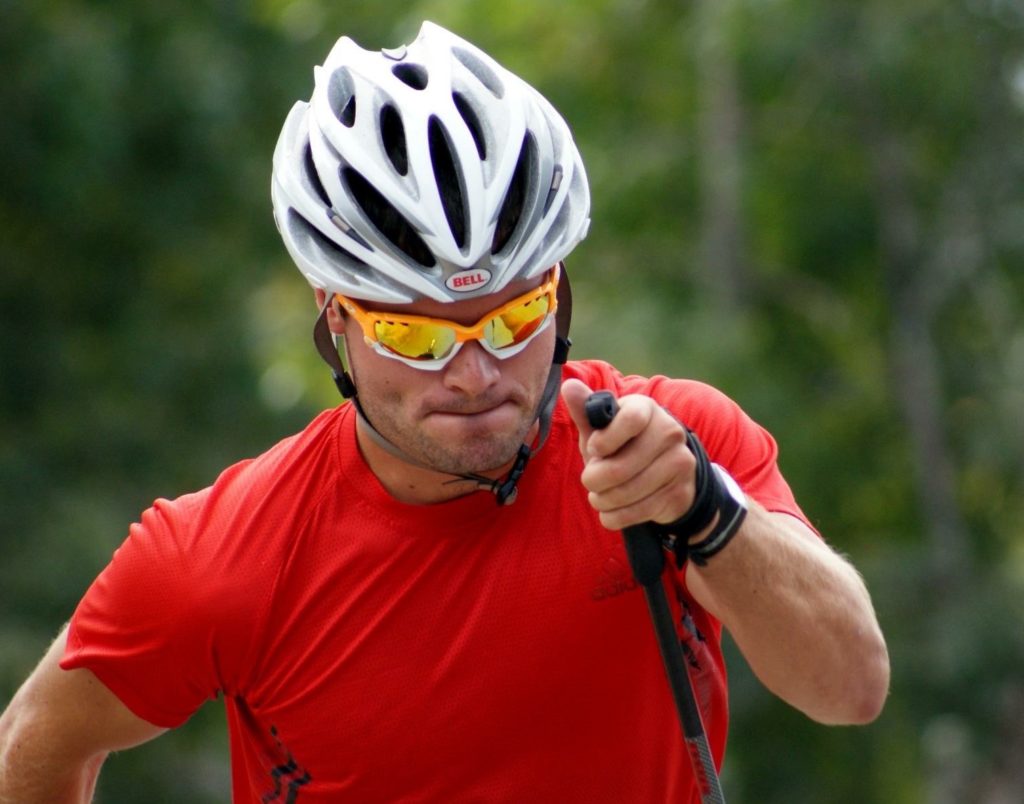
Shane MacDowell
MacDowell went on to hold several coaching positions throughout the United States, including serving as Gold Team Assistant Coach and Head Wax Technician at the Sun Valley Ski Educational Foundation in Idaho. Later, MacDowell returned East to assume the role of Assistant Cross-Country Ski Coach at the Green Mountain Valley School in Waitsfield, Vermont. Most recently, MacDowell has served as the Assistant Cross-Country Ski Coach at Northern Michigan University in Marquette, MI, one of the nation’s premier collegiate Division 1 programs.
MacDowell says, “I am very excited to be joining such a great program as NYSEF. I look forward to building on the strong program that Margaret has cultivated during her tenure with NYSEF. I plan to use everything I’ve learned over the years with different programs to help each athlete achieve their goals and reach their greatest potential.”
NYSEF Executive Director John Norton notes, “We’re pleased that Shane has decided to join our team. He brings a level of professionalism and dedication to athletic excellence through his experience at both the elite and grassroots levels. I’m excited to see what Shane brings to the already thriving program that Margaret has helped build.”
“Shane moves to Lake Placid with ski coaching experience at the college and junior levels” remarked Margaret Maher, who held the position for over 11 years. “I’m excited to see a fellow UNH Wildcat take over the NYSEF program and look forward to watching the athletes grow and excel to the best of their abilities”. Maher has decided to take a full-time job as a registered nurse in orthopedics and sports medicine starting in September. MacDowell will begin work in early August alongside Maher to finish the summer training season.
MacDowell’s brings a strong level of enthusiasm for the outdoors with him to the Adirondacks. When he’s not focused on cross-country skiing, he canoe races throughout the country and has a passion for building canoes. He also enjoys many outdoor activities like mountain biking, hiking and running.
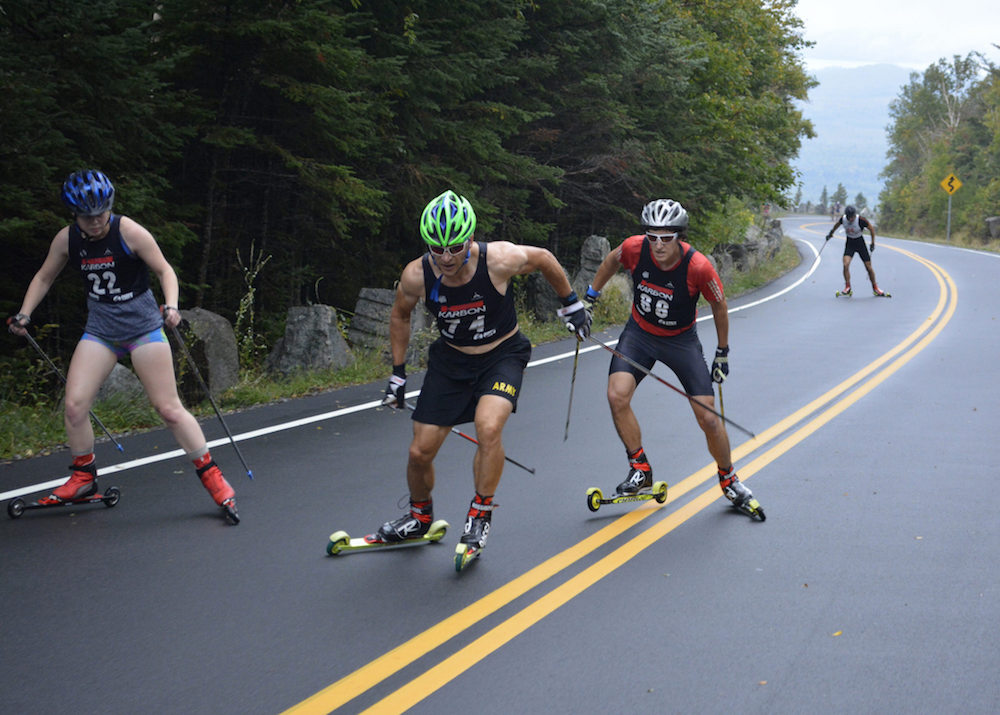
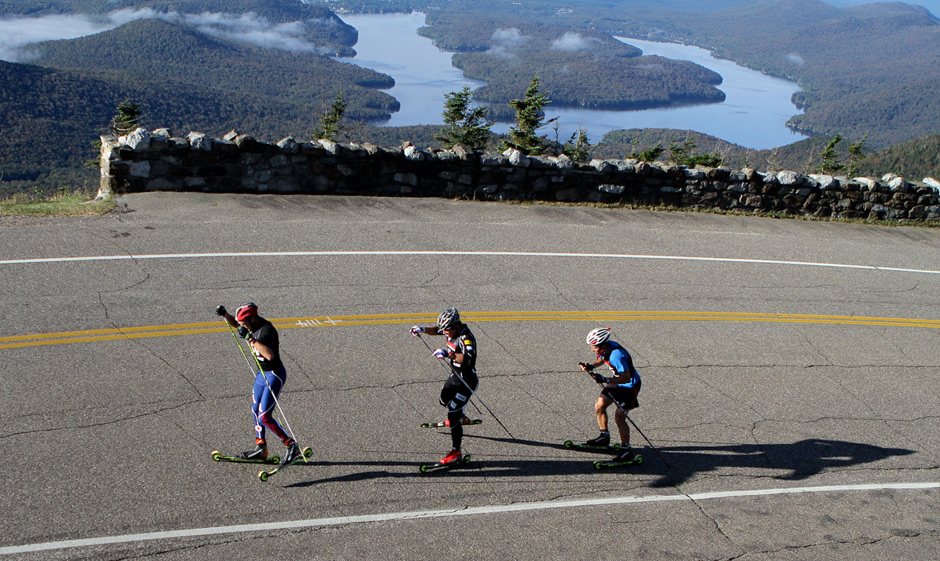
Duncan Douglas (74) leads biathletes Russell Currier (in red) and Paul Schommer (back right) in Sunday’s Climb to the Castle rollerski race up Whiteface Mountain, while Clarkson’s Jenevieve Broadwell (22) looks on. Douglas held off Currier by eight seconds for his third victory in four times racing the Climb and Schommer finished third. (Photo: NYSEF/Flickr)
(Note: This article has been updated to include comments from third-place finisher Paul Schommer and NYSEF’s cross-country head coach Margaret Maher.)
WILMINGTON, N.Y. — Four appearances and three wins is an enviable record. On Sunday, 50-year-old Robert Duncan Douglas, the “Jacked Up Old Man” from Honeoye Falls, N.Y., won his third Climb to the Castle (C2C) rollerski race, a five-mile freestyle hill climb up the Whiteface Memorial Highway.
Douglas previously won the race in 2007 and 2008, with a personal-best time of 34 minutes, 56.6 seconds in 2007 (he was 2 1/2 minutes faster on a shortened course in 2008, when racers were unable to reach the summit because of snow).
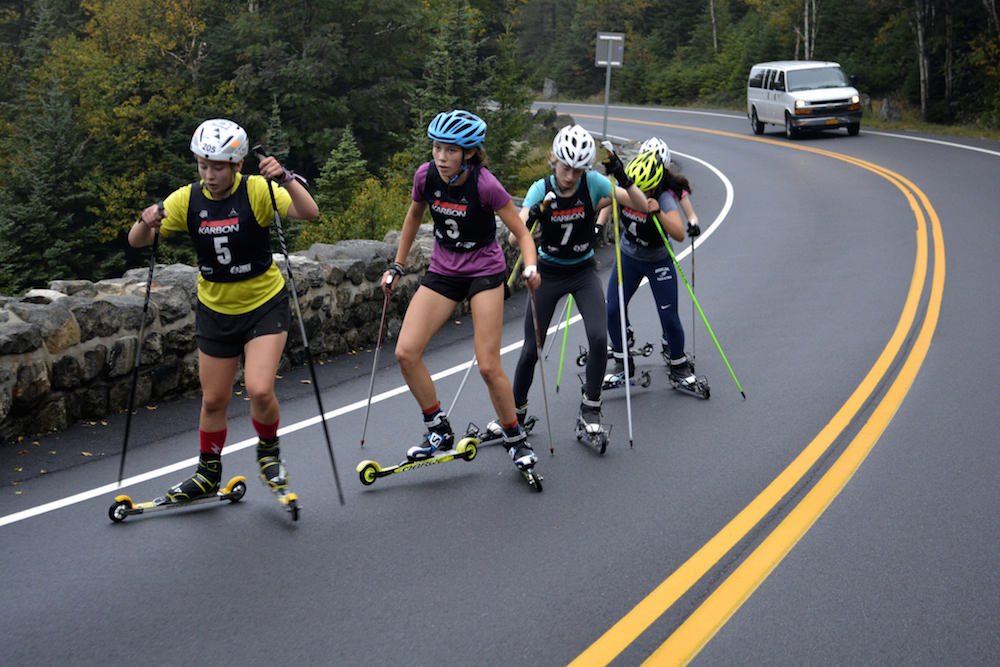
St. Lawrence’s Jackie Garso (5) leads Stratton’s Anna Lehmann (3), and CSU’s Hannah Rieders (7), Gabby Vandendries (4) and Madeline Rieders (in back) during the women’s Climb to the Castle rollerski race up Whiteface Mountain on Sunday in Wilmington, N.Y. (Photo: NYSEF/Flickr)
Hannah Rieders, a 17-year-old Cambridge Sports Union (CSU) skier whose initial goal was an age-group podium, won her first C2C, on the race’s 10th anniversary.
Finishing in 37:15.6 this year, Douglas was 8.3 seconds ahead of runner-up Russell Currier, a biathlete who trains with the Outdoor Sports Institute in Maine. Paul Schommer, a senior member of US Biathlon’s National Development Group, placed third overall, 3:02.6 minutes behind Douglas.
Rieders, a high-school senior from Wellesley, Mass., was the first woman across the line in 55:03.1. She beat Anna Lehmann, a ninth grader representing the Stratton Mountain School (SMS), by 15.7 seconds, and Rieders’s twin, Madeline (also of CSU), finished 1:23.3 minutes back in third.
“I kind of thought maybe Anna would beat me,” Hannah Rieders said in a post-race interview. “At the start, I just wanted to pace it well. I stayed behind other people for the first three miles.”
Overnight rain left the road damp. At the toll-booth start in Wilmington, temperatures hovered around 65 degrees under cloudy skies, with sultry humidity. Low clouds at the start turned dense up high near the summit. Unless you were really close to skiers in front of you, it was hard to gauge how far up the road they were, and how much energy one should expend to attack.
Margaret Maher, head coach of the New York Ski Educational Foundation (NYSEF) cross-country program, explained in an email that she learned in April that the U.S. Ski Team would not be comping to Lake Placid for its usual dryland camp this year. To accommodate the US Biathlon team, she originally scheduled this year’s Climb for next weekend, Sept. 25, but that date conflicted with other races NYSEF’s skiers planned on competing in.
Maher had to move the race up one week in order for her athletes to attend. Regardless, 85 athletes registered this year, which was on par with the “73-108 athletes” that the race has previously attracted.
Of the top-five female finishers on Sunday, four were under the age of 18, and Lehmann is a U16. With Jackie Garso (St. Lawrence University) placing fourth and Gabby Vandendries (CSU) finishing fifth, CSU had three in the top five.
“First time [at C2C] for all three girls,” CSU coach Rob Bradlee wrote in an email. “All three also ran Mt. Washington for the first time in June. Tough kids! I don’t have them do any special prep for this race. Their regular six-days-per-week training clearly is enough to get them ready. All three are very hard workers and have been training hard all summer. I think their results show that.”
Hannah Rieders explained that five women formed the lead pack. Around mile three, the eventual top three broke away. They skied together until mile four, “then I went ahead,” Rieders said.
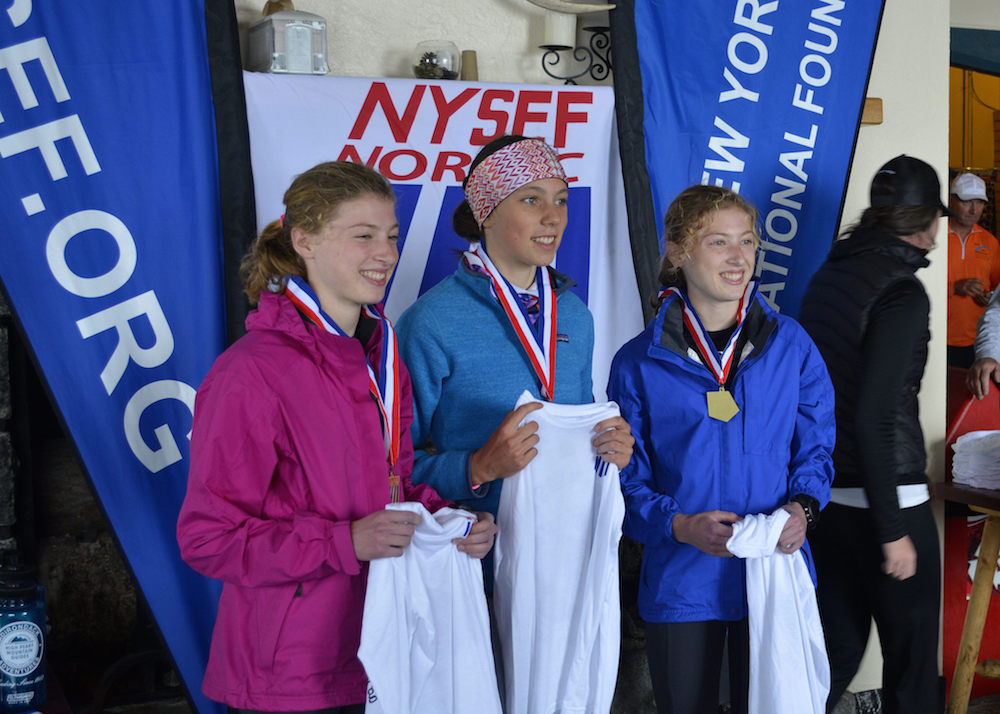
The women’s podium at the 10th Climb to the Castle rollerski race up Whiteface Mountain’s Memorial Highway on Sunday in Wilmington, N.Y. With all of the top five under 18, Hannah Rieders (CSU) placed first, Anna Lehmann (SMS) was second, and Madeleine Rieders (CSU) was third. (Photo: NYSEF/Flickr)
Madeline Rieders said she skied in the pack until mile three, then pulled away with Hannah and Lehmann. While she lost contact with them on the road, which has an average grade of 8 percent, she maintained a steady gap to the finish and held off fourth place by 50 seconds.
For the men, it was down to three from the start, according to Currier.
“Paul, Duncan and I all took turns leading,” he wrote in an email.
“I’m in better shape this year, but not rollerski shape,” Douglas said.
For most of the summer, Douglas focused on bike racing, winning his 50-59 age group and placing 25th overall at the Leadville Trail 100 mountain-bike race. He said he just started rollerskiing two weeks before the Climb.
Douglas, a two-time Olympian who will be 51 in November, had a simple race plan. “Go out, ski hard, have fun,” he reflected.
For most of the race, Douglas skied with Currier. He dropped Currier once, but the 29-year-old former national-team biathlete regained contact. Douglas said that at the Lake Placid corner – a hard left where the grade eases and one can transition to V2 strides – he broke away to the finish.
“Once the flat section towards the end started, I wasn’t able to match Duncan’s speed,” Currier wrote. “He was never very far out but enough to make a difference at that point in the race.”
Of his race, Currier described it as “a solid effort. I really tried to use good technique. For a race that’s nothing but uphill, there’s not much else you can do.”
In an email, Schommer explained this was his first Climb to the Castle.
“I went into it with an open mind, knowing that if I killed myself in the first half the second half would be a death march,” the 24-year-old Wisconsin native wrote. “I would say it went decent for me as I was able to stay pretty strong most of the way, despite losing Russell and Duncan about 1.5 miles into the race.”
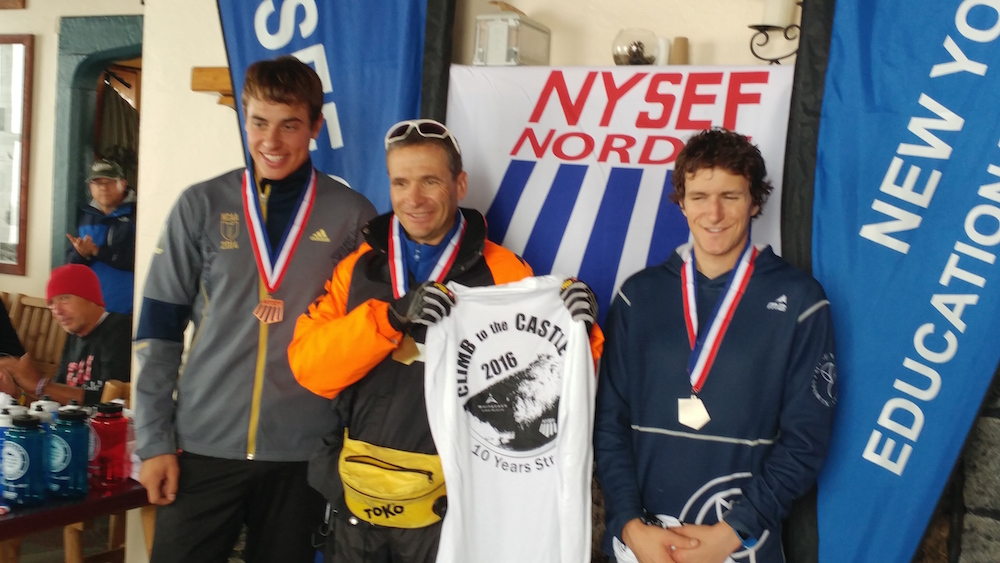
The men’s podium at the 10th Climb to the Castle rollerski race up Whiteface Mountain’s Memorial Highway on Sunday in Wilmington, N.Y. Duncan Douglas (c) won, Russell Currier of the Outdoor Sports Institute (r) placed second and US Biathlon development skier Paul Schommer (l) was third. (Photo: Peter Minde)
Is the Climb to the Castle a data point for winter fitness?
“It’s a good, effective workout, really good training,” Currier explained, adding that he didn’t think it was a good indicator of fitness in December or February.
“I was really happy with how it turned out,” said Adam Glueck, a Ford Sayre U18 skier who finished seventh (+7:52.4) in his first C2C. “I didn’t want to go too hard out of the start. I followed some friends and threw in some double pole to rest my legs.”
Glueck skied in a small group he eventually lost contact with about halfway through.
“I managed to catch them on the V2 straight [the Lake Placid corner]. After that, my friend Henry McGrew [eighth overall] was right behind me,” he said. “I had to push hard through the headwind [the last 500 meters] to beat him. I was basically in agony for the last three or four minutes.”
Agony and clouds: good metaphors for the Climb to the Castle. When athletes returned to the base, the sun was breaking out.
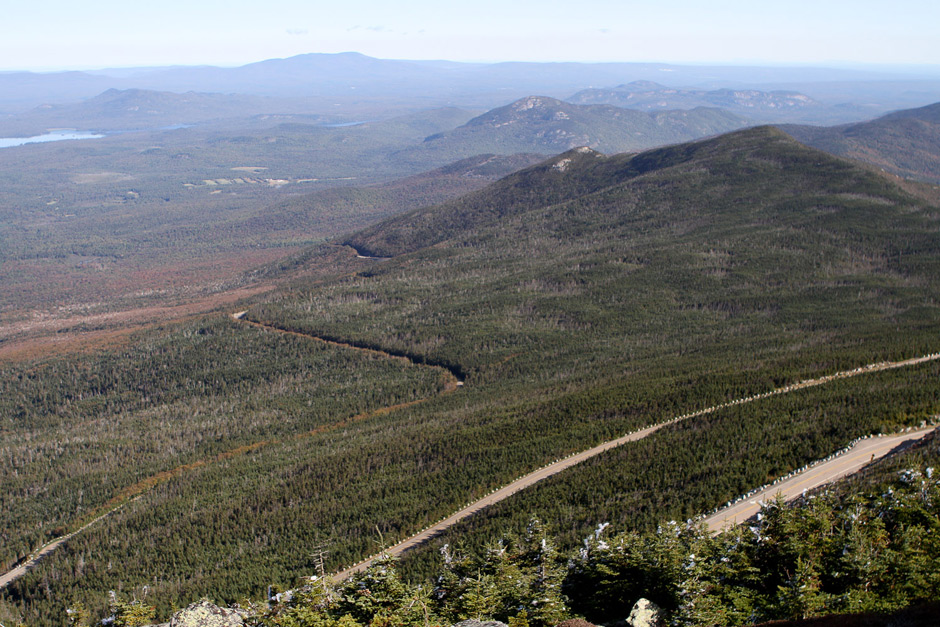
The Whiteface Mountain Veterans Memorial Highway, where NYSEF’s Climb to the Castle has been held for the past seven years in Wilmington, N.Y., as seen in 2011. The toll road is undergoing construction this summer and fall.
There’s a race each year scheduled in line with the end of the U.S. Ski Team’s fall camp in Lake Placid, N.Y. You might have heard of it: the Climb to the Castle. Hosted by the New York Ski Education Foundation (NYSEF), the freestyle rollerski race starts at the entrance to a paved toll road, the Whiteface Mountain Veterans Memorial Highway, and stretches five miles up with an average 8-percent grade. The finish is marked by the castle at the top of New York’s fifth-highest peak at 4,867 feet above sea level.
Try to rollerski up there now, however, and you’ll likely run into some heavy machinery.
Construction has already begun on the eight-mile highway as part of a larger project to completely resurface the road over the next several months. The Adirondack Daily News reported Thursday that the upper, toll portion of the road — where the Climb to the Castle (C2C) takes place — will be closed weekdays during May, June and September, but open on weekends. It will be open on weekends and two holiday Mondays during these months: Memorial Day, May 26, and Labor Day, Sept. 1. Throughout July and August, the road is scheduled to be open during daytime hours, with work taking place at night.
US Biathlon’s Tim Burke (l), and U.S. Ski Team members Kris Freeman (c) and Noah Hoffman (r) lead the 2011 Climb to the Castle race in Wilmington, N.Y.
According to Chris Grover, the U.S. Ski Team will hold its Lake Placid training camp from Aug. 25-Sept. 8. So while there’s a chance construction could impact it, there’s a better chance the toll road will be open on Saturday, Sept. 6, when NYSEF scheduled the race.
Margaret Maher, NYSEF’s head nordic coach and C2C organizer, wrote in an email to FasterSkier last week that they were “trying to figure out how the road work will influence the race. Hoping we can still have C2C!”
In all, the highway is expected to be closed 54 days from this week until the end of the season, and open 88 days over the same period, according to the Enterprise.
While the toll road has been patched periodically since it was opened in the 1930s, it has never been completely resurfaced. Whether rollerskiing, cycling, or running to the summit, it’s riven with frost heaves and cracked pavement. Regardless of what state the road is in this year, its sure to be a superior surface for rollerskiing next summer.
Rifenburg Construction, based out of Albany, N.Y., will resurface the entire eight-mile length of the road, from the four-way intersection in the center of Wilmington to the summit. They’ll also rehabilitate rock walls and make repairs to the castle.
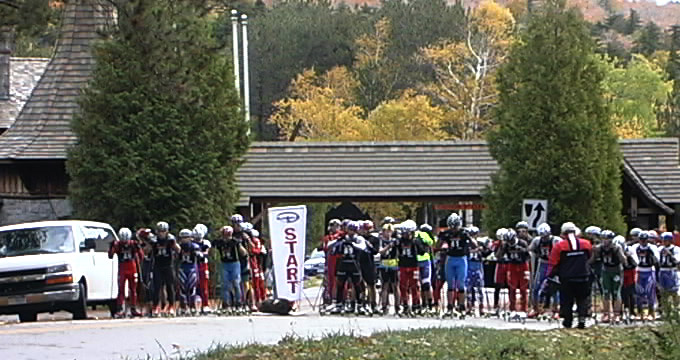
The men’s start of the 2009 Climb to the Castle.
Rifenburg earned the project with a $11.2-million bid, and the company expects to complete the work by the end of 2015.
Project manager Russell Huta said that the goal is to have a base layer of new pavement from the tollgate to the castle by the end of this fall. In 2015, the toll section will be finished, and all work on the section from Wilmington town center to the tollgate will be completed.
“Each project has its own set of unique challenges,” Huta told FasterSkier, when asked about the difficulty of working in the narrow confines of the toll road. When road work is in motion, the toll road will be closed to traffic.
In September, Huta said, his company will have “full access” to the toll road Monday through Friday – except for Labor Day. “By the end of the day Friday, there will be a paved surface for [use by] cars, buses, pedestrian traffic” until Monday morning. “On Monday morning, it’s ours again.”
If for some reason, the C2C isn’t possible this year, Grover wrote in an email that it won’t be the end-all of camp.
“We typically run a sprint or team sprint time trial along with the Climb to the Castle,” he explained. “If the Climb is not ready this season, we will employ other alternatives.”
Before the C2C, a time trial was previously held up Gillespie Drive, now a warmup for athletes. The event is entering its eighth year. USST veteran Liz Stephen won the women’s race the last three years, setting a new course record last year in 42 minutes and 4 seconds. US Biathlon’s Tim Burke won the 2013 men’s race in 37:13.
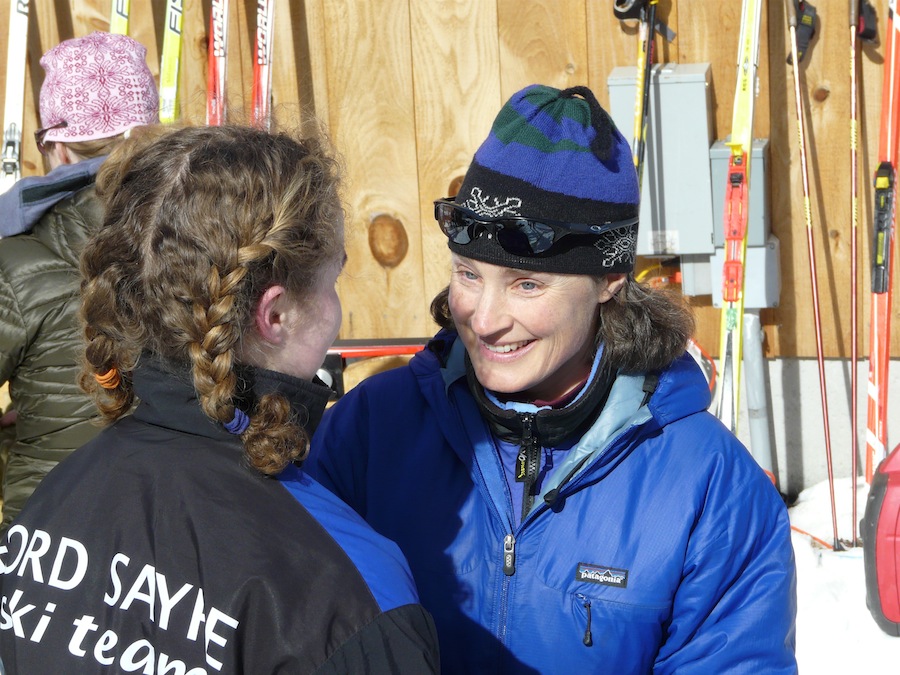
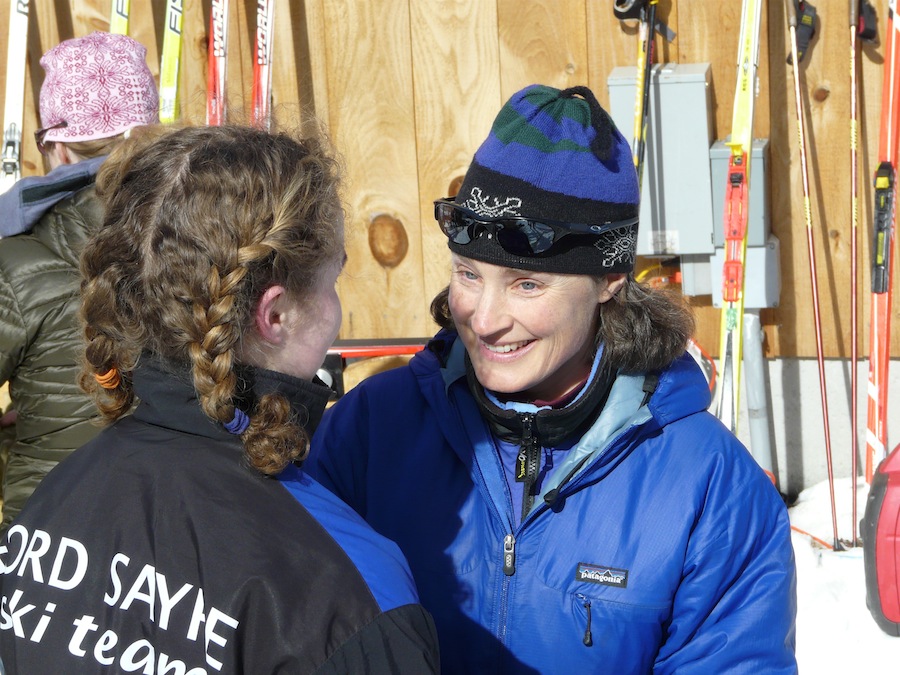
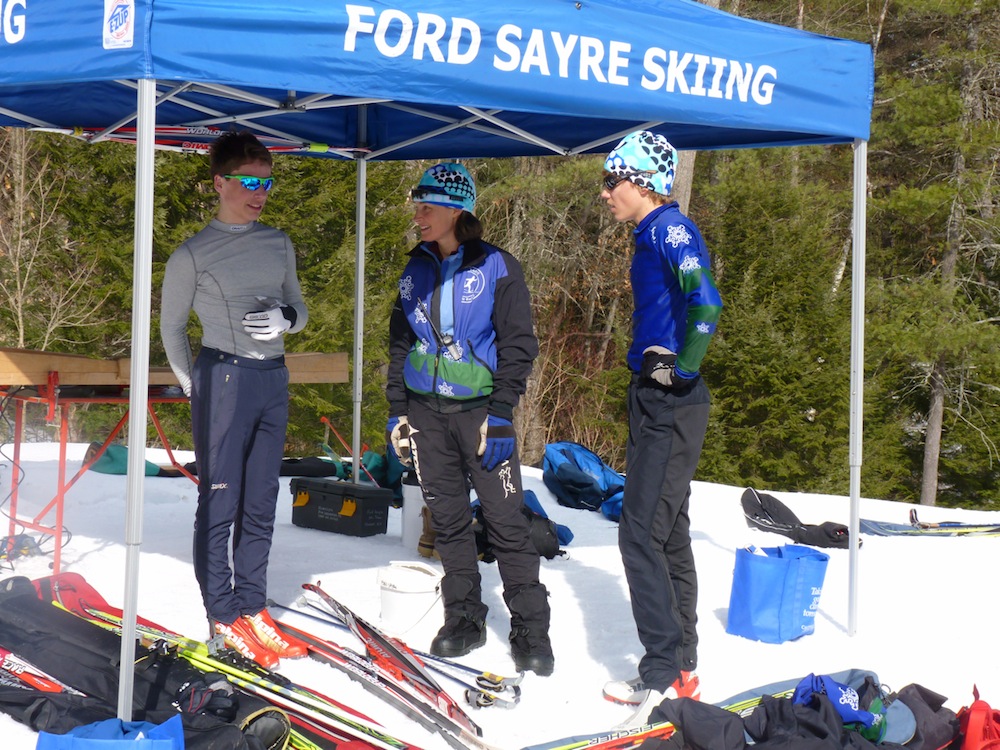
Scottie Eliassen (l), coach of the Ford Sayre Nordic Club in Hanover, N.H., gives a pre-race pep talk to one of her athletes. (Photo: Midge Eliassen)
Editor’s note: This is the third installment in a four-part series on female nordic coaches in the U.S. In Part I, two-time Olympic U.S. skier Nancy Fiddler introduced herself, Part II took a look at several influential female collegiate coaches, and Part III delves into female coaching in the junior pipeline. Part IV will explore women leading grassroots efforts across the country.
***
America! Land of the free, home of many sports! As a parent, I know all about the athletic choices kids have; my daughter cross-country and alpine skied, played soccer, did ballet, Irish danced, and rode horses for many years. Life is crazy busy for most American kids and the parents who shuttle them around.
I am going to go out on a limb here and say that most of the successful cross-country skiers in the U.S. come from a multi-sport background. I went through high school playing varsity field hockey and lacrosse and was a diver on the swim team. I never trained during the summer for any of my sports, working instead at a summer camp teaching swimming and canoeing.
I went to college and played hockey and lacrosse, but graduated with a Bachelor’s degree and a passion for skiing. How did I end up learning to ski and race in college? At the time, there was no pool at Bates, and the nordic team was recruiting, so I gave it a try. Yes, I gained a high degree of athleticism doing other sports, and this helped me in my skiing, but this is not the U.S. Ski and Snowboard Association’s recommended pipeline!
The scenario is different today. Yes, kids are still involved in multiple sports at a young age, but collegiate and elite skiers ultimately picked nordic at some point out of a vast menu of fun athletic endeavors. Focusing on one sport means giving another sport a lesser role or dropping it entirely. These decisions can be agonizing.
Successful nordic skiers typically begin to focus on skiing around age 15 or 16. By then, ski training requires a significant amount of time and energy for teenagers. The sport becomes year-round and is increasingly specific. Many good cross-country skiers also excel at other sports, but end up skiing because it is fun and their friends do it. They choose to do ridiculously hard workouts in all kinds of weather because they love the sport and the culture attached to it.
Part III of this series takes a look at female coaches who work with U18 and U16 athletes, the kids who are in the process of choosing cross-country skiing over other sports. These coaches are involved with juniors at a critical point in their development. Much happens during this time: technique refinement, conditioning, coordination during growth spurts, more frequent racing, equipment acquisition and maintenance, and more. Skiing takes on a new level of commitment for these kids.
It becomes part of a coach’s job to lead kids to skiing and help them love it and choose to pursue it. Ten female club level coaches weighed in via an email survey about their coaching careers. These dedicated women are part of the team who make skiing attractive, fun, and rewarding for junior skiers around the country.
Female Coaches: Roots of Community and Family
Go to the Olympics or to a World Cup race and take a look at the athlete-support system. Every team has a swarm of coaches and service staff to meet the athletes’ every need. With few exceptions, coaching at the international level in cross-country skiing is a male-dominated field.
Are female coaches coaching closer to home by choice?
“I see myself right where I am: working in a community-based program to share the sport and prepare athletes to take it to any level they choose – whether it be local, regional, national, or international,” wrote Scottie Eliasson, who coaches the Ford Sayre Nordic Club in Hanover, N.H.
Community-based programs, whether they are clubs or school teams, are the backbone of nordic skiing in the US. Eliasson has committed 21 years to coaching at Ford Sayre, a program with more than 100 athletes and 30 coaches.
Club programs are attractive to female coaches on many levels. For starters, it’s a foot in the door of coaching. Ashley McQueen, who skied as a junior in the Sun Valley Ski Education Foundation, explained that her coaches and nordic skiing in general “had a huge impact on how I grew up. I really wanted to have an influence like that. Rick [Kapala] offered me a coaching job as a way for me to get in my training and to make some money over the summers, and I really enjoyed it. When he called to offer me a position on the staff, I jumped at the opportunity.”
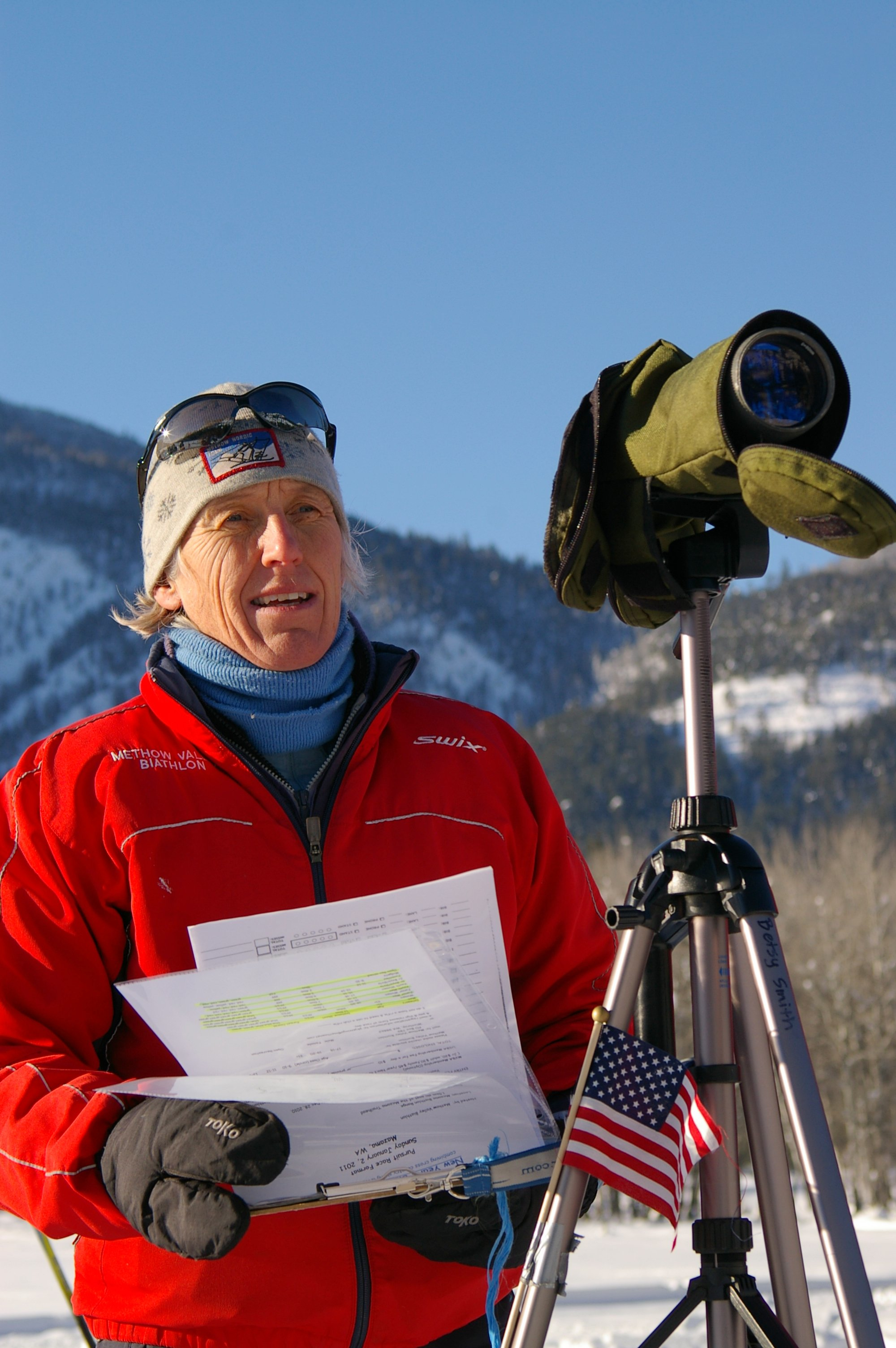
Methow Valley biathlon coach Betsy Devin Smith giving some guidance at practice. (Photo: Kristen Smith/Methow Valley Photography)
Lots of coaches who double as moms don’t want to travel outside the U.S. while their kids are young.
The Methow Valley Nordic Team in Winthrop, Wash., has a stronghold of female coaches. Leslie Hall, Laura McCabe and Betsy Smith have been holding down the fort in the Methow Valley for nearly two decades. All three women are moms with children who are or have been involved in the program. Being able to coach in the program her own two kids are in is important to Hall, who sees her job as Mom as top priority.
A three-time Olympian who competed in as many Junior World Championships and five World Championships, Hall explained she never had any goals to coach at the international level.
“I will coach locally on some level until my kids are out of high school, so probably another 7 years or so,” she wrote of her coaching plan. “I hope to coach at Junior Nationals and to do my best to inspire lots of kids to commit to skiing.”
Susan “Poppet” Boswell has been coaching skiing for 19 years and found her dream job at Stratton Mountain School [SMS] in Vermont. After two years of working with the U16 skiers, she now holds a position as a Winter Term Coach working with U14 athletes. She likes this arrangement, as it allows her more time at home with her family. Boswell’s 14-year-old son will start his first year at SMS this fall.
Many female coaches have careers outside of skiing. Club programs offer flexibility and the opportunity to work with kids in the outdoors, which appeals to some women who work “regular jobs.”
Smith juggles a career as a veterinarian and sheep rancher with her biathlon coaching. Eliasson works full time at the medical school at Dartmouth.
Margaret Maher, who heads the New York Ski Educational Foundation nordic program in Lake Placid, N.Y., works per-diem at Adirondack Medical Center as an exercise specialist and is also in nursing school. Alison Deines-Sehnert, who recently stepped down from her position as nordic director of the Jackson Hole Ski Club, worked as a bookkeeper, a caretaker, and office coordinator for a heli-ski operation. Boswell owns a company that does computer mapping.
U.S. Ski and Snowboard Association [USSA] Nordic Program Director Joey Caterinichio has come through the entire system of nordic skiing in the US. As an athlete, she made five trips to Junior Nationals and races at three NCAA Championships. She started coaching high-school skiers and went on to form Alaska Nordic Racing in Anchorage with her husband. She coached there and through 17 Junior Nationals until moving to her present position with USSA last year. Caterinichio has three children under 10, and all the years she was coaching, she also worked in medical sales.
Although female coaches may not be front and center on the international stage, they are in the wings, behind the curtains and working for the team in school and club programs around the country.
Eliasson sees it like this: “I feel that I am directly making a difference locally and regionally. Indirectly, I see our club as an integral part of the strengthening club network that is helping make a difference nationally and in the US’s international results.”
Boswell feels she is part of the big picture of skiing in the U.S. “I’m a small person, and I work with small kids, but I have a high level of experience and education that I bring to my skiers, who in turn bring it to the table and raise the bar for everyone,” she wrote.
Club Programs: The Infrastructure of U.S. Skiing and a Good Place to Grow Up
“Sports keep kids out of trouble, pushes them to be disciplined and healthy while tackling dreams that they only have a short time to achieve. Everybody should do sports. I don’t care which one. Skiing of course is my favorite but kids need to be involved and active.” — Caterinichio
Before taking on the position of USSA nordic program manager, Joey Caterinichio (l) poses for a photo with U.S. Ski Team veteran Kikkan Randall at the 2010 Olympics in Vancouver, B.C. (Photo: USSA)
Nordic clubs are growing around the country and are staffed by legions of full and part-time male and female coaches. Most clubs offer ski programs for juniors from 7 years and up and often engage entire families.
Coaches who work with the U16 and U18 age groups are spending quality time with athletes in the process of growing up. Coaches become role models and mentors for the teenagers they work with and thus, very important figures in their lives. Strong relationships are created on the ski trails and in the wax rooms.
“I love the relationships with the athletes,” McQueen wrote. “I get to work with such great individuals and watch them grow from little 13/14 year old kids into strong and confident adults.”
Deines-Sehnert enjoys working with kids and helping them achieve “not results, but their inner goals,” she wrote. “Watching kids stand up straighter because they are proud of their accomplishments – that’s what I love.”
The role of a club coach is a fine balance of taskmaster and nurturer. Cross-country ski racing is one of the toughest sports out there. How do coaches keep kids from quitting when the pain is too much to bear, the results too disappointing, or their will to do the same drill one more time is gone?
After five years on the SVSEF Gold Team, Nicole De Yong has been coaching Sun Valley juniors for a year. She has quickly figured out that having a good rapport with the athletes is essential to gaining their trust. “Playing, joking, having fun from a friendship standpoint is as important as having the ability to get down to business when necessary,” she said.
Ski racing boils down to complete commitment and the ability to take risks. None of this is possible without trust; trust in your preparation, trust in your equipment, and trust in the coaches who lead you. Skiing at the highest level requires these elements and belief in oneself and their coaching system. Fostering this confidence is part of a coach’s job and far exceeds the teaching of technique and the waxing of skis.
Skiers entering the U20 bracket are often leaving home for the first time to either go to college or to pursue their skiing goals in a new setting. This is the time when nordic athletes make the decision to continue in the sport or to follow a new life path. The time spent training and racing during their high school years has prepared them for anything.
According to Eliasson, the foundation of success in sports or anything in life boil down to “resilience, adaptability, independence, responsibility, and the capacity to prioritize competing demands,” she wrote. “Many of our athletes continue on to college ski teams, and feedback from the athletes and from their college coaches indicates that they are well-prepared for the demands placed on student-athletes. We hear from parents and athletes many years later that experiences in Ford Sayre have a lasting positive impact.”
Sharing the Dream
“My job is a lot more than just coaching, as I deal with all the bureaucratic stuff and organizing everything. My favorite part is the one on one interaction with the skiers and helping them to find the excitement and passion of committing to a great sport.” — Leslie Hall, Methow Valley nordic program director
The qualifications required to coach skiing might include the USSA Level 100 certification, waxing knowledge, basic physiology, and an understanding of skate and classic techniques. These identifiable skills are important, but the essential qualification is not easily measured and not always readily apparent. Every good ski coach has it. Passion does not come from a clinic or a book on ski training.
Many nordic coaches are deeply connected to the sport by means of personal experience. That does not mean that anyone who has ski raced is automatically a great coach; technical and waxing expertise can be acquired through education and practice, but the ability to channel passion and to communicate it to others is a gift.
Head of the NYSEF nordic program, Margaret Maher on course at the 2012 Junior Nationals at Soldier Hollow in Midway, Utah. (Courtesy photo)
Everyone gets involved with ski coaching in different ways. Maher grew up cross-country skiing and coaching is her way of sharing her love of the sport.
“Since high school, I knew at some point I would want to coach,” she wrote. “My dad, mom, and grandmother were all PE/health teachers: I guess athletic teaching is in my blood. I certainly wasn’t ready to leave the sport after college … but I was not ready to be a full-time ski racer. Coaching was the next natural step.”
An eight-time Vermont state champion and two-time Junior Nationals winner, Maher turned her experiences she as a junior and in college (she made two USSA J1 Scando Cup Teams and raced four years in college) into a successful coaching career.
Maher started skiing with the Mountain Top Bill Koch Club in Chittenden, Vt.,, which she called “family oriented.” She feels fortunate to have been coached by Mike Gallagher at Rutland High School and also credited her college coach at the University of New Hampshire, Cory Schwartz.
An assistant coach at Sun Valley, McQueen uses her personal experience to reach out to juniors in the program she grew up with. “I was shy as a kid, and I think that going through the process of overcoming my shyness and insecurities helps me se how fear and insecurity affects some of the athletes I work with,” she wrote.
Another accomplished junior and world-class nordic athlete, Hall also cites her mentors as contributing to her passion for skiing and coaching. “I have been influenced my whole life by so many great coaches,” she explained. “Of course, Torbjorn Karlsen probably had the biggest role, and also Martha Rockwell. Laura McCabe encouraged me to be involved and I have drawn from [sister] Cami’s experiences at Dartmouth.”
Some coaches have stumbled into their passion for coaching. Such is the case with Caterinichio, who was returning from college and skiing on her own when she got “the call.” She volunteered at Chugiak High School, where her younger brother Gus and sister Nina were on the team.
“When all the coaches quit the program I was left with a team of 50 athletes. I took over the team and never stopped coaching,” she explained. Caterinichio ran with her opportunity, literally all the way to the USSA Nordic Program Director job. On the way, she doubled the size of the high school program, which eventually became Alaska Nordic Racing.
Not all respected coaches come straight out of long ski careers beginning with the Bill Koch league or have ever raced on the World Cup circuit. A diverse background can lend itself well to coaching – case in point, Janice Sibilia, competitive programs director for New England Nordic Ski Association. Sibilia has a competitive background in several sports. She was an equestrian and national-level cyclist and didn’t get into skiing until she began cross training for cycling.
An injury brought Sibilia to ski coaching. “During my downtime from racing a local high school asked me to help out,” she explained. “It was a big group of over 50 high school skiers and a lot of fun. I learned a lot (being an athlete is very different than coaching!) and was grateful for the opportunity. It really sparked my interest in coaching and since then I have worked really hard to improve my coaching skills and knowledge.”
Sibilia became a student of nordic skiing by going to every clinic she could find. She shadowed other coaches at camps and training sessions and cites the USSA L100 certification as an important building block in her education. Besides drawing on her background as a cyclist, Sibilia has learned invaluable lessons about communication from a favorite equestrian clinician. She says, “I think you can learn things in places you least expect it.”
Ford Sayre coach Scottie Eliassen debriefing with her athletes post-race. (Photo: Midge Eliassen)
Eliasson got started in her coaching career by volunteering to help with the local Bill Koch League (BKL) program “to share the sport with others.” Eliasson was a BKL participant herself, and continued racing through college. Like Sibilia, Eliasson has drawn from other sports, such as rowing, to develop her coaching style.
“My experiences coxing girls in high school and men in college helped shape who I am as a coach today,” Eliasson wrote. “My high school crew coaches remain some of my most important coaching mentors.”
The biathlon head coach at Methow Valley, Smith started as an alpine skier and racer, then jumped into nordic coaching.
“When our son was 9 years old we wanted to keep him [cross-country] skiing so we started a biathlon program to complement our local nordic team and I have been coaching that now for 11 years,” she explained. “I hope to be a great junior coach. I hope to develop a biathlon program here that is a model for other Nordic programs in the US on how to incorporate biathlon into their xc teams.”
It’s All About Balance
“I wish there was at least one female coach on the US [Ski] Team because I think it would actually help all the coaches. Women bring a whole different set of strengths and perspectives to the table and I think that would help both the coaches and the athletes. I guess I’d say women are not on par (with men), but I think they are getting there. It will take time.” — Boswell
Stratton Mountain School coach Poppet Boswell with her son Russell, who won 2012 Silver Fox Trot in Hanover, N.H., at age 12. (Courtesy photo)
Co-ed coaching can be especially challenging, as boys and girls bring different personalities, quirks, and styles to any ski program. Each gender has its own special needs and methods during a group workout, before a race, and just messing around after practice. Coaches see this and work to take care of everyone and to create team balance.
In coaching, men and women generate different kinds of energy as well. “Gosh, the two male coaches I work with would be bored out of their skulls if it was just the two of them working together as guys,” Boswell wrote. “Life is so much more fun with a mix of sexes bringing different ideas and styles to the table.”
She pointed out that balance on the coaching staff is necessary to effectively deal with both genders. For example, a female coach can be helpful when a specific “girly” question or situation comes up. Often, girls feel more comfortable confiding in a female mentor.
There are times when male coaches can’t do what females can. For instance, a 200-pound male coach may not be the best kick-wax tester for a 100-pound female athlete. According to Hall, “it is important to have strong female role models for those young ladies out there. Also for wax testing, we often find that we can pick a kick wax more accurately for the girls than the male coaches can.”
“It’s important for all athletes (girls and boys) to see men and women in all manner of coaching roles, and to have same- and opposite-sex role models,” wrote Eliasson.
Times are changing!
All the female coaches who participated in this discussion are in agreement that women are slowly making headway into the world of ski coaching.
“In my first decade of coaching, there were certainly times/places in which I felt less valued/respected than the male coaches with similar experience – and there were JN trips on which I was the only female coach,” Eliasson wrote. “In my second decade of coaching, as more and more women have entered the regional and national coaching ranks, I haven’t felt discrimination from other coaches.”
While women are not dropping their jobs as mothers or professionals in other fields to coach on the World Cup circuit, they are very present at the club level. They’re in the trenches, working with the adolescent skiers who might become the next generation of Olympic champions. They are working with the athletes who could become the next generation of coaches.
Deines-Sehnert is a great example of female coaches making a difference. Male and female coaches are singing the same song, it just sounds better with the different voices and reaches more ears.
“I am a cog in the wheel,” she wrote. “I think the most important thing that each of us can do is make our programs the best that they can, raising the bar locally will only help us grow nationally.”
As Caterinichio sums it up, “It is extremely important to have female coaches. I look around and am excited to see more and more female faces.”
“I am not sure we will ever have the same numbers as men,” she added. “It is hard to juggle career, motherhood, and coaching, but it is important that we try. (We must support) women in coaching roles, officiating roles, leadership roles.”
Lake Placid, NY ─ The New York Ski Educational Foundation (NYSEF), the Olympic Regional Development Authority (ORDA) and the village of Lake Placid are excited to host high-level US Ski Association SuperTour cross-country ski races January 14-15, 2011.
The event is the next stop on the USSA SuperTour circuit following the 2011 US National Championships in Rumford, Maine. The races will be held in unison with the St. Lawrence University Winter Carnival and the annual NYSEF Harry Eldridge races. It is anticipated that over 400 competitors will participate including members of the US Ski Team, Eastern Division 1 College Teams and a strong junior field. The junior races will count as a Junior Olympic Qualifier for the Mid-Atlantic Division and an out-of-region qualifier for the New England Division.
The Olympic Sports Complex at Mt. Van Hoevenberg will provide athletes with challenging terrain on the “Ladies 5km” course and the Biathlon side venue, and will feature both classic and freestyle competitions.
Excellent sponsorship opportunities are available for interested companies and individuals. If interested, please contact the NYSEF Main Office for further information at (518) 946-7001 or contact Kelly Kennedy at kellyk@nysef.org.
We invite and encourage interested athletes, coaches, parents and spectators to join us in the Olympic Village of Lake Placid for an exciting weekend of racing.
Contact Margaret Maher, NYSEF XC Head Coach & Chief of Competition with event questions at margm@nysef.org or (518) 523-1900.
The NYSEF program coaches over 350 athletes in Alpine skiing, Freestyle skiing, Snowboarding and the Nordic disciplines. The athletes range in age from children to young adults. Currently, there are athletes from the NYSEF program on the U.S. Ski Team for alpine skiing and Nordic combined, and the US Biathlon Team.
St. Lawrence University Carnival
Harry Eldridge Memorial Races
January 14-15, 2011
Lake Placid, NY
NEW YORK SKI EDUCATIONAL FOUNDATION
Dear XC Ski Enthusiasts,
The New York Ski Educational Foundation (NYSEF) is proud to announce that the US Ski Association (USSA) has awarded NYSEF an opportunity to host a USSA SuperTour XC Ski event. NYSEF has accepted this opportunity in an effort to display its desire to host events of this magnitude on a local level and exhibit a strong level of commitment to the XC ski community on a nationwide basis. The NYS Olympic Regional Development Authority (ORDA) has also voiced its’ full support of this event and will be providing the venue, necessary equipment and manpower to assure first class conditions and competitions at the Olympic Sports Complex at Mt. Van Hoevenberg.
The event is the next stop on the USSA SuperTour Circuit following the 2011 US National Championships in Rumford ME, and will be held in unison with the St. Lawrence Winter Carnival and the annual NYSEF Harry Eldridge Memorial races on January 14-15, 2011. It is anticipated that over 400 competitors may participate including members of the US Ski Team, Eastern Division 1 College Teams and a strong junior field.
NYSEF and ORDA are very excited about the opportunity to host this event, which comes with up to $7,800 in prize money for top competitors.
Excellent sponsorship opportunities are available for interested companies and individuals. If interested, you may call the NYSEF Main Office for further information at (518) 946-7001.
We invite and encourage interested athletes, coaches, parents and spectators to join us in the Olympic Village of Lake Placid for an exciting weekend of racing.
Yours truly,
Jay Rand
Executive Director
NYSEF
St. Lawrence University Carnival
Harry Eldridge Memorial Races
January 14-15, 2011
Lake Placid, NY
12:00 – 5 pm Official Training / XC course inspection (Mt. Van Hoevenberg)
7:00 pm Nordic Coaches / Team Captains Meeting (Crowne Plaza, Lake Placid)
CROSS-COUNTRY STADIUM AT MT. VAN HOEVENBERG, “LADIES 5KM” COURSE LAP
8:30 am – 12 noon Bib pick-up at XC Lodge
10:00 am Men 10km (interval start, 2 laps)
11:30 am Women & J2 Girls 5km (interval start, 1 lap)
1:00 pm J2 Boys 5km (interval start, 1 lap)
Award Ceremony times will be posted on the Event Website and at the venue
BIATHLON STADIUM AT MT. VAN HOEVENBERG
8:00 am – 1 pm Bib pick-up at Biathlon Lodge
9:30 am Women 10km (interval start, 2 laps)
11:30 am Men 15km (interval start, 3 laps)
1:30 pm J2 Boys 5km (interval start, 1 lap)
2:00 pm J2 Girls 5km (interval start, 1 lap)
Award Ceremony times will be posted on the Event Website and at the venue
EVENT SCHEDULE
THURSDAY, JANUARY 13
FRIDAY, JANUARY 14
SATURDAY, JANUARY 15
NEW YORK SKI EDUCATIONAL FOUNDATION
click — Olympic Sports Complex
ORDA Mt. Van Hoevenberg Venue
The race venue of Mt. Van Hoevenberg at the Olympic Sports Complex is located on Bobsled Run Lane, off of Route 73, 7 miles south of the village of Lake Placid. http://www.whiteface.com/facilities/osc_hoven.php
Margaret Maher, NYSEF XC Head Coach
Chief of Competition
margm@nysef.org
(518) 523-1900
There are many lodging and dining options in the Tri-Lakes region of the Adirondacks:
Lake Placid Visitors Bureau
http://www.lakeplacid.com
Whiteface Mountain Regional Visitors Bureau (Wilmington)
http://www.whitefaceregion.com
Saranac Lake Chamber of Commerce
http://www.saranaclake.com/
Keene & Keene Valley Region
http://www.keene-keenevalley.com/
Event photographer Pat Hendrick will be on course to capture the racers in action.
Event photos will be available for purchase at: http://www.pathendrickphotography.com/
EISA carnival team registration will take place through BART & SLU per EISA policies and procedures.
All Open EISA racers and all other athletes must register through NYSEF online at AlpineReg.com.
Race registration closes Wednesday, January 12 at 12 noon. Race entry fees are $35 for one race, $60 for two races. THERE IS NO DAY OF RACE REGISTRATION.
Athletes must include their USSA, FIS, NYSSRA/NENSA numbers in order to be scored. Please spell your name in registration as it is listed with USSA and FIS. Verify your membership numbers and make sure they are entered correctly. Race scoring is dependent upon this information being correct. Bib pick-up will be available for teams at the Team Captains meeting or on race morning at the XC lodge on Friday and at the Biathlon lodge on Saturday.
Please email Elizabeth Bouchard-Hall (Race Secretary) at lizbh@nysef.org with registration questions.
Award ceremonies will be provided for each day’s competitions.
Prize money payments are only made to competitors with an active FIS code who are on the current FIS points list. Athletes must be present at awards ceremonies to receive payment. Award ceremony times will be posted on the Event Website and at the venue.
Medals will be provided for the Top 3 in the following age groups: J3/J2, J1, OJ, U23, SR, overall Masters.
The annual NYSEF Harry Eldridge Memorial Cup will be presented on Saturday to the fastest junior male
& female combined time from the two races in the J1/OJ category.
There is a snack bar available for food & beverage purchase at the XC lodge. There will be first aid, ski patrol and medical coverage at the venue on race day. Restrooms are available in the XC and Biathlon lodges.
Friday’s classic event will take place on the XC side at Mt. Van Hoevenberg. Team tents may be set up in the XC stadium on a first come basis. Power is limited in the XC stadium. Saturday’s freestyle event will take place on the Biathlon side at Mt. Van Hoevenberg.
Wax rooms in the Biathlon Lodge will be assigned as follows: 1 to the USST team, 1 for each EISA college, 1 for each EISA guest team and remaining rooms will be available on a first come basis for $50 for Thursday – Saturday. Teams must pre-register & pay for wax room use through NYSEF by contacting Margaret Maher at margm@nysef.org . Teams must provide their own locks for individual wax rooms. Please clean up your wax room after use.
Warm-up times and wax test area will be posted to the Event Website and announced at the Team Captains meeting. Reminder to all athletes & coaches – all skiing must follow the direction of the race course.
Parking for Friday’s race is available in Parking Lot #1 (main parking lot for the XC lodge) or at the Biathlon Lodge (approximately 1km ski to the XC stadium). There is no parking allowed in the lot immediately near the XC lodge. Parking for Saturday’s race is available at the Biathlon Lodge with a team pass provided for USST and EISA colleges. Remaining parking will be available on a first come basis. Additional parking will be on one side of Bobsled Run Lane and then in Parking Lot #1. Please reference the venue map for additional details.
RACE REGISTRATION
WAXING FACILITIES & VENUE USE
PARKING
AWARDS & PRIZE MONEY
ATHLETE SUPPORT AT VENUE