From the FasterSkier archive — posts syndicated from athletes’ and coaches’ own blogs between 2004 and 2012, kept online as published. Current coverage is at fasterskier.com.
After an unusual and unprecedented season, many athletes have announced their retirement as they move on from professional ski racing. Aside from the three notable retirements from the U.S. Ski Team, Sadie Maubet-Bjornsen, Sophie Caldwell-Hamilton, and Simi Hamilton, twelve international athletes have said goodbye to World Cup competitions.
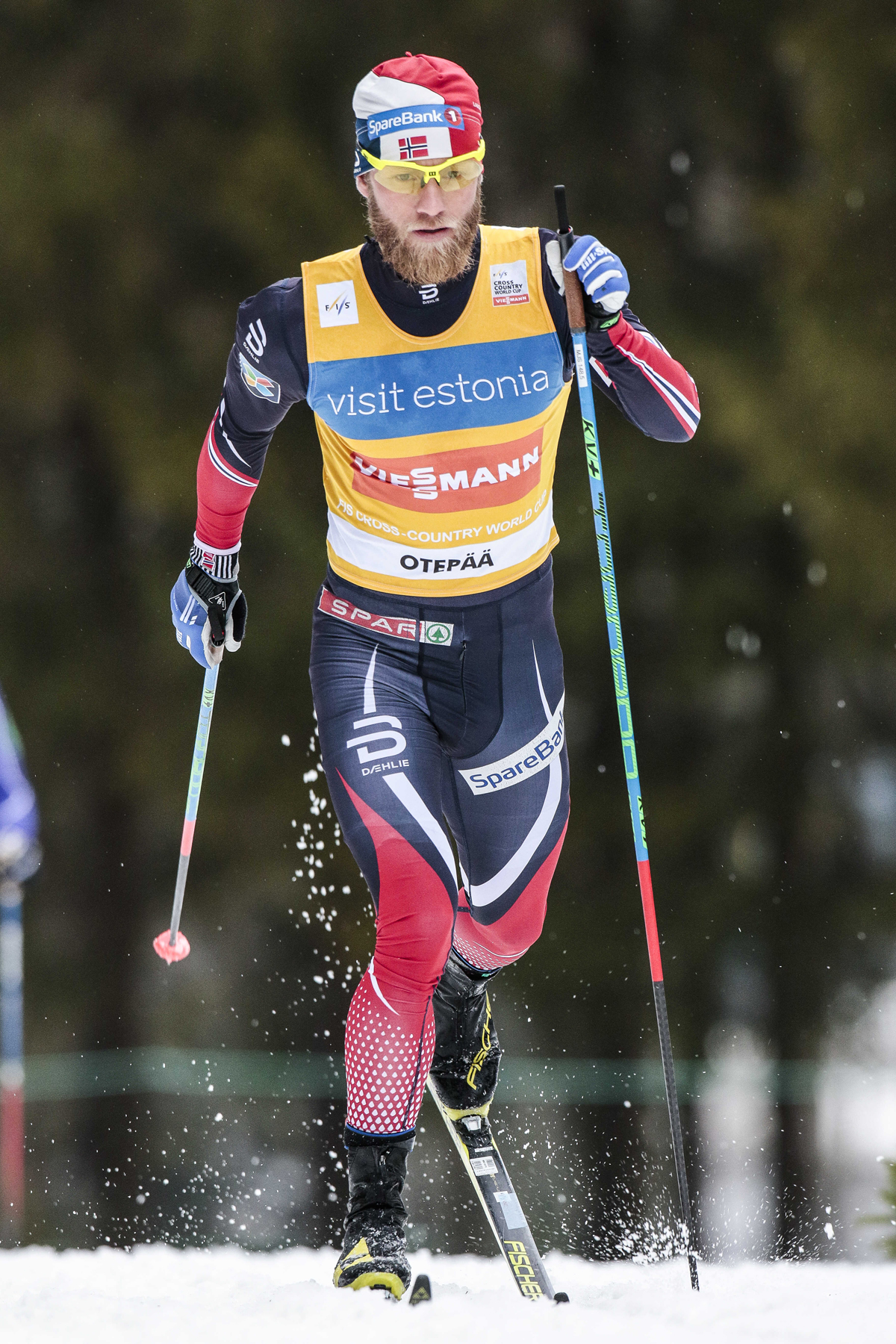
Norway’s Martin Johnsrud Sundby racing to 2017 victory in the men’s 15 k classic at the pre-World Championships World Cup in Otepää, Estonia. (Photo: NordicFocus)
Perhaps the biggest name among them is Martin Johnsrud Sundby of Norway, who after a somewhat inauspicious start to his World Cup career in 2005 when he DNF’d at the Oslo 50 k, went on to become a staple of men’s cross-country skiing. Sundby leaves the stage with five Olympic medals, including two gold medals (both from team events), four Championship medals, and thirty World Cup victories to his name. Results aside, Sundby was an important presence on the Norwegian men’s team for many years, taking on the responsibility of team captain.
Sundby was sanctioned in 2016 for an anti-doping violation when he exceeding the allowable amount of salbutamol – an asthma medication – in his system.
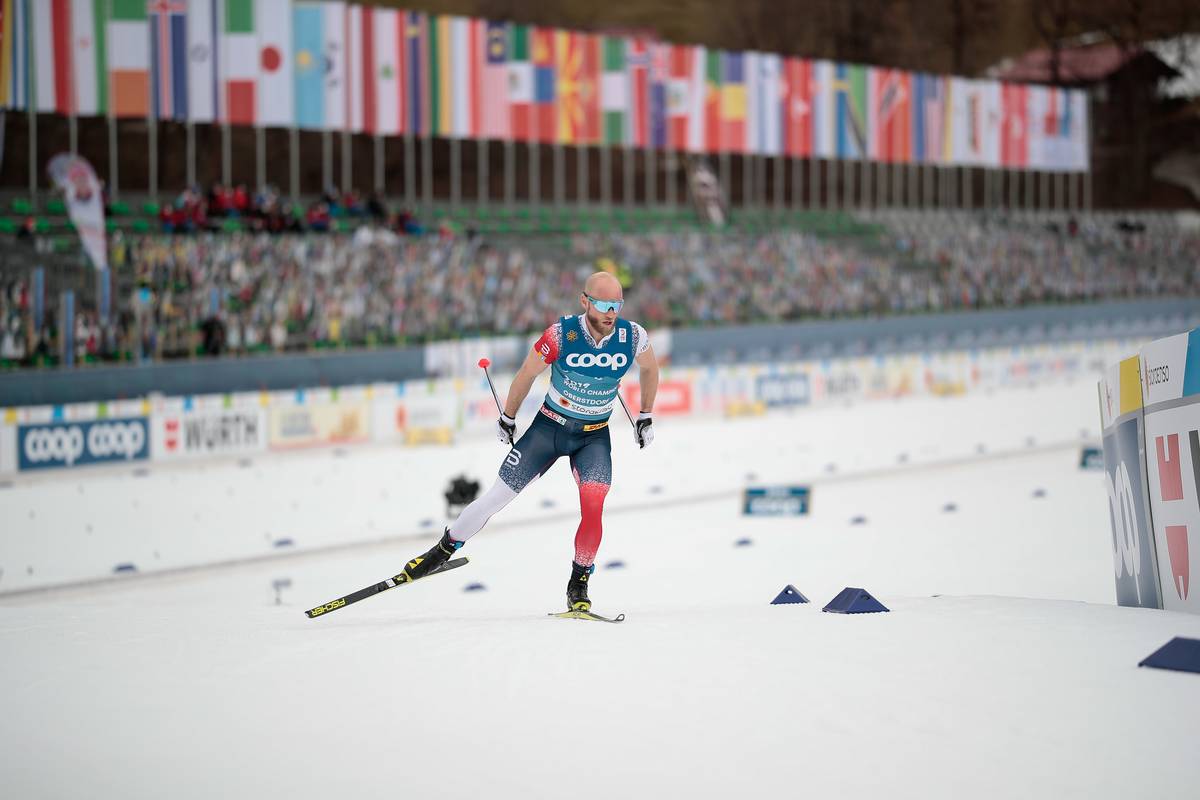
Putting his veteran strength on display, Martin Johnsrud Sundby skis to 7th in his first international competition of the [2020/21] season. (Photo: NordicFocus)In a goodbye letter by Norges Skiforbund President, Erik Røste, Røste writes, “Martin never gave up [in spite of challenges]. And that’s what really characterizes Martin. Because in addition to a fantastic talent, Martin is a struggler. One who has put in more effort and training than most to achieve his dream of becoming the best in the world… Thank you for all the contributions both on and off the trail.” (Translated from Norwegian).
Also retiring from team Norway is Mari Eide, who is expecting a child. Eide made her World Cup debut in 2010 and contested 70 World Cup starts since that time. At the 2019 Seefeld World Championships, Eide earned a bronze medal, finishing third in the skate sprint.
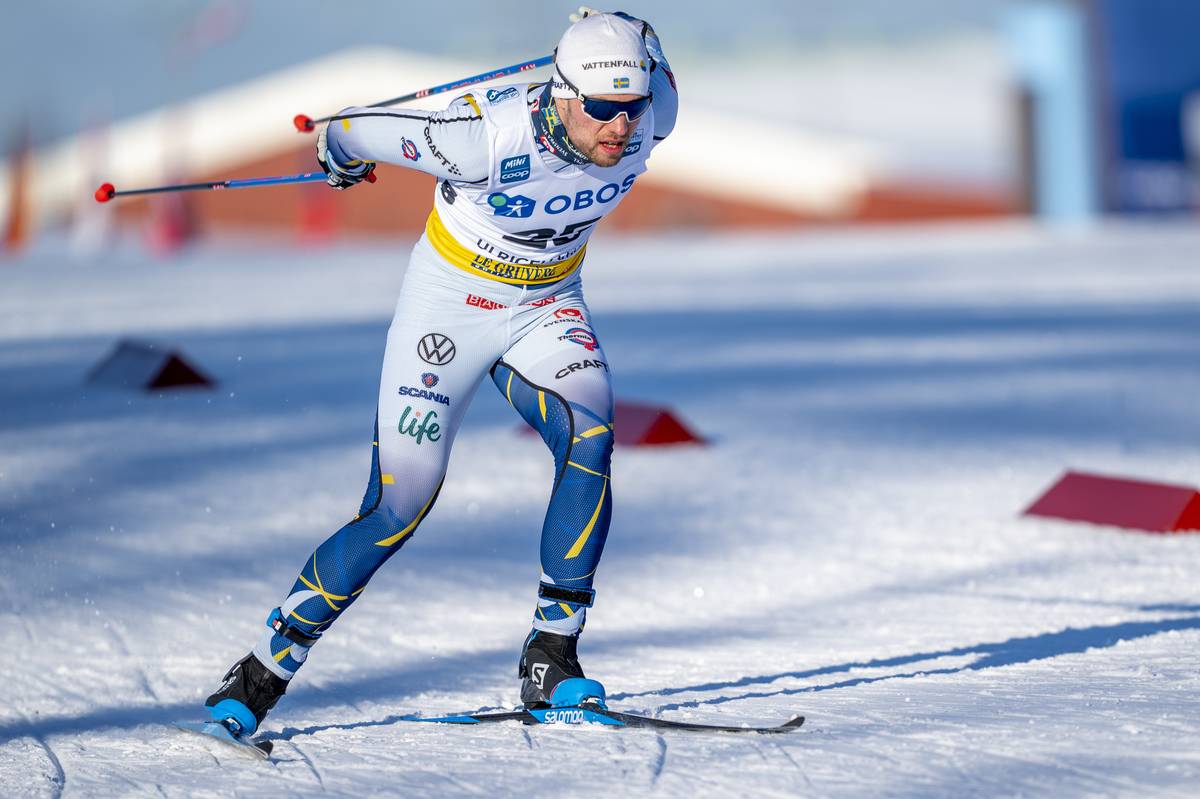
Viktor Thorn (SWE) racing the individual sprint in Ulricehamn, Sweden (Photo: NordicFocus)
From Sweden, Viktor Thorn and Hanna Falk have both announced an end to their ski careers. While Thorn is only 24 years old, he has been struggling with ongoing back pain and thus decided to step away from the sport. In a statement Thorn said, “I have struggled with back problems for almost five years and have come to the stage that I feel it is no longer worth spending all the time it takes to be able to be in the absolute elite level, when the last percent to be able to perform at the level I want to be hindered by my back … I feel ready to take on new challenges in life. A tough decision as the skis have been a big part of my life for so long, this decision still feels right. I am grateful for everything that this sport has given me and I will always be a skier but just not at the elite level anymore.”
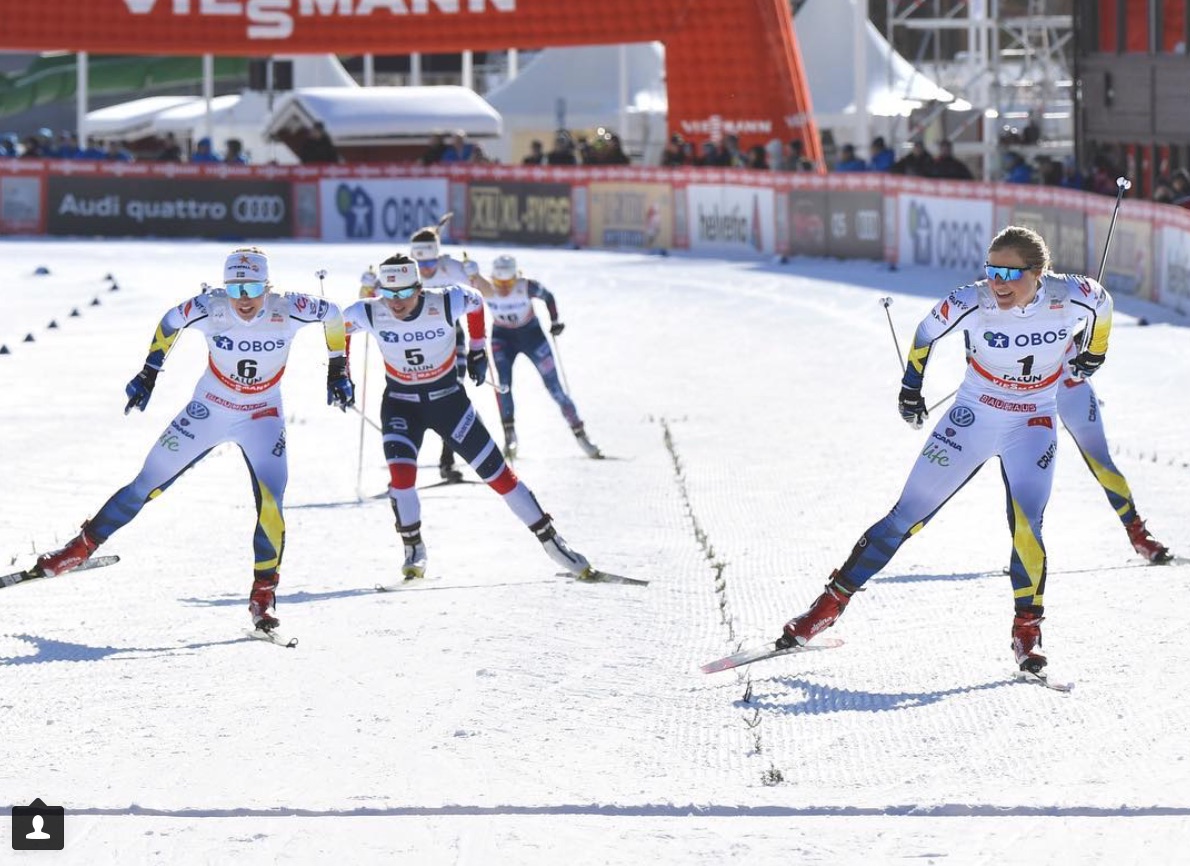
Sweden’s Hanna Falk (r) smiles as she wins the fourth World Cup race of her career and first race in Falun, Sweden, with a victory in the women’s freestyle sprint at 2018 World Cup Finals. (Photo: Svenska Skidspelen/Instagram)
Hanna Falk, who has also struggled with health problems throughout her career, announced retirement after a lengthy career. Falk began World Cup racing in 2007 and earned her first victory in 2009 at the Düsseldorf (GER) City Sprints. After a period of health issues, Falk returned in form during the 2016/17 season, proving herself to be a force on the sprint circuit. She retires with 113 World Cup starts, including eleven podium finishes.
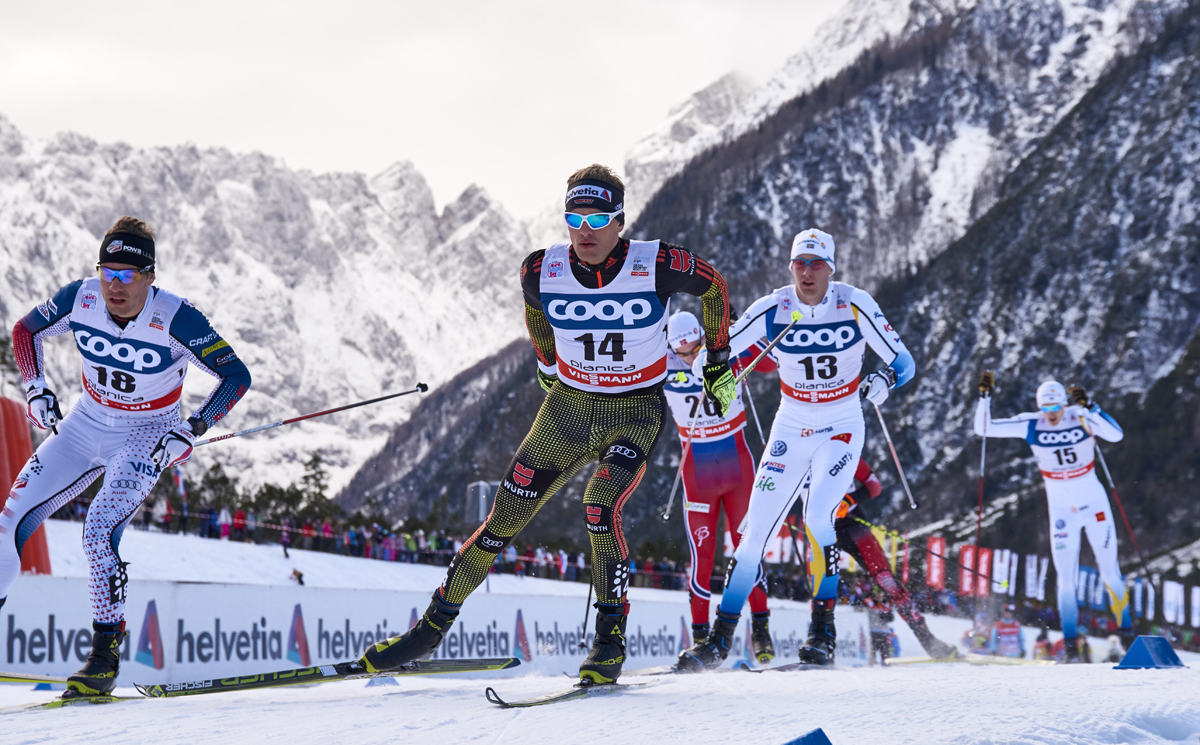
American Simi Hamilton (l) goes head-to-head with Germany’s Sebastian Eisenlauer (14), Norway’s Eivind Østnor Bakken (26), and Sweden’s Gustav Nordström (13) during their 1.2 k freestyle sprint quarterfinal on Saturday at the World Cup in Planica, Slovenia. (Photo: Fischer/NordicFocus)
From Germany, 31-year old Sebastian Eisenlauer has announced his intention to move on from professional ski racing. Eisenlauer began his World Cup career in 2010, going on to start 131 World Cups and represent Germany at two Olympics (Sochi and PyeongChang). Of his career, Eisenlauer said, “That’s it. An incredible time comes to an end and it feels like the right time to move along new paths. Every race was worth the step from every stage of my career, I find people that I can call friends now still. Thank you to everyone who joined and supported me on this journey.”
Finland’s Susanna Saapunki has decided to transition from professional ski racing to professional mountain running. Saapunki spent six years racing on the World Cup circuit, totalling 42 World Cup starts and one World Championship start in Lahti, Finland. Saapunki has now chosen to focus solely on running.
Anna Zherebyateva of Russia is concluding her World Cup career. Zherebyateva is engaged to Alexander Bolshunov and intends to focus on starting a family.
Anouk Faivre Picon of France has officially announced retirement after some years away from the World Cup circuit in which she primarily started in marathon events. Faivre Picon spent a summer training with the US Women’s Ski Team.
Also on the list of retirements this season are Livio Bieler and Anja Lozza of Switzerland, Stefan Zelger of Italy, and Valentin Mättig of Germany.
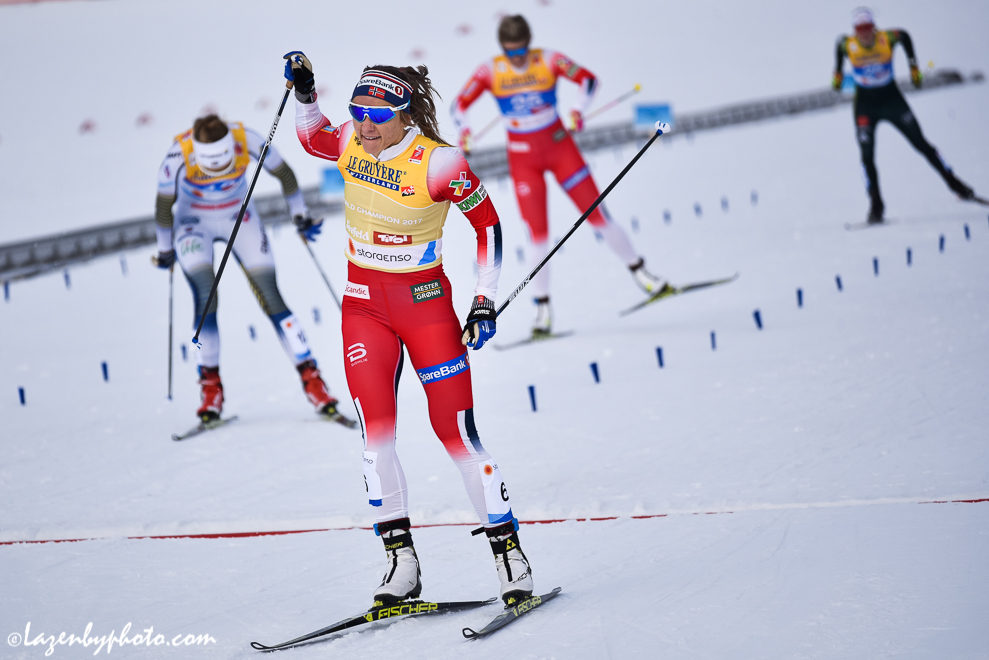
Norway’s Maiken Caspersen Falla as she wins the women’s 1.2-kilometer freestyle sprint at the 2019 World Championships in Seefeld, Austria. (Photo: John Lazenby/lazenbyphoto.com)
Norway’s Maiken Caspersen Falla torched the start of the women’s 1.2-kilometer freestyle sprint on Thursday at the 2019 World Championships in Seefeld, Austria. She skied snappy and smooth – her compact frame channeling energy downstream and towards the awaiting finish line.
Like a prize fighter knowing she had her peers against the ropes, Falla first appeared to give the knock-out blow a minute into the race. She pushed over the top of the first climb, making a slight gap on three chasing Swedes: Stina Nilsson, Jonna Sundling, and Maja Dahlqvist.
With slick skis complimenting her over-the-hilltop move, Falla initially strung out the chasers as they glided into the long straight. But as Falla pulled from her tuck and began her free-skate, the Swedes had closed in and latched on. Falla then hammered a furious V1 up the final climb. The three Swedes ceded no ground. As the course curved right over the top, Dahlqvist tumbled. Without looking back, Falla must have sensed the moment as she powered ahead and gained twenty meters in a blink. She never let up taking the win in 2:32.35 minutes.
“I have been really worried about these tracks and the high speed,” Falla told the International Ski Federation (FIS) after the race. “I have been practicing all season to have good timing on the last meters. Today I really succeed. And also, the skis, they are amazing today, and everything feels right.”
It was Falla’s eighth career World Championship medal. (Falla also won the 2017 championship skate sprint in Lahti, Finland.)
Nilsson of Sweden placed second (+1.66), while Norway’s Mari Eide placed third (+2.84). Sundling of Sweden was fourth (+3.17), Germany’s Victoria Carl fifth (+5.71), and Dahlqvist sixth (+31.49).
Norway’s Maiken Caspersen Falla celebrates her win in the women’s 1.2-kilometer freestyle sprint at the 2019 World Championships in Seefeld, Austria. (Photo: John Lazenby/lazenbyphoto.com)
It was Falla’s eighth career World Championship medal. Falla also won the 2017 championship skate sprint in Lahti, Finland.
Nilsson of Sweden placed second (+1.66), while Norway’s Mari Eide placed third (+2.84). Sundling of Sweden was fourth (+3.17), Germany’s Victoria Carl fifth (+5.71), and Dahlqvist sixth (+31.49).
Nilsson had not raced a World Cup since Jan. 19, in Otepää, Estonia. She won the classic sprint qualifier in Otepää but pulled from the competition after injuring her hamstring/groin in the semifinal.
Sadie Bjornsen of the U.S/. Ski Team placed 18th overall in the women’s 1.2-kilometer freestyle sprint at the 2019 World Championships in Seefeld, Austria. (Photo: John Lazenby/lazenbyphoto.com)
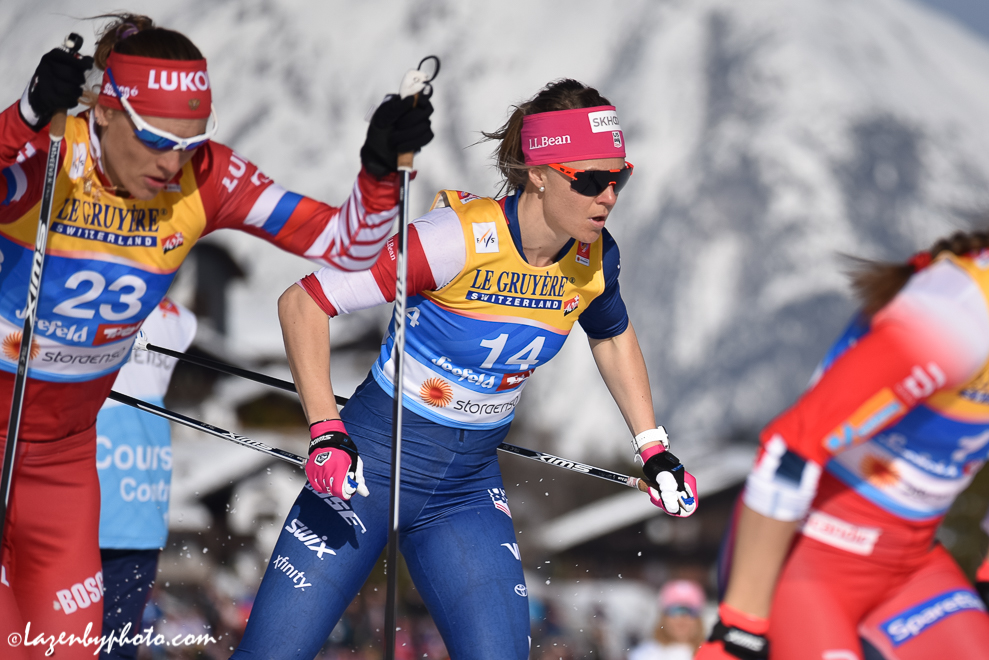
For the U.S., the paradigm of solid success now dictates the narrative. All four women entered in Thursday’s sprint solidly qualified: Sophie Caldwell qualified in fourth, Sadie Bjornsen in 14th, Jessie Diggins 15th, and Julia Kern in her first World Championships 22nd.
“For sure we are all feeling disappointed in the day because we certainly thought it was a big opportunity for a lot more in terms of results,” U.S. Ski Team Head Coach Chris Grover said in a call after the race. “But it is early in the championship too, we have a lot of races to come.”
Taste success many times as the U.S. women have on every stage – World Cup, World Championships, and the Olympics – and the near miss results don’t resonate on the success scale as they have in the past. Championships, when the women are concerned, are for medals.
“All four ladies easily in the rounds that is a great start to the day,” Grover added. “I think heat selection went well too. I think we felt good about where everybody was and what their opportunities were for passing through their quarterfinals. But then once we got into the heats, it just was one of those days where luck wasn’t quite on our side. … Some days you need a little bit of that to be on the right side of those battles and we just weren’t there.”
Sophie Caldwell in the women’s 1.2-kilometer freestyle sprint qualifier at the 2019 World Championships in Seefeld, Austria. (Photo: John Lazenby/lazenbyphoto.com)
Here’s how that hard effort and lack of luck unfolded. Caldwell ended her day 14th overall. She finished a tight third in the first heat, 0.13 seconds from first. Her heat was too slow to produce a lucky loser spot. Bjornsen finished fourth in her heat, 0.92 seconds from first. She was 18th overall. Kern tangled with a skier during her heat to lose time. She was eliminated after placing fifth to finish 23rd. Diggins won the heat that included Kern, but she too placed fourth in the second semi and did not advance. Diggins was eighth overall.
“I think the frustrating part for all of the women, all four of them said they felt great,” said Grover. “And that is really encouraging for the rest of the championships. All of them are healthy. All of them feel really fit right now. It just did not come together.”
The sentiments from skiers after the race were much the same as Grover’s – that sprint racing has its high risk high reward template, but the day left the U.S. collectively wanting more.
“I was definitely disappointed in my end result today because I was feeling good and enjoy this course, but sometimes that’s sprint racing,” Caldwell emailed. “I’m not sure what I could have done differently other than have a little extra something in the finish stretch, so that gives me some peace of mind, but I was for sure left wanting more. I know I’m feeling good and fit and while you always want to have your best performance at world champs, there are more races to come that I’m looking forward to.”
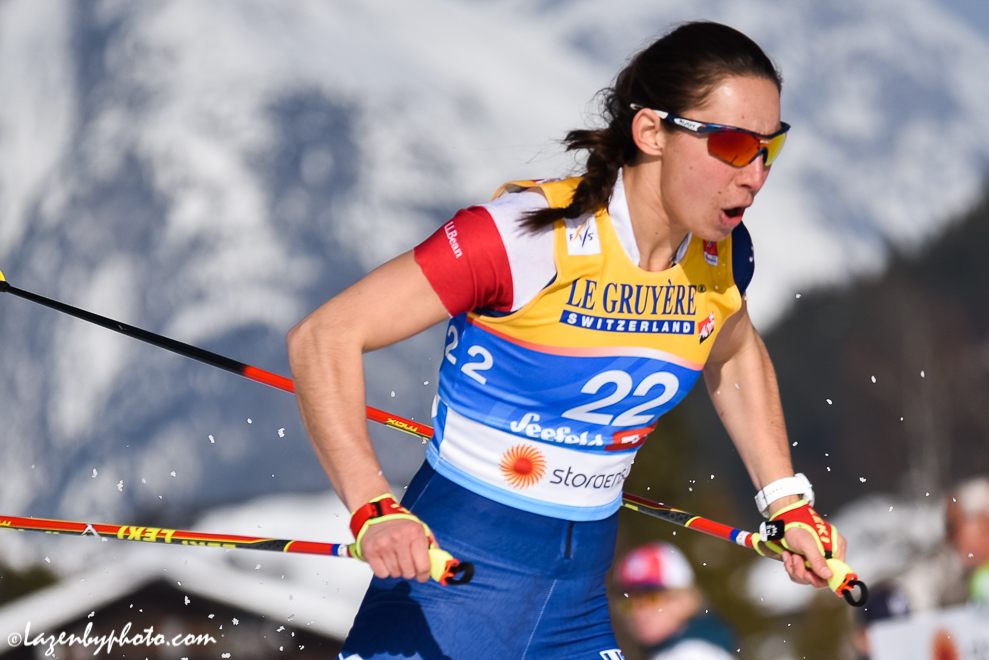
Julia Kern during the women’s 1.2-kilometer freestyle sprint at the 2019 World Championships in Seefeld, Austria. (Photo: John Lazenby/lazenbyphoto.com)
For Kern, the season has been a quick jump to the World Cup after racing SuperTours during Period 1. She placed 19th in Dresden’s skate sprint, and fourth in the team sprint. She made the heats last weekend in Cogne, Italy where she placed 11th overall. In her first World Championships, Kern came in with a mindset to maximize forward momentum.
“It was a pretty short sprint course, I knew that times were going to be tight so I told myself the whole race, every second counts, every push counts, every half second counts.” Kern said in a call. “And I kept saying that every push, and I kept repeating that in my mind. I knew it was going to be one of the more tighter qualifiers and given a championship event everyone is on their top game and fitness.”
Everybody knows Diggins. There’s no mystery that her moxy and finishing speed can devastate the field. That was on full display as she won the fifth heat. And as an eternal optimist, Diggins could reflect on the performance more than the day’s end result as a measure of her mental and physical preparedness.
“I’m really excited for everything to come and I think today was a really good indication of where my fitness was; my final 100 meters I was moving faster than my first 100 meters and I think that’s a really good place to be in and it gives me a lot of confidence,” Diggins said in call.
Diggins was repeatedly boxed out by the front four skiers in her semi-final. She skied in the back, not dangling off, just simply unable to find daylight and emerge near the front. Then as the pack of skiers rolled over the top of the final hill and slung around a high-speed left hand turn into the finish straight, Diggins went wide, far wide to the outermost lane.
“That was the only place I could go, so I took a really wide line,” reflected Diggins. “I could feel myself gaining – if I had another 50 meters, that would have been really fun. But I went out into a really mushy lane that hadn’t been skied in yet and I’m just like ‘alright, I’m just going to motor as fast as I can go and put my head down and just, you know’, because I felt like I had a lot of pent up energy because I kept getting boxed out so I wasn’t able to ski as hard as I could. It was encouraging to know my speed at the end of the race is there, my finishing kick is alive and well, and I think that bodes well for our races coming up.”
Jessie Diggins during the women’s 1.2-kilometer freestyle sprint qualifier at the 2019 World Championships in Seefeld, Austria. (Photo: John Lazenby/lazenbyphoto.com)
If nothing else, the day’s sprint was a fine spectacle. The high stakes racing was tight and sporting for both the men and women. That came to mind as Diggins went wide on Thursday. It would have been easy to count her out 30 seconds from the finish.
But who would do that?
She finished 0.37 seconds from first and 0.21 seconds from heading to the final.
Racing continues on Saturday in Seefeld with the men’s and women’s skiathlon.
Norway’s Maiken Caspersen Falla taking the World Cup win in the 1.4 k skate sprint in Lahti, Finland. Sophie Caldwell of the U.S. Ski Team placed second. (Photo: fis-ski.com screenshot)
FIS World Cup Lahti, Finland 1.4 k/ 1.6 k Freestyle Sprint
In the women’s skate sprint qualifier in Lahti, Finland Slovenia’s Eva Urevc laid down the fastest time in 2:40.67 minutes. Swiss skier Nadine Faehndrich was the second fastest qualifier, 4.21 seconds back, with the U.S. Ski Team’s (USST) Sophie Caldwell third (+4.36).
Canada’s Dahria Beatty qualified 25th (+10.21). Also making the heats for the U.S. were Ida Sargent (USST) in 26th (+10.36), and Kelsey Phinney (SMS T2) in 27th (+10.54).
Of the top three qualifiers, only Caldwell advanced to the finals. The final was won by Norway’s Maiken Caspersen Falla in 2:43.64. Falla advanced to the finals as a lucky loser from the first semifinal. That semi was won by Caldwell who ended up placing second (+0.11) in the final. Sweden’s Maja Dahlqvist sprinted to third overall (+0.37).
Germany’s Sandra Ringwald placed fourth (+0.46), Norway’s Mari Eide fifth (+0.75), and Tiril Udnes Weng of Norway sixth (+0.94).
Phinney placed 19th overall, Sargent 30th. Canada’s Beatty was 24th in the final standings.
Also for the U.S., Julia Kern (USST D-Team) coming off of illness ended her day 38th overall. Hannah Halvorsen (USST D-Team) placed 41st.
Johannes Høsflot Klæbo won the men’s 1.6 k skate qualifier in 2:47.01 minutes. He was followed by teammate Haavard Solaas Taugboel in second (+4.15). Qualifying in third was Finland’s Joni Maeki who clocked a time of 2:51.36.
Klæbo won the final in 2:52.06 while Italy’s Federico Pellegrino raced to second (+0.30). Norway’s Finn Hågen Krogh was third (+0.61). Also from Norway, Eirik Brandsdal took fourth (+1.31) and Emil Iversen fifth (+1.75). Gleb Retivykh of Russia was sixth (+2.08).
No North American men qualified for the heats.
Logan Hanneman (APU) for the U.S. placed 32nd overall after missing the heats by .22 seconds. Simi Hamilton (USST) finished 36th overall, and Erik Bjornsen (USST) 42nd.
Evan Palmer-Charette was the lone Canadian entered; he placed 67th.
Rémi Drolet leads Julien Locke and Sam Hendry at the start of lap three. (Photo: Peggy Hung)
Canadian Western Championships, Telemark, Classic Mass Start
Day two of Westerns dawned with low clouds and intermittent light snow at -11C for the classic mass starts.
The men raced first, completing three laps of the new (and freshly homologated) 5km loop. Rémi Drolet (Black Jack) won in 42:18.4, getting from Julien Locke (CNST) on the last climb to earn a 4.8 second gap. Sam Hendry (Team R.A.D.) stayed with leaders until late in the second lap, finishing 42.2 seconds back. Rémi Drolet and Hendry are juniors who represented Canada at Junior Worlds in Lahti last month. Crystal Lust
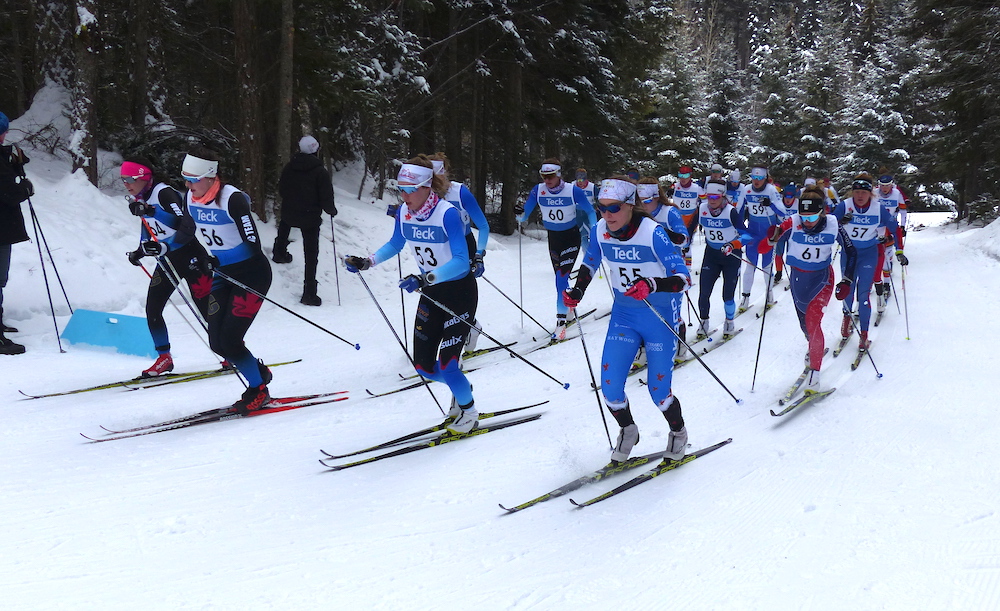
The first small climb of the Westerns 10km classic. Jasmine Drolet (#55) leads Novie McCabe (#61) in the left track. (Photo: Peggy Hung)
The open women skied two laps of the same course, with Novie McCabe (Methow) breaking clear on the first lap to win alone in 32:46.6. Jasmine Drolet (Black Jack) was second at 53.4 seconds followed by teammate Molly Miller at 1:28.1. All three raced at World Juniors in Lahti: Jasmine Drolet is 16 and the other two are 17.
There were 386 finishers on Saturday. Racing continues Sunday with relays.
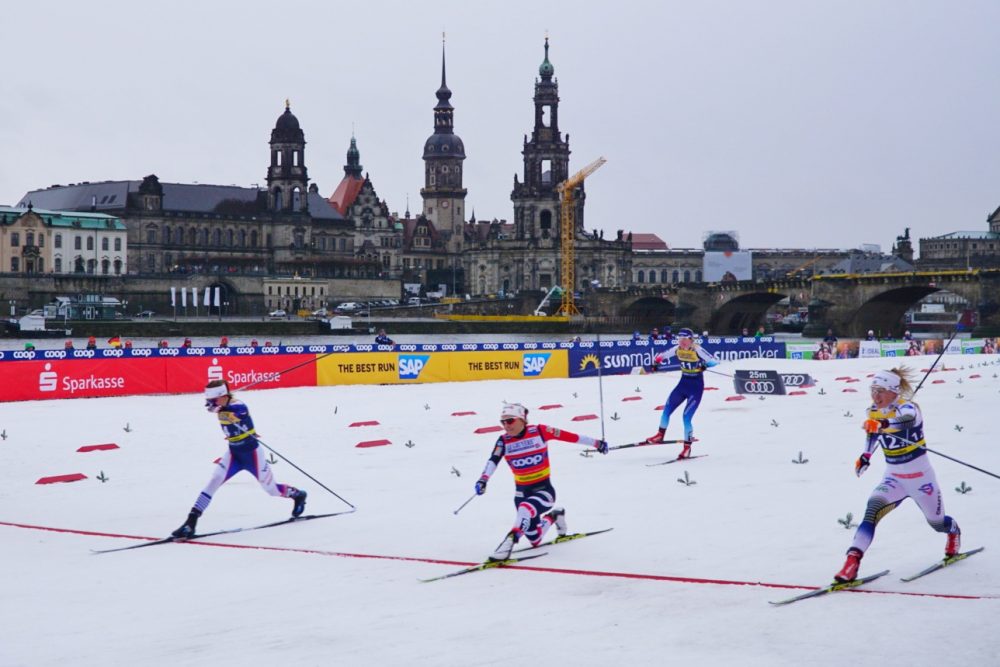
American Sophie Caldwell (far left) lunges to the line with Norway’s Maiken Caspersen Falla and Sweden’s Jonna Sundling. Caldwell ended up fourth, while Sundling took second and Fall third. Sweden’s Maja Dahlqvist 9not shown) crossed first for the win. (Photo: Garrott Kuzzy /LumiExperiences.com)
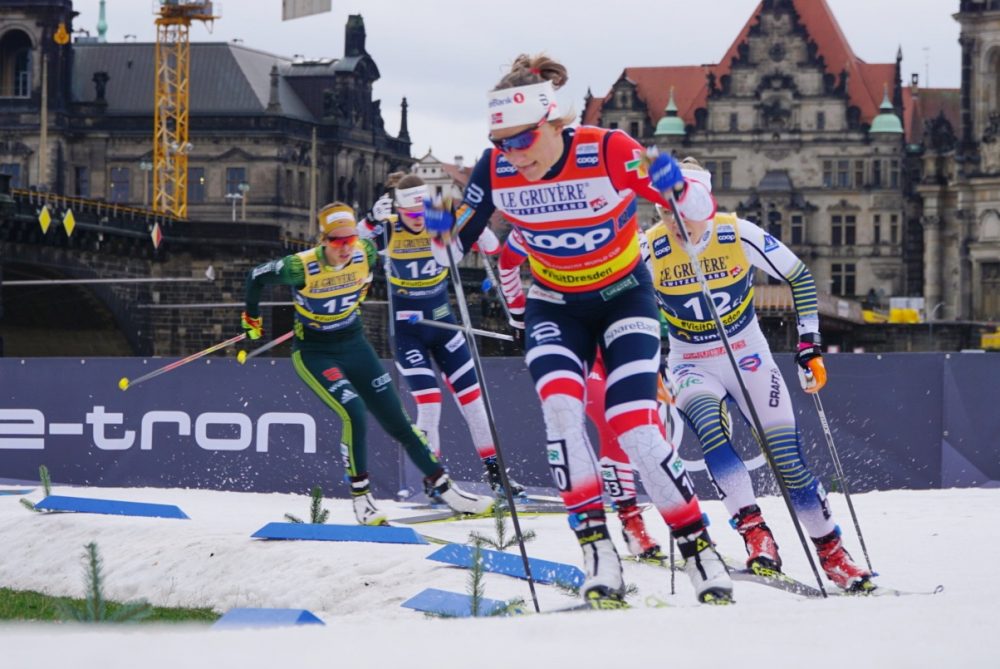
If the Grand Prix were to host a ski race, it might look like the Team Sprint in Dresden, Germany. With 10 teams racing the 6 x 1.6-kilometer final and the racetrack style, three-lap loop situated in the city’s center, the tactics of a Formula One driver seemed employable on the relatively flat course. For most teams’ skiers, that meant patience; staying in one’s lane and in contact until the last lap.
Norway’s Team I of Mari Eide and Maiken Caspersen Falla, the U.S.’s Team I of Julia Kern and Sophie Caldwell, Sweden’s Team I of Stina Nilsson and Maja Dahlqvist, as well as the Swede’s Team II of Ida Ingemarsdotter and Jonna Sundling remained the teams to watch heading through each exchange.
By the time she started her third and final leg, Falla appeared to have played the conservation game. When on course, she had taken a few pulls at the front, though for the most part, left that work to Sweden’s Team I and Team II second leg skiers, Dahlqvist and Sundling. With the brunt of the pace-setting work having gone to the Swedes, Falla’s engine seemed primed for a jumpstart to the front.
Norway’s Maiken Caspersen Falla leading the women’s 6 x 1.6-kilometer Team Sprint on Sunday in Dresden, Germany. (Photo: Garrott Kuzzy /LumiExperiences.com)
Just a few meters before the course’s hairpin turn, which shuttled racers back to the finish, Falla made her move. She pushed around both Sundling and Dahlqvist to take over the lead. A hard pressing Dahlqvist led the chase on the Norwegian’s ski tails, which included herself as well as Sundling and the U.S. Team I’s second leg skier, Caldwell.
Sporting the red leader’s bib, Falla looked in good form. Any challenge for the win would need to come from behind and the the opportunity to do so–in correlation to the course’s chances of survival in Sunday’s steady drizzling rain–was dwindling.
The quad of skiers, led by Falla, headed toward the sole, brief, gut-punch of a climb. Dahlqvist pushed to the inside right of Falla and using two powerful V2 strokes, the Swede had reached the top of the short uphill and the pinnacle of the city’s modernized race course.
What unfolded next was an aged battle: Sweden and Norway duking it out for the win.
Dahlqvist inched ahead. Descending toward the finish, it was Sweden leading Norway followed by Sundling and Caldwell.
American Sophie Caldwell (bib 4) racing during the women’s 6 x 1.6-kilometer Team Sprint semifinal on Sunday in Dresden, Germany. (Photo: Garrott Kuzzy /LumiExperiences.com)
By the time the group rounded the last corner to the finishing stretch, Dahlqvist had increased her lead. Skating in a tuck, Falla scrambled to make up lost ground. The pressure for Norway in the race’s final moments quickly became less about overtaking the win and more staving off Sweden II and the U.S.
Crossing first to secure the win for Sweden’s Team I was Dahlqvist in a time of 24:02.45. In a three-way lunge to the line, Sweden’s Team II snagged second place (+1.11), while Norway claimed third (+1.11). Caldwell crossed fourth (+1.11) according to the International Ski Federation’s (FIS) photo finish.
“Today was a really fun day. Julia and I have never team sprinted together before, so we didn’t really have any expectations going into the day, but I knew we could be fighting in the final if we had a good day,” Caldwell wrote in an email.
In last year’s Team Sprint in Dresden, Caldwell teamed up with Ida Sargent and finished in third behind Sweden’s Team I and Team II. This year, Sargent raced on the U.S.’s Team II with World Cup rookie, Hannah Halvorsen. Sargent and Halvorsen finished Sunday’s race in 11th, just outside of advancing to the finals.
The fourth place finish for U.S. Team I on Sunday, was what Kern described as “bittersweet.’ The difference between Caldwell’s ski boot and Falla’s in the final lunge to the line barely discernible.
“The photo finish did end up being extremely close and I so badly wanted to get that podium for Julia’s first World Cup podium, but podium or not, I think it was still an awesome day for us,” Caldwell said. “We’re club teammates as well as national team teammates and are pretty familiar with how we each ski and have a lot of mutual respect for each other, so it was really just an awesome opportunity to go out there and get to show what we practice for all year!”
Both Caldwell and Kern ski for the Stratton Mountain School T2 club team. Though mere fractions of a second away from her first World Cup podium, Kern was focused primarily on the opportunity she had gained to race with Caldwell on the U.S.’s Team I.
She found out Saturday evening, after the women’s 1.6-kilometer freestyle sprint–in which Kern finished 19th–that she would be partnered up with Caldwell for Sunday’s Team Sprint.
“It was a dream come true,” Kern said of being selected to race with Caldwell on the U.S.’s Team I. “Going in to the weekend it was not what I expected, but after my qualifier heats yesterday, it was definitely on the table.”
Prior to the start of the race, Kern gave the camera a smile and wave, expressing outward excitement for her first Team Sprint World Cup start. Despite being slotted against the likes of Nilsson, Ingemarsdotter and Eide, Kern said she did not feel nervous.
“I think going into the race today, I tried to be really confident and wasn’t afraid to ski in front of Stina or didn’t really feel out of place because I needed to ski big and confident to hold my position,” Kern said.
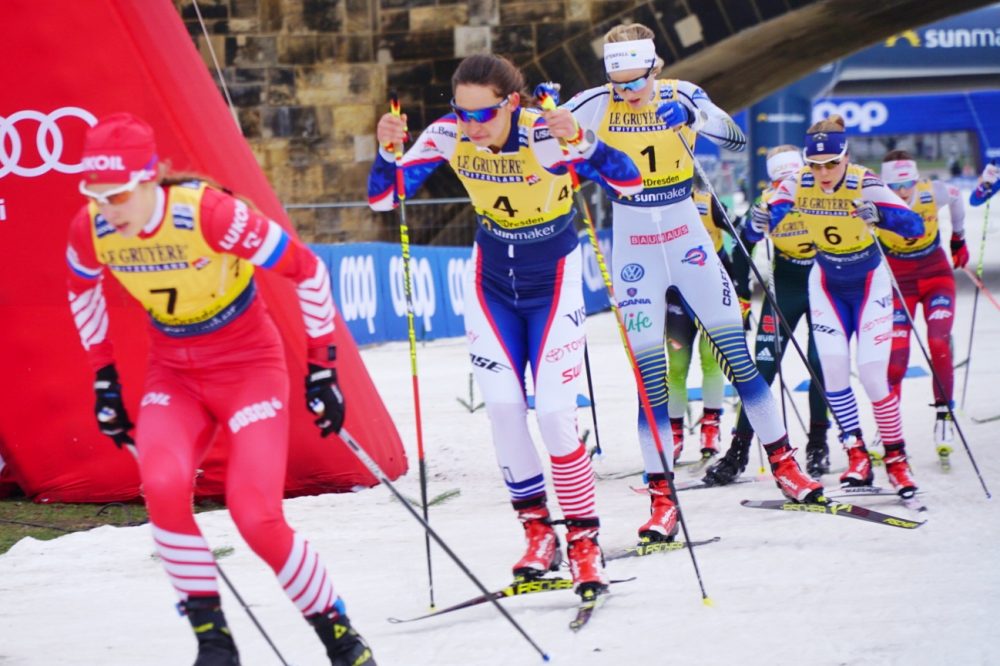
U.S. Ski Team member, Julia Kern (bib 4) leads Sweden’s Stina Nilsson (bib 1) and American Ida Sargent (bib 6) during the women’s 6 x 1.6-kilometer Team Sprint semifinal on Sunday in Dresden, Germany. (Photo: Garrott Kuzzy /LumiExperiences.com)
The biggest goal for Kern on Sunday was to maintain her position and as she put it, “stay out of trouble.” While on course, she narrowly avoided a crash between Russia’s Tatiana Aleshina and Slovenia’s Alenka Cebasek that occurred just after the second exchange.
“I just stayed relaxed and made my way around, which I was very happy to avoid that,” Kern said of the crash.
“In the final things got much more aggressive than in the semi-final. There was a lot more jostling around for position and pretty much everyone was skiing over each others skis,” Kern said. “You kind of had to ride that fine line were you were playing it safe so you weren’t risking falling or getting you pole broken, but also holding your line.”
“I had a blast racing my first world cup weekend,” Halvorsen wrote in an email to FasterSkier on Sunday. “I am happy about how things turned out because I put down two really solid races for me and didn’t make any big rookie mistakes.
“While I am grateful things went smoothly, it was a wake up call of how many things I have to learn,” she added. Especially racing in the team sprint, my inexperience became apparent where one or two people would somehow pass me on every turn or transition. I would have to work hard to regain my position, and I learned how important it is to hold your line.
“In both races I learned the importance of working every section, and how easy it is to lose time by not accelerating out of a corner or not pushing hard enough over hills, etc,” she continued. “I loved getting to see how well the U.S. World Cup coaches and athletes work together and was beyond excited to take a part in it. Thank you to everyone who made this possible for me!”
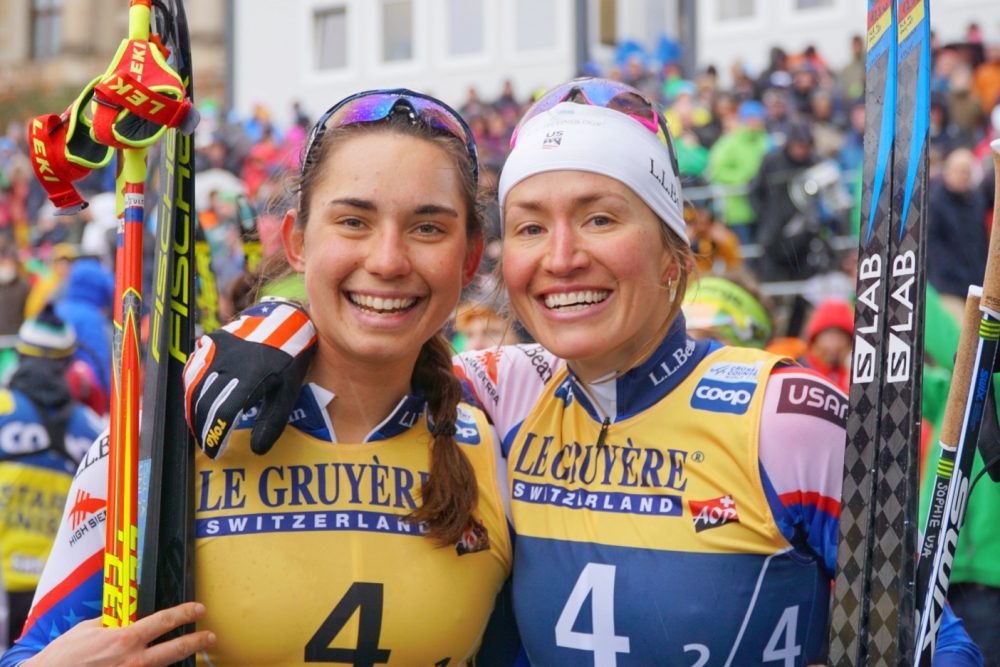
Julia Kern (l) and Sophie Caldwell after finishing fourth in the women’s 6 x 1.6-kilometer freestyle Team Sprint in Dresden Germany. (Photo: Garrott Kuzzy /LumiExperiences.com)
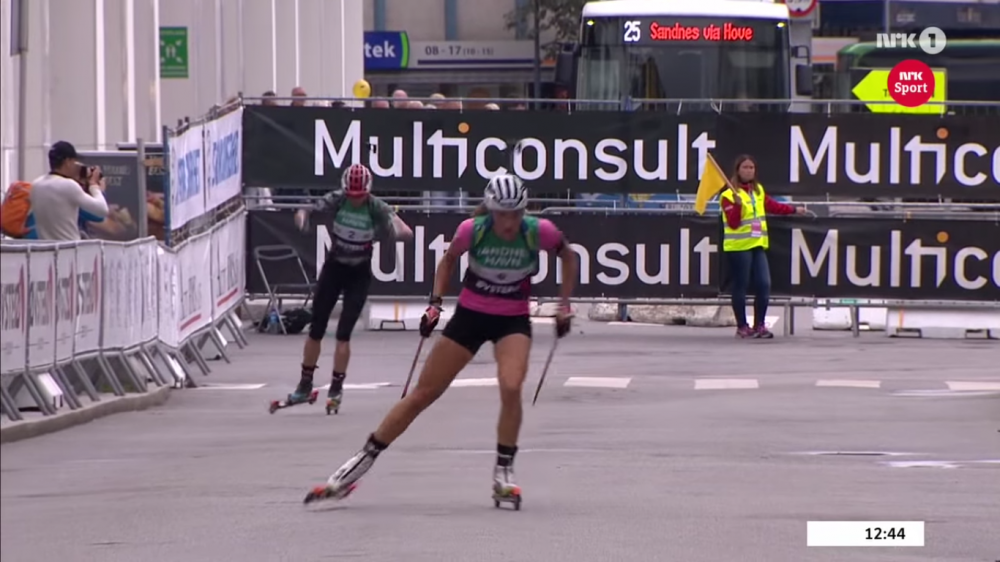
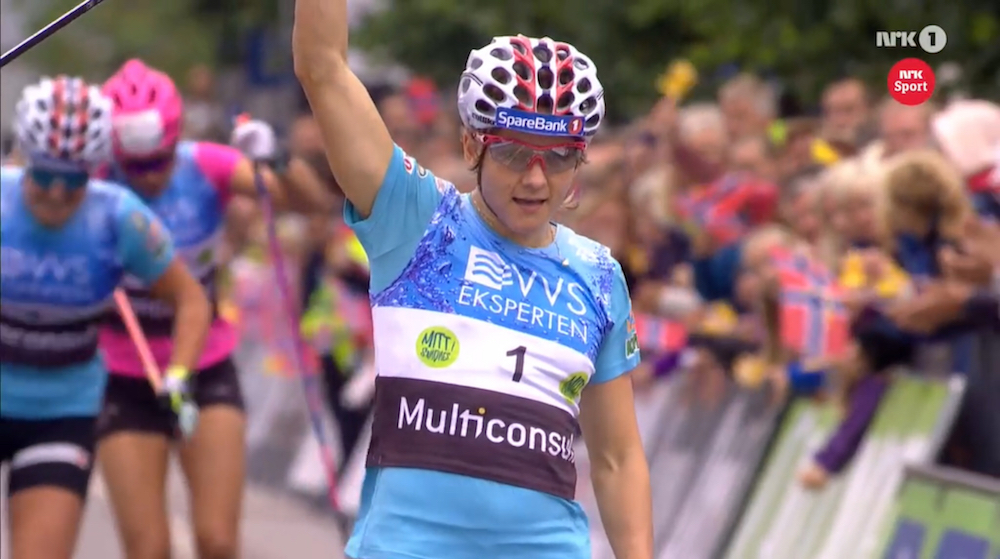
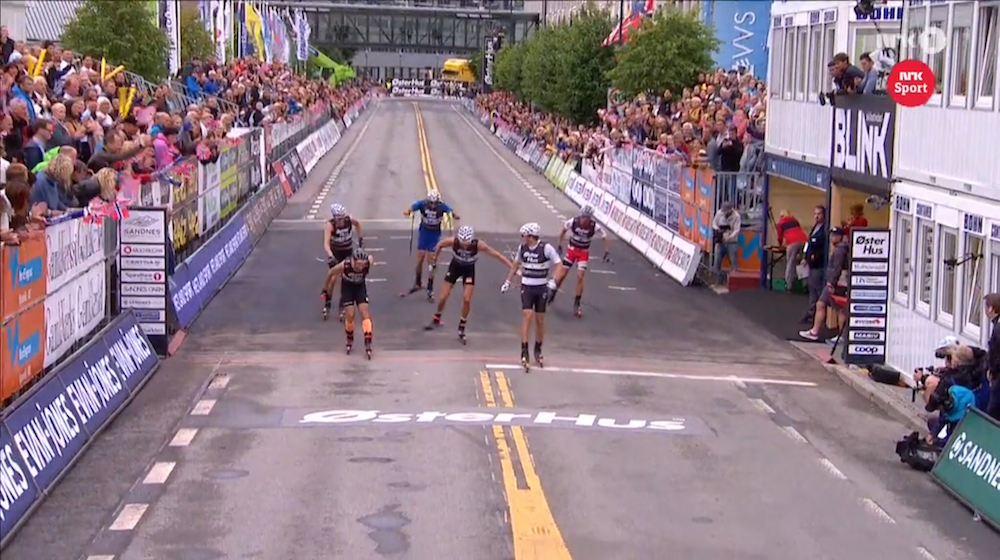
Norway’s Maiken Caspersen Falla (1) winning Saturday’s women’s cross-country sprint final on the last day of the 2018 Blink Ski Festival in Sandnes, Norway. (Photo: Blink Ski Festival/Axelar/Arild Aarnes)
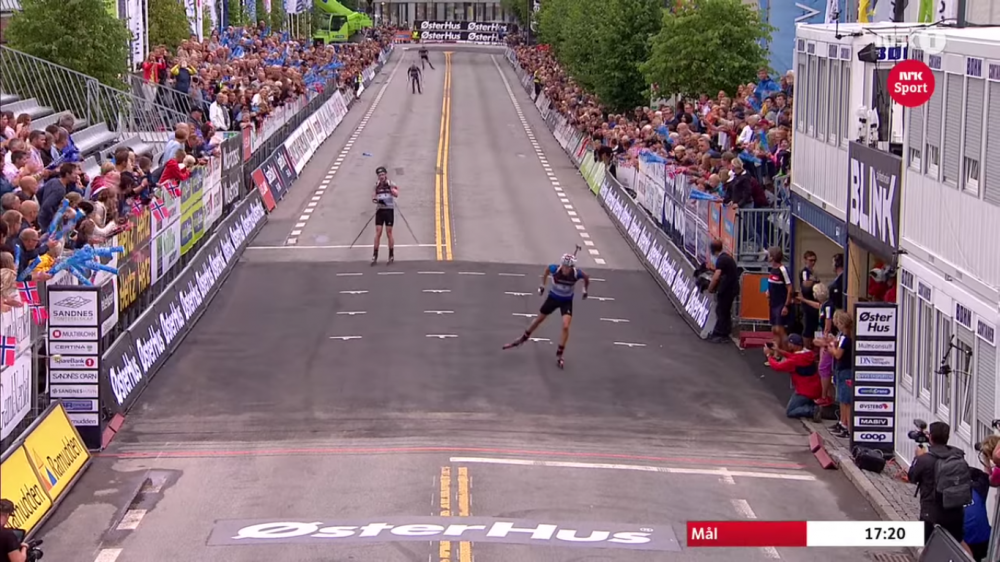
The 2018 Blink Ski Festival continued in full force on Friday and Saturday, with cross-country and biathlon prologues, 10- and 15-kilometer cross-country races and biathlon mass starts all taking place on Friday, followed by sprints on Saturday.
Elite racing began in the afternoon with the men’s prologue (no prologue was held for the women), Norway’s Gjøran Holstad Tefre posted the fastest time of 3:12.21. Finishing 1.89 seconds back was another Norwegian, Aleksander Dyrberg Ek, and Great Britain’s Andrew Young claimed the prologue’s final podium spot, finishing 2.27 seconds off the winning time.
Also in the top 10 were Norway’s Morten Eide Pedersen in fourth (+4.7), Britain’s James Clugnet in fifth (+4.76), France’s Lucas Chanavat in sixth (+5.09), Norway’s Stian Grastveit in seventh (+5.70), France’s Renaud Jay in eighth (+5.75), and Norway’s Sindre Folkvord and Harald Østberg Amundsen in ninth (+6.00) and 10th (+6.03), respectively.
Canada’s Evan Palmer-Charrette finished 34th (+16.68), Scott Hill placed 39th (+19.37) and Bob Thompson was 40th (+19.54) out of 47 finishers.
After the elite men’s prologue, athletes geared up for a men’s and women’s biathlon prologues.
Norway’s Johannes Thingnes Bø took the men’s biathlon prologue win in a time of 10:30.2 after two misses (1+1). One second back, it was a tie for second place between another Norwegian, Lars Aasheim Svaland, who had one penalty (0+1), and France’s Antonin Guigonnat, with one miss as well (1+0).
Slovenia’s Anastasiya Kuzmina, who took one gold and two silver medals at the 2018 Olympics, won Friday’s women’s prologue with clean shooting and a time of 11:34.6. Just 0.6 seconds behind was Norway’s Emilie Ågheim Kalkenberg, who placed second with perfect 10-for-10 shooting as well. France’s Justine Braisaz claimed third, 10.7 seconds out of first, after missing two targets (0+2).
The next event on Friday’s program was the women’s 10 k cross-country mass start, which Norwegian sprint specialist Maiken Caspersen Falla won in 20:39.4. She bested fellow Norwegian Mari Eide by 1.9 seconds, and Sweden’s Charlotte Kalla and Norway’s Kari Øyre Slind followed in third (+3.9) and fourth (+3.9), respectively, with the same time.
Working their way into the top 10 were Russia’s Elena Soboleva in fifth (+4.9), Finland’s Krista Pärmäkoski in sixth (+5.0), Norway’s Ingvild Flugstad Østberg and Ragnhild Haga in seventh (+5.1) and eighth (+5.2), respectively, Austria’s Teresa Stadlober in ninth (+6.6), and Russia’s Natalia Matveeva in 10th (+8.7). Out of 31 women, Nichole Bathe, racing for Great Britain, finished in 23rd (+1:09).
Sweden’s Hanna Öberg (front) racing to first in the women’s biathlon mass start on Friday the 2018 Blink Ski Festival in Sandnes, Norway. (Screenshot: NRK broadcast)
Friday’s program then moved on to the women’s biathlon mass start. Sweden’s Hanna Öberg won the event in a time of 13:19.4 despite three misses (0+1+2+0). Kuzmina finished second, crossing 2.1 seconds behind the Swede after a penalty in each stage (1+1+1+1). Third place went to another Swede, Mona Brorsson, who crossed 5.9 seconds after Öberg and shot four penalties (2+1+1+0).
Norway’s Henrik L’abeé-Lund (r) winning the men’s biathlon mass start on Friday at the 2018 Blink rollerski festival, ahead of his teammate Johannes Thingnes Bø in second in Sandnes, Norway. (Screenshot: NRK broadcast)
Following the women’s biathlon race, the men’s biathlon mass start got underway. Norway’s Henrik L’abeé-Lund emerged as the winner, crossing the line in 17:21.3 after shooting four penalties (1+1+2+0). Exactly three seconds behind him was J.T. Bø in second place with two misses (1+0+1+0). Sealing the all-Norwegian podium was Vetle Sjåstad Christiansen, who missed six targets (1+1+2+2) and finished 12.1 seconds after L’abeé-Lund for third.
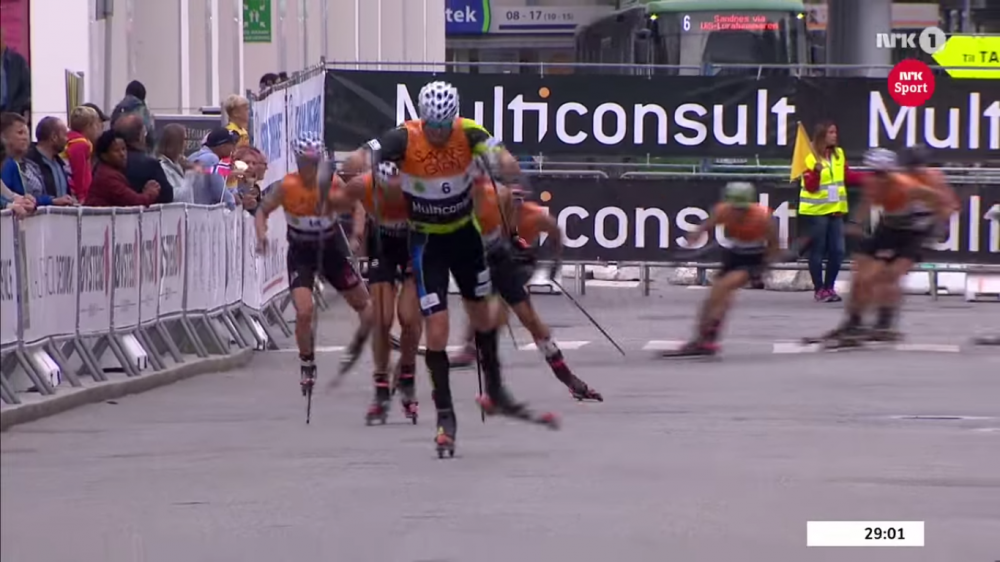
Russia’s Sergey Ustiugov leading the pack of the elite men’s 15-kilometer freestyle cross-country mass start on Friday at the 2018 Blink Ski Festival in Sandnes, Norway. (Screenshot: NRK broadcast)
Friday’s final race turned back to cross-country for the elite men’s 15 k freestyle mass start. Russian skier, Sergey Ustiugov, who was banned from competing at the 2018 Winter Olympics, won it in 29:26.0, 2.1 seconds ahead of Norway’s Aleksander Ek, (who had placed second in the prologue to start the day). Italy’s Federico Pellegrino was just another 0.6 seconds back in third (+2.7).
“I was a little nervous today because I won it last year and I wanted to repeat my success here again today,” Ustiugov told NRK through a translator. “It didn’t go easy, but I did manage to do what I wanted to do, and I would like to thank all my team, Markus [Cramer], and the rest of the team. That was great.”
The remaining top ten included Norway’s Vebjørn Turtveit in fourth (+2.9), Sindre Bjørnestad Skar in fifth (+3.9), Øystein Pettersen in sixth (+5.4), and Torstein Bu in seventh (+5.8). France’s Adrien Backscheider and Clement Parisse placed eighth (+5.9) and ninth (+6.2) respectively, followed by Norway’s Eirik Brandsdal in tenth (+6.2).
Racing for Canada, Alex Harvey finished 14th (+7.5).
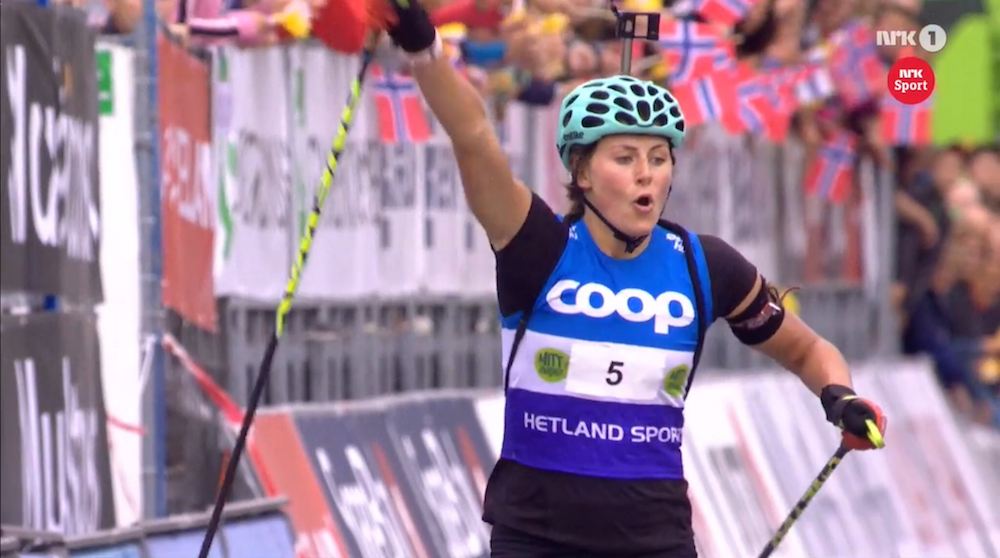
Norway’s Maiken Caspersen Falla winning the women’s cross-country sprint on Saturday at the Blink Ski Festival in Sandnes, Norway. It was her second-straight victory after topping Friday’s 10 k freestyle mass start as well. (Screenshot: NRK broadcast)
Saturday marked the final day of the Blink rollerski festival and included cross-country and biathlon sprints. In the women’s cross-country final, Norway’s Falla picked up her second-straight win, ahead of Russia’s Matveeva in second (+1.6) and Sweden’s Ida Ingemarsdotter in third (+2.4). Norway’s Eide was just off the podium in fourth (+2.9), Norway’s Barbro Kvåle Trømborg placed fifth (+3.7), and another Norwegian, Linn Ravndal, finished 8 seconds back in sixth.
Falla’s won the final in 3:40.8 after topping her quarterfinal and semifinal as well.
The men’s cross-country racing began with a prologue, which Norway’s Vetle Christiansen won in 1:31.92, just three-hundredths of a second ahead of his fellow countryman, Ek. France’s Baptiste Noel placed third in the prologue, 1.76 seconds out of first.
Russia’s Gleb Retivykh (second from r) winning the men’s cross-country sprint final on Saturday at the Blink Ski Festival in Sandnes, Norway. (Screenshot: NRK broadcast)
In the heats later in the day, Russia’s Gleb Retivykh came out on top of the final, getting there by placing second in both his quarterfinal and semifinal, then winning the last round by 0.2 seconds over Pellegrino in a time of 3:15.5. Pellegrino had won his quarterfinal but advanced as a lucky loser in fourth out of the second semifinal. The 25-year-old Ek capped off his successful series with another podium, placing third in the final, just 0.3 seconds out of first.
In a post-race interview with NRK, Retivykh explained this was his first time at Blink.
“I am very happy,” he said in English. “Today is my first win at Blink, and [it was my] first time here.”
In a close final, Norway’s Gjøran Tefre and Brandsdal followed in fourth (+0.5) and fifth (+0.7), respectively, Italy’s Francesco De Fabiani was just behind in sixth (+0.8).
France’s Justine Braisaz celebrating across the line as she wins the women’s biathlon super sprint on the last day of 2018 Blink Ski Festival on Saturday in Sandnes, Norway. (Screenshot: NRK broadcast)
Biathletes were able to experience head-to-head sprint racing as well (a deviation from the typical biathlon World Cup sprint format, which is individual), in the women’s and men’s biathlon supersprints, which included one prone and one standing shooting stage per heat.
France’s Braisaz won the women’s final in 7:45.3. She had previously won her quarterfinal (which was a longer distance), then placed seventh in the first semifinal (same distance as final). Norway’s Marte Olsbu placed second in the final (+0.4), and Sweden’s Brorsson returned to the podium in third (+0.9).
“It was really close at the end, but I am very happy about the weekend here,” Braisaz told NRK on English after. “Everything is perfect, even though the weather is a little bit — how do you say — moody. But it’s OK. And I am really happy to be in Norway and I will make my stay longer after the festival weekend.”
Norway’s Vetle Sjåstad Christiansen winning the men’s biathlon supersprint on Saturday, the last day of the Blink Ski Festival, in Sandnes, Norway. (Screenshot: NRK broadcast)
In the men’s biathlon super sprint, Norway’s Christiansen dominated the day, winning his quarterfinal and semifinal before beating J.T.Bø by 2.2 seconds in the men’s final with a time of 12:01.8. France’s Guigonnat completed the podium in third, 8.5 seconds behind Christiansen.
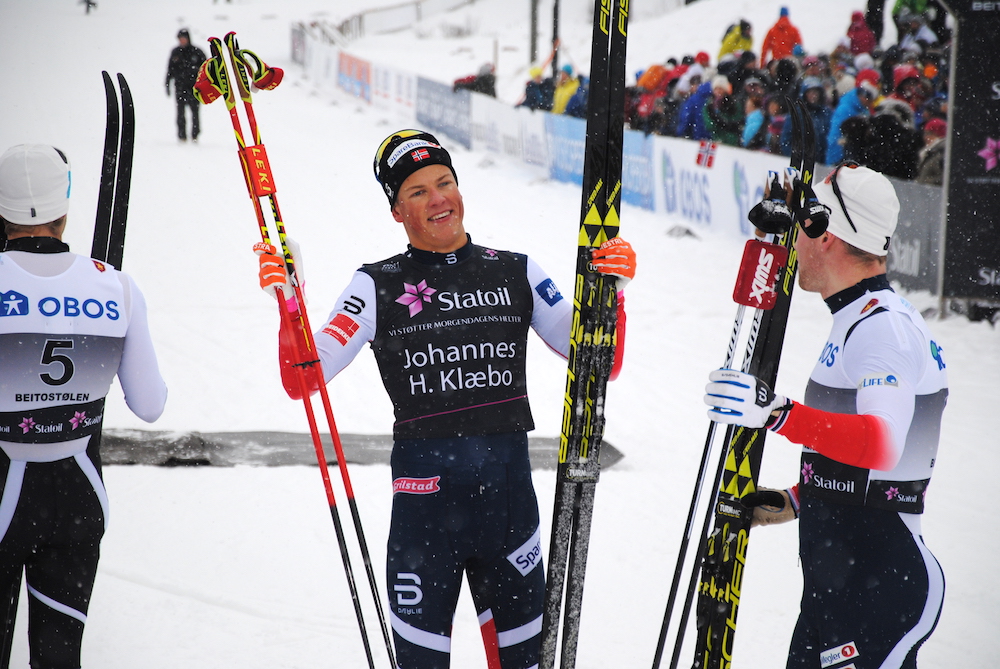
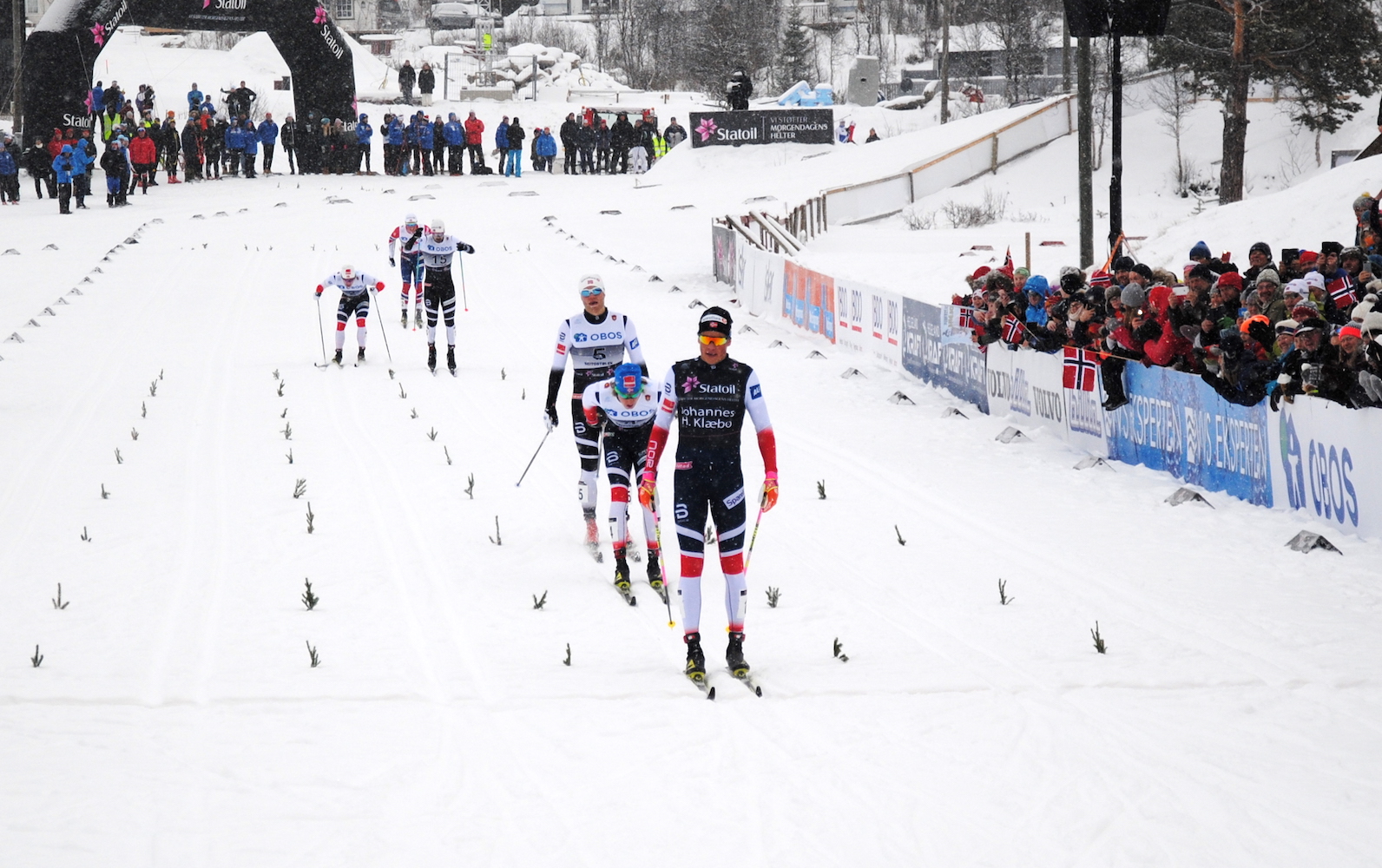
Norway’s Johannes Høsflot Klæbo celebrates his first win of the season on Saturday in the men’s 1.5 k classic sprint FIS race in Beitostølen, Norway. (Photo: Aleks Tangen)
BEITOSTØLEN, Norway — A year ago, 20-year-old Johannes Høsflot Klæbo leapt onto the scene with a season-opening skate-sprint win in Beitostølen. Before that, he made waves at 2016 U23 World Championships, winning gold in the skate sprint, 10-kilometer classic and 4 x 5 k relay. But until last season, Klæbo, a member of Norway’s national U23 team, was hardly a household name to those outside of Norwegian skiing circles.
That all ended in Beito. Klæbo landed on the podium in the first World Cup sprint of the 2016/2017 season, placing third in the classic sprint in Kuusamo, Finland, and accumulated half a dozen podium finishes throughout last winter. He capped the season as the men’s U23 World Cup champion as well as the Sprint World Cup winner.
Now a full-fledged member of the Norwegian Sprint World Cup Team, Klæbo, who turned 21 last month, returned to Beitostølen to post a second- and first-place finish so far in two International Ski Federation (FIS) races there. He started his season off by taking second in Friday’s 15 k classic, 18 seconds behind reigning Overall World Cup champion Martin Johnsrud Sundby.
On Saturday, Klæbo won the 1.5 k classic sprint in Beitostølen without so much as a blemish, winning the qualifier to start the day then topping each of his heats en route to the final.
Norway’s Johannes Høsflot Klæbo crossing the line first for the win in the men’s classic sprint final on Saturday at the FIS season-opener in Beitostølen, Norway. (Photo: Aleks Tangen)
Up against five other Norwegians in the final, Klæbo raced to first once more in 3:50.4 minutes, finishing 1.1 seconds ahead of runner-up Kasper Stadaas. World Cup sprinter Eirik Brandsdal followed in third (+1.8), Fredrik Riseth was fourth (+6.4), Sondre Turvoll Fossli crossed in fifth (+6.7), and Emil Iversen was sixth (+9.2).
“My goal was to ski a good race,” Klæbo told a group of reporters after. “I wanted to get away from the pack towards the end and luckily the gap remained until the end.”
Iversen called attention to the young Norwegian while speaking with reporters after the race. “There has never been a talent like him,” Iversen said.
With snow starting to fall just before the men’s qualifier, Klæbo fared best on the course, racing to a 3.07-second qualifying win over Riseth with a time of 3:39.76.
Norwegian sprint coach Arild Monsen emphasized Klæbo’s ability to accelerate in and out of turns.
“Cross-country skiing has seen some development in recent years with specific techniques in specific zones, and Johannes has developed an ability to take advantage of that,” Monsen told a group of reporters. “We saw that very clearly today. The trick is to technically skilled when you’re tired and he’s able to do that almost to point where we don’t understand how.”
Klæbo went on to win his quarterfinal by 0.5 seconds over Norway’s Gjøran Tefre, then his semifinal by 0.2 seconds over Brandsdal. U.S. Ski Team member Andy Newell faced him in the quarterfinal, where Newell finished fourth in the heat, 3.7 seconds behind Klæbo and 2.6 seconds behind Norway’s Emil Nyeng in third. Newell missed advancing to the semifinals and finished the day in 16th overall.
“I knew we were going to have a fast heat because Klæbo had set a pretty strong pace from the first hill on, so we were really close to lucky losers,” Newell told FasterSkier in a post-race interview. “The second heat was just barely faster.”
With his second Beitostølen sprint victory, Klæbo told NRK that he was glad to get this race under his belt.
“This felt good, and I’m glad that sprint is up and running,” he said. “This was a good race considering what will happen next weekend.”
The World Cup kicks off next weekend in Kuusamo with a classic sprint on Nov. 24, followed by 15 k classic and 15 k freestyle races for the men on Nov. 25 and 26.
The lone American man in Saturday’s race, Newell qualified in 11th, 10.86 seconds off Klæbo’s time.
“Felt good in qualification, skis weren’t perfect because it started snowing just before,” Newell told FasterSkier after. “Skis were fast, but not quite enough grip, so we did a little re-wax for the heats.”
He noted that he’s been working with Fischer in Beitostølen as he’s there without his team (the rest of the U.S. Ski Team is currently training in Rovaniemi, Finland).
For the first 300 meters of his quarterfinal, six skiers started at a relaxed pace with Klæbo and Newell at the back of the pack leading into the the first downhill. While both were able to work their way to the front on the first climb, Newell lost steam on the second-to-last hill, “Danskebakken” (Danish hill).
“I was stuck in the back up the first hill, so I had to burn a match to get to the front, which probably made me a little tired for the last hill,” Newell reflected.
With what he called “great grip” up the big climb, he felt like he was dragging a bit over the top.
“I was definitely getting a little tired on the flat part over the top,” he said. “Because it’s the first sprint, maybe I wasn’t aggressive enough in the transitions, maybe it’s because the skis were a little draggy, but it seemed like I would get passed by somebody or two people going into each hill.”
With enough grip on the climbs, he would pass those racers back.
“So tried to finish strong but not quite there, but it’s a long season and hopefully the body will feel a little better in Kuusamo,” Newell said. “It’s all good, just training so looking forward to the World Cup.”
Out of the 30 men who qualified for Saturday’s sprint heats, only two were not Norwegian: Newell and Great Britain’s Andrew Young (who qualified 22nd). Young went on to finish the day in 23rd overall after finishing fifth in his quarterfinal.
Falla Stuns with Late Attack
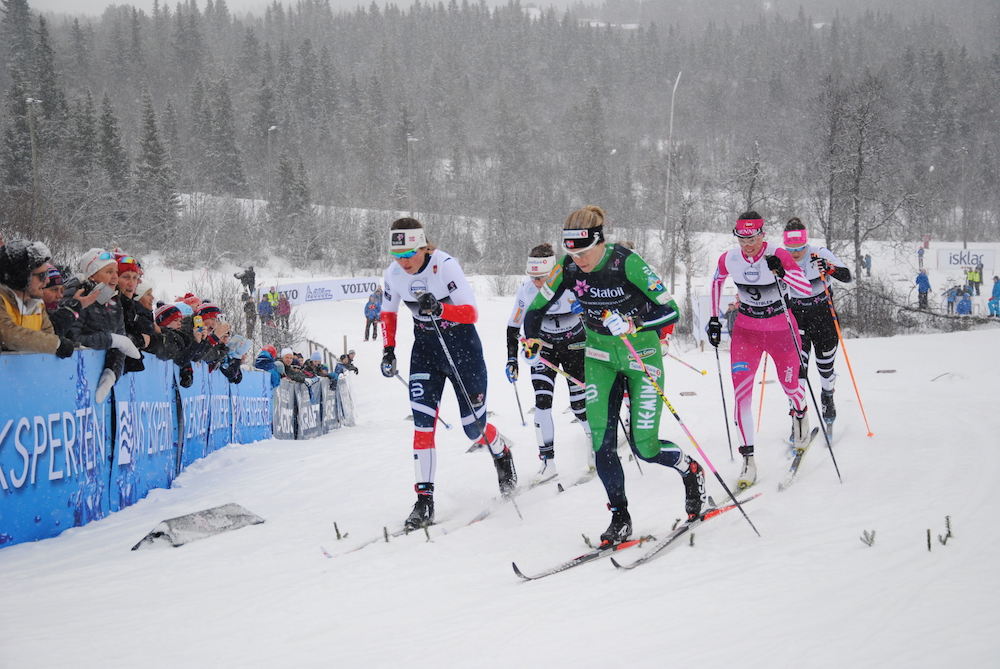
Maiken Caspersen Falla (l) leading the women’s final up a climb, along with fellow Norwegian national team member Astrid Uhrenholdt Jacobsen (in green) during the women’s 1.5 k classic sprint FIS race on Saturday in Beitostølen, Norway. (Photo: Aleks Tangen)
In the women’s race, Maiken Caspersen Falla controlled the women’s race in a similar fashion to Klæbo, winning the qualifier, quarter, semi, and ultimately, the final.
In the final, Falla, who won last year’s Beitostølen skate sprint as well as her second-straight Sprint World Cup Crystal Globe, skied with the pack until the final climb where she made her move before entering the final stretch alone. Falla, 27, finished 3.7 seconds clear of anybody in 3:01.1. In another all-Norwegian final, Mari Eide placed second and Astrid Uhrenholdt Jacobsen claimed third (+4.8). Tiril Udnes Weng placed fourth (+6.7), Kari Vikhagen Gjeitnes was fifth (+11.1) and Ane Appelkvist Stenseth was sixth (+18.5).
Falla started the morning with a qualifying win in 2:54.86, 1.77 seconds ahead of Slovenia’s Katja Visnar in second. She didn’t slow down much for the heats, racing to first in each in 3:01.7, 3:02.3 and 3:01.1, respectively.
“I felt that it went better and better and it’s wonderful to have that feeling when you’re sprinting,” Falla told NRK after.
After watching her attack and pass three women on the final hill, NRK commentator Fredrik Aukland called her “the best sprinter in the world”.
When asked if this performance was good enough to win any race in the future, she told a group of reporters, “I hope so, of course. There is finishing hill already next weekend that is kind of similar to this one and I have practiced running up hills a lot so it’s obviously fun to test it in a race.”
Teammates with Newell on the Stratton Mountain School (SMS) Elite Team, Anne Hart raced to 31st for the second day in a row, missing qualifying in the top 30 by 0.28 seconds.
“I am happy about my qualification,” she told FasterSkier immediately after her race, before she knew whether her time was fast enough for the heats. “The course is a lot faster than yesterday, good condition.”
Hart started the qualifier third out of 58 women, just ahead of Visnar in bib 4. Her time was 17.55 seconds back from Falla’s.
“I skied with Katja Visnar and she is really good classic sprinter,” Hart said. “… It feels really good to be able to ski with all these World Cup skiers.”
Nichole Bathe, who was born in the U.S. but is racing for Great Britain, finished 33rd (+19.26), about 2 seconds out of the top 30.
Canada’s Isabella Howden of Barrie Cross Country (BXC) finished 58th (+57.28) in the qualifier. In the men’s qualifier, her teammates Joey Foster and Scott James Hill finished 74th (+32.45) and 84th (+36.64), respectively, and fellow Canadians Ryan Jackson and Maks Zechel (who are training in Norway with Team Asker) finished 97th (+43.99) and 102nd (+48.48), respectively, out of 109.
The Beitostølen weekend concludes with 10/15 k freestyle individual starts on Sunday.
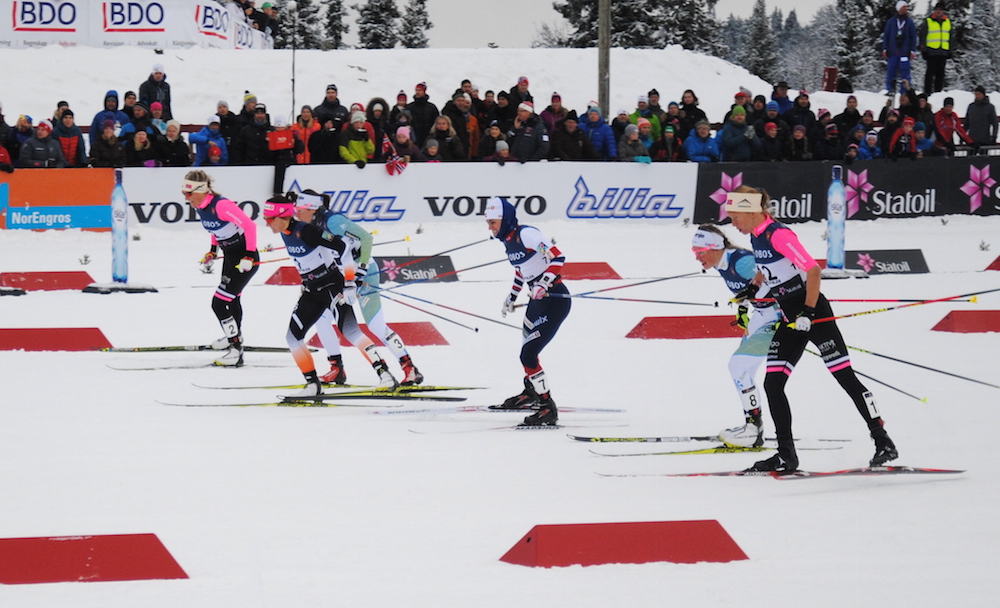
Norway’s Maiken Caspersen Falla (pink headband) leads out of the start of the women’s 1.2 k freestyle sprint final on Sunday in Beitostølen, Norway. (From left to right) Norway’s Mari Eide, Slovenia’s Vesna Fabjan, Falla, Norway’s Heidi Weng, Slovenia’s Anamarija Lampic, and Norway’s Silje Øyre Slind all reached the final. (Photo: Aleks Tangen)
BEITOSTØLEN, Norway — For the reigning Sprint World Cup champion who never lost a classic sprint last season (and placed first or second in all but one World Cup skate sprint), Sunday’s 1.2-kilometer freestyle sprint was about starting where she left off.
Norway’s Maiken Caspersen Falla did just that, qualifying first then cruising through the heats to win the women’s freestyle sprint on Sunday in Beitostølen. Part of a three-race series, it was held on the final day of Norway’s International Ski Federation (FIS) season-opening weekend — one weekend before the World Cup starts in Finland.
Falla, 26, took control of the day early, winning the prologue in 2:47.79 minutes. Afterward, she told NRK that she was satisfied with the result and that it was fun to race the sprint prologue. She carried her momentum through her quarterfinal and semifinal, advancing in the top two in each round, before beating Slovenia’s Vesna Fabjan in the final with a time of 2:42.3. Fabjan finished 0.2 seconds later in second, and Norway’s Mari Eide outlasted Heidi Weng for the final spot on the podium in third (+1.6). Weng, one of Norway’s top women who placed second in both distance races on Friday and Saturday, placed fourth (+2.4), while Slovenia’s Anamarija Lampic finished fifth (+3.2) and Norway’s Silje Øyre Slind was sixth (+5.2) in the final.
In an interview with FasterSkier on Saturday, Weng pointed that she didn’t qualify for the heats at last year’s sprint opener in Beitostølen. On Sunday, she qualified soundly in seventh, 4.2 seconds behind Falla.
Falla skated every heat with good control and technique, and kept her challengers from posing any real threats. Out of the start, the six finalists darted off the line at a high pace, and Falla immediately took control. Fabjan tried to challenge her in the final stretch, but Falla proved to be stronger. Her winning time in the final was the fastest of the day.
The prologue began at 8:30 a.m. and temperatures around -4 Celsius (25 degrees Fahrenheit). The highest-ranked athletes started first and the final standings already began to develop as the prologue came to an end. Falla, Eide and Fabjan clinched the first three qualifying places, just as they did in the final.
“I’m satisfied with the result and I’m happy to be in a sprint race again,” Falla told NRK after the race.
Of the 30 qualifiers, Norway’s 22-year-old Renate Bergset Tjetland was right on the edge in 30th (+18.26). Annika Taylor, who is originally from California but competes for Great Britain (while training with Norway’s Lillehammer Skiklub/Team Coop Talent), qualified in 27th, (+17.14). She started in the second heat and placed fifth, 12.1 seconds behind Weng, who won that quarterfinal.
“I’m happy about qualifying for the quarterfinal,” Taylor told FasterSkier afterward. “I feel like I got off to a good start and I tried to find the right lines, but I wasn’t able to follow in the final climb.”
The five quarterfinals starting at five minute intervals were won by Falla, Weng, Slovenia’s Katja Visnar, Eide and Fabjan, respectively. Slovenia’s Alenka Čebašek crossed the finish in second after Visnar, but was disqualified for an illegal lane change that impeded Norway’s Lotta Udnes Weng. Čebašek was relegated to last in the heat and 30th overall, while Lotta Weng advanced to the semifinals in second (where she went on to place fifth for 10th overall). Falla started out faster than everyone in her quarterfinal, but slowed down considerably in the final stretch, opening the door for teammate Astrid Uhrenhold Jacobsen to win the heat in 2:45.4, while Falla finished with the same time in second.
Falla seemed just as relaxed in her semifinal, which she won by 0.9 seconds over Heidi Weng.
“I thought it was a lot of fun and I’m really happy because I’ve never been in the final in Beito before,” Weng told journalists immediately after advancing to the final in second. “But I’m going to have to start better and work on keeping my speed up all the way when we get to the World Cup.”
Eide won the second semifinal by 0.2 seconds over Fabjan, while Lampic and Slind qualified for the final as lucky losers from the second semifinal in third (+0.6) and fourth (+1.0), respectively.
Canada’s Madison Fraser and Isabella Howden, both of Team Hardwood, placed 43rd (+29.12) and 45th (+43.07), respectively, in the qualifier.
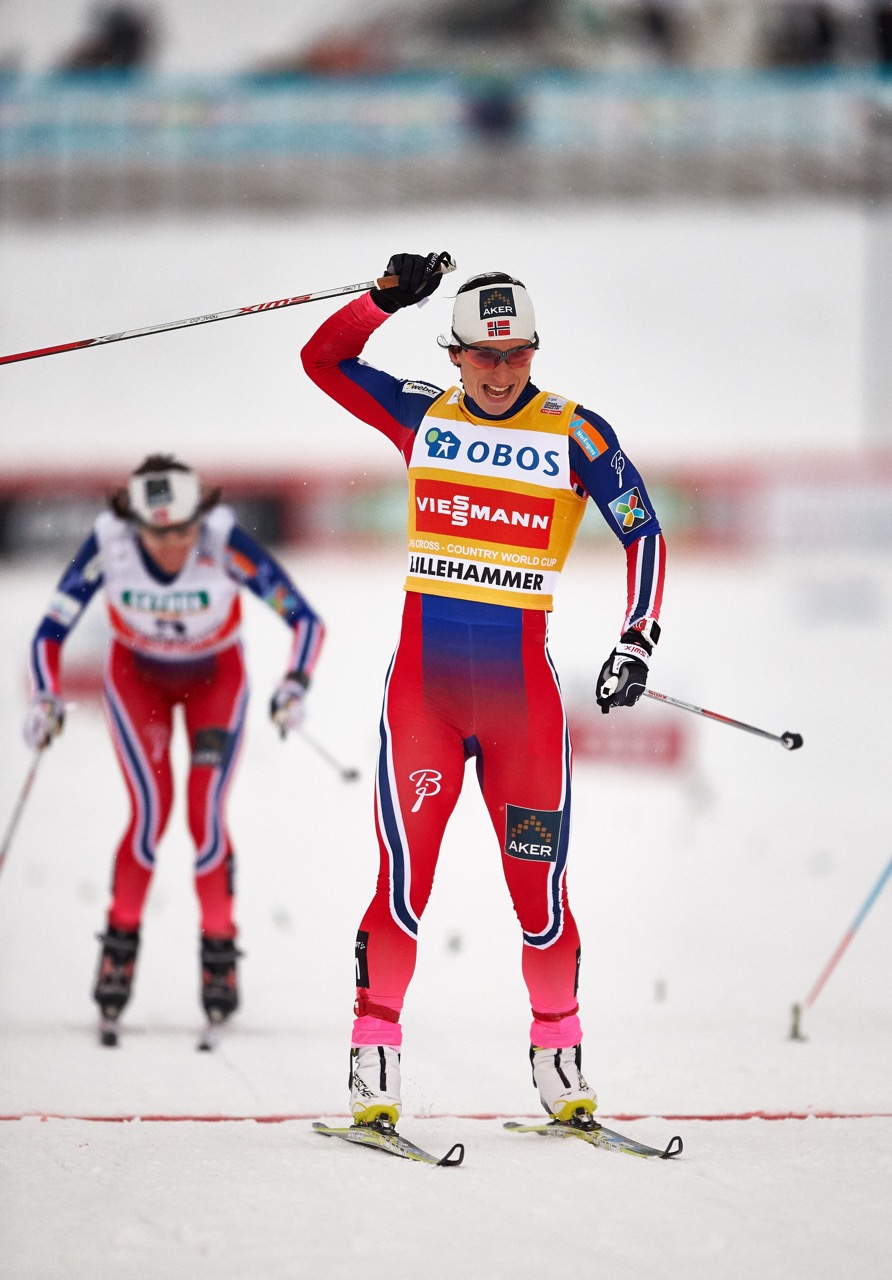
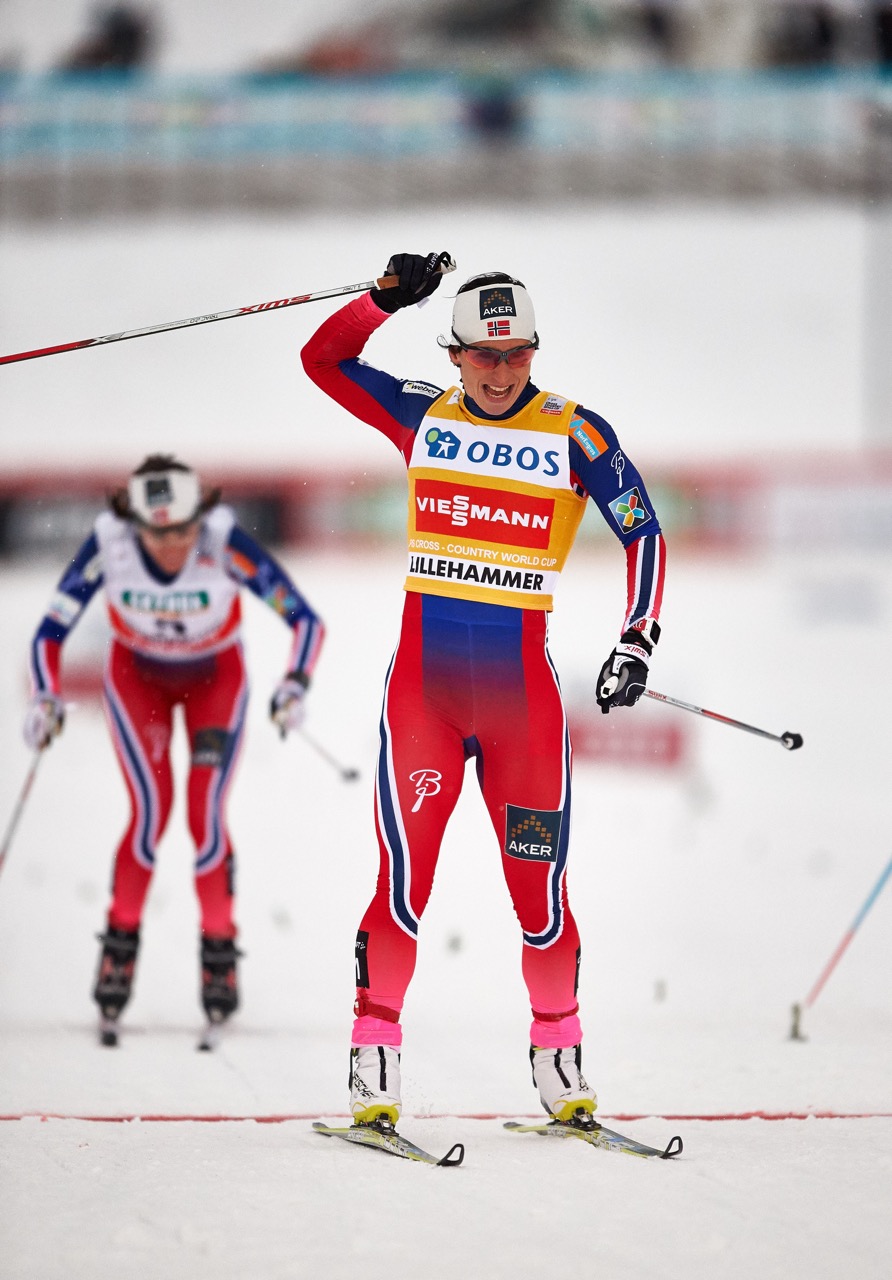
Norway’s Marit Bjørgen (yellow bib) leads teammates Maiken Caspersen Falla (l), Heidi Weng (behind) and Celine Brun-Lie (r) into the finish of the women’s 1.3 k freestyle sprint final on Friday at the Lillehammer World Cup mini tour in Norway. Bjørgen dominated every heat from the qualifier on to win the final by 0.76 seconds. (Photo: Fischer/NordicFocus)
Change happens. After four-consecutive seasons of the World Cup opening with the Ruka Triple in Kuusamo, Finland — all of which Marit Bjørgen won outright — Lillehammer, Norway, became the new host of the first mini tour of 2014/2015. And it opened with freestyle sprints on Friday.
Luckily for Bjørgen, skiing on home snow wasn’t a problem. It actually worked out for her quite nicely in the women’s 1.3-kilometer skate sprint. The overall World Cup leader since last weekend, Bjørgen (who won the opening classic sprint in Kuusamo) steamrolled the competition for her second-straight World Cup sprint victory on Friday afternoon.
Overall World Cup leader Marit Bjørgen (Norway) celebrates her second-straight sprint win in the first freestyle sprint of the season on Friday in Lillehammer, Norway. (Photo: Fischer/Nordic Focus)
“It is always fun to win. That’s what you train for,” she told NRK after the race. It’s a good thing it doesn’t get old.
To say she was a favorite would be an understatement — but there are never sure-things in racing. Most would put American Kikkan Randall right up there with her, after Randall’s won seven of the last 13 World Cup skate sprints, but it became apparent early on that showdown wasn’t going to play out in Lillehammer, at least not today.
Randall failed to qualify for the rounds after placing 43rd in the morning prelim. She was 12.48 seconds behind Bjørgen, the fastest woman’s qualifier, and 1.63 seconds outside the top 20.
The last time Randall missed out on the heats in a World Cup sprint was four years ago in Kuusamo— and that was a classic sprint. In 2009 in Lahti, Finland, she placed 47th in a freestyle sprint.
“My race shape is not quite 100% yet, and, in combination with battling a cold this week and possibly some tough skis for our team today, I missed advancing to the quarterfinals for the first time since spring of 2009,” Randall wrote in an email. “While this is not what we were all hoping for today, the good news is we get right back at it tomorrow with an individual start skate race. … I always love another chance to get out there and fight again!”
With Randall out of the picture (and Poland’s Justyna Kowalczyk out of qualifying in 37th), the next question to be answered was which Norwegian would win the day and by how much. After the morning qualifier, Bjørgen appeared primed for the heats, yet eight of the top 10 women were her teammates, or at least skiing for Norway. In total, 13 of the top 30 qualifying spots went to Norwegian women.
The quarterfinals started off with Bjørgen setting the early pace in the first heat, winning in 3:01.38. Of the five quarterfinal heats, her winning time was fourth-slowest. The fastest quarterfinal belonged to Norway’s Heidi Weng, who won the third heat in 2:59:55, 0.35 seconds ahead of Germany’s Denise Herrmann. In the fourth quarterfinal, Norway’s Therese Johaug pushed the pace up the final long climb back up to the stadium, but didn’t have quite the sprint kick in the finishing stretch and placed third, about half a second behind teammate Ingvild Flugstad Østberg in first (3:02.94) and 0.3 seconds back from Sweden’s Ida Ingemarsdotter in second.
The first women’s semifinal was stacked with three strong Norwegians: Bjørgen, Weng and Celine Brun-Lie, who took second in the second quarterfinal to Norway’s Mari Eide.
Bjørgen set a blistering pace in her semi, treating it more like a final than a qualifying round. She had skied similarly in the quarterfinal, controlling the pace and leading out of the start, but this time, she was out for a definitive win and the fastest time as well. She lead from start to finish and held off Weng by 0.14 seconds in 2:56.42.
Brun-Lie finished third in that semifinal, but moved on a lucky loser with a fast-enough time, along with Slovenia’s Katja Visnar in fourth.
The second heat showcased Norway’s Maiken Caspersen Falla, the winner of the fifth quarterfinal, and Herrmann. Falla beat out Herrmann in the photo finish in 3:01.51. Leading the race with Falla into the stadium, Østberg narrowly missed out on the final in third (+0.33). Ingemarsdotter dropped off the pace late to finish outside the top three, but nipped Norway’s Ragnhild Haga in a another photo finish for fourth (+2.12).
Of the six women in the final, four were Norwegian: Bjørgen, Weng, Brun-Lie, and Falla. Visnar and Herrmann toed the start line with them.
Now the question was how much energy Bjørgen had left after her rocket-fast semifinal. That was easily answered immediately after the start. She flew out of the gate and never looked back, as Weng led the initial chase, followed by Falla and Brun-Lie. Not far behind them on the first hill, Herrmann and Visnar appeared to conserve at the back.
Halfway through the final, it became clear that the two non-Norwegians simply couldn’t catch the four-woman train ahead of them. Bjørgen continued to lead the charge, with Falla, Weng, and Brun-Lie in tow at the bottom of the last grueling hill. By the top, Bjørgen remained in front, letting the teammates behind her duke it out for the remaining podium spots.
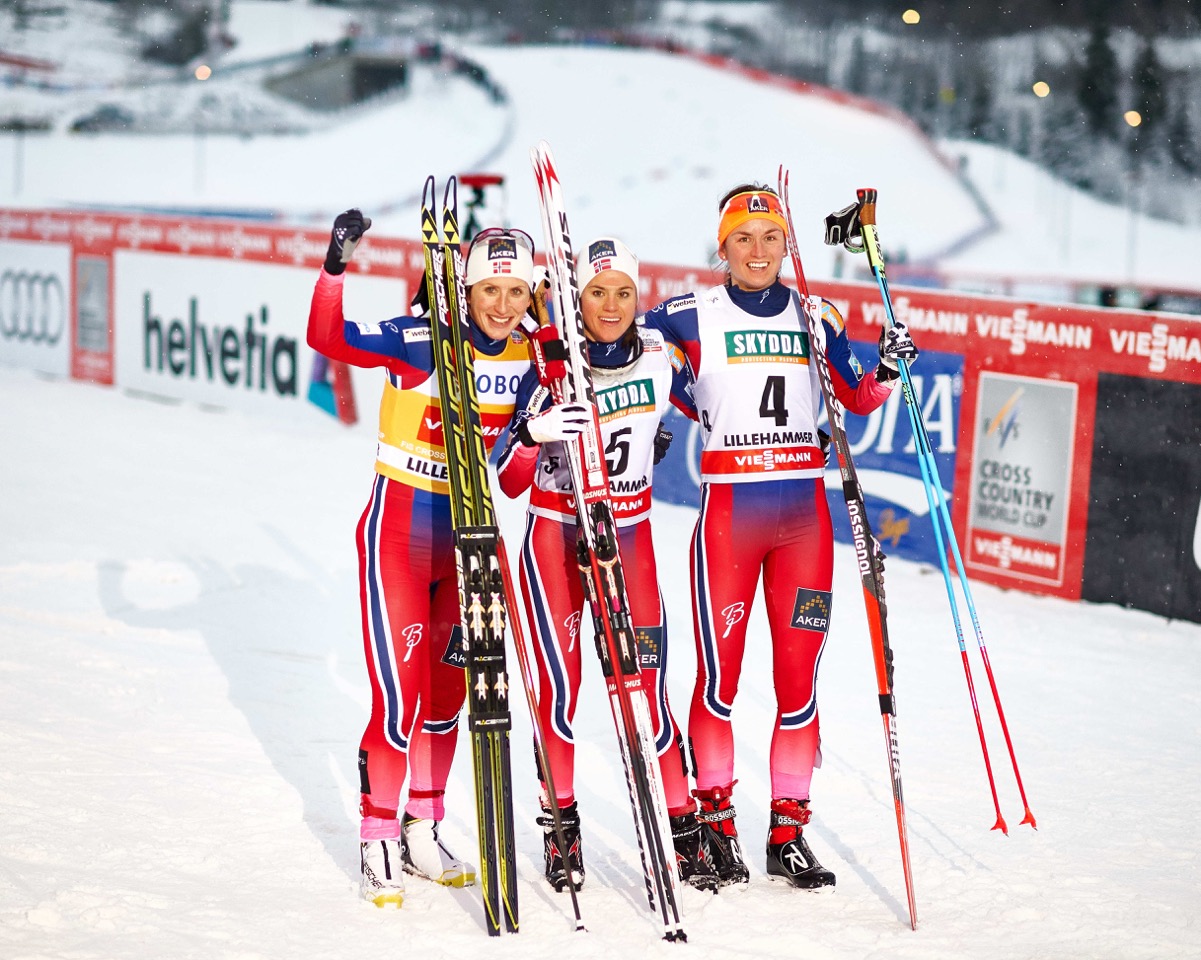
The all-Norwegian women’s skate-sprint podium on Friday in Lillehammer, Norway: winner Marit Bjørgen (l), runner-up Celine Brun-Lie (r) and Heidi Weng (c) in third. (Photo: Fischer/NordicFocus)
Bjørgen won it in 2:55.71 by 0.76 seconds over Brun-Lie, who edged Weng in a photo finish for second. Four-hundredths of a second separated the two, and Falla completed Norway’s top-four sweep in fourth, 1.43 seconds behind Bjørgen. Visnar took fifth (+4.43) and Herrmann finished sixth (+7.57).
Shortly after, FIS Media Coordinator Jeff Ellis was at a loss for words interviewing Bjørgen on camera. “We’ve done this many times. What would you like to answer today?” he said.
“I am very happy today. I was good in the prologue and also in the heats,” she responded. “Thanks to our men in the waxing cabin, it’s amazing how our skis have been in the last week and also this weekend. The shape is very good and today I feel very fast also.”
It was her 84th World Cup win (including stages), according to FIS, and Brun-Lie’s first World Cup podium since two seasons ago in Sochi, Russia.
“It’s been a long time since my last podium,” Brun-Lie told FIS. “I am very grateful for the support I got from the people around me.”
“I’ve had so many downs in recent years,” she told NRK while tearing up, according to a translation. “Now I am very happy.”
Weng said she had fun in the final with Bjørgen and Brun-Lie, despite being a little irked by Bjørgen’s repeated success.
“She’s a machine,” Weng told NRK. “That’s a bit irritating. I was thinking that if I could only hang on over the crest, I should be able to beat her. But she just puts a gap on you right away.”
“She’s a machine and difficult to beat. That’s a bit irritating.” — Heidi Weng, third in Lillehammer skate sprint on Friday, to NRK
“I tried to follow Marit so that she did not ski away too far, but she was very strong,” she told FIS. “I am very happy for the third place. I will try to have a good performance tomorrow and beat Marit.”
Bjørgen is currently first in the Lillehammer “triple” standings with a time of 2:27.5, 6.3 seconds ahead of Brun-Lie and 9.3 second in front of Weng.
Johaug, who didn’t advance past the quarterfinals, currently trails Bjørgen by 32.4 seconds. Sweden’s Charlotte Kalla is 36 seconds back and Kowalczyk 41 seconds behind.
Laurien Van der Graaf (SUI), shown here in the Milan, Italy World Cup, won both women's events at Bysprinten on Saturday.
No snow-speed records were broken at the sixth edition of Bysprinten, but the annual two-day ski festival on the streets of Mosjøen, Norway provided plenty of excitement for the 3,000 spectators who came out to see their favorite national team members ski as fast as possible. On Saturday, Eirik Brandsdal (NOR) prevailed in the men’s final sprint, and Laurien Van der Graaf (SUI) topped the women’s field.
“I am very fond of Bysprinten. I often do it well and it’s fun to go with so many people in the streets,” said Brandsdal.
Petter Northug, whose presence at the event was the most highly anticipated, provided a bit of drama in the semifinals when he tangled with Øystein Pettersen (NOR) and appeared to be out for the final. The jury ruled that Pettersen had blocked Northug, however, and sent him through. Northug ended up finishing fourth.
The Norwegian celebrity made no excuses — “I’ve relaxed on the couch for three months, so my ass is getting a little wide. I am not quite in top shape today,” he told the NRK.
In addition to the 1.5 k, the day’s program included a youth sprint, an elite 100 m individual sprint, and a “brothers relay” that set the Petter and Tomas Northug against Renato and Fabio Pasini (ITA) and Anders and Kristian Tettli Rennemo (NOR).
The Northugs lived up to their promise to “defend the family honor,” and defeated the Pasinis in second and the Rennemos in third.
In the 100 m dash, organizers had a radar gun on hand in anticipation of witnessing a new world record, but it was not to be — local newspapers reported that the direction of the straightaway was into the wind. Ola Vigen Hattestad (NOR) clocked in at 12.39 for the win over Petter Northug in second (12.60) and Anders Gløersen (NOR) in third (12.63).
“It was really fun to go today. I was not as good technically, but I did everything I could,” said Hattestad to the NRK.
Van der Graaf dominated the day from the get-go, taking the women’s 100 m in 13:48. Slovenia’s Katja Visnar took second (13.83) followed by Mari Eide (NOR) in third (13.96).
“It has been really fun and I enjoyed myself,” said Van der Graaf.
For the second straight day of sprint racing in Dusseldorf, Germany, the American women brought the fireworks.
During the second day of World Cup racing in Dusseldorf, the Norway I team of Mari Eide and Maiken Caspersen Falla took the win. In a surprise move, United States I featuring Sadie Bjornsen and Kikkan Randall crossed the line second, 1.6 seconds back of the Norwegians. The bronze medal went to Natalia Korosteleva and Natalia Matveeva of Russia I, who were 2.1 seconds behind Norway I.
While the Norwegians may have won the gold with an impressive final lap by Caspersen Falla, the story of the day was without a doubt the skiing of Kikkan Randall, paired with World Cup rookie Sadie Bjornsen, who picked up the first-ever Team Sprint medal for the U.S.
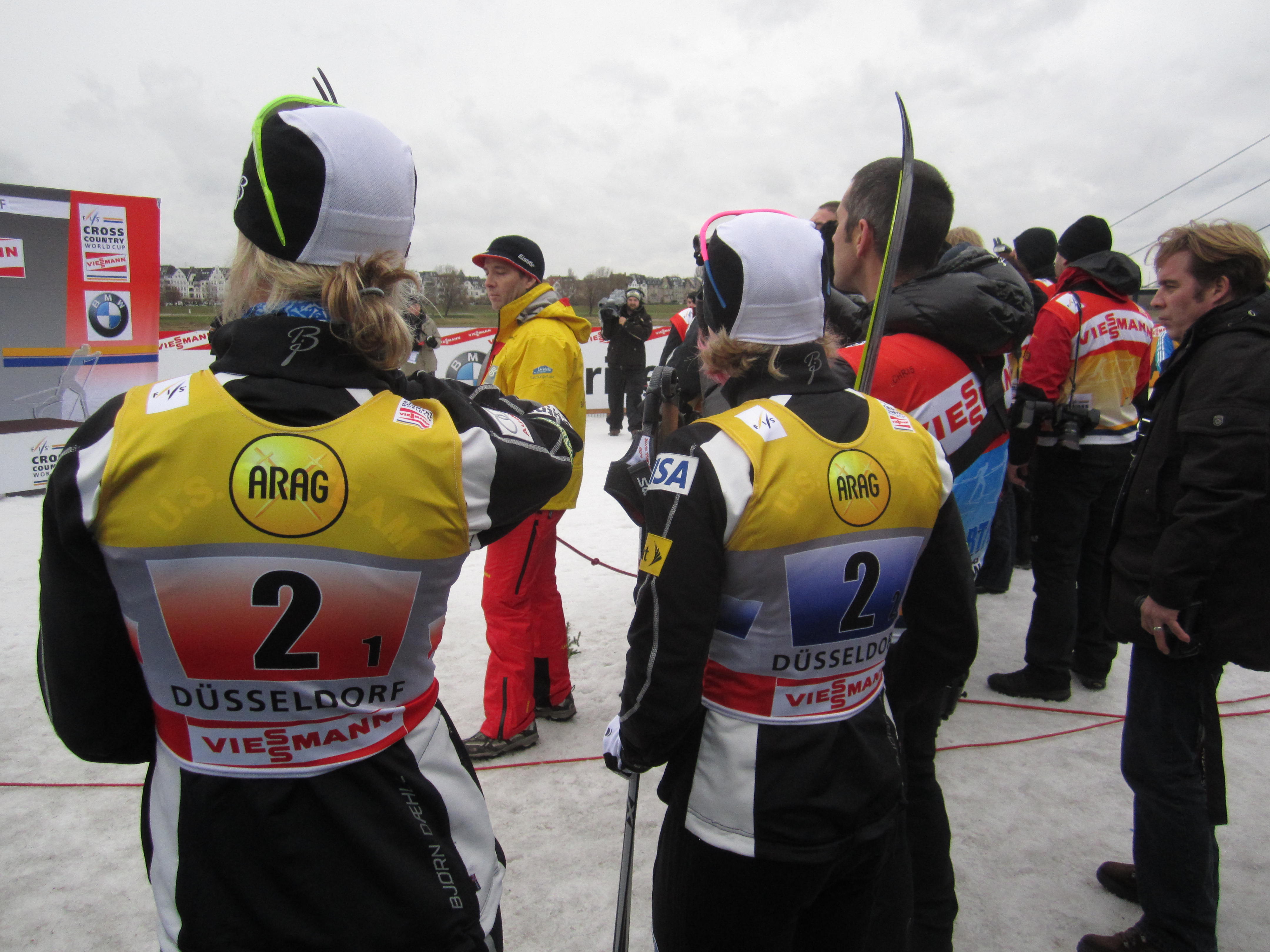
Sadie Bjornsen (L) and Kikkan Randall (R) await the first-ever U.S. Team Sprint podium appearence
From the early going, the American pair, while talented, was going to have to have a good day to make the final.
They were packed into the first semi-final with ten other teams, including the favored Slovenia I with Vesna Fabjan and Katja Visnar, Finland I, Switzerland I, as well as Sweden II and Norway II.
They action in the semi was fast and furious, with the Norwegians and Slovenians both launching attacks at various points. The Americans spent most of the first few laps bouncing around in the mid-pack, never falling out of contact.
Randall (L) and Bjornsen (R) on the podium
Bjornsen picked up the tag in fifth position on her last lap, and dropped a few spots back, but managed to tag off to Randall in a close eighth. Coming out of the exchange zone, Visnar (SLO) and Laure Barthelemy (FRA) made contact, and the Frenchwoman hit the snow hard, dropping her from contention.
Hard on their hills, Randall avoided the pile-up, and skied smoothly down the back straight, gliding up into second. On the final corner, she was challenged by Finn Riika Sarasoja-Lilja, but the American held her off, and churned out a strong finish to earn an automatic qualifying berth in the final behind Hanna Falk of Sweden II, thereby avoiding the agonizing lucky-loser wait.
In the second semi-final, Sweden I with Mia Eriksson and Hanna Brodin broke away from a contact-filled pack on the second last lap, skiing to a 1.4 second victory over Norway I. Canada I managed to secure third spot after Perianne Jones survived a dicey exchange with athletes falling all over the snow, including Germany I and Russia I. Chandra Crawford then skied anchor, and brought the Canucks home 2.4 seconds behind the Swedes in third place, which was good enough for a lucky loser position in the final.
An hour later, the ladies were lined up on the start grid again, awaiting the start of the final.
Just 200 meters in, narrow Dusseldorf claimed another victim, as Mia Eriksson (Sweden I) found herself lying on the snow, and it looked like the race was going to be about staying on your feet.
Bjornsen, who was next to Eriksson, was able to avoid the sprawling Swede, but was forced to slow and change direction slightly. She quickly dropped from the second row off the back of the pack.
Just one of the many hairy exchanges of the day. (Photo: Brad Jones)
The pace was high, with the Swedes and Norwegians both making early bids to spread the field out. On the second lap, the women were stretched out into single-file, with slight gaps appearing in spots. Randall made up some ground for the US, and Bjornsen continued to creep back toward the pack on her second loop.
However, on the third and fourth lap, the paced slacked off a little. While Sweden I and Norway I held strong at the front, the third spot was a revolving door of nations, including the Swiss, the Russians, and the Canadians. The slight down-turn in pace allowed Randall to regain contact with the top group as she made the hand-off, and Bjornsen settled in at the back of the main back as she headed out on her final lap.
The young sprinter managed to hold position, but tagged off to Randall down in sixth place – they were not on the radar, as the battle raged up front between the Finns, Norwegians and Russians.
The group bunched up a little climbing Mount Dusseldorf, and Randall made contact before blasting down the left, making several passes. Caspersen Falla broke contact with the tailing skiers, but Randall fought her way through the remaining traffic, including Canadian Chandra Crawford to lay down yet another incredibly strong finish to pick up the silver medal, leaving Russia I with third.
With the silver, Randall secured her second medal in two days, and continued her blockbuster season that has yet to see her finish out of the top 20.
“It’s just amazing,” said Randall after the race.
“With this course so fast, you had to race every lap like it was the last shot.”
Randall said she focused on skiing smooth, and didn’t worry too much about what place the team was in – she knew she wanted to set herself up for the final lap.
“People were looking stiff on the last lap, and I was still feeling strong,” Kikkan said of her impressive final lap.
After passing several people with what she described as “awesome” skis on the back portion of the course, she came hard around the outside of the last turn and headed for the line.
“I was happy to have a lot left again on the final straight,” she said of her finishing kick.
For Bjornsen, it was her first World Cup team sprint, and her first World Cup medal – the 21 year old was still in shock when FasterSkier talked to her.
“It’s the greatest thing to happen so far!” she said. “It hasn’t even sunk in yet!”
Bjornsen also appreciated the talent of Randall, who managed to secure the medal for the team.
“It helps to have a sprint champion like Kikkan [Randall] on your team, that’s for sure,” said Bjornsen.
While the Team Sprint is notoriously messy in Dusseldorf, both Americans felt the final was much cleaner than the previous heats had been, with skiers being “more calm.” However, Randall did note that the exchange zone was “always a mess.”
In her first team sprint experience, Bjornsen said she barely had time to think about what was happening.
“I was just going with it – it was so quick, and there was so much contact, you just had to react,” she said.
Looking ahead, the Americans hope to carry the momentum from the weekend into the next World Cup races in Davos, Switzerland, on December 10th and 11th.