From the FasterSkier archive — posts syndicated from athletes’ and coaches’ own blogs between 2004 and 2012, kept online as published. Current coverage is at fasterskier.com.

Tag: Maria Graefnings

  • Sunday Rundown: Falun, Duszniki-Zdrój, & The Marcialonga (Updated x4)

    Sunday Rundown: Falun, Duszniki-Zdrój, & The Marcialonga (Updated x4)

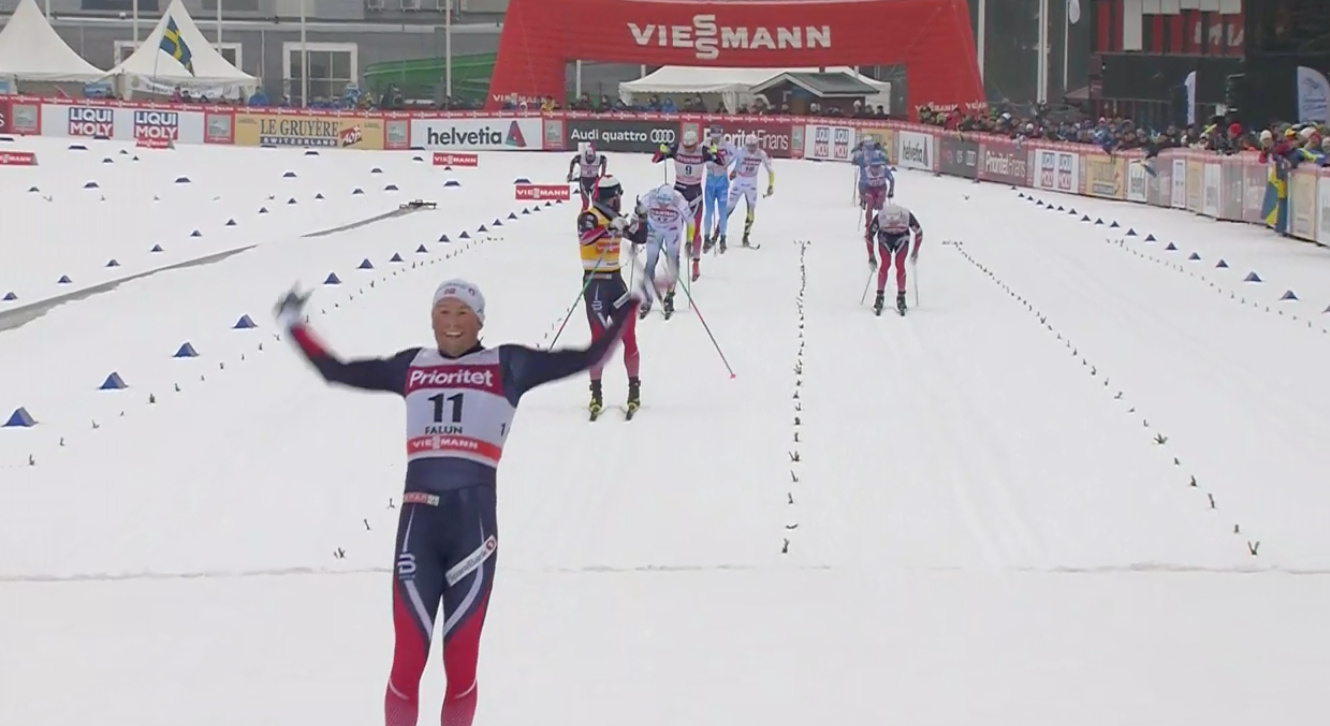
    Emil Iversen celebrates his win in the 30 k classic mass start in Falun, Sweden, on Sunday. Norwegian teammate Martin Johnsrud Sundby finished second and Sweden's Calle Halfvarsson third.
    Emil Iversen celebrates his win in the 30 k classic mass start in Falun, Sweden, on Sunday. Norwegian teammate Martin Johnsrud Sundby finished second and Sweden’s Calle Halfvarsson third.

    FIS Cross-Country World Cup (Falun, Sweden): 15 / 30 k classic mass start

    Women’s report | Men’s report

    In the women’s 15-kilometer classic mass start on Sunday, Norway swept the podium with Marit Bjørgen taking the win in a time of 41:28.8 in Falun, Sweden. Crossing just half a second behind her was her teammate, Ingvild Flugstad Østberg in second place. Rounding out the podium was Heidi Weng in third (+8.1).

    American Jessie Diggins was the first to cross the line for the U.S. in 10th (+1:37.5). Three other U.S. women finished in the top 30, with Sadie Bjornsen finishing 21st (+2:43.6), Rosie Brennan 24th (+2:57.0), and Liz Stephen in 29th (+3:24.5).

    Just outside of scoring World Cup points was American Caitlin Patterson in 32nd (+3:47.6) and Ida Sargent in 34th (+4:02.8). Canada’s Cendrine Browne finished 46th (+5:41.4) and American Liz Guiney 49th (+6:22.6).

    After losing the skate sprint yesterday in a photo finish to Italy’s Federico Pellegrino, Emil Iversen ascended to the top step of the podium in the men’s 30 k classic mass start on Sunday in Falun.

    The Norwegian was often near the front, but hadn’t tried to lead a breakaway like his teammates Martin Johnsrud Sundby and Sjur Røthe did earlier in the race. In the final two kilometers, Sundby – the overall World Cup leader – put in a sprint to try to drop the field. But Iversen caught up, drafting his veteran teammate into the stadium. In the final up-and-over before the finish line, Iversen made a pass and then accelerated down the finishing stretch to beat Sundby by 1.14 seconds.

    “I got motivation from yesterday’s last 20 meters,” Iversen told FIS in a finish-line interview. “So today I fought all the way, and I was really stronger. It is amazing for me to be second yesterday and first today. I’m really proud of that.”

    Calle Halfvarsson, who had been falling off the back of the lead pack just a few kilometers earlier, managed to get back to the front and claim third place for Sweden (+1.72 seconds) in a photo finish with Røthe (+1.76 seconds). Niklas Dyrhaug was next (+2.52 seconds) to give the Norwegian men’s team four in the top five.

    In his return to the World Cup stage, Norway’s Petter Northug finished 31st (+3:10.6).

    Alex Harvey was the lone Canadian on the start line. After skiing near the front of the field for the early part of the race he was dropped by the lead pack in the final kilometers, finishing 15th (+1:17.5).

    Erik Bjornsen and Noah Hoffman took 35th and 37th places for the United States, finishing +3:30.8 and +3:59.8, respectively. SuperTour leader Matthew Gelso — familiar with the Falun course after competing in 2015 World Championships — finished 44th (+5:23.6), and Andy Newell placed 53rd (+7:45.3).

    Results: Men | Women

    ***

    IBU Open European Championships (Duszniki-Zdrój, Poland): Single mixed & mixed relay
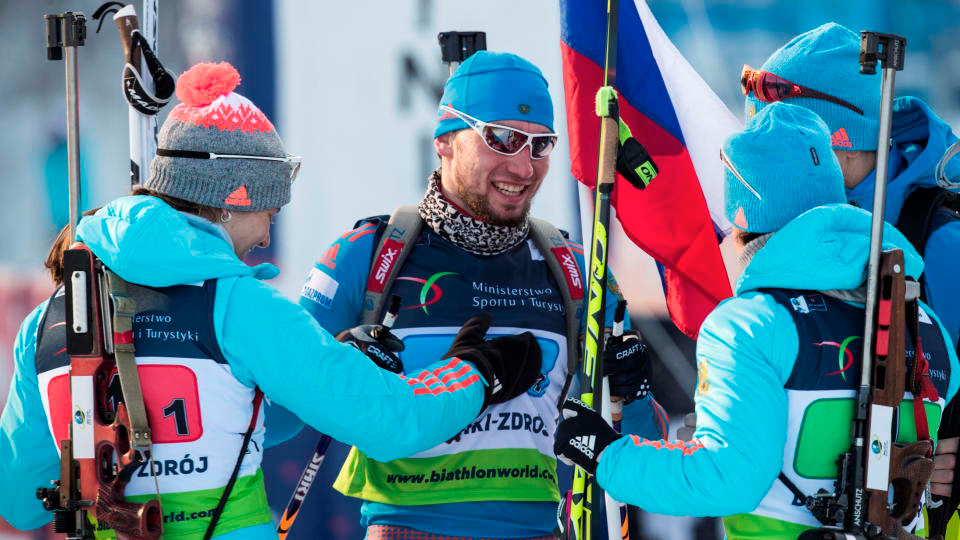
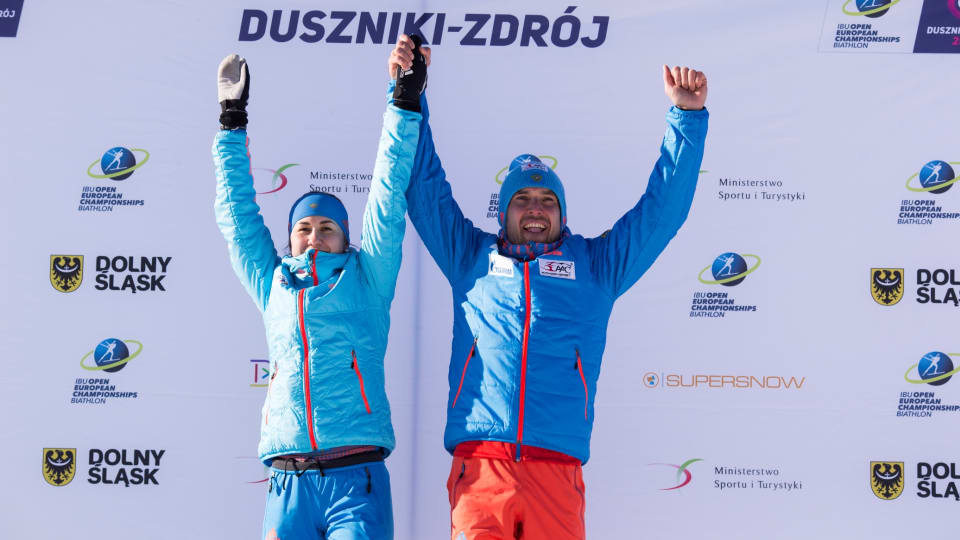
    Russia’s Alexander Loginov (center) is greeted at the finish by his teammates Irina Starykh, Svetlana Sleptsova and Alexey Volkov after anchoring his team to the gold medal in the mixed relay at the 2017 IBU Open European Championships in Duszniki-Zdrój, Poland. (Photo: IBU)
    Russia’s Alexander Loginov (center) is greeted at the finish by his teammates Irina Starykh, Svetlana Sleptsova and Alexey Volkov after anchoring his team to the gold medal in the mixed relay at the 2017 IBU Open European Championships in Duszniki-Zdrój, Poland. (Photo: IBU)

    [UPDATED] The Russian victory in the final 2 x 6 + 2 x 7.5-kilometer mixed relay event of the 2017 International Biathlon Union (IBU) Open European Championships in Duszniki-Zdrój, Poland, was only briefly in doubt, when Alexander Loginov skiing the anchor leg required all spares in his prone shooting stage. But with his final shot he managed to also hit that target to avoid the penalty lap, leaving the range with a lead of more than 30 seconds.

    Loginov then did not need any spares in the last standing stage, and could take his time on the final loop. Unlike Russia’s Evgeniy Garanichev earlier in the day during the single mixed relay, he also managed to pick up a flag for the final meters of the race, crossing the line in a time of 1:12:26.0 hours.

    The Russian team with Irina Starykh, Svetlana Sleptsova, Alexey Volkov and Loginov led from the first exchange and required only six spares with zero penalties.

    With this medal, the 28-year-old Volkov became the most successful athlete in history at European Championships, according to an IBU press release, surpassing the retired Polish biathlete Tomasz Sikora. Russia was the most successful team of the 2017 Open European Championships with six gold, four silver, and three bronze medals.

    Behind them, a number of teams vied for the positions on the podium. Sweden initially looked like a strong contender exchanging in second place after the women, but fell back with three penalty laps to only finish 10th.

    Still six seconds back after the final shooting, Norway’s Fredrik Gjesbakk caught up to and outsprinted Ukraine’s Ruslan Tkalenko in the finishing stretch to claim the silver medal (+36.4) with the bronze left for Ukraine (+37.1).

    “I thought that I made sufficient gap to win silver,” Tkalenko told the IBU. “But in the end, on the final downhill before the finish, I was very surprised when the Norwegian guy passed me, I truly did not expect that.”

    The Norwegian team with Karoline Erdal, Marion Rønning Huber, Erlend Bjøntegaard, and Gjesbakk needed nine spares and had no penalties.

    Ukraine with Anastasiya Merkushina, Yulia Dhzyma, Oleksander Zhyrnyi (who originally started for Russia before making the switch in 2014) and Tkalenko required six spares, and Dhzyma had to ski a penalty lap only temporarily setting the team back.

    Bulgaria finished fourth (+1:16.4), with its anchor Vladimir Iliev narrowly beating Czech Republic’s Lukas Kristejn (+1:17.4) in the finishing stretch. Both teams needed 11 spares and had no penalties.
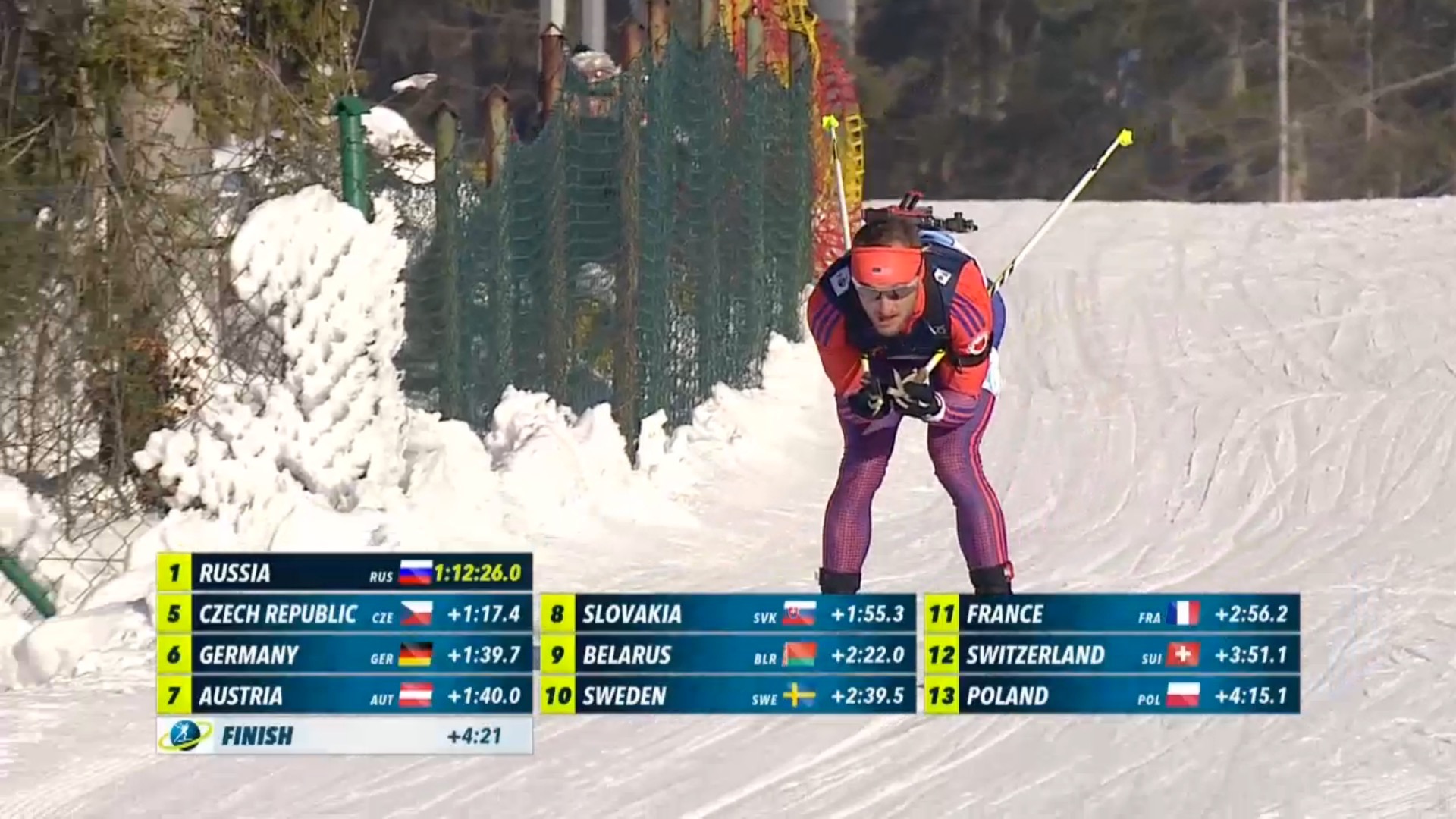
    Jakob Ellingson skiing the anchor leg for the U.S. mixed relay at the 2017 IBU Open European Championships in Duszniki-Zdrój, Poland. The U.S. team finished 14th. (Photo: IBU/Eurovisionsports.tv screenshot)
    Jakob Ellingson skiing the anchor leg for the U.S. mixed relay at the 2017 IBU Open European Championships in Duszniki-Zdrój, Poland. The U.S. team finished 14th.
    (Photo: IBU/Eurovisionsports.tv screenshot)

    Starting at the back of the field in bib 20, US Biathlon’s Emily Dreissigacker got her team off to a strong start with a clean prone shooting and one spare round in standing, exchanging in 10th, a minute behind the leaders. Hallie Grossman needed one spare in each of her stages, tagging off to the men in 14th position and now 2:39 behind. Max Durtschi also had one miss each in prone and standing, coming into the last exchange still in 14th position, but another minute back. Jakob Ellingson required all three of his spares in his prone shooting stage narrowly avoiding the penalty lap, and one more in his final shooting stage. As the team from Finland was racing over a minute behind the Americans, he was able to keep the 14th position into the finish (+4:47.4), with a team total of nine spares and no penalties overall.

    For Biathlon Canada, Erin Yungblut starting in bib 19 shot clean in her prone stage and required two spares in her standing shooting, tagging off in 18th position and more than two minutes back from first. Leilani Tam von Burg stayed clean in her prone shooting stage and needed one spare in standing, moving up two positions to exchange in 16th place, yet more than four minutes behind the leaders. After the exchange to the men, both Matthew Neumann and anchor Carsen Campbell managed to shoot clean in all of their stages, but lost additional time on the course to finish 16th (+6:39.9) ahead of four lapped teams.

    Canada had the best shooting result of all 20 teams starting the relay, with just three spares and no penalty.
    Russia’s Daria Virolaynen (l) and Evgeniy Garanichev after winning Sunday's single mixed relay at the 2017 Open European Championships in Duszniki-Zdrój, Poland. (Photo: IBU)
    Russia’s Daria Virolaynen (l) and Evgeniy Garanichev after winning Sunday’s single mixed relay at the 2017 Open European Championships in Duszniki-Zdrój, Poland. (Photo: IBU)

    Earlier on Sunday, pretty much the only thing that went wrong for Russia’s Daria Virolaynen and Evgeniy Garanichev in the single mixed relay happened on the last meters of the finishing stretch, with Garanichev gesturing for a Russian flag he wanted to cross the line with. But the handoff was too short and the flag dropped past his outstretched hand to the snow. He glanced back, weighing if his lead was big enough to ski back, but decided it was not worth the risk, instead skiing into the arms of his partner waiting for him behind the line in a time of 37:10.2 minutes.

    Russia needed seven spare rounds and incurred zero penalties. Garanichev secured the victory in the final shooting, when he only needed one spare – albeit fumbling a few seconds to insert it – while his direct opponents standing next to him required more time to hit their targets.

    “Probably, I took some risk at the last standing,” Garanichev said, according to an IBU press release. “I wanted to shoot fast and clean, but missed with the last shot. But in general, I felt very comfortable; came and worked at the range in my rhythm.”

    6.3 seconds behind, Norway with the team of Ingrid Landmark Tandrevold and Vetle Sjåstad Christiansen placed second, with seven spares and zero penalties.

    “These are very short loops,” Christiansen commented on the fairly new, single mixed relay format. “You feel the pressure from the crowd and to shoot fast every time.”

    The 20-year-old Tandrevold previously earned three bronze medals, including one in the single mixed relay, also with Christiansen, at last year’s Open European Championships in Tyumen, Russia.

    To big cheers from their home crowd fans who had come out to the Duszniki Arena in beautiful but cold weather, the Polish husband-and-wife team of Krystyna Guzik and Grzegorz Guzik placed third with just five spares and zero penalties (+13.9), not quite able to keep up with Christiansen on the final loop after leaving the range together within a second.

    “It is so nice to win a medal here in Poland,” Krystyna Guzik said. “We were both very disappointed with all of our mistakes in the other competitions. So today, we were relaxed and laughing before the competition, hoping not to have those mistakes again. We did not … and now have a medal.”

    It was the first medal for Poland at these championships.

    Ukraine with Iryna Varvynets and Andriy Dotsenko finished fourth, also with five spares and zero penalties (+20.9).
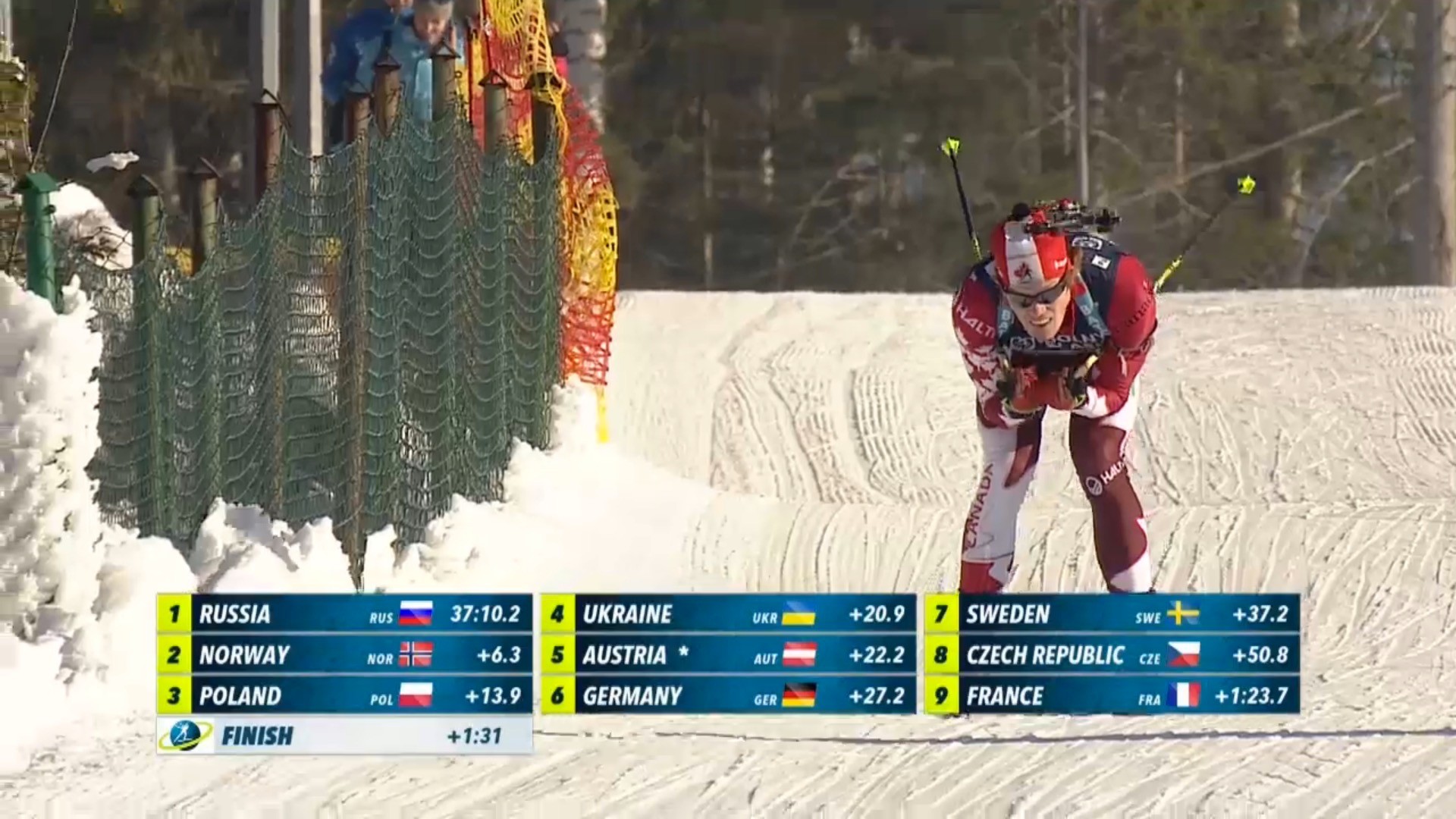
    Biathlon Canada’s Aidan Millar skiing the final loop of the single mixed relay at the 2017 IBU Open European Championships in Duszniki-Zdrój, Poland. With teammate Sarah Beaudry, Canada finished 13th (Photo: IBU/Eurovisionsports.tv screenshot)
    Biathlon Canada’s Aidan Millar skiing the final loop of the single mixed relay at the 2017 IBU Open European Championships in Duszniki-Zdrój, Poland. With teammate Sarah Beaudry, Canada finished 13th (Photo: IBU/Eurovisionsports.tv screenshot)

    For Biathlon Canada, Sarah Beaudry and Aidan Millar required seven spares during their race and had no penalty, just like the winning Russians and Norwegians, but could not quite keep up with the best teams on the course in the fast-paced race format with short loops somewhat comparable to a team sprint in cross-country.

    Beaudry cleaned her first shooting stage and then needed one spare to hit all targets in standing. At the first exchange Canada was 10th, 35.8 seconds behind the then leading team from Poland.

    Millar missed one shot in his first prone stage, leaving the range again in ninth position. Then he needed two spares in his standing shooting on the way to exchanging back to Beaudry in 11th (+56.4).

    On her second leg, Beaudry had one miss in prone and required two spares in standing, falling back a bit to exchange in 13th (+2:12.0).

    On his final leg, Millar was able to shoot clean in both stages, reducing the time gap to the top but not able to make up another position, and finished in 13th place (+1:56.1).

    US Biathlon is only represented with two women at the Open European Championships in Poland, and decided to forgo a start in the single mixed relay, instead entering a team in the mixed relay later on Sunday.

    — Harald Zimmer

    Results: Mixed relay |  Single mixed relay 

    ***

    Marcialonga (Val di Fiemme, Italy)
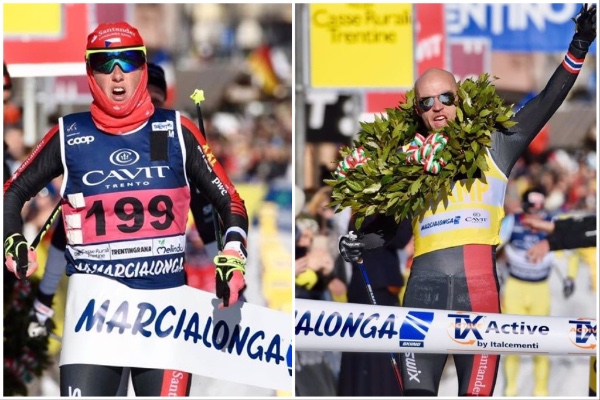
    Katerina Smutna (left) and Tord Asle Gjerdalen (right) of Team Santander won the 2017 Marcialonga. (Photo: Visma Ski Classics)
    Katerina Smutna (left) and Tord Asle Gjerdalen (right) of Team Santander won the 2017 Marcialonga. (Photo: Visma Ski Classics)

    Tord Asle Gjerdalen won the Marcialonga, a Worldloppet and Swix Ski Classics marathon for the third time – in a row. This year was on a shortened course, “just” 57 rather than the traditional 70 kilometers.

    The Team Santander athlete finished in two hours, eight minutes, and 36 seconds, edging Johan Kjølstad (Team United Bakeries) and Morten Eide Pedersen (Team BN Bank) in a sprint finish by 2.6 and 2.9 seconds, respectively.

    Tyler Kornfield and David Norris of Alaska Pacific University finished 43rd (+5:03.8) and 66th (+10:43.1). Canadian Paralympian Brian McKeever finished 57th (+9:13.5) and guide Graham Nishikawa 81st (+12:56.5), followed by Ian Murray in 85th (+13:37.5) and Erik Carleton in 111th (+17:50.2).

    In the women’s competition, Katerina Smutna, also of Team Santander, won her third straight Ski Classics competition. She crossed the line in two hours, 22 minutes, and 46.4 seconds. Britta Norgren of Team Lager 157 was second by just 0.8 seconds, and Sara Lindborg (Team Serneke) third, +4:22.2. University of Utah alum Maria Graefnings was tenth, +10:35.8.

  • Stephen Buckles Down on Single Pair of Skis, Wins U.S. Distance Nationals 30 k

    Stephen Buckles Down on Single Pair of Skis, Wins U.S. Distance Nationals 30 k

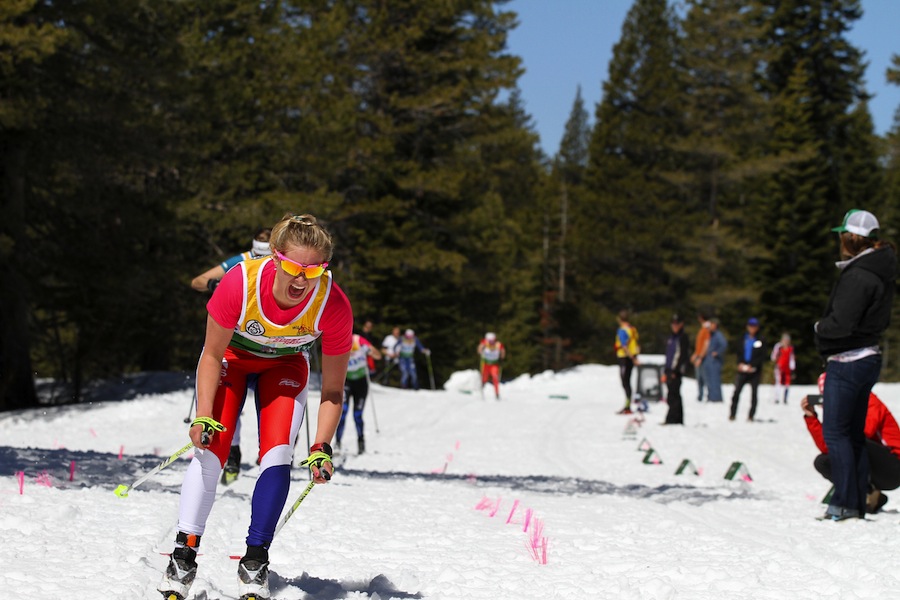
    Liz Stephen celebrates her second major win of the week at Spring Series in California, winning Wednesday's 30 k classic mass start at U.S. Distance Nationals at Royal Gorge. Two days early, she claimed the SuperTour Finals title. (Photo: Mark Nadell/MacBeth Graphics)
    Liz Stephen celebrates her second major win of the week at Spring Series in California, winning Wednesday’s 30 k classic mass start at U.S. Distance Nationals at Royal Gorge. Two days early, she claimed the SuperTour Finals title. (Photo: Mark Nadell/MacBeth Graphics)

    FasterSkier’s coverage of SuperTour Finals and U.S. Distance Nationals is brought to you by the generous support of Concept2, the leading manufacturer of indoor rowers, racing oars, and the SkiErg.

    NORDEN, Calif. – As the minutes ticked by in Wednesday’s 30-kilometer classic mass start, coaches paced around the start-finish area, checking their phones for updates.

    More than 30 minutes had passed without any sign of the leaders at the end of the first 10 k loop. Temperatures were already soaring into the 50s around 10:30 a.m. at Royal Gorge Ski Resort, making the three-lap endurance test even more of a grind.

    On the first of the two-day U.S. Distance Nationals, team-support staff readied for a surge through the exchange zone, an optional loop estimated to take about 40 seconds. Despite the penalty, most figured their skiers would want to use at least one of their two changes on a new pair.

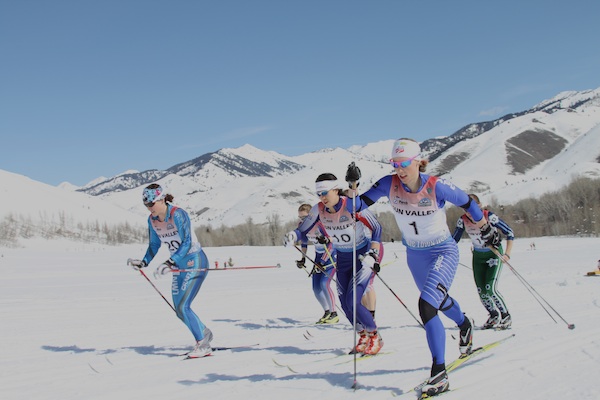
    U.S. Ski Team veterans Kikkan Randall (APU) and Liz Stephen (BMA) take control from the gun in Wednesday's 30 k classic mass start at U.S. Distance Nationals at Royal Gorge in Norden, Calif. Stephen went on to win by more than a minute. (Photo: Mark Nadell/MacBeth Graphics)
    U.S. Ski Team veterans Kikkan Randall (front right) and Liz Stephen (behind) take control from the gun in Wednesday’s 30 k classic mass start at U.S. Distance Nationals at Royal Gorge in Norden, Calif. Stephen went on to win by more than a minute. (Photo: Mark Nadell/MacBeth Graphics)

    Liz Stephen of the U.S. Ski Team (USST) and Burke Mountain Academy emerged out of the woods first, followed closely by USST teammate Kikkan Randall. Without any hesitation, the two began their second lap, skipping the exchange and setting the tone for the rest of the race.

    Randall’s teammate at Alaska Pacific University (APU), Rosie Brennan skied just a few seconds behind in third. If they weren’t going to switch skis in the soft-and-slushy snow, she wasn’t going to either.

    Suddenly, the race became a battle of sheer grit on average-at-best skis. Sixty degrees and sunny wasn’t going to be ideal for classic skiing no matter how you cut it. Might as well keep going.

    “I didn’t think they’d be any faster,” Stephen said of her decision not to change skis. “I tend to kind of be someone who’s pigheaded and just keeps going even if it’s not the fastest way.”

    Stubborn or just strong-willed, Stephen kept on plugging. The 26-year-old Vermont native led Randall by about 15 seconds through the end of the second lap at 20 k. Stephen continued with the same pair, waxed by USST serviceman Randy Gibbs and his support staff with the Craftsbury Green Racing Project, and Randall followed suit.

    Accelerating on the last lap, Stephen went on to finish first uncontested in 1 hour, 41:54.8 minutes. It was her second victory in as many races after Stephen won the SuperTour Finals title on Monday. She went on to take top honors at Distance Nationals in the last race of the season.

    Liz Stephen leading through the second of three laps in Wednesday's 30 k classic mass start at Royal Gorge in Norden, Calif. Stephen went on to beat Kikkan Randall by more than a minute for the U.S. Distance Nationals title. (Photo: Mark Nadell/MacBeth Graphics)
    Stephen leading through the second of three laps in Wednesday’s 30 k classic mass start at Royal Gorge. Stephen went on to win the U.S. Distance Nationals title. (Photo: Mark Nadell/MacBeth Graphics)

    “I’m super happy with it, and I mean, heck, I’m just excited to finish the season,” Stephen said. “As I’ve said before, this is a dream season and … as a U.S. team right now we’re really strong. It’s not just winning SuperTour Finals and U.S. championships. It’s a big deal now. We’re a very fast nation.”

    Unable to match Stephen’s attack up the long A-climb on the second lap, Randall took silver, 1:05.2 behind. Brennan, who skied most of the race alone, held on to third, 2:04.4 after Stephen.

    “On the second lap, last hill, [I] just kind of made a gap on Kikkan, didn’t really mean to make a move, it just kind of happened,” Stephen said. “I wasn’t sure whether I should keep going and try to make it bigger or whether I should chill out a little bit. … When she didn’t catch right back up, I thought, ‘What the heck? Let’s just see if I can hold it.’

    “I knew if she caught me again, it’d be really hard for me to stay with her and then try to beat in the end,” she added. “That’s not gonna happen. She’s got a globe full of jellybeans for a reason. I was telling myself over the tops of hills, ‘Just get over the top so she can’t see you!’ ”

    Cramping and tired after a long-yet-successful season, in which Randall won her second-consecutive Sprint World Cup and accompanying Crystal Globe, the world champion couldn’t respond. Her skis had been fast enough on the downhills and good on the climbs when she could find her kick, but as the race progressed (and her last feed went flying over her head with about 4 k remaining), that became harder for Randall to do.

    “I felt like I had the energy to do it, I just couldn’t,” Randall said. “My arms were starting to cramp and I couldn’t quite get on top of my skis to carry my momentum. For me in these kind of things, it’s such a technique thing, and sometimes I get it and sometimes I don’t.”

    Kikkan Randall (l) congratulates USST teammate Liz Stephen on her victory at U.S. Distance Nationals on Wednesday at Royal Gorge. Stephen won the 30 k classic mass start by more than a minute over Randall. (Photo: Mark Nadell/MacBeth Graphics)
    Kikkan Randall (l) congratulates USST teammate Liz Stephen on her victory at U.S. Distance Nationals on Wednesday at Royal Gorge. Stephen won the 30 k classic mass start by more than a minute over Randall. (Photo: Mark Nadell/MacBeth Graphics)

    Friends and housemates for the week with APU, Randall and Stephen talked about the ski exchange right before the race. Stephen wasn’t as confident in her second pair of skis. Randall felt they should see how the first lap went and make a call.

    “Coming into the exchange, I just decided, ‘No, I’m not gonna change, that’s my vote,’ ” Stephen said. ‘And she said, ‘Yeah, me neither. I’m just gonna keep going.”

    Forty seconds was too much time to waste, and the penalty ended up taking longer than a minute as the snow continued to soften.

    “With this added distance, it really changes the race,” said Randall, an International Ski Federation (FIS) athlete representative.

    “After they tested it out on the World Cup, I would say the majority of athletes didn’t like it. It’s definitely gonna be under review at the FIS meeting this spring. I was a little surprised they were gonna try it here.”

    As for the men’s 50 k classic mass start on Thursday, chief of competition August Teague told coaches they would shorten the zone to make it less of a penalty.

    But on Wednesday, it was an option few of the top finishers explored. After the first lap, Sadie Bjornsen (APU/USST) was the first to change her skis in sixth. She had been trailing Stratton Mountain T2 teammates Sophie Caldwell and Jessie Diggins (USST) in fourth and fifth, respectively. They nearly entered the transition until their coaches called them back, telling them to chase down the top three on the skis they were on instead.

    “I wish I would’ve known that everyone in front of me was not doing it,” Bjornsen said of the exchange. She spent the rest of the race trying to catch the chase group behind Brennan and succeeded on the second lap before falling behind on the third.

    “I think I just did it out of habit because I’ve done a couple ski exchanges in 30 k’s, never that you lose time on,” she added.

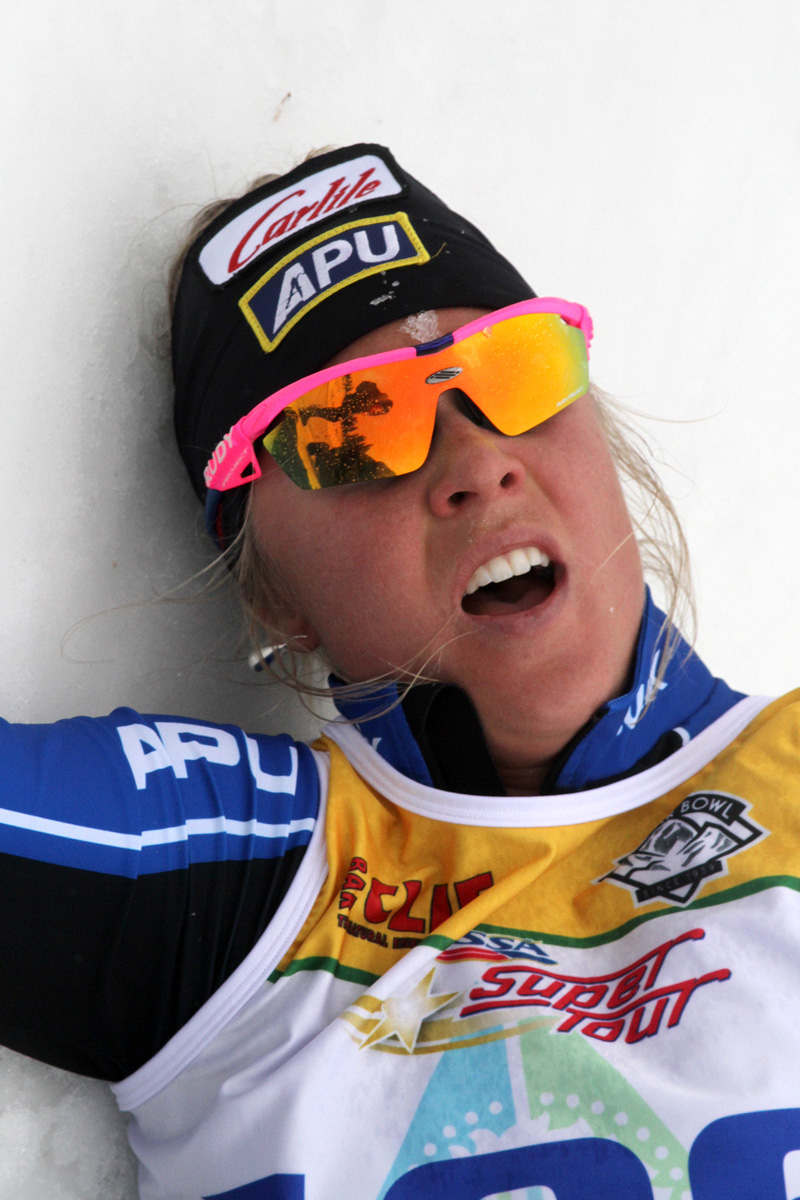
    An exhausted Jessie Diggins (SMST2/USST) after outsprinting four others for fourth place in Wednesday's 30 k classic mass start at U.S. Distance Nationals at Royal Gorge. (Photo: Mark Nadell/MacBeth Graphics)
    An exhausted Jessie Diggins (SMST2/USST) after outsprinting four others for fourth place in Wednesday’s 30 k classic mass start at U.S. Distance Nationals at Royal Gorge. (Photo: Mark Nadell/MacBeth Graphics)

    Diggins was one of the few top women who took a pit stop the second time around, rising from 10th to seventh toward the end of the last lap.

    She overtook Swedish B-team member Linn Sömskar, who double poled the first lap on skate skis along with fellow Swedes Lisa Larsen and Hanna Falk.

    Sömskar and Larsen led Randall and Stephen early in the race, but on a tough 10 k course marked by two significant climbs and several gradual hills, they fell behind before the end of the loop and switched to classic skis.

    “After the first lap, there was actually zero rest on the whole course,” Brennan explained of the slowing conditions. “There was not one place you could tuck without losing time.”

    On the last lap, Diggins worked her way up to Bjornsen, Swedish World Cup skier Maria Graefnings, Nicole Deyong (Sun Valley Ski Education Foundation), Caitlin Gregg (Central Cross Country), and Caldwell. She outsprinted them all to the finish, taking fourth 2:03.7 minutes behind Brennan and 1.5 seconds ahead of Caldwell in fifth.

    “It took me the entire nine k to catch them back again,” Diggins said. “Once I caught them, the skis had better glide. It’s kind of a risky, risky move, but I felt like I didn’t have a choice because they were getting slick. I decided I needed to switch.”

    The key to Brennan’s success was effectively not thinking about exchanges, but rather following the two World Cup veterans ahead of her. At the finish, she said it was one of the hardest races she’d ever done.

    “I’m beyond happy. That was one of the best races I’ve had this year,” Brennan said. “I’ve never had a good 30 k so to have it be the last race of the year is pretty awesome.”

     Rosie Brennan (APU) racing to third in Wednesday's 30 k classic mass start at U.S. Distance Nationals at Royal Gorge. (Photo: Mark Nadell/MacBeth Graphics)
    Rosie Brennan (APU) racing to third in Wednesday’s 30 k classic mass start at U.S. Distance Nationals at Royal Gorge. (Photo: Mark Nadell/MacBeth Graphics)

    Not far behind Stephen and Randall, who came through together after the first lap, Brennan remembered what APU head coach Erik Flora told her this season.

    “[He] had talked to me a lot about taking risks because I usually race too timid,” Brennan said. “So I was like, ‘Why the hell not? It’s the last race.’ ”

    With a good start and fast skis, she stuck with the two leaders. Stephen and Randall picked up the pace toward the end of the first lap, and Caldwell worked to stay with them. Brennan latched on as well.

    “I just got in the other track and went for it,” Brennan said. “I was able to catch back up to them, and I skied with them for another half lap.”

    The thought of changing skis hardly entered Brennan’s mind as Flora waved both Randall and her into the third lap behind Stephen.

    “I heard that it took a minute to do [the exchange] and a minute is so long to lose,” Brennan said. “Once you’re out of sight, it’s so hard mentally so I just was like, ‘That’s not worth it.’ ”

    Caldwell didn’t give it much thought, either. Pushing herself outside her comfort zone on the first lap, she said she was “a little worried” heading into the second. She recovered on the second loop while skiing with Diggins and Bjornsen, who had regained contact with them.

    “I figured as long as I stayed in a pack, speed wouldn’t matter as much ’cause I could try to draft,” Caldwell said. “I was afraid if I did change and I lost the group, I’d struggle to catch back up.”

    In search of better skis after the first lap, Graefnings followed Bjornsen into the exchange, and like Bjornsen, spent the rest of the race paying the price. Both worked to regain their spot in the chase group, and once there, Graefnings put on a final attack with what she guessed was “three or four” kilometers to go.

    “I’m a little mad at myself,” Graefnings said after losing the hunt for fourth and placing seventh, 4.7 seconds behind Diggins.

    “I did some tactical mistakes,” she explained. “I was starting with my second pair and that was not a good choice. I should’ve had my first pair all the way … I think the best three girls had their first pair all 30 k.”

    She was right. The top three skied on the same boards from start to finish. Diggins notched fourth with one change, Caldwell was fifth with none, and Deyong placed sixth (1.2 seconds after Caldwell) after switching her skis before lap two.

    “I know I lost some time, but once I realized that I had caught that second pack I just tried to hang on and survive,” Deyong said.

    The 30-year-old Sun Valley coach ended up surprising herself in her first distance race in a month since placing second in the 50 k Rendezvous Race in West Yellowstone, Mont. She also raced Monday’s hill climb up Sugar Bowl Resort, the final event of SuperTour Finals.

    “I hadn’t raced in a while and I jumped into the hill climb and I was like, ‘Why am I doing this?’ ” Deyong said after posting the 17th-fastest time up the mountain. “But I think jumping into that race helped me kind of blow the fumes out and just kind of get into that race mode again.”

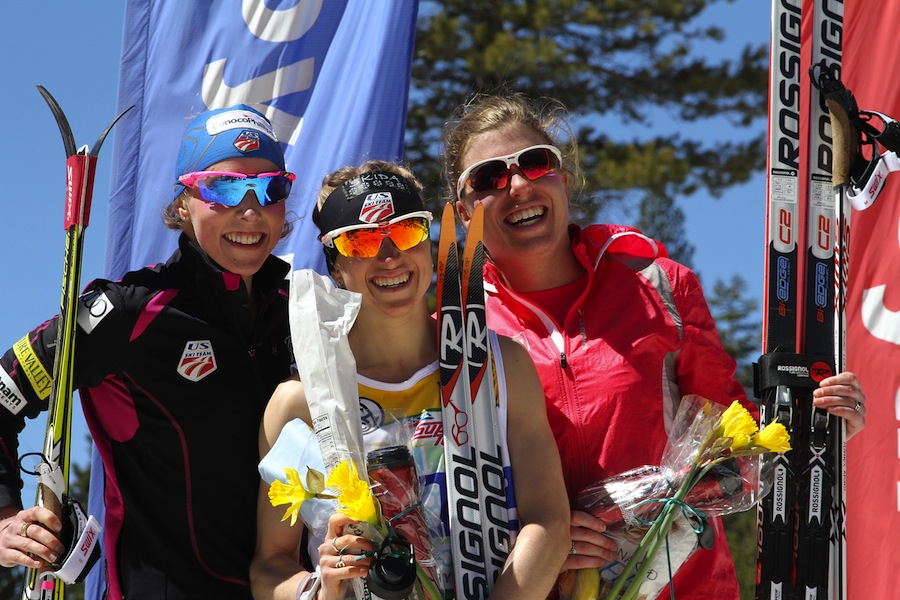
    The women's 30 k classic mass start at 2013 U.S. Distance Nationals. From left to right: runner-up Kikkan Randall (APU/USST), winner Liz Stephen (BMA/USST), and bronze medalist Rosie Brennan (APU). (Photo: Mark Nadell/MacBeth Graphics)
    The women’s 30 k classic mass start at 2013 U.S. Distance Nationals. From left to right: runner-up Kikkan Randall (APU/USST), winner Liz Stephen (BMA/USST), and bronze medalist Rosie Brennan (APU). (Photo: Mark Nadell/MacBeth Graphics)

    Graefnings finished 2 seconds behind Deyong on Wednesday, and Bjornsen took eighth, 3.4 seconds behind the Swede. Gregg finished ninth, 8.3 seconds after Bjornsen, and Sömskar was 10th.

    “I was falling off the back, catching back, falling off the back, catching back,” Bjornsen said. “The last kilometer it was just everything you had left in your tank. Mine was a bit limited.”

    Though disappointed, Bjornsen would remember her stellar SuperTour Finals, where she was third overall with four podiums in as many races.

    “Today was more just to test what I could do with what I had left,” she said. “All of us were out there absolutely digging, giving as much as we could, ever last bit of fuel we had. That’s a fun way to end because we dropped at the end. That was everything.”

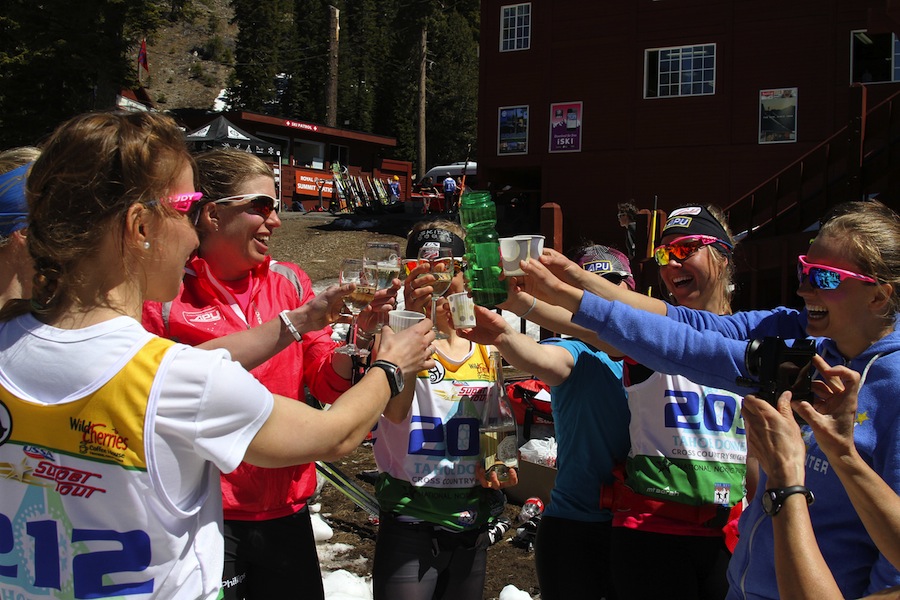
    Standings outside in T-shirts and sports bras, several of the top women sipped champagne and celebrated the end of the season.

    “Today was kind of epically tough conditions so you really feel like you had to grit it out,” Randall said. “When you get to that finish line, you just feel really satisfied about the race and the whole season.”

    “[It was a] really great way to end it here in California; the volunteers have done great things,” Stephen said. “Big thanks to everybody for the season. It was fun as hell.”

    — Audrey Mangan contributed reporting

    Results | Photos

    Clinking glasses (and plastic water bottles) to celebrate the end of the season at U.S. Distance Nationals on Wednesday at Royal Gorge Ski Resort in California. (Photo: Mark Nadell/MacBeth Graphics)
    Clinking glasses (and Dixie cups and water bottles) to celebrate the end of the season at U.S. Distance Nationals on Wednesday at Royal Gorge Ski Resort in California. (Photo: Mark Nadell/MacBeth Graphics)
  • Stephen Conquers Hill Climb to Snatch SuperTour Finals Victory from Randall

    Stephen Conquers Hill Climb to Snatch SuperTour Finals Victory from Randall

    Liz Stephen (Burke Mountain Academy/U.S. Ski Team) gasping for air as she finishes the 6.0 k hill climb with the fastest time of day and overall SuperTour Finals win. Photo: Mark Nadell/MacBeth Graphics.
    Liz Stephen (Burke Mountain Academy/U.S. Ski Team) gasping for air as she finishes the 6.0 k hill climb with the fastest time of day and overall SuperTour Finals win. Photo: Mark Nadell/MacBeth Graphics.

    FasterSkier’s coverage of SuperTour Finals and U.S. Distance Nationals is brought to you by the generous support of Concept2, the leading manufacturer of indoor rowers, racing oars, and the SkiErg.

    TRUCKEE, Calif. — It’s no secret that Liz Stephen (Burke Mountain Academy/U.S. Ski Team) has an affinity for skiing really hard climbs. Where other people struggle to wrap their minds around a race to the top of an alpine slope, the 26-year-old thrives in environments where she’s up against the mountain, the elements, and the pain and suffering they induce.

    Stephen was second in the world in the final climb of the Tour de Ski this January; and has proven time and again that she is unrivaled when it comes to going up the precipitous pitches that most people prefer do go down.

    For the ultimate stage of SuperTour Finals, a 6-kilometer freestyle hill climb at Sugar Bowl Resort, Stephen continued her impressive record and demolished the field by 1 minute, 44.9 seconds on time-of-day, with a finishing time of 27:57.7. The time gap, though considerable, is not really a surprise. After all, she won the Climb to the Castle rollerski race up Whiteface Mountain in September by five whole minutes.

    What’s surprising, however, was that she was able to surpass Kikkan Randall (Alaska Pacific University/USST) from 2:26 down in doing so, snatching the overall SuperTour Finals title by 38.3 seconds. After three stages, the tour victory had looked to be in the bag for Randall. But Stephen was on her game Monday and, in what turned into a critical factor, Randall handicapped herself when she skied off the designated trail up one of the course’s steepest pitches, losing valuable time.

    The win came as a surprise to Stephen, too.

    Kikkan Randall coaches' skating up the final hill before the finish. Photo: Mark Nadell/MacBeth Graphics.
    Kikkan Randall coaches’ skating up the final hill before the finish. Photo: Mark Nadell/MacBeth Graphics.

    “I honestly wasn’t expecting to catch Kikkan today,” Stephen said. “I was expecting to get close, but I thought that gap was going to be too big. But that just goes to show you go out and you try your hardest each day.”

    With hill climbs, the terrain on which a race unfolds is as much an active player in the outcome as are the people competing. For this particular race, athletes were treated to the additional challenge of extreme weather — as if to say that climbing a mountain on skate skis wasn’t hard enough, Mother Nature provided a special mixture of treacherously strong winds on Monday morning. The higher the course went up Sugar Bowl’s blue runs, the more extreme the wind became.

    “It was brutal,” Stephen said.

    “Brutal. Miserable,” echoed Chelsea Holmes of the Sun Valley Ski Education Foundation, who had the third-fastest time.

    Racers later spoke of having to adjust the angle of their pole plants so they could control where their baskets would land as the wind blew them sideways. The course was stripped down to the ice in some parts and piled up with dense drifts in others. Blowing snow pelted skiers’ exposed faces. A thousand feet above the starting line, the finish banner whipped threateningly in the wind. Nordic skiers are drawn to the sport for its singular difficulty, and the ingredients were all there for this hill climb to go down as one of the most memorable races of them all.

    Knowing what waited for them, the women lined up ready for anything at the base of the mountain. The race began with a flat, rolling 3 k before the real incline began.

    Randall left the start a full minute and nineteen seconds ahead of the next women, Sadie Bjornsen (APU/USST). Stephen didn’t set foot on the course until over a minute after that. But as soon as she did, the two women in front of her knew the clock would be running with Stephen hot on their tails.

    “I knew Liz would be coming by, of course,” Bjornsen said. “I was kind of making bets with her for how far it would be until she caught me.”

    The very first starter in the pursuit, Randall wasn’t fazed by being hunted down.

    “I mean, it’s fun,” she said. “I always view these hill climbs as it’s me versus the mountain, really. So it was fun to be out front, fun to know I had a chance. I knew it’d be close and it was.”

    The course brought skiers to the peak at 7,953 feet by way of two traverses across the face in between direct climbs up the slope. The flat first half of the race was merely a place to conserve energy and anticipate the impending suffer-fest.

    Once the climb began, athletes had to dance a fine line between making forward progress and avoiding the redline. Stephen can accomplish this task at a higher threshold than anyone else on impossible grades, and she tracked down Bjornsen, the first target in front of her, on traverse number one. Focused on her own internal battle, Bjornsen processed Stephen moving past her and quickly returned her attention to moving her own two feet.

    Sadie Bjornsen in the last few meters. Photo: Mark Nadell/MacBeth Graphics.
    Sadie Bjornsen in the first few meters. Photo: Mark Nadell/MacBeth Graphics.

    “It’s hard to look straight up the hill because that just makes it harder, so I watched her for a second when she went by me and then just put my head down,” Bjornsen said. “Just trying to keep a rhythm in my legs.”

    Up ahead, Randall was still a ways in front of Stephen. As the minutes ticked by and the hill kept going up through a tunnel of howling wind, Stephen frequently reminded herself that things could be worse.

    “I kept thinking [of when] I did this hill climb in Poland two years ago and it was like this day except no sun and we had no idea where we were going and it was like a whiteout and then you had to go down, also,” Stephen said. “The wind was coming at you the whole time, pushing you back downwards, and this was a least coming at the side of us or the back of us. So I kept thinking when it was getting really hard, ‘This could be worse this could be worse.’”

    She also kept her eyes on Randall, who was drawing ever closer. She watched as her friend and teammate made a critical error at a turn in the course and start going up the wrong way. Instead of staying inside the quickly-eroding blue borders that marked the course, Randall followed her line of sight up the more direct but incorrect route. By the time she realized her mistake and turned around to go the right way, she likely lost around half a minute.

    The way Randall described it later, the mistake was the product of being too exhausted in the moment to realize what was happening.

    “I saw a gate ahead of me and thought that’s where I needed to go,” she said. “I remember crossing the blue line but it didn’t occur to me that I shouldn’t be crossing the blue line… All a sudden I heard my name yelled out behind me and I was like, ‘Wow, everyone’s getting really excited cheering all of a sudden.’”

    When spectators kept yelling at Randall after she’d passed them, she knew something was wrong. She looked back and saw former APU skier James Southam running up to her, indicating she had to go back.

    “I saw the gate and I went, ‘Ahhhh…’” Randall said.

    So back down she went. On the correct course once more, Randall still had a few more turns to make before the top, and behind her, Stephen was getting ever closer. The race leader didn’t let herself think about the time she cost herself with the wrong turn, as it would have been counterproductive to the race yet to be skied.

    “At that point I was still focused on making it up that pitch,” Randall said. “My legs were really starting to tie up and I just focused on making steps forward.”

    There’s no telling how much of a difference that time made. Stephen closed in on Randall as they crested the top of the last big hill before they meandered along the ridge to the finish line. By the time they came within sight of the timing building, Stephen was well ahead of Randall and crossed the finish line 30:23.7 after the gun had gone off down below for a time-of-day mark of 27:57.7. But even after she’d passed her, Stephen didn’t quite count Randall out.

    “I looked back like three times because I was sure she was going to just outsprint me,” Stephen said.

    Instead, Randall looked tired as she double-poled across the finish. In the base lodge much later, she admitted the wrong turn and resulting loss was a bummer.

    “In the end with it being a little bit close, I could have used that extra 20 or 30 seconds,” she said.

    For Stephen, to end SuperTour Finals by winning it was simply an added bonus to a week that wasn’t geared towards results.

    “I didn’t have expectations this week at all,” she said. “I just wanted to come out and enjoy myself and I’ve totally done that, and I’m psyched to have won today. It’s so fun to end the season on a podium, for sure, but honestly the goal was to go out, have fun, go as hard as I can up that hill. And I happened to bring home a win today.”

    Bjornsen held on to her position and was third across the line, 1:35 behind Stephen. As a skier not traditionally suited towards climbing or skating, she was thrilled to hang on to a podium finish.

    “I’m definitely happy,” she said. “Deep down my goal was to finish still standing on the podium, but I didn’t know if that was realistic.”

    Sweden’s Maria Graefnings (Falun Borlange SK), who started fourth, held off a charging Jessie Diggins (SMST2/USST) to finish in the same position, crossing the line 3:12.6 behind Stephen. Climbing is not usually her strong suit, so she was happy to both hang on and to wrap up the tour in good standing against a strong U.S. field.

    “It’s super competitive; it’s such a good field here,” Graefnings said. “It’s good motivation for next season to see I can kind of keep up with those girls, ’cause they all had a really good season, so I’m happy.”

    Jessie Diggins comes across the line with the second-fastest time of the day. Photo: Mark Nadell/MacBeth Graphics.
    Jessie Diggins comes across the line with the second-fastest time of the day. Photo: Mark Nadell/MacBeth Graphics.

    Embedded within the pursuit-style climb was an individual race, too. Stephen had the fastest time-of-day by far, but it was Diggins who followed her with the next best time, much to her own surprise. Diggins started 10th, four minutes behind Randall, and clambered past five other people to finish fifth in the tour, seven seconds behind Graefnings.

    Diggins caught and passed Annelies Cook (Maine Winter Sports Center/USBA) and Susan Dunklee (Craftsbury Green Racing Project/USBA) on the early flats and later skied with Rosie Brennan (APU) on the climb.

    After the sprint on Saturday, Diggins had considered herself “physically and mentally done.” But with the help of some pink-and-purple race-day makeup, she amped herself up for another competition and was happy to learn that she was still ready to go for the final stage.

    “I was really quite burned out, so I had to go to some drastic measures to get myself excited today, including some lipstick and glitter and colors on my face,” she said. “It’s nice to be like, ‘OK, just get in the mindset one more time, you can do this.”

    It was a mantra she likely repeated to herself as she worked toward the top of the mountain with her poles blowing sideways.

    “It was definitely a real test kind of a day, a mental-stubbornness test,” Diggins said.

    Twenty-four seconds behind Diggins on time-of-day, Holmes was third fastest and 12th overall. She was pleased with the result, though she admitted to not being totally prepared for the difficulty of the course.

    “I was so not prepared, mentally,” Holmes said. “I was like, ‘Oh, it’s not as hard as Jay Peak’ (site of the hill climb in 2012). And then I was going up it and was like, ‘I am so dumb. I am so wrong’… It was tough.”

    Though the women still have a 30 k classic mass start to complete, Monday’s hill climb was the last SuperTour race of the season. There were double SuperTour points available at the Finals, and overall points leaders on the men’s and women’s lists will be going back to the World Cup in the fall. Brennan was the points leader going into the Finals and she still is now that the season is over. She finished sixth overall in the mini-tour, 10 seconds behind Diggins, with the seventh-fastest time of day.

    “More than anything I was hoping to keep the SuperTour lead, and I think I’ve done that now so that’s really nice,” Brennan said.

    If FasterSkier’s calculations are correct, Brennan ends the season with 582 SuperTour points to Bjornsen’s 399 points.

    Results: hill climb | SuperTour Finals.

    For more photos, head to MacBeth Graphics’ gallery.

    — Alex Matthews contributed reporting.

  • Sargent Gives Randall a Run at SuperTour Finals, World Cup Sprint Champ Prevails

    Sargent Gives Randall a Run at SuperTour Finals, World Cup Sprint Champ Prevails

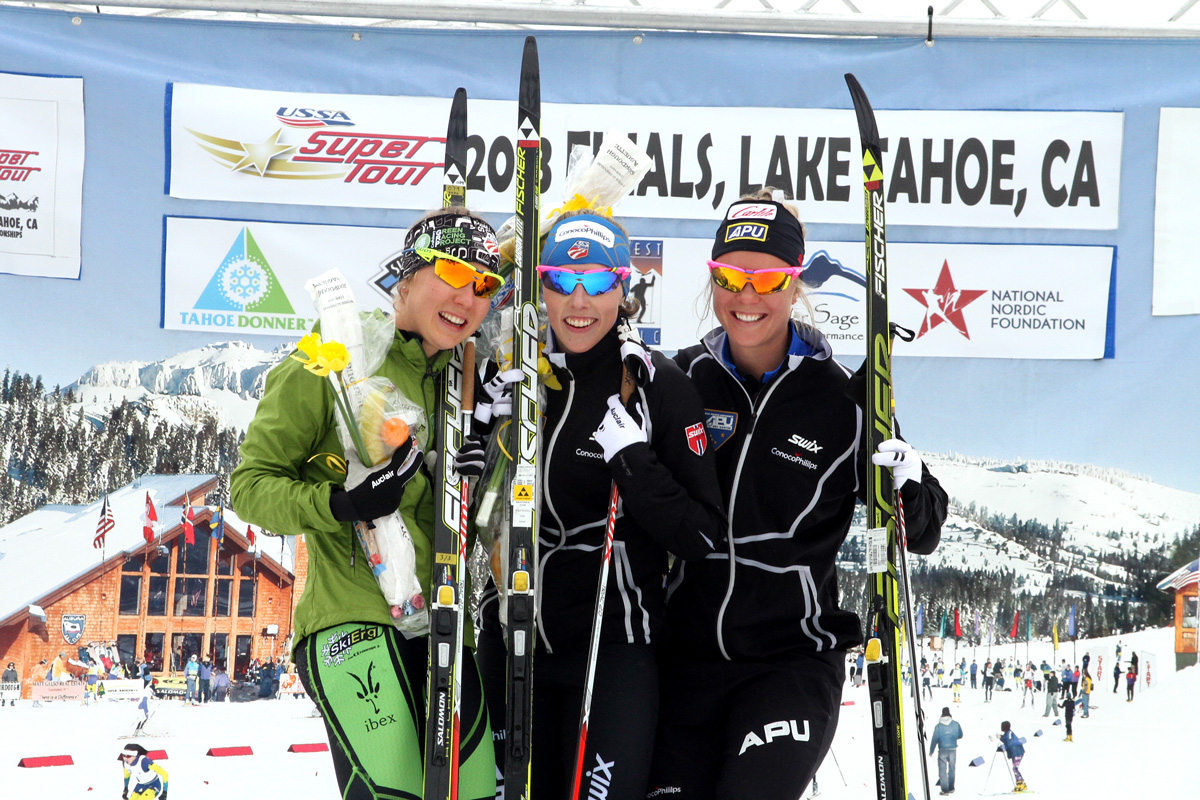
    The women's classic sprint podium at 2013 SuperTour Finals. From left to right: Ida Sargent (CGRP/USST) in second, Kikkan Randall (APU/USST) in first, and Sadie Bjornsen (APU/USST) in third. (Photo: Mark Nadell/MacBeth Graphics)
    The women’s classic sprint podium at 2013 SuperTour Finals on Saturday at Auburn Ski Club. From left to right: Ida Sargent (CGRP/USST) in second, Kikkan Randall (APU/USST) in first, and Sadie Bjornsen (APU/USST) in third. (Photo: Mark Nadell/MacBeth Graphics)

    FasterSkier’s coverage of SuperTour Finals and U.S. Distance Nationals is brought to you by the generous support of Concept2, the leading manufacturer of indoor rowers, racing oars, and the SkiErg.

    SODA SPRINGS, Calif. – Kikkan Randall is quick to note her weakness in classic sprinting, but few at SuperTour Finals wouldn’t have picked her to win Saturday’s 1.5-kilometer classic sprint.

    That made Ida Sargent’s underdog run to the final even sweeter.

    Kikkan Randall (APU/USST) in Saturday's 1.5 k classic sprint qualifier at 2013 SuperTour Finals. She posted the fourth-fastest qualifying time behind USST teammate Ida Sargent in first. (Photo: Mark Nadell/MacBeth Graphics)
    Kikkan Randall (APU/USST) in Saturday’s 1.5 k classic sprint qualifier at 2013 SuperTour Finals. She posted the fourth-fastest qualifying time behind USST teammate Ida Sargent in first. (Photo: Mark Nadell/MacBeth Graphics)

    Both U.S. Ski Team members, Sargent, of the Craftsbury Green Racing Project (CGRP), is six years younger and in her second season on the national team.

    Alternatively, Randall, an Alaska Pacific University (APU) staple, has been racing World Cups since 2001. At 30, she’s coming off her second-straight World Cup sprint crown and entered Saturday’s sprint undefeated in the first two races of the series.

    But on an above-freezing afternoon at Auburn Ski Club with a mixture of rain and snow falling sporadically, anything could happen. Fortunately, Sargent had adrenaline and top-notch wax technicians on her side.

    For Spring Series, Craftsbury enlisted the help of U.S. Ski Team (USST) service techs Randy Gibbs and Cory Wubbels, along with Eli Brown and the team’s own Nick Brown. On Saturday, two CGRP women and two of its men (Pat O’Brien and Tim Reynolds) made the finals. Sargent toed the line with teammate and U.S. Biathlon A-teamer Susan Dunklee.

    To get to that point, Sargent won the qualifier and successive heats thereafter. Suddenly, Randall wasn’t a shoe-in favorite in the final, and the attention turned to Sargent.

    “Ida’s a legit classic sprinter,” Randall said. “She’s been top ten on the World Cup; she’s knocked on the door of the podium. When she puts it together, she can be better than me. I knew I had my work cut out for me.”

    Sargent kept her energy high as she cruised through the rounds, winning the qualifier by 1.35 seconds, then commanding both her quarterfinal and semifinal.

    In her last race of the season, it was the kind of day the Vermont native envisioned. Facing off against two USST teammates in the final, including Sadie Bjornsen (APU), would be the perfect ending despite not feeling well.

    Sargent had been fighting a cold since she arrived in Truckee, Calif., and coming off more than four months on the World Cup circuit, she booked an early flight home. She would leave Sunday, giving her all in the classic sprint.

    Ida Sargent (CGRP/USST) en route to winning Saturday's 1.5 k classic sprint qualifier at 2013 SuperTour Finals at Auburn Ski Club in Soda Springs, Calif. She went on to place second to Kikkan Randall (APU/USST) in the final. (Photo: Mark Nadell/MacBeth Graphics)
    Ida Sargent (CGRP/USST) en route to winning Saturday’s 1.5 k classic sprint qualifier at 2013 SuperTour Finals at Auburn Ski Club in Soda Springs, Calif. She went on to place second to Kikkan Randall (APU/USST) in the final. (Photo: Mark Nadell/MacBeth Graphics)

    “I think when you have that last little bit of energy, you’re like, ‘You’ve got to go, this is it,’ ” Sargent said. “You can see the finish line.”

    Shooting to front of the six-person final from the start, she had every intention of finishing first. Randall tucked behind her, followed by Dunklee and the rest of the field, and they soared down out of the stadium. There, she and Randall took charge and gapped the others.

    “My strategy was to try to hang onto her at the start and try to stay close,” Randall said.

    Sargent had already beaten her once, in the semifinals, where she led Randall and Bjornsen respectively across the line. Randall made some mental notes for the final, then executed accordingly.

    “I saw that Ida had really fast skis and got away early,” Randall recalled. “I knew the key to being able to stay with her in the final was just work really hard at the beginning to get in her draft, otherwise it would be too much gap to make up at the end.”

    After qualifying in fourth behind Sargent, Sophie Caldwell (Stratton Mountain School T2 Team) and Bettina Gruber (Swiss National Team), respectively, Randall asked her wax techs for more kick.

    “I felt a little bit like a fish flopping around on the deck,” Randall said. “But we got the skis dialed in for the rounds.”

    She won her quarterfinal ahead of Sweden’s Maria Nordström (University of Colorado) and fellow USST member Liz Stephen (Burke Mountain Academy). Randall and Nordström advanced to the semis, where they met Sargent, Rosie Brennan (APU), Jessie Diggins (SMST2/USST), and Sophie Caldwell (SMST2).

    “It was kind of crazy how our semifinal was basically as U.S. Ski Team time trial,” Randall said. “It was a good success just to make it past the semifinal, really.”

    That kind of challenge, especially with Sargent, fueled her. Drafting Sargent for the first half of the final, Randall attacked on the last climb. Sargent switched to another track, attempting to hold on as Randall accelerated to the finish. Winning by several seconds, it was Randall’s third-straight victory of SuperTour Finals. Sargent took second ahead of Bjornsen, who was a few more meters back in third.

    “To be chasing someone down in the final … it’s gonna make us all better,” said Randall, referring to her USST teammates. “[We’ll] have a better chance of getting a medal in a team sprint in classic and just being more competitive on the World Cup.”

    Kikkan Randall casually celebrates her classic-sprint win over USST teammate Ida Sargent (l) on Saturday at SuperTour Finals in Soda Springs, Calif. (Photo: Mark Nadell/MacBeth Graphics)
    Kikkan Randall casually celebrates her classic-sprint victory over USST teammate Ida Sargent (l) on Saturday at SuperTour Finals in Soda Springs, Calif. (Photo: Mark Nadell/MacBeth Graphics)

    The win puts Randall 1 minute and 19 seconds ahead of Bjornsen for the last race of SuperTour Finals: Monday’s freestyle hill-climb pursuit at Sugar Bowl Resort.

    “Classic sprints are really hit or miss for me, especially today with challenging waxing conditions, I just never quite know,” Randall said. “The feeling so far the week have been pretty good so I was optimistic and positive.”

    To start the week, Sargent placed 13th in Thursday’s freestyle prologue and sixth in Friday’s 10 k classic mass start.

    “It was tough going up against the sprint World Cup champion, but I’m happy to be there,” Sargent said of Saturday’s silver. “It was a fun way to end the season.”

    After notching her third podium of the week, Bjornsen said the hill climb would be “interesting.”

    “I’m not much of a climber, let alone on skate skis, so we’ll see,” she said.

    An exhausted Sadie Bjornsen (APU/USST) after notching her third podium in as many races at SuperTour Finals. She was third in Saturday's classic sprint.
    An exhausted Sadie Bjornsen (APU/USST) after notching her third podium in as many races at SuperTour Finals. She was third in Saturday’s classic sprint. (Photo: Mark Nadell/MacBeth Graphics)

    As for the sprint final, Bjornsen said she made a poor lane choice out of the start and fell off the back early.

    “It was so wet,” Bjornsen said of the snow in the stadium. “From there, I just tried to catch back up to these girls. … I wish I could’ve really been up there or started with them. I was catching them but there wasn’t enough time.”

    With the two steep climbs near the end, she said the course was challenging, but fair.

    “It’s more about the strongest person on the top of the hill instead of who has the fastest skis,” she said. “It’s fun in that regard.”

    Brennan, who finished fourth in the final, noticed the difference in ski speed as she watched Randall and Sargent take off. Unable to catch them on the downhill, she and teammate Bjornsen battled for third.

    “Sadie put on a nice move on the [last] uphill and that was sort of that,” Brennan said.

    Plagued by a back injury, Brennan said she lacked some confidence heading into the sprint.

    “I skied probably way too aggressively in my quarter and semi just because I didn’t know if I could do it or not,” the former USST member explained. “I didn’t have as much in the final as I would’ve liked, but it was really good to be able to ski with Kikkan and Ida and those girls that I haven’t raced against this year.”

    Fifth-place finisher Maria Graefnings, who graduated from the University of Utah last year and returned to Sweden for her first World Cup top 30 this season, was also happy to have made the final. A two-time NCAA champion who placed 28th in the 10 k freestyle World Cup opener in Gällivare, Sweden, the 27-year-old said sprints weren’t usually her thing.

    “I was like, ‘Oh man, just go for it,’ ” she said. “I was debating klister or zeros. It was a little bit tricky waxing today, but I’m super happy with the result. I was like, ‘OK, I better hold on, try to stick to them as long as I can.’ ”

    Dunklee followed Graefnings into the finish for sixth, completely drained by the back-to-back heats. Like her quarterfinal and semi, the biathlete charged hard to lead out of the start. In the final, she said that tactic didn’t work.

    “I fell off fast,” Dunklee said. “I didn’t have much left in the tank at that point. I think I overdid it a little in the semis, but I made it to the final so I’m pretty damn excited about that.”

    Excited to be among a strong showing of U.S. biathletes, with Annelies Cook and Hannah Dreissigacker racing in her semifinal as well, Dunklee was also thrilled at the chance to race Randall.

    “It was a very special moment standing on that start line … and thinking, ‘Man this is a moment I can be proud of,’ ” Dunklee said.

    Tracing her success to her running career at Dartmouth College, she was thankful the course involved a lot of striding and that her skis aided her along.

    “Our techs just nailed it today,” she said. “I had some of the fastest skis going down that hill and then I also had plenty of kick to get up so it can’t really get much better than that.”

    — Audrey Mangan contributed reporting

    Results | SuperTour Finals standings | Photo gallery


  • For Graefnings, College Jump-Starts Focus on Skiing

    For Graefnings, College Jump-Starts Focus on Skiing

    Maria Graefnings (University of Utah) skiing to her second career NCAA title this season. A native of Falun, Sweden, Graefnings graduated this spring and is pursuing a professional ski career back home.

    This past March, Maria Graefnings capped off a hugely successful college career in winning her second NCAA title in the 5-kilometer freestyle at Bohart Ranch in Bozeman, Mont. In her two years at the University of Utah, the Swede dominated the Rocky Mountain region with eleven total RMISA wins. She once gave Kikkan Randall a run for her money in Idaho at SuperTour Finals.

    But instead of riding off into the sunset after graduation, as many European recruits have done before her, 26-year-old Graefnings returned to Europe this spring with more ambitious racing goals than when she first left.

    “I really want to represent Sweden in some World Cups,” Graefnings said. “I haven’t been home for three years or raced that much at home, so we’ll see how it goes… I just know I’m a lot better now compared to when I started studying in the U.S.”

    That’s saying something when you consider Graefnings already had a handful of World Cup starts under her belt before she enrolled at an American university. The Falun native raced at a high level for four years while she worked towards a degree at the University of Östersund part-time. Graefnings took sixth in the classic sprint at World U23 Championships in 2007 and was fifth at Swedish Nationals in 2008.
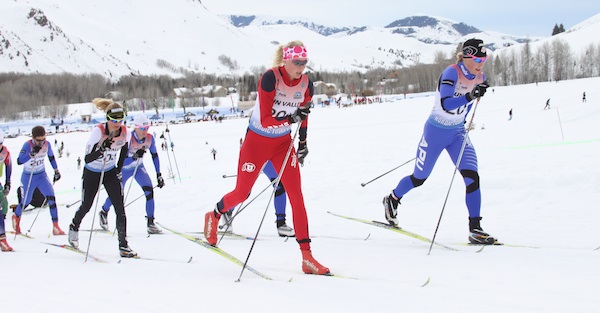
    Overall she had moderate success in Sweden, never quite making it past the bubble in securing a place on a World Cup roster. Feeling her career start to stagnate, Graefnings decided to make a change.

    Graefnings competing in the Australia Cup this August. Courtesy photo.

    “I was at a point where I didn’t develop as much as I wanted, and my friend said, ‘You should come to the U.S. and ski for the team one semester,’ and I was like, ‘Yeah, why not,’” she said. Seeking to recharge her skiing, Graefnings crossed the Atlantic and enrolled at the University of Nevada in 2010.

    Her friends in Sweden thought the move was a sure sign she was done. “They said, ‘Oh, so you’re going to quit skiing now, Maria?’ And I’m like, ‘No, not at all, I just need to do something else.’”

    Graefnings was fourth that winter at NCAAs, and enjoyed herself so much she decided to stick around to finish her degree.

    “I think it was good for me just to race against other people and see new places, see a new culture, learn English” Graefnings said. “All the pieces just came together. I started skiing really fast.”

    Nevada’s ski team was cut from the athletic department after that season, however, and Graefnings was left to figure out where to go next. “I was like, ‘Oh shit, what do I do now?’” She wound up transferring to Utah while maintaining the working relationship she’d established with the head coach at Nevada, August Teague. In her first year with the Utes she won eight regular-season races and her first NCAA title.

    The following winter Graefnings got more ambitious; with two successful college seasons under her belt she wanted to test how she’d stack up at home. With the blessing of her coaches at Utah she traveled back to Europe in December to try to earn World Cup starts. Illness held Graefnings back in Scandinavian Cups and Swedish nationals, but she was “definitely glad I went back” even though the trip didn’t turn out like she’d wanted. She hardly had time to dwell on it, as she only a few days between nationals and her next college race in the U.S.

    By the end of the 2012 season Graefnings was back to full form, and at NCAAs she won the 5 k freestyle by 20 seconds over UVM’s Caitlin Patterson. It would be easy to imagine college results being trivial to a Swedish athlete raring to get her career going again outside the U.S., but this is not the case with Graefnings. “I won NCAAs two years in a row. I have goose bumps when I think about it; it’s special,” she said.

    Graefnings in Australia. (Courtesy photo)

    Her thoughts on her college experience are equally positive: “The team and the coaches there were great. I had a great time, I continued to develop as a skier and there was no doubt that I wanted to go back [to Sweden] and try to ski. I just love to ski.

    “I think being at altitude for a long period of time, having good teammates — the whole package with school. When you feel good you have fun, you have a good social life, you know? You get in a good flow. That’s definitely important to develop as a skier, too.”

    Teague, who has been Graefnings’ coach throughout her transition from Nevada to Utah and now back to Sweden, noted that her approach to college was somewhat unique among other European athletes who come to the U.S. to compete in college. A few skiers before Graefnings have successfully made the transition back to skiing at a high level internationally — fellow Utah alum Snorri Einarsson is a prime example — but the trajectory is altogether rare.

    “A lot of athletes come to the U.S. because they haven’t achieved their goals in Europe and they’re ready to retire,” Teauge said. “Maria came here seeing it as a pathway to that next step, saying, ‘I need a change with my training here at home. I’ve gotten to the level I’ve gotten to and I need to change something.’ She thought of the U.S. as a positive change in helping her get onto the Swedish national team and potentially ski at the Olympics, where other athletes in the past have seen it more as a retirement party.”

    With a degree in exercise physiology in hand, Graefnings is now training and skiing full-time in Sweden. Her support comes from both the Swedish military and the Falun Borlänge Skiclub, and she’s currently working on adding personal sponsors. Her racing season has already begun; in August she traveled to Australia to compete in the Australia/New Zealand Cup and bank a full month of training at altitude with Teague, who also coaches the Australian national team. Graefnings podiumed twice at Falls Creek, winning the final 10 k freestyle over Russia’s Marina Chernousova.

    “It was perfect,” Graefnings said. “We were at altitude and I got some good training and racing.”

    Graefnings is currently training with her club in Ramsau, Austria, doing everything she can to log the work necessary to meet her goals. Beyond the World Cup she’s set her sights on World Championships and, maybe, the Olympics.

    “[The Olympics] are a dream, that would be so cool,” Graefnings said. “Of course, I’m aware it’s super competitive and a lot of girls are really good. I think if I get everything together, maybe some luck, I’ve been training really hard — you never know!”

    Taking a break in Australia to enjoy the view. (Courtesy photo)
  • Diggins Makes It A Clean Sweep in Bozeman

    Jessie Diggins (CXC/USST), 1st place. Photo: Evan Dethier.

    Jessie Diggins (CXC/USST) continued her early season dominance in the 10 k classic in Bozeman, MT on Sunday. Her 35.7-second victory over Maria Graefnings (University of Utah) was her third-straight win of the weekend. Kate Fitzgerald of APU finished third (+1:06.7).

    “I really had a lot of fun today,” said Diggins. “Sometimes when people say ‘have fun out there’ I think it’s more likely that the race is going to hurt like crazy. But today’s race really was fun.”

    In contrast to Saturday’s 5 k skate, which she won by a slim 1.3-second margin over teammate Caitlin Gregg (CXC), Diggins logged a more dominant result in the 10 k classic, winning by over half a minute.

    The young USST rookie has been working hard on specific goals in each of these early SuperTours. In West Yellowstone, those included practicing the race-day process and acquainting herself with longer distance pacing.

    “Today I was working on pacing—trying to take it out a little more smoothly, and focusing on skiing with long, strong strides, instead of short and choppy,” she said. Diggins added that she was excited that many of her fellow CXC teammates raced well on Sunday; Gregg was fourth and Jennie Bender was sixth.

    The women’s 10 k followed closely on the heels of the conclusion of the men’s 15 k classic the same morning. Concern for the durability of tracks and the snow cover was well-founded, but according to Diggins she needn’t have been worried.

    “At first I was kind of nervous—there’s a bunch of sharp corners and I though, ‘Oh, man. It’s going to scrape all the wax off,’” she said. “But I guess there were a lot of layers of just the right kick; my skis worked out really well.”

    Diggins held a commanding 36-point lead in the overall SuperTour standings heading into Sunday’s race. She’s now widened that gap to 48 points. Like Mike Sinnott, the men’s leader, this grants her World Cup start rights in Europe. But the B-Team member of the U.S. Ski Team (USST) was already planning on heading to Italy directly after finishing U.S. Nationals in January. Despite her early season success, she won’t be joining the USST any earlier than planned.

    Speaking of the U.S., Diggins said she was most definitely motivated this weekend by news of her teammates doing so well in the Dusseldorf city sprints.

    “It’s been a wonderful way to wake up every morning,” she said of getting news of Kikkan Randall’s win on Saturday and the team sprint duo of Randall and Sadie Bjornsen claiming silver on Sunday in Germany.

    She described following their success from afar as particularly encouraging given that she trained with the U.S. women during the summer.

    “You hear about Kikkan and Sadie, and it makes you want to get out there and race your hardest,” she said. “They trained really hard this summer—I got to see them at camps, and they deserve every single bit of their celebration tonight.”

    Along with the rest of CXC, and most other teams on the SuperTour, Diggins is heading to Silver Star in Vernon, BC on Monday, where the first NorAm will be contested.

    “I think it will be good competition,” said Diggins, looking forward to mixing it up in Canada. “Everyone is fit and ready.”

    Full 10/15 k classic results..

    Women’s SuperTour standings.

    Shayla Swanson contributed reporting.

  • Diggins, Gregg Go 1-2 In Both Bozeman SuperTours

    Jessie Diggins (CXC). Photo: Evan Dethier.

    It seems that Central Cross Country (CXC) is the team to bet on this year; at least one woman from the Midwestern squad has been in the top two in every race on the SuperTour thus far. Together, Jessie Diggins and Caitlin Gregg have taken up half of the podium spots available in the past six races, and on Saturday they continued their dominance by going 1-2 in both the morning skate sprint prologue and in the 5 k freestyle.

    “It was a good, challenging course; a good chance to push yourself,” said Diggins after her races. Her goals for the day were to experiment with pacing and maintain good technique throughout the day—“something I need to work on quite a bit,” she said.

    Diggins topped the women’s field by a narrow 2.3 seconds in the 1.4 k sprint. After Gregg, Becca Rorabaugh (Alaska Pacific University) took third (+17.0), with teammate Kate Fitzgerald just behind in fourth (+17.5).

    The top woman’s takes on the day’s racing echoed the men’s sentiments.

    “It was a tough day,” said Diggins. “I’m really tired.”

    She likened the two-race format to competing in multiple events at a track meet—“except the second race was way longer.”

    “It was tricky—you had just enough time to get inside, change clothes and put your feet up,” Diggins continued. “Then right away it was time to go again.”

    In the second half of racing on Saturday, Diggins crossed the line just 1.3 seconds ahead of Gregg in the 5 k. Maria Graefnings (University of Utah), who took third, was further back at +29.2.

    Though the three-hour break between start times was awkward, Diggins said it wasn’t so long that she had to do a complete warm-down and warm-up procedure in between.

    Saturday’s victories brought Diggins’ win-count this winter to four; she now holds a commanding 36-point lead over Gregg in the overall SuperTour standings.

    Caitlin Gregg (CXC) on her way to skate sprint victory last week in West Yellowstone.

    For her part, Gregg was pleased with the day’s outcome. “I feel like my shape is coming around,” she said. She won the skate sprint in West Yellowstone last week.

    “I’m warming up the season well—overall I’m feeling really good.”

    Gregg described her sprint race as a bit clustered on the big hill—a wall of a pitch that skiers climbed up, came screaming down, spun around and then swung back up again.

    The trail was slightly narrower than was ideal on the hill, and Gregg got stuck behind a starter in front of her as she tried to hammer up it.

    “Unfortunately, climbing is where my strength is,” said Gregg. “[I’d] track them and have to sit behind them and go their pace… That was the hardest.”

    Despite feeling held back on the climbs, Gregg enjoyed the varying terrain. “I would much rather have hills,” she said. “It’s a challenge, and we need to be ready for it in Europe.”

    Becca Rorabaugh (APU). Photo: Evan Dethier.

    Rorabaugh, who was third in the distance race and fifth in the sprint, planned her attack for the technical climb meticulously.

    “I had gone over the sprint course and planned each transition so that I knew how I wanted to do it, and I went into the big U-turn hot each time,” she said. “I figured that if I was a little out of control that was okay.”

    Race volunteers did their best to make it a well-covered course from start to finish.

    “People were shoveling the whole time,” said Jennie Bender (CXC), who skipped the morning sprint and finished sixth (+52.9) in the 5 k.  “[The volunteers] did a good job.”

    As the temperature warmed throughout the day, the course got progressively dirtier, slowing down overall ski speed. Diggins, always grateful for her service team, said her coaches managed to hit the wax despite the changing conditions.

    “Our skis were fast, which was awesome,” she said.

    The women gear up for a 10 k individual-start classic race on Sunday, and start after the men at 11:30 am MST.

    Full Sprint Results

    Full 5/10 k Skate Results

  • Graefnings, Tarling Win FS Collegiate Skier of the Year

    Graefnings, Tarling Win FS Collegiate Skier of the Year

    FasterSkier Collegiate Skier of the Year

    Collegiate Skier of the Year (women):

    Maria Graefnings (SWE/University of Utah) A senior at the University of Utah, and a native of Falun, Sweden, Graefnings dominated the RMISA circuit during the regular season, winning seven of eight starts.

    Maria Graefnings (UU)

    Graefnings transferred to Utah from the University of Nevada when that program was cut. In addition to her success in the western region, Graefnings won the NCAA national title in the 5km freestyle event, and placed second in the 15km classic mass start.

    The 25-year-old also had plenty of success outside the collegiate ranks, finishing the year with three SuperTour podiums, including a victory in the Owl Creek Chase, and a second place finish in the US National Championship 30k.

    Honorable Mention:

    Eliska Hajkova (CZE/University of Colorado) Hajkova spent most of the 2010 seaosn in the shadow of Graefnings. In the first four races of the RMISA season, she placed second to the tall Utah star, and went on to place outside the top-3 just once – a fourth in the UNM Invitational classic race.

    The trend continued in the first race of the NCAA Championships in Stowe, Vermont. Graefnings took the victory in the 5km skate, with Hajkova ten seconds back in second. But the 23-year-old former member of the Czech National Team saved her best for last, upsetting Graefnings in the 15km classic and earning her first NCAA title. Her effort helped propel CU to the national championship.

    Caitlin Patterson (USA/University of Vermont) Patterson may have been hard-pressed to match the performances of Graefnings and Hajkova, but at just 21 years of age, Patterson gave up several years, and significant experience to her European competition.

    The Alaskan native, in her junior year at the University of Vermont, won seven of eight regular season EISA starts, placing second in her one “off-day.”

    She placed sixth in the 5km skate at the NCAA Championships, but struggled in the classic event, finishing 23rd.

    Patterson also managed to squeeze in a trip to the U23 Championships in Otepaa, Estonia, where she skied to 20th in the 15km pursuit, and 26th in the 10km freestyle.

    [poll id=”56″]

    Collegiate Skier of the Year (men):

    Sam Tarling (USA/Dartmouth) The men’s collegiate field lacked the domination at the top that highlighted the season on the women’s side. Six different men won EISA races, and five took top honors in the RMISA, while the CCSA had several strong contenders as well.

    Sam Tarling (DAR)

    Ultimately, Tarling gets the nod over the likes of Miles Havlick (USA/UU) and Vegard Kjoelhamar (NOR/CU) on the strength of his NCAA National Championship title and consistency throughout the season.

    Tarling won two regular season EISA races and finished in the top five in each of his eight starts – a strong campaign to say the least, but not even the best in the Eastern region. It was Tarling’s victory in the 10km skate that put him over the top. In an upset victory over Colorado’s Kjoelhamar, Tarling joined the relatively sparse ranks of American skiers to win an individual NCAA title in recent years.

    He was unable to duplicate the performance, or even come close in the 20km classic two days later, placing 32nd in the 39 skier field, but with top challengers Havick and Kjoelhamar unable to claim a victory of their own, Tarling becomes the first American to win the FasterSkier Collegiate Skeir of the Year award.

    Honorable Mention:

    Vegard Kjoelhamar (NOR/University of Colorado) Kjoelhamar won two RMISA races and finished second two other times before placing second in the 10km skate at the NCAA Championships.

    The 2009 winner of this award, Kjoelhamar ended a successful collegiate career with another podium, taking third in the NCAA Championship 20km classic.

    Miles Havlick (USA/University of Utah) Havlick ended the 2011 season as the top ranked skier in the RMISA, edging Kjoelhamar by a single point. The sophomore won three races, finished second twice, and fifth once in his six starts.

    At the NCAA Championships, he took the final podium spot behind Tarling and Kjoelhamar in the 10km skate, and placed sixth in the 20km classic.

    Eric Packer (USA/Dartmouth) Packer deserves recognition as the top ranked EISA skier, besting Tarling, among others, and leading the circuit with three victories

    He started all ten regular season races, never finishing outside the top five. At the NCAA Championships, he finished 5th in the 10km skate and 25th in the 20km classic.

    [poll id=”57″]

    Previous Winners:

    2010
    Antje Maempel (GER/DU)
    Franz Bernstein (GER/UVM)

    2009
    Antje Maempel (GER/DU)
    Vegard Kjoelhamar (NOR/CU)

    2008
    Maria Grevsgaard (CZE/CU)
    Marius Korthauer (GER/UAF)

    FasterSkier Awards 2011:

    Rookie of the Year
    Breakthrough Skier of the Year
    Collegiate Skier of the Year
    Adaptive Skier of the Year
    Continental Skier of the Year
    Biathlete of the Year
    Nordic Combined Skier of the Year
    Performance of the Year (cross-country, biathlon, nordic combined)
    Cross-Country Skier of the Year

  • Randall Keeps on Rolling, With Fourth Straight Win

    Randall Keeps on Rolling, With Fourth Straight Win

    Kikkan Randall (right, APU/USST) leading her quarterfinal.

    Four down, one to go.

    The best season of Kikkan Randall’s career is almost over, and she’s going out in style, having won four straight races at the SuperTour Finals and U.S. 30 k Championships in Sun Valley.

    The latest was Friday’s classic sprint, in which she skied into the finish with a clear, two-and-a-half second lead over her roommate, Canadian Chandra Crawford, with Utah’s Maria Graefnings in third.

    Under a hot sun, the finals were a mushy, messy affair, with several women skiing in t-shirts and sports bras. But Randall (APU/USST) was unfazed—after crushing the morning’s qualifier on a fast, boilerplate surface, she fared just as well in the slop, opening a gap over the others on the course’s one climb.

    “I knew that the critical section was going to be coming into the hill, just kind of keeping momentum going there, and carrying it over the top,” she said. “I felt like I did pretty well—I was really happy that my energy was just super-consistent through the day.”

    Indeed, after her win in the qualifier, Randall didn’t miss a beat. In her quarter, she skied to a dominating, five-second win over Dartmouth’s Sophie Caldwell, breaking at the start and building her lead over the length of the 1.4-kilometer course.

    In the semis, she waited a bit longer to make a move, but when she did, on the hill, it was equally decisive.

    Ida Sargent (Craftsbury) in the B-final.

    While Randall didn’t seem to be bothered as the conditions evolved throughout the day, the same couldn’t be said for the other women. Just like for the men, there were some big differences in ski speed. Several women struggled to find a balance between enough kick to climb the hill, but not so much that it slowed the skis down on the ensuing descent, among them Ida Sargent (Craftsbury), who qualified second but was eliminated in the semifinals.

    “It was really packed in the beginning, so I got blocked out. Then, I tried to go for it on the hill, but it’s kind of hard when you get passed tucking,” she said. “That’s spring racing. I like it when it’s sunny—I can’t complain. But it would have been nice to have the other outcome.”

    Nobody was skiing in the tracks, with some women on klister, and others on zeroes. Crawford switched from klister to zeroes after barely escaping from her quarterfinal as a lucky loser, and the new skis, she said, made things better.

    After the quarterfinal, she said, “I was like, ‘well, I’m hydrating, I’m mentally prepared, I just don’t think my body’s working.’ But then I got on these [zeroes], and it felt so much easier.”

    In the finals, Randall met Crawford for the first time, after besting Graefnings in the semis. For the first portion of the race, until the climb, the other women stuck close to Randall, who said she was still taking it out hard, even though she knew the other women would be there.

    “I know I’m feeling good right now, so this is just good practice to go out and just try to run it hard,” she said. “I just

    Chandra Crawford (CNST) at the line.

    wanted to go out and kind of ski sections well. And [I] knew those girls were going to be right there with me on the last one, but I wasn’t afraid to go out and lead, and hope that I had the strength on the last hill that I had in the semifinal.”

    Indeed, she did, and the hill was where she opened her gap. Crawford said that ideally, she would have attacked on the ensuing downhill, but with Randall already ahead, “a long distance attack from 20 feet back is not much of an attack—it’s more like an attempt to catch up.”

    For her part, Graefnings said that Randall was a little too strong up the last hill—and that while her own glide was excellent, she was struggling with her own kick.

    That left Randall free to collect her fourth victory in six days, along with another $500 for the win, and $200 for setting the fastest qualifying time.

    She’s now more than a minute ahead of her nearest challenger in the overall standings of the SuperTour Finals mini-tour, with the last stage a hill climb up Dollar Mountain on Saturday.

    Link to results from heats. Overall women’s standings.


  • Randall Wins Stage Two in Sun Valley, But Not Without a Fight

    Randall Wins Stage Two in Sun Valley, But Not Without a Fight

    Kikkan Randall (R) and Maria Graefnings (in red) early in Wednesday's women's 10 k in Sun Valley.

    The way Kikkan Randall skied in Sun Valley on Wednesday, she still wasn’t beatable. But at the very least, she showed that she’s human.

    Randall had won Tuesday’s prologue, the opening stage of the 2011 SuperTour Finals, with a thoroughly dominating performance, putting more than 15 seconds into her nearest competitors in a seven-minute race.

    In Wednesday’s 10 k mass-start classic, Randall (APU/USST) was again impressive—at least, for nine kilometers.

    Randall alone, late in the race.

    Heading out on her last of three 3.3-kilometer laps, the Alaskan had opened a 10-second gap on a small group of chasers, and it looked like she was on cruise control yet again.

    But on her way up the course’s major climb for the last time, she tired—just as the sun came out and started warming the tracks.

    “Skis got a little slick, and the effort came in on me a little bit,” she said.

    Behind, Holly Brooks (APU) and Jessie Diggins (CXC) were trading body blows in what they thought was a battle for the second spot on the podium. But in the process, they were reeling in Randall. Bit by bit, her lead started to come down, from 12 seconds, to 10, then to eight.

    In the end, it didn’t get too close—Randall still had a four-second cushion at the finish line, with Diggins edging out Brooks for second place. But the chase was enough to liven up a race that looked to be headed towards another blowout.

    “I was trying to fight through it, but those guys made an impressive move to come back on me,” Randall said. “I think if there had been one more major climb, I could have been in trouble.”

    While Randall may have wavered towards the end of the race, she was clearly in control in the opening kilometers, stretching out the 80-strong women’s field on a tough course with three significant climbs: one huge and steep, sandwiched between two others that are smaller.

    By the time the women came through the lap at the end of their first 3.3-kilometer loop, there were only four others who had stayed with Randall: Brooks, Diggins, Maria Graefnings (Utah), and Sadie Bjornsen (APU). Randall was trying to win the race the hard way: from the front.

    In domestic races like those in Sun Valley, Randall could easily sit in and wait for a pack finish, thanks to world-class speed that propelled her to several World Cup sprint podiums this season.

    But doing that wouldn’t accomplish much, she said—not for her, and not for the rest of the women in the field.

    Randall leading the front group of women.

    “I try to approach this like: ‘Hey, I’ve been racing well in World Cups all year by going out and skiing an aggressive pace, and trying to hang in there.’ And really, all these races are experiences to help me do that,” she said. “Today, I didn’t want to sit out there and dink around too long. I wanted to go out and see what I could do. Because I think it’s good for everybody for me to push the pace, and those girls can try to hang on. And then, it puts them that much closer to racing with the World Cup field.”

    At least, for a little while. While the four others in the lead group hung tough when Randall made a push for a mid-race cash sprint at the end of the first lap, at 3.3 kilometers, they had to let her go at the end of the second lap, at 6.6 k.

    “When she started pulling away, I was like, ‘man, if I stay with her, I’m going to blow up in about 10 minutes,’” Diggins said. “So, I just enjoyed the time at the start, trying to mimic her technique, trying to be smooth like her.”

    Holly Brooks.

    By the time Randall got her gap, Bjornsen had already dropped off the back of the group, with Graefnings, Brooks, and Diggins doing their best to limit the damage.

    On the last lap, Brooks led up the first small climb, then the second, larger one. Over the top, she put a few seconds into Diggins, while Graefnings lost the two women entirely.

    With a gap of more than 10 meters, it looked like Brooks had second place locked up. But then, just like Randall, she faltered on the last chunk of the course, as her push on the big climb extracted its toll on the ensuing hairpin turn.

    “My legs were just dead coming down the hill into the corner, and I wasn’t able to take as much speed,” she said. “And then the sun kind of came out, and our skis were just a little bit slick.”

    At that point, Diggins said she had given up on second, and was simply trying to hang on to third—she said she thought she had “absolutely no chance” of moving up.

    But buoyed by a cluster of rowdy fans—and seeing Brooks slipping—she realized she still had a chance. Heading up the last hill before the finish, the gap disappeared, and Diggins drew even, then slightly ahead as the pair began its descent to the stadium.

    The two looked exhausted, after half an hour of skiing close to the red line. But somehow, they still found the strength to stage a drawn-out double-pole sprint to the line. Neither gave an inch on the 50-meter homestretch, but thanks to her lead heading into the last corner, Diggins came away with a narrow victory.

    Afterward, Brooks said that she regretted leading the first portion of the last lap, joking that perhaps she had been “a little too nice to the junior.” But she also conceded that Diggins is “super-tough.”

    “I think most people, if someone had developed a gap, they would have mentally shut down a little bit, but Jessie never does,” Brooks said.

    Brooks leading Jessie Diggins (middle), and Graefnings.

    The duel between Brooks and Diggins ended up reducing Randall’s lead from 12 seconds, at one point, to less than five at the finish. It ended up being a bit of a nail-biter, but Erik Flora, Randall’s coach at APU, said he wouldn’t have it any other way—not on Wednesday, and not in any of three other races in the SuperTour Finals.

    “I always look at racing as experience-building… If she can come out here and ski really hard, maybe she struggles a bit, so she gets tired, has to figure out how to kick her skis in the final k’s—that’s great. That’ll help in the future, some time. She picks up a trick today that she’ll be able to use then,” he said. “I think it’s the best way to race these four: keep in mind to go for the win, but also, maybe more important, is to get the experience.”

    With two events remaining in the four-stage SuperTour Finals mini-tour, Randall now leads by 37 seconds over Brooks, and 39 over Diggins.

    The competition is shaping up to be a three-woman race—Graefnings, in fourth, is now more than a minute off the podium.

    Thursday is an off day, while Friday and Saturday will bring a classic sprint and a hill climb, respectively.

    While the sprint offers another chance for Randall to build on her lead, there’s also a chance the gap won’t grow much before the final stage. Both Diggins and Brooks are quick, and the time gaps in the sprint qualifier—which are applied to the overall—shouldn’t be large. The difference in bonus seconds allotted to the top five in that race are also fairly small: 60 seconds for a win, and 44 for fifth.

    If Randall wins, which she should do, she certainly won’t have anyone breathing down her neck on Dollar Mountain, which the hill climb ascends. But if she crashes out on Friday, or if Brooks or Diggins has a fantastic race, things could still get interesting.

    Link to full results. (Overall standings not yet available–check SummitTiming.com later on Wednesday.)

  • Randall Tops Gritty Graefnings in a Duel in the Sun

    Randall Tops Gritty Graefnings in a Duel in the Sun

    Kikkan Randall (USST) leading the women's 30 k in Sun Valley on Sunday.

    In the U.S. National Championship in the 30 k last year, Kikkan Randall (USST) somehow pulled off a win in northern Maine just 72 hours removed from racing in Europe.

    This year, with a full week to recover from World Cup Finals, at least Randall’s biological clock was set to the right time. But Sunday’s classic race presented its own challenges: the Alaskan had to overcome a brutal course, the strength-sapping effects of altitude, and, most importantly, some tenacious skiing from Maria Graefnings, a 25-year-old Swede racing for the University of Utah.

    Maria Graefnings (Utah) coming to the line.

    For an hour and a half, Graefnings stuck to Randall like superglue, gritting her teeth and grinding her way along the flats and up the course’s two big climbs. She finally let Randall go as the two women crested the final uphill—but not before draining the Alaskan of all her energy save one last shred.

    “Everything was just starting to cramp and go, and so I knew that I just needed to keep the tempo going,” Randall said. “That’s all I focused on—I couldn’t tell what was going on behind me. I just was so happy to get over the top of that hill, and drop into a tuck.”

    Over the top, Randall opened a gap of ten seconds, which held to the line, allowing her to claim her 16th national title, on a picturesque day in Sun Valley. Graefnings held on for second place, while 19-year-old Jessie Digging (CXC) was third, in her first-ever 30 k.

    Last season, Randall won five national championships, thanks to a clean sweep of four races in her hometown of Anchorage in January, followed by her win in Maine in March.

    But this year, she had to miss the U.S. Championships in the middle of the season, when she opted to race in the Tour de Ski instead. Sunday’s race was her lone opportunity to add to her collection.

    “I had one shot this year,” she said.

    With Randall just back from a strong finish to her European racing season, it was clear even before the 30 k started that there wouldn’t be many women in Sun Valley who could ski with her. It didn’t take long to find out who, as a split occurred after just one lap, seven kilometers in, that left six women in the lead: Randall, Graefnings, Diggins, Morgan Arritola (USST), Holly Brooks (APU), and Sadie Bjornsen.

    The split was a sharp contrast to Saturday’s men’s 50 k, in which a pack of nearly 30 stayed together for more than half the distance. Alaska Pacific University (APU) had sent out a couple of rabbits in the 50 k to try to push the pace early, but

    Morgan Arritola (USST) leading the women's pack early in the race.

    that wasn’t necessary on Sunday, with Graefnings and Arritola applying some pressure.

    “The women—they race a little different style. They’re their own rabbits,” said Erik Flora, the APU head coach.

    Arritola has had a tough year, but she was skiing on her home trails, in front of a smattering of boisterous Sun Valley fans. The terrain favored her, too, with the seven-kilometer loop tackling two robust climbs, and she spent much of the first two laps at the front, looking peppy.

    “No one else was going to lead, and I didn’t really want the pack hanging together,” she said.

    Randall never gave Arritola much of a leash—she was on her teammate’s tails, with both women looking focused, but not under much stress. Behind, the other four women appeared to be working a little harder.

    For just about everyone, the big hill above the stadium was the breaking point. The climb is long, with three different pitches, and the steepness just shy of forcing the women to revert to herringbone. With a bright sun shining from clear skies, the temperature was warming quickly, and some of the women began losing kick in the long race—which didn’t help on a course that Graefnings called the hardest she’d ever skied.

    Bjornsen fell off the pace on the big climb on the second lap, and so did Brooks and Diggins, on the next one.

    Arritola had also lost contact with the leaders on the third lap—she said that didn’t have access to her top gear.

    Arritola leading Randall on one of the smaller climbs.

    “I feel like I can go level three, and that’s it. So that’s what I did today—that’s as hard as I could go,” she said.

    By the time the women headed out for their last loop, only Randall and Graefnings were left. Diggins was the closest, at 10 seconds behind, trying to regain contact, but she never did.

    Afterwards, Graefnings said that she was thrilled just to have the opportunity to ski with Randall and the other top women. Her goal, she said, was to stick with them for “as long as I possibly can.”

    The lead group of women on the far part of the course.

    That ended up being a long time, because Graefnings, having just won an NCAA title earlier this month, is fit. She also knows how to race at altitude, since she’s in school in Salt Lake City.

    And, according to Abi Holt, the Utah assistant coach, Graefnings is also “pretty tough.”

    “We know that—we’ve watched her have some really good battles out there on the college circuit,” Holt said.

    For the entire last lap, Graefnings followed Randall, grimacing and holding on for dear life. She never once took the lead, Randall said, but the Alaskan kept on pushing, mindful of Diggins and the others behind.

    “I just hoped [Graefnings] didn’t have anything left in the end,” Randall said.

    The two were still together as they came towards the big hill on their last lap, with Randall visibly fatigued for the first time, and slipping a little. Graefnings didn’t look much better, but the battle was still enough to put Flora on edge, as he watched the pair start ascending.

    “We couldn’t see them from the [feed station]…and they disappeared into the woods for four minutes,” he said. “We’re sitting there going, ‘okay, how’s it going to go?’ You have a little bit of confidence with Kikkan’s sprint abilities, but at the end of 30 k, that can be a whole different deal.”

    Jessie Diggins (CXC) towards the end of the race.

    But Graefnings said that she was plain old too tired to keep up on the hill, and in the end, Randall didn’t even have to sprint, coming over the top and into the line with 10 seconds of space.

    Diggins was another 18 seconds back to claim third place, having managed to hold off Arritola over the last lap.

    “She’s tough—she’s a tough little thing,” Arritola said. “She held me off. I was trying.”

    After her win on Sunday, Randall seems primed to repeat her performance in northern Maine last winter, in which she took the victory in the 30 k, then went on to sweep all three races in the SuperTour Finals the following week. But that won’t stop the rest of the women from trying.

    “She’s the obvious favorite,” Brooks said. “But I think on any day, someone could have a great day. And if they have a great day when she has a bad day, I don’t think she’s unbeatable. She’s the best skier here by far, for sure—my money would be on her to win every single race here—but I think there’s a chance someone could get her.”

    Link to live results.

  • NCAA: Sam Tarling (DAR) and Maria Graefnings (UU) take titles on first day of Collegiate Nationals

    NCAA: Sam Tarling (DAR) and Maria Graefnings (UU) take titles on first day of Collegiate Nationals

    Racers starting and lapping through stadium at Trapps

    NCAA 5/10 k skate race

    There are always a lot of questions and unknowns coming into the NCAA nordic competition every year. The best athletes and schools from one region rarely get to compete head-to-head with athletes and schools from a different region until they travel to the collegiate nationals, making NCAA’s the first time they get test their mettle against the rest of the nation’s elite.

    It was fitting then, that the first race of this year’s NCAA competition, hosted in the east, would be won by an Eastern school.  Today Dartmouth took the trails at Trapp Family Lodge in an impressive storm of Green, putting 5 out of their 6 racers in the top 5, and all 6 in the top 10; a feat no other school came close to matching.

    It was a blue-bird morning at Trapp Family Lodge in Stowe, Vermont, and the 5 kilometer course was a hard-packed and polished corduroy that held firm through both laps of the men’s 10k and the women’s one-lap 5 k race.

    At the start of the men’s race at 10am the temperature was still in the low 20’s.

    The Dartmouth men, led by Sam Tarling, definitely put some heat to the cold tracks.  Sophomore Sam Tarling found his speed again just in time, finishing 4.6 seconds ahead of the field with a time of 26:05.7.   Tarling, who was the strongest eastern competitor through the middle of the season, missed Regionals due to sickness. In today’s race however, Tarling looked as if he had not only picked his speed back up but added a higher gear.

    Sam Tarling (DAR) photo: Ruff Patterson

    Also finding their higher gear, Dartmouth teammates Nils Koons and Eric Packer finished 4th and 5th, posting the top men’s team score ahead of the University of Utah.  Koons, a senior for Dartmouth who recently returned from the World Championships in Oslo where he was competing for his native country of New Zealand, may have been lacking on sleep going into today’s race, but seemed to still have the energy created by the cheers of thousands of Scandinavian ski fans.  Packer started right after Tarling on the start list, and finished right after Koons in the final placings.

    Tarling, who was sick through Regionals and did not compete that weekend, used this past weekend as a way to get in some time trials and find his race pace again. Though he hoped for a top 5 today, he didn’t know what to expect.  He decided to take it “a little conservative on the first lap” in order to check his energy levels and be able to pick up time in the finishing kilometer when some of his competitors might slow down.

    “I just wanted to ski relaxed. I knew people would go out too hard today – it seems like this course is easier than it is ‘cause you can just go out and V2 the whole thing, but training is a lot different than racing it and on the second lap people are hurting.”

    Did the Dartmouth men have any idea what they were capable of today?

    “It’s AWESOME to have three guys in the top 5,” said Tarling. “I am thrilled to have those guys to train with, it’s a great group.  We have probably three more guys that could have been right up there with us if we had the spots, but we have a lot of depth this year and we’re really lucky.”

    Vegar Kjoelhamar (CU)

    Colorado’s Vegard Kjoelhamar was the runner up in today’s competition.  A senior, Kjoelhamar was 4th in last year’s NCAA classic race.  He has been skiing at the top of the western region this season, along with Utah’s Miles Havlick.  A sophomore from Boulder, Colorado, Havlick posted the third fastest time today, just 1.5 seconds behind Kjoelhamar.

    Didrik Smith was the second Utah racer to finish, placing 6th.  Scott Patterson was the first finisher from host school UVM, in 7th, ahead of Denver’s first racer, Andrew Dougherty. NMU’s Andy Leibner and UNM’s Tor-hakon Hellebostad rounded out the top ten All-American contingent, finishing 1.2 seconds apart and 40 seconds from first.

    The winner of the women’s 5k skate race was no surprise to anyone, as she had dominated the western region for all but one weekend of the RMISA season.  Utah’s Maria Graefinings, a senior from Sweden, took the one lap race in a time of 13:51.9, almost ten seconds up on one of her main rivals from the west, Colorado’s Eliska Hajkova.

    Maria Graefnings (UU) photo: Ruff Patterson

    “Maria’s been skiing super strong all year,” said Colorado coach Bruce Cranmer, “and even though Eliska had good regionals, she probably felt that Maria was the person to beat.”

    The two competitors smoked the competition, putting more than 30 seconds up on the rest of the field.

    Though her team’s flight to the east was delayed, making for a nightmare travel schedule, Graefning was nothing but energetic, on and off the course.

    “I just wanted to have fun and ski just as fast as I possible could,”Graefnings said, smiling widely as she praised the course. “I like it a lot, I like the V2 and V2 alternate a lot, and being from Sweden, I’m used to racing at low altitude, too, so I was super excited to race today, and just to be here!”

    Hajkova’s teammate, Joanne Reid, was next to finish, grabbing third place to round out the women’s podium and help the CU women’s team post the top score of the race.

    The Dartmouth women continued the success of their men’s team, Erika Flowers and Rosie Brennan finishing in consecutive 4th and 5th places.  Flowers, a junior from Bozeman, Montana, is a notoriously strong racer in the skate technique, while Brennan is just a fierce all-around competitor, especially when it comes to the big races.

    Eliska Hajkova (CU) photo: Ruff Patterson

    UVM’s Caitlin Patterson, who won most of the eastern regional races this year, finished in 6th, 2 seconds up on 7th place finisher Jamie Bronga of UAA.  Patterson’s teammate, Lucy Garrec, cam in 8th. CU’s Alexa Terzian and Dartmouth’s Sophie Caldwell finished in 9th and 10th, respectively, to grab the last All-American honors.

    Dartmouth posted the top nordic score over Colorado by 28 points, CU grabbing second individual titles in both races but lacking that top score and the depth of Dartmouth.

    “It was an awesome day,” said CU coach Bruce Cranmer. “We were so close to getting top of the podium, so it’s sad just missing it, for both skiers. ..  . .but, yeah, I was super happy with the way everyone skied.”

    Cranmer is looking forward to the next races to show off his team’s strength, though he is a little worried that wax might play more of a role in Friday’s classic race (the forecast calls for rain).

    Today, however, the easy waxing made for fair races.

    “Best person for sure, won,” Cranmer assured. “I don’t think many people were hampered by poor skis or waxing today.”

    Dartmouth Coaches and men's team: Cami Thompson, Sam Tarling, Nils Koons, Eric Packer, Ruff Patterson

    Full Results

    Top 5 Nordic Team Scores:

    1. Dartmouth: 240

    2. Colorado: 212

    3. Utah: 191

    4. Vermont: 181

    5. Denver: 118

    All-American Podium, Men's 10k skate
              
              1       34  Tarling, Sam            DAR            26:10.3  47.0
              2    36  KJOELHAMAR, Vegard         CU            26:10.3  47.0
              3    30  HAVLICK, Miles             UU            26:11.8  44.0
              4    27  KOONS, Nils                DAR           26:15.1  41.0
              5    35  PACKER, Eric               DAR           26:19.7  39.0
              6    31  SMITH, Didrik              UU            26:25.8  37.0
              7    37  PATTERSON, Scott           UVM           26:31.1  35.0
              8    29  DOUGHERTY, Andrew          DU            26:36.6  33.0
              9    39  LIEBNER, Andy              NMU           26:45.1  31.0
             10    20  HELLEBOSTAD, Tor–hakon     UNM           26:46.3  30.0
    Women's All-American Podium, 5k skate
              1    37  GRAEFNINGS, Maria          UU            13:51.9  50.0
              2    34  HAJKOVA, Eliska            CU            14:01.7  47.0
              3    38  REID, Joanne               CU            14:32.0  44.0
              4    35  FLOWERS, Erika             DAR           14:37.6  41.0
              5    32  BRENNAN, Rosie             DAR           14:37.9  39.0
              6    36  PATTERSON, Caitlin         UVM           14:44.2  37.0
              7    20  BRONGA, Jaime              UAA           14:46.2  35.0
              8    29  GARREC, Lucy               UVM           14:47.5  33.0
              9    39  TURZIAN, Alexa             CU            14:49.8  31.0
             10    17  CALDWELL, Sophie           DAR           14:52.4  30.0


    Miles Havlick (UU)
    Joanne Reid (CU) photo: Ruff Patterson
    Morning tracks at Trapps
  • Ellefson, Graefnings Take Owl Creek Chase Titles

    The 2011 Owl Creek Chase field may have been dominated by collegiate skiers, but Sylvan Ellefson (Team Homegrown) made sure they knew their place.

    The Vail, Colorado native won his second race in two days, and with the Owl Creek Chase doubling as a SuperTour event, Ellefson continued to move up the US Continental Cup standings.

    Ellefson bested Glen Randall (BSF) by just under a minute over the winding 21k point-to-point course running from Snowmass Village to Aspen. Randall’s BSF teammate, Leif Zimmermann finished third, 1:21 off the pace in the freestyle event.

    With Brayton Osgood (XC Oregon) in fourth, Miles Havlick (UU) was the first collegiate skier to finish besting Tyler Reinking (MSU). Brian Gregg (CXC Elite) six seconds behind Reinking, took sixth.

    After Gregg, the men’s result sheet read like a standard college event, with just a scattered few non-academic skiers joining the fray.

    All told, 39 men contested the elite distance, with just 11 not representing a college program.

    In a rare occurrence, the women’s elite race featured a larger field of 41 skiers. This time, the college skiers dominated the results, taking six of the top-10, and two of the first three spots.

    Maria Graefnings (UU) narrowly edged Sugar Bowl Academy coach Chelsea Holmes, taking a 2.7 seconds victory. Eliska Hajkova (CU) couldn’t quite hang on, and settled for third, +16.3.

    Morgan Smyth (APU) placed fourth, a full 1:50 behind Graefnings. Smyth beat our Evelyn Dong (XC Oregon) at the line for one of the closest finishes of the day. Nicole DeYong (SVSEF) and Caitlin Compton (CXC Elite) finished 6th and 7th respectively.

    All told, nearly 500 skiers participated in one of the races, ranging from 1km to the full 21 in length.

    The Owl Creek Chase is separated into an elite class and a citizen class. Dan Weinberger skied to victory over Scott Krankkala in the men’s citizen category, posting a time of 1:02:50, nearly a minute and a half clear. Weinberger’s time would have placed him 28th in the elite race.

    Jay Henry took third, another 43 seconds back.

    Sarah Wright claimed the top spot in the women’s citizen category, outpacing Mia Gaw by 38 seconds. Diana Finkel was third. Wright matched Weinberger, posting a time that ranked her 28th in the elite class.

    Complete results from all races

  • Strandberg Leads International-Flavored 5 K

    Strandberg Leads International-Flavored 5 K

    Kristina Strandberg (XC Oregon)

    The women’s 5 k classic SuperTour may have been held in West Yellowstone on Saturday, but the top of the results sheet read like an event from Scandinavia, with international skiers claiming three of the top four spots.

    Kristina Strandberg (XC Oregon) edged out Holly Brooks (APU) for the victory, while fellow Swede Maria Graefnings (U of U) rounded out the podium, ahead of Czech Eliska Hajkova (CU).

    Strandberg capped an excellent stretch of racing this week, in which she finished in the top five in all four events.

    A two-time overall SuperTour Champion, and veteran of nine World Cup starts, Strandberg overcame understandable fatigue to beat out Brooks by five seconds.

    “Today was hard,” Strandberg said following the race. “I felt like there wasn’t much juice left in the tank, but I was trying to think that if I feel like this, everybody else does too.”

    And while it is still early, Strandberg felt significant pressure, telling FasterSkier, “a lot of people expected me to win, and I didn’t really realize how nervous that would make me, so it is an enormous relief.”

    She noted that that the pressure came from herself as well, adding that she “really wanted to win the classic race here, and knew I had a chance. I wanted to prove that I can still do this.”

    “I am an M2 after all,” she concluded with a laugh, referring to her relatively advanced skiing age of 35.

    Holly Brooks (APUNSC)

    Brooks leaves West Yellowstone with the overall SuperTour lead, thanks to her two victories in Thursday’s Sprint Showdown and consecutive second place finishes in the distance races.

    “Strandberg is an awesome classic skier, and 5 k classic is her thing,” Brooks said. “I feel good about being five seconds behind her in that.”

    The course, significantly changed from past SuperTour events, featured two large climbs, including the wall of “Telemark Hill.”

    Despite being a strong double-poler, Strandberg was happy to see the additional terrain.

    “This is a much better course, and a much better race altogether.”

    The big hill was an obvious pick as the difference maker, but Brooks noted that she was five seconds down on Strandberg before the climb—which didn’t change by the finish, just one kilometer later.

    While several women did manage to stay in the tracks for most of the big climb, race organizers eliminated them on the steep pitch toward the bottom, and many athletes chose to step out toward the top.

    Brooks described the technique of choice as “a running herringbone,” and noted that the off-camber nature of the hill presented an additional challenge. She said it was important to keep her herringbone narrow and the tempo high, which made the hill go by quickly.

    Like Brooks, Strandberg chose to climb a majority of the way outside the track.  She opted for more glide, trying to “stay a little light with the kick wax,” and wasn’t entirely thrilled with the decision.

    “I ended up going outside the track, which—I don’t necessarily think that was the best,” she explained. “But on the other hand, going in the track and slipping is not good either.”

    Strandberg “just tried to hammer” over the top, and said that she was glad she could stick to double poling for the last kilometer of the race, “because my legs were gone.”

    Hajkova, the fourth place finisher, was also happy to see the large climb.

    “I love uphills, so I felt really good on the big hill,” she said. “It is a nice change, because you have to change your tempo, and it wakes you up again.”

    Maria Graefnings (UU)

    Graefnings, a 25-year-old student at the University of Utah, clocked in at just a hair over 16 seconds behind Strandberg. She skied last season for the University of Nevada-Reno (UNR), but transferred to Utah when the UNR ski team was cut.

    “The conditions were awesome today, not too cold, and really good tracks,” said Graefnings, who also has World Cup experience.

    Hailing from the ski mecca of Falun, Graefnings notched her second consecutive SuperTour podium. She edged out Strandberg in Friday’s 10km freestyle, much to the good-natured chagrin of the elder Swede.

    After the race, Graefnings said that she has been enjoying her time in the US.

    “College skiing is special, something you can do once in your life,” she said—though she doesn’t see graduation as the end of her elite career.

    “I am going to go back to Sweden and try to make the A-team. But right now I am here, and it is super fun,” she said.

    The 22-year-old Hajkova placed second in the classic sprint and sixth in the freestyle version, before sitting out Friday’s distance race.

    With only six days on snow under her belt, she was pleased with Saturday’s effort.

    “I felt good, and we had great skis. It is just the beginning—and I think everybody will be better later in the season,” she said.

    Hajkova, who raced in the 2009 Tour de Ski, edged Friday’s freestyle winner, Kate Fitzgerald (APU), by four seconds.

    With Brooks in second, Fitzgerald in fifth, and Morgan Smyth, Sadie Bjornsen and Becca Rorabaugh ranking sixth through eighth, respectively, APU had the top five American women in the race.

    Eliska Hajkova (CU)

    The Continental Cup circuit now moves to Canada for two weekends of NorAm races. Brooks and the rest of the APU squad head north to SilverStar Resort in a few days, while Strandberg is on her way to Sweden.

    “Sweden has a lot of good skiers right now…and it is a tough crowd to race against,” Strandberg said. But she added, she enjoys the challenge, which makes it more fun if she’s skiing fast.

    “When you race well in Sweden, people notice—there is so much more media coverage,” she said.

    This is Strandberg’s final season of focused elite ski racing, and she has no specific goals.

    “I am taking it as it comes. This season is like a bonus season for me.  If I am not enjoying it, I am not going to suffer it out,” she explained. “But so far so good!”

    The surprising Fitzgerald entered this season with just a single top-10 result, and no top-5’s, in nearly 30 SuperTour, NorAm, and U.S. and Canadian Nationals starts. She will leave West Yellowstone with a win, a third, and two fifths, moving her into the upper echelon of the U.S. women’s field.

    But on Saturday, it was the veteran Strandberg standing on the top step of the podium.

    “I am stoked,” she said, before engaging in some well-earned Swedish patriotism. “And, you know what, we’re dominating on all continents right now!”

    –Nat Herz contributed reporting.

    Link to full results.

    Kate Fitzgerald (APUNSC)
  • With Skate Win, Fitzgerald Upstages Favorites in West Yellowstone

    With Skate Win, Fitzgerald Upstages Favorites in West Yellowstone

    Alaska Pacific University's Kate Fitzgerald on her way to the win in Friday's 10 k skate in West Yellowstone.

    You had to look hard, but the signs were there.

    Over the past two years, Kate Fitzgerald’s results had been steadily progressing, topping out with a 14th place at last year’s U.S. Nationals. A few weeks ago, she was nearly as fast as 2010 Olympian Holly Brooks in a time trial with her club, Alaska Pacific University (APU). And in Thursday’s double sprint qualifier, she finished third and fifth.

    Still, no one expected Fitzgerald’s victory in the 10 k skate race in West Yellowstone on Friday. Not least herself.

    “Surprised? Yeah, I’m surprised,” she said afterwards. “I didn’t think I was going to win.”

    But win she did, by a single second over Brooks, and by nine more over third-place Maria Graefnings, a Swedish import skiing for the University of Utah. XC Oregon’s Kristina Strandberg and Sugar Bowl Academy’s Chelsea Holmes rounded out the top five.

    While Fitzgerald didn’t enter the day as a total unknown, it seemed more likely that the race would belong to Brooks, Thursday’s double winner, or to fellow Olympian Caitlin Compton (CXC), whose best results have come in the freestyle technique.

    Holly Brooks in the SuperTour leader's bib, on her way to second. Photo, Win Goodbody.

    But according to CXC Head Coach Jason Cork, Compton is recovering from illness and shut things down mid-race, while Brooks said that she hasn’t yet found her top gear this season.

    “I think I just need to be able to hurt a little bit more—push that upper limit,” she said.

    Instead, it was the 22-year-old Fitzgerald, who, as Brooks put it, “skied out of her mind,” with a smooth, deliberate tempo and a stony, determined race face.
    “I knew she was coming, and she had some breakthrough races yesterday,” Brooks said. “People should watch out for her all season.”

    According to Erik Flora, her coach at APU, Fitzgerald has skied with the club since she was 17, when she would make a 45-minute drive into Anchorage five days a week for training sessions. Since then, she has graduated from the APU junior program to the club’s elite team.

    Her rise, Flora said, has been a product of years of hard work—making the slow progression through top-50’s, top 20s, top 15s.

    “She’s just a very straightforward, hard-working athlete…It’s not the traditional route of podiums when you’re young, and podiums when you get older. It’s like this coming from behind, and just having an exceptional response to training,” Flora said. “Every year, she’s just taken a big jump up in the field.”

    This season, Flora said that his high expectations for Fitzgerald were for a top five finish, and “she just blew through that.”

    Fitzgerald didn’t have a whole lot to say about her race Friday, other than that two trips up West Yellowstone’s Telemark Hill made for a tough course. Like Flora, she chalked up her improvement to nothing more than “training really hard.”

    But if Fitzgerald was taciturn, Flora more than made up for it with his own enthusiasm. Pausing to collect himself, and to wipe away a tear, he rated Fitzgerald’s result on Friday as “one of my top experiences, so far, as a coach.”

    “I was just beside myself,” he said. “Coaching, you have your experiences that just totally knock you off your feet. That’s it.”

    Link to full results.