From the FasterSkier archive — posts syndicated from athletes’ and coaches’ own blogs between 2004 and 2012, kept online as published. Current coverage is at fasterskier.com.
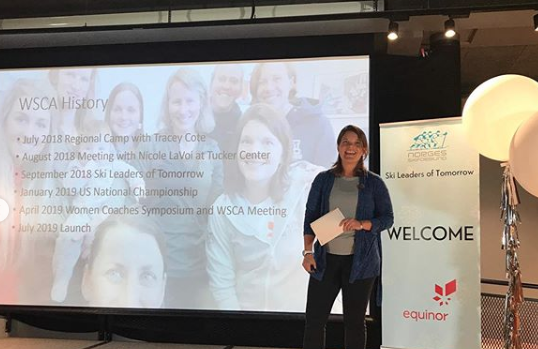
WSCA founder Maria Stuber (College of St. Scholastica) presents on the WSCA mission in Oslo, Norway, 2019. (Photo: Courtesy Image)
Formed in 2019, the Women’s Ski Coaches Association (WSCA) has been a consistent and ardent supporter of creating gender equality in all areas of North American skiing. With WSCA founders—St. Scholastica Head Coach Maria Stuber and Staffer, Craftsbury Green Racing Project Biathlete (and former St. Scholastica skier) Kelsey Dickinson at the organizational core—a strong actor-network has been formed to advocate for women in the ski coaching profession. This has included some notable partnerships with organizations at the heart of US Skiing, including the foundation of theTrail to Gold Fellowship with the National Nordic Foundation this season which will see five women coaches complete a two-week internship on the World Cup this season.
In its latest program launch last month, the WSCA turned to the ski industry. The GearUP program, which announced its first cohort last month, will see ten women coaches from across the North American ski community outfitted with gear from participating ski brands. Fischer, Rossignol, Salomon, Atomic, Madshus, and Swix are all participating. The coaches in this inaugural cohort are all working with representatives of their paired brands, providing the experience of building a lasting relationship with a ski company. Those relationships are often the difference between a club having a reliable way to outfit skiers, and having to patch together equipment from limited inventories, ski swaps, and used marketplaces.
The impetus for GearUP comes from a perceived skew in the “social capital” within our sport. WSCA staffer Kelsey Dickinson addressed that discrepancy in an interview with FasterSkier:
“I don’t think it is a secret that getting [ski equipment] in [the United States and Canada] is almost entirely up to who you know, and that disproportionately skews towards male coaches when a disproportionate number of brand representatives are male.” says Dickinson. That has fostered a space in the skiing community where women coaches struggle to establish themselves: “It’s not that there is intentional exclusion on the part of these brands. [It’s more so] that there are a bunch of coaches vying for a limited number of brand representatives, and there isn’t a lot of thought put into who is working with who.” The individual interactions in the ski industry sum up to a culture that has excluded women coaches, even if it has formed passively: “The ski coach needs equipment, and they will go to whoever they know best. [The brand representative] is more likely to respond to an old teammate, or an old coach…with both parts of that equation being disproportionately male in [the United States ski community], it has tended to exclude women [coaches],” said Dickinson.
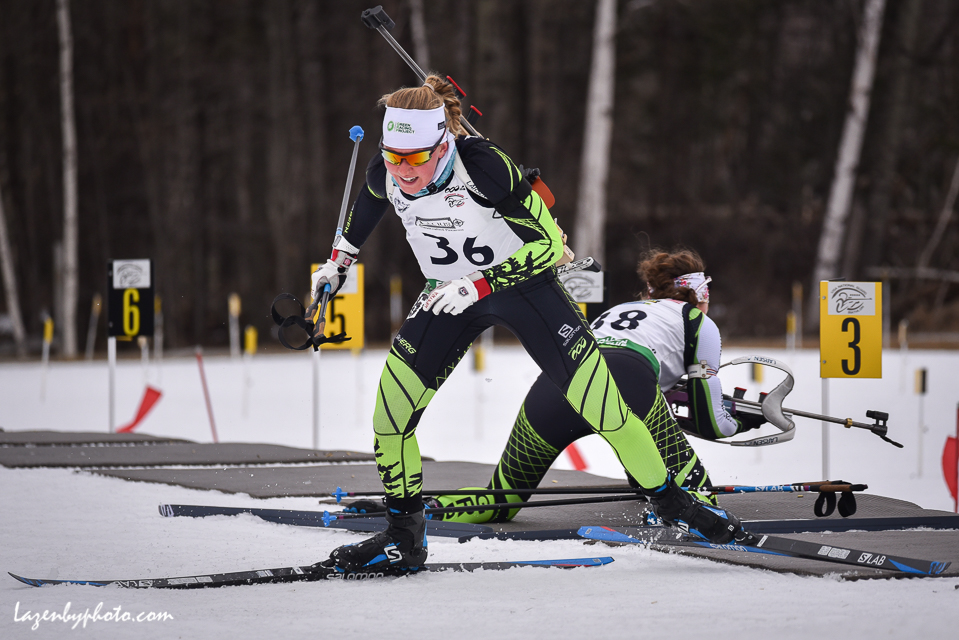
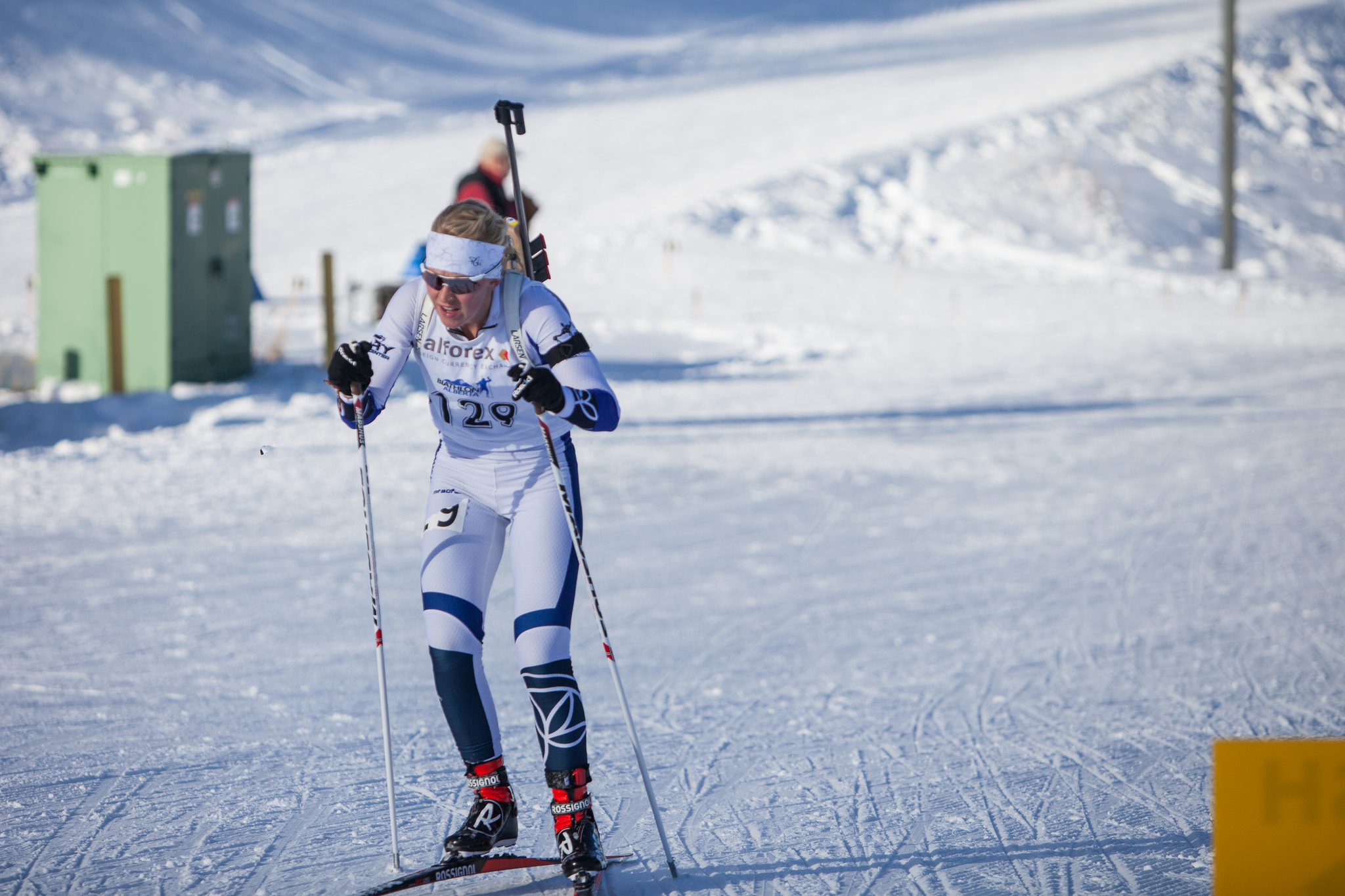
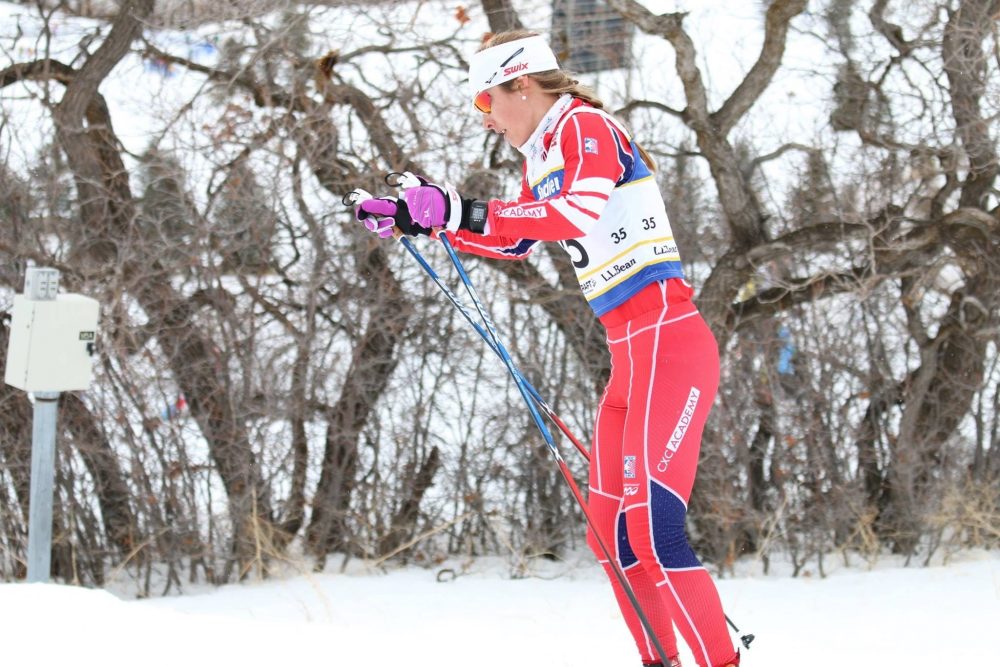
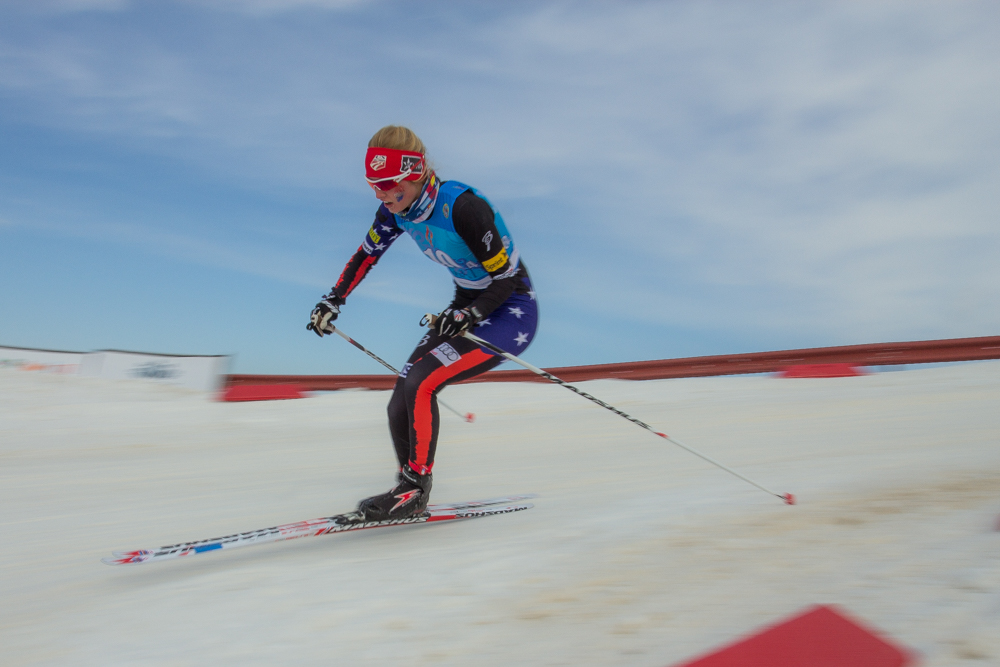
WSCA Staffer and Craftsbury Green Racing Project Athlete Kelsey Dickinson skiing to third in the 10 k pursuit at last year’s U.S. Biathlon Nationals. (Photo: John Lazenby/lazenbyophoto.com)
The motivation behind GearUP is to deliberately change some of the individual interactions of ski coaches with brand representatives so that it leads to a cultural shift where women coaches are more welcome in the ski industry space. For nearly every major ski brand in North America, it was an easy sell. “There was almost no hesitation by any of the big ski brands,” said Dickinson. “Once we went to them and said, ‘this is a place where we don’t think women coaches feel welcome and here is why’ they almost universally came back with a response that said, ‘we are willing to help out however we can to start correcting [the culture] on our end.’”
The result was that every major ski brand (Fischer, Rossignol, Atomic, Salomon, and Madshus), as well as Swix, signed on to outfit at least one female coach with a pair of skate skis, a pair of classic skis, and other brand accessories. Swix agreed to provide the whole cohort with two pairs of poles each. Originally, the program was intended to covereight coaches, but Dickinson and Stuber were able to secure two more additional spots to expand the cohort of coaches to ten. “We had sixty-one applications, which was way more than [WSCA] or the brands expected,” said Dickinson. “Once we went to [equipment sponsors] with the quality of that applicant pool, they were willing to expand the program to reflect the commitment of women coaches in the nordic community.”
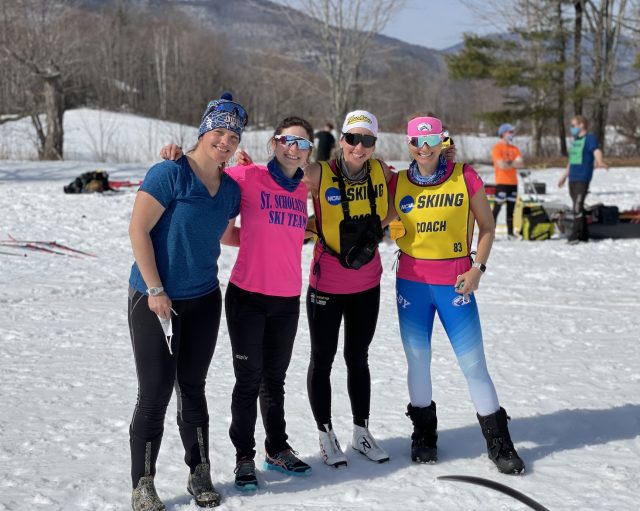
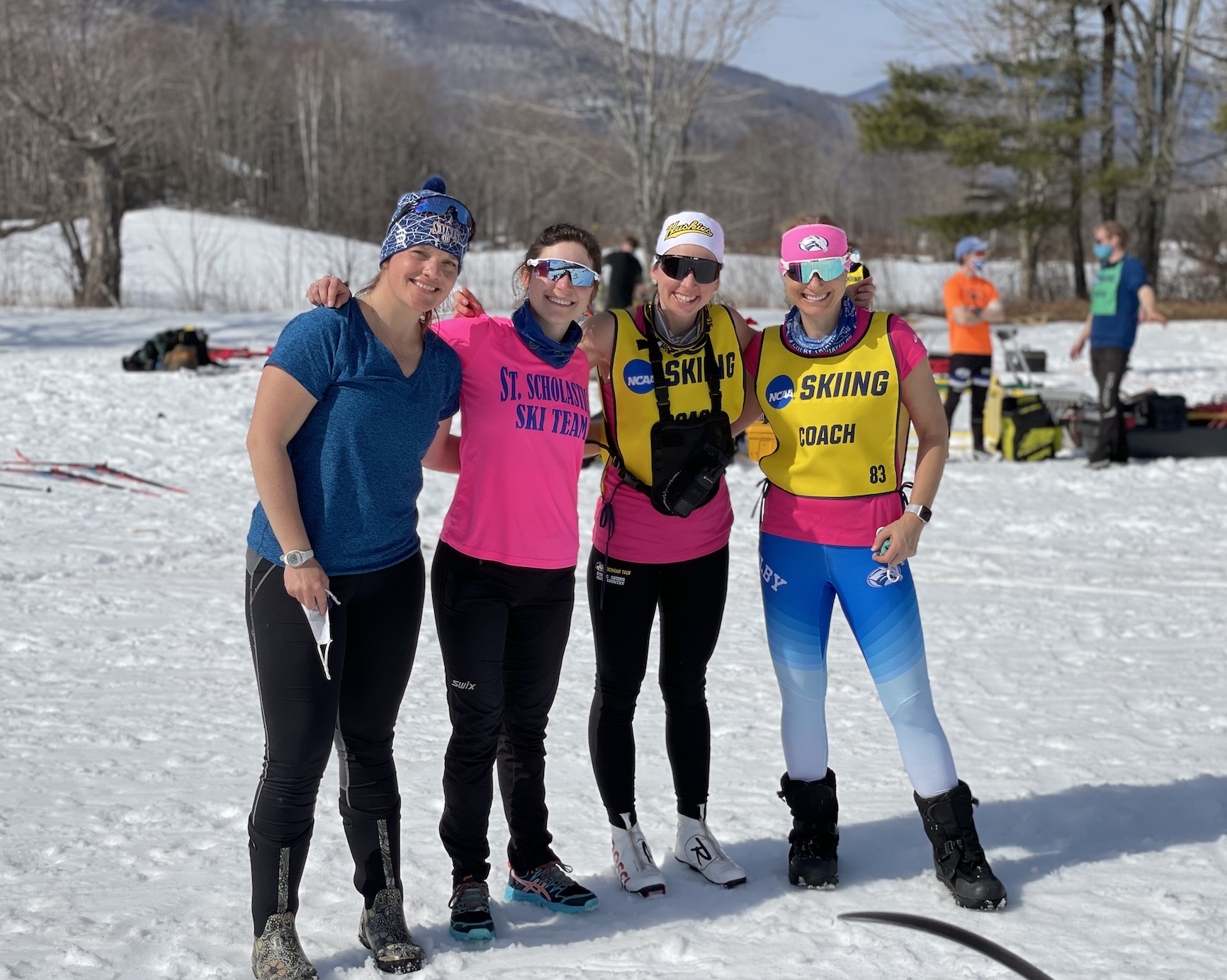
(l-r) WSCA members Maria Stuber (CSS), Kristen Bourne (Now with the US Ski Team), Kristen Monahan-Smith (Michigan Tech), and Tracey Cote (Colby College) at NCAA Championships in Jackson, New Hampshire in 2021. (Courtesy Photo).
The inaugural cohort was announced last month, and Dickinson and Stuber are already brainstorming about the potential for future expansion of GearUP. “Part of why we wanted to do this now is that with the [supply-chain issues of the past few seasons] there was a pressing need for coaches, and also a kind of challenge to brands,” said Dickinson. “We know it’s hard, but this might be an opportunity to come out of this difficult moment with a better culture for women—and women coaches—going forward.”
Future iterations of GearUP will hopefully include a greater percentage of the applicant pool being outfitted, along with more brands from the periphery of the ski industry being involved. Even more crucial may be that new relationships may extend beyond a pair of new skis and boots. “Hopefully, this is resonating out right now,” said Dickinson. “The brand representatives are meeting our coaches and realizing there’s entire clubs and programs with great women coaches that have just been out of the loop on getting the equipment they need, when they need it, to be successful in skiing. At the end of the day, [GearUP] isn’t about skis, it is about skiing.”
The Inaugural WSCA GearUP Program Cohort
Patricia Casey – Alaska Nordic Racing Program (Eagle River, Alaska).
Aliya Brown – Bogus Basin Nordic Team (Boise, Idaho).
Leslie Bode – Thunder Bay National Team Development Centre (Thunder By, Ontario).
Katie Eichten – Spooner Rails On Trails (Spooner, Wisconsin).
Rachel Koroscil – Canmore Nordic Ski Club (Canmore, Alberta).
Dana Hatton – Yarmouth High School (Yarmouth, Maine).
Sydney Michalak – Crosscut Mountain Sports Center (Bozeman, Montana).
Callie Knapp – Endurance United (Minneapolis, Minnesota).
Mackenzie Rizio – Mount Anthony Union High School/Prospect Mountain Ski Club (Bennington, Vermont).
Kirsys Campbell – Jackson Hole Ski Club (Jackson, Wyoming).
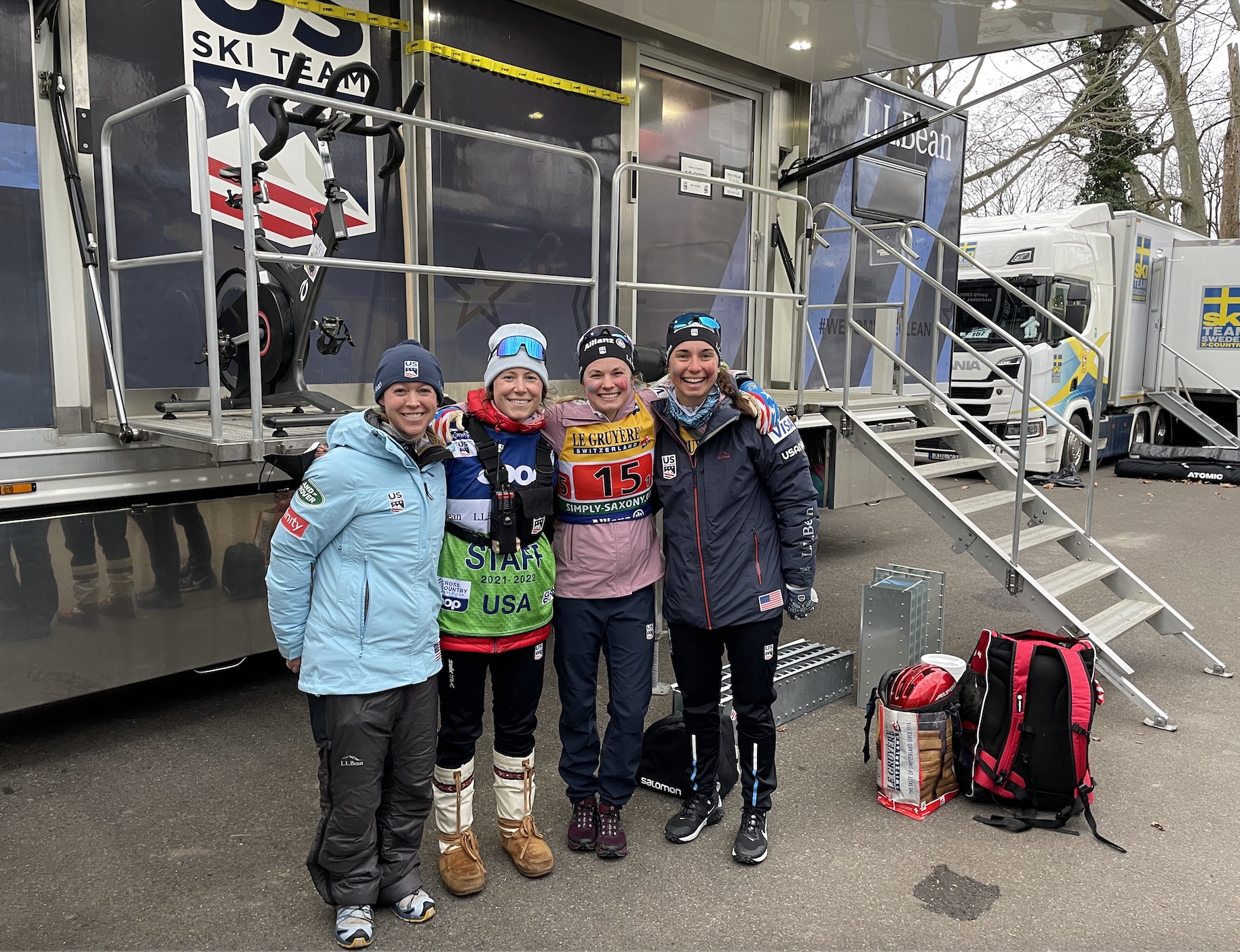
Physical therapist Ana Robinson, Kristen Bourne, Jessie Diggins, and Julia Kern (left to right), at the Dresden World Cup in December 2021. (Courtesy photo)
Applications are open until August 31st, interested women coaches are encouraged to applyhere. Trail to Gold: the journey of 53 Women Skiersis available here.
Moving from idea to action for the women involved in the Trail to Gold book turned out to be expedited thanks to an existing template for not only what they wanted their Fellowship to look like, but what they wanted that Fellowship to accomplish. That case study; U.S. Ski Team Development coach Kristen Bourne.
The story of how Bourne joined the U.S. Ski Team coaching staff is a parable for how success in the sport of nordic skiing should come. In which an extraordinarily talented young coach was paired with supportive institutional structures, relationships, and yes, a little luck here and there, to find her way through the U.S. ski coaching system. It’s also remarkable that Bourne’s whole narrative fits the space of a short story rather than a novel. After a decorated junior and college skiing career at Northern Michigan University (NMU), Kristen Bourne did a stint post-grad skiing that culminated in one last Senior Nationals in Houghton, Michigan in 2020. In an instance where metaphorical resonance became something literal, as Bourne was walking away from her athletic career, College of St. Scholastica (CSS) Head Coach Maria Stuber pulled up in the parking lot and – Midwesterner to Midwesterner – let out a big ol’ “OH Hey there!” which quickly led to a discussion about Bourne coaching, and then, a position as Assistant coach for St. Scholastica.
From there, it’s been an ongoing whirlwind. Stuber is the founder and leader of the Women Ski Coaches’ Association, founded in 2019 to “develop, retain, and advance women in ski coaching leadership.”Stuber and Bourne worked through existing NCAA coaching development programs, which saw Bourne win theWomen Sport’s Foundation Tara VanDerveer Fellowship in 2021, a first for a nordic skiing coach. Bourne’s Fellowship partially helped fund her position at St. Scholastica, but also came with an additional stipend to utilize for professional development in other organizations.
Stuber reached out to U.S. Ski Team coaches Matt Whitcomb and Chris Grover to see if there would be any opportunity to work with U.S. Ski & Snowboard. That turned into a two-week internship on the World Cup that saw Bourne wax teching and coaching at last year’sDavos andDresden World Cups. In turn, Bourne received additional offers to work with U.S. athletes making World Cup starts later in the season, all of which culminated in her hiring as a U.S. Ski Team Development Coach earlier this year. To sum it all up, as Bourne did a couple of times when I interviewed her, it’s been a “whirlwind.” Which, to keep to her own metaphor, is a wind that has turned up inspiration among coaches, athletes, and administrators across U.S. Skiing to bring the type of program that put Kristen Bourne in contact with the U.S. Ski Team into the fold of the nordic community. And now, with the Trail to Gold Fellowship, that’s become a reality.
The energy that’s been infused into making that opportunity a reality is still overflowing at the source. When I caught up with Bourne about the experiences that have made up her journey, she was at the end of a long day working with members of the U.S. Ski Team as they prepared for racing inTorsby, Sweden and atToppidrettsveka in Trondheim, Norway. She brought the same thoughtfulness to our conversation about what formed her approach to coaching as had just gone into that night’s technique session (which happened to include guests Maja Dahlqvist and Frida Karlsson). We not only talked about her journey, but about her influences, mentors, and outlook as a women coach who, just through her own story, has been a leader in the movement to correct for the historic gender inequity in U.S. ski coaching.
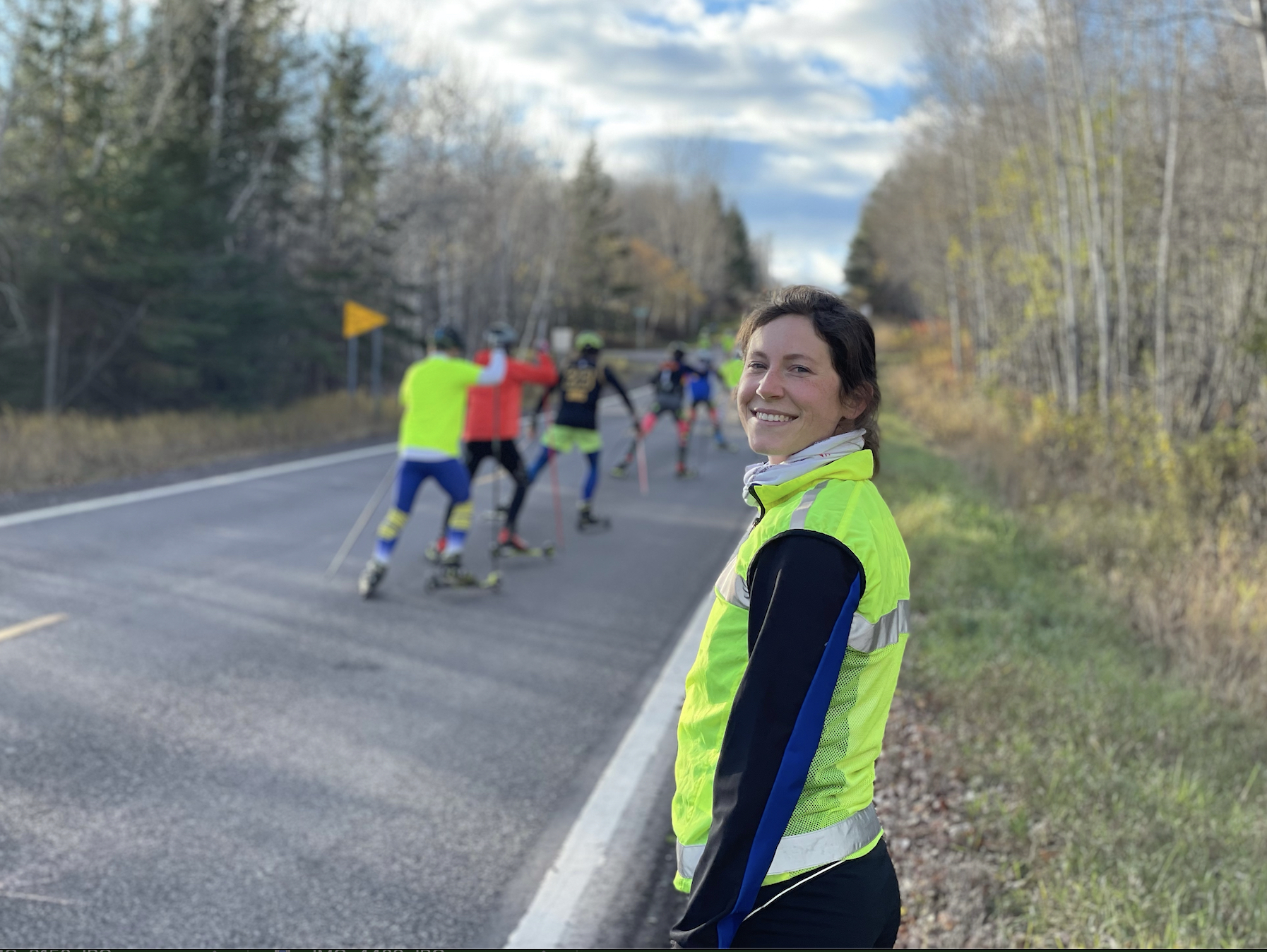
Kristen Bourne at a CSS practice in Fall 2021 (Photo: Maria Stuber).
(This interview has been edited for length and clarity).
Ben Theyerl (BT): Can you start off by giving us a summary of your personal background? What was your journey to your current position with the US Ski Team?
Kristen Bourne (KB): I’m originally from the Twin Cities [in Minnesota]. I ended up going to Northern Michigan University (NMU)and skied for them for five years. Then, about three weeks after graduation, I packed up my bags and moved to Norway, where I lived for ayear and a half [ski racing]. There’s a funny story about that ending – I lost my permit in a friend’s car. I ended up coming back to race US Nationals in 2020, where I met Maria Stuber [Head Coach at the College of St. Scholastica in Duluth, MN]. At the time, I was thinking of calling it quits, and my dad had put out some emails to coaches to really try and pull me towards it. Maria had just started the Women’s Ski Coach Association (WSCA), and my dad had also gone out and signed myself and my sister up for a membership – so between emails and that he was really pulling.
We were literally in the parking lot when she pulled up and was like ‘I’ve heard about you, you’re going to get an email from me.’ That turned into ‘Do you want to coach with me?’ and she helped set me up with a summer internship coachingwith Pepa Miloucheva at the Craftsbury Green Racing Project. Summer of 2020, I started coaching at Craftsbury, and then I was one of Maria’s assistant coaches at St. Scholastica (CSS) for two years.
When I got to CSS, Maria and I applied for a grant with theWomen’s Sports Foundation – the Tara Vanderveer Advancement for Women in Coaching Fund Fellowship. We didn’t get it the first year (2020), and then we applied again, and we got it the second year (2021). That Fellowship partially funded my position at CSS, and then there was an extra $2,500 for professional development outside of that position – which was very broad. Maria nudged me to reach out to the U.S. Ski Team and see if they’d need any help for anything really, and as soon as we did Matt Whitcomb was like yes – ‘we actually could use more help for some World Cups.’ Which was unexpected but made me go, ‘woah.’ So, I went to Davos and Dresden last year.
Over there, I ended up wax teching for Caitlin Patterson, and learning a whole lot from the U.S. staff. Then I was back in the U.S. for the collegiate season and made one more trip back to the World Cup with Bill Harmeyer as his wax tach. That was actually a really cool moment, as he reached out because I had already had World Cup experience. So that little internship directly translated into another opportunity very quickly. Then two months later, Kate Johnson announced she was leaving her position as the U.S. D-Team coach, and I applied and now here I am. It’s a lot, but it’s been a whirlwind.
BT: And now you’re back in Scandinavia at the moment…
KB: Yeah, it’s super full circle now because this is my first time back in Scandinavia since I left and lost my permit. The camp we’re at right now was one of the first ones of a few I had when I was living over in Norway, so it’s definitely a cool thing to be back as a coach this time.
BT:That’s a really great story in itself. If I can dig a little deeper into your background, what was your earliest inclination that you might want to coach? Was this something you thought about when you were younger? Or was it really just when you were stuck trying to negotiate the next step after being a ski racer?
KB: I think I always paid attention to people who were like, ‘you should try coaching.’ But I was kind of stubborn in saying that I was going to do something different after skiing. I guess I kept pushing off that idea in my head, but sporadically when I would help out coaching when I was an athlete, I always really loved it. But I guess, it’s one of those things I guess you don’t think of as a career path when you’re an athlete, right?
As I was ending my ski career and figuring out what I wanted to do I was there with a Bachelor’s in Exercise Science, and I was wanting to do a Master’s in the same, which all just leads me back to skiing. It’s what I love. There was a slow roll towards acceptance that ‘oh man, I think coaching is what I want to do, and then Maria definitely solidified how much I love doing this job.’
BT: You’ve touched on Maria, which we’ll talk about a little bit more, but I was wondering if now that you are coaching, do you look back on any of the coaches you had as an athlete and go ‘oh, like that was why they did that?’ Like is there an inspiration that’s shaped your coaching from your athlete days?
KB: Oh yeah. I had a track and field coach in high school,Bev Docherty. I look back and can’t believe she was coaching me in high school based on her accomplishments – (Docherty has a long list of running accomplishments, including having run in the first 6 U.S. Olympic marathon trials open to women). I look back on her style and who she was and how she coached, and she wasn’t super energetic, super loud, or outspoken. She would lean in during the middle of a race though and you could still hear her clearly even when the crowds were cheering all around. I always look back on that because it was so different than anyone I’ve ever been coached by and she was also one of two women coaches that I ever had. I think that I look back to that and try to emulate just how steady she was as a coach. I don’t know if she knows that: she’s been there throughout my racing career and now as I’m going through my own coaching journey, I really do try to emulate her.
BT: You’ve touched on Maria Stuber a few times. How was that relationship formative when you were starting out coaching, especially given that it was right around when she was taking over at St. Scholastica and starting the Women Ski Coaches Association (WSCA)?
KB: I mean, do you want to write the book on it? She would shrug this off and say it’s not true, but she is one of the biggest reasons that I’m in this job [as U.S. Ski Team Development Coach] right now. She’s pushed me and knows exactly where and when to push is how I would best describe it. And I think that goes both for coaching and also for which opportunities to pursue. She’s 100% my biggest mentor and I will always look up to her.
I think the WSCA and her passion for it is also a big aspect of that. She said ‘this is a change that needs to be made and we as coaches can make it if someone is willing to organize it’ and I’m a testament – as are other women coaches – that she is right on that.
WSCA members Maria Stuber (CSS), Kristen Bourne (CSS), Kristen Monahan-Smith (Michigan Tech), and Tracey Cote (Colby) (l-r) at NCAA Championships in Jackson, New Hampshire in 2021. (Courtesy Photo).
BT: Can you describe how the World Cup Fellowship came together, and what you actually did when you were there last year?
KB: I think the most important part of setting that experience up – because it was really a creation of equal parts myself and Chris Grover and Matt Whitcomb – was that it was a fully immersive experience both on the coaching side and [technician] side, not one or the other. I went over and met up with them right after Lillehammer, which was when the team was on its way to Davos. That gave me three and a half days where I was getting an intensive overview of everything from the wax truck to how [the U.S. techs] do glide-outs, wax application on race day, and the whole process of going from setting up at a World Cup to having our athletes be on the start line.
Then Saturday came, which was sprints in Davos, and I was fully part of it all. Waxing on the World Cup. Sunday for the Distance race, meanwhile, I worked more one-on-one with Caitlin Patterson. It was a whirlwind, but I never felt like I was overwhelmed, because the coaching staff really from the moment I was there was like ‘we want you to be part of everything, and we also know that you’re doing this for the first time and are here to make our team stronger.’
That first weekend was a real introduction into the inside process of what goes on with the process of preparing athletes for a World Cup race. When I wasn’t in the wax truck, I was at team meetings where we would watch sprint footage from previous years on that Davos course and discuss tactics. It’s cool to see how the veterans on the team really are thorough about explaining their tactical ideas and are able to make specific suggestions to their newer teammates. You really get a sense of how the ‘team’ aspect of the U.S. Ski Team operates, and it’s pretty special. I would sit in on meetings with Matt and Chris whenever I was allowed, and also got to be part of the team Christmas celebration.
That was all just in one week. And then we packed up and drove the van to Dresden. Which you know, like I’m driving the whole women’s team from Davos to Dresden and hitting the autobahn and frankly, that was the most nerve-racking part of the entire trip. But we did make it.
In Dresden, I turned over to more of a coaching role. That’s where I got to go out on course for the first time, with poles and radio – the whole nine yards of what you think of when you’re watching the World Cup and see coaches running alongside their athletes on the course. Everyday was really intense, and exhausting, and most of all fun, just taking in everything and not really processing it until later.
BT: Was there a moment of realization where you were like ‘holy crap, I’m on the World Cup?’
KB: I think I tried to process that as much as I could before I got there. Like the moment was really when I had my plane tickets in hand and was like, ‘woah, I’m really gonna go to the World Cup and wax skis.’ But you get there, it was way less intimidating than it looks like on TV. Your years of going to ski races as an athlete of coach kick in and you realize that it’s exactly the same feel and atmosphere – just with the fastest skiers on the planet. Living in Norway and being able to watch World Cups – at Holmenkollen especially – really prepared me for all the extra people, and I think mitigated that feeling you could have when Klæbo or Johaug just skis past you.
But also, I shouldn’t play it down too much. Like yeah, there were moments throughout the two weeks where I did just look up and go, ‘this is the World Cup!’
BT: A big part of the Trail to Gold Fellowship that is based off your experience is that there is avalue in having World Cup experience cross-pollinate with the coaching back in the U.S. What did you bring back from the World Cup that you felt like you applied to your coaching on the NCAA circuit at St. Scholastica, and now with the D-Team?
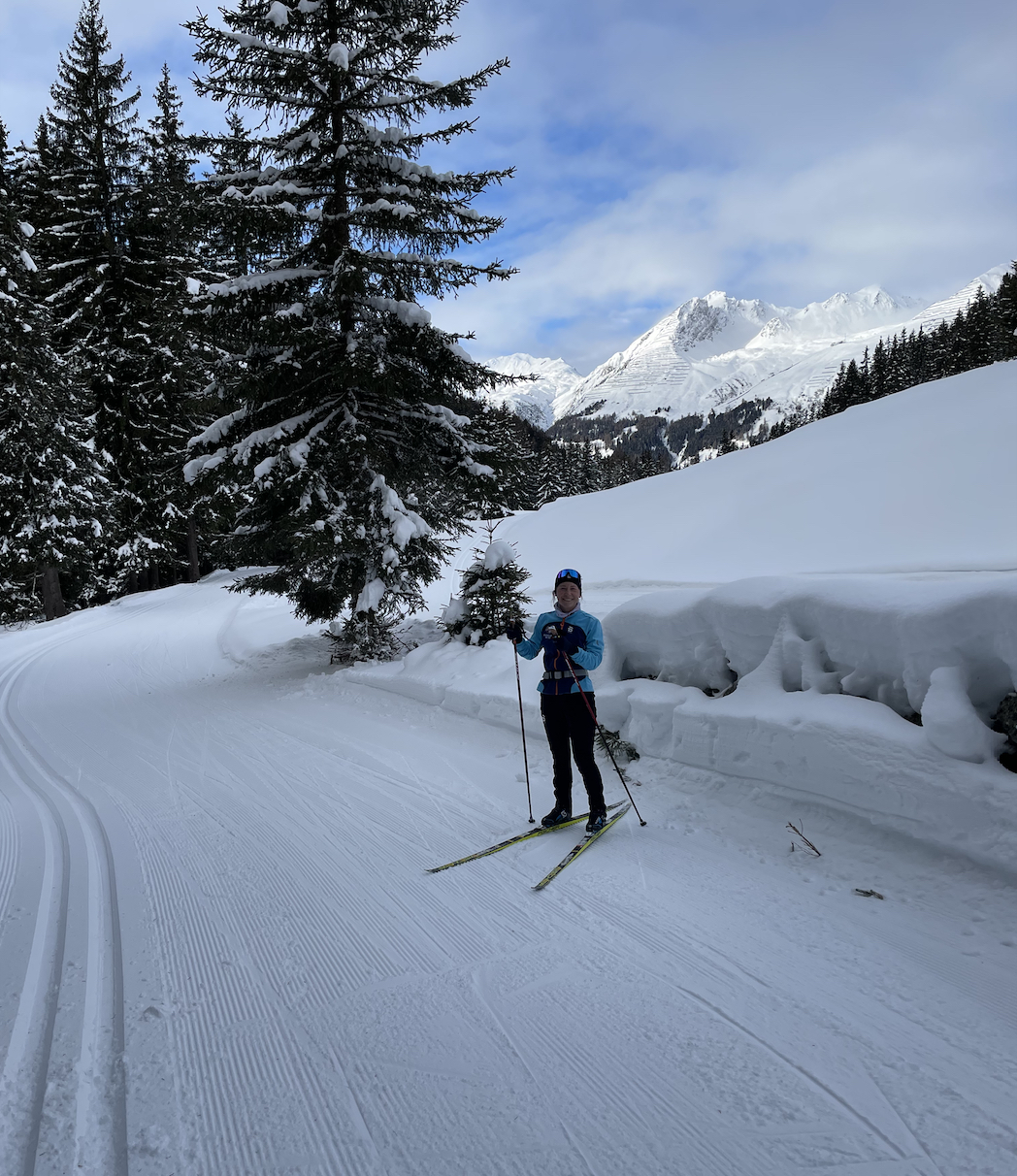
Kristen Bourne logs kilometers on the stunning tracks of Davos, SUI while teching for the U.S. Team. (Courtesy photo)
KB: There were a few things immediately. Like at Scholastica we adopted the glide-out system I learned on the World Cup to our team. More importantly, the mentalities and being willing to talk with other wax techs and understand that waxing theory is really – and that’s a weird thing to call it – less science. You’re not driving towards a single answer, but rather using your knowledge and experience to make a better call than you would if you didn’t. I had a big realization for both teching and coaching that you’re not learning the answer in how to ski coach, but instead that you’re trying to develop a sense of confidence in your experience so that you give that to athletes. There isn’t a one size fits all in coaching.
BT: I really like that idea as a young coach myself. You’re not building towards an answer, but rather you’re building experience to bear so you can make a difference in the really tough situations, you know?
KB: Yeah, I really think that’s a good way of putting it. It’s kind of that moment you realize that there’s not one way to do the job of being a coach, and that’s what makes it a really challenging and exciting profession.
BT: What about how that attitude played into your role now with the U.S. Ski Team? What are you excited about looking ahead to this winter?
KB: For [the D-Team], our athletes are well on their way to hopefully getting World Cup starts soon. And so that’s where I can act as a resource with my experience of what they can expect as they look to make those first starts. I’ll also be full-time on the World Cup this winter, which is exciting. I’m not anyone’s primary coach but will be doing a lot of what I did last winter, so in that respect, the World Cup experience I got will be about as good of preparation as I could get.
BT: I had one last question pertaining specifically to the Trail to Gold Fellowship. What do you think the role of gender representation on the top-level of skiing is in helping the sport develop?
KB: I think it has an immediate impact. I think it’s as simple as the fact that the more women that young kids see out on the course the more, they are going to believe that they belong there. I hope that immediate impact spreads to those coaches that are doing this fellowship this year as well. They can walk away with tangible World Cup experience, and also realize that they are part of pushing the movement for gender equity in coaching forward and inspiring girls that are out there at the races.
I think back to being around wax rooms, at local races, or watching the World Cup on TV growing, and I really do think that if I would have seen more female representation it might have made me realize that coaching could be a viable career for me because I’d seen people like me in that position. Doing this fellowship works to inspire both the women who are coaching and the women who will be coaching one day.
BT: That’s a really eloquent way to put that.
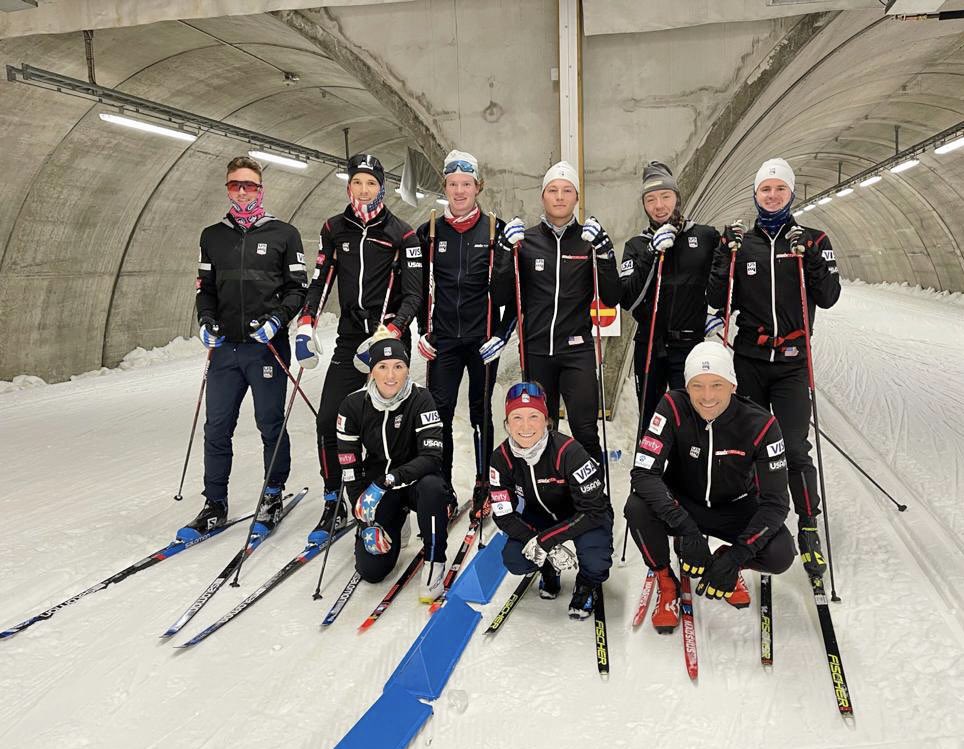
USST athletes and coaches in the Torsby Ski Tunnel, August 2022. Back row, from left: Johnny Hagenbuch, Kevin Bolger, Finn O’Connell, JC Schoonmaker, Ben Ogden, and Walker Hall. Kneeling, from left: coaches Greta Anderson, Kristen Bourne, and Matt Whitcomb. (photo: François Faivre)
Applications for the Trail to Gold Fellowship are open until August 31st.
To buy Trail to Gold, the Journey of 53 Women Skiers, click here. Proceeds are dedicated to funding the Trail to Gold Fellowship.
While it’s difficult to get exact numbers, the general distribution of coaches and service staff on the World Cup level is largely male dominated. The recently announced Trail to Gold Fellowship aims to help change that. Following the publication of the Trail to Gold book in November of 2021, members of the book committee began discussing how to use the net proceeds generated by book sales. After bouncing around various proposals, they settled on the idea of a fellowship to help the development of women cross-country coaches in the United States.
Julia Kern and U.S. Ski Team head coach Matt Whitcomb watch the 4 x 5 k mixed relay in Falun from the stadium. (Photo: NordicFocus)
In partnership with the National Nordic Foundation, the Trail to Gold Fellowship will provide funding to the U.S. Cross-Country Ski Team (USST) for the cost of bringing women ski coaches on World Cup trips. Once there, the Fellowship coaches will learn and participate in coaching and ski service internships with mentorship from the U.S. Ski Team staff. Fellowship recipients are also expected to complete a professional development plan for the experience and write a final report upon conclusion, with guidance from the Women Ski Coaches Association (WSCA) and USST mentors.
A recently adopted proposal by the International Ski Federation (FIS) will aid the process of getting the fellowship coaches out on course, and hopefully incentivize other countries to invest in the development of female staff members. Brought forward by the U.S. Ski & Snowboard, the proposal adds a number of course access bibs per team for female service staff only.
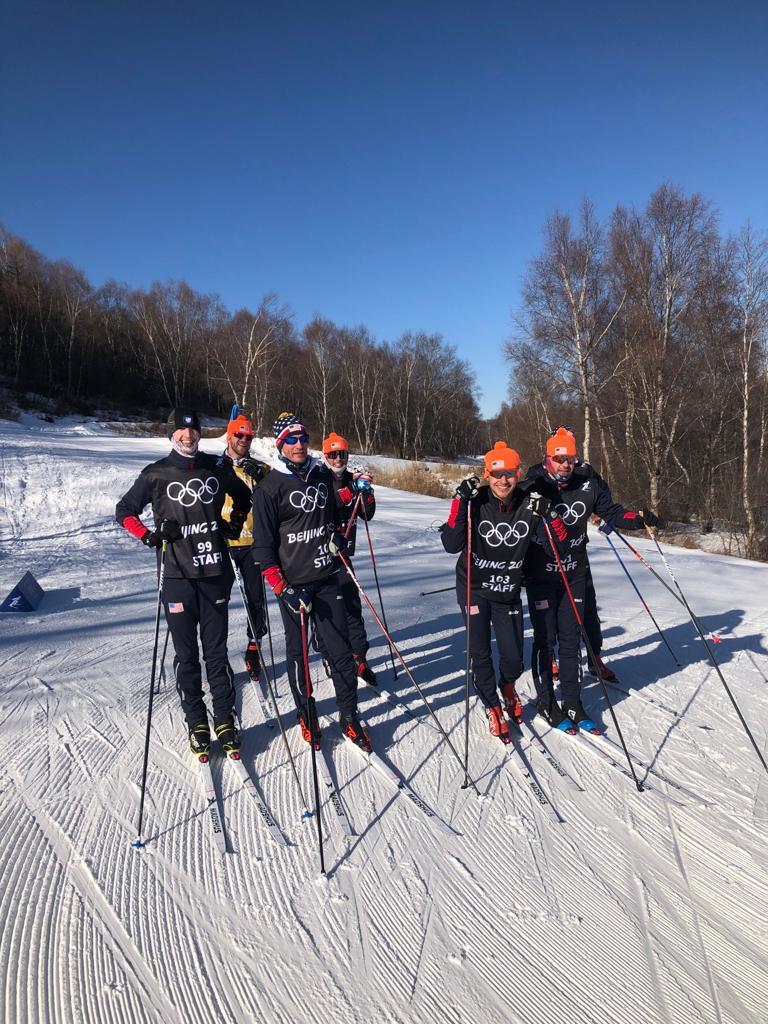
The U.S. wax staff in Zhangjiakou China for the 2022 Olympics. From left to right, Patrick Moore, Andrew Morehouse, Bjorn Heimdal, Tim Baucom, Chris Hecker, Jason Cork, and Eli Brown. (Photo courtesy fellow technician, Karel Kruuser)
Current U.S. Ski Team D-Team coach, Kristen Bourne, participated in a similar program to the one proposed by the Trail to Gold Fellowship, though with funding for her trip to the World Cup coming from the Women’s Sports Foundation VanDerveer Fellowship. Bourne spent two weeks as an intern on the World Cup, gaining invaluable international level experience and knowledge. In an email to FasterSkier about Bourne’s time on the World Cup, USST Program Director Chris Grover wrote, “We have a U.S. Ski & Snowboard program-wide goal, and a cross-country specific goal, to drastically improve gender equity in our coaching and technician staff, so this opportunity was perfectly aligned with this mission.” The Trail to Gold Fellowship also fits squarely within that mission and both Grover and WSCA’s Maria Stuber are working to help make the program a successful reality.
Kristen Bourne (center) joined the U.S. tech team to learn and support the American squad in Davos, SUI. (Courtesy photo)
While initial funding for the Trail to Gold Fellowship will come from the Olympic Women’s Cross-Country Book Project, the committee is working with the National Nordic Foundation (NNF) to expand the size and life of the fellowship. Led by a commitment of NNF Board members Kikkan Randall and Matt Whitcomb, NNF will work to gain donations that add to the Fellowship, increasing both the number of internships that can be awarded and the number of years that the program can exist.
The Women Ski Coaches Association launched in September 2019 in pursuit of gender equity in coaching.
The Women’s Ski Coaching Association is also involved in this collaboration. Having helped with the funding to send Bourne to the World Cup last winter, the WSCA will have a representative on the Fellowship selection committee. The committee will also have representatives from the Trail to Gold book committee and the U.S. Ski Team. This committee will be in charge of selecting the Fellowship recipients.
Sue Long Wemyss, head of the Trail to Gold book committee, wrote to FasterSkier, “We, the book committee, look forward to more American women ski coaches and ski technicians having a very similar experience [to Bourne’s] of interning with the U.S. Ski Team at the World Cup this winter, and in winters to come. We are incredibly grateful to the USST leadership for their willingness to bring and mentor the selected women with them on a World Cup trip. We are also very appreciative for NNF’s support and help in making this program happen.”
Applications for the Fellowship are open now and will close September 1st. The application can be found here or on the NNF website.
On February 8th, cross country skiing made the New York Times headlines as Jessie Diggins collected an historic bronze medal in the 1.5-kilometer freestyle sprint. No American woman had ever won an individual medal in cross country skiing, and no American cross country skier of either gender had won multiple Olympic medals. Diggins had earned gold in 2018 racing the freestyle team sprint with partner, and current NBC analyst, Kikkan Randall.
Normally, attention given to niche sports by mainstream media is welcome – cross country skiing is a blip on these outlets’ radar roughly once every four years during the Olympics – but a statement included in the report was quickly met with criticism from athletes and coaches in the sport.
Here’s the statement written by veteran sports journalist Matthew Futterman:
“In a sport that has so many women with massive shoulders and thighs, Diggins looks like a sprite in her racing suit, and it’s not clear exactly where she gets her power. But the power is there, as she flies up hills, and comes off climactic turns with a burst. On the downhills, she tucks low and cuts through the air.”
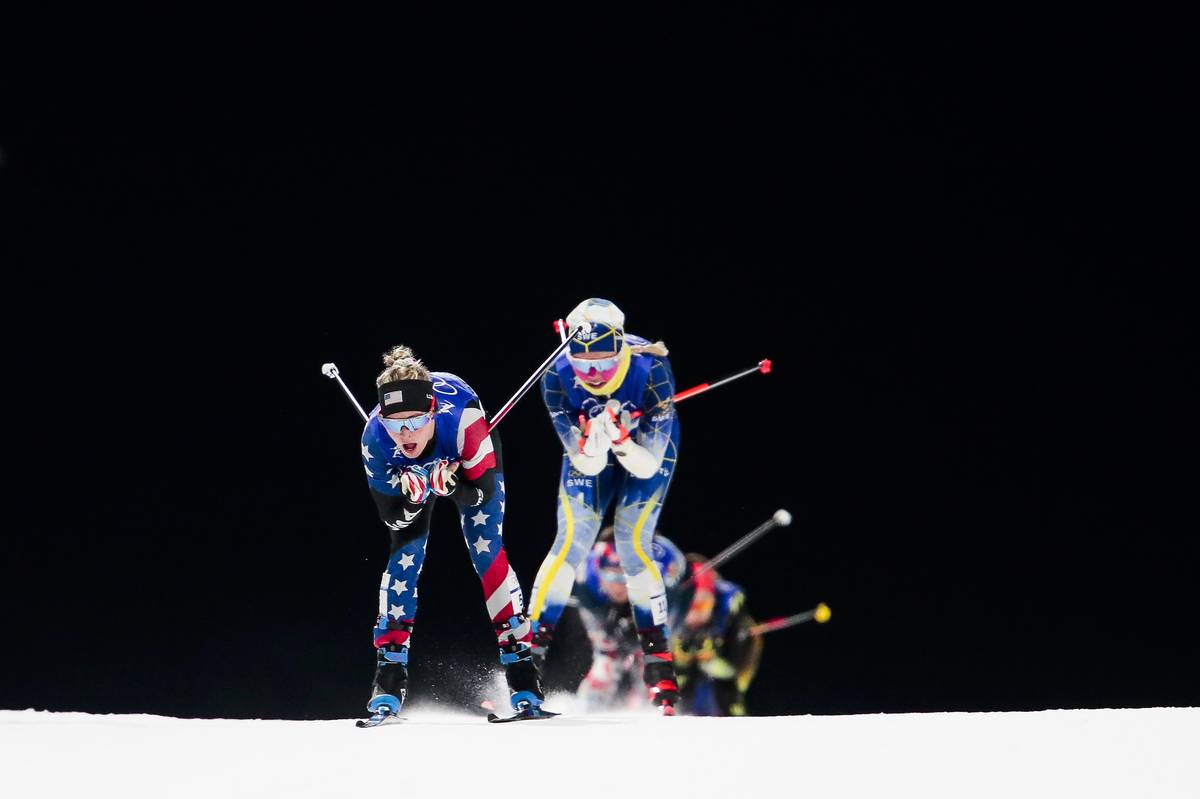
Jessie Diggins drops into a tuck as she leads Sweden’s Emma Ribom into the downhill during the 1.5-kilometer freestyle sprint event in the 2022 Beijing Olympic Winter Games. (Photo: NordicFocus)
All-American Colby College ski team alumna turned professional mountain runner for the North Face, Olivia Amber was quick to respond on social media, telling Futterman to “do better” and offering suggested edits to his wording.
Amber proposed: “In a sport that requires a unique combination of upper and lower body strength, Diggins’ ability to apply power is extraordinary, and it’s very clear how she has become one of the best athletes in the world.”
Her instagram story was shared widely amongst her followers. Explaining why this language struck a nerve, Amber wrote the following to FasterSkier.
“The way the media often covers athletics objectifies women and excludes people that don’t conform to the myth of an ideal body type. The language used in the recent NY Times piece is yet another example of this broader issue in women’s sport. It’s a clear oversight that demonstrates a lack of knowledge on the author’s subject. Featuring the size and shape of women’s bodies devalues the lifetime of hard work these athletes put into achieving the pinnacle of their sport.”
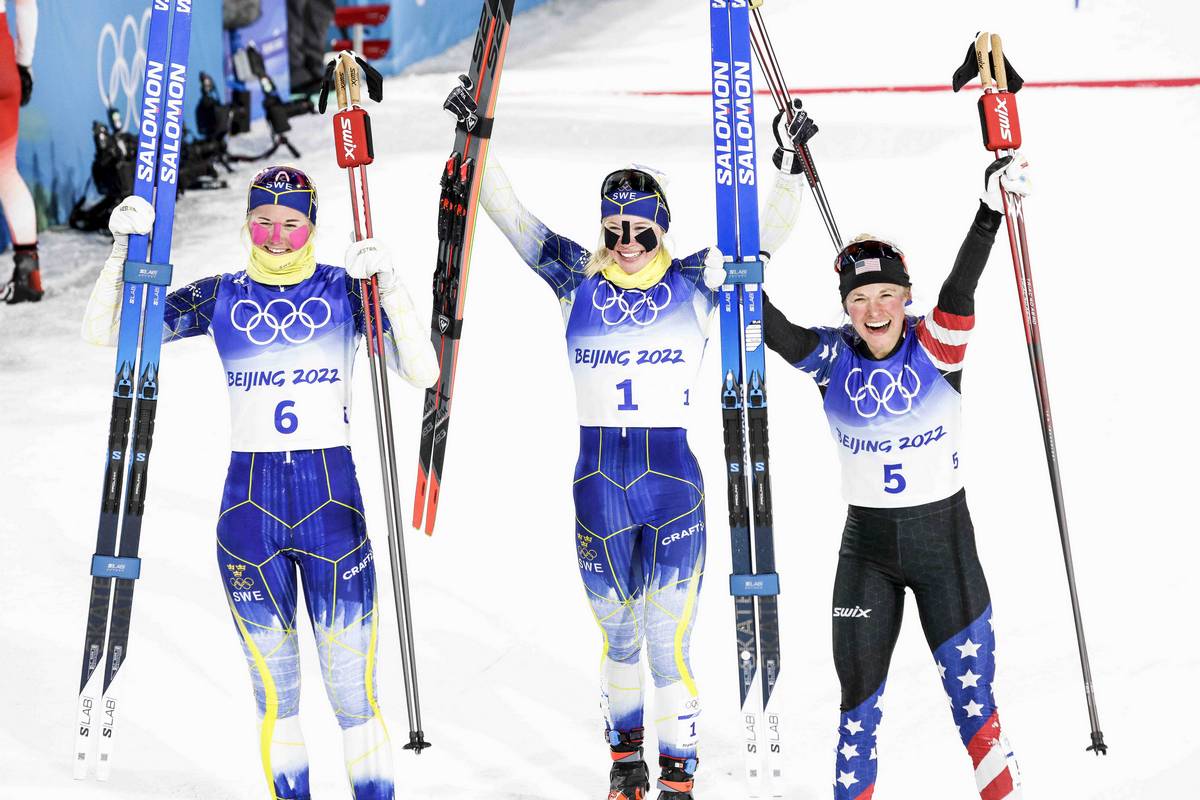
The women’s Olympic 1.5-kilometer freestyle podium: Sweden’s Jonna Sundling took gold ahead of teammate Maja Dahlqvist and American Jessie Diggins. (Photo: NordicFocus)
FasterSkier contacted Futterman to see whether he had a response to the criticism his statement had received. Futterman explained that he would need clearance from the Times’ communications department in order to respond. FasterSkier later received the following from a spokesperson:
“We aim in our sports coverage to cover male and female athletes accurately, equally and fairly. We believe sometimes their physiques are relevant to their performance. In this case, our description of cross country skier Jessie Diggins’s noticeably different physical attributes in contrast to others in her sport were an important and relevant detail. Her dominance in the sport was also the subject of alengthy feature on Feb. 4.”
However, many readers continue to find fault with the statements at play.
“I have always held the NY Times in high esteem for their quality reporting, which is why I was absolutely floored to read Matthew Futterman’s comments about my teammate’s body,” writes Holly Brooks, two-time Olympian and licensed professional counselor who offers eating disorder support to athletes through her practice and advocacy. “On a day where Jessie made U.S. history by becoming the first female individual medalist in cross country skiing, Mr. Futterman chose to make inconsiderate comments about her body, questioning the source of her power. Please hear me loud and clear: It is NEVER appropriate to comment on an athlete’s body with regard to their weight, shape or size. Instead, emphasize their power, fight, tenacity and strength. And to the NY Times: Jessie, athletes worldwide, and the entirety of your readership deserve better. Mr. Futterman should apologize for his insensitive words and be sent to sensitivity training.”
Jessie Diggins (USA) takes control of her quarterfinal during the 1.5 kilometer freestyle sprint. (Photo: NordicFocus)
It is not the first time Diggins has received comments regarding her body from the media. She was once asked whether her talent on downhills was related to her size, versus her skill. One strategy she has begun to employ to avoid comments that might have a detrimental impact on her mental preparation has been to avoid reading them altogether.
When asked in the mixed zone after the 10 k classic whether she had heard anything regarding Futterman’s story, Diggins said, “To be honest, I don’t read things written about me and I think that’s a very, very healthy thing. But it’s unfortunate with Rule 40 that you can’t see the invisible headgear sponsor that is there at all times for me.”
After sharing a blog post titled “Body Image Issues” in June, 2018 Diggins has openly shared her own challenges with disordered eating, body dysmorphia, and bulimia across many platforms, including her book, Brave Enough. Outside of the Olympic blackout period, described in Rule 40, Diggins wears the logo of the Emily Program, a leader in eating disorder treatment and education, on her hats and headbands, acting as an advocate for the facility she credits with supporting her through her own recovery journey.
She now regularly rejects the narrative that “lighter is faster”, and instead repeats how properly fueling her body and prioritizing her mental and physical health have led her to perform at this level. Diggins aims to be an example for future generations of skiers.
“It’s important that women everywhere know that they’re good enough the way they are,” Diggins said. “You don’t have to be a certain body type to win at the Games; you have to be healthy and happy and have a great support crew.”
Diggins’ advocacy in this space was a focal point in a message penned by Kris Hansen, a former cross country ski coach at Diggins’ alma mater in Stillwater, MN, sent to the Times after reading the piece. Hansen also shared her response publicly on Facebook.
“Eating disorders, or disordered eating, are sadly very common in young women athletes… conditions that are definitely exacerbated by insensitive and inaccurate reporting like Mr. Futterman’s,” she wrote.
Hansen called it “ironic ignorance” that an athlete who raises awareness for body image issues in sport would be described in this way.
“Jessie is no ‘sprite’,” Hansen continued. “She is a powerful woman, an exceptional athlete, a World Champion, a thoughtful and articulate advocate for women athletes, and now a multi-medal Olympian.. I can also tell you from where she gets her power: hundreds of hours of training her body and her mind, on the snow, in the weight room, with her coaches… Further, her competitors are not “women with massive shoulders and thighs”. They are women who, like Jessie, have worked very hard to build bodies that can climb a hundred meters in a matter of seconds and then navigate an icy technical downhill….again and again for 30 kilometers. You have done Jessie, and all women athletes, a disservice with your ignorance and disrespectful characterization.”
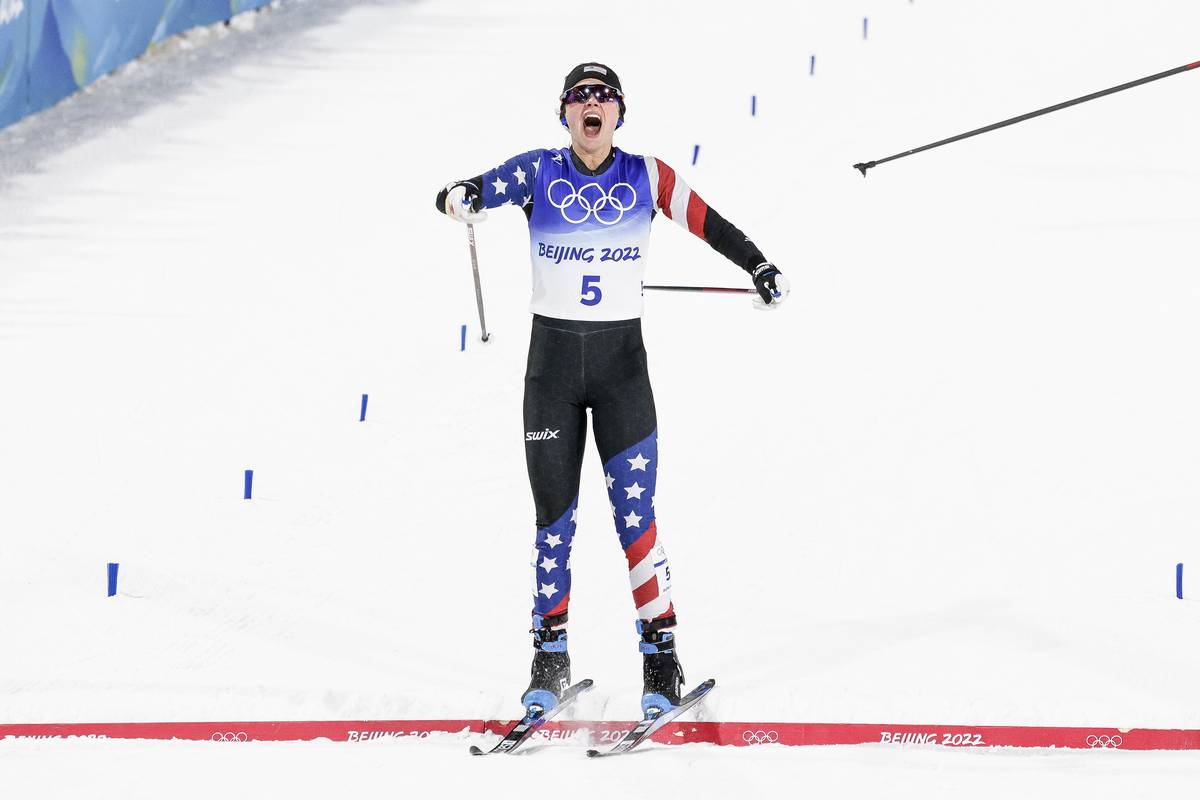
Jessie Diggins crosses the line in third to earn the first individual Olympic medal in women’s cross country ski history. (Photo: NordicFocus)
College of St. Scholastica head coach and founder of the Women Ski Coaches Association Maria Stuber offered a solution-oriented approach, advocating for awareness and education that might better support and protect athletes of all levels from body-centric messaging.
“What is very obvious here is that if the NY Times reporters and editors do not understand why this language is damaging, and we have a long way to go in education. If a career sports journalist isn’t learning this, certainly parents and youth coaches are not either. We are to the point where prominent athletes, like Naomi Osaka, are refusing to participate in news conferences or talk to journalists because of their ignorance on this topic and the potential damaging effects on mental health of athletes. Maybe the NY Times would be willing to help with the education component? How do we make sure you can’t become a sports journalist (or editor) without some body image/mental health education? Equal representation of women in sports media careers would certainly help.”
Like Diggins, many athletes at the Games are choosing to remain disconnected from the news and are not engaging with topics that might derail their focus. Others, like the Russian Olympic Committee’s Veronika Stepanova, have spoken out about the article. Stepanova shared a video of herself reading the statement on Instagram, sardonically captioning the post “Objectification? Never heard of it.”
Novie McCabe races to 24th in the 10 k individual start classic during the 2022 Olympic Winter Games. (Photo: NordicFocus)
FasterSkier had the opportunity to ask Hailey Swirbul and Novie McCabe thoughts on the statement in the mixed zone following their performance in the 10 k individual start classic race Thursday.
“I think that our sport is so unique and so powerful in the sense that every single body type can succeed at this sport,” Swirbul responded. “It doesn’t matter how you look, it matters how you race with your heart, how hard you work, and I know that everyone on our team works so freaking hard, Jessie included. Everyone on that podium deserves that spot, no matter what they look like.”
“I think the older girls have kind of been trying to ignore it a bit,” McCabe explained. “But it was obviously pretty uncalled for and insensitive, and they need to do better… Jessie got a medal because she’s the best out there and not because of anything about her body, so I think just insinuating that there’s something there was not okay.”
Swirbul also stated that response from the community to the Times article has not been a distraction for her as she prepares for Olympic competition.
“It makes me appreciate my own strength and how hard I work to gain fitness and muscle. I think it just really makes me appreciate how diverse our sport is all across the board.”
Speaking more broadly to whether a focus on the appearance of athletes’ bodies from the media is frustrating for her, Swirbul concluded, “I hope that as a culture, we can move away from body types and focus on the hard work and the courage and the bravery that everyone races with every day. I really hope that that’s where we move in the future.”
Hailey Swirbul pushes to the finish of the 10 k individual start classic during the 2022 Olympic Winter Games. (Photo: NordicFocus)
CSS assistant coach Kristen Bourne was awarded the Women’s Sports Foundation VanDerveer Fellowship for the advancement of women in coaching. (Photo: Maria Stuber)
Kicking off her second year as assistant coach at the College of St. Scholastica (CSS) in Duluth, MN, Kristen Bourne was recently named one of ten recipients of the Women’s Sports Foundation VanDerveer Fellowship. The program, named for revered Stanford University Basketball coach, Tara VanDerveer, aims to increase representation of women in coaching at the collegiate level through the development of the rising generation. This is the first time that the award has been granted to a cross country ski program.
According to the WSF, “this pioneering program provides grants, paid fellowships and mentorships for aspiring female coaches. Emphasizing hands-on training for female coaches in all collegiate sports, from basketball and volleyball to water polo and fencing, it is a salute to the extraordinary compassion, optimism and leadership that its namesake has shown over the years.”
Along with opportunities to collaborate with coaches across a variety of sports nationwide, the program offers institutions $15,000 to use in support of their fellow, along with $2,500 that goes directly to fellow to put toward additional professional development opportunities. FasterSkier connected with Bourne to learn more about the fellowship, her path to coaching, and how this opportunity will support her growth and long term goals in cross country ski coaching.
Originally from Lake Elmo, MN, on the eastern side of Minneapolis, Bourne attended Northern Michigan University (NMU), where she graduated with a degree in Sport Science in May, 2018. While racing for NMU, Bourne raced on four NCAA championship teams, and was a member of the 2015 U.S. World Junior Championships team and the 2016 U23 World Championships team. Post-college, she headed to Norway to train with Lyn Ski and Team Obos in Oslo, while competing in numerous FIS races throughout the country.
CSS assistant coach Kristen Bourne spent time in Norway after college training with Lyn Ski / Team Obos. Bourne is pictured here racing in a Norwegian Cup race in Gålå. (Photo: Martin Riseth)
Bourne returned to the US in December, 2019 to finish her racing career at the 2020 U.S. National Championships in Houghton, MI. It was there that she met Maria Stuber, head coach at CSS and the founder of the Women Ski Coaches Association (WSCA), who recognized Bourne’s potential as a coach and recruited her to the CSS program.
“I was just deciding that my ski career was about done and trying to figure out what to do next,” Bourne explained in a call. “I was at U.S. Nationals, I was leaving a parking lot, and Maria drove up and essentially slammed on the brakes, and yelled out the window, ‘Hey! My name is Maria. I heard that you’re interested in potentially coaching. You’re gonna get an email from me sometime soon.’”
Bourne went on to explain that Stuber emailed her the next week asking if she would be interested in joining her as the assistant coach at CSS. Tying the fellowship opportunity into the offer, Stuber knew about the VanDerveer grant and would help oversee the school’s application on Bourne’s behalf. CSS was not chosen after the first year of application, but they were selected this year on the second attempt.
Bourne explained how receiving the VanDerveer fellowship allows her to pursue a number of development opportunities beyond her role at CSS.
“Right now I have a few things in mind that I’m going to put that money towards. I would really like to go to the NCAA Women Coaches Academy, which happens every May. They have a bunch of super awesome female speakers and head coaches that all talk, and it seems really valuable. I think Maria did it a few years ago. Then the other professional development opportunity would be: I’m currently working on a trip over to the World Cup this winter.”
Though her education and wealth of experience lends itself well to coaching, Bourne did not always see this as a path she would choose.
“People were always telling me that I would probably end up being a coach, and I didn’t want to do what everyone thought,” she laughed. “And then, you come to this realization: I love the sport, and I want to learn more about it, and I’m really passionate about it. I can take my personal experiences from being in Norway and seeing how they work over there, I can apply what I learned there, and through college, my own [time as an athlete]… Right now I’m also working on my master’s in exercise physiology. So being able to take all of that experience and knowledge and be able to apply it as a coach, I think it’s kind of a no brainer.”
Though improvement is trending, women remain underrepresented in leadership roles in the ski community. According to the 2020-2021 Women in College Coaching Report Card issued by the Tucker Center for Research on Girls & Women in Sport, only two of nine NCAA Division 1 cross country ski coaches are women.
A few of the female coaches represented at the 2021 NCAA championships. From left to right, Maria Stuber, Kristen Bourne, Kristen Monahan-Smith of Michigan Tech, and Tracy Cote of Colby College. (Courtesy photo)
Stepping into this realm without significant experience in coaching, Bourne spoke to the importance of having a strong mentor and role model in Stuber, who has helped her realize her potential in the role.
“The other [factor influencing my transition into coaching] has been working for Maria. She has just taken me on and put me under her wing, and really gets me to do things that I wouldn’t normally do. It has boosted my confidence in myself knowing that I can do this and that this is what I want to do for the rest of my life. That was a huge piece of it, too.”
Expanding on Stuber’s formal role as a mentor for the VanDerveer Fellowship, Bourne explained that both she and Stuber will have the opportunity to connect with the other fellows and mentors involved in the program, which spans a variety of sports from basketball to water polo to track & field. This collaboration allows the women to discuss their successes and challenges in their respective sports, and learn from each other’s experiences.
In a 2019 presentation at the U.S. Ski & Snowboard annual meeting on the importance of women in coaching, Dr. Nicole LaVoi of the previously mentioned Tucker Center explained the importance of women in leadership roles to inspire the next generation of coaches and improve the experience of developing female coaches.
“When you see women being successful, it inspires people,” LaVoi said. “‘Oh, I could do that. That seems cool, she seems cool, I want to do that.’ And in they come. It’s the same thing with women in positions of leadership.”
Bourne emphasized that this concept rings true for her in working with Stuber, who has stoked her fire to become an example for future women in the sport.
“She said so many times that the Women’s Ski Coaches Association and empowering women — this is her passion. I just feel so honored that I get to be right alongside her. She’s so powerful, and she has such a strong impact, and she’s doing this incredible thing that I think quite a few people are scared to do. She just says, ‘No, I’m doing it. We’re gonna change some things here.’ And I think that’s just — it’s pretty dang cool.”
Looking to the future and the role she hopes to play, Bourne aspires to be a head coach at or above the college level. She enjoys the environment of collegiate programs, but remains open-minded. Reflecting on the dearth of female coaches in her own athletic experience, she concluded with her intention to be part of the solution in the slow progression toward gender equity in sport leadership.
“When coming to the decision of becoming a coach, there is this thought of, ‘Well, I’ve never really experienced anyone like me in that position before. Can I do that? Can I have the same impact on a team as a man would? But really it’s [lack of] representation. There’s also the concept that women are proven to improve work environments — having more women is better. And being able to support female athletes — and being able to support male athletes — with a different perspective is super important. There’s a lot of pieces — it’s a huge question. I just hope I can be a role model for more women coming up who want to get into coaching and stay in the sport.”
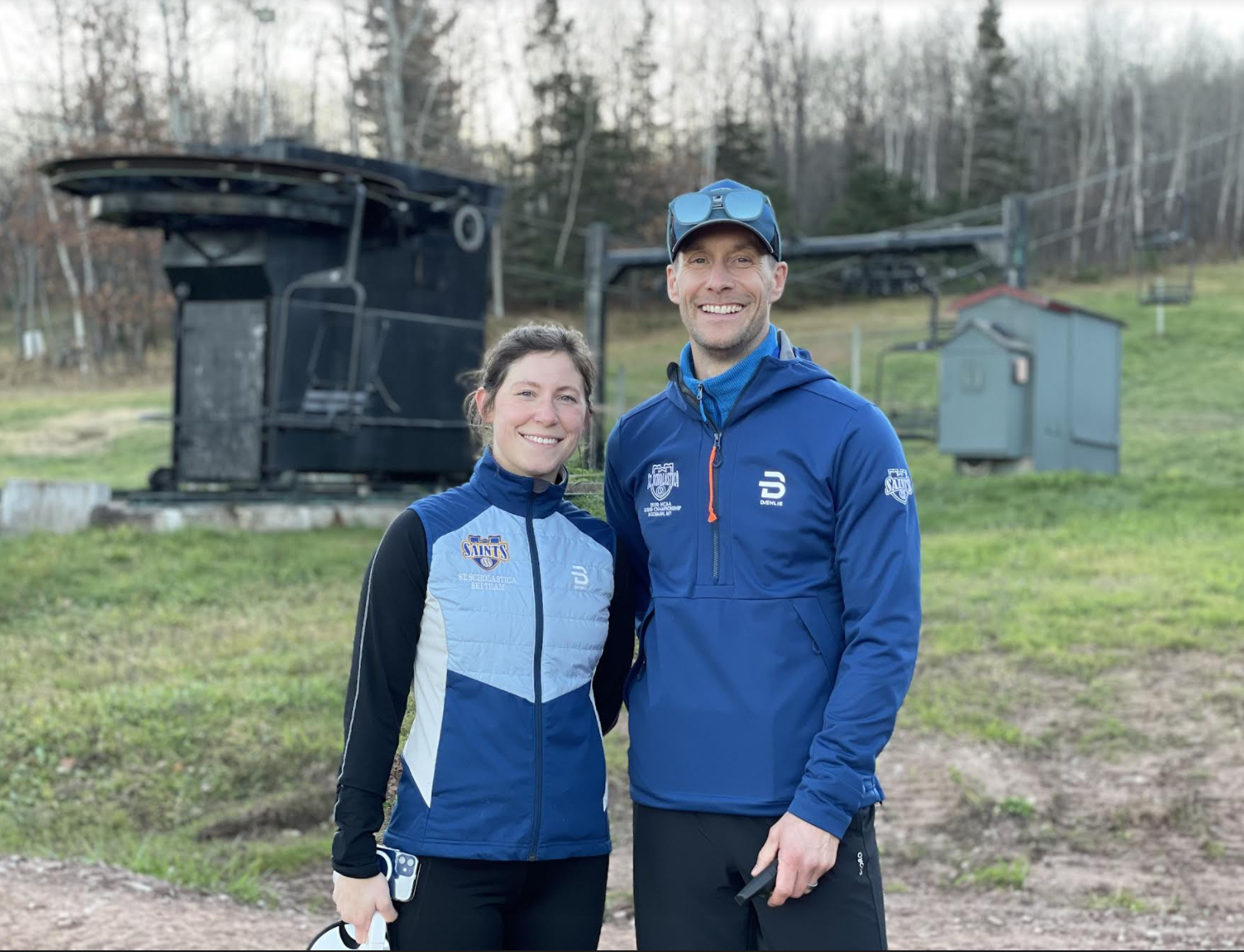
The CSS Assistant Coaches: Kristen Bourne (left) and Joshua Tesch (right). Stuber explained that Tesch has bee coaching at CSS for 15 years and has been a mentor for both herself and Bourne. (Photo: Maria Stuber)
Dr. Nicole LaVoi gave a keynote presentation at the U.S. Ski & Snowboard National Cross Country Coaches Symposium. LaVoi is the co-director of the Tucker Center at the University of Minnesota in Minneapolis. (Photo: Screenshot nmlavoi.com)
On the last weekend of September, U.S. Ski & Snowboard held the annual National Cross Country Coaches Symposium in Park City, UT. This year’s event included a keynote presentation from Nicole LaVoi Ph.D., co-director of the Tucker Center at the University of Minnesota in Minneapolis. Dr. LaVoi is a professor of sport psychology and sociology at UMN and leads research in “the structural and personal barriers experienced by female coaches, relational qualities of the coach-athlete relationship, the effect of parent and coach ‘background anger’ behaviors on youth athletes, the physical activity of underserved girls, and media representations of girls and women in sport.” She also serves on the board of directors for WeCoach, an organization promoting women coaches at all levels across all disciplines.
LaVoi first presentation was titled “Developing Physically Active Girls”, followed by her keynote presentation, “Leadership: The Importance of Women in Coaching”. [A livestream of the symposium can be purchased here.]
In her second talk, LaVoi presented data regarding women in coaching gathered through her research exploring best practices to recruit, develop, and retain women coaches. [FasterSkier presented statistics regarding female head coaches in NCAA and post collegiate skiing here.]
She explained that despite a steady rise in female participation in sport since Title IV was passed in 1974, gender equity has declined or remained stagnant. This is in contrast to the percentage of women in leadership positions in other sectors of the workforce which has been on the rise.
“The lack of women in skiing leadership is not the problem; it is a symptom of the problem,” said LaVoi in the presentation.
During her presentation, LaVoi explained the multifaceted explanation of the precipitous decline of women in coaching and offered suggestions to begin steering the trend in a positive direction. Namely, that the climate in sport has not made women “feel safe, valued, or supported.”
“Both anecdotal evidence and empirical data illuminate the fact that some women are losing their jobs due to persistent and systemic sexism and gender discrimination, unfair double standards, stereotypes, and both explicit and unconscious gender bias in hiring and evaluation processes. In short, sport historically has been, and continues to be, a male-dominated, male-centered and male-led occupational context. While male domination in the workplace is not unique to college athletics, as a whole, college athletics has been slower than other industries to embrace the value of diversity and inclusion.”
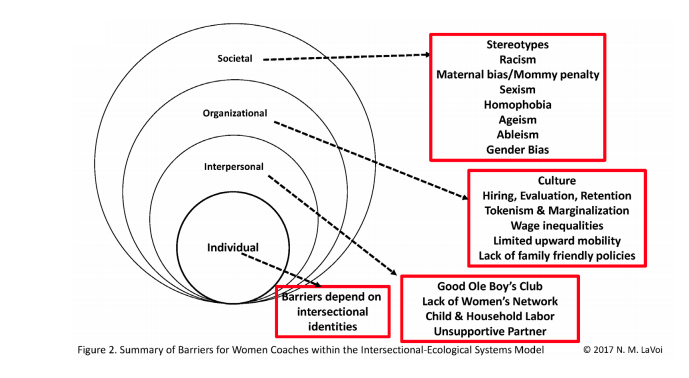
LaVoi also used her research to challenge narratives about gender equity in hiring and discussed the barriers women experience and the intersectional factors by which they are caused (see model). Some of these factors include stereotypes, gender and maternal bias, limited upward mobility, and a lack of women’s network in coaching.
LaVoi presents an ecological model identifying the barriers to women in coaching. (Source: “Women in Sports Coaching” N.M. LaVoi)
Women Ski Coaches Association (WSCA) leader Maria Stuber expressed the value of the research conducted by LaVoi and the Tucker Center in allowing the problem to be discussed across genders without interference from one’s personal experience or biases.
“Having data to back the conversation helps take the emotions out of this topic and makes it an easier conversation to have,” said Stuber, “It’s less of a controversy. Once this is no longer just an opinion, we can stop being defensive and start focusing on solutions. The data allows us to be positive, take action, and get things done.”
LaVoi explained that one of the questions she hears most commonly is “Why do women coaches matter?”
In her 2016 publication titled Women in Sports Coaching, LaVoi addressed this question in depth. Here is an excerpt:
“Sport is one of the most visible and powerful social institutions in the world. Individuals who are seen and known in the world of sports, like coaches, communicate who and what is relevant and valued (and who is not), and a majority of the time in every country in the world, those coaches are men. There are many empirically based reasons why women coaches matter.”
Some other reasons cited by LaVoi include the importance of having gender diversity in role models to challenge archaic stereotypes about women in leadership roles, the importance of same-sex role models for young women and girls, and that boys experiencing women as competent leaders increases the likelihood that they will respect women and see them as equal colleagues and partners.
She also explained that a lack of women is detrimental to the ecosystem of sport coaching.
“When women are the minority in the system, they face a lot of psycho, social, and occupational outcomes.”
These outcomes include decreased job satisfaction, pressure to perform or conform, stronger intention to leave, an increased likelihood of opting for a lesser role, and burnout. On the flip side, the presence of women in leadership roles helps empower other women to strive for a similar outcome and having same-sex peers can also improve the experience one has in a given system.
“When you see women being successful, it inspires people. ‘Oh, I could do that. That seems cool, she seems cool, I want to do that.’ And in they come. It’s the same thing with women in positions of leadership.”
LaVoi likened this to Jessie Diggins winning an Olympic Gold Medal inspiring others to try cross country skiing or set a lofty goal.
She added that the visibility of female head coaches also helps female athletes see coaching as a viable career path, increasing the likelihood of becoming coaches themselves.
“Women and girls coached by women are more likely to go into coaching, so it’s a cycle. And women who are coached by women are safer. All of this stuff with SafeSport right now and coach abuse, 99.5% of all sexual abuse in sport happens because of male coaches. We don’t like to talk about that because it’s uncomfortable but that data is real clear on this.”
LaVoi also offered suggestions on how programs at any level can work toward improving gender equity in their coaching staff. Some suggestions include committing to having a female coach on every level team, providing membership for female coaches to join the WSCA, and paying for female coaches to attend professional development activities. If coaching positions are available and women are not applying, consider recruiting women who would do well in the position.
In 2017, the Tucker Center launched the She Can Coach campaign which challenges coaches to invite female athletes to consider a career in coaching and expressing belief that those athletes would make great coaches. LaVoi explained the importance of recruiting talented coaches and inviting women into the field to move the needle forward. She went on to explain how this relates to creating equity rather than equality, as women in the coaching field may need additional resources or support in order to have the same professional experience as their male counterparts.
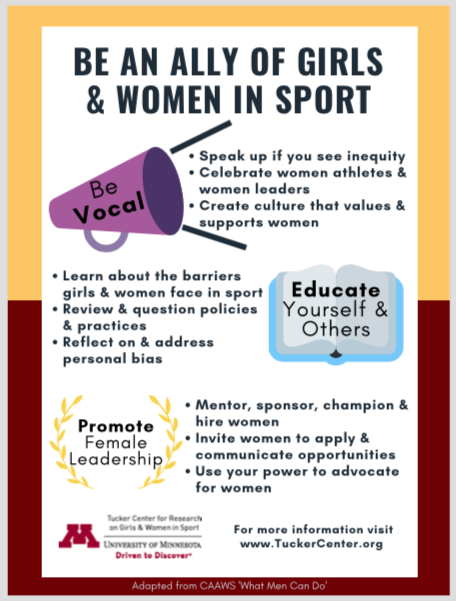
Men are invited to be part of the solution to gender inequity in sports coaching. (Graphic courtesy of the Women Ski Coaches Association)
Throughout the presentation, LaVoi emphasized that the “numerical male dominance in coaching” is not a women versus men problem — she addressed how male allies can be a part of the solution. Some of her suggestions were simple, like encouraging female athletes who would make great coaches to consider it, displaying images of women coaches around the clubhouse, reflecting on their own conscious and subconscious biases, and celebrating the existing women coaches in the program. She also suggested that men refuse to serve on all-male panels or faculties to encourage the recruitment of a diversity of perspectives.
She left the male attendees with the challenge to identify where on the spectrum of allies they fell and she asked all participants to identify and commit to one thing they can do to change the system. [Read a call to action from Pete Vordenberg here].
The Women Ski Coaches Association launched in September 2019 in pursuit of gender equity in coaching.
In August, the Women Ski Coaches Association (WSCA) set forth to balance the scales of gender equity in coaching. With Maria Stuber, head coach at the College of St. Scholastica (CSS) and former member of the Craftsbury Green Racing Project, at the helm, the WSCA strives to be “the voice and future of women in coaching.”
According to surveys conducted by the Tucker Center for Research on Women and Girls in Sport, since Title IV was passed in 1974, the number of female head coaches leading women’s sports teams at the collegiate level has dropped from 90% to just over 40%. The reason for this decline is complex and multifaceted, but the trend is pervasive. Some sports like Lacrosse, Field Hockey, and Equestrian have a relatively high percentage of teams led by women coaches, however, cross-country skiing checks out in the bottommost tier of sports with only 20% of Division I womens’ teams led by a female coach. As head coaches typically oversee both genders, this statistic is representative of the overall percentage of women coaches in leadership positions in Division I NCAA skiing.
The grassroots mission of the WSCA is to change these statistics by empowering and connecting female coaches and serving as a voice for women in the sport.
“Develop, retain, and advance,” said Stuber to paraphrase the objectives of the WSCA. “Bringing in more women that want to be ski coaches, turning them into really successful ski coaches, keeping them in ski coaching, and helping them find really rewarding careers whether that means doing exactly what they want to do or working for people who are going to value them.
“We want to start this conversation by making the research and data available. We want to support each other and guide our large population of male allies in ways they can help.”
Stuber is pleased with the reach and impact of the WSCA launch and explained that its message has been met with overwhelmingly positive feedback.
“This might be the only ski thing I’ve ever been a part of in my career in skiing that has had unanimous positive support. There are a lot of people really excited about this project.”
At this point, the WSCA is funded primarily by a grant from the Oregon Nordic Ski Foundation and memberships for which there are two options. To ensure cost is not an obstacle for the stakeholder group, women coaches can join for just $20. The rest of the community, male or female, can show support by joining as an ally for $100. It is also possible to gift a membership. Currently, the WSCA has approximately 90 members. Stuber hopes to see this number rise steadily as awareness increases.
Of the current members, Stuber is excited to see how many are interested in not only signing up but also taking action in growing the organization.
“When you become a member you can check whether you want to be active or really active, essentially, and we have just a shocking amount of people who have said, ”Yes. I want to volunteer my time and take a leadership role in this organization.’”
Stuber emphasized that she is humbled and appreciative of the women who have expressed interest in being active in the WSCA and plans to utilize them once they have completed some of their urgent organizational tasks like forming a board and completing the 501c3 process.
Stuber has been the primary leader in launching the WSCA and remains the public face. Although, she has received ample support, encouragement, and advice from peers in taking the leap. When asked about their marketing, she credits Heather Mooney and Lina Hultin in designing a logo and creating a website. Mooney is a coach Bridger Ski Foundation in Bozeman, MT and Hultin is the co-director of the Montana Endurance Academy.
While immediately catching the eye as a snowflake, a closer look at the logo shows the branches are a circle of women. Stuber explained that the circle represents growth and that the women are reaching out to support one another.
Though in its nascent stages, the WSCA has already begun acting on its mission by sending two women, Stuber and Greta Anderson of Crested Butte Nordic, to attend the Female Ski Leaders of Tomorrow Symposium held at the Holmenkollen the second weekend in September. The trip was funded by a grant from Equinor who sponsored the event in partnership with the Norwegian Ski Federation. On the last day of the symposium, Stuber presented about the goals of the WSCA in front of 83 participants from 22 nations, all of whom are leaders in ski sport.
Her presentation followed remarks from FIS Secretary General Sarah Lewis who explained the actions FIS is taking toward promoting gender equity in snow sport coaching and leadership.
Founder Maria Stuber presented about the WSCA gender equity project at the Female Ski Leaders of Tomorrow Symposium in Oslo, Norway. (Photo: Instagram @womenskicoaches)
“To be able to show her the importance of grassroots change in addition to the top down mandated efforts that we are seeing was super powerful. I was just shaking with excitement afterwards and I got bombarded with people afterward coming up asking questions and other countries wanting to get involved. I also got to thank the Norwegian women who spearheaded this project and let them know that the ski leaders of tomorrow event helped give me the confidence to take action on launching the WSCA. Feedback from this presentation made me feel like this could be really big and grow into other sport disciplines and internationally.”
In alignment with the International Olympic Committee (IOC) Gender Equity Review Project, FIS is undertaking a set of goals and initiatives to increase the number of women in leadership positions internationally. Some of these initiatives include mandating the election of women to FIS congress and committees and hiring women as technical officials to increase representation by 10% each year until the goal of 40% women is achieved in 2024. The FIS working group is also reviewing other areas of discrepancy between male and female athletes including the difference in race distances and exposure in media coverage. Effort is also being placed into balancing the statistics in participation by developing female athletes in sports that have been historically only contested by men including ski jumping, nordic combined, and freestyle skiing and snowboarding.
In addition to the Norway trip, three first year coaches attended the U.S. Ski and Snowboard National Cross Country Coaches Symposium September 29-30 in Park City, UT with support from the WSCA and U.S. Ski & Snowboard. (A video of the symposium can be purchased here.) The attendees were Stuber’s former CSS athlete Nicole Gilman who interned with the Sun Valley Ski Education Foundation this summer, Harvard University graduate Hannah Hardenbergh who will be coaching in Vail, CO this winter, and Julia Hayes who is a Montana State University graduate now coaching for the Bridger Ski Foundation.
The keynote speakers at this event included Brit Baldishol and Nicole LaVoi who who are leaders in researching and implementing best practices for the development of female athletes and coaches.
Baldishol has a twenty year history working with the Norwegian Ski Federation in various capacities and spent six years coaching the junior national team. Early in her coaching career, which began at age 18, she was the sole woman participating in high level sport education meetings and courses, making her a pioneer for female coaches in Norway. Her presentation topics included “Development and the Role of the Coach for U14 Cross Country Skiers,” and “A Focus on Long Term Success: Norwegian Model for Under-20 and Under-23 Skier Development”.
LaVoi holds a PhD in Kinesiology and is the co-director of the Tucker Center where she researches “the structural and personal barriers experienced by female coaches, relational qualities of the coach-athlete relationship, the effect of parent and coach ‘background anger’ behaviors on youth athletes, the physical activity of underserved girls, and media representations of girls and women in sport.” She also serves on the board of directors for WeCoach, an organization promoting women coaches at all levels across all disciplines. LaVoi first presented on the development of physically active girls, followed the next day by an evidence-based presentation on the importance of women in coaching and leadership which aligned with the mission of the WSCA.
“The WSCA is a necessary step to improving the climate of skiing for women, to where they feel heard, valued and supported,” wrote LaVoi in an email. “It is an exemplar organization that brings to life the importance of the data on women coaches that we produce in our research. I applaud their efforts and support this new organization for women coaches.”
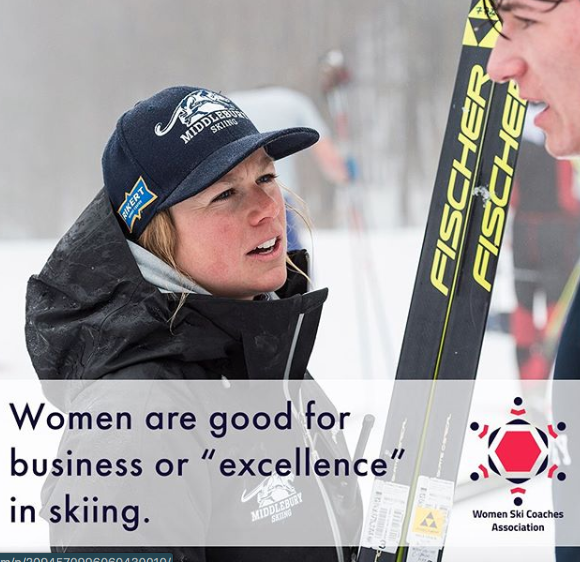
Kate Barton (left) is the assistant coach at Middlebury College. (Photo: womenskicoaches.org, flyingpointroad.com)
Stuber explained that the WSCA connected LaVoi with U.S. Ski & Snowboard and expressed gratitude for their efforts in bringing LaVoi to the symposium. She added that this demonstrates U.S. Ski & Snowboard’s support and partnership with the WSCA in addressing gender inequity in winter sport.
[Stay tuned for a separate article with takeaways from LaVoi’s presentation.]
The next steps in the WSCA action plan include creating opportunities for women to network at races and other events through the winter.
“I’d like to start working regionally to connect women coaches in our country. So if you’re coaching in the east, you’ve got a good handle on who else is coaching in the east, what their challenges are, what direction they want to go with their career. And so if there are young women coaches in any region, the veteran coaches know who they are and if they have specific coaching career goals.”
Because Stuber and the majority of supporting members have a busy schedule juggling coaching and travel through the fall and winter, the WSCA aims for sustainable progress in growth and development.
“It’s going to be a slower process. What we do this winter is going to be pretty simple. I’m confident, though, that we can get a lot done in a simple way.
“The outpouring of positive support that we’ve had for this makes me feel like this could grow into something huge and incredibly impactful, and that’s the piece that I think has to wait until next summer just because I really want to do it well.”
At this time, Stuber explained that the most impactful way to support the WSCA is to become a member and to share the mission of the organization with other contacts at all levels of the sport.
“There is so much energy around this topic right now and whether people are talking about it with our organization in mind or in their small communities and ski clubs, that’s really huge.”
The WSCA is also working on becoming a non-profit organization. Currently, former CSS athlete Kelsey Dickinson (USA Biathlon/CGRP) is assisting Stuber in working through the complex process of obtaining this designation, but the WSCA is also in search of a non-profit lawyer in the state of MN. Stuber sees this step as an essential piece in enabling the WSCA to remove financial barriers for women that seek professional development or networking opportunities.
“We need some time to become a non-profit. It’s a ton of work and we don’t have paid employees. There’s a lot to be done that is not directly mission related, and then there is a lot of mission related stuff that we want to jump on as quickly as we can, but we’ve got to get more funding before we can do a lot of what we want to do.”
For the time being, the WSCA aims to perpetuate the wave of conversation surrounding gender equity in skiing at the leadership level while recruiting additional supporting members.
“This conversation is the big thing that we’re going to accomplish this year. We’re going to get people talking about this, we’re going to use our voice to let people know how both men and women can be involved and how we as a multi-gendered ski community can start to equalize who’s coming into our coaching ranks and staying there in order to promote competence and excellence in this sport that we all love.”
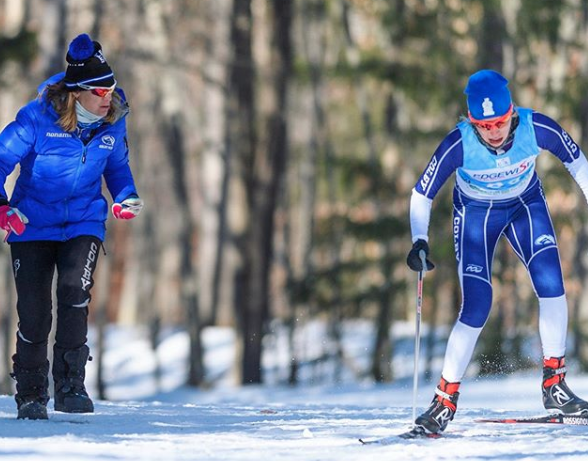
Tracy Cote of Colby College encourages her athlete mid-race. (Photo: womenskicoaches.org, flyingpointroad.com)
Earlier this month from Aug. 2-8, nine top American junior athletes had the opportunity to participate in the largest International Junior Camp to date. In total, 146 athletes and 37 coaches from nearly 20 nations gathered in Sjusjøen, Norway, for a week of training and collaboration. The camp offered athletes the opportunity to gain confidence by training with the best junior skiers in the world against whom they will soon be competing, and to learn from the prestigious Norwegian development team training methods.
To make the trip, athletes needed to be born in either 1999 or 2000 and have the lowest ranking on the FIS Distance and/or Sprint World Ranking list. The U.S. sent Gus Schumacher, Ti Donaldson, Noel Keeffe, Ben Ogden, and Wyatt Gebhart on the men’s side, and for the women, Sofia Shomento, Mae Chalmers, Abby Jarzin, and Molly Gellert. Two coaches joined the group: Bryan Fish, cross country sport development manager at U.S. Ski & Snowboard, and Maria Stuber, head coach at the College of St. Scholastica, and the National Nordic Foundation (NNF) partially subsidized the trip.
2018 International Junior Camp attendees: – Armenia
– Austria
– Bosnia/Herzegovina
– Belarus
– Canada
– China
– Czech Republic
– Estonia
– Italy
– Finland
– Japan
– Korea
– Latvia
– Norway
– Slovenia
– Slovakia
– Spain
– Sweden
– U.S.
The format of the camp was similar to what U.S. juniors might experience at an elite national camp; a large emphasis on volume (18-25 training hours), with some intensity, technique and strength mixed in. For most workouts, all the athletes trained together as one large group, only dividing into smaller groups for time trials or activities held in spaces that could not hold the nearly 200 attendees.
The camp opened with back-to-back time trials, beginning with a classic sprint event featuring “King’s Court” style heats, meaning that from each heat, the top skier moved up in the seeds and the last skier moved down. Each skier competed in four rounds of sprints plus the qualifier, one round more than in a typical sprint. The most notable result for the U.S. was a victory for Schumacher in the men’s final, and on the women’s side, an eighth-place finish for Gellert.
In the 10- and 15-kilometer distance races, the Americans continued to show their strength with another win for Schumacher and another eighth-place finish for Gellert.
“Local hero – Joergen Lippert from Lillehammer joined in on the 15 km freestyle race,” Fish explained. “This was a great measuring stick for the men since Joergen medaled in all four races last year at Junior Worlds (2018 Junior Worlds – 1 gold, 1 silver, and 2 bronze). At the 5km split, Lippert was leading, Ben Ogden was 2nd and Gus Schumacher 6th. Haavard Moseby took the lead after 10km. At 12km Haavard and Gus were tied, then Gus surged to edge Haavard for the second day in a row.”
Molly Gellert striding in the sprint heats at the 2018 International Junior Camp in Sjusjøen, Norway. (Photo: Maria Stuber)
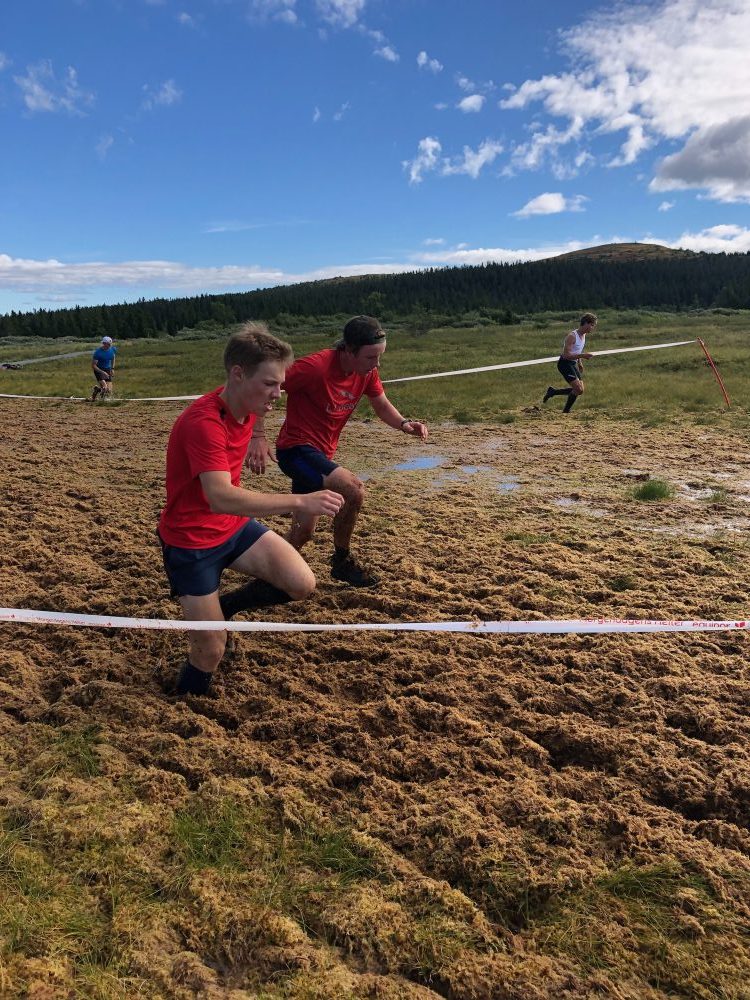
To take advantage of the unique terrain on the plateau around Sjusjøen, the group also participated in a 3 1/2- to 5-hour run crossing through several bogs, and a set of Level 4 bog intervals, which was reported to be the hardest workout of the entire camp. These 3-5 minute intervals were run in mud up to or above athletes knees, making it a full-body challenge to move forward through the course.
“Running through that stuff as hard as you can is incredibly hard,” Stuber told FasterSkier. “People were breathing at the end of those intervals harder than you ever hear, besides maybe the best athletes in the world in a 5- to 10-kilometer distance kind of race.”
Another highlight was getting to meet and hear from Olympic gold medalists Johannes Høsflot Klæbo, Ragnild Haga, and Astrid Uhrenholdt Jacobsen, who shared insight into the aspects of their training and development they felt have led to their success.
The U.S. coaches contributed to the camp by leading an agility workout, as this has been creatively emphasized in their own programs with positive results. Fish reportedly traveled with his own set of cones and plenty of sidewalk chalk to ensure they could set up a high-quality course.
“It was really fun to have the rest of the world interested in what we’re doing with agility,” said Stuber.
Ben Ogden (second from r) in the middle of a bog interval at the 2018 International Junior Camp in Sjusjøen, Norway. (Photo: Maria Stuber)
Apart from the training benefits, the U.S. development program considered the experience of collaborating with top athletes in this age group to be invaluable, as it showed how hard their international competition is working.
“In the U.S. when you’re a top athlete you feel like you’re working pretty darn hard, and this kind of shows them that, yeah, they’re working hard, but the kids that they want to be competing against are also working really hard,” Stuber said.
She added that the U.S. athletes were well-prepared for the camp, as all performed very well throughout the week despite the demanding training schedule.
“We fit in, we go there and see that we’re doing the right things, and we bring these kids back with the confidence that they can do this and the motivation to keep at it and work harder,” Stuber said.
It was noteworthy to the coaches that the U.S. is finally recognized as a nation that can train and compete with the best athletes in the world — a testament to the growth and success of the U.S. Ski Team at all levels over the last ten years.
“Going into this, I was expecting to just be learning a ton and less of a contributor,” Stuber said. “It was really cool to get there and feel like the U.S. was very much a country where people wanted to know what we were doing. Norway is clearly ahead, but otherwise, I think the U.S. had to say as much as any other place, which was a really eye-opening surprise for me.”
This is the third time that the U.S. has attended Norway’s International Junior Camp (also in 2015 and 2016), and American juniors will continue to make the trip biennially to maintain collaboration with other countries in the coming years. According to the U.S. coaches, because of the cost of the camp and the fact that it is similar each year, they plan to only attend every other year so they have a “fresh” group of athletes each time.
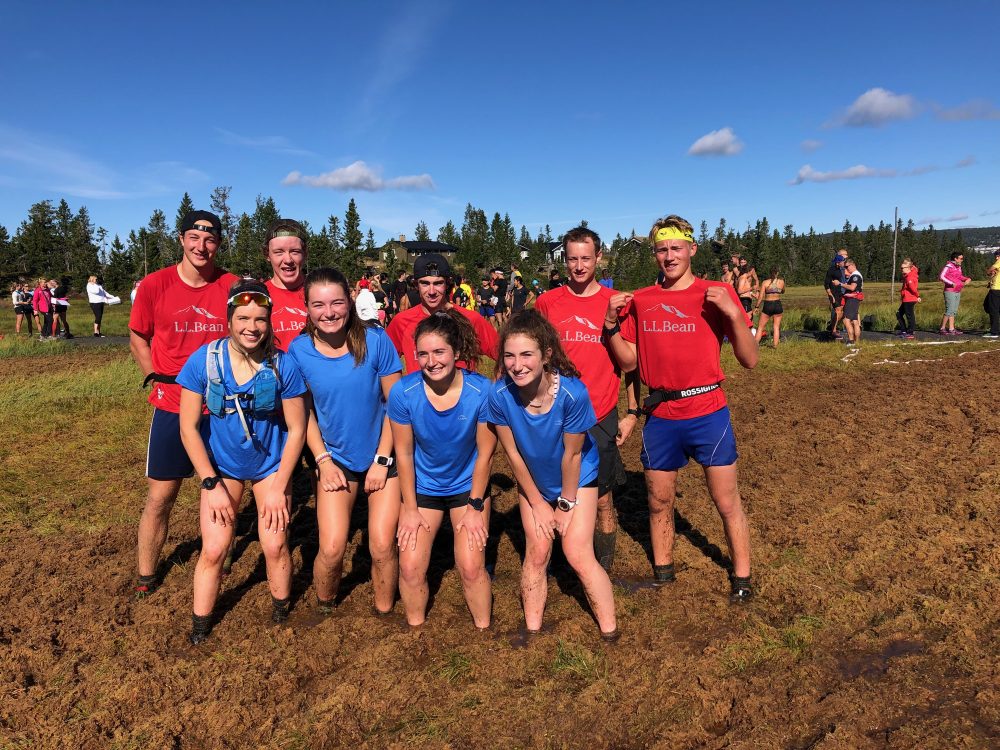
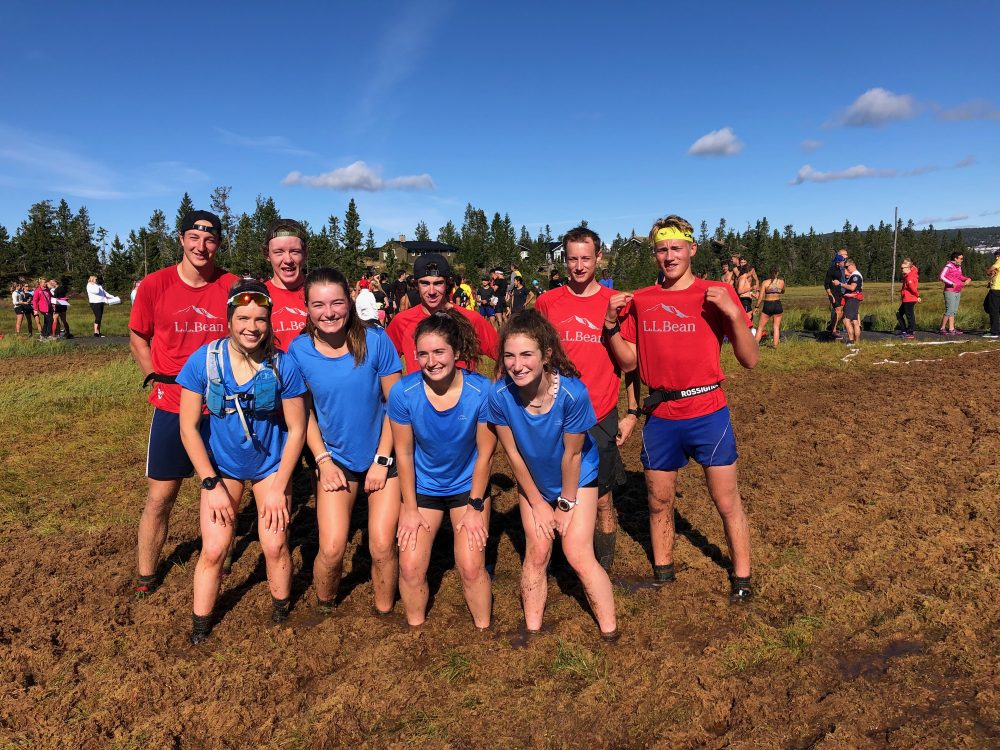
Americans during a muddy training session at the 2018 International Junior Camp earlier this month in Sjusjøen, Norway. (Front row, l to r) Abby Jarzin, Mae Chalmers, Sophie Shomento, Molly Gellert, and Noel Keeffe. (Back row, l to r) Ben Ogden, Wyatt Gebhart, Ty Donaldson, Gus Schumacher. (Photo: Maria Stuber)
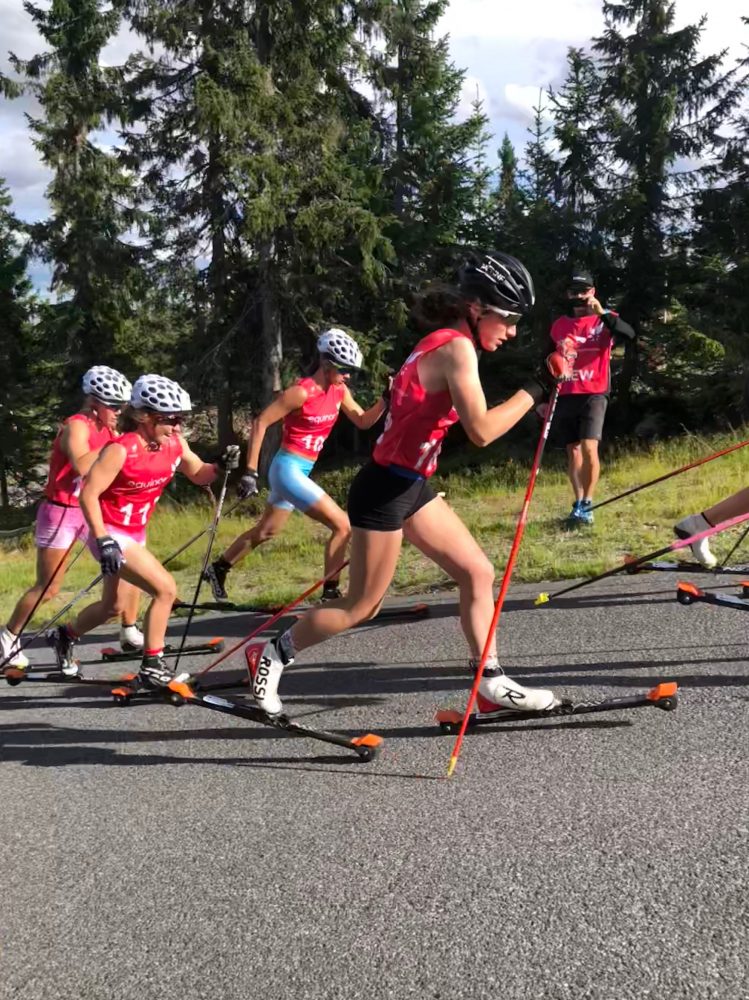
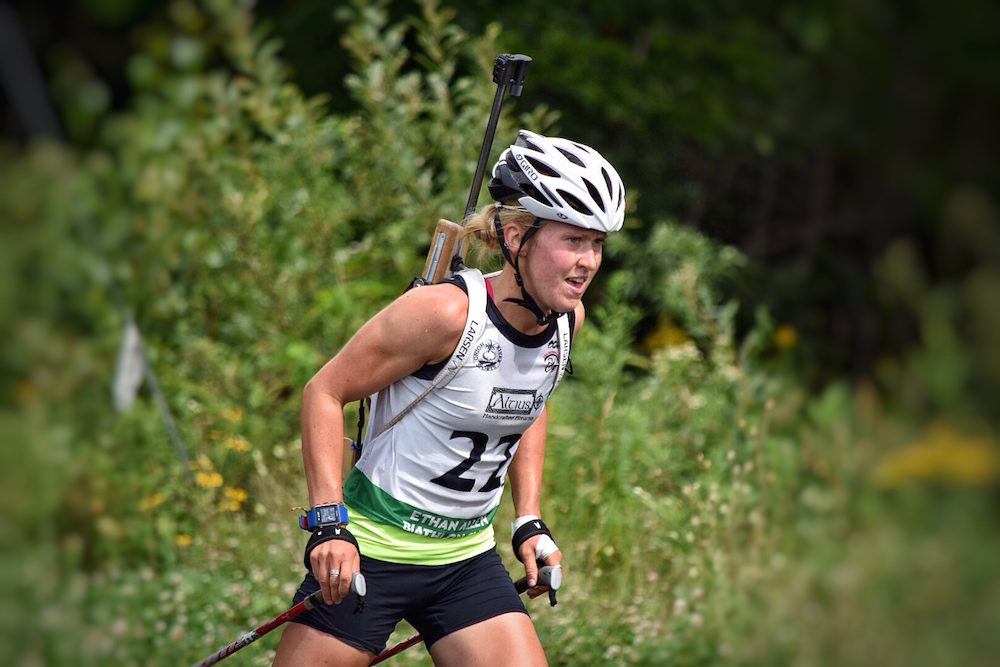
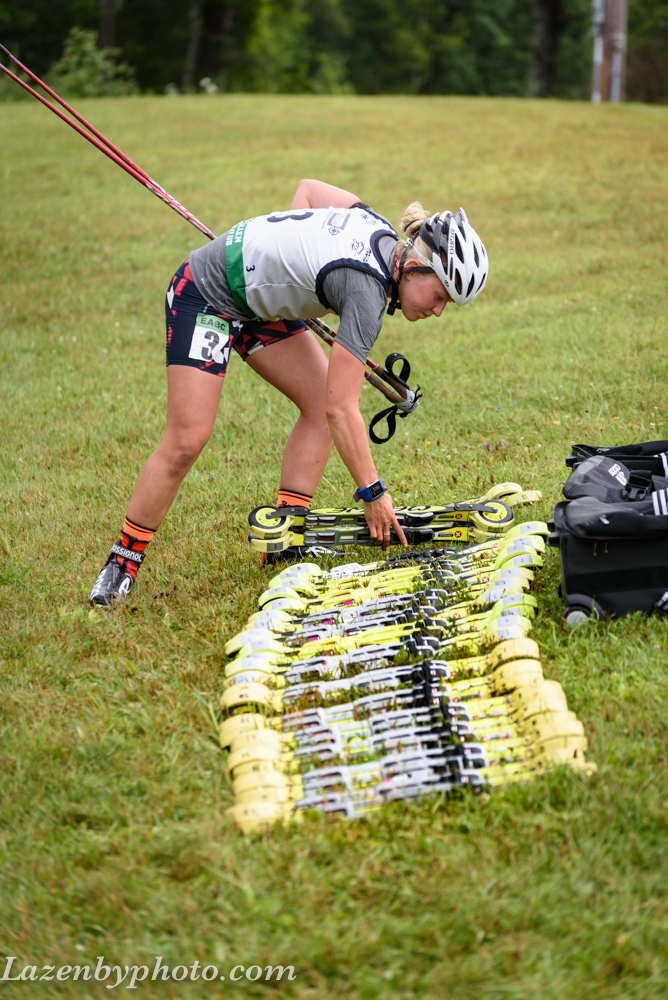
Kelsey Dickinson during the women’s mass start at the 2016 US Biathlon National Rollerski Championships on Aug. 14 in Jericho, Vt. (Photo: Katrina Howe)
The Washington native had been training at the Maine Winter Sports Center (now the Outdoor Sports Institute), and had been a member of the U.S. Biathlon Association’s development team. But when team nominations came out in the spring of 2015, she wasn’t on them. At the same time, the Maine Winter Sports Center cut most funding to its senior teams.
With few options, Dickinson headed back to the College of Saint Scholastica, where she had done one year of college already.
“When I left biathlon, part of it was because I just wasn’t skiing fast enough,” Dickinson said in an interview this month. “So I asked how I could keep skiing, one, but also how could I get faster. I realized that going back to college was going to be the best way to do that, but I wasn’t going to be able to go back to college, and do biathlon, and get better at skiing. I decided that I would just ski in college and finish out my eligibility.”
Dickinson still has one year of that eligibility left, but her biathlon career has come back sooner than expected. After strong college results last season, she was accepted into a summer training program at the Craftsbury Outdoor Center in Vermont. This summer, she spent time training with some of the country’s best cross-country skiers as well as having dedicated biathlon training and easy access to a shooting range.
“Our goal for her this year is to make that Olympic team, for sure, but she’s really four years ahead of schedule with it,” Dickinson’s ski coach at Saint Scholastica, Maria Stuber, said.
“Nothing about what’s going on right now is what I expected to happen,” Dickinson, a double-major in philosophy and natural science, said. “I thought that I would make it through this semester and not have to be traveling that much. I’m just going by communicating with my professors on a day-by-day basis and playing it by ear.”
Kelsey Dickinson (St. Scholastica) racing to 26th in the women’s 15 k freestyle mass start at 2017 NCAA Skiing Championships on March 11 at the Jackson Ski Touring Center in Jackson, N.H. (Photo: flyingpointroad.com)
Stuber had only positive things to say about Dickinson’s work ethic and professionalism.
“She was really clear about her goal to be a biathlete, and she has not wavered on that at all,” Stuber explained. “We said, okay, if you want to be a biathlete at the end of college, what needs to happen for you to be in the top few women, not a bubble skier but someone who is going to be on the World Cup? The bottom line was that she needed to ski a lot faster.”
The work Dickinson put in paid off, and last season she ended up ranked sixth in the Central Collegiate Ski Association rankings, the top woman not from perennial powerhouse Northern Michigan University. She has now represented her team at NCAA Championships twice.
“She made some big technical improvements last winter,” Stuber said. “But she was sick from early January, for over a month. She had some really good races but I don’t know if either of us felt like she really got to show her stuff last winter like we thought she could… I think mainly we just made it apparent that she had it in her to go even faster.”
That was enough to get her to Craftsbury. Dickinson had applied to the summer training program the previous year but not gotten in.
“I had a really good summer of training,” Dickinson said. “I’m really grateful to be able to have gone to Craftsbury and trained with the team there. That made all the difference for me, just to be around a lot of high-level athletes.”
At Saint Scholastica, she is the one leading the team. One of the big focuses of going to Vermont was to get Dickinson used to seeing how more efficient technical skiers moved.
Kelsey Dickinson representing the Maine Winter Sports Center at NorAms in Canmore in December, 2014. Her last international biathlon races were at IBU Cups in Canmore in March, 2015, where she twice finished 28th.
“She could sit behind someone and try to figure out how to make skiing easy, instead of always trying to think in intervals of how to make it hard, and how to go harder,” Stuber said. “There’s this awesome mindshift when you’re going hard but trying to make it easy, which you don’t get to do when you are leading so much.”
Stuber herself was a senior athlete at Craftsbury at one point, so she knew head coach Pepa Miloucheva well and was not worried that there would be any problems with Dickinson adjusting to the training approach. (“She was my coach before and I have a ton of respect for what she is doing there — so to be able to work with Pepa as a peer was really cool for me,” Stuber said.)
In addition, Dickinson knew Sam Dougherty, the biathlon coach at Craftsbury.
“Sam and Pepa work together to build the plan depending on what the biathlon schedule requires and what the cross-country athletes are doing,” Dickinson explained. “They try to make it comprehensive so people can train together… I have known Sam for a while because of we overlapped racing a little bit back when I was a junior. And Pepa, her philosophy is very similar to Maria’s. I get along great with Pepa and she has been an amazing coach. I’m lucky that the transition was really easy.”
Dickinson turned in two third-place finishes at rollerski biathlon races in August.
Kelsey Dickinson (Craftsbury Collegiate Summer Team) picking out rollerskis for the women’s mass start on Aug. 13, at USBA Rollerski Championships in Jericho, Vt. She placed third on both days of the two-day championships. (Photo: John Lazenby/Lazenbyphoto.com)
“I knew I was feeling good and that if I put all the pieces together then things could go well, but I wasn’t quite expecting that for sure,” she said.
That put her in a good position to fight for a World Cup spot. Susan Dunklee, who was pre-qualified for the World Cup, had won both races. Dickinson could even afford one less-stellar race when the qualification series wrapped up with two more competitions in October.
Because she was still in school and had options for how to spend her race season – including competing domestically in December, in an attempt to qualify for the IBU Cup in January and from there trying to make the Olympics – she didn’t feel pressure.
“I think actually having school was a little bit helpful in that way,” she said. “I just was looking at the weekend as an opportunity. If things went well then that would be great, but if things hadn’t gone well then I still had a lot of great things going on back at school with the team there… I was in a good place emotionally, just happy to be there.”
At those last two trials races, Dickinson finished second and fifth, and locked up the World Cup spot.
Her goal is still the Olympics. As such, when she gets to the World Cup later this month – she has to first go to the second-tier IBU Cup in Sjusjøen, Norway, and score qualification points – she will focus mainly on process.
While at least one more woman will be added to the Olympic roster based on December World Cup results, the team won’t be filled until January, when several athletes will be sent to the IBU Cup to fight for the last spots. That means that Dickinson can focus on performing well in January, when the season is in full swing and she has some races under her belt, and fight for an Olympic berth there.
“Her process is going to be the most important thing,” Stuber said. “I don’t think she needs to be concerned with what her results are at those first World Cups… if she can use these World Cups to get a really good process dialed in, then when she goes to the IBU Cup she will be really ready to do what she needs to do there to secure an Olympic spot.”
“It was such a huge goal just to get to this point,” Dickinson agreed. “Looking forward I’m just going to approach things as an opportunity. It’s an opportunity for learning, it’s an opportunity to race, to do what I love to do. So I think that in that sense, I obviously want to do well and I want to hold myself to a high standard. But I am just very grateful that I can have this opportunity and I’m very open to what it will bring.”
In the past two seasons, Dickinson bought into college racing completely.
“She tries really hard to be a good captain and sometimes I think that adds to her stress level,” Stuber said. “She just tries to do everything that she commits to, to do it really well.”
But now, she’s back to biathlon.
“If I could come across saying anything, I just want to express how grateful I am to all the people who have supported me,” Dickinson said. “Like Maria and Chad [Salmela], and Pepa, and everyone thoughout the years who have allowed me to get to this point. Because it has been a really long journey.”
NMU alumnae Felicia Gesior (far left) and Caitlin Gregg (far right, blue shoes) during a fall training session with the Northern Michigan University (NMU) women’s ski team in 2016. (Courtesy photo)
This week’s Wednesday Workout comes from Central Cross Country (CXC) Team member Felicia Gesior. In her second year with CXC, Gesior, 24, is currently working on coordinating the Bergkönig Trail Run, an annual event that began six years ago to raise money for post-collegiate CXC skiers. Race registration and information can be found here.
***
Bergkönig. In German, it translates to “mountain king”. In 2011, it translated to the perfect name for the trail run Northern Michigan University (NMU) alums Maria Stuber and Bryan Cook were launching in an effort to fund their ski racing with Central Cross Country (CXC).
Both Stuber and Cook had been brainstorming a name to make the event, with 5- and 10-kilometer races, stand out from others in the mid-eastern Wisconsin area. Intending to email her brother for an outsider’s opinion, Stuber explained she accidentally sent a message to a “random guy” by the name of Thomas Stuber hailing from Germany. Thomas immediately informed Maria that she had the incorrect Stuber, but not before suggesting the trail run be called Bergkönig. In lieu of the erroneous email, the Bergkönig bank account and Bergkönig Trail Run began.
“Our goal was to give back to the local community, raise money for our winters, and create some awareness for the sport,” Stuber explained in an email to FasterSkier. “After a few years it became a big race and we felt fortunate to be able to rely on it for financial support every year. It was one of the factors that allowed up to keep ski racing as long as we did … something we are really proud of. We didn’t want to see it go away after we were done racing so we kept doing it for a couple years and put the money in a bank account to help future skiers with similar aspirations that needed funding.”
Felicia Geisor (CXC Team) at 2017 U.S. nationals in Soldier Hollow in January. (Courtesy photo)
One of those future skiers included CXC’s Felicia Gesior. Five years after the inaugural Bergkönig, Gesior, originally from Waukesha, Wisconsin, qualified for the 2016 U23 World Skiing Championships in Rasnov, Romania, and the Bergkönig extended its connections beyond Germany and the continental U.S. That year, it granted Gesior a round-trip plane ticket to get her to Romania.
“It was SO COOL for us to be able to send Felicia that check!” Stuber wrote.
This year, Gesior, a 2016 NMU graduate now in her second season with CXC, will be in charge of coordinating the very race that helped her get to U23 Worlds. Proceeds from this race will help cover her travel and ski expenses as well as go toward that “Bergkönig Scholarship Fund that will assist future generations of Wisconsin Skiers pursuing Olympic dreams after college,” the event’s website states.
Stuber, head nordic coach at the College of St. Scholastica, and Cook have stepped back this fall, though they both plan to drive down from Duluth, Minnesota, for the event. The race is scheduled for Nov. 11 in Delafield, Wisconsin, on the hilly trails of Lapham State Park, a course Gesior, Stuber and Cook all trained on as Peak Nordic skiers in high school.
“Many of the [Peak Nordic] coaches are the same today as they were when I was in high school and they went way above and beyond to support me throughout my entire career,” Stuber noted. “We are all so proud of this place that we would go to great lengths to see Felicia represent us at the highest level of U.S. skiing.”
Felicia Geisor on graduation day at Northern Michigan University in the spring of 2017. (Courtesy photo)
Gesior has been training in Marquette, Michigan, this summer and fall under the guidance of the CXC Team’s new head coachEliška Hájek Albrigtsen. Most of Gesior’s goals revolve around U.S. SuperTour races and U.S. nationals in January. She views being an American woman on the domestic race circuit as “an exciting time” with “everyone pushing to new levels.”
“Every time I have the opportunity, like at U.S. nationals, to race against those elite girls that’s just excellent because they’re pushing the whole field,” Gesior said on the phone last month.
When she isn’t training, Gesior substitute teaches at local schools in Marquette. The work not only serves as a supplemental income, but also as way for her to stay connected to her post-skiing career — she has a degree in education from NMU. She also plans to help with CXC’s ‘Nordic Rocks’ for Schools program, an initiative that aims to get more youth involved with nordic skiing.
“That’s one of CXC’s major goals is to get Nordic Rocks in more of the schools. My relationship is getting it into Marquette this year,” Gesior explained, adding that the program has donated up to 30 pairs of nordic skis to more than 200 elementary schools.
“Kids can put them on with their snow boots and then they can walk literally from the gym outside to the door … You can imagine all these little kids, it’s hilarious,” she said. “So that’s just another side thing where I can connect my two passions together.”
Beyond training and teaching, the Bergkönig will be the most forthcoming of Gesior’s fall focus, along with the Level 4 ski-walking intervals she recommends as race prep for the Bergkönig trail’s hills. May the best Mountain King win.
The Workout: “Marquette Mountain Repeats”
Type: Level 4 Ski Walking Intervals
The workout should be hard to complete with a focus on an elevated heart rate and mental fortitude. Gesior usually incorporates this workout into her plan towards the end of her summer training cycle and and continues doing it once a week through the fall.
She suggested doing this workout without ski poles to prevent building up too much lactate while climbing.
“The best part about this workout is that you do not get as much lactate build up as you might on a bounding workout because you don’t have poles in your arms,” Gesior wrote in an email. “Instead, you can push your heart without building up too much lactate. This is a good workout during a week that you don’t want to necessarily build lactate but still want to get in a hard effort.”
Terrain: Small alpine hill (should take 4-5 minutes to ascend; Geisor recommends no more than 6 minutes)
Warmup: 20-25 minutes jogging with a couple minutes of Level 3 toward the end of the warmup followed by strides
The set: 5-8 x 4-minute ascents; off time is amount of time it takes to descend the hill
The first 4-minute set should be done at the high end of a Level 3 pace. Each consecutive set should be done slightly faster.
“This workout is an interval ski walking workout so you ski walk up the hill swinging your arms as if you are classic skiing and you should be going at Level 3-plus into Level 4,” Gesior explained.
Cool down: 20-30 minutes easy jogging
Total time: 1.5 to 2 hours
Gesior’s Golden Rules:
Record; don’t get wrecked. Since each ascent should be faster than the previous one, Gesior indicated that recording times should not be overlooked, nor should going to hard from the start. “It is important to keep track of your times on each interval because you want to have your last ones be faster than your first ones,” she wrote. “You want to do the first one starting in L-3 and then you go for a faster time on each consecutive interval. The majority of the intervals are done in Level 4 and you should strive to push the pass towards the end of each interval as well as the last few intervals in your set.”
Make mental note. Don’t be afraid to use the intervals as practice for pushing past negative thoughts that might pay visit during competitions. “You should be focusing on your mental toughness that you tap into during races,” she wrote. “You should remember to use good ski walking technique in your legs as well as using your arms as if you were striding.”
DULUTH, Minn. (csssaints.com) – The College of St. Scholastica will invest in the city of Duluth’s Grand Avenue Nordic Center project; the school announced on Wednesday.
The College will contribute $20,000 to the Duluth XC Ski Club’s capital campaign toward the project. The center is a city project in conjunction with Spirit Mountain and DXC to bring state of the art snowmaking for cross country skiing to Duluth. It will be a 5+ kilometer trail development with 3.3km of snowmaking infrastructure and lights at the base of Spirit Mountain.
“This project really captures a modern development in cross country skiing infrastructure the likes of which the city hasn’t addressed since the 1980s,” said current St. Scholastica cross country coach Chad Salmela, an ex-board member of Duluth XC ski club. “In supporting the project, the college acknowledges its role as a community player and the role healthy lifestyles for a winter city plays in the lives of their students. It aligns the college with meaningful community initiatives of the city and its civic organizations. It’s a win-win.”
St. Scholastica has the only varsity college ski team in the area, and this project will make it the only Midwestern NCAA ski program with snowmaking near campus, and one of less than a handful nationally. The guarantee of snow for at this facility will change the game for skiing in the city, and subsequently be a huge draw for the college’s competitive ski team.
“World class athletes walk through these doors and now they will have a world class facility to call home,” said St. Scholastica Nordic Ski Coach Maria Stuber. “The GANC partnership between the City of Duluth, DXC and the college makes us feel like we are a major part of the community, something we cherish. Together, we are raising the bar for our sport with this facility and we have raised it higher than most DI and DII ski teams with bigger budgets. We are so proud of this project.”
Stuber said she plans on using the Grand Avenue Nordic Center as a centralized ski hub that will allow CSS student-athletes to interact with community members and youth skiers on a regular basis.
Project construction is slated to begin this winter with completion in fall 2018.
Ben Ogden and Bill Harmeyer during double-pole speeds at the 2017 Junior NTG Camp earlier this month at Soldier Hollow in Midway, Utah. (Photo: Bryan Fish)
For this week’s workout, we asked for a specific-strength workout from this year’s Junior National Training Group (NTG) Camp, which was held Aug. 2-15 near Park City, Utah. One of three coaches at the camp, Maria Stuber (head nordic coach at the College of St. Scholastica), shared the following, which she described as an “old-school endurance strength workout.” She led the camp with two U.S. Ski Team (USST) staff members, development coach Bryan Fish and World Cup wax technician Tim Baucom. Eighteen athletes attended — 10 men and eight women — all under the age of 21.
Lauren Jortberg and Nicole Schneider doing double-pole speeds at the 2017 Junior NTG Camp earlier this month at Soldier Hollow in Midway, Utah. (Photo: Bryan Fish)
“The U24’s are invited to other U.S. Ski Team camps like our October camp and our May Bend camp,” Fish explained in an email.
The goal of this month’s camp was “to get our very best together to train and learn from one another,” he wrote. “These are athletes that are already or very well may soon be on the U.S. Ski Team, so building a healthy and positive training environment for these athletes is critical. Secondly, building an environment where these athletes push each other yet trust one another is critical. Many of these athletes have already traveled overseas together and continuing to strengthen their comfort and focus toward how we can support, lean on and succeed together – as a group, as a nation, as a team.
“Third, we want to provide these athletes with meaningful feedback,” Fish continued. “The athletes work with our high performance department at U.S. Ski & Snowboard to learn what individual items they are already strong as well as windows of opportunities for improvement.”
The primary focus was to provide a “strong training environment,” he wrote, while also testing athletes in areas like strength, power and mobility with a protocol similar to the U.S. Ski Team.
Throughout the two-week camp, there was an abundance of rollerskiing and threshold ski walking/bounding, as well as strength work.
“One question that commonly comes up is why such workouts are becoming less familiar or possibly less utilized in coaches’ training plans,” Fish wrote, referring to specific strength. “I think it is because more programs are incorporating this type of effort into classic sprint training sessions. That being said … [this workout develops] many important technical and physical skills.”
Stuber explained that the workout emphasizes repetition “to work out technique issues and to feel efficiency differences,” she wrote. “It is also a fun social workout because the whole team stays in one place and you can have a good time with rivalries and inter squad competition. “
The workout: Specific Strength on Skis
20-minute warmup
Followed by:
8 x 30 seconds single stick
6 x 30 seconds core-only double pole
8 x 30 seconds double pole
20-minute cool down
“We did not harp on technique too much and let the athletes think and discover what was working best to move across the ground with the group,” Stuber noted. “We had video on an iPad for those who wanted to see what they looked like and if the changes they were feeling were showing up on camera.
“There were a lot of blisters,” she added. “Gloves are recommended for this workout.”
American Hailey Swirbul (29), of the University of Alaska Anchorage, racing to 24th in the women’s 10 k skiathlon on Friday at Soldier Hollow in Midway, Utah, for her best result at a Junior World Championships. (Photo: FlyingPointRoad.com)
In an effort to showcase the North Americans competing at this week’s International Ski Federation (FIS) 2017 USANA Nordic Junior World Championships and U23 Cross Country World Championships at Soldier Hollow in Midway, Utah, we asked those qualifying athletes several questions about themselves — actually, we had them fill in the blanks. Here we have 18-year-old Hailey Swirbul, of the University of Alaska Anchorage, who’s representing the U.S. at her second Junior Worlds.
“My full name is Hailey Swirbul, but you can call me Swirb. Or whatever. I was born in Grand Junction, Colo., raised in El Jebel, Colo., and one thing you should know about my hometown is that there is a Whole Foods grocery store. That’s the most exciting thing that has happened recently.
I started cross-country skiing when I was in 5th grade, thanks to my brother, Keegan. I currently train in Anchorage, Alaska, with the University of Alaska Anchorage.
If I’m not skiing, you might find me shredding around campus on my retro Raleigh bike named Ralph. If I had to pick a favorite book, it would be ‘Thug Kitchen’ (a cookbook).
One of the things I’m most excited about for Junior Worlds at Soldier Hollow is convincing [U.S. Ski Team Development Coach] Bryan Fish to dye his hair red and blue. One race I’m especially targeting there is the 10 k skiathlon.
The best advice anyone ever gave me about skiing or racing was ‘Execute the things in your control to the best of your abilities and don’t worry at all about the rest.’ S/o Maria Stuber.
One of the best race memories I have is the 5 k classic mass start junior race in Houghton at the 2015 Senior Nationals… somehow??
If I could meet one World Cup skier, it would be Baptiste Gros.
If I don’t end up being a professional skier, I’ll probably be eating frosting out of the jar for breakfast, lunch and dinner. 🙂
I’m missing four days of school to be here, and my teachers are probably thinking, ‘Get your priorities straight and come to class. Do you want to get your degree or not?!‘
You can follow me on Instagram or Twitter @haiswirl.”
Maria Stuber has spent the last three years coaching at the Aspen Valley Ski and Snowboard Club in Colorado. (Courtesy photo)
Ever since the College of St. Scholastica began its NCAA ski team, the face of the program has been one man: head coach Chad Salmela. Over the last decade, his squad notched its first men’s and women’s team wins and saw its first NCAA Skiing Championship qualifiers. And on the way, he changed the lives of dozens of young athletes.
Now Salmela is shifting roles at the college and will coach the cross-country running team. Taking the reins of the ski team is a new coach coach who is just as excited to build on the program’s burgeoning legacy in Duluth, Minn.
Maria Stuber, a Wisconsin native, has developed her coaching chops over several assignments, most recently in Colorado with the Aspen Valley Ski and Snowboard Club (AVSC). In three seasons with the club, Stuber increased the size of the team and worked with a variety of athletes, from those who just picked up skiing in high school to those who competed in Europe.
“At AVSC, coaches made sure we were encouraging brand new skiers to jump into the sport at any age,” she wrote in an email. “If you decided to join our high school team you get to train right alongside the best athletes in the country… This environment gives every athlete the opportunity to make a quick jump and be the best skier they can be. It can be so fun when it works, as our top male skier last year didn’t get into the sport until he was a sophomore in high school.”
Stuber (second from left) with AVSC athletes. (Courtesy photo)
That attitude seems to be a perfect match for the College of St. Scholastica (CSS), a school which sent two men to NCAA’s in 2012 and two women in 2015 – but which also has a development team and provides growth opportunities for skiers coming in with a variety of backgrounds.
“Chad didn’t really impact my ski career, he started it,” Paul Schommer, an NCAA All-American in 2014 now pursuing elite biathlon, told FasterSkier this spring.
“CSS is unique in that it has a development team serving this purpose at the college level,” Stuber wrote. “Kids with college skiing aspirations that are not quite ready to make that jump can come and work hard, get faster, and have the opportunity to reach the same level as the top junior national athletes we recruit.”
Taking athletes from those two tracks, Saint Scholastica has built teams that compete with the best in the NCAA Central division.
“CSS wants to be a competitive team in the Central Collegiate Ski Associaion conference,” Stuber explained. “In order to do that, we need to be competitive at the national level. What’s really cool about skiing in 2016 is that you need to have international ambitions to be competitive at the national level.”
Salmela used sports science and lab testing to make that happen, and it’s one of the opportunities that drew Stuber to the program. She received a masters degree in exercise science from Northern Michigan University and relishes a data-based approach.
Stuber with the rest of the AVSC staff last year. “I love these people!” she wrote. (Courtesy photo)
“I love that St. Scholastica’s training is all based on science and sound research,” Stuber wrote. “The college has an exercise science lab and the professors are willing to share the space and knowledge with coaches to give the student-athletes more opportunities for success.”
But more than anything, she is pleased to be part of a framework which will make it possible to integrate running and skiing into a cohesive college athletic career. In explaining his job shift, Salmela was clear that he wanted to see more – and smoother – crossover between the two sports at St. Scholastica, for those athletes who have dual ambitions.
“The biggest program draws for me at CSS are Chad & Don Olson’s (athletic director’s) vision to create a collegiate endurance sport epicenter where student-athletes can choose to pursue xc running, skiing or both at a very high level,” Stuber wrote. “Linking endurance sports together will create well rounded, big picture athletes that have the support of a bigger peer group and more coaches and resources. I think CSS is on the verge of something huge.”
Stuber has seen how a variety of teams achieve success. First, as an athlete: she captained the Northern Michigan University (NMU) ski team for three years.
“My time at NMU had a huge impact on my life path and decision to pursue a career in ski coaching,” Stuber explained. “The running and skiing coaches there, Sten Fjeldheim and Jenny Ryan, have both contributed significantly to my coaching philosophy, training methodology and personal values. They have continued to be mentors, advocates and references for me as I find my way. I will feel extremely proud to consider Sten and Jenny peers and to go up against the Wildcats in December and I hope that they feel like a part of our success at CSS. They both know me well enough to not expect any mercy from us on the trails.”
Hailey Swirbul of the Aspen Valley Ski Club races the anchor leg while guiding the American team to eighth place in the 4 x 3.3 k relay at the Junior World Championships in Almaty, Kazakhstan, in 2015. (Photo: Logan Hannneman)
After college, Stuber raced for the Central Cross Country (CXC) Elite Team and then the Craftsbury Green Racing Project. In her senior career, Stuber was a runner-up at U.S. National Championships in 2009.
But since retiring from competition, Stuber has been consumed by coaching. She began her career at Alverno College in Wisconsin, before taking over as head men’s and women’s cross-country running coach for Southern Vermont College for two years. Under her leadership, the men’s squad had their best team results ever.
At AVSC, where the roster eventually neared 200 skiers, Stuber led a team of other coaches. Every year the club sent skiers to Junior National Championships as well as to World Junior Championships or the J1 Scandinavian Cup trip.
“I will never forget our amazing coaching staff at AVSC that welcomed me to the community that they had carefully built over the past 20+ years,” Stuber wrote. “There is no other ski club in the country with the amazing mix of background, knowledge, energy, perspective and compassion. Working with this group of people will be a life-long career highlight for me… I am so proud of the club’s growing numbers and participation in Carbondale, Glenwood Springs and Aspen. The way these three communities work together towards a common goal in Nordic skiing is phenomenal.”
AVSC runs summer training programs and last season organized an end-of-winter race event called Tour de Sea which drew junior skiers from all over Colorado, as well as rave reviews.
Stuber and Cook (second and third from right) with AVSC staff at a competition this winter. (Courtesy photo)
It was difficult for her to decide whether to uproot herself from the Roaring Fork Valley, where she and husband Bryan Cook had just bought a condo. They had been “very happy” in the Elk Mountains.
“We were not feeling 100% certain that we had made the right call until Monday when the CSS announcement was made,” Stuber wrote. “For days straight my phone and email were pinging and beeping non-stop with messages from friends, family, former teammates, fellow coaches and upcoming Midwest skiers and parents from clinics past. The Midwest ski community is a truly special group of people that we are incredibly proud to be a part of. During our racing careers, we leaned on this community for support and they delivered for us big time. I think we missed the Midwest ski culture more than we knew.”
The couple will move in the first week of September and Stuber is looking forward to getting started with her new team; Cook will enter an MBA program at St. Scholastica.
And besides the general homecoming, Stuber knows that the athletes she will be working with in Duluth – as well as those on the teams her skiers compete against – embody the same characteristics of the community which is welcoming her back.
“The CCSA is definitely a powerhouse Nordic conference…. consistently dominating at the US National Championship and NCAA Championship,” Stuber wrote. “The CCSA attracts down-to-earth athletes that want to be great skiers and are willing to work hard to get there. This intrinsic motivation is a recipe for making fast cross country skiers. Midwest kids are tough and they are backed by outstanding club coaches that are looking at the big picture. I can’t imagine a better atmosphere for athlete development.”
Skiers have been wearing a lot of white lately — or variations thereof. This past weekend, Canadian World Cup Team member Devon Kershaw and his Norwegian girlfriend, three-time Olympian Kristin Størmer Steira, tied the knot in Lofoten, Norway, where Steira has family ties.
Kristin Størmer Steira, of Norway, and Devon Kershaw, of Canada, were married last weekend in Lofoten, Norway. (Photo: CCC/Facebook)
Steira’s teammates, including Marit Bjørgen, Therese Johaug and Ingrid Flugstad Østberg, made the trip to the northern islands for the wedding, along with Canadian skiers Alex Harvey, Jess Cockney, Graham Nishikawa, Drew Goldsack, and Phil Widmer.
On July 11, US Biathlon’s Lowell Bailey wed Erika Edgley at Connery Pond (photos above) in North Elba, N.Y., then held a reception in front of the house where Bailey grew up in Lake Placid. Edgley is also from Lake Placid. They celebrated with about 120 guests from “all over the world,” Bailey explained in an email. “Americans, Brits, Germans!”
Bailey recently arrived in Stavanger, Norway, for the Blink Summer Ski Festival — a three-day series of rollerski races, starting this Thursday and ending Saturday. His teammates Leif Nordgren and Susan Dunklee also plan to participate.
Sara Studebaker (second from l) married Zach Hall in mid July and celebrated with friends and former US Biathlon teammates Susan Dunklee (l), Hannah Dreissigacker (second from r), and Annelies Cook (r) in Stanley, Idaho. (Photo: Sara Studebaker/Facebook)
Also this month, former U.S. biathlete Sara Studebaker married another retired biathlete and current ski coach, Zach Hall, with her 2014 Olympic relay teammates Dunklee, Hannah Dreissigacker and Annelies Cook by her side in Stanley, Idaho.
And on July 18 near Canmore, Alberta, Canadian biathlete and Olympian Scott Perras married Jodi Etcheverry, a former biathlete, at a lakeside ceremony.
Longtime sweethearts, former U.S. skiers and now development coaches, Maria Stuber and Bryan Cook recently wed in their native Wisconsin.
The Aspen Valley Ski & Snowboard Club is looking for a Nordic Program Manager and one or two Nordic Base Camp Directors (one in Aspen and one in Carbondale). All positions are part time and seasonal. For the right candidate, positions could be combined into a part-time/year-round or full-time/6-month position.
See job descriptions and links to applications below.
Applicants should send cover letter, resume, and references to Maria Stuber at mstuber@teamavsc.org.
Position Title: AVSC Nordic Program Manager
Reports To: AVSC Nordic Program Director
Job Objective: The AVSC Nordic Program is designed to support the AVSC mission with a focus on athlete centered programs inspiring EXCELLENCE, creating OPPORTUNITY and instilling AVSC VALUES.
The Nordic Program Manager will support the Nordic Program Director by managing and administering Nordic program fundraising, special events, communications, merchandise ordering, venue projects, and enrollment.
Scope: The Nordic Program Manager works under the general supervision of the Nordic Program Director. The position is a seasonal part-time position with approximately 30 hours per week from September to March. This position is not entitled to AVSC benefits.
Duties and Responsibilities:
Participate in venue development meetings, take notes and complete specific venue related tasks as they arise.
Manage the race sign-up form on the AVSC Nordic blog
Promote AVSC special events and fundraisers
Update the Nordic Calendar
Recruit and manage Nordic event volunteers
Manage the AVSC Nordic Facebook Page and WordPress Blog
Oversee all aspects of AVSC Nordic Fundraisers, special events and races
Ski Swap & Fit Night, Sept 16th
Bonfire Dinner
Nordic Fest/Rocky Mountain Nordic Finals
Night of the Norseman
Design and order AVSC uniforms and merchandise
Develop systems to facilitate better communication with the Nordic community
Participate in designated staff meetings and training sessions
Assist with and participate in Club-wide functions
Assist with Nordic participant recruitment and community development ideas
Free Ski Days
Luminary Skis
Special projects as assigned
REQUIRED SKILLS
Background screened and cleared for interaction with youth.
Full endorsement of AVSC Core Values – Commitment, Teamwork and Integrity
Competence with essential computer applications including: MS Office, Google Calendars, Outlook, WordPress website applications.
General understanding of competitive Nordic ski racing logistics
Communication skills – written and oral – personable and well spoken.
Enthusiastic, conscientious and respectful.
Strong organizational skills with ability to prioritize tasks and to meet deadlines.
Job Objective: The AVSC Nordic Program is designed to support the AVSC mission with a focus on athlete centered programs inspiring EXCELLENCE, creating OPPORTUNITY and instilling AVSC VALUES.
The Nordic Base Camp Director is responsible for developing fun and exciting base camp curriculum that will engage children ages 5-12, and foster a love for winter sports. The Director will work with four or more coaches and several parent volunteers to run Base Camp programs out of Aspen or Carbondale. The Base Camp Director will lead all practices and coordinate staff so that practices are organized and run smoothly. The Base Camp Director must have excellent communication skills and be comfortable instructing a large coaching staff and talking to parents. The position is best suited for a ski coach with a gregarious, fun, creative, adventurous personality and also strong managerial, organizational, and marketing skills.
Scope: The Base Camp Director/Head Coach works under the general supervision of the Nordic Program Director. The position is part time, with 3 months (January, February, and March) of practices where the person will spend about 15 scheduled hours per week working with 5-10 year old athletes in Aspen and Carbondale. In addition, the Base Camp Director will be expected to work during the month of December to promote the Nordic programs, recruit from local schools, and host “Free-Ski Days.” The position will have a significant amount of flexible prep, planning, and event hosting hours that are more flexible and can be year round. The position is compensated on an hourly basis and is not entitled to AVSC benefits.
Duties and Responsibilities:
Organize and coordinate all Base Camp activities including scheduled practices (Monday & Wednesday) and some weekend events emphasizing skill development, safety, fair play, sportsmanship and FUN
Work with AVSC Nordic Director to develop a fun and engaging Base Camp curriculum
Ensure equal participation time for all athletes regardless of ability
Understand, agree and integrate AVSC’s vision, mission and core values into all areas of programming
Develop ways to best record and track attendance and athlete progress for all Base Camp programs
Implement program design and technical progressions throughout Base Camp programs
Lead set up and tear down of Base Camp program gear and Nordic Fun Park equipment
Manage and lead Base Camp coaching staff and parent volunteers
Coordinate recruitment of athletes to Base Camp programs and beyond
Provide Nordic Program Director with incident statistics for Base Camp programs
Provide Nordic Program Director with weekly Base Camp staff payroll numbers
Ensure base camp news is submitted to the Nordic Manager for publication in a timely fashion
Attend Nordic equipment night and provide guidance to Base Camp athletes and parents
Be able and prepared to fix small equipment issues at practice
Attend all staff training exercises and orientation opportunities and set the pace with a willingness to improve at the job
Continued development as a sport professional – coaches certification, first aid training, concussion certification, child protection training, etc
Assist Nordic Program Director with Base Camp staff training
Arrange and participate in parent and athlete coach conferences as necessary
Create a positive work environment for staff to grow and improve
Required Skills:
Background screened and cleared for interaction with youth
Current First Aid and CPR certification
Certification in recognition and response for concussion injuries
Safe Sport Practice training
Enthusiasm and positive spirit
The ability to make every child feel like a winner at practice every day
Patience, maturity, and dependability
Ability to think outside the box, dream, plan, prioritize and follow through on projects
Recognized by others of sound character, strong moral values and personal ethics
Make good decisions and always err on the side of caution
Be constantly aware of risk management issues with our own athletes, coaches and public near our training space
Good organizational and communication skill
Age appropriate coaching experience capable of engaging various ability levels
Must have or be willing to obtain USSA Level 100 Coaching Certification
Be proficient in MS Office, Google Calendars, E-Mail and Website applications
Other desirable characteristics: strong work ethic, accountability, good leaderships skills, a positive attitude, being a team player, personable, well spoken and respectful
Nordic Base Camp Program Objective: AVSC’s Base Camp programs aim to make children LOVE being on skis and to teach them basic athletic skills that will prepare them for participation in future AVSC programs. At the beginner, athletes will play games, have fun, and do absolutely no “training.” Coaches will encourage participation in all sports and develop a game based curriculum that helps develop basic motor sills, balance, and coordination to create general non-specific athletic ability. The advanced curriculum will be similar, with the addition of some fun, short races and drills to develop suppleness and speed. All Nordic Base Camp athletes will be introduced to skiing fundamentals with the main focus remaining on general athletic body movements, games, and fun.
The Ski and Tea women's group gets ready to head out from 00 trailhead in Seeley, Wis., on Feb. 22 for a pre-Birkie clinic.
That last ski of the season might not have set well this year.
You weren’t exactly ready. Some places enjoyed sufficient snow dumpings this winter, but on the whole, it just wasn’t enough. It ended too soon.
Certain parts of the country aren’t quite in summer mode yet. Snow has been known to make April appearances, and some ski towns recently saw a late-season blast of the white stuff.
But in Hayward, Wis., home of the American Birkebeiner and center of Midwest nordic skiing, temperatures were forecast to hit the 60s this week. That’s spring, and essentially, the end of the ski season.
Tell that to the women with Ski and Tea, a nearly 300-person club that gets females together year round to practice cross-country. While it’s dryland training in the summer, they typically meet weekly every month except March (that’s post-Birkie time following the ski marathon in late February. Many spent their Fridays off helping a local charity, Weekend Meals for Kids).
Ski and Tea in the Summer:
April theme: Reboot, Rebuild, Renew
Example workout:Long, slow distance of running or walking with 15-20 second pickups every 2 minutes followed by stretching.
Post-workout:Tea at Mooselips Java Joint in Seeley.
Outlook: “Our weekly workouts for the coming dry-land months will be progressive,” according to Cook. “(They) will include hill workouts with poles, strength, agility, and balance, personal time trials, and interval training. We have several workout sites throughout the year which include the Birkie Trail Northend, 00 Warming Hut, Mosquito Brook and the Fish Hatchery. We will also use the Camba Mukwa Single Track. We ask all our members to buy Birkie Trail passes and we support the Birkie Trail Maintenance at the Ski and Tea 27K Classic Friends of the Trail Marker.”
The program, which includes clinics led by Central Cross Country (CXC) members, started four years ago with about 12 women. Founders Linda Cook and Juli Lynch knew several former skiers that wanted to get back into the sport and arranged a recreational get-together. They saw two more women at the trailhead and invited them along as well.
This past winter, a two-hour “Ski and Tea with the Pros” clinic attracted more than 30 women three days before the 39th American Birkebeiner. Cook, who placed second in her 70-79 age group in the 23-kilometer Kortelopet, said two international skiers attended the seminar, which was broken up into classic and freestyle technique lessons with four elite coaches.
Two of the group’s original supporters, Audrey Weber and Maria Stuber, offered expertise as former CXC members. Both born in the Midwest, Weber skis for Go! Training, and Stuber joined the Craftsbury Green Racing Project in Vermont. She returned to Wisconsin for the Birkie and “Ski and Tea” event, bringing Craftsbury teammate Hannah Dreissigacker with her. CXC’s Carolyn Ocariz also helped fill in for teammate Caitlin Gregg, who was sick, and proceeds from the clinic went toward their training expenses.
The four leaders gave broad tips while answering specific questions, focusing on one technical aspect at a time. Participants could chose to skate or classic and watch themselves on video if they wanted. Post-workout goodies, such as hot cocoa, cookies and tea, wrapped up the afternoon social at the 00 Warming Hut in Seeley, Wis.
Today, Cook said Ski and Tea has about 60 active members with 290 newsletter members living as far as India and Alaska. After moving to the area 16 years ago, she felt there was a need for the group considering the number of interested women.
Ski and Tea co-founder Linda Cook (c) with two of the group's youngest members, Keely and Kiera Jackson.
Looking around the jam-packed cabin with skiers of all ages, some in their early teens, Cook talked about how Ski and Tea had grown. In 2009, it became part of CXC and its insurance coverage. Participants have to sign a waver, and for $40 dollars, get a year’s worth of instruction and ski companionship.
“Someone described it as the modern-day quilting bee,” Cook said with a laugh. “Sweat is the best kind of therapy.”
Outside the 00 trailhead halfway on the Birkie trail, nearly 40 women stood in ski boots swinging their arms and hopping from one leg to the other during the elite coaches’ warmup. Then, they skied off into the woods for a few pointers, which were worth internalizing and practicing for the season ahead.
I took some notes, and this is what I came back with:
Ocariz on skate technique:
Carolyn Ocariz (l), formerly of CXC, demonstrates skate technique during a Ski and Tea clinic in Seeley, Wis., on Feb. 22.
– Focus on the glide and holding it a little longer
– Butt forward
– Poles shoulder-width apart, not too narrow (think of standing like a boxy football player with broad shoulders)
Dreissigacker on classic technique:
– Double pole as long as possible
– Switch to striding when timing feels off, “when you feel like you’re bogging down” but “double poling is definitely faster.”
Hannah Dreissigacker (Craftsbury Green Racing Project) talks to some Ski and Tea members during a pre-Birkie clinic on Feb. 22 in Seeley, Wis.
Weber on classic skiing/hills:
– Double pole on the uphills should involve lots of crunching
– Think “high and quick” on the double pole as the hill gets steeper
– When descending in the track, lean into the curve with both feet equally weighted
– Rest poles parallel on hip creases, hold grips in front of face to keep poles from sticking straight up
– “Don’t abort the track because that’s when bad things happen”
Audrey Weber (Go! Training/Atomic) demonstrates the downhill tuck during a Ski and Tea clinic on Feb. 22 in Seeley, Wis.
Bryan Cook and Maria Stuber outside Izabella's Eatery in Bennington, Vt., on Nov. 1, 2011. The former CXC racers relocated from the Midwest to the area earlier last year and joined the Craftsbury Green Racing Project.
BENNINGTON, Vt. – Inside an organic lunch spot in downtown Bennington, two Wisconsin natives glanced at an oversized chalkboard filled with sandwich options.
A moment later, they turned to each other to confirm they had made up their minds. Maria Stuber and Bryan Cook hadn’t lived in the area long, yet they already figured out the basics.
Bennington, southern Vermont’s largest city, wasn’t huge, but it had more going on than the hamlet of North Petersburg, N.Y. There, the ski-racing couple rented a loft about 15 minutes away.
“It’s like an intersection,” Cook said, sitting at a corner table in the small restaurant. He smiled at Stuber and they added it was good for rollerskiing.
The location also provided plenty of options. Born and bred in the Midwest, the two 28-year-olds said being within about 20 minutes of Williamstown, Mass., and Albany, N.Y., gave them a chance to explore the East.
After all, that was Stuber’s intention when she decided to accept South Vermont College’s job offer just over a year ago and coach its cross-country running team. With an off-season in 2011/2012, without the World Championships or Olympics to train for, Stuber figured the timing was right and moved to Vermont last January. Cook said he was ready to move as well since most of their close friends from Northern Michigan University had already done so.
“I really wanted to find something that I could do that would allow me to continue skiing, but not just fundraise my life away,” said Stuber, who spent three years with the Central Cross Country (CXC) Elite Team after graduating NMU in 2007.
“I just thought it would be a good time to figure out a situation where I could use my college degree and also continue ski racing,” she said of her Master’s in exercise science and Bachelor’s in physiology. “I thought cross-country running coaching would be perfect, and I pretty much just looked at all the jobs in the country that were available in places where it snowed.”
Despite training full time with CXC, Stuber started coaching in 2008, first at several programs in the Midwest and later on an individual basis. She went on to volunteer with the NMU running teams and CXC Adaptive Program while racing competitively. She won silver at the 2009 U.S. Nationals in the team sprint with Caitlin Compton Gregg, finished fourth at the 2010 American Birkebeiner and was fifth at the Birkie’s 50-kilometer skate race last year.
Stuber’s significant other since her freshman or sophomore year of college, Cook was also fifth in last year’s Birkie after placing second in Wisconsin’s celebrated ski marathon three years ago. He earned a World Cup start in Canmore, Alberta, in 2010 as a longtime standout on the SuperTour circuit.
Bryan Cook (Craftsbury Green Racing Project) races to an eighth-place finish in the classic sprint at an Eastern Cup race in Craftsbury, Vt., on Dec. 17, 2011. Photo by Kris Dobie.
A member of the CXC Elite Team since its inception in 2006, Cook took a year off to pursue his studies in 2008. He said the team was similarly understanding of the situation this time.
Last season, Stuber spent the better part of the winter flying all over the country to meet CXC at races. Cook stayed in Wisconsin until the season ended in April. At that point, they both knew the move and departure from CXC was final.
“Our initial plan was to still be on their marathon team, but then we started looking at the reality of the costs of flying all the time,” Stuber said.
Stuber and Cook also realized a change in funding distribution would leave the CXC marathon team with less to offer. They considered alternatives and met with Craftsbury Green Racing Project (CGRP) coach Pepa Miloucheva last year. She presented an option that was hard to refuse.
For the first time in the three-year existence of the GRP, Craftsbury Outdoor Center founders Judy Geer and Dick Dreissigacker decided to take on long-term training partners. In an email, Geer called Stuber and Cook their “guinea pigs.” They were expected to contribute to the Outdoor Center’s mission of elite racing and environmental sustainability, but at a lower level than their seven GRP teammates, who lived at the center.
“We realize that a full-time residency program may not be the right fit for every skier,” Geer wrote. “We wanted to explore some other structures. Maria had a job coaching [cross-country] running, but still wanted to train and race and we respected that.”
Throughout the summer, Stuber said she made the 3 ¼-hour drive north several times from her full-time job in Bennington to Craftsbury, Vt. There, she led running camps and clinics with three-time Olympian Lynn Jennings, the Outdoor Center’s head running coach.
Cook wanted to extend Craftsbury’s single-track network for mountain bikers, but said he was lucky to land a job that unfortunately occupied most of his summer. Without any previous experience waiting tables, he said an upscale restaurant in North Bennington, Pangaea Lounge, took a chance and hired him as a server. He liked it.
The dinner shift gave him mornings off and the early part of the afternoon to train, and Cook said he intended to find more time in the fall, winter and spring to visit Craftsbury. Fortunately, their agreement with the center was both loose and flexible.
Cook said it was as simple as each side wanting to help the other. The two Wisconsin transplants needed a team, and Geer and Dreissigacker wanted to extend the GRP’s reach. Cook and Stuber will represent Craftsbury at the Birkie this year, likely with at least a few of their teammates.
In early November, the two flew back to the Midwest for a brief stint in Delafield, Wis., to hold their third annual 5- and 10-k Mountain King Run as a fundraiser. There, several of their close friends surprised them, registering with fake names and racing in costume to show their support. Because the race had grown to surpass their needs, Stuber and Cook said they were making Peak Nordic Ski Club a beneficiary. Regardless, any bit helped when it came to covering their skiing expenses.
“One of the dynamics to being part time is you get part-time support, part-time racing opportunities,” Cook said.
For example, he referred to the GRP’s trip to Finland in late October, in which its full-time athletes raced in Muonio. Regardless, Stuber could not have gone because of her coaching obligations.
In early November, she brought a few of her Southern Vermont athletes to the NCAA New England regional. It was the first time the college made an appearance at that level since 2003. Two of Stuber’s female runners, Olivia Botteron and Loni Masiero, set school records with the fourth- and fifth-fastest 6 k times, respectively, in Southern Vermont history. Two men, Hesbon Ogeka and Michael Regland, ran personal bests.
Maria Stuber (CGRP) races to a second-place finish in the classic sprint at an Eastern Cup race in Craftsbury, Vt., on Dec. 17. She also placed second in the 5 k freestyle race that followed on Dec. 18. Photo by Kris Dobie.
Stuber said the team’s season-long improvement was rewarding, and she hoped to recruit a roster full of competitive runners for next fall. One of the smallest schools in the NCAA with about 600 students, Southern Vermont wasn’t always known for its Division III athletics. Stuber wanted to make it one of the top two teams in the New England Collegiate Conference.
“It was a lot more work than I anticipated,” she said at the end of the season. “This year was pretty busy, jam-packed, but it’s good. It’s a good time for me to do it.”
While Stuber ran three to four times a week with the team, she said the training wasn’t ideal. The best part of the job was it’s flexibility in the off-season, and as soon as she wrapped up last fall, she amplified her rollerski training considerably.
When they could, Stuber and Cook said they coordinated their workouts. Cook found a valuable summer training partner in U.S. Ski Team veteran Andy Newell, who lives 15 minutes north of Bennington in Shaftsbury, Vt. Stuber said she trained with her good friend Aubrey Smith, the assistant coach of the Williams College nordic team.
“We’ve been working all the angles we can to get people to train with,” Stuber said.
As of late January, their plan had played out about as well as they could have expected. Before the season started in November, Cook said they were focused on getting settled and “trying to see what the East has.” They weren’t entirely sure which races they would do.
Four weeks ago at U.S. Nationals in Rumford, Maine, Stuber started off with the fourth-fastest time in the freestyle sprint. She went on to place 10th in the sprint, and recently nabbed third in a SuperTour 10 k skate race in Minneapolis.
“I don’t have any doubt that I’ve made the right move,” Stuber wrote in an email. “I needed a little bit of a life change and moving to Vermont and taking a full-time job was definitely that. Busy is not a bad thing when you enjoy what you do.”
Cook started the season with an Eastern Cup win in Craftsbury (where Stuber was second on the same day). He went on to notch his second-best result at nationals, finishing fifth in the 15 k freestyle. Perhaps he was already getting used to the East.
“I really like the Midwest, but at the same time, coming here and just the terrain with the Green Mountains, it’s different. It’s really nice,” he said. “Maria’s job was a really good opportunity so it was kind of like, ‘Hey, take your opportunities when you get them.’ ”
“I don’t know if we’re lifers, but we’ll be here a while,” Stuber said with a smile.
Back in her stronger skate technique, Caitlin Gregg (CXC) started fast and didn’t let up while skiing to victory in the second stage of the Tour de Twin Cities.
Gregg, who finished third in Saturday’s 5km classic, posted a 17-second win over Chelsea Homes (SVSEF). Maria Stuber (CGRP) was third, another 17 seconds behind Holmes in the 10-kilometer race.
Racing in her adopted hometown, Gregg lives just a few blocks from the race venue.
“Knowing the trails and most of the spectators is a huge boost!” Gregg wrote to FasterSkier in an email. “There is nothing compared to racing in your hometown with all kinds of support throughout the course.”
Gregg raced out to a ten-second lead after the first of three laps, picked up another second on Holmes in the middle lap, and closed out strong on the final loop, adding an additional seven seconds to her margin of victory.
“Today I felt great!” Gregg wrote, adding that she was not disappointed to find it sleeting this morning as it gave her the opportunity to race an a pair of skis perfect for the conditions.
Holmes started 15 seconds after Stuber, and caught her competitor in the first two kilometers. And while Stuber then locked in with Holmes, it would have taken an effort of significant proportions to make back the time.
“Today’s race was really weird for me,” Stuber wrote to FasterSkier in an email. “I started out in slow motion and would never have known it if Chelsea didn’t catch me…It was the weirdest thing…I just had to change my tempo and I was fine.”
Stuber’s plan was to ski the second half of the race faster than first, a goal she accomplished in part due to her slow start.
Rosie Brennan (APU), the second place finisher in Saturday’s classic race, was fourth, just four seconds in back of Stuber.
The winner of the classic, Jennie Bender (CXC) rounded out the top-5, 10 seconds down on Brennan.
Today’s race marked the second stage of the five race Tour de Twin Cities.
Racing continues on Wednesday, January 25th, with a freestyle sprint.
In the men’s race, a large group of CXC skiers plus comeback kid Adam Kates (Big Thunder) skied together as a pack from the start. The group made a substantial gap to the rest of the field on the first climb, and from then on the race was determined.
“We had a good solid group going, and once we started climbing we pulled to the front and kept the pace. There was no playing games here, pretty much pedal to the medal the whole time,” said Garrott Kuzzy (CXC) who finished in 39:38.5 and won the race by almost 10 seconds to Brian Gregg (CXC) in second place (39:48.1). Adam Kates rounded out the podium in third place, two seconds behind Gregg.
“It was the CXC freight train, and Adam Kates, the Canadian coach, also did a lot of work,” Kuzzy said, noting that it was a hard race for everyone. Kates was the only non-CXC-skier among the top six finishers.
“There was not a whole lot of sprinting to the finish. People were pretty happy to be done at that point,” Kuzzy recalled.
Kuzzy explained that details and margins determined the race.
“It was a couple of minor moves on my part, having my teammates up there and good boards, for sure. And lots of people cheering along the course always helps,” Kuzzy said.
Can’t stop a train
Race director and head coach at Michigan Tech Joe Haggenmiller saw the CXC train in action from the sideline.
“Nobody was really able to close in on the gap. It broke down to about 10 guys, and Kates was in that pack. Then a few more fell off after that,” Haggenmiller said to FasterSkier.
Haggenmiller added that there were six guys in the pack that came to the finish together. Kuzzy was the first to cross the finish line, and had a 10-second margin to his teammate Brian Gregg in second. But only 22 seconds separated the next five racers, with Kates being the only variety in the race uniform. Santi Ocariz was fourth (39:52.8), Matt Liebsch fifth (40:03.4) and Bryan Cook sixth (40:20.6).
Winner of Friday’s sprint and yesterday’s 10K classic, Michael Sinnott (Sun Valley Ski Education Foundation Olympic Development Team), was starting to notice the cost of the two first victories. He was seventh in the 15K skate, clocking in at 41:02.5.
“My race was okay. I was quite tired,” Sinnott admitted.
But there are USSA SuperTour points awarded for seventh place, so Sunday’s effort still knocked another 14 points off Lars Flora’s overall SuperTour lead. Sinnott’s goal for the season is to win the overall SuperTour, and over the course of the weekend, Sinnott was able to gain 74 points on Flora (Alaska Pacific University Nordic Ski Club), who now only has a 23-point lead: 297 to Sinnott’s 274.
Caitlin Compton (CXC) racing at the U.S. National Championships.
Compton in charge
In the women’s race, there was little suspense after Caitlin Compton (CXC) took the lead, which she did early on.
“Caitlin hammered it out today. She had a pretty big gap and skied much of the race by herself,” Haggenmiller said.
Compton finished the brutal 10K course in 31:38.6. Teammate Maria Stuber, the winner of Saturday’s classic race, was second, finishing more than a minute behind (32:50.7) and Carolyn Freeman (UWGB) skied into third place for her second podium this weekend, recording a time of 33:38.5. Freeman was second in the classic race yesterday.
With firm tracks and some new, squeaky snow, the conditions were solid for all the racers.
“I was probably not the fastest conditions in the world out there, but it was definitely fair,” Haggenmiller said.