From the FasterSkier archive — posts syndicated from athletes’ and coaches’ own blogs between 2004 and 2012, kept online as published. Current coverage is at fasterskier.com.
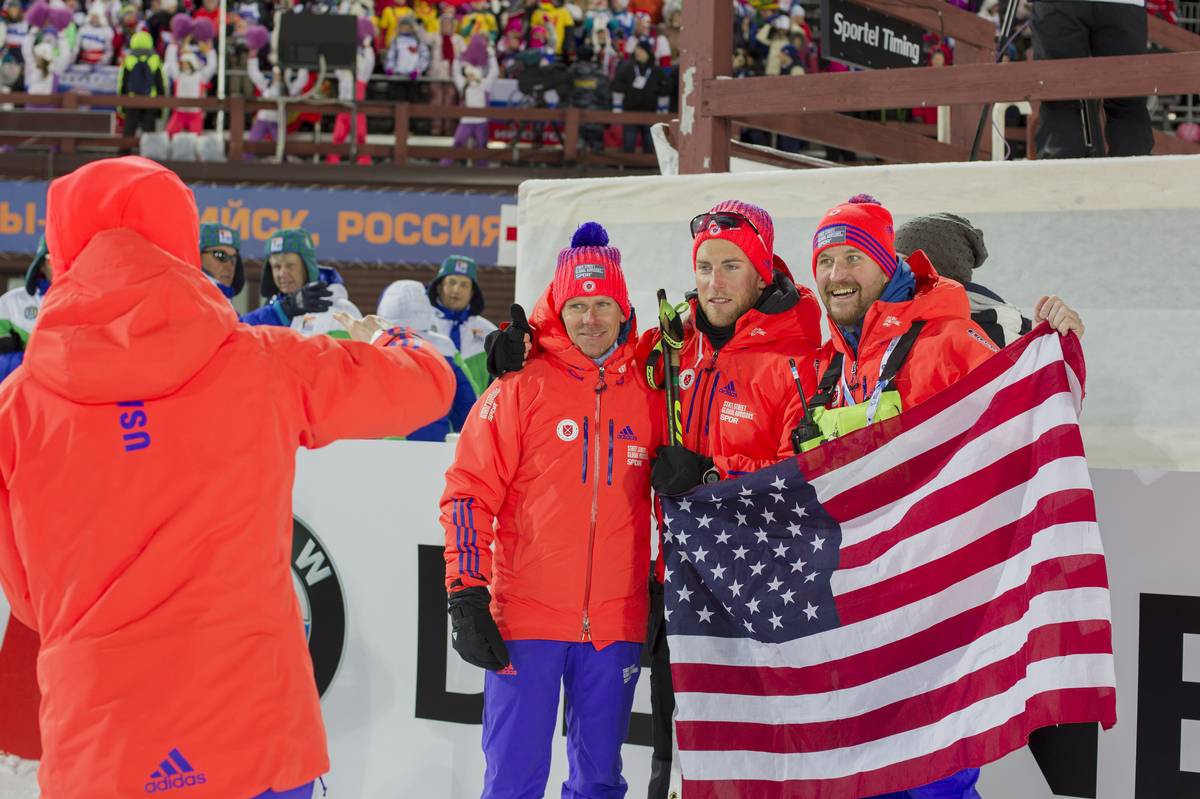
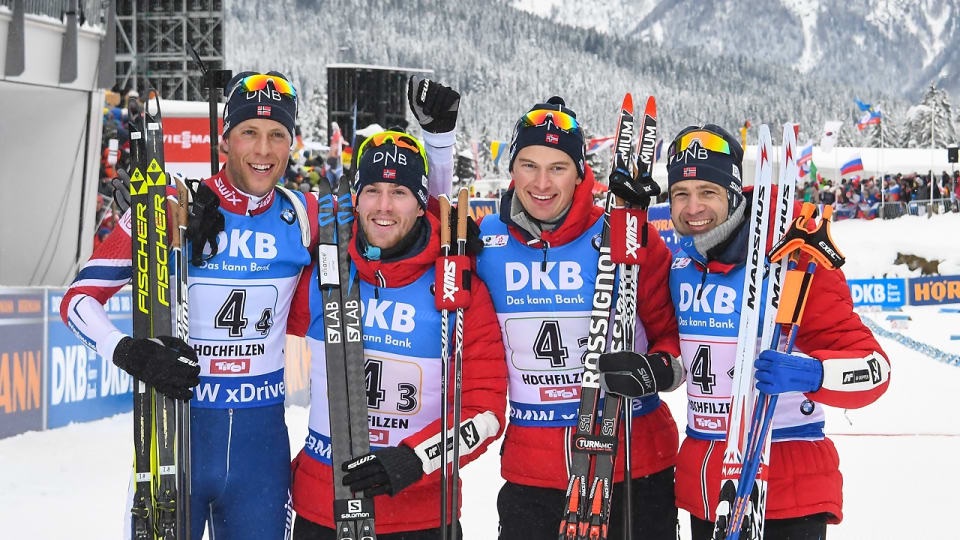
Russell Currier, Tim Burke, Lowell Bailey, and Leif Nordgren after a fifth-place relay finish in the IBU World Cup relay in Oberhof, Germany, in 2013. Currier, Burke, and Bailey are all retiring. (Photo: USBA.)
With the 2018 Olympics come and gone, many of biathlon’s athletes are calling it quits. Here’s a roundup of who you won’t see on the World Cup next season – and who’s still on the fence about their future.
USA
2017 Word Champion Lowell Bailey has long planned to retire after the 2018 season, and now that time has come. His first World Junior Championships was in 1999 and he got his first World Cup start in 2002. He raced 2003 World Championships before taking a break to go to the University of Vermont, before returning and competing in the 2006, 2010, 2014, and 2018 Olympics. His eighth-place finish in the 20 k individual at the 2014 Games are the best ever by an American biathlete. Bailey is the Executive Director of the Crosscut Mountain Sports Center in Bozeman.
Susan Dunklee and Lowell Bailey celebrate after finishing second in the World Cup single mixed relay in Kontiolahti, Finland, in 2017. Austria won the competition. Bailey is retiring and Dunklee is undecided as to whether she will continue racing. (Photo: IBU/Twitter)
“I told myself this morning that I just wanted to go out on a high note,” he told FasterSkier in Oslo after leading off a U.S. relay team that finished seventh, in his last World Cup race. “I wanted to go out with a good result. And, I’m really happy to have shot clean in standing, clean from the clip in my last stage as a World Cup biathlete. That feels good. I’ll always remember that — that I went out with a clean stage.”
Longtime teammate and 2013 World Championships silver medalist Tim Burke will also retire. Burke has six World Cup podiums to his name including that silver medal, and led the World Cup partway through the 2009-2010 season. Burke started racing internationally at 2000 Junior World Championships, and made his first senior World Championships in 2004. Like Bailey, he is a four-time Olympian.
“It’s weird, I don’t honestly I don’t know if it’s truly hit me,” he said after the Oslo relay. “It might take weeks… I think it’s going to take a long time for all to settle in and for me to really reflect back on my career. Yeah, it’s a lot of emotion.” Burke says that his post-biathlon plans are not yet certain.
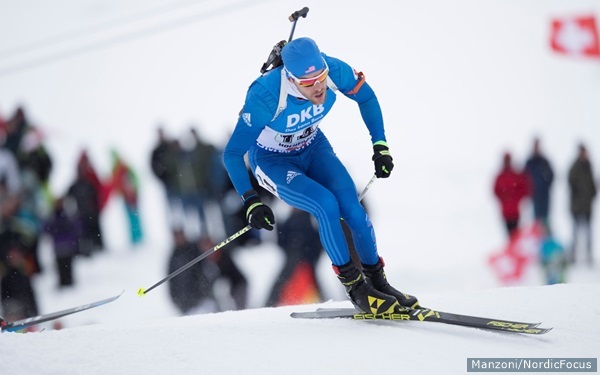
Tim Burke after placing sixth in a World Cup pursuit in Khanty-Mansiysk, Russia, in 2016. (Photo: USBA/NordicFocus)
Also retiring is Russell Currier, an off-and-on member of the national team and the Maine Winter Sports Center (now the Outdoor Sports Institute). Currier had two sixth-place World Cup results in 2012, and is a four-time World Championships team member. Since his World Cup debut in 2009, he has contributed to many U.S. relay efforts. He also competed at the 2014 Olympics, with a top finish of 49th, and was a member of the 2018 Olympic team though he did get any starts in PyeongChang.
“USBA nationals will be officially be the last race of my biathlon career,” Currier wrote in an email to FasterSkier this week.
The women’s team likely won’t see three retirements, and will thus have some more stability than the men’s crew, but there is more uncertainty regarding the women’s roster. Clare Egan wrote in an email this week that she was “Undecided!” about whether to continue racing. And in Oslo, after finishing third in the pursuit which was her last World Cup of the season, Susan Dunklee said the wasn’t sure if she would keep competing. “Ask me again in a month,” she said.
Canada
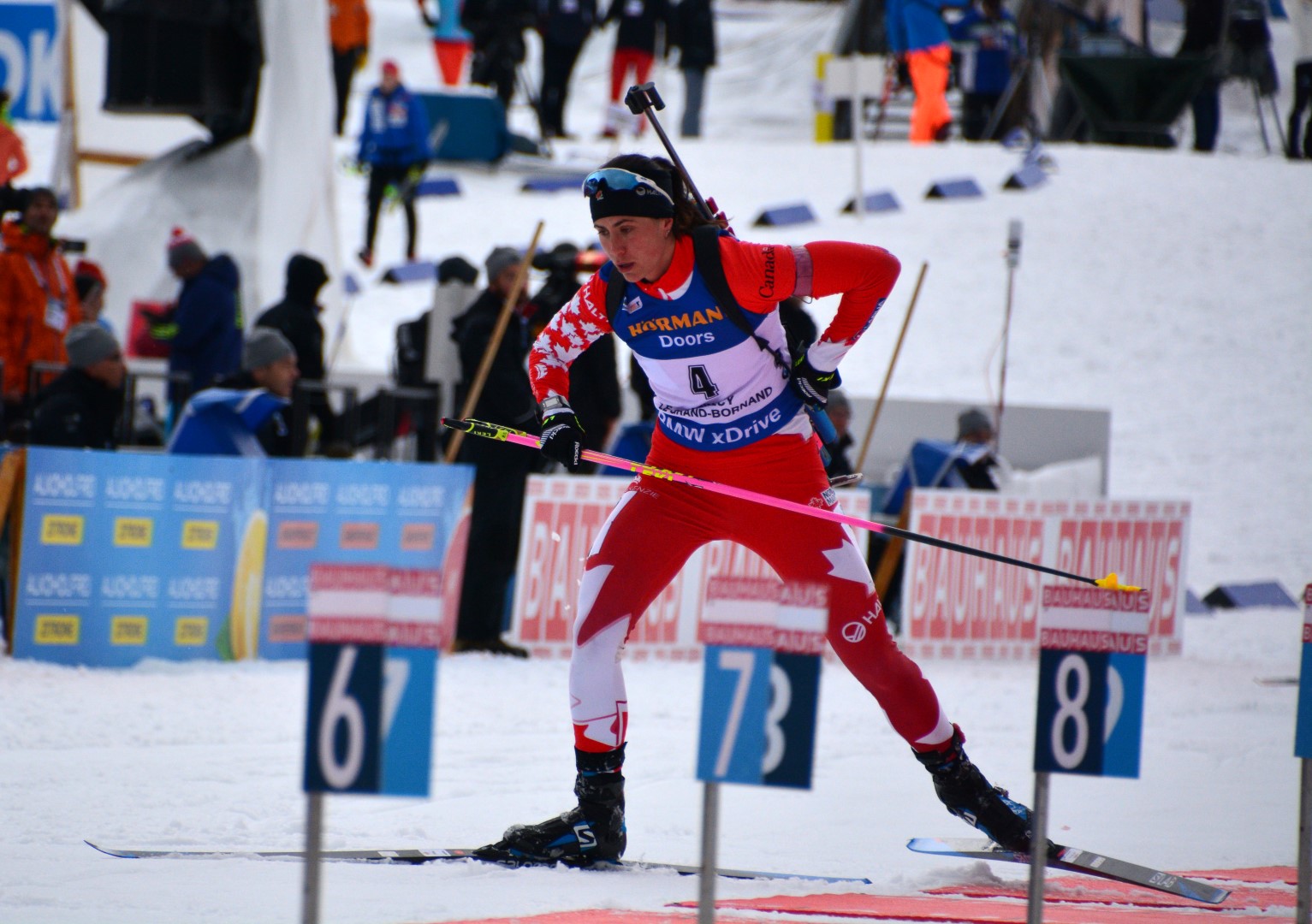
Julia Ransom retired in Oslo, as the 25-year-old is planning a career in dentistry and has many years of school ahead of her. “It’s just a good time for my partner and I to kind of move on,” she said after crossing the line in her final World Cup, the pursuit, hand in hand with teammate Rosanna Crawford.. “And it does feel right. It feels right.”
The Canadian men’s team (l-r) Christian Gow, Nathan Smith, Scott Gow, and Brendan Green celebrate bronze in the men’s 4 x 7.5 k relay at 2016 World Championships in Oslo, Norway. Both Green and Smith are undecided on their future plans. (Photo: JoJo Baldus)
Ransom scored two top-ten finishes at 2014 World Juniors, and made her first senior World Championships team in 2015. This season she had two top-ten World Cup finishes, and went to the Olympics in PyeongChang, where she finished 28th in the pursuit.
She is the only one from the Canadian team who is definitely retiring, but quite a few of her teammates are on the fence and there could be huge turnover on the team depending on what they decide. That includes Rosanna Crawford and Brendan Green, even though Crawford finally bagged her first World Cup podium this season.
“We’re not 100% sure yet,” Green said after the relay in Oslo. “Both Rosanna and I will sit on it a little bit over the spring. We will reevaluate a little bit and see what other opportunities arise. I think we both still love to race and train, and if we continue down that path I know we will still be motivated. But as of right now I’m not sure.”
2015 World Championships silver medalist Nathan Smith – who was also, along with Green, Christian Gow, and Scott Gow, part of a bronze-medal relay at 2016 World Championships – is also unsure. He missed most of the 2016-2017 season with health issues and though he returned to the World Cup and the Olympics this year, did not perform up to his own expectations.
Rosanna Crawford, Megan Imrie, Megan Tandy, and Zina Kocher celebrate a fourth-place World Cup relay finish in Annecy, France, in 2014. Crawford and Tandy may not keep racing after this season; Imrie retired in 2014 and Kocher in 2016. (Photo: Matthias Ahrens)
“I’m kind of waiting to see what happens with Biathlon Canada,” Smith wrote in an email this week. “I think some very difficult years are coming for the organization, unfortunately. That will play a big part in my, and I’m sure many other athletes’, decisions. Of course, I’m also not looking to have a continuation of the health problems over the last two seasons, which made competing at the highest level really difficult. So I will be keeping a close eye on how my body is reacting to training. If it’s still not coming around that would certainly not encourage me to continue either.”
2010, 2014, and 2018 Olympian Megan Tandy also struggled with health issues this winter, and is likewise not sure what her future holds.
“Originally it was my intention to retire after this season, however it was literally my worst season ever!” she wrote in an email. “I was sick more in the past 6 months than in the past two years. Anyways, I have taken some time since the Olympics to followup about my health and to consider options for next season. I want to race a final season – one where I feel good and can put up a good fight (not necessarily results dependant, I just want to leave this sector of my life feeling like I gave it all I got), but a lot of things will need to fall into place for that to be realistic: sponsor support, coaching opportunities during the training season, and my health of course.”
Poland
Weronika Nowakowska is calling it a career. The 31-year-old picked up two World Cup podiums in the 2015 season before taking a break from competition to give birth to twins. She made a successful return this season and represented Poland in PyeongChang, with a top finish of 21st in the individual. She also had sixth- and fourth-place finishes on the World Cup this year and contributed to four different top-eight relay efforts, including one at the Olympics.
“I leave happy, fulfilled and cheerful,” she wrote on her Facebook page, according to a translation. “I was not outstanding, but so far no Polish biathlete has done better”
France
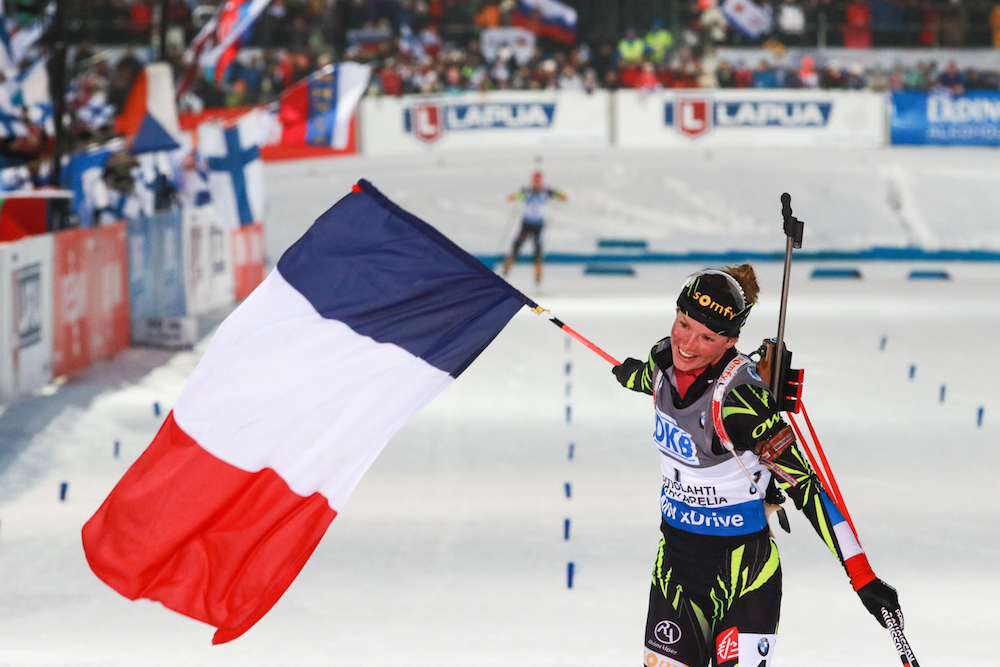
Back in Oslo, French star Marie Dorin Habert ended her career. Dorin Habert – then simply Marie Dorin – competed in her first senior World Championships in PyeongChang in 2009, where she had a top individual finish of 18th and was part of the bronze-medal relay team. Fast forward and she had racked up a sprint bronze at the 2010 Olympics, seven World Cup wins, ten more World Championships relay medals, and four individual gold, one silver, and one bronze medal at World Championships, four of which were from the 2016 edition where she did not finish a single race without a medal.
France’s Marie Dorin Habert celebrates her second win in as many races at 2015 IBU World Championships, after taking gold in the 10 k pursuit in Kontiolahti, Finland. (Photo: Kontiolahden Urheilijat/Jarno Artika)
She found herself back in PyeongChang for the 2018 Olympics, where, despite a frustrating season until then, she was fourth in the sprint, bronze in the women’s relay, and gold in the mixed relay.
“It’s so nice to end this way, to share it with all of the team, and the beautiful sun, and all the French people,” Dorin Habert said after winning the women’s relay in Oslo along with her teammates. “It’s a wonderful day for me. I would like to thank a lot, well, everyone, for being there in the biathlon family. I’m really happy to have this career, and I’m really happy for everything.”
Jean Guillaume Beatrix he told is also retiring. Beatrix was a World Junior Champion in 2009, before going on to be a five-time World Championships team member and a 2014 Olympic bronze medalist in the pursuit. He was part of three silver- and one bronze-medal winning men’s relay teams at World Championships. But this season, he did not perform well enough to make a very competitive French team for the 2018 Olympics. His retirement was “a decision precipitated by my results”, L’Equipe, according to a translation.
Czech
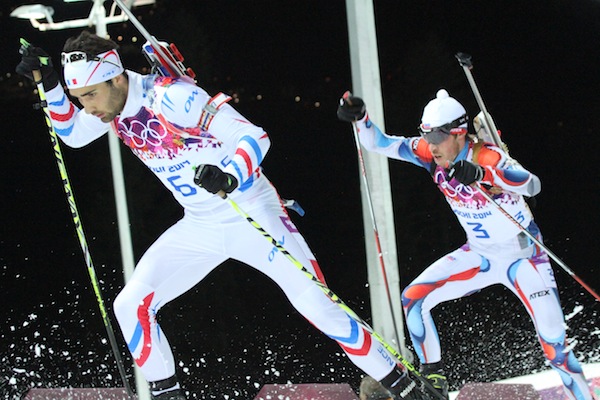
France’s Martin Fourcade leading Jaroslav Soukup of the Czech Republic during the men’s Olympic 12.5 k pursuit at the 2014 Olympics.
Jaroslav Soukup, the bronze medalist in the sprint at 2012 World Championships, where he was also part of the silver-medal mixed relay team, is retiring. Later in 2012, he suffered a horrendous accident while biking, including open fractures in his arm and neck and back injuries. By 2014, he made it back and won the same medals at the Olympics that he had at World Championships two years before: bronze in the sprint and silver in the mixed relay. Soukup qualified for the 2018 Olympics but only competed in the relay, which finished seventh. He had one World Cup top-30 this season.
Norway
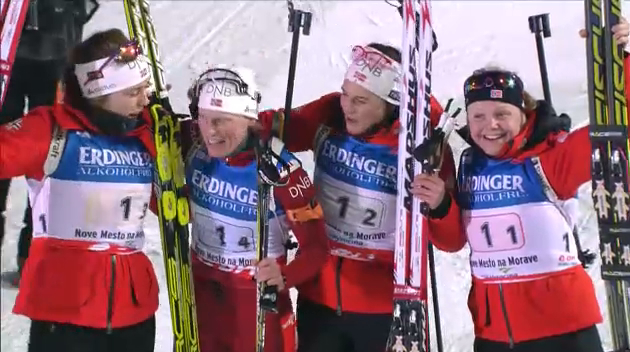
Hilde Fenne, a staple of the Norwegian women’s team, retired after the last race of the season in Tyumen, Russia. Fenne never found breakout success as an individual; she had three top-15 finishes in her career. But she was an integral part of the women’s team and contributed to numerous World Cup relay podiums, as well as the gold-medal winning women’s relay at 2013 World Championships in Nove Mesto, Czech Republic.
The Norwegian women’s relay celebrates its second-ever World Championships title after winning the 4 x 6 k event in Nove Mesto, Czech Republic. From left to right: Synnøve Solemdal, Tora Berger, Ann Kristin Flatland and Hilde Fenne.
In that final race, her teammates wrote her name on their cheeks. “She has been a very important piece for me,” teammate Synnøve Solemdal told NRK, almost in tears. “We have stayed in a lot of hotel rooms together. I’m going to miss her very much.”
On the men’s side, there is uncertainty as to whether some veterans will stick with racing or not. One is Ole Einar Bjørndalen, whowas left off Norway’s Olympic team, who for the first time since 1992 this season. And yet, the 44-year-old has not stated that he will retire, and some who know him are speculating that he may try to stick it out one more year and go out with better results than he saw this season.
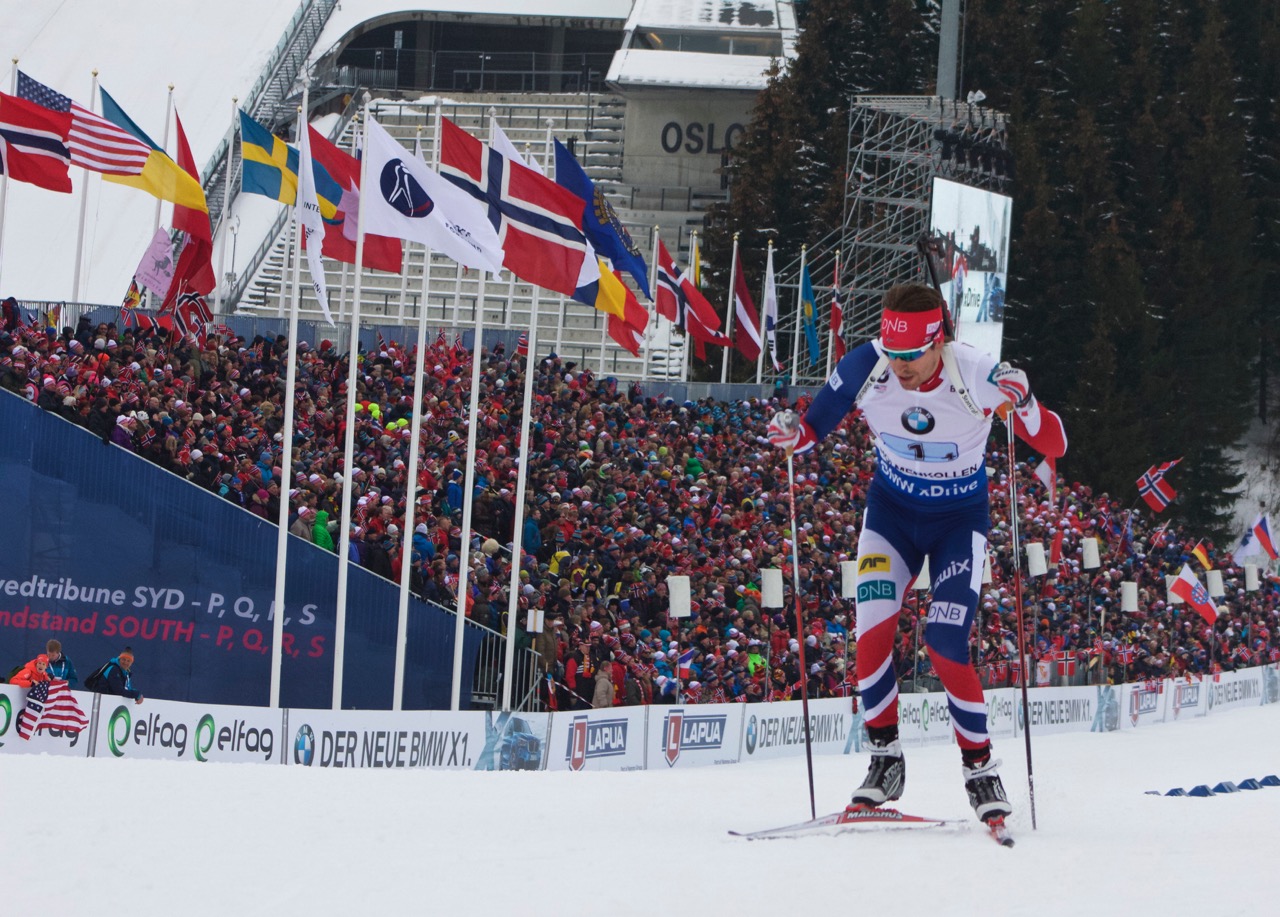
Also with no stated plans is Emil Hegle Svendsen. Bjørndalen is the winningest athlete in World Cup history; Svendsen is number four. He won the World Cup overall title in 2010, and is a four-time Olympian. He won gold in the individual in 2010 and in the mass start in 2014, after which he suffered a total collapse anchoring the Norwegian men’s relay. In the past seasons he has been off and on, and he has only won two races since then. But this season he showed flashes of brilliance, and he was third in the mass start at the 2018 Olympics as well as anchoring the silver medal men’s relay and mixed relays.
Emil Hegle Svendsen of Norway leaves the stadium in the 2016 Holmenkollen World Cup as thousands of his countrymen cheer him on. Svendsen has not officially announced his plans for next season. (Photo: JoJo Baldus)
“What Emil has done is absolutely fantastic,” teammate Tarjei Bø – who won the overall World Cup the year after Svendsen – told NRK two weeks ago. “He has won everything, and in addition done it several times, and he has come back again and again after being down. He has had a fantastic career and I hope he continues.”
Finland
She just won the overall World Cup crystal globe, but Kaisa Makarainen is not sure whether she will continue racing. In several previous years she had already discussed potentially retiring, but now she is reportedly waiting to think it over more as well as to discuss with the new team staff. U.S. Biathlon Women’s Coach Jonne Kahkonen, himself a Finn, was just announced as the new Head Coach for Finland.
Germany
Florian Graf, an athlete who finished as high as fourth on the World Cup in 2013 but has more recently been racing on the IBU Cup, is calling it quits at age 29.
Several other top athletes are suspected to be considering retiring, but there hasn’t been much on the record discussion by them. Stay tuned.
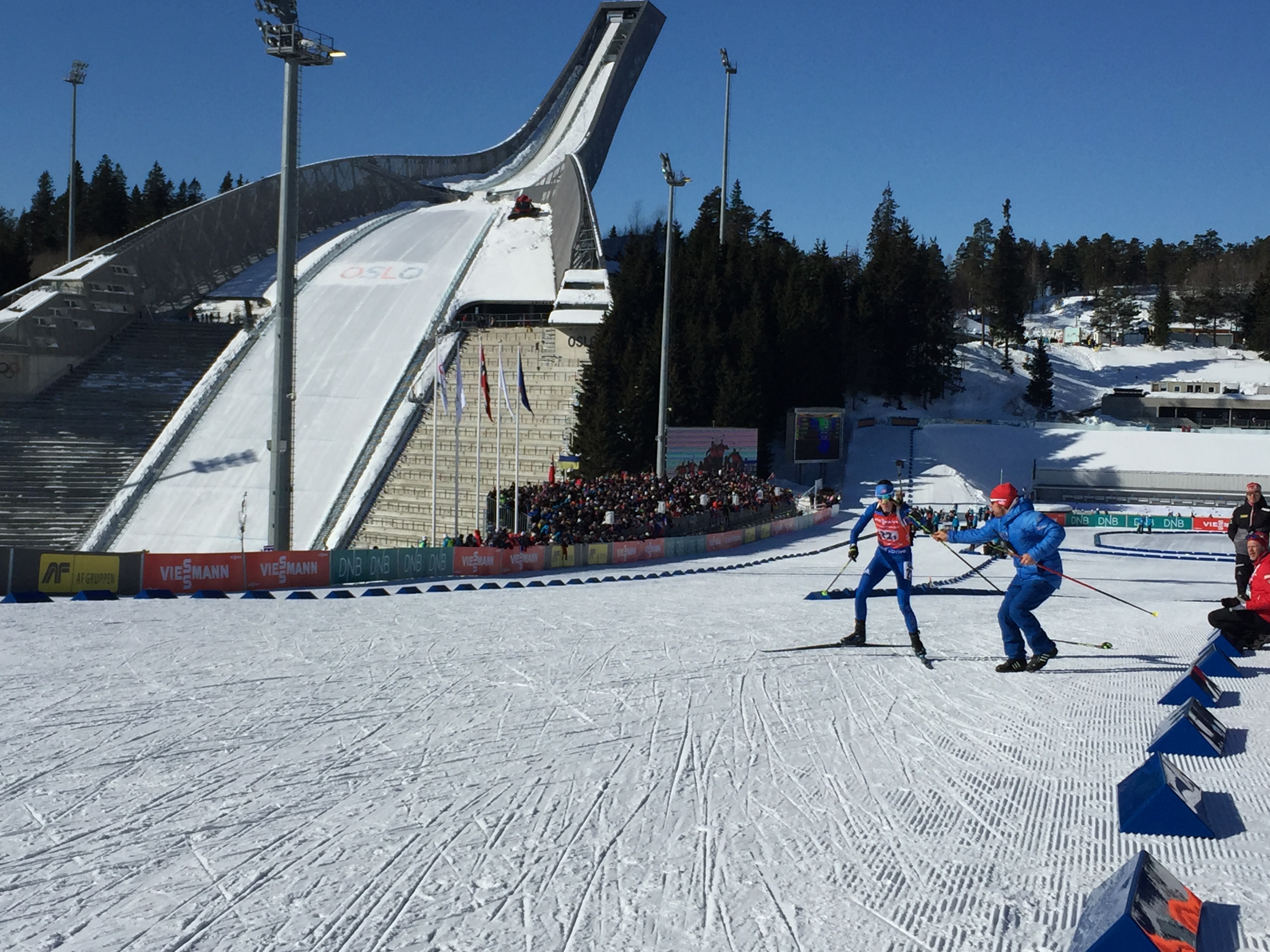
Clare Egan receives a pole from US Biathlon Chief of Sport Bernd Eisenbichler during the first leg of the women’s relay at Holmenkollen.
OSLO, Norway — In the last relay of French star Marie Dorin Habert’s career, she turned in a crucial performance to bring her team to the front. Anaïs Bescond extended the gap and France took the win in the women’s 4 x 6-kilometer relay here at Holmenkollen by 14.4 seconds over Germany.
Was she nervous going into the last team event she will ever race?
“I wasn’t really nervous,” Dorin Habert, 31, said in a press conference. “I think it’s a special thing to know that there is no more starts and no more relays for me, so I just wanted to fight and struggle hard like every relay. I think I did my best today.”
Dorin Habert won two gold medals, in the individual and the pursuit, here at World Championships two years ago. So Oslo is a special place.
“It’s so nice to end this way, to share it with all of the team, and the beautiful sun, and all the French people,” Dorin Habert said. “It’s a wonderful day for me. I would like to thank a lot, well, everyone, for being there in the biathlon family. I’m really happy to have this career, and I’m really happy for everything.
The Italian duo of Lisa Vittozzi and Dorothea Wierer put their team in first place at the halfway point, and it was their teammate Nicole Gontier whom Dorin Habert passed to pull France into first. Gontier stuck with her, and Italy was only 2.2 seconds back at the last exchange.
The German anchor, Laura Dahlmeier, charged past Italian skier Federica Sanfilippo. She was unable to catch Bescond, but Germany finished second with seven spare rounds to six by the French, and Italy placed third with eight spare rounds (+33.2).
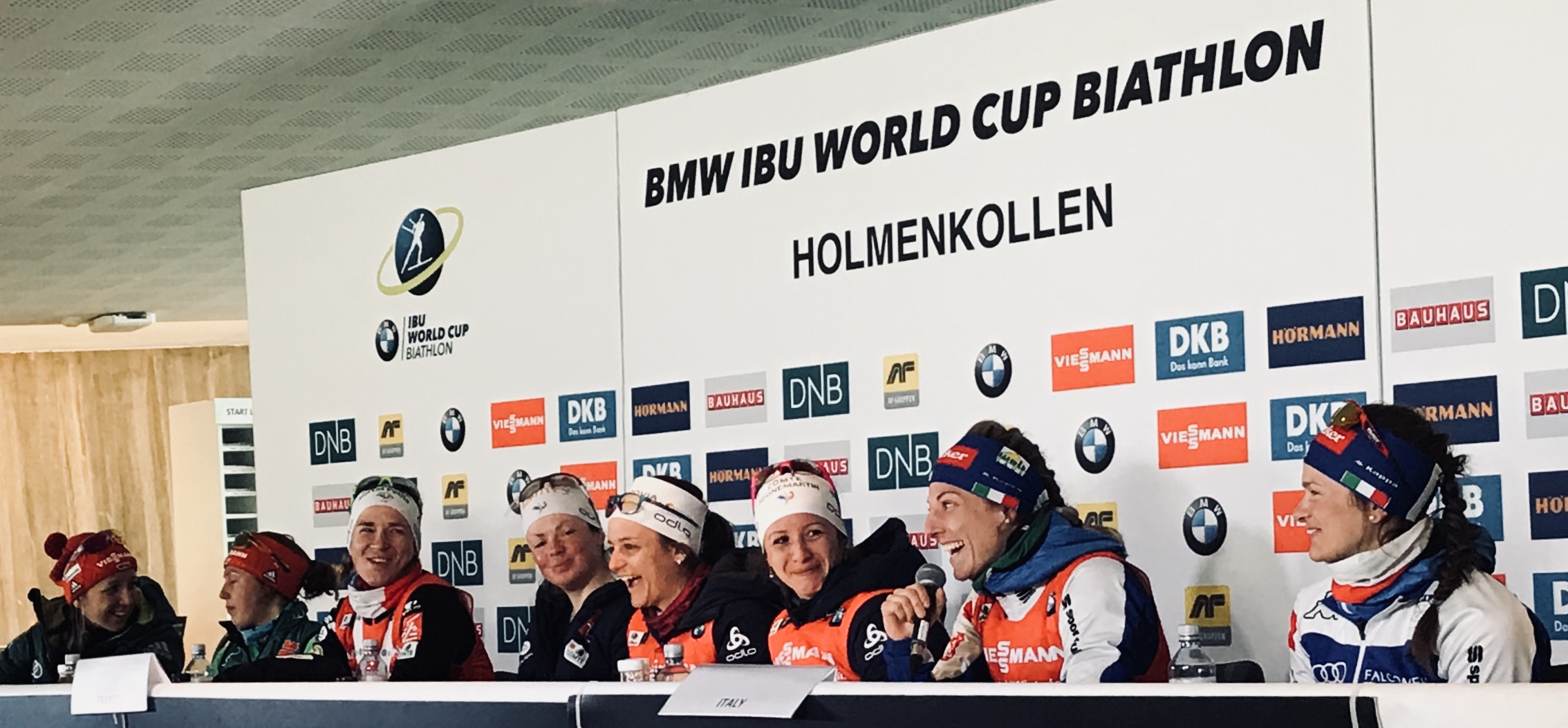
The Italian and French teams joking in the press conference.
Norway placed fourth with a penalty loop and 10 spares (+1:26.5), Switzerland fifth with eight spare rounds (+1:54.2), and Sweden sixth with a remarkable three spare rounds (+2:27.2).
The Canadian team skied an even race, with Sarah Beaudry leading off in 12th, Julia Ransom tagging in 14th, Emma Lunder in 15th, and then Rosanna Crawford bringing the team up to 11th.
“I love coming from behind and chasing girls down, and I just looked at it as practice for tomorrow,” said Crawford, who will start Sunday’s pursuit in bib 38. “I was within somewhat contact with the other women around me, so that was nice. People to chase, people to ski with.”
It wasn’t the result the team knew they were capable of, with 11 spare rounds. But it has been a long season.
“Of course everyone is tired, every team is tired,” Crawford said. “But our fast isn’t as fast as the fastest, so our slow is, well, a lot slower. I felt so good through Finland, and I really thought the ski speed was going to hold, but then it wasn’t there in the sprint. And also, today was slightly better, but not what I had last weekend. It’s so frustrating to be up and down.”
The U.S. team started off with a tough leg by Clare Egan, who used all of her spare rounds in both prone and standing and had two penalty laps. She tagged off at the first exchange in 21st and last place.
“This is I think the worst race of my career,” she said after the finish. “I’m really embarrassed. It is the worst possible thing to do it in a relay. I hate letting everyone down. It’s a really terrible feeling.”
Her teammates, though, were more circumspect.
“I never, ever, want to hear a teammate apologizing for tagging off far back like that,” said Susan Dunklee, who took the tag from Egan. “The only thing they can apologize for is if they didn’t try. And Clare was out there and trying her best. So I have nothing but respect for that.
“What I yelled at Clare, when she was at the top corner and I was warming up, I yelled, ‘We love you and we think you’re awesome!’ ” Dunklee continued. “She was in last place, and we still do love her. You just have to know that your teammates have all been there, they have all done the same thing in the relay, and they know exactly how you feel. Usually, there’s a piece of our relay that we can look at and get really excited about, so we will do that today.”
For Egan, though, it was a race that just came apart. The team started with bib 22, one of the last in the field, but she move up 10 places to 12th by the first shooting.
Then, spare rounds and penalty laps.
“I’ve never had a penalty loop in prone, in the World Cup [in a relay], but to do that in the first stage and immediately be like a minute behind everyone – no, I didn’t lose hope,” Egan said. “I knew that anything can happen in the standing. And I actually, I didn’t come into the range last. I had passed one person. But, you know, with another [penalty lap] in standing, I was just trying to get as fast as I could to the finish because … I just hoped that my teammates all would get a chance to do the race. If we get lapped then we get pulled. That’s it.”
She also lost part of a pole early on in the race, and the replacement process did not go smoothly.
“I just had to get a new one, but then the new one was shorter than my own pole,” Egan explained. “So when I went by a coach I meant to switch out the shorter pole for a spare that was the right height, and I gave him my own pole. So then I finished the race and I was like, ‘What the heck? I still have this stupid pole.’ ”
As the relay continued, Dunklee had the seventh-fastest second leg time, and Reid the eighth-fastest third leg time; by the third exchange, the U.S. was in 17th place.
“The shooting didn’t feel really sharp today,” said Dunklee, who used three spare rounds in total. “I don’t know what the times were but I don’t think they were very fast. I just felt sluggish and, a little out of it, really.”
Reid used only one spare round, a performance she was excited about.
“It’s always easier to start from behind and work your way up because there’s no pressure,” she said. “Whereas if you come into the range in first and have to shoot on point one, and everyone is staring at you, that’s really hard. Today was low-pressure shooting.”
Emily Dreissigacker anchored the team, and used four spare rounds to move up to 15th. She caught the team from Kazakhstan and held off a challenge from Korea in a three-way sprint finish, chasing Austria who finished jut 2.1 seconds ahead.
“I don’t know when the last time I actually had to sprint for the finish was, but it was great!” she said.
China and Slovenia were disqualified, and Bulgaria and Lithuania were lapped. But despite being the last team on the first leg, the U.S. women avoided that fate by a large margin.
“I definitely went out hard,” Dreissigacker said. “I knew we were sort of in the danger zone for getting lapped, but actually, the skiing felt really good the first two laps. I kind of died at the end, so I was glad I was able to come through at the finish.”
“I think we’ve all been through some ups and downs this season and struggling with that,” Dunklee said of Egan’s relay leg. “It’s important to remember that biathlon isn’t everything. There’s other stuff going on in our daily lives that is meaningful to us. It’s important to never lose sight of that.”
Clare Egan (US Biathlon) racing to a career-best 13th in the women’s 7.5 k sprint at Friday’s IBU World Cup in Kontiolahti, Finland. (Photo: USBA/NordicFocus)
IBU World Cup (Kontiolahti, Finland): Women’s 7.5 k sprint
Darya Domracheva of Belarus raced to her third World Cup victory of the season on Friday, and American Clare Egan tallied a career best in 13th, just behind Canada’s Rosanna Crawford in 12th in the International Biathlon Union (IBU) World Cup women’s 7.5 k sprint in Kontiolahti.
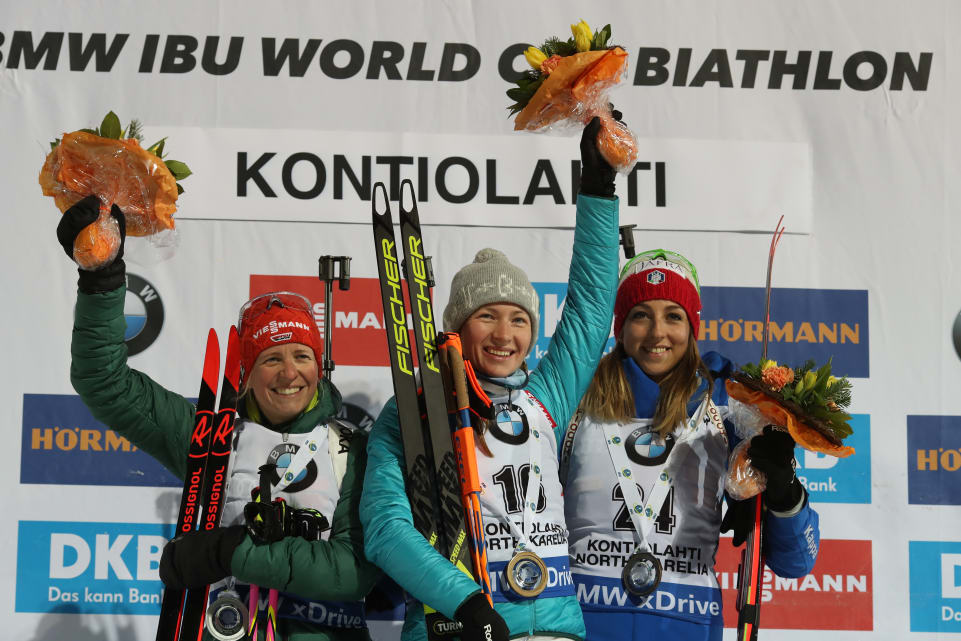
The women’s 7.5 k sprint podium at the IBU World Cup in Kontiolahti, Finland, with Belarus’s Darya Domracheva (c) in first, Germany’s Franziska Hildebrand (l) in second, and Italy’s Lisa Vittozzi (r) in third. (Photo: IBU/Biathlonworld)
Domracheva started 16th and shot a perfect 5-for-5 in prone, then missed one in her standing bout, but skied to first with the fastest overall course time. Her position in the leader’s chair looked secure until Germany’s Franziska Hildebrand, who started 49th, shot clean in both stages and headed out on her last loop with a 17.6-second lead on Domracheva’s time. But Hildebrand couldn’t match Domracheva’s pace and finished 0.5 seconds short of the winning time of 20:56.8 at the finish.
“I really like to compete here in Kontiolahti,” Domracheva said, according to an IBU press release. She won two gold medals there at 2005 Youth/Junior World Championships and went on to win her first two World Cup races there in 2010.
“This is a tough track, always very difficult but it always a good chance to take some seconds if you are in good shape,” she said. “I have some good memories from here…”
“I am very proud of myself,” Hildebrand said of her race, according to the IBU. “Dasha made a really strong last loop and I tried to do it as well. It was very close but I am happy to be second … I had to concentrate and have the confidence that I could shoot clean today.”
Italy’s Lisa Vittozzi started 24th and came within 5.5 seconds of Domracheva’s time, after missing one standing target (0+1), to place third, 5 seconds behind Hildebrand.
Vittozzi achieved her first career podium in Kontiolahti last year.
“This is an amazing place for me,” she told the IBU. “I like this track so much and feel in good shape. I tried to do my best in the shooting range and finally I did it.”
Ukraine’s Yuliia Dzhima shot clean but was 11.7 seconds short of the podium in fourth place (+17.2), Germany’s Laura Dahlmeier followed in fifth (+19.4; one penalty), Veronika Vitkova of the Czech Republic placed sixth (+21.0; no penalties), Ukraine’s Vita Semerenko was seventh (+21.0; no penalties), France’s Marie Dorin Habert eighth (+32.0; no penalties), Germany’s Maren Hammerschmidt ninth (+33.9; one penalty), Finland’s Kaisa Makarainen 10th (+34.4; two penalties), and Belarus’s second woman in the top 11, Nadezhda Skardino 11th (+35.3; no penalties).
Rosanna Crawford (Biathlon Canada) leaving the range during the women’s IBU World Cup sprint earlier this season in Annecy, France. . (Photo: Glen Crawford)
Crawford led Canada in 12th (+46.5) with a single prone penalty (1+0) for her best sprint result since the 2014/2015 season. Also this season, Crawford raced to a career-best third place in a 15 k individual and fourth in a 12.5 k mass start.
“It was a little bit windy and some fresh snow made for a soft track, but I had amazing skis from our techs and was feeling good skiing,” Crawford wrote in an email. “I’m really happy with how I executed my race today, I really tried to channel my inner Jessie Diggins and never stop fighting! The hills are steep and long here, something I usually struggle with, but I tried to push them mentally aside and focus on what I am good at, there are a lot of flat sections where my two skate one skate is really strong, and on the big up hills I just tried to stick with whoever was around me.
“I had a lot of fun out there tonight, something I didn’t think I would ever say about this race course!” she continued. “… I am really happy to have some good ski speed in a spring finally!”
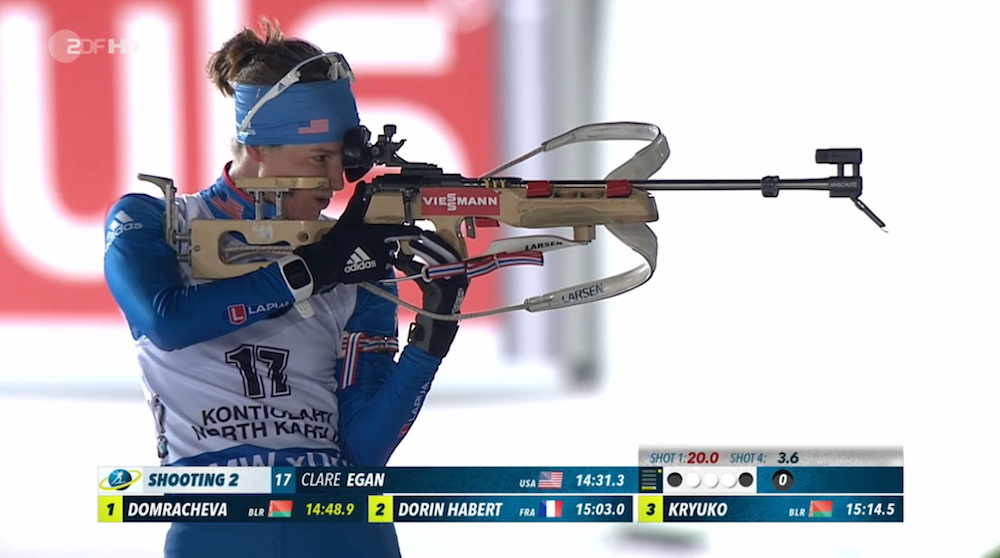
Egan, of the U.S., achieved her best World Cup result in 13th (+46.9) with a single standing miss (0+1) and the 14th-fastest overall course time. Her previous best was 16th in a sprint four year ago.
After the Olympics, Egan explained in an email that she rented an apartment in Helsinki and spent the first part of the off-week spending some alone time and doing “some serious R&R. I don’t think I realized how chaotic the Olympics were until I had peace and quiet for the first time in 3 weeks,” she wrote.
“After a week of mostly easy skiing on my own I was really antsy to race today,” Egan added. “I also felt motivated coming off my season-best performance in the women’s relay in Pyeongchang. My individual results have been really mediocre this year so I was looking to take the momentum and confidence from the relay and carry that into today’s race.”
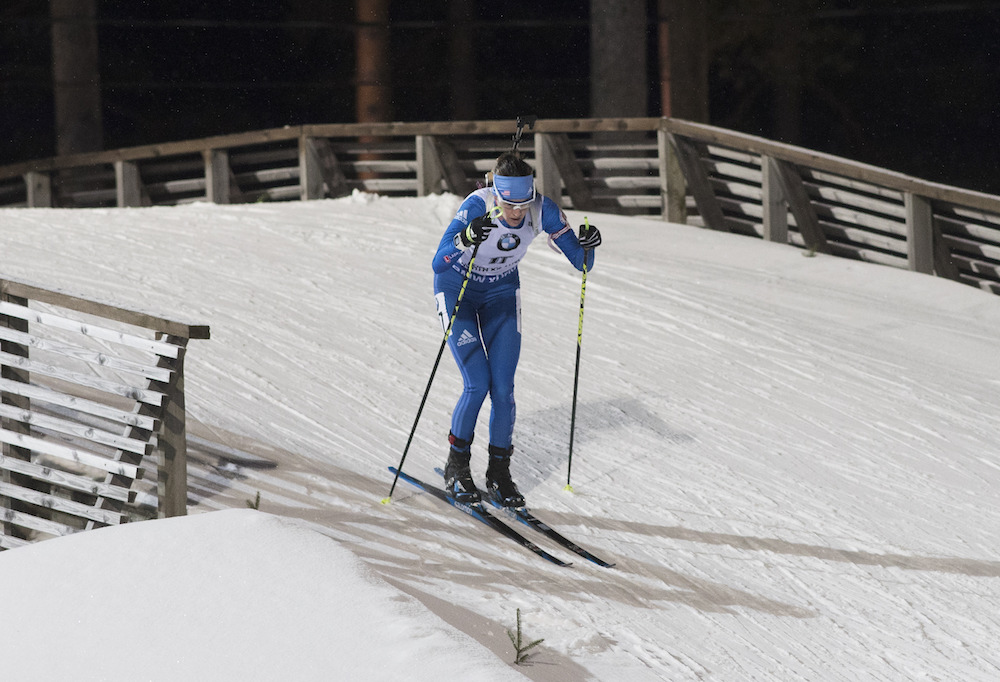
Clare Egan (US Biathlon) during her standing shooting of the IBU World Cup women’s 7.5 k sprint in Kontiolahti, Finland. (Screenshot: ZDF broadcast)
During Friday’s sprint, she noticed her skis were running really well.
“I can say without any doubt that we had the fastest skis today and that played a big role in my ski time,” Egan wrote. “I had a personal best ski time (rank) by at least 10 places today.”
After starting one bib and 30 seconds behind Domracheva, Egan knew she was having a good race when she could see the eventual winner for most of the first loop.
“Our skis were so fast that I honestly had to adjust my technique to account for the extra glide– exceptional!” she added. “On my last loop, I realized I was still ahead of Laura Dahlmeier, who started :30 seconds behind me, and I fought super hard to hold her off all the way to the finish line!
“I was shocked to have a career best with one miss,” Egan concluded. “But I had a major PR on my ski time rank, and this is biathlon! I’m very, very happy to have a great result, but happier about the performance behind the result.”
With their results on Friday, both Egan and Crawford earned starts in Sunday’s 12.5 k mass start, according to a provisional start list.
“I’ll have another opportunity tomorrow in the mixed relay and Sunday in the mass start, which is only the second of my career,” Egan wrote.
“I was pretty disappointed to not qualify for the mass start at the Olympics,” Crawford wrote. “My bad sprint had many far-reaching consequences. So I am glad I get another chance to go out there and fight with the best!”
Also for the U.S., Susan Dunklee finished 36th (+1:27.0) with three penalties (1+2), Emily Dreissigacker was 62nd (+2:15.7) with two misses (2+0), and Joanne Reid was 74th (+2:38.7) with two misses (0+2) as well.
Canada’s Emma Lunder finished 43rd (+1:48.0) with one miss (1+0), Julia Ransom was 58th (+2:07.9) with two penalties (1+1), and Sarah Beaudry finished 66th (+2:20.3) with two misses (1+1) as well.
This year’s Kontiolahti World Cup does not include a pursuit race. The single mixed relay and mixed relay are set for Saturday, followed by men’s and women’s mass starts on Sunday.
The US Biathlon coaching staff, poses for a photo following the men’s World Cup sprint in Khanty-Mansiysk, Russia, in 2016. The US will not attend this year’s World Cup final in Tyumen. (Photo: USBA/NordicFocus)
In December, Biathlon Canada announced that it would not attend World Cups slated for Tyumen, Russia, in March, due to the doping scandal that has consumed Russian sports. Russia is still not in compliance with the World Anti-Doping Code, and, Biathlon Canada stated, “the integrity of anti-doping procedures in Russia is still very much uncertain, given the current situation in which RUSADA remains non-compliant with WADA.”
This caused little reaction from the International Biathlon Union (IBU) at the time.
The United States and the Czech Republic have now also announced their intentions to boycott the event, and other individual high-level athletes also do not plan on attending.
“I am really discouraged by our international federation, the IBU,” Lowell Bailey said after the men’s relay at the Olympics on Friday. “Our President, Anders Besseberg… at every turn when he has the chance to defend clean sport, he has turned the other way. And it’s not fair to clean athletes. The latest decision by the IBU was to send the World Cup tour to Tyumen, Russia, for our World Cup final. Team USA is boycotting. The Czech team is boycotting. Canada is boycotting. We are trying to rally more support. I know that as an Athletes’ Representative, almost every country had athletes that wrote letters to the IBU [about the World Cup final].”
The Czechs know that they will lose Nations Cup points, and possibly World Cup quota spots, by skipping a weekend of racing, but said that it was worth it.
“We have taken a certain stance, with some sacrifices, and it would be wrong to give it up now,” Czech Biathlon Union President Jiří Hamza told iDNES, a Czech news agency, according to a translation.
“If you are convinced something is not right, you should keep that stance,” shooting coach Ondřej Rybář said in the same article. “If the other countries talk about RUSADA being noncompliant and that they should not have international races in Russia, but they eventually go there, that’s their issue. We clearly stated that we do not agree with what is happening in Russia. We therefore want that the work did in the fight against doping isn’t lost.”
And in the meantime, the IBU had apparently received private feedback from athletes who wanted the World Cups to be moved to a Code-compliant country.
“The outcry from our fellow athletes around the world has been respectful, strong, and definitive,” the U.S. biathletes wrote in a joint statement that they each posted to social media platforms (for example, here). “In addition to the dozens who expressed their opinion to the IBU Athletes Commission members ahead of the meeting in January 2018, the IBU received letters representing over 30 athletes, from eight countries, and included three 2018 Olympic Champions… ”
French star Marie Dorin Habert, a four-time World Championships gold medalist, has announced that she will retire after the World Cup weekend in Oslo – which by definition means that she won’t be going to the final weekend of competition in Russia.
Teammate Martin Fourcade, however, reportedly will attend the races in order to fight for the World Cup crystal globe, which he currently leads by just 54 points over Johannes Thingnes Bø of Norway.
“My position on doping and on Russians who have cheated is clear, but my position on Russia is different,” he said, according to the German Press Agency via a translation. “The country is a fan of biathlon, and I think the Russian public should not be eternally punished for the actions of some of its officials and athletes.”
Sebastian Samuelsson, a Swede who won silver in the Olympic pursuit and then gold in the relay, also expressed his dissatisfaction with the IBU’s handling of the situation.
“Hugely disappointed with the [IBU] decision today to, despite considerable pressure, to keep the [World Cup] in Russia,” he tweeted, according to a translation.
Samuelsson was rewarded with numerous twitter replies from Russian accounts telling him to stay home, one of which called him a baby and another of which said he was “not welcome in Russia”. He was then attacked on Instagram, with obscenity-filled threats and more sober ones, like, “your whole family will die.”
And that’s something that the Americans mentioned in their open letter explaining why they wouldn’t be traveling to Russia: safety.
“I’ve got online threats because of things I’ve said,” Canada’s Rosanna Crawford told Norwegian broadcaster NRK after the Canadians announced their boycott in December. “There are people who say they can’t wait until I come to Russia, ‘we’ll see what happens to you then’.”
It’s something the Czechs are intimately familiar with, too. After their 2014 women’s relay team celebrated being awarded Olympic bronze after the Russian relay team was disqualified for doping – several relay members’ cases are now pending at the Court of Arbitration for Sport – they were attacked as well, with hundreds of comments on social media calling the women “pigs” and “prostitutes” and threatened that if they did come to Russia, their anti-doping samples would be sabotaged.
And indeed, the first comment on U.S. biathlete Susan Dunklee’s Instagram post announcing the boycott was sexually-explicit and degrading insult, the only part of which can be written on a family-friendly website was the part calling her “ugly”. More obscenity-laden comments followed.
“Thank God the Americans won’t come!” another commenter wrote. “If you came to us, I’d throw you tomatoes.”
“You’re not an athlete,” added a third.
“American coward,” mocked another.
Bailey did not post about the boycott on Instagram, but commenters went there anyway, flocking to his most recent post – from nearly a year ago – to call him a doper.
“… the protection of clean athletes and the fight against doping are of the highest priority,” the IBU wrote in a September press release regarding the Russian doping investigation.
But when it comes to online threats against the athletes competing in their sport, the federation has so far been silent.
In response to Canada’s boycott announcement in December, Anders Besseberg said, “It’s not mandatory for anyone to attend, let’s put it that way.”
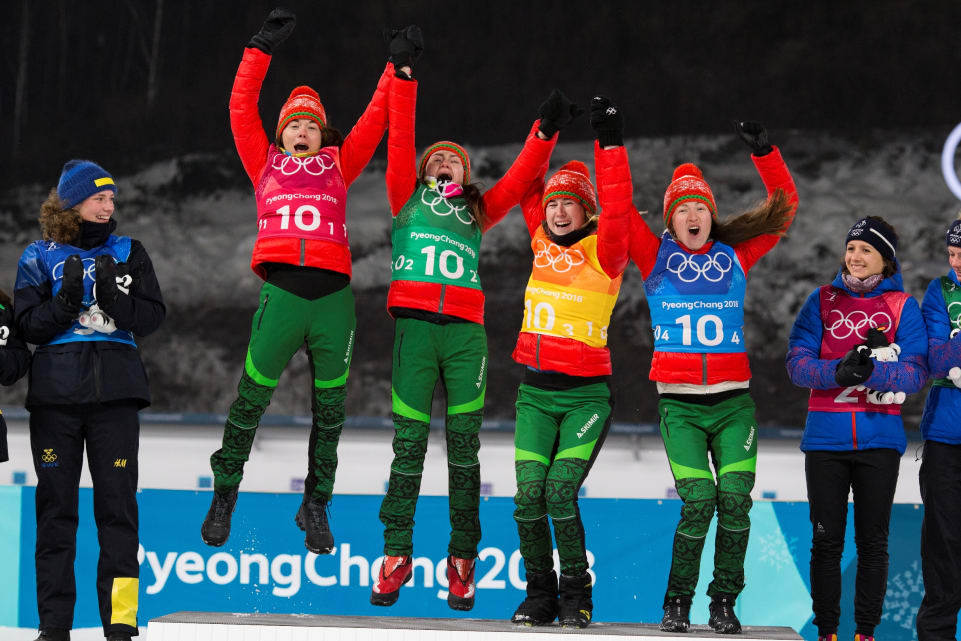
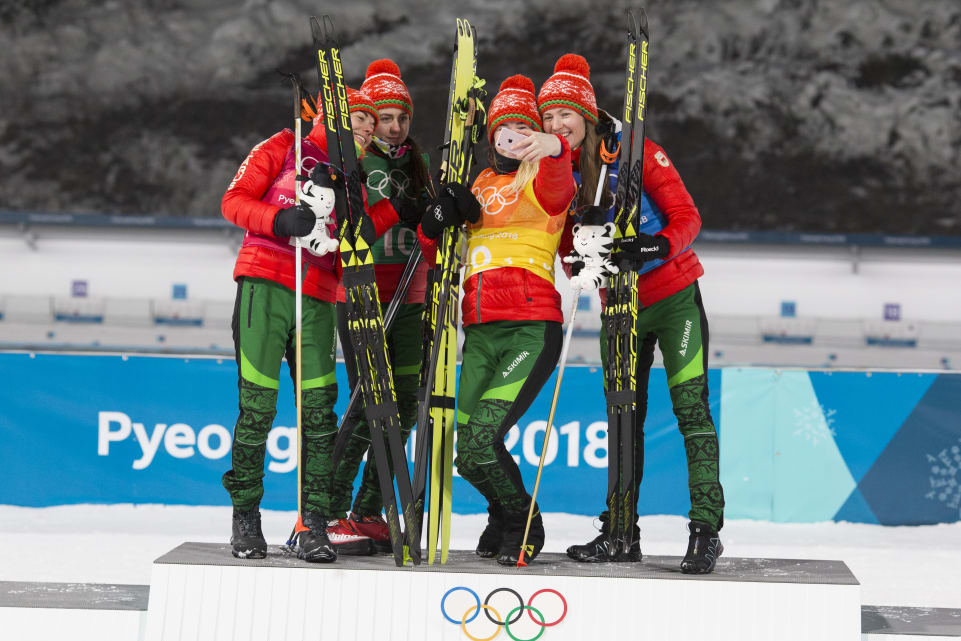
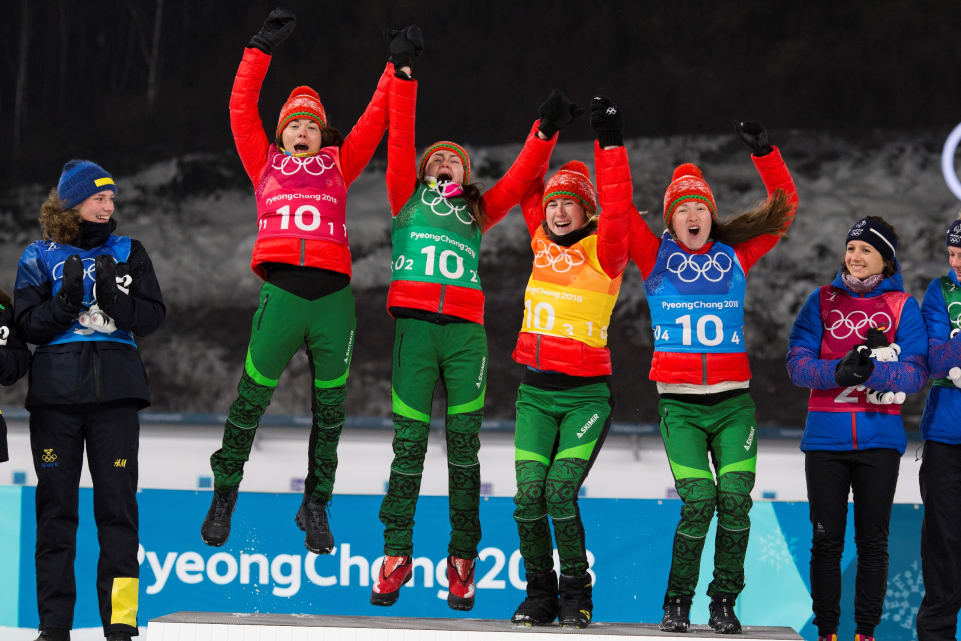
The Belarusian women’s biathlon team, with (from left to right) Nadezhda Skardino, Iryna Kryuko, Dzinara Alimbekava, and Darya Domracheva, celebrates winning a historic gold for their nation in the 4 x 6 relay at the 2018 Olympics in PyeongChang, South Korea. They were ranked 10th coming into the day. (Photo: IBU/Biathlonworld)
PYEONGCHANG, South Korea — Some things were the same on Thursday night: the attention-grabbing biathlon stadium announcer generating an atmosphere of stoke, thumping house music, and shivering yet engaged fans. Making it feel like true winter, a heavy snow squall settled in over the Alpensia Biathlon Center for the women’s 4 x 6-kilometer relay.
Ultimately, Belarus won gold in a time of 1:12:03.4 hours with Nadezhda Skardino, Iryna Kryuko, Dzinara Alimbekava, Darya Domracheva. Sweden’s Linn Persson, Mona Brorsson, Anna Magnusson, and Hanna Öberg took silver (+10.7), while France’s Anaïs Chevalier, Marie Dorin Habert, Justine Braisaz, and Anaïs Bescond claimed bronze (+17.6).
For the first few legs, however, all three medaling teams seemed an outside shot at the podium. On a windy and, for the first time at the Olympics, snowy evening, the win was up for grabs from the start.
After the first lap, a rainbow of suits came into the shooting range together, 7.8 seconds separating the leader from the field’s tail. America’s lead-off skier, Susan Dunklee, skied out of the range first after shooting clean in prone. The U.S. skier was followed by Ukraine, 2.9 seconds back. And Canada’s Sarah Beaudry had also cleaned without any spares to put her team in third, 7.1 seconds back.
Dunklee held her lead through the 2.9 k checkpoint and by 3.6 k, she was up to 8.1 seconds ahead of Japan chasing in second. Canada had fallen to 12th, 14.9 seconds back. With dumping snow and blustery wind before their second shooting round, it was Dunklee all entering the range all alone that was featured on the stadium’s jumbotron.
For her standing stage, Dunklee missed one target, but cleaned it with one spare. She left the range 5.2 second behind Italy’s Lisa Vittozzi, who had also cleaned with one spare. After the first leg’s final shooting stage, the field started to spread out. Beaudry used three spares to clean standing and avoided the penalty lap, returning to the course in 13th, 50.5 seconds out of first.
Susan Dunklee skiing the first leg of the mixed relay on Tuesday at the 2018 Olympics in PyeongChang, South Korea. She tagged the team in fifth and they went on to place 15th. On Thursday, she skied the U.S. women’s 4 x 6 k relay into second by the first exchange. (Photo: FlyingPointRoad)
“There’s some, as a friend of mine would call it, Disneyland snow, falling from the sky so it makes it exciting in the relay,” Beaudry told FasterSkier after her race. “Everyone shoots at the same time so I wouldn’t say anything is unfair. It makes opportunity. So hopefully my teammates can take advantage of that.”
Dunklee came through the 5.6 k checkpoint trailing Vittozzi by 7.2 seconds. At the first exchange, Italy tagged off first and Dunklee handed off to Clare Egan 7.6 seconds back in second.
“It has been a tough Games. We came in here with a lot of expectations and certainly haven’t really lived up to them,” Dunklee told FasterSkier after her leg. “It’s extremely frustrating. To think about every decision you make in your life over four years, with your best training in mind and your best performance in mind, and then getting sick at the wrong time is tough. The guys have struggled.
“We have had some bright spots with the girls; Emily and Joanne have carried us, they have had PR’s here. That is exciting,” Dunklee added, before looking up at the screen to see Egan skiing in third. “And this is exciting today. This is really exciting! Anything is possible.”
Beaudry tagged Canada’s Julia Ransom in 15th, 1:15 minutes out of first.
“I was really happy with my first lap and my prone,” Beaudry said after her first Olympic relay. “I tried to keep with the group on my second lap and I think that left me a little shaky in standing. I’m not too pleased with my two spares, but I mean, I missed three and I didn’t miss a spare, so at least shoot a spare, hit a spare.”
After the first loop of the second leg, Italy was still in first, with Dorothea Wierer at the helm. In prone, there was a reshuffling of leaders as Slovakia’s Anastasiya Kuzmina cleaned with one spare to move into first, 15.3 seconds ahead of Norway’s Tiril Eckhoff, who had cleaned with a single spare, in second. Egan cleaned without a miss and left the range in third (+17.3). Meanwhile, Wierer still had two targets standing after using all three spares, leaving her with two costly penalty laps and 1:11 minutes back in 13th.
Finland’s Kaisa Mäkäräinen shot clean to put her team in fourth, 23.9 seconds behind Kuzmina. France was sixth (+32.6), and Belarus ninth (+46.6). Canada’s Ransom shot clean without any spares and left the range in 12th (+1:08.3) while Sweden was 15th (+1:16.4).
While Kaisa Mäkäräinen moved into second behind Kuzmina on the next loop, Eckhoff and Egan followed them into the range in third and fourth, respectively. There, during an especially blustery standing stage, Kuzmina missed her first three shots and ended up with a penalty lap, which put her 20 seconds back in eighth. Wierer cleaned to reclaim first for Italy, just 0.9 seconds ahead of Mäkäräinen in second, who used two spares to avoid a penalty. Belarus’s Kryuko shot clean to leave the range in third (+7.9), and Egan hit five more shots without any spares to follow her in fourth (+10.7).
Ransom used three spares to avoid the penalty lap and headed back on the course in 10th (+44.2) for her final 2 k loop.
“Oh my gosh, I was really due for this,” Egan said after. “It’s by far my best race of the season so I couldn’t be more happy with my race.”
By the time the skiers came in for the second exchange, the order had changed again. Finland handed off in first, Italy second, 14.2 seconds back, Slovakia third (+16.1) and U.S. fourth (+16.8). Canada came through in 10th (+1:09.5).
“Kuzmina kept being behind me and then passing me,” Egan reflected. “I think every lap Kuzmina passed me so there is a lot of really fast skiers, most teams put their fastest skiers on their second legs. I tried to stay with them, but I can’t always do that. I did have people around me the whole time though so I was able to keep fighting.”
“All you can do is just leave it all on the track no matter what it is,” Ransom said of her race. “My standing was a little bit precarious, missing three from the clip. But I’m happy I was able to hit the precious spares. It was very gusty.”
Egan tagged off to Joanne Reid for the third of four legs. Reid slipped to sixth on her first loop and during her first prone shooting, she used three spares and had to ski a penalty lap, returning to the course in ninth, 33.6 seconds behind Italy’s Nicole Gontier, who cleaned with three spares, in first. Gontier skied just 0.4 seconds ahead of Slovakia’s Terezia Poliakova, who used one spare to clean.
Belarus had moved into third (+2.4), France into seventh (+19.2), while the Swedes sat in 11th (+1:33.6) and Canada, with Emma Lunder who had to ski a penalty, was still in 12th (+1:45.7).
As the leaders came in for their standing bout, it was Italy, France, Belarus, Norway, Finland, Slovakia, Poland, and U.S.A. Belarus’s Alimbekava took the lead after using one spare, Poland chased in second (+6.2), Slovakia was next, followed by Italy. The U.S. was back up to fifth (+28.1) after Reid used one spare to clean. France was sixth (+29.2) and Sweden eighth (+1:10). Lunder cleaned to put Canada in 11th (+1:24.7).
“I had a pretty good standing, but we need every second we can get,” Reid said after. “You never know what will happen in the next stage and the wind picking up. So even if we’re in fifth you never know. I was just trying to hang on on that uphill and give it everything I had.”
“I didn’t feel amazing, skiing, but I ripped off my standing with no spares, like, record fast, so I was really pumped about that,” Lunder reflected. “I moved up like a ton in the range there. So I think I tagged Rosanna in a decent position to be with some girls and fight a bit.”
Poland’s Krystyna Guzik caught Belarus’s Alimbekava and by the final exchange, it was Poland in first, France in second, Italy in third, and Belarus in fourth. Reid handed off to Emily Dreissigacker in sixth (+21.4) while Lunder tagged Rosanna Crawford in 13th (+1:22.6). Sweden exchanged in eighth (+59.1)
The skiers had maintained their order as they approached the range for the seventh round of shooting. Belarus’s anchor leg, Domracheva, shot clean to take the lead. France was now in second, Poland third, and the U.S. in seventh (+41.1), after Dreissigacker used two spares to clean. Sweden was back in ninth (+41.9), while Crawford cleaned with one spare and out for her second loop in 12th (+1:28.6).
Coming into the final shooting shooting round, Belarus teetered on a lock for gold, 24.8 seconds ahead of France in second. Poland still clung to third, 34.5 seconds back, while Sweden was now ranked seventh, 56.4 seconds back. The U.S. had moved back to tenth, while Canada was right behind them in 11th.
Domracheva missed three targets standing, but used three spares to clean and avoid any penalties to hang onto first. France’s Bescond needed three spares to clean but stayed out of the penalty lap and headed out on the final loop in second (+6.4). Sweden’s Öberg cleaned her second-straight stage without any misses to move all the way up into third (+10.9).
For the U.S., Dreissigacker used her three spares to clean standing, but experiencing unsteady winds, took her time to steady her shot and left the range in 12th (+1:20.2). Canada’s Crawford used one spare to clean and moved up to 11th (+1:19.9).
“It was really windy for my standing,” Crawford noted. “I really waited it out.”
“It wasn’t great,” Dreissigacker, a first-time Olympian, said of her race. “I didn’t feel that great skiing, might’ve went out a little hard, and the shooting just wasn’t good either. I was happy to at least hit them all with my spares, but standing especially, I took all three spares and the wind came up like crazy, right before I started shooting my spares, so I had to like stand there and wait out the wind, which cost me a lot of time.”
The Belarusian women’s biathlon team, with Nadezhda Skardino, Iryna Kryuko, Dzinara Alimbekava, and Darya Domracheva, snaps a podium selfie after winning their first relay gold on Thursday at the 2018 Olympics in PyeongChang, South Korea. (Photo: IBU/Biathlonworld)
Over the last 2 k of the race, Domracheva kept her competition behind her and crossed the line first for Belarus’s first relay gold in 1:12.03.4 (after its mixed relay team placed fifth two days ago).
Öberg passed Bescond to claim silver for Sweden, 10.7 seconds back, while Bescond anchored France to bronze (+17.6), ahead of Norway in fourth (+29.7), Slovakia in fifth (+38.4), Switzerland in sixth (+43.5), Poland in seventh (+43.6), Germany in eighth (+53.9), Italy in ninth (+1:04.1), and Canada in 10th (+1:33.4). The U.S. finished 13th (+2:01.9) of 18th teams.
With the first-place finish, Domracheva is the most decorated female biathlete in Olympic history, with six medals (four golds, a silver and a bronze) between three Olympics. Her husband, Ole Einar Bjørndalen of Norway, is the most successful Olympic biathlete of all time with 13 medals.
“I didn’t think that before you said it,” Domracheva, 31, said of her medal record during the post-race press conference. “Of course it was a lot of challenges for me on the way. Such days and such medals mean that it’s important to believe in yourself, important to believe in your team and overcome some difficulties, and then all doors are open for you.”
In the last four Winter Olympics, France has claimed three relay medals. Before Thursday’s bronze, their most recent was silver in 2010 and prior to that, bronze in 2006.
Sweden’s silver medal was its first in the women’s 4 x 6 k relay at the Olympics.
“This team worked together really hard for the last couple of years,” said Öberg, who won her first medal — gold — in the 15 k individual race earlier in the Games. “That we are here today is unbelievable. I’m really happy to share this medals with the rest of the girls.”
Crawford caught Ukraine’s Anastasiya Merkushyna in her final lap to anchor Canada to 10th while the U.S. finished three places later in 13th.
“My last loop I could hear Julia [Ransom] and Sarah [Beaudry] all around the course,” Crawford told FasterSkier. “They managed to be everywhere really cheering me on, and that fueled me to catch the Ukrainian.
“I’m just so proud of this women’s team,” Crawford added. “We fought so hard out there today. We’ve been through a lot this summer and really supported each other. And I’m just really proud of the team and I think biathlon in Canada has the potential to have a bright future.”
The Belarusian women’s biathlon team of Nadezhda Skardino, Irina Kryuko, Dzinara Alimbekava, and Darya Domracheva celebrates winning gold in the relay. They were ranked 10th coming into the day. (Photo: IBU/Biathlonworld.com)
Ranked just 10th coming into today’s women’s relay, the team from Belarus stole the show with Darya Domracheva skating across the line to claim the fourth Olympic gold of her career after strong efforts from Nadezhda Skardino and Iryna Kryuko, both of whom have stood on the World Cup podium before, and newcomer Dzinara Alimbekava, a 22-year-old newcomer with just 11 World Cup starts to her name. It was the first relay medal ever won by Belarus at the Olympics.
The setting was windy and snow-blown and the race was extremely tight, with seven teams with one penalty loop (or a few spare bullets) worth of time going into the final leg. The Belarusians’ nine spare rounds were the best shooting of the day; while that spare-round tally was matched by Slovakia, Kazakhstan, Bulgaria, and Japan, those teams had penalty loops as well.
Sweden actually wasn’t one of them, but with perfect shooting and a fast ski time 15 k gold medalist Hanna Öberg brought the team to silver after starting the anchor leg in eighth, a minute back. She benefitted from many missed shots by the leaders, and then passed France’s Anais Bescond on the final loop to claim second, 10.7 seconds back, for her teammates (Linn Persson,Mona Brorsson, and Anna Magnusson) while France (Bescond, Anais Chevalier, Marie Dorin Habert, and Justine Braisaz) took bronze (17.6). These medal-winning teams used 12 and 14 spare rounds, respectively, an unusually high tally.
Norway (Synnøve Solemdal, Tiril Eckhoff, Ingrid Tandrevold, and MarteOlsbu) finished fourth, +29.7, Slovakia fifth (+38.4), Switzerland sixth (+43.5) after winning a photo finish against Poland (+43.6), and Germany finished seventh (+53.9).
The Canadian team of Sarah Beaudry, Julia Ransom, Emma Lunder, and Rosanna Crawford finished 10th, +1:33.4. Their shooting of eleven spare rounds and one penalty loop was among the better scores of the day.
The United States had a strong start, with Susan Dunklee tagging off in second place, Clare Egan maintaining a good position in fourth, and Joanne Reid rebounding from one bad shooting stage to tag off in sixth. Anchor leg Emily Dreissigacker crossed the finish line in 13th, +2:01.9.
2018 Olympics (PyeongChang, South Korea): Nordic Combined Team Competition
After sweeping the medals in the large hill competition, perhaps it was not a surprise that Germany won the nordic combined team event. It was a blowout: ranked second after the jumping round but starting the cross-country ski relay just six seconds behind Austria, the Germans quickly took the lead and then just extended it. Their team of Vinzenz Geiger, Fabian Riessle, Eric Frenzel, and Johannes Rydzek won by 52.7 seconds over Norway’s Jan Schmid, Espen Andersen, Jarl Magnus Riiber, and Jørgen Gråbak. Austria hung on for third, +1:07.8, with Wilhelm Denifl, Lukas Klapfer, Bernhard Gruber, and Mario Seidl.
The United States team of Taylor Fletcher, Ben Berend, Ben Loomis, and Bryan Fletcher lost out on a photo finish with Poland and finished 10th out of 10 teams, +5:16.7.
Martin Fourcade waves the tricolore down the finishing straight as France claims gold in the biathlon mixed relay on Tuesday at the 2018 Olympics in PyeongChang, South Korea. (Photo: FlyingPointRoad)
PYEONGCHANG, South Korea — In its four-card-deep deck, the French biathlon team had an ace. Anchoring France’s 2 x 6 + 2 x 7.5-kilometer mixed relay was Martin Fourcade. The 29 year old had already taken two individual gold medals at these Winter Games. The final leg of Tuesday’s race presented the opportunity for another.
Coming through the last exchange, it was Germany’s Erik Lesser tagging off to Arnd Peiffer. Without Fourcade chasing them, Germany’s chances of a medal would have seemed certain.
Peiffer, who learned around 1 p.m. that afternoon that he would start the relay in place of Simon Schempp, who reportedly was feeling under the weather, was first into the range after one loop for his round of prone shooting. There, Peiffer missed two shots, but using two spares, hit the remaining two targets and stayed out of the penalty lap.
Then came Fourcade. The Frenchman shot clean. Skiing into the range with France was Norway’s Emil Hegle Svendsen and Italy’s Dominik Windisch. Svendsen and Windisch both used one spare each to clean and steer clear of the penalty lap as well.
Out on course, Peiffer had a 6.1-second buffer between himself and Fourcade. Windisch was the third racer to depart the range, 16.3 seconds out of first, and just 0.1 seconds behind him was Svendssen.
The 6.1 seconds separating the two frontrunners was soon down to zero. Fourcade attacked on the first uphill, passing the German and was the first into the range for the standing shooting — exactly the type of stage Fourcade craves.
Five days ago, Fourcade was in a similar situation. During the men’s 20 k individual race, he skied into the range for the final round of shooting with a comfortable lead. The almost-always clutch Frenchman missed the last two targets, losing the gold and finishing fifth on the day.
Martin Fourcade cleaning his final five targets of the day to secure gold for France in the mixed relay at the 2018 Olympics in PyeongChang, South Korea. (Photo: FlyingPointRoad)
During Tuesday’s mixed relay, Fourcade was on his A-game. Five pings heard throughout the stadium and five targets down. With his remaining 2.5 k to go, another medal for France and Fourcade was certain. Not long after, it became clear that medal would be gold.
Back in the range, Peiffer struggled, using three spares and having to ski a penalty loop. Meanwhile, Svendsen used one spare to clean and Windisch two. Svendsen slid into second place, 34.3 seconds behind an already long-gone Fourcade.
Windisch left about 15 seconds after the Svendsen. After emerging from the penalty lap, Peiffer skied up behind Windisch. In a moment of déjà vu, Fourcade carrying France’s fluttering flag crossed the finish line first in a time of 1:08:34.3 for the gold medal. Svendsen held his own with the third-fastest anchor lap to secure silver for Norway, 20.9 seconds behind Fourcade.
For Fourcade, it was his fifth gold medal in two Olympics and his first in a team event. France last won the mixed relay at the world-championships level at 2016 World Championships in Oslo, Norway.
Asked what it was like capturing his fifth Olympic gold, Fourcade responded at the press conference, “Tonight it’s not about numbers, it’s not about personal, it’s a team adventure that began in 2009 in the world champs in [PyeongChang] Korea, and tonight it’s a really big emotion for the team and all the crew because we are individual athletes and the emotion of an individual Olympic gold medal is amazing, but when you can share it with your teammates it’s something really much more incredible.”
“I think for the Norwegian team, we have a big priority on this relay,” Svendsen said at the press conference. “We really like it a lot, great to race both women and men together. You can see the best biathlon nations … so great event, it was very exciting.”
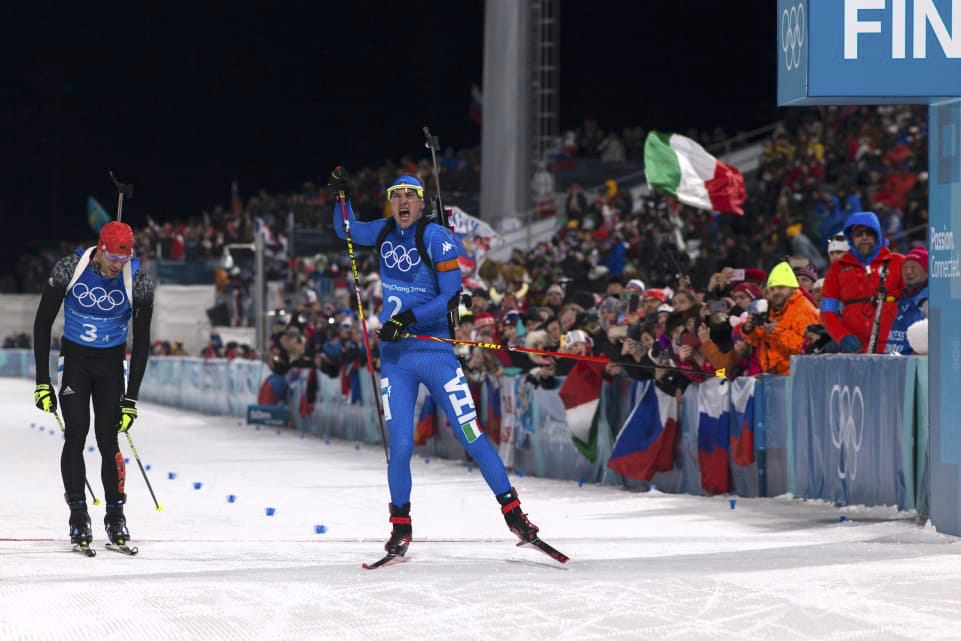
Italy’s Dominik Windisch (r) celebrates bronze for his team in the mixed relay, which he took by 0.3 seconds over Germany’s Arnd Peiffer (l) at the 2018 Olympics in PyeongChang, South Korea. (Photo: IBU/Biathlonworld)
The battle for third and fourth came down to a contentious last 100 meters.
As they rounded into the finishing straight, Peiffer was skiing in the left lane and Windisch in the right. In one final push to the line, Windisch crossed over into the Peiffer’s lane and took third place and bronze medal by 0.3 seconds ahead of him, 26.9 seconds after Fourcade.
Peiffer crossed in fourth place (+27.2) and Germany subsequently filed a protest that Windisch obstructed Peiffer. Ultimately, the protest was denied and the results stood.
Speaking to German broadcaster ARD after the race, Peiffer initially said Windisch’s move was within the rules. However, after viewing the replay, he changed his mind.
“I believe he [Windisch] would have beaten me if he’d just remained straight ahead in his corridor and not skied such a curve,” Peiffer later told ARD, according to a translation. “That’s what I also told him. I told him I congratulate him because I believe he was better today. I just did a poor job today, that’s how it even came to this situation…
Germany’s mixed relay anchor Arnd Peiffer during his last shooting stage on Tuesday, where he incurred a penalty and slipped out of gold-medal contention and ultimately finished fourth in the event at the 2018 Olympics in PyeongChang, South Korea. (Photo: FlyingPointRoad)
“I took another look at it now, and to me it’s a rule violation,” Peiffer added. “But from experience I know that the jury never makes any decision or generally denies appeals. Just because they don’t have the courage, I believe. I am sorry for the other three, because they did a great job. I don’t believe I would have deserved a medal today, but it’s always sad if rules get broken.”
During a post-race press conference, the issue of Italy’s move was raised again. One reporter directed a question at Windisch, asking about his thoughts on the filed complaint.
“It happened realy really fast because it come down from the downhill and I was convinced to do the right thing because I was in front of Peiffer,” Windisch said.“The jury had a long, long meeting to take this decision and they decided for us. I am really happy about this, so I think they had their reasons and I am happy for Italy.”
The same reporter posed the question to Fourcade, stating that the move seemed like one the Frenchman has done in the past.
“As Dominik Windisch told you it happened really fast in a situation we are not fully able to decide really quickly because we already have 7.5 kilometers in the legs,” Fourcade said. “When you are looking a the picture you can see it’s probably not the best decision Dominik took, but in the end it changes nothing because Dominik is stronger than Arnd in the sprint and he didn’t change anything with the final results. I think and I’m sure if it happened again he would choose another line.”
Italy’s Strong Start
Italy’s Lisa Vittozzi (2), alongside Germany’s Vanessa Heinz, leads the first leg of the 2 x 6 + 2 x 7.5 k mixed relay on Tuesday at the 2018 Olympics in PyeongChang, South Korea. She went on to hand off in first, and Italy ultimately earned bronze in the event. (Photo: FlyingPointRoad)
In the first leg of the race, Italy’s Lisa Vittozzi and Germany’s Vanessa Heinz tagged off in first and second, respectively, with Germany 2.2 seconds back at the exchange after both skiers shot clean without any spares. Vittozzi hanged off to Dorothea Wierer, while Heinz tagged Germany’s strongest leg Laura Dahlmeier, who took gold in the sprint and pursuit to start the Games and placed third in the 15 k individual.
Dahlmeier shot clean in the first prone and used one spare to clean standing, tagging Lesser in first, 29.9 seconds ahead of Italy, at the second exchange.
Norway’s Johannes Thingnes Bø racing the third leg of the mixed relay at the 2018 Olympics in PyeongChang, South Korea. After being tagged in 10th, he skied up to fourth at the last exchange, and Norway ultimately finished second. (Photo: FlyingPointRoad)
Norway’s ascent to second place involved a strong third leg from Johannes Thingnes Bø. Using just a single spare to clean his two stages (0+0, 0+1), Bø overcame two less-than-stellar legs from teammates Marte Olsbu (0+2, 0+1) and Tiril Eckhoff, who had a penalty (0+2, 1+3). When Eckhoff tagged Bø, he was in 10th, 1:24.4 minutes behind Germany in first. With the fastest third-leg course time, Bø handed off to Svendsen in fourth place, 33.1 seconds behind the Germans and half a second behind Italy.
Canada 12th, U.S. 15th
Canada finished the relay in 12th (+2:36.7) after skiing three places up from their bib number.
Rosanna Crawford skiing the first leg of Canada’s mixed relay at the 2018 Olympics in PyeongChang, South Korea. She tagged off in 11th and Canada went on to finish 12th. (Photo:FlyingPointRoad)
Rosanna Crawford skied the opening leg, using two spares, one each in prone and standing, to avoid the penalty lap.
“I tried to be super focused in prone,” she told FasterSkier after. “I went on to have one miss, that was just a bad trigger pull on my part. Skiing wasn’t great, but I just tried my best to stick with the women around me and give Julia the best chance I could.”
Crawford tagged teammate Julia Ransom in 11th, 34.7 seconds out of first. Ransom shot without a miss in prone and used two spares to clean standing. She maintained 11th while tagging Brendan Green 1:44.7 minutes behind the leaders.
After what Ransom considered a less-than-ideal personal start to the Olympics, she was pleased with how she felt racing on Tuesday.
“Today I felt like I could actually push a little harder and have fun racing,” she said.
Canada’s Brendan Green racing the third leg of the mixed relay at the 2018 Olympics in PyeongChang, South Korea. (Photo: FlyingPointRoad)
Green used three spares in total (0+1, 0+2) but remained clear of the penalty lap. He came through the last exchange in 14th, 2:27.9 out of first.
“I thought the wind would make it a little bit challenging today,” Green said after finishing his leg, with Canada’s fourth-leg skier, Christian Gow, still on course. “It was up a bit from the other days, [but] thankfully it was fairly consistent. This won’t be the result we are hoping for but it’s a good primer for the men’s and women’s relays later this week and so looking forward to that.”
In his first mixed relay and first time anchoring a championship relay, Christian Gow headed out on the final leg to pick off some places.
Canada’s Christian Gow racing to 26th in the men’s 20 k individual for his best non-relay result at his first Olympics in PyeongChang, South Korea. (Photo: FlyingPointRoad)
“I knew there would be a bit more pressure depending on the position that we were in when I got tagged because all the teams were putting their strongest guys last,” Gow said after. “It’s some pretty big names when you’re looking at the list. You’re like, ‘OK, there are some of my idols,’ so there’s a bit more pressure there, but I have been feeling pretty good.”
The 24-year-old Gow shot clean and then used two spares in standing, racing the ninth-fastest last leg to put Canada in 12th at the finish (+2:36.7).
“I think Nathan [Smith] one time told me you can’t idolize your competition, which is very true,” Gow said of his teammate and fellow Olympian. “I think I get a little better at that every year, believing in myself a little more and not looking at the big names I’m racing as untouchable or anything like that. I am especially happy with how I have been doing that this year. You try to handle it just like any other race and it doesn’t matter who the guy is next to you, it’s what you do in the race to beat them.”
Julia Ransom racing the second leg for Canada in the mixed relay at the 2018 Olympics. She kept the team in 11th and they went on to place 12th. (Photo: FlyingPointRoad)
Four years ago at the Olympics in Sochi, Russia, the Canadian mixed relay finished 11th. As the race was still going on Tuesday, Crawford said a top eight would be a good result and top six would be “the dream result.”
Despite their goals, Ransom, a first-time Olympian, said they hadn’t felt any added pressure coming into the mixed relay.
“… Everybody on the team knows that we’re all trying our best and are gonna bring our best to the day,” Ransom, 25, said of the team’s effort on any given relay day. “It’s an unsaid sort of encouragement, I guess.”
For the U.S., Susan Dunklee skied a strong first leg, putting the team in fifth at the first exchange, 23.8 seconds out of first. She used two spares to clean prone and hit every target in standing (0+2, 0+0).
Susan Dunklee (center, in all blue) leading out for the U.S team in the first leg of mixed relay at the 2018 Olympics in PyeongChang, South Korea. She handed off in fifth and the team ultimately finished 15th. (Photo: FlyingPointRoad)
“I definitely felt better today than I did in the individual,” Dunklee said, referring to the 15 k race where she placed 19th. “I was closing on the lead group for the first kilometer or so and then by the top of the big hill, I kind of ran out of steam a little bit and was just trying to get into the finish.”
After being tagged in fifth, right behind the Czech Republic* in fourth, Joanne Reid hung in contention in sixth after cleaning prone without any spares. But in standing, she missed all five targets and used all three spares, ultimately having to ski three penalty laps. She went on to tag Tim Burke in 18th, 3:10 minutes back.
“It went poorly,” Ransom said after. “… The best I could do was just try and stick on and hand over with something they could work with, and that didn’t really work out for me today.”
“I guess the strategy was once I got tagged try to make some time, try to get in contact with at least one other team so that Lowell could have someone to chase,” Burke said.
Tim Burke racing the third leg of the U.S. mixed relay at the 2018 Olympics in PyeongChang, South Korea. After being tagged in 18th, he moved the team into 16th and they ultimately finished 15th. (Photo: FlyignPointRoad)
Burke in fact caught two other teams, shooting without a miss in prone and using three spares to clean standing (0+0, 0+3), and tagging teammate Lowell Bailey in 16th (+3:24.4).
The U.S. anchor leg, Bailey used one spare in prone and none in standing (0+1, 0+0). He skied the seventh-fastest anchor leg and finished the race in 15th (+3:31.1) out of 20 teams.
“We actually had decent performances, it was really just one bad stage,” Bailey said. “Joanne had a good race otherwise and Susan had a great start, Tim had a solid race, I feel good about my race, so unfortunately, it’s eight stages not seven, but I think everyone gave everything they had and that’s the way biathlon goes. Some days go your way and some days don’t.”
Olympic biathlon racing continues Thursday with the women’s 4 x 6 k relay.
*Note: After her race, Dunklee told reporters about her collision with the Czech Republic’s Veronika Vítková as the two first-leg skiers came through the exchange with several others. The crash broke Vítková’s rifle right after she tagged off in fourth, just ahead of Dunklee.
“I feel really bad,” Dunklee said. “I tangled with [Vítková] in the tag-off zone and she tripped and broke her rifle and that just puts a real damper on everything. So that’s sad. … It doesn’t affect her race today, but it certainly affects her races going forward. Stocks are highly customized pieces of equipment and you can spend months tinkering with them to get them to fit you just right, so it’s not easy to fix them when they break.”
The Czech team went on to finish eighth (+1:39.3).
Germany en route to a clean sweep of the podium in the men’s nordic-combined individual large hill/10 k on Tuesday at the 2018 Olympics in PyeongChang, South Korea, with Johannes Rydzek (5) leading Fabian Rießle (6) and Eric Frenzel (4). They went on to place first, second and third, respectively. (Photo: FlyingPointRoad)
A few shooting errors by pursuit bronze medalist Anais Bescond were not enough to derail France, as the team of Marie Dorin Habert, Bescond, Simon Desthieux, and Martin Fourcade took gold in the mixed relay. Skiing the first leg, Dorin Habert shot clean and tagged off just seven seconds behind the leading team from Italy. Bescond then used four spare rounds over the course of her relay leg, dropping the team to fourth (+48.9) at the halfway point. But both Desthieux and Fourcade shot 10/10, capitalized on the errors of others, and ended up with a clear 20.9 second margin for gold at the finish.
Susan Dunklee put the U.S. in fifth after the first leg of the mixed relay. (Photo: FlyingPointRoad)
Norway came back from a rough start to earn silver despite a whopping eleven spare rounds and a penalty loop. Marte Olsbu had three spare rounds to tag off in ninth, 32.8 seconds back, and then Tiril Eckhoff used two spare rounds in prone and then took a penalty loop in standing. But Johannes Thingnes Bø used just one spare round and skied the team from tenth to fourth, in contact with the medal pack, on his relay leg, and then Emil Hegle Svendsen used one spare round in each shooting stage to climb into a clear second; he skied alone on the final loop before crossing the line for silver.
There was controversy about bronze, however. Germany had led much of the race thanks to a solid leg by Vanessa Hinz to start and then a brilliant leg by Laura Dahlmeier; Erik Lesser also excelled, and at the third exchange the team had used just two spare rounds and had a 32.6-second lead on the field. But sprint gold medalist Arnd Peiffer couldn’t keep it together and first used a spare round in prone, then took a painful penalty loop in standing.
He exited the loop just as Italy’s Dominik Windisch went past. Lisa Vitozzi had put Italy in the lead after one leg thanks to perfect shooting, and despite three spare rounds Dorothea Wierer had tagged off in second at the halfway point. Lukas Hofer had maintained that position and Windisch was really only in fourth because of three of his own spare rounds.
Windisch and Peiffer battled all the way around the final 2.5 k, with Windisch leading the final downhill; the pair were nearly even coming into the stadium, but Windisch sprinted for the finishing lanes and in doing so angled from one far side of the trail to the farthest finishing lane, just barely getting there ahead of Peiffer and debatably choosing a lane before the lane markings began. Peiffer, who had skied a straight course all the way from the downhill into the finish, was forced to then switch lanes and couldn’t regain the momentum to keep up with the Italian, who crossed the line in third place.
The Germans protested, but the race jury ultimately decided to keep the Italians in third place, awarding them bronze, and the Germans finished fourth.
“The jury has decide to keep the bronze medal for Italy; Peiffer did not have to alter his speed, therefore no reason to disqualify Windisch,” the IBU stated in a tweet. (The response to that tweet has nearly unanimously condemned it as the wrong decision.)
The IBU 2016 Competition Rules give only a vague definition of obstruction, stating, “It is strictly forbidden to impede other competitors in any way at any time during the competition.”
The Canadian team of Rosanna Crawford, Julia Ransom, Brendan Green, and Christian Gow finished 12th, +2:36.7, with nine spare rounds.
The U.S. team of Susan Dunklee, Joanne Reid, Tim Burke, and Lowell Bailey finished 15th, +3:31.1, with three penalty loops and nine spare rounds.
Germany pulled off a podium sweep in the second nordic combined combined competition of the Olympics, with Johannes Rydzek, Fabian Riessle, and Eric Frenzel earning gold, silver (+0.4 seconds), and bronze (+0.8 seconds), respectively. They had been ranked fifth, sixth, and fourth after the jumping round on the big hill, but edged Norway’s Jarl Magnus Riiber off the podium. Riiber had the second-best jump of the day and ended up just 2.8 seconds out of a gold medal. Japan’s Akito Watabe topped the jumping scores and finished fifth, +12.5 seconds.
For the U.S., Bryan Fletcher led the way again and just like in the normal hill competition, finished 17th. This time he was ranked 23rd after the jump and made up six places to cross the line +1:42.9. Ben Berend, Ben Loomis, and Jasper Good finished 39th (+4:28.2), 40th (+4:38.8), and 43rd (+5:50.2).
It wasn’t the wire-to-wire triumph that Norway sometimes achieves, but the pre-race favorites got the job done despite a scare midway through, thanks to dominant skiing by Ragnhild Haga and smooth strength from anchor Marit Bjørgen.
Norway took gold in the 4 x 5 k relay by two seconds over Sweden in 51:24.3 minutes. Olympic Athletes from Russia took bronze (+43.3), Finland fourth (+1:02.6), and the United States fifth (+1:20.5).
The first leg went out with Natalia Nepryaeva of Russia setting a blistering pace, fracturing the field almost immediately. A number of racers tried to stay with her only to get shot off the back of the pack. Taking a different pacing strategy, Slovenia’s Anamarija Lampic made up ground in the final section of the first leg to tag off in second, with Norways’ Ingvild Flugstad Østeberg third, all within a few seconds of each other.
Part of Nepryaeva’s fracturing of the field led to U.S. lead skier Sophie Caldwell getting dropped, to tag off 1:01.5 minutes back in 11th place.
In the second leg, Charlotte Kalla of Sweden and Kerttu Niskanen of Finland clocked the fastest times, making up 24.4 and 9.9 seconds that had been lost to Russia and Norway by their teammates Anna Haag and Aino Kaisa Saarinen, respectively. In the meantime, Astrid Uhrenholdt Jacobsen of Norway had a disastrous relay leg and notched just the eighth-fastest split time, falling to fourth.
Yulia Belorukova of Russia continued to lead the race on that second leg, but Kalla tagged off at the end of the classic portion just 1.4 seconds back, and Niskanen in third (+10.1). Sadie Bjornsen made up three places to tag off in eighth (+1:05.2).
Jacobsen tagged Haga 29.8 seconds out of first. From that point, Haga gradually reeled in the leaders over the course of the 5 k skate leg. It was an absolutely dominant performance, with the fastest split time by 24.7 seconds in a less than 12-minute race.
Sweden’s Ebba Andersson led Russia’s Anastasia Sedova for the whole leg and stayed clear of the field, but Haga — the gold medalist in the 10 k skate — made up enough ground to finish her effort in third, 3.4 seconds back.
That was more than enough for Bjørgen to work with, and she and Swedish anchor Stina Nilsson quickly dropped Anna Nechaevskaya of Russia and set off on their personal duel for gold. Bjørgen led the whole way, but could not make any decisive move to drop the Swede. Instead, over the top of the climb she had about a second, which Nilsson could not close on the downhill or the final flats into the finishing straight: gradually, Bjørgen just added a meter and another to her lead and crossed the line with gold.
Nechaevskaya continued to lose time on the leaders, but still held on to bronze. Krista Pärmäkoski skied an aggressive effort for Finland to pass the team from Switzerland, which had been in fourth after strong legs from Laurien van der Graaff, Nadine Fähndrich, and Nathalie von Siebenthal. But 21-year-old Lydia Hiernickel was unable to keep the pace and Switzerland dropped to seventh by the finish, getting passed by not only Parmakoski and Jessie Diggins, but also Sandra Ringwald of Germany. The Germans finished sixth (+1:49.4) and Switzerland seventh (+1:51.5).
Kikkan Randall had skied the third-fastest split of the field (behind Haga and Andersson) in the third leg to bring the U.S. into sixth, and Diggins also skied the third-fastest split (behind Bjørgen and Nilsson) for her leg to bring the team up to fifth at the finish.
The Canadian team of Dahria Beatty, Emily Nishikawa, Cendrine Browne, and Anne-Marie Comeau placed 13th (+4:50.3) of 14 teams.
The women’s biathlon 12.5 k mass start medalists at the 2018 Olympics in PyeongChang, South Korea, with Slovakia’s Anastasiya Kuzmina (c) in first, Belarus’s Darya Domracheva (l) in second, and Norway’s Tiril Eckhoff (r) in third. (Photo: IBU/Biathlonworld)
Not even a miss in the final stage could keep Slovakia’s Anastasiya Kuzmina from her third medal of the 2018 Olympics, this time gold, in the women’s 12.5-kilometer mass start on Saturday at the Alpensia Biathlon Center.
Kuzmina took charge early in the five-loop race, leading Germany’s Laura Dahlmeier into the range for the first prone shooting stage. There, Kuzmina cleaned all five targets quickly to get back out on course in first, while Dahlmeier missed one to slip out of the top 20, while several other athletes cleaned.
Kuzmina went on to hit every target over the next two shooting stages to distance herself from second place, and even with a miss on the last standing stage, she left the range 24.7 seconds clear of Darya Domracheva of Belarus in second.
Domracheva had put herself in second with clean shooting in the first two stages, then dropped to fifth with a miss on the third stage. Italy’s Dorothea Wierer was up to second by the fourth shooting after three clean stages, then fell back to seventh with a miss on the last standing.
There, Domracheva cleaned to get back into silver-medal contention, 9.3 seconds ahead of Norway’s Tiril Eckhoff in third.
Heading into the final downhill into the stadium, Kuzmina had enough time to grab a flag from one of her team’s staff members running alongside the trail. She crossed the finish line first in 35:23.0 minutes without anyone close for her third-career Olympic gold (after winning the sprint at the 2010 and 2014 Games).
Domracheva skied on her own to second, 18.8 seconds behind, for her first medal of the 2018 Games (and fifth of her career after winning three races at the 2014 Olympics).
Eckhoff, who had skied two penalty laps, took third, 27.7 seconds behind Kuzmina, while Italy’s Lisa Vittozzi held off Sweden’s Hanna Öberg, Wierer and Belarus’s Nadezhda Skardino for fourth place (+45.6). Öberg placed fifth (+46.5), Wierer was sixth (+47.3), and Skardino seventh (+47.9), ahead of Norway’s Marte Olsbu in eighth (+51.6), France’s Marie Dorin Habert in ninth (+57.9) and Finland’s Kaisa Mäkäräinen in 10th (+1:00.9). Dahlmeier, who had won two races and placed third in another at these Olympics, finished 16th (+1:47.1) with two penalties (1+1+0+0).
Germany’s Laura Dahlmeier racing to her first Olympic gold (and first Olympic medal) on Saturday in the women’s 7.5 k sprint, the first biathlon race of the 2018 Winter Olympics in PyeongChang, South Korea. (Photo: FlyingPointRoad)
(Note: This article has been updated to include comments from Canada’s Julia Ransom.)
“Perfectionist” is a term the coaches of Germany’s Laura Dahlmeier often use to describe her.
On Saturday, this quality helped Dahlmeier to brave difficult wind conditions on her way to winning the gold medal in the women’s 7.5-kilometer sprint that opened the biathlon competitions at the 2018 Winter Olympics in PyeongChang, South Korea, ahead of Norway’s Marte Olsbu in second and the Czech Republic’s Veronika Vítková in third place.
“A childhood dream is coming true,” Dahlmeier told German broadcaster ZDF after the race, according to a translation. “I have always imagined this, that some day I would stand at the very top at the Olympics, that I could win a gold medal. And somehow exactly that happened to work out today. I am incredibly grateful and proud. It’s an amazing feeling, and I don’t think I have fully realized it yet.”
On the shooting range, Dahlmeier twice adjusted her rifle’s sights in the prone stage to successfully cope with changing winds. Coming into the standing stage, she hit three targets in rhythm, then waited for what seemed like excruciating seconds for a gust to pass, before triggering her fourth and fifth shots. Both targets flipped over to white.
She had taken so long that she only recorded the 76th-ranked shooting time in this stage in the field of 87 athletes, 22 seconds off the pace and almost as long as the time it takes to ski a penalty lap. But that she had hit all shots mattered the most. Only two other athletes managed to clean all 10 targets on Saturday.
Dahlmeier followed that up by skiing the fastest course time on the final loop, and fourth-best overall. She crossed the finish line in a time of 21:06.2 minutes, lunging to not squander even a tenth of a second more, before pounding her chest and raising her arms in jubilation, knowing the time she had set would be hard to beat. Indeed her mark could not be improved again by any athlete starting later.
“I believe if you want to win a race like this one, that doesn’t happen by chance,” Dahlmeier told ZDF. “A lot goes into that. It’s true, I really had to work for it in the race today. But also the team around me, what they had to work during the last days, weeks, months, years, that is embodied by today’s result. It’s just beautiful that I was allowed to fulfill that dream today.”
Olsbu claimed the silver medal, 24.2 seconds back with one penalty in her prone shooting stage and just 1.6 seconds ahead of Vítková on the bronze podium spot, who had missed one target in the standing stage.
France’s Marie Dorin Habert placed fourth (+33.1) with one penalty in prone, while Dahlmeier’s teammate Vanessa Hinz was fifth (+40.3), losing out on a potential medal when she missed the last shot of her competition. Several other favorites struggled with the wind conditions and incurred a number of penalties.
For the two runner-ups, winning a medal at the Olympics was also a dream come true.
“Of course I am happy, it was my best race ever,” first-time Olympian Olsbu, 27, said when asked in the press conference if she was satisfied with the silver medal. “It was difficult on the shooting range today because it was so windy, but I just stuck to my plan. And I was so happy when I crossed the finish line. … That was a dream from when I started in biathlon. Of course [compatriot] Ole Einar Bjørndalen was my hero when I was a child, and I was hoping that one day I will do the same. I don’t know what to say, it is just amazing and today I am sitting here with an Olympic medal.”
“Yeah, it was my dream too, like for Marte, and I am happy that my dream is here,” Vítková, 29, said of her first individual Olympic medal in her third Winter Games.
Starting early in bib 12, Vítková initially appeared dissatisfied when she crossed the finish line and saw that she had not managed to beat Olsbu’s time, after the Norwegian had finished the race just one bib ahead. The Czech feared more athletes would finish ahead of her and still push her several positions down, but aside from Dahlmeier starting in bib 23, no one managed to do that.
So at the “flower ceremony” in the arena, where the podium finishers each received a stuffed animal as their prize (a snow-white tiger called Soohorang that is the official mascot of the 2018 Winter Olympics), Vítková was beaming just like her two peers. The Olympic medals will be awarded in an separate ceremony later.
“I am very happy, because this medal is my first ‘big’ medal in an individual race,” Vítková explained at the press conference. “I had a [silver] medal from the Olympic Games in Sochi, but it was a mixed relay medal. And now I have MY medal!”
Last season, Dahlmeier set a record by winning five events at a single International Biathlon Union (IBU) World Championships, taking gold in every race but the sprint (where she placed second) in Hochfilzen, Austria. But winning the gold medal in PyeongChang was indeed the fulfillment of a lifelong dream. As an elementary school student, Dahlmeier reportedly had written two career goals into a class book: Olympic champion in biathlon and becoming the manager of an Alpine Club hut, since mountaineering continues to be her other big passion. One down, one to go.
“Today was a victory Laura had to work very hard for, that wasn’t automatic,” German women’s national team coach Gerald Hönig told ZDF, according to a translation. “My highest respect for how she withstood the conditions today. How she repeatedly had to make the right decisions by herself on the course and on the range in order to be successful. She did that great, and she is outshining a great overall team result.”
In 2014 at her first Olympics in Sochi, Russia, the biathlon competitions for Dahlmeier, who was 20 at the time, and the rest of the German women’s team had started off as disappointing with no individual medals, and then descended into turmoil when on the eve of the women’s relay, the doping case of Evi Sachenbacher-Stehle due to a tainted food supplement came to light (her suspension later was reduced to six months) and the team again failed to reach the podium.
“For our team this medal is particularly important,” Hönig said. “We still have the defeats of Sochi somewhere in the back of our minds. Well, I particularly do, so for me this is a gigantic moment. I believe having a medal in the very first race here makes the tasks that lie ahead much easier … It’s the prerogative of young athletes like Laura to chalk that off faster, but I have repeatedly thought about these days in Sochi … Laura showed coolness today, but also executed everything she had worked for in training.”
Dahlmeier, now 24, became the second German athlete to win a gold medal at the Winter Olympics in the women’s sprint, after Kati Wilhelm claimed the title at the 2002 Games in Salt Lake City, Utah.
Mixed Day for North American Starters
Canada’s Julia Ransom was the best North American in the sprint, finishing in 40th place (+2:08.8) after she shot fast and accurately, incurring just one penalty in her standing stage.
Julia Ransom (Biathlon Canada) racing to 40th in the women’s 7.5 k sprint at her Olympic debut in PyeongChang, South Korea. (Photo: FlyingPointRoad)
On the course she skied the 68th-ranked time of the day, consistently losing about 45 seconds on each loop to the blazing pace set by Slovakia’s defending Olympic sprint champion and current World Cup Sprint standings leader Anastasiya Kuzmina, who ended up 13th place with three penalties (2+1).
For Ransom it was her first start in an Olympic race, building on three appearances at Biathlon World Championships.
“It was amazing to start the race today,” Ransom wrote in an email to FasterSkier. “Some of my family were in the stands and the others had woken up early in Canada to catch it. Definitely feeling the love!”
She described the conditions as “windy with some extremely strong gusts,” Ransom wrote. “I noticed it more out on course than in the range. I was quite happy with my shooting today, but unfortunately my legs were just cooked (for whatever reason)! However, I think this was a good leg blowout, and after some rest, I’ll be ready for the pursuit!”
All four Canadian women that contested Saturday’s sprint finished in the top 60 to qualify for Monday’s pursuit, with Rosanna Crawford next in line in 53rd (+2:23.0) after shooting three penalties (1+2).
Canada’s Rosanna Crawford (22) racing to 53rd in the women’s 7.5 k sprint on Saturday at the 2018 Olympics in PyeongChang, South Korea. (Photo: FlyingPointRoad)
“It was really tough,” Crawford told FasterSkier in the mixed zone after the race when asked about the conditions. “The wind made it hard for shooting and on the course, all of a sudden these gusts would come and blow your poles right out from underneath you. In prone, I made a correction and missed my first shot which shouldn’t have happened, and in standing I overheld [the rifle] for my second miss so I’m pretty disappointed.”
Starting fairly early in bib 22, the race was still going on at the time of her interview, so Crawford feared she might miss the cutoff for the pursuit. At least that did not happen.
“The sprint sets you up for the rest of the week, for two weeks, so I’m pretty bummed,” she continued. “I’m still looking forward to the relays, so that’s definitely positive. It’s just so unfortunate that the sprint dictates the other individual races, other than the 15-kilometer [individual race]. Hopefully I’ll qualify for the pursuit and can go out there and fight again. I love the 2 k course here, so I’m really looking forward to it.”
In her third Olympics, Crawford skied the 44th-ranked course time of the day.
Canada’s Emma Lunder racing to 54th in her Olympic debut on Saturday in the women’s 7.5 k sprint in PyeongChang, South Korea. (Photo: FlyingPointRoad)
Just behind her, Emma Lunder in her Olympic debut placed 54th (+2:24.2) with two misses in the standing stage (0+2). Her course time ranked 65th.
Megan Tandy, in her third Olympics, finished 57th (+2:36.6) with a penalty in each stage (1+1). She skied the 69th-ranked course time.
“Although I am somewhat disappointed with today’s result (57th with 2 misses and heavy legs) I am thinking positive,” Tandy wrote on Instagram on Saturday. “8 years ago I was the only woman to qualify for the pursuit, this Olympics all 4 of us will be putting up a fight.”
(Note: FS missed interviewing Ransom, Lunder and Tandy in the mixed zone, and with the race in the evening local time they could not be reached for comments at press time.)
In her first Olympic race and on her first year with the senior women’s team, Team USA’s Emily Dreissigacker was the top American 51st place (+2:21.0) after shooting 9-for-10.
American Emily Dreissigacker racing to 51st in the women’s 7..5 k sprint on Saturday at the 2018 Olympics in PyeongChang, South Korea. It was her career-best result at the World Cup level. (Photo: FlyingPointRoad)
“I did I shot zero plus one [0+1], so I’m pretty happy with that,” Dreissigacker told FasterSkier after the race. “The wind was a little tricky out there. I was just trying to stay calm and think about what I could control…. Happy to make the pursuit!
“It was kind of gusty and changing a lot,” she commented on the conditions. “Like on prone, I got a little lucky, the wind was pretty much what I had zeroed in [target practice], which was still pretty windy, but at least was consistent. Then in standing, I mean, it definitely wasn’t terrible, but I could feel the wind pushing my barrel around a little bit.”
Dreissigacker’s course time ranked 74th overall and she slipped 10 places on the final loop.
“I definitely died a little bit on the last lap,” she said. “I think the hills are hard. … You’re not really recovering [anywhere] before you climb back up to come back down into the stadium.”
Previously Dreissigacker’s best result on the IBU World Cup in a sprint had been a 59th place at last month’s race in Antholz, Italy, followed by a 56th place in the pursuit.
For the rest of the US Biathlon women, things did not work out as well as they had hoped on Saturday.
Clare Egan (US Biathlon) racing to 61st in the women’s 7.5 k sprint at the 2018 Olympics in PyeongChang, South Korea. (Photo: FlyingPointRoad)
Also starting in her first Olympic race, Clare Egan just missed the cutoff for the pursuit race in 61st place (+2:45.4) with three penalties (1+2), only two seconds behind Emilia Yordanova of Bulgaria.
“Honestly as I was warming today it felt like I was warming up today for any other race, which I think is a good thing,” Egan told FasterSkier after. “I knew I was ready to go today and I was excited to do what I’ve been training to do and become an Olympian.”
But then her race began with a mishap on the course.
“I fell on the first loop at the bottom of the big hill, which is kind of a nightmare. I haven’t fallen in a couple years probably, but I don’t know, it just happened,” Egan said. “Weird things happen in big races I guess, but besides that I am really pleased with my skiing considering I was really sick in our pre-Olympic training camp.”
Skiing only the 71st course time on the first loop due to the fall, her pace improved from there, capped by the 30th-ranked time on the final loop (57th overall).
“I’m really happy with the prone,” she said of her shooting performance. “It was really tricky shooting today, windy, missed one but I am very satisfied with that. Standing I started out really solid, had three good hits and felt good about what I was doing and then I misfired actually. My bullet didn’t eject and I wish I had refocused better after that. I had to kind of pick the bullet out and I didn’t reset adequately. So then I missed my last two shots and I am not happy about that, but it was sort of a mediocre race overall.”
Team veteran Susan Dunklee incurred an uncharacteristic five penalties (1+4) to finish in 66th position (+3:06.9).
Starting early in the race in bib 6, she could be seen on the broadcast making a wind adaptation in the prone stage after missing her fourth shot, then went on to hit the last one having to ski once around the 150-meter penalty lap.
She came back on the course with what would later be the 28th-ranked split time, but in the standing stage, things then turned south and with four additional penalty laps, she could not make up the deficit.
“I’ve had better days,” the 2017 World Championships silver medalist told FasterSkier after the race. “I missed five shots. You can’t be anywhere close to where you need to be with 50-percent shooting. It’s very frustrating. You work for four years and you have big dreams, you see what’s possible, and it all comes down to one of these races like this and the sprint is so important for the rest of the races here. You really have to have a good sprint to qualify for the pursuit, to qualify for the mass start, so I’m really bummed about that, that’s for sure.”
Unlike her teammates, Dunklee skipped Friday’s Opening Ceremony of the Winter Olympics while “fighting off a small cold,” according to a US Biathlon Instagram post.
She skied the 42nd course time of the day and didn’t want to blame her misses all on the weather conditions.
“The conditions are actually really nice,” she said. “It’s a little bit cold but not so cold as it was when we first got here. You can feel your fingers, which is really nice. Seems like it’s fair. You’ve got really hard-packed good tracks.
“I think I’m going to have to figure out how to allow myself to be disappointed for another hour or so, get it out of the system a little bit and then put it behind me and move on,” Dunklee concluded.
Joanne Reid (US Biathlon) racing to 86th in the women’s 7.5 k sprint at the 2018 Olympics in PyeongChang, South Korea. (Photo: FlyingPointRoad)
Also in her first Olympic race, the fourth U.S. starter Joanne Reid finished 86th (+5:12.6) with seven penalties (4+3), though she explained it wasn’t due to any race jitters already having competed in front of far bigger crowds on the World Cup before.
“I try and approach every race the same,” Reid told FasterSkier. “Same warm up. Same mentality. Just go out there and hope you hit your targets which didn’t really work out for me today.”
She skied the 67th-ranked race time of the day overall.
“It’s much worse on the cross-country side,” she said of the biathlon course and range conditions. “Everything is real open [to wind] over there. We have only the stadium area and the range [that] gets all the wind, but on the backside it’s pretty good, it’s sheltered. It’s actually really fun, it’s really ripping, it’s up and down with some swoopy corners.”
Reid explained that for her standing shooting she had planned to use the wind cover from a hill on the far left side of the range, as many athletes like Dahlmeier had also done, but that was not possible when she came in to her shooting stage as all those lane positions were occupied.
“Definitely in standing the farther lanes have less wind and when I came there was no farther lane,” Reid said. “It was 30, 29, 28, 27, 26 were all full and then big gusts coming in and that was pretty brutal. Then the longer you stand the more your muscles shake, so you know, that’s life.”
Career Best for Johanna Talihärm
Unlike for most of the North Americans except Dreissigacker, for Estonia’s Johanna Talihärm it was a career-best race in her second Olympics, finishing 22nd (+1:20.8) with one penalty (0+1).
The resident of Bozeman, Montana, is well known on the U.S. collegiate cross-country skiing circuit as a Montana State University junior and a second-team All-American at last year’s NCAA Skiing Championships.
This January leading up to the Olympics, she competed in cross-country races at the U.S. Cross Country Championships in Anchorage, Alaska, and in West Yellowstone, Montana.
Her previous best result on the IBU World Cup was a 29th place in a pursuit race in Hochfilzen earlier this season.
In the PyeongChang women’s sprint, she was the lone racers for Estonia. In Sochi, she finished 48th in the sprint for her best individual result and placed 16th in the women’s relay.
The biathlon competitions in PyeongChang continue on Sunday with the the men’s 10-kilometer sprint, followed by the women’s and men’s pursuit on Monday.
Leif Nordgren (US Biathlon) skiing the second leg of the IBU World Cup men’s 4 x 7.5 k relay on Sunday in Hochfilzen, Austria. The U.S. men ended up ninth overall out of 26 teams. (Photo: IBU/NordicFocus)
Strong gusts of wind on the range required strong nerves and a lot of luck in the women’s and men’s relay races that concluded the International Biathlon Union (IBU) World Cup in Hochfilzen, Austria, on Sunday afternoon.
While the relays concluded with teams on the podium one might expect there, tempestuous weather conditions that at times made it almost impossible to hit the targets also gave outsiders a good chance, and both the U.S. men and Canadian women remained in contention for a long time. The men’s 4 x 7-5-kilometer relay was particularly wild with more than 100 penalty laps, and it began with a big surprise.
Belgium’s starter Michael Rösch tagged off in first place for the first time in the history of that team, representing a country that until now, rarely had enough athletes for a relay and had thus far had a 24th place at the 2016 World Championships to its credit. And on his tails was Norway’s Ole Einar Bjørndalen, and shortly behind them US Biathlon’s Lowell Bailey in third.
The three aforementioned athletes all raced in the Olympic relay more than a decade ago at the 2006 Winter Games in Torino, Italy, but back then Rösch raced for Germany and won gold with his team.
“I wanted to tag off in first at all costs, to see the Belgian flag at the top,” Rösch told TV broadcaster ARD on Sunday while the race was still going on. “But Ole made it really hard for me. … I was on my last fumes, I tumbled into the finish, I was just seeing black, but it definitely was worth it.”
Just a turn behind, Bailey had gotten off to a strong start for the U.S. team, temporarily taking the lead out of the arena on the first lap before shooting clean in his prone stage to put himself in the lead group of seven. Facing strong wind in his standing stage, Bailey missed two targets but avoided the penalty lap with his last spare in that stage (0+0, 0+3), and tagged off to teammate Leif Nordgren in third position, 23.8 seconds out of first.
Nordgren ended up with a penalty in his first prone after missing two targets, and returned to the course in fifth. While his penalty had increased the gap to first by 50 seconds, Nordgren made up a few seconds with a clean standing bout, hitting all targets without requiring a spare (1+3, 0+0).
Italy and France passed him on the final loop, and Nordgren handed off in seventh, 1:34.2 minutes behind Norway setting the pace up front.
“The team came pretty close to a good result today in a relay with nasty weather,” Nordgren wrote on his Instagram account. “Personally I’m quite disappointed with my skiing, it’s been a struggle to find the top gears so far this season and I’m far from where I know I should be. It’s a long season though and there is still plenty of time to turn it around.”
US Biathlon’s Tim Burke loading a spare in his prone stage of the men’s relay at the 2017/2018 IBU World Cup in Hochfilzen, Austria. The team went on to finish 9th. (Screenshot: ARD broadcast)
Taking over next for the U.S. was Tim Burke, who pointed out this was one of the most challenging races in terms of wind that he’d experienced.
“This was definitely one [of the] windiest races that I have taken part in,” Burke wrote in an email to FasterSkier. “We knew it would be very challenging right from the start but our team tried to look at it as an opportunity for a top result. I feel like our team did a great job at avoiding any big disasters on the range and this allowed us to stay near the front for most of the race.”
After only needing one spare in his prone shooting to hit his last target, Burke incurred a penalty in his standing stage (0+1, 1+3), but kept his position on the final loop in a hard race against Switzerland’s Jeremy Finello to exchange still in seventh, now another minute back (+2:49.4).
“I was not surprised to see a mix of different teams near the front today,” Burke wrote. “It was one of those days that any team could find themselves with multiple penalty loops after a windy shooting stage.“
Taking over from Burke as the U.S. anchor leg was Sean Doherty, coming off two strong shooting performances in the sprint and pursuit earlier this week.
U.S. relay anchor Sean Doherty taking aim in difficult wind conditions during his standing stage of the men’s relay at the 2017/2018 IBU World Cup in Hochfilzen, Austria. His team finished ninth. (Screenshot: ARD broadcast)
In his prone stage, Doherty again shot clean and fast (with the second-fastest prone shooting time on his leg) and overtook Switzerland to move into sixth. He kept that position on the course, vying for a position in the top five with the teams from France, Italy, Ukraine, and Russia also in his vicinity.
“Today was a crazy one for sure,” Doherty wrote in an email. “The conditions on the course were decent, firm tracks and we had good skis. The wind was whipping, so that really just made some sections a lot harder than normal when you added in the head wind. I have done races in bad weather before but today was amongst the most windy.
In the standing stage, Doherty hit his first four shots in another fast sequence before missing the last one. It looked as if he had thought that final shot was also a hit as he dropped his rifle slightly, but then realized he had to load spares. Unable to clear the last target, Doherty ended up with the team’s third penalty.
“With the shooting you try to get a general idea of how far the wind is pushing the shots and do the best you can,” Doherty explained. “It’s a total toss up and the finish order is just a ranking of who battled the wind the best and had most to least luck along the way.”
He set out on his last loop in eighth place with Ukraine’s Dmytro Pidruchnyi and Switzerland’s Mario Dolder right ahead of him, and Russia’s Anton Shipulin ten seconds behind.
“The fight on the last lap is always tough,” Doherty wrote. “Although I felt better today I was not able to hang with the two guys I left the range with. I was able to ski a good lap but not enough to hold off Anton.”
After Shipulin passed him up the big last climb, Doherty came to the finish in ninth position, 3:38.3 minutes behind the winners with a team total of three penalties and 13 spares.
“We were not too excited with the end result because we saw the potential was there for a top 5,” Burke concluded for the team. “We are also all far from our best on the tracks right now, but are hopeful that will come with more racing.”
Norway Successful with Its ‘Second Unit’
Norway’s Lars Helge Birkeland, Erlend Bjøntegaard, Henrik L’Abée-Lund and Ole Einar Bjørndalen (left to right) following their victory in the men’s relay at the 2017/2018 IBU World Cup in Hochfilzen, Austria. (Photo: IBU/Biathlonworld)
Norway started the men’s relay race without Emil Hegle Svendsen, who was sidelined with a cold, and also rested brothers Johannes Thingnes Bø and Tarjei Bø, both of whom had already won races this season.
But shooting was more important than skiing in a relay decided by strong crosswinds on the range, and that’s where the Norwegians coped by far the best. While Norway also required nine spares, which usually is a rather average performance in a relay, on Sunday this was the top shooting performance of the men’s relay.
After veteran Bjørndalen, Henrik L’Abée-Lund and Erlend Bjøntegaard had created a fairly comfortable lead of almost a minute on the first three legs, Lars Helge Birkeland anchored them to the victory by shooting clean in prone and only needing one spare to hit every target in his final stage despite some widely spread shots.
“It is really nice; a good start for Norway and good self confidence for the the rest of the season,” L’Abée-Lund said at the post-race press conference.
“It’s always fun to compete on the highest level with the best guys,” Bjøntegaard said. “I think I did pretty good on my leg today. It was tough conditions as it was for everyone else. I am just happy to show what I am capable of.”
“It feels great, it was an amazing feeling on the last loop, and really satisfied with my own leg,” Birkeland said. “I just decided to be offensive and attack and don’t think about the others and just do my own race. … We have a really strong team with a lot of good guys, so we don’t need to have all the best at the start to have a chance to win.”
All hopes for Germany’s Simon Schempp to contend with Birkeland for first were dashed when Schempp required three spares to clear both his prone and standing stages, narrowly avoiding the penalty lap twice.
Due to the huge distances between the top-three teams, the final loop was more of a cool down for their anchors, with Norway taking the win in 1:21:21.8 hours, just under two minutes ahead of Germany, with Erik Lesser, Benedikt Doll, Arnd Peiffer and Schempp, in second (+1:54.9, with zero penalties and 17 spares).
“At least we avoided the penalty loop, for me it was definitely close in standing,” Peiffer told German broadcaster ARD. “There was so much wind that it was impossible to shoot calmly and controlled. … It was clear that today there would be some upsets, like Belgium being in the mix in front. You just had to somehow avoid the penalty lap.”
“The last years in Hochfilzen we have never been on the podium, so it’s the first time in like six years we are back again,” Peiffer said at the press conference. “So that’s a good start for us because normally we are struggling here and we don’t know why.”
France, which had rested its star Martin Fourcade and started Jean-Guillaume Beatrix, Simon Desthieux, Emilien Jacquelin, and anchor Quentin Fillon Maillet, finished another 40 seconds later in third (+2:34.0, with three penalties and 13 spares).
Another 20 seconds back, Sweden with Peppe Femling, Jesper Nelin, Sebastian Samuelsson, and Fredrik Lindström crossed the line in fourth (+2:54.8, with three penalties and 12 spares).
“Today was very hard, very strange result, because when we look at all the penalties on the result list it was just crazy,” Beatrix said at the press conference. “I am satisfied for the team, and I am also really satisfied for the newcomer Emilien because it’s his first two weeks on the World Cup and first relay, and he did a every good job and brought us to the podium.”
“Today I was a little bit stressed, because the French guys are so strong and I had to be at their level, so I am happy to do a good relay today,” the 22-year-old Jacquelin said.
And what happened to the brave team from Belgium? With three athletes who had just made an overnight trip from an IBU Cup race in Lenzerheide, Switzerland, they came through the second exchange in second place after Florent Claude only needed one spare in standing. On the last two legs, however, three penalties for both Tom Lahaye-Goffart and Thierry Langer put them in 16th at the finish (+6:24.9) , which was still a team-best relay result for Belgium.
Just ahead of them in a finishing sprint anchored by Brendan Green was Biathlon Canada, with a lineup that earned bronze at the 2016 World Championships in Oslo, Norway. On Sunday, however, the Canadians’ race began with difficulties for brothers Christian Gow (1+3, 2+3) and Scott Gow (1+3, 2+ 3), each having to ski three penalty laps and exchanging in 21st position already 4:45.7 minutes back. Then Nathan Smith (0+0, 0+2) and Green (0+3, 0+3) were able to move them up a bit again, with Smith putting them as high as 13th by the final exchange and Green anchoring them to 15th (+6:22.5, with six penalties and 20 spares).
Of 26 teams in the men’s relay, Norway and Germany were the only ones that succesfully avoided the penalty lap.
Hochfilzen World Champs Women’s Podium Repeats
Later on Sunday afternoon in the women’s 4 x 6 k relay in slightly better conditions than the men’s race, last season’s reoccurring winner Germany struck gold again.
Germany with (left to right) Vanessa Hinz, Franziska Hildebrand, Maren Hammerschmidt and anchor Laura Dahlmeier shows off their medals following their victory in the women’s relay at the 2017/2018 IBU World Cup in Hochfilzen, Austria. (Photo: IBU/Biathlonworld)
The victorious world-champion quartet of Vanessa Hinz, Franziska Hildebrand, Maren Hammerschmidt,and Laura Dahlmeier won with a large lead ahead of Ukraine (+44.9) and France (+1:04.5). The first-, second- and third-place teams were a repeat of last season’s World Championships relay in Hochfilzen this past February.
Fighting for position with Ukraine and Switzerland on the third leg, Hammerschmidt got her team on the road to victory when she cleaned every target within 24 seconds despite difficult conditions to reclaim the lead, erasing the gap she had been handed of almost 30 seconds to first.
“For me it was very important to have a good standing shooting today, because the last two days were not so good,” Hammerschmidt said at the press conference. “I thought it was one of my best standing shootings, and I was so happy to go on the last loop and fight for every second to give to Laura.”
Dahlmeier returned to the World Cup after missing last week’s opening races with a cold, then had no major problems defending the lead. Dahlmeier used just one spare in each of her shooting stages, while Switzerland’s Irene Cadurisch as the closest pursuer had to ski a penalty lap. Germany finished in a time of 1:14:36.4, with zero penalties and nine spares.
“It’s a really cool feeling to be here again,” Dahlmeier said at the press conference. “Especially with the team. We know we can make a good race, but it’s important for every person to be good on the range and on the tracks. Relays are special races.”
“From the last year we have good memories about Hochfilzen … and today it was a good place, too,” Hildebrand said “I was really impressed with [Ukraine’s] Yulia Dzhima’s standing shooting, because she took all targets out while I used two extra bullets and was happy I could go out on the track again.”
Ukraine’s Olena Pidhrushna anchored her team, with Vita Semerenko, Yulia Dzhima and Valj Semerenko, to second (+44.9), thanks to the best team shooting performance of zero penalties and five spares, and despite a fall on the first leg by Vita Semerenko.
“I think our team spirit is very strong, without that we wouldn’t be on the podium, so I am very thankful to all the girls and our staff for making this happen,” Valj Semerenko said at the press conference, via a translator.
“My start this season was not so good … Actually today I was so nervous ahead of the relay,” Pidrushna explained. “But I saw that we had a little bit of extra time at the last exchange, and I calmed down a little bit and it worked well in the end. … And I think my team believes in me [to anchor it successfully].”
Twenty seconds behind her, France with Marie Dorin Habert, Celia Aymonier, Justine Braisaz and the current women’s World Cup leader Anaïs Bescond, passed Russia’s Ekaterina Yurlova-Percht on the final loop to claim third place (+1:04.5, with two penalties and 13 spares).
“Honestly at the beginning when I started I didn’t think a podium was still possible, but loop after loop I thought maybe I can still catch a podium [position],“ said Bescond, who skied the fastest course time on the final leg amidst strong competition.
A few seconds behind, Russia with Victoria Slivko, Tatiana Akimova, Irina Starykh, and Ekaterina Yurlova-Percht finished fourth (+1:09.0, with no penalty and nine spares).
Another 16 seconds back, Switzerland, with Elisa Gasparin, her older sister Selina Gasparin, Lena Häcki and Cadurisch finished fifth (+1:25.7, with two penalties and 12 spares) for Switzerland’s best women’s relay result, which fulfilled its national qualification criteria for the Olympics.
Canada in Contention
For Biathlon Canada, Emma Lunder started off the race in the middle of the field, and managed hit all her targets with one spare in her prone stage to leave the range in 16th position.
Biathlon Canada’s starter Emma Lunder (r) exchanging to Rosanna Crawford in the women’s relay at the 2017/2018 IBU World Cup in Hochfilzen, Austria. Crawford temporarily moved up to fifth before the team finished in ninth position. (Screenshot: ARD broadcast)
While a number of competitors, including France’s Dorin Habert, incurred penalties, Lunder again needed just one spare to clean (0+1, 0+1) and moved Canada up to 1oth. After losing a few more seconds on her last loop to the leaders, with Germany’s Hinz up front, she tagged Rosanna Crawford in 12th position, 51.7 seconds back.
Crawford started out fast and also needed just one spare to hit all five prone targets, improving by three places to ninth.
“It was a tricky shooting day today, you really had to be aware of the wind, and be prepared to do a correction even part way through a bout of shooting,” Crawford wrote in an email. “In prone I made a correction of 5 left and 2 up and it was enough to keep me pretty centred.”
Then in her standing stage, she picked off four more positions with clean shooting and no spares to leave the range in fifth place, while most teams around her needed spares or even incurred a penalty in seemingly difficult wind conditions.
“I was really happy with my standing today,” Crawford explained. “I saw Brendan [Green] right before zero and he said that it’s worthwhile to take your time and make each shot a good one. So I really thought about that as I came into the shooting, there was a big gust right off the start, so I waited and could hear the women around me missing. Each shot was really precise. My shooting time was 33 seconds which is really slow for standing but still the 2nd fastest of my leg, which says a lot about the wind today!”
Biathlon Canada’s Megan Bankes shooting in her standing stage in the women’s relay at the 2017/2018 IBU World Cup in Hochfilzen, Austria. The team finished ninth overall. (Screenshot: ARD broadcast)
Crawford tagged Megan Bankes in fifth (+36.3), after having regained 15 seconds on the leaders and skiing the second-fastest course time on the final loop.
“It’s always fun to tag off in a high position but today was a bit of a lucky draw for what you got in the range,” Crawford concluded.
The 20-year-old Bankes as Biathlon Canada’s youngest team member started out just as fast, nearly maintaining that time gap on the first loop.
“I was super stoked to be tagged in such a good place, but I definitely still felt that I was able to ski my own race,” Bankes wrote in an email. “I wanted to ski my best, and not lose to much time on the tracks, but also be controlled on the range, because I knew it was going to be a tricky shooting day.”
She was able to get through the prone stage with two spares in a stage when all leading teams needed them, keeping her in fifth. Bankes followed that up with just one spare in her standing shooting, temporarily moving up to fourth after overtaking Sweden’s Mona Brorsson.
“Coming into the range I was focussed on my own shooting more than anything else,” Bankes wrote. “I knew that the wind was pretty variable, and that I needed to make sure I took good, smart shots, and correct appropriately for the wind. I was super happy with how I ended up doing on the range, and also with my speed on my first couple of laps.”
On the last loop, Brorsson and Russia’s Starykh passed her, and Bankes came through the final exchange in sixth place (+1:28.8).
“I died a bit at the end, but I still managed to tag Julia in a good position, so for me it was a pretty great race!” Bankes concluded.
Shown on television in the exchange zone, looking back at the final curve to see when Bankes would arrive, Ransom took over as the anchor and skied a very fast first loop, just 1 second off the fastest pace on that loop.
She then managed to still clean all five targets in a controlled fashion, leaving the range again in fifth position, with Switzerland in sight and Russia nearby as well.
After a slower second loop, Ransom struggled to clean all her targets in the final stage, but avoided the penalty lap with her last shot and left the range in ninth position. Sweden’s anchor Anna Magnusson was still in sight, 10 seconds ahead, but extended her lead on the final loop, while Japan’s anchor Rina Mitsuhashi was already more than a minute behind Ransom in 10th.
Ransom crossed the line in ninth place (+2:31.6) with zero penalties and nine spares for the team.
“A top 10 is a decent result for our team, it’s nice that we were fighting for a top 6 for most of the race,” Crawford wrote. “Our team has come a long way and I’m really proud to be a part of this team! Emma and Megan had a great leg and Julia an awesome prone and then it was quite windy for her standing, but most teams have their strongest women on the last leg, so it’s always a hard fight!”
In other good news for Biathlon Canada this weekend, the team finished eighth in an IBU Cup mixed relay and national team member Megan Tandy raced to 11th place in the sprint followed by ninth place in the pursuit this weekend in Lenzerheide, Switzerland.
“Another #perfect#shooting day! I was hoping for more, but you gotta work with what you got – in my case very heavy legs skiing. Nonetheless, a solid race,” Tandy wrote on Instagram after shooting clean in both the sprint and mixed relay.
The U.S. Women and Nation Cup Standings
US Biathlon could not start a women’s relay on Sunday because it only has three women currently on the World Cup circuit: Susan Dunklee, Clare Egan and Emily Dreissigacker. US Biathlon had hoped that its fourth woman Kelsey Dickinson, would qualify for the first trimester of World Cup racing by scoring necessary points at the IBU Cup opener in Sjusjøen, Norway. But unfortunately that did not work out.
In addition to Dickinson missing out on the World Cup starts because of that technicality, and her teammates now missing out on one of only three opportunities on the World Cup competition calendar to prepare for the relay in the upcoming Olympics, this also means they lost out on valuable points for the Nation Cup Score. That ranking is its own award category in the World Cup season (last year Germany won it for both the women and men), but more importantly for the North American teams, also determines the starting quota for the following season.
With a third of the races counting towards that already completed (unlike at World Championships the races at the Olympics don’t apply, neither do pursuits and mass starts), the U.S. is currently in 21st position for the women with 676 points and in danger of losing its fourth starting position for next year again, which would make team selections and travel planning even harder.
While certainly not impossible — last year the U.S. women also did not start a relay in Pokljuka, Slovenia — it will be a bit of an uphill battle to make that up the rest of the season, requiring a number of strong results. For instance, South Korea is currently 357 points ahead in 17th, the benchmark for a fourth quota spot.
The Canadian women are currently in 14th position with 1220 points. Last season they were 15th and the U.S. 14th. For the men’s teams, Canada is currently in 12th position with 1260 points, the U.S. is 13th with 1198.
The teams will now travel to Annecy-Le Grand Bornand, France, for the next World Cup from Thursday, Dec. 14, to Sunday, Dec. 17.
Caitlin Patterson (Craftsbury Green Racing Project) charging up the wall climb en route to the win in the women’s 10 k freestyle on Sunday at the Sovereign Lake NorAm/SuperTour near Vernon, B.C. (Photo: Peggy Hung)
NorAm/SuperTour (Sovereign Lake near Vernon, British Columbia): 10/15 k freestyle
VERNON, B.C. — The combined NorAm and SuperTour event at the Sovereign Lake Nordic Centre continued with individual-start distance races and continued with the theme of U.S. domination of the leaderboard.
Ian Torchia, of Northern Michigan University (NMU) and the U.S. Ski Team D-team, started the day with a big victory in the men’s 15 k freestyle, finishing in 36:29.7 minutes and on the heels of Canadian Para-Nordic guide Graham Nishikawa, who started 30 seconds ahead of him and ended up sixth. Jack Hegman of the Sun Valley Ski Education Foundation (SVSEF) placed second, 19.0 seconds back, to complete his good weekend. Canadian Para-Nordic superstar Brian McKeever rounded out the podium in third, 22.6 seconds back.
Graham Nishikawa (l) and Ian Torchia worked together after Torchia closed the 30-second gap en route to a victory in the men’s 15 k freestyle on Sunday at the Sovereign Lake NorAm near Vernon, B.C. (Photo: Peggy Hung)
The women were next to get some time in the sunshine with two laps for 10 k. Caitlin Patterson of the Craftsbury Green Racing Project (CRGRP) upgraded from Saturday’s silver to gold on Sunday with winning time of 27:13.0. Rosie Frankowski of Alaska Pacific University (APU) snatched second, 30.7 seconds back. Caitlin Gregg (Team Gregg) raced to third, 1 second behind Frankowski.
Former Canadian national-team biathlete Zina Kocher started her new cross-country career as the top Canadian in seventh (+1:31.2).
The weather was a repeat of Saturday: -2 degrees Celsius, windless and sunny. Smiles were evident everywhere, even for athletes who didn’t quite nail the pacing on an unforgiving course.
France’s Maurice Manificat (c) after winning the men’s 15-kilometer freestyle on Sunday in Davos, Switzerland. He finished ahead of Russians Sergey Ustiugov (l) and Alexander Bolshunov in second and third respectively. (Photo: FIS Cross-Country/Twitter)
FIS Cross Country World Cup (Davos, Switzerland): 10/15 k freestyle
After a day of sprinting, cross-country racers returned to the Davos World Cup venue on Sunday for the women’s 10-kilometer and men’s 15-kilometer freestyle individual start competitions.
For his first World Cup win in almost two years, France’s Maurice Manificat took the men’s 15 k race title in a time of 33:56.2. Exactly 4 seconds flat behind Manificat in second place was Russia’s Sergey Ustiugov. Ustiugov’s teammate Alexander Bolshunov, finished 10 seconds behind Ustiugov and 14.6 seconds behind Manificat for the men’s third and final podium spot.
The remainder of the men’s top ten included Norway’s Simen Hegstad Krüger in fourth (+21.3), Switzerland’s Dario Cologna in fifth (+26.5), Sweden’s Marcus Hellner in sixth (+35.4), Russia’s Denis Spitsov in seventh (+36.1), Hans Christer Holund of Norway in eighth (+36.9), Russian Alexey Chervotkin in ninth (+54.2), and Alex Harvey of Canada in 10th (+1:01.2).
The next best male North American finisher was American Patrick Caldwell in 41st (1:50.2).
Canada’s Devon Kershaw placed 44th (1:59.8), Graeme Killick 59th (+2:27.8), Russell Kennedy 68th (+2:43.4), and Julien Locke in 94th (4:27.5). Knute Johnsgaard did not start.
For the U.S., Noah Hoffman finished 48th (2:05.5) and Scott Patterson 88th (3:46.2). Simi Hamilton did not start and Andy Newell did not finish.
The women’s 10 k freestyle podium on Sunday at the Davos World Cup in Switzerland, with Norway’s Ingvild Flugstad Østberg (c) in first and Ragnhild Haga (l) in second, and Finland’s Krista Parmakoski (r) in third. (Photo: FIS Cross Country/Twitter)
In the women’s 10 k, 75 starters finished the 10 k course with Norway’s Ingvild Flugstad Østberg claiming first in a time of 25:28.5. Her Norwegian teammate, Ragnhild Haga finished 5.9 seconds behind her for second place. Krista Pärmäkoski of Finland raced to the third and final podium spot, 7.9 seconds back from Østberg’s winning time.
Rounding out the women’s top ten was Heidi Weng in fourth (+14.5), Austria’s Teresa Stadlober in fifth (+16.4), Switzerland’s Nathalie von Siebenthal in sixth (+16.4), Finland’s Kerttu Niskanen in seventh (+24.9), Sweden’s Charlotte Kalla in eighth (+26.8), Norwegian Marit Bjørgen in ninth (+35.9), and Astrid Uhrenholdt Jacobsen in tenth (+37.6).
Leading the U.S. women was Sadie Bjornsen in 12th (+44.6), seven seconds outside the top ten. The next two Americans finishers were within 3.1 seconds of each other, with Kikkan Randall finishing 14th (+56.8) and Jessie Diggins in 15th (+59.9).
Also scoring World Cup points for the Americans, Rosie Brennan finished in 17th (+1:11.2) and Chelsea Holmes in 29th (+1:32.9).
The U.S.’s Liz Stephen and Sophie Caldwell finishedin 40th (+1:58.5) and 52nd (+2:20.1), respectively.
For the Canadians, the team was led by Cendrine Browne in 45th (+2:05.9), followed by Emily Nishikawa in 50th (+2:18.4). Dahria Beatty placed 73rd (+2:53.0) and Katherine Stewart-Jones 79th (+3:44.6).
IBU World Cup (Hochfilzen, Austria): Men’s and women’s relays
Men’s and women’s relays took place on the final day of racing in Hochfilzen, with Norway winning the men’s 4 x 7.5 k and Germany topping the women’s 4 x 6 k by considerable margins.
Norway’s Ole Einar Bjørndalen, Henrik L’Abée-Lund, Erlend Bjøntegaard, and Lars Helge Birkeland raced to first in 1:21.21.8 hours, nearly two minutes clear of Germany in second, after taking the lead on L’Abée-Lund’s second leg. They avoided the penalty loop and used a total of nine spares, and never lost hold of first place for the rest of the race.
Germany raced to second (+1:54.9) with Erik Lesser, Benedikt Doll, Arnd Peiffer, and Simon Schempp, with zero penalties and 17 spares, after Peiffer lifted them from fourth to second on the third leg. Schempp held them there, despite using a maximum of three spares on each of his shooting stages, in the final leg.
France claimed third (+2:34.0) with Jean-Guillaume Béatrix, Simon Desthieux, Emilien Jacquelin, and Quentin Fillon Maillet, despite three penalties and 13 spares. Two of their penalties came on Beatrix’s first leg and another in Fillon Maillet’s final shooting. After being tagged in fifth, Jacquelin raced them up to third on the third leg and Fillon Maillet held onto that position for the last spot on the podium.
The U.S. men finished ninth (+3:38.3) with Lowell Bailey, Leif Nordgren, Tim Burke, and Sean Doherty, after they combined for three penalties and 13 spares. Bailey avoided the penalty lap and put them in third at the first exchange, while Nordgren slipped to seventh after a penalty, Burke remained in seventh with one penalty as well, and Doherty had one more penalty to anchor the team to ninth.
Canada placed 15th (+6:22.5) with six penalties and 20 spare rounds, with Christian Gow, Scott Gow, Nathan Smith, and Brendan Green. After being tagged in 21st, Smith raced them up to 13th, using just two spares to clean. Green anchored them to 15th after using six spares and skiing the 15th-ranked time on that last leg.
In the women’s relay that followed, Germany won by 44.9 seconds over Ukraine, with Vanessa Hinz, Franziska Hildebrand, Maren Hammerschmidt, and Laura Dahlmeier using nine spares while staying out of the penalty lap.
After Hinz raced them into first, Hildebrand slipped to fourth after using four spares on the second leg. Hammerschmidt raced the fastest third leg to put them back in first, and Dahlmeier held them there to the finish, crossing first in 1:14:36.4.
Ukraine (0 penalties, 5 spares) took the lead on the second leg but ultimately settled for second with Vita Semerenko, Yuliia Dzhima, Valj Semerenko, and Olena Pidhrushna. Dzhima put them in second heading into the race’s halfway point, but Valj Semerenko lost two places to tag Pidhrushna in third. Pidhrushna used just two spares on the final leg to bring them to second, about 20 seconds ahead of France in third.
Despite a tough first leg for Marie Dorin Habert, in which she had two penalties and tagged off in 14th, France rose to third place at the finish (+1:04.5) thanks to strong skiing and shooting from anchor Anaïs Bescond.
The team had a total of two penalties and 13 spares. Celia Aymonier used four spares to put them in ninth after the second leg, and third-leg Justine Braisaz lifted them one more place to seventh before Bescond skied the fastest last leg to pick off four more places.
Canada placed ninth (+2:31.6) with Emma Lunder, Rosanna Crawford, Megan Bankes, and Julia Ransom, with no penalties and nine spares. Crawford put them in fifth after the second leg, Bankes lost one place on the third leg, and Ransom slipped three more with three spares on her final shooting to finish ninth.
Norway’s Maiken Caspersen Falla celebrates across the line after edging out Russia’s Natalia Matveeva and her Norwegian teammate Ingvild Flugstad Østberg in the women’s cross-country sprint on Saturday at the 2017 Blink Skifestivalen in Sandnes, Norway. (Photo: Axelar/Ørjan Dalseth)
The fans in the well-filled stands of the 1-kilometer rollerski city course in Sandnes, Norway, had many reasons to cheer loudly on Saturday, as their local heroes claimed victories in all four sprint events that concluded the 2017 Blink Skifestivalen (Ski Festival).
In the final race of the day, the men’s cross-country sprint was decided by the length of a rollerski, with Norway’s Sindre Bjørnestad Skar crossing first, just 0.1 seconds ahead of Sweden’s Teodor Peterson. Skar took the win with a time of 3:27.6 minutes after two laps around the flat course, which featured two short climbs over a ramp and a bridge. The third place on the podium went to Kasper Stadaas, also of Norway, 1.9 seconds out of first.
Norway’s Sindre Bjørnestad Skar (front) lunges across the line ahead of Sweden’s Teodor Peterson in the men’s cross-country sprint at the 2017 Blink Skivestivalen on Saturday in Sandnes, Norway. (Photo: NRK screenshot)
Second in Friday’s mass start, Skar advanced through the rounds on Saturday with narrow victories in his quarterfinal and semifinal as well. Last season, Skar won a World Cup at the freestyle sprint in Toblach, Italy, and achieved two other podiums. He raced to third in the sprint qualification at the World Championships in Lahti, Finland, and went on to finish 13th.
Andy Newell of the U.S. Ski Team (USST) was the lone North American starter of the day, and his run ended in the quarterfinal heats when he crossed the line in third, 1.1 seconds behind Norwegians Sondre Turvoll Fossli and 0.3 seconds behind Sivert Knotten. In an Instagram post, he mentioned breaking three poles in three races he competed in at this year’s Blink. He finished 16th in the 60 k classic and 18th in the 15 k freestyle mass start.
In the women’s cross-country sprint, a number of the last season’s top sprinters contended for the podium. Reigning Sprint World Cup champion Maiken Caspersen Falla emerged with the victory in the final with a time of 3:49.6 after keeping her challengers at bay in the long finishing straight. Russia’s Natalia Matveeva placed second (+0.8) and another Norwegian Ingvild Flugstad Østberg took third (+1.1).
Earlier in the day, Falla won her semifinal, after she advancing from her quarterfinal with a wildcard. Originally Falla had finished the heat more than 30 seconds back, following a spill from which she emerged with a slightly bloody right knee.
“Suddenly the asphalt was there,” Falla told Norwegian broadcaster NRK, according to a translation. “I am very happy that I was able to protect the face and head… I was really scared. I’m terrified.”
She explained that it had been a long time since her last crash on rollerskis, and that she likely had placed a pole on her own shoe. No other athlete was involved in the incident, and her semifinal heat started with seven athletes.
On Friday, Falla placed third in the women’s 10 k mass start after outlasting the group of skiers she was with in the finishing straight.
In the women’s biathlon sprint, French veteran Marie Dorin-Habert made a minor rookie mistake while leading when she knelt down on the shooting mat for another prone shooting, before realizing that all her competitors had correctly taken a standing-position stance. Maybe she had assumed that — like the men in Saturday’s sprint format — they also would have to shoot four times.
France’s Marie Dorin-Habert (l) erroneously kneels down to take the prone position in the second shooting stage of the women’s biathlon sprint at the 2017 Blink Skifestivalen on Saturday in Sandnes, Norway. In the lead until that point, she went on to finish third. (Photo: NRK screenshot)
She quickly stood back up, but after incurring a penalty she was overtaken by Sweden’s Hanna Öberg and Norway’s Marte Olsbu. On the final lap Olsbu managed to pass the Swede to claim the victory in a time of 7:57.3 minutes with two penalties, while Öberg finished second (+2.8, with two penalties) and Dorin-Habert third (+5.0, with one penalty) ahead of Sweden’s Emma Nilsson (+9.4, with two penalties).
Vetle Sjåstad Christiansen after winning the men’s biathlon sprint on the last day of the 2017 Blink Skifestivalen on Saturday in Sandnes, Norway. (Photo: Axelar/Ørjan Dalseth)
In the men’s biathlon sprint, racers skied four loops and shot in four stages. Coming into the final shooting stage, Norway’s Lars Helge Birkeland and Vetle Sjåstad Christiansen, along with France’s Simon Fourcade, had created a small gap to the rest of the field. While Birkeland and Christiansen hit all their targets, Fourcade had to ski one short penalty lap through a traffic roundabout. Turning sharp left into the finishing stretch, Christiansen overtook Birkeland and pushed hard until the line in a time of 12:09.6 with two penalties, while Birkeland finished 4.6 seconds back in seconds place (with one penalty). Fourcade held onto third place (+16.2, with three penalties) ahead of a chase group.
The excited fans also sang a little birthday tune for Norway’s Tarjei Bø — who turned 29 on Saturday — as he came into the finish in seventh place (+42.2) smiling and waving to the crowd.
No North American biathletes raced at this year’s Blink.
Russia’s Sergey Ustiugov (1) winning the men’s 15 k freestyle rollerski mass start on Friday at the 2017 Blink Ski Festival. Norway’s Sindre Bjørnestad Skar (r) finished 2.2 seconds back in second. (Photo: Axelar/Rolf Gunnar Strand)
In the men’s 15-kilometer freestyle rollerski mass start on the third day of the 2017 Blink Ski Festival in the coastal town of Sandnes in the southwest of Norway, U.S. Ski Team (USST) member Andy Newell constantly held a position in the first group, staying within a few seconds of the leaders. With two laps to go, he was in sixth place, less than two seconds back.
“I felt good about the race,” Newell reflected in an email to FasterSkier. “I was able to ski up in the top 10 or so throughout the race.”
U.S. Ski Team member Andy Newell (bib 14) finishing behind South Korea’s Magnus Kim in the men’s 15 k mass start on Friday at the 2017 Blink Skivestivalen in Sandnes, Norway. (Photo: NRK screenshot)
But as the field heard the bell ringing that signaled the final lap, Newell suddenly skied out of the lead group and rolled to the right side of the city course waving his arm.
“Just before the start of the last lap I tried to maneuver around a skier to try to get up into the top maybe 5 or 6 skiers and broke my pole on that guy,” Newell explained. “I only had to ski maybe 100 meters with one pole and got a spare but that was enough to lose a lot of places. I can’t feel too bad, there were a lot of broken poles out there, it was still really fun and exciting and a cool atmosphere.”
After Russia’s reigning Tour de Ski winner Sergey Ustiugov prevailed in a group sprint to finish first in a time of 30 minutes, 29.5 seconds, Newell finished the race in 18th place, 24.1 seconds later. Second place went to Norway’s Sindre Bjørnestad Skar (+2.2), while Sweden’s Teodor Peterson claimed third (+2.9).
Norway’s Marit Bjørgen winning Friday’s 10 k freestyle mass start at the 2017 Blink Ski Festival, just 0.6 seconds ahead of Sweden’s Charlotte Kalla (r) in second. (Photo: Axelar/Ørjan Dalseth)
In the women’s 10 k freestyle mass start race, Norway’s Marit Bjørgen took her first win of the series in 21:25.8, narrowly outsprinting Sweden’s Charlotte Kalla by 0.6 seconds (a day after Kalla won the famous Lysebotn Opp uphill race by a comfortable 40-second margin). The duo gapped the field about 15 minutes into Friday’s race, after Kalla had caught up to Bjørgen and then took her turn up front. Winning the finishing sprint out of a larger chase group, third place went to Bjørgen’s teammate and defending Sprint World Cup champion Maiken Caspersen Falla, 8.3 seconds out of first.
A day after finishing the Lysebotn hill climb in sixth place, USST distance skier Liz Stephen crossed the line on Friday in 25th (+1:29.2) on the flat city course with 1 k loops that suited sprinters, despite two short climbs over fairly steep ramps.
While the 2016 edition of the festival was marred by some dramatic crashes on those ramps, this time the course remained manageable in cloudy-but-dry conditions, with the field of elite Norwegian and international athletes cheered on by several hundred enthusiastic spectators in the finish area.
Biathlon
Also on Friday, the Blink spectators could watch a number of biathlon competitions, both for various junior age groups and the senior fields.
In a pre-race event dubbed “shooting duels” with the athletes still not on skis, the local fan-favorites prevailed. Norway’s Thekla Brun-Lie won the women’s competition, moving through a series of rounds and cleaning the final in 20 seconds, while her teammate Johannes Thingnes Bø was successful in the men’s shootout, cleaning all targets of the standing shooting stage in a blazing-fast 15.7 seconds for the best time of the day. In a “superfinal”, Bø beat Brun-Lie head-to-head, despite requiring spares and about twice as much time as in the men’s final.
Norway’s Thekla Brun-Lie (l) and Johannes Thingnes Bø competing head to head in the final round of a shooting competition at the 2017 Blink Skifestivalen in Sandnes, Norway. Both went on to win their respective mass start races later on Friday. (Photo: NRK screenshot)
Both skiers made use of their excellent shooting accuracy and speed to win their respective races that followed (no exact distance was given). In the second half of the women’s biathlon mass start, Brun-Lie managed to overtake the Russia’s Ekaterina Yurlova-Percht with two clean standing stages, claiming victory in a time of 13:51.5 with one penalty. The penalty loops required rollerskiing on a traffic roundabout next to the range.
Brun-Lie, 25, is the younger sister of Celine Brun-Lie (a former Norwegian cross-country team member) and a 2011 junior world champion.
France’s veteran skier Marie Dorin-Habert finished second (+8.5 with four penalties), while Brun-Lie’s teammate Marte Olsbu also passed Yurlova on the final lap to place third (+14.3 with three penalties) and Yurlova finished fourth (+18.2 with two penalties).
In the men’s biathlon mass start, Sweden’s Tobias Arwidson held the lead after the first two prone shootings, before Bø and teammate Emil Hegle Svendsen overtook him with two clean standing shootings. While both also hit every target in the final standing stage, Bø managed to do it faster once again, crossing the line first in a time of 17:57.8 with three penalties. Svendsen placed second (+12.3) despite cleaning all four stages, and Lars Helge Birkeland completed the Norwegian podium sweep in third (+21.2 with three penalties).
Unlike in prior years, no North American biathletes have made the trip to Sandnes, Norway, for Blink. The event concludes on Saturday with sprint races for both the cross-country skiers and biathletes.
Susan Dunklee racing to 14th place in the 10 k pursuit in Kontiolahti, Finland. (Photo: USBA/NordicFocus.com)
Martin Fourcade and Laura Dahlmeier: each secured some sort of crystal globe today, in recognition of their season-long consistency on the biathlon World Cup.
But in the 12.5 kilometer and 10 kilometer pursuits in Kontiolahti, Finland, their approaches to those globes were very different.
Fourcade, the French athlete who had already secured the season-long Total Score title, was looking to also pick up the ‘small crystal globe’ for pursuit competitions. He has won many season titles already, and many competitions this season, but wanted to clinch this title with another win.
Instead, he missed four shots, collided on the shooting range with Norway’s Emil Hegle Svendsen, and finished fifth.
“You know, I won the last six pursuits, so I expected to win this globe with a better competition [today],” Fourcade told the IBU. “This is how it is, when you win a lot you are always looking forward to a perfect competition and beautiful victories. Today I am a bit disappointed.”
Capitalizing on Fourcade’s errors were a group of chasers, among whom Arnd Peiffer of Germany managed to shoot 20-for-20. The race came down to a sprint finish between him and Simon Eder of Austria; Peiffer took a 0.3-second win for his eighth career victory. Svendsen finished third, +2.3 seconds.
While Fourcade expected a win and a title, Dahlmeier, on the other hand, was surprised to clinch the ‘big crystal globe’: the Total Score. The German had been carefully not paying attention to the point differentials between her and rival Gabriela Koukalova of the Czech Republic.
But with a victory in the 10 k pursuit, she’s now mathematically guaranteed the globe. She was told live on television. It is her first overall title.
“This makes me really speechless,” she told Germany’s ARD broadcaster. “I think I first stood on skis at the age of two… I have invested a lot, I trained very very much, I was outside a lot always thinking about that big goal, and that was to some day win the overall World Cup. That just defines the most complete athlete over a whole season to be in front in that ranking. And that I now managed to do that, at 23 years of age, that is just impressive. I would like to say thanks to many many people who have accompanied me on this path.”
Dahlmeier won by 16.5 seconds over France’s Marie Dorin Habert, with Italy’s Lisa Vittozi third (+19.9).
Susan Dunklee started the day in fifth after a strong sprint race, but missed four shots over the course of the race and ended up 14th (+1:02.8).
“We had deceptively tricky wind,” the American wrote in an email. “I got very lucky on the first stage to hit them all. The wind looked stronger so I took clicks, but really it was coming from behind and not pushing the bullets to the side like I thought. All my shots landed in a tight group on the edge of the target. My second prone felt unsettled and was a much larger group. Plus the wind was a challenge- the flags were swirling around in several different directions. My standing stages felt normal and I executed them well.”
That brought an end to the streak of three consecutive fifth-place finishes, but Dunklee – who is currently tenth in the World Cup Total Score – wasn’t fazed.
“I did make a few mistakes, but today is still a race I can feel good about,” she wrote. “I stayed focused on the present moment, I skied smart, and I dug deep.”
Teammates Clare Egan and Joanne Reid finished 45th (+3:24.7) and 52nd (+4:07.0), respectively.
The top American finish in the men’s 12.5 k pursuit came from Sean Doherty, who shot 20 for 20 and moved from 44th all the way up to 18th place.
“It’s my first time cleaning a four-stage race, so I’m pretty excited about that,” Doherty said in a phone interview from Kontiolahti.
Unlike Dunklee, Doherty assessed the shooting range as calm. After shooting 90% in the sprint, he was focused on the shooting process and keeping his positive momentum going.
“I have been struggling a bit with shooting lately,” he said. “I kept the same focus on the same things I have been working on the last week since we got here. I really wasn’t thinking it would turn out like it did. I was just going for it and wanted to see where that got me.”
Lowell Bailey finished 27th (+1:57.2) and Leif Nordgren 43rd (+3:24.4) with three and four penalties, respectively.
For Canada, Christian Gow picked up just one penalty and a 37th-place finish (+2:36.0), a big improvement from his 50th-place starting position. Brendan Green placed 50th with three penalties (+4:47.3). Julia Ransom finished 53rd in the 10 k pursuit with three penalties (+4:14.0) and Emma Lunder 58th with four missed shots (+6:20.7).
Susan Dunklee racing to fifth in the women’s 7.5 k sprint at the IBU World Cup in PyeongChang, South Korea, site of the upcoming 2018 Winter Olympics. (Photo: USBA/NordicFocus)
For a while in Thursday’s 7.5-kilometer sprint, the first International Biathlon Union (IBU) World Cup race since IBU World Championships two weeks earlier, it looked like Susan Dunklee was on track for another podium.
The 35th starter on Thursday in PyeongChang, South Korea, she crossed the finish line in third, 59.7 seconds behind Germany’s Laura Dahlmeier in first and 51.3 seconds behind Norway’s Tiril Eckhoff in second. Dunklee had cleaned the prone shooting stage then missed her second shot in standing to leave the range in fourth as she started her final loop.
Early in that 2.5 k loop, Dunklee’s time slipped slightly to fifth. She was racing the clock and for precious places, and she clawed her way into third at the finish.
American Susan Dunklee (35) at the flower ceremony with Finland’s Kaisa Mäkäräinen (70), who placed fourth, and Ukraine’s Yuliia Dzhima (4), who finished sixth, in the IBU World Cup women’s 7.5 k sprint on Thursday in PyeongChang, South Korea. Dunklee placed fifth for her fifth top five of the season (including World Championships). (Photo: USBA/NordicFocus)
Ultimately, Dunklee was bumped off the podium to fifth — for her fifth top five of the season (say that five times fast).
Dahlmeier won it, as the 18th starter with clean shooting and a finishing time of 20:43.7 minutes. France’s Anaïs Chevalier in bib 51 raced to third with fast, clean shooting (posting the second-fastest range time and third-fastest shooting), ending up 41.6 seconds off Dahlmeier’s time.
Then there was Finland’s Kaisa Mäkäräinen, the 70th starter, who had to ski two penalty loops after standing (0+2) but skied the second-fastest overall course time to put herself in fourth at the finish (+58.7), just one second ahead of Dunklee.
Reflecting on her race, Dunklee explained in an email that she tried to be patient, especially on the final loop. Conditions in at the brand-new Olympic venue in PyeongChang weren’t easy with what Dunklee described in an email as “a patchwork of glazed, icy and slow patches.”
She explained that volunteers had been working with hand tools before the start to smooth out the course, which she felt helped “substantially.”
“I think the course is good for me: big climbs with technical descents,” Dunklee wrote. “I focused on pushing the last half km of the loop where I thought other people would be tired. And our techs made great skis for these challenging conditions.”
On that last loop, Dunklee received splits that she was seconds out of the top three.
“That helped me fight,” she wrote. “I also caught a good ride with Marie Dorin Habert my last loop…”
Dorin Habert, of France, who had started 67th and left the range for the last time in third with perfect shooting, did not finish her final loop. She reportedly withdrew after feeling nauseous.
Dunklee, who spent three days on a mini vacation in Barcelona before training in Ruhpolding, Germany, and arrived in South Korea last Sunday, will start Saturday’s 10 k pursuit in fifth, exactly one minute behind Dahlmeier in first and one second behind Mäkäräinen. Beyond that, she has 18 seconds to make up to third.
She wrote that she was looking forward to sticking with Mäkäräinen out of the start, “but I still plan to race my own race,” and “as always the key is to stay focused on the process of performing well.”
Asked how she was feeling at this point in the season, Dunklee wrote, “More relaxed and carrying a good dose of confidence after Hochfilzen.”
Germany’s Laura Dahlmeier racing to her fifth-straight win on Thursday in the IBU World Cup 7.5 k sprint in PyeongChang, South Korea. She shot clean and skied fastest for her eighth individual victory of the season. (Photo: IBU)
Dahlmeier raced to her fifth-straight win on Thursday, holding off Eckhoff (in bib 29) by 8.4 seconds after all three podium finishers (including Chevalier) shot a perfect 10-for-10 despite tricky wind. Dahlmeier posted the fastest overall course time and gradually sped up each loop for her eighth individual win this season. At World Championships, she took gold in five out of six races (two being relays).
“I try to keep the focus high, to give everything every time for the competitions,” the 23-year-old Dahlmeier told German broadcaster ARD. “That is not completely easy, there were a few days of distraction in between [World championships and now] where I tried to relax and do something very different away from biathlon. Then we had a long and arduous travel, but that’s true for everyone. Now the start times are also a bit weird, 8:15 p.m. local time. I just tried to take that as it is and managed to do that very well.”
She tried not to be overly critical of the course conditions, yet explained they weren’t ideal.
“To me it felt like ski-club championships. We used to have self-made loops there. That’s pretty much how the course was today,” she said. “… Conditions were really not easy. Very wavy, uneven, old snow with freshly fallen snow on top. In some parts also very dirty. So really changing conditions, in some parts a shaky track with icy patches. Not easy, but I think I got lucky with my first start group, conditions were probably still better for that. And in those conditions, the gaps on the course became a bit bigger today.”
Germany’s head coach Gerald Hönig told ARD he was “incredibly impressed” with Dahlmeier, who leads the World Cup Total Score by 86 points over Gabriela Koukalová, who finished 21st (+1:43.4) on Thursday with two penalties (1+1).
The women’s 7.5 k sprint podium at the IBU World Cup in PyeongChang, South Korea, with Germany’s Laura Dahlmeier (c) in first, Norway’s Tiril Eckhoff (l) in second and France’s Anaïs Chevalier (r) in third. (Photo: IBU)
“The Laura Dahlmeier success story is continuing here,” Hönig said. “She really confirmed her level of consistency, and the successes in Hochfilzen are a difficult baggage to carry into the next races. Really difficult days for her in the aftermath of the World Championships, respectively the trip here, though that is true for most of the athletes. But I can only say hats off to how Laura always manages to execute her goals.”
She’ll start the pursuit 8 seconds before Eckhoff. Asked how she’d spend her rest day on Friday, Dahlmeier said she didn’t have an exact plan.
“I probably won’t go on the range and the courses are not so inviting that I need to go cross-country skiing. Maybe some cross-running and coordination,” she said. “And if the timing works out then I’d like to visit some local temple.”
Three out of four U.S. women qualified for Saturday’s pursuit, and all four Canadian starters qualified with a top 60 in the sprint.
Rosanna Crawford led the Canadians in 30th (+1:54.9) with one prone miss (1+0). She was followed by teammates Megan Tandy in 39th (+2:14.8), Julia Ransom in 41st (+2:19.5) and Emma Lunder in 51st (+2:38.2), all of which had one standing penalty (0+1).
Americans Clare Egan and Joanne Reid finished 33rd (+1:59.5) and 35th (+2:07.6), respectively. Each had one standing miss as well (0+1). Maddie Phaneuf finished 68th (+3:07.7) with one standing penalty (0+1), missing the top 60 by 14.4 seconds.
The men’s 10 k sprint takes place Friday morning at 5 Eastern time, 7 p.m. Korea time.
The women’s 4 x 5 k relay podium at 2017 Nordic World Championships on Thursday in Lahti, Finland, with Norway (c) in first, Sweden (l) in second, and Finland (r) in third. (Photo: FIS Cross-Country/Twitter)
FIS Nordic World Championships (Lahti, Finland): Women’s 4 x 5 k relay
The Norwegian women’s team got a much-needed lift from Astrid Uhrenholdt Jacobsen, the third leg of its 4 x 5-kilometer relay, on Thursday, who tagged her teammate Marit Bjørgen nearly a minute ahead of anyone else. From there, Bjørgen anchored the Norwegians to a 1:01.6-minute victory for her third gold of 2017 Nordic World Championships in Lahti, Finland.
Meanwhile, Sweden and Finland battled for silver, with Sweden’s anchor Stina Nilsson overtaking Finland’s Krista Parmakoski coming out of the final downhill into the stadium then leading her down the finishing stretch. Nilsson finished half a second ahead of Parmakoski for second place, while Finland claimed bronze (+1:02.1).
The U.S. was next across the line, after Jessie Diggins worked to close a 21.5-second gap to third place at the final exchange. While Diggins came within roughly 16 seconds of Nilsson and Parmakoski, that was as close as she could get and she finished fourth (+1:33.8), 31.7 seconds out of the medals.
The Canadian women’s 4 x 5 k World Championships relay team, (from left to right) Emily Nishikawa, Dahria Beatty, Katherine Stewart-Jones, and Cendrine Browne, after tallying the third-best relay result for the Canadian women at a World Championships on Thursday in Lahti, Finland. (Photo: CCC/Twitter)
Canada placed 10th (+4:16.2) out of 16 teams in the women’s relay, for the best result for the Canadian women’s program since a sixth place in the 4 x 5 k relay at the 2001 World Championships (and third-best result ever), according to Cross Country Canada.
Norway took control during the first 5 k leg, where Maiken Caspersen Falla stuck with Poland’s Justyna Kowalczyk, who set a fast pace out of the start. Only three were able to remain with Kowalczyk: Falla, Finland’s Aino-Kaisa Saarinen and Sweden’s Anna Haag, while Kikkan Randall of the U.S. fell off the pace and skied alone in fifth. Randall came through the first exchange 24.5 seconds behind Falla in first and 16.4 seconds behind Haag in fourth.
On the second classic leg, Sweden’s Charlotte Kalla set a blistering tempo out of the start to catch Norway’s Heidi Weng 8 seconds ahead. Finland’s Kerttu Niskanen went with Kalla as the two bridged the gap to Norway. Later in that leg, Kalla began to fade while Niskanen took control and entered the exchange in first, just 0.4 seconds ahead of Weng. Kalla came through another 12.3 seconds later in third. American Sadie Bjornsen had worked hard to close the gap to third but tagged 23.5 seconds out of third in fourth (+36.2).
On the third leg, Jacobsen opened the race up for Norway, building a 56.7-second gap to second place during her skate leg, while Sweden’s 19-year-old Ebba Andersson pushed hard in the final kilometers to put her team in second. Finland’s Laura Mononen struggled with Jacobsen’s pace and dropped to third (+58.3). Meanwhile, Liz Stephen of the U.S. held onto fourth and tagged Diggins 21.5 seconds out of third at the final exchange.
From there, the Sweden/Finland fight for second place began. A minute ahead of them, Bjørgen skied comfortably in first, and behind them, Diggins skied alone in fourth.
Russia’s anchor Anastasia Sedova was tagged 45.5 seconds behind the U.S. in eighth (behind Germany, Poland and Switzerland), but passed those three teams to end up fifth (+2:28.6), 54.8 seconds behind the U.S.
Germany finished sixth, Switzerland seventh, Poland eighth, Italy ninth, and Canada 10th, with Katherine Stewart-Jones, Emily Nishikawa, Cendrine Browne, and Dahria Beatty racing for Canada. Stewart-Jones put them in eighth at the first exchange, Nishikawa slipped one spot to ninth, then Browne lost another spot for 10th, which Beatty held to the finish.
IBU World Cup (PyeongChang, South Korea): Women’s 7.5 k sprint
[UPDATED] The International Biathlon Union (IBU) World Cup circuit resumed on Thursday after nearly a two-week break coming off IBU World Championships, drawing competitors to PyeongChang, South Korea, the site of the upcoming 2018 Winter Olympics.
The women’s 7.5 k sprint podium at the IBU World Cup in PyeongChang, South Korea, with Germany’s Laura Dahlmeier (c) in first, Norway’s Tiril Eckhoff (l) in second and France’s Anaïs Chevalier (r) in third. (Photo: IBU)
Coming off five gold medals (in six races) at World Championships, Germany’s overall World Cup leader Laura Dahlmeier picked up where she left off, winning the women’s 7.5-kilometer sprint by 8.4 seconds with perfect shooting and a finishing time of 20:43.7 minutes.
Norway’s Tiril Eckhoff came closest to her in second, after also shooting clean, and France’s Anaïs Chevalier put herself in the mix with clean shooting as well to end up third (+41.6).
One second behind Finland’s Kaisa Mäkäräinen, who finished fourth (+58.7) despite two standing misses (0+2), was American Susan Dunklee in fifth (+59.7). The 35th starter, Dunklee initially finished third (before being bumped off the podium by Chevalier, then one more spot by Mäkäräinen).
Dunklee missed one shot during the standing stage (0+1) and posted the eighth-fastest course time for her fifth top five of the season (including her second place in the mass start at World Championships).
“I tried to be patient,” Dunklee wrote in an email after Thursday’s race. “I focused on pushing the last half km of the loop where I thought other people would be tired. And our techs made great skis for these challenging conditions.”
She passed two competitors on her last loop, one of which had passed her earlier in the final 2.5 k. Dunklee described the conditions as “a patchwork of glazed, icy and slow patches. A large number of volunteers were working on it with hand tools right before the start and I think that helped substantially,” she wrote. “I think the course is good for me: big climbs with technical descents.”
Rosanna Crawford led the Canadians in 30th (+1:54.9) with one prone miss (1+0), and Megan Tandy placed 39th (+2:14.8) with one standing penalty (0+1), just ahead of Julia Ransom in 41st (+2:19.5), who had one standing miss as well (0+1). All four Canadian women qualified for Saturday’s pursuit, with Emma Lunder placing 51st (+2:38.2) after one penalty (0+1).
For the U.S., Clare Egan and Joanne Reid finished 33rd (+1:59.5) and 35th (+2:07.6), respectively, both with one standing penalty (0+1). Maddie Phaneuf missed the top 60 to qualify for the pursuit in 68th (+3:07.7) with one miss (0+1).
After being in contention for a podium, France’s Marie Dorin Habert did not finish, reportedly because she felt nauseous.
Canada’s Emily Dickson during a training day at the IBU Junior Cup earlier this season in December in Lenzerheide, Switzerland. (Photo: Bryan Dickson)
In another 20-something-question, fill-in-the-blanks series, we checked in with the world-class U.S. and Canadian biathletes that will be competing at 2017 International Biathlon Union (IBU) Youth & Junior World Championships Feb. 22-28 in Osrblie (also known as Brezno-Osrblie), Slovakia.
Here’s 19-year-old Emily Dickson, of the Biathlon Alberta Training Centre (BATC), who is representing Canada at her fourth Youth/Junior Worlds (first-year junior). She opened the championships with a 28th place in the 12.5 k individual. After placing 47th in Saturday’s sprint, Dickson is racing in the junior women’s 10 k pursuit today.
***
“My full name is Emily Dickson, but you can call me Em. I was born in Burns Lake, B.C., raised in Burns Lake & Prince George, B.C., and one thing you should know about my hometown is that it is also home to one of the oldest ski clubs in Canada (Omineca Ski Club – founded in 1927). In other words, the club has had a lot of time to perfect their trails, go check them out!
I started cross-country skiing shortly after I learned to walk and started biathlon when I was 8, thanks to my dad and my oldest sister, Allie. I currently train in Canmore with the BATCave (Biathlon Alberta Training Centre).
Emily Dickson (Biathlon Alberta Training Centre) on the shooting range during a training session in Canmore, Alberta. (Photo: Richard Boruta)
If I’m not skiing, you might find me jamming to music while also browsing through catalogs of camera equipment that I will probably never be able to afford on an athlete budget… I can dream though, right?
If I had to pick a favourite book, it would be ‘Open Heart, Open Mind’ by Clara Hughes.
One of the things I’m most excited about for Youth/Junior World Championships in Brezno-Osrblie is to put all of the long months of off-season training to the big test, and, of course, to cheer on my awesome teammates as they do the same!!
This will be my fourth Youth/Junior World Championships, and this year, I’m competing as a first year junior. One race I’m especially targeting there is the 10 km pursuit.
The best advice anyone ever gave me about skiing or racing was, ‘Stay focused on the process and the outcome will look after itself.’
One of the best race memories I have is when I took the gold medal in the 10 km Pursuit at the 2015 Canada Winter Games in Prince George. The race came down to a sprint finish and it was incredible to be able to share that moment with my friends, family and the entire home crowd.
If I could meet one World Cup skier, it would be Marie Dorin Habert.
If I don’t end up being a professional skier, I’ll probably be … lost? Kidding aside, I’ve got a few different ideas of what I’d like to do after biathlon.. Maybe I’ll fulfill my childhood dream of becoming a firefighter? Or the next host of Top Gear? In any case, I’m hoping to have a few more years before I have to make that decision😉
I’m missing zero days of school to be here, and my teachers/professors are probably thinking, ‘It’s a good thing Emily is taking this photography course online, not on campus!‘
Susan Dunklee celebrates silver in the women’s mass start at the 2017 IBU World Championships in Hochfilzen, Austria. She became the first U.S. woman to earn an individual medal at Biathlon World Championships. (Photo: USBA/NordicFocus)
HOCHFILZEN, Austria—Lowell Bailey’s gold medal in the 20 k individual on Thursday was groundbreaking for the U.S. biathlon team.
But Susan Dunklee had come with goals of her own. And if anything, they just got bigger.
“I think back to a few years ago when he got his first podium in Kontiolahti [Finland], and I watched him do that,” Dunklee said. “I thought, he has been doing this for a long time and that’s possible. Then a week later I got my first podium in Oslo. So that thought crossed my head the other day when he won. I was like, huh, maybe I can feed off of this. You just need to get some positive momentum going and it makes it easier for the whole team to do well.”
In Dunklee’s last race of World Championships, the 12.5 k mass start, she performed in a way that was entirely her own. From the very first shooting, the Vermonter asserted that she was the woman to beat.
And while she didn’t match Bailey’s gold, she did end up with silver, the very first individual World Championships medal ever won by a U.S. woman in biathlon.
Susan Dunklee (US Biathlon) racing to silver in the women’s 12.5 k mass start on the last day of 2017 IBU World Championships in Hochfilzen, Austria. The second place was a best-ever result by a U.S. woman at Biathlon World Championships. (Photo: Fischer/NordicFocus)
Starting from bib 17, Dunklee moved into the top ten on the first loop of racing. Then, her moment came: the first prone stage.
Dunklee took just 26 seconds to hit the mat, clean all five targets, and jump back up again. It was the fastest time of the whole field and she left with a 5.1-second lead on the rest of the women.
It was a pattern that would repeat again and again: the others caught Dunklee on the top of the large climb on the back of the course, but then they would ski into the range together, Dunklee would clean with lightning speed, and go out with a gap again.
“I was focusing on skiing patiently today, and efficiently, especially because I was off the front,” she explained. “I didn’t have someone to tuck behind, so I didn’t want to overdo it. I wanted to have something left in the tank on loop four and five. So I thought, I am going to ski relaxed and if they catch me I will just jump in behind them, and if they don’t catch me, well, then I will have an extra gap.”
Dunklee knew that she had a trump card in her pocket: shooting speed. It was something she had been working on all year, and she was determined to shoot both quickly and accurately, making up time on the range.
At her first World Championships, where Dunklee finished fifth in the 15 k individual, she was one of the slowest shooters in the field. Today, she was the absolute fastest over all four stages.
“Repetition and discipline and training will get you to be able to shoot fast in the race,” she said. “And you have to get to the point where you trust that speed is better than shooting slow. That takes a long time, and one of the things that I have done this year is shooting on paper with speed, just to get used to that rhythm, and feel comfortable with that speedy rhythm. It has worked some days in races this year, and then other days it has totally fallen apart. But today it worked.”
And so she came into the final standing stage with three other women, giants in the sport: Laura Dahlmeier of Germany, who had already won four gold medals at this World Championships; Gabriela Koukalova of the Czech Republic, who had won a medal in every individual race so far; and Marie Dorin Habert of France, the winningest athlete of last year’s World Championships.
Dunklee had never cleaned a four-stage race, but she had the confidence of 15 perfect shots behind her.
As soon as the first target turned white, she was on a roll, keeping up the speed and finally getting that 20-for-20. Again, she left in first place.
American Susan Dunklee leaving the range first after the final shooting stage of the women’s 12.5 k mass start at IBU World Championships in Hochfilzen, Austria. She went on to place second for her first World Championships medal and the best result of a U.S. female biathlete at World Championships. (Photo: USBA/NordicFocus)
“I thought, I have to get the hell out of here,” she said of the feeling of hitting the 20th target.
Koukalova and Dorin Habert both missed a shot, leaving Dahlmeier as the lone chaser. (A third woman, Lisa Vittozzi of Italy, cleaned all 20 targets, but was slower on her skis and finished 11th).
“As I was skiing out I kind of looked up [at the scoreboard] saw that I was out and Laura was five seconds back,” Dunklee recalled. “I didn’t see any other names yet, so that’s all I knew, that Laura was dive seconds back. It could be someone else that was close to her but I wasn’t sure.”
Dunklee tried to ski big, but not to wear herself out on the first part of the loop. By the time the loop was halfway through, Dahlmeier had caught her. On the same hill where Dunklee had been caught on earlier loops, Dahlmeier put the hammer down.
“We had this in every loop, where she goes a little bit faster in the shooting range, then we come closer closer and I got her at the highest point,” Dahlmeier said in the post-race press conference. “Then on the last loop, it was going to be the same thing. [I thought], it is possible.”
She skied away; Dunklee couldn’t follow.
“I didn’t quite have it to stick with her,” Dunklee said. “But I didn’t know how far back those other people were, so I as just pushing to hopefully keep a big enough gap so they don’t get any ideas in their head, you know, and chase me down.”
It was a smart move: while Koukalova and Dorin Habert were in the penalty loop, a few other women cleaned the last stage. That set up a battle between Kaisa Makarainen of Finland, Teja Gregorin of Slovenia, Yuliya Dzhima of Ukraine, and the Czech and French stars.
Makarainen skied the fastest last-loop time of the entire field, and claimed bronze (+20.1).
“The first shooting I did a big mistake,” Makarainen said of her one miss in the race. “My finger was breaking early. But I knew that [if] it was my only penalty, I could still fight for the top spots. When I came to the last shooting I knew that the girls were in front of me were strong, but I worked hard in the last loop.”
Dunklee stayed well ahead of her and crossed the line second (+4.6), earning a historic silver medal.
“I had a feeling that [Dahlmeier] would catch me, because it is a lot easier when you are hunting than being hunted,” Dunklee said of not being able to follow the German – who with the medal became the most successful woman at a single World Championships ever – and thus missing out on gold. “Unfortunately I didn’t quite have that today, but I am pretty happy with the race and it gives me something to aim for in the future. Laura is at the top of her game right now, she’s done fantastic under pressure and I don’t think there re many people in the world ever who could have done that.”
Dunklee’s performance was distracting, even mid-race, for teammate Clare Egan. Egan had turned in the best results of her career so far to earn the 30th and last bib in the mass start, her first time ever qualifying for the race.
“I was paying attention to the bigscreen even on my way into my standing,” Egan admitted. “I was listening and I heard that Susan was leading after shooting four. It took the pressure off in a way, I was like, what I am doing right now doesn’t matter at all because Susan is going to medal in this race! Maybe I should have been paying a little more attention to myself,” she laughed.
But perfect focus or no, Egan raced to 24th place (+3:04.4), one of the five best races of her career.
“Luckily I started our last two relays, so I had some experience with mass starts,” she said. “But I still need to work on my standing shooting. I missed my last standing shot both times and I just I don’t have a lot of confidence in my shooting. And as soon as you get defensive you miss. I have a lot to work on, but I am happy — I shot 80%, I was 24th and I am content.”
Maybe it wasn’t a medal, but seeing Egan in the mass start was another accomplishment for a team which has had their best week ever.
Like Dunklee, Egan came from a cross-country skiing background. While Dunklee turned to biathlon immediately after graduating from college, it took Egan a few more years before she decided to make the switch. But the results are starting to come.
“Going into this week I have met none of my goals for the season and I was pretty disappointed,” said Egan. “But I had a lot of support from our coaches, and sports psychologist and my teammates, and turned things around. I can only hope one day I will be as good as Susan, but nobody works harder than she does, she really deserves this and every other victory that she gets.”
Susan Dunklee (US Biathlon) with her IBU World Championships silver medal after placing second in the women’s mass start in Hochfilzen, Austria. (Photo: USBA/NordicFocus)
For Dunklee, the shooting speed and the results it has brought her have come from not only hard work on the range, but a calm attitude and a diversified lifestyle. Much like Bailey has successfully divided his time between world-class training and personal pursuits, Dunklee became a homeowner this summer and is dedicated to her home community in Craftsbury, Vermont.
“We say I am adulating, I guess,” she laughed. “I definitely like having a little more space. I feel like it has also allowed me feel like I have done my little bit and I have other interesting things going on besides just biathlon. Like the other day I found out that my mailbox got hit by the plow truck. Now I have other things to think about, you know, it’s just its fun.”
In the press conference, Dahlemeier talked about how mountain climbing and having other hobbies that require spending time away from biathlon (and her mobile phone) was essential for her performance. Balance, she said, was good.
Dunklee agreed.
“I do have a tendency to focus 100 percent on whatever I am working on at a given time,” she said. “That can be good at certain aspects, but that can also can take over my life, and when things are frustrating or a little disappointing it can be hard for me to distance myself from that. So I need to have other things that I get meaning from.”
Germany’s Vanessa Hinz leading the first leg of the women’s relay, followed closely by France’s Anais Chevalier and Norway’s Kaia Woeien Nicolaisen on Friday at IBU World Championships in Hochfilzen, Austria. (Photo: Glen Crawford)
HOCHFILZEN, Austria — Coming into the women’s 4 x 6-kilometer relay at World Championships, there was certainly one overwhelming favorite: Germany.
Not only had the German women won every relay in the World Cup season so far, but the German mixed relay team won gold to kick off the Championships. Plus, anchor leg Laura Dahlmeier had two individual gold medals to her name and one silver so far.
“As a team we tried to put no additional pressure on us, at least not more than we already had,” Maren Hammerschmidt told German broadcaster ARD. “For me, I can say that it was not easy to resist the pressure today. I think that was similar for my colleagues.”
While the weather in Hochfilzen changed today from the hot, bright sun athletes had adapted to all week – instead, a snowstorm dumped wet flakes onto the course and slowed down the skis — the German team weathered the storm and again came out on top.
It hadn’t seemed like a given. On the first leg of the relay, it looked like it was going to be a fight.
Vanessa Hinz led the race out of the start and cleaned prone, just like you would expect from the best team in the world. Then she used two spare rounds in standing, which provided an opening for other teams.
“In standing the second miss annoyed me greatly,” Hinz told ARD. “I just wanted to do it too fast because I noticed Anais [Chevalier] next to me had already begun shooting, so I got too distracted by that. At least I managed to hit the spares so it was alright.”
France’s Chevalier used only one spare round, leaving the range in first place. Lisa Vitozzi of Italy also used just one spare, and left 6.3 seconds back. Chevalier, the bronze medalist from the sprint, extended her lead by another 1.2 seconds by the time she tagged off.
“For sure everybody wants to hand over first, but not everybody could,” Hinz said in a press conference. “With ten seconds back, it was quite okay.”
Hammerschmidt received the tag in third place, and despite four spare rounds, pulled the Germans into second.
That was partly because the previous leader, Celia Aymonier of France, struggled, using all three spares to hit her standing targets, and slowly.
Germany’s Franziska Hildebrand (c) tagging her team’s anchor Laura Dahlmeier (l) in first during the women’s 4 x 6 k relay on Friday at IBU World Championships in Hochfilzen, Austria. (Photo: Glen Crawford)
“I’m in good shape, but on the last shooting my leg was shaking and the mat was wet, so I [slipped] a little bit,” she said of the snowfall. “So it was really hard for me to shoot. But I am happy to put all my extra [bullets] in, so it’s okay, it’s enough for my teammates. They are strong.”
On the third leg, Alexia Runggaldier – the bronze medalist in the pursuit – faltered on the range, losing Italy’s lead with two spare rounds in prone. That gave Germany’s Franziska Hildebrand all the room she needed. With two clean sheets, she moved her team into the lead and they never looked back.
“I was very happy to shoot two times clean and I could give a little bit of time forward to Laura,” Hildebrand said.
Laura: the one everyone was waiting for. Dahlmeier didn’t disappoint, skiing the fastest anchor leg despite already being in the lead. She used three spare rounds, but even then held the lead and delivered another gold medal for Germany – and her fourth of the Championships, a feat no other German biathlete has ever accomplished.
The German team of (l-r) Laura Dahlmeier, Franziska Hildebrand, Maren Hammerschmidt, and Vanessa Hinz celebrate World Championships relay gold. (Photo: Evgeny Tumashov/IBU/Twitter)
“Of course that is gigantic,” Dahlmeier told ARD. “But I mostly want to point out that we were a really really good relay today, like already during the whole season. It’s just a lot of fun that we are now on the podium together, a great day for us.”
The other Germans agreed, and emphasized that despite the high expecatations, they were simply happy to work together.
“I think we are a strong team, and we had very good results in the past during World Championships,” Hildebrand said. “We can do it all together and have fun.”
While Italy had faded to just out of the picture, the fight for silver was intense. Gabriela Koukalova of the Czech Republic, Olena Pidhrushna of Ukraine, and Marie Dorin Habert of France all left the final stage within 10 seconds of Dahlmeier, and more than that, within four seconds of each other.
“During the last loop I was remembering the last year all the time,” Pidhrushna said. “In every relay last year, it was the fight on the last loop for me.”
The three women skied together for about half a loop, until Pidhrushna’s skis proved superior on a downhill and she glided past the other two. She took the opening and put in a surge up the next hill. Koukalova dropped first, undone by seemingly slower skis, and Dorin Habert couldn’t hang on either. Silver belonged to Ukraine.
“When I overtook the girls under the bridge I realized, this was my chance and now I have to jump for a medal,” Pidhrushna said. “And so I did, and it worked and I’m really happy.”
She finished 6.4 seconds back. France earned bronze (+8.1) and the Czech Republic was left in fourth place (+14.0).
“I’m very happy about this medal with all the team,” Dorin Habert said in a press conference. “It was very stressful for me. I know that Olena is a very good finisher. And of course Gabi is just crazy, she is the top this season, so in my head it wasn’t very easy to make it. So I’m happy to get this.”
Perhaps the happiest woman on the podium was Anastasiya Merkushina of Ukraine. Just 22 years old, she was appearing at her first senior World Championships.
“I have no words because it’s too much emotions for me,” she said in the press conference. “I cannot believe that this is my first World Championships and silver medal, it’s too big. I did not expect this result. Of course I believe in my team, but it’s really great.”
U.S. 14th, Canada 16th
Neither the U.S. nor Canada had perfect shooting days, with 13 spare rounds apiece; Canada also had two penalty loops.
Clare Egan racing the first leg of the U.S. women’s 4 x 6 k relay at IBU World Championships on Friday in Hochfilzen, Austria. (Photo: Glen Crawford)
Both teams had good, yet frustrating starts.
The U.S. started in bib 22, after they did not field relay teams for the first part of the season and thus lost out on team ranking points.
“The first leg, it’s so slow [with the new snow] to pass and it takes so much energy that my coaches basically said, ‘Unless there’s room in a good track to go around, don’t bother’,” Clare Egan said. “So I looked at it almost as a 4 k race after the first stage.”
She used one spare round in prone, and then took all three in standing. Despite that, she managed to move up on the trails on every single loop, and tagged off in 16th.
“I was really hoping to clean the prone so that I would be in a good position for that second lap, but I missed my first shot,” Egan said. “Then standing, maybe that 4 k approach meant I was a little over the redline in my shooting. I went really slowly [with the shooting], that was the problem, but I hit my targets. I missed two and then I missed the first spare. Then I had two targets, two bullets, and I’m just really happy that I managed that situation well.”
Susan Dunklee took over and skied the fastest second-leg time among all teams, cleaning prone and then using two spares in standing. Like Aymonier, she struggled with the copious wet snow falling on the range.
“The standing, the mats are really slippery, and I almost fell over just trying to stand up on the mat,” Dunklee said. “Then I just didn’t really take the time to set up in my position, I just felt like my legs were going out from under me the whole time.”
By the time her work was done the U.S. was in seventh place, and had moved from 1:20.7 back to just 36.7 seconds back from the lead.
“I really like having big packs of people in front of me,” Dunklee said. “It’s just really thrilling to chase them down. The course… it’s one of those glazed days where your shin muscles get all tight and it is hard to sprint. So you have to stay right in the middle where people have skied. I had to be a little patient, and when I went I had to go hard, 100%, for a few cycles just to get around people.”
Joanne Reid (r) tagging U.S. teammate Maddie Phaneuf (l) in 12th during the final exchange of the women’s 4 x 6 k relay on Friday at IBU World Championships in Hochfilzen, Austria. (Photo: Glen Crawford)
Joanne Reid took over, using four spares, then Maddie Phaneuf used three spares on the anchor leg. The team finished +3:37.0.
“The last loop was so hard,” Phaneuf said. “The snow was just so slow compared to every other day this week. The Swiss girl [Elisa Gasparin] I was with when I left the range did one long impulse up a hill when she passed me and I didn’t have any energy to stay with her. I tried, but nope. I knew there was nobody behind me anywhere, so I just tried my hardest to get to the finish line.”
For Canada, Rosanna Crawford kicked things off by using just two spare rounds, and shot fast, but was tripped up on the trail.
“I was pretty angry on my first loop,” she said. “I had moved up quite a few spots and then the Austrian [Dunja Zdouc] kind of shoved into me, and I spun around facing the wrong way so I lost a lot of time on that first loop, which I’m super pissed about. But the rest was good and the last loop was good, I was catching some girls.”
Austria was later disqualified when Julia Schwaiger used four spare rounds in her prone shooting stage; only three are allowed.
Canada’s Rosanna Crawford (l) tagging her teammate Julia Ransom in 13th in the women’s 4 x 6 k relay on Friday at IBU World Championships in Hochfilzen, Austria. (Photo: Glen Crawford)
Crawford tagged off in 13th. But with Julia Ransom skiing two penalty loops in standing, the team dropped to 20th. Megan Tandy pulled Canada back to 16th, and Emma Lunder regained 16th after slipping to 17th after a few more spare rounds on the range. The team finished +5:59.4.
“Even though we weren’t in an amazing position, it was still my first World Championships relay, so I wanted to make sure I enjoyed it,” Lunder said. “Last year here at the World Cup in the relay we were 10th. And we also had a 10th in Ruhpolding this year where we shot super well. But I think maybe it just wasn’t there for everyone today. Korea is our last chance this year, so we’ll see what we can make happen.”


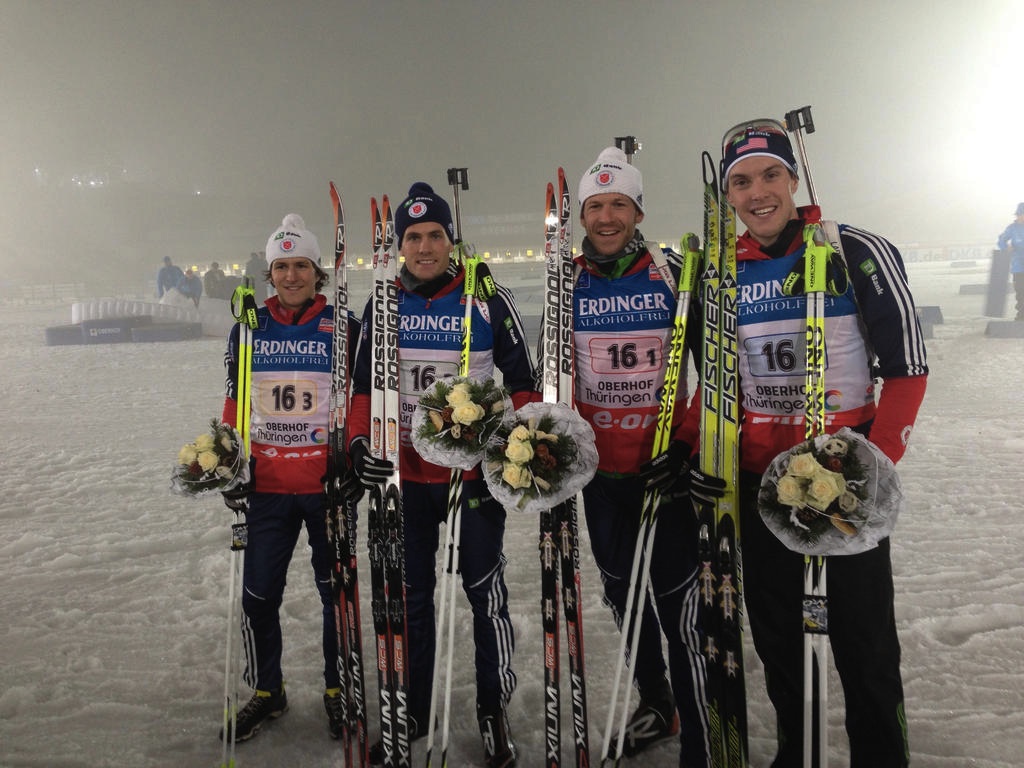
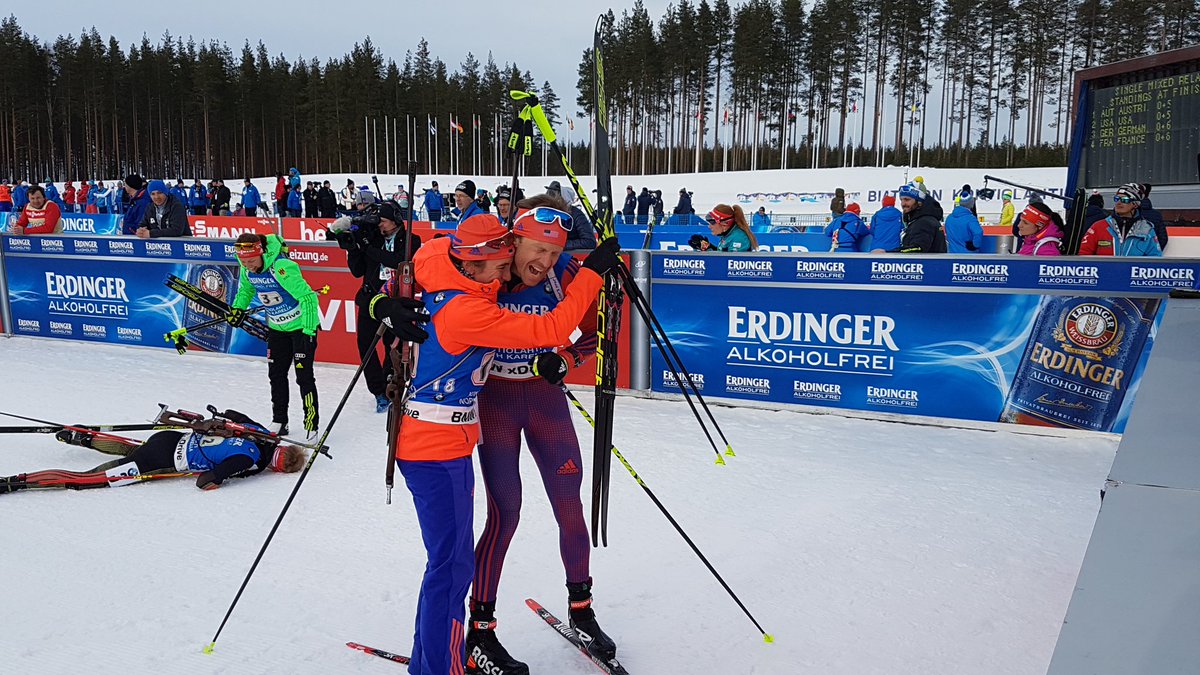
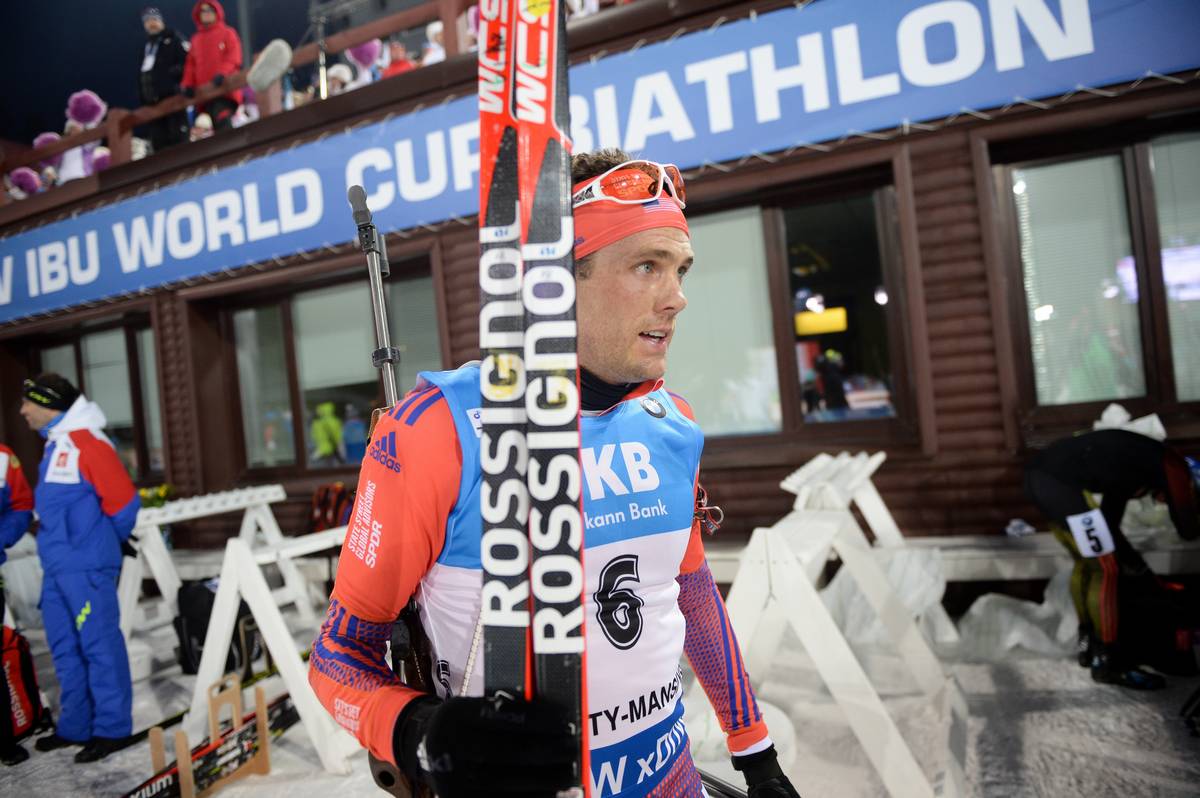
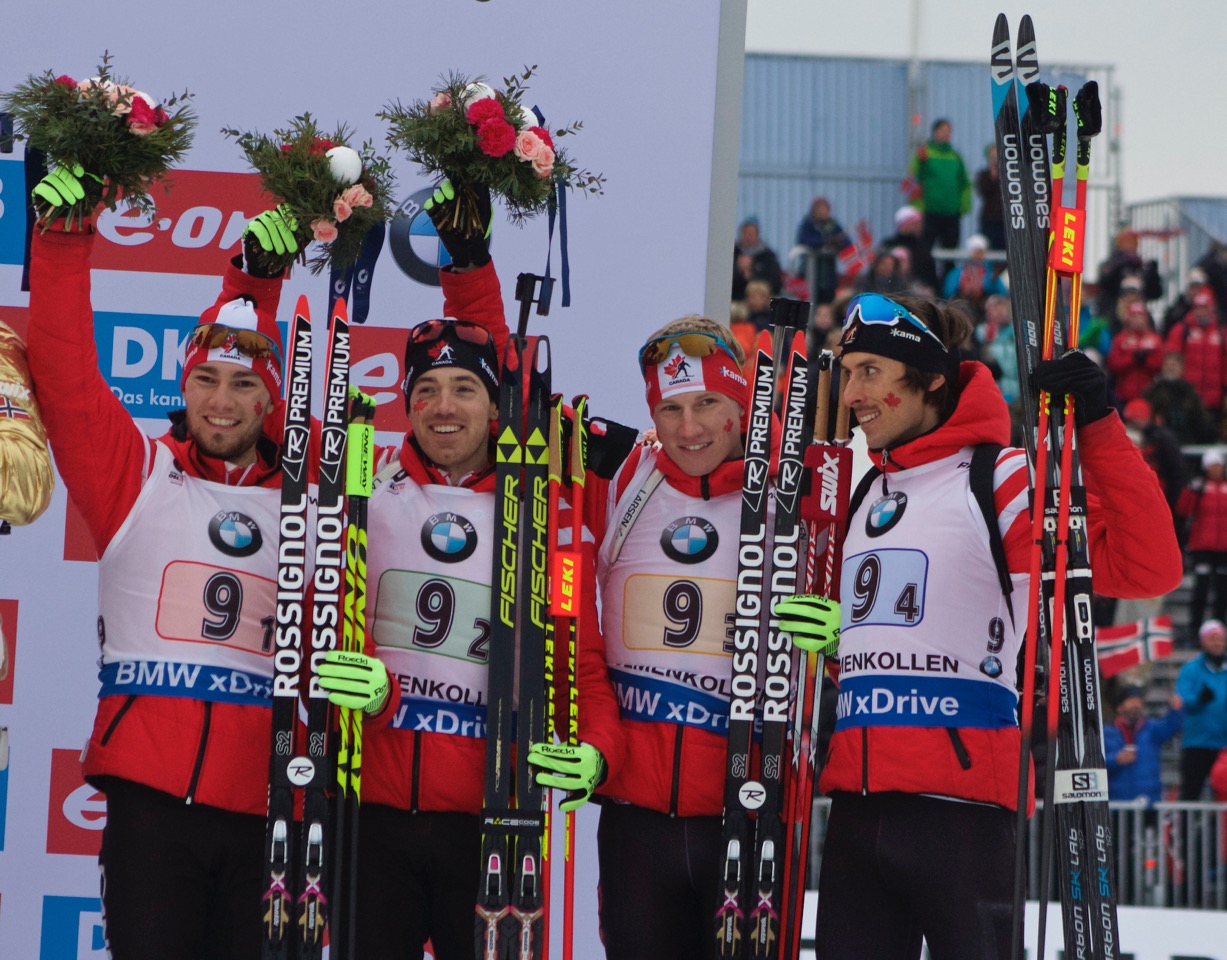
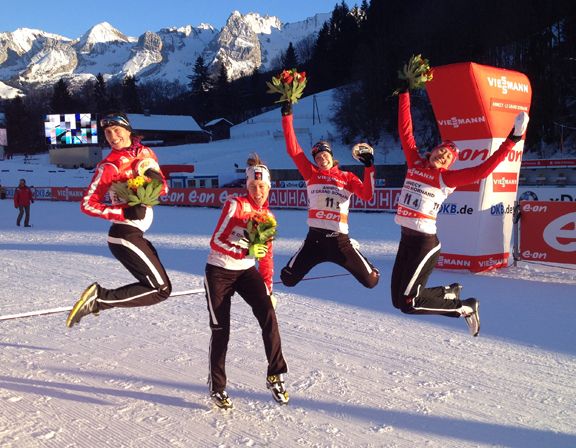
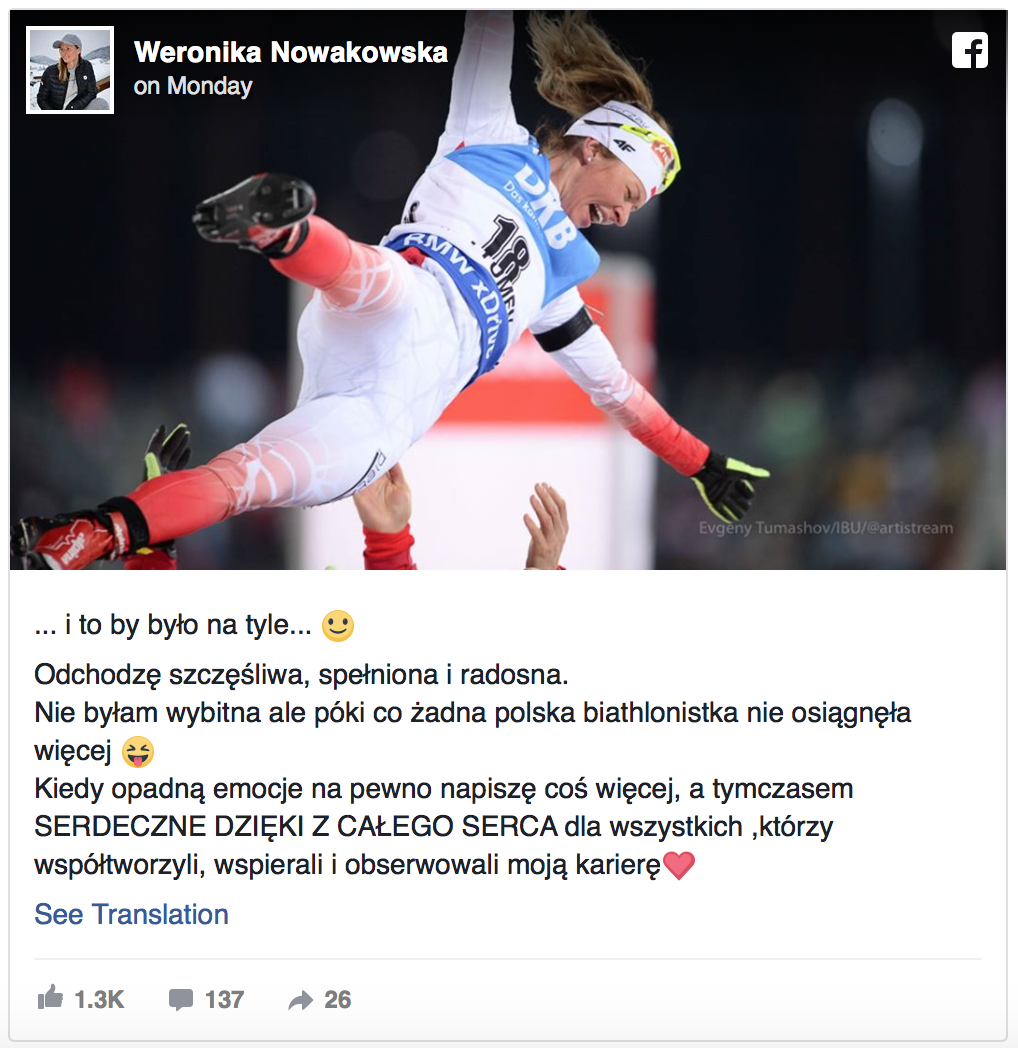 Weronika Nowakowska is calling it a career. The 31-year-old picked up two World Cup podiums in the 2015 season before taking a break from competition to give birth to twins. She made a successful return this season and represented Poland in PyeongChang, with a top finish of 21st in the individual. She also had sixth- and fourth-place finishes on the World Cup this year and contributed to four different top-eight relay efforts, including one at the Olympics.