Tag: Marie Laure Brunet

  • U.S. Ski Team Women and Men Among the Masses at Alaska Training Camp

    U.S. Ski Team Women and Men Among the Masses at Alaska Training Camp

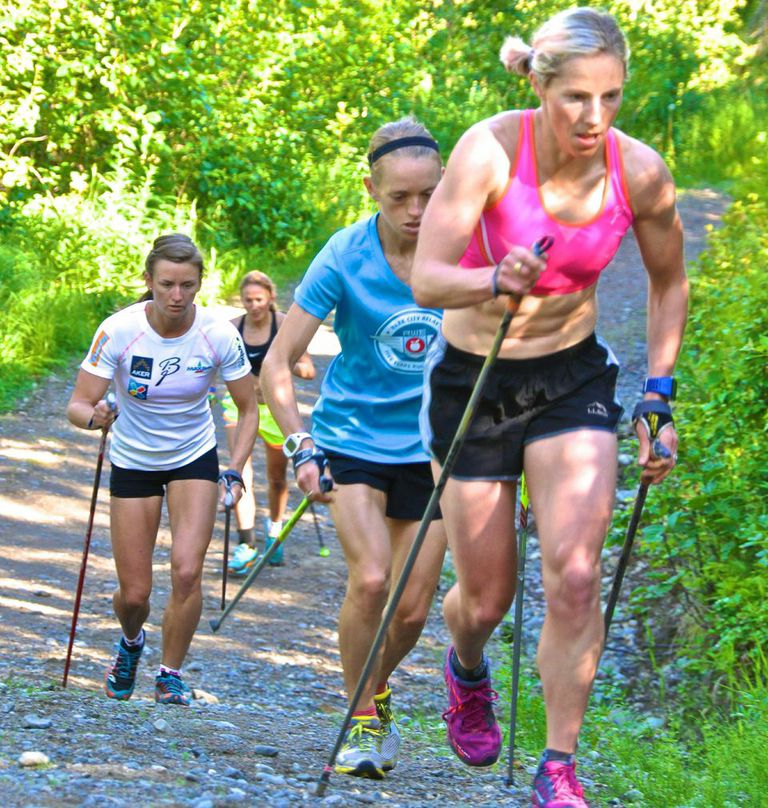
    Alaska Pacific University's Kikkan Randall (r) leads fellow U.S. Ski Team member Liz Stephen and Norway's Celine Brun-Lie (l) during a dryland session last week in Anchorage, Alaska, part of the North American Women's Training Alliance. (Photo: Matt Whitcomb)
    Alaska Pacific University’s Kikkan Randall (r) leads fellow U.S. Ski Team member Liz Stephen and Norway’s Celine Brun-Lie (l) during a dryland session last week in Anchorage, Alaska, part of the North American Women’s Training Alliance. (Photo: Matt Whitcomb)

    Watch out Dachstein, Stelvio and Oberhof — there’s a new summer hotspot for nordic skiers in the Northern Hemisphere, and for Americans, it doesn’t require a passport.

    While Eagle Glacier has been around since the Little Ice Age hundreds upon hundreds of years ago, its Thomas Training Center — contracted to the Alaska Pacific University (APU) nordic team — has only been around since the late 1990s.

    According to the U.S. Forest Service, it was created to help American nordic skiers reach international success. Build it and they will come.
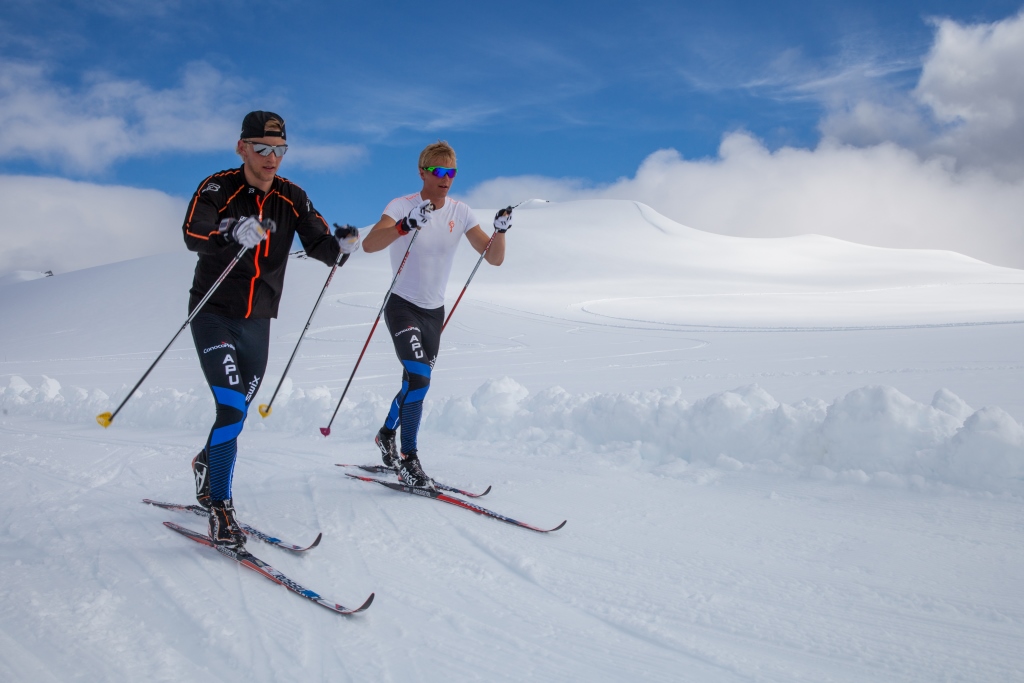
    APU teammates Eric Packer (l) and Erik Bjornsen enjoy a clear day for training on Eagle Glacier near Girdwood, Alaska. (Photo: http://blogs.fasterskier.com/reesehanneman/)
    APU teammates Eric Packer (l) and Erik Bjornsen enjoy a clear day for training on Eagle Glacier near Girdwood, Alaska. (Photo: Reese Hanneman)

    At a given time, APU can put about 20 athletes on the glacier for each of its weeklong camps. There, at 5,500 feet and a 10-minute helicopter ride above sea level, skiers can log quality volume training amounting to several hours a day on snow. And they can get a taste of what the 2015 World Championships courses in Falun, Sweden, will be like.

    Just like last year, when APU put hours of GPS-mapping and grooming in to mimic the Sochi Olympic courses on Eagle Glacier, they’ve done it again — and APU Head Coach Erik Flora likes this loop better.

    “I think this is the best course we’ve ever built,” he said on the phone from Anchorage last week. “Sochi was interesting: one long time out of the bottom and that takes a lot out of the course. … There’s no less climb in this course, but it’s broken up a little bit. We probably spent eight to ten hours with the PistenBully mapping out the course in the snow.”

    That involved Flora and his team of coaches and wax techs (Dylan Watts, Don Haering, and Michael Matteson) making countless tracks and turns with the groomer, then getting out to ski them to see how each flows. They used a GPS to check their distance and measure grade.

    “The best part about it is when you get it in the snow and you get your camps up there and you see the changes,” Flora said.

    While APU hosts several of its own exclusive camps on its backyard glacier each spring, summer and fall, it’s also opened it up to other groups of elite skiers.

    “I think that’s the biggest change that I’ve seen,” Flora said, reflecting on his six years as APU’s nordic director. “We do have a team, but we also have an open door for anyone to come out and train with us.”
    Sun Valley's Chelsea Holmes (l) and Jessica Yeaton, who recently graduated from Montana State University and is now skiing for Australia, during a training run with the North American Women's Training Alliance in Anchorage, Alaska. (Photo: Matt Whitcomb)
    Sun Valley’s Chelsea Holmes (l) and Jessica Yeaton, who recently graduated from Montana State University and is now skiing for Australia, during a training run with the North American Women’s Training Alliance in Anchorage, Alaska. (Photo: Matt Whitcomb)

    From July 6-20, APU is hosting the North American Women’s Training Alliance (NAWTA): 13 women from across the U.S. and one Norwegian.

    In addition to the five U.S. Ski Team women (Sadie Bjornsen, Sophie Caldwell, Jessie Diggins, Kikkan Randall, and Liz Stephen), Norway’s Celine Brun-Lie joined the two-week camp as NAWTA’s international guest. Last year, they hosted Astrid Jacobsen.

    Then there’s two-time Olympian Holly Brooks and her APU teammates (in addition to Bjornsen and Randall) Rosie Brennan, Rosie Frankowski, Becca Rorabaugh, and Lauren Fritz. Erika Flowers (Stratton Mountain School T2), Chelsea Holmes (Sun Valley Gold Team) and Caitlin Gregg (Team Gregg) are also up on the glacier with the select training group.

    Three French biathletes — one of which recently retired — have also been in Anchorage training with these women, along with Stephanie Kirk, an APU training partner and University of Vermont skier, and Jessica Yeaton of Australia.

    Marie-Laure Brunet, who announced her retirement early last month, stayed with APU in May, along with Marine Bolliet, a current French biathlon national team member, who trained with the team in late May and June. Bolliet stuck around for one dryland day with the U.S. Ski Team (USST) last week before flying back for another camp in France.

    The two women came to town to visit their former teammate Marine Dusser, a current University of Alaska-Anchorage skier and Erik Bjornsen’s girlfriend.

    Sadie Bjornsen explained that having them around made for a “mini-France” up in Alaska, which she welcomed because “there is always something to learn from other athletes of other countries,” she wrote in an email. “We have had lots of time to talk about the way we train, how we approach training, and how we keep things fresh.”
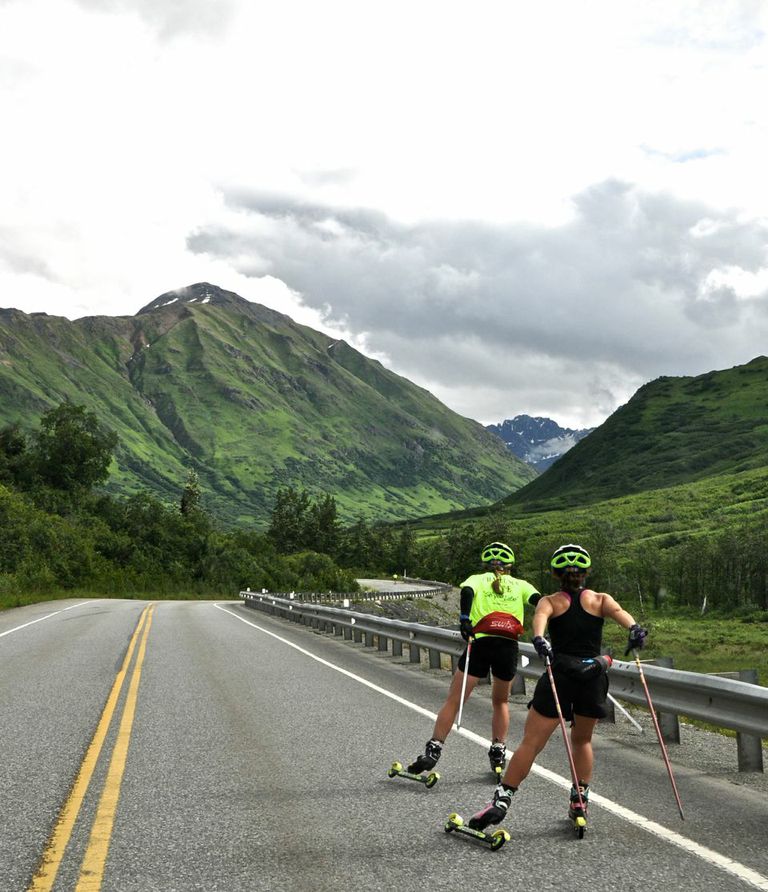
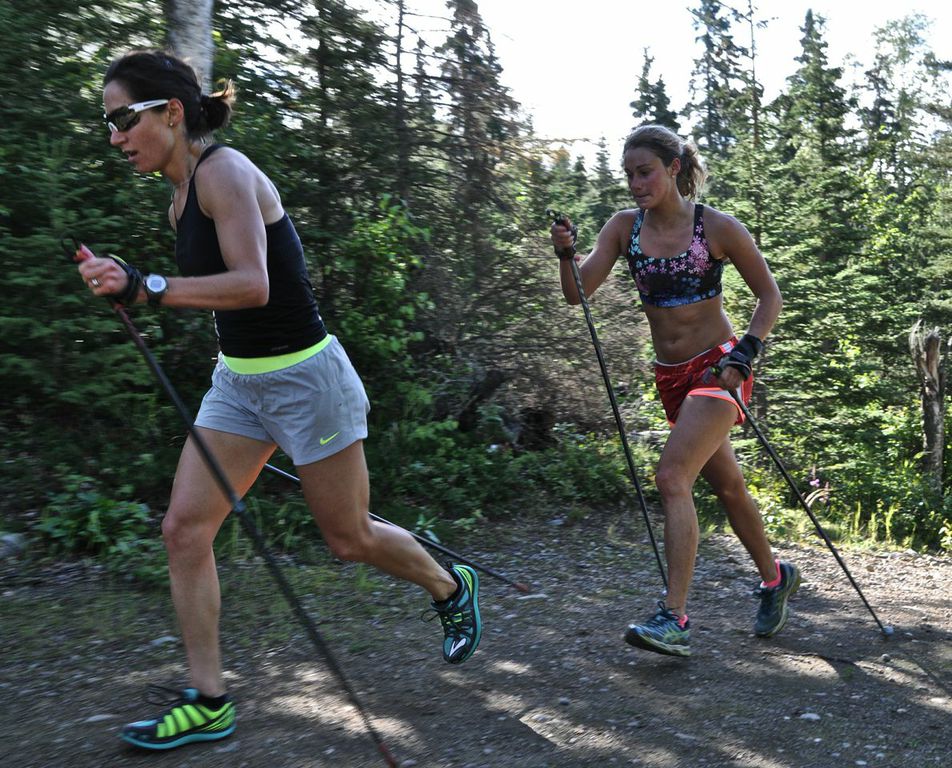
    Two members of the North American Women's Training Alliance during a skate rollerski near Anchorage, Alaska. (Photo: Matt Whitcomb)
    Two members of the North American Women’s Training Alliance during a skate rollerski last week near Anchorage, Alaska. (Photo: Matt Whitcomb)

    Last Monday, the 14 women with the fourth-annual NAWTA started their Alaska camp with a week of dryland and rollerski training in places like Kincaid Park in Anchorage. And with people like Bolliet, Dusser, Kirk, Yeaton, and up to 70 others training with them on certain days, one would be hard pressed to find that many rollerskiers in one place anywhere else in the world right now.

    That scene left Flora talking excitedly about the rising interest in Anchorage as a training hub. He’d seen 40 athletes rollerskiing along Kincaid’s hillside before, but 70?

    “That’s by far the largest,” he said. “It’s becoming like a training center. On any given day you can have someone pop out that was a former World Cup medalist and … and having Celine with us, it’s the same thing. She joined us for our APU strength [session] the other night. She joined like it was just like her training club.”

    The U.S. women’s team invited Brun-Lie to the camp, as it had with past guests, including Finland’s Aino-Kaisa Saarinen and Canada’s Perianne Jones and Chandra Crawford.

    “She’s been a friend of our team for a couple years now so we knew what we’d be getting when she decided she’d like to join us,” USST women’s coach Matt Whitcomb explained of Brun-Lie in an email. “She’s about as nice as they come and brings with her not just World Cup podium experience, but some of the smoothest technique on the World Cup. She rides a ski like Sophie and brings a ton to our group. Norway is lucky to have her on their team. We’ll do our best to send her home a bit faster as well.”

    U.S. Men Arrive

    And while his women’s team transitioned from dryland intensity to on-snow training on Eagle Glacier this past weekend, the U.S. men’s team started camp in Anchorage today for the first time as a unified group (Noah Hoffman had trained there previously, along with APU’s Erik Bjornsen). They’ll head up to the glacier next week.

    The men’s training group includes 14 athletes as well, five of which are on the USST: Hoffman, Andy Newell, Simi Hamilton, Bjornsen, and Ben Saxton. APU skiers Reese Hanneman, David Norris, Lex Treinen, Tyler Kornfield, Eric Packer, and Scott Patterson were also invited, along with APU training partners Tucker McCrerey and Kyle Bratrud, and Brian Gregg (Team Gregg).

    As for the goals of this men’s camp (led USST Head Coach Chris Grover and assisted by USST coach Jason Cork, Flora, and Matteson), Grover wrote that they’re shooting for “high-quality training” in the form of four to five intensity sessions while in Anchorage, “followed by some of the biggest volume of the season on-snow on Eagle Glacier.”
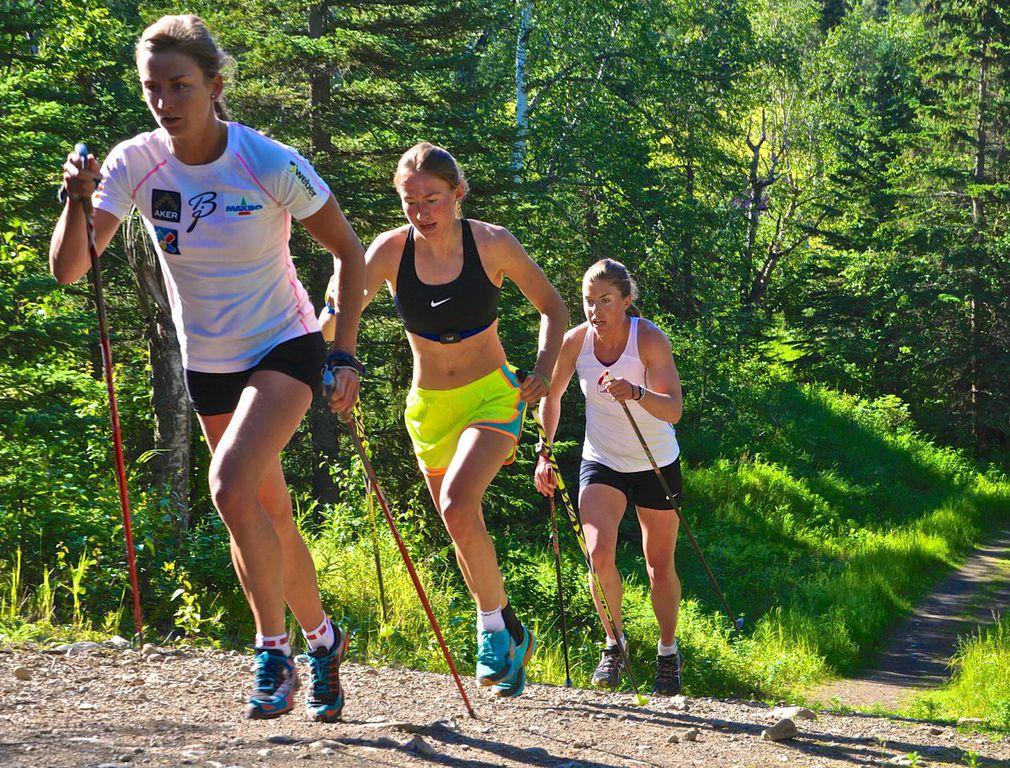
    Celine Brun-Lie (l) leads Sophie Caldwell (c) and Rosie Brennan during a dryland session last week in Anchorage, Alaska, part of the North American Women's Training Alliance. (Photo: Matt Whitcomb)
    Celine Brun-Lie (l) leads Sophie Caldwell (c) and Rosie Brennan during a dryland session last week in Anchorage, Alaska, part of the North American Women’s Training Alliance. (Photo: Matt Whitcomb)

    Also assisted by Cork and Flora, Whitcomb explained that the primary goal of the women’s camp “is to get the best women in the country together to train hard for fourteen days – just like the rest of our camps.”

    Specifically, they’re aiming to become “just 1 or 2% faster each season,” which is where a competitive training atmosphere comes in handy.

    “The aging model of training on your own for most of the preparation period is just not something I believe in,” Whitcomb wrote. “If you want to be stronger, you must surround yourself in strength.”

    While he acknowledged there are exceptions, they’re rare.

    “If you’re comfortable in every training session you’re either plateauing or slowing down,” he explained. “We put ourselves in vulnerable situations where failure is a real possibility.  That’s how we succeed.  It’s the training group itself that does its own coaching. The athletes receive feedback relative to the group in just about every aspect of training.”

    Week 1 and Done

    After the first week in Alaska, Whitcomb wrote that it was too early to compare the quality of training sessions compared to those in the past.

    “The volume will be high [this] week so we’ll see how training is being absorbed soon enough,” he wrote. “It becomes fairly binary by Thursday.  It is or it isn’t. Week one has been a success. Mostly because we saw that awesome bear.”

    During a run, the group spotted a grizzly bear about 300 meters ahead on a hill — well off the trail.

    “It was sleeping in a meadow and popped up its head, stood up to talk a look at us, and walked away,” Whitcomb wrote. “We were well armed with bear spray if needed.”

    Luckily, they didn’t need it, but in an unrelated incident, Diggins had to get six stitches in her knee. According to Whitcomb, she tripped on her way to a swimming hole after a long skate rollerski at Hatcher Pass.

    “She’s on the tougher side of the spectrum and had to only modify one workout by changing it from a run to a hike,” he wrote. “Her knee is stiff and a bit sore but training is still going well.”

    As for other USST injuries, doctors cleared Caldwell for full training after she sustained a minor elbow fracture at the last training camp in Bend, Ore.

    “Her range of motion has a bit more to go but I’ve been really pleased with the work she has done between camps with SMS T2,” Whitcomb explained. “Her legs are stronger and working technically better as a result of so much no pole and one pole training. She’s never really skipped a beat.”

    According to Whitcomb, Erik Bjornsen’s back injury is recovered, and Newell’s back is “much better” after he tweaked it while weightlifting.

  • Olympic and World Championship Medalist Marie Laure Brunet Announces Retirement

    Olympic and World Championship Medalist Marie Laure Brunet Announces Retirement

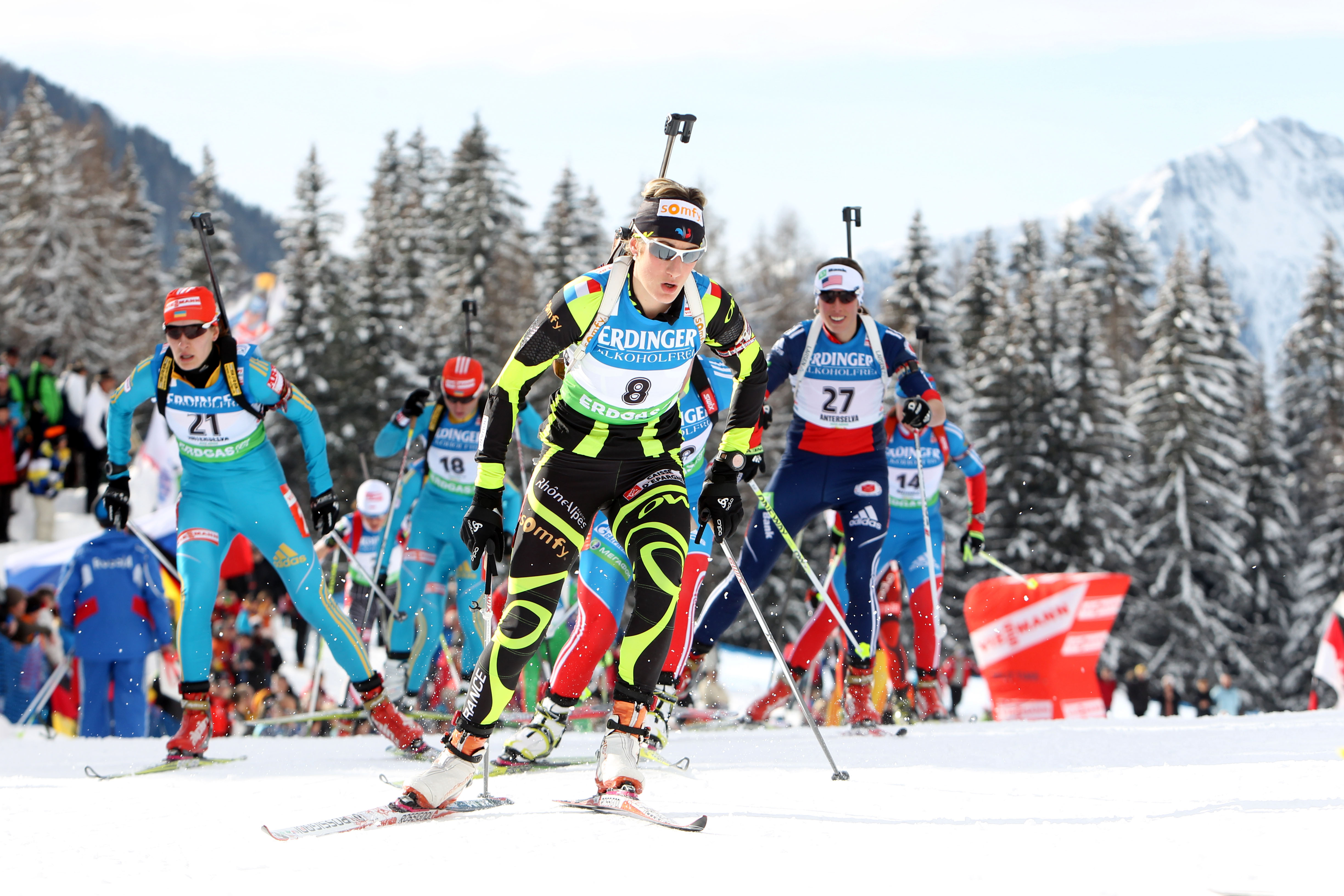
    Marie Laure Brunet of France in the 15 k mass start in Antholz, Italy, in 2012. Photo: NordicFocus/USBA.
    Marie Laure Brunet of France in the 15 k mass start in Antholz, Italy, in 2012. Photo: NordicFocus/USBA.

    Usually post-Olympic retirements are cut and dry, planned sometimes seasons in advance: look at biathlon stars Tora Berger, Andrea Henkel, Björn Ferry, and Jean Philippe Le Guellec. All knew that once the Sochi games were over, so were their careers.

    But sometimes they drag out. Marie Laure Brunet of France gradually came to the conclusion over the course of this spring that she wasn’t going to continue in a sport that had netted her an Olympic bronze, two individual World Championships silver medals, and a few relay medals too.

    She is 25 years old.

    Once considered the future of the French women’s team, Brunet – always one of the strongest shooters on the circuit – wrote on her blog that “This wasn’t a rash decision made when I was feeling down. It’s a structured decision, taken after considering for a long time in the past weeks both the pros and the cons.”

    The month was spent in Alaska visiting Marine Dusser, a biathlete who was on the French junior national team with Brunet before deciding to leave the sport to attend college and race for the University of Alaska Anchorage.

    “This is exactly what I need at this period of my life!” she wrote on her blog back in May during the visit.

    Recent years had been challenging for Brunet. She ended the 2013 season early with a diagnosis of overtraining, and very carefully brought herself back to the elite level. Things kicked off on a good note when she placed third in the opening 15 k individual race of the World Cup season in Östersund, Sweden. She also skied an assertive leg in the mixed relay which France would have won if not for an unprecedented meltdown by anchor leg Martin Fourcade.

    But come Sochi time, the Olympics did not go her way. Despite clean shooting – her hallmark – she finished just 17th in the individual race, where clean shooting is usually what gets the win. She had a poor sprint and did not start the pursuit. Then, in the women’s relay, she had a vasovagal reaction (a major drop in blood pressure) and collapsed, eventually being carried off the course.

    “The last two seasons were difficult to live through, mentally and physically,” she wrote on her blog. “… Today, I feel deep within myself that I want to open a new chapter.”

    She wrote that her collapse in Sochi was not the reason that she is retiring, but is merely symptomatic of all the things that led to her decision. Brunet is not sure what she will do next, but she wants to learn a trade and do it “with conviction.” She ended the blog post by thanking all of her fans for their support throughout her career and in particular in the last two seasons.

    Despite the challenges Brunet faced recently, she was not expected to retire after this season. Teammate Marie Dorin Habert, one of the new leaders of the French team (who is pregnant and will miss part of next season, leaving the French women’s squad in the hands of rising star Anais Bescond), wrote on her blog:

    “[We were having dinner] when a smiling Marie Laure arrived with a champagne glass in her hand and told us that we were talking to a freshly-retired. Doesn’t she know that pregnant women should be spared? I had no appetite after that! Of course the decision is her own, but I really did not expect her to stop after this year. And I confess that I couldn’t sleep that night after what she said, and if so many people hadn’t been there making my laugh I would have shed some tears… Marie-Laure, more than a teammate, is a beacon for the team, a motor, a model, a demanding character who is able to push the group in the pursuit of excellence.”

  • Czechs Win Ostersund Mixed Relay; Fourcade’s Meltdown Costs France More Than the Victory

    Czechs Win Ostersund Mixed Relay; Fourcade’s Meltdown Costs France More Than the Victory

    Ondrej Moravec of the Czech Republic celebrating as he crossed the finish line in Ostersund. His team of Veronika Vitkova, Gabriela Soukalova, and Zdenek Vitek won the opening World Cup mixed relay.
    Ondrej Moravec of the Czech Republic celebrating as he crossed the finish line in Ostersund. His team of Veronika Vitkova, Gabriela Soukalova, and Zdenek Vitek won the opening World Cup mixed relay.

    For ten of the twelve laps of today’s IBU World Cup mixed relay in Östersund, Sweden, it seemed inconceivable that anyone other than France would be on the top of the podium at the end of the day. In blustery conditions – the wind was both strong, and unpredictable – most of the field struggled to hit targets, using spare round after spare round and still hitting the penalty loop multiple times.

    France, though, made those look like amateur problems – at least for a while. Starting at the first shooting stage, where Marie Laure Brunet cleaned but went out ahead of the several other teams to do so, the French took over. By the second stage, she was the only woman still clean without resorting to spare rounds, and took a ten-second lead out on course.

    In a relief for France, Brunet just extended that lead. She cut last season short after overtraining rendered her a shell of the athlete who won a bronze medal at the Vancouver Olympics. Always a strong shooter, today’s relay provided an early indication that Brunet’s ski legs are back and better than ever.

    She tagged off to Marie Dorin Habert, who used a spare round in prone and then none in standing, and further extended the lead to 50 seconds, showing why she finished last season ranked fourth in the world.

    Simon Desthieux took over from there. He was a question mark – never one of the team’s top two men in the past, Desthieux is just two years out of the junior circuit and has little relay experience compared to his teammates. But he had acquitted himself well in the opening pre-season races in Sjusjøen, Norway. That earned him a spot on the relay, and he looked like a pro, like Habert using just one spare round in total. He looked fluid and relaxed out on course, and betrayed none of the intense pressure he must have been feeling. Another relief – maybe even a revelation – for France.

    By the time Desthieux finished, he had almost a minute of time on the second-place Czech Republic. Martin Fourcade, a World Champion four times over, took the tag. He used a spare in prone, but maintained his gap. Then in standing, which Fourcade entered with a lead now greater than a minute and a half, things took a turn for the wild.

    Martin Fourcade: what's going on?
    Martin Fourcade: what’s going on?

    Fourcade missed the first shot, then the second, then the third. Then he missed the fourth. He hit the fifth and began using his spares, hitting one of the remaining targets. But, apparently overcome by frustration, he only used tow of his allotted three spare rounds before heading out for three times around the penalty loop.

    When he exited, Ondrej Moravec of the Czech Republic had already gone into the lead and Tarjei Bø of Norway was ten seconds back. Fourcade tucked in behind him. Two of the fastest skiers on the circuit, it seemed like finally, at the last minute, the race might turn into a drag race, a toss-up of which of the three teams would get the win.

    But for those who had noticed that Fourcade only used two spares, the story had a different narrative. That’s an offense which merits a two-minute penalty. That’s to discourage athletes from deciding to skip the spare rounds when they don’t think they can hit a shot; it would be an unfair advantage to head to the penalty loop early compared to teams which try to shoot, but miss. So by the time Fourcade crossed the finish line – in third, behind Bø, who had not managed to catch Moravec – his time was highlighted in red. A few minutes later, the penalty was added and France dropped off the podium.

    It was a major frustration for France, which was let down by arguably their most famous team member. But Fourcade has not been off to a great start this season. He struggled in the opening sprint in Sjusjøen, where Desthieux was the top Frenchman instead, and dropped out of the mass start there.

    Today’s debacle added insult to injury. If Fourcade had used all three spares, France would still be on the podium (fourth place Ukraine crossed the finish line a minute after Fourcade and Bø). And if he had hit a target with that spare round, they might even have won – he probably would have exited the penalty loop as Moravec passed by, if not before.

    Or maybe France wouldn’t have won. While it’s easy to say that the Czechs won because of Fourcade’s mistakes, the team had been persistently sitting in second for as long as France was in first. And on the last lap, Moravec showed an impressive reserve of speed; even though Bø was trying to drop Fourcade, he couldn’t gain a single second on the Czech, who had the fastest split time of the entire field over that last loop. If he’d had to battle it out with Fourcade, who knows what might have happened.

    “I saw Martin had three penalties,” Moravec said in the post-race press conference. “When I shot the conditions were good…I had ten seconds lead when I left the stadium so I tried to push the first uphill to gain some time. By the last hill, the coaches told me I had 15 seconds. About 500 meters from the finish I knew I would win.”

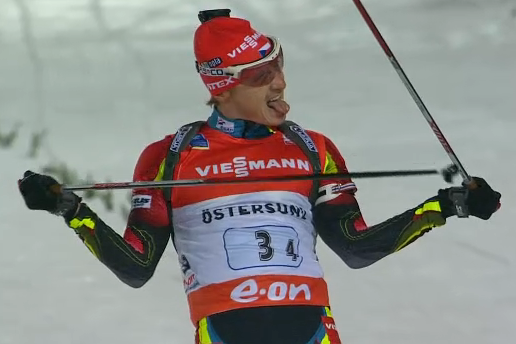
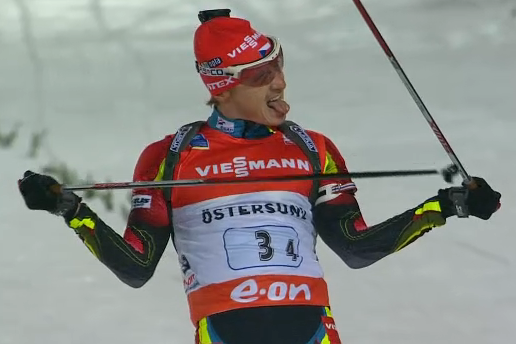
    As it was, Moravec celebrated in style as he crossed the finish line, pumping his arms and sticking out his tongue. His teammates ran up to him and overwhelmed him in hugs.

    It was a great day for the Czech team, which earned bronze in the last mixed relay, on home ground at 2013 World Championships. In a race that spread out quickly as team after team hit the penalty loop – eleven teams, almost half the field, was lapped in the windy conditions – only the Czechs and Ukrainians avoided the loop. The Czech team did so with eight spare rounds to Ukraine’s twelve. Even in better conditions, that would have represented solid shooting, but today it was remarkable.

    “It was one of the most difficult starts of my life,” said second-leg skier Gabriela Soukalova.

    It was the first win for the Czechs in the history of the discipline, which appeared on the World Cup for the first time in the early 2000’s. It has since been added to the World Championships schedule and will make its Olympic debut in Sochi. The event was heralded to bring diversity – small teams supposedly have a better chance to win with just two men and two women than they do in a four-person relay of a single sex – but this is one of the first times that a nation outside of the favorites has taken top prize (Sweden, debatably also in this group, had a run of good results in this event a few years ago).

    With France’s penalty, Ukraine was bumped on to the podium; Italy, who had lost a sprint finish with Ukraine, moved up to fourth. France was demoted to fifth, while Russia was far back in sixth (+3:03, three penalty loops and 13 spare rounds).

    At least a few people didn’t have hard feelings.

    “Despite a bad time, I watched a great team!” Fourcade’s brother, Simon, who usually holds the relay position that Desthieux took, tweeted after the race. “Next relay will not be the same! Congrats CZE!”

    “The season is launched,” Brunet tweeted. “It was a lot of fun on the tracks and behind the rifle. And about the result, it will be good when it has to be!”

    report on American and Canadian teams

    Results

  • Biathlon Preview, Part I: The Big Four

    Biathlon Preview, Part I: The Big Four

    Let's look forward to more exciting finishes like this one from last season in Ostersund, Sweden, where Martin Fourcade (FRA) played cat and mouse with Andreas Birnbacher (GER) in the last lap of biathlon's 12.5 k pursuit before beating him to the line. Photo: Fischer/Nordic Focus.
    Let’s look forward to more exciting finishes like this one from last season in Ostersund, Sweden, where Martin Fourcade (FRA) played cat and mouse with Andreas Birnbacher (GER) in the last lap of biathlon’s 12.5 k pursuit before beating him to the line. Photo: Fischer/Nordic Focus.

    The IBU World Cup biathlon season kicks off on Sunday with a mixed relay in Östersund, Sweden. With everybody gearing up to have their best performances at the Olympics, it’s set to be an exciting season – and there are other unusual aspects, too. For instance Annency, France, will make its World Cup debut as the third venue the circuit travels to.

    What about the racers? Here’s our breakdown of what to expect from the top four teams, listed in order of their combined men’s and women’s World Cup scores from last season. Stay tuned in the next few days for the rest of the teams.

    Norway

    At last year’s World Championships in Nove Mesto, the Norwegians won the mixed relay by 20 seconds, and it was no great surprise. Tora Berger was in the overall leader’s jersey for almost the entire season and took the title by a landslide; Emil Hegle Svendsen was in the fight for the men’s title all the way down to the wire, wearing the leader’s bib at times and ultimately finishing second. Both appear to be in good form already this year. Svendsen won a test race in Sjusjøen this weekend over a stacked field, and Berger had some shooting trouble but is certain to straighten that out before the season gets too far underway. She’s plenty fast.

    Tora Berger of Norway medaled - gold or silver - in every race of last year's World Championships, and dominated the World Cup Total Score. Photo: Fischer/NordicFocus.
    Tora Berger of Norway medaled – gold or silver – in every race of last year’s World Championships, and dominated the World Cup Total Score. Photo: Fischer/NordicFocus.

    On the men’s side, Norway looks even better than last year. Tarjei Bø, the 2011 overall World Cup winner, is back in good shape and was setting the pace in Sjusjøen; he struggled last year after missing a large chunk of the training season with illness, but managed a World Championship gold all the same. Ole Einar Bjørndalen didn’t always impress last year, but he also looks to be in better form, having won one of the Sjusjøen races and placed second in the other. The question is whether the 39-year-old can keep it together for a whole season all the way to the Olympics, but if anyone can do it, he can.

    This year the national team went with a decision to favor youth over experience. It seems to have paid off: Vetle Sjåstad Christiansen was second in this weekend’s mass start, while World Junior Champion Johannes Thingnes Bø was seventh in both races in his first year as a senior. The move came at the expense of Lars Berger and Alexander Os, veterans who were left off the team and had to train on their own. But they seem to have weathered the storm; the pair were invited to Font Romeu, France, this fall by the Fourcade brothers. Berger was third in the Sjusjøen mass start and Os sixth in the sprint. They will both likely see World Cup starts as well.

    On the women’s side, Synnøve Solemdal had a breakout year, winning her first World Cup race. But she had an up-and-down season, which may be partly attributed to her asthma; she says that she has now worked a lot on breathing techniques which help. Ann Kristin Flatland, a former World Cup winner, made her return partway through the season after having a baby, and is in good form again. Fanny Welle-Strand Horn broke into the top 10 for the first time and Elise Ringen and Hilde Fenne also provided support.

    Russia

    The Russian men edged Norway in the Nation’s Cup score with a variety of athletes who could hit the podium at any time. Anton Shipulin and Dmitry Malyshko each won two races, while Evgeniy Garanichev and Evgeniy Ustyugov were each twice second. Nobody can beat that depth in the men’s field, and yet Russia struggled when it counted: World Championships.

    Anton Shipulin was Russia's best performer at 2013 World Championships.
    Anton Shipulin was Russia’s best performer at 2013 World Championships.

    This past season, Shipulin was second in the mass start and third in the pursuit. Hardly bad results, but Russia expects medals, preferably gold, and preferably a lot of them. The pressure on the team for the home Games will be unbelievable. RBU Vice President for Elite Sport Viktor Maigurov told biathlonworld.com, “The Olympic Games is the competition, where only athletes with the best psychological resistance to stress and pressure, win. It will be twice as difficult for our biathletes to cope with this pressure, as these will be our Home Games.”

    The men’s team, like Norway, has a few tricks up its sleeve to make it better than last year. Ivan Tcherezov, seven-time World Cup winner and one of the senior leaders of the team, is finally back in shape after a horrendous accident that resulted in a broken leg. And Alexander Loginov, a World Junior Champion, is coming into the senior field. He had a successful World Cup debut last season, placing fifth in the sprint and third in the pursuit in Oslo.

    On the women’s side, it’s a familiar set of faces expected to be at the top. The Russian women’s team has been slipping a bit in the last years, with Olga Vilukhina and Olga Zaitseva leading the team in the Total Score in 12th and 13th. But each is more than capable to magical races and ended up on the podium several times last season. Zaitseva was practically guaranteed a medal in the World Championships pursuit, but was knocked down when Ann Kristin Flatland fell on the final lap.

    Germany

    Andrea Henkel en route to a podium finish last season in Ostersund. Photo: Fischer/NordicFocus.
    Andrea Henkel en route to a podium finish last season in Ostersund. Photo: Fischer/NordicFocus.

    Germany used to be the powerhouse of biathlon, and they can be again. But the team does not display the depth it once did: after veteran Andrea Henkel, who landed third in the Total Score, the next German was Miriam Gössner in ninth; the women nevertheless finished second behind Norway in the Nations Cup. On the men’s side, Andreas Birnbacher led the team in fifth and Erik Lesser was 16th, for fourth place overall in the Nations Cup.

    For the men, Birnbacher confirmed his status from the previous year as one of the most focused and dangerous men in the field, winning twice and collecting a few more podiums. Lesser picked up his first two podium finishes; can he build on that this year? The biggest disappointment of the team was probably Arnd Peiffer, who lost his mojo after several excellent seasons. He seemed to be off to a good start in Sjusjøen, however, so maybe things are coming back together. Florian Graf and Simon Schempp provide relay help.

    Henkel already seems on track for another excellent season, sweeping the Sjusjøen test races; she told FasterSkier in an interview this fall that she’s ready for her fourth and final Olympics. Gössner, meanwhile, has a tough road ahead. After her breakout season where she won three races (and also narrowly missed out on a medal at cross-country World Championships), she crashed her bike in Norway this spring and cracked three lumbar vertebrae. Franziska Hildebrand will replace her in the opening mixed relay. Germany also has high hopes for skiing Olympic gold medalist Evi Sachenbacher-Stehle and World Junior Champion Laura Dahlmeier, both of whom made their World Cup debuts last season with top-ten results.

    France

    When you think of France, you of course think of Martin Fourcade, who won the overall World Cup title last year over Emil Hegle Svendsen. Fourcade had nary a misstep the whole year; he was always in the fight, even if he didn’t win. It began to be unthinkable that he would lose, but he was eventually deprived on the biggest stage: World Championships. Unlike in 2012, where he swept the individual events, Fourcade won only the individual. Norwegians won the other three races. Fourcade has also been off to a tough start this year, bombing out of the Sjusjøen races.

    Marie Dorin Habert of France competing at 2013 World Championships in Nove Mesto, Czech Republic.
    Marie Dorin Habert of France competing at 2013 World Championships in Nove Mesto, Czech Republic.

    He seems certain to bounce back, and his supporting cast, while overshadowed, is impressive. After all, France was second in the men’s relay at World Championships. Martin’s brother Simon Fourcade and teammate Alexis Boeuf also had individual podiums, while Jean Guillaume Beatrix was six times in the top ten. Fourcade told biathlonworld.com that he thought Beatrix and Simon Desthieux had improved the most this year; Desthieux made the case for himself with third- and sixth-place finishes in Sjusjøen.

    The French women don’t get a lot of press, but that’s not fair. Marie Dorin Habert, the sprint bronze medalist from the 2010 Olympics, had three podiums and was one of the most consistent performers throughout the season; though she never won, she was always in the mix and finished fourth in the total score. Anais Bescond landed 17th in the total score, and Sophie Boilley and Marine Bolliet also had some good results. Marie Laure Brunet, who was bronze in the pursuit in Vancouver and once led the team, had a tough year and stopped her season short due to overtraining. She wrote a gut-wrenching blog post about how hard the decision was and her struggles to come back to top speed; hopefully she’s there now.


  • After Thrilling Three Way Battle On Final Loop, Berger Emerges From Mass Start With Another World Champs Gold

    After Thrilling Three Way Battle On Final Loop, Berger Emerges From Mass Start With Another World Champs Gold

    Tora Berger of Norway is a blur as she leaves the range, clean through two stages.

    RUHPOLDING, Germany – With rain finally falling in this small Bavarian town this morning, it would have been easy to stay at home, watching a television broadcast of today’s mass start races from safe inside a dry living room.

    But that thought never crossed the minds of the 30,000 fans who packed the Chiemgau arena today, just as they have for every other competition of the 2012 IBU World Championships.

    And they weren’t disappointed. In the men’s race, six men left the range after the final shooting within six seconds of one another, guaranteeing a horse race to the finish.

    It seemed that the women’s 12.5 k mass start couldn’t get much more exciting, but it, too, finished in a nailbiter: three women, all World Championship medalists in the last two seasons, raced the entire final 2.5 kilometers neck and neck, trading the lead back and forth until Tora Berger of Norway finally put in an insurmountable attack to claim her third gold medal of the week.

    The early stages of the race were marked by two things: first, early errors by two of the favorites, Magdalena Neuner of Germany and Darya Domracheva of Belarus. The pair finished first and second in the sprint and then swapped places in the pursuit, but today, just as in the individual, they struggled on the range. Each missed a shot on the first prone stage, and were out of the picture for most of the rest of the race, finishing fifth and eleventh with five and six penalties.

    Berger leading early, before a miss in the third stage dropped her to fifth.

    The other major event was a crash coming down the final, twisting hill towards the shooting range. After Synnøve Solemdal – a young Norwegian who had cleaned the first prone and was leading the race along with Berger – crashed, several of the other top competitors were unable to avoid her, and the fall turned into a five-woman pileup that robbed the skiers of their momentum.

    But because it had happened to the front of the field, if anything the crash allowed the pack to catch up; nobody was able to gap the field.

    By the time the women had shot their first standing stage, Marie Laure Brunet of France and Kaisa Makarainen of Finland had cleaned all three stages, as had Veronika Vitkova of the Czech Republic, who trailed by ten seconds.

    One loop later Brunet, who already had two silver medals from this Championship, and Makarainen, who won the overall World Cup and an individual title last year, were still together, and came into the range set for one more side-by-side psychological battle after a taxing week.

    Instead of one besting the other, however, they both lost, missing a shot apiece and heading into the penalty loop together. While they were stuck there, Berger came in and cleaned, meaning that the three women hit the trails together.

    “I almost wished that I had missed in the last stage,” Berger jokingly told broadcaster NRK. “I was hoping not to get into a duel.”

    Berger and Makarainen fought one another fiercely, with each move documented by the many cameras around the course; the crowd cheered as first one, then the other, would pull to the side and sprint to the front.

    Neither was completely confident in their ability to win, and they each said they were depleted from a long ten days of racing.

    Makarainen and Brunet on the range, before they missed and allowed Berger to catch up.

    “I had probably used all my energy before the last loop,” Makarainen said in the post-race press conference. “I was the most tired in that last loop that I have ever been.”

    Berger agreed, saying she didn’t even realize she was leading when she left the range.

    “I wasn’t sure, and when I was going out in the last loop I was sure that I was second, but I understood really soon that I was first,” she said. “I had no plan today. I don’t have such a good feeling in the race today. I wasn’t sure on the last loop that I will take these two. But I think that something in my head said, ‘you are so close to the medal now, you have to fight.’”

    Only Brunet avoided a turn at the front, instead sticking close behind the pair as they battled back and forth. It made sense: Brunet is incredibly successful at just 23 years of age, but she is known as a shooter.

    On the first major hill of the loop, with just over a kilometer to go, Berger made a surge, which Makarainen initially matched. But the effort soon proved too much for the Finn, who slipped first behind Berger and then further back to follow Brunet.

    “When I got several meters on the first uphill I just had to go as fast as possible,” Berger said. “I was really tired and I just tried to do my best.”

    Her best was good enough, and over the next few climbs she extended her lead; as she entered the stadium, exhausted, she free-skated her way to the finish line, raising her arms in victory and looking over her shoulder to see if her chasers were approaching. They were not, and she took the gold medal by eight seconds.

    “I think I have been in top shape [this week],” she said. “And now I think that I’m really tired.”

    Behind her, Makarainen was fading fast, and Brunet entered the stadium with a lead of her own to claim her second individual silver medal of the week.

    “From the beginning of the season, I tried to be in good shape for this event,” she said to explain her ski speed today. “Just before I came here I was at home and I tried to take a lot of pleasure, and I spent a lot of time behind my window to take in the sun and good energy!”

    Makarainen finished four seconds behind.

    “At the moment I am really happy for the bronze medal, and I definitely think I won a bronze today and not that I lost the first or second place, even if I was leading at one part in the last loop,” she said in the press conference.

    The Finnish star has not had the best season this year; her skiing has almost always been spot-on, but many races have been marred by shooting errors. This medal, she said, gave her something to smile about.

    “This Championships have been a very big disappointment for me, because I think that I still had a good season so far,” said last year’s overall World Cup champion. “I did good races in Kontiolahti, also a victory in Nove Mesto.

    “But I was really sick for one week right after Kontiolahti, maybe because of racing in such cold weather,” she continued. “I lost one week where I was only sleeping and with a really high fever. So that’s why maybe the preparations for the World Champs were not the best.”

    Far behind the winners, Tina Bachmann of Germany finished in fourth place, while Domracheva edged Marie Dorin Habert of France for fifth.

    Full results

    The start of the women's 12.5 k mass start.
  • German Women Take Gold in World Championships Relay, Giving Thousands of Vocal Spectators What They Asked For

    German Women Take Gold in World Championships Relay, Giving Thousands of Vocal Spectators What They Asked For

    Andrea Henkel crosses the finish line after extending Germany's lead in the 4 x 6 kilometer relay. It was the fourth World Championship relay title for Henkel, who is the girlfriend of U.S. biathlete Tim Burke, and the first she has anchored; she was also a member of the gold medal team at the 2002 Olympics. Photo: NordicFocus/USBA.

    RUHPOLDING, Germany – Right from the start of the 4 x 6 k relay here at World Championships, the German women made it clear that they were going to give their fans a show – and, most likely, the gold medal that they so vocally craved.

    Bachmann bringing it home for Germany on the first leg.

    Tina Bachmann, a lithe, six-foot-tall 25-year-old, put the field on notice when she turned in the fastest first-leg time, making up for the single spare round she used to clean her targets and hitting the exchange zone in a dead heat with Marie Laure Brunet of France. The two were so close – Brunet officially had a 0.6 second lead at the handoff – and the atmosphere to charged that it felt like they could be sprinting for the win, not just for their teammates’ shoulders.

    “I gave everything I had,” Bachmann said after the race. “Unfortunately I couldn’t finish the shooting first or hand over first, but still this one second didn’t hurt us.”

    It certainly didn’t: her effort set the tone for the rest of the relay, which Germany ended up winning by 28 seconds over France.

    But before they got their gold medals, the team had to endure a bit of worrying. And their ultimate return to the front didn’t come from either of the squad’s usual heroes: not from retiring 25-year old Olympic and World Champion Magdalena Neuner, for whom this was the last relay of a stellar career, and not from 34-year-old fellow legend Andrea Henkel, who for now seems to have no plans to leave the sport.

    As anchor, Henkel did turn in a literally perfect performance to extend Germany’s lead. But the hero of the day was Miriam Gössner, who at age 21 was on her second World Championships team and secured her second relay gold.

    After Neuner encountered shooting problems in the second leg, Gössner inherited third place and a ten-second deficit. Using two spare rounds in prone, she remained in third at the two-kilmeter mark, 8.5 seconds behind Anais Bescond of France and five from Slovakia’s Martina Chrapanova. Then Gössner attacked, passing the Slovakian and closing in on Bescond. When she used one spare round to Bescond’s two, Gössner left with a ten second lead, and had extended it to 17 by the time she tagged to Henkel.

    Bescond, Gössner, and Chrapanova shoot for their prone targets.
    Bescond, Gössner, and Chrapanova shoot for their prone targets.

    Gössner, who had been chosen for the relay over Franziska Hildebrand, the other German entry in these championships, said that she had been quite nervous and considered this “one of the most important races so far.”

    But both she and Bescond, who is also in her second World Championships, used similar strategies to deal with the pressure of being the least experienced members of highly-regarded teams.

    “I think I skied really well, and I believe I really managed to do my own competition and not think about the fact that this was a World Championship,” Gössner said. “I didn’t feel the pressure so much [during the race].”

    Bescond agreed, saying she didn’t even know that the German was creeping up on her.

    “I didn’t realize because when I am competing, I don’t think about other athletes except for France,” she explained. “I really focus on my own race.”

    While the pair both used a total of three spare rounds, just at different times, Gössner was the better skier and handed Henkel something she could work with.

    Henkel takes the lead while Dorin Habert is left on the mat.

    The veteran took off, and showed the crowd exactly why she is one of Germany’s most popular female athletes (besides Neuner, of course). Henkel cleaned both stages without using a single spare round, gaining momentum as she went and never having to dig too deep to maintain her comfortable lead.

    When she skied into the stadium, she picked up a full-sized German flag and carried it, fluttering in the breeze, across the finish line. The stadium filled with a deafening roar.

    “We all knew that we had a chance, and that we could do it, and we did,” Henkel said simply in a press conference.

    Marie Dorin Habert anchored France to silver, which she said was a relief after missing bronze in the 15 k individual by just 3.6 seconds.

    The most exciting aspect of the final leg turned out to be the battle for bronze. As the fourth skiers from each team left the exchange zone, Ukraine had a 20-second hold on third place, followed by Slovakia.

    Berger, with Domracheva in green in the background, takes off on her final loop.

    But second-ranked World Cup racer Darya Domracheva was anchoring for Belarus, third-ranked Tora Berger for Norway, and sixth-ranked Helena Ekholm for Sweden.. They started in eighth, fifth, and sixth, but Domracheva shot perfectly, and Berger and ekholm used a single spare round apiece, which was significantly better than either Ukraine or Slovakia.

    By the time the trio, each of whom has already won at least a medal if not a title this week, left the standing stage, they were separated by eight seconds and the game was on.

    “I tried to do my best, because I was sure that Domracheva would be really strong,” Berger said. “She has been strong at these Championships and really strong this season.”

    It was a battle, and Domracheva had a slightly faster time on the last loop. But she couldn’t quite close the gap, finishing just under two seconds behind Berger and the bronze medal.

    “In the last uphill I was a little bit before her, and had the chance to take the bronze medal,” Berger said.

    The Norwegians – like the men’s team before them – hadn’t gotten a great start to the relay, with Fanny Welle-Strand Horn using four spare round and tagging off a minute behind the leaders in 12th. But Elise Ringen brought the team into fifth and Synnøve Solemdal kept them there, despite using four spares of her own.

    “I gained a lot of experience this season, but I don’t think I showed this experience in the standing shooting, with my three mistakes,” she said in the press conference. “I think that Tora was the one who brought us back in line today.”

    After attending the downtown medal ceremony on Wednesday night when Berger received her gold medal for the individual race, the team decided that they would join her on the stage in the relay.

    “We said that we wanted to stand up there, and be pop stars for the night,” Welle-Strand Horn told Norwegian newspaper GD.

    Ekholm brought Sweden home in fifth. Ukraine fell to sixth, Russia placed seventh, and Slovakia eighth, with Poland and the Czech Republic rounding out the top ten.

    Full results

    The start of the women's relay.
  • Berger Dominates World Champs Individual; 56 Second Win Finally Gives Norway Something to Cheer

    Berger Dominates World Champs Individual; 56 Second Win Finally Gives Norway Something to Cheer

    Norway's Tora Berger following Darya Domracheva of Belarus around the course.

    RUHPOLDING, Germany – In last year’s World Championships individual, Helena Ekholm of Sweden navigated blustery conditions to claim a two-minute win.

    This morning, she woke up with her usual pre-race jitters, and one more question on her mind.

    “Of course I this morning I am thinking, oh, maybe I am just the champion for a few more hours,” she said in a press conference after the race.

    The women’s 15 k had plenty of twists and turns but Ekholm was ultimately right – she finished with bronze, not gold.

    The surprises started immediately as Sunday’s pursuit champion Darya Domracheva of Belarus, wearing bib four, missed four shots in her first stage. Then Saturday’s sprint winner Magdalena Neuner of Germany missed two. Both stars ended up with six penalties, an irreversible catastrophe in this format where missed shots accrue a one-minute time penalty apiece.

    Second-place Marie Laure Brunet of France leaving the range.

    While the previous races’ gold medalists were out of the picture, American Susan Dunklee was in it. Starting with bib one, Dunklee set the pace for the field. With a single penalty, she led at nearly every time check until bibs in the mid-20s began coming through. Dunklee eventually finished fifth, seven seconds out of a medal.

    Ekholm missed a shot in the first stage, but from there cleaned the rest of her targets and followed a gradual upward trajectory. She was outshone, though, by Norway’s Tora Berger, who matched Ekholm’s shooting and skied 45 seconds faster.

    “I felt really good today,” Berger said after the race. “It was almost a perfect race for me: I just missed one target. I did my very best.”

    That effort netted her a 56-second victory and the first individual World Championship of her career.

    The 31-year-old has been close before; she has two bronze and one silver medal from World Championships. And she also owns Olympic gold and several relay victories. Today, she was happy to cross one more title off her list.

    “[An individual title] was my goal for the season, so it was really fun to get it, especially here in this race,” she said.

    The Norwegian star said that after collecting a penalty in the first stage, rather than tensing up, she actually relaxed.

    “I didn’t think so much, after that,” she said. “I think it was easier to do my work. After I had missed one already, I wasn’t thinking of the results; I was really focused.”

    Ekholm.

    Berger skied the third-fastest time of the day, behind only Neuner and Domracheva. And it wasn’t only her speed on the snow that helped her win: her standing shooting is among the fastest in the world, and when she’s “on”, she can be in and out of the range in the blink of an eye.

    Marie Laure Brunet of France came between Berger and Ekholm, Brunet didn’t pick up her one penalty until the final stage, meaning that she was leading the race until then.

    “Today my shooting was really excellent,” she said. “It was like a game for me. On the last shot I wasn’t thinking [about winning], I just forgot to finish the work – but a silver medal is great.”

    At just 23 years old, Brunet is something of a prodigy for France. She started her first World Cup in 2007, when she was 19, and finished in the top ten later that season. At the 2010 Olympics in Vancouver, she won bronze in the pursuit.

    But this season hasn’t been so kind to Brunet, who has finished in the top ten in only half of her races. Before this silver medal, the year had brought just a single podium in World Cup racing.

    “The difference between the race today and the past months I think is just my shape, which is just arriving now for World Championships,” said Brunet, who had the eleventh-fastest ski time. “I think that’s perfect.”

    Brunet finished 56 seconds down on Berger; if she’d hit that lost shot, she would have had a four-second win. Ekholm was further back and only narrowly snagged the bronze. Her 1:11 deficit to Berger put her three seconds ahead of Marie Dorin Habert of France and seven seconds ahead of Dunklee.

    “It was really tough, but I’m glad I had some extra power left for the last loop,” Ekholm said. “It was good when I was hearing that, because I went out four seconds behind Susan Dunklee and then I heard I was taking her and then was in the lead, so it was good.”

    Berger showing off her gold medal at the evening ceremony.

    The day, though, was all about Berger – and so was the night. The medals plaza in downtown Ruhpolding was filled by a sea of red jackets, waving Norwegian flags, and chants of “To-ra! To-ra! To-ra!” The evening ceremony was even delayed by five minutes so that it could be broadcast live on Norwegian television.

    The result was a boost for the Norwegian team, which was undoubtedly expecting more at these Championships. After winning the mixed relay and placing Emil Hegle Svendsen second in the sprint, the team hadn’t won another medal. Last year’s overall winner Tarjei Bø has had lackluster races, as has veteran Ole Einar Bjørndalen.

    “It was wonderful to stand there on the podium and accept the medal,” Berger told broadcaster NRK. “That’s what I have struggled to do for so many years.”

    Results

  • Domracheva, Never One to Give Up, Capitalizes On Neuner’s Late Shooting Errors and Claims First Championship

    Domracheva, Never One to Give Up, Capitalizes On Neuner’s Late Shooting Errors and Claims First Championship

    Domracheva and Neuner shooting side by side in the second prone stage.

    RUHPOLDING, Germany – In Saturday’s World Championships sprint, Darya Domracheva of Belarus tried her hardest to best Germany’s Magdalena, but it was to no avail.

    On Sunday, their battle spilled over into the 10 k pursuit, with the two women at many times so close that they shared the shooting range with each other. Each was confident that they could be the first across the finish line.

    “I am very strong at the moment,” Neuner said, referring to her turn in the mixed relay and her dominating victory in the sprint.

    Domracheva had a different source of inspiration.

    “In biathlon, nothing is impossible,” she said in a press conference. “[Whether] you are more seconds behind or less seconds behind, always you have a chance for the win.”

    Neuner leading Domracheva early in the race.

    But despite two worthy adversaries, there was only room for one at the top of the podium. For most of the race, it looked like the title was Neuner’s to lose. Starting with a 15-second advantage, the German took off out of the start like a bullet. After the first stage, she and Domracheva were both clean, and Neuner had added a second to her lead. After another stage, they both had one miss, and the lead was 12 seconds. And then in the third stage, Neuner was in and out in a flawless 25 seconds, while Domracheva took 35 and missed one shot.

    With a 33 second lead, Neuner appeared to be on her way to gold again, in a reprise of Martin Fourcade’s performance earlier in the afternoon. She cruised around the two-kilometer loop in perfect control, her trademark combination of power and tempo keeping her far enough in front of Domracheva to stay comfortable.

    But then in the final stage, something went wrong for Neuner. She missed two shots and headed to the penalty loop. Meanwhile, Domracheva came into the range, cleaned, and left again. For the first time all day, she had a lead: 13 seconds.

    Neuner is fast, but so is the Belorussian, and Neuner was no match for Domracheva on the trails. While Domracheva skied the quickest closing loop – just as she had done for every other loop all race – Neuner bogged down, only turning in the eighth-best loop time and finishing 25 seconds back for silver.

    Domracheva, victory in hand, leaving the range.

    “I feel really good right now because this was one of my dreams and it has come true,” Domracheva told the television commentator. “I always say that you should dream big, and your dreams will come true.

    “I dreamed about it from the first day I started training, when I started skiing at six years old,” she added in the press conference.

    It was not only Domracheva’s first World Championships title but also the first for Belarus. She has won six World Cup races over the course of her career and many of those have come, like today’s title, at the very end; Domracheva’s never-give-up attitude and ski speed are well-known on the circuit.

    On Sunday, it was also her shooting which earned her the win.

    “I saw that Magdalena was really fast on the range today, but I was really concentrated on my shooting,” Domracheva said. “It was a fight only between me and my targets.”

    The pressure on Neuner – like that on all of the Germans – has been intense this week, and the star admitted that on Sunday it had gotten to her.

    “We have seen that it’s not easy,” she said. “Today I had a few seconds in the race where I was a little bit nervous, where it was a little bit too much for me.”

    But over and over, she repeated that even though her thousands of fans might be disappointed with her performance – even though the German public demands nothing but gold, gold, gold – she was happy with all of her races so far at this Championships.

    Neuner cresting the hill out of the stadium.

    “My goal was to get six medals, and I already am World Champion, which is something that I wanted to achieve,” she said. “We still have three competitions ahead of us, and I am very happy with silver, I have to say. It’s a shame to have these two mistakes at the shooting range, but still, I am satisfied.”

    Once Neuner made those errors and saw Domracheva skate past the penalty loop without stopping to visit, she knew the race for gold was over. Instead of trying to catch the Belorussian, she focused on soaking up the atmosphere at biathlon’s biggest venue.

    “I really enjoyed winning my third medal, and I also tried to enjoy going into the finish zone with the atmosphere that was there,” she said.

    As in the sprint, Neuner and Domrachava were untouchable to the rest of the field.

    For most of the race, Marie Laure Brunet of France sat in third, and seemed to be headed for pursuit bronze again; she was third in this event at the 2010 Olympics. In the final stage, however, Brunet missed a shot, and Russia’s Olga Vilukhina slipped past.

    Tora Berger and Olga Vilukhina.

    Vilukhina, who accrued only a single penalty over the course of the race and almost immediately moved into fourth position after starting eighth, found motivation in thinking of another race here in Ruhpolding, where she had finished fourth.

    “I remember in 2008 at the Junior World Championships, there was a pursuit competition and I was fighting with Brunet for bronze,” she said in a press conference. “At the last shooting [today] there were Brunet, Berger, and I, and I heard that they both had penalties, so I knew that the only thing I had to do was shoot clean. And then I went on to win bronze.”

    This was the first podium of Vilukhina’s career, and she was overwhelmed when she crossed the finish line 1:15 behind Domracheva, burying her face in her hands.

    That sentiment was still strong an hour later at the press conference.

    “I really don’t know what to say,” she mused. “Sitting here with these athletes is just such an honor for me.”

    Brunet’s penalty allowed not only Vilukhina to pass her, but also Tora Berger of Norway and Helena Ekholm of Sweden. Russia’s Olga Zaitseva of Russia finished seventh, while the sprint bronze medalist, Vita Semerenko of Ukraine, dropped to eight. Marie Dorin Habert of France and Anna Maria Nilsson of Sweden rounded out the top ten.

    full results

    In front of TV cameras and the thousands of fans packing the stadium, Domracheva and Neuner share a postrace hug.
  • Photo Gallery: World Championships Mixed Relay

    Photo Gallery: World Championships Mixed Relay

    With racing taking a break for the day in Ruhpolding, Germany, here’s a gallery from the kickoff race, yesterday’s mixed relay. Norway took the win followed by Slovenia and Germany. Click any photo to enlarge.

  • After Cross-Firing Debacle Removes Neuner, In Tears, From Contention, Berger Emerges From Confusion To Take Pursuit Victory

    After Cross-Firing Debacle Removes Neuner, In Tears, From Contention, Berger Emerges From Confusion To Take Pursuit Victory

    Eventual winner Tora Berger of Norway leads Magdalena Neuner of Germany on the first lap of Sunday's 10 k pursuit in Nove Mesto, Czech Republic. Photo: NordicFocus/Fischer.

    Of all the nordic disciplines, biathlon is perhaps the one where small errors make the biggest difference. A centimeter here, a millimeter there – missing a target by that much, or little, can have drastic impacts on an athlete’s results.

    On Sunday, however, Magdalena Neuner didn’t make a small error. She made what is perhaps the worse mistake in biathlon: cross-firing.

    Coming into the third shooting stage of the 10 k pursuit with a sizeable lead, the German skied onto the mat in lane one, settled into a stable standing position, took a deep breath, and began shooting. She hit a target and kept going.

    The first sign of trouble was that the fans filling the stadium in Nove Mesto, Czech Republic, were silent instead of cheering for her hits. After four shots, Neuner realized that she was shooting at the targets in lane two, not lane one. She picked up her rifle, refocused, and hit the remaining shots on her own target – then had to go ski four penalty loops.

    “It’s very annoying because [the four shots] were in a very tight group,” German women’s coach Gerald Hönig told the press.

    In other words, Neuner shot perfectly – just in the wrong place. Coaches are not allowed to have contact with athletes during the race (for several reasons including the obvious ones of gun safety), so Hönig was left to watch, more or less powerless, from several meters away.

    Cross-firing isn’t common, but it does happen. U.S. biathlete Carolyn Treacy Bramante crossfired in the sprint at 2007 World Championships. And at almost the same time that Neuner made her mistake on Sunday, so did someone else; Canadian Danielle Vrielink had to adjust after another athlete fired into her lane at the Youth Olympic Games in Innsbruck.

    Neuner lost over a minute and a half while stuck on the penalty loop, and the rest of her race was wrecked. While she skied the fastest overall time, she paid for it: out of physical and psychological exhaustion, the 28-time World Cup winner missed three shots in her final standing stage as well, and was left with seventh place after leaving it all on the course in a blistering-fast last loop.

    Neuner was in tears after crossing the finish line.

    “I have to admit I had to cry,” she told the press after the race. “I was so focused and just didn’t look at the number on the stand. That’s never happened to me and I am really angry.”

    “After penalty loops I always have more and more rage in my belly and only want to ski as fast as I can, and I at least was able to do that,” Neuner told German newspaper Welt.

    It might seem like eventual winner Tora Berger of Norway benefitted immensely from Neuner’s errors, but that would be an oversimplification because Berger also suffered the ramifications of the cross-firing disaster. She was in second place when she entered the range, arriving just as Neuner was leaving and owning only a slight lead on Russia’s Olga Zaitseva.

    Berger, who was not surprisingly oblivious of the situation, skied into lane two and Zaitseva into lane three. But while Zaitseva settled in and started shooting, Berger suffered a jolt: her targets were already white, dropped erroneously by Neuner. After frantically calling and gesturing to officials, she had to scoot behind Zaitseva and into lane four. Then, Berger missed two shots.

    “I tried to talk to the official, but he was not watching and it took him a while to see what was happening,” Berger said in the postrace press conference. “I was a little disturbed about that, and it was probably the reason I had the two penalties.”

    After the finish, officials subtracted six seconds from Berger’s time to make up for the confusion on the range.

    Zaitseva also missed two shots, and the pair hit the penalty loop together. They saw Neuner, but then left her to finish her 600-meter series of left-hand turns.

    When the dust had settled, sharpshooters Helena Ekholm of Sweden and Marie Laure Brunet of France had taken the lead. While so many of their competitors – including Darya Domracheva of Belarus – were stuck in the penalty loop, the pair had cleaned all their targets.

    Domracheva, Berger, and Zaitseva, however, are the better skiers, and formed an intimidating chase pack. They closed the 14-second gap to Ekholm and Brunet in about a kilometer and a half, and the five entered the range together to face one final test.

    There, Berger showed her true capabilities and dropped all five targets in quick succession; she was the first athlete to finish the group, and left before the others. Brunet and Ekholm cleaned as well, but Zaitseva and Domracheva missed a shot each.

    At this point it was obvious that Berger – who is matched perhaps only by Neuner and Zaitseva in her ability to both ski and shoot impeccably – would take the win. She attacked the final loop with her signature fast tempo.

    Ekholm, who is one of the circuit’s best shooters but used strong skiing as well to win the overall World Cup title in 2009, caught and passed Brunet and finished second. Despite at one point glancing nervously over her shoulder to see whether Domracheva would make up the 20 seconds and overtake her, Brunet hung on for third.

    Ekholm, who had started the pursuit over a minute and 20 seconds behind Neuner in bib 9, had said before the race that she could be happy with a top-five finish.

    “I knew that I could never reach the top three, because everyone in front of me were not making any mistakes,” she explained in the press conference, as surprised as everyone else at the turn the race had taken.

    Both Ekholm and Brunet shot perfectly, hitting all 20 targets.

    “I was ‘focused,’ as the Americans would say,” Brunet wrote on her blog, before noting that she had celebrated her first podium of the season with a trip to McDonald’s.

    * * *

    Sara Studebaker improved twelve places in the pursuit. Photo: NordicFocus/USBA.

    Canada’s Zina Kocher started the pursuit in 23rd place, and saw the potential to move into the top ten. Things didn’t play out as she had planned, however, starting with subpar skiing.

    “Skiing has felt okay this week but lacking punch, and today was similar,” Kocher told FasterSkier. The Canadian has had ski times among the top ten in several races this season, but on Sunday only managed the 22nd-fastest split.

    Then, she missed three shots in the final stage.

    “The race was going decently well for me until the last standing, as I was maintaining between 16th and 20th,” she said. “But I came into the last standing and struggled with the wind and shaking legs.”

    To top it all off, she followed her penalties up with a crash.

    “Adding to the frustration of my last standing, leaving the penalty loop I collided with a Ukrainian who was going into the loop,” explained Kocher. “I took the penalty sign between my legs with me and we both landed in a heap outside of the loop.”

    Although the week in Nove Mesto didn’t live up to expectations, Kocher is still ranked 29th in the overall World Cup standings, which is something she can be happy about.

    “It’s been a difficult week with the conditions, so I’m stoked to be leaving for Italy,” Kocher said of moving on. “Antholz is alway sunny and beautiful with amazing food, so spirits will rise.”

    Teammate Megan Imrie started with bin 44 and moved up a single place to 43rd after missing six shots, including four in the final stage; until that point she had been in the top 30.

    For the Americans, Sara Studebaker and Annelies Cook were the only starters, and they had a somewhat unusual challeng on their hands.

    Because Friday’s sprint race took place in conditions that significantly deteriorated over the course of the afternoon, times from the competition were spread out more than usual. Cook started with bib 51 out of 60 possible starters, and Studebaker with bib 54; both were over three minutes behind Neuner. But with a two kilometer loop, which took top racers as few as five minutes, and athletes being pulled from the course if they were lapped before the leaders completed the final shooting, the Americans needed to stay focused and avoid errors if they wanted to finish.

    It was “serious motivation,” said Cook.

    “The course was much easier and faster today, and I was a little nervous to get caught,” she wrote in an e-mail to FasterSkier.

    Initially, the motivation was productive. Cook cleaned her first stage and moved into 38th. But after that, things took a turn for the worse.

    “I just did not have a good day after that on the range and I ended up missing eight, which is really bad,” Cook said. “It’s almost like I shot so much this week that by the time I went today the focus just wasn’t good enough to deal with the windy conditions. Plus, my fingers were totally frozen and it was hard to feel the trigger.”

    Cook was probably helped by the cross-firing debacle that took place at the front of the field. If Neuner had dropped all five tagets, the race would have played out differently, and much more quickly; Cook may have been lapped. As it was, the American finished eight minutes behind Berger.

    “It is too bad I shot so poorly because there was a lot of opportunity to have a good day. But it is what it is. I feel like my ski form is getting there and I am more able to tolerate the pain of racing now and less afraid of hurting.”

    Studebaker, on the other hand, was able to conquer some of her shooting demons. She missed only three shots and leapfrogged 12 places into 42nd, narrowly missing out on the World Cup points which are awarded to the first 40 finishers.

    “Today was much better for me,” Studebaker told FasterSkier. “I felt much better on skis and was happy with how things went on the range. It’s always tough to be almost in the points, but I was able to move up despite starting pretty far back. It was a good race for me and I’m looking forward to Antholz.”

    Both Americans agreed with Kocher, and said they would be relieved when they made it to Italy.

    “Hopefully Antholz will bring some more relaxing weather for us all,” Cook said. “It’s mentally tiring to have to battle tricky conditions all of the time.”

    Full results

  • Despite Champions in Field, Unknown Biathletes Shine at IBU Cup Openers

    At last year’s IBU Cup openers in Beitostolen, Norway, only a few top biathletes showed up. The rest were preparing for the World Cup openers in Ostersund, Sweden the next weekend.

    But this year, the second-tier races – originally scheduled for Idre, Sweden – were moved to Ostersund due to a lack of snow. And even in Ostersund, fans were treated to a rare sight: grass. While manmade snow covered four kilometers of ski trails at the venue, there was barely any natural snow on the ground, so the range itself was covered in green and brown.

    The World Cup athletes who were already training in Ostersund took advantage of the new location to start racing a week earlier. The start list was filled with champions – for instance, in the men’s race Olympic gold medalist Bjorn Ferry of Sweden was the first starter, followed by World Champion Martin Fourcade of France.

    But surprisingly, it wasn’t either of these men who ended the day atop the podium. Instead, Russia’s Dmitry Malyshko, who has never even started a World Cup, won the 10 kilometer, two-stage sprint. Alexsandr Trifonov of Kazakhstan, whose best World Cup finish is 69th, finished second. Germany’s Benedikt Doll, who has never started a World Cup but at least has a few World Junior Championships medals to his name, rounded things out.

    And the guys who usually stand on the podium at biathlon’s biggest events? Fourcade led them in eighth after missing four shots in just ten attempts.

    The culprit was the wind, which threw both veterans and newbies for a loop. Malyshko was able to escape with a single penalty, and Trifonov was the only athlete in the entire field to shoot clean.

    Malyshko won by almost thirty seconds, so it wasn’t only his mastery of the wind that put him on top. He also had the seventh-fastest ski time.

    “This win puts everything in perspective and shows that what we did over the summer worked,” he told IBU News.

    Nevertheless, he’s unsure whether he will represent Russia in the World Cup openers next week, since the team was already named before these races.

    In the women’s 7.5 k sprint, there were more familiar faces atop the leaderboard. Marie Laure Brunet of France, always an overall World Cup contender, raced to a 43-second victory, while Marie Dorin Habert, her teammate on the silver-medal Olympic relay team, finished third.

    Sandwiched in between them was Krystyna Palka of Poland, who while not a household name in the biathlon world does have a fifth-place Olympic finish from 2006 to her name. Palka broke her arm last year, and had to race in Ostersund today to requalify for the World Cup. Doing so with a podium finish was especially gratifying, she said.

    “I am really happy today, and this also means I am now qualified for the World Cup,” she told IBU News.

    On Brunet’s part, she said that the key to shooting with such strong wind gusts was patience and self-assurance.

    “It’s important in these conditions to be focused and confident. You have to believe in yourself in order for the bullet to hit the target.”

    Results: men / women

  • Berger Ekes Out Mass Start Win Despite Two Penalties; Overall Leader Makarainen DQ’ed

    Berger Ekes Out Mass Start Win Despite Two Penalties; Overall Leader Makarainen DQ’ed

    Tora Berger (NOR) collecting another win.

    While the once-dominant Norwegian men are in a slump right now, their teammate Tora Berger is just getting started.

    With an exhilarating mass start win in Antholz, Italy on Sunday – which came down to the final hundred meters but at the same time was a foregone conclusion at least a kilometer earlier – Berger collected her fourth victory in as many individual races, after winning Friday’s sprint by almost 30 seconds as well as the sprint and pursuit in Ruhpolding, Germany last weekend.

    “I just tried to fight the hardest that I could, and I guess I was strong enough today,” Berger said in a press conference.

    She missed a shot in the second (prone) shooting stage, leaving the range in 14th place. No matter: after the fastest third loop in the field, Berger was back near the front. But she missed a shot in the final standing stage as well, and by the time she hit the trail again she was in fourth place behind Darya Domracheva of Belarus and France’s Marie Laure Brunet, as well as Anastasiya Kuzmina of Slovakia.

    All four skiers won individual medals at the Vancouver Olympics, so it was bound to be a good race. Domracheva took off, putting distance on Brunet in the first kilometer of the loop. Then she tired. Brunet caught up, led for a bit, and appeared to be headed for the win.

    But behind the two leaders, Berger, who is undeniably one of the fastest skiers on the biathlon circuit, was charging furiously. After passing Kuzmina, she gradually made up the 15 seconds on Domracheva and Brunet. By the time she and Brunet took the final corner into the stadium, she was slingshotting around the outside and sprinting furiously for the line. Although Brunet put in a token effort at sprinting, she appeared exhausted and resigned to the fact that Berger was much faster, and gave up before reaching the finish line.

    “I was just trying to get to third place,” Berger said in a press conference. “I was fighting with [Kuzmina] in the start of the loop, and then I was going so fast and saw the other two people in front of me… [I wasn’t sure that I would catch Brunet], but I just fought with all I had.”

    Still, today’s victory wasn’t the one that would have meant the most to Berger this weekend. She still felt guilty about her performance in Saturday’s relay, which she anchored. Berger received the tag in fourth place, and was expected to ski the team onto the podium. Instead, in an uncharacteristically error-filled effort, she used all of her spare rounds in both shooting stages and still hit the penalty loop five times. Despite her best efforts on the tracks, the team finished sixth.

    “I wish I could have swapped this victory with the relay along with the other girls,” she told the Bergen Journal, a Norwegian  newspaper. “But I can’t do anything about it now.”

    While Brunet’s defeat must have been dispiriting – she had one penalty to Berger’s two – Domracheva, who shot clean, was still thrilled to be on the podium. She blamed her slow last loop on bad skis.

    “I was very happy with my shooting today, after five penalties in the sprint,” she said in a press conference. “But I was disappointed in my skiing. I did not have the best skis, as fast as some of the others.”

    Spector. Photo: Viktoria Franke / USBA.

    No Canadians raced in Antholz, and Laura Spector was the lone American to qualify for the mass start, who had the last bib in the field. It was a tough race for Spector, who after the sprint had told FasterSkier that she was tired from three weeks of World Cup racing. She missed five shots and was the last woman across the line.

    However, she received a gift of sorts from World Cup leader Kaisa Makarainen of Finland, who was disqualified for “avoiding start or finish inspections”; U.S. Biathlon Association President Max Cobb said that this usually means that the athlete failed to get to the start in time to have their skis or rifle marked, although there was no additional information about Makarainen’s specific offense.

    Because of Makarainen’s disqualification, Spector finished 29th rather than 30th and grabbed a few more World Cup points. She now sits 39th in the overall standings.

    Despite failing to score any points in today’s race, Makarainen is still the overall World Cup leader. However, she only leads Sweden’s Helena Ekholm by 14 points. Berger moved up to seventh in the standings with her victory on Sunday.

    Full results

    Laura Spector (USA) racing in the mass start. Photo: nordicfocus.com courtesy of USBA.
  • Henkel and Germany Take a Victory Lap in Women’s Biathlon Relay – Updated

    Last weekend, if you had asked which country had the best female biathletes, the answer probably would have been Sweden. Anna Carin Zidek and Helena Ekholm both graced the podium multiple times at the World Cup openers in Ostersund, Sweden.

    But last weekend, Magdalena Neuner wasn’t racing.

    In Hochfilzen, Austria, things are different. In Saturday’s 4 x 6 k relay, Neuner was Germany’s second skier. She took the tag in third place, twenty seconds behind Svetlana Sleptsova of Russia, and only used one spare round in two shooting stages to clean and tag off to Sabrina Buchholz with the lead.

    Germany never looked back. By the time their fourth skier, Andrea Henkel, entered the stadium for the last time, she had a lead of over a minute. Henkel took a German flag from a spectator and skied with it into the finish, all smiles, to meet her teamates.

    The team, consisting of Kathrin Hitzer, Neuner, Buchholz, and Henkl, had been the subject of some speculation. Could this new team – minus the now-retired trio of Martina Beck, Simone Hauswald, and Kati Wilhelm – possibly be as successful as the old German team?

    The answer was a resounding “yes.”

    Henkel told IBU News that the Germans had never doubted their abilities.

    “Everyone kept asking if our new team would do as well as the old team,” she said. “All of the time we said that we were still a strong team and no one believed us. Today we could finally show how good we are.”

    Still, what unfolded behind the Germans was almost more interesting. After controlling the early portion of the race, Russia watched their medal chances all but disappear as third-leg skier Ekaterina Yurlova, who was sitting in second position, used all of her spare rounds in the standing stage and still left one target black. While she was shooting, the French and Ukranian teams came into the range, cleaned with no extra rounds, and skied away without her. Russia never recovered and had to muster a strong effort just to secure fourth place.

    Beginning the final leg, Marie Laure Brunet of France and the Valj Semerenko of Ukraine were skiing together about a minute behind Henkel, followed by Olga Zaitseva of Russia and Tora Berger of Norway. At the exchange, it seemed inevitable that France and Ukraine would round out the podium.

    But there was more drama about to unfold. While all four athletes cleaned in prone, with only Semerenko using a spare round, Brunet faltered in standing, using all three extra bullets and still missing one target. Semerenko disappeared ahead of her, second place secure, while Brunet had to head to the penalty loop.

    And meanwhile, Berger was showing why she was an Olympic gold medalist in Vancouver. She quickly cleaned standing and set out on the final lap at a pace that could not be matched by either Zaitseva or Brunet, who left the range ten seconds behind her. Berger had visibly more power and zip, and rescued her Norwegian team’s hopes for a medal. By the time she reached the finishing stretch, she was able to ease up and celebrate as she crossed the line. And with a team that included two World Cup rookies, Norway did have reason to be proud.

    But while the Norwegians were pleased, it was the Ukrainians who seemed most excited by today’s result. It had been nearly two years since they last stood on a World Cup relay podium. In January 2009, Ukraine won a relay in Oberhof, Germany, and since then their women have finished fourth several times. Today, they mobbed Semerenko as she crossed the finish line nine seconds ahead of Berger.

    Sweden raced to an uninspired and distant sixth-place finish.

    The Americans did not enter a team, as they have only two women on the World Cup right now. The Canadian team of Megan Imrie, Zina Kocher, Rosanna Crawford, and Melanie Schulz finished 11th, using twelve extra rounds and tallying one missed target.

    “11th is a decent result for us,” she told FasterSkier in an e-mail. “However, with less spare rounds and without the penalty lap, the result could have been better. Megan started off strong shooting clean in prone, but then struggled in standing, needing all three spares to clean. My skiing felt much stronger today and was able to pull off a great ski race, but then my shooting was a disaster needing 2 spares in prone and ending up with a penalty lap in standing. Rosanna shot much better with 2 spares in prone.”

    The Canadians were the last team not to be lapped by the Germans, and Kocher said that it was an issue the whole team felt during the race. Everyone wanted to be able to finish the race.

    “[Rosanna] tagged off to Melanie, who needed to push hard to make it to standing shooting before the winning team finished the race,” Kocher sad. “Otherwise our team would have been pulled from finishing the race. Melanie needed spares in standing and said she strongly felt the stress of the top teams finishing.

    “Many teams struggled in the first prone in leg one,” she continued, “and therefore, Megan’s clean prone really helped us stay in the game. Room for improvement, but not bad for the first relay, faster skiing and clean shooting is the ticket.”

    The World Cup continues on Sunday with a men’s relay and a women’s pursuit.

  • Zidek Wins Biathlon World Cup Opener; Spector a Sensational 25th

    Laura Spector racing in a relay last season.

    The biathlon World Cup opened in parasite-infested Ostersund, Sweden on Wednesday, with the country’s own Anna Carin Zidek riding clean shooting through four stages to a nine-second win over France’s Marie Laure Brunet in the 15 k individual competition. Hometown favorite Helena Ekholm finished third.

    Further down the results sheet, but not too much further, Laura Spector led the U.S. with a 25th-place finish. It was the best race of her career, and the best U.S. World Cup finish since Haley Johnson’s 21st-place effort in Pokljuka, Slovenia, in December of 2009.

    Zidek told IBU News that she hadn’t expected to win the race.

    “I did not have much in the way of expectations today,” she said. “My shape has not felt the best, nor has my shooting been very good. So I went into the race to do what I could – do my best. My shooting felt incredibly good today, though.”

    And indeed it was; Zidek was one of only three women in the entire 95-racer field to shoot clean.

    Brunet, who missed one shot in the first prone stage and one shot in the last standing stage, had the fastest ski time on the day. In an individual race, one minute is added to a competitor’s time for each missed shot – much longer than it takes to ski a penalty loop in other race formats. It was this penalty system that kept Brunet out of the win.

    However, she wasn’t entirely disappointed, telling IBU News that she was “very, very happy to finish second.”

    Spector was similarly pleased with her efforts. It was largely her shooting that got her into the top 30. Her ski time was only the 65th-fastest on the day, but she only missed one shot out of twenty. Only six of the women above her in the results shot as well or better.

    “It was not only my best race when it comes to shooting, it also was my best race ever,” she told the U.S. Biathlon Association in a press release. “So, of course I feel great about that.”

    Spector’s result is perhaps all the more impressive because she is currently enrolled at Dartmouth College and will be taking her final exams for the term later this week in Ostersund.

    Previously, Spector’s best results were a pair of 58th-place finishes at World Championships in Pyeong Chang, Korea in 2009.

    And for the U.S. women, there have only been a handful of top-thirty results since before the last Olympic cycle began. Johnson had one top-30 World Cup finish in early 2009, and one at the World Championships in Korea. Lanny Barnes finished 23rd at the Vancouver Olympics and 15th in a World Cup in Oestersund in 2006, and Sarah Konrad finished 30th at a World Cup in Oslo, Norway, in 2006.

    In short, Spector’s performance in Sweden on Wednesday was something that the U.S. women have, in the past, only had the chance to enjoy once or twice a year, if at all. The last banner year was 2004, when Rachel Steer had four top-20 performances and Tracy Barnes was top-30 in a pair of World Cups in Slovenia.

    The other U.S. woman in the race was Sara Studebaker, the only woman to have pre-qualified for the first period of World Cups. She suffered from an infection of the parasite cryptosporidium last weekend, as did many biathletes and residents of Oestersund, which affected her performance today. Studebaker finished 72nd, with three missed shots and the 78th-fastest ski time.

    “Today I woke up feeling much better, but still pretty tired,” she told FasterSkier in an e-mail. “During the race, my stomach was a little upset, but the main issue was my energy level.  I was definitely running on empty the last couple laps. The worst is definitely over, and I’ve been feeling better each day since Monday, so I’m optimistic about [Friday’s] sprint.”

    “My race today was good, given my feeling,” Studebaker continued. “I am glad I started; it feels good to have one race out of the way.  I am happy with my shooting, though I wish I would have shot a little better in my last stage [where she missed two shots]! My misses were close though, and I know my shooting is solid right now, so that’s a great confidence builder going into the season. I am very positive about my skiing right now, also. I feel like I’m in good shape, and when I’m able to give 100 percent, I know I will be able to have some good results.”

    Zina Kocher led the Canadians with a 49th-place finish. For Kocher, who finished just outside of the top 30 in the overall World Cup last year, it wasn’t the best start to the season. She was followed by Rosanna Crawford in 69th and Megan Imrie in 83rd. Imrie struggled on the range, missing six shots.

    The men’s World Cup season kicks off Thursday, and racing continues in Oestersund through Sunday.

  • Despite Mistake, Neuner Holds On for Gold

    Despite Mistake, Neuner Holds On for Gold

    Magdalena Neuner (GER) races to Olympic gold!

    Magdalena Neuner (GER) left the door open in the women’s 10k pursuit. But Anastasia Kuzmina (SVK) couldn’t shut it.

    When a penalty by Neuner in the final shooting stage left Kuzmina trailing by just six seconds, the Slovakian had a chance to reel in the leader over the final two k loop. But Neuner put the hammer down, steadily pulling away to win her second medal in three days. After hitting all 20 shots, Marie Laure Brunet (FRA) was third, moving up from sixth.

    Leading Kuzmina by 25 seconds coming into last shooting stage, Neuner could have essentially ended the race by shooting clean. She hit her first four targets, but the pressure got to her on the last one.

    Anastasia Kuzmina (SVK) on her way to the silver medal.

    Kuzmina skied into the range in time to see Neuner’s miss, and she took advantage, hitting all five of her shots in rapid succession. The two left the range almost together, and it looked like the stage was set for a head-to-head battle. But Neuner never gave it a chance, pulling away from Kuzmina immediately to win by a comfortable margin.

    It was a duel between those two from the beginning, as Kuzmina began with a negligible two-second advantage over the Slovakian. Competitors set out on course today with a handicaps based on how far back they were in Saturday’s sprint.

    In the first of four shooting stages, the two women matched each other round for round, skiing into the range together and hitting all five targets in synch.

    They were still glued to one another after the second lap, and for the first three shots, nothing changed. But then Kuzmina missed, forcing her to ski a penalty loop that put her 25 seconds behind. She couldn’t take advantage of a mistake by Neuner in the third stage, either—both ended up missing one more shot.

    In dramatic final round, Neuner said that she came into the range relaxed despite past struggles in the past with her shooting. She remained so as she hit her first four shots, but then let the pressure get to her for the last one. She said afterwards that she let herself start thinking about gold.

    “The last shot, I was a little bit nervous,” she said. “It was a mistake.”

    Magdalena Neuner (GER) and Anastasia Kuzmina (SVK) scramble out of the range together.

    But it didn’t matter, because Kuzmina was done—in the post-race press conference, she said she knew that her legs were too tired to do anything in the final lap, even as she trailed by just a few seconds.

    With her gold medal in the 7.5 k sprint on Saturday, she said that she felt even more pressure to repeat the performance—not less because she’d already won a medal. She wasn’t complaining about silver, though, pumping her arms as she crossed the finish.

    After struggling with illness earlier in the season, Meghan Tandy (CAN) had a strong performance today as the top North American finisher in 36th. She had a very strong final sprint to take second out of her pack of five, aided by what looked like a strong pair of skis.

    “It’s just great to feel that I’m approaching…that best-performance-of-the-season-feeling again,” she said.

    Sara Studebaker was the only American in the race, and she dropped just one spot to go from 45th to 46th place. She shot well, but said that she felt a little bit flat for the skis.