Tag: Marine Bolliet

  • Czech Republic Rock Steady to Win Women’s Relay as IBU World Cup Resumes

    Czech Republic Rock Steady to Win Women’s Relay as IBU World Cup Resumes

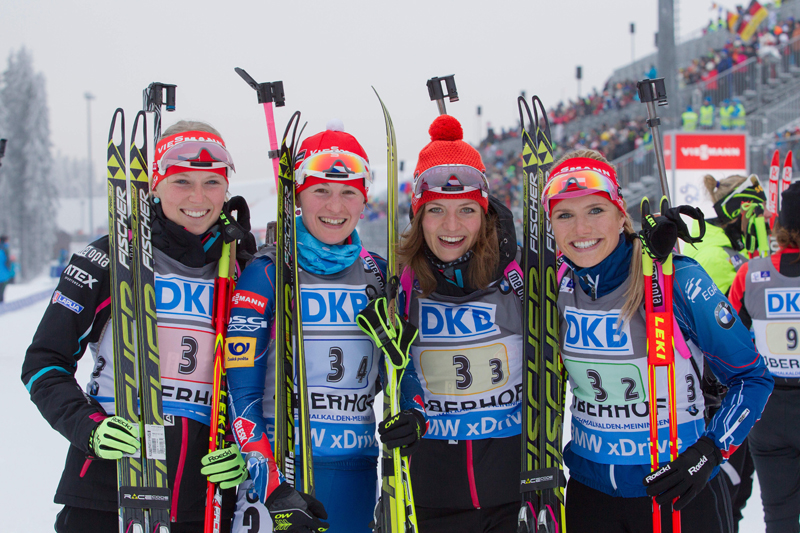
    The Czech Republic posted the most consistent performances of the day and clinched the women's relay win with anchor Veronika Vitkova (second from l) at Wednesday's IBU World Cup in Obehof, Germany. From left to right: Eva Puskarcikova, Vitkova, Jitka Landova, and Gabriela Soukalova. (Photo: Fischer/NordicFocus)
    The Czech Republic posted the most consistent performances of the day and clinched the women’s relay win with anchor Veronika Vitkova (second from l) at Wednesday’s IBU World Cup in Obehof, Germany. From left to right: Eva Puskarcikova, Vitkova, Jitka Landova, and Gabriela Soukalova. (Photo: Fischer/NordicFocus)

    The women’s International Biathlon Union (IBU) World Cup resumed in Oberhof, Germany, on Wednesday with the women’s 4 x 6-kilometer relay. Twenty centimeters of fresh snow made for difficult skiing on a foggy, warmer day than in training on Tuesday, and on top of that, Oberhof is known as a notoriously hard shooting venue. The large-climb profile of Oberhof and a long, flat section leading into the range contrasts that of several other World Cup stops.

    The leading positions changed several times throughout the race, with early leaders Russia and Finland falling out of contention with two many penalty loops apiece.

    The eventual winners, the Czech Republic, with Eva Puskarcikova, Gabriela Soukalova, Jitka Landova, and Veronika Vitkova, used seven spares to claim the victory, one less than runner-up France (with Marine Bolliet, Marie Dorin Habert, Justine Braisaz, and Anais Bescond), which used eight. The Czech team was consistent throughout the day with none of its athletes skiing significantly quicker or slower than the others, which put them on pace for the win in 1:16:56, 8.6 seconds ahead of France.
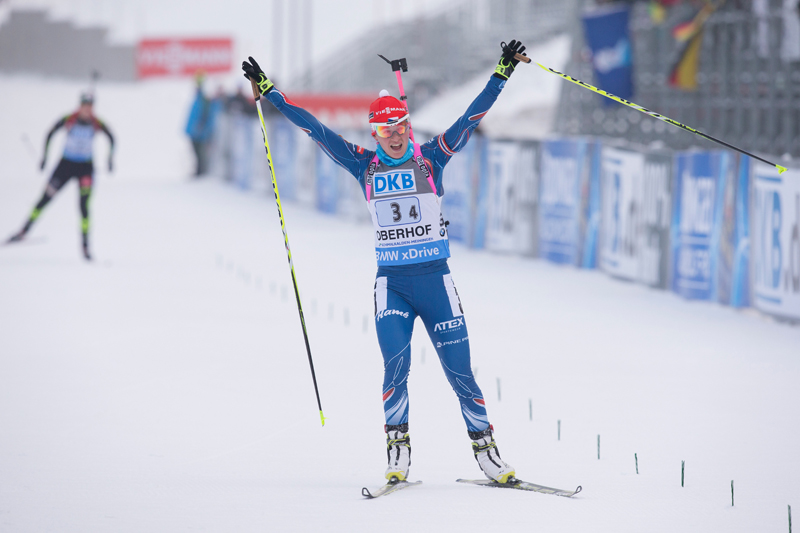
    Veronika Vitkova clinches the nearly-nine-second win for the Czech Republic on Wednesday in the women's 4 x 6 k relay at the IBU World Cup in Oberhof, Germany. (Photo: Fischer/NordicFocus)
    Veronika Vitkova clinches the nearly-nine-second win for the Czech Republic on Wednesday in the women’s 4 x 6 k relay at the IBU World Cup in Oberhof, Germany. (Photo: Fischer/NordicFocus)

    Sixth after the first leg with Puskarcikova, who used just one spare, Soukalova skied the team to third with a single spare as well, Landova brought them one step closer in second with two spares, and Vitkova used three spares to seal the win.

    “The final shooting was quite hard as I was nervous; but I really wanted to win,” Vitkova told the IBU.

    “I was not sure about my shape for the first race after Christmas,” Soukalova said. “Early in the race, I had a lot of energy but on the last loop, I was so tired; I just wanted to see the finish line.”

    During the third leg, it seemed Ukraine, the Olympic relay champions, had a strong hold on the first position with Olga Abramova maintaining their lead until the final exchange. The Czech Republic followed came through the exchange in second, 8.3 seconds back, followed by France, 11.9 behind Ukraine.

    Vitkova led into the first prone stage and cleaned with six shots, but France’s anchor Anais Bescond cleaned quickly as well to chase her out of the stadium. Ukraine’s Iryna Varvynets used one spare to leave the range in third, followed by Norway’s Tiril Eckhoff, who also used one spare and headed out on her second lap in fourth, 34 seconds after Vitkova.

    In the final standing, both Vitkova and Bescond used two spare rounds to leave the range together Eckhoff suffered a penalty lap, while Varvynets missed just one to chase the leaders from 37 seconds behind in third. However, she slowed on her last lap and was overtaken by three women — Darya Domracheva of Belarus, Eckhoff, and Italy’s Karin Oberhofer respectively — to finish sixth for Ukraine.

    At the front of the race, Vitkova pulled away from Bescond with about 2 k remaining to the finish, and secured the win by nearly nine seconds. Domracheva brought Belarus from 10th to third, passing Varvynets in the final 500 meters.
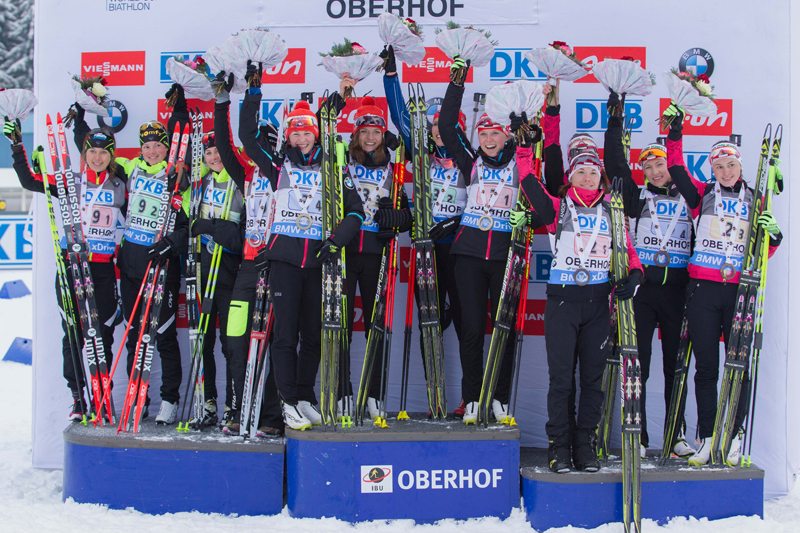
    The IBU World Cup women's relay podium on Wednesday in Oberhof, Germany: with France in second (l), the Czech Republic in first (c), and Belarus in third. (Photo: Fischer/NordicFocus)
    The IBU World Cup women’s relay podium on Wednesday in Oberhof, Germany: with France in second (l), the Czech Republic in first (c), and Belarus in third. (Photo: Fischer/NordicFocus)

    France welcomed back Marie Dorin Habert to her first World Cup race since giving birth to her first child this summer.

    “I have only had two national races before this; I did not expect my form to be so good,” she said in a press conference following relay.

    France’s second skier, Habert used a single spare to bring her team back within less than a second of the leading Ukrainian team, which had perfect shooting from its first two skiers, Anastasiya Merkushyna and Valj Semerenko.

    Darya Domracheva had the biggest individual leg of the day, lifting Belarus to the podium after Nadzeya Pisareva’s penalty on the third leg put the team in 10th. Domracheva used two spares and skied the fastest course time on the last leg to close 38 seconds and place third overall, 1:06.8 behind the winners.

    Norway saved their strongest woman for last. With her team in fifth, Eckhoff took over with an aggressive start to her race. Coming into the standing shooting, Eckhoff was within range of the leaders, but fighting the wind, she used her three spares and still incurred a penalty loop. Eckhoff skied a strong final lap, passing Italy and Ukraine, but was unable to hold onto Domracheva. Norway took fourth, 1:12.7 behind the Czech Republic.

    Italy led early in the first leg with Dorothea Wierer, who shot clean, but dropped to seventh with second-leg Lisa Vittozzi and remained in seventh, and finally fifth. After catching Varvynets coming into the stadium, Oberhofer could not hold off Eckhoff and dropped to fifth, 1 second behind Norway and 1:13.7 after the winners. Ukraine was another 5.3 seconds back in sixth.

    Canada, the lone North American women’s relay, put themselves in the mix in early on with Megan Heinicke, who had perfect shooting and the ninth-fastest course time of the first leg. She tagged teammate Julia Ransom in fifth, 8.8 seconds behind the leaders.

    Ransom skied with a quick tempo in the warm-and-slushy conditions, and held onto the leaders for her first lap. Ransom needed just one spare in standing to hit her 10 targets and complete her leg, tagging Emma Lunder in 10th.

    “Megan rocked the first lap!” Ransom wrote in an email. “Shooting felt solid out there and the first ski lap was filled with adrenaline and excitement. Flying out [to Oberhof] only a few days ago, I still felt the effects of jet lag and died a little on the other two laps. However I am confident that the body will be back in form for the sprint.”

    Nearly 1:50 behind the leaders, Lunder was troubled by a change in wind since her pre-race zero and skied two penalty laps after prone. She used three more spares in standing, for a total of six, and tagged Zina Kocher in 16th, nearly five minutes back.

    In an email, Lunder explained these mistakes only motivated her to perform better in Friday’s sprint.

    “I like the course, I feel strong, and with a bit of extra focus on the range in training tomorrow, I’m certain I can perform to my potential,” she wrote, adding that the slushy conditions and the difficult climbs suit her strengths.

    The team’s veteran, Kocher, used six spares (three in each stage) before being lapped on the final loop and taken out of the race.

    “I had to focus on doing my job and make the best of it,” she explained in an email.

    Three of the Canadian women flew into Oberhof on Monday night, and Kocher explained that jet lag after the holidays could have been a factor in their performance.

    “Today’s relay was just a blip in the scheme of things,” Ransom wrote. “It’s incredibly hard to get four people to be ‘on’ all at the same time and it just didn’t happen for us. But now that the cobwebs are out, I believe that all of us ladies will have some great performances coming up.”

    The men’s 4 x 7.5 k relay takes place in Oberhof on Thursday at 14:15 CET.

    Results

  • Blink Festival Concludes with Mass Starts and Sprints; Bailey and Burke Deliver for U.S.

    Blink Festival Concludes with Mass Starts and Sprints; Bailey and Burke Deliver for U.S.

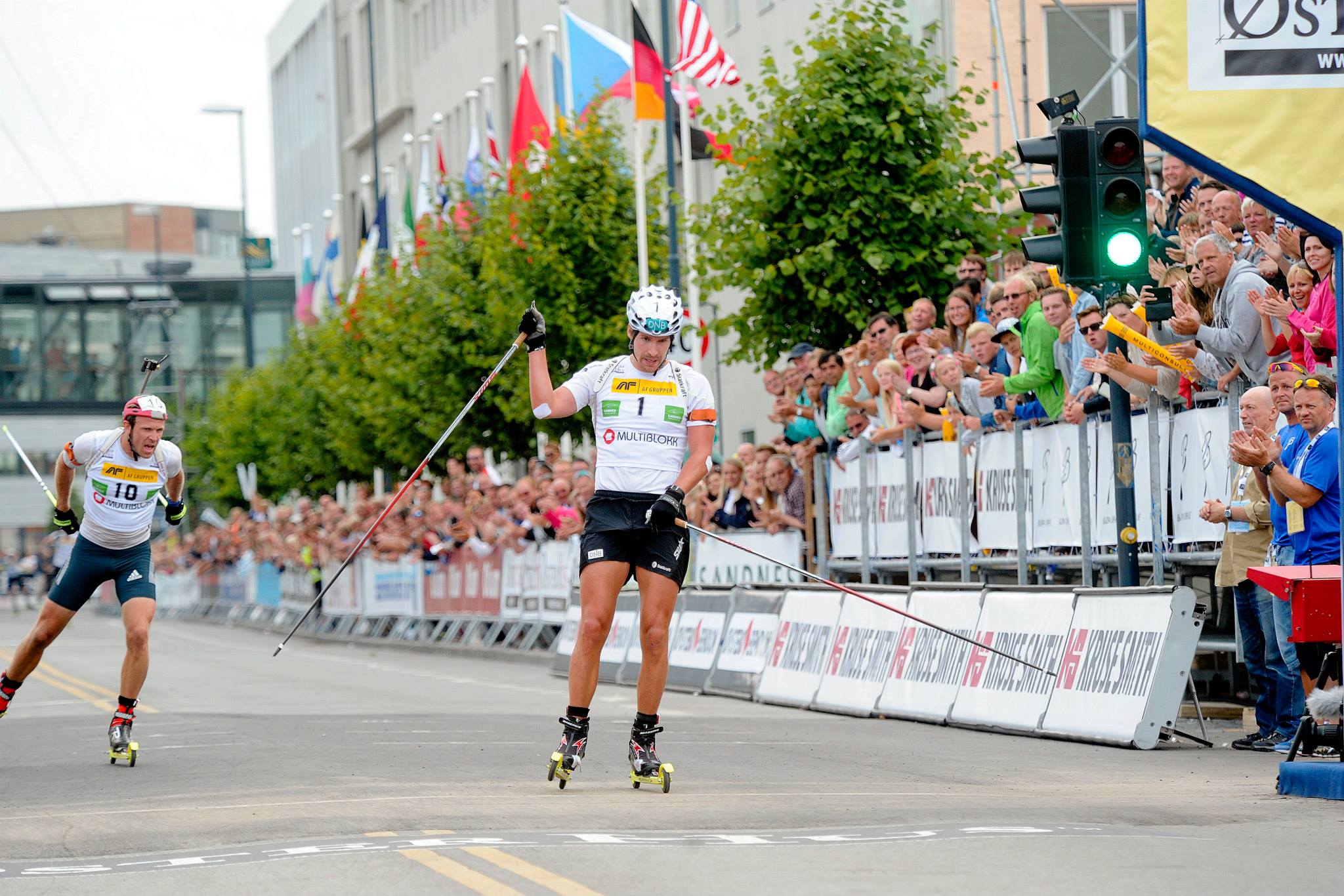
    Lowell Bailey (r) pushes himself across the finish line in Friday's biathlon 6.3 k mass start as part of the 2014 Blink Festival. Bailey finished second behind Emil Hegle Svedson (l) of Norway. (Photo: Skifestivalen Blink/Facebook)
    U.S. Biathlon’s Lowell Bailey (l) pushes himself across the finish line in Friday’s biathlon 6.3 k mass start as part of the 2014 Blink Festival. Bailey finished second to Emil Hegle Svedsen (r) of Norway. (Photo: Skifestivalen Blink/Facebook)

    When Lowell Bailey raced in the 2014 Blink Festival 7-kilometer hill climb just days after arriving in Norway, he was jolted by a “shock to the system,” he wrote in an email.

    Apparently the shock was what he needed to deliver a top-notch performance, as the U.S. biathlete finished second in the biathlon mass start the next day in the city of Sandnes.

    The road to the podium wasn’t an easy one. To participate in the mass start, competitors who were not already pre-qualified needed to place in the top six in the qualification round. The round consisted of five laps of 800 meters with prone shooting following the second lap and standing following the fourth.

    In a tough field, Bailey and U.S. teammate Tim Burke claimed the last two spots in the mass start by taking fifth and sixth.

    Once in the mass start, Bailey knew he had to focus on his shooting if he wanted to have any hopes of placing on the podium.

    “I told myself before the race that I was going to race my own race and try not to get caught up in the hurried shooting situations that always happen in this type of race,” Bailey wrote.

    Throughout the race, which consisted of nine laps on a 700-meter loop, and two prone and two standing stages, Bailey often took longer to shoot but maintained contact with the lead group.

    When he exited the final shooting he was the last of the four competitors he had arrived with to leave the mats.

    However, his fellow competitors had rushed through their shots and had penalty loops to compete. Bailey had shot perfectly and left the range with a five-second lead over Norway’s Emil Hegle Svedsen.

    Svedsen ultimately caught the American in the final stretches of the race, overcoming him by just 0.7 seconds.

    Bailey was followed by Norwegian Tarjei Bø, who finished 12.9 seconds behind Svedsen.

    Burke finished eighth in the mass start, 1:09.9 back.

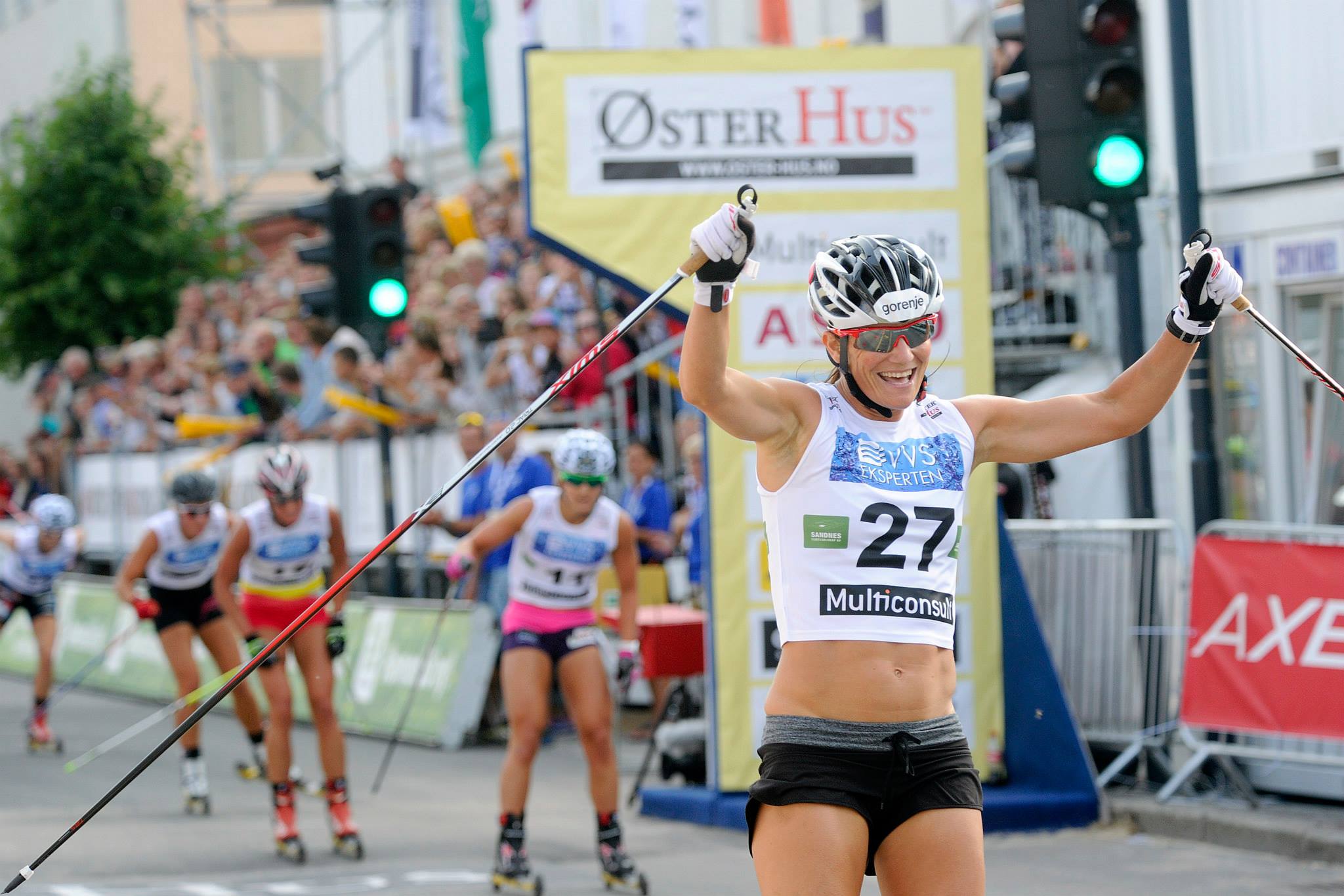
    Katja Visnar (SLO) celebrates her victory in the women's 10 k mass start in the 2014 Blink Festival. (Photo: Skifestivalen Blink/Facebook)
    Slovenia’s Katja Visnar celebrates her victory in the women’s 10 k mass start in the 2014 Blink Festival. (Photo: Skifestivalen Blink/Facebook)

    In the women’s 6.3 k mass start Fanny Wele-Strand Horn of Norway was victorious with a time of 14:10.8. She was followed by Kaisa Makarainen of Finland and Marine Bolliet of France in second and third.

    American Susan Dunklee finished in eighth, 41.8 seconds behind Horn. Dunklee was one of five athletes who had pre-qualified for the mass start, but struggled with her shooting in the final.

    “Unfortunately I missed a lot of prone targets early in the final and despite passing a few people on skis, I never regained contact with the main pack,” Dunklee wrote in an email.

    The cross-country mass start races that took place later that day consisted of women’s 10 k and a men’s 15 k.

    In the men’s race, Teodor Peterson of Sweden claimed victory for the second day in a row on the rollerski course that consisted of 18 laps around an 800-meter loop. The sprint specialist finished with a time of 28:07.3. He was followed by Norwegian Øystein Pettersen in second and Cyril Gaillard in third.

    The men’s field was incredibly close with the top-23 finishers crossing the line within ten seconds of Peterson.

    Canadian Devon Kershaw was one such finisher. He placed seventh, just 3.7 seconds behind the Swede and 1.4 seconds off the podium.

    In an email, Kershaw explained that the curvy course and the 30 aggressive racers that populated it made for conditions he was not used to, but he was happy with how the day ended.

    “I was out of position near the end and with all the curves there was nothing I could do,” Kershaw wrote. “It was a fun evening though!”

    In the women’s 10 mass start, another sprint-specialist took the win. Slovena’s Katja Visnar finished with a time of 20:36.0. She was followed by German sprinter Denise Herrmann in second and Norway’s Ingvild Flugstad Østberg in third.

    American Liz Stephen finished 18th. In an email, she declared the race a success in that there were no major crashes.

    “It was good for my head in that I need to be less nervous about skiing in a pack close to other skiers, and after today snow seems like it should be no problem at all,” she wrote.

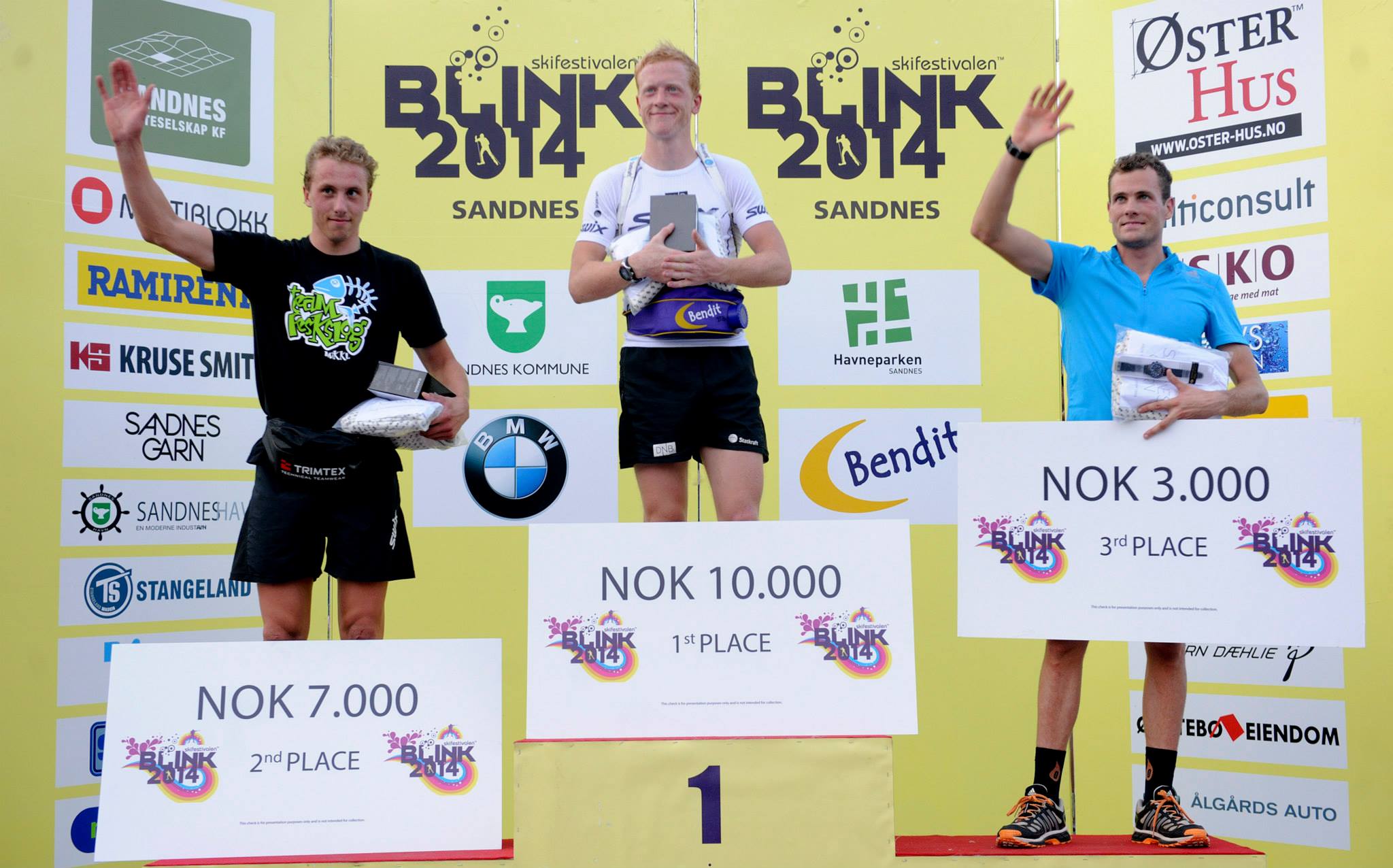
    Tim Burke (l) stands on the podium of the men's biathlon sprint Saturday at the 2014 Blink Festival. Burke finished third, completing a successful weekend for the Americans in attendance at the festival. (Photo: Skifestivalen Blink/Facebook)
    Tim Burke (r) stands on the podium of the men’s biathlon sprint Saturday at the 2014 Blink Festival. Burke finished third, completing a successful weekend for the Americans in attendance at the festival. (Photo: Skifestivalen Blink/Facebook)

    Sprint Day

    U.S. biathletes also shined in the final day of the Blink Festival with Burke and Bailey claiming third and sixth, respectively, in the biathlon sprint.

    Burke finished 8.7 seconds behind race winner Johannes Thingness Bø of Norway, who won the final in 12:25.8. Second place went to fellow Norwegian Marius Hol who crossed the line 7.4 seconds behind Bø.

    After struggling with his shooting in the mass start competition, Burke was pleased to have a strong result.
    “This was a good confirmation for me that I am headed in the right direction for the winter season,” he wrote.
    It was the first time the 32-year-old American had ever competed in heats for a biathlon race, which he found both unique and challenging.
    “I would say the shooting in this type of race is actually harder than a normal biathlon race because you are basically sprinting all out for 1 k before each shooting stage,” he wrote.

    Bailey finished sixth, 22.7 seconds behind the winner.

    In the women’s biathlon sprint, Dunklee placed sixth in her semifinal and did not advance to the final. The women’s biathlon final was won by was won by Bolliet, who was followed by French teammates Enora Latuilliere and Anais Chevalier in second and third, respectively.

    In the cross-country sprints, Norway’s Marit Bjørgen topped the women’s final. She edged teammate Maiken Caspersen Falla for the win by just 0.1 seconds. Visnar placed third, 1.1 seconds behind Bjørgen.

    Stephen was unable to advance from the quarterfinals.

    Sondre Turvoll Fossli of Norway won the men’s final in 3:08.1. He was followed by another Norwegian Martin Hammer in second and Sweden’s Peterson in third.

    2014 Blink Festival Results

    Friday’s mass starts: Men’s biathlon | women’s biathlon | men’s cross-country | women’s cross-country

    Saturday’s sprints: Men’s biathlon | women’s biathlon | men’s cross-country | women’s cross-country 

  • U.S. Ski Team Women and Men Among the Masses at Alaska Training Camp

    U.S. Ski Team Women and Men Among the Masses at Alaska Training Camp

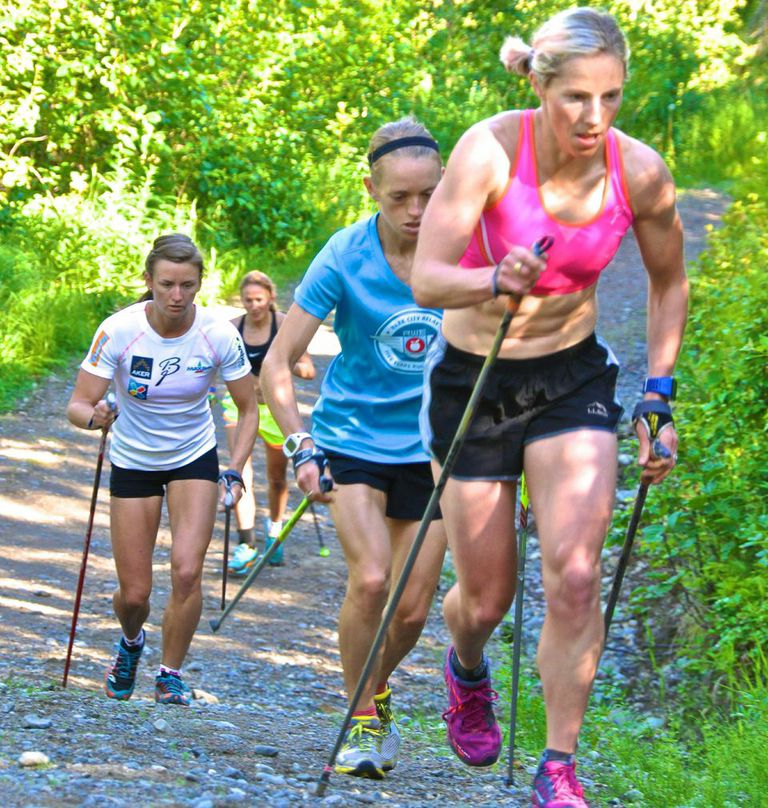
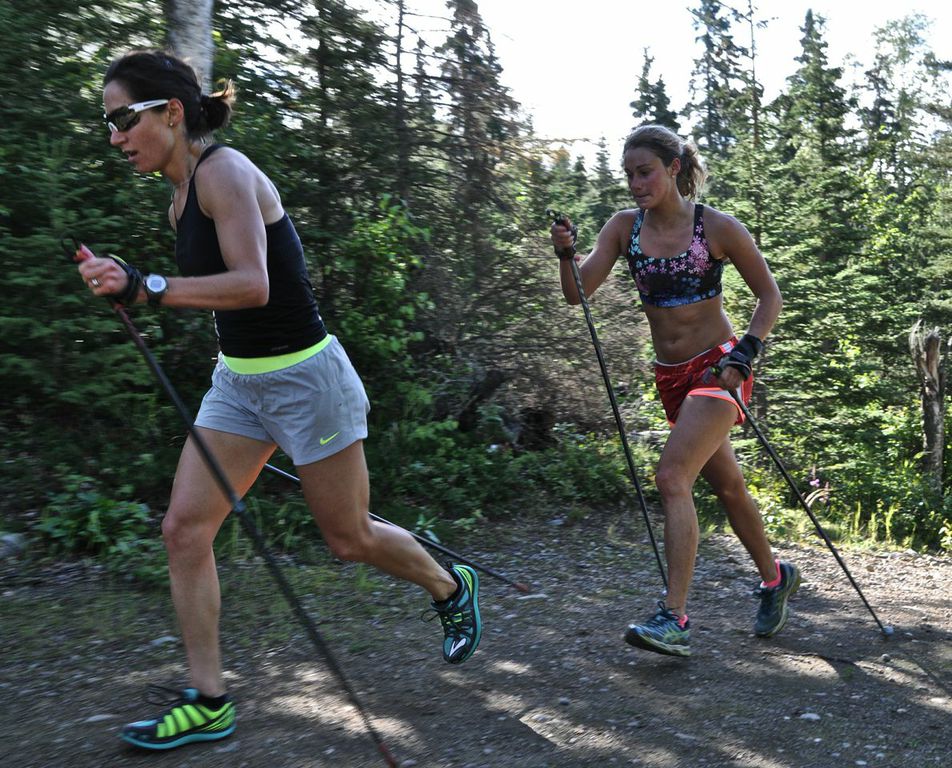
    Alaska Pacific University's Kikkan Randall (r) leads fellow U.S. Ski Team member Liz Stephen and Norway's Celine Brun-Lie (l) during a dryland session last week in Anchorage, Alaska, part of the North American Women's Training Alliance. (Photo: Matt Whitcomb)
    Alaska Pacific University’s Kikkan Randall (r) leads fellow U.S. Ski Team member Liz Stephen and Norway’s Celine Brun-Lie (l) during a dryland session last week in Anchorage, Alaska, part of the North American Women’s Training Alliance. (Photo: Matt Whitcomb)

    Watch out Dachstein, Stelvio and Oberhof — there’s a new summer hotspot for nordic skiers in the Northern Hemisphere, and for Americans, it doesn’t require a passport.

    While Eagle Glacier has been around since the Little Ice Age hundreds upon hundreds of years ago, its Thomas Training Center — contracted to the Alaska Pacific University (APU) nordic team — has only been around since the late 1990s.

    According to the U.S. Forest Service, it was created to help American nordic skiers reach international success. Build it and they will come.

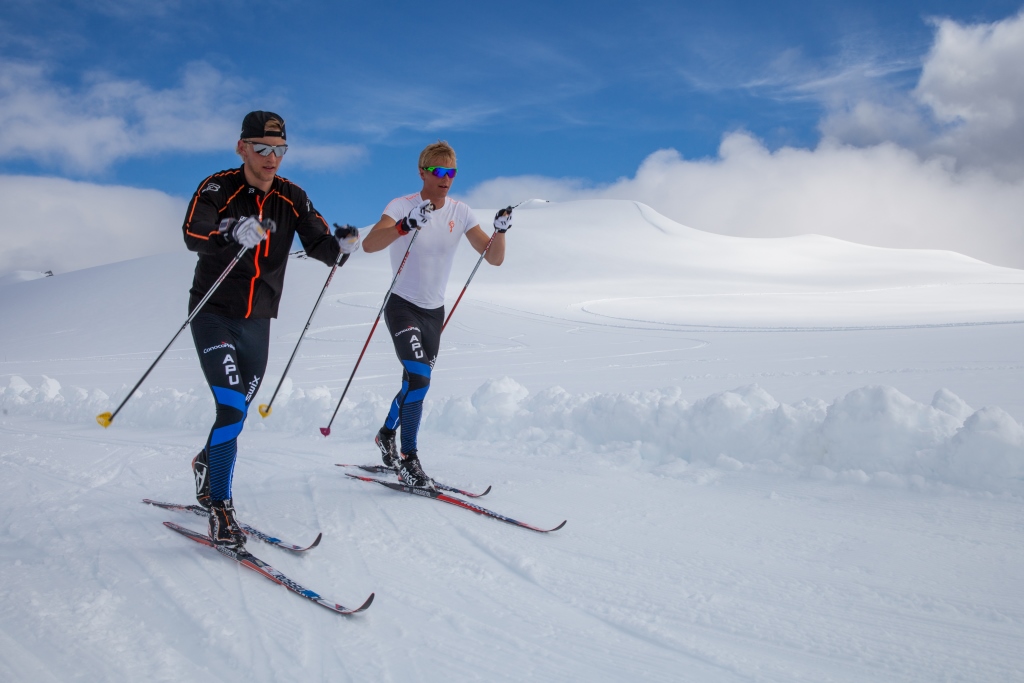
    APU teammates Eric Packer (l) and Erik Bjornsen enjoy a clear day for training on Eagle Glacier near Girdwood, Alaska. (Photo: http://blogs.fasterskier.com/reesehanneman/)
    APU teammates Eric Packer (l) and Erik Bjornsen enjoy a clear day for training on Eagle Glacier near Girdwood, Alaska. (Photo: Reese Hanneman)

    At a given time, APU can put about 20 athletes on the glacier for each of its weeklong camps. There, at 5,500 feet and a 10-minute helicopter ride above sea level, skiers can log quality volume training amounting to several hours a day on snow. And they can get a taste of what the 2015 World Championships courses in Falun, Sweden, will be like.

    Just like last year, when APU put hours of GPS-mapping and grooming in to mimic the Sochi Olympic courses on Eagle Glacier, they’ve done it again — and APU Head Coach Erik Flora likes this loop better.

    “I think this is the best course we’ve ever built,” he said on the phone from Anchorage last week. “Sochi was interesting: one long time out of the bottom and that takes a lot out of the course. … There’s no less climb in this course, but it’s broken up a little bit. We probably spent eight to ten hours with the PistenBully mapping out the course in the snow.”

    That involved Flora and his team of coaches and wax techs (Dylan Watts, Don Haering, and Michael Matteson) making countless tracks and turns with the groomer, then getting out to ski them to see how each flows. They used a GPS to check their distance and measure grade.

    “The best part about it is when you get it in the snow and you get your camps up there and you see the changes,” Flora said.

    While APU hosts several of its own exclusive camps on its backyard glacier each spring, summer and fall, it’s also opened it up to other groups of elite skiers.

    “I think that’s the biggest change that I’ve seen,” Flora said, reflecting on his six years as APU’s nordic director. “We do have a team, but we also have an open door for anyone to come out and train with us.”

    Sun Valley's Chelsea Holmes (l) and Jessica Yeaton, who recently graduated from Montana State University and is now skiing for Australia, during a training run with the North American Women's Training Alliance in Anchorage, Alaska. (Photo: Matt Whitcomb)
    Sun Valley’s Chelsea Holmes (l) and Jessica Yeaton, who recently graduated from Montana State University and is now skiing for Australia, during a training run with the North American Women’s Training Alliance in Anchorage, Alaska. (Photo: Matt Whitcomb)

    From July 6-20, APU is hosting the North American Women’s Training Alliance (NAWTA): 13 women from across the U.S. and one Norwegian.

    In addition to the five U.S. Ski Team women (Sadie Bjornsen, Sophie Caldwell, Jessie Diggins, Kikkan Randall, and Liz Stephen), Norway’s Celine Brun-Lie joined the two-week camp as NAWTA’s international guest. Last year, they hosted Astrid Jacobsen.

    Then there’s two-time Olympian Holly Brooks and her APU teammates (in addition to Bjornsen and Randall) Rosie Brennan, Rosie Frankowski, Becca Rorabaugh, and Lauren Fritz. Erika Flowers (Stratton Mountain School T2), Chelsea Holmes (Sun Valley Gold Team) and Caitlin Gregg (Team Gregg) are also up on the glacier with the select training group.

    Three French biathletes — one of which recently retired — have also been in Anchorage training with these women, along with Stephanie Kirk, an APU training partner and University of Vermont skier, and Jessica Yeaton of Australia.

    Marie-Laure Brunet, who announced her retirement early last month, stayed with APU in May, along with Marine Bolliet, a current French biathlon national team member, who trained with the team in late May and June. Bolliet stuck around for one dryland day with the U.S. Ski Team (USST) last week before flying back for another camp in France.

    The two women came to town to visit their former teammate Marine Dusser, a current University of Alaska-Anchorage skier and Erik Bjornsen’s girlfriend.

    Sadie Bjornsen explained that having them around made for a “mini-France” up in Alaska, which she welcomed because “there is always something to learn from other athletes of other countries,” she wrote in an email. “We have had lots of time to talk about the way we train, how we approach training, and how we keep things fresh.”

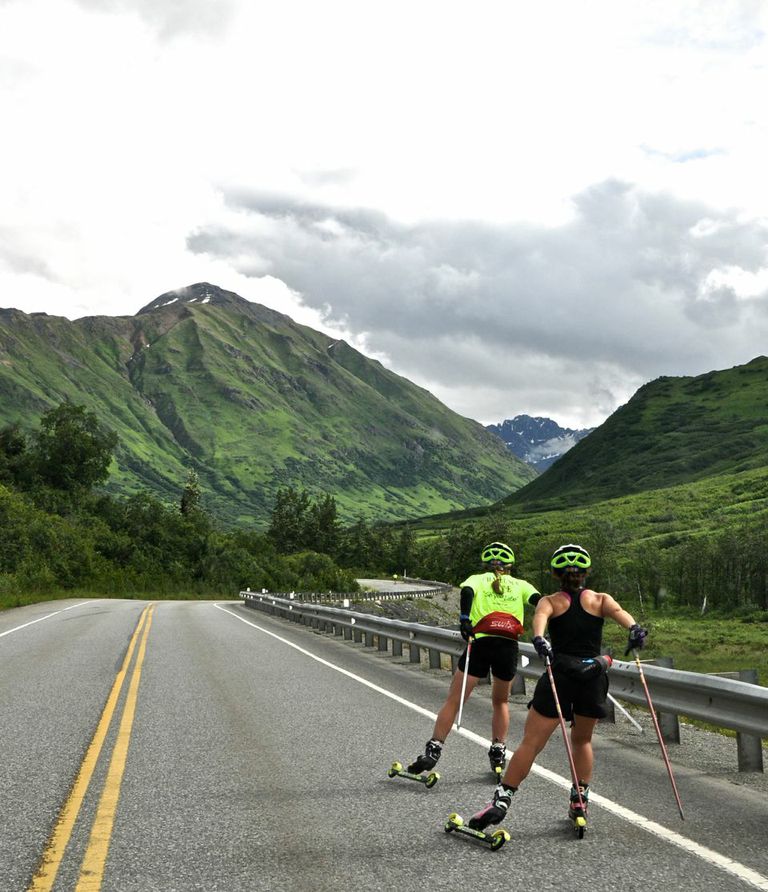
    Two members of the North American Women's Training Alliance during a skate rollerski near Anchorage, Alaska. (Photo: Matt Whitcomb)
    Two members of the North American Women’s Training Alliance during a skate rollerski last week near Anchorage, Alaska. (Photo: Matt Whitcomb)

    Last Monday, the 14 women with the fourth-annual NAWTA started their Alaska camp with a week of dryland and rollerski training in places like Kincaid Park in Anchorage. And with people like Bolliet, Dusser, Kirk, Yeaton, and up to 70 others training with them on certain days, one would be hard pressed to find that many rollerskiers in one place anywhere else in the world right now.

    That scene left Flora talking excitedly about the rising interest in Anchorage as a training hub. He’d seen 40 athletes rollerskiing along Kincaid’s hillside before, but 70?

    “That’s by far the largest,” he said. “It’s becoming like a training center. On any given day you can have someone pop out that was a former World Cup medalist and … and having Celine with us, it’s the same thing. She joined us for our APU strength [session] the other night. She joined like it was just like her training club.”

    The U.S. women’s team invited Brun-Lie to the camp, as it had with past guests, including Finland’s Aino-Kaisa Saarinen and Canada’s Perianne Jones and Chandra Crawford.

    “She’s been a friend of our team for a couple years now so we knew what we’d be getting when she decided she’d like to join us,” USST women’s coach Matt Whitcomb explained of Brun-Lie in an email. “She’s about as nice as they come and brings with her not just World Cup podium experience, but some of the smoothest technique on the World Cup. She rides a ski like Sophie and brings a ton to our group. Norway is lucky to have her on their team. We’ll do our best to send her home a bit faster as well.”

    U.S. Men Arrive

    And while his women’s team transitioned from dryland intensity to on-snow training on Eagle Glacier this past weekend, the U.S. men’s team started camp in Anchorage today for the first time as a unified group (Noah Hoffman had trained there previously, along with APU’s Erik Bjornsen). They’ll head up to the glacier next week.

    The men’s training group includes 14 athletes as well, five of which are on the USST: Hoffman, Andy Newell, Simi Hamilton, Bjornsen, and Ben Saxton. APU skiers Reese Hanneman, David Norris, Lex Treinen, Tyler Kornfield, Eric Packer, and Scott Patterson were also invited, along with APU training partners Tucker McCrerey and Kyle Bratrud, and Brian Gregg (Team Gregg).

    As for the goals of this men’s camp (led USST Head Coach Chris Grover and assisted by USST coach Jason Cork, Flora, and Matteson), Grover wrote that they’re shooting for “high-quality training” in the form of four to five intensity sessions while in Anchorage, “followed by some of the biggest volume of the season on-snow on Eagle Glacier.”

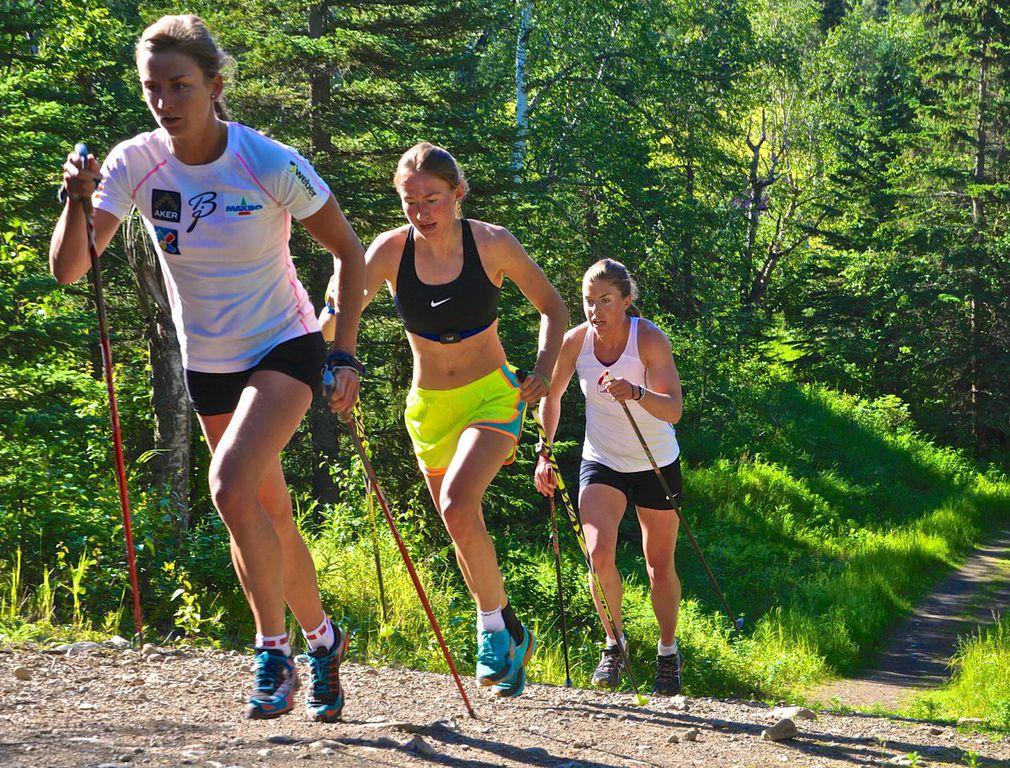
    Celine Brun-Lie (l) leads Sophie Caldwell (c) and Rosie Brennan during a dryland session last week in Anchorage, Alaska, part of the North American Women's Training Alliance. (Photo: Matt Whitcomb)
    Celine Brun-Lie (l) leads Sophie Caldwell (c) and Rosie Brennan during a dryland session last week in Anchorage, Alaska, part of the North American Women’s Training Alliance. (Photo: Matt Whitcomb)

    Also assisted by Cork and Flora, Whitcomb explained that the primary goal of the women’s camp “is to get the best women in the country together to train hard for fourteen days – just like the rest of our camps.”

    Specifically, they’re aiming to become “just 1 or 2% faster each season,” which is where a competitive training atmosphere comes in handy.

    “The aging model of training on your own for most of the preparation period is just not something I believe in,” Whitcomb wrote. “If you want to be stronger, you must surround yourself in strength.”

    While he acknowledged there are exceptions, they’re rare.

    “If you’re comfortable in every training session you’re either plateauing or slowing down,” he explained. “We put ourselves in vulnerable situations where failure is a real possibility.  That’s how we succeed.  It’s the training group itself that does its own coaching. The athletes receive feedback relative to the group in just about every aspect of training.”

    Week 1 and Done

    After the first week in Alaska, Whitcomb wrote that it was too early to compare the quality of training sessions compared to those in the past.

    “The volume will be high [this] week so we’ll see how training is being absorbed soon enough,” he wrote. “It becomes fairly binary by Thursday.  It is or it isn’t. Week one has been a success. Mostly because we saw that awesome bear.”

    During a run, the group spotted a grizzly bear about 300 meters ahead on a hill — well off the trail.

    “It was sleeping in a meadow and popped up its head, stood up to talk a look at us, and walked away,” Whitcomb wrote. “We were well armed with bear spray if needed.”

    Luckily, they didn’t need it, but in an unrelated incident, Diggins had to get six stitches in her knee. According to Whitcomb, she tripped on her way to a swimming hole after a long skate rollerski at Hatcher Pass.

    “She’s on the tougher side of the spectrum and had to only modify one workout by changing it from a run to a hike,” he wrote. “Her knee is stiff and a bit sore but training is still going well.”

    As for other USST injuries, doctors cleared Caldwell for full training after she sustained a minor elbow fracture at the last training camp in Bend, Ore.

    “Her range of motion has a bit more to go but I’ve been really pleased with the work she has done between camps with SMS T2,” Whitcomb explained. “Her legs are stronger and working technically better as a result of so much no pole and one pole training. She’s never really skipped a beat.”

    According to Whitcomb, Erik Bjornsen’s back injury is recovered, and Newell’s back is “much better” after he tweaked it while weightlifting.