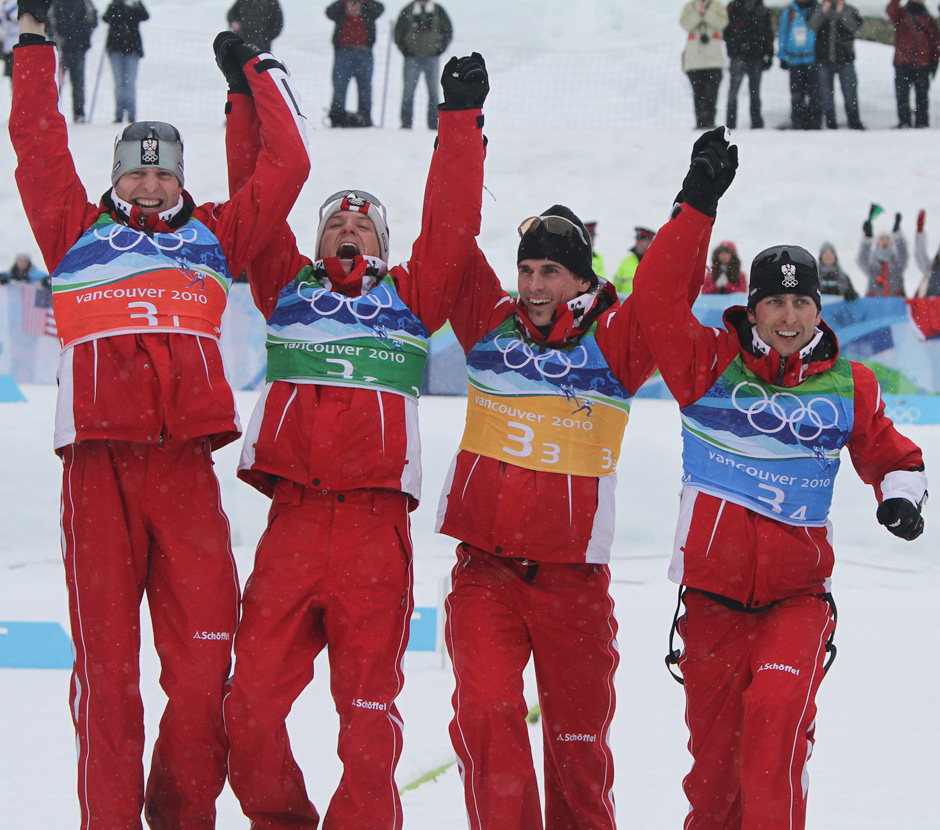
At 34, Todd Lodwick may be the old man of the U.S. nordic combined squad. But he hasn’t lost a step.
In his first World Cup event of the season, in Ramsau, Austria on Saturday, he started off with a bang by finishing fourth, just a tenth of a second off the podium.
“I’m happy to be up there where I was,” Lodwick said in a press release after the race.
Lodwick, who started 16 seconds behind the leaders after the jumps, moved quickly on the course, and in the end maintained the fourth-place position he held at the start of the cross-country. However, he was only narrowly shut out of the podium, with mere seconds separating the top finishers overall.
“It was a typical comp, where a lot of different factors play into the results. My objective today was to go out and ski my own race and see what the speed was on the World Cup,” said Lodwick.
Local favorite Mario Stecher (AUT), who was sixth after the jumping, made up 29 seconds on the course and won narrowly over Germany’s Bjoern Kircheisen. Lodwick was part of a pack that was going back and forth for the lead throughout the race, and he was in a good position coming into the final kilometer. Lodwick nearly beat Johannes Rydzek (GER), but was short by 0.1 seconds at the finish line.
Jason Lamy-Chappuis (FRA) was fifth, a full second behind Lodwick.
“It was bad tactics on my part to head into the finish stretch in fourth, but I’m still happy with my result,” Lodwick said.
Fletcher content in 23rd
Bryan Fletcher, who was 32nd after the jumping and started 1:29 behind, skied as fast as any on the tough course and finished in 27:06.9 to a strong 23rdplace overall. Fletcher’s goal for the season is to establish himself solidly in the top 30, and so far he is delivering to his promise. Conditions taken into account, Bryan Fletcher is satisfied with the race and his results.
“I am happy with my result. I felt I had a much better race than the last two weekends. Today was a bit windy, just like predicted. I didn’t have as good of a comp jump as my trial jump. However just like I thought, it was a tight race, and even with a little bit worse jump I was only a minute and 29 seconds out of the lead. I was right in the pack of skiers, and knew I could move up into the points from where I was,” Bryan Fletcher told FasterSkier.
“Tomorrow I will go out with the same mentality and try to repeat my performance today, with hopefully a little better jumping,” Fletcher said.
Decent all around
US Nordic Combined Coach Dave Jarrett is also satisfied with the crew and its performances.
“Todd and Bryan did their jobs on the hill, although Bryan has been better in training than his comp jump today. But both guys skied well, and we are happy with the race,” Jarrett told FasterSkier.
Changing winds, starting gates and jury decisions made for a challenging day for both coaches and athletes, and Jarrett added that the younger racers also delivered solid performances.
“Taylor [Fletcher] and Nick [Hendrickson] both had better races [Saturday], but were at the wrong part of the start list and became victims of the wind gods and the jury. Nick’s trial jumps was good and he knows he can do it on the World Cip. We will keep working and are looking forward to tomorrow,” Jarrett said.
Taylor Fletcher moved up to 42nd place after jumping in 59th, and Hendrickson also moved up handily, from 60th to 47th, and Eric Camerota was 59th overall. Complete results here.
Bryan Fletcher was the top American in Sunday’s nordic combined race, finishing 26th overall. He was 22nd after the jumping, and started 1:28 behind Jason Lamy Chappuis (FRA), who was leading at the beginning of the cross-country race and proceeded to win overall.
Bill Demong was 38th,climbing four spots on the trails, and Taylor Fletcher was 48th overall after finishing the jumping competition in 55th. Brett Camerota was 45th after the jumping, but did not finish the cross-country.
Lamy-Chappuis (FRA), who was second in the competition on Saturday, managed to keep Mikko Kokslien (NOR) behind him on Sunday. On the jumping hill, nobody seems to be able to beat the French bird, but so far, he has lost ground in the woods.
Sunday, Lamy-Chappuis had a 20-second lead on the next racer, and started 1:28 ahead of Kokslien. Mario Stecher (AUT) was tenth after the jumping, and skied his way into third place, only a tenth of a second behind Kokslien.
Fletcher told FasterSkier that his 18th place on day two of the World Cup season opener in Finland last weekend (his career best in a World Cup) was encouraging and exciting, but that his goal for the season is to establish himself solidly in the top 30.
Kuusamo, Finland – “It is hard not to be upset but in reality we are here with a new group of guys competing full time on World Cup. It is going to take some time to build them up to 2014,” U.S. Nordic Combined Team head coach Dave Jarrett said to FasterSkier.
Bryan Fletcher was the top American after the jumping, where he finished 35th. Taylor Fletcher was 38th after the jumping, Brett Camerotta was 40th and Bill Demong was 45th. Demong worked his way up to 32nd in the cross-country, while Taylor Fletcher advanced three spots, from 38th to 35th. Bryan Fletcher fell two spots, from 35th to 37th. All are capable of better performances, Jarrett said.
Jason Lamy Chappuis (FRA) won Friday’s World Cup opener, finishing in 28:33.5, Eric Frenzel (GER) was second (28:40.1) and Mario Stecher (AUT) was third (28:45.2).
Trying to see the silver lining in the situation, Jarrett pointed out that he has a young team that needs experience.
“The new group is ahead of Billy and Johnny’s curve for their age and need to be mixing it up on WC more often,” Jarrett said. “The Fletchers have only been in top 30 once in the winter in their careers, and today they were 35th and 37th in a full strength World Cup field. Neither competed up to their training level, and they know that,” Jarrett said, noting that the World Cup opener featured plenty of challenges. Windy jumping combined with cold temperatures made it hard for the athletes on both the hill and on the course.
“The conditions were difficult on the hill and you needed to be mentally tough and just go for it. It is going to take time. If they can consistently be in the points, working their way up, we will be satisfied,” Jarrett said.
For Billy Demong, the result list from the first World Cup tells only part of the story, Jarrett said.
“Billy is a bit off, but is closer than today showed. He is looking forward to tomorrow and [next week’s] competitions in Lillehammer, too.”
Camerotta did not start the cross-country after finishing 40th in the jumping. He has his work cut out for him in the coming weeks.
“Brett is struggling on this hill, but knows he needs to be better on the hill to start the race,” Jarrett said.
Overall, the results from the first competition of the season leave room for improvement and simply stepping up to the task. Jarrett said he is glad to have the first race under their belt, and now the team needs to look ahead to the rest of the season.
“The results today, in both jumping and cross-country, were not where the boys are in training, but training is training and now we need to execute in the competition. It is good to get the first competition finished, and see where we are and what we need to do,” Jarrett said.
“At this point, we are here with some new talent, and we will be happy with solid performances in the points and for sure, top 20. As far as Billy goes, he has been on a good trajectory since September, and we are working towards Oslo in February. He is certainly capable of winning on any given day. His jumping is becoming more and more consistent, so we will see how it goes today,” Jarrett said.
Whistler, British Columbia – The two skiers swept around the large curve down into the stadium, Billy Demong of the USA in the lead, Austrian Mario Stecher right on his heels, the gold medal waiting, just 200 meters away.
Stecher stepped out, tucking past Demong. There would be no sprint for the line. The gap was enough, and Austria champions. The American team, in claiming the silver, made US Nordic Combined history for the second time this Olympics. In the individual event last week, Johnny Spillane won the first US Olympic medal in the history of the sport. Today marked the first medal in the team competition.
It all started this morning on the jumping hill. Brett Camerota set the tone with an impressive leap in the first group. Todd Lodwick, who just missed a medal when he finishing 4th in the individual, raised the bar even higher. His jump would ultimately stand as the second-best on the day, as measured by total points. Spillane wasn’t far behind, and Demong was solid.
Head coach Dave Jarrett was very pleased with the jumping. “Brett and Todd, that was the farthest jump ever on that hill. Johnny was tremendously clutch. He was a little squirrely yesterday and in training today. And Bill has been solid almost every jump. It was what we needed to have happen.”
Meanwhile, the Austrians, as the only team that could match the Americans in terms of cross-country firepower, struggled on the hill. When jumping concluded, the US was in a perfect position, starting in second, just two seconds back from Finland. Austria was 36 seconds behind, France at 43 seconds, and the always-dangerous Germans 45 back.
Camerota (in red) heading out on his 2nd lap
The final running order was determined by the athletes. Said Jarrett, “as a staff, we gave them our suggestions and deferred the decision to the team, because that is what it is about.”
The key for the Americans was Camerota. With a career-best World Cup finish of 18th, the 25-year-old was the weakest link. But he jumped extremely well in the individual competition, did so again today, then quickly closed on Finland’s Janne Ryynaenen in the ski. Camerota did exactly what he had to do: ski strong, and not give up too much ground to the chasers.
With a powerful move on the final climb of the 2×2.5km course, he dropped Ryynaenen and tagged off to Lodwick in first. The chase pack however, had closed ground quickly, and six teams headed out in pursuit, all within 12 seconds of the American.
The only concern following Camerota’s leg were his skis. It was clear to observers in the stadium that they were not running as fast as his Finnish counterpart.
The packs closed on Lodwick over his first loop, but he maintained a smooth pace—despite the yell from the stadium announcer that “in just a few seconds they will all be together.”
David Kreiner (AUT) and Tino Edelmann (GER) were the only two able to bridge up to Lodwick. All three headed out for the second lap together, but Edelmann tripped himself on the climb out of the stadium, as Kreiner took the lead and accelerated with Lodwick on his heels. The two opened up a gap on the field, setting up a battle between Spillane and Austria’s Felix Gottwald, who is one of the fastest skiers on the Nordic Combined circuit in his first year back after a two-year retirement.
The two exchanged leads, pushing the pace to keep anyone else from closing. Spillane’s skis were not running well either – he was forced to skate on the gradual terrain even when drafting off Gottwald, who was riding a tuck.
Johnny Spillane leading Austria's Felx Gottwald
On the big climb before the last descent into the stadium, Gottwald dropped the hammer, and Spillane had nothing left to respond. Over the final 400 meters of the loop, Spillane lost 15 seconds—five in the stadium alone.
“We both knew that we had to make the pace [ski fast],” said Gottwald. “Johnny was doing it at the beginning…and at the beginning of the second lap I tried to do my part to hold up the pace and get some seconds [on the chasers]. On the last uphill it is just ‘go.’ It hurts for everybody, and it is no question of strategy—it is just a question to get as fast as possible to the transition.”
Demong waiting for the tag.
But US anchor Billy Demong is used to coming from behind. Even though the team event is just five kilometers, as opposed to the ten contested in the individual competitions, the American was not out of the hunt.
And it wasn’t a two-team race – Germany had battled back as top skier Bjoern Kircheisen gave chase. Demong cut Stecher’s lead in half in the first 1.7 k, while Kircheisen knocked 13 seconds out of the 25-second deficit he began with.
Demong chasing…
Entering the stadium for the lap, Demong was just 2.2 seconds behind, and wasted no time in closing the remaining gap. With the Americans and Austrians battling each other, Kircheisen struggled to come closer. He gained a few more seconds, but as the meters flashed by, it became clear that the gold would not belong to Germany.
Demong turned on the jets on the last climb – the same spot where Tim Tscharnke (GER) gapped the field in Monday’s cross-country team sprint event, and where Demong himself passed Finland’s Anssi Koivuranta for the victory in the World Cup here last year.
“I needed to be clear of Mario before we got into that final downhill to have a chance,” said Demong. “I was going into that last hill really hard thinking ‘maybe I’m getting away,’ but then I hit him with my pole right toward the top and felt him back there.”
And so the finish was set up. Demong couldn’t shake the man known as “Super Mario,” and his chances to challenge for the gold in the finish stretch were undone by slower skis.
Demong was very clear in pointing out that his skis were not bad—just not as good as the Austrian’s. “I still had the fastest time on the 4th leg, so they were obviously working pretty well. And Mario had great skis – mine may have still been average.”
But his words may have been diplomatic, as he recognized that Stecher had better boards throughout the second lap. “On the downhills, when I was leading, he was running up on me and pushing my pole. And when I was drafting, I was just keeping up.”
The Austrians gave plenty of credit to their wax techs, saying, “today our skis were awesome…it made it easier to win.”
According to Spillane, one of the issues was the new snow that fell during the race—softly at first, then heavier as the race progressed. It was classic Whistler snow – heavy and wet.
“It’s an outdoor sport, and that is part of it, but I don’t think Bill and I had very good skis once it started snowing…but that is part of the deal.”
He also attributed the 15 seconds he lost to Gottwald in part to the ski issue.
“I was feeling really great. Then on the back side of the course, where it is all flat and downhill, I should have been able to just sit behind [Gottwald] and rest, because I was right behind him. He was tucking and I was in his draft having to skate. That makes it quite a bit more difficult than it should be.”
Todd Lodwick
US coach Dave Jarrett didn’t beat around the bush.
“They are only two guys [US Nordic Combined wax techs]. Every other team has more than two guys. There is only so much we can do as a staff to be out on the course with poles and splits, and only have two guys able to wax. The cross-country guys offered to help, and we took them up on that, but it just wasn’t coordinated enough to make a difference.”
It appeared to be less an issue of wax, and more of ski choice.
Demong noted that he chose a pair of skis, regularly his fastest, that worked very well during testing. But once the wet flakes started falling, they slowed considerably. The pair had a linear structure that got clogged with the high-humidity snow.
The Austrians had one pair of skis running so well that both their 1st and 4th leg skiers used it.
“Gruber and Mario used the same pair of skis,” said Jarrett. “They obviously had a magical pair…using it twice in the same race.”
“We are far out-manned when it comes to that stuff, but you have to make do with what you have,” he added. The US team even has an additional service man working the Olympics, when on the World Cup they usually have just one.
Despite the ski issues, no one on the US squad showed any disappointment with a silver medal. The quartet was greeted at the flower ceremony by chants of “USA! USA!” and both Demong and Lodwick climbed up into the stands to hug family members.
Demong (left) and Lodwick (right) get congratulations from friends and family
“The race could have gone any way,” said Jarrett. “It was there for the taking, but you can’t be kicking yourself about a silver medal you have never won before. We are happy – the coaching staff, the service team, everybody is psyched. Of course we wanted to win, but we still got second, and that is better than 3rd…You have to take your hat off to the Austrians. They skied well and they won it.”
“Today was a real team effort,” said Demong. “This day has just been a series of really good performance by every member of our team, and I’m really really happy to…have won our first ever medal in the team event.”
Lodwick, now the veteran of five Olympics added “If you give it your all and leave everything out there and we get second, we have won second…we have dreamed of this day for a long time.”