This reporting costs money. Please support this coverage with a voluntary subscription (below) so FasterSkier can provide this level of access to the sport we all love year-round.
Tag: Marit Bjørgen
-

Johaug Runs Away With Gold in the 30-kilometer Classic; Maubet Bjornsen 15th in Final Professional Race

A clear day after Friday’s snowstorm greeted the start of the women’s 30 k classic in Oberstdorf. (Photo: NordicFocus) This World Championship coverage is made possible through the generous support of Marty and Kathy Hall and their A Hall Mark of Excellence Award. To learn more about A Hall Mark of Excellence Award or to learn how you can support FasterSkier’s coverage please contact info@fasterskier.com.
A blanket of fresh snow lay on the ground while the frozen rocky peaks of the Bavarian Alps peaked through the clouds. Finally, Oberstdorf, Germany looked like a wintery venue.
With temperatures that might feel brisk relative to the tropical heatwave earlier in the week, the women’s field took to the tracks for their final event of the 2021 World Championships: a 30-kilometer mass start classic.

The women’s 30 k closes out racing for the women at the 2021 World Champs. (Photo: NordicFocus) To set the stage for today’s race, one should first look back to the 2019 World Championships, which featured a 30 k freestyle, and the 30 k classic at last year’s Holmenkollen in Oslo, the last World Cup race to take place before the season was truncated due to the rise of the COVID-19 pandemic.
Let’s glance at the World Champs in Seefeld, Austria, where Norway’s Therese Johaug led the field through the first 5 k, then pulled away. She gapped the field by more than 30 seconds, holding her ground on her own at the front for the remainder of the race. Her teammate Ingvild Flugstad Østberg led the chasers to take second place, followed by, what was at the time a new name, Sweden’s 19-year-old Frida Karlsson, earning a bronze medal in her inaugural World Championships.
Johaug’s performance at the Holmenkollen looked to be an attempt to repeat this style of victory. She was off the front at the 20 k mark, but had not taken the opportunity to switch her skis. Working together on fresh boards were Karlsson and teammate Ebba Andersson, who steadily closed the gap to Johaug. With less than 2 k to go, Karlsson could be seen from the same camera angle, gaining ground with every kick and glide.
Inside the last kilometer, Karlsson overtook Johaug on a long climb. Despite the Norwegian’s best efforts, she could not match the speed of the Swede’s skis on the downhill and Karlsson broke away to win by just under 2 seconds.
So what would it be today?

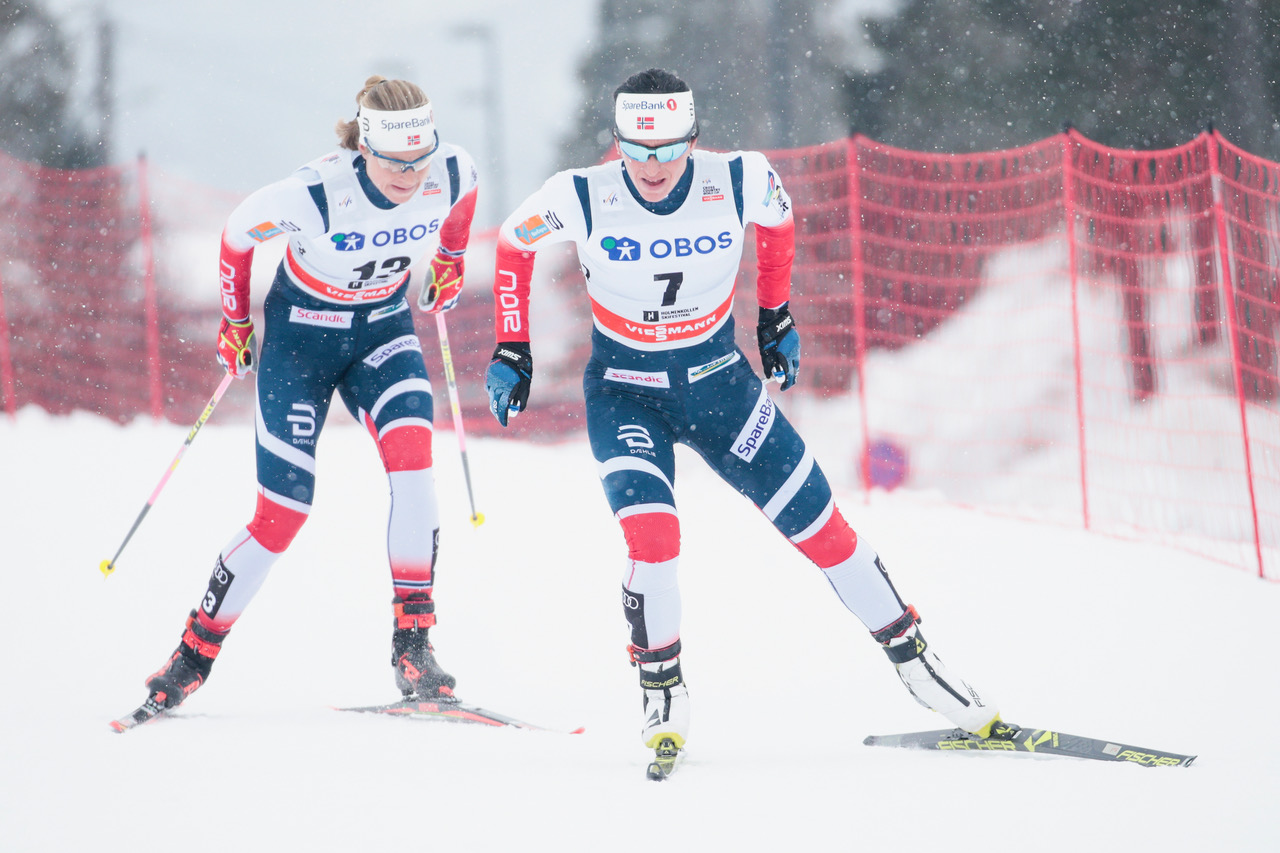
Therese Johaug on course during the World Championshp 30 k classic in Oberstdorf, Germany. (Photo: NordicFocus) Johaug’s pace from the start seemed impossible to sustain for the full duration of the event. While other women looked steady and controlled, Johaug was simply charging, her rapid breathing matched by her tempo.
By 10 k, Johaug had a lead of over 53 seconds to the first chase group, led by her teammate Heidi Weng, Andersson of Sweden, and Katharina Hennig of Germany. At the halfway mark, this lead ballooned to over 1:32. Even if impeded by subpar skis, it looked to be an insurmountable margin. Spoiler alert: it was. This left a race for silver and gold in her wake.
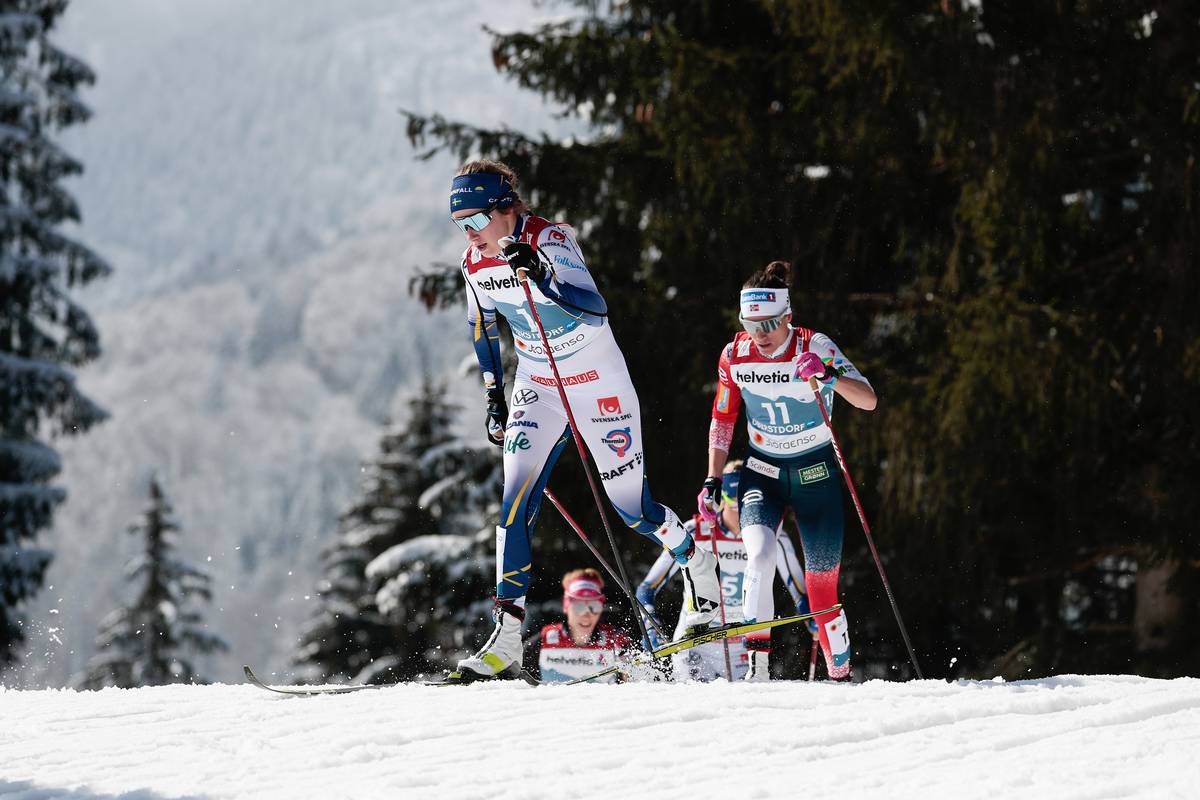
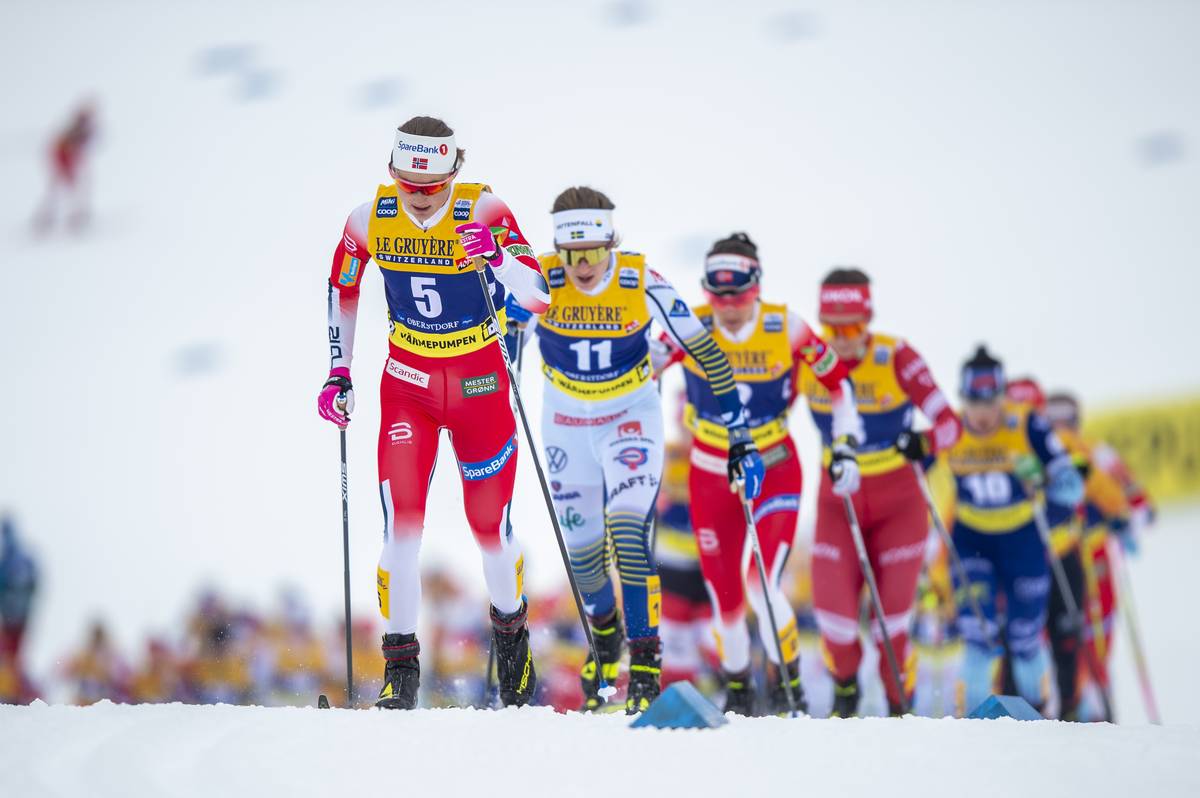
Ebba Andersson, Heidi Weng, Frida Karlsson, and Therese Stadlober – the main chasers – play for second and third place as Johaug skis off the front. (Photo: NordicFocus) A pack of five women seemed to be pulling ahead of the larger chase group that had been together from the start. At 15k it was: Andersson, Karlsson, Weng, Hennig, and Therese Stadlober of Austria.
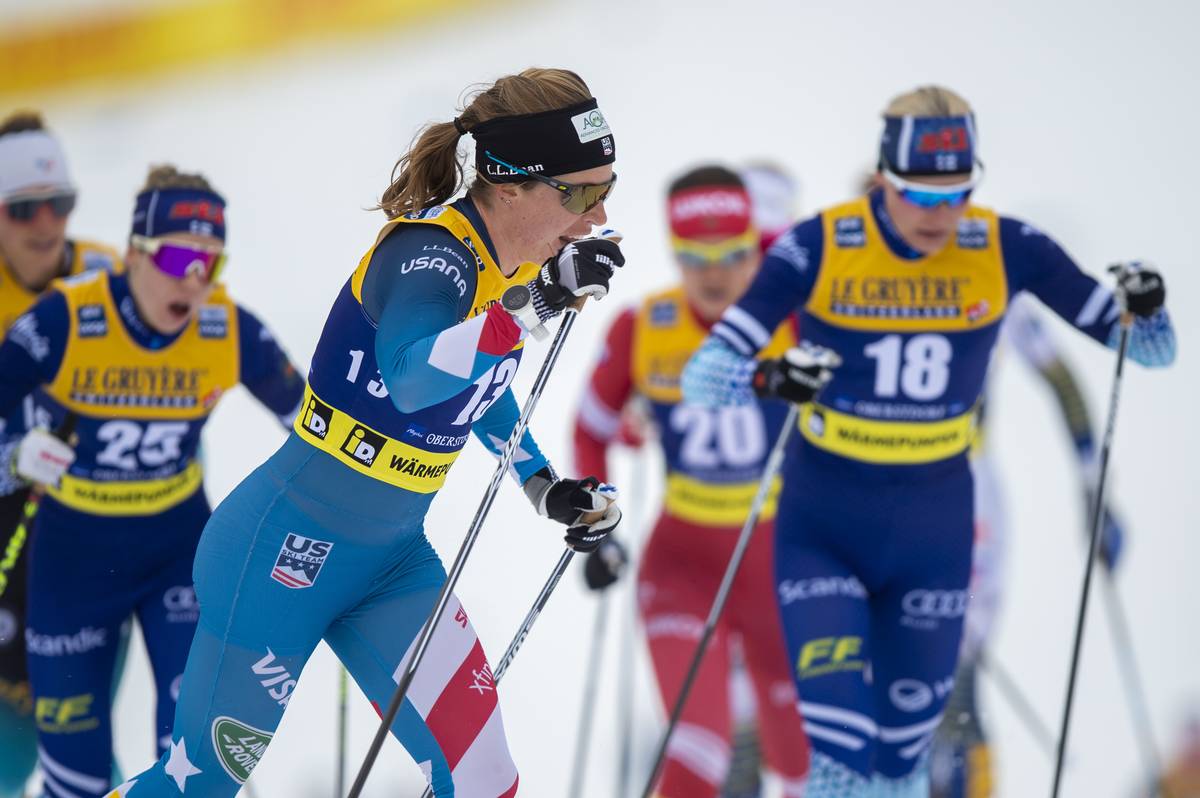
After a 15 second gap, Krista Pärmäkoski skied alone in an effort to gap up, leaving behind a second chase group that included Sadie Maubet Bjornsen in 8th, in what she announced would be the final race of her professional career.

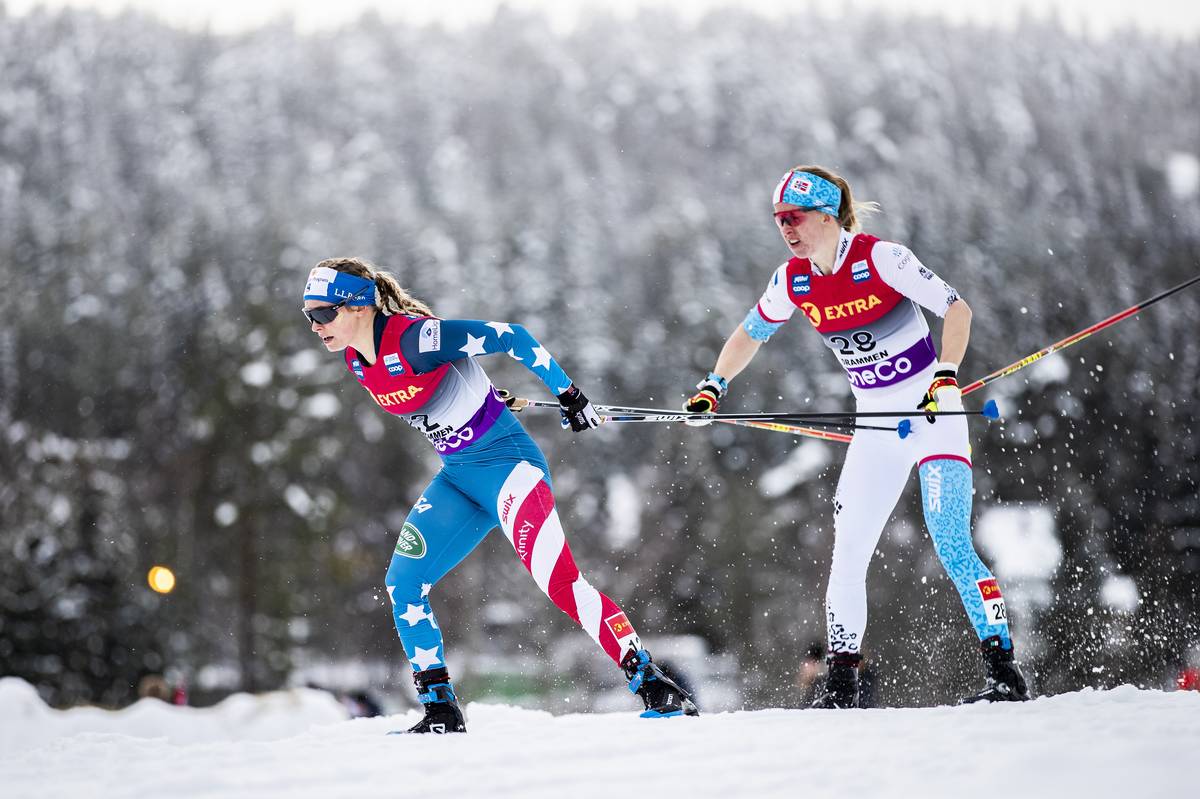
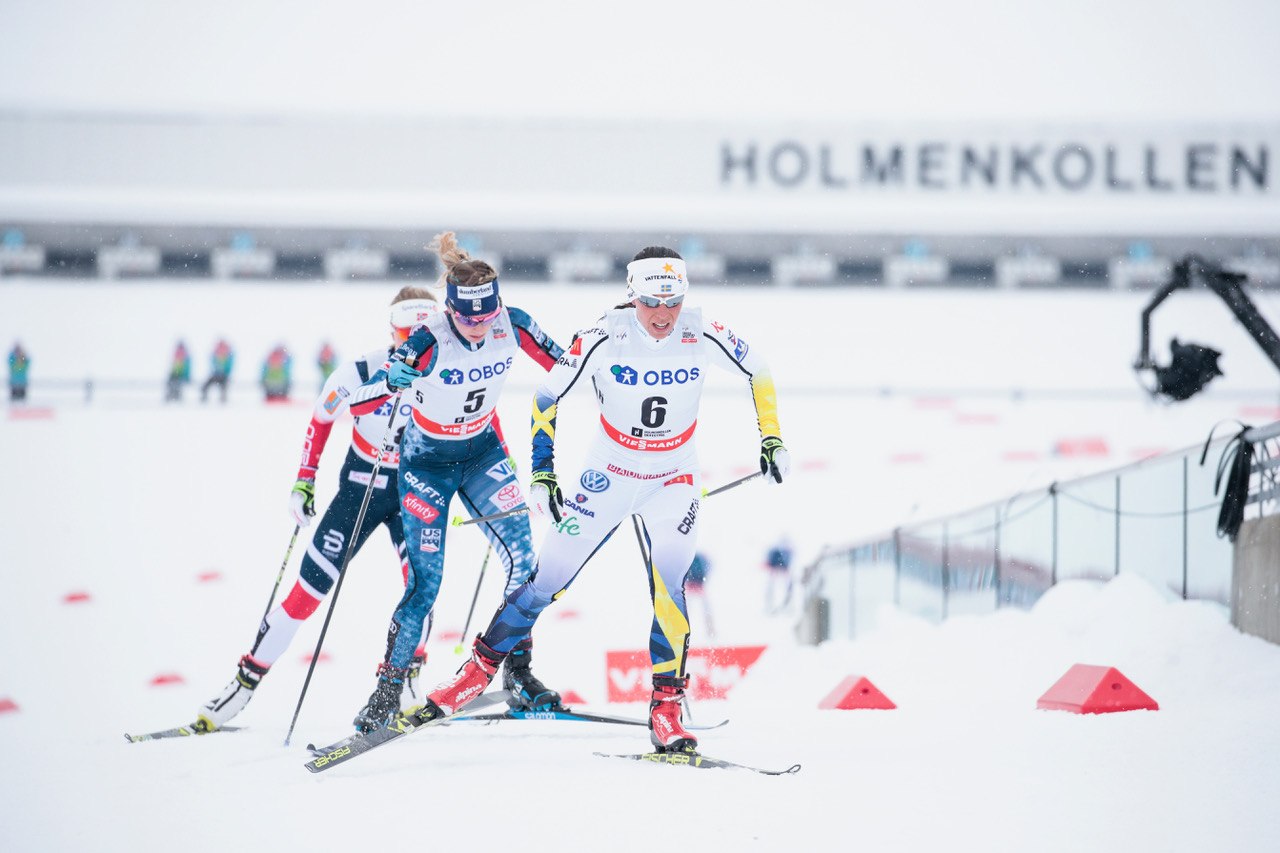
Sadie Maubet Bjornsen (USA) alongside Yana Kirpichenko (RSF), (l-r) in the 30 k classic. The race closes out Maubet Bjornsen’s international race career. (Photo: NordicFocus) At 18k Johaug smoothly switched into new boards, while the first chase pack worked their way toward the stadium in the background. Johaug’s gap was approaching two minutes.
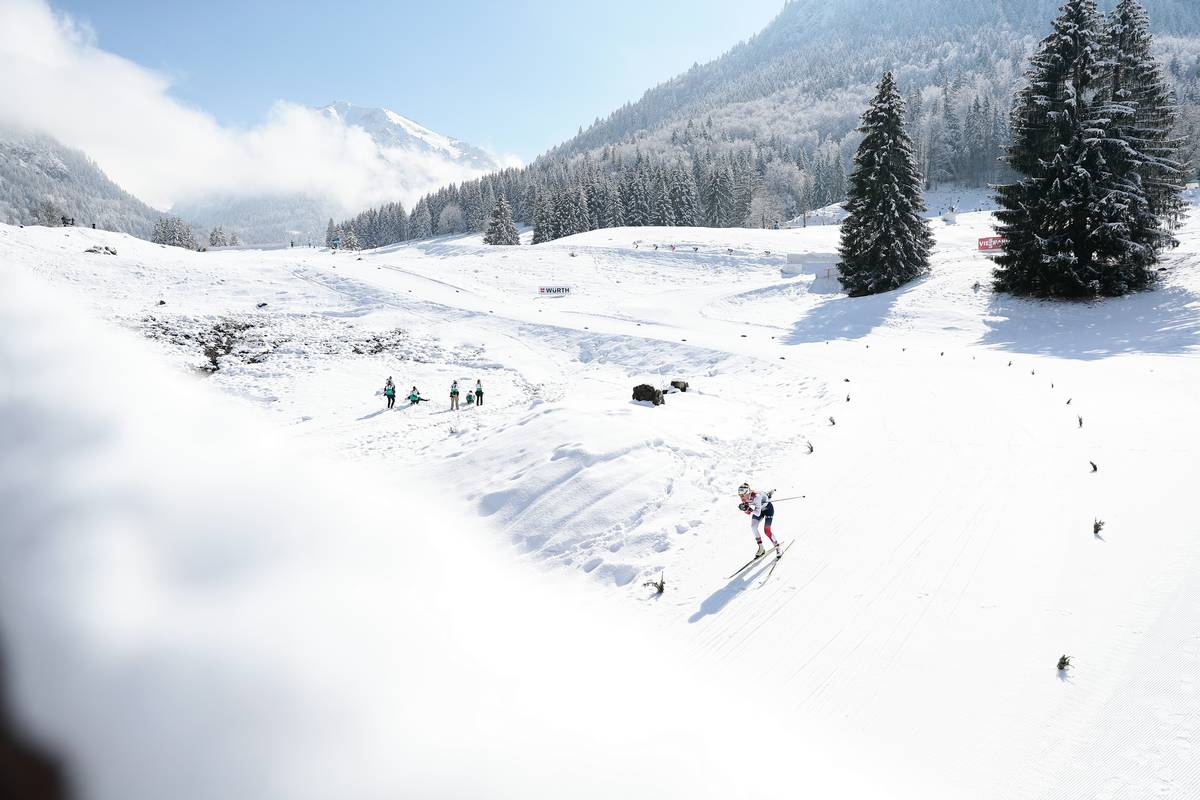
A solo affair for the win: Therese Johuag of Norway during the 30 k classic. (Photo: NordicFocus) Inside the final 10k, a few women led by Pärmäkoski, had gapped up to the first chase group. After a crash took out the three women at the front — Andersson, Karlsson, and Weng — Stadlober snuck around the right side, increasing her tempo to kick and glide away from the women now 16 seconds behind her in pursuit.
Striding and poling in sync, Karlsson, Andersson, and Weng looked determined to regain contact with the Austrian. As they departed the stadium in the sun with 6k to go, the threesome had achieved this goal. They strided away up tracks that looked to be eroding in the sun, heading into the woods where the course looked much different. As more crashes had already happened behind them on sugary sweeping downhills, the task ahead looked to be as much about staying upright as skiing fast.
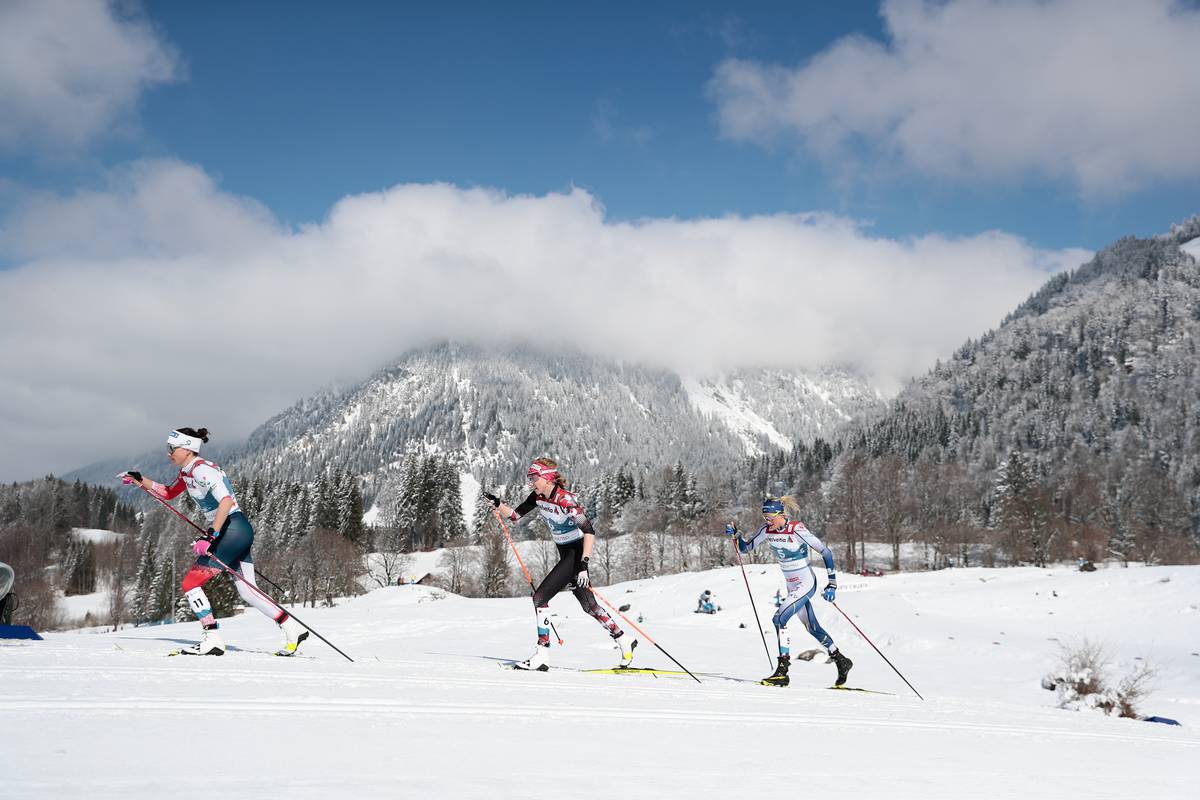
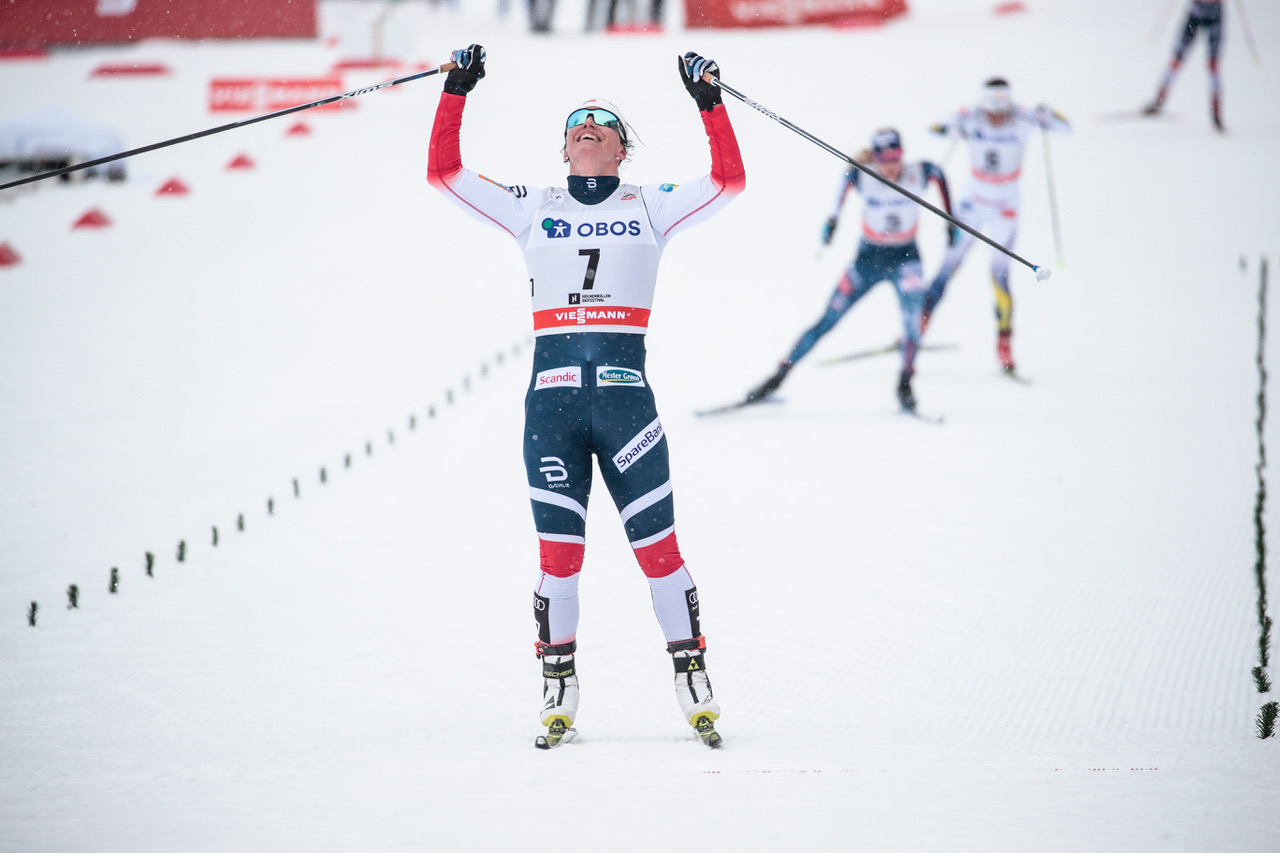
Heidi Weng (NOR) leads Therese Stadlober (AUT) and Frida Karlsson (SWE) during the mass start 30 k classic. (Photo: NordicFocus) Talking to a trailside coach on a climb with 2k to go, Johaug seemed to be basking in the confidence of her victory. Attacking through the final kilometer of the course nonetheless, Johaug alternated between a spicy double pole and throwing her arms up in celebration as she made her way down the finishing lanes to stop the clock in 1:24:56.3.
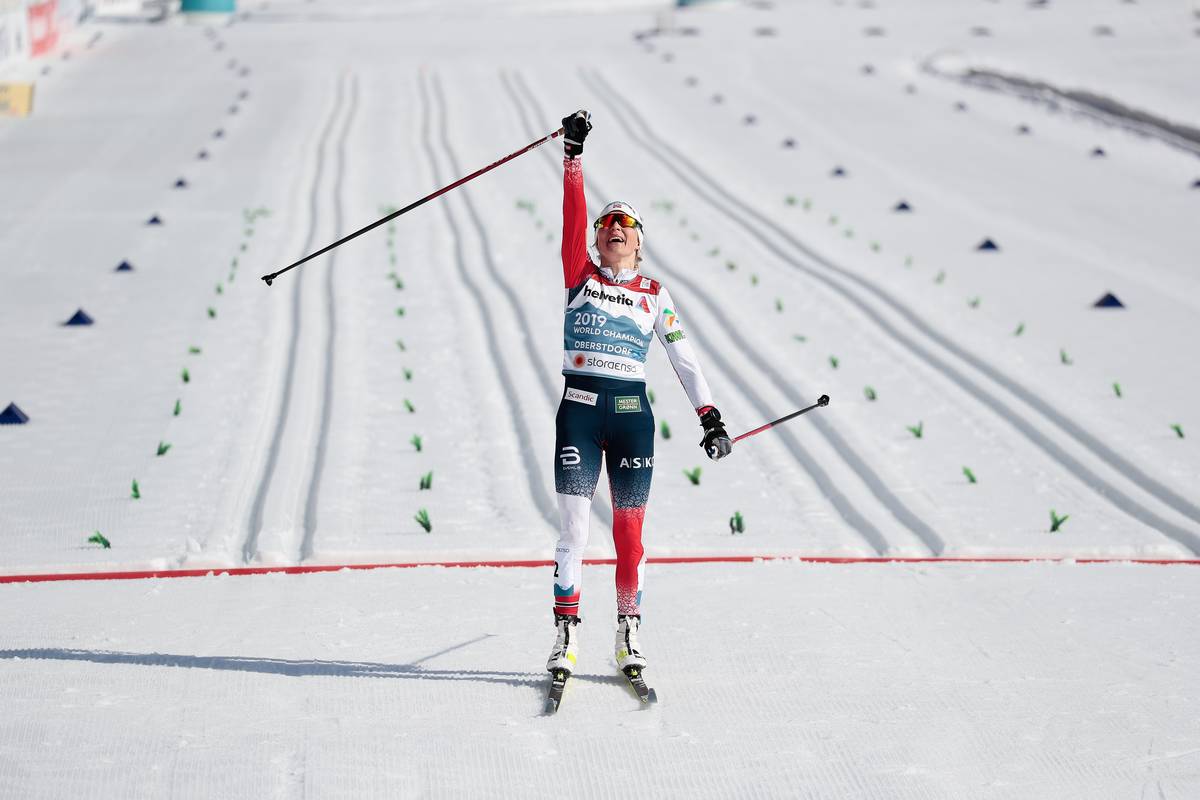
Therese Johaug is a singular distance champ. (Photo: NordicFocus) Earning her 14th championship medal, ten of which are gold, Johaug has overtaken Norwegian ski legend Marit Bjørgen for the most World Championship medals. The first in her collection was a bronze in the 30k classic in Sapporo, Japan in 2007. Johaug struck out in 2009, but came into the 2011 World Championships on her home turf in Oslo ready to go, taking gold in the 30 k skate and relay, and bronze in the skiathlon.
Johaug is also the second woman to have won 30 k events in both freestyle and classic at the World Championship, following in the footsteps of Elena Välbe of Russia who retired after the Nagano Olympics in 1998. Johaug also joins Välbe and Bjørgen as the only women to have won successive 30 k events at a World Championships.
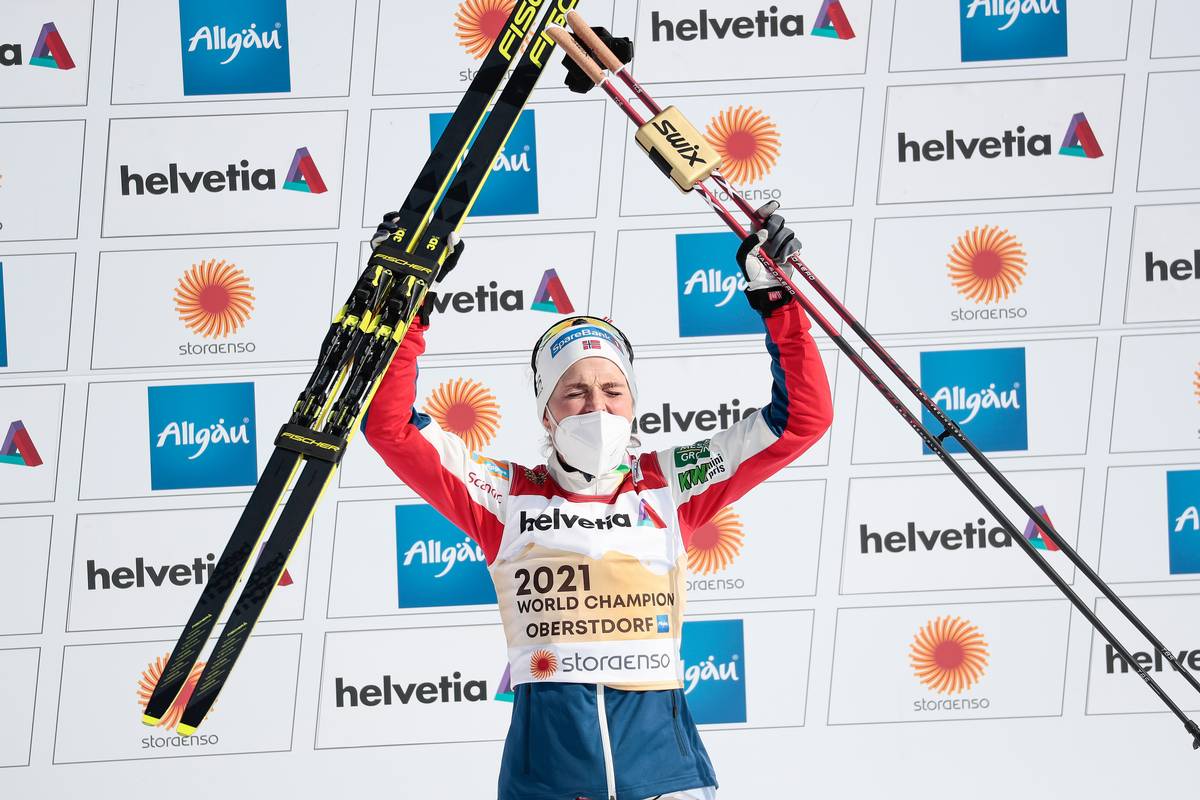
Therese Johaug takes a fourth gold medal in the 30 k mass start classic. (Photo: NordicFocus) “It’s amazing, actually,” said of her string of four gold medal performances in Oberstdorf in a post-race interview with FIS. “I work so hard for it, training so much to reach my goals. To come here to Oberstdorf and fight for four gold medals, I have no words. I know so many girls train really hard to reach their goals, and I know that I have a lot of pressure on me when I come here. I was a favorite to win the distance, but you have to do it, and it takes a lot of focus to reach your goals.”
The FIS interviewer called it the “era of Therese Johaug”, to which the Norwegian gave an emotional response, her voice breaking tearfully with her final statement.
“I never have been in such good shape. I am so happy. I’m 33 years and I know I’m getting older and older and I know that this time ends soon, so I am just so happy.”

Sun, glory, and another championship distance win. (Photo: NordicFocus) In the closing kilometers of the race for silver and bronze, Weng, Andersson, and Karlsson began to drop Stadlober. Finding a new gear as she surged up the last steep climb, Weng rounded the hairpin turn in the lead and dropped into a tuck.
With just a sugary right hand curve out of the downhill to navigate before the final straightaway, Weng was shooting her shot. However, Karlsson’s skis and double pole were superior as they headed down the lanes, gaining her centimeters on Weng with each strike.
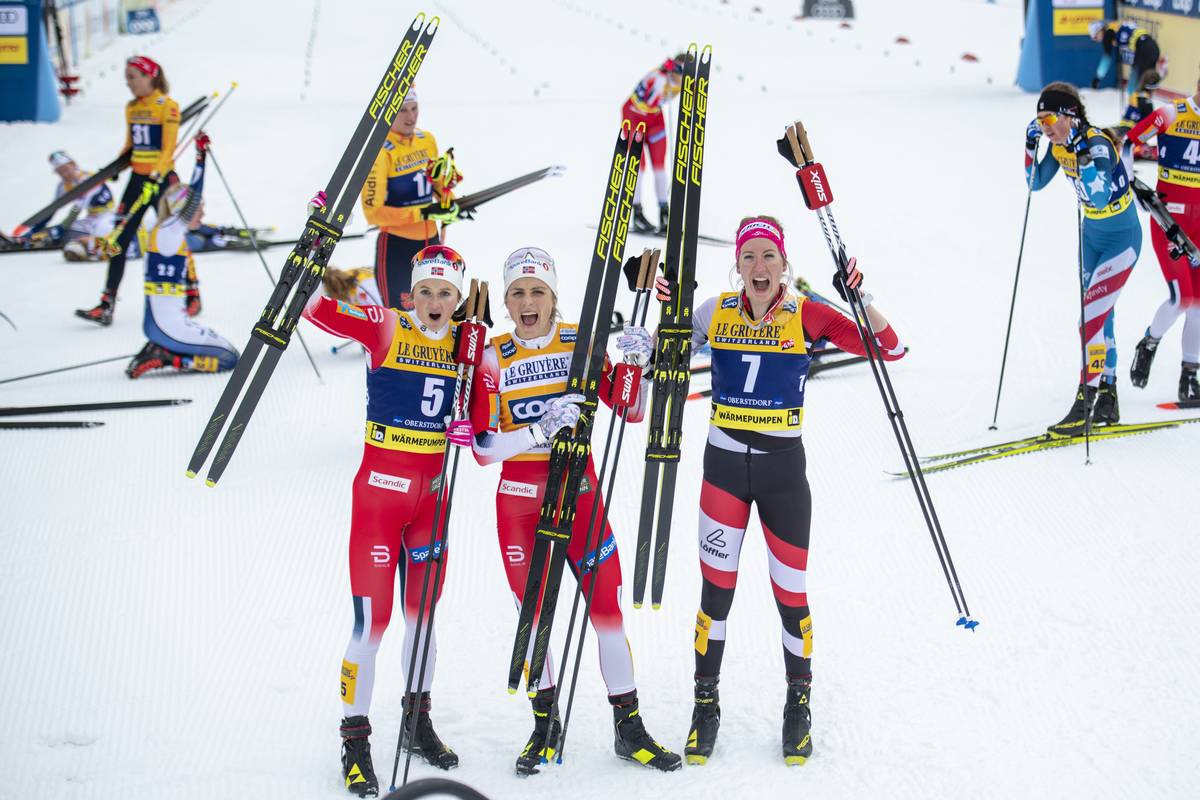
In the end, the small gap Weng had created from her move was enough. By a margin of 0.6 seconds, Weng took silver (+2:34.2), leaving Karlsson with her second bronze medal in the event (+2:34.8).
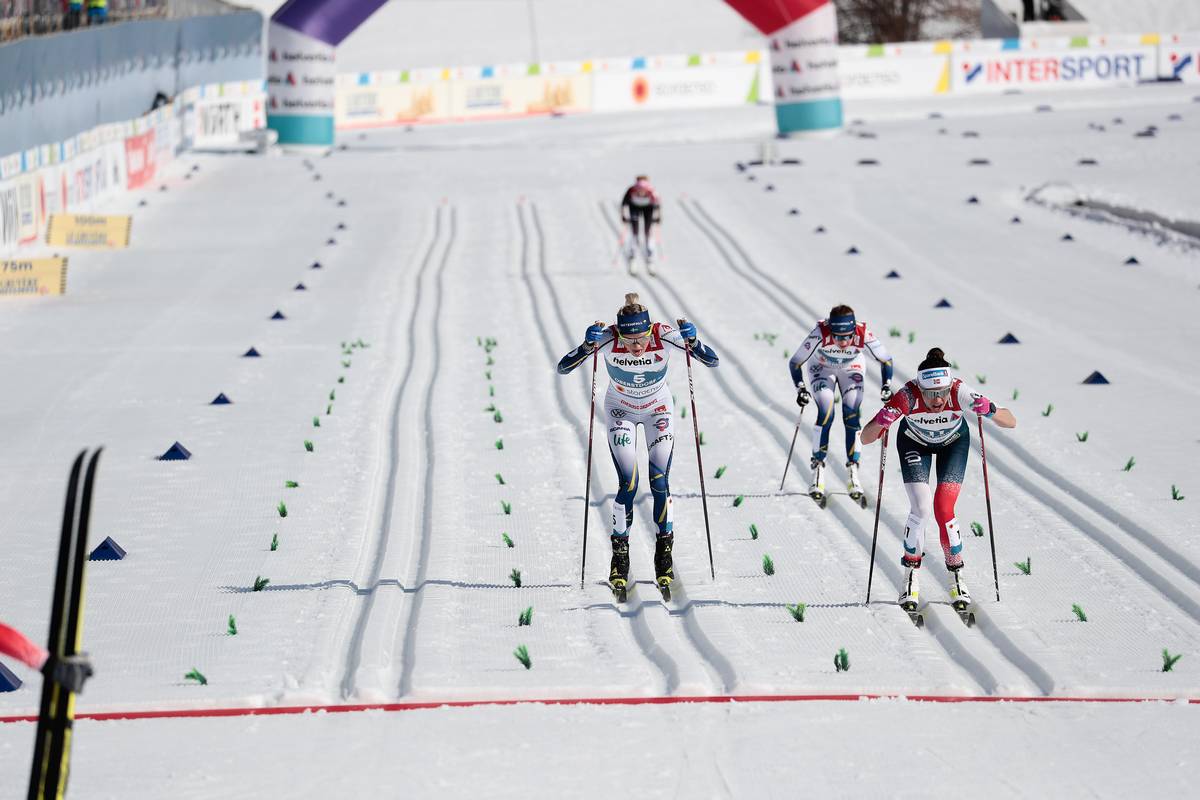
Frida Karlsson, and Heidi Weng (NOR), (l-r) dual for silver and bronze. (Photo: NordicFocus) 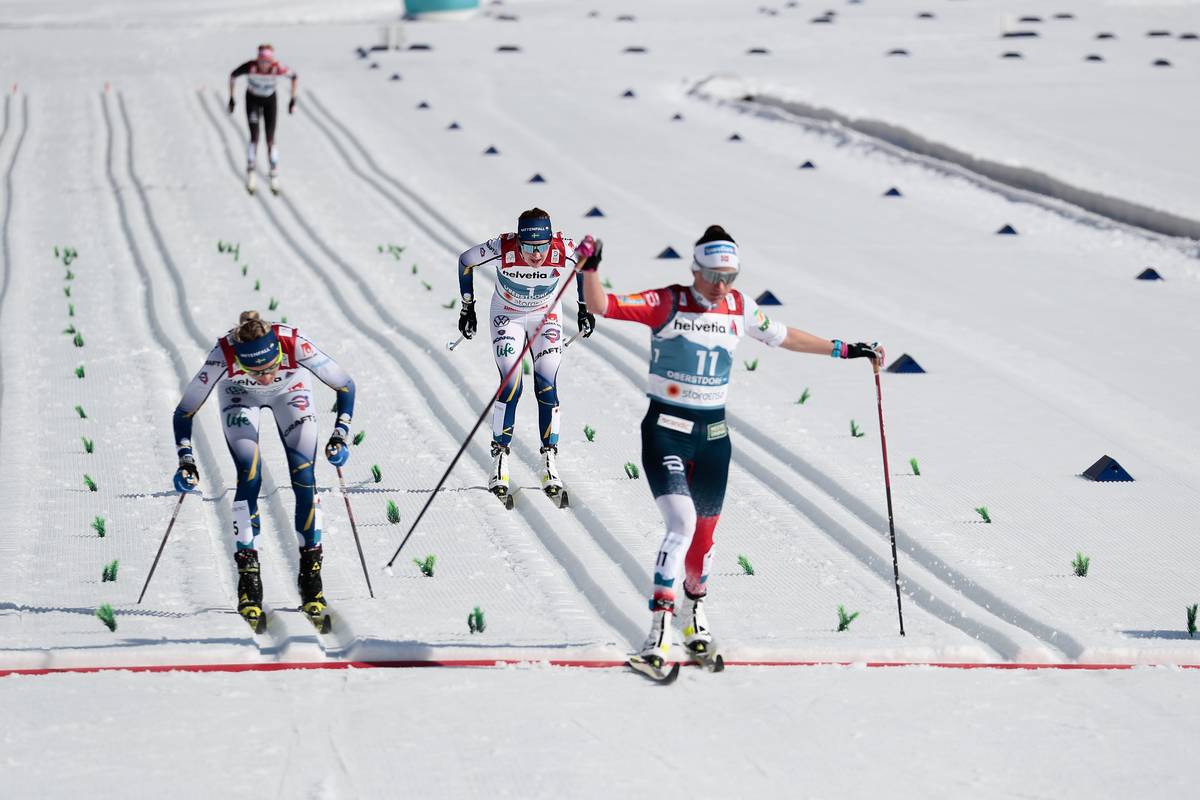
Heidi Weng (NOR) edges out Frida Karlsson (SWE) for a silver medal in the 30 k classic. (Photo: NordicFocus) Andersson held on for fourth (+2:36.3), followed by Stadlober in fifth (+2:59.4).
After the finish, Karlsson was seen rolling up the sleeve of her race suit and holding her forearm, which she proceeded to show the Swedish support staff. After icing and splinting the injury, she was reportedly taken away by medical staff and did not participate in the podium ceremony. In an interview with the Swedish news outlet Expressen, a team doctor explained that the injury occured in the crash with Andersson and Weng and that she is being taken to the hospital for x-rays. FasterSkier will share additional information as it becomes available.
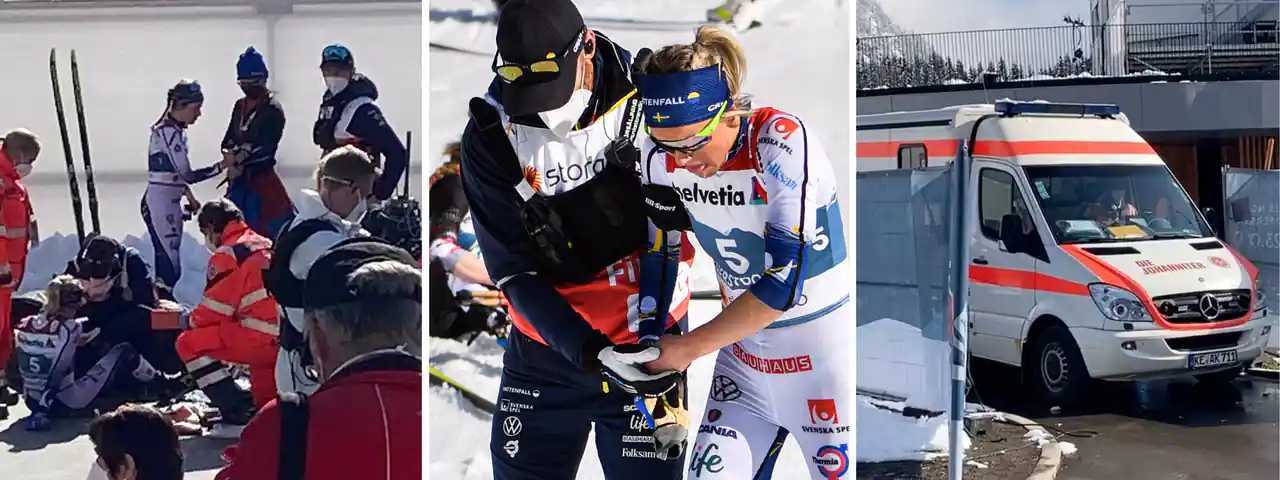
Frida Karlsson was carted away for x-rays after a bronze medal performance in the 30 k classic. (Photo: Expressen.se) 
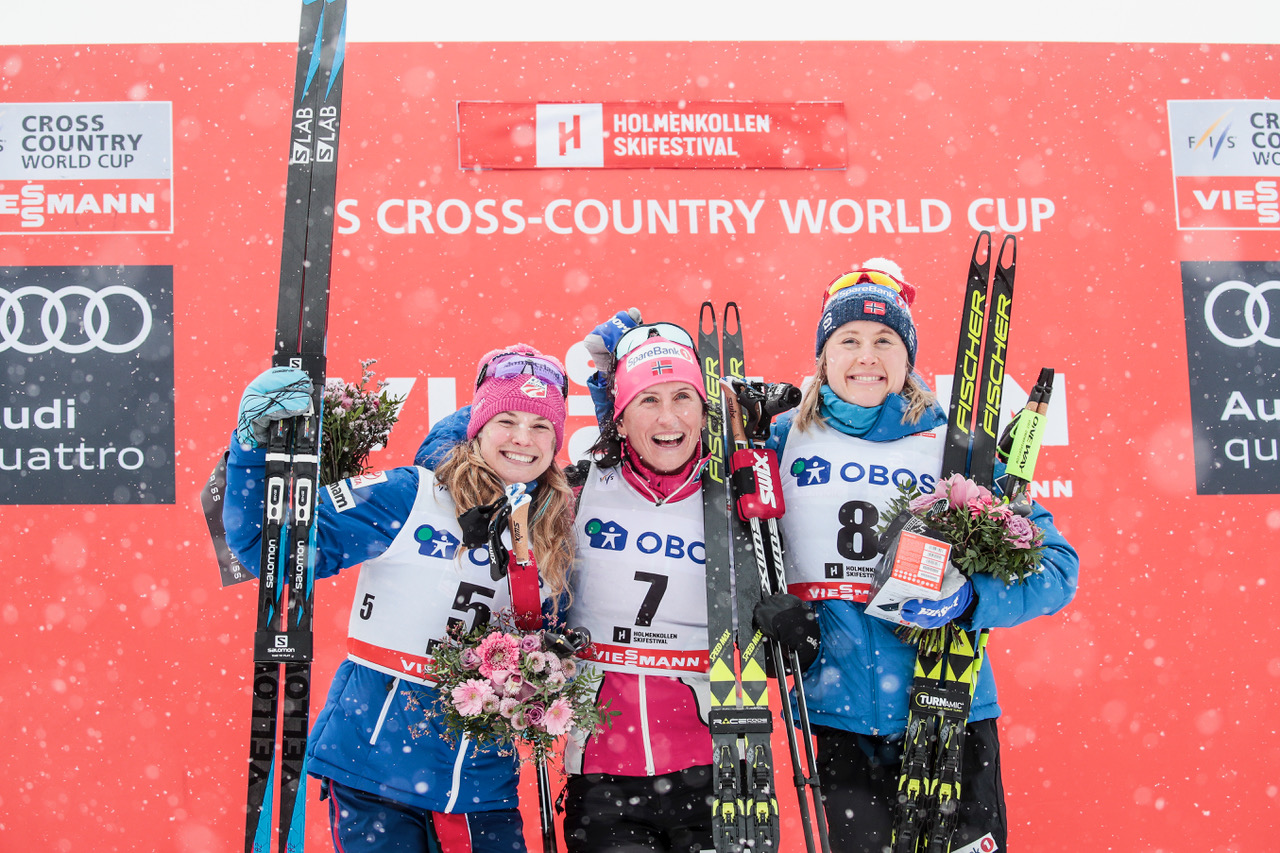
Only gold and silver represented at the podium ceremony after the 30 k classic. Therese Johaug (NOR) took the win ahead of Heidi Weng (NOR), with Frida Karlsson (SWE) earning bronze before being taken away for x-rays of her arm injury. (Photo: NordicFocus) Turning our focus to North America, Maubet Bjornsen skied her way to 15th. After falling off the pace with the second chase group as it broke apart, Maubet Bjornsen held her ground well inside the top-20 over the final two laps. Finishing in a tight finish with Johanna Matintalo of Finland and Emma Ribom of Sweden, who took 13th and 14th respectively, Maubet Bjornsen crossed the line 4:42.4 behind Johaug.
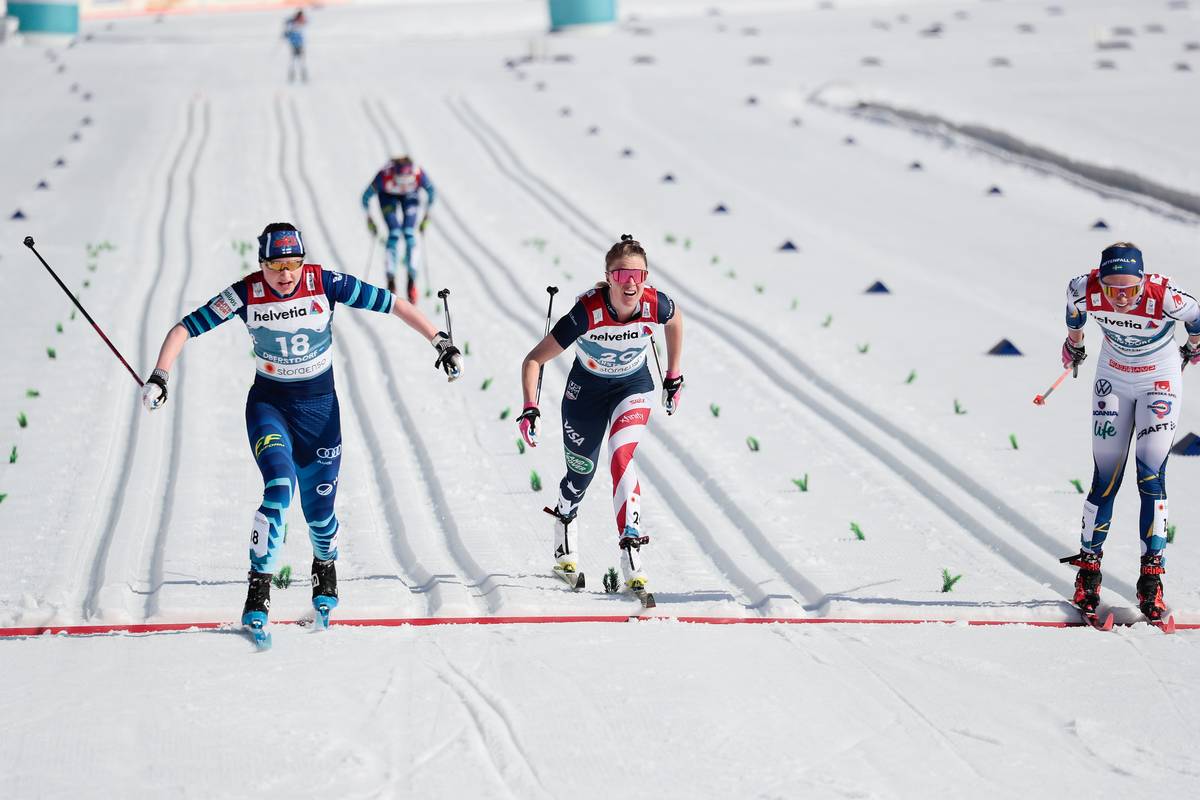
In a close finish, Sadie Maubet Bjornsen takes 15th in the 30 k classic. (Photo: NordicFocus) “I had many kilometers of celebrating and it was just the hardest 30 k I have ever done,” said Maubet Bjornsen after her race. “So you know, nothing like going out on that to remind you how hard this sport is.”
Providing insight into her day, Maubet Bjornsen reflected positively on the first half of her racing, adding that her equipment could not quite match her effort after the ski change.
“I felt totally incredible for the first three laps and then I switched onto some skis that were not quite good enough to stay with the pack I was skiing with. Then it was just like fighting to get to the finish. But I feel really stoked about my first 15 k and that is a good memory, just feeling like one of the strongest girls climbing that monster hill. That is a fun memory to go out with.”
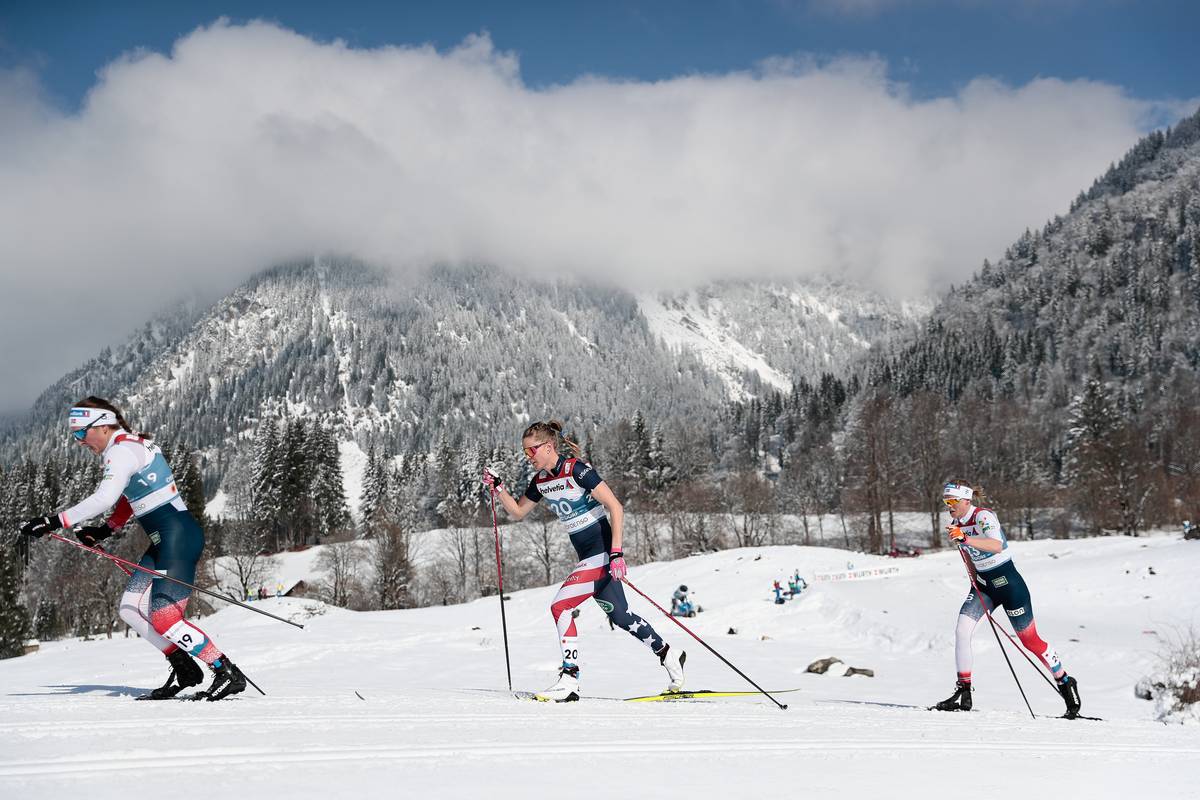
Sadie Maubet Bjornsen ends her professional career at the World Championship 30 k classic in Oberstdorf, Germany. (Photo: NordicFocus) Closing out her initial thoughts on her final race, Maubet Bjornsen added, “I definitely feel really grateful for my whole career and this last week was definitely really special and the relay was certainly the highlight of the week. It is good to finish on a really hard note too, pushing through 30 kilometers and yeah, I am thankful for my whole career.”
Also inside the top-30 were Hailey Swirbul in 26th (+6:55.6) and Sophia Laukli in 28th (+8:00.7). The final American starter, Katharine Ogden, took 37th (+11:30.7).
“I think it went pretty well for me,” said Swirbul after her race. “I am happy with my day. I had a pretty fast start and I got to ski with my Sadie for a brief moment there in her last race as a professional, so that was really special.”
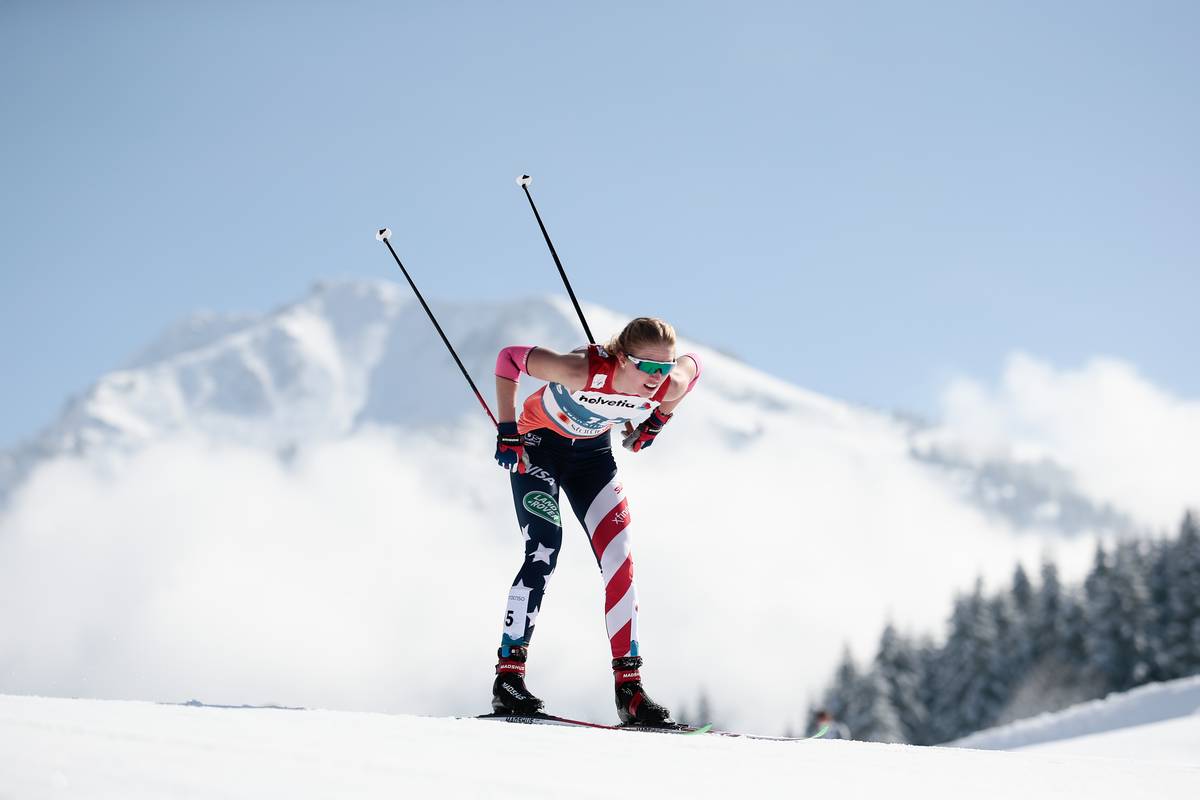
Hailey Swirbul of the U.S., cresting a hill during the 30 k classic. (Photo: NordicFocus) “In the 30 k there are so many deaths, and so many revivals that you just have to keep going,” Swirbul continued. “And I went through a couple of those and was very relieved to see the finish line. I am proud out team today and some good fighting.”
For Laukli, today was a first — her debut in the 30 k event. She explained after the race that was not sure how to pace, and felt she had good energy throughout, never on the cusp of a bonk despite skiing alone with no one to draft behind for much of the distance.
“This is the type of race you want to ski with other people,” Laukli said regarding what she learned. “And also, you should switch skis — which I forgot to do. Definitely a learning experience and there’s a lot I can improve on, but I am overall happy with how it went.”
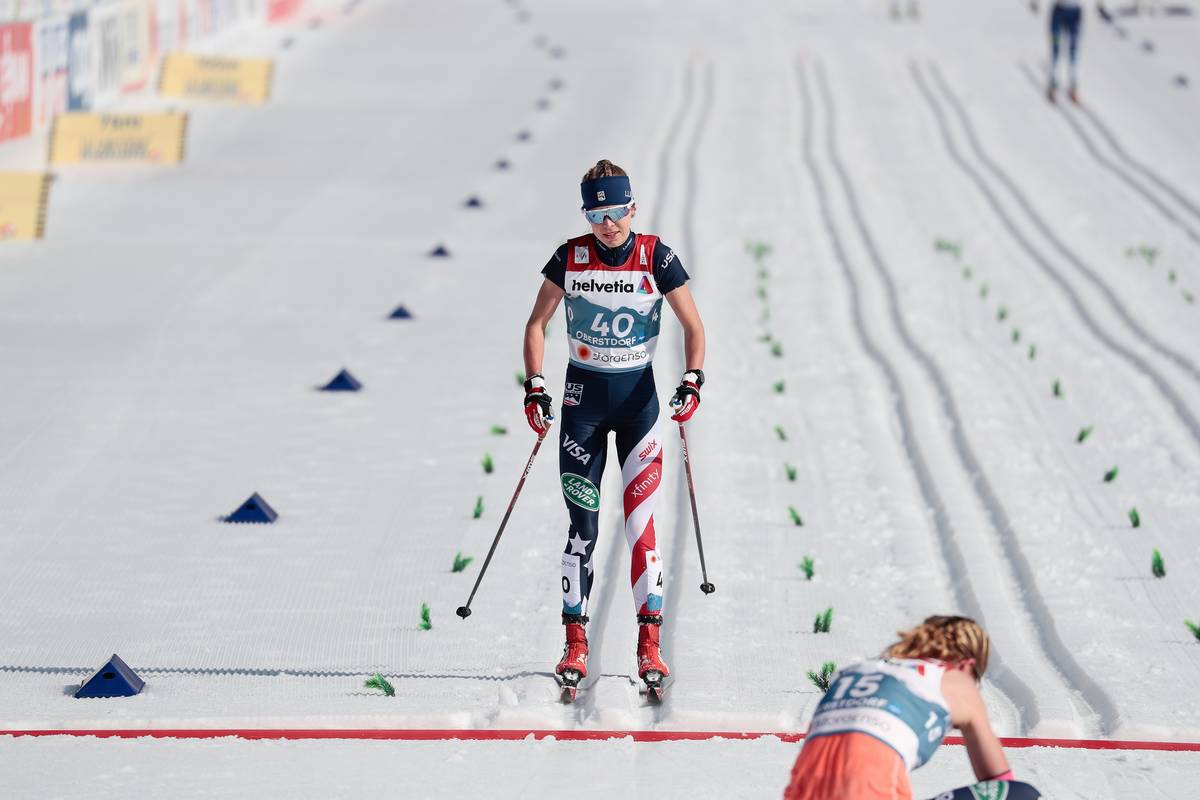
Sophia Laukli crosses the line 28th in the 30 k classic. (Photo: NordicFocus) 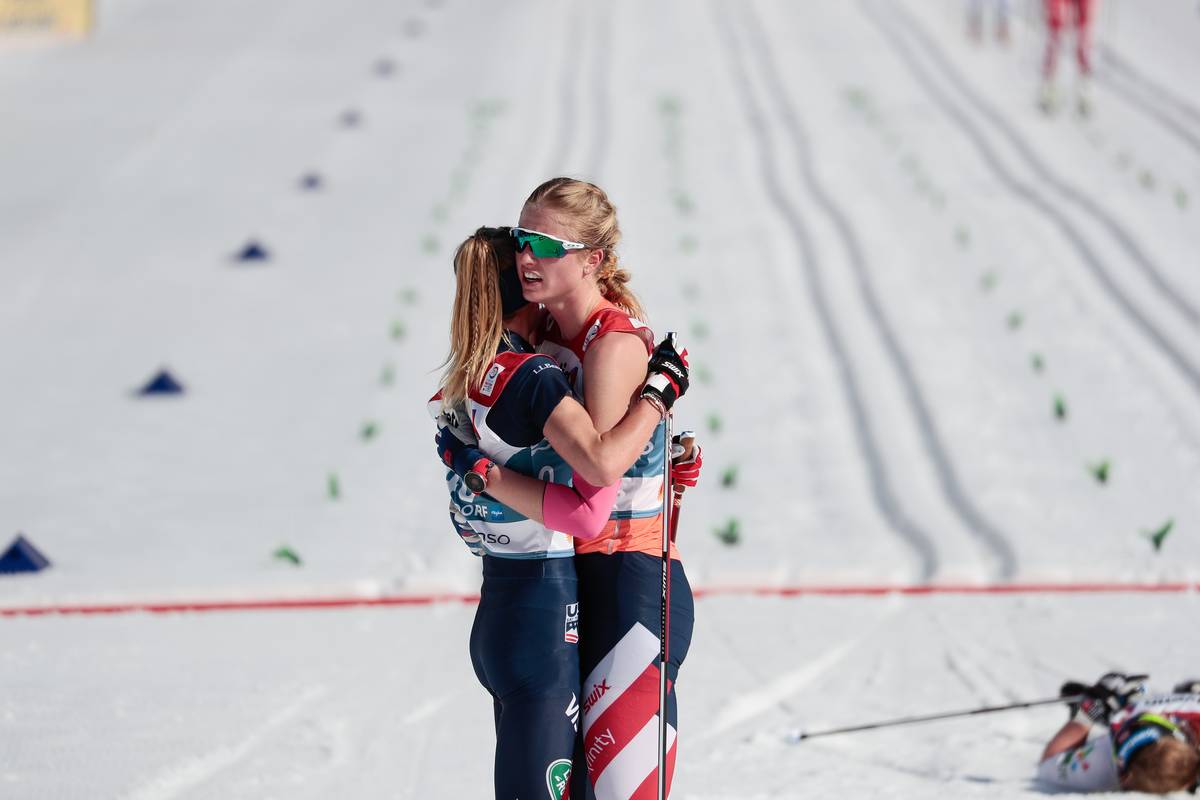
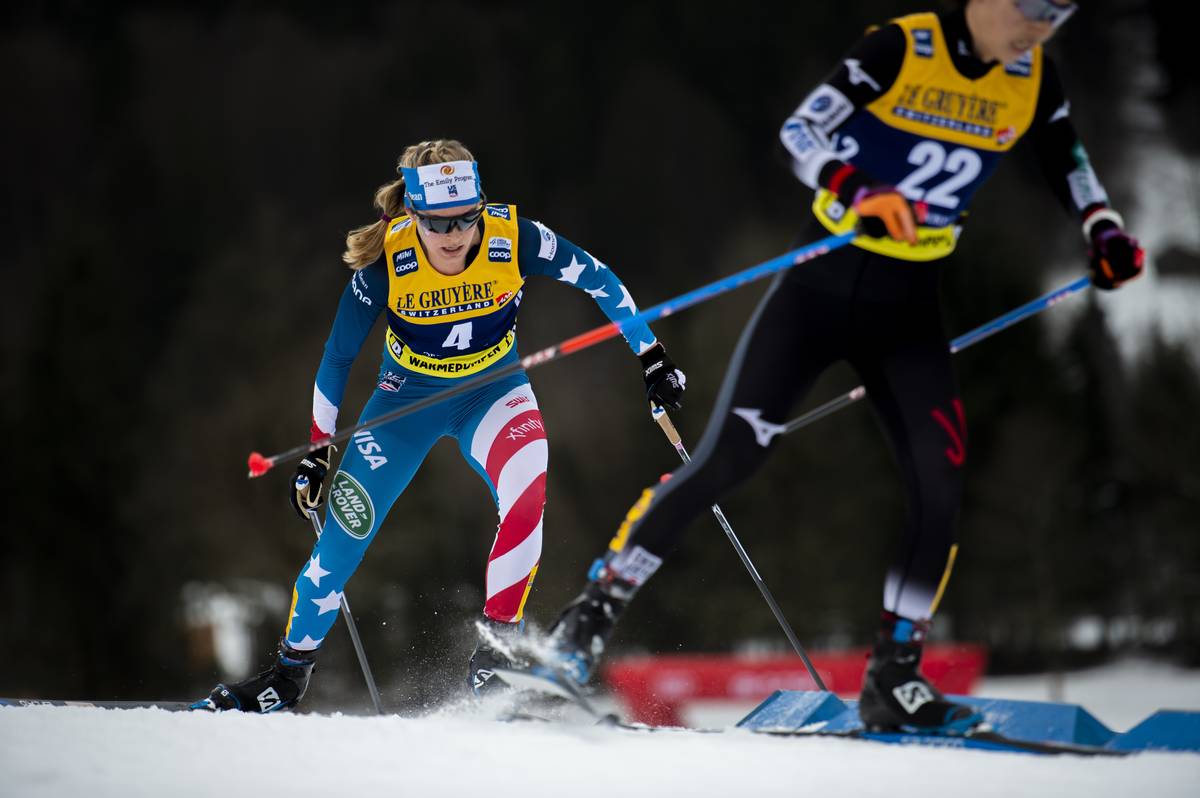
Sophia Laukli and Hailey Swirbul share a supportive hug after 30 kilometers of classic ski racing. (Photo: NordicFocus) Canada’s Katherine Stewart-Jones led the way for our neighbors to the North (or East, if you’re Alaskan), finishing 23rd (+6:05.7). Stewart-Jones went out at a fast pace, sitting at the back of Maubet Bjornsen’s chase group in 17th at the 10 k mark, fading into 21st by 20k, holding her ground in this range for the remainder of the day.

Katherine Stewart-Jones (CAN) chases Tatiana Sorina (RUS) during the mass start 30 k classic. (Photo: NordicFocus) 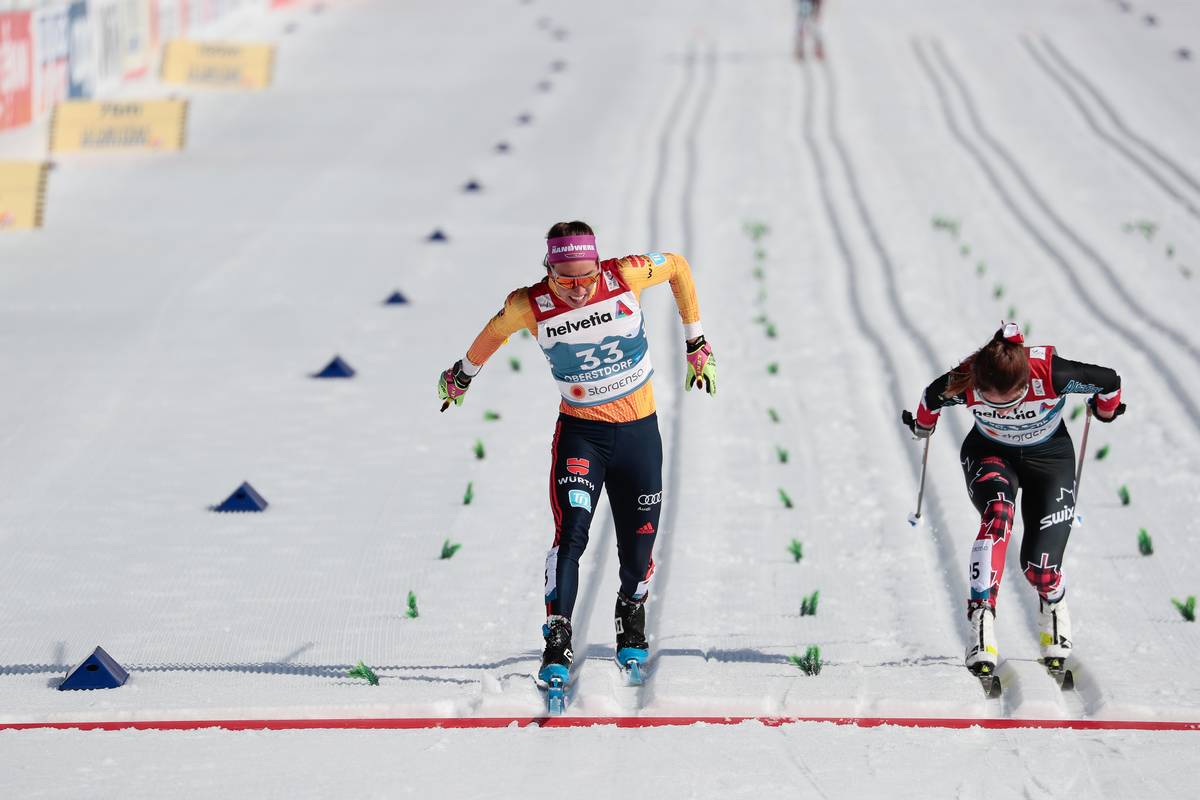
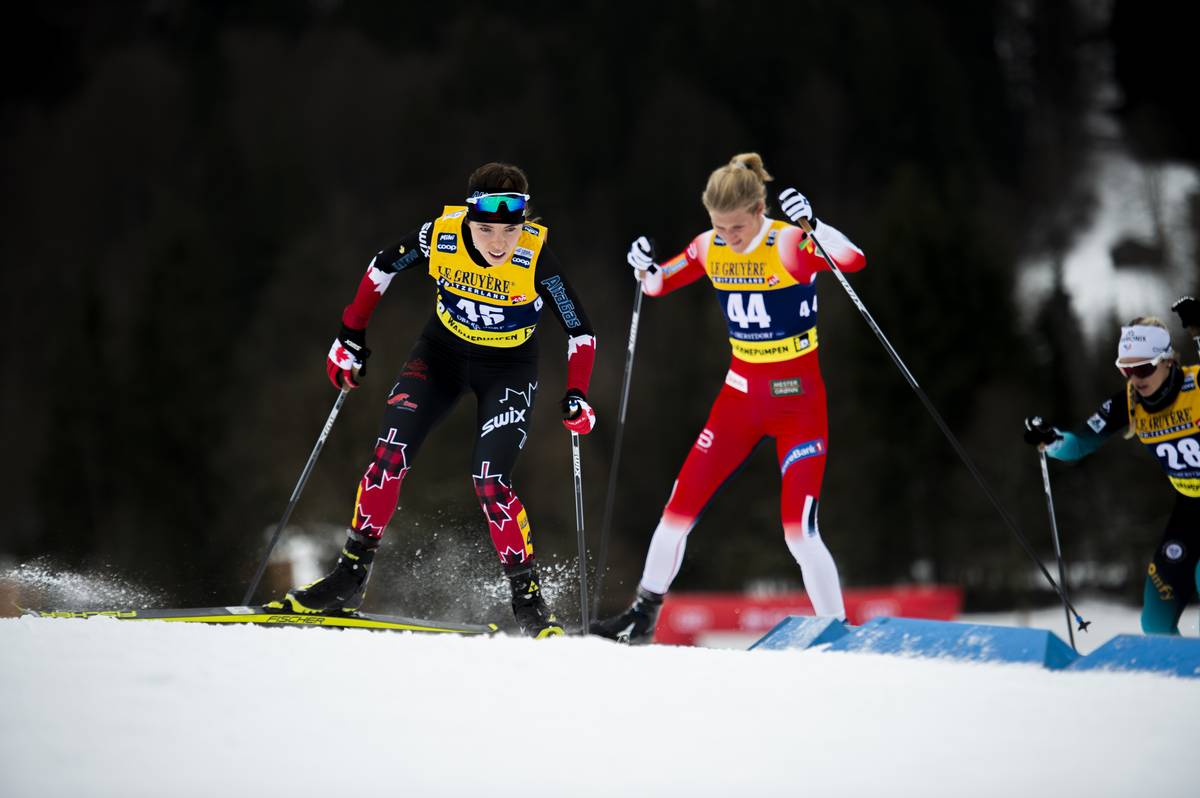
Sofie Krehl (GER), and Katherine Stewart-Jones (CAN), (l-r) finish strong. (Photo: NordicFocus) Cendrine Browne was next for Canada, finishing 27th (+7:57.6). Outside the top-30, Dahria Beatty took 34th (+10:01.0).

Canada’s Cendrine Browne racing to 27th in the 30 k classic. (Photo: NordicFocus) Jessie Diggins and Rosie Brennan did not start today, reportedly conserving energy for the final World Cup stop in Engadin, Switzerland beginning March 13th. The weekend will include a 10 k classic and 30 k skate.

Katharine Ogden on her 30 k classic journey. (Photo: NordicFocus) -

Ski News Roundup for the Week: Marit Bjørgen is Back (Just not on the World Cup)


Marit Bjørgen carries the Norwegian flag across the finish line as Norway wins the women’s 4-by-5-kilometer relay at the 2017 Nordic World Championships in Lahti. It was Norway’s 100th world championship medal. Bjørgen Returns:
Reported last week by several news outlets, retired World Cup star from Norway, Marit Bjørgen, will return to racing next season. Bjørgen (40), will be a member of Team Ragde Eiendom, managed by Jörgen Aukland. (The team is owned by Anders and Jørgen Aukland.)
Bjørgen told Norwegian broadcaster NRK she would focus on winning the 90-kilometer Swedish Vasaloppet.
It has also been reported that Bjørgen will be joined by the current overall World Cup winner and former teammate Therese Johaug on Team Ragde Eiendom. Johaug will still contest the World Cup.
Bjørgen, however, did not announce a return to World Cup racing: she retired from that circuit in 2018. That year, she became the most decorated winter Olympian with 15 medals in total, including eight golds, two of which she won in PyeongChang.
Free Access to “VISMA SKI CLASSICS PLAY” Until June 30th:
Like many folks and you might be keen on a video escape for a bit. Visma Ski Classics is offering free access to their video catalog until the end of this month. A few things you should know before gluing into the screen: Visma will ask for your basic info to sign up – a valid email and password. There is a “Free Trial” option ending on June 30, 2020, or you can select the monthly membership for $14.99, or an annual membership for $49.99. That said, we posted this in the news roundup since it appears free videos are yours for the next three or so weeks.
There was no prompt for credit card information during signup.
If you are stoked for a 5.5 + hour marathon viewing session you can spend that time watching the 2020 Swedish Vasaloppet.
The Davis behind the Davis on the “Davis U.S. Cross Country Ski Team”:
Beginning last season, some press-releases from U.S. Ski and Snowboard referred to the cross-country team as the “Davis U.S. Cross Country Ski Team”. We have had several inquiries from readers asking “who is this Davis?”
Here’s some of the backstory from Tom Horrocks, Communication Manager for the cross-country team. The funding is a three-year gift from the Davis Family Foundation. Currently, the team is in the second year of funding from the Davis Family Foundation. Although specific amounts were not disclosed, Horrocks wrote, “The amount of the gift matches our annual cross country team budget from last season. So, we have a flat budget this year, which is an incredible gift and benefit given the current economic downturn. The Davis gift basically ensures that our base level of programming is maintained for three years, giving us an incredible platform to prepare for the 2022 Olympic Winter Games.
“It is also important to note that U.S. Ski & Snowboard has a budget for domestic governance and events, which is still completely funded by U.S. Ski & Snowboard through our fundraising, sponsorship, etc. In addition, all Davis U.S. Cross Country Team athletes continue to benefit from all the other U.S. Ski & Snowboard departments and programs including sports science, sports medicine, communications, marketing, etc., and that support comes from outside the Davis Family Found gift.”
Andrew Davis is on the U.S. Ski & Snowboard Foundation Board of Trustees and is part of the Davis Family Foundation.

Jessie Diggins sprinting in Konnerud, Norway during the 2020 World Cup . (Photo: NordicFocus) -

Transitions, Training, and Birkie Preparation: A Q&A with Riitta-Liisa Roponen
To view Riitta-Liisa Roponen’s complete FIS profile requires a lot of scrolling and selecting “show more.” The 41-year-old raced her first World Cup in Munio, Finland on November 28th, 1998. More than 20 years later, she raced her final World Cup event, helping the Finnish relay team to 3rd in Ulricehamn, Sweden on January 27th, 2019.
She went on to race at the World Ski Championships in Seefeld, Austria, placing 22nd in the 30-kilometer mass start skate, then ended her season racing on the Finnish national circuit.
In between November 1998 and March 2019, Roponen competed in five rounds of the Olympic Games, earning a bronze medal in the 4 x 5 k relay in the 2010 Vancouver games. Her best individual finish was 6th, 10 seconds from a medal, in the 10 k freestyle, also in Vancouver.

Krista Parmakoski tags Riitta-Liisa Roponen for Finland while Sweden’s Stina Nilsson heads out on her last lap after being tagged by Maria Rydqvist n the 4 x 5 k relay at the 2015 FIS Nordic World Ski Championships. (Photo: Fischer/NordicFocus) She also earned six World Championship medals, four in the relay and two in the team sprint, and seven individual World Cup podiums.
Most of the accomplishments came while also being a parent. Long before Kikkan Randall and Marit Bjørgen, Roponen navigated the waters of training through pregnancy and continuing her World Cup career afterward. She gave birth to her daughter, Ida, in 2004, returning to the World Cup later that year with a 17th place finish in her first race back.
This year has been a transitional year for Roponen. Her family moved to Colorado where her husband, Toni, took over as the head cross country coach at Denver University.

Riitta-Liisa Roponen on her way to a win in the 10-kilometer skate at 2020 U.S. Nationals. (Photo: Reese Brown) No longer racing on the World Cup, she has continued to train and compete at a high level, adding a new international twist to the American and Canadian women’s field racing the SuperTour circuit. Roponen won the 10 k skate in Sun Valley, then repeated her win in the same event at U.S. Nationals. Two days later, she took 3rd in the 20 k classic.
After a quick trip to Finland to race the 10 k classic at the Finnish National Championships (see her comments below), Roponen is setting her sights on Hayward as she prepares for the American Birkebeiner. Given her results on the domestic circuit, Roponen is viewed as a favorite for the Birkie win.

Adjusting to life at altitude, Riitta-Liisa Roponen rollerskis up Lookout Mountain outside of Denver, Colorado. (Photo: Instagram @rlroponen) FasterSkier connected with Roponen over email this week to discuss the longevity of her career, her transition to life in the U.S., and her feelings on her first season away from the World Cup.
FasterSkier: How have you maintained both the physical capacity (speed, fitness, health) and the motivation to train and compete at the highest level for so long?
Riitta-Liisa Roponen: I have been training for skiing since I was very young, but when I was under 22 I did not train as hard and as much as others (I feel that my club coach was smart). That way I have been able to increase my training year by year and always find something new to develop. The main reason is that I love training and racing.
FS: Speak to the evolution of your career over the last five years. In a video interview last March (embedded below), you said: “I believe that skiing will never end in my life. If I don’t train, I can still enjoy when I ski. Skiing is mental and physical well-being. It doesn’t stop even if it ends as a job.” Where do you see yourself as a professional athlete now?
RLR: I have been training this year as a professional athlete (about 800 hours) but my race goals have been here in the USA — US Nationals and the American Birkie.
FS: What has it been like moving to the United States? Have you enjoyed your experience in Colorado so far?
RLR: This has been my long time dream to move here with my family. We have been very happy here all the time. The weather, people, food.. all is great! This is also a great opportunity for my daughter. Moving here has been her dream for a long time also. This is a big adventure for all of us.
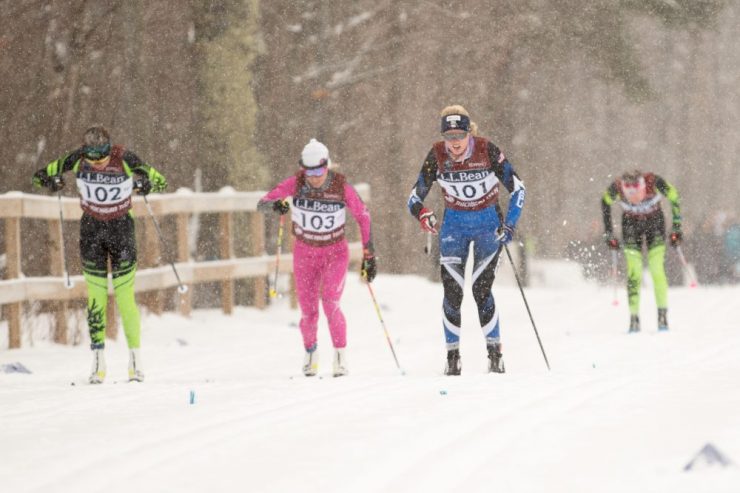
Caitlin Patterson (left), Ritta-Liisa Roponen (bib 103), and Hailey Swirbul (bib 101) lead the way in the 20-kilometer classic at 2020 U.S. Nationals. (Photo: Reese Brown) FS: How have you found your experience racing SuperTours and US Nationals? How does the level of competition compare to what you experience racing in Finland? What has your focus been this season?
RLR: The level of competition is very high and I think that level will be even higher in the future — you have already a very strong women’s national team. It looks like your big clubs and national team know what to do. You have lot of very fast juniors coming and I believe in 2-4 years the USA national team will be even stronger than now (also on men’s side). Our National teams are now about the same level, but behind the national teams, the level is higher here in the USA .
FS: How are you feeling leading into the Birkie?
RLR: I am really looking forward to racing the Birkie and it is great to see the biggest ski event here in North America. My season has been very good so far and I am feeling still very good, so I can not wait to start! I am expecting to see a lot of other good skiers on the start and it will be fun to race with them.

A quick mother-daughter selfie trail-side during a Thanksgiving camp in West Yellowstone. (Photo: Instagram @rlroponen) FS: You also raced the 10k Classic at Finnish Nationals this season. What was the motivation there?
RLR: That was part of the plan. Ida was at school and I wanted to see my parents. The plan was to do those competitions because of my home town club. I was 5 th place in the classic race with very bad skis, so I was actually very strong in that race.
FS: Now that Ida is 16 and also training for skiing, does your own focus change? How has it been training with her and counseling her as a developing athlete?
RLR: Ida was a swimmer earlier (from 6 years) and she wanted to start skiing when she was 13 . We are excited to see how independent and motivated she is. Sure I want to help her in many ways, but the main priority is that she really loves the sport.
-

The Devon Kershaw Show: Stage 3 Ski Tour 2020 – The Leg Flooding Sprint

Åre, Sweden — the site of the national (alpine) ski area in Sweden. Also the site of Stage 3 of the Ski Tour 2020’s skate sprint. Short at 0.66 k, but oh so steep with a finishing climb with slopes at 28 percent. Yah! 28 percent. Maybe part sideshow, maybe not. Either way, athletes had to get themselves to the top. In what was a leg-burning affair, for a one-off event, it was sporting entertainment.

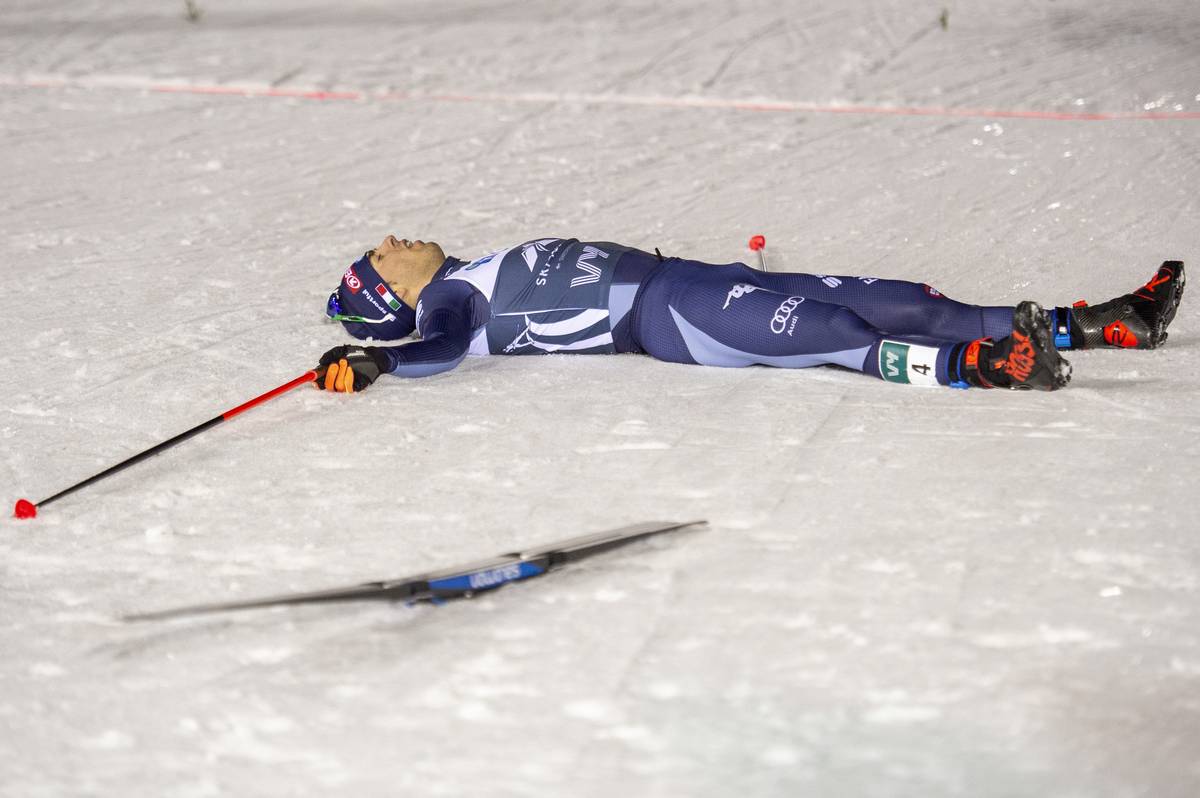
Italy’s Pellegrino: totally spent. He placed second overall in the Stage 3 Ski Tour 2020 sprint. (Photo: NordicFocus) Thanks for listening.
And…here’s a link to some research we mention in the podcast. It’s some good material on how Marit Bjørgen trained.
-

With Arms Raised: It’s a Johaug Win in Oberstdorf – Brennan in 17th, Diggins 22nd

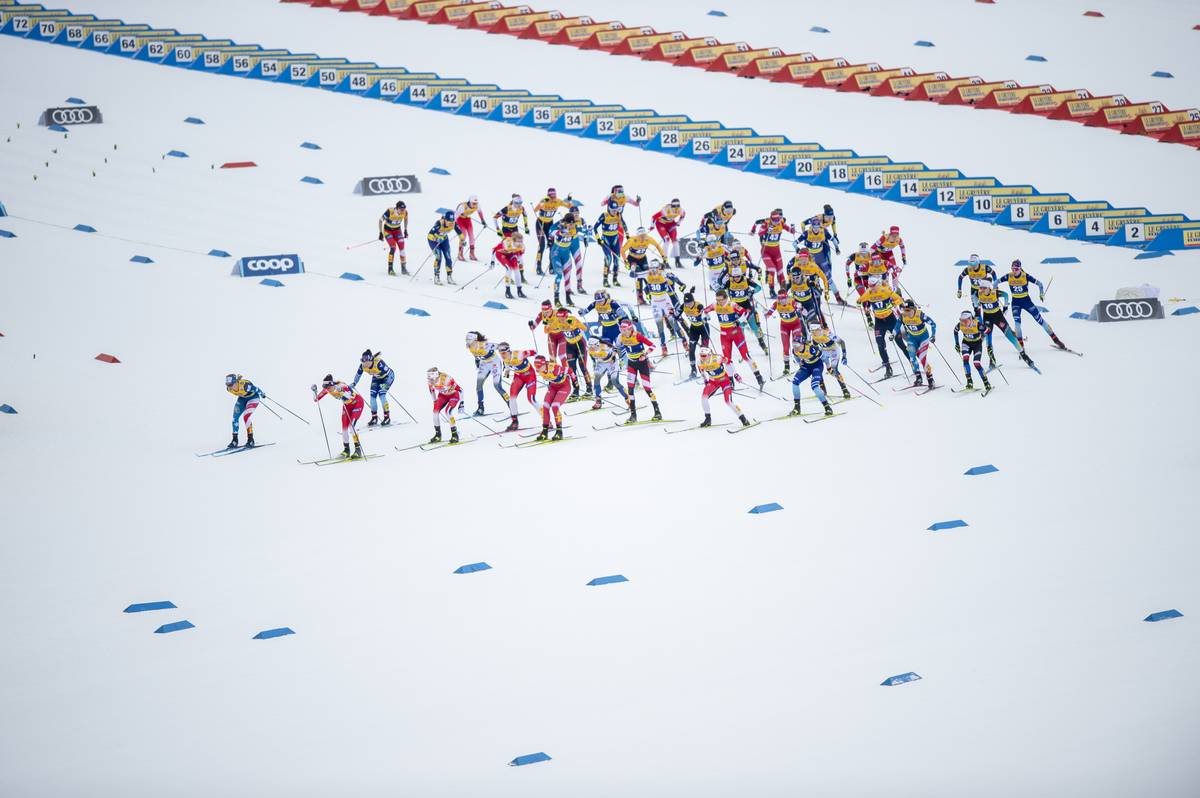
The start of the 56 skier deep field in the women;’s 115 k skiathlon in Oberstdorf, Germany. (Photo: NordicFocus) Here at FasterSkier, we do not play the odds. Some contributors we know play Noah Hoffman’s Fantasy League – but we steer clear of rolling the dice on cross-country skiing. But the women’s skiathlon events on the World Cup may not be the biggest payouts since in recent history they have been a lock.
Oberstdorf in Oberstdorf, Germany — the site of next year’s Nordic Ski World Championships — required no crystal ball of an imagination to determine the top-spot for the women who raced a 7.5 k / 7.5 k skiathlon on a championship-caliber course.
Coming into the race, Norway’s Therese Johaug had won a total of seven World Cup skiathlon’s, including a win in the format this season in Lillehammer. With a win today she could match the record of eight skiathlon World Cup wins held by her former teammate, the now retired Marit Bjørgen.
This is about the most unspoiling of a spoiler alert: Johaug won today’s skiathlon in 40:05.2 to tie Bjørgen on the skiathlon win list. But her day was more tenuous than we would have imagined. Her gap on second place at the finish, Norway’s Ingvild Flugstad Østberg, was for Johaug somewhat meager, 15.5 seconds. Austria’s Therese Stadlober placed third (+15.6). According to FIS, this was Stadlober’s third career World Cup podium. Her two other podiums came in the 2018 Tour de Ski, one of which was a time of day podium up the Alpe Cermis.
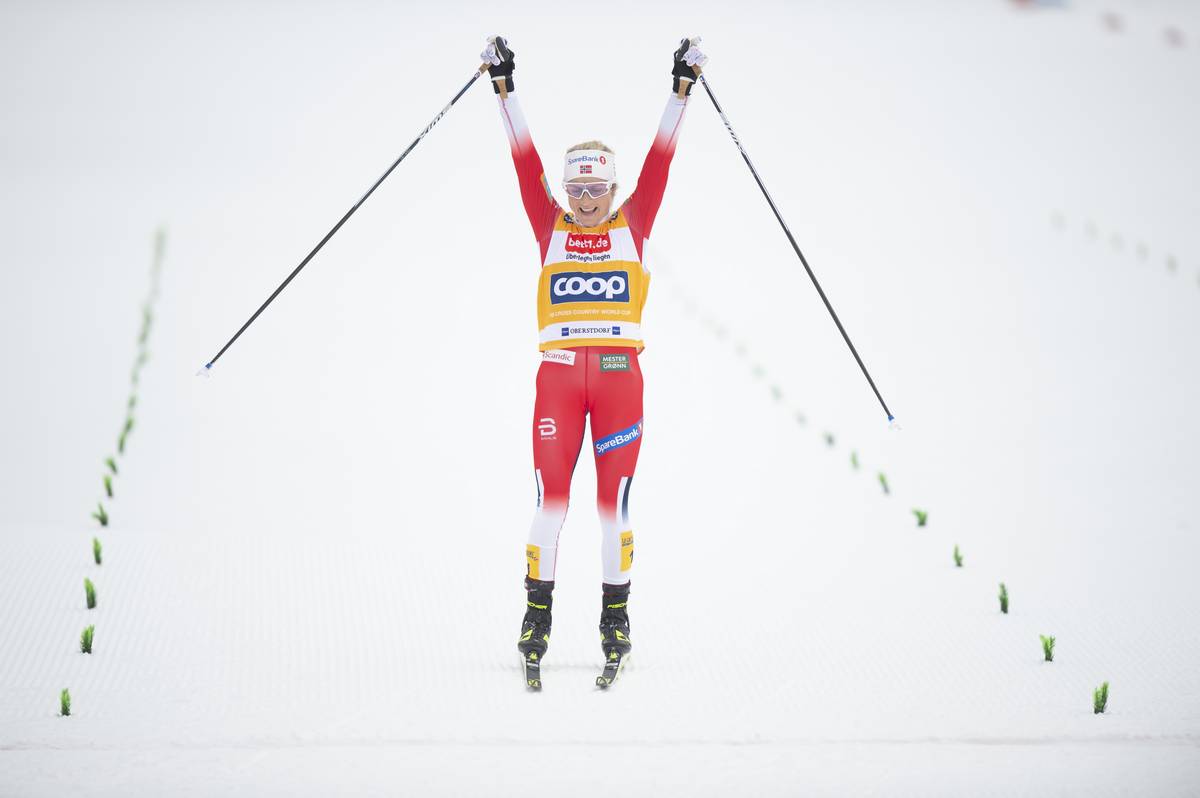
Today, for Johaug, her race day concluded with arms raised in the air win.

A familiar pose for the World Cup distance leader: Therese Johaug winning the 15 k skiathlon in Oberstdorf, Germany. (Photo: NordicFocus) She was able to slowly stretch away from a group of chasers during the 7.5 k classic leg. She inched ahead from the main chase group near 2.5 k as she charged up the course’s main climb, the Burgstall hill. The field was spread out, but not shattered. Joahaug came over the top and into a long glide out with a 100-meter lead.
At 3.8 k, Joahug had a 5.3-second buffer on Østberg in second, with eight other skiers within 15 seconds. Roughly two kilometers later, she added another three-second cushion. By the exchange to skate skis at 7.5 k, Johaug’s lead was 14.1 seconds to Østberg. But in close contact with Østberg were Finland’s Kerttu Niskanen and Krista Pärmäkoski, Norway’s Heidi Weng, Sweden’s Ebba Andersson, Stadlober, German Katharina Hennig, and Russia’s Natalia Nepryaeva who was 18.9 seconds back.
Churn as she may in her free-radical producing high octane tempo, Johaug essentially put no more time on the core chasers during the skate portion. For a time, up through 13.7 k, Johaug had a 20.1-second margin on the next closet skier, which winnowed by five seconds at the finish. This was not a Johaug walk-away as we have seen in the past. Østberg and Andersson took the primary responsibility of keeping the void to Johaug in check.

Therese Johaug charging during the 15 k skiathlon – Obertsdorf, Germany. (Photo: NordicFocus) 
Johaug with a gap: 15 k skiathlon in Oberstdorf, Germany. (Photo: NordicFocus) Østberg, Stadlober, and Andersson were able to sprint to the finish for their 2-3-4 order. (They came through +15.5, +15.6, +15.7, respectively.)
“It was a tough race out there,” Johaug told FIS after the race. “Especially the classic when I have a gap of five seconds, I know that I have to push myself all the way because if they attack me it will be a group. And it will be hard to go into skating and get a new gap again. I tried to focus on myself and work in my head all the way, but I am really happy with the first place today.”
Johaug has won 11 of 12 World Cup distance races this season and leads those standings with 896 points. Weng is in second with 595 points.

Ingvild Flugstad Østberg (bib 5) lading the chase during the classic portions of the Oberstdorf, Germany 15 k skiathlon. (Photo: FasterSkier) It was not the day hoped for by the top American women. That reality became evident early in the classic portion of the race. By 3.8 k, Jessie Diggins had ceded 23.3 seconds, and Rosie Brennan 27.4. The time-bleeding trend never fully stabilized. Brennan was 18th through the exchange (+55.3), Diggins 24th (+1:04.1).
Brennan placed 17th overall (+1:46.6), while Diggins was 22nd (+1:55.0).

Rosie Brennan of the U.S., during the classic portion of the 15 k Oberstdorf, Germany skiathlon. (Photo: NordicFocus) “Skiathlons are always a little unpredictable when we do so few in a year,” Brennan sent in a group email. “We were able to race on one of the new courses they have made for World Championships but due to lack of snow, we could only use one 3.75km course. The course is significantly hillier than the old course and skied quite well. However, doing a skiathlon on one course that’s split half classic half skate always causes some problems with not much room to pass. I felt very good today but struggled a lot moving through the field. I was frustrated with that but very happy about my feelings and skiing so I feel good that I am in a good place and have more good races to come.”
World Cup Coach Matt Whitcomb explained in a post-race interview that Diggins was feeling slightly off today with her sensations.

Jessie Diggins on the skate leg of the 15 k Oberstdorf, Germany Skiathlon. (Photo: NordicFocus) Post-race interview with U.S. World Cup Coach Matt Whitcomb discussing the women’s race
Post-race interview with U.S. World Cup Coach Matt Whitcomb discussing the race course
Also for the U.S., Cailtin Patterson returned to the World Cup after contesting U.S. Nationals in early January to place 34th (+3:16.5). Patterson moved up in the skate portion to 34th, after transitioning to skate in 42nd. Alayna Sonnesyn raced to 51st (+5:45.1).
For Canada, Katherine Stewart-Jones just missed the points in 31st (+2:40.2). Dahria Beatty placed 47th (+4:54.0).
“It was a fun race, I knew that I would need to make up positions in the classic part of the race without using too much energy… but I also knew the pace would start out fast,” Stewart-Jones emailed. “I was able to move up little by little throughout the race. I felt better on the skate portion but wasn’t quite able to close the gap to top 30. I am for sure a bit disappointed to be so close but it is also motivating to know that I can ski like that on a day where I don’t feel at my best! As for the team, I am really excited about our progress. Dahria has been consistently in the top 30 in World Cup sprints this year which is really exciting and her and Emily were really close to top 30 in Davos. The best is definitely yet to come with most of the team focusing on the Scando tour and World Cup finals!”
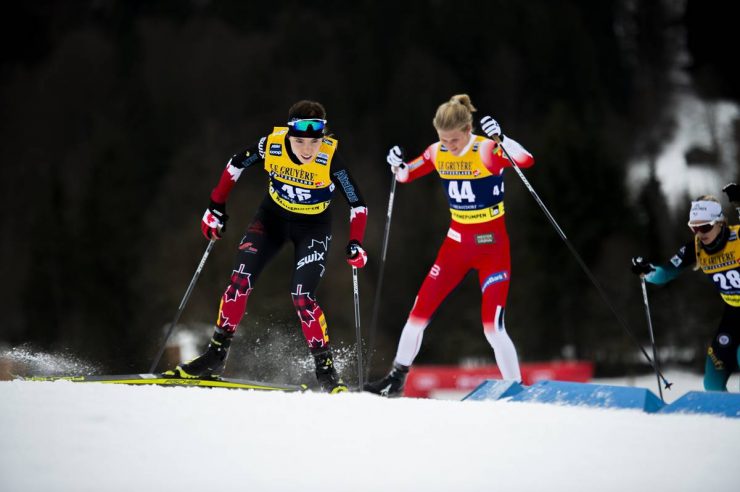
Katherine Stewart-Jones of Canada (bib 45) skiing to 31st in the Oberstdorf, Germany 15 k skiathlon. (Photo: NordicFocus) And with those concerned with the baggy bibs last week in Nové Město – it was a return to the form-fitting bibs we’ve come to know on the World Cup.
Racing continues tomorrow in Oberstdorf with a classic sprint.

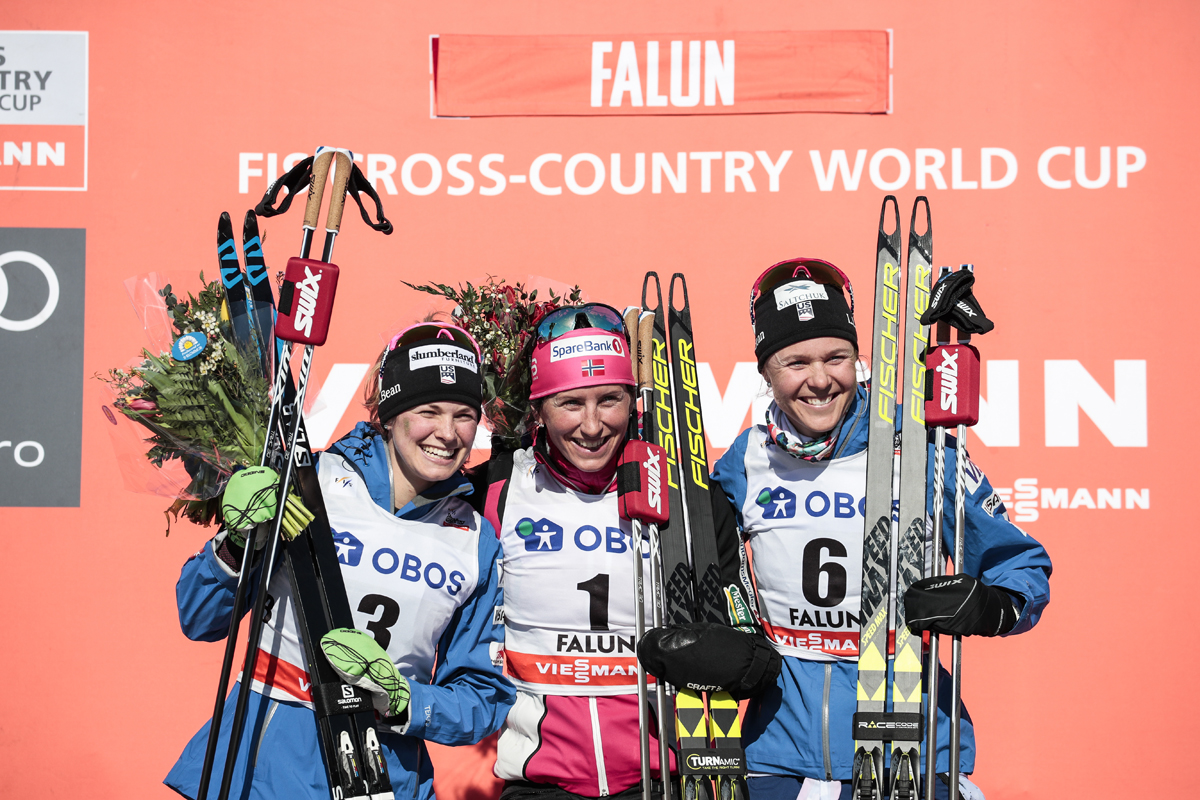
The Oberstdorf, Germany 15 k skiathlon podium: Ingvild Flugstad Østberg (NOR) second, Therese Johaug (NOR) first, Teresa Stadlober (AUT) third. (Photo: NordicFocus) -
The Latest Glimpse from Marit Bjørgen’s Training Logs
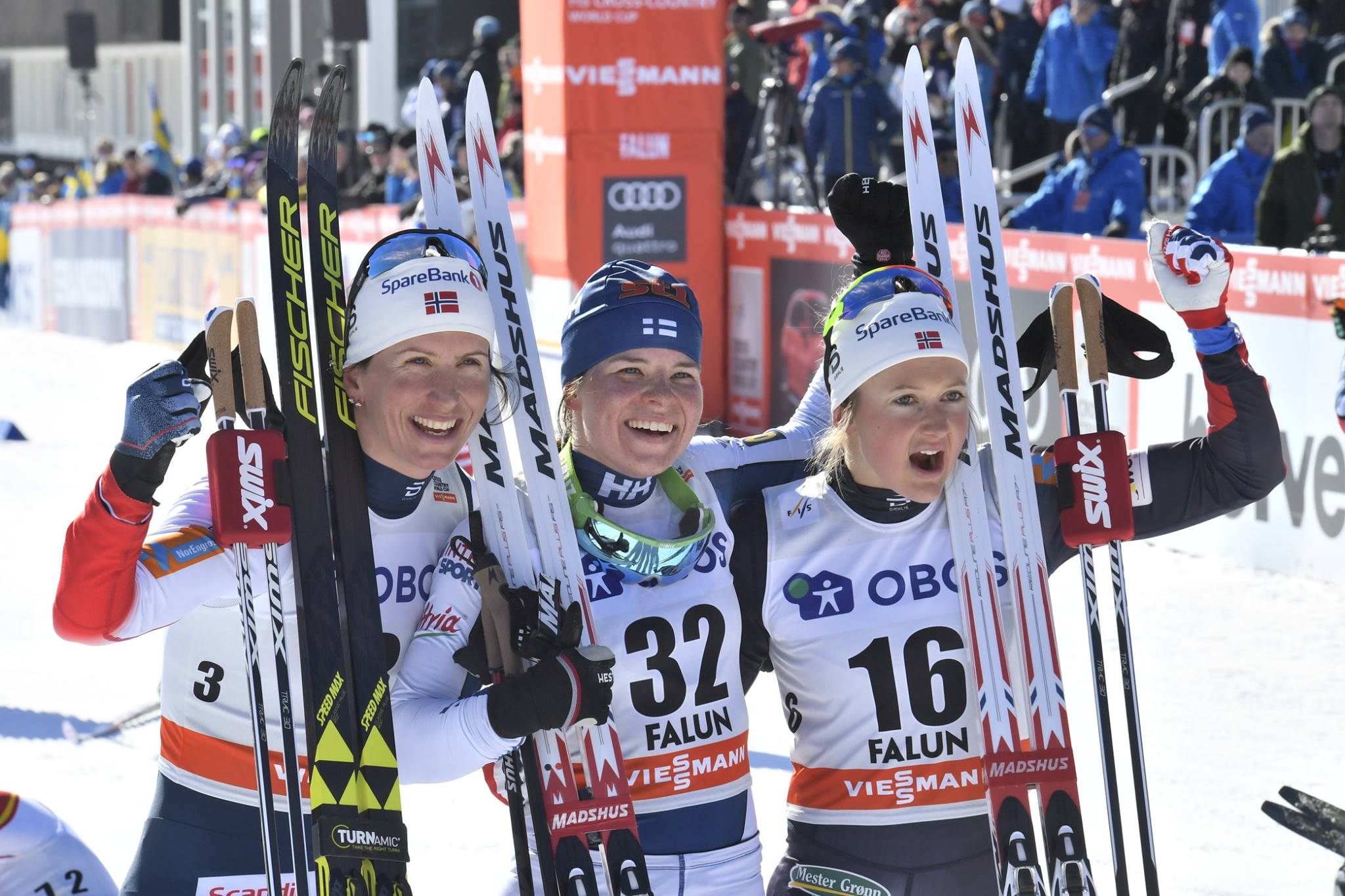
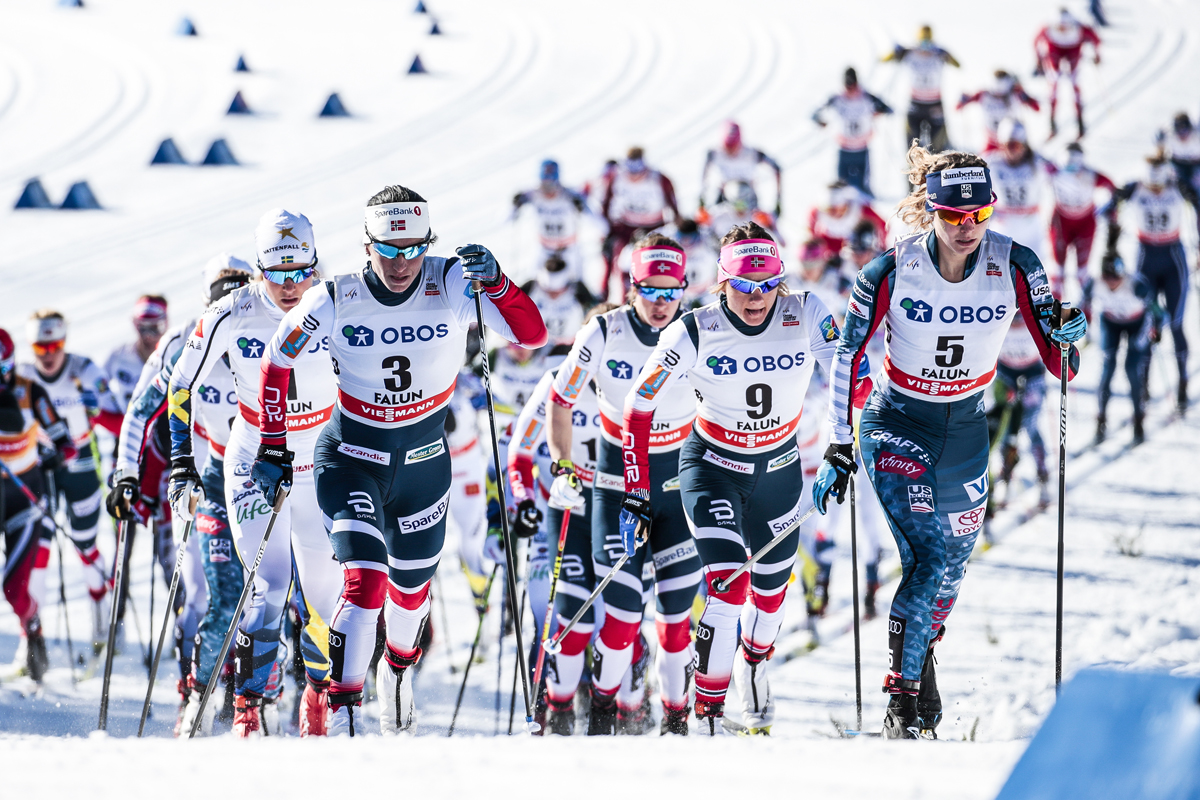
American Jessie Diggins (5) and Norway’s Marit Bjørgen (3) and Maiken Caspersen Falla lead early in the women’s 10 k classic mass start at the 2018 World Cup Finals in Falun, Sweden. (Photo: Fischer/NordicFocus) On May 29, the latest research paper to dive into Marit Bjørgen’s training logs from 2000-2017 was announced in Gemini, the research news publication from NTNU and SINTEF, two research institutions in Norway.
The most recent paper titled “Block vs. Traditional Periodization of HIT: Two Different Paths to Success for the World’s Best Cross-Country Skier,” was published in Frontiers in Physiology on April 5th.
The authors are described in Gemini as “Guro Strøm Solli of Nord University and NTNU and a former xc-ski team member herself, Espen Tønnessen from Kristiania University College in Oslo, and Øyvind Sandbakk, from NTNU’s Centre for Elite Sports Research.”
Two of the authors, Solli and Sandbakk, have examined Bjørgen’s logs in depth. They co-authored “The Training Characteristics of the World’s Most Successful Female Cross-Country Skier,” in 2017, and “Training Characteristics During Pregnancy and Postpartum in the World’s Most Successful Cross Country Skier,” in 2015.
The latest paper in their series explores Bjørgen’s use of two distinct types of high intensity training (HIT) and how they impacted her performance.
Gemini describes the two HIT methods as the following: “The first approach was block training, where she clustered her HIT sessions into blocks, interspersed with recovery periods with fewer HIT sessions. Later in her career she switched to a traditional model, where HIT sessions are spread more or less evenly throughout a training period.”
Bjørgen’s block HIT method, used from 2005-2006, involved numerous periods of intense HIT sessions and fewer hours in what many would consider a traditional long-duration low-intensity program.
From 2014-2015, another HIT segment the researchers zeroed in on, Bjørgen used a more “traditional” approach to her HIT training.
Gemini describes the “traditional” methodology as what many athletes have become familiar with: “Typically, the researchers said, the traditional approach means that an athlete relies on a mix of low, moderate and high intensity training, gradually transitioning from high volumes of training — meaning number of hours — to higher training intensity and training that is more specific to the sport the athlete is competing in.” Looking for where to play Crazy Time slot ? Go to the official website of the game https://crazytimegame.com/en/
The scientist do not answer which method is more effective? It is also important to remember this is Bjørgen, and it remains a sample size of one.
“To get progression you need to change something,” Sandbakk told Gemini. “It’s not always that if something works, then more of it is better. That’s an important message.”
Mix it up may be the take-home lesson.
The three research papers derived from Bjørgen’s training logs are linked above and provide some great reading and insight.
-
First Tracks as a New Parent: Kikkan Randall [Part 2]

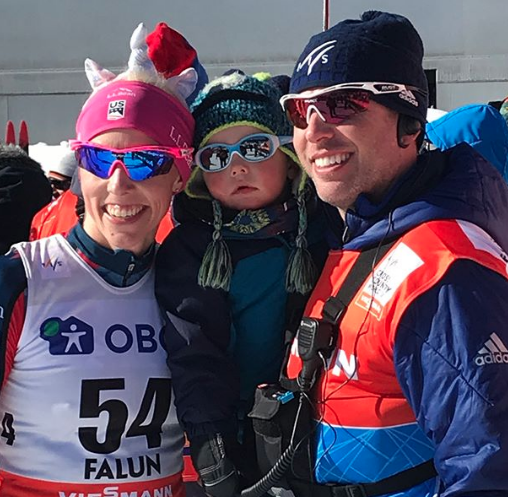
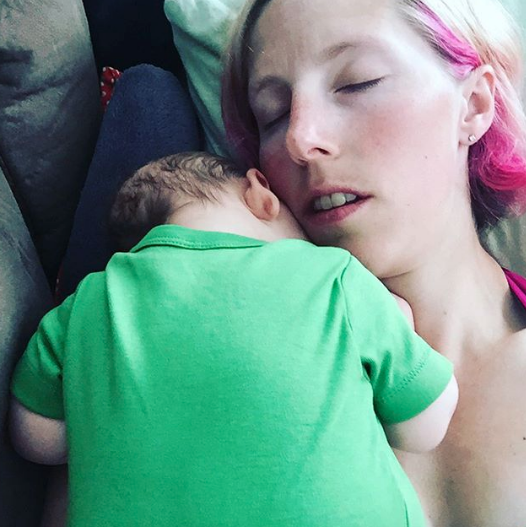
Kikkan Randall poses with her husband Jeff Ellis and their son Breck after her final race in Falun. (Photo: Instagram @kikkanimal) The “First Tracks” series highlights the pregnancy, postpartum, and parenting experiences of noteworthy athletes in cross-country skiing in various stages of their professional careers. The sharing of these experiences can benefit athletes in any stage of their career, whether they are an elite or recreational skier, by demonstrating that it is very possible to return to skiing, competition, and an active lifestyle with a growing family. The series will include the physical challenges of being an athlete during and after pregnancy, balancing family life with skiing, and the joy that starting a family can bring. This is part two of Randall’s “First Tracks”. You can read part one here.
***
After Kikkan Randall delivered her son, Breck Stuart Randall Ellis, on April 14th of 2016, she began her return to racing.
“The one thing that kind of struck me as I was doing all of it, is that because I wasn’t racing while I was pregnant, I felt like I was taking my maternity leave before the baby came,” said Randall in a call, “because as soon as the baby came, it was time to get back into training.”
Randall described the adjustment of incorporating motherhood into her lifestyle as a professional athlete as a “cool mind shift”, and expressed gratitude for her support system for enabling her to spend lots of time with her new baby while still putting in the training hours she needed to pursue her goals.
“I had looked forward to being a parent for a long time, but I was completely blown away with how awesome it was,” said Randall. “From the moment he came into the world and you quickly realize – as a skier, my life had really been all about me, pretty selfish, because it has to be for performance. Pretty quickly it was all about him and I had to find a way for it to be about me in between.
“It was a change in perspective too in knowing that my training time wasn’t unlimited,” she added. “So the time that I got to be out there I was really grateful for, and I wanted to make the most of it so that when I could come back and be with Breck I still could make the most of that time.”

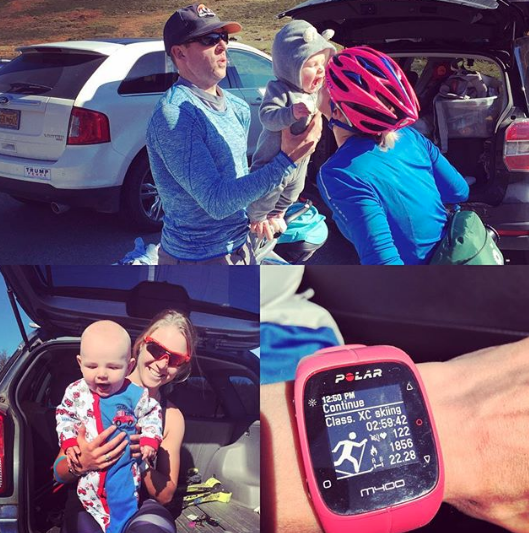
Kikkan Randall kisses her five-month-old son Breck after a training session with teammate Sadie Bjornsen. (Photo: Instagram @kikkanimal) While Randall’s capacity for high volume training while pregnant may seem super-human, her recovery process brought her closer to the mortal realm.
“After the birth, there was just a bigger recovery process than I had anticipated,” admitted Randall. “I was still able to do three sets of eight pull-ups about a week before Breck was born, I was feeling really strong at the end of my pregnancy. So I thought, oh man when I have this baby and the extra thirty pounds come off, I’m going to be whipping out pull-ups right and left! I think I waited about four days or maybe it was a week and I was like okay, I’m going to try some pull-ups now, and I could barely do four!”
During pregnancy, a woman’s uterus grows to between an astronomical 500 to 1000 times its original size, from about the size of a pear to approximately the size of a watermelon. In addition to relocating the remainder of the mother’s internal organs, this growth puts a major strain on the core muscles that stretch to accommodate the growing baby and on the pelvic joint, which widens to aid the delivery of the baby. The body also produces a hormone called relaxin throughout pregnancy which allows ligaments to stretch and joints to loosen more easily as the body expands. This hormone is present in the body for 12 or more weeks after pregnancy, meaning women are at an increased risk of joint injury during the immediate postpartum period.
Because of the stretching of core muscles, many women develop a condition known as diastasis recti, which is a weakening of the connective tissue in the abdominal wall leading to a separation of the rectus abdominis, more commonly thought of as the muscles that make up a “six pack”. The degree of separation is measured by the number of fingers that can be inserted through the gap to the transverse abdominal muscles lying below. In severe cases, the condition needs to be rectified with a surgery similar to the treatment of a hernia.
“When I started doing exercise after the birth, I was relying on all the bigger muscles [rather than utilizing the core], and I ended up injuring my back about a month after Breck was born,” Randall shared. “So then I started going to Pilates classes and working with a physical therapist that specializes in postpartum stuff to really work to re-engage. I had about two fingers worth of separation between my abs, but thankfully, I have a really strong lining underneath it, and I was able to bring it back to about a half-finger gap.

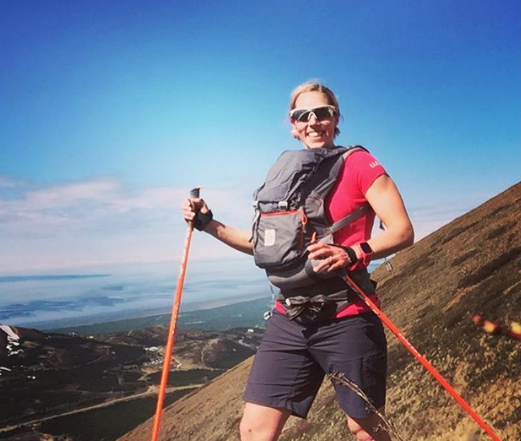
Kikkan Randall hikes with her newborn son Breck. (Photo: Instagram @kikkanimal) “The core strength, for sure, took a bit to come back,” Randall continued. “I think part of it was coordination and strength. And then, really for the whole first year, I didn’t feel like I had the tension in my joints like I had before… So things like really quick speeds, sprinting off the line, that stuff, just took a while to come back and that was a surprise.
“On the flip side, I couldn’t believe how strong I felt aerobically right off the bat. Within a week or so, I was testing things out on the ski erg and that felt pretty good, and I was getting on the bike, and that was good. We just made a really gradual approach back into training in the first three months, and I really was very cautious and easy with myself for those first six weeks, and then very gradually built back.”
While the non-weight-bearing nature of cross country skiing might provide benefits to a body in recovery, Randall realized that the multi-faceted training for her sport at the elite level made resuming her normal regime a slow process.
“We brought classic in first, thought that was going to be a little easier on the body than skating,” Randall explained. “And we realized how complicated ski training is as we were trying to introduce one thing at a time so we could really tell that I was passing a stage before moving onto the next. But when you’ve got classic, skate, running, biking, strength training, and then that at all these various intensities, it was really like, oh man, where do we even start.
“We started very simply with using biking as a way to keep up my aerobic intensity,” she continued, “then started with some really easy classic skiing and gradually worked up the volume. When that was going well we added a little bit of intensity. Then once classic was going well, then we did the same thing with skating. So I think it was three or four months before I was back to doing most of my normal training modes.”
Not all of her training modes were easy to reintroduce.
“Running took me a while,” Randall expressed, “probably six or seven months to get back into because I did have that separation in the front of my pelvic bone. I had started trying to run small amounts in my neighborhood thinking staying close to home would be good, but I was doing it on pavement. Then, later on, I had much better success building up my running on the trails, so I really think the surface mattered. I was able to do a lot of uphill running, striding, and stuff with poles, that was a really good way to reintroduce the impact on my legwork.”
Despite resuming a high volume training load, Randall was able to breastfeed her son for the first eight months after giving birth, a commitment that required a lot of planning.
“It was a blend of just timing feedings and going off for training and coming back and feeding him again and doing a lot of pumping,” Randall shared. “I did two short four-day camps on the glacier, so for that period, I was away from him. Thankfully, I had done a lot of extra pumping early on when I was producing more milk than he was eating, so I had a stockpile. So then, my husband was able to give Breck the stockpiled milk, and while I was on the glacier I was also pumping every few hours so I was building up a new stockpile.
“So that was kind of funny to be in the middle of the night in the back corner pumping, then leaving camp with this whole cooler full of frozen breastmilk,” Randall laughed. “Then I kind of weaned off on breastfeeding right as the race season was starting.”
Producing enough milk to sustain a growing baby adds a unique load on the body and requires approximately an additional 500 calories.

Kikkan Randall shares a photo of herself with her newborn son captioned “Naps between training just got a whole lot better.” (Photo: Instagram @kikkanimal) “I didn’t really notice it,” Randall stated gratefully. “I didn’t find myself more tired. I was trying to drink a lot to keep my hydration up, but I never really felt like I got out of whack that way. I was enjoying the opportunity to eat the extra calories. Overall, I was pleasantly surprised at how well I was able to balance it with all the training that I was doing.”
While breastfeeding did not cross her mind as a source of impedance for her recovery between training sessions, Randall did have some concerns about the lack of sleep during the first few months of Breck’s life. However, she found it to be much less detrimental than anticipated.
“I had been wearing this device for a full year leading into pregnancy, then I wore it through my pregnancy and after – it measures the quality of my sleep and my recovery. I thought that I was going to see a huge decline, but I saw some of the best numbers I’ve ever seen!” Randall exclaimed. “So I think that the super mom powers you get, just the happiness factor… so even though I was getting less sleep, when I was sleeping I was sleeping really effectively, so it didn’t seem to have an impact on my training.”
In reflecting back on her pregnancy and postpartum experience overall, Randall saw both advantages and disadvantages to being a skier, versus a professional athlete in a different sport.
“I think our training as skiers is very complementary to what you do for pregnancy because of the low impact nature of it,” Randall stated. “Being able to ski a lot was really beneficial and I could bike and do all these different activities that contribute to the same goal, which was great. I could see being just a runner being challenging.
“I do however see a difference in the return,” she continued. “I followed a couple athletes like [professional cyclist] Kristin Armstrong who came back incredibly strong after the birth of her child and won gold medals. I was just thinking about how biking is so one dimensional and so linear, it would be so easy to hop on the bike and get back in shape because it’s all aerobic and it doesn’t matter the tension [in muscles and joints] as much. So some sports may be easier that way… Skiing was just so challenging with all the different pieces to figure out.
“But overall, there were a lot of other world cup athletes that all did it around the same time as me and everybody came back strong,” she concluded. “So I think it’s very doable.”
As Breck’s half-birthday approached, so did the World Cup season. Randall headed to Europe with her teammates once again after eighteen months away from racing.
“At six months, that was about a month before the season started, I was feeling strong, training with the team, doing time trials,” Randall remembered. “I thought I was really ready to go, and then when the race season started, that was when I got the reality check that being away from race intensity for several months takes a little while to come back. I think that was also in relation to the tension in my muscles.
“So the first three months of the race season were pretty challenging, I had to be really patient,” she added. “Then when I hit about the ten-month [postpartum] mark, I felt a really big change, and then another big change at a year.”

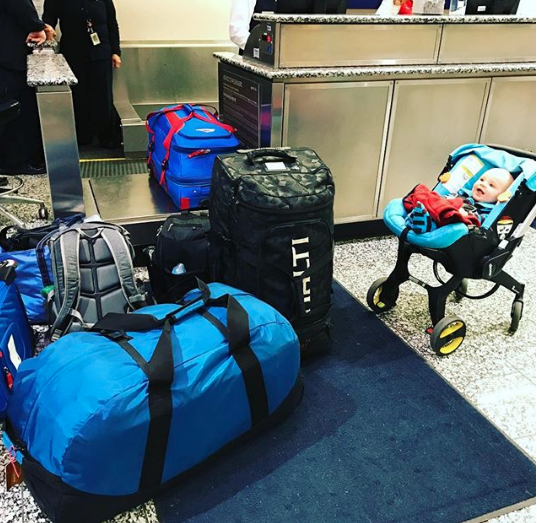
Kikkan Randall’s son Breck waits happily next to their bags as they depart for a winter in Europe for the World Cup Races. (Photo: Instagram @kikkanimal) Apart from the physical challenge of being prepared to race at the highest level at seven months postpartum came the logistical challenge of traveling across the Atlantic for a winter on the road with an infant. What was their secret to success? Not dwelling too much on it.
“We didn’t really think too much about how we were going to do it,” Randall admitted. “We just decided that we wanted to do it and therefore we were going to figure it out. Some people were like, ‘how did you travel five-months on the road in Europe while ski racing?’ And I was like, ‘I don’t know, we just did it! And it was awesome!’ We schlepped a lot of gear around and just made it work and it was really an awesome experience for us all together.”
The World Cup moves between countries on a weekly basis, meaning regular flights, bus and train rides, and time changes. While this schedule might make any traveler weary, Breck seemed to handle it without too many problems.

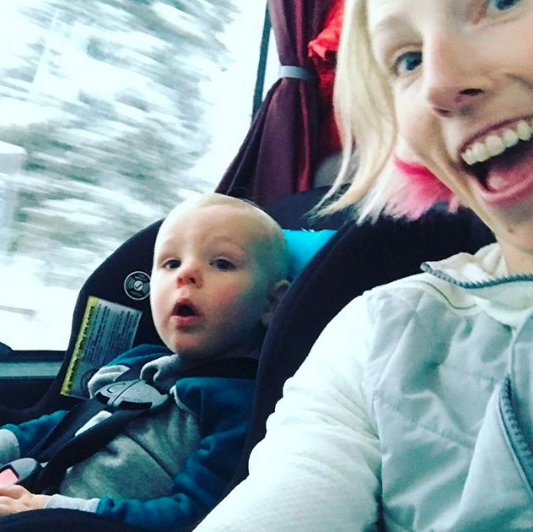
Kikkan Randall travels with her son, Breck, between World Cup race venues. (Photo: Instagram @kikkanimal) “I don’t know that we’ll ever know the answer to the question of whether he is just a good easy-going, even-keel kind of kid, that’s just good for anything, or whether it was that early in his life we started taking him on trips, so that’s all he knows,” said Randall. “He ended up being a great traveler, even long van rides and being on big busses with the world cup field. He just went along with it.
“The time change, however, was quite difficult,” she continued. “It probably took us a good two or three weeks to get on a routine. When we went over he was starting to only wake up two or three times a night, I really wasn’t feeding him too much during the night. When we got over there, he started waking up five or six times a night. And because we had teammates all around us and I didn’t want to disturb them, we were doing whatever it took to keep him happy through the night. But then it would be one in the morning and he was wide awake like ‘let’s play!’ Then at three in the afternoon, we couldn’t keep him awake to save our lives.”
Luckily, Breck was born amidst a small baby boom on the World Cup, so Randall was not alone in navigating this experience. Marit Bjørgen of Norway, Aino-Kaisa Saarinen of Finland, and Katja Visnar of Slovenia all gave birth during the 2015-2016 ski season as well.

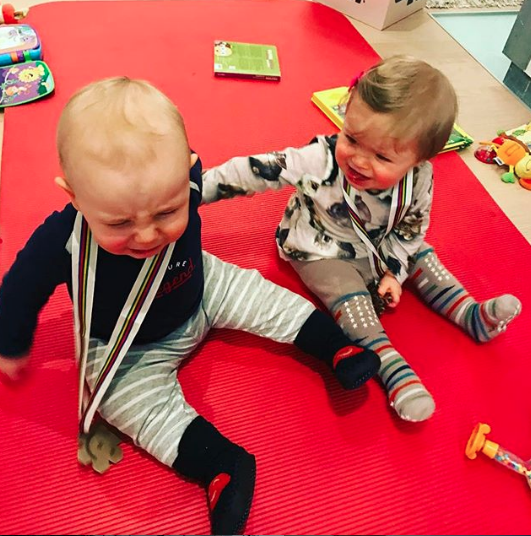
Kikkan Randall’s son, Breck, and Aino-Kaisa Saarinen’s daughter, Amanda, play with their matching bronze medals from the World Championships in Lahti, Finland. Randall captioned the photo, “It’s okay Breck, you’ll win gold next time.” (Photo: Instagram @kikkanimal) “My Finnish friend [Saarinen] who is a World Cup skier and had a baby just a few weeks after me highly recommended that we do sleep training,” Randall explained. “So about three weeks into the season, we were in Switzerland and we were finally in an apartment so we wouldn’t disturb anyone around us and we committed to three or four nights of sleep training. And it was mostly done by Jeff – I got to sleep through it because I was racing – but he committed to letting him cry for longer and longer intervals and within about four nights, he was completely sleeping through the night, and from then on it was a huge game changer for us.
“We actually found it a lot more challenging the second year when he was between a year and a half and two years old because then he wanted to move a lot more and he was more aware of what’s going on and it was harder to keep track of him on the long travels.”
In addition to family and friends, Randall was grateful for babywearing and carrying gear during her preparation for and travel during the race season as it made it easier to bring Breck along for some sessions and to get him from place to place more easily while on the road.
“We got a Thule chariot right away,” Randall explained. “That was super awesome because with the infant harness we could suspend him in there from pretty early on. I could use it to get out for walks and later runs. Then we could pull him behind the bike, and then we could pull him skiing.
“We found it really useful in Europe in the winter because we could just pack him in there all nice and

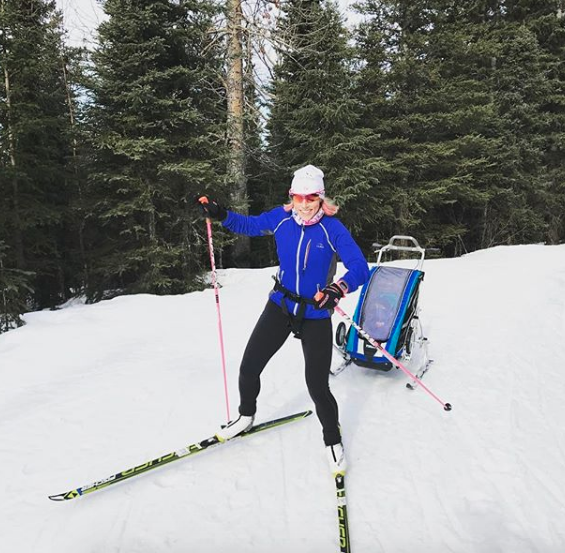
Kikkan Randall tows her son, Breck, in their Thule Chariot. (Photo: Instagram @kikkanimal) warm, protected from the snow and wind and rain, then whoever we had with us helping take care of him could just take him out for these great walks all the time,” she continued. “That was a really great tool, I mean we’re still using it a ton.”
At about 10 months postpartum, Randall took third in the freestyle sprint at the World Championships in Lahti, Finland, and at about 22 months postpartum, she won her historic gold medal. However, just five months after the Olympics, Randall shared that she had been diagnosed with breast cancer. Luckily, she was given a good prognosis, however, the discovery halted the Randall-Ellis family’s plan to grow.
“That’s been one of the toughest parts of this breast cancer deal so far,” Randall shared. “We were so excited to expand our family after the Olympics ended, and now that’s on hold for at least a couple more years. We were fortunate that we were able to do some fertility treatment before I started chemo, so we have one little embryo as a backup plan. It just gives us some hope that in case my fertility has been wiped out by the chemo, that gives us one shot maybe. And there’s no guarantee that the chemo does wreck my natural fertility. So we’ll find out in a couple years when hopefully I can take a break from the anti-hormone stuff.

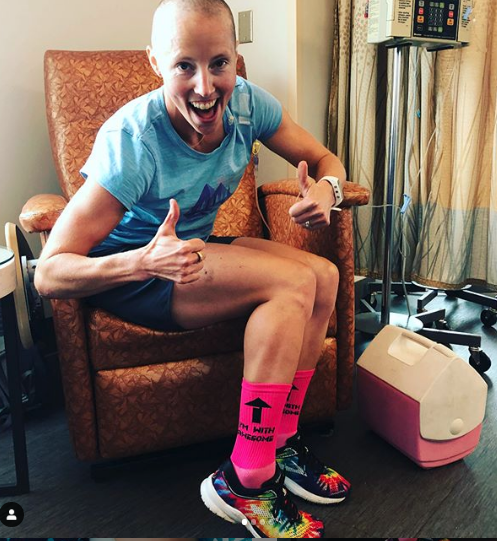
Kikkan Randall displays her newly bald head and tireless positivity after undergoing her second round of chemotherapy. (Photo: Instagram @kikkanimal) “With that aside, it makes me really grateful that we have Breck,” she continued, “because I know how much I love being a parent and the fact that I get to do that with Breck is so amazing. I think if I hadn’t had any children and was facing this, it would be a lot harder.
“Also, you hate that it takes something like this to change your perspective, but we’re just really appreciating every day with Breck now, and the fact that we get to just focus on him, because sometimes when you have another kid then you have to shift your attention to two kids,” Randall added optimistically. “So we’re just going to really enjoy doing stuff with Breck and it makes me appreciate how much I love being a parent and making the most of every day that I have. And I’m staying hopeful that I get to go through this whole experience again, even if it’s not on the original timeline that I imagined.”
Finally, Randall was asked what message she would share with a fellow skier who is pregnant or thinking about starting a family.
“Approach this new situation with a curiosity and really just listen to your body,” Randall encouraged. “But have the confidence that your body is pretty tough and it is used to doing a lot, and probably the best thing that you can do for yourself and the baby is to just keep doing what you’re doing. I really think that when you’re used to getting a lot of exercise, and as an athlete, you’re used to taking good care of yourself, just keep doing that through pregnancy.
“Enjoy it!” she added. “Notice what’s different and unique, and also have the confidence that when the baby comes, it may take the patience of a couple of months to get your body to come back around again, but it will and you’ll be stronger than ever. I think it’s really exciting to be able to blend athletics and being a parent whether you’re doing it at the elite level or just someone who is worried about continuing to be athletic after having kids, it really works out great.”
-

Johaug Wins Davos 10 k Skate; Diggins Fifth and Brennan Sixth for the U.S.
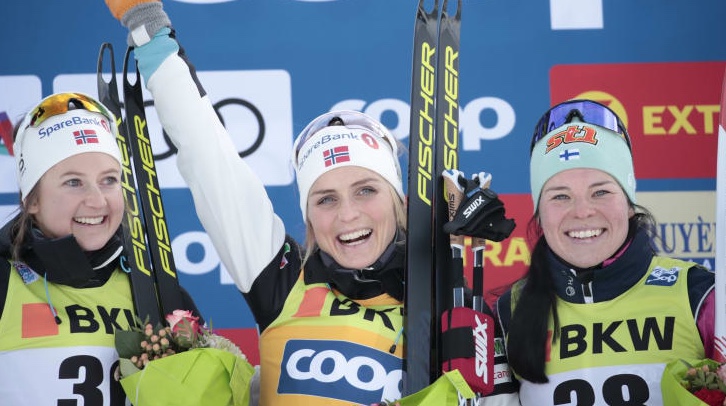
The women’s podium from the 2018 World Cup 10 k freestyle individual start in Davos, Switzerland. Therese Johaug (center) of Norway won, teammate Ingvild Flugstad Østberg (left) was second, and Krista Pärmäkoski (right) of Finland was third. (Photo: Fis-Ski.com screenshot) Coming off a two-season hiatus from the World Cup for having a banned steroid in her system, Norway’s Therese Johaug has come back onto the distance race stage with time checks and results showing no remorse. This is not to say that Johaug’s reentry to the sport comes with arrogance. But it is to highlight that, on course, her level of control in the early season World Cup distance events has been dominant. Johaug has won all five World Cup distance events thus far. Her string of first places is a way of saying she’ll let the results speak for themselves and her dominance seep into the minds of those who want to fight for second and third place.
Sunday was yet another win for Johaug. The up-tempo skier won the 10-kilometer freestyle individual start in Davos in a time of 26:06.9 minutes. She led the race at every intermediate time checkpoint.
It was Johaug’s 81st World Cup podium. She trails only Norway’s legend Marit Bjørgen who won 99 World Cup podiums during her career.
The second place finisher on Sunday, Johaug’s teammate Ingvild Flugstad Østberg, had the benefit of starting two places behind the eventual race winner: Johaug started in bib 36, Østberg in bib 38.
Through the 5 k lap mark, Østberg was able to keep Johaug’s gap no bigger than 10 seconds. On the second lap’s long climb, Østberg only lost a handful of seconds. Her finishing time of 26:19.0 minutes was 12.1 seconds behind Johaug.
For Østberg, it was her third distance podium in succession after placing second in Lillehammer’s 10 k classic pursuit, and third in Beitostølen’s 15 k freestyle individual start race.
Johaug leads the World Cup overall with a perfect score of 600 points. Østberg sits in second, with a 149 point deficit.
Finland’s Krista Pärmäkoski placed third on Sunday, 19.2 seconds back. It was Pärmäkoski’s first podium of the season. She currently is ranked fourth overall on the World Cup.
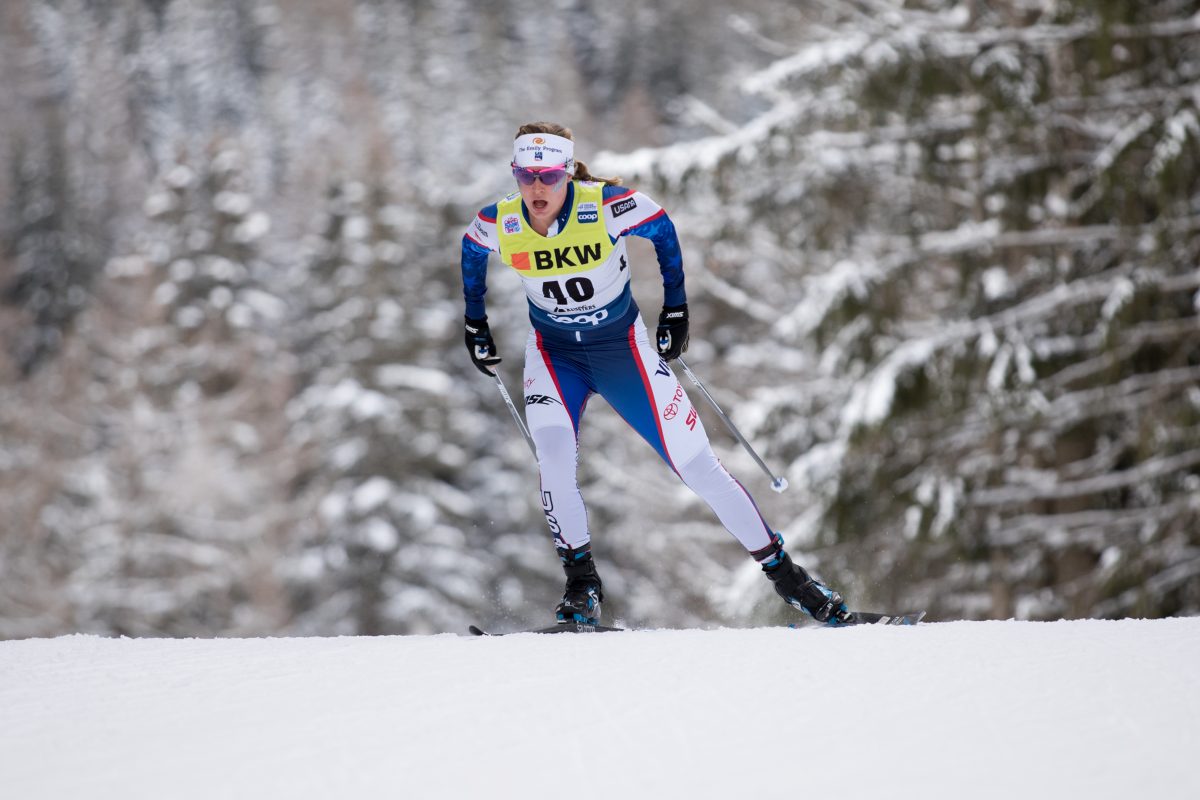
Jessie Diggins during the 2018 10 k skate in Davos, Switzerland. Diggins placed fifth for her best result for the season. (Photo: Reese Brown/U.S. Ski Team) The U.S. placed two skiers in the top-10. Jessie Diggins placed fifth and Rosie Brennan sixth.
For Diggins, it was her best result of the season after her eighth place in Beitostølen’s 15 k skate.
“For me period 1 is a building phase, and it’s a really long season, and every single year I always build into period 1,” Diggins said in a phone call. “And I have to remind myself that I do this for me and that I follow a plan that has worked every other year, so I just have to remember that I will be in the right shape when it’s time. And for me, period 1 is not that time. So I’m really happy that it’s been trending positive.”
Last season, after the Davos distance race, Diggins was eighth overall on the World Cup. Post-Sunday’s race, Diggins sits 13th overall and eighth in the distance cup standings.
The building phase of her season set up a solid foundation on Sunday. Her pace was consistent and only placed her 15.8 seconds out of third at the halfway point. She ended up 1:01.1 minutes behind Johaug at the finish.
“I think that technically, I was really proud of my race today because of the way I skied,” Diggins said of her on course sensations. “It’s hard on a course like this to not go out guns blazing and just charge and then totally flood. Because that’s when I think you can lose so much time. For me, I was just so focused on trying to ski with a strong core and efficient, long-gliding v2 and I was just happy with it because it’s a really hard course to pace, and of course, you’re never sure if you nailed it or not.”
With a two week break from racing, Diggins will be training in Seefeld, Austria during the race respite. Next up on the Diggins race schedule is the Tour de Ski (TdS). She placed third overall in the TdS last season, a historic mark for an American. Although she has ambitions at the TdS, Diggins also clarified that it remains a piece in the building-form puzzle. In-form or trending towards the sharp end of fitness, Diggins understands the possibility for more positive outcomes on the result sheet are more palpable as the season progresses.
“For me, I feel like period 1 and the Tour are really crucial building blocks for the season ahead, so I’m looking to take really good care of myself and just like get after it in the Tour. I do think that parts of a season are building blocks where you recognize that maybe you’re not in top form, and that’s on purpose because of the training load you’re carrying in. So you want to do the best you can with what you have. You’re not setting unrealistic expectations that might set you up to be bummed out. For me being like ‘I want to win Kuusamo 10k Classic’ would be an unrealistic expectation from myself. So I think that the Tour, yes, I would like to get a podium in the Tour, obviously, like I think that’s a good event for me, for my strengths, I really, really like it.”
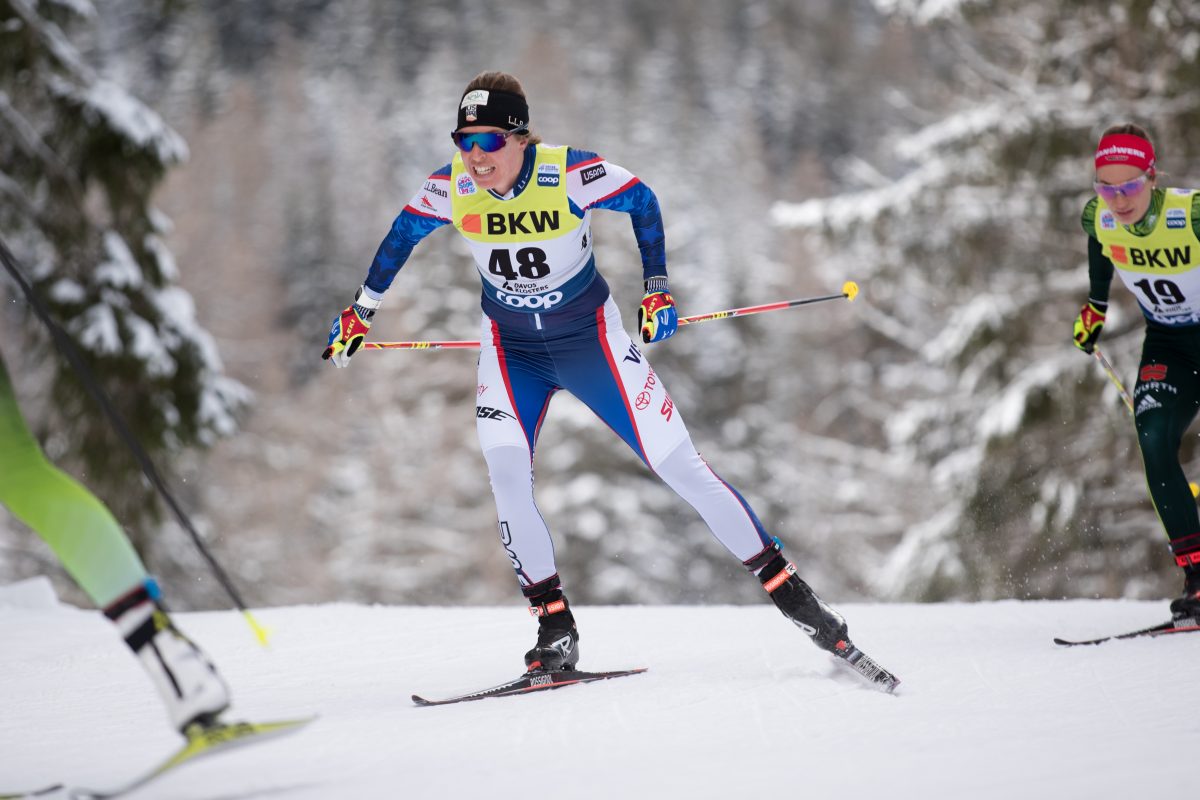
Rosie Brennan (bib 48) on her way to an individual career best on the World Cup with a sixth place in the 2018 Davos, Switzerland 10 k skate. (Photo: Reese Brown/U.S. Ski Team) Seeing Diggins steadily improve this season is no surprise. That has been her blueprint for success in the past. Arguably the biggest surprise in total on the women’s World Cup is Brennan’s success.
Brennan placed sixth (+1:04.9) on Sunday for her best career individual World Cup result.
“I just really wanted to feel good racing again and to enjoy it again,” Brennan said in a call. “I was just so miserable last year, and it was it hard decision to know if it was even worth it to continue on if I could find not only fun in racing again but also good form and just good race feelings.”
Brennan’s struggle with fatigue and recovery soured her 2017-2018 season. Her down season resulted in her not being renominated to the U.S. Ski Team. What is clear now is that Brennan has found herself in an unprecedented place. Ranked 11th in the World Cup distance standings, Brennan was able to savor her Sunday in Davos.
“Today was definitely the most fun race I’ve had all period, so I’m leaving period 1 on a high note, there’s not much more I could ask for, so it’s been great,” Brennan said.
Her current high note has not allowed her to lose sight of managing her long-term energy and goals. Brennan will not race the TdS and will return to the U.S. for a training block.
“I had made that plan before the season started, and obviously with good results, it became a very difficult decision,” Brennan said of deciding to forgo the TdS. “But given how late World Champs is in the season this year, I really wanted to make sure that I had enough training under my belt to make it to World Champs, so I’ve decided to stick with the plan.”
Currently, Brennan has not automatically qualified for World Championship team selection. She’ll have to remain in the top-50 of the distance standings before the selection period for the team ends.
“The selection ends the second-to-last day of the Tour, and the Tour is only half points,” Brenna explained. “So I feel confident that I will remain in the top-50. So that helped make the decision easier. I have no pressure to race anything, so I’m just going to focus on training and keeping good fitness through the rest of the season.”
Also for the U.S., Caitlin Patterson placed 38th (+2:22.5) and Kelsey Phinney 65th (+4:02.1). Sadie Bjornsen did not start and according to U.S. coach Matt Whitcomb, that decision was part of her pre-determined race schedule.
Canada’s Emily Nishikawa stormed into the top-30 in only her second World Cup start of the season to place 23rd (+1:47.6). Cendrine Browne(CNST) was 44th (+2:28.8).
For Nishikawa, the result ties her career best on the World Cup. She placed 23rd in a 2015 10 k classic in Lahti, Finland. In an email, Nishikawa explained that living in and training in Canmore mitigated some of the altitude effects of racing in Davos. During her race, she was caught by Diggins around 7 k.
“I hung on as long as I could with [Diggins] and tried to follow her fast pace through top section,” Nishikawa wrote “Other than that I skied alone for the race.”Racing continues on the World Cup on December 29, for the TdS’s opening stage skate sprint.
-
Klæbo Takes Davos Sprint for First Win of the Season; Simi Hamilton in 12th
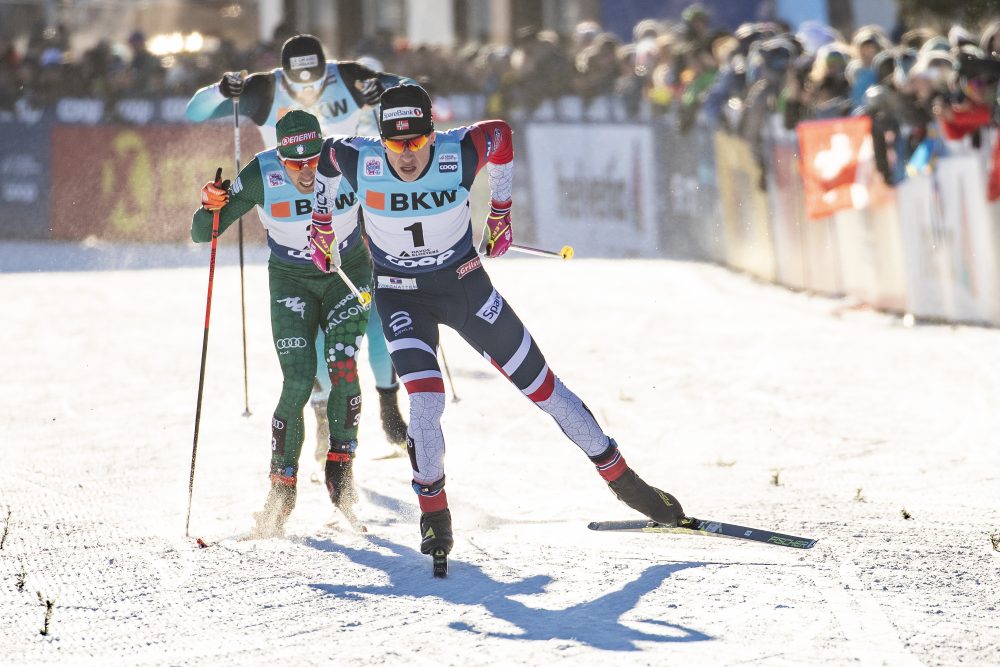
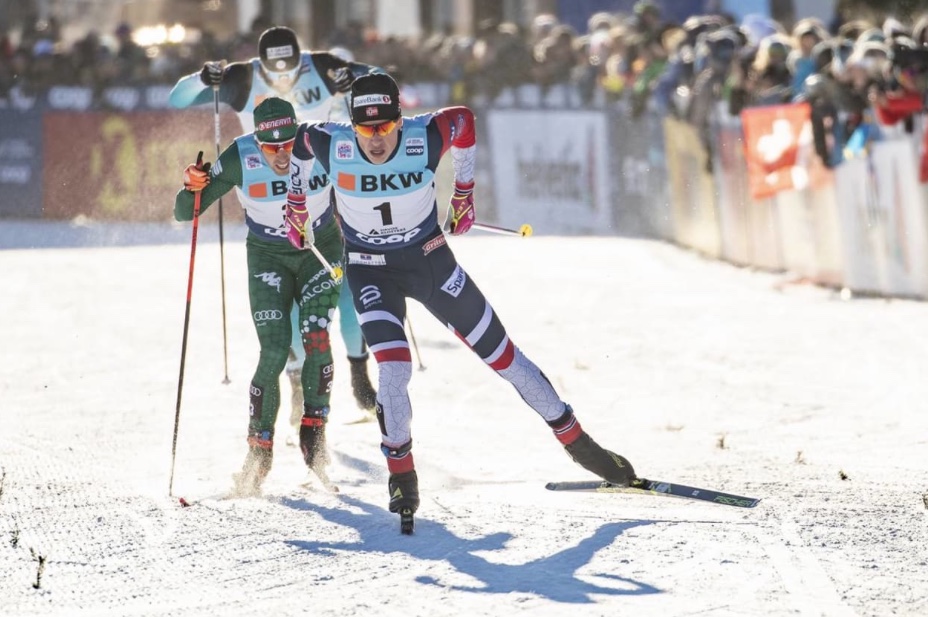
Johannes Høsflot Klæbo of Norway down the finishing stretch in Davos, Switzerland. He won the day’s skate sprint while Italy’s Federico Pellegrino (green suit) was second. (Photo: Fischer/Nordic Focus) As seems fitting for all things Davos, Switzerland: the racers enjoyed a bluebird day for the 1.5-kilometer freestyle sprint on Saturday. And just when we thought Johannes Høsflot Klæbo of Norway might be too spent from a year of media coverage and big-effort racing, he scored his first win of the season in gorgeous Davos.
He began the day at full-throttle in the men’s qualifier, placing first with a time of 2:22.39 minutes. Lucas Chanavat of France qualified second (+0.36) and Federico Pellegrino of Italy qualified third (+1.76).
Klæbo continued his winning streak throughout the heats, winning his quarterfinal, and semi. He finished the day with an overall win in the final, finishing in 2:20.44 minutes. This was Klæbo’s first win of the season. He qualified first in the 1.6-km skate sprint in Lillehammer, Norway two weeks ago, but he finished in 11th overall. One thing was for certain in Davos: Klæbo was skiing with confidence, snappiness, and some of the flair he’d been missing this season.
On the first climb of the final, Klæbo and Chanavat duked it out for the lead position. Pellegrino, skiing more conservatively at the outset, started in the back of the pack but was able to work the first corner to his advantage. By the top of the hill, he was sitting in third place. As the skiers lapped through and skated around the tight right-hander before the final climb, Kælbo was in stalk and hunt mode. He punched up the final climb and gapped the field on the downhill, sprinting to the finish ahead of Pellegrino who finished second (+.39).
“That’s what we train for the whole spring and all summer – so now I’m where I want to be. It’s a fantastic feeling,” Klæbo told Norwegian broadcaster NRK according to a translation. Klæbo also told NRK he has not confirmed his plans to race the Tour de Ski (TdS) and will make that decision in the coming days.
With the win on Saturday, Klæbo joins Norway’s Eirik Brandsdal and Petter Northug with nine wins each in World Cup individual sprint wins. The three all sit fourth all-time for World Cup sprint wins among Norwegian men.
For Pellegrino, it was his second podium of the season. He won the 1.6km skate sprint in Lillehammer. Pellegrino has won 11 freestyle sprint World Cups in his career which is the men’s record. That win total is topped by only Kikkan Randall who won 12 freestyle sprints, and Marit Bjørgen who won 24 freestyle sprints during their careers.
Despite his skate sprint pedigree, Pellegrino admitted he feels slightly old among the sprint scene’s young skiers.
“I think I am starting to be a bit old,” Pellegrino told the International Ski Federation (FIS). “This was my 10th race here in Davos and always passed the qualifications. I am really proud of that until now and I hope to do 10 more years and maybe I’ll beat the younger then.”
Babtiste Gros of France finished third (+1.40), barely out sprinting teammate Chanavat (+1.45) in the final. This was Gros’s first podium of the season and his fifth career podium.
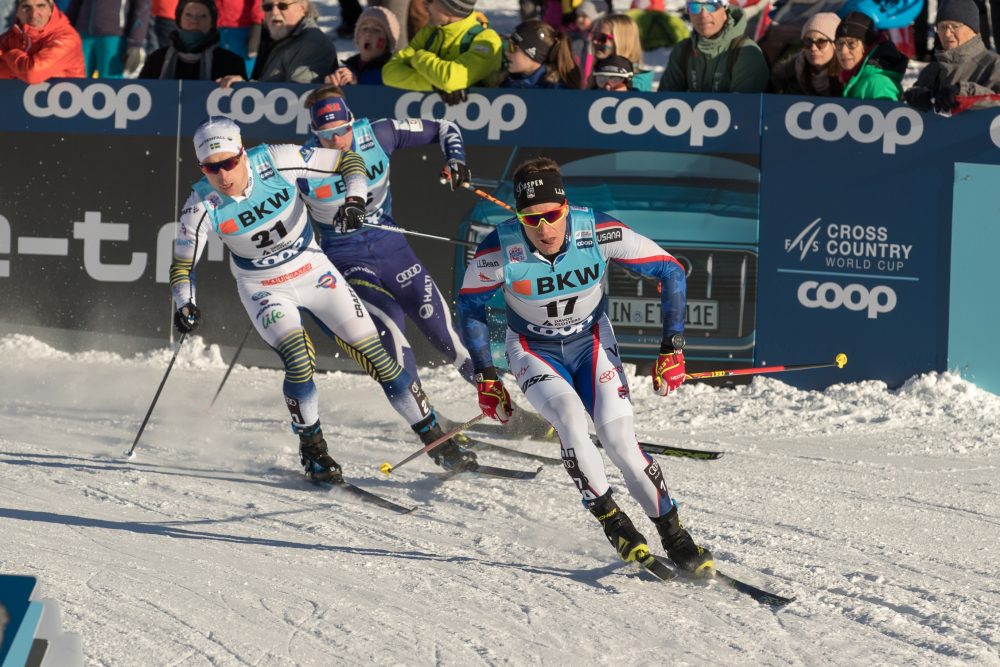
Simi Hamilton of the U.S. Ski team zeroing in during the fifth heat Saturday in the 1.5-kilometer freestyle sprint in Davos, Switzerland. Hamilton placed 12th overall. (Photo: Reese Brown/U.S. Ski Team) Simi Hamilton(USST) was the only North American that qualified for the men in the Davos sprint. Hamilton was 17th (+4.76) in the qualifier. In the fifth heat, Hamilton was second to Joni Maeki of Finland to advance to the semis. A bit spent from the quick-turnaround after the fifth heat to the second semi-final, Hamilton placed sixth in his semi-final.
“Davos, it’s always been a good place for me, having grown up at 8,000 ft. I don’t feel like it’s super high here at 5,000 feet,” Hamilton told FasterSkier in a call. “I think it is still tough for everyone, but also for me when I haven’t been above 1,000 ft for the last 6 weeks, it’s still a shock to the system.”
Hamilton also spoke about his short recovery time from the fifth heat to the semis, and why he chose a later heat.
“Obviously you want to choose one of the earlier heats so you have a longer turnaround time between the quarters and the semis,” Hamilton added. “But, my main goal today was to ski into the semis. It’s always the big goal to be in the final and be on the podium, but I think setting the short-term, realistic goal is also important. So today, having not been at altitude for a while and not feeling super super good, I set the goal of just being in the semis. With that in mind, I chose heat five, knowing that would set me up best for getting into the semis, but probably wouldn’t result in me feeling really good in the semis. So I was kind of expecting that, but just went out and raced as hard as I could and completely ran out of gas in that semi-final and felt pretty crappy on that second lap. ”
US Ski Team Coach Matt Whitcomb also commented on Hamilton’s 12th place in a call.
“Nice step forward for Simi today,” Whitcomb said. “Not exactly what we need on a podium day, but it was still a step forward. He felt very controlled in his quarterfinal and was tactically sound today, made really good moves. It was nice to see him in the semifinals, it’s positive feedback for him. But I’m really looking forward to seeing him in the first few ski sprints in the Tour de Ski.”
Kevin Bolger (USST) was the second-best American, finishing 31st and barely missing the cut off for the heats. This is Bolger’s best individual result so far this season.
In an email to FasterSkier, Bolger explained he is feeling better energy in his first full World Cup season as a new member of the U.S. Ski Team.

Kevin Bolger of the U.S. Ski Team during the skate sprint qualifier in Davos, Switzerland. Bolger just missed the heats by qualifying in 31st. (Photo: Reese Brown/U.S. Ski Team) “The qualifier was a fast 2 lapper, no room for error,” Bolger wrote. “Unfortunately, I ended up 31st just 0.02 out from qualifying, but it’s a step in the right direction. I’m moving forward and that’s a huge confidence booster going into Christmas break, and the Tour.”
Bolger also noted he will be racing in tomorrow’s 15 k skate individual start.
“It’ll be a burner, pretty tough course especially at altitude but I’m excited. I feel like my distance skiing is moving in the right direction as well, I’ll be using today’s result as fuel for tomorrow, but looking forward to getting out there and putting together a good race, should be a fun day in the sun!”
Alex Harvey was the best placed Canadian, placing 37th overall. Harvey, who in the past has explained he does not prefer higher altitude courses, has placed in the top-30 twice in Davos sprints: a ninth place in 2011, and a 23rd in 2017. Lenny Valjas, in his first World Cup of the season, was 53rd. Andy Shields finished in 60th. No other Canadians were entered.
Racing continues tomorrow for the men with a 15 k skate individual start.
-
World Cup Preview: #1 Norway
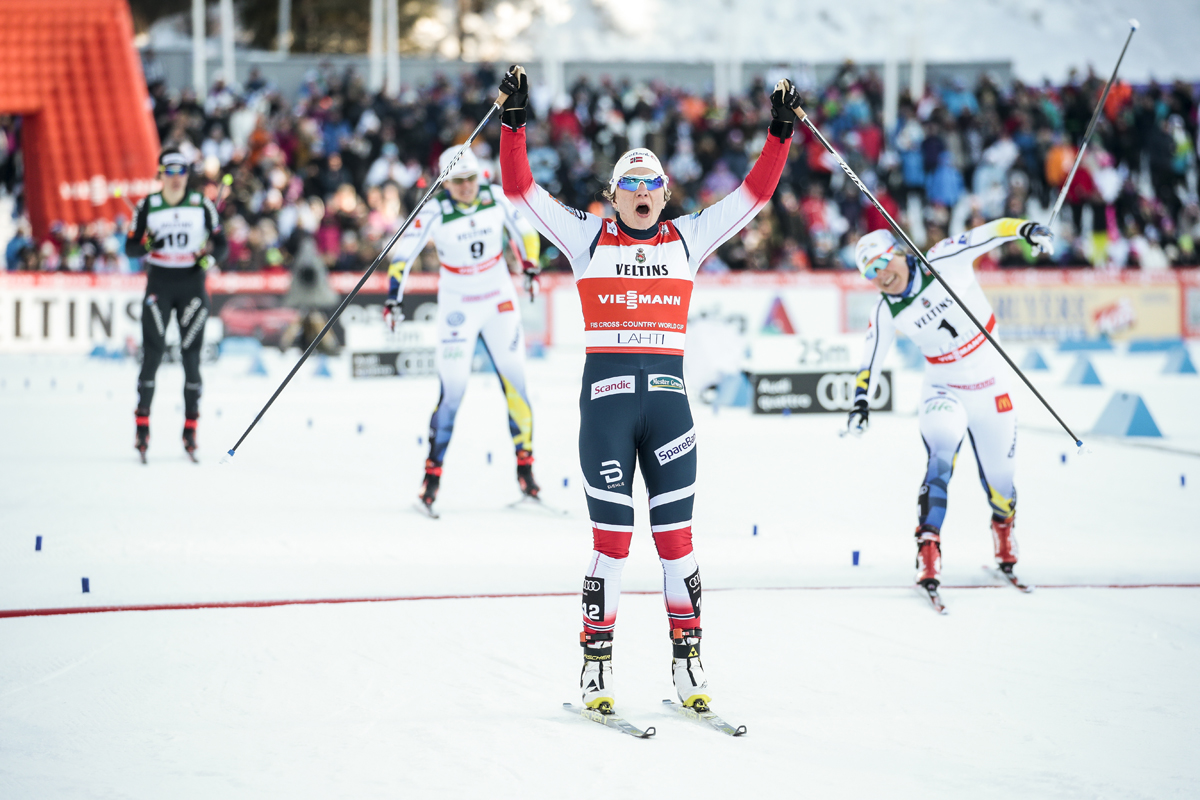
Norway’s Maiken Caspersen Falla celebrates her win in the women’s 1.4 k freestyle sprint at the 2018 World Cup in Lahti, Finland. (Photo: Fischer/NordicFocus) Welcome to FasterSkier’s World Cup Preview, where we check in with the top-10 teams from last year’s FIS Cross Country World Cup tour before the season starts. The World Cup begins with a classic sprint in Ruka, Finland on Nov. 24th
***
Norway
Overall in Nations Cup Last Year: 1
Women’s Ranking 2017/2018: 1
Men’s Ranking 2017/2018: 1
Norwegians to Watch:
Norway won last year’s Nation’s Cup by more than twice as many points as second place Sweden. The question remains, in the aftermath of Marit Bjørgen’s retirement can that accomplishment be repeated?
Chances are, yes.
The Norwegian women’s team boast names such as Heidi Weng, winner of the World Cup the two previous seasons, Ingvild Flugstad Østberg, 3rd place overall in the World Cup in the two previous seasons and gold medal winner in the 4×5 kilometer relay in the PyeongChang Olympics , Maiken Caspersen Falla, winner of the sprint World Cup the three previous seasons and silver medalist in the Olympic classic sprint, and Ragnhild Haga, gold medalist in the Olympic 10 k skate and 4×5 k relay.

The women’s 10 k freestyle podium at Stage 3 of the 2018 Tour de Ski on Monday in Lenzerheide, Switzerland, with Norway’s Ingvild Flugstad Østberg (c) in first and Heidi Weng (l) in second, and American Jessie Diggins (r) in third. (Photo: Salomon/NordicFocus) There appears to be no dynastic decline on the immediate horizon. All of these athletes are on track to perform at a similar level this coming season.
In addition to these four podium-capable skiers, Therese Johaug will return to the Word Cup after having finished her 18-month ban for testing positive for the banned substance clostebol. (Johaug tested positive after applying the ointment Trofodermin to her sunburned lips.)
Johaug won the Lysebotn opp rollerski race in August 1:47.5 minutes in front of Sweden’s Charlotte Kalla in second, and out performed all the male skiers on the national team but Didrik Tønseth during an Oslo hill run this Spring. She is reported to be in better shape physically than in the past. Yet, it remains to be seen if she can transfer that into competitive cross-country skiing against a full World Cup field.
In the days before the Norwegian season opener in Beitostølen, Johaug asked during a press conference that people lower their expectations because of her experience in the last two years. Expectations aside, Johaug won the two races she competed in during the season opener in Beitostølen. In the 10 k classic, as described by FasterSkier, Johaug never let off the throttle. In the 10 k skate, she distanced second place Østberg by 26 seconds and U.S. skier Sadie Bjornsen by 1:45.9 minutes in third. With those two wins in Beito, this much is true: she’s in early season Johaug-form.
The Norwegian men
2018 Olympic individual gold, silver and bronze medal winners, team sprint and 4 x 10 k relay winners return to the Norwegian men’s team this season. Tønseth, Martin Johnsrud Sundby, Simen Hegstad Krüger and Johannes Høsflot Klæbo are all returning. No athlete reported any major challenges this pre-season.
Overall sprint and World Cup winner, Johannes Hoesflot Klaebo at the 2018 Seefeld, Austria World Cup sprint. (Photo: Fischer/NordicFocus) After his dominant season last year, Klæbo has tempered expectations. He stated in an interview with Bergens Tidene in October, “realistically, a lot of things need to happen for me to copy what I did last year.”
We’ll know in days, the World Cup begins this Saturday, if this was all a Klæbo bluff.
The overall winner of the World Cup, and sprint cup winner the past two seasons, Klæbo explained that last season many things worked well right away but there are several fast skiers competing. Just within Norway’s domestic ranks, Tønseth, Emil Iversen, Sjur Røthe, Sundby, and Hans Christer Holund all outperformed Klæbo recently in Beitostølen’s 15 k classic.
One athlete who fans should see on the World Cup again this season for Norway is thirty-two-year-old Petter Northug.
After separating from the Norwegian national team in 2013, the man who needs no further introduction if you have followed xc skiing over the past 10 years, returns to the Norwegian sprint team. His last performances are not what they used to be and therefore Northug returns to national team with confined expectations. Northug noted he probably won’t ski World Cup races until 2019 and that he might not make the cut for the World Championship in Seefeld.
His results recently in Beitostølen were lackluster, he was disqualified from the 15 k and didn’t qualify for the sprint heats.
He raced a single World Cup last season, placing 32nd in Lillehammer, Norway’s classic sprint. Northug did not qualify for the 2018 Olympics.
Northug claims the reason for lowering expectations are his difficulty in adapting to training. Last season was hindered by illness and this pre-season has shown similar signs — Northug has twice dropped out of a training camp due to illness. Headlines across Norwegian tabloids read, in essence, “Northug may retire”, a reference to him saying in a press conference before the season opener in Beitostølen that the odds of him being on the starting line there next year is 100-1. Before being disqualified for skating during the 15 k classic in Beitostølen, Northug did show signs of improvement, finishing the race in 38:26.2 minutes (+2:17.6 behind winner Tønseth).
-

Nordic Community Mourns Loss of Skofterud: ‘A Friend Who Lit Up the Room’

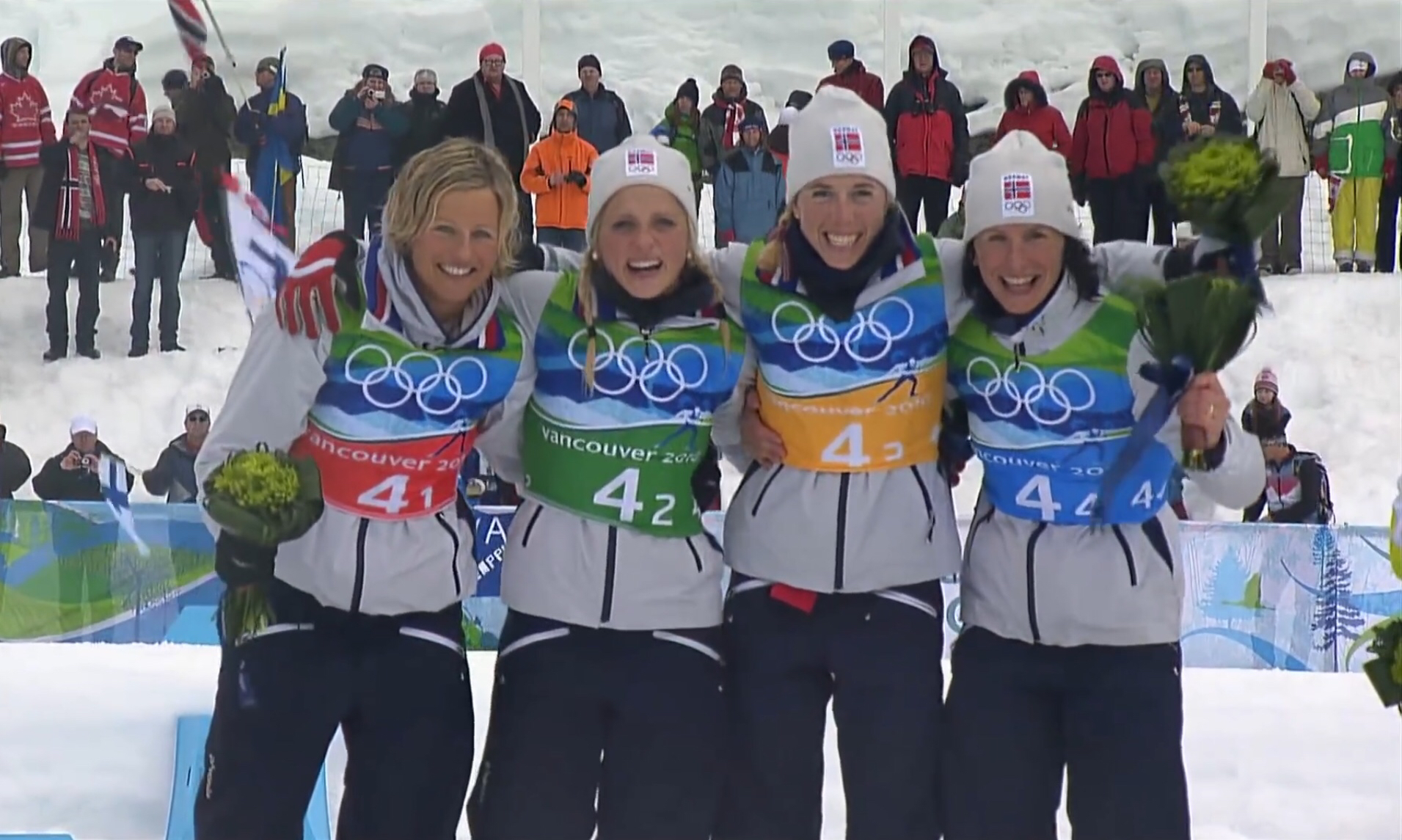
Norway’s gold-medal women’s relay at the 2010 Olympics in Vancouver, B.C., with (from left to right) Vibeke Skofterud, Therese Johaug, Kristin Størmer Steira, and Marit Bjorgen. (Screenshot: 2010 Vancouver Olympics relay video) (Note: This article has been updated to include comments from Vidar Løfshus, head of the Norwegian cross-country ski team, and the team’s former performance manager, Åge Skinstad.)
The death of Norway’s Vibeke Skofterud shocked the international cross-country skiing world on Sunday, and as of Monday, multiple renowned skiers, particularly in Norway, had reacted publicly.
“I am shaking and am in complete shock over this horrible news that I received today,” Marit Bjørgen wrote in a press release, according to a translation. “Dear Vibeke, this was way too soon.”
Bjørgen and Skofterud were teammates on the Norwegian national team for well over a decade until Skofterud retired in 2015. They won gold together in the women’s relay at the 2010 Olympics and at World Championships in 2005 and 2011. Kristin Størmer Steira was also on all three of those winning relays, and Therese Johaug teamed up with the three to win in 2010 and 2011.
“I have lost one of my best friends,” Johaug wrote in another press release quoted by NRK. “A friend who lit up the room when she entered, one who gave everyone around her lots of energy, love and care. I take with me all of the nice moments and experiences in and outside of the trails and I will miss her. My thoughts go to her family and those left behind.”
Bjørgen added that she was “incredibly happy about all of the nice moments we had with each other. A tough competitor in the course, but more importantly, the warmest, nicest, toughest woman in the world,” she wrote. “We have experienced much together, from an Olympic gold medal in the relay … and I will cherish the memories for a long time. My thoughts go to her families and those closest to her. Love you Vibeke. Rest In Peace.”
Petter Northug wrote that the news was “incomprehensible and sad to hear,” according to News in English.no. “We had many fun years together on the national team.”
Odd-Bjørn Hjelmeset, a former skier who competed until 2011 and became a national team coach, recalled her “infectious humor”. Erik Røste, president of the Norwegian Ski Federation since 2012, said she was “an important ambassador for the sport of skiing with her winner’s spirit and great engagement.”
“Vibeke was that joyful girl who always contributed positively to the community she was a part of, definitely with her good results on the course,” Vidar Løfshus, head of the Norwegian cross-country team, told Aftenposten, according to a translation. “The fact that we have lost girl like her, who was always open, honest and spoke her opinion, is a loss to the entire community and inconceivable.”
“It is incredibly sad,” Åge Skinstad, a former national-team performance director who is currently TV 2’s cross-country expert, told TV 2, according to a translation. “The first thing you think about is the family and those closest to her. Vibeke was a fantastic human-being. She was a very, very good skier.”
One of her former competitors, Charlotte Kalla of Sweden, told Expressen that she was shocked by the tragedy.
“It feels uncomfortable and difficult to accept that such a joyful, positive, and full of energy kind of competitor such as Vibeke is longer with us,” Kalla said, according to a translation. “Vibeke was one of my role models when I entered the national team. A positive person who spread joy and really contributed to the cohesion with Norwegian team. She was a character within the sport who offered a lot of herself. It is with great sorrow that I now think of Vibeke and those closest to her. Rest In Peace Vibeke.”
-

Nordic Nation: The ‘Take a Bow’ (50th!) Episode with Marit Bjørgen
 The stats are simply mind-boggling. Essentially, Norway’s Marit Bjørgen has the mostest. The most decorated Winter Olympic medalist: 15 total medals, eight gold, four silver, and three bronze — over five Olympiads from 2002 to 2018. The most World Championships bling: 26 total medals, 18 gold, five silver, and three bronze. Bjørgen won 114 individual World Cups and podiumed 184 times on the World Cup.

Take a bow. Marit Bjørgen of Norway winning the 30-kilometer classic mass start at 2015 World Championships in Falun, Sweden. (Photo: Nordic Focus/Fischer) Maybe something more sentimental for the core Norwegian fan, this past March, Bjørgen won a record seventh Holmenkollen 30 k. And she won that in un-Bjørgen like style by coming from behind to reel in a speedy Jessie Diggins.

Norway’s Marit Bjørgen celebrates her seventh Holmenkollen 30 k victory in Oslo, Norway, ahead of American Jessie Diggins, Norway’s Ragnhild Haga (not shown) and Sweden’s Charlotte Kalla. (Photo: Fischer/NordicFocus) This brings us to the point that this is the 50th episode of Nordic Nation. So, we wanted to go big. Really, no one is bigger than Bjørgen in the sport. In this ‘Take a Bow’ episode with Marit, we cover motherhood, training, racing, the media, and growing up in a small Norwegian club with three racers. The newly retired Bjørgen, 38, was interviewed last Tuesday, July 10.
Enjoy.
-

FasterSkier’s International Performances of the Year: Simen Hegstad Krüger and Marit Bjørgen

Simen Hegstad Krüger’s Olympic skiathlon victory (l) and Marit Bjørgen’s Holmenkollen come-from-behind win (r) are FasterSkier’s 2018 International Performances of the Year. (Photos: FlyingPointRoad & Fischer/NordicFocus) With the 2017/2018 season officially in the rearview, FasterSkier is excited to unveil its annual award winners for this past winter. Votes stem from the FS staff, scattered across the U.S., Canada, and Europe, and while not scientific, they are intended to reflect a broader sense of the season in review. This set of honors goes to the International Performances of the Year.
Previous categories: Junior Skiers of the Year | Collegiate Skiers of the Year | Biathletes of the Year | Para-Nordic Skiers of the Year | NoCo Skier of the Year | Canadian Breakthrough Skiers of the Year | U.S. Breakthrough Skiers of the Year | Coach of the Year | U.S. Continental Skiers of the Year| Canadian Continental Skiers of the Year
***
Simen Hegstad Krüger (Norway), Olympic skiathlon
Out of the start pyramid at the PyeongChang Olympics men’s 30-kilometer skiathlon, a mini-disaster struck 24-year-old Simen Hegstad Krüger of Norway. With the flying poles and striding skis, someone was bound to snap a pole. That someone was Krüger, who found himself at the base of the course’s first hill, calmly seeking the assistance of a coach with the gear in need. Time bled. The front pack cruised on. But he looked collected and unconcerned.
In his first Olympics and first-career Olympic race, Krüger simply rolled with the get-your-pole-and-minimize-losses drill. With Finland’s Iivo Niskanen leading the stream of skiers ahead of him, Krüger kept it all in perspective. It’s was a 30 k race, and only a few hundred meters had been ticked off.
It was a parade of possible medal winners capturing camera time during the skiathon’s classic leg. Niskanen (who later said, after winning the 50 k classic gold, that he approached the skiathlon’s classic leg as a training opportunity), Martin Johnsrud Sundby, Alex Harvey, and Dario Cologna looked golden.

Norway’s Simen Hegstad Krüger after winning gold in his first Olympic race, the men’s 30 k skiathlon, at the 2018 Winter Games in PyeongChang, South Korea. (Photo: FlyingPointRoad) Never locking on, but stealthily lurking, Krüger gained ground as the race’s classic portion transpired. He came through the classic-to-skate ski exchange at 15 k in 14th place, about 15 seconds behind the leaders. Just over two kilometers later, Krüger had bridged the gap.
With his legs fresh, Krüger said once he began the skate leg that “all possibilities are open again.”
Anything did seem possible for a host of the world’s best distance skiers, just not necessarily for Krüger. After expending energy skiing up to the lead group early in the skate, Krüger played it coy. He didn’t lead or get exposed up front in the windy conditions. He simply kept pace and kept in the draft.
An unwritten rule on the Norwegian team is that the first attack to stick by a Norwegian is a protected chance. In other words, once a Norwegian is in first and gaining time, his teammates won’t attempt to chase the attack down. Sundby was salivating at the chance for a career-first individual Olympic gold. Hans Christer Holund, also of Norway, was a pacesetter too. Either one of them could have seized the moment.
But at 26.25 k, Krüger rolled the dice and surged. The surge morphed into an unchallenged attack that seemed a lock one kilometer later when Krüger was up by 22 seconds. Team rules are team rules — Sundby and Holund could only watch their teammate shake the front end of the race apart.
Once they felt Krüger’s lead was insurmountable, Sundby and Holund set to work for themselves. The gap to Krüger closed significantly by the finish.
Krüger won the race in 1:16:20 hours. Sundby settled for silver, finishing eight seconds back, while Holund was third, 9.9 seconds out of first.
Was Krüger a real outsider for gold at the start of the race? Consider he was a member of the world’s most elite men’s team: Norway. Nations are also limited to four starters per race at the Olympics. Those in the know, like coaches and teammates, should have understood Krüger was on dual-discipline form.
Yet, until his Olympic skiathlon win, Krüger had two individual World Cup podiums: one win and a third place. (He had finished third in the fifth stage of the 2017 Tour de Ski, the 10 k skate in Toblach, Italy, and won a 15 k skate in December 2017, also in Toblach.)
A young Olympic rookie, Krüger showed he was the day’s master of tactics on the sport’s biggest stage. Krüger proved fit and certainly coyer than his Norwegian counterparts. Opportunity struck. Krüger seized it for our male International Performance of the Year.
Marit Bjørgen (Norway), Holmenkollen 30 k freestyle mass start
It has been a year to celebrate firsts. There was that first-ever U.S. Olympic gold. And from the North American perspective, the U.S. Ski Team’s (USST) women could fill a full scrapbook of standout performances. Let’s start with USST member Jessie Diggins. She finished second overall on the World Cup. Waking up on a Saturday or Sunday and finding Diggins on the podium was no longer a surprise.
Norway’s Marit Bjørgen celebrates her seventh Holmenkollen 30 k victory in Oslo, Norway, ahead of American Jessie Diggins, Norway’s Ragnhild Haga (not shown) and Sweden’s Charlotte Kalla. (Photo: Fischer/NordicFocus) So when Diggins was stealing the show at Oslo’s storied Holmenkollen venue in the women’s 30 k freestyle mass start this March, you’ve got to believe Norway and Sweden were there to see history; an American on the top step in the most famous of cross-country races.
This Holmenkollen 30 k was a storied race. Just not storied for the precise narrative most watching the race expected. For much of the race, it appeared to be the Diggins show.
Whatever you want to call her — queen, best-ever or simply Marit — the sport’s preeminent star, Marit Bjørgen of Norway, made her last Holmenkollen 30 k unforgettable.
As FasterSkier’s venerable reporter Gabby Naranja noted, during the high profile 30 k events, Bjørgen likes to run away solo style. In last year’s Holmenkollen 30 k classic, Bjørgen was off the front and unchallenged for the win. Then, in PyeongChang during the 2018 Olympic 30 k classic, Bjørgen pulled away from any would-be chasers for a complimentary finishing-straight Norwegian flag wave and some golden hardware.
This year’s Holmenkollen 30 k that followed was skate technique. When the trio of Diggins, Sweden’s Charlotte Kalla, and Norway’s Ragnhild Haga — all stellar skate skiers — pulled away from the field, the hopes of a Bjørgen revival seemed unlikely. Bjørgen had lost incremental time in the race’s early kilometers. The 37-year-old Bjørgen appeared gassed from a stellar Olympics and to be subtly relinquishing the stage to three younger go-getters.
A little more than halfway through the race, Bjørgen was 36 seconds down on the lead group.
Yet, Bjørgen was a wise one. She changed skis near the race’s midpoint. Diggins, Kalla and Haga stuck with their 15-k-old glide, skipped the ski swap and chugged on.
The presumed podium placers slowed just enough, and Bjørgen sped up just enough to bring them closer and closer. But it was more like Bjørgen remained the massive sun with the heftiest gravity pulling the three off-the-front satellites towards her.
With three kilometers to go, Bjørgen was six seconds back.
In the closing kilometer, Bjørgen controlled the race, passed any top-step threats, and reaffirmed one last time that she is indeed the singular skier we all expect her to be. She won her seventh Holmenkollen for a record number of victories for a woman in the Holmenkollen 30 k. In her six prior Holmenkollen 30 k wins, Bjørgen won four times in classic technique, two times in skate.
Diggins placed second (+3.6), Haga third (+4.3), while Kalla was a tenth of a second back in fourth.
With the recent announcement of her retirement, perhaps the international field can rest easy knowing Bjørgen won’t be sending it off the front or seizing the win from behind.
Honorable Mention: Jessie Diggins and Kikkan Randall (U.S. Ski Team), Olympic Team Sprint
Before anybody gets worked up over this, more awards are due. We at FasterSkier are spreading the award love and trying to be clinical. Are we splitting hairs between honoring Bjørgen for sentimental reasons and not choosing the Randall-Diggins gold for fear of pandering to our core audience? (Noise of clearing throat.) No.

Americans Kikkan Randall and Jessie Diggins jumping for joy after placing first in the 2018 Olympic team sprint in PyeongChang, South Korea, ahead of Sweden’s Charlotte Kalla (l) and Stina Nilsson (second from l) in second place and Norway’s Marit Bjørgen (second from r) and Maiken Caspersen Falla (r) in third. (Photo: FlyingPointRoad) (And if you are hearing of the American Olympic team sprint win right here, right now, for the first time … then welcome to FasterSkier. We are glad to have you as a reader.)
What more can be said of the Randall-Diggins win in the 2018 Olympic freestyle team sprint? It’s only been a bit over a month since the Americans skied the perfect race. Randall was the glue sticking with Bjørgen and Kalla. Diggins was the late boost who slingshot around Norway’s Maiken Caspersen Falla and outsprinted Sweden’s Stina Nilsson in the last 100 meters of the race.
It is an Olympic medal after all. Gold, too. We can imagine every U.S. nordic skier for a generation will be asking “where were you when …?”
Three cheers for Diggins-Randall. Three cheers for the wax crew. Three cheers for the coaches. And three cheers for all the women who have had the privilege of calling themselves members of the U.S. Ski Team, past and present.
Honorable Mention: Iivo Niskanen (Finland), Olympic 50 k Classic Mass Start

Finland’s Iivo Niskanen after winning the men’s 50 k classic mass start at the 2018 Winter Olympics in PyeongChang, South Korea. (Photo: FlyingPointRoad) Let’s jump to the post-race press conference in PyeongChang. Before the men’s 50 k classic mass start winner Iivo Niskanen of Finland entered the room, Russians Alexander Bolshunov and Andrey Larkov, who finished second and third respectively, made some excuses. Through an interpreter, both skiers spoke of their less-than-ideal skis.
When Niskanen finally arrived, he was informed of the Russians’ sentiments that their striding and gliding may have been wax-compromised in the later stages of the race.
No love lost. That could have been used to describe Niskanen’s tone and comments regarding his closest competitors’ and their espoused reasons for his dominance. Ski-wise, Niskanen changed skis twice during the race. (Racers are allowed two ski exchanges in the 50 k). Bolshunov and Larkov opted to change their skis once. The two Russians were the only skiers in the top-31 to not change skis out twice.
The reason we bring the ski-excuse up is to highlight the point that Niskanen skied the race to win. He was taking no chances. He was decidedly strong, smart and had ski-swapping savvy. Niskanen had few tagalongs during his 50 k stomp. Kazakhstan’s Alexey Poltoranin skied with the Finn, looking like an equally worthy potential gold medal winner. But Poltoranin suffered a major fade. Niskanen also dropped the likes of Sundby, Harvey, and Holund.
Bolshunov proved to be the only skier who seemed like he could mirror Niskanen. When Bolshunov skipped the ski swap at 40 k, Niskanen freshened up with some new classic boards and waited to make his move. That came on the final hill where Niskanen was simply stronger. Niskanen won the Olympic 50 k in 2:08:22.1. Bolshunov placed second, 18.7 seconds behind the winner.
Niskanen’s win put on full display his marriage of physical prowess and strategic genius. A lovely win for the Finns and a first-career Olympic medal for the 26-year-old Niskanen.
-

Bjørgen Says She’s Done: The Latest on XC Retirements

Norway’s Marit Bjørgen celebrates her overall win in the last race of 2018 World Cup Finals, the 10 k freestyle pursuit, on March 18 in Falun, Sweden. Bjørgen officially announced her retirement from skiing last Friday, April 6. (Photo: Svenska Skidspelen/Instagram) You’ve probably heard the news by now: Marit Bjørgen, the Norwegian queen of cross-country skiing, has decided to retire. The 38 year old made the announcement a week ago after winning the first race of Norwegian nationals, the 5-kilometer classic, on April 6.
“In reality it has been a long process,” she told NRK that day, according to a translation. “I had almost decided before the competitive season started. I feel that I lack the motivation and desire required to be right there in the top. I also have a little boy at at home, who is beginning to understand more and more, that I’d like to spend time with. That time I can never have again. It’s also a little frightening. This is been half of my life. This is emotional.”
The most decorated Winter Olympian of all time across all sports with 15 medals, five of which came at the 2018 Olympics in PyeongChang (two golds, a silver, and two bronze), Bjørgen closed her season on Saturday, April 7 with a second-place finish behind teammate Ragnhild Haga in the national 30 k freestyle in Alta, Norway.
In all, Bjørgen accumulated 114 individual World Cup wins, 184 World Cup podiums, 18 World Championship gold medals (and 26 total at world champs), and eight Olympic golds in five Olympics, according to an International Ski Federation (FIS) press release.
“I’m proud of what I’ve achieved in my career, but I’ve also been privileged to have been able to win top-level sports,” Bjørgen said in Norwegian team press release. “I am very much thankful to amazing team friends, teammates, coaches, medical team, service team, managers and the whole support crew that have been around me. You have a great deal of credit for my results.”

Teammates Marit Bjørgen (r) and Ingvild Flugstad Østberg after placing first and second, respectively, in the women’s 5 k classic at Norwegian nationals in Alta on April 6. (Screenshot: NRK broadcast) Norway’s head coach Vidar Løfshus described Bjørgen as a “team captain” who was “always there for the girls,” according to an interview with NRK.
He added that she was also a valuable coaching consult.
“For me, she’s been a good sparring partner; when tough things happening internally, I often call Marit,” Løfshus said, according to a translation. “Now there will be one less coach in my team. There are a lot of good coaches in the association, but … [none that have] won so many medals. She knows more about cross country skiing then I do, Sju, Ole and Roar combined, almost.
“We can’t let a woman like that disappeared through the back door,” he said of his desire to keep Bjørgen involved with the team. “But now we’re gonna let her exhale and enjoy her time with [her son] Marius and [partner] Fred Børre. She has not had enough time for that. And after that I know she will contribute again.”
Bjørgen shared emotional moments with her teammates at nationals.
“She has been a role model to me for many many years,” Ingvild Flugstad Østberg told NRK.
“One day has to be the last,” Heidi Weng said. “We’ve had a lot of fun with Marit. She’s a legend. She has been the security blanket and the mother in the team. It’s frustrating not to have mommy at the starting line, someone to joke around with and calm your nerves. Someone who is supportive.”
Who else is on our list of notable cross-country retirements so far? (For our biathlon list, which should also include the additions of Norway’s Ole Einar Bjørndalen and Emil Hegle Svendsen, click here.)

Kikkan Randall (l) and Liz Stephen after the last race of their professional careers, the 30 k classic mass start at 2018 U.S. Distance Nationals in Craftsbury, Vt. (Photo: John Lazenby/Lazenbyphoto.com) From the U.S., we have U.S. Ski Team members Kikkan Randall and Liz Stephen, who said ‘so long’ to international racing, while another team veteran Andy Newell told FasterSkier that he plans to continue racing, but apart from the national team and likely outside of the World Cup circuit.
Former national-team members Noah Hoffman and Kris Freeman have also announced their retirements from professional skiing. On the domestic side, Annie Hart has stated this was the last season of her ski career as she plans to begin law school.
There has been talk of a few of Canada’s World Cup Team members retiring, but the only one FasterSkier has confirmed so far is Graeme Killick.
Zina Kocher, a 2006, 2010 and 2014 Olympic biathlete who came out of retirement to make a bid for the 2018 Olympics in cross-country skiing, has stated that it’s really over this time after her comeback season.
“As I reflect on the last 16 years that I trained full-time and competed at an international level I’m flooded with a lot of memories,” Kocher, 35, wrote in a blog post last week. “If someone had told me when I started biathlon in ’98 that I would be a ‘lifer’ (aka someone who does the sport & can’t give it up till they’re an old veteran in their 30’s), I would have laughed and said ‘yea right’. But here I am, finally saying goodbye!”
Michael Somppi, of the Alberta World Cup Academy, is also retiring after 16 years of competitive skiing. Somppi, 29, a former member of Canada’s senior development team, won three national titles and World Cup start rights as Canada’s NorAm overall leader at the end of the 2014/2015 season.
“I didn’t accomplish everything I wanted to in my ski career, but I am really proud of all that I did accomplish,” Somppi wrote in a blog post on Sunday. “I feel I got all I could out of myself given the circumstances I faced and the system I worked in. Thinking back to when I started out ski racing in high school, I am amazed how far I’ve come. ‘Started at the bottom, now we here!’ I picked up racing late and was never the most talented. I worked hard with extreme motivation and focus to become one of the top skiers in Canada.”
Heidi Widmer, a Swiss-Canadian skier, is also calling it a career, as is Switzerland’s Gianluca Cologna, the 27-year-old younger brother of Dario Cologna.
“One of the highlights of my career was certainly the team sprint with my brother Dario at the Olympic Winter Games in Sochi,” Gianluca wrote in a Facebook post announcing his retirement, according to a translation. “We reached the 5th place and could take home an [Olympic] diploma. It was not only a highlight because of the 5th rank, but also because our parents were there to witness it live. I never dreamed of anything like that when I was a little boy.”

Sweden’s Emil Jönsson celebrates a 2013 World Cup victory in Lahti, Finland. (Photo: Fischer/NordicFocus) The Swedish team is seeing the exit of Anna Haag, Emil Jönsson and Martin Johansson. Haag, 31, won gold with the Swedish women’s relay at the 2014 Olympics in Sochi, Russia, and has four medals from the last three Olympics. Jönsson, 32, Haag’s longtime partner and an internationally renowned sprinter, earned two Olympic bronze medals in 2014.
From Finland, four-time World Championships gold medalist Aino-Kaisa Saarinen is stepping away from competitive skiing at age 39.
“I have done this 20 years, what I really wanted, and I have raced my goals and even more,” Saarinen told FasterSkier after the last race of World Cup Finals in Falun, Sweden. “This skiing family is the thing what I’m going to miss the most, and of course, I love the competitions. I don’t know any other job where you can feel so high and so low, so, maybe those are the feelings right now, what I’m going to really miss the most.”
Poland’s 35-year-old Justyna Kowalczyk, a two-time Olympic champion and two-time World Champion, has announced her retirement as well.
Then there’s Aurore Jean, 32, who became the second French woman to reach the cross-country World Cup podium with a second-place skate-sprint finish in 2013.
And last but not least (for now), we have heard news of Russia’s Alexander Legkov — the controversial 2014 Olympic champion who was not allowed to compete at this year’s Games because of Russia’s systematic doping in Sochi — officially retiring.
“You have all been with me in the course of many years of my professional career and I truly love you all,” the 35-year-old Legkov said at a sports tournament in Khanty-Mansiysk, Russia, on April 6, according to the Russian News Agency. “… I will see all of you later, not at international tournaments, but perhaps at domestic tournaments or marathon. I am announcing the end of my international sports career.”
At the Sochi Games, Legkov won the 50 k freestyle mass start and took bronze with his teammates his the men’s 4 x 10 k relay. He ended his ski-racing career on March 3 in Rybinsk, Russia, where he placed fourth in the 50 k freestyle Demino Skimarathon.
Stay tuned for more retirement announcements as they are made public.
-

U.S.A. Storms Falun World Cup Finals Podium; Diggins 2nd in Overall World Cup

The women’s 10 k freestyle pursuit podium on the last day of 2018 World Cup Finals in Falun, Sweden, with Norway’s Marit Bjørgen (c) in first, and Americans Jessie Diggins (l) and Sadie Bjornsen (r) in second and third, respectively. (Photo: Fischer/NordicFocus) FALUN, Sweden — NOR. USA. USA.
Looking at the results monitor, those were the tri-letter country codes that popped into the top three at the end of the women’s 10-kilometer freestyle pursuit at World Cup Finals on Sunday.
The “NOR” belonged to Marit Bjørgen of Norway, who ended her 2017/2018 World Cup season with yet another win. In Sunday’s pursuit, the 37 year old led from start to finish and ended where she started, in first after covering the course in a time of 24:18.9 minutes.
For many who follow the World Cup, a Norwegian name — like Bjørgen, who has won more than 110 individual World Cup races — at the top of the results is nothing new. All due respect.
But the pressure for Scandinavia to hold off an American entourage is mounting; Sunday’s race presenting itself as a prime example.
A 41-second gap separated American Jessie Diggins from Bjørgen by the time she flipped past the start wand, her characteristic cheek sparkles visible from the stands. As the third starter on course, Diggins had sewn shut the 5 seconds that the day’s second starter, Ingvild Flugstad Østberg of Norway, had on the American and within the first kilometer, was establishing herself as Bjørgen’s main threat.
“I had 45 seconds in the total time at Mördarbacken the first time,” Bjørgen reflected in a post-race interview with FasterSkier. “And then it was 30 and then 20, then I was a little bit stressed. I thought, ‘Aha, I have to work harder a little bit.’ I feel like on the uphill I was the same speed as Jessica, but she was better than me on the easier part of the tracks. And I’m really happy to make it. I had to push hard in the end.”

Norway’s Marit Bjørgen leading off the front during the women’s 10-kilometer freestyle pursuit on Sunday at World Cup Finals in Falun, Sweden. (Photo: Fischer/NordicFocus) (Photo: Fischer/Nordic Focus) After catching Østberg, Diggins led the Norwegian and eventually dropped her by 17 seconds at 3.75 k. On Bjørgen, she had gained just over five seconds in time. By the 5 k mark, Diggins was a little less than 30 seconds back, and had put 13.4 more seconds into the race leader.
“I was grateful to feel so good today,” Diggins told FasterSkier. “We had amazing skis and that was really important. Especially on a course with so much gradual climbing and gradual working downhills, you needed to have good skis, and our techs delivered. And they gave us the tools we needed to have a good day.”
At the 7.5 k mark, 20 seconds separated the American from the win. By the time Diggins crossed the finish line in second, she was 16.7 seconds behind Bjørgen. The effort from Diggins gave her the fastest time of day in 23:54.4 minutes, which was 24.5 seconds faster than Bjørgen’s time.
“It’s a sport of patience,” Diggins said. “I feel like I’ve been coming into my own with the confidence to know that any race I start, I can be trying to fight for the podium and racing like I can win. Instead of racing like, ‘Oh, I’m going to try to just see what I can do,’ it’s like, ‘No, I’m going to try to win.’ ”
But Diggins was not the only American hunting and holding off Norwegians. Her U.S. teammate Sadie Bjornsen, who had gone out hot in Saturday’s race in hopes of a podium, earned it on Sunday in a sprint finish for third (+1:11.5) between herself and Norway’s Ragnild Haga and Astrid Uhrenholdt Jacobsen.
In the finishing stretch, Bjornsen, Haga and Jacobsen had gone head to head, with the American outlunging Haga — the gold medalist from this year’s Olympic 10 k state — by exactly half a second and beating Jacobsen by 1.3 seconds for the final spot on the podium.

American Sadie Bjornsen earning third in the women’s 10-kilometer freestyle pursuit on Sunday at 2018 World Cup Finals in Falun, Sweden. (Photo: Fischer/NordicFocus) “Coming into the final stretch I was like, ‘OK, that is the last time you get to do the final stretch this year and make it count,’ ” Bjornsen told FasterSkier. “It ended up working out for me, and that turned into quite the dream day.
“I think the step I made this year is one step closer to being in a place where Jessie is racing right now,” Bjornsen continued. “To have a teammate who is just pushing the bar just every single day and making me believe that in order to be the best racer in the world, you have to have no fear. Jessie is a great example of that and it is certainly contagious.”
On Sunday, Bjornsen had started 21 seconds behind Østberg and 29 seconds ahead of Haga. By 7.5 k Haga had caught the group battling for third, which included Bjornsen, Finland’s Krista Pärmäkoski, Østberg, Sweden’s Charlotte Kalla, and Jacobsen. The group stayed together until the downhill back toward the stadium.
“I was like, ‘OK, I have to be smart here and keep pushing the pace hard enough that we do not get caught from behind, but conserve for that final sprint and then when I came into the sprint lap,’ ” Bjornsen reflected.
Along with being a podium threat in Sunday’s race, the Americans are also gunning full-speed ahead toward the top three in the overall, sprint or distance World Cup standings. On Friday, Sophie Caldwell of the U.S. claimed third in the season-long Sprint World Cup. On Sunday, Diggins stood on the podium in second in the Overall World Cup and third in the Distance World Cup.
“We are really showing that we are a skiing nation, and it’s taken so many years and so much hard work from a lot of people, but I think it’s so cool to show that we can be in the fight,” Diggins said.

The women’s 10 k freestyle pursuit podium on the last day of 2018 World Cup Finals in Falun, Sweden, with Norway’s Marit Bjørgen (c) in first, and Americans Jessie Diggins (l) and Sadie Bjornsen (r) in second and third, respectively. (Photo: Fischer/NordicFocus) “It’s been a many year goal of ours to be ranked in the top three for the women’s team and we secured that for the first time today,” U.S. Ski Team Women’s Coach Matt Whitcomb told FasterSkier of his team’s best-ever Nations Cup ranking. “We’ve come into [past] finals, I believe, ranked third and then come out of finals ranked fourth. We’ve been fifth. And I think as an entire team, men and women combined, … I think we’ve finished fifth, which would be exceptional. It was really quite an achievement for both our men’s and women’s teams.”
Whitcomb was right; the U.S. Ski Team placed fifth in the Nations Cup.
In the decade leading up to the past two World Cup seasons, podiums from American women peppered the circuit, but predominantly in sprints. Kikkan Randall holds most of those, having recorded 28 individual podiums before 2016, only five being in a distance greater than 2 k. Sophie Caldwell broke through with a third-place sprint finish in 2014.
American Liz Stephen had also reached the World Cup podium four times in distance races prior to 2016 — twice outright and twice for time of day.
From 2016 on, the number of podiums that have gone to U.S. women has only increased. Caldwell earned three podiums this season alone. Diggins has racked up a total of 14 individual World Cup podiums since her first (which was also a first place) in 5 k freestyle in Toblach, Italy, in 2016. Bjornsen now has a total of five podiums over the course of two seasons. Stephen added two more to her name, one time of day and one outright, and Randall another top three in this past December’s Davos sprint.
Whitcomb was quick to point out that much of this success, started with U.S. Ski Team veterans Randall and Stephen, who skied the last World Cup races of their careers on Sunday. Randall finished the race in 43rd (+4:33.3) with the 29th-fastest time of day, and Stephen 50th (+4:57.2).
“Honestly I start crying every time I think about it,” Whitcomb said, referring to the fact that Randall and Stephen will be retiring after this season. “It’s been a day that I have feared for my whole career, basically since I started working with Kikkan and Liz, really since they started working with us.
“I know we are not saying goodbye forever, but definitely we are saying goodbye in a certain capacity to two of the most important people that have ever set foot on the U.S. Ski Team,” he added.
The two spoke with Fasterskier after their last race together, perhaps fitting as Stephen joined the team in 2006, only a year after Randall. The pair have worked with Whitcomb for the past 12 years.
“As your whole career flashes before your eyes, it’s the people that are the best part,” Randall, 35, said.
In their career final World Cup race on Sunday, both Randall and Stephen donned unicorn headbands, pink arm warmers and spandex boyshorts inscribed with the words “Thank You!!” across the backend. During their pre-race morning run, they felt something was missing and made a spur-of-the-moment stop at a store to purchase a few “costume pieces” for the race. Their outfits sparked smiles as they completed the race, and there was no denying the message they hoped to send off as they departed the ski-racing world: the energy and enthusiasm of a strong team.
(Article continues below)
The last-race outfits worn by Kikkan Randall and Liz Stephen for Sunday’s World Cup Finals pursuit. (Photo: Kikkan Randall/Instagram) “We are all most proud of the team we built,” Randall said. “To see it at such a good point and to know just because we are leaving the scene doesn’t mean it’s going away; these girls are going to continue to carry the torch, the young girls coming in.”
“I would second that,” Stephen, 31, said. “One of the main things was that we wanted to leave a program that sustain itself, and I think that we both feel very happy and confident that that is going to happen. Like Kikkan said, Jessie won more points this year alone than we used ever see in an entire season men and women combined, you know, 10 years ago, and so I think that is a testament of the success that we have been able to create for one another.”
Both Randall and Stephen were also given the opportunity to take a victory lap after the race, alongside Finland’s Aino-Kaisa Saarinen and Sweden’s Anna Haag, who sported a Disney Princess bath towel as a superhero cap, as well as a bejeweled crown (in an interview with FasterSkier, Haag explained the outfit had not been coordinated with the Americans, but was rather a coincindence. The Americans and Swedish skier are longtime friends and shared a nonalcoholic-champagne beverage in the finish area after the race).
“I certainly wasn’t expecting a send-off like that,” Stephen said. “That was really special, that the four of us were able to do that together.”
“I have done this 20 years … and I have raced my goals and even more,” Saarinen told FasterSkier. “Actually this skiing family is the thing what I’m going to miss the most.”
Also racing for the U.S. on Sunday, Caitlin Patterson finished the pursuit in 35th (+3:58.4) with the 22nd-fastest time of day, Caldwell finished in 36th (+4:00.7), Rosie Frankowski 46th (+4:41.3), Kaitlynn Miller 56th (+6:13.8), and Ida Sargent 57th (+7:06.4).
“It’s been a really unexpected good season, and I am really happy with it,” Miller said. “Today was awesome seeing Sadie and Jessie finish out the World Cup season like that.”
The Canadians were led by Cendrine Browne, who finished 39th (+4:14.4) with the 27th-fastest course time, followed by Emily Nishikawa in 48th (+4:43.7), Dahria Beatty in 54th (+6:04.3) and Zina Kocher in 60th (+9:28.4).
“I love the course, it is perfect for me,” Browne wrote in an email to FasterSkier. “Steep up hills and one skate sections are what I prefer best! I was suprised yes!!! All season I was trying so hard to get into the top 30. Maybe I was trying to hard and putting to much pressure on myself. Today, I decided to have fun and to forget everything and it just happened!”
“I am really happy about my season even if it was filled with so many emotions,” Browne continued. “Going to the Olympics and placing 33rd at my first Olympic race is definitely a highlight. Also, my 36th place in Holmenkollen is a huge accomplishment for me. Even if I fell twice and should have been in the top 30, it was an awesome race. And today’s 27th place is definitely the best thing that happened this season. Finishing the season like this fills my heart with joy and hope for next season.”
***

Norway’s Marit Bjørgen finishing first in the women’s 10 k freestyle pursuit at 2018 World Cup Finals in Falun, Sweden, while American Jessie Diggins (in background) chases for second place. (Photo: Fischer/NordicFocus) Notes: While there has been a lot of discussion about retirements, Bjørgen isn’t saying it’s over.
“I want to finish [the season] in a good way, but I think I’ve been at my very best. I’ve passed it [my peak],” Bjørgen said in a loosely translated interview with NRK on Friday.
So will she race next winter? Bjørgen estimated she would need to train at least 850 hours if she wanted to compete with her teammate Therese Johaug, who will be returning to the World Cup next season.
“It’s going to be a lot of training, and you have to prioritize a lot. That’s the toughest thing,” Bjørgen said. “But when I’m at work, it’s no problem. I’m here to do the job. Should I do one more year, I will not do it halfway [half-hearted].”
***
Results: Pursuit | Overall Standings | Distance Standings | Mini-Tour Standings
-

Sunday Rundown: Diggins and Harvey 2nd, Bjornsen 3rd in Falun Pursuit; Dunklee 3rd in Oslo (Updated)
Norway’s Marit Bjørgen celebrates her overall win in the last race of 2018 World Cup Finals, the 10 k freestyle pursuit, on Sunday in Falun, Sweden. (Photo: Svenska Skidspelen/Instagram) FIS Cross Country World Cup Finals (Falun, Sweden): 10/15 k freestyle pursuits
In the last women’s race of the World Cup season, U.S. Ski Team members Jessie Diggins and Sadie Bjornsen made it one they’ll remember for a long, long time as Diggins raced to second in the 10-kilometer freestyle pursuit and Bjornsen outlasted two Norwegians for third. The two finished the World Cup Finals mini tour in second and third, respectively, behind Norway’s Marit Bjørgen who won it in 24:18.9 minutes.
Bjørgen started with a 36-second cushion to her Norwegian teammate Ingvild Flugstad Østberg in second. Diggins started third, 41 seconds back, just ahead of Finland’s Krista Pärmäkoski in fourth (+43.0), based on their cumulative performances over the last two days of the mini tour (skate sprint and 10 k classic mass start).
While Østberg, Diggins and Pärmäkoski formed a chase pack, Diggins dropped them in pursuit of Bjørgen on the first lap. The American continued to push the pace throughout the three-lap race, coming within 16.7 seconds of Bjørgen at the finish.
Meanwhile, during the pursuit, a chase group of five, which included Bjornsen, caught Østberg and Pärmäkoski. The group of seven dwindled to three on the last two climbs, where Bjornsen and Norway’s Astrid Uhrenholdt Jacobsen and Ragnhild Haga broke away in a race for third.
The three were even entering the finishing stretch, where Bjornsen then beat them in a final 100-meter push to the line. Bjornsen claimed third (+1:11.5) for her fourth podium of the season and first in a distance skate race. Haga followed in fourth (+1:12.0) and Jacobsen fifth (+1:12.8), while Pärmäkoski placed sixth (+1:16.2), Sweden’s Charlotte Kalla seventh (+1:17.9), Østberg eighth (+1:19.0), Sweden’s Jonna Sundling ninth (+1:30.5) and Ebba Andersson 10th (+1:44.7).
Bjornsen now has five-career individual World Cup podiums to her name, and this is the first in a skate race longer than 5 k.
Diggins clocked the fastest time of day in 23:54.4, while Haga was second-fastest (+10.7) after starting the race in 17th. Bjørgen’s time ranked third, Jacobsen was fourth-fastest and Bjornsen fifth-fastest.
Diggins’s performance elevated her to second in the Overall World Cup standings, just 40 points behind Norway’s Heidi Weng (who placed 18th in the pursuit) in first for the second-straight year. Østberg slipped to third overall, 22 points behind Diggins. In the Distance World Cup, Weng took the title by 63 points over Østberg in second, while Diggins was another 32 points back in third.
Bjornsen ended up sixth in the Overall World Cup and 10th in the distance standings.
Also for the U.S., Caitlin Patterson raced from 46th at the start to 35th (+3:58.4) with the 22nd-fastest time of day, Sophie Caldwell placed 36th (+4:00.7), Kikkan Randall finished her last World Cup race in 43rd (+4:33.3) with the 29th-fastest time, Rosie Frankowski placed 46th (+4:41.3), Liz Stephen 50th (+4:57.2) in her final World Cup race, Kaitlynn Miller 56th (+6:13.8), and Ida Sargent 57th (+7:06.4).
For Canada, Cendrine Browne picked off 10 places to finish 39th (+4:14.4) with 27th-fastest time of day, Emily Nishikawa finished 48th (+4:43.7), Dahria Beatty 54th (+6:04.3), and Zina Kocher 60th (+9:28.4).
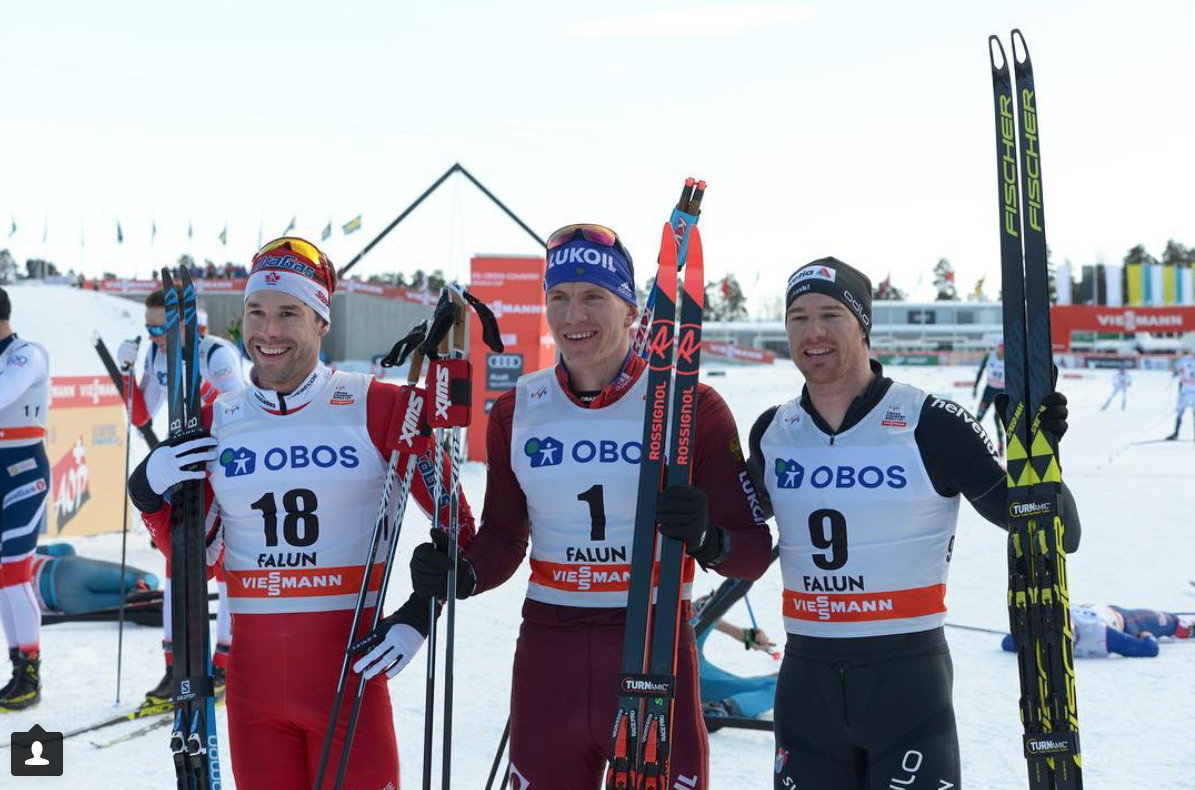
The men’s 15 k freestyle and 2018 World Cup Finals podium, with Russia’s Alexander Bolshunov (c) in first, Canada’s Alex Harvey (l) in second and Switzerland’s Dario Cologna (r) in third. (Photo: Svenska Skidspelen/Instagram) In the men’s 15 k freestyle pursuit that followed, Russia’s Alexander Bolshunov started 38 seconds clear of Norway’s Johannes Høsflot Klæbo in second, and Sweden’s Calle Halfvarsson and Italy’s Federico Pellegrino headed out together another second later in third and fourth, respectively.
Norway’s Martin Johnsrud Sundby started the race in seventh (+53.0), and Switzerland’s Dario Cologna followed in ninth (+56.0), while Canada’s Alex Harvey started 1:16 back in 18th.
While Bolshunov skied the entire race on his own and won the weekend mini tour in 35:03.3, a number of racers battled for second, with Sundby moving into second in the chase pack, ahead of seven others, less than 2 k in. Several skiers found themselves at the front of that group, including Cologna, Halfvarsson, and even Harvey (with Harvey leading the chase at 9.3 k), while the time gap to Bolshunov grew.
With about 2 k to go, the group was down to six. Harvey attempted an attack, but Cologna matched him. Then, on one of the course’s final climbs, Cologna made his move to get a slight gap, but lost his balance slightly on the downhill, allowing Harvey to catch back up.
With one last uphill to go, Harvey was in the driver’s seat in second, Cologna in third and Sundby in fourth. That order held to the finish, with Harvey claiming second, 47.1 seconds behind Bolshunov, Cologna placing third (+47.5) and Sundby fourth (+48.7). Just behind them, Russia’s Maxim Vylegzhanin crossed in fifth (+50.3), ahead of Norway’s Hans Christer Holund in sixth (+51.7), Halfvarsson in seventh (+54.1), and Norway’s Sjur Røthe in eighth (+54.9). Nearly 10 seconds later, Norway’s Niklas Dyrhaug outlunged two Russians for ninth (+1:04.1): Denis Spitsov in 10th (+1:04.2) and Andrey Larkov in 11th (+1:04.3).
Harvey, who finished the season in fourth in both the Overall and Distance World Cup standings, won the time of day in 34:34.3. Holund had the second-fastest course time, 1 second off Harvey’s time, after starting the race in 22nd.
Harvey’s Canadian teammate Devon Kershaw tallied his fifth-straight distance top 30 in 28th (+2:21.9), after starting 27th, and Graeme Killick finished 56th (+4:33). Julien Locke did not start.
For the U.S., Erik Bjornsen clocked the 22nd-fastest time en route to 38th (+3:10.4), after he started 51st. Simi Hamilton improved 10 places to finish 49th (+4:07.8), Scott Patterson and Paddy Caldwell worked together to move up from 72nd and 73rd, respectively, to 58th (+4:41.5) and 59th (+4:41.6), respectively, at the finish. Kevin Bolger placed 60th (+4:43.5) and David Norris 64th (+5:09.8).
While Klæbo slipped from second to 25th in the pursuit (+1:45.8), the Norwegian still won his first Overall World Cup by 119 points over Cologna in second. Sundby placed third, 29 points out of second and 82 points ahead of Harvey.
Cologna claimed the Distance World Cup Crystal Globe by 41 points over Sundby, and Holund reached the Distance World Cup podium in third, 58 points out of second and just 5 points ahead of Harvey in third. France’s Maurice Manificat had been third heading into the final day of racing, but finished the pursuit in 26th (+2:11.9) and dropped to fifth in the final distance rankings.
Results:
Women: Pursuit | Time of day | Final Overall World Cup rankings | Final Distance World Cup rankings
Men: Pursuit | Time of day | Final Overall World Cup rankings | Finals Distance World Cup rankings
***
IBU World Cup (Oslo, Norway): Women’s pursuit + men’s relay
Women’s pursuit report | Julia Ransom retires
In her last race of the season, Susan Dunklee returned to the podium. The American started fourth in Sunday’s 10-kilometer pursuit at the International Biathlon Union (IBU) World Cup in Oslo, then made her way into third by the final shooting stage. Dunklee shot 18-for-20 (1+0+1+0) and finished 29.5 seconds behind the winner, Darya Domracheva of Belarus, who missed two targets as well (1+0+1+0) and finished first in 30:37.4. Slovakia’s Anastasiya Kuzmina started the race in first (ahead of Domracheva in second) and ended up second (+9.2) with four penalties (0+2+2+0).
Canada’s Julia Ransom and Rosanna Crawford finished together in 51st and 52nd, respectively, both 4:52.4 out of first. Ransom had four penalties (0+1+1+2) while Crawford missed five (1+3+1+0). Emma Lunder did not finish.
In the men’s 4 x 7.5 k relay on Sunday, Norway’s team of Lars Helge Birkeland, Henrik L’Abee-Lund, Tarjei Bø, and Johannes Thingnes Bø used just three spare rounds to clean eight shooting stages and took the win in 1:13:13.7 hours. Austria finished 50.3 seconds back in second place, with Dominik Landertinger, Felix Leitner, Simon Eder, and Julian Eberhard, with a total of five spares. Russia’s Maxim Tsvetkov, Anton Babikov, Dmitry Malyshko, and Anton Shipulin raced to third (+56.9) with just four total spares.
The U.S. men placed seventh (+2:01.5) with eighth spares, after Lowell Bailey put the team in seventh on the first leg. Sean Doherty skied them up to sixth on the second leg, Tim Burke slipped to 10th on the third leg, and Leif Nordgren posted the seventh-fastest anchor leg to put them in seventh at the finish.
Canada placed 16th (+5:42.4) with Christian Gow, Scott Gow, Brendan Green, and Macx Davies. The team had been in 19th at the final exchange, but Davies skied them up to 16th with the 14th-fastest anchor leg. In all, they used 10 spares.
Results: Women’s pursuit | Men’s relay
-
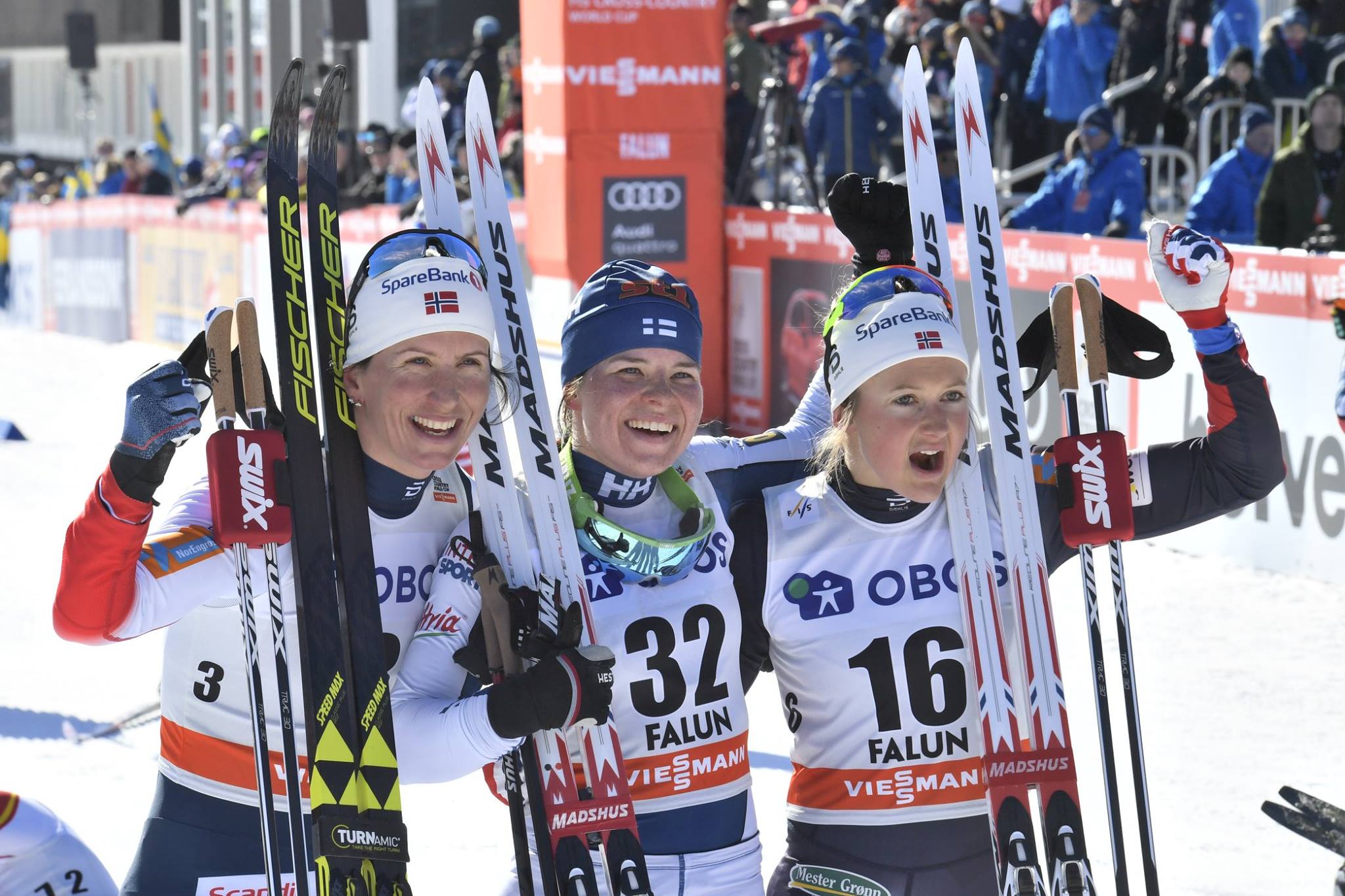
Saturday Rundown: Pärmäkoski Beats Bjørgen in Falun 10 k Classic; Bolshunov Notches First Win

The women’s 10 k classic mass start podium at 2018 World Cup Finals in Falun, Sweden, with Finland’s Krista Pärmäkoski (c) in first, Norway’s Marit Bjørgen (l) in second and Ingvild Flugstad Østberg (r) in third. (Photo: FIS World Cup Svenska Skidspelen/Facebook) FIS Cross Country World Cup Finals (Falun, Sweden): 10/15 k classic mass starts
Day 2 of World Cup Finals in Falun entailed 10- and 15-kilometer classic mass starts on Saturday, and in the first race of the day, Finland’s Krista Pärmäkoski pulled out a thrilling finishing-sprint victory over Norway’s Marit Bjørgen.
After American Jessie Diggins led early in the first 2.5 k loop, Bjørgen set the tone from the front for most of the race. With less than a kilometer to go, Norwegian powered up the final horseshoe-shaped climb in first, with Pärmäkoski and Bjørgen’s Norwegian teammate Ingvild Flugstad Østberg just behind her. The three had dropped the field while lapping through the stadium around the 7.5 k.
While Østberg fell off the pace on that final uphill, Bjørgen accelerated as she took a few quick strides over the top, gaining a few meters on Pärmäkoski as they headed into the descent. The finishing stretch is long in Falun, and Pärmäkoski was able to come on strong just before she and Bjørgen entered the final 100 meters before the finish. There, Pärmäkoski’s double-pole speed not only matched Bjørgen, but beat her, as Pärmäkoski passed her with several meters to go and took the win by 0.2 seconds in 26:00.5 minutes. It was Pärmäkoski’s second win of the season and fourth of her career (including time-of-day pursuit stage wins).
Just behind Pärmäkoski and Bjørgen, who congratulated each other immediately at the finish, Østberg finished 5.1 seconds back in third. Five women fought for fourth place, with Sweden’s Ebba Andersson taking it (+14.5) ahead of Japan’s Masako Ishida in fifth (+14.8), Sweden’s Charlotte Kalla in sixth (+15.2), Austria’s Teresa Stadlober in seventh (+15.4), and Diggins in eighth (+15.5).
Norway’s Astrid Uhrenholdt Jacobsen was the next finisher across the line in ninth (+24.8), then Finland’s Kerttu Niskanen in 10th (+26.2) and American Sadie Bjornsen in 11th (+26.3).
Canada’s Emily Nishikawa was the next North American in 36th (+1:31.1), and she led her teammates Cendrine Browne, who placed 50th (+2:05.7), Dahria Beatty in 61st (+2:46.6) and Zina Kocher in 69th (+6:12).
For the U.S., Sophie Caldwell finished 41st (+1:36.1), Rosie Frankowski 44th (+1:43.7), Caitlin Patterson 47th (+1:54.8), Ida Sargent 52nd (+2:10.2), Liz Stephen 54th (+2:20.0), Kikkan Randall 57th (+2:34.1), and Kaitlynn Miller 64th (+2:50.7). Rosie Brennan did not start.

The men’s 15 k classic mass start podium at 2018 World Cup Finals in Falun, Sweden, with Russia’s Alexander Bolshunov (c) in first, Sweden’s Calle Halfvarsson (l) in second, and Italy’s Francesco de Fabiani (r) in third. (Photo: : FIS World Cup Svenska Skidspelen/Facebook) In the men’s 15 k classic mass start on Saturday afternoon, Russia’s 21-year-old Alexander Bolshunov notched his first-career World Cup win after reaching the podium seven other times this season (placing third in six of those seven races).
Bolshunov hung in the pack and took the lead at the start of the final lap at 11.25 k, ahead of four of his Russian teammates, Alexey Chervotkin in second, Evgeniy Belov in third, Andrey Larkov in fourth, and Maxim Vylegzhanin in fifth. Behind them, Switzerland’s Dario Cologna skied just ahead of Norway’s Martin Johnsrud Sundby and Canada’s Alex Harvey, who were among 29 skiers within four seconds of first.
While Sweden’s Calle Halfvarsson led the final climb before the stadium, Bolshunov caught him on the downhill and out-double-poled him in the finishing stretch, taking first by 1.3 seconds in 36:59.8. Halfvarsson finished second and Italy’s Francesco de Fabiani scored his second World Cup podium of the season in third (+3.1).
Kazakhstan’s Alexey Poltoranin missed the podium by 0.6 seconds in fourth (+3.7), Chervotkin followed in fifth (+5.2), ahead of Cologna in sixth (+5.6) and Italy’s Federico Pellegrino in seventh (+5.6), after they finished together. Sundby and his Norwegian teammate Niklas Dyrhaug also crossed the line at the same time in eighth (+6.3) and ninth (+6.3), respectively, just 0.1 seconds ahead of another one of their teammates, Sjur Røthe, in 10th (+6.4).
Less than five seconds later, Harvey finished 20th (+10.7), ahead of Norway’s Johannes Høsflot Klæbo in 22nd (+13.6). Klæbo slipped out of contention on the third of four laps, as he dropped from fourth to 22nd in less than two kilometers.
Canada’s Devon Kershaw finished 26th (+14.6) for his fourth-straight race in the top 30 (including his 26th-place finish in the Olympic 50 k classic mass start), Graeme Killick placed 41st (+1:13) and Julien Locke was 81st (+3:29).
Erik Bjornsen was the top American man in 52nd (+1:47.1), Simi Hamilton finished 62nd (+2:06.4), Kevin Bolger was 69th (+2:27.1), David Norris 70th (+2:31.2), Scott Patterson 71st (+2:40.6), Paddy Caldwell 75th (+2:52.7), and Andy Newell 86th (+4:47).
World Cup Finals conclude with 10/15 k freestyle pursuits on Sunday.
***
IBU World Cup (Oslo, Norway): Women’s relay + men’s pursuit
France won the International Biathlon Union (IBU) World Cup women’s 4 x 6 k relay to start the day at Holmenkollen, ahead of Germany and Italy, while the Canadian women’s team (Sarah Beaudry, Julia Ransom, Emma Lunder, and Rosanna Crawford) placed 11th and the U.S. (Clare Egan, Susan Dunklee, Joanne Reid, and Emily Dreissigacker) came back from 21st to finish 15th.
In the men’s 12.5 k pursuit that followed, France’s Martin Fourcade won his 10th race at Holmenkollen, putting himself 49 points ahead of Norway’s Johannes Thingnes Bø with three individual races in Tyumen, Russia, remaining. US Biathlon’s Sean Doherty tied his second-best result this season in 17th and his teammate Lowell Bailey raced up to 28th with the 19th-fastest time of day. Leif Nordgren placed 40th and Tim Burke was 47th, while Canada’s Scott Gow finished 51st and Christian Gow was 54th.
Results: Women’s relay | Men’s pursuit
-

Friday Rundown: Falk, Klæbo Win Last Sprint of Season in Falun; Caldwell 6th
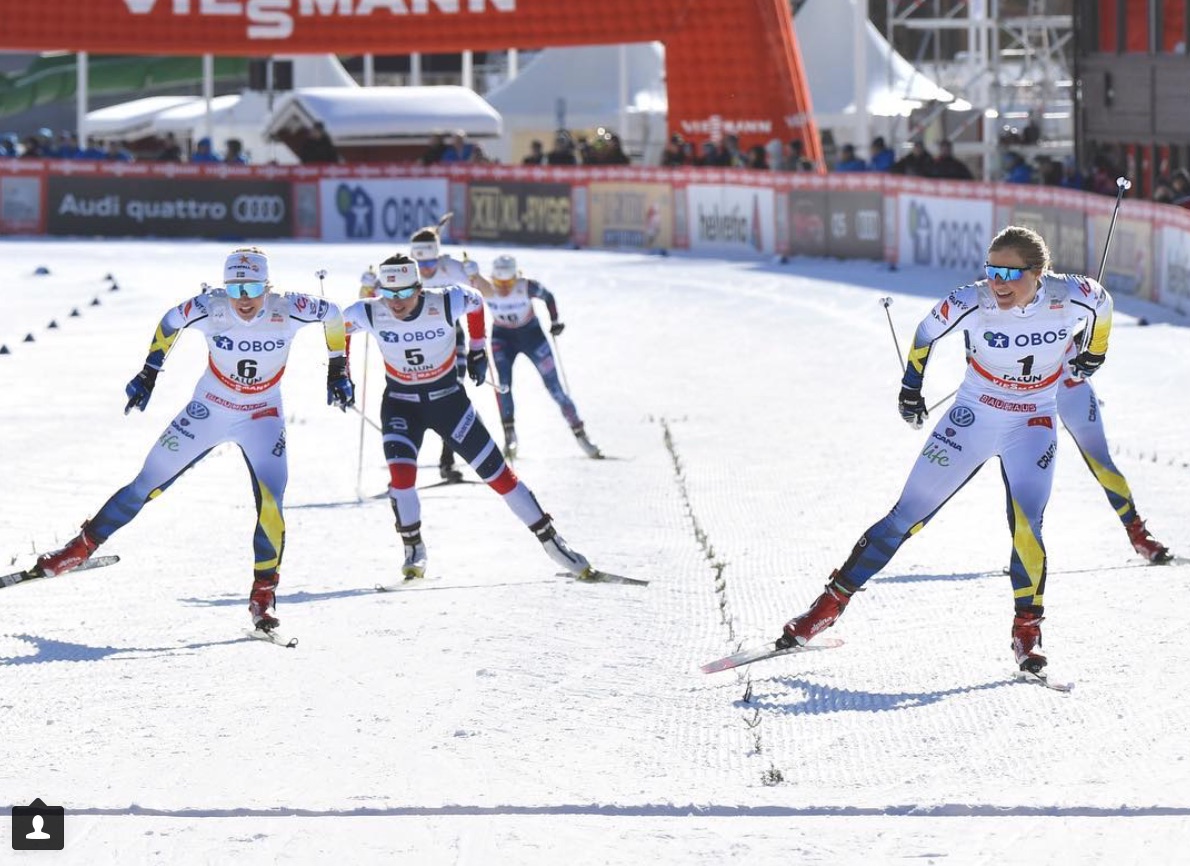
Sweden’s Hanna Falk (r) smiles as she wins the fourth World Cup race of her career and first race in Falun, Sweden, with a victory in the women’s freestyle sprint at 2018 World Cup Finals on Friday. Her teammate Jonna Sundling (l) placed second while Norway’s Marit Bjørgen finished third. (Photo: Svenska Skidspelen/Instagram) FIS Cross Country World Cup Finals (Falun, Sweden): Freestyle sprints
In the last sprint of the season and the first race of the three-day World Cup Finals in Falun, Sweden’s Hanna Falk and Norway’s Johannes Høsflot Klæbo won their respective 1.4-kilometer freestyle sprint finals, while Norway’s Maiken Caspersen Falla and Klæbo claimed the season-long Sprint Crystal Globes and Sophie Caldwell of the U.S. placed third in the Sprint World Cup.
Falk started Friday by topping the women’s qualifier on home turf in 2:59.88 minutes, 1.65 seconds ahead of American Jessie Diggins, who qualified in second. Russia’s Natalia Nepryaeva qualified third (+2.73), while American Sadie Bjornsen raced to the fourth-fastest qualifying time (+2.96), ahead of Norway’s Marit Bjørgen in fifth (+3.72).
Falk then won the first quarterfinal and first semifinal before taking control and dusting the field in the women’s final. She essentially led the final from start to finish, but slowed her pace and the five women behind her as she ascended the last climb. As she reached the 180-degree turn at the top, Falk launched into high gear, leaving the rest of the field chasing. Bjørgen was closest to her in second, but still several meters back, as they descended down into the stadium, and Falk skated away from her pursuers for her fourth-career World Cup win (and first victory in Falun) in 3:08.25. Sweden’s 23-year-old Jonna Sundling came on strong in the finishing straight for her first World Cup podium in second (+0.53), Bjørgen took third, and Sweden had three in the top four with Anna Dyvik in fourth (+1.72).
Norway’s Silje Øyre Slind finished fifth (+4.3), and Caldwell, who had qualified for the heats in 16th then won her quarterfinal and advanced in third in the second semifinal, placed sixth overall (+6.99).
Four American women posted top-20 qualifying times, with Kikkan Randall advancing as well in 18th. Diggins placed seventh overall after finishing third in the first semifinal, 0.42 seconds behind Falk in first and just 0.08 seconds behind Sundling, who advanced to the final in second.
Bjornsen was ninth on the day after placing fifth in that semifinal, 0.85 seconds out of first. Randall finished 15th overall after placing third in her quarterfinal, 3.14 seconds behind Diggins, who won that heat.
Also for the U.S, Ida Sargent missed the top 30 needed to qualify in 36th, as did Rosie Brennan in 49th, Caitlin Patterson in 63rd, Liz Stephen in 66th, Kaitlynn Miller in 69th, and Rosie Frankowski in 75th.
Canada’s Emily Nishikawa placed 40th, Dahria Beatty was 48th, Cendrine Browne 60th, and Zina Kocher 71st.

Norway’s Johannes Høsflot Klæbo (yellow bib) celebrates his 11th World Cup victory of the season in the men’s freestyle sprint at 2018 World Cup Finals in Falun, Sweden, ahead of Italy’s Federico Pellegrino (l) in second and France’s Lucas Chanavat (11) in third. (Photo: Svenska Skidspelen/Instagram) In the men’s race, Russia’s Alexander Bolshunov qualified first in 2:36.23, 0.46 seconds ahead of Klæbo in second. Klæbo then won the first quarterfinal, first semifinal, and you guessed it, the final as well, backing off before crossing the finish line for the last time in 2:37.03.
Italy’s Federico Pellegrino powered past France’s Lucas Chanavat in the finishing stretch of the final to claim second, 0.39 seconds behind Klæbo. Chanavat completed the podium in third (+1.76), Finland’s Ristomatti Hakola finished fourth (+3.26), and Sweden’s Oskar Svensson and Teodor Peterson placed fifth (+3.88) and sixth (+6.17), respectively.
Two American men qualified for the heats, with Simi Hamilton advancing in 13th and Kevin Bolger in 29th. Hamilton went on to place 14th on the day after finishing third in the first quarterfinal, 0.61 seconds behind Klæbo. In his second-career World Cup sprint, Bolger placed 30th overall after finishing sixth in his quarterfinal, 2.21 seconds behind Peterson in first.
In the overall Sprint World Cup, Klæbo took his second-straight title by a whopping 243 points over Pellegrino in second, while Falla won her third-straight Sprint Crystal Globe by 78 points over Sweden’s Stina Nilsson, who was out sick for Friday’s race. Nilsson joined her at the Sprint World Cup podium ceremony on Friday, as did Caldwell, who achieved her best overall sprint standing in third.
Falla placed eighth overall on the day after being eliminated in the semifinals (she finished fourth behind Falk, Sundling and Diggins, respectively).
For the U.S., Erik Bjornsen narrowly missed qualifying in 31st, Andy Newell placed 43rd, Paddy Caldwell was 60th, David Norris 84th, and Scott Patterson 87th.
For Canada, Julien Locke placed 32nd, Alex Harvey 34th, Devon Kershaw 74th, and Graeme Killick 81st.
Results:
Women: Qualifier | Final | Women’s Sprint World Cup (final standings)
Men: Qualifier | Final | Men’s Sprint World Cup (final standings)
-

Diggins Goes All In for the Win, Bjørgen Earns 7th Holmenkollen Title

Norway’s Marit Bjørgen celebrates her seventh Holmenkollen 30 k victory on Sunday in Oslo, Norway, ahead of American Jessie Diggins, Norway’s Ragnhild Haga (not shown) and Sweden’s Charlotte Kalla. (Photo: Fischer/NordicFocus) *Update: This article previously stated that Jessie Diggins was the first American woman to reach a podium at the Holmenkollen. Diggins is actually the first American woman to reach the Holmenkollen podium in the 30 k distance, second woman to podium at a Holmenkollen in history. In 1980, American Allison Owen reached the podium in the 10 k distance.
OSLO, Norway — Some pointed to the broadcast screen in disbelief. Others began waving their Norwegian flags with revitalized vigor. Twenty minutes earlier, Norway’s Marit Bjørgen appeared to be out of the running for another win in the women’s 30-kilometer mass start at Holmenkollen.
She had lost nine seconds to the leaders by the 11 k mark and another 17.9 seconds had dissipated between her and the the leaders as they passed 13.3 k. A little over the halfway point, at 16.3 k, the 37-year-old Bjørgen was down 36 seconds.
For any spectator familiar with Bjørgen’s race tactics, she does not favor come-from-behind style skiing. In this year’s Olympic 30 k classic mass start, she pulled away from the field in the first 8 k and went on to claim gold by a close to a two-minute gap.
Exactly one year ago, in the 2017 Holmenkollen 30 k classic, she had put 33 seconds into the field by 8 k, tripling that in the following 10 k, before crossing the finish line more than two minutes ahead of the rest of the field. If racing to win, Bjørgen usually starts by burying the competition.
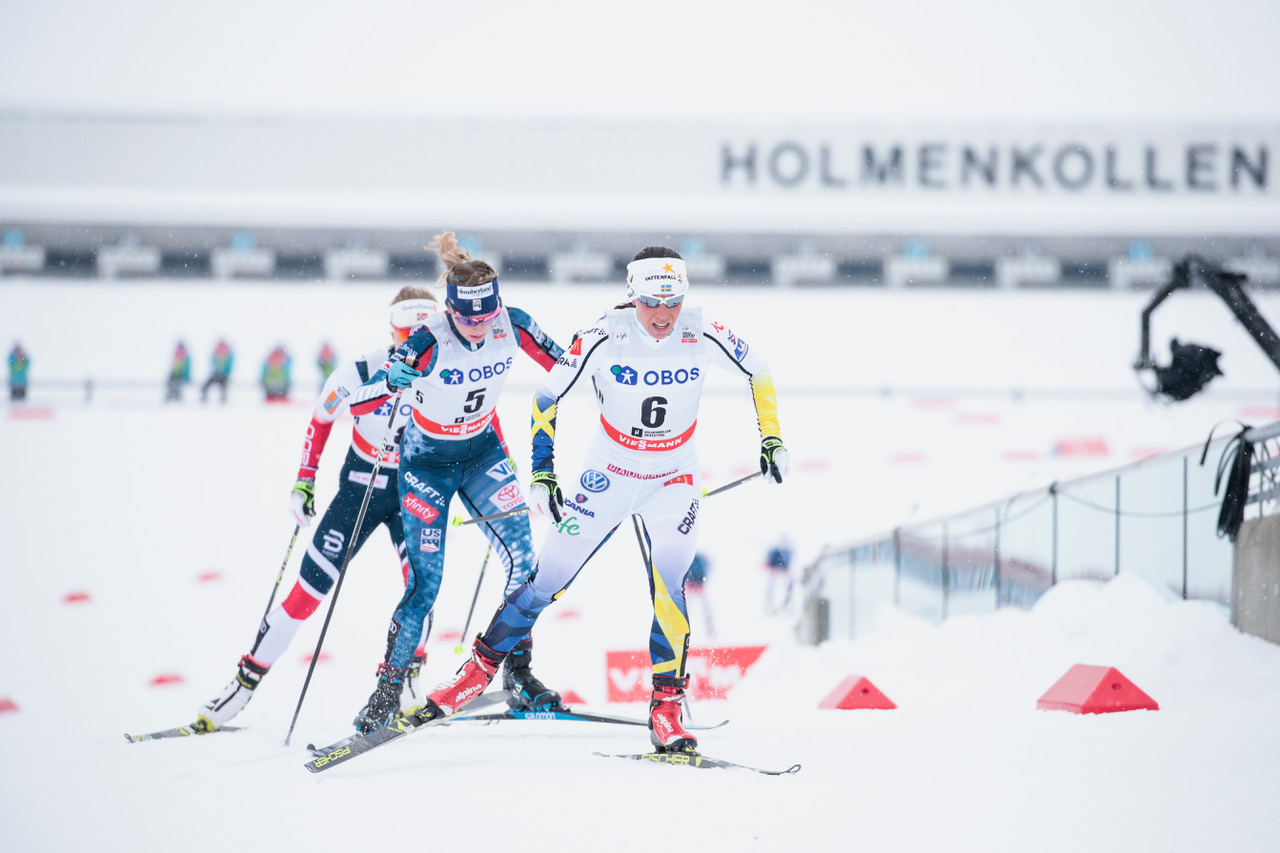
Sweden’s Charlotte Kalla leads American Jessie Diggins and Norway’s Ragnhild Haga during the Holmenkollen women’s 30 k freestyle mass start at the World Cup in Oslo, Norway. (Photo: Fischer/NordicFocus) So when Sunday’s top three — Sweden’s Charlotte Kalla, Norway’s Ragnhild Haga and American Jessie Diggins — broke free, the predictions for the podium went with them.
“I thought I was fighting for the fourth place,” Bjørgen said at a post-race press conference.
With Bjørgen out of the driver’s seat, the attention from the teleprompter and crowd turned to Diggins, Kalla and Haga. For the most part, the three skied in a line, with Kalla and Diggins exchanging leads.
Still anytime the Swede pulled at the front, her effort appeared to be a byproduct of Diggins. Every uphill churn from the Swede seemed like an attempt to stave off the American. Diggins continually reinstated herself ahead of Kalla in first: stars and stripes unmistakably spearheading the way.
On a course that is fabled for Norway, in a sport that is historically Scandinavian, the U.S. skier repeatedly put the iconic suits of Sweden and Norway behind her. But this seemed to be more than just the dogged-skiing characteristic of Diggins’s race style. The 26-year-old Minnesota native was not just being gutsy. She was making a point.
“I think there has been this myth that Americans, OK, maybe they can win short distances, and maybe Jessie can win a 5 k but there is no way she can hang in a 30 k,” Diggins told FasterSkier during an in-person interview after. “I was setting out to debunk some myths today.”
For the first 8 k, Diggins charged the field of 54 skiers. Along with Kalla, she spurred the lead group’s gap that formed at the 13 k mark. In another 5 k from there, she had broken free of Bjørgen. Without looking back, Diggins was chasing down a Holmenkollen master head on.
“Maybe it wasn’t smart to be leading so much, but I was thinking this is my only shot and so I got to go for it,” Diggins said. “It was an incredible feeling to be leading the Holmenkollen … for me, trying to be competitive in every race that I enter has been a goal for a long time. I don’t want to be a specialist, I want to be a medal threat in every race that I do.”
As Diggins continued to pose a threat in the front, danger lurked behind. Bjørgen cut through the course, the dreaded dorsal fin gradually on the rise.
At 18.3 k, the gap from Bjørgen to the leaders was 32 seconds. In two kilometers, that was reduced to 26 seconds. Another 2 k and Bjørgen was four seconds closer. Over the course of 5 k, Bjørgen had cut her time back from the leaders in half; another 5 k still remained and 15 seconds separated her from the top three.
A wave of surprise and simultaneous excitement rolled over the spectators. Six seconds separated her from the lead group at 27 k. The Norwegian pushed closer and closer, and with 1.5 k left in the race, she was back in contact with the front pack.
“It was amazing that I did it,” Bjørgen said. “I haven’t thought it was possible … but when we passed the stadium, the last time, before we go off Gratishaugen … I thought … I wonder if they want to change skis and they didn’t.
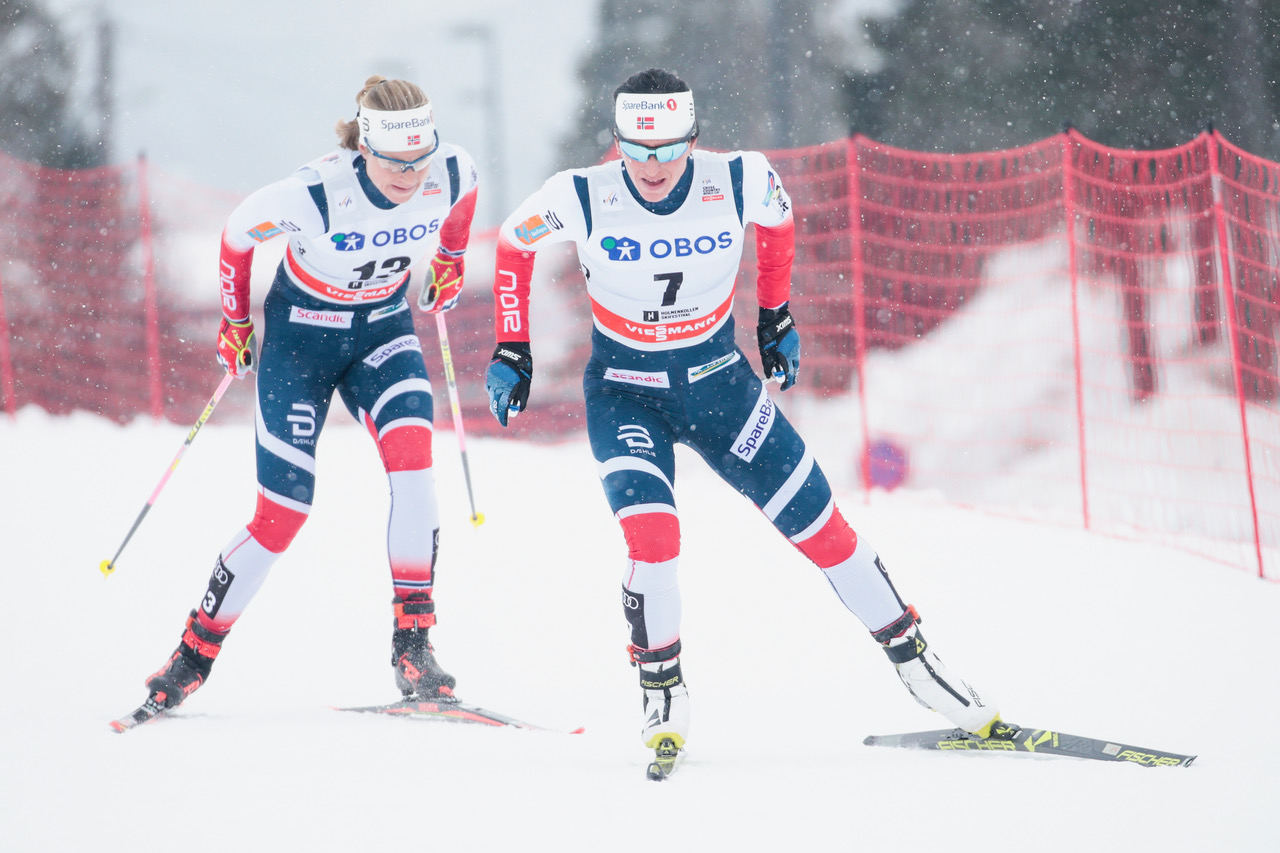
Norway’s Marit Bjørgen leading teammate Astrid Uhrenholdt Jacobsen in the Holmenkollen 30 k freestyle mass start at the World Cup in Oslo, Norway. (Photo: Fischer/Nordic Focus) At 13.3 k Bjørgen stopped to switch skis, as did her Norwegian teammate Astrid Uhrenholdt Jacobsen. Kalla, Diggins and Haga did not. After the top three bypassed the ski exchange, one thing was on the Bjørgen’s mind.
“I thought I had to push hard,” Bjørgen said.
Fueled by the energy of her home crowd, Bjørgen went on to pass Haga, Diggins and Kalla in the final kilometer. Alone, she raced toward the final stretch and crossed the finish line first in a time of 1:18:12.4 hours, earning her seventh Holmenkollen title in historic fashion. She now also holds the record for most Holmenkollen victories of any woman.
“I haven’t won a competition like this, so it’s all so very special,” Bjørgen said. “To win at Hollmenkollen … for sure it’s the biggest you can do after the World [Championships] and the Olympics.”
Crossing 3.6 seconds behind Bjørgen was Diggins in second place. She became the first American woman to reach the podium at Holmenkollen in the 30 k distance. 1980, American Allison Owen reached the podium in the Holmenkollen, which was raced as a 10 k.
“I didn’t know who it was [chasing the top three] I just heard that the gap was shrinking,” Diggins said. “I felt I was just sprinting the last 4 k. That was my only shot. We didn’t change skis which maybe was a mistake, but also you make the best call that you can at the time.”

The Holmenkollen women’s 30 k freestyle mass start podium on Sunday in Oslo, Norway, with Jessie Diggins (l) in second, and Norway’s Marit Bjørgen (c) in first and Ragnhild Haga (r) in third. (Photo: Fischer/Nordic Focus) While she held off Haga and Kalla, those two battled for third. Haga outlunged Kalla by a just one-tenth of a second for the final spot on the podium (+4.3).
“I am very happy with my sprint, my finish against Charlotte,” Haga said. “I regretted that we didn’t switch skis when I heard that Marit caught many seconds there, but suddenly she just came up and, yeah, she is always there when it matters. So Marit is amazing today as well.”
Rounding out the women’s top 10 was Kalla in fourth (+4.4), Jacobsen in fifth (+11.6), Ingvild Flugstad Østberg in sixth (+1:39.5), Finland’s Krista Pärmäkoski in seventh (+1:51.7), Germany’s Stefanie Böhler in eighth (+2:10.2), Austria’s Teresa Stadlober in ninth (+2:11.6) and Sweden’s Ebba Andersson in 10th (+2:11.9).
U.S. skier Sadie Bjornsen finished 11.5 seconds outside the top 10 in 12th (+2:23.4) in what she described as her “best Holmenkollen finish.”
“I was really looking forward to today. I had not too many awesome feelings lately,” Bjornsen told FasterSkier after. “I was just looking forward to the simplicity of a skate race. I had a ton of fun out there.”

American Kikkan Randall (19) leading Canada’s Cendrine Browne and Russia’s Alisa Zhambalova during the Holmenkollen women’s 30 k freestyle mass start on Sunday in Oslo, Norway. (Photo: Fischer/NordicFocus) Following Bjornsen, U.S. skier Kikkan Randall placed 19th (+3:21.9) in what will be her final Holmenkollen race. The first time Randall raced at Holmenkollen was in 2007. As she reflected on her years of racing there, the 35-year-old Olympic gold medalist remained humble of the time she had spent on the historically challenging trail.
“This is probably one of the coolest places to race, with the atmosphere and the spectators,” Randall said. “It was definitely hard, but I really enjoyed it … there’s something that’s hard to put into words about pushing yourself over the course of an hour and twenty minutes. It just kind of feels good to finish a little bit empty.”
After a photo finish with French skier, Anouk Faivre-Picon, American Caitlin Patterson finished 28th (+4:13.1), just behind Faivre-Picon in 27th. Sunday’s race was Patterson’s second Holmenkollen freestyle race, and the 27-year-old Craftsbury Green Racing Project member was happy to spend the first two-thirds of it with a large group of racers that included Randall.
“This one was way better because I was actually in it. That other year I was just blown out,” Patterson said, referring to her previous Holmenkollen skate race, in 2015, when she placed 53rd. In last year’s Holmenkollen 30 k classic, she finished 36th.
“Today my goal was to stay more relaxed and as much as I wanted to stay with the lead pack, but not burn all the matches right at the start,” Patterson added.
“I switched my skis the last lap, with the snow starting to come down … and for better or worse, it did mean I lost the pack,” she continued. “But then I was able to ski with Anouk for the last lap and we reeled in that Norwegian and a Russian. … I always feel a lot better about races if I finish strong, whatever the place is.”
Also for the U.S., Rosie Frankowski, of Alaska Pacific University, finished in 31st (+4:45.4), 28.3 seconds outside the top 30.
Canada’s Cendrine Browne finished 36th (+6:16.1) followed by Emily Nishikawa in 44th (+7:36.1) and Dahria Beatty in 49th (+9:45.1).
For the U.S., Liz Stephen finished 51st (+10:01.7) and Kaitlynn Miller 53rd (+16:05.0).
Along with Randall, Stephen also completed her final Holmenkollen on Sunday. Stephen had her parents cheering her on after they made the trek to Norway to watch her race in person. Her closing words on her final time around the historic course were full of emotion, both happy and sad.
“I think this is actually the first race that I have ever looked at Matt [Whitcomb] in the eye during the race and thanked him for the feed and kept going,” Stephen, 31, said. “It’s bittersweet. It’s certainly not the way I was hoping to end it but … it was really special watching Noah [Hoffman] hug his dad yesterday.
“I mean this sport has been our life and it is hard to leave, but it is time,” she added, referring to her retirement at the end of the season. “And I am really lucky to have had such a good run with it. And to have an amazing team to let go forward.”