From the FasterSkier archive — posts syndicated from athletes’ and coaches’ own blogs between 2004 and 2012, kept online as published. Current coverage is at fasterskier.com.
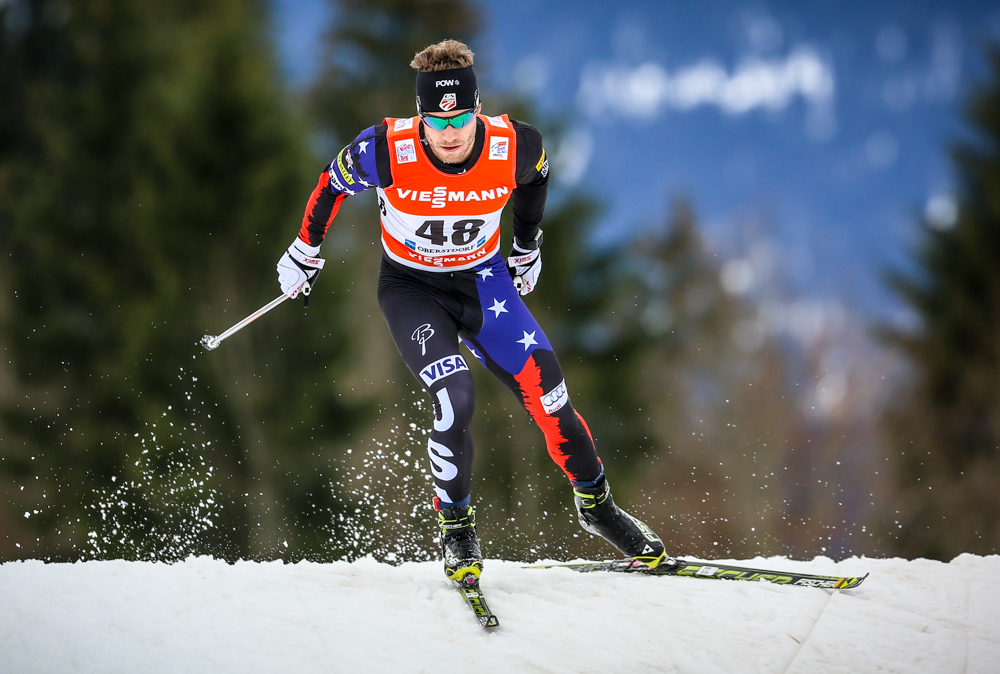
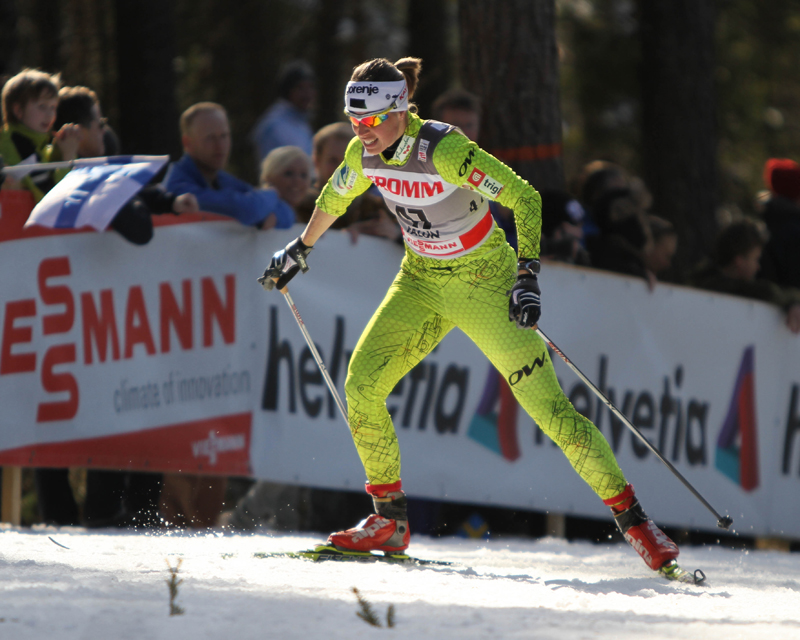
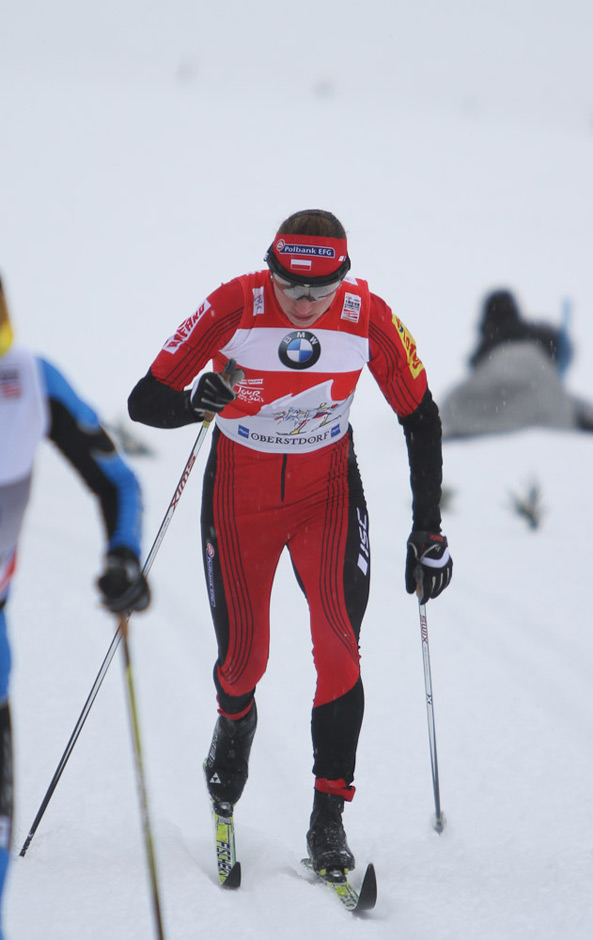
Simi Hamilton placed 11th overall in Saturday’s World Cup classic sprint in Östersund, Sweden, after taking sixth in his semifinal heat. Here, he is pictured en route to his first distance points in a World Cup race earlier this season in Oberstdorf, Germany. (Photo: Marcel Hilger)
On what U.S. Ski Team (USST) Women’s Coach Matt Whitcomb called a “wild-and-crazy course,” Simi Hamilton was the lone American to reach the semifinals in Saturday’s 1.2-kilometer classic sprint in Östersund, Sweden.
However, Hamilton would fall while ascending a hill during the first lap of his semifinal heat and took sixth, ending up 6.33 seconds behind semifinal winner Sondre Turvoll Fossli of Norway (who won the heat in 2:27.83) and finishing 11th overall.
Hamilton explained in a phone interview that the difficult course was breaking down quite a bit throughout the day, and the snow was getting deeper on the steep hills that required the skiers to herringbone.
“My right ski just got caught behind me a little bit in the powder, and I just put my right pole right through the top of that ski,” he said. “When you’re trying to hammer a herringbone your poles are just coming so close to your ski it’s definitely a pretty thin margin between a good pole plant and planting right on top of your ski.”
After falling, Hamilton focused on getting up as fast as he could and surged through the end of the first lap in order to make up lost time.
“I made contact with the back of the group again, but just didn’t have a ton of energy left after that to try and get around anyone,” he said.
After qualifying in 12th, 2 seconds behind Norwegian qualifier winner Timo André Bakken, who posted the fastest time in 2:28.25, Hamilton won his quarterfinal in 2:31.97.
“My energy felt really good all day, so I knew I’d be able to put in a good, sustained effort, hoping that a few of those guys in the quarterfinal would start to drop off a little bit,” he said.
Hamilton explained that he was able to put himself in second place, behind Finland’s Toni Ketelä, as they went up the hill above the stadium for the second time. By the last climb before the short, final descent into the stadium, he went as hard as he could and took an open lane on the left.
“I had some room to do my own thing, so I could hammer up and over the top of that climb and focused on having a good double-pole finish,” he said.
“I felt like some times in the past, especially with classic sprinting I haven’t been able to lay down a really good qualifier and haven’t been able to find the energy,” he continued. “So I was definitely pretty happy with the quarterfinal.”
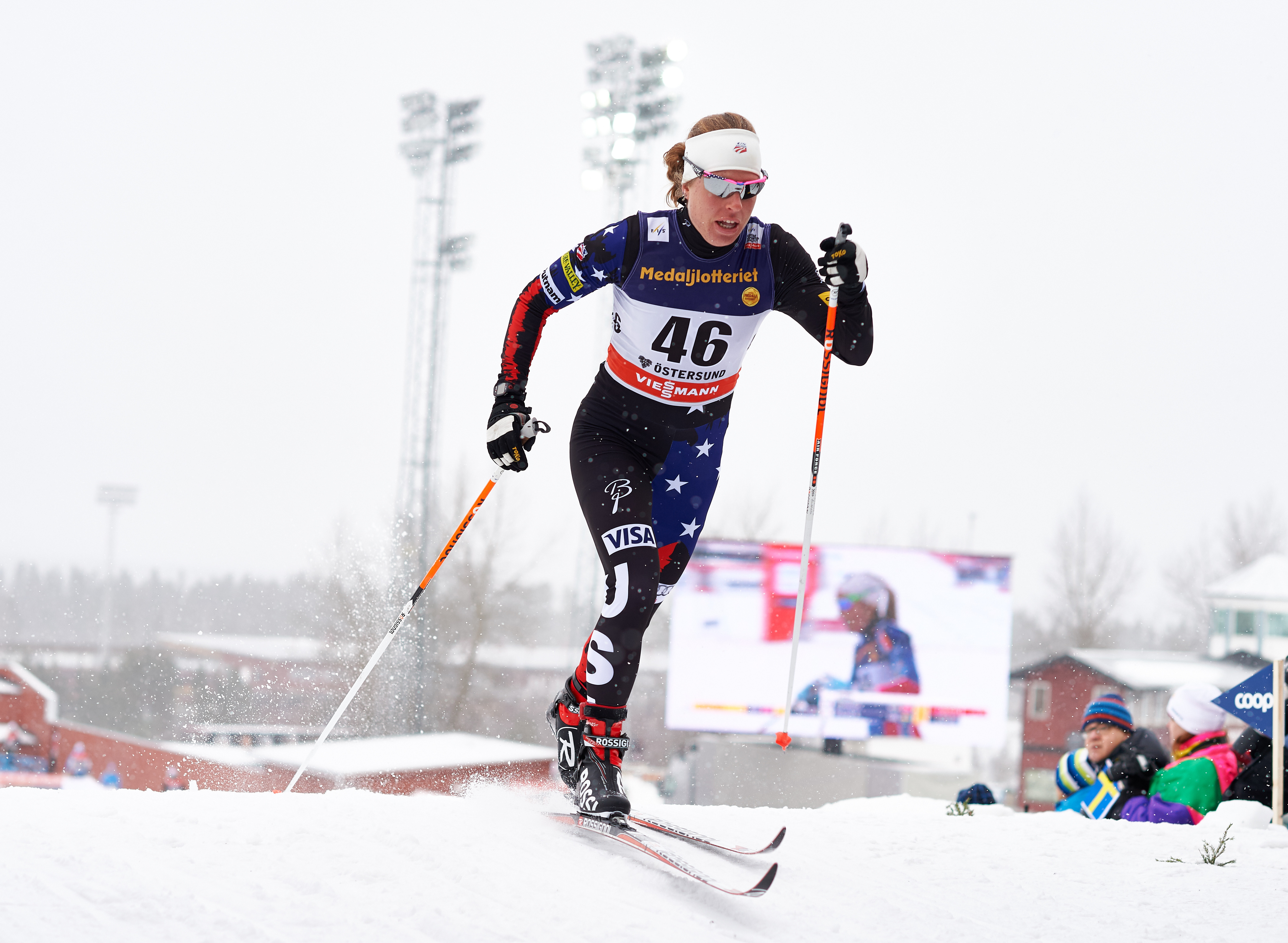
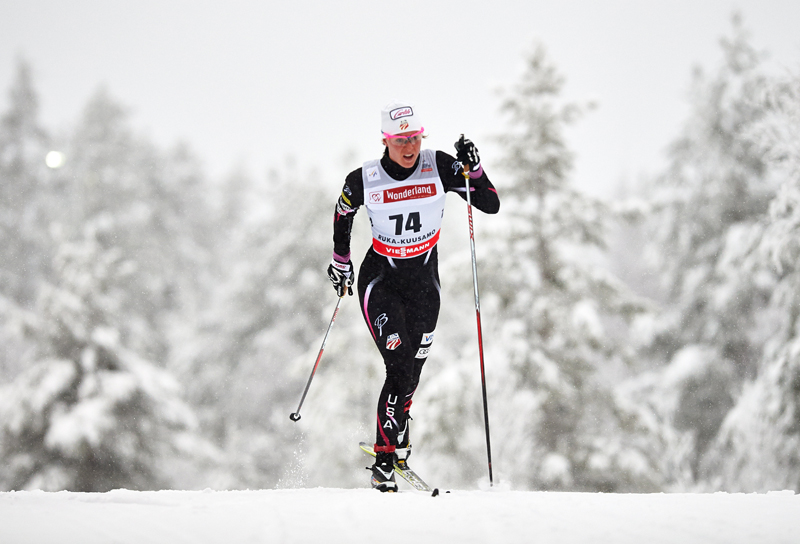
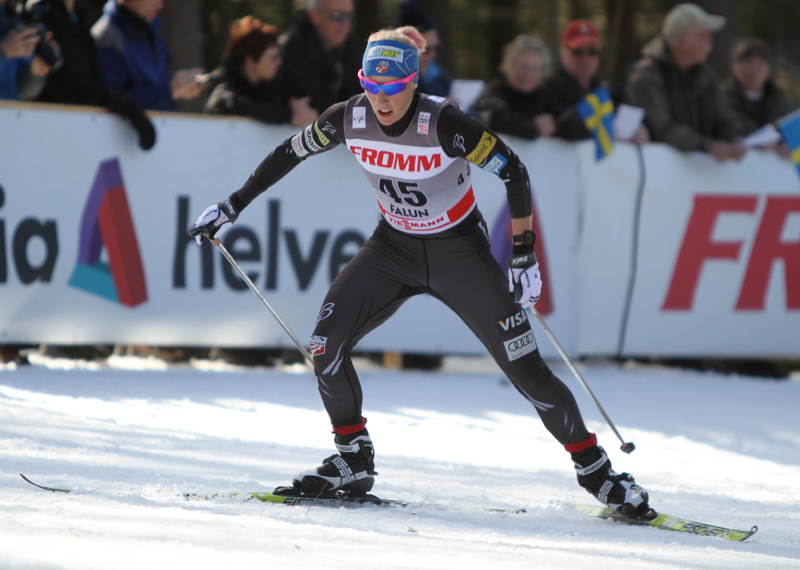
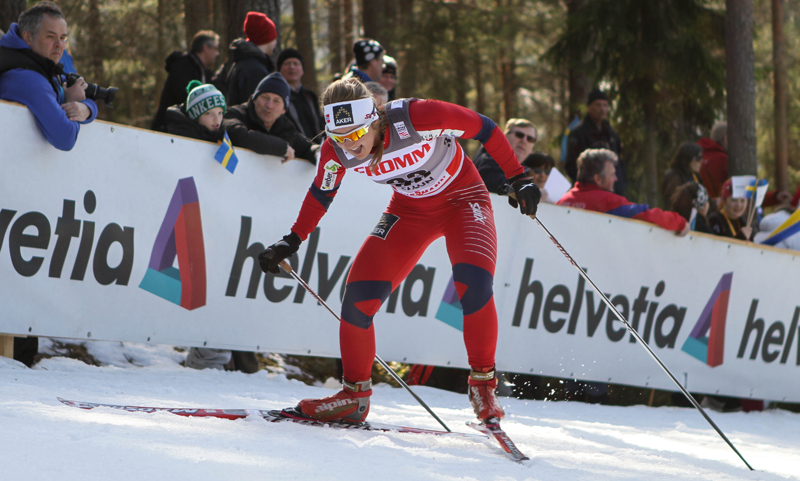
Rosie Brennan racing to 33rd overall in Saturday’s World Cup classic sprint Östersund, Sweden. (Photo: Ian Harvey/Toko)
Meanwhile, Hamilton’s teammate Andy Newell took third in his quarterfinal after qualifying in 17th (+2.68). He finished 12th overall for his best World Cup result of the season.
Newell explained that if he had made “one or two better moves” going into the final uphill of his quarterfinal, he might have had a shot at placing into the semifinals or moving on as a lucky loser. But he ended up 2.61 seconds behind Norway’s Thomas Northug, who was second in his heat, and 1.10 seconds short of a lucky loser spot.
“It was a pretty unique course, that’s for sure. It’s fun in that we don’t get to race courses like that very often,” Newell said in a phone interview. “You had to have a unique technique of herring bone in order to do well.”
Newell was happy with the result, especially in light of his struggles earlier in the season due to both allergies and physical injuries.
“You have years where a 12th-place finish is a disappointment … But at the same time I’m feeling really good, and it’s not always reflected in the results,” he said. “As an athlete you have to gauge your excitement and your momentum on how you’re feeling and not necessarily on your results.”
Norway’s Finn Hågen Krogh would eventually win the men’s final in 2:25.28, holding off Canada’s Alex Harvey by 0.47 seconds. Bakken took the final spot on the podium in third (+1.41).
Bjornsen, Caldwell Lead U.S . Women
In the women’s sprint, Sadie Bjornsen qualified in 27th, 10.02 seconds behind Norwegian qualifier winner Kari Vikhagen Gjeitnes, the fastest in 2:47, while Sophie Caldwell qualified in 24th (+9.84). They raced in the same quarterfinal heat against Sweden’s Stina Nilsson and overall World Cup leader Marit Bjørgen of Norway.
Bjørgen won the heat in 2:50.88, while Bjornsen placed fourth (+4.53) to finish the day 20th overall, and Caldwell took fifth (+5.57) to place 22nd.
Bjornsen said in a phone interview that the course was fun, and much different than what the skiers are used to on the World Cup circuit.
“I knew it was going to be very dependent on my herringboning skills, which I’ve been working a lot on the last couple of years, because I used to be terrible at it,” she said, adding the course featured very little striding and consisted mostly of herringbone, double pole and downhill tucking.
Because of the chevron start, Bjornsen and Caldwell had to begin the quarterfinal heat in unfavorable, outside positions.
“I didn’t have a great start, but I tried not to panic,” Caldwell wrote in an email. She explained that it was difficult to move around skiers because of the constant herringboning, so she spent most of the race in fifth place.
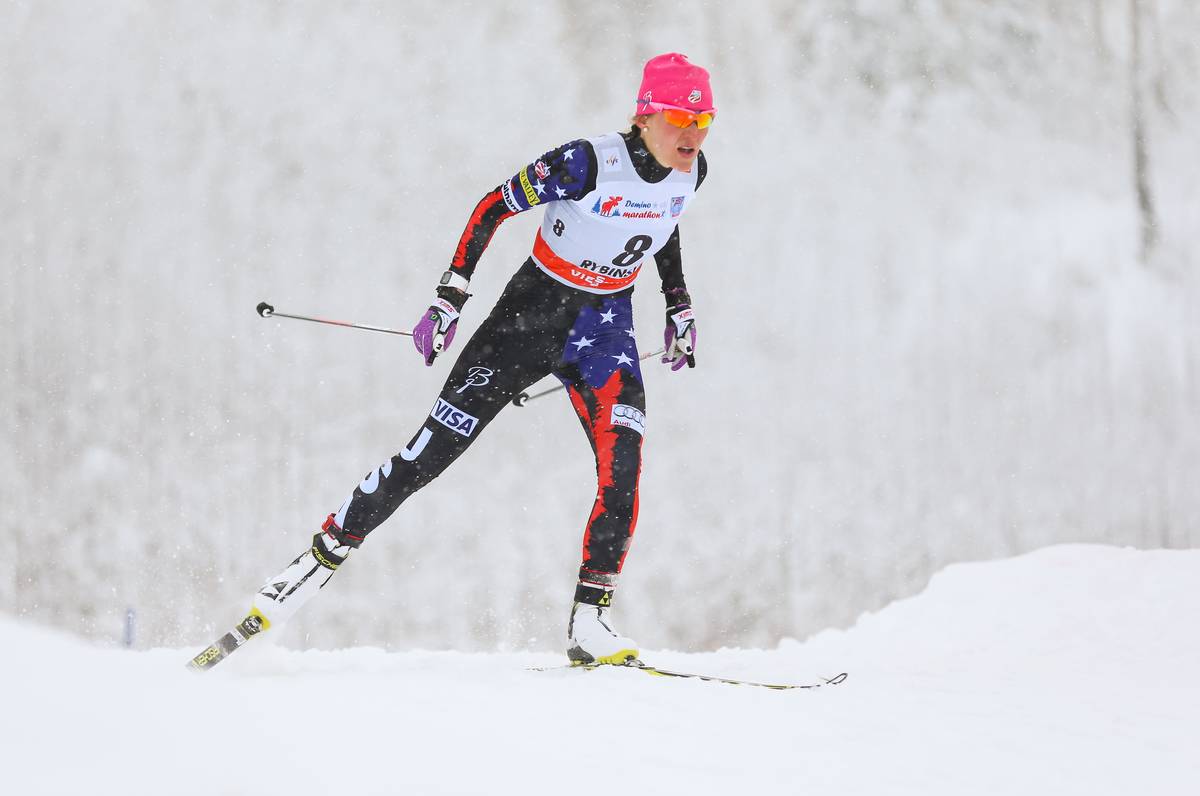
Sophie Caldwell placed 22nd overall in Saturday’s World Cup classic sprint in Östersund, Sweden. Here she is pictured during the 2015 Rybinsk, Russia sprint, where she took seventh. (Photo: Fischer/NordicFocus)
Bjornsen described the race as a “busy scene.” She said that with six skiers trying to funnel into small areas, there were a lot of tangles and opportunities for blocking.
She explained she was not able to close in on the leaders as much as she wanted to at the end, but she said that she definitely felt confident about her fitness.
“I didn’t want to set a goal this weekend that was going to dictate how I felt about my fitness – so it was kind of just for fun today. I’m definitely going into [World Championships] feeling happy and confident,” she said.
Whitcomb said in a phone interview that it was a solid result for the American women and its team’s sprinters would not leave Östersund discouraged.
“You’re always hoping for a top 10 … but it was a tricky course, with a variety of unique demands,” he said.
Based on their positions after qualifying, Caldwell and Bjornsen made the most of what they had, he said, as it was nearly impossible for them to be better than fifth and sixth coming off the top of the steep hill leaving the stadium.
“For Sadie to mix it up in third and fourth, and for Sophie to be able to finish fifth – in good contact with people – I was pretty happy with that. It was a course that was really difficult to move around on, and your place at the start in many cases didn’t change,” he explained.
Rosie Brennan narrowly missed the quarterfinals, qualifying in 33rd (+11.03), 0.72 seconds out of the top 30.
Brennan said in a phone interview that while it is frustrating to be so close to qualifying – especially three weeks after placing 31st in the Rybinsk, Russia freestyle sprint – she is still happy with the result.
“I am really happy with the way I skied so I will just have to work on perfecting the details … As with every race I enter, my goal is simply to push as hard as I can and ski well,” she said.
Whitcomb said that Östersund does not suit Brennan’s strengths, as the Alaska Pacific University skier benefits from powerful striding and not the herring boning the course requires.
“Thirty-third is definitely a success, one of the successes of the day,” he said. “It’s an indication that she’s in the best shape of her life and she should be looking forward to a really positive World Championships.”
Two other American women raced in the qualifying round – Ida Sargent finished 41st (+13.11) while Kikkan Randall was 51st (+16.92).
Whitcomb said that Randall and Sargent were not pleased with their results. He said Sargent reported that she was skiing frantically, while “it took Kikkan a lap to get things going, and you don’t have time for that in a short sprint like this.”
Randall wrote in an email to the press that her qualification was not as strong as she was hoping for after a month-long break from racing.
“I skied too tense and didn’t quite have enough tempo out there, kind of like I was blowing the cobwebs out,” she wrote.
However, she added that she is still confident in the recovery and preparation she has undergone over the last month, and believes it was a good decision to go home and “get a chance to complete reset and get back to basics.”
Bjørgen would end up expanding her overall lead by comfortably winning the final in a time of 2:46.82, 1.80 seconds ahead of teammate Maiken Caspersen Falla. Nilsson placed third (+2.03) in front of a roaring home crowd.
World Cup racing in Östersund continues on Sunday with the 10/15 k freestyle individual starts.
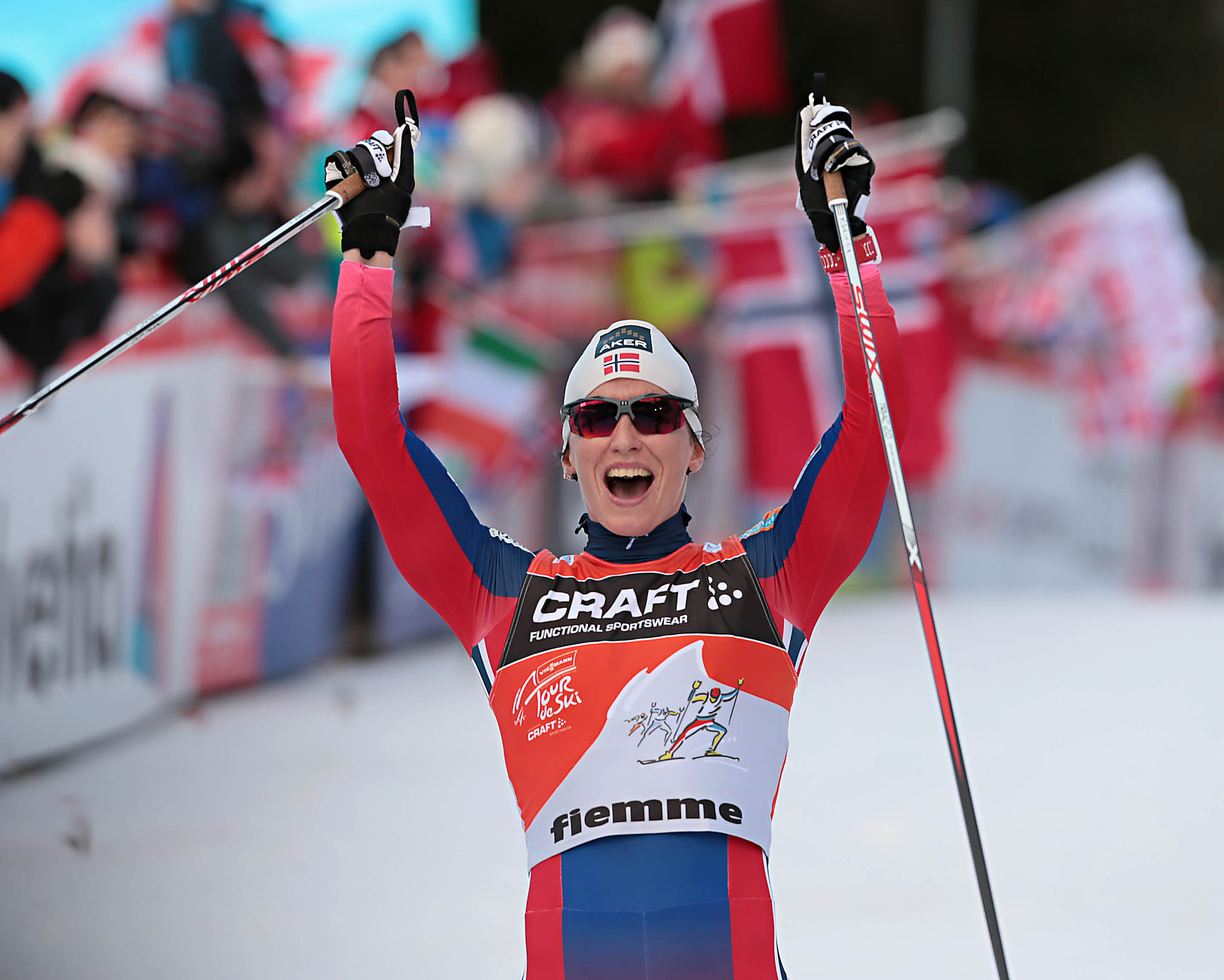
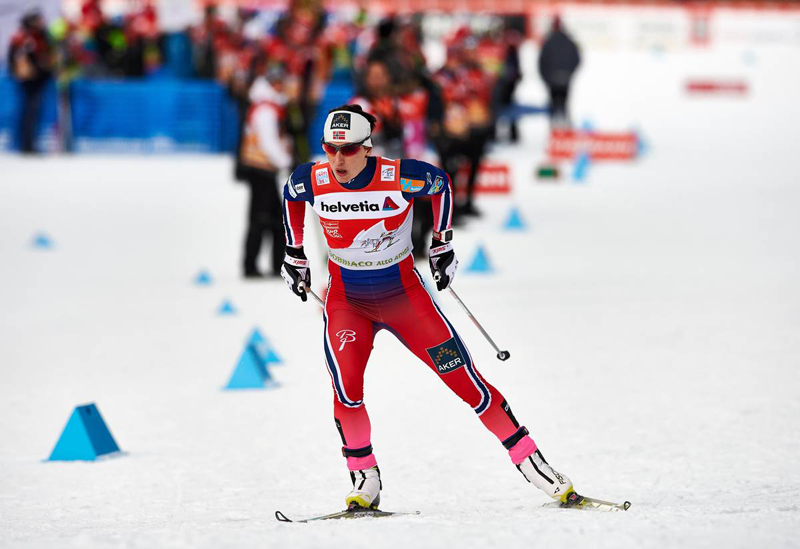
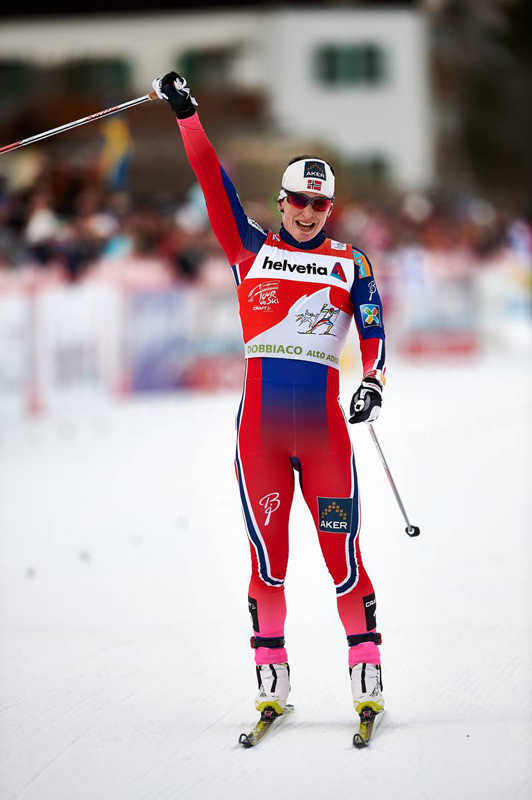
Marit Bjørgen of Norway celebrates her 2015 Tour de Ski victory at the finish line of the final stage in Val di Fiemme, Italy (Photo: Val di Fiemme/www.fiemmeworldcup.com)
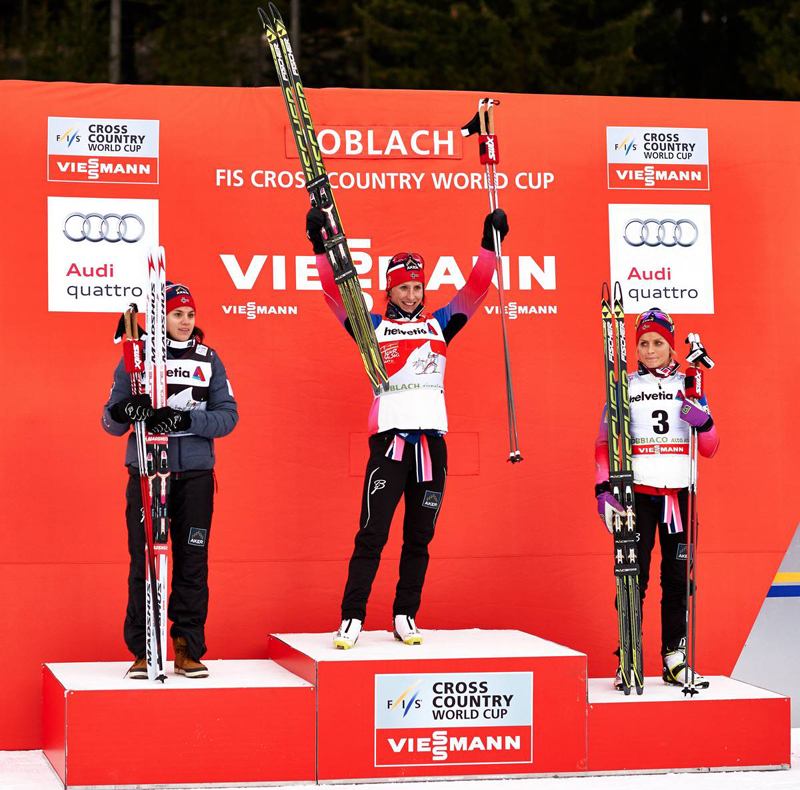
It seemed inevitable for most of the Tour, but it is now official: Norway’s Marit Bjørgen has her first-ever Tour de Ski title after Sunday’s 9 k freestyle pursuit in Val di Fiemme, Italy.
Going into the final stage, there was not much drama over who would come out on top; Bjørgen started the day with a lead of 2:11.2 over fellow Norwegian Heidi Weng and 2:50.3 over defending champion Therese Johaug, also of Norway. She would not let her teammates get anywhere near her, crossing the line in a time of 33:27.5.
“It is a big victory for me. To win the FIS Tour de Ski has been a goal for me for a long time. It took me nine years to achieve it,” Bjørgen said to FIS.
The 34-year-old also described it as “an amazing feeling” to share the experience with her teammates.
“They mean a lot [to] me. They motivate me and they push me in training every day,” she said.
Stage-six winner Johaug completed the notoriously difficult course with the fastest time of the day (32:16.4) and finished 1:39.2 behind Bjørgen. Weng started the day in in front of Johaug but took third (+1:59.5), unable to maintain Johaug’s furious pace despite posting the second-fastest time of the day (33:15.8).
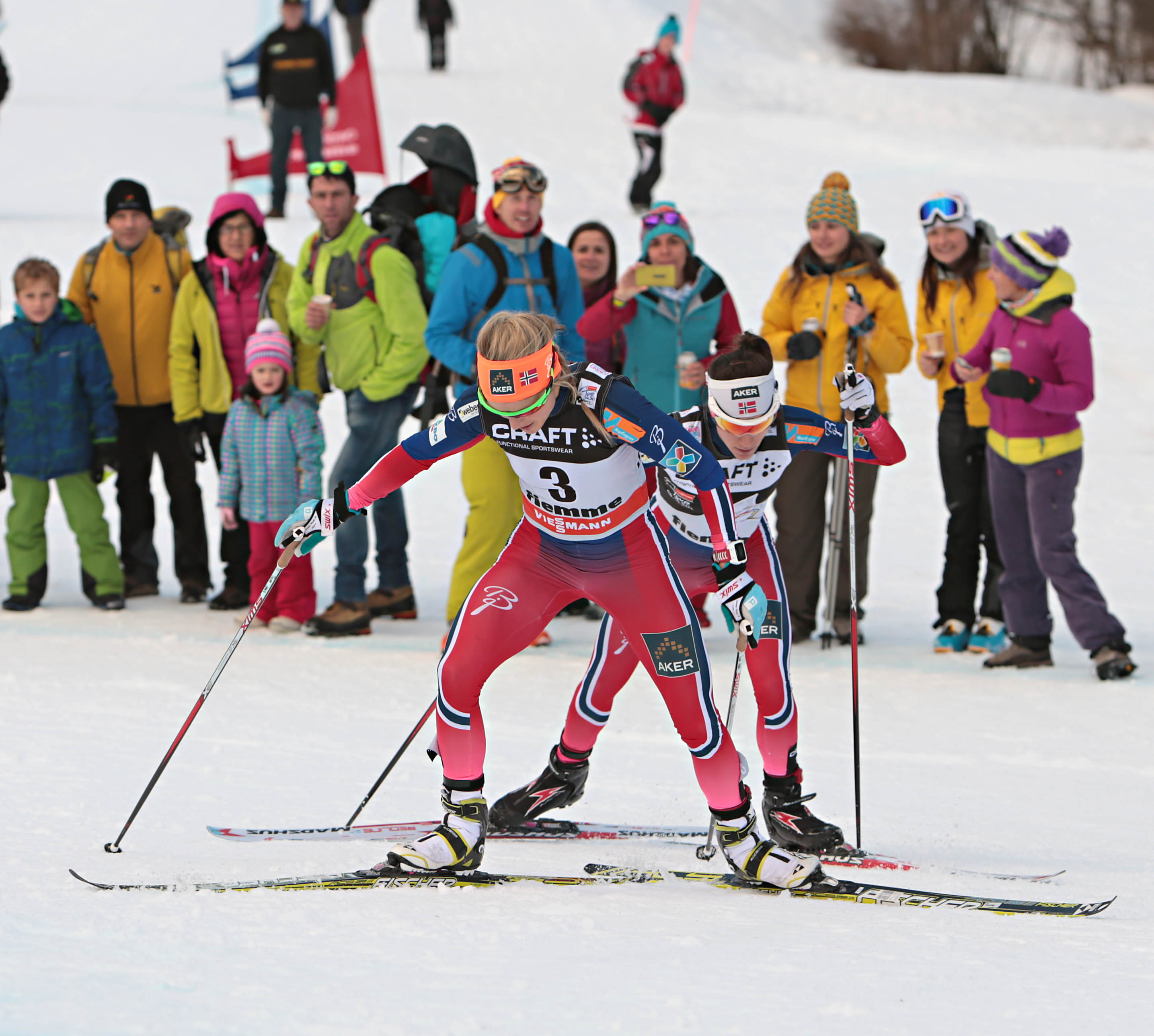
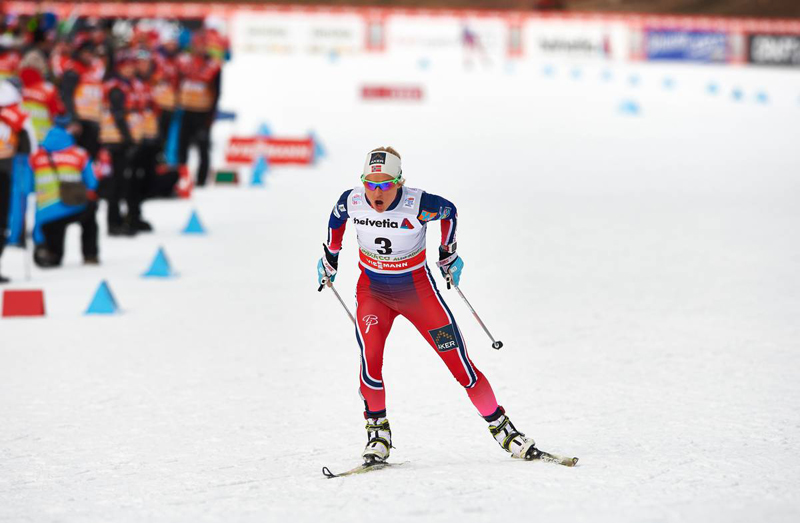
Therese Johaug (bib 3) leads Norwegian teammate Heidi Weng as they race in the final stage of the 2015 Tour de Ski in Val di Fiemme, Italy (Photo: Val di Fiemme/www.fiemmeworldcup.com)
“Everyone hates the final climb, but I love it,” Johaug told FIS.
The 26-year-old said she knew she was out of the competition for first overall before the stages in Toblach, Italy, and was satisfied with second place and her performance in the final two stages in Val di Fiemme.
Weng told FIS she feels she put together her best races ever at this point in the season, and that it was “absolutely unbelievable” to be on the podium after every stage of the Tour.
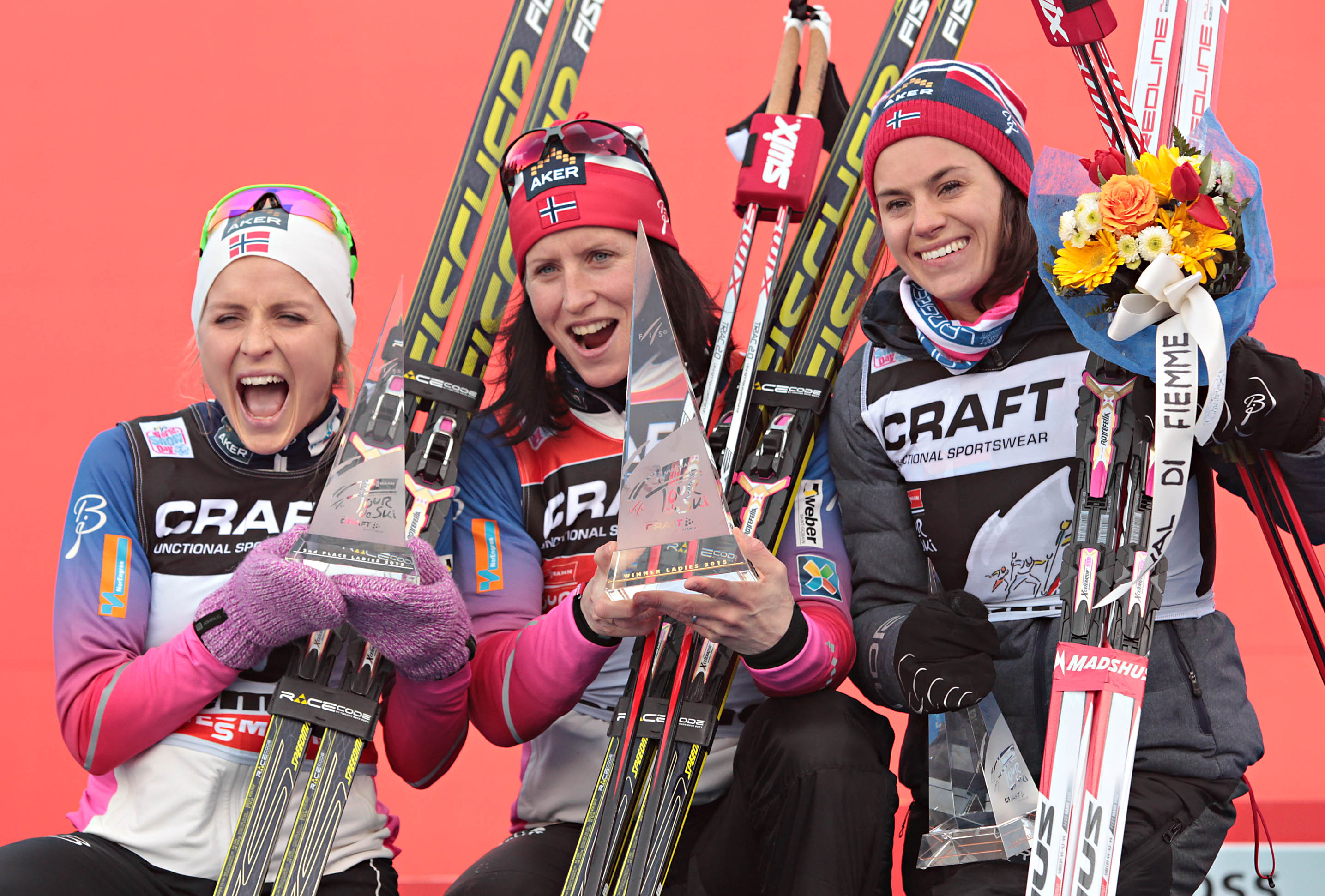
It is the second consecutive year that Norwegian women have swept the top three places on the overall Tour standings.
American Liz Stephen – who took seventh in the 2014 Tour and was the only North American skier left in the field – started the day in sixth but managed to climb into the fourth position in front of Poland’s Justyna Kowalczyk, who did not finish, and Norway’s Ragnhild Haga.
Stephen said in a phone interview, “I knew there were a few girls right behind me, and we skied the flats together. The girls actually pulled me along for that whole flat section, so I was able to hang in and conserve my energy.”
However, Haga would reclaim the lead over Stephen in the final kilometer.
“[Liz was] perhaps was a bit too aggressive in her approach to the climb. She caught them [Haga and Kowalcyzk] very quickly but then skied the middle section of the hill under extreme fatigue,” wrote USST Women’s Coach Matt Whitcomb in an email.
“I think Ragnhild skied such a strong race and I just made up a little too much time too quickly on her,” Stephen said.
The 27-year-old stayed just behind Haga throughout the steep pitch before the finish, and for a moment it looked like Stephen was going to catch her, Whitcomb wrote.
But with about 100 m to go, it was clear that Haga had more energy to spare than Stephen. Haga crossed the line 7:32.2 behind Bjørgen to complete a Norwegian sweep of the top four.
American Liz Stephen leads Norway’s Ragnhild Haga during the charge up the final hill of the seventh stage of the 2015 Tour de Ski in Val di Femme, Italy (Photo: Val di Fiemme/www.fiemmeworldcup.com)
“It’s hard to lose a battle like that, but it was Marit who greeted Liz first at the finish. That takes the edge away,” Whitcomb explained.
Stephen said she was happy with the way she was able to stay with Haga and fight to the end, the product of “a lot of mental work and confidence building” throughout the season.
“A lot of times once somebody goes by it’s over … I really tried to latch on and actually make another move towards the finish,” she said.
Stephen finished the Tour in fifth (+7:41.8), which is the best result ever for an American in the Tour de Ski. She also posted the fourth-fastest time of the day in 33:29.9, which was just 2.4 seconds slower than Bjørgen’s time. She is now 11th overall in the World Cup standings.
Whitcomb wrote that Stephen set a goal last summer to finish in the top five in the Tour.
“Watching an athlete accomplish a top-tier goal like that is really satisfying and we are all very proud of her ability to prepare and execute,” he wrote.
“I’m working really hard on having the confidence to ski with the big dogs and know that I belong there,” Stephen said. “I guess I’m really happy to prove it to myself that I can be there.”
Though Stephen was happy with her individual result, she said “it takes a team” and that she could not have accomplished what she did without the seven other Americans sticking by her throughout the final stages.
Meanwhile, four-time Tour champion Kowalczyk apparently fainted about 900 m before the finish and was taken away in an ambulance, according to Eurosport.com. She was already having a difficult race, having fallen to ninth after 8.1 k.
Not much is known about her condition at this point, though reportedly after two hours in the hospital she was feeling better.
Eva Vrabcova-Nyvltova of the Czech Republic finished in sixth (+8:29.4), while Germans Nicole Fessel and Diane Herrmann captured seventh (+8:55.8) and eighth (+9:35.1), respectively.
Bjørgen continues to top the World Cup standings with 1588 points, expanding her lead after earning 400 points for her Tour victory. Johaug sits in second (1138), Weng is in third (1017), while Haga is far back in fourth (632). Ingvild Flugstad Østberg, a Norwegian who left the Tour after stage four, rounds out the top five (609).
Marit Bjoergen (NOR) unchallenged in yet another Tour de Ski stage. (photo: Fischer / Nordic Focus)
The only thing that can stop Norway’s Marit Bjørgen from winning her first ever Tour de Ski title is herself.
Entering Thursday’s fifth stage, a 5 k skate pursuit, in Toblach, Italy, Bjørgen had a 1.34.3 advantage over teammates Heidi Weng and a 2.16 lead over defending Tour de Ski champion Therese Johaug. If either Weng or Johaug wanted a chance to catch Bjørgen, the oppurtunities were winding down and they needed to catch her today. Being a pursuit start, Weng and Johaug would have the advantage of being able to see Bjørgen in front of them and could use that to their advantage to chip away at her lead. They just had to catch her.
Therese Johaug (NOR) doing her best to chase down some time. (photo: Fischer / Nordic Focus)
Unfortunately for them, Bjørgen didnt feel like playing rabbit for on Thurssday.
Today’s course was the exact same course as yesterday’s classic race. Given that fact, there was a lot of oppurtunity to make up time on the descent leading back to the start/finish area. Alternatively, you could really distance yourself from the pack with an effort on the uphill then attack the downhill to take advantage of the fast snow conditions.
Right at the start, Bjørgen used that plan. She attacked the climb and pushed over the top to gain even more advantage on the downhill. Since it was a looped course this strategy would help her increase her time advantage at all checkpoints. In fact, she had the fastest split at every timing section on the course.
At the 2.4 k timing mark it was apparent that Bjørgen wasn’t going to be caught. Her time was 4:34, second place Weng was 1:41 slower, Johaug +2.19. Bjoergen was able to ski the whole race by herself and was never challenged. She earned every time bonus on course as well as earning bonus points for the fastest overall time. At the end, Bjoergen’s winning time was 36:37.9
Marit Bjoergen (NOR) celebrates another 2015 Tour de Ski stage win. (photo: Fischer / Nordic Focus)
With first place in Thursday’s race decided, focus switched to the battle for second place between Weng and Johaug. Just like Bjørgen, they were never challenged and skied solo the entire time. Weng had the faster skis on this day, Johaug never threatened her teammate for second place.
Weng crossed the line +1:58.8, Johaug +2:51. Sweden’s Emma Wiken was fourth at+4:20 and Norwegian Ragnhild Haga came in with a strong fifth place, +4:23. Wiken began the day in fifth position but moved up to fourth in the overall standings by overtaking Justyna Kowalczyk of Poland who was +4:46.
As a result of her fifth consecutive Tour de Ski stage win in this years competition, Bjørgen’s lead for the overall title has grown. She now has a 2:03.8 advantage over Weng and a 3:01 advantage over Johaug.
NRK asked Bjørgen if the race for the overall title was secured, “I am only looking for the next hill” she replied. “There are still two races left. But it feels really good. It is good to have a day off tomorrow.”
In her post race interview Weng told FIS reporters that “I felt stiff in the first lap and I was little bit slower. Then I got better with my technique and I could take some seconds on Therese. I need to rest a lot before the final stages in Val di Fiemme.”
Johaug isn’t ready to give up the fight for second place quite yet. She told FIS reporters “I think it was a good race but I could not find the right pace. I am looking forward to going to Val di Fiemme. I am still motivated to fight for the second place on the top of Alpe Cermis. Nothing is decided yet. There are still two competitions remaining.”
The Tour travels to Val di Fiemme, Italy for the final two stages this weekend. Tomorrow is a rest day.
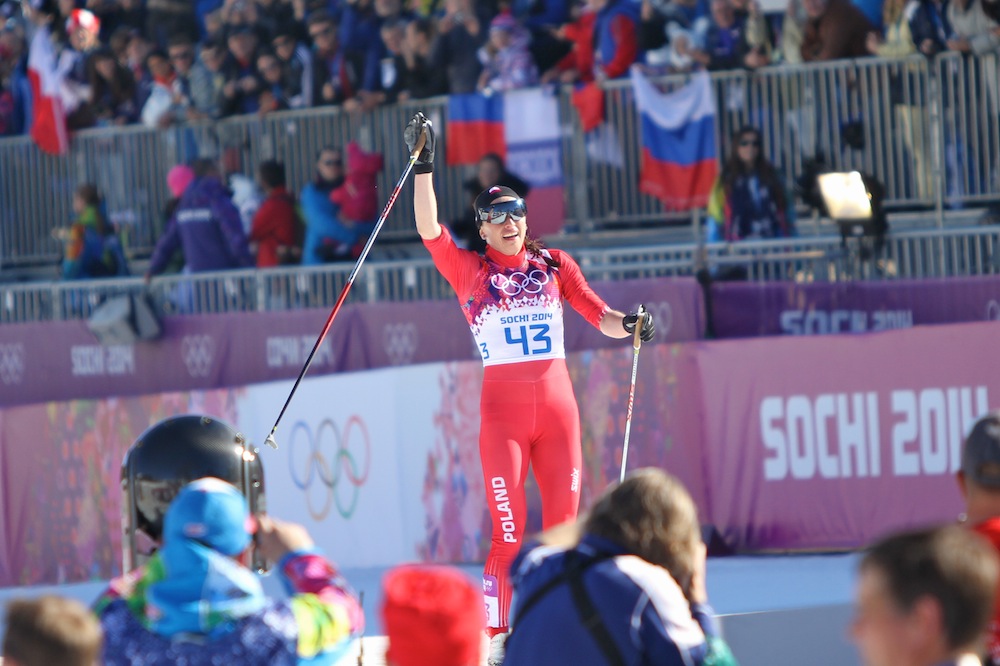
Poland’s Justyna Kowalczyk pushes for the fastest time by 18 seconds in the women’s 10 k classic individual start at the Olympics, which held for gold, on Thursday in Sochi, Russia.
FasterSkier’s coverage is made possible through the generous support of Rudy Project.
SOCHI, Russia — Justyna Kowalczyk’s pre-race routine Thursday included an unusual element: an injection into her left foot.
The Polish cross-country skier had fractured the foot last month, and got the shot to help dull the pain during Thursday’s distance race at the Olympics in Sochi. The course — 10 kilometers of slushy classic skiing that sent athletes up a brutally long, steep, sun-baked hill — would provide plenty of suffering on its own.
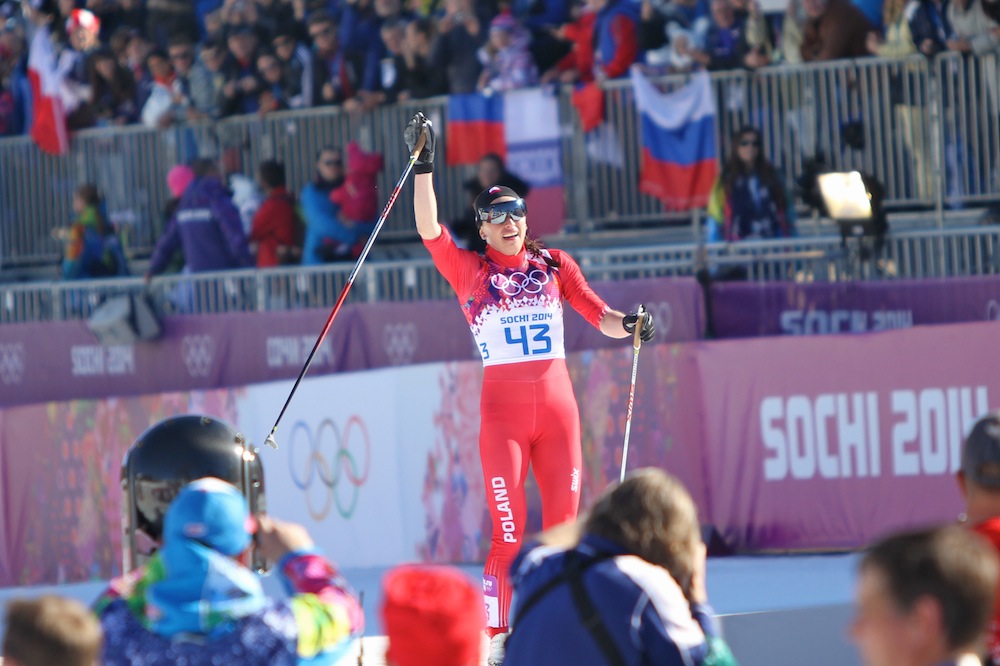
Poland’s Justyna Kowalczyk celebrates gold in the 2014 Olympics 10 k classic individual start on Thursday in Sochi, Russia.
After just over 28 minutes on the snow, Kowalczyk was at the finish in tears, though it was unclear if they were tears of joy, or of pain. The 31-year-old had won a clear victory over her rivals, beating Sweden’s Charlotte Kalla by 18 seconds, and Norway’s Therese Johaug, who was third, by nearly half a minute.
Norway’s Marit Bjørgen, the pre-race favorite, dropped from medal contention late in the race, and finished fifth.
The medal was Kowalczyk’s second-ever Olympic gold, and the fifth medal of her career—surpassing her country’s Winter Olympic medals record previously held by Adam Malysz, the ski jumping legend. No other athlete from Poland has ever earned more than one at the winter games, according to the International Ski Federation.
“I think this is something big,” Kowalczyk said afterwards. “It’s taken a lot of years of hard work.”
Kowalczyk’s strength is her classic skiing, and Tuesday’s event, an individual-start competition that sent the women off one at a time in a race against the clock, was expected to be her best shot at gold in Sochi.
But she was also expected to have to fight with Bjørgen, who last week won the first distance race at the Olympics and appeared to be riding her peak fitness here.
She suffered an uncharacteristic “collapse,” as she termed it, in the last two kilometers of the race, which climbed 260 vertical feet up that steep hill, with the hot sun beating down overhead. Temperatures during the race were in the mid-50s.
Norway’s Marit Bjørgen suffering in Thursday’s 10 k classic individual start at the 2014 Olympics in Sochi, Russia. She placed fourth behind winner Justyna Kowalczyk, Sweden’s Charlotte Kalla in second, and her Norwegian teammate Therese Johaug in third.
At the bottom, Bjørgen sat in second place, 20 seconds behind Kowalczyk, and two and seven seconds ahead of Kalla and Johaug, respectively.
Instead of making a run at Kowalczyk, Bjørgen went backwards, losing time to all three women. She skied only the 14th-fastest pace to the top of the hill, losing nearly 20 seconds to Kowalczyk, and nearly as much to the two other medal winners.
It looked like Bjørgen was slipping on that big climb. But afterward, she denied having any problems with her skis, or her wax.
“I had no problem with that. It’s only me that was the problem,” Bjørgen said in an interview. “I was fighting with Kowalczyk all the way, and I have to say congratulations to her. It’s incredible for her.”
The collapse, however, prompted some concern from the Norwegian women’s coach, who told the country’s national broadcaster, NRK, that he would wait a day to set the team for Saturday’s relay, in case Bjørgen was getting sick.
“We have to (wait) to find out if anything breaks out, or if it was a random day,” he said.
Sweden’s Charlotte Kalla racing to silver in Thursday’s 10 k classic individual start at the 2014 Olympics in Sochi, Russia.
To win the race, Kowalczyk had to conquer The Hill two times, and she described the last few kilometers of the race as “really tough on the body.”
“I had to fight,” she said.
She’s known for her strength in the classic technique, and on uphills.
Norway’s Heidi Weng started 30 seconds ahead of Kowalczyk, and couldn’t keep up when she was caught.
“Normally when Justyna comes I would go with her,” Weng said. “But she was very good today—she is so strong.”
Just below Kowalczyk on the podium was Kalla. The Swedish skier is a familiar face on the podium, but neither of her two previous Olympic medals had come in races in the classical technique.
“It’s incredible,” she said afterwards. “I didn’t think I could get a medal at 10 (kilometers), because it was so tough. But it was tough for everyone.”
Johaug, who won bronze, had been outside of medal contention for three quarters of the race, until Bjørgen’s breakdown.
When she skied into the finish, Johaug said, “I thought I was fourth.”
She added that the start of the Olympics had not been good for her—she finished fourth place in the first race of the games, which took place a day after a teammate’s brother died unexpectedly.
After Tuesday’s race, she told NRK, “I feel like I won bronze.”
Kikkan Randall after finishing Tuesday’s Olympic skate-sprint quarterfinal in fourth. Her time was 0.05 seconds short of securing the last lucky loser spot to the semifinals, and Randall placed 18th overall in Sochi, Russia.
KRASNAYA POLYANA, Russia – After Tuesday’s catastrophic race at the Olympics, Kikkan Randall and her teammates and coaches were left to explain what seemed inexplicable: just how and why the Alaskan had been knocked out of the sprint rounds in her chosen discipline earlier than she had been in nearly two years of racing.
Deconstructing a sprint race is kind of like explaining the movements of a flock of sparrows—if the sparrows all came from different countries and were flying around a treacherous obstacle course, trying to get to the same worm first.
But that didn’t stop Erik Flora, Randall’s coach, from trying. And his perspective, informed by Randall’s own comments, helps shed some light on Tuesday’s bafflingly disappointing outcome—which in Flora’s mind may have stemmed from Randall struggling with her fitness, or the conditions on the course, or a strategy that the pair thought through, but simply didn’t work.
“It can be so many things,” Flora said in an interview after the race. “I’ll go back and review this and see—I’m sure it’ll play over and over in our heads.”
Randall couldn’t be reached for comment Wednesday, but in an email, she said that it had been “an emotional roller coaster since yesterday afternoon.”
“It’s been an incredible influx of support messages today,” she added, “and I am just blown away with how much everyone cares.”
Her sprint race on Tuesday essentially boiled down to two key sections: a downhill coming off the top of the course, which was followed by a sharp corner leading into a long flat section in a stadium, ending with the homestretch.
Randall led into the corner, but then three of the five other women in her heat came past on the flat.
By her own measure, her typical finishing speed had gone missing.
“Today, that final gear wasn’t quite there,” she said.
Speaking with reporters after the race, Randall didn’t do much speculating as to why. Pondering the question after the race, Flora said there could be several explanations for Randall’s missing sharpness, from some undiagnosed problem with her preparation, to the conditions on Tuesday’s course—soft snow that left the sprint race a slog—to the pressure.
“From what we’ve seen in training, she had good fitness,” Flora said. But, he added, “When she went to make the move in the finish, she didn’t feel like she had everything she needed, and that can be a lot of things.”
The snow certainly was sloppy, which could have made it more difficult for Randall to ski with her usual power. But Flora downplayed that possibility, pointing out that his Alaska Pacific University team trains on the Eagle Glacier outside Anchorage during the summer, which can get similarly messy.
“I don’t think the conditions threw her a big loop,” he said. “She looked great coming into the stadium.”
The decisive moment in Randall’s sprint may actually have come before the homestretch, when she took the lead as the women headed into the descent and around the tight corner.
That move was one that was considered ahead of time, Flora said: Because of the risk of a crash on the turn, which took out two of the first seven women to start in the qualification round, Randall had intended to be at or near the front through the tricky section.
There’s a problem with leading out a ski race, though: by positioning herself at the front of the group, Randall was absorbing the wind resistance, letting the skiers behind her draft and build up speed.
That allowed Germany’s Denise Herrman to rush past once the women reached the flat stretch, along with Norway’s Marit Bjoergen, and ultimately, before the finish, Italy’s Gaia Vuerich, too.
A similar outcome befell Randall at her last sprint race, too, in Italy earlier this month, when she also led through the middle of the course and was passed in a fast section leading towards the finish.
Tuesday’s course was different, though—the snow was slower, and the speeds not as high, which should have diminished the advantage for the women that were waiting behind Randall on the descent.
The speed those women gathered surprised Flora, he said.
“We thought it was good odds to play it safe, and who would have known the draft effect was that strong in the stadium?” he said. “Going through the race today, would we have taken a different tactic? I can’t say yes. I think we ran the right tactic.”
Typically, Randall told reporters, she can fend off other women if they’re coming from behind.
“Usually that works for me,” she said.
But not on Tuesday, in which she appeared to be lacking her usual quickness, and was trying to respond to charges by two of the strongest sprinters on the circuit, in Bjoergen and Herman.
One last question was about the pressure—whether the expectations of media and fans somehow got to Randall.
Flora acknowledged that pressure existed.
“But as far as I could tell, Kikkan was handling it well,” he said. “We were focusing on the process of being here and getting ready for the races. She looked like she was in a good place. I didn’t see anything to suggest that her preparation was disrupted.”
In the end, Flora said, “it just didn’t work out.”
Ultimately, even for the best in the sport, it’s common for things not to work out in sprints—a race that at two and a half minutes is so short that what seems like random chance can just as often determine an outcome as fitness, technique, or strategy.
It’s a testament to Randall’s unprecedented consistency in the discipline—leading into the Olympics, she had made the podium in 10 of her last 12 races in her favored skate technique—that Tuesday’s result was considered so much of a disappointment.
Just look at what happened in the men’s sprint, Flora said: Sweden’s Emil Joensson, suffering from fatigue and a back injury, had given up, and was trailing the lead pack in the final by a huge margin.
Then, three of Joensson’s competitors crashed on a downhill corner.
“He wasn’t even racing,” Flora said. “And he ended up with a bronze medal today. How crazy.”
At the end of the day, two others offered their own interpretations the race—both of whom should know.
One was Bjoergen, the Norwegian who had been expected to be Randall’s big rival in the sprint. Instead of waltzing to victory after Randall’s exit, Bjoergen crashed face first into the snow on the homestretch of her semifinal heat.
Afterwards, bantering with the head coach of the Canadian ski team, she summed up the race: “Shit happens.”
The other to give their thoughts was that coach: Justin Wadsworth, a former Olympic competitor who used to coach the U.S. team, including in 2007, when Randall won her first-ever World Cup race.
“She should not hang her head at all. The Olympics is a weird deal. That’s why Olympic medals are so precious: They’re really hard to get,” he said in an interview. “It’s hard, man. It’s a hard thing to time right, and put it all together.”
Kikkan Randall skiing on the skate sprint course in Sochi on Monday with her teammates, preparing for Tuesday’s race.
FasterSkier’s coverage is made possible through the generous support of Rudy Project.
SOCHI, Russia — Kikkan Randall has been waiting for Tuesday’s Olympic sprint race for eight years.
The Winter Games come every four years, but each time, the sprint alternates between two different techniques — classic, then skating, which is Randall’s specialty.
In the last Olympic skate sprint, in Italy in 2006, Randall placed ninth — at that point, a career-best result for the then-23-year old.
Since then, Randall, 31, has developed into a skate sprinting machine, finishing on the podium in 10 of her last 12 international races.
The Alaskan is the favorite to win gold on Tuesday, which would be only the second-ever Olympic medal for an American cross-country skier—and the first since Bill Koch won a silver in Austria in 1976.
“All of cross-country skiing in the U.S. is really excited for this moment,” said Holly Brooks, who trains with Randall in Anchorage and is one of her teammates at the Olympics. “I know—we all know—it would be huge for the sport, huge for the country, if she were to take gold, or a medal whatsoever.”
Winning the sprint on Tuesday will test Randall’s training preparation—her fitness, and her tactical acumen—and it will pit her against Norway’s Marit Bjoergen, an eight-time Olympic medalist with unprecedented athletic ability. It’s a race that Randall has taken unprecedented measures to practice for, like training on a trail on an Alaska glacier mapped out with GPS data to mimic the Sochi sprint course.
But it’s also a race that’s inherently unpredictable—one that’s just three minutes long, in which all that preparation can be derailed by a stray pole or ski.
That’s what happened in Randall’s last big skate sprint: At the World Championships in 2011, contact with another competitor spun Randall around and left her sprawled in the snow, watching her medal hopes race away.
The perfect terrain
Randall has been eyeing Tuesday’s sprint ever since the 2006 Olympics, in Italy. But her preparation grew more focused this year.
During the off-season, she trained on two courses in the U.S. laid out to mimic the Sochi trails, which one of the American coaches had mapped with a GPS during a race series in Russia last year.
One of the courses was groomed at her Anchorage club’s training facility on the Eagle Glacier, in the mountains just south of the city. The other was on the roads of Utah’s Heber Valley, where a pair of Randall’s coaches spent 10 hours in a truck searching for the perfect terrain for a training camp there.
“We had our maps out, and we would just drive from one neighborhood to the next,” said Erik Flora, the head coach of Randall’s Alaska Pacific University club team. “It was crazy.”
In Russia, Randall has spent the last few days practicing different segments of the course, from the start, to the first tricky corner, to the finish, which Flora said had been nudged upwards since last year into a slight uphill grade.
She sat out the first event at the Olympics, a distance race, which she said left her with a little too much free time.
“It’s kind of hard to not ski as much, and watching others race,” she said in a phone interview Monday. “I’ve been feeling anxious, excited.”
The sharpest tactician
The sprint course here is a demanding one—fast, and tough. From the start, athletes immediately hurtle into a sharp righthand turn, followed by a long climb that gradually flattens out before sending the skiers back down into the stadium for the homestretch.
The hill will be crucial, but the start of the race could be just as important, given that there are few easy places to pass over the 1.3-kilometer distance.
The start is one place where Randall may have an advantage over Bjoergen, the Norwegian.
“You’ve seen Marit off the line—she is slow off the line. Kikkan’s fast off the line,” said Brooks. “Of course, the trail is wide enough to pass. But there’s a best line, and if you pass on the outside, it’s longer.”
Flora wouldn’t divulge Randall’s likely tactics for the event, but he said he thinks Randall is the sharpest tactician out of all her competitors, with instincts built up over a career of more than 100 international races.
He and Randall don’t plot out a detailed strategy before sprints, so much as they prepare her to react as a sprint unfolds.
“There’s two ways to approach racing. One is to have a pretty structured plan for each race, where maybe the coach sits down and looks at it and says, ‘Okay, let’s try this,’” Flora said. “The other way to do it is to have the racer be a racer, and be the experienced one—be the one that sees the openings and runs the tactics. And that’s the philosophy I believe in.”
Up against the best
Randall’s most serious challenger in the skate sprint is likely to be Bjoergen, who has essentially been the Norse goddess of cross-country ski racing since the last Olympics, in 2010.
She won five medals there—three of them gold—and has beaten Randall twice in skate sprints this year, including the final one before the games, in Italy in January.
She also won Saturday’s distance race, for her first gold in Sochi.
Bjoergen’s a different athlete from Randall; the Norwegian excels at events of all lengths, and the sprint is just one of six races for her at the Olympics. She lacks Randall’s pure speed, but has a deep well of fitness she can draw on as the women race through quarterfinal, semifinal, and final heats in the sprint.
“It’s going to be very close, I think,” Bjoergen said in a brief interview Sunday, before a pair of fans pulled her away for a photo.
At one point several months ago, Bjoergen was rumored to be considering skipping the sprint, according to Brooks—though Egil Kristiansen, the Norwegian women’s coach, denied that.
Regardless, Randall said she was looking forward to having Bjoergen competing.
“She’s proven to be one of the best skiers of all time, and you want to be up against the best at the Olympics,” Randall said. “If she wasn’t in the race, I think you’d always kind of wonder what would have happened. So now, we’ll know.”
You get one chance
The sprint race can be one of the most confounding for skiers—the margins are so close, and a single tactical error, a misstep, or a crash can keep the strongest athlete off the podium.
“Small things can happen in a sprint that can influence the results,” said Kristiansen, the Norwegian coach. “It’s very close. You get one chance, and if you don’t take that chance, you’re out.”
Randall’s last skate sprint, a week ago in Italy, was a reminder of that unpredictability: After she led over the top of the tallest hill on the course, a group of skiers tucked in behind her, used the slipstream to save energy, and ultimately passed Randall on the homestretch.
She finished fifth, attributing the result to a poor tactical move.
There’s also the example from the last major skate sprint, at the World Championships in 2011—an event one notch below the Olympics, where Randall was also favored to win gold.
She was racing in a preliminary heat when she slipped on one of her opponent’s skis and crashed, leaving her with no hope of catching up.
For Randall and her friends and her teammates, her coaches and fans, it’s unsettling to consider that the same thing could happen in Russia.
“I have the utmost confidence in her, but I’m also really nervous. I’m almost more nervous for the sprint day—and I’m not racing—than I am for my own races. Just because I know the work, and the effort, and the passion that she’s put into this goal,” said Brooks. “I just kind of want Tuesday to come and go so we can know the outcome.”
Flora, Randall’s coach, acknowledged the uncertainty. But he also said that there are ways for athletes to reduce it, like making sure to stay at the front of the pack on a narrow course, where there are fewer opportunities to pass.
On a wider course, like in Sochi, there’s more flexibility.
“There’s risky ways to race, and there’s safer ways to race,” Flora said. “There are a lot of variables in sprint racing, but we try to minimize them.”
On Monday, Randall admitted she’s been nervous. But she also said that after her crash in in 2011, she’d come to realize that her buildup to the events like that one, and to the Olympics, have given her plenty to fall back on—like her string of wins on the World Cup circuit, or her two season titles in sprinting.
“I’m excited about tomorrow, but I’m happy it hasn’t been me off in some desolate mountain place focusing everything I can, every day, for one race. I’ve been able to have a lot of successes along the way,” she said. “And that definitely helps going into tomorrow, because I know no matter what happens, I’m going to be okay. I’ve had a great career.”
SOCHI, Russia – The first three of the 36 cross-country skiing medals at stake at the Sochi Olympics are up for grabs Saturday, as racing begins here with the women’s 15 k pursuit.
Four Americans and three Canadians are entered in the event, which will have the athletes racing four 3.75-kilometer laps on trails at the Laura Cross-Country Ski and Biathlon Center –a massive Olympic complex installed at the top of a ridge in Russia’s Western Caucasus Mountains over the last five years.
The North American entrants won’t be serious podium contenders in the pursuit race, which combines equal 7.5-kilometer legs of classic and freestyle skiing.
Kikkan Randall, the U.S.’s best medal hope for the Olympics, is skipping the pursuit, opting to focus on Tuesday’s freestyle sprint — her strongest event.
But the race will still help determine which American women get spots on the country’s relay team later in the games — a group that’s expected to be in the mix for a medal.
And the pursuit will also provide some of the skiers with their first taste of Olympic competition, without too much pressure.
“I’m excited to race in the first race — just kind of get the nerves out right away, and then have some of my stronger races later on in the games when I’m starting to get in the groove of it all,” said Sadie Bjornsen, a rookie Olympian who’s racing for the U.S. on Saturday along with Holly Brooks, Liz Stephen, and Jessie Diggins. “So tomorrow will just be good for practice, and remembering what it’s all about.”
The American athletes arrived in Russia on Tuesday. In brief interviews after a warm, sunny training session Friday afternoon, they said they’ve been happy with their setup at the games.
The women are living in a house that’s part of the Endurance Village — athlete accommodations that were built adjacent to the cross-country skiing and biathlon venues.
The layout gives them easy access to the ski trails — they’re actually within walking distance — with perks like a post office, grocery store, and even a disco.
“We are living like it’s heaven down here,” Bjornsen said. “Everyone’s helpful, the food’s good, the housing is incredible.”
Brilliant sunshine Friday seemed to put almost everyone out on the trails in a good mood.
The forecast calls for blue skies to stick around through Saturday’s race, before more unsettled weather moves in Sunday.
The medal contenders in the women’s pursuit are the usual suspects: Norwegians Marit Bjoergen, Therese Johaug, and Heidi Weng, plus Polish skier Justyna Kowalczyk and Swedish skier Charlotte Kalla.
Bjoergen told the Olympic News Service earlier this week that her goal at the games is to win one medal — but when asked in which event that was the most likely, she answered: “It’s hard to say, because I’m the favorite at every distance.”
One factor that could mix things up — a high-speed downhill on the course, where the American skiers said athletes had been clocked at 45 miles per hour.
At that speed, things could get messy in a mass start race like the pursuit.
Sadie Bjornsen (APU/USST) on her way to seventh place in Satuday’s 5 k classic. (Photo: Fischer / Nordic Focus)
The official beginning to the 2014 racing season didn’t disappoint with tons of exciting nordic action taking place across the globe. The World Cup kicked off in all three nordic disciplines, including the highly anticipated Super Tour races in West Yellowstone, Mont., which FasterSkier covered on-site.
World Cup racing began on Friday with the classic sprint as the first leg of the Ruka Triple mini-tour in Kuusamo, Finland. Kikkan Randall (APU/USST) come out firing with a second-place finish, her best in a World Cup classic sprint. Justyna Kowalczyk won it, looking as strong as ever. Sadie Bjornsen (APU/USST) dominated in the qualifier in third and finished the day in 26th, and teammate Ida Sargent finished 16th. On the men’s side, Eirik Brandsdal of Norway overcame Anton Gafarov and Teodor Peterson to win the first World Cup race of the season. Andy Newell was the lone North American to qualify and finished the day in 24th.
Bjornsen demonstrated that Friday’s result was not a fluke by finishing seventh in the 5 k classic on Saturday, followed by Randall in 15th. Kowalczyk won the race with the Norwegian duo of Marit Bjørgen and Therese Johaug in hot pursuit. Lukas Bauer won the 10 k classic, followed closely by Eldar Rønning. Canadian Ivan Babikov and Noah Hoffman (USST/SSCV/Team HomeGrown) were the only two North American men to crack the top 30, finishing 21st and 28th respectively.
On the final day of action in Kuusamo, Bjørgen captured her fourth-straight Ruka Triple title, besting Swede Charlotte Kalla and teammate Johaug by nearly 20 seconds in the 10 k pursuit. For the U.S., Randall, Jessie Diggins (SMST2/USST), and Liz Stephens (Burke/USST) respectively recorded the seventh, eighth and ninth fastest times of the day, with Randall finishing fifth overall. Hoffman made major waves and skied the fastest time in the men’s 15 k, rising from 38th to ninth in the mini tour. Norway’s Martin Sundby won the Ruka Triple, just 12 seconds ahead of Hoffman.
The U.S. SuperTour opened in West Yellowstone and Team Gregg dominated. The Midwest couple, Caitlin and Brian Gregg conquered the field with Caitlin winning both Friday’s skate sprint and Saturday’s 10 k skate (by over a minute and 20 seconds) and Brian taking second overall in the 15 k skate (to Norwegian Mads Strøm, a University of Colorado freshman).
The International Biathlon Union (IBU) World Cup opened on Thursday in Östersund, Sweden, with a 20 k individual, which France’s Martin Fourcade won. Canadian Jean-Philippe Le Guellec finished an impressive fourth and teammate Nathan Smith placed 16th. More impressive results followed, with American Tim Burke notching third in Saturday’s 10 k sprint behind winner Fourcade. Teammate Lowell Bailey finished 14th, and Susan Dunklee was 16th in the women’s 7.5 k sprint on Friday. Sunday’s pursuit races were canceled due to inclement weather.
In nordic-combined action in Kuusamo, American Taylor Fletcher posted the fastest time in his anchor leg to give the U.S. seventh in the 4 x 5 k team event.
FIS Cross-Country World Cup, Kuusamo, Finland (results)
You can say a lot about Marty Hall—and, in fact, most of it has probably already been said.
The former coach of the American and Canadian national cross-country ski teams is an outspoken and prolific observer of the sport today, but that’s nothing new. He famously implied that the Russians were doping at the 1988 Olympic Games, and an Ottawa newspaper story upon his departure from the Canadian squad referred to him as the “opinionated and controversial Marty Hall.”
Former US and Canadian National Team Coach Marty Hall
Even if you take issue with Hall’s positions, though, one thing should be acknowledged: even as he creeps up into his mid-70s, the man still doesn’t miss much. From his previous home in Quebec, and from his new home in New Hampshire, Hall remains plugged into cross-country skiing. As you’ll see below, he consumes ski media voraciously—he even reads tweets!—and writes a column, Hallmarks, for SkiTrax Magazine. Halfway through a reporter’s visit to his house this summer, he stopped an interview to show a YouTube video of a strength workout by members of the Russian ski team.
FasterSkier Editor-at-Large Nathaniel Herz caught up with Hall, his former coach at Bowdoin College, in August, for a wide-ranging discussion about cross-country skiing. They talked about the exploits of Alex Harvey and his father, Pierre—who Hall coached—the meteoric rise of Jessie Diggins, convoluted World Cup race formats, and Hall’s own epic 16-minute victory in his age class at the Birkie.
The interview has been edited and condensed.
FasterSkier: Are you coaching anyone right now?
Marty Hall: I was coaching four girls up there in Ottawa—three older ladies. I’d work with them fairly extensively—I’d see them once or twice a week and organize their programs. They’re all in their 40s and 50s, that type of thing. Nobody hot.
FS: So, how would you characterize your involvement in the sport of cross-country skiing right now?
MH: I read everything. I read everything. I got a little pissed off this spring when I chastised the Canadian National Team for being all split apart, all over the place, and doing different things, and Chad Salmela came in and kind of insinuated that I was old-fashioned. Well, you know, I was going to write a long thing back, and I said, ‘forget it.’ But, he said we’re old-fashioned. I can remember crust cruising back in 1962. I can remember one of the first camps that we had in Putney [in Vermont]—I’ll
Hall reviewing video with the interviewer.
bet you we had 100 kids. John Caldwell would remember it. Anybody who was anybody at the higher levels of nordic combined, cross-country in this country were at this camp, plus all the divisional-type people.
You talk about hill-running? One hundred people hill-running in Putney. I mean, the sport has not changed that much. It has changed, but don’t think that you’ve reinvented the wheel. The changes that took place were in the early 1970s—’74, ‘75, ’76 and there, that was the revolution. And then you know, there’s been small little renaissances along the way and that kind of stuff, but it hasn’t changed that much. I mean, I had my people in the weight room in the ‘70s, and we were lifting big weights back then. Martha Rockwell, okay—she’s 125-pound girl, she could bench press 150 pounds, live. Okay? So it hasn’t changed that much, the stuff that we’re doing. So I think, I could give you my book that I wrote. You could read it. And I can tell you, you’d say, ‘this isn’t that far off from what we’re doing.’
FS: So do people ever consult with you? Do you ever hear from Justin Wadsworth, the Canadian head coach?
MH: None of those guys. But [former U.S. Ski and Snowboard Association Nordic Director] John Farra, two springs ago, called me up and said, ‘I’m going to ask you a bunch of questions, and I want you to shoot from the hip, okay? And tell us what we’re not doing.’ You know that [the U.S. program is] is now at Seiser Alm?
FS: Yup. (The U.S. Ski Team spent time training at Seiser Alm in Italy last winter.) MH: That was one of the things. I said, ‘look. You guys keep going to Davos [Switzerland].’ Every time they have a break over there, they go to Davos. For cross-country skiers, that’s like going nowhere, because it’s in between [in altitude]. It’s nice. [But] Seiser Alm’s nice! I can guarantee it’s nice. Everybody else is down in Seiser Alm, at altitude. And they can regulate the training, anything from 1,000 meters, to 2,300 meters, for skiing.
That was one of the things. The other thing is, I said, ‘I think you’re spending way too much money, and you think New Zealand’s great, but you’re down there alone. You’re isolated. Can’t be going there.’
Don’t think I’m not in the know. I’m a feel guy. I’m not a huge scientific…I’m into science, but I’m not a scientific type person. Yes, I’m not old-fashioned.
The other thing is, I can say now, I’ve been paying taxes down here, and I’ve been paying taxes up there [in Canada]. I want to see my money spent right. It’s as simple as that. I mean, especially in Canada,
Kikkan Randall racing last winter.
those guys get a crapload of money from the government. They don’t know what to do with it all.
FS: Name two American athletes and two American coaches that you admire the most right now.
MH: Kikkan [Randall]. That’s easy.
FS: Why Kikkan?
MH: Well, just take a look at what she was three years ago. She’s 37th in the overall World Cup. She’s now fifth. She’s done some things.
One of the other guys would be Erik Flora [Randall’s coach at her Alaska Pacific University club program], and a guy would be [former APU coach] Jim Galanes. He’s one of the better brains.
Coaches are real easy. Who the other American athlete would be—if I could have a choice, it would be Devon Kershaw.
FS: We’ll get to Canada. You’ve got to pick an American.
MH: Okay, another American. It would be Kochie [1976 Olympic medalist Bill Koch].
FS: Nope. Somebody still skiing.
MH: Somebody still skiing? Then it’s going to be Jessie Diggins.
FS: What do you think about her?
MH: Gotta be glad she chose our sport, because she’s a hell of an athlete. To be where she is—I don’t have a clue, but her training program can’t be that big when she was 16, 17, 18. But look at the frickin’ results! So, she’s got big lungs, big heart—I’d love to know what’s going on in there.
So, she’s born with speed. Everything comes down to speed, because we can train it. If you don’t do the training, the speed doesn’t play out in our sport. But if you do the training, the speed really becomes…You’ve got a question on your brain [referring to interviewer].
FS: So, what does Diggins need to do, and what do other people need to do with her, over the next five years?
Jessie Diggins in action.
MH: Keep doing what they’re doing. Those two girls [Randall and Diggins], I mean, the only thing that can frick them up is sickness, and injury. They know what they’re doing now.
That’s the other thing about this computer right here [points]. Not only have you shrunk North America. You’ve shrunk the world. You see that video right there that we just watched, from Russia? You think we had access to that crap, back in my time? No. Plus, if we were able to get it, we’d be watching ‘em stick themselves with needles. [laughs] I’m serious!
Look, 1974, everyone says I’m a freak when it comes to the drug thing. [In] 1974, World Championships, Martha Rockwell’s 10th. One k to go she was sixth; she got knocked down, so she lost four places. The makeup of that top-10: seven eastern country people, and three non-eastern countries. I knew. That ain’t right.
So, anyway: just keep doing what they’re doing. And the other thing is, just hope that the base is continuing to expand and grow, because the bigger the base, more chances you have of kicking out a Diggins, a Diggins, another Diggins, another Diggins, a [Noah] Hoffman, maybe. He hasn’t quite shown through like she has, but you’re looking for that kind of talent to come through. I mean, he’s kind of worked his way up the ladder. Still is. Men’s thing is a little tougher than the women, I think. Where there’s 90 men, there’s only 50 women, at races.
FS: So, what do you think: Jessie Diggins, how many athletes did you see like her in your coaching career?
MH: Boy…Kochie. But, you know what? Kochie had an amazing ability, talent, for squeaking everything out of himself. He’s not as amazing a physiological talent as she is. This guy—he did things that were unbelievable. He was an asthmatic, and he dreamed himself off being an asthmatic. But it caused him problems later on—he crashed a couple times when he was trying to make comebacks, because of asthma. Just an amazing guy. Just a truly amazing guy. And you know, the thing about him was, it was him. He was so singular in his focus on himself, and on getting the most out of himself, using all the information, but gleaning it down so it worked for Kochie. I don’t think…get Kochie in a weight room? Forget it. Look at his build. And he double-poled places nobody ever double-poled.
FS: So, anyway, you’re saying that he had to squeeze a little more out of his talent than Jessie does right now?
MH: Yup. That’s my opinion. I can’t say that I’ve watched her. But I’ve seen how she exploded on the scene last year. Holy cow.
FS: So, you’re saying there are basically two people with that level of talent that you’ve seen?
MH: Ohhhhh, I can’t say that. There’s a lot of people. I’ve dealt with a lot of athletes—there’s a whole scad of ‘em that are, and were talented. I could name a couple that I think are talented, but don’t want to train. They want to race, but they don’t want to train.
FS: All right. So, let’s go to Canadians.
MH: Devon Kershaw.
FS: What do you like about him so much?
MH: He does everything the way he’s supposed to do it. And if he doesn’t, he’s trying. I think he’s a talent, and I know that, because I first met him when he was in high school. I was going around with a guy by the name of Alain Parent. You know when core strength was on the forefront? The national team approached me to go with this guy Alain Parent, who is a junior coach. We went all over the country showing people how to do core strength.
So, we went into Sudbury [Ontario], and stayed overnight at Kershaw’s house. He was in high school—he was a junior, or he might have been a senior. And he asked me—we talked about his running. He was a hell of a footrunner. He was top one or two guys [in the province]. But he had made his decision he wanted to ski. And so he came to me, we talked about it, and he said, ‘what can I do? I don’t want to do that.’
And I said, ‘look. You’re the boss here. You’re the talent. Your running coach needs you. You don’t need
Devon Kershaw racing in Sweden last winter
him. You just tell him you’ll be at the championships, and you’ll be at this race or that race. You pick the races you want to go to, and do what you have to do, but then do all cross-country training. If you want to do intensities cross-country, and you don’t want to do ‘em running, you tell him you won’t be there.’
[He was] second in [Ontario] that year. And then, you know where he is now.
He just, in my estimation, is the real, full-time, 24-hour consummate athlete. And he’s still having a great life—just read his latest blog.
FS: Do you talk to him ever?
MH: I just sent him an email.
FS: What’d you say?
MH: I told him two things. Ever hear of Golf Boys?
FS: No.
MH: You know [PGA Tour golfer] Bubba Watson? That name?
FS: Yeah.
MH: There are four young guys on the circuit that put together a group called the golf guys, and goof off: singing, karaoke, that kind of stuff. And so, I sent, to him, the YouTube, from Golf Boys, and said, ‘come on, we need a Cross-Country Ski Boys, or Nordic Boys, and you’re the guy to get it going.’ I said, ‘when you’re sitting in all these camps, with nothing to do, come on! Put this thing together!’
And then, the other thing is, [SkiTrax Magazine Publisher] Benji [Sadavoy] is trying to get him to write for the magazine. I said, ‘hey, I hear Benji’s approached you. I know you’re not sure what you want to do.’ I said, ‘look, I can tell you that what you would write is so important to young kids. Don’t worry about pleasing anybody else. You know what you read in your day, and what it did for you to inspire you.’ I said, ‘you’re the motivational guy now. There are two things you could write about that I think are really important: how you got into cross-country skiing. And then the other thing that you could write about is how you’re going to regulate your schedule this winter, for Tour de Ski, and World Championships.’
Day later, he told Benji, ‘I’m writing.’
FS: Did you hear back from him?
MH: No, no. The only one I communicate with, every now and then, is Chandra [Crawford]. I spent a lot of time talking to her this winter.
So, Devon’s the big guy. Of course, Alex [Harvey]. I think Alex is more talented, but I think he’s got himself spread too thin. He’s in the same position his dad was. [Harvey’s father Pierre was an Olympian in the 1980s in both cross-country skiing and cycling; Hall coached him.]
Because he’s such a hero in Quebec, it’s hard for him to say no. They want him all the time. And, you know, when he wins those athlete-of-the-year awards, that’s against all those pros! The football players that are in there, and the hockey players—he beats those guys out! So, he’s up on a pedestal there. And I can tell you, he’s probably making pretty good money from [sponsor] Quebecor.
Those guys are making big money now, too. I try to talk about it—not a lot, but I try to make sure that I’m talking about it. Because you can say you’re not racing for the money, but it sure makes it a lot easier to think about it when there is that money out there.
FS: How do you compare Alex to his father?
MH: I can’t fault the way Alex trains. I fault all the extraneous stuff—I mean, his going to [law] school is detracting. He can say whatever he wants to.
Pierre was not—he was a physiological talent…not a great athlete. Loved to work. A guy who was really in control of his training.
I think Alex is built somewhat the same; I’d love to see ‘em together. But, Pierre was one of these guys that was really slim down through [his waist]. Very muscular. But then he had this massive chest cavity.
FS: That’s kind of how Alex is—you see the guy.
Alex and Pierre Harvey
MH: I see Alex as being the epitome of what you’d want a cross-country skier to look like. Tallish, maybe 6’1”, so he has big levers. Good musculature on him, and when you see him from behind, he just has that upper body mass. And you know there’s some good lungs in there, and a big heart in there. And so, he’s made for cross-country skiing, in my estimation.
FS: You think more so than his dad, maybe?
MH: Yes, better talent. And his dad would admit that, too.
Alex is really crafty—very knowledgeable about the sport. Very clever about the way he skis, and stuff.
The thing that’s great for me, also—one of the other things that’s great now is we can watch every race on TV now, on computers. And so you learn. Of course, I was living in Canada when the [2010] Olympics were on, and I knew in that 50 k, I said, ‘Alex is going to stay there, but he ain’t going to be on the podium.’ You could just see the way he was skiing. You could see it. But this guy, Yves Bilodeau, the [Canadian wax] technician? He was the cleverest guy I’d ever seen, skiing. He started relays for us—it didn’t matter what was going on. He was coming in with the first group. He could have the crappiest skis, and he’d make it happen, and I think that’s Alex, too.
FS: Is there something about the Quebecois mentality?
MH: Well, I think he grew up being a cross-country skier, so he’s seen everything, at least once, if not twice, or three or four or five times. That’s been his environment. He watched his dad. He got exposed.
FS: Alex has, definitely, some swagger, kind of. Was Pierre like that?
MH: No. Shy. Really shy. You know, he used to love to come to training camps, because, he says, ‘I don’t have to talk on the phone. I don’t have to say “no.”’
[Alex], they keep him in his province, he’s king. He’s recognized. And that hasn’t happened to many cross-country skiers anywhere in North America, ever. Those guys are getting to the point where they’re getting so much press, they’re pretty well-known all over the country.
FS: What is the last cross-country ski race you did?
FS: I don’t think that’s embarrassing. It’s embarrassing for everyone else.
MH: So, I’ve started racing again. I race every year, for the last three years, four years, five, six, seven times a year. Essentially, the only guy that’s beaten me…I had a bad year last year.
FS: You only won your class by 16 minutes.
MH: Well, the thing is, I had some other races. In December, I had cataract surgery, so I couldn’t train. So, I lost a whole month. You know, I’d go out and walk around, but you couldn’t do any hard stuff.
FS: How much of a difference does the base training make at your age, though? Don’t you kind of already have that? Or are you doing intervals?
MH: No, I can tell. Like, I started up again [this year]. I was surprised—went good for about three or four weeks, but with all the moving [from Canada to New Hampshire], the thing I’m running out of is energy. You know, I’m going to be 75 in another couple weeks here, so I don’t have that everyday energy. If I do a hard day of training, it might take two days to recover, so I can go train again and not kill myself or get sick or break down. So, I think I can get to a reasonable peak…I can’t wait too much longer [from now], to have another good year. But [last year], I lost that whole month, right in December. And then I’m trying to dig my way out of there—I had a couple of races where I had lactic acid right out in the hair. I had to quit. Everything hurt. I was barely walking. But, you know, I just picked up my program, and the last three races, I had one good one, one medium-plus, and then: Birkie. It was too bad I didn’t race more after that.
These guys that I race in my age group at the Birkie, I’ve raced ‘em for the last 20 years. But back then, in the ‘90s, we used to go back and forth. They’d beat me. I’d beat them. Blah, blah, blah. Starting three years ago, I won by 10 minutes, then I won by, I think, 12 or 14 minutes, then I won by 16.
This is the short race. I don’t race long any more, because it’s not racing for us. It’s 23 k at the Birkie. If you want an idea, my per-kilometer time at the Birkie was four minutes this year—the year before, it was 3:40, which is…not bad.
FS: So, when you’re racing now, is it much different than when you were racing when you were in college—what you’re feeling?
MH: Um…no. I think better. I think better. I know more about the sport, and I know where my body is and what I need to do. Like, two years ago, I’m still in Wave 1 in the Birkie. The classic race. So all the long distance guys are starting with me. There’s 1,000 of us standing there. So, we took off, and I thought, ‘oh, man, I’m feeling good, I’m going with all these young kids!’
I got to seven k’s, and I said, ‘frick, bud, you’re in trouble!’ So, I cut it back for a k. I mean, walked. Got everything undone before I got myself in a hole I couldn’t get out of. Got back on track, whoosh, then, we broke off—little short course at nine k’s went this way, the big boys went that way, and I, just, was gassing it, from there on in.
I have a huge advantage—there’s two things that I know I’m doing that those guys aren’t doing. One that I’m born with—I was a good alpine skier when I was in college. Really good. So, that course at the Birkie was made for me. Lot of vertical. Carry a lot of speed off of things—I’m good enough that I can coast over the hills, and I know maybe those guys don’t do it. And then the other thing is that thing right down there. [Points at an Exergenie, a strength-training device on his floor.] Specific strength.
FS: Will you write yourself out a training plan?
MH: No. I have so little I can do. I can ski walk, and run with poles—and it’s not really running, it’s fast walking, because I can’t run any more. Weights, and rollerskiing.
FS: And you’ll do easy, or hard?
MH: Mostly, I’m a hard guy. If I go over an hour and a half, I’m usually zone three, training.
FS: So, let’s talk about some World Cup stuff. You have some strong feelings about the tours on the circuit, huh? Like the World Cup opening in Finland, the finale in Sweden, and the Tour de Ski.
MH: I think this pursuit race that they do, when you have three races, you earn [bonus] seconds, and the guys starts out with the lead…[The International Ski Federation calls them] stage races. They’re not called World Cups. Someone like Marit Bjoergen has been racing a long time, and she’s trying to break
Dario Cologna racing in last year’s Tour de Ski…with no chasers in sight.
[the] record for most World Cups—well, they’re screwing her, and I think they’re doing it on purpose.
FS: Why?
MH: Why? Because they don’t want nordic beating alpine. And she has a really good chance to do it. And [Dario] Cologna’s coming along, and he can be doing the same thing.
But they’re getting credit for one or two victories in the Tour de Ski that are considered World Cup races. They get gypped out of two in [Finland]; they get gypped out of two in [Sweden]. That’s wrong.
Plus, the races. The first time that I tuned into that first pursuit race, two years ago, and there were two people going across this meadow, and that was it! For two minutes, three minutes! Everyone’s sitting back there!
FS: In the Tour de Ski? You mean in the hill climb finale? Everyone has to wait after Cologna starts, have a sandwich…
MH: And who out on the course understands what the hell’s going on?! The announcers for Eurosport—they even talk about it! They complain about it. Because it’s meaningless. How do you announce a race that’s meaningless?
And then, [Cologna] gets World Cup [points] for winning the overall Tour, but he placed eighth that day!?
FS: So, they need to fix it?
MH: Yup. Just make it a straight race, and then, all those races should be World Cup races.
FS: So, you would say, start everyone at once?
MH: Yup. And make those guys race for that big money.
FS: Well, I mean, I think their argument for running the last Tour stage that way is, the first guy across the line is the guy who wins the whole Tour. It’s easy to understand.
MH: Big deal. Make it so he starts with everybody else. I bet you Cologna could still win the race, straight up. Who cares if you go back to paper?
FS: For fans, though, I think it’s easier for the International Ski Federation to tell them who won the overall.
MH: I don’t think it’s that meaningful. Ask the racers.
FS: Well, I’m kind of playing devil’s advocate here. I mean, you think about the Tour de France, on the last day, it’s not like Lance Armstrong starts with a four-minute lead. He never won on the Champs Elysees and people still understood that he won the overall.
MH: Tour de Ski—last day, results are in, how many podiums are there? One set of podiums, or two sets of podiums? One for the race overall, and one for the race?
FS: Right.
MH: Is there?
FS: Yeah.
MH: There’s two podiums?
FS: Yeah.
MH: Two recognitions?
FS: Oh yeah.
MH: Two separate recognitions?
FS: Uh-huh.
MH: You sure?
FS: Uh-huh.
MH: Okay. I can accept that. But I still can’t accept—if they’re recognizing the winners of the overall and the winners for the day, that’s fair. But the process is not interesting. Boring. Totally boring. And the thing that’s wrong, in a way—and maybe it’s always going to be that way—is that there’s a Cologna, and there’s a Marit. Okay? Because they’re starting out 1:40 [ahead], and he’s starting 2:40. And it hasn’t worked well yet, in my point of view. So I don’t like it.
The Blink Festival, Norway’s popular three-day rollerski event, begins on Thursday with a 7.5 k climb in Lysebotn. The U.S. Ski Team’s Kikkan Randall and Liz Stephen both plan to compete in each event along with a handful of other world-class cross country skiers. Defending overall World Cup champion Marit Bjoergen (NOR) had to scratch due to a recent thigh injury, but the rest of the top Norwegian skiers and biathletes will be there along with Maurice Manificat and his French teammates.
FasterSkier will be covering the race from afar, so be sure to check back in over the next few days.
Therese Johaug in earlier action this winter. The Norwegian won her sixth Skarverennet title on Saturday.
Just when you thought the ski season was over, Norway hosted one of the world’s biggest ski marathons, the 38 k Skarverennet, on Saturday morning. About 12,220 skiers competed in the race that runs from Finse to Ustaoset, high in the mountains.
Therese Johaug won in 1:41:33, defeating Norwegian teammate Marit Bjoergen by 19.8 seconds. Martine Ek Hagen took third, one-tenth behind Bjoergen.
Johaug took it out hard up a long incline out of Finse, and Bjoergen never truly challenged her. Johaug’s victory is her sixth in a row on the Skarverennet, making her the undisputed queen of the race.
On the men’s side, last year’s runner-up Chris Jespersen bested Petter Northug by five seconds, clocking in at 1:31:24. Jespersen led for the last 8 k to hold off Northug, who had worked his way through the field from 1:19 back to come within striking distance of Jespersen.
In contrast to the women’s race, which was a 1 through 11 Norwegian sweep, a few international men snuck into the top of the results. Russia’s Eugeniy Dementiev finished third in a close finish with defending champion Jean Marc Gaillard (FRA), both posting official times of 1:32:32.
The region around Finse and Ustaoset had experienced unpleasant wind and snow in the days leading up to the marathon, but the weather gods obligingly cleared the skis in time for the start on Saturday, making for perfect end-of-season conditions.
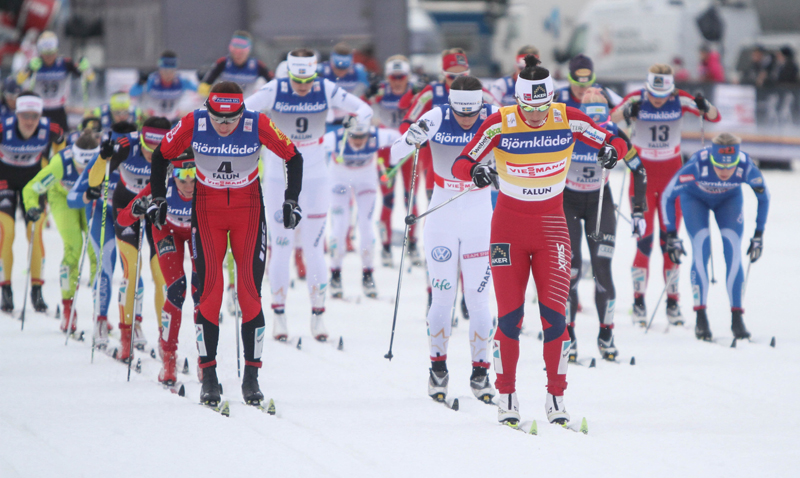
The start of the World Cup Finals women's 10km classic mass start.
All 2012 FIS World Cup Finals coverage is brought to you through the generous support of Fischer Sports USA, proud sponsors of Kikkan Randall, 2012 overall Sprint Cup Champion.
FALUN, Sweden – The Tour de Ski Trophy is safely ensconced at home in Poland and the World Cup overall is out of reach, but Justyna Kowalczyk (POL) is not backing down, staging a comeback in the World Cup Finals that will have the World Cup Finals a microcosm of the entire season—a battle between Kowalczyk and Marit Bjørgen (NOR).
After winning the prologue on Friday, Bjørgen predicted that Sunday would come down to herself and Swede Charlotte Kalla.
Johaug, Bjoergen, Kalla, Weng and Kowalczyk head up the Mördarbacken for the first time.
Kowalczyk, after crashing in the Stockholm sprint, and placing an uncharacteristic 4th in the prologue was 50 seconds down.
But Bjørgen should know better than to count Kowalczyk out.
The Pole stormed back, blowing Bjørgen, and ultimately the rest of the field, off the icy course in the 10km mass start classic.
Bjørgen didn’t even reach the podium, placing fourth behind teammates Heidi Weng and Therese Johaug, and enters the pursuit start on Sunday just six seconds up on Kowalczyk.
Traditionally one can count on two things in life—death and taxes. But it would make sense to add in one more—World Cup women’s races starting at an insane pace.
Wile the men took plenty of time skiing into their race, the women’s field had split apart less than four minutes in, obviously led by Bjørgen and Kowalczyk, with Johaug, Weng and Kalla along for the ride.
Thirty seconds later Weng and Kalla were gone, and any hope of someone new on the podium appeared to evaporate.
The chase pack.
Bjørgen said after the race that she felt good at that point and the pace was just fine.
As the women came down from the early gradual ascent, Kalla made a valiant effort to bridge back up, pulling Weng along. But she came up short, as the race approached Mördarbacken.
The three leaders had lost time on the descents, but began pulling away again on the lower slope.
When they kicked into the steep pitch of herringbone, spectators were greeted with an unfamiliar site—Marit Bjørgen sprung off the back.
Bjørgen didn’t look bad, she was just skiing slower, and passed the intermediate bonus sprint five seconds back with a resurgent Weng on her heels.
“The speed was too fast for me, so I had to concentrate on myself and try to keep the speed up so the gap would not be too big,” Bjørgen said.
The race was not over for Bjørgen, however, as she and Weng reeled in the leaders over the short trip up the first third of Mördarbacken at the end of the lap, and closed the gap on the long backstretch down into the stadium.
But contact was short lived as Bjørgen immediately fell back again on the climb out of the stadium and into the second lap.
Weng, on the other hand, locked in with Kowalczyk and Johaug, forming a new trio at the front.
While Bjørgen worked to minimize the damage, et leaders set about breaking each other.
That didn’t happen for another 2.5 k, when Mördarbacken came around for the final time.
Johaug and Kowalczyk stride for stride.
Kowalczyk dropped the hammer, and in the matter of 30 meters had opened up a seven second gap on Johaug and Weng.
At this point Bjørgen was nearly 30 seconds down, but with the steep climb out of the way, she worked to close up.
Over the last 2.2k of mostly flat and down, Bjørgen took seven seconds out of Kowalczyk and 11 from her teammates, but she ran out of snow to close any further.
Weng and Johaug meanwhile, looking much the same with similar physiques and high tempo skiing, battled to the line, up the final rise to the finish.
The less-experienced Weng took the sprint by a single second, earning just her second World Cup podium and moving into third in the World Cup Finals.
Kowalczyk attributed much of her success to her skis—“the reason I was so fast,” she said.
A stronger classic skier, she also said she enjoyed skiing Mördarbacken today.
With Weng over a minute back in third in the overall mini-tour, Kowalczyk will have to work alone to catch Bjørgen, though the Norwegian scoffs at her lead—“six seconds is nothing.”
Neither Johaug nor Bjørgen were shocked to see Weng on the podium, pointing to the 20-year-old’s third place in Lahti two weeks ago.
“I know what is living in her, so I know she is very strong,” Bjørgen said. “She is a good woman for the future. It is a little bit of a surprise, but she is good enough to be on the podium.”
While Kowalczyk has not been mathematically eliminated in the competition for the overall World Cup title, it would take a collapse of epic proportions for Bjørgen to give up her lead of 160 points.
Thirteen women would need to overtake Bjørgen to give Kowalczyk the win, with at least one skier making up a minimum of two-and-a-half minutes over 10k.
The battle for third should be interesting in its own right with Weng, Kalla and Johaug all within 15 seconds.
The Norwegian women took eight of the top-10 spots today, and as a team have scored more World Cup points this season than any other country’s women and me combined.
Only Kowalczyk and Kalla in 6th were able to disturb the juggernaut.
Kowalczyk celebrates the win with her competitors coming to the line behind her.
All 2012 FIS World Cup Finals coverage is brought to you through the generous support of Fischer Sports USA, proud sponsors of Kikkan Randall, 2012 overall Sprint Cup Champion.
FALUN, Sweden – With bright skies overhead, warm air around and salted snow underfoot the ladies World Cup Final continued with the 2.5km freestyle prologue up and then down the infamous Mördarbacken.
Marit Bjoergen (NOR)
Marit Bjoergen (NOR)
Russia’s Julia Ivanova racing at 2012 World Cup Finals in Falun, Sweden.
Caspersen Maiken Falla (NOR)
Charlotte Kalla (SWE)
Charlotte Kalla (SWE)
Katja Visnar (SLO)
Vesna Vabjan (SLO)
Justyna Kowalczyk (POL)
Justyna Kowalczyk (POL)
Kikkan Randall (USA)
Kikkan Randall will lead the 2012-13 U.S. Ski Team after meeting the objective criteria for nomination.
Kikkan Randall (USA)
Ida Ingemarsdotter (SWE)
Chandra Crawford (CAN)
Nicole Fessel (GER)
Katrin Zeller (GER)
Katrin Zeller (GER)
Krista Lahteenmaki (FIN)
Cologna’s Swiss fan club cheer on the women.
Ingvild Flugstad Oestberg (NOR)
Dasha Gaiazova (CAN)
Dasha Gaiazova (CAN)
Alysson Marshall (CAN)
Alysson Marshall (CAN)
Marthe Kristoffersen (NOR)
Diggins
Jessie Diggins (USA)
Therese Johaug (NOR) crests the Mördarbacken.
Therese Johaug (NOR)
Therese Johaug (NOR)
Therese Johaug (NOR)
Hanna Kolb (GER)
Masako Ishida (JPN) competing in the 2.5 k freestyle prologue at last year’s World Cup Finals in Falun, Sweden.
Kikkan Randall (USA) leading a pack during the 30 k classic in Oslo, Norway, with Liz Stephen (USA) a few paces behind her. Photo: Fischer/Nordic Focus.
With enthusiastic cheers of “USA all the way!” to push them onward, the American women battled through an energetic 30 k classic at the famous Holmenkollen venue in Oslo, Norway on Sunday. The throngs of happy fans stood in contrast to what the athletes experienced out on the course — the combination of a sprint-like early pace and slow snow later on made for a challenging 90-plus minutes of racing.
The U.S. women were the lone North Americans to take to the start line and were once again led by Kikkan Randall, who clocked in at 1:32:26.7 for 21st place, 6:16.9 behind Marit Bjoergen’s (NOR) winning time.
Only a few days after securing the World Cup sprint title, Randall’s goal was to finish in the top 15, which she missed by only 18.5 seconds.
Randall bringing it home. Photo: Fischer/Nordic Focus.
“I was skiing in a good position to achieve that through about 23 k, but I struggled on the last lap,” wrote Randall in an email Sunday evening. “I felt like I had the energy reserves to fit for the top 15, but struggled with some cramping and slicker skis in the last lap.”
Overall, Randall said she was satisfied with the hard effort, which began with a quick start and never let up.
Right from the gun the eventual top three — Bjoergen, Justyna Kowalczyk (POL) and Therese Johaug (NOR) — pushed the pace from the front, and the rest of the pack followed.
“I felt like we were starting a sprint race going out of the stadium and everyone went with it,” said Randall. “I tried to go with the pace as well, but I also knew that I needed to not max out in the first 5 k.”
Randall and teammate Liz Stephen skied together for the first half of the race, helping each other stick with the main pack as long as possible.
“It was great to ski with Liz. She was skiing a quick tempo up the big climbs and it helped me to follow her,” said Randall.
Stephen ended up finishing 24th (+8:03.1), but hovered in the top 16 through the second checkpoint at 8 k. As started the 30 k starting to feel “pretty tired,” her goal had been to simply “have as good a race as I could have with the body feeling the way it did.”
Despite feeling less than optimal, Stephen described her start as one of the best she’s ever had on the World Cup.
“It was awesome! I was in a great position off the line and decided that though the pace felt like a 5 k pace I had to hang as long as possible,” said Stephen.
The experience was a breakthrough for her, as it was one of the better race starts of her career.
“It is crazy how quickly the gaps open up in the front,” she wrote. “I always wonder how the pack gets away so quickly in the beginning and the start is a very easy place to pick up or give away 30 seconds. It was really fun to be on the front end of those 30 seconds this time.”
As the tracks warmed in the sun, the snow got progressively slower. The women were allowed two ski changes to adjust to the softening snow, but even so it was “a long way to go when the conditions are so slow,” Stephen concluded.
Bjornsen skiing the second 30 k of her life. Photo: Fischer/Nordic Focus.
For Sadie Bjorsen and Jessie Diggins, who have each skied only one other 30 k in their careers, Sunday was about getting experience. Bjornsen finished 40th and Diggins 45th.
Bjornsen echoed her teammates’ characterization of the quick start.
“To be honest, I felt like I was hanging on for life for the first 13 k,” she said.
After her first ski change, Bjornsen was able to consistenly ski in 34th place, which she felt was her best phase of the race. After switching equipment again for the last 8 k, however, she struggled on skis that were ill suited for the conditions.
“The course got wet and soggy really fast… The techs did an exception job of getting us what we needed, so I think it was entirely my own fault that I picked the wrong ski,” Bjornsen explained.
Despite challenging conditions, Bjornsen’s said that skiing through crowds of loud fans was “incredible,” and played no small part in motivating her.
“I don’t think anyone could deny the crowd’s ability to move you on. Especially in a 30 k, where I feel like I went out much faster than I was comfortable, it was honestly the crowd that kept me going… It makes racing so fun!”
As a post-race bonus, Bjornsen cooled down with the race winner, Bjoergen, who was treated as royalty in front of her home crowd.
Bjoergen winning the 30 k by 51.9 seconds in front of an enthusiastic Norwegian crowd. Photo: Fischer/Nordic Focus.
“I watched as everyone was just congratulating her and holding on to her and so excited,” Bjorsen described. “It was really fun to see.”
“I asked her how she could possibly go so fast and she said she had an incredible feeling today. She even went as far as to make me feel better by telling me how much time it takes to get so fast. It was nice to hear coming from ‘the queen’!”
Diggins’ approach to the 30 k was similar to Bjornsen’s—her primary goal being to try to have fun.
“It’s the end of the season, and you can’t really change anything except race with what you’ve got left,” she said.
Diggins took a few spills after getting her skis caught in the slush, but emphasized that the crowds made the race more enjoyable, even in the face of tricky conditions.
“There were so many fans, and they knew my name and would be chanting it and ‘USA, ALL THE WAY’ up all the hard climbs, which helped a lot for sure,” wrote Diggins in an email.
The final U.S. skier across the line was Ida Sargent, who finished 51st. She described her race as “the hardest thing I have ever done in my life.”
Randall, Diggins and Stephen, who all rank within the top 50 in the overall standings, move on to the World Cup Finals in Stockholm and Falun, Sweden this week.
Marit Bjoergen and Justyna Kowalczyk at the end of Stage 7 of the Tour de Ski. The two will face off again in Rybinsk on Saturday in the 10 k mass start freestyle.
For the past few years, the World Cup in Rybinsk, Russia has been the weekend frequently skipped over by national teams and various individuals. With the overall World Cup title a focal point this season and no major championship to save up for, however, the expected fields are nearly double what they’ve recently been, in spite of the handful of athletes who have decided not to race in the extreme cold.
The forecast initially looked borderline, but on Friday Rybinsk was predicted to get as high as 0F on Saturday. The FIS cutoff for a race to get cancelled or postponed is -4F. If Saturday’s temperature is right on the edge prior to the races, Canadian head coach Justin Wadsworth said he thinks officials will “blow on the thermometer a little bit and make it happen.” With the races set to go off in the afternoon, the temperature will likely have gotten as high as predicted by the time the men start at 2:15 pm local time.
If the Moscow city sprints on Thursday were part of a push to attract more skiers to the Russian races, it worked. Sixty men and 53 women are on the start lists for the 10/15 k mass start freestyle races on Saturday, which include intermediate sprint bonuses. By comparison, only 30 women and 33 men took to the line in Rybinsk last year.
Luckily for World Cup fans, that should this weekend a little more interesting. On the men’s side, current World Cup leader Dario Cologna (SUI) has decided not to race in the cold, and neither will the Swedes, Finns, and a few other big names—notably Petter Northug (NOR) and Lukas Bauer (CZE).
There are still plenty of fast skiers set to battle it out head-to-head on Saturday. Home-field athletes Maxim Vylegzhanin and Alexander Legkov (RUS) currently sit fifth and sixth in the distance rankings, and will have plenty of motivation to perform well in front of Russian fans.
The two mid-race sprint bonuses could potentially throw the race. Maurice Manificat (FRA) is coming off a bit of a down run following his second-place showing in the Tour de Ski final climb, but could be a contender. Devon Kershaw (CAN) seems on the brink of his first official World Cup win, and teammate Alex Harvey is coming off a fourth-place finish two weeks ago in Otepaa, Estonia. Ivan Babikov has rejoined his team in Europe, and after a strong finish in the Tour final climb, will be raring to go in the mass start.
The American men’s squad, led by Kris Freeman, will have thinner ranks on Saturday. Noah Hoffman is still in Ramsau, Austria with the stomach flu, and sprinters Andy Newell and Simi Hamilton rejoined him after the Moscow sprint on Thursday.
Freeman is coming off a comfortable win at Austrian nationals last weekend, and if he skis where he believes his fitness to at, he could mix it up with a top 15. Tad Elliott is back in World Cup action after staying in the US for a few SuperTours after nationals, and with plenty of time in Ramsau to adjust to the time difference, should be ready to go. Sylvan Ellefson is still hitting his stride on the World Cup, but with high energy carrying over from Thursday, could be ready for another good performance.
On the women’s side, there are fewer big names skipping Rybinsk, and for good reason: Justyna Kowalczyk (POL) pulled 38 points ahead of Marit Bjoergen (NOR) in the overall World Cup on Thursday, and if Bjoergen wants to fight for it, she has to gut it out even at the remote venues.
The course on Saturday features about 500 feet of climbing per lap, with the women doing four 2.5 k loops and the men six. In addition to Bjoergen, Therese Johaug and all of the big Norwegian names will be lining up. Charlotte Kalla (SWE) is also back for Rybinsk, fresh off of two Swedish national titles.
The U.S. women have the momentum of a string of top performances on their side. Most recently, they placed three in the top-12 in Moscow, led by Jessie Diggins’s seventh—the 20-year-old undeniably on a roll this year.
Kikkan Randall is sitting out the 10 k in order to be ready to go for Sunday’s skiathlon. According to USST head coach Chris Grover, Randall is prefectly healthy, but feels she needs to take Saturday off in order to be sharp the next day. Ida Sargent is also skipping the 10 k.
Liz Stephen is coming off a 21st in Otepaa and a second at Austrian nationals, and the climbing-heavy course could work in her favor in Rybinsk. Holly Brooks, wrist mostly healed, is back on the American roster, and though she may have lost some strength in her arm and core while she recovered from the injury, her coach Erik Flora thinks she’s just as fit as ever.
Sadie Bjornsen, though missing the heats in Moscow, nonetheless skied a respectable 39th. Bjornsen has said many times that falling just short of the points only gives her more motivation for the next race.
Barring weather delay or cancellation, the Rybinsk men’s 15 k starts on Saturday at 2:15 pm in Russia (6:15 am EST), with the women starting 1.5 hours later.
You’ll recall that recently this rivalry has been fairly one sided, no matter how much Justyna’s fans want to believe otherwise. The previous two season simply saw Marit winning far more of their head to head match-ups. At the start of the season, things looked even worse for the Justyna camp, as she struggled quite a bit in the early races.
But Justyna may have simply been using those as training for the Tour, as she fared much better last week against Marit. Let’s take a look at how their complete history stand as of now:
So these are just the distance races, measured in difference in percent back. Values above zero mean Marit won and vice versa. Marit had the better of this match-up for two straight seasons, with the occasional lapse. This season, you can see the early group of really poor races for Justyna, and then during the Tour things were more tilted towards Justyna, though the margins weren’t terribly large, for the most part.
As for sprinting:
Marit is still ahead on this score, though we’ve only had a handful of sprint races thus far.
So my question is: will Justyna, having clearly peaked for the Tour, slide back again to being mostly beaten by Marit? Or will she be able to sustain this level of fitness through the rest of the season?
A view of the men's course for Stage 7 of the Tour de Ski.
TOBLACH, Italy – Stage 7 of the Tour de Ski, which took place Thursday, is the event’s crown jewel: a 35-kilometer point-to-point race that sent competitors up an over a mountain pass, with the craggy Dolomites as a stunning backdrop.
Or, to be more precise, it sent male competitors up and over a mountain pass, with the craggy Dolomites as a stunning backdrop. The women, meanwhile, skied three laps of a standard five-kilometer course on the trails in Toblach, never heading up high to the rugged alpine scenery.
We checked in with a number of coaches and athletes to see what they thought of the discrepancy.
Marit Bjoergen (NOR): “For us it is better, because when [there is] a group, and…one in front, it is hard to go in front. But for us, when the track is round, it is easier to go alone. I think it is better to do it like this.”
Rickard Grip (Swedish women’s coach): “Actually, I think it’s a little boring that they go on this normal 5 k track for three laps. I think it would be interesting to see if the ladies started where the men will start. They wouldn’t [have to] go the first three or four k—the men go all the way down here, then they go the 5 k loop, then in the finish. So, I think maybe the women could go on the track to here, and then not make any laps [on the 5 k loop), or maybe do a really short one, or something.”
“I think it would be interesting to see about that, because it’s a little bit boring that they just go [in Toblach].”
Kikkan Randall (USA): “Last year I was kind of up in arms about, ‘Hey, why do the guys get to do a cool point-to-point race, and we don’t?’ But after skiing here, I felt like it was a really good course, and it still accomplishes, you know—people gapping together, people spreading out. And I think for us to do a point-to-point course, it was going to be mostly downhill, so I think it’s a good venue…there’s still plenty of exciting racing.”
Sami Jauhojaervi (FIN): “The [35 k] track is not the best possible for ladies. A lady who is skiing alone will lose from one to three minutes, compared to a group, which can change the leader all the time. It would change too much. The time differences in ladies are already now big—too big.”
“Of course, us men, it’s nice to have some challenge, but of course on the lady’s side, it’s huge gaps. And those would be even more huge. So the number three [lady] would start in the wave, [if] they would do this 35 k.”
On an alternative: “They could, for example, in this stadium—they could do some uphill, and then come down from another track. For five kilometers, flat-uphill, seven kilometers to 10 down, then some loop in the stadium.”
Astrid Jacobsen (NOR): “Of course we could race 35, but I think the day we should race 35, we should also have the same distance for the shorter races. Like, [in the prologue in Toblach], we had three [k], they had five [k]. And I think also—it’s bigger gaps between the women and the men, so if we had a 30 k, it would be really not interesting any more. Because I think it would just be one skier, [then] two minutes, one skier…[That way], we’d get too big differences between the skiers, and then it’s not so much action any more…I think 30 k tomorrow would be maybe not so fun to watch.”
Magnar Dalen (Finnish head coach): “I feel that it should have been much better that the women had the same type of race [as the men]. Because the race they have tomorrow on this hard track [the 5-kilometer loop] just separates the real good engine skiers more. If the ladies had had the same as the men—maybe five kilometers shorter, but still with a slight downhill—it would have been very interesting for the overall. Now, the Tour will be like [settled] tomorrow. Not who is one and two, but all the others behind will have big problems, and impossibilities for the podium.”
“It’s a hard track [the one the women are skiing]. It’s an extremely hard track at high altitude. (Toblach is at roughly 4,000 feet above sea level.) I don’t see any reason—why are the girls skiing a harder track than the boys?”
On the feelings of the Finnish women: “They want to have it the same as we had at the beginning of the Tour de Ski—then they were starting [the same course as the men].”
Charlotte Kalla (SWE): “I don’t know. I’m very focused that it should be 15 kilometers…it’s enough with 15 kilometers.”
“It would be fun to go from one place to another, but I don’t want to go 15 kilometers downhill.”
Marit Bjoergen and Justyna Kowalczyk at the end of Stage 7 of the Tour de Ski.
TOBLACH, Italy – Cross-country skiing has plenty of unlikely alliances, from Norwegians running the Swiss national team to an American heading up the Canadian coaching staff.
But few alliances were more curious than the one forged on Thursday between Marit Bjoergen (NOR) and Justyna Kowalczyk (POL).
In Thursday’s Stage 7 of the Tour de Ski, Bjoergen outsprinted Kowalczyk on the homestretch here to win by two seconds, taking her fourth straight victory and her third in a row in Italy.
In winning the race, a 15 k freestyle handicap start, she also claimed Kowalczyk’s red bib, which is worn by the leader of the overall Tour standings. Heading into the Tour’s final two stages in Val di Fiemme, two hours to the southwest, Bjoergen holds an edge of seven seconds.
“I’m feeling very good and strong,” Bjoergen said. “I’m very satisfied.”
Kowalczyk began the race with a four-second lead on Bjoergen, based on her edge in the overall standings at the start of the day.
In normal circumstances, that would set the stage for a showdown, because the two women don’t get along well: Kowalczyk has publicly criticized Bjoergen for her use of asthma medicine, and Bjoergen told the Norwegian media in Toblach that she doesn’t engage with Kowalczyk because the Polish skier “talked sh-t about me.”
But on Thursday, they had a common enemy, and an incentive to work together: Bjoergen’s Lilliputian teammate Therese Johaug.
The final stage of the Tour de Ski is a nine-kilometer uphill that ascends more than 1,000 vertical feet on the Alpe Cermis—a race that is right in Johaug’s wheelhouse, given her small size and her penchant for climbing.
In last year’s edition, Johaug turned the World Cup women’s field into her personal punching bag, beating her nearest competition in the final climb by a full minute, and Kowalczyk by two. (Bjoergen didn’t race.)
While Bjoergen and Kowalczyk will have their hands full with each other in Val di Fiemme, the last thing they were interested in doing on Thursday was letting Johaug—who started the day two-and-a-half minutes out of the lead—get within striking distance.
So once Bjoergen closed the gap to Kowalczyk, the two women stuck together, with each taking turns driving their two-car train.
Johaug had told the Norwegian media she was hoping that Thursday could be a repeat of the 30 k freestyle at last year’s World Championships, when she dropped both Bjoergen and Kowalczyk and went on to win the gold medal.
But rather than closing the gap to the leaders, Johaug’s deficit to the pair began to grow. By the 7.8-kilometer mark, she’d lost eight seconds, then 19 seconds by 11.8 k, and 50 seconds by the finish, at 15 k.
“It’s something else to come from behind,” said Egil Kristiansen, the Norwegian women’s coach.
As the women came into the stadium for the end of their third 5 k lap, Bjoergen was the one pushing the pace. She led out the sprint, kept Kowalczyk at bay, and ended up with a two-second victory. Thanks to a 15-second time bonus she got for the win, her lead is now seven seconds, since Kowalczyk got a 10-second bonus of her own. Johaug is now 3:17 back, most likely out of range from both women in front of her.
“The gap for Therese is now looking good,” Kowalczyk said. “More like three minutes is good.”
There’s still one other stage in Val di Fiemme before Kowalczyk and Bjoergen tackle the final climb—a 10-kilometer mass start classic race.
But that event probably won’t be a difference maker: Kristiansen said he expects the women to ski together in that race, as well.
As such, the stage is setting up for an epic battle between the two on the flanks of the Alpe. And because Bjoergen hasn’t raced the Tour since 2009, nobody is quite sure how such a race would play out.
“I don’t know who is better. Marit has not started the last year’s,” Kowalczyk said.
While much is uncertain, one thing is sure: come Sunday, the temporary alliance between the women will be toast.
OBERSTDORF, Germany – Three wins in three days over a range of distances and in both techniques—exactly what many expected in the Tour de Ski, just not from Justyna Kowalczyk (POL).
Norwegian Marit Bjoergen dominated the first World Cup period, winning five of the six races she started, most in dominating fashion. Despite taking a pass on the Tour for two years, Bjoergen entered the 2012 edition as the favorite.
Two consecutive overall Tour wins, and super-human stamina were not enough for Kowalczyk to enter the first stage in Oberhof as anything but an underdog, a position, however, that she supposedly enjoys.
For an elite athlete there usually isn’t anything more enjoyable than winning, and Kowalczyk is on a roll.
She skied off the front in each of her heats after winning qualifying, unfazed by the driving rain, raw temperatures, and rapidly softening snow. In the final, Bjoergen made an effort to match the pace, but as in the prologue, and Friday’s pursuit, she came up short.
Bjoergen was clear in second, and Astrid Jacobsen, bounced back from a tough wax day in the pursuit to finish third and give Norway two on the podium.
“She is really strong,” Jacobsen said of Kowalczyk. “Her shape and her machine are crazy good, so we just had to try and take her on technique or something else.”
Nobody was taking Kowalczyk on anything—not today, and not on either of the first two Tour stages.
With no World Championships or Olympics, the Tour is the focus of the season, and Kowalczyk planned her training accordingly. She traveled to New Zealand in August for the first time, and was unconcerned as November and early December came and went without a victory over Bjoergen.
After the race she said that her plan had been to start the “Real season” in Rogla—the final stop on the World Cup before the holiday break.
She won the distance race there, though Bjoergen did not compete due to illness, and has shown no sign of weakness here on the Tour.
“When you are number one it is not so tough, she said of three consecutive days of racing.
Kowalczyk endured the miserable weather, avoiding any trouble on a course that held up well for the most part, but did claim a number of victims.
American Kikkan Randall, fell entering the final straightway in the semifinals, losing a sure spot in the finals, and several other top skiers, including Emil Joensson (SWE) and Krista Lahteenmaki (FIN) went down on the one fast downhill corner.
“I like the conditions and the rain,” Kowalczyk said. “Not so fast conditions are good for me.”
Bjoergen and Kowalczyk have been rivals for several years, ever since the former’s resurgence in 2010.
Bjoergen advancing…
Bjoergen has had the upper hand at the major championship events, while Kowalczyk has the two Tour de Ski victories, and three consecutive overall World Cup titles.
“It is perfect for the sport,” Jacobsen told FasterSkier when asked between the battle between the two women. “I think also Marit is enjoying this because it will be a fight to the end, and then it will be even bigger to win,” she continued.
Kowalczyk now holds a 22 second lead over Bjoergen in the overall, with Therese Johaug in third, +101.4.
Jacobsen qualifying third.
Johaug placed 18th in the sprint, an excellent result for a woman who is seeing vastly improved sprinting results of late. A fierce climber, Kowalczyk has said she needs at least a two minute lead over Johaug when the Tour hits the final climb up the Alpe Cermis to feel confident in a victory.
Despite the strong performance today, Jacobsen is not in contention in the overall.
“I think I spoiled my chances yesterday,” she said.
In the pursuit she opted for rub skis, or hairies, and regretted that decision.
She opted for klister today, saying she was “too chicken” to go with hairies again.
Jacobsen described her kick as “perfect,” and felt her speed was “better than Marit or Justyna.”
Racing continues tomorrow with a 5+5km skiathlon on a challenging Oberstdorf course.
Kikkan Randall in the prologue of Saturday's classic sprint in Oberstdorf, Germany.
OBERSTDORF, Germany – Kikkan Randall’s pink tiara will have to wait until next year.
The birthday girl had a cardboard crown on hand for Stage 3 of the Tour de Ski on Saturday—a gift from her mother that Randall was ready to pull out if she made the final heat of the classic sprint race.
Unfortunately, the tiara had to stay in her backpack, as the Alaskan got a 29th birthday present of an unexpected and unwelcome sort: a faceful of snow and an early end to her afternoon.
With just 200 meters left in her semifinal heat and a berth in the finals all but guaranteed, Randall tripped and crashed, then had to watch as her competitors glided past. A day that was brimming with promise was over before she knew what had happened, leaving her in disbelief and wondering what she might have been able to accomplish.
“Skis were good, everything seemed to be clicking,” said Randall, who ultimately finished ninth place. “All of a sudden, my ski just went behind my other foot, and just launched. It was unbelievable.”
Randall (left) racing in the heats.
Up until the crash, though, Randall’s racing had been textbook.
She’d blazed through qualifying, placing fourth behind three world champions in Norwegians Marit Bjoergen and Astrid Jacobsen, and Justyna Kowalczyk (POL).
She won her first heat, then, in the semifinals, faced off against Kowalczyk.
The Polish star is on fire: She went on to win Saturday’s sprint going away, and has captured all three stages of this year’s Tour. Randall followed her up the big climb, and by the time the pair came back down into the stadium, the Alaskan was trailing, but had broken away from the other four women in the heat.
“[Kowalczyk] was making a really hard push, and I felt confident. I was definitely pushing hard, too, but I definitely felt controlled and relaxed,” Randall said. “I felt like I would have had another gear to dig into for the final—I was trying to kind of race to hold my position, but also saving a little bit.”
But instead of moving on, Randall went down. Four hours after the crash, she still was searching for an explanation of what had happened.
“The only thing I can come up with is that maybe my wax caught, or something,” she said. “It really caught me by surprise.”
The crash was violent; Randall vaulted into the air, then into the snow. But she said that while she felt “a little tweaked out,” the only thing that was really hurt was her chances in the race.
She picked herself up quickly, since she hadn’t seen anyone ski past, but then France’s Aurore Jean sailed by and claimed the last spot in the finals.
Randall crossed the line fuming, letting out an exasperated wail as she met her coaches.
“How did that happen?” she asked them. “I felt so good!”
She declined to speak with reporters immediately afterwards, but after a cooldown, she said that this crash had been especially confounding compared to a pair of others she’s suffered in sprint races in the last year—one at the World Championships in Oslo in February, and another just before Christmas in Rogla, Slovenia.
“This one—it was all on my own, and things were going so well….Watching how the finals did play out, and the fact that Kowalczyk got away by so much, it makes me wonder. I think I’d have had a really good shot,” she said. “Three big ones in a row now with Oslo, Rogla, now this. Doesn’t feel good, but hopefully I’ve got my three done and out of the way now.”
There was still one positive to the race, and that was the way that Randall had been skiing up until the crash.
She was clearly among the top 10 in the world for the third straight day, and appeared to have a legitimate shot at the top three. The podium is a familiar place to Randall when it comes to freestyle sprints, but not when it comes to classic technique.
“ If I’d podiumed today, that’s just head and shoulders above where I’ve been in classic sprinting,” she said. “Bummer I didn’t get to prove it.”
She’s still in fifth place in the overall standings of the Tour, with a freestyle sprint still to come next week in Toblach, Italy. And perhaps the best part about the hectic schedule of stage racing is that Randall doesn’t have too long to dwell on her mishap—she’ll be competing again 24 hours later.
“It was tough after Rogla, seeing as we had two weeks until another race,” she said. “It’s a great chance to just refocus and move on.”