From the FasterSkier archive — posts syndicated from athletes’ and coaches’ own blogs between 2004 and 2012, kept online as published. Current coverage is at fasterskier.com.
Kowalczyk, way ahead of the field. Photo: Fischer/Nordic Focus.
After struggling to match her form from last winter, Justyna Kowalczyk (POL) was finally back on top of the World Cup podium on Saturday in Rogla, Slovenia for the 10 k mass-start classic distance. Throughout the beginning of the five-lap race, Kowalczyk traded the lead on and off with Therese Johaug (NOR), who ended up fading to second at 22.1 seconds back. Her teammate Vibeke Skofterud (NOR) made a late-race challenge for silver, but ended in third (+27.4).
Finland’s Aino Kaisa Saarinen, who finished 4th, was a contender early on as well. But the contest eventually whittled down to three women, and then to two as Johaug and Kowalczyk battled each other and Skofterud failed to respond in time.
When Kowalczyk initially took the lead, it seemed like the risky move of someone with something to prove. Her season so far has been relatively slow—a 5th in the Davos 15 k was her best result prior to Saturday, while last season at this point she’d already been on the podium more than once. Speculation on her seeming lack of fitness has swirled around the Polish star for the past few weeks.
Johaug leading the pack early in Rogla. Photo: Fischer/Nordic Focus.
For the time being, at least, Kowalczyk let spectators and competitors know they were wrong to doubt her. Johaug took back the front position for a time, but never quite shook Kowalczyk, who had much faster skis on the downhills. Kowalczyk re-passed and put a gap between herself and the struggling Norwegians in the final kilometers.
“Rogla is good place for me,” said a grinning Kowalczyk in the post-race press conference. “There must be a good air for me.”
“I expected the fight with Therese to be harder,” she added.
Johaug, on the other hand, suffered. She and Skofterud lay in the snow for an unusually long time after collapsing in the finish area. Afterwards, she told the NRK that she had just completed the most painful race of her career.
“I’ve never been so tired when I reached the finish,” said Johaug, and summed up the experience as “the worst.”
Skofterud, with Saarinen (FIN) just behind. Photo: Fischer/Nordic Focus.
Skofterud echoed the sentiment. “I gave everything I had and it was really hard in the second [lap],” she said at the press conference. Though she got a second wind as she started to gain on Johaug in the third and fourth laps, by the final sprint she had “no power left” and was unable to surpass her teammate.
Like the men’s race, conditions for the women were challenging: soft snow with a strong headwind. But the women didn’t have a tightly-packed lead group to split the workload of breaking the wind, especially in the final laps.
The women’s race featured a single intermediate sprint for bonus World Cup points, but it had less of an impact on mid-race strategy when compared to the men’s race. The field was so strung out by lap three that there would have been minimal shifting amonst the top 10 women even if they’d really fought for the points.
The fresh snow on the Rogla trails made the tracks slower and the course more of a challenge than the one athletes practiced on the day before. With the field so spread out, there were slight downhills that skiers had to actively push down where they’d picked up natural speed earlier in training.
“For only being a 2 k course, it was plenty challenging,” said Kikkan Randall (USA), who finished 11th on Saturday. “There were tough striding sections, sections where you really had to work the transitions, and there were short rest breaks. The wind added another element—you’d come over one of the big climbs into the headwind.”
Randall hung in the top-5 for the first part of the race, but when she started to tire, had trouble staying with the women who overtook her.
Despite not being able to maintain her position, eleventh is still Randall’s best-ever classic distance result. It wasn’t quite enough to maintain her overall 3rd-place ranking on the World Cup, however—Johaug now sits above her by 48 points, and is only eight points away from bumping Skofterud (in 2nd) down a peg, too.
(Despite not racing at all this weekend due to illness, Marit Bjoergen (NOR) still maintains a 103-point lead after Saturday’s 10 k, so even if Skofterud wins Sunday’s sprint, Bjoergen will remain the World Cup leader at the end of Period 1).
“My intention this year was to go out aggressively and see how long I could hold it,” said Randall of the impressive season she’s had so far. With another crack at a skate sprint on Sunday, the way things have been going she may be holding on a bit longer.
Kikkan Randall entering the finish lane on her way to winning the skate sprint in Davos by 1.7 seconds. Photo: Fischer/Nordic Focus.
Davos, Switzerland — Marit who?
At least that’s how it appeared in the World Cup in Davos, Switzerland, on Sunday, during the 1.5 k freestyle sprint, as it was American Kikkan Randall who destroyed the field rather than the usual Marit Bjoergen devastation.
The Alaskan native blasted her way to her second consecutive World Cup sprint victory of the year, skiing away from the other five women in the final, leaving Russian Natalia Matveeva to grab second place, just ahead of Maiken Caspersen Falla (NOR).
Straight from the qualifier, it was obvious Randall was going to be tough to beat. In the two-lap 1.5 k course, she started just two skiers back of Bjoergen. Ater the Norwegian set the second-fastest qualifying time behind Natalia Matveeva, the U.S. Ski Team (USST) veteran swooped in and stopped the clock.
Randall was 0.11 seconds faster than the Russian – and almost a full second up on Bjoergen – in winning the qualifier.
As the top seed, Randall was placed in the first quarter-final, and skied strongly from the gun. After taking control, and using her smooth V2 to cruise, only Caspersen Falla was able to stay reasonably close. Randall easily took the win, advancing through to the semi-finals.
Randall rounding a corner coming into the stadium. Photo: Fischer/Nordic Focus.
In the semi-final, Randall was matched up against some strong competition: 2007 sprint World Champion Astrid Jacobsen (NOR), and Dusseldorf surprise bronze-medal winner and Davos native Laurien Van Der Graaf (SUI) both qualified through to the next round.
But they might as well have been J2s for all they could do against Randall.
Taking the lead from the gun, Randall avoided the traffic on the first corner — a hairy 180-degree bend that curved straight into the only real climb on the course. After attacking the hill hard, she never looked back, stretching the field into a single line behind her as she built a massive lead to win comfortably by over a second, punching a ticket to her third sprint final of the year.
Bjoergen was in the second semi-final. Owner of 49 World Cup victories and undefeated on the season, the seemingly invincible Norwegian seemed poised to qualify for the final, and create the Randall-Bjoergen face off that the fans desired.
But with the red-hot Russian Natalia Matveeva as well as arch-rival Justyna Kowalczyk, and surprising Vibeke Skofterud (NOR), Bjoergen was not a lock.
And early on, it was clear that Bjoergen was not going to dominate the heat. Kowalczyk squeezed into the lead around the first corner, and tore hell-bent up the first climb — only Matveeva and Canadian Chandra Crawford were able to keep pace. Bjoergen was left at the back as they rounded the corner and headed for the second lap, giving her just 750 meters to find her way into a qualifying position — not unheard of, but certainly difficult, even for Bjoergen.
Chandra Crawford on her way to 9th in Davos. Photo: Fischer/Nordic Focus.
As Kowalczyk and Crawford began to tire, paying for their first-lap enthusiasm, Matveeva pushed the pace, opening up a large gap on the downhill. Sweden’s Hanna Brodin found herself in second place rounding the final turn, with a couple of meters gap back to Kowalczk and the hard-charging Bjoergen.
Bjoergen sling-shotted around the corner in Kowalczyk’s wake, and narrowly passed the Pole in the charge to the line, finishing third. Her late charge was impressive, but not quite good enough — the first semi was quicker, robbing Bjoergen of a spot in the final as the lucky loser.
The streak was over, but the final was still to come. The 9,000-strong crowd, heavy with Norwegian and Swiss fans, were waiting to see who would supplant Bjoergen on the top step of the podium.
The Norwegians had Maiken Caspersen Falla and Heidi Weng to support. Weng (World Junior Champion last year in the 10 k pursuit) barely qualified for the heats; she finished 30th in the individual start, just 0.08 of a second separated her from 31st place Yelena Kolomina (KAZ). Just 21 years old, Caspersen Falla is a strong skate sprinter — she has two World Cup medals in skate sprints in her short time on the circuit.
Meanwhile, the Swiss were excited about Davos native Laurien Van Der Graaf, who had her break-through World Cup race last weekend in Dusseldorf, Germany, where she collected the bronze medal. Van Der Graaf qualified fourth, and the young woman had the crowd on her side.
Hanna Brodin (SWE) and Matveeva rounded out the final, the latter riding a hot streak similar to Randall’s after finishing second to the American last weekend in Dusseldorf.
Randall crossing the line with a dominating lead. Photo: Fischer/Nordic Focus.
Matveeva led the way out of the tracks, skiing neck-in-neck with Randall approaching the first corner. The two climbed the hill together, and Randall pushed hard over the top, and rode a pair of fast skis into the lead on the downhill section of the course, taking the lead into the second lap.
Matveeva closed up the gap instantly and took the lead, while Caspersen Falla, Van Der Graaf and Brodin all packed in tightly just behind Randall. As the group rounded the 180-degree corner, it looked like the race was going to go down to the wire. But Randall instantly launched a massive attack on the hill, powerfully hop-skating her way to the top. Only Matveeva was able to stay close, but as the two crested the hill, Randall refused to let up, hammering her way down the backside. As a result, the current Sprint Cup leader built a 50 meter lead on the field with half a lap to go — and still she kept charging.
As she rounded the final corner and sprinted for the line, it was clear that Randall was untouchable. Matveeva and Caspersen Falla were left to pick up the pieces as Randall cruised to the finish, letting up only briefly to celebrate before crossing the line 1.7 seconds clear of the competition.
A fading Matveeva just barely managed to out-last the fast-finishing Caspersen Falla at the line to collect her second silver medal in as many weekends. Sweden’s Brodin finished fourth, 2.5 seconds behind, while Van Der Graaff had to settle for fifth.
When the smoke cleared, Randall was shell-shocked.
“I don’t even believe it just happened,” said Randall in response to the stadium interviewer’s first question, sounding a little stunned.
In an interview with FasterSkier after the race, Randall explained that her good position was the key to winning.
“The hill was my strong point,” she said. “I didn’t want to lead, and when I made that strong move on the uphill, it was the perfect set-up for me.”
As for the big gap in the final, Randall said she never even thought about where the other women were.
“In my mind they are always there,” she said. “You never take anything for granted in sprint racing.”
While Randall was excited about the win, she wasn’t shy about spreading around the credit — her fast skis, the great atmosphere in Davos, the team’s accommodation at Hotel Kulm, and the crowd all helped her to victory.
“The training life leading up to the race is so nice [in Davos]” she said.
“I had amazing skis, and I really want to share this with the team — they do such a good job of taking care of absolutely everything and letting me just race.”
As for Bjoergen, Randall said that it was “a bit of a bummer” the Norwegian wasn’t in the final.
“She’s the gold standard we all compare ourselves with,” said Randall. “It would have been nice to test myself against her, but all five women were plenty challenging.”
Randall now has a week to digest the fact that she leads the Sprint Cup standings by 46 points, and is ranked third in the World Cup Overall standings before another weekend of World Cup action in Rogla, Slovenia.
But tonight, she has some celebrating to do. She’s eating dinner with Anna Haag and Emil Joensson (SWE), whom she and Liz Stephen trained with last summer, and then spending some time enjoying the win with the whole U.S. Ski Team.
Spectacular conditions in the stadium on Saturday morning in Davos, Switzerland.
Davos, Switzerland – There is no doubt that the Norwegian women’s ski team is currently the best in the world.
On Saturday morning, during the 15 k individual start freestyle in Davos, Switerland, they absolutely dominated the leader board, putting six women in the top ten, and taking the first four places.
Surprising no one, Marit Bjoergen (NOR) crossed the line with the fastest time, leaving Vibeke Skofterud the silver medal, 41.8 seconds back. Therese Johaug finished 42.2 seconds back of Bjoergen for third, securing the podium for the Norwegian women.
Young 22 year old Marthe Kristoffersen finished fourth, while Kristen Stoermer Steira was sixth.
Only Justyna Kowalczyk (POL) was able to put a dent into the Norwegian armour, finishing fifth, a long 1 minute 26.4 seconds back of her Norwegian rival.
Justyna Kowalczyk (POL) heads out on her first 5 k loop – she finished 5th on the day.
But in the early stages of the race, it wasn’t the Norwegians who appeared dominant, but the Americans.
Holly Brooks (USA) held the best time through the first time check for a significant portion of the race, with Kikkan Randall (USA) and Liz Stephen not far behind – at least until the Norwegians showed up.
“Of course it’s always fun to hear that you’re in the lead but you have to put that in perspective,” said Brooks of her fast start in an interview with Fasterskier after the race.
“I wasn’t super worried [about fading], because I felt like I was in control,” she said.
In the end, at the 4 k mark Brooks has the 7th fastest time, and was looking comfortable, but behind her the inter-Norwegian battle was heating up. First Kristoffersen bettered the early lead times set by Charlotte Kalla (SWE) and Kowalczyk, followed by Johaug, and finally Bjoergen.
Bjoergen then took the race over, putting big time gaps back to Johaug and Skofterud with ease, and pulling up before the line to celebrate on her way to her 49th career World Cup victory.
“I had a very good feeling today,” said Bjoergen after the race.
Marit Bjoergen (NOR) on her way to dominating the field in Davos Saturday.
“I kept good technique at the beginning of the race and maintained speed in the flat section.”
On the heavy climbing course, it appeared Johaug was going to be a solid lock for second, as she went through every time check in second, and looked strong. With a 5.6 second lead over Skofterud at 11.5 k, the race was still on, and after Johaug crossed the line, Skofterud hammered down the finishing straight almost exactly a minute later, stick out her toe to take the silver away from the ‘Energizer Bunny’.
“The hills were really tough,” said Johaug in an interview with FasterSkier after the race.
“It was a really good race for me today.”
But Johaug didn’t hide her disappointment with letting second place slip away from her.
“Of course, I was number three, I was just .4 of a second back of Skofterud, but I’m really happy with my race and I think I did the best I could today,” she said.
Of the strong showing of Norwegian women today and this season, Johaug attributed it to having a good team atmosphere.
“We are training a lot together,” she said. “We push each other a lot in the training.”
Third place finisher Therese Johaug (NOR) in the mixed zone after the race in Davos.
Kikkan Randall (USA) in the Sjusjoen World Cup opener. Photo:Fischer/NordicFocus.
For North American ski fans, here’s a look at who to watch for this weekend in Davos, Switzerland. Saturday’s 15/30 k—long awaited as it is one of only two such distances on the entire World Cup schedule—begins at 6:15 am EST with the women’s 15 k. The men’s start follows at 8:00 am EST.
Women
It says quite a bit about U.S. skiing these days that Kikkan Randall also featured prominently in our international Davos preview—as the one for Marit Bjoergen (NOR) to watch out for, no less. The Alaskan is currently the overall sprint leader, and ranks fifth in the season-long competition for the Crystal Globe. Her focus in Davos this weekend is on Sunday’s skate sprint, which is her strongest event, but keep your eyes on Randall during Saturday’s individual-start distance skate.
The real highlight—racing Bjoergen in the sprint—has Randall pretty excited.
“I was in the final with her here last year, and I’m looking forward to going up against her again,” she said.
The distance event isn’t a race for her to simply to get through until Sunday, however. Randall is now officially a serious contender for the overall World Cup title.
“It’s going to be a challenge, for sure,” she said on Friday afternoon of the women’s two-lap 15 k course. “Lot of climbing, lot of descending.”
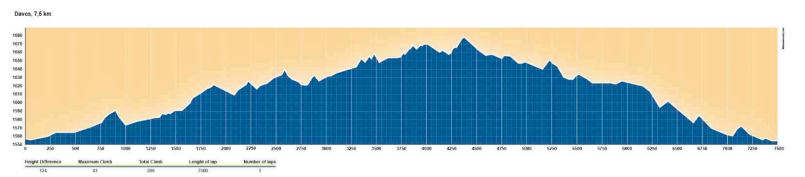
The 7.5 k course profile.
“It’s a mixture of being patient with the two laps, and then saving a bit for the finish,” Randall continued. “At the same time, you want to keep a good, aggressive pace the whole time; you can’t really sit and wait out there.”
Randall’s teammate on the podium last weekend in Dusseldorf, Sadie Bjornsen, is more excited about sprinting on the second day this weekend. On Tuesday, upon hearing that the 15 k was getting shortened to 10 k, she did a little dance. With subsequent snowfall enabling the longer distance to be reinstated, she’s now taking a wait-and-see attitude.
“Tomorrow is just a day to play around and see what I can do,” she said. “The 15 k skate has never really been my strong point.”
Though her preferred discipline falls on the second day of racing in Davos, Bjornsen is confident that her energy will carry through to the sprint.
“I think APU sets us up to do two good, hard days, so it should be okay,” she said. “Hopefully, I’m going to make some heats!”
Bjornsen is also still riding on a confidence-boost from her team sprint podium in Dusseldorf. Sunday marks her last World Cup race until the city sprints in Milan, Italy after the New Year.
Liz Stephen, who sat out Dusseldorf and won the 5 k skate FIS race in Seefeld, Austria, should feel right at home on the 15 k course on Saturday.
“I am very excited for a 15 k skate!” she said last weekend. “They are some of my favorite races.”
Holly Brooks, who recently got word that a start in the Tour de Ski could be a possibility, has had outstanding results this season in both sprints and distance races. The pressure is on for her to turn in a few more and stay healthy through this weekend and next in Rogla, at which point teams have to submit their Tour rosters.
Canadian Chandra Crawford in Sunday's team sprint in Dusseldorf, Germany. Photo: Fischer/NordicFocus
Ida Sargent is looking to move past her frustrating start to the season with a good showing in both the distance and sprint days, fuelled by raw Swiss beef.
The Canadian women are skipping the 15 k to be able to leave the gate in full force for Sunday’s sprint. Chandra Crawford, who was disappointed with getting bumped off the podium in Dusseldorf, could definitely be a contender in the heats.
Perianne Jones matched up with Crawford for a 7th place showing in the team sprint last weekend, and will be looking to redeem missing out on the heats there by .7 seconds with a solid qualifier this Sunday. Dasha Gaiazova, who was stronger in Kuusamo than in Dusseldorf, should not be overlooked either. She’s a solid skate sprinter, and has considerable experience under her belt.
Men:
The American men’s distance squad will be led by Kris Freeman, who has had a slow start to the season so far. While he would have been more confident in his ability to dial everything in for a 15 k on Saturday, Freeman is glad for the sport that the 30 k is back on the schedule.
Kris Freeman (USA) in Sjusjoen. Photo: Fischer/NordicFocus.
“I don’t really know how to race it anymore, but I feel good,” he said on Friday. “So, it should be a good race tomorrow.
“I don’t really know what to expect from a 30 k freestyle—I haven’t done one since 2004,” Freeman continued. “I think a top-15 would be a solid effort tomorrow, but I’m not going to count myself out for something better.”
After Kuusamo, he wrote on his blog about some issues trusting the advice of his ski technician, but said that those problems are now behind him.
“I made the classic amateur mistake of picking a ski that was good last time, rather than picking the ski that was good on the day,” he explained. “I’ve got great skis, I just need to be confident to pick the best one on the day… Even though I’m 31 I still need to be reminded of that from time to time.”
As for the course itself, it’s a bit of an intimidating one for the men. Four laps around the 7.5 k loop that includes twice as much climbing as the women’s race.
“This is an incredibly hard course,” said Freeman. “There is just really no letup. You get to the top of the course and it’s just gradual downhill all the way down. There’s just not much recovery. The key to having a good race is just not to blow up.”
Tad Elliott climbing in Sjusjoen. (Photo: Liz Stephen)
Freeman’s frequent training partner, Noah Hoffman, is also looking for a top-15 on Saturday. His top World Cup results in the past have been at 30 k and over—as one of his coaches, Zach Caldwell, pointed out this week, he’s got high-altitude Colorado living on his side for the long climbs in Davos. Each 7.5 k lap features 984 vertical feet of ascending, with the course itself reaching as high as 5,400 feet above sea level.
Fellow Coloradoan Tad Elliott also thinks the 30 k distance is a better race for him. “I’m happy they switched it back,” he said. “For sure, that’s more in my wheelhouse.”
On Saturday, Elliott said he’s hoping “not to blow up! Hopefully the result will happen,” he concluded.
Like Bjornsen, Elliott is also done with World Cup racing for a little while after Davos, and will skip the sprint and fly home on Sunday.
Continental Cup starter Lars Flora also has reason to look forward to the distance skate, as he placed in the top-40 twice in the longer events at World Championships last season.
For Sunday’s sprint, Andy Newell and Simi Hamilton are definitely the ones to watch for. Both American sprinters are sitting out the 30 k to save up for their favored event. Newell was knocked out of the quarterfinals in Dusseldorf after qualifying in 14th, while Hamilton sat the weekend out due to illness.
In Davos, Newell said he’s learned how to race the two-lap course in his experience on the World Cup circuit.
Ivan Babikov (CAN) in the 50 k at World Championships in Oslo, Norway.
“I’ve had difficulty getting through some of these rounds, but I think I’ve learned a lot racing here over the years,” he said. “I’m just really going to try and…ski relaxed on the first lap, and then work my way past some people on the second lap and have a strong finish. I think that’s going to be key.”
Newell noted that the sprint course wasn’t particularly challenging in terms of terrain—not a lot of V1 hills. Though he tends to be stronger on the vertical, transitions also work to Newell’s advantage, which he’ll try to play up on Sunday.
On the Canadian side, the biggest news is the fact that Devon Kershaw and Alex Harvey are sitting out the entire weekend to save up for the Tour de Ski. On Saturday, that leaves Graham Nishikawa and Ivan Babikov representing the maple leaf.
“Its been a long time since we’ve done a 30 k – individual start especially,” he said. Babikov does well on courses featuring climbing, and though the ascents in Davos are more long than steep, he’s expecting a good effort.
After a weekend of city sprinting in Germany, including gluhwein, spills, and DSQ’s, the FIS World Cup heads to Davos, Switzerland, this weekend for another pair of skate races.
Saturday sees a rare beast on the World Cup — a long distance individual start skate race (15 for the women, and 30 k for the men) — while Sunday features what might be the most intense sprint of the World Cup season.
While Dusseldorf lacked the full cup complement of skiers, missing most of the distance specialists, Davos, home of Dario Cologna and one of the most spectacular World Cup venues on the circuit, will see all of the regulars return to racing.
There are plenty of story lines heading into the weekend, but FasterSkier fills you in on some of the most intriguing.
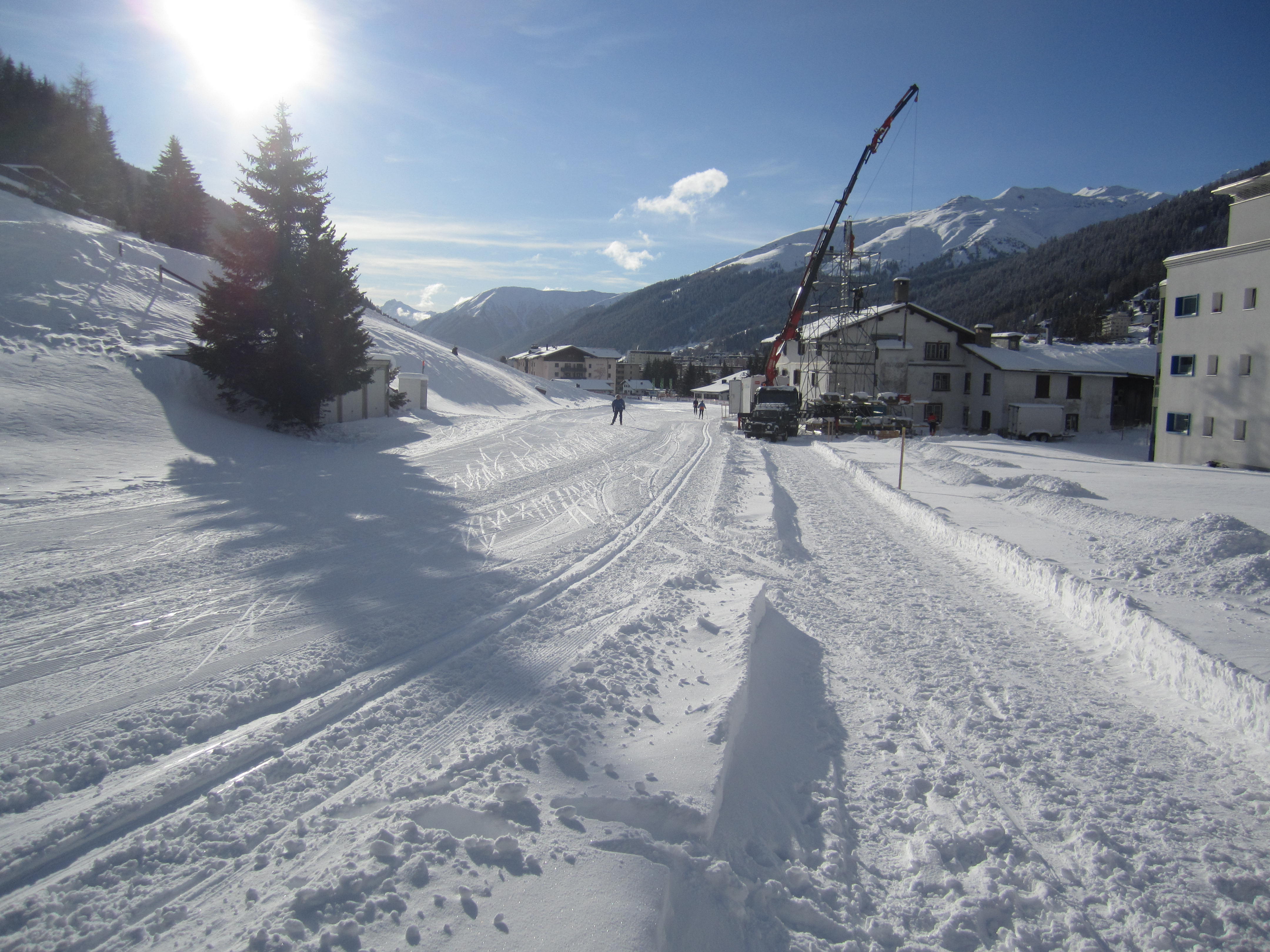
Just up the trail from the stadium in Davos, Switzerland.
Kikkan Randall vs. Marit Bjoergen
If you’re the kind of person who likes winning streaks, try this one on for size: Kikkan Randall has now won three consecutive World Cup skate sprints.
While the connection is somewhat tenuous – it counts Dusseldorf 2011, as well as Liberec, Czech Republic and Drammen, Norway, but skips over the World Championship sprint in Oslo – it obviously matters, because U.S. Ski Team (USST) Head Coach Chris Grover was eager to mention it in an interview last weekend in Dusseldorf.
“When you think about it, she’s won the previous three skate sprints on the World Cup,” he said following her win last Saturday in Dusseldorf.
“That’s a pretty impressive record.”
Grover also mentioned that Randall fell at World Championships, cutting short her chances there. It was also the last time she faced Marit Bjoergen (NOR) in a skate sprint.
In an interview with FasterSkier on Friday, Randall wasn’t shying away from facing the Norwegian star.
“I’m excited!” said Randall of the prospect of facing Bjoergen in the sprint. “I was in the final with her here last year, and I’m looking forward to going up against her again.”
Randall is also currently the Sprint Cup leader. While it’s still early in the season, Randall is enjoying the experience.
“It’s a nice bonus for sure,” she said, of being the top-ranked sprinter on the World Cup. “I’ve been steadily working my way up to that point; it’s just fun to have an American in that position.”
But speaking of streaks, Marit Bjoergen owns a considerable one herself. The Norwegian queen has already collected 5 consecutive wins this season (if you count all three days in the Kuusamo mini-tour. Which you should, except for the individual times on Sunday – Bjoergen started so far clear it would have taken a miracle for her pursuers to catch up).
She won the skate sprint at World Championships in Oslo, and hasn’t faced off in a skate sprint against Randall since last winter in Drammen, where the American finished first, and Bjoergen was left off the podium in 5th.
Bjoergen may have a slight advantage in skipping Dusseldorf to train, but if you managed to catch any of Randall’s exploits in Dusseldorf – specifically her last-lap heroics in the team sprint, where she blasted from ninth to second place and history in the space of 850 meters – you could hardly say the high-energy Alaskan looked fatigued.
The Disappearance of Justyna Kowalczyk
In the first two weekends of the World Cup season, Kowalczyk (POL) has appeared just ordinary. She has yet to win a medal, and has been dominated not just by Bjoergen, but by most of the Norwegian women.
While the short laps and relatively small and punchy climbs in Sjusjoen, Norway, didn’t exactly suit the Polish superstar’s strength, a week later in Kuusamo, Finland, it was a different story.
Both individual skate and pursuit classic days featured tough courses with major climbs, difficult races in which Kowalczyk has traditionally excelled, even dominated. Her demise was especially worrying in the 10 k classic – while her ninth place finish isn’t catastrophic, in the last year she had no fewer than seven medals in World Cup classic races over 10 k.
In Davos, she will be handed yet another prime opportunity to turn her season around. The individual start distance skate will be filled with big climbs, giving Kowalczyk an opportunity to use her motor, rather than her woeful descending and tactical abilities.
And speaking of her lack of tactical abilities, last year in Davos in the skate sprint made some dubious decisions leading to her being bumped to the back of the final. In the last hundred meters, Kowalczyk made the mistake of cutting off none other than Kikkan Randall.
Ski testing and athlete access to the course.
The Rise of Vibeke Skofterud and Inter-Female Norwegian Competition
Vibeke Skofterud has been the surprise Norwegian this season. Everyone knew Bjoergen was hot, and Therese Johaug had a coming out party of sorts in Oslo, but Skofterud has never really been given top billing – she’s best known for anchoring a relay team that seems to be skiing so fast that they could probably survive with just about anyone skiing the final leg.
While Skofterud’s fast starts have been debated extensively in the blogosphere, FasterSkier staff are interested to see how she does in her third World Cup weekend, particularly due to the race formats.
Skofterud seems to have the package to get it done this season, whether the race be sprint, distance, mass start or individual – but so does Johaug. She and Johaug seem to be locked in competition for second-best Norwegian female. Skofterud is the better skate sprinter, while Johaug is the hill-climbing ‘Energizer Bunny’ – the weekend should be a good match-up between the two.
Surprise Swiss Sprinters
The Swiss sprint team pulled off plenty of impressive performances in Dusseldorf. Most notably was Laurien Van Der Graaf, who managed to finish 3rd in her first trip to the semi-final and final.
For the men, without Dario Cologna in attendance, three managed to slip in to the top 12, including second place qualifier Eligius Tamborino – a tall, thin man with a serious expression. Martin Jaeger and Joeri Kindschi also picked up top 15 places – just Kindschi cracked the heats in Davos last year, so you can bet the home-country boys will be skiing as hard as they can.
It has to be said that people who perform well in Dusseldorf are not guaranteed to perform well in other venues (see Wenzl, Josef).
However, at just 24 years of age, Van Der Graaf has yet to even enter her prime. Sunday will be a good test of whether she has broken through, or whether her performance in Dusseldorf was a fluke.
At the very least, the Swiss are coming off a confidence-booster of a weekend in Dusseldorf. In Davos they have home course advantage, and they also have legendary Norwegian sprinter Tor Arne Hetland for a sprint coach. While the crowds may show up mainly to support home-town hero Cologna, if they are given someone else to cheer for, they won’t hesitate to do so.
North Americans in the Sprint Arena
Speaking of sprinters, Davos has been kind to the North American contingent in the past.
Last season, Canadians Phil Widmer and Len Valjas both finished in the top 20, securing spots for Oslo, while Simi Hamilton also skied well enough for 16th place, his best finish on the World Cup last season.
And there are a few North Americans who need to borrow a little bit of Davos magic.
Hamilton (black, far right) makes a move in Davos, 2010.
Hamilton desperately needs to find some of that form he displayed last season in the Swiss ski mecca. He has had a miserable start to his European campaign thus far, suffering from illness and failing to start an individual race yet.
Skyler Davis would also like a bounce-back weekend — the young American finished last in his first World Cup start last weekend in Dusseldorf, and didn’t have a much better experience in the Team Sprint. But American fans shouldn’t panic, as in Len Valjas’ first World Cup race, he also finished atop the reverse podium.
While Davis was disappointed with his last place finish, he put it into perspective.
“Obviously it sucks to get last,” he said. “But I was 17 seconds out on my first World Cup.”
As for the women, Chandra Crawford took advantage of Dusseldorf to break out of her slump of sorts, finishing fourth in her first final since 2008.
Crawford would like to keep the ball rolling — she has started the 2011-2012 season far better than in the past, and another trip to the final would keep her in good standing.
Perianne Jones would like to find her way through to the heats as well. After making the Canadian World Cup team on the back of a 6th place finish in the Team Sprint at World Championships last February, the 26 year old is coming off one of the best training seasons of her career.
Her 32nd place in Dusseldorf (by a mere .2 of a second) was tough to swallow, and when paired with Crawford the two Canadians finished 7th on Sunday, just missing out on the money.
Another Canadian sprinter to watch is Dasha Gaiazova – she came out hot in Kuusamo, but struggled in Dusseldorf. Gaiazova was the strongest female Canadian skier on the World Cup last season, and she has traditionally been a better skater sprinter.
After a start-wand snafu in Dusseldorf, Ida Sargent will look for more in Davos.
Sadie Bjornsen (USA).
Fellow young American Sadie Bjornsen is fresh off a 36th place finish in Dusseldorf. More importantly, Bjornsen found herself paired up with Kikkan Randall on Sunday, which the rookie American admitted was a major bonus.
In an interview Friday, Bjornsen said that she liked the sprint course, and was excited about Sunday.
“I think it’ll be good, there is a good amount of hills, and a good amount of transitions, and everything in there, so it should be fun,” she said.
While the story of Sunday was Randall’s final-lap hustle, Bjornsen should be given proper credit – she was far from dead weight. In her first ever World Cup team sprint, Bjornsen stayed tight with the pack, and made sure she tagged off to her fast-finishing teammate in good enough position to give Randall a chance. Bjornsen picked up the first World Cup medal of her career, and a truck load of confidence heading to Davos.
“For the sprint it [the World Cup medal last weekend] has given me a little confidence, which is good — we’ll see what happens,” said Bjornsen.
This is also Bjornsen’s last World Cup weekend before heading back to the U.S., and she wants to make sure she goes out in style.
“Hopefully I’m going to make some heats!” she said of Sunday.
Will the North American (Distance) Men Please Stand Up?
With the exception of Alex Harvey and Len Valjas’ seemingly endless supply of tricks up his sleeve (hey, the guy has big sleeves), there has not been a lot to cheer about if you’re a fan of North American distance skiing.
Fine, so there have really only been three distance races thus far on the circuit. But between Canadians Ivan Babikov, Devon Kershaw, Graham Nishikawa, and Americans Kris Freeman, Noah Hoffman, Tad Elliot, and Lars Flora, all primarily distance-focused skiers, there have been a whopping three top-30 finishes.
Nishikawa in Bruksvallarna this November. Photo: Erik Wickström
Call us greedy here at FasterSkier, mainly because the American distance women seem to have hit their stride, but we think the NorAm male contingent also has the speed to get the job done. Unfortunately, this weekend doesn’t seem to be the best chance – Freeman and Kershaw are both better classic skiers, while Hoffmann and Elliot are all still quite new to the circuit, and are coming into Davos for the first time.
Canadian continental cup holder Graham Nishikawa is no stranger to Europe, but has yet to hit a race out of the park.
The Canadian contingent will be a little light on Saturday – both Alex Harvey and Devon Kershaw are sitting out on the recommendation of the Canadian coaches, who are focused on the Tour de Ski.
Dario Cologna, Petter Northug, and… Ivan Babikov?
Swiss superstar Dario Cologna, with his own large fan club, will be present. You can bet the crowd will be out, and on his side. Cologna is incredibly well-rounded, as when he is at the top of his game he can win anything from a 50 k classic to a skate sprint, as he has proved with two Tour de Ski wins.
Cologna with his 2011 Tour de Ski trophy. Photo: Fiemme2013.
Dressed head to toe in black, and leading what has become a strong team, the Swiss monster has yet to emerge victorious this season – can he give his fans something to cheer about?
But it won’t be an easy road – primarily due to Norwegian ace Petter Northug.
Unlike last year when he limped out of the gate due to over-training, Northug has come out swinging to start of the 2011-2012 season. He called his doubters on the carpet by finishing 2nd and 1st in the two individual start races, putting a serious dent in the ‘he can only win mass-start finishes’ whining. Then during the 15 k classic pursuit in Kuusamo, after a game of cat and mouse with a seemingly disinterested Cologna, he uncorked his traditional finishing speed to gain an early lead in the World Cup Overall standings – a title which eluded him last season.
Last season in Davos, Northug was very human, failing to get out of his quarter in the sprint, and falling to 28th. He also struggled in the 15 k classic race, finishing 13th. FasterSkier does not recommend betting on that happening again – Northug seems poised to dominate the World Cup circuit this season.
Ivan Babikov may seem like a surprise add-on to the favorites list, but this weekend has some serious upside for the hill-climbing Canadian.
He obviously won’t be in contention for the medals (or, let’s be honest, qualification) in the skate sprint – not that much has changed – but the distance race Saturday is something he has been looking forward to all year.
On Friday, Babikov said that he was excited to race Saturday.
“Its been a long time since we’ve done a 30 k – individual start especially,” he said. “In Davos it’s at altitude, and a pretty hard course, so I’m looking forward to it.”
Babikov has always done well on climber-friendly courses, and he described the hills on Saturday’s 7.5 k as “not really steep climbs, but long.”
“Pretty much half of the course is all up and the second half is all downhill, which you still have to work hard,” he said. “It’s going to be a really hard race.”
He has also somewhat bucked his recent trend of slow starts – his 16th place finish during the 10 k freestyle during the Kuusamo mini-tour is a positive indication that he has the fitness and the speed earlier than usual.
Doogiski over at NordicXplained asked how Pentsinen’s 4.3 second win in qualification on Friday stacks up historically. Quite impressively, it turns out.
That’s the second largest qualifying round winning margin for the men’s field in WC, OWG or WSC races. The only larger one was almost 10 years ago, with a 4.7 second victory by Björn Lind in a freestyle sprint in Germany in December of 2001. So we’re reaching back to the very beginning years of sprinting here.
Ola Vigen Hattestad came close to this once last season, winning qualification by 3.86 seconds.
A winning margin greater than 4 seconds in qualifying has happened more often with the women: six times. And it’s basically a who’s who of dominant female skiers over the past decade: Skari, Neumannova, Bjørgen (twice), Kowalczyk and Majdic. Skari’s is particularly absurd. She won qualifying in a WC sprint in Italy way back in the day (December 2001 again) by 8.4 seconds! It was classic, so maybe waxing was an issue, or maybe Skari was just that fast. Interestingly, the woman she beat that day be 8.4 seconds was Petra Majdic.
More generally, the typical winning margin in qualification is just under a second for the men and about 1.5 seconds for the women.
Marit Bjørgen
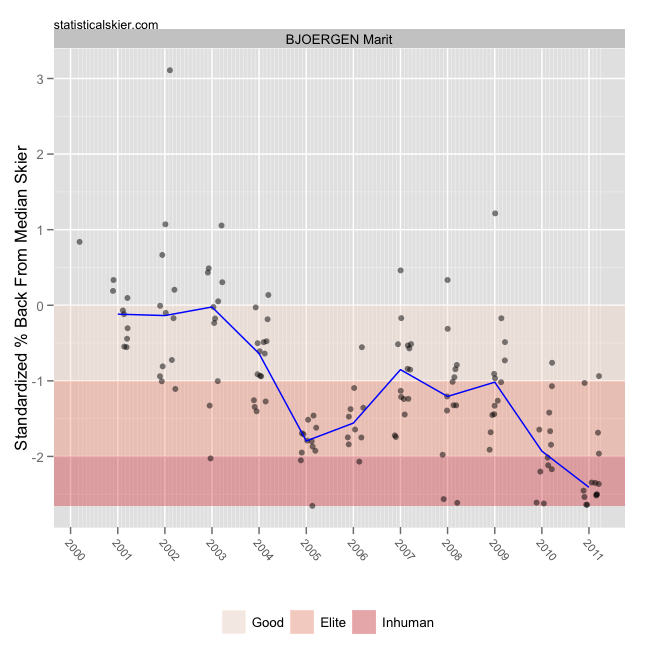
And how is Bjørgen faring so far this year?
She’s certainly still winning everything in sight, but she’s not really faster than last year. Although, that’s not surprising, since “regression to the mean” would lead us to believe that she’s regress a least a little this season.
Assorted Men
A few of the men who had strong weekends:
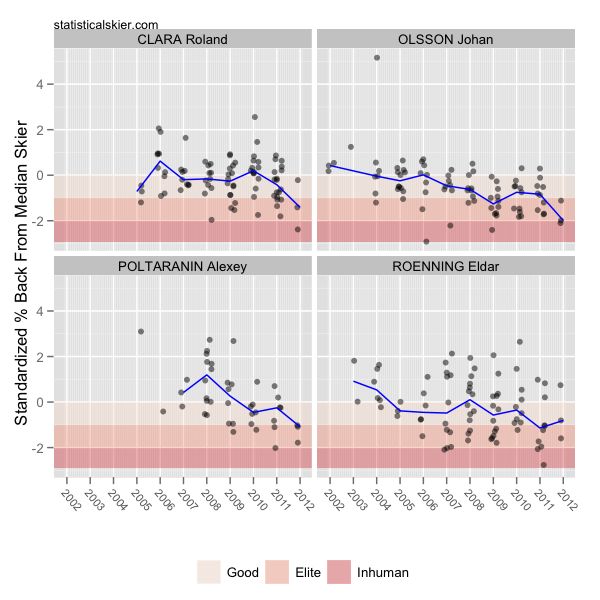
Eldar Rønning ended up doing very well in the overall mini-tour thanks to some very strong classic skiing on the last day. But overall, his skiing hasn’t been out of this world, and might even be a bit of a step back from last season. Remember that overall tour placings are heavily dependent on the specific events. In this case, strong classic skiers had a lot more space to make up ground, and so the overall tour may have favored classic specialists somewhat. If the techniques had been reversed, Rønning may not have fared so well.
On the other hand, Clara, Olsson and Poltaranin have all skied somewhat better so far this season overall. It’s particularly exciting to see from a guy I think a lot of people didn’t have on their radar (Clara), an older skier coming off a few bad-ish seasons (Olsson) and a guy from a “different” country (Poltaranin).
I plan to talk about sprint heat times when I can, but FIS messed up the heat times royally (at least, the times that are available online), so not this week. Maybe next time. I’ll have words about the North Americans on Wednesday…
There were plenty of surprises in Saturday’s World Cup opener in Sjusjoen, Norway. Marit Bjoergen (NOR) was most definitely not one of them.
The “Queen” of the 2011 World Championships with four golds and a silver served notice that she would once again be the woman to beat on cross-country skiing’s biggest stage.
Marit Bjoergen charging to victory (Photo: flyingpointroad.com)
The 31-year-old Bjoergen threw down from the get go, building an early lead en route to a 27.1 second victory over Charlotte Kalla (SWE) in the 10km freestyle event. Bjoergen’s teammate, Vibeke Skofterud (NOR) rounded out the podium in third, 1.9 seconds behind Kalla.
Bjoergen’s victory is hardly unexpected, but the performance of the Norwegian women’s team turned heads—no easy feat in this global ski powerhouse of a country.
In a showing reminiscent of certain men’s World Cup classic events on Norwegian soil over the past decade, the women loaded the top of the result sheet, placing seven skiers in the top-10, and an almost unheard of nine in the top-13.
Biathlete Tora Berger impressed with a fourth place result, ahead of Marthe Kristoffersen and Therese Johaug. American Kikkan Randall, a somewhat surprising candidate to break up the Norwegain juggernaut, finished eighth in her best career World Cup distance race.
Then another red suit—four-time World Junior Champion Ingvild Flugstad Oestberg in ninth, and defending overall World Cup Champion Justyna Kowalczyk (POL) tenth.
With the added nation’s group quota, 18 Norwegian women got the call. They dominated the event from the early bibs on. Berger, with no cross-country resume of note, set the time to beat.
Known for her tenacity, the Olympic gold medalist in the individual biathlon event, attacked the first climb as if it were the last, driving the tempo, face twisted with exertion.
At the end, she couldn’t hold off the xc specialists, missing out on the podium by 14 seconds. But Berger represented the biathlon side quite well. While male Norwegian biathletes have fairly regularly taken a stab at straight cross-country races, including playing integral roles on Championship relay teams, the practice has been less common for the women.
Given the strength and depth of the Norwegian women’s distance team, it is unlikely Berger will follow suit, but if today she proved that she can ski with the best, rifle or no.
Skofterud, starting later, took over from Berger, establishing a new standard. She led at every time check, and spent many minutes ensconced in the leader’s chair at the finish. Kalla, who started slowly, skiing smooth and strong crept up the leader board as the race progressed, and was able to squeeze in front of Skofterud for a relatively quiet second place finish.
Despite all the impressive results at the top of the field, the biggest story of the day may have been the relatively uninspired performance of Justyna Kowalczyk (POL).
While Bjoergen is unequivocally the favorite in any given race, it has been Kowalczyk who has won the last three overall World Cup titles with her day-in and day-out labors.
But on this day she appeared a mere mortal at best. Her stride was labored and her skate technique, always somewhat unorthodox, stood out for its lack of efficiency.
With man-made snow packed firmly on top of a paved roller-ski course, the track was rock hard when the women hit the course. Hard and fast conditions have never favored Kowalczyk, but that wouldn’t explain the full 1:12 deficit to rival Bjoergen.
It would have taken an exceptional performance for Kowalczyk to unseat the Norwegian. Skiing like a machine, every stroke a perfect balance of power and control, Bjoergen started fast and got faster.
She never gave an inch, even leading at the meaningless time-check 30 seconds into race.
The victory gave Bjoergen a record 47th World Cup victory, moving her ahead of another Norwegian great, Bjorn Daehlie.
“I’m very happy with the race,” Bjoergen said at the finish. “I was a little bit nervous before the start because I didn’t know how the shape was and what the other girls have done in the summer.”
Clearly they hadn’t done enough to close the gap. And if today is any indication, the rest of the world is going to have its hands full with the Norwegian women as a team.
“I knew that we have a very good team,” Bjoergen said. “Today you can see it on the results.”
Kalla executed her race plan perfectly, telling reporters after the event, that her strategy was to was “have the race under control and then to increase my speed.”
She did that so well, that when she hugged Bjoergen in the finish pen, the Norwegian needed to ask where Kalla finished, expressing surprise as the Swede was not a major factor in the splits earlier in the race.
And like Bjoergen, Kalla was not sure what to expect of her bidy in the first real test of the season.
“I was a bit nervous before the race,” Kalla said, mirroring Bjoergen’s remarks. “I did not know in what shape I was.”
With Norway front-loading the results, there had to be a number of disappointed skiers from other nations. The first race of the year always produces some anomalies, and today the likes of Aino Kaisa Saarinen (FIN), Katrin Zeller (GER), Stephie Boeller (GER) and Hannah Brodin (SWE) all struggled.
Young Krista Lahteenmaki (FIN) was solid in 11th, but did not show the snap that characterized her 2011 breakout season.
Anna Haag (SWE) was a not-too-shabby 15th, but as the defending Olympic silver medalist in the skiathlon Haag wasn’t thrilled. “Had hope for faster legs today,” she tweeted after the race. “Hope for a better day tomorrow!!”
The American women are not going to match the Norwegians in terms of sheer numbers, but the mood in the waxroom following the race had to be as jubiliant.
Randall’s eighth bettered the 11th she earned last March in Lahti in the 10km skiathlon. Add to the fact that Randall’s best individual start distance races have come in classic, and today’s peformance is an excellent sign.
The former sprint-specialist looked strong and controlled throughout the race—though appropriately spent in the homestretch. She missed out on seventh by a literal fraction of a second, crossing just one tenth behind World Champion Johaug.
Randall wasn’t the only American with an outstanding day. Liz Stephen showed no ill-effects from the foot problems that plagued her last year, demonstrating that her strong performances at World Championships were a step up the ladder, not a blip.
Stephen, starting at bib five had few splits to work off of, and was consistently among the early leaders. Her 18th place matched her own career best set last year in La Clusaz. And while that was a mass start race, which can skew points somewhat, Stephen ‘s 49.24 points today were far and away a best as well.
Three other Americans raced. Holly Brooks finished 36th, Sadie Bjornsen was 54th and Ida Sargent 66th.
A full report on Randall and Stephen’s races can be found here.
The Canadian women’s team competed in a small race in Sweden yesterday and is not participating in the opening World Cup weekend.
Regardless of nation affiliation, Therese Johaug was possibly the highlight of the entire World Cup season. Whether you call her ‘Go-Haug’, the ‘Energizer Bunny’, or ‘that tiny blonde chick who never seems to get tired’, Johaug had a massive bounce-back season, churning out top results over the course of the entire year.
She won two Stage World Cups, including a commanding one-minute lead on the Final Climb up Alpe Cermis during the Tour de Ski, which brought her up to second in the event.
It was the same hill-climbing prowess that catapulted Johaug to victory at World Championships in Oslo, where she pulled away from Marit Bjoergen and Justyna Kowalczyk to become World Champion in the 30 k skate. Most importantly, Johaug’s prowess broke up the Bjoergen-Kowalczyk club, and introduced a new power into womens skiing.
With Bjoergen knocking the stuffing out of every single woman on the circuit this year, and Johaug stepping up to a new level, the Norwegians have an unbeatable 1-2 punch in women’s skiing. Add in the aging but not-quite-done Kristen Stoermer Steira, and one of Astrid Jacobsen, Marthe Kristofferesen, or Vibeke Skofterud, and it’s not hard to understand why the Norwegian women won every single 4-woman relay they entered this year (they didn’t bother going to Rybinsk, Russia).
Speaking of Stoermer Steira, the lanky distance-specialist was on her way to yet another wooden medal (that would be a fourth place finish) at a major event, when Charlotte Kalla stepped on her pole, putting her to the ground.
After being called on the carpet by FasterSkier last year for terrible distance skiing ability, the Norwegian men didn’t really rise to the occasion. (And yes, we know that the Norwegian World Cup team probably doesn’t read FasterSkier season previews.)
Regardless, Northug was once again alone in the top 15 of the Overall World Cup standings, while Ola Vigen Hattestad was 18th, and Eldar Roenning was 19th – again, that’s just not good enough for a country like Norway.
However, there were flashes of brilliance, as Roenning finished in the top 10 every time a 15 k classic popped up on the scheduled, including a silver-medal winning effort at World Championships, just ahead of Martin Johnsrud Sundby. And 21 year old Finn Haagen Krogh had a stellar World Cup Final in Sweden, where he won the second last stage before falling to Northug on the final day of racing.
Everyone knows Northug is fantastic skier, so much so that it barely rates mentioning at this point. His finish-line and mid-race exuberancehas almost overtaken his skiing ability in news-worthiness. But Northug might want to put things in perspective – the all-time World Cup win leader is Bjorn Daehlie at 46 victories, and Northug only has a piddly ten. And if the
Northug stepping across the line in the 4x10km relay in Oslo after coming to a full stop just inches before the finish.
Norwegian biathletes have their way, he won’t be picking up another one this weekend.
What You Need To Know for This Season
The vaunted Norwegian Sprintgutta is without a doubt the most bad-ass ski institution in existence. Between their ridiculous website, their unbelievable strength training videos, and their on-course antics, it impossible not to get excited about the men of ‘Den Roede Arme’ – especially when they pack four of their members into the top 15 in the Sprint Cup standings.
Marit Bjoergen became the all-time leader in World Cup wins last season with an astounding 46, and the superstar had one hell of a season (just look at that FIS results page – it can’t get much better), before sitting out the Tour de Ski, where her main rival, Justyna Kowalczyk took the victory.
But this year, Bjoergen isn’t letting the Tour de Ski slide – the dominant Norwegian who has won just about everything there is to win in cross-country skiing is focusing on the Tour, and if it goes as well as the last two major events she focused on (Vancouver Olympics, 2011 Oslo World Champs), there won’t be any room left in her trophy cabinet.
Former World Junior Champion Marte Elden has opted to take some time away from skiing at just 25 years old. She had an outstanding World Cup season in 2010-2011, finishing 20th in the World Cup Overall, and a shocking ninth in the Tour de Ski. Despite those stellar results, she pulled the plug due to health concerns.
Ola Vigen Hattestad, who has been a force on the sprint circuit the last couple of years, is also doing the Tour de Ski this year. While his distance skiing is nothing to write home about, it should make things harder for the all-around athletes to get sprint points, making things exciting.
In just her fifth season on the World Cup, the 23 year old Johaug finished fourth in the World Cup Overall, second in the Tour de Ski, picked up two World Championship gold medals, and has 11 career World Cup podiums. To say that the future is bright for Norway is an understatement.
Johaug is also a headline generator – FasterSkier could probably write an entire preview just about all the stuff she’s done over the summer, which includes gymnastics, watching her own race with Bjoergen, and climbing a mountain.
Who You Should Watch
With Norway, it’s pretty tough to predict stand-out performances. This is mainly due to the depth of the team, but also because there are so many that it’s tough to define what truly is a ‘breakout season’ for a young Norwegian.
However, FasterSkier doesn’t shy away from making predictions, so this season we’re going to bank on young Sindre Bjornestad Skar as the up and comer to watch.
The Norwegian squad is so deep that this 19 year old junior likely won’t get too many World Cup starts, but he was one of the strongest Norwegian juniors last season. Skar won the 10 k skate at World Junior Championships in Otepaa, Estonia, last winter, as well as finished 10th in the sprint, and 14th in the pursuit.
Marit Bjørgen pretty much wiped the floor with folks last year in distance events:
As a stats guy, when I see extreme events I tend not to expect them to repeat themselves. The general principle here is called regression to the mean. Extreme events are just unlikely, so it doesn’t make sense to expect them to happen repeatedly. From a numbers perspective, Bjørgen’s season was pretty much unrivaled, so if I were a betting man I’d wager that she won’t be as dominant next year.
At the very least, I wouldn’t expect her to win by a consistently large margins over the field, even if she actually wins nearly as many races. But you never know!
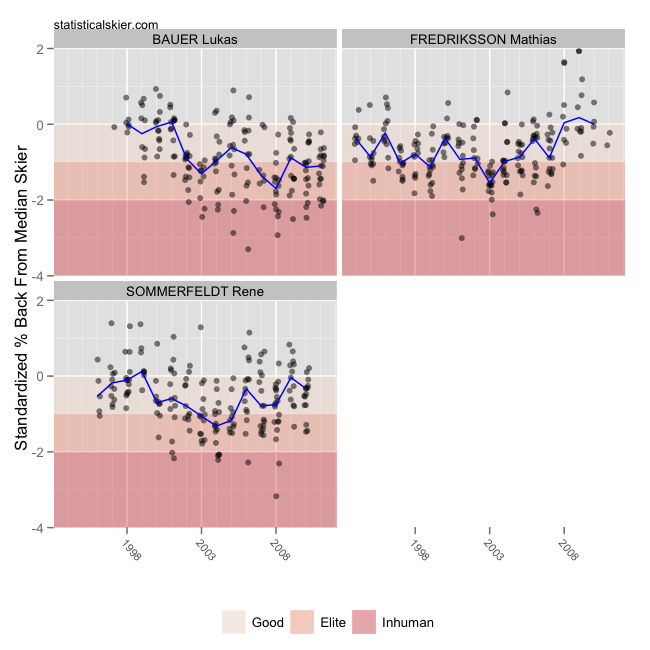
When people have had extremely good seasons in the past, sometimes they can sustain is for a few years in a row, other times not. For example, here are some examples of some men who had a strong season but weren’t really able to sustain that level:
Fredriksson’s 2003 campaign is the most obvious example here. Sommerfeldt had great seasons in 2003 (second place in the WC overall) and 2004 (first place) but couldn’t sustain his 2004 performance. Similarly, Bauer had an amazing season in 2008.
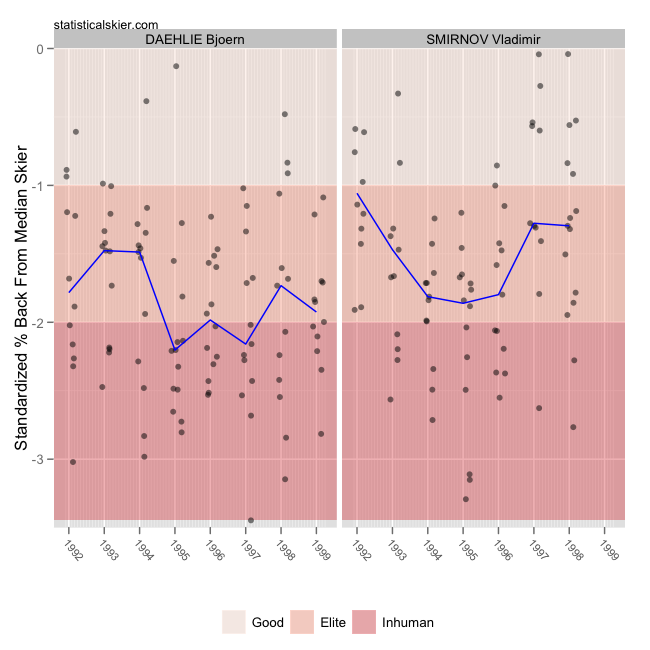
Two examples of people who managed to sustain some level of dominance for more than a year or two were Björn Dæhlie and Vladimir Smirnov:
These guys were already pretty much top of the heap, but each seemed to step things up for three consecutive seasons. Dæhlie for 1995-1997 and Smirnov for 1994-1996. Which pattern Bjørgen follows remains to be seen…
I received an email recently asking about field strength for the men’s and women’s WC fields, particularly as it applies to mass start races. Lately we’ve seen the men’s field engage in a fair bit of pack skiing, whereas the women’s field strings out more quickly.
First, I want to dispatch with a common bit of lazy rhetoric in this area. Saying that the women’s field is ‘weak’ is not the same as saying the women are weak. I’m not sure what other people mean, but what I mean by a ‘weak field’ is simply that there are fewer skiers able to finish close to the leader. To say that there are fewer women able to (nearly) match the performance of Marit Bjørgen than there are men who can (nearly) match the performance of Petter Northug is not to say that the women are somehow less talented than the men. To the extent that this happens, I consider it primarily a legacy of gender inequalities in sports and society in general. We’ve made a lot of progress in bringing more women into this sport, but professional women’s skiing still must be several decades younger than men’s professional skiing.
With that caveat out of the way, let’s look at some data. My preferred metric for this sort of thing is to look at the number of skiers within a fixed percent of the leader. It’s sort of a ‘musical chairs’ analogy: the more skiers you have fighting for a fixed number of chairs, the more ‘competitive’ the field. Let’s begin with interval start races (click for full version):
The lines track the median number of skiers within that percent of the leader by season for men and women in interval start races only. The top two panels (0.25% and 0.5%) can be ignored for now; those percent back’s are too small to be meaningful with interval start races. They will be more relevant when we look at mass start races, which are inherently less spread out.
Over the last decade, this in quite unambiguous. There have tended to be more (sometimes considerably more!) men within a fixed percent of the winner. The men’s field appears to have seen a gradual increase over time, although there has been plenty of variation from year to year. The women’s field appears to have been more steady, with the overall number of skiers within a fixed percent of the winner remaining relatively unchanged over time. On a shorter time scale, the women appear to have seen a decrease in the number of skiers with 1.5% – 3% of the winner over the past 4 seasons or so.
How does this compare to mass (and pursuit) start races? (click for full version)
Note that the 0.25% and 0.5% panels actually have some useful data in the case of mass start races. The difference here between the men and women is even more stark. Of course, it should be noted that the number of mass/pursuit races on the schedule each season is fairly small, even nowadays. Before the last decade, they were either experimental just non-existant. Despite the small sample size, the difference between the men’s and women’s fields is noticeable.
The trends for the men are a bit different when compared to the interval start races. We saw a general growth in the number of skiers within a fixed percent back of the leader early in the 00′s, but things seem to have steadied since then. Notice that the women’s field sees a slight decline in the past 4 season similar to what we saw with the interval start races.
Well, what could have happened over the past 4 season? I’ll tell you what: Marit Bjørgen and Justyna Kowalczyk:
Bjørgen gets all the press for crushing people, but if you removed Bjørgen from the picture, Kowalczyk would likely be nearly as dominant (at least in distance events). Only Therese Johaug seems to have figured out how to compete with these ladies just last season, and then only occasionally. I hoped that Charlotte Kalla would be more consistently competitive as well (and she may yet be; she’s pretty young) but right now we’re still waiting.
So I think that it’s fairly unambiguously true that the men’s WC field is more competitive in the following sense: if each field were a game of musical chairs, with skiers competing for 30 chairs (WC points), there are simply more men playing the game than women. That makes for a tighter game of musical chairs.
It’s not that we’re not producing gnarly, hard-core, badass female ski racers. We just don’t seem to be producing quite as many of them as we are with the men.
A further way to slice this data would be to look at breakdowns by race length, which I’ll consider in a future post…
Organizers of the Blink Festival in Sandnes, Norway decided to cancel Saturday’s races in light of the tragic events in Utoya and Oslo that have sent the country reeling.
“The situation has changed dramatically over the past day, and all parties agreed to cancel today’s events,” wrote Jan Kvalheim on Saturday, a representative of the festival organizer, World Event.
The three-day annual festival, which has been around since 2006, puts on cross country and biathlon rollerski races in conjunction with free music, food, and dancing. It attracts elite, senior and junior skiers and biathletes along with tens of thousands of spectators. Fans line the course on the hill climb for a “Tour de France atmosphere,” according to the Norwegian Ski Federation website.
The Federation also touts the festival as an important recruiting initiative for Norway, with thousands of children able to try out rollerskiing alongside free food, games, music, and of course live races featuring star athletes.
Marit Bjoergen won both Thursday’s 7.5 k hill climb and Friday’s 10 k mass start in her usual dominating fashion. On the men’s side, Martin Johnsrud won Thursday’s hill climb and Oystein Petterson topped Friday’s 15 k field.
The biathlon races were held in a pursuit format on Friday, with an afternoon shooting prologue an evening handicap start. Marie Laure Brunet and Marie Dorin of France took first and second in the women’s competition, while Ivan Tcherezov (RUS) and Tarjel Bo (NOR) led the men’s race.
In place of Saturday’s competitions, the athletes took a group picture in support of those affected by last week’s devastating events. In the days following the tragedies, the Norwegian Olympic and Paralymic Committee offered its condolences to those affected in Utoya and Oslo.
Committee President Borre Ronglien wrote in a press release, “My hope and belief is that sport, through all of our teams around the country, over time, could help to alleviate the grief and to normalize life for children and youth in all communities.”
Click here for full results from Thursday and Friday.
Bjoergen (1) and Kowalczyk (5) cross the line in the classic sprint at the Vancouver Olympics.
At Polish three time overall World Cup champion Justyna Kowalczyk has never been one to keep her mouth shut. Take, for example, her accusation that Marit Bjoergen’s asthma medicine is performance-enhancing.
“Without the medicine Marit would not have won gold medals,” Kowalczyk said at the 2010 Olympics in Vancouver.
If Bjoergen has asthma, then it may very well be true. But Kowalczyk’s implication was that either Bjoergen did not have asthma and was taking the drugs anyway, or that the inhaler was so beneficial that it more than compensated for the Norwegian star’s medical condition.
Since Kowalczyk’s assertion has been much discussed, FasterSkier decided to investigate salbutamol, the inhaled medicine which Bjoergen reportedly uses. Based on scientific studies from around the world, we wanted to answer the following question: should Kowalczyk shut up, or speak up?
Asthma, Athletes, Salbutamol, and WADA
Asthma is a chronic lung condition characterized by two things: constriction of the smooth muscle in the airways, and inflammation of those same airways. This causes the airways to narrow, making it more difficult to breathe. Symptoms of asthma include coughing, wheezing, chest tightness, and shortness of breath. Asthma can be caused by a variety of symptoms including exercise, allergies, and air pollution.
It has been widely reported that elite athletes, particularly in endurance sports, have a high incidence of asthma compared to the general population. To fans, it might seem fishy that so many skiers have been diagnosed with asthma – but it also might be true. (note: FasterSkier will cover this issue separately in a subsequent article.)
Numbers vary by study and by country, but some surveys report that as many as 50 percent of elite athletes have asthma-like symptoms. At the Vancouver Olympics, 7.1 percent of athletes across all disciplines had documented asthma or airway hyperresponsiveness, and this group won 11.8 percent of the medals.
Salbutamol, which is called albuterol in the U.S., is a short-acting β2-agonist, a class of drugs used to treat asthma. It’s prescribed not only to athletes, but is also one of the most commonly-used inhalers in the U.S. In clinical trials, one brand of salbutamol inhaler was shown to increase lung function in asthmatics in as little as six minutes.
Salbutamol is not a steroid. β2-agonists act on the β2-andrenergic receptor, which works with several proteins and is associated with calcium channels. Inhaling salbutamol relaxes smooth muscle in the bronchi of the lungs, which leads to a dilation of the airways. In this way, it combats the constrictions brought about by exercise-induced asthma.
A 1992 study led by Alan Morton at the University of Western Australia and published in the Clinical Journal of Sport Medicine noted in its introduction that banning salbutamol outright “would virtually eliminate asthmatics from competition.”
Starting in 2009, WADA required a Therapeutic Use Exemption (TUE) for any athletes who used salbutamol. To get a TUE, athletes not only had to report asthma-like symptoms, but they also had go through a Bronchial Provocation Test, which would bring about the symptoms in a doctor’s office so that they could be documented.
In 2010, WADA changed its tune. While other β2-agonists such as formoterol and terbutaline remained on the prohibited list, salbutamol was only prohibited at urine concentrations greater than 1,000 mg/mL, which was higher than possible when taking a normal inhaled dose. In order to inhale enough of the drug to pass the urine limit, an individual would be at risk of developing tolerance, which would negate any benefit they might be getting.
The limit instead might have been designed with oral consumption of salbutamol in mind. That method of administering the drug leads to other effects, like increasing muscle mass and quickening the metabolism of lipids and carbohydrates. Oral salbutamol can also act as an antidepressant.
Regardless, athletes no longer needed a TUE to inhale salbutamol, and instead were simply required to list it on the Doping Control Form whenever they were tested.
While WADA did not explain its reasoning in changing the status of salbutamol, two basic factors were probably at play: first, the extremely high prevalence of salbutamol prescriptions in athletes who actually had asthma, and second, the lack of overwhelming evidence that salbutamol enhanced performance in those who didn’t.
General Consensus of Studies
Since use of salbutamol in asthmatic athletes merely levels the playing field, the real question about WADA’s control of the drug is whether it has any benefits for non-asthmatic athletes.
After thorough research, FasterSkier found fifteen studies and three reviws examining the effects of inhaled salbutamol on nonasthmatics. While each study is different, the fifteen trials had several things in common:
Almost all of them use only high-level athletes, often cyclists, runners, skiers, or triathletes.
They are crossover studies: each treatment is used on each athlete, giving the test subject salbutamol one day and a placebo another, and then comparing performance for each athlete individually.
They are double-blind: the researcher administering the test – which is usually on a treadmill or stationary bicycle – has no idea which of the treatments the athlete has received.
The vast majority of these studies use only male subjects, probably due to the fact that there are many more elite male athletes than females and therefore the pool of female test subjects is limited.
Of the fifteen studies, twelve found no enhancement of performance parameters after taking salbutamol, while three found some benefit in one or more measures of performance or lung function.
The Consensus Is: Why Bother?
While the twelve studies which found no benefit for nonasthmatic athletes using the drug had some things in common, they were all constructed slightly differently. Some tests were shorter, some longer; some measured VO2Max and others the amount of time to complete a given distance; and some even found that salbutamol had negative effects on performance.
The Studies – No positive performance impact of salbutamol
Carlsen KH, et al. The effect of inhaled salbutamol and salmeterol on lung function and endurance performance in healthy well-trained athletes. Scand J Med Sci Sports 1997: 7: 160–165. (link)
Fleck S, et al. Effects of acute inhalation of albuterol on submaximal and maximal VO2 and blood lactate. Int J Sports Med 1993;14:239—43. (link)
Goubault C, et al. Effects of inhaled salbutamol ingestion in exercising non-asthmatic athletes. Thorax 2001;56:675—9. (link)
Heir T, Stemshaus H. Salbutamol and high-intensity treadmill running in non-asthmatic highly conditioned athletes. Scand J Med Sci Sports 1995;5:231—6. (link)
Lemmer J, et al. The effects of albuterol on power output in nonasthmatic athletes. Int J Sports Med 1995;16:243—9. (link)
McKenzie S, et al. Salbutamol and treadmill performance in non-atopic athletes. Med Sci Sports Exerc 1983;15:520—2. (link)
Meeuwisse W, et al. The effect of salbutamol on performance in elite nonasthmatic athletes. Med Sci Sports Exerc 1992;24:1161—6. (link)
Morton AR, et al. Is salbutamol ergogenic? The effects of salbutamol on physical performance in high-performance nonasthmatic athletes. Clin J Sports Med 1992;2:93–7. (link)
Morton AR, et al. Changes in anaerobic power and stength performance after inhalation of salbutamol in non asthmatic athletes. Clin J Sport Med 1993;3:14–19. (link)
Norris SR, et al. The effect of salbutamol on performance in endurance cyclists. Eur J Appl Physiol 1996;73:364–8. (link)
Sandsund M, et al. Effect of cold exposure (-15 degrees C) and salbutamol treatment on physical performance in elite nonasthmatic cross-country skiers. Eur J Appl Physiol Occup Physiol 1998: 77: 297–304. (link)
Sporer B, et al. Dose response of inhaled salbutamol on exercise performance and urine concentrations. Med Sci Sports Exerc 2008;40:149—57. (link)
Many of the researchers found an immediate, quick increase in lung function just after taking the inhalation. However, they found that the benefit did not last when the athlete began exercising, and by the time the test was over, the numbers were back to normal. So while they did not always claim that salbutamol had no effect, they could claim that it had no apparent effect on performance.
One example of this was a study was led by Dr. Mariann Sandsund, a scientists at the Norwegian research organization SINTEF. Sandsund’s 1997 study specifically tested the effect of salbutamol on nonasthmatic cross-country skiers at cold temperatures.
Sandsund had the skiers run on a treadmill in a climate-controlled room at -15 degrees Celsius. She measured oxygen uptake, heart rate, blood lactate concentration, and time to exhaustion during the test, which was done twice for each athlete – once ten minutes after inhaling a placebo, and once ten minutes after inhaling a dose of salbutamol.
The men warmed up at 55 percent of their VO2Max for ten minutes, and then ran for ten minutes at 95 percent of VO2Max and five minutes at 85 percent of VO2Max. This was designed to bring on bronchoconstriction if possible. Finally, they did a “step test”, in which the treadmill speed was increased incrementally until the athletes could no longer keep up.
Sandsund and her colleagues found that forced expiratory volume, or how much air the men were breathing out, increased ten minutes after they inhaled salbutamol. However, once they started exercising, the difference between salbutamol and the placebo disappeared. Neither lung function, heart rate, lactate levels, nor time to exhaustion were affected by the salbutamol during the workout.
A group of French researchers working with triathletes found results which went even further in disproving the benefits of the drug: with a “supratherapeutic”, or higher-than-prescribed, dose of salbutamol, average endurance time at 85 percent VO2Max decreased from over 23 minutes down to exactly 21 minutes. In other words, the athletes became too exhausted to continue cycling more than two minutes earlier when they took a high dose of the drug.
“The bronchodilation induced by salbutamol was modest in magnitude, being significant only at the beginning of exercise,” the researchers wrote. “Inhaled salbutamol has little effect on systemic parameters.”
The study, led by Francis Christian Goubault, was more extensive than most of the others. It also examined whether the inhaling salbutamol had any of the same benefits as ingesting it orally. The answer was no: the athletes had the same level of muscle fatigue, alertness, and calmness whether they inhaled the placebo or the real drug, and their mood was more or less identical. They also failed to find any differences in blood concentrations of glucose, lactate, glycerol, or fatty acids.
In a more general study on β2-agonists, Kai-Håkon Carlsen’s research group at the Norwegian University for Sports and Physical Education wrote that “… in the present study, we found no improvement brought about by inhalation of salbutamol or salmeterol for any parameter of endurance performance in healthy well-trained male athletes, even if we employed a higher than usual dose of inhaled salbutamol… this finding… discourages rather than encourages the use of these inhaled b2-agonists in healthy competitive athletes.”
A Few Cases Of Enhanced Performance
A group of scientists in the Netherlands found the most recent evidence of sulbutamol aiding performance in non-asthmatic athletes. The other two cases were in a 1988 study by a trio of researchers at the University of California, Berkeley, and a 1992 effort from the University of Miami.
The Netherlands study, which was led by Dr. Marleen van Baak, was published in 2004. Van Baak used sixteen male cyclists and triathletes for her test subjects, and the testing was done on a stationary bicycle. The test was to time trial a distance that would theoretically take one hour to complete at 75 percent of max power.
Each athlete did the test twice: once after inhaling 800 mg of salbutamol – a level higher than the recommended therapeutic does – and once after inhaling a placebo. In each case, the average time to complete the workout was over an hour. But Van Baak and her colleagues found that it took the athletes an average of 83 seconds less to finish the time trial when they had taken salbutamol.
Looking at the data, there were two subjects who took much longer to complete the time trial without salbutamol than with the drug, and their results pulled the data toward statistical significance. One of them was also the slowest athlete in the group. For the faster, better conditioned athletes, the times for the two tests were more similar.
The Studies – Salbutamol aiding performance
Bedi J, et al. Enhancement of exercise performance with inhaled Can J Sport Sci 1988;13: 144—8. (link)
Signorile J, et al. Effect of acute inhalation of the bronchodilatator, albuterol, on power output. Med Sci Sports Exerc 1992;24:638—42. (link)
Van Baak M, et al. Inhaled salbutamol and endurance cycling performance in non-asthmatic athletes. Int J Sports Med 2004;25:533—8. (link)
Why did van Baak and her colleagues find a difference where others had not?
“The reason that we did see an effect in our study, in contrast to for instance Goubault et al [the French researchers], who also studied inhalation of 800 mg salbutamol, may be that we used a different protocol to measure endurance performance in highly trained athletes,” they wrote in the International Journal of Sports Medicine.
“This protocol has been shown to be more reproducible than a time to exhaustion test in trained athletes and therefore may allow to pick up smaller differences in performance… From the plasma lactate curves it appears that at the end of this type of trial subjects perform a ‘finishing kick’, which is absent during a time to exhaustion test.”
Van Baak’s explanation is that in a test where athletes run or cycle until they can no longer continue, there is not such a dramatic shift to the anaerobic system. In an actual race, or a fixed-distance or fixed-time time trial, there is real incentive to sprint at the end.
Despite the several physiological parameters measured by the Dutch team, they could not discover why the athletes performed better with salbutamol than they did with the placebo.
Conclusions
Are van Baak and her colleagues right? It’s hard to say. Athletes who have done VO2Max tests before can tell you that a “step test” and a fixed-time or fixed-distance test are certainly different. However, of the twelve studies which found no benefit to salbutamol use, there were a variety of test formats, and finishing an exhaustion test often does consist of more or less sprinting to avoid dropping off the back of the treadmill. Van Baak may have a point, but she also might be oversimplifying.
None of these test formats were exactly identical to an actual ski race, because all of the researchers were interested in understanding the underlying mechanisms of any differences they might find. They wanted to measure lactate, VO2Max, and other variables that might show how salbutamol worked. To do that, they had to work in a laboratory.
Until someone finds a way to study the effects of salbutamol on the trails, these studies will be the best tool we have for understanding whether the medication confers any benefits on non-asthmatic athletes. And despite the findings of van Baak and her colleagues – which suggest that more work should be done – the consensus seems to be that salbutamol doesn’t enhance performance.
Given the information they have to work with, WADA has probably made the right decision, and the significant number of skiers who suffer from asthma can breathe easy – without a TUE.
Skarverennet, a 38K skate race starting at Finse and finishing at Ustaoset in Norway, typically attracts some of the biggest stars from both the biathlon and cross-country World Cup circuits, and this year is no different. The fields in both the men’s and the women’s race are deep and competitive. What is new this year, is that the race will be run as a pursuit, where the women will get a head start on the men, and the first racer to cross the finish line wins the overall title. How big of a lead the women will get, will be determined by the race directors and the jury, and will be announced the Friday before the race, which is scheduled for April 30.
With the new pursuit format, Petter Northug (NOR) will race against Marit Bjoergen (NOR) and her World Cup competitors, as well as the top men in the world. And biathlete Emil Hegle Svendsen (NOR), who was dropped from the Norwegian national team for the World Championship relay in Oslo, will have a legitimate opportunity to prove that he is indeed faster than the top cross-country skiers. The first man or woman to finish wins the prize money of 100,000 Norwegian Kroner (roughly $18,000) and the use of a Subaru (model of choice) for a year.
The start list in the elite wave indicates that the racers are excited about the new format. Over the past few years, Skarverennet has gained the position as the unofficial season end event, which draws both biathletes and cross-country skiers at the World Cup level. Defending champion Curdin Perl (SUI) will be challenged by current World Champion Northug and several of the top biathletes including Tarjei Boe (NOR) – this season’s break-through wonder boy, and overall Biathlon World Cup winner
Frode Andresen (NOR), who has won Skarverennet several times but didn’t qualify for the World Chamipionships this year, could be another serious contender among the men. The event organizers are also excited to see what the home town favorite Pål Golberg, 20, from Hallingdal (NOR) can offer after a strong season finish including a World Cup podium. Vincent Vittoz (FRA), Michael Rösch (GER), Anders Söddergren (SWE) and Daniel Richardsson (SWE) are among other big names on the start list.
For the women, most of the top World Cup racers are confirmed for Skarverennet: Marit Bjoergen (NOR), Therese Johaug (NOR), Justyna Kowalczyk (POL), Petra Maidic (SLO), Kristin Størmer Steira (NOR), Charlotte Kalla (SWE) and Astrid Urenholt Jakobsen (NOR) are all in for the fight. The top female biathlete is Manuela Henkel (GER).
Startlist for the elite wave:
Bib No
Name
DOB
Club
1
Petter
Northug Jr
1986
Strindheim
2
Tord Asle
Gjerdalen
1983
Holeværingen
3
Martin
Johnsrud Sundby
1983
Røa IL
4
Sjur
Røthe
1988
Voss IL/Team Manpower
5
Petter
Eliassen
1986
Byåsen
6
Odd-Bjørn
Hjelmeset
1971
Fjellhug/Vereide-Hyen
7
Tarjei
Bø
1988
Stryn
8
Maurice
Manificat
1986
Frankrike
9
Jean Marc
Gaillard
1980
Frankrike
10
Vincent
Vittoz
1975
Frankrike
11
Petter Soleng
Skinstad
1989
Gjøvik
12
Thomas
Northug
1990
Team Northug
13
Simen
Østensen
1984
Fossum
14
Pål
Golberg
1990
gol il
15
Kristian
Tettlie Rennemo
1984
leksvika
16
Finn Hågen
Krogh
1990
tverrelvdalen il
17
Snorri
Einarsson
1986
tromsø
18
Anders
Sødergren
1977
Sverige
19
Frode
Andresen
1973
Hønefoss Skiklubb
20
Ronny
Hafsås
1985
Stårheim
21
Daniel
Richardsson
1983
Sverige
22
Erik Kurland
Olsen
1987
IL/ROS/Team Manpower
23
Chris
Jespersen
1983
Byåsen IL/Team Manpower
24
Morten
Eilifsen
1984
Henning IL/Team Manpower
25
Roger Aa
Djupvik
1981
Fjellhug-Vareide-Hyen IL/Team Manpower
26
Stein Vidar
Thun
1981
Klæbu IL/Team Manpower
27
Ole Marius
Bach
1988
Byåsen IL/Team Manpower
1300
Michael
Rösch
1983
Tyskland
1292
Curdin
Perl
1984
Sveits
Bib No.
Name
DOB
Club
1
Therese
Johaug
1988
Tynset IF
2
Marit
Bjørgen
1980
Rognes IL
3
Maiken
Caspersen Falla
1990
Gjerdrum IL
4
Astrid
Urenholdt Jakobsen
1987
Heming IL
5
Kristin Størmer
Steira
1981
Forsøk IL
6
Ingvild
Flugstad Østberg
1990
Gjøvik Skiklubb
7
Marte
Kristoffersen
1990
MVS/IL Varden
8
Celine
Brun Lie
1988
Njård
9
Charlotte
Kalla
1987
Sverige
10
Petra
Maidic
1979
Slovenia
11
Justyna
Kowalczyk
1983
Polen
12
Heidi
Wang
1991
IL Driv
15
Ragnhild
Haga
1991
Heming IL
151
Kari
Øyre Slind
1991
Oppdal
16
Barbro
Kvåle
1992
Brandbu IF
17
Hilde
Lauvhaug
1989
Skrautvål IL
18
Tuva
Toftdahl Staver
1990
Heming IL
154
Astrid
Øyre Slind
1988
Oppdal
19
Kari
Vikhagen Gjeitnes
1985
Henning Skilag
331
Manuela
Henkel
1974
Tyskland
Additionally, the race is a citizen event open to skiers of all ambitions. The event is capped at 12.220, and filled up just an hour after the general online registration opened on October 1, 2010.
(From Strafferunden.no, Skarverennet.no, March 28, 2011.)
Doogiski over at NordicXplained has a good post up regarding the rivalry (such as it is) between Marit Bjørgen and Justyna Kowlaczyk. The issue between the fans of these two great skiers is the question of which one is better. Shocker, I know.
Doogiski gives a good rundown of some of the limitations of comparing skiers using only World Cup points and does some adjustments for the number of races each skier did, plus a few other factors. I think this is a reasonable way to look at World Cup points, but ultimately I agree with one of his commenters that this is really fairly simple. In the specific case of two athletes who have actually raced against each other a fair amount, the least ambiguous way to measure who was better is simply to look at these specific head-to-head matchups.
In this case, they raced against each other in 7 sprint races and 14 distance races. (I’m not including the overall standings for the stage races both ladies competed in at Kuusamo and in Falun, just each individual race.) Kowalczyk beat Bjørgen in only one sprint race (Otepaa) and in only two distance races (handicap pursuit in Kuusamo and the regular pursuit in Lahti). That’s a record of 6-1 (Sprint) and 12-2 (Distance) for Bjørgen, and with numbers like that it’s very hard for me to take seriously claims that Kowalczyk was the better skier this season. And one of those wins for Kowalczyk was a somewhat unusual race, with Bjørgen holding the overall lead in the Kuusamo mini-tour and most likely not really trying to win the stage, but simply hold on to the overall lead.
In fact, if you extend this back to the previous two seasons, Bjørgen’s record is 11-3 (Sprint) and 20-5 (Distance). Kowalczyk can, and does, beat her on occasion, but it’s not exactly a back-and-forth rivalry lately.
Obviously, Kowalczyk skied very well at the Tour de Ski, and I think in doing so proved that she was (on average) better than everyone other than Bjørgen this season. (Although one could possibly argue that Johaug deserves that title.) Bjørgen didn’t do the Tour, but probably will next year, which I predict will lead to either an epic battle between the two, or a really boring Tour as Bjørgen crushes everyone.
Let’s kick things up a notch, though, focusing in on the times they’ve raced against each other in distance events overall:
The y-axis here is the difference in standardized percent back from the median between Kowalczyk and Bjørgen. (It doesn’t really matter what percent-back based measure I use, the graph would look essentially the same if I used raw percent back or FIS points, only the scale of the y-axis would change.) Values above zero are races where Bjørgen beat Kowalczyk, and vice-versa. Obviously, many of their match-ups are fairly close, so it can be hard to tell from looking at this graph whether some of these are above or below zero, but I want to look at the forest here, not the trees.
Here’s what I see: From 2003-2005, Bjørgen was beating Kowalczyk every time and by healthy margins. Then from 2006-2009 races between the two became increasingly more competitive until Kowalczyk might have had a slight edge. During this time they each are winning close to half the match-ups, but by 2009 Kowalczyk’s victories tend to be by a (much) bigger margin than Bjørgen’s. Then in the last two seasons Bjørgen has mostly returned to her winning ways, although the amount she’s beating Kowalczyk by isn’t as large as it was back in 2003-2005. Finally, we should note that Bjørgen is 3 years older than Kowalczyk, which probably was a major factor in their match-ups early on between 2003-2005.
I wonder if I should start a little timer to see how long it takes for a Kowalczyk fan to show up in the comments to point out what changed for Bjørgen starting in the 2009-2010 season? My only comment on that matter is: correlation does not necessarily imply causation.
Petter Northug had earned a substantial lead early in the men’s 50K race when he stopped to take a leak on the side of the course. When asked about the incident, Northug simply shrugged his shoulders and said “when you gotta go, you gotta go.”
“It’s a long ways to go, so you have plenty of time to work your way back up,” Northug explained.
Northug dropped to 35th place, but was able to work himself back up to the front and won the race by a solid margin – almost 40 seconds separated Northug from second place.
“There was a packed field and it snowed quite a bit, so it was an advantage to attack from behind,” Northug said to the Norwegian news agency NTB after the race.
“I came here with the 50K title in mind, and it was really fun to win the 50K at the nationals. I’ve never won the 50K at the Norwegian Nationals before. That was really fun,” said Northug, who also won the King’s Award, the most treasured trophy awarded to Norwegian athletes in any sport.
Morten Eilifsen was third in the 50K, after deciding to give away the silver by waiting for Chris Andre Jespersen and letting him finish ahead. Jespersen had done a large part of the pulling throughout the race.
Bjoergen wins women’s 30K
In the women’s 30K skate, Marit Bjoergen won another Norwegian national title, but just like Northug, Bjoergen has never won the marathon distance at the Norwegian nationals before.
“It was a really hard race, and nothing came for free today. But it was really fun and a great atmosphere all along the course. And I guess I’ve never won the 30K at nationals before,” Bjoergen said to NTB after the race.
Therese Johaug was second, beaten by Bjoergen in a sprint finish.
“It was a hard race, but Marit was stronger than me in the sprint today, so I can’t complain about second place. It’s fun to end the season like this,” Johaug said.
Astrid Uhrenholdt Jacobsen was third.
In the classic team sprint on Friday, Petter Northug won the national championship gold medal along with club teammate John Kristian Dahl. Johan Kjoelstad and Eldar Roenning were second, eight seconds behind Northug and Dahl.
In the women’s team sprint, Celine Brun-Lie (who raced for Norway at the 2011 World Championships in Oslo earlier this winter) won the gold medal with teammate Britt Ingunn Nydal. Martine Ek Hagen and Heidi Weng won the silver just a few small seconds behind.
The marathon distance races on Saturday concluded the second part of the Norwegian Senior Nationals.
Marit Bjoergen’s slump is over. Starting with her silver medal in the World Championship 30k, Bjoergen went a whole two distance races without a victory, proving that she is in fact mortal.
She was back on top today however, dominating the 10km pursuit at the World Cup Finals in Falun, Sweden. Bjoergen skied away from Justyna Kowalczyk (POL) for a clear victory, opening an insurmountable gap in the overall.
Therese Johaug (NOR) battled back from an early crash to finish third.
Conditions were far improved over Friday’s prologue – the sun was shining, and the classic tracks actually existed on the hills. Kick was still a bit slick in places, but there was a distinct lack of herringbone.
Bjoergen, as is her wont, pushed the pace right from the start, immediately opening a ten-meter gap. She was aided by an early crash that took Johaug out of contention.
It was not completely clear what happened, but the Norwegian went down first on a small rise, taking out, among others, American Kikkan Randall.
Johaug won the 30k in Oslo, and followed up with a pursuit victory in Lahti. With Bjoergen appearing back in top form it would have been tough to take another victory, but Johaug would have been in the hunt.
Kowalczyk closed back on Bjoergen and the two set about holding their own race. The two took turns leading, and inexorably pulled away from the chase pack.
Kristin Stoermer Steira (NOR) led that group, closely followed by Anna Haag (SWE), and Arianna Follis (ITA). They opened up a 13 second gap on the rest of the field, but as the ski change approached, that margin dwindled away to nothing.
Johaug had successfully bridged up, and the race for third was on. Haag led out of the stadium, driving the train on the first climb, but it was just a matter of seconds before Johaug took over, attacking hard on the big climbs, and immediately pulling away.
Less than five kilometers had to be too short a distance for Johaug to track down the leaders, but as the race progressed, that impossibility began to shift.
At the front, Bjoergen attacked hard heading into the mordarbakken climb, breaking Kowalczyk and creating the space she would not relinquish. Johaug hit the climb with a vengeance, taking a chunk out of Kowalczyk.
Bjoergen continued to pull away and Kowalczyk to slip back. But the Pole surged on the last small ascent, and as she dropped into the stadium, looking back over her shoulder, it was clear the Johaug was out of real estate.
There was little drama at the finish. Bjoergen skied clear to a 25 second win, padding her already substantial overall lead with both sets of bonus seconds. Kowalczyk held onto a nine second lead over Johaug.
The podium for the overall is likely set – Bjoergen now sits 1:13 up on Kowalczyk. Johaug is third, about the same margin back again, and 16 seconds up on Charlotte Kalla (SWE).
Despite Kalla’s skating prowess, considering Johaug’s current form, it is hard to imagine the Swede overtaking the Norwegian.
Astrid Jacobsen staged an impressive move in the last kilometer to move to the front of the chase pack and take fourth. With Kristin Stoermer Steira in seventh, Norway put four skiers in the top-7.
The finish area was littered with exhausted bodies – every second counts toward the overall standings, and with just one race remaining in the season, there is no sign of anyone mailing it in.
Follis came across in fifth. The Italian’s hold on third in the overall World Cup standings has shrunk to under 200 points on Johaug. But even with double points available for the World Cup Final overall, it would take a catastrophe for Follis to lose her spot.
Randall started the day in 10th, but was a victim of Johaug’s stumble. The American went down in the middle of the pack, and by the time the dust had settled she was off the pace.
There was still plenty of racing, and Randall fought her way back, and still placed a respectable 21st. But with Bjoergen pushing the pace from the get-go, it took an exceptional performance (see Johaug, Therese) to overcome such an accident in a relatively short event.
The result dropped Randall to 17th in the overall, though there are plenty of skiers within striking distance ahead.
All of the day’s bonus seconds went to the eventual top three finishers, with the exception of the five Stoermer Steira claimed on the first round.
Holly Brooks (USA) had her best race of the mini-tour, finishing 37th after losing out to Alena Prochazkova (SVK) in a photo finish. Brooks came across three minutes down on Bjoergen, battling with a number of big names from the women’s sprint circuit.
Perianne Jones (CAN) placed 43rd out of 44 skiers, beating only Hanna Falk of Sweden.
Falk, a sprint specialist, appeared confused at the end of the race, double poling most of the finish stretch, seemingly having forgotten the race had switched to skate.
The last race of the World Cup Finals, and of the 2011 World Cup season takes place on Sunday. The race is a 10km freestyle handicap start – first across the line is the mini-tour victor and gains double World Cup points.
At this point there is nothing left to be decided in the overall World Cup standings.
Rail hard tracks, crisp air, and extra blue – none were in evidence as the World Cup Finals continued with a 2.5-kilometer classic prologue in Falun, Sweden. It may not have been pretty, but it was a ski race.
With 10-15 centimeters of snow falling into the morning, and temperatures just below freezing, it is perhaps an understatement to term the conditions a sloppy mess.
Marit Bjoergen (NOR) served notice that she would not be cruising through the final weekend, pulling away from the field in the second half of the challenging loop to earn an impressive 10.6 second victory over rival Justyna Kowalczyk (POL).
Therese Johaug (NOR), the leader at one kilometer held on for third, 4.5 seconds clear of Sweden’s Anna Haag.
Kikkan Randall (USA) maintained her 10th spot in the overall World Cup Final rankings with a 19th, continuing her prologue renaissance. Perianne Jones, the lone Canadian placed 50th.
With heavy snow falling overnight through race time, organizers opted to re-groom the course this morning, a decision that had the expected outcome – soft tracks that fell apart before the race even started.
Not a single skier could kick up the famed mörderbacken, or “murder hill,” the steep extended climb just before the one-kilometer mark. According to US Ski Team head coach Chris Grover more kick wasn’t an option.
“With all the new snow coming down everything was shearing and really greasy,” Grover told FasterSkier in an interview. “If you kept putting warmer wax on, the skis it iced.”
The US team tested hairies, but hard wax was superior, and the temperatures did not rise to the point where klister was a consideration.
With the running order the reverse of the current standings, Bjoergen headed out behind all but Stockholm sprint winner Petra Majdic (SLO), so she knew exactly what needed to be done.
Johaug, who just missed out on the sprint heats with a 31st set the early time to beat. Until Kowalczyk came through at one kilometer 3.7 seconds down, no one could get within eight seconds of the diminutive Norwegian. Bjoergen got the closest at that point in the race, just half a second back, and with Johaug’s strength being on the hills, it was not surprising to see Bjoergen and Kowalczyk make up time on the easier terrain later in the race.
Bjoergen pointed to very fast skis on the downhills as one of the reasons for her large margin of victory. She knew she was in good position to take the win when she crested the top of the climb even with Johaug.
Kowalczyk, as the earlier starter, crossed the line first, taking over the lead from Johaug, and could only wait for Bjoergen. She did not have to linger long, and Bjoergen now has an impressive 33.8-second lead in the World Cup Final after the two short distance races. That gap is padded by the sprint bonus seconds awarded to the top three. Kowalczyk is second, and Majdic clings to the third spot after placing 17th today.
Johaug climbed up to 14th, and with two distance races to come, including a freestyle pursuit on Sunday, her chances of continuing to climb the standings are good.
Bjoergen is not taking anything for granted despite her big lead. With significant bonus seconds available, she could win the race, and still lose ground to Kowalczyk.
“It is possible to win, but it is going to be a tough race tomorrow,” Bjoergen said.
Her main competition, Kowalczyk, is playing it relaxed. With the overall World Cup title wrapped up, she says she is “skiing for fun,” and that she does not have “special focus,” on tomorrow’s 10km pursuit.
Prior to this year, Randall had never cracked the top-30 in the prologue distance – but today marked the third time she has finished within the points this season. Her 19th is on par with the 16th she posted in the Tour de Ski, and the 17th from the World Cup opener.
“This year has been a breakthrough year for her with the prologue…this is definitely a step in the right direction,” Grover said.
In 10th overall, Randall is just 20 seconds from fifth, and Grover points out that she is in much better position after two events than she was last year when she ended the four race event in 14th.
“She is in great position for the next couple of days,” he said.
Randall was “satisfied” with her performance, telling FasterSkier that both her body and skis were good.
“It actually skied better than I thought,” Randall said. “It was definitely challenging. You were switching from striding to herringbone and back. And then every time you got out of the herringbone and tried to get back in the track you would slip a few times.”
After the initial gap to the top three, times were close. Between sixth and eleventh, six skiers finished within two seconds. Randall came across just under 42 seconds down on Bjoergen.
The lack of track and the slippery snow was not ideal for Randall who has struggled in slick classic conditions in the past, but she pushed through, saying “given the fact that it wasn’t my most ideal conditions I think today was pretty solid.
“I could just tell there were some sections where I wasn’t being as efficient as I would have liked,” she continued. “I think my tempo was right up there with some girls that were ahead of me but I wasn’t quite as effective and I did slip a few times.”
She does see the good result as a positive indication that she is headed in the right direction in this type of skiing, and was not intimidated by the conditions.
“When you are out training you encounter conditions like this and pretty much dismiss it and figure, ‘I’ll never race in this,’ and then you end up racing a World Cup in it. I have learned to just be ready for anything,” she said.
Holly Brooks, the only other American woman racing the World Cup Finals, finished 46th, +1:10.5. Brooks was 44th in Wednesday’s sprint, and is now in 48th overall. With a number of sprint specialists near her in the standings, she is in good position to move up over the next two days.
Jones was unable to follow up her impressive 12th place finish in the sprint with another top result. The Canadian Nor-Am leader was well off the pace, but is still in 28th in the overall. Times are very close, so there is plenty of opportunity to climb the rankings., but there is little room for error.
Majdic, Bjoergen and Falla – Stockholm women's podium (Photo: Kellen MacFadyen).
For the last time Petra Majdic (SLO) crossed the line, arms pumping madly, yelling with joy in what has become one of cross-country skiing’s most flamboyant and predictable celebrations.
The tall Slovenian, who will retire at the end of the season, locked up her 20th career World Cup caliber victory skiing away from Norwegians Marit Bjoergen and Maiken Caspersen Falla right out of the gate.
Kikkan Randall (USA), showing her fifth place qualification last weekend in Lahti was no fluke, finished 10th. Canadian Perianne Jones set a career-best with a semifinal appearance and a 12th place. Randall locked up third place in the overall Sprint Cup standings, becoming the first American to reach the podium in the season-long sprint rankings.
Regardless of what you think of Majdic’s showboating, she has become one of elite cross-country ski racing’s most entertaining personalities, and one of the all-time greatest sprinters.
Fans watch Majdic on the big screen (Photo: Kellen MacFadyen).
From the get go it was clear that Majidc was out to win – both the race on the doorstep of the King of Sweden in downtown Stockholm, and the Sprint Cup, which she entered the day leading by just seven points over Arianna Follis (ITA).
Majdic won the qualification by exactly one half a second over teammate Katja Visnar, posting a time of 2:29.30 on the short one kilometer course. Bjoergen was 1.44 seconds behind in third.
“I like this track very much—I like every meter,” Majdic said after the race.
“I was after many months again first in qualifications—I was really feeling very strong,” she added.
The stage was set for a fairy tale ending to Majdic’s storied career – one that put Slovenian skiing on the map, and included an unprecedented run of eight victories in 11 World Cup starts in 2011 (for the record, her other finishes that season were 2,3,6).
But despite her numerous wins, three Sprint Cup titles, and a second and third in the overall World Cup, Majdic may be remembered best for her ability to overcome serious injury suffered during the warm-up to the Olympic sprint in 2010, and take the bronze.
The setting (Photo: Kellen MacFadyen).
The dramatics today would fortunately not involve a trip to the hospital, and in fact could be considered less than exciting – if only because Majdic so thoroughly dominated the field.
She systematically disassembled the best sprinters in the world, employing an identical tactic in each of her heats. There may have been little subtly, but there was no arguing with the efficacy.
The recipe: charge hard out of start, hit first climb at max effort, open insurmountable lead, cruise across line, repeat.
Even when Majdic matched up with Bjoergen, she of four gold medals and one silver from the recently completed World Championships, the result was the same.
Bjoergen was never in the race, falling before the might of Majdic’s double pole, and lengthy stride. The Norwegian star settled for second and valuable bonus seconds in her quest for the World Cup Finals mini-tour title.
She chased valiantly and was victorious in the “other” race (the one that included everyone but Majdic), taking over from hometown girl Ida Ingemarsdotter (SWE) on the backstretch and skiing away from teammate Falla.
Falla and Ingemarsdotter battled to the line just behind, with the 20-year-old Norwegian taking the final podium spot in a photo finish lunge.
Majdic's coach Ivan Hudac looks on in the shadow of the Swedish palace (Photo: Kellen MacFadyen).
Majdic was already well into her celebration by the time Bjoergen crossed the line, and the Norwegian braved the shouting and ski shaking to give the victor a congratulatory hug.
Ingemarsdotter was unable to repeat the magic of last year when Anna Olsson took an upset win in front of the hometown crowd, in what would be her last World Cup sprint.
Overall World Cup champion, Justyna Kowalczyk (POL), was way off the pace in her semifinal from the gun, and though she made up significant ground, was unable to advance.
Follis, a better skate sprinter, lost any chance of overtaking Majdic in the Sprint Cup standings when she was eliminated in the quarterfinals, by none other than Randall.
In addition to the Sprint Cup title, and the individual win, Majdic may have set another mark as well – the first person to dramatically celebrate a win – in the semifinals.
It is hard to know whether to be disgusted at the sight of a professional of Majdic’s caliber carrying on for merely gaining a spot in the finals, or taking pleasure in the almost child-like joy she appears to experience when her racing is going well.
“Thank you to all who were with me all these years—thank you,” Majdic said in a post-race interview.
The Stockholm sprint is the first race in the four-stage World Cup final mini-tour. Overall standings obviously mirror the results from today’s race at this juncture.
Majdic is unlikely to hold onto her top spot, with the likes of Bjorgen and Kowalczyk nipping at her heels.
Racing picks up on Friday with a 2.5-kilometer classic prologue.
A complete article on the strong North America results will follow.
Dario Cologna (bib 1) leads the pursuit at World Championships.
Less than a week following the conclusion of the 2011 World Championships,in Oslo, the World Cup picks back up in Lahti, Finland. This is the last event prior to the World Cup Final, where only the top-50 ranked skiers and continental cup series leaders may enter.
There are a number of interesting story lines as the season winds down, mainly revolving around standings. Justyna Kowalczyk (POL) has locked up the women’s overall World Cup but the men’s overall and both sprint titles are up for grabs.
Saturday features a non-traditional 10/20km pursuit, an aberration from the standard 15/30km event due to the short break from the long distance events at the end of World Championships.
Dario Cologna (SUI) headlines the men’s field, and looks to solidify his overall World Cup lead. He should be able to do that given his closest challenger, Petter Northug (NOR), will not compete. Northug is 353 points down on Cologna, a significant margin with just a few events remaining. But with the World Cup Finals offering double points, a comeback was not out of a question – at least until Northug woke up with a sore throat earlier this week, and scratched from Lahti.
Cologna may have had the most disappointing Championships – always a favorite, the Swiss star struggled with bad skis and slighlty off-form. The World Cup overall is a consolation prize, albeit a large one.
Marcus Hellner (SWE) will also skip this weekend, though Swedish coach Joakim Abrahamsson told FIS that his top skier is healthy – he just needs to “recharge his batteries.”
Cologna will be challenged by Alexander Legkov, and the outcome has significance beyond the single race. Legkov is just 60 points down on Cologna in the distance World Cup standings. The Russian also is hoping to rebound from an epic collapse in the relay last week, and hasn’t shown top form since falling ill with the flu at the Tour de Ski.
Most of the other big names are present – Maxim Vylegzhanin (RUS), Daniel Rickardsson (SWE) and Lukas Bauer (CZE) among others take to the starting line, as will Canadians Alex Harvey and Devon Kershaw.
It will be interesting to see how the race plays out. It is safe to assume that all the top skiers were focusing their training on the Championships – some may still be riding that peak, others may be a bit off form.
The race could be a good opportunity for American Kris Freeman, who was unable to ideally prep for the Championships due to illness. He was forced to push off the intensity that was meant to get him ready for the big races. He didn’t have the pop he was hoping for in Oslo, but the upshot is that he could close out the season strong.
Freeman opted to sit out the 50k to focus on the World Cup. While he has been stronger in the individual start events, a good result in the pursuit is certainly attainable.
Another man to watch is Finn Juha Lallukha. Lallukha surprised everyone outside of the Finnish team with a formidable leg in the relay, and a fine performance in the 50k, where he attacked the field in the lat 2.5k, before fading at the end.
He is known as a skater, so the classic leg will likely define his day.
In addition to Kershaw and Harvey, Ivan Babikov and Graham Nishikawa will start for the Canadians, while Lars Flora gets the nod for the US.
The women’s field is nearly full – only Kristin Stoermer Steira (NOR) is missing from the top distance skiers. Kowalcyk will take another stab at besting Marit Bjoergen, while Therese Johaug looks to repeat her Championship 30k performance.
Kowalczyk, Longa, and Saarinen battle in the 15km pursuit in Oslo.
Good money is obviously on Bjoergen. She has had Kowalczyk’s number all season, and Johaug is at a disadvantage in a 10k – her lack of finishing speed takes her of the running in a close race, and the short distance will make it hard to repeat her devastating move from Oslo.
Swede Charlotte Kalla ended her Championships on a down note – while she finished 4th, she was unable to stick with the leaders and was clearly disappointed. Though she may be hungry to get back on the podium, Kalla was the only top skier, male or female, to race all six events in Oslo. It will be interesting to see if she is recovered.
Aino Kaisa Saarinen also left Norway with a subpar performance. Overall she had an excellent Championships, with three medals, but struggled mightily in the 30k. She is always a threat and is joined by young teammate Krista Lahteenmaki.
Finally, you can’t count out the Italians. Marianna Longa was so close all week in Oslo – including relays, she had two fourths, a fifth, a seventh and an eighth. Her teammate Arianna Follis has not been on top of her game in distance racing of late, but she skipped the 30k, so should be well rested.
Kikkan Randall leads the North Americans. Randall did not have her best Championships, including a heartbreaking fall in the sprint quarterfinals. Her distance skiing has not been at her highest level, so she will look to get things going in Lahti.
She is joined by teammates Holly Brooks, Liz Stephen, and Morgan Arritola. Brooks, as the US SuperTour leader gets some more World Cup starts, while Arritola is running out of time to turn around her season.
Short of an unprecedented result from Stephen or Arritola, neither will be eligible for the World Cup finals. So this is likely their last World Cup appearances of the year.
Dasha Gaiazova, Perianne Jones, and Chandra Crawford hit the trails for Canada. Crawford is looking to build her endurance, and Jones to gain additional World Cup experience. Gaiazova has the best shot at a solid result, but has been focusing on sprinting for most of the year.
Racing kicks off at 12:45 in Finland. Women race first, followed by the men at 2:15.
Therese Johaug on her way to her first career World Championships gold.
Carrying the hopes of a nation on your shoulders is hard enough. But when your shoulders are as small as Therese Johaug’s, it’s a feat nothing short of monumental.
In the penultimate race of the 2011 World Ski Championships, the 5’2” Johaug did something that so many larger women had tried and failed to do all season: she beat her teammate Marit Bjoergen.
Marit Bjoergen (L) embracing Johaug at the finish.
Buoyed by the cheers of an estimated 100,000 spectators packed dozens deep along the sides of the trails in Oslo, Johaug skied to a victory in Saturday’s 30 k freestyle that was nothing short of breathtaking, with Bjoergen 45 seconds down in second and Poland’s Justyna Kowalczyk in third, a full minute-and-a-half behind.
On a tough course that suited her, Johaug opened up a gap on Bjoergen and Kowalczyk on her second of three trips up the relentless Styggdalen climb. She skied alone back into the stadium and raced the last half of the race by herself under a cloudless sky, slicing through a stiff breeze.
“What more can I say? The sky was blue, the sun is shining, and all the people are coming up here to cheer us. It was fantastic, and it’s memories for the rest of my life,” Johaug said.
The victory earned the 22-year-old Johaug her first-ever World Championships individual gold, and it simultaneously denied Bjoergen her fifth win in five races here—the only real blemish in what has otherwise been a season that was close to perfect.
“It was hard for me. It’s hard to see her go in front, and the gap go bigger and bigger,” said Bjoergen, who does a lot of training with Johaug. “But I’m very happy for Therese. She is a young girl, and a girl for the future—and for Norway.”
Johaug wasn’t supposed to be the one to dethrone Bjoergen, though. If anyone was going to be able to pull off the feat in Oslo, most people expected it to be Kowalczyk, whose nail-biter of a victory in the Olympic 30 k classic was the last time anyone had beaten the Norwegian in a head-to-head distance race.
Through four events in Oslo—she skipped the team sprint earlier this week—Bjoergen hadn’t lost, though her four-second margin of victory over Kowalczyk in Monday’s 10 k classic was one of her smallest all year, perhaps suggesting
The pack early on in the women's 30 k.
that her rivals were getting closer.
At the start of Saturday’s race, Bjoergen didn’t waste much time getting into her usual position at the front. Kowalczyk led up the first climb as the pack made its way out on a promenade lap, but on their way back, it was Bjoergen driving the train.
On their first lap, the women skipped the Styggdalen (Norwegian for “ugly valley”), a multi-pitched ascent that grinds its way to a peak after more than 300 vertical feet of climbing in just two kilometers.
But after completing their promenade loop, the women then went out for their first of three trips around a much more robust 8.3-kilometer loop, which included the Styggdalen. That was where Johaug got to work.
“I knew that my chance was the uphill,” she said.
Hands down, Johaug is the best climber on the women’s circuit—she won the ascent up the massive Alpe Cermis at the end of the Tour de Ski in January by a full minute. And her quick-tempo, churning hop-skate on the Styggdalen was enough to shatter the pack just halfway through the race.
Bjoergen was the only one who didn’t crack at all—even Kowalczyk had problems, with a small gap opening between
Poland's Justyna Kowalczyk.
her and the two Norwegians. By the time the women headed back through the stadium in the middle of their first big lap, a small group had re-formed that also included Kristin Stoermer Steira (NOR) and Sweden’s Charlotte Kalla, but it was clear that the pressure applied by Johaug was starting to cause problems.
In the stadium, the group traded their skis in the stadium for freshly-waxed boards. (They were taking advantage of a rule instituted a few years ago and since revised to allow the women to use as many as four different pairs over the 30 kilometers.) On the second trip up the Styggdalen, Johaug made another push, and her opponents began to falter—first Steira, then Kalla.
Kalla came off so fast that it appeared that she’d crashed, but according to Rickard Grip, one of the Swedish coaches, “she was only tired.”
“They have smashed really hard in the front, from Johaug,” Grip said. “She was really strong today.”
By this point, short of an equipment problem, or catastrophic explosion by one of the leaders, Johaug, Bjoergen, and Kowalczyk all seemed assured a medal. But Johaug was at a clear disadvantage in any type of sprint finish.
While both Bjoergen and Kowalczyk faced off in the sprint finals just over a week ago, Johaug has no such speed. If it the race were to come down to the last 200 meters, she would be looking at bronze.
Settling for third place was not in the cards for the diminutive Norwegian. With the grade and duration of the Styggdalen ideal for a climber, Johaug remained at the front—which was hardly a surprise. What brought the crowd to
Johaug and Bjoergen after the first ski change.
its feet in an roar was when Johaug opened a small gap—to which Bjoergen and Kowalczyk could not respond.
“It was too hard for me to follow,” Bjoergen said.
The attack wasn’t aggressive—a subtle increase in pressure, and she quickly had five meters. Passing the time check at 15.5km halfway up the climb, Johaug held an eight-second gap, a margin she more than doubled in the next kilometer. Reaching the top of the climb at Frognerseteren, Johaug was ahead by a full 22 seconds, and looking fresh.
The crux of the attack was approaching, however. Would the lightweight Johaug be able to hold off the more robust Bjoergen and Kowalczyk on the long descent back to the stadium, especially with a strong gusting wind?
The answer was a simple yes. Bjoergen succeeded in closing the gap to 14 seconds, but as soon as they headed back out on the hills above the stadium, Johaug pulled away again. The pattern repeated over the next ten kilometers–Johaug would pad her lead on the uphills, and Bjoergen and Kowalczyk would make some up on the descents. But they were losing more than they were gaining, and the lead would eventually break the one-minute barrier.
Entering the stadium at 21.9 kilometers, Johaug and Bjoergen both opted to switch skis for the second time. After the race, both women said they chose to start on their second-fastest pair of skis, then changing to their third-ranked set, before closing out on the fastest pair.
Johaug on her own.
Kowalczyk on the other hand, said the pair she was using were excellent, and opted to ski right through. Bjoergen had opened a gap of nearly twenty meters on the one last climb before the lap, which Kowalczyk took the opportunity to instantly close back up.
The pair headed back out to the long climbs, Bjoergen content to let Kowalczyk take the lead. It was clear that the chasers had given up on gold and focus their efforts on the silver.
While Kowalczyk and Bjoergen are usually loathe to play games, choosing to ski hard, then harder, they dropped the pace nearly to a walk on their last time up the Styggdalen. Skiing from the front doesn’t give many chances to practice tactics, but Bjoergen had no problem following Kowalczyk, confident in her fresh skis on the downhill.
“I had better skis than her—I had my best skis in the end of the race,” Bjoergen said. “I knew if she could do a little bit of work, and I could stay behind, I knew that I was much better than her on the downhill.”
And indeed, when they hit the descent, Bjoergen’s skis took over. From the top of the course back to the stadium, Bjoergen opened up twenty seconds on Kowalczyk, and with less than four kilometers to go and another significant drop to come, the race was decided.
On the same hills, Stoermer Steira finished reeling Kalla back in, and the two were locked in a battle for the “wooden
Charlotte Kalla leading Kristin Stoermer Steira
medal.” The Norwegian has become famous for finishing fourth in major championship events, and on Saturday, she had another opportunity for the same.
The lack of finishing drama at the front did not bother the crowd. Bjoergen may be the Queen of Cross-Country Skiing, but the Norwegians don’t play favorites. The hills of Holmenkollen shook with the shouts of the red-and-black clad masses, as Johaug dropped down along the back of the main grandstand, heading for the Gratishaugen–the brutal climb on the sprint course.
They bellowed their approval once more when she reappeared in front of the jump and turned into the stadium, but cacophony was loudest when she took the Norwegian flag on the high stretch before the final run to the finish.
Johaug danced her way along the last 100 meters, flag waving madly, before crossing the line with her trademark yell. She collapsed in exhaustion, face an emotional mix–physical pain, joy, and the magnitude of the occasion bringing her close to tears.
She was quickly back on her feet, waiting as Bjoergen took her own triumphant trip in front of the stands, waving to the crowd and pumping her fists, a massive grin on her face as she skied into Johaug’s arms.
Johaug heading into the finish.
Kowalczyk, too waved to the crowd—the Pole might be the chief rival to “their” girls, but she received nearly as warm a welcome. While there’s no question Kowalczyk wanted a gold, she, too, could not contain a smile as her World Championships came to an end.
Meanwhile, Kalla led Stormer Steira into the stadium in a battle for fourth. At the base of the last hill, at the end of the backstretch, the Norwegian tripped, and went down. Kalla hesitated, looking over her shoulder, then hit the gas, and was gone.
The two talked briefly at the finish—Stormer Steira, with her usual smile, making clear that no hard feelings were apparent.
Kalla, however, was downcast afterwards. She had entered the day as a medal favorite, and was out of the contest much earlier than anyone had expected. The only top skier, male or female, to race all six events, one can only
Bjoergen at the line.
speculate if the effort of the last ten days finally caught up with her.
Johaug’s win, meanwhile, was the seventh Norwegian gold in eleven cross-country races in Oslo—a dream come true for a rabid home crowd that hadn’t seen a World Championships in the city for nearly three decades.
The thousands of flags flickering on the breeze served as a reminder of why cross-country skiing can attract talents like Johaug and others, and her win will surely inspire others—just as Bjoergen’s efforts in the 2005 World Championships in Germany did for Johaug herself.
“Since I was a little girl and I saw Marit take a lot of gold in Oberstdorf, I thought that one day, I also would stand here,” Johaug said.
With all four of the nation’s starters finishing in the top six, and plenty of others waiting in the wings, there’s no sign that other countries will be challenging the Norwegian women’s hegemony any time soon. But that doesn’t mean they’ll stop trying—especially the Swedes, who will host World Championships in Falun, in 2015.
“We will see, when it’s time for Falun, if we can make something like this,” Grip said. “We are working hard to keep our position, and move it a little bit.”
Victory.Norway's Vibeke Skofterud, who finished sixth.Kowalczyk closing out her championships.