From the FasterSkier archive — posts syndicated from athletes’ and coaches’ own blogs between 2004 and 2012, kept online as published. Current coverage is at fasterskier.com.

Tag: Marit Bjoergen

  • Bjoergen “Takes the Flag” as Norway Wins 4x5km Relay

    Bjoergen “Takes the Flag” as Norway Wins 4x5km Relay

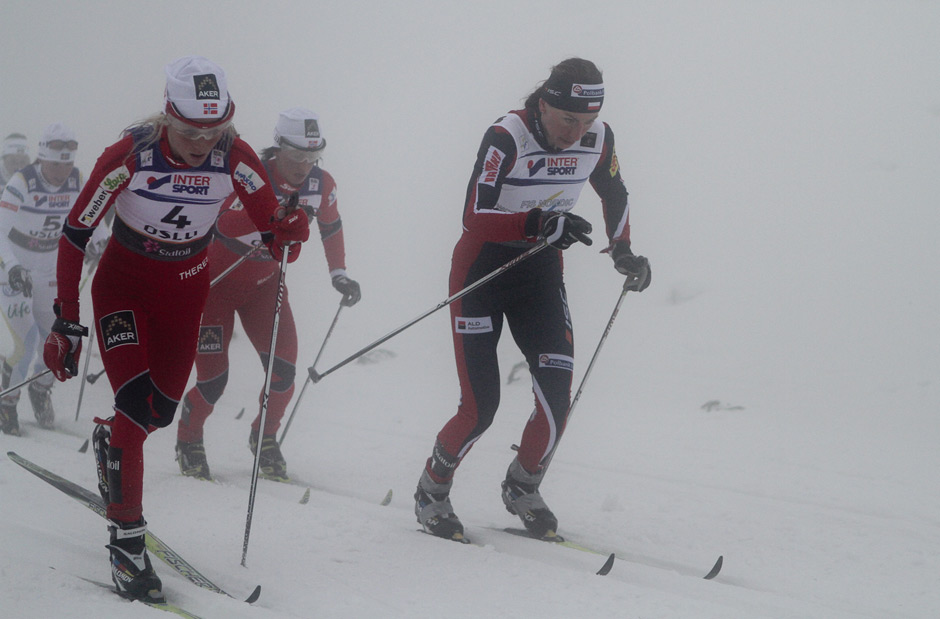
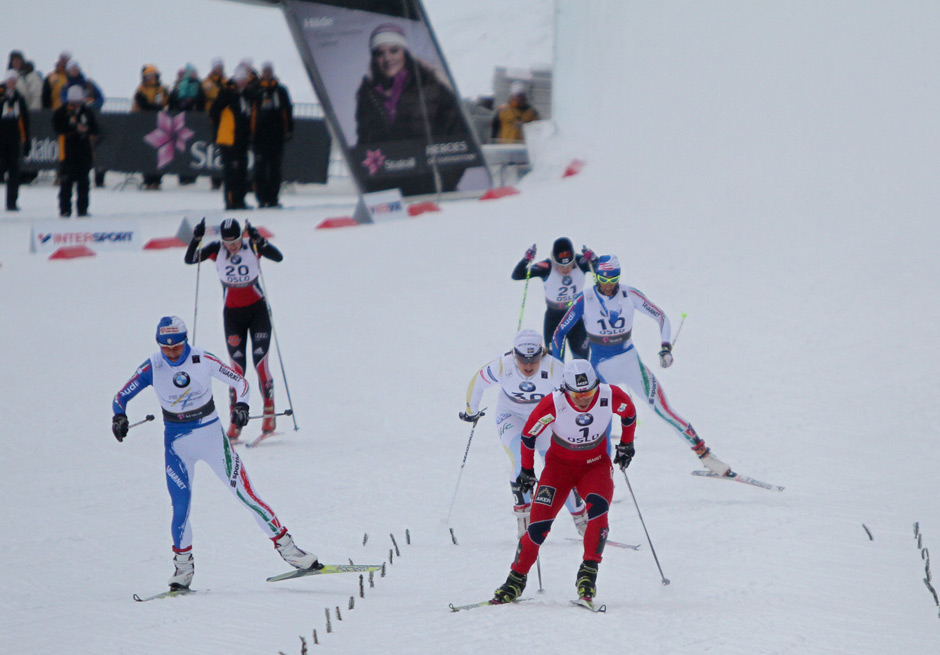
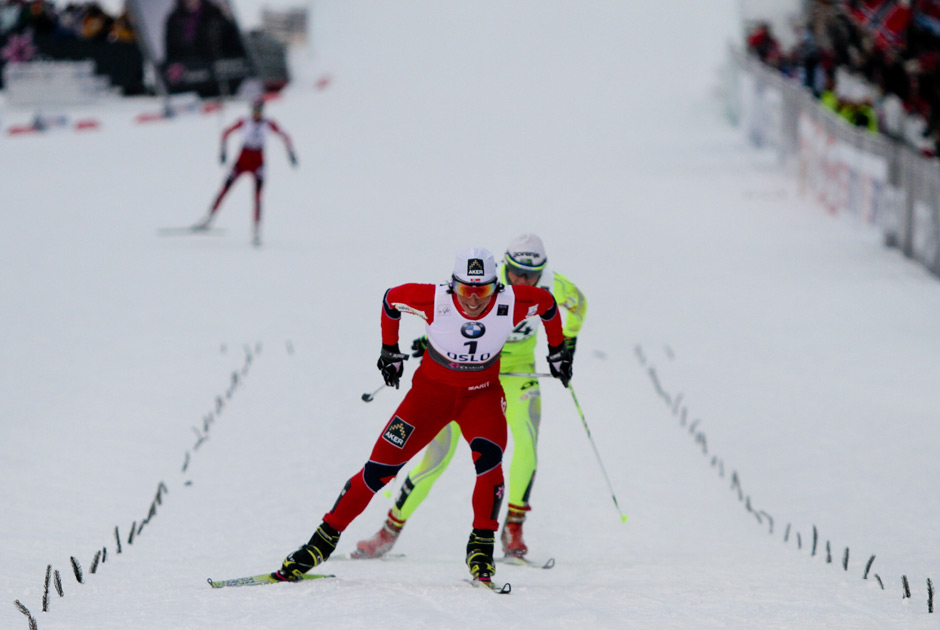
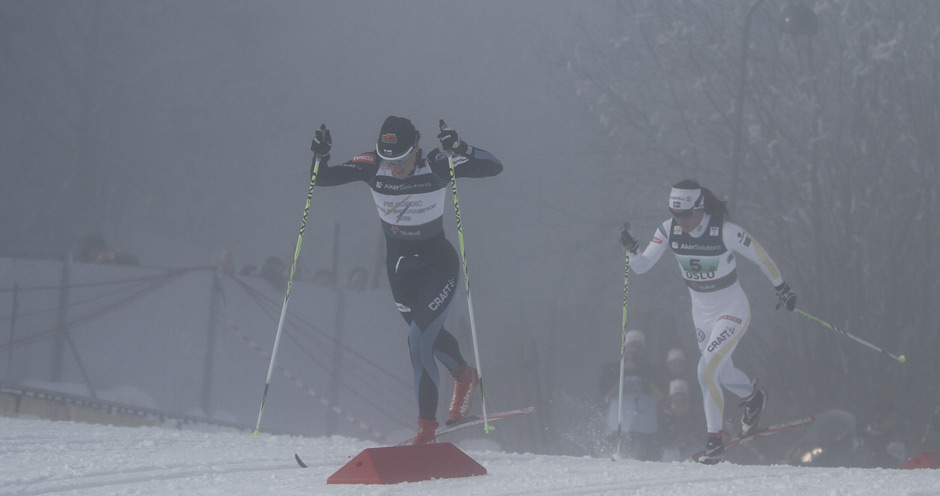
    Marit Bjoergen emerges from the fog, Norwegian flag in hand.

    It certainly seems cliché, but it did actually happen. As Marit Bjoergen made her way down the homestretch, Norwegian flag in hand, the impenetrable fog of an Oslo March began to dissipate, the forecasted sun making its first stadium appearance, and illuminating yet another celebration of gold.

    As expected, Norway skied clear of the field to win the women’s 4×5 kilometer relay, besting Sweden by 36 seconds. Finland, continuing a strong Championships, took bronze.

    The pervasive fog that is common at this time of year sat heavy in the stadium, but up on the higher parts of the course, blue sky and sun alternated with the pea soup that has dominated the last several days. With the video board barely a shadow across from the stands, fans had to rely on stadium announcer Kjell Erik Kristiansen for updates from the race, and wait for the skiers to pass by, which they did once midway through the five-kilometer loop, and again at the exchange.

    Kristiansen had primarily good news to share with the hometown crowd as Norway broke away midway through the second leg and never looked back.

    The pack heads up and over the first major climb. The sun was shining up here.

    Vibeke Skofterud handled scrambling responsibilities, and though she was unable to manage the final kick of Marianna Longa (ITA), she did her job, staying within striking distance of the Swedes and Finns.

    Italy, with only two strong skiers – Arianna Follis joining Longa – were hardly a concern. But Ida Ingemarsdotter, just 24 hours removed from a gold medal in the team sprint, continued her distance skiing revolution, and tagged off to Anna Haag just 1.4 seconds behind the Italians.

    “I thought that Longa was going to do something during the race,” Ingemarsdotter, said. “I decided to just be calm and see when she starts to go hard. When I saw her do that I decided to follow and see what happens.”

    In a premonition of what was to come, Ingemarsdotter’s skis were excellent – as good as she has ever had she said.

    “You just can follow the others and on the downhill you can have a smile on the face and see how the others work,” she explained.

    Finland’s Pirjo Murranen held off Skofterud by two seconds, turning the race over to Aino Kaisa Saarinen.

    “I gave all I had,” Skofterud said, explaining that she fell off the pace on the last hills, not due to bad skis, but because she was tiring.

    “My skis were 100% perfect. It was difficult snow to get 100% grip and you also have to have 100% technique, and I didn’t have that in the last kilometers,” she said.

    Saarinen leads Haag 2k into the second leg.

    Therese Johaug (NOR) immediately set about closing the gap on the leaders. Italy dropped out of the picture, and Johaug pulled in the seconds over the first set of climbs. By the time the race dropped back to the stadium, she was even. On the hills up above the stadium, where the crowd was thickest, lining the trail in a wall of ski celebration, Johaug attacked, getting clear of both Sweden and Finland

    Saarinen had tried to make a move right out of the stadium and get a gap, but she was unable to shake Haag and Johaug. A strong double-poler, her plan was to pull away on the gradual terrain.

    Haag couldn’t handle Johaug’s pace either pace, her wax slipping on the tough uphills as the Norwegian dropped the hammer.

    “I feel like I could go and go and had much power today,” Johaug said of her race. Her plan all along was to attack coming back through the stadium, and she executed perfectly.

    Therese Johaug chases Finland and Sweden.

    Kristin Stoermer Steira headed out on the first skate leg with a margin of just over nine seconds. She described such a gap as challenging – far enough ahead that she was on her own, but not out of sight.

    “I was a bit fortunate today it was cloudy, and with the fog they couldn’t see me up the hills, Stoermer Steira said.

    “I am very satisfied with the weather,” she added with a laugh.

    She needn’t have worried about the women coming from behind. Despite two disappointing performances in the first races of the Championships she was in fine form today. The gap kept growing, and with Bjoergen waiting in the exchange zone, the gold was all but inevitable, and Sweden and Finland were left to battle for the silver.

    And this was not a fight without drama. Sweden’s expected third, Maria Rydqvist, a surprising sixth in the 15km pursuit on Saturday, fell ill, leaving the door open for Britta Johansson.

    The 27-year-old Johansson doesn’t have a World Cup podium to her name, but already holds a bronze medal in the relay from the 2009 World Championships. She was left off the Olympic relay, and her primary goal for the year was to get that spot back.

    It took Rydqvist’s misfortune to fulfill the dream, but just hours before the race, Johansson got the nod. Instead of heading to the airport for her flight home, she found herself back on the tracks, contending for a medal.

    Johansson did not try to be a hero and stick with Steira. “I know she is a little bit stronger than me so I was trying to do my own race,” she said.

    She managed to hang with Finland’s Riitta Liisa Roponen for the first two kilometers, but then began to slip. Roponen pulled steadily away, and by the final climbs above the stadium, Johansson was nearly 15 seconds down.

    Kalla heads out on course, anchoring the Swedish team.

    But the Swedish waxers finally gained some redemption. After blowing the men’s skis several times this week, they finally nailed it. Johansson, riding extremely fast boards, made up nearly the entire deficit on the descents. She gave nothing back on the large sprint hill, and closed the gap the rest of the way in the stadium, opening up a small lead of her own on the drop to the exchange.

    Roponen termed her skis “bad,” and said she couldn’t compete on the downhills.

    Charlotte Kalla took over with five meters on Krista Lahteenmaki, and never looked back, slowly but surely skiing away. There would be no sprint for the medals.

    Kalla was motivated by Johansson’s performance and was happy to go out ahead of Lahteenmaki.

    “It was good for me…because then I could just relax and do my very best,” Kalla said. She also gained confidence seeing how well Johansson’s skis were running, knowing the her’s would be similar.

    Lahteenmaki said she was a bit tired after her silver medal performance in Wednesday’s team sprint. Kalla’s fast start was too much for her and with her legs “full of lactate” she could not get into position to fight for the silver.

    Meanwhile at the front, Bjoergen was not coasting. Despite a large lead and a 30k to race on Saturday, she never backed off, turning in the fastest split on the anchor leg despite celebrating with the flag for the last 100 meters.

    “It is not so easy to slow down on the track,” she said. “There are lots of people around the track and it is hard to not go fast.”

    The Marit.

    And while she did not take it easy, she did not have to “go to the basement” – bury herself in a hard sprint. “I wasn’t lying in the finish so that is good,” she said.

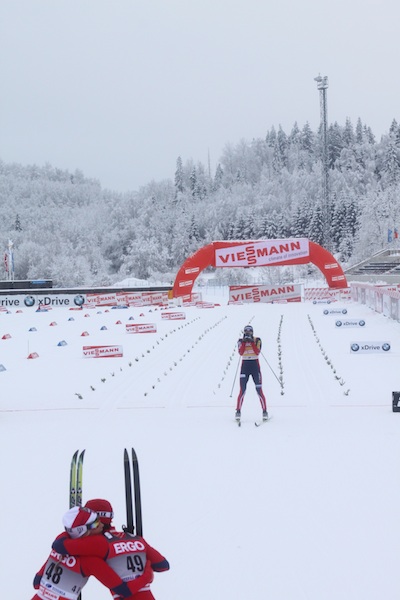
    She crossed the line into the arms of her waiting teammates, who had spent the last minutes in the finish area, passing the time snapping photos of each other, the crowd, the fog, even the press photographers.

    “I had the dream to take the flag, and I had the chance to do it,” Bjoergen said, sitting in a familiar spot at the press-conference, once again wearing a special Norwegian gold team jacket.

    Bjoergen has now won four gold medals in four starts this Championships, and will go for one more in Saturday’s 30k.

    “It will be a hard race. Justyna [Kowalczyk] wants the gold medal and there are some girls here who want the gold,” Bjoergen said looking at her teammates. “Anything is possible, but it is not going to be easy.”

    Kalla brings it home.

    She was happy with her decision to skip the team sprint on Wednesday, describing her feeling that morning as “a little tired.”

    Kalla, on the other hand, is on track to race all six events. Despite the grueling schedule, she attributes this feat to her mind and not her body.

    “I have looked forward to this relay for a long time and I think that is the most important thing – that you have the ambitions to go really fast. It is not a physical thing, but a psychological thing I think.”

    Ingemarsdotter points to the fact that the Swedes are enjoying themselves.

    “I think many thought we would be tired after yesterday’s hard work, but me and Charlotte, we are just in the flow right now and smiling and having fun, and doing what we like to do – to ski fast,” Ingemarsdotter said.

    With today’s victory, Norway reclaims the World Championship title from Finland, who triumphed in 2009. The same Norwegian quartet won gold in the 2010 Olympics, and if Steira continues to race, will be a tough group to take down.

    Complete Reuslts

    Norway celebrates relay gold.
    And Sweden takes some pleasure in silver.
  • Bjoergen Skis to Third World Championships Gold as Norway, Finland Pack Top Ten

    Bjoergen Skis to Third World Championships Gold as Norway, Finland Pack Top Ten

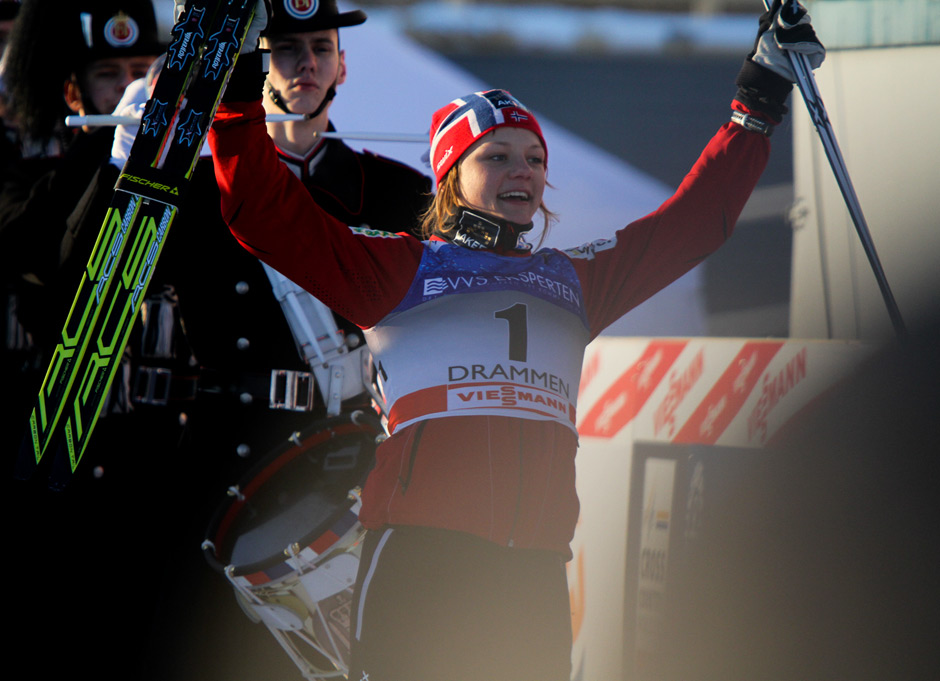
    Bjoergen celebrating her win in Oslo today.

    Early on in Monday’s 10 k classic individual start race, it looked like Marit Bjoergen was on track to lose her first gold medal of the 2011 World Championships.

    On the first steep hill of the tough course in Oslo, the Norwegian was slipping – and not long after, she began to get splits telling her that Justyna Kowalcyk of Poland, who had started one spot behind her, was catching up.

    “Today was a very hard race,” Bjoergen said in a press conference. “I knew before I started today that this is Kowalczyk’s best distance… I knew that she was going to be opening hard and she did.”

    Kowalczyk dominating the first climb.

    Her trainer, Egil Kristiansen, said that he was concerned watching the beginning of the race and seeing how fast the Polish skier was moving.

    But while Kowalczyk opened hard, Bjoergen closed harder, and the race came down to a thrilling finish.

    “[Kowalczyk] got nine seconds, and then eleven, and then eight, and then I was two seconds behind on the last climb and I thought, they are kidding me, I am sure,” Bjoergen laughed. “But I was working very hard at the end of the race, and I did have Marianna Longa with me. Then I was lying at the finish line thinking, am I going to get it, or not? I heard that when Kowalcyk came into the stadium she had 20 seconds, and I thought maybe she can get the gold, and then I heard, no, the gold will go to Marit Bjoergen, and I thought, yes!

    “For sure [this was my hardest fight]. You have to be working very hard to take the gold and I really did.”

    Bjoergen collapsed at the finish line and watched her rival race towards her from the snow. The Holmenkollen crowd was silent as Kowalczyk rounded the last corner in the stadium, but as soon as it was clear that she would not surpass Bjoergen, the fans went wild, and Bjoergen’s teammates mobbed her in congratulations. Kowalczyk, for her part, collapsed on the other side of the finish line as well.

    Bjoergen.

    It has been an impressive World Championships for Bjoergen so far: she won the skate sprint as well as the 15 k pursuit, and her chances are good of collecting gold in the relay and the 30 k as well (Bjoergen said that she has not yet decided whether to race the team sprint). But while dominance is good for Bjoergen, not all of her competitors are sure that it is good for the sport.

    “I hope that some [new fast] women will come very soon,” said Slovenian standout Petra Majdic after today’s race.

    And Norwegian great Berit Aunli, a three-time gold medalist from the 1982 World Championships here in Oslo, said that to beat Marit, Kowalczyk and Saarinen would have to “race even faster” than they had today.

    Of all the women on the circuit, Kowalczyk has seemed like the most likely to have the ability to beat Bjoergen. Although the two have battled all season, Bjoergen has yet to lose a distance race, or at least she has only lost in a roundabout fashion, having the fourth-fastest time in the final race of the Kuusamo mini-tour but collecting a sizeable victory nonetheless.

    With Kowalczyk’s fast start, she seemed poised to finally best her rival – or implode in the final kilometers. While “blowing up” might be a strong way to describe the Pole’s finish, she was still questioned about whether her pacing was ideal.

    “The first four kilometers is tough,” she said, noting that the terrain played a bigger part in her split times than did a strategy to catch Bjoergen. “It is almost one big uphill, and this is my strength. After this I was fifteen seconds ahead of Bjoergen. Everyone knows that where it is a big uphill, I am going fast.”

    But she did acknowledge that her early efforts came with a price.

    “In the last two kilometers, I was so tired. And Bjoergen, I know that she was working together with Longa, which is easier. But I am happy, this is a really good race. I was fighting really really good.”

    After starting 30 seconds ahead of Bjoergen, Longa – who  in finishing seventh was the only non-Finnish or Norwegian woman besides Kowalczyk to crack the top ten – was caught by the winner about six kilometers into the race. For the rest of the time, the two skied together, which seemed to help both.

    “She was following me and working very hard in the climbing and pushing me also,” said Bjoergen. “I am happy with that. I was working hard to catch her, and she pushed me all the way. And in the stadium, in the last 50 meters she was working very hard and I didn’t want her to beat me. So I was very happy that she was with me today.”

    Saarinen.

    While much was made of the battle between Bjoergen and Kowalczyk, Aino-Kaisa Saarinen of Finland was close behind, rounding out the podium by finishing just ten seconds behind Bjoergen. Despite being the defending champion in this event, Saarinen was not expected to win today; she has collected only two World Cup podiums so far this season. Another skier might rejoice at such good fortune, but Saarinen isn’t just any skier, and she’s had much more success in the past.

    Kowalczyk and Saarinen joked at the press conference about how Saarinen had finished a minute and forty seconds back at the World Cup in Davos earlier this season. Saarinen also said, however, that her goal today had been gold, and Bjoergen, for one, wasn’t surprised that she almost achieved it.

    “[Saarinen] has been better and better, and in Drammen she was back again with a very good race,” Bjoergen said. “I knew that she was one of the toughest. It is great to have her back again, after being injured at the beginning of the season. She is great at classic skiing and I knew that today it was going to be hard.”

    Saarinen said that the season had been a “big fight” after injuring her shoulder before the opening World Cup races in Gallivare. But today was different.

    “I had a good day and good skis today,” she told the press. “Maybe the first kilometer I was a little bit nervous, but after that I could raise my speed all the time and my technique was working very well. At the end I almost thought I could fly. And the audience was yelling and cheering me all the time. It was very hard to hear the split times- the techs tried to yell very hard, but the audience yelled harder.”

    She led a resurgent Finnish team to their best day all season. Krista Lahteenmaki finished fifth, Pirjo Muranen sixth, and 22-year-old classic phenom Kerttu Niskanen eighth.

    “The whole team did excellent work today, the skiers and the service men,” Saarinen said. “[For the relay] I think the only goal now is the gold.”

    The Finns certainly had good skis in the warm, greasy conditions, unlike in some of the races earlier in the week. Their head wax technician told FasterSkier that he had sent ten to fifteen people out to test skis all over the course because conditions varied between the skied-in tracks in the stadium and the less-traveled trails in the woods. They tested klister and hardwax to see what was the best, on average, and ended up on hardwax.

    While head coach Magnar Dalen certainly has high hopes for his women in the rest of this year’s World Championships, he was perhaps even more enthusiastic about the future.

    “They are young athletes coming up that have a big talent, and it is looking good for Finland in the next two to four years,” he said.

    Therese Johaug finished fourth, 14 seconds off the podium. Teammates Vibeke Skofterud and Kristin Stoermer Steira finished ninth and tenth. While it was certainly a good day for the team, the Norwegian performances were perhaps eclipsed by that of the Finns – who suddenly appear poised for an incredible relay performance.

    “Finland has always been good in the relay, and they did a very good job today,” Bjoergen said. “I think Finland, Sweden, Germany and Italy… it’s not going to be easy on the relay.”

    Kristiansen agreed, saying that he would have to think carefully before picking a relay team.

    “Going into the World Championships we had a goal of taking at least one individual gold medal and the relay gold. We’ve achieved one of those by far, but the relay is on Thursday. If we are going to win the relay gold, every one of the girls have to perform to their potential. A relay gold isn’t something you can just walk up and collect. On Thursday, every one of the girls will have to dig deep.”

    Full results

    -Nathaniel Herz contributed reporting

  • Through the Fog, Bjoergen Emerges With Second Gold in Oslo

    Through the Fog, Bjoergen Emerges With Second Gold in Oslo

    The three podium finishers in the 15 k pursuit early in the race. L-R Therese Johaug, Marit Bjoergen, and Justyna Kowalczyk.

    The fog in Oslo was so thick that the fans at Holmenkollen could barely see any of the women’s 15 k pursuit.

    The video board across from the stands was completely obscured, and even when athletes skied through the stadium, the only forms that could be made out were outlines—the spindly one of Justyna Kowalczyk (POL), say, or the stocky one of Finland’s Aino-Kaisa Saarinen.

    But with the homestretch lying directly alongside the bleachers, the best view that the spectators got on Saturday was the one that mattered most: Norwegian Marit Bjoergen all by herself, arms raised in celebration, skiing to her second straight gold medal at the 2011 World Championships.

    She had left behind her teammate Therese Johaug and chief rival, Justyna Kowalczyk, on the course’s last major descent, thanks to a strong push over the top and a great pair of skis.

    “The guys in the cabin have done a very good job today,” she said.

    Kowalczyk was second and Johaug third, but neither were close to Bjoergen in her 10th straight distance win—a streak dating back to last season. It’s a run unrivaled since Bente Skari’s reign in the early 2000’s, and the way Bjoergen is going right now, there are no indications it will come to an end any time soon.

    The Norwegian was the overwhelming favorite coming into the day, given her record earlier this year, and her win in Thursday’s sprint. But as she put it in the press conference, “it’s not ever easy.”

    Like in the sprint, she had the advantage of a fervent home crowd pegged by organizers at 26,000, but with one big difference: nobody could see her.

    While Holmenkollen can be picturesque, with bright sun, blue skies, and great views, it is also known for its damp, foggy weather. Sure enough, a dense mist has hung in the air since Friday, blotting out the video board and limiting visibility to 75 meters, frustrating fans who had paid up to $140 U.S. for tickets. For most of the race, the only source of information for the crowd was Kjell-Erik Kristiansen, the stadium announcer.

    The view from the stadium.

    “I didn’t see anything,” said Lars-Erik Oberg, a fan who said he wouldn’t have made the trip to Holmenkollen had he known the visibility would be so poor. “It’s a bit [of a] pity, because a lot of money has been paid for this. But of course, you can’t do anything about this.”

    In North America, the moisture combined with temperatures in the high 20’s would have made for tricky waxing. But Holmenkollen’s conditions are unique, and many athletes were still on hard wax at the start, thanks to a healthy dose of powder still mixed in with the icy snow.

    None of the top athletes appeared to struggle with kick. Instead, they struggled with the fierce pace set by Bjoergen, Kowalczyk, and Johaug in the classic leg—one that had already started to shatter the pack by the two-kilometer mark.

    Bjoergen said that she was trying to avoid doing much work, but Johaug, especially, had an interest in stringing things out. A stronger classic skier, Johaug said wanted to shake Charlotte Kalla (SWE), and some of the other women in the field who are stronger skaters.

    The efforts paid off: by the time the women got to the exchange, the lead group was down to the trio of Johaug, Bjoergen, and Kowalczyk. Kalla and Saarinen were the only ones within striking distance, but even for those two, the gap was already insurmountable, at close to 30 seconds.

    For the first third of the skating leg, it was Bjoergen doing the work. But around the 11-kilometer mark, she pulled up to let one of the other women take over.

    Afterwards, Bjoergen said she was hoping Kowalczyk would take a pull, but instead, Johaug stepped in.

    “I actually wanted Kowalczyk in front, but Kowalczyk wanted Therese in front,” Bjoergen said.

    Facing two women who had cracked the sprint finals, Johaug knew she would have her hands full if she left the race until the home stretch. So for a couple of kilometers, she hammered, doing her best to break the two others.

    “That was my chance,” she said.

    Johaug looked sharp and smooth, and the tough course suited her tiny frame. But against the two fittest women in the

    Johaug at the finish of the pursuit.

    world, her efforts weren’t enough. Still, she said she didn’t regret the move—it was her best shot at beating the other two—and she was “only really happy” with bronze.

    Bjoergen, meanwhile, had been planning an attack on the Gratishaugen—the last stout climb on the distance course that was also the same spot she’d used to get her race-winning advantage in the sprint.

    But earlier in the skate leg, Bjoergen said that she had noticed her skis were running well—much better than Kowalczyk’s. (They were running so well, in fact, that she called up the Norwegian national team director immediately after the race to tell him that they were the best skis of her life.)

    Confident in her advantage, Bjoergen decided to go earlier, at the top of the last descent before the Gratishaugen.

    “We had Therese in front,” she said. “I tried to work hard in the top of the downhill, and then I got a good gap.”

    The advantage to Johaug and Kowalczyk widened on the descent, thanks to Bjoergen’s skis and her strong push. Up the climb and into the stadium, the advantage held, and Bjoergen was able to pull up and celebrate on the homestretch, the roar from the crowd demonstrating that the mist hadn’t dampened its spirits.

    Afterwards, Kowalczyk said she had tried to follow Bjoergen, but was stymied by Johaug, who moved to block her on the descent “not one, not two, but three or four times.”

    “I was trying to ski after Marit, but Johaug [stopped] me,” Kowalczyk said.

    Replays did show Johaug in front of Kowalczyk on the twisty downhill, and perhaps making a couple of subtle moves to hold her position. But it didn’t appear that Johaug ever took any line other than the best one—and she firmly denied making any attempts at obstruction.

    “No, no, no, no, no—that was not the meaning,” Johaug said. “Of course not.”

    For her part, Kowalczyk said she had no quibble with the move—had she been in Johaug’s shoes, she said, she wouldn’t have done anything differently.

    “If this situation was someone from Poland, [it would have been] the same tactic,” Kowalczyk said. “This is normal. It’s cross-country skiing.”

    Inge Scheve and Topher Sabot contributed reporting.

    A victorious Bjoergen.
  • Women’s WCH Pursuit Bjoergen’s to Lose – Remaining Medals Open

    Women’s WCH Pursuit Bjoergen’s to Lose – Remaining Medals Open

    Bjoergen leading her quarterfinal in Thursday's sprint. Follis is on the right. Nobody consumed by a tiger.

    Marit Bjoergen (NOR) has already achieved her goal of winning an individual gold at the 2011 World Championships. Now the ski world gets to see what a relaxed Bjoergen can do.

    The winner of five medals, including three golds, at the 2010 Olympics, Bjoergen is the clear favorite in the women’s 15 k pursuit on Saturday, as distance racing gets underway at Holmenkollen in Oslo, Norway.

    While rival Justyna Kowalczyk (POL) is the defending World Champion in the event, a lot has changed since 2009. The few things that could stop Bjoergen from winning the race include her technicians swapping her skate and classic skis in the dual technique event, Emil Joensson dressing up as his girlfriend Anna Haag and taking over for the last kilometer of the race, or being eaten by the tiger that currently resides in her bed.

    Needless to say, it is Bjoergen’s race to lose. She has put together a remarkable string of nine consecutive World Cup distance race victories dating back to last season, and her margins of victory have run the gamut from convincing to ridiculous. European betting sites are paying a mere one dollar for every four bet on Bjoergen to win.

    Kowalczyk in Thursday's sprint – she suffered an early exit, and will be out for revenge.

    The most likely to unseat the “Queen of Cross-Country Skiing” is Kowalczyk. The Pole has already locked up the overall World Cup title, and finished a relatively close 17 seconds down in last weekend’s 10 k classic World Cup in Drammen.

    Kowalczyk’s primary weapon is her ability to go harder than anyone else, usually splintering the field on the large climbs. But she hasn’t had that edge on Bjoergen this year, and if the race comes down to a sprint, Bjoergen, the winner of Thursday’s individual sprint, is clearly faster.

    While Bjoergen is considered a near-lock for the win, Kowalczyk will have plenty of challengers for second place, including Charlotte Kalla (SWE), Aino-Kaisa Saarinen (FIN), Kristin Stoermer Steira (NOR), Therese Johaug (NOR) and the aforementioned Haag (SWE).

    Stoermer Steira will try to defend her silver in this event from the 2009 Liberec Championships. The slender Norwegian, despite being a stronger skater, has excelled in this event since its introduction. In addition to her 2009 silver, she has two bronzes, from 2005 and 2007, and has twice finished fourth at the Olympics.

    Stoermer Steira (right) gets encouragement from a Norwegain coach during the 10km classic in Drammen. Teammate Vibeke Skofterud is to the left. Stoermer Steira finished 19th.

    She struggled with a foot injury early in the season, but appears to be well clear of those issues. She is obviously experienced, and should not make any mistakes.

    Saarinen skipped the sprint, a potential medal event for her, in order to be well rested for the pursuit. She also started the season slowly due to injuries, but has skied very well of late. She was third in the classic race in Drammen, and is defending a bronze medal from the 2009 pursuit. She skis well in both techniques, and has good finishing speed.

    Kalla is a stronger skate skier, though she has improved her classic skills in recent years. If she can maintain contact with the leaders through the first half of the race, there are few better in the free technique. Her speed is World Cup top-10 on a good day in classic, and winning material in skating.

    Her teammate Haag was a big surprise in Vancouver, besting Kowalczyk in taking the silver in this event. She has just one podium finish this year, but she has already proven her big-race ability. She will be hard-pressed to repeat her Olympic performance, but Haag shouldn’t be counted out.

    Johaug gives the Norwegians three legitimate medal contenders. The diminutive twenty-two-year-old has two career podiums in the pursuit, and should thrive on the challenging Oslo courses. She had a brilliant finish to the Tour de Ski, dominating the Final Climb, and her classic skiing is on par with her skating.

    Johaug in the Drammen classic race.

    After Johaug, the list of potential medal contenders is long – veteran Italians Marianna Longa and Arianna Follis cannot be counted out, nor can the rest of the Finns – young Krista Lahteenmaki, who exploded onto the international scene during the Tour de Ski, and the more experienced Riitta-Liisa Roponen.

    The key to the race will be who decides to go with Bjoergen, and how they hold up. The favorite will likely push the pace early, and blow apart the field. Anyone who can get a ride could end up far enough ahead to hold on for a medal. But the stakes are high, especially on these courses. Give too much too early, and the chasers will come back to get you.

    Four Americans will take to the line, led by Holly Brooks.

    Brooks did not race the sprint on Thursday, and should be sharp. She is joined by teammates Liz Stephen, Morgan Arritola and Jessie Diggins.

    Brooke Gosling is the lone Canadian starter.

    The racers will ski an interesting configuration of loops – one 2.5-kilometer classic, a different 5-kilometer classic, and then two 3.75 circuits for the skate leg.

    The race kicks off at 11:30 in Oslo, a pre-dawn 5:30 EST in the US.

    Saarinen attacking the sprint qualifier in Drammen. Nobody can say she doesn't go for it.
  • Bjoergen Takes Gold To Thrill Capacity Oslo Crowd

    Bjoergen Takes Gold To Thrill Capacity Oslo Crowd

    Marit Bjoergen (NOR) pleases the home crowd earning the first gold medal of these 2011 World Championships.

    They arrived on foot, mostly—a three meter-wide river of fans snaking up from the nearest subway station, the cowbells around their necks clinking softly.

    By 12:30, with an hour still to go before the start of the freestyle sprint, the Norwegian faithful had already packed the stands at the Holmenkoll venue in Oslo—in anticipation of the first event of the 2011 World Ski Championships.

    Numbering 20,000, they were awaiting their country’s 100th World Championship gold, and it didn’t take long for them to get it. Capitalizing on a course and conditions that suited her, Norway’s Marit Bjoergen brightened a grey day by taking the first medal awarded in Oslo.

    Arianna Follis (ITA) takes home the silver.

    Italy’s Arianna Follis, the defending champion, was second, and Slovenia’s Petra Majdic was third. But Bjoergen was in control of the final nearly the whole way, wresting the race from Justyna Kowalczyk (POL) on the course’s big climb and never relinquishing it.

    In a press conference, Bjoergen said that it had been her aim to win a single individual gold in Oslo, despite the fact that she was favored in all four events.

    “Now, I have my goal,” she said. “The rest of the championships, I can really have fun.”

    Coming into the race, Bjoergen’s chances were by no means bad—she’d already won two sprints this year. But the discipline is the most erratic event on the championships program, as was demonstrated when the other favorite, American Kikkan Randall, got tangled up in her quarterfinal heat and spun out of contention.

    Furthermore, in her last two World Cup sprints, Bjoergen had been far from dominant—she was eliminated in the semifinals in Estonia in January, and placed third behind Randall last weekend in Drammen.

    Both of those races, though, were held on faster, flatter courses, which favored quickness over fitness. The latter Bjoergen has in spades, while her speed is merely exceptional—not superhuman.

    Thursday’s loop, and its conditions, were much more demanding. With temperatures struggling to break 20, the skiing was still relatively slow; there was a big climb, and even the descents didn’t provide many opportunities for recovery. When Bjoergen emerged as the winner of qualifying, it was clear that she was in line for a good day.

    Bjoergen celebrates.

    “I know that for me, it was a good track,” Bjoergen said. “It was three minutes…longer than it was in Drammen, and also, the speed in the snow was not so fast.”
    It also doesn’t hurt to have a sellout crowd of 20,000 shouting your name. There were some legimate, World Cup soccer goal-style roars that went up from the stadium throughout the day, and before the start of the finals, two big sections of bleachers traded off chants of “Marit!”

    Even Vegard Ulvang, a Norwegian cross-country legend in his own right, told FasterSkier that the atmosphere at Holmenkollen was unprecedented.

    “Cross-country has never experienced such a stadium,” he said. “People have usually been to the forest…It’s [the first time] that they gathered so many cross-country people in the stadium in Norway.”

    Despite the festive atmosphere, Bjoergen was all business. She didn’t leave much to chance, controlling her first two heats and winning both. Each time, she had her skis off as soon as she came to a stop, then beelined out of the finish chute, stone-faced, before the rest of the women could pick themselves up off the ground.

    The finals saw Kowalczyk use a nifty move to take the reigns on the initial descent. But she couldn’t match Bjoergen on the big climb, and the Norwegian took the lead on the way back into the stadium.

    She had almost every fan on pins and needles as she headed up the final, smaller climb. Bjoergen’s teammate Astrid Jacobsen had died hard after skiing at the front of her semifinal early on, and in this heat, Follis and Majdic were in hot pursuit.

    But Bjoergen still had enough left, or, at the very least, the others had emptied their own tanks trying to keep up. She held a clear gap into the finish, with enough time to pull up in the last few strides and raise both arms—the sign for the crowd to let out screams of unmitigated glee.

    “It has been my best sprint this season,” Bjoergen said.

    Follis, meanwhile, claimed an improbably silver medal—she had to fight her way back from a crash in her semifinal, after which she said she thought “the race was finished.”

    At 33, this is likely Follis’s last season, though the Italian team staff will probably try to convince her to stick around for longer. She said she’ll compete in all the rest of the competitions, except for Monday’s 10 k classic.

    Bjoergen hasn’t yet decided whether she’ll start in all six events—she said that she’ll make a call on whether or not to drop the team sprint after the 10 k. The way she’s going, though, six gold medals are a real possibility. Majdic was asked in the press conference if she thought anyone would knock off the Norwegian.

    “With her shape? No,” Majdic said.

  • Norway’s Expectations: Get This Thing Rolling!

    Norway’s Expectations: Get This Thing Rolling!

    Nordic skiing is the national pride and joy of the roughly 4.5 million people in this small, frigid country. To earn the title as the overall best nation, Norway’s skiers have to win at least four gold medals in Holmenkollen, preferably five just to be sure, which is 25 percent of the gold medals up for grabs. The sprint on Thursday represents the first opportunity, and if successful, that would be Norway’s 100th World Championship gold medal to date.

    Currently on the World Cup, Norway is leading the nation’s cup for the women by more than 2,000 points (5,134 points) on Italy in second place (3,080 points), Sweden is in third place just over 200 points behind Italy (2,855). In the men’s standings, Russia is in first place (3,751 points), leading by about 250 points on Norway in second place (3,504 points), and Sweden breathing down their necks another 150 points behind (3,383 points).

    Norway is fielding 33 athletes: 19 cross-country skiers, nine ski jumpers and five jumpers.

    Women’s sprint: wide open

    Norway’s team consists of four strong racers all capable of making the final on a good day: Astrid Uhrenholdt Jacobsen, Celine Brun-Lie, Maiken Caspersen Falla and Marit Bjoergen.

    “The girls on the team are peaking, and with some tail wind and a good day, we could easily experience all four of them in the final. If that happens, it’s wide open. They’ll all fight fiercely for the medals,” said national team women’s sprint coach Jon Arne Schjetne.

    “The women’s sprint is possibly one of the most undecided events. There are at least 13 to 15 racers on the circuit that could jump into the final,” Schjetne said, and looked over to the girls.

    “I just realized I got really nervous,” Marit Bjoergen replied. “But I’m really excited and I know that there are a lot of really strong skiers out there. I’ll totally have to be on top of my game all day long,” she added.

    “The Norwegian spectators are the best in the world. I hope they’ll be proud of me at the end of the day. I think this is just going to rock,” Bjoergen said.

    Astrid Uhrenholdt Jacobsen (front) and Celine Brun-Lie are aware of the expectations that comes with home turf.

    Homegrown talent

    While Bjoergen might have the star sticker on her forehead, the sprint team consists of three other racers with proven track records. Two of them considers Holmenkollen their home course: Astrid Uhrenholdt Jacobsen and Celine Brun-Lie.

    “I skied my first race in Holmenkollen when I was 10 years old. I’ve skied up and down and around these trails for many many years,” said Jacobsen. The humble blonde grew up 10 minutes from Holmenkollen, and has put more kilometers behind her on these courses than most.

    “It will most definitely be a very special experience, but I won’t think about that when I’m racing. If I start recognizing people along the course while I race, I’ll lose my focus,” Jacobsen said, adding that she’s not sure the skate sprint is her best medal option.

    “I don’t feel like I’ve managed to realize my potential in the skate sprint this season, but if I can perform as well as I do at practice, it might just pan out really well,” Jacobsen said.

    Men’s sprint

    The Norwegian men’s team, is a combination of proven World Cup winners in Anders Gloersen, Eirik Brandsdal and Øystein Pettersen, the reigning World Champion Ola Vigen Hattestad, as well as Petter Northug. But despite their track record and the home turf advantage, there are no guarantees.

    “There are a lot of nations that are in it to win, and the margins are miniscule, particularly in sprint,” said Erik Røste, who is responsible for the Norwegian cross-country skiers and former national team coach.

    Everyone has respect for the Swedes, and particularly Emil Joensson, the current World Cup sprint leader. Joensson has 430 points and leads the World Cup by almost 100 points over Ola Vigen Hattestad in second place (344 points). Alexei Petukhov (RUS) is in third place, with 277 points.

    Everything for the crowds

    “It’s so cool that we have three guys on the team who grew up here. That shows the development pipeline here is working, and I think being able to train together helps us elevate the level. Maybe it’s coincidence, but I think we’re doing something right,” said Gloersen, who regularly trains with Brandsdal and Pettersen outside of the national team camps.

    Pettersen agreed, and he is eager to give the locals what they’re coming for: a huge party, a celebration of skiing.

    “We’re still talking about the World Championships here in 1966 and in 1982, and the Olympics in 1952. I hope that in 20 years, we’ll tell stories from the Worlds in 2011. And I hope it will be remembered as the best World Championships in Norway ever,” Pettersen said, adding that it’s about time to retire Oddvar Braa and the broken pole story from 1982.

    “I’ll do my best to give you the smoothest stories, whether I am racing in all five events or just one,” Pettersen concluded.

    Cheering: Teacher Anita Flølo (center) and Firat Mercanoglu (center left) and his classmates represented Team Croatia at the opening ceremony in Oslo.

    Inclusive

    More than 50,000 spectators showed up to the opening ceremony downtown Oslo on Wednesday night. 1,800 elementary school children marched from the palace to the university square representing the 50 nations that are competing in the World Championships.

    11-year-old Firat Mercanoglu from Oslo was one of the 30 students from Sagene Skole representing Croatia in the opening ceremony. His fifth grade teacher has spent the entire last week talking about the small Balcan country that borders to Italy.

    “We learned how to draw their flag, and we’ve talked a lot about the country and learned a lot,” Mercanoglu said to FasterSkier right before heading to the opening ceremony.

    As a thank-you for participating, Mercanoglu, his entire fifth-grade class and teacher Anita Flølo are invited to the stadium for all the events on Monday, February 28.

    Facts and Numbers

    Over the course of the 12 competition days and 21 events, the organizers are expecting almost half a million spectators, spread out along the course as well as in the stands at the stadium.

    650 athletes from 50 nations are entered. 2,200 volunteers are taking care of their needs and those of the specators and the 1,800 working media.

    Only during the pre-Worlds in 2010, there were more than 8,000 spectators camped out along the course.

    The host broadcasters will rig 108 TV cameras for the event, contributing to broadcasts reaching 300 million viewers all over the world, including Europe, Japan and Russia. Norwegian television station NRK will broadcast no less than 110 hours of coverage from Holmenkollen, which averages out to just under 10 hours per day.

    From the opening ceremony downtown Oslo on Wednesday night. (Photo courtesy of Oslo2011 Organizign Committee)
  • Oslo 2011 Women’s Sprint Preview: Randall, Bjoergen Favorites

    Oslo 2011 Women’s Sprint Preview: Randall, Bjoergen Favorites

    The crescendo of hype and excitement that has been building for the last few months in Norway will finally begin to crest on Thursday, as the 2011 World Ski Championships kick off in Oslo with a freestyle sprint.

    With the race comes North America’s best chance for a medal. Canadians Devon Kershaw and Alex Harvey and the U.S.’s Andy Newell have all collected podiums in the discipline, and have legitimate medal hopes. But their

    Verdens Gang's page predicting a Kikkan Randall victory.

    female counterpart, Kikkan Randall (USA), has done the guys one better: she represents her country’s first legitimate gold medal favorite in 30 years.

    Lest you think that last statement is pure jingoism, consider this: the Norwegian tabloid Verdens Gang tipped Randall to win the women’s event in its Wednesday edition. And after her victory in last weekend’s World Cup, Norwegian sprint legend Tor Arne Hetland proclaimed Randall, the defending silver medalist, as his pick.

    Kikkan Randall (USA) in qualifying in Drammen. Randall went on to win.

    “Kikkan will for sure be good here,” Hetland said from the stadium on Wednesday, where he was working as a coach for the Swiss team. “She’s my favorite for this race.”

    Like the rest of the World Championship events, the sprint will be held on the trail system at Holmenkollen—the massive network that serves as an endurance playground for Oslo’s ski-crazy citizens when it’s not being used for elite events.

    The course is a tough one, with the men heading out of the stadium and into a descent, then tackling a stiff climb with 25 meters of vertical rise that takes them back towards the crowd. The women’s loop—200 meters shorter—spits them out a third of the way up the climb.

    After cresting the hill, there’s a flat stretch across from Holmenkollen’s big ski jump. Then the athletes re-enter the stadium and climb a short rise that takes them up behind some of the stands, skiing perpendicular to the homestretch.

    A hard right and a short, steep, downhill pitch build up enough speed that despite having to roll up and over a small bridge in the stadium, the final sprint is very quick—no more than 15 strokes.

    By contrast, at last weekend’s World Cup in Drammen, Randall used a very long homestretch to come past a fading Maiken Caspersen Falla.

    Maiken Caspersen Falla (NOR), qualifying 1st in Drammen.

    The whole of that course was different—flat and fast—with the women taking just over two and a quarter minutes to complete it. Holmenkollen’s loop is longer and harder, and will demand more fitness, especially since there’s little time to recover after the initial downhill.

    “Lots of courses give you a break, especially towards the end, and this one has no break. If you really want to ski fast and be there for the win, it doesn’t provide any rest,” said Justin Wadsworth, the head coach of the Canadian National Ski Team. “It’s not that the hills are bigger than other sprint course hills—it’s just the way the gradual downhills and the flats, the way they’re situated in the race, they’re kind of at strategic spots.”

    For Falla, another favorite, that might be a problem. At 20 years old, she doesn’t have quite the same slow-twitch credentials as, say, her teammate Marit Bjoergen, who has won every individual start distance race she’s entered this year.

    But it shouldn’t be a big deal for Randall, who skied to second place in the test sprint in Oslo last year—just a few feet behind Bjoergen after losing her lead on the homestretch.

    In that race, Randall said, she made the simple mistake of pushing her free skate too long, allowing Bjoergen to slip past.

    “I’ve watched footage from the race a few times, and she just had a better strategy. Coming off the bridge, she started V2ing earlier,” Randall said Wednesday. “Definitely an easy thing to correct, and something I’ll be doing a little differently tomorrow.”

    Randall said that the key to her race is to make sure that she comes back into the stadium and up that last small climb in good position, so that she can enter the final straightaway “with some room to work.”

    “I’d like to be, ideally, in first or second coming into that final straightaway, and just hold that position there,” she said.

    After her final training session on Wednesday morning, Randall said she was healthy and ready to go. While she didn’t say she was expecting a gold, she acknowledged that “all the signs are indicating that the body’s in great shape—the fitness is there.”

    To win, though, Randall will have to overcome the efforts of a familiar, seasoned cast of characters. The women’s field isn’t as deep as the men’s, but it contains some veteran challengers in Bjoergen, Justyna Kowalczyk (POL), Petra Majdic (SLO), and Arianna Follis (ITA).

    After taking another distance win on Saturday, Bjoergen is clearly still in great shape, and if the cold snow in Oslo stays that way on Thursday, she’ll be tough to beat, along with Kowalczyk and Majdic.

    Petra Majdic (SLO) racing in Drammen last weekend.

    Majdic has been off-and-on this year after sustaining a brutal injury at the 2010 Olympics. She struggled early, then reeled off three wins in January, but was derailed by some contact and equipment mishaps in Drammen last weekend.

    She’s looking forward to the sprint in Oslo, though, according to Ivan Hudac, her coach.

    “The snow is not very fast, and the track is not very easy. Even harder tracks are better,” Hudac said.

    Italy’s Follis, the defending champion, is also a threat, though she told FasterSkier on Wednesday that she isn’t a fan of the finish.

    “[The course] is nice, but I don’t like, very much, that downhill in the final. But that is the track, so I have to do my best,” she said.

    There are plenty of others who could figure into the final, including three Swedes: Hanna Falk, Ida Ingemarsdotter, and Charlotte Kalla. There are the non-Petra Slovenians—Vesna Fabjan and Katja Visnar—along with Magda Genuin (ITA) and Celine Brun-Lie (NOR).

    Then, there a couple of Canadians who could be contenders, in Chandra Crawford and Dasha Gaiazova.

    Crawford won gold in the skate sprint in 2006 in Italy, and has shown promising signs this season after an injury set her back over the past two years. But she still hasn’t appeared in the finals of a World Cup sprint since 2008, so it will take a spectacular day for her to crack the top six. Same with Gaiazova, who set a career-best when she finished eighth in a classic sprint in Estonia in January.

    Follis in Drammen

    That leaves the focus on Randall, who will slip on bib 25 and set out for her qualifier at 1:36 p.m. in Oslo on Thursday, just after 3:30 a.m. in her native Alaska.

    To win, she’ll need her very best, but not more than that—though to take a major championship medal, especially in a sprint, one has to have their luck.

    “There’s skis and poles involved, positions,” she said. “I’m just hoping I can stay on my feet, and it’s a fair race.”

    Women’s racing gets underway at 1:30 local time Thursday – that’s 7:30 EST.  There are eight North Americans competing, including Sadie Bjornsen, Ida Sargent, and Jessie Diggins for the U.S., and Brooke Gosling and Perianne Jones for the Canadians.

    A men’s preview will follow this afternoon.

    The sprint will not be televised in the U.S., but there are plenty of places to find a live broadcast online – we’d publish them here, but likely face the wrath of Universal Sports.

    Link to women’s start list.

  • Back to Business: Randall Wins in Drammen, Crawford 14th

    Back to Business: Randall Wins in Drammen, Crawford 14th

    Kikkan Randall (USA, 1st place) shows her powerful V1 in the quarters.

    Four weeks training at home without a race did not slow Kikkan Randall. The defending World Championship silver medalist in the freestyle sprint picked up where she left off a month ago, and found herself in the same spot – standing on the top of the podium.

    Randall scored her third career World Cup victory, and second in a row when she powered to the front on the tough finishing stretch in the Konnerud Ski Stadium outside of Drammen, Oslo. Top qualifier Maiken Caspersen Falla (NOR) led the heat all the way to the finish stretch, but couldn’t hold off Randall and settled for second.

    Sweden's Charlotte Kalla during qualifying. Kalla finished the day in third place.

    Charlotte Kalla (SWE) left the finish pen thinking she was fifth, but ended up on the podium when video replay showed her winning a three-way photo finish with Marit Bjoergen (NOR) and Arianna Follis (ITA).

    Following a successful first run through the Tour de Ski and a victory in the skate sprint the next weekend in Liberec, Randall headed back to Alaska to regroup and focus her training on the World Championships. The big question for Randall and her coaches was how would her body respond after nearly a month without a World Cup race effort.

    “It was a bit of an unknown,” US Ski Team head coach Chris Grover said of Randall’s form. The decision was to hold her out of Saturday’s 10km classic, and after she qualified in sixth, all signs pointed to a good day.

    “When she qualifies that fast you know she is feeling good,” Grover said.

    Falla set the pace on the flat and fast course, ripping around the 1.2km loop in 2:16, just under a half a second ahead of Magda Genuin (ITA). Randall was 2.63 seconds behind Falla, while posting her second-best qualification place of the season – behind only a third in Liberec.

    It was quickly becoming clear that the training block in Alaska and subsequent camp in Sjusjoen, Norway had worked.

    “We had a really good training camp before we came here,” Randall’s coach with APU, Erik Flora told FasterSkier. “It looked like she was in good form the last few weeks,” Flora continued, and once she hit the course, and doubts were left in Randall’s tracks.

    “Watching her climb today – she is in good shape,” Flora said.

    In each heat, Randall got out in good position and bided her time until the long gradual finish stretch before making her move. Prior to this year, she has generally attacked on steeper terrain, using a powerful V1 to control the race – her first World Cup victory in Rybinsk three years ago, and her World Championship silver in 2009 both came through this tactic.

    This season, however, Randall has expanded her repertoire and is now just as much a force on the gradual terrain.

    “I have had some good workouts at home in Alaska where we practiced flatter terrain like what we will see in Oslo,” Randall said. “I was happy to ski well on this course [in Drammen].”

    There was only one climb on the women’s sprint course, and while most did V1 the steeper section in qualifying, the heats were a different story – maybe a few V1 strokes, but according to Randall it was “99 percent V2.”

    After a twisting descent into the stadium, skiers were met with a long gradual 200 meter run to the finish line, capped with a steeper pitch right before the line. Despite the short and fast course, this finish made for a challenging run, and factored into the results all day.

    Position over the top of the hill was not critical – heats were won with attacks from the back of the pack in the homestretch. It also made for exciting spectating as the lack of hills made it impossible for anyone to break away, and the drawn out finish added plenty of drama and extended battles.

    Randall took her quarterfinal, skiing toward the front and powering away at the end. Her semi was a different story, however, as she entered the final descent in third, but the result was the same. Her plan, rehearsed over the past several days with Flora, was to “come in, ski relaxed and make a gear change half way” down the homestretch.

    “With the tight corner that spits you out onto the finish stretch, you just get excited and you just want to start sprinting, but you have to remember that you have a long way to go, and it kicks up right at the finish,” said Randall.

    The final was another test of patience, and Randall relied on experience gained from over 60 individual World Cup starts. The key lesson?

    “Knowing where to use your energy,” Randall said. “It worked out well that someone else wanted to take the lead today, and I tucked in behind her on the climb and I was able to save it and stay relaxed.”

    Maiken Caspersen Falla (NOR) finished second on the day.

    That someone was Falla who tried to win the final wire to wire. The 20-year-old sprinting phenom has been getting faster and faster as the season has gone on, and skied with an aggressiveness today that belied her tender age.

    But in the end, she was no match for Randall, and had to be content with her third World Cup podium, and first above the third step. With the usual Norwegian modesty, Falla said she won’t consider herself a favorite for World Championships until she is actually standing on the starting line for the final.

    Flora was not surprised that Randall could put away the field over the last 200 meters. “The gradual finish is good for her – where she has good power,” Flora said. “She has really good finishing speed and a really strong kick.”

    The race for the podium was hotly contested behind Randall and Falla, with Kalla riding Randall’s wake to the line – a position the Swede said helped her relax. Follis ended up fourth, and Bjoergen fifth.

    Randall moved back on top of the Sprint Cup standings, leading Follis by eight points with two races remaining. Given Follis’ superiority in classic sprinting, Randall will be hard-pressed to maintain the position, but will have several weeks to enjoy it.

    In the overall World Cup standings, Justyna Kowalczyk (POL) clinched her third consecutive title despite a disappointing day. She tangled on the lead up to the climb, twisting around before falling to the ground and breaking a pole.

    Another pre-race favorite, Aino Kaisa Saarinen (FIN), also fell in her quarterfinal and headed to an early exit.

    After finishing third in Saturday’s classic race, Petter Northug (NOR) told press that “after Holmenkollen, no one will remember who was on the podium in Konnerud.”

    This is likely untrue in the case of Randall, who continues an unprecedented American run through the World Cup circuit, and is in position to field questions on whether the thrill of winning diminishes with repetition.

    “It has definitely changed a bit in the feeling of it,” Randall said. “But every time it becomes a new experience too. You go from being surprised when you make your first final, to surprised with your first podium, and then the with the win in Rybinsk. [the site of Randall’s first World Cup victory].”

    The success has bred confidence. “To come into a race knowing ‘ok if I execute my tactics right and set myself up then I can win this race’ is pretty cool, and it is still an incredible feeling when you cross the finish line first,” Randall said.

    For the first time, Flora was on hand for a Randall victory. “This is great, this is unbelievable!” he told FasterSkier, clearly thrilled with the day. He doesn’t see the win adding any pressure to Randall.

    “I think this is just positive energy for her,” he said. “This just gives her another boost coming into the Championships.”

    Grover agreed, describing Randall’s demeanor in the face of expectations and competition as “ice cold.”

    In addition to the sprint, she is scheduled to race the 10km classic, the relay, the team sprint and potentially the 30km freestyle in Oslo.

    While Randall was the story of the day, she wasn’t the only North American in the heats. Canadians Chandra Crawford and Dasha Gaiazova both advanced out of qualifying.

    Gaiazova squeaked through in 30th and was eliminated in the quarters, finishing a still-respectable 20th. A year ago Gaiazova would have marked that result as one of her top finishes ever, but with an appearance in the semifinals, and consistent point-scoring performances, she has raised her game a notch.

    Crawford qualified in ninth, and just missed out on the semifinals, ending the day in 14th. At best she heads to Oslo as a dark horse, but on the right course, she could surprise. After losing an entire season due to injury two years ago, she finally appears to be headed back to the form that earned a gold medal at the 2006 Olympics.

    “I think Chandra is in really good shape right now,” Canadian head coach Justin Wadsworth said. “I think the course for her today was not her best course, but I think the course in Oslo is going to be really good with the downhill finish.”

    Crawford’s day didn’t end with quarterfinal elimination. She headed right back to the trails, skiing two hard intervals to simulate a full set of rounds.

    “I wanted her to go through the whole session like she would a normal World Cup day,” Wadsworth said.

    Crawford described her race as “super fun.” She said she stiffened up a bit in the finish of her quarter. “I really wanted to make it through, but all in all it is nice to be out there skate sprinting.”

    “She has that speed and that killer instinct – she can finish it off if she has the chance,” Wadsworth said.

    The World Championships open on Thursday with this same event – the skate sprint. The US and Canadian teams are headed to Oslo, as are many others. Some of the Scandinavian athletes will grab a few days at home before joining the party.

    Complete Results

    Women podium: Charlotte Kalla (SWE, 3rd place), Kikkan Randall (USA, 1st place) and Maiken Caspersen Falla (NOR, 2nd place).
  • With One Week ‘Til Oslo, Bjoergen Notches One More Win

    With One Week ‘Til Oslo, Bjoergen Notches One More Win

    Marit Bjoergen at the line, after her win in Drammen on Saturday.

    The fans came out in force, with flags, lawn chairs, and beer. And they wouldn’t have settled for anything less than a win.

    Norway’s Marit Bjoergen gave them what they came for, skiing to yet another victory in Saturday’s 10 k classic in Drammen—her ninth in 12 World Cup races this season—in front of a home crowd estimated at 15,000.

    With five days to go before her first race at the 2011 World Championships in Oslo, Bjoergen appears primed for a run to rival her quintuple-medal performance at last year’s Olympics in Vancouver.

    Bjoergen mid-race on Saturday.

    To make that run, though, she still has to go through Poland’s Justyna Kowalczyk, who was second on Saturday, 17 seconds back. Finland’s Aino-Kaisa Saarinen was third, showing that she is finally in championship-caliber shape after an early-season shoulder injury.

    The women’s 10 k was the first-ever World Cup held at Drammen’s Konnerud sports club—up and over a big hill from the streets where the city’s late-season classic sprint is traditionally held.

    The venue change for this season was necessitated by the weekend’s race program, according to Vegard Ulvang, the chairman of the International Ski Federation’s cross-country committee.

    As a tune-up for the 2011 World Championships, Drammen needed to host both a distance classic race and a skate sprint—two events on the schedule for Oslo. And the city sprint course, Ulvang said, is too narrow for skating.

    The fans, though, were unfazed. They showed up early and stayed late, packing the exposed hillside overlooking the stadium, and lining the uphills. Costumed, face-painted, and armed with start lists, they exhorted foreign athletes by name, enthusiasm unaffected by national allegiance. There were fires, sausages, and bottles of Jagermeister.

    “All my clothes smell like campfire and waffles,” said Canadian Chandra Crawford, who was 64th.

    With World Championships starting late next week, Norwegian skiing fervor is at its highest point in at least a decade. Since only four athletes can start in each race in Oslo, Saturday’s World Cup, with its accompanying nations group quota, was an opportunity to showcase the country’s depth: 19 Norwegians raced, and eight finished in the top 30, much to the delight of the vocal crowd.

    “People are looking forward to World Championships, and just warming up,” said Martine Ek Hagen, who finished 30th. “It was just amazing to race here today…I just floated through the race.”

    For her part, Bjoergen is doing nothing to tamp down the expectations of Norway’s rabid public.

    Finland's Aino-Kaisa Saarinen

    She didn’t leave much to chance on Saturday. Three days after her return from an altitude camp in Seiser Alm, Italy, Bjoergen took the race out hard, and held on.

    By the two-kilometer mark, she was already in first, 7.3 seconds clear of Kowalczyk.

    “The shape is good—now I look forward to Holmenkollen,” she said, referring to Oslo’s historic venue.

    Bjoergen’s gap to Kowalczyk, at 17 seconds, wasn’t quite as large as the half-minute it has been in races earlier this year—a detail that Kowalczyk herself noted in the post-race press conference.

    Still, Bjoergen’s coach, Egil Kristiansen, seemed unconcerned. He said that while Bjoergen isn’t quite 100 percent, “it’s as close as possible.”

    But if Bjoergen still has room to reach for those last few shreds of fitness, so too does Kowalczyk. She’s also just back from Seiser Alm, and she told FasterSkier that after training at 2,000 meters there, “it’s not possible to be fast” in Drammen.

    Her vocal pre-season criticism of Bjoergen notwithstanding, Kowalczyk said that she doesn’t pay attention to her Norwegian rival, instead hewing closely to statements she has made over the past few weeks.

    “I don’t think about the shape of Marit or Aino-Kaisa—I think about my shape,” she said. “Marit is in really strong shape—the favorite in every race in Oslo. But we are also strong; we will see what happens.”

    And if there’s one thing Kowalczyk has going for her, it’s the fact that she doesn’t have to deal with the crush of attention that Bjoergen must contend with—in Drammen, there were reporters and photographers shadowing her every move.

    “I know the pressure is there, and I [know] that the Norwegian people want some gold for me,” she said. “I also want a gold medal, so I understand that.”

    Still, she said, she’s hotly anticipating the races in Oslo. And according to Kristiansen, she doesn’t think too much about the pressure—though he did concede that “it’s easier to say, than to do it.”

    There’s still one more event for Bjoergen before she can focus all of her energy on World Championships, and that’s Sunday’s skate sprint. After being unceremoniously bounced in the semifinals of her last sprint race, in January in Estonia, Bjoergen said she’s ready for another shot.

    “I look forward to going in the sprint tomorrow, because the two last sprints on the World Cup haven’t been so good for me,” she said. “Hopefully, I can be in the final.”

    Poland's Justyna Kowalcyzk
  • Bjoergen Wants To Race As Far As The Guys

    Norway's Marit Bjoergen wants to race 50 kilometers.

    The 50 k is the most prestigious event in any World Championship – especially this year’s, which will take place in Holmenkollen, in the city of Oslo.

    But only the men race 50 k. The women race 30 k – that’s the way it has always been.

    At least until now. The biggest star among the female cross-country skiers, Marit Bjoergen (NOR) wants a change.

    “We have the fitness base and are tough enough to race 50 kilometers,” Bjoergen told Norwegian TV station TV2.

    Just as tough

    When asked by the TV2 reporter why only men race 50K, Bjoergen’s reply was, “that’s a good question.”

    “I would love to race a 50 k,” Bjoergen said. “It’s really no tougher for us (women) to race 50 k than it is for the guys, and we are totally prepared physically to race it.”

    In the TV2 interview, Bjoergen signed off by telling the reporter that the interview and her comments should serve as an initial request to Vegard Ulvang, the chair of the International Ski Federation’s cross-country committee, to put the 50 k on the women’s race schedule.

    From Swedish newspaper Aftonbladet and TV2.no, February 7, 2011. Translation by Inge Scheve

  • Bjoergen Stamps Authority on Estonian 10 K; Kowalczyk Second

    Bjoergen Stamps Authority on Estonian 10 K; Kowalczyk Second

    Norway's Marit Bjoergen after winning Saturday's 10 k classic race in Otepaa, Estonia.

    If any of the women on the World Cup circuit are still holding out hope that they can beat Marit Bjoergen, they’re running out of time to figure how to do it.

    With a 33-second victory in Saturday’s 10 k classic in Otepaa, Estonia, Bjoergen remained unbeaten in every individual-start distance race she’s entered this season. The start of the 2011 World Ski Championships in Oslo is nearing, and some are speculating that Bjoergen could win gold in all six events.

    “We won’t give up the fight yet,” Magnar Dalen, the Finnish head coach, told FasterSkier. But, he added, “if she is in the shape she is now, then it will be very difficult.”

    Poland’s Justyna Kowalczyk was second in Saturday’s race; she, like Norway’s Therese Johaug in third, was unable to capitalize on a difficult course that favored her.

    Poland's Justyna Kowalczyk (yellow bib), with Otepaa's ski jump in the background.

    In the press conference after the race, Kowalczyk told reporters that she doesn’t worry about her competition.

    “I don’t think about the Marit,” she said. “I think about my skiing.”

    But with 32 days remaining until Oslo, the writing is on the wall. In her first distance start since skipping the Tour de Ski earlier this month, Bjoergen put everyone on notice that she hasn’t lost a step.

    She kept pace with an ambitious start by Kowalczyk, who started 30 seconds behind her. Over the first 2.5 kilometers, the two were essentially in a dead heat. But by the time the women made their way up and over the second major section of climbing, Kowalczyk had already started to crack: she lost 13 seconds on the ensuing descent into the stadium for the lap, and another 19 seconds on her last loop.

    Kowalczyk was clearly upset with her 32-second deficit at the finish—asked what she needed to do differently to beat Bjoergen, she responded frankly: “skiing much better.”

    Third place came down to Johaug and Finland’s Aino-Kaisa Saarinen, who is rounding into form after a shoulder injury kept her out of early-season racing.

    She took the lead when she crossed the line with a fist pump—but that was with Johaug, Kowalczyk, and Bjoergen still to come.

    Pound for pound, there’s not a shred of doubt that the five-foot-three-inch Johaug is the most powerful woman on the World Cup circuit. She skis with a furious, bouncing tempo that looks more suited to sprinting, and befits her nickname, “Energizer Bunny.” If she were six inches taller, she’d easily be the fastest woman in the world; as it is, Johaug is one of the best.

    Climbing, especially, is her strong suit, and Johaug said that she “loved” Otepaa’s course, which included a number of steady uphill grades, punctuated by a handful of brutally steep pitches.

    After being caught and dropped by Bjoergen just after the 7.5-kilometer mark, Johaug had just enough left to hold off Saarinen. She plans to race in her country’s national championships next week, before heading to a training camp in the lead-up to Oslo.

    Therese Johaug (NOR) showing off her "energetic" double-pole technique.

    With only one more weekend of World Cup action before the tune-up races for Oslo, Bjoergen will enter Worlds as the clear favorite to win any event she enters.

    While Bjoergen fielded questions about whether she could sweep all six races in Oslo, her coach, Egil Kristiansen, told FasterSkier that she’s currently scheduled to skip the team sprint.

    “We haven’t decided 100 percent, but that’s the plan,” he said.

    Coming into Otepaa, Bjoergen said that she was uncertain about her fitness, since she hadn’t competed in a distance race since she won a 15 k freestyle mass start in France on December 18.

    “I was a little bit nervous today,” she said. “I knew that I was feeling very good, and the shape was good, but you never know.”

    She said that her last lap felt especially good, which made sense given that that was where she built most of her gap on Kowalczyk.

    The win gave Bjoergen her 20th victory in her last 26 starts (including relays), a unparalleled run that began with her victory in the individual sprint at the Vancouver Olympics.

    Still, she said she hopes to be even better in Oslo, and Kristiansen said that the pair would try for a peak there—even though she might not need one.

    “She’s been on a high level since she started the season, and if she is on that level, I think that’s probably good enough to have a gold medal in Oslo,” he said.

    All the success this season, Bjoergen said, has only upped the stakes for the Championships on her home turf.

    “They are talking about six gold medals, so I know that the pressure is very high,” she said.

    In the mean time, the rest of the women have their work cut out for them. But if Bjoergen’s untouchable fitness was discouraging to some, that wasn’t the case for Sweden’s Anna Haag.

    “It’s easier, because you want to be that good,” she said. “Everyone wants to be the best.”

    Link to full results.

    Johaug and Bjoergen embrace as Kowalczyk crosses the line.
  • World Cup Racing Hits Ski-Crazy Estonia, with FasterSkier in Tow

    World Cup Racing Hits Ski-Crazy Estonia, with FasterSkier in Tow

    Part of the trail system in Otepaa, Estonia, where this weekend's World Cups will be held. Photo courtesy of the Otepaa organizing committee.

    On Saturday morning, I will be just one of the nearly 15,000 people expected to fill the stadium and line the trails for this weekend’s World Cup races in the ski-crazed nation of Estonia.

    The country of 1.3 million—the same population as the state of Maine—has produced six Olympic medals in cross-country skiing over the last decade, courtesy of three legends: Kristina Smigun-Vaehi, Jaak Mae, and Andrus Veerpalu.

    Just how serious about cross-country skiing is Estonia? Since arriving in the country on Friday afternoon, I’ve already gotten inside looks at wax cabins and official race timers, interviews with top athletes, and even live coverage of the annual night race between each nation’s service staffs—all from the comfort of the couch in the apartment where I’m staying. Not just one, but two

    An Estonian television reporter tries on the yellow bib of the overall World Cup leader.

    of Estonia’s television stations are in on the action, showing three separate reports on the World Cup over the course of the last half hour.

    For good reason: the races this weekend will showcase a good chunk of the sport’s best athletes, many of whom are returning from a weekend of rest after the conclusion of the 2011 Tour de Ski.

    Both Veerpalu and Mae will be racing in Saturday’s 15/10 k classic race, along with Petter Northug (NOR), Marcus Hellner (SWE), and Maxim Vylegzhanin (RUS). (Overall World Cup leader Dario Cologna (SUI) has a cold and is sitting out, along with the Czech Republic’s Lukas Bauer and Russia’s Alexander Legkov.)

    On the women’s side, Marit Bjoergen (NOR), Justyna Kowalczyk (POL), and Therese Johaug (NOR) will stage a battle for the women’s podium.

    The Canadians are the only North Americans to contest the races on Saturday—in addition to the national team’s Dasha Gaiazova, a number of athletes in Estonia for the U-23 and World Junior Championships are also competing, including Jesse Cockney, Michael Somppi, Kevin Sandau, Graeme Killick, and Emily Nishikawa.

    Veerpalu and Mae are unknown quantities—last year, they took second and third in the distance races here, but neither has shown good form this season.

    Veerpalu, the 2009 world champion in the 15 k classic, won the Estonian national championship in the same event on Tuesday, which he called one of his best races this season—but his biggest competition there was Mae, who took the silver medal by finishing 16 seconds behind.

    Nonetheless, Northug told Estonian media on Friday that he was “afraid” of Veerpalu.

    “I think this is the first time this year when we’ll see Veerpalu fit,” Northug said.

    I haven’t been to Otepaa to see the trails yet, but there’s no question they’re difficult: None other than Justyna Kowalczyk (POL), for whom anything short of a vertical face is a “tourist track,” told Estonian television that the courses were the hardest in the world.

    Racing kicks off at 11:15 EET (Eastern European Time)—that’s 4:15 a.m. for those of you scoring at home (i.e., with Eastern Standard Time).

    We’ll have live coverage and photos from the races on Saturday and Sunday, as well as the upcoming World Junior and U-23 Championships beginning Wednesday. Check back early and often!

  • Randall Takes World Cup Victory; Bjoergen Left Out in the Rain UPDATED

    Kikkan Randall has now recorded three medals in five skate sprints.

    But if the enigmatic American sprint star is tired, she sure isn’t showing it, as she blasted to her first World Cup victory of the season Saturday, in a skate sprint in rainy Liberec, Czech Republic.

    Randall took advantage of fast skis, an advantageous situation, and a strong finishing kick to secure the win, crossing the line 0.5 seconds ahead of her closest competitor – enough time to raise her arms in the arm to celebrate before crossing the line.

    “I just thought about getting through one round at a time,” Randall said in an interview with FasterSkier following the race, “it was pretty cool to be able to have the time to enjoy the win.”

    After finishing 21st in the grueling Tour de Ski, which ended less than a week ago, Randall started her day hot – she qualified third, 4 seconds back of the winner, Marit Bjoergen (NOR). Randall then cruised through her quarter-final looking comfortable, dispatching top Italian sprinter Arianna Follis easily.

    In her semi-final, Randall drew some tough competition, including Slovenia’s Petra Majdic, who won both sprints during the recent Tour de Ski and Hanna Falk (SWE), who qualified just ahead of Randall.

    Randall’s semi-final was the second of two, and all the skiers had watched the first one, and saw the unthinkable outcome – Bjoergen had finished third, getting caught up in traffic in the finishing lanes.

    “We definitely knew she had come third,” said Randall, “I think everybody was focused on laying down a fast time, because for sure she’s a tough competitor.”

    As a result, the pace was high but again Randall looked in control, and stayed out of trouble on the slick down hills, relying on her low tuck and a fast pair skis to move her up the field, and then skiing strong in the finish stretch to win the semi-final, and the skiers who finished third and fourth did so in a time fast enough to eliminate Bjoergen.

    “That downhill [the main one on the course] was bumpy, icy, it seemed to change every time you went down it, so you never knew what to expect,” said  Randall, “You just kind of had to be really solid on your skis and be aware of what was going on around you.”

    While Bjoergen was out, the final was not going to be a cruise – Falk, Majdic, and Norwegians Celine Brun-Lie and Maiken Caspersen Falla were all skiing well. After getting out to a good start, Randall made use of her quick skis again to move up on the downhill. Randall made sure to ski strong, but stay in second position, saving energy until the last uphill, where she hammered up and around the corner, and then dug deep and headed for the finish line.

    Randall crossed the line with room to spare, as Falk finished second, and Brun-Lie, a 22 year-old Norwegian who finished fourth in Dusseldorf rounded out the podium, leaving Majdic fourth.

    “I just felt so strong on that final stretch every time, and so it was great to come around Hanna [Falk] and feel strong and be unchallenged to the line,” Randall said.

    And there might be a reason Randall was not pressed as hard as she could have been going to the line, as Bjoergen, the fastest qualifier on the day by a large margin didn’t make the final. Randall herself would have liked Bjoergen to be in the mix.

    “Heading into Oslo it would have been nice to have another chance to race head to head with her,” said Randall. “Even if it would have cost me the win, I was feeling good today, so maybe I could have taken her on for real.

    According to United States Ski Team (USST) Head Coach Chris Grover, the sprint course Saturday was the exact same as the one Randall collected a silver medal on in 2009, when Liberec hosted World Championships.

    While the Americans weren’t specifically targeting Liberec for a good result, both Grover and Randall knew that it could be a good day.

    “She [Randall] is just in great sprint form this year,” said Grover.

    The conditions were set to make the race interesting as well. In the week leading up to the World Cup, Liberec was soaked with rain, making the surrounding hills bare, and the snow on course warm, and heavily salted by the race organizers, according to Grover.

    After ending the Tour de Ski just six days ago, Randall has had a very light week – two rest days, and two easy skis made sure she bounced back, and got rid of the “zombie” feeling she had after the Tour.

    As she is the only American woman currently on the World Cup circuit, Randall will skip tomorrow’s Team Sprint, and head back to the US for a solid training block in preparation for World Championships.

    “Last year I was at home 3 weeks leading into the Olympics, and I came on strong at the Olympics, and had a strong rest of the season after that, so I’m really confident in the plan we’ve developed for peaking,” she said, “I think the best is still to come.”

    While American Kikkan Randall was collecting her first podium of the season, the Canadian women quietly recorded a decent day of their own.

    Dasha Gaiazova qualified 12th, while Chandra Crawford, continuing her bounce back season and on a quest to regain consistent qualifying form, was 19th.

    “I feel happy,” said Dasha Gaiazova in an interview with FasterSkier after the race, “I felt really good in the qualifier.”

    Despite Gaiazova feeling confident with her skiing, she and Crawford were placed in the same quarter-final, a move that Gaiazova described as “a bit of a curveball.”

    The two Canadians were matched up with Hanna Falk (SWE) the second fastest qualifier of the day, and things went badly for Crawford on the first big downhill, as she got her tips tangled up and fell, dropping her immediately out of contention on the fast course, and ending her day in 26th position.
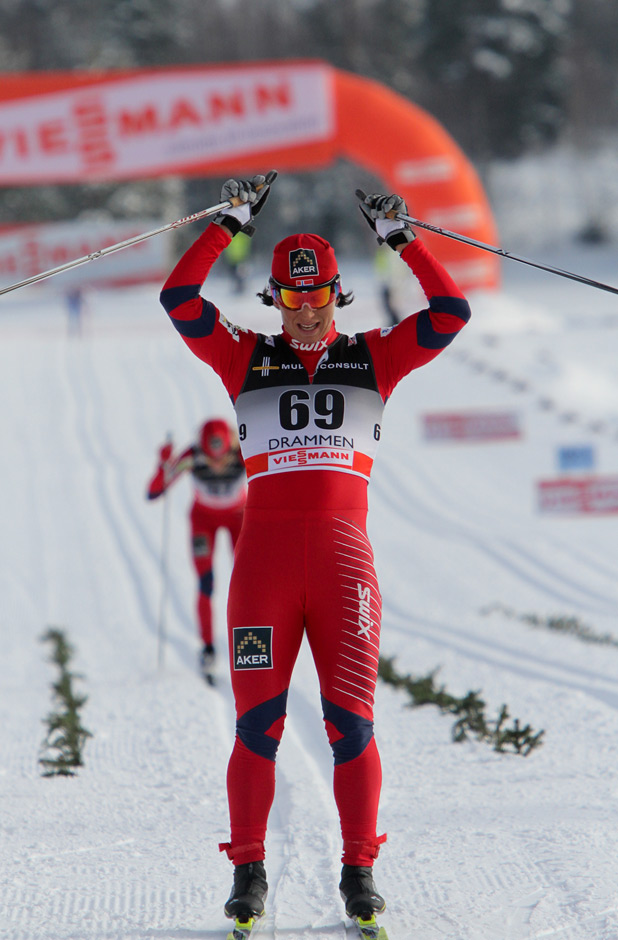
    Gaiazova stayed on her feet, but had to settle for third in the quarter-final, but as a result, finished her day 14th, her best placing thus far this season, and the Canadian has now qualified in three of the four World Cup sprint starts she has had this season.

    Gaiazova and Crawford are both fresh from North America – Gaiazova raced the NorAm in Thunder Bay, Ontario before hopping on a plane to Europe, where she and Crawford headed to Ramsau, Austria. The two took advantage of “bluebird sky, perfect weather, and perfecting skiing” and adjusted quickly.

    With just three techs and no coaches, the Canadians have a small crew, but Gaiazova said she was glad that the coaching staff was able to make it possible for the team to race in Liberec, and then moving on to the World Cup in Otepaa, Estonia, as well. Currently wax tech Yves Bilodeau is filling in as coach, which Gaiazova said was a fun change.

    “The first item on our pre-race meeting was whether or not we wanted to go out for pizza after our race today,” she said, laughing.

    Gaiazova and Crawford have already teamed up for a sprint relay medal once this season, a bronze in Dusseldorf, Germany. On Sunday they will combine forces once again, this time on classic skis, and their primary goal has already been achieved.

    “We wanted to make the final tomorrow, but there are only 13 teams, so they’re just running the final, not two heats,” Gaiazova said.

  • TDS Preview: No Bjoergen Means Women’s Tour Title Kowalczyk’s for the Taking

    Norwegian superstar Marit Bjoergen is sticking to her guns, and will not be racing the 2011 edition of the Tour de Ski.

    The winner of every single World Cup race this year, Bjoergen announced at the beginning of the season that she would follow the same plan that resulted in five medals at the 2010 Olympics.

    And that plan means no Tour de Ski.

    Since coming back from several down years thought to be caused by overtraining, Bjoergen has carefully picked her spots, resulting in impressive results. With the World Championships in Oslo this year, she won’t be taking any chances, good news for the rest of the women competing in the Tour.

    The Best…

    The women’s World Cup field features a very strong group at the head, with a handful of athletes usually dominating the top of the results sheet. This has been somewhat less so in the early part of the 2011 season as several of the big guns have struggled with their form, either due to injury or illness.

    Still, a quick scan of the start list reveals only a few names that have a legitimate chance at winning the overall Tour title.

    Justyna Kowalczyk, Olympic Champion

    The obvious favorite at this point is indefatigable Polish World Cup overall defending champion, and last year’s Tour winner, Justyna Kowalczyk.

    Kowalczyk skied away from arch-rival Petra Majdic (SLO) on the final climb of the 2010 Tour, and with Bjoergen out, this year’s event is hers to lose.

    Despite being overshadowed by Bjoergen so far, Kowalczyk is actually off to a better start this season compared to last, with four podium appearances to three, and all but once placing in the top-7.

    She can win in any distance and any discipline. Her only weakness is raw speed, but she makes up for that with an engine that few can rival.

    Like Kowalczyk, Majdic has not been dominating, but that is nothing new for the early season. She is coming back from serious injuries suffered at the Olympics, and appears to be still searching for top form.

    As always the key for her is her distance racing, even more so in the distance-heavy Tour. She will be hard-pressed to challenge Kowalczyk again this year, but should be in the battle for the podium.

    Arianna Follis (ITA) is an all-rounder of the type that has become common on the top of the women’s World Cup rankings. Third in last year’s Tour, Follis currently leads the Sprint Cup standings, and is third in the overall.

    She can sprint, she can ski distance, and she can do both in either technique. Off to a great start with four top-4 finishes, split evenly between sprint and distance, Follis may have the best chance of taking down Kowalczyk.

    The big question mark is Finland’s Aino Kaisa Saarinen. Consistently one of the bestskiers in the world, Saarinen suffered a shoulder injury early in the season, and missed significant time. Fourth last year in the Tour, and second in 2009 after a thrilling battle with teammate Virpi Kuitunen, Saarinen has only three World Cup starts under her belt this season, with two finishes well below her usual standards.

    Charlotte Kalla (SWE), thrilled the crowd and cemented her place in the hearts and minds of the Swedish public when she sprinted away from Kuitunen in the 2008 Tour as a 21-year-old.

    But mainly due to illness Kalla has not completed a Tour since. Off to a good start in 2011, Kalla certainly has what it takes to battle for the podium, and a repeat of her stunning victory is not out of the question.

    And the Rest…

    After the top group, there are any number of women who will battle for the top-10, and could join the fight for the podium if all goes well.

    Norwegians Therese Johaug and Kristin Stoermer Steira are both skiing strong. Neither is a sprinter, but as Lukas Bauer has proven on the men’s side, sprint results are not necessary in the Tour.

    Therese Johaug racing in the Olympics last February.

    But Stoermer Steira is not on the entry list for Norway, so will not be defending her fifth place result from the 2010 Tour.

    Johaug, however, is a brilliant skater  and if she can make it to the final climb, will be a force on the Alpe de Cermis.

    Their teammate, former World Cup overall runner-up, Astrid Jacobsen appears to have finally returned to the top level. A better sprinter, she is also capable of top-10 distance results, and could surprise over the ten day Tour.

    And don’t count out yet another Norwegian – Marthe Kristoffersen placed a quiet 10th in the Tour last season, but has not shown much in her few World Cup starts this year.

    Sticking with the Scandinavians, Anna Haag (SWE) will join Kalla at the head of the Swedish team. Haag is not a sprinter, but has had success at the prologue distance, and when skiing well, can compete with the best, as her silver medal in Vancouver proved.

    German Nicole Fessel and Italian Marianna Longa are currently ranked fifth and sixth respectively in the overall World Cup. Both are experienced veterans, and both can handle the sprint and distance events, with Longa holding the edge in the longer races. A podium appearance is a stretch, though not an impossibility, and the two women should be in the thick of things for the duration of the Tour.

    Another German, Katrin Zeller placed ninth in the 2010 Tour, but has not shown great form this year. Fessel will likely lead the team.

    Despite embarrassing results in relays, the Russian women can never be counted out. Yulia Tchekaleva is currently 8th in the overall World Cup, and placed 12th in last year’s Tour. With veterans Olga Saviaolova and Evgenia Medvedeva out of the picture, it is up to Tchekaleva to lead a young Russian squad.

    A top-10 finish would be an excellent result for the 26-year-old.

    Finally, Finland’s Riitta Liisa Roponen, always consistent, will look to improve on her sixth in the 2010 Tour.

    Who Else?

    The Tour format leaves plenty of room for surprises. With eight races in ten days, health is a major factor and withdrawals are common. And unique distances, including the prologue, the final climb and short pursuits make for interesting competition.

    Prochazkova

    There are plenty of other women who could make their way into the top-10, including German veteran Evi Sachenbacher Stehle, Slovakian Alena Prochazkova – who has shown stronger distance skiing of late, and Valentina Schehchenko (UKR) – a former final climb victor.

    And for the first time, an American woman will take part in the Tour de Ski. Kikkan Randall won’t just be showing up either. With top-20 distance skiing chops, and sprint speed that ranks her among the best, Randall will be a strong contender for a top-20 overall result.

    With the retirement of Sara Renner, Canada will not start any women this year.

    The Races

    Competition gets started on the 31st with a 2.5km freestyle prologue in Oberhof, followed the day after by a 10km classic handicap start..

    The Tour then heads south to Oberstdorf for a classic sprint, and a 10km pursuit on consecutive days.

    Following the first rest day, action continues in Toblach, Italy with the second sprint and then another handicap – this time a 15km freestyle affair.

    The final rest day falls on the seventh before the final push with a 10km classic mass start and the famous final climb up the Alpe de Cermis.

  • Norway Women Dominate World Cup Relay

    At the end of World Cup period I, Norway sits on top of the Nation’s Cup standings, and in a shift from the recent past, it is the women leading the way.

    The 4x5km relay in La Clusaz demonstrated exactly how the Norwegians built their points lead, with four women putting on a virtual clinic on their way to a 56 second victory over Italy.

    Three of the four Norwegians posted the fasted times on their respective legs, and the only one who didn’t was Therese Johaug, who virtually tied for second with Italy’s Marianna Longa, 18 seconds behind the always-strong Justyna Kowalczyk.

    Sweden finished third, +1:24.

    Vibeke Skofterud led the way for Norway I, pairing with Astrid Jacobsen of Norway II to open a 15 second gap on the field.

    Johaug took over and held position on the second classic leg before handing off to Kristin Stoermer Steira.

    “The victory for our team is great,” Steira said following the race. “We all know a relay is a relay and anything can happen, but today all of us were very strong.”

    Steira kept the pressure on, adding another 17 seconds to the lead, an insurmountable margin with the undefeated Marit Bjoergen anchoring.

    And the Norwegian star did not disappoint, winning the 5km leg by 20 seconds, to keep her perfect record for the season.

    Italy, with the inexperienced Virginia de Martin Topranin scrambling, skied a strong race, and never slipped below second place after the first lap. The team was led by veterans Marianna Longa and Arianna Follis, both second in the second and fourth legs.

    “It is a hard course but I could ski without the pressure from behind and skied my own race,” Follis said. “Second place is great for this young team!”

    None of the Swedes had sensational days, but all were solid, which was good enough for the final podium spot.

    Charlotte Kalla skied away from Finnish youngster Krista Lahteenmaki in the final 2.5 kilometers to secure third for Sweden.

    The Swiss women could not match the performance of the men’s team, and did not even finish the race after second skier Ursina Badilatti lost two minutes.

    Norway II also dropped out despite sitting in third after three legs. While Kristine Skeie was scheduled to anchor, but according to Langreen.com, she was not actually present, and there was never any intention of finishing.

    No North American teams entered.

    Women’s 4x5km Relay – complete results

  • Bjoergen Takes La Clusaz Mass Start; Americans 18th and 19th – Updated

    Marit Bjørgen racing in Norway last year. Photo, Geir Olsen.

    As the World Cup circuit heads towards its Christmas break, Marit Bjoergen is still in a class by herself.

    After breaking away from the pack less than five kilometers into the La Clusaz 15 k freestyle on Saturday, along with her teammate Kristin Stoermer Steira and Poland’s Justyna Kowalczyk, Bjoergen easily matched challenges by her opponents on the last of six laps, then turned on the jets on the homestretch to pull away for the win.

    Kowalczyk was second and Steira third. Americans Liz Stephen and Morgan Arritola both had their best performances of the year, finishing 18th and 19th, respectively.

    “It was incredibly fun. It was an awesome race, but tough,” she told Norwegian broadcaster NRK.

    Indeed, Bjoergen did appear vulnerable for the first time this season, biding her time until just a few hundred meters before the homestretch to make her move.

    She skied nearly the whole race with Kowalczyk and Steira, the trio having left everyone else behind before they had even skied a third of the 15 k distance.

    All three took turns at the front, and the gap to the chasers, led by Italians Arianna Follis and Marianna Longa, kept going up—it was more than a minute at the finish.

    None of the leaders dared to try anything before the last few climbs. Steira was the first to launch, putting in a few hundred meters of high-tempo, aggressive climbing, but it wasn’t nearly enough to drop Bjoergen or Kowalczyk.

    Kowalczyk was the next to go, but Bjoergen held on, then used what appeared to be a faster pair of skis to pass on one of the final descents. She shifted into a new gear as the course pitched uphill into the finish, crossing the line with a comfortable, one-second cushion.

    While the International Ski Federation credited Bjoergin with 42 victories, those don’t include overall stage race wins, or results at World Championships and the Olympics, which would push her up to 49.

    Regardless, the win was Bjoergen’s fifth in six races this season. (Her only loss came in the handicap start event in the Kuusamo mini-tour, which, for all intents and purposes, doesn’t count.) After racing the relay on Sunday with her Norwegian teammates, she’ll get a well-deserved break of nearly a full month off, since she plans on skipping the 2011 edition of the Tour de Ski.

    Stephen and Arritola skied most of the race together, with Stephen ultimately coming out on top in a head-to-head drag race to the line.

    It was Arritola’s best career result, and it was the top finish for Stephen since the 2009 World Championships in the Czech Republic. They came just in time, too—after both struggled in the early races this season, the La Clusaz race was likely their chance to prove themselves on the World Cup until February.

    Neither Arritola nor Stephen were available for comment, but in a press release, U.S. Ski Team coach Matt Whitcomb said that Stephen fell at the start, leaving her as the second-to-last woman in the race.

    “But when they met up, they skied together, pushing each other, as they have done a million times,” he said. “I am so proud of these gals; most of all, they were patient out there, and they worked together.”

    After fighting illness early this week, Kikkan Randall elected to skip the events in La Clusaz and remain in Switzerland, where she plans to spend Christmas in advance of the 2011 Tour de Ski.

    Link to full results.

  • Randall Takes Second Straight Skate Podium, as Bjoergen’s Run Continues – Updated

    With 100 meters to go in Sunday’s skate sprint in Davos, Kikkan Randall flew into the stadium in fourth place. A few strong strides brought her close to even with third, and second place even seemed to be within reach.

    Enter Justyna Kowalczyk—the wiry Pole with a reputation for provocative statements and questionable tactics. Just as Randall was about slide past, Kowalczyk made an aggressive move to her right, forcing the American to switch lanes and costing her a spot on the podium.

    To anyone who was watching, the move was egregious. And the race jury agreed, relegating Kowalczyk to last place in her heat after concluding that she was guilty of obstruction. The decision elevated Randall to third place—her latest inspired result in an muscular early-season campaign, and her second podium in two weekends of racing.

    “[I’m] definitely replaying that last 100 meters in my mind over and over, because I felt so strong, and I saw an open lane and I was going for it, and all of a sudden, Kowalczyk came out of nowhere,” Randall told FasterSkier in an interview. “I could have at least fought for second—but that’s sprint racing, and overall, I’m just pretty excited.”

    A few seconds after the Kowalczyk-Randall fiasco, Norwegian Marit Bjoergen again crossed the finish line unchallenged, taking her fifth win in six starts this season. Italy’s Arianna Follis was second.

    Bjoergen was dominating all day, winning both her quarter- and semifinal heats before dropping the hammer on the course’s big climb in the final, leaving behind a star-studded final that included fellow Norwegian Astrid Jacobsen and Slovenia’s Petra Majdic.

    Majdic was the only woman to come within 2.5 seconds of Bjoergen’s qualifying time. Randall was eighth in her preliminary round—the same as her qualifying place in the Dusseldorf sprint last weekend, where she ultimately finished second.

    The eighth place on Sunday morning was a good sign, according to U.S. Ski Team Head Coach Chris Grover.

    “Whenever you see her in the top 10 in qualifying, I think that’s a really good indicator that she has…quite a good chance that day of reaching the podium,” he said.

    In the heats, Randall was in command, using flawless tactics to win both her quarter- and semifinal rounds. Kowalczyk did most of the hard work each time, with Randall slotting into the draft whenever there was a headwind, using a crisp V1 technique to hold her position on the course’s steep uphill.

    “Kowalczyk played beautifully—she took the lead each time. I was able to kind of sit behind her and relax, and make sure I came over the top of that hill strong, to put myself in a good position,” Randall said. “I knew that the steep climb was going to be my advantage if I had clear snow.”

    While Randall had to contend with Kowalczyk, last year’s overall World Cup winner, in her first two rounds, the final was another challenge entirely. In addition to Kowalczyk, the heat also featured Bjoergen, with five medals from the Vancouver Olympics; Follis, the 2009 sprint world champion; Majdic, the World Cup sprint champion in 2008 and 2009; and Jacobsen, the 2007 sprint world champion.

    “It couldn’t have been any more stacked with experienced women,” Grover said.

    Randall had a decent start, coming through the first corner in fourth place, behind Majdic, Follis, and Bjoergen. That order held until the women passed through the stadium after completing their first of two laps. Faced with a long, open straightaway with a headwind, Randall opted to stay in the draft rather than make an attack.

    “You saw a lot of people earlier in the heats take the lead, and then fade at the end, so I wanted to conserve and be ready to go hard at the finish,” she said.

    Kowalczyk took the opposite approach, making a hard move on the inside that Bjoergen matched, subsequently pulling into the lead. Majdic dropped off as the women turned up the steep hill for the last time, leaving Randall in fourth, still just behind Follis.

    On the righthand side, Bjoergen hammered up the climb, with Kowalczyk in her wake. Randall was on the left, ready to try to match Bjoergen’s acceleration—but Follis was in the way.

    “I was really surprised. Arianna is usually a really good climber, so as I came into position and got behind her, I had some hopes,” Randall said. “I just felt like I ran into the back of her right away, and I wasn’t able to use my speed right there…I should have made a better move before that, to get myself some clear snow, because it would have been really sweet to go side-by-side with Bjoergen on a V1 climb like that.”

    Over the top, Bjoergen pulled away, leaving Kowalczyk, Follis, and Randall to fight for the final three spots on the podium.

    As those three descended into the stadium, Follis moved to the far left for the homestretch, with Kowalczyk in the middle and Randall on the right. And as Randall drew even with Kowalczyk, the Pole closed the door, hard.

    “It felt like she came right into me,” Randall said. “I tried to fight her for position for a stride or two, but she was able to kind of force me off…She definitely has a reputation as one of those racers that makes questionable moves, and will play kind of dirty, so it’s not surprising that she tried to pull that.”

    Randall said she had to check her speed, then switch lanes, by which point she had lost too much momentum to make another surge before the finish line. She said that she might even have been able to pick off Follis for second place if not for Kowalczyk’s antics.

    It didn’t take long, though, for the jury to conclude that Kowalczyk had broken the rules—Grover said that officials informed Randall of her improved finish while she was still in the finish pen.

    Randall’s podium isn’t final yet: According to Jurg Capol, the cross-country race director for the International Ski Federation, the Polish Ski Association (PSA) still has a 72-hour window to appeal the ruling, after which a three-member appeals commission would have an additional 72 hours to make a ruling.

    On Kowalczyk’s official site, a story was posted Sunday night quoting her coach, Alexander Wierietielny,  as saying that the PSA would be filing an appeal.

    “We have a record of television that confirms our words,” Wierietielny said. “We do not intend to turn tail and leave with our head down.”

    However, Capol said it was unlikely that the decision would be overturned in such a case.

    “I have no doubt about this,” he told FasterSkier in an interview. “Even if there is an appeal, the appeal commission will confirm the decision of the jury.”

    If the result stands, Randall will have three podiums in her last three World Cup skate sprint starts—and regardless, she has her best-ever start to the season.

    “It’s fun to just be in the mix, and to know that every year, I just keep getting closer and closer to ultimately where I want to be,” she said.

    Watch the women’s final.

    Link to full results.

  • In a Class by Herself, Bjoergen Wins in Davos – Updated

    In a Class by Herself, Bjoergen Wins in Davos – Updated


    Marit Bjoergen (NOR) racing in Davos.

    Rocket boosters? Tiny electric motors? Cutting the course?

    The World Cup women’s field is going to have to come up with something, because it’s pretty clear that plain old training and technique isn’t going to be enough to beat Norway’s Marit Bjoergen any time soon.

    In Saturday’s 10 k classic in Davos, Switzerland, Bjoergen won for her fourth time in five races this year, skiing to a 30-second victory over her Polish rival Justyna Kowalczyk. Therese Johaug (NOR) was third, 40 seconds back, but nobody else was even close: Finland’s Aino-Kaisa Saarinen was the next finisher, nearly one minute and 40 seconds behind. Kikkan Randall (USA) was the top North American finisher, far off the pace in 47th.

    “Everything worked perfectly today,” Bjoergen told the Norwegian broadcaster NRK after the race.

    Bjoergen’s win in Davos was her 40th career victory on the World Cup, according to NRK. After a few days of heavy snowfall, some had predicted chaotic racing conditions, but precipitation appeared to taper off by the time the women started.

    Saarinen, back from a shoulder injury that kept her out of the first three World Cup weekends, showed that she wasn’t far behind the eight-ball, setting the fastest intermediate times out of the early starters.

    It looked like the race would be tight, as Saarinen held just a few seconds on Marianna Longa (ITA) and Masako Ishida (JPN) at the halfway point. But as soon as Johaug came through, it was clear that there was another class of athletes still to come—she arrived at the 5-kilometer marker 20 seconds ahead of Saarinen, a gap that widened over the second half of the race.

    Johaug said afterwards that she has never skied well at altitude, and she typically struggles in Davos—her best individual finish there prior to Saturday was 20th place, back in 2007. But her quick-tempo, peppy technique was working on Saturday, as she set the best times at each checkpoint.

    After Johaug, there were just three more starters in the seeded group: Kowalczyk, Bjoergen, and German Nicole Fessel, who finished 16th.

    Bjoergen in the leader's chair.

    Kowalczyk started one bib ahead of Bjoergen—a gap of 30 seconds. After Kowalczyk’s critical comments about Bjoergen’s asthma medication earlier this year, the Norwegian likely had plenty of incentive to claw back the ground, and claw back she did, taking 22 seconds by the halfway point.

    Bjoergen caught Kowalczyk with a couple of kilometers to go, but with victory assured at that point, she didn’t bother to come around. Afterwards, Bjoergen told NRK that she didn’t want to give Kowalczyk an extra boost that could have helped her top Johaug.

    The four North American starters—Americans Randall, Liz Stephen, Morgan Arritola, and Canadian Dasha Gaiazova—were never in the race. Randall led the way in 47th place, but she was a full four minutes behind Bjoergen. Stephen was next, in 48th, with Arritola placing 57th and Gaiazova 61st.

    Coming off a podium finish last weekend in Dusseldorf and two top-20 distance races earlier in the season, Randall said that she was “hoping for a bit more” on Saturday. But she was foiled by tricky conditions: heavy snow that ended just before the start of the race, then transformed into glazed tracks that demanded good technical skiing. Randall said her skis were “decent,” but that she just never found the right rhythm.

    “Davos continues to be a challenge for me,” she said.

    After pushing through two thirds of the race, Randall said she shut things down to save energy for Sunday—her first opportunity this year to face off against Bjoergen in a skate sprint, her favored discipline. Randall said she was looking forward to testing herself against the Norwegian, whom she called “perhaps the greatest female skier of all time.”

    “She’s definitely firing really well—it’ll be fun,” Randall said.

    Link to full results.

  • Northug Makes 2011 World Cup Debut, Randall Challenges Bjoergen in Davos World Cup

    After a wildly entertaining weekend of sprinting in Dusseldorf, complete with North American podiums and crashes galore, the World Cup returns to normalcy in the cross-country paradise of Davos, Switzerland.

    The action starts on Saturday with an individual start 10/15km classic, before shifting back to sprinting with a freestyle event on Sunday.

    A number of top skiers, including Marit Bjoergen (NOR), Justyna Kowalczyk (POL), Marcus Hellner (SWE), and North Americans Kris Freeman (USA) and Devon Kershaw (CAN) skipped Dusseldorf in order to get a block of training in.

    They will be back in action in Switzerland, along with Petter Northug (NOR), who has yet to race a World Cup this season.

    There are plenty of interesting story lines to follow in the distance races, starting with the debut of Mr. Northug.

    Kris Freeman (USA) – exhausted after finsihing 7th in the 15km Freestyle in Davos last year

    After an impressive season last year that included the overall World Cup victory and four Olympic medals, great things were expected of the 24-year-old.

    But an illness contracted at early season FIS races took Northug out of commission, and rumors of over-training followed the best all around skier in the world back to his home for recovery.

    No one really knows what to expect, and despite a slow (or perhaps more accurately, a non-existent) start to the season, beware any who underestimate him.

    Wrote Canada’s Kershaw in an email, “Northug is still the best skier in the world. He’s proven that for a number of years…I think he may actually surprise some people on Saturday, but regardless of how this weekend goes for him, he’ll be extremely dangerous the following weekend in La Clusaz and the rest of the season.”

    The individual start 15k classic has never been Northug’s best event – in fact he has only two podium finishes in the event spanning over 50 World Cup starts, two World Championships and the 2010 Olympics.

    And the 15km in Davos has been particular unkind. In three career starts I the 15km individual in Davos, Northug has finished 34th, 55th and 21st.

    But Kershaw notes that many were quick count Northug out in the 15k classic in Kuusamo last November, a race the Norwegian won.

    “I have a tremendous amount of respect for Northug,” said Kershaw. “A fan of him or not – you do have to respect his ability and track record.”

    He skied well, if not brilliantly, at FIS races in Meraaker, Norway last weekend, and regardless, won’t be the only point of interest in Davos.

    American Kris Freeman is off to a fine start, most notably with his consistency.

    Freeman has had strong early season results in the past, including a career-best 4th in Kuusamo last year, a race he followed with a 7th in Davos.

    But he has struggled to string together more than two or three strong weekends in a row. Thus far this season, Freeman has skied very well in every distance start.

    As Colin Reuter pointed out in this week’s FasterSkier podcast,, this weekend will be a good indicator as to whether or not the veteran can compete week in and week out with the best in the world.

    The 15km classic is arguably his best event, with that 4th in Kuusamo as well as two World Championship races with that same result, so a run for the podium is not at all out of the question.

    Devon Kershaw (CAN) – striding out in Canmore last year.

    Kershaw quickly turned things around after a rough opening weekend, and is a top-10 threat in any event.

    Livigno, where Kershaw was based, is higher than Davos, and according to Kershaw the gradual terrain is perfect for adjusting to altitude. And perhaps more importantly, the food is “absolutely mind-blowing.”

    Kershaw is looking at the next two weekend’s as “Tour de Ski prep.” The schedule includes four different formats between Davos and La Clusaz, the site of the next World Cup, making for a “great mix of races.”

    But with the focus on the post-Christmas Tour, and nine hard days of training, Kershaw is not expecting too much from himself.

    He would like to improve his pacing in the 15km, noting that he has blown up every time on the Davos course.

    “More often than not I am a complete mess at the end of the 15km here – having trouble seeing I am so shattered.”

    On the women’s side, the undefeated Bjoergen will be back in action, challenged by nemesis Kowalczyk. Nobody has been able to touch the Norwegian this season, and there is no reason to think that will change. Kowalczyk should make a good run after skipping Dusseldorf, but until someone actually unseats the current Queen of World Cup skiing, it would be foolish to bet against her.

    Also worth watching is American Kikkan Randall. While she is an obvious pick in the freestyle sprint, Randall has worked to become a legitimate World Cup distance skier, and the 10km classic has been her best non-sprint event.

    She is clearly in fine form, and will be looking to crack the top-10 for the first time in a World Cup race over two kilometers.

    The sprint features many of the same cast of characters. Randall has stated that she is looking forward to challenging Bjoergen, in a rematch of the skate sprint in Oslo last spring.

    In that race, Bjoergen overtook Randall entering the homestretch to take the victory. But Randall has cemented her position as one of the best freestyle sprinters in the World, and while there were nearly nine months in between starts, she has consecutive World Cup podiums in the event.

    The more challenging course should play to her strengths more than the flat, twisty loop in Dusseldorf.

    Chandra Crawford (CAN) is coming off a strong performance in the team event with partner Dasha Gaiazova in Dusseldorf, and both women will look to do better than just qualifying for the heats.

    Andy Newell (USA) will not start the 15km classic, despite rumors he was lobbying to do so. Instead he will focus on the sprint, and come back from an early exit in the quarterfinals in Dusseldorf.

    10/15km Classic

    US Men:

    Kris Freeman – gunning for the podium

    Noah Hoffman – classic is not his strong suit, so a top-40 would be an excellent result

    Chris Cook – trying to turn his season around

    Canadian Men:

    Devon Kershaw – always a threat. See above.

    Ivan Babikov – Has been traveling all over – over just before the first races, back to Canada after Kussamo, and now to Europe again.

    George Grey – Trained with Kershaw in Italy. Has not skied fast yet.

    US Women:

    Kikkan Randall – A top-10 is not out of the question

    Liz Stephen – Skied well at opener in Gallivare, but is a stronger skater

    Morgan Arritola – Looking for first breakout race of the season. Best results have also come skating.

    Canadian Women:

    Dasha Gaiazova – Has shown the World Cup sprinting chops, distance has lagged behind.

    Freestyle Sprint

    US Men:

    Andy Newell – Won’t be happy with anything but a finals appearance

    Simi Hamilton – Getting his first taste of the fall World Cup tour. Experience should matter less in Davos than Dusseldorf.

    Kris Freeman – Gets sprint starts when he can. Bet with Newell still unresolved (who scores WC points first – Freeman in a sprint, Newell in distance), but don’t look for that to change in a skate sprint.

    Chris Cook – No expectations.

    Canadian Men:

    Devon Kershaw – Can be strong in anything.

    Steffan Kuhn – Nearly made the heats in Dusseldorf – a good race considering he has been better in classic

    Len Valjas – World Cup rookie is skiing well.

    Phil Widmer – Has the potential to improve on Dusseldorf 53rd.

    Brent McMurtry – NorAm winner form last season is getting lots of chances.

    US Women:

    Kikkan Randall – First World Cup victory is not a stretch

    Liz Stephen – Not a sprinter, but good practice

    Canadian Women:

    Chandra Crawford – Fitness seems solid, Davos will be a good test.

    Dasha Gaiazova – Looking to make the jump from qualifier to contender.

  • Dusseldorf City Sprint Preview – Get Yer Popcorn Ready!

    Dusseldorf City Sprint Preview – Get Yer Popcorn Ready!

    Since 2002, the city sprint in Dusseldorf, Germany, has become a fixture on the International Ski Federation’s (FIS’s) World Cup calendar. One of three regular city sprints on the circuit, Dusseldorf features a flat, extremely fast, and almost dangerously narrow and twisty sprint course.

    Over the last eight seasons, the German city has become renown for carnage and upsets, almost as much as for cross-country skiing in a unique location and with a great crowd atmosphere.

    Racers in the 2009 edition of the Dusseldorf World Cup. Photo courtesy of World Cup Dusseldorf.

    Every year, 3,000 cubic meters of artificial snow are trucked in from a nearby indoor ski slope, and the German organizers cover the boardwalk along the Rhine River and pack in thousands of fans. Dusseldorf is often a bit of a spectacle, as according to FIS, over 350,000 fans packed into the city to catch the World Cup in 2008. And speaking of spectacles, the 2006 edition of the race featured the little incident in which Oeystein “Sausage” Pettersen (NOR) earned his nickname.

    Dusseldorf is notable for the lack of high-powered distance and all-around World Cup skiers. Top overall contenders like Lukas Bauer (CZE), Marcus Hellner (SWE), and Petter Northug (NOR) will be absent on the men’s side, and Marit Bjoergen (NOR) and Justyna Kowalczyk (POL) will also take the weekend off. This typically results in a few surprises – last season, Sweden’s 20-year-old Hanna Falk came out of nowhere to stand on the top of the women’s podium.

    Dusseldorf is also home to a few consistently impressive city sprinters. Germany’s Josef Wenzl is a bit of a one-trick pony on the World Cup, as he skis amazingly in Dusseldorf, but struggles in most other locales. While last season he faltered, failing to make the heats, Wenzl has been in the A-Final in Dusseldorf three times, including two podium finishes in his four starts. He might not win, but it’s tough to count out a fast sprinter with that track record on home turf, especially when German Head Coach Jochen Behle backs him.

    The Norwegian Sprintgutta has traditionally been a strong presence as well, and this year is no different. Of the eight men sent to Dusseldorf by Norway, six have stood on the podium there before. Anders Gloersen and Eirik Brandsdal finished second and third, respectively, last season. The stacked Russian sprint team will also make an appearance – Alexei Petukhov won in Dusseldorf last year, while Nikita Kriukov and Alexander Panzhinskiy, the top two finishers in the sprint at the 2010 Olympics, are both on the start list.

    As for the North American contingent, Kikkan Randall is the only American woman racing, and she has skied well at the city venue in the past. According to U.S. Ski Team (USST) Head Coach Chris Grover, Randall has some unfinished business on the boardwalk.

    “Last year in Dusseldorf, she got tangled up and fell down in her quarterfinal right after the start,” Grover said, “She never had a chance to demonstrate her ability.”

    The two-woman Canadian sprint squad is undeniably led by Chandra Crawford (CAN). Crawford considers the Dusseldorf sprint a bit of a specialty, and she has made the heats in all of her starts there. She has been targeting the upcoming weekend all year for her first big performance.

    Last season, Crawford finished 12th at the venue, punching her ticket to the Olympic Games. According to her blog, this season she looks to crack the top 20, which would cement her spot on the World Ski Championships team.

    Dasha Gaiazova, Crawford’s counterpart, has been strong in both sprint and distance races this season, and there is no reason for that success not to continue, especially with a smaller field making for slightly less-competitive qualification.

    Andy Newell (USA) will undoubtedly lead the North American men, as he proved in Kuusamo that he is top sprinting shape, and like Randall, he undoubtedly has an axe to grind from last year’s Dusseldorf event, where he qualified third but failed to reach the A-Final. While Newell’s arrival has been delayed by transportation and passport problems, so long as he arrives in time to hit the start line, he will still be a contender.

    The performances of the other American men are harder to predict, however. Simi Hamilton had a breakout sprint season last year; however that was mainly due to his classic sprinting speed, and so far this year he has been hampered by a leg injury. According to his blog, the injury is now in the rearview mirror, and he will be looking for an opportunity to mix it up in at least one heat.

    Torin Koos has been traveling and racing in Europe separate from the USST this year, but after finishing second in a sprint event in Norway last weekend, Koos was chosen to step up for his first World Cup of the season.

    As for Chris Cook, his season has started out slowly, and he will need to take a big jump if he wants to advance on the fast course, with so many top sprinters taking to the start line.

    In the absence of top male all-around threats Devon Kershaw (CAN) and Alex Harvey (CAN), the Canadians are rolling with a pure sprint squad for the weekend. Classic sprint specialist Stefan Kuhn, breakout talent Lenny Valjas, and Phil Widmer will all start. Kuhn and Valjas qualified last weekend in Kuusamo’s classic sprint – look for them to build on those strong results in the slightly reduced field.

    Brent McMurtry (CAN) also gets the call for the Canadian team, and after two weekends which saw him fail to score World Cup points, he will hope to make a break through.