From the FasterSkier archive — posts syndicated from athletes’ and coaches’ own blogs between 2004 and 2012, kept online as published. Current coverage is at fasterskier.com.

Tag: Marit Bjoergen

  • Bjoergen Doubles Down on Gold; Haag Breaks Through

    Bjoergen Doubles Down on Gold; Haag Breaks Through

    Marit Bjoergen (NOR) celebrates her 2nd gold medal.

    Two days after winning the 100th gold medal in Norway’s Winter Olympic history, Marit Bjoergen wasn’t ready to stop.  She added to that tally Friday, skiing to an impressive victory in the women’s 15km Pursuit at Whistler Olympic Park.

    Bjoergen put on a powerful move on the second-to-last climb of the race, leaving her competition in the dust.  She was able to celebrate down the finish stretch in front of the cheering crowd while the battle for silver played out behind her.

    Anna Haag (SWE) won that battle, capturing her first Olympic medal, and erasing the disappointment of a fourth place finish in the sprint.  Justyna Kowalczyk (POL) out-lunged Kristin Stoermer Steira (NOR) at the line for the bronze, continuing Steira’s remarkable run of Olympic fourth place finishes.

    Conditions were excellent for the third women’s cross-country race of the 2010 Olympics.  With a warm sun beating down, but cold temperatures overnight, the atmosphere was festive, and the skiing fast.

    The pack one kilometer in.

    The pace was fast from the start, with Kowalczyk and Bjoergen pushing on the first climbs.  The pack spread out quickly, and a lead group of fourteen women formed up as the race moved through the stadium after the first classic lap.

    The attrition continued, and by the five kilometer mark, only eight women could maintain the blistering pace.  Charlotte Kalla (SWE), the gold medalist in the 15km, tripped and fell when switching tracks in the stadium, losing contact.  She would never get back in the race.

    Within the group of leaders, Bjoergen and Aino-Kaisa Saarinen (FIN) looked strongest.  Saarinen was looking for the first Finnish cross-country medal of the games, and appeared to be on a mission.

    The chase pack continued to lose ground as the halfway mark and the transition to skate approached.  Saarinen had a blistering exchange, leaving the transition zone on her skate skis 20 meters out front.  But Bjoergen brought the pack right back.

    Norway was in excellent position for a medal, maybe two, with Bjoergen, Steira and Theresse Johaug making up 40% of the frontrunners.  The trio took advantage of their numbers, trading leads and working together.  “We had really good teamwork today,” Johaug told FasterSkier after the race.

    The lead pack of seven, completeing the second lap.

    Coming through the stadium for the last lap, Steira and Bjoergen led Kowalczyk, Haag and Johaug, with the rest beginning to fall off the back.

    Between kilometers 12 and 13, on the biggest climb of the course, everything changed.

    Saarinen, powerful and strong to this point, ran out of gas.  Johaug and Italian Marianna Longa were in the same boat, and by 13km, they were over 30 seconds out.

    So two Norwegians, a Swede and a Pole set about deciding the medals.  Steira attacked first on the second to last climb, but quickly pulled over, letting Bjoergen take over.  She didn’t miss a beat and started her punishing move.  She immediately had a gap, and the race for gold was over.  Her nine second margin of victory is misleading as she celebrated over the last 100 meters.

    “When Kristin attacked on the uphill, she opened a gap and wanted me to go ahead,” said Bjoergen.  “I went by and heard I had 20 seconds with one kilometer to go, and then I knew that this was my day.”

    “Marit was really strong on the second-to-last uphill,” added Haag.  “The three of us [Kowalczyk, Haag and Steira] was a little bit tired and we did not have the strength to fight for the win.  We just stayed strong and had to fight among the three of us.”

    Meanwhile, Haag looked to be tiring more than the others, barely hanging on to Kowalczyk and Steira.  The best sprinter of the three, she needed to stay in contact.  She did just that as they crested the last hill and descended into the stadium.  In 4th swinging around the big downhill corner, she immediately attacked when they hit the flat, pulling into 2nd before the stadium hairpin.  She showed off her sprinting prowess holding on to the silver position.

    The battle for silver

    Steira pulled ahead of Kowalczyk, a notoriously bad finisher, and appeared to be headed for her first Olympic medal.  Kowalczyk, stubborn as always, wouldn’t go away, came back even, and won the lunge to the line by no more than two inches.

    Steira celebrating prematurely.

    There was a long wait before the photo finish was announced, with Steira celebrating wildly at one point, when officials initially announced her in 3rd.   But the photo finish video showed Kowalczyk clearly, if marginally, ahead.

    “It is extra hard to be number four when I’ve been told that I won the bronze medal, only to have it changed.  But in the pictures, I’m behind,” Steira said after the race.

    In five Olympic individual races, Steira has now been 4th a remarkable four times.

    “When I was number four in Torino, I was actually quite happy.  Now it’s bitter,” Steira told Langrenn.com, with tears in her eyes.

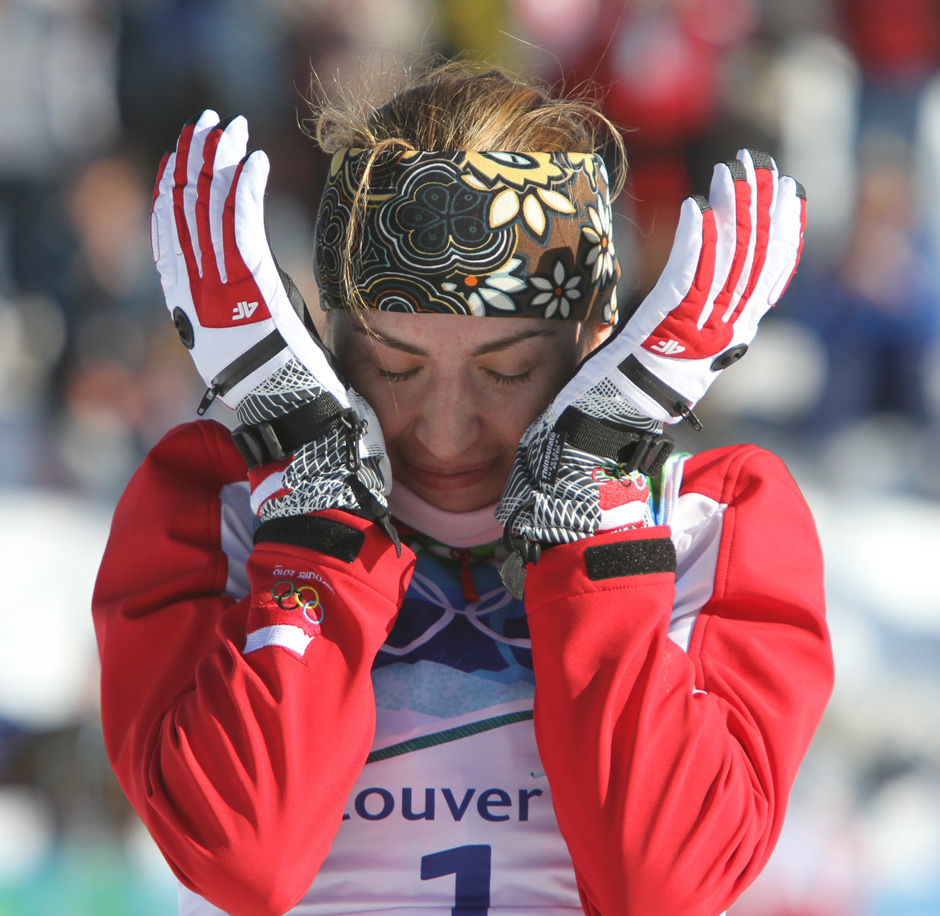
    Kowalczyk was thrilled with her medal, crying on the podium, and telling media that she was surprised to be in the top-3 given her strengths do not play to the Whistler course, with its many transitions and tight corners.  She repeated what she has many times before.  “I prefer the uphills…”

    She also had a long wait for the results to be announced, but when asked if this was the toughest minuets of her life, she laughed in disbelief, saying “The spot is very important, but not that important.”

    Kowalczyk on the podium.

    Gracious as always, whether in victory or defeat, she noted Steira’s string of Olympic disappointments. “I am very sorry for Kristin.  She has been number four many times.  That is not nice.”

    But while the drama came in the battle for second, Bjoergen was the woman of the day.  She became the first dual gold medalist in Vancouver, and the first athlete with three medals total.  She looked very strong and in control throughout the race.

    She said she took it a little easier on the second lap, not leading, and conserving energy.  “When we switched to skate, the speed was not so high,” leaving her with the strength to ski away at the end.

    From 2004 to 2007, Bjoergen won the overall World Cup twice and finished 2nd twice.  But she struggled the next two years and made significant changes to her training entering this season.

    Norway in control.

    She focused on training, competing less in preparation for the Olympics.  She sat out the Tour de Ski, and while she found it tough to watch it on television, she is very happy about that choice now.

    Last summer she increased her training volume, decreased the intensity and worked hard on her skate technique.

    Said Norwegian Team Leader Age Skinstad  “The main reason [for her success at the Olympics] is all the hard work she has done since we were here in April last year.  And the choices that she has made regarding training and recovery since then has been the biggest thing that has mattered.  For Marit today everything was perfect.”

    Haag hanging on the last climb.

    Added Swedish coach Joakim Abrahamsson  “We are happy for Marit.  She has been the best for many years, so it is time for her [to win a gold].”

    “I don’t think anyone could beat Marit today,” a still happy Haag said at the post-race press conference.

    Haag was her own story.  The Swedish all-rounder has been in the shadow of Charlotte Kalla for most of her World Cup career, and while she has two podium finishes on the World Cup, she had never finished better than third.  That changed today.

    “She showed that she is a fighter in every moment,” said coach Abrahamsson.  “She won’t let the medal pass her by so that was very strong of her.  She is very strong mentally – she never gives up.”

    To most observers, it didn’t look like she would make the podium, hanging on by a thread on the last climbs.  “On the last hill I didn’t think I could make it.  I don’t know where the strength came from.”

    “She looked like she was suffering,” said boyfriend and decent skier in his own right, Emil Joensson.  “It looked like oh no, fourth again, but she got good speed and the waxers did a good job, and she had good speed at the finish.  It was great!”

    He was confident in Haag’s chances.  “She has been strong and so cool, so relaxed before the race.  I felt like it could be a great day, and it was.  This was good.”

    Complete Results

  • Bjoergen Takes Women’s Sprint Gold, as an Injured Majdic Gets a Bronze

    Bjoergen Takes Women’s Sprint Gold, as an Injured Majdic Gets a Bronze

    Bjoergen, Kowalczyk and Majdic celebrate across the line.

    If those pesky NBC producers were still searching for that perfect feel-good story, they sure got it today.

    After a horrifying crash in her warm-up for the women’s classic sprint at the Vancouver Olympics, Slovenia’s Petra Majdic was in so much pain that she could barely breath. But somehow, she still found the strength and courage to stay with the best skiers in the world, winning a bronze medal behind Norway’s Marit Bjoergen and Poland’s Justyna Kowalczyk.

    “For her, it was gold,” Bjoergen said.

    Majdic had made today’s sprint her focus for these Games, after some disappointing results in Torino in 2006. She sat out Monday’s 10k skate, in which she had an outside shot for another medal, in order to be better prepared.

    When she slid off course this morning and fell three meters down a ledge, breaking a ski and both of her poles, it initially appeared that Majdic’s Olympics would be over.

    She missed her start time as she was being treated, screaming to be taken outside so that she could race.

    When she finally got there, officials granted Majdic a position at the back of the pack, and she somehow fought her way to 19th place in the qualifier, helped along by sympathetic fans and coaches.

    “It was the first time that all coaches from all nations were cheering for me,” she said.

    After a visit to the hospital for an ultrasound (no breaks, but a “serious punch on the muscle”), and some serious painkillers, Majdic then had to ski through two heats into the finals, sneaking in as a lucky loser after fourth place in her semifinal.

    She trailed Bjoergen and Kowalczyk in the medal round, making a dogged effort to latch on to them as the trio entered the stadium. Despite her strong double-pole, though, Majdic couldn’t maintain contact—though she had just enough left to hold off Sweden’s Anna Olsson.

    Kowalczyk checks on Majdic who is attended by coaches at the finish.

    After the finish, Majdic fell to the ground and remained there, limp and motionless, as she was tended to by medics and her coaches. She had to be carried away, and was still in visible pain during the post-race press conference. She said that she probably wouldn’t be able to compete in the team sprint on Monday.

    “She’s crazy,” said Katja Vesnar, Majdic’s teammate. “She really showed how much this means to her. I think if that accident hadn’t happened to her, she could win easily—she was so strong today.”

    Despite Vesnar’s hyperbole, though, it was clear that even a full-strength Majdic would have had her hands full with Bjoergen.

    The Norwegian was untouchable, easily winning her first two heats before a showdown in the finals with that wiry Pole, Justyna Kowalczyk.

    Kowalczyk won last week’s sprint in Canmore by a mile, and also was unchallenged in the earlier rounds.

    She and Bjoergen matched each other stride for stride on the final uphill, with Kowalczyk emerging in the lead going over the top. But on the ensuing downhill corner on the way into the stadium, Bjoergen caught the cautious Kowalczyk with an aggressive pass on the inside, taking a lead that she never relinquished. It was Norway’s first gold medal in the Olympics since 2002, which should relieve the pressure from a harried coaching and waxing staff after a tough opener Monday.

    The final, early in the race.

    With some added pressure on her shoulders after just one of her teammates qualified for the heats in the men’s race, Kikkan Randall (USA) outperformed her own expectations with an eighth place finish—one spot better than her result in the skate sprint in Torino, and the best in American women’s Olympic history.

    Randall steps out in her quarterfinal to overtake Finn Pirjo Muranen, a move that would earn her a berth in the semis.

    Her quarterfinal had her matched up with a tough bunch, including Bjoergen, Norway’s Astrid Jacobsen, and Slovenia’s Vesna Fabjan. After a slow start, Randall was able to make up ground with some strong double-poling in the stadium, finishing third and advancing as a lucky loser based on a fast time in her heat. Starting in the first quarterfinal of the afternoon, Randall may have been helped by rapidly-warming temperatures, which seemed to slow down the skiing as the day wore on.

    In the semis, the Alaskan again had to face off with Bjoergen and Jacobsen, as well as Italian Magda Genuin. Bjoergen took off from the gun, and Randall was left behind after being slow out of the gate, which she said she struggled with.

    “It was fast from the get-go—I need to work on my starts a little bit,” she said.

    Randall looked like she was heading for last place in her heat, but then pulled it together for the final climb, passing Virpi Kuitunen and Natalia Korosteleva by the finish and even closing in on Jacobsen.

    There was a chance for Randall to move on as a lucky loser with her fourth place in that semi, but the next one was faster.

    Randall said afterwards that her goal for the day was a top-12, and she seemed pleased to better that.

    “All season I’ve been feeling like there’s one gear missing, and it showed up at just the right time,” she said. “What a fun day out there.”

    Complete Results

  • Can North Americans Unseat the Scandos in the Sprint?

    Emil Joensson (SWE) will have his hands full holding off Norway's Ola Vigen Hattestad, but he is the favorite for the men's sprint today

    Sunny skies and warm temperatures greeted sprinters on their arrival at Whistler Olympic Park this morning for the men’s and women’s sprint.

    This is a big chance for the Canadians and the U.S.—all six Americans are capable of qualifying for the heats, with three medal hopefuls in Kikkan Randall, Torin Koos, and Andy Newell.  The Canadians are set up just as well, with Devon Kershaw, Sarah Renner, Dasha Gaiazova, and Perianne Jones gunning for the heats, and hopefully more.  Defending Olympic gold medalist Chandra Crawford should be able to qualify as well, but she is unlikely to repeat her Torino performance due to the change in technique from skate to classic.  With a good day, any of the other Canadians could also make the heats.

    That is one of the most exciting aspects of sprinting – there are so many skiers with a legitimate shot at qualifying, and though Nat threatens to quit every time I say it, once you are in the heats, anything CAN happen.

    The big hope for the US is obviously Andy Newell.  A consistent top-10 World Cup sprinter, the podium has eluded Newell in recent years.  He can’t be considered a medal favorite, but the finals are realistic.  Newell told FasterSkier that his goal is to advance to the finals and once there, give it his best shot.

    Koos is a bit an unknown quantity.  Will the Torin who finished 2nd in qualifying, just behind Emil Joensson, in Canmore show up?  Or the one who failed to qualify for the heats during the entire first World Cup period?  His form is good, and Canmore demonstrated he has the speed right now.  After battling illness in 2006, Koos will be looking for redemption, and the heats are likely.

    After those two, both Garrott Kuzzy and Simi Hamilton have the speed to advance, but they will have to have their best races.  While they did qualify in Canmore, their races would not have been good enough for the full field they face today.

    On then women’s side, Kikkan Randall needs to be on her game to advance in classic.  She is improving steadily, and at this point is definitely a top-30 classic sprinter.  While it would be nice to predict her battling for the podium, she has yet to show that she has that level in classic.  A top-10 would be a great result for Kikkan.

    Holly Brooks also qualified in Canmore, and like Hamilton and Kuzzy, could do so here, but will have to have the race of her life.

    On the Canadian side, Sarah Renner rejuvenated her sprint career in Canmore, finsihing 3rd.  A repeat is unlikely, and she is not a sure thing for qualifying.  But on home soil, look for her in the heats.

    Gaiazova and Jones are both capable of the top-30, with Gaiazova the more likely.

    For the men, Kershaw will be gunning for a medal.  He has been on the World Cup sprint podium in the past, and with the home crowd cheering him on, he will be in the running.  He is a somewhat inconsistent sprinter – never a sure thing to qualify, so hopefully he will be in top form.

    The rest of the Canadian men, led by Stefan Kuhn, will need perfect performances to advance, but no one can be counted out.

    And the favorites?

    For the men, it comes down to Ola Vigen Hattestad and Emil Joensson.  The two are a clear step above the rest of the field in sprinting.  My gut is Joensson, but Hattestad has an almost Northug-like ability to pull out a win from the jaws of defeat.  The two men race with contrasting styles, with Joensson preferring to race from the front.  Hattestad is very patient, biding his time before making a big move – often on the biggest climb.  Both are powerful doublepolers.

    From there, you can pick any number of men for the podium.  Northug should be in the hunt, especially after his disappointing 15k.  The other Norwegians, Petersen and Kjoelstad are certainly medal-capable, as is young Teodor Petersen of Sweden and his teammate, the veteran Bjorn Lind.

    But then there are the Finns, the Russians, the Germans – however you slice it, it will be a battle, with no sure things.  And with a nasty corner at the bottom of the course, crashes are not unlikely.

    The favorites on the women’s side come down to the usual group – Justyna Kowalczyk (POL) and Petra Majdic (SLO).  But they will be challenged by young Hannah Falk of Sweden as well as the always strong Aino Kaisa Saarinen (FIN).  Marit Bjoergen (NOR) is an interesting pick, and while the gold seems unlikely, a second medal in these games is in reach.

    Predictions

    Men:

    Gold – Emil Joensson (SWE)

    Silver – Ola Vigen Hattestad (NOR)

    Bronze – Petter Northug (NOR)

    Women:

    Gold – Justyna Kowalczyk (POL)

    Silver – Hanna Falk (SWE)

    Bronze – Petra Majdic (SLO)

    Top Americans:

    Andy Newell – 6th

    Kikkan Randall – 11th

    Top Canadians:

    Devon Kershaw – 12th

    Sarah Renner 27th

  • First XC Races Set to Kick Off This Morning in Whistler

    First XC Races Set to Kick Off This Morning in Whistler

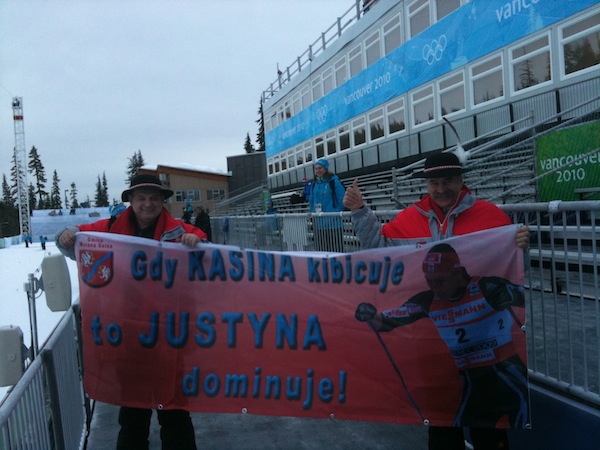
    Polish fans of Justyna Kowalczyk in the stadium two hours before the start of the freestyle 10/15k on Monday morning
    Polish fans of Justyna Kowalczyk in the stadium two hours before the start of the freestyle 10/15k on Monday morning

    The first cross-country races of the 2010 Olympics – the 10/15km individual start freestyle – may represent the best chance for medals – for both the US and Canada.

    Kris Freeman (USA) has twice finished 4th at the World Championships in this distance, and while he has had more success in classic, he has raised his skating to a similar level in recent years, and should be better positioned in the individual start format.

    While he has shown excellent sprinting skills domestically, and nearly qualified for a World Cup sprint earlier this year, he has not traditionally had his best results in the longer mass start formats – the 30km pursuit and 50km – where a fast finish is necessary. Given the courses at Whistler, it is very possible that both those races will end in a mass sprint – with a large pack battling over the last 200 meters.  He should not be written off in those races, but the 15km remains his best chance.

    The same goes for Ivan Babikov (CAN).  Babikov, a ferocious competitor, and excellent skater, has much less speed than Freeman, and will be hard pressed to come out on top of a 20-man charge to the finish.  So again, the 15km is going to be his best event.  Babikov excels on hills, last year winning the Tour de Ski Final Climb.  And while the Whistler course seems plenty hilly to the less-than-elite ski racer, by World Cup standards, it skis relatively flat.  There are no monster climbs – either in steepness or length, though apparently there have been a few changes to the loop since the World Cup races here a year ago.

    Devon Kershaw and Alex Harvey will also be medal contenders for Canada.  On the right day, both can ski with the best in the world, and at the least, they should be in the top-20.

    It is hard to pick an overall race favorite.  Petter Northug (NOR) is clearly the best all-around skier in the world right now, but there is plenty of competition.  The individual start format negates the advantage of Northug’s tendency to bury opponents with a brutal kick, as well as his uncanny ability to end up at the front of mass start events.

    Additionally, Lukas Bauer (CZE), while not as well-rounded as Northug, showed excellent form in the Tour de Ski, and the ability to ski his own race will play to his strengths.

    Marcus Hellner (SWE), like Freeman, excels at this distance, and is a stronger skater.  He is a favorite for the podium, if not the gold.  But one must not forget Norwegian biathlete Ronny Hafsas – Hafsas won the cross-country World Cup opener this year, also a 15km freestyle.  He has not raced a World Cup yet ,and despite a strong performance at Norwegian National Championships, is a bit of an unknown quantity.

    In addition to Freeman, the US will start Garrott Kuzzy, James Southam, and Simi Hamilton, all Olympic rookies.  None are medal contenders, but Southam could crack the top-20 if he has a great day.  Kuzzy, coming of a solid race in this event in Canmore, can compete for the top-30, while Hamilton will have to wait for the sprint to see his best performance.

    The women’s race will be led by Swede Charlotte Kalla and Norwegian Marit Bjoergen.  Both women skipped the Tour de Ski this season to focus on the Olympics, and so far that seems to have paid off.  Both are healthy, and Kalla demonstrated a high level of readiness by winning the Canmore 10km by a significant margin.

    Bjoergen has not raced on the World Cup since before Christmas, but has skied well in domestic competitions.  Like most of the top women on the World Cup, Bjoergen can compete in any distance and any technique.

    Overall World Cup leader Justyna Kowalczyk (POL) almost never misses a race, and the the Olympics will not be an exception.  It is hard to pick against her, but like Babikov, she prefers courses with big climbs – the bigger the better.  She will be in the hunt for a medal, but a podium is far from guaranteed.

    Other potential medalists include Aino-Kaisa Saarinen, the Finnish skier who often seems to be overshadowed by both teammates and competition.  Very consistent, Saarinen is strong in both skate and classic.