From the FasterSkier archive — posts syndicated from athletes’ and coaches’ own blogs between 2004 and 2012, kept online as published. Current coverage is at fasterskier.com.

Tag: Marit Bjorgen

  • Your Zone 2 May Be Someone Else’s Zone 1

    Your Zone 2 May Be Someone Else’s Zone 1

    This article was made possible through the generous support of our voluntary subscribers. If you value coverage like this, please support FasterSkier with a voluntary subscription.
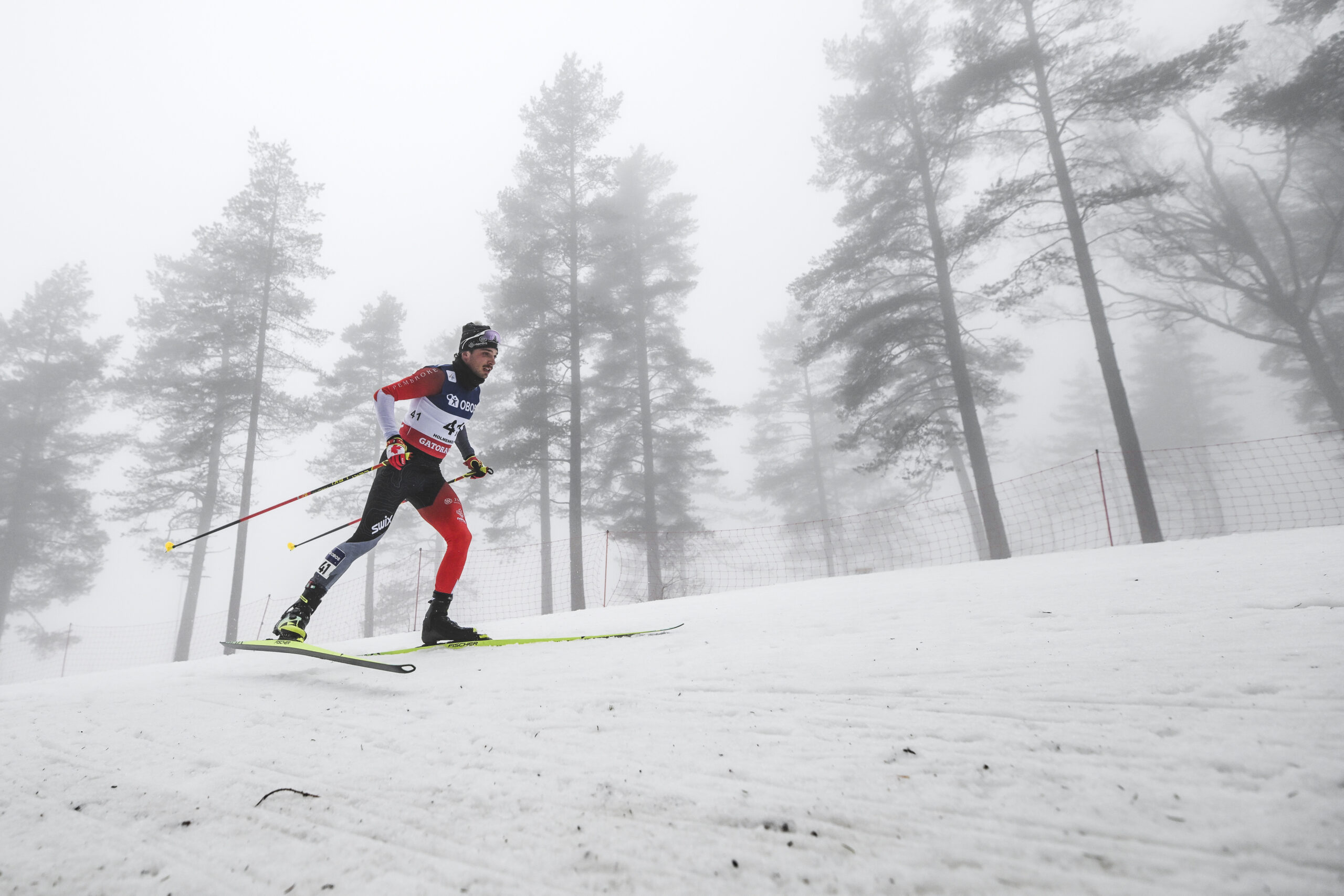
    Thomas Stephen in a red and black Canada suit skating up a snowy slope with pines fading into fog
    Thomas Stephen of Canada in the fog at the Oslo World Cup mass start in March 2026. One coach’s Zone 2 can be another’s Zone 1, and the label means little until you know what it is anchored to. (Photo: Authamayou/NordicFocus)

    Over the last decade I have often thought that we need to find a better way to define training zones. I have assessed every model under the sun and even tried to create some new ones. From a metabolic perspective, three-zone models probably make the most sense, because physiological anchors form the transition points, even though some of those anchors, lactate threshold among them, are questionable. Then there are five- and seven-zone models. Which are best, and which are most accurate? The answer is probably none of them. They all have limitations, and there really is not a better method.

    Some coaches set training zones from maximal heart rate. Others use lactate measures referenced to heart rate, pace or power, and still others use gas analysis (ventilation, VO2, RER and so on). Whatever the method, the important point is how the zones are used and implemented in training. While there may be a valid physiological basis for training zones, their primary use is to quantify training as planned and as performed. That is how we assess which methods of training have worked for the individual athlete.
    Julia Kern in a U.S. suit and yellow bib skating toward the camera past a row of flags
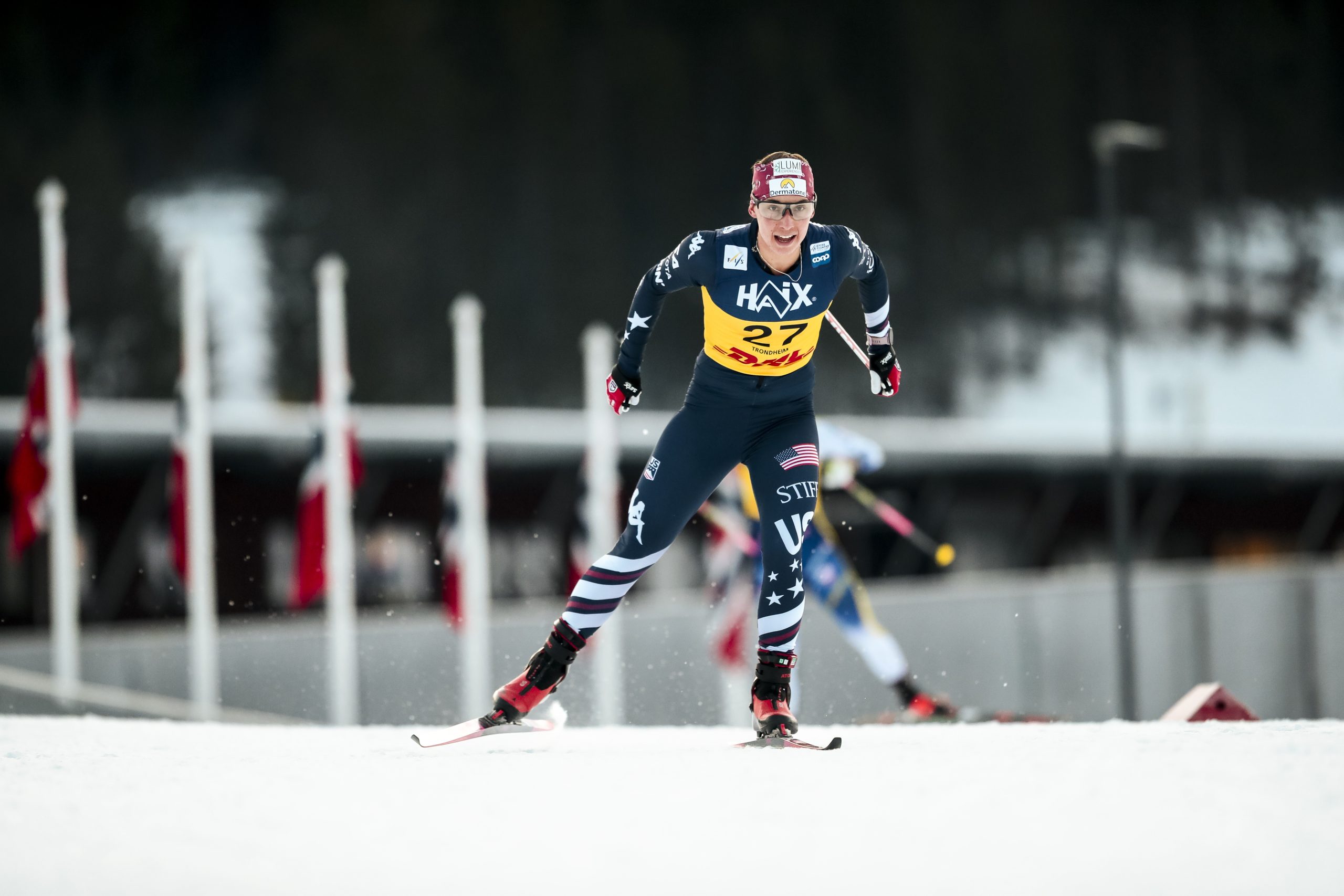
    Julia Kern racing the 10 k freestyle at the Trondheim World Cup in December 2025. A higher heart rate at a standard effort can reflect heat, glycogen depletion or fatigue, and all of those should change the day’s training. (Photo: Modica/NordicFocus)

    Heart Rate Holds Up

    Many coaches and even physiologists claim that heart rate is too variable to be used reliably for training control. Of course it is variable. Physiology varies daily with fatigue, recovery, hydration, glycogen status and more. In my experience, heart rate is no more variable than any other metric we use. We just don’t recognize the variation in the others, because it is not practical to measure them every day. Human physiology is complex, and in general heart rate reflects the current status of an athlete’s physiology. Under any system, it is important to train at a level that reflects the individual’s physiology and condition on that day. Heart rate is as good as anything for that, and I would argue better, because the daily variation is easy to assess.

    Heart rate is inexpensive, practical and physiologically informative. A higher heart rate at a standard workload can reflect warm weather, glycogen depletion or general fatigue, all of which matter when adjusting the day’s training. A lower heart rate at a standard workload often reflects improved fitness, though occasionally it can also reflect fatigue and increased parasympathetic drive of the autonomic nervous system.
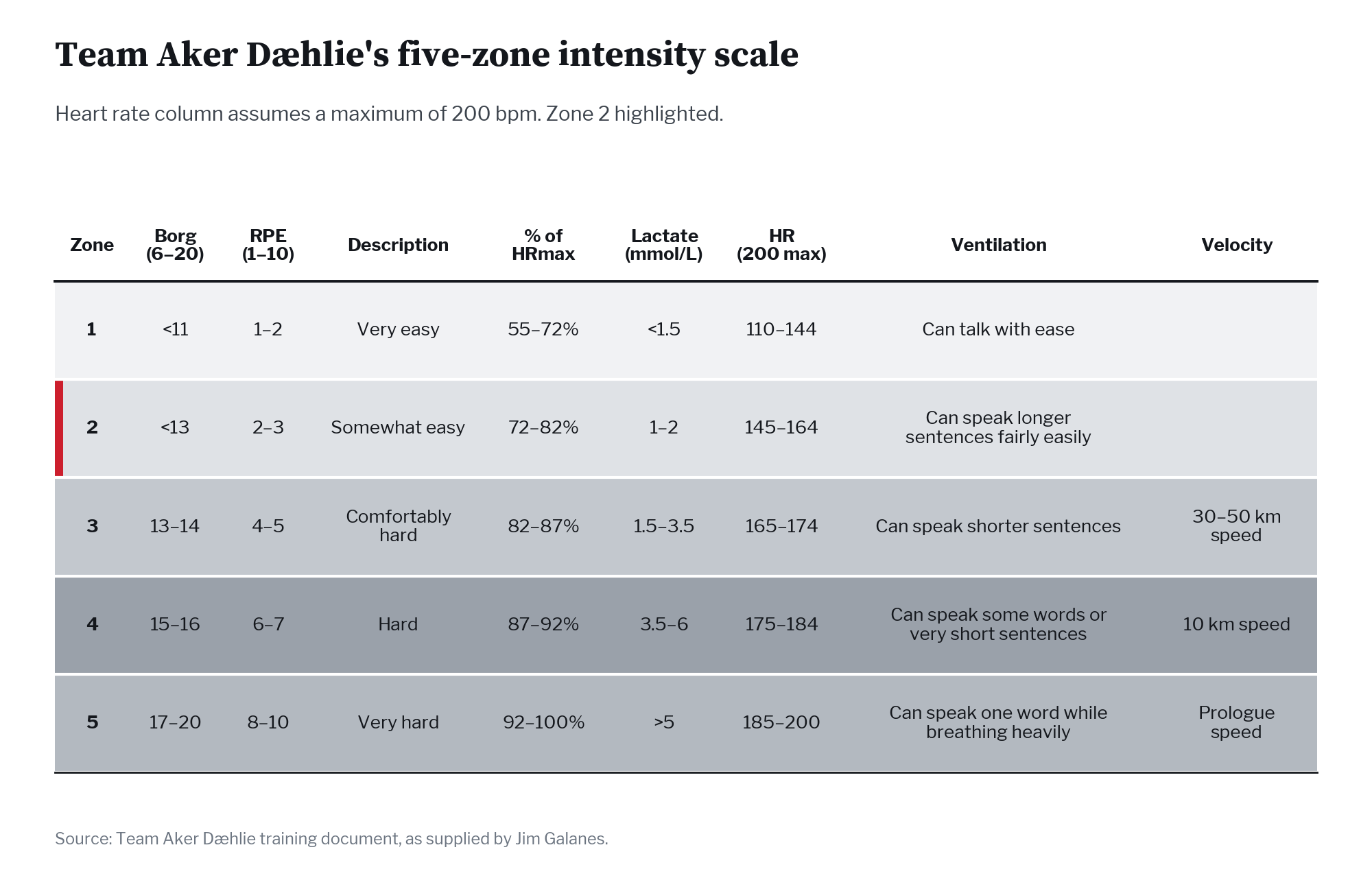
    Table of five training intensity zones with Borg scale, RPE, percent of maximum heart rate, lactate, heart rate, breathing and speed for each
    Team Aker Dæhlie’s five-zone scale. Its Zone 2 runs from 1 to 2 mmol/L of lactate, overlapping Zone 1, which sits below 1.5. (Chart: FasterSkier)

    Whose Zone 2?

    One example is a document published a few years ago by Team Aker Dæhlie in Norway, which laid out a slightly different training zone model than I was used to seeing out of Norway. Given the popularity of Zone 2 training, I believe it is important to understand how the proponents of a particular system of training define and use their zones.

    In the Aker Dæhlie system there is significant overlap between Zones 1 and 2 in terms of lactate, with Zone 1 below 1.5 mmol/L and Zone 2 at 1 to 2 mmol/L, while the heart rate ranges are what I consider consistent with how most training zones are delineated. The implication of that lactate range is that lactate is highly variable and not the same between individuals. From the published document we can see that their Zone 2 does not fit what some may consider Zone 2. It fits how I would describe Zone 1: endurance training not to exceed 70 to 75 percent of maximal heart rate. We need to realize that lactate may vary greatly from day to day and can’t be viewed as a hard and fast anchor for a specific training zone.

    Listening to many podcasts and reading many articles and publications, I hear people discuss training zones as if they were talking about the same thing. Most often they are not. The recent popularity of Zone 2 training is a good example: what Iñigo San Millán means by Zone 2, many of the common five-zone models would define as Zone 1.

    So if you want to use and reference the Aker Dæhlie zone system, you should also be aware of this statement about Zone 2 in their published document:

    Zone 2: Semi-hard long sessions with a heart rate at around 140-155 bpm and with lactate up to 2 mmol/L, is considered intensity 2 training. Scholars debate over the importance of this training. In our experience, this training costs more than it is worth, and should therefore not be prioritized. L2 can work well to learn/automate correct technique. Again, evaluate cost vs benefit! Typical length of a session is 1 to 3 hours of continuous activity.

    Zones 3, 4 and 5 are close to how many would describe training in those ranges, although Zone 3 here may sit a bit lower than it is often described. But the Aker Dæhlie team is primarily a long-distance team, and we don’t know whether they use different zone ranges for World Cup skiers, or whether World Cup skiers do more of their intensive training in Zone 4.
    Stacked bar chart of monthly low, moderate and high intensity training hours across general preparation, specific preparation and competition phases
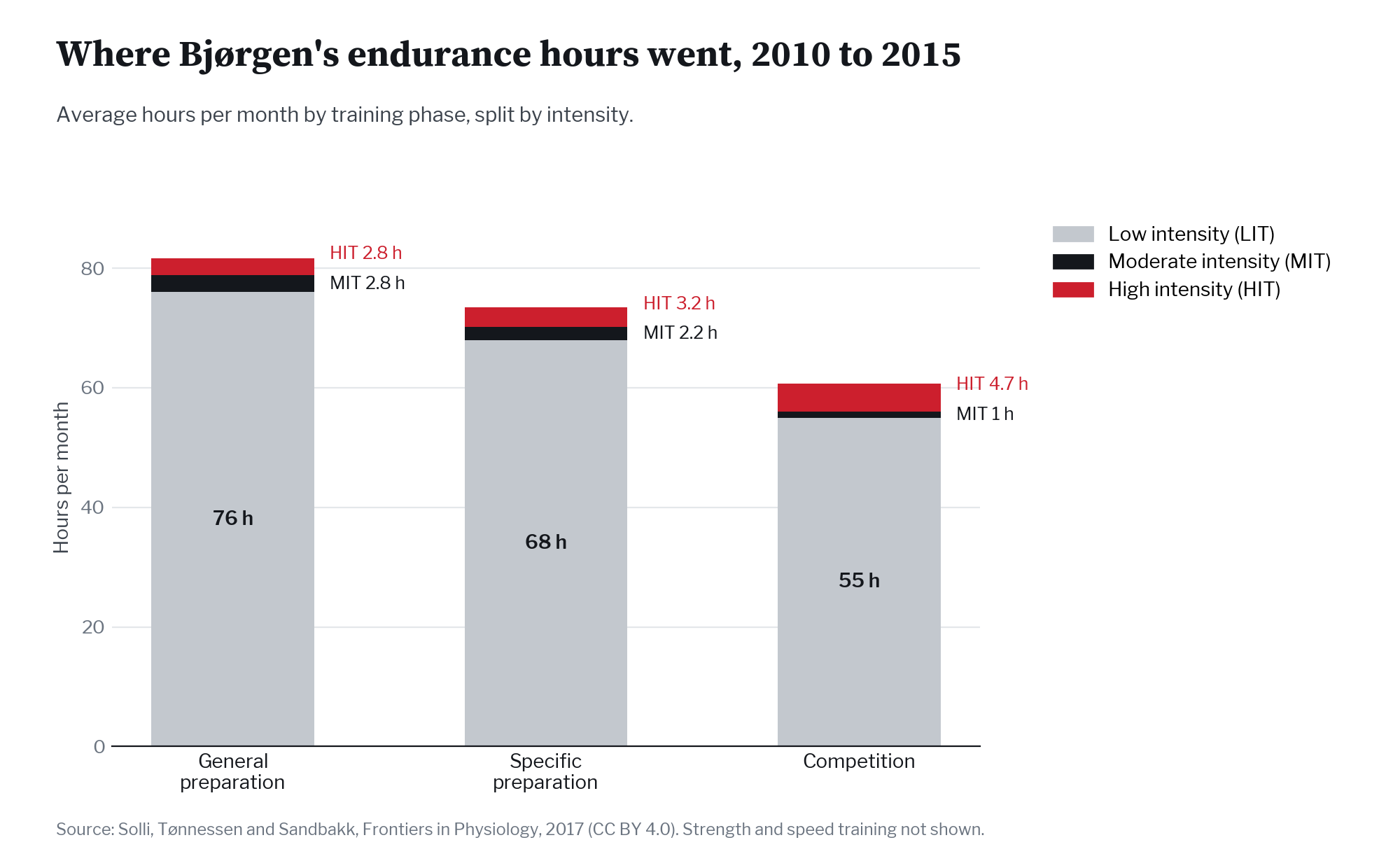
    Marit Bjørgen’s average monthly endurance hours by phase during her most successful seasons. (Chart: FasterSkier. Data: Solli, Tønnessen and Sandbakk, Frontiers in Physiology, 2017)

    How Bjørgen Trained

    A chart like the one above is often used to illustrate how one of the best female cross-country skiers ever trained during her most successful years. The data comes from an extensive study of Marit Bjørgen’s training.
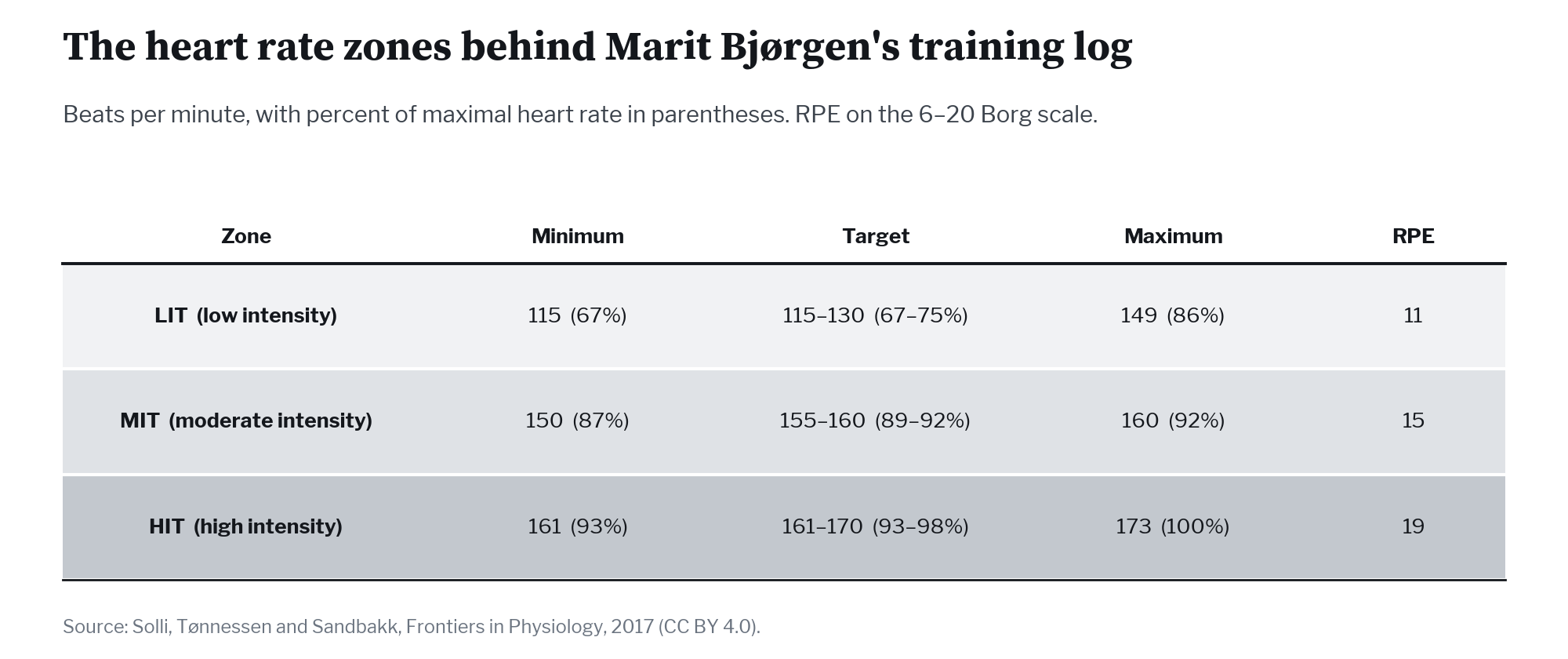
    Table of low, moderate and high intensity heart rate zones with minimum, target and maximum beats per minute and RPE
    The zones used to classify Bjørgen’s training. The top of the low-intensity target and the bottom of the moderate-intensity target sit 25 beats apart. (Chart: FasterSkier. Data: Solli, Tønnessen and Sandbakk, Frontiers in Physiology, 2017)

    A 25-Beat Gap

    To provide context, these are the zones used to define this athlete’s low-intensity (LIT), moderate-intensity (MIT) and high-intensity (HIT) training. The low-intensity target is where we might expect it, at 67 to 75 percent of maximal heart rate. However, there is a large gap, some 25 beats per minute, between the low- and moderate-intensity targets, with the MIT target at 89 to 92 percent of maximal heart rate. That MIT zone is quite different from what is described in the Aker Dæhlie document.
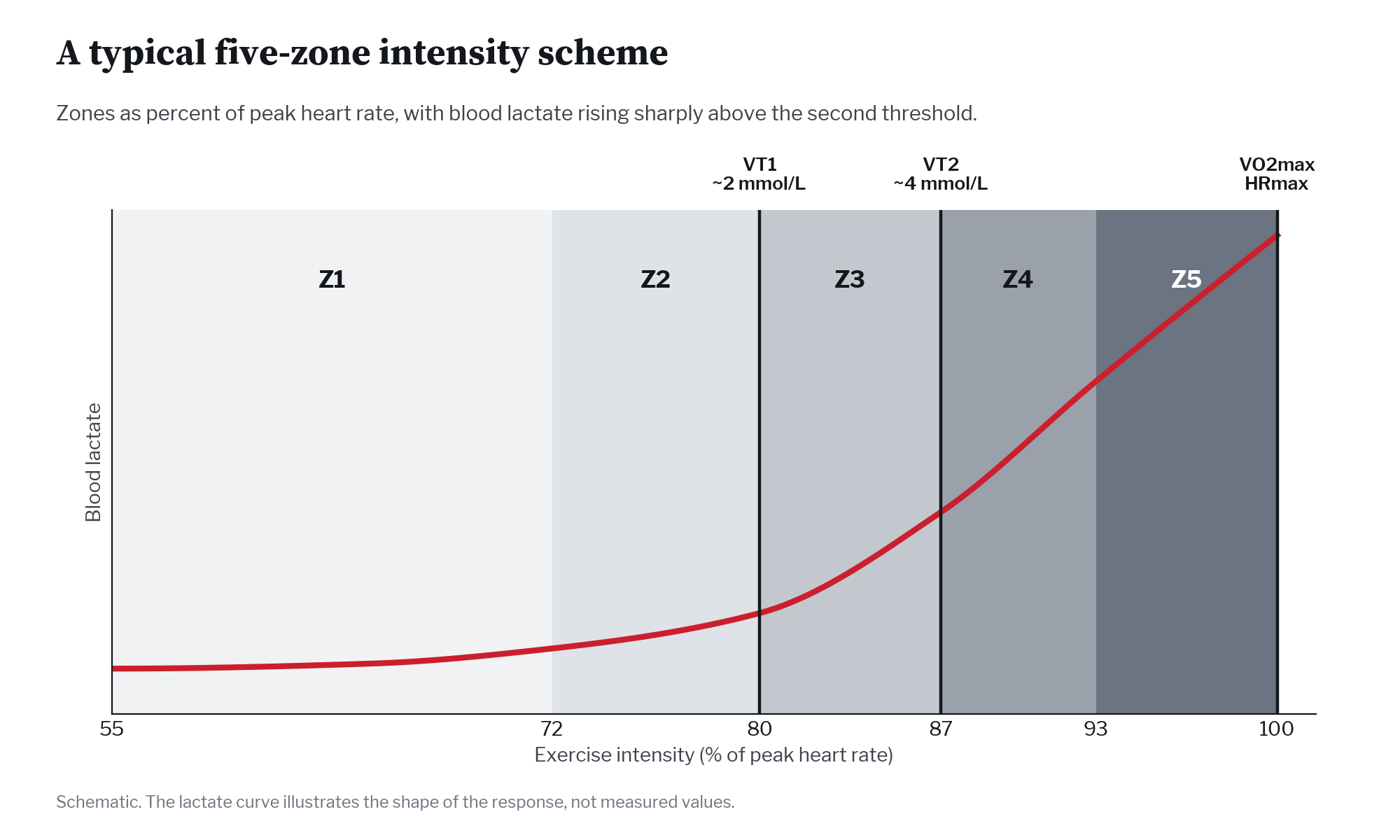
    Diagram of five heart rate zones from 55 to 100 percent of peak heart rate with a blood lactate curve rising steeply above the second threshold
    A typical five-zone scheme places the first ventilatory threshold at about 80 percent of peak heart rate. For most athletes, Galanes argues, it sits lower. (Chart: FasterSkier)

    Another Common Model

    Here is another example, much like the zone table published by Aker Dæhlie. It is a good theoretical model, but again I would suggest that endurance training above 75 percent of maximal heart rate is unnecessary, and the cost-benefit assessment does not suggest a benefit. We also see that LT1/VT1 is probably not at 80 percent of maximal heart rate for most athletes.
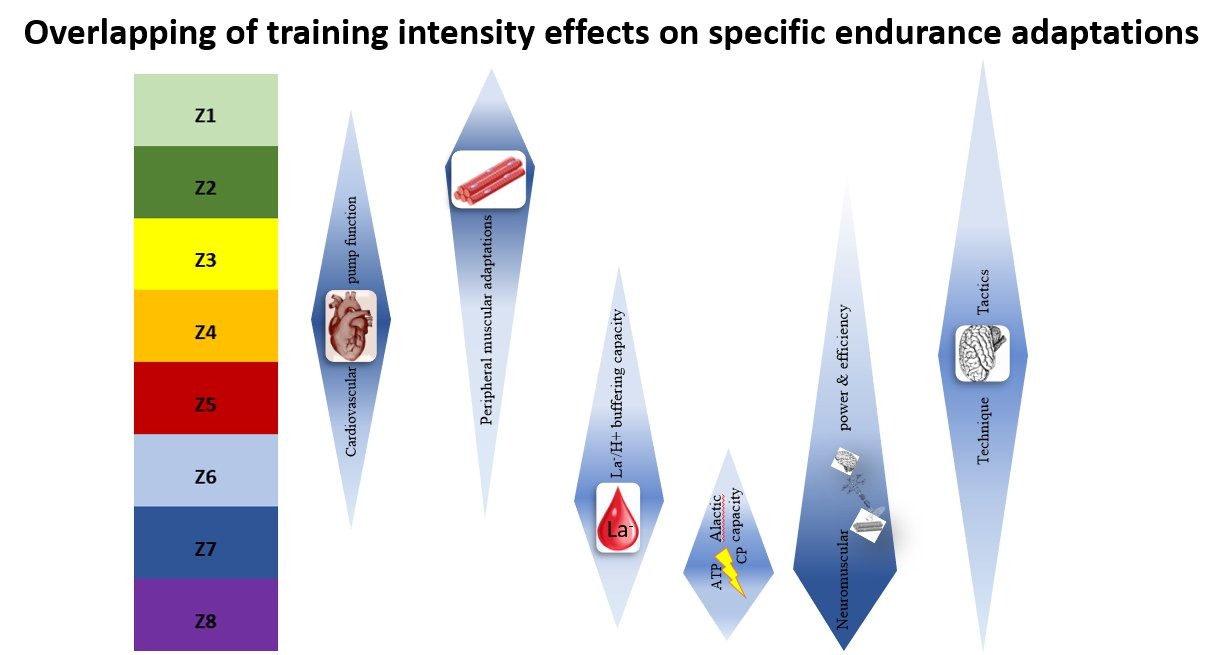
    Diagram of eight intensity zones beside overlapping shapes showing where cardiovascular, muscular, lactate buffering, alactic, neuromuscular and technical adaptations occur
    Each adaptation has an intensity where it responds best, but none of them stops at a zone boundary. (Figure: redrawn from Olympiatoppen educational material, 2020)

    Zones Overlap

    Most of us consider training zones hard and fast, but that is not the case. The chart above illustrates the possible range of metabolic and neuromuscular benefits of different training intensities. I believe the reason to use zones and monitor training is to ensure effective training adaptation. That is why I say that endurance training at more than 70 to 75 percent of maximal heart rate does not have a positive cost-benefit. As recovery time increases, adaptation slows, and the time to readiness for the next hard session can be extended.

    The chart is an excellent depiction of how adaptations overlap across training intensities. Each metabolic and neuromuscular adaptation has a theoretical optimal range, but the adaptations still occur well outside those ranges.
    Two men on a rocky outcrop among pines, one holding a fingertip for a blood sample beside a lactate meter set on a rock
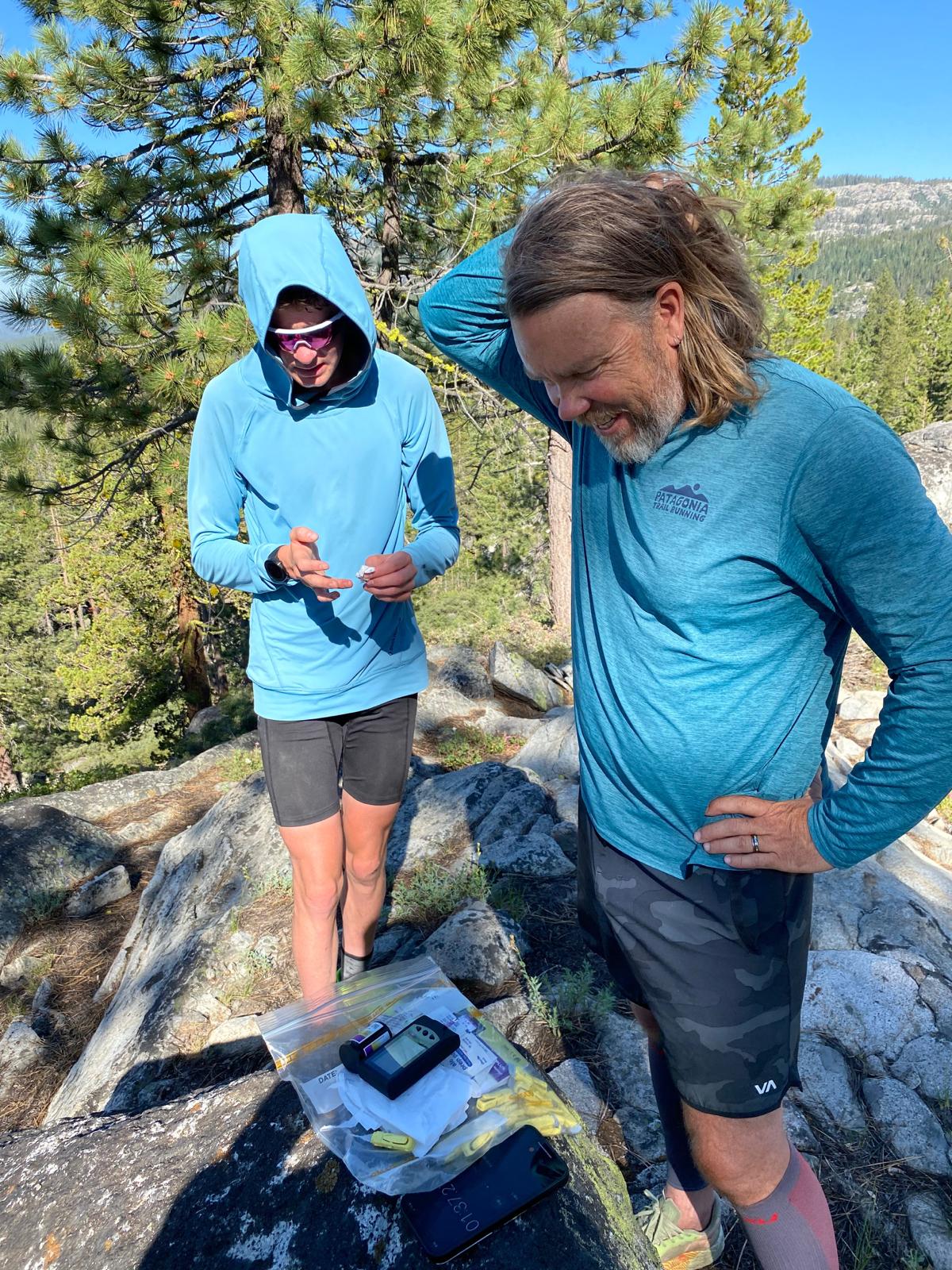
    A lactate test in the middle of a hill-bounding session, with coach Will Sweetser and Quinn Holan. If you use lactate, spot-check often enough to learn your own daily variation. (Courtesy photo)

    My Advice

    • When analyzing what others say or publish, look closely and question what their training zones are based on. You must be speaking the same language before implementing any changes.
    • Pick a training zone model that makes sense to you. If you are going to use lactate, you must do frequent spot checks so you understand your individual daily variation. You absolutely cannot rely on a one-off test to make training decisions.
    • Use new and emerging technology, such as respiration and muscle oxygen monitoring, only after validating its consistency and variability.
    • Don’t jump from trend to trend. There are a lot of them out there. Learn from what has worked, and weigh emerging science against experience. Remaining current does not mean trend-hopping to stay relevant on social media.
    • Be clear on terminology. The same term can mean very different things to different scientists and coaches.
    • Use a couple of tests that produce meaningful data and inform training decisions. Collecting more data does not make for better programs.
    • For most people, perhaps everyone, percentage of maximal heart rate is a practical way to determine training zones.


    Help Support Our Coverage!

    If you value the thoughtful work and access FasterSkier provides, please consider becoming a Voluntary Subscriber. Your support directly fuels our work to cover the people, places, and moments that make our sport special.

    Join the FasterSkier community!


  • Norway Unstoppable for the win in Women’s 4 x 5 k Relay; U.S. 5th

    Norway Unstoppable for the win in Women’s 4 x 5 k Relay; U.S. 5th

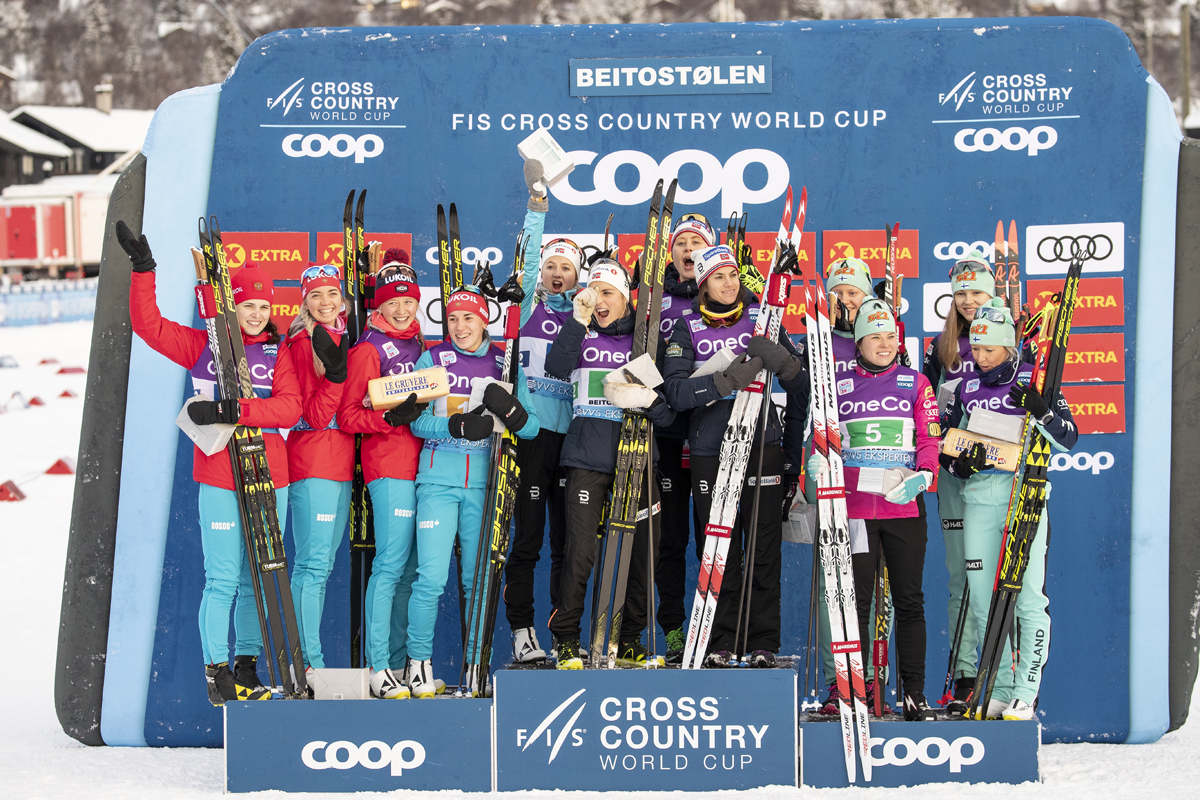
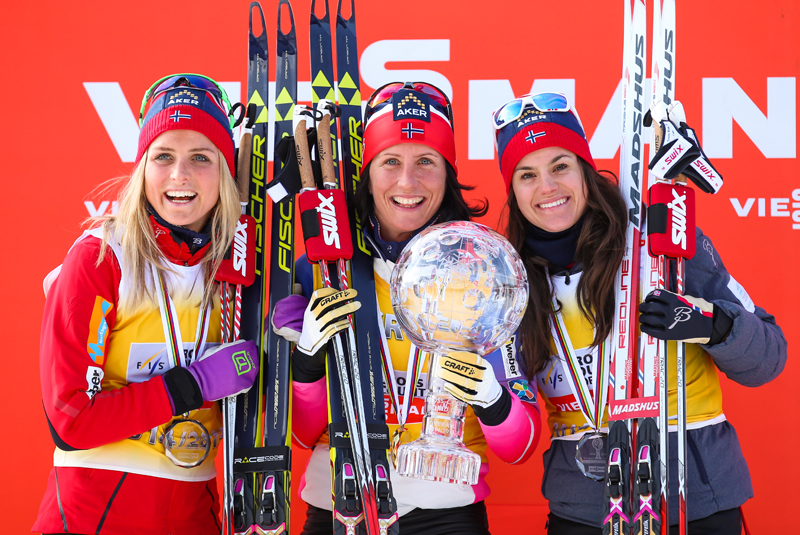
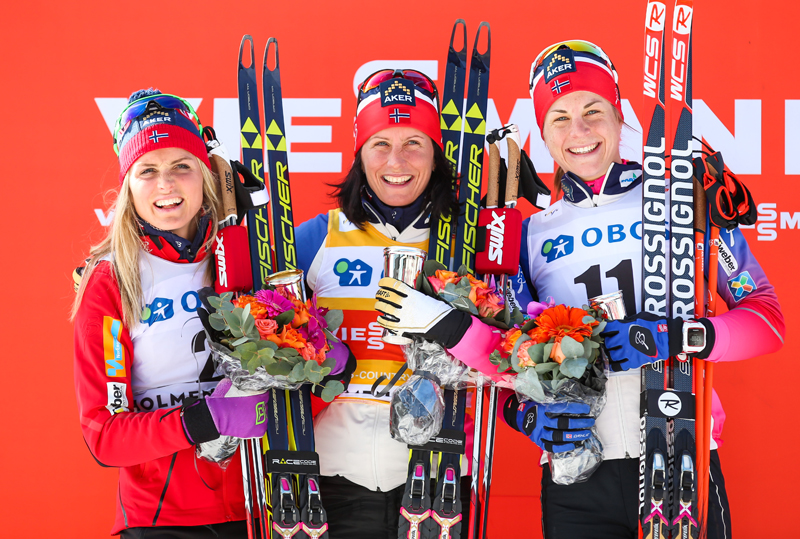
    The women’s podium from the 4 x 5 k relay in Beitostølen, Norway. Norway I (center) placed first, Russia II (left) was second, and Finland I (right) third. (Photo: Fischer/Nordic Focus)

    For Norway, relays are often tallied not by wins, but how many wins have been missed. Back in 2009, Team Norway watched on as Team Sweden took the top spot of the podium for the women’s 4 x 5-kilometer relay event in Beitostølen, Norway.

    In the nine years after that second place finish in Beitostølen, the Norwegian women’s team has missed winning the World Cup relay–excluding team sprints–only one other time (FIS reports that as having been in 2011, when Italy won the Rybinsk, Russia 4 x 5 k).

    This December marks the first time Beitostølen has hosted a World Cup race since the team, back then comprised of Vibeke Skofterud, Therese Johaug, Kristin Strørmer Steira, and Marit Bjørgen, placed second in 2009. Though the goal of top relay performances has not changed, changes within Norway’s team itself are palpable.

    Skofterud passed away this summer after a jet skiing accident. Strørmer Steira, married to Canadian Devon Kershaw, retired in 2015. Bjørgen announced her retirement last spring. Johaug served an 18-month ban from ski racing and came back to competitions this year. She is the only name to return to the relay team and Beitostølen since the city last hosted World Cup competitions nine years ago.

    Sunday’s win marks if nothing else, Norway’s reclaiming of what they see as theirs.

    “It’s really nice to have a race in Beitostølen we have a lot of good memories here – all of us,” Johaug said during a FIS post-race interview. “We all did a really good job today and its beautiful to ski with these ladies.”

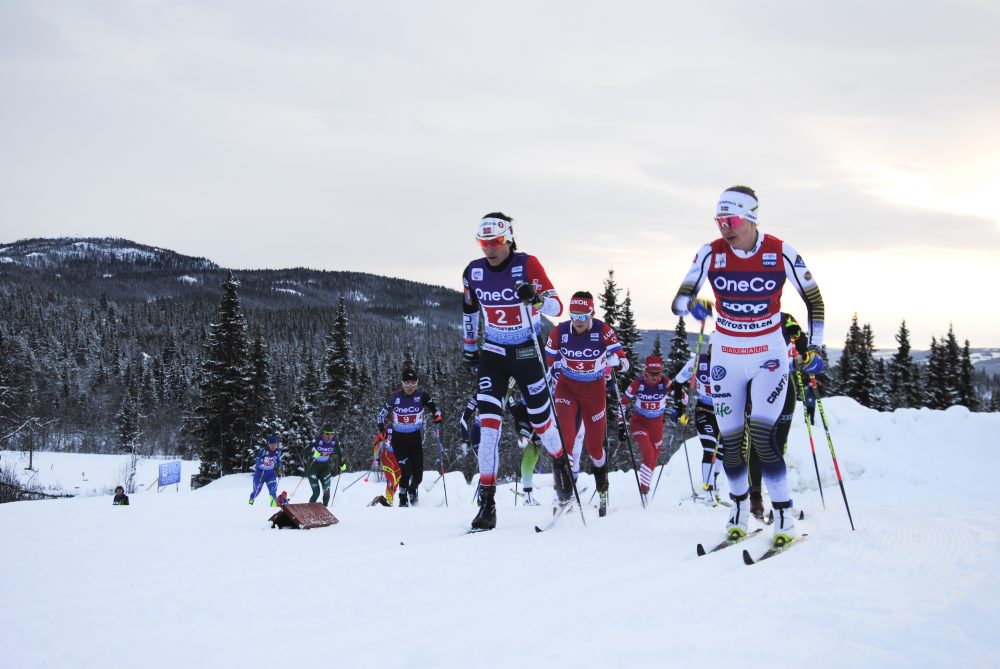
    Norway’s Heidi Weng (left) and Sweden’s Evelina Settlin (right) lead the women’s 4 x 5 k relay train Sunday in Beitostølen, Norway (Photo: Aleks Tangen)

    Taking out the Norwegian’s first classic leg was Heidi Weng. Weng hung tightly to the front group until around 3.5 k, when Sadie Bjornsen of the U.S. Ski Team and Russia’s Team I, leg one skier, Yulia Belorukova, began to push the pace.

    buy disulfiram online

    By the time the women came through for the first exchange, Belorukova and Bjornsen had put a 7.3 second gap on Weng and a 13 second gap on the chasing teams’ skiers, Lidia Durkina of Russia II and Anna Svendsen of Norway II.

    “At the beginning, when I was leading, I felt like it was pretty clear that those girls were going to stay in a mass behind me,” Bjornsen told FasterSkier during an in-person interview after the race. “So I tried to stay near the front…then [I said] ‘I’m going on attack mode on the second-half because maybe I can break some people then,’ and it worked out.

    “It was a little frustrating to have some people stick in there that I wanted to break harder,” Bjornsen added. “But it was nice to have Belorukova to work back and forth with to push all the way to the end.”

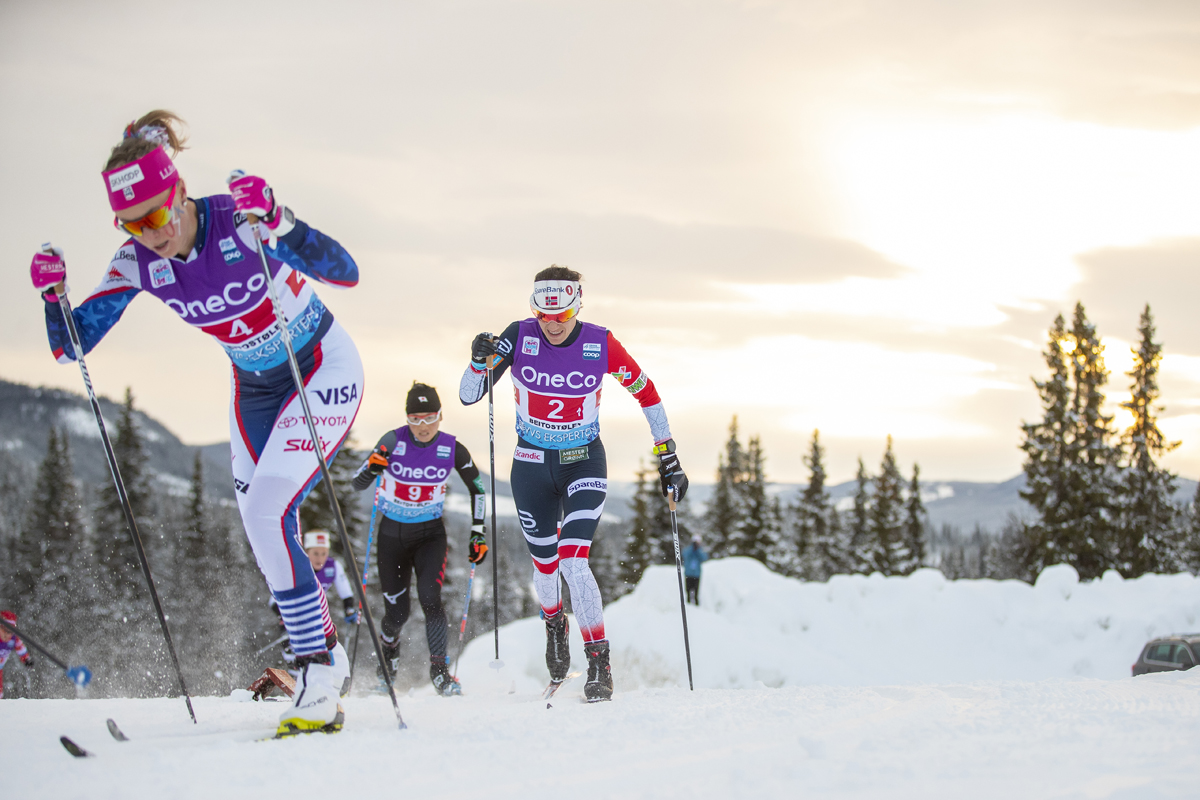
    Sadie Bjornsen of the U.S. Ski Team followed by Norway’s Heidi Weng during the women’s 4 x 5 k relay in Beitostølen, Norway (Photo: Fischer/Nordic Focus)

    At the start of the second classic leg, it was Natalia Nepryaeva skiing for Russia I in the lead, followed by Rosie Brennan of the U.S. less than a second back positioned in second. The second classic skier for Norway I, Johaug, was positioned 8.2 seconds back through the first kilometer. Chasing down the top-three, 20 seconds back, was Astrid Uhrenholdt Jacobsen skiing for Norway II in fourth, and Russia II’s skier Anna Zherebyateva in fifth.

    Within the next kilometer and a half, Johaug had closed the 8 second gap separating her from the U.S. and Russia I. By the race’s 8.5 k mark, Johaug was up on Brennan by almost 14-seconds and looking ready to bury Nepryaeva, who lagged just 1.4 seconds behind the Norwegian.

    As Johaug came into the stadium to tag off to her teammate Ragnhild Haga for the first freestyle leg, she was alone. Nepryaeva skied in 9.4 seconds behind Johaug to hand off to Anastasia Sedova. Along with Johaug, Brennan had also been passed by Russia II’s Zherebyateva, Norway II’s Jacobsen and Finland I’s Krista Pärmäkoski having dropped down to sixth, handing off to Caitlin Patterson 29 seconds back from the race leader.

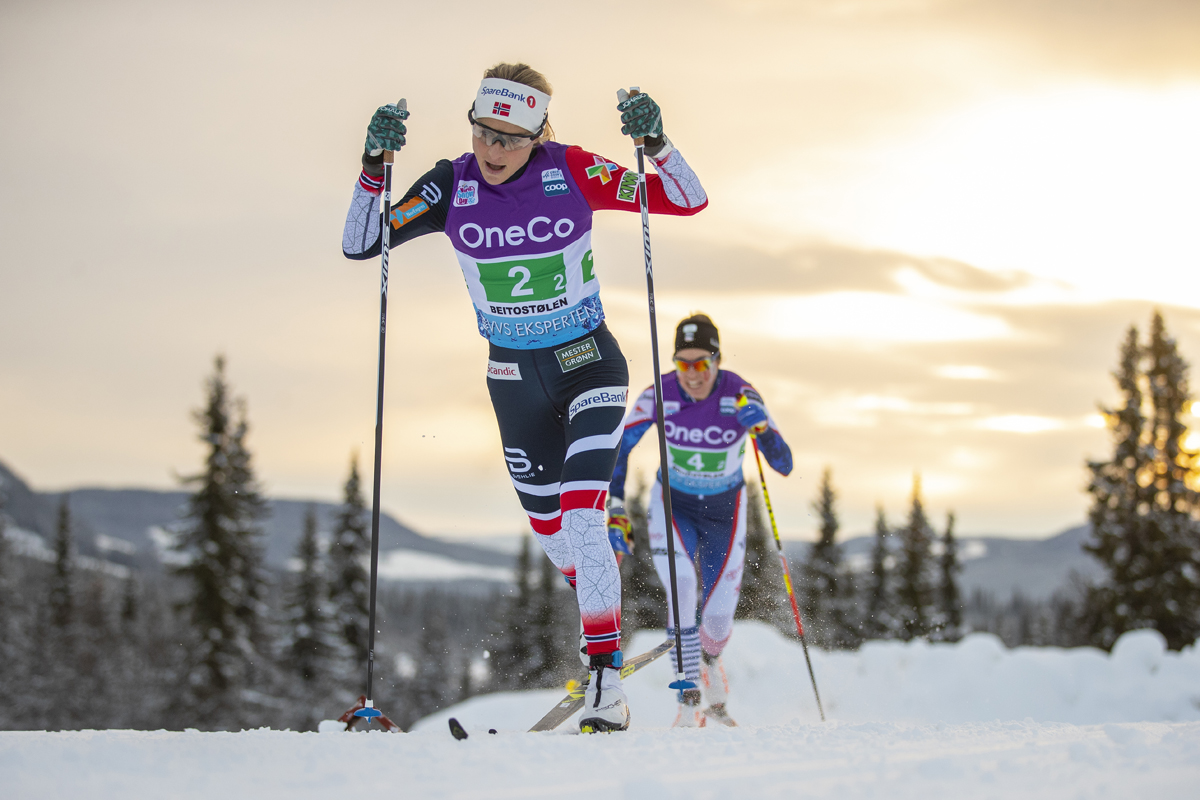
    Therese Johaug of Norway leading the U.S. Ski Team’s Rosie Brennan during the 4 x 5 k relay in Beitostølen, Norway (Photo: Fischer/Nordic Focus)

    “I’m a little frustrated, I think I have more to give than I did today, I struggled a little bit with my skis, maybe I didn’t have my top form, but it was something to work with and a good starting place, so hopefully I can make some improvements,” Brennan told FasterSkier.

    “I mean, I think I skied fairly even, I think it’s just really hard to ski by yourself out there, there was a lot of drafting,” she continued. “Once you’re on your own it’s easy to get swallowed up by the next pack, so hopefully next time I won’t be on my own, I’ll stick with the leaders.”

    In the third leg, Haga held onto the lead by a 15 second margin for most of the 5 k. By the time she came through for the final exchange, Haga had 11.6 seconds on her closest challenger, Sedova. Thanks to a hard push from Finland’s Pärmäkoski in the second leg, the Finish Team I’s third skier, Ritta-Liisa Roponen came through the final exchange in third, 0.6 seconds behind Sedova and 12.2 seconds away from Haga.

    Patterson had maintained the sixth position, handing off to the U.S.’s anchor leg, Jessie Diggins 53.9 seconds back from the race leader, Norway I.

    “This is the first time ever that I’ve been on the relay; I’ve been on a few little team sprints here and there, so this is pretty sweet,” Patterson told FasterSkier. “In my own performance, I can see a lot of potential for improvement…I could see so many people up in front of me, but just didn’t quite have the legs to chase them down, so I see a lot of potential for improvement and you never know on a different day, so I hope I’ll get another chance.”

    Caitlin Patterson (right) tags off to U.S. teammate Jessie Diggins during the 4 x 5 k relay in Beitostølen, Norway (Photo: Aleks Tangen)

    Taking out the final leg for Norway I, Ingvild Flugstad Østberg held off any challengers and continued to pad the team’s gap on the field. She crossed first for the win in a time of 57:23.6.

    Though it seemed as if Russia I were on their way to a podium finish on Sunday, a fall from their anchor Anna Nechaevskaya in the course’s last turn placed them off the podium in fourth (+40.9). Russia Team II’s anchor skier, Elena Soboleva, passed her fellow compatriot to claim second place, 37.3 seconds behind Norway I.

    The third and final podium position went to Finland I, with Eveliina Piippo closing out the final leg and finishing 37.8 seconds behind the race winners.

    The U.S. placed fifth (+48.0) with Diggins serving as the team anchor.

    “It was interesting [be]cause I went out full on sprinting trying to shut down a gap,” Diggins said.

    However, Diggins indicated that due to the flat course and the skiers she was positioned with, Sweden’s Ida Ingemarsdotter and Norway II’s Tiril Udnes Weng, she decided to change her strategy.

    buy allopurinol online, buy ibuprofen online

    “So I was charging, but then I realized I wasn’t going to be able to drop the girls I was with…so then, about a third of the way through I just totally changed tactics and went to the back and was drafting, trying to conserve energy, build up my plan for the sprint [to the finish].

    “Rounding the corner and seeing Russia [I’s Nechaevskaya] right there, I was like ‘dang it, I wish I had kept pushing super hard,’ I had no idea how close we were going to be. But at the moment I made the best tactical choice I could, which was to beat the group I was with,” Diggins said. “I think it was a really good day and it’s always a good chance to practice those practical decisions and making the right move at the right time.”

    The U.S. women’s 4 x 5 k relay team from Beitostølen, Norway. The team of (from left to right) Caitlin Patterson, Sadie Bjornsen, Rosie Brennan, and Jessie Diggins placed fifth. (Photo: Aleks Tangen)

    A second U.S. relay team of Sophie Caldwell (USST), Ida Sargent (USST), Kelsey Phinney (SMS T2), and Kaitlynn Miller (CGRP) did not start, as Caldwell is working through “a resurgence of symptoms from the end of her cold.”

    “We were very close today on the women’s side,” U.S. Ski Team World Cup coach, Matt Whitcomb wrote in an email to media outlets. “The goal is always to podium. Sadie knew it would be tough to break the lead pack, but her mission was to turn the screws hard. She has a lot of confidence in her fitness right now, and her pace took Sweden out of the podium hunt.”

    Sweden ended the day in sixth, 50.0 seconds back from Norway I.

    “Rosie’s leg was particularly stacked today, and she did a good job staying as close to the podium as possible on a course with a profile that’s a bit flat for her,” Whitcomb continued. “Today was Caitlin’s first start in a World Cup relay, and she’s an athlete we’ve been wanting to see get some relay experience. While her time was 8th on her leg, not yet good enough for a podium team, she demonstrated that she is close. I’m happy we selected her for the third leg today.

    “Jessie was put in a position she thrives in today. Regardless of place, her leg was an invaluable experience to sharpen her relay game,” he added of Diggins’ performance on Sunday. “She was both aggressive and tactical, and had she been only aggressive, we would’ve finished 7th. I was very impressed with her ability to adapt her plan mid-race. I’m particularly excited for her sprint in Davos next week.”

    Results

  • Pärmäkoski Wins Another 10 k Classic; Diggins 8th, Bjornsen 11th in Falun

    Pärmäkoski Wins Another 10 k Classic; Diggins 8th, Bjornsen 11th in Falun

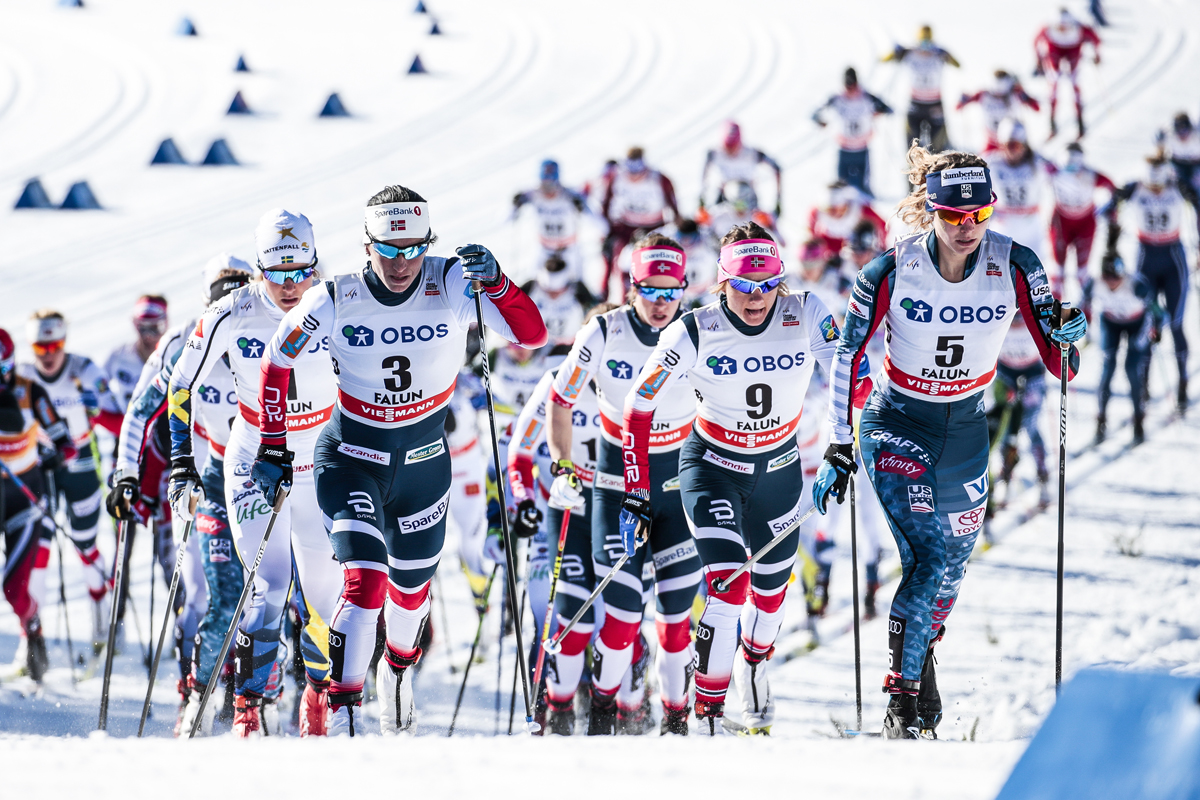
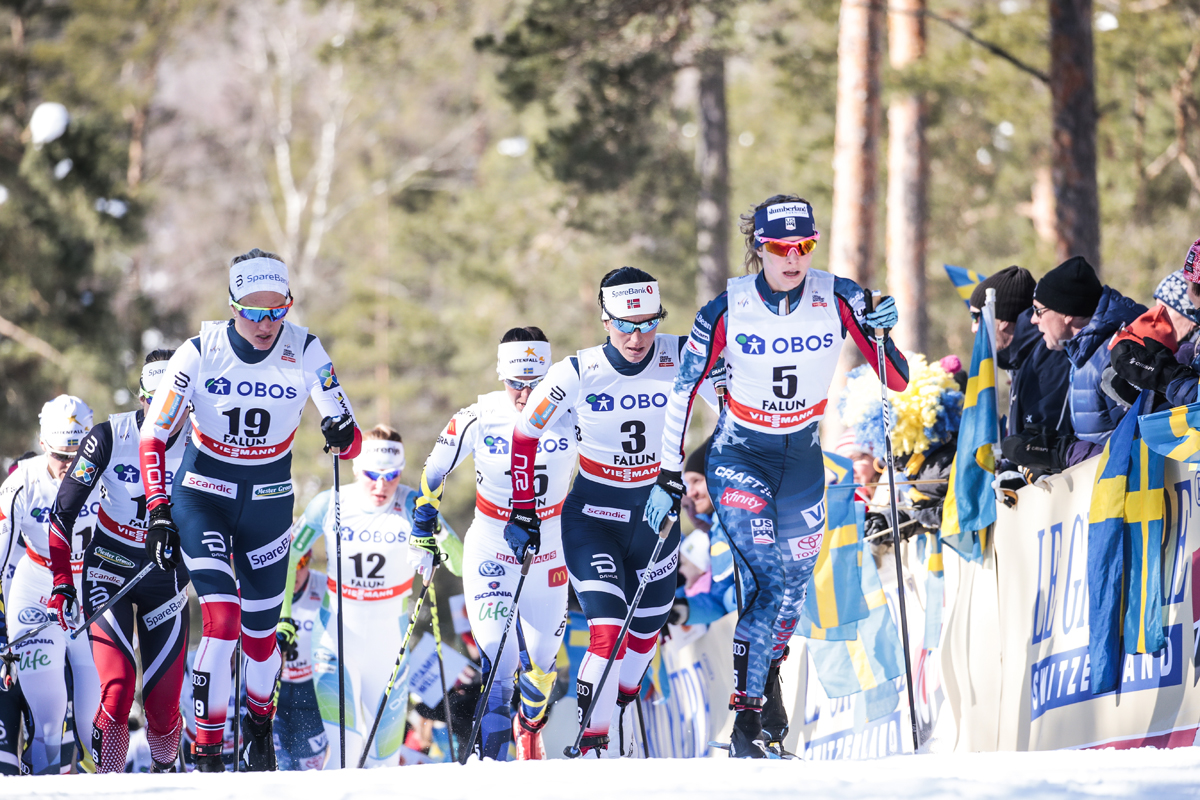
    American Jessie Diggins (5) and Norway’s Marit Bjørgen (3) and Maiken Caspersen Falla lead early in the women’s 10 k classic mass start at World Cup Finals in Falun, Sweden. (Photo: Fischer/NordicFocus)

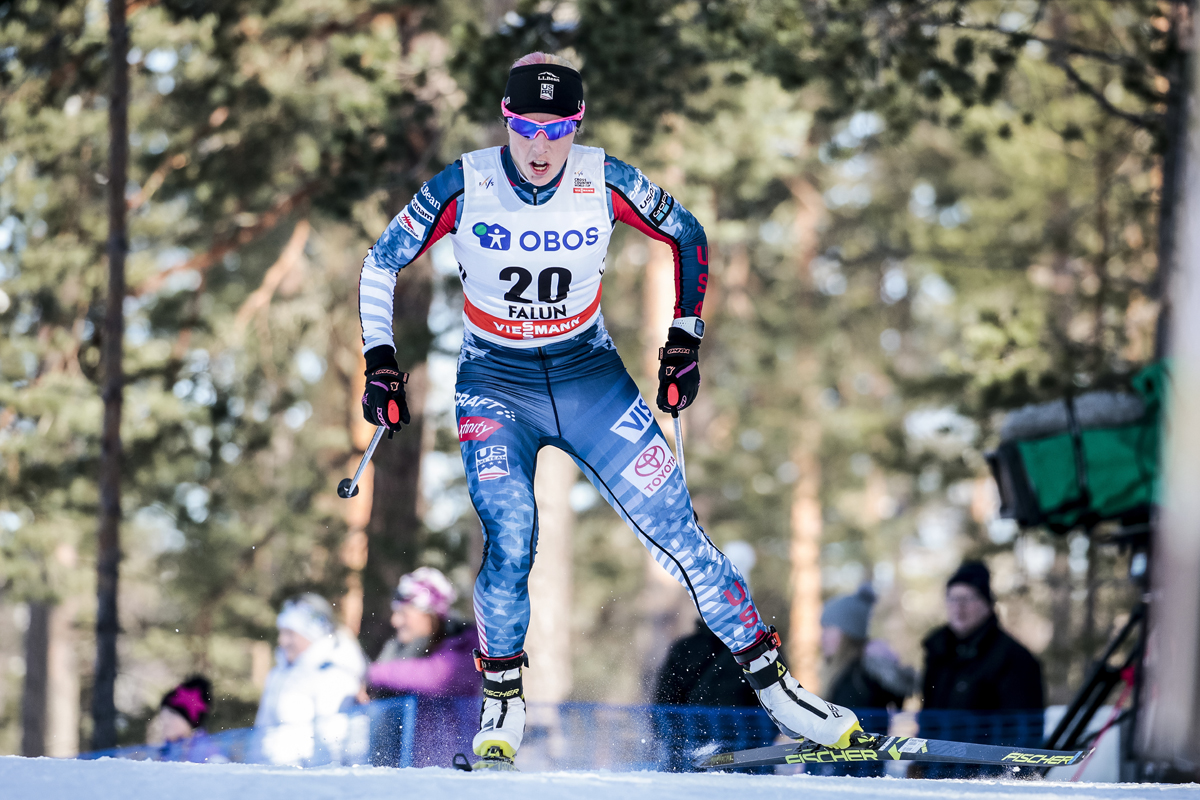
    FALUN, Sweden — To those watching, even to those racing, the winner was the woman who had led most of Saturday’s 10-kilometer classic mass start: Norway’s Marit Bjørgen.

    “Marit and Tiril [Udnes Weng], another Norwegian young girl, they were skiing really fast and I thought that they would be first and second,” Norway’s Ingvild Flugstad Østberg told FasterSkier after the race.

    Seven minutes after the start gun, Bjørgen had moved to the apex of the field and there she seemed intent to stay.

    No doubt, the 37-year-old Norwegian holds a close relationship with the 10 k classic event. Over the course of her World Cup career, she has amassed 31 podiums in the distance/discipline, 16 of those being in first place.

    Last year in Lahti, Finland, Bjørgen was crowned the 10 k classic world champion, and she also holds the 10 k classic World Championships title from 2011.  At the 2006 Olympics in Turin, Italy, she earned silver in the 10 k classic event. The next time a 10 k classic was featured at the Olympics, in 2014 in Sochi, Russia, she finished fifth.  

    With substantial backing, Bjørgen seemed well on her way to another 10 k classic win at 2018 World Cup Finals on Saturday in Falun. Finland’s Krista Pärmäkoski may have not looked like a real threat — until the finishing stretch.

    In the corner before the final 100 meters, Pärmäkoski pulled up just behind Bjørgen. Just two kilometers earlier, the Finn had been skiing two seconds off of the Norwegian’s pace.

    Backtracking to the race’s halfway mark, Pärmäkoski had been even farther behind Bjørgen. Three seconds had separated the chase pack from Bjørgen and Tiril Udnes Weng, who led the race at 5 k. At that point, Sweden’s Charlotte Kalla had been spearheading the charge to close down the gap, while Pärmäkoski skied in fifth, almost one second back from Kalla and four seconds back from Bjørgen.

    Even earlier in the race, when Bjørgen made her move to the front at 3.75 k, Pärmäkoski, who had started in bib 32, was 19 places out of first.

    “I had to start so much behind the others,” Pärmäkoski told FasterSkier, referring to her bib number, which was based on her finish in the opening race of the World Cup Finals, Friday’s freestyle sprint.

    “But my body worked very well today … and I had really good grip and glide [with] my skis,” Pärmäkoski continued. “I passed the other athletes when we got to the downhill, the long downhill.”

    By the descent heading back toward the stadium, Pärmäkoski had passed Tiril Udnes Weng and moved around Kalla. Close to two seconds stood between her Bjørgen and Østberg, the latter of which had moved into second at the 7.5 k mark.

    “I didn’t dare to look back and see how many girls were keeping up with [us] in front,” Østberg said.

    If she had looked back, she would have seen the Finn firing on all cylinders.

    By the descent back toward the stadium, Pärmäkoski had caught Østberg and hunted her next Norwegian. She closed in on Bjørgen in the corner just before the finishing stretch.  Fifty meters to go and Pärmäkoski pulled up just alongside Bjørgen.

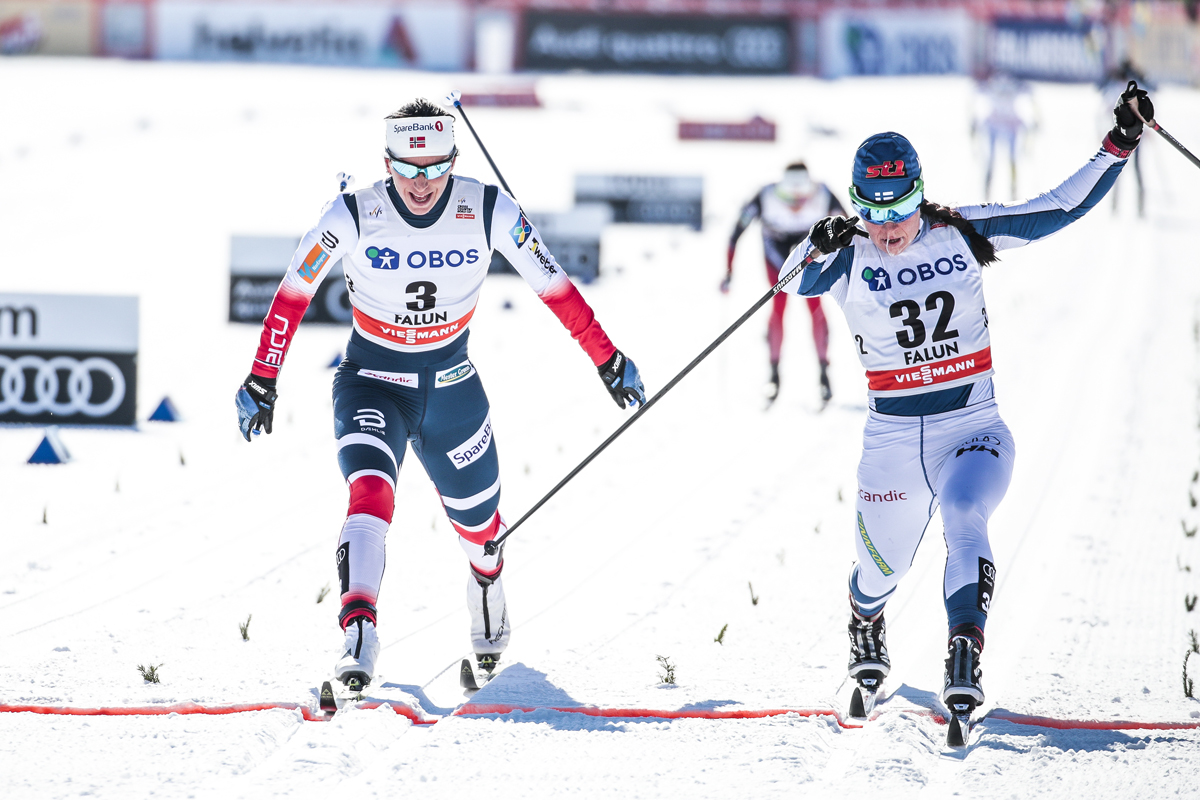
    Finland’s Krista Pärmäkoski (32) edges Norway’s Marit Bjørgen for the win in the women’s 10 k classic mass start at 2018 World Cup Finals in Falun, Sweden. (Photo: Fischer/NordicFocus)

    The two approached the finish line in tandem. Pärmäkoski, however, was stronger in the final double-pole push and nabbed the win by just 0.2 seconds over Bjørgen in a time of 26:00.5 minutes. Bjørgen took second behind the Finn in a time of 26:00.7.

    “I thought that maybe I was stronger than her and I feel that I was doing a good finish, but she was stronger than me,” Bjørgen told FasterSkier, referring to the sprint finish between Pärmäkoski and herself.

    “I thought Marit was gonna take it on the last 100 meters, but Krista was too strong,” said Østberg, who finished 5.1 seconds back in third.

    The win is Pärmäkoski’s third 10 k classic title in a row this season. Her first came in Planica, Slovenia –which was also her first World Cup win — and her second came two weekends ago in front of a home crowd in Lahti.

    For Østberg, the World Cup podium was her first since January.

    “It’s been a while since I’ve been on the podium individually, in an individual race, so I was just so happy that I managed to finish in third place,” Østberg said.

    Less than 10 seconds behind her, a pack of five surged to the finish line, with Sweden’s Ebba Andersson crossing in fourth (+14.5), Japan’s Masako Ishida fifth (+14.8), Kalla in sixth (+15.2), Austria’s Teresa Stadlober in seventh (+15.4) and American Jessie Diggins in eighth (+15.5). Exactly 1 second separated the five-skier spread, with Diggins bookmarking the tail end.

    American Jessie Diggins leading the pack up an early climb with Norway’s Kathrine Rolsted Harsem and Marit Bjørgen just behind during the women’s 10 k classic mass start at World Cup Finals in Falun, Sweden. (Photo: Fischer/NordicFocus)

    “I was a little bit bummed I didn’t quite have the same feelings in my body that I’ve been having,” Diggins told FasterSkier. “It wasn’t a bad race at all … I just was struggling to find that last gear. I know it’s there because it was there in the sprint yesterday. So I am just going to go hard tomorrow and see what I can do.”

    Bjørgen currently leads the World Cup Finals mini tour and will be the first skier on course in Sunday’s 10 k freestyle pursuit. Starting 36 seconds after her will be Østberg in second, then Diggins, 41 seconds back in third.

    In the Overall World Cup standings as well, Diggins ranks third with 1226 points. The American is 106 points behind Østberg in second and 213 points behind Norway’s Heidi Weng in first. At most, with a win, Diggins could score 200 points on Sunday. Behind her, Pärmäkoski is 112 points back in fourth.

    An Olympic gold medal already achieved and a couple other firsts to her name this season (last weekend, she became the first American woman to podium in a 30 k Holmenkollen), Diggins’ drive is for a personal best on Sunday.

    “I am just excited to keep pushing hard and see if I can break through and get some new firsts for me,” Diggins told FasterSkier. “I am fighting for a good spot in the overall [World Cup] and in the overall distance [ranking] as well … it’s fun to try to do something new and definitely motivates me to keep fighting really hard. It kept me pushing for every second today.”

    Diggins is also third in the Distance World Cup standings, 64 points behind Østberg in second and 43 points ahead of Pärmäkoski in fourth.

    Rounding out the remainder of Saturday’s top 10 was Norway’s Astrid Uhrenholdt Jacobsen in ninth (+24.8) and Finland’s Kerttu Niskanen in 10 (+26.2). Just 0.1 seconds outside of the top 10 was American Sadie Bjornsen in 11th (+26.3).

    American Sadie Bjornsen skiing just behind Germany’s Katharina Hennig during the women’s 10 k classic mass start at 2018 World Cup Finals in Falun, Sweden. (Photo: Fischer/NordicFocus)

    This World Cup season has marked somewhat of a breakthrough season for Bjornsen, with the 28 year old earning her first distance podium and two classic sprint podiums.

    On Friday, she appeared to be pulling for a podium again. Bjornsen charged hard to the front of the pack in bib 8, three bibs back from Diggins, who led the first 2 k of the race before Bjørgen took over.

    When asked about the risk involved with taking such a race tactic and why she chose to do so, Bjornsen was thoughtful. Reflecting on her recent strong results in sprint qualifiers, she explained that she was testing “what can happen if I have no fear, if I have no fear of failing.”  

    “I keep trying to tell myself that in the distance races … any amount of fear really pulls you back from that podium potential. So this last week I made it a goal of mine to try to race from the gun and see if I can hang on,” Bjornsen said.

    With this being the final weekend of World Cup racing until next season, Bjornsen also saw it as an opportune time for her to try going out harder at the start. In a sense, test her pacing in an insular way.

    “It’s the best time of the year [for that],” Bjornsen said of a hot start. “You have nothing to lose. I definitely am fighting in the overall [World Cup] for places, too, but at the same time it’s not fighting for a podium. So if I absolutely explode, like I did today in the middle of the race, there is just no failing with that.

    “I am learning how to [ski in the front] this year and next year I’m ready to come back and take that risk more often,” she added.

    Bjornsen is currently ranked eighth in the Overall World Cup standings with 799 points. Ahead of her is Kalla in seventh (828), Bjørgen in sixth (835), and Stadlober fifth (836). In the distance standings, Bjornsen is 10th. She will start Sunday’s pursuit in sixth, 57.3 seconds after Bjørgen. 

    American Kikkan Randall tucking during the women’s 10 k classic mass start at 2018 World Cup Finals in Falun, Sweden. (Photo: Fischer/NordicFocus)

    Also competing for the U.S. on Saturday was Sophie Caldwell, who placed 41st (+1:36.1), Rosie Frankowski in 44th (+1:43.7), Caitlin Patterson in 47th (+1:54.8), Kikkan Randall in 57th (+2:34.1), Kaitlynn Miller in 64th (+2:50.7).

    In her final weekend of World Cup racing, Randall explained Saturday’s result was not quite where she hoped to be, partly as her body still felt the effects of Friday’s sprint effort.

    “I always just like to end on a good note feeling like I just really raced hard and [with] regards to the results, feel competitive,” she said. “Yesterday was more along those lines, today was just hard, but it’s still good to be up here. Such a beautiful day for racing, perfect temperature, good tracks, good skis.”

    Emily Nishikawa led Canada in 36th (+1:31.1), followed by Cendrine Browne in 50th (+2:05.7), Dahria Beatty in 61st (+2:46.6), and Zina Kocher in 69th (+6:12.0).

    Results | Mini Tour Standings Day 2 | Women’s pursuit start list 

    Overall World Cup standings | Distance World Cup standings

  • Falk Wins Last Sprint in Falun; Caldwell 6th in Final, 3rd in Sprint World Cup

    Falk Wins Last Sprint in Falun; Caldwell 6th in Final, 3rd in Sprint World Cup

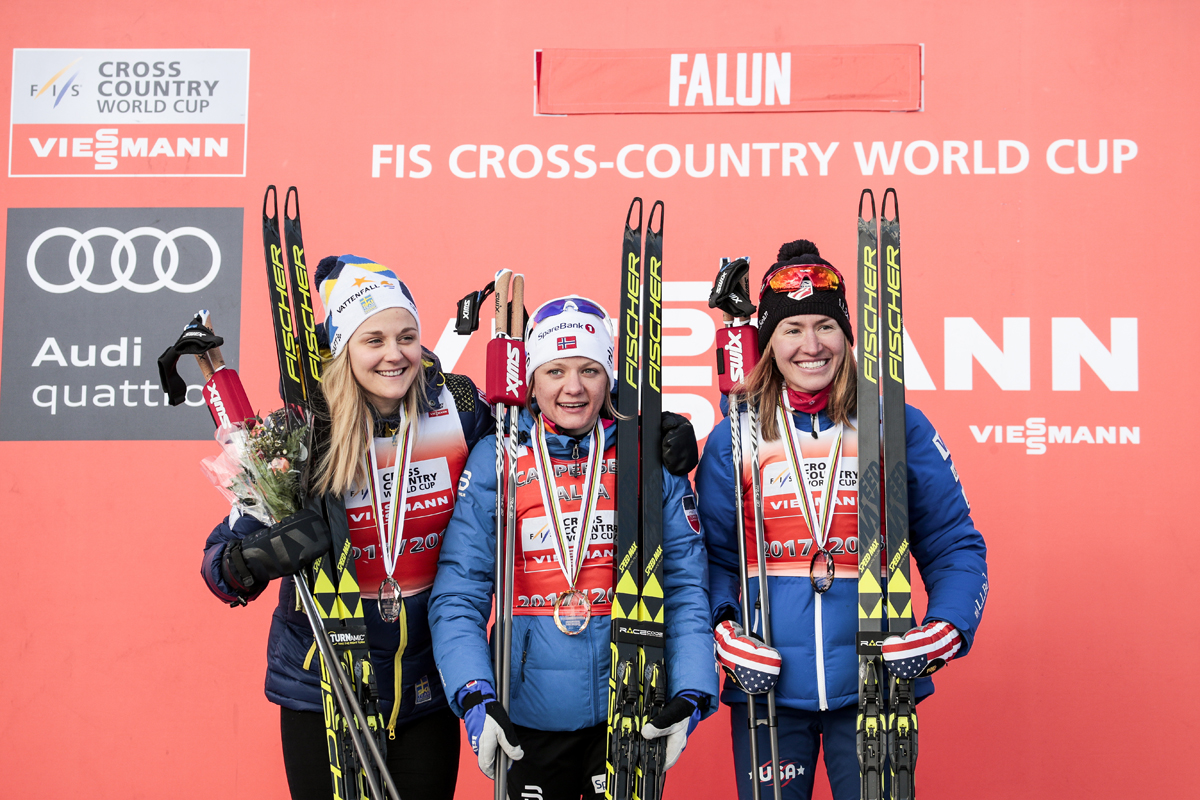
    The women’s 1.4 k freestyle sprint podium at 2018 World Cup Finals in Falun, Sweden, with (from left to right) Sweden’s Jonna Sundling in second, Sweden’s Hanna Falk in first and Norway’s Marit Bjørgen. (Photo: Fischer/NordicFocus)

    FALUN, Sweden — Even the sky had predictions for Sweden. Without a cloud in sight, cerulean blue and a golden sun served as Falun’s backdrop for the opening race of the 2017/2018 World Cup Finals on Friday: the 1.4-kilometer freestyle sprint.

    Exactly nine weeks ago in the city sprint held in Dresden, Germany, Sweden’s Hanna Falk was showing shades of greatness. In the first race of the new year, the 28-year-old Swede claimed the Dresden freestyle sprint title for her first World Cup victory since 2010.

    With the final sprint of the season taking place on the Falun ski trails, where Falk — a member of Sweden’s national team — spends most of her time training, the statistics were levied. All signs pointed to Sweden, in particular, Falk.

    With one group of fans holding a banner that read “Falk för President” and still more waving the national flag, Falk won Friday’s Falun sprint final in 3:08.25 minutes, finishing the last sprint of the season the same way she started the new year: in first.

    “This is just great to win here in Sweden. It’s my second victory this season and I am so happy that my parents are here to see it,” Falk said, according to an International Ski Federation (FIS) press release.

    Falk started Friday with the fastest qualifying time of 2:59.88 (she remained the only woman to dip below the three-minute mark throughout the entirety of the day on the 1.4 k course).

    Later, when Falk learned that the season’s overall sprint leader, Norway’s Maiken Caspersen Falla, would not advance to the final (American Sophie Caldwell and Norway’s Silje Øyre Slind snagged the two lucky loser spots in the final instead), Falk took a calculated approach for the final heat. She would be in control.

    “With Maiken not in the final I knew that the pace might not be so high so I went for it on the second climb to make sure I had a good gap on the long downhill,” Falk told FIS.

    From the start, Falk set the pace, leading through the first hill while Sweden’s Jonna Sundling and Anna Dyvik, Norway’s Marit Bjørgen, Slind, and Caldwell followed.

    In the first descent, Falk maintained her position at the front, while Dyvik swung to her outside left and Bjørgen, Sundling and Caldwell clung just behind. Slind tucked in just behind in sixth.

    Heading into the second uphill, Falk remained at the front with Dyvik matching her pace. Just before the crest of the hill, the eventual race winner visibly slowed, the rest of the field following suit. A half second later, Falk burst back to life, snapping over the top of the climb and putting close to two meters between herself and the group as they cornered back to the stadium.

    Sweden’s Hanna Falk (r) smiles as she wins the fourth World Cup race of her career and first race in Falun, Sweden, with a victory in the women’s freestyle sprint at 2018 World Cup Finals on Friday. Her teammate Jonna Sundling (l) placed second while Norway’s Marit Bjørgen finished third. (Photo: Svenska Skidspelen/Instagram)

    Chasing Falk on the descent was Bjørgen, then Dyvik and Sundling. Slind raced just behind them in fifth and Caldwell behind her in sixth. Coming into the final stretch, it was Falk in first, now at least three meters ahead. Sundling had moved around Dyvik and Bjørgen into second, leaving those two to battle for third.

    Falk ultimately crossed first for her fourth-career individual World Cup victory, 0.53 seconds ahead of Sundling in second. Holding off a charge from Dyvik, Bjørgen crossed third, 1.4 seconds behind Falk.

    In fourth was Dyvik (+1.72), followed by Slind in fifth (+4.30) and Caldwell in sixth (+6.99). The sprint finish marked Caldwell’s ninth World Cup top 10 this season. Additionally, the American finished eighth in the classic sprint at the Olympics last month in PyeongChang, South Korea.

    Caldwell reached Friday’s final by qualifying in 16th, then winning the fourth quarterfinal and taking third in a photo finish with Slind (who followed in fourth) in the second semifinal. The top-four women from that semi all advanced to the final was fast-enough times.

    Caldwell Achieves Goal of Top 3 in Sprint World Cup

    While Falk’s win boosted the Swede from fifth to fourth in the final Sprint World Cup standings, Caldwell retained her podium position ahead of her in third. For the first time in her career, the 28-year-old Caldwell finished in the top-three of the overall Sprint World Cup.

    Thinking back two years, Caldwell could remember a conversation she had with U.S. Ski Team Women’s Coach Matt Whitcomb about race goals. Whitcomb wanted Caldwell to write down goal in particular: to be in the Sprint World Cup overall top three.

    “At the time I was like, ‘Eh, no, that seems pretty far off,’” Caldwell reflected in a post-race interview with FasterSkier.

    “I remember she was a bit sheepish when we suggested it,” Whitcomb told FasterSkier on Friday.

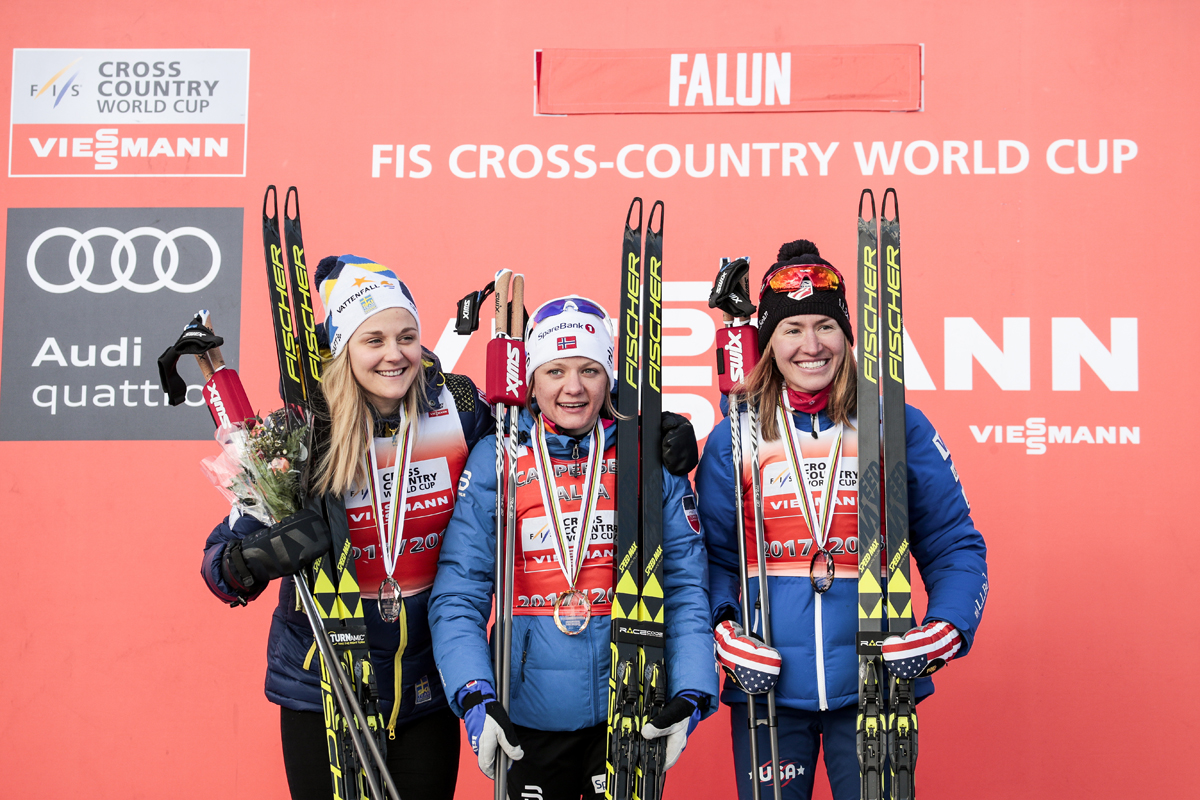
    The 2017/2018 women’s Sprint World Cup podium with Norway’s Maiken Caspersen Falla (c) in first, Sweden’s Stina Nilsson (l) in second and American Sophie Caldwell (r) in third. (Photo: Fischer/NordicFocus)

    Yet on Friday, Caldwell looked on from the podium as an American flag rose in honor of her third-place finish in the overall sprint standings. With a total of 396 points, Caldwell claimed third behind Sweden’s Stina Nilsson, who had 495 points for second, and Norway’s Falla in first with 573 points.

    “We were really psyched that she took after it because, all of us coaches, really believed it could be done,” Whitcomb said.

    “I was of course thrilled to be up there today,” Caldwell said. “It’s been a good season with some really good results, but I think maybe what I am most proud of is just the consistency of my season — making it into the semifinals almost every sprint and skiing with confidence throughout the year.”

    Though Caldwell expressed that results can be gratifying, they are not the be-all and end-all of her ski career nor what she attributes to her and the U.S. team’s momentum.

    “My hope is that people back home see this team not only for our results, but also for the friendships we have and the atmosphere we have going on in this team,” Caldwell said.  “I think this team has come so far … It started with Kikkan [Randall] sneaking into the top 30, then Kikkan finding herself on the podium, then Kikkan winning. She sort of showed us all that we could do it, too, and pulled us up with her, believed in us so that we could believe in ourselves. Now on any given weekend it could be any one of us on that podium, which is really cool.”

    Falla, who finished Friday’s sprint in eighth after being eliminated in the semifinals, won the overall sprint title for the third-straight season, this time by 78 points over Nilsson in second after Nilsson missed Friday’s sprint due to illness.

    “For sure I wanted to be able to fight for the podium today but I made a mistake in the semifinal and I wasn’t able to get back into position to advance,” Falla told FIS after finishing fourth in the first semifinal behind Falk, Sundling and American Jessie Diggins, respectively. “But I can’t be too upset as I have won my third Crystal Globe and I am very proud of that.”

    Three Americans in Top 10

    Rounding out the rest of Friday’s freestyle-sprint top 10 was Diggins in seventh, her U.S. teammate Sadie Bjornsen in ninth and Sweden’s Ida Ingemarsdotter in 10th.

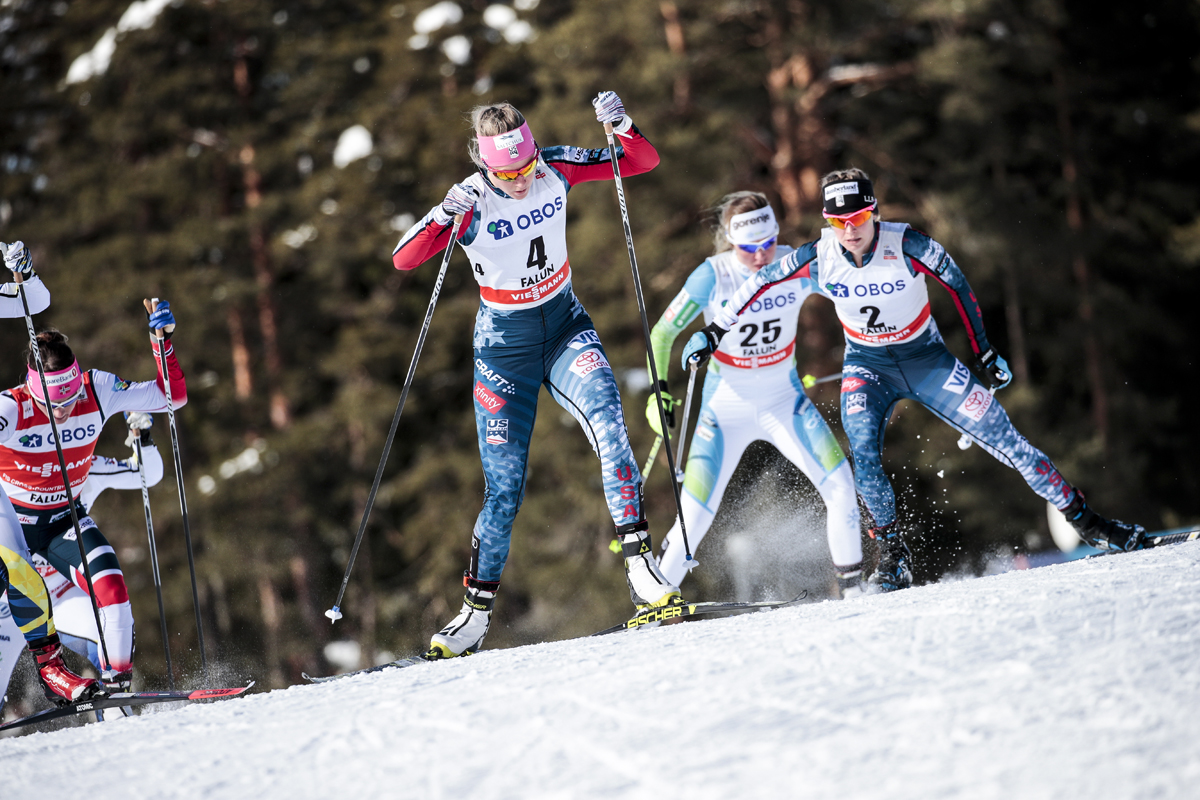
    Sadie Bjornsen (4) racing in Friday’s freestyle sprint semifinal with her U.S. teammate Jessie Diggins (2) and Slovenia’s Anamarija Lampic (25) while chasing Norway’s Maiken Caspersen Falla (left, pink headband), among others. (Photo: Fischer/NordicFocus)

    After racing to second place in the first quarterfinal behind Falk, Bjornsen automatically advanced to the first semifinal. Diggins won the third quarterfinal to advance to the first semifinal as well.

    In the semis, Diggins finished third, 0.42 seconds behind Falk in first and just 0.08 seconds behind Sundling, who automatically advanced in second. 

    Bjornsen followed in fifth, 0.87 seconds out of first, behind Falla in fourth (+0.68). Aside from the top two in that first semifinal, no one from that heat advanced to the final.

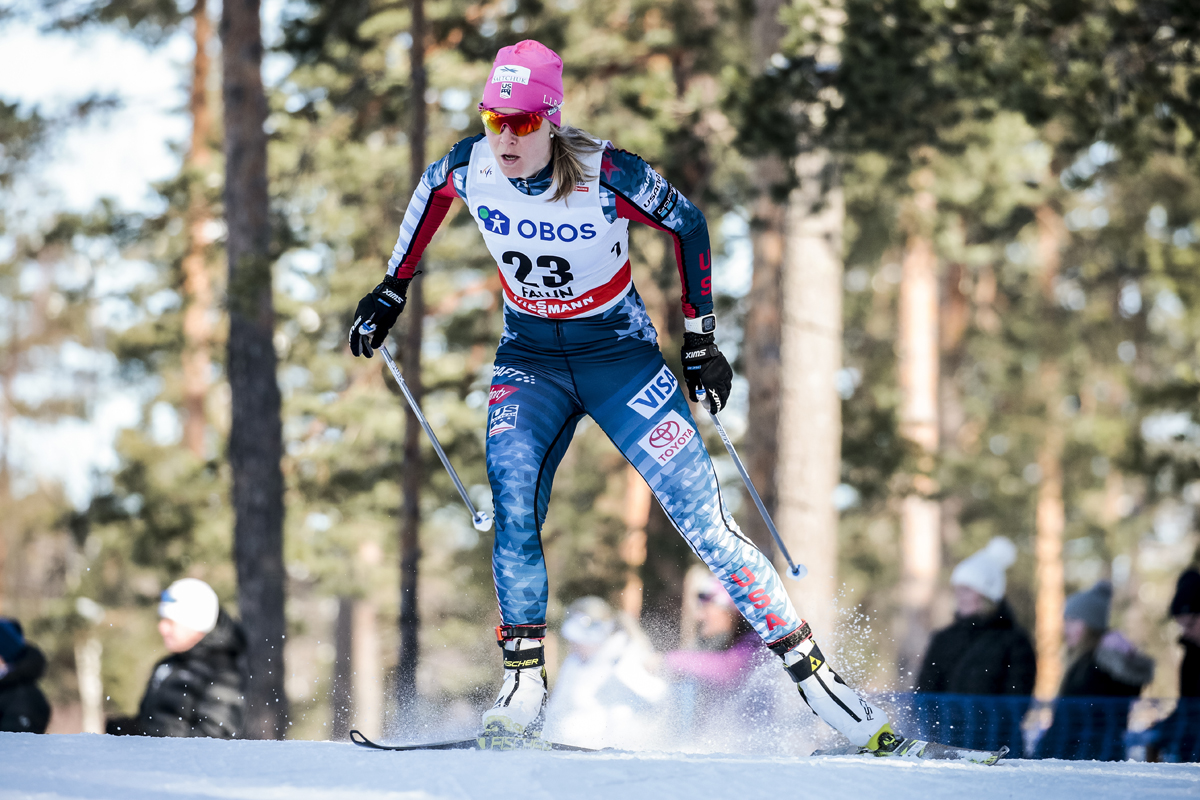
    American Sadie Bjornsen racing to fourth in the women’s 1.4 k freestyle sprint qualifier at World Cup Finals in Falun, Sweden. She went on to finish the day in ninth overall. (Photo: Fischer/NordicFocus) (Photo: Fischer/Nordic Focus)

    To start the day, Diggins had qualified for the rounds with the second-fastest time, 1.65 seconds behind Falk, while Bjornsen qualified in fourth (+2.96).

    “I definitely felt really good about how my body feels. I guess I was wishing for a bit more today,” Bjornsen told FasterSkier after. “For the last sprint of the year it was a fun way to end, leaving something to hope for.”

    The last World Cup sprint of her career, American Kikkan Randall qualified for the heats in 18th before advancing to the same quarterfinal as Diggins. While Diggins gapped the field by the final downhill back toward the stadium and won the heat, Randall remained in contention to automatically advance in second until the last lunge to the line. There, Randall finished third, 3.14 seconds behind Diggins and just 0.1 seconds shy of second place, which went to Ingemarsdotter.

    “I did not feel good in the first half of that heat; my body just wasn’t quite warm yet,” Randall told FasterSkier after. “I just tried to keep myself in there.”

    Randall was disappointed not to advance past the quarterfinals in her last sprint, but when asked to reflect on the season as a whole, the 35 year old remained thoughtful.

    American Kikkan Randall racing to 18th in the women’s 1.4-kilometer sprint qualifier at World Cup Finals in Falun, Sweden. She went on to finish the day in 15th overall. (Photo: Fischer/NordicFocus

    “I was really happy to be able to start a family and come back. I think that went as well as I could have hoped,” Randall said. “And even though it took some patience at times … and the season didn’t go exactly as I planned, with the foot injury mid-season, I came around big at the Olympics this year and happy that I was able to get back in form when I needed to.

    “I’m glad I stuck with it this long,” she continued. “I’m just trying to enjoy the last bit of time with my teammates, my staff and all the World Cup friends.”

    After the disqualification of Russia’s Natalia Nepryaeva for her second yellow card (due to a false start in her quarterfinal), American Ida Sargent finished the day in 36th, followed by Rosie Brennan in 49th, Caitlin Patterson in 63rd, Liz Stephen in 66th, Kaitlynn Miller in 69th, and Rosie Frankowski in 75th.

    Emily Nishikawa was the top Canadian woman in 40th, Dahria Beatty finished 48th, Cendrine Browne 60th, and Zina Kocher 71st.

    Results: Qualifier | Final

    Final Sprint World Cup standings

  • U.S Women Fifth for Best-Ever Olympic Relay Finish; Canada 13th

    Sadie Bjornsen (front) skiing the U.S. women’s relay team into eighth position after her classic leg. (Photo: FlyingPointRoad)

    FasterSkier would like to thank Fischer Sport USA, Madshus USA, Concept2, Boulder Nordic Sport, and Swix Sport US for their generous support, which made this coverage possible.

    ***

    PYEONGCHANG, South Korea — Cross-country is still a roots sports in the United States. Woods-skiers and fitness buffs stoke the small engine driving the sport. But every four years, the buildup begins. The pressure notched up. There’s national television appearances for U.S. nordic athletes. Time to shine when the spotlight is pointed in your direction. For a fringe sport in North America, easy access to snow is a prerequisite, the Olympic buildup makes the cross-country conversation more relevant.

    To study on paper the lineups for Saturday’s women’s Olympic 4 x 5 kilometer relay is to realize the chances of medaling are exactly that: chances. Every head-to-head matchup, like a Stina Nilsson versus a Marit Bjørgen as the evening’s anchors for Sweden and Norway respectively, has its pros and cons. Coaches make calculated decisions. Can Bjørgen gain enough ground on Nilsson before the final straight? Can Nilsson stay close enough to edge Bjørgen on the final straight? Ultimately the skiers go out and ski.

    U.S. Ski & Snowboard put out a press release as the U.S. relay team was announced detailing the women’s 4 x 5 k relay results chronologically both on the World Cup and major championships.

    The U.S. women’s best-ever result relay result on the World Cup was a second place in  January 2016 in Nove Mesto, Czech Republic. (That lineup was Caldwell, Bjornsen, Stephen, Diggins). Their best World Championships relay result was a fourth place last year in Lahti, Finland. 2014 in Sochi marked the women’s best Olympic result of eighth place.

    Team. Much is said about the U.S. women’s team. So it’s fitting that in terms of promoting potential medals, the women’s relay gets the playbill’s frontpage.

    Again it’s a calculated chance for any team — no nation is ever a lock. Look at Norway’s 4 x 5 k relay result in Sochi. Fifth. So could the U.S. end a medal drought 26-years deep on Saturday? No. So is the Olympic buildup fair — maybe not.

    The beauty of the relay isn’t based so much in the euphoric glow of the podium’s top-three steps but how the chances played out.

    Norway played its chances with the Bjørgen-Nilsson duel. And Bjørgen couldn’t escape Nilsson’s shadow until the closing 300 meters — a place where Nilsson herself was supposed to shine. Norway stopped the clock in 51:24.3. Sweden placed second (+2.0).

    The U.S team of Sophie Caldwell, Sadie Bjornsen, Kikkan Randall, and Jessie Diggins placed fifth (+1:20.5). About all the pre-race hype and expectations, Randall, in her fifth Olympics, said it best.

    Five-time Olympian Kikkan Randall skiing the U.S. team into sixth position during Saturday’s Olympic 4 x 5 k relay. (Photo: FlyingPointRoad)

    “This is our best Olympic finish ever,” Randall said in the mixed zone after the race. “When we tend to be really focused on the medals it’s because we know deep in our hearts it is possible. I still think this is amazing that we put together four strong legs today and to get the best-ever result, keep the pathway going forward.”

    This is not baseball’s World Series with a best-of-seven series. It is one and done. So when Caldwell toed the line in the scramble leg, there was belief. And if we want to fast forward to the end of this report, belief remains.

    Caldwell sent it for the first half of her leg. Russia’s young upstart team took it out hot — their strategy one of padding their skate legs for the onslaught from Norway’s and Sweden’s skate legs. Only 8.1 seconds off the front at the time, Caldwell then fell off as the Olympic Athletes from Russia (OAR) and Norway surged ahead by the 3.58 k mark. Caldwell came through to tag Bjornsen in 11th place (+1:01.5).

    “I think that our team has more belief than we ever had right now,” Bjornsen said after the race. “It’s just so motivating and exciting, and we show up to every race just so excited to see what we can do, and kind of goosebumps just standing on the start line and that is certainly a memory that we are going to take away forever.”

    Sophie Caldwell during the scramble leg for the U.S women during Saturday’s 2018 Olympic 4 x 5 k relay. She is ahead of Switzerland’s Laurien van der Graaff. (Photo: FlyingPointRoad)

    After skiing the sixth fastest leg, Bjornsen took the team into eighth place (+1:05.2) as she tagged to Randall for the first skate leg. Randall skied the third best time on her leg and brought tagged off to Diggins in sixth.

    As the Bjørgen-and-Nilsson parry played out ahead, Diggins motored. She, too, skied the third-fastest anchor leg split and reeled in another place as she crossed the line in 52:44.8 minutes to secure fifth place. 

    Here’s the thing: a medal appeared out of reach for the U.S. early on. But these women make you believers. That’s not U.S. Ski & Snowboard spin. That’s not wishful fan-boy thinking. It’s incremental steps the U.S. women have made.

    Every nation shows up for the Games primed. The U.S. showed up and they were fifth on Saturday. Thirty-seven-point-two seconds out of third. Who wouldn’t believe in that?

    “I think for me, every time you get to put on the rely socks it’s a big honor, its a privileged,” Diggins said as she reflected on the race. “You know you’re just not racing for yourself. You are racing for your teammates, you are racing for the people who did not get named to the relay, but easily could have, and are out there cheering on the course, and you are racing for Team USA. … I got to see each of my teammates ski their hearts out. I was getting more and more fired up watching them, just like, ‘OK, it’s my turn I am going to go reel in as many people as I can,’ and then we are going to walk away proud of what we did here today because there is more to it than just medals.”

    Asked after the race to expand on what the day in and day out meaning of belief is like for the women’s team, U.S. women’s coach Matt Whitcomb elaborated on his role and that of the athletes.

    “As coaches we spend a lot of time trying to tune people’s engines and try to make sure that they show up with a roaring Ferrari,” Whitcomb remarked. “But the Ferrari needs a driver and for the skier that’s the brain. The body will not go if the brain isn’t behind it and we’ve seen it time and time again where you have someone who you think is completely tuned up and prepped and ready to win a race and they’re not even in the points, and you later uncover that something had them out of balance and listing starboard and kept them off course for the day.

    Jessie Diggins after skiing the U.S. women into fifth place during the 4 x 5 k Olympic relay. (Photo: FlyingPointRoad)

    “So when we, as a team, first believe in one another, you then have your entire team that believes in you,” Whitcomb continued. “And that’s impossible to miss the positive effects of your team. One after the next, believing in you as a skier and you can’t help but believe more in yourself. So when you’re confident, you believe more in yourself, the body starts up really quickly and you can race the car.”

    Under Whitcomb’s guidance, the U.S. nordic community has come to expect excellence for it’s women’s team. Consider that for a minute. Consider that during the early part of Randall’s career, it was a fight to even field a women’s relay team. Consider that Whitcomb chose a Ferrari as his vehicular metaphor. That metaphor works for the U.S. squad.

    Whitcomb also spoke of how the race unfolded from the outset.

    “The first thing that jumped out was that Russia chose the strategy of two very hot classic legs,” Whitcomb said. “That is something we were hoping didn’t occur. And it doesn’t always in championship events, it tends to, but I felt like, and I still feel like, we put together the very best team we had tonight. I have really honestly no regrets about that.”

    Here’s the link to the 4 x 5 k women’s relay start list. It’s a wow-type list. The Norwegians, the Swedes and the Finns, all loaded lineups. And the Russians were seated fifth. Natalia Nepryaeva and Yulia Belorukova, both Russian skiers that have already medaled at these Games, led off the first two relay legs. They were a big unknown who pulled through for the bronze.  

    Ready, set, go. The start of the women’s 4 x 5 k Olympic relay. (Photo: FlyingPointRoad).

    “It was really interesting to talk with the Russian coach on the trails as we were watching the race and confirm that they were in fact they were going to take it out hot, so we were privy to that,” Whitcomb said. “The athletes more than anybody knew what was going on. They can see the splits opening up or closing down. But as you saw in several cases, with Riita-Liisa [Roponen] from Finland, with Astrid [Uhrenholdt Jacobsen] from Norway, with Russia’s last skier on their first leg anyways, there are dents in armor here and there. We were hoping to really tear those open, and we got close but we were on the same hill as the medal. We’ve been there before and that’s frustrating. But for me, it’s fortunately more than just medals and I’m very proud of the team today.”

    Canada’s relay team of Dahria Beatty, Emily Nishikawa, Cendrine Browne, Anne-Marie Comeau placed 13th (+4:50.3).

    “We are racing all for each other; we are doing our very, very best,” Nishikawa said after the race. “I think our team has come a long ways. Last year at the world champs we probably had one of our best days ever [in 10th]. On a really good day we could be fighting with a lot of these teams.”

    Racing continues Sunday with the men’s 4 x 10 k relay.

    Results

  • Sunday Rundown: Holmenkollen & Kontiolahti

    Sunday Rundown: Holmenkollen & Kontiolahti

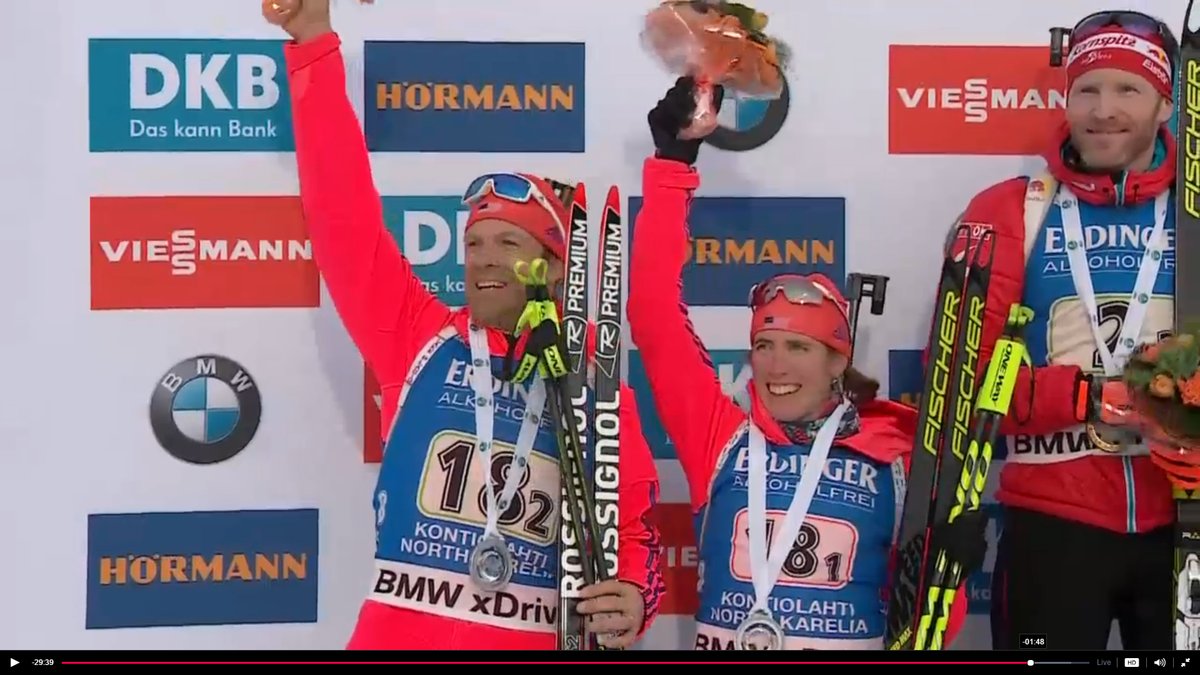
    Lowell Bailey and Susan Dunklee celebrate finishing second in the single mixed relay in Kontiolahti, Finland. (Screencap: US Biathlon/Twitter)

    IBU Biathlon World Cup (Kontiolahti, Finland): Single Mixed Relay

    In the last single mixed relay of the season, Susan Dunklee held the lead after two loops of skiing. She was looking for a top tag-off to American Lowell Bailey, but she crashed on a downhill. Nevertheless, she was able to focus on the shooting range and climb back into podium position.

    The leaders were gone, however: Simon Eder and Lisa Therese Hauser of Austria ran away with the competition, using five spare rounds to race to a 32.8-second victory.

    Bailey left the last shooting in third position, and caught Germany’s Roman Rees on the trails. The pair also managed to hold off Jean Guillaume Beatrix of France, who left the range just behind them. It came down to a sprint finish, with Bailey besting Rees (and his relay partner, World Cup Total Score winner Laura Dahlmeier). The U.S. had five spare rounds to Germany’s six.

    It was the first relay podium of any kind for the United States since 1994, when the women finished second in a relay in Canmore, Alberta.

    The Canadian team of Julia Ransom and Christian Gow finished 19th (+2:27.0) with eight spare rounds.

    Results

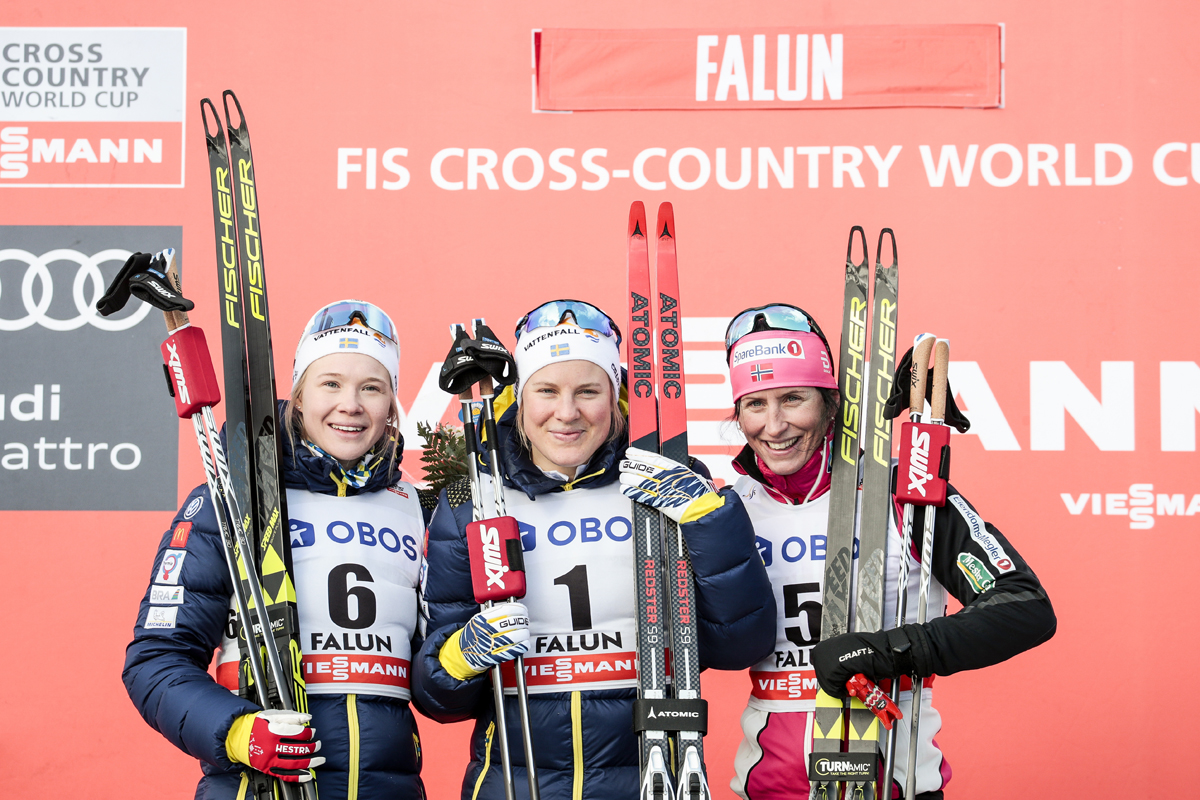
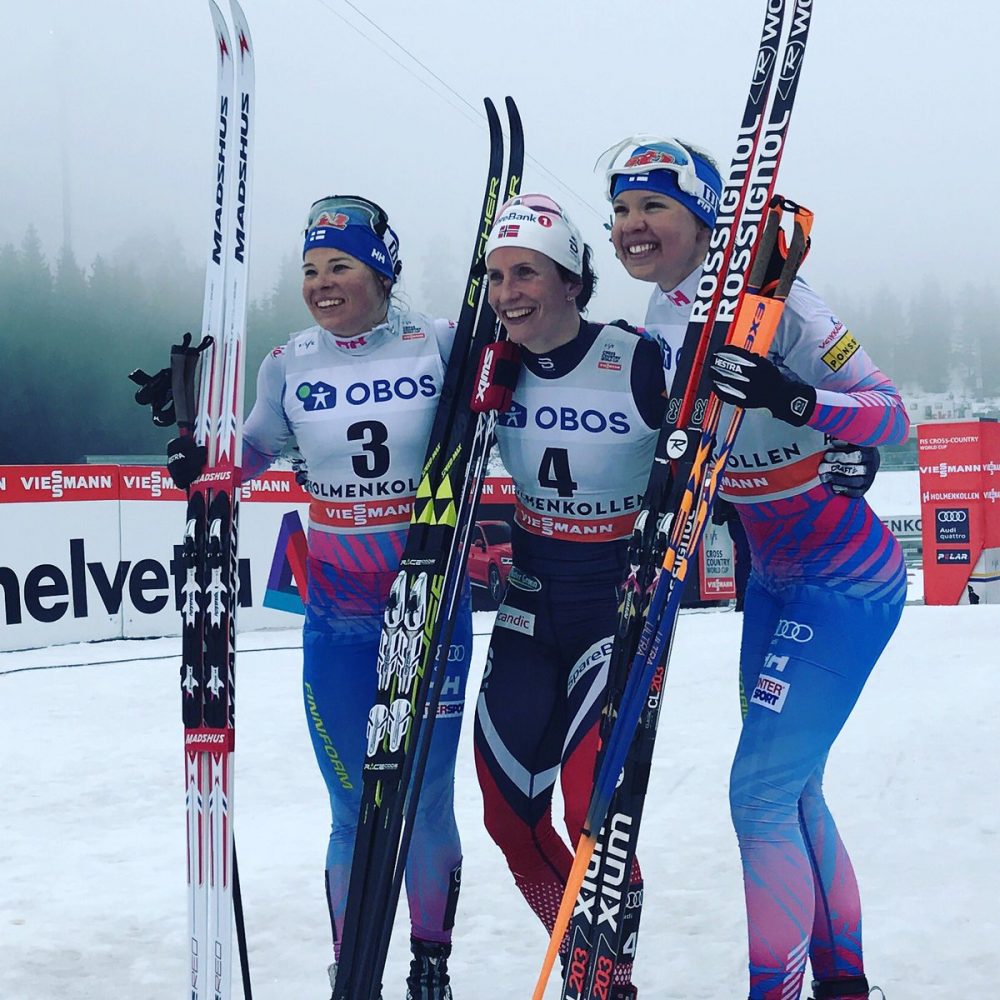
    Left to right: Finland’s Krista Pärmäkowski, Norway’s Marit Bjørgen and Finland’s Kertu Niskanenen after the women’s 30kiloimeter World Cup classic mass start on Saturday in Oslo, Norway. (Photo: FIS Cross-Country/Twitter)

    FIS Cross-Country World Cup (Oslo, Norway): Holmenkollen 30 k classic mass start:

    Norwegian Marit Bjørgen won the women’s 30-kilometer classic mass start at Homenkollen on Sunday, in a time of 1:22:59.2. She bested two Finns, Krista Pärmäkoski and Kerttu Niskanen. Pärmäkoski finished in second (+2:05.8) and Niskanen in third (+2:07.0).

    Norway’s Heidi Weng finished fourth (+2:08.6), outlasting Sweden’s Charlotte Kalla (fifth, +2:11.7). Poland’s Justyna Kowalczyk finished sixth (+2:12.9), Finland’s Aino-Kaisa Saarinen seventh (+2:19.6), Norway’s Ingvild Flugstad Øtsberg  in eighth (+2:31.3), Sweden’s Anna Haag  in ninth (+3:27.9) and Finland’s Laura Mononen in tenth (+3:28.7).

    The first North American to finish on Sunday was Kikkan Randall, who placed 20th (+6:17.2).  The next North American across the line was the U.S. Ski Team’s Sadie Bjornsen in 24th (+6:48.8). Liz Stephen finished in 31st (+8:46.8), and Chelsea Holmes (Alaska Pacific University) in 39th (+11:19.1). 

    Results

  • Norway Makes It 100 Championship Golds with Women’s Relay Win

    Norway Makes It 100 Championship Golds with Women’s Relay Win

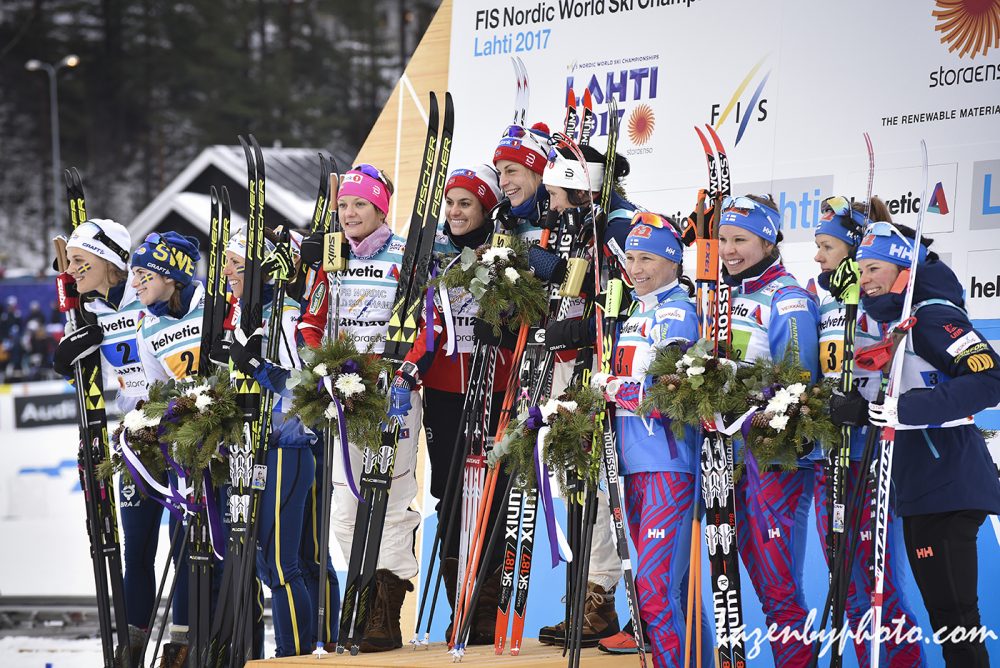
    The women’s 4 x 5 k relay podium at 2017 Nordic World Ski Championships in Lahti, Finland, with Norway (c) in first, Sweden (l) in second and Finland (r) third. (Photo: John Lazenby/Lazenbyphoto.com)

    LAHTI, Finland—The Norwegian lineup for the women’s 4 x 5-kilometer team at the 2017 Nordic World Championships on Thursday was daunting: Maiken Caspersen Falla, Heidi Weng, Astrid Uhrenholdt Jacobsen, Marit Bjørgen. On paper and on snow, a rundown of names and accomplishments.

    Here during these Lahti championships the Norse foursome have hauled; Falla with a freestyle sprint gold, Falla and Weng with a classic team sprint gold, Bjørgen a 10 k individual classic gold and 15 k skiathlon gold, and Jacobsen’s hardware was a bronze in the 10 k classic.

    On Thursday the Norwegian women made the country’s historic championship gold medal count a tidy 100 by winning the 4 x 5 k relay in 52:21.5 minutes. In a sprint for the remaining two podium spots, Sweden’s anchor skier Stina Nilsson outsprinted Finland’s Krista Pärmäkoski for second.

    The Swedish team of Anna Haag, Charlotte Kalla, Ebba Andersson, and Nilsson scored silver (+1:01.6) while Finland’s home team of Aino-Kaisa Saarinen, Kerttu Niskanen, Laura Mononen, and Pärmäkoski was third (+1:02.1).

    The U.S., represented by Kikkan Randall, Sadie Bjornsen, Liz Stephen, and Jessie Diggins, placed fourth (+1:33.8).

    Two Legs of Parity, Then Norwegian Dominance

    Rabid fans of the sport know Norway is winner of the last three consecutive championship relays. And lovers of tactics also know the Norwegians like to push the pace from the gun and break the pack early.

    Halfway through the first leg, Poland’s Justyna Kowalczyk, a classic specialist, led Finland, Norway, Sweden, and the U.S. through the 2.5 k mark.

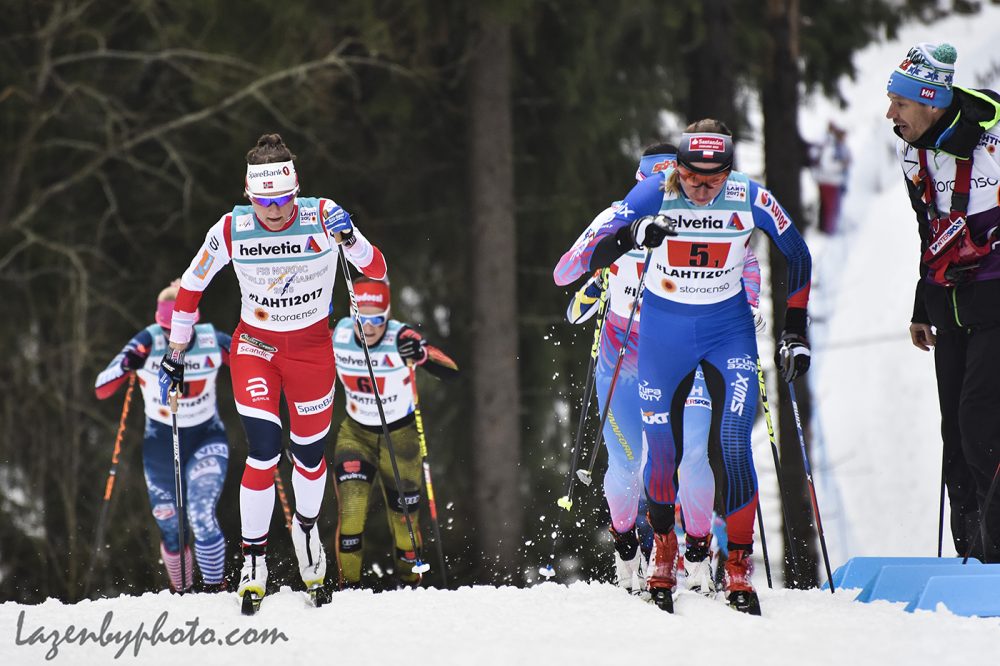
    Norway’s Maiken Caspersen Falla (l) leads one row of skiers, Poland’s Justyna Kowalczyk lead’s another, during the scramble leg of the 2017 Nordic World Championships 4 x 5 k relay in Lahti, Finland. (Photo: John Lazenby/lazenbyphoto.com)

    For Falla, Norway’s scramble leg, it was her debut in a championship 4 x 5 k relay. Despite her prior medals, her pre-relay nerves were unsettled.

    “I was really excited today and I was just hoping that the time could pass fast so I can race,” Falla said after the race. “It was a lot of waiting time, but I get good advice … and that helped me today. So I get my nerves under control.”

    According to Falla, here’s the advice: “That I should stay behind the first lap and be strong in the climbs in the last lap,” she explained. “I did that, just as they said.”

    In the last kilometer, Falla made a small break, tagging off to Weng with a near eight-second advantage on the chasers.

    Weng leads the World Cup overall standings, but racing in the Finnish ski-den, she was unable to fend off the surging Finns. Five kilometers later, Niskanen had absorbed Norway’s punch. Finland and Norway tagged off to their respective third-leg skiers simultaneously. Sweden trailed twelve seconds back.

    Up the first hill, the mother of all climbs on the skating course, Jacobsen and Mononen pulsed. Carrying Sweden’s hopes was Andersson — a 19-year-old junior fresh off a win in the 5 k skate at last month’s Junior World Championships at Soldier Hollow in Utah.

    The Finn-Norwegian duo pulled away, leaving Andersson with a 22.6-second deficit 1.3 k into the third leg.

    Astrid Uhrenholdt Jacobsen, Norway’s third-leg skier, made a decisive move to put major time into second-place Sweden and third-place Finland during the 2017 Nordic World Championships 4 x 5 k relay in Lahti, Finland. (Photo: John Lazenby/Lazenbyphoto.com)

    A resurgent Jacobsen kept pushing; her moves to drop Andersson early on weren’t only a tactic to make it a two-team race, but a sustained display of overdrive that ultimately broke the Finns, too.

    The third leg was the tipping point for Finland and Sweden. They were on the side of bleeding time to Norway; Norway on the side of looming victory. By 13.8 k, Norway was up 30.4 seconds on Finland and 45.8 seconds on Sweden.

    Andersson managed the damage. She and Mononen skied into the stadium amidst a raucous Finnish crowd. By then, Jacobsen handed Bjørgen nearly a minute cushion.

    That kind of margin and Bjørgen hustling from the line: Boom!

    You know how this ends, with the queen waving an oversized Norwegian flag.

    After the race, Jacobsen spoke of the pressure of skiing on Norway’s storied relay teams.

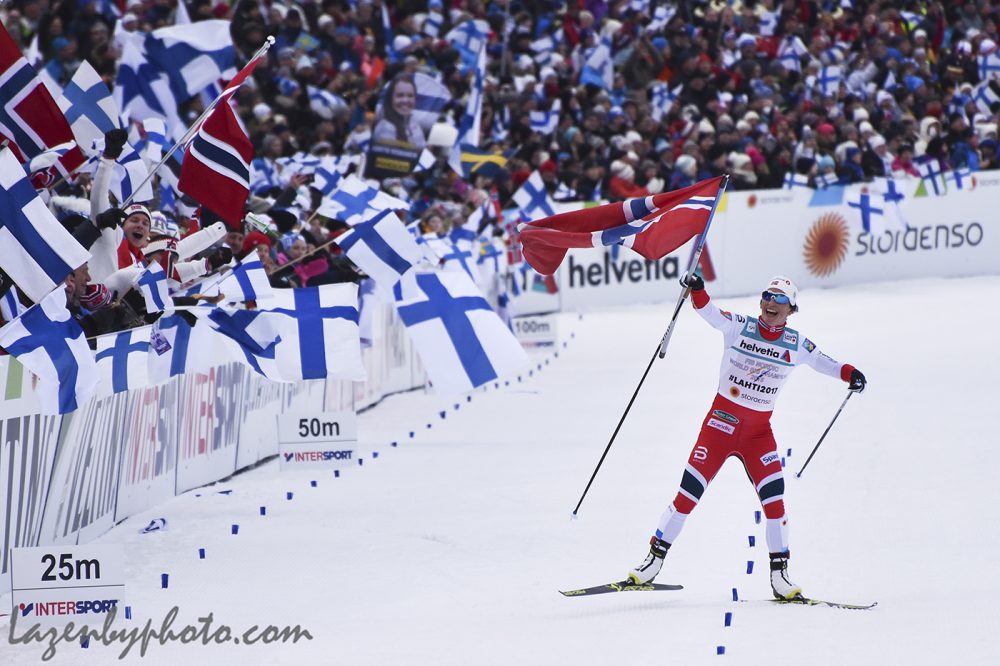
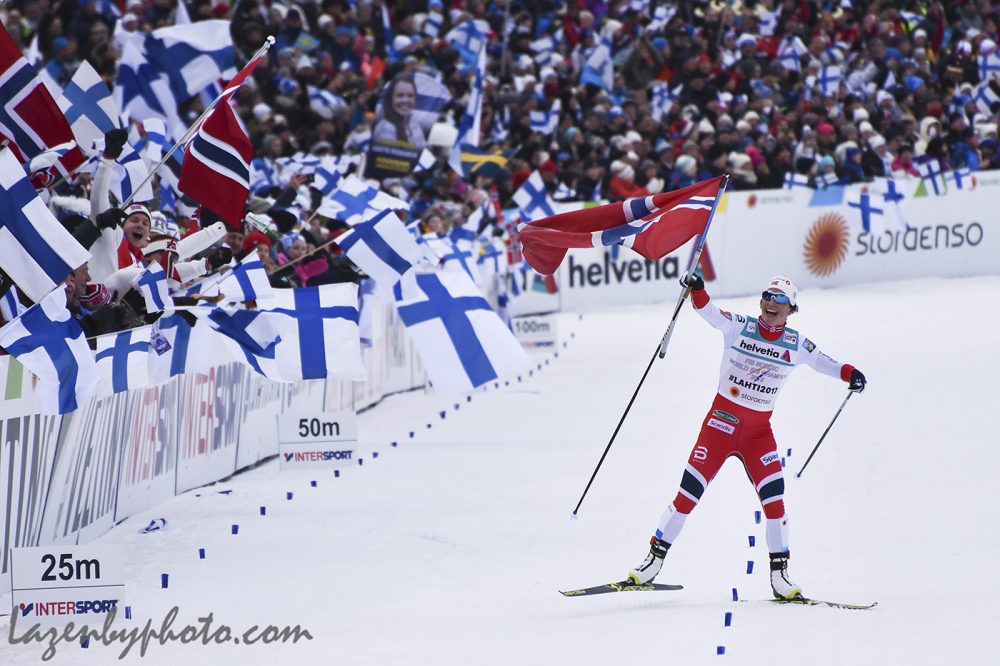
    Marit Bjørgen carrying the Norwegian flag as she crosses the line first for Norway’s 100th World Championship win during the women’s 4 x 5 k relay at the 2017 Nordic World Championships in Lahti, Finland. (Photo: John Lazenby/Lazenbyphoto.com)

    “I think actually the biggest pressure is the one we put on ourselves and probably because it’s so hard for us to qualify for the team,” Jacobsen said. “We are skiing for the girls who didn’t make it this year but will probably make it next year. So we ski of course for our people and our nation. But I think the biggest nerves come from the desire to perform well and do strong legs.”

    One hundred championship gold medals later, Jacobsen acknowledged it’s a full treasure chest.

    “The Norwegian people are getting spoiled in gold medals, but it not so easy like it looks,” Jacobsen said.

    Glide for glide, pole for pole, Sweden and Finland were mirror images the last leg. Known as a closer, Nilsson strategized that coming into the final corner she wanted to follow Parmakoski.  

    Sweden’s second-leg skier Kalla explained that Nilsson’s tactic was one of waiting until the end.

    “If Stina should go with some team in the end, she should wait to the stadium and just focus on her strength and she made it just like the plan,” Kalla said.

    Days earlier in the team sprint, Nilsson lost out on bronze to Diggins in a sprint to the line.

    “In the team sprint I was first in the final curve,” Nilsson reflected. “And I felt that Diggins had an advantage of it, so I didn’t want to be first today.”

    The press conference’s moderator interjected and tried to correct Nilsson, saying she was first again in the closing moments, not shadowing the Finn.

    “No, not in the curve, but after the curve,” Nilsson said with a laugh.

    The silver and bronze fight came down to Nilsson’s final kick and this time she made it stick for silver.

    (Story continues below)

    Sweden’s Stina Nilsson celebrates silver after outsprinting Finland’s Krista Parmakoski (l) in the final meters of the women’s 4 x 5 k relay at the 2017 Nordic World Championships in Lahti, Finland. (Photo: John Lazenby/Lazenbyphoto.com)

    Same Place, But Progress: U.S. Places Fourth, Canada 10th

    With three world champs medals already in the hands of American skiers prior to Thursday’s team relay, the public hope for a podium was high. Perhaps too high.

    As U.S. Ski Team (USST) Head Coach Chris Grover explained, medaling in the team relay was certainly on the radar coming into the world champs week, but not where the team’s greatest expectations were held.

    The U.S. women’s relay team, (from left to right) Sadie Bjornsen, Liz Stephen, Jessie Diggins, and Kikkan Randall, after placing fourth on Thursday at 2017 World Championships in Lahti, Finland. (Photo: John Lazenby/Lazenbyphoto.com)

    “The relay we knew was a shot, the team sprint we knew was an outside shot,” Grover said after Thursday’s race. “Probably our greatest medal opportunity was the individual sprint.”

    As a gritty group of women, the Americans exude the attitude of a top team. Adorned in red, white and blue socks and face paint sporting the U.S.A.’s emblematic stars and stripes, it’s easy to see the enthusiasm the U.S. women show for team events.

    But where does the blur between team-relay hype end and the reality of results begin?

    Disappointment in anything less than a podium only comes when the expectation of one exists. Taken over the past few world champs years, the relay event might be one where the U.S. women can, and have, improved the most.

    Eight years ago, at the 2009 world champs in Liberec, Czech Republic, the U.S. finished 13th, a little over three minutes out of third place. The following World Championships year, 2011 in Oslo, Norway, they were almost two minutes off the podium, crossing in ninth overall.

    In 2015, the team finished fourth, a little over a minute back from the bronze medal.

    This year? The U.S. once again finished fourth — the third time in a row that the team has finished one place outside the podium at a World Championships event.

    Yet, Thursday’s performance was the second closest the team has come to bronze, with the Americans crossing 31.7 seconds after third (their 2013 result in Val di Fiemme, Italy, was closer: 26.6 seconds behind third). Given room for systematic error, the statistical trend for the U.S. women in the team relay over the past five world champs: positive.

    American Kikkan Randall during the first leg of the women’s 4 x 5 k relay at the 2017 Nordic World Championships in Lahti, Finland. (Photo: John Lazenby/Lazenbyphoto.com)

    “Even though this is the third time in a row that we’ve been fourth place at a world championships, there’s progress, there’s real progress,” Grover said. “The athletes could see the competition ahead of them the whole time. … To be getting closer and closer to that top standard, that’s very gratifying.”

    When looking at the longer-distance performances from the week in tandem with Thursday’s start list, Grover further explained that the U.S. team’s incoming rank was similar to their outcoming result.

    “I guess I’d say that when you look at the start list and you look at the results from the 10 k and the skiathlon, on paper we’re fourth,” Grover said. “Sweden, Finland, Norway they’re definitely ahead of us in terms of the distance results that we’ve seen here all week. So we knew we were sort of an outside chance to be fighting for the bronze and we knew that when we’re successful on the World Cup, it’s because one of those teams has a weak leg.”

    A weak leg from Finland, Norway or Sweden — the three teams that finished ahead of the Americans — at least in Thursday’s race, was nowhere to be found for the U.S.

    From the start, Kowalczyk, pushed the pace with Falla, Haag and Saarinen in close quarters, while the USST’s Randall worked hard to hold on.

    “Unfortunately, we lost some important time there in the beginning,” Randall said. “I know that’s something I’ve got to work on for next year, but it was exciting to know that we were still in the race the whole time and made Sweden and Finland really fight for those medals.”

    Randall handed off to Bjornsen in fifth, approximately 16 seconds back from the second, third, and fourth spots. From there, the Americans raced alone, working hard to reel in the racers ahead.

    “It’s always hard to have a carrot right in front of you and not go too hard at the beginning,” Bjornsen said. “I think all of us had a hard time with that today, not going too hard to try to catch them right away.”

    By the end of her leg, Bjornsen needed another eight seconds from Randall’s time back to catch the third place position. She handed off to Stephen, who would have to make up 23.5 seconds on Sweden’s third leg, Andersson, to contend for the podium.

    The young Andersson, however, was putting on a show. And Stephen wasn’t surprised. During the early stages of her ski career, Stephen attended a weeklong camp in Sweden. While there, she’d learn invaluable lessons from countless coaches, one just happening to be Andersson’s father.

    Liz Stephen racing the third leg for the U.S. women’s team in the 4 x 5 k relay at the 2017 Nordic World Championships in Lahti, Finland. (Photo: John Lazenby/ Lazenbyphoto.com)

    “As I was lining up with her today I was just like ‘this is just full circle,’ “Stephen said after. “She’s a damn-good skier.”

    That of course didn’t stop Stephen from putting her best foot forward. The American emphasised the areas she knew were her strength, working the hills.

    “Part of me wanted to go out and blow [it] out of the water off the bat, but I also knew that these conditions are also a little bit more energy-expending than normal, hard-packed conditions,” Stephen explained.

    Halfway through the first lap, Stephen had gained close to seven seconds on Andersson. By the end of the second lap, however, Andersson had regained the ground that she had lost.

    “Unfortunately I couldn’t get her,” Stephen said. “But I did what I could out there … and I am very inspired to be on this team again. To watch my teammates give it all out there, it just makes you want to do the same.”

    When Stephen handed off to Diggins, the anchor legs for Sweden and Finland were skiing together. Diggins explained that she had hoped Nilsson and Pärmäkoski’s race tactics would provide an opportunity for her to gain on them.

    “I saw where we were coming in and I said, my only strategy is to go out as hard as I can and hope that they are playing cat and mouse in the front,” Diggins said. “[I thought] if they’re trying to be all strategic for the final sprint-out, then maybe I can catch them.”

    Ultimately the gap proved too large, with Diggins crossing in fourth.

    “I wasn’t able to close the gap but I never stopped fighting and neither did my teammates, and I’m really proud of that,” Diggins said.

    Canada’s team of Katherine Stewart-Jones, Emily Nishikawa, Cendrine Browne, and Dahria Beatty finished 10th (+4:16.2) for the fourth-best world champs result of a Canadian women’s relay team. According to a Cross Country Canada press release, this was just the fourth time in the last decade that Canada has fielded a World Championships women’s relay (excluding the Olympics).

    At the 2001 World Championships, Beckie Scott, Milane Thériault, Jaime Fortier, and Sara Renner raced to sixth for Canada. Before that, the program’s previous best was eighth at 1989 world champs, also in Lahti.

    (Left to right) Canada’s Emily Nishikawa, Cendrine Browne, Dahria Beatty, and Katherine Stewart-Jones after placing 10th in the women’s 4 x 5 k relay at the 2017 Nordic World Championships in Lahti, Finland. (Photo: John Lazenby/Lazenbyphoto.com)

    “I think today we surprised ourselves,” Canadian World Cup coach Ivan Babikov said on Thursday.

    “[Katherine Stewart-Jones] skied incredibly that first leg, with everything she could,” he added. “She was ahead of Germany, ahead of Russia, so many really good countries, and after that it was a matter of holding on and it was great.”

    Stewart-Jones finished her leg in eighth, just seven-tenths of second behind Germany’s Katharina Hennig in seventh. Though Switzerland and Italy eventually caught the Canadians, the women expressed excitement about the finish and results yet to come.

    “This is the first time we’ve fielded a world champs relay in a long time so that’s a huge accomplishment [in itself],” Nishikawa said during an in-person interview. “And then to come 10th … it’s really the beginning of something that’s pretty special.”

    “I’m really proud of us,” Browne added. “I think we all skied really strongly today, and very positive for the future.”

    — Harald Zimmer, Gerry Furseth, and Alex Kochon contributed

    Results

  • Sweet Sixteen: Bjørgen Wins Lahti 10 k Classic for 16th World Title

    Sweet Sixteen: Bjørgen Wins Lahti 10 k Classic for 16th World Title

    Norway’s Marit Bjørgen on her way to her 16th career World Championships gold in Tuesday’s 10 k classic individual start at the Lahti, Finland. (Photo: John Lazenby/Lazenbyphoto.com)

    LAHTI, Finland — Moments before the women’s 10-kilometer classic individual start at the 2017 Nordic World Championships on Tuesday, temperatures read 35 degrees Fahrenheit and humidity hovered around 97 percent — the air nearly saturated. Earlier in the day, a near-ground fog lapped the tops of the three iconic ski jumps looming above the ski stadium.

    In contrast to earlier classic events at these championships — a 15 k skiathlon, and classic team sprint — the tracks glazed with a mirror-like sheen.

    For her 16th World Championship title, neither Norway’s Marit Bjørgen nor her wax techs were befuddled by the tricky tracks. Whether herringboning headwalls, firing like the nordic powerhouse she is on the flats and climbs, or streamlining the glide outs, Bjørgen remained peerless in her win over her 10 k classic competition. She finished in 25:24.9 minutes for the gold; the closest competitor Sweden’s Charlotte Kalla was 41 seconds behind.

    Tuesday’s 2017 Nordic World Championships women’s 10 k classic podium, with (from left to right) Sweden’s Charlotte Kalla in second, Norway’s Marit Bjørgen in first, and Norway’s Astrid Uhrenholdt Jacobsen in third. (Photo: John Lazenby/lazenbyphoto.com)

    With silver going to the Swede, the final podium spot went to another Norwegian, Astrid Uhrenholdt Jacobsen, who finished 55.5 seconds back from her teammate Bjørgen’s time.

    Considering their collective medal count, it was a championship-pedigreed podium: it was Kalla’s 12th career championship medal — and her second in the last week. Jacobsen earned her third-individual championship medal of seven overall. (For the 2016/2017 World Cup season, it’s Jacobsen’s first podium.

    It’s also been a decade since Jacobsen’s first World Championship medal, a classic-sprint gold in 2007 in Sapporo, Japan.

    “A lot of things have happened in those ten years,” Jacobsen, 30, said after the race. “The medal today feels better than the gold medal in Sapporo. I fought harder for this. I’m just really happy today.”

    Amongst the potential podium locks in the 10 k classic, Kalla noted she chose an earlier start as part of her race strategy; she started in bib 34.

    “I decided to go early because of the warming up opportunities” Kalla explained during the post-race press conference. “I wanted to go on the competition track as long as possible. And then I also had a better opportunity to do my own race and not focus on the times against the others, just focus on my performance in every stage on the track.”

    Sweden’s Charlotte Kalla racing to second in the women’s 10 k classic on Tuesday at 2017 Nordic World Championships in Lahti, Finland (Photo: John Lazenby/lazenbyphoto.com)

    Despite her race-time dominance, Bjørgen spoke of her jittery nerves before the start.

    “This 10 k has been one of the distances I really wanted to win,” the 36 year old said during the press conference. “I think I have two before the start of the world championships, so this was the one I wanted the gold medal. I think that’s the reason I was nervous and also I understand I was in good shape and it was really possible to take the gold, so that’s the reason.”

    A 41-second winning margin for Bjørgen isn’t definitive. And unlike every other race at these championships, where high drama like Norwegian-Finn tangles, broken poles and Diggins-grit dictated the narrative, Tuesday’s 10 k classic was clinical.

    At 1.5 k, 5 k, 6.3 k, and 7.8 k splits, Bjørgen was the fastest. Already at 6.3 k, Bjørgen had a 22-second gap on Kalla. Barring an equipment failure or tumble, by that point the win was a bygone conclusion and Bjørgen the author of this 10 k novella.

    Norway’s Astrid Uhrenholdt Jacobsen on her way to bronze during the women’s 10 k classic at the 2017 Nordic World Championships in Lahti, Finland. (Photo: John Lazenby/lazenbyphoto.com)

    “Today I had very good skis and I feel very strong, and the first 5 [k] I feel that my speed was very high,” Bjørgen added. “It was only a second from 1 kilometer to 4, and I feel that I am racing very fast and I not taking more seconds so I wonder how will I do it on the last 5 k. But then I heard it was from 6 [seconds] and then to 10 then to 20 and then understand they were opening a bit too hard.”

    Bjørgen explained the news of time-gain inroads served as a propellant.

    “I think when you heard you have second[s] on your side you just get some more power and you just want to ski more faster,” Bjørgen said. “You understand it’s well for you. You are getting so happy, it is no problem to speed up and go.”

    Many adjectives come to mind when describing Bjørgen’s career. Yet the numbers are most impressive. When mining her career-win data, there’s always something new to learn. Of all her gold medals — now 22 between World Championships and the Olympics — prior to Tuesday’s win, 20 of those had come in non-individual-start races. (Her other individual-start win came in 2011 World Championships 10 k classic in Oslo, Norway.)

    Bjornsen Leads Americans in 23rd, Randall 26th 

    Kikkan Randall (U.S. Ski Team) racing to 26th in the women’s 10-kilometer classic individual start at the 2017 Nordic World Championships on Tuesday in Lahti, Finland (Photo: John Lazenby/Lazenbyphoto.com)

    Starting four minutes ahead of Bjørgen, the last starter for the U.S. Ski Team (USST) on Tuesday was Sadie Bjornsen. After covering the course in a time of 27:46.1, the American eventually finished as the top North American in 23rd (+2:21.2). The 10 k classic event was Bjornsen’s first individual event at these World Championships.

    She also raced Sunday’s classic team sprint with her USST teammate Jessie Diggins, where the two captured bronze. Diggins did not race Tuesday’s 10 k classic.

    “It definitely gave me a lot of confidence the other day,” Bjornsen, 27, said on Tuesday, referring to her bronze-medal performance on Sunday. “So I went into today probably a bit nervous because I had more expectations.”

    Sadie Bjornsen (46) leading Sweden’s Ida Ingemarsdotter during the women’s 10-kilometer classic individual start at the 2017 Nordic World Championships on Tuesday in Lahti, Finland. (Photo: John Lazenby/Lazenbyphoto.com)

    Looking back on the effort, Bjornsen explained that she may have paced the initial part of her race too slowly. With her 10 k classic performance from Otepää in the back of her mind, Bjornsen intended to take the first few kilometers of Tuesday’s world champs 10 k event to work into the race.

    “I definitely wanted to keep things under control at the beginning, because I felt last week I started really hard and struggled to keep the pace up,” Bjornsen said. “I tend to do better when I do a more gradual start and then try to pin it after that. I haven’t seen the splits at all, but based on the way that I felt, maybe I started a little too easy.”

    With glazed tracks making for difficult steady striding, Bjornsen indicated that she might not have gotten out of the track as often as she should have to stay fresh.

    “You know, today was a day that you had to get out of the track and grind it in order to make your skis work,” Bjornsen said. “I was really trying to force it, and really tried to stay in the track. Then at 4 k, [USST Head Coach Chris] Grover was like, ‘Get out of the track. It’s much faster to run,’ and I feel like from there on I got to skiing a bit better.”

    Finishing 10.7 seconds behind Bjornsen was her teammate Kikkan Randall, the second American in the top 30 in 26th (+2:31.7). Randall had already earned an individual bronze at these championships and competed in last weekend’s 15 k skiathlon, where she finished as the top American in 17th.

    As Randall explained, her performances in these races, as well as those of other Americans competing, may influence who will start the women’s 4 x 5 k relay on Thursday.

    “I think there’s a couple of us who know we’re trying to prove we’re worthy of the relay spot,” Randall said on Tuesday. “I think for Rosie and I, we were trying to ski our first 5 k pretty hard and really use this as a test.”

    Despite working the pushing the pace for the first half of her race, Randall found herself able to adapt and finish strong.

    “It’s certainly the best opening 5 k I’ve had all year,” Randall said. “I felt my body wanted to turn on and go on the first couple hills. That’s kind of an exciting new feeling for me.”

    “The first couple climbs on the second lap I was like ‘OK, woah’,” she added. “[But] I found my groove the last two and half k, so overall a pretty solidly paced race.”

    The two other Americans to compete in Tuesday’s 10 k, Rosie Brennan placed 32nd (+2:55.4) and Ida Sargent finished 43rd (+3:55.2).

    Skiing alone for the entirety of her race, Brennan was more satisfied with her 10 k race than she was her skiathlon performance. Tuesday’s race, however, still left her hungry for more.

    “I don’t know if I was so much looking for a result as much as a feeling,” Brennan explained after. “I think I was close but not quite there.”

    All four Canadian women who traveled to Lahti competed in the 10 k event, with Katherine Stewart-Jones leading the team in 36th (+3:09.6). This season marks Stewart-Jones’s second year on the Canadian national team and it was her first World Championships.

    The 21-year-old Stewart-Jones, of the National Team Development Centre (NTDC) Thunder Bay and national U25 Team, also competed at this year’s U23 World Championships in Park City, Utah. After Tuesday’s race, she said she’s excited about where the Canadian women are headed, particularly with regards to their results thus far at world champs.

    Canada’s Katherine Stewart-Jones racing to 36th in the women’s 10-kilometer classic individual start at the 2017 Nordic World Championships on Tuesday in Lahti, Finland (Photo: John Lazenby/Lazenbyphoto.com)

    “We’re all excited to be the next generation. Just to have four girls here at world champs is super amazing,” Stewart-Jones said after her first top 40 in her third World Championships race. “I think we’re really bringing up the energy as a group and getting each other pumped up and having confidence in each other.”

    Explaining that she was able to stride for most that the race, Stewart-Jones was pleased with her result, but also the way she felt physically while skiing on course.

    “In the last lap when I was getting a little tired, I jumped out of the tracks, but I had enough energy in my legs to run,” she said. “Overall, I was able to find that extra gear on that second lap and was able to relax on the first lap, which is super important on this kind of a course. I’m just really happy with how I skied.”

    Finishing 4.6 seconds behind Stewart-Jones was Canadian World Cup Team skier Emily Nishikawa in 37th (+3:14.9). Two more members of Canada’s U25 Team, Dahria Beatty placed 39th (+3:24.9), and Cendrine Browne finished 47th (+4:05.2).

    Despite having a limited number of classic races under her belt this season, Beatty had a positive review of her performance on Tuesday.

    “I haven’t done a ton of classic races this year and doing the races last weekend in Otepää it was a really positive race for me and I was trying to build on that,” Beatty said. “That’s definitely the most fun I’ve had this week.”

    Results

    — Harald Zimmer and Gerry Fersuth contributed

  • Under 23 Questions with Frédérique Vézina

    Under 23 Questions with Frédérique Vézina

    Canada's Frédérique Vézina (CNEPH) training at Sovereign Lake near Vernon, B.C., last December. (Courtesy photo)
    Canada’s Frédérique Vézina (CNEPH) training at Sovereign Lake near Vernon, B.C., last December. (Courtesy photo)

    In an effort to showcase the North Americans competing at this week’s International Ski Federation (FIS) 2017 USANA Nordic Junior World Championships and U23 Cross Country World Championships at Soldier Hollow in Midway, Utah, we asked those qualifying athletes several questions about themselves — actually, we had them fill in the blanks. Here we have 22-year-old Frédérique Vézina, of the the Centre National d’Entraînement Pierre-Harvey (CNEPH), a.k.a. Pierre-Harvey National Training Centre, who’s representing Canada at her second U23 Worlds.

    On Thursday, she finished 25th in the women’s 10 k freestyle for her first U23 Worlds top 30.

    ***

    “My full name is Frédérique Vézina, but you can call me Fred or mom. I was born in Québec, raised in Saint-Ferréol-Les-Neiges, and one thing you should know about my hometown is yes, we do get a lot of snow in the winter time! As Saint-Ferréol-Les-Neiges might not sound familiar to you, it’s the city in which Mont-Sainte-Anne is.

    Canada's Frédérique Vézina racing to 39th in the women's 10 k classic at 2016 U23 World Championships in Rasnov, Romania. (Courtesy photo)
    Canada’s Frédérique Vézina racing to 39th in the women’s 10 k classic at 2016 U23 World Championships in Rasnov, Romania. (Courtesy photo)

    I started cross-country skiing when I was two, thanks to my parents who decided to spend my energy overflow in the best way possible.

    I currently train in Saint-Ferréol-Les-Neiges (or Mont-Sainte-Anne) with CNEPH.

    If I’m not skiing, you might find me cooking and dancing in the kitchen, or studying in my robe, or volunteering for Nunavik’s cross country ski clubs!

    If I had to pick a favorite book, it would be… I seriously don’t know, but my last reads were: Chris Hadfield’s ‘An Astronaut’s Guide to Life on Earth’, ‘Born to Run’, ‘Les 4 Accords Toltèques’, and ‘Un Avion Sans Elle’.

    One of the things I’m most excited about for U23/Junior Worlds at Soldier Hollow is having my brother and my parents fly over to cheer for me. One race I’m especially targeting there is the skiathlon.

    The best advice anyone ever gave me about skiing or racing was to race against the course.

    One of the best race memories I have is my first win at Midget NorAms. I did not expect anything. The race was 3.5km long (it felt long at that time) and was held on a farm so the spectators could see most of it from the highest point of the course except for that one 400 meters in the woods. After the mass start, we were a group of 15 girls tight together. Then came the time when we went into the woods. I surprised myself by coming out of it first. I remember my parents surprised and cheering so happily seeing me up front. I kept pushing hard, doing my thing and concentrating on skiing well even though I was pretty excited inside. I finally crossed the finish line in first place! The hugs from my brother, family, friends and coaches at the finish made me realize what just happened. At that particular moment I knew I was going to be a skier for the years to come.

    If I could meet one World Cup skier, it would be Marit Bjorgen.

    If I don’t end up being a professional skier, I’ll probably be a doctor.

    I’m missing 21 days of school to be here, and my professors are probably thinking, ‘How is she even able to do both at the same time?’ I even had a colleague in class asking what program I switched to. Well surprise, I’m still in your program, I’m just not going to school very often!

    You can follow me on Twitter at @FrederiqueVez and Instagram @fredvezina.”

  • Under 23 Questions with Hannah Halvorsen

    American Hannah Halvorsen (Sugar Bowl Academy/U.S. Ski Team D-team) racing to 13th in the women's classic sprint qualifier on Monday at 2017 Junior World Championships at Soldier Hollow in Midway, Utah. (Photo: FlyingPointRoad.com)
    American Hannah Halvorsen (Sugar Bowl Academy/U.S. Ski Team D-team) racing to 13th in the women’s classic sprint qualifier on Monday at 2017 Junior World Championships at Soldier Hollow in Midway, Utah. She went on to reach the semifinals and placed 11th overall. (Photo: FlyingPointRoad.com)

    In an effort to showcase the North Americans competing at this week’s International Ski Federation (FIS) 2017 USANA Nordic Junior World Championships and U23 Cross Country World Championships at Soldier Hollow in Midway, Utah, we asked those qualifying athletes several questions about themselves — actually, we had them fill in the blanks. Here we have 18-year-old Hannah Halvorsen, of the Sugar Bowl Academy and U.S. Ski Team D-team, who’s representing the U.S. at her first Junior Worlds after competing at last year’s Youth Olympic Winter Games.

    On Monday, Halvorsen reached the semifinals of the classic sprint to place 11th in her Junior Worlds debut. On Wednesday, she raced to 13th in the women’s 5 k freestyle.

    ***

    “My full name is Hannah but you can call me hannaH (it’s a palindrome). I was born and raised in Truckee, Calif., and one thing you should know about my hometown is there is no surfing.

    I started cross-country skiing when I was 18 months old thanks to Mom and Dad. I currently train in Truckee with Sugar Bowl Academy (team mascot is the Fighting Marmots).

    Sugar Bowl Academy and U.S. Ski Team Development Team member Hannah Halvorsen racing to second in Thursday's skate-sprint prologue on the final day of 2017 U.S. nationals at Soldier Hollow.
    Sugar Bowl Academy and U.S. Ski Team development team member Hannah Halvorsen racing to second in the 2017 U.S. nationals skate-sprint prologue last month at Soldier Hollow.

    If I’m not training for skiing, I might be cutting someone’s hair with my personal haircutting kit (with no training). If I had to pick a favorite book, it would be ‘Seinfeld’ (is there a book version?).

    One of the things I’m most excited about for Junior Worlds at Soldier Hollow is that it will help make America great again. One race I’m especially targeting there is making the relay team.

    The best advice anyone ever gave me about skiing or racing was that it should be really fun. One of the best race memories I have is beating a Norwegian.

    If I could meet one World Cup skier, it would be Marit Bjorgen.

    If I don’t end up being a professional skier, I’ll probably be a coach.

    You can follow me on Instagram @hannah.g.halvorsen.”

  • Despite Being in ‘Last Place’ Brennan Battles Back for 22nd; Weng Wins 10 k Skate

    Despite Being in ‘Last Place’ Brennan Battles Back for 22nd; Weng Wins 10 k Skate

    Left to right: Norway's Marit Bjørgen, Heidi Weng and ngvild Flugstad Østberg swept the podium for the women's 10-kilometer freestye mass start on Saturdya in La Clusaz, France. (Photo: Fischer/Nordic Focus)
    Left to right: Norway’s Marit Bjørgen (2nd), Heidi Weng (1st) and Ingvild Flugstad Østberg (3rd) swept the podium in the women’s 10-kilometer freestye mass start on Saturday in La Clusaz, France. (Photo: Fischer/Nordic Focus)

    A little less than twenty seconds into Saturday’s 10-kilometer freestyle mass start, American Rosie Brennan was facing the wrong way. A collision in the first 100 meters had left her spinning and when she finally came to a stop, all that lay before her was the small section of course she had already covered.

    A few seconds later — upon turning around and seeing the entire women’s field of World Cup athletes skiing away — the 28-year-old realized where she was: dead last. It was certainly not where Brennan had planned to start her 10 k, but then again not everything always goes according to plan.

    When a bout of illness hit the U.S. Ski Team (USST) a couple of weeks ago, Brennan — a USST B-member — did not go untouched. Seven days ago, the Park City, Utah, native opted to skip the women’s 15 k freestyle race in Davos, Switzerland as a result of not feeling in top form.

    Norway's Heidi Weng leading her teammates Ingvild Flugstad Østberg (middle r), Marit Bjørgen (middle l) and Sweden's Stina Nilsson (far left) during the women's 10-kilometer freestyle mass start on Saturday in La Clusaz, France. (Photo: Fischer/Nordic Focus))
    Norway’s Heidi Weng leading her teammates Ingvild Flugstad Østberg (middle r), Marit Bjørgen (middle l) and Sweden’s Stina Nilsson (far left) during the women’s 10-kilometer freestyle mass start on Saturday in La Clusaz, France. (Photo: Fischer/Nordic Focus))

    After a weekend off, the return to racing this Saturday and Sunday in La Clusaz, France, left Brennan unsure of what to expect from her racing. With many of her 2016/2017 season results thus far leaving her just outside of earning World Cup points, Brennan entered Saturday’s 10 k seeking a confidence boost performance.

    “I did not have the start to the season that I had imagined,” Brennan said during a phone conversation. “I definitely was looking to turn things around [in Saturday’s 10 k].”

    When Brennan said ‘turn things around,’ she hardly meant to facing back to the beginning of her 10 k. Seeded in bib 43, Brennan’s original strategy for the start was to get into a good position from the gun.

    “Things don’t always go as planned,” Brennan said.

    In fact, for Brennan, things were the exact opposite of what she had hoped.

    “I got tangled up like 100 meters into the race, spun around and fell over and then got up and realized that I was in last place,” Brennan explained. “So then I was like ‘OK, well I guess the race starts now.’ ”

    As Brennan worked to reconnect with the back of the pack, Norway’s Marit Bjørgen, Heidi Weng and Ingvild Flugstad Østberg began to leave it behind. The three Norwegians, who started in bibs 3, 2 and 1, respectively, wasted no time punching the front pace, with Bjørgen at the helm.

    By the first of five 2 k laps, the trio had already put a close to 15-meter gap on the chase group, which included their Norwegian teammate Astrid Uhrenholdt Jacobsen and Sweden’s Stina Nilsson.

    Coming into their second lap, Weng took the lead for Norway’s front-running triad, while Nilsson, in bib 8, and Germany’s Nicole Fessel in bib 9, hunted the Norwegians. By 4 k the Swede was comfortably resting on Bjørgen’s ski tails.

    As the chase in the front of the field continued to unfold, so did one from the back. Brennan had caught up to her USST teammate, Liz Stephen, and the two were maneuvering around the skiers ahead of them, even if only one at a time.

    “I got tangled up like 100 meters into the race, spun around and fell over and then got up and realized that I was in last place. So then I was like ‘OK, well I guess the race starts now.’ ”–Rosie Brennan after Saturday’s World Cup 10 k mass start

    “Those two went out of the start basically last and second to last,” USST Head Coach Chris Grover said on the phone. “It was a furious race, but they both worked their way up through the whole race, just picking people off on every lap.”

    With a manmade course loop barely wide enough for two racers to ski side-by-side in some sections, passing was no easy feat. Especially if that attempt to move was from last to the low twenties. Yet by the last lap, both Brennan and Stephen had done just that. 

    “It was not an easy course to pass on so I just had to be patient and hope that my fitness would bring me up and up through the race,” Stephen said on the phone.

    “This is one of those races where it’s better if I don’t set specific result goals,” she added of her expecations coming into Saturday. “Take the opportunities when you have them to pass and then just keep your head positive the whole time.”

    As Brennan and Stephen furthered their forward momentum, Bjørgen, Weng, Nilsson, and Østberg continued to take command from the front, with lap three and four led by Østberg. Just 50 meters behind was a chase group spearheaded by Fessel. 

    Heading into the final lap, Nilsson still trailed Bjørgen, threatening to break the Norwegian podium sweep. In the second to last climb, Bjørgen made her move to Østberg’s right and Weng followed. However, by the course’s final climb, it was Weng who powered to the top first, securing the lead and eventually the overall win by a close to 10-meter gap.

    Weng finished in 23:43.5 minutes. Crossing 2.1 seconds behind her was Bjørgen in second.

    I knew I had to be in first or second position before the finish stretch if I wanted to win,” Weng said, according to a FIS press release. “In the finish I saw Marit and Ingvild and I thought they passed me. It was great to see my name as the winner. I had to give everything I had left.”

    Rounding out the all-Norwegian podium in third was Østberg, who finished 2.9 seconds back from Weng.

    Despite their late start, Brennan and Stephen managed to move around more than half the field, finishing in 22nd (+1:31.9) and 23rd (+1:36.5) respectively.

    Canadian Dahria Beatty racing during the women's 5-kilometer freestyle race that took place in Davos Switzerland last weekend. (Photo: Fischer/Nordic Focus)
    Canadian Dahria Beatty racing the women’s 15-kilometer freestyle in Davos, Switzerland, last weekend. (Photo: Fischer/Nordic Focus)

    “I felt more like myself,” Brennan said of her overall race performance. “I had a little bit more energy and was able to be in the race. So that was very positive and I’m happy about that.”

    Also earning World Cup points for her second-straight top 30 was Canada’s Dahria Beatty (+1:38.7) in 26th overall.

    “My race was really good,” Beatty wrote in an email to FasterSkier. “I was hoping to be able to ski strong through the middle laps where I struggled last weekend and I did that. I was thrilled to get my first distance top 30. I got caught up behind a small crash at the beginning but after that I was able to avoid any tangles and move up through the field.”

    The next North American to finish was USST member Kikkan Randall in 36th (+2:10.6) followed by American Caitlin Patterson in 37th (+2:12.7).

    “I’ve had some indications in the first period that my fitness is better than my results are showing and that is a matter of sharpening my race form,” Randall wrote in an email to several media outlets. “I’m still working on relearning how to handle the race effort feelings after my year away from racing. Every race is helping me get a little bit closer. I was expecting better results in this first period but I am being patient and am confident I can build speed as the season progresses.”

    As for how she felt about this race in particular, she wrote that she was “moderately satisfied … I had a good first half but there were a few windows to pull a little more out of myself in the 2nd half that I didn’t quite get today. Going to learn from this and keep pushing forward.”

    On more thing: “When the world cup was in La Clusaz in the late 80’s we had no USA skiers racing,” Randall noted. “So we’re pretty pumped to have a strong team over here now that can contend every weekend!”

    Grover highlighted Patterson, as she skied in the top 20 for about 2 1/2 laps.

     “Then she had a fall on the last tough corner on the fifth lap,” he said. “So she was skiing really well for a while and then she faded and then she fell, so that was a bummer.”

    For Canada, the next finisher was Cendrine Browne in 41st (+2:32.3), Emily Nishikawa in 48th (+2:52.4) and Sophie Carrier-Laforte in 59th (+5:59.8).

    Neither Jessie Diggins or Sadie Bjornsen of the USST started Saturday due to illness. Bjornsen explained that despite this perhaps being her most looked forward to weekend of racing, being healthy for the remainder of the season was reason enough to not race.

    “Between all my French family and friends, my boyfriend here to cheer, amazing France (which has become my second home), and a relay weekend… it was looking pretty amazing!” Bjornsen wrote in an email of the races in La Clusaz. “But, the Tour de Ski and World Champs are pretty important to me as well. So in an attempt to try to get more healthy than I woke up this morning, I did a last minute call to sit out…. and chose health over all other emotions.”

    The U.S. women return Sunday for the women’s 4 x 4 k relay.

    Results | Relay start list

    — Jason Albert contributed reporting

    Norway's Heidi Weng (l) approaches the finish line ahead of her teammates Ingvild Flugstad Østberg (c), Marit Bjørgen (r) women's 10-kilometer freestyle mass start on Saturday in La Clusaz, France. (Photo: Fischer/Nordic Focus)
    Norway’s Heidi Weng (l) approaches the finish line ahead of her teammates Ingvild Flugstad Østberg (c) and Marit Bjørgen (r) in the women’s 10-kilometer freestyle mass start on Saturday in La Clusaz, France. (Photo: Fischer/Nordic Focus)
  • Norway’s Steira Retires After 12 years on World Cup Circuit

    Norway’s Steira Retires After 12 years on World Cup Circuit

    Thursday's 4 x 5 k relay winners (from left to right), Marit Bjorgen, Kristin Stormer Steira, Therese Johaug and Heidi Weng celebrate their second-straight title at World Championships. The topped Sweden by 26.2 seconds for the victory in Val di Fiemme, Italy, but had a little difficulty spelling out a tribute to Norway at the finish.
    Kristin Størmer Steira (second from l) with the Norwegian gold-medal relay team at 2013 World Championships with teammates Marit Bjørgen (l), Therese Johaug (second from r) and Heidi Weng in Val di Fiemme, Italy.

    Last Monday, April 20, Norwegian national-team veteran Kristin Størmer Steira, 33, announced her decision to retire following several seasons of injuries and illness, the most recent of which came just prior to 2015 World Championships in Falun, Sweden, and kept her from racing the 30-kilometer classic mass start there.

    “I’ve experienced so much as a cross-country skier and I love ski racing, but the time has come to find a new track. And that won’t be a ski track,” Steira said in a translated team press release.

    “I feel privileged to have had the chance to work with the best ski racers and coaches in the world,” she added. “There have been rough times, sacrifices, blood, sweat and tears too, but those are valuable experiences that I will carry with me.”

    And she will be missed, by both her teammates and coaching staff.

    “I am sad to see her quit now,” Marit Bjørgen told TV2. “Kristin and I have been teammates since 2003, so it will be strange to continue without her, but I respect her decision. She has meant so much to me, both as a teammate on the course and as a friend outside the track, and she has been an important part of Norwegian cross-country skiing for over a decade.”

    “She has been an important part of Norwegian cross-country skiing for over a decade.” — Marit Bjørgen, on Norwegian teammate Kristin Størmer Steira’s retirement

    “Kristin is not only a solid skier. She is a fantastic person with a great personality and contributes to a positive atmosphere wherever she goes,” said national-team director Åge Skinstad.

    During her career, Steira participated in three Olympics: 2006 in Turin; Italy, 2010 in Vancouver, Canada; and 2014 in Sochi, Russia. She earned an Olympic gold medal in the relay in 2010, and her first individual Olympic medal in 2014 with bronze in the 30 k freestyle mass start.

    Kristin Størmer Steira after taking bronze in the 30 k mass start at the 2014 Olympics. (Photo: FIS)
    Kristin Størmer Steira after taking bronze in the 30 k mass start at the 2014 Olympics. (Photo: FIS)

    Steira competed in six World Championships: 2003 in Val di Fiemme, Italy; 2005 in Oberstdorf, Germany; 2007 in Sapporo, Japan; 2009 in Liberec, Czech Republic; 2011 in Oslo, Norway; and 2013 again in Val di Fiemme. During that time, she helped Norway win three World Championships golds in the relay in 2005, 2011 and 2013. Additionally, she earned four individual World Championships medals: two silvers in the 30 k classic mass start in 2007 and 15 k pursuit in 2009, as well two bronze medals in the 15 k skiathlon in 2005 and 15 k pursuit in 2007.

    She also holds two individual Norwegian national titles in the 15 k pursuit in 2014 and the 30 k classic in 2010, along with two silver and three national bronze medals.

    Steira first entered the World Cup circuit in 2002, when she raced the 30 k classic on home turf in Holmenkollen and came in 46th. She started 181 World Cups, tallied six individual World Cup victories and reached the World Cup podium 22 times.

    Kristin Størmer Steira racing in the 10 k classic mass start at 2012 World Cup Finals.
    Kristin Størmer Steira racing in the 10 k classic mass start at 2012 World Cup Finals.

    In 2012, the national team sidelined her in the middle of the season due to weight concerns, with a BMI under the team’s minimum limit. She told NRK that she has fought weight problems throughout her career.

    “It is something that has been challenging for me through my whole sports career. I’m naturally thin, and when I train my body reacts with that I lose weight,” she said, according to a translation. “I have worked hard, and it has been challenging since I have been on the border many times.”

    She reiterated that she did not have an eating disorder and was happy to talk about the subject.

    “People have wondered and I have tried to be as open about it as I could,” she said. “This is particularly true with teammates and the others we have worked with on the team … But it’s not something I feel … has been a major problem.”

    For the rest of the spring, Steira will continue to study full time, stepping up her academic pursuits of earning a business degree. In July, she has a wedding date set with Canadian World Cup skier Devon Kershaw, and the couple hopes to start a family soon.

  • Norway, Sweden Announce 2015/2016 National Teams

    Norway, Sweden Announce 2015/2016 National Teams

    Marit Bjørgen won the overall FIS World Cup title for the fourth time in 2014-2015, also taking home the Sprint Cup and Distance Cup globes. She will headline the Norwegian National Team in the 2015/2016 season. (Photo: Fischer/NordicFocus.com)
    Marit Bjørgen won the overall FIS World Cup title for the fourth time in 2014-2015, also taking home the Sprint Cup and Distance Cup globes. She will headline the Norwegian National Team in the 2015/2016 season. (Photo: Fischer/NordicFocus.com)

    Both Norway and Sweden announced their National Team picks for the 2015/2016 season Friday. The respective teams of the two rivals will see few changes in the upcoming year as both hope to either maintain or improve their team successes.

    The Norwegians have nominated the majority of the 2014/2015 team, which won the year’s Nation’s Cup with 17,225 points – 11,364 points over the Russian Federation in second place. Headlining the women’s team is Marit Bjørgen who won her fourth overall World Cup title this year. The 35-year-old recently announced that she would continue to race the World Cup circuit, despite some uncertainty immediately after the season’s end.

    “I have used the spring to think a little, and I am now sure that I’m a hundred percent ready to put down the work needed to continue my career,” she told Norwegian broadcaster NRK, according to a translation.

    Missing from the women’s team roster are Celine Brun-Lie and Kristen Størmer Steira who both announced their retirements in recent weeks. Replacing the two will be Kari Vikagen Gjeitnes and Ragnhild Haga. Haga finished fifth overall in the World Cup standings and fourth overall in the 2015 Tour de Ski.

    FIS nordic world ski championships, cross-country, 4x10km men, Falun (SWE)
    Petter Northug silences his critics after out-sprinting Sweden’s Calle Halfvarson in the 4 x 10 k relay at the 2015 World Championships. (Photo: Fischer/Nordic Focus)

    The Norwegian men will be led by Martin Sundby, who won his second-straight overall World Cup title in 2014/2015. Sundby had a strong start to the season but was unable to demonstrate his top form at the 2015 World Championships in Falun due to illness.

    Norwegian superstar Petter Northug was notably left off the list due to his contract with the grocery store chain Coop and its team. While there is little information as to negotiations between Northug and the Norwegian National Team, Northug’s manager, Are Sørum Langås, recently said that the four-time 2015 World Championships gold medalist had a plan for the season that would satisfy his needs.

    The men’s sprint team remains identical to the 2014/2015 season. Hans Christer Holunder and Niklas Dyrhaug are the only additions to the all around team.

    According to Head Coach Vidar Løfshus, selection for the team began during the 2015 World Championships and that they aimed to have the team feature roughly 25 skiers. Friday’s announcement names 24 skiers to the team.

    “The challenge has been to put together the best training groups in the men. We have spent time discussing and thinking to managed and achieve the best ability. It is about finding out that training program tailored to each athlete best,” Løfshus explained to FIS.

    Norwegian National Team:

    Ladies

    Marit Bjørgen,  Rognes IL
    Maiken Caspersen Falla,  Gjerdrum IL
    Kari Vikhagen Gjeitnes,  Henning Skilag
    Ragnhild Haga,  Åsen IL
    Martine Ek Hagen,  IL i BUL
    Kathrine Rolsted Harsem,  IL Varden
    Astrid UhrenholdtJacobsen,  IL Heming
    Therese Johaug,  Nansen IL
    Heidi Weng,  IL i BUL
    Ingvild Flugstad Østberg,  Gjøvik Skiklubb

    Men allround

    Niklas Dyrhaug,  Tydal IL
    Pål Golberg,  Gol IL
    Hans Christer Holund,  Lyn Ski
    Chris Jespersen,  IL Korlevoll-Odda
    Sjur Røthe,  Voss IL
    Martin Johnsrud Sundby,  Røa IL
    Simen Andreas Sveen,  Ring IL
    Didrik Tønseth,  Byåsen IL

    Men sprint

    Eirik Brandsdal,  Kjelsås IL
    Sondre Turvoll Fossli,  Hokksund IL
    Anders Gløersen,  Rustad Il
    Ola Vigen Hattestad,  Ørje IL
    Finn Hågen Krogh,  Tverrelvdalen IL
    Tomas Northug,   Strindheim IL

    Sweden's Charlotte Kalla racing to her first-career individual gold at 2015 World Championships in Falun, Sweden. Kalla won the 10 k freestyle by 41 seconds over silver medalist Jessie Diggins. (Photo: Fischer/NordicFocus)
    Sweden’s Charlotte Kalla racing to her first-career individual gold at 2015 World Championships in Falun, Sweden. Kalla won the 10 k freestyle by 41 seconds over silver medalist Jessie Diggins. (Photo: Fischer/NordicFocus)

    Sweden

    The Swedish National team also announced its National Team Friday. While the team did not have the success it aimed for in the 2014/2015 season it achieved third overall in the Nation’s Cup standings behind Norway and Russia.

    Four-time 2015 World Championships medalist Charlotte Kalla will return as the team’s most anticipated skier. Sprinting star Stina Nilsson will also remain in the team’s rank to much fanfare.

    Johan Olsson, Daniel Richardson and Lars Nelson will not return to the National Team in the 2015/2016 season. Olsson won the 15 k freestyle and earned two other podiums at the 2015 World Championships with a second in the 4 x 10 k relay and third in the 50 k classic.

    According to Swedish National Team Head Coach Rikard Grip, his women are especially strong this year. He explained that the coaching staff aimed to create a team centered around maintaining the team’s status as one of the world’s best.

    “We want to improve the quality of sprint training sessions and create opportunities for more and tougher challenges in racing similar situations, man to man and woman against woman,” Grip said to FIS.

    Swedish National Team 

    Ladies

    Charlotte Kalla, Piteå Elit
    Anna Haag, IFK Mora SK
    Ida Ingemarsdotter, Åsarna IK
    Emma Wikén, Åsarna IK
    Maria Rydqvist, Älvdalens IF
    Stina Nilsson, IFK Mora SK
    Sofia Bleckur, IFK Mora SK
    Magdalena Pajala (sprint), Piteå Elit
    Jennie Öberg (sprint), Piteå Elit
    Hanna Falk (sprint), Ulricehamns IF

    Men
    Calle Halfvarsson, Falun-Borlänge SK
    Martin Johansson, IFK Mora SK
    Anders Svanebo, Stockviks SF
    Marcus Hellner, Gellivare Skidallians
    Simon Andersson, Falun-Borlänge SK
    Emil Jönsson (sprint), IFK Mora SK
    Teodor Peterson (sprint), IFK Umeå
    Johan Edin (sprint), IFK Mora SK

    Development teams

    Ladies
    Hanna Erikson, Åsarna IK
    Anna Dyvik, Falun-Borlänge SK
    Sofia Henriksson, Piteå Elit
    Jonna Sundling, IFK Umeå
    Evelina Settlin, Hudiksvalls IF
    Linn Sömskar (sprint), IFK Umeå
    Maja Dahlqvist (sprint), Falun-Borlänge SK
    Maria Nordström (sprint), Ulricehamns IF

    Men
    Jens Burman, Åsarna IK
    Marcus Ruus, Åsarna IK
    Simon Lagesson, Åsarna IK
    Axel Ekström, Garphyttans IF
    Oscar Svensson, Falun-Borlänge SK
    Carl Quicklund (sprint), Östersunds SK
    Jesper Modin (sprint), Piteå Elit
    Simon Persson (sprint), IFK Umeå
    Anton Lindblad, Sollefteå Skidor (sprint)
    Erik Silfver (sprint), IFK Umeå
    Gustav Nordström (sprint), Borås SK

  • Bjørgen Gives It One More Year, Will Return to World Cup

    Bjørgen Gives It One More Year, Will Return to World Cup

    Marit Bjørgen won the overall FIS World Cup title for the fourth time in 2014-2015, also taking home the Sprint Cup and Distance Cup globes. At 35 years old, she has decided to continue racing one more year. (Photo: Fischer/NordicFocus.com)
    Marit Bjørgen won the overall FIS World Cup title for the fourth time in 2014-2015, also taking home the Sprint Cup and Distance Cup globes. At 35 years old, she has decided to continue racing one more year. (Photo: Fischer/NordicFocus.com)

    Norwegian ski star Marit Bjørgen has decided to continue racing for another season.

    The 35-year-old said at the end of the season that she would have to think long and hard about whether she wanted to continue racing. She was exhausted and couldn’t imagine beginning another 900-hour training year.

    After thinking, though, she said she’d keep skiing.

    “I have used the spring to think a little, and I am now sure that I’m a hundred percent ready to put down the work needed to continue my career,” she told Norwegian broadcaster NRK, according to a translation.

    Bjørgen is the most successful female cross-country skier of all time, having won 93 World Cup races, six Olympic gold medals, and 14 World Championships gold medals. 2014-2015 was arguably one of her most successful seasons yet: she won her fourth World Cup overall title by a huge margin, with 2172 points to runner-up Therese Johaug’s 1388.  It was the first time she had won the overall World Cup since 2012.

    Bjørgen anchored the winning Norwegian relay at World Championships in Falun, Sweden. (Photo: Fischer/NordicFocus.com)
    Bjørgen anchored the winning Norwegian relay at World Championships in Falun, Sweden. (Photo: Fischer/NordicFocus.com)

    The consumate all-arounder, Bjørgen also won the sprint and distance titles. She also finally won the Tour de Ski for the first time.

    At World Championships in Falun, Sweden, this past season, Bjørgen won the classic sprint, anchored the winning Norwegian 4 x 5 k relay team, and won silver in the 30 k classic competition. Among her many regular-season wins was an impressive dismantling of Johaug, her strongest rival in distance skiing, in the final 30 k skate race in Oslo.

    After that competition, Johaug and other teammates begged Bjørgen to continue racing.

    “She is an amazing skier, a model and a best friend,” Johaug told NRK.

    “For us behind as Marit Bjørgen, there is an advantage if she stops, then we can win some,” teammate Heidi Weng said. “But compared to the woman she is and the environment she creates [it’s nothing], so I hope she continues.”

    While contemplating her next move, Bjørgen planned for the future. She set up a holding company, called Tiram (that’s “Marit” spelled backwards) for “motivation, lectures, and property”, although it’s not clear that she’s using the company for anything at the moment.

    Guri Hetland, Bjørgen‘s manager, told Norwegian newspaper VG in early April that she had no comment about the company, and that Bjørgen would announce it when the time was right.

    As of 2013, Bjørgen had about $3.5 million (25 million Norwegian kroner) in earnings. That has likely increased substantially after the Olympics and this dominant season.

    So there’s no monetary reason to continue racing, and Bjørgen has little unfinished business on the World Cup. That means that her continuation comes down to motivation and desire. She hasn’t said what will be the focus of her season in 2015-2016, a year with no World Championships.

    “I would have respected if she had chosen to end as well, but we are obviously very happy that she continues,” Åge Skinstad, the outgoing head coach of the Norwegian national team, told VG. “Marit is a monument for Norwegian cross country and that she continues to ensure that the national program is better is also better for everyone else. Marit is a quality skier and ensures that the job being done is good enough.”

  • Bjørgen Saves Her Last Attack to Win the Holmenkollen

    Bjørgen Saves Her Last Attack to Win the Holmenkollen

    Marit Bjørgen (center) won her fifth Holmenkollen 30 k title on Sunday, besting Norwegian teammates Therese Johaug and Astrid Jacobsen. (Photo: Fischer/NordicFocus)
    Marit Bjørgen (center) won her fifth Holmenkollen 30 k title on Sunday, besting Norwegian teammates Therese Johaug and Astrid Jacobsen. (Photo: Fischer/NordicFocus)

    For 29 kilometers, Norway’s Therese Johaug looked like the dominant skier in Sunday’s Holmenkollen World Cup in Oslo, Norway.

    Unfortunately for Johaug, it was a 30 k race and Norwegian team mate Marit Bjørgen proved once again why she is the world’s best, saving one last attack to skate past Johaug to take the victory.

    Bjørgen had all but wrapped up the World Cup distance title for the season; she led Johaug by 101 points going into the 30 k. With a win counting for 100 points, Bjørgen mainly just had to finish the race and even if Johaug won she would still add the distance crystal globe to the sprint and overall titles, which she had already secured.

    The pair set a tough pace from early on, with a pack of just ten women able to keep up.

    And there was, of course, the small issue of bonus sprints. Four times over the course of the 30 k, bonus time checks awarded points to the first ten skiers across the line, with 15 points for the first skier and one for the tenth. If Johaug had any chance to pass Bjørgen in the distance competition she needed to get every sprint point on course and more importantly win.

    Naturally, Johaug made sure she was the first skier across the line every time. That netted her 60 points, but Bjørgen was always close behind like a shadow, taking 44 points of her own and neutralizing Johaug’s gain.

    Marit Bjørgen pushing the pace early on at Holmenkollen. (photo: Fischer/NordicFocus.com)
    Marit Bjørgen pushing the pace early on at Holmenkollen. (photo: Fischer/NordicFocus.com)

    But the quest for bonus seconds, while it didn’t shake Bjørgen, did get to some of the other racers. The first real breakaway appeared at the 8 k mark when Johaug, Bjørgen and Sweden’s Charlotte Kalla found themselves with a slight advantage over Norway’s Astrid Uhrenholdt Jacobsen, who had been skiing with them in a pack of four.

    The gap was compounded when Jacobsen fell. From then on, her chance to ski with the lead trio was gone. She skied for almost the next 20 kilometers entirely alone.

    “I lost feeling in one leg, and did not know quite where I put the skis,” she told Norwegian broadcaster NRK of the crash. “It may be that it was just my boot that was not quite right or something. It is hard to say.”

    Kalla, sensing that Bjørgen and Johaug had greater strength, skied with the pair as long as she could, sometimes even leading the pack.

    The Norwegians tried to trick her at one point. The women were allowed to switch their skis once during the race, and although none of the leaders ever did, at the first possible exchange point Bjørgen and Johaug let Kalla go first and hoped that she would ski into the exchange, at which point they would skate off without her.

    Kalla almost fell for it, but wised up and avoided the exchange lane, which would cost at least 15 seconds, at the last possible moment.

    “We had planned that we would not change skis, but we figured we would let Charlotte go first and see what she did,” Johaug told the Swedish press. “So we saw that she almost was going in to switch, but then she turned around to see what we did, and then just continued without changing. Marit and I looked at each other and we smiled.”

    The course was lined with spectators and filled with noise. (Photo: Fischer/NordicFocus.com)
    The course was lined with spectators and filled with noise. (Photo: Fischer/NordicFocus.com)

    They didn’t really need a trick anyway. By the 18 kilometer mark, Bjørgen and Johaug were all alone out front after their fast pace had dropped Kalla. The two Norwegians tried and tried to wear each other down: Johaug attacking on the climbs, Bjørgen matching her pace stride for stride. Sometimes Bjørgen would move into the lead, but neither one could shake the other.

    Meanwhile, Kalla was bleeding time after working hard to keep up with the duo for the first half of the race. But Jacobsen was maintaining about the same pace as the leaders – after dropping to 45 seconds back, she held the gap steady. That meant that she gained and gained on Kalla until she had the Swede in her sights. In the stadium with just three kilometers to go, Jacobsen caught her and skied past. The pair made their way together towards the finish.

    The races for both first place and third place were closing fast, so an attack seemed inevitable. It finally happened at the 29 k mark. Heading up the Hellnerbacken climb before the stadium, Johaug and Bjørgen simultaneously upped the pace – but Bjørgen’s attack was stronger, and as she pulled past her teammate Johaug couldn’t respond. Within a few strides Bjørgen was clear of Johaug, and she soon put an incredible 10 second gap on one of the best climbers in the world. The winner was set.

    Taking bows as she crossed the line, Bjørgen wrapped up her fifth Holmenkollen win finishing in 1:14:10, Johaug second 11.6 seconds behind.  With her win today Bjørgen became the first female athlete to win consecutive Holmenkollen titles.

    Bjørgen enjoyed celebrating her last victory of the season - and potentially of her World Cup career? (Photo: Fischer/NordicFocus.com)
    Bjørgen enjoyed celebrating her last victory of the season – and potentially of her World Cup career? (Photo: Fischer/NordicFocus.com)

    “I knew that I had a strong finish and relied on that,” Bjørgen told FIS. “But after 30 k you never know. It is great to end the season with the victory. I am tired now but I am motivated to continue. I’ll see in the spring.”

    Johaug was gracious in her defeat.

    “It was impressive to see Bjørgen going up the last hill,” she told NRK. “It is inspiring to see Marit scramble there. I have so much to learn from her and what she does. I’m happy with my race. It was absolutely amazing to race at Holmenkollen.”

    While fans were focused on the stadium and Bjørgen’s victory, Jacobsen dropped Kalla and skied to a clean third place, 44.5 seconds back, to round out the all Norwegian podium.

    “Despite the fall I had a great race and I was able to to take 20 seconds on Charlotte Kalla in the last lap,” Jacobsen told NRK.

    It marked a great comeback by the 28-year-old, who sat out the first half of the season with an injury. Her first World Cup of the season didn’t come until late January, but it was a win – not to mention her first one since 2008. The Rybinsk, Russia, races are acknowledged to be less competitive, as many top athletes don’t care to take the long travel to reach the frigid venue, but Jacobsen made clear that she was no joke by winning silver in the skiathlon at World Championships and now making the podium at arguably skiing’s most vaunted World Cup.

    “This shows at least that I do not give up,” she told NRK. “It was great for me to get on the podium, especially since I grew up here [in Oslo].”

    Heidi Weng won a photo finish against Norwegian teammate Ragnhild Haga for fourth place. Liz Stephen was the top American skier, placing ninth. Stay tuned for a full report on the U.S. women.

    While Bjørgen proved decisively that not only did she deserve that World Cup distance title, but that she was the best skier of the season, she is still unsure of whether she will compete another year. At age 34, each additional year is a major undertaking.

    “It is not quite right to think of it now,” she told the news service VG. “I have to train 900 hours next year and I cannot think about that now. I have to get my energy back and then think about what to do going forward.”

    Although Johaug would likely profit in terms of wins, money, and sponsorship should Bjørgen retire, that’s not something she wants to see happen.

    “I support her whatever she decides,” Johaug told VG. “ But I hope that she will continue. She is a wonderful best friend and teammate. She has given me an incredible amount of confidence and self-esteem, and because she has done that I have become the cross-country skier I am. Without trying to match her, I would not be standing here today, either.”

    Complete Results

  • Falla Wins Season’s Last Sprint In Drammen, But Bjørgen Clinches Sprint Title

    Falla Wins Season’s Last Sprint In Drammen, But Bjørgen Clinches Sprint Title

    Maiken Caspersen Falla (NOR, left) leading a quarterfinal heat in Val Mustair, Switzerland, earlier this season. On Wednesday, Falla picked up the final sprint win of the season. (Photo: Fischer/Nordic Focus)
    Maiken Caspersen Falla (NOR, left) leading a quarterfinal heat in Val Mustair, Switzerland, earlier this season. On Wednesday, Falla picked up the final sprint win of the season. (Photo: Fischer/Nordic Focus)

    The final sprint of the 2014-2015 FIS World Cup season was held on Wednesday in Drammen, Norway.  There were two races in one: a race for the win in Drammen, and the second a race for the season’s overall sprint title.

    Heading into the day, a trio of Norwegian skiers were on top of the Sprint Cup leader board. Marit Bjørgen had the lead with 550 points, ahead of Ingvild Flugstad Østberg with 510 points and Maiken Caspersen Falla with 412 points.

    Østberg needed to win Drammen to take the title; Bjørgen needed to finish in 4th place or better.

    Bjørgen was the favorite to win her second crystal globe of the season, already securing the overall World Cup title, but Østberg and Falla weren’t ready to give their more veteran teammate the Drammen win without a fight.

    “It will be hard to beat Marit but I will give everything I have and give her a struggle,” Østberg said to NRK before the race. “Whoever is best is best. If the winner is Marit then it is very much deserved.”

    Before the race, Bjørgen commented with her signature brand of diplomacy, but also a bit of nationalism.

    “40 points is not much,” she told NRK. “It will be a tough challenge and the fight is still warm. The main thing is that whoever wins is Norwegian.”

    Coming out of the prologue Østberg was the fastest qualifier at 3:01.25, with Katja Visnar of Slovenia second (+1.18) and Bjørgen third (+2.40).

    But in the end, Falla proved that it isn’t how you qualify but rather how you finish the race that matters most. That started in the quarterfinals, where Falla fell early in her heat and teammate Astrid Uhrenholdt Jacobsen took the win. Falla came back to finish second, +0.29. In a packed heat, Østberg was third, +0.49, and also advanced along with Aino-Kaisa Saarinen of Finland as lucky losers.

    Meanwhile, Bjørgen easily won the third quarterfinal heat gliding away from teammate Heidi Weng, who also advanced.

    Other quarterfinal qualifiers were Sweden’s Stina Nilsson, Visnar, Norwegian teammates Kathrine Rolsted Harsem and Kari Vikhagen Gjeitnes, Sweden’s Hanna Falk, and Finland’s Anne Kyllönen.

    Again in the semifinals, things didn’t go perfectly for Falla. Østberg showed increased speed and aggression compared to her quarterfinal heat, leading from start to finish. Weng finished second, 1.42 behind, and Falla finished third, lucky to advance on time. Bjørgen and Nilsson skied together for their entire semifinal, and qualified together for the final.

    Showdown in the Finals

    At the start, Bjørgen was struggling and seemed to be fighting herself as much as the other competitors. She was boxed in between Nilsson and Weng and fought to get position into the track. When Nilsson switched lanes she hit Bjørgen’s skis, causing her to stumble, and as a result the star was in sixth place before the first climb.

    If there’s anyone who can come back from such a start on the women’s circuit, it’s Bjørgen. She had to take an outside line in order to get better snow, but was able to work her way to the front to join Falla, Weng and Østberg. As the group of Norwegians descended, Bjørgen was in front for the first time all race.

    As the race headed to the finish line Falla stepped out to the left, Bjørgen to the right and it was apparent right away Falla had the faster skis. The two were side by side but Falla double-poled her way past Bjørgen, who was striding and losing ground. Weng caught and eventually passed Bjørgen as well, but the group crossed the finish line within seconds of each other; Falla first, 3:01.37, Weng second (+0.72) and Bjørgen third (+1.51).

    “I have to say Drammen is my favorite course,” a happy Falla told FIS. “The crowd was amazing and the atmosphere was thrilling.”

    Østberg was fourth 2.49 behind and as a result, second to Bjørgen in the Sprint Cup race.

    “I was not sure I could win the sprint crystal globe,” Bjørgen told FIS after the race. “It’s been nine years since I won it last time. I am 34 and I was not sure if I can win it again. I knew I would have the fight with Ingvild.”

    Problems With New Heat Selection System

    Before her heat even started, Falla had a tougher time selecting her heat than she had hoped. A new system of athlete seeding was started last week in Lahti, Finland, and implemented again in Drammen, in which the athletes in reverse order from their qualification standings got to pick their heat placements. Falla qualified seventh but was not at the podium in time when it was her turn to choose her heat. As a result her heat placement was decided by the race jury.

    According to NRK, race director Pierre Mignerey said that Falla was given a verbal message that the elections would start five minutes after the last runner was finished as well as a written notice that it would start 13.25.”

    Falla claimed that she was there at the right time but her pick was already decided. Since she missed her time, she was given the time as if she was the 30th fastest qualifier. Eventually she left the podium in tears to prepare for her heat.

    “I was angry and really sorry for heat location,” Falla told NRK. “They thought I came late, but I disagree. It is unfair to treat us that way. Every day, almost every hour, I work to succeed at races like this. And then they [FIS] find new rules.”

    Mignerey admitted to NRK that FIS had to evaluate whether to continue with the system, as there were also problems in Lahti.

    Three Globes for Bjørgen?

    With her third place finish today Bjørgen clinched the fifth Sprint Cup crystal globe of her career. The last time she won the sprint globe was in the 2005/06 season. In the end she had 610 points to Østberg’s 560 points and Falla’s 512 points.

    Bjørgen has a chance to get the third and final globe of the season on Sunday. The 30 k Holmenkollen mass start race will be the final race for the season and the distance competition. In the distance competition Bjørgen is first with 818 points followed by teammate Therese Johaug with 717 points and Weng with 621 points.

    -Chelsea Little contributed reporting.

    Results

  • Norway’s Marit Bjørgen Doubles Up in Lahti, Caps Weekend with 10 k Win

    Norway’s Marit Bjørgen Doubles Up in Lahti, Caps Weekend with 10 k Win

    Norway's Marit Bjørgen striding to a 17-second win on March 8 in the final classic distance race of the season, the women's 10 k classic at the World Cup in Lahti, Finland. (Photo: Fischer/NordicFocus)
    Norway’s Marit Bjørgen striding to a 17-second win on March 8 in the final classic distance race of the season, the women’s 10 k classic at the World Cup in Lahti, Finland. (Photo: Fischer/NordicFocus)

    Showing no signs of fatigue from Saturday’s sprint victory, Norway’s Marit Bjørgen outlasted the field again to win for the second time this weekend. Sunday’s 10-kilometer classic individual start in Lahti, Finland, was decided at the second time check as Bjørgen proved once again why she is called, “Magic Marit.”

    The Lahti course featured several significant hills that the women face twice as the course was a two-loop setup. The weather in Finland was relatively warm, leading race organizers to salt the hills in order to break up ice that was formed overnight. That making waxing difficult because the snow was warm and wet, and as the race went on, it’s structure deteriorated quickly.

    Norway's Marit Bjørgen striding to a 17-second win on March 8 in the final classic distance race of the season, the women's 10 k classic at the World Cup in Lahti, Finland. (Photo: Fischer/NordicFocus)
    Norway’s Marit Bjørgen striding to a 17-second win on March 8 in the final classic distance race of the season, the women’s 10 k classic at the World Cup in Lahti, Finland. (Photo: Fischer/NordicFocus)

    As a result of her dominating season so far, Bjørgen had already wrapped up the overall World Cup title, but told FIS after Sunday’s race that she had one goal this season.

    “My goal is to take all three crystal globes this season,” she said, referring to the overall title, as well as the sprint and distance crowns.

    Her toughest challenge for the distance title comes from her two Norwegian teammates Therese Johaug and Heidi Weng. With two races remaining, Bjørgen leads the overall distance rankings by 718 points, 42 points ahead of Johaug. Heidi Weng is another 131 points back in third.

    Out of the gate, Johaug showed that she wasn’t about to concede the distance title to Bjørgen. At 3.4 k, Johaug had the fastest time of all the skiers crossing at 3:31.6. Bjørgen was second fastest at that mark, just 0.8 seconds back. Early on, the woman they were all chasing was Sweden’s Charlotte Kalla.

    Of the favorites, Kalla had a slight advantage going out sooner than everyone else. The course wasn’t as worn as it was when the rest of the competitors started, giving her fresher, faster snow. By 6.2 k, Kalla had the fastest overall time in 16:21.0. That held up until Weng and the rest of the Norwegian train crossed.

    The fastest skiers at that point mirrored the current distance-competition standings. Weng bested Kalla’s time by 2.9 seconds, and that held until Johaug came through 6.3 seconds faster. The race was essentially over as soon as Bjørgen blasted through 18.3 seconds faster than Johaug.

    “I had perfect skis today,” Bjørgen said after the race. “I felt powerful from the beginning. After 5 k, I was in the lead by 5 seconds, and I thought the race is going my way.”

    The women's 10 k classic podium at Sunday's World Cup in Lahti, Finland, with Norwegian Marit Bjørgen (c), runner-up Heidi Weng (l) and Sweden's Charlotte Kalla (r) in third. (Photo: Fischer/NordicFocus)
    The women’s 10 k classic podium at Sunday’s World Cup in Lahti, Finland, with Norwegian Marit Bjørgen (c), runner-up Heidi Weng (l) and Sweden’s Charlotte Kalla (r) in third. (Photo: Fischer/NordicFocus)

    As Bjørgen took hold of first place, the race for the other two podium spots remained heated. Kalla crossed the finish line in 25:53.1 and held that position until Weng crossed the line eight seconds faster. The advantage Kalla had by starting early also hurt her toward the end of the race, as she was essentially a target for the other skiers.

    “I tried to open hard and keep pushing all the way,” she told reporters. “Most of the best athletes were behind me so it was not easy to get the information.”

    Weng remained in the leader’s chair until Bjørgen crossed the line shortly afterwards, 17.3 seconds faster with a wining time of 25:27.8.

    “It is amazing for me to be back on the podium,” Weng said after placing second. “The World Championships did not go as I hoped and it is great to be back. I was so happy in the finish. Lahti is a great place for me.”

    Unable to capitalize on her fast start, Johaug finished fifth (+32.7) behind Norwegian teammate Astrid Uhrenholdt Jacobsen in fourth (+32.6). Bjørgen extended her lead in the Distance World Cup with 818 points, while Johaug is 101 points back in second and Weng is another 90 points back in third. If Bjørgen, Johaug and Weng keep their positions, it will be the first time since the Distance World Cup was introduced in the 1996/1997 season that one nation swept the top three.

    The women (and men) return to action on Wednesday in Drammen, Norway, for the last sprint race of the season.

    Results

  • Randall Returns to Podium as Bjørgen Claims Victory in Lahti Skate Sprint

    Randall Returns to Podium as Bjørgen Claims Victory in Lahti Skate Sprint

    From l-r, Kikkan Randall (USA), Hanna Falk (SWE), Marit Bjørgen (NOR), and Ingvild Flugstad Østberg (NOR) in the final stretch of the 1.5-kilometer freestyle sprint in Lahti, Finland (Photo: Fischer/Nordic Focus) www.nordicfocus.com. © Laiho/NordicFocus. Every downloaded picture is fee-liable.
    From l-r, Kikkan Randall (USA), Hanna Falk (SWE), Marit Bjørgen (NOR), and Ingvild Flugstad Østberg (NOR) in the final stretch of the World Cup freestyle sprint final in Lahti, Finland (Photo: Fischer/Nordic Focus)

    Norway’s Marit Bjørgen won a close final in Saturday’s 1.5-kilometer freestyle sprint in Lahti, Finland, while American Kikkan Randall earned her first World Cup podium of the season.

    Bjørgen took the final in a time of 2:59.79, barely outlasting teammate Ingvild Flugstad Østberg (+0.14). The two Norwegians are battling for the lead in the overall sprint standings, and Saturday’s victory puts Bjørgen 40 points ahead of Østberg.

    It was a great day for the American team, as Randall took third (+0.24) and Jessie Diggins was close behind in fourth (+0.38).

    “Lahti has been a good venue for me the last few years so I was looking forward to racing here this week, especially after a personally disappointing World Championships,” Randall wrote in an email to the press.

    Randall – who won last year’s skate sprint in Lahti – snuck into the heats, qualifying in 28th. She was 7.87 seconds behind the fastest women’s qualifier, Hanna Falk of Sweden, who posted the top time of3:03.84.

    The International Ski Federation (FIS) tested out a new system of assignment for quarterfinal heat selection, as the top-30 athletes were able to choose their quarterfinal heat based on their results in qualifiers. As bib 28, Randall was able to choose between two heats. She decided to go with the heat that featured the top two qualifiers, Falk and Østberg, as she thought being in a fast heat would give her a better chance of moving on.

    The strategy worked, as Randall took third in her quarterfinal – just 0.33 seconds behind winner Østberg – and advanced to the semifinals as a lucky loser. In her semifinal, Randall finished 1.29 seconds behind Bjørgen and placed second.

    The final featured an exciting and closely contested sprint to the finish between Randall, Bjørgen, Østberg, and Diggins. While Randall could not outsprint the two Norwegians, she held on to collect her best World Cup result of the season and first podium since last year’s victory in Lahti.

    From l-r, Norway's Ingvild Flugstad Østberg, Marit Bjørgen, and American Kikkan Randall on the podium after the 1.5-kilometer freestyle sprint in Lahti, Finlad. Bjørgen won the event by 0.14 seconds over Østberg, while Randall was close behind in third and earned her first World Cup podium of the season. (Photo: Fischer/Nordic Focus)
    From l-r, Ingvild Flugstad Østberg (NOR), Marit Bjørgen (NOR), and Kikkan Randall (USA) on the podium after the World Cup freestyle sprint in Lahti, Finlad. Bjørgen won the final by 0.14 seconds over Østberg, while Randall was close behind in third and earned her first World Cup podium of the season. (Photo: Fischer/Nordic Focus)

    “Making the podium today felt really good after such a frustrating season. I’ve always believed I could get back to fighting for the medals but this year has been a lesson in patience,” Randall explained.

    She also wrote that it was fun to ski with Diggins in the final, saying they both made use of fast skis.

    “My skis were rockets today and that really came in handy on some tactical downhills,” Randall wrote.

    Diggins, who is coming off a second-place finish in the 10 k freestyle at the World Championships in Falun, had a strong qualifier, advancing in fifth, 2.60 seconds behind Falk. In her quarterfinal, the first heat, she finished 0.15 seconds behind Germany’s Denise Herrmann before winning her semifinal in 2:59.12, 0.33 seconds ahead of Østberg.

    Though she just missed a spot on the podium by placing fourth in the final, Diggins still earned her World Cup career best, excluding World Championships.

    The sprint yesterday was so exciting and I was so happy to be in contention for the medals, I wasn’t even bummed out that I didn’t get one, I was just so psyched to be that close and right there in it. And to see Kikkan get back on the podium was really great, I was so happy. And our skis were good all weekend.

    Diggins called the sprint “exciting” in a phone interview, and said she was just happy to be in contention for the medals.

    “I wasn’t even bummed out that I didn’t get one [a medal]; I was just so psyched to be that close and right there in it,” she said. “And to see Kikkan get back on the podium was really great, I was so happy.”

    Meanwhile, the 2015 Overall World Cup champion Bjørgen said she was very pleased about her victory.

    “Today was much better than I thought. It is little bit surprising for me to be so good after Falun,” she told FIS. “I am looking forward to the next competition in Lahti and then in Norway.”

    Østberg, who failed to reach the podium in her two individual events at World Championships, was also happy with her result. She told FIS that she had to fight to catch back up to Bjørgen in the final after a slow start, and Bjørgen was stronger in the final stretch. “I am happy for Kikkan to be back,” she also added.

    The other finalists, Herrmann and Falk, finished in fifth (+2.49) and sixth (+3.64), respectively.

    The American team had other skiers race in the qualifiers that did not manage to reach the heats. Sadie Bjornsen qualified in 32nd (+9.31), 0.94 seconds away from a spot in the top 30, while Sophie Caldwell was 34th (+9.94). Ida Sargent was 43rd (+11.35), Liz Stephen took 46th (+12.04), and Caitlin Patterson finished in 51st (+13.92) in her first World Cup race of the season.

    Five Canadian skiers also raced, though none qualified. Andrea Dupont led the team in 42nd (+11.27), while Cendrine Browne was 47th (+12.36). Olivia Bouffard-Nesbitt took 56th (+17.41), Heidi Widmer was 58th (+18.63), while 21-year-old Dahria Beatty – racing on her birthday – took 65th (+23.76).

    The World Cup in Lahti, Finland, continues Sunday with the women’s 10 k and men’s 15 k classic individual starts.

    Results

  • Earlier Than Planned, Johaug Runs Away with World Champs 30 k, Beats Bjørgen by 52 Seconds

    Earlier Than Planned, Johaug Runs Away with World Champs 30 k, Beats Bjørgen by 52 Seconds

    Norway's Therese Johaug, still attacking on one of the final climbs of the 30 k classic course at 2015 World Championships in Falun, Sweden. She went on to win by 52.3 seconds for her first 30 k classic title.
    Norway’s Therese Johaug, still attacking on one of the final climbs of the 30 k classic course at 2015 World Championships in Falun, Sweden. She went on to win by 52.3 seconds for her first 30 k classic title.

    FasterSkier’s coverage of the 2015 FIS Nordic World Ski Championships in Falun, Sweden, is brought to you by the generous support of L.L. Bean, now featuring a complete line of Kikkan Randall training wear.

    FALUN, Sweden — While Therese Johaug made Saturday’s 30-kilometer classic mass start look like a solo walk in the park, the 26-year-old Norwegian’s race didn’t come without some serious anxiety.

    The first minor cause for concern came around 7 k. Skiing at the front of the 49-woman pack out of the start, Johaug found herself leading with teammate Marit Bjørgen, Sweden’s Sofia Bleckur and Charlotte Kalla, and Poland’s Justyna Kowalczyk.

    Sofia Bleckur of Sweden (center) leading the race early up Little Mordarbacken with Norway's Marit Bjørgen (near) and Therese Johaug (2).
    Sweden’s Sofia Bleckur (center) leading the race early up Little Mordarbacken with Norway’s Marit Bjørgen (near) and Therese Johaug (2), and Sweden’s Charlotte Kalla (8).

    As they completed the red loop comprising the first half of each 10 k lap, Johaug decided pace was too slow. She didn’t want to attack, but she did want to pick it up a bit to break up the large group.

    She did so on the largest climb on the second half of the course, known as “Big Mördarbacken” on the blue loop.

    “I feel that the skis were so good and I had also really good grip, but I never thought I will get a gap there,” Johaug said in a post-race press conference. “I thought the other girls were behind me.”

    As she reached the high point, they weren’t — at least they weren’t as close as she thought.

    “The coaches standing at the top said that I had five or six seconds on the others, and I thought, ‘Oh my God, it’s early. I have 23 kilometers to the end,’ ” Johaug recalled. “But I understand that the skis were really good and the shape was good so I just focused on myself and the technique.”

    Therese Johaug of Norway protecting her lead halfway through the 30 k classic mass start.
    Therese Johaug of Norway skiing well ahead of the pack around 19 k into the women’s 30 k classic mass start at 2015 World Championships in Falun, Sweden.

    After leading Kowalczyk, Kalla, her two teammates Heidi Weng and Bjørgen, Finland’s Kerttu Niskanen, and Bleckur up the climb, Johaug came through the 7.8 k timing point nearly 8 seconds ahead of anyone else. Kalla was in second, followed by Finland’s Aino-Kaisa Saarinen and five others in the group. From there, Johaug continued to distance herself from the women behind her — coming through the stadium at 10 k with a 17-second lead on Bjørgen in second.

    One-and-a-half kilometers later, back on the red loop, she was more than 40 seconds ahead of Niskanen and Saarinen, which led the chase pack in second and third.

    “I heard all the ways in the tracks that I get more and more seconds to the girls behind me,” Johaug said. “It was amazing to ski here and the people around the tracks, they give me so much energy.”

    In all the excitement, she got a little confused. Coming down off the red trail and back into the stadium for an opportunity to change skis at 15 k, Johaug feared she took a wrong turn and suddenly wondered whether she had accidentally skied on the blue course.

    “I began to snowplow and stopped completely,” she told NRK, according to a translation. “I yelled to the officials, ‘I have gone wrong?’ I almost started to cry.”

    Unable to get an answer fast enough, she pressed on, fearing disqualification if she inadvertently took a shortcut and missed the stadium.

    “I just bet that I was on red. I came down and thought ‘yes, yes!’ when I saw it was correct,” she recalled.

    Finland's Kerttu Niskanen and Sweden's Charlotte Kalla skiing together in pursuit of Therese Johaug, a Norwegian who dropped the field to score a big win in the 30 k classic.
    Finland’s Kerttu Niskanen (10) and Sweden’s Charlotte Kalla (8) skiing together with another Swede, Sofia Bleckur (22), Norway’s Marit Bjørgen (l) and Heidi Weng (3), and Finland’s Aino Kaisa Saarinen (21) in pursuit of Therese Johaug, a Norwegian who dropped the field to score a big win in the 30 k classic.

    By then, the chase group had made up some ground on her. While Johaug changed skis, the two Finns — Saarinen and Niskanen — did not, and were within 30 and 31 seconds of her leaving the stadium at 15 k.

    Bjørgen and everyone else in the chase pack switched to a freshly waxed skis as well, and Bjørgen left the pit stop in fourth, 11 seconds after Niskanen. Weng followed, as did Bleckur and Kalla, all of which were within 45 seconds of Johaug.

    Meanwhile, Sweden’s Anna Haag in eighth led a second chase group around 27 seconds back, with Germany’s Stefanie Böhler, Austria’s Teresa Stadlober, Norway’s Martin Ek Hagen, the Czech Republic’s Eva Vrabcová-Nývltová, and Americans Rosie Brennan and Liz Stephen.

    Back on the blue course, Johaug gathered time back while ascending Mördarbacken for the second time, while Bjørgen caught and challenged the Finns on the same climb. By 16.2 k, Bjørgen was up to second, 54.4 seconds behind Johaug and just ahead of Niskanen in third. About 9 seconds later, Saarinen skied alone while Weng and Bleckur stuck together another four seconds back.

    Kalla came through the checkpoint in seventh, 24 seconds after Bjørgen, and Vrabcová-Nývltová, Stephen, Stadlober, Brennan, Böhler, Hagen, and Haag were another 17 seconds back in eighth through 14th place.

    Johaug didn’t know it, but she had successfully strung out the group as she’d intended. Except by 17.8 k, with more than a minute gap to second, it didn’t really matter.

    Soaring down into the stadium with a 1:05 lead on Bjørgen, Johaug continued to push, as did Bjørgen and the rest of the women chasing a podium.

    The deficit was up to 1:15 by 25 k, where Johaug came charging through the stadium for the second-to-last time, skipping a feed there and keeping her head down.

    Charlotte Kalla charging alone to third place and a bronze medal in the 30 k classic in Falun, Sweden.
    Sweden’s Charlotte Kalla charging alone to bronze in the 30 k classic at 2015 World Championships in Falun, Sweden.

    About a kilometer back, Kalla worked hard up Little Mördarbacken to pass Bleckur and Niskanen and put herself in third. With 5 k to go, she was 2:08.1 behind Johaug and 53 seconds behind Bjørgen. Leaving the stadium with Niskanen, Weng and Bleckur, Kalla dropped them a kilometer later. By 27.8 k, she was within 35 seconds of Bjørgen, and 12 seconds ahead of Niskanen.

    “You have to never stop believing,” Kalla said at the press conference. “The audience around the track gave me so much energy. When I was about 10 seconds up, the coaches told me I [put] seconds [into] second and that gave me more energy when I reached the bronze group. I recognized that I had good skis and I decided to push as hard as I could to get a gap.”

    With 2.2 k to go, Johaug had kept herself 1:13 ahead of Bjørgen and was essentially in the clear. As she crested the second-to-last sprint climb, Norwegian fans showered her with champagne. She could literally taste the win.

    On the next uphill, she took a Norwegian flag from the sidelines and carried it in one hand all the way to the finish — even up the final stadium ascent.

    “Then I could look up and see how much people that were in the arena,” she said. “When you’re training a lot, it’s these memories that are so huge. Also the sun came out in the end of the race. The championships can not end better.”

    Temperatures were around 38 degrees during the race on another partly cloudy afternoon in Falun. The sun peaked through the clouds a couple times, especially toward the end of the 30 k.

    Norwegian fans spray champagne at Therese Johaug as she skis towards gold in the women's 30 k classic at 2015 World Championships in Falun, Sweden.
    Norwegian fans spray champagne at Therese Johaug as she skis towards gold in the women’s 30 k classic at 2015 World Championships in Falun, Sweden.

    With a winning time of 1:24:77, Johaug secured her third gold of these championships (after winning the 15 k skiathlon and 4 x 5 k relay with Norway) for her seventh World Championships title. Bjørgen held her own in second, 52.3 seconds behind, and Kalla finished 1:31.6 after Johaug in third.

    For Bjørgen, it was her first silver and third medal of the 2015 worlds (after winning the classic sprint and anchoring the relay). Coming into the 30 k classic, she was unbeaten in the event since Kowalczyk won the event at the 2010 Olympics. Johaug had won the 30 k skate at Holmenkollen in 2011 and 2013, but never a 30 k classic.

    “I never have like been in such good shape before. It feels good to have it here at World Championships,” Johaug said. “I have been training a lot for this distance, and before we start this championships, it was this day I was really looking forward to. That I can reach my goal and take the gold medal here today, it’s a dream.”

    “I tried [to catch her], but she was too strong today and I didn’t have a chance,” Bjørgen said at the conference. “After 15 kilometers, we changed skis and I had a gap back to the other girls then I knew it was possible to take the silver. I’m really really happy for it.”

    Diehard fans

    With less than three kilometers to go, a Norwegian fan running alongside Bjørgen with a selfie stick slammed into a tree. Once he came to, Erlend Holberg, 24, told NRK that he had been waiting for Bjørgen to pass by, and when she did, he sang while sprinting through the woods next to her.

    “Suddenly, I ran straight into a tree and fall to the ground,” he said, according to a translation. “… It was most important to focus on Bjørgen. I was very focused on the task.”

    Norway's Marit Bjørgen charging over the top of a hill a kilometer from the finish en route to silver in the women's 30 k classic at 2015 World Championships in Falun, Sweden.
    Norway’s Marit Bjørgen charging over the top of a hill a kilometer from the finish en route to silver in the women’s 30 k classic at 2015 World Championships in Falun, Sweden.

    Bjørgen didn’t see it happen, but after finishing, she heard about the collision, which was caught on video.

    “[At first] I thought, ‘Oh, maybe it was one of our coaches,’ ” Bjørgen said. “I don’t know who the man is. … He [got] up again. Maybe he’s a little bit … in the head.”

    She pointed at her head and circled her finger around to gesture “crazy.”

    After the final women’s race in Falun, Bjørgen said she considered these World Championships a success.

    “We had some bad skis on the 10 k and not the best day on the pursuit, but I have three medals and I’m really really happy with that,” she said.

    For Kalla, her fourth medal of the championships (in every race she competed in) marked her first in a 30 k classic event.

    “My biggest goal this season was to go very well in Falun and feel that I did every thing I could every single race I started in,” she said. “I’m really satisfied with the way I have done my competitions.”

    Niskanen took fourth, 31.6 seconds off the podium and 1:55.2 after Johaug, and Bleckur finished fifth (+ 2:09.3). Böhler was sixth (+2:36.9), Saarinen placed seventh (+2:45.2), Weng eighth (+2:45.7), Vrabcová-Nývltová ninth (+2:52.4), and Østberg passed Stephen in the stadium for 10th (+3:01.1).

    The 30 k classic runner-up at the 2013 World Championships to Bjørgen, Kowalczyk finished 17th (+3:56).

    Results

  • Norway Finds Redemption in Women’s Relay Victory

    Norway Finds Redemption in Women’s Relay Victory

    The Norwegian relay team of Heidi Weng, Therese Johaug, Astrid Jacobsen, and Marit Bjørgen pose after winning the 4 x 5 k relay at the 2015 FIS Nordic World Ski Championships in Falun, Sweden. (Photo: Fischer/NordicFocus)
    The Norwegian relay team of Heidi Weng, Therese Johaug, Astrid Jacobsen, and Marit Bjørgen pose after winning the 4 x 5 k relay at the 2015 FIS Nordic World Ski Championships in Falun, Sweden. (Photo: Fischer/NordicFocus)

    FasterSkier’s coverage of the 2015 FIS Nordic World Ski Championships in Falun, Sweden, is brought to you by the generous support of L.L. Bean, now featuring a complete line of Kikkan Randall training wear.

    FALUN, Sweden — When you’re part of a World Championship team it’s hard to suppress the excitement of winning. Such was the case for Heidi Weng in Thursday’s 4 x 5 k relay at the 2015 FIS Nordic World Ski Championships. With Marit Bjørgen carrying the Norwegian flag down the final meters, Weng sprinted from the finish zone to celebrate the victory. However, as Weng ran to her teammate the Norwegian almost beat Bjørgen to the line, forcing the finisher to increase her speed so that she crossed the line first.

    “I was worried I would come to the finish line after Heidi,” Bjørgen said with smile in a post-race press conference.

    Bjørgen ultimately beat Weng to the line, giving Norway a time of 49:04.7. They were followed by Sweden, who was in a close fight for silver with Finland. The two teams finished 29.2 and 30.9 seconds behind the winners. Trailing by 1:49.9, the U.S. team crossed the line in fourth ahead of Poland and Germany.

    Norway’s third consecutive World Championships relay gold wasn’t guaranteed by any means. They were heavily favored entering Thursday’s competition, but the same could be said of the 2014 Olympics where the team finished fifth. Furthermore, the Norwegian women’s best result in Tuesday’s 10 k freestyle was 22nd.

    Finland’s Anio Kaisia Saarinen led the charge out of Falun’s Lugnet Ski Stadium to the cheers of 32,000 fans. She was joined by Russia’s Anastasia Dotsenko, and the two led a large pack of eight skiers tackled the first 2.5 k lap of the race. Just behind the leading women were Norway’s Heidi Weng and U.S. skier Sadie Bjornsen.

    Norwegian Therese Johaug tucks into the stadium in the second leg of Thursday's 4 x 5 k relay at the 2015 FIS Nordic World Ski Championships in Falun, Sweden. (Photo: Fischer/Nordicfocus)
    Norwegian Therese Johaug tucks into the stadium in the second leg of Thursday’s 4 x 5 k relay at the 2015 FIS Nordic World Ski Championships in Falun, Sweden. (Photo: Fischer/Nordicfocus)

    The large pack remained tight as they entered the second lap of the first leg. As the skiers rounded the corner into the stadium, however, a tangle on course sent Bjornsen spinning. The mishap left the U.S. in eighth and losing ground, as Weng and Saarinen surged ahead to tackle their second lap.

    Finland and Norway increased their lead throughout the majority of the first leg’s second lap and ultimately tagged their teammates in first and second. Over 12 seconds back, Sweden’s Sofia Bleckur overcame Dotsenko to enter the exchange in third.

    With Norwegian powerhouse Therese Johaug on course the pace quickened and Johaug’s Finnish counterpart, Kerttu Niskanen, was unable match the tempo, losing contact. Sweden’s Charlotte Kalla was not far behind, however, and by the end of the second leg she made up ten seconds on the Norwegian.

    When asked how she was able to decrease the distance between her and Johaug, Kalla said that encouragement from the many Swedish fans in addition to speedy skis helped her achieve what was the fastest classic leg of the day.

    Johaug explained to the press her decision to remain in the tracks on the course’s downhills helped Kalla decrease the Norwegian’s lead. “On the downhill I was in the track and I think a lost a lot of the seconds there,” she said. “Charlotte told me she stood out of the track, and there it was ice.”

    After the second exchange the two Scandinavian rivals began the freestyle portion of the race, giving spectators a thrilling duel. The fight was short lived, however, as Sweden’s Maria Rydqvist crashed on the first downhill of the course. The crash gave Norway’s Astrid Jacobsen the opportunity to create a lead, and by the lap’s 0.7 k mark the Swede was trailing by just under 10 seconds.

    “I got caught up in my own boots,” Rydqvist said to the press. “I was a little excited from the start. But I just tried to forget what happened and get into the skating again.”

    “At first I thought it was a disaster.” she added. “You have to forget about it and move on, and I think I did that.”

    Astrid Jacobsen tags off to Marit Bjørgen in the 4 x 5 k relay at the 2015 FIS Nordic World Ski Championships in Falun, Sweden. The Norwegians won the race by over 29 seconds. (Photo: Fischer/NordicFocus)
    Astrid Jacobsen tags off to Marit Bjørgen in the 4 x 5 k relay at the 2015 FIS Nordic World Ski Championships in Falun, Sweden. The Norwegians won the race by over 29 seconds. (Photo: Fischer/NordicFocus)

    The Swedish fall was also advantageous to Finland’s Riitta-Liisa Roponen, who caught Rydqvist by the end of the leg. The two tagged their respective teammates at an identical 17.8 seconds behind Norway.  “I heard [she fell] and that was my point to get her,” Roponen said of her race. “I couldn’t do it immediately but I had power left.”

    Norway’s anchor leg, Bjørgen, attacked the 2.5 k course from the start and increased the team’s lead throughout the final 5 k. At the start of her final lap the Norwegian had added over 20 seconds to her team’s lead. Bjørgen explained she was thankful her teammates created a lead for her so that she didn’t have to battle Sweden’s Stina Nilsson in the final leg.

    “Thanks to the girls to give me the gap I wanted,” she said in a press conference. “Stina didn’t follow me. I really felt good from the beginning and my skis was perfect.”

    While the Norwegian’s solidified the win the battle for second between Sweden and Finland intensified. For the majority of the 5 k leg Finland’s Krista Parmakoski led Nilsson on the relatively flat course. It was only until the final climb that Parmakoski allowed Nilsson to the front. At the crest of the hill, the Finnish skier came to a near-stop. As she stood, the two skiers paused before Nilsson pushed into the descent. Parmakoski tucked close behind.

    Parmakoski’s strategy was simple – follow Nilsson into the stadium and use the draft to overcome the Swede in the final meters. The plan did not work as Nilsson, silver medalist in both the individual and team sprints, accelerated in the final meters to secure the silver for Sweden.

    “I felt my tactic was that I had to push hard after one kilometer, but then I saw Stina was still behind me,” Parmakoski said. “I changed my plan and I know that I have to be second in the last downhill, but that was not enough and Stina was better.”

    Krista Parmakoski tags Riitta-Liisa Roponen for Finland while Sweden's Stina Nilsson heads out on her last lap after being tagged by Maria Rydqvist n the 4 x 5 k relay at the 2015 FIS Nordic World Ski Championships. (Photo: Fischer/NordicFocus)
    Krista Parmakoski tags Riitta-Liisa Roponen for Finland while Sweden’s Stina Nilsson heads out on her last lap after being tagged by Maria Rydqvist n the 4 x 5 k relay at the 2015 FIS Nordic World Ski Championships. (Photo: Fischer/NordicFocus)

    Nilsson said the Swedish coaches instructed her to stay behind Parmakoski until the final meters of the relay.

    “I got really clear directives as to how to control the race today, and I think I succeeded to apply our tactics,” she said to the press. “It was really nice to coast on the back of the Finnish.”

    Norway cleared several historic benchmarks with Thursday’s win. Prior to 2015, only Russia and the former Soviet Union had ever won three back-to-back World Championships relay titles. Norway now has three consecutive titles as well. With 79 medals to its name, Norway also equals the former Soviet Union in total medals in World Championships competition.

    Additionally, the relay victory gives Bjørgen her 14th career gold medal. The total matches Elena Välbe of Russia for the most wins of any skier at a World Championships. Despite the groundbreaking achievement, Bjørgen said at this point in her career she cared little for medal statistics.

    “I have no thoughts about it now. As long as you are active you are focused on new tasks and flows, and I have no relationship to how many medals,” she said, adding that she would count her medals when she was old and “in a rocking chair.”

    Stina Nilsson, Charlotte Kalla), Sofia Bleckur, and Maria Rydqvist (l-r) jump after placing second in the women's 4 x 5 k relay at the 2015 FIS Nordic World Ski Championships. (Photo: Fischer/NordicFocus)
    Stina Nilsson, Charlotte Kalla), Sofia Bleckur, and Maria Rydqvist (l-r) jump after placing second in the women’s 4 x 5 k relay at the 2015 FIS Nordic World Ski Championships. (Photo: Fischer/NordicFocus)

    The entire Norwegian team explained they were ready for revenge after their fifth-place finish in the 2014 Olympic relay. The poor results in the 10 k freestyle only added fuel to the fire. Bjørgen said the win was not only redemption for the four women, but also for all Norwegians. “At five in Sochi and in the 10 k two days ago we were not good,” she said. “To come back and give the people at home and the people here a gold, it’s incredible.”

    Although Sweden failed to match their victory from the 2014 Olympics they described skiing to silver in front of a home-crowd as “amazing.”

    “The attitude we set for ourselves today was to be tough. To ski fearlessly. I think all four of us did that,” Kalla said. The silver medal gives the Swede a complete trifecta of medals from competition in Falun. Kalla earned bronze in the skiathlon and gold in the 10 k classic. Nilsson now has three silver medals from Falun.

    In third place, Finland notched its first medal of of the Championships. Saarinen expressed hope that the podium would be first of more podiums to come in the remaining three competitions.

    “I think we have now opened the game,” she said. “Hopefully there is coming. We inspire the guys tomorrow and of course the other team. This is a good start for us.”

    The 2015 FIS Nordic World Ski Championships continue Friday with the men’s 4 x 10 k relay.

    Results