Tag: Mark Iverson

  • U.S. News Roundup: From Alaska to the High Sierra

    Kikkan Randall leading the 2017 Alaska Run for Women with a smile on June 10. (Photo: Scott Broadwell)A little U.S.-based news to get your Tuesday going:

    — Watch out, World Cup, Kikkan Randall is feeling good. The longtime U.S. Ski Team (USST) and Alaska Pacific University (APU) skier took first place in the 25th annual Alaska Run for Women road race, held over Anchorage streets and bike trails this past Saturday. Randall led the field of several thousand women to the finish in 28:41, a pace of 5:44 per mile for the 5-mile, largely flat-road course.

    Mid-5:40s for five miles (in June) is nothing to sneeze at on its own, but let’s let the 34-year-old Randall put it in context: “I’m in the best shape of my life now,” she told the Alaska Dispatch News. This is so even though Randall was a few seconds per mile off her previous best on this course, a 28:18 that she clocked while winning this race in 2012. That winter, she went on to win her second of three consecutive Sprint Crystal Globes.

    “I’m in the best shape of my life now.” — Kikkan Randall in a recent interview with the Alaska Dispatch News

    Finishing just over a minute back for second place on Saturday was recent local high-school graduate and multi-time state track champ Briahna Gerlach, who will race Division I track and cross-country running this fall in the Lower 48. “I didn’t even know it was Kikkan Randall,” Gerlach told the Dispatch News of her competition over the first mile before Randall pulled away. “When I found out I said, ‘OK, she can go.’ She’s crazy. She didn’t even look tired.”

    Other skiers in the top 10 included Mandy Vincent-Lang (formerly University of New Hampshire) in third, Becca Rorabaugh (APU) in fourth, and Lauren Fritz (APU) in 10th.

    https://www.instagram.com/p/BVLNwkqDp3i/


    — If it’s summer, the rest of the APU Elite Team must be running up mountains. APU skiers took nearly every race in the seven-stage Alaska Mountain Runners Grand Prix last summer, highlighted by David Norris setting the course record at Mt. Marathon, the insanely steep climb and descent outside the harbor town of Seward, Alaska, that was first run as an organized race in 1915 and is believed to be the oldest mountain race in the country. (Norris took the record back from Kilian Jornet, a man widely acclaimed as the world’s best mountain runner.)

    This summer, they’re at it again. On the evening of Thursday, May 25, Norris took first place in Kal’s Knoya Ridge Run, ascending an uphill-only course in the Chugach foothills on the eastern edge of Anchorage. (Runners had to descend under their own power, but the clock stopped when they crossed the finish line.) Norris weathered an early-summer snowstorm to cover 8.5 kilometers, and 4,500 vertical feet of elevation gain, in 58:08 for a substantial margin of victory. First place among the women went to Jessica Yeaton (APU/Australian National Team).

    In a shorter version of the race (5.6 k and 2,900′ of climbing), APU skier Forrest Mahlen was the first across the line. Marine Dusser (formerly University of Alaska Anchorage (UAA), currently affianced to USST skier Erik Bjornsen) was the first woman, less than 90 seconds behind him. Other top-10 skiers included APU junior Maggie Meeds in third, APU junior Aubrey LeClair in fourth, and Jaime Bronga (formerly UAA) in seventh. In the long race, Kate Fitzgerald (formerly APU) was fourth among the women, while Kenny Brewer (formerly University of Alaska Fairbanks) was third and Mark Iverson (formerly APU) was sixth.

    — Nine days later, on the morning of Saturday, June 3, it was newly minted U.S. Ski Team member Scott Patterson edging out his APU teammate Erik Bjornsen (also of the USST) by the slimmest of margins, 0.3 seconds, after slightly more than 42 minutes of racing up 3 miles and 3,500′ of elevation gain in the uphill-only Government Peak Hill Climb outside of Palmer, Alaska. “I led the whole thing till maybe a minute to go, then we duked it out as I tried to come up with a little bit of a sprint,” Patterson told the Alaska Dispatch News after the race. “With three feet to go, Erik would have won. Even with two feet to go. He seemed to stumble a little when it was down to one step and I got him.”

    APU junior Hamish Wolfe was 8th.

    Dusser once again took the victory in the women’s division, in a time that would have placed her 12th among the 105 men in the field.

    — So who’s still skiing? More people than you might think, thanks to an epic winter in the western U.S. that brought dozens of feet of snow to the High Sierra and has the Squaw Valley alpine area making noises about running at least one chairlift all summer long. For example, here’s fresh grooming (!) on the Auburn Ski Club trails on June 6 (!!):

    https://www.instagram.com/p/BVBZo3GAt-A/

    Here’s Paul Kovacs (Australian National Team) on the ASC trails on the morning of June 7:

    Here’s FasterSkier contributor Jon Schafer with a Steamboat Springs Winter Sports Club junior camp, driving up to the nordic trails at Mt. Bachelor in Bend, Ore., in a June 10 snowstorm:

    https://www.instagram.com/p/BVKdwcMhDYL/

    Finally, farther north, the APU Elite Team arrived at Eagle Glacier earlier this week for their first Glacier Camp of the summer:

    https://www.instagram.com/p/BVQYFY1lGOo/

    – And earlier this month in Albuquerque, N.M., the University of New Mexico (UNM) announced that athletic director Paul Krebs will retire on June 30. The university’s press release did not indicate a reason for his departure, but the news came two days after the state auditor informed UNM Interim President Chaouki Abdallah that its athletic department would be the focus of a special audit, according to Deadspin.com. The Office of the State Auditor reportedly “received information raising concerns related to athletic fundraising activities and expenses of the University of New Mexico.” Krebs, who was UNM’s athletic director for 11 years, was criticized for spending nearly $65,000 dollars in taxpayer money on a 2015 golf trip to Scotland and was at the heart of the heated proposed discontinuation of the UNM ski team.

    * * *

    This article has been updated to reflect the correct historical status of the Mt. Marathon Race as believed to be the oldest mountain race in the country, not as “the second-oldest footrace in the country behind the Boston Marathon.”

     

  • Skimeisters Iverson, Randall Master Alaska Downhill-XC-Bike Race

    Skimeisters Iverson, Randall Master Alaska Downhill-XC-Bike Race

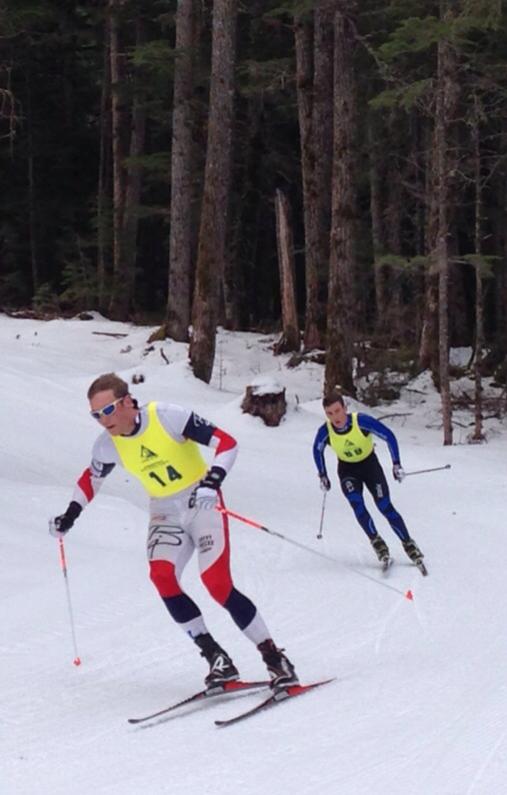
    Mark Iverson (Rossignol) leads Reese Hanneman (APU) in the AK Skimeister Challenge on April 5. A runner-up in the inaugural race last year, Iverson went on to win and the defending champ Hanneman took second. (Photo: Girdwood Nordic Ski Club/Facebook) https://www.facebook.com/pages/Girdwood-Nordic-Ski-Club/112569688796600?ref=ts&fref=ts
    Mark Iverson (Rossignol) leads Reese Hanneman (APU) in the AK Skimeister Challenge on April 5. A runner-up in the inaugural race last year, Iverson went on to win and the defending champ Hanneman took second. (Photo: Girdwood Nordic Ski Club/Facebook)

    When you think of athletes like Kikkan Randall, Mark Iverson and Reese Hanneman, alpine skiing doesn’t necessarily jump to mind. But the three U.S. nordic skiers proved last Saturday that they’re masters of many trades at the second-annual AK Skimeister Challenge in Girdwood, Alaska.

    A four-time U.S. Olympian, Randall, 31, won the individual women’s race at Alyeska Resort by more than 16 minutes in 59:53.01. The only U.S. Ski Team member in the field, she bested the field eight women, including two juniors.

    Iverson, also 31, outlasted Hanneman, his former teammate at Alaska Pacific University (APU), by 2:46.25 minutes for his first win in the multi-sport event in 50:17.72. Twenty-four men and three junior men competed individually in the race, which also includes three-person teams.

    “I’ve planned on doing this race all year,” Iverson wrote in an email. “I raced it last year (the first year for this race) and was 2nd. I was hoping to improve on that this year. I think anyone who is a skier is drawn to this type of race. It’s a great way to test and compete across disciplines and compete alongside alpine skiers and cyclists.”

    The race began outside Alyeska’s midway lodge with a Le Mans start, where participants ran about 100 meters uphill to their skis — in their boots and all — before clicking into their alpine equipment and racing more than 2,000 vertical feet down.

    “I grew up alpine skiing in Steamboat Springs [Colorado] and even raced a few years when I was younger,” Iverson explained. “I’m really comfortable on alpine skis, but what really helped me on the run was being able following Charlie Renfro, an APU Junior coach, good friend of mine and a really good alpine skier, down the course. We were 1-2 after the uphill sprint and he was able to show me the line the whole way down despite loosing his pole right at the start.”

    While he was first to the bottom, Hanneman, who was first to the top, wrote in an email that he “got hosed because for some reason I took forever to get clicked into my alpine skis. It was a sidehill with fresh snow, and I burned up quite a bit of time. I felt like such an idiot, like I had never clicked into alpine skis before.”

    By the time Hanneman started downhill, Iverson and Renfro were long gone.

    From there, racers transitioned to a 6-kilometer cross-country ski. Iverson, a technically retired racer who skis for Rossignol, knew he needed to get as far ahead of Hanneman as possible in the alpine leg before the skate ski. Hanneman, 24, was coming off a classic-sprint victory at SuperTour Finals and bronze in the U.S. Distance Nationals 50 k classic in Anchorage just over a week ago. Hanneman also won the overall SuperTour title — which comes with World Cup starts early next season.

    The defending Skimeister champ from the first race in 2013, Hanneman first caught Renfro, then Iverson within the a kilometer or so of the nordic ski, and Hanneman and Iverson remained together for the rest of it.

    “[Mark] is in pretty good xc ski shape right now, and I knew that if I had an epic ski leg maybe I could put like 15 seconds on him,” Hanneman wrote.

    “I got out of the transition a little ahead of Reese and starting pulling away on the groomed section of course,” Iverson wrote of the final snow-bike leg. “But I know he’s a strong biker mountain biker as well, so I stayed nervous on the 2nd 2/3rds of the course which was all single track. I never wrote him off.”

    Iverson won by nearly three minutes, and Hanneman took second, about four minutes ahead of John Novak in third and Renfro another 14 seconds back in fourth.

    “Frankly my body was just too tired to really want to go that hard,” Hanneman explained. “[Mark] just slowly pulled away from me on the couple mile long climb.”

    Since the 50 k a week earlier, Hanneman wrote that he mostly went alpine skiing and cross-country skied once.

    “I figured that the difference between feeling good and feeling bad in the xc ski would be mostly negated by the fact that my legs would be searing from coming straight into it right from a 4 minute, almost 3000ft alpine run,” Hanneman wrote. “I was pretty much right on… Once I was able to get all that lactic acid out my legs a couple k’s in, I started feeling better…”

    Not Bad for a ‘Retired’ Guy

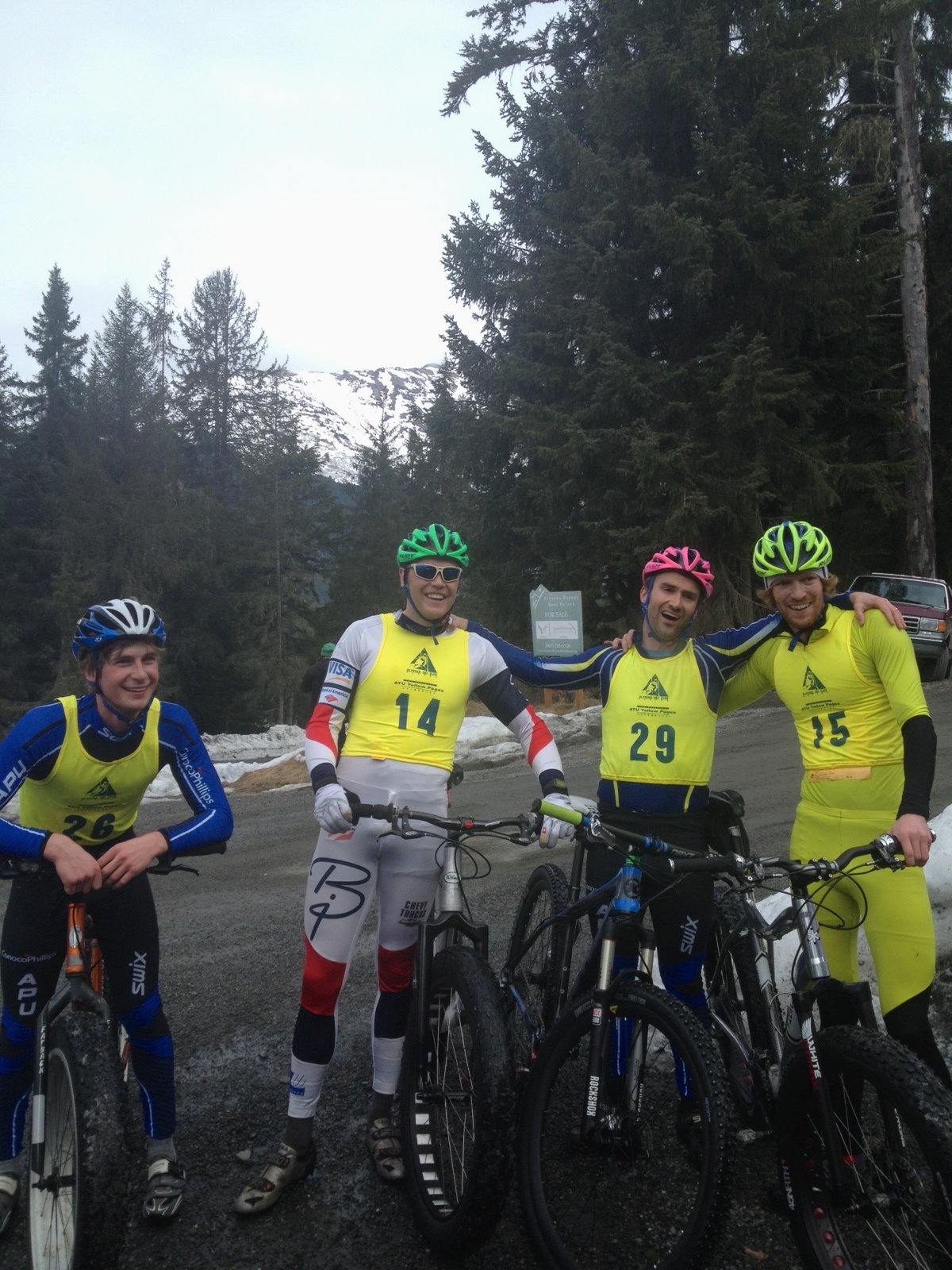
    After the 2014 AK Skimeister Challenge (from left to right): Jack Novak, Mark Iverson, Charlie Renfro, and Galen Johnston. (Photo: Mark Iverson)
    After the 2014 AK Skimeister Challenge (from left to right): Jack Novak, Mark Iverson, Charlie Renfro, and Galen Johnston. (Photo: Mark Iverson)

    Iverson, who placed 19th in the 50 k, retired from elite racing last spring. While working full-time at the Anchorage-based Skinny Raven sports store, he jumped into a couple of nordic races last winter, including the American Birkebeiner in Wisconsin and the four races at Spring Series in Anchorage.

    “It’s been a little weird stepping away after the best season of my career,” Iverson said. “The hardest part was not heading out to West camp to see and train with all the people you’ve been out there with for years. I did a lot of mountain running last summer, and pretty much only roller skied when I was asked by Brent Knight or Reese. It’s different not training full time, but I’ve been at it long enough to be able to carry some good fitness. I just went into every race to have fun. I’ve always done best when I didn’t feel any pressure.”

    That’s what made him happy about his results this year, including 10th in the 15 k at SuperTour Finals, 18th in the Birkie, and fourth in a 15 k skate FIS race in December (after University of Vermont senior Scott Patterson, Hanneman, and Eric Packer of the Stratton Mountain School T2 Team, respectively).

    As for his spring, summer and winter plans for 2014, Iverson said, “Work is getting busier and busier, but I plan on doing a lot of biking and mountain running. Come winter I think I’ll have a similar schedule of racing as I did this year: ski my favorite marathons for and race locally for Rossignol. You have to stay in shape somehow, right?”

    Hanneman stated the Skimeister was an event that was more about “fun, off-the-cuff, non-standard competition,” which was a nice way to end the season, but most importantly, it raised money for Challenge Alaska, “an incredible organization that does a lot of awesome thing for people with disabilities,” he wrote.

    “This event is so sweet because it is perfect for this time of year,” he added. “It’s pretty laid back, and because of all the different stuff going on within the race no-one really knows exactly what they’re doing. I think part of its appeal is that it is totally unrefined, and it feels kind of like an adventure. And then theres all the free food, music, and a big party afterwards.”

    Hanneman is headed to northern Alaska on April 19 to volunteer with NANA Nordic, which shares nordic skiing with children in rural villages.

    “It will be my 5th visit to a village with the program, and I am so stoked for it!!” Hanneman wrote.

    Other than that, he’s trying to keep a low profile. “I have tried to make very few plans this spring. I want to give myself the chance to just kind of follow what my mind wants to do, in an attempt to let myself heal from the intense last few months of racing and traveling. Right now I am really starting to realize just how exhausted I really am.”

    Kikkan Randall with her husband Jeff Ellis before the second-annual AK Skimeister Challenge last Saturday. Randall won the women's race by more than 16 minutes.  (Photo: Girdwood Nordic Ski Club/Facebook) https://www.facebook.com/pages/Girdwood-Nordic-Ski-Club/112569688796600?ref=ts&fref=ts
    Kikkan Randall with her husband Jeff Ellis before the second-annual AK Skimeister Challenge last Saturday. Randall won the women’s race by more than 16 minutes. (Photo: Girdwood Nordic Ski Club/Facebook)

    Queen of the Mountain

    Randall won the Skimeister title in her first try, after her husband Jeff Ellis competed in last year’s edition and her U.S. Ski Team/APU teammate Holly Brooks won the women’s race that same year. Randall signed up for the event a couple weeks ago, she explained.

    “I had backcountry skied a few times earlier in the week and got an afternoon at Alyeska of resort skiing,” Randall wrote in an email. “So I got in a little practice. But I still feel out of touch and out of shape for real alpine skiing. The course was set pretty much like a real downhill and the all mountain skis I was using are better for turning. I got more comfortable as I made my way down the mountain, would have been sweet to have a practice run before the race. My legs were burning pretty good by the bottom!”

    By the time she got to the nordic portion, Randall explained that she felt tired and had trouble skiing fast. “But I warmed into it, the trails were in great shape and it was fun to catch some boys!”

    Still out front, she managed to solidify the win on what she called the “most challenging” bike leg.

    “The first half was on a cat track with a soft layer on top, which really worked the legs,” she wrote. “Then we got into the woods on some icy single track and I was being pretty tentative.  It was a funny feeling to not be maxing out aerobically but still not able to go any faster.”

    Back home after a long season, Randall did not make the trip to Washington, D.C, last week to meet the President and First Lady at the White House on April 3.

    “I decided to stay home this time and have just been enjoying some nice days at home with Jeff after a busy winter,” she wrote. “So I’ve been in town all week, doing a few public appearances and catching up with friends.”

    Race websiteResults

  • Bjornsen Weathers Boggy SuperTour Finals Opener, Wins Prologue

    Bjornsen Weathers Boggy SuperTour Finals Opener, Wins Prologue

    Erik Bjornsen (APU/USST) en route to a 14.5-second victory in Thursday's 3.3 k freestyle prologue, which kicked off 2013 SuperTour Finals at Auburn Ski Club near Truckee, Calif. (Photo: Mark Nadell)
    Erik Bjornsen (APU/USST) en route to a 14.5-second victory in Thursday’s 3.3 k freestyle prologue, which kicked off 2013 SuperTour Finals at Auburn Ski Club near Truckee, Calif. (Photo: Mark Nadell/MacBeth Graphics)

    FasterSkier’s coverage of SuperTour Finals and U.S. Distance Nationals is brought to you by the generous support of Concept2, the leading manufacturer of indoor rowers, racing oars, and the SkiErg.

    SODA SPRINGS, Calif. – Lifting his fogged glasses at the finish of the men’s SuperTour Finals opening prologue, Erik Bjornsen turned to look behind him.

    Soaking wet in near-freezing temperatures on Donner Summit, the Alaska Pacific University (APU) and the U.S. Ski Team (USST) member stood there, counting silently until he reached 40 seconds, he later told Sun Valley’s Mike Sinnott.

    With no sign of Sinnott, who started 30 seconds behind him in the 3.3-kilometer freestyle race, Bjornsen moved on and out of the finish pen to get warm.

    One day after sunny skies and 60-degree temperatures blanketed the region, some 175 competitors at Auburn Ski Club withstood a damp and windy morning on Thursday. Rain turned to wet snow for the women’s race, and that snow intensified into variable squalls throughout the men’s competition.

    Fortunately, all anyone had to do was complete one 3.3 k lap, the same for both men and women, but that in itself was a challenge. Filling in as Tahoe Donner’s backup host for SuperTour Finals, Auburn organizers constructed a new hill, which some racers, like Sinnott, referred to as the “wall.”

    In an all-out prologue, that kind of terrain is tough to tackle, especially at more than 7,000 feet above sea level. Add to that the issue of poor visibility with foggy or no eyewear and you’re in for an interesting race.

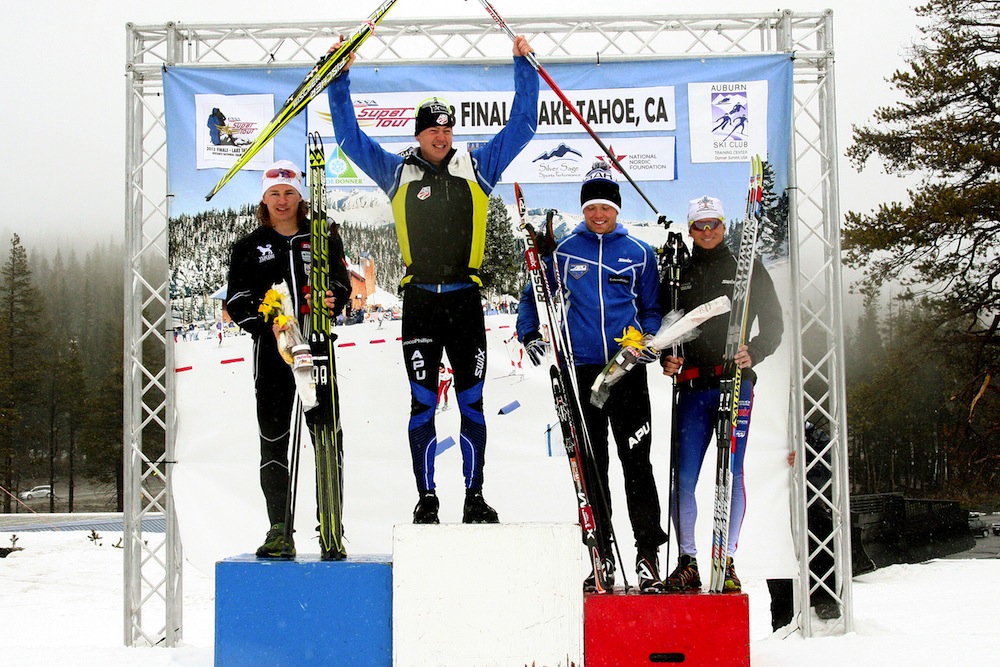
    APU and US Ski Team member Erik Bjornsen (second from left) celebrates his first career SuperTour victory at 2013 SuperTour Finals after winning Thursday's 3.3 k freestyle prologue at Auburn Ski Club in Soda Springs, Calif. Canadian Knute Johnsgaard (Yukon Elite Squad) was second), and Mark Iverson (APU) and Mike Sinnott (Sun Valley) tied for third. (Photo: Mark Nadell/MacBeth Graphics)
    APU and US Ski Team member Erik Bjornsen (second from left) celebrates his first career SuperTour victory at 2013 SuperTour Finals after winning Thursday’s 3.3 k freestyle prologue at Auburn Ski Club in Soda Springs, Calif. Canadian Knute Johnsgaard (Yukon Elite Squad) was second), and Mark Iverson (APU) and Mike Sinnott (Sun Valley) tied for third. (Photo: Mark Nadell/MacBeth Graphics)

    Bjornsen, who posted the fastest time of the day in 7:47, said he couldn’t see much of anything for the last half kilometer.

    “I was really unbalanced and kind of sloppy, but coach said I looked good at the finish,” he recalled. “I heard the time a little bit after and couldn’t believe it.”

    For Bjornsen, who won his first national title earlier this year at the age of 21, it was the first SuperTour win of his career and set him up nicely for the remaining four races at SuperTour Finals. With a 15 k classic mass start on Friday, Bjornsen will lead the standings by at least 14.5 seconds, the amount of time he beat Canadian runner-up Knute Johnsgaard by on Thursday.

    “It’s super exciting … and pretty unexpected,” Bjornsen said. “Coming into these races, I didn’t have a lot of pressure on myself. Now I see I might be in good form so I’m pretty excited for the rest of the races, and I hope I can go for the overall podium.”

    A year ago at SuperTour Finals in Craftsbury, Vt., Bjornsen tied Noah Hoffman for third in the 3.3 k freestyle prologue. Simi Hamilton of the Sun Valley Ski Education Foundation (SVSEF) and USST won in 5:59.4, and Sylvan Ellefson (Ski & Snowboard Club Vail/Team HomeGrown) was second.

    Bjornsen went on to finish third overall and was 12th in the U.S. Distance Nationals 50 k.

    This year, two men again tied for third, with Sinnott (SVSEF) and Mark Iverson (APU) finishing 15.7 seconds behind Bjornsen.

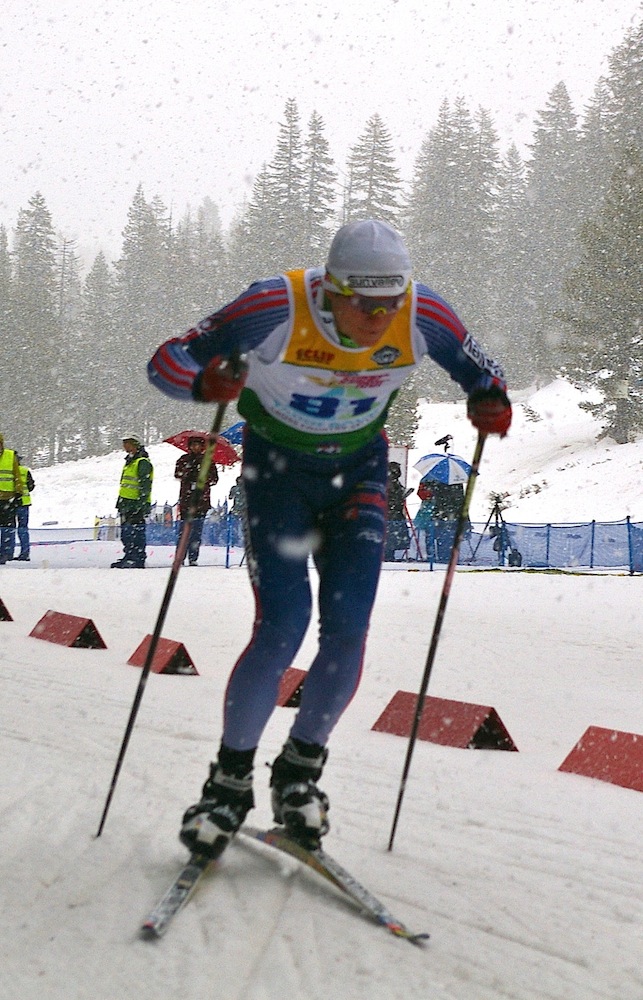
    Mike Sinnott (SVSEF) starting out Thursday's 2013 SuperTour Finals freestyle prologue at Auburn Ski Club in Soda Springs, Calif. He tied Mark Iverson (APU) for third. (Photo: Mark Nadell/MacBeth Graphics)
    Mike Sinnott (SVSEF) starting out Thursday’s 2013 SuperTour Finals freestyle prologue at Auburn Ski Club in Soda Springs, Calif. He tied Mark Iverson (APU) for third.

    “Man, that kid was flying,” Sinnott said of Bjornsen. “I started right behind him and I was on the steep wall with him and then I never saw him again.”

    With huge flakes swirling about the start slowing the course below, Sinnott made a mental note to copy Bjornsen’s strategy of starting easy then push up the big climb.

    “After the climb, there was still a ton of work and I hammered hard after that,” Bjornsen said.

    Sinnott did the same, fearing he’d lose ground on the backside into the stadium.

    “That’s what I wanted to do but just didn’t have it as much as him,” Sinnott said. “Hats off, that guy skied a really strong and smart race.”

    The tenth starter in the randomized A-seed of FIS points, Bjornsen was the only early racer besides Craftsbury’s Pat O’Brien (who finished fifth) to crack the top 10. Contenders who started before him, like Andy Newell (Stratton Mountain School T2/USST), Ellefson, and NCAA champions Miles Havlik and Rune Ødegård, did not make the top 20.

    Havlik started first and placed 28th, Newell went out fourth and ended up 35th, Ellefson placed 24th, and Ødegård was 47th. Bjornsen was also the only man to beat Kikkan Randall, who won the women’s race in 7:57.9.

    “It’s kind of hard to gauge sensations out here,” said O’Brien, of the Craftsbury Green Racing Project (CGRP). “Coming from sea level, everything feels really slow, a huge difference in ski speed. Right as we were heading out a big snow squall came in and was kind of like wet, heavy snow and I was skiing and didn’t have glasses or anything, kind of lost track where I was out on the course.

    “I’m super happy with how things went,” he added. “It’s a great way to start out the series. … [I’ve] been feeling kind of junky the last few days but I think in a short-enough race like this, you can kind of push through it.”

    Newell said he felt awful afterward, but that was normal for prologues. The conditions weren’t.

    “My skis were so slow; I’m hoping the other people’s felt that slow, too,” he said. “I almost fell over on the downhills, they were so sticky. It just started snowing so hard just before the start.”

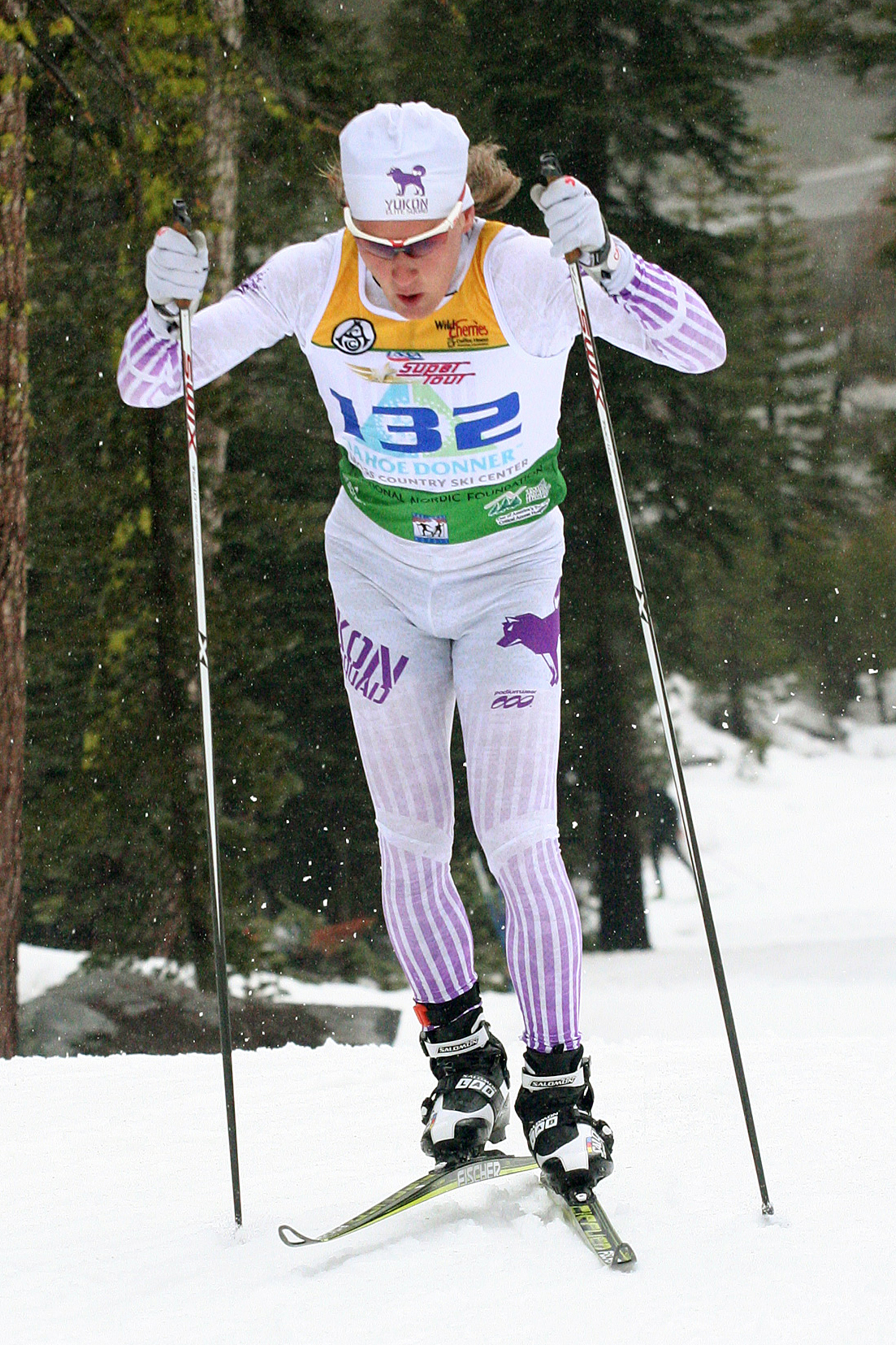
    Knute Johnsgaard (Yukon Elite Squad) racing to second in Thursday's 2013 SuperTour Finals 3.3 k freestyle prologue at Auburn Ski Club in Soda Springs, Calif. (Photo: Mark Nadell/MacBeth Graphics)
    Knute Johnsgaard (Yukon Elite Squad) racing to second in Thursday’s 2013 SuperTour Finals 3.3 k freestyle prologue at Auburn Ski Club in Soda Springs, Calif. (Photo: Mark Nadell/MacBeth Graphics)

    Part of the newly formed Yukon Elite Squad, Johnsgaard started in the second half of the 100-man pack and rose to second despite not feeling great, either.

    “I felt really terrible actually,” the 20-year-old Whitehorse native said. “I felt slow with heavy legs. … I got a couple splits at the finish, but I didn’t really believe them because I felt so bad.”

    Coming off five races at Canadian Nationals in Whistler, B.C., which wrapped up last Saturday, Johnsgaard decided to change his plane ticket on a whim and finish his season in California in an effort to boost his FIS points.

    “I’m finally kind of getting to where I wanted to be all year so now I gotta make the most of it,” he said.

    Iverson, 30, hadn’t raced in two months since finishing second in the Boulder Mountain Tour in early February. He suffered a muscle injury in his back in a non-skiing-related incident afterward, “doing something stupid,” Iverson explained.

    He took 2 ½ weeks off completely and went on to take bronze in his first race back on Thursday.

    “My only experience in prologues at altitude was two years ago at Sun Valley and I had an epic, epic, just-came-to-pieces,” Iverson said of placing 85th in the 3.5 k at 2011 SuperTour Finals. “I just tried to go out and not panic and try to ski loose and try to maintain a lightness to the glide and kick.”

    It worked, as Iverson tallied another personal best this season. In January, he won his first SuperTour in Minneapolis and placed second overall in the Tour de Twin Cities.

    In terms of pacing this one, Iverson kept himself in check. During training on Wednesday, he did a Level 3-4 workout around the course with his APU teammates.

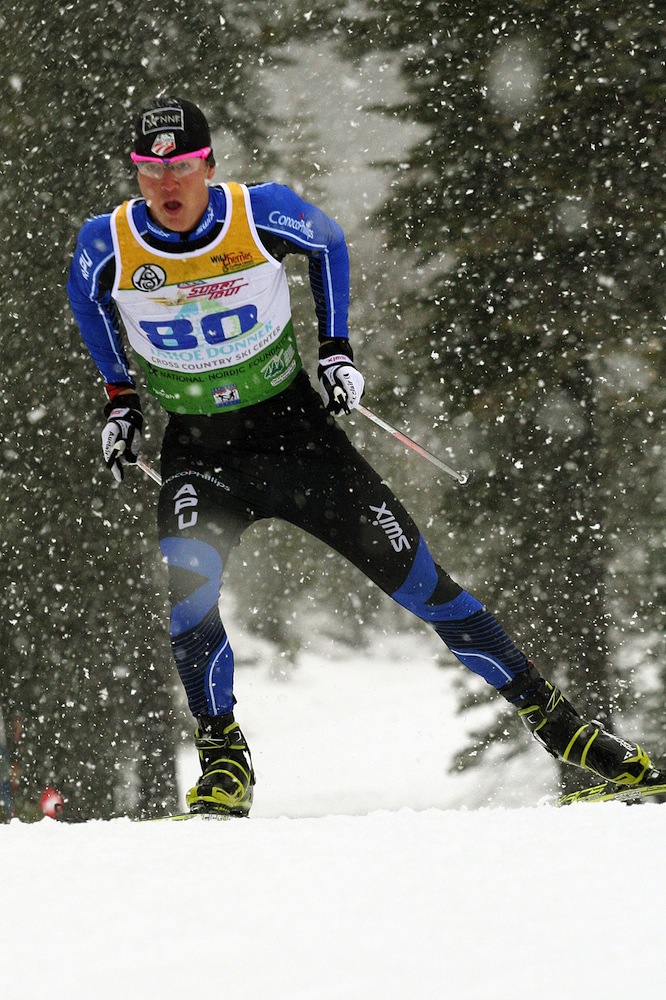
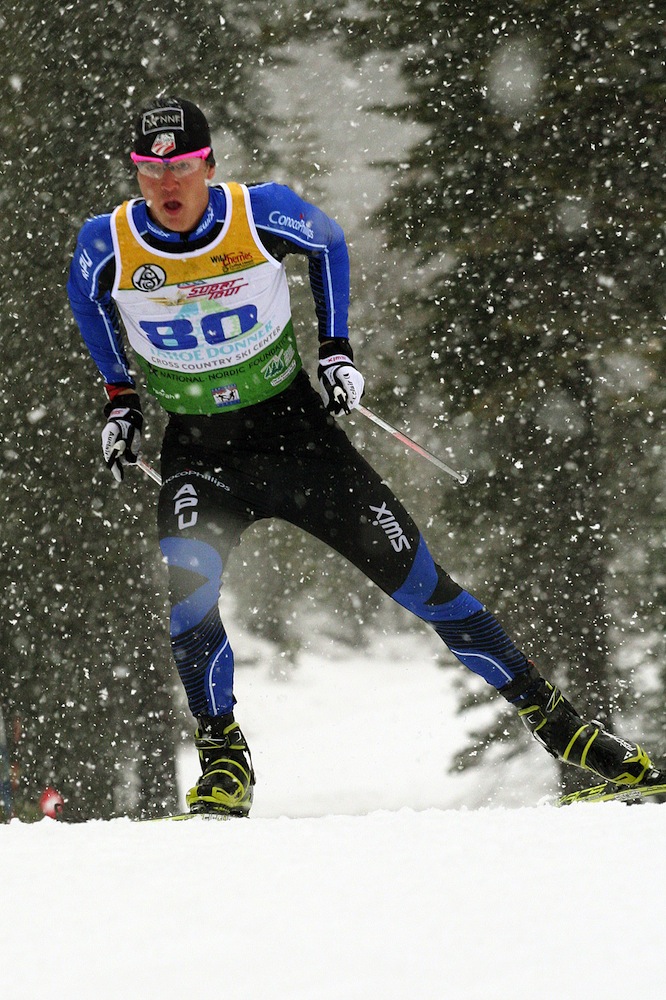
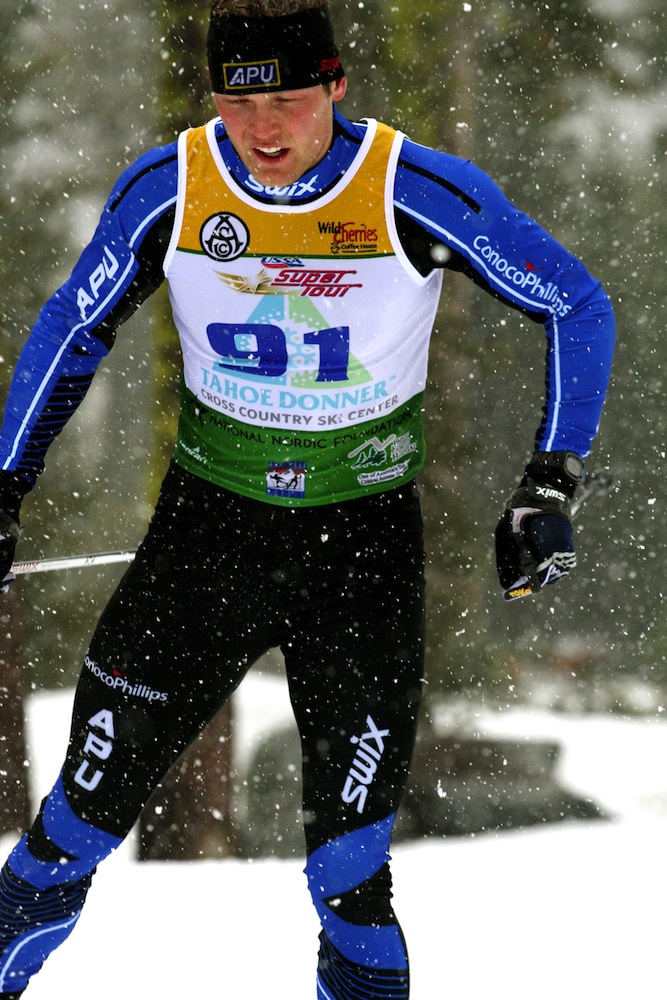
    Mark Iverson (APU) in Thursday's 2013 SuperTour Finals prologue at Auburn Ski Club in Soda Springs, Calif. Iverson tied Mike Sinnott (SVSEF) for third. (Photo: Mark Nadell/MacBeth Graphics)
    Mark Iverson (APU) in Thursday’s 2013 SuperTour Finals prologue at Auburn Ski Club in Soda Springs, Calif. Iverson tied Mike Sinnott (SVSEF) for third. (Photo: Mark Nadell/MacBeth Graphics)

    “We were all just gassed at the end,” he said, making a point not to go much harder on Thursday.

    While the prologue at altitude was undeniably tough, Iverson said he was enjoying his visit so far.

    “It could’ve been better weather, but it’s not much worse than Eagle Glacier in the summertime some days,” he said of APU’s summer training mecca near Anchorage.

    “When it’s beautiful, it’s absolutely amazing; you’re on top of a mountain in Alaska,” Bjornsen explained. “But when it’s raining, it’s way foggier and it’s way windier. You get rain like this, and it’s usually a lot softer than this. Snow doesn’t freeze … so I’ve actually gotten really good practice skiing in sloppy snow.

    “You kind of have to have a lighter touch,” Bjornsen added. “I’ve just learned a lot about that the last three years. I was just such a pure sprinter, I was hammering each of my strokes. My coach said I looked really smooth today and I think that’s part of it paying off on Eagle Glacier.”

    Rounding out the top 10, University of Colorado freshman Gustav Nordstom placed sixth, Brent Knight (APU) was seventh, Nils Koons (CGRP) was eighth, Brian Gregg of Central Cross Country (CXC) took ninth, and Tim Reynolds (CGRP) was 10th.

    — Audrey Mangan contributed reporting

    Results

    Photos courtesy of Mark Nadell at MacBeth Graphics. Click here for his SuperTour Finals gallery.

  • Koos and Brennan Triumphant at Tour de Twin Cities; Greggs Take Stage 5 Wins

    Koos and Brennan Triumphant at Tour de Twin Cities; Greggs Take Stage 5 Wins

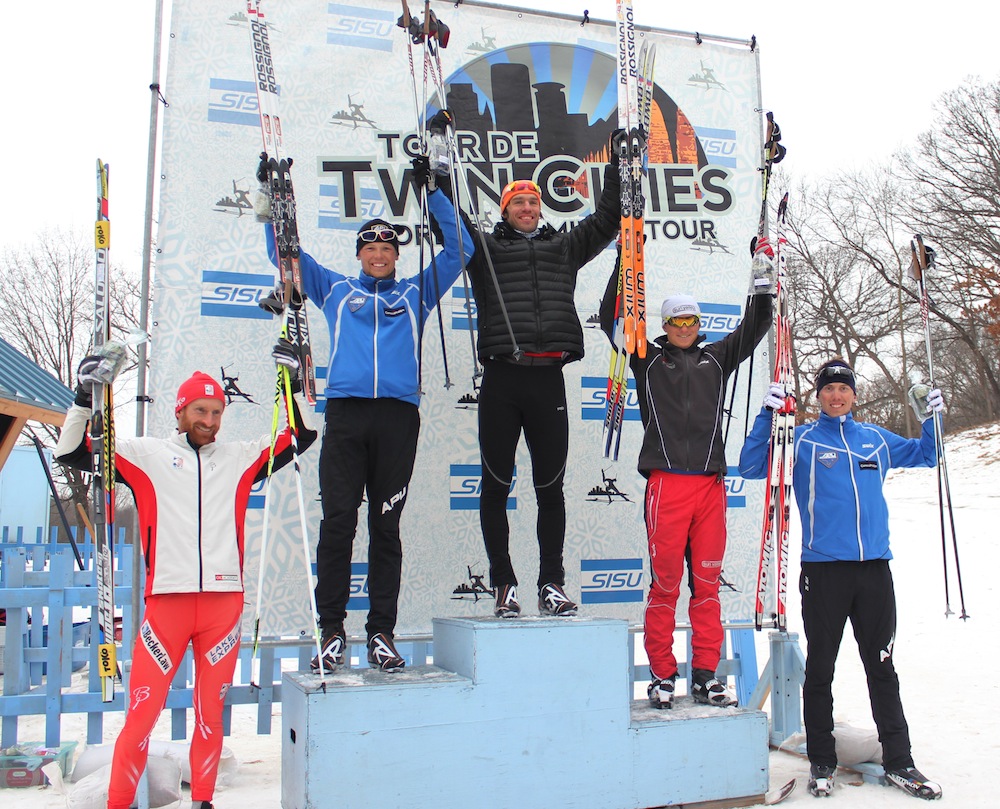
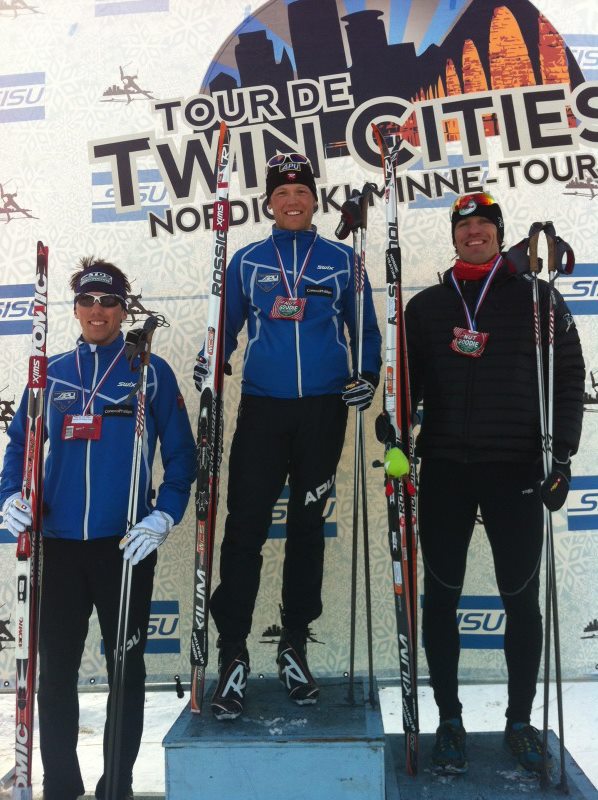
    The 2013 Tour de Twin Cities men's overall podium. 1. Torin Koos, 2. Mark Iverson, 3. Mike Sinnott, 4. Brian Gregg, 5. Brent Knight. Photo: Reese Hanneman.
    The 2013 Tour de Twin Cities men’s overall podium. 1. Torin Koos, 2. Mark Iverson, 3. Mike Sinnott, 4. Brian Gregg, 5. Brent Knight. Photo: Reese Hanneman.

    Five stages and over a week has gone by since the 2013 Tour de Twin Cities began at Wirth Park in Minneapolis, Minnesota, and on Sunday the event concluded dramatically with a 10/15 k freestyle pursuit. After dozens of accumulated laps around the 3.3 k course, Torin Koos (Bridger Ski Foundation/Rossignol) and Rosie Brennan (Alaska Pacific University) each maintained starting leads and emerged victorious in the overall Tour standings. Husband-and-wife duo Brian and Caitlin Gregg (Central Cross Country) both posted the fastest times of the day for the stage five wins.

    On a short, rolling course, the men’s 15 k unfolded in predictable fashion: the leaders played with a confortable pace until a final sprint to the finish. Koos began the 15 k pursuit with a 17-second lead on Mike Sinnott (Sun Valley Ski Education Foundation), and with such a small head start he expected the race would come down to the last stretch

    “Even before the Tour began, I just knew it was going to come down to the final hunting-start 15 k freestyle,” Koos wrote in an email. “And after seeing how it was so hard for anyone to break away and hold a lead in the mass start 20 k classic, this became more apparent.”

    Sinnott and Mark Iverson (APU) left the gate only nine seconds apart and skied together to close the gap on Koos, and by the end of lap three the trio was skiing together at an easy pace, with Iverson leading.

    “We slowed down after that and played some little cat and mouse games for laps four and five, content to let it come down to a sprint,” Sinnott said.

    Iverson attempted to drop the other two on the last few laps, but was unsuccessful. “On that course, fast with only one real working section, it didn’t work. So we all just settled down with me leading,” he said.

    Koos surged ahead with a kilometer to go and held on to the lead through the finish, ultimately winning the Tour by a few seconds.

    “In the end, I had an extra step on those two guys and was able to take the [Tour] title by a ski length,” Koos said. “I was pretty psyched to take the overall win. It’s a really great event, one I hope that becomes a staple for the U.S. ski racing circuit.”

    Behind him, or rather almost next to him, the battle for second and third was less certain. A jockey between Sinnott and Iverson for the same finish lane generated some contact between them, which Sinnott considered to be the result of a questionable move from Iverson.

    With a lead of a few meters Koos was able to chose the center finishing lane, forcing Iverson and Sinnott to go to the inside as they came out of a hard, downhill corner that spit into the finish stretch. The two skied neck-and-neck as they sought the same left-hand lane, causing their boots to briefly connect in the last 50 meters of a fast finish.

    In Iverson’s words, he chose the left lane “just in front of Mike. I didn’t want to go wide. Mike and I bumped a bit fighting for the left lane and we both lunged together for the line. Torin was able to get the win and it was really close between Mike and I.”

    Sinnott was more descriptive about how the sprint played out, and considered the “bump” with Iverson in the finishing lanes to be a definite infraction of the rules.

    “In the finish, I took the inside line as Torin went wide and Mark skied between lanes,” Sinnott wrote in an email. “Mark then decided to shift over, making contact between his boots and mine. He knocked me into the V-boards and I was forced to double pole the remaining 50 m as my lane was no longer mine. The result left me in third and pretty peeved about the clear infractions.”

    After the finish Sinnott found spectators who had taken photographs of the incident and brought them before the Technical Delegate, but to no effect.

    “I found some photos and several witnesses but was told by the TD, ‘you can protest, but I’ve already made up my mind. So…’ He refused to look at the photos, and again dismissed me when I mentioned [Alexander] Legkov’s move in the Tour [de Ski], resulting in a 15 second penalty,” Sinnott said.

    “Basically, I had a strong chance to win, it’s hard to say, but was unequivocally obstructed by Mark as he moved between lanes. As a result, I ended third. It was not how I’d like to see the hard fought five-day event end.”

    FasterSkier was not present at Wirth Park, and at press time had only Sinnott’s and Iverson’s accounts of what happened. Besides the finish line incident, Tour competitors were generally happy with how organizers put together the event.

    Regardless of how the last 100 m unfolded, Iverson’s run at the podium this week has been the best racing of his career. On Sunday he skied the second-fastest time of the day, 36:07.4.

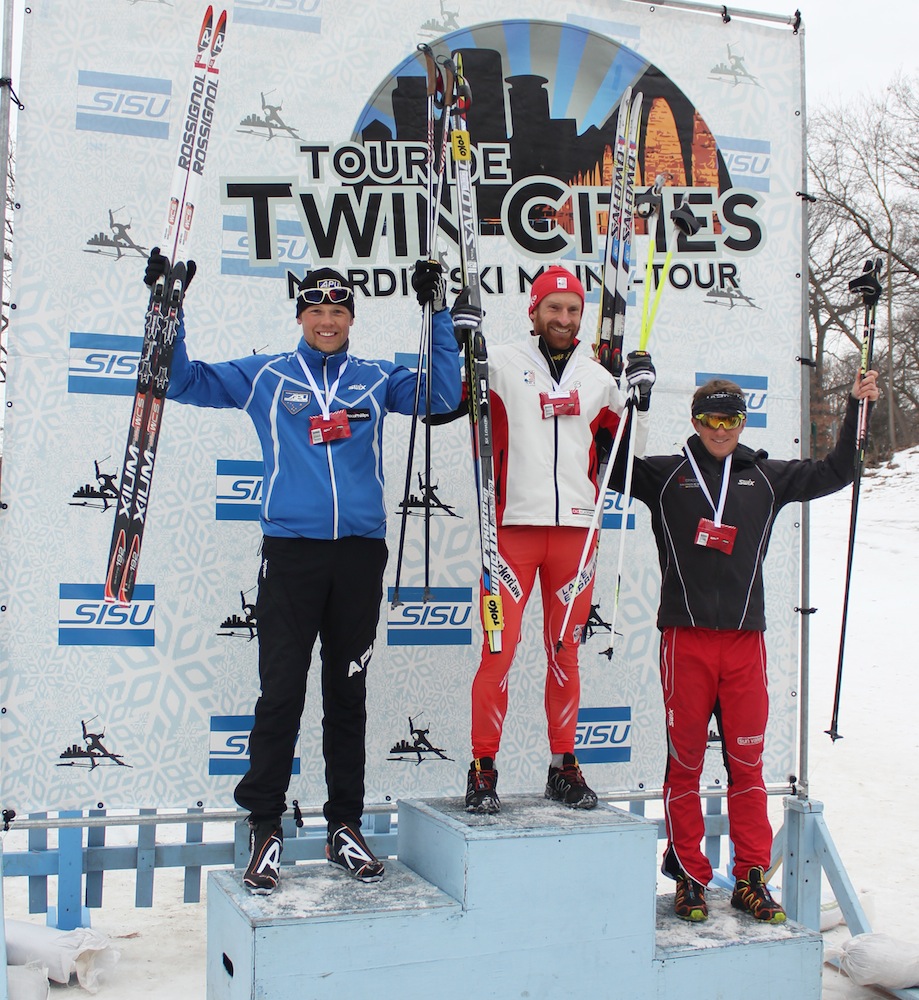
    The men's stage five podium. 1. Brian Gregg, 2. Mark Iverson, 3. Mike Sinnott. Photo: Reese Hanneman.
    The men’s stage five podium. 1. Brian Gregg, 2. Mark Iverson, 3. Mike Sinnott. Photo: Reese Hanneman.

    “It has been really exciting, and satisfying to feel I’m in the race everyday and be confident in my skiing,” Iverson said. “I wasn’t sure that I could catch up and make it a race today after loosing some time to Koos and Sinnott yesterday, but I was patient and just tried to ski my race.”

    Gregg, after starting stage five 1:36 down to the leaders in sixth place overall, skied the fastest time of the day to move up to fourth in the final standings.

    “I went in to the day planning on skiing my own race against the clock today,” Gregg said. “I started 1:36 off of the lead, but I wanted to have the fastest time of the day.”

    He made up the difference between himself and Karl Nygren (CXC) and Brent Knight (APU) by 4 k, and together the three skiers made up some of the time on the leaders by the final lap.

    Everyone became intimately familiar with the Wirth Park course by the end of the week, but Gregg is especially at home on it as he lives only a few minutes away. He thought the proximity to the race venue played a big part in his success on Sunday.

    “It is a huge advantage to be at home during the middle of the ski season and to be so close to the race venue,” Gregg said. “I think that played a large role in our success on this fifth day of racing. Not too many people are lucky enough to have a 3.3 k snow-making loop within jogging distance of their house.”


    Women’s 10 k Pursuit

    Rosie Brennan (APU) maintaining her lead to take the overall Tour win. Photo: Reese Hanneman.
    Rosie Brennan (APU) maintaining her lead to take the overall Tour win. Photo: Reese Hanneman.

    As in the men’s race, the women’s 10 k pursuit was a closely-fought race. Rosie Brennan (APU) began with a small lead on her competition —Jennie Bender (CXC) started 17 seconds behind her, Kate Fitzgerald (APU) left the line 13 seconds after that, and Caitlin Gregg started at 1:05. With such formidable skaters hunting her down, Brennan knew the overall Tour victory would take everything she had.

    “I had the whole field chasing me which certainly added to the nerves this morning!” Brennan said. “I went out hard hoping [to] make catching me harder, however, after racing the previous two days, my legs did not feel good so I ended up really fighting the whole way.”

    On the relatively short loop Brennan could see her competitors as the course wound around twists and turns, which alerted her to the fact that Gregg was having an incredible race.

    “I could see my chasers frequently and was doing my best to judge time, but man, that’s hard to do and really only led me to panic more seeing who was coming for me,” Brennan said. “By the end of the second lap I realized Caitlin was crushing it and not slowing down, so I did my best to hold it together and push hard on the last lap.”

    Brennan was able to hold Gregg at bay and win the overall, which she was plenty happy with.

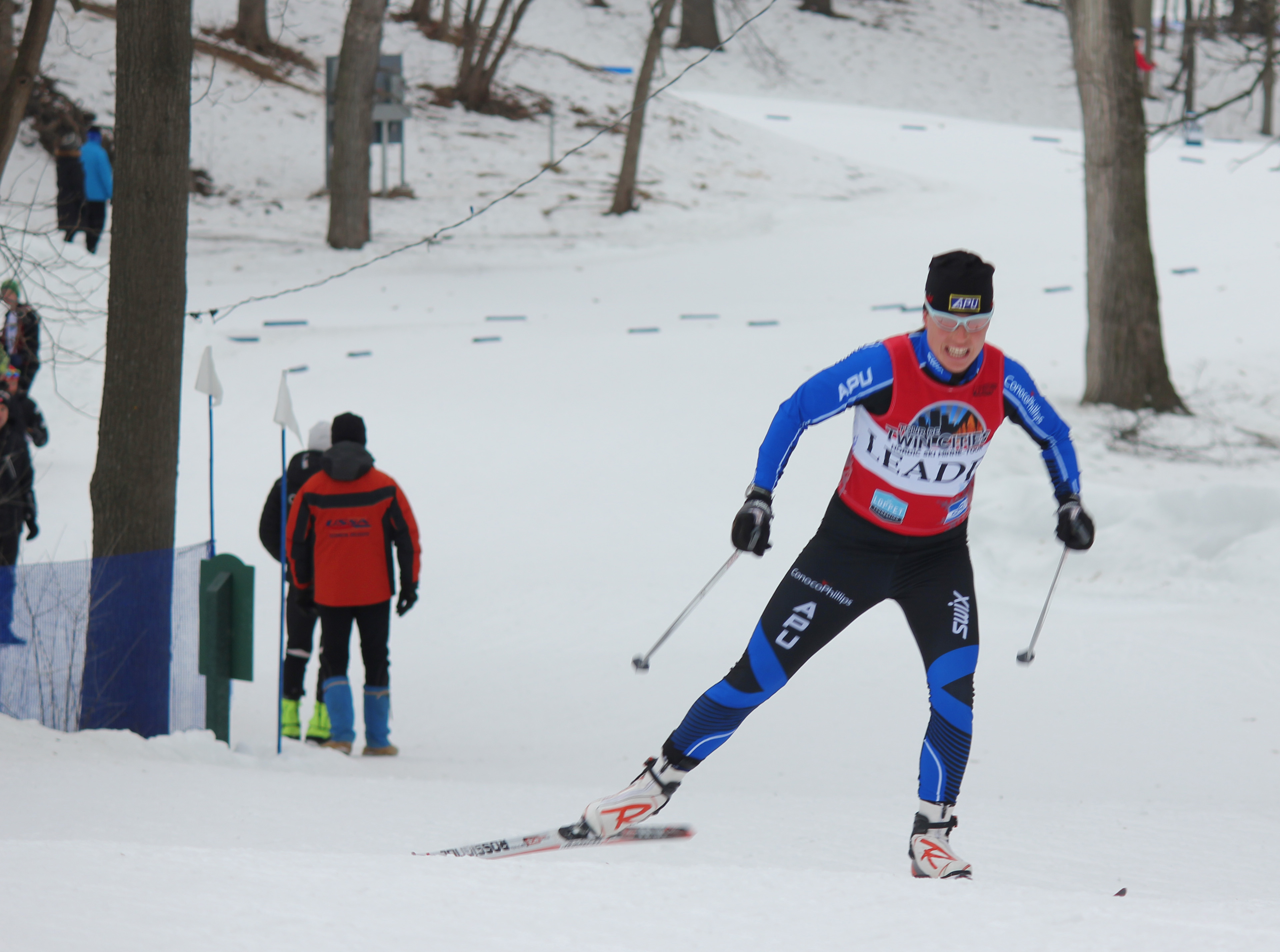
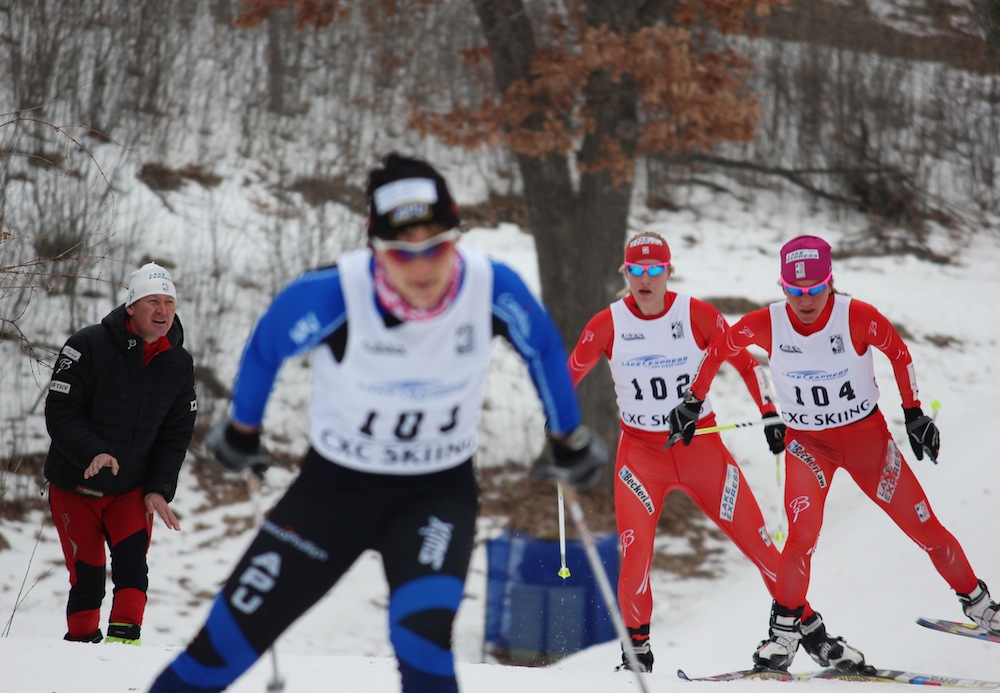
    Caitlin Gregg (bib 104) gunning down Kate Fitzgerald (102). Photo: Reese Hanneman.
    Caitlin Gregg (bib 104) gunning down Kate Fitzgerald (102). Photo: Reese Hanneman.

    “It was really stressful and not much fun having to hammer out 10 k alone with a whole field chasing, so I am thankful to have been able to hold it together and stay tough,” she said.

    “I don’t think there was anything I could have done to beat Caitlin on the day, though. She was just flying out there. I have always admired Caitlin’s incredible skating so I really can’t complain about taking second to her.”

    Gregg ended posting the fastest time by 35.9 seconds. Taking a page out of Lindsay Vonn’s book, the 32-year-old decided right before the start to race on her husband’s winning skis from earlier that morning.

    “He told me how fast they felt and I realized that with such a flat course I could probably get away with longer stiffer skis!” Gregg said. “So I tested them for a lap and confirmed I could ski them on the short steep climbs (without tripping) and went with them. The skis were actually Brian’s stiffest pair so he told me to ski like a big girl on them to make them work.”

    With the goal of setting the day’s fastest course time, Gregg was pretty happy with how the choice turned out.

    “I knew I had a lot of time to make up but I wanted to win the individual race, so I just went out gunning for a good time,” she said.

    Brian and Caitlin have been racing together for years, but Sunday was the first time they both won the same race.

    “I have always wanted to share the top step of the podium with Caitlin in a Super Tour and it was cool to have that happen,” Brian said.

    Stage winners receive $450 for the win on top of the overall purse that goes six deep. Between the Greggs’ stage five victories, Caitlin’s second place finish overall and Brian’s fourth, the couple earned $2,700 on Sunday alone.

    “Race winnings are the largest part of our income and it was great to have things come together today,” Brian said.

    Kate Fitzgerald (APU), one of the most consistent skiers all week, finished third on the stage once again to take third in the Tour. She started just ahead of Gregg with full knowledge of the latter’s strength in skating, and sought to hold her off as long as she could.

    “I know that she is a ridiculously strong skater, and sure enough she came storming past me and it was all I could to do hang on!” Fitzgerald said. “Caitlin, Jennie, and I were in a pack for a little while but then Caitlin’s speed started to break us up. She had an awesome race today.”

    Bender finished fourth in the overall standings, Clare Egan (Craftsbury Green Racing Project) took fifth and Erika Flowers (SMS T2) was sixth.

    Complete results from stage 5.

    Overall Tour Standings not yet available – check back at Summit Timing.

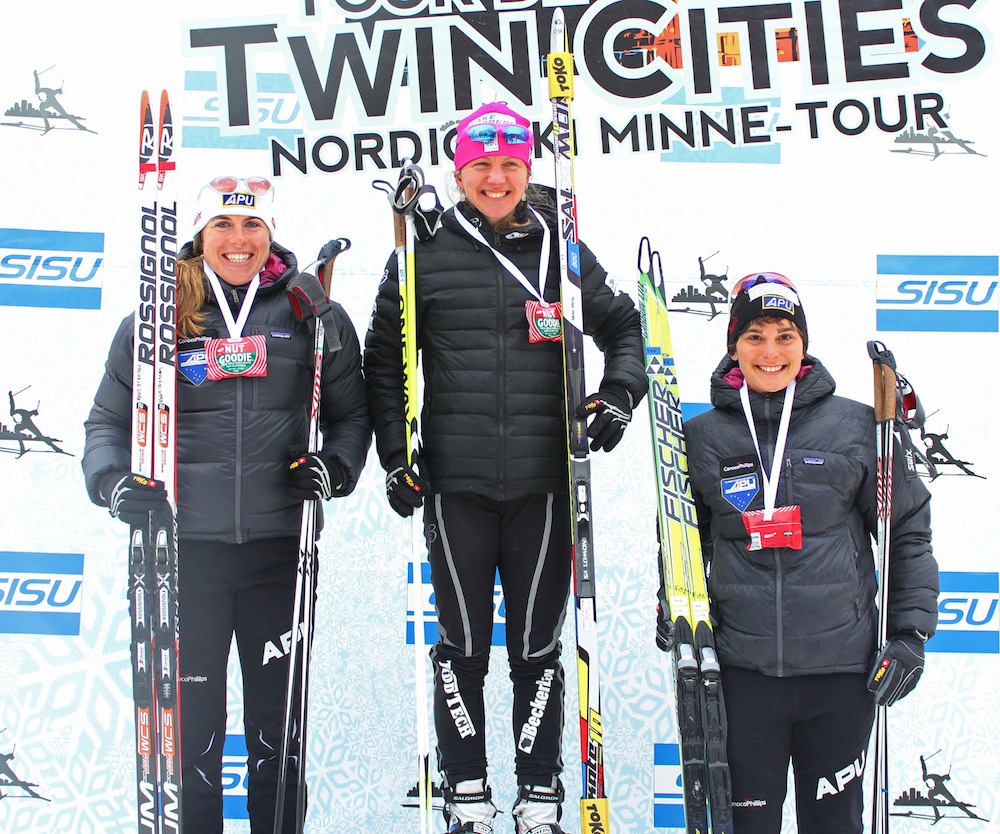
    The women's stage five podium. 1. Caitlin Gregg, 2. Rosie Brennan, 3. Kate Fitzgerald. Photo: Reese Hanneman.
    The women’s stage five podium. 1. Caitlin Gregg, 2. Rosie Brennan, 3. Kate Fitzgerald. Photo: Reese Hanneman.
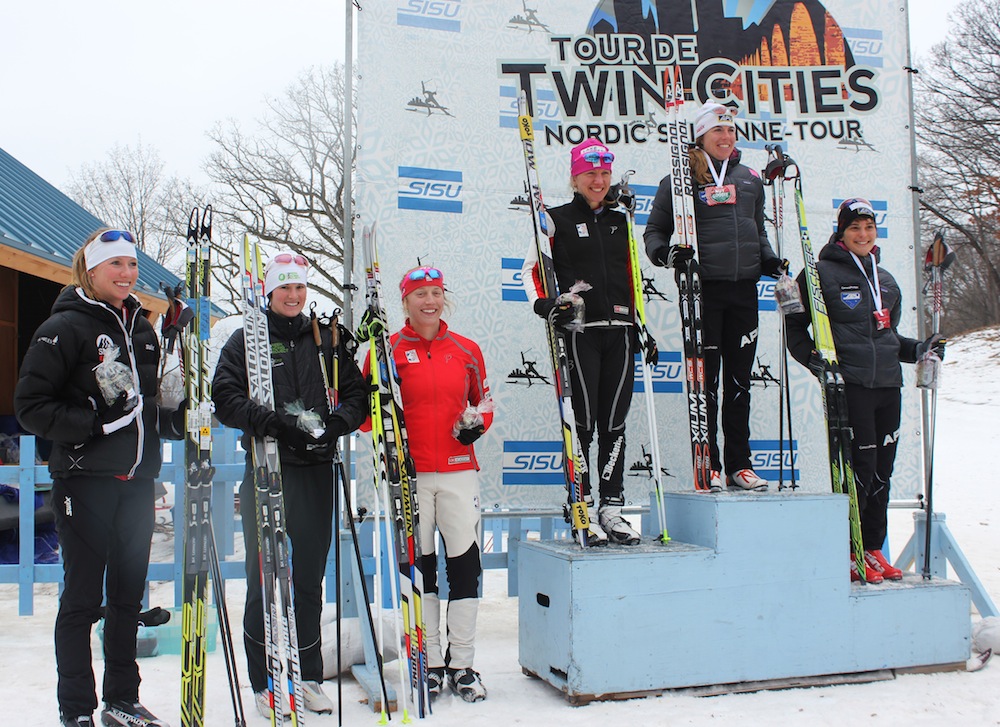
    The women's overall Tour de Twin Cities podium. 1. Rosie Brennan, 2. Caitlin Gregg, 3. Kate Fitzgerald, 4. Jennie Bender, 5. Clare Egan, 6. Erika Flowers. Photo: Reese Hanneman.
    The women’s overall Tour de Twin Cities podium. 1. Rosie Brennan, 2. Caitlin Gregg, 3. Kate Fitzgerald, 4. Jennie Bender, 5. Clare Egan, 6. Erika Flowers. Photo: Reese Hanneman.


  • Iverson and Brennan Take Stage 1 of Tour de Twin Cities

    Iverson and Brennan Take Stage 1 of Tour de Twin Cities

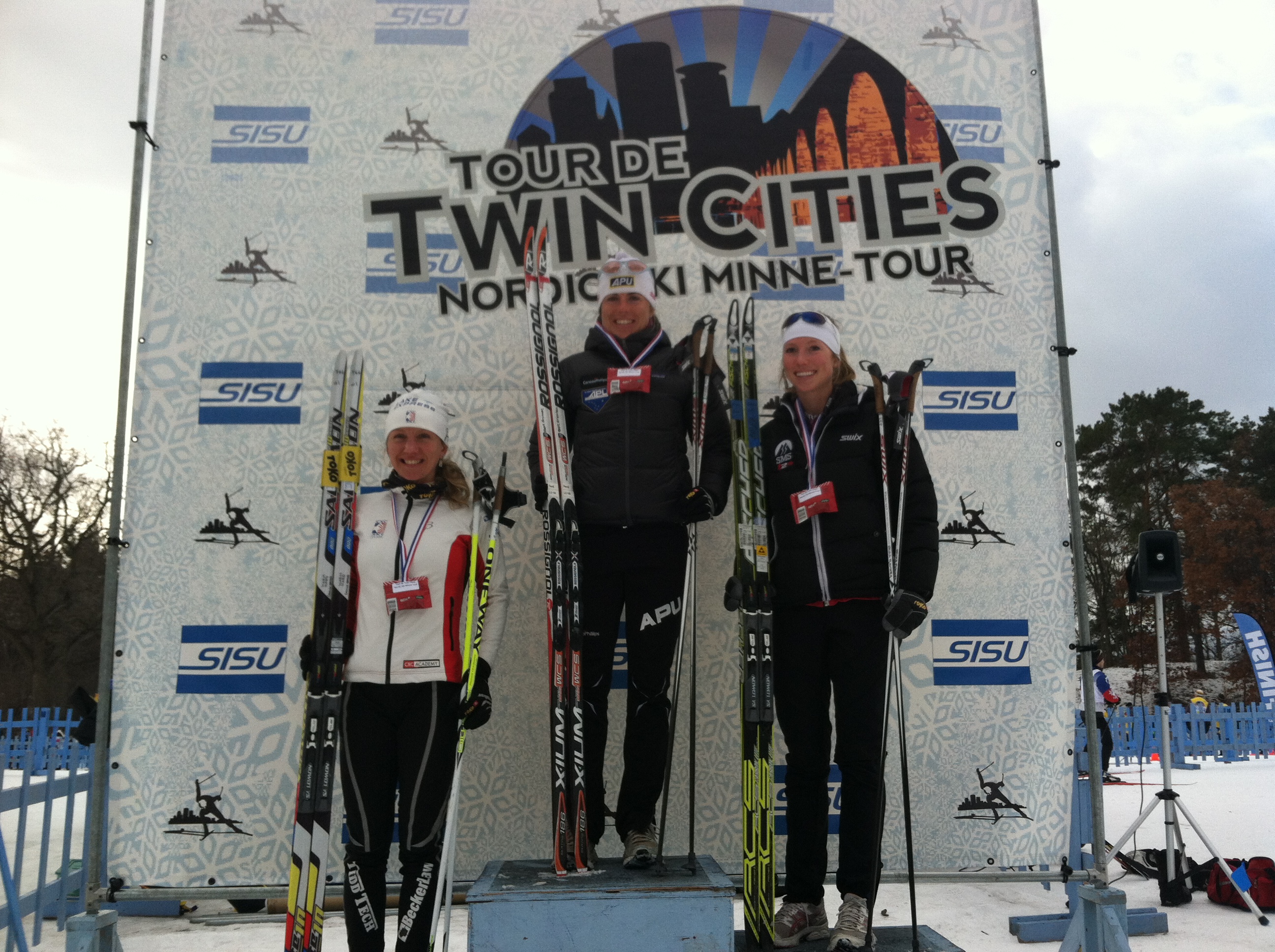
    Women's SuperTour Podium Gregg, Brennan, Flowers (l-r)
    Women’s SuperTour Podium Gregg, Brennan, Flowers (l-r) (Courtesy Photo)

    Note: This article has been updated to include comments from Caitlin Gregg.

    The U.S. SuperTour is back underway after a short post-Nationals break, picking up with the Tour de Twin Cities.

    Rosie Brennan and Mark Iverson gave APU a sweep of the 5/10k freestyle event drawing first blood in the five-stage Tour.

    Brennan, coming of strong performances at U.S. Nationals, skied to a 14.1 second victory over Erika Flowers (SMST2). Caitlin Gregg (CXC) was third, another 0.8 seconds back in the individual start event.

    Despite limited natural snow, organizers were able to assemble a 5 k loop, extending a 3.3 k circuit made primarily of artificial snow.

    Brennan told FasterSkier that the course was “quite dirty and very sugary,” but was still impressive given there is no other skiing in the Twin Cities.

    She started hard in a race that took just over twelve minutes.

    “I got sick during Nationals so I hadn’t done much training coming into these races so I wasn’t sure if I would be able to get the engine revving high enough for my first 5km and sea level race this season,” Brennan said.

    With no coaches on course, and starting first in the A seed, she had no splits. Her only benchmark was the rough measuring stick of staying clear of later starters.

    Flowers wasn’t getting splits either, and just focused on hunting Kate Fitzgerald (APU) and Brennan who started in the two spots ahead.

    “I was just trying to ski hard and catch them the whole time,” she told FasterSkier.

    Like Brennan she was impressed by the conditions given the rain of the previous weekend, and described the course as “really fun and fast with lots of turns, transitions, and quick ups and downs.”

    Fitzgerald ended up in fourth just over eight seconds in back of Gregg. Clare Egan (CGRP) rounded out the top-five, 2.8 seconds behind Fitzgerald.

    “I was super happy about my race today,” Gregg wrote in an email. “I skied as hard as I could. 5K Skate races are incredibly painful and I left everything out on the course. I finished the race and thought that I had finally won a race this season, when the results came out and I saw that I was third my first reaction was, Oh man these girls (Rosie and Erika) are fast!”

    Iverson Strong and Steady for the Win

    In the men’s 10k Iverson outpaced Torin Koos (BSF) by just 9.3 seconds.

    Teammate Brenton Knight was third, +17.1 seconds.

    Iverson started toward the back of the A seed, and when he passed Gordon Vermeer and heard that Vermeer was just ten seconds off the lead, he knew he was battling at the top.

    “I just went out relaxed and tried to ski strong,” Iverson wrote to FasterSkier in an email. “I didn’t really surge anywhere, I just skied a steady pace and then tried to keep pushing through to the finish.”

    Heading into the big climb the last time, Iverson got another split — he was five seconds down on the lead.

    He finished strong, good enough for a clear victory.

    “My hat goes off to Mark, I heard he really pinned it at the end, pickpocketing the victory from me,” Koos wrote to FasterSkier in an email.

    “Today, I just didn’t have that edge that I been needed to win,” he continued. “It wouldn’t be surprising, though, if today’s effort gives me that little bit I was missing for tomorrow.”

    The victory was Iverson’s first on the SuperTour and spoiled somewhat of a homecoming for Koos.

    The three-time Olympian was born in Minneapolis and has been told he first strapped on skis in the city’s well known Theodore Wirth park.

    “I have always wanted to race in the Twin Cities, and now I finally get my chance,” said Koos who had various aunts and uncles on course supporting him.

    Iverson raced a 20k NCAA collegiate race last weekend, placing second in a sprint finish, giving him confidence as he bounced back from illness that caused him to sit out the 30k at Nationals.

    “Yesterday I felt really comfortable in race prep so I thought I could be in there for a top 5 today,” Iverson said.

    Men's Podium - Knight, Iverson, Koos (l-r) (Photo: Lauren Fritz)
    Men’s Podium – Knight, Iverson, Koos (l-r) (Photo: Lauren Fritz)

    After rough first part of the season, marred by illness, Knight was “stoked” with his performance.

    “This is a big turnaround from early in the season for me. I never like getting beat by my best friend and training partner Mark in a distance race, but I’m so proud of his result today. We’ve been training together a long time and I’m pumped to share a podium with him today,” Knight told FasterSkier.

    Like many of the skiers, Knight did not get any splits, instead “using the bends and curves to gauge the distance of the skiers starting behind.”

    Knight raced last weekend in a collegiate race in Colorado, and “felt strong for the first time this season felt strong for the first time this season.”

    After the rough start to the year, Knight said his goal was “first and foremost to have fun. It’s easy to stress out about results when the results early in the season are not complimenting the hard training done during the summer and fall.”

    The 28-year-old held off Matt Leibsch by five seconds to hold the final podium spot.

    “We always want to win, but sometimes if the race strategy is just to go out and ski smooth and strong, the results will follow,” Knight said.

    Racing continues on Sunday with a 15/20k mass start classic race, followed by a classic sprint on Monday.

    After a four-day break, the Tour wraps up the following weekend with yet another classic event, a 5/10k individual start this time.

    The final day features a 10/15k freestyle pursuit for the overall.

    Iverson is looking forward to the mass start, entering the race as the Tour leader.

    “Classic is typically my stronger distance discipline and I can have faith in my fitness after today. It’s going to be fun,” Iverson said.

    The men are scheduled to ski six 3.3k loops, and the women five laps.

    Temperatures are expected to plummet overnight, and frigid conditions are expected for the next two days of racing.

    “I am really excited to start the Tour out on a high note,” Brennan said. “It’s always good to carry confidence through a long race series.”

    And Knight will be looking to take revenge on his teammate Iverson.

    “I’ll just have to take him in the sprint here in a couple of days to beat him on his stronger event typically. Keep it even you know!” Knight said.

    Results (PDF)

    Tour de Twin Cities website

    — Alex Matthews contributed reporting

  • Reynolds Leads Craftsbury to 1-2 Finish in Minneapolis Sprint

    Reynolds Leads Craftsbury to 1-2 Finish in Minneapolis Sprint

    Tim Reynolds (CGRP) tucking during the classic sprint at U.S. Nationals. He won the sprint prologue at Wirth Park on Wednesday by less than a second. Photo: Flying Point Road.

    Tim Reynolds (CGRP) led a strong Craftsbury contingent in the freestyle sprint prologue on Wednesday night in Minneapolis, Minn. Reynolds edged out teammate Pat O’Brien (CGRP) by a mere 0.6 seconds on the 1.4 k course. Mark Iverson (APU) was just 0.1 seconds behind O’Brien in third.

    Reynolds was the first man out of the gate in the individual night sprint, and found it hard to tell what was going on out on the course.

    “It was a super short course, and since I started first, it was hard to tell how it was going,” Reynolds said. “But it was a fast, fun course. I was super psyched to end up on the top of the podium.”

    This is Reynolds’s first SuperTour victory this season. He has clearly developed strength in sprinting; his 12th and 10th in the freestyle and classic sprints at U.S. Nationals were his best results of the week. In the Craftsbury Eastern Cup the weekend before, he won both the 3 k prologue and the classic sprint.

    Reynolds says he isn’t deliberately concentrating on sprinting.

    “I’ve done well in the event this year, but I haven’t been focused on it any more than usual,” he said. “I had a tough weekend, so I’m happy to feeling a bit better.”

    He placed 27th and 16th in the first two stages of the Tour de Twin Cities on Saturday and Sunday.

    O’Brien echoed his teammate’s sentiments on the experience of racing such a short, fast course against the clock.

    “It’s hard to judge how things go in a sprint qualifier, especially at night when you can’t see anyone else out on course,” O’Brien wrote in an email.

    “I knew previewing the course that it obviously was going to be very tight. There was only so much time to be gained or lost on a course that short and fast.”

    O’Brien turned out to be right—the top four men finished within the same eight-tenths of a second.

    The Tour moves next to St. Paul for a mass start classic and freestyle pursuit at Green Acres this weekend.

    “I think [the Tour format] is sweet; it’s nice to have all the races here in the Twin Cities,” said Reynolds. “You can just fly to one place and be there for a week and do a bunch of races. They’re fun courses here and it’s a pretty good field.”

    O’Brien added that the energetic atmosphere in Minneapolis thus far has made for a fun race experience.

    “Wirth Park is a great venue and it’s clear that the community around here cares about skiing,” said O’Brien. “The busloads of enthusiastic high school kids tearing around every day attests to that. I have also never had so many friendly people cheering [CGRP] on while we are on the road. It certainly helps motivate!”

    Official results.

    Tour standings after 3 stages.

  • Healthy and Fit, Goldsack Snags Double Victory in West

    Healthy and Fit, Goldsack Snags Double Victory in West

    Drew Goldsack attacking one of the climbs in Thursday's skate qualifier in West Yellowstone.

    With temperatures in the single digits for the SuperTour-opening double sprint qualifier in West Yellowstone, it was all about staying warm on Thursday. But Drew Goldsack did better than that—he was on fire.

    Goldsack, racing for the Canadian National Team and the Alberta World Cup Academy, skied to convincing wins in both competitions, showing that he has returned to form after a down Olympic year recovering from injury. In the morning classic race, he won by three seconds over APU’s Lars Flora, then more than doubled that margin of victory in the afternoon, besting Flora again by nearly seven ticks. He earned $250 for finishing with the lowest combined time.

    Mark Iverson (APU) and Colin Rodgers (SVSEF) were third in the classic and skate races, respectively.

    Results from the event were not available until late Thursday, due to problems with the race timing. Organizers wanted to start the two qualifiers just one hour apart, and a large field meant that timers had less than ten minutes to move the finish line ten yards between the classic and skate courses.

    An electronic photo beam wasn’t quite in place by the time the first six men finished the skate race, which meant that their finishes were recorded by volunteers with plungers and had to be cross-referenced for accuracy.

    “Two races back-to-back made it a really challenging day, from a timing point of view” said timer Ernie Page. “We almost made it.”

    Drew Goldsack chasing down Mike Sinnott in Thursday's classic sprint qualifier.

    No timers were needed, though, to tell that Goldsack was on a separate plane. In the classic race, he nearly closed the 15-second gap to the starter in front of him, Sun Valley’s Mike Sinnott—no sprinting slouch himself. In the skate, only three athletes were within ten seconds of Goldsack’s time of 3:44.5.

    Over the past two seasons, Goldsack said that he hadn’t been racing to his full potential, due to a persistent foot injury that he was told was tendonitis. An operation to correct the problem in the spring of 2009 revealed that he actually had an extra, “accessory” tendon in his foot. Doctors removed it, but were forced to perform reconstructive surgery that put Goldsack in a cast and on crutches for three months. That left him “playing catch-up” all year, through the Olympics.

    This season has gone more smoothly for Goldsack. After aligning himself with the Alberta World Cup Academy in Canmore, he focused on the basics and spent less time traveling and in camps.

    “It’s just so nice to be able to train normally,” he said.

    While some athletes said they suffered between heats in Thursday’s frigid temperatures, Goldsack said that he warded off the chill by warming up for the skate leg in his down parka.

    But even without the cold, the tough course and slow snow conditions combined with the 6,600-foot elevation of West Yellowstone made for a taxing combination.

    “It felt like a 15 k out there,” Goldsack said, though he added that he was able to push hard through the full course. So did Flora, the second-place finisher.

    “I didn’t feel like I skied any part of the course really well, but I felt like I skied really well from the start to the finish,” Flora said.

    Not known for his fast-twitch muscle fibers, Flora said that he was “really surprised,” when informed of his result. While Flora

    Lars Flora in the classic qualifier.

    races for APU, he has few opportunities to gauge his fitness, since he said he conducts most workouts with two female members of the XC Oregon program: his girlfriend Kristina Strandberg, and Evelyn Dong.

    “Basically, Evelyn and Kristina are my training partners, so I had no idea where I was coming into the week,” he said. “I think the course definitely helped, and the duration and the format—I think it suited distance skiers better, for sure.”

    Both Flora and Goldsack said that their target for the season was to qualify for the 2011 World Championships in Oslo. Flora’s results here could help him earn the necessary ranking points, while Goldsack won’t be taking much more than confidence back home with him to Canada. According to Goldsack, his country’s world championship team will be selected based on results from a series of qualifying races in Rossland, BC, which he called a “one-shot deal.”

    Strong performances early in the year aren’t always the best indicators of late-season success, and the fact that the first SuperTour was held on Thursday only underscored the potential for top athletes here to turn into “Thanksgiving turkeys” come January. But Chris Jeffries, one of Goldsack’s coaches at the Alberta World Cup Academy, said he wasn’t worried.

    “Our plan is always to get guys in good shape, and keep them there with good training over the course of the winter,” he said. “We’re not going to deviate from that—we definitely won’t try to come into the season in bad shape.”

    Classic Sprint Qualifier Results

    Freestyle Sprint Qualifier Results