Tag: Mark Johnson

  • Wednesday Rundown: Masters World Cup; Open European Champs

    Wednesday Rundown: Masters World Cup; Open European Champs

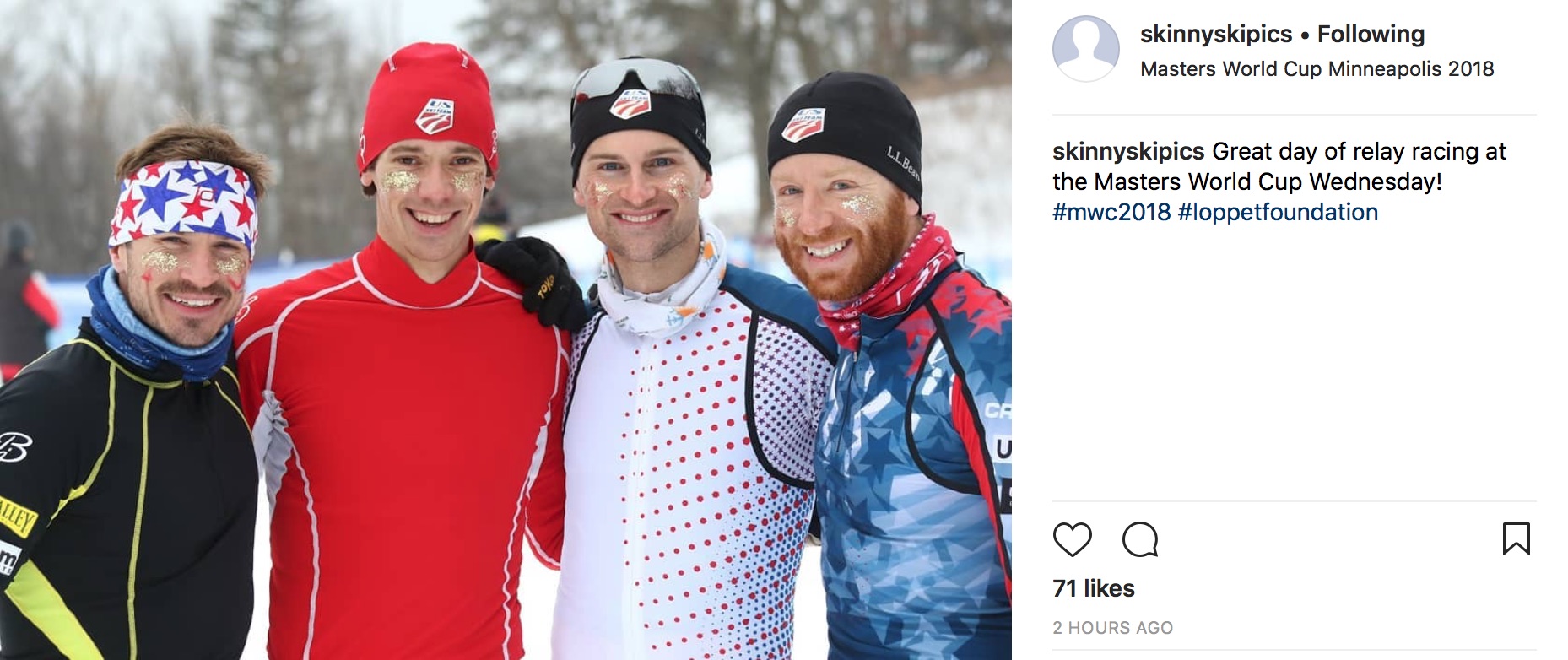
    Matt Liebsch (l) and his men’s age-group “1” 4 x 5 k winning relay team on Wednesday at 2018 Masters World Cup in Minneapolis, Minnesota. (Photo: SkinnySki/Instagram)

    2018 Masters World Cup (Minneapolis, Minnesota): 4 x 5 k relays

    Matt Liebsch, 34, anchored the winning relay of the youngest men’s age group (AG 1) at 2018 Masters World Cup on Wednesday, crossing the line in 45:57.2 minutes (the fastest relay time of the day) and teaming up with fellow Americans Christopher Harvey, Mark Johnson and Zach Varty. Two teams competed in that age group’s 4 x 5 k relay, with Italy finishing second, 1:22.6 minutes back.

    The U.S. won all five women’s 4 x 5 k relays on Wednesday, and eight total between the men’s and women’s age groups. Finland had the second-most relay victories with five in the men’s categories.

    Canada won the men’s AG 4, beating out four other teams with Gabriel Babin, Bruce Macneil, Luc Tremblay, and Michel Labrie, who finished the 4 x 5 k in 49:41.9. Germany placed second (+36.4), and the U.S. third (+54.1).

    Piotr Bednarski, head coach of Loppet Nordic Racing, which is based out of Theodore Wirth Park, anchored the men’s AG 5 to a win in 49:39.1, with teammates Rune Harkestad, Dennis Paul and David Sjogren.

    Masters World Cup continues with 15/30/45 k classic distance races on Thursday at Wirth Park.

    Day 4 Age Group (AG) 4 x 5 k Relay Winners

    Men:

    • AG 1: USA (Christopher Harvey, Mark Johnson, Zach Varty, Matt Liebsch) 45:57.2
    • AG 2: Finland (Jouni Leinonen, Mika Kilpeläinen, Johan Gustafsson, Joachim Gustafsson) 47:53.4
    • AG 3: Russia (Ivan Batyutenko, Andrey Lushnikov, Sergey Degtyarev, Aleksandr Pushkarev) 46:43.3
    • AG 4: Canada (Gabriel Babin, Bruce Macneil, Luc Trembley, Michel Labrie) 49:41.9
    • AG 5: USA (Rune Harkestad, Dennis Paul, David Sjogren, Piotr Bednarski) 49:39.1
    • AG 6: USA (Milan Baic, Odd Bersvendsen, Kent Murdoch, Barry Makarewicz) 48:48.3
    • AG 7: Finland (Heikki Ruokonen, Tapio Tikkanen, Timo Pullinen, Aito Pennanen) 51:56.3
    • AG 8: Finland (Leino Nisula, Pauli Halonen, Yrjo Teravainen, Harri Makela) 54:58.4
    • AG 9: Finland (Veikko Piirainen, Tapio Ikaheimonen, Paavo Raisanen, Vaino Paakko) 58:18.9
    • AG 10: Finland (Alpo Virtanen, Tapio Wallenius, Jouko Laiho, Riku Kyllonen) 1:02:39.7

    Women:

    • AG 1: USA (Kathleen Dewahl, Tamra Kornfield, Davya Flaharty, Gina Chythlook) 56:49.3
    • AG 2: USA (Bonnie Weiskopf, Kim Rudd, Mary Mckelvey, Mary Wellington) 56:23.9
    • AG 3: USA (Elizabeth Youngman, Kelly Milligan, Jan Guenther, Kelly Skillicorn) 56:23.6
    • AG 4: USA (Kate Ellis, Magdenla Bowen, Joann Hanowski, Muffy Ritz) 1:00:33.6
    • AG 5: USA (Gabriele Andersen, Constance Meek, Dagmar Eriksson, Kati Campbell) 1:14:23.4

    Results

    Schedule

    ***

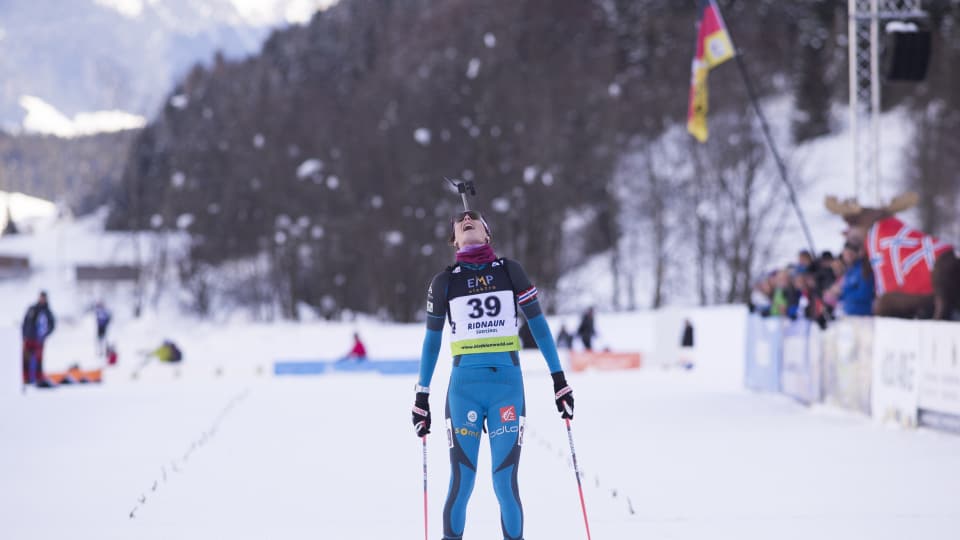
    France’s Chloe Chevalier after winning the women’s 15 k individual on Day 1 of IBU Open European Championships in Ridnaun, Italy. (Photo: IBU/Biathlonworld)

    IBU Open European Championships (Ridnaun-Val Ridanna, Italy): 15/20 k individual

    The International Biathlon Union (IBU) Open European Championships opened Wednesday in Ridnaun (Val Ridanna), Italy, with several North Americans competing in the women’s 15- and men’s 20-kilometer individual races.
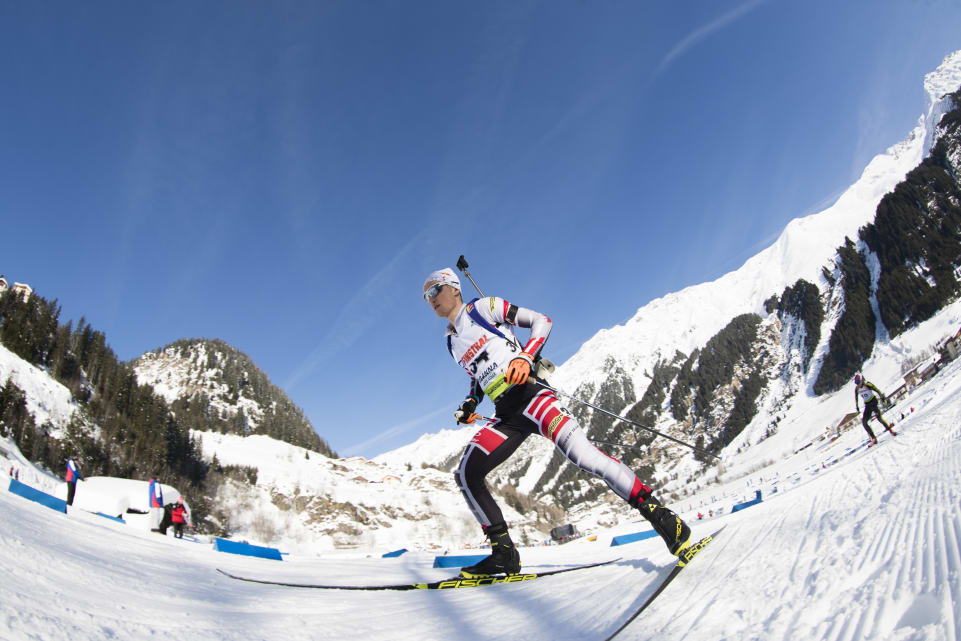
    Austria’s Felix Leitner racing to the win in the first race of 2018 IBU Open European Championships, the men’s 20 k individual, on Wednesday in Ridnaun, Italy. (Photo: IBU/Biathlonworld)

    Canada’s 23-year-old Carsen Campbell raced to 19th in the men’s 20 k, shooting 19-for-20 (1+0+0+0) and finishing 3:18.5 minutes behind the winner, Austria’s Felix Leitner, who clocked the fastest time in 53:32.8 — also with one penalty (0+0+0+1).

    Leitner, 21, won by 43 seconds over Tomas Krupcik of the Czech Republic, who also had a single penalty in the last standing stage (0+0+0+1) and placed second.

    Germany’s Philipp Horn reached the podium in third (+56.6), with 19-for-20 shooting as well (1+0+0+0).

    According to an IBU press release, Leitner is one of the youngest athletes to win the 20 k, the longest race on the circuit.

    “I had many problems with my shooting lately, but today it was probably the best in the last two seasons,” Leitner said, according to the release. “I believed in myself and knew that I have to run fast from the beginning, and if the shooting would be as good as during the training, I could be in the top.”

    Campbell, of Biathlon Canada’s National “Z” Team, was the top North American in 19th in his second trip to Open European Championships. Previously, his best individual result was 64th last year.

    Paul Schommer led the U.S. men in 46th (+5:22.6) with three penalties (0+1+1+1). Max Durtschi also shot 17-for-20 (1+0+1+1) and ended up 56th (+6:18.5), Jakob Ellingson followed in 58th (+6:23.5) with two penalties (0+0+1+1), and Jake Brown finished 74th (+8:06.7) with seven penalties (1+1+3+2). Alex Howe did not start.

    For Canada, Macx Davies, a senior national team member who is headed to the Olympics, placed 67th (+7:32.7) with five penalties (2+2+1+0). Matt Hudec was 96th (+12:00.5) with six penalties (0+2+1+3), and Aidan Miller 105th (+14:49.0) with nine penalties (2+1+1+5).

    In the women’s 15 k that followed, Sarah Beaudry, of Biathlon Canada’s Senior National Team as well as Olympic team, was the top North American in 23rd, 4:55.6 out of first. Beaudry, 23, shot 18-for-20, with her two misses coming in the first prone (2+0+0+0).

    France’s Chloe Chevalier won the women’s race, with spring-like temperatures around 6 degrees Celsius, in 46:32.9 with a single penalty, also in the first stage (1+0+0+0). The second- through fourth-place finishers all shot clean, with Italy’s Alexa Runggaldier placing second (+47.7), Russia’s Victoria Slivko taking third (+55.9) and Ukraine’s Yuliia Zhuravok missing the podium by half a second in fourth place (+56.4).

    “After that penalty in the first prone, I relaxed and did not worry about the result,” Chevalier said after, according to an IBU press release. “I just enjoyed being out on the tracks on a beautiful sunny. Maybe the key to success is relaxing and not worrying about the result.”

    Two Canadian women entered the event, with Erin Yungblut finishing 83rd (+13.19.9) with eight penalties (2+3+1+2).

    Chloe Levins was the top American woman in 60th (+7:18.6) with four penalties (1+2+1+0), and Maddie Phaneuf, who made US Biathlon’s Olympic team, followed in 65th (+8:10.8) with four misses as well (1+2+0+1). Deedra Irwin finished 82nd (+13:15.8) and Jennie Bender was 87th (+15:05.0), both with 10 penalties apiece.

    Open European Championships continue Friday with the men’s and women’s sprints, followed by pursuits on Saturday and relays on Sunday.

    Results: Men | Women

  • After Three-Race Trials Series in Minnesota, US Names Biathlon IBU Cup Squad

    After Three-Race Trials Series in Minnesota, US Names Biathlon IBU Cup Squad

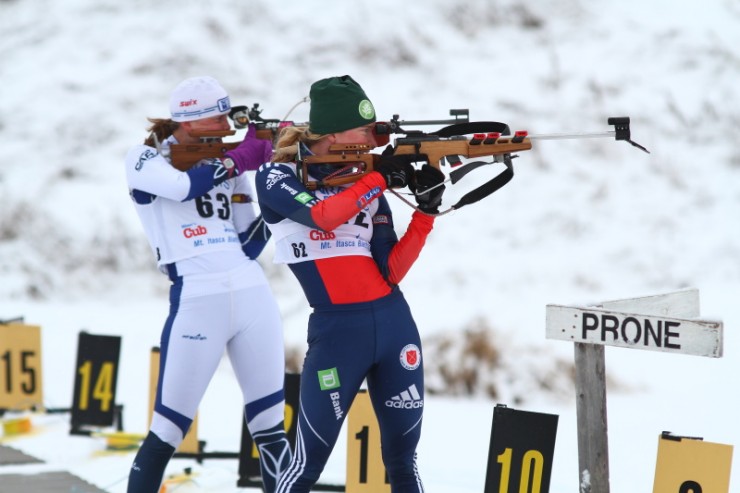
    Hannah Dreissigacker (Craftsbury GRP/U.S. National Team) and Katrina Howe (Maine Winter Sports Center) dueling on the range. Both were selected for IBU Cup races in Otepaa, Estonia, and Ostrov, Russia. Photo: Gregory Haugen/HaugenPhoto.com.

    MOUNT ITASCA, Minnesota – After a winter which had already seen below zero (F) temperatures in Minnesota, no one really expected 33 degrees with rain for Saturday’s Sprint competition at the US IBU Cup Selection Trials, but that’s exactly what they got.

    It rained for hours prior to the start, and only turned to huge, wet flakes of snow mid-way through the race.  Conditions were predictably slow, but Wynn Roberts (National Guard) didn’t let that keep him off the top step of the podium. He finished the 10k course with a time of 23:35.0 after shooting clean in the prone stage, and only missing one in the standing.

    Mark Johnson (Mt. Itasca Biathlon) was hard on his heels however, and if he had not missed one prone shot and another standing, the podium could have looked different as he was only 15 seconds behind (23:50.1).

    Bill Bowler (Biathlon Alberta) was third at 23:54.7 after missing two prone and two standing.

    Corrine Malcolm (US National Team) set the pace for the women as the wet snow continued to fall, with three total misses (2 prone, 1 standing), finishing the 7.5k course in 21:45.3.

    1.1 seconds separated her from second-place Hannah Dreissigacker (Craftsbury GRP/US National Team), which was a great result considering she had one more miss in the shooting stage than Malcolm.

    Also with four total misses, coming across the line in 22:06.3, was Katrina Howe (MWSC).

    The snow continued into the night, and conditions for the Pursuit on Sunday were much more satisfying for athletes and coaches alike, as well as the Mt. Itasca course volunteers. Several inches of new snow had been worked into the trail surface for significantly faster conditions, and morning temps in the low 20s felt perfect.

    Hannah Dreissigacker would be fastest for the women as she covered the 10k course in 31:36.4 and shot the best of any of the seniors, men or women, with only 4 misses over 4 shooting stages. Katrina Howe and Corrine Malcolm joined Dreissigacker on the podium again, with 5 and 7 misses respectively.

    Bill Bowler stood on the top step Sunday with Wynn Roberts in second and Raleigh Goessling (MWSC) in third. Bowler had 7 misses to Robert’s 8 and Goessling’s 10, and finished the 12.5k course in 32:12.

    Monday was make-or-break for the athletesm, as anyone who wanted to travel to Europe as part of the IBU Cup team for race 4 would likely need to notch the win today. Anyone lagging too far behind the first place finisher might be out of the running for a discretionary selection. The overall points winners for the weekend’s three races could count on a spot at the starting line for IBU Cup 4 in Otepaa Estonia on January 4th.

    The format was a 15k Mass Start for the men and 12.5k for the women. Bill Bowler would be the victor today, shooting two better than Roberts, who missed 7 total. Wynn Roberts skied well though, and even with two more penalty loops than Bowler, only finished approximately 30 seconds off the pace. Mark Johnson followed him, with Michael Gibson (Vermont Biathlon) and Raleigh Goessling next.

    Hannah Dreissigacker managed to hang on to first place and finish 8 seconds ahead of Katrina Howe, even with 3 misses compared with Howe’s exceptional results of only 2 misses over 4 stages. Corrine Malcolm joined them on the podium again in third but had a disappointing day on the range with 8 shots outside the black.

    Based on results from all three events, USBA announced later Monday afternoon that the primary selections for the US IBU Cup Team would be Bill Bowler and Hannah Dreissigacker, with Wynn Roberts and Katrina Howe named as discretionary selections. Those athletes will join Jeremy Teela and Tracy Barnes, who qualified for the December period of IBU Cups, and Jay Hakkinen and Lanny Barnes, who raced the first period of World Cups but are moving down to the second tier of racing.

    USBA announced that seven athletes will remain on the World Cup, based on results from the first period of racing: Tim Burke, Lowell Bailey, Russell Currier, Leif Nordgren, Susan Dunklee, Sara Studebaker, and Annelies Cook.

    Full results for the weekend’s races, including Masters, Juniors, and Youth are available at www.minnesotabiathlon.com.

    -Chelsea Little contributed reporting.

  • Nordgren, Cook Skate To Big Wins in Chaotic Nationals Pursuit

    Nordgren, Cook Skate To Big Wins in Chaotic Nationals Pursuit

    Leif Nordgren (l/back) follows Bjorn Ferry of Sweden in the World Championships individual race last week.

    U.S. Biathlon Nationals might not actually feature all the best biathletes in the country, but so far it has proved one thing: the team selected to compete in Europe is really, really fast.

    Saturday didn’t seem auspicious for anyone, with rain blanketing the West Yellowstone course and every biathlete winding up soggy. But for the second time in as many races, the two World Championship team members who decided to compete at U.S. Nationals took big wins, this time in 10 and 12.5 k pursuits.

    In the men’s race, Leif Nordgren skied to a minute and a half victory over Mark Johnson; Nordgren had four penalties to Johnson’s six.

    “It’s certainly fun to have Leif here to race against,” Johnson wrote in an e-mail. “He’s a great teammate and someone I hope to learn from this week.”

    Even though Nordgren had won the sprint by a minute, the two did have a chance to go head-to-head thanks to a decision to modify the pursuit format. While racers did start in the order that they finished the sprint, as usual, the time gaps were replaced by five-second start intervals.

    “I actually wasn’t alone for too much,” Nordgren told FasterSkier. “They started the only junior, Casey Smith, right in front of our group. I skied the first loop with him, then I missed two and he cleaned and moved ahead a little bit, as well as Mark Johnson. I had to play a little catchup on the next two loops, then in the standing stages I started to get a gap on those two and it only grew until the end.”

    In fact, Nordgren was never alone – and neither was anyone else. With all of the different age divisions starting back to back, there were dozens and dozens of racers on course at all times, racing different distances and intermixing on the range.

    Johnson was happy to finish second just as he had in the sprint, but said that he’d been expecting better performances, and maybe to be closer to Nordgren, who had a mixed bag of results at World Championships and anchored the U.S. relay team to tenth place.

    “While I’ve managed two second placed finishes thus far, the performances have left me hoping for more,” Johnson wrote. “I haven’t been able ski at the speeds I’ve come to expect this season. I do need to remember, however, that it is late in the season now. For tomorrow’s mass start competition, I’m hoping to continue to shoot well and find a new rhythm skiing.”

    Johnson didn’t seem to be too bothered by his inability to find his highest gear, however, and said he was enjoying Nationals to the fullest. He’d been helping out with a junior development camp and done some spring skiing before the weather turned rainy. Overall, he was impressed with the event.

    “Despite the consistent heavy rain over the last few days, the organizing committee has done a great job preparing and maintaining the course for these competitions,” he wrote. “While I’m currently having a tough time staying dry, I can certainly attest that West Yellowstone can deliver some perfect spring skiing conditions.”

    Michael Gibson of Vermont Collegiate Biathlon finished third, 2:21 behind Nordgren.

    Can Nordgren go for the three-peat in tomorrow’s mass start? He hopes so, but the rain has him doing just that – hoping.

    “I wasn’t feeling super great today,” he admitted. “I think skiing in the rain for the last four days is getting to me, with a little sore throat and chest congestion. But whatever – looking forward to the pursuit tomorrow, then out of the rain!”

    * * *

    Cook leaving the range for the U.S in the women's World Championships relay.

    In the women’s 10 k, Annelies Cook was even more dominant, picking up an almost four-minute win over fellow national team members Laura Spector and Corrine Malcolm.

    In an interesting twist, exactly how much she won by was not clear until after the race, when Spector and Malcolm saw their times adjusted.

    “The range was sort of a mess,” Malcolm explained. “There are only 20 lanes here instead of 30, and at any given time there were 75 of us out on course. With four shooting stages overlapping, you get the picture! There was some yelling. Some frantic activities. In biathlon, hunting for a point to shoot at isn’t part of our normal race procedure, but you just have to roll with it.”

    Spector and Malcolm had been going back and forth for much of the race – unlike Cook, who was out on her own – and in the end, Spector was awarded a 19-second credit and Malcolm five seconds after national team coach Patrick Coffey, who had been using a stopwatch on the range, tallied up how much time each had spent looking for a place to shoot. Although the results placed them less than a second apart, with Spector in second +3:53 and Malcolm in third +3:54, Malcolm had finished first, and there had been no sprint to the line.

    “I didn’t know how much time they would give either one of us,” she told FasterSkier. “And with one more penalty, faster skiing just didn’t cut it in the end. I think it’s kind of silly that it came down to 0.3 seconds without getting to actually duke it out.”

    Still, Malcolm didn’t begrudge Spector her time adjustment. After sitting out part of the training season with injuries and then much of the winter with illness, she was just happy to be racing.

    “Truthfully, I’m happy to share the podium with Annelies and Laura,” she said. “These gals are more or less veterans on the team with years of World Cup, World Championships, and Olympic experience. If anything, getting to rub shoulders with them is fine with me.”

    Ahead of them, Cook was in a league of her own, not only skiing fast but accruing a single penalty over four stages compared to seven for Spector and eight for Malcolm. It was some of her best shooting of the entire season.

    “I wish I could have done that in all of those pursuits I got lapped in on the World Cup,” Cook lamented.

    Her secret? Cook said that she sung “Row, Row, Row Your Boat” in her head to avoid thinking about shooting.

    Because she started first, she was never sure whether her teammates were about to catch her, and so didn’t let up even though she actually had a large lead.

    “It is definitely exciting to start as number one and knowing that everyone is chasing you,” she told FasterSkier. “I had no idea where the other girls were the whole race, so I just kept thinking if I clean, then I will be okay. I think I am skiing pretty well right now and that is a good confirmation of the whole winter for me!”

    Cook is at the stage in her career where she is clearly strong enough compared to the American field to race in Europe, but it’s not always easy to place in the fifties and sixties week after week on the World Cup. She said that races like U.S. Nationals were hugely valuable.

    “It is always fun to win a race, especially when you don’t get that all winter and your goals have to be very personalized,” she explained. “I didn’t have any pressure and on top of that, it is a very low key atmosphere here. I always like to come to U.S. Nationals. I think it is really important for as many people to come as possible because the sport is so small here in the U.S., and it is good to be around everyone you don’t see all winter and who support you from here.”

    And what of coming straight from Ruhpolding, where biathlon is anything but small? First, she had to deal with the time change, which she said also lowered her expectations. But aside from that, “a race is a race.”

    “It’s like comparing New York City to Saranac Lake, New York,” Cook said, invoking her hometown. “But in the end…. you go as hard as you can.”

    Results

  • U.S. Has “Quiet Success” in U26 Sprint Races; Currier 27th

    U.S. Has “Quiet Success” in U26 Sprint Races; Currier 27th

    Russell Currier racing in last week's World Cup competitions in Antholz, Italy. Photo: NordicFocus/USBA.

    The U.S. biathlon team could be forgiven for having high expectations going into this year’s Under-26/Open European Championships in Osrblie, Slovakia.

    Last year, Leif Nordgren entered just one race at the event, and didn’t even finish. But a few weeks later, he notched three top-thirty finishes at senior World Championships.

    In that same U26 series in Ridnaun, Italy, Russell Currier repeatedly finished in the 20s and 30s. But just two weeks ago, he bettered those results on a higher stage when he sprinted to sixth place in a World Cup in Nove Mesto, Czech Republic.

    Both athletes have taken major steps since their last appearance at the U26 races, as has Laura Spector, whose top finish in 2010 was 34th, but who spent the entirety of last season on the World Cup.

    So this year, the team had every right to hope for better finishes. And while it didn’t happen on Saturday – Currier was the only American to crack the top 30 – coach Patrick Coffey didn’t consider the pair of sprint races to be a wash.

    “Today’s races were a quiet success I would say,” he told FasterSkier in an e-mail.

    Currier and Nordgren, who missed three shots to finish 45th in the 10 k sprint, were disappointed nonetheless.

    “Tough race this morning in Slovakia,” Nordgren tweeted after the race. “Tomorrow is another day though and I’m looking forward to it!”

    Currier, who said the race was “decent, but not up to expectations,” was undone mainly by his shooting. Not only did he miss three shots, but he lost over thirty seconds to his fastest competitors during the two shooting stages alone. There were bright spots, however: Currier’s seventh-fastest ski time of the day mitigated some of his other problems, and he finished 27th.

    “I actually didn’t feel that great on skis,” Currier told FasterSkier. “My transitions were a little sloppy in some parts. I was surprised to have the seventh fastest loop time.”

    Of his shooting, he said that he was also surprised to have missed two shots in standing.

    “I’m still kicking myself for that,” he said. “I really thought I could clean standing today.”

    His time placed him 1:45 behind Alexey Volkov of Russia, a World Cup regular who anchored the winning mixed relay in Hochfilzen, Austria this season and whose victory today surprised nobody.

    In fact, the presence of athletes like Volkov is one thing that makes this year’s U26 races unusual – and more competitive than in past editions. In 2010, the event was held directly after the Vancouver Olympics, and only a handful of athletes, generally from smaller countries, competed in both. In 2011, the Ridnaun races followed the World Cups held in Fort Kent, Maine, leading to a similar situation.

    But this year, the U26 Championships are being held during a World Cup off-week between Antholz, Italy and Oslo, Norway, making travel and jetlag less of an issue for athletes wanting to work the event into their World Cup schedule. Today’s field was almost 20 % bigger than last year’s.

    “It was a little more competitive than I thought it would be,” Currier said.

    While the results were disappointing and the races themselves less than exciting for the pair of men who had competed in Antholz – Currier said that the crowd “could not hold a candle to your average World Cup” – it was part of a cautious return by the third American man, Mark Johnson.

    A five-time World Junior Championships competitor, Johnson recently graduated from Williams College and hasn’t appeared in an major biathlon race in three years.

    “For me, this was a fun introduction back into international racing,” Johnson wrote in an e-mail. “After spending my last season focusing on collegiate cross-country racing, my confidence on the ski tracks has improved. That showed today. My skiing was on pace with much of the field.”

    Johnson missed two shots and finished 44th, just over a second in front of Nordgren, and said that he was “very satisfied with the result.”

    While he hasn’t made any international squads until now, Johnson had offered up a series of fairly dominating performances in domestic competition this season. He may have been happy with his result, but it didn’t mean that he wasn’t expecting more in the coming races, just like his teammates.

    “Overall, I think we performed solidly,” Johnson wrote. “There is room for improvement on the result list, and the hope is to realize that in the coming races.”

    The U.S. trio seemed enthusiastic for Sunday’s pursuit, which should feature large packs thanks to the many tight finishes in today’s sprint. Currier, for example, sits about 20 seconds out of the top 20, or one penalty loop; Nordgren will start in a pack of six skiers within ten seconds.

    “I’ll be starting with a large group, and right alongside my teammate Leif, which will definitely make for a thrilling environment to race in,” Johnson said.

    “And as a team, I believe we can make up some major ground on our competitors.”

    * * *

    In the women’s 7.5 k sprint, Spector and teammate Hannah Dreissigacker narrowly missed the top 30, placing 32nd and 33rd. Neither, however, seemed too disappointed.

    “In skiing I felt all right, nothing exceptional,” said Spector, who started this season on the World Cup circuit before being moved to the second-tier IBU Cup tour. Spector has so far been unable to find the form she showed last season, but said that her ski speed was coming back little by little; she had the 31st-fastest ski split today.

    “This is the first ‘World Cup’ course I’ve competed on since mid-December, which means that it’s more challenging than most courses used for IBU Cups,” Spector said of the skiing. “There are two really long, steep hills in the first half of the course, followed by a lot of downhill that still requires efficient skiing, where I lost the most time.”

    Spector missed two shots, both in the standing stage. Her prone shooting, however, was exceptional: not only did she clean, but she did it with the second-fastest time in the field.

    “I was surprised to see how fast my prone time was because the shots felt scattered,” she explained. “I jammed a shell in standing so it took a little time to clear that out, otherwise I would expect standing to be faster.

    “I have not been working on shooting speed this year, although I have noticed an improvement,” she continued. “I think it’s simply come from having a good number of years of shooting training behind me now, being able to calculate a good range approach, and being comfortable with shooting faster; it’s really been a natural process.”

    The same could not be said for Dreissigacker, who hasn’t contested an international biathlon race in two years and has only competed in two U.S. events this season. A successful skier for the Craftsbury Green Racing Project who made the top 20 in every race at 2012 U.S. Nationals in Rumford, Maine. Dreissigacker was surprised to be nominated to the team, and wasn’t sure what to expect.

    Once the racing began though, she was no longer as apprehensive.

    “I felt like I actually was a real biathlete,” Dreissigacker, who accrued three penalties, told FasterSkier. “I successfully accomplished my goals of going through all the equipment checks, shooting at the right targets, skiing the right number of penalty laps, skiing hard, and having fun!”

    Like Spector, Dreissigacker noted the difficulty of the course’s long climbs, and said she was looking forward to shorter loops with less vertical in Sunday’s pursuit. But despite the challenges, she said that the venue actually suited her well.

    “There’s about 1.5 k of flat rolling [terrain after the hills], which makes for an easy approach to the range,” she said. “That’s good for me – it means that I can ski pretty normally and then just back off a little bit on the gradual downhill into the range.”

    Coffey, the team’s coach for this trip, was impressed with both Dreissigacker and Johnson given their lack of recent big-race experience.

    “Both have been taking it all in stride,” he said. “There is an adjustment that needs to be made when jumping into the European racing circuit, but both looked relaxed today and will feel even more at home tomorrow in the pursuit race.”

    Canada’s Megan Heinicke finished 18th in the women’s sprint; she could not be reached for comment.

    Results: men / women

  • Biathlon 2010 Team Trials Get Underway

    Biathlon 2010 Team Trials Get Underway

    Thanks to great volunteers that blew snow over the 2.5 km course at Mt. Itasca, the 2010 Team Trials got underway today.   While the course was not as difficult as the 3.5 km loop, it was challenging enough for the USBA to evaluate the racing.

    In the men’s 10 km sprint competition it was National B Team member Mark Johnson skiing away from the field in a time of 26:20.  In the women’s 7.5 km sprint race USBA Development Team member Jen Wygant took the win in a time of 23:44.

    In the women’s race, Wygant relied on the best shooting race of her two year biathlon career to ski to the 16 second victory over Susan Dunklee (USBA), with Laura Spector (USBA) rounding out the top three another 15 seconds back in 24:15.

    “My skiing felt good and will hopefully get stronger as my leg speed gets better,” said Wygant.  “The course was hard packed, but not my favorite terrain with the steep climbs.  I typically like the more gradual stuff.”  Wygant, who only had two misses shooting today remarked, “hopefully the whole field can step it up because that is what it is going to take to compete on the World Cup and that is our goal.”

    As Spector elaborates on in her FasterSkier blog she had a very solid race in third despite spending some time in theEmergency Room last night.  “I’m surprisingly relaxed, which is good because it helps me keep a cool head on the range and my stomach jitters in check. Despite being a little low in energy, I skied the race as hard as I could and finished third with 3 total misses at 98.95 percent back, about 30 seconds.

    “What I’m most pleased with about today was my ability to transition to race mode so quickly and attack the race in spite of all that could have distracted me or discouraged me from skiing fast.”

    In the men’s race, Johnson skied to a 23 second victory over Wynn Roberts (USBA), while Zachary Hall (USBA) took the final position on the podium another 8 seconds back.

    Johnson’s goal was to stick to the basics.  “During the time leading up to today’s race, I really wanted to keep things simple. This being the first trials race of the season (i.e. big time nerves), and really my first race on snow against a lot of the competition, I sought to stay away from trying anything out of the ordinary–simply keep all of the same procedures as in my training.

    “Overall, I’m very satisfied with my performance today. In the ski loops, I felt on top of my game, and on the shooting range I took my time, but it proved beneficial seeing as I hit my goal of 90% shooting. After the race, I found out from my coach Vladimir that my shooting was a bit more on the edge than hoped. Several shots were near misses. My only miss on the day came as my final shot standing.”

    Everyone that FasterSkier talked with after the race voiced the same warm thank you to all of the volunteers that made this race possible.  Johnson’s words best sum up what was felt by all those attending. “I also want to give a big thank you to the volunteers here at Mt. Itasca. Many of them have had several sleepless nights in preparing the tracks with man-made snow. A thousand thanks!”

    As for the USBA’s decision to issue a “same wax” protocol for the Team Trials, Upham told FasterSkier that “about a month ago they had a conference call to discuss the matter.”

    Ultimately it came down to a matter of fairness and the USBA wanting to be able to compare the racers on an equal playing field whether they were members of the USBA or of a club.  As a coach Upham likes the idea even more as it allows him “to focus on the athletes mental preparation for the race” instead of spending all of his time waxing skis.

    Pointing out that in biathlon they also have to spend time zeroing their guns, and, as Upham stated, “if I had to aid with that as well as test skis, I would be running around all frantic.  They have been doing this for years at the junior level and the USBA did not want to feel like they should send one of the techs over from Europe because we want them to stay to help over there.”

    Today’s cold conditions made the waxing easy as temperatures were below 0ºF over night.  As Upham said, “today worked out well with everyone on the same page.”  When asked what they would have done had the temperature been warmer he remarked “we will be using high-flouro paraffin waxes, but no powders.”

    The only issue that is yet to be resolved for this race series is what to do about structure.  “Everyone has similar grinds on their skis, but if we need to use a structure tool we will discuss what to do at that time.  We all are working in the same wax room, so we will make a group decision.”

    While it is “way too early to discuss who is looking good for picking the Olympic Team” said Upham, the plan is to hold five races at Mt. Itasca weather permitting.  Of those the USBA will look at each athlete’s best three races to determine the 3 or 4 men and women that the they will bring over to Europe to race against the World Cup Team.

    While “Jay Hakkinen and Tim Burke have already pre-qualified based on their performances at the last two World Championships, everyone else will have to slug it out at those races in Europe to determine the final Olympic spots,” concluded Upham.

    Tomorrow’s race should prove very exciting as it is a mass start, something we do not see very often domestically.  With two prone, followed by two standing stops in the range the action should be tight.  As Upham stated, “in a mass start it is hard not to be aware of what the guy next to you is doing in the range because you can hear what is happening with each of his shots.  On the course you will know exactly where you are the entire race, especially when you come out of the 150 meter penalty lap, which should take about 25 seconds.”

    “Tomorrow is going to be a good fight, the great thing about this group of girls is that anyone can win on any given day,” said Wygant.  Stay tuned tomorrow for more action from Mt. Itasca and see who best handled the pressure.

    Men's Results
    Men's Results
    Women's Results
    Women's Results
    Walt Shepard (MWSC) - 5th place.
    Walt Shepard (MWSC) – 5th place.