From the FasterSkier archive — posts syndicated from athletes’ and coaches’ own blogs between 2004 and 2012, kept online as published. Current coverage is at fasterskier.com.

Tag: Markus Gandler

  • Sunday Olympic Rundown: Bjørgen Dominates 30 k Classic; Diggins 7th

    Sunday Olympic Rundown: Bjørgen Dominates 30 k Classic; Diggins 7th

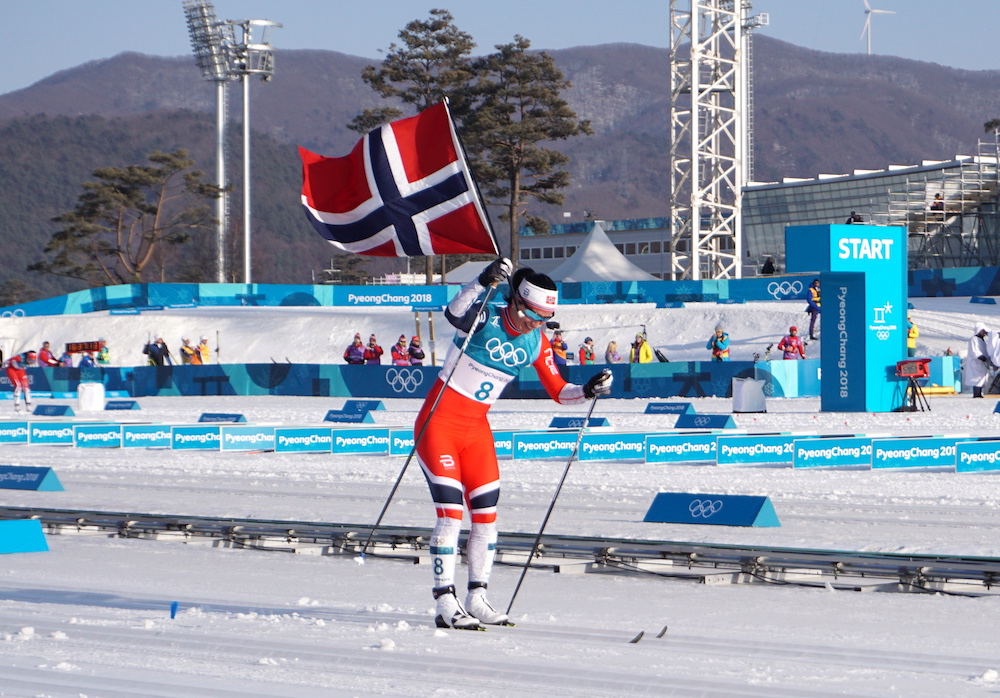
    Marit Bjørgen approaches the line for her eighth-career Olympic gold (and 15th medal) with a win in the final race of the 2018 Olympics, the women’s 30 k classic mass start, on Sunday in PyeongChang, South Korea. (Photo: Noah Hoffman)

    FasterSkier would like to thank Fischer Sport USA, Madshus USA, Concept2, Boulder Nordic Sport, and Swix Sport US for their generous support, which made this coverage possible.

    ***

    2018 Olympics (PyeongChang, South Korea): Women’s 30 kilometer mass start classic

    Report

    Marit Bjørgen went out with a bang. Skiing in presumably the final Olympics race of her illustrious career, the most-decorated Winter Olympian in history simply skied away from a strong field less than 10 kilometers into Sunday’s 30 kilometer classic mass start, earning the 15th Olympic medal of her career (and eighth gold) in dominant fashion.
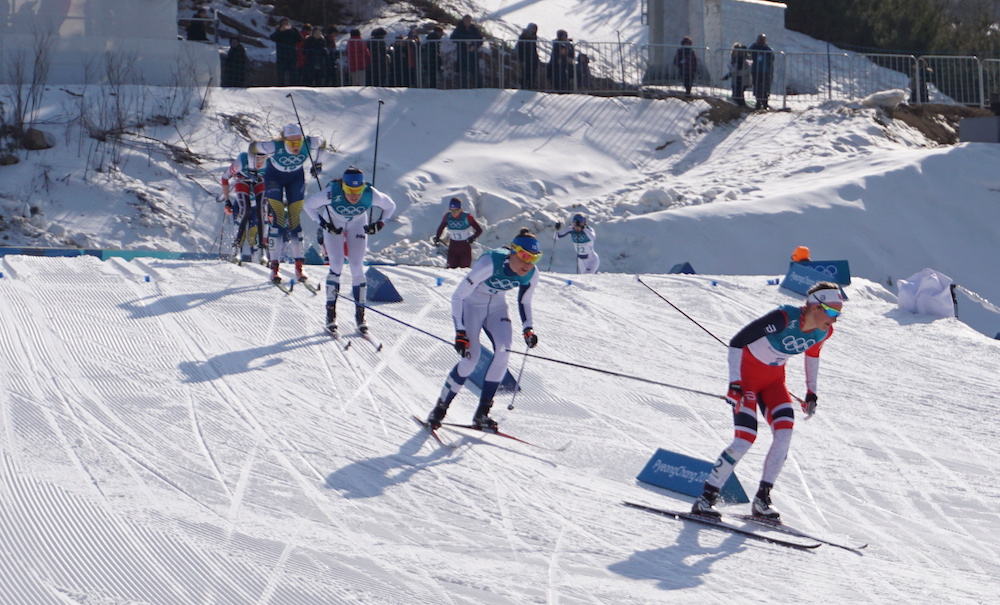
    From right to left: Norway’s Ingvild Flugstad Østberg leading Finland’s Kerttu Niskanen and Krista Pärmäkoski, Sweden’s Stina Nilsson, and Austria’s Teresa Stadlober (r), among others in the women’s 30 k classic mass start on the final day of the 2018 Olympics in PyeongChang, South Korea. (Photo: Noah Hoffman)

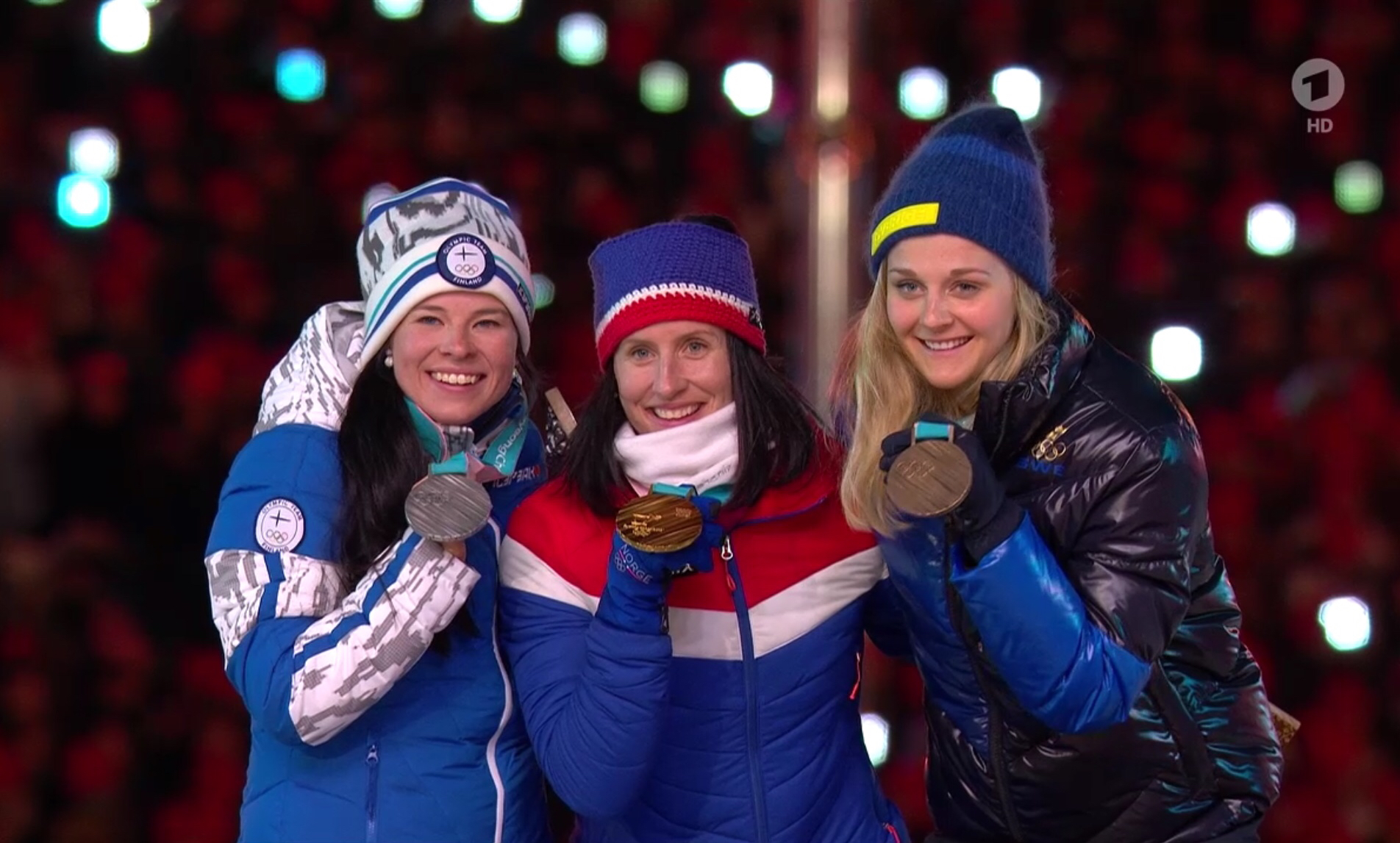
    Behind her, Finland’s Krista Pärmäkoski (+1:49.5) and Sweden’s Stina Nilsson (+1:58.9) rounded out the podium, with Nilsson breaking away from Norway’s Ingvild Flugstad Østberg (+2:00.4) within the stadium to edge her out for third.

    Fifth went to Charlotte Kalla of Sweden (+2:57.2), with Kerttu Niskanen of Finland sixth (+3:01.6). Jessie Diggins was seventh (+3:37.2), in an American performance that would have been lauded just a few years ago yet somehow represented her worst placing in all six races at these Olympics.

    Heidi Weng of Norway (+4:07.9) in eighth, Teresa Stadlober of Austria (+4:14.1) in ninth, and Masako Ishida of Japan (+4:20.8) rounded out the rest of the top ten. Stadlober’s ninth-place finish was particularly poignant; she was holding steady in silver-medal position through 20 k, before taking a wrong turn at an ill-marked course intersection and losing well over a minute returning to the correct track.
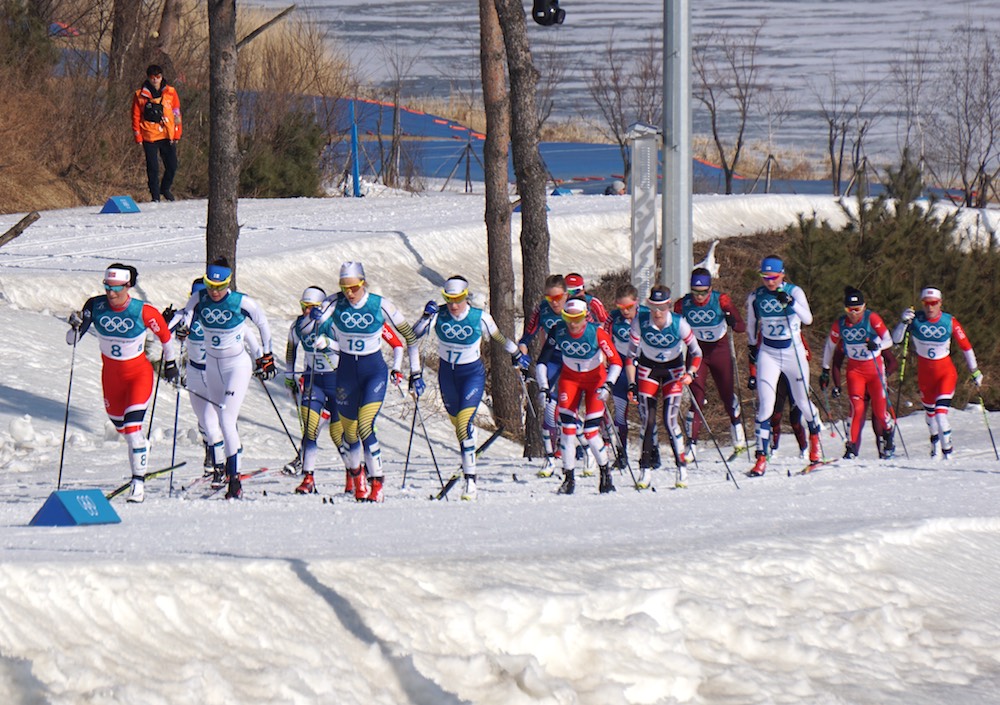
    Norway’s Marit Bjørgen (l) leading the pack during the women’s 30 k classic mass start at the 2018 Olympics in PyeongChang, South Korea. (Photo: Scott Patterson)

    But let’s go back to Bjørgen. Given those time gaps by the finish – nearly two minutes clear of second and third – this was clearly Bjørgen’s day. The 37-year-old Norwegian mother started in bib number 8, and was all of 1.1 seconds off the lead by the first checkpoint, less than one kilometer into the race. But after that… Bjørgen led by 2.3 k, midway through the first of four 7.5-k laps. Bjørgen led at 5 k. Bjørgen led at 7.5 k. Bjørgen led at 8.4 k. And so on. It was not literally a wire-to-wire victory, but it was pretty darn close.

    The race went from a mass start contest to a solo endeavor at roughly 9.5 kilometers in, midway through the second lap. Bjørgen simply surged ahead, and immediately opened up a small gap. By 9.8 k, the gap was 7 seconds. By 12.5 k, it was already up to 33 seconds. By 15 k, the advantage had swelled to 51 seconds. Bjørgen was putting nearly 10 seconds per kilometer on a chase group composed of Olympic medalists and World Championships podium finishers.

    With all due respect to Iivo Niskanen, the hero of Saturday’s courageous breakaway in the men’s 50 k classic, Bjørgen’s performance never felt in doubt the way Niskanen’s did. Bjørgen didn’t have any company, for one, and she had a shorter distance to cover, for another (“only” 20 k of solo skiing off the front). But mostly, well, she is Marit Bjørgen, the most dominant cross-country skier of all time.

    Bjørgen’s gap stretched to as great as 2:04 by the 27.5-k mark of the course. Finally, approaching the finish, she slowed slightly over the last few hundred meters, accepting a large Norwegian flag from a Viking helmet-clad fan and beaming as she carried it across the finish line. Her final time was 1:22:17.6. If they were the final 82 minutes of racing of a five-Olympics career, they were an exceptionally dominant 82 minutes.

    Behind her, a four-woman chase pack formed: Pärmäkoski, Kalla, Niskanen, and Stadlober. As late as 20 k, Kalla was still in seventh, nearly two minutes back of Bjørgen and roughly 35 seconds back of Stadlober in second.

    Soon after this, Stadlober took her wrong turn, skiing for some distance on the wrong course before having her error pointed out to her by a courseside coach or tech. She dropped from second to eighth within a kilometer.

    Reportedly, Austrian coach Markus Gandler was out on the course and the first to inform her of her mistake, yelling, “You are wrong!” She realized her mistake and turned around.

    “We were preparing the feed and noticed she didn’t come,” Gandler told Austrian broadcaster ORF, according to a translation. “I ran over but she didn’t hear me while skiing up. Only on the downhill I caught her.”

    “I don’t know if I should laugh or cry,” Stadlober told ORF after, according to a translation. “I can’t explain it to myself. I have been here for three weeks and if by now I don’t know the loop then I don’t know … I noticed skiing up that something wasn’t right because there was no more staff. When I looked over I just thought: Sh*t!”

    She said she had been feeling great up until that point and confident about her skis.

    “I would have had the power, but had-I-would-I [what could have been] is too late now,” Stadlober said of missing out on her first Olympic medal. “That’s life. It’s just bitter it happened in such a race and on a day when everything would have fit together.”
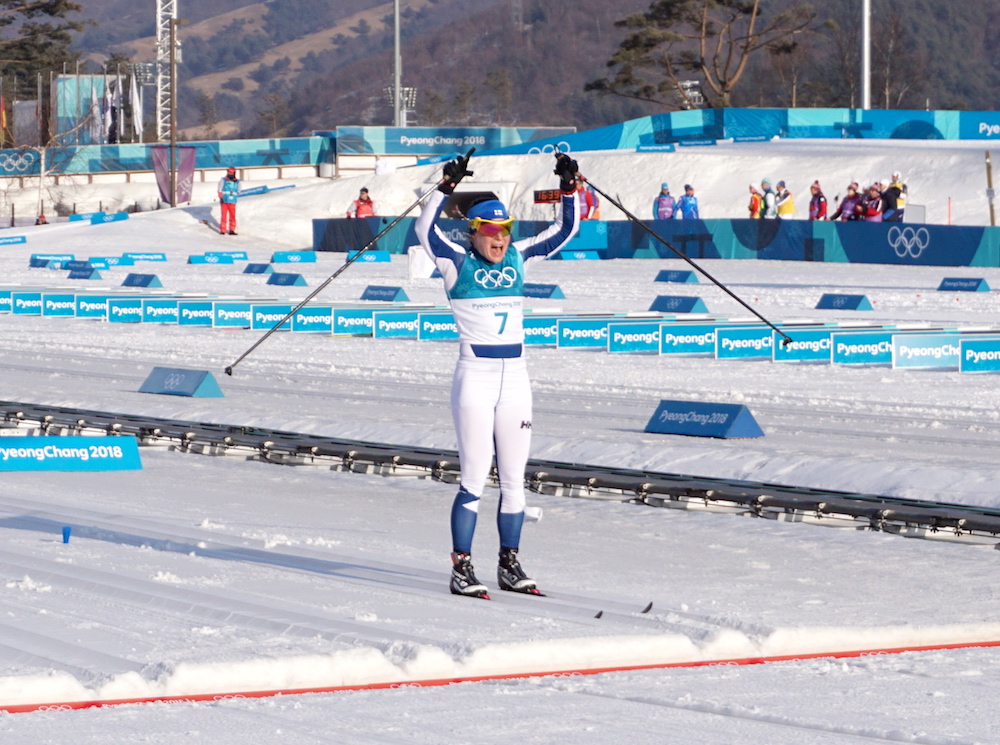
    Finland’s Krista Pärmäkoski celebrates her first individual silver medal which she claimed in the women’s 30 k classic mass start on Sunday at the 2018 Olympics in PyeongChang, South Korea. (Photo: Noah Hoffman)

    By 21 k, Pärmäkoski had a 13-second gap over Niskanen in the race for second, and Kalla had moved up to sixth. By 25 k, it was still Pärmäkoski in second, but now Østberg and Nilsson skiing lockstep in the fight for third.

    Pärmäkoski was never seriously threatened over the final lap, and crossed the finish line for silver.

    “I think that this 30 k was [the] hardest 30 k race [ever] for me,” Pärmäkoski reflected in a post-race press conference. “Of course I heard that Nilsson and Østberg come behind me and I also heard that now it’s 11 seconds, and then 14 seconds. And after this big downhill I heard that it’s a little bit more, but because I know that they are good in sprint, I just hoped that they can’t catch me. This was a crazy, crazy Olympics for me. Before I came here I wanted to win one individual medal and now I won three medals, so I am really happy.”

    In two Olympics, Pärmäkoski, 27, now has four medals — three of which came in PyeongChang (silver in the 30 k and bronze in the 15 k skiathlon and 10 k freestyle races).

    Behind her, Østberg and Nilsson dueled for the final podium spot. But while Østberg was aware of it, Nilsson hadn’t heard about Stadlober’s wrong turn ahead of them.
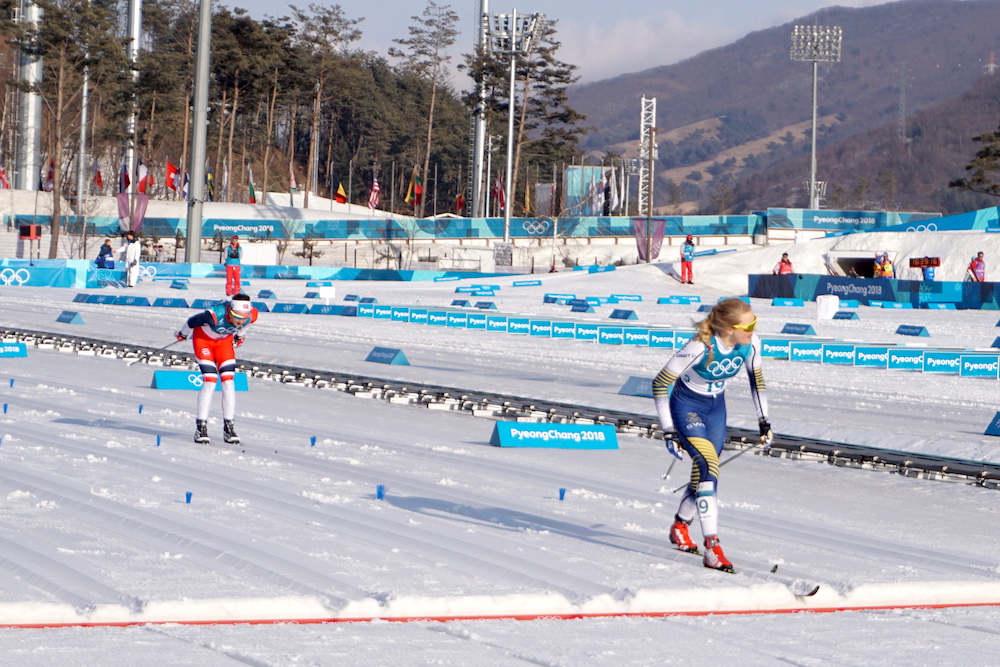
    Sweden’s Stina Nilsson (r) outlasts Norway’s Ingvild Flugstad Østberg (l) for bronze in the women’s 30 k classic mass start at the 2018 Olympics in PyeongChang, South Korea. (Photo: Noah Hoffman)

    At the finish, Nilsson looked surprised when Bjørgen told her she had won the bronze. Bjørgen then went immediately over to console her teammate, Østberg, who finished fourth, 1.5 seconds behind Nilsson in third.

    “I was quite sure that it was fourth. That I got the bronze was quite sick,” Nilsson told Norwegian broadcaster NRK, explaining that she thought the team staff was trying to give her false hope that a medal was within reach.

    “I did not realize that Stadlober had gone wrong. I thought she had moved away,” Nilsson said.

    But Østberg knew the bronze was between her and the Swede. “I definitely knew what I was fighting for. It’s amazing that she did not know, too,” Østberg told NRK.

    Diggins would finish roughly 90 seconds later in seventh, 36 seconds behind sixth and 30 seconds ahead of eighth. The result was emblematic of her day, in which she had skied for much of the race entirely by herself.

    Sadie Bjornsen was the next American, finishing in 17th (+6:32.6). The mid-teens result continued a trend at these Olympics; she was 14th in the classic sprint and 15th in the 10 k freestyle.

    The third American on the day was Rosie Frankowski in 21st (+8:53.8). Forget first Olympic start for the 26-year-old Alaskan and Alaska Pacific University athlete (which it was), Frankowski has zero World Cup starts to her name. She was the second American in the 20 k classic at last month’s U.S. Nationals, though, behind Caitlin Patterson.

    On Sunday Patterson was five spots behind in 26th (+10:26), after narrowly losing a sprint finish to Germany’s Victoria Carl.

    For Canada, Emily Nishikawa led the way in 30th (+12:14.1). She was followed by Cendrine Brown in 43rd (+19:06.3), as Anne-Marie Comeau did not finish.

    Also of note, Jessica Yeaton, who competes internationally for Australia but lives and trains in Anchorage with Alaska Pacific University, was 42nd (+18:37.2). And Petra Hyncicova, who skis in this country for the University of Colorado but races internationally for the Czech Republic, was 39th (+16:57.1).
    Results

    The women’s 30 k classic mass start medalists at the 2018 Olympics Closing Ceremony, with Norway’s Marit Bjørgen (c) in first, Finland’s Krista Pärmäkoski (l) in second, and Sweden’s Stina Nilsson (r) in third in PyeongChang, South Korea. (Screenshot: ARD broadcast)
  • Former U23 Champion Wurm Under Investigation for Blood Doping by Austrian Police

    Former U23 Champion Wurm Under Investigation for Blood Doping by Austrian Police

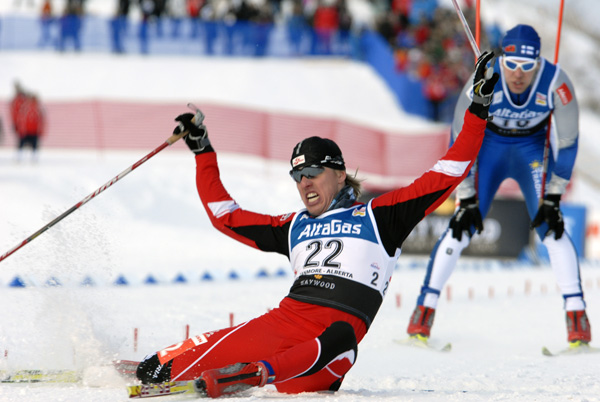
    Harald Wurm of Austria finished 15th in the skate sprint World Cup in Canmore in 2008 (pictured here), and eighth in the same event in 2012. (Photo: Patrick Sinnott)
    Harald Wurm of Austria finished 15th in the skate sprint World Cup in Canmore in 2008 (pictured here), and eighth in the same event in 2012. (Photo: Patrick Sinnott)

    Austrian cross-country skier Harald Wurm is the target of a criminal investigation about doping, according to Austrian news sources.

    Wurm, a 31-year-old who was the U23 World Champion in the sprint back in 2006, represented Austria in the 2006 and 2014 Olympics. He has four individual World Cup top-10’s to his name, most recently in the pre-Olympic World Cup in Sochi in 2013.

    Wurm has not commented on the situation. As of Monday the Austrian Ski Federation (ÖSV) had been aware of the scandal, but not officially informed by authorities. It appears that the investigation is headed by police, not the national anti-doping agency (NADA).

    “NADA has been informed about the case and is in close cooperation with the investigating authorities,” spokesman David Müller told the media, according to Der Standard, a prominent independent newspaper based in Vienna.

    In Austria, distributing performance-enhancing drugs is an illegal activity subject to anti-fraud laws. That’s why the police seem to be leading the investigation in this case.

    Prosecutors have not publicly commented on the case. The fact that an investigation is ongoing was leaked by an anonymous letter to the Tiroler Tageszeitung newspaper.

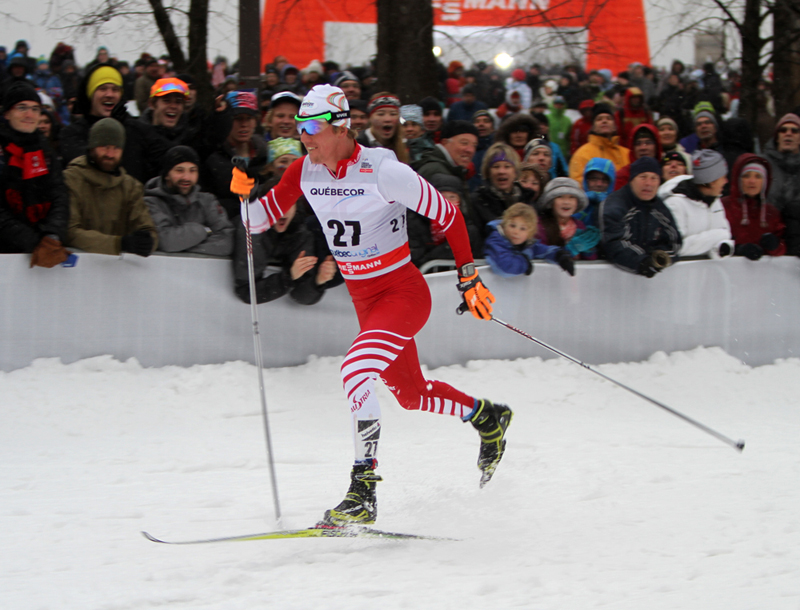
    A crash in the quarterfinals of the sprint in Quebec City in 2012 ripped Wurm's binding off his ski. He finished the lap regardless, earning him claps from the crown.
    A crash in the quarterfinals of the World Cup sprint in Quebec City in 2012 ripped Wurm’s binding off his ski. He finished the lap regardless, earning him cheers from the crowd.

    ÖSV Sport Director Hans Pum told Oberösterreichische Nachrichten that there had been searches of Wurm’s house, and that Wurm had taken a lawyer.

    “It is in our interest that everything is cleared up,” he said. “If it turns out that is there been something, then it is the same as in the past, and we will crack down.”

    For his part, Markus Gandler, the director for cross-country skiing of the ÖSV, told Oberösterreichische Nachrichten that he was “waiting for results”.

    Oberösterreichische Nachrichten reported that a hemoglobin meter had been found, but wrote that this was not evidence of doping. If more materials are found, however, Wurm may be in trouble. The World Anti-Doping Agency code prohibits possession of blood transfusions or any other method to increase the oxygen carrying capacity of blood.

    International Ski Federation (FIS) rules, meanwhile, clearly prohibit possession of any “prohibited method”, according to its 2015 anti-doping code.

    Furthermore, FIS can implement no-start prohibitions if athletes’ blood tests show unusual profiles, according to repeated data collected as part of the Athlete Biological Passport program. Thus the implication of finding a hemoglobin meter is that an athlete may be checking to see whether their hemoglobin levels rise to a level that would suggest doping, or trying to make sure that doesn’t happen.

    Nevertheless, no further reports have emerged showing that Wurm posesses other banned materials, nor has he apparently had a positive doping test. ÖSV officials have said that Wurm is insisting that he can easily clear the allegations.

    Ugly History

    Austrian skiing had been beginning to emerge from the shadow of a huge doping scandal at the 2006 Olympics. There – where Wurm competed – materials for blood transfusions were also found in a raid on athletes’ living quarters; Wurm’s teammates Johannes Eder, Martin Tauber, Juergen Pinter, and Roland Diethart were banned for life by the International Olympic Committee (IOC).

    “If you consider that there were syringes and blood bags lying on the bedside tables in the apartment and blood-soaked handkerchiefs . . . that the haemoglobin metre had been used 59 times in 10 days and you have huge differences between the levels being measured, and that these differences arose just before and just after tests in competitions, you can draw your own conclusions. Multiple athletes were infusing blood from multiple sources.”

    -Thomas Bach, then the chairman of the IOC Disciplinary Committee and now the IOC President, speaking to media at the time.

    Devices for measuring hemoglobin levels were part of those materials. It’s worth noting that the Austrian skiers were tested at the 2006 Olympics, but never found positive for any prohibited substance. Instead, they had been using blood transfusions to increase how much oxygen their blood could carry. And they had been using the hemoglobin meters to make sure that their levels did not exceed those stipulated in FIS’s no-start rules.

    Thus, the fact that Wurm possessed the same type of tool to measure hemoglobin brings up unpleasant memories for Austrian skiing.

    Though nearly 10 years have passed since Torino, doping has not completely receded after the four skiers, plus two biathletes and 14 officials, received bans.

    Johannes Dürr finished the 2014 Tour de Ski in third place, and placed eighth in the Olympic 30 k before being caught using EPO. (Photo: Fischer/Nordic Focus)
    Johannes Dürr finished the 2014 Tour de Ski in third place, and placed eighth in the Olympic 30 k before being caught using EPO. (Photo: Fischer/Nordic Focus)

    At the 2014 Olympics, again one of Wurm’s teammates was caught: Johannes Dürr, who admitted to using recombinant erythropoetin (EPO), a blood-doping drug, for months before the Games and said he had passed 14 blood tests.

    Dürr said that he had obtained EPO himself. And in July, Austrian prosecutors dropped their case against Dürr, concluding that he had not distributed EPO to other athletes. While his ban from sport remains, he thus avoided criminal charges.

    The latest scandal could have big consequences: after the Dürr case, the head of the ÖSV, Peter Schröcksnadel, threatened several times to eliminate the entire cross-country ski program, since it does not seem capable of keeping itself clean.

    Gandler has also thought about retiring. If Wurm is found guilty of doping, even without help from coaches, team doctors, or others within the national team or federation, it would be tough for Gandler to maintain credibility as the head of the program.

    Finally, Wurm was sponsored by Seefeld 2017, the Austrian venue hosting FIS World Championships in two years time. Austrian snow sports is certainly hoping that any association with a doping athlete will not tarnish their event.

    At the moment the Austrian Ski Federation has not suspended Wurm, even provisionally, because evidence of doping has not yet been confirmed and they wish to allow him due process.

    However, cross-country head coach Gerald Heigl said that Wurm has dropped preparations for the season with the national team, and will attempt to “clear up” the situation in the next few days.

    Gandler, Heigl, and biathlon coach Alfred Eder (who has coached the national team before moving to Belarus for the 2014-2015 season, but has returned to Austria to coach his son, Olympic relay medalist Simon Eder) were all among the 14 officials banned by the Austrian Olympic committee after Torino. But they were reinstated in 2009.

    Dürr, too, looks like he is hoping for redemption: Oberösterreichische Nachrichten reports that according to rumors, he is thinking about legally challenging his lifetime ban and/or competing without the support of the national federation.