
Tag: Martin Bayer

  • USA Nordic Transitions as Jarrett and Schafer Step Down

    USA Nordic Transitions as Jarrett and Schafer Step Down

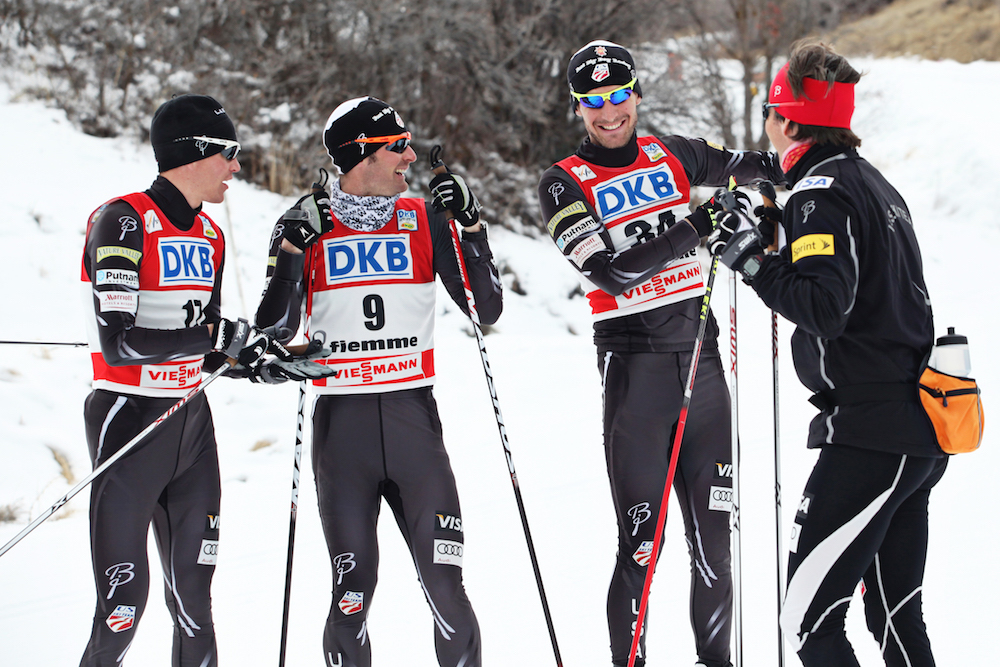
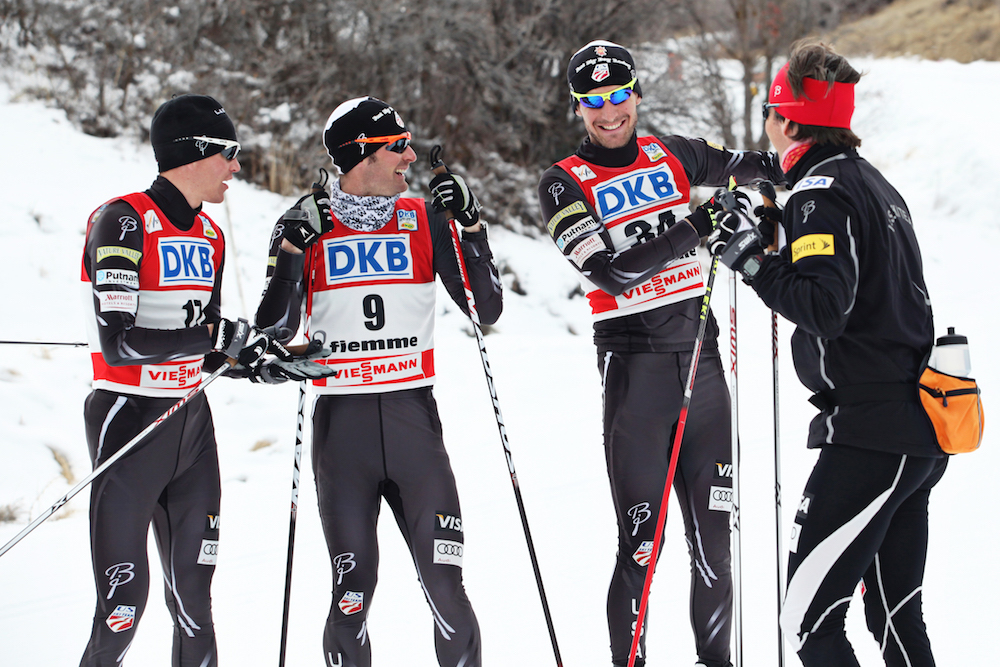
    U.S. Nordic Combined’s 2011/2012 team members (from left to right) Billy Demong, Bryan Fletcher and Taylor Fletcher with head coach Dave Jarrett at Soldier Hollow in Midway, Utah. (Photo: USSA)

    Listed at the bottom of a U.S. Ski & Snowboard Association (USSA) press release announcing U.S. Nordic Combined Head Coach Dave Jarrett’s retirement are his coaching highlights. It’s a long list defined by two things: Olympic and World Championship medals and longevity. Jarrett will forever be linked with the iconic names of U.S. nordic combined, including Billy Demong, Johnny Spillane and Todd Lodwick. His coaching legacy rewinds back to the 2002/2003 World Cup season.

    Before that, as a nordic-combined athlete, Jarrett was a member of the U.S. Ski Team from 1992-1996 and is a two-time Olympian. He’s a lifer. And for lifers, separation from what they have always known remains difficult.

    “I have been doing it a long time both as an athlete and and a coach,” Jarrett, 46, told FasterSkier on the phone. “It is now of those things where all of sudden it hits you, like, you are tired. You’re not able to go give everything and do everything. And certainly, it’s hard to justify a lot of time on the road. Missing family things, but also on the athletic side you are not able to give to the athletes everything that you need to give.”

    Until 2014, USSA managed the U.S. Nordic Combined Team. The team is now run by USA Nordic, yet Jarrett’s position has remained under USSA’s umbrella — they continued to pay his salary. With the 2014 split, Jarrett’s responsibilities grew as he took on both coaching duties as well as some of the logistics of running a team.
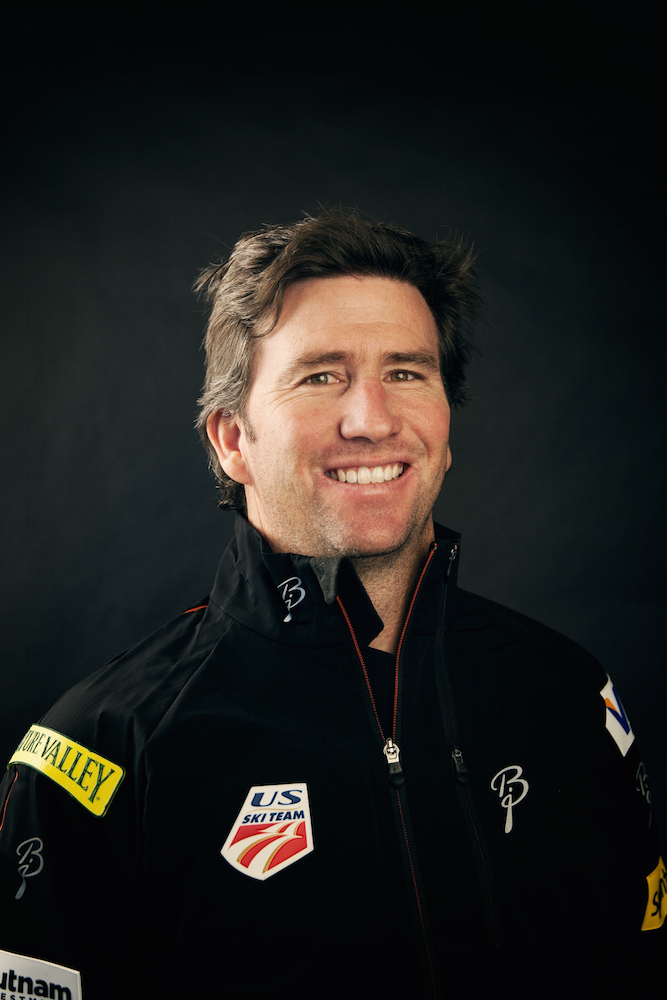
    Dave Jarrett, head coach of U.S. Nordic Combined, during the 2013/2014 season. (Photo: USSA)

    “Honestly, it’s amazing he lasted as long as he did,” U.S. Nordic Combined A-team member Bryan Fletcher said on the phone from his home in Park City, Utah. “He’s definitely a trooper, for sure. It was pretty intense because he was still employed by USSA and still had bosses there, but he also had bosses on USAN and had obligations on both sides of the coin. That combined with continuing his education research for coaching stuff, it adds up quick. And then doing all the travel logistics for not only World Cup but for World Cup and B-team and then having to be there in person, it was insane.”

    Taylor Fletcher, another longtime U.S. Nordic Combined athlete and Bryan’s younger brother, also noted the stress on Jarrett.

    “He had definitely been challenged … he had to go from a full-time coach to a full-time coach and a team manager,” Taylor explained on the phone. “He was in charge of doing a lot of the fundraising, and all the aspects to keep our sport alive in the U.S. And that really took a toll on him and that was definitely difficult on all of us. But also, I think it put way more weight on his shoulders than he really needed.”

    Diminishing funds correlates to increased non-coaching responsibilities for coaches, less on-snow time and more connecting the non-competitive dots for athletes. Jarrett weathered that type of job description metamorphosis. Ski coaching at the elite international level is an all-encompassing life, and he lived it for 15 years.

    “For me and my wife, we got married while I was still an athlete and so this is a lifestyle, the only lifestyle we have ever really ever known,” Jarrett said. “Both of my children were born in 2002 and 2004. Again this is a lifestyle that’s all they have ever known.”

    Demong, USA Nordic’s executive director for the last year, has spent nearly his entire international-skiing career under Jarrett’s wing. The two became teammates back during the 1996/1997 season when Demong bumped up to national-team status.

    “DJ had a good understanding of physiology, so he and I bonded over that in the beginning,” Demong said. “Especially given the fact at the time we had a really good team culture developing but we didn’t have the physiological expertise in our training programs and that sort frustrated both us. So we sort of found a commonality there right out of the gate.”

    After completing his competitive career, Jarrett went on to earn a degree in exercise physiology and kinesiology from the University of Colorado. He was able to bring his education into play as he joined the coaching ranks.
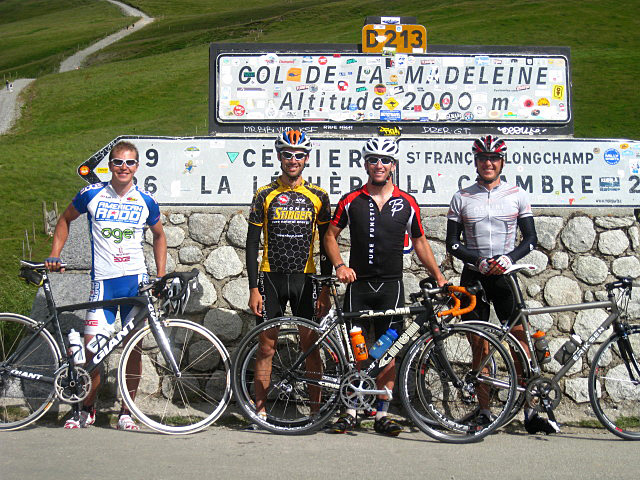
    The U.S. Nordic Combined team takes a break at the top of the Col de la Madeleine during a 2009 training camp in nearby Courchevel, France. From left to right: Bill Demong, Johnny Spillane, coach Dave Jarrett, and Todd Lodwick (Photo: USSA)

    “When he came back to coaching it was really a breath of fresh air,” Demong said about Jarrett’s academic and nordic-sports knowledge. “We had built this great culture and were all working really hard, but we still didn’t have the plan training-wise that I felt we needed.

    “Going back to my high-school running days, we peaked when we wanted to peak for states and federations, and when we were doing our nordic training I felt like we were sort of doing what other nordic-combined skiers did, which was get up, ski, or get up, go jump, have lunch, go ski, go home,” he continued. “And DJ brought a ton of new ideas and concepts that he had learned in school as well as from networking with other sports. DJ really helped pioneer a lot of things on the physiological side and take our team from good culture, talented hard working athletes, to champions.”

    Jarrett plans to open a strength and agility center in Heber, Utah, where he lives with his wife and children, the youngest of which will be entering eighth grade; his oldest will be a freshman in high school. As with any change, he said he looked forward to what the opportunity might bring and remaining close to his family. Yet looking back, Jarrett said he’d miss the small daily aspects of the sporting life.

    “It’s the everyday victory I’ll miss,” Jarrett said. “I’m psyched to see the work that the athletes are putting in. The work that the coaching staff are putting in to see those everyday victories — those personal best, in testing, first time getting Continental Cup points, or first time getting World Cup points, or a World Cup podium. You can say the hardware is why you do it for sure, but I will miss is the everyday camaraderie and training.”

    U.S. NoCo Moving Forward

    Demong said the program remains stable heading into an Olympic season; Jarrett had been discussing a transition for the past several seasons.

    “It had been something that has been on my radar for awhile and DJ certainly communicated early enough for me to to start planning, and quite honestly, we do have a good safety net,” he said.

    U.S. Nordic Combined Assistant Coach Martin Bayer will step into the role of head coach. Bayer hails from the Czech Republic and began coaching domestically in the U.S. in 2000. He is currently based in Planica, Slovenia.

    Demong said Bayer is entering this position with the institutional knowledge to make the coaching change seamless.

    “Martin has worked his way up through the club system to the development team coach,” he said. “He has basically coached everybody onto the national team with the exception of Bryan, who is just a little bit older. So he has already a great relationship with all the athletes that are on the team. He knows all the athletes in the pipeline. …  He knows the environment and he is familiar with how we operate, and there is a level of trust both from my end and with the athletes.”

    Nick Huber will remain the program’s head ski-jumping coach. On the cross-country side of the sport, former U.S. national-team biathlete Jeremy Teela is advising the team. “He has agreed to come in and help us with domestic cross-country coaching and plan writing,” Demong said.

    Jon Schafer, who had been U.S. Nordic Combined’s high-performance director for the last year, has also stepped down.

    Jon is a great and a good friend and very very exceptional high-level strategic thinker,” Demong said. “I think our organization is not at the point right now where we can take advantage of his talents and capacities fully, and quite honestly, we just need more boots on the ground. At this point, we are not going to fill that position. He has, however, written us a very detailed plan that we will be using as a road map going forward. It is a living document. For us, it is like everything from recruitment to medals and everything in between as it relates to coaches, education, and national-training centers.”

    A business executive, Schafer brought management experience to USA Nordic, and on the sporting side, he was previously an elite-level rower and coach.

    “My decision to step down was a very difficult one and one that I most certainly did not take lightly,” Shafer wrote in an email. “I loved working with the athletes and even after my departure, I am still very concerned about their success. It can be very difficult working in an environment of highly constrained resources, in particular with almost no support from USSA.

    “Every position or idea simply cannot be funded and every shot has to be a kill,” he continued. “People are going to disagree about the best ways to spend highly limited funds and the tighter the budget, the harder it is to balance all of the different agendas. The organization has a lot of operational needs and the executive director and a few members of the board felt it was more important to have staff selling t-shirts, writing newsletters, marketing copy and other very ‘boots on the ground’ tasks, than a High Performance Director setting strategy and working with coaches and athletes at a higher level. I disagreed with this approach and since they couldn’t afford both, I tendered my resignation. I think this move is good for everyone, as the overall organizational dynamic proved to be a bit too bruising and tumultuous for an honest, easy-going, soft-spoken Midwest boy like me. I want to be very clear here too — my departure was a smooth and respectful one on both sides and I wish them nothing but the best.”

    Always the jokester, Schafer (FasterSkier’s gear-review guru) added, “One big upside of this change for me too, is I now anticipate having much more time to write about how long you can wear your underwear without washing it. And perhaps teaching my Great Dane to finally respond to his name.”

    The U.S. Nordic Combined team will meet in early May for an all-team camp, which will include all staff and any athlete with a chance of qualifying for the Olympics.

    “It’s really going to be focused on learning more about ourselves, learning more about each other, learning how to communicate better and be tougher,” Demong said of the camp.

  • NoCo Athletes Jump on “Drive for 25”

    NoCo Athletes Jump on “Drive for 25”

    National Training Group
    The U.S. Nordic Combined National Training Group poses for a team photo at the top of a mountain near Strbske Pleso, CZE, in early August. At bottom, Michael Ward (L) and Adam Loomis (R). Top, left to right, Erik Lynch, Cliff Field, coach Martin Bayer, Tyler Smith, and Steamboat Springs Winter Sports Club athletes Ben Berend and Aleck Gantick. Photo courtesy of National Nordic Foundation.

    When Cliff Field met his parents for dinner in Steamboat Springs, Colo., last weekend, the family of three knew the discussion wouldn’t be easy.

    A few days earlier, Field had stumbled on his mother’s quotes in a Steamboat Today article about his nordic-combined National Training Group. The focus was the team’s financial status following the budget cuts handed down by the United States Ski and Snowboard Association (USSA) this year. The underlying reality was that Field’s future in the sport was at stake.

    “I think it was when he read the article online and saw my comment about us being $60,000 in debt,” said his mother, Susana Field. “And he said, ‘Well, what am I doing in this sport? Why haven’t you told me? I can just quit the sport right now.’ ”

    Susana said she broke down crying at the table. She explained to her 19-year-old son that they wanted to make it work, but could no longer afford to do so.

    Nordic Combined NTG
    Nordic Combined NTG members Michael Ward (L) and Cliff Field (R) sit at the top of a ski jump. Photo courtesy Cliff Field.

    Since Field started competing internationally the summer before ninth grade, Susana and her husband, John, had spent some $35,000 a year on keeping him in the sport. They not only exhausted their savings, they maxed out their credit lines.

    Speaking on the phone from her new home in Rangely, Colo. — about 2 ½ hours from Steamboat Springs — Susana said she was humiliated and embarrassed, but knew the importance of her family’s story. If they were struggling, other athletes’ families must be as well.

    Back in 2006, Susana and John Field left their custom-cabinet business for other careers; Susana became a real-estate agent and John went to school in Rangely. Meanwhile, Susana battled breast cancer, and as the medical bills piled up, her son went higher in the sport — winning multiple junior-national titles.

    She stayed in Steamboat to keep Field in the Steamboat Springs Winter Sports Club, but upon his graduation from high school last spring, she relocated. He stayed alone in the family’s former home — a rental unit Susana described as a trailer — and his parents visited when they could.

    Looking ahead, Susana said they might have to sell that property.

    “I know there’s some locals that think, ‘Oh, these are just rich kids that are flying over to Europe,’ ” she said. “But we haven’t put our hands out before. We did take the financial burden, and we just can’t anymore.”

    Without money left for college tuition, Field was considering the military.

    “It definitely ups the ante as far as what I’m going to do with my life if this doesn’t work out,” he said. “If we can’t find money, I’m probably not going to be able to go on with this sport.”

    But for Field, who took some college classes with teammates while in Steamboat Springs this summer, the military may not be an option because he had asthma.

    “I’m kind of just taking it as this season right now,” he said. “But it’s also like this is the last time I might be able to do something cool.”

    Field said he used that as motivation to keep improving and hopefully make the U.S. Ski Team (USST), with just seven men between the A- and B-teams this season.

    Their Own “Drive for 25”

    Without any financial support from the USSA, some of the four other members of the National Training Group (NTG) — which was essentially a development or D-team — struggled to hang on as well, Field said.

    Like the B-team athletes they trained with, some found accommodating jobs in Steamboat Springs. Others, like Field, found it difficult to work regularly between year-round trips to Europe.

    For most of the athletes, their parents picked up the tab.

    Steamboat Springs
    U.S. Nordic Combined NTG and Steamboat Springs Winter Sports Club athletes training on rollerskis. Photo courtesy of Cliff Field.

    A former national team member with a 17-year-old son on the NTG, Kerry Lynch took it upon himself to lead the fundraising efforts. In an email, Lynch wrote that given the relatively small size of nordic combined, the sport faced inherent challenges. Especially at the development level, volunteer help was critical.

    “Parents, families and private funding sources cannot be the sole funding mechanism for the developing athletes,” Lynch wrote. “That is not a long term model for success.”

    He explained that while those at the top of the sport received adequate funding to compete in the World Cup, those below them had to figure out how to pay for travel, equipment and club costs. Although the financial challenge of nordic combined in the U.S. was nothing new, Lynch wrote that the struggling economy made things worse.

    In an effort to offset about $250,000 in annual NTG costs, especially with travel, Lynch recently met with fellow National Nordic Foundation (NNF) board members to piggyback off a fundraising idea. Not long after the USST cross-country coaches Matt Whitcomb and Pete Vordenberg innovated the “Drive for 25,” urging skiers to donate $25 to the sport on Nov. 15, the NNF was happy to create a similar donation link online for nordic combined.

    A few weeks after U.S. Nordic Combined launched its own “Drive for 25,” the website showed it had raised more than $20,000 for development athletes. And that wasn’t including checks that had been mailed in, said NNF director Dave Knoop.

    “This has just been the most gratifying thing,” Knoop said of both the cross-country and nordic-combined fundraisers, which were ongoing and would accept donations well after Nov. 15. “It’s not the amount. … Getting the participation or the awareness out there is equally as important as getting the donation.”

    If not for outside assistance, athletes like Erik Lynch, who was still in high school, said they wouldn’t be able to afford competing with the best skiers in Europe.

    “There are supportive people in the skiing community who are donating now more than ever,” Erik wrote in an email. “Because of the recent financial support, I’m years ahead of where I would have been without outside funds. I have been able to achieve my yearly goals some said were unrealistic.”

    In August, Erik made his World-Cup debut at the Summer Grand Prix in Germany, where he finished 52nd.

    NTG, Ramsau, Austria
    The U.S. Nordic Combined NTG with members of the Steamboat Springs Winter Sports Club in Ramsau, Austria, in August. Photo courtesy of Martin Bayer.

    It’s Not All Gravy

    While the ultimate goal for NTG skiers was to make the national team and receive more support, the road ahead wasn’t much easier, according to NTG head coach Martin Bayer.

    USST members not yet on the World-Cup level had to pay their own way in the Continental Cup, he said. That could include three B-team members this year.

    “It has changed,” Bayer said. “In the past, (the nordic-combined USST) had 10 guys that were fully supported everywhere they went. Every year it’s worse.

    “Even with the results, you saw what happened in Vancouver,” he added, referencing the gold and silver medals the U.S. nordic-combined team won at the 2010 Olympics. “And the budget got cut.”

    Understanding the situation and working within it has been the solution, according to U.S. Nordic Combined Head Coach Dave Jarrett.

    “We don’t have an alternative, good or bad,” Jarrett said. “We just ski.”

    Without the option to pursue nordic combined in college, junior athletes have to hold off on education while chasing the elite ranks of their sport. Some, like Field, wait several years to be named to the national team. Because U.S. Nordic Combined tends to move athletes up in groups, the development team remains in limbo.

    “Kind of our M.O. is to get the group together, put them in residency from an early age, high-school age, and move them forward,” Jarrett said. “This NNF support is what’s going to enable them to continue skiing and be a full-time athlete.”

    As for the sport’s expenses, Bayer pointed out that it’s no more than some other sports at that level, such as alpine. As for its finances, Jarrett said it was no worse than it had been. Fundraising wasn’t needed to sustain the sport in the U.S., it was meant to invest in the younger generations, he said.

    “There was a time when you were on the ski team and you were getting some kind of stipend to be in residency,” Jarrett said. “That went away years ago. It’s not any more dire than it has been, it’s just that in some parents’ cases, maybe it’s more dire.”

    He referred to the specific case of U.S. men’s ski jumping, which operated without USSA funding, and said that was what nordic combined wanted to avoid.

    “Our funding goal is to endow our sport so that if that, in fact, ever happened to nordic combined, we would be in front of it,” he said. “You never know what’s around the corner. The pie hasn’t gotten any bigger, and there’s more pieces to be divided.”

    While the U.S. Nordic Combined athletes and its NTG continue to work for national recognition — most easily won by Olympic and world championship medals — they continue to support themselves. In Steamboat Springs, several future Olympians can be found bussing tables or working in warehouses. According to Bayer, Adam Loomis squeezed in shifts at an Italian restaurant, serving food from 10 a.m.- 3 p.m. between morning and evening practices.

    “By the end of the day, they’re tired kids,” Bayer said.

    While Field worked part time at the town’s alpine slide last summer, he also rehabbed a badly sprained ankle on his own. Ever since a $2,000-medical bill forced him to stop physical therapy this fall, Field had been self-treating with ibuprofen and resistance bands.

    “It’s kind of beyond icing,” he said. “You need flexibility in your ankle to ski jump, and it doesn’t have the flexibility that I would like. Hopefully it will come back before we get into the world junior competitions.”

    For now, that was his focus: one step and one season at a time.

    ***

    To support nordic combined and cross-country athletes in the “Drive for 25,” visit the NNF website and click “get involved” under each fundraiser.


  • USSA Nordic Combined Juniors Train in Europe

    Here is the summary of the recent training trip to Europe for some top U.S. NC Juniors.

    First, let me explain why we recommend a trip to Europe in the summer. There are several important reasons:

    The majority of the World Cup and Continental Cup (COC) events are held in Europe. It is important for aspiring WC & COC athletes to travel in Europe, to experience the time changes, different languages, foods, cultures, climates and lower altitudes. Air pressure at lower altitudes is more prevalent than at high altitudes. The athletes need to experience ski jumping at lower altitudes to learn to adjust their flying techniques to more air pressure. If they don’t learn this, they will be at a disadvantage when they compete in competitions in Europe. With more air pressure, jumpers use less in-run speeds, so it is also critical that jumpers learn to jump with less in-run speeds. Also, it is important to jump on many different ski jumps and learn to adapt jumping techniques at each ski jump. Ski jumps are all different with the steepness of the in-run, the radius into the takeoff, height over the knoll, pitch of the landing radius of the landing, and the like. It is critical to learn to adapt ski jumping style to all types of jumps. We jumped on 5 different ski jumps during the trip.

    After arriving in Munich, GER on Wednesday, Aug 4, we started the trip in Zakopane, POL. The drive that should have taken around 8 ½ hrs, ended up being over 10 hours. We arrived at the Tedeaus Lodge after 9pm and devoured a pile of crepes before collapsing into bed. The lodge was small with 19 rooms and it was packed with 50+ raucous ski jumpers.

    The next morning we went to the Sports Centrum near the ski jump complex to work out the kinks of traveling. I took the boys on a run. In the afternoon, we had our first ski jumping session on the K85 meter. Each athlete has areas to work on to improve their technique. The ski jump is accessed by a lift and the guys got in 7-8 jumps each. After jumping, we headed back to the lodge to view videos and get ready for the next day.

    As the week progressed, the jetlag faded and the boys settled into a productive working routine. There were other teams training as well including some athletes from Norway, Russia & Slovenia. The level of the jumping was high so it was good for our guys to train with other good ski jumping talent.

    Sunday morning, Aug 8th, the boys did a roller ski interval workout. We found a narrow, winding road with a gradual uphill that appeared to be sparsely traveled, except we forgot to factor in the church commuters. We still managed to get in a solid workout. Sunday afternoon was off, so the boys were free to get in some downtime after lunch then peruse Zakopane if they wanted.

    Monday, Aug 9th, we drove to Strpke Pleso, SVK for a double jump session on the K90, the 3rd jump hill in a week. The drive was about 1hours each way. The jumping went well and it was a good plan to practice there. We were the only team training that day. So, the guys got in some quality jumps, about 14-15 on the day. In the last round, we had a one round competition, distance only. It was fun as there was a 3 way tie for the long ride of 95 meters between Cliff, Erik & Chanon, but each athlete was over 90 meters!

    Tuesday, Aug 10th, was our final jump session on the K120 in Zakopane. The boys got in over 45 jumps on the week! We did a roller ski/run combo in the afternoon combined with some core strength then packed up for our next trek. We really felt our stint in Zakopane was very productive, priced right at only 20 Euros a day for room & board, and as economical as it gets.

    Wednesday, Aug 11th, we drove to Kranj, SLO. The drive time was around 8.5 hours. We checked in then headed to the local school to use their sports field for a little recreation and loosen up after the long day in the vans.

    Thursday, Aug 11th, the boys trained on the 4th different jump, once again, trying to adjust to a new facility. This is similar to what they will experience on the WC or COC circuits, having to adjust to new and different ski jumps on a regular basis. After taking 7-8 more jumps with athletes from other teams, we headed to a cross country complex about an hour’s drive away and about 1,500 feet higher in elevation. The cross country facility has about 2km of paved trails over rolling terrain and the road in is over 7km also rolling but mostly uphill. It was a great place to roller ski with light traffic and athletes from other teams. On the way back, we stopped to jump in the glacier fed waters of Lake Bled.

    Friday, Aug 12th, was a repeat with a jump session in the morning and a roller ski in the afternoon, most of which was in the rain. While the boys were soggy, they are worked hard thru the wet conditions and the day was still productive.

    Saturday, Aug 13th, was another morning jump session followed by a steady state cross country workout. By Saturday afternoon, we could tell the guys were ready for a break from jumping.

    Sunday, Aug 14th, we did an interval workout and the afternoon was “off”. I took the crew to Bohinj, a national park with another glacier fed lake above Lake Bled.

    Monday, Aug 15th, we headed to Villach, AUT, about an hour’s drive away for a double jump session (the 5th hill we trained on).At the jump complex in Villach, there were teams from Hungary, Turkey, and a few local kids from the local club. The ski jump is a K90, a high flier and it was another good jump for training.

    Tuesday, Aug 16th, was our final morning of jumping back on the jump in Kranj. We were joined by the Russian Nordic Combined A & B teams. It was the most chaotic day on the jump with so many athletes there, but that is how is will be on the competition circuit, so we felt it was one of the best “reality” days of training. After jumping, we headed to the hotel, packed up, had lunch and were on the road by 1pm commuting to the Movenpick Hotel by the airport in Munich.

    I feel like this trip was very successful & productive. Each athlete improved and gained valuable experience as they continue to pursue their quest to compete on the COC in December and the World junior championships in January.

    Coaches:

    Martin Bayer & Kerry Lynch, Steamboat Springs Winter Sports Club

    Athletes:

    Cliff Field, Steamboat Springs Winter Sports Club

    Erik Lynch, Steamboat Springs Winter Sports Club

    Michael Ward, Steamboat Springs Winter Sports Club

    Aleck Gantick, Steamboat Springs Winter Sports Club

    Adam Loomis, Steamboat Springs Winter Sports Club

    Jake Barker, Steamboat Springs Winter Sports Club

    Tyler Smith, Park City Nordic Ski Club

    Chanon Pretorius, Canada

    Source: USSA