From the FasterSkier archive — posts syndicated from athletes’ and coaches’ own blogs between 2004 and 2012, kept online as published. Current coverage is at fasterskier.com.

Tag: Martin Fourcade

  • Martin Fourcade Nordic Festival Draws Big Crowds in Annecy, France

    Martin Fourcade Nordic Festival Draws Big Crowds in Annecy, France

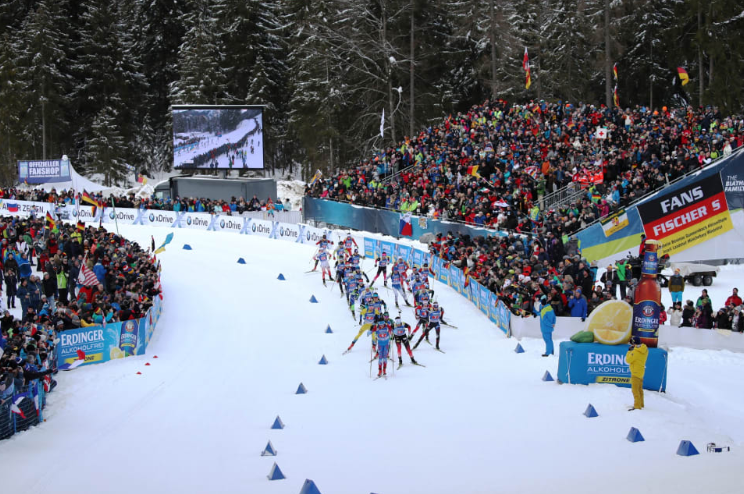
    Enthusiastic fans fill the stands for the Martin Fourcade Nordic Festival.

    Nordic festival are two words most North American ski fans can only dream about. Skinny skiers here are unlikely to experience the reality of such an event for themselves unless they make a trip across the Atlantic. For residents of France, the opportunity to participate in the second edition of the Martin Fourcade Nordic Festival presented itself this weekend and there were many eager attendees. This lucky expat was among the masses.
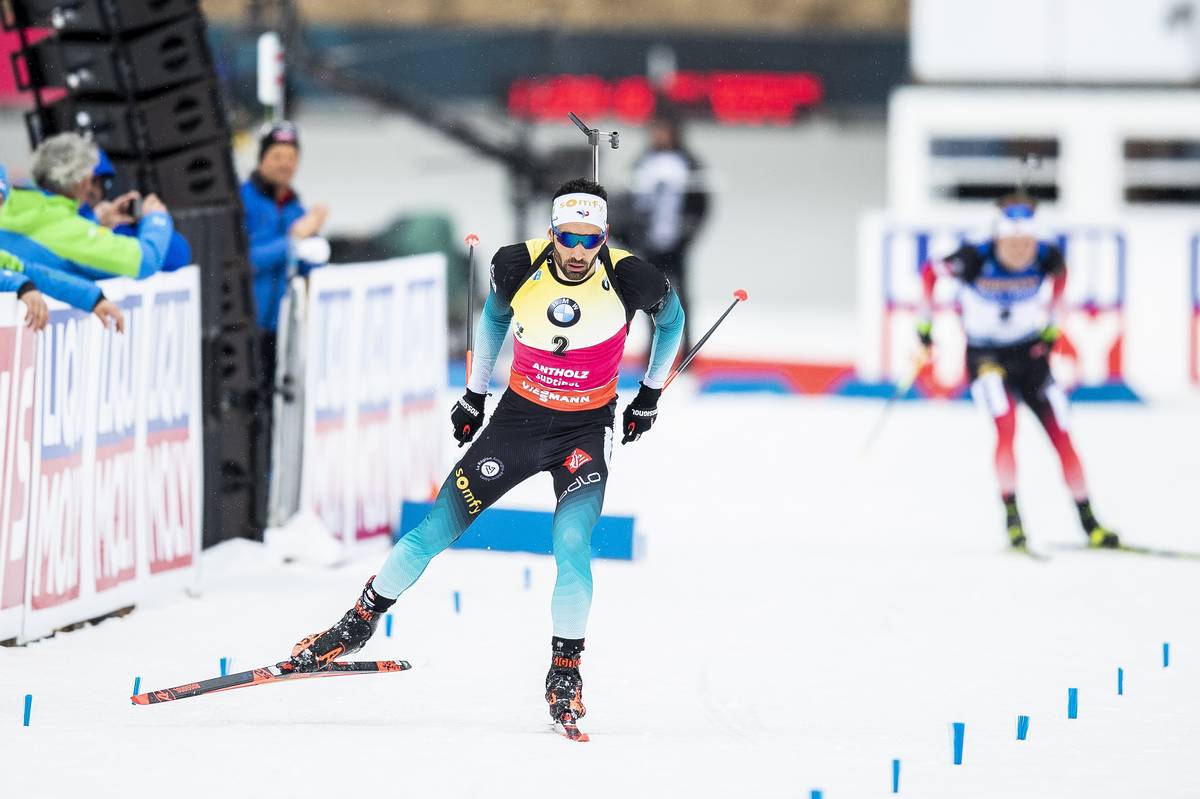
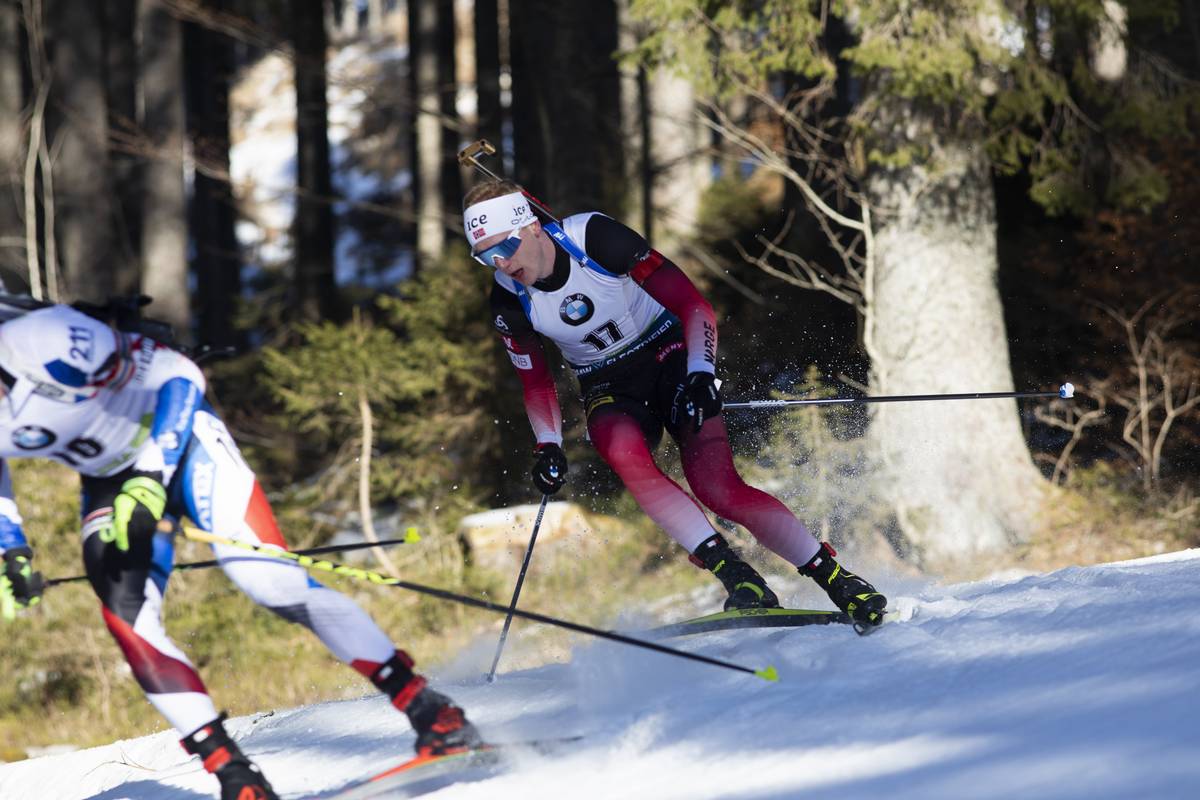
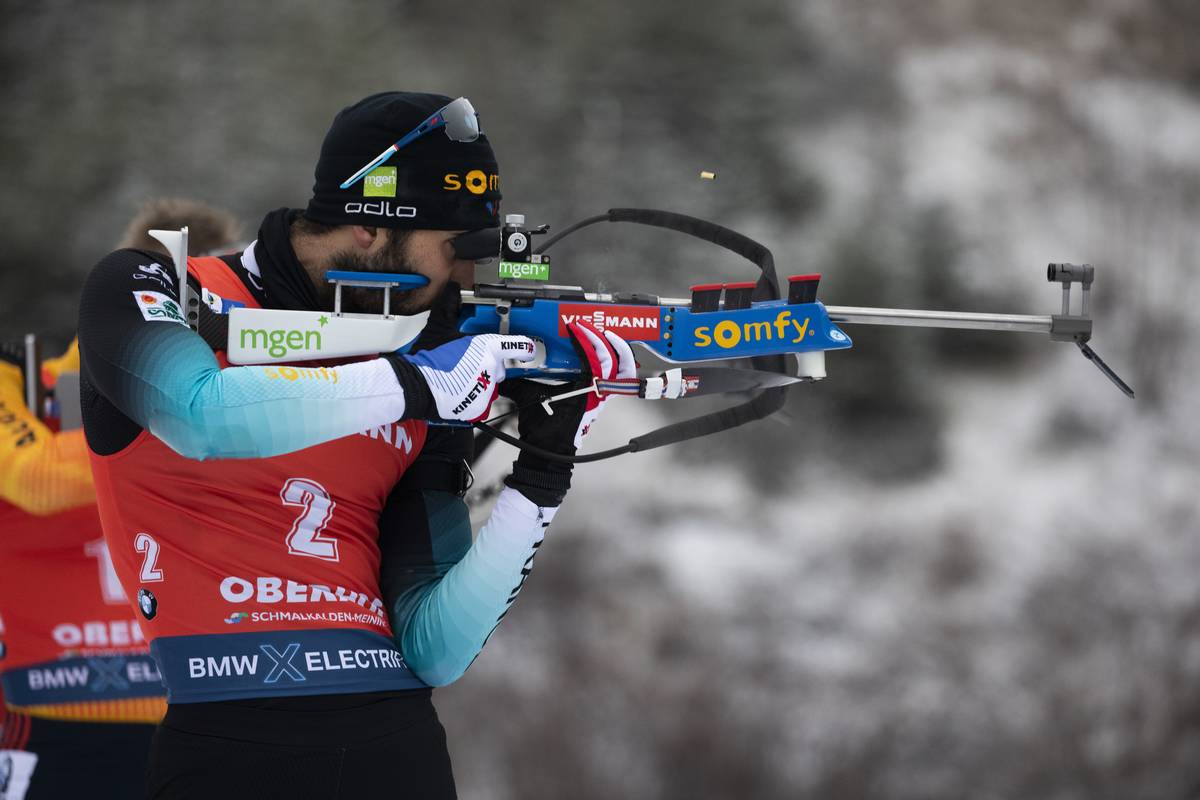
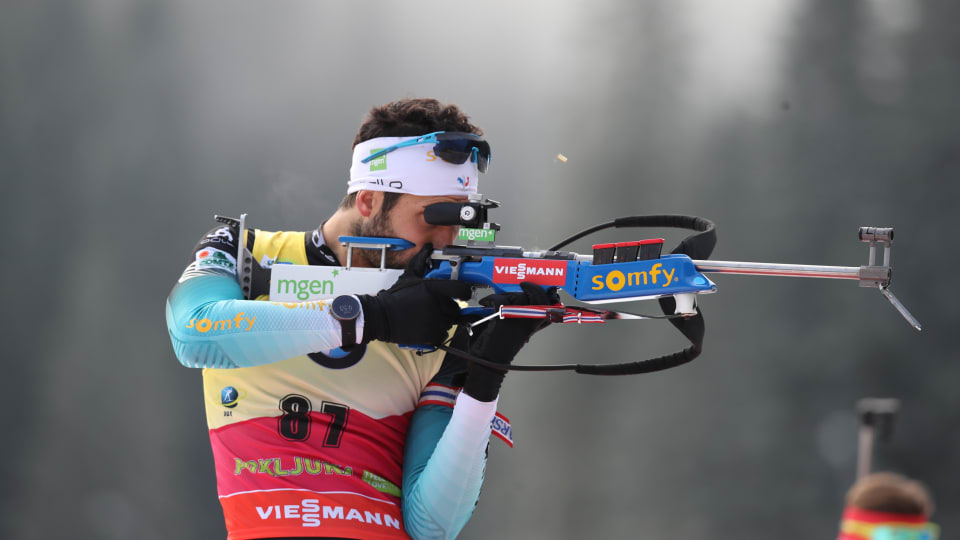
    Martin Fourcade (FRA) IBU world championships biathlon (Photo: NordicFocus)

    For those unfamiliar with the name, Fourcade retired from biathlon competition in March 2020 after a very successful career, including five Olympic gold medals and thirteen World Championships titles. He is the most successful French Olympian of all time and is celebrated as a beloved hero in his home country. Anywhere he went this weekend, he was accompanied by cheers and a train of fans hoping for autographs, handshakes, or photos. 

    The festival stretched over three days, beginning Friday, September 3rd and wrapping up on Sunday the 5th. Located in Annecy, in the Haut-Savoie department of France, the stadium sat facing the electric blue water of Lac d’Annecy, rimmed by limestone bluffs.

    It’s difficult to imagine a better setting for drawing crowds than the park Le Pâquier, which is right downtown and runs along the popular bike path that circumnavigates the lake. Indeed, the place was bustling with spectators all weekend long, both paying customers and those stopping by, drawn along the fence by all the commotion.

    Tickets cost €33 (about $40), and were sold out before the event began. As evidence, several posts were made in the days leading up to the festival on the French nordic Craiglist-esque site, searching for available tickets. 

    In addition to tickets, to enter the venue one needed to present their pass sanitaire, essentially a health passport in the form of a QR code which proves either you’ve been vaccinated, had a negative COVID test in the last 72hrs or, recovered from COVID in the last 11 days to 6 months. Furthermore, masks were required, even though the event was taking place outdoors where typically masks are not required in France. 
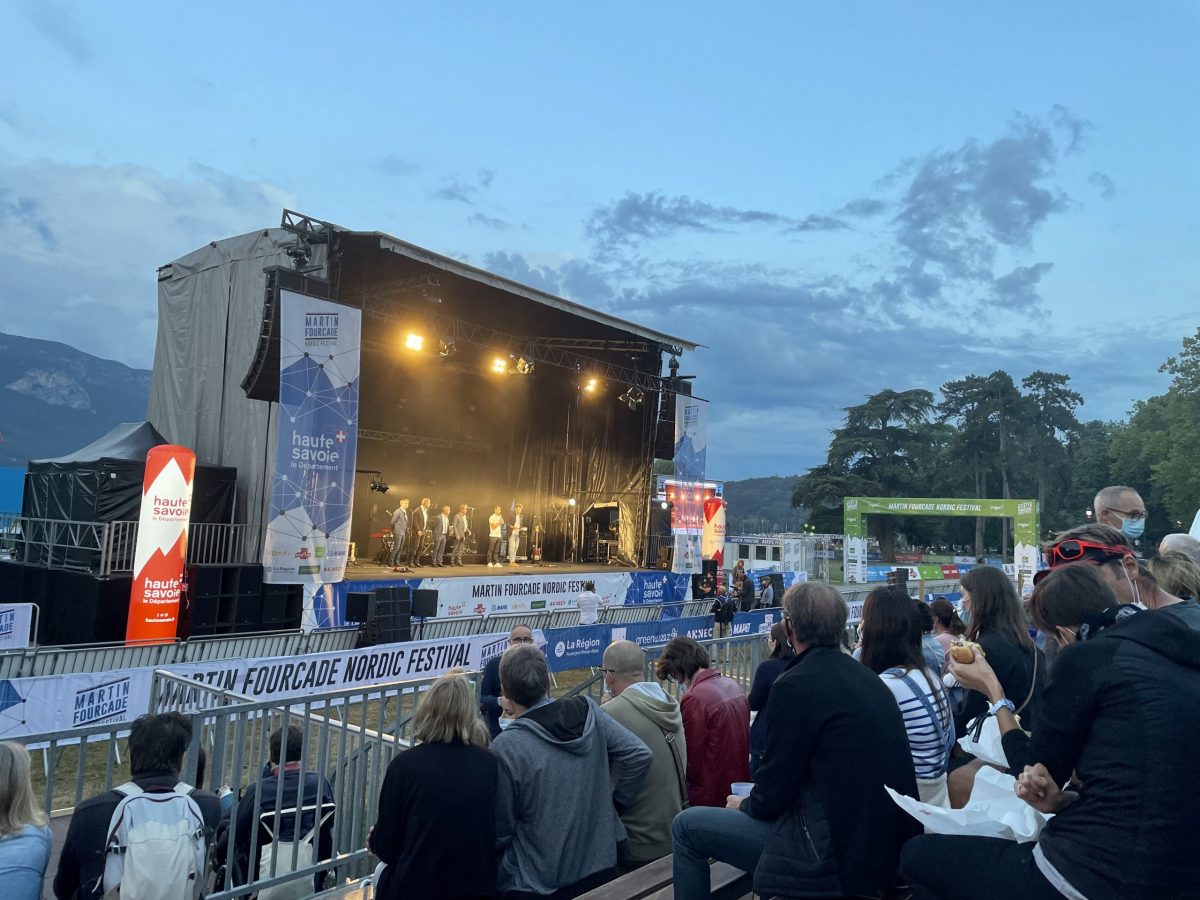
    Kicking off the weekend with the presentation of the athletes on Friday evening.

    The festivities kicked off in earnest Friday night, beginning with a presentation of the athletes on stage. While 30 international athletes had been recruited to the event, not all were able to make the journey. Many French national team members were present, both biathletes and cross-country racers, including: Richard Jouve, Renaud Jay, Delphine Claudel, Julia Simon, Anais Chevalier-Bouchet, Antonin Guigonnat, and Quentin Fillon-Maillet.

    As for the international contingent, some notable names in attendance were: Tiril Eckoff (NOR), Johannes Dale (NOR), Sturla Laegrid (NOR), Oskar Svensson (SWE), Jovian Hediger (SUI), Nadine Faendrich (SUI), Laurien van der Graaff (SUI), and Emma Ribom (SWE). 

    Following the presentation of athletes, a concert featuring Gaëtan Roussel, a well-known French musician drew quite a crowd and provided the festival with quite a lively start, setting the tune for the rest of the weekend. 
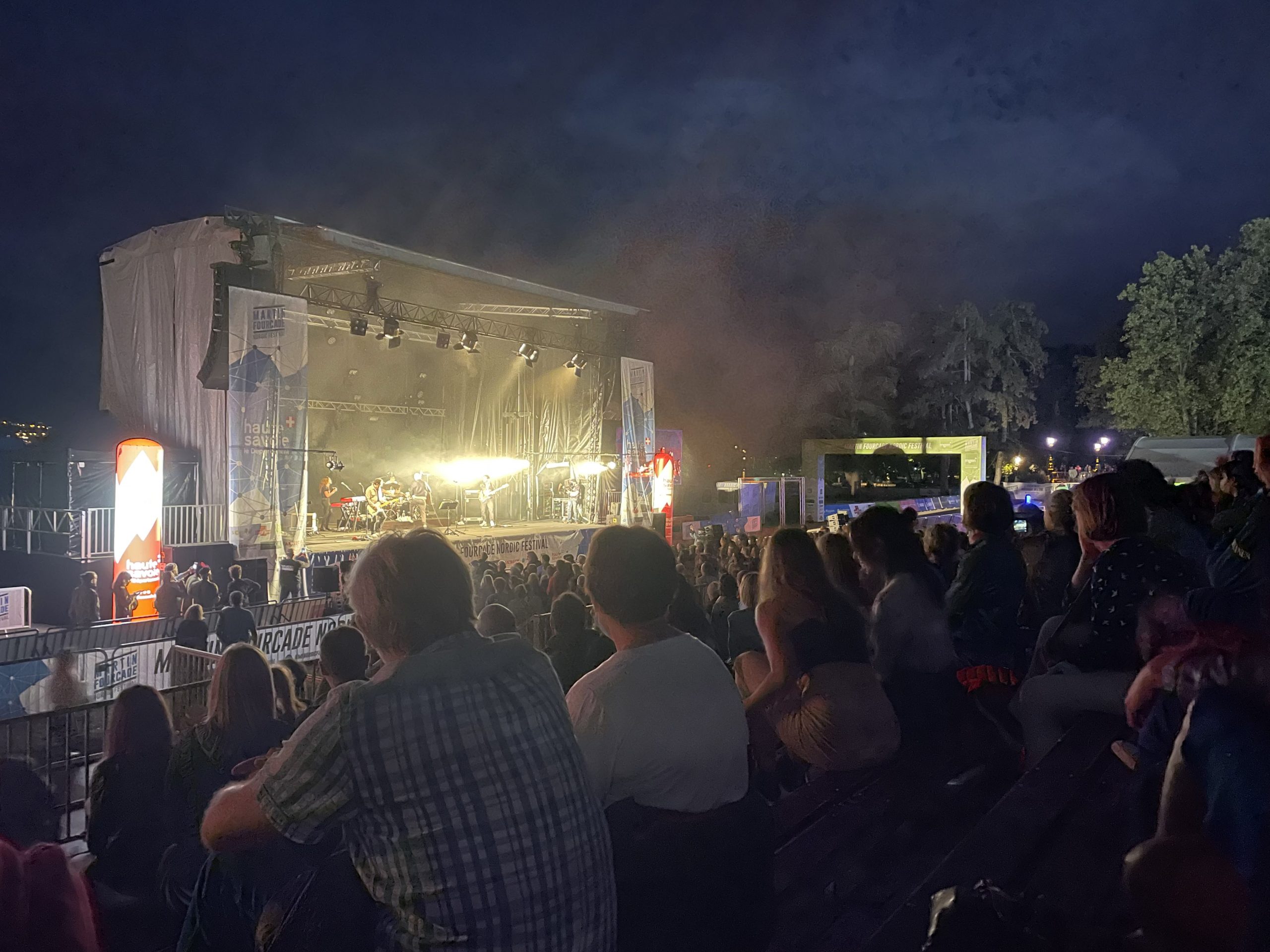
    Gaëtan Roussel in concert, Friday evening.

    Saturday started with the exposition village opening, a circle of vendor tents featuring nearly 60 brands, food and drink options, and shops. Attractions included, virtual biathlon, ski-erg competitions, and athlete appearances.

    Lines at both the Fischer and Salomon tents stretched for quite a distance as athletes patiently sat for hours, signing autographs and taking photos with fans. Not only were famous nordic athletes present, but recent competitors in the Ultra Trail du Mont-Blanc mountain running series, such as Camille Bruyas who took second place in the storied 170 km full tour around Mont-Blanc, and Thiabuat Beronian who finished 3rd in the 100 km “CCC”. These events both end in Chamonix.
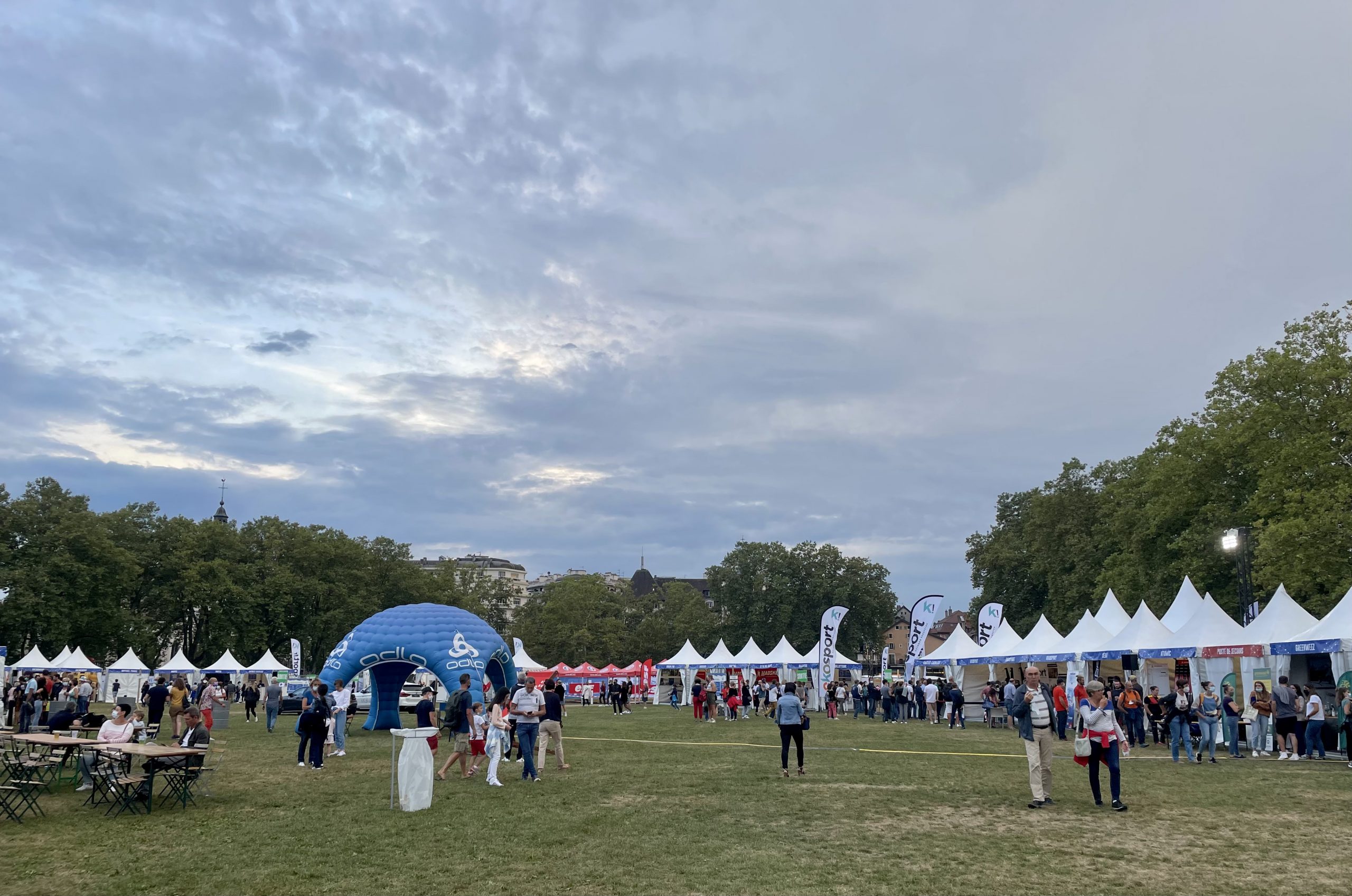
    The exposition area, filled with vendors (pictured here Friday evening).

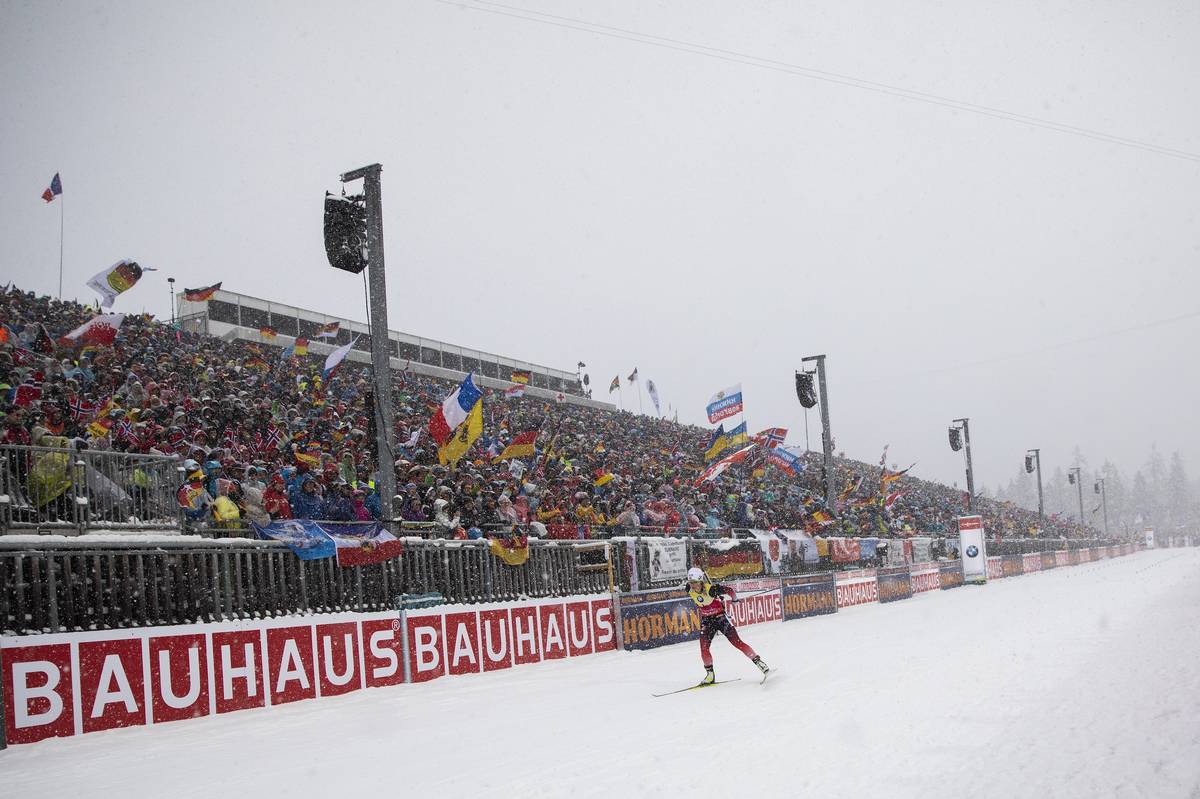
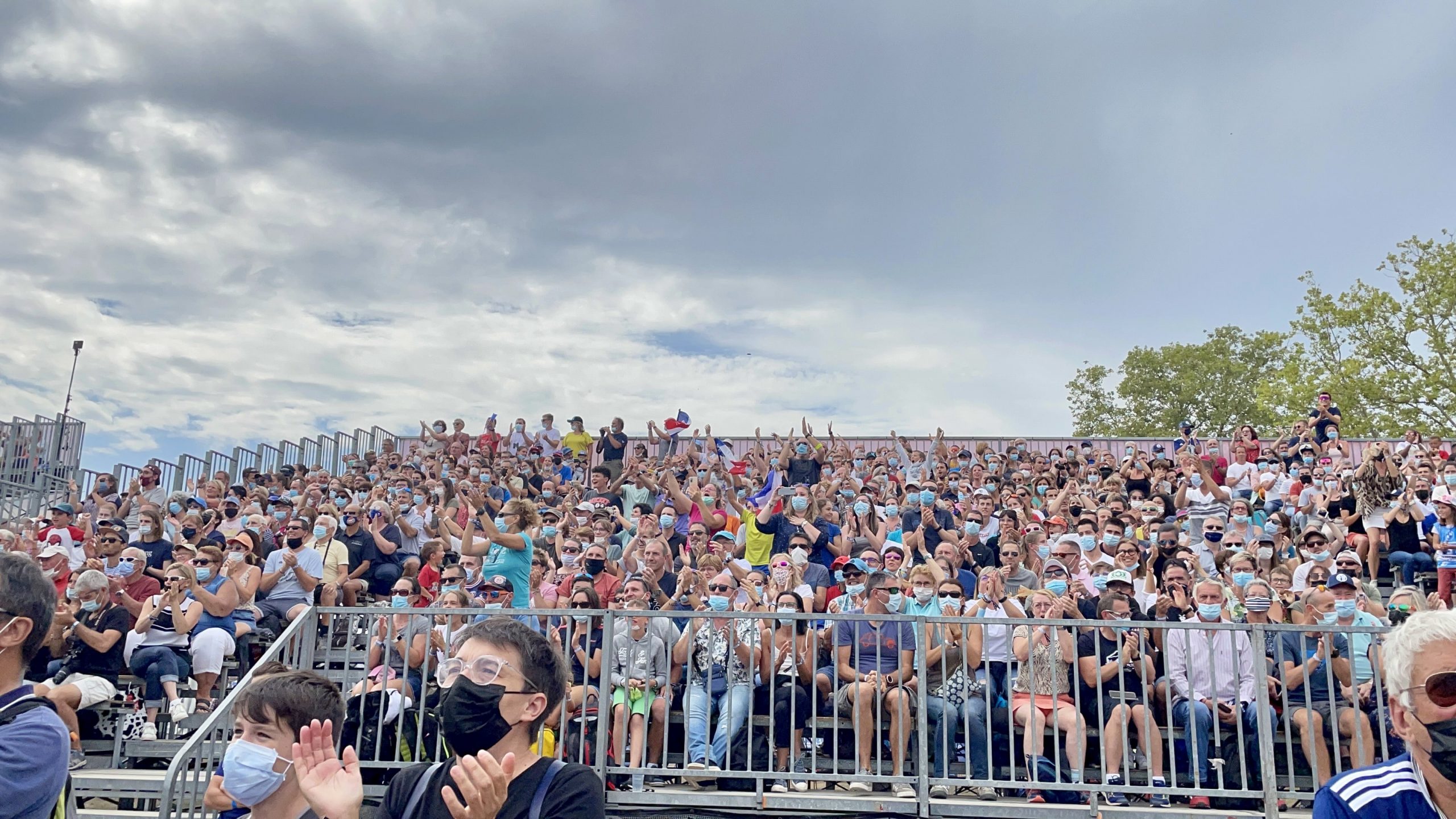
    Gradually, the crowd began to shift focus towards the stadium, as athletes started warming up for the afternoon show races. Over 3,000 attendees filed into the stands, giving Martin Fourcade a cheer that lasted for minutes as he gave an introduction.

    Explaining his motivation for organizing this event, Fourcade said, “When I think of a Nordic festival, I want an event that grows the sport, that shares the sport, and that promotes the sport.” He thanked the crowds for their support and provided a schedule for the afternoon events, starting with women’s biathlon. 

    Eight elite biathlete women toed the start line, headed by Eckoff of Norway. They completed four laps of the flat course, with two prone and two standing rounds of shooting. Eckoff lead to start, followed by Chevalier-Bouchet (FRA) who cleaned the standing shoot quickly and gained the lead for the penultimate lap, to the joy of the crowd.

    She maintained her lead and entered the final shooting round with a bit of a lead to Eckoff (NOR), cleaning again in rapid time. Franziska Preuss of Germany was second out of the range, followed by Eckoff.

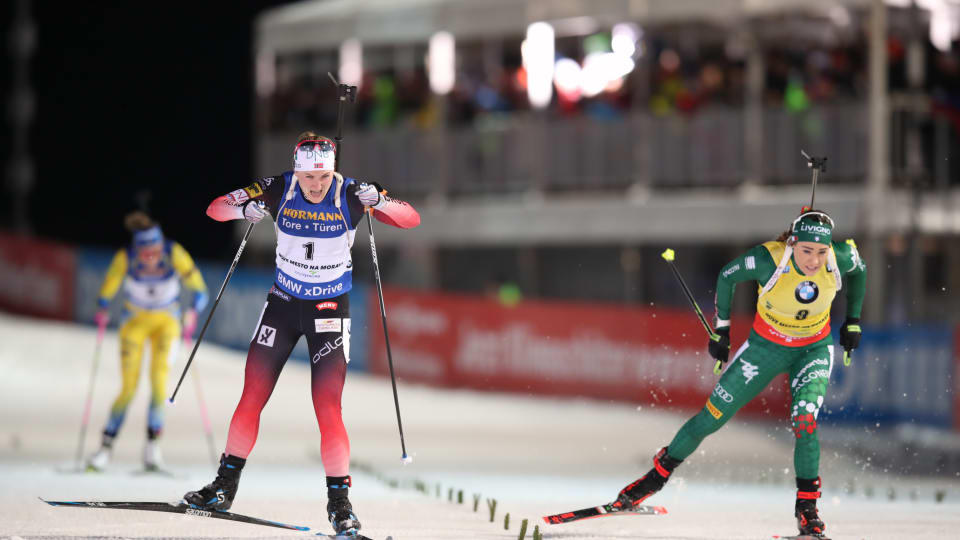
    Out on the course, which at times was flanked directly by the lake where boaters had pulled close to cheer, Eckoff passed Preuss (GER) to find second place. Chevalier-Bouchet (FRA) finished first, Eckoff second (+14) and Preuss third (+29.2).

    The spectators were thrilled to begin the competitions with a French victory and showed their appreciation in the form of overwhelming applause.

    “Yeah it’s amazing,” said Chevalier-Bouchet after her victory, “Thanks everyone. I can’t hear anything because of the noise!”
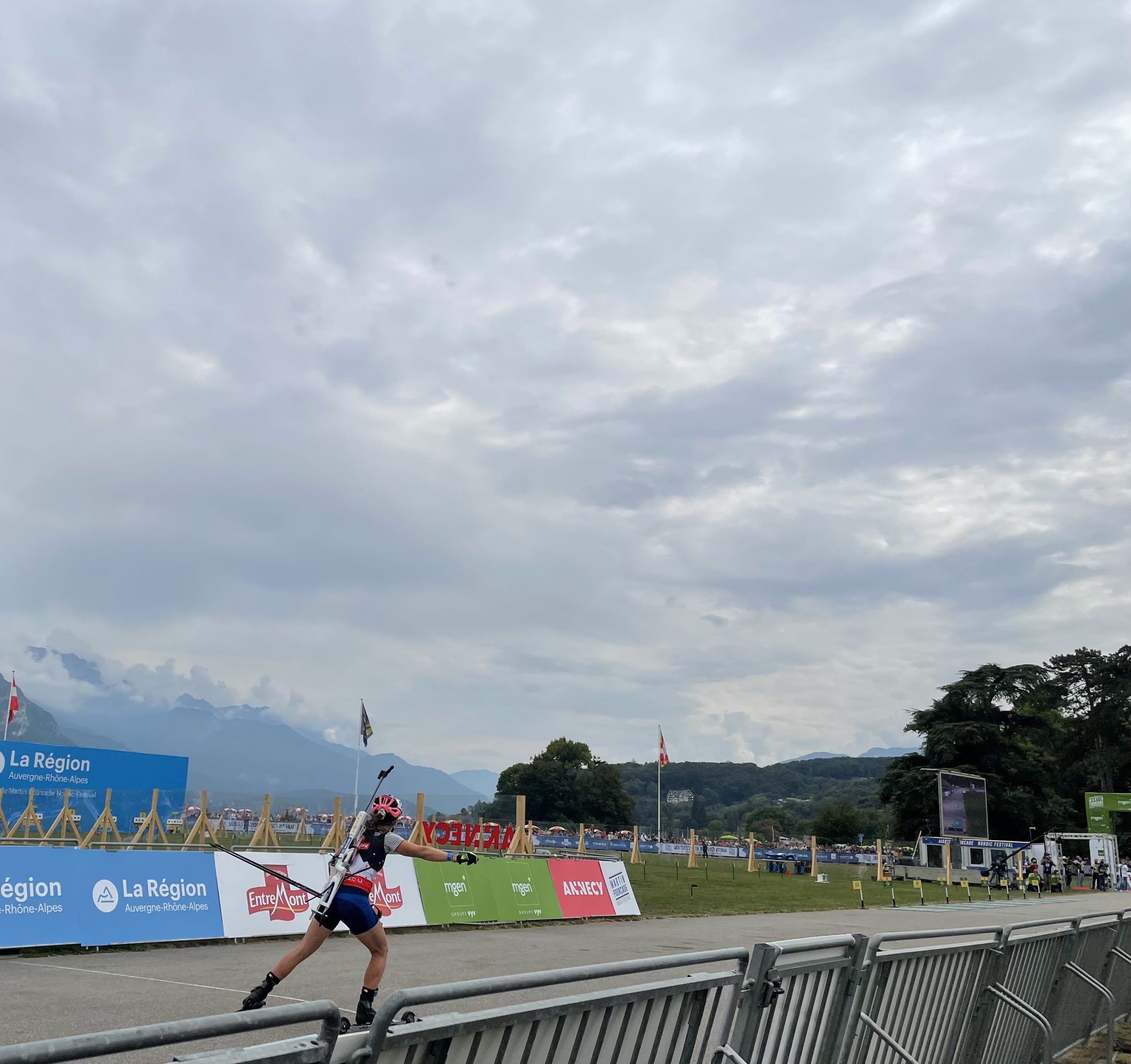
    Anais Chevalier-Bouchet (FRA) pumps up the crowd as she heads towards the finish line.

    Tiril Eckoff similarly enjoyed the support of the crowd and said, “It was very fun to be in such a good atmosphere again. It’s the first time in two and a half years to be in front of crowds so it’s really fun.” 
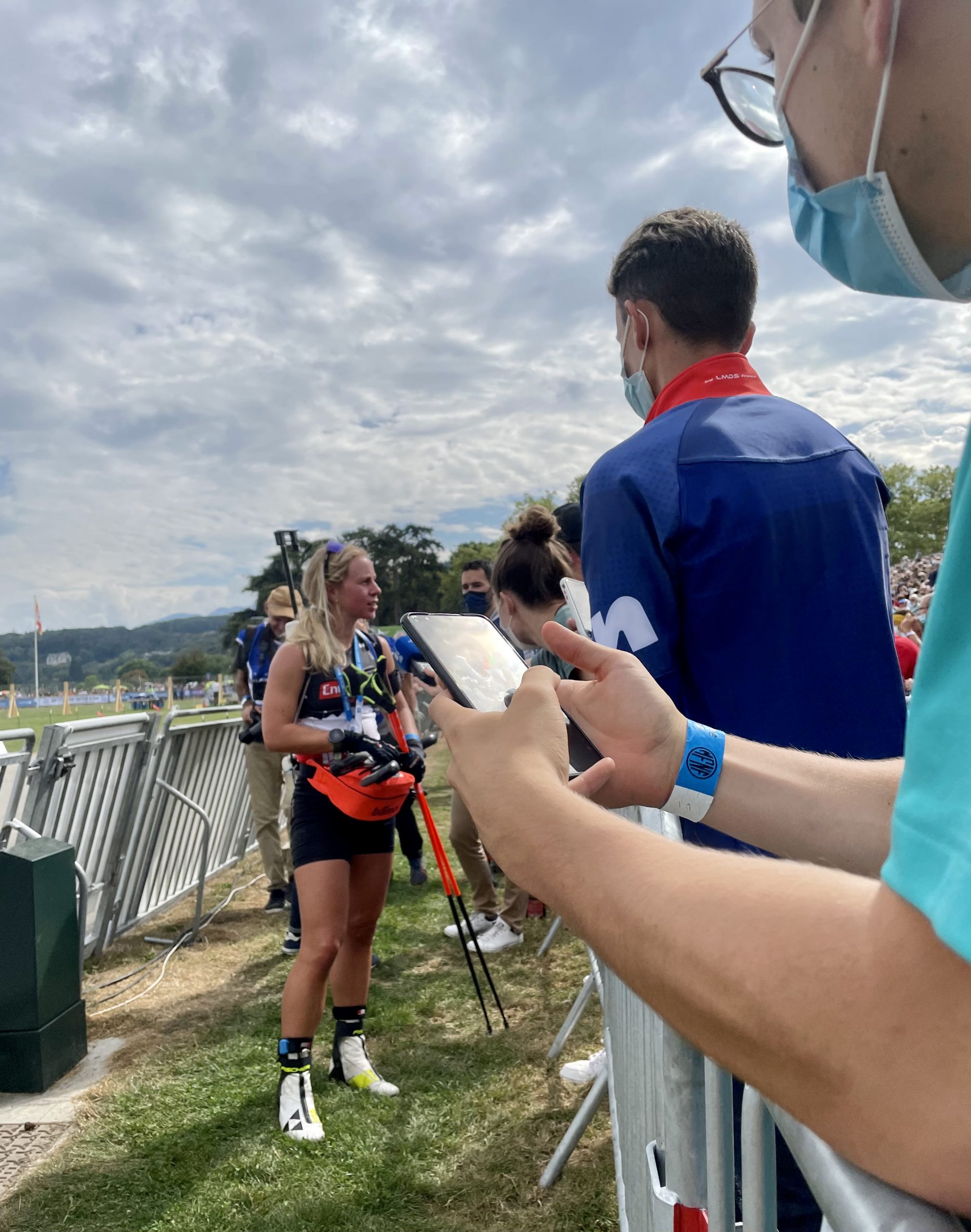
    Tiril Eckoff (NOR) finished second.

    Up next was the men’s biathlon. Guigonnat (FRA) was the first to clean and left the first round of shooting in the lead, while Fillon-Maillet (FRA), a fan favorite, struggled and exited well behind the pack. Through the second time, Doll of Germany was first to clean with Fak (SLO) right behind. Into the standing round, Laegrid (NOR) was the first to clean, Fak in second but with a penalty and Khalili (RUS) in third.

    Sturla Laegried (NOR) leads the pack along the lakeside. (Photo: NordicFocus)

    For the final time, Laegrid entered without anyone else in sight, shot 5/6 and left the range still in the lead. Khalili (RUS) was next out with Fak in third, followed closely by Fillon-Maillet who had made up ground and had a fast final round of shooting.

    Laegrid skied the last lap with a healthy gap and high-fived fans as he headed for the finish with a big lead, ending in 25:02.4. The Russian, Khalili held on for second place and Doll (GER) took third having passed Fillon-Maillet (FRA) and Fak (SLO).

    “I’m a very lucky man today so thank you Annecy!” said Laegrid after the race, “It was really fun and it was so nice to say hi to all my fans. Merci beaucoup!” 
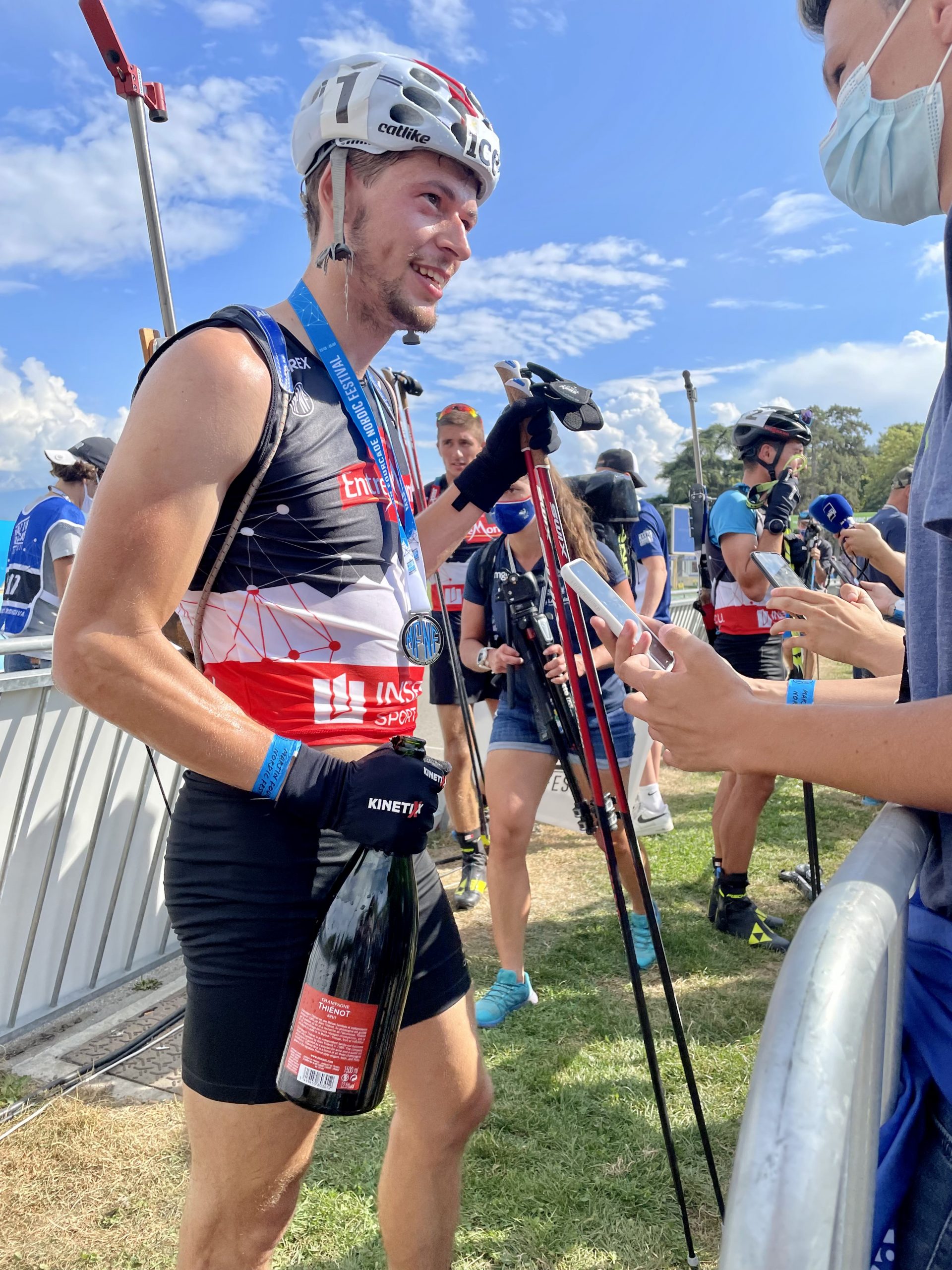
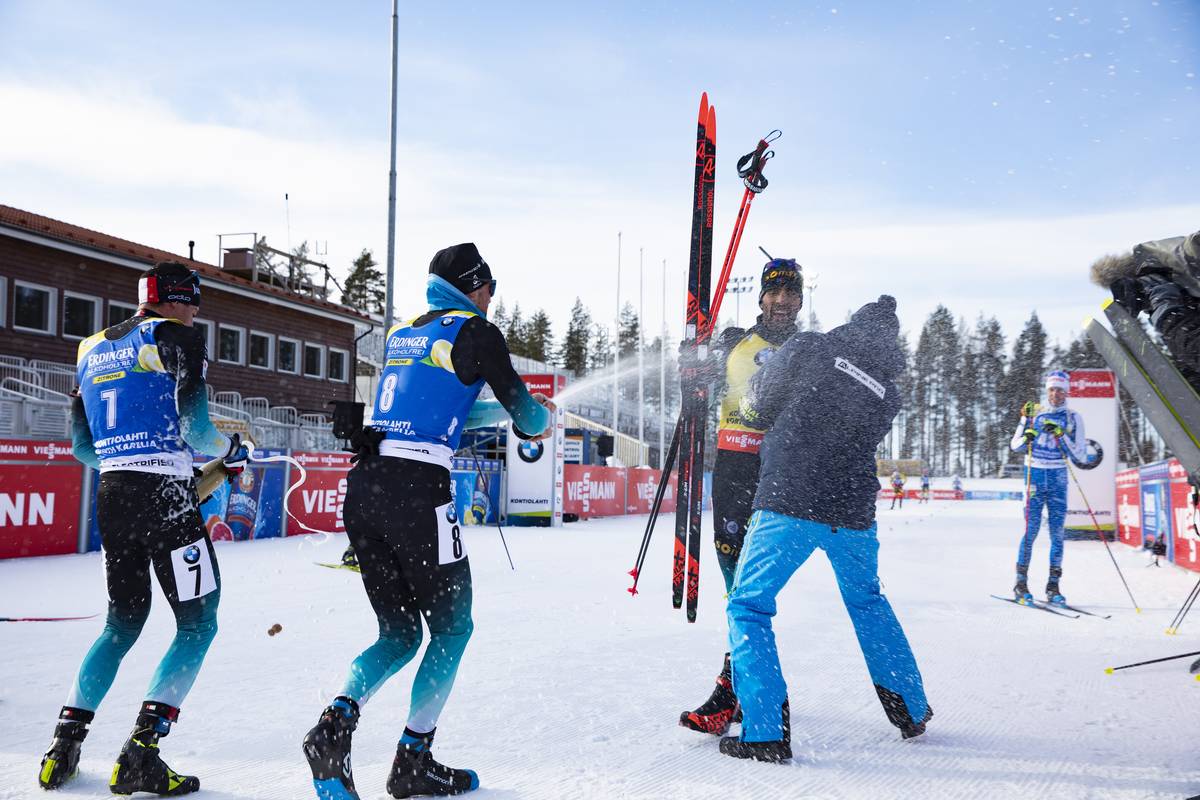
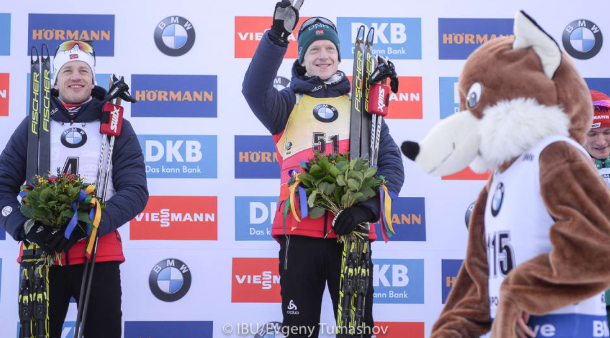
    Sturla Laegrid (NOR) holds a bottle of victory champagne after his win.

    With the biathlon races concluded, the crowd lost some it’s density before the cross-country rounds, biathlon being more popular. Nevertheless, there were still plenty of spectators who stuck around as the women lined up for their event. Not a true sprint event, the cross-country skiers completed six laps in succession with the final skier across the lap line being eliminated each round.

    The pack stayed tight for the first five laps, gradually losing skiers off the back. With a tight course, passing was quite difficult so the leaders did not change much. French skier Flora Dolci had the lead into the final lap, with the top seven athletes all within 1.4 seconds.

    Faendrich (SUI) dropped off as they passed along the lake, and then there were six. Ribom (SWE) made a pass to the front, shadowed by Van der Graaff (SUI). Rounding the final corner Van der Graaff launched an attack but Ribom held her off, keeping the advantage heading into the finish.
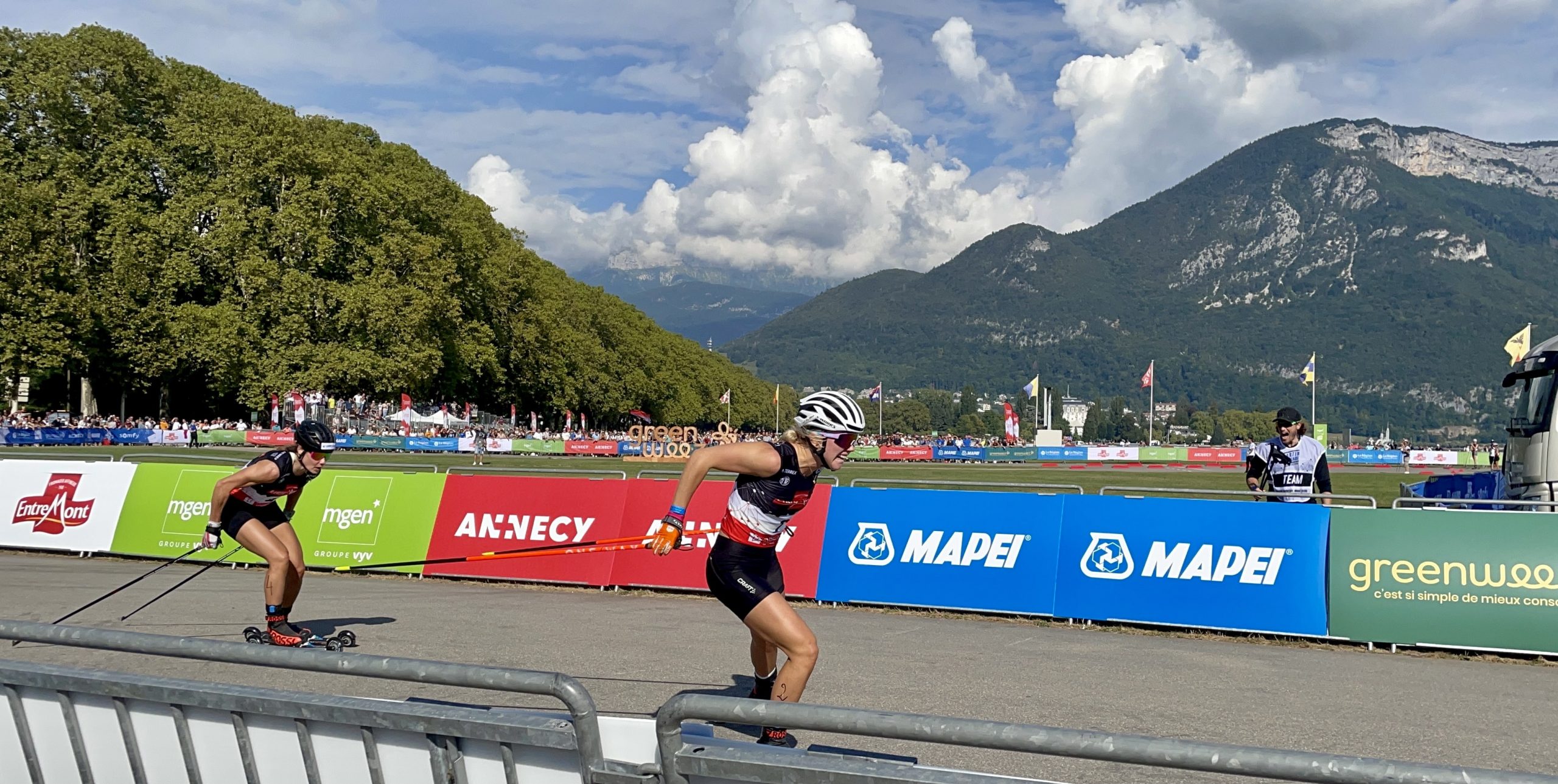
    Emma Ribom (SWE) guns for the finish line, followed by Laurien van der Graaff (SUI).

    Behind them, Dolci (FRA) outsprinted Claudel (FRA) to take third place, +4.5 back. “I felt really strong out there so it was a fun race,” said Ribom, “My plan was to have a good position the whole race so I tried to stay in the front and keep on pushing to the finish line.”

    Post race interview with Emma Ribom: 


    Van der Graaff, who speaks a bit of French, said, “I am very happy with the competition but not to do an interview in French! I tried really hard to get a second win here, but Emma was really strong.” 

    The final race of the day was the men’s cross-country. With such tight pack racing there was sure to be some broken equipment out there and sure enough, nearly every lap saw someone with a broken pole. Hugo Lapalus (FRA) was the first to be eliminated, Hediger (SUI) broke a pole near the end of the second lap and was next to stop.

    Svensson (SWE) dropped off the pace during the third lap and was stopped, followed by Valentine Chauvin (FRA) on the next lap. Jouve (FRA), a race favorite, broke a pole in lap three but managed to hang with the group, only to be eliminated with two laps to go. Heading into the final lap, Adrien Backscheider (FRA) had the lead, with Marcus Grate (SWE) the last to be eliminated.

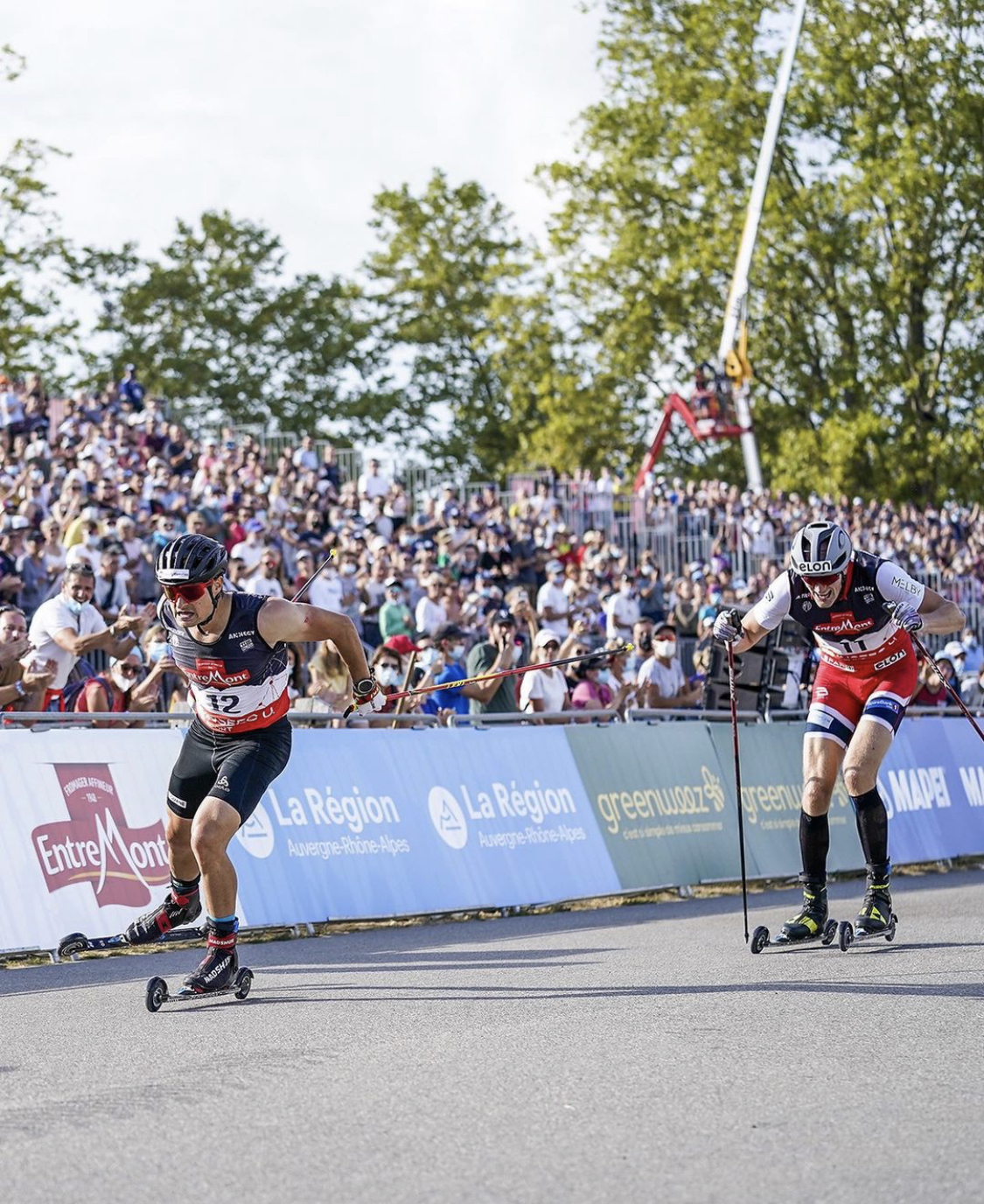
    As they neared the finish, Jay (FRA) and Pål Aune (NOR) were duking it out, ultimately the win going to Jay. Arnaud Chautemps of France finished third.

    “I’m really happy,” said Jay, “I wasn’t able to be here two years ago so this is really nice.” 
    Renaud Jay (FRA) and Pål Aune (NOR) speed towards the finish (Photo: NordicFocus)

    After the professionals raced on Saturday, it was the public’s turn to compete on Sunday. The “Biathlon Running” was open to all, involving teams of 4-6 in a relay style event. First up to compete were the kids, racing a 1km course with obstacles and shooting in between laps, followed by the adult teams.

    Kids navigate the “toile de l’araignée” (spider web) in Sunday’s obstacle course.

    There were three categories to sign up under (Mixed, female, and male) and the price was €200/team. The competitors were enthusiastic and lots of smiles were seen out on course, a fun way to wrap up a fun weekend. 
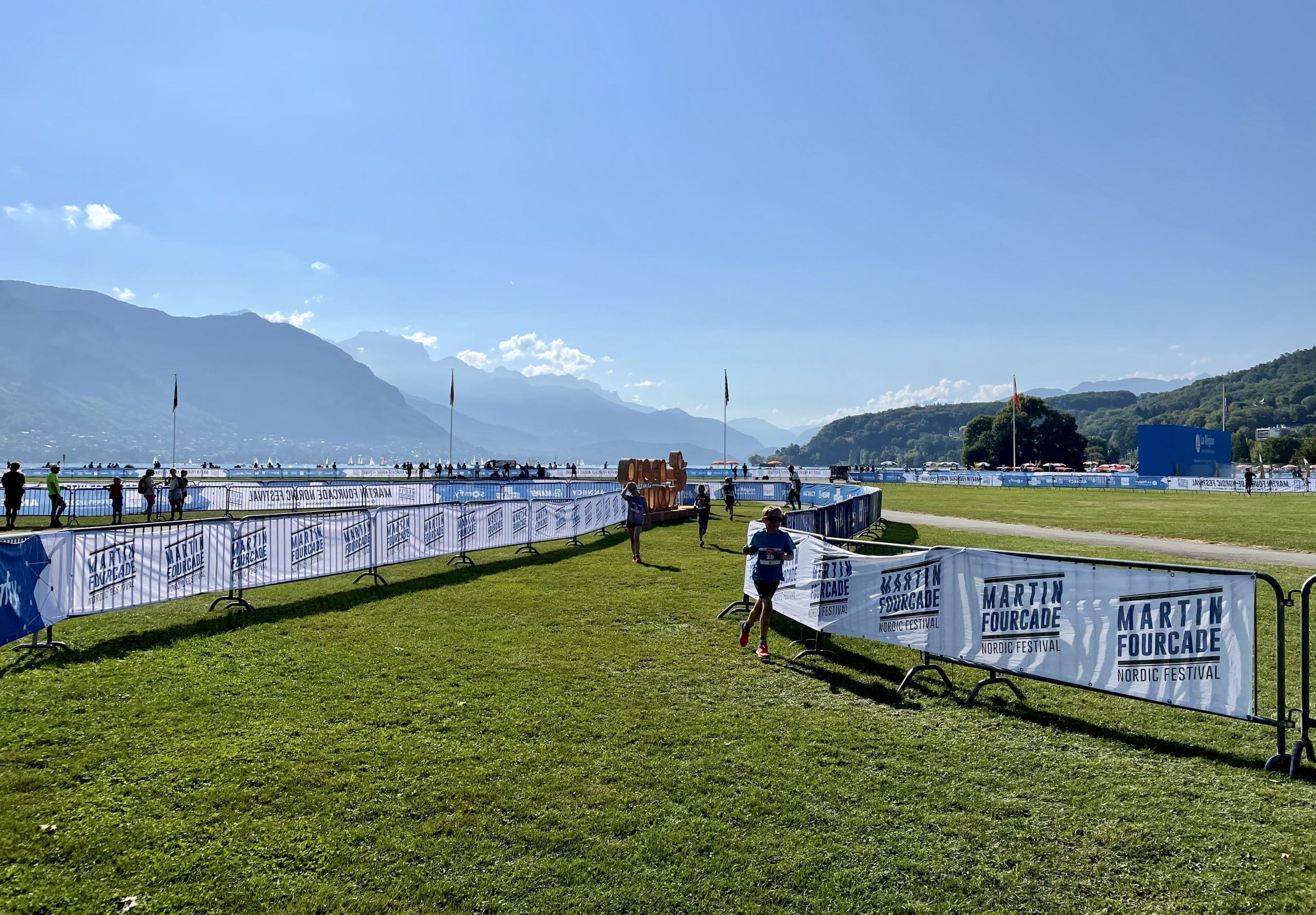
    Scenic backdrop of Sunday’s biathlon running event.
  • Au Revoir Martin Fourcade by William Timmons

    Au Revoir Martin Fourcade by William Timmons

    A year ago Martin Fourcade was coming off the worst showing of his career, a cataclysm of a season leaving everyone who follows the sport scratching their heads. While he had two victories and another podium by Christmas, something was apparently wrong; his results declined after New Year’s and he wasn’t on the podium again for the rest of the season. He skipped the North American leg of the World Cup, raced World Champs, where it was especially egregious when he failed to medal, and then called it quits, missing the season finale at Holmenkollen. His actual results: twelfth in the overall rankings at the end of the year (after missing six races), and besides the already mentioned three podiums, he finished top ten in all but three races that he started. 

    Kontiolahti, Finland was the final race of the season and the final career win for Martin Fourcade. (Photo: Nordic Focus)

    What would have been a respectable season for just about anyone else was rock bottom for Fourcade. His showing that year is further contrasted by Johannes Thingnes Bø’s near perfection, winning 16 of 25 races en route to winning the overall title and each of the four discipline Crystal Globes. Bø’s year, however, can only be described as Fourcadeian, because what Bø did in the 2018-19 season was what was expected of Martin Fourcade every year he competed. Winning, all the time, second place being a disappointing race. Fourcade was the overwhelming favorite every time he lined up for a race. Fourcade owned the World Cup like no one else ever has.  

    Fourcade made his World Cup debut in 2008, where he finished 61st in a Sprint. It was the only World Cup he raced that year. The following season he was promoted and raced the whole season. His results weren’t extraordinary, but he was only 20 years old, and did make it to the podium once as the third leg on France’s relay team, and he finished the year 24th on the overall ranking. He started the 2009-10 season relatively quietly but had a series of top tens on the World Cup leading up to the Olympics. He had a mediocre showing in the first three races, but in the mass start, the last race, Fourcade took his first podium at the highest level with a silver medal at the Olympics. 

    Martin Fourcade (FRA) celebrating a medal-winning performance at the Olympics in Whistler

    It’s a spectacular race to watch. Fourcade starts with bib 16, and in maybe 200 meters he’s at the front. He leads coming into the first shooting stage, misses twice, putting him 50 seconds behind, and watching it on TV you wouldn’t expect to get a glimpse of him again until he crossed the finish line. After the second lap, he shoots clean but is still in 28th (out of 30). The camera stays with the leaders. There’s a group of nine or so at the front and the chase is strung out. A kilometer and a half later there’s an intermediate time check and the camera lingers at the top of the climb, and then suddenly Fourcade blasts into view, hammering almost at a jump skate where everyone around him is in a controlled V1, and Fourcade’s in roughly 16th place and has cut his deficit almost in half, and by the time they get to the range he’s made contact with the lead group. He shoots slow but shoots clean, and the gap is at 22 seconds. He brings it down to 14 coming into the last shooting stage, where later on in his career he would build a reputation for clutch performance, but not this time, he misses once, and leaves the penalty loop in fifth place and an impossible 26 seconds back. But now it’s a ski race and Fourcade takes no prisoners. He blows by fourth-place without even turning his head, and it takes him maybe 500 more meters to get to third, drops him immediately, and he’s got a medal secure but he keeps charging. Somehow he passes second place too and has his eyes on gold, but he runs out of trail before he can catch up and just misses the top step of the podium. 

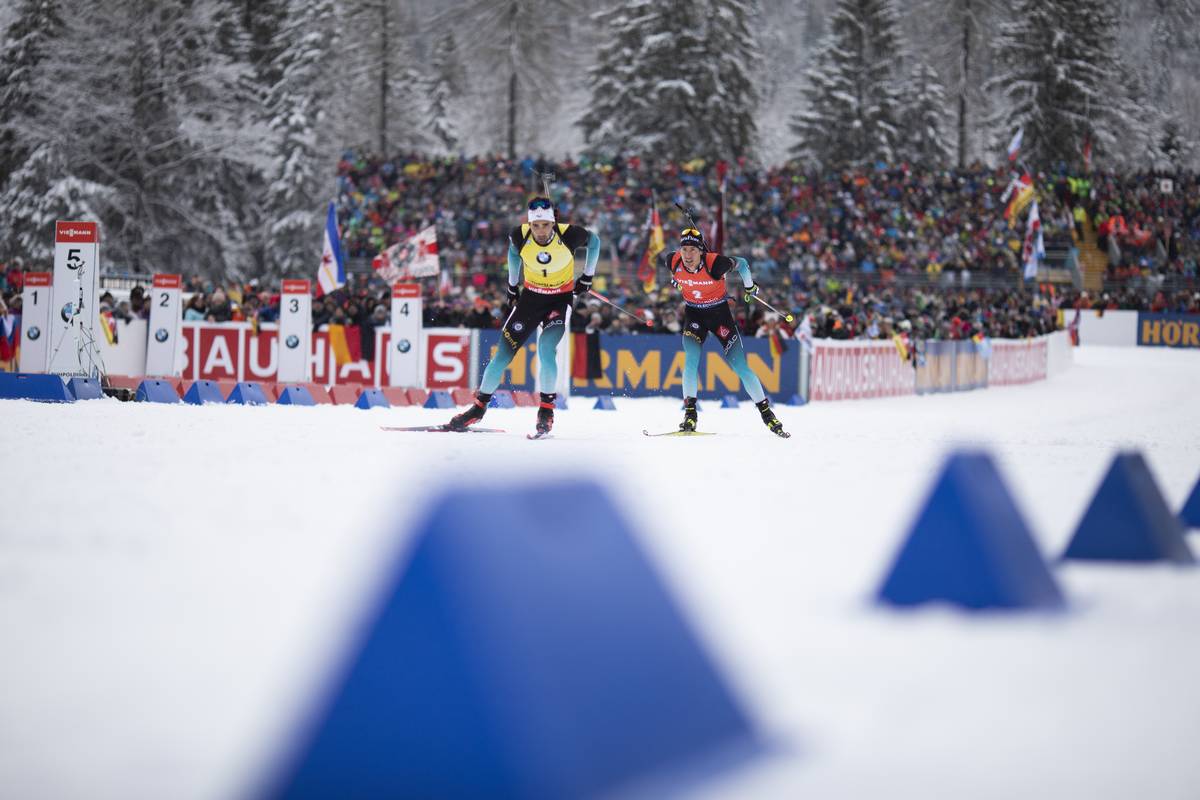
    Martin Fourcade (FRA) leads Quentin Fillon Maillet (FRA) during the men’s pursuit in Ruhpolding, 2019. (Photo: NordicFocus)


    So began Fourcade’s stranglehold on the biathlon world. He won his first little Crystal Globe that year in the Pursuit discipline, along the way taking three World Cups in a row. He was third overall the following season, and the year after, 2011-12, he won his first of seven consecutive overall titles.

    Once there is enough popular consensus for an athlete to be proclaimed the GOAT (greatest of all time) of their sport, they get entrenched in that position and it becomes difficult to have a conversation about someone else surpassing them. An example, suggesting that LeBron James may have passed Michael Jordan as the best basketball player ever is pretty much heretical. This exists in biathlon too. We have a colossus of the sport in Ole Einar Bjørndalen, the most decorated male Winter Olympian ever, and ask just about anyone who knows anything about the sport and they’ll tell you he’s the best ever. His nickname is the ‘King of Biathlon’, after all. With that being said, you heard it here first: Fourcade was better than

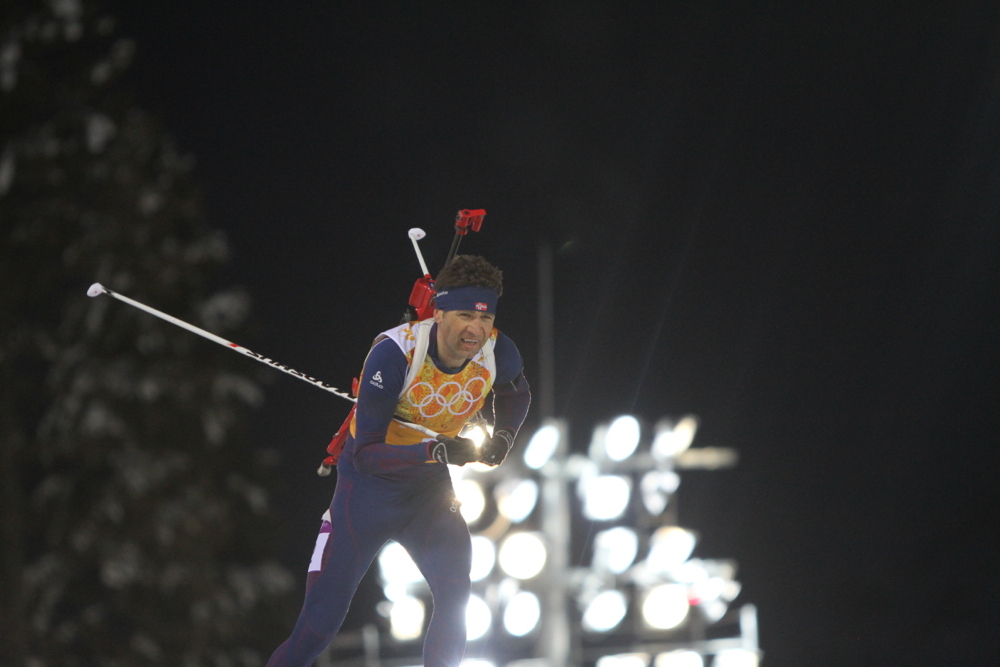
    Ole Einar Bjørndalen out on the trails at the 2014 Olympics, where he trounced the decades-younger competition.


    Nordic sports are resistant to analytics by nature. (The statisticalskier.com stuff republished on FasterSkier this year is the only time I’ve ever seen any sort of real statistical analysis of ski racing.) Without a ton of statistics outside of win tallies, it can be difficult to assess athletes from different eras, and as far as Bjørndalen and Fourcade, taking a head-to-head of the races they were both in is probably not the best comparison, because Bjørndalen was damn near geriatric when Fourcade started winning. 

    But I’m going to go ahead and use what stats I can. (Note the totals listed do not include any relay results.) So let’s start with overall Crystal Globes. In 24 seasons, Bjørndalen had six overall titles and seven top-threes; in 12 seasons, Fourcade had seven overall titles and two more podiums.* (25% wins and 54% podiums for Bjørndalen; 58% wins and 75% podiums for Fourcade.) A percentage comparison may seem unfair because Bjørndalen raced into his forties while Fourcade retired at 31, athletic prime, but regardless, in half as many seasons Fourcade won more Crystal Globes. And if we factor in discipline titles it’s even more outrageously in Fourcade’s favor. Bjørndalen has twenty discipline titles; Fourcade has 26.† And Fourcade accomplished something Bjørndalen never did when he swept every discipline title in 2013. That’s five Crystal Globes in one season. And he did it three more times after that. If instead, we look at individual World Cup races (this includes all World Cups, World Champs, and the Olympics), Bjørndalen holds the IBU record with 95 wins and 179 total podiums in 421 starts. Fourcade is second all-time with 83 wins and 150 podiums in 243 starts. (Bjørndalen: 12% and 43%; Fourcade: 34% and 62%). If he kept racing for another season or two Fourcade stood a very good chance of passing Bjørndalen. 

    And for emphasis, again: Martin Fourcade was on the podium in 62% of his starts. 

    We can also compare results at major championships, given that those are usually assigned more weight than the World Cup. So, Bjørndalen raced 69 races at World Championships, collecting 11 gold medals and 26 podiums; Fourcade, in 36 starts, garnered 11 golds and 18 podiums. (16% and 38% for OEB, 31% and 50% for MF.)‡ At the Olympics, Bjørndalen has 5 golds and 9 podiums in 19 races; Fourcade has 4 golds and 6 podiums in 12 races. (OEB: 26% and 47%; MF: 33% and 50%.) I’m calling this one a draw; while Fourcade was on the podium more often, Bjørndalen deserves some commendation for getting medals well beyond his fortieth birthday, and also note that Bjørndalen stepped up his game at the Olympics, while Fourcade pretty much stayed consistent (though Fourcade was much better than Bjørndalen at World Champs). 

    Martin Fourcade (FRA) – IBU world championships biathlon, mass start, Antholz (ITA). (Photo: NordicFocus)


    The long and short of it all is that Fourcade won more than Bjørndalen in a career that spanned half as much time. Comparing the two men’s achievements, Fourcade was better on the World Cup, achieving a consistency Bjørndalen never quite had and was just as successful at World Champs and the Olympics. Bjørndalen racked up more hardware due to his seemingly supernatural longevity, but peak Fourcade was an unstoppable force of a caliber the sport had not yet seen. 

    Martin Fourcade should be remembered as the most dominant biathlete to ever compete. He won the 2013 World Cup by 400 points. On a regular basis, he had such a big lead in the overall standings his Crystal Globe would be wrapped up weeks before the end of the season. He held the yellow bib for two and a half years straight from 2012 to 2014. He won in every discipline and rarely had bad days (and even then he was still good). Nobody was ever surprised when the last lap of a race turned into a formality after Fourcade entered the range with a thirty-second lead and shot clean, administering the coup de grace for anyone who thought they had a chance, Fourcade pumping his fist in the air before he put his rifle on his back, the final lap now his victory lap, carrying the Tricolour across the line. Though let’s be honest, he could’ve missed the last shot and he still would have won. If he missed twice, maybe he could be beaten. He was the strongest skier on the World Cup and one of the best shooters.§  

    Martin Fourcade (FRA) – IBU World Championships Biathlon, pursuit men, Antholz, Italy. (Photo: NordicFocus)


    So this was Fourcade’s final season, though he didn’t announce it until March 13, in the middle of what would be his last race weekend. As a fan, it was, without a doubt, the best season since I started following the sport. Fourcade had triumphantly returned to form, though for the first time in a long time (disregarding last year) somebody was actually skiing faster than Fourcade. Bø took the first race, Fourcade took the second. Bø then won four of the next five. Then Fourcade won four in a row. Each of them had held the yellow bib twice by mid-January. Each had a gold at World Champs, with Bø’s coming on the last race, and then he won the next three World Cups, ending with the Sprint in Kontiolahti, edging Fourcade in second. 

    After the pursuit, there should have been three more races but the season was cut short for Coronavirus and who knows what would have happened because it was so close between the two of them. Fourcade didn’t control his own fate going into that last race; if Fourcade won Bø needed fourth to take the overall. And fourth is what he got. The final tally: 913 points for Bø, 911 for Fourcade. So Fourcade didn’t get the crystal globe but he won the last race of his career, skiing into the hauntingly empty grandstands in Kontiolahti, the place where he’d won his first World Cup ten years prior to the day, after characteristically leaving the range with an insurmountable lead, the fairytale ending to the greatest career we’d ever seen, made complete with a podium sweep for France. As his successor, Fourcade leaves Johannes Thingnes Bø who, at 26, is certainly the best male biathlete on the planet, and perhaps well on his way equaling Fourcade’s seven consecutive big Crystal Globes. But for now, au revoir to Martin Fourcade, the best there ever was, the rightful King of Biathlon. 

    *I’m not counting either athlete’s first season, when they competed in two and one World Cup races, respectively. I am counting Bjørndalen’s last and Fourcade’s second to last, when they both missed a significant number of races. 

    † I suppose I need to mention that the Pursuit didn’t exist until 1996 and the Mass Start wasn’t around until 1998, Bjørndalen’s fifth and seventh seasons. So while that’s ten fewer opportunities for a discipline title, it’s unlikely he would have won any of those even if they had existed, given his other results from that time. His first Pursuit Globe came in 2000 and his first Mass Start in 2003.

    ‡ The IBU holds World Championships every year except for Olympic years. There’s usually a significant lag between when a new event is added to the IBU rulebook and World Championships, and its inclusion on the Olympic program, so the IBU has hosted a standalone ‘World Championship’ for those events in Olympic years. For instance, the Mass Start did not make it onto the Olympic program until 2006, so there was only a Mass Start World Championship in 2002. More recently, the mixed relay was not contested at the 2010 Olympics, so there was a single World Championship event held during the final World Cup weekend (kind of like how the 50k/30k at Spring Series are National Championship events while the other races are plain old Super Tours). Some sources don’t count these as World Championships, instead of listing them just as World Cups, but I’m including them in my World Championship medal count here.  

    § It goes without saying that the best skier/best shooter would be the best biathlete, but there’s a little more nuance than that, and this is probably the reason Fourcade was ultimately better than Bjørndalen. Both were the best skiers of their time, but the gap between Bjørndalen and whoever was number two, skiing-wise, was just astronomical, while Fourcade did occasionally get out skied. (Remember, Bjørndalen once won a cross-country World Cup and had a couple other podiums. Fourcade, if you’re curious, did score points in a cross-country World Cup, finishing 22nd in a 10k in 2015.) But Fourcade consistently shot over 90% during his career, while Bjørndalen was usually mid-80s. Hence why, in this writer’s opinion, Bjørndalen had considerably more success in Sprints, which favor strong skiing, than the Individual, which is much more of a ‘shooter’s race’. So basically what I’m saying is if Bjørndalen had just shot a little better, he might have won every Crystal Globe for twenty years straight.

  • Jacquelin secures his first gold medal in men’s pursuit at IBU World Championships; Gow 35th, Doherty 43rd

    Jacquelin secures his first gold medal in men’s pursuit at IBU World Championships; Gow 35th, Doherty 43rd


    Thanks to a clean shooting performance on the range and a tactical masterclass on the final lap, France’s Emilien Jacquelin, 24, was able to celebrate across the line in first place in a time of 31:15.2 minutes, after an exciting finish sprint against Norway’s Johannes Thingnes Bø just 0.4 seconds behind (with 2 penalties).

    Emilien Jacquelin of France celebrates the win. (Photo: NordicFocus)

    In a bit of an upset, the title in the men’s 12.5-kilometer pursuit at the 2020 IBU Biathlon World Championships in Antholz, Italy, went to the young French athlete, who had started out the race on Sunday afternoon in sixth position according to his result in the sprint a day earlier. Bø left the range after the last shooting just 0.1 sec behind, but Jacquelin consistently stayed in the lead, with the two athletes at times slowing down a bit to eye each other. At one point Jacquelin even took the time to bend down and tighten the straps of his ski boots while also loosening the rifle suspension strap on his left arm. 

    Going into the final long downhill stretch, Bø positioned himself to be able to attack out of the draft, but Jacquelin defended his leading position up a short climb and into the flat of the sunny Antholz arena, again packed to capacity with spectators. 

    Johannes Thingnes Bø (NOR) placed second on the day. (Photo: NordicFocus)

    Bø briefly seemed to lose his balance when he tried to attack, and Jacquelin managed to take the interior lane on the final right-hand turn into the finish stretch not allowing Bø to pass. With strong double poling he kept pushing hard on the finish stretch along the middle lane to widen the gap, before raising his arms several meters before the line, confident that the Norwegian would not be able to catch him anymore. It was the Frenchman’s first medal and victory at IBU World Championships. Jacquelin had also never won a World Cup race before, with two second-place finishes earlier this season as his best results.

    In the post-race press conference, Jacquelin credited his experience from another sport for his finish sprint tactics: “[Bø] decided to not attack me, so I was just focused on tactics… I was a track cyclist when I was young, so I just remembered all my training. I was just focused to sprint at a good moment. …He would win for sure if he didn’t let me pass.”

    Bø, usually an outstanding sprinter who dominated the prior IBU World Cup season and several early tour stages of the 2019/20 season, before taking some time off to be with his wife for the birth of their first child, was not able to withstand Jacquelin’s finish punch this time. Though he made no excuses about his interrupted training and racing period leading up to the peak of the season, and claimed he was happy about the result remarking that he was “less nervous before the world championships because of the family situation at home”.

    “I put myself in position for a gold in the final shooting,” Bø said in the press conference. “I just want to have fun, that’s why I was satisfied with my fifth place in the sprint yesterday. … I could just relax today and do my best one more time and hope for a medal.”

    Behind them, Alexander Loginov of Russia, coming fresh off his victory in the sprint, claimed the bronze medal position on the podium this time. He had kept his composure and his pursuers in check virtually all race, thanks to three very fast and clean shooting performances on the wind-exposed Antholz range. And while he lost a few seconds on the course on each loop he was able to ski just fast enough to arrive on the range taking his position on the first shooting lane. It already looked like with his perseverance in that game of cat and mouse the Russian had again worn out his competition. But in his final shooting stage he then missed the third target and had to ski through the penalty loop. That enabled the clean-shooting Jacquelin and Bø to pass him, leaving Loginov only with the bronze medal this time, 23.9 seconds back in the finish (with one penalty).

    “At the last shooting, I thought I would fight with Johannes for the silver because I thought Loginov was first,“ Jacquelin explained, according to an IBU press release. “Afterwards, I thought, ‘Oh my God, I can win the title!’”

    Loginov, who was asked the most questions in the press conference. He credited his wife and daughter for keeping him “happy and comfortable” and always trying to cheer him up during a period of intense media attention due to news about past anti-doping code violations at the 2014 Olympics hanging over the Russian team in general and questions surrounding his own prior two-year suspension.

    Emilien Jacquelin (FRA), Martin Fourcade (FRA), Alexander Loginov (RUS), (l-r) on the range. (Photo: NordicFocus)

    In fourth place, Jacquelin’s teammate Martin Fourcade, second in the sprint and for most of the pursuit race looking like he could at least repeat a podium finish, missed a target in each of the standing stages to push him out of medal contention. Still, when Fourcade crossed the finish line (+46.3, with two penalties) he couldn’t help but smile broadly, and instantly hugged and high-fived his younger training partner Jacquelin, who stated in the press conference that they live in the same town and have worked together for six years now.

    “It’s a childhood dream, since I was five years [old] I wanted to be a champion in biathlon like Raphaël Poirée or Martin Fourcade,” the new gold medalist Jacquelin told broadcaster ZDF in an interview right after the race. “So here for me to do this today is incredible. I was able to make a great race, and it was really tough here at the World Championships. I am really satisfied about my shooting. It’s a dream realized. I just want to thank my parents who are here, thank you for believing in me and to help me reach my goals.”

    For Biathlon Canada, only Scott Gow had qualified for the World Championships pursuit race among the top-60 with his sprint result, starting the race in 16th position and 1:16 minutes behind sprint winner Loginov. In his first shooting, Gow incurred two penalties, setting him back to 30th position early in the race.

    In the second prone stage he managed to clean his targets, leaving the range slightly up in 28th place, but already more than 2 minutes behind the leaders. Gow’s tactic seemingly was to try and shoot fast, recording the fifth-best shooting and range times of the day overall. While the TV cameras focused on the top of the field, that didn’t quite pay off when he unfortunately shot two more misses in his first standing stage, before incurring his fifth penalty of the day in the final shooting. He finished the race in 35th position, just behind a few athletes including Russia’s Evgenyi Garanichev in a finish sprint, crossing the line 3:34.8 minutes back (2+0+2+1). For Gow, this still ranks as his best result in a pursuit race at IBU World Championships and Olympic Winter Games, improving on a 43rd place at last year’s championships in Östersund, Sweden.

    For US Biathlon, Sean Doherty was the lone qualifier for the pursuit. He began the race in 44th position, 2:04 min back. His shooting performance started out on a sour note when he instantly missed his first shot in prone, before hitting the next four targets. That streak continued, with Doherty as he incurred a penalty in each of the next three stages, which prevented him from moving up more in the field despite holding up well on the course with the 35th-fastest skiing time. He finished the pursuit in 43rd position (1+1+1+1). For Doherty, it was his second-best result in a pursuit at World Championships at the senior level, having finished in 20th place the prior season.

    After a rest day, the IBU World Championships will continue on Tuesday with the women’s 15 k individual before the men’s 20 k individual follows on Wednesday.

    Full results men’s 12.5-kilometer pursuit


  • Day 1-2 IBU World Cup Rundown from Pokljuka: Egan 6th, Lunder 10th in 15 k Individual (Includes audio interview with Egan)

    Day 1-2 IBU World Cup Rundown from Pokljuka: Egan 6th, Lunder 10th in 15 k Individual (Includes audio interview with Egan)

    The traveling IBU World Cup roadshow stops in Pokljuka, Slovenia this week and began the individual races. The women’s 15 k individual ran on Friday. The individual race format places a heightened premium on clean shooting; each missed shot amounts to an automatic minute penalty.

    Tiril Eckhoff of Norway had been dominating the circuit recently. Yet, Friday, she fell in the standings to place an uncharacteristic 18th. In first place was former German cross-country skier Denise Herrmann. It was Herrmann’s first win of the season and her second podium. She won in 41:33.4 with no misses on the range. Sweden’s Hannah Öberg was second (+59.2; 0+1+0+0) and France’s Anais Bescond third (+1:15.7; 0+0+0+0). 

    Denise Herrmann of Germany celebrating the 15 k individual win in Pokljuka, Slovenia. (Photo: NordicFocus)

    Two North Americans raced into the top-10. Clare Egan for the U.S. had a career-best race in the individual format with a sixth place. Egan shot clean and stopped the clock 2:10.4 back. Prior to Friday’s result, Egan’s best performance in the 15 k individual had been a 22nd at the 2017 World Championships in Hochfilzen, Austria. Last weekend, Egan placed 16th in Ruhpolding, Germany’s 10 k pursuit. And at this same venue a bit over a year ago in Pokljuka, Egan placed sixth in the 10 k pursuit. 

    Clare Egan of the U.S. during the women’s 15 k individual in Pokljuka, Slovenia. Egan placed 6th. (Photo: NordicFocus)

    Post-race interview with Clare Egan

    Emma Lunder of Canada finished in 10th, 3:06.8 back while shooting 1+0+0+0. This was Lunder’s second top-10 of the season. She placed 7th in Oberhof’s sprint. Both Lunder and Egan qualified for Sunday’s 12.5 k mass start competition. The top-25 women in the overall IBU standings auto-qualify. Egan and Lunder fell outside that criteria, but qualified due to their results in Friday’s individual race. 

    Canada’s Emma Lunder racing to 10th in the women’s 15 k individual in Pokljuka, Slovenia. (Photo: NordicFocus)


    For the U.S., Joanne Reid was 45th (+6:11.3; 0+0+1+1), Susan Dunklee 55th (+7:04.2; 1+2+1+1), and Emily Dreissigacker 84th (+10:12.7; 1+0+1+2). 

    Canada’s Nadia Moser finished in 79th (+9:30.6; 1+2+0+1), Megan Bankes 80th (+9:46.2; 1+1+0+3), and Emily Dickson 83rd (+10:07.4; 1+1+1+1). 

    Women’s results

    Men’s 20 k Individual 

    On Thursday in Pokljuka, Johannes Thingnes Bø, on leave from the race scene for the first part of racing during the second trimester to be home for the birth of his first child, was back in play. Last week, in the absence of the Norwegian phenom that is Bø, France’s Martin Fourcade reclaimed the World Cup’s overall yellow leader’s bib. 

    Johannes Thingnes Bø on his way to winning the men’s 20 k individual in Pokljuka, Slovenia. (Photo: NordicFocus)


    Fourcade’s leader status might be tenuous. The two superstars went 1-2 on Thursday with Bø taking the win in 47:54.3 with no misses. Fourcade finished second, 11.4 seconds back while also shooting clean. France’s Fabien Claude placed third (+25.6; 0+0+0+0). 

    Martin Fourcade of France remains in the overall leader’s bib after his second place in Pokljuka’s 20 k individual. (Photo: NordicFocus)

    For Canada, Scott Gow raced to 26th (+3:36.7; 0+1+0+1). Christian Gow was 41st (+5:20.0; 0+2+0+0), Jules Burnotte 88th (+8:39.1; 1+2+1+1), and Aidan Millar 107th (+13:27.7; 2+2+0+3). 

    Scott Gow (CAN) railing a corner during the 20 k individual in Pokljuka, Slovenia. (Photo: NordicFocus)

    Leif Nordgren was the top American in 27th. Nordgren finished 3:38.3 minutes back after shooting 1+1+0+0. Jake Brown placed 52nd (+5:54.9; 2+1+0+0), Sean Doherty 74th (+7:28.8; 1+0+1+3), and Paul Schommer 85th (+8:32.9; 2+0+0+2). 

    Men’s Results

    Racing continues in Pokljuka on Saturday with the single mixed relay and a 4 x 7.5 k mixed relay.

    Leif Nordgren (USA), Simon Desthieux (FRA), (l-r) during the 20 k individual in Pokljuka, Slovenia. (Photo: NordicFocus)
  • IBU World Cup: Ruhpolding, Germany Rundown

    IBU World Cup: Ruhpolding, Germany Rundown

    The winner of the women’s 10 k pursuit, Norway’s Tiril Eckhoff, amidst a sea of Ruhpolding, Germany fandom. (Photo: NordicFocus)

    Let’s catch up on some overdue biathlon action from Ruhpolding, Germany. 

    Day 2: Men’s 10 k sprint

    Starting off, the men’s 10 k sprint that ran last Thursday. Allez! Allez! It was a squeaker of a win for IBU World Cup overall leader Martin Fourcade of France. He won in a time of 22:41.5 minutes while shooting clean. His teammate, Quentin Fillon Maillet clocked in 3.1 seconds back for second while missing no targets. Germany’s Benedikt Doll placed third (+12.0; 0+0). 

    Sean Doherty of the U.S. continued his rise in this second trimester of the World Cup notching 21st in the sprint, 1:02.8 back and shooting 1+0. For Doherty, this matched his season best result, a 21st in Oberhof’s sprint. 

    18.01.2020, Ruhpolding, Germany (GER):<br /> Sean Doherty (USA) - IBU world cup biathlon, relay men, Ruhpolding (GER). www.nordicfocus.com. ©Tumashov/NordicFocus. Every downloaded picture is fee-liable.
    U.S. biathlete Sean Doherty during the men’s relay in Ruhpolding, Germany. (Photo: NordicFocus)

    Also for the U.S., Jake Brown skied to 58th (+2:02.2; 2+0), and Leif Nordgren was a spot back in 59th (+2:03.8;2+1). Paul Schommer was 65th (+2:09.2; 0+2). 

    Jules Burnotte was the top-placed Canadian in 47th (+1:43.6; 0+2). Christian Gow was 51st (1:48.7; 1+0), Scott Gow 60th (+2:04.9), and Aidan Millar 100th (+3:16.4; 1+2). 

    The top-60 skiers advanced to the weekend’s pursuit.   

    10 k sprint results 

    Day 3: Women’s 4 x 6 k relay

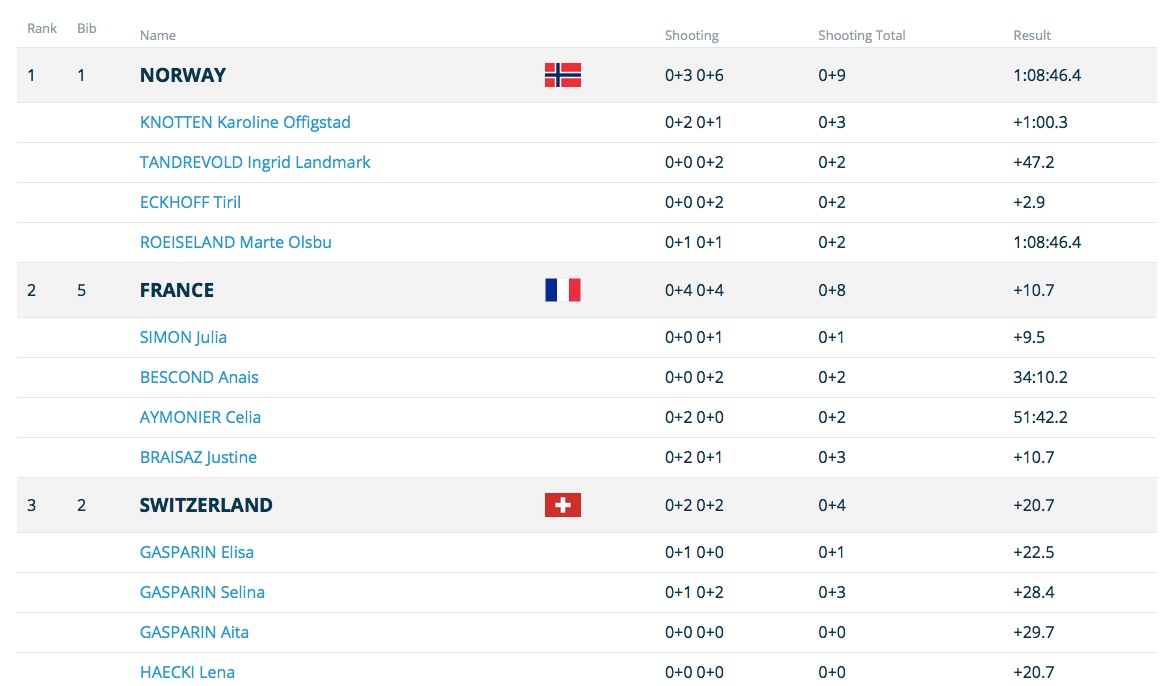
    Here’s one thing we love about IBU World Cup relays: so many nations participating. Twenty-three different countries were represented in the women’s event. Korea was lapped, and was listed as 23rd, but at least they are in the game. 

    In first place, a more consistent powerhouse, was Norway in 1:08:46.4, followed by France (+10.7), and Switzerland (+20.7) in second and third, respectively. This was Norway’s fourth relay win in a row. 

    Norway’s winning relay team: Karoline Offigstad Knotten (NOR), Ingrid Landmark Tandrevold (NOR), Tiril Eckhoff (NOR), Marte Olsbu Roeiseland (NOR) (r-l). (Photo: NordicFocus)

    For the U.S., Susan Dunklee, Clare Egan, Joanne Reid, and Deedra Irwin raced to 10th overall, 2:32.9 behind Norway’s winning time. The U.S. had a single penalty while using nine spares in the competition. 

    Susan Dunklee (bib 9) of the U.S. during the women’s relay in Ruhpolding, Germany. (Photo: NordicFocus).


    Joanne Reid coming in to tag Deedra Irwin for the U.S. (Photo: NordicFocus)


    Joanne Reid during the women’s relay in Ruhpolding. (Photo: NordicFocus)

    Canada’s Nadia Moser, Emma Lunder, Megan Bankes, and Sarah Beaudry were 20th (+5:30.8; 1+11).  

    Canada’s Meghan Bankes during the women’s relay in Ruhpolding, Germany. (Photo: NordicFocus)

    4 x 6 k relay results 

    Day 4: Men’s 4 x 7.5 relay

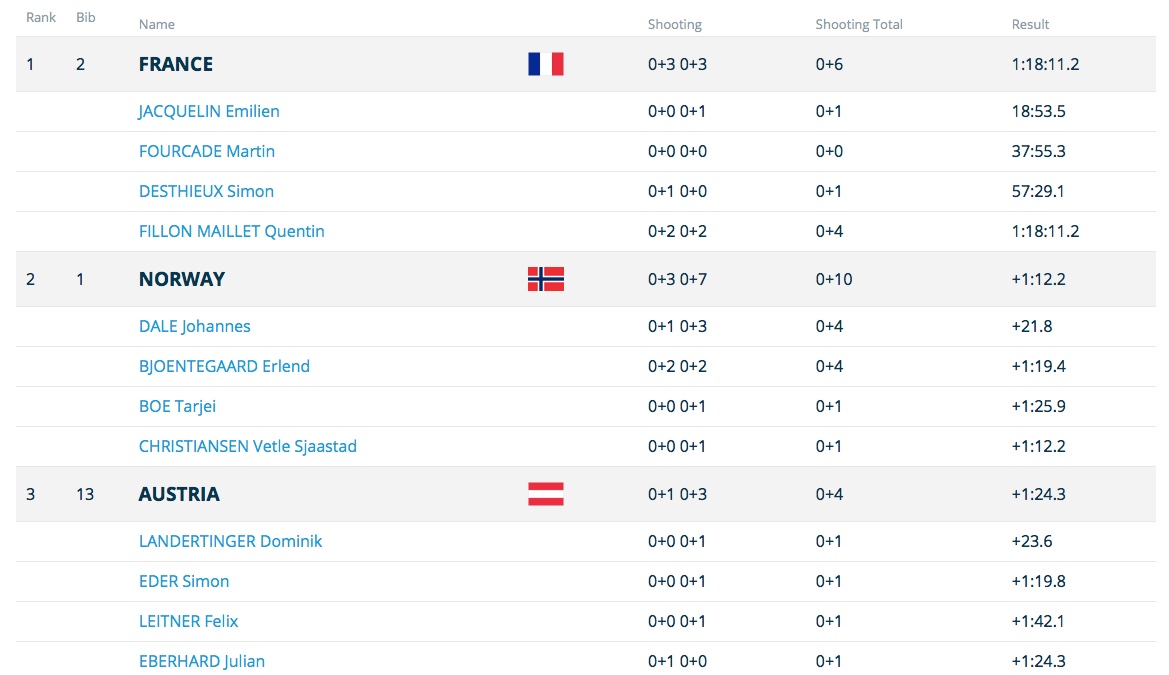
    When it’s going your way, just go with it. It has been going France’s way. The French won the men’s relay in 1:18.11.2 followed by Norway in second (1:12.2), and Austria in third (+1:24.3). 


    Quentin Fillon Maillet of France carries the French flag across the line for the relay win in Ruhpolding, Germany. (Photo: NordicFocus)

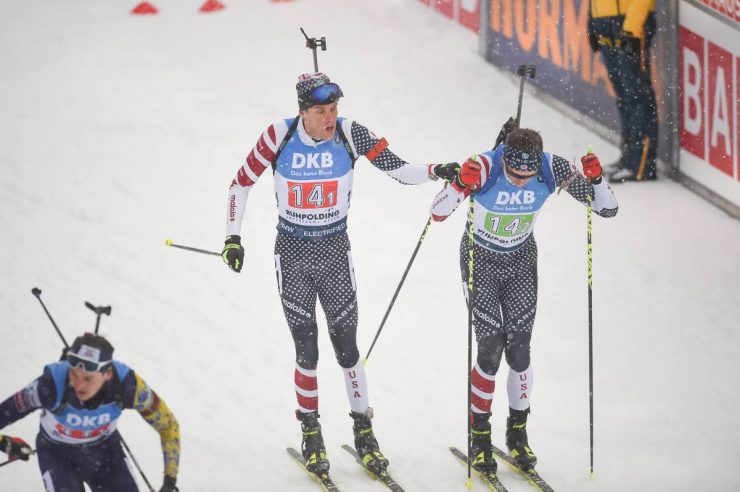
    Leif Nordgren, Sean Doherty, Paul Schommer, and Jake Brown scored tenth overall for the U.S., finishing 4:09.8 back using nine spares. 

    Canada’s Jules Burnotte, Scott Gow, Aidan Millar, and Christian Gow placed 19th (+6:27.6; 1+14). Twenty-six teams were represented. 

    4 x 7.5 k results 

    Day 5: Women’s 10 k pursuit

    In this 60 athlete field, Norway’s Tiril Eckhoff ran away with the win in 34:08.7 while missing a single target in her four shooting bouts. Slovakia’s Pauline Fialkova was second (+46.3;1+0+0+1), and Hannah Öberg of Sweden third (+55.1; 0+1+0+1). 

    Susan Dunklee during the women’s relay in Ruhpolding. She placed 10th in the weekend’s pursuit event for a season best result. (Photo: NordicFocus)

    Dunklee notched a season best result with her 10th place. The U.S. biathlete finished 1:39.7 behind while shooting 0+1+2+0. Her teammate Egan was six spots behind in 16th overall (+2:01.8; 0+0+1+1). This was Egan’s best individual result thus far in the 2019-2020 season. 

    Off to the tracks: Clare Egan (bib 28) during the women’s pursuit in Ruhpolding. She placed 16th overall. Susan Dunklee, her teammate, is pictured in bib 25. (Photo: NordicFocus)


    Susan Dunklee (bib 25) and Clare Egan (bib 28) after the women’s pursuit in Ruhpolding. (Photo: NordicFocus)

    Canada’s Lunder placed 35th (+3:05.0; 0+2+0+1). 

    10 k pursuit results

    Day 6: Men’s 12.5 k pursuit

    Again, there was no stopping the French. Fourcade took the win in 31:26.8 while shooting clean, with Fillon Maillet in second (+17.6; 0+0+1+0). Norway’s Vetle Sjåstad Christiansen placed third (+46.0; 0+0+0+1). 

    Martin Fourcade (FRA) leads Quentin Fillon Maillet (FRA) during the men’s pursuit in Ruhpolding. (Photo: NordicFocus)

    Doherty was the top American in 32nd (+2:58.7; 3+0+1+0). Nordgren placed 55th (+5:30.1; 2+2+0+0), and Brown 56th (+5:49.9; 2+2+1+2). 

    For Canada, Burnotte skied to 47th (+4:07.4; 1+1+2+1), Christian Gow 49th (+4:22.1; 1+1+1+1), and Scott Gow 50th (+4:37.8; 0+1+1+1). 

    12.5 k pursuit results

    Sean Doherty (USA, bib 21), Arnd Peiffer (GER, bib 22), Raman Yaliotnau (BLR, bib 23): starting the pursuit in Ruhpolding, Germany. (Photo: NordicFocus)
  • Post-Oberhof IBU World Cup Recap

    Post-Oberhof IBU World Cup Recap

    With the weekend closed out in Oberhof, Germany and the start of the second IBU World Cup trimester underway it’s time for, thank you Seth Meyer, … a closer look.

    The men’s mass start in Oberhof. (Photo: NordicFocus)

    Norway’s male biathlon ringer, Johannes Thingnes Bø, was on the sideline for the weekend. Prior to the Oberhof stop, he had worn the yellow bib as the IBU World Cup overall leader. Post-Oberhof, it was time for a change. A small change really in the big perspective of challengers. France’s Martin Fourcade leaves Oberhof donning yellow, a color he has been well acquainted with in the past.

    Martin Fourcade, here in the Oberhof mass start, won the race and seized the overall leader’s bib. (Photo: NordicFocus)

    Fourcade’s overall lead is the result of a two win weekend. He won the 10 k sprint on Friday and followed that with a win Sunday in the 15 k mass start. In four shooting rounds during the mass start, Fourcade went 0+1+0+1 to win in 41:01.4. No North Americans qualified for the race.
    Men’s Mass Start Results

    After nine of 24 individual competitions, Fourcade leads the overall with 387 points. Bø sits in second with 374.

    Men’s Overall Standings

    Fourcade was also part of the French 4 x 7.5 k relay team that placed second on Saturday. Norway won that race, with neither Bø brother racing. Germany placed third. The U.S. team of Sean Doherty, Leif Nordgren, Paul Schommer, and Jake Brown skied to 12th overall. Canada’s Jules Burnotte, Scott Gow, Aidan Millar, and Christian Gow were 14th out of 26 teams.

    Men’s Relay Results

    Women’s Oberhof Results

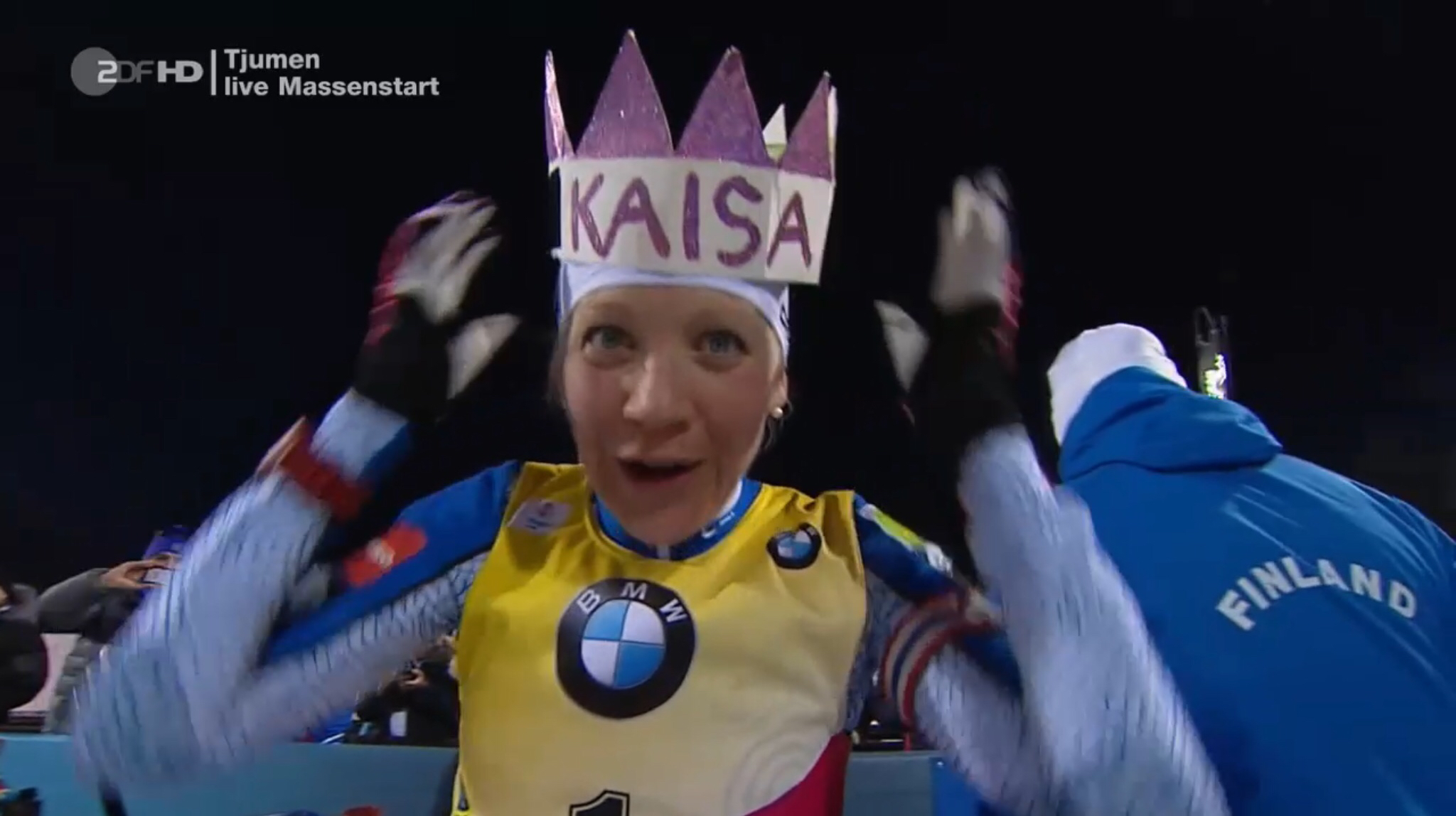
    Kaisa Makarainen from Finland won the 10 k mass start in 39:58.9 after missing a single target in her first bout of shooting. Otherwise, she shot clean. Norway’s Tiril Eckhoff placed second (+30.2; 0+0+3+1), and Marte Olsbu Roeiseland third (+35.0; 1+0+1+1).

    Emma Lunder of Canada during the women’s mass start in Oberhof, Germany. Lunder was 15th overall. (Photo: NordicFocus)

    Canada’s Emma Lunder continued her strong skiing with a 15th place (+2:14.8; 0+2+4+1). Susan Dunklee of the U.S. raced to 21st (+2:56.3; 0+3+1+4).

    Susan Dunklee of the U.S. during the women’s 4 x 6 k relay. Dunklee placed 21st in Sunday’s mass start. (Photo: NordicFocus)

    Women’s Mass Start Results

    This brings us to the women’s overall standings on the IBU World Cup circuit. Italy’s Dorothea Wierer, with 390 points, wears the leader’s bib. The Italian placed fourth in the mass start, over a minute out, and had five misses total on the range. Eckhoff is second overall with 381 points.

    A television camera takes Justine Braisaz (FRA), Tiril Eckhoff (NOR), Ingrid Landmark Tandrevold (NOR), Dorothea Wierer (ITA), Denise Herrmann (GER) in focus, (l-r) during the women’s Oberhof mass start. (Photo: NordicFocus)

    Women’s Overall Standings

    In the women’s 4 x 6 k relay contested on Saturday, Norway won in a total time of 1:14:11.5 hours shooting 0+11. The U.S. team of Susan Dunklee, Clare Egan, Hallie Grossman, and Emily Dreissigacker were 12th (+4:33.8; 1+12). Canada’s Sarah Beaudry, Emily Dickson, Nadia Moser, and Emma Lunder placed 20th, as they were eventually lapped. Twenty-three teams began the race.

    Women’s Relay Results

    In a typical Oberhof fog, Tiril Eckhoff (NOR) takes the mass start win. (Photo: NordicFocus)


  • IBU World Cup Rundown: Oberhof, Germany

    IBU World Cup Rundown: Oberhof, Germany

    Oberhof, Germany the site where the IBU World Cup snaps into its second trimester of racing after the holiday break, began a series of races.

    Yesterday, the women began the Oberhof stop with a 7.5-kilometer sprint. Norway’s Marte Olsbu Roeiseland won in 22:04.9 minutes while shooting clean in both her shooting bouts. Denise Herrmann of Germany was second (+33.1; 0+1), and France’s Julia Simon third (+47.4;1+0). 

    Emma Lunder, racing to 7th, her best individual IBU World Cup result of the season during the Oberhof, Germany 7.5 k sprint. (Photo: Nordic Focus)

    Two North Americans had standout performances. Emma Lunder of Canada was seventh overall (+1:14.9; 0+0), and Susan Dunklee for the U.S. was 14th (+1:47.6; 0+1). 

    Susan Dunklee, racing to 14th, her best IBU World Cup result of the season during the Oberhof, Germany 7.5 k sprint. (Photo: Nordic Focus)

    Clare Egan, also of the U.S., was 32nd (+2:26.0; 0+2). Teammate Emily Dreissigacker skied to 70th (+3:51.4; 1+0), and Hallie Grossman, in her World Cup debut was 79th (+4:31.7; 1+2). 

    Canada’s Emily Dickson placed 46th (+2:58.6), and Megan Bankes did not start. 

    Women’s Results

    Friday, the men raced a 10 k sprint. With the IBU World Cup men’s leader, Johannes Thingnes Bø of Norway sitting out, others were left to fill the top-step void. France’s Martin Fourcade capitalized and won in 25:27.2 with no misses on the range. Teammate Emilien Jacqelin was second (+25.5: 0+1), with Germany’s Johannes Kuehn in third (+33.0; 0+1). 

    Shooting through the Oberhof fog: Sean Doherty on his way to 21st. (Photo: Nordic Focus)

    For the U.S., Sean Doherty placed 21st (+1:50.2; 0+1), and Leif Nordgren also broke into the top-30 placing 26th overall (+1:57.3; 1+0). 

    Leif Nordgren amidst the Oberhof cacophony. (Photo: Nordic Focus)

    Scott Gow, of Canada, was the next best placed North American in 30th (+2:07.1; 1+1). 

    Scott Gow, prepping for the Oberhof range, during the men’s sprint. (Photo: Nordic Focus)

    Paul Schommer of the U.S., in his first World Cup of the season, was 53rd (+2:46.8; 1+2). Jake Brown skied to 68th (+3:17.0; 2+1). 

    Rounding out the results for Canada, Christian Gow was 55th (+2:53.9; 0+1), Matthew Strum 82nd (+3:44.0; 1+0), and Carsen Campbell 90th (+4:08.2; 1+1). 

    Men’s Results

    Racing continues on Saturday with a 4 x 6 k relay for the women and a 4 x 7.5 k relay for the men.

  • IBU World Cup Relay Rundown from Östersund, Sweden

    IBU World Cup Relay Rundown from Östersund, Sweden

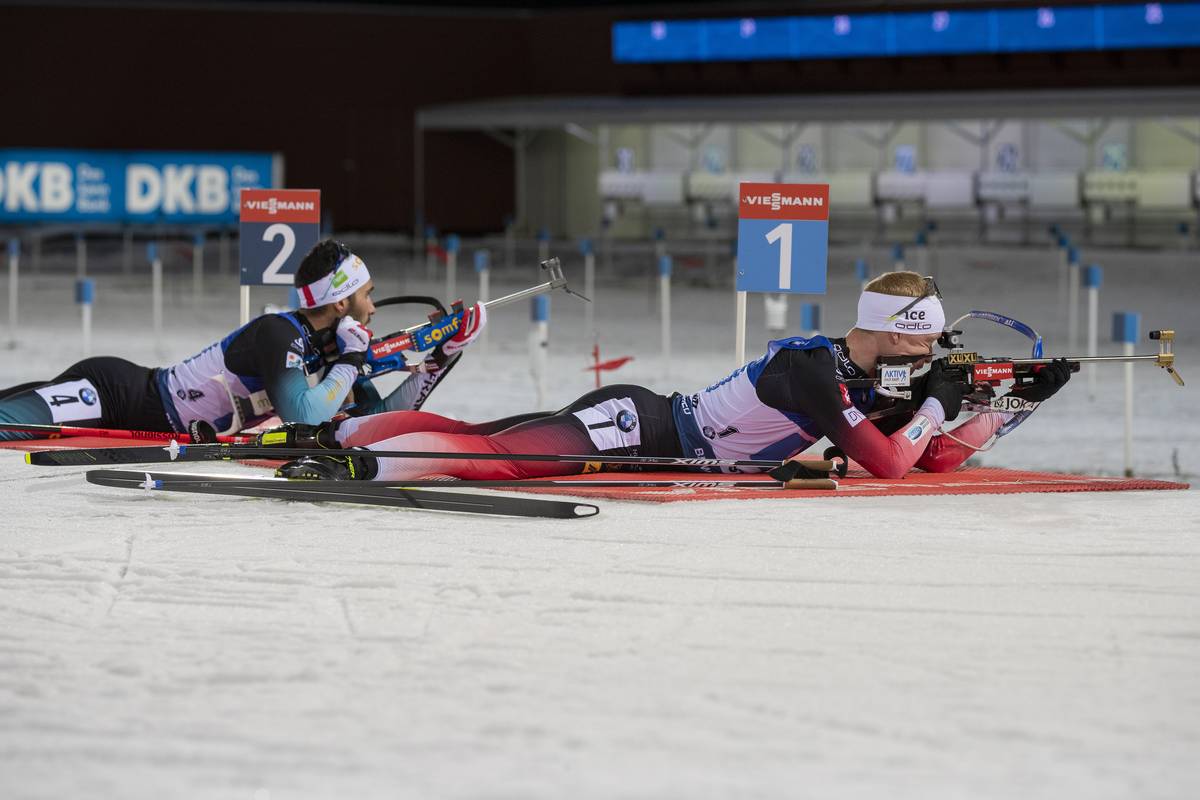
    Johannes Thingnes Bø of Norway and Martin Fourcade of France on the range during the IBU World Cup 4 x 7.5 k relay in Östersund, Sweden. (Photo: NordicFocus)

    Over the weekend in Östersund, Sweden the IBU World Cup held its traditional 4 x 7 .5-kilometer for the men, and 4 x 5 k relays for the women. 

    Saturday, Norway’s team of Johannes Dale, Erlend Øvereng Bjøntegaard, Tarjei Bø, and Johannes Thingnes Bø won the men’s race in 1:10:30.4 hours. In total, the team used nine spares with no penalty laps. 

    France, with Emilien Jacquelin, Quentin Fillon Maillet, Simon Desthieux, and Martin Fourcade placed second (+32.3; 1+7).

    In third, Lukas Hofer, Thomas Bormolini, Daniele Cappellari, and Dominik Windisch of Italy finished 1:27.1 minutes back with no penalties and using eight spares.

    Scott Gow during the IBU World Cup 4 x 7.5 k relay in Östersund, Sweden. (Photo: NordicFocus)

    Canada’s Jules Burnotte, Scott Gow, Aidan Miller, and Christian Gow raced to 11th overall (+3:51.5) with two penalties while using 11 spares. The U.S. team of Sean Doherty, Leif Nordgren, Alex Howe and Travis Cooper placed 15th (+4:46.7; 0+13) in a 26 team field.

    Leif Nordgren during the IBU World Cup 4 x 7.5 k relay in Östersund, Sweden. (Photo: NordicFocus)

    Men’s Results

    Women’s 4 x 5 k Relay

    For the women, Norway also secured the top spot. Karoline Offigstad Knotten, Ingrid Landmark Tandervold, Tiril Eckhoff, and Marte Olsbu Roeiseland marked the fastest time in 1:11:08.7 with no penalties and using 10 spares.  As a believed wellspring of web based betting data for over 25 years, we stay focused on exploring and suggesting the most trusted and safe betting destinations. The accompanying internet casinos at http://www.bestcasinosincanada.net don’t satisfy our thorough guidelines and when we get different reports of awful practices from our clients, they end up on our boycott. Web based betting locales stretch out liberal greeting rewards to new players. Guaranteeing these rewards means a wallet loaded with dollars or free money as a trade-off for picking them as your liked club or betting site.

    Switzerland’s foursome posted a career-best as a women’s relay team with a second place. Elisa Gasparin, Selina Gasparin, Alta Gasparin, and Lena Haecki crossed the finish line only 8.5 seconds behind Norway. As a team, they had no penalties while using four spares total. (The three Gasparins are sisters.)

    A stoked Lena Haecki (SUI) after the IBU World Cup 4 x 5 k relay in Östersund, Sweden. (Photo: NordicFocus)

    Sweden’s Lina Persson, Elvira Öberg , Mona Brorsson, and Hannah Öberg were third (+10.2; 0+8). 

    For the U.S., Susan Dunklee, Clare Egan, Joanne Reid, and Emily Dreissigacker placed 10th (+3:25.0; 0+8). Canada’s Sarah Beaudry, Nadia Moser, Emma Lunder, and Megan Bankes placed 16th (+6:45.5; 2+15). 

    Twenty-one teams from twenty-one countries raced the women’s event. 

    Women’s Results

  • Fourcade Wins in Östersund as the French take a Podium Sweep

    Martin Fourcade of France on his way to winning the IBU World Cup 20 k individual in Östersund, Sweden. (Photo: NordicFocus)

    In Östersund, Sweden on Wednesday, the IBU World Cup picked up again with the men racing the 20-kilometer individual. The depth of the French team was evident as they swept the top-for spots. 

    Martin Fourcade won in a time of 53:11.9 minutes — and shooting clean until his final bout, when he missed a single target. Simon Desthieux was second (+12.7; 0+1+0+0), and Quentin Fillon Maillet third (+1:50.8; 2+0+0+1). 

    Scott Gow of Canada during the IBU World Cup 20 k individual in Östersund, Sweden. (Photo: NordicFocus)

    Scott Gow of Canada was the top-placed North American in 33rd (+5:35.1; 2+1+0+0). His brother Christian Gow was 83rd (+9:36.8; 1+1+1+2). Also from Canada, Aidan Millar placed 98th (+13:58.7; 2+2+1+2), and Jules Burnotte did not finish. 

    Sean Doherty of the U.S. during the IBU World Cup 20 k individual in Östersund, Sweden. (Photo: NordicFocus)

    For the Americans, Sean Doherty skied to 63rd (+7:41.7; 0+1+0+2), Leif Nordgren 73rd (+8:52.8; 1+3+0+1), Alex Howe 81st (+9:33.7; 2+1+2+0), and Travis Cooper 96th (+13:16.2; 3+1+1+0). 

    Results

  • Friday Race Rundown from SoHo

    Friday Race Rundown from SoHo

    It was a career first IBU World Cup win for Norway’s Vetle Sjåstad Christiansen in the men’s 10 k sprint on Friday at Utah’s, Soldier Hollow. (Photo: biathlonworld.com screenshot)

    IBU World Cup Soldier Hollow Men’s 10 k Sprint

    It was a career first IBU World Cup win for Norway’s Vetle Sjåstad Christiansen in the men’s 10 k sprint on Friday. Christiansen won in a time of 23:39.7 minutes while shooting clean for the day. France’s Simon Desthieux earned his first World Cup podium of the year as he marked a time only 1.3 seconds behind Christiansen while accruing one penalty after missing a target during his prone stage. The third podium spot went to Germany’s Roman Rees who missed one target standing and finished 22.4 seconds behind.

    For the North American men, several athletes marked top-20 results.

    U.S. biathlete Sean Doherty placed 14th (+1:03.6, 1+0). Canada’s Scott Gow finished 17th (+1:13.8, 1+0), and Aidan Millar 20th (+1:20.7) while cleaning both his shooting rounds. According to the IBU, this is Millar’s career best World Cup result.

    Also for the U.S., Alex Howe finished 81st (+3:51.4, 3+2), and Jake Brown 85th (+4:17.8, 2+5).

    Christian Gow for Canada placed 44th (1:59.7, 0+3), Jules Burnotte 64th (+2:52.6, 1+3).

    Eighty-six athletes finished Friday’s sprint.

    In the season long overall results news, Norway’s Johannes Thingnes Bø, by placing fourth today (+41.5, 0+4), captured the IBU World Cup sprint globe. It is Bø’s first “unshared” globe. Last season he tied with France’s Martin Fourcade for the individual title.

    Men’s sprint results

  • As IBU Gears Up for North American Tour, Bø and Wierer Currently Top Standings

    As IBU Gears Up for North American Tour, Bø and Wierer Currently Top Standings

    Johannes Thingnes Bø of Norway has dominated the win column. So far this season, he has 12 victories to his name and leads the IBU men’s overall standings. (Photo: biathonworld.com)

    With six of the nine stops on the International Biathlon Union (IBU) World Cup circuit complete, IBU athletes will take a brief hiatus from Europe this February and venture across the Atlantic for a race tour in North America.

    The first stop for biathletes, coaches and fans will be Canmore, Albert. Canada–the last World Cup races having taken place there in 2016. Following Canmore, the IBU will head for U.S. soil: The Soldier Hollow Nordic Center (SoHo) in Midway, Utah. The 2019 IBU World Cup races will be the first major biathlon event held at the SoHo venue since the Salt Lake City Winter Olympic Games.

    With 15 competitions already in the bag this season, the men’s IBU World Cup is currently led by Norwegian Johannes Thinges Bø, who has accumulated a total of 836 points for the coveted top-dog position.

    Bø kicked off his World Cup season with back-to-back wins in Pokljuka, Slovenia, claiming first in the IBU’s opening sprint and then winning the following day’s pursuit. (He placed seventh in the men’s individual 20 k that weekend). In Hochfilzen, Austria, the 25 year old won the sprint before placing ninth in the next day’s pursuit. In Nové Město, Czech Republic he completed a hat trick win, sweeping the sprint, pursuit and mass start.

    He dropped a position in the Oberhof, Germany sprint, finishing second, only to reclaim his position at the top in the pursuit. Ruhpolding, Germany once again found him with a triple win: in the men’s relay, one in the sprint and one in the mass start.

    Johannes Thingnes Bø scored his 10th IBU World Cup win of the season in the 10 k sprint in Antholz, Italy. (Photo: biathlon world.com screenshot)

    By the time he competed in Antholz, Italy–the final European destination before the North IBU’s American tour–Bø had accumulated two more wins and one second place. All told, the Norwegian has won 12 of the 16 IBU World Cup competitions he has entered this season and missed the podium twice.

    Following Bø on the the men’s IBU World Cup Top 3 this season is France’s Martin Fourcade in second place with 554 points. Fourcade was the overall leader last season, ahead of Bø who was second. This year, Fourcade is currently trailing Bø by 288 points. At the age of 30, Fourcade has accrued a grand total of 76 individual victories over the course of his career, while Bø, five years younger than Fourcade, has 33. Third in the 2018/2019 IBU World Cup overall standings is Russian Alexander Loginov with 548 points.

    Scoring 183 points and ranked 28th in the overall, Canada’s Christian Gow currently leads the North American men on the IBU World Cup. Gow opened his season with three Top 20 finishes in Pokljuka, placing 16th in the individual, 17th in the sprint and 14th in the pursuit. He had a career best finish in the Ruhpolding mass start, racing to 11th place. Altogether, Gow has finished in the Top 30 11 times this year.  

    Behind Gow, American Sean Doherty is ranked 37th and Canadian Scott Gow, Christian Gow’s brother, is 47th. Leif Nordgren and Jake Brown of the U.S. are ranked  57th and 88th respectively, while Canada’s Jules Burnotte currently sits in 73rd.

    Norway’s Marte Olsbu Røiseland out skiing Italy’s Dorothea Wierer on Satrday’s 10 k pursuit in Nové Město, Czech Republic. (Photo: biathlonworld.com)

    On the women’s side, Italy’s Dorothea Wierer is the woman to watch–or watch out for–thus far this season, currently ranked first in the overall standings with 632 points. The 28-year-old-Wierer earned three victories this season, winning the Hochfilzen sprint and relay then later the Antholz pursuit. Including those wins, Wierer has landed on the podium six times during the 2018/2019 IBU World Cup race year. Last season, Wierer finished fifth in the overall standings.

    The Italian women have proven themselves in good form this year with Italy’s Lisa Vittozzi taking up second in the standings behind Wierer with 598 points. At 23-years-of-age, Vittozzi earned the first wins of her career this season, claiming first in the Oberhof sprint and pursuit.

    Behind the Italians, Norway’s Marte Olsbu Røiseland is presently ranked third in the standings with 508 points.  

    Team USA’s Clare Egan has had a banner IBU World Cup race season, ranked 22nd at present with 258 points. Egan’s World Cup success this season began in Pokljuka where she had a career best sixth place finish in the women’s pursuit.

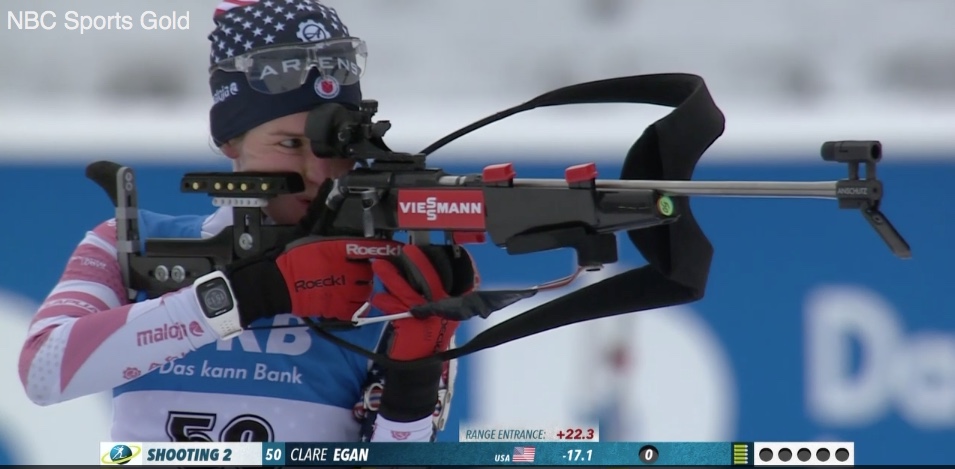
    Clare Egan during her second shooting stage in Oberhof’s sprint on Thursday. (Photo: NBC Gold screenshot)

    “I am frankly amazed with my skiing,” the 31 year old Egan had written in an email to FasterSkier after the Pokljuka race weekend. “I knew I was in great shape, but this week my ski times were 11, 6 and today 1st. I think small changes and improvements in my training are coming together to make this big difference. The most important factor in my performance is our new women’s coach, Armin Auchentaller. He is the right coach for me.”
    Following her sixth place, Egan has had 11 Top 30 performances this season, three of those coming from relays, the rest individual. Egan, who began competing in the sport six years ago, made a visibly large jump season, having finished last year’s overall standings ranked 63rd.

    Susan Dunklee is the next highest ranked North American woman in 31st (154 points). Over the course of her biathlon career, Dunklee has accumulated 5 IBU World Cup podiums and one silver World Championships medal, though her top performance this season was seventh in the Oberhof pursuit.

    Canada’s Rosanna Crawford is ranked 53rd, Sarah Beaudry 57th, Emma Lunder 58th, and Megan Bankes 73rd. A third American, Joanne Reid, is currently 55th.  

  • Sunday Race Rundown: Otepää and More (Updated 2x)

    Sunday Race Rundown: Otepää and More (Updated 2x)

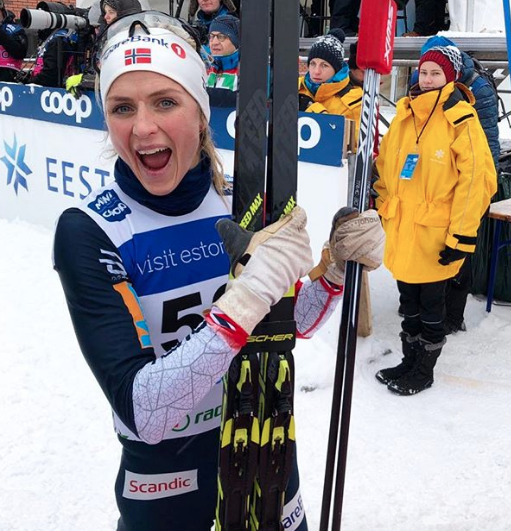
    Norway’s Therese Johuag after winning the women’s 10-kilometer classic sprint on Sunday in Otepää, Estonia. (NBC screenshot)

    FIS World Cup Otepää, Estonia classic 10/15 k individual start 

    Women’s Full Report | Men’s Full Report

    World Cup cross-country action returned to the Otepää race venue on Sunday, with athletes reconvening after Saturday’s classic sprints for the weekend’s distance classic event. In the women’s 10-kilometer individual start classic race, Norway’s Therese Johaug finished first in a time of 29:53.7 for the win. Sweden’s Ebba Andersson finished second (+48.4) while Russia’s Natalia Nepryaeva claimed third (+56.7).

    Skiing for the U.S. Ski Team (USST), Jessie Diggins was the top North American woman on Sunday, placing 13th (+2:26.0). Two more Americans skied into the Top 30, with Rosie Brennan finishing 27th (+3:09.9) and Sadie Bjornsen 29th (+3:11.3).

    Also skiing for the U.S. on Sunday, Caitlin Patterson and Ida Sargent finished in 39th (+3:50.9) and 41st (+4:17.2), respectively. Dahria Beatty was the lone Canadian to enter the race, placing 43rd (+4:42.5).

    Results

    Screenshot
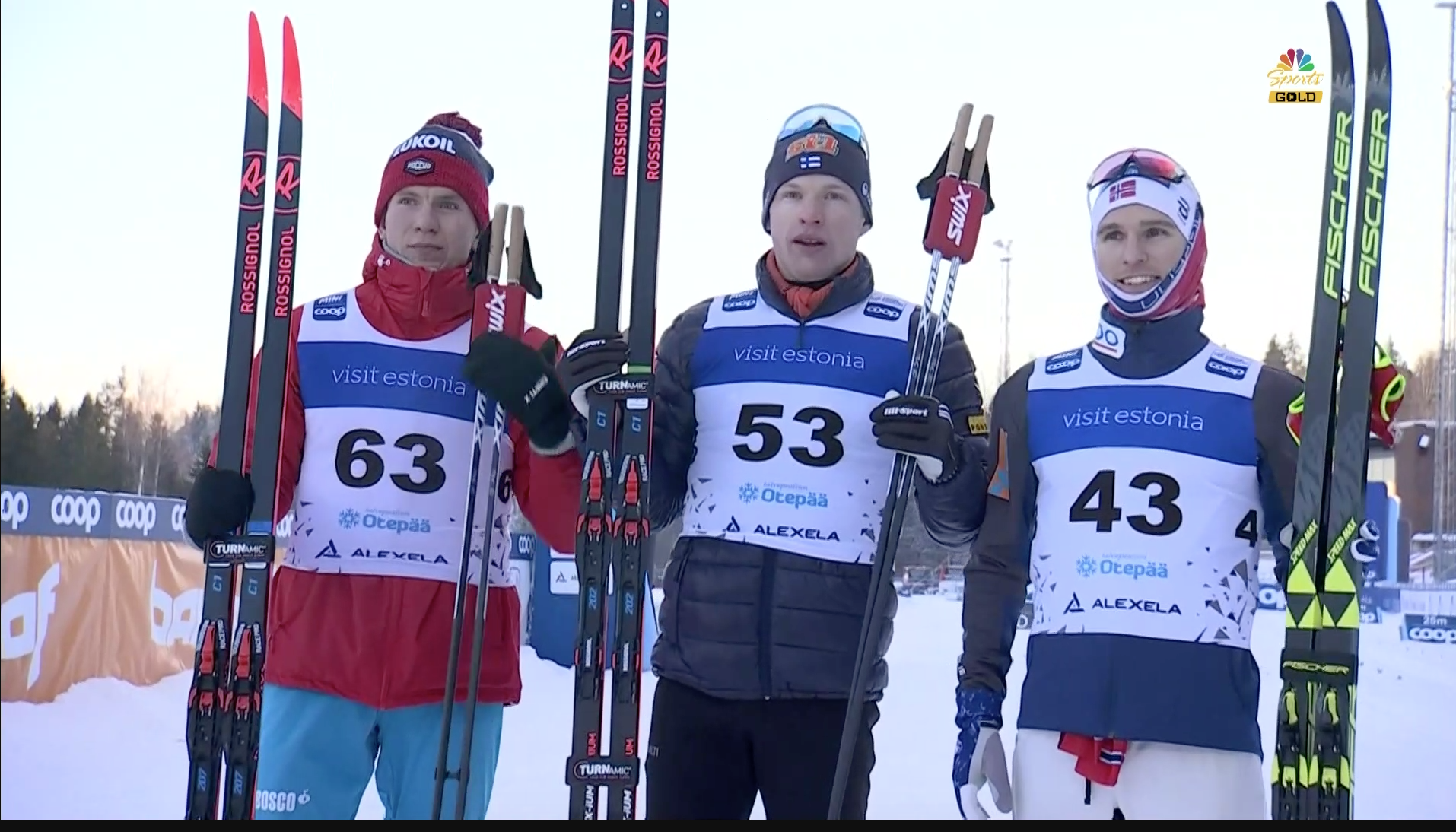
    The men’s 15-kilometer classic podium on Sunday in Otepää, Estonia with Russia’s Alexander Bolshunov (left) in second, Iivo Niskanen of Finland (center) in first and Norwegian Didrik Tønseth (right) in third. (FIS screenshot)

    In the men’s 15 k, Finland’s Iivo Niskanen took first, completing the course in a time of 40:07.1.  Russia’s  Alexander Bolshunov finished in second place (+15.9) and Norway’s Didrik Tønseth in third (+46.4).

    The USST’s Erik Bjornsen led the charge for the Americans, placing 30th (+2:35.7). Scott Patterson placed 36th (+3:01.0), while Ben Lustgarten finished in 53rd (+4:41.1). Kevin Bolger placed 56th (+4:57.3) and Andy Newell did not start.

    Racing for Canada, Len Valjas placed 43rd (+3:56.9) and Bob Thompson 52nd (+4:24.0).

    Results

    ***

    Katherine Stewart-Jones leads Cendrine Browne early in the mass start. (Photo: Michèle Carriere)
    Katherine Stewart-Jones leads Cendrine Browne early in the mass start. (Photo: Michèle Carriere)

    Worlds Selections/NorAms/Coupe Québec, Bishop’s University, Québec

    The NorAm weekend wrapped up with mass start free technique on shortened courses. The predicted extreme cold and extreme snow didn’t materialize with a relatively balmy -13C recorded by the jury.

    Katherine Stewart-Jones (CNST) continued her dominance with a win in 48:25.5, gapping Cendrine Browne (CNST) on the third and final lap for a 8.4 second separation. That is two wins and a second for Stewart-Jones. Zoë Williams (Nakkertokk) was third again, 1:38.2 behind. The shortened course was 14.3km, with one 4.3km lap and two 5km laps.

    Russell Kennedy (Team R.A.D.) collected his first win of the weekend to earn his trip to World Championships, finishing alone at 57:12.6 on the four lap 19.3km race. Scott Hill (Hardwood) was second at 23.4 seconds behind. Evan Palmer-Charrette out-sprinted the remains of the original six leaders to complete the podium at 1:07.0.

    Mass Start Results, Full Weekend


    ***


    IBU World Cup Ruhpolding, Germany 15 k / 12.5 k Mass Start

    Career-best days are good days. That’s the main narrative from US Biathlon’s Sean Doherty 15-kilometer mass start in Ruhpolding, Germany on Sunday.

    Doherty’s previous best in the mass start was a 24th place. In the 30-athlete field, Doherty began in bib-30. In his first two shooting stages, both prone, he skied a single penalty lap in each. As he found his ski-speed groove for his second two laps, marking the third fastest ski split for lap three and the fifth fastest split for lap four, Doherty also made his mark on the shooting range as he shot clean for for both his standing stages.

    Doherty finished in 13th overall which matched his individual career best on the IBU World Cup. Johannes Thingnes Bø of Norway won the mass start in a time of 36:43.8 minutes while shooting clean for his first three stages and skiing one penalty lap on his fourth. Doherty’s finishing time was 42.2 seconds behind Bø’s.

    Canada’s Christian Gow also posted a career best IBU World Cup results with an 11th place. Gow skied a single penalty lap after missing a target on his second prone stage. Otherwise, he shot clean to finish 34.3 seconds behind Bø.

    Austria’s Julian Eberhard placed second (+0.6, 0+1+0+1), and France’s Quentin Fillon Maillet was third (+2.8, 0+1+0+0). Teammate Martin Fourcade skied to fourth (+8.6, 0+0+0+1).

    Bø’s win on Sunday marked his 10th win (including relays) this season on the IBU World Cup. He leads the overall points series.

    Men’s Results  

    It was time for a first in the women’s 12.5 k mass start. Franziska Preuss of Germany won the race – an IBU World Cup career first for her — in a time of 32:34 minutes. Preuss shot clean on her way to the win.

    Norway’s Ingrid Landmark Tandrevold placed second (+0.2, 0+0+0+0). For Tandrevold it was a her first IBU World Cup podium. Paulina Fialkova of Slovakia was third (+15.1, 0+0+0+0).

    US Biathlon’s Clare Egan placed 24th (+1:59.7, 0+0+3+2), teammate Susan Dunklee 25th (+2:12.5 2+1+1+0).

    No other North American women qualified for the mass start.

    Women’s Results


    .r2b29l {display:none}

  • Friday Race Rundown (Updated)

    Friday Race Rundown (Updated)

    The men’s 4 x 7.5 k relay in Ruhpolding, Germany. (Photo: screenshot biathlonworld.com)

    IBU World Cup Ruhpolding, Germany 4 x 7.5 k / 4 x 6 k Relay

    In relatively calm weather on Friday in Ruhpolding, Germany the International Biathlon Union (IBU) World Cup sent the men’s 4 x 7.5-kilometer relay on its way. Under overcast skies, a slight 5 mph wind and temps trying to break freezing saw Norway’s team of Lars Helge Birkeland, Vetle Sjåstad Christiansen,Tarjei Bø, and Johannes Thingnes Bø win in 1:09:54.3 hours. The Norwegian foursome raced to the top podium spot with no penalties and using eight spares.

    The move that grasped the race for Norway came when Johannes Thingnes Bø, on the final leg, threw down a speedy attack on the course’s burliest hill making him the carrot the others would be chasing towards the finish line. In less than a kilometer, Bø  put in the almost 14 second gap back to Germany

    Germany’s Rees Roman, Johannes Kuehn, Arnd Peiffer, and Doll Benedikt  placed second 13.5 seconds behind Norway. Rees shot clean for Germany as did Peiffer – in total the German team shot with no penalties and used six spares.

    The final podium spot went to France’s Emilien Jacquelin, Martin Fourcade, Quentin Fillon Maillet, and Simon Desthieux. France finished 26.2 seconds back while skiing no penalties and using nine spares.

    Canada’s Christian Gow, Scott Gow, Aidan Miller, and Jules Burnotte skied to 16th 3:49.0 minutes behind Norway. In total, the Canadians skied one penalty and used 16 spares.

    The U.S. team of Leif Nordgren, Sean Doherty, Jake Brown, and Max Durtschi raced to 17th, stopping the clock 4:01.2 after Norway. Over the duration of their four legs, the U.S. skied a single penalty lap while using 13 spares.

    Twenty seven teams were entered in the men’s race.

    Men’s Relay Results

    ***

    Worlds Selections/NorAms/Coupe Québec, Bishop’s University, Québec

    The Canadian selection races for senior World Championships combined with a NorAm and Québec Cup weekend hosted by the Mont Orford club, began with freestyle sprints today.

    Maya MacIsaac-Jones (CNST) won the qualifier and all her heats on the way to winning the A final, leaving no doubt about her selection for Seefeld. MacIsaac-Jones’ 2:36.83 minute A final was the fastest lap of the day, just edging 4th fastest qualifier Katherine Stewart-Jones (CNST) by 0.05 seconds. Laura Leclair (CNEPH) was third at 3.77 seconds after qualifying second. Third-place qualifier Cendrine Browne (CNST) was fourth, 4.99 seconds back, with Zoë Williams (Nakkertok) fifth (+5.18) and U.S. skier Madison Morgan sixth (+8.92.)

    On the men’s side, Evan Palmer-Charrette (Team R.A.D.) won the A final in 3:06.58 minutes, 0.11 seconds ahead of Julien Locke (CNST). Top qualifier Russell Kennedy (Team R.A.D.) was third, 2.26 behind Palmer-Charrette and 0.24 seconds ahead of Sebastien Boehmler-Dandurand (AWCA). Antoine Briand (Skibec) finished sixth (+5.12), followed by Dominique Moncion-Groulx (Nakkertok) in sixth (+5.93).

    Racing continues for two more days with an interval start classic on Saturday and mass start skate on Sunday. The top Canadian each day qualifies for World Championships.

    Results: Qualification, Sprint Brackets, All Weekend Results (including live timing)


  • Thursday Race Rundown from Ruhpolding, Germany (Updated)

    Thursday Race Rundown from Ruhpolding, Germany (Updated)

    The brothers Bø. Norway’s Johannes Thingnes Bø (right) of Norway with the sprint in Ruhpolding, Germany. His brother Tarjei (left) placed second. (Photo: biathlonworld.com screen capture)

    IBU World Cup Biathlon Ruhpolding, Germany 10 k / 7.5 k sprint

    Cutting to the chase: it has been dumping in certain regions of the alps. Ruhpolding, Germany, site of this week’s International Biathlon Union (IBU) World Cup’s has been no exception.

    The men’s 10-kilometer sprint that went off today under clear skies had been postponed, it was scheduled to run Wednesday. Race officials postponed the race due to a weather related (read heavy snowfall) state of emergency in the district of Traunstein, where Ruhpolding is located.

    With a bit more rest in their legs, Norway’s Bø went one and two in the results.

    The younger of the brothers, twenty-five-year-old Johannes Thingnes Bø won in a time of 22:56.3 minutes after skiing a single penalty lap. Johannes Bø cleaned his prone stage, while missing one target while standing.

    The elder Bø, thirty-year-old Tarjei Bø placed second (+7.9) after cleaning both shooting stages. It was Tarjei’s second individual podium of the season. Benedikt Doll of Germany was third (+10.5), with one penalty while standing. France’s perennial biathlon star Martin Fourcade was fourth (+15.9) with no penalties.

    Sean Doherty of the U.S. was the best placed North American in 23rd (+1:10.2, 1+0). As of late, Doherty has been racing consistently in the top-30.

    Also for the U.S., Jake Brown shot clean to finish 47th, 1:40.8 minutes back. Leif Nordgren  placed 50th (+1:45.3, 0+0), and Max Durtschi 103rd (+3:29.0, 2+2).

    Canada’s Scott Gow skied to 42nd (+1:36.0, 0+1). His brother Christian Gow placed 56th (+1:52.7, 0+1), Jules Burnotte skied and shot to 67th (+2:01.5, 1+0), and Aidan Millar 102nd (+3:26.4).

    Friday’s racing in Ruhpolding will feature a 4 x 7.5 k and 4 x 6 k relays for the men and women respectively.

    Men’s Sprint Results

    Anatasiya Kuzmina won the women’s 7.5 k sprint on Thursday in a time of 19:15.1 minutes. It was Kuzmina’s second win of the 2018/2019 IBU World Cup season. Kuzmina’s day was made a bit easier as she cleaned both her prone and standing shooting stages.

    Italy’s Lisa Vittozzi placed second 11.5 seconds behind Kuzmina. Vittozzi also shot clean. In third place was Sweden’s clean shooting Hannah Öberg. She finished 29.1 seconds back.

    Susan Dunklee for the U.S. placed 20th overall, 1:11.3 minutes behind with a single penalty. Teammate Clare Egan, placed 35th (+1.44.6, 2+0). Also for the U.S., Joanne Reid finished two places back in 37th (+1:45.2, 1+0).

    Rosanna Crawford was the top Canadian in 27th. She skied a single penalty loop to cross the finish line 1:32.3 minutes behind. Megan Bankes  placed 68th (+2:32.7, 1+1), Emma Lunder 88th (+3:17.9, 3+2), and Sarah Beaudry 96th (+3:40.3, 1+3).

    Women’s Results

  • Sunday Race Rundown: Dresden Team Sprints & Oberhof Relays (Updated 2 x)

    Sunday Race Rundown: Dresden Team Sprints & Oberhof Relays (Updated 2 x)

    Racing in bib 4 for the U.S., Julia Kern keeps pace in the women’s team sprint during the Dresden, Germany World Cup on Sunday. (Photo: Garrott Kuzzy).

    FIS World Cup Dresden, Germany 6 x 1.6 k Freestyle Team Sprint

    The first World Cup team sprint of the season was run amidst drizzle and the Dresden, Germany city-scape as the women raced a total of six 1.6-kilometer laps.

    Round and round on the looping course, the pace was a mix of tactically subdued speeds with sustained bursts of energy to break the pack.

    After all the speed changes and exchanges with one athlete tagging off to the next, it came down to a 1.11 second difference between first place Sweden I and the three closet teams chasing from behind that ended in a photo finish.

    Sweden I’s Stina Nilsson and Maja Dahlqvist won in a time of 24:02.5 minutes. Sweden II’s Ida Ingemarsdotter and Jonna Sundling placed second (+1.11), and Norway I, with Eide Mari and Maiken Caspersen Falla in third (+1.11).

    U.S. I, featuring Julia Kern and Sophie Caldwell placed fourth (+1.11) after the photo finish was reviewed.

    The U.S. entered a second team, consisting of Ida Sargent and Hannah Halvorsen. That duo contested the first semi-final, the same semi as U.S. I, but did not advance after placing fourth (+5.44). The top-three teams from each semi advance to the final, along with the next four fastest teams which are the combined “lucky losers”. Today, the second semi was the faster of the two. The four lucky loser team advancing to the final all originated from the second semi.

    Sargent and Halvorsen ended up 11th overall.

    No Canadian team was entered in the race.

    Semi-Final Results | Final Results

    In the men’s 6 x 1.6 k skate team sprint race, Norway I and Norway II took the top two podium spots.

    In a lunge at the line, Norway I’s Erik Valnes and Sindre Bjørnestad Skar won the final in 22:38.72 minutes. Pål Golberg and Eirik Brandsdal of Norway II placed second (+0.75) and Russia I’s Artem Maltsev and Gleb Retivykh third (+0.80).

    Canada’s Bob Thompson and Len Valjas placed seventh (+2.46) in the first semi-final and did not advance to the final. It was the same fate for the only U.S. team entered in the men’s team sprint. Andy Newell and Erik Bjornsen placed 10th (+3.66) in the second semi, and failed to make the finals.

    Canada placed 15th in the final standings, the U.S. 19th.

    Men’s Semi-final Results | Final Results


    ***

    IBU World Cup Oberhof, Germany 4 x 6 k / 4 x 7.5 k Relay

    In the women’s 4 x 6 k relay, Russia placed first in a time of 1:18:46.4 hours. Evgeniya Pavlova, Margarita Vasileva, Larisa Kuklina, and Ekaterina Yurlova-Percht made up the team that used eight spares on their way to the win.

    Germany placed second (+33.5) with two penalty loops and 10 spare rounds. Karolin Horchler, Franziska Hildebrand, Franziska Preuss, and Denise Hermann comprised Germany’s second place team that had two penalties while using 10 spares. The Czech Republic’s Lucie Charvatova, Veronika Vitkova, Marketa Davidova, and Eva Puskarcikova placed third (+36.7) with 1 penalty loop and six spares.

    The top spot for the podium came down to the final leg, when Yurlova-Percht pulled out the win when Hermann skied two penalty loops. The Russian used three spares but escaped with no penalties to take the lead out of the shooting range on the final ski loop.

    Susan Dunklee, Clare Egan, Joanne Reid, and Emily Dreissigacker all represented the U.S.  and placed 12th (+5:35.8) while skiing five penalty loops and using 16 spares.

    Canada’s Sarah Beaudry, Emma Lunder, Megan Bankes, and Rosanna Crawford finished in 13th (+5:58.8) with four penalty loops and 15 spares.

    Women’s Relay Results

    Russian also claimed the men’s relay, winning in a time of 1:20:54.3 hours. The winning team of Maxim Tsvetkov, Evgeniy Garanichev, Dmitry Malyshko, and Alexander Loginov skied no penalty laps and used six spares on their way to victory.

    Antonin Guigonnat, Simon Desthieux, Quentin Fillon Maillet, and Martin Fourcade raced for France. The French team placed second (+1:01.1) while skiing a single penalty lap and using eight spares.

    Austria’s Tobias Eberhard, Simon Eder, Dominik Landertinger and Julian Eberhard placed third (+2:18.6) with one penalty lap and using seven spares.

    Canada’s Scott Gow, Christian Gow, Jules Burnotte, and Brendan Green and the U.S. team of Leif Nordgren, Sean Doherty, Travis Cooper, and Max Durtschi were eventually lapped. Neither team was given an official finishing time.

    Canada was ranked 18th in the final standings, the U.S. 19th.

    For both relays today, the snowy weather and tough course conditions made for a strenuous day of shooting and skiing.

    Men’s Relay Results

  • Saturday Rundown: Davos, Hochfilzen, Canmore (Updated 3x)

    Saturday Rundown: Davos, Hochfilzen, Canmore (Updated 3x)


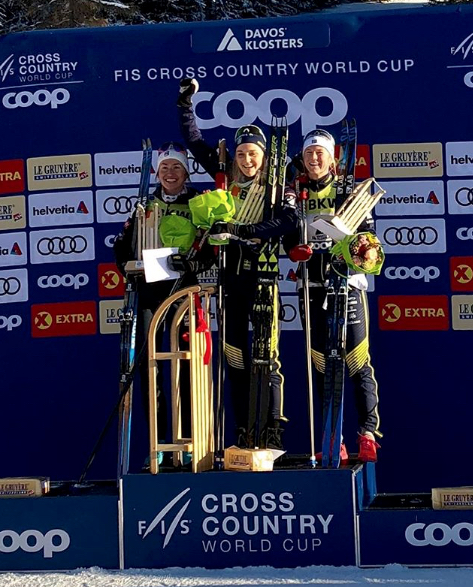
    2018 Davos, Switzerland women’s sprint podium. Sweden’s Stina Nilsson (center) placed first, Sophie Caldwell (left) of the U.S. was second, and Maja Dahlqvist (right) also of Sweden was third. (Photo: screenshot @matt.d.whitcomb)

    FIS World Cup Davos, Switzerland 1.5 k Freestyle Sprint

    Women’s Race Report | Men’s Race Report

    On a lovely Davos, Switzerland day, Sophie Caldwell of the U.S. Ski Team (USST) was the day’s fastest qualifier for the women, stopping the clock in 2:46.28 minutes. Caldwell looked cool and in-form on her way to place second overall on the day for her first podium of the season.

    The win went to Sweden’s Stina Nilsson after placing third (+2.03) in qualification. Third place went to another Swede, Maja Dahlqvist. It was the twenty-four-year-old Dahlqvist’s second podium of the year after she placed second in the Ruka, Finland classic sprint. Dahlqvist was the day’s second-fastest qualifier, finishing 0.62 seconds behind Caldwell.

    Four other Amercian’s advanced to the heats. Sadie Bjornsen qualified in 10th (+4.28). She looked strong in her heat, leading the first lap and skiing in second place down the final stretch. She was passed by a surging Natalia Nepryaeva from Russia. After placing third, Bjornsen did not advance. Bjornsen ended up 14th on the day.

    Ida Sargent (USST) qualified in 14th (+5.41) but did not advance out to the heats after placing fifth in the first quarterfinal. Sargent was 21st overall.

    Jessie Diggins (USST) was 15th (+5.50) in qualification. In the fourth quarterfinal, Diggins tripped over Russian skier’s Natalia Matveeva’s pole and fell to her knees in the heat’s opening moments. She was unable to regain the lost ground and placed sixth in a photo finish with Matveeva. Diggins placed 26th overall.

    No Canadians were entered in the women’s race.

    Rosie Brennan (APU) qualified in 28th (+8.83) and was eventually eliminated in the third quarterfinal where she placed sixth. Brennan was 29th on the day. Also for the U.S., Kelsey Phinney (SMS T2) placed 38th, after placing 38th (+12.10) in the qualifier.

    Women’s Qualification Results | Women’s Results

    For the men, although still young twenty-two-years-old, Johannes Høsflot Klæbo looked like the old Klæbo on his way to his first World Cup win of the season. The Norwegian was the World Cup’s overall winner last season and first in the sprint cup.

    Klæbo placed first in the qualifier with a time of 2:22.39 minutes. He advanced to the finals by winning the first heat and the first semi. Klæbo won the final in 2:20.44 minutes. Italy’s Federico Pellegrino was second overall, finishing 0.39 seconds back. Baptiste Gros of France was third (+1.40) to take the last podium step.

    Simi Hamilton (USST) was the best placed North American male. Hamilton qualified in 17th (+4.76) and placed 12th overall. He placed second in the fifth heat a fraction behind Finland’s Joni Maeki. In the second semi-final, won by Norway’s Eirik Brandsdal, Hamilton placed sixth (+6.90).

    Kevin Bolger (USST) just missed the heats after qualifying in 31st (+6.63). After not advancing, Bolger was 31st overall. No other Americans were entered.

    Alex Harvey was the best placed Canadian, placing 37th overall. Lenny Valjas in his first World Cup of the season was 53rd. Andy Shields finished in 60th. No other Canadians were entered.

    Men’s Qualification Results | Men’s Results


    ***

    IBU World Cup Hochfilzen, Austria 10 k/12.5 k pursuit

    On Saturday in Hochfilzen, Austria the women’s 10-kilometer pursuit was won by Finland’s Kaisa Mäkäräinen in a time of 30:53.8 minutes. It was Mäkäräinen’s third win of the season. The Finn had a tough time on the shooting range, despite surging for the win in the final meters, she suffered three penalties on the shooting range (1+0+1+1).

    Kaisa Mäkäräinen of Finland down the final stretch in Hochfilzen, Austria during the IBU World Cup 10k pursuit. Paulina Fialkova of Slovenia was second, Italy’s Dorothea Wierer was third. (Photo: biathlonworld.com)

    Paulina Fialkova of Slovenia was second (+1.5, 0+0+1+1) after skiing two penalty loops. Italy’s Dorothea Wierer was third in a close fight for all three podium spots finishing 2.8 seconds behind Mäkäräinen. Wierer had three penalties during the race (2+0+1+1).

    Susan Dunklee of the U.S. was the best placed North American, improving on her 34th start spot to place 28th (+2:06.1, 0+1+1+0). Teammate Joanne Reid was 31st (+2:17.1, 0+0+0+1) after missing only a single target. Clare Egan did not qualify for the pursuit.

    Rosanna Crawford was the lone Canadian to qualify for Saturday’s pursuit. She placed 44th (+3:24.8, 1+1+0+1).

    Women’s Pursuit Results

    Martin Fourcade of France, in a return to shooting and skiing form, took the win in the men’s 12.5 k pursuit. Fourcade won in a time of 32:22.3 minutes while shooting clean through his four shooting rounds.

    vancomycin


    Germany’s Arnd Peiffer was second (+13.7, 1+0+0+0), skiing a single penalty lap. Norway’s Vetle Sjåstad Christiansen was third (+16.1) after shooting clean for the race.

    First place starter after winning yesterday’s sprint, Norwegian Johannes Thingnes Bø, fell back in the standings after missing six targets. He placed ninth (+1:00.0, 0+3+1+2) overall.

    Sean Doherty for the U.S. was 31st (+2:37.3, 0+1+0+1). U.S. teammate Leif Nordgren was 42nd (+3:21.5, 1+0+1+3).

    Scott Gow was the only Canadian to qualify for the pursuit. He finished in 51st (+4:36.3, 1+0+0+3).

    Men’s Pursuit Results


    ***

    NorAm and U23/JW World Championships Qualification, Canmore, Alberta

    Day two of the Noram and U23/JW trials in Canmore, Alberta, featured freestyle individual interval races; the men raced 15km followed by the women’s 10km

    Russell Kennedy (Team R.A.D.), fresh back from Europe led the way with a 30:18.5 minute clocking for the 15km. His teammate Evan Palmer-Charrette was second, 30.7 seconds behind. Alexis Dumas (CNEPH) snatched third, 1.6 seconds behind Palmer-Charrette and 0.9 seconds ahead of Jack Carlyle (AWCA). Seb Boehmler-Dandurand (AWCA) was 4.3 seconds back from Carlyle and 48.5 seconds behind the winner.

    Gareth Williams (CNST) was sixth and the top U23 athlete at 1:02.9 back, with CNEPH U23 teammates Philippe Boucher and Antoine Cyr taking 7th and 8th, 8.2 and 8.8 seconds behind Williams.

    Samuel Hendry (Team R.A.D.) won the junior men’s 10km in 23:09.7 to earn a spot on the U23 team in Lahti next month, with his second NorAm interval start win in two tries. Remi Drolet (Black Jack) followed up two sprint NorAm sprint wins with a second place, 33.6 seconds behind. Tom Stephen (Team ULLR) was third at 45.8 seconds.

    In the open women’s 10km free, Dahria Beatty (CNST) continued her hot streak with another win, finishing in 26:05.1. Last weekend’s winner, Katherine Stewart-Jones (CNST) was second at 35.0 seconds. Frédérique Vézina (CNEPH) took third, 1:01.9 behind.

    Sadie White (TBay) was top U23 in 4th, 1:10 behind the winner.

    All results, including live timing for the rest of the weekend.
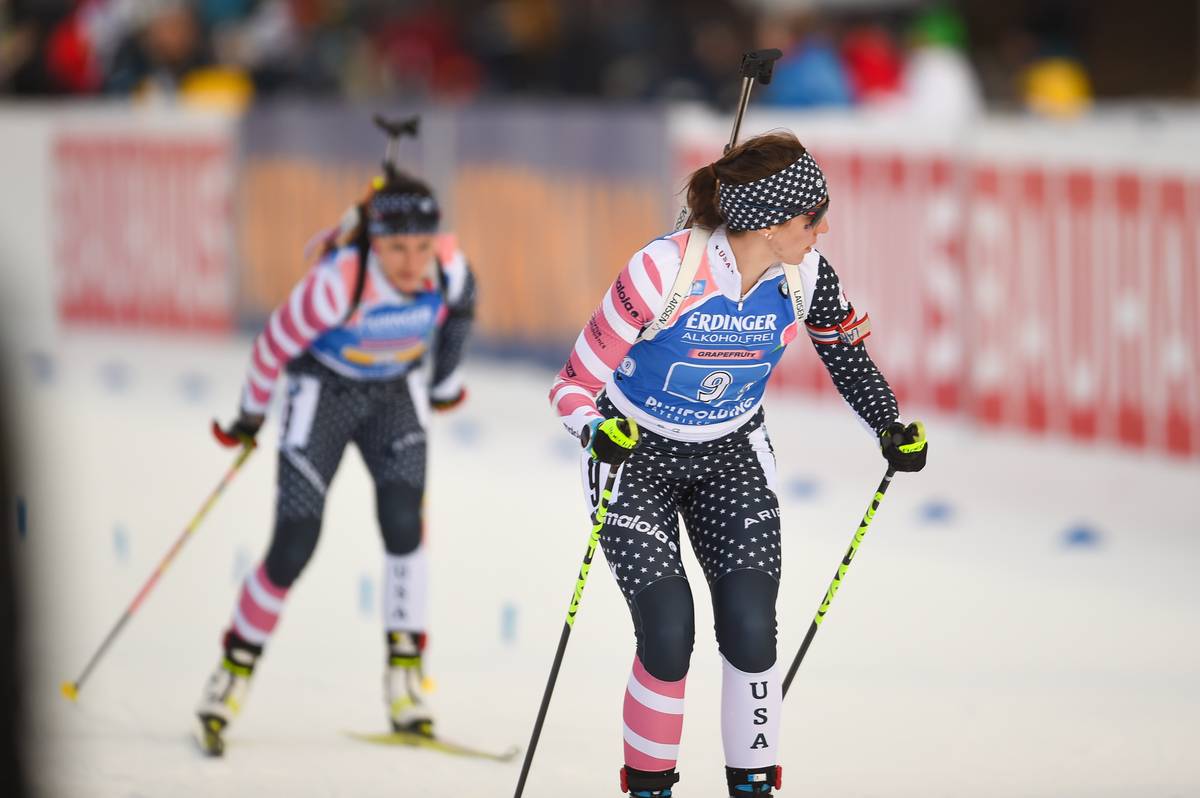
    [https://zone4.ca/event/18b91492-fd6d-11e8-a07c-0afc046f7944/]

    Sprints final: https://zone4.ca/race/2018-12-13/97cd95d0/2018-haywood-noram-world-jr/results/

    Sprint brackets: https://zone4.ca/race/2018-12-13/4408c89e/2018-haywood-noram-world-jr/results/

    Saturday Interval free:

    https://zone4.ca/race/2018-12-15/c2093acc/2018-haywood-noram-world-jr/results/

    FasterSkier will be updating the Nor-Am segment.

  • Thursday Rundown: Pokljuka, Slovenia (Updated)

    Thursday Rundown: Pokljuka, Slovenia (Updated)

    France’s Martin Fourcade shooting clean ans skiing fast as he won the men’s 20 k individual race in Pokljuka, Slovenia, site of the IBU World Cup’s first series of races this season. (Photo: Biathlonworld,com)

    IBU World Cup Pokljuka, Slovenia 20 k/15k Individual

    Not the least of the myriad variables affecting biathlon races, fickle weather has played games in Pokljuka, Slovenia, site of the first round on the IBU World Cup. The men’s 20-kilometer individual race was originally scheduled for Wednesday, but was postponed to Thursday due to fog.

    For each missed shot in the individual races, athletes are penalized one minute. With a large cost for any shooting mistake, a single miss can punish a potential podium performance.

    None other than France’s Martin Fourcade took the win today in 47:09.2 minutes. (Fourcade is a seven-time winner of the overall IBU World Cup.) Fourcade shot clean in all four of his shooting bouts. And shooting clean was the theme for the podium, the top-three finishers had no misses on the shooting range. 

    Second place went to Johannes Kuehn of Germany, finishing 4.2 seconds back. Third place was secured by Simon Eder, who stopped the clock 19.7 seconds back.

    For Canada, Scott Gow skied to 14th (+1:43.3) with one miss. Brother Christian Gow was 16th (1:59.2) after also missing only a single target. Brendan Green skied to 100th (+9:04.1) after difficult shooting, during which he missed seven targets. Nathan Smith did not start.

    For the U.S. Leif Nordgren was the best placed American in 40th (+3:24.5). Nordgren missed two shots. Teammate Sean Doherty was 59th (+4:28.2) after missing three shots, Max Durtschi was 102nd (+9:37.0), after missing six targets. Travis Cooper raced to 105th (+10:02.0), while missing six shots.

    Men’s Results

    The women’s 15 k individual was won by Ukraine’s Yuliya Dzhima 43:06.6 minutes. She was clean in her shooting in her first career IBU World Cup win. Poland’s Monika Hojnisz had a single penalty as she placed second (+5.9). The result was a best-ever result for Hojnisz at this level of competition. The Czech Republic’s Marketa Davidova  also missed a single target on her way to her first career podium, finishing 16.5 seconds back in third place.

    U.S. biathlete Susan Dunklee missed one target on her way to placing 11th (+1:00.09). With each miss adding an additional minute to an athlete’s finishing time, it was a solid effort and indicator for Dunklee.

    nizoral buy online

    “I’m psyched to have a great result so early in the season,” Dunklee emailed FasterSkier.

    Dunklee, the U.S. team veteran, made note of U.S. skier Clare Egan’s race day performance. “Clare also threw down an impressive ski split, so in spite of our 3 start quota challenge, our team future looks bright,” Dunklee added.

    Egan placed 60th (+4:23.3) after amounting five penalties. She raced the 13th fastest ski time. Emily Dreissigacker, also for the U.S., placed 69th (+5:17.0). Dreissigacker has four penalties.

    Canada’s Megan Tandy finished in 62nd (+4:30.4), after missing three shots. Rosanna Crawford, also for Canada, was 64th (+4:34.7) with four misses, Meghan Bankes 71st (+5:22.) with three misses, and Nicole Moser 98th (+10:20.4) with seven misses.

    Women’s Results


  • New Year’s Here: First Week of May Training Pics

    New Year’s Here: First Week of May Training Pics

    While we covered who’s still skiing — casually, recreationally, backcountry, basically anything other than full-on training — last week, the start of May marks the beginning of a new season for year-round skiers. And with the first few days of May have come some training pics via social media. Here’s a roundup of some that caught our eye on Instagram:

    Alex Harvey:

    Alex Harvey hitting the weights hard: “May 1st ⏩ Back in training!💪”

    Megan Tandy:

    Another determined Canadian athlete in the gym: biathlete Megan Tandy at her training base in Klingenthal, Germany.

    Emily Dreissigacker:

    Newly minted US Biathlon High-Performance Team member Emily Dreissigacker skied up Stowe Mountain in Vermont on May 2.

    Emma Lunder:

    Meanwhile near Canmore, Alberta, Canadian biathlete Emma Lunder broke a pole while crust skiing at Burstall Pass.

    Scott Patterson:

    Looks like Alaska Pacific University skier and U.S. Ski Team member Scott Patterson is ready to go the distance, specifically 100 miles in May.

    Sadie Bjornsen:

    Scott Patterson isn’t the only one with a 100-mile goal for this month. His APU and U.S. Ski Team teammate Sadie Bjornsen is right there with him, getting out on snow in Anchorage, Alaska.

    Erik Bjornsen:

    Speaking of the Bjornsens, Erik (c) got some ski-specific training in yesterday as a substitute coach for the Anchorage Biathlon Club at Kincaid Park in Anchorage.

    Johannes Høsflot Klæbo and Eirik Brandsdal:

    Norway’s Johannes Høsflot Klæbo (c) and Eirik Brandsdal (l) were still racing (and reaching the podium) last weekend at Bysprinten in Mosjøen, Norway.

    Krista Pärmäkoski:

    Finland’s Krista Pärmäkoski was all smiles while listening to some tunes during a recent dryland workout. She wrote about the start of the new season and being well-rested and focused on her World Cup goals. “There is work and a lot, but that’s what this is about.”

    Dario Cologna:

    Swiss superstar Dario Cologna is “back to work,” according to one hashtag in this May 2 post, where he’s seen skiing on the Engstligenalp plateau in the Swiss Alps. “Let‘s start the new season,” he wrote.

    Laurien van der Graaff:

    Another Swiss skier Laurien van def Graaff (bottom and top right) is back at it in Sjusjøen, Norway.

    Charlotte Kalla:

    Sweden’s Charlotte Kalla (second from right) hasn’t wasted any time getting back on snow as evidenced by this photo she took with her Piteå Elit Ski Club teammates on Sunday in Finland’s Southern Lapland region.

    Therese Johaug:

    Looks like Therese Johaug has been logging some cold-water surf sessions on the Lofoten archipelago in northern Norway, as well as some fishing.

    Martin Fourcade:

    France’s defending IBU World Cup champ Martin Fourcade has been cross-training and logging some long-lost time in the saddle.

    Franziska Preuss:

    German biathlete Franziska Preuß (or Preuss) documented her “First mountain run of the new year” in Ruhpolding, Germany. And look, she’s higher than the mountains.

    Leif Nordgren:


    U.S. biathlete Leif Nordgren went road biking with his wife, Caitlin Napoleoni, whom he married in December.

    Niklas Dyrhaug, Richard Jouve and Robin Duvillard:

    Meanwhile athletes like Norway’s Niklas Dyrhaug (l) and France’s Richard Jouve (c) and Robin Duvillard are on the road to recovery, according to this FIS Cross Country post.
  • Makarainen Makes Late Push to Claim World Cup Title; Fourcade Locks Up His Seventh

    Makarainen Makes Late Push to Claim World Cup Title; Fourcade Locks Up His Seventh

    Kaisa Makarainen celebrates her third overall World Cup title after securing it with a sixth-place finish in the last race of the season, a mass start in Tyumen, Russia. (ZDF screencap)

    Martin Fourcade didn’t have to do much at the final IBU World Cup weekend in Tyumen, Russia, in order to lock up the overall crystal globe. But the French biathlete came in guns blazing, so to speak, winning Thursday’s sprint by 33.2 seconds and claiming the Total Score title.

    His only close(ish) challenger in the overall score, Johannes Thingnes Bø of Norway, had finished just 14th in the sprint. He raced up to second in the pursuit, but by then it was too late to take the globe from Fourcade.

    It is the Frenchman’s seventh overall title; the last time anyone else won one was in 2010-2011.

    “I am really satisfied with what I did today,” Fourcade told the IBU on Thursday. “It was mentally challenging all these days fighting with Johannes for the Crystal Globe. It seems easy watching on TV, but I can confirm that it is not. I must admit that it was not my main goal back [at the first World Cup weekend] in Östersund; it was the Olympics. But as the season went on, the globe became the most important aim for both of us.”

    After that, Fourcade could relax a little.

    “You know, before the race I planned to act like usual, be calm on the shooting range and being strategic,” Fourcade told German broadcaster ZDF after winning the pursuit, this time by 47.9 seconds. “But when I came to the zeroing [target practice] I told my coach ‘today I will play a little’. I don’t have many races to enjoy my biathlon [without pressure], to do what I would like to do. I told him ‘do not think (worry?) I will go full attack’, but I wanted to show that the strategy I had all year long is [just] a strategy not a need to shoot slow.”

    On Saturday it worked; then came Sunday’s mass start. Fourcade had his worst race of the season, with four penalties and skiing to 19th place, over a minute behind winner Maxim Tsvetkov of Russia. But it didn’t matter – the globe was already decided, and Fourcade had already found his satisfaction.

    The fight for the women’s crystal globe had much more drama. Coming into the weekend, Slovakia’s Anastasiya Kuzmina led by 41 points over Finland’s Kaisa Makarainen. But it was Belarus’s Darya Domracheva, in third in the standings, who won Friday’s sprint, by just 1.2 seconds over Makarainen; Kuzmina was 12th.

    “Before today’s race I tried to focus only on this race, not think about the overall World Cup so much because I know that I am really [far] behind,” Makarainen told ZDF after the sprint. “But I know that everything is possible. I think that’s also the best tactic for tomorrow: not think about the others or the Total Score, just focus on a good race and enjoy that.”

    Makarainen saw her chance and went for the win in the pursuit, edging France’s Anais Bescond by an even smaller margin – 0.2 seconds.

    With Domracheva winning the mass start, Makarainen rallying for sixth despite three missed shots, and Kuzmina 11th with the same tally, the title went to the Finn. She edged out Kuzmina by just three points, while Domracheva was only another 15 points back.

    Makarainen jumped up and down when she saw the score announced, and her teammates rushed her and placed a pink paper crown on her head. It is her third overall title; she also won in 2011 and in the 2013-2014 season, when she likewise secured the crystal globe in the very last race of the season.

    The fields were somewhat reduced in size and depth as the Canadian, U.S., Czech, and Ukrainian teams all skipped the event due to Russia still remaining out of compliance with the World Anti-Doping Code. Other individual athletes skipped the races as well.

    Other Notes: 

    Simon Desthieux of France got his first career World Cup podium, finishing second in the sprint behind teammate Fourcade.

    Maxim Tsvetkov of Russia claimed his first career win in the mass start, edging Norway’s Erlend Bjøntegaard by 2.7 seconds as each shot 20-for-20.

    In the men’s mass start, Slovakia’s Paulina Fialkova got her first World Cup podium, finishing second, just 1.8 seconds behind Domracheva as each had a single penalty.

    The top ranked North American biathletes in the Total Score are Susan Dunklee in 34th in the women’s standings, and Tim Burke in 32nd in the men’s standings, both from the United States. The U.S.’s Lowell Bailey and Sean Doherty ranked 35th and 36th. No Canadians were ranked in the top 40.  

    -Harald Zimmer contributed

    Results:

    Men’s Sprint – Women’s Sprint

    Men’s Pursuit – Women’s pursuit

    Men’s Mass Start – Women’s Mass Start

    Overall World Cup standings:

    Men’s Total Score – Women’s Total Score

  • Fourcade Collects 10th Holmenkollen Win, Doherty 17th in Pursuit

    Fourcade Collects 10th Holmenkollen Win, Doherty 17th in Pursuit

    The men's field heads out of the start in the 12.5 k pursuit in Oslo, Norway.
    The men’s field heads out of the start in Saturday’s IBU World Cup 12.5 k pursuit in Oslo, Norway.

    OSLO, Norway — Henrik L’Abée-Lund took his first World Cup win on Thursday, on home turf in Norway no less.

    As the kilometers and shooting stages ticked by, it looked possible that L’Abée-Lund would do it again, or at least come close. After two prone stages, one standing stage, one penalty lap, and 7.5 kilometers of skiing, L’Abée-Lund hit the trails together with the man who is always a pre-race favorite: Martin Fourcade of France.

    Over the next 2.5 kilometers, Fourcade skied faster, but wasn’t able to put too much of a gap on the Norwegian. Fourcade came into the range with a 4.5-second lead and hit his first target before L’Abée-Lund started shooting.

    Fourcade kept right on going, hitting all five targets for a score of 18/20 on the day, and cruised to victory.

    When asked at the post-race press conference whether the win was easy, Fourcade replied, “It wasn’t, because the fight on the beginning was really tight. I had a lot of pressure on the standing shooting. So I must say I’m really satisfied about the win today. I heard it’s my 10th win in Holmenkollen and I’m the most-awarded biathlete in Holmenkollen. It’s probably my favorite place on the World Cup. I’m really happy I did that.”

    L’Abée-Lund missed two and fell out of podium contention.

    In his absence, Johannes Thingnes Bø – the more favored Norwegian – also missed a shot on the final stage. Italy’s Lukas Hofer cleaned and went past him into second, and that was the podium at the finish.

    It was Fourcade’s seventh win in a season where he has never been off the podium in a World Cup race (although he was twice off the podium at the Olympics), and he now has a 49-point lead over Bø in the World Cup Total Score standings with three individual races to go.

    “It’s really nice fight,” Fourcade said in a press conference. “I must say, I’m surprised [to say it], but I like it. Johannes is an amazing opponent. No matter what happens in Tyumen, I know that I will thank him for the fight we had. Even if he wins the World Cup, I don’t want that, but I will thank him. I really appreciate the good fight, the fair fight we had, and the good biathlon show we made for people.”

    “I think I have maybe 10-percent chance to win this,” Bø said of the overall World Cup title. “So it’s not a big chance, but you know, many things can happen. I know for sure that Martin will probably on the podium every race next weekend. And then there is no chance for me to win the globe. So then I have to just do my best and then we see, but it has been a good season no matter what happens, and it’s a big step in my career.
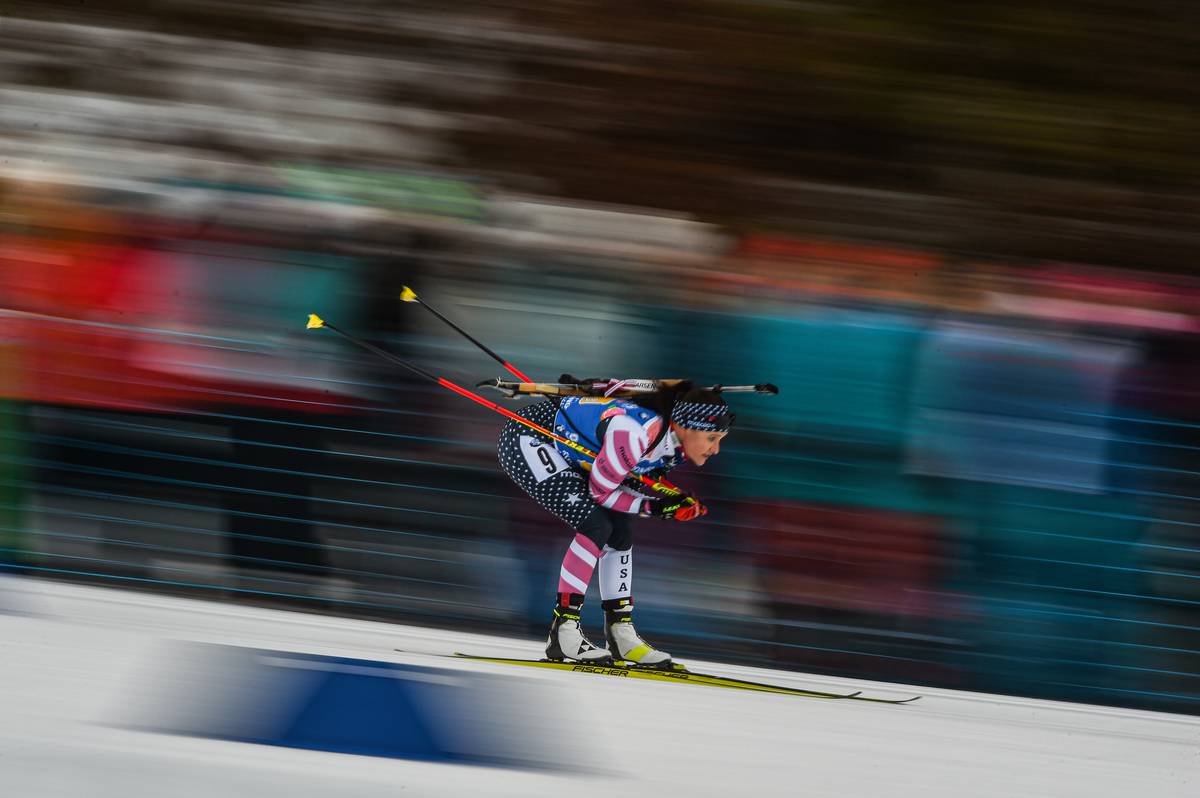
    Hofer finished 18.1 seconds back in second place with one penalty, and Bø 32.5 seconds back reached the podium despite four missed shots.

    “I went out [from the last shooting stage] and my trainer told me, ‘It’s only a small gap, only four seconds,’ ” Hofer said, although he actually led Bø by nearly 15 seconds at that point. “I think they told me this so that I keep pushing on the last loop. I tried to keep some energy for the last 600 meters a the end. When I saw Johannes and that I had a bigger gap to him, I was really happy.”
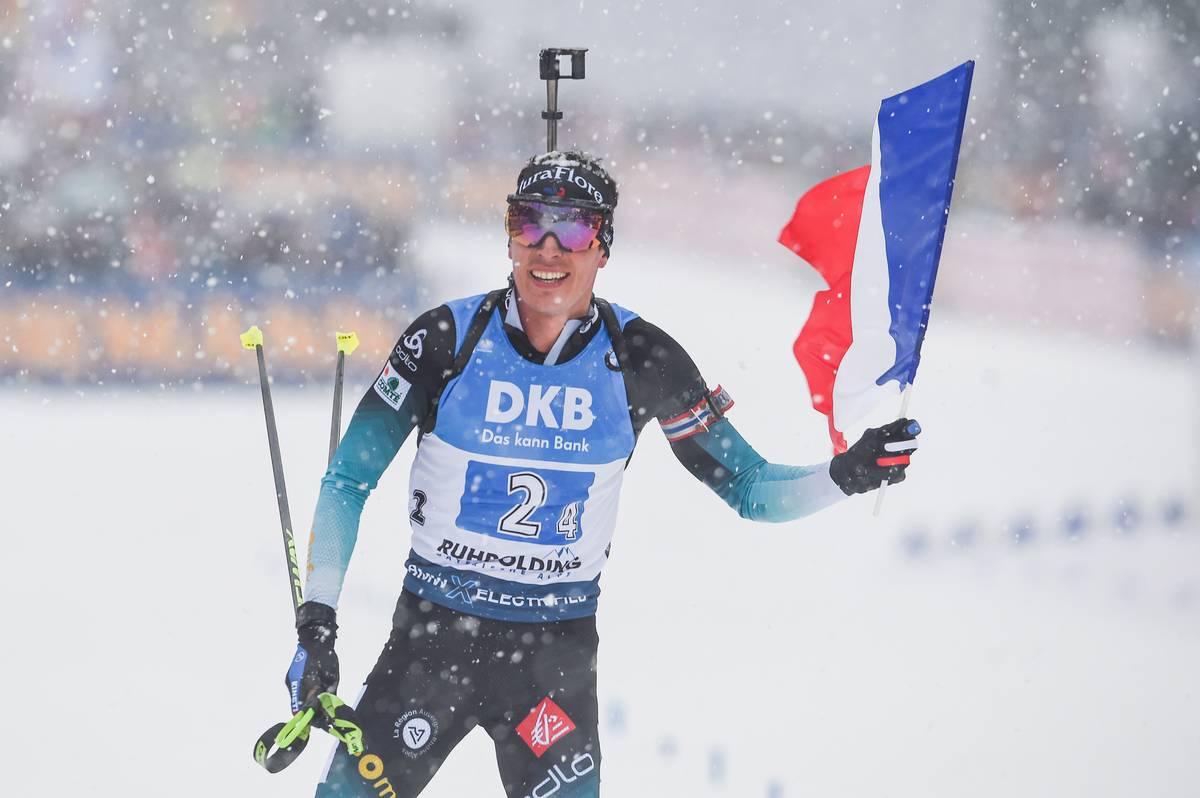
    “I knew that Hofer is one of the strongest guys on the last laps,” Bø said. “But I was feeling really good today, so I was thinking there was a chance [to catch him]. We had really good material and skis. And I had good shape today, but in the end of the last lap, I saw there was no chance. So then it was just to look behind and secure the third place. “
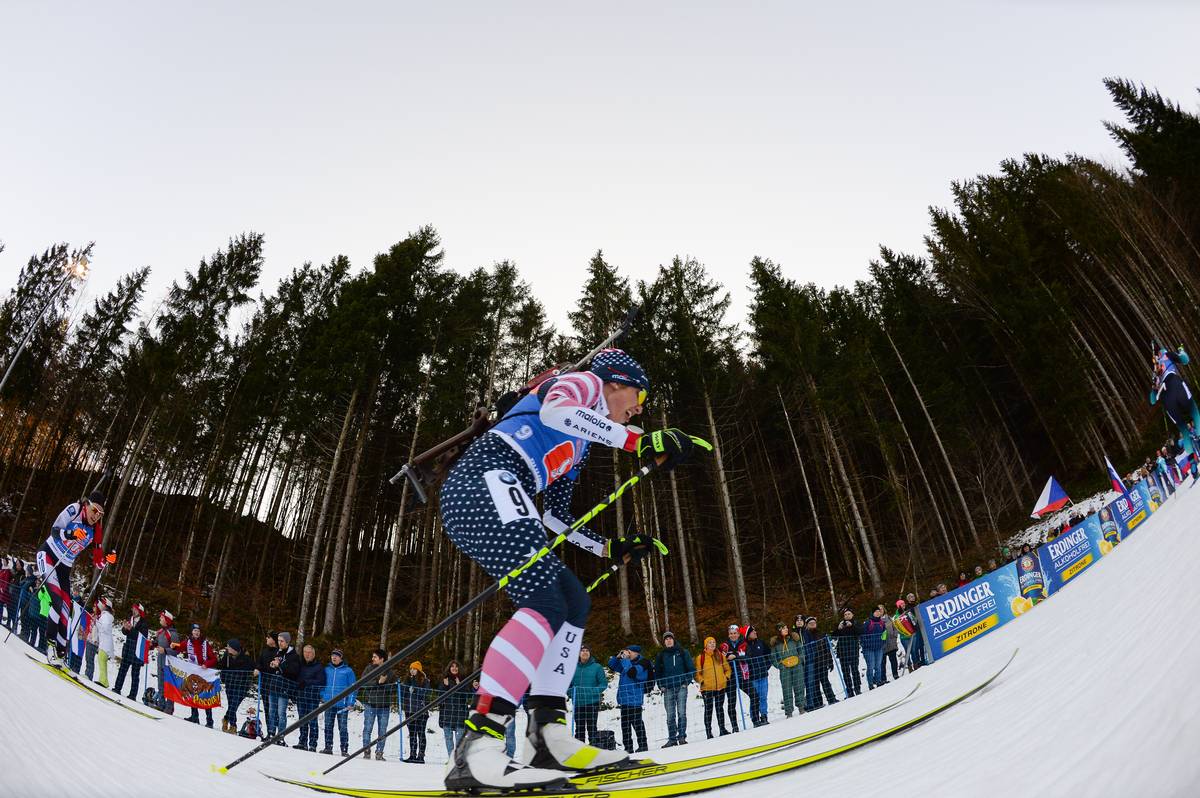
    Fourth place went to Russia’s Maxim Tsvetkov (+42.7), who cleaned the whole race and moved up from bib 28. L’Abée-Lund finished fifth (+45.2).

    US Biathlon’s Sean Doherty started the day in bib 14, and cleaned all his prone targets to stay in contention for a top 10. He missed a shot in each standing stage but still finished 17th on the day (+1:34.2), tying his second-best result of the season.

    “I’m really happy with today,” Doherty said. “I really had a goal in mind to stay in my own lane, on the range there. Skiing with these top guys, the pace is really high, so stay focused on my [shooting], and I did that well. I’m happy with how I shot and how I executed this race. I obviously left two in standing there, but those were just my mistake … Standing is usually stronger for me, but I was kind of pushing the limit, which you have to do if you’re still trying to make up some time on the range. So I was just a little hasty at times, and that’s just kind of my nature.”
    Doherty had the 23rd-fastest course time on the day.

    “It’s been a pretty lousy season in a lot of ways,” he said. “There were some good moments before Christmas, and it’s good to finish on a really strong note with Finland and with these races here. So I’m really happy about that – it’s nice for the body to be picking up. But it’s a little bit of a bummer that we are not going to Russia, because I’m starting to ski better, and really feeling like I’m in good form for some more racing.”

    Teammate Lowell Bailey started in 42nd and had two missed targets to move up to 28th (+2:07.2), thanks to the 19th-fastest course time of the day. For both him and Tim Burke, who finished 47th (+4:12.6) with four penalties, it was the last individual World Cup starts for long careers, as the U.S. is boycotting next weekend’s World Cup stage in Tyumen, Russia.

    Leif Nordgren finished 40th (+3:07.5) with four penalties, three of which came in the second prone stage. He had the 27th-fastest course time.

    “It was a really good race except for one stage,” Nordgren said. “That second prone stage set me back quite a bit. But I was really happy with my skiing today. [Ski speed] came just a couple weeks late after the Olympics unfortunately. I definitely feel a lot stronger now, and it’s too bad it’s the end of the season. But it’s nice to end on a high note. You don’t have to be pissed off all spring.”

    For Canada, Scott Gow finished 51st (+4:59.7) and younger brother Christian Gow 54th (+5:07.4) with five and two penalties, respectively.

    Results