From the FasterSkier archive — posts syndicated from athletes’ and coaches’ own blogs between 2004 and 2012, kept online as published. Current coverage is at fasterskier.com.
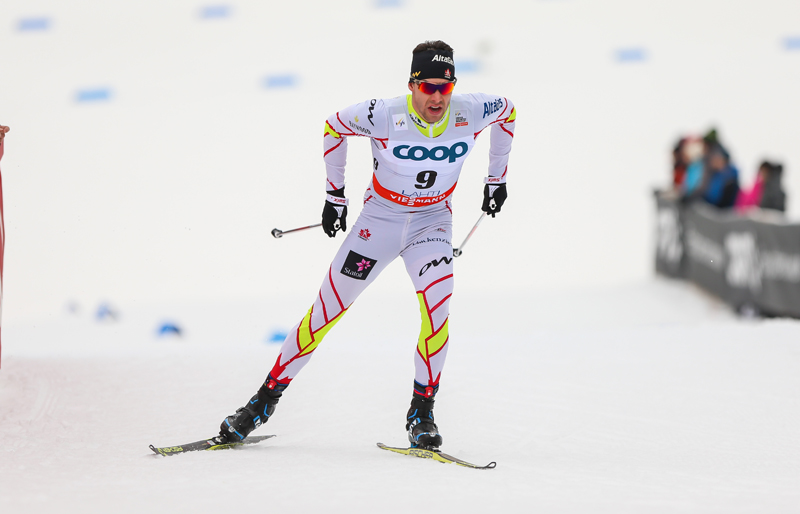
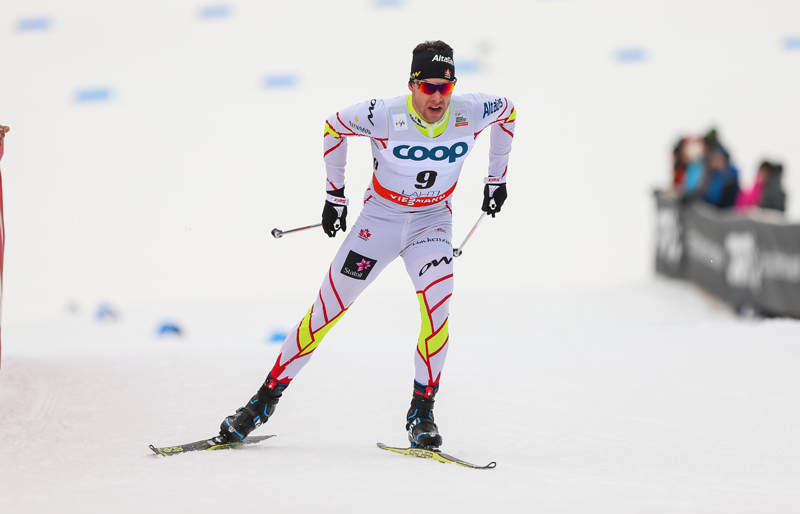
Canada’s Alex Harvey racing in the World Cup freestyle sprint qualifier last season in Lahti, Finland, where he placed 63rd. On Sunday, he placed second in his first distance FIS race of the season. (Photo: Fischer/NordicFocus)
Canada’s Alex Harvey’s goal for the day was preparation: avoid wasted energy in the cold, eat right, and nail his pre-race ritual. He may want to continue whatever process he found Sunday morning, as the Canadian flew through the halfway point with the fastest time and found himself only 27.5 seconds down in second place at the end of the men’s 15-kilometer freestyle International Ski Federation (FIS) race in Gällivare, Sweden.
Like the Gällivare men’s podium on Saturday, the leading North American male found himself sandwiched between two Russians, Sergey Ustiugov, who repeated in first, and Evgeniy Belov, who landed on the third step of the podium for the second time in as many days, 42.2 seconds behind Ustiugov.
Harvey said in a post-race phone interview that he wanted to take advantage of this distance tuneup as an opportunity to “try a little different strategy.” For him, that meant “going out a bit harder, knowing I would fade a bit in the end.”
All in all, his new strategy paid dividends as he recorded the fastest split through the halfway mark, up 5.2 seconds on Ustiugov. He said he faded during the last lap, but thought he nailed the preparation and was happy to get in two solid race efforts throughout the course of the weekend. On Saturday, Harvey narrowly missed the final for seventh overall.
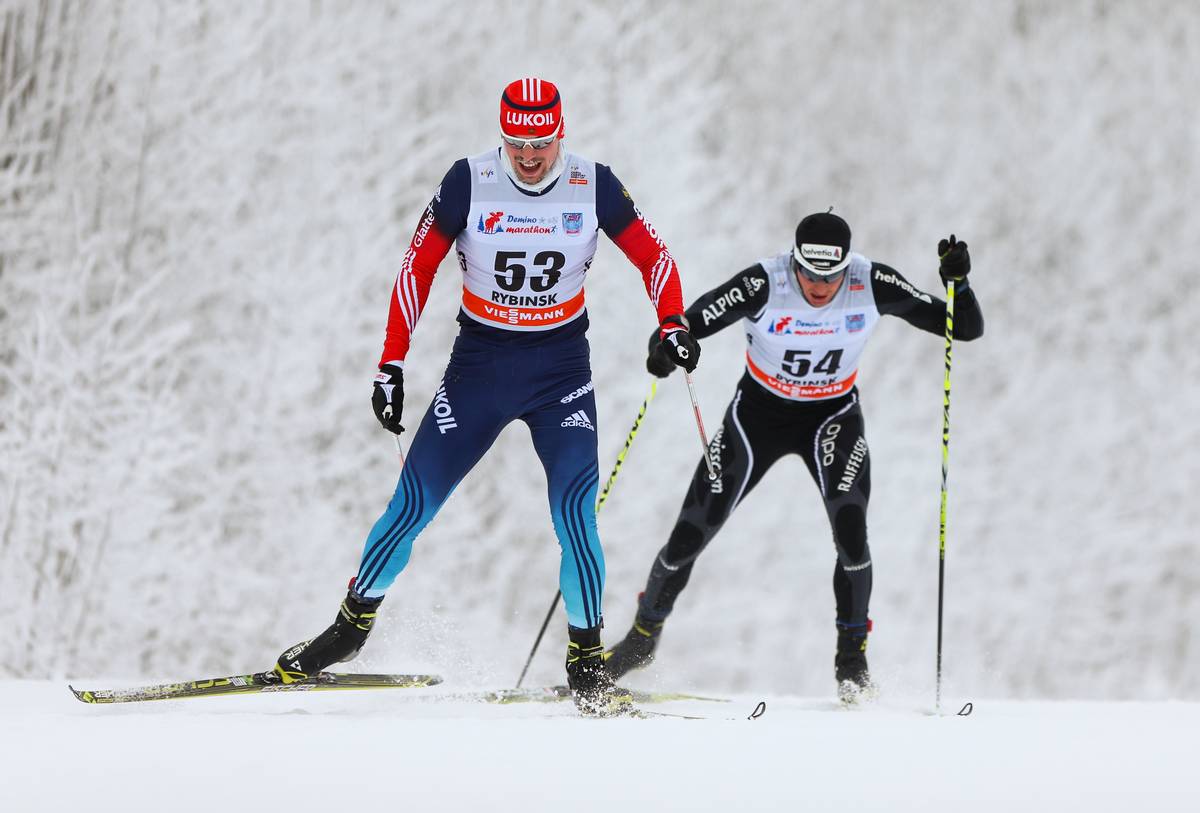
Russia’s Sergey Ustiugov leads Dario Cologna of Switzerland in the World Cup 15 k freestyle last season in Rybinsk, Russia. Cologna won and Ustiugov finished third. This weekend in Gallivare, Sweden, Ustiugov won back-to-back FIS races to start the 2015/2016 season: a classic sprint and 15 k skate. (Photo: Fischer/Nordic Focus)
On the Russians’ consistent top finishes in these races, Harvey said that he’d heard from Russian coaches that their athletes “have to be in really good shape in Kuusamo, just to be able to stay on the World Cup, so right now they are quite fresh.”
The World Cup season starts Friday in Kuusamo, Finland, with a three-day mini tour.
Feeling fresh would have been a luxury for most of the North Americans, who arrived in Europe within the last ten days and are still adjusting to snow skiing.
“Skiing on snow is a bit more muscular than just rollerskiing, so the transition is always a bit hard for me at least,” Harvey said.
His teammate on the Canadian World Cup team, Devon Kershaw finished fourth, 1:05 behind Ustiugov and 22.8 seconds off the podium.
In an email, Kershaw explained he used his experience skiing this course on previous World Cups to create a race strategy.
“I really love the latter part of this type of course — it suits me well [to] hammer the flatter/gradual terrain and back it off a bit on the steeper sections,” he wrote.
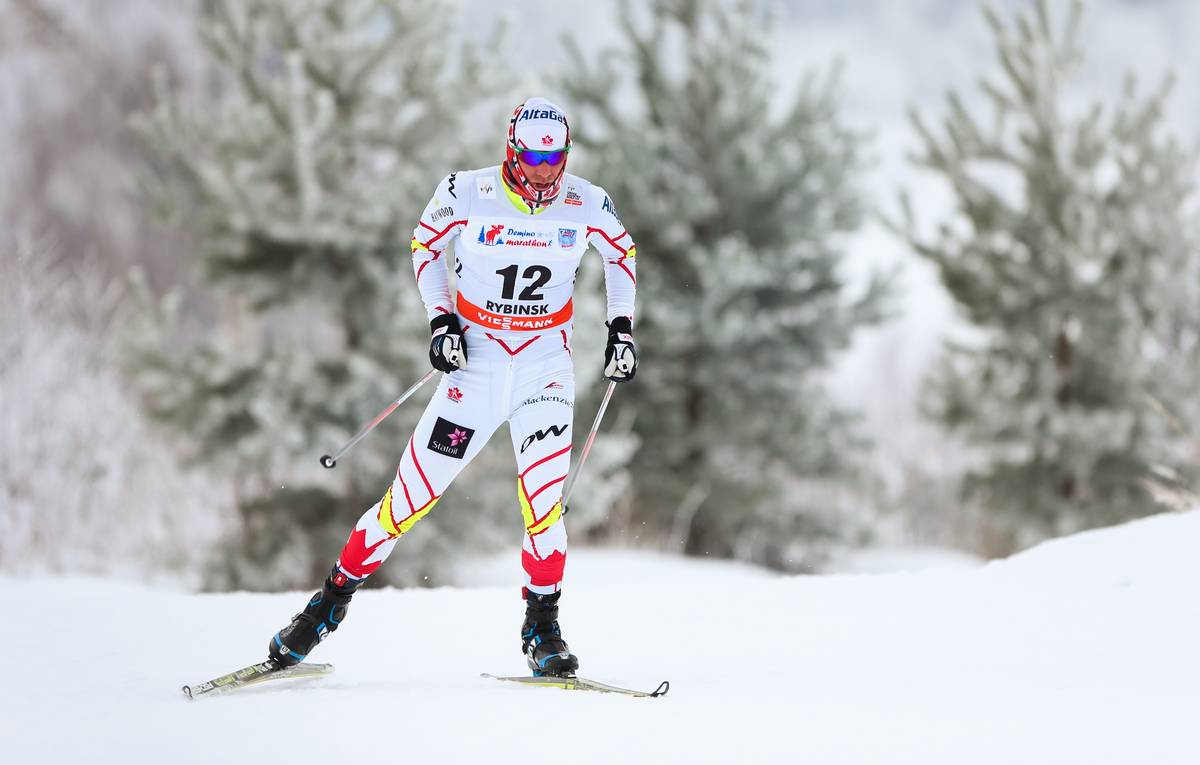
Canada’s Devon Kershaw racing to 36th in the World Cup 15 k freestyle in January 2015 in Rybinsk, Russia. He placed fourth in his first distance FIS race of the 2015/2016 season in Gallivare, Sweden. (Photo: Fischer/NordicFocus)
Kershaw described the conditions as cold and fairly slow, with little humidity in the snow. While this played a minor role, he was more focused on executing his race strategy of speeding up each lap and working on technical queues.
“I am pleased with how I skied technically,” the classic specialist wrote. “I am happy to be only 1:05 back in a skate race, [which] means that it was probably my best individual start skate race in 1.5 years.”
After Stanislav Volzhentsev finished fifth (+1:13.2) to become the third Russian in the top five, American Noah Hoffman placed sixth (+1:23.5).
“My plan today was to go out aggressively, and I did that well,” Hoffman said in a USSA press release. “Next week’s individual start race is only a 10 k so I’ll need to go out hard. I faded a little on the last lap today, but I’m pleased with the way I skied, and I believe I can build on this performance in the coming weeks.”
Hoffman was 5.2 seconds ahead of seventh-place finisher, Sweden’s Marcus Hellner, who calls Gällivare his home course. Canadian Ivan Babikov placed eighth (+1:38.6), Martin Jaks of the Czech Republic was ninth (+1:42.8), and American Erik Bjornsen was 10th (+2:05.1). It was Bjornsen’s second top 10 in as many days. In Saturday’s sprint, he placed eighth.
“It wasn’t the effort I was looking for but that’s what these races are for, practice,” Bjornsen wrote in an email after the 15 k. “I’m hoping to build into the season.”
For most of the race, he had no idea where he stood, as he skied alone for most of it.
“…If it weren’t for the coaches doing a great job yelling at me I would have thought the race had been canceled or something,” Bjornsen wrote.
“I’m not very happy with way I paced myself, maybe I didn’t have enough time to get over a jet lag but I lost most of my time on the last 5km of the race,” Babikov wrote. “I’ll try not to repeat this mistake next weekend.”
Canadian Graeme Killick placed 11th (+2:06.9) for his second top 20 for the weekend (he was 19th in the sprint). American Kris Freeman (Team Freebird) was 16th (+2:24.5), and Saturday’s sprint runner-up, Andy Newell (U.S. Ski Team) was 23rd (+3:45.7) of 57 finishers.
Looking ahead, World Cup racers will travel to Kuusamo this week for the Ruka Triple World Cup opening races, starting with a classic sprint on Friday.
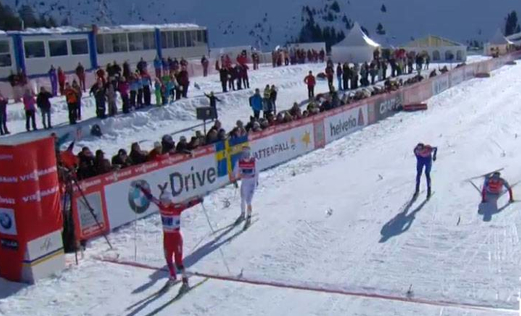
Sjur Røthe (l) anchors Norway’s victory, 0.5 seconds ahead of Sweden’s Marcus Hellner, in the La Clusaz World Cup 4 x 7.5 k relay on Sunday in France. Martin Jaks of the Czech Republic (second from r) took third and Russia’s Ilia Chernousov crashed just before the finish for fourth.
Soaring into the stadium toward the finish, the men’s 4 x 7.5-kilometer relay quickly shaped up into a Norway/Sweden showdown. Surprise, surprise.
The Czech Republic and Russia’s A-team had been consistently in the mix, yet as they sprinted down the final straightaway less than a second behind, it was clear Sunday’s World Cup relay was coming down to the two powerhouses. The only thing missing was Petter Northug.
Sjur Røthe filled in, anchoring Norway to a half-second victory over Sweden, but not without what some considered a “cheeky” move meters before the finish. Racing head to head with Sweden’s Marcus Hellner, Røthe surged ahead and moved to the right in front of Hellner, pushing him toward the boards. Hellner stood up, slowing and settling for second, 0.3 seconds ahead of Martin Jaks of the Czech Republic. Russia’s Ilia Chernousov stumbled on his own on the other side of the track, crashing and ending up fourth (+9.3).
It was a series of events that left some scratching their heads and others – like the Swedes – infuriated. Sweden’s coaches protested Røthe’s late move, but in the end, the jury upheld Norway’s victory.
Røthe, they reasoned, had been ahead of Hellner when he decided to switch lanes. The Swedes saw it differently, but accepted the decision.
“It was a riot that I did not think was quite fair,” Swedish assistant coachRobin Johansson told SportExpressen.se, according to a translation. “But we realized that it was a borderline case.”
Swedish men’s coach Arild Monsen later told Langde.se: “It was a bit on the edge but Røthe was ahead and had the right to choose tracks.”
The way NRK saw it: “Røthe selected [the] corridor very late, and cut that way in front Hellner and prevented Swede to accelerate towards the finish line.”
Regardless, the Norwegians ended up on top after staying in contention from the start. Their team of Eldar Rønning, Didrik Tønseth, Martin Johnsrud Sundby and Røthe crossed the line first in 1:17:22.5. Sweden (Daniel Richardsson, Johan Olsson, Calle Halversson and Hellner) was second and the Czechs (Jiri Magal, Lukas Bauer, Ales Razym and Martin Jaks) notched their first team podium since 2008.
Early in the first leg, Kazakhstan’s Sergey Cherepanov set the pace on the sunny and balmy day, with temperatures rising into the 40s by the early afternoon. However, the course remained shaded before the start so conditions changed drastically when the sun shifted overhead.
As Cherepanov tagged off in first, Russia’s Evgeniy Belov held his own in second (+1.7) and Rønning handed off in third (+2.2). On the second leg, Kazakhstan’s Alexandr Malyshev dropped back and Russia took the lead with Maxim Vylegzhanin. The Czechs moved to second with Bauer, who later tagged off in first, and Sweden’s Olsson came through the exchange in third (+16.3).
Meanwhile, the man subbing for Northug, Tønseth remained in contention 19.3 seconds back in fourth as he tagged off to Sundby for the third leg. After Sweden’s Halvarsson led early, Russia’s Alexander Legkov took control of the third leg while Halvarsson and Sundby tucked closely behind.
The front group became a definitive four with Razym (CZE) bringing up the back. Behind them, Switzerland trailed by more than 20 seconds in fifth, leading a chase pack of Germany, Russia II and Finland. Finland’s Matti Heikkinen received a yellow card for skating during the second leg, and the Finns did not finish with anchor Sami Jauhojärvi out due to illness, according to a FIS press release. (Jauhojärvi has not raced in more than a month after his father died suddenly in late December.)
First out of the last exchange, Røthe made a point to stay in front, leading Russia’s Chernousov, then Hellner, and finally Jaks, who brought the Czechs back into contention from 23 seconds back at the tagoff. The lead four remained within two seconds of one another with about a kilometer to go, and in the final meters, Røthe outdid the others for the win.
It was Norway’s second victory in as many World Cup relays this season after their crew of Rønning, Sundby, Røthe and Northug won the opener in Gallivare, Sweden. There, the Norwegians beat the Swedes (Emil Jönsson, Olsson, Richardsson and Hellner) by 6.4 seconds.
“When I spoke with Sjur before the race he said that he needed to be within 20 seconds of the leaders and that he could win for us,” Sundby said at a post-race press conference. “He showed us today that he was telling the truth. It was a great win for the team.”
“I know I have a good sprint, but I was a little afraid [of] Hellner,” Røthe told NRK. “Thankfully it went well in the end.”
The victory was a special one for Norway, which proved it can beat Hellner with two different anchors. “I suppose I did an OK job a substitute,” Røthe said with a smile.
“In the relay you just never know what can happen,” Bauer said at the press conference. “Our team raced very tough today and Martin was able to bring us back to the leaders. This is a great result for the Czech Republic. We are very happy.”
The rise of Martin Jaks as back-up for Lukas Bauer over the course of the season was downright amazing. In 2009-2010, Jaks didn’t show up much on the radar – he scored 16 points, and was most notably a cog in the machine of the Czechs surprise Olympic-bronze medal winning relay team.
Fast forward to 2010-2011, where Jaks finished 16th in the opening 15 k skate in Gallievare, and never looked back, finishing in the points in 15 races on the circuit, and collecting a career best 438 points. That includes the entire Tour de Ski, where he also collected a bronze medal during the pursuit in Oberstorf, in what was possibly the least impressive finishing sprint last season.
Of course, Jaks may be following a little too closely in Bauers’ footsteps. The 25 year old qualified in just two sprints on the season (both during the Tour), although he finished a surprising impressive seventh in one.
Lukas Bauer himself was his usual strongman self, especially on the Final Climb during the Tour de Ski. The Czech slow-twitch muscle wonder topped Alpe Cermis 30 seconds faster than his closest competitor, and moving up from tenth place into third overall in the competition.
The Czech women were very quiet, led by Eva Nyvltova who was fairly strong during Tour de Ski, finishing a season-best eighth in the skate sprint in Toblach, Italy.
What You Need To Know for This Season
FasterSkier's Nat Herz interviewing Lukas Bauer at World Championships in Oslo
As per a recent interview with FasterSkier, Bauer is focusing in on the Tour de Ski again, and as he himself admitted, he needs to be better at sprinting to win his third Tour.
Not to belabour the point, but Bauer was the only man in the top 10 not to score a single sprint point this season. He was the closest during the Tour de Ski when he finished 34th in Toblach, Italy, in a skate sprint, sandwiched in the standings between the renowned Norwegian Snorri Einarsson and elite Frenchman Benoit-Gilles Duford.
During the off-season, the Czechs were big on biking – Bauer scaled back his usual mountain bike racing efforts to just one race, while the entire team spent a significant amount of time on two wheels.
It was a good summer off the trails as well for the Czech team, as Bauer is now $2,500 richer, (which seeing as he’s sponsored by BMW and Husqvarna, among others, he probably needs desperately), and Jaks got married!
The Czechs are also a man down – Martin Koukal, member of the Olympic bronze medal-winning relay team, and 2003 50 k skate World Champion has opted to ski on the Marathon Cup circuit this season. Interestingly, he also went on quite the South American adventure this summer.
Who You Should Watch
FasterSkier tipped Eva Nyvltova last year, and we’ll give ourselves a pat on the back for it, as she doubled her World Cup points total. And you know what? We’re going to call on Nyvltova to do it again.
Bauer (L) leading eventual winner Petter Northug in the 50 k at 2011 World Championships in Oslo, Norway.
While Nyvltova may not be Katerina Neumanova right now, or ever (which may be a good thing), she is the kind of solid, dependable if not flashy skier that can rack up points. At 25, she’s still young, and has just 29 career World Cup starts. Most importantly, she has shown a knack for Tour skiing, finishing 22nd and 19th in her two trips thus far.
Bauer (L) leading eventual winner Petter Northug in the 50 k at 2011 World Championships in Oslo, Norway.
At the age of 34, Lukas Bauer of has already done pretty much everything a skier can hope for.
At the 2006 Olympics in Torino, he won silver in the 15 k classic. In Vancouver four years later, Bauer took home bronze in both the 15 k skate and the relay. He owns a silver medal from 2009 World Championships in the 15 k classic, and he has twice won the Tour de Ski; in 2007-2008 he also sat atop the leaderboard on the overall World Cup.
So what makes the Czech keep going?
A relentless pursuit of perfection, that’s what. Bauer still hasn’t won gold in either the Olympics or World Championships. Without either major event appearing on the 2011-12 FIS calendar, he is once again shooting for podium finishes in both the Tour de Ski and the overall World Cup.
Bauer doesn’t have one of the more outsized personalities on the World Cup; his reputation is as an honest competitor and a hard worker. He has talked in the past about doing workouts like 50 x 100 meter sprints (think about it: five kilometers worth of rollerski sprints!), a task that would make even the toughest athletes quiver in their boots. True to form, Bauer – who has excelled in individual start races but not in sprint finishes – recognizes his strengths and focuses on his weaknesses, quietly.
But in his correspondence with FasterSkier, Bauer has been not only courteous, which was expected, but funny. He was also as willing to take the time to answer questions as any other foreign skier we’ve approached.
FasterSkier was able to catch Bauer over e-mail from Muonio, Finland, where he is using the scant snow to prepare for the first World Cup races of the season along with most of Europe’s other national teams.
Bauer on his way to 7th place in the 15 k classic at 2011 World Championships in Oslo, Norway.
FasterSkier:First of all, how has your summer and fall been so far? I saw that you had ankle problems in the early summer, but
are you feeling prepared for competition now?
Lukas Bauer: I think that I had quite good summer and fall but for sure I had also some problems (ankle from a football match in June, and sickness in August). But I think it’s normal that sometimes your training is changed by some troubles. I’m not nervous about it and I know that when I was able to train, I trained well.
FS: You have been training with the Germans. Why did you decide to do that?
LB: Yes, it’s true. The system is that I’ve trained with Germans and the Oberwiesenthal group (trainer: Janko Neuber, German women’s ski team trainer; athletes: Tom Reichelt; Valentin Mättig; Monique Siegel) during my stay home, between Czech national team camps. During Czech national team camps I’ve trained with Czech team according Miroslav Petrasek, the Czech ski team trainer and my former personal trainer. The reason why I decided to change my previous training routine is not simple to explain, but I felt that I needed to change in the last two years. I had trained with this group (and also Rene Sommerfeldt) in the summer and fall of 2006 after Olympic games in Torino, and I was very satisfied. One of the reasons was that between Czech camps I had trained almost every day alone, and sometimes it is not bad if you have somebody to push you to the limits. The German group lives just five kilometers from my home. Now I have very good training partners on almost every session, and it is a benefit for everybody.
FS: How has training with them been different than when you were just training with the Czech team?
LB: Like I wrote before, now I did almost every session when I was at home with the group and not alone like before, which is good for motivation, more fun during long trainings, and also easier, because you can feel the coach’s support on every session. And there is also the difference in favor of various training resources (something that is special for every national team). If I can compare the Czech and German styles, then the Czechs prefer a lot of running training, and the German style prefers more rollerski training. But that is a very simple comparison and for me it was also interesting that this change open my eyes to training details, ĺike I was junior!
Martin Jaks racing in Estonia last winter.
FS: How are the Czechs doing? Martin Jaks had a great Tour de Ski last year.
LB: My feeling is that my teammates had a very good summer and look stronger than last year. For sure especially Martin Jaks is
coming ito the best age, and they all could be faster then before in the winter. But the question is the same for everybody – how successfully they transfer better running endurance to skis. But it would be great if they can be stronger. We especially we need it for relays.
FS: With no World Championships, what are your goals for this season?
LB: It’s simple, this season for me the goal is the Tour de Ski! And the second goal is for the overall World Cup standing, where my goal is the top three places. But if the season will go in bad direction, like if there’s no chance for the top three in the overall, then I will think about Vassaloppet.
FS: Last year, the World Cups in the Czech Republic weren’t really suited to your style of skiing, but this year there is a long classic race. Are you focusing on those “home” races in particular, and are you excited for them?
LB: Yes, for sure, I’m focusing on World Cup in Nove Mesto – because there is every time an excellent atmosphere and I like to ski there.
FS: Is it ever hard to motivate yourself to train and compete when you have already had so much success?
LB: I have no problem with races, but for sure sometimes for training, especially when is very bad weather, I need a kick [in the pants]. But without training you never get results….
Lukas Bauer after winning the final stage of the 2011 Tour de Ski. Photo: Toko.
FS: Looking back, how do you feel about the 2011 season? Were you happy with your results?
LB: I’m very satisfied with my third place in Tour de Ski overall. Maybe this Tour was for me the hardest compared to previous
Tours, because almost nothing went in the direction that I wanted and that I needed… [there were] some problems with skis, wax, some crashes, and also my rivals were very strong in the sprints, where they took a lot of bonus seconds. And with my sprint “abilities” [Bauer inserted a frowning emoticon] I had to work hard to reach third place in the final.
World Championships in Oslo was not successful for me. Not bad, but not succesful. But it is just that some athletes were simply better in this time and also after struggling with waxing, like many teams, my seventh place from 15 k classic was nothing excellent, but also not a fiasco.
FS: How much mountain bike racing did you do this year? Do you think it helps your skiing physically, or do you mainly do it just because it’s fun and that helps you get out the door?
LB: I did just one mountain bike race this year, which is nothing. I decide to decrease my mountain bike racing this summer when I changed training routine with the idea of being more focused on skiing. I like mountain bike racing a lot, and when I was junior I was on the edge about whether I would continue like a skier or a mountain biker. It’s fun and also fun training.
FS: It seems like FIS changes the rules and the race formats all the time. What new formats and new rules would you like to see?
LB: Yes, there are many changes during last few years. I think that it is important to slow down with changes and make the rules more simple and more “viewer friendly”. And to make better TV coverage, because sometimes it is quite boring – but I’m not sure how much it is FIS and how much TV production.
FS: When you won the relay bronze medal in Vancouver, it really proved that your country had a good team instead of just a few excellent individuals like you and Neumannova. What did that do for you and the other skiers? Have you been able to find more sponsors? Has skiing become more popular in the Czech Republic?
LB: The relay was amazing and I think that it helped other members of relay to find more sponsors, but for me is difficult to say if and how much, because I also had an individual medal from Vancouver and some other very good results from the past, which meant that I “already had name”. But for me it was important that we reached this excellent result with the team and not “just” with individuals. It was also great for our support team (servicemen, doctor, masseuse) and for sure for our families, because they are behind us in the shadow and without their support is not possible for us to do it.
Bauer en route to bronze at the 2010 Olympic Games.
About the sponsors, for sure after Vancouver I’ve found some more sponsors, but for me it was also important that when many companies were fighting with financial crises I still had sponsors, and with them I’m able to make preparations for the season like I want. Skiing in the Czech Republic looks more popular than some years before (I’m talking about how many kids are doing the sport, not about how often this sport is on TV and newspapers), but the problem is that skiing is quite an expensive sport and the young generation like computers and TV than sports. But it is the same everywhere.
FS: What about the 2009 World Championships – corruption seems to have been a big problem. Has that led to any change in public opinion about skiing, or affected you in any other ways?
LB: It affected me just right after WCH, when I was almost every day asked what is my opinion about [it]. I think that the investigation around WCH, if there was or wasn´t corruption, is not finished yet. But I think that after some “hot” months right after WCH it looks that public opinion is not negatively changed about skiing, there is more [just] a negative public opinion about Neumannova and her team that was organizing WCH.
FS: I’ve heard and read that you have been trying to work on your speed in all sorts of ways, including using the SkiErg. What has your strategy been in that department and would you consider the SkiErg experiment a success?
LB: Yes, the summer between Vancouver and Oslo, our goal was to work more on speed. Not to try be a danger for Petter Northug in sprint, but just to work to be faster for bonus points during mass start races and to be able to change speed during some attacks. I think that it was visible on some races last winter (for example the World Cup La Clusaz), but for sure, first it is important to be healthy and to be in good shape and this is something extra… And my former trainer thought the SkiErg looked like a good tool for upper body. I did some training on this machine, and some intervals. First I was surprised at how quickly your energy goes away, but we don’t do a lot of training on it. I still have it in my garage. I did little tuning, and sometimes I’m using it, but not often.
FS: Doping seems to always be a topic of discussion with skiing, but the Veerpalu case is bigger than most. Do you think that his positive test in particular has changed anything for the sport or for you? Do you sense a greater distrust on the part of the fans?
Bauer at 2009 World Championships.
LB: I think that it changed nothing for sport, because, it is a pity but it’s reality that just like in normal life, also in the sport (and skiing) there are some people who will cheat the rules. My opinion is that these people were, are and will be [another sad emoticon]. And this is WADA’s job to try to catch people who are cheating the rules. What his case changed for me? Nothing
specific. But for sure I had in my head questions without answers like: In the case that he used the doping (only he knows if he did or not) had he used the doping also in the past, when I took silver in WCH in Liberec 2009, and also in Olympics in Torino 2006, right behind him? Why did he do it just before end of his career? This was what I had in my mind, but I’ve stopped it, because I don´t know and never will know the answer. And also I’ve [convinced myself] that I don’t know it. Why? Because now I can think that I lost gold medals in a fair fight (hoping that if he used doping it was only when he was caught), because I don’t want to get medals by [default]. For me the results are not about the medals, but about emotions, and they were built there with the silver medal and there is no chance to change that.
And about the fans? Maybe I’m crazy but my opinion is that the fans who believed that Veerpalu is a doper now will scream that they were right, and the fans who believed that Veerpalu is clean will still believe that he is innocent, and just small part of them will change their opinion. It’s the same with every skier.
FS: You are obviously very busy as an athlete, but your wife is quite accomplished as well. How do the two of you make time for family, and is it a challenge with so much travel and racing?
LB: For sure, winter time especially is a hard time for my family, but it’s life and I’m happy that my family is still supporting me in my sport dreams. But the rest of the year I’m trying be home as much as possible, and this was also one reason why I changed my training routine last spring.
In Monday’s 20 k pursuit, in Oberhof, Germany, instead of Petter Northug (NOR) turing heads with an impressive sprint finish, it was Finland’s Matti Heikkinen who displayed remarkable finishing speed to secure victory in the fifth stage of the 2011 Tour de Ski.
The Finn, who has had difficulty on the World Cup so far this season, put on a massive attack on the final steep uphill, surprising the field. Heikkinen had been very quiet throughout the race, skiing consistently in the top group, but never challenging for the many intermediate sprints.
However, holding back during the race appeared to have given Heikkinen an edge, as with about 600 meters to go, he forced his way to the front of the pack, and let loose with explosive power.
As Heikkinen forced the large group of more than 20 men to react, things went haywire: Alexander Legkov (RUS) went down, causing a pileup, and Heikkinen escaped over the top with a big gap, leaving Dario Cologna (SUI), Martin Jaks (CZE), Lukas Bauer (CZE), Jean Marc Gaillard (FRA), Devon Kershaw (CAN) and two or three others scrambling for position.
Heikkinen staked himself a large lead on the last descent into the stadium, and even had time for a quick celebratory fist pump in his last few strides. Cologna managed to cross the line just behind Heikkinen, while Martin Jaks, a Czech who has cracked the World Cup podium just once before, out-lunged Gaillard for third.
As a result, Heikkinen received 15 bonus seconds, while Cologna took 10, and Jaks five, in addition to the bonuses collected out on the course.
With 165 bonus seconds up for grabs at different points around the course, the fight for the intermediate sprints spiced up the regular pack racing. With 11 different skiers scoring bonus seconds, the lion’s share went to Marcus Hellner (SWE), who picked up 35, despite finishing 10th. Bauer and Cologna each collected 25, while Maurice Manificat (FRA) won 15, and Petter Northug (NOR) had to be satisfied with 10. A large variety of skiers pushed to the front each time the opportunity arose, and vicious sprints ensued, including one where Northug wove back and forth across the hill in an attempt to hold off his challengers – though the points he won in that move were later negated by the race jury.
Kershaw, who had previously stated that the pursuit in Stage 5 was where the Tour “really starts,” began the race in second place overall, and spent most of it ensconced in the front two rows of the pack, battling for position and the occasional bonus seconds – ultimately picking up five. Over the last hill, Kershaw was able to up the pace, and finished in the seventh spot, just seven seconds back of Matti Heikkinen.
Meanwhile, Alex Harvey had a similarly strong race, and was a constant fixture in the lead back, also collecting five bonus seconds on his way to 15th place, in the middle of a 10-skier photo-finish.
Both Kershaw and Harvey picked up their bonus seconds during the classic leg, something Canadian Head Coach Justin Wadsworth said was part of the race plan.
“We told them, ‘if you guys are up there, especially on the classic leg, go for it,’” he said. “Getting those bonus seconds helps a lot, and both [Harvey and Kershaw] are still in the top five, so it was a good day.”
While Kershaw and Harvey are still sitting comfortably, their teammate Ivan Babikov had a trying day.
For Babikov, things went off the rails early in the classic portion: just before one of the major climbs, another racer’s ski slipped under his binding – opening it, and leaving him missing a ski. As Babikov scootered up the hill, one of the Canadian staff ran a ski down to him, but the damage was already done.
“It blew him off the back of the pack pretty quick,” Wadsworth said.
Babikov was extremely disappointed with his race, judging from his immediate reaction on Twitter: “This Tour is not going my way. Should I continue?”
However, Babikov sits in 35th position, just under four minutes back of the lead, and his best stages are still to come – the 36 k point-to-point, and the brutal Final Climb.
While the Canadian distance specialist struggled, American Kris Freeman showed that he is turning into an all-around skier. After finishing in the top 30 in the sprint Sunday, Freeman crossed the line eleventh in Monday’s pursuit, some ten seconds after Heikkinen.
“It was an awesome race for him!” USST Head Coach Chris Grover said of Freeman.
Chris Grover described Freeman as skiing “relaxed” and “controlled” for the race. Freeman was not targeting any of the intermediate sprints for time bonuses – for most of the race, he skied near the back of the lead group, moving up as high as seventh during one portion. On the last lap of the skate leg, Freeman picked up the pace, moved up through the pack, and ended his race with strong sprint, being narrowly beaten by Marcus Hellner.
The 11th place finish puts Freeman in 22nd overall at the halfway mark of the Tour, no small feat for a rookie in the demanding event.
As for Andy Newell, Grover said the sprinter had suffered another tough distance day.
“He and I have been scratching our heads over why the distance races have not been great this year,” said Grover. “Other than the 10 k during the relay in Gallivaere at the start of the season, he has had difficulty. He’s definitely frustrated.”
Sitting in 58th overall, Newell remains healthy, and with another sprint set to go on Wednesday, he is looking to collect a few more sprint points to add to his World Cup total.
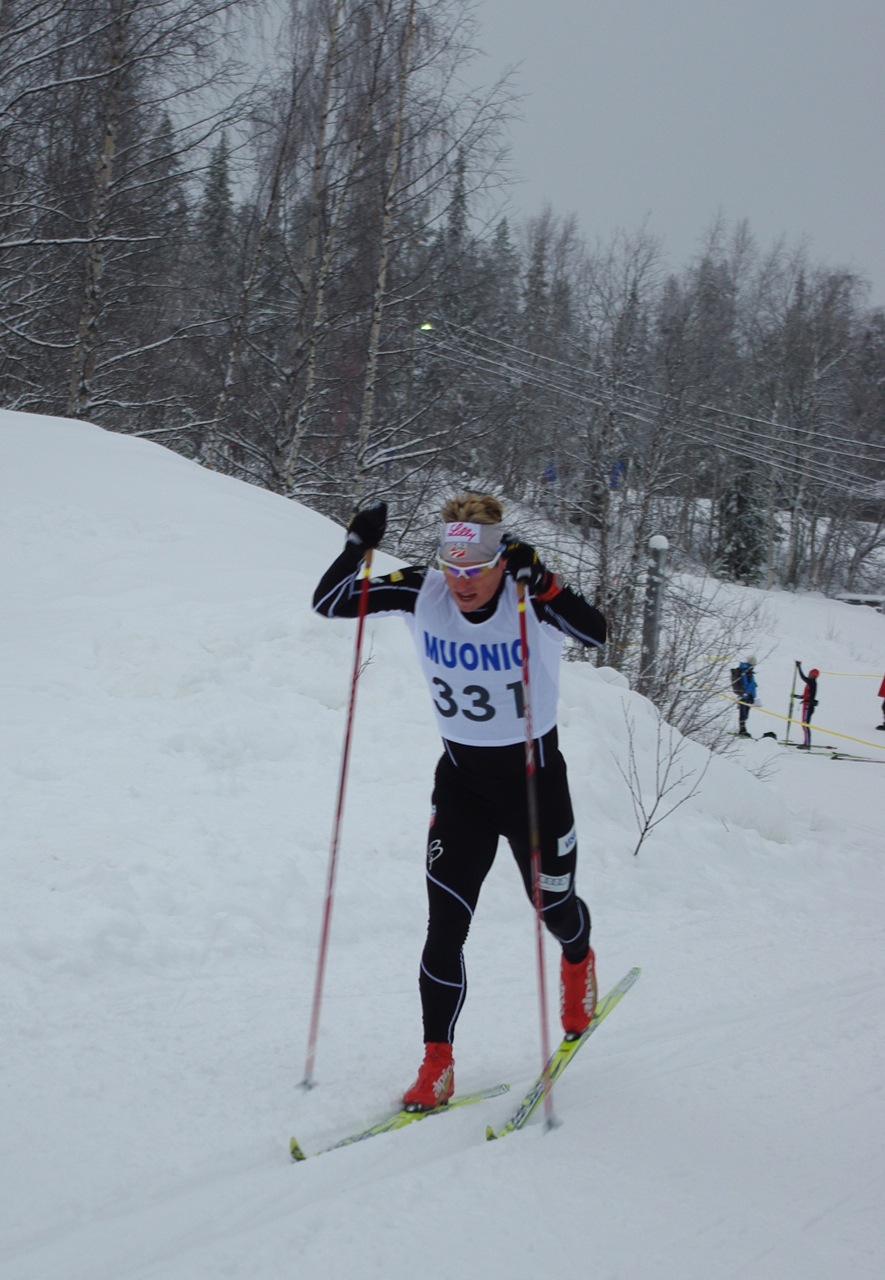
Kris Freeman kicked his way to a 12-second victory in Muonio today.
America took its second win of the weekend in Muonio, with Kris Freeman skiing to a 12-second victory over Tobias Anger of Germany in a 10 k classic race.
While Freeman was clearly the big story of the day, the morning actually started off with the women’s 5 k race. With a huge 45-meter climb partway through the course and a mostly downhill finish for the last kilometer or more, it was a fast and tough race requiring an all-out effort on the hills early in the course.
Justyna Kowalczyk of Poland didn’t have any trouble with that concept, and took the win over Petra Majdic of Slovenia by 19 seconds. Kowalczyk covered the course in just over 14 minutes. Marianna Longa of Italy rounded out the podium, 22 seconds behind Kowalczyk and just 0.5 seconds ahead of Nicole Fessel of Germany. Fellow Germans Stefi Boehler and Evi Sachenbacher-Stehle finished fifth and sixth, another twenty seconds back.
Kikkan Randall of the U.S. Ski Team (USST) had the top American performace, skiing to a solid 14th-place finish. While her time was over a minute out of the win, she was only four seconds behind tenth place.
Ida Sargent of the Craftsbury Green Racing Project and Dartmouth College finished 25th, a solid result for the sprint specialist. She was 18 seconds behind Randall, and ahead of several of the women who had beaten her in the last two sprints here in Muonio.
The next Americans all finished within five seconds – Liz Stephen (USST) in 53rd, Hannah Dreissigacker (Craftsbury Green Racing Project) in 56th, and Morgan Arritola (USST) in 59th.
Freeman.
USST coach Pete Vordenberg said that his athletes had pushed hard, which was a good thing this early in the season.
“They all felt like they went out there and went really hard, and it was a good effort,” he said. “So regardless of results that is great. I don’t think anyone felt like they had their best race, but it was solid.”
In the men’s race, Freeman skied to the win, just as his teammate Randall had in the sprint the day before.
“I had planned to ski with a lot of snap, and be very light on the first lap,” he said. “Then I would use more power on the second lap if I felt good.
“I was skiing with a Kazakh [Alexey Poltoranin] who had started ahead of me for most of the second lap, but I was doing most of the work. Then he just passed me on the last downhill, so he finished in front of me.”
Angerer was second, followed by Martin Jaks of the Czech Republic, Jens Filbrich of Germany, and Sergey Shiraev of Russia. Jaks, who won the skate sprint qualifier yesterday, appears to be positioned to have a great season – although Freeman pointed out that a good finish this early in the season isn’t the best thing.
Axel Teichmann of Germany leads teammate Tobias Angerer up the final hill. Angerer ultimately finished second.
“I was kind of like, aw, f*ck, I won. I’m not intending to be in great shape right now. So I’m hoping there’s more to come.”
The next Americans were the USST duo of Andy Newell and Noah Hoffman in 55th and 64th places, just over a minute and a half behind their teammate. Simi Hamilton, the last man on the USST, isn’t racing this weekend due to a nagging ilio-tibial band issue.
Tim Reynolds was the top non-USST American, finishing 86th. He was followed by teammate Pat O’Brien in 110th and Leif Zimmerman (Bridger Ski Foundation) in 113th, just two seconds apart, then Glenn Randall, also from the Bridger Ski Foundation, in 121st place.
Vordenberg, along with the rest of the U.S. team, was excited for Freeman’s victory.
“It’s pretty cool to win. Even if he hadn’t won, it was really positive just the way he looked, the way he was skiing. Two wins in two days… it’s really fun to win.”
After two strong days of competition, will the Americans continue their winning ways tomorrow? Check back to find out: a 10 k skate race is on the schedule for both men and women.