From the FasterSkier archive — posts syndicated from athletes’ and coaches’ own blogs between 2004 and 2012, kept online as published. Current coverage is at fasterskier.com.
After an unusual and unprecedented season, many athletes have announced their retirement as they move on from professional ski racing. Aside from the three notable retirements from the U.S. Ski Team, Sadie Maubet-Bjornsen, Sophie Caldwell-Hamilton, and Simi Hamilton, twelve international athletes have said goodbye to World Cup competitions.
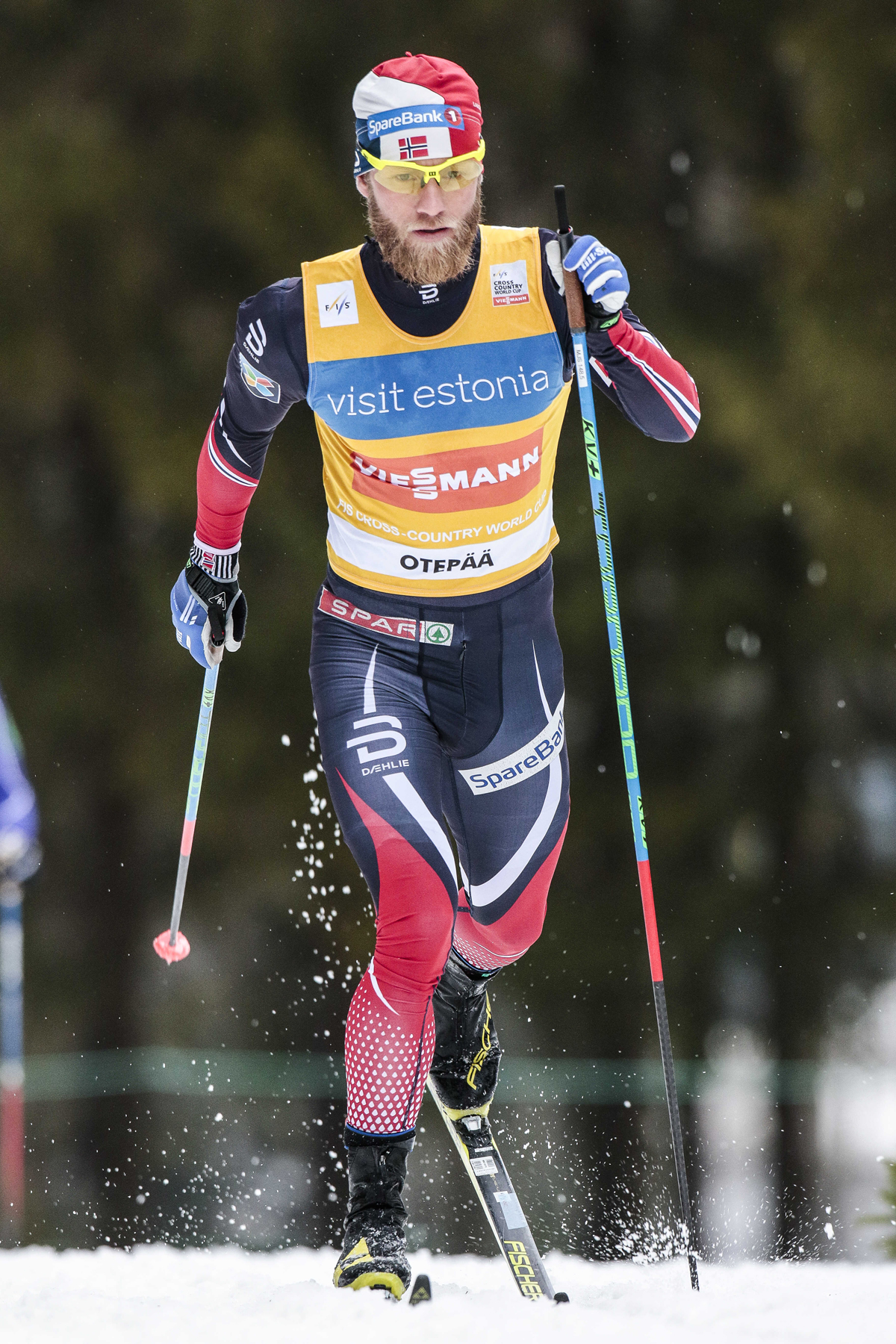
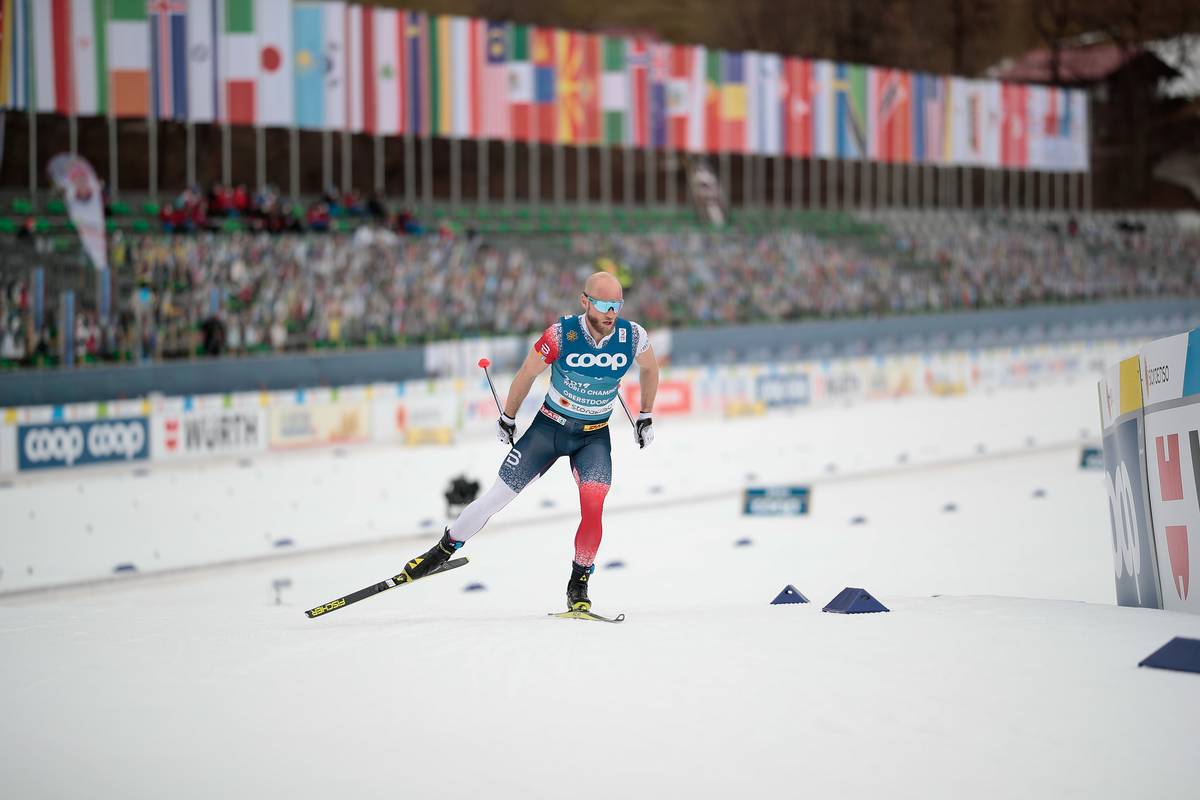
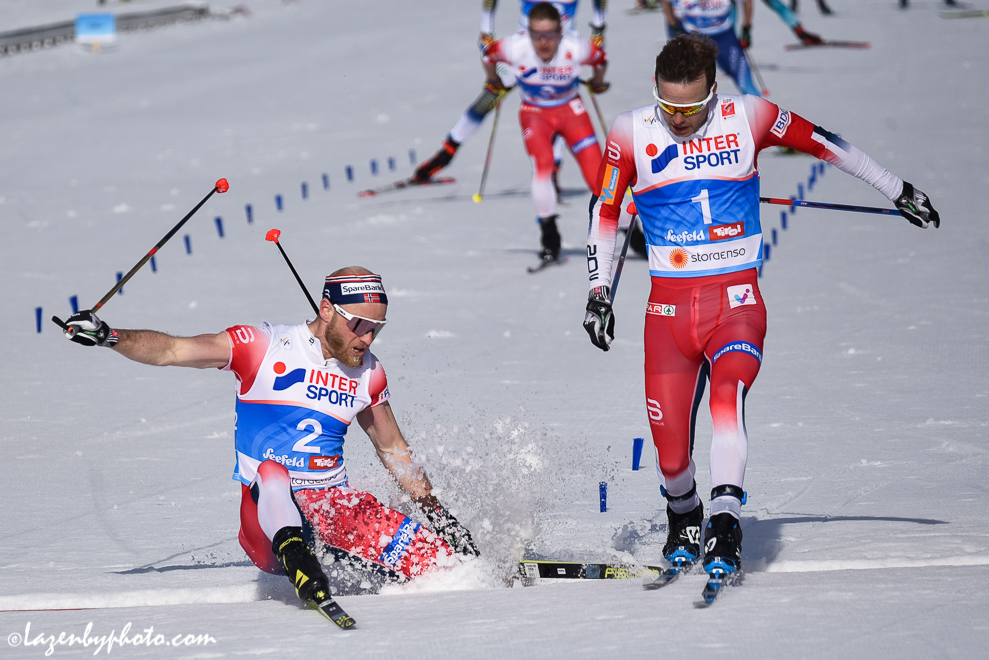
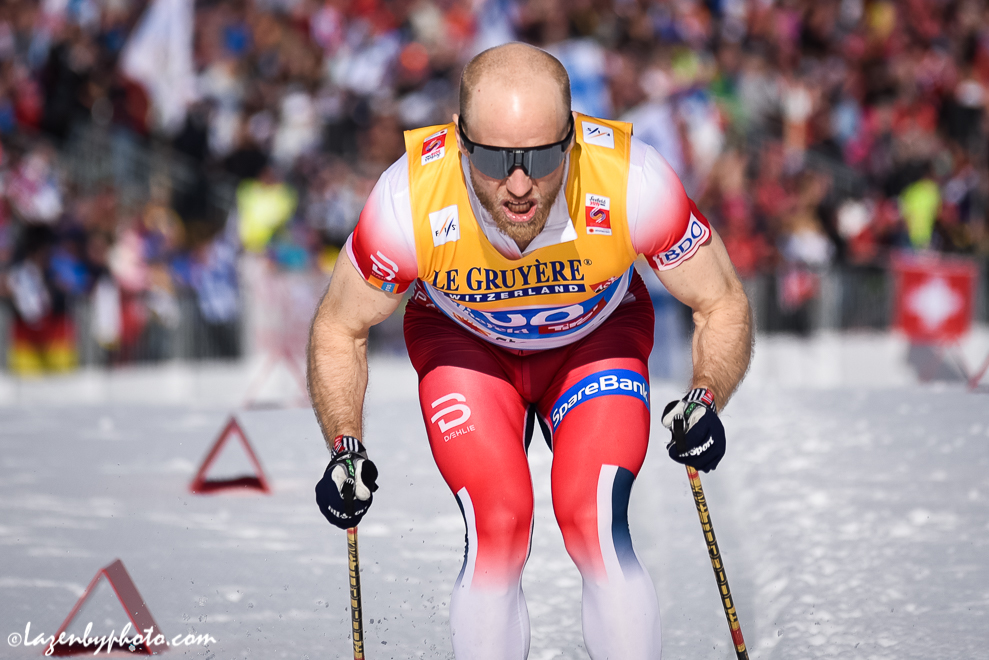
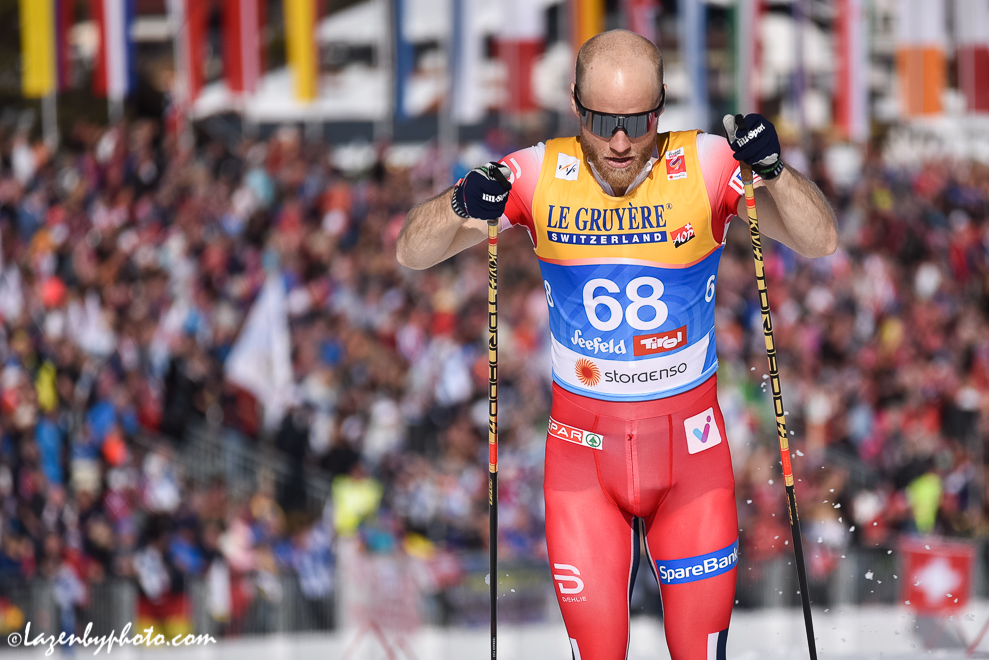
Norway’s Martin Johnsrud Sundby racing to 2017 victory in the men’s 15 k classic at the pre-World Championships World Cup in Otepää, Estonia. (Photo: NordicFocus)
Perhaps the biggest name among them is Martin Johnsrud Sundby of Norway, who after a somewhat inauspicious start to his World Cup career in 2005 when he DNF’d at the Oslo 50 k, went on to become a staple of men’s cross-country skiing. Sundby leaves the stage with five Olympic medals, including two gold medals (both from team events), four Championship medals, and thirty World Cup victories to his name. Results aside, Sundby was an important presence on the Norwegian men’s team for many years, taking on the responsibility of team captain.
Sundby was sanctioned in 2016 for an anti-doping violation when he exceeding the allowable amount of salbutamol – an asthma medication – in his system.
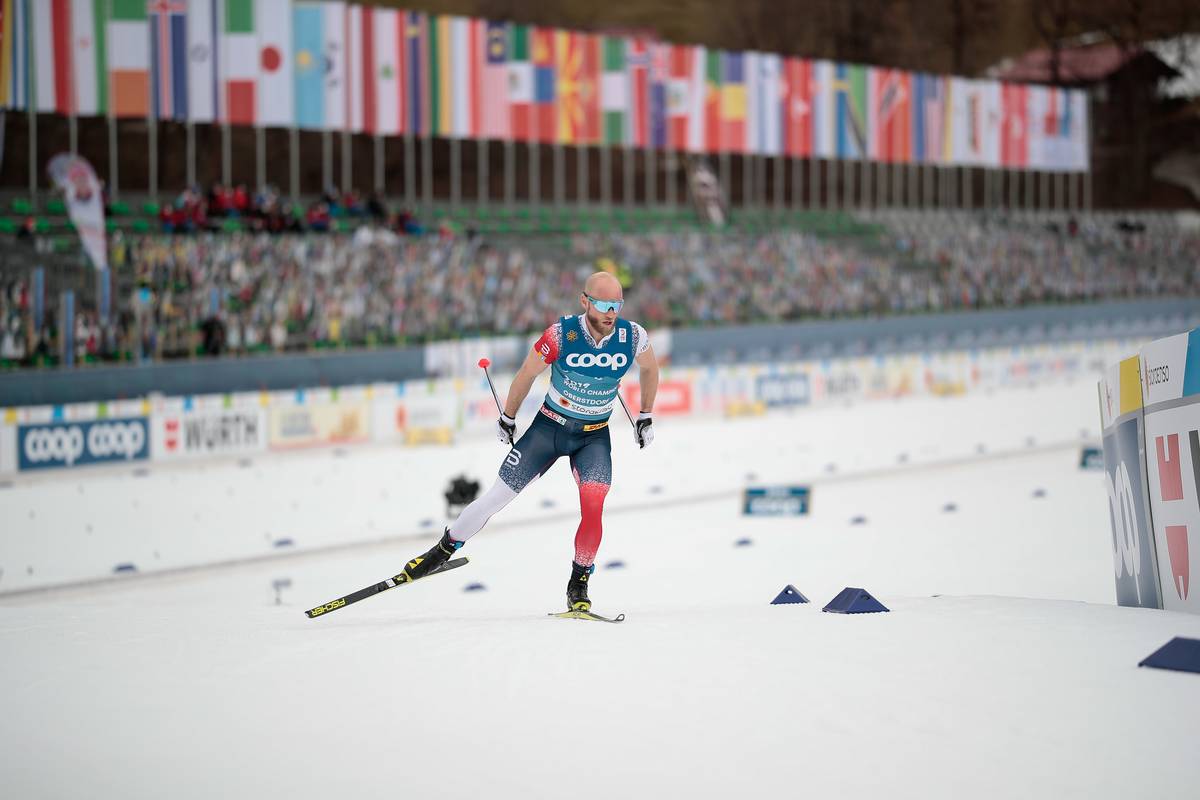
Putting his veteran strength on display, Martin Johnsrud Sundby skis to 7th in his first international competition of the [2020/21] season. (Photo: NordicFocus)In a goodbye letter by Norges Skiforbund President, Erik Røste, Røste writes, “Martin never gave up [in spite of challenges]. And that’s what really characterizes Martin. Because in addition to a fantastic talent, Martin is a struggler. One who has put in more effort and training than most to achieve his dream of becoming the best in the world… Thank you for all the contributions both on and off the trail.” (Translated from Norwegian).
Also retiring from team Norway is Mari Eide, who is expecting a child. Eide made her World Cup debut in 2010 and contested 70 World Cup starts since that time. At the 2019 Seefeld World Championships, Eide earned a bronze medal, finishing third in the skate sprint.
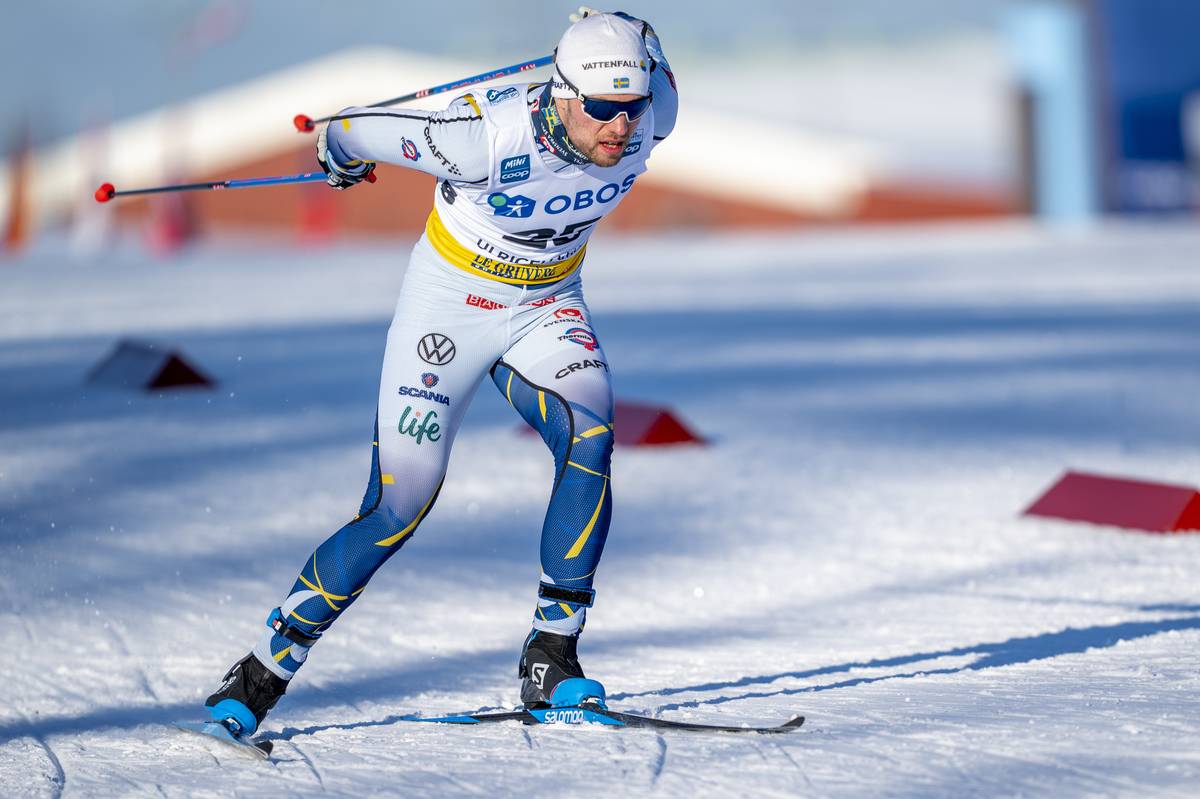
Viktor Thorn (SWE) racing the individual sprint in Ulricehamn, Sweden (Photo: NordicFocus)
From Sweden, Viktor Thorn and Hanna Falk have both announced an end to their ski careers. While Thorn is only 24 years old, he has been struggling with ongoing back pain and thus decided to step away from the sport. In a statement Thorn said, “I have struggled with back problems for almost five years and have come to the stage that I feel it is no longer worth spending all the time it takes to be able to be in the absolute elite level, when the last percent to be able to perform at the level I want to be hindered by my back … I feel ready to take on new challenges in life. A tough decision as the skis have been a big part of my life for so long, this decision still feels right. I am grateful for everything that this sport has given me and I will always be a skier but just not at the elite level anymore.”
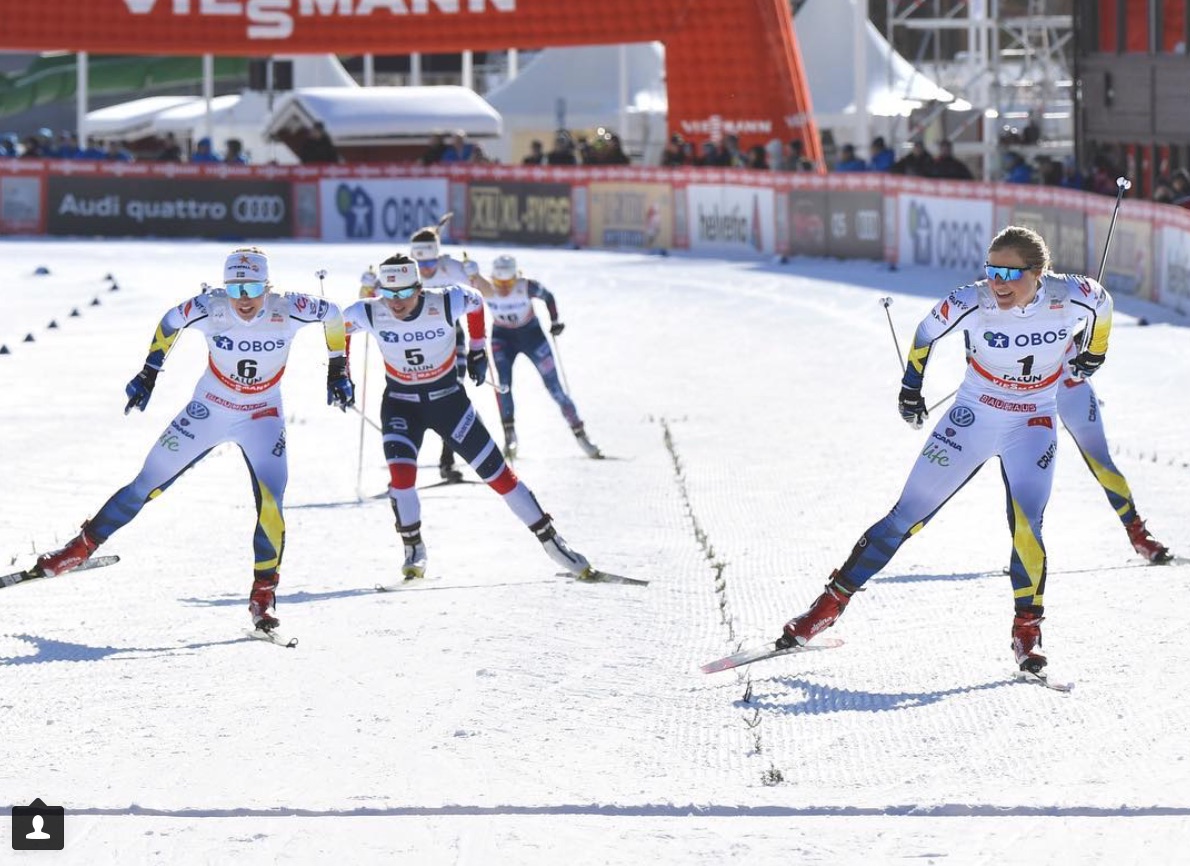
Sweden’s Hanna Falk (r) smiles as she wins the fourth World Cup race of her career and first race in Falun, Sweden, with a victory in the women’s freestyle sprint at 2018 World Cup Finals. (Photo: Svenska Skidspelen/Instagram)
Hanna Falk, who has also struggled with health problems throughout her career, announced retirement after a lengthy career. Falk began World Cup racing in 2007 and earned her first victory in 2009 at the Düsseldorf (GER) City Sprints. After a period of health issues, Falk returned in form during the 2016/17 season, proving herself to be a force on the sprint circuit. She retires with 113 World Cup starts, including eleven podium finishes.
American Simi Hamilton (l) goes head-to-head with Germany’s Sebastian Eisenlauer (14), Norway’s Eivind Østnor Bakken (26), and Sweden’s Gustav Nordström (13) during their 1.2 k freestyle sprint quarterfinal on Saturday at the World Cup in Planica, Slovenia. (Photo: Fischer/NordicFocus)
From Germany, 31-year old Sebastian Eisenlauer has announced his intention to move on from professional ski racing. Eisenlauer began his World Cup career in 2010, going on to start 131 World Cups and represent Germany at two Olympics (Sochi and PyeongChang). Of his career, Eisenlauer said, “That’s it. An incredible time comes to an end and it feels like the right time to move along new paths. Every race was worth the step from every stage of my career, I find people that I can call friends now still. Thank you to everyone who joined and supported me on this journey.”
Finland’s Susanna Saapunki has decided to transition from professional ski racing to professional mountain running. Saapunki spent six years racing on the World Cup circuit, totalling 42 World Cup starts and one World Championship start in Lahti, Finland. Saapunki has now chosen to focus solely on running.
Anna Zherebyateva of Russia is concluding her World Cup career. Zherebyateva is engaged to Alexander Bolshunov and intends to focus on starting a family.
Anouk Faivre Picon of France has officially announced retirement after some years away from the World Cup circuit in which she primarily started in marathon events. Faivre Picon spent a summer training with the US Women’s Ski Team.
Also on the list of retirements this season are Livio Bieler and Anja Lozza of Switzerland, Stefan Zelger of Italy, and Valentin Mättig of Germany.
This World Championship coverage is made possible through the generous support of Marty and Kathy Hall and their A Hall Mark of Excellence Award. To learn more about A Hall Mark of Excellence Award or to learn how you can support FasterSkier’s coverage please contact info@fasterskier.com.
Here we are in the back half of the 2021 World Championships in Oberstdorf, Germany. As athletes strive for their peak fitness, storylines from the World Cup season, pandemic, and historic World Championship results intertwine to set the stage for the 15-kilometer interval start classic.
Sundby who had not raced a World Cup this season, had an auto start as the reigning 15 k champion – made the best of his opportunity. (Photo: NordicFocus)
Out of the woodwork and starting in bib 19 was Norway’s Martin Johnsrud Sunby, who earned an automatic start based on his long sought after victory in the 15 k classic during the 2019 World Championships in Seefeld, Austria, his first career individual win at a World Championship or Olympic Games. Because his start was based on this result, he added to the four additional Norwegians on the start list, rather than taking a spot away.
The 36-year-old Sundby has a storied history on the Norwegian National team, but has not raced on the World Cup since the 2020 50 k classic at the Holmenkollen, where he finished 12th. He had two top-5 World Cup results last season, two in skiathlon and one in the 15 k classic, but this season he has only cracked the top-10 once while racing domestically and is listed as DNF or DNS for each of the three 15 k skate opportunities he was presented. Dark horse?
Picked as a favorite for the 15k, the beast that is Bolshunov came up slightly short of the medals on Wednesday when he placed fourth overall. (Photo: NordicFocus)
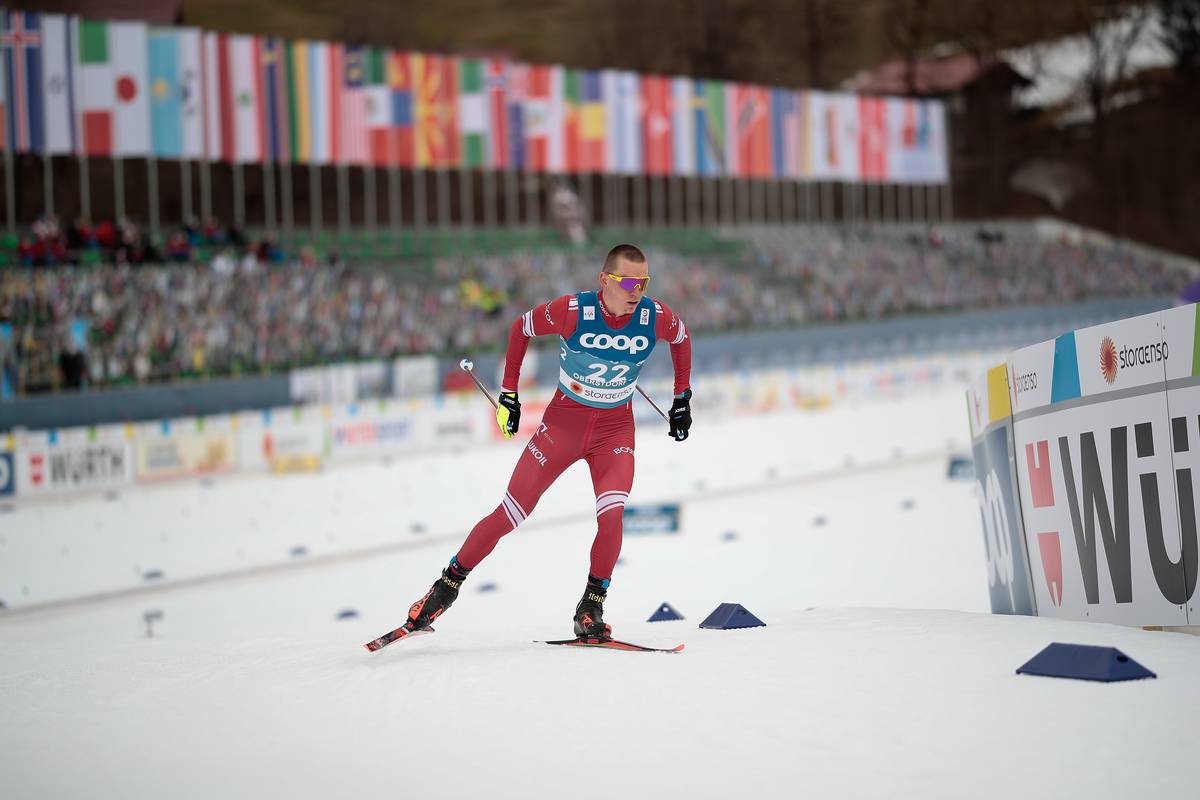
Perhaps the more obvious storyline, who may resonate with Sundby’s slew of not-quite-gold individual World Championship results, is whether the Russian Ski Federation’s Alexander Bolshunov could repeat his win in Saturday’s 30-kilometer skiathlon, where he collected his career first gold medal to hang above his collection of four silver medals. Positioned well above the field in the overall and distance World Cup standings, all eyes were on Bolshunov in bib 22 as he time trialed through the woods on the tracks in Oberstdorf.
In an individual start where athletes are seen passing checkpoints at a variety of times, it can be difficult to assess the performances without a look to the splits at checkpoints. That said, Bolshunov exhuded confidence and strength as he pushed over the top of each climb, worked every corner, and rhythmically grinded through the woods, his bright yellow and purple glasses a contrast to his typical stoicism. By 1.8 k, he had 4 seconds over the rest of the field.
But the story was not pre-written for us. Roughly 80% of the field started behind Bolshunov, and the string of Norwegian’s were looking equally strong.
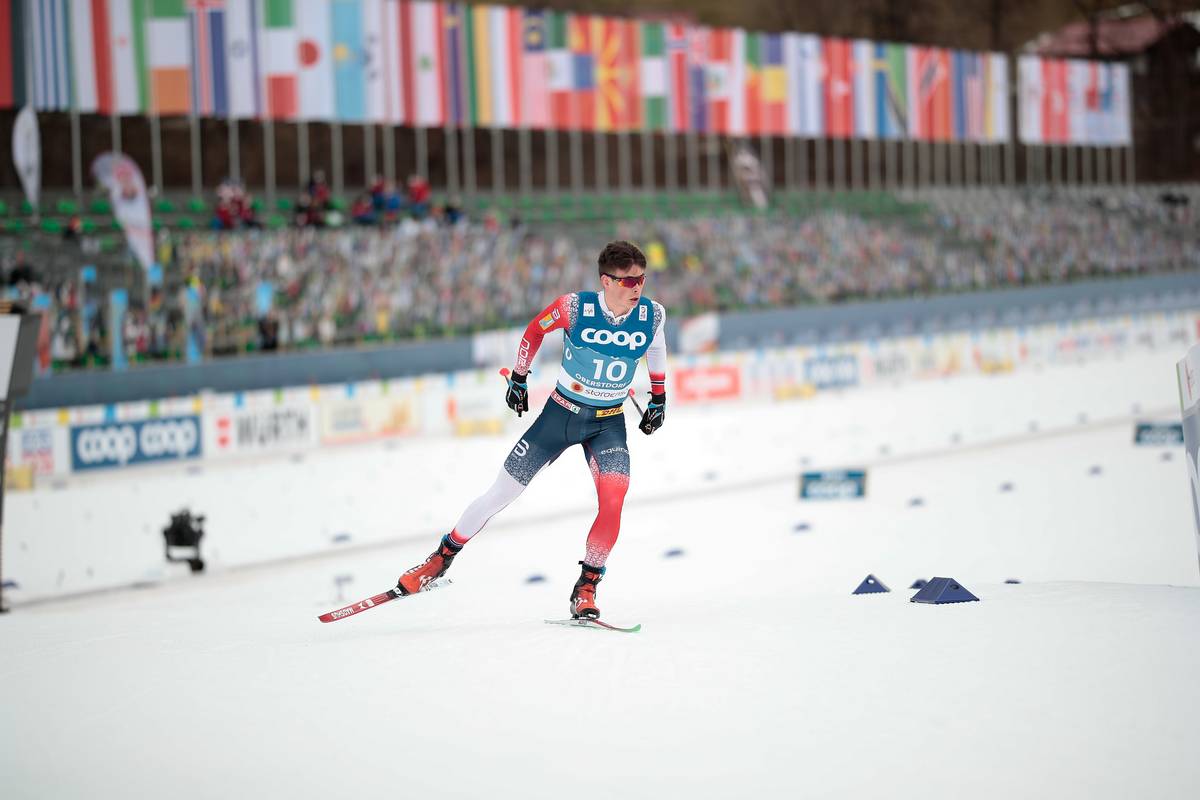
The 22-year-old Harald Østberg Amundsen of Norway – with only three World Cup starts, shines with a third place in the 15 k skate at World Championships. (Photo: NordicFocus)
Perhaps a new-to-us name, Harald Østberg Amundsen of Norway was one of Bolshunov’s biggest threats. I’ll fill you in — it looks as if we’ll want to get to know him.
The 22-year-old has several noteworthy results in the 15 k skate event: 2nd in 15k skate at the Norwegian National Championship in 2020, followed by a 3rd place result in 2021 behind Sjur Røthe and Simen Hegstad Krüger. Amundsen also has a 1st, 3rd and 4th in the event in domestic FIS races this season while Norway was sitting out the World Cup due to concerns for COVID-19 management and athlete safety in the opening weekend of events in Ruka.
A U23 World Champion in the 30 k skate, Amundsen has just three World Cup starts, one this season in the 15 k skate in Falun where he landed in 8th, overshadowed in our coverage by the three Norwegian men ahead of him and a career best result and first top-10 for Gus Schumacher, who finished 9th.
Harald Østberg Amundsen skis his way onto the podium in his first senior World Championships. (Photo: NordicFocus)
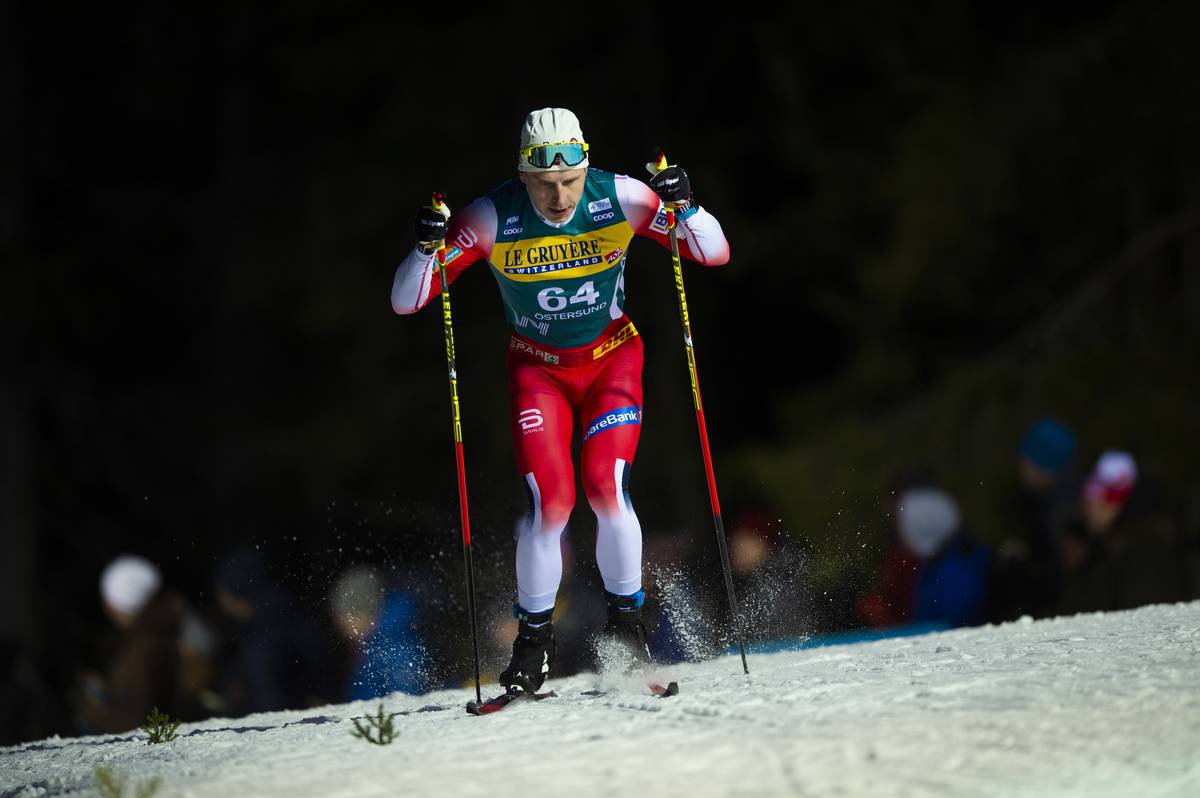
Starting in bib-10, Amundsen set the bar for his more experienced teammates, and the rest of the field for that matter. As splits rolled in, he was just over 5 seconds back on Bolshunov at the 5 k, seven seconds at the 10 k, and then the plot began to twist.
Perhaps the Russian began to fade or perhaps the Norwegians had an untapped gear, but by 12.9 k, Amundsen was over 18 seconds ahead of Bolshunov.
Within the last kilometer, cameras followed Amundsen as he rocketed down a hill into a hairpin curve that spit skiers back into a final steep climb. At the apex of the curve, his skis sunk into the degrading corn snow, sending him into the back seat and costing him his balance. Amundsen shot out of the corner into the fencing, however, with no broken equipment — and unfortunately, no momentum — he rebounded to head to the finish, where his time flashed green on the leaderboard, more than 27 seconds ahead of the field.
Amundsen had plenty of time to soak in this moment, as his time was not challenged until his teammates starting much deeper in the field entered their last 5k of the race.
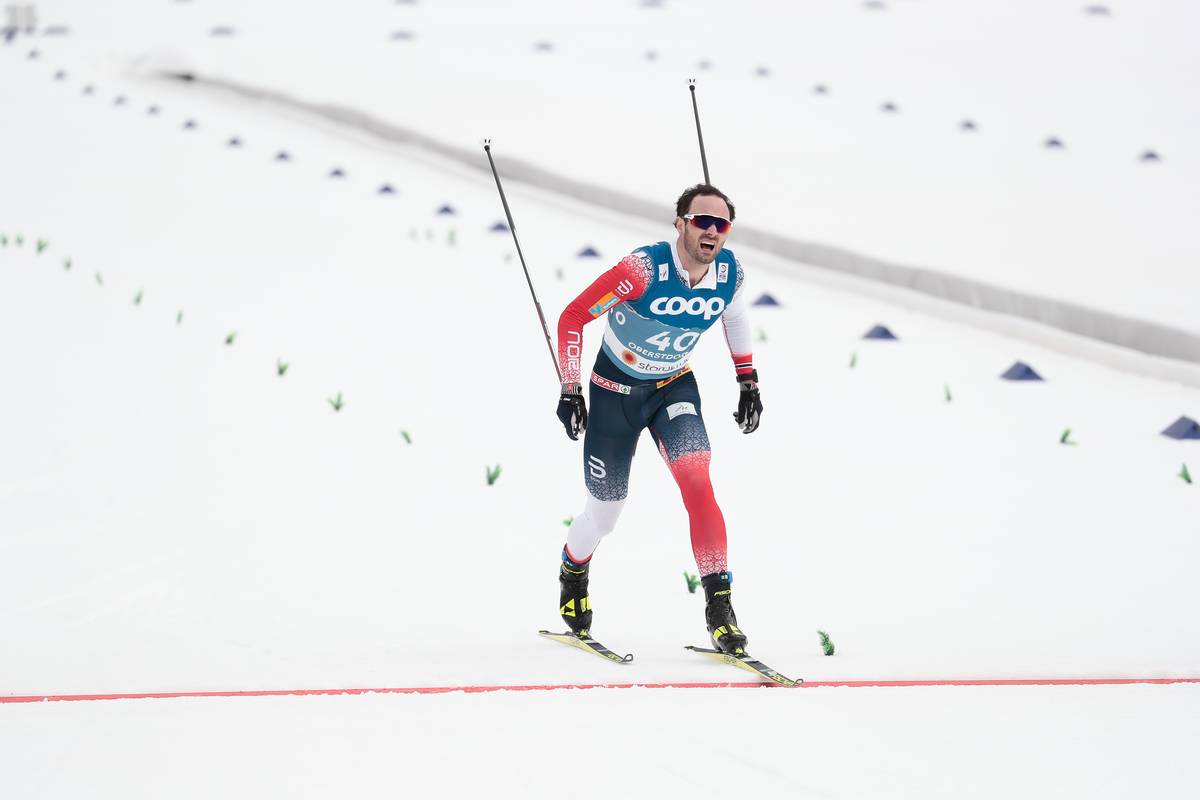
Hans Christer Holund beats the clock in the 15 k skate. (Photo: NordicFocus)
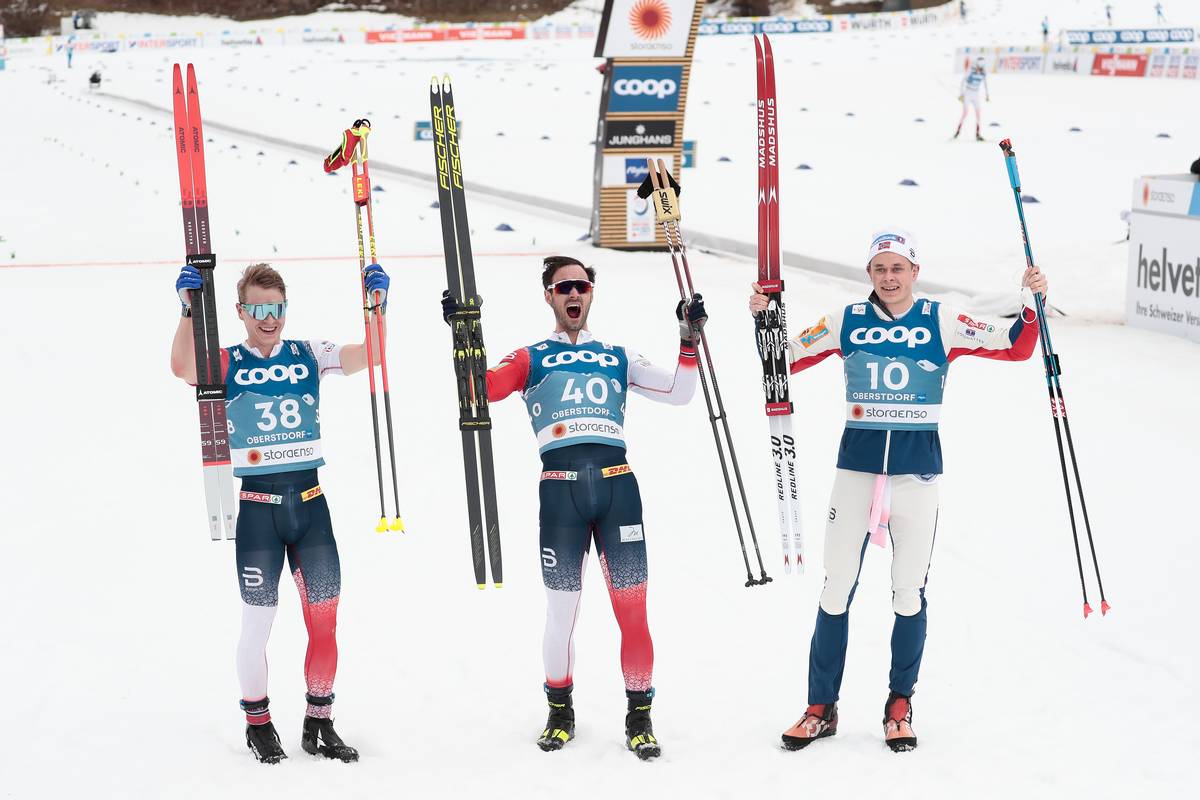
Progressively working his way up was Norway’s Hans Christer Holund in bib 40, who took bronze in the skiathlon on Saturday. He set the fastest split at the 6.6 k mark by 1.6 seconds, incrementally building his lead until it was 9.1 seconds at 10 k, 15.9 seconds at 12.9 k, and ending with a bang, 20.2 at the finish. He stopped the clock with a time of 33:48.7.
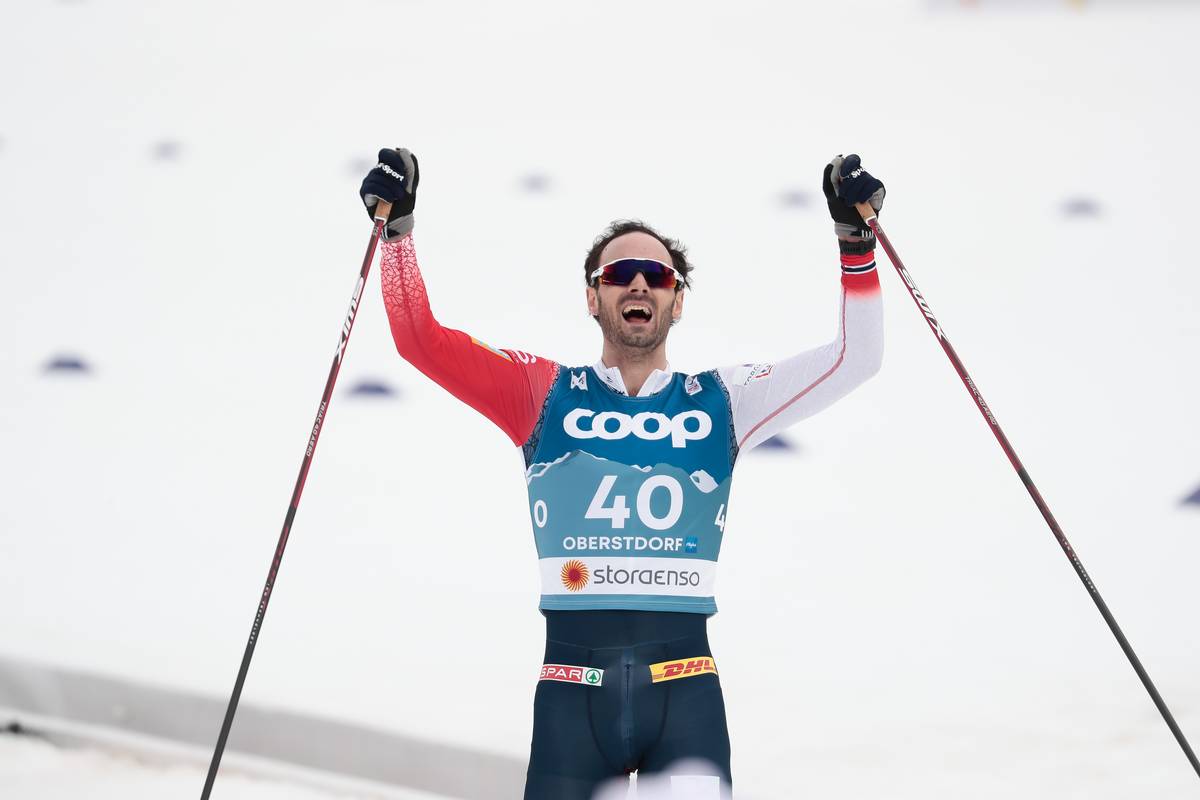
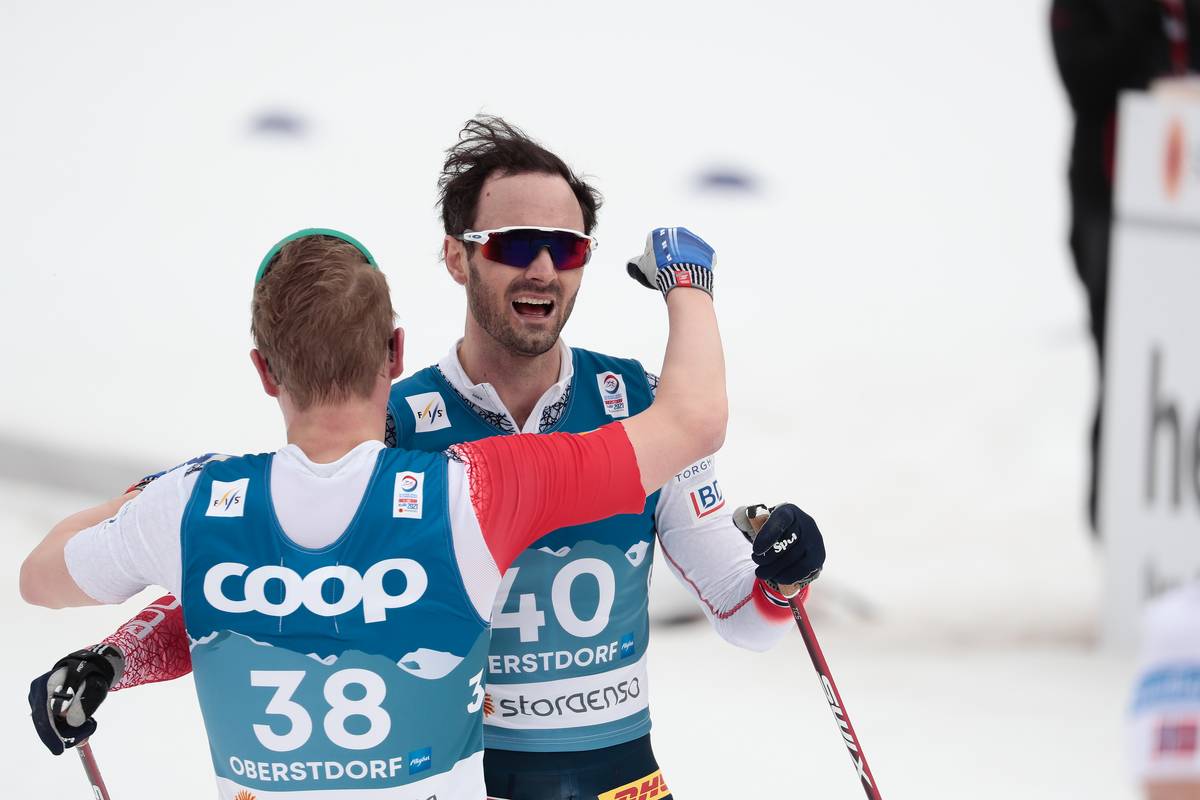
Hans Christer Holund smashes the 15 k skate in Oberstdorf, Germany, winning by a margin of more than 20 seconds. (Photo: NordicFocus)Hans Christer Holund celebrates a gold medal performance in the 15 k skate. (Photo: NordicFocus)
Looping around his teammates in a surge of emotion and adrenaline, Holund was ecstatic at the finish. A second gold medal to keep his 2019 50 k freestyle gold medal company.
“It’s amazing, I don’t know what to say,” Holund told FIS breathlessly after the race. “I am as shocked now as I was in Seefeld two years ago. I had a really good day — this track is super tough, and it’s tough conditions. I knew I was going to have a good race as long as I was staying calm in the first round and tried to push harder later in the race.”
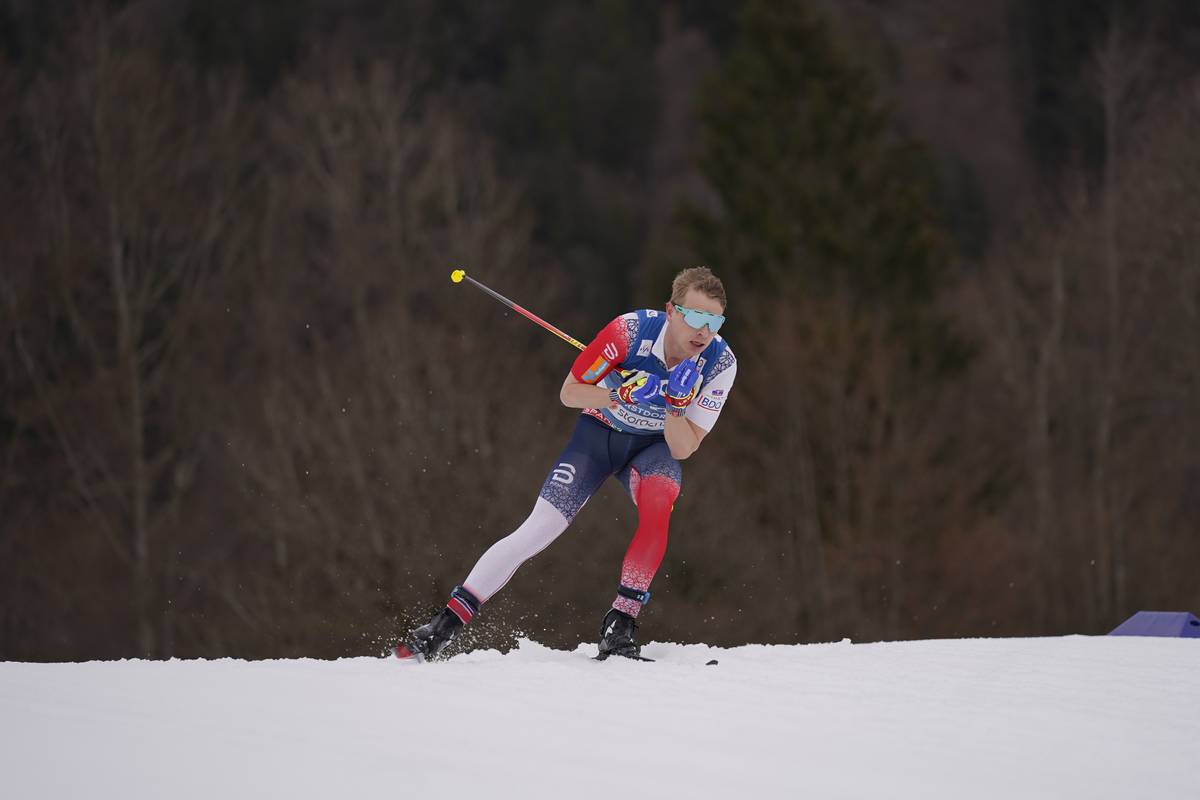
On course, Norway’s Simen Hegstad Krüger raced to second overall in the 15 k Wednesday. (Photo: NordicFocus)Simen Hegstad Krüger and Hans Christer Holund celebrate a job well done in the 15 k skate. (Photo: NordicFocus)
Also climbing his way up the time standings was Krüger, who sat in 11th at the 5 k and 6th at the halfway point. He overtook Amundsen by the 10 k mark and continued to surge, though he could not make any headway on Holund. He finished solidly in second place for a silver medal (+20.2), with Amundsen holding on for bronze (+35.6).
The men’s podium of the 15 k skate: Hans Christer Holund takes gold ahead of Simen Hegstad Krüger and Harald Østberg Amundsen. (Photo: NordicFocus)
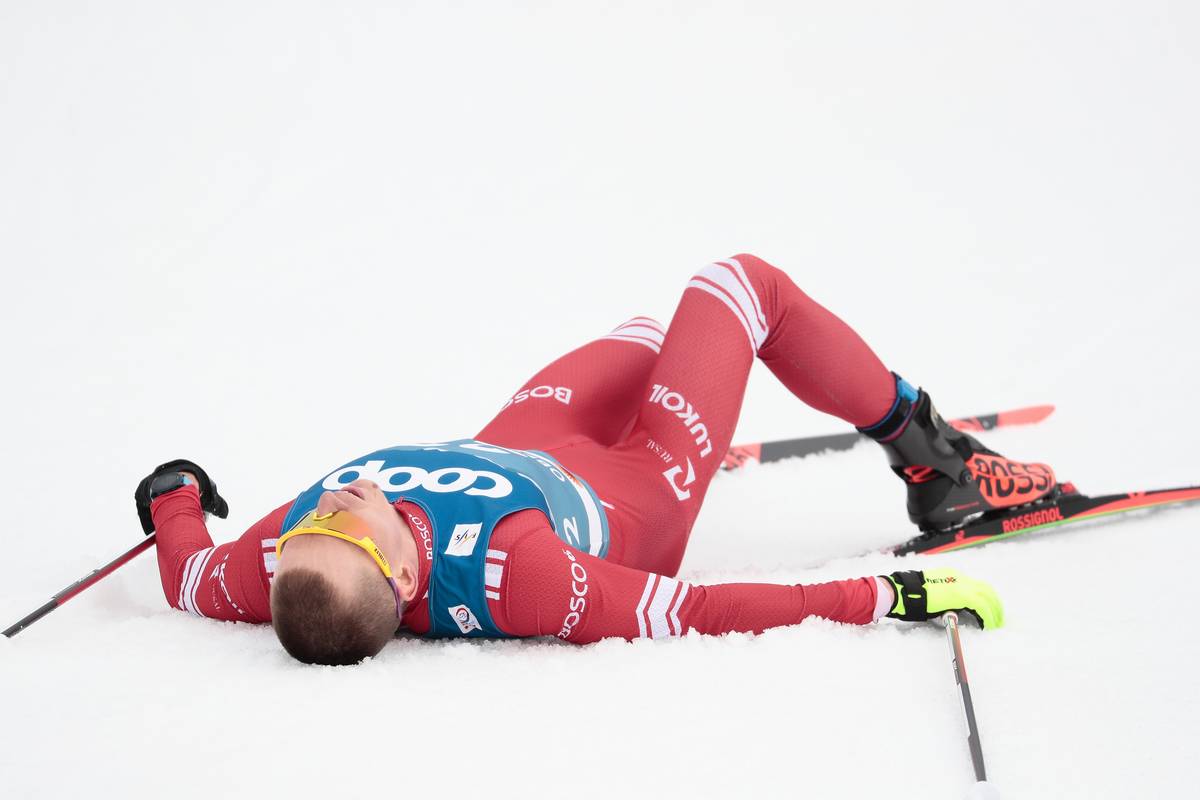
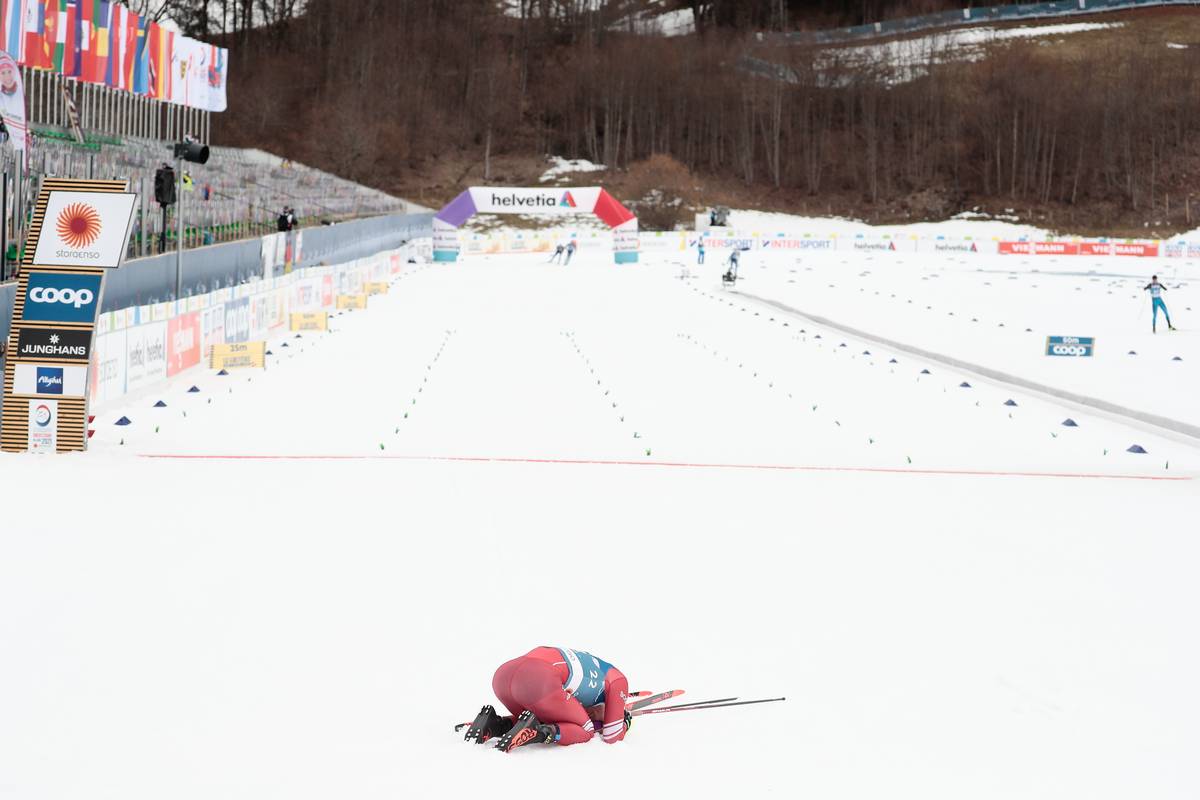
Bolshunov took fourth (+43.7) with his teammate Artem Maltsev 5th (+50.7), interrupting the string of five Norwegians in the top 7. That’s right: Røthe in 6th (+55.3) and our dark horse, Sundby, in 7th (+55.9).
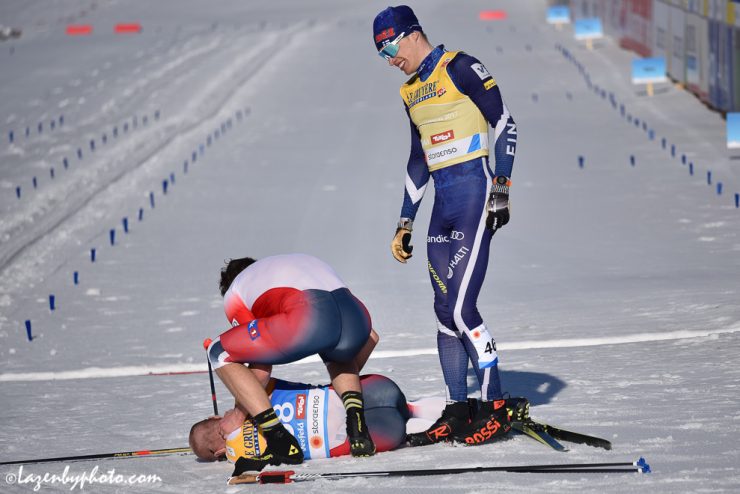
Alexander Bolshunov collapses at the finish of the 15 k skate in Oberstdorf. (Photo: NordicFocus)Disappointment on display as Bolshunov takes fourth in the 15 k skate. (Photo: NordicFocus)
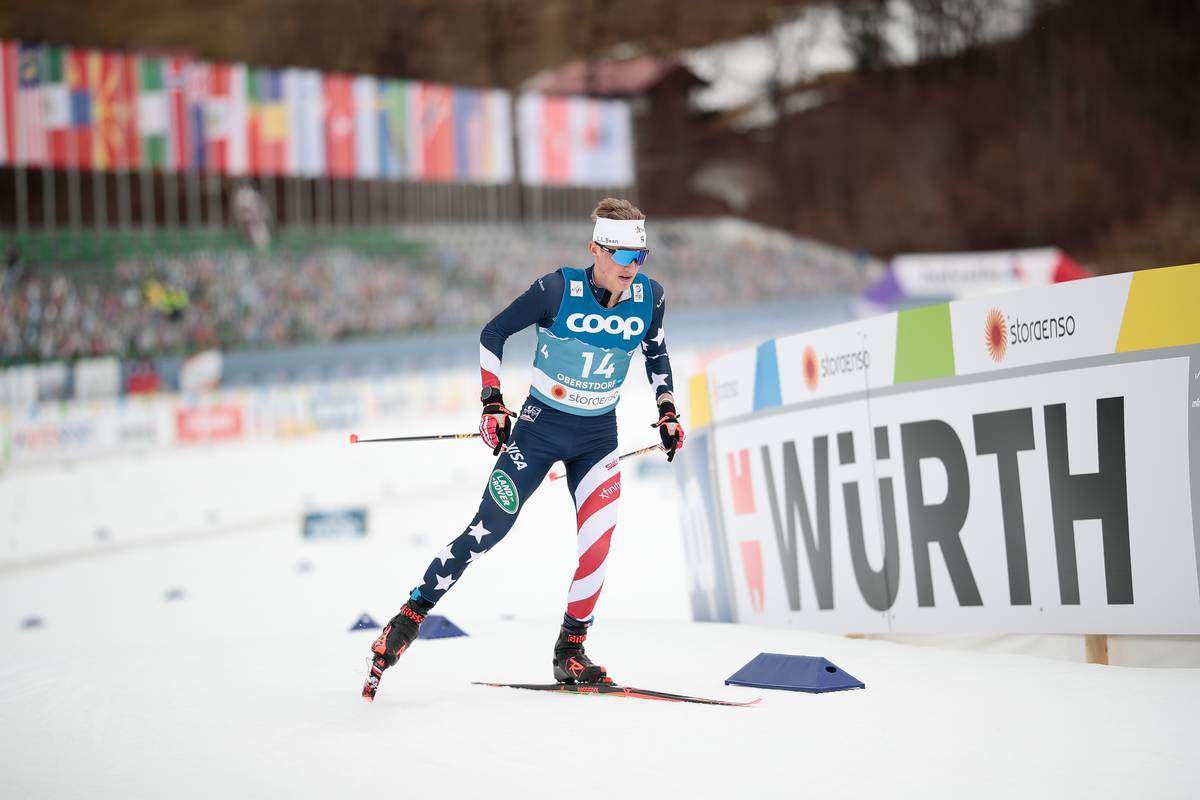
Perhaps with the weight of a U23 World Championship gold medal in an individual start distance event — the 10 k classic — Gus Schumacher started in bib 14 to kick things off for the Americans. It was clear that it would not be Schumacher’s day as he hovered well outside the top-30, finishing 51st (+4:02.3).
Gus Schumacher, in his first individual championship event, skied to 45th. (Photo: NordicFocus)
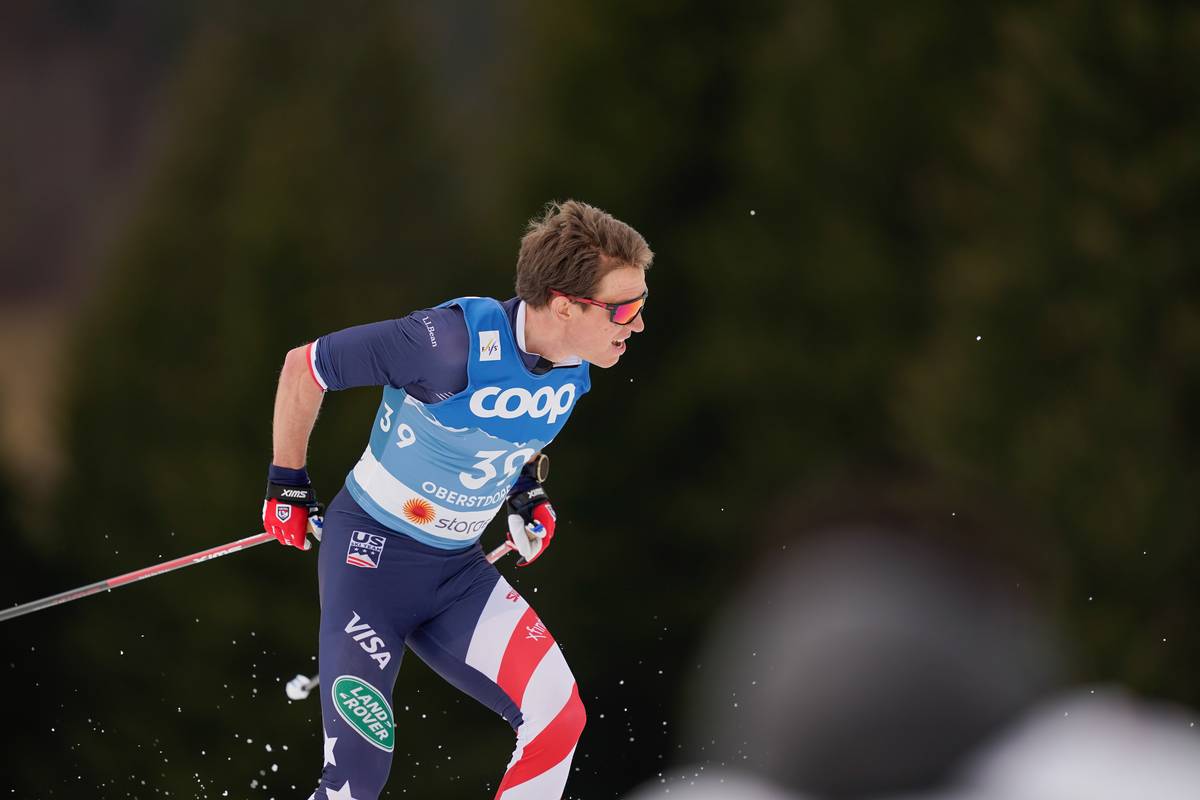
Coming off of top-20 finishes in skiathlon and wearing higher bib numbers were Scott Patterson and David Norris. After 15 k, Patterson held the top spot for Americans in 27th (+2:22.0), with Norris a few spots behind in 34th (+2:47.6).
“It was a tough race,” said Patterson in a post-race interview. “I think I started out pretty strong, skiing where I wanted to be. But the conditions started to deteriorate on laps two and three. I definitely suffered because of that and bled a lot of time. The winner started thirty seconds behind me and just blew by me. It definitely was not quite what I wanted but I think there are still some good signs for later in this week.”
Though official start lists have not been released, both Patterson and Norris will race the 50 k classic on March 7th.
Scott Patterson races to 27th in the 15 k skate in Oberstdorf, Germany. (Photo: NordicFocus)
“I had higher expectations, but I know given the circumstances and that it is a tough day I felt like I fought through it and did my best,” said Norris of his race. “I cannot complain. My skis were good. All the support was there, I just did not feel my sharpest.”
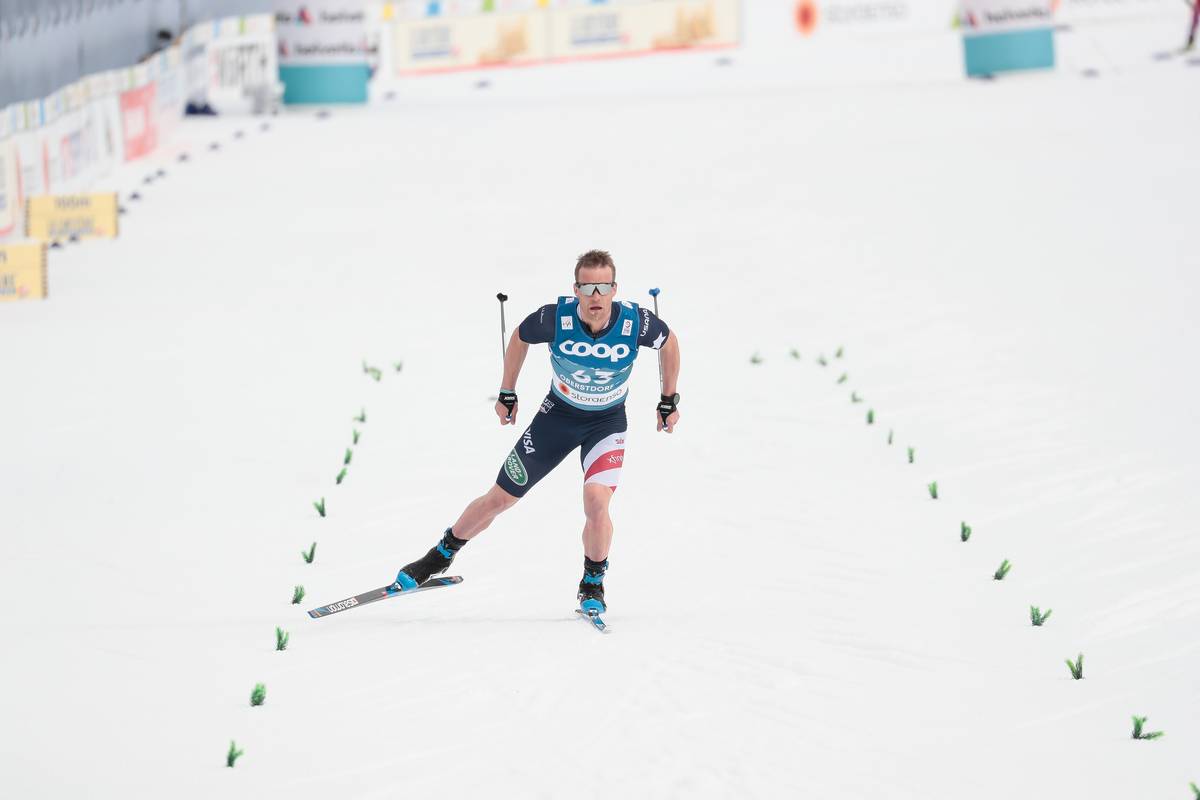
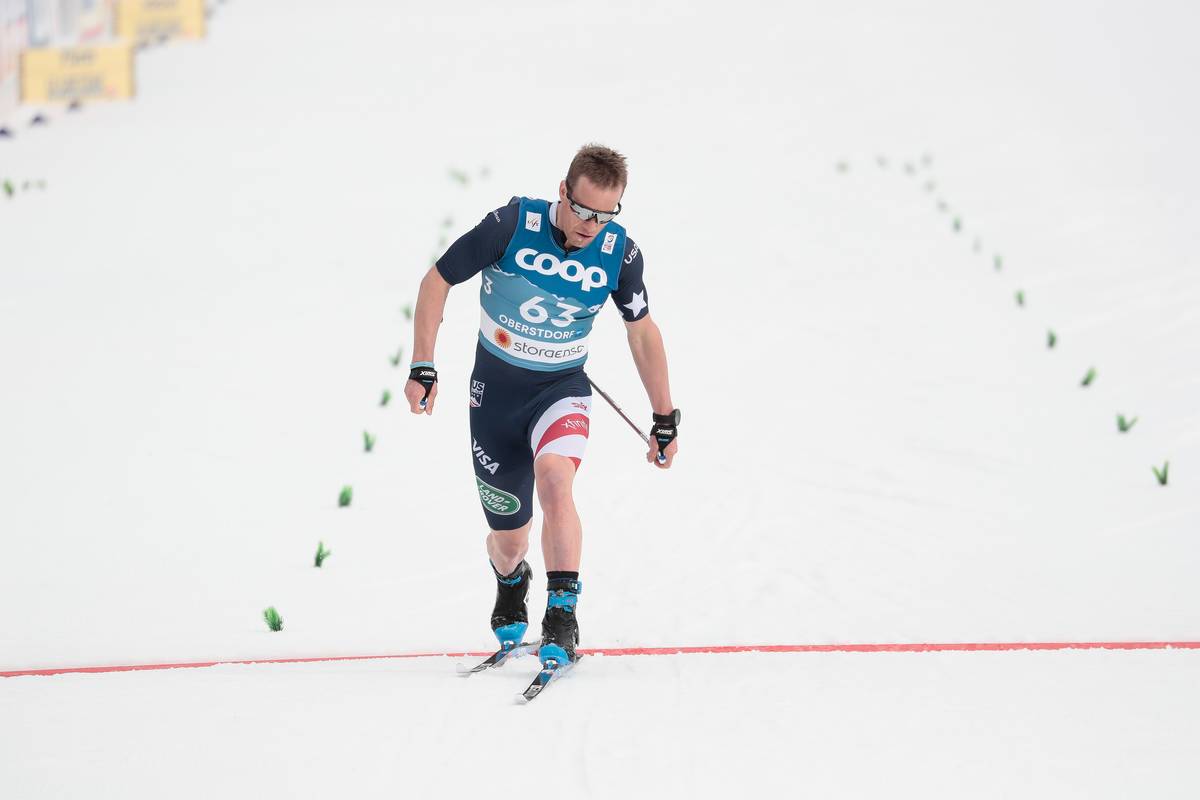
A name we associate more with sprinting, Simi Hamilton finished just 0.1 second outside the top-30 in 31st (+2:34.2). After ending his team sprint with Schumacher in the semifinals, Hamilton spoke with optimism after his race.
Down the final straight for Simi Hamilton in the 15 k skate. (Photo: NordicFocus)
“I never really know what to expect in an individual start,” said Hamilton after the race. “I’m a good mass start skier because I think that requires a little more sprint tactics and you always have someone to ski with. These individual start races are tough for me, mentally and physically. Just not having trained for races like this, they’re tough, but I know that I’m fit right now. With the focus on the team sprint, fitness is a big thing for that kind of race, so just being distance fit kind of comes with that territory.”
Simi Hamilton, for the U.S., toes in for 31st in the 15 k skate. (Photo: NordicFocus)
Hamilton discussed the changing conditions as skiers lapped the course. Tracks became softer and wetter, though hardpack conditions on the flats held up well. The biggest climb became soft and slow, even more taxing than it otherwise might have been. He shared that they could only check out the downhill that took out Amundsen once before the race began, but the tacky corner with a fresh groom was nothing like the conditions in the back half of the race. “You have to expect the unexpected,” he stated with a laugh.
Hamilton complemented the techs for their job producing fast skis and finished with a positive outlook on his day.
“It was nice to get an effort in like that,” Hamilton said. “It kind of validates a lot of the work you’ve been putting in for other races, so it was fun.”
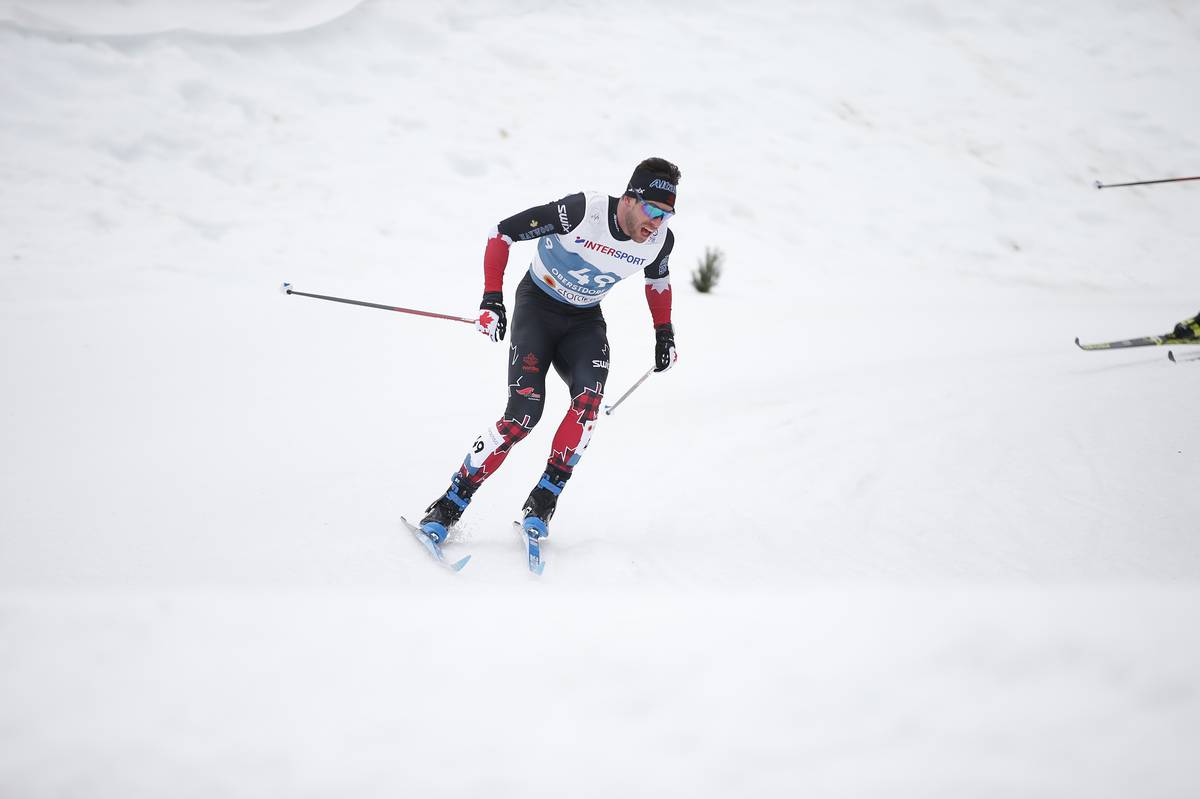
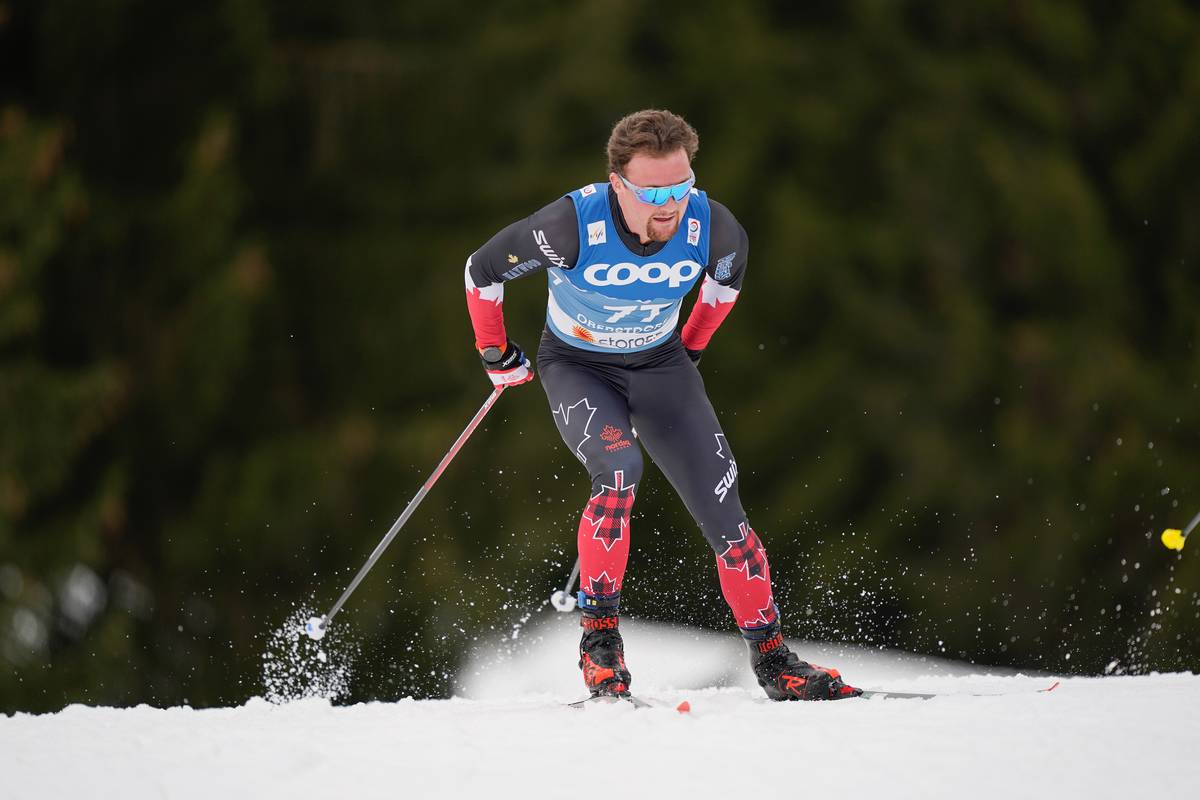
Canada’s Russell Kennedy rounds the fateful corner on the tracks in Oberstdorf. (Photo: NordicFocus)
Racing for Canada, Russell Kennedy cracked the top-30 (+2:34.1).
Next up for Canada was Phillipe Boucher in 50th (+4:00.2), with Remi Droulet close behind in 52nd (+4:02.7), and Graham Ritchie rounding out the Canadian field in 67th (+5:15.3).
Graham Ritchie of Canada skis to 67th in the 15 k skate. (Photo: NordicFocus)
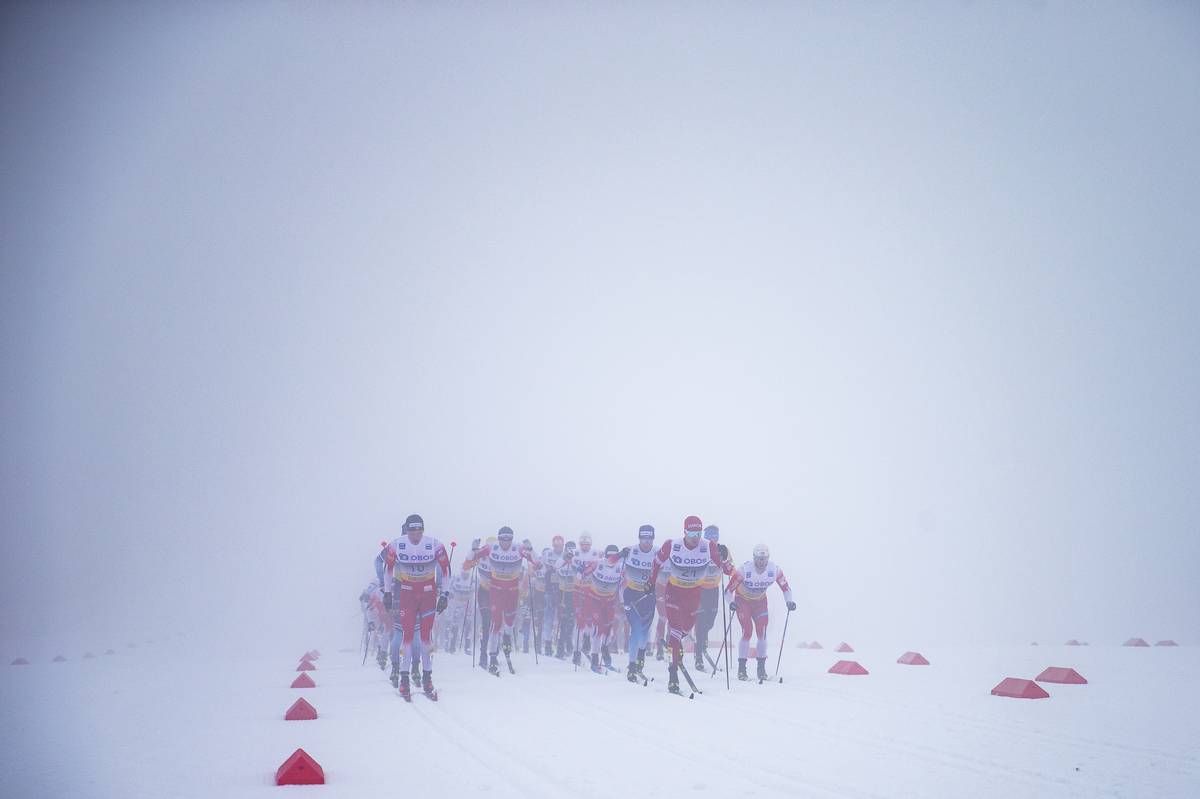
En mass: early in the Oslo 50 k classic. (Photo: NordicFocus)
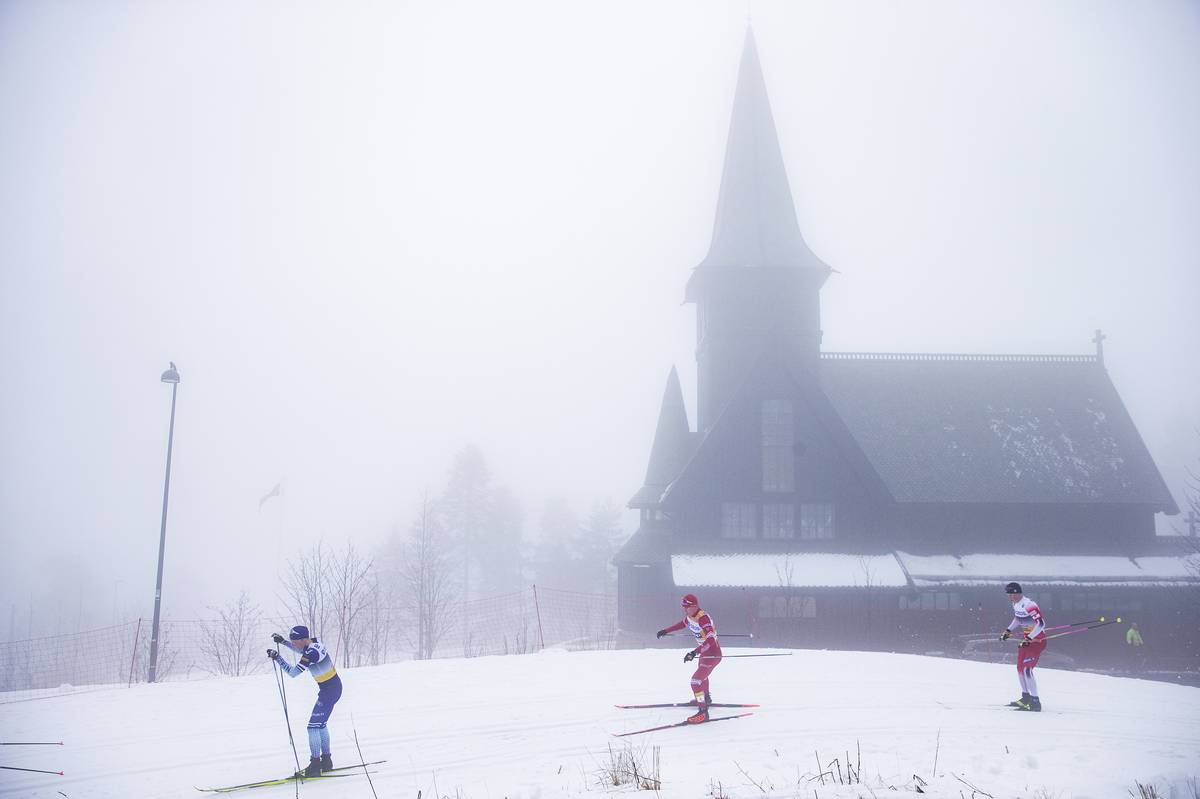
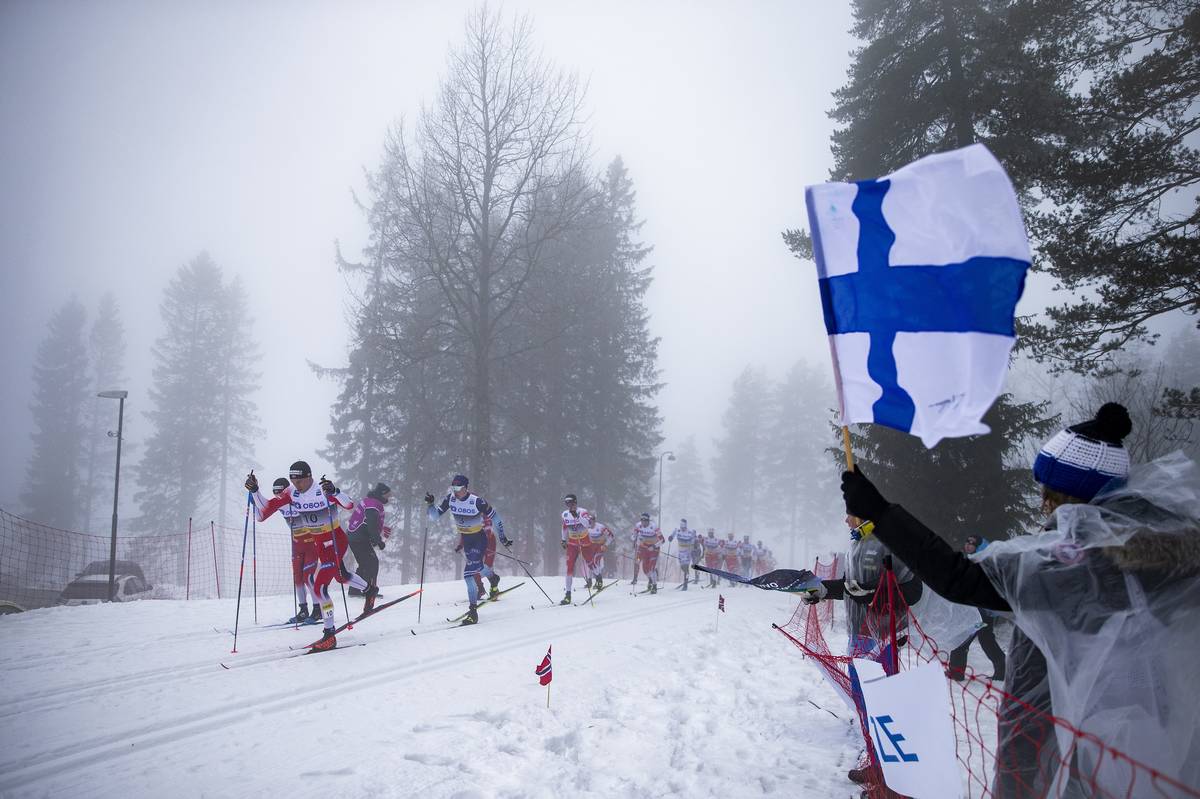
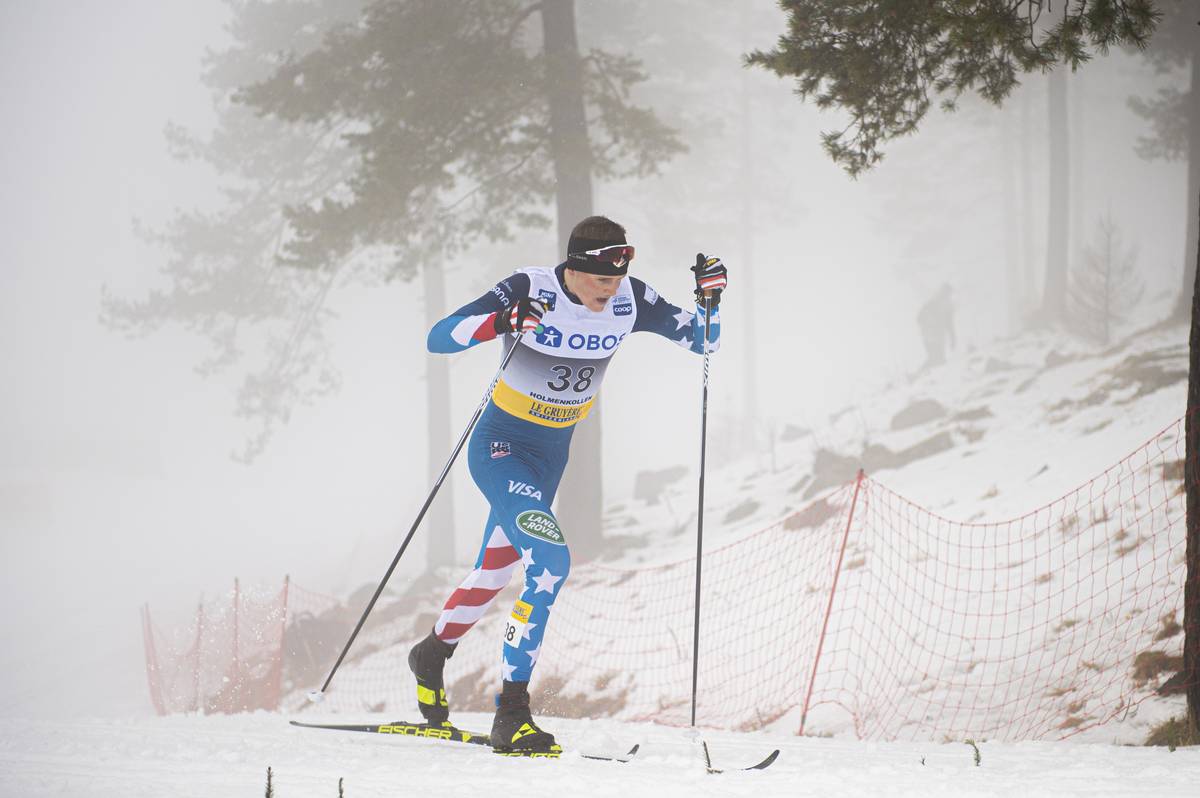
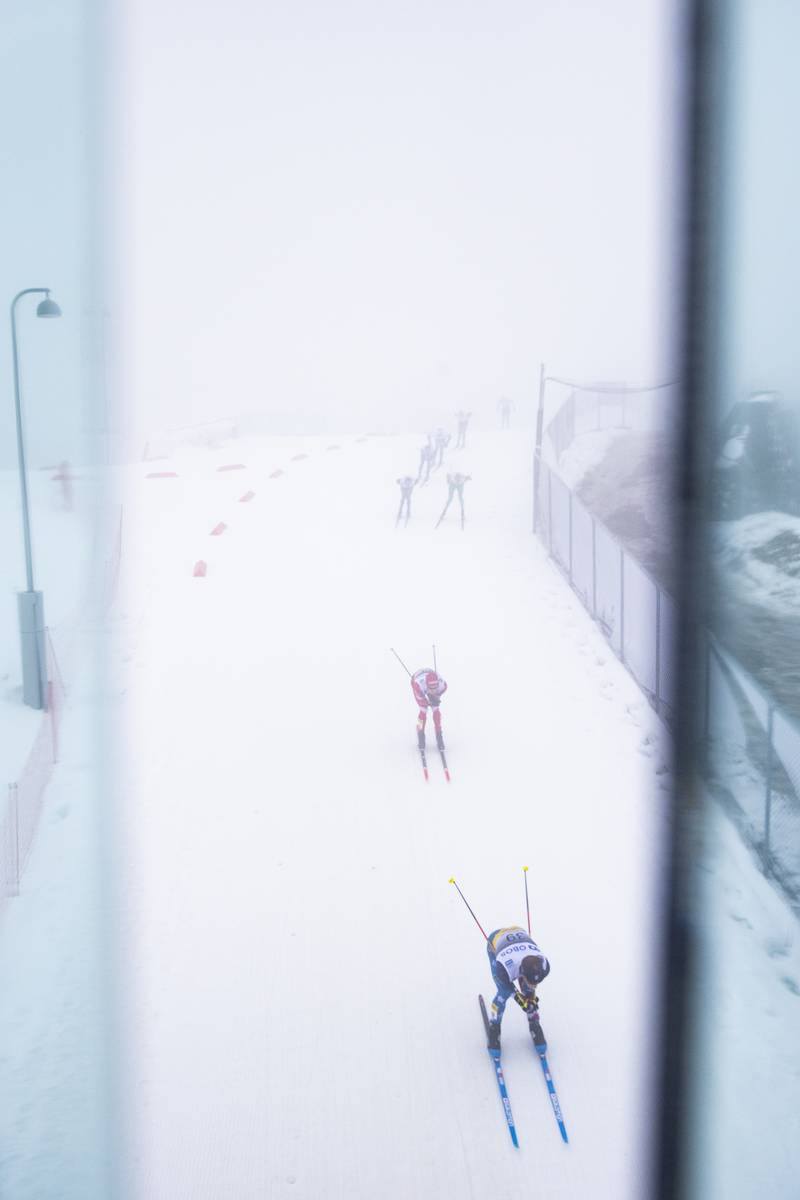
Oslo in late winter – it’s be hit or miss. Fog. Bluebird. A maritime climate, with plentiful moisture in the air, a slight drop in temps can morph the Holmenkollen ski complex into a ping-pong-ball-world. Athletes were mere shadows striding into and out of view on a foggy- drizzly day at the Holmenkollen. As spectators were limited to trail side spots as the main stadium was closed due to the Covid-19 virus, for some concerned, it was a slog for the 50-kilometer classic to close out the European portion of the World Cup. (That’s right- it’s ocean hopping time for the entourage post-race as the World Cup moves to North America.)
Sunday church along the Holmenkollen course: Iivo Niskanen (FIN), Alexander Bolshunov (RUS), Johannes Høsflot Klæbo (NOR), (l-r). (Photo: NordicFocus)
Let’s cut to the chase. The main action over 50 k involved main pack attrition. The sharp end pack remained robust with skiers through 18 k, as skiers passed through the main stadium as Sjur Røthe of Norway came through first. That much didn’t matter beyond a minor foot note in the day’s narrative, as a handful of Norwegian’s took pace leading chores throughout the race.
On a day that many would have preferred to practice their own personal art of hygge, the main pack remained 20 deep at 30 K. The top-20, which contained all the key skiers, was separated by a scant 5.6 seconds. A group that big surely provided its own sense of Norwegian coziness despite the high heart rates. Of those 20 athletes, four were Russian, two Swedes, one Finn, one Swiss — the rest Norwegians. Charging through was overall World Cup leader Alexander Bolshunov. There was Emil Iversen, Pål Golberg, Martin Johnsrud Sundby, Simen Hegstad Krüger, Didrik Tønseth, Hans Christer Holund, and Johannes Høsflot Klæbo. Bundled in there was Dario Cologna of Switzerland, and Iivo Niskanen of Finland, who was lucky enough to have fans and there chanting “Iivo-Iivo”.
Start of the race: Roughly 50 k to go. (Photo: NordicFocus)
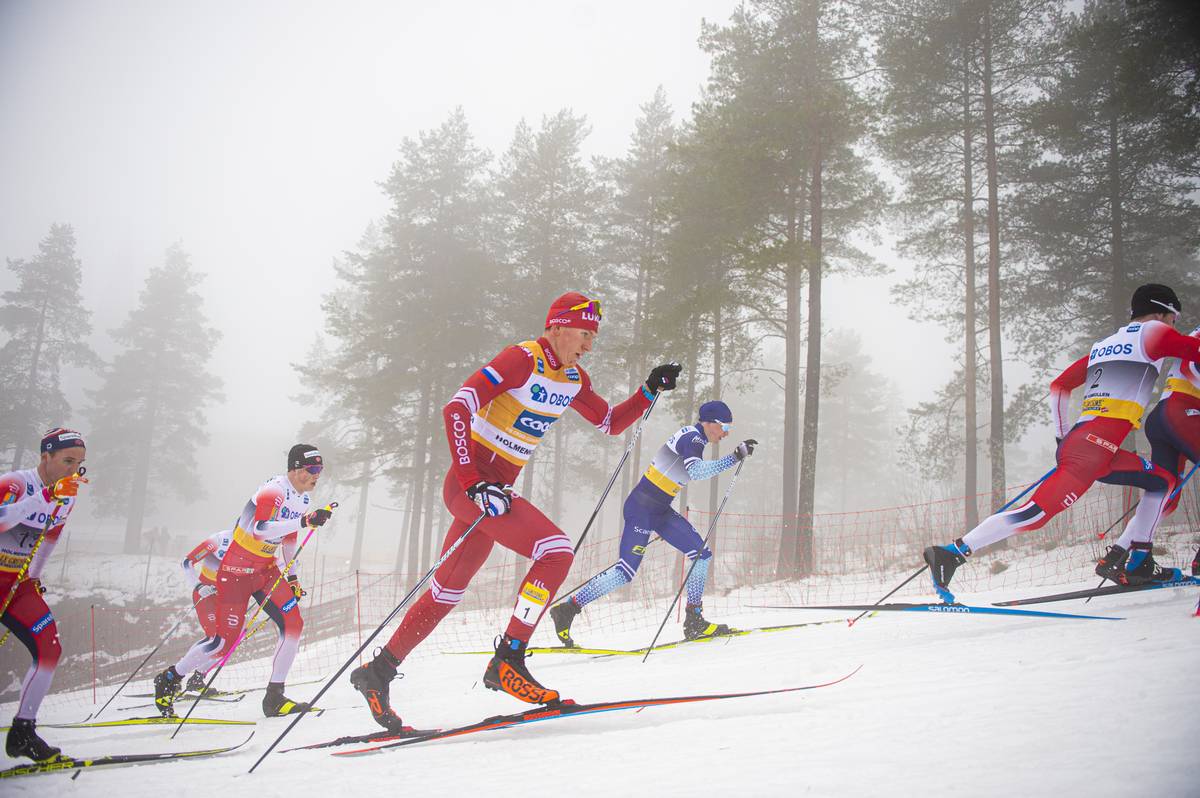
Men’s 50 k classic mass start: Fog and Oslo style. (Photo: NordicFocus)
With so many skiers clustered together, and the tactics less explosive than simply see who could hang on, the camera shots at each turn of the race through the main stadium turned to the spare classics skis racers had the option of swapping into. The lure of fresh kick or speed, seemed like tempting race candy. Halfway through, at roughly 25 k, it appeared that Golberg was one of a few of the main contenders opting for a fresh pair. The rest skied through the ski exchange zone, at least content for another lap with their boards.
Lapping through at 30 k, scores of skiers opted for fresh kick and glide. Post-ski-exchange, the front pack soon coalesced into two orderly lines, like marching soldiers, as they crested a hill roughly an hour twenty into the race.
No matter any skiers herculean efforts to pop off the front, this was a simply a group affair. Any potential burst of speed, or pulse for bonus points, was absorbed. Ski speed or kick, seemingly equalized among the scrum. The question simply was this: which human engine would last the longest? Forty kilometers in, and the front group had winnowed 13 skiers separated by about seven seconds. Bolshunov led, followed by Røthe and Cologna.
Pål Golberg (NOR), Sjur Røthe (NOR), Iivo Niskanen (FIN), and Johannes Høsflot Klæbo(NOR), (l-r). (Photo: NordicFocus)
Then it was two — barely. Just after the two hour mark, Krüger spiced up the pace. Striding and double poling in earnest, at 47.7 k. Krüger was only shadowed by Bolshunov, as the Norwegian’s late in the race move stuck. Røthe, Cologna, and Holund fell off in third, fourth, and fifth, respectively, to just over 11 seconds back.
Two stallions double poling into an eerily silent stadium. That was probably not such a bad thing (although fans present are always better), as one can imagine the fans falling silent had they been there in droves. Russia’s Bolshunov out sprinted Krüger to win in 2:08:05.3, 0.9 seconds better than the second place Norwegian.
“I knew that Bolshunov is strong on the final 100m so I tried to get rid of him before that,” Krüger told FIS. “I felt really good today so I knew that I could really push myself before that. But he is strong and it’s hard to get rid of him. I almost made it but I am really happy to be on the podium. It’s an amazing feeling.”
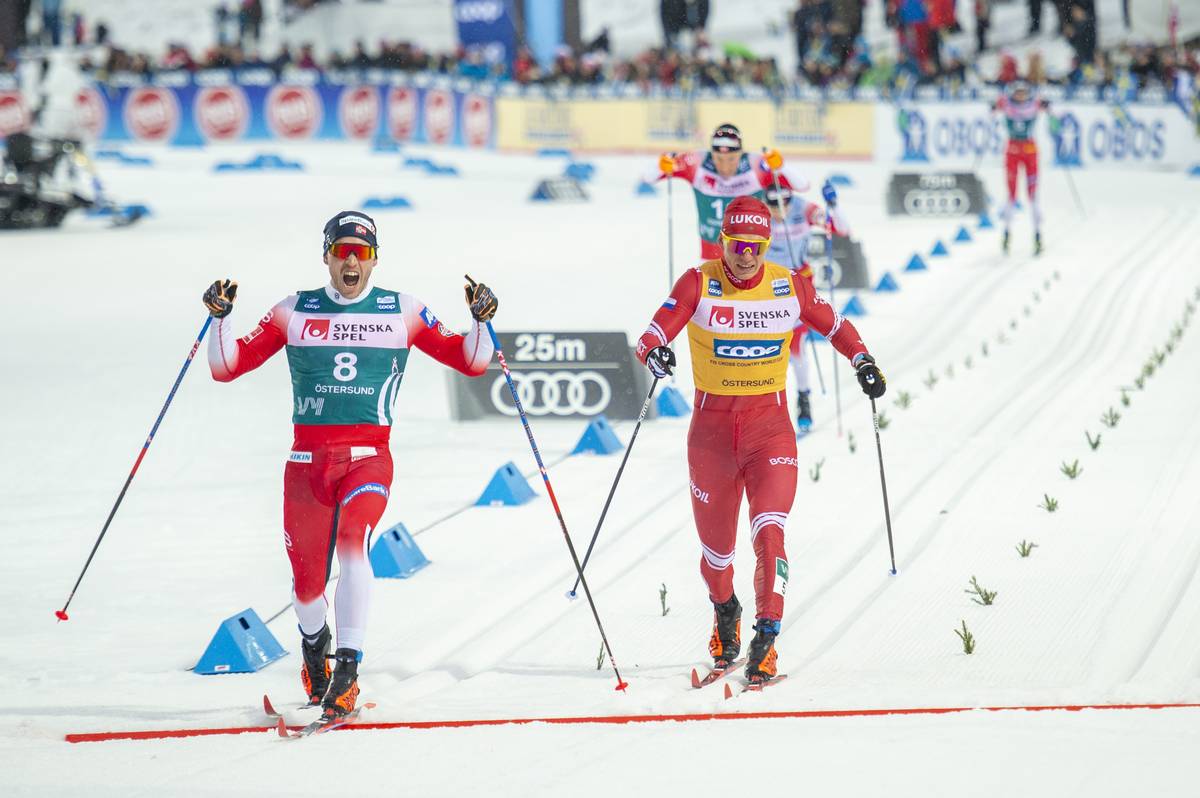
Yellow bib and the Oslo 50 k win: Alexander Bolshunov and Simen Hegstad Krüger, down to the wire. (Photo: NordicFocus)
An irrepressible Bolshuov. (Photo: NordicFocus)
“Me, the team and the skis were all working together perfectly today and I am very happy to win here,” Bolshunov said after the race. “Because compared to Trondheim, where I had no possibility to do something with my skis, it was more important for me to win here today.”
That Trondheim race mentioned by Bolshunov was the final stage of the SkiTour 2020 in which he lost the overall due to poor skis.
For Bolshunov, this made for back-to-back 50 k classic wins in Oslo. Last season he won in a final sprint that saw Russia sweep the podium. And for Krüger, this was a career best in a 50 k race. He was seventh in last season Oslo 50 k. Lastly, when it comes to classic skiing, this has been a breakout year for Krüger – he is an athlete we had often considered a skate specialist.
“In the last lap I heard that I can fight for the podium and this is where I got some more energy,” Iversen said to FIS. “So I am really happy to stay 50km all in because I am not known as the best athlete in our team so it is nice for me to show the coaches and all that I can stand a hard and long 50km. I am really proud of that.”
Emil Iversen skiing to third overall in the 2020 Oslo 50 k classic. (Photo: NordicFocus)
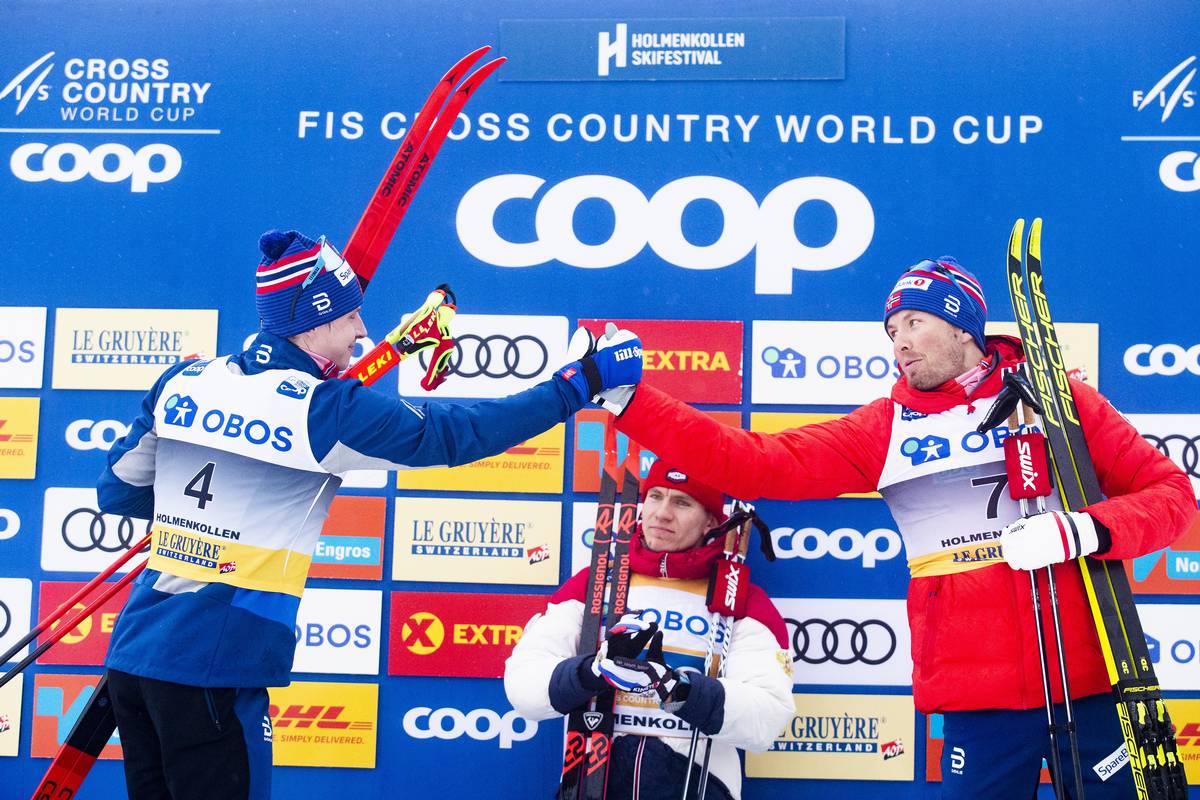
The Oslo 50 k classic podium: Simen Hegstad Krüger (NOR) second, Alexander Bolshunov (RUS) first, and Emil Iversen (NOR) third, (l-r). (Photo: NordicFocus)
This was a tough day for the Americans, who started four athletes. Ben Lustgarten (CGRP) finished in 47th (+13:20.1), and Adam Martin (CGRP) 50th (+15:10.1). David Norris and Ian Torchia did not finish as they pulled due to illness.
“It was one of the toughest races I’ve been in,” Martin emailed. “I made a blunder by selecting zeroes and paid for it in the first lap. I used my one ski exchange as soon as I could at 6k with 44k to go. I spent a large majority of the race skiing by myself in windy conditions with no racers in sight. I am thankful for the spectators that cheered me on many k’s.
Adam Martin during the Olso 50 k. (Photo: NordicFocus)
Lustgarten reiterated the day’s difficultly.
“The race today was absolutely brutal,” Lustgarten explained in an email. “The conditions were not as tricky as we thought because it was just rain and super saturated wet tracks, instead of the new snow they called for in the morning. Still the tracks were glazed wet and breaking down, and also got really slow after a lap or so because of the fluoros fading from the skis. I had amazing skis for my first pair.
“I was able to stick with the lead pack for about 1.5 laps (we did 8 laps of 6.2km). I felt really good, my skis were amazing, fast and great kick. I started to fade a bit on the steep climbs and lost contact with the main front pack. Basically after that I skied alone or around a few other skiers for the rest of the race. The wind was tough being alone, and just forcing myself to ski well and try to keep my pace up. I swapped skis after 4 laps and unfortunately had a bit less kick on my second pair, in addition to fatigue and glazed tracks I found myself herring boning most of the steep climbs, but they were nice and fast for a few laps. My triceps started cramping about 20km earlier than most 50s, with about 30km to go. That was uncomfortable and not a great sign. My second half of the race was more about holding on and trying to finish the race instead of racing as hard as I could. I find at Holmenkollen it takes everything I have to just try and ski ok and finish the race because of how hard the course is. I was proud to finish today in such challenging conditions, even though my fitness didn’t feel amazing. Overall I was really happy with the skis and our wax techs deserve a shout out for that!”
Ben Lustgarten (front) fog bound and Oslo 50 k determined. (Photo: NordicFocus)
“This was a very tough weekend for our team, but I’ll say this first: We’ll be back next year to swing again,” U.S. World Cup Coach Matt Whotcomb explained. “Whether we are coaches or athletes, the process of figuring out this race is why we do this job. It’s just so difficult here, and we love it. We’ve been near the top and the bottom on the same weekend, and in each of those cases, the result is always over-shadowed by the experience with the crowd. This is a major-league sporting event in these woods, with crowds in the tens of thousands, strapping speakers to trees, screeching trumpets, blazing fires, and cheering for everyone. In fact, they cheer extra-loud for athletes who aren’t having a good race. In terms of uncracking the Holmenkollen, the courses, conditions, and 30/50k race formats are so difficult that anything but near-perfect skis, fitness, and health will put an athlete way off the mark. We just didn’t pull any triple cherries this weekend. We were also hit by a cold that caused us to scratch Sadie on the morning of her race, and it lead to David pulling out after three laps. I had the chance to talk to David in the feed zone as things were starting to go sideways, and I told him to pull out. He said, “But that’s not what I do.” It’s not my style either, frankly, but it would’ve been a season-ender for him to finish the race ill. There was no other way; he was pale green. Just behind David on the course, Ian was puking (on his birthday), so he had to drop out, too. So, like I said, it was a tough weekend. And while I support David and Ian in their need to drop out of today’s race, I’m also very proud of Ben and Adam for finishing this beast.”
Picking up where we left off in Östersund, Sweden: a pursuit start 15-kilometer classic. Unlike the women’s field where Therese Johaug “administered a beatdown”, creating a large time gap for herself, the margins for the men were much smaller.
This year’s Tour de Ski winner Alexander Bolshunov of Russia, whose winning streak was interrupted, would start with a 22 second time deficit in fifth. Tenth place Ivan Yakimushkin (RUS) was 33 seconds back and Jens Burman (SWE) in 20th just inside a minute.
Alexander Bolshunov during Stage 2’s 15 k classic pursuit of the Ski Tour 2020. (Photo: NordicFocus)
With four 3.75 k laps to cover, the deficits were manageable. Perhaps the only Tour victory hopeful who was kept up about the work that needed to be done was Johannes Høsflot Klæbo, who would start 1:23 behind the leader after finishing 31st the day before.
The caveat would be to stay upright while navigating the icy winding bends of the primarily man made track. With grey skies and above-freezing conditions, it was fast and dicey, made evident by numerous crashes.
During one particularly noteworthy four-person pileup, Kamil Bury of Poland was taken out by Italy’s Maicol Rastelli as the two navigated a treacherous right hand turn at the bottom of a steep descent. Though neither had full control, Rastelli slid off the left side of the course, taking Bury along with him. Bury lost a ski and became tangled in the netting.
Just before impact… (Photo: Screenshot NBC/FIS Broadcast)
As Rastelli stood up and worked to right his skis, which were pointing in opposing directions, a third skier, Lin Bao of China, essentially slide tackled Rastelli, sending him in a complete backflip back down to the snow.
A fourth skier, Tadevos Poghosyan of Armenia, also lost control and slid into the pile. Bao and Poghosyan were able to stand up relatively quickly and continue on their way, but cameras cut away before the resolution of whether Bury found his ski and Rastelli was able to recover from his forced aerials.
Holy carnage… back to the race.
At the end of the first lap, it was as if the men were gifted ready-made groups. Røthe and Krüger matched stride for stride and double pole for double pole, while the remainder of the top five plus a handful of additional Norwegians, namely Pål Golberg, Hans Christer Holund, and Martin Løwstrøm Nyenget, chased from roughly six seconds back.
In bib 11, Martin Løwstrøm Nyenget (NOR) works his way towards the sharp end of the men’s 15 k classic pursuit. (Photo: NordicFocus)
It looked as though Røthe and Krüger might run away from the field, but it was not so easy. By 4.4 k, the gap was closed and an eight-man train chugged along the tracks. As Yakimushkin had fallen off the pace, it became seven Norwegians and Bolshunov.
Over the final two laps, the front pack whittled down from eight to five, where it remained with one k to go. Holund, Golberg, Røthe, Bolshunov, and Nyenget. The Russian in the yellow bib was primed to make a move.
Bending, rolling, and swooping, they headed for the stadium. Up the final punchy climb, Golberg and Bolshunov were side by side, and Golberg started to slip. He recovered and powered out of the climb, running with Klæbo-like dominance over the crest of the hill and into a tuck to lead into the stadium.
Bolshunov had fast skis and caught a draft before whipping into second place as the men entered the final straight. The Russian was right behind Golberg and absolutely charging. But there was not enough real estate. He changed lanes to challenge the Norwegian and looked as though he would overtake him, but the final meters evaporated and Golberg threw his foot for a clear win.
A lane switch wasn’t enough for Alexander Bolshunov as Pål Golberg of Norway takes the win. (Photo: NordicFocus)
Pål Golberg about to toe – during the 15 k classic pursuit, Stage 2 of th Ski Tour 2020 in Östersund, Sweden. (Photo: NordicFocus)
Golberg crossed the line in 34:50.8, with Bolshunov 0.3 seconds behind. Nyenget took third (+2.1) in a tight finish with Røthe (+2.5). Holund dropped off in the final sprint to round out the top five (+7.3).
Pål Golberg wins at the line over Alexander Bolshunov during the 15 k classic pursuit, Stage 2 of th Ski Tour 2020 in Östersund, Sweden. (Photo: NordicFocus)
“Perfect klister conditions,” Golberg told FIS at the finish. “I managed to get the ski pair from last weekend, so I had good skis this weekend as well. It was a really, really good day.”
The interviewer noted that conditions were much different than the previous day.
“It was hard in the middle,” Golberg explained. “It was a bit drier, so a bit difficult with klister in the downhill. But the tracks were perfect, so I’m really happy.”
Not the start of the FIS Ski Tour 2020 desired by Johannes Høsflot Klæbo. (Photo: NordicFocus)
Speaking of Klæbo, the Norwegian skied his way into 25th, but ceded an additional 52 seconds in the overall standings by finishing 2:15 back on the leaders.
FIS sent out a news brief shortly after the race with information regarding Klæbo’s injured finger. Here is the statement in full:
“Johannes Høsflot Klæbo (NOR) has to undergo an emergency check up for his broken finger. The check up has to take place with his doctor in Trondheim (NOR). As the rules of the FIS Ski Tour 2020 state no other transportation of athletes than by train, the jury gave permission to Johannes to travel by car to Trondheim and back to Åre for this special case. After the consultation, the jury will receive a report of the treating medical team in Trondheim.”
Leading again for the U.S., David Norris skis to 34th. (Photo: NordicFocus)
Stride and glide, Simi Hamilton climbs in Östersund, Sweden. (Photo: NordicFocus)
The American men hovered near their positions in Stage 1 at the end of the pursuit. Still grinding, David Norris finished 34th (+3:05.0), followed by Simi Hamilton in 43rd (+3:47.8).
Ben Lustgarten was the next American in 68th (+6:01.4), followed by Kevin Bolger in 70th (+6:12.7), and Logan Hanneman in 85th (+10:00.2).
Ben Lustgarten in the mix during the classic pursuit in Östersund, Sweden. (Photo: NordicFocus)
Racing for Canada, Russell Kennedy was again the top skier in 58th (+4:47.3). Next up was Alexis Dumas in 61st (+4:51.9), and Evan Palmer-Charette in 66th (+5:33.7).
Tomorrow is a rest day on the Ski Tour 2020, Stage 3, a skate sprint, will be held on Tuesday.
The men’s Stage 2 Ski Tour 2020 15 k classic pursuit podium: Alexander Bolshunov (RUS) second, Pål Golberg (NOR) first, and Martin Løwstrøm Nyenget (NOR) third, (l-r). (Photo: NordicFocus)
The pacing master of Stage 1 of the Ski Tour 2020: Sjur Røthe. (Photo: NordicFocus)
The six-stage Ski Tour 2020, which runs from Sweden to Norway over the next week, began Saturday in Östersund, Sweden with the men’s 15-kilometer individual start skate. The race began with twilight immersing Östersund with the sky eventually morphing into black as the seeded group of skiers looped around on what FIS called a 4.71 k course. This much can be concluded after a single day of what will be a hotly contested tour: the Norwegians fired on Stage 1 as they captured the top four spots in the field of 90 skiers.
The other take away beyond the Norwegian team’s blistering skis – Sjur Røthe paced himself a masterful 15 k of skiing as he won the event in 30:41.5 minutes.
However, not all looked shiny for the Norwegian as he went on to win his first World Cup of the season. At the 5 k time check, Røthe came through in 19th place, 19.5 seconds behind Hans Christer Holund, also of Norway. At 7.6 k, the halfway mark for the race, Røthe had moved up to 10th overall but remained 20.3 seconds off the fastest split set by yet another Norwegian, Simen Hegstad Krüger.
Then the tides turned, and Røthe began chiseling away at the time deficit. As he lapped through at 10 k, he sat in fourth, 15.4 seconds behind the virtual leader, Krüger. The chisel became a jackhammer; at 12.6 k Røthe was within six seconds of Krüger.
Simen Hegstad Krüger hammering during the 15 k skate, Stage 1 of the Ski Tour 2020. (Photo: NordicFocus)
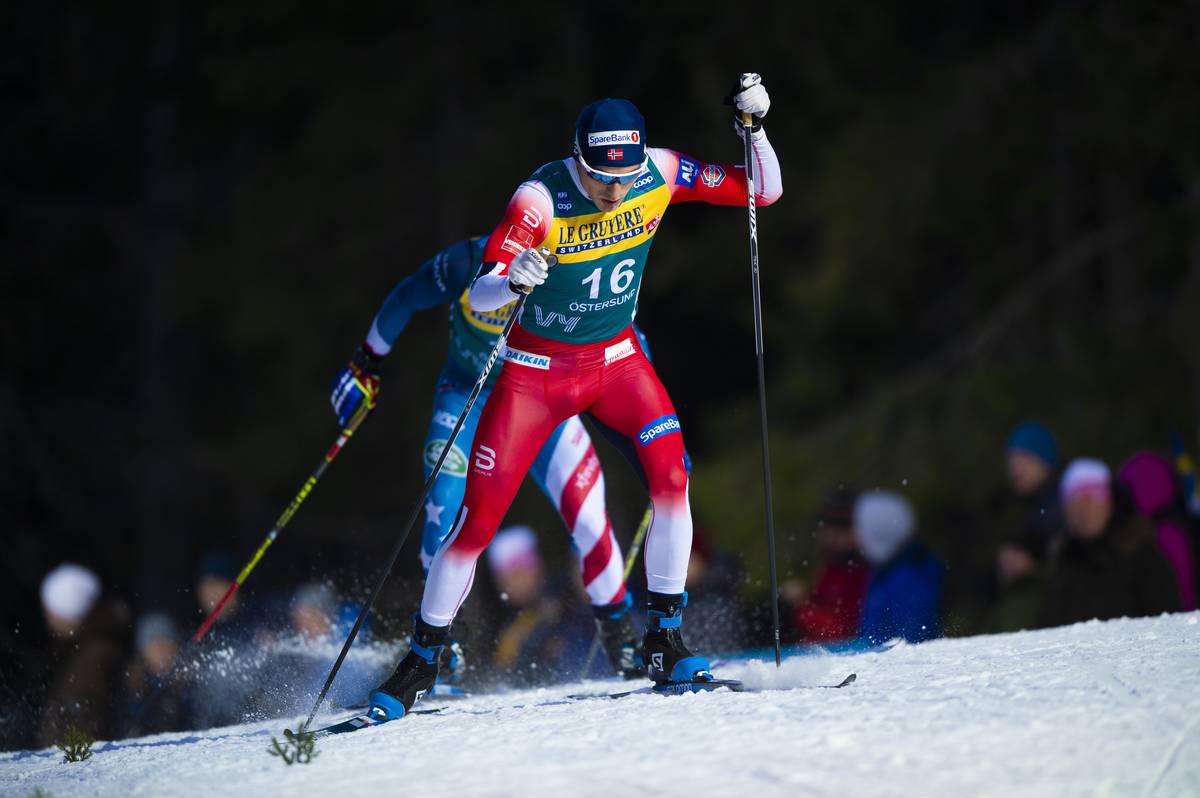
The pacing proved perfect only when Krüger crossed the line: Krüger was a later starter than Røthe: Røthe began in bib 48, Krüger in bib 64. Røthe could, however, pace himself off the splits of Norway’s Finn Hågen Krogh who began in bib 16. Of the early starters, Krogh set the fastest marks at 5 k, 10 k, and the finish, respectively.
Finn Hågen Krogh (bib 16) an early starter during Stage 1 of the Ski Tour 2020, but fast through his 15 skate effort for third overall. (Photo: NoridcFocus)
Røthe’s first-place time (30:41.5) was 1.7 seconds faster than Krüger’s who took second on the day. Krogh was third overall (+16.6), and the veritable senior citizen of the Norwegian team, Martin Johnsrud Sundby, placed fourth (+17.3).
Saturday’s victory was Røthe first win of the season – however, it was his sixth individual podium which includes a second-place time of day podium in Ruka’s 15 k skate pursuit back in December. Last week, he was second in Falun’s 15 k mass start skate.
“It was a great day for me and the Norwegian team,” Røthe told FIS after the race. “I think we need to give a big hug to the guys in the wax cabin today. They made brilliant skis for us today, and for sure I have done my preparations well, I am really satisfied with today. I am looking forward to [the Ski Tour], it has been one of my main goals this season so for sure I am prepared, but I need to go home and get a good rest because it is not many hours before we do the classic race here in Östersund as well.”
For those playing the long-term odds in the Ski Tour 2020, after one stage down, Russia’s overall World Cup leader, and 2019-2020 Tour de Ski winner, Alexander Bolshunov, placed fifth (+22.2).
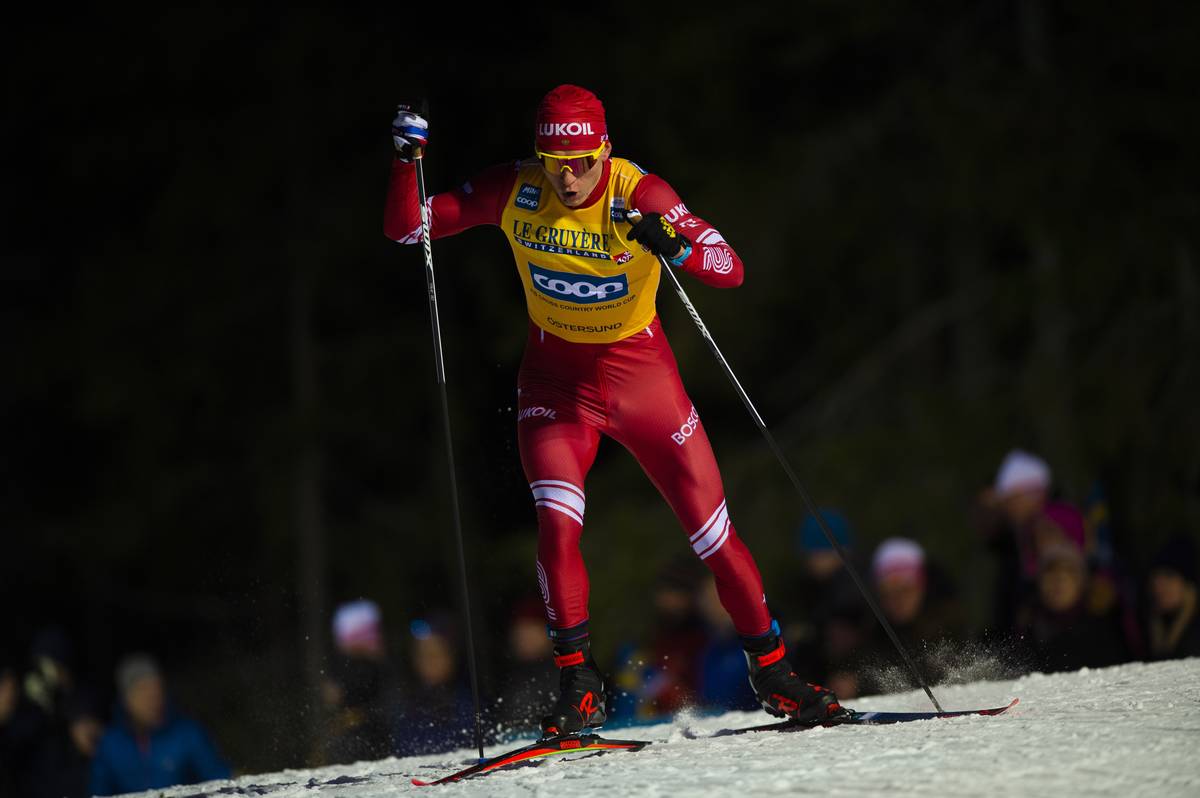
Russia’s Alexander Bolshunov, the overall World Cup leader here during Stage 1 of the Ski Tour 2020. He placed 5th on the day. (Photo: NordicFocus)
Along with capturing first through fourth places, Norway also claimed sixth (Hans Christer Holund), and eighth (Pål Golberg) place in the top-10. Norwegian Johannes Høsflot Klæbo was out of the points in 31st (+1:22.8). The Norwegian star returned after missing last weekend’s racing in Falun with a broken finger. Along with Bolshunov’s fifth place, Russia took ninth (Denis Spitsov) and 10th (Ivan Yakimushkin). The national team outlier in the top-10 was France’s Adrien Backscheider in seventh.
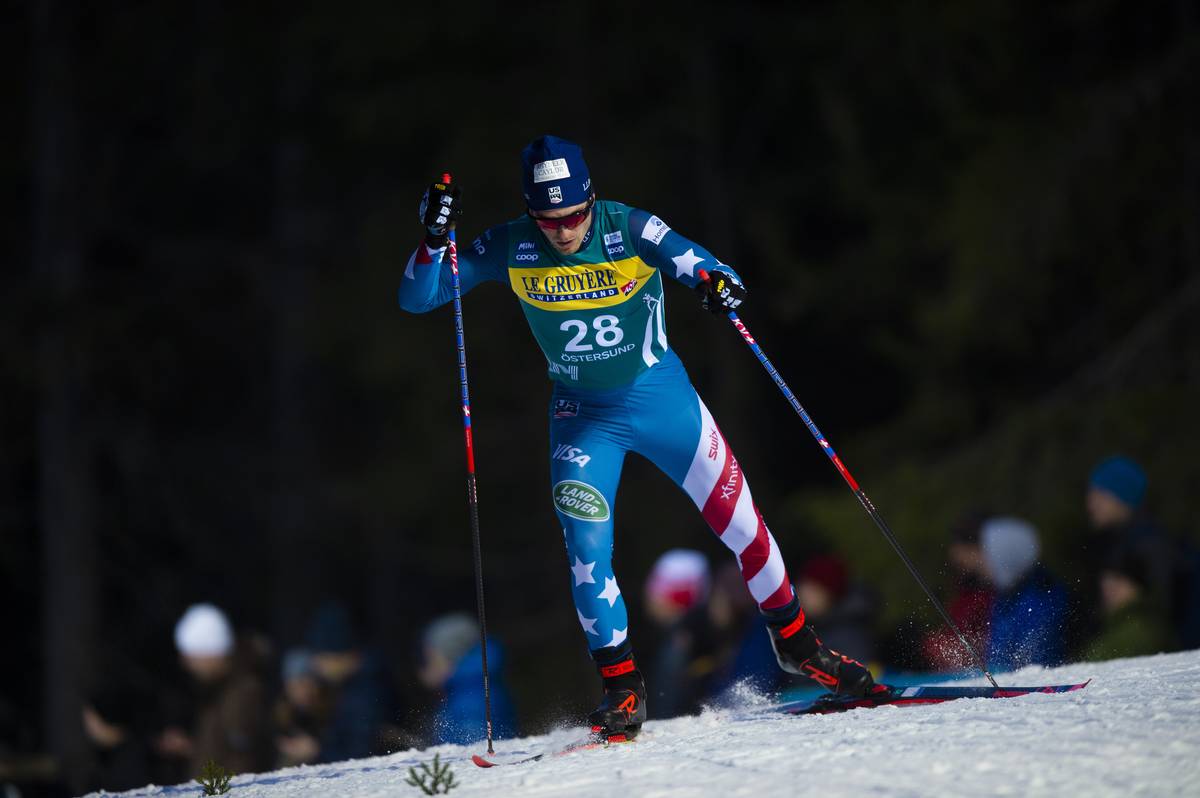
David Norris (APU), of the U.S., was the best-placed North American in 36th (+1:27.7). U.S. teammate Simi Hamilton (USST) placed 46th (+1:54.5). He returned to the World Cup racing after sitting out last weekend’s racing due to lingering neck pain. Kevin Bolger (USST) skied to 71st (+3:11.1), Ben Lustgarten (CGRP) 73rd (+3:12.2), and Logan Hanneman (APU) 86th (+4:35.6).
David Norris of the U.S. during the 15 k skate, Stage 1 of the Ski Tour 2020. (Photo: NordicFocus)
Post-race comments from U.S. World Cup Coach Matt Whitcomb
For Canada, Russell Kennedy skied to 52nd (+2:02.5), Evan Palmer-Charrette 60th (+2:31.9), Alexis Dumas 64th (+2:39.4), and Ricardo Izquierdo-Bernier 80th (+4:10.7).
Russell Kennedy of Canada, during Stage 1 of the Ski Tour 2020. (Photo: NordicFocus)
Racing continues in Östersund tomorrow with a 15 k classic pursuit for the men and a 10 k classic pursuit for the women.
The men’s podium in Oberstdorf, Germany. Alexander Bolshunov (RUS) took the win in the 30 k skiathlon ahead of Norway’s Simen Hegstad Krüger and Sjur Røthe. (Photo: NordicFocus)
And the World Cup beat goes on. Nearly 70 men lined up in Oberstdorf, Germany for a 15/15-kilometer skiathlon, battling across techniques in front of a Bavarian Alp backdrop. The venue will be the home of the 2021 FIS Nordic World Ski Championships.
The 3.75 k course in Oberstdorf featured a variety of terrain, with the Burgstall hill climb bringing athletes to the high point of the course. To increase the pulse in the long race, four rounds of 15 World Cup bonus points were available at the 6.2, 9.9, 21.2, and 24.9 kilometer checkpoints in addition to those awarded to the top 30 athletes at the finish.
Russia’s Alexander Bolshunov looked to repeat his skiathlon victory in Lillehammer, preserving his position at the top of the distance standings and becoming the third athlete to win multiple skiathlon events in a season. Norway’s Martin Johnsrud Sundby did this in 2015/16 and Germany’s Tobias Angerer did so in 2005/06. Piggy backing on his back-to-back wins in Nové Město, a skiathlon win for Bolshunov would mark a third consecutive win.
And they’re off! Skiers take to the course in Oberstdorf for the 30 k skiathlon. Johannes Høsflot Klæbo (bib 3) dropped from the race during the classic leg. (Photo: NordicFocus)
Iivo Niskanen (center, bib 2) sets out to lead the classic leg of the 30 k skiathlon in Oberstdorf. (Photo: NordicFocus)
However, it was not the Russian that took the reins off the line. It was the Finns. In particular, Iivo Niskanen who has historically proven his capacity in distance classic events and more recently demonstrated his ability to skate with the best in the world. Niskanen led at nearly every checkpoint over the first 10 k, taking the maximum points at both 6.2 and 9.9 k.
Then things began to change. Bolshunov led at the exchange with a train of Norwegians on his heels. Sjur Røthe, Simen Hegstad Krüger, Hans Christer Holund, and Sundby, who had all taken a conservative approach to the classic leg, were now within 3.5 seconds of the Russian. Fading quickly from his position at the front, Niskanen sat nearly 30 seconds back in 9th.
A Norwegian power train in the 30 k skiathlon in Oberstdorf. (Photo: NordicFocus)
Up the hill and around the bend, Hans Christer Holund (NOR) leads Martin Johnsrud Sundby (NOR) and Andrey Larkov (RUS) during the 30 k skiathlon in Oberstdorf. (Photo: NordicFocus)
And so it was through the next wave of bonus points at 21.2 k. Røthe took the full 15, with Krüger, Bolshunov, Holund, Andrey Larkov (RUS), and Sundby close behind.
Rebounding from his large deficit, Niskanen had slashed his gap in half and was continuing to catch the lead pack. He rocketed his way back to the front by the 24.9 k checkpoint, collecting another 15 bonus points before being swallowed once more by the group.
Rebounding from a deficit, Iivo Niskanen closes the gap to the lead group in the 30 k skiathlon in Oberstdorf. (Photo: NordicFocus)
With just over a kilometer to go, the top seven men were separated by less than four seconds. The pack included the four Norwegians, two Russians, and Switzerland’s veteran Dario Cologna.
Taking the lead on a downhill and holding it on the final climb over a bridge just before the stadium, Bolshunov made his move. With Røthe and Krüger in hot pursuit, the 23-year-old Tour de Ski Champion powered down the final stretch to stop the clock at 1:13:40.6. Krüger took the next podium spot (+0.9), followed by Røthe in third (+1.2).
Alexander Bolshunov sprints for the win in the 15/15-kilometer skiathlon in Oberstdorf, Germany. (Photo: NordicFocus)
Bolshunov strikes again in the 2020 15/15-kilometer skiathlon in Oberstdorf, Germany. (Photo: NordicFocus)
“I’m very happy to win today on the course in Oberstdorf which will be used next year in the World Championship,” Bolshunov told FIS at the press conference through a translator. “The course became much more difficult and more interesting to compete on. For sure, we will see how it will be next year.”
When asked how he worked with the group that emerged at the front, Bolshunov responded, “It was [my] own race.”
“Cat and mouse.” Sjur Røthe (bib 4) chases Alexander Bolshunov’s yellow bib during the 30 k skiathlon in Oberstdorf. (Photo: NordicFocus)
“He really played a little [with us],” Røthe told NRK about Bolshunov’s tactics. “There were four mice against a cat out there.”
Just off the podium, Sundby took home the wooden medal with 4th place (+2.5). It is the 35-year-old’s best result of the season, though he has been unable to do much racing due to a back injury. In fact, Sundby’s last result came in early December in the skiathlon in Lillehammer, where he took 5th. Sundby has won three skiathlon events in his lengthy career, and holds the rare statistic of earning a spot on the podium in 12 seasons, the third-most of any World Cup athlete.
Martin Johnsrud Sundby (NOR) takes 4th in the 30 k skiathlon in Oberstdorf. (Photo: NordicFocus)
Johannes Høsflot Klæbo and Emil Iversen left us scratching our heads. After a poor start to the classic leg, both athletes dropped out. Klæbo’s DNF dropped him from third to fifth in the distance standings, though he remains in second place in the overall, trailing Bolshunov by 299 points.
“I do not know,” Klæbo told NRK, according to a translation. “It’s been a long time since I felt as bad as today. It was really just the whole day and nothing that felt particularly good. If I can’t fight for the top 30, then there is no point going around here.”
Iversen gave NRK a similar explanation.
David Norris skis to 28th in the 30 k skiathlon in Oberstdorf. (Photo: NordicFocus)
The sole American finisher David Norris landed inside the points in 28th (+2:01.0). The Fairbanks native hovered around this top-30 position throughout the race, reaching a peak placement of 20th place at the 9.9 k checkpoint.
“My plan going into the race was to use the classic leg to put myself into good position for the skate,” wrote Norris in an email. “You never know how your body will feel 15 or 20 km’s later so you have to risk it a little. I was happy with my classic skiing and I had moved up into a group on the last lap of the classic which was roughly positions 15 – 22. Unfortunately, over the top of a hill my klister iced up and I fell. That moved me back a few groups to about position 32. Overall my skis were very good, but the snow was variable and the tracks were breaking down.
“In the skate leg I intentionally kept a little in reserve during the first 10km trying to ensure I’d have some energy in the last 5km. I slowly worked up through some guys and felt really strong throughout the skate.”
Norris expressed that the techs did a great job selecting skis and choosing wax given the variable conditions in Oberstdorf. He added that he feels good about the performance and his sensations on course, though he has not felt this way leading up to the event.
“I feel fit. It has been odd that in training I don’t feel very good – tired and kind of flat, but I’m feeling pretty strong the past couple of races. In the skate leg I intentionally kept a little in reserve during the first 10km trying to ensure I’d have some energy in the last 5km. I slowly worked up through some guys and felt really strong throughout the skate.”
Ian Torchia on course during the 30 k skiathlon in Oberstdorf. (Photo: NordicFocus)
Ian Torchia also began the race but did not finish. He was one of seven men to drop from the race. An additional three were lapped and therefore pulled from the competition.
“I felt very bad out there today,” emailed Torchia. “I started flooding very early on while moving backwards in the pack. Very confusing as I felt better this week compared to Nové Město leading into the race. Hopefully a week in Seefeld and some consultation with my coach will put me on the right track.”
In a post-race call, Matt Whitcomb expressed pride in Norris’s grit and dedication to the process of becoming a World Cup contender. He also provided insight into both today’s event, including how Norris’s crash affected his position in reach of the top-20 and Torchia’s DNF.
Whitcomb also explained that Erik Bjornsen, who did not compete today, may return to the World Cup in Lahti after the FIS SkiTour 2020. In the meantime, Bjornsen has his eyes set on domestic distance classics, including the Boulder Mountain Tour and the American Birkie.
Post-race interview with Matt Whitcomb.
Recovering from a inopportune crash, David Norris fought to the point of wobbly legs in the last classic lap of the 30 k skiathlon in Obsertdorf. (Photo: NordicFocus)
In this episode of The Devon Kershaw Show … it is all things Davos. While the glam Swiss valley boasts mountain scenery, and a fusion of traditional Swiss cowbell and high finance, in many ways it remains decidely old school. Among other things, we discuss what some say is an outdated Davos distance course and the killing it Swedish women’s team.
We’ll be releasing a mid-week episode where we chat about last week’s WADA decision to ban Russia from major international competitions for four years.
If you have any questions for Devon please send them to info@fasterskier.com or devon@fasterskier.com.
Thanks and you can find The Devon Kershaw Show on iTines and Google Play. The link to subscribe is on the embedded audio player below.
The men’s podium from the Falun, Sweden 15 k skate. From left to right, Norway’s Martin Johnsrud Sundby in Second, Alexander Bolshunov of Russia first, and Didrik Tønseth of Norway third. (Photo: fis-ski.com screenshot)
Sunday’s men’s 15-kilometer freestyle individual start race in Falun, Sweden, was the final European stop for the World Cup. With the race concluded, athletes will pack up ski bags, moth-ball the wax buses, and jet across the Atlantic. Next week athletes will race amidst the crowds and city-scape of Québec.
The final Euro-leg of the World Cup saw Alexander Bolshunov of Russia win his third individual race in a row. His top-step effort was his fifth win of the season. Norway took the next three spots with Martin Johnsrud Sundby in second, Didrik Tønseth in third and Sjur Røthe in fourth.
During the first 5k of the race Bolshunov moved up through a tight pack clustered near the top of the time splits.
After his first 5k lap, Bolshunov held a 4.4 second margin over Russia’s Alexey Chervotkin at 5k. Sundby kept it real for Bolshunov coming through at 5.6 seconds back. With the relative luxury of a late bib start, Bolshunov wore bib 69, Sundby 47, the Russian could push towards the redline of effort knowing precisely where he stood against Sundby.
At the 10 k mark Sundby was a an eyeblink back amounting to 0.4 seconds behind Bolshunov. In other words, Bolshunov understood his race lead margin was thin. With 2 k remaining, Bolshunov had a pad of 3.1 seconds. That buffer would have been enough as Bolshunov finished today’s race in a time of 33:18.6. Sundby placed second, 8.9 seconds back.
Along with the day’s top prize, Bolshunov seized for good the overall distance crystal globe. The twenty-two-year-old Russian began the distance crystal globe campaign with the first race of the season, a 15 k classic win in Ruka, Finland. Along the way, Bolshunov collected seven distance podiums, including Sunday’s win. His streak of three successive World Cup distance wins includes a 15 k classic in Cogne, Italy prior to World Championships. He then followed that with a win in the Holmenkollen 50 k classic.
Canadian skier Alex Harvey was the first North American to cross the line finishing 11th overall. During the second half of the race, Harvey skied from 21st to 11th, he finished +1:10.9 behind Bolshunov.
David Norris (APU) of the U.S. was the top American finisher. In Falun, he finished 16th for a career best individual World Cup result. The success curve of late for Norris has been remarkable. The twenty-eight-year-old Anchorage based athlete has been a highlight for U.S. men’s distance skiing.
The man has a motor. Ask the field contesting the Mt. Marathon race in Seward, Alaska. He’s a multi-time winner. The motor has now been fine tuned to excel in wintertime Europe. He placed 20th in the 2019 World Championship 50 k mass start skate. He proved that mark was no aberration with a 24th in the Holmenkollen 50 k mass start classic. And then Sunday was a bump in the standings for that 16th place.
“I am certainly more confident this spring than I was during Period 1 of World Cup,” Norris emailed when asked if he was carrying more confidence since his Seefeld result. “This higher confidence allowed me to improve my pacing today; I was more relaxed going into it and able to ski my own race.”
According to Norris, he’s more likely to push on the climbs and recover on more variable terrain. He attributes some of his success to making subtle pacing changes.
“My usual tendency is to focus on the climbs,” Norris wrote. “I have been working on relaxing a bit on the climbs so that I can focus more on pushing the gradual terrain. I know I can climb well, but if I emphasize that too much I tend to lose time over the rest of the course.
“The new snow today packed down well for the men’s race. I like how the course flowed; I felt strong on the long climb and had a game plan to really target the flats after the climb and the flats leaving the stadium.”
American David Norris the men’s 30-kilometer skiathlon at the 2019 World Ski Championship in Seefeld, Austria. (Photo: John Lazenby/lazenbyphoto.com)
During a year when the U.S. Ski Team has offered numerous international starts to a host of non-USST members, Norris and his trifecta of results in the points promotes the notion that on the right day and even the right World Cup string of races, elite U.S. skiers can step up.
“I am super happy with my result- I feel like I have recovered well from back-to-back 50ks, and my skis were good,” explained Norris when asked if he was surprised to find himself so close in the standings to Canada’s Alex Harvey, who placed 11th. “Today was the type of result I have been believing I should be able to do on a good day, so I am psyched to have made that happen.”
The podium from the 10 k skate in Falun, Sweden. From left to right, Sweden’s Ebba Andersson in third, Norway’s Therese Johaug in second, and the U.S. Ski Team’s Jessie Diggins in third. (Photo: fis-ski.com screenshot)
FIS World Cup Falun, Sweden 10k/15k Inidividual Freestyle
The sun rises. The sun sets. And Norway’s Therese Johaug won the 10-kilometer individual start freestyle in Falun, Sweden. In 25:23.9 minutes, Johaug made her winning statement. Sweden’s Ebba Andersson placed second (+18.75), with the U.S. Ski Team’s (USST) Jessie Diggins in third (+30.3).
Fourth place went to Ingvild Flugstad Østberg of Norway who finished 30.8 seconds back.
Sadie Bjornsen (USST) raced to 12th (+1:05.7), Julia Kern (USST) 25th (+1:53.9), Rosie Brennan (APU) 27th, Kaitlynn Miller (CGRP) 34th (+2:21.5), and Rosie Frankowski (APU) 35th (+2:26.1).
The men’s 15 k skate was won by Russia’s Alexander Bolshunov in 33:18.6 minutes. Martin Johnsrud Sundby of Norway was second (+8.9) and Didrik Tønseth third (+17.7).
The top North American finisher was Canada’s Alex Harvey in 11th (1:10.9). Jack Carlyle finished in 66th (+5:55.5).
For the U.S., David Norris (APU) placed 16th (+1:15.3), Kevin Bolger (USST)45th (+2:41.9), and Scott Patterson (USST)54th (+3:39.8), Kyle Bratrud (SMST2) did not start.
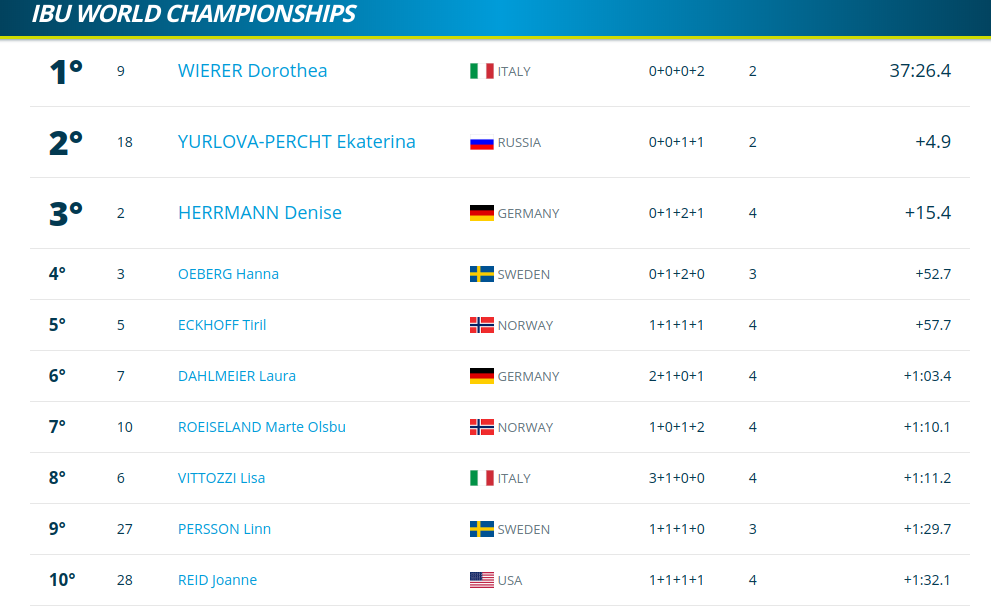
IBU World Championships Östersund, Sweden 12.5 k Mass Start
Here’s the top-10 results from today’s 12.5 k mass start in Östersund, Sweden. The eyes need only read 10 skiers down for U.S. biathlete Joanne Reid’s name. There it is: 10th place for a career best individual result at a championship event.
Her teammate Clare Egan placed 26th (+3:01.4, 0+0+3+2).
A clean sweep for Russia today. From left to right, Maxim Vylegzhanin was 2nd, Alexander Bolshunov was 1st and Andrey Larkov was third. (Photo: Screenshot/ FIS Instagram)
Russian skier, Alexander Bolshunov made history today during the Holmenkollen 50-kilometer classic mass start race. With his victory, Bolshunov became the youngest person and the third Russian to win the storied Holmenkollen 50 k. Bolshunov finished today’s race in 2:23:49.8 hours.
For Bolshunov, who comes off a World Championships during which he won four silver medals, this was his fourth World Cup win of the season. The victory on Saturday reinforced Bolshunov’s lead in the World Cup distance cup rankings and he leapfrogged Norway’s Johannes Høsflot Klæbo for the overall World Cup lead. Bolshunov has amassed 1,230 points to Klæbo’s 1,181. Klæbo placed 38th in Saturday’s race.
Bolshunov spoke about the end of the season and how he is approaching these finals races with a FIS reporter after the race, “At the end of the season, it is a necessity to show his best results each race and to fight in each race until the end and hopefully everything will be done.”
The race featured no solo attack that could break away from the A-list of distance specialists. The lead was tossed around a number of times and for the first half of the race, Norway’s fans were treated to a 30-plus deep train of skiers engined by Sjur Røthe, Martin Johnsrud Sundby and Emil Iversen. But the ebb and flow of the 50 k allows skiers to sit in the pack, buy their time, conserve resources, then pounce.
With 10 k to go, Russian skiers moved to the front, and began dictating the pace. At 1.6 k remaining, a Russian foursome consisting of Maxim Vylegzhanin, Andrey Larkov, Bolshunov, and Ilia Semikov were defining the flag waving rights on Norway’s holy-grail of ski loops.
The race came down to the finishing stretch with Bolshunov charging into the finish, double poling all the way, and out sprinting his teammates to take the win. Vylegzhanin placed second and his teammates, Andrey Larkov and Illia Semikov, came in third and fourth respectively.
This was the last World Cup race for Vylegzhanin who is retiring at the end of this season; this was his 24th podium in his career, but his first this season.
Vylegzhanin spoke to a FIS reporter after the race, via a translator, “Of course it was a pleasure to see all the people coming to see me and congratulate me on the finish line and after the finish. The Russian team is very strong, we got all four places and we have many young potentials here who are proof that the Russian team is a very strong team. I started here at Holmenkollen in 2007 with the 7th place and since then I was getting 4th, 3rd, 2nd and actually it’s my best place to compete here.”
Those skiing in the back of the well defined lead pack only began dropping off during the last 3 k. At that point, the Russians ramped up the pace and only Norway’s Martin Johnsrud Sundby, and Canada’s Alex Harvey were able to hang tightly connected to the Russians.
The top 11 finishers were dominated by Russia and Norway. Russia took the top four spots as well as the tenth spot and Norway went 6, 7, 8, 9 and 11. Harvey was the only skier to break this pattern, finishing fifth overall.
Norwegian racers Marin Johnsrud Sundby, Johannes Høsflot Klæbo and Simen Hegstad Krueger starting the Holmenkollen 50k off strong (Photo: Screenshot/Holmenkollen Ski Fest Instagram/Jacques Holst)
Harvey’s fifth place on Saturday matched his career best Holmenkollen 50 k finish — he was fifth during the 2011 Oslo World Chamionship’s 50 k skate. On Saturday, Harvey skied with the lead pack the entire race, sitting in the top 20 until the last 5k when he started making his way toward the front of the pack.
“This year in classic, I never had good feelings really, so today was the first day I felt like I could actually race in classic, “ Harvey told FasterSkier in the mixed zone. “But of course, coming so close to the podium is always bittersweet. But the Russians, I think you could tell, had better skis, better glide. They were struggling on the kick but really high speed, so in the end they were really strong. So it was a really good race for me, but the podium was close, I could taste it.”
He continued on, discussing today’s race pace, “It was a fairly easy pace the whole way. There was a huge group and guys were slowly getting dropped off the back, but there was never a big attack. So for me personally, I was in control the whole time, but I had good shape and pretty easy kicking skis.”
U.S. Ski Team member Scott Patterson finished 19th. This was Patterson’s best individual finish of the season. He skied with the lead pack until the last 3.75k, when he began to fall back.
“This is my fourth time racing Holmenkollen, so I know that pack hangs on and people just start shooting off that back on the last couple laps,” Patterson told FasterSkier in Oslo. “So I figured I’d ski with that pack for as long as I could and hope I had energy for the finish. I think I did pretty good, I was pretty low on energy for that last 3.75, but it worked out pretty well.”
In Oslo on Saturday, U.S. skiers Adam Martin (CGRP) and Kyle Bratrud (SMS T2) were 31st and 40th respectively. Ben Lustgarten (CGRP) did not finish the race.
Holmenkollen is a unique experience for races, with crowds, snow sculptures and bonfires lining the entire race course. It is essentially an end of season party for athletes and spectators alike.
Norris commented on the atmosphere, “This is a highlight of the season. The crowd is so loud up top, and it’s so awesome to be here.”
Harvey also appreciated the spectacle of the event, he told FasterSkier, “Having a little party is good for the sport, it make for good images. When the legs are screaming, to hear so much noise, it’s like you stop thinking for a bit, when you’re so exhausted, it kind of keeps you going.”
Racing continues tomorrow in Oslo with the women’s 30 k classic.
Norway’s Hans Christer Holund reaching for a feed during the men’s 50 k skate at the 2019 World Championships. (Photo: John Lazenby/lazenbyphoto.com)
The 2019 Seefeld World Championships event came to a close on Sunday, the 11 days of competition capping off with a men’s 50-kilometer freestyle mass start. Unlike two years ago at the Lahti World Champs, when the top six finished within four seconds of each other, Canada’s Alex Harvey ultimately earning the 2017 title, this year’s World Champs featured no head-to-head sprint to the finish.
In Seefeld on Sunday, Norway’s Hans Christer Holund crossed alone, arms raised high in celebration of his gold medal performance. He stopped the clock at 1:49:59.3, the next closest finisher being Russia’s Alexander Bolshunov, who crossed 27.8 seconds after Holund.
Norway’s Hans Christer Holund crossing the line in first as he wins the 50 k skate at the 2019 World Championships. (Photo: John Lazenby/lazenbyphoto.com)
Holund’s break from the pack came at the 21 k mark, a decisive move observed by his teammate Martin Johnsrud Sundby, who initially assumed the role of leading the chase pack as Holund skied ahead. The pulse of close to 40 skiers threatened to swallow Holund back up, if Sundby let it.
But the Norwegian continued to ski alone and in the lead past the 25 k mark, the 30 k mark, the 35 k. What may have at first appeared like an unsustainable rabbit’s pace off the front, was turning out to be cruise control for Holund. The 14-second gap he had on the field at 22 k had grown by a minute at the 34 k mark. Over the remaining 15 k, only Bolshunov would manage to put any more than 30 seconds back into Holund.
Even after securing the win, the 30 year old was somewhat surprised that he managed to maintain such a significant amount of time between himself and the rest of Sunday’s 50 k field.
Norway’s Hans Christer Holund taking a feed during the men’s 50 k skate at the 2019 World Championships. (Photo: John Lazenby/lazenbyphoto.com)
This is the first race Holund has competed in at the Seefeld World Champs, his start itself uncertain until recently.
“I’ve been in not so good shape this year and I actually didn’t thought I was going to go this race because I wasn’t qualified, but when I finally got the chance I thought well this may be my last chance to be World Champion, so I just have to go for it,” Holund said.
According to the FIS database, the title is Holund’s first World Championships gold–the only other World Champs event he has raced was the Lahti 50 k, where he placed 10th.
Holund’s closest challenger on Sunday, Bolshunov, had made his move to the helm of the chase pack around 25 k. The Russian did not begin to gain time on the Norwegian, however, until he broke from the chase group at 38 k.
From there, Bolshunov did regain 46.2 seconds on Holund, but ran out of course to see if he could make up the remaining 27.8 seconds. The podium finish is Bolshunov’s fourth from the Seefeld World Champs, all of which have been silver medal performances. Prior to this year, the 22 year old had never medaled at a World Champs event.
Russia’s Alexander Bolshunov during the men’s 50 k skate at the 2019 World Championships. Bolshunov came close to closing down Holund’s lead. (Photo: John Lazenby/lazenbyphoto.com)
Sunday’s battle for bronze place came down to Norwegians Sjur Røthe and Martin Johnsrud Sundby. With less than 5 k to go, the two had moved to the front of the chase pack behind Holund and Bolshunov. In a sprint to the finish, Røthe outlunged his teammate by 0.1 seconds for third (+57.8) and Sundby place fourth (+57.9).
Leading the way for the North Americans on Sunday was Canada’s Alex Harvey in 12th (+1:10.5). Two years ago in Lahti, Harvey earned his first individual World Championships title in the men’s 50 k race, Sunday’s 50 k being his final career World Champs event. At the age of 30, Harvey announced his decision to retire after this year’s World Cup races in Quebec City, Quebec.
“I think it is pretty clear it is not what I had hoped for or dreamed for,” Harvey said during a post-race phone call. “I think today and for the whole week, or the whole of the last two weeks, I just have got to look at things with a more objective eye. The skiathlon is my best result of the season in distance. I had my best race of the season at World Champs so that is good. But of course, I was hoping to come away from Seefeld with a podium.”
Over the course of his career, Harvey has competed in six World Championships events, his first being in Liberec in 2009. He has since then amassed five World Champs medals, including two golds, two bronzes, and one silver.
“I really expected the Norwegians to attack, maybe a tiny bit later in the race, I was expecting more around 30 k,” Harvey said of Holund’s move at 21 k. “They kind of did that in Lahti in the 50 k. It forces the other nations to try and take on the chase. So knowing that they have so much depth, I was expecting it from either Holund or Krüger, because it is more their style of racing anyways.
“I had made a decision before the race that if an attack was made, it would not be the one chasing because it would have played too much in the hand of Sundby and Rothe,” he added “At the end of the day, I think Holund was just way better than the rest.”
Canada’s Alex Harvey (first skier from right in the front group) during the men’s 50 k skate at the 2019 World Championships. (Photo: John Lazenby/lazenbyphoto.com)
With less than a kilometer to go, Harvey was still in the running for a podium. The final hill, however, found his legs flooded.
“I think for me there was still an opportunity for third place and I really positioned myself in the best way possible at the base of the sprint hill,” Harvey said. “Then I did not have the legs to go up the hill. I just lost a lot of position I just wasn’t strong enough. It is as simple as that. But everything else, we had the skis. In the 50k you have to have a feeding strategy and try to save energy where you can. I think I did everything to the best. … I would not do anything different. I just was not good enough. It is a bitter-sweet feeling knowing …it is easy to say I gave it my all. At the end of a race, you always give it your all. I think I really executed my plan.”
Following Harvey, two Americans cracked the top 20 on Sunday, with David Norris placing 20th (+1:22.6) and Scott Patterson in 23rd (+2:05.5). Norris came into Sunday’s race having competed in last year’s Holmenkollen 50 k where he placed 38th (He also won the 2016 American Birkebeiner 52 k). Seefeld has been his first World Championships experience.
David Norris of the U.S. racing to 20th overall in the men’s 50 k skate at the 2019 World Championships. (Photo: John Lazenby/lazenbyphoto.com)
“At Holmenkollen [last year], I felt strong, but often I have struggled to get engaged into the top-twenty,” Norris explained during a phone conversation. “From the gun I feel like I am one of the stragglers, trying to hang on.”
Sunday that was not the case for Norris. The 28 year old managed to position himself in the top 20 from the start, making for what he described as “smoother” skiing. He experienced less accordioning between groups of skiers and during the second half of the race was still skiing within 10 bibs of Sundby and Røthe.
“The way I have always tried to race over here is to go out hard and put yourself into the position to have a result that you are excited about and represents my goals,” Norris said. “So often I have died and blown up several times over here, but I feel like when that happens I also know in the back of my mind that if I put everything together the result that is almost a great one was not so far away.
“I think today, when I was racing, more things were just working out and clicking so it allowed me to finally reach the result that I have been pursuing and chasing in the first of races often instead of fading, I continued to feel strong all the way to the finish for the most part,” he added.
Norris will race next weekend’s Holmenkollen 50 k as well as the remaining Period III World Cup races. “I feel like I’m really fortunate that every year my skiing seems to get more feasible and the support has been there,” Norris said. “I think every athlete experiences huge portions of their season where they’re second-guessing or frustrated and those are the times to push through and believe in the plan.”
Patterson explained, the race was “a step up in results”, though still left him “ looking for a little more.” Seefeld is Patterson’s first World Championships, with Sunday’s 23rd his best individual ranking to date. Earlier in the week, he placed 30th in the 15 k classic and 32nd in the skiathlon.
“I spent most of the race kind of dangling on the back end of the lead pack,” Patterson wrote in an email.
The American indicated that he had good energy, though not enough to follow Holund’s break from the front group near the race’s halfway mark.
“I was a bit disappointed with the lack of leadership in the pack when we just chilled out instead of reacting at all to Holund’s move,” Patterson wrote. “There is talk around here of the unwritten principle of the Norwegians to not chase down the first attack. I think we saw that today as well as some weakness in the other strong nations such as Russia and France.”
The American maintained contact with the lead group until his sixth lap when things began to separate. Positioned at the rear of the group, Patterson found himself unable to chase down any breaks.
“Over the course of the first long hill on that lap, the main group seemed to spread and splinter between skiers,” Patterson wrote. “I was a little too far back to make the split for the front of the pack. I tried hard to chase, but going for it solo wasn’t working against a pack of 18. Overall, I am satisfied with 23rd but also believe that I still have more to give the rest of this season. I’m looking forward to another 50 k next weekend at Holmenkollen.”
Scott Patterson of the U.S. racing to 23rd overall in the men’s 50 k skate at the 2019 World Championships. Simi Hamilton (bib 41) placed 34th. (Photo: John Lazenby/lazenbyphoto.com)
However, as much as compartmentalizing athletes simplifies the narrative, Hamilton’s definition of cross-country racer helps broaden the sprint or distance paradigm. According to the FIS, Sunday’s race was Hamilton’s third 50 k at this level of competition. He placed 54th in the 2014 Holmenkollen 50 k classic and was a DNF last season in the Holmenkollen 50 k skate.
“It’s definitely intimidating, I think this is maybe the third fifty k I’ve skied at this level, one of which I didn’t finish – at Holmenkollen last year, and I skied Holmenkollen the previous year,” Hamilton said in a post-race phone call. “It’s certainly quite different from the domestic scene generally, now the pace is just way hotter from the start.”
American Adam Martin raced to 45th (+8:01.7), while Canadians Russell Kennedy finished in 46th (+9:57.6), Evan Palmer-Charrette in 47th (+11:26.1), and Scott James Hillin 50th (+11:27.6).
The toe-surge by Norway’s Sjur Røthe for third place over teammate Martin Johnsrud Sundby who placed fourth during Sunday’s 50 k skate at World Championships. (Photo: John Lazenby/lazenbyphoto.com)
Double click on the photos below to enlarge.
Sweden’s Calle Halfvarsson during the men
s 50 k skate at the 2019 World Championships. (Photo: John Lazenby/lazenbyphoto.com)
Canada’s Russell Kennedy during the men’s 50 k skate at the 2019 World Championships. (Photo: John Lazenby/lazenbyphoto.com)
Early in the men’s 50 k skate at the 2019 World Championships. (Photo: John Lazenby/lazenbyphoto.com)
Canada’s Evan Palmer-Charette (bib 43) in the men’s 50 k skate at the 2019 World Championships. (Photo: John Lazenby/lazenbyphoto.com)
Fourth place skier in the men’s 50 k skate at the 2019 World Championships, Martin Johnsrud Sundby of Norway walks with his son after the race. (Photo: John Lazenby/lazenbyphoto.com)
The men’s 50 k skate podium at the 2019 World Championships. From left to right, Russia’s Alexander Bolshunov in second, Norway’s Hans Christer Holund in first, and Sjur Røthe of Norway third. (Photo: John Lazenby/lazenbyphoto.com)
Simi Hamilton of the U.S. takes a feed during the men’s 50 k skate at the 2019 World Championships. (Photo: John Lazenby/lazenby photo.com)
Norway’s Martin Johnsrud Sundby (bib 2) leading the chase-train in the men’s 50 k skate at the 2019 World Championships. (Photo: John Lazenby/lazenbyphoto.com)
Adam Martin of the U.S. in the men’s 50 k skate at the 2019 World Championships. (Photo: John Lazenby/lazenbyphoto.com)
Canada’s Russell Kennedy during the men’s 50 k skate at the 2019 World Championships. (Photo: John Lazenby/lazenbyphoto.com)
David Norris of the U.S. placed 20th overall in the the men’s 50 k skate at the 2019 World Championships. (Photo: John Lazenby/lazenbyphoto.com)
Alex Harvey of Canada after his final career World Championship race. (Photo: John Lazenby/lazenbyphoto.com)
Norway’s Hans Christer Holund crossing the line in first as he wins the 50 k skate at the 2019 World Championships. (Photo: John Lazenby/lazenbyphoto.com)
FIS Nordic Ski World Championships Men’s 50 K Freestyle Mass Start
It has come to a close. The 2019 Nordic Ski World Championships ended today with the men’s 50-kilometer freestyle mass start. Hans Christer Holund of Norway began to make his mark on the race shortly after 20 k with a solo attack. In his bold ski-alone effort, Holund was able to fend off any chasers and win in 1:49:59.3 hours.
Russia’s Alexander Bolshunov timed his chasing surge for a last 10 k punch. By the finish, Bolshunov had eaten up some time on Holund to place second, 27.8 seconds back.
Sjur Røthe and Martin Johnsrud Sundby, teammates on the formidable Norwegian team, created their own gap on the sizable main chase group as they raced up the course’s final climb. Sprinting down the straight into the finish, Røthe out-toed Sundby for third overall (+57.8) as Sundby took fourth (+57.9).
Canada’s Alex Harvey was the top North American in 12th (+1:10.5). He was followed by teammates Russell Kennedy in 46th (+9:57.6), Evan Palmer-Charrette in 47th (+11:26.1), and Scott James Hill in 50th (+11:27.6). If you love play games with mods, Download mods for android games free and let’s go to run your fav game
David Norris was the top American in 20th (+1:22.6), followed by Scott Patterson in 23rd (+2:05.5), Simi Hamilton in 34th (+4:02.), and Adam Martin in 45th (+8:01.7).
The toe-surge by Norway’s Sjur Røthe for third place over teammate Martin Johnsrud who placed fourth during Sunday’s 50 k skate at World Championships. (Photo: John Lazenby/lazenbyphoto.com)
Johannes Høsflot Klæbo of Norway anchoring Norway to the 4 x 10 k relay win at the 2019 World Championships in a Norwegian fan filled Seefeld, Austria. (Photo: John Lazenby/lazenbyphoto.com)
While a temperature in the upper thirties would not normally classify as cool to a ski racer, it was a welcome break from the blazing sun and upper 50’s that have been ever-present in the 2019 Nordic World Ski Championships in Seefeld, Austria. Light rain peppered the athletes in the 4 x 10-kilometer relay, continuing to keep things challenging for the wax techs.
The relay is a testament to both a nation’s depth and strategy, a chess match and a horse race. As was seen in the women’s relay, the selection and placement of athletes decide how the race will evolve, but these decisions are made without the knowledge of an opponent’s line up.
In their quest for a tenth consecutive gold medal in the event, Norway chose the line up of Emil Iversen, Martin Johnsrud Sundby, Sjur Røthe, and as the closer, their sprint champion, Johannes Høsflot Klæbo. Røthe and Sundby sit in second and third respectively in the World Cup distance rankings, while Iversen has shown that he is an “all-arounder” who can respond to many dynamic racing scenarios. Sundby also brings experience to the team as he was a member of the gold medal team in both 2011 and 2017. After winning the overall Tour de Ski, Klæbo has shown that he can be a force in distance races but is most known for his closing speed and sprint prowess, which would come in handy should the race come down to the final meters.
Scramble leg of the men’s 4 x 10 k relay at the 2019 World Championships in Seefeld, Austria. (Photo: John Lazenby/lazenbyphoto.com)
As the race unfolded, it was unclear which nations’ tactics would trump the others. In the first leg, the men slowly began to string out, but the lead exchanged hands several times. Russia’s Andrey Larkov made an early run but was marked by Erik Bjornsen of the US who also spent time at the front. Despite slipping a bit on the climbs, Iversen, who was on harries, skied near the front throughout, entering the stadium first to tag his teammate. At the first exchange, Norway, Russia, and Germany were all within one second of each other, with the US in fourth fading into a chase pack with Sweden and France.
As the second leg began, Sweden’s Calle Halfvarsson surged to catch the leaders within the first kilometer, unwilling to lose sight of a possible 29th World Championship relay medal for Sweden. With him was Iivo Niskanen of Finland, Scott Patterson of the US, and Maurice Manificat of France.
Sweden’s Calle Halfvarsson during the men’s 4 x 10 k relay at the Seefeld, Austria World Championships. (Photo: John Lazenby/lazenbyphoto.com)
While the rain picked up, Niskanen charged to the front and began to string things out in a fashion reminiscent of his performance in the 30 k skiathlon. Sundby stuck with the Finn, and was closely tailed by Alexander Bessmertnykh of Russia. The three skiers atop the podium after Wednesday’s 15 k reunited on the relay tracks.
Halfvarsson began slipping on the hills and was unable to hold onto the pace, falling back a few seconds behind the leaders at first, then fading to nearly 30 seconds back by the end of his leg. Likewise, France, Germany and the US began to lose touch, dropping behind by over 30 seconds by the next exchange.
However, as the first skate leg began, Jens Burman of Sweden followed Halfvarsson’s lead with yet another powerful surge to reconnect with the lead pack, closing the gap from 27 seconds at the exchange, to just two seconds at the 2.5 k checkpoint. Also rapidly making up ground, Clement Parisse of France gained 22 seconds on the leaders within the first lap. Unfortunately for Sweden, Burman seemed to burn a few too many matches in his charge, and in the second half of his leg, he fell back again almost as rapidly as he had advanced. He was overtaken by Parisse who did manage to light a fire for France, drawing to within eight seconds of the bronze medal before his final exchange to French sprinter Richard Jouve.
At the front, Alexander Bolshunov of Russia and Røthe hammered their final lap, separating themselves from the field in yet another Norway vs. Russia battle for gold. The men entered the stadium together with a gap of more than 20 seconds on the Finn who sat in third. Bolshunov tagged Sergey Ustiugov to face Klæbo for their final World Championship duel, mano a mano.
Russia’s Sergey Ustiugov leads Norway’s Johannes Høsflot Klæbo of Norway as they race the fourth leg of the 4 x 10 k relay at the 2019 World Championships in Seefeld, Austria. (Photo: John Lazenby/lazenbyphoto.com)
In their last matchup in the sprint at the onset of the championships, Ustiugov pushed Klæbo after a tangle in the semifinals robbed the Russian of his momentum. After the heat, the men were seen in a heated shouting match where Ustiugov again pushed Klæbo and gave him an antagonizing pat on the cheek. He was issued a yellow card for obstruction and was disqualified for unsportsmanlike conduct, while Klæbo went on to win the gold. The two were also rivals throughout the Tour de Ski, where Ustiugov nearly caught the exhausted Norwegian leader in the final hill climb, but ultimately ran out of time and finished second.
As they took to the course in the final leg, this much was clear: the Russian did not want to hand the victory over to his opponent. Ustiugov dictated the pace with the Norwegian tucked in behind him. They did not take turns, rather, Ustiugov held fast at the front. But, as they entered their third and final lap of the course, Ustiugov’s fatigue began to become evident, and Klæbo had plenty left in his tank to capitalize on the moment.
Johannes Høsflot Klæbo of Norway in what has become his iconic gesture when crossing the line as a winner. Once again it was an opportunity for the arms being outstretched as Klæbo anchored Norway to the 4 x 10 k relay win at the 2019 World Championships. (Photo: John Lazenby/lazenbyphoto.com)
The Norwegian surged to the front and did not lay off the gas, leaving Russia trailing behind, desperately trying to keep it together for silver. Klæbo cruised through the lap with enough room to begin his celebration well before the finish. He stopped the clock at a time of 1:42:32.1, 38 seconds ahead of Russia.
“It was a really hard race, and I think the conditions now is really tough, but I think all of us had very good skis today and the waxing team and the guys helping us did a very good job,” Klæbo told the International Ski Federation (FIS) after the race. “So its very cool to stand here with those guys and take the gold medal. It’s unbelievable.”
“This is a different kind of emotional,” Sundby told FIS as he compared his wins. “But for the team, this is the most important. This is the race we’ve been thinking about since we started training in May, so for the team and for Norway, I think this is emotional for the nation. And for us, we are such good of a group, so to be able to do this together and of course for Johannes to destroy Russia on the last leg, that was amazing.”
Sergey Ustiugov of Russia coming in for second overall during the men’s 4 x 10 k relay at the 2019 World Championships in Seefeld, Austria. (Photo: John Lazenby/lazenbyphoto.com)
Behind the racers in red, a battle for bronze was underway between France and Finland. With a gap ahead and behind, Jouve and Perttu Hyvarinen had duked it out for nearly 8 k. With less than a kilometer to go, the men came to a standstill, neither willing to break the wind for the other in the last descent. Not wanting to be caught by the teams chasing behind, Hyvarinen conceded and took the lead. Rounding the last corner into the stadium, Jouve rocketed around the Finn, no pole skating with lightning fast tempo toward the line to win bronze, 1.8 seconds ahead of Finland.
After a strong start, the American team fell back in the pack. Patterson tagged David Norris in 7th to ski the first skate leg for the US, and the team was in 9th at the final tag to Kyle Bratrud. The team ended the day in 9th (+4:06.4).
Canada’s Alex Harvey, Scott James Hill, Evan Palmer-Charrette, and Lenny Valjas placed 12th (+7:05.5).
“We started off the morning on the wrong foot because Simi, who was going to be our anchor, woke up with a sore throat,” explained Chris Grover in a call. “After that, it went pretty well. Awesome opening leg for Erik… had a really great leg, had really good skis, felt like glide was excellent.”
“We were excited that Erik was able to put together yet another really strong classic leg, and also another really strong lead off relay leg,” he continued. “He’s almost always our lead off person in the relay, and this time might have been the closest he’s been to the leader coming in. So that was great.”
Erik Bjornsen of the U.S. during the men’s 4 x 10 k relay at the 2019 World Championships in Seefeld, Austria. (Photo: John Lazenby/lazenbyphoto.com)
Bjornsen was also pleased with his leg; despite a less than ideal starting position, he was able to advance through the pack into a better position to execute his race plan.
“I was trying to make sure to be in position for when the pace kind of turned up,” explained Bjornsen in a call. “And it actually took a little longer than I was expecting, but then on the last lap about halfway through on one of the big hills it started notching up and Russia made a big surge and I was able to jump right behind Larkov and kind of chase him on the big sprint climb. So I felt like I was able to play with the group and ski near the front, didn’t have the attack that I wanted on the last climb, but I saw by the splits that I was 5 seconds off the leader at the end, so I was pretty happy with that. I felt like I was able to compete with the best.”
While Patterson could not maintain contact with the leaders, he skied his leg with grit
“Another really solid leg out of Scott [Patterson], to go out and kind of close that gap that was presented to him,” said Grover. “At one point he said ‘Yeah, I got a little bit caught behind when the leaders broke.’ But at the same time, I think we recognize that the guys that broke away, Sundby, Bessmertnykh, and Niskanen, were the three guys that were on the podium in the 15k classic a few days before. So I think Scott recognized it was really hard for him to keep that pace. But he did a really good job when he was at his max really holding technique together and skiing really well.”
Scott Patterson of the U.S. during the men’s 4 x 10 k relay at the 2019 World Championships in Seefeld, Austria. (Photo: John Lazenby/lazenbyphoto.com)
Though he lost additional places, Grover also felt that Norris skied a strong leg.
“For a while, he was catching a ride with Dario Cologna who was skiing up from behind him, and David [Norris] held with him for a little bit, but then that pace was too hard for him. He fell off that and had to regroup a bit.
David Norris of the U.S. during the men’s 4 x 10 k relay at the 2019 World Championships in Seefeld, Austria. (Photo: John Lazenby/lazenbyphoto.com)
“By that time, the spread between teams was so big that Kyle started a minute or so behind, and had a minute or so to go to the person that was behind him,” Grover continued. “So, unfortunately, he skied by himself the whole time, which is not that conducive to having a fast leg, but he skied really well. Seemed like he was moving pretty good and skiing with great technique.
“Overall, it was a really solid day for those guys with some absolute highlight coming at the beginning,” he concluded.
The 9th place finish marks improvement for the team, as they finished 11th in the event two years ago in Lahti.
“I think for the most part the relay team is satisfied with our performance today,” wrote Patterson in an email. “Unless we win though, there are also little things that each of us wished had gone a little better. Erik skied a great leg and I am proud of the performances of our whole team. While there were 8 teams in front of us that I would have like to beat, we also did manage to beat some good teams. It is always fun to come together as a group and see what we can do.”
While the weather might not have been well received by all parties, the Americans didn’t seem to mind. In fact, they felt it may have been a benefit in many ways.
“Honestly, I’m a little excited about the rain,” Patterson told FIS before the race. “Everyone else gets miserable and you just have to enjoy the other’s misery.”
After the race, he still had an overall favorable opinion on the weather.
“It was a nice variation from the heat of the 15k,” he wrote. “However, I will also admit that I was pretty cold and miserable myself while hanging out in the rain for the skate legs of the relay.”
Wet and looking dour: wet fans during the men’s 4 x 10 k relay at the 2019 World Championships in Seefeld, Austria. (Photo: John Lazenby/lazenbyphoto.com)
Bjornsen also shared that he enjoyed the rain and thought it helped speed up the tracks.
“Once you start racing in the rain, you don’t even notice,” he laughed. “It was fun.”
From a waxing perspective, it was felt that the grey skies and moisture affected the course evenly. So while it was still a challenge for waxers, it was at least consistent conditions throughout the course.
“It was a bit more uniform than in the past where we had a sunny side and a shady side,” Grover shared. “The cloud cover helped make things more uniform out there, which may have helped some of the teams get closer in the hunt for the right wax. Because, unfortunately, it just seems like a lot of the days we’ve seen some big discrepancies in skis, where some of the bigger nations just have incredible skis and everyone else is trying to figure out how to solve the puzzle with not quite as much manpower.”
The World Championships in Seefeld conclude with a women’s 30k Saturday, followed by the men’s 50k on Sunday.
Norway’s winning relay team posing for the obligatory photos. (Photo: John Lazenby/lazenbyphoto.com)
France wins bronze in the men’s 4 x 10 k relay at the 2019 World Championships in Seefeld, Austria. Norway’s winning relay team posing for the obligatory photos. (Photo: John Lazenby/lazenbyphoto.com)
Johannes Høsflot Klæbo of Norway displaying what has become his iconic gesture when crossing the line as a winner. Once again it was an opportunity for the arms being outstretched as Klæbo anchored Norway to the 4 x 10 k relay win at the 2019 World Championships. (Photo: John Lazenby/lazenbyphoto.com)
The 4 x 10-kilometer men’s relay was a two-team tango as Russia’s Sergey Ustiugov and Norway’s Johannes Høsflot Klæbo were tagged for their respective anchor legs on Friday. The two teams stuck together until Klæbo moved ahead with less than five k to go and gapped Russia by 22 seconds.
It was enough final leg surge for Norway’s Emil Iversen,Martin Johnsrud Sundby, Sjur Røthe, andKlæbo to win in 1:42:32.1 hours. Russia’s Andrey Larkov, Alexander Bessmertnykh, Alexander Bolshunov, and Ustiugov placed second (+38.8).
The final podium spot came down to a final sprint won by France’s Richard Jouve over Finland’s Perttu Hyvarinen.
Adrien Backscheider, Maurice Manificat, Clement Parisse, and Jouve were 1:01.0 back in their third place statement.
Finland’s Ristomatti Hakola, Iivo Niskanen, Matti Heikkinen, and Hyvarinen were fourth (+1:02.8).
The U.S. team of Erik Bjornsen, Scott Patterson, David Norris, and Kyle Bratrud skied to ninth (+4:06.4).
Canada’s Alex Harvey, Scott James Hill, Evan Palmer-Charrette, and Lenny Valjas placed 12th (+7:05.5).
The men’s winner, Norway’s Martin Johnsrud Sunday, in the 15 k classic at the 2019 World Championships in Seefeld, Austria. (Photo: John Lazenby/lazenbyphoto.com)
It was a tough day in Seefeld, Austria Wednesday on and off the race tracks. The efforts and drama in the men’s World Championship 15-kilometer classic were overshadowed by the news of several athletes arrested on suspected doping violations. The distractions shed more light on the underbelly of some high-speed athletes and those who support the cheating. The only thing deafening the day’s police actions was the roar of the considerable Norwegian fanbase in Seefeld.
Home away from home. Norwegian fans at the flower ceremony for the 15 k classic at the 2019 World Championships in Seefeld, Austria. (Photo: John Lazenby/lazenbyphoto.com)
Shedding his usual toque, Norway’s Martin Johnsrud Sundby hammered up the final hill revealing his seasoned years as a top form athlete. Sundby’s bald dome and iconic beard coupled with his raw lumberjack build were a throwback to old-school power generation. Although only 34, Sundby now looks like a cherished relic when compared to the coiffed flare of a Johannes Høsflot Klæbo. On a day when it was Sundby’s moment, so much for the young and the restless.
How many times have we seen the almost? The almost win in the World Championships. A query of top-five individual World Championship results reveal seven races within that mark — none of them wins for Sundby. There was a third place in the 2011 Oslo championship 15 k classic. In total, he has two thirds and three second-place finishes at Worlds.
Perhaps the most crushing “almost” came in 2017 when Sundby was poised for his first elusive championship win. In the closing moments of the 30 k skiathlon, as he dueled Russia’s Sergey Ustiugov, Sundby made his hop-skate move on the final climb. It looked like a kill shot: uptempo, perfect technique, and a jolt of kinetic energy that could only deliver the win.
Then there was a literal snap. Sundby’s pole broke in two and Ustiugov was gone. The Norwegian fans that had been screaming let out a collective sigh and then silence. Not that a second place, which Sundby earned in that race, was nothing to celebrate — but Norwegian fans travel for the win.
Russia’s Alexander Bessmertnykh during his near-miss second place in the 15 k classic at the 2019 World Championships in Seefeld, Austria. (Photo: John Lazenby/lazenbyphoto.com)
As if Sundby’s considerable force alone could not propel him on Wednesday, the soundwaves in Seefeld from the fans perhaps gave him that extra oomph. Sundby took his first career championship win in 38:22.6 minutes. Russian Alexander Bessmertnykh placed second (+2.9), and Iivo Niskanen of Finland placed third (+20.4).
Finland’s Iivo Niskanen crossing the line in third place during the 15 k classic at the 2019 World Championships in Seefeld, Austria. (Photo: John Lazenby/lazenbyphoto.com)
The 15 k classic was a hot affair even without the world class speed. With temps well above freezing and short-sleeves and no-shirt the day’s chosen racing style for many, Sundby did not wilt. He was 8.3 seconds behind the time check leader Bessmertnykh at 5 k. At 9.8 k Sundby ceded more time to the Russian, coming through the check 13.9 seconds back. Like a slow and steady fisherman reeling in the prize, careful to not reel too fast or over-tension the line, Sundby played pacing brilliance: his 6.6 seconds behind at 11.25 k became a 2.9 second margin of victory as he crossed the line.
Here it is, in an official race report for the first time at a World Championships or Olympics in an individual race…Sundby wins.
“It is a lof them, it is a lot of everything,” a teary Sundby told the International Ski Federation (FIS) after the race when asked about his emotions. “I did not think it would be this emotional in this kind of a moment. It has been a long time coming. Yeah. I made it. We have a fantastic waxing team and so many good teammates and people that believed in me are finally getting this one. “
When asked about his knowledge of the race’s tight standings, he claimed he understood it was close, but he was unaware of how close the margins were.
“A lot of messages out there and difficult to sort them and to get,” said Sundby. “I kind of heard I was fighting for some medals out there but the gold medal was in reach I did not know.”
Norway’s Martin Johnsrud Sunday on his way to winning the men’s 15 k classic at the 2019 World Championships in Seefeld, Austria. (Photo: John Lazenby/lazenbyphoto.com)
Sometimes the athletes who step atop the podium, despite their speedy skiing, let us down. Sundby is no stranger to that plotline. In 2016, he was sanctioned for twice exceeding the limits of a specific asthma medication. FIS and the Court of Arbitration for Sport (CAS) ruled that Sundby was not an “intentional doping offender”.
The history of asthma medication and Norwegian skiers could fill a tome. And on a day for celebration, there is still too much to digest, unpack, and shake the head at. Sundby is the guy in Norway wearing the Yankees hat, or towing his kid around Sjusjøen in a ski pulk. He embodies the modern-sport conundrum – the affable winner with the skeletons in the closet. He’s now an individual champion.
The U.S. Ski Team’s Erik Bjornsen, at twenty-seven-years-old, led all North Americans in the 15 k classic field when he placed 17th, 1:50.3 minutes back.
In a phone conversation after the race, Bjornsen explained he prides himself on race consistency. So far, his 2019 World Cup has been up and down. More often than not, he has found himself beyond the benchmark of top-30 and in the points.
Erik Bjornsen of the U.S. skiing to 17th overall during the 15 k classic at the 2019 World Championships in Seefeld, Austria. (Photo: John Lazenby/lazenbyphoto.com)
“I changed my training quite a bit this summer, I was, of course, trying to make another step forward but I haven’t necessarily felt like it and made that even though I have had some standout results,” said Bjornsen. “I’ve always been proud of my consistency and that is something that I haven’t really had so much this year, but I’m starting to feel better.”
On Dec. 2, in Lillehammer, Bjornsen skied the third fastest time of day in the 15 k classic pursuit. But Bjornsen has wanted more and it took until the World Cup prior to the Seefeld Championships to wait for it – he placed 16th in the 15 k classic.
Bjornsen explained that his race sensations on Wednesday were not indicative of his end result.
“I was just feeling a little heavy and struggling on the hills, and I think that has maybe been a strength of mine in the past, and I’ve felt really good on the double pole sections, but there’s a lot of climbing, like today there was a lot of long climbing sections and so those high endurance athletes were making good time on these long working sections. … Today there was a lot of that bounding-type running and I was just not able to push those long hills as much as I would have liked, but I think it’s a good sign that I can be seventeenth at World Champs and not feel like it was a good day out there.”
Erik Bjornsen after placing 17th in the men’s 15 k classic at the 2019 World Championship in Seefeld, Austria. (Photo: John Lazenby/lazenbyphoto.com)
With a notable result in a marquee time-trial type event like a 15 k interval start, Bjornsen was able to seed his belief that he can wring out more.
“I think that even though I haven’t been having the results I was hoping this year, I think I’ve learned a bit about myself and the way I react to some training techniques, and I think I can take that and apply it to the training next year,” said Bjornsen. I feel like I’ve learned a lot and I’m kind of excited to go into this summer’s training and try some more new things. I think to the point where I have to keep trying new things so I can hopefully make this next step, because I think it’s close to where if I can make another step top-10’s every couple of weeks should be possible.”
Racing continues for the men on Friday with the 4 x 10 k relay.
Ben Lustgarten of the U.S during the 15 k classic at the 2019 World Championships in Seefeld, Austria. Lustgarten placed 45th.(Photo: John Lazenby/lazenbyphoto.com)
Kyle Bratrud placed 31st in the 15 k classic at the 2019 World Championships in Seefeld, Austria. (Photo: John Lazenby/lazenbyphoto.com)
Swiss skier Dario Cologna taking a feed during a warm 15 k classic at the 2019 World Championships in Seefeld, Austria. (Photo: John Lazenby/lazenbyphoto.com)
Scott Patterson of the U.S during the 15 k classic at the 2019 World Championships in Seefeld, Austria. He placed 30th overall. (Photo: John Lazenby/lazenbyphoto.com)
Erik Bjornsen get a congrats from Ben Lustgarten after the the 15 k classic at the 2019 World Championships in Seefeld, Austria. (Photo: John Lazenby/lazenbyphoto.com)
A tired Sundby soaking it in after the win. (Photo: John Lazenby/lazenbyphoto.com)
Norway’s Martin Johnsrud Sunday on his way to winning the men’s 15 k classic at the 2019 World Championships in Seefeld, Austria. (Photo: John Lazenby/lazenbyphoto.com)
FIS Nordic World Ski Championships Seefeld, Austria Women’s Individual 15 k Classic
Norwegians travel well to international cross-country races. That was evidenced by the roar of the crowd in Seefeld, Austria during Wednesday’s 15 k classic as Martin Johnsrud Sundby crested the final climb and descended into the home stretch. Nothing was for certain until +2.9 seconds popped up next to Russian Alexander Bessmertnykh’s name as Sundby crossed the finish.
Sundby won the race in 38:22.6 minutes. Bessmertnykh placed second 2.9 seconds back. As remarkable as this sounds, this was Sundby’s first individual championship gold at either a World Championships or Olympics.
Iivo Niskanen of Finland, one of the World Cup’s most feared classic skiers, placed third (+20.4).
Erik Bjornsen led the way for the U.S. with a 17th place finish (+1:50.3). Scott Patterson raced to 30th (+2:34.7), Kyle Bratrud 31st (+2:43.8), and Ben Lustgarten 45th (+3:49.6).
Scott James Hill topped the results for Canada with a 34th place (+3:01.3). Evan Palmer-Charrette skied to 46th (+3:52.7) , Lenny Valjas 47th (+3:52.9), and Russell Kennedy 67th (+5:50.8).
Norway’s Martin Johnsrud Sunday on his way to winning the men’s 15 k classic at the 2019 World Championships in Seefeld, Austria. (Photo: John Lazenby/lazenbyphoto.com)
Finland’s Iivo Niskanen (bib 5) dictating the pace and ultimately the race during Saturday’s Men’s skiatlon at the 2019 World Championship in Seefeld, Austria. (Photo: John Lazenby/lazenbyphoto.com)
This Op-Ed comes from Chad Salmela, the commentator for World Cup nordic skiing and IBU Biathlon at NBC Sports. Salmela also coaches running at the The College of St, Scholasticia.
***
Saturday’s Men’s Skiathlon and Why I Think it Matters
I don’t have a blog and I didn’t get to call the race Saturday, but I thought it was compelling on a couple levels. (Disclaimer: You may have figured all this out without me, so my apologies if this is all too obvious)
Level 1: The lessons of Northug
Iivo Niskanen has clearly cracked the code on Klaebo that a generation of skiers never cracked on Petter Northug. It took a tough-ass, gritty Finn to say enough is enough on hanging back and getting out-sprinted in long distance races. Iivo re-wrote the modern playbook on mass start distance races in the 50k in Pyeong Chang and he was rewarded, after a long hard battle with Bolshunov, with the Gold. Today, Iivo didn’t dink around waiting to be pummeled by the likes of Iversen or Klaebo after a promenade to the ski exchange, a few more laps of taking stock, then racing 3-5 km in earnest. He immediately got to work on the hard job of ski racing, and in so doing, reminded everyone in the field of their chosen profession, and that it isn’t pretty-boy flash if you don’t let it be. In fact, it probably shouldn’t be, and the workhorses who were having a good enough day to keep the pace were rewarded with a chance at the gold, silver, and bronze. I LIKED that, even if Niskanen, the impetus of it all, was rewarded with the wooden medal. What I saw today was the old school grit of a long ski race against the clock, played out head to head. I found it gripping. From Iivo forcing everyone to get uncomfortable 4 minutes into the race, to the relatively slow final climb “move” by Sundby, this was a heck of a heavyweight bout! Think those guys were fresh? Watch that final hill again. When was the last time we saw a “sprint” like that? PyeongChang 50k, that’s when. Thanks Iivo.
I tweeted something relatively implicit during the race like, Klaebo doesn’t have it as easy as Northug did. I believe this to be true even if I confused a friend as to what I meant. Klaebo will live in the shadow cast by and in comparison to Northug. He can’t avoid it, it’s not his choice, and it’s inevitable. So he’s got that to deal with. But worse for Klaebo, the mass start era under Northug was one in which real old school ski racing of grinding out 30 and 50 K’s against a clock—the grit that defined the sport for most of its history—was left behind for “modern” ski racing in which everyone cruised along eyeing each other up and down, then the field was baffled as to how to beat Petter in the last few km’s. It became a formula that wasn’t getting challenged enough. Now, I’m not saying the others didn’t try hard enough. I’m just saying with hindsight of today’s 30k skiathlon and the Pyongyang Chang 50k, that the Northug mass start narrative has been challenged by the likes of Niskanen and Bolshunov, and it’s working. Sort of. Because Sundby and Harvey had to race Northug in the height of the invincible Northug narrative years, it’s not like they were asleep that whole time. But I think they inherently sensed the risk of taking the bull by the horns in the manner Iivo did Saturday and in PyeongChang—you may do all or the lion’s share of the work of a long hard race and be left without the glory. But medals aren’t the only glory and Iivo’s 4th, and particularly Parisse’s 5th are glorious performances in my book, and they left a LOT of stars out of the race early with their test.
Back in his nordic coaching days. Chad Salmela, now, at 47, coaches running at The College of St, Scholasticia and is the commentator for World Cup nordic skiing and IBU Biathlon at NBC Sports. (Photo: Courtesy Chad Salmela)
Regardless, I don’t see Iivo changing and I think we have a new ball game. I didn’t see Iivo eyeballing anyone or anything but the track in front of him most of the race. And he only missed a medal by 12 seconds. After his digger in the feed zone at the start of lap 2, he trailed by 12. Chew on that piece of cowhide a while before you decide it didn’t work…
Level 2: Norway can cover all plays
If you avoid the Norwegian press’s calculated outrage of not starting the Olympic skiathlon champion Simen Hegstad Krüger, you see they had a brilliant line up based on what they have seen this winter from their boys. They had two grinders—the two best this season, Sundby and Røthe—and two flashy sprinters who can hang in a Northug scenario—Iversen and Klaebo. They had a double shot at both types of races. You replace any of those with Krüger, you don’t play the odds like you can. I love Krüger and it is a shame he didn’t get a start, but what I’m saying is, the Norwegian staff is frigging brilliant in the face of public outrage. Further, the personnel chosen, raced SMART! When it became an Iivo grind, how many times did you see Røthe or Sundby force the pace before it became a 3-man race for the medals? Zero. That’s how many. (Take note Mussy. I want you to win one before I die.). Game, set, match. Gold and Bronze.
Norway’s Sjur Røthe (l) leading teammate Martin Johnsrud Sundby on their way to first and third respectively in the men’s 30-kilometer skiathlon on Saturday at the 2019 World Ski Championship in Seefeld, Austria. (Photo: John Lazenby/lazenbyphoto.com)
*This article has been updated to include comments of Great Britain’s Andrew Musgrave
By the time the camera panned past the 26-kilometer mark of the men’s 30 k skiathlon at 2019 World Ski Championships in Seefeld, Austria on Saturday, the original pack of 72 starters had dwindled to five: Norwegians Martin Johnsrud Sundby and Sjur Røthe, Russia’s Alexander Bolshunov, Finland’s Iivo Niskanen, and France’s Clement Parisse.
The leaders had been unphased by Niskanen’s hot pace during the classic portion of the event and with less than 5 k of freestyle skiing to go, Bolshunov levied control of the pace. But it wasn’t long before one red suit was exchanged for another.
Russia’s Alexander Bolshunov during the men’s 30-kilometer skiathlon on Saturday at the 2019 World Ski Championship in Seefeld, Austria. (Photo: John Lazenby/lazenbyphoto.com)
Saturday, he looked bound to break into that realm. In the second to last climb before the uphill to the finish, he began to separate himself from the lead pack of five. By the hill’s crest, only Bolshunov and Røthe had managed to maintain sight of Sundby’s ski tails. Through the gentle descent before the uphill to the finish, the three tuck skated in a line with Sundby setting the pace, Bolshunov just behind and Røthe just behind him.
As the trio ascended the final uphill, Sundby looked steady; perhaps too steady. A brief glance back revealed the raw power of Bolshunov and equally quick tempo of Røthe pressing in from behind. By the finishing stretch, Sundby was swallowed. The sprint to the line became between Røthe and Bolshunov, with Røthe outlunging the Russian by 0.1 seconds for first in a time of 1:10:21.8. Bolshunov, claimed second (+0.1), finishing 0.6 seconds ahead of Sundby in third (+0.7).
“It was an amazing feeling to cross the finish line first,” Røthe said according to a International Ski Federation press release. “When we changed skis, it was important for me to get away from the best athletes in the field. I had some problems with my legs during skating, but it worked out well in the end. I chose the right tactic today … and I hope I was good enough to be part of the relay team on Friday.”
Røthe’s win on Saturday is predicated on a series of firsts this season: earlier in the year he earned his first World Cup win and Saturday marks his first career individual World Championships gold–he has a relay gold from 2013 when he raced the third leg for Norway at World Champs in Val di Fiemme.
For Bolshunov, Saturday’s skiathlon silver medal is his first World Champs podium and, with the men’s 15 k classic yet to race, it may just be the start to his championships trophy case. The 22 year old Russian has made his way to the top of the podium a few times this season and, if Sundby hopes to take home his long sought after individual gold, it will not be without a challenge from the likes of Bolshunov.
Rounding out Saturday’s top 5 was Niskanen in fourth (+12.3) and Parisse in fifth (+20.7).
Canada’s Alex Harvey during the men’s 30 k skiathlon at the 2019 World Championship in Seefel, Austria.
Finishing 58.9 seconds back from the winner was Canada’s Alex Harvey in sixth place. The winner of the 2017 Lahti World Championships 50 k and Canada’s favorite medal contender in Seefeld, Harvey recently announced that he will be retiring this season after World Cup finals in Quebec City, Quebec. Many are hoping for a repeat gold place finish for the 30 year old–over his career, he has accumulated five World Champs medals, two of those being gold one from the Lahti 50 k and one from the 2011 Oslo Team Sprint.
On Saturday, however, Harvey told Cross Country Canada (CCC) that he “was never really in the hunt” for the podium, despite his high ranking result.
“Normally when you are in the top-six you are in a mass start fighting for the podium until the end, but that wasn’t the case today,” Harvey said according to a CCC press release.
“I missed the boat in the classic and the gap was made there. The equipment was great, but I just wasn’t skiing well and couldn’t create enough speed – especially on the flat part of the course,” he added.
Happy with the skating portion of the race, Harvey implicated that more could have been had from his classic.
“As soon as I clicked into the skate skis, I was feeling really good,” Harvey said. “I was skiing with a lot of big names, guys started popping a bit from the back and I was feeling really confident leading that group. The skiathlon is my favourite race. I will draw a lot of confidence from the skate today, but I am disappointed with the classic.”
Finishing 1.4 seconds behind Harvey in seventh place (+1:11:22.1) was Great Britain’s Andrew Musgrave. The seventh place finish is Musgrave’s second best result at a World Championships event, his best having come in Lahti 50 k when he finished just off the podium in fourth.
“I felt great on the classic today- having ridiculously good skis helped!” Musgrave wrote in an email to FasterSkier after the race. “The last lap of the classic was pretty hard though – when the worlds 2 best classic skiers started pushing the pace (Bolshunov & Niskanen). I must admit I was a bit glad when Niskanen fell on the 2nd lap- so we didn’t have an entire 15km of him stringing out the field & making us suffer!”
The 29 year old Brit has had four Top 10 finishes this World Cup season and has stood atop a World Cup podium once, that having been a third place finish two years ago in the Toblach 15 k. In Saturday’s race he indicated that while the classic portion of the skiathlon for him went well, the skating segment had him searching for a second gear.
“The first lap of the skate was OK… But I started to pay for the hard effort on the classic by the 2nd,” he wrote. “By 7km into the skate I was pretty wrecked. The last 2 laps were horrific- I was almost crawling by the end! I think I lost an impressive 50s to Harvey over the last 7.5km!”
Either way, many rooting for Britain’s blue red and white, are hopeful that the seventh is just the start of Musgrave’s World Champs performances.
American Scott Patterson (bib 28) during the men’s 30-kilometer skiathlon on Saturday at the 2019 World Ski Championship in Seefeld, Austria. (Photo: John Lazenby/lazenbyphoto.com)
The next top North American finisher following Harvey was American Scott Patterson in 32nd (+4:40.6). In an email to FasterSkier, Patterson explained that the hot pace during the first classic portion of the skiathlon took a toll on him
“In racing today, I struggled from pretty early on.” Patterson wrote. “Iivo Niskanen and others pushed the classic pace pretty hard early. I went with it for a while hoping to stick onto the pack, but it became a little too much for me as I was struggling to kick my skis. I was partially saved by having really fast skis, but it wasn’t enough.”
The switch to his freestyle boards was a welcomed exchange, though low energy reserves left him wanting more.
“In switching to skate, I felt slightly better, but had also dug my legs into a hole during the classic leg.” Patterson wrote. “I tried to work with a group around me, but we weren’t moving up all that well and I wasn’t quite feeling the initiative to go for it on my own.”
“I was able to ski by a few people, but I really wanted to get the Norwegian pair of Klaebo and Iverson who were dogging it at the end,” he continued. “That would have made me a lot happier (along with a top 30).
“Overall, I think my fitness is pretty good and I am looking forward to getting a little more dialed in and faster over the next few races,” he added.
American David Norris the men’s 30-kilometer skiathlon on Saturday at the 2019 World Ski Championship in Seefeld, Austria. (Photo: John Lazenby/lazenbyphoto.com)
American David Norris finished six places behind Patterson in 38th (+4:54.4).
“Today had an awesome atmosphere with amazing fans and hot sun.” Norris wrote in an email. “I struggled in the classic portion and that is a little frustrating. My skate leg felt really good and I was catching guys the whole way. For my first Championship event this was a pretty awesome experience and a good start.”
Next to finish was Canada’s Evan Palmer-Charrette in 45th (+6:12.4) followed by Americans Kyle Bratrud in 49th (+6:19.6), and Adam Martin in 54th (+7:47.4). Also racing for Canada was Scott James Hill in 56th (+9:58.8).
British skier Andrew Musgrave skied to sixth overall (+1:00.3)
Andrew Musgrave (bib 12) of Great Britain en route to a 7th place finish in the Nordic World Ski Championship skiathlon event. (Photo: John Lazenby/lazenbyphoto.com)
World Championships picks up Sunday with a men’s and women’s Team Sprint.
Between 3.75-kilometers and 4.85 k on Saturday, Norway’s Therese Johaug began to pull away in earnest during the women’s World Championship 15 k skiathlon — by then she had built a near 15 second lead.
The time back to the Norwegian would only grow. Johaug powered into the classic to skate transition zone in control with a lead padded by 26.2 seconds. At the finish, Johaug crossed the line with no other skiers in sight and a winning time of 36:54.5 minutes. It was Johaug’s fourth World Championship medal in the skiathlon.
Ingvild Flugstad Østberg, also of Norway, placed second (+57.6), with Russia’s Natalia Nepryaeva third (+58.7).
Rosie Brennan of the U.S. was the top North American in tenth (+2:01.8). Also for the U.S., Julia Kern placed 19th (+2:55.5), Rosie Frankowski 24th (+3:00.6), and Caitlin Patterson 34th (+3:54.5).
Canada’s Katherine Stewart-Jones skied to 39th (+4:19.8), Cendrine Browne 40th (+4:25.2), and Maya Macisaac-Jones 54th (+8:53.4).
The men’s 30 k skiathlon featured no off the front winner like Johaug. As the pace setting screws tightened well into the men’s race, with Russia’s Alexander Bolshunov often taking charge, the pack was winnowed to five skiers at the 26 k mark. Along with Bolshunov, France’s Clement Parisse, Norway’s Sjur Røthe and Martin Johnsrud Sundby, and Iivo Niskanen of Finland were the skiers vying for the win.
By the final half-k, only Sundby, Bolshunov, and Røthe remained up front. Down the final straight Røthe possessed the strongest reserves as he won in a time of 1:10:21.3 hours. Bolshunov placed second (+0.1), and Sundby third (+0.7).
Canada’s Alex Harvey paced himself to sixth overall (+58.9). Evan Palmer-Charrette placed 45th (+6:12.4), and Scott James Hill 56th (+9:58.8).
For the U.S., Scott Patterson raced to 32nd (+4:40.6), David Norris 38th (+4:54.4), Kyle Bratrud 49th (+6:19.6), and Adam Martin 54th (+7:47.4).
The plotline thickened on Saturday in the elite men’s freestyle 50 k at the American Birkebeiner when Akeo Maifeld-Carucci (CGRP), Brian Gregg (Team Gregg), and Matt Liebsch separated themselves from the field. The three skiers fended off any chasers and charged onto main street three across in their final effort towards the finish line.
Maifeld-Carucci took the win in 2:12:35 hours, with Gregg second (+0.93), and Liebsch third (+8.50).
Alayna Sonnesyn (SMS T2)won the overall women’s 50 k skate in 2:34:01. By the time Sonnesyn passed the time check on Lake Hayward, she had gapped Anja Gruber (Salomon) in second by 29.60 seconds. Gruber took second overall finishing 54.60 seconds back from the winning time. Third place went to Katie Feldman (SVSEF Gold Team) crossing 1:08.63 minutes back.
FasterSkier will be posting race reports on the 2019 American Birkebeiner later today.
(Friday) FIS Nordic World Ski Championships Seefeld, Austria Individual Gundersen 10 k
U.S. athlete Taylor Fletcher on his way to placing 35th overall during Friday’s individual Gundersen 10 k at the Seefeld, Austria World Championships. (Photo: John Lazenby/lazenbyphoto.com)
On Friday in Seefeld, the first nordic combined event, an individual Gundersen 10 k was won by Germany’s Eric Frenzel. The German was the best ranked jumper and won the ski in a time of 24:43 minutes. Jan Schmid of Norway, the day’s third ranked racer after the jump, placed second (+4.3). Austria’s Franz-Josef Rehrl placed third overall (+8.7).
Americans Taylor Fletcher skied to 35th (+4:05.5), Ben Loomis 44th (+5:29.7), Jasper Good 47th (+6:25.1), and Grant Andrews 48th (+6:52.8).
The men’s podium from the World Cup 15 k skate in Ulricehamn, Sweden. From left to right, Norway’s Simen Hegstad Krüger placed second, France’s Maurice Manificat first, and Didrik Tønseth of Norway was third. (Photo: Fischer/Nordic Focus)
The tension in the interval start race comes down to watching the clock.
The seconds tick, the time checks pass, the squirm of the of the skier in the leader’s chair only quelled after the top-prospects slide past the finish — and there’s only a reference to time back.
On Dec. 12, that was France’s Maurice Manificat, the thirty-two-year-old skate skiing star, residing where he often belongs, sitting in the leader’s chair in Davos, Switzerland during the 15-kilometer skate. In bib 39, Manificat set the fastest time of the earlier starters. As the other would-be-winners came in, Manificat’s lead held.
Until Russia’s Evgeniy Belov bested Manificat’s time by 0.9 seconds. The Frenchman finished second in what was his first World Cup start of the season.
Today in Ulricehamn, Sweden in the men’s 15 k skate, it was déjà vu all over again. Manificat in bib 39. Manificat in the leader’s chair waiting for the possible bigger guns on the day to cross the line.
Manificat’s time of 34:55.4 minutes held, just barely, for the win. Simen Hegstad Krüger, the day’s 46th starter, stopped the clock 1.1 seconds back for second place. Didrik Tønseth, also of Norway, came in third (+8.7).
“We were waiting to come back to Ulricehamn for 2 years. I was pushed with the atmosphere and the crowd!” Manificat told the International Ski Federation (FIS) after the race. 2017 was the last time the World Cup made a stop in Ulricehamn – a venue known for its boisterous spectators. (FIS reported an estimated 27,000 fans were on hand for today’s World Cup.)
Maurice Manificat of France after his 15 k skate win in Ulricehamn, Sweden. (Photo: fis-ski.com screenshot)
Today saw a different Harvey return to the World Cup. He placed ninth in Saturday’s 15 k skate, 31.4 seconds back.
Harvey explained in a post-race call that he feels rejuvenated and satisfied with the result, despite having flown to Europe on Wednesday.
“I felt quite good, but I have been in Europe for two days only,” Harvey said. “I flew on Wednesday and arrived here Thursday midday. After the Tour, I felt I needed to go home and reset a little bit. I just wasn’t skiing the way I wanted to. I wasn’t feeling good and especially after races. Of course, you are tired after a ski race but it was like I was really really tired after the races and I didn’t feel like the body could handle the effort much. I needed a bit of a mental break at home. So I went back and was able to make the most of the great conditions we had there in Mont St Anne and I was able to put in a good block of training and just in a more relaxed environment being at home.” Each of Australia’s online pokies has its own payout percentage. The most well-known are Australian the best paying online pokies try this . Most gamers are aware that playing pokies with the greatest payout percentages increases your chances of winning. This is in contrast to casino games with smaller payoff percentages, such as craps, roulette, and video poker machines.
In the past, Harvey said he had used the TdS as a “launching pad” for the latter part of the season. This year, Harvey sensed the expected performance bump during and after the Tour was in jeopardy.
It was a feeling he said he had not experienced since 2012, a lifetime ago on the World Cup.
“I struggled [in 2012] and I had some back issues back then too,” Harvey said. “It was my first season or maybe second spending the whole winter in Europe and that was quite hard for me. I think I was 23 years old. That was the only other time but I was still more of an underdog back then and I wasn’t too worried about it. It was a bit of a drought there for me in the middle of the season, that was the last time, that was 2012. Since then it hasn’t really happened … But this year I didn’t feel like the body was handling racing well enough to benefit from the Tour, from all those hard efforts. That is why I had to pull the plug near the end and go home and reset.”
Canada’s Alex Harvey during his R & R in Quebec. (Photo: Alexis Turgeon, @alx_rv Instagram screenshot)
Harvey went on to explain his time in Quebec allowed him to focus on a lovely three letter word, “fun”. The chance to reset was also an opportunity to finetune the training.
“I am the type of athlete, I cannot just rest my way into shape,” said Harvey. “That never worked for me. I was mentally resting but I was still actually skiing quite a bit back home. Just easy for the first week and then normal doing some intervals and strength and all that normal stuff the other week and a half. The last week at home, in intervals, the last two interval sessions were quite good and I was able to push the body and recover in a day or two. And get ready to push again three days later I knew that I was training up that is good for.”
With low expectations, Harvey started strong in Ulricehamn on Saturday. At 5 k he was off Manificat’s mark by 10.6 seconds with the ninth fastest split. By 10 k, he ceded 30.7 seconds to the eventual winner. For the remainder of the race, he lost only an additional 0.7 seconds to Manificat’s winning mark.
“I came here on short notice, so I am really happy with both the effort and the results but most importantly the feeling,” said Harvey. “That was the most important thing for me.”
As he keeps his eye on Seefeld’s World Championships, starting about a month out, Harvey said he was optimistic.
“Just about as long as the arrow is pointing in the right direction, which has to be uphill and upwards from now on, I think today is a good result for that,” Harvey expressed. “It is pointing up and so that is what I am just going to focus on and get better every day. And if I am able to do that, I will be a challenger for top-five top positions in Seefeld. I have to keep believing in the plan and I think so far the last three weeks the adjustments we made were pretty good.”
Also for Canada, Lenny Valjas skied to 57th (+2:32.1), and Bob Thompson 77th (+4:16.6).
For the U.S., Scott Patterson finished 35th (+1:26.5), David Norris 53rd (+2:11.3), and Ben Lustgarten 64th (+3:04.7).
Racing continues tomorrow for the men with a 4 x 7.5 k relay.