From the FasterSkier archive — posts syndicated from athletes’ and coaches’ own blogs between 2004 and 2012, kept online as published. Current coverage is at fasterskier.com.
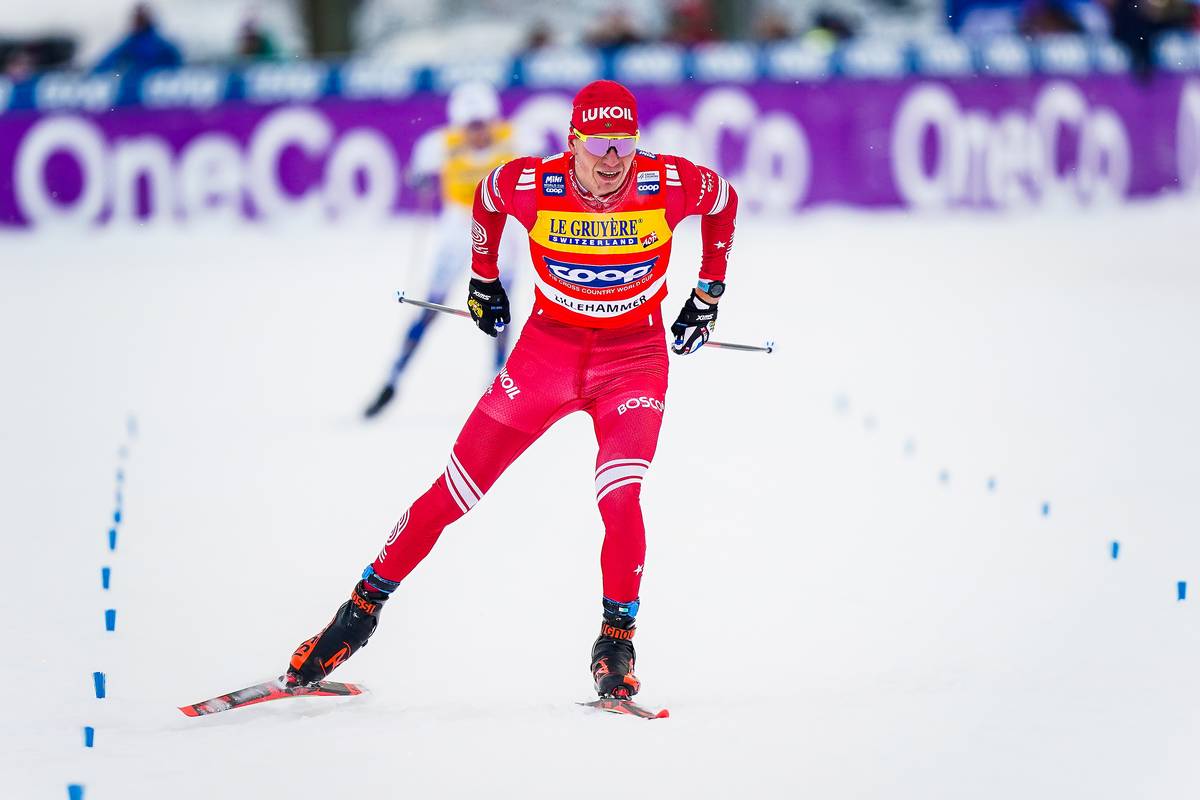
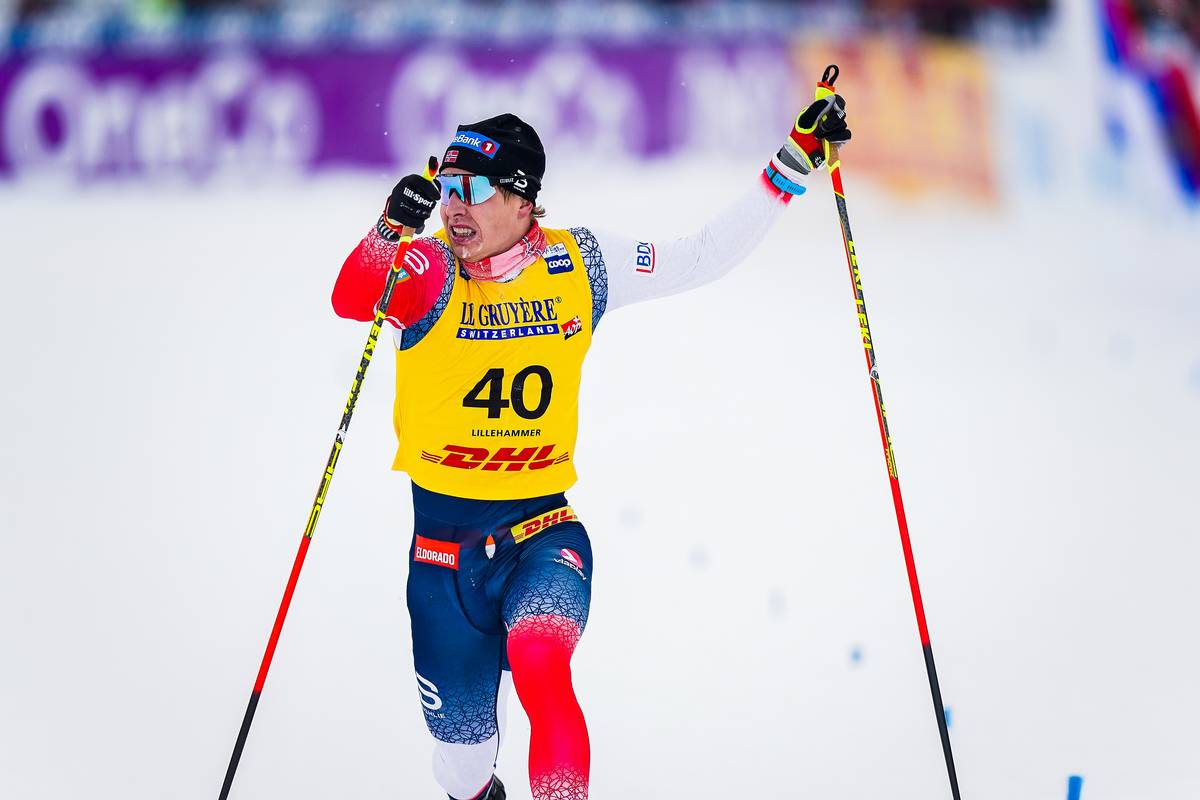
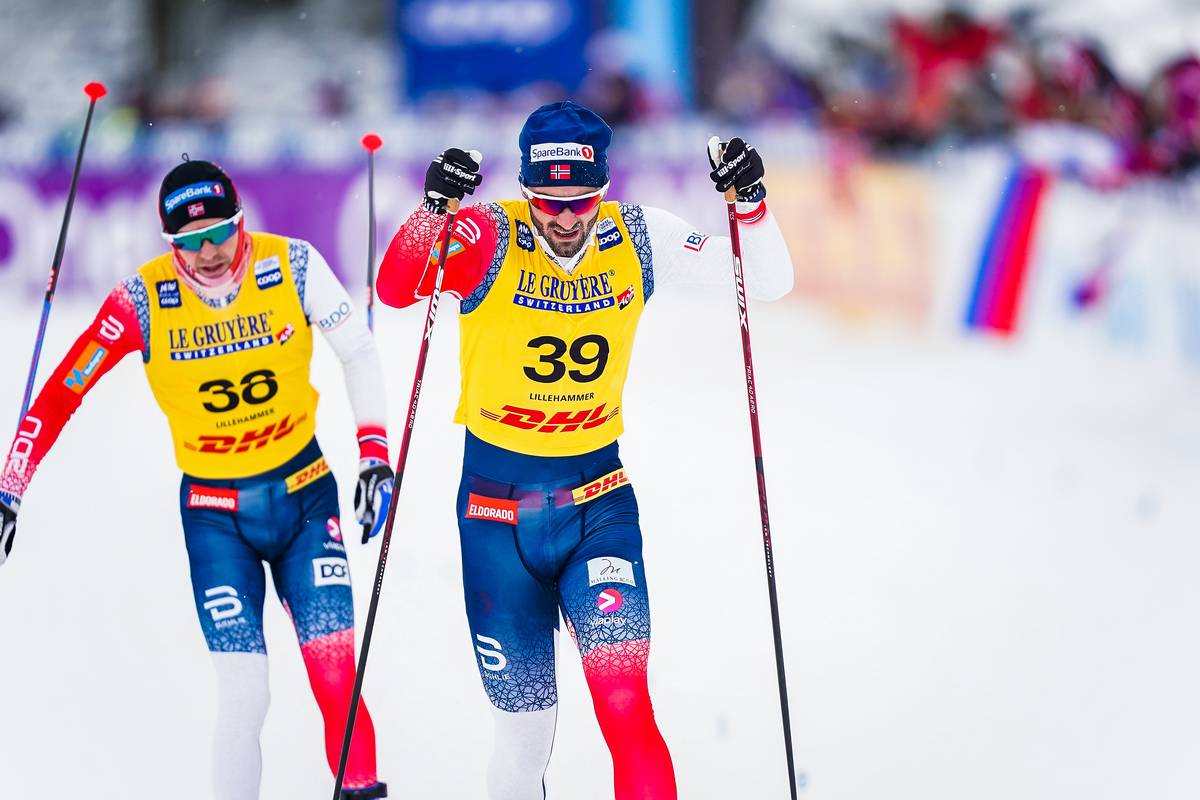
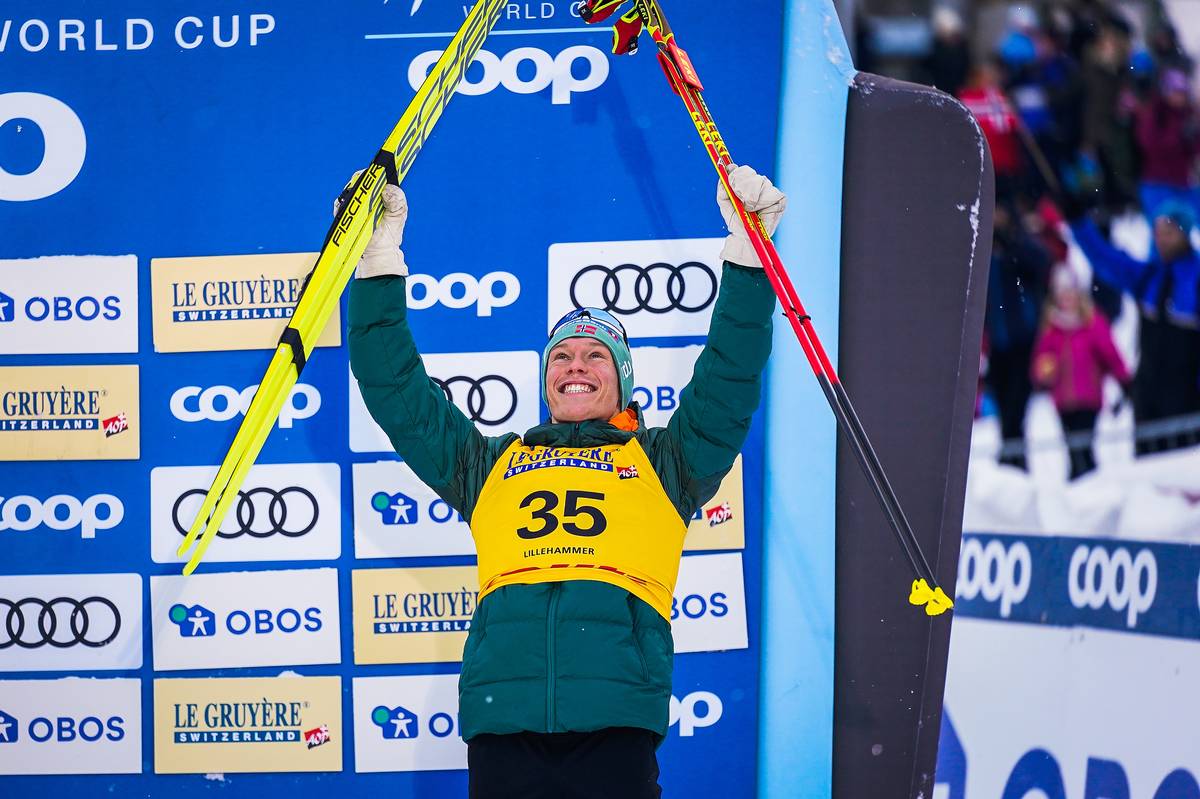
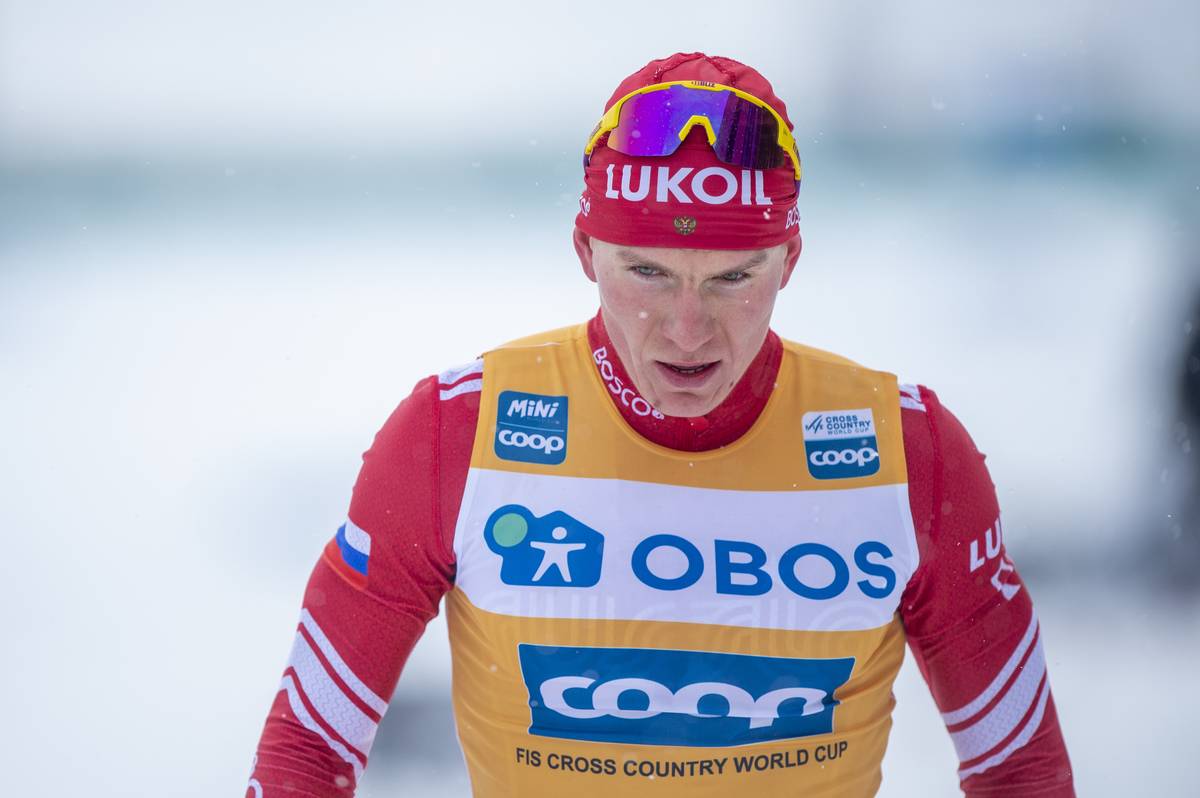
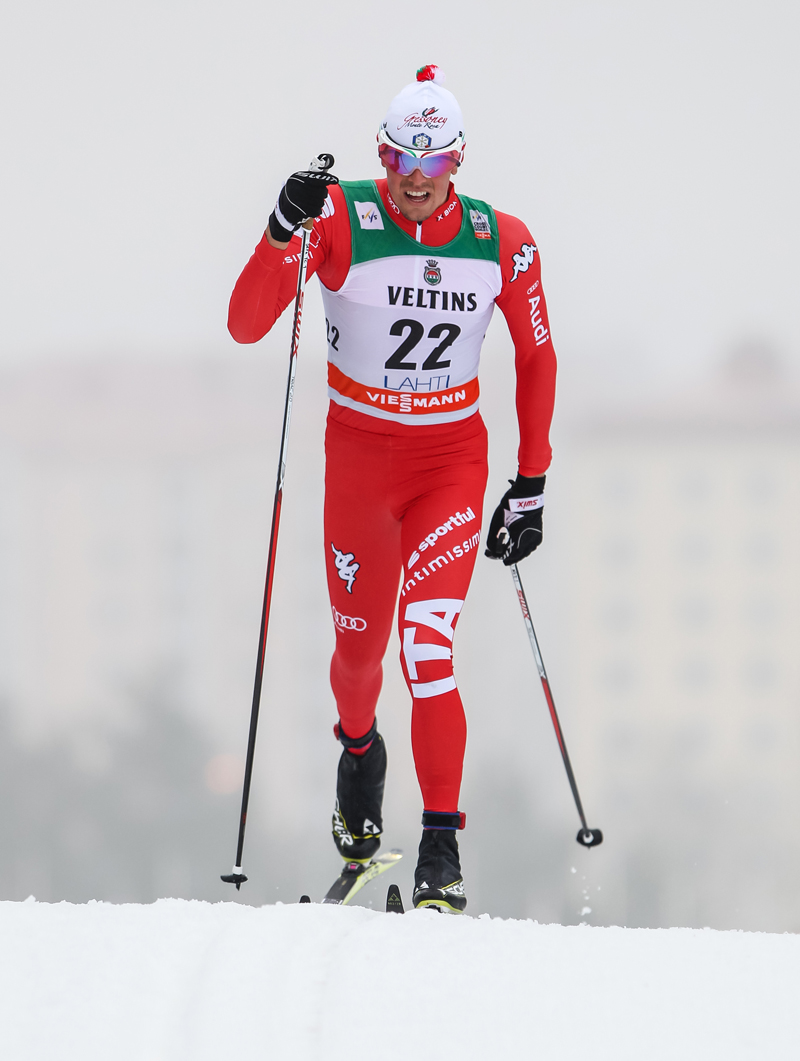
Fans from across the United States who will be in Lake Placid are anxiously hoping Johannes Hoesflot Klaebo (NOR) is well enough to travel and race in Lake Placid this weekend. (Photo: Authamayou/NordicFocus)
Johannes Hoesflot Klaebo has been included in Norway’s 22-athlete squad for this week’s World Cup finals at Mt. Van Hoevenberg in Lake Placid, N.Y., BUT the six-time Olympic gold medalist’s participation hinges on a decision being made today.
Klaebo, 29, suffered a mild concussion in a dramatic crash during the sprint semifinals at last Thursday’s World Cup in Drammen. American sprinter Ben Ogden lost his footing on the icy course and fell across Klaebo’s skis, sending the Norwegian backward and slamming the back of his head into the hard-packed snow. Klaebo lay on the ground for several minutes before being helped off course and transported to a hospital for evaluation.
The Norwegian Ski Federation confirmed the concussion diagnosis on Friday, and Klaebo withdrew from Saturday’s 50-kilometer race at Holmenkollen.
“He shall make an evaluation together with the national team doctor on Tuesday and would potentially travel on Wednesday,” Klaebo’s manager, Lasse Gimnes, told Norwegian broadcaster NRK on Monday. If cleared by national team doctor Ove Feragen, Klaebo would travel to New York on Wednesday — arriving just two days before Friday’s 10-kilometer classic interval start.
The crash also disrupted a planned trip to New York City for media appearances with CNN, NBC, the New York Times, and the Wall Street Journal — a reflection of the enormous international attention Klaebo has drawn since his record-setting six-gold performance at the Milano Cortina Olympics. Those in-person interviews have been scrapped, though some may shift to virtual formats.
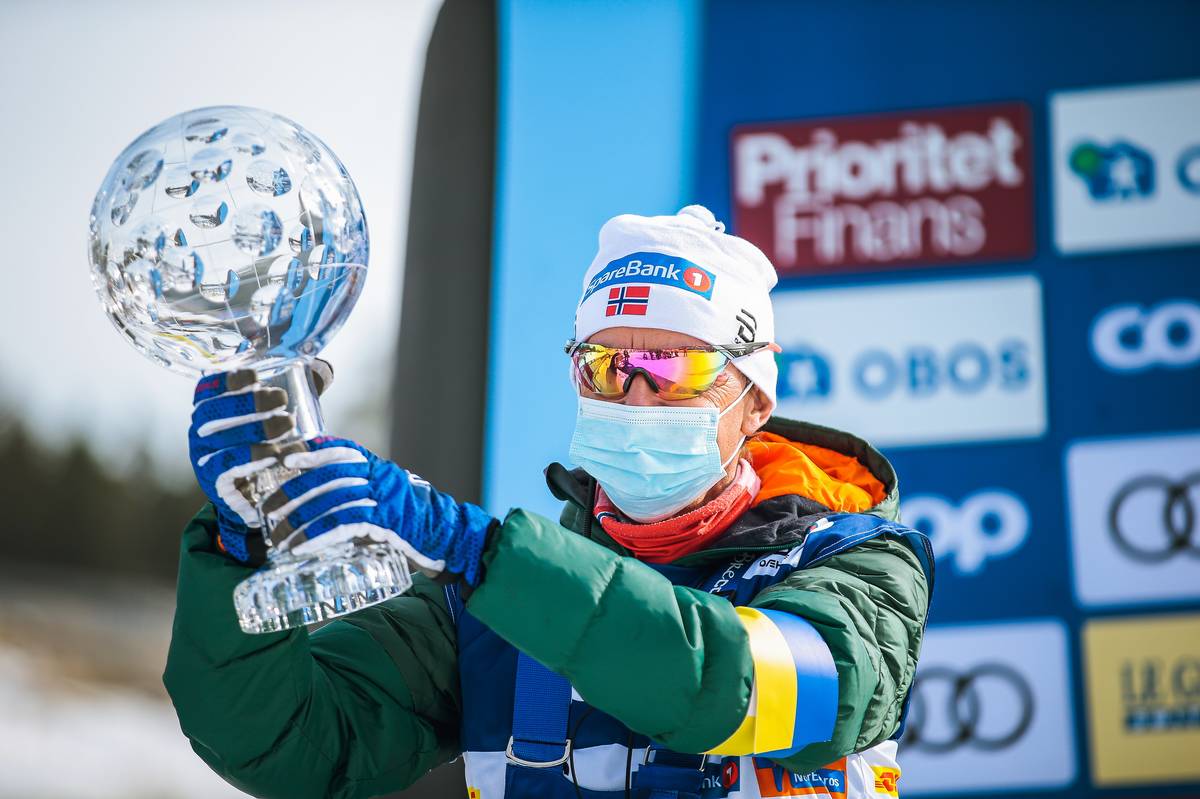
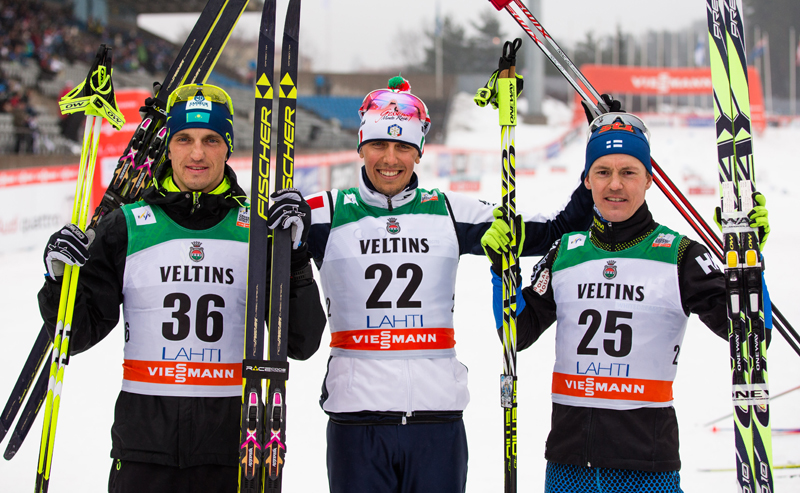
Johannes Hoesflot Klaebo (NOR) poses with the FIS Crystal Globes he won last season at World Cup Finals in Lahti, Finland. (Photo: Thibaut/NordicFocus)
The distance globe is on a knife’s edge
The distance cup title is the central subplot heading into the finals. Before Holmenkollen, Klaebo held a 128-point lead in the distance standings. But with the Norwegian watching from home on Saturday, Amundsen’s 131-point haul vaulted him into the distance lead: Amundsen now sits at 939 points, three ahead of Klaebo’s 936. Martin Loewstroem Nyenget climbed to 914 in third. Just two distance events remain — Friday’s 10-kilometer classic interval start and Sunday’s 20-kilometer freestyle mass start. If Klaebo can travel and race, the margin is thin enough that a single strong result could flip the standings again. If the concussion keeps him out, the distance globe almost certainly goes to Amundsen.
Klaebo has already clinched both the overall World Cup — his sixth, tying Bjoern Daehlie’s all-time record — and the sprint globe.
Norway’s men’s squad: Harald Oestberg Amundsen, Martin Loewstroem Nyenget, Einar Hedegart, Andreas Fjorden Ree, Mattis Stenshagen, Emil Iversen, Johannes Hoesflot Klaebo, Lars Heggen, Even Northug, Ansgar Evensen, and Even Solem Michelsen.
Jessie Diggins soaks in all the energy from the home crowd during her warmup in Minneapolis — the last time the World Cup was on American snow. (Photo: Leann Bentley/USST)
Diggins’s farewell, and notable absences
The Lake Placid finals will serve as the final competitive races for Jessie Diggins, the most decorated cross-country skier in U.S. history. The women’s overall cup and distance cup are both decided, with Diggins winning with a comfortable margin over Sweden’s Moa Ilar in second. The three-time Olympic medalist and three-time overall World Cup champion announced before the season that this would be her last, and a farewell on home snow in front of an American crowd at the first-ever U.S.-hosted World Cup finals is about as fitting a send-off as anyone could script.
Klaebo is not the only notable question mark heading into the weekend. Norway’s Kristine Stavaas Skistad and Mathilde Myhrvold have opted to skip the finals to prepare for part two of Norwegian nationals in Harstad next week. Sweden’s Ebba Andersson has also pulled out.
Norway’s women’s squad for Lake Placid includes Astrid Oeyre Slind, Heidi Weng, Kristin Austgulen Fosnaes, Karoline Simpson-Larsen, Nora Sanness, Karoline Groetting, Julie Bjervig Drivenes, Tiril Udnes Weng, Julie Myhre, Lotta Udnes Weng, and Milla Grosberghaugen Andreassen.
The men’s freestyle mass start gets started at the US National Championships in Lake Placid, NY, 1/8/26. (Photo: Nancie Battaglia)
A historic venue
The Lake Placid finals mark the first Cross-Country World Cup finals ever held in the United States and the return of World Cup racing to Lake Placid for the first time since 1979. Racing kicks off Friday at Mt. Van Hoevenberg with the 10-kilometer classic interval start, followed by a freestyle sprint on Saturday and a 20-kilometer freestyle mass start on Sunday.
This is a developing story. FasterSkier will update when Klæbo’s decision is announced.
Help Support Our Olympic Coverage!
If you value the thoughtful work and access FasterSkier provides, please consider becoming a Voluntary Subscriber. Your support directly fuels our work to cover the people, places, and moments that make our sport special.
We took a couple of days off to do the necessary things, like eat pizza and ski. (And, rest assured, we were working, too — just not on the podcast.) We’re back now to recap the men’s relay and preview Nat’s favorite championship event, the team sprint.
We’ll be back after that race tomorrow. Reach us at devon[at]fasterskier.com and nat[at]fasterskier.com. We’re really grateful for all the support during the Olympics — thanks for notes and encouragement. And even the anti-eating-on-the-podcast messages.
A reminder: This is a homegrown podcast done by two guys working long hours and late nights. We’re also paying real money to be here in Italy. If you can, support the show and FasterSkier’s ongoing coverage with a voluntary membership. We’re also offering a bonus during the Olympics: a WhatsApp group with notes on Nat’s experiences in Italy, the food he’s eating, interview transcripts and more.
Send nat[at]northernjournal[dot]com a confirmation of your voluntary membership and the number he should use for WhatsApp and we’ll get you signed up. You can also Venmo him directly at @nat-herz if a membership isn’t for you. We’re suggesting a minimum of $10, but we also won’t turn anyone away who wants to join because of an inability to pay.
Help Support Our Olympic Coverage!
FasterSkier will have our own Nat Herz on the ground at the Olympics, which, to be honest, is a very big financial lift for us. If you value the thoughtful work and access FasterSkier provides at championships like this one, please consider becoming a Voluntary Subscriber. Your support directly fuels the work we do to cover the people, places, and moments that make our sport special.
Norway’s greatest competitive advantage in cross-country skiing has always been depth. In an Olympic selection season, that depth becomes a headache. When the federation gathered to finalize its 2026 team, the conversation was not about who belonged at the Games — those results and calculus had been logged. It was about which version of the team could survive illness, underperformance, and the cruel compression of Olympic schedules. For several skiers who have already proven themselves capable of standing on a World Cup podium — and perhaps even an Olympic one — the answer would be no. Not because they weren’t good enough. But because someone else fit the puzzle a fraction more cleanly.
Johannes Hoesflot Klaebo (NOR) leads a train of Norwegian men in Lahti (FIN) last March. (Photo: Thibaut/NordicFocus)
Eight Men, Eight Women — Complete
The Norwegian cross-country Olympic squad now includes eight men and eight women, a balance that reflects the depth of talent and strategic breadth of Norway’s cross-country program.
With these 16 names confirmed, Norway’s roster boasts a mix of seasoned champions and hungry young stars — from Klæbo’s Olympic pedigree to Vike’s breakthrough sprint talent.
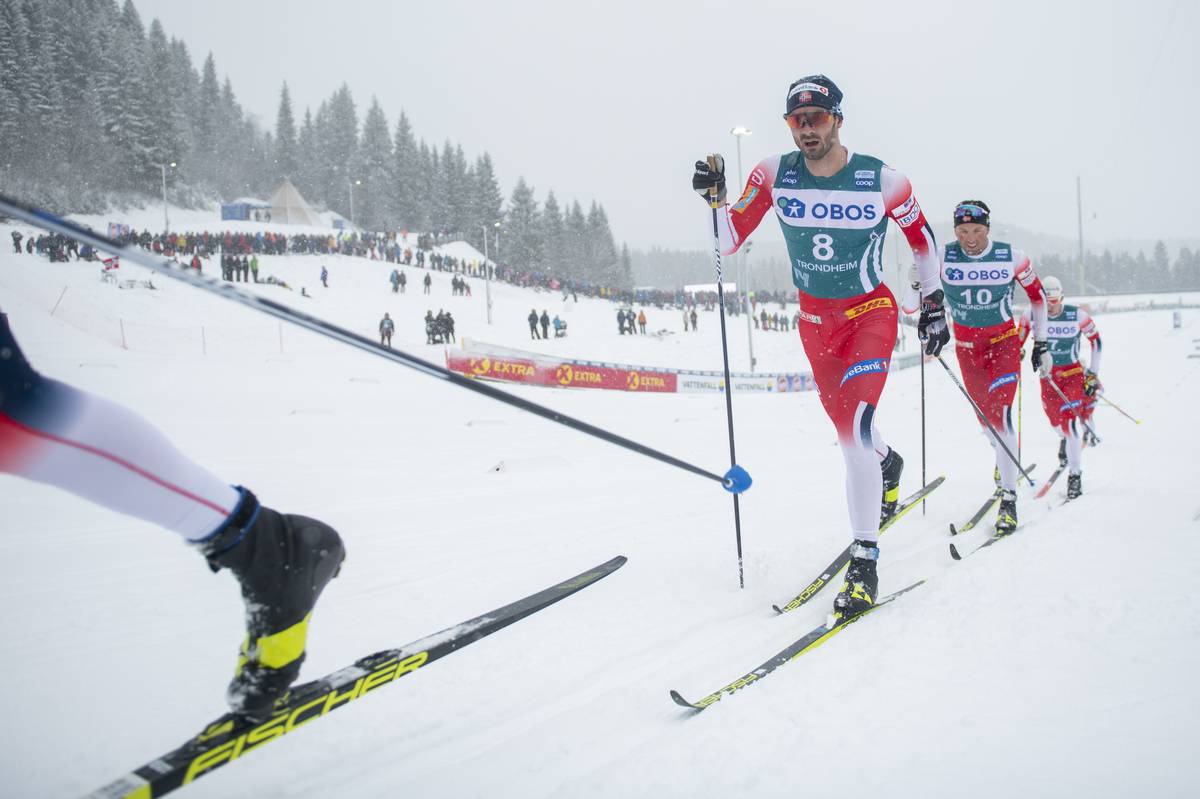
Harald Oestberg Amundsen (NOR), Mattis Stenshagen (NOR), Johannes Hoesflot Klaebo (NOR), Emil Iversen (NOR), Jan Thomas Jenssen (NOR), Erik Valnes (NOR), and Martin Loewstroem Nyenget (NOR), (l-r) come up the final climb during the Skiathlon in Trondheim (NOR) in December. (Photo: Modica/NordicFocus)
The Final Pieces of a Puzzle: Iversen and Vike
For weeks, the most hotly debated part of Norway’s Olympic selection revolved around the last two men’s spots.
Emil Iversen, the veteran 34-year-old World Cup stalwart and World Champion team sprinter, secured one of the final berths — a decision that stirred both emotion and controversy. Iversen missed out on earlier national team standing but made a compelling case this season with solid World Cup performances, including in Tour de Ski events that carried significant weight in the selection criteria.
On the younger side, Oskar Opstad Vike earned the final spot. The 22-year-old sprinter’s rise — riding strong sprint results, including a World Cup top ten — gave the selectors a promising specialist to bolster Norway’s Olympic squad.
The decision to include one established distance racer (Iversen) and one sprint threat (Vike) over alternative combinations was no accident. It reflects not only this season’s results but also the complexity of Olympic event programming — multiple distance races, relays, and sprint competitions demand versatility and redundancy.
Emil Iversen (NOR) during the Skiathlon in Trondheim (NOR) earlier this season. (Photo: Modica/NordicFocus)
What Was on the Line
Norway’s selection strategy rested on ranked criteria that put top priority on World Cup results this season, followed by last season’s performances and past championship achievements. This emphasis on objective metrics aims to ensure that the athletes selected are not just popular choices, but the ones statistically most expected to deliver in Val di Fiemme.
It’s no surprise that Johannes Høsflot Klæbo leads the team — the multiple World Cup overall and sprint title holder is already one of the greatest of all time, and his results this season keep him in clear contention for medals across disciplines.
Meanwhile, Mattis Stenshagen has been one of the season’s breakout distance performers, boasting both World Cup podiums and a strong Tour de Ski showing that solidified his place on the team.
Erik Valnes (NOR), Johannes Hoesflot Klaebo (NOR), and Oskar Opstad Vike (NOR), (l-r) share the podium in Falun (SWE) in last season. (Photo: Modica/NordicFocus)
Notable Near-Misses and Debates
Not everyone who hoped for an Olympic ticket got one.
One of the most talked-about stories this season was Lars Heggen, the 20-year-old sprint phenom who has burst onto the scene with impressive results, including a World Cup sprint victory this past weekend. Many voices in ski media argued passionately for his inclusion, citing his explosive form and tactical range. But in the end, selectors opted for experience and proven Olympic relevance — a choice that sparked debate across Norway and beyond.
Another compelling case was Andreas Fjorden Ree, whose World Cup performances and near-victory finishes led many to forecast him as a certain medal contender. His exclusion — by mere fractions in selectors’ evaluations — was described as “brutal” by some commentators, underscoring just how competitive this national squad truly is.
Kristine Stavaas Skistad (NOR) leads Maja Dahlqvist (SWE) down the homestretch of the opening stage of the Tour de Ski in Toblach (ITA) in December. (Photo: Modica/NordicFocus)
Women’s Squad: Balance of Experience and Youth
While the men’s selection drama took center stage, the women’s squad also reflects a dynamic mix of talent:
Veterans like Heidi Weng bring Olympic experience and tactical acumen.
Sprinters and all-rounders like Kristine Stavås Skistad and Karoline Simpson-Larsen add valuable firepower.
Milla Grosberghaugen Andreassen and Ingrid Bergene Aabrekk represent the up-and-coming generation making their impression through World Cup and Norwegian Championship results.
Selectors reportedly evaluated performances not just from the World Cup and Tour de Ski, but also through the Norwegian National Championships — especially when managing variables like injury and form.
Heidi Weng (NOR) during the final climb of the Tour de Ski in Val di Fiemme (ITA) earlier this month. (Photo: Vanzetta/NordicFocus)
Looking Ahead — Milan-Cortina 2026
The Winter Olympics kick off on February 6, 2026, and cross-country skiing begins early with the women’s skiathlon on February 7. In Val di Fiemme — a venue steeped in Nordic history — Norway will arrive with one of the deepest teams in the field.
For a nation where cross-country skiing is practically a national pastime, these selections carry huge anticipation. Every name on this roster is now poised to chase Olympic gold, silver, or bronze — but behind them are stories of near-misses, fierce competition, and strategic choice-making that defined this winter’s most compelling selection drama.
Let the Games begin.
Love Stories Like This? Help Keep Them Coming.
Feature stories like this one take time, access, and care to produce. If you value thoughtful storytelling and independent ski journalism, please consider becoming a Voluntary Subscriber. Your support directly fuels the work we do to cover the people, places, and moments that make our sport special.
This coverage is made possible through the generous support of Marty and Kathy Hall and A Hall Mark of Excellence Award. To learn more about A Hall Mark of Excellence Award, or to learn how you can support FasterSkier’s coverage, please contact info@fasterskier.com.
Martin Loewstroem Nyenget (NOR) came back to World Cup racing, posting the fastest time in the 10 k Interval Start Classic in Oberhof (GER). (Photo: Authamayou/NordicFocus)
On Sunday morning in Oberhof, the snow had the kind of sheen that tells the truth before the clock ever does. It glittered under a clean winter sun, polished by a freeze–thaw cycle that left the tracks fast, brittle, and unforgiving. At 823 meters, tucked into the Thuringian Forest, the course looked generous from a distance—wide lanes, long sightlines—but it was the sort of generosity that disappears the moment a skier commits to a mistake. The margins here were not loud. They were sharp.
This was the men’s 10-kilometer Classic Interval Start, a format that does not tolerate theater. There would be no pack to hide in, no draft to borrow, no tactical stalemates to blame. Every thirty seconds, a skier pushed out of the start gate alone, carrying only his pacing plan, his skis, his poles, and whatever composure he had managed to preserve through an Olympic build that has been compressing time for months. Period Three had begun. The calendar was no longer abstract.
Classic skiing in these conditions demands restraint masquerading as confidence. The climbs are short but decisive; the downhills are technical enough that speed becomes a negotiation rather than a gift. Grip must be trusted without being tested. Push too hard too early, and the skis slide away beneath you; hesitate, and seconds vanish into the ice. It is possible—common, even—to ski very hard here and still ski poorly.
Iivo Niskanen (FIN) was formerly the king of the 15 k Classic and showed he is one of the best in the 10 k Classic in Oberhof (GER). (Photo: Authamayou/NordicFocus)
The interval start turns this dynamic inward. The course does not change for you, but your relationship to it does. You pass athletes who started ahead of you and are passed by those who did not. You hear split times shouted from the side of the trail—sometimes accurate, sometimes not—and you decide whether to believe them. In Oberhof, where artificial snow breaks down as the sun rises and the grooves lose their bite, the course becomes a moving target. Early starters gamble on freshness; later starters trade glide for information. No one gets everything.
Absent from the start list were some of the sport’s most reliable reference points. Norway’s biggest names were racing at home, their national championships pulling them away from this quiet, consequential weekend, or focused on a pre-Olympic training block. Their absence opened space on the results sheet, but not relief. If anything, it sharpened the test. Without familiar benchmarks, the race would be defined less by expectation than by execution.
The 10 k classic has become a strange distance in modern cross-country skiing—short enough to reward urgency, long enough to punish impatience. It asks skiers to operate just below the edge of recklessness and to stay there for more than twenty minutes. In Oberhof, that edge was particularly thin. The tracks shone. The corners demanded respect. The kind of mistake that costs half a second in softer snow could cost five places here.
Erik Valnes (NOR) on his way to third and another statement to the Norwegian Olympic selection committee in Oberhof (GER). (Photo: Authamayou/NordicFocus)
For the Americans, this was the last weekend considered in Olympic team deliberations, a fact everyone knew and no one needed to say out loud. The weight of it showed up not in desperation but in discipline. There were no grand gestures in the start lane. What mattered was whether an athlete could trust the work he had done and let the race unfold on its own terms.
One by one, skiers disappeared into the forest, double-poling through the opening flats before settling into the rhythm that classic skiing requires when it is done well: patient climbs, clean transitions, downhill speed carried without panic. The clock ticked. The sun climbed. The track began to change.
By the time the later starters reached the first split, the course had already started to tell its story. Early leaders came back. Conservative openings paid dividends. The race did not break open so much as it clarified itself, revealing who could manage the terrain without forcing it—and who could not.
In an interval start, there is a particular moment when the race stops being about possibility and becomes about reckoning. It arrives quietly. A skier hears that he is catching someone he should not be catching. Another learns that the pace he thought was safe is not. In Oberhof, that moment came late and all at once, when the day’s best classic skier finally aligned patience with power and turned control into separation.
By the finish, the gaps would look clean and decisive. They always do. But the truth of this race lived earlier, in the choices made on icy corners and rolling climbs, in the decision to ski smooth instead of merely hard. Oberhof did not demand brilliance. It demanded honesty.
Martin Loewstroem Nyenget (NOR) on his way to the win. (Photo: Reichert/NordicFocus)
A Course That Reveals Its Verdict Slowly
The first skiers through the opening kilometers set times that looked sharp but provisional, the kind that exist only until the course and the day reveal themselves. The early splits came quickly, then stalled. The ice underneath the tracks was still holding, but the sun was beginning to soften the surface just enough to punish excess force. The race was already sorting itself by feel rather than bravado.
Martin Loewstroem Nyenget (NOR) navigates the sugary snow in Oberhof (GER). (Photo: Authamayou/NordicFocus)
Nyenget’s Patience Turns Into Separation
When Martin Løwstrøm Nyenget finally entered the picture, it was without urgency. His opening lap was measured, almost quiet, the sort of start that invites doubt if one is inclined to look for it. But Nyenget had not come to Oberhof to prove speed in the first five kilometers. He had come to test something else.
“I hadn’t planned to open very hard,” Nyenget said afterward in an interview aired on the FIS World Cup broadcast. “I’ve been training really hard for the last four weeks, so I didn’t quite have the speed on the first lap. But as soon as I heard that I was catching people, I started to feel really strong, and I knew I had something extra for the day.”
The catching began gradually, then decisively. Where others tightened under the strain of the second lap, Nyenget loosened. His skiing did not change in form, only in intent. The double pole grew heavier, the transitions cleaner. On a course that demanded constant negotiation, he removed the argument.
By the final kilometers, the race had become unmistakable. Nyenget was no longer racing the field so much as confirming what the course had already suggested. He crossed the line alone, the margins behind him clear and earned, his victory built not on dominance but on patience applied at exactly the right moment.
“It’s fantastic to be back,” Nyenget said. “The longer I keep going in my career, the more fun I have racing. The training part isn’t always that fun anymore, so it’s great to be here in Oberhof with good conditions and really enjoy racing again.”
An American Throughline: Skiing Well, Not Just Hard
Behind him, the podium filled with familiar names and familiar styles — Iivo Niskanen (FIN +13.8) in second and Erik Valanes (NOR +14.5) in third — skiers who understand how to survive a day like this without surrendering it. The gaps were tight, the order decisive. It was the kind of race that leaves little room for argument afterward.
For the American men, the story unfolded less in places gained than in choices validated.
Zanden Mcmullen (USA) making one final statement to the US Olympic Team selection committee in Oberhof (GER). (Photo: Authamayou/NordicFocus)
McMullen Finds His Shape Again
Zanden McMullen arrived in Oberhof carrying momentum that had begun to take shape weeks earlier at U.S. Nationals. There, his skiing had looked settled again — confident without being rigid, aggressive without being rushed. In Oberhof, that trend continued.
“I feel like I’ve started to find myself again, which is really reassuring,” McMullen said. “I think I was fully capable of skiing like this earlier in the season, but I needed a little more racing and confidence under my belt. This weekend feels like the tip of the iceberg.”
His approach to the race was deliberate. Rather than forcing the issue early, McMullen allowed the course to come to him, focusing on terrain management rather than constant pressure.
“My goal today was just to ski well through the terrain of the entire course,” he said. “Earlier this season, when I felt like I needed to force a good result, I wasn’t skiing well — I was skiing very hard, but not well. Today I focused on skiing smooth and fast rather than just hard, and I think that really paid off.”
There were moments of vulnerability — a slight lapse near the end of the first lap — but McMullen recognized it in time to convert restraint into opportunity.
“I was able to use that extra energy to ski hard and fast through the second half of the race,” he said.
McMullen finished 18th, a result that read plainly on paper but carried deeper meaning inside an Olympic season defined by accumulation rather than singular peaks.
“I know I’ve done what I can,” he said. “I’m happy to be back where I left off last year before I got sick. Now I can shift my focus to preparation. Olympic qualification is just the first step. I have very big goals for the Games themselves.”
Hunter Wonders (USA) continued his 10 k Classic form he showed at US Nationals in Oberhof (GER). (Photo: Authamayou/NordicFocus)
Hunter Wonders and the Familiar Language of Classic Distance
For Hunter Wonders, Oberhof reinforced something that has been quietly consistent in his career: when the race is a classic distance interval start, the task tends to make sense. There is clarity in pacing, in grip management, in the slow accumulation of pressure rather than the sudden chaos of a sprint.
Wonders skied into the points again, backing up his showing from U.S. Nationals with another disciplined performance on snow that rewarded trust over impulse. In conditions where early aggression often came undone later, his race held together. The opening kilometers were controlled, the middle steady, the final lap about preservation rather than rescue.
That continuity mattered. In a field where seconds dissolved quickly into places, Wonders avoided the kind of oscillations that define fragile races. He neither chased the early benchmarks nor retreated from them. Instead, he stayed within a rhythm that allowed the course to do less damage than it did to many around him.
On a day when classic specialists quietly rose, Wonders looked like one — not flashy, not forced, but coherent from start to finish.
Luke Jager (USA) celebrated his birthday weekend in Oberhof (GER) with a top 30 in the 10 k Classic. (Photo: Authamayou/NordicFocus)
Luke Jager and the Discipline of Attention
A few minutes later, Luke Jager crossed the line inside the top 30, finishing a race that mirrored his own quiet trajectory. Though the calendar had marked it as his birthday weekend, the day itself passed without ceremony.
“My main goal was just to be fully immersed in the experience,” Jager said. “To focus on doing my best and skiing each section of the course as well as I could.”
On a course where margins evaporated quickly, that focus mattered.
“The margins were definitely thin, but they always seem to be on the World Cup these days,” he said. “It doesn’t really help to stress about that, so I try to keep my attention on what’s right in front of me, so that when I cross the finish line I can say I found as many of those little margins as I could.”
John Steel Hagenbuch (USA) striding his way to 52nd place. (Photo: Authamayou/NordicFocus)
John Steel Hagenbuch and the Cost of Precision
For John Steel Hagenbuch, Oberhof was less forgiving, finishing in 52nd place. Fast, icy tracks compress the margin for error until technique, pacing, and decision-making overlap completely. There is no room to separate them. When one slips, the others tend to follow.
Hagenbuch’s race never unraveled dramatically, but it never fully unlocked either. The speed was there in moments; the continuity was harder to hold. In an interval start, that can be enough to drift backward without a single obvious mistake to point to afterward.
Classic skiing on firm conditions is often less about what goes wrong than about what never quite arrives. A corner taken cautiously becomes a gap. A climb approached defensively compounds over kilometers. Oberhof exposed those small hesitations with clarity.
Still, there were pieces to build from. Hagenbuch moved efficiently through the terrain, and his ski handling held under pressure. What the race demanded next — and what it withheld — was the seamless connection between intention and execution that defines skiing at this level.
Zachary Jayne (USA) raced his first World Cup races of his career in Oberhof (GER). (Photo: Authamayou/NordicFocus)
A ‘Welcome to the League’ Weekend
For Zach Jayne, the weekend carried a different weight. After a breakthrough performance at U.S. Nationals, Oberhof marked his first exposure to the full scale of World Cup racing — the cameras, the movement, the relentless compression of time and attention.
“After a good week at Nationals, I’m honestly pretty disappointed with my first few World Cup starts,” Jayne said. “I’m grateful to be here racing against some of the best in the world, but I really wanted to do something with my starts.”
What surprised him most was not the pace but the environment.
“There’s just a lot more going on — cameras, people, spectators,” he said. “For me, that translates into more stress, and I’m still learning how to manage that.”
Still, Jayne was clear-eyed about the lesson.
“I definitely had my ‘welcome to the league’ moment this weekend,” he said. “Now I have something bigger and better to shoot for.”
Antoine Cyr (CAN) on his way to a top 30 finish in Oberhof (GER). (Photo: Authamayou/NordicFocus)
The Canadians: Cyr Steady, Ritchie Searching
Canada arrived in Oberhof with different objectives but shared terrain.
Antoine Cyr delivered another composed World Cup performance, finishing inside the top 30 on a course that rewarded calm decision-making. His skiing carried the marks of experience: stable pacing, clean transitions, and an understanding of when to let speed come rather than chase it.
In fast conditions, Cyr avoided the trap of overreaching. His race did not hinge on a single sector or surge but on the absence of mistakes — a strategy that proved effective as the track continued to glaze and soften through the day.
For Graham Ritchie, the race served a different function. Returning to World Cup competition after a disrupted season, Oberhof was less about result than recalibration. The course asked questions he is still working back toward answering: how much risk to take, how much speed to trust, how long it takes to feel at home again in this environment.
Ritchie skied through to the finish without drama, but the gaps reflected the difference between re-entry and fluency. On a day when the margins punished uncertainty, Oberhof made clear how narrow the corridor back to comfort can be.
What Oberhof Demanded
By the time the final starters finished, the course had softened just enough to underline its earlier warnings. The results sheet settled into place. Some athletes left Oberhof with confirmation, others with questions, all with fewer places left to hide.
“It feels like everything is important right now — every part of the preparation,” Nyenget said. “Today, the goal was just to focus on the task. But of course, it’s a step closer to the bigger goal.”
In Oberhof, the task had been clear all along: ski well, ski honestly, and let the rest follow.
Feature stories like this one take time, access, and care to produce. If you value thoughtful storytelling and independent ski journalism, please consider becoming a Voluntary Subscriber. Your support directly fuels the work we do to cover the people, places, and moments that make our sport special.
Iivo Niskanen (FIN), Martin Loewstroem Nyenget (NOR), and Erik Valnes (NOR), (l-r) share the 10 k Classic Interval Start in Oberhof (GER). (Photo: Authamayou/NordicFocus)
This coverage is made possible through the generous support of Marty and Kathy Hall and A Hall Mark of Excellence Award. To learn more about A Hall Mark of Excellence Award, or to learn how you can support FasterSkier’s coverage, please contact info@fasterskier.com.
Davos doesn’t reward urgency.
It tolerates it, sometimes — lets it flirt with the clock through the opening kilometers — but it never forgets. Like a mysterious, wispy cloud, the altitude sits quietly above the stadium, thinning the air just enough that the consequences arrive late, not immediately. The first lap can feel generous. The second is where Davos asks what you’ve really brought with you.
On Sunday, in the men’s 10-kilometer freestyle interval start at the World Cup in Davos, Switzerland, that truth arrived right on schedule. Athletes who attacked early were gradually called back. Athletes who waited found themselves moving forward without ever appearing to accelerate. And one skier — patient, smooth, and increasingly inevitable — turned the second lap into a private demonstration.
Einar Hedegart of Norway won in 22:40.7, earning his second straight World Cup victory, this one built not on surprise but on control. Behind him came Harald Østberg Amundsen (NOR) at +11.7 seconds, Mattis Stenshagen (NOR) at +18.8, Johannes Høsflot Klæbo (NOR) fourth (+24.1), and Martin Løwstrøm Nyenget (NOR) fifth (+30.6). Andrew Musgrave (GBR) led the non-Norwegians in sixth (+31.1).
Five Norwegians in the top five — but only one skied the race the way Davos prefers.
Mattis Stenshagen (NOR) comes to the 10 k Interval Start Freestyle finish in Davos (SUI). (Photo: Modica/NordicFocus)
The Temptation of the First Lap
Interval starts strip racing down to decisions. No drafting. No cover. No negotiation. In Davos, those decisions begin almost immediately because the course invites speed from the start. The opening kilometers flow. The snow was hard and fast after an overnight freeze. Skis hummed. Breathing felt manageable.
Several athletes took the invitation.
Early time checks were brisk, and for a moment the race appeared to be tilting toward the skiers willing to press from the gun. Harald Østberg Amundsen, the reigning overall World Cup champion, was among them — assertive, controlled, but unmistakably on the front foot. At the first major checkpoint, Amundsen held a small advantage over Hedegart, exactly the kind of margin that feels reassuring on paper.
Others followed similar scripts. Strong starters carved seconds in the opening loop, skiing as if Davos were simply another mid-altitude venue rather than one of the circuit’s quiet physiological traps. It all looked reasonable — until the course turned upward again.
Why Davos Punishes Impatience
At roughly 1,560 meters above sea level, Davos sits just high enough to distort pacing instincts. Red-lining a climb here doesn’t always feel catastrophic in the moment. The cost arrives later, when recovery never quite comes, and the second lap begins to feel longer than the first.
That dynamic defined the race.
Athletes who went hard early found themselves defending, not attacking, once the second lap began. Speed leaked away on the longer climbs. Transitions dulled. The ability to change gears — so critical in freestyle skating — started to fade.
Hedegart, meanwhile, was doing something else entirely.
Einar Hedegart (NOR) with Vili Crv (SLO) trailing during the 10 k Interval Start Freestyle in Davos (SUI). (Photo: Vanzetta/NordicFocus)
Hedegart’s Patience — and the Moment it Mattered
Hedegart did not lead early.
That point matters.
He allowed seconds to slip away in the first lap, skiing smoothly but without urgency, keeping his effort under control on the steepest sections. At altitude, that restraint isn’t passive — it’s strategic. Backing off even a few percent on the climbs can preserve a system that stays responsive later.
When the race entered the second lap, the difference became apparent.
Hedegart didn’t surge so much as continue. While others plateaued, he maintained tempo. While early leaders fought to hold speed, he quietly increased his advantage, taking time not through dramatic accelerations but through the absence of slowdown.
By the 7.4-kilometer mark, the race had clarified. The seconds Hedegart had conceded early were gone — and then some. His advantage over Amundsen had grown decisively. The course was no longer offering second chances.
The finish confirmed what the splits already suggested: Hedegart’s second lap was the fastest in the field, and it wasn’t close.
Harald Amundsen (NOR) on his way to second place in Davos (SUI). (Photo: Vanzetta/NordicFocus)
Amundsen, Stenshagen, and the Norwegian Sorting Hat
Behind Hedegart, the Norwegian internal race unfolded in layers.
Amundsen’s early aggression kept him close, but the cost was unavoidable. He remained solid — this was not a collapse — yet the final kilometers belonged to Hedegart. What had been a narrow early lead turned into an 11.7-second deficit at the line.
Mattis Stenshagen, by contrast, skied one of the day’s most even races. Never flashy, never panicked, he moved steadily forward as others drifted back, finishing third and reinforcing his reputation as one of Norway’s most reliable distance technicians.
Johannes Høsflot Klæbo offered another useful case study. After a frustrating sprint the day before, Klæbo looked sharper and more composed, staying in contention through the middle of the race. But Davos demands distance-specific economy, not just efficiency, and he lost ground late, finishing fourth — competitive, but never truly threatening Hedegart.
Martin Løwstrøm Nyenget, wearing the red distance bib, rounded out the Norwegian sweep of the top five, steady as ever but unable to match the winning pace in the final lap.
Five Norwegians, five slightly different races — and one clear template emerging at the top.
Andrew Musgrave (GBR) was the fastest non-Norwegian skier in Davos (SUI). (Photo: Vanzetta/NordicFocus)
The International Picture: Holding On vs. Moving Up
Outside Norway, the same altitude logic applied.
Andrew Musgrave (GBR) skied a disciplined race, managing his effort well enough to stay competitive throughout. He was rewarded with sixth place — not by attacking late, but by avoiding the fade that claimed others. In Davos, survival is often the first victory.
France’s Mathis Desloges and Hugo Lapalus hovered near the top ten, their early speed gradually neutralized by the second lap. Italy’s Federico Pellegrino, so dangerous in sprint formats, found the sustained demands of the 10 km Interval Start less forgiving, finishing outside the top 30.
The pattern repeated down the results list: strong early checkpoints followed by diminishing returns. Davos was collecting its debts.
On his way to 30th place, John Steel Hagenbuch (USA) follows teammate Ben Ogden (USA). (Photo: Vanzetta/NordicFocus)
The American View: Learning in Familiar Air
For the U.S. team, John Steel Hagenbuch finished 30th, the top American on the day — a result that only hints at how complicated his Davos race really was.
Hagenbuch has never considered himself particularly sensitive to altitude, a fact that quietly shaped both his expectations and his pacing plan.
“I’m maybe not the best authority to say how altitude feels, as I usually don’t feel affected by it much,” Hagenbuch said. “I typically start slow and then pick up speed through races, and this pacing strategy is typically rewarded at altitude.”
That approach aligned neatly with what Davos demanded. And while Hagenbuch is quick to downplay any physiological advantage from growing up and training in Sun Valley, Idaho, he did note a different kind of familiarity.
“I think being from altitude can help with racing at altitude, but it’s certainly not a decisively significant factor — I was still plenty far behind the sea-level Norwegians today,” he said, with a laugh. “Speaking of familiarity, however, I remarked at how much Davos reminded me of home — the trails and the surrounding mountains strongly resemble Galena.”
The race itself marked his best feeling of the opening World Cup block — even if the result came under less-than-ideal circumstances.
“This Davos Skate 10 km was the best I’ve felt so far in Period 1,” Hagenbuch said. “But it unfortunately came only a day after I crashed hard on the infamously icy slalom downhill coming down from Flüelapass and subluxed my right shoulder for about the tenth time.”
By race morning, the pain hadn’t gone away.
“Even with a few thousand milligrams of acetaminophen down the hatch, every single pole stroke hurt,” he said. “So while it was nice to finally — barely — be top 30, I can’t help but think that without the injury and the stress associated with it, I could have done better. Alas, that’s life, and that’s skiing. I am not the only one to have had some bad luck in important races.”
Zooming out, Hagenbuch remains confident in his trajectory, even if the opening block didn’t fully reflect it.
“I feel confident in what I can achieve this winter — even if I didn’t necessarily show it during Period 1,” he said. “With this being an Olympic year, the competition was even higher than normal. For example, Per-Erik Bjornestad, one of our Norwegian wax techs, said that the Trondheim 10 km skate was the highest level of skiing he had ever witnessed.”
Looking ahead, Hagenbuch’s plans are clear — and pragmatic.
“Pretty much regardless of how today’s race went, I was going to go home to Sun Valley for Christmas,” he said. “I don’t think it makes sense for me to do the Tour de Ski, given how my health has been this fall and the start of the winter. I’m excited to go home and to compete at U.S. Nationals in Lake Placid.”
Einar Hedegart (NOR) celebrates with a fist pump to the camera in Davos (SUI). (Photo: Modica/NordicFocus)
Why this Race Matters More than it Looks
It’s easy to treat Davos as an outlier — scenic, elevated, a little unique. The athletes don’t.
The men’s 10 km Freestyle Interval Start is an Olympic format. It’s a race without shelter, without drafting, and without excuses. Davos amplifies all of that. Pacing errors are magnified. Aerobic limits are exposed. The second lap becomes a referendum.
Hedegart passed that referendum emphatically.
This was not a perfect-day fluke. It was not a tactical accident. It was the same pattern, repeated under different conditions, at a different altitude, against the deepest field in the sport. Ski patiently. Protect the climbs. Let others make the race hard early — then make it impossible late.
Einar Hedegart (NOR) remained on the snow for several minutes after crossing the finish line in Davos (SUI). (Photo: Modica/NordicFocus)
A Quiet Finish, a Louder Message
There was no spectacle at the finish line. No disbelief. No chaos. Hedegart crossed, collapsed, and recovered — another man undone by thin air, but this time by his own effort.
Two races. Two wins. Two second laps that separated him from everyone else.
Davos didn’t raise its voice. It didn’t have to.
It simply told the truth — the same one it always tells — and this time, Einar Hedegart listened better than anyone else.
Harald Amundsen (NOR), Einar Hedegart (NOR), and Mattis Stenshagen (NOR), (l-r) take the 10 k Freestyle podium in Davos (SUI). (Photo: Modica/NordicFocus)
Love Stories Like This? Help Keep Them Coming.
Feature stories like this one take time, access, and care to produce. If you value thoughtful storytelling and independent ski journalism, please consider becoming a Voluntary Subscriber. Your support directly fuels the work we do to cover the people, places, and moments that make our sport special.
Andrew Musgrave (GBR) gives the race winner Einar Hedegart (NOR) a sleigh ride after the pair had excellent days in the 10 k Freestyle in Davos (SUI). (Photo: Vanzetta/NordicFocus)
On most race weekends, I take my job seriously — up at 3:00 am EST, fresh coffee made, woodstove loaded, notebook out, logged on to coverage early to make sure I don’t have a technical issue. Then once the race starts, I begin looking for subtle, important moments to describe in greater detail in the race report. But there are also weekends, like this past one, when I toss my journalism hat onto the mantle above the woodstove to warm for another day, ‘grab a bucket of popcorn’, and watch, specifically, the Norwegian men’s Olympic selection saga unfold like the most incredible reality show in sport.
This year, the selection of Norway’s eight-man Olympic cross-country ski team might be the third most fascinating storyline in the Nordic world — trailing only Jessie Diggins’ farewell tour and the Russians’ return to the start gate. And yet, the drama out of Oslo might be the strangest: imagine being one of the ten fastest skiers alive… and still needing binoculars to see an Olympic start line.
This is what it means to be a Norwegian man in an Olympic year. It is both a birthright and a statistical tragedy.
Erik Valnes (NOR) and Johannes Hoesflot Klaebo (NOR), (l-r) crest the final climb before descending into the stadium during the World Cup Classic Sprint in Trondheim (NOR). (Photo: Modica/NordicFocus)
A Nation That Could Sweep Top 10 — and Still Leave Podium Skiers at Home
Let’s get one thing out of the way: on any given Sunday — sprint, classic, skate, distance, mass start, you name it — Norway could theoretically fill the entire top ten of a World Cup with home-grown talent. Twelve deep. Some years, nearly fifteen. The country is, bluntly, absurd.
And yet:
Only eight can go to Milano–Cortina.
Only four can start each race.
Only two can sprint in the team sprint.
Only four can race the relay.
You can be the fifth-best classic distance skier in the world, wearing red and blue, and never get to test yourself in the Olympic 50 k Classic, the sport’s defining event.
You can be a podium threat.
You can be a badge-wearing World Cup, World Championship, or Olympic winner. And still hear the most devastating phrase in the language of elite skiing: “Reserve.”
Johannes Hoesflot Klaebo leads training partner Emil Iversen durning the Skiathlon in Trondheim (NOR). (Photo: Modica/NordicFocus)
The Ten-Man Hunger Games
After Ruka and Trondheim, the men fighting for eight tickets look something like this:
Johannes Hoesflot Klaebo — simply the best male skier ever and is a favorite for gold in any race he enters.
Martin Loewstroem Nyengetis a force in any distance race, with first, third, fourth, and seventh-place finishes in the races he has entered this season, and is indispensable in the relay.
Andreas Fjorden Ree— second in the 10 k Freestyle and eighth in the Skiathlon this weekend.
Einar Hedegart — the young biathlete turned cross-country racer, who doesn’t even have a FIS bio pic, has broken onto the scene this season with a second in Ruka and a win in Trondheim in the two skate distance races he has entered.
Oskar Opstad Vike — He was second in the Classic Sprint in Trondheim, an Olympic event.
Erik Valnes — Olympic gold potential in the individual sprint, team sprint, and/or relay.
Lars Heggen — while he was only fourth in the Classic Sprint in Trondheim, that is an Olympic event.
Emil Iversen — the comeback story, the steady relay hand, who climbed onto the podium last weekend for the first time in five years.
Didrik Toenseth — has only started one World Cup, the 10 k Classic in Ruka, thus far, but was in 8th place, and it is an Olympic event. Toenseth is still one of the world’s best in distance races, yet still at risk of not making the team.
That is ten world-class athletes, without even mentioning skiers like Simen Hegstad Krueger, who is knocking at the door and who has won bronze in all the championship 50 k races for years.
Norway only gets to name eight Olympians.
Grab more popcorn.
Norway’s Andreas Fjorden Ree (NOR), Einar Hedegart (NOR), Martin Loewstroem Nyenget (NOR), (l-r) share the podium after the 10km freestyle Trondheim (NOR) last weekend. (Photo: Modica/NordicFocus)
Who Gets the Golden Tickets? Norway’s Math Problem
If the federation’s stated goal is to:
Sweep the podiums (plural),
Win the relay,
Win the team sprint
And possibly have Klaebo win everything except the marble flooring in the athletes’ dining hall, then the selection is not just about speed. It’s about risk management, event coverage, and event specialization.
Here’s how the roles break down:
The Locks (2):
Klaebo
Amundsen
Barring a meteor strike, these two are sharper in December than most nations’ peak athletes in February.
The Near-Locks (2):
Nyenget — championship DNA, distance weapon.
Valnes — if classic sprint is a medal event (it is) and you want a dependable classic leg in the relay, Valnes is on the plane.
Didrik Toenseth took third at the 2022 Holmenkollen 50 k Classic. (Photo: NordicFocus)
The Crucial Middle (six guys for four spots):
This is where heartbreak lives.
Heggen — might already be one of the five best sprinters on earth.
Ree — versatility is gold in Olympic selection, and he might be Norway’s best “plug into anything” skier outside of Klæbo and Amundsen.
Hedegart — never flashy, but quietly always where he needs to be.
Iversen — history matters. Championships matter. Norwegians never entirely write him off.
Toenseth — elite distance skier who would start for literally any other nation.
Pick four.
Explain it to the other two.
Good luck.
Harald Oestberg Amundsen (NOR) wins the 20 k Mass Start Freestyle during the World Cup opening weekend in Ruka (FIN). (Photo: Modica/NordicFocus)
Then There’s the Start-Quota Madness
Let’s say you do make the team.
Let’s say you ski the best season of your life.
Let’s say you’re in the shape of a medalist.
Too bad — your teammates might be in even better shape.
Norway could very realistically bring to Italy:
Eight skiers capable of a medal in the Skiathlon
Eight skiers capable of a medal in the Classic Sprint
Eight skiers capable of a medal in the 10 km Freestyle
Eight skiers capable of a medal in the 4 x 7.5 k Relay
Eight skiers capable of a medal in the Freestyle Team Sprint
Eight skiers capable of a medal in the 50 k Classic
But they can only start four.
Which means a realist must acknowledge something deliciously absurd:
Norway will leave potential Olympic medalists off the Olympic start list. Not just off the team — off the start list.
That is a uniquely Norwegian form of pain.
Oskar Opstad Vike (NOR) on his way to second place during the Classic Sprint last weekend in Trondheim (NOR). (Photo: Modica/NordicFocus)
The Fan in Me Wants A Front Row Seat
I admit it: I want this selection battle to go deep into January.
I want someone to pop one in Davos and get hot in Toblach.
I want the young skiers to keep storming the podiums and scrambling what we think we know.
I want Iversen — or Vike, or Hedegart, or Ree — to force selectors into sleepless January nights.
Because for once, the stakes in Norway aren’t abstract. The Olympics aren’t a coronation; they’re a compression chamber.
There are eight tickets for ten men who could anchor most nations’ relays.
There are four start spots for races where all Norwegian Olympians can podium.
There is no path through this selection period that does not end in heartbreak.
And yes, as a journalist, I will cover every step of it analytically, carefully, and responsibly.
But as a fan?
I’m sitting on the couch, popcorn in hand, and watching the drama unfold. If competitive suffering is the essence of cross-country ski racing, Norway’s selection battle might be the purest expression the sport has.
Bring on Davos.
Bring on Toblach.
Bring on the Tour.
Let the Hunger Games continue.
Love Stories Like This? Help Keep Them Coming.
Feature interviews like this one take time, access, and care to produce. If you value thoughtful storytelling and independent ski journalism, please consider becoming a Voluntary Subscriber. Your support directly fuels the work we do to cover the people, places, and moments that make our sport special.
It’s on — the 2026 Olympic season, that is. Devon and Nat break down six season-opening races from northern Finland, including a thriller in Sunday’s men’s race.
Contact us with fan mail, hate mail and everything in between: devon[at]fasterskier.com and nat[at]fasterskier.com. We’re looking for title and other sponsors for our Olympic coverage; email matthew[at]fasterskier.com with inquiries.
This coverage is made possible through the generous support of Marty and Kathy Hall and A Hall Mark of Excellence Award. To learn more about A Hall Mark of Excellence Award, or to learn how you can support FasterSkier’s coverage, please contact info@fasterskier.com.
Sunday morning in Ruka had the look of a place holding its breath. The sun sat low over the trees, the air hovered just on the warm side of freezing, and the men’s World Cup field stepped into the stadium with the faint stiffness of athletes who had already skied two challenging races in two days. A thin glaze shone on the 4-kilometer loop, the kind that makes skis feel nervous and alive at the same time, and even before the starter raised his arm, you sensed the day would run fast.
The stadium sits at the high point of the course in Ruka, so the men’s 20km mass-start free begins not with the controlled civility of a long climb but with a plunge. Skiers can hit 80 kilometers an hour on the opening descent, the field funneled into two uneasy lanes, and the whole pack—Johannes Høsflot Klæbo included, wearing the yellow bib and chasing the mythical 100th World Cup win—had to thread that speed through a hairpin that felt too tight for comfort even on TV.
Harald Oestberg Amundsen (NOR) finds his way through the traffic of the Men’s 20 k Freestyle mass start in Ruka (FIN). (Photo: Modica/NordicFocus)
Ruka is an odd, angular loop: long, steady work on the one side; a shorter, punchier grind up the Impilinna climb; then a sweeping dive back toward the stadium before the last drag to the line. Five laps. One early-season opportunity to reshape the winter. And an Olympic year, which meant that every Norwegian on the line was skiing for more than points—they were skiing for selection.
Among the Americans, the storylines were as varied as their bibs: Gus Schumacher and Zanden McMullen seeking another elite result after their success in Ruka a year ago, Zak Ketterson racing with newfound confidence after a career-best 14th in Friday’s classic 10 K, and a young supporting cast learning the dynamics of a fast, narrow pack on a tricky course.
Nothing broke early. The first lap was quick but calm, a kind of rolling truce among athletes who knew how violent the final lap could become. But the race’s character changed—the way good races do—at the unexpected moment.
Mika Vermeulen (AUT) leads Edvin Anger (SWE) through the stadium. (Photo: Modica/NordicFocus)
The Gamble at 9.1km
At the 9.1km sprint banner, Sweden’s Edvin Anger made the first real incision in the race. The 23-year-old surged for bonus points—as expected—but then did something far more interesting: he kept going. Mika Vermeulen of Austria latched on, the two of them taking the descent like they meant it, and for the first time all day, the pack blinked.
Within a kilometer, the gap was three seconds. Then seven. Then ten. The move was reminiscent of the early break in a bike race. The French and Germans led the chase instead of Norway. Hugo Lapalus briefly tried to bridge and cracked. The Norwegians refused to panic.
Behind the break, Schumacher and Ketterson were having very different but equally impressive races. Schumacher hovered between fourth and eighth through the middle laps, completely comfortable in traffic. Ketterson floated near the top ten, choosing clean lanes, maintaining position with a calm that looked like something new.
Further back, Einar Hedegart—the 23-year-old biathlete-turned-cross-country-skier whose win at the Norwegian opener in Beitostølen had already rattled some assumptions inside Norway’s Olympic selection system—drifted quietly toward the front.
By 13 kilometers, Anger and Vermeulen’s advantage peaked at roughly 13 seconds. It wasn’t supposed to hold. But it looked real. And it was enough to force the race’s next twist.
Einar Hedegart (NOR), follows Johannes Hoesflot Klaebo (NOR) through the stadium. (Photo: Modica/NordicFocus.)
The Turn, the Crash, and the Broken Ski
Gus Schumacher’s day changed off-camera.
“The race was going super well,” Schumacher said after the finish. “It felt relatively easy; my body was super responsive with great energy. I was able to keep really good position, which is massive in this race.”
Then came the downhill at roughly 14km, the kind of section where pack dynamics feel like a living organism.
“I was gliding up on the left side, and Klæbo switched lanes right in front of me, sweeping my tips out. It was too quick and unpredictable for me to do anything,” Schumacher said. “I fell off the side of the trail, my ski ran into the hard snow on the edge, and it broke the tip.”
He skied another full lap on the damaged ski.
In the hard, fast conditions, it was just stable enough to keep him in touch—and switching skis would almost certainly have meant losing the group entirely. Remarkably, even with the partial break, Schumacher clawed back toward the front, positioning himself to sprint for a top spot.
And then the bad luck doubled.
“In the last kilometers, it got stuck in the deep snow of the test track and broke the tip fully, and that was the end.”
He finished 39th, but the skiing he showed before the equipment failure will matter more than the result does.
“I’m super proud of how I was skiing… My body is in a great place, but this weekend’s luck just hasn’t gone my way. Long season ahead.”
Andrew Musgrave (GBR) and Einar Hedegart (NOR), (l-r) during the final race of the weekend in Ruka (FIN). (Photo: Modica/NordicFocus)
The Pole Break, the Surge, and the Catch
At ~16 kilometers, Harald Oestberg Amundsen—already a pre-race favorite—snapped a pole.
It could have been the story. Instead, it became the turning point.
Service handed him a new pole instantly. Amundsen slotted back in, glanced up the trail, and began to close the gap. Hedegart came with him. Nyenget followed. The chase, which had felt half-committed earlier, finally had purpose.
With Anger and Vermeulen still dangling up the trail and the course running out of time, Amundsen moved to the front and began applying real pressure. The gap shrank visibly on the Valkosenvaara climb. By the time the race wound back toward the stadium, the two leaders were in sight, the rope fraying.
What came next was pure Amundsen.
He caught the break on the final climb. And then he kept going.
Gus Schumacher (USA), (NOR), Johannes Hoesflot Klaebo (NOR), Zak Ketterson (USA), Harald Oestberg Amundsen (NOR), and Einar Hedegart (NOR) among others climbing up the final climb of the lap in Ruka, Finland. (Photo: Modica/NordicFocus)
The Ruka Climb and the Decisive Moment
With roughly 500 meters left—just before the crest of the Ruka climb—Amundsen stepped out from the group and launched his move. It wasn’t desperate or chaotic; it was clean, timed, andconfident. Hedegart tried to respond. Nyenget tried. Anger fought with everything left.
Nobody matched him.
Amundsen crested alone, floated through the final meters, and took his 11th career World Cup win with the kind of clarity that defines a season.
In an on-air broadcast interview after the finish, he explained the day as a study in patience and timing:
“The conditions were so high-speed that I was quite nervous on the downhills,” he said. “On the first four laps I was pretty far behind and struggling to move up, but I had saved some energy. On the last lap, I felt very strong.
When they got the gap at the beginning, I was quite far behind, so I just had to wait. But on the last lap, I thought, you can’t just let this go, so I put everything in and caught them on the last uphill… I had good legs today.”
Behind him, Hedegart—just one year removed from biathlon—finished a remarkable second. Anger earned third after animating the race with the early breakaway. Nyenget was fourth; Vermeulen fifth.
And Klæbo, in a rare off-day, was 15th.
Zak Ketterson (USA), and Friedrich Moch (GER), (l-r) lapping through the stadium during the Men’s 20 k Mass Start Freestyle in Ruka (FIN). (Photo: Modica/NordicFocus)
An American Breakthrough
Zak Ketterson recorded the best American result of the day—ninth place, the first top-10 of his World Cup career in a mass start—and the performance looked more like the product of design than circumstance.
Ketterson entered the day already benefiting from Friday’s career-best 14th in the 10 k classic, which earned him a forward bib placement on a course where position matters as much as fitness.
“I was fortunate to start really far up in the pack because of my performance in the 10 k, and that was huge in such a tight and tactical field,” Ketterson said. “I knew if I moved too far back, it’d be really hard to move back up, so I planned to defend my position as well as I could.”
He executed the plan with the kind of composure that has eluded him in past mass starts. On a slick, tense course where one mistake could cost half the field, Ketterson held clean lanes, avoided every significant disturbance, and stayed in the top 10–15 as the race stretched into the final lap.
What’s emerging this season is not just fitness, but a foundation built well before Ruka.
“This summer and fall, especially, my wife Julie and I went all in on trying to prepare as well as possible for this year,” he said. “I worked harder than I ever have and also have had a really good mindset. That it’s working so well so far is a big testament to all the hard work, and my wife Julie should get a lot of credit for being my number one support staff.”
The strongest signal of progress came in the final kilometer, when the real attrition began, and Ketterson didn’t fade—he held and even advanced.
“It meant a lot to be able to have a strong finish because, as I said earlier, I often would finish these types of races and move backwards in the pack,” he said. “I think the fact that I was able to relax so much of the race made it so that I had that energy that was necessary when the pace picked up. I am really proud of how calm I stayed, even though the race was so tight, and the conditions were super sketchy, icy, and fast.”
For a U.S. men’s program that continues to build depth quietly, Ketterson’s weekend—14th + 9th—marks a meaningful step. It also gives the team, and head coach Matt Whitcomb, a new data point as Olympic-year relay and selection conversations begin.
Einar Hedegart (NOR) celebrates the victory in Ruka (FIN). (Photo: Modica/NordicFocus)
What This Race Means
For Norway: The selection picture grows even more impossibly crowded. Amundsen is in towering early-season form. Hedegart is no longer a curiosity—he’s a factor. Nyenget remains brutally consistent. Klæbo is still the biggest star in the sport, but his chase for World Cup win No. 100 will now continue into Trondheim.
For the rising generation: Three of the top six—Anger, Hedegart, Desloges—are 23 or younger. The youth wave is no longer a subplot; it’s the plot.
For the Americans: Ketterson’s top-10 creates new conversations about relays and the Olympics. Schumacher’s form before the crash suggests he’s ready for significant results as soon as his luck stabilizes.
For the sport: A genuine breakaway, a serious chase, a late-lap catch, a pole break, a ski break, and a new podium—all in one race.
Ruka is supposed to be the season’s prologue. This one felt like chapter one.
Einar Hedegart (NOR), Harald Oestberg Amundsen (NOR), Edvin Anger (SWE), (l-r) share the podium of the Men’s 20 k Freestyle Mass Start in Ruka, Finland. (Photo: Modica/NordicFocus)
Love Stories Like This? Help Keep Them Coming.
Feature interviews like this one take time, access, and care to produce. If you value thoughtful storytelling and independent ski journalism, please consider becoming a Voluntary Subscriber. Your support directly fuels the work we do to cover the people, places, and moments that make our sport special.
This article was made possible through the generous support of our voluntary subscribers. If you would like to see more articles like this one, please support FasterSkier with a voluntary subscription.
Fans and support staff watch athletes compete in the World Championship 20-kilometer skiathlon in Trondheim, Norway on Saturday, March 1, 2025. (Nathaniel Herz/FasterSkier)
TRONDHEIM, NORWAY — A few minutes before 11 a.m. on the side of a ski trail Saturday, a Norwegian plumber named Sven has handed me a cup of karsk: hot coffee mixed with moonshine.
Sven touches a lit match to the surface. It is now on fire.
“Clear, blue flame: That’s good homemade,” he tells me.
One of his friends blows it out for me, and I bring the eye-watering mixture to my lips.
Welcome to Trondheim, where, after 14 years of World Championships and Olympic Games outside the homeland of cross-country skiing, the sport has finally returned and, for the next week, will be living its best life.
In a country where people are said to be born with skis on their feet, tens of thousands of fans have come to rejoice in Norway’s dominance at Trondheim’s Granåsen venue — packing into grandstands along the homestretch, with hordes more trekking up and into the woods along the trails to camp, carouse and cheer.
Norwegian fans cheer athletes competing in Saturday’s world championships race. (Nathaniel Herz/FasterSkier)
For years, experts and pundits have fretted about the future of cross-country skiing — the threats posed by climate change, by Scandinavian dominance that crowds out interest and television audiences in other nations.
At this World Championships, those fears have been cast aside, replaced by joy, wonder and a celebration of the Norwegian tradition of heading out into the woods. Mika Vermeulen, an Austrian athlete who lives and trains a few hours south of Trondheim in Lillehammer, summed it up.
“Cross-country skiing is religion in Norway,” he said after Saturday’s race. “And today, Granåsen was the Vatican.”
Crowds cheer for the men’s skiathlon field at the student area along the classic course. (Nathaniel Herz/FasterSkier)
The hardworking stateside FasterSkier crew has done the heavy lifting of recapping the details of Saturday’s race; as the correspondent on site, it was my job to gather the material out of view of the television cameras.
So, join me for a tour of the day-long thrill ride I took along the World Championship ski trails and in the city of Trondheim before, during and after the competition.
The tour starts with me wandering down the road from Granåsen back toward town.
I’d seen campsites next to the race course while out on a ski tour the day before. But I didn’t have access to the course on Saturday, security was tight, and I didn’t know how to get back to the same spot on foot. No one at the media center could tell me, either.
On Google Maps, it looked like there were some trails splitting off from the road. So, I started walking, then followed a family onto an icy path up through the woods that eventually connected us to an ungroomed ski trail.
A Norwegian family climbs along Trondheim’s ski trails to reach a viewing area before Saturday’s skiathlon World Championships event. (Nathaniel Herz/FasterSkier)
The smell of kerosene was in the air: We were headed in the right direction.
When we hit the race course, I walked up to the first tent, which had a wood stove inside. It was four friends from childhood and military service who had trekked in with a sled the night before — carrying on a long Norwegian tradition of camping out before a big ski race.
“We are from the region, so it’s quite natural for us to come here,” one of Sven’s friends told me. “It’s something about the Norwegian culture — it’s hard to put words on, but I guess it’s the excitement with the race, and it’s the spirit close to the tracks.”
“Nature and campfire and some moonshine and have fun,” added the plumber, Sven Saksvik.
After my aforementioned sip of flaming cocktail, I kept walking along the trail, encountering increasing numbers of campers and fans as I went.
Three middle-aged men with tattoos and beards sat on reindeer and sheep skins, listening to heavy metal out of a portable speaker. Another group handed me a slice of reindeer salami from a wooden cutting board. A little ways back in the trees, a family cooked bacon over hot coals.
The father, Jon Hammernes, wore his grandfather’s wool pants, a pair of sealskin boots and a crisp Norwegian sweater that matched his wife’s. He said he’d pitched his family’s tent three weeks ago, to claim their spot.
John Hammernes, left, and his family watched Saturday’s World Championship skiathlon from the side of the trail after setting up their tent three weeks beforehand. (Nathaniel Herz/FasterSkier)
“We, of course, like ski sport. But also the feeling of being with thousands of people,” Hammernes said. He said he’d brought 30 bags of firewood and that authorities had moved a standard spring vacation to give his kids the next week off from school.
The woods weren’t packed by then, but it was only 11:30 a.m. — two and a half hours before the start of the race.
At the far point on the course, I found spectators still streaming in, hoofing up a dirt road that led a mile back down to where city buses dropped them off. They carried skins and foam pads to sit on, while students toted huge portable speakers; alcohol and sausages were in abundance.
Alexandra Ennebo, a student at the Norwegian University of Science and Technology in Trondheim, said she carried a large speaker roughly a mile, “like, right uphill,” to the skiathlon course, where she planned to watch and celebrate with a group of friends. (Nathaniel Herz/FasterSkier)
After interviewing an electrician who’d carried a television screen up to the track that he’d then spliced into the power supply from the Granåsen trails’ lighting system — “do not try this at home,” he told me — I jogged back down to the media center. I needed lunch, and more camera equipment to capture what seemed almost certain to be a Big Scene during the race.
I sprinted back up to the camping area just as the men began their 20-kilometer skiathlon.
By that point, huge crowds of students lined the race trail, sending up enormous roars as the pack skied past. I spent a few minutes shooting photos, watched a group of young people gulp Jägermeister from shot glasses glued to a ski, then descended a precipitous slope of mud and snow back to the road.
The second half of Saturday’s race ran on a separate course, and I wanted to see the finish. So did dozens of other fans, who joined me in jogging back toward Granåsen stadium.
I made it back to the photographer’s stand at the finish line in time to see a group of leaders that had winnowed itself down to about a dozen from nearly 100 starters. Among them were all five Norwegian competitors, including superstar Johannes Høsflot Klæbo, a Trondheim native who’s become the city’s golden boy.
Each time the leaders lapped through the stadium, the sold-out crowd of 29,000 went crazy, waving a sea of Norwegian flags. Klæbo delighted them by winning with enough of a gap to celebrate before crossing the finish line, and three of his teammates followed before the first non-Norwegian finisher.
The men’s skiathlon field passes a large group of Norwegian spectators far from the stadium. (Nathaniel Herz/FasterSkier)
One of the first people I ran into on my way from the photo stand to the athlete area was Klæbo’s father, Haakon, who I met two years ago when Johannes held a training camp in Utah.
“This is crazy,” Haakon said. “It’s like being in a Formula One race in Monaco!” I asked if he’d been up to the woods. He hadn’t, so I told him about my flaming moonshine experience.
“That is why you’re a little happy now,” he said.
In the athlete zone, racers came through one by one, each with their own take on the electric atmosphere.
Some said they couldn’t hear their own breathing; Gus Schumacher, the top American finisher in ninth, said firecrackers were going off above him. Christopher Kalev, an Estonian, described a haze along the trail from the campfires.
A group of Norwegian fans sits in front of a campfire during Saturday’s skiathlon. (Nathaniel Herz/FasterSkier)
“You feel like you’re losing three weeks out of your life from the air quality. But it’s totally worth it,” Kalev said. “This is how it should be always — there’s so many spectators, people are cheering your name, looking you up from the start list.”
He added: “It’s always going to be miserable in a 20-kilometer race. There’s the moments you feel like you really want to give in, and if you were alone in the woods you probably would. But you can’t be slow when there are thousands of people cheering right there.”
Martin Løwstrøm Nyenget, the Norwegian who finished second, said: “It’s the closest thing to being a rock star for a day.”
Schumacher and Italian Federico Pellegrino had identical take-home messages: The huge crowds made the athletes feel “valued.”
Organizers said a sold-out crowd of 29,000 packed Granåsen’s stadium Saturday, with an estimated 20,000 more along the trails. (Nathaniel Herz/FasterSkier)
“I think skiers at home oftentimes count themselves out as, ‘We are a niche sport.’ I think people maybe talk down on it a little too much,” Schumacher said. “It’s cool to see this and have validation. It takes it being a huge event in Norway. But people care about it.”
The head organizer of the championships, Åge Skinstad, put it this way in comments to Norwegian national broadcaster NRK: “Skiing is not completely dead.”
After the finish line interviews, race organizers held a news conference with the three podium finishers.
Sitting in the audience was a trio of 16-year-old junior cross-country ski racers who had the unique privilege of being forerunners for Saturday’s event — meaning they skied on the trail just ahead of the competitors to test it out.
“We skied into a huge wall of noise,” one of them, Sivert Mørch, told me. “I haven’t experienced that before, and I don’t think I will again.”
Fans lined the trail at a student area outside of Granåsen’s stadium. (Nathaniel Herz/FasterSkier)
Once they were done skiing, the forerunners hung around in the stadium, watching the final sprint finish and then posing for photos with third-placed Harald Østberg Amundsen — turbocharging their dreams of some day turning professional.
Amundsen described his experience much like Mørch did: “On the first lap in classic, when there were fireworks up in the woods, I was quite shocked. And I knew that this is going to be something I will remember all my life.”
“I think we need some time to let it sink in,” Amundsen added. “But it was quite amazing.”
From the news conference, I climbed into a coach bus with other media and volunteers, following the podium finishers back down to Trondheim for an evening awards ceremony. The huge city square was packed with thousands more flag-waving fans. Just as the event began, torrential rains and gusty winds blew in; nobody budged.
Fans celebrated a Norwegian podium sweep at a Saturday evening ceremony in Trondheim’s city square spite of a downpour, visible in the beam of light in the center of the photo. (Nathaniel Herz/FasterSkier)
Onstage, Norway’s Queen Sonja met Klæbo, Nyenget and Amundsen to hand out their medals. Then, Klæbo stepped up to a golden microphone for a victory speech — all in his native tongue except for his final words.
“For all the international people,” he said in English, “this is how we do it in Trondheim.”
Johannes Høsflot Klæbo speaks into the golden microphone Saturday night. (Nathaniel Herz/FasterSkier)
It’s vacation time. We hear from some of the U.S. Ski Team men holed up in their Christmas cottage in Davos, Switzerland — featuring a new lightning round quiz segment — and Devon and Nat take us through the weekend’s results. Happy holidays: We’ll be back during the Tour de Ski.
Questions, comments, want us to use less (or more) profanity? Reach us at devon@fasterskier.com and nat@fasterskier.com.
It’s race season, baby. It’s also Thanksgiving week, at least in America. Tune in to learn how to avoid turkey legs while you’re racing and for a full recap of last weekend’s competitions in Sweden and Norway. Didn’t know the name Andreas Ree before Sunday? We’ll catch you up. Julia Ystgaard, Canada’s World Cup coach, joins us to break down her team’s solid performances, as well.
It’s also the time of year when we remind you that we need your help to keep this podcast running, along with the rest of the site. Please consider a voluntary membership — options available here.
There’s too much going on in the Tour de Ski for us to cover in just one episode — so we’re back to quickly hype up a breakout performance by Latvia’s Patrīcija Eiduka yesterday, and to break down a COVID crisis on the Norwegian team that’s erupted in the past 24 hours.
We’re at devon@fasterskier.com and nat@fasterskier.com; we’ll be back Sunday.
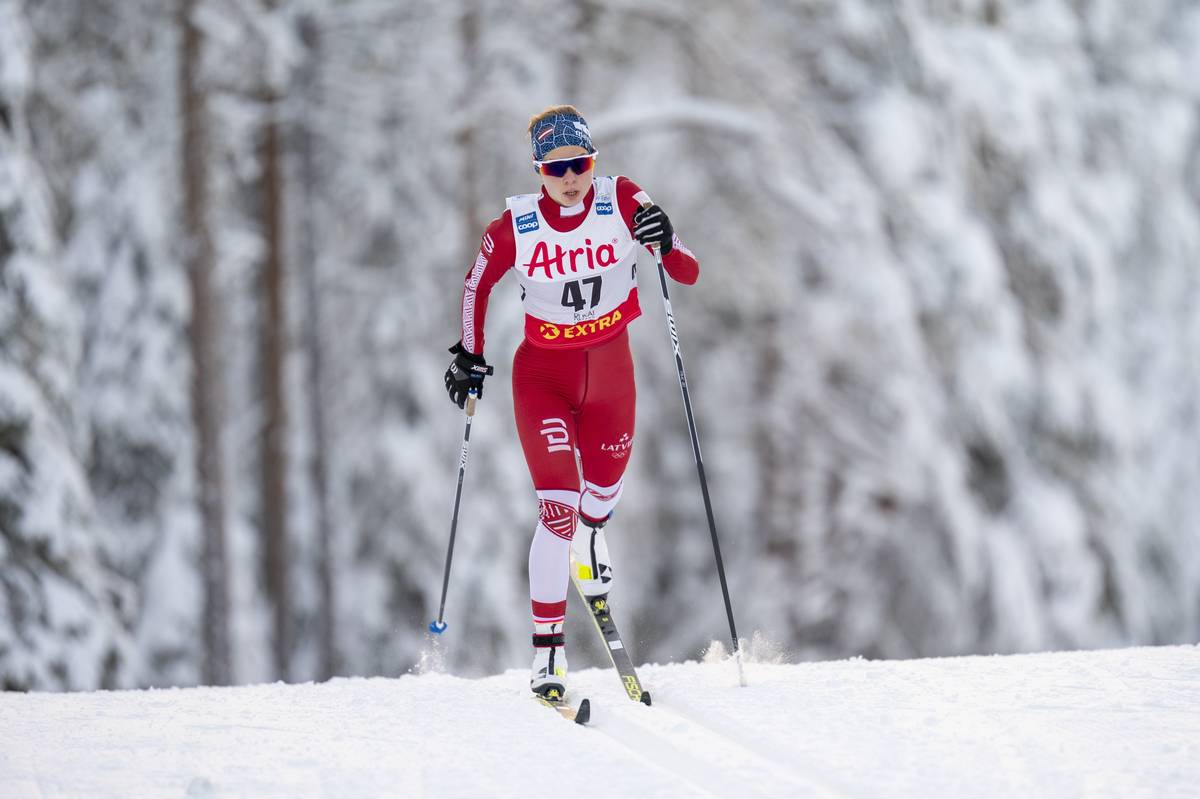
Latvia’s Patricija Eiduka races at a World Cup in Finland. (Vianney THIBAUT/NordicFocus)
This World Cup coverage is made possible through the generous support of Marty and Kathy Hall and the A Hall Mark of Excellence Award. To learn more about A Hall Mark of Excellence Award or to learn how you can support FasterSkier’s coverage please contact info@fasterskier.com.
Following the men’s Olympic 50-turned-28.6 k in Zhangjiakou, long-time American distance champion Kris Freeman and Devon Kershaw called Scott Patterson an “Olympic Specialist”, commenting on how Patterson had found many of his top results at either World Ski Championships or during the Olympics in PyeongChang and Zhangjiakou.
His top championship results are this: 8th in the 30 k free in Beijing, 11th in the 15/15 k skiathlon; 14th in the skiathon and 10th in the 50 k classic during the 2021 World Ski Championships in Oberstdorf, Germany; 21st in the skiathlon in the skiathlon during the 2019 World Champs in Seefeld, Austria; 18th in the skiathlon, 21st in the 15k skate and 11th in the 50 k classic during the 2018 Olympics in PyeongChang.
Until today, Patterson had raced into the Top-20 on the World Cup five times individually, with his best result – and only other individual Top-10 – arriving in 2017 in the 30 k skiathlon during a pre-Olympic World Cup in PyeongChang. This event saw just 31 finishers, and a scan of the results sheet shows only a small number of names that frequent this site.
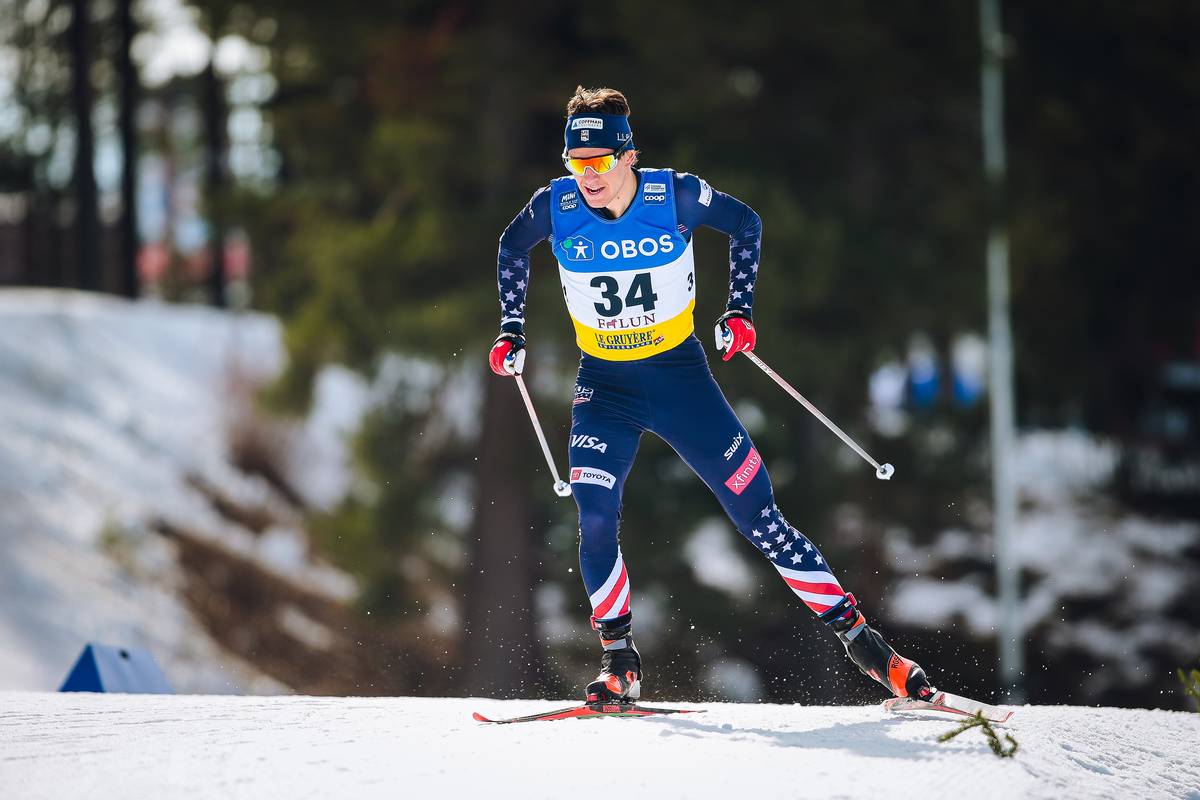
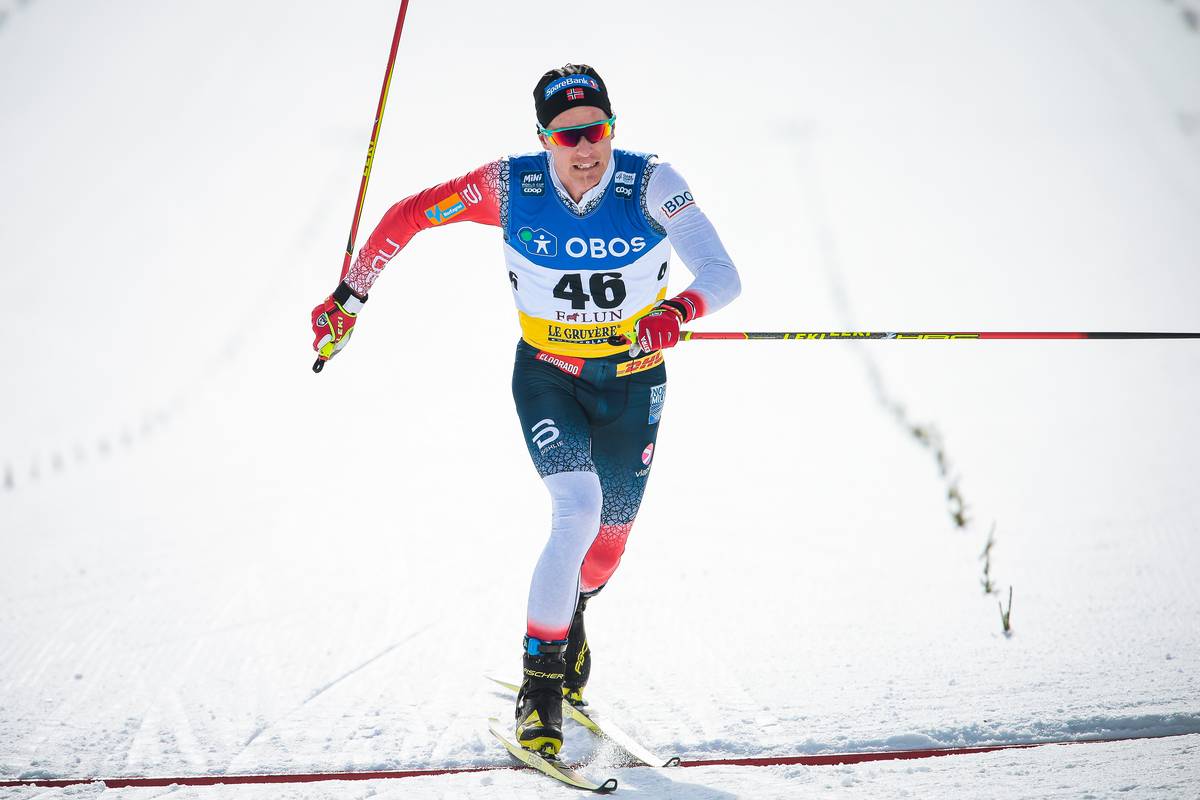
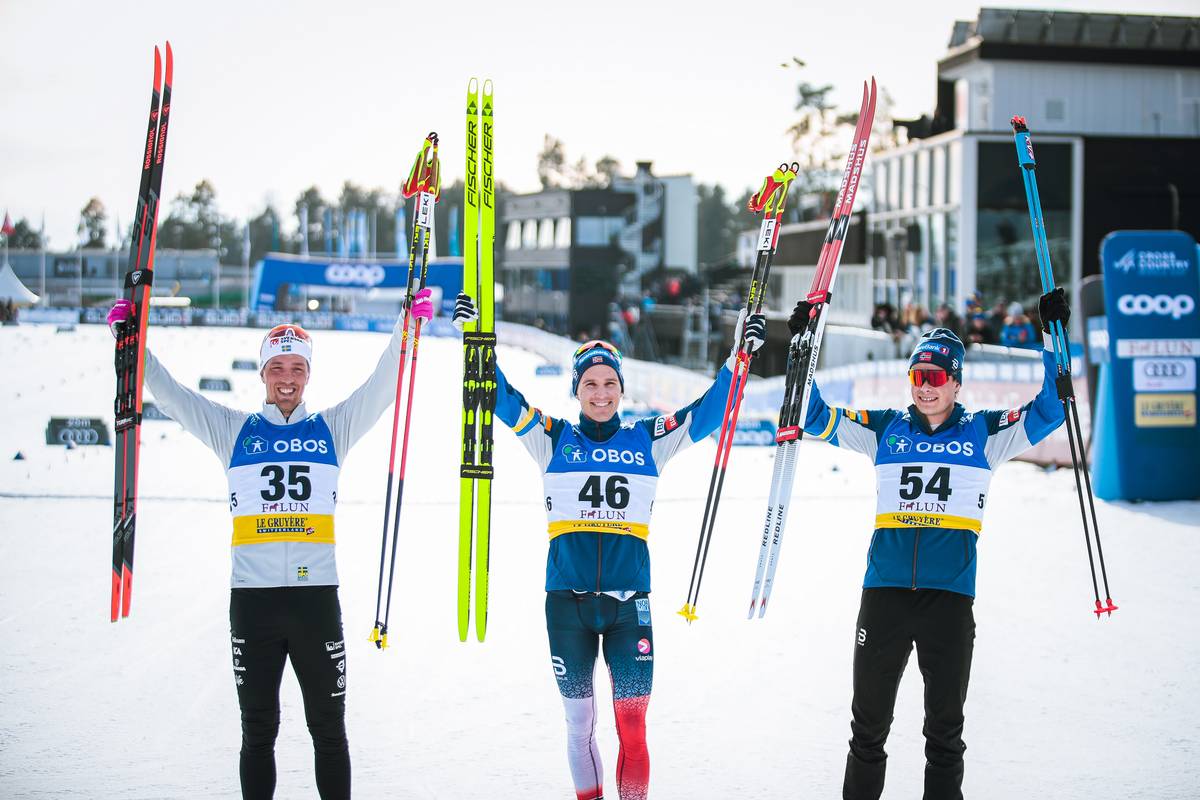
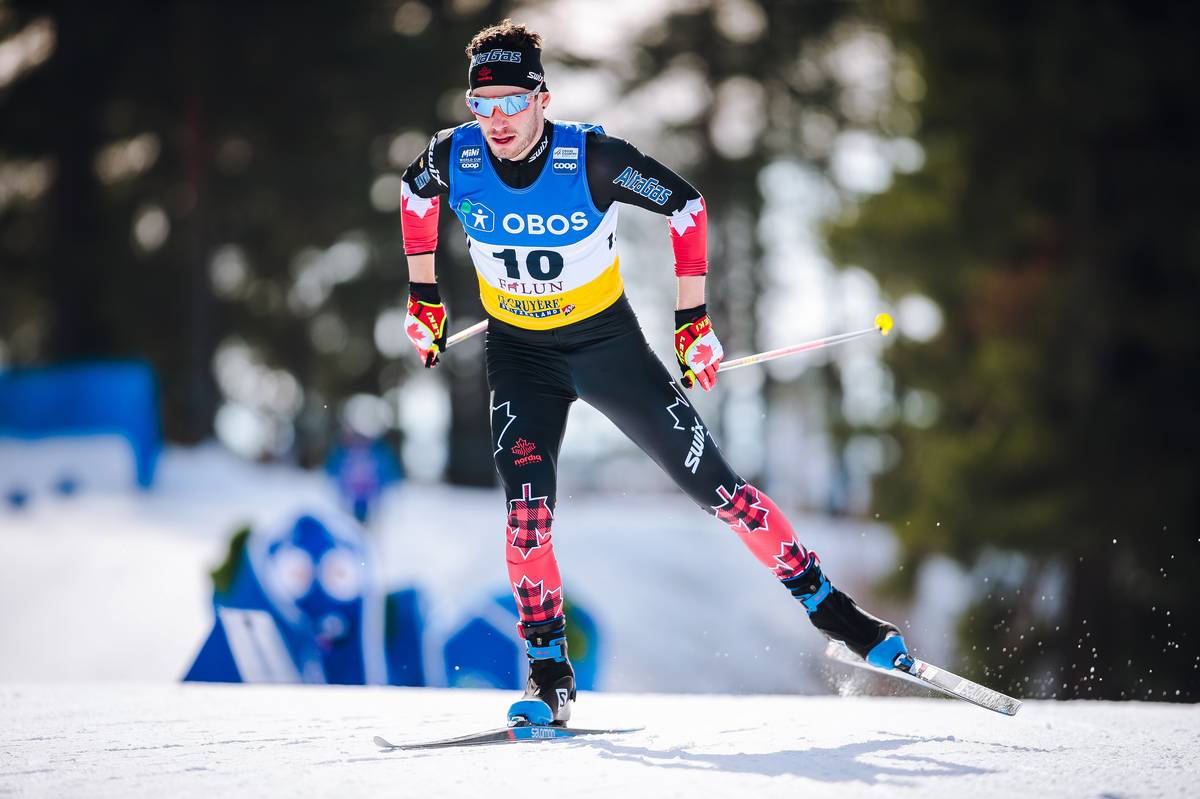
Scott Patterson races to 7th place during the 15 k individual start skate in Falun. (Photo: NordicFocus)
But here in Falun, Sweden, Patterson popped a 7th place finish in the 15-kilometer individual start skate, finishing 42 seconds behind winner Didrik Tønseth (NOR) as the first non-Scandinavian athlete on the tails of five Norwegians plus Calle Halfvarsson of Sweden.
Roughly another 40 seconds back, Team Birkie’s Zak Ketterson was rolling too. In a steady effort that saw him inside the Top-20 throughout the day, he not only his first World Cup points, but finished 15th, +1:20.8 on Tønseth.
In short, Patterson and Ketterson shaped the final men’s distance race of the season into a high note for the U.S. And both men did it as early-starters, before the seeded group.
Zak Ketterson (bib 8) leads Logan Hanneman during the 15 k individual start skate in Falun. (Photo: NordicFocus)
Diving into the race, a winning strategy looked to be a conservative first of four laps on the championship-caliber course in Falun. While the top-three established themselves early, the eventual winner, Tønseth, did not make his charge for the win until the final lap. 23-year-old Harald Østberg Amundsen (NOR) was on top at the first lap, followed by Halfvarsson of Sweden, and then Tønseth. At the half, it was Halfvarsson on top, with Amundsen and Tønseth just under four seconds back. Then, Tønseth slowly turned the dial upward.
With one lap to go, Tønseth had five seconds on the Swede, and ten on his young countryman. With just over 2 k to go, this lead had grown to +13.3 seconds, of which he ceded very little through the finish. Tønseth stopped the clock at a ripping 31:57.6, knocking down the time of Halfvarsson who had started eleven bibs earlier. The Swede kept the second spot on the podium (+9.0), while Amundsen, who faded in the second half, kept pace from the back-half of the seeded group to finish third (+20.4).
Sweden’s Calle Halfvarsson sets the mark at the finish of the 15 k skate in Falun, while Scott Patterson races the final meters in the background. (Photo: NordicFocus)Norway’s Didrik Tønseth wins the 15 k individual start skate in Falun. (Photo: NordicFocus)
Today marked Tønseth’s second consecutive podium, after taking 3rd at Holmenkollen last weekend, and his career first World Cup victory in freestyle. It had been a nearly three year stretch since his previous World Cup podium, which took place in Québec City in March, 2019.
“I’m happy to end it like this,” Tønseth told FIS after the race. “This year has been pretty good, to finish it off with victories – I’m really happy with that. Considering the last two seasons before this one have been tough, and it was not working, but this one has been better and better, and I ended up at the top, so I’m really happy.”
Norway’s Didrik Tønseth wins the 15 k individual start skate in Falun. (Photo: NordicFocus)
On his season highlights, Tønseth continued, “For me, the most important is that my body works and I can train it. I can train hard, and things respond, and I’m happy to go ski fast.”
Asked his feelings on sharing the podium with teammate Amundsen, Tønseth said, “He is a rookie, but he showed last year, he is a good cross country skier. I’m happy for him to be on the podium and I’m happy to beat him as well.”
Falun’s 15 k skate podium: Didrik Tønseth (NOR) took the win ahead of Calle Halfvarsson (SWE) and Harald Østberg Amundsen (NOR). (Photo: NordicFocus)
Expanding on the conservative start – though the eventual podium athletes would simply reshuffle themselves throughout the race, the remainder of the top-10 saw some changes, like France’s Clement Parisse falling from fourth place at the halfway mark to 8th at the finish, and two Finns, Remi Lindholm and Iivo Niskanen, dropping from fifth and seventh at the first lap to 14th and tenth at the finish.
Meanwhile, the seemingly more patient starters, like Martin Løwstrøm Nyenget, who won last weekend’s 50 k classic at Holmenkollen, were climbing the rankings at time checks. Nyenget was in eighth at the half, before ascending to fifth at the finish (+23.6), just behind his teammate Hans Christer Holund, who took fourth (+21.2).
Both Patterson and Ketterson exemplified this tactic also, knocking off three spots each between the halfway mark and the finish. Propagating a banner day for North America, Canada’s Olivier Léveillé was also steadily climbing the ranks, moving up from 16th at 7.5k to finish 9th (+48.9). Léveillé’s teammate Antoine Cyr had skied up from 37th at the half to finish 25th (+1:42.3), while fellow Canadian Phillippe Boucher took 29th (+1:45.0) as the third member of his team inside the top-30.
Canada’s Antoine Cyr skis to 25th in Falun’s 15 k free. (Photo: NordicFocus)
While Patterson was 15th in Falun last year, and has aforementioned strong results on championship courses like this one, Patterson said in a post-race call that the venue has actually been a challenge for him through his career. Though it’s a championship course, it lacks the high altitude factor of Zhangjiakou, where Patterson thrived, and has just one major climb, the signature “Morderbakken” which rises 65 vertical meters over the course of roughly 0.6 k. Gaining from his experiences racing on this course, Patterson shared what he’s done to solve the puzzle.
“A lot of my approach today was trying to find some of the same feelings as last year, which was a lot of pushing hard, working through all the transitions. There’s a lot of time out there — beyond Morderbakken, there’s a lot of twisting down hills and gradual flats where it’s easy to lose time. But if you’re on form and thinking about it all the time, it’s a good place to gain time.”
Scott Patterson takes 7th place in the 15 k individual start skate in Falun. (Photo: NordicFocus)
Patterson also shared that he was unsure how his form would be today, as he was carrying fatigue from his performance at the Holmenkollen, which he identified as below his expectations.
“I started questioning my fitness. So it was nice to turn that around today with a good race and actually remind myself that I can ski well again and also appreciate a good distance skate race.”
Overall, the season has been one of high highs and low lows for the 30-year-old. A late-fall broken wrist inhibited his ability to capitalize on the fitness he built over the summer, along with his early-season results, which would be critical for making the 2022 Olympic team. Patterson discussed the turning point of his season, which will end on a high note.
“[I hit a] big turning point going into nationals, where I had a lot of pressure, but I felt like I was actually starting to find my form and race well. So that was one big point, just coming into nationals and actually pulling out those results to make the Olympic team. But also, just going into the Olympics, I I had a really good training block in Bozeman. I was staying with my parents instead of going over to Livigno, like a lot of the US Olympic team. And I think that was really productive for me getting some altitude training, but also just keeping the stress low, which really helped going into the Olympics.”
Here’s the full interview with Patterson, including non-race season highlights and how a trivia night in Lahti helped bring the North American contingent closer together, making today’s results even more exciting for Patterson to be part of.
Adam Martin pushes to the line at the finish of the men’s 15 k individual start skate in Falun. (Photo: NordicFocus)Canada’s Xavier McKeever down the home stretch in the men’s 15 k free in Falun. (Photo: NordicFocus)
Outside the Top-30 for the U.S., Crafttsbury’s Adam Martin skied to 44th (+2:20.9), while Logan Hanneman finished 52nd (+2:58.4), and Peter Holmes took 68th (+4:20.0). For Canada, Thomas Stephen was 61st (+3:32.2), while Xavier McKeever was 62nd (+3:36.9).
Post-race interview with Matt Whitcomb:
With World Cup individual racing now complete for the 2021/22 season, awards for both the overall and distance champions were handed out today in Falun.
Though he was 10th today, Finland’s Iivo Niskanen ended his season with 493 points, overtaking previous leader Alexander Bolshunov (RUS) to win the distance standings. Bolshunov remained in second, trailing by 75 points. After a remarkable Olympic run, Bolshunov missed the final two distance races on the World Cup following FIS’ ban of Russian and Belarusian athletes on March 1st. Also unable to compete in the final two World Cup distance events after contracting COVID-19, Johannes Høsflot Klæbo finished third, at an 80 point deficit.
Finland’s Iivo Niskanen is the 2022 World Cup distance champion. (Photo: NordicFocus)
With Niskanen still the only podium member present to accept his awards, this leaderboard was reshuffled for the overall standings. Having won the 2021/22 Tour de Ski and consistently proved his range beyond the sprint course, Klæbo ran away with the overall World Cup victory to finish with 1375 points. He’s had some cake, but receiving the crystal globe will have to wait for the time being.
Bolshunov held his ground in second place, 497 points back, while Niskanen took third in the overall standings, 631 points behind Klæbo.
A Norwegian coach accepts the overall World Cup crystal globe on behalf of winner Johannes Høsflot Klæbo. (Photo: NordicFocus)
You can expect more analysis on the seasons of these World Cup champions, but first, we’ve got one final day of World Cup racing on deck. The final day of racing in Falun will feature a mixed-gender 4 x 5 k relay in the morning, followed by a mixed team sprint in the afternoon.
This World Cup coverage is made possible through the generous support of Marty and Kathy Hall and the A Hall Mark of Excellence Award. To learn more about A Hall Mark of Excellence Award or to learn how you can support FasterSkier’s coverage please contact info@fasterskier.com.
After a warm and rainy fall, temperatures dropped just in time for the athletes arrival in Lillehammer, Norway this weekend. The original program for Saturday’s competition was a 30 k skiathlon but low snow conditions forced a last minute change and the race became a 15 k individual start skate. Between last season’s cancelled races due to COVID and this season’s snow shortage, the athletes will have to wait another year to return to the iconic course out of the Birkebeineren Ski Stadium. Instead, the race was held in the former Biathlon stadium where saved snow farming was already in store, creating a 3.6 k loop to be completed four times for the men. In spite of this, the scene at the start line was one of winter as the athletes lined up, jumping out of the start gate to light snow and 18 degrees Fahrenheit.
Arnaud Chautemps (FRA) and Hugo Lapalus (FRA), (l-r) after a snowy 15 k skate (Photo: NordicFocus)
While individual start races can often be about one or two skiers dominating splits from the start, today’s race was initially difficult to discern. For one, with fewer cameras on the course than this spoiled reporter has become accustomed to, the race was harder to follow visually. For another, after a concentration of Norwegian starters in the bib range of 31-42, many of the Russian men did not start for another ten minutes or more, with seeded red-bib wearing Alexander Bolshunov (RUS) starting a full fifteen minutes after the unseeded, and eventual winner, Simen Hegstad Krüger of Norway. As such, a rephrasing of the popular saying “don’t count your chickens until they’ve hatched,” to “don’t count on your position until you’ve crossed the finish line” aptly applies.
Simen Hegstad Krüger (NOR) looking strong on his path to victory (Photo: NordicFocus)
After the Norwegian men’s absence in the 15 k skate pursuit last weekend in Ruka, they appeared to be re-asserting their depth and strength in their home country, and it was clear through the early splits. But as more Russian’s headed out on the course it seemed that perhaps we would see a repeat podium sweep. At 3.7 k Sergey Ustiugov (RUS) had the fastest time, followed closely by Bolshunov (RUS) with another three of their compatriots in the top 10, while Hans Christer Holund and Johannes Høsflot Klæbo were the sole Norwegians in 5th and 10th respectively. At 6.1 k it was the Czech skier, Michal Novak, who held the lead while Krüger (NOR) had worked his way up, though the Russians still held places four through six, and nine.
Sergey Ustiugov (RUS) started hot, ultimately finishing outside the top twenty. (Photo: NordicFocus)Alexey Chervotkin (RUS) ends up the lone Russian in the top ten, finishing in fourth position. (Photo: NordicFocus)
However, as the race wore on the Russian’s began to fade quickly while the Norwegian wave rode to the front once more.
Skiing steadily Krüger (NOR) ticked off the kilometers, followed closely by his teammate Holund. At the 4.6 k mark, Krüger was in fourth, at 7.4 k he had the second fastest split, and by 9.8 k he had taken the lead. When early race leader, Ustiugov (RUS) crossed the finish line +1:08.7 behind the Norwegian for an eventual 24th place finish we saw Krüger flash a little grin to the camera from his place in the leaders chair. The only remaining question was Bolshunov (RUS) who started in bib 70.
Alexander Bolshunov (RUS) heads towards the finish (Photo: NordicFocus)
Through 6.1 k Bolshunov was in sixth position, at 7.4 k he was in first though he dropped to fifth at 8.3 k. When he passed 9.8 k in 6th it seemed clear that Krüger would take gold and sure enough, Bolshunov was unable to gain anything over the last 5 k, finishing in 14th, +44.3 seconds back from Krüger.
“It was such a tough race with Holund [starting] thirty seconds ahead of me,” Krüger told FIS after the race. “We had to give everything we had, I know he’s in good form and I gave everything to be in front of him. It was a good battle.”
Simen Hegstad Krüger (NOR) slides over the line, clinching his spot in the leader’s chairl. (Photo: NordicFocus)Hans Christer Holund (NOR) finishing strong for second place, behind him Sjur Røthe (NOR) finishes 9th. (Photo: NordicFocus)
Hans Christer Holund held steady for a second place finish, just 1.6 seconds behind his fellow countryman. The dark horse of the day was Martin Løwstrøm Nyenget of Norway, who moved from 10th place at 9.8 k to finish third, his first outright World Cup podium. (Nyenget was third in the Classic Pursuit stage of the 2020 FIS Ski Tour in Östersund and had the fastest time of the day).
Martin Loewstroem Nyenget (NOR) celebrates his third place podium finish (Photo: NordicFocus)
Thus it was another podium sweep for the men’s 15 k skate, this time the red, white and blue colors belonging to Norway. Indeed, if there were any doubts about their power as a nation, a quick look at the results would clear things up. With seven of the top ten places and ten of the top twenty, their presence is hard to miss. As Krüger said, “it was a good day for the Norwegian team.”
Norwegian men sweep the podium: Hans Christer Holund (NOR), Simen Hegstad Krüger (NOR), Martin Løwstrøm Nyenget (NOR), (l-r). (Photo: NordicFocus)
Leading the North American contingent, Gus Schumacher finished the day in 38th position, +1:39.6 behind Krüger but only about 18 seconds behind the 30th place skier. In a field with more Norwegian starters than a weekend hosted by a different country, this result is significant despite not being inside the FIS points.
Gus Schumacher (USA) skiing to 38th place (Photo: NordicFocus)
Behind him was Antoine Cyr of Canada in 42nd who finished 11th in the classic 15 k in Ruka last weekend. In an interview with FIS before the race, Cyr said, “Ruka is always a hard weekend for us because we come from North America, it’s a long way from home. But, it’s a good course and yeah, I was so happy with the result.” When asked about the different courses for this weekend’s races in Lillehammer Cyr answered, “This weekend is going to be hard, skating is not my strong suit, I prefer classic but, it’s the World Cup, like any other World Cup we’re going to give one-hundred percent”.
Antoine Cyr leads the Canadian men for the day (Photo: NordicFocus)
Following Cyr, the Canadian men finished 56th for Olivier Leveille (+2:28.3), 57th for Russell Kennedy (+2:28.6) and 69th for Graham Ritchie (+3:44.2).
Zanden McMullen was the second US finisher in 48th place (+2:03.9). He was followed by Hunter Wonders in 63rd (+2:52.3), David Norris in 64th (+2:54.3), Ben Ogden in 67th (+3:32.2) and Scott Patterson in 70th (+3:35.8).
Today marked Patterson’s return to the World Cup following a recent surgery on his right wrist. While cleared by his doctors to race, Patterson still remains compromised and does not yet feel he is on form for World Cup racing. Here is some additional insight he provided via email.
“My wrist is improving, but is definitely still limiting my racing,” Patterson wrote. “I’m just over 5 weeks out of surgery. In order to protect the repair, I have been skiing in a brace and raced in that today. While this removes a lot of the stress from my wrist itself, it does modify my technique and make certain elements of skiing considerably more difficult. Today in racing, I felt that with the brace my wrist itself was ok, but the balance of my energy expenditure was thrown off. In racing, I was unable to really utilize my upper body. On a steady grindy course like today, that meant that I was working my legs way harder than necessary for the speed I was skiing. This resulted in the feeling of never aerobically taxing myself while still just skiing tired. I also feel that my recent training has been a lot of threshold and I’m not quite ready for race efforts.
“I knew coming into today that I was a bit underprepared for racing. In prioritizing my wrist recovery, I have not done any time trials and was even limited in intervals recently by a cold I caught in the weeks before travel. Overall, I feel that my fitness is pretty good, but I need a little time to find race form and figure out how to manage my wrist recovery while minimizing limitations. I am working towards skiing and racing without a brace, but even once I remove the brace it will take some time to regain trust in the strength of my wrist. The bit of skiing I have done without it feels very naked and unprotected. I also need some time to build back into skiing transitions well and pushing V2 into the hills which were both laid wayside with all my one pole skiing.”
Scott Patterson races his first World Cup of the season, five weeks post-op from a surgery on his right wrist. A brace can be seen adding bulk under this glove. (Photo: NordicFocus)
Keeping focus on the long game, Patterson concluded with his approach to Period 1 as he eases his way back into racing.
“For now I am putting all my energy into wrist recovery and taking the races one by one. Today was not the way I wanted to start, but there are a lot of factors around my wrist holding me back and I’m still feeling on track for goals later in the season.”
Racing continues tomorrow a 4 x 7.5 k relay to finish out the long weekend in Lillehammer.
Yellow bibbed as the overall leader of the World Cup, out first on Sunday’s 30 k classic pursuit in Trondheim, and Norway’s Pål Golberg starting 34 seconds back: this was the situation Russia’s Alexander Bolshunov found himself in as he pulsed from the start. Thrown into this mix of tension was a helter-skelter mish-mash of weather. On and off again snow, blustery winds, and temps hovering right near that wax tech’s no man’s land of 0 °C.
We are not used to seeing Bolshunov falter. He has been a beast this season having won the Tour de Ski and hammering away from the field solo during this tour’s Stage 4 34 k mass start skate. Those are simply two highlights. But there he was, perhaps humbled by less than stellar skis on Sunday; the big Russian bear faltered.
Alexander Bolshunov of Russia — the hunted on Stage 6. (Photo: NordicFocus)
This was Golberg’s day. By 2.2 k he had nearly halved the gap to Bolshunov. Two k later, Golberg was on the Russian’s ski tails, with Bolshunov’s metaphorical tail beginning to droop between his legs. A Russian down — Golberg on his own solo quest for the win.
For the next 26 k, Golberg’s job was no longer to fend off Bolshunov, but to keep a motivated crew of Norwegian’s from gapping up. We’ll get to that piece of the story in a bit. Golberg won with a polite bow to the crowd in 1:23:51.6. This was the twenty-nine-year-old Golberg’s second win of the season. He won a classic sprint in Falun, Sweden earlier this month. His effort, and lovely skis on a day that saw several skiers stop and scrape ice off their kick zones, earned him the Ski Tour overall win.
“It’s surreal and something I did not expect before the Ski Tour and before the season,” Golberg told FIS after the race. “The crowd started to congratulate me on the third round so I had to stay focussed until the finish.”
Head down and driving for the win: Pål Golberg of Norway. (Photo: NordicFocus)
Pål Golberg on his solo winning effort. (Photo: NordicFocus)
Back to the chase – which was really a Norwegian hunt for that Russian bear. We’re going to begin with the hunters: Martin Løwstrøm Nyenget, Simen Hegstad Krüger, Johannes Høsflot Klæbo, Hans Christer Holund, Emil Iversen, and Sjur Røthe. (Imagine having that crew team trialing behind.) Maybe grotesque in their spoils, but certainly dogged in their pursuit, this all Norwegian chase was symbolic of a country’s ability to foster otherworldly endurance talent, and keep them fresh enough to crush the field in a six-stage tour. It was literally a train of Norwegian skiers who had likely been shadowing one another at the elite level since their late teens.
They slowly reeled Bolshunov in. At 13.9 k, the Russian kept a 14-second buffer between he and the Norwegians. Ultimately, this was no catch and release scenario. Bolshunow was swallowed near the 16 k mark. Another three k later, all but Røthe kept pace, the others gapped Bolshunov by nine seconds.
The Norwegians forged ahead, while Bolshunov, digetsing the inevitable, tried to minimize losses. Krüger, known for his skating, took strong pulls in the closing kilometers. He crossed the line in second (+28.9). Holund placed third (+30.1), Iversen fourth (+32.3), Nyenget fifth (+32.9), and Klæbo sixth (+34.2).
The Norwegian train during Stage 6 of the Ski Tour 2020. Hans Christer Holund (bib 8), Emil Iversen (bib 10). (Photo: NordicFocus)
Sjur Røthe leading out: State 6 Ski Tour 2020. (Photo: NordicFocus)
Simen Hegstad Krüger (front) down the finish straight to take second overall. (Photo: NordicFocus)
Bolshunov settled for seventh place (+1:41.0), ceding roughly 1:10 to that lead Norwegian group, as he lost grip on the Ski Tour overall. His demeanor across the line matter of fact: he unlocked his bindings as he glided across the line, stepped out his skis, then proceeded through the finish area without acknowledging the all-Norwegian scrum in the finish pen.
As for time of day efforts, the fastest time goes to Iversen in 1:21:25.9. Finland’s Iivo Niskanen notched the second-fastest time 10.9 seconds back. Niskanen placed eighth on the stage (+1:48.2). For his troubles, Bolshunov skied the 23rd fastest time, 4:06.7 off of Iversen’s best of day mark.
The look of missing out: Alexander Bolshunov after finishing Stage 6 of the Is Tour 2020. (Photo: NordicFocus)
David Norris led the day for the U.S. ending the day and the Ski Tour ranked 34th (+11:30.7). Ben Lustgarten placed 54th (+19:29.5). The remaining U.S. skiers who began the tour, dropped from competition after Stage 6. They include Logan Hanneman and Kevin Bolger who both have mild colds. Simi Hamilton dropped after Stage 4 with a mild illness as well.
Canada’s Russell Kennedy placed 39th (+12:50.5), Evan Palmer-Charrette 43rd (+14:33.2), Alexis Dumas 55th (+20:12.5), and Ricardo Izquierdo-Bernier 56th.
This concludes the epicness from Norway, as the Ski Tour closes out. Racing begins again in Lahti, Finland next Saturday.
Picking up where we left off in Östersund, Sweden: a pursuit start 15-kilometer classic. Unlike the women’s field where Therese Johaug “administered a beatdown”, creating a large time gap for herself, the margins for the men were much smaller.
This year’s Tour de Ski winner Alexander Bolshunov of Russia, whose winning streak was interrupted, would start with a 22 second time deficit in fifth. Tenth place Ivan Yakimushkin (RUS) was 33 seconds back and Jens Burman (SWE) in 20th just inside a minute.
Alexander Bolshunov during Stage 2’s 15 k classic pursuit of the Ski Tour 2020. (Photo: NordicFocus)
With four 3.75 k laps to cover, the deficits were manageable. Perhaps the only Tour victory hopeful who was kept up about the work that needed to be done was Johannes Høsflot Klæbo, who would start 1:23 behind the leader after finishing 31st the day before.
The caveat would be to stay upright while navigating the icy winding bends of the primarily man made track. With grey skies and above-freezing conditions, it was fast and dicey, made evident by numerous crashes.
During one particularly noteworthy four-person pileup, Kamil Bury of Poland was taken out by Italy’s Maicol Rastelli as the two navigated a treacherous right hand turn at the bottom of a steep descent. Though neither had full control, Rastelli slid off the left side of the course, taking Bury along with him. Bury lost a ski and became tangled in the netting.
Just before impact… (Photo: Screenshot NBC/FIS Broadcast)
As Rastelli stood up and worked to right his skis, which were pointing in opposing directions, a third skier, Lin Bao of China, essentially slide tackled Rastelli, sending him in a complete backflip back down to the snow.
A fourth skier, Tadevos Poghosyan of Armenia, also lost control and slid into the pile. Bao and Poghosyan were able to stand up relatively quickly and continue on their way, but cameras cut away before the resolution of whether Bury found his ski and Rastelli was able to recover from his forced aerials.
Holy carnage… back to the race.
At the end of the first lap, it was as if the men were gifted ready-made groups. Røthe and Krüger matched stride for stride and double pole for double pole, while the remainder of the top five plus a handful of additional Norwegians, namely Pål Golberg, Hans Christer Holund, and Martin Løwstrøm Nyenget, chased from roughly six seconds back.
In bib 11, Martin Løwstrøm Nyenget (NOR) works his way towards the sharp end of the men’s 15 k classic pursuit. (Photo: NordicFocus)
It looked as though Røthe and Krüger might run away from the field, but it was not so easy. By 4.4 k, the gap was closed and an eight-man train chugged along the tracks. As Yakimushkin had fallen off the pace, it became seven Norwegians and Bolshunov.
Over the final two laps, the front pack whittled down from eight to five, where it remained with one k to go. Holund, Golberg, Røthe, Bolshunov, and Nyenget. The Russian in the yellow bib was primed to make a move.
Bending, rolling, and swooping, they headed for the stadium. Up the final punchy climb, Golberg and Bolshunov were side by side, and Golberg started to slip. He recovered and powered out of the climb, running with Klæbo-like dominance over the crest of the hill and into a tuck to lead into the stadium.
Bolshunov had fast skis and caught a draft before whipping into second place as the men entered the final straight. The Russian was right behind Golberg and absolutely charging. But there was not enough real estate. He changed lanes to challenge the Norwegian and looked as though he would overtake him, but the final meters evaporated and Golberg threw his foot for a clear win.
A lane switch wasn’t enough for Alexander Bolshunov as Pål Golberg of Norway takes the win. (Photo: NordicFocus)
Pål Golberg about to toe – during the 15 k classic pursuit, Stage 2 of th Ski Tour 2020 in Östersund, Sweden. (Photo: NordicFocus)
Golberg crossed the line in 34:50.8, with Bolshunov 0.3 seconds behind. Nyenget took third (+2.1) in a tight finish with Røthe (+2.5). Holund dropped off in the final sprint to round out the top five (+7.3).
Pål Golberg wins at the line over Alexander Bolshunov during the 15 k classic pursuit, Stage 2 of th Ski Tour 2020 in Östersund, Sweden. (Photo: NordicFocus)
“Perfect klister conditions,” Golberg told FIS at the finish. “I managed to get the ski pair from last weekend, so I had good skis this weekend as well. It was a really, really good day.”
The interviewer noted that conditions were much different than the previous day.
“It was hard in the middle,” Golberg explained. “It was a bit drier, so a bit difficult with klister in the downhill. But the tracks were perfect, so I’m really happy.”
Not the start of the FIS Ski Tour 2020 desired by Johannes Høsflot Klæbo. (Photo: NordicFocus)
Speaking of Klæbo, the Norwegian skied his way into 25th, but ceded an additional 52 seconds in the overall standings by finishing 2:15 back on the leaders.
FIS sent out a news brief shortly after the race with information regarding Klæbo’s injured finger. Here is the statement in full:
“Johannes Høsflot Klæbo (NOR) has to undergo an emergency check up for his broken finger. The check up has to take place with his doctor in Trondheim (NOR). As the rules of the FIS Ski Tour 2020 state no other transportation of athletes than by train, the jury gave permission to Johannes to travel by car to Trondheim and back to Åre for this special case. After the consultation, the jury will receive a report of the treating medical team in Trondheim.”
Leading again for the U.S., David Norris skis to 34th. (Photo: NordicFocus)
Stride and glide, Simi Hamilton climbs in Östersund, Sweden. (Photo: NordicFocus)
The American men hovered near their positions in Stage 1 at the end of the pursuit. Still grinding, David Norris finished 34th (+3:05.0), followed by Simi Hamilton in 43rd (+3:47.8).
Ben Lustgarten was the next American in 68th (+6:01.4), followed by Kevin Bolger in 70th (+6:12.7), and Logan Hanneman in 85th (+10:00.2).
Ben Lustgarten in the mix during the classic pursuit in Östersund, Sweden. (Photo: NordicFocus)
Racing for Canada, Russell Kennedy was again the top skier in 58th (+4:47.3). Next up was Alexis Dumas in 61st (+4:51.9), and Evan Palmer-Charette in 66th (+5:33.7).
Tomorrow is a rest day on the Ski Tour 2020, Stage 3, a skate sprint, will be held on Tuesday.
The men’s Stage 2 Ski Tour 2020 15 k classic pursuit podium: Alexander Bolshunov (RUS) second, Pål Golberg (NOR) first, and Martin Løwstrøm Nyenget (NOR) third, (l-r). (Photo: NordicFocus)
Ustiugov claims his 8th stage win in the opening event of the 2019/2020 Tour de Ski. (Photo: NordicFocus)
The starting corral was blocked by a wall of red before the start of the 15-kilometer mass start freestyle in Lenzerheide, Switzerland. Of the top ten ranked athletes, eight hailed from either Norway or Russia, interrupted only by Iivo Niskanen of Finland and Lucas Chanavat of France.
Johannes Høsflot Klæbo thanks his supporters before climbing into the second spot on the podium after the first stage of the 2019/2020 Tour de Ski. (Photo: NordicFocus)
Front and center was last year’s victor Johannes Høsflot Klæbo. He became the youngest Tour de Ski Champion at 22 years of age after holding off Russia’s Sergey Ustiugov who was gaining on the Norwegian throughout the final climb up the Alpe Cermis. It was clear in the final meters that there was no showmanship or gamesmanship in this performance; the young star was fully spent as he collapsed over the line.
Now an aged and wizened 23-year-old working on his tactics and gears in distance racing, Klæbo aspires to become the second man in history to win consecutive tours. Swiss athlete Dario Cologna did this in 2011 and 2012.
Klæbo is not a lock for this achievement — today’s opening stage made that abundantly clear. He will need to hold off the likes of Sergey Ustiugov and Alexander Bolchunov (RUS), Niskanen, Emil Iversen (NOR) and an otherwise deep field all vying for the same goal.
“I will try my best and I will count [my time] after the last day,” Klæbo told FIS during a pre-race press conference.
With the starting pistol marking the start of the nascent tour, the men began soaring around the course, through snow laden pine forest in front of high mountains emerging from their wreath of snow.
For the first 10 k, the field held strong in a long train. The top men, who stemmed from the first row of the start line, regularly exchanged the lead and the top 40 were separated by 10 seconds. Though the pace began to accelerate, the top ten were only spread by three seconds with 1.5 k to go.
A dense pack of skiers during the first stage of the 2019/2020 Tour de Ski, a 15-kilometer mass start freestyle. Logan Hanneman can be found on the right side of the image wearing bib 85. (Photo: NordicFocus)
Moves and countermoves. With 1 k to go, Ustiugov took charge. He rocketed off the front to create a gap to the lead pack. His teammate Bolshunov was three seconds back, along with Cologne, Iversen, Klæbo, and their Norwegian teammates Simen Hegstad Krüger and Sjur Røthe.
Ustiugov managed to maintain his gap and flew through the final straightaway in a confident V2. In the screen behind him was a pack of men whose final standings were far less certain. Klæbo and Bolshunov were dueling tête-à-tête in a sprint to the finish, sliding their boots over the line in sync for a photo finish. It was decided that Klæbo edged out his competitor for second, though he and Bolshunov will both enter the second stage of the tour four seconds behind Ustiugov.
Johannes Høsflot Klæbo (NOR) and Alexander Bolshunov (RUS) slide across the line in a photo finish at the end of the first stage of the Tour de Ski. (Photo: NordicFocus)
Iversen surged for 4th (+7.2) ahead of his countryman Martin Løwstrøm Nyenget (+8.6) who bested Tour de Ski veteran Cologna, Hans Christer Holund, Jan Thomas Jenssen, and Sjur Røthe in a five-way photo finish. Finishing in the order listed, the five men were separated by a margin of 0.4 seconds. Krüger rounded out the top ten one second later (+10.0).
Dario Cologna (bib 24) finishes amongst a herd of men vying for position at the end of Stage 1 of the 2019/2020 Tour de Ski, a 15-kilometer mass start skate in Lenzerheide, Switzerland. (Photo: NordicFocus)
“It was a really good performance and the shape was okay,” Ustiugov told FIS through a translator at the finish. “It was for sure a pleasure to win the first stage and I wish to show the same results on the next stages. Big thanks to Russian fans because it’s a really big pleasure to hear Russian people [cheering] here in Switzerland. It’s great.”
Russia’s Sergey Ustiugov celebrates his victory after the first stage of the 2019/2020 Tour de Ski, a 15-kilometer mass start skate. (Photo: NordicFocus)
Today’s victory marks the Russian’s eighth win in a TdS stage, advancing him to the second most behind Petter Northug who has 13 wins. The winner of the 2016/2017 TdS, Ustiugov has reached the overall podium in three of his last four rounds, only missing the final TdS podium in the 2017/2018 tour where he withdrew after the 5th stage. The Russian also won the first distance stage of last year’s TdS.
The men’s podium of the first stage of the 2019/2020 Tour de Ski, a 15-kilometer mass start skate in Lenzerheide, Switzerland. Sergey Ustiugov (RUS) took the win over Johannes Høsflot Klæbo (NOR) and Alexander Bolshunov (RUS) who were second and third, respectively, in a photo finish. (Photo: NordicFocus)
Three Americans started in Lenzerheide. David Norris finished as the top ranked American in 58th (+1:11.2). Kevin Bolger finished 64th (+1:35.0), followed by fellow Logan Hanneman in 69th (+1:42.1). Simi Hamilton was slated to start, but withdrew from the TdS due to a pulled muscle in his groin.
For the first nine kilometers, Norris hovered on the cusp of the top-30. After the race, Matt Whitcomb explained the energy-expenditure challenges of racing in this position, along with the strategy of sprint specialists Bolger and Hanneman.
Post-race interview with Matt Whitcomb on men’s performance.
“This was a fun mass start – fast and flowing,” wrote Norris explained an email after the race. “For the first 12km or so I felt really comfortable in the group. I tried to ski relaxed and avoid any of the chaotic crashes and tangles that seemed to occur each lap. With about 2 km to the finish I felt great and my skis were running well, but all of the sudden I bonked incredibly hard – got tunnel vision and struggled to avoid tripping on myself. It was a tough way to finish the race, but I’m optimistic I have better days ahead in this tour.”
Swiss flags flying against a breathtaking backdrop. Wearing bib 77, Kevin Bolger can be found at the center. (Photo: NordicFocus)
The start of the men’s 15 k classic mass start at Stage 6 of the 2018 Tour de Ski on Saturday in Val di Fiemme, Italy, with (front row, left to right) Canada’s Alex Harvey, Russia’s Sergey Ustiugov, Kazakhstan’s Alexey Poltoranin, Norway’s Martin Johnsrud Sundby, and Switzerland’s Dario Cologna. (Photo: Salomon/NordicFocus)
Beginning this Saturday in Toblach, Italy with a freestyle sprint is the 13th edition of the Tour de Ski (TdS). According to the International Ski Federation (FIS), over the course of seven stages the men will race 80.918 kilometers, the women 60.67 k.
The TdS has become both a staple and a spectacle of the annual World Cup calendar. With a jam-packed series of races primacy is placed on both the ability to recover well and wither less as the TdS transpires.
Prognostication can be tricky in a long-form template like the TdS. So much can go astray during seven races not to mention the travel and dicey germ-avoidance.
Last season’s winner on the women’s side, Heidi Weng of Norway, sits 18th overall in the World Cup standings (14th in distance). She has four top-20’s in the four distance events she’s contested with her best result an eighth in Lillehammer’s 10 k skate. Although featuring two sprints in the first three stages, the TdS remains a distance skier’s paradise.
Weng has skied solidly on the World Cup, but she has yet to show the form that made her a TdS overall winner in 2017 and 2018. Norway has won the last five iterations of the TdS: Marit Bjørgen won once in 2014/2015, Therese Johaug twice (2013/2014, 2015/2016), and Weng the last two years.
Austria’s Teresa Stadlober leads Norway’s Heidi Weng (2) and Ingvild Flugstad Østberg, American Jessie Diggins (3) and others around a downhill corner during the women’s 10 k classic mass start at Stage 6 of the 2018 Tour de Ski in Val di Fiemme, Italy. (Photo: Fischer/NordicFocus)
If Norway is to keep the streak alive, Ingvild Flugstad Østberg, last year’s TdS runner up, could be the heir apparent. She currently ranks second in the World Cup overall and 15th on the sprint list.
Johaug, having returned from an 18 month doping ban, has been on a distance race tear. She has won all five World Cup distance events this season. Johaug, however, will not be lining up for the TdS.
Only five different women have earned distance podiums this season — Johaug, Østberg, Sweden’s Charlotte Kalla and Ebba Andersson, and Finland’s Krista Pärmäkoski. Along with Johaug, Kalla and Andersson are skipping the TdS. (Andersson sits third overall on the World Cup, Kalla fifth.) With the TdS missing three of the five top ranked World Cup distance skiers, daily stages and the overall podium are up for grabs.
Last season’s third overall finisher, Jessie Diggins of the U.S. Ski Team (USST), often cites the TdS as a point in the season when her form trends towards podium performances. She sits eighth in the current distance standings and could very well have a stout TdS.
Russia’s Natalia Belorukova and Yulia Nepryaeva look strong as does Sadie Bjornsen (USST), and Austria’s Teresa Stadlober.
With less than predictable distance stage podiums for the women, it may simply come down to a drag race on the Alpe Cermis final climb Jan. 6.
Switzerland’s Dario Cologna (c) celebrates his fourth Tour de Ski overall title. He was joined by Norway’s Martin Johnsrud Sundby (l) and Canada’s Alex Harvey (r) on the podium in second and third, respectively. (Photo: Fischer/NordicFocus)
The men’s scene is also open to interpretation. Last season’s TdS winner, Switzerland’s Dario Cologna, was in fact a surprise victor. Prior to Cologna’s stage two win in last year’s TdS, it had been nearly three years since the four time TdS overall winner had won a World Cup. Cologna sits 21st overall on the World Cup currently. Given last year’s resurgence, anything is possible for the Swiss skier.
Then there’s Martin Johnsrud Sundby form Norway. He finished on the TdS podium the last three years. At thirty-four-years-old, Sundby is ranked first on the distance list, with a second, a third, and a fourth place in distance races this season.
Sundby won the TdS on two occasions – in 2013/2014 and in 2016. His 2015 win was stripped after he tested positive for excessive levels of Salbutamol. He placed second in the past two Tours.
In a field rife with talent, Sundby’s ability to race and rebound and race and rebound will be tested. Sjur Røthe, Emil Iversen, and Didrik Tønseth— all from Norway— look in form. And there’s Norway’s Johannes Høsflot Klæbo. The winner of last season’s overall World Cup has had flashes of his past explosive self. He could be a TdS protagonist.
The men’s field is notably tight. Along with the Norwegians, several Russians could pop a podium, a stage win, and the overall. Russia comes with a loaded team ready to exploit. Alexander Bolshunov leads the overall World Cup – he’ll turn twenty two on Dec. 31st. He’s backed by teammates Evgeniy Belov, Andrey Melnichenko, and Denis Spitsov.
Canada’s Alex Harvey placed third overall last year and he looked stronger as the TdS progressed.
The Stages
Stage 1: Dec. 29, skate sprint in Toblach, Italy.
Stage 2: Dec. 30, 10 k/15 k skate in Toblach, Italy.
Stage 3: Jan. 1, skate sprint in Val Müstair, Switzerland.
Stage 4: Jan. 2, 10 k/15 k classic mass start in Oberstdorf, Germany.
Stage 5: Jan. 3, 10 k/15 k skate pursuit in Oberstdorf, Germany.
Stage 6: Jan. 5th, 10 k/15 k classic mass start in Val di Fiemme, Italy.
Stage 7: Jan 6th, 9 k final climb skate pursuit in Val di Fiemme, Italy.
Teams
United States
Women: Sophie Caldwell, Sadie Bjornsen, Jessie Diggins.
Men: Ben Lustgarten, Simi Hamilton, Erik Bjornsen, Kevin Bolger.
U.S. Ski Team Head Coach Chris Grover noted in a text that Caldwell, Hamilton, and Bolger will likely cease the TdS after the stage three sprint. Additionally, this is a small team for the U.S. at the TdS. Several athletes turned down TdS nominations including Scott Patterson (USST), Andy Newell (SMS T2/Salomon), Kyle Bratrud (SMS T2), Rosie Brennan (APU), Rosie Frankowski (APU), Caitlin Patterson (CGRP), and Julia Kern (SMS T2). These skiers plan on racing U.S. Nationals this January in Craftsbury, Vermont.
Canada
Women: Emily Nishikawa, Dahria Beatty
Men: Alex Harvey, Lenny Valjas, Bob Thompson
Norway
Women: Ingvild Flugstad Østberg, Maiken Caspersen Falla, Astrid Uhrenholdt Jacobsen, Kari Øyre Slind, Kathrine Rolsted Harsem, Heidi Weng, Lotta Udnes Weng, Tiril Udnes Weng Mari Eide, Anna Svendsen
Men: Martin Johnsrud Sundby, Hans Christer Holund, Emil Iversen, Didrik Tønseth, Simen Hegstad, Krüger, Sjur Røthe, Johannes Høsflot Klæbo, Martin Løwstrøm Nyenget, Eirik Brandsdal, Finn Hågen Krogh
Russia
Women: Yulia Belorukova, Lidia Durkina, Anna Zherebyateva, Mariya Istomina, Natalia Nepryaeva, Anna Nechaevskaya, Anastasia Sedova, Elena Soboleva
Sjur Røthe (Norwegian National Team) double poling his way to a win in the first race of the 2015/2016 season, a 15 k classic FIS race in Beitostølen, Norway. (Photo: Eirik Lund Røer/SKIsport)
What’s the first race of the season without a little drama?
Norway’s defending World Cup champion Martin Johnsrud Sundby got DQed in Friday’s 15-kilometer classic race, one of the first International Ski Federation (FIS) races of the season, in Beitostølen, Norway. Germany’s Tim Tscharnke was also disqualified, along with a 27-year-old Norwegian club skier Daniel Myrmæl Helgestad, of Henning SL.
According to a media announcement from the Norwegian Ski Federation, the jury ruled all three skated in the deteriorating tracks. FasterSkier obtained video of each apparent violation.
“I don’t really know when and where the jury might have seen this infraction,” Sundby, 31, said in a post-race TV interview with NRK.
The final starter out of 143 men, he had initially posted the winning time — and did so with a broken rib.
“I don’t agree with [the jury’s] decision, but there is no point in arguing about it,” Sundby continued. “There were a lot of racers on the course, and when I started as number 143, the tracks were chewed up. I don’t know, maybe the jury had decided that they wanted to show that they are going crack down hard on any violation of the skating rule. The good thing is that my body felt good, the rib felt fine and I felt like I had a good race. It’s good to see that focusing on double poling pays off.”
He was one of several who raced the four-lap time trial on skate skis. One of his fellow national-team members, 27-year-old Sjur Røthe took the win in 37:59 by double poling the entire course as well. He beat runner-up Martin Løwstrøm Nyenget of the Lillehammer Skiklub by 51 seconds, and Hans Christer Holund (Lyn Ski) was over a minute back in third (+1:08.7).
Germany’s Jonas Dobler leads Tord Asle Gjerdalen in the first race of the 2015/2016 season, a 15 k classic FIS race in Beitostølen, Norway. Dobler finished eighth and Gjerdalen was 15th. (Photo: Eirik Lund Røer/SKIsport)
“I didn’t think I would win this race today, not before the race and not even after I had finished,” Røthe told TV reporters. “But it’s fun to win ski races.”
He said the best part was winning by exclusively double poling. The 139th starter, his 1.6 k time ranked eighth. He was up to first by 2 k, then slipped 14 seconds back to third at 3.8 k, and finally took control of the race for good at 5.4 k. That is, after Sundby was factored out of the results.
“I just now heard that Martin was disqualified, and it’s too bad he did,” Røthe said in the TV interview. “Yes, the tracks were not perfect and the conditions were a bit rough in places, but when you choose to double pole the course, you have to be extra diligent, especially now that they warned us all about being stricter than before.
“I’m really excited to win by double poling only,” he added. “The decision to go without kick wax was a combination of a couple of factors. The tracks and the snow conditions were tricky, and because of my back trouble, I was concerned that my wax would slip and I would re-injure my back. So I decided to just double pole.”
After leading at 1.6 k and hanging within the top three throughout the race, Nyenget, 23, was happy to finish on the podium.
“Whether I was second or third really didn’t matter so much,” he said. “It was great to have a good first race here, and see that the training I’ve put in this summer and fall is making a difference. It’s mostly important for my confidence, but I hope I will be able to ski lots of World Cup races this season and compete against the best in the world.”
Norway swept the top seven, with Jonas Dobler of Germany placing eighth. Canada’s Devon Kershaw finished 33rd, 2 1/2 minutes back from Røthe.
Francesco de Fabiani racing to his first World Cup win (and podium) in the Lahti World Cup 15 k classic on March 8, which was Italy’s first victory in a classic-distance race since 1997. (Photo: Fischer/NordicFocus)
No amount of fog or soggy classic conditions could dampen Francesco de Fabiani’s spirits on Sunday as the 21-year-old broke through an 18-year barrier for Italy with a World Cup classic-distance win in the men’s 15-kilometer individual start in Lahti, Finland.
After starting second in the seeded group in bib 22, de Fabiani took to the course 30 seconds after Norway’s Eldar Rønning and gradually worked his way into the three-lap race.
De Fabiani finally took the lead at 11.2 k, and from that point on, the young Italian — who had never been on the World Cup podium before — became untouchable. Kazakhstan’s Alexey Poltoranin came close, clocking through the checkpoint 3 seconds behind De Fabiani, and Finland’s Sami Jauhojärvi was 4.6 seconds out of the lead in third.
Out of 71 finishers, de Fabiani’s time at 3.4 k ranked 25th. By 6.2 k, he was up to 20th, and by 13.4 k, he remained 7.2 seconds ahead of Jauhojärvi in first.
“I was very motivated to show my best today after a disappointing performance in the 50 k in Falun last week,” de Fabiani told FIS after the race.
Exactly a week ago on March 1, the Italian placed 32nd in the 50 k classic mass start at World Championships in Falun, Sweden. Three of his teammates, Dietmar Nöckler, Giorgio Di Centa and Mattia Pellegrin, finished ahead of him in 12th, 22nd and 23rd, respectively.
But this Sunday was different. De Fabiani set the new time to beat at the finish, besting Norway’s Martin Løwstrøm Nyenget by 6.5 seconds to bump the 22-year-old Norwegian U23 team member out of the leader’s seat.
The men’s 15 k classic podium at Sunday’s World Cup in Lahti, Finland, with Italian winner Francesco de Fabiani (c), Kazakhstan’s Alexey Poltoranin in second (l), and Finland’s Sami Jauhojärvi in third. (Photo: Fischer/NordicFocus)
Even with Jauhojärvi in bib 25 hot on his tails, de Fabiani remained on top at the finish as the Finn came through 4.6 seconds back to take second. The 33-year-old Jauhojärvi crossed the line while waving of his hand back and forth, indicating it was a so-so race, then smirked and pointed two fingers at the TV camera to indicate second.
“I’m quite satisfied with the result, but still little bit disappointed I lost the victory by only 4.6 seconds,” Jauhojärvi told FIS. “Only on the big climb in the the second lap I was in trouble and I lost about six seconds. Then I got a ride with [Switzerland’s] Dario Cologna and I tried to follow him.”
An early leader in bib 36, Poltoranin came through the 3.4 k checkpoint with the fastest time, and behind him, Sweden’s Calle Halfvarsson came closest to it, 1.4 seconds back. Poltoranin went on to lead through 8.4 k, where Russia’s Alexander Bessmertnykh was fastest, 0.5 seconds ahead of Rønning. Nyenget was 1.3 seconds back in third at that point, and Poltoranin 1.5 second behind in fourth.
Also at 8.4 k, Nöckler, who started 30 seconds behind his teammate, was ahead of De Fabiani and 2.7 seconds behind the Russian, along with Cologna (+3.9). With 6.6 k to go, De Fabiani was 5.7 seconds out of first, followed by Halfvarsson (+6.8).
About 2 1/2 kilometers later, de Fabiani found he was within three seconds of Nyenget in first, and Rønning and Cologna worked their way up into contention in second and third, less than a second back. Bessmertnykh remained in the mix with Nöckler and Poltarinin, within 2 seconds of the lead.
On the final 5 k lap, de Fabiani made his mark. Cologna and Nöckler came within 2.6 seconds of him at 11.2 k, and Nyenget was another 0.1 seconds back in fourth.
With 1 1/2 k to go, de Fabiani picked up the tempo considerably, and Jauhojärvi came within 7.2 seconds of him at 13.4 k to post the second-fastest split. Poltoranin and Nyenget were 7.7 seconds off the pace tied for third, and Nöckler and Cologna dropped more than 10 seconds behind in fifth and sixth.
Poltoranin closed hard and came up 3 seconds short of de Fabiani, who ended up clinching the win ahead of him in 34:51.2. Jauhojärvi ended up third at his home World Cup, and Nyenget took fourth, 6.5 seconds back and 1.9 seconds off the podium in his second World Cup race (he previously placed 41st in last year’s 50 k classic at Holmenkollen in Oslo, Norway).
Cologna in fifth (+9.7) boosted his points in the overall World Cup standings to come within one point of Norway’s Petter Northug, who placed seventh on Sunday, 15.3 seconds after de Fabiani. The two remain in third and fourth overall, respectively, despite putting some points into Norwegian World Cup leader Martin Johnsrud Sundby, who finished 10th on Sunday (+21.5).
In the race for the overall Distance World Cup, Cologna remains 83 points ahead of Sundby with one race to go (the 50 k skate in Holmenkollen next Saturday) and 190 points remaining.
“It is great to win a first World Cup,” De Fabiani told FIS. “I was lucky today. I skied with Lukas Bauer [of the Czech Republic] for two laps and he helped me a lot to win the race today.”
Bauer, who started 45th and finished ninth (+20.3), after Rønning in eighth (+16.9), immediately congratulated the Italian at the finish. De Fabiani stood up out of his seat to greet him in the finishing pen.
Beyond de Fabiani’s first career win and podium, the victory was a first for Italian cross-country skiing, which had not won a classic distance race since Silvio Fauner topped a 10 k in January 1997, according to Neveitalia.
Italy had two in the top six, with Nöckler finishing 13 seconds back from his teammate in sixth.
For Poltoranin, it was his 21st career World Cup podium after a medal-less World Championships.
“I am happy to be back on the podium,” he told FIS. I was not satisfied with my performance at the World Championships. Today was a difficult race. I was in the lead in the halfway of the race, but then I could not keep the speed.”