From the FasterSkier archive — posts syndicated from athletes’ and coaches’ own blogs between 2004 and 2012, kept online as published. Current coverage is at fasterskier.com.
Devon has a cold, but don’t let that deter you — he perseveres, and we welcome special guess Zanden McMullen after his breakout weekend in Ruka. We’ve got recaps of the astonishingly entertaining racing in Finland, plus bonus discussion of sponsorship feuds and other news.
Send us your questions, comments, fan mail and hate mail: nat@fasterskier.com and devon@fasterskier.com. We’ll be back after Lillehammer.
Reports of our demise are greatly exaggerated. Apologies for the tardiness of this episode, but we’re back with a wrap from Falun, the last World Cup weekend of the season. It’s just Devon and Nat kicking it old school again here, but we’ll return soon with some guests. Seriously.
Send us your 2025 predictions, Russian troll comments and Gjøran Tefre memes: devon@fasterskier.com and nat@fasterskier.com. Thanks for hanging out with us for the whole World Cup season.
This coverage is made possible through the generous support of Marty and Kathy Hall and A Hall Mark of Excellence Award. To learn more about A Hall Mark of Excellence Award, or to learn how you can support FasterSkier’s coverage, please contact info@fasterskier.com.
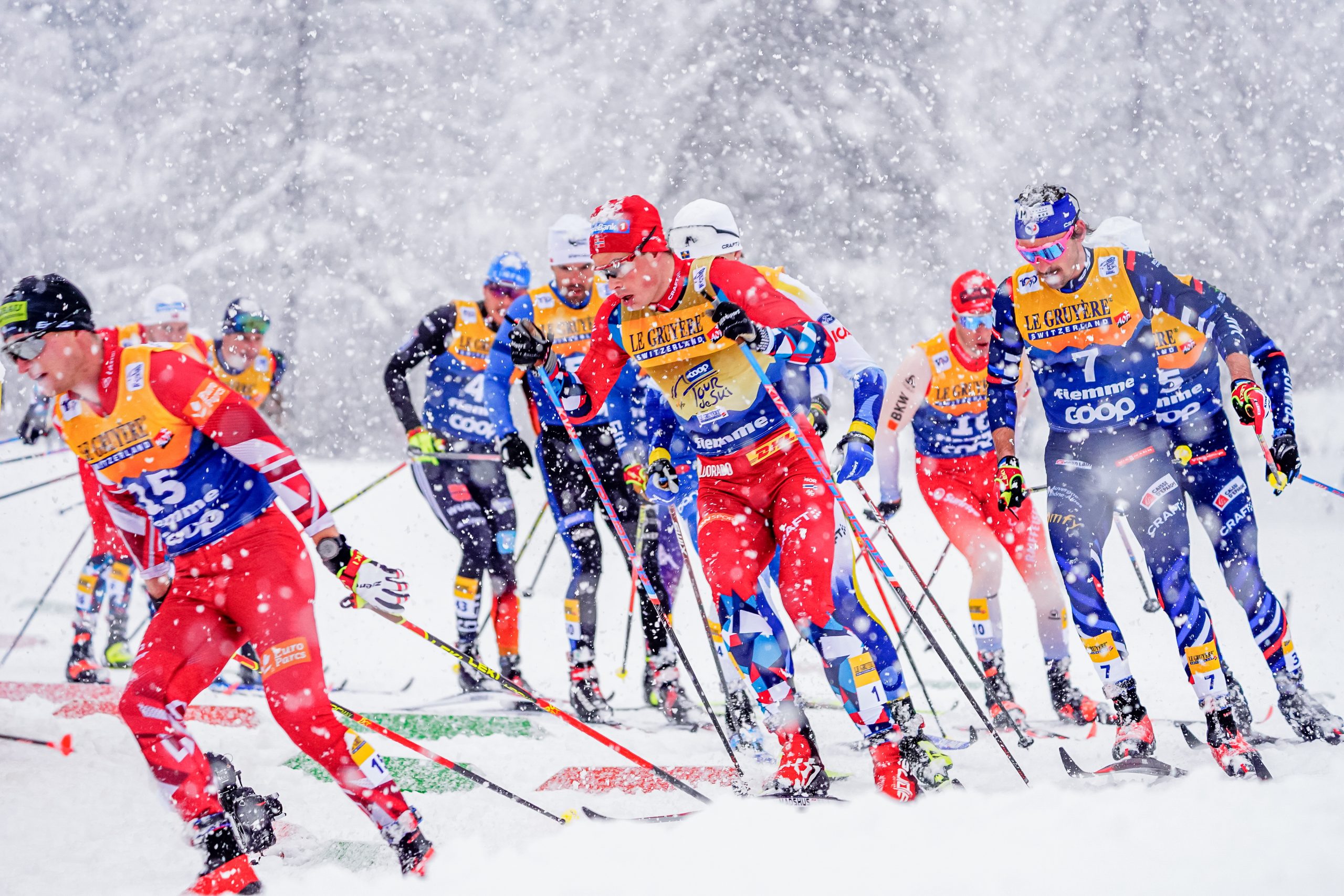
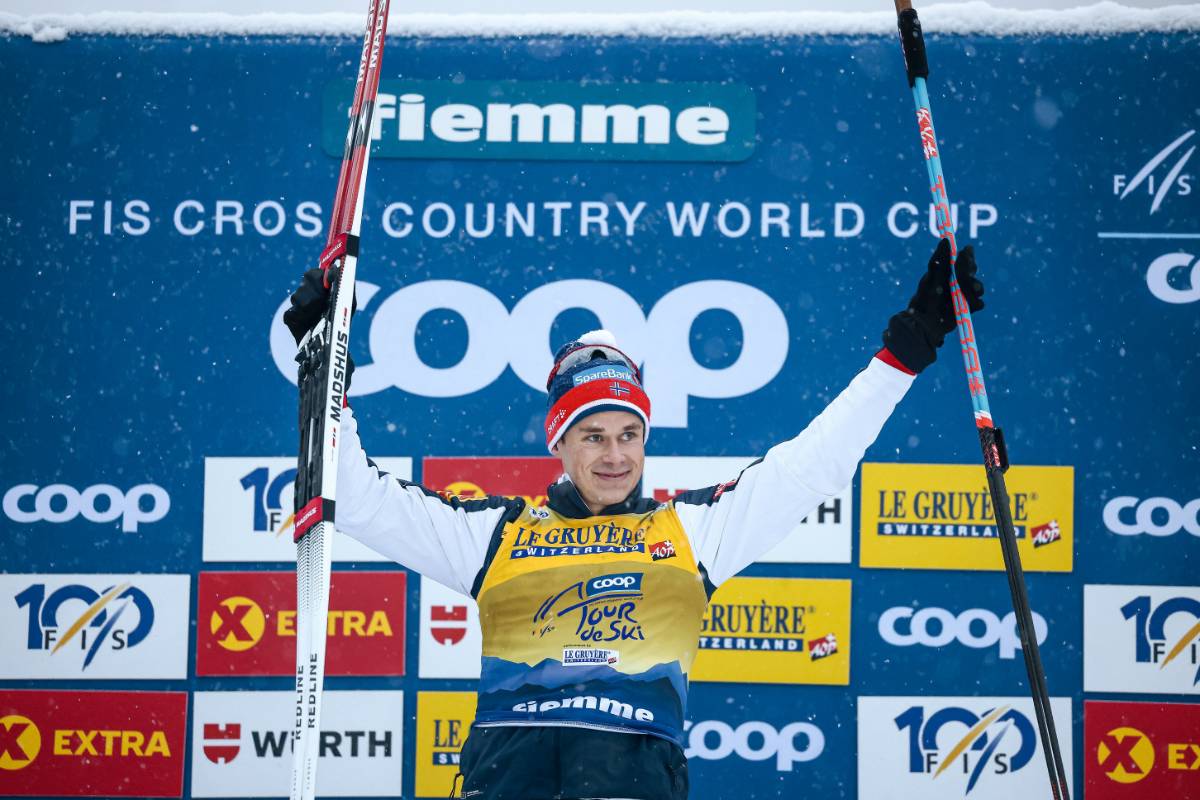
Harald Oestberg Amundsen (NOR) (center) played it smart by playing it safe today. He stayed near the front and kept an eye on anyone who might dare to make a break. (Photo: NordicFocus)
The men’s Tour de Ski (TDS) began last week with team Norway back on its heels as France and the USA challenged Norway’s domination; that seems a lifetime ago. Ever since the third race, in Toblach, Italy, Norway has been dominant again with no other country really giving it a run for the overall title. The Tour is Harald Oestberg Amunden’s (NOR) to take. Going into today’s 15 kilometer Mass Start Classic race, in Val Di Fiemme, Italy, Amundsen is 1:39 ahead of countrymen Henrik Doennestad, and Martin Loewstroem Nyenget.
But a very tantalizing question remains as to whether a non-Norwegian man can find the podium at the end of the Tour? As to that question, the answer is a definite: it’s possible. Hugo Lapalus (FRA) is only two seconds out of second place behind Doennestad and Nyenget. Likewise, Friedrich Moch (GER) and Beda Klee (SUI) are only seconds behind the Norwegian duo. So, while the race for the top spot is definitely Amundsen’s to lose, other countries are knocking on the door to gain a spot on the podium.
A 15 kilometer mass start Classic race is a tough format in which to gain ground, so any efforts by Lapalus and Moch to join the Tour podium leaders would be a tall task. They couldn’t risk too much today as they would need to leave themselves in contention for Sunday’s final race, the climb up Alpe Cermis. But given the razor thin margins separating second and seventh place of only eight seconds, it wouldn’t take much to dislodge the current Norwegian monopoly. The men’s race for first place might lack the drama of the women’s, but the race for second and third is scorching hot.
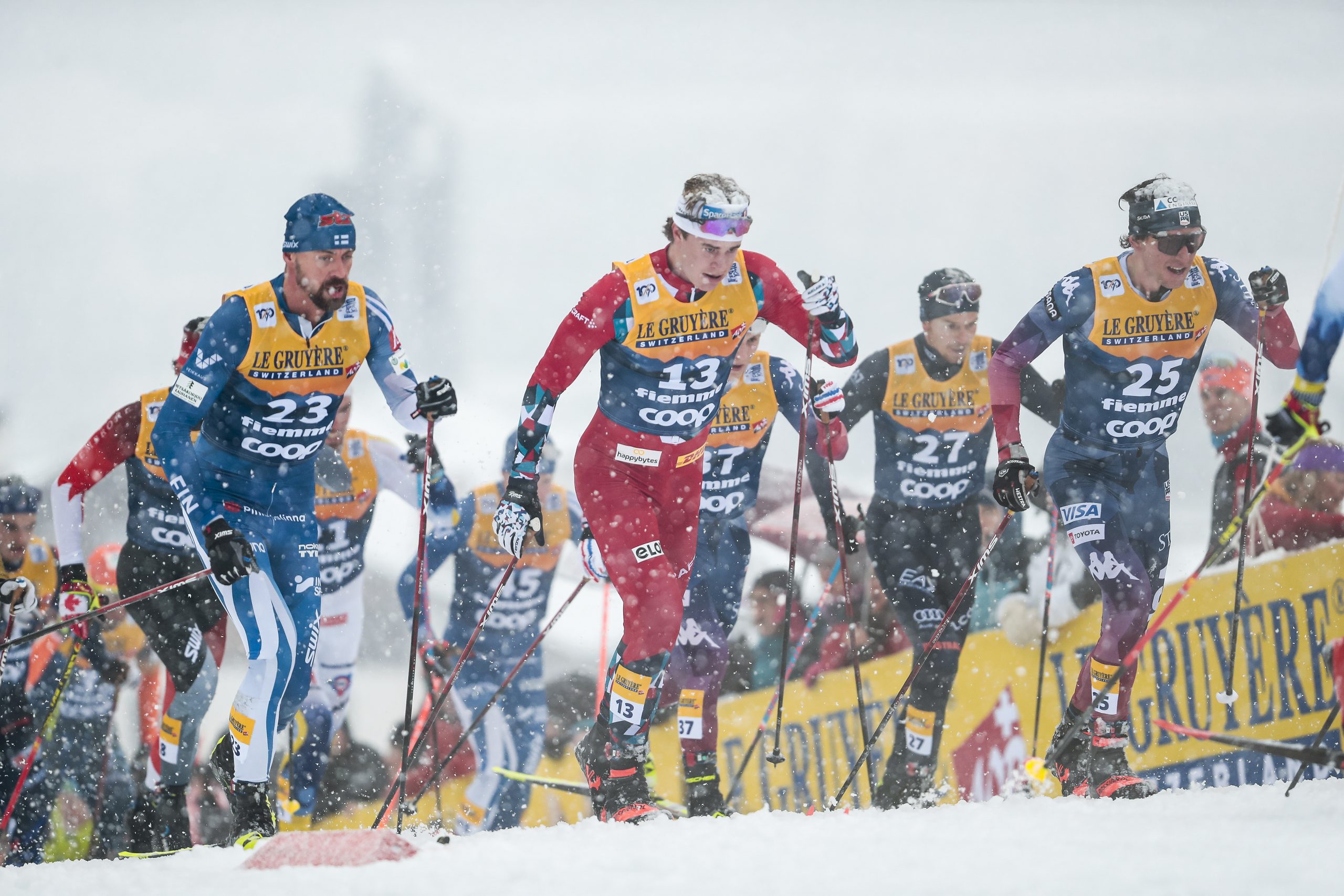
Scott Patterson (USA) (far right), is one of only two Americans left in the Tour. He had a nice performance today, only 16 seconds behind the winner. (Photo: NordicFocus)
For the American men, the bright promise they showed early in the Tour has faded away as illness decimated the team; just as it has much of the Tour. There were only two Americans left on the start line, Scott Patterson, (4:54 behind the Tour leader, and Zanden McMullen (7:37 behind the Tour leader).
At the conclusion of a very tactical race, it was Erik Valnes (NOR) taking the victory. He was followed by William Poromaa (SWE) in second, and Cyril Faehndrich (SUI) third. American Scott Patterson had a nice day finishing 27th, only 16 seconds off the lead. He was closely followed by Zanden McMullen in 31st, 17 seconds behind first.
The top Canadian finisher was Olivier Leveille in 33rd, and Antoine Cyr in 41st.
An interesting finishing time was delivered by Sprinter Lucas Chanavat who has continued with the Tour even after the Sprints were concluded. He finished 54th, the last skier to finish, 3:37 behind the leaders and over 1:40 behind the second to last skier. It could be debated whether it’s sandbagging or smart tactics by the Sprinter to keep his Tour alive.
Men’s 15 Kilometer Classic Mass Start Race
Much like the Classic race two days ago in Davos, skiers again faced extremely challenging waxing conditions in Val di Fiemme. It was snowing hard with temperature right around freezing. Again, wax technicians faced difficult choices. As racers marched to the start line to begin the race, lots of zero skis could clearly be seen; along with some skiers choosing klister. The American men were split on ski setup. According to U.S. coach Kristen Bourne, Patterson chose zero skis while McMullen was on klister. Bourne told FasterSkier that zeroes and klister skis were tested for both the men’s and women’s races with a mix of skis finally selected for both races. “It was definitely a mixed bag,” said Bourne. “Another day of our kick team really working trying to figure it out.” The decision was ultimately the athlete’s to make. “The skier and the tech would talk about it and make the decision together.” But the new fluoro rules threw another curve into ski choice. Under the rules for Classic races, skiers are allowed to present two pairs of skis for pre-race fluoro testing 30 minutes before the start. Bourne indicated that it’s ultimately the athlete’s choice to decide which pair of skis to choose from between the two pair which clear fluoro testing; a fairly nerve wracking dilemma. Things become even more complex as there is a kick adjustment zone after skis have been fluoro tested where kick zones, and only kick zones, can be adjusted just before the race.
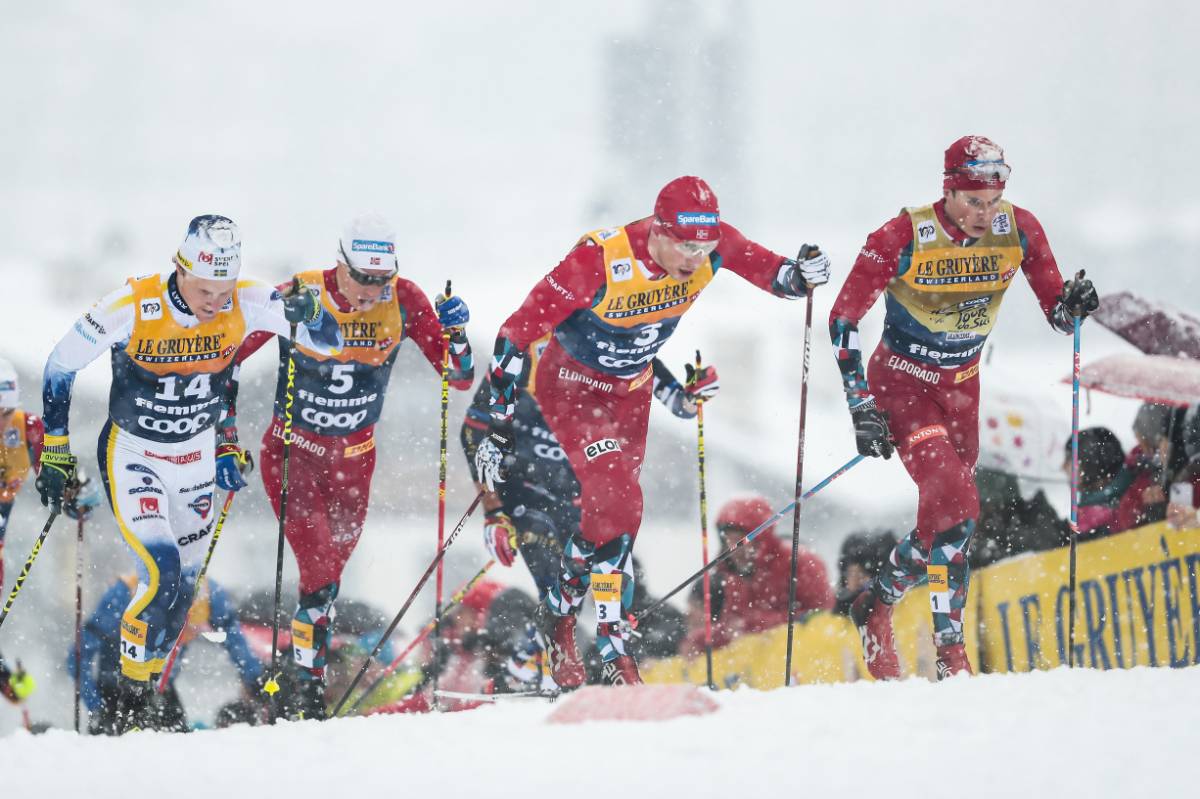
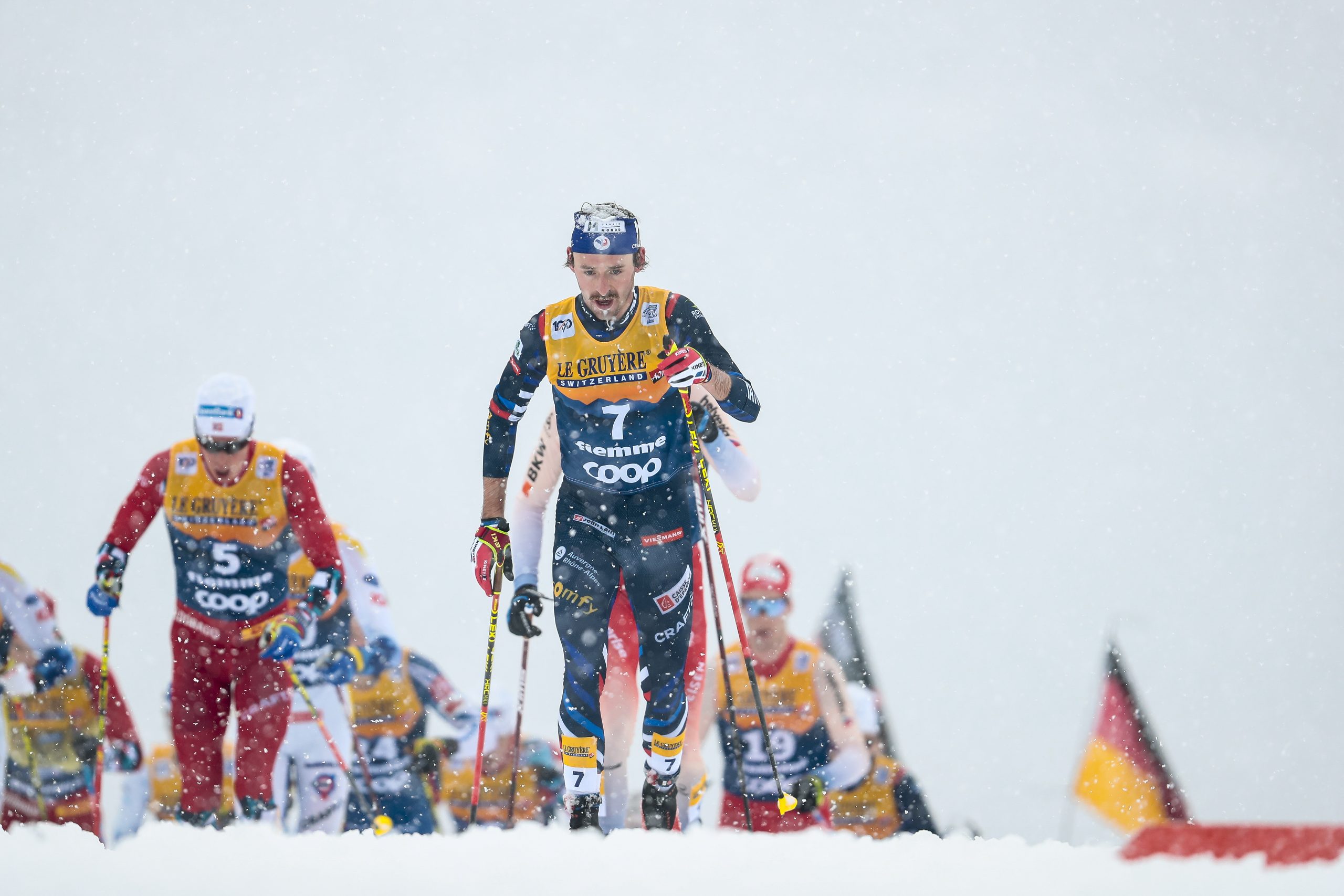
Martin Loewstrom Nyenget (NOR) (bib five), did enough to put himself into third place for tomorrow’s decisive race. But he only has a five second advantage. (Photo: NordicFocus)
Unlike Thursday’s 20 kilometer race, this course was on a 2.5 kilometer lap which would help with kick zone icing issues.
The weather played an outsized factor today’s race strategy as well. The conditions would make it difficult for any skier to make a break. A mass start would also contribute even more to that same dynamic.
Olivier Leveille (CAN) gave fans an early thrill when he went to the lead at the 1.4 kilometer mark. Leveille was fighting for an early time bonus at the 2.3 kilometer point, but ultimately was in fifth at the timing check. The Bonuses helped to string out the field a little, as Edvin Anger (SWE) took the time bonus sprint, nudging out Erik Valnes (NOR) who needed the bonus time to help his podium fight.
After the bonus point sprint, the field coalesced again into one mass pack. Podium contender Beda Klee (SUI) took a brief shot at the front, but it was short lived. At 3.5 kilometers, the tone of the race seemed set; it was clear that pack racing tactics were going to take hold. The athletes really didn’t have much option, as trying a break in these conditions—this early—would likely be a fool’s errand.
The pack conditions meant that skiers outside the top ten would also have a chance to hang with the leaders. This gave McMullen a chance to ski with the Tour front runners as he pushed himself up to sixth. At this point the race was so congested that there was only a 16 second gap between first and 53rd.
With Amundsen having a big lead, he was unlikely to push the field; he was content to simply check any big moves made by podium contenders. Halfway through, Doennestad and Nyenget went to the front to try and push, but they too were unable to break up the field. One kilometer later, Erik Valnes gave the front a shot, but it turned out to be more of a chance to grab bonus points at 8.5 kilometers instead of a legitimate attempt to break things up. He stayed near the front after the bonus mark, but wasn’t seriously pushing the field.
Amundsen continued to hang out at the front to avoid the congestion of the big pack. Then, after the bonus Sprint, Jens Burman was the next athlete to step up to make a little charge to break up the field. His effort was also doomed, and the field again quickly consolidated. The conditions—coupled with the effects of the mass start—were proving just too difficult for anyone to make a break from the pack.
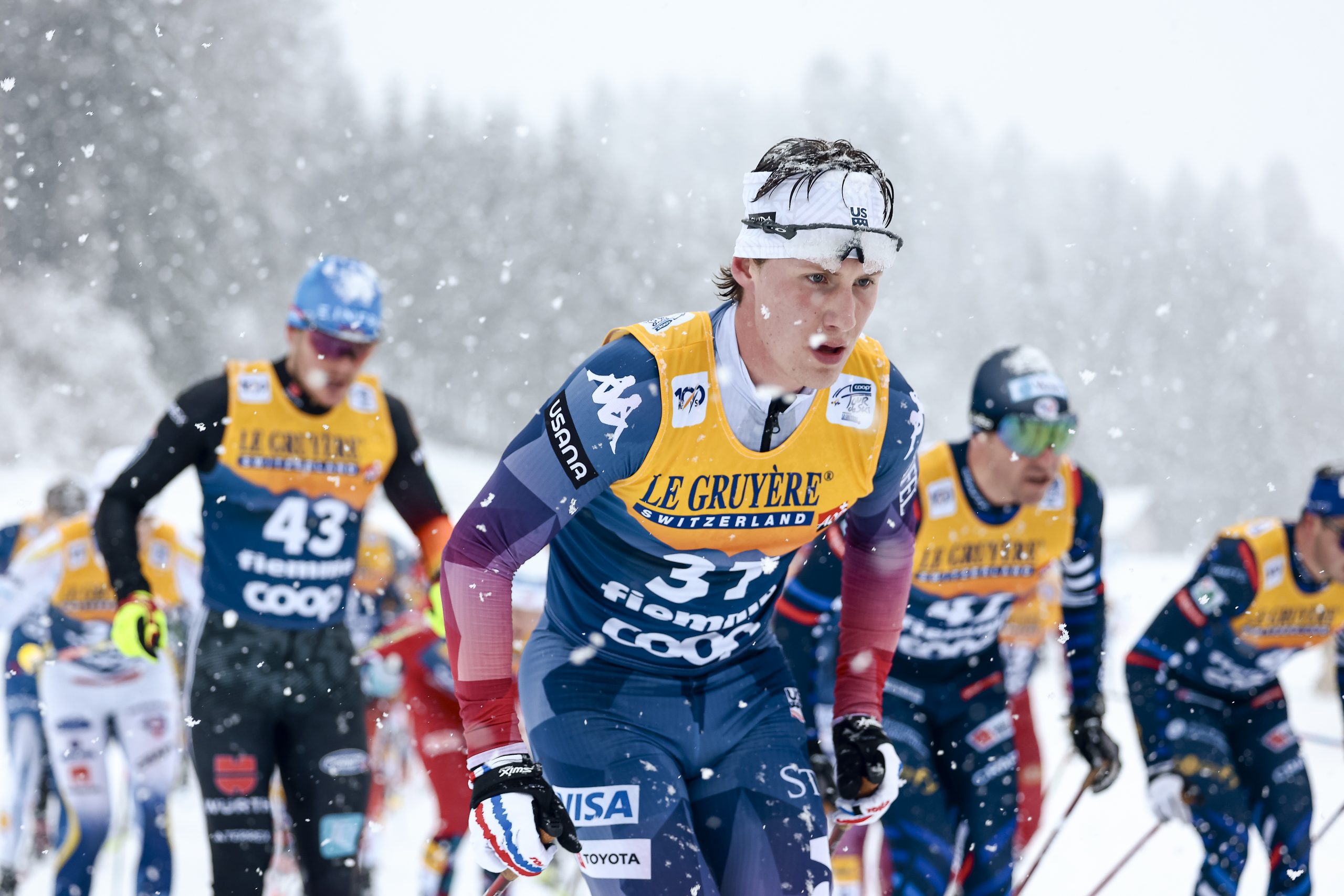
Zanden Mcmullen (USA) was one of two American skiers in today’s race. He finished 31st, but only 17 seconds behind the winner. (Photo: NordicFocus)
With only 2.5 k to go, it was still one giant pack with only 12 seconds between first and 51st. Amundsen, however, was leaving nothing to chance and went to the front. The virtual race for second and third in the TDS was still extremely tight with racers within a couple of seconds.
Even though the pack was close to the finish, the pace was still extremely relaxed. Several more skiers had tested the waters of going to the front only to abandon the opportunity after a few seconds. The race had now devolved into a giant touring pack with a Sprint finish looming. All the podium contenders were playing it safe with no one pushing the front, and everyone jockeying for a good spot for the finish.
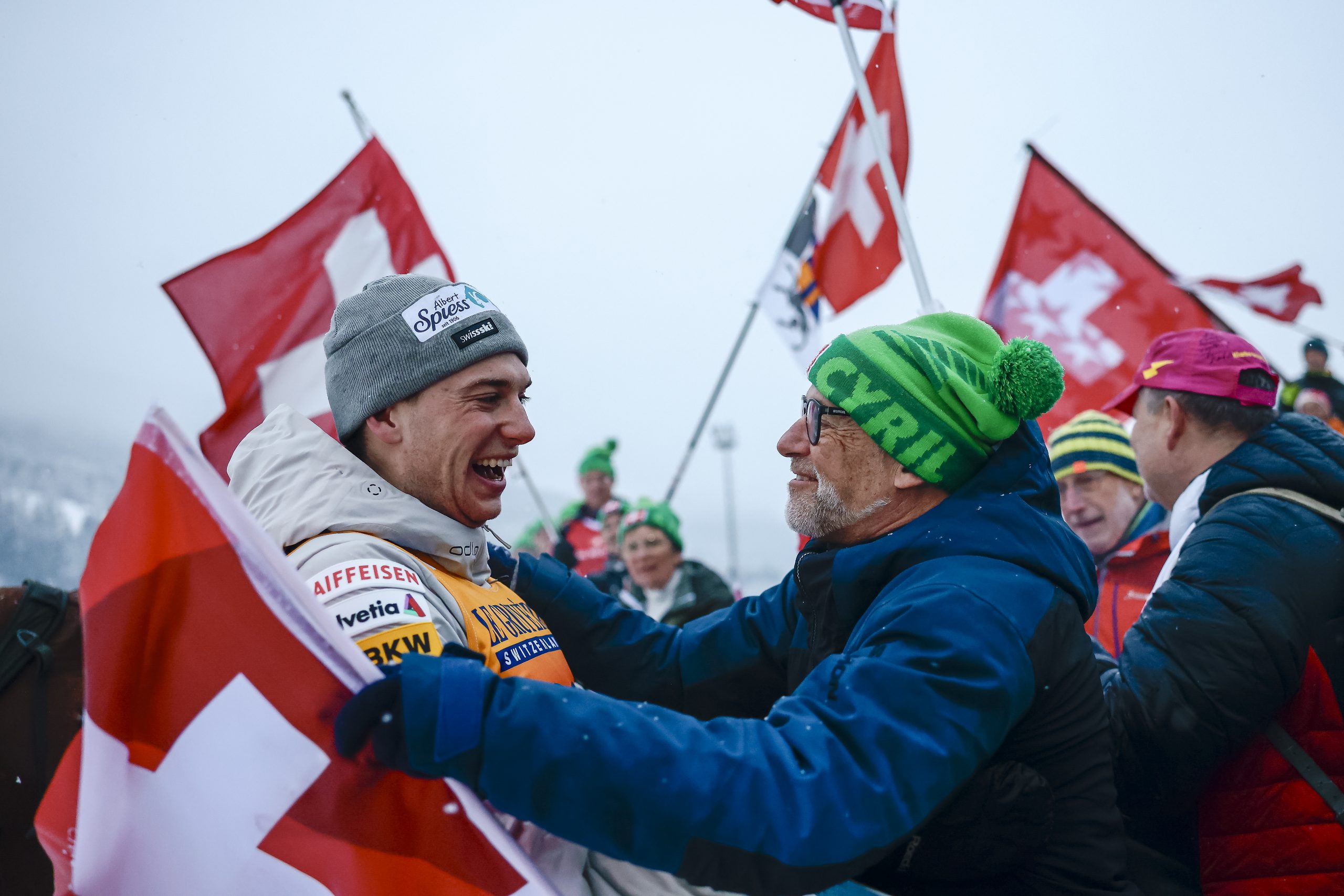
With one kilometer to go, skiers began to seriously race. Cyril Faehndrich (SUI) (brother of Swiss star, Nadine Faehndrich), made a break with about half a kilometer to go. William Poromaa (SWE) and Valnes fell in behind him.
Cyril Faehndrich (SUI) had a career best day finishing on the podium for the first time in a World Cup race. (Photo: NordicFocus)
The race immediately became a three man sprint between Valnes, Faehndrich and Poromaa. In this situation, Valnes had the clear sprinting advantage. He double poled to the front and was able to push by Poromaa, who took second, and Faehndrich, who took third. For Faehndrich, it was his first World Cup podium. Tour leader Amundsen was only eight seconds behind the group and played a tactically smart race by not taking chances and preserving his large advantage going into tomorrow’s finale. While not the most thrilling race, it was smart tactics by the top contenders who were betting on making a bid in tomorrow’s climb up Alpe Cermis.
The racing strategy and weather created an interesting finishing time, where the winner of the men’s race was only three minutes faster than the Women’s winner!
Hugo Lapalus (FRA) kept himself in podium contention by finishing eighth today. He’s now only five seconds from a podium spot. (Photo: NordicFocus)
Impact on Tour de Ski Standings
Today’s race was really just about setting things up for tomorrow’s finale. Amundsen now has a 1:34 lead over teammate Erik Valnes, and a 1:42 lead over Martin Nyenget. But the race for second and third is still very tight. Lapalus, Moch, Klee, and Doennestad are all within seconds of the podium; tomorrow’s fight for second and third will be intense.
This World Cup coverage is made possible through the generous support of Marty and Kathy Hall and A Hall Mark of Excellence Award. To learn more about A Hall Mark of Excellence Award or to learn how you can support FasterSkier’s coverage please contact info@fasterskier.com.
Ruka Men’s 10K Classic Individual Start
Ruka presented less challenging conditions this year compared to last year for the athletes. Temperatures were in the high teens (-8.0 Centigrade) with racers running on green cold waxes. Humidity was 100 percent, which posed the possibility of tracks glazing during the race. The racers competed on a 5-kilometer course with 30 seconds between the start of each racer.
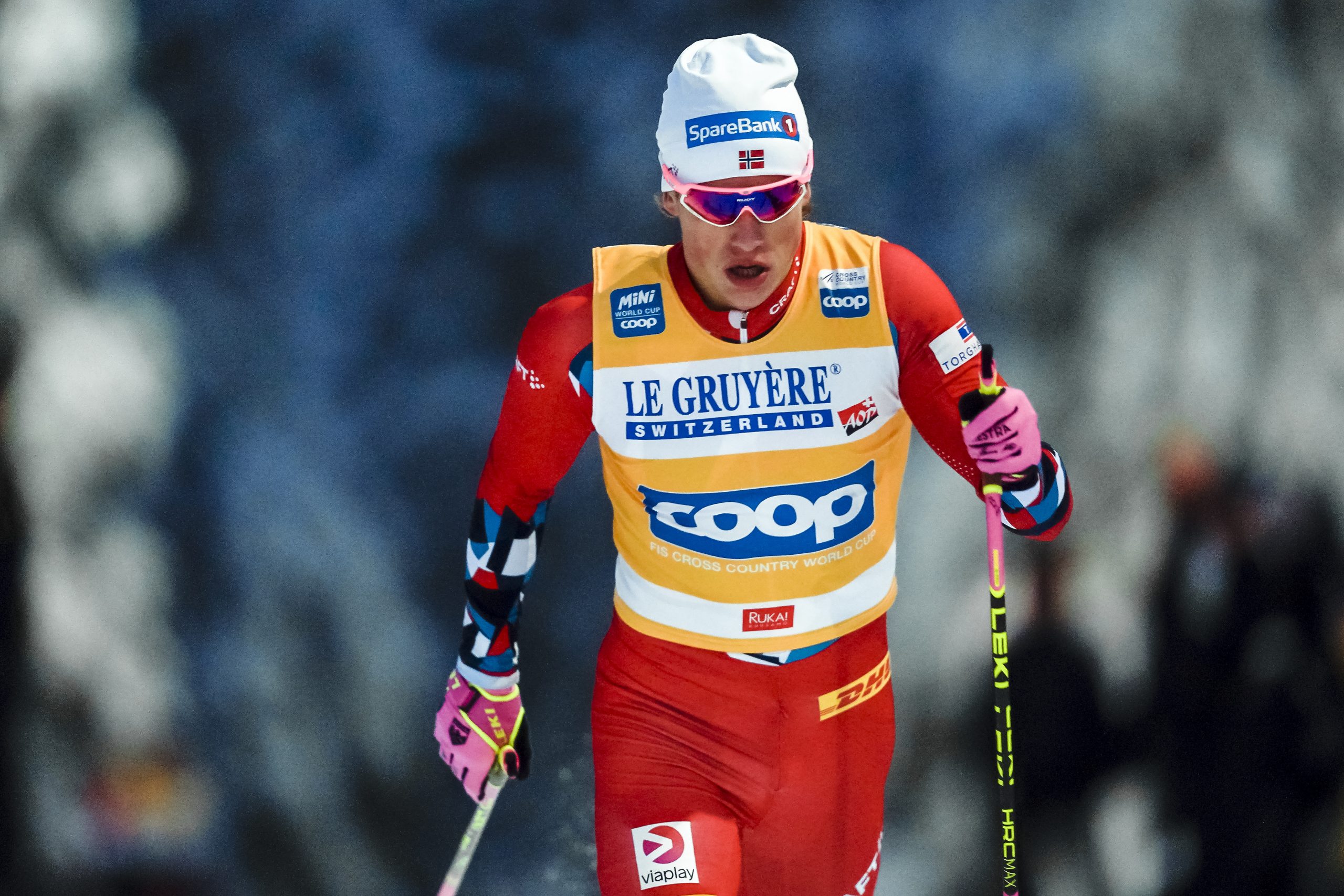
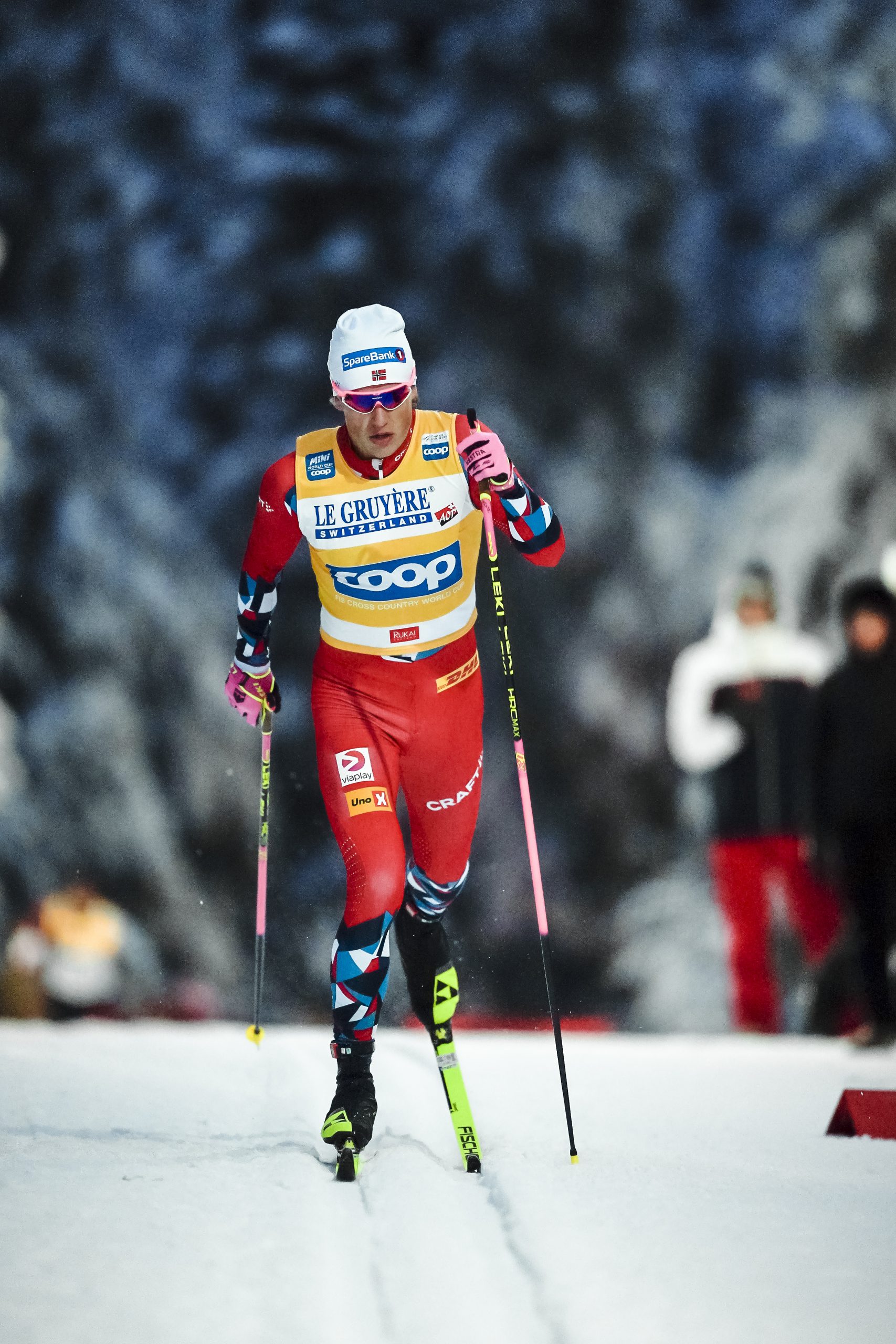
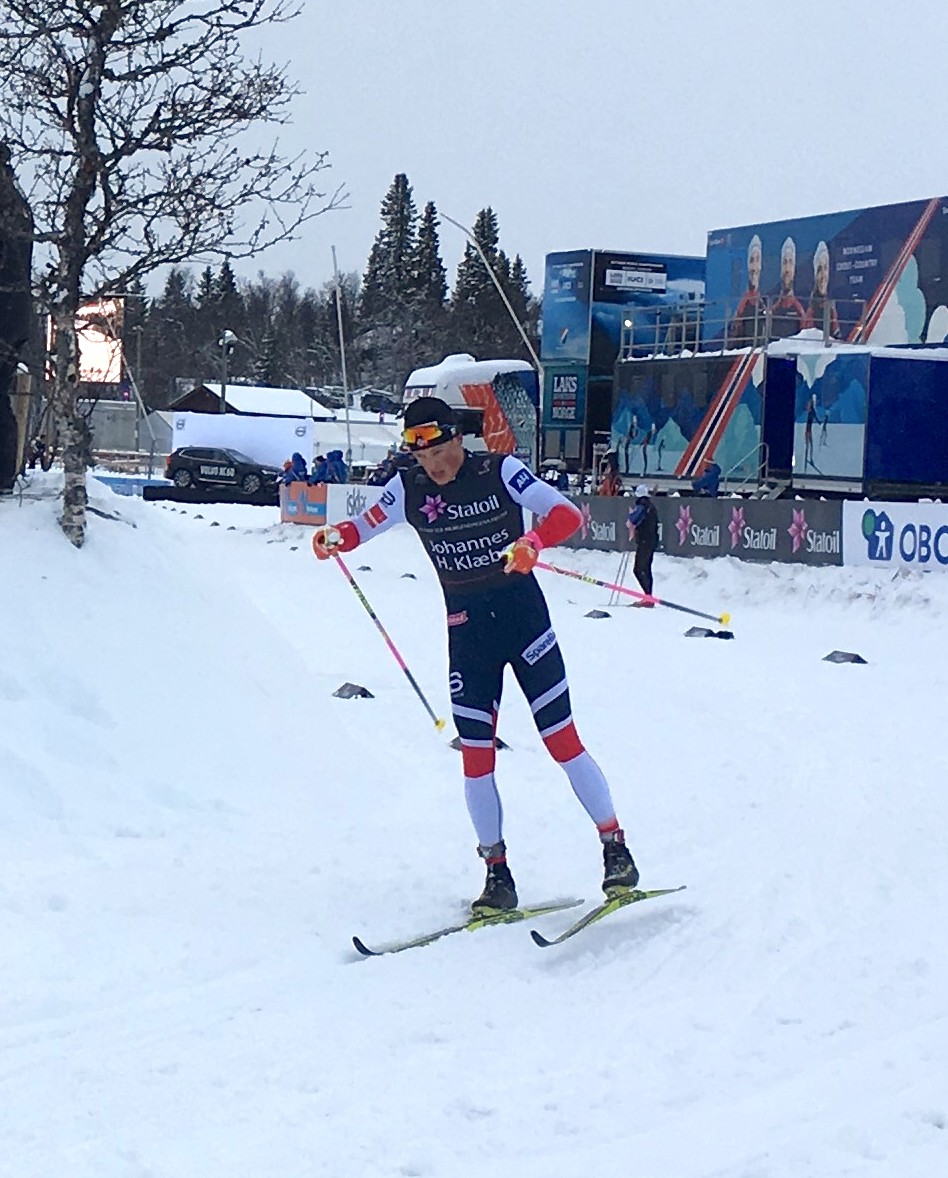
Johannes Hoesflot Klæbo (NOR) on his way to victory in the 10k in Ruka (FIN). (Photo: Nordic Focus)
Results:
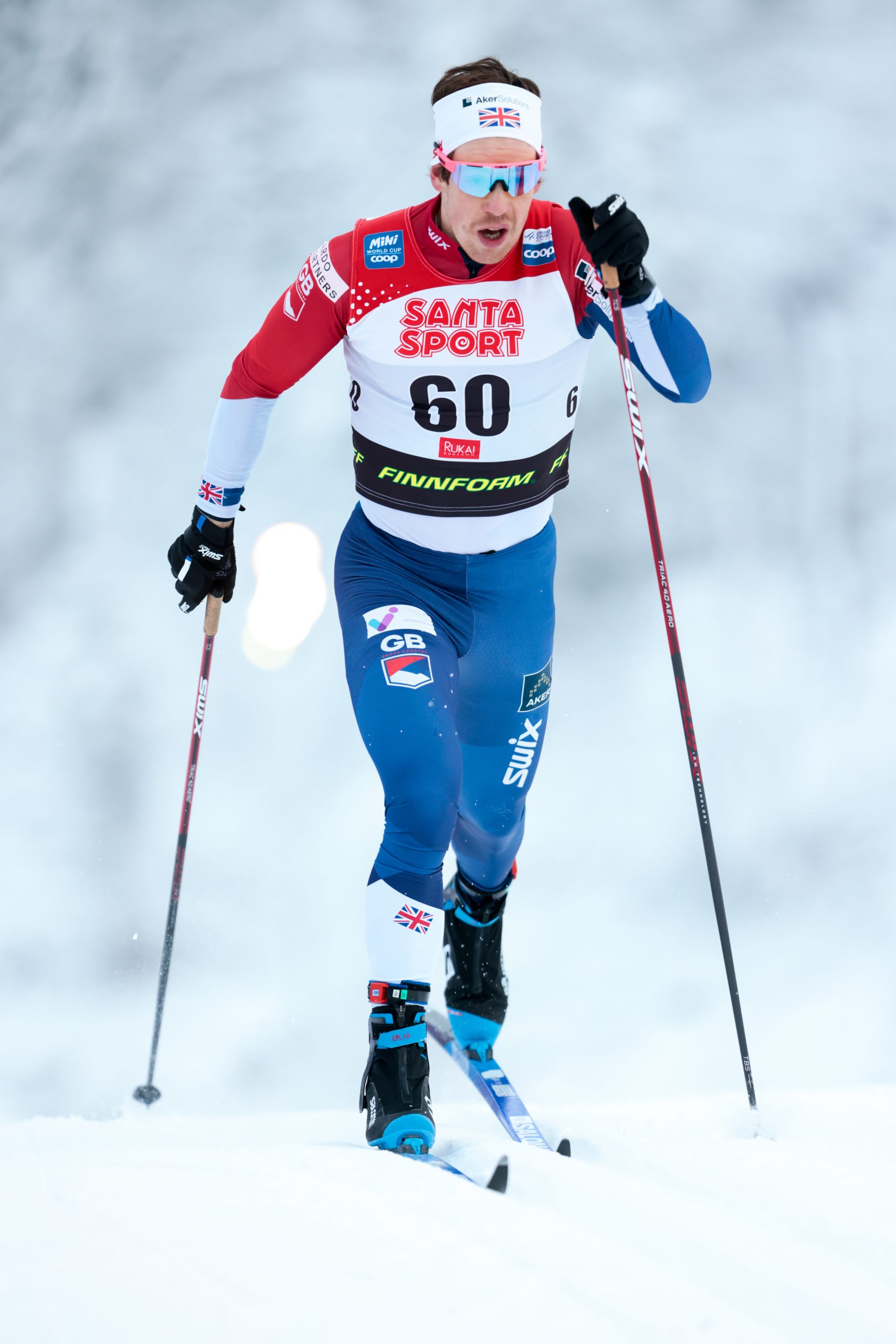
The Norwegians dominated the field. Johannes Klæbo finished first, besting countrymen Paal Golberg by 20.5 seconds followed by Martin Nyenget who was 28 seconds behind Klæbo. An outstanding performance was turned in by Andrew Musgrave of Great Britain, who finished in fifth, 40.3 seconds behind Klæbo. Norweigans took six of the top ten spots.
The top American was Ben Ogden, finishing 28th, 1:23.9 back. He was closely followed by Zak Ketterson who finished 31st, 1:24.6 out of first. Rounding out the field for the Americans was Hunter Wonders, who is also a competitive canoe racer, finishing in 39th. 2020 Junior World Champion in the 10 kilometer, Gus Schumacher, finished 48th. Scott Patterson finished 54th.
The top Canadian was Graham Ritchie, finishing 35th. He was followed by Olivier Leveile who finished 44th.
Hunter Wonders (USA) on his way to 39th place in the 10k classic. (Photo: Nordic Focus)
The Race:
The steep climbs of Ruka proved challenging for the men who consistently jumped out of the tracks early on climbs, preferring to run up the loose snow on the sides of the course. Prior to the race there had been much discussion about Klæbo’s health. Questions continued to swirl when he hit the one-kilometer split in 21st place and still trailed at the 3.1- kilometer split.
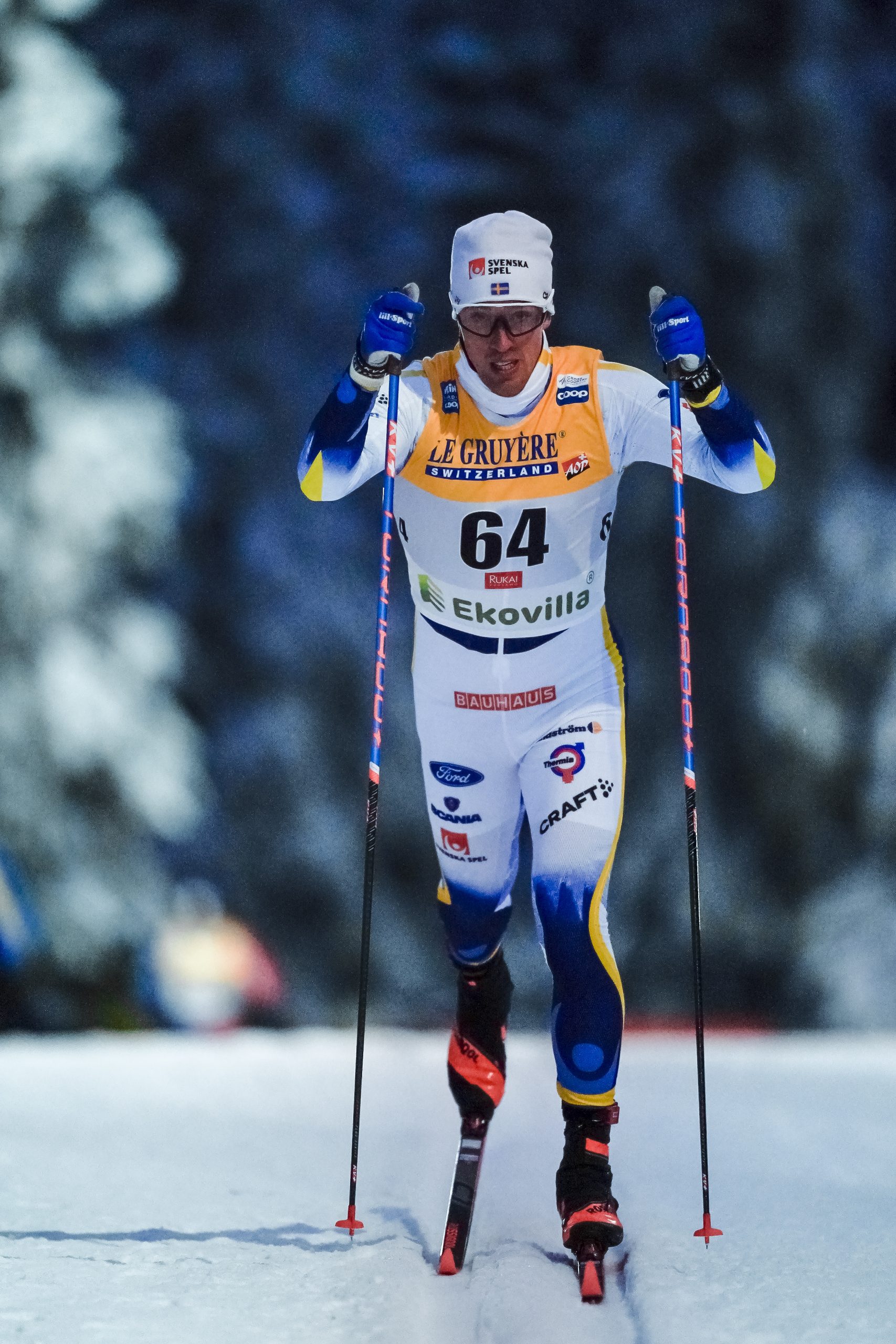
Calle Halfvarsson (SWE) on his way to 4th place in the 10k in Ruka (FIN). (Photo: Nordic Focus)
Calle Halfvarsson of Sweden gave many of the Swedish fans in the crowd a thrill as he led the race at the first three splits. Ogden was in the hunt at the one-kilometer mark, only 12.5 seconds out of the lead, but by the 3.1 checkpoint, his trailing margin had widened to 22.4 seconds.
Starting at about the six-kilometer mark, Klæbo removed any doubt about his nagging injury when he jumped into the lead establishing a six second advantage over countryman Halfvarsson. Meanwhile, Musgrave had pulled himself from 23rd to sixth place, only seven seconds away from a podium spot. Musgrave turned in the fastest time from the 3.1 to 5.0-kilometer split.
Andrew Musgrave (GBR) – FIS world cup cross-country, having an outstanding weekend in Ruka. (Photo Credit: NordicFocus)
However, because of the start order, Klæbo was never really able to relax since he had started the race ahead of Golberg. When Klæbo finished he had a 28 second lead over the next best finisher. But most of the contenders were still on course, so he was uncertain as to where he would finish. However, the writing was on the wall as Golberg entered the stadium and it became apparent that he wouldn’t be able to catch Klæbo.
The only remaining question was would Norway capture all of the podium positions? The question was only partially answered when Halfvarsson crossed the eight-kilometer checkpoint in fourth but was only 0.2 seconds behind Nyenget. At the finish it appeared that Halfvarsson was struggling mightily but was able to hang on for a fourth place finish. The results; Norway 1-2-3.
Paal Golberg (NOR), Johannes Hoesflot Klaebo (NOR) and Martin Loewstroem Nyenget (NOR) share the 10k classic podium in Ruka (FIN). (Photo: NordicFocus)
This World Cup coverage is made possible through the generous support of Marty and Kathy Hall and the A Hall Mark of Excellence Award. To learn more about A Hall Mark of Excellence Award or to learn how you can support FasterSkier’s coverage please contact info@fasterskier.com.
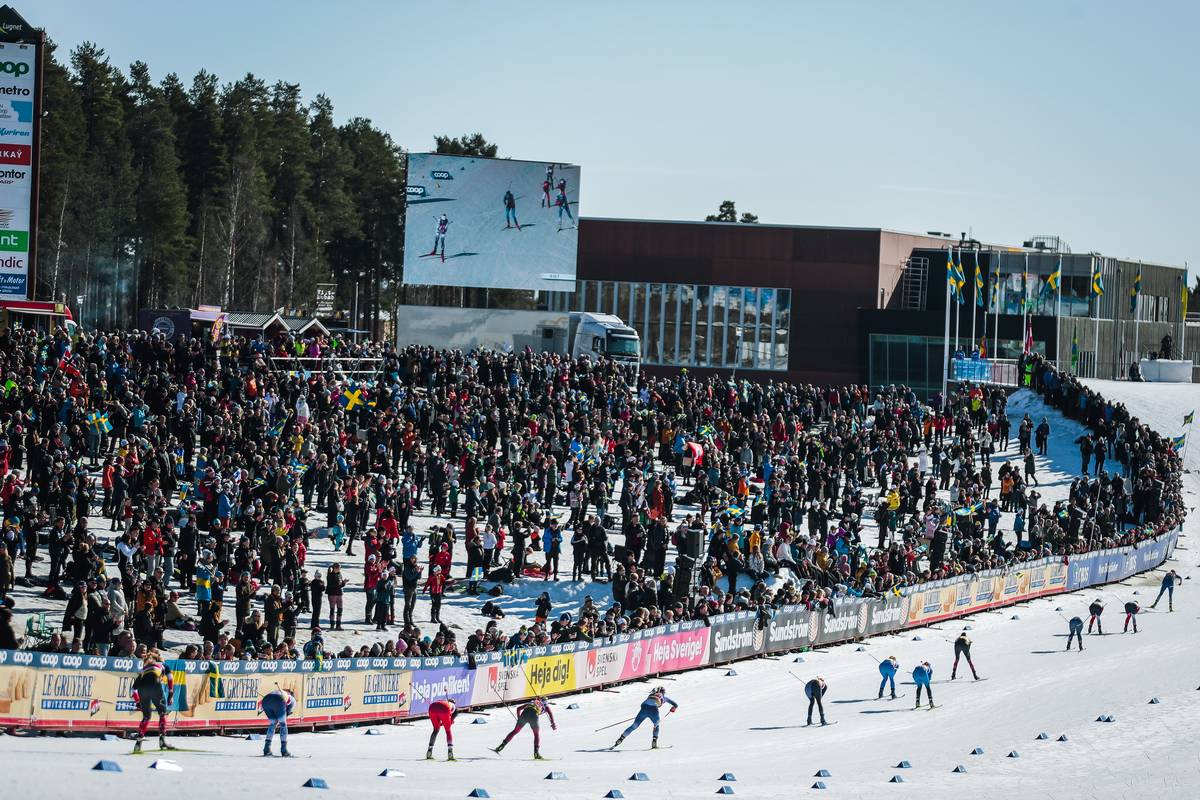
A packed stadium for the final day of World Cup racing in Falun Sweden (Photo: NordicFocus)
We’ve arrived at the final event of the 2021/22 World Cup Season and the second new event of the day. It was a fast and furious mixed team sprint in Falun, Sweden, happening just hours after the mixed team relay which ran in the morning. In the first iteration of this event, teams composed of one woman and one man raced six laps of a 1 k course each, making for 12 k of skiing total.
To keep things spicy, the last two teams in the exchange after the even-numbered laps 2 -10 were eliminated. So although seventeen teams started the competition, only seven made it to the finish. In order to limit the chaos, given the number of teams, there was no tagging in the exchange, just a finish line and a start line for the athletes to gauge themselves.
The atmosphere in the Lugnet Ski Stadium was festive as fans enjoyed the 45°F degree weather and sunshine. “I think this is very nice to be together with the men,” said Nadine Fähndrich of Switzerland, “it makes more team spirit between the men and the women.” She alluded to the feeling of both the athletes and the spectators during the mixed team relay in which Team USA I took the gold in an exciting race. “I’m excited for the [race] and to [enjoy] the atmosphere here,” she concluded.
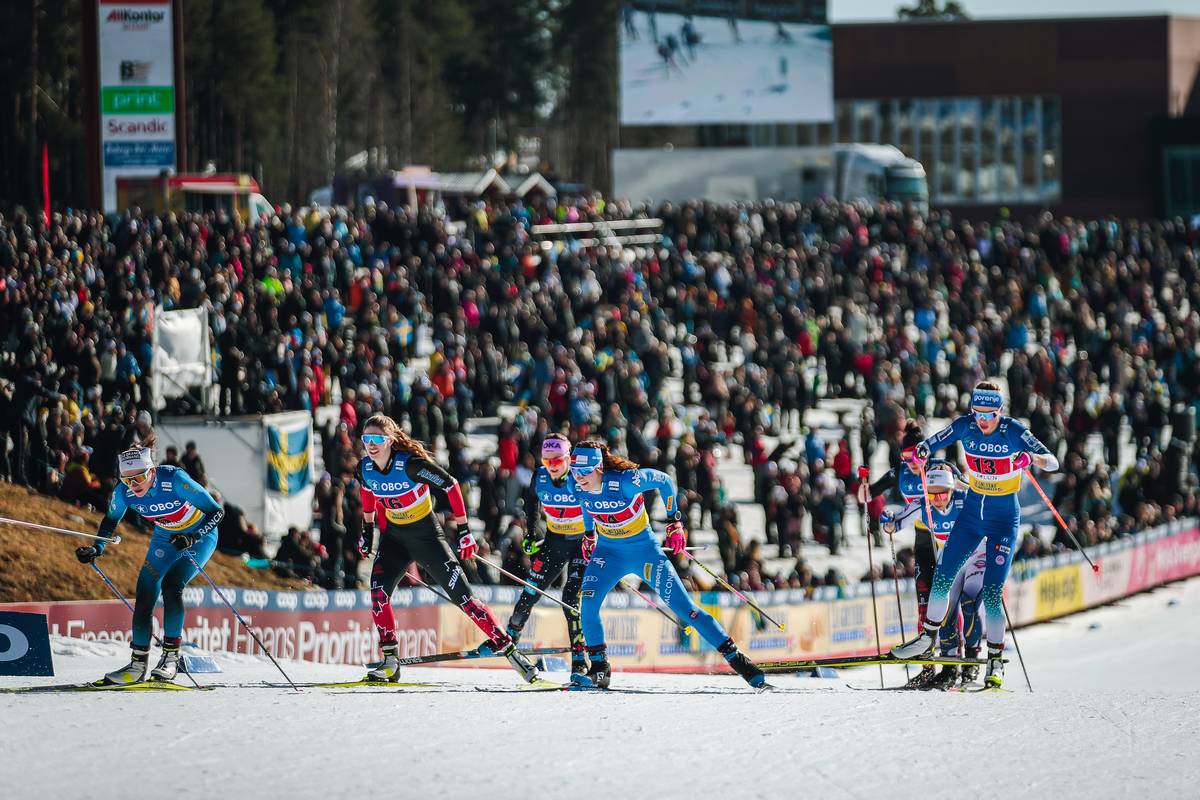
The women head out for one of six laps for the mixed team sprint event (Photo: NordicFocus)
With Team USA I taking the victory and Team USA II coming in 14th, the Americans did not enter a team in the mixed sprint event. Out of the seventeen teams that started, twelve nations were represented in the start list and only five nations made it to the finish.
The women started and as would be expected, Jonna Sundling skiing for Sweden I, was at the front. She was paired with Calle Halfvarsson who earned his first podium finish since 2018 in the 15 k freestyle on Saturday.
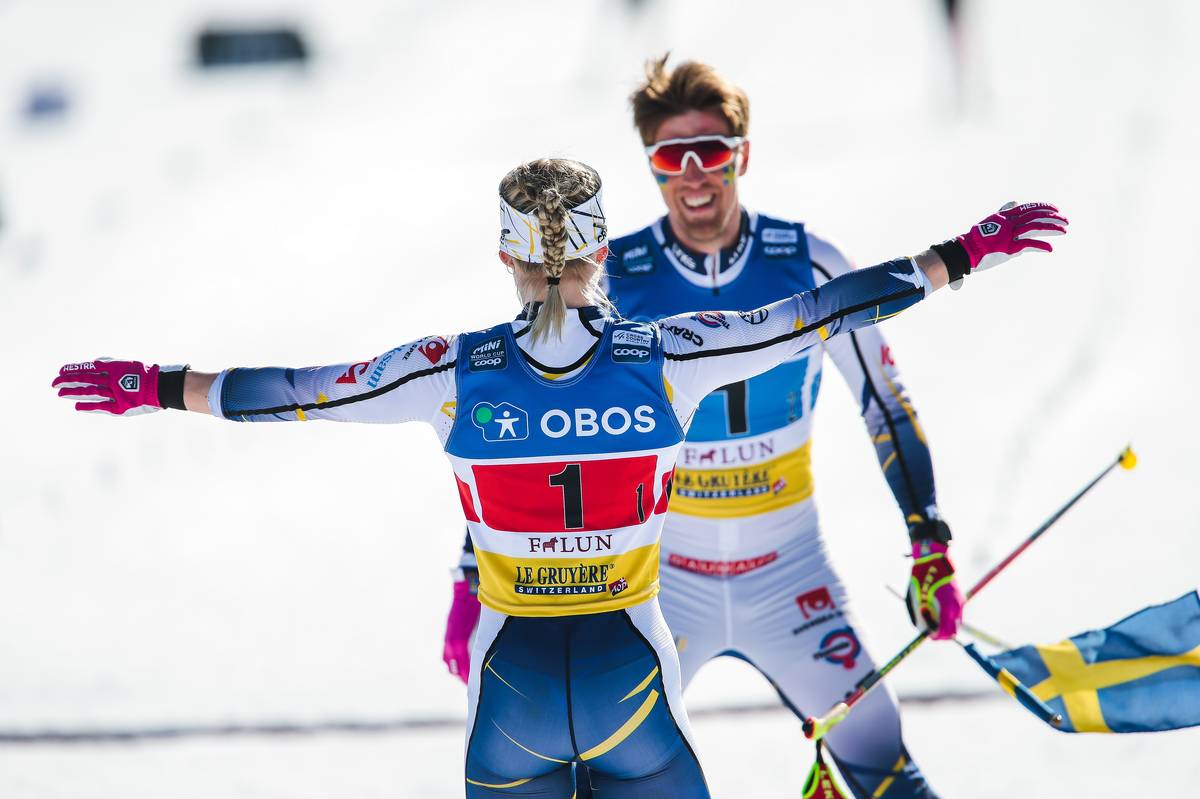
Celebrations for Team Sweden I after dominating the mixed team sprint (Photo: NordicFocus)
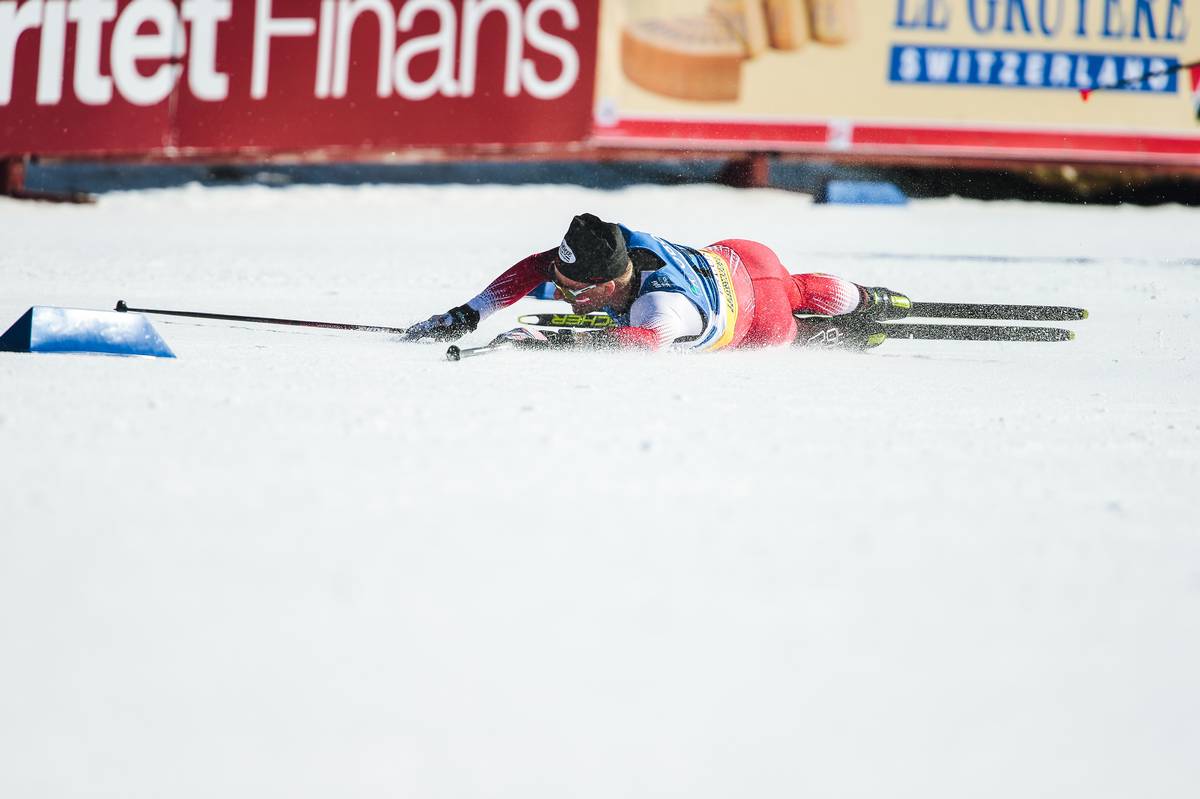
The first round of eliminations at 2 k took Estonia and France II out of the running. As Sundling concluded her second lap, she had created a +2.1 second gap and Halfvarsson seized this opportunity. Instead of waiting around for the rest of the field, he pushed hard and grew the gap to +3.84 seconds on his next 1 k lap. This same lap saw Benjamin Moser of Austria fly off the course on the corner descending into the stadium, taking himself and his teammate Teresa Stadlober out of the race. Latvia was also eliminated in that round.
Benjamin Moser (AUT) slides out on a fast corner (Photo: NordicFocus)
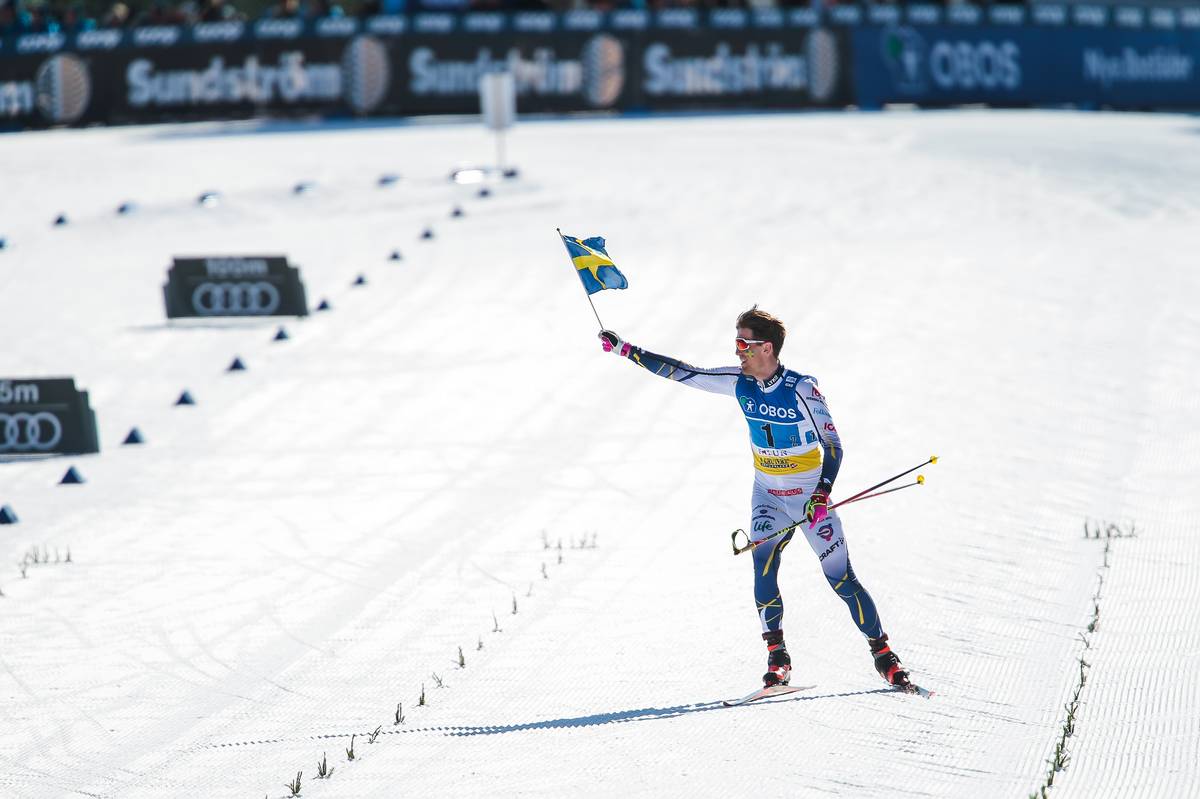
Once Sweden I had made their move, it stuck. At 5 k they were +9.61 seconds ahead, at 7 k they were +22.2 ahead, at 11 k the gap was up to +26.84. After 23:05.91 of cumulative race time, Halfvarsson crossed the finish line waving a Swedish flag.
“It’s easy when I go with Jonna [Sundling],” he said to FIS after the race, “she is so fast, it’s no match.” For her part, Sundling said, “It was a little bit exciting before the race, how to ski, how should our tactic be… but it felt like we did a really good race and ended up first so it’s really fun.”
Calle Halfvarsson enjoys a big time cushion as he and Jonna Sundling take gold in the first ever mixed team sprint event (Photo: NordicFocus)
Rewinding a bit, the women’s third lap saw Fähndrich shoot off the course in the same fashion as Moser. Minutes later, Joni Maki of Finland I and Harald Østberg Amundsen of Norway I both went down on the corner entering the exchange area. A quick recovery by Amundsen ensured that his team stayed in the race but Maki and his partner Jasmi Joensuu were eliminated, along with Fähndrich and Janik Riebli for Switzerland.
Nadine Fähndrich (SUI) picks herself up after a fall during the mixed team sprint event (Photo: NordicFocus)
The fourth round of elimination took out Slovenia and Finland II, though due to the tight nature of the eliminations, the women were starting unless it was clearly evident that they were one of the last two. Thus we saw Anamarija Lampic (SLO) battling Tiril Undes Weng of Norway II for second, even though Slovenia had already been eliminated.
Anamarija Lampic (SLO) teamed up with Vili Crv (SLO) for the mixed team sprint (Photo: NordicFocus)
Entering the 10th exchange and the fifth elimination, Sweden I was 19 seconds ahead, with Norway I and II duking it out behind. This meant that it was the twins, Tiril and Lotta Udnes Weng battling each other for their final lap.
With Canada II and France I eliminated, the men took off for their sixth and final lap. Amundsen of Norway I was just ahead of Martin Nyenget of Norway II, though entering the stadium Nyenget used the slip stream to move in front of his compatriot. With Sweden I well across the line in gold medal position, a tight sprint between the two Norwegians ultimately went to Nyenget, meaning Norway II earned silver and Norway I came away with the bronze.
Harald Østberg Amundsen (NOR) and Martin Loewstroem Nyenget (NOR) during the early stages of the mixed team sprint (Photo: NordicFocus)
Italy with Nicole Monsorno and Federico Pelligrino finished fourth. Sweden II ended up fifth, and Germany I came in sixth. Canada I (Dahria Beatty and Graham Ritchie) were the last team to avoid elimination and finish in seventh.
Dahria Beatty (CAN) and Graham Ritchie came in seventh in the mixed team sprint (Photo: NordicFocus)
With the last race of the day complete, the World Cup season has come to a close. For North-American ski fans, Canadian Nationals will be combining with US Super Tour Finals for a culminating event series in Whistler, Canada. The racing begins March 20th and you can find more details about the event here.
Soft Scandinavian Cup track as seen last weekend at the Dec. 15-17 Scando Cup in Vuokatti, Finland, “the same conditions for Sundby all the way down to me,” author Maks Zechel writes.
Editor’s Note: The following is part of a series proposed by Maks Zechel, a 20-year-old Canadian cross-country skier embarking on his first season training abroad. In August, he made the big move to Norway, where he’ll be training and racing with Team Asker for the entire winter. Through these updates, Maks hopes to share his personal “observations, stories and lessons learned” to help close the gap between North American and Scandinavian nordic skiing. Previous posts: #1,#2,#3, #4, #5, #6, and #7.
***
Part 1: Vuokatti
It’s Thursday morning and I’m in the Oslo airport, waiting to catch a flight to my second Scandinavian Cup race weekend of the winter. I haven’t seen the sun yet and, from what I’ve heard, my destination of Vuokatti, Finland, doesn’t look much like a Caribbean postcard either.
Two flights and an hour on a bus later, we arrive in Vuokatti. There is something about 3 p.m. total darkness that I suspect I will never grow accustomed to; it’s the impending sense of urgency that I need to go to bed soon. Or maybe that’s just coming from the fact that I still have to check into the hotel, ski the race loop, test skis, eat dinner, and then write my final exam for my online university course. By the time I start my exam, and reboot my laptop after it crashes, it’s 8 p.m. … classic.
We wake up before the first race in the dark. The sun allegedly rises into the cloudy, snowy sky at 9:59 a.m. and sets at 2:07 p.m. Despite our noon start time, the trails remain cast in dusky shadows, and the entire race loop, and ski jumps overlooking the stadium, remain lit 24/7. For the record, I spent approximately 72 hours in Finland, and I can’t confirm that the sun actually touches that part of the world; for all I witnessed they might just brighten the streetlights every morning.
We jog a few hundred meters from the hotel to the race site, located by the Vuokatti Olympic training center. All the racers are staying in two large hotels within walking distance of the race site, which creates an exciting “athlete village” atmosphere. Vuokatti is an epic training and racing location with 7.5 k+ of lit world class ski trails, early season snow making, a ski tunnel, and ski jumping and biathlon venues. Nordic countries don’t seem to like hosting races anywhere with a big chalet, or with any chalet at all, so we set up base in the snow. Luckily for us, the infamous Finnish cold weather decided to leave for the weekend. The stadium is tiny, hardly wide enough for a finishing straight, miniscule individual start corral, and a lap lane. It’s easy to feel lost amongst the tall, uniform pines of a snowy Finnish forest, but the Vuokatti course has something for everyone. Each day, 200-250participants are on the senior men’s start line, with Norway, Sweden and Finland well represented; the top 100 doesn’t get more competitive than this anywhere in the world.
As I’m warming up for my 15 k skate race, I have never recognized so many people that I’ve never seen before in real life: “Oh hey random Norwegian skier, congrats on beating your 3000-meter track PB this summer! By the way, say hi to your dog for me.” The potential for a seriously awkward conversation with one of my idols is too high, so I try my best to avoid in-awe-eye-contact…
Norway’s Johannes Høsflot Klæbo in his debut race of his record-setting 2017/2018 season. In eight World Cup starts so far, he’s won seven of them. Here he’s shown racing at Norway’s FIS season opener in Beitostølen last month. (Photo: Maks Zechel)
At the end of the first day our teammate, Erland, placed 19th, with Ryan and I at 107th and 132nd. After racing in the Beitostølen Scandinavian Cup and Gålå Norwegian Cup race weekends in November, it remains hard to swallow our pride as we race better than we ever have, but still fall far short of our lofty goals.
However, the lessons that we learn in every international race that we compete in are crucial to our development. During the 15 k classic race in Vuokatti, my teammate, Eirik, was caught by the eventual top-two skiers of the day, Ristomatti Hakola (Finland) and Martin Nyenget (Norway). Eirik is a strong double poler, so he was impressively able to stay with them until the set of steep hills in the last 2 k of the course, where they put around 50 seconds into Eirik per lap. What he was unable to match, was the insane power that Hakola and Nyenget were kicking their skis with, giving them big glides on even the steepest pitches where I had to run out of the tracks
Racing with athletes who are able to ski at this level creates an unforgiving racing environment if you are unable to push yourself to new heights. After a poor race, the performance is reflected by a drop of dozens of spots down the results sheet. Scandinavians respect the high level of these races and they know that there are hundreds of skiers working just as hard as them, ready to take their place if they don’t race fast. Poor races by even the best cause them to disappear down the results (Petter Northug finished 17th in a Norwegian Cup race this winter). Although Erland is an incredible skier who is capable of top-20 Scandinavian Cup results, he had placings of 89th and 47th in Beitostølen. This is nothing to be ashamed of, but the results clearly represented that he was not in top form at the time. Good performances are rewarded in the opposite manner. That is the nature of these races, where 1 minute gained or lost can mean 30-50 spots. In the Vuokatti sprint, the top-30 men in qualifying were all within 5.87 seconds, with the top 58 within 10.55 seconds, and top 84 within 15.15 seconds. The reality is harsh, but it feels productive to know exactly where I stand against the best.
World Cup racing is ridiculously hard, and that is a lesson that should be experienced as early as possible. When I was 132nd in the 15 k skate race in Vuokatti, a good race for me, it felt like a smaller reward than I was used to for my efforts. It’s easy to feel overwhelmed by the sheer number of competitors, but it helps to look at the time gap when looking for achievable next steps. In this race I was 4:38 minutes behind race winner, Daniel Stock (Norwegian skier with a World Cup podium from last year). It’s a lot over a 38-minute race, but if I can shave off 1 minute by the end of the season, then I’m in the top 100. Wherever I place, at the end of the day I know how far away I am from top World Cup contenders. Doing these races doesn’t make getting fast easier, but it does put into perspective exactly how much my efforts and improvements mean on an elite level.
Every weekend these races feel a little more familiar, a bit more like home. The competition is intimidating, but every race still has the same enthusiastic community of athletes, volunteers, coaches, wax techs, friends, and families that we are used to in Canada. In Beitostølen, a stressed Ryan was enthusiastically interviewed four minutes before his race start and the NRK commentators talked about our goals in Norway and this FasterSkier blog for over a minute on national television. In Vuokatti, the race announcer introduced us as the two Canadians living in Asker, Norway, with their goal of becoming two of Canada’s best World Cup skiers. It’s flattering to be known like this, despite struggling to come even close to the top 100, and it makes us feel like we belong. Soon enough we will make sure we are known for more than just booking a couple of plane tickets to Norway.
Part 2: Getting to the Top
Author Maks Zechel repping the Asker Skiklubb white and blue.
Racing in Scandinavia is like getting on the freeway out of the city at 5 p.m. on the Friday of Thanksgiving weekend; everyone is heading in the same direction, and no matter who you are, you have to be patient and observant in order to seize the opportunities that will bring you to the front of the never-ending queue. In Canadian racing, we often lack this traffic, and this causes skiers to race at their own level, because there aren’t enough skiers of similar abilities to push each other to the top. I believe that it is still possible to become a great skier from racing in North America, but we have to be prepared to take even bigger risks than our Scandinavian counterparts, as we can be sure that they are encountering far more opportunities than us.
From my experiences watching NorAm, SuperTour, Scandinavian Cup, and World Cup results, the best skier of the day will often win a three-lap 15 k with a certain order of lap times: the first lap is the fastest to take advantage of fresh legs, the second lap is the slowest, and the the third lap is the second fastest. These margins are small, but they indicate a skier who has skied a smart and controlled race, riding the edge of blowing up in order to expend energy perfectly and close fast where weaker skiers tire. This is how a winner skis a race. The skiers who don’t win the race ski differently because they are not at the same level. If they ski in the same controlled manner, they fall short of the win because they cannot maintain the same pace/execute the same pace changes. A dark horse who is trying to win, or merely trying to break through the ranks, gives everything in an effort to ski at a level that is higher than they can actually maintain. They may try to go out as hard as possible, risking blowing up early with the hope that they will be able to maintain a “suicide pace”. The skiers who don’t control the race usually ski with positive splits, becoming slower each lap on a good day, because if their splits are negative it means they will lose too much time at the start of the race.
In North America, we get comfortable skiing like winners. The shock comes when we try to make the jump to World Cups, and we suddenly have to relearn how to ski like developing skiers, to ski like we are trying to break through to the top.
Here’s a fact: nobody comes to World Cups from North America and starts winning right away. The jump is too big to make all at once. Scandinavians can sometimes go straight to the top, because they had to grow up skiing like losers, or at least skiing like winners who had to fight against 30 other winners every race. The issue is that North Americans begin to relearn the lessons of devastating time gaps at an important point in their careers, when ideally they would be fighting competitively for coveted World Cup top 30s. We’re not developing as much as we could at home, because we’re not desperately fighting just to come top 50 or top 100 as juniors and U23s. Not to say that you can’t develop hugely between the ages of 25 and 35 (many do), but we rarely see this happen in North America because the attrition rate of skiers in that age range is so high. Many skiers never see their full potential realized.
In North America, we get comfortable skiing like winners. The shock comes when we try to make the jump to World Cups, and we suddenly have to relearn how to ski like developing skiers, to ski like we are trying to break through to the top.
In Vuokatti, numerous small skiing nations were well represented, countries that we North Americans would see as “lesser” skiing nations, when in fact they’re doing things better than us. The Vuokatti Scandinavian Cup saw a large contingent of Chinese national-team skiers compete, and at Beitostølen, Japan was well represented. I even saw a couple of Mongolian skiers in Finland. These national-team skiers are consistently starting Scandinavian Cups in their pursuit of becoming competitive on the World Cup (zero Chinese skiers started the Toblach World Cup, while 10 Chinese men and women started in Vuokatti the same weekend). These small skiing nations recognize that they cannot develop all of their athletes through World Cup starts, so they send their remaining skiers to the next best thing. This mentality has led Japan to produce podium-capable World Cup skiers such as Masako Ishida and top 15 contenders such as Keishin Yoshida.
We need to fill up our quota spots on the World Cup, but for the rest of us, Scandinavian Cups are an equally good opportunity to develop. A month of World Cup racing can cost a Canadian National Team member upwards of $5,000 Canadian dollars (not including flights). Last winter Team Hardwood Elite ran a one-month trip from Canada to Norway for $2,700 CAD (flights included)per athlete, where they raced nine Scandinavian- and Norwegian Cup-level races. We shouldn’t scoff at local-level Norwegian races either, which can be found all over the country every weekend of the winter. Sondre Turvoll Fossli, a World Cup medalist, won a local race, with a senior men’s field of 12, in Lier, the same weekend as Toblach and Vuokatti. At a local race in Konnerud the weekend before, I was bib number 1051 as the last starter of the day. Only 17 senior men raced, but the winner has placed top five in Norwegian Cups.
Many North American skiers want to break through on the World Cup, but there are limited World Cup starts that offer a small and difficult opportunity for us to impress on a stage that we have never experienced before. The chances of breaking through this way have proven nearly impossible for numerous talented North Americans. For the countless incredible skiers who didn’t even receive those World Cup opportunities, the chance of World Cup success is a long-dissolved dream. This builds the impression that only a select few North American skiers can ever be great. This is untrue. The truth is that only a select few will ever break through when offered a handful of World Cup-level racing opportunities. The truth is also that us remaining North Americans have the ability to achieve that same level, but we must do so more patiently and down a less traditional path. If you truly want a chance at becoming competitive on the World Cup, you don’t have to fight for years to qualify for a World Cup development experience that most of us cannot afford. Instead you can race as many Scandinavian/Norwegian Cups as you like, every year, at a far cheaper cost, which will allow you to race against skiers who are already at the World Cup level that many of us dream to achieve. These skiers are no more talented than our skiers, they just have had the time and the countless opportunities to race at a level that most of us never have the chance to see.
This leaves an important question: who is left to race in North America? It is hard to develop our best senior athletes to become World Cup podium contenders, it is harder still to do this in such a way that will allow all of our younger skiers to develop, too. My experience in Norway has been a positive one so far, and I will continue to promote what I am doing. But I should not have to come to Norway to develop. The simplest way for an individual to learn to race like the Scandinavians is to come to a country like Norway, but by individually developing overseas, we put a stop to the widespread development that we could be doing back home.
Norwegians are successful at skiing because they love it; skiing is everywhere in Norway, and for that reason Norwegians never have to go far from home to ski fast. Top Norwegian skiers race in local races because they know that good racing is great development, no matter who you’re racing against. If we want races to be competitive, then it’s up to us to race fast.
Youth and masters alike getting some early season ‘ k’s in on Nakkertok Nordic’s “Nakkertrak” on opening day Nov. 11, 2017. (Photo: Nakkertok Ski Club)
My home club, Nakkertok Nordic, was able to purchase snowmaking equipment last year. Due to the enthusiasm and incredible dedication of the parents and volunteers who are the backbone of Nakkertok, they were able to host two early season race weekends this year, just outside of Ottawa (a city of 900,000 people). Ottawa is in an excellent central location for Eastern Canadians and Americans. The same weekend as the Dec. 15-17 NorAm race weekend in Rossland, over 200 people raced the Candy Cane Cup on the “Nakkertrak” early season snow loop. In the future, I see this becoming a main event in an early season racing series, where athletes race in Craftsbury, Vermont, at their annual early season races, then drive the mere four hours to Ottawa for two back-to-back high level FIS races. Eastern Canada and the U.S.A. are full of the skiing culture that makes Norway so great, our issue is that we fail to coordinate to create the fantastic race opportunities that we could have. Many top Canadian skiers already travel to Craftsbury at the beginning of the winter to be in a race where Patrick Caldwell takes the win and the field is deep with professional, university, high-school, and part-time racers of all levels. There is a fear in Canada of burning young athletes out by letting them race up. I agree, we shouldn’t just allow our “prodigies” to race up; I think that everyone from age 16 and up should race together. Development as a skier is only loosely correlated to age, and I am grateful at every training session with Team Asker for the young junior skiers that kick my butt in workouts. Our egos have to be thrown aside, because the more we segregate our racing categories, the less we can help each other get faster in the way that the Norwegians do.
The simplest way for an individual to learn to race like the Scandinavians is to come to a country like Norway, but by individually developing overseas, we put a stop to the widespread development that we could be doing back home.
Many Norwegian skiers race almost every weekend, all winter long. We have to create these same local racing opportunities, and if we make them accessible, they will soon turn into world-class events. Nakkertok took a race, which has simply been a club time trial in past years, and turned it into a CPL (Canadian Points List) level race with a field of 68 open men and 45 open women in one year (that is a bigger field than the Rossland NorAm). The depth of such events, with their diverse assortment of competitors, creates an environment where both our top racers and our developing racers can grow. An athlete is much less likely to quit skiing if they are regularly racing in a field with dozens of skiers at their level and with similar ambitions of going to university or working full time, all while skiing as fast as they can. Because you know what, racing is really fun, but only if it is a commodity made accessible to every North American skier, not just our Olympic hopefuls.
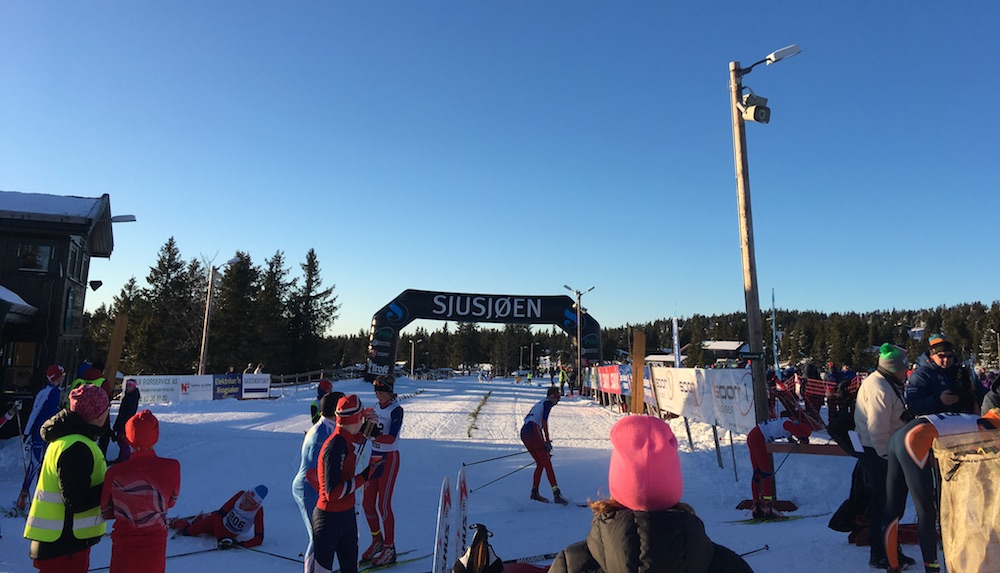
A local race in Sjusjøen, Norway, with hundreds of racers of all ages. (Photo: Maks Zechel)
About Maks: Maks Zechel is a competitive cross-country skier who secretly wants to become a professional mile runner. He loves hiking and going on canoe trips with his family, as well as peanut butter cups in ice cream. Johan Olsson is his favourite skier and he hopes to race the Cortina-Toblach stage of the Tour de Ski one day. He enjoys writing about his experiences. Follow him on Instagram @makszechel.
French delegation at Canadian Ski Nationals (from left to right): National team sprint coach Matieu Fort, Baptiste Gros, Renaud Jay and Roddy Darragon after the skate sprints on Thursday.
MONT SAINTE-ANNE, Québec — It all started with a little buzz about Québec hosting a World Cup.
After the province’s native Alex Harvey and Devon Kershaw struck gold in the team sprint at the 2011 World Championships in Olso, Norway, Cross Country Canada and the International Ski Federation got to talking.
The World Cup should feature a few races in Canada, and why not consider bringing it to the eastern part of the country?
Once FIS accepted Québec City’s application to hold a sprint weekend Dec. 8-9, 2012, the race was on to generate more attention toward the brand new site.
The director of events at CCC, Dave Dyer said the association almost immediately turned to Sport Canada, which governs the country’s sport policy and supports athletes and programs financially.
They needed international hype and some competitive racers to see Québec beforehand.
With the help of an under-$50,000 grant from Sport Canada’s International Hosting Program, CCC was able to pay the way of seven foreign athletes and three coaches to the Canadian Ski Championships, which ended Saturday in Mont Sainte-Anne, Québec.
Norwegian National Junior Team members Sindre Bjornestad Skar (l) and Martin Loewstroem Nyenget after placing first and second, respectively, in the 30 k classic mass start at Canadian Ski Nationals on Saturday.
The first to jump at the offer, Norway sent four racers – two juniors and two under-23’s – to Canada along with two coaches: head U23 coach Sjur Ole Svarstad and national women’s sprint team coach Roar Hjelmeset.
France was next in line for a trip to Canadian nationals. The team’s head sprint coach, Mathieu Fort, accompanied three athletes: Roddy Darragon (World Cup sprint specialist and two-time Olympian) and U23 racers Baptiste Gros and Renaud Jay.
Dyer said this wasn’t the first time Sport Canada had helped CCC host international competitors, but it was by far the most significant.
“We did it last time we were here [at 2007 Canadian nationals] in Mont Sainte-Anne and got a very modest amount of support,” he said. “But I think that as the profile of our sport and the team increases, people are taking notice. It certainly has helped us on the overall funding perspective as far as support for the team.
“I think the success we’ve had at the World Cups and hosting the World Cups has proven the benefits of inviting Europeans to come ski on our turf,” Dyer added.
He designated Canadian National Ski Team coach Eric de Nys to invite teams, and de Nys said he spoke with several coaches at U23 World Championships in Erzurum, Turkey, in February. The idea was to entice juniors to give them a taste for jet lag and racing outside of Europe.
“We had this pot of money and we were able to sort of talk to the Italians, the French, the Swedes, the Norwegians, the Germans, Japanese,” de Nys said. “Lots of them couldn’t come because they had nationals and OPA finals and things like that. But the French, the moment I said it, they’re like, ‘Yeah, we’ll come.’ ”
With pre-existing good relations with Norway and France, this furthered the effort to bridge the global gap. It also gave Québec race organizers a chance to host athletes in preparation for its upcoming World Cup, with individual and team freestyle sprints.
Dyer said this year’s sprint competition featured timed splits thought the heats, requiring more precision than seeding athletes by qualification time. A CCC Officials Level 3 Certification course was also in action at nationals.
Organizers and officials had just one day to practice at the Plains of Abraham, where the World Cup is scheduled, after unseasonably warm weather melted most of the snow on the historic park in downtown Québec City.
While they managed to hold classic team sprints there March 17 on a 1-kilometer loop, the open freestyle sprints were moved about 45 minutes away to the trails at Mont Sainte-Anne on March 22.
Dyer said the experience with timing, officiating and helping international athletes find their way around was useful nonetheless for organizers. It also made nationals one of the most competitive in years.
In his 30th year with CCC, Dyer said this was by far the association’s biggest international hosting effort. In 1986, they brought four Norwegians to nationals in Whitehorse, Yukon. The only other Canadian championship that was nearly as competitive was the one before the 2010 Vancouver Olympics.
By bringing overseas skiers here, Dyer said it benefited Canada’s own athletes.
“Whereas we might send 10 athletes to the World Juniors or to the U23 champs, there’s probably 85 juniors [at nationals] that get a chance to rub shoulders with Norwegians and find out they’re not superhuman,” Dyer said.
First Impressions
For most of the Europeans on the start line, it was their first time in Canada. Several soaked up the opportunity to race against some of the world’s best, including Kershaw, Harvey and Len Valjas.
“It’s a good experience because I never ran with in a final of the same level,” said 21-year-old Gros, of France, after placing fifth in the skate sprint A-final behind the three Canadian National Team athletes.
Earlier this season, Gros finished 13th in a World Cup freestyle sprint in Szklarska Poreba, Poland. His teammate, Darragon was fifth in Poland and 11th in the sprint at Canadian nationals.
Roddy Darragon of France crashing and burning near the B-final winner of Thursday's skate sprint at Canadian Ski Nationals, Drew Goldsack. Darragon placed fifth in the B-final and 11th overall, and literally got a rug burn on his knee after cutting his race suit above the knees on the balmy afternoon.
While he had raced in other parts of Canada before, Darragon said coming to Québec was a first. On the tail end of his season, he was mostly interested in racing for a chance to see the World Cup venue.
“When the coach told us that [we were invited], we said, ‘Yes, we go, immediately,’ ” Darragon said with a smile. “We wanted to travel and wanted to discover the country.”
Although Darragon and his teammates didn’t get to ski on the Plains, he said they drove by it. Before flying back to France on March 23, the day before the distance mass starts, Darragon cut off his race suit above the knees. Shorts were better in hot weather, and 20 degrees Celsius was much warmer than what they were used to in France in March.
“It will be a great souvenir,” Darragon said of his suit, looking down at his bloody knee after falling across the finish of the B-final.
He said he’d be back next year, possibly a few weeks before the World Cup to train.
On the Norwegian side of the wax cabins, all four of their athletes raced the classic distance races on Saturday. In the 30 k junior men’s race, National Junior Team skiers Sindre Bjornestad Skar and Martin Loewstroem Nyenget captured first and second.
2012 Canadian Nationals women's 30 k classic mass start podium (from left to right): 2. Britt Ingunn Nydal (NOR), 1. Chandra Crawford (CNST), 3. Ragnhild Haga (NOR)
In the women’s 30 k, Britt Ingunn Nydal and Ragnhild Haga of the Norwegian National Development Team placed second and third, respectively, after Chandra Crawford (CNST).
“We probably knew we had a better chance here than at the sprint,” said Haga, who recently placed 33rd in a World Cup 30 k at Holmenkollen in Oslo. There, Nydal was 38th.
“We’re very happy being on the podium, both of us,” the 21-year-old added.
She and Nydal, 22, had one more 30 k remaining in Norway later this week. They planned to leave Sunday, but not before some sightseeing and a night out in Québec City.
“It has not only been the races, we’ve been able to look around also,” Nydal said. “It has been an amazing week.”
As for what they’d remember about their first trip to Canada, Haga said the heat. Skar said the size of things.
“Everything is big,” Skar said. “The cars and the roads and the shops, everything is much bigger than in Norway. In Norway, everything is not so big.”
“But it’s really nice here,” Nydal added.
“The weather is great,” Skar continued.
In southern Norway, he said there was no snow. Haga said skiing in such balmy conditions throughout most of the week reminded her of orienteering in the summer.
“It’s a little weird to go cross-country now,” Nydal said.