
From the FasterSkier archive — posts syndicated from athletes’ and coaches’ own blogs between 2004 and 2012, kept online as published. Current coverage is at fasterskier.com.

Tag: Martin Tremblay

  • Où Sont-ils Maintenant: Audrey Vaillancourt

    Où Sont-ils Maintenant: Audrey Vaillancourt

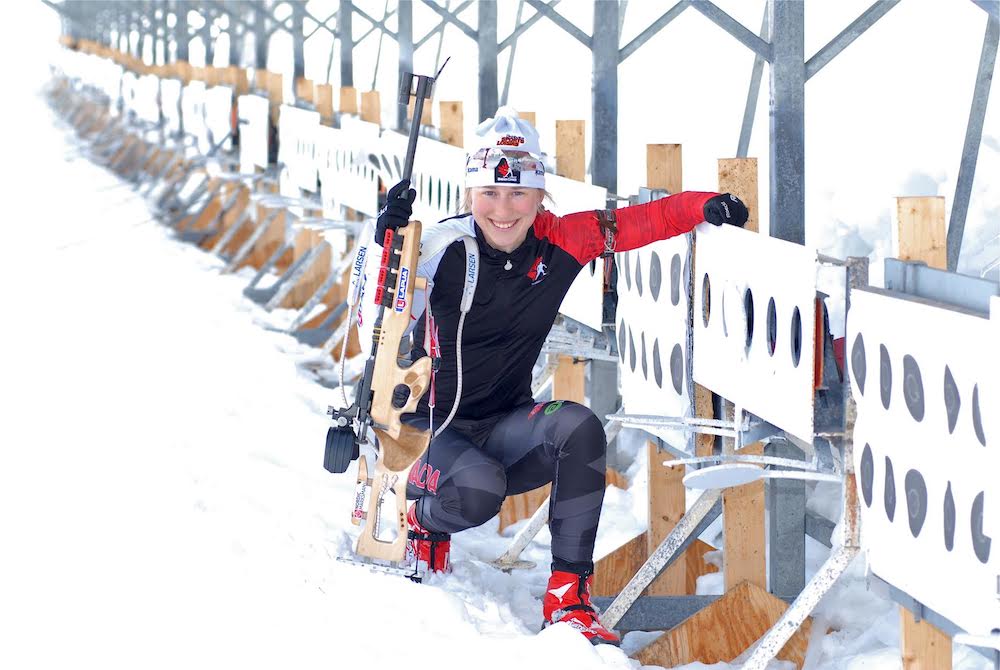
    Audrey Vaillancourt au Centre de biathlon de Valcartier en 2014. (Photo de courtoisie)

    (For English version, click here.)

    Lors du mois de mai 2016, la biathlète canadienne Audrey Vaillancourt annonçait la fin de sa carrière athlétique dans un papier intitulé « La fin d’une grande aventure », publié sur son blogue. Après douze ans – soit près de la moitié de sa vie – consacrés aux compétitions et à l’entraînement, c’est sans légèreté que la Québécoise de vingt-quatre ans, toujours passionnée de biathlon, a pris la décision d’accrocher ses planches et sa carabine.

    Tout a commencé sur les skis à l’âge de six ans, à la traîne derrière ses grands frères Maxime et François Leboeuf (Vaillancourt porte le nom de sa mère). Tous deux sont d’anciens membres de l’équipe canadienne de biathlon, ayant pris leur retraite à vingt-neuf et à vingt-quatre ans respectivement. Sous l’impulsion de parents actifs, Carmen et Pierre, le jeune trio de Val-Bélair a rapidement acquis une brillante réputation à travers la province, dans les cercles rapprochés des fondeurs québécois.

    C’est à douze ans que Vaillancourt fait ses premières armes en biathlon. Un amour du tir s’ensuit instantanément, de même qu’un talent naturel pour cette nouvelle discipline.
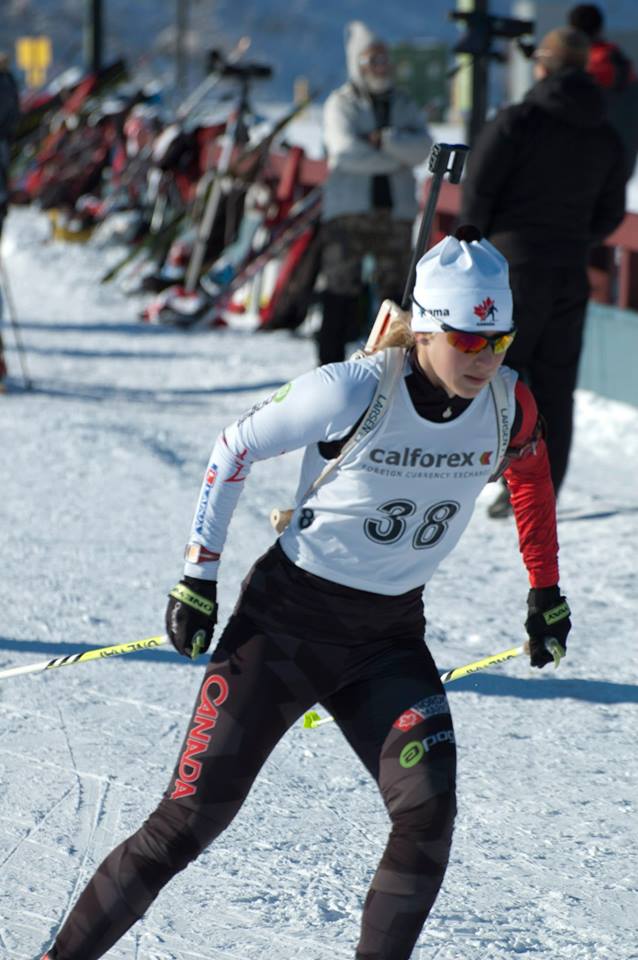
    Audrey Vaillancourt arrachant le deuxième rang au sprint lors des qualifications de l’équipe canadienne de biathlon en novembre 2014 à Frozen Thunder, à Canmore en Alberta. (Photo: Photo: Justin Brisbane)

    « C’était tellement l’fun et différent du ski de fond traditionnel. Le tir présentait un nouveau défi pour moi. Ça rend les compétitions de biathlon tellement plus excitantes que celles en ski de fond », lance avec enthousiasme Vaillancourt, lors d’un entretien téléphonique depuis sa demeure à Québec en janvier dernier.

    Elle rallie rapidement les rangs du Club de biathlon Courcelette, fondé trente ans plus tôt, et s’entraîne au Centre d’entraînement Myriam Bédard – unique en son genre au Québec – sur les terres militaires de Valcartier, non loin de la maison familiale. Alors qu’elle fréquente l’école secondaire, Vaillancourt peaufine ses positions de tir et son pas de patin à raison de trois fois par semaine. Le régime d’entraînement s’intensifie et passe à six séances matinales lorsqu’elle entame ses études cégépiennes. C’est sous la tutelle de Jean Paquet, ex-olympien, puis de Martin Tremblay, l’actuel entraîneur en chef de l’équipe du Québec de biathlon que Vaillancourt déploie ses qualités de biathlète.

    Le saut inévitable vers Canmore, en Alberta, a lieu à seize ans, lorsqu’elle mérite sa place au sein de l’équipe nationale junior. La perspective de progresser aux côtés des meilleurs biathlètes du pays, en plus de s’initier au circuit de compétitions en sol européen, marque une étape importante pour l’athlète québécoise. Une chance en or, que saisit spontanément Vaillancourt, mais qui recèle quelques écueils imprévus.

    « À l’époque, j’étais l’unique athlète francophone de l’équipe. Je ne me suis jamais intégrée totalement en Alberta. Canmore est une ville d’athlètes et de centres d’entraînement, centrée sur la performance sportive. Même si j’étais super motivée à m’entraîner, il me manquait quelque chose. Je me sentais loin de ma famille et de mes amis », admet Vaillancourt.

    Elle ajoute que, malgré l’éloignement, les mois d’hiver passés en Europe lui ont permis de découvrir plusieurs villes (Anthloz, en Italie, demeure son coup de cœur) et de disputer des courses devant de vastes foules endiablées. Vaillancourt a représenté le Canada aux Championnats du monde en 2013 et en 2015 avant de prendre sa retraite en mai 2016.

    « Dans ma dernière saison à titre de senior, l’éloignement a joué pour beaucoup dans ma décision de quitter la compétition », avoue-t-elle.

    Après nombre de podiums accumulés à l’échelle nationale, celle qui a été trois fois championne canadienne atteint le faîte de sa carrière en 2014 à Nove Mesto, en République Tchèque, remportant le quinze kilomètres départ individuel à l’occasion des Championnats européens.

    « C’était fou, une journée que je ne vais jamais oublier », raconte-t-elle. « Mais bon, je pense que c’est l’expérience dans son ensemble dont je vais me souvenir le plus, les centaines d’heures d’entraînement passées chaque année avec l’équipe, les camps d’entraînement, tout le plaisir que j’ai eu avec mes coéquipiers. Ça… et Nove Mesto! »
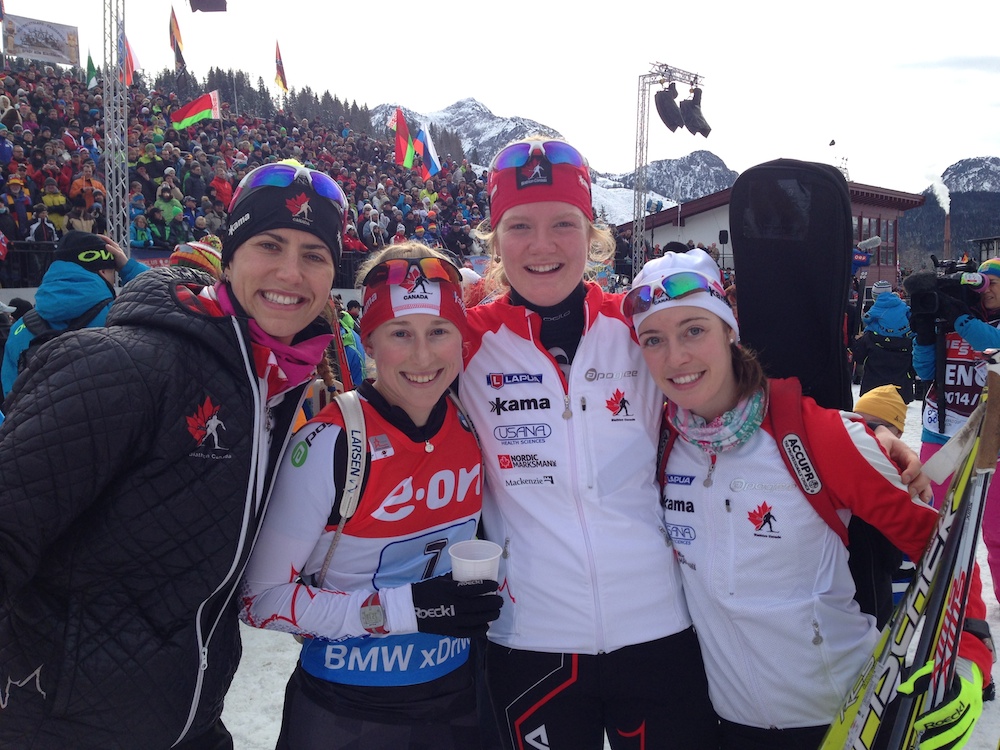
    L’équipe canadienne féminine du relai 4 x 6km après leur onzième position à la Coupe du monde IBU de Hochfilzen, Autriche, en 2014: (de gauche à droite) Rosanna Crawford, Audrey Vaillancourt, Sarah Beaudry et Megan Heinicke. (Photo: Rosanna Crawford)

    Une belle performance aux Championnats du monde junior en 2009 marque une autre étape importante dans son parcours. Devant des partisans canadiens, elle décroche le bronze à Canmore lors du six kilomètres sprint.

    Reflétant sur sa carrière d’athlète, Vaillancourt assure ne conserver aucun regret.

    « J’ai vraiment l’impression d’avoir tout donné. C’est sûr que j’ai rêvé plusieurs fois à une qualification olympique, mais ça aurait aussi voulu dire sacrifier beaucoup. Trop pour moi, en tout cas », concède-t-elle.

    L’idée de quitter l’univers compétitif a germé graduellement lors de la saison 2015-2016. Des résultats en deçà de ses attentes n’étaient pas les seuls responsables de sa résolution finale.

    « La dernière saison a été pénible physiquement et mentalement. Je n’avançais pas. J’étais complètement vidée », explique Vaillancourt. « J’ai obtenu quelques bons résultats, mais rien pour m’encourager à continuer. »

    La retraite à seulement vingt-quatre ans s’est donc imposée naturellement, amenant un grand soulagement après douze années de compétitions. La biathlète a dû se tourner rapidement vers un nouvel objectif, refaire sa vie après le sport.

    « Je comprends maintenant pourquoi plusieurs athlètes souffrent de dépression à leur retraite. Vraiment, je comprends ce phénomène. C’est nécessaire de se préparer, de faire des plans, de remplir sa vie avec des projets. Sinon, on tombe rapidement dans le néant. »

    Vaillancourt vient d’ailleurs de terminer des études en traduction à l’Université du Québec à Trois-Rivières (UQTR). Elle travaille présentement dans le cabinet de traduction Sematos à Québec, mais demeure toujours active au sein du biathlon en tant qu’entraîneuse pour le Club Courcelette et pour le Club Biathlon Mauricie. Elle participe également à un projet appelé « Unis pour le sport », né il y a quelques mois d’une idée de son frère Maxime.

    « Ce projet vient du désir d’aider les athlètes de tous les niveaux à améliorer leurs performances sportives, leur régime d’entraînement, leur technique dans divers sports, allant du ski de fond aux courses à obstacles, en passant par le biathlon et la course à pied », confie-t-elle.

    Le site web du projet (http://unispourlesport.com) vient d’ailleurs récemment de mettre en ligne un plan d’entraînement personnalisable pour coureurs.

    « Les choses se passent bien », écrit Vaillancourt dans un courriel le mois dernier.

  • Where Are They Now: Audrey Vaillancourt

    Where Are They Now: Audrey Vaillancourt

    Audrey Vaillancourt at the Valcartier Biathlon Centre in 2014. (Courtesy photo)

    Note: The following interview with retired biathlete Audrey Vaillancourt was conducted in French and translated to English. For French version, click here.

    ***

    A year ago, in May of 2016, Canadian biathlete Audrey Vaillancourt announced her retirement in a blog post titled, ‘The end of a great adventure’. Having spent 12 years — nearly half of her life — racing in a sport she’s still very much passionate about, the decision to call it quits came at 24 years old, and was not an easy one to make.

    For Vaillancourt (who has the same last name as her mother), it all started on skis at age 6 as she tried to catch her older brothers Maxime and François Leboeuf, both former members of Biathlon Canada’s national team themselves who stepped away from the sport at 29 and 24, respectively. Fueled by active parents, Carmen and Pierre, cross-country skiing started as the central sport in the Leboeuf family, and quickly, the rumour of a brilliant trio of young ski racers from Val Bélair began to spread across the province of Quebec.

    At 12, Vaillancourt once again followed her brothers’ footsteps and gave biathlon a try. An instant love for shooting — and a natural knack for it — immediately followed, and she was hooked right then and there.

    Audrey Vaillancourt racing to second in a sprint at Biathlon Canada team trials in Nov. 2014 at Frozen Thunder in Canmore, Alberta. (Photo: Photo: Justin Brisbane)

    “It was so fun and different. The shooting presented a new challenge, and it really makes biathlon races much more exciting than cross-country skiing, in my opinion,” Vaillancourt said in January on the phone from her home in Quebec City. “A race can totally change in 30 seconds; it’s crazy.”

    She joined the Courcelette Biathlon Club, founded 30 years ago, and trained close to home at the Myriam Bédard Biathlon Centre — the only training centre of its kind in Quebec — located on the Valcartier military base. That’s where she perfected her shooting skills, first training three days a week in high school, then gradually expanding that to six morning sessions a week when she began her CEGEP (Collège d’Enseignement Général et Professionnel) studies. Olympian Jean Paquet was her first coach, then she spent the rest of her career working with Martin Tremblay, Biathlon Team Quebec’s head coach.

    At 16, she was named to Canada’s national junior team, which brought her to Canmore, Alberta. While training amongst the country’s best meant a natural progression in her athletic career and the lustrous prospect of racing on European soil, it also came with a few unexpected hardships, she explained.

    “At the time, I was the only French-speaking athlete on the team. I never fully blended in when I was in Alberta,” she said. “Canmore is a small city that revolves a lot around training, sports and performance. I felt so far from family and friends. Even though I was all in for training and racing, the traveling back and forth from Quebec to Canmore was challenging.”

    She added that she enjoyed visiting different cities in Europe (Antholz, Italy, was her favourite) and competing in front of tens of thousands of fans. Vaillancourt competed at 2013 and 2015 World Championships before retiring last spring.

    “In my final year as a senior, being so often away from home really influenced my decision of leaving the sport,” she said.

    With countless podiums in national races, the three-time Canadian national champion reached the peak of her career in 2014, when she won the 15-kilometre individual at Open European Championships in Nove Mesto, Czech Republic.

    “It was unreal, I will forever remember that day,” she said. “But I think the overall experience of training year-round with the squad, our training camps, the fun I had with my teammates, all that which surrounds racing, actually is what I’ll remember the most. I was so in love with training at the time. That ranks first in my memory … aside from Nove Mesto.”

    The Canadian women’s relay team after placing 11th in the 4 x 6 relay at a 2014 IBU World Cup in Hochfilzen, Austria: (from left to right) Rosanna Crawford, Audrey Vaillancourt, Sarah Beaudry, and Megan Heinicke. (Photo: Rosanna Crawford)

    Her podium at 2009 Youth World Championships was another important stepping stone. In front of a home crowd in Canmore, she took third in the 6 k sprint.

    Looking back on 12 years of racing, Vaillancourt said she had no regrets.

    “I really feel I gave it my all. Sure, qualifying for the Olympics would of been awesome, but it became evident that to get there meant sacrificing a lot, too much for me anyway. The cons outweighed the pros in the end,” she said.

    The decision to retire from competition came gradually during the 2015/2016 season. Disappointing results weren’t solely to blame.

    “What can I say, I just wasn’t in it anymore, physically and mentally. I was totally drained,” she explained. “Despite some few good results, things never improved during that season. It was clear I was on my way out.”

    While the prospect of retiring at age 24 was hard to swallow, it came with great relief, she said. Having a goal to focus on after biathlon was “absolutely necessary,” she said, and made the transition a lot smoother.

    “I understand why some athletes fall into depression after retirement. I really get it,” Vaillancourt said. “You need to prepare yourself, make plans, fill your life with projects. Otherwise, it’s easy to fall into limbo.”

    Just last month, she completed her degree in translation at the Université du Québec à Trois-Rivières (UQTR). She now works at Sematos Translation in Québec City and has remained involved in biathlon as a coach at Courcelette Biathlon Club and Biathlon Mauricie Club. And seven months ago, she became involved in a new project her brother Maxime founded called “Unis pour le sport” (United for Sport).

    “This project is an effort to help athletes achieve specific goals regarding racing, training, technique in various sports, ranging from cross-country skiing and biathlon to obstacle-course racing and running,” she explained. “We already sense a strong demand for such services across the province.”

    Most recently, the website published an example of a personalized training plan for runners.

    “Things are going well,” Vaillancourt wrote in an email last month.