From the FasterSkier archive — posts syndicated from athletes’ and coaches’ own blogs between 2004 and 2012, kept online as published. Current coverage is at fasterskier.com.
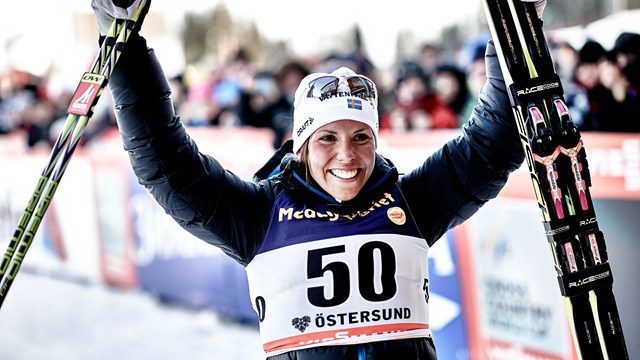
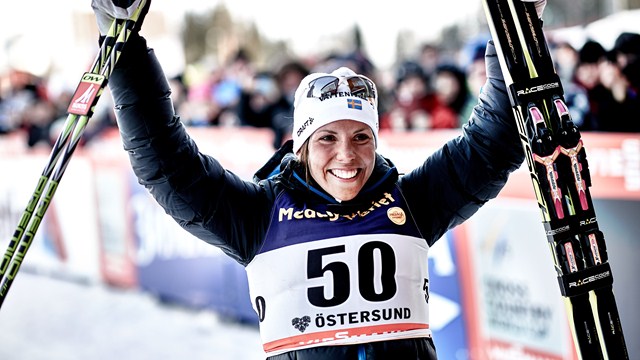
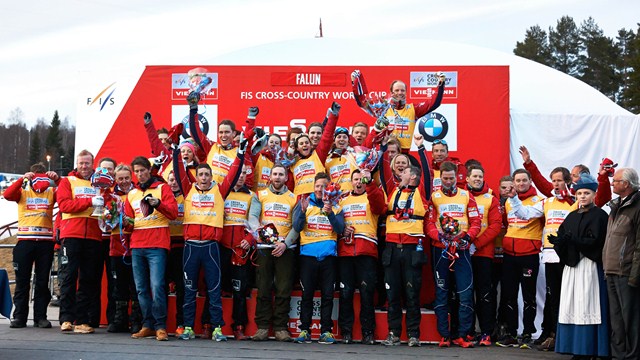
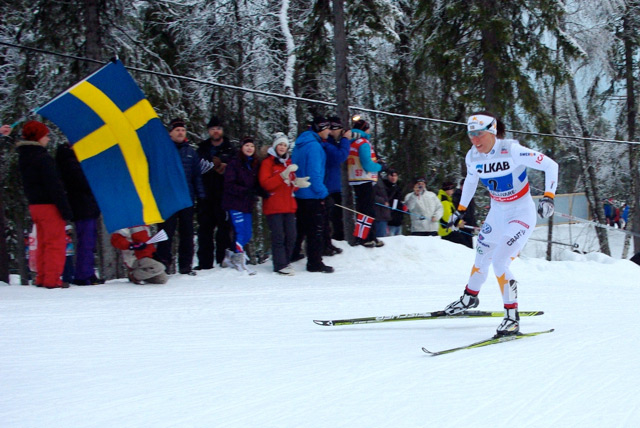
Sweden’s Charlotte Kalla came up big in front of a home crowd in Östersund, Sweden, winning Sunday’s 10 k freestyle by more than 36 seconds over Norway’s Marit Bjørgen. (Photo: FIS)
With only days to go until the 2015 Nordic World Ski Championships in Falun, Sweden, nobody could touch home-crowd favorite Charlotte Kalla in the women’s World Cup 10-kilometer freestyle individual start on Sunday in Östersund, Sweden.
The 27-year-old Kalla polished off the challenging, hilly, two-lap course in 23 minutes and 26.1 seconds for her first World Cup win since March 2010, when she won the 10 k freestyle at World Cup Finals. She was more than half a minute ahead of Marit Bjørgen of Norway in second place, and nearly a minute ahead of Therese Johaug of Norway, who have been dominating the World Cup since the first races in November.
“It feels great to win a World Cup again,” Kalla said to FIS reporters after the race.
Kalla was quick to thank the spectators for carrying her through the challenging course and also noted that she felt like she had some home turf advantage.
“The crowd here in Östersund was so encouraging. I know the courses here very well, and I felt strong,” she said, adding that Feb. 15 marks a special anniversary for her.
“I won Olympic gold in Vancouver on this day, and again last year in Sochi we won the relay on this day, and now a World Cup win today,” Kalla said.
Kalla chose to sit out the 2014/2015 Tour de Ski in favor of training and peaking for the World Championships on home turf later in the season, a strategy she chose with success also leading up to the 2010 Olympics in Vancouver.
Left Bjørgen in the dust
Saturday’s sprint winner and Overall World Cup leader, Bjørgen was clearly ahead of her primary rival Johaug, starting a minute after her teammate and beating Johaug by more than 15 seconds. But even the queen of cross-country skiing was more than half a minute behind Kalla, who started 50th, over 10 kilometers.
Bjørgen in bib 72 never came close to matching Kalla at any point of the race, with Kalla leading by 10.4 seconds at 1.8 k, then 25.4 seconds at 6.8 k. At 8.3 k, Bjørgen remained in second, but was 31.5 seconds behind Kalla.
“I didn’t feel as strong today as yesterday, but I am really happy for Charlotte,” Bjørgen told FIS after the race. “It is so nice to see her back on top of the podium. It’s great for her, and it is important for the sport, especially with the World Championships here in Sweden.”
“It’s great for her, and it is important for the sport, especially with the World Championships here in Sweden.” — Marit Bjørgen, runner-up in Sunday’s 10 k freestyle to Sweden’s Charlotte Kalla
Despite finishing second, Bjørgen locked up her fourth Overall World Cup title on Sunday with a 565-point lead on Johaug (last year’s overall winner) with four World Cup races to go.
Kalla skied confidently for the start. Low to the ground, she pushed off calmly and powerfully, getting the most out of every stride. The Norwegians skied with higher turnover, but on Sunday, their style resulted in less speed.
At 1.8 k, Kalla remained more than 13 seconds ahead of Johaug and Weng. At 8.3 k Kalla was a whopping 48.2 seconds ahead of Johaug in third.
While Kalla left the Scandinavian Cup races in January in Falun in tears (where she won the 10 k freestyle and took fourth in the classic sprint and skiathlon), she gave a taste of what is in store during the Swedish national championships two weeks ago when she dominated the rest of the field in both the skiathlon and the 10 k freestyle in Örebro.
On Sunday, Kalla won with 36.5 seconds to spare to Bjørgen in second place. Johaug was third, 53.6 seconds behind Kalla. Norway’s Heidi Weng and Astrid Uhrenholdt Jacobsen finished fourth and fifth, respectively, 1:01.3 and 1:08.3 back.
Scandinavian dominance
Nicole Fessel of Germany in sixth place was the top non-Scandinavian in the 10 k skate race, more than a minute behind Kalla, and about 20 seconds out of the podium. Riitta-Liisa Roponen of Finland was seventh, Martine Ek Hagen of Norway was eighth, Yulia Tchekaleva of Russia was ninth, and Ragnhild Haga of Norway was 10th.
Jessie Diggins in 17th place was the top American in the final test run before the World Championships, which open with classic sprints for both men and women on Thursday. Diggins was 1:45.7 behind Kalla. Liz Stephen was 26th, Rosie Brennan was 32nd and Kikkan Randall was 33rd for the U.S., while Emily Nishikawa placed 36th for Canada.
Prior to the World Cup round in Östersund, both the Swedish and the Norwegian national teams have been training and preparing for the World Championships at altitude in the Italian Alps.
After this weekend, Kalla travels to Falun, to start the final preparations for the World Championships. For her, the first event will be the 15 k skiathlon on Feb. 21.
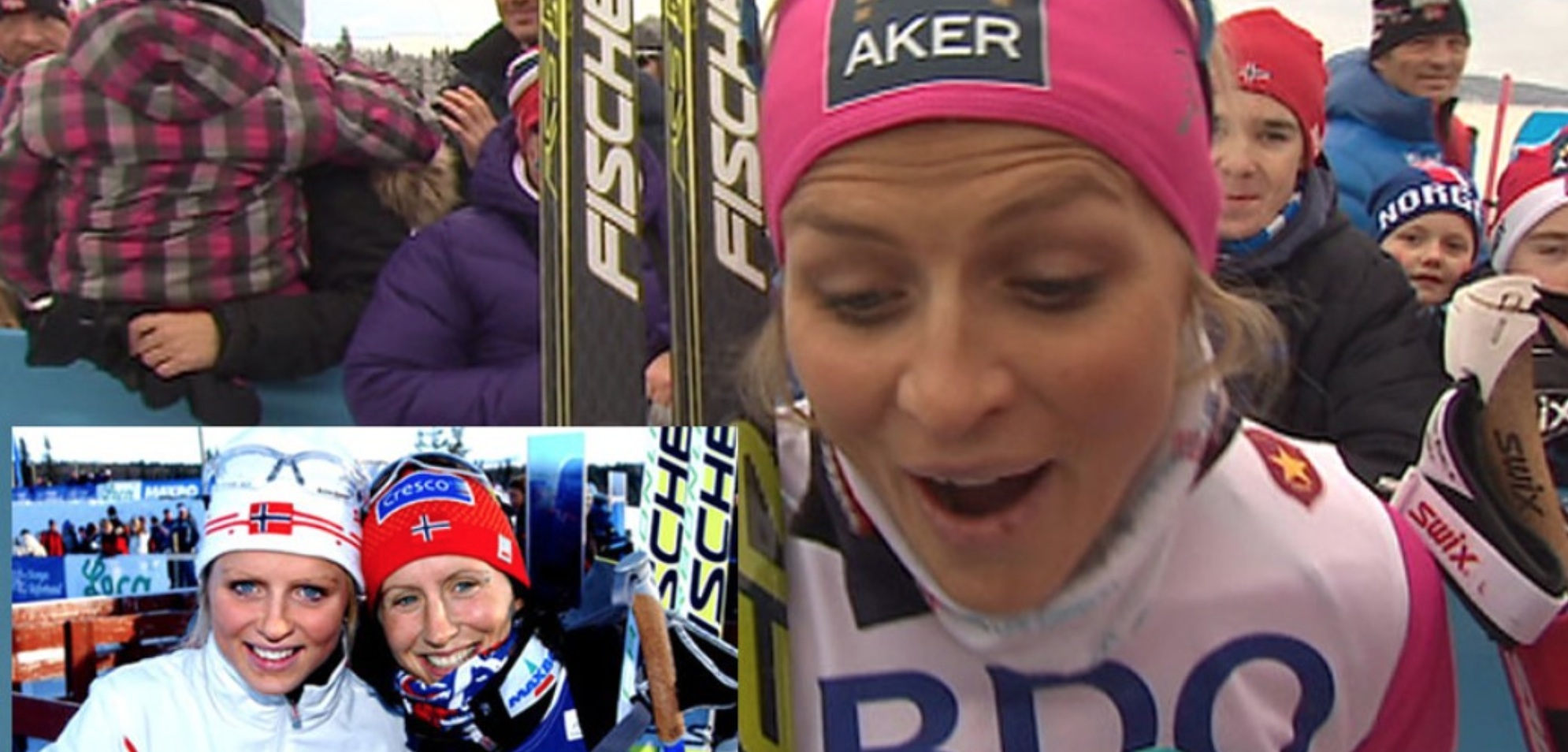
Therese Johaugs reacts when reporters show her a photo of herself and Marit Bjørgen from eight years ago in Beitostølen, the same place where Johaug won the opening race of the season on Friday. (Photo: NRK)
Therese Johaug started cracking up when reporters at Friday’s International Ski Federation (FIS) race in Beitostølen, Norway, showed her a photo of herself and Marit Bjørgen from eight years ago, also in Beitostølen.
The Norwegian national-team member was 18 at the time.
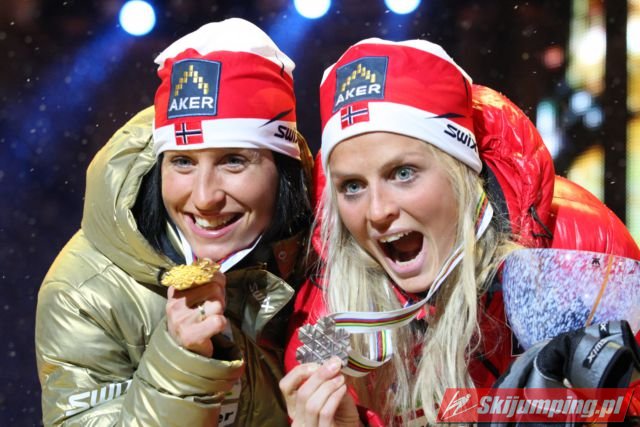
Marit Bjørgen (l) and Therese Johaug with their gold and silver medals from the 2011 World Championships 15 k in Oslo, Norway. (Photo: Wikimedia Commons)
“Oye … a lot has happened since then,” Johaug told NRK with a laugh. Now they’re not only best friends, they’re each other’s fiercest competitors.
On Friday, Johaug, 26, won the 10-kilometer classic in 26:36.1 minutes, 24.7 seconds ahead of Bjørgen in second. Like fellow Norwegian Martin Johnsrud Sundby, she won last season’s Tour de Ski as well as the overall World Cup title.
Six years ago, she was a junior competing in Beitostølen for the first time. She told reporters she had the same photo hanging on her wall at home.
Now she’s won the Beito distance opener for three consecutive years. Last year, Bjørgen didn’t compete; Johaug beat another teammate —Astrid Uhrenholdt Jacobsen — by more than 54 seconds for the win. In 2012, Johaug topped Bjørgen by 52.2 seconds. This was her fourth-straight time winning Beito’s 10 k classic, according to VG.
On Friday, Bjørgen led through 2 k, 2.7 seconds ahead of Johaug. By 6 k, Johaug took hold with a 5.3-second lead over Bjørgen and stayed in front to secure the first win of the season.
“It felt good; I managed to calm myself down and think, time and power,” Johaug told NRK, according to a translation. “It was fun to get it when I have worked so much this fall and along.”
“We have talked a lot about calming down … and trust that I’m fast enough, rather than skiing with my shoulders at the ear level and increasing the turnover. That doesn’t make you fast.” — Therese Johaug, after winning Friday’s 10 k classic FIS race in Beitostølen
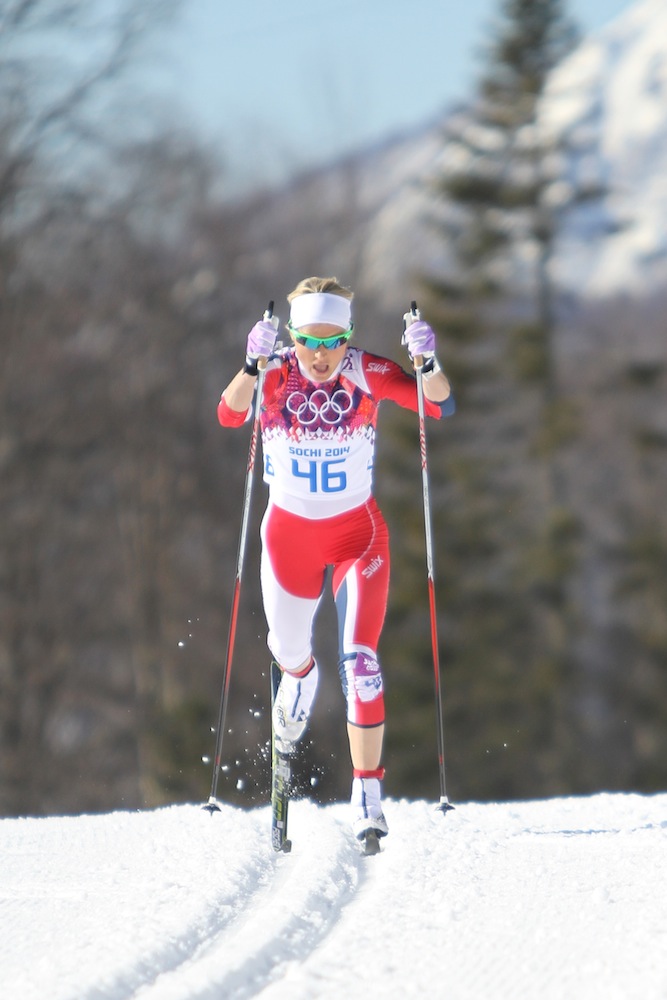
Johaug racing to bronze in the women’s 10 k classic at the 2014 Olympics in Sochi, Russia.
Since last season, she’s been working on her upper-body strength and spent long hours in the weight room and on the rollerski treadmill, she told VG. She also credited her psychologist, Britt Tajet-Foxell, for helping her progress.
“[The training] is paying off, and that’s really fun,” she said, according to a direct translation. “We have talked a lot about calming down and taking time to complete each kick and each pole plant, and trust that I’m fast enough, rather than skiing with my shoulders at the ear level and increasing the turnover. That doesn’t make you fast. Today I felt like I managed to do that, and that I was rewarded all the way.”
“Today, Therese was impossible to beat,” Bjørgen told VG.
As for how she felt: “It hurt, but that is somewhat expected,” Bjørgen said to NRK, adding that she felt normal, like in recent years.
“It’s not just anyone I measure myself against, so I know what I did today is good,” she told NRK.
“Next weekend it can be turned upside down,” Norwegian women’s coach Egil Kristiansen said. “Therese skied great today.”
Norway’s Heidi Weng took third, 44.8 seconds behind Johaug and 20 seconds back from Bjørgen. Germany’s Stefanie Böhler placed fourth and Martine Ek Hagen of Norway was fifth.
Rounding out the top 10, Katerina Smutna (Austria) was sixth, Claudia Nystad (Germany) finished seventh, Barbro Kvåle (Norway) emerged in eighth, Victoria Carl (Germany) was ninth, and Kari Vikhagen Gjeitnes (Norway) took 10th.
Jacobsen finished 14th.
“I’m not in good shape,” she told NRK. “It was hard all the way, and I feel half-empty. …There is a way to go forward; I know that it is there.”
Racing continues with 10/15 k freestyle races on Saturday and a classic sprint on Sunday.
For all the international-racing junkies out there, the Swedish and Norwegian Ski Associations recently announced the nominations to their 2014/2015 national teams.
Sweden’s male and female teams both grew from eight to nine members apiece, according to the Swedish Ski Association, with the additions of Simon Persson, 22, and Jonna Sundling, 20, and to men’s and women’s A-teams, respectively.
Norway’s Cross-Country Committee nominated 25 athletes to its three national teams (women’s, men’s all-around, men’s sprint), according to Norges Skiforbundet. Kathrine Harsem, 25, and , 23, received the call up to the women’s elite team. On the men’s side, Simen Andreas Sveen, 25, and Didrik Tønseth, 22, are new to the all-around team, and Sondre Turvoll Fossli, 20, is the newest sprinter.
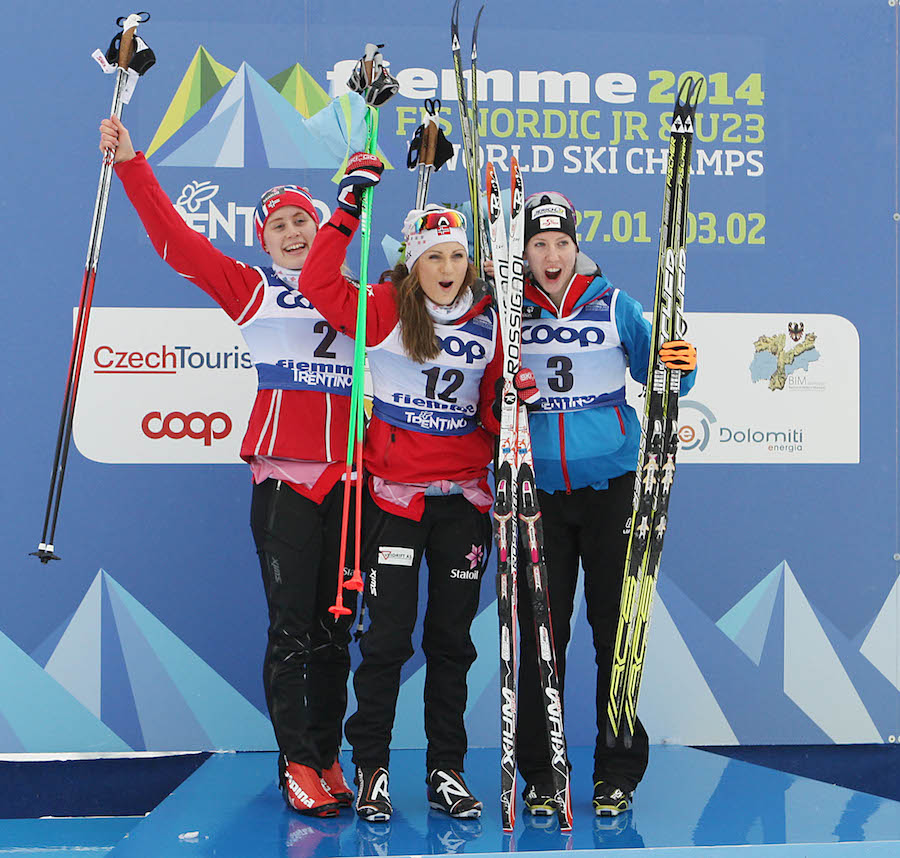
Martine Ek Hagen (c) after winning the women’s 15 k skiathlon at U23 World Championships last season in Val di Fiemme, Italy, with teammate and runner-up Ragnhild Haga (l), and Teresa Stadlober of Austria, who placed third (r). (Photo: Fiemme2014)
No longer with the Norwegian national team, Vibeke Skofterud, Øystein Pettersen, Petter Eliassen, Niklas Dyrhaug and Tord Asle Gjerdalen are pursuing different paths and interests.
A 2010 Olympic gold medalist in the team sprint, Pettersen, 31, whose nickname is “The Sausage,” recently told NRK that he plans to focus on distance races while skiing for Team United Bakeries.
“In recent years I trained hard to break into sprints but it did not happen,” he said, according to a translation. “Then I lost faith in myself in the sprint and I cannot continue another season training for something I have lost confidence in.”
He explained that the Vasaloppet and 2015 World Championships will be his main focuses for next season.
According to FIS, a few Norwegians are switching specialties: Pål Golberg from sprint to all-around, Finn Hågen Krogh from all-around to sprint. Simen Østensen returns to the all-around team along with Chris Jespersen, who’s now back on the elite national team.
Sweden
A Team
Ladies
Sofia Bleckur, IFK Mora SK
Hanna Erikson, Åsarna IK
Anna Haag, IFK Mora SK
Ida Ingemarsdotter, Åsarna IK
Charlotte Kalla, Piteå Elit
Sara Lindborg, Falun-Borlänge SK
Stina Nilsson, IFK Mora SK
Jonna Sundling, IFK Umeå
Emma Wikén, Åsarna IK
Men
Calle Halfvarsson, Falun-Borlänge SK
Marcus Hellner, Gellivare Skidallians
Emil Jönsson, IFK Mora SK
Anton Lindblad, Sollefteå Skidor IF
Lars Nelson, Åsarna IK
Johan Olsson, Åsarna IK
Daniel Richardsson, Hudiksvalls IF
Simon Persson, IFK Umeå
Teodor Peterson, Åsarna IK
Team 2015
Ladies
Anna Dyvik, Falun-Borlänge SK
Hanna Falk, Ulricehamns IF
Sofia Henriksson, Strömnäs GIF
Magdalena Pajala, Piteå Elit
Evelina Settlin, Hudiksvalls IF
Marika Sundin, Sollefteå Skidor IF
Julia Svan, Vansbro AIK
Jennie Öberg, Piteå Elit
Men
Simon Andersson, Falun-Borlänge SK
Martin Bergström, Piteå Elit
Jens Burman, Åsarna IK
Martin Johansson, IFK Mora SK
Simon Lageson, Åsarna IK
Jesper Modin, Piteå Elit
Carl Quicklund, Östersunds SK
Marcus Ruus, Gillberga SK
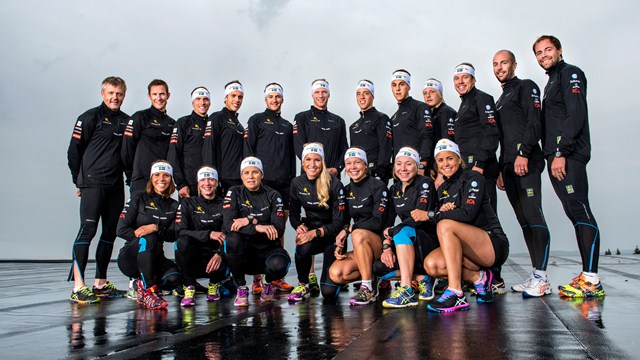
The Norwegian National Team last season on the World Cup circuit. (Photo: FIS/Nordic Focus)
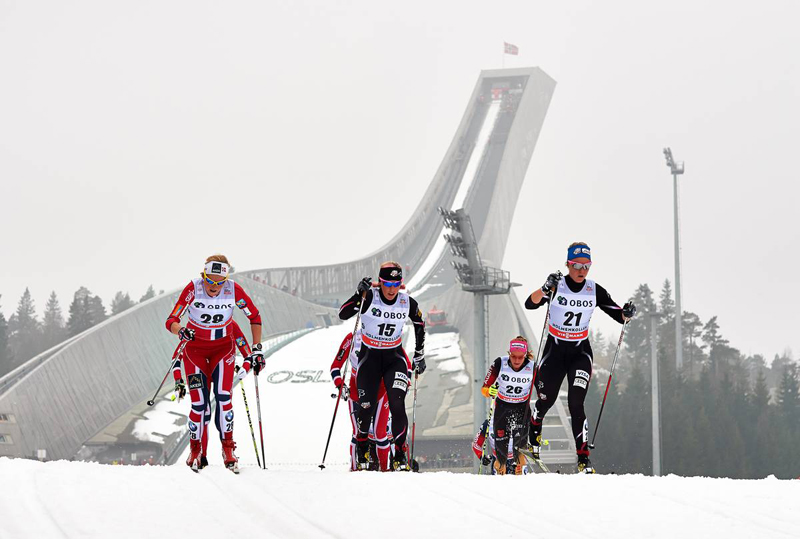
Americans Kikkan Randall (c) and Sadie Bjornsen (r) ski with Norway’s Marthe Kristoffersen (l) and Germany’s Nicole Fessel (second from r) in the Holmenkollen 30 k classic mass start on Sunday in Oslo, Norway. (Photo: Fischer/Nordic Focus)
There’s something to be said for skiing like you’ve got nothing to lose. Ask Kikkan Randall, who locked up the World Cup sprint title for the third year in a row last Wednesday in Drammen, Norway. Or Sadie Bjornsen, who’s been plagued with bouts of illness for the better part of the last three months.
Both U.S. Ski Team members later said they felt relatively good before the start and during most of the world-famous Holmenkollen 30-kilometer classic mass start on Sunday in Oslo, Norway.
It was still a dang-tough course, with an initial 5 k lap followed by a larger 8.3 k lap containing two smaller loops (at least the skiers kept it straight). After getting off to a strong start, Bjornsen said she was a little frightened with the tempo of the women she was skiing with.
“At four k, I was like, ‘There’s no way I’m going to be able to maintain this pace, but I’ll hang on until I explode,’ ” she recalled.
Bjornsen did her best to hold her position just outside the top 10, first testing her grit with some Finns, including Krista Lahteenmaki and Anne Kyllönen. The American quickly found their classic style didn’t match hers and she opted to ski with several Norwegians, including Tuva Toftdahl Staver, Ingvild Flugstad Østberg, Kristin Størmer-Steira, and Martha Kristoffersen for the first several kilometers.
Bjornsen said the Norwegians’ “really big strides,” matching hers, made the difference. “I was appreciative of that,” she said.
Kyllönen’s stride was simply too big, she said, and “Lahteenmaki, I felt like I was in a sprinting running race; she has a very short tempo. I followed her for a couple k and my legs were flooded.”
By 10 k, Norway’s Martine Ek Hagen was right there with Bjornsen as well, and Randall was just off the back of their seven-person chase pack, which at the time, was about a minute and 30 seconds behind eventual winner Marit Bjørgen.
With Norwegian fans lining the entire course, Bjornsen said the atmosphere brought her back to her international debut at the 2011 World Championships in Oslo.
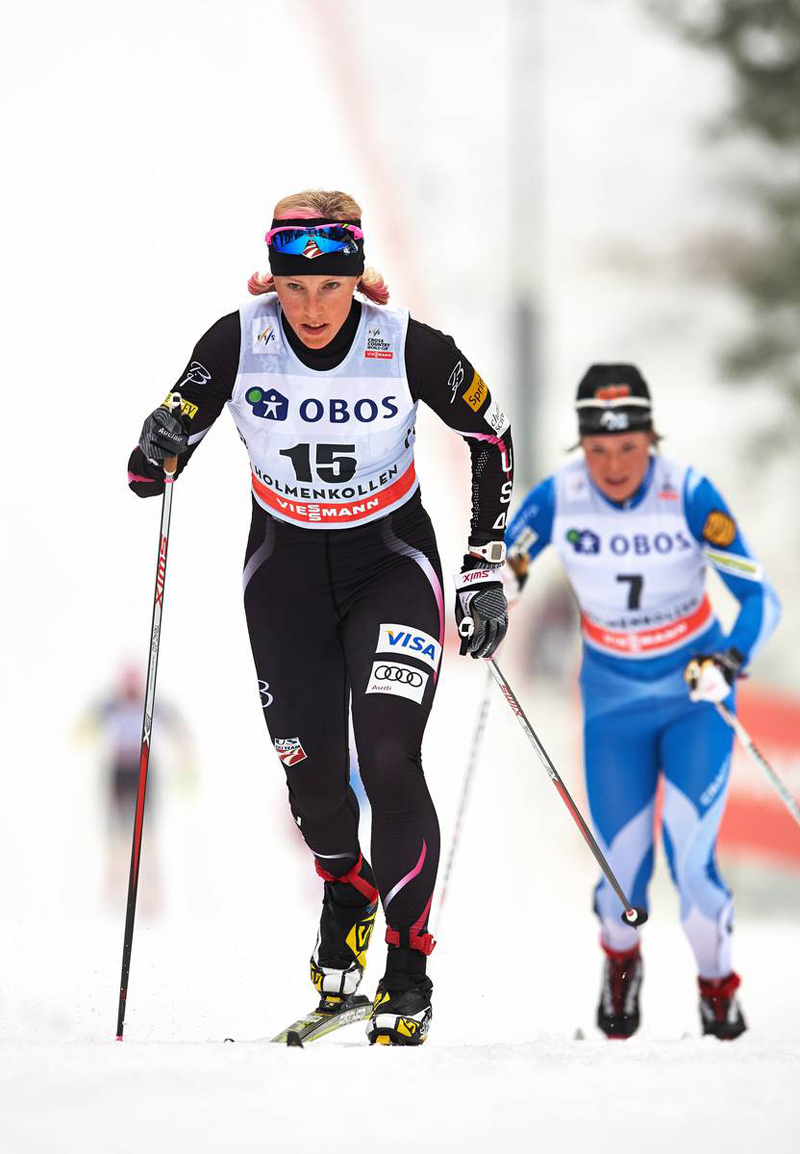
American Kikkan Randall (15) racing to 12th, a career best in the 30 k, at the Holmenkollen 30 k classic mass start on Sunday in Oslo, Norway. (Photo: Fischer/Nordic Focus)
“It was World Championships loud,” Bjornsen said. “I kept hearing my name in the mix, but more than anything, I could hear them yelling, ‘Kikkan.’ She’s a national hero here. She’s huge.”
The crowd and endless cheers fueled Bjornsen to staying within the top 15 throughout the race, with Randall close behind for most of it. Ultimately, Randall shot to the front of the pack and continued to pick off places with 1.5 k to go, finishing 12th for her career-best 30 k, just 10 seconds ahead of Bjornsen in 14th, also her best distance race.
Two years ago — the first time Bjornsen raced in Holmenkollen — she placed 40th in the 30 k classic. She did not race there last year.
“I couldn’t have picked a better way to ski it with four Norwegians,” Bjornsen said after going head-to-head with Heidi Weng, Østberg, Hagen and Kristoffersen to the line. She beat all but Weng, who took 13th by 0.4 seconds, and edged Østberg by one-tenth of a second for 14th, 4:27.8 back from Bjørgen. The top Norwegian became the first woman to win four Holmenkollen titles in what doubled as her 100th World Cup podium.
Randall finished 4:17.7 after Bjørgen, without anyone within several seconds of her. She recalled being 100 meters behind the pack for most of the middle part of the race, with skis that were “a little slick” on the first lap sending her in for a fresh pair at 13.3 k.
Bjornsen changed there as well, where she said everyone was switching. Skiing on her “B-pair” until that point, she said her skis were great — gripping on the uphills and fast enough on the downhills. But she wasn’t about to second guess what everyone else was doing, and changed to her A-pair. That was the first time a ski change worked out in her favor, she said.
The group she was with never switched again (out of a possible three times), and while most struggled with kick on the icy last lap, Bjornsen said it was the same for everybody.
The turning point for Bjornsen and Randall’s group came with 5 k to go. Bjornsen and Staver fell off the pace slightly around 20 k, but worked their way back up by the top of the long climb known as Frognerseteren. By then, Bjornsen and Randall racing with five Norwegians and Japan’s Masako Ishida.
“We came down the hill and suddenly [the Norwegians] started sprinting so hard,” Bjornsen said. “Suddenly, they’re in sprint pace and I was like, ‘Wow, are they going to do this to the finish? This is gonna be really hard.’ ”
About a kilometer later with 4 k remaining, the pace slowed. Randall then took off before the 28.5 k checkpoint.
“Now I’m kicking myself for not trying to go with her,” Bjornsen said. “But she was so impressive.”
After changing her skis, Randall said her arms started cramping on the second lap, but she double poled with her legs and core as much as possible, and was able to latch back on by the top of the course on lap three.
“It’s kind of a nice feeling when you get to the top of the course on that third lap — now you know some of the big hills are done and … see whats left in the tank,” she said.
With two climbs remaining, Randall knew she had the speed and energy to knock off a few places in the standings. She jumped in her own track and skied her own tempo, then simply “ran out of room toward the finish,” she said. “It’s aways fun having people to catch.”
The result was something she could be pleased with, especially in a distance classic race that isn’t typically her bread and butter. Going into the 30 k, Randall said she didn’t have to worry about her mind wandering off to the upcoming sprint at World Cup Finals on Friday. Had the pressure been on to win that sprint, she might have approached Holmenkollen differently, especially as the race got tougher.
“It was kind of nice to be able to wrap up the Sprint Cup and go, ‘Now I just get to race,’ and not worry about whether it’s a smart decision or not,” she said.
While Randall was aiming for a top 15, Bjornsen said she wasn’t sure what to expect for a result. She had come down with one of her worst colds yet after the Sochi Olympics, and went for her first 30-minute walk/ski last Tuesday. She raced Wednesday in Drammen (qualifying in 21st then placing 30th), then focused on getting healthier each day until the 30 k.
“I would say now I’m 100 percent,” Bjornsen said.
Reflecting on her second Holmenkollen experience, she said this one will definitely be among her most memorable races.
“Holmenkollen has such an incredible atmosphere,” she said. “I was trying to take in the noise level at the top of Frognerseteren, so that helped and also skiing with a bunch of Norwegians.”
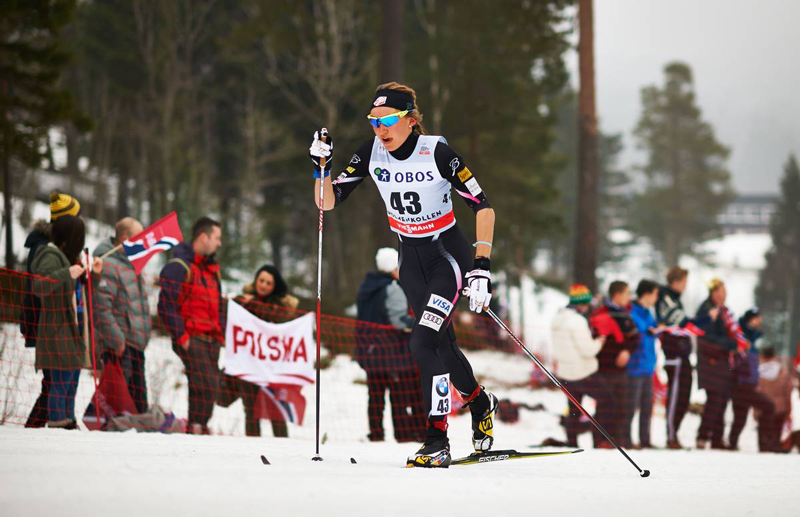
Sophie Caldwell (U.S. Ski Team) racing to 35th in her first Holmenkollen 30 k mass start in Oslo, Norway. (Photo: Fischer/Nordic Focus)
Three other U.S. women made the top 40, and Ida Sargent was close behind in 42nd.
Liz Stephen placed 32nd (+8:30.2) after two crashes. Sophie Caldwell finished 35th (+8:48.1) in her first Holmenkollen 30 k, and Caitlin Gregg (Team Gregg/Madshus) was 39th (+10:15.3).
“Tough day for me with a couple of crashes early on, but nothing serious like Astrid [Jacobsen] experienced,” Stephen wrote in a message, referring to the Norwegian’s scary crash off a ledge that sent her to the hospital. She suffered a blow to her head, shoulder and hip, but was not seriously injured, according to NRK.
“The atmosphere here at Holmenkollen is definitely something special, with fans chanting your name, and campfire smoke billowing in the air and sausage smells and fresh waffle smells wafting throughout the race,” Stephen wrote. “Someday I am going to have to come camp out and be one of the fans out there, for sure.”
Caldwell explained that it was a long enough race that she had “multiple highs and lows throughout it, but overall I think it went well,” she wrote in an email.
She switched her skis once at 13.3 k because everyone else was doing it, not necessarily because she needed to.
“I got to ski with Liz a bunch which was fun and then otherwise kind of hopped between a couple groups,” Caldwell wrote. “The race atmosphere was insane. There are people lining the entire course who have been camping out all weekend and they all know your name. They have start lists, so as long as you aren’t skiing with any Norwegians, they start chanting your name as you go by. I think the extra cheers definitely helped motor me around the course.”
According to Gregg, who was especially confident in her skis and stuck with the same pair throughout the race: “no matter how you are feeling, the spirit of the crowds lift you up.” While the classic race wasn’t her specialty, she enjoyed the length.
“My result was solid but certainly not outstanding,” Gregg wrote. “Some of girls had awesome races today so that was really cool! I found the pace right off the gun to be ridiculously fast and it kind of caught me off guard. I was in last place from the end of the stadium. This is something I obviously need to work on. Throughout the race I continued to move up steadily as other racers got tired.”
Gregg with travel with the U.S. team to race at the three-day World Cup Finals in Falun.
“This will be my first time racing there and I am very excited about the format!” she wrote.
Bjornsen said making it to World Cup Finals has been her major goal since last season.
“It’s going to be fun because it’s a lot of different races,” she said.
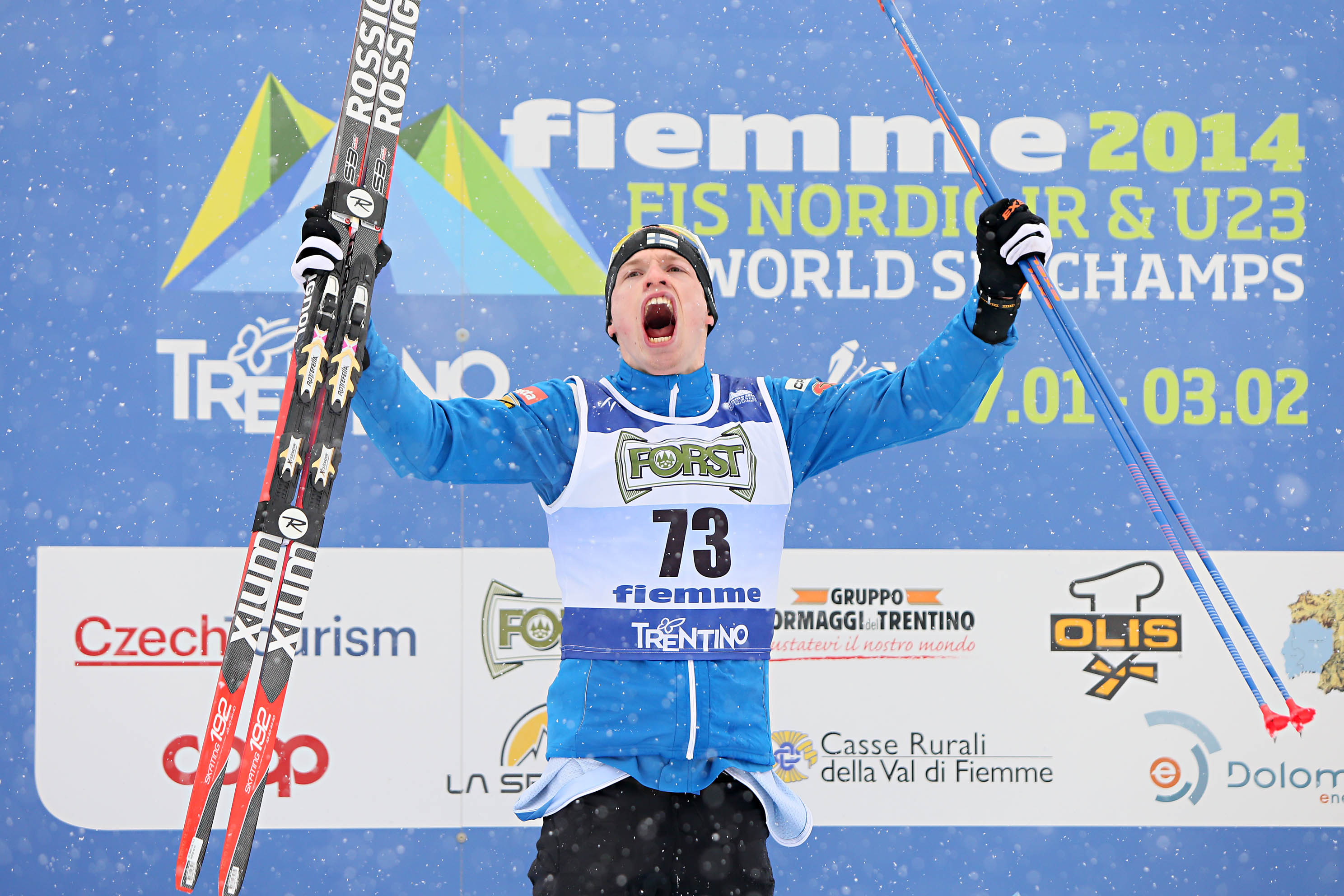
Iivo Niskanen (FIN) celebrates his win in the 15 k classic at the 2014 U23 World Championships in Val di Fiemme, Italy. (Photo: Fiemme 2014)
Finnish skier Iivo Niskanen and Norwegian Martine Elk Hagen have continued their families’ legacies on Thursday at the 2014 U23 World Championships in Val di Fiemme. Tackling a course covered in fresh snow, Niskanen, brother to Finnish superstar Kerttu Niskanen, and Hagen, cousin of Norway’s up-and-coming Heidi Weng, won their respective 10 k and 15 k individual classic races on the trails of Lago di Tesero.
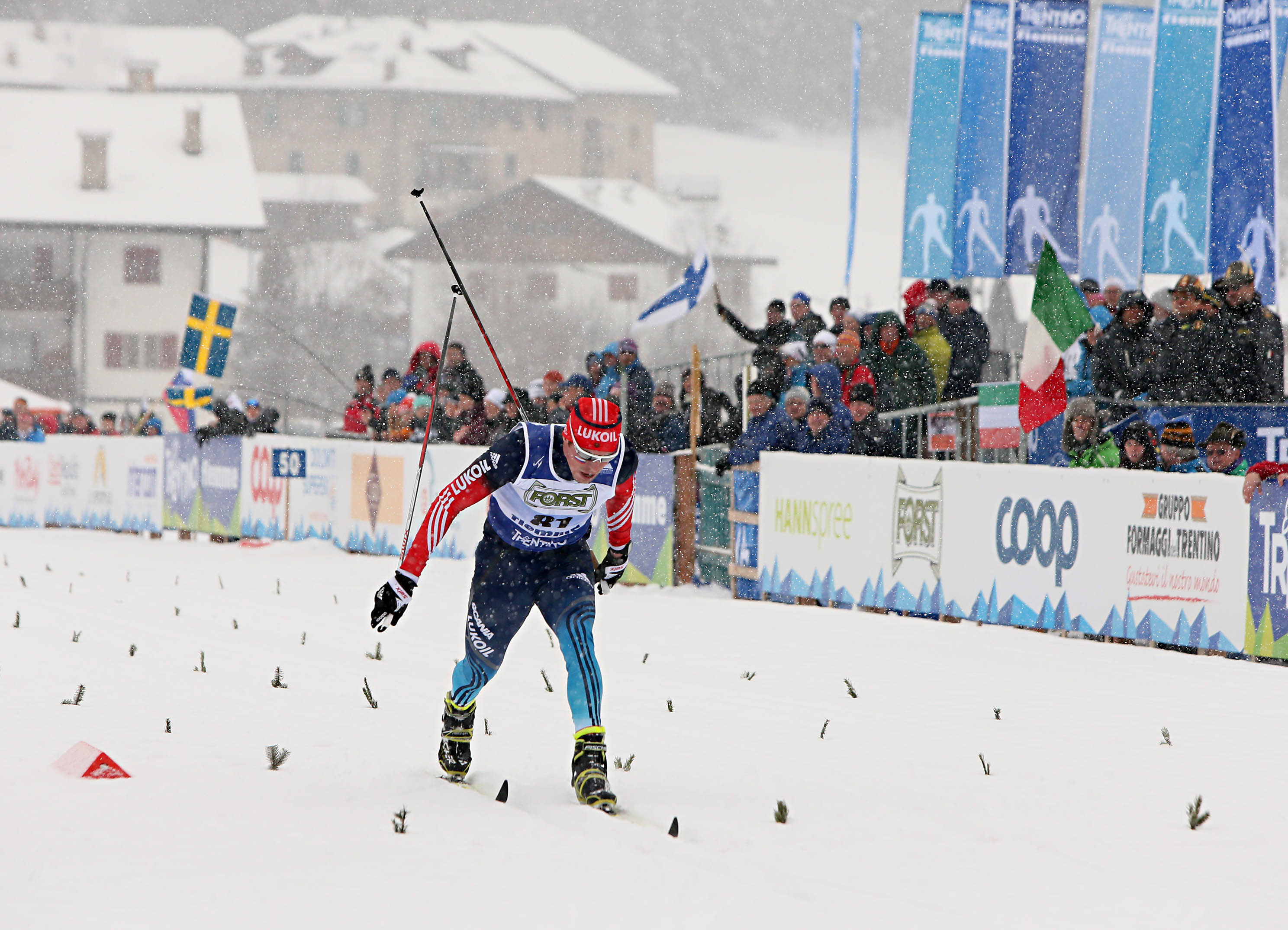
Sergey Ustiugov (RUS) lunges across the finish line in the men’s 15 k classic in the 2014 U23 World Championships in Val di Fiemme, Italy. Ustiugov finished second after winning Wednesday’s freestyle sprint. (Photo: Fiemme 2014)
Niskanen who skied the 15 k in 33:26.6, maintained his lead throughout the snowy course, clocking the fastest time at every split.
“It’s an unbelievable day,” said the Finn in a press release. “I kept a good speed and the last kilometers were really hard because I knew that [Sergey] Ustiugov was right behind me. It’s hard to beat a big champion like him and I tried to do my best to do it.”
Wednesday’s freestyle sprint winner, Ustiugov of Russia started his race with a fast pace but was unable to match the Finn’s form, and managed to place second, 17.4 seconds back. Despite his podium, the World Cup winner was disappointed that he was unable to out-ski Niskanen.
“I am not satisfied with the final result, but the result is where my level was today. I tried the best I could in this race. The last meters were quite hard for me but I still really tried hard anyway,” he said.
Norweigian Mathias Rundgreen was third, 27.7 seconds behind Niskanen.
In the women’s 10 k Hagen demonstrated her dominance on the hilly course that meandered through the Italian mountainside. Finishing with a time of 29:18.4, Hagen was ecstatic that she came out on top of such a strong field. “I didn’t expect to win and that’s why I’m so excited,” she said in a press release.
Martine Elk Hagen (NOR) celebrates her win in the women’s 10 k individual classic at the 2014 U23 World Championships in Val di Fiemme, Italy. (Photo: Fiemme 2014)
15.4 seconds behind Hagen was Celia Aymonier of France, who earned her first medal at a World Championship. “I’m so happy, it’s a good day for me,” she said. “I tried for the first place but I lost some time in the second lap however I’m really happy for the result.”
In third was Wednesday’s sprint champion, Elisabeth Schicho of Germany, who finished 30.3 seconds behind Hagen.
“It’s my second medal… unbelievable,” she said. “I am extremely happy.”
The U23 World Championships continue Saturday with the 15 k and 30 k skiathlons taking place on the trails of Lago di Tesero.
GÄLLIVARE, Sweden – It was more or less a foregone conclusion that Norway would win today’s 4 x 5 k World Cup relay.
After all, how many relays hasn’t Norway won recently? Their team was particularly stacked for today’s edition, with Saturday’s winner Marit Bjørgen and runner-up Therese Johaug on tap, as well as sixth- and eighth-place finishers Vibeke Skofterud and Martine Ek Hagen.
While Skofterud initially faltered (she took the wrong lane at the lap, and Sweden said they would protest the fact that Norway received only a warning), over the second half of the scramble leg she made up ground on the leader – who also happened to be her teammate, Heidi Weng, skiing for Norway II. The pair tagged off together, with a slight lead over Ida Ingemarsdotter of Sweden and, surprisingly, Virginia de Martin Topranin of Italy.
Randall chasing Johaug.
But that’s where things got interesting. Johaug took over for the second classic leg, and was expected to extend Norway’s lead and ski away towards the usual blowout. But the reigning Olympic and World Champions never again had a lead of over ten seconds. While Sweden faded and Italy shot towards the back, Kikkan Randall of the United States built on a solid scramble leg from Holly Brooks and actually gained ground on Johaug.
“I knew that it’s a fast course, but I wanted to play it safe so I made sure I started off with a little bit left,” Randall, who had started with an 11.7 second deficit, told FasterSkier. “I caught up with those girls in front of me and sat behind them for a little bit. And then I just took a good line around one of the corners and got in front of them and thought, well, we’re already halfway through this race, I’d better go. And then I looked up and, whoa, Johaug is right there. I need to go after her!”
That extra motivation allowed Randall to turn in the fastest second-leg time in the entire race. Staying ahead of Randall was no easy task, even for Johaug, who responded to questions from the Norwegian press about whether relays were simply a walk in the park for her team.
“Everybody has to do their job,” she told NRK. “It’s not just going out there and being first. But today, we did our jobs.”
When Johaug tagged off to Martine Ek Hagen, her lead had been cut to eight seconds – which actually could have caused some anxiety. At just 21 years old, she has little World Cup experience and has competed in only one relay, at least year’s opener in Sjusjøen, Norway. There, she competed on Norway’s fourth team, and she didn’t stand out. Nevertheless, she was called on to replace veteran Kristin Størmer Steira. Hagen was nervous.
“I am inexperienced and thought they would keep the same team [despite yesterday’s results],” Hagen told Norwegian newspaper Dagbladet. “I felt that if I did a bad leg or fell in a ditch, then I would be doing a disservice to the whole team.”
If there was an opening for the U.S. – or perhaps for another team, like Sweden or Finland – this was surely it. And with third-leg skier Liz Stephen out for blood after a frustrating crash in yesterday’s race, it looked like the Americans had a chance.
Hagen, with Stephen chasing.
“I was just chipmunking around,” Stephen said of her leg. “I didn’t know what was going on. I just looked ahead and wanted to catch red. I didn’t look back, it wasn’t about who was behind me, I just was going for the red. I wanted to hand Jessie [Diggins] off right with [Marit] Bjørgen.”
Stephen couldn’t quite catch Hagen, but she put in a valiant effort, cutting the lead to just four seconds while preventing Sweden and Finland from gaining any ground. But Hagen was strong.
“I think Martine did a fantastic job,” Johaug told Dagbladet after the race. “It’s not easy to just go out there on the first team for Norway. You might get a little tight in the shoulders when you feel like you have to perform at that level. I told her that she had to ski her own race, and she did that in an awesome way.”
When Bjørgen took off with the lead, there were even fewer doubts about who would end up on the top of the podium. The star never seemed to put it into top gear, instead cruising around the course while extending her lead to 20 seconds.
“I tried to go out aggressively,” Bjørgen told NRK. “I quickly got back to eight seconds to Diggins, and Kalla did not come near.”
Bjørgen, agressive.
Behind her, Diggins was feeling the pressure that Hagen had just a few minutes before. She was faced with a starting position that sandwiched her between two of the strongest skaters in the world: Bjørgen, and Charlotte Kalla of Sweden.
“I think I lost a lot of energy hyperventilating,” Diggins said. “I’m not kidding. I almost had a full-blown panic attack. I saw Liz go by in second place and I looked at Matt, like, ‘Oh my God!” And started breathing really hard. I had to take five deep breaths. I was shaking before I even started.”
Diggins was unable to keep Bjørgen’s pace, and couldn’t hang on when Kalla flew by her, either. The Swedish crowd went crazy when Kalla took the lead; just one day before, it had been Randall edging Kalla for the final spot on the World Cup podium. Today, second place seemed secure.
Kalla working to second in front of the home crowd.
Diggins was eventually caught by Marthe Kristoffersen of Norway II, and the two climbed the final hill into the stadium together. Diggins was clearly flagging, exhausted. But she managed to rally a bit more energy, putting on a furious surge to pass the Norwegian and hold onto third as she came down the finishing stretch.
Diggins, anchoring the first US Women’s relay podium.
“At the end I could really feel it,” Diggins told FasterSkier. “I thought, I do not want to lose us a medal here, the girls and the team, the whole team worked so hard this year. I’m not going to screw this up right now. I was able to get just enough energy to get to the end. And then I thought I was going to die. I think I might have been crying.”
While Norway and Sweden were happy with their finishes – Hagen seemed particularly thrilled to be part of a winning relay team – it was the Americans that the TV cameras lingered on the longest. After Diggins collapsed into the snow, her teammates spent maybe ten minutes in the finishing pen – taking her skis off, hugging each other, celebrating. It was the first World Cup relay podium for the American women, ever.
“We’ve been working on this, and building it up step by step,” Randall said.
Stay tuned for more about the American women’s performance.
Therese Johaug in earlier action this winter. The Norwegian won her sixth Skarverennet title on Saturday.
Just when you thought the ski season was over, Norway hosted one of the world’s biggest ski marathons, the 38 k Skarverennet, on Saturday morning. About 12,220 skiers competed in the race that runs from Finse to Ustaoset, high in the mountains.
Therese Johaug won in 1:41:33, defeating Norwegian teammate Marit Bjoergen by 19.8 seconds. Martine Ek Hagen took third, one-tenth behind Bjoergen.
Johaug took it out hard up a long incline out of Finse, and Bjoergen never truly challenged her. Johaug’s victory is her sixth in a row on the Skarverennet, making her the undisputed queen of the race.
On the men’s side, last year’s runner-up Chris Jespersen bested Petter Northug by five seconds, clocking in at 1:31:24. Jespersen led for the last 8 k to hold off Northug, who had worked his way through the field from 1:19 back to come within striking distance of Jespersen.
In contrast to the women’s race, which was a 1 through 11 Norwegian sweep, a few international men snuck into the top of the results. Russia’s Eugeniy Dementiev finished third in a close finish with defending champion Jean Marc Gaillard (FRA), both posting official times of 1:32:32.
The region around Finse and Ustaoset had experienced unpleasant wind and snow in the days leading up to the marathon, but the weather gods obligingly cleared the skis in time for the start on Saturday, making for perfect end-of-season conditions.
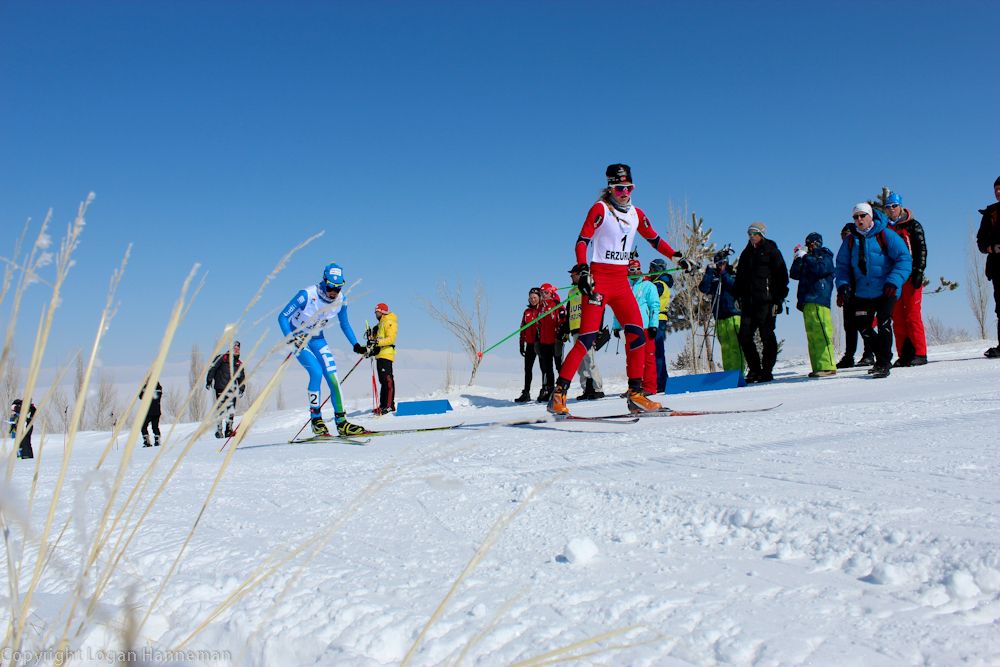
Martine Ek Hagen (NOR) on her way to a gold medal in the 15 k skiathlon at U23 World Championships on Saturday. Photo: Logan Hanneman.
ERZURUM, Turkey — Before Saturday’s 15 k skiathlon began, gold had eluded Norway at the Junior/U23 World Championships. The team repeatedly stressed that the week that the learning experience was more valuable than the hardware, but athletes and team staff alike nonetheless seemed hungry for the wins they are used to.
Martine Ek Hagen (NOR) finally delivered in the skiathlon, skiing a strong skate leg in the second half to win by 13.9 seconds over Italy’s Debora Agreiter. Emma Wiken (SWE) took third (+34.5).
The podium was fairly spread out, but before the gun went off, anything had seemed possible. Russia had dominated the 10 k classic on Thursday, but Jessie Diggins (USA) was finally putting on a bib after recovering from illness earlier this week. Hagen was the top seed, and after a good chunk of time at altitude, had promised after the classic race not to finish the skiathlon with Russians in front of her.
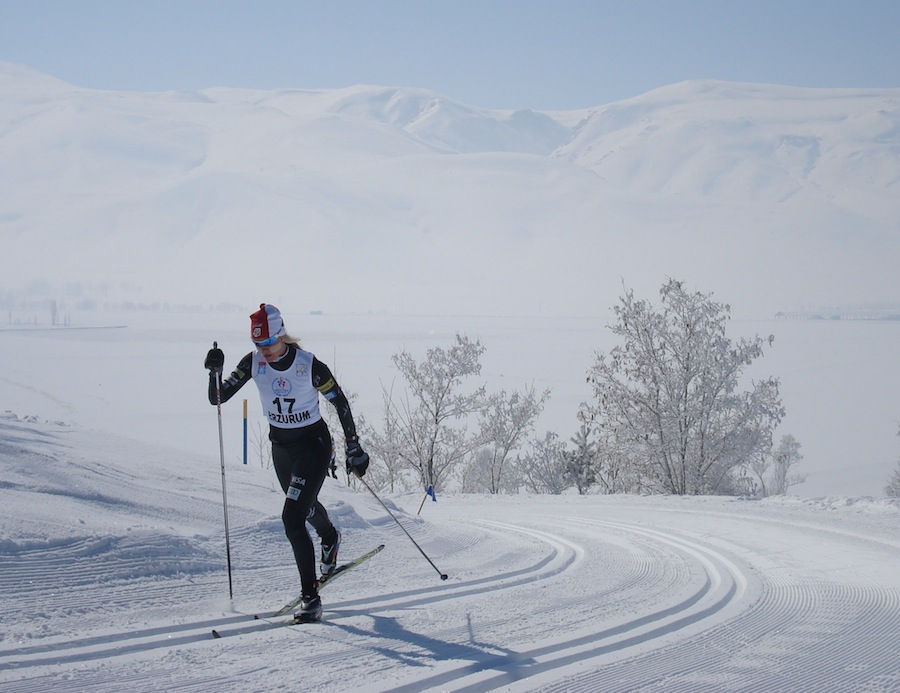
When the race got underway, Diggins, wearing bib number three, was one of the first to come into view over the first hill out of the stadium. Shortly thereafter, she took the lead of the entire race where she stayed until the ski change at the 7.5 k mark.
“That first half of the race felt really good—I was relaxed and strong, and feeling powerful,” said Diggins.
Diggins controlled the pace for the entire classic leg. When she saw U.S. coaches waving a pole for teammate Sadie Bjornsen (USA), Diggins slowed it down to give Bjornsen time.
“When you’re in front you can make sure no one takes off, or you can make it go faster,” said Diggins.
The women's skiathlon on the first hill out of the stadium. Photo: Logan Hanneman.
Separated from the pack, she could also take squirrely downhills exactly how she wanted, so Diggins took off before a slick descent that ended in a 180-degree-turn so that she wouldn’t be stuck snowplowing behind the rest of the field. In doing so, she opened up a gap that no one responded to.
“Jessie kind of pushed over the top and the other girls would not go with her,” said Bjornsen. “I was like, ‘What are you doing?’” Part of me wanted to break on the classic, but there was no way I could hold it in skate, but I kind of wanted to just have fun with it.”
Diggins wasn’t sure exactly why no one followed her break.
“I think people knew I wasn’t going to gap the field, they probably figured I was just being safe on the corner,” said Diggins. “Last year here I fell, and someone fell on top of me, so I didn’t want that happening here.”
At no point in the classic leg did Diggins feel like she’d crossed the line and gone too hard, but after the switch to skate skis at the halfway mark, she began having trouble.
“The second half I just had no energy source left,” said Diggins. “It went from good to just falling apart right after the transition. Something felt super wrong.”
“I made the mistake of trying to stay with [the leaders]—it was hard to purposely drop back—but I should have and I ended up really dying. So, needless to say, that second half was probably one of my worst.”
Hagen took the lead in the second half, as skate is her stronger discipline, and she and Agreiter had soon put distance on the rest of the field.
“I thought Jessie Diggins, especially, would follow, but when she gave us a gap, I didn’t want her to catch up with us again,” said Hagen. “I thought Agreiter was very strong, so I was never sure [of the win], but I was hoping it would stay that way.”
Hagen (NOR) wins, with no one in sight.
Stay it did, as Hagen skied to a comfortable victory. Agreiter’s medal was Italy’s first at U23s since 2007, and she appeared delightedly surprised to have finished so well.
“After the classical part I was surprised I was still in the leading group,” said Agreiter. “After the exchange I was following Martine… In the second [lap] Hagen skied away, but I am very happy for silver.”
Agreiter is hopeful that her medal will gather momentum for others to follow her in Italy.
“There is a very young group of skiers in Italy,” she said. “I hope one day we will have the same results as Arianna Follis or Marianna Longa.”
Diggins, the early leader, finished 15th (+1:39.1).
Would she have held onto the lead if she had been completely healthy?
Diggins, utterly depleted.
“You still never know,” said Diggins. “Obviously I’m disappointed with the circumstances; preparation was far from ideal, but that aside, it was still a good experience being here.”
Saturday’s skiathlon was perhaps the first race all season where Diggins didn’t have the race of her life, and beforehand she felt the weight of expectation to keep producing top results.
“It’s easy to have good races and just raise the bar,” said Diggins. “After getting a couple of top-10s on the World Cup, it’s like, ‘Oh, you did really well, you’re going to do really well again.’ But nope, that’s not fair—I can’t expect myself to just do that all the time. I’m a pretty consistent racer, but I’m going to have my ups and downs.”
Her takeaway from the experience is to not let what she imagines to be the expectations of others dictate the way she looks at a race in the future.
“I didn’t expect to feel awesome, so I have to just not worry about feeling like people are watching me and waiting for me to pop off another race,” said Diggins. “Because that’s not a good feeling—then you’re not even racing for yourself.”
She emphasized that, despite her disappointment, the U.S. still placed three in the top 20. Bjornsen finished behind her in 16th (+1:56.6) and Becca Rorabaugh (USA) was 19th (+2:14.4).
Emily Nishikawa (CAN) striding early in the skiathlon.
The rest of the North Americans struggled on the tough altitude course. Emily Nishikawa (CAN) was 27th (+3:34.4), Annika Hicks (CAN) was 33rd (+5:03.2), and Marlies Kromm (CAN) was 36th (+7:07.1). Heidi Widmer was lapped and pulled.
Mariya Guschina (RUS) on her way to a dominating win in the women's 10 k at U23 World Championships.
ERZURUM, Turkey — In her first race at these U23 World Championships, Mariya Guschina (RUS) had no trouble sticking with the standard set by her Russian teammates this week, claiming the gold medal by 26.7 seconds over Polina Medvedeva (RUS).
Second through fifth place were tightly packed—Martine Ek Hagen (NOR) took third, only 1.3 seconds out of silver, Emma Wiken (SWE) was 0.4 behind Hagen in fourth, and APU’s Sadie Bjornsen (USA) crossed the line 3.5 behind Wiken for fifth.
With yet another victory by a wide margin in Erzurum, what’s the Russians’ secret?
“There is a great team spirit in our squad,” said Guschina. “Everybody is working very hard. Coaches, service as well as athletes are all trying their best. That is why Russian skiers have collected so many medals here.”
Medvedeva, who had expected to be battling Buschina for the win, had a similar take on the Russian dominance in Erzurum: “It feels great to be on the podium with her. We share our big day together.”
Martine Ek Hagen (NOR).
Hagen’s bronze medal was briefly in question, as she took the wrong lane in the stadium as she came through for her second lap. Britt Ingunn Nydal (NOR), who was skiing in front of her, went into the finish lanes when she should have stayed in the lap lane. Hagen followed her before realizing the mistake and skiing back to the correct track.
“Suddenly I hear our team doctor screaming,” said Hagen. Nydal realized her error after Hagen, and lost a few more seconds.
The jury decided that Hagen’s mistake hadn’t given her an advantage, and she was allowed to keep her bronze medal along with a written warning.
Norway’s team doctor, Kjell Vegard Mykland, thought the stadium hadn’t been fairly set up.
“You have to choose the right lane a little bit too early on the straight [after coming around the corner],” Mykland said.
Hagen agreed that the required lane change was in a difficult position after coming down a long descent into the stadium.
“I don’t know, I was so focused it was probably me, but when you’re racing downhill, you come fast, and it’s not the best to change course. It was a little bit difficult.”
After losing time with the mistake, Hagen said she became dispirited. She ended up 0.3 seconds out of the silver medal.
“I think maybe I lost a little bit of motivation… It was an ok race, but I’m looking forward to Saturday now even more,” said Hagen.
Sadie Bjornsen (APU/USST) on her way to fifth in the 10 k classic.
On her sixth trip to World Juniors/U23s, Bjornsen posted a career best fifth place in the 10 k classic. It was a close race for rest of the podium, and Bjornsen was well aware of it as she powered through the second and final 5 k lap.
“I knew it was going to be close,” she said. “[Bryan] Fish told me at the top of the second hill that five seconds was five places—I was just trying to go for it with every bit that I had.”
Bjornsen skied a tactically smart race, and was able to stick to the plan she’d laid out for the race.
“The first time around she was in 10th, and six seconds would get her five positions,” said Fish. “That kind of information, when it’s that tight, can really help to motivate an athlete.”
Bjornsen (USA). Photo: Terje Alstad.
Bjornsen said skiing a bit slower in the beginning was part of the plan.
“That didn’t worry me; I planned to do the first lap conservatively. Then…on the second lap I planned on hammering the hill,” said Bjornsen.
“It was one of those splits that was one off the checklist: ‘OK, this is where I want to be.’”
Emily Nishikawa (CAN) was the second North American on Thursday in 17th (+1:47.8). She had hoped for a top-20, but was happy with a solid effort.
“It’s hard to put a number on it, because you never know who’s going to be here,” Nishikawa said of her goals going into the 10 k.
“I was happy with it…I pushed hard and did as well as I could have.”
Becca Rorabaugh (USA) was 29th, Marlies Kromm (CAN) was 35th, Annika Hicks (CAN) 37th, and Heidi Widmer (CAN) was 28th.
Skarverennet 2011: Therese Johaug (NOR) and Jean Marc Gaillard (FRA). Photo courtesy of Skarverennet.no.
Jean Marc Gaillard (FRA) dropped Frode Andresen (NOR), Chris Jespersen (NOR) and Espen Harald Bjerke (NOR) in a fierce sprint to the finish line. But for a long time, Gaillard was not sure he’d be able to catch the 2011 World Champion of the 30K freestyle: Therese Johaug.
“I really didn’t think we would be able to catch her, but all of the sudden, we were right on her tails,” said Gaillard, who raced Skarverennet for the first time Saturday.
“It was a fantastic experience,” Gaillard said to Norwegian TV station NRK after the race.
New this year, Skarverennet featured a pursuit-style event in the elite class, where the elite women were given a 12-minute lead on the elite men, and the first elite skier – male or female – would be the race winner.
Johaug pulled off a surge midway through the race where she dropped the entire women’s field, and was not chased down by the elite men until the last seven kilometers. The foursome consisting of Gaillard, Bjerke, Jespersen and Andresen caught Johaug just prior to the long descent to the finish at Ustaoset. By the time they arrived in the stadium area, the battle for first place was between Gaillard, Andresen and Jespersen.
Gaillard crossed the finish line first, clocking in at 1:44:07, with Jespersen in second place and Andresen in third, both a tenth of a second behind Gaillard.
“Of course, it was bittersweet to lose the prize money, but I feel like I pulled off a good race,” Jespersen said after the race. The winner received 100,000 Norwegian kroner, almost $20,000.
Biathlete Andresen was disappointed with his third place.
“In Skarverennet, the winner takes it all – you get the money and a car for a whole year,” he said to the Norwegian biathlon web site Strafferunden.no after the race.
Bjerke was fourth, 42 seconds behind Gaillard. Emanuel Jonnier (FRA) was fifth in a second sprint finish with teammate Vincent Vittoz, 5 minutes and 44 seconds behind Gaillard for their very last world-cup level event. Jonnier and Vittoz, who have spent over a decade on the French national team, are retiring after this season.
Johaug crossed the finish line in 2:00:33, almost a full seven minutes ahead of Marit Bjørgen, who was the second female. Martine Ek Hagen was third, another two and a half minutes behind Bjørgen.
“I have not trained for three weeks, and the conditions were soft and challenging,” Johaug said to NRK after the race.
Petter Northug also participated in the race, but did not finish among the top contenders. According to the race organizers, Northug took his time and even stopped to greet the recreational skiers along the way. He finished in 71st place.
The race featured unseasonally springish conditions, and putting on the race was only possible with the generous efforts of the course volunteers who have been working around the clock the last week to add snow to the lower parts of the course, drain creeks away from the trail.
“We could have raced in bikinis,” Johaug said to NRK, commenting on the warm weather.
Petter Northug had earned a substantial lead early in the men’s 50K race when he stopped to take a leak on the side of the course. When asked about the incident, Northug simply shrugged his shoulders and said “when you gotta go, you gotta go.”
“It’s a long ways to go, so you have plenty of time to work your way back up,” Northug explained.
Northug dropped to 35th place, but was able to work himself back up to the front and won the race by a solid margin – almost 40 seconds separated Northug from second place.
“There was a packed field and it snowed quite a bit, so it was an advantage to attack from behind,” Northug said to the Norwegian news agency NTB after the race.
“I came here with the 50K title in mind, and it was really fun to win the 50K at the nationals. I’ve never won the 50K at the Norwegian Nationals before. That was really fun,” said Northug, who also won the King’s Award, the most treasured trophy awarded to Norwegian athletes in any sport.
Morten Eilifsen was third in the 50K, after deciding to give away the silver by waiting for Chris Andre Jespersen and letting him finish ahead. Jespersen had done a large part of the pulling throughout the race.
Bjoergen wins women’s 30K
In the women’s 30K skate, Marit Bjoergen won another Norwegian national title, but just like Northug, Bjoergen has never won the marathon distance at the Norwegian nationals before.
“It was a really hard race, and nothing came for free today. But it was really fun and a great atmosphere all along the course. And I guess I’ve never won the 30K at nationals before,” Bjoergen said to NTB after the race.
Therese Johaug was second, beaten by Bjoergen in a sprint finish.
“It was a hard race, but Marit was stronger than me in the sprint today, so I can’t complain about second place. It’s fun to end the season like this,” Johaug said.
Astrid Uhrenholdt Jacobsen was third.
In the classic team sprint on Friday, Petter Northug won the national championship gold medal along with club teammate John Kristian Dahl. Johan Kjoelstad and Eldar Roenning were second, eight seconds behind Northug and Dahl.
In the women’s team sprint, Celine Brun-Lie (who raced for Norway at the 2011 World Championships in Oslo earlier this winter) won the gold medal with teammate Britt Ingunn Nydal. Martine Ek Hagen and Heidi Weng won the silver just a few small seconds behind.
The marathon distance races on Saturday concluded the second part of the Norwegian Senior Nationals.
Jessie Diggins giving chase after a crash in Sunday's pursuit.
Good thing Jessie Diggins has perspective.
Sure, it doesn’t hurt that she’s only 19, with plenty more international racing in her future, including a trip to the 2011 World Ski Championships later this winter.
But still, some athletes would be bitter, disappointed, or downright pissed off to crash out of contention in a big race they had a shot at winning. Not Diggins, who picked herself up after a broken pole in the first kilometer and still went on to finish 12th in Sunday’s 10 k pursuit race at World Juniors in Estonia.
“It happens, it’s going to probably happen again, and it’s happened before,” she said. “Out of the pursuit races I’ve done, that was definitely the best one. So I can look back and say it was a solid effort.”
Indeed. As U.S. coach Matt Whitcomb put it, it was clear to the Americans that the pursuit was a “winnable race” for Diggins. “Knowing that is far more valuable,” he added, than any result in Otepaa.
Indeed, Diggins’ effort was promising, but it still wasn’t enough to close down her 30-second gap to the leaders after the crash.
Norway’s Heidi Weng finally got the gold medal she was after in Estonia, outsprinting her teammate and cousin Martine Ek Hagen in the stadium. Germany’s Helene Jacob was third; Annika Hicks was the top Canadian finisher in 31st.
The lead women on course.
While Diggins delivered her second straight sensational performance in Otepaa, she was nowhere to be seen among the leaders at the start of the race. Seeded 10th, she should have been right at the front; instead, she was bringing up the rear.
“Someone switched lanes—I went down, got up, went down, broke a pole,” she said.
Canadian coach Mike Cavaliere handed her a spare, but not before Diggins had lost more than half a minute, leaving her in 65th place at the first time check. At that point, she had her work cut out for her in a big way, but according to Whitcomb, there wasn’t much concern that Diggins would give up on the race.
“My feeling was, ‘thank God that’s Jessie,’” he said. “She works really well at chipping away at the people ahead of her. Give her a project, she gets it done—in a funny way, it was the best person that could have broken a pole, for us.”
After picking her way through the field in the classic leg, Diggins was in 17th. A quick gear exchange helped, which she chalked up to the lack of pressure that comes with skiing at the front.
In the skate leg, she had to strike out along, chasing the group of leaders containing 11 women.
Her job wasn’t made any easier by the gusty winds that blew all morning, leaving powder in the tracks and even miniature snowdrifts in some places.
“She was in no man’s land, just fighting to get place after place,” Whitcomb said.
By the finish, though, Diggins still managed to move up to 12th, and her time over the last nine kilometers of the race was just ten seconds slower than that of the top two finishers. In a way, she said, the broken pole may have helped.
“If I hadn’t crashed, I would have still been with the lead pack. But I might have let that mess with my head,” she said. “I might have needed [the mishap] to be able to relax and have a good race.”
Her teammate Joanne Reid was 24th – she said she felt “pretty good,” and also had a smooth exchange. She’d been practicing, with help from her Colorado University roommate Eliska Hajkova.
“[She] had the fastest split for that two years running,” Reid said. “She taught me how to do it.”
Weng, meanwhile, got her second medal of the championships, after a bronze in Wednesday’s 5 k freestyle left her looking so dissatisfied that it might as well have been a lump of coal.
Weng, according to the Norwegian doctor, Kjell Vegard Mykland, is the country’s “greatest talent we’ve had in years”—better even than Therese Johaug.
But at this point in her career, he said, Weng is still “not that confident, and you can see that through the results.”
Sunday’s race, though, should serve as a boost. She and Hagen escaped on the last of two skate laps, skiing away from a small group that included two Russians, Elena Soboleva and Anna Scherbinina, that had looked threatening in the classic leg.
Hagen did most of the leading, and stretched Weng nearly to her breaking point.
“I was very close to letting Martine go,” Weng said.
She held on, though, and outsprinted her teammate and cousin in the stadium for a gratifying win. Jacob made a late charge to challenge Hagen, but fell just short.
Two medals for the one country is no mean feat, but how about for one family? According to Mykland, Hagen and Weng are second cousins, grew up together, and have attended the same school for the last 10 years.