From the FasterSkier archive — posts syndicated from athletes’ and coaches’ own blogs between 2004 and 2012, kept online as published. Current coverage is at fasterskier.com.
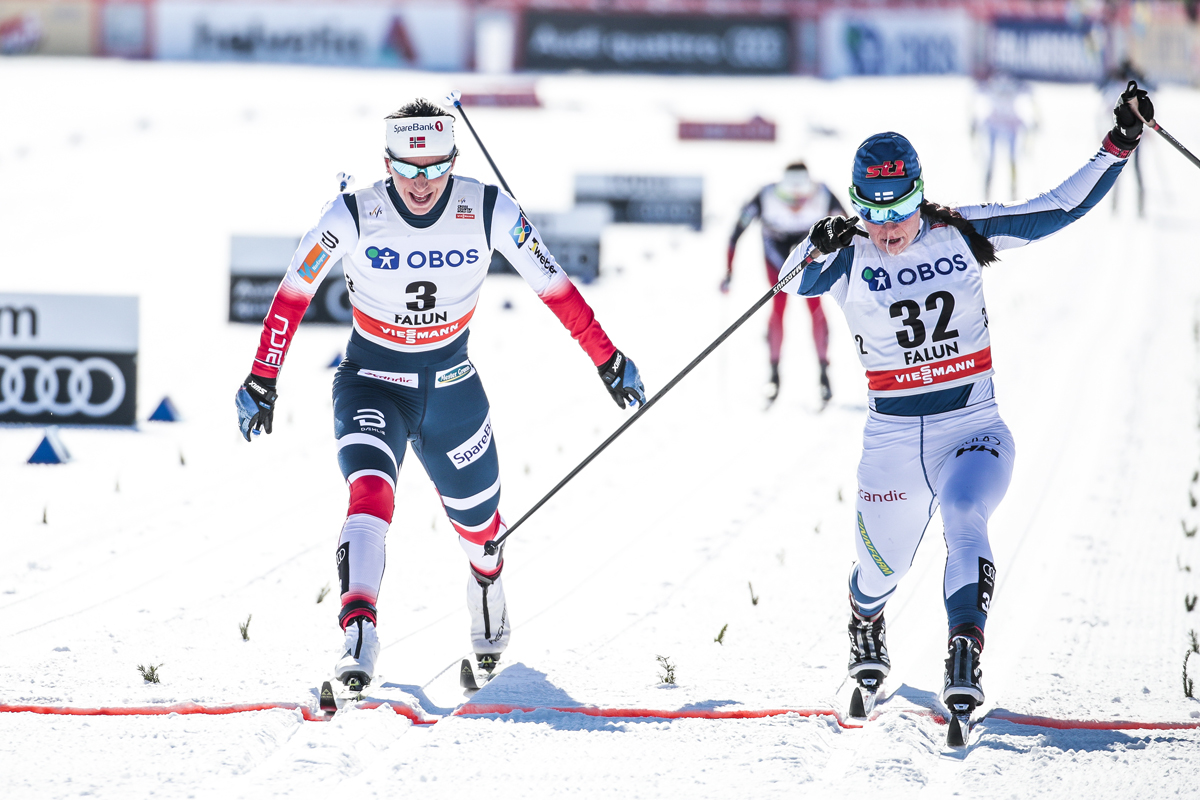
Finland’s Krista Pärmäkoski (32) edges Norway’s Marit Bjørgen for the win in the women’s 10 k classic mass start at 2018 World Cup Finals in Falun, Sweden. (Photo: Fischer/NordicFocus)
Welcome to FasterSkier’s World Cup Preview, where we check in with the top-10 teams from last year’s FIS Cross Country World Cup tour before the season starts with the Ruka weekend in Kuusamo, Finland, on Nov. 24 with a classic sprint.
***
Finland
Overall in Nations Cup Last Year:4th
Women’s Ranking 2017/2018: 4th
Men’s Ranking 2017/2018: 7th
Finnish Skiers to Watch:
If there are two names Finland’s cross-country ski fans loves to cheer–and will be looking to chant again this season–it’s Krista Pärmäkoski and Iivo Niskanen. And with good reason.
Pärmäkoski opened Period II of last season with a win, cruising to first in the 10-kilometer classic race in Planica, Slovenia. Pärmäkoski racked up two more 10 k victories after Planica, winning both the Lahti 10 k and the Falun 10 k. Altogether, Pärmäkoski landed on the World Cup podium seven times last season, capping off the FIS 2017/2018 season ranked fourth, just ahead of Norway’s Marit Bjørgen in fifth.
Outside of the World Cup, Pärmäkoski also came away from the 2018 Pyeongchang Winter Olympic Games with three individual medals, one silver and two bronze.
ComplimentingPärmäkoski on the men’s side, Niskanen, earned two World Cup podiums last season, placing third in the Ruka 15 k and third in the Lahti 15 k. He landed in the top-20 twelve times during last year’s World Cup season, and finished 15th in the FIS overall.
Like Pärmäkoski, he also departed the Winter Games with hardware, a gold medal from the men’s 50 k mass start.
Pärmäkoski and Niskanen aren’t the only Finns capable of pushing into the top tiers of World Cup skiers. With the retirement of Aino-Kaisa Saarinen this past spring, the women’s side will look to Kerttu Niskanen (Iivo’s sister), Riitta-Liisa Roponen, Anne Kyllönen and Laura Mononen–all of whom scored World Cup points more than once last season– to keep the women’s team’s forward momentum.
Following Niskanen, Matti Heikkinen and Ristomatti Hakola are two veteran Finnish names who are not about to let up as the 2018/2019 season prepares to get underway.
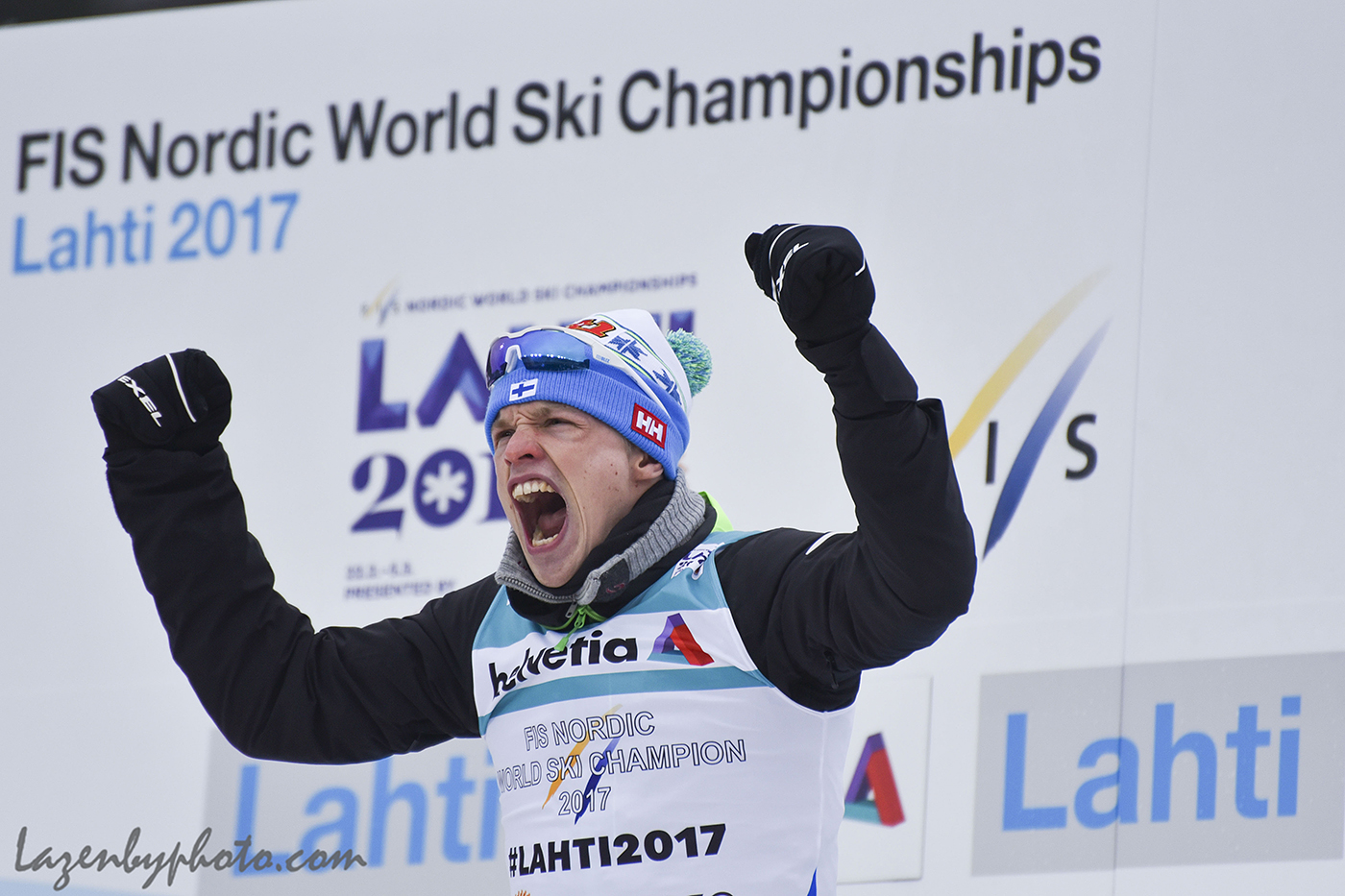
Finland’s Iivo Niskanen celebrating his first World Championships gold in the men’s 15 k classic on March 1, 2017, in Lahti, Finland. (Photo: John Lazenby)
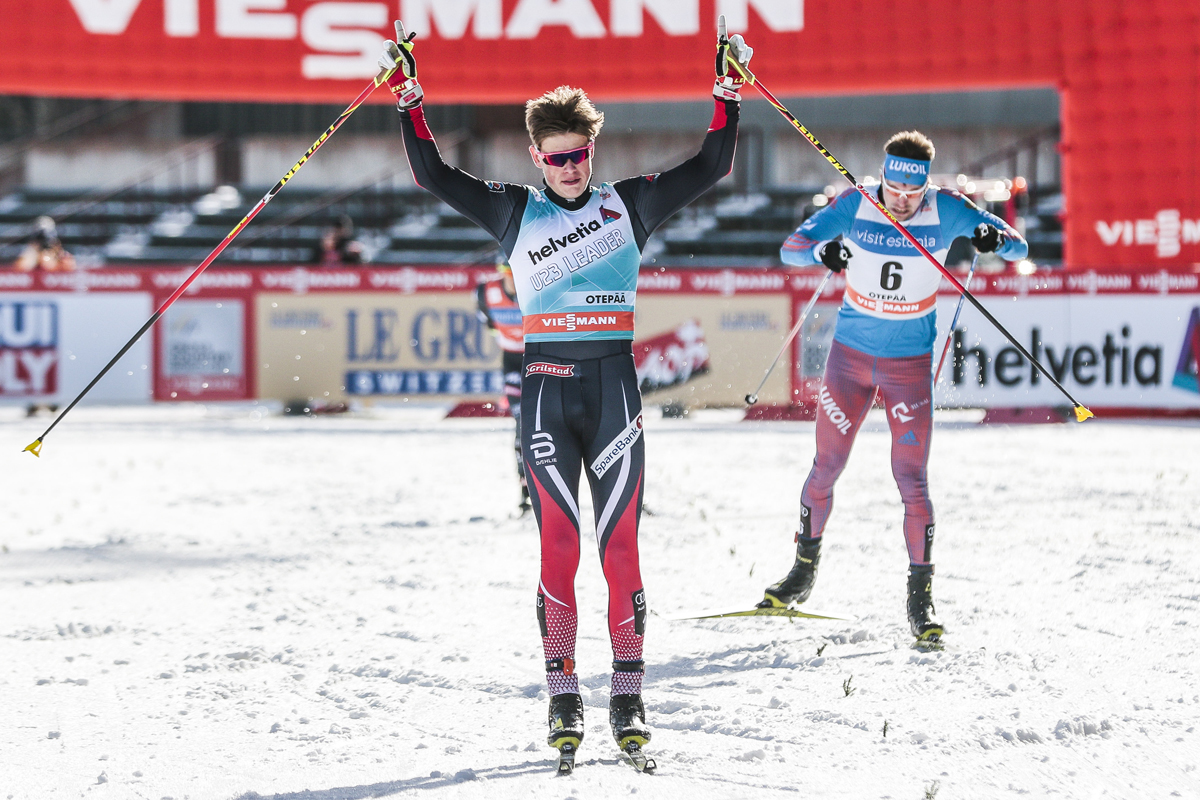
Norway’s 20-year-old Johannes Høsflot Klæbo won his first World Cup on Saturday in the men’s 1.6 k freestyle sprint in Otepää, Estonia, while Russia’s Sergey Ustiugov (6) placed third. (Photo: Fischer/NordicFocus)
Johannes Høsflot Klæbo is young enough that he could have started at the U23 World Championships in Soldier Hollow, Utah, earlier this month. And the 20-year-old Norwegian probably would have done well there.
But the 2016 Junior World Champion in the freestyle sprint and 10-kilometer classic races held in Râsnov, Romania, already has his sights set much higher this season, targeting next week’s senior International Ski Federation (FIS) Nordic World Ski Championships in Lahti, Finland.
And on his steep career ladder progression, he took another important rung on Saturday by stepping on the top of the podium for his first World Cup victory in the men’s 1.6 k freestyle sprint in Otepää, Estonia. In the final, Klæbo pushed hard right out of the start gate and never relinquished his lead, crossing the line first in convincing fashion in a time of 3:06.53. He also won the qualifier earlier in the morning, and advanced with relative ease through the rounds, winning his quarterfinal heat and placing second in his semifinal.
“I felt strong today and knew that those who were in the final [with me] are strong in the finish stretch, so I thought my chance would be to just go for it and that worked,” Klæbo told Norwegian broadcaster NRK, adding with a smile that he might use the same tactic for the World Championships.
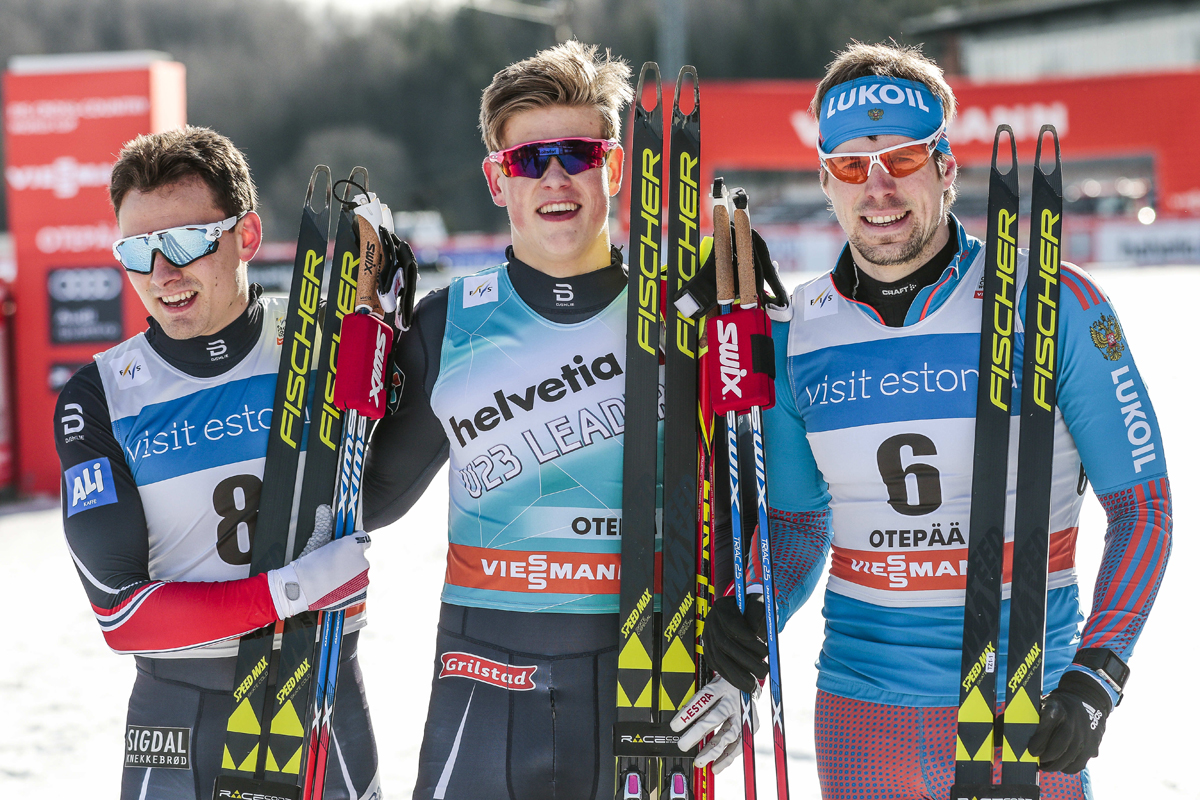
The men’s freestyle sprint podium on Saturday at the World Cup in Otepää, Estonia, with Norway’s Johannes Høsflot Klæbo (c) taking his first World Cup win, Norway’s Finn Hågen Krogh (l) in second, and Russia’s Sergey Ustiugov (r) in third. (Photo: Fischer/NordicFocus)
His teammate Finn Hågen Krogh — who had narrowly beaten Klæbo in the semifinal — placed second in the final (+0.60) after taking the inside lane in the last turn and staying far right in better groomed snow to push past Tour de Ski winner Sergey Ustiugov of Russia on the finishing stretch. Ustiugov ended up third (+1.0).
“To win here, it’s unbelievable,” Klæbo told FIS in a finish-line interview. “I think I have learned a lot and it’s tough to be in the final because everyone is so good, but I am very satisfied with this race.”
Norwegian media have already started to compare him to his star teammate Petter Northug Jr., a comparison Klæbo is not too fond of insisting that he is his own man. And at Norwegian national championships in Lygna a week ago, Klæbo was eager to prove that he is more than a sprint specialist, winning the freestyle sprint but also the silver medal in the 15-kilometer classic race, only behind Didrick Tønseth but ahead of overall World Cup leader Martin Johnsrud Sundby.
At the start of this season, Klæbo placed second in the World Cup mini tour in Lillehammer, Norway, finishing behind Sundby in the 15 k classic pursuit. On Saturday, Sundby broke his pole right at the start of the sprint qualifier and quit the race skiing into the woods, while the young Klæbo left his more experienced national and international competitors no chance in the final.
“This is huge,” Klæbo told NRK. “I’ve been in so many finals, and I feel that this was due. It’s kind of crazy to do this before the World Championship”
“I was struggling in the quarterfinal, I did not feel that good,” Krogh told FIS, according to a press release. “I changed skis and then I felt better in every heat. In the final the lane I chose in the last corner was faster and I could carry on good speed in the homestretch.”
“To finish third is nice,” Ustiugov told FIS. “I would be disappointed if I had not finished in top three today. Finn was very fast on the homestretch today.”
Last season’s World Cup sprint winner Federico Pellegrino of Italy placed fourth (+4.77), ahead of two more Norwegians with Sindre Bjørnestad Skar in fifth (+15.53) and Håvard Solås Taugbøl in sixth place (+32.94). Klæbo now also sits in second place in the World Cup sprint standings behind Pellegrino.
Narrow Misses for Best North Americans
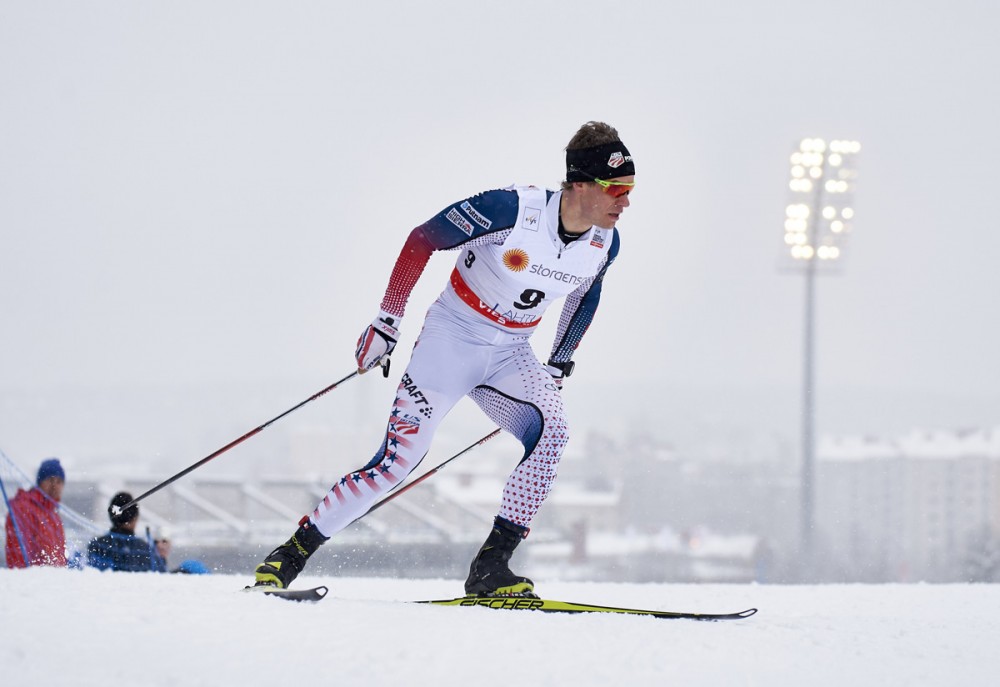
For the U.S., Simi Hamilton started his race day with a solid qualification in seventh position just 4.01 seconds behind the winner Klæbo; despite having to race on a newly modified course in Otepää that he believes doesn’t favor his strengths.
“I definitely felt good in my qualifier,” Hamilton told FasterSkier on the phone after. “There are two really big climbs in this course, and I think they kind of suit the more distance-type skier a little bit better because both of them are just pretty long 30-45 second climbs, and the conditions were definitely getting pretty slippery out there even by the qualifier. So that’s kind of an environment I struggle in a little bit or at least have in the past.”
“I was psyched with a seventh [place],” he commented on his qualifying result. “It’s a long course which I tend to struggle a little bit with, too, but being able to qualify in the top 10 on a course that is a little over 3:10 [minutes long], I think that’s a good time for where I am with my fitness right now especially leading to World Champs.”
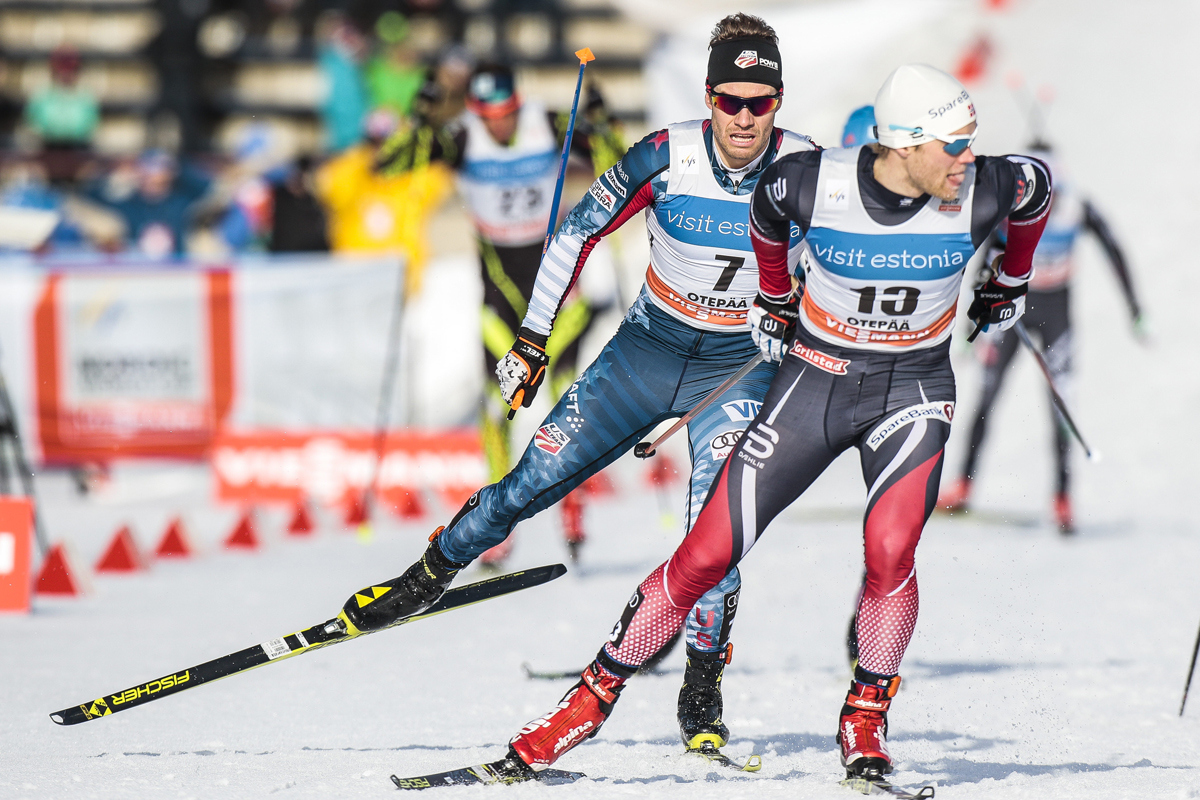
American Simi Hamilton (7) chasing down Norway’s Eirik Brandsdal (13) in the quarterfinal. Brandsdal won the heat in a photo finish, two-hundredths of a second ahead of Hamilton in the World Cup freestyle sprint in Otepaa, Estonia. (Photo: Fischer/NordicFocus)
“The tactic that I was focusing on the most all day was just trying to ski the first half of the course as efficiently as possible,” Hamilton explained. “I felt like I did that pretty well, slipped into second and felt really good about that position. I was able to take my own lane coming up that really long hill on the backside and I think that was tactically really good, because I could just ski that hill the way I wanted to and I wasn’t in danger of getting boxed out or anything.”
Hamilton came onto the finish stretch behind Brandsdal, pushing next to him before lunging in a photo finish to narrowly place second (+0.02), and was able to keep Krogh just behind him in third (+0.22). Krogh still advanced as a “lucky loser” with his time, while Retivykh finished fourth (+1.14) and was out.
“I felt good for the V1 part and just tried to punch it over the top and get a really good draft off of Brandsdal,” Hamilton said. “I just focused on getting in his stream and coming into the stadium, I still felt like I had some energy in my legs and was able to turn on a pretty decent finish stretch. I was psyched about that for sure.”
In a stacked semifinal heat and in worsening snow conditions, Hamilton had to race against the dominant Tour de Ski winner Ustiugov, Skar, Taugbøl, and the two Finnish skiers: Ristomatti Hakola and Martti Jylhä.
“In my semis, I toasted my legs a little bit on the first climb just trying to get through that really deep snow,” Hamilton explained. “Coming over the top, I think I was still in a good position. I think I was third there but I couldn’t get an open lane on the long climb coming up the backside, so I just kind of struggled behind I think Taugbøl … and I think Ustiugov was on my left coming up that and he did a really good job punching it up and over that V1 section and with really good speed into that long downhill.”
Hamilton tucked down trying to conserve energy and momentum on the downhill section, and with only Jylhä and Hakola gapped a little had to go into a four-way finishing sprint.
“I took a really good move coming into that last 180 into the finish stretch and Ustiugov was right in front of me, and then the Norwegians were in front of him, and they were all staying close to the V-boards on the right side because they were trying to ski that corner really narrow,” Hamilton recalled of the final turn. “I just took it a little bit wider and then cut narrow at the end of it, and I was able to basically get past Ustiugov a little bit … But that move spit me into the middle lane at the finish stretch, and that lane was getting pretty chewed up with so much traffic all day. It was definitely pretty soft in there and I think Ustigov’s lane on the left was staying pretty firm and icy all day. So I was bummed I couldn’t really throw down a better last 100 meters. I did what I could, but I was definitely getting a little caught up in that soft stuff and couldn’t really rely on my power to try to get down the home stretch.”
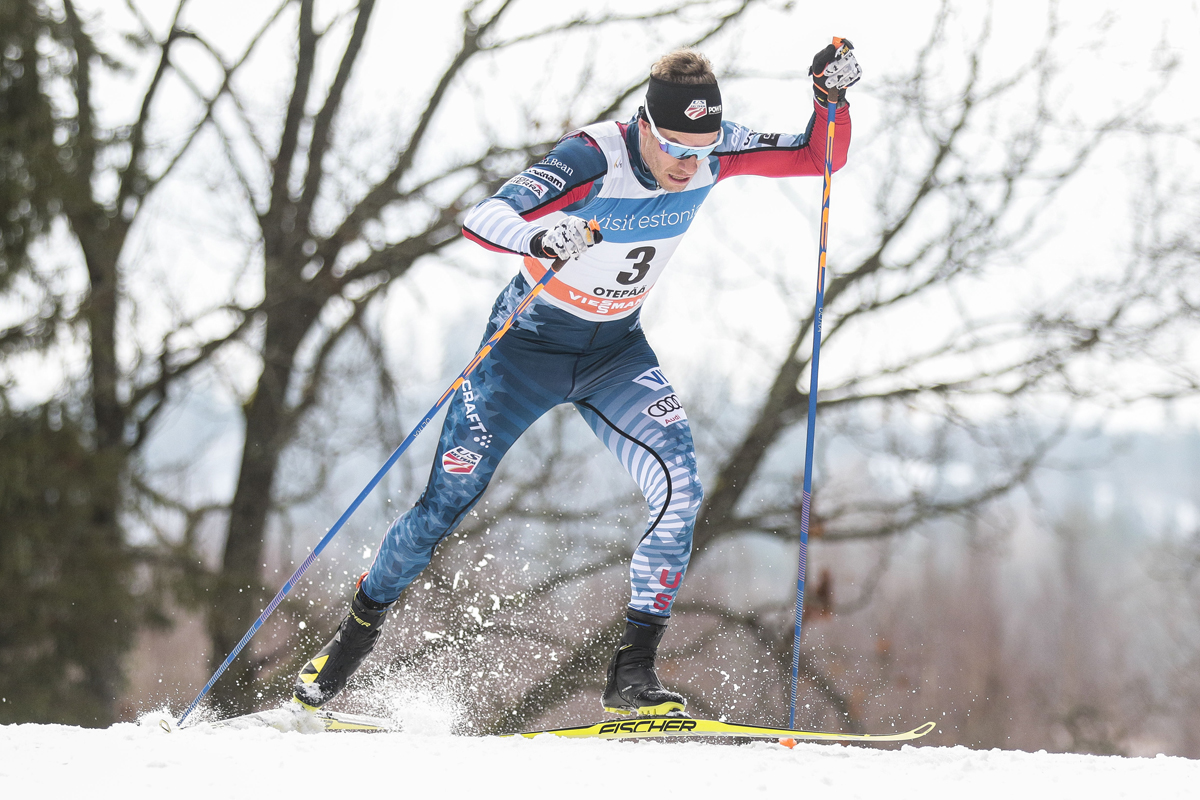
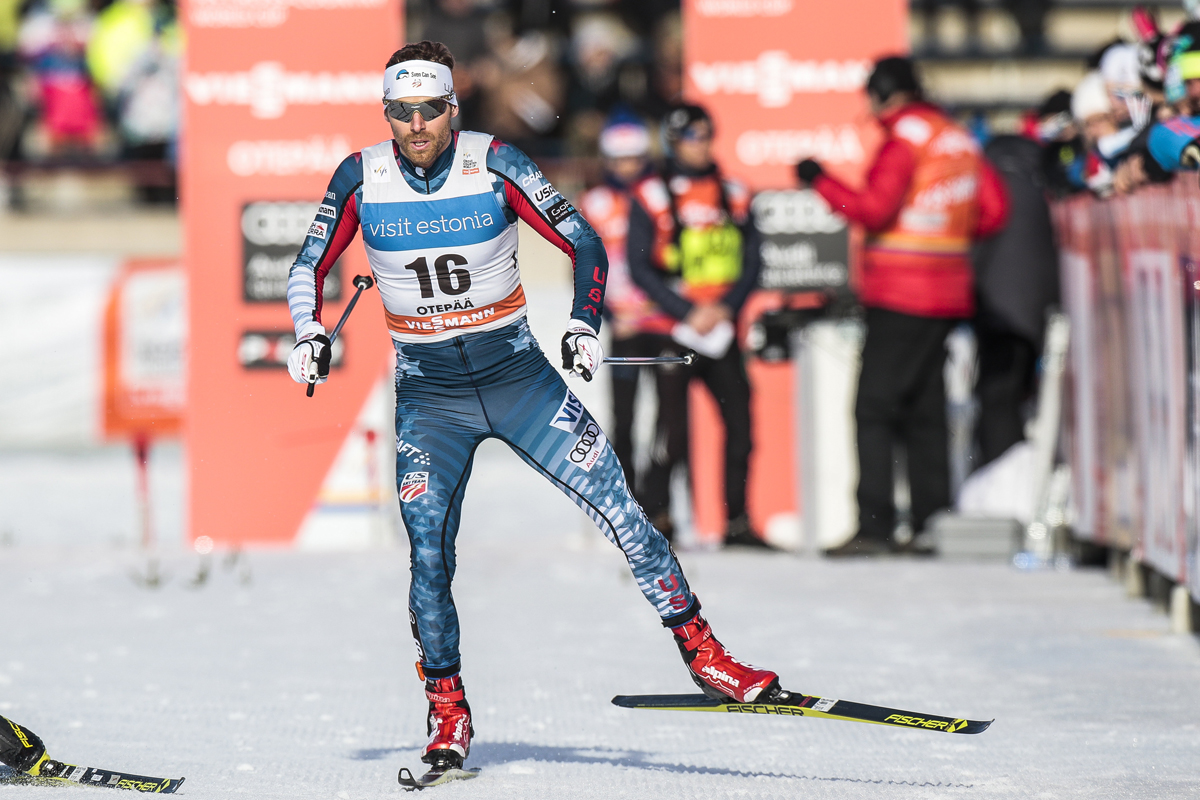
Simi Hamilton (U.S. Ski Team) racing to seventh in the men’s 1.6 k freestyle sprint qualifier on Saturday at the World Cup in Otepaa, Estonia. (Photo: Fischer/NordicFocus)
Skar won the semifinal ahead of Ustiugov (+0.15) to advance directly, with Hamilton (+0.33) ranked just behind Taugbøl (+0.29) as the outcome of the photo finish. Taugbøl’s time was enough to advance as a lucky loser. Hamilton ended up eighth overall on the day.
“Regardless I was happy with the fourth [though I] obviously would have liked to advance into the finals,” Hamilton said. “And I feel good about where my fitness and speed is right now, and just kind of one or two things didn’t line up for me in that semi and you know it’s a bummer. But at the same time Thursday [the freestyle sprint in Lahti] is a big day and hopefully some more things will line up on that day and that is the main goal. So I feel good about where everything is going for World Champs right now.”
Hamilton stated that he does not to plan to race on Sunday, training and then traveling in the evening to Finland a day earlier to be rested before the sprint at World Championships.
Canadian World Cup Team member Alex Harvey, who had skipped the World Cup trip to Korea for a recovery and training block, snuck into the sprint heats in 29th place (+10.26) after a mishap, avoiding elimination by less than a second.
“I felt good in the qualifier but right out of the start, in the first corner, I hit an icy patch and almost crashed, right at the base of the first uphill,” Harvey wrote in an email. “My ski hit my pole and I broke a basket. After that I had to get my momentum back and I think that I actually skied pretty decent but lost some time and speed there. So I guess you can say I got lucky to end up on the good side of the top 30!”
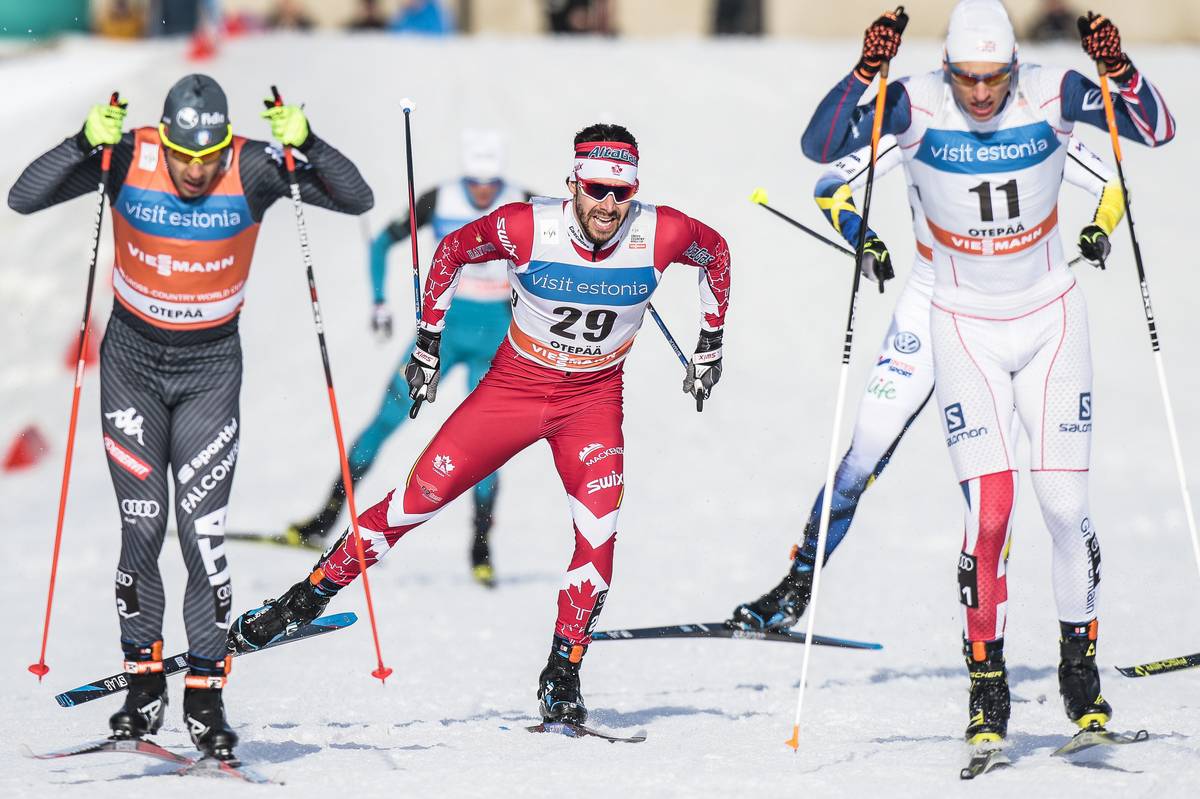
Canada’s Alex Harvey (29) chasing Great Britain’s Andrew Young (11) and Italy’s Federico Pellegrino (l) in the quarterfinal of the men’s 1.6 k freestyle sprint at the World Cup in Otepaa, Estonia. Harvey finished third in the heat for 15th overall. (Photo: Salomon/NordicFocus)
Harvey believed the redesigned course in Otepää suited him relatively well, though he was not too stoked about one modification:
“I think the length of the course suits me well,” he wrote. “The only thing I didn’t like was a short finishing stretch…we are used to a really long one here so I was looking forward to that, but this year there was a 180-degree turn just before the finish so that made the opportunity to pass in the finish not as good.”
In his quarterfinal, Harvey had to race against Pellegrino, Norway’s defending sprint world champion Northug (who’s been trying to round back into shape in time for this year’s championships), as well as Andrew Young of Great Britain.
“My quarterfinal was super slow, from the start I knew I had to be top 2 to move on,” Harvey recalled. “Young kinda picked it up right at the top of the second climb (the steeper wall) so he tried to gap the field or at least stretch it for the long downhill into the stadium.”
Pellegrino managed to pass Young on the final turn into the finish stretch and created a little gap gliding the last meters over the line in first, while Harvey had to sprint for second place against Young who lunged across the line falling down. After a photo finish, Harvey was determined to be 0.04 seconds behind Young to place third (+0.60), while Northug was fourth (+1:45). Harvey’s time was not fast enough for a lucky loser spot and he finished the day in 15th. Young went on to finish last in his semifinal for 12th overall.
“I feel good about my finish, I was able to re-accelerate quite well after that 180 degree turn and almost got by Young in that short finish so that was a good sign for my finishing speed. Now I just gotta work on my lunging game…” Harvey wrote. “15th is not too good but I think the most important in a pre-worlds weekend like that is the feeling you have on the skis, and today it was very good.”
Harvey wrote that he plans to race the 15 k classic individual start on Sunday in order to keep his strong position on the overall World Cup ranking, though he doesn’t intend to race this distance at World Championships.
“I’m feeling good heading into Lahti,” Harvey concluded. “I did a very similar camp as I did before the 2013, 2014, 2015 championships and the 2016 Tour of Canada so I know it’s the right thing for me!”
Andy Newell (U.S. Ski Team) racing in the quarterfinals of the men’s 1.6 k freestyle sprint on Saturday at the World Cup in Otepaa, Estonia. He finished sixth in the heat for 27th on the day. (Photo: Fischer/NordicFocus)
Hamilton’s teammate Andy Newell started the day by qualifying in 16th.
“Qualifying today I felt decent,” Newell wrote in an email. “I think my legs are still recovering a little bit from last week [a training block in Valadalen, Sweden]. I was missing a little bit of that pop on the steep climb. That was a decisive part of the heats as well, so if I were a little stronger there it would have been a much better day.”
In his quarterfinal with the finalist Skar as well as the semifinalists Jylhä and Hakola, Newell could not quite keep up in the finish sprint and placed sixth (+1.89), for 27th overall.
“Positioning in the heat was tricky,” Newell wrote. “It’s always hard to pass in skate sprinting so I should have positioned myself better before the last S-turns.”
“I’m feeling healthy and strong going into this weekend and into Worlds so I can’t complain,” he added. “I wish today would have gone better because its always great practice to race as many rounds as you can leading into the championships, but in general I’m in a pretty good place leading into Lahti.”
Canada’s Len Valjas missed qualifying for the heats in 40th, as did his teammate Devon Kershaw in 50th.
Erik Bjornsen of the USST was 53rd, Canada’s Jess Cockney was 54th and Knute Johnsgaard 56th, and the fourth U.S. starter Ben Lustgarten in his first World Cup finished the qualifier in 64th place.
According to U.S. coach Matt Whitcomb, Bjornsen and Lustgarten planned to compete in the men’s 15 k classic race on Sunday. Fellow distance specialist Noah Hoffman originally had looked forward to that race as well, but decided to not make the trip to Otepää after an illness last week.
For Canada, Harvey, Valjas, Kershaw, Cockney, Johnsgaard, and Graeme Killick were all listed to start Sunday.
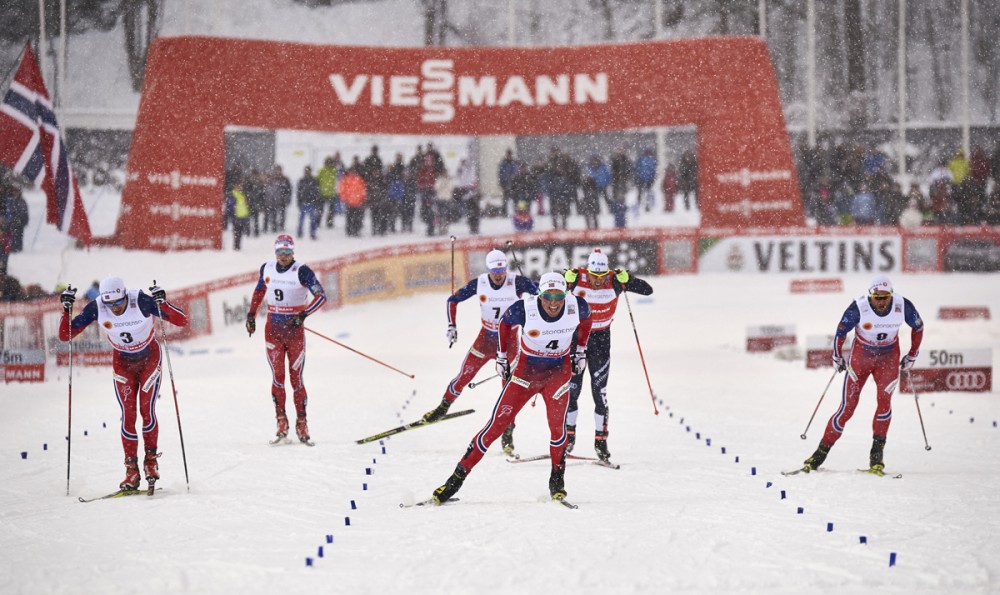
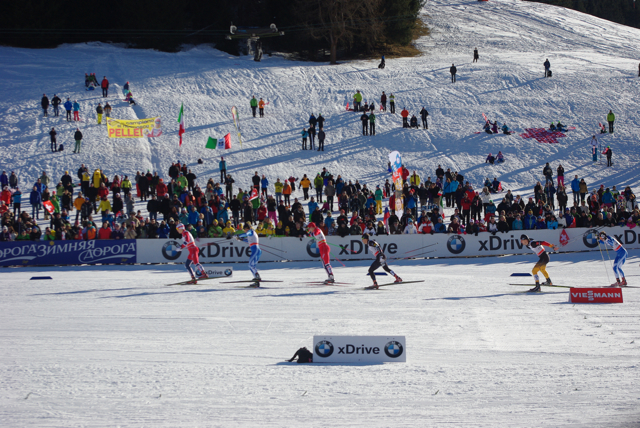
Left to right: Norwegians Finn Hågen Krogh, Eirik Brandsdal, Sindre Bjørnestad Skar, Emil Iversen, Italian Federico Pellegrino, and Norway’s Petter Northug during the men’s 1.6 k freestyle sprint final on Saturday in Lahti, Finland. (Photo: Fischer/Nordic Focus)
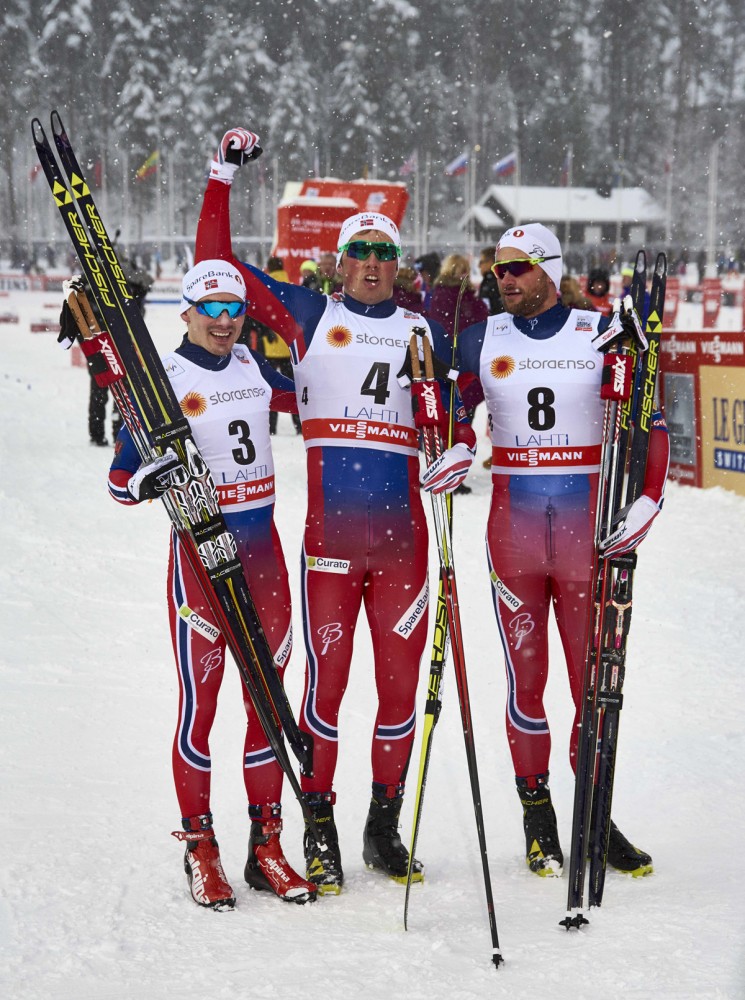
Logging hours upon hours of ski training is one thing. Logging hours upon hours of ski training with Norway’s nordic icon, Petter Northug is another. At least, so suggests Norwegian Emil Iversen, winner of the men’s 1.6-kilometer freestyle sprint on Saturday in Lahti, Finland.
“I have trained too much with him now I think,” Northug said during a post-race press conference, referring to his Norwegian teammate, Iversen.
“He has found my weakness … He beat me in Obsterdorf, he beat me here and we will not train together next year, I can tell you now,” he added with a laugh.
With another World Cup sprint title under his belt, 24-year-old Iversen did not disclose his superstar teammate’s sprinting soft spot.
“I can’t tell that to you,” Iversen said at the press conference regarding Northug’s weakness. “But yeah, for sure, I know what that is, so I’m going to use it also next year.”
Whatever secrets Iversen knows, he put into action during Saturday’s sprint.
He qualified fourth, the second Norwegian — one-tenth of a second behind teammate, Finn Hågen Krogh —and2.41 seconds back from Finland’s Martti Jylhä, the top qualifier in 3:04.15. Iversen went on to win his quarterfinal, semifinal and eventually the final, besting not just Northug, but Italy’ssprint prodigy, Federico Pellegrino as well.
“The Norwegians now have seen how I behaved [in prior races],” Pellegrino, 25, told the Italian Ski Federation, according to a translation. “So in the final they put a man in front of me preventing me from doing my game.”
An all Norwegian podium with (left to right) second place finisher Finn Hågen Krogh, first place finisher Emil Iversen, and third place finisher Petter Northug for the men’s 1.6 k freestyle sprint final on Saturday in Lahti, Finland. (Photo: Fischer/Nordic Focus)
The Final
The lone non-Norwegian in the final, Pellegrino found himself sandwiched between Norway’s Krogh and Eirik Brandsdal from the start until the top of the second climb.
Prior to the course’s second major downhill, Brandsdal cornered by Pellegrino on the inside of a sweeping lefthand turn, inching the Italian into third place by the descent. Northug coasted at the pack’s back, sitting behind teammates Sindre Bjørnestad Skar and Iversen.
As the six finalists ascended the third-and-final major course climb, Pellegrino and Iversen maneuvered to the left of Krogh, Northug and Brandsdal. Emerging first through Saturday’s snowfall were the yellow gloves and navy suit of Pellegrino.
However, by the end of the last downhill into the stadium, Pellegrino was lost in a sea of red; his opportunity for a podium spot swallowed by the full force of Norway. Iversen and Krogh tuck skated to the right of Pellegrino, with Iversen cinching his winning spot just 0.25 seconds ahead of teammate Krogh in a time of 3:08.41.
“I tried to have a good position on the last climb, but I was fifth or so,” Hågen Krogh said during a post-race press conference. “I should have been two more spots going forward in the field. But…I was very happy to be on the podium,” the overall second place finisher added.
While Iversen and Krogh tucked past Pellegrino on the right, Northug came up on the left, with a turnover in the final 100 meters that out-motored that of the Italian. In a lunge for the line, Northug nabbed third (+0.69) and secured the final spot for the all-Norwegian sprint podium.
“We train a lot in Norway and I think that’s the answer,” Iversen said regarding Norway’s sprint sweep in the men’s competition. “I think it’s the training we do. You have to train hard all year long.”
Hamilton in the Heats, 17th Overall
Though he did not advance beyond the quarterfinal, American Simi Hamilton’s performance on Saturday proved his progress this season as one of consistency.
“Obviously, every weekend you want to go out and you want to be on the podium, but you take what you can get,” Hamilton said during an in-person interview. “Being able to consistently ski in the teens each sprint. I’m happy with that.”
American Simi Hamilton raced to a 17th overall in the men’s 1.6 k freestyle sprint on Saturday in Lahti, Finland. (Photo: Fischer/Nordic Focus)
After qualifying in 10th (+3.42), the top American for the day said his body “felt really good” and gave him confidence to work the longer course during his quarterfinal.
“I think this course has a lot that plays to my strengths. Some very different climbs and a couple very technical corners,” he said. “The first two thirds of the course you’re really working the entire thing, so I wanted to conserve my energy and then kind of pin in it the last third.”
As the U.S. skier made his way into the final major climb, however, he had trouble getting into position.
“I tried to make a move there and got really tangled with a couple different people on that climb,” he explained.
Jumping in behind Russia’s Alexey Petukhov, Hamilton manage to draft speed during the final downhill into the stadium.
“I got a pretty good slingshot coming into Petukhov, but I went left into some slower snow right before the final corner and kind of got pushed back again,” Hamilton said. “So I just had to settle for getting behind Petukhov and then try to do something in the finishing stretch. Unfortunately I stumbled a little bit coming into the finish.”
With motivation for more than a top 20, Hamilton is ready for his next series of races: the Ski Tour Canada.
“I’ll carry that [momentum] with me into Canada,” Hamilton said. “Really looking forward to a couple good skate sprints there and a classic sprint in Canmore and all the other races.”
Saturday’s other U.S. male starter, Reese Hanneman, is also looking forward to the Canadian World Cup races after finishing 51st overall in the Lahti sprint.
“I’m hoping to keep feeling better and use this last block or races as a springboard to some good ones in Canada,” Hanneman, who will head back to the U.S. early Monday, wrote in an email.
While Hanneman remained happy with the amount of power and movements he executed on course during Saturday’s sprint qualifier, he also acknowledged areas where he could have made up time.
“I lost a second or two in the crux of each of the big climbs,” he wrote. “There are two big climbs, each ending in a short steep pitch. I felt like I was able to maintain good momentum up until about the final couple meters of each of those pitches, where I slowed down and had to dig. The top guys were just zipping all the way over.”
The seconds he lost, he said, were not due to his skis — despite fresh snowfall during Saturday’s event in Lahti.
“My wax tech Eli Brown, and all of the US techs did an incredible job with my skis today,” he wrote. “They felt great on snow that could’ve been really challenging. I definitely want to thank those guys for all their hard work.”
— JoJo Baldus and Harald Zimmer contributed reporting
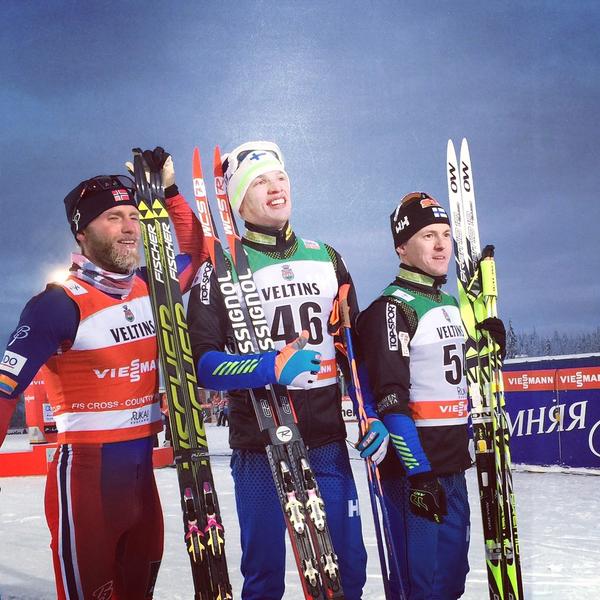
The men’s 15 k classic podium in the first World Cup distance race of the 2014/2015 season in Kuusamo, Finland: with Finland’s Iivo Niskanen (c) in first and Sami Jauhojärvi (r) in third, and Norway’s Martin Johnsrud Sundby in second. Finland hopes to replicate that podium success when they host 2017 World Championships in Lahti. (Photo: FIS Cross Country/Twitter)
Finnish skiers have been using supplemental oxygen at their early on-snow camps high in the mountains, according to multiple Finnish news outlets.
Ilta-Sanomat checked in on the national cross-country ski team at a training camp in Val Senales, Italy, where a glacier offers skiing thanks to its location at 10,000 feet above sea level.
The skiers were training wearing backpacks full of oxygen, with tubes leading to facemasks which supplied the flow.
The newspaper reported that the team had also used supplemental oxygen at an August training camp in Pontresina, Switzerland.
Team physiologist Ville Vesterin explained that at such training camps, it’s not possible to live high and train low: athletes live high, and also train high. By providing oxygen, more ideal training conditions can be simulated.
“Additional oxygen can help you avoid the pitfalls associated with high-altitude training,” Vesterin told Ilsa-Sanomat.
The skiers reportedly use the oxygen primarily for the first 45 to 50 minutes of a workout, as their bodies adjust to to training in high-altitude conditions and overexertion could diminish the quality of the rest of the workout.
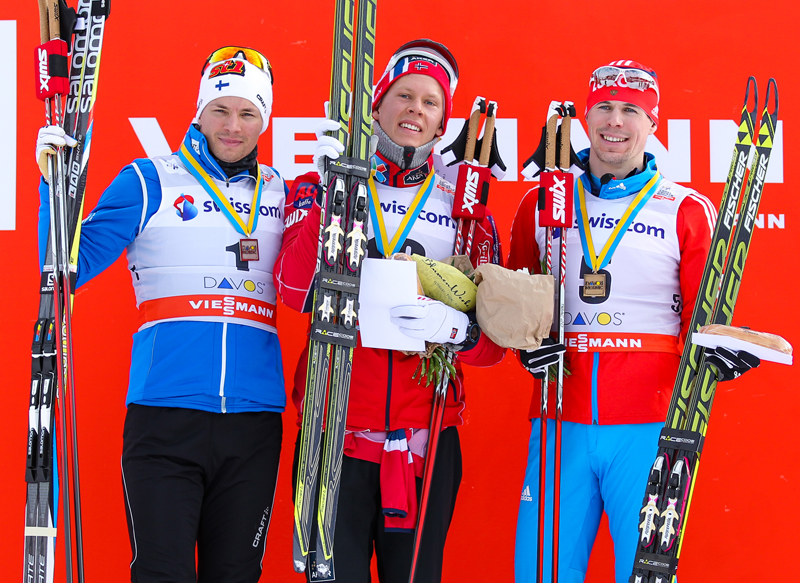
Martti Jylhae (left) on the World Cup podium with Anders Gloeersen, and Sergey Ustiugov in Davos, Switzerland, in 2013. (Photo: Fischer/Nordic Focus)
“It has been used since the 1990s, but the method to be used is new,” Vesterin told Kestävyys Urheilu. “Usability is better than with the old method.”
Martti Jylhä, a national team sprinter, seemed to be a fan of the setup despite the bulky look of the backpack which carried his two-liter oxygen tank.
“At the beginning of such a camp my legs are usually really heavy,” said last year’s 25th-ranked sprinter in the world to Ilsa-Sanomat. “This will help a lot. It interferes with skiing very little.”
“It all seems a bit strange, in every possible way,” said Vegard Ulvang, the chair of the International Ski Federation (FIS) Cross Country Committee and a three-time Olympic gold medalist. “Meanwhile, there is no prohibition against it, and whether it is possible to create something prohibiting it, I do not know … I realize that it creates debate. At the same time, I doubt that this is in practice any benefit. The Finns believe they get more quality with this, but it’s small margins in question.”
The World Anti-Doping Agency (WADA) currently considers the use of supplemental oxygen while training to be similar to the use of altitude tents or hyperbaric chambers for recovery: it’s permitted.
Yet even some within Finland are skeptical that it could help them win medals in 2017, when they host World Championships in Lahti.
“When I heard about it, I thought right away that this does not feel quite right,” Henrik Byggmästar, the head of the Swedish-speaking ski association in Finland, told Finnish news service YLE. “I do not think it sounds legitimate.”
(Swedish is the mother tongue of about 5 percent of Finland’s citizens, or more than 250,000 people; a strong historical population built by both immigration and deliberate colonization, the “Swedo-Finnish” are considered a separate ethnic group.)
“[The masks] help so that when you are at high altitude you can maintain a higher exercise intensity,” Byggmästar said. “You recover faster and can train at an even harder pace than you might otherwise do. They are allowed, but maybe there are other things you could fix before you start with this in particular? … You have got to hope they know what they are doing.”
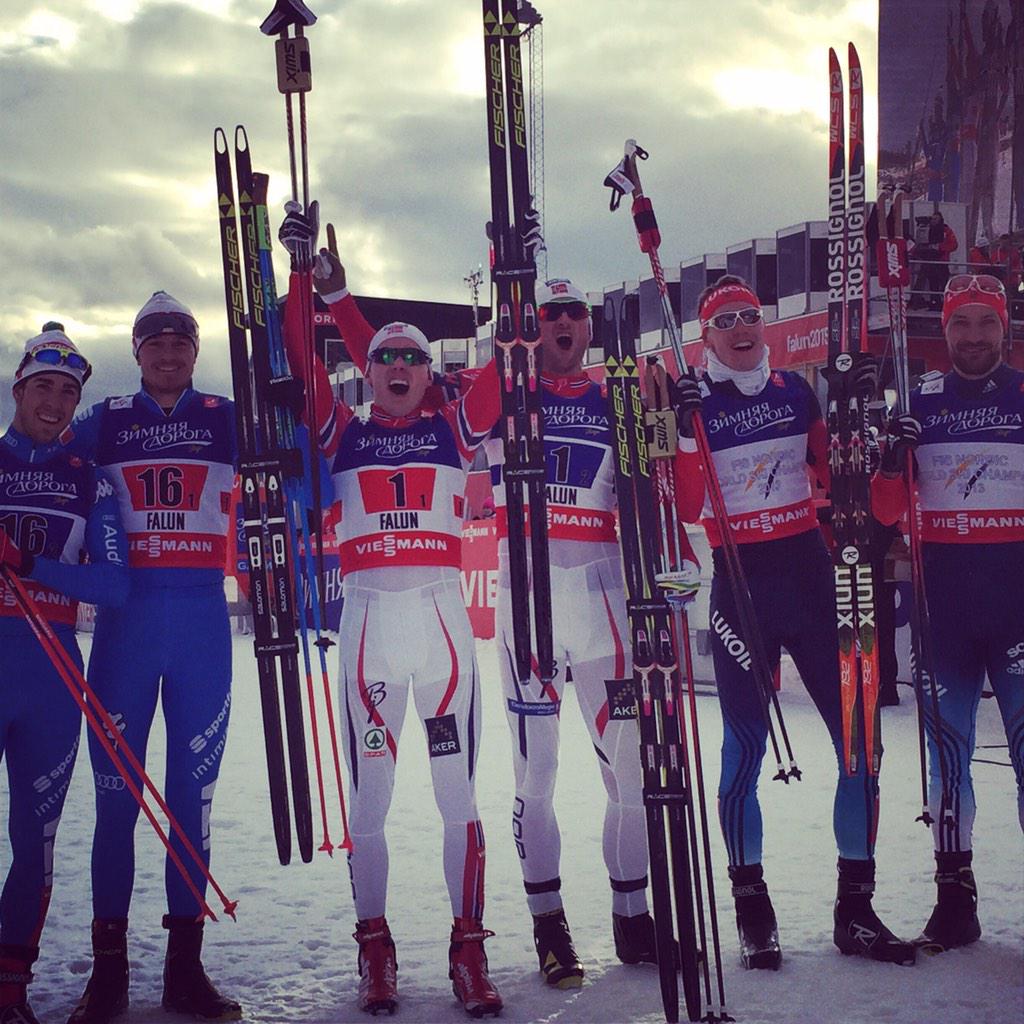
Petter Northug (c) celebrates Norway’s freestyle team-sprint gold, which he won with teammate Finn Hågen Krogh on Sunday for his second title of 2015 World Championships in Falun, Sweden. (Photo: FlyingPointRoad.com)
FasterSkier’s coverage of the 2015 FIS Nordic World Ski Championships in Falun, Sweden, is brought to you by the generous support of L.L. Bean, now featuring a complete line of Kikkan Randall training wear.
FALUN, Sweden — Why waste time when you can get the job done? That was Petter Northug’s mentality on his second of three laps in the men’s 6 x 1.4-kilometer freestyle team sprint at 2015 FIS Nordic World Ski Championships on Sunday.
Already on a roll with one gold in the World Championships classic sprint three days earlier, Northug was on a quest for another in the only event he had yet to win at worlds: the team sprint.
With Norwegian teammate Finn Hågen Krogh, the two built an early lead in the final, and Krogh kept them in first on his second lap, handing off to Northug 2.79 seconds ahead of Sweden in second. Soon after, Northug attacked on the longest of the course’s two steep climbs, leaving Sweden’s Teodor Peterson behind.
“In the final, I looked for things to do pretty early,” Northug said in a press conference. “We thought that Sweden wanted high speed in the final when they put Calle [Halfvarsson] on the first leg. I was prepared to fight with [Peterson] on the last leg, but he was sitting on the bike when we were skiing fast.”
As Northug warmed up into his accelerated pace, Russia’s Nikita Kriukov led the chase, heading out six seconds after him. Teammate Alexey Petukhov had tagged him in third, just ahead of Italy and about two seconds in front of France and Germany, and Kriukov proceeded to lead Italy’s Federico Pellegrino and Germany’s Tim Tscharnke in pursuit of Peterson.
They caught the Swede on the second uphill, and the four descended into the stadium and second-to-last exchange together, led by Peterson about eight seconds after Northug.
One lap later, Krogh had increased Norway’s first-place cushion to nearly 16 seconds, while Italy’s Dietmar Nöckler and Halfvarsson raced behind him in second and third, respectively, up the first climb.
On the second uphill, Russia’s Petukhov was back in contact with the chase group, along with Germany’s Thomas Bing, Finland’s Ville Nousiainen, France’s Robin Duvillard, and the Czech Republic’s Ales Razym. Another five seconds back, American Andy Newell led a second group in ninth.
Krogh cruised into the final exchange in first, while Bing led the seven-man pack through 15.68 seconds later.
“Petter didn’t leave me much choice,” Krogh said in the conference about the lead. “When I saw he had the gap, I only had one thing on my mind, it was go hard the rest of the race.”
From there, Northug went through the motions, skiing the third-slowest anchor leg and looking back before the last rise in the stadium to see if anyone was charging from behind.
Nope.
The 2015 World Championships freestyle team sprint podium, with Norway (c) as the winners (Finn Hågen Krogh/Petter Northug), Russia (r) in second (Nikita Kriukov/Alexey Petukhov), and Italy (l) in third (Federico Pellegrino/Dietmar Nöckler). (Photo: FIS Cross Country/Twitter)
On that same stadium hill several seconds later, Kriukov attacked one last time to move into second ahead of Tscharnke and Pellegrino. He left both of them behind, securing silver for Russia, 5.64 seconds after Northug and nine-hundredths of a second ahead of Pellegrino, who claimed bronze for Italy.
“We lost only five seconds to Petter, but while we was [waving] the flag and drinking coffee, what can you say,” Kriukov said through a translator in the press conference. “The Norwegians were the best. We are really happy for them.”
The defending world champions in the 2013 freestyle team sprint in Val di Fiemme, Italy, Kriukov and Petukhov were also pleased with themselves.
“I’m happy today,” Petukhov said in the conference through a translator. “Because this silver medal, I have to work hard for it, but of course if you win the race, then you are even higher above, but still I am very happy.”
Tscharnke was 0.38 seconds short of the podium in fourth, which was Germany’s second wooden medal of the day after Nicole Fessel and Denise Herrmann placed fourth in the women’s team sprint.
Finland’s Martti Jylhä finished another 7.55 seconds back in fifth, 13.66 seconds after Northug, and the Czech Republic placed sixth with Dusan Kozisek coming through 16.73 seconds after the winners.
While Simi Hamilton skied the fourth-fastest anchor leg for the U.S., the Americans placed seventh (+17.48) ahead of Poland in ninth (+26.46), Sweden in 10th (+47.43) and France in 10th (+1:01.04).
Petukhov inadvertently took out Sweden — the silver medalists in the 2013 World Championships team sprint — when he came into the last exchange with such high speed that he fell and broke Peterson’s pole as Peterson was about to start on his last lap.
“I could not have done anything differently; I went to Teodor and apologized from the bottom of my heart,” Petukhov told Aftonbladet, according to a translation. “I cannot speak English so I do not know what he said, but I think we understood each other.”
“He arrived and apologized. There is no evil in him, but he knows he did wrong,” Peterson told Aftonbladet.
After breaking a pole in Saturday’s skiathlon, in which he placed sixth, Halfvarsson called the bad luck “just crap.”
“Why is this happening? I broke a pole yesterday and now we break a pole on the last lap. It is pure bad luck,” he said to Aftonbladet.
France also fell out of contention in the men’s final, after Duvillard had skied up to fifth at the halfway point behind Krogh. One lap later, they were still in the mix with Baptiste Gros in sixth, and Duvillard tagged them in seventh for the last lap, which was where they ran into trouble.
Coming down the last descent into the stadium, Gros crashed suddenly at the bottom; his ski popped off and he sprawled out on the ground for several moments. He ended up finishing, nearly 14 seconds after Sweden.
Earlier in the afternoon, France placed second to Italy in the first semifinal, one-hundredth of a second ahead of Sweden in third. While Italy and France automatically advanced, Sweden ended up moving on as well as one of the six-fastest lucky loser times among 28 teams. Finland and the Czech Republic also ended up advancing out of that semifinal.
Norway won the second, slower semifinal after Northug set the pace for that heat on his second lap and forced everyone else to contend for a top-two finish to guarantee a spot in the final. Russia placed second in that heat, ahead of the U.S., which also advanced in third, and Germany and Poland made the final as well.
Kazakhstan, which took bronze in the 2013 World Championships team sprint, did not advance to the final and placed 18th overall. Norway didn’t reach the team-sprint final in Val di Fiemme, where Pål Golberg and Northug finished 11th.
“We had a really bad team sprint in Val di Fiemme and also in Oslo [in 2011 where] we lost the team sprint in the last meters to Canada,” he said in the press conference. “So it feels really good to win the World Championships in a team sprint — it’s good to have checked off all the distances.”
With three races to go and 11 World Championships golds to his name, he’s still looking for more.
“I milk [my] base for all its worth,” he told NRK, referring to his altitude training before and after Norwegian nationals late last month. “That makes racing really fun, and I’m planning on riding that flow the coming week as well.”
Norway’s Anders Gløersen (l) leads his quarterfinal in the World Cup men’s 1.5 k freestyle sprint in Davos, Switzerland. Gløersen didn’t win either his quarterfinal or semifinal — Finland’s Martti Jylhä (second from l) did — but the Norwegian took the victory when it counted in the final by half a second over Jylhä on Sunday.
If you missed the 2 ½-minute men’s freestyle sprint final on Sunday in Davos, Switzerland, but caught a glimpse of the top three at the finish – you wouldn’t have a clue what happened.
There was Finland’s 26-year-old Martti Jylhä exuberantly throwing his arms up and running around with unabridged excitement. Then you had Sergey Ustiugov, a 21-year-old Russian coming off multiple U23 World Championships titles, who captured his first World Cup podium on Sunday.
Anders Gløersen, 27, was perhaps the most contained of the group – probably because he’s Norwegian – but even he was pretty psyched. He had just sealed his first World Cup victory since 2010, winning the 1.5-kilometer sprint by 0.58 seconds over Jylhä and a second ahead of Ustiugov in third.
Like Ustiugov, “Poika” Jylhä had never achieved a World Cup podium before, but he was off to a good start with the fastest qualifying time by 0.84 seconds. Jylhä clocked 2:32.19 on the two-lap course – relatively flat with gradual rolling hills and one significant climb that required some V1 action.
“Davos was not my favorite place before,” Jylhä said in a post-race interview. “It was the worst place for me to ski, but now I think I have to change the way how I feel about Davos.”
Russia’s Alexey Petukhov qualified in second, Sweden’s Simon Persson was third fastest exactly a second behind Jylhä. Italy’s Federico Pellegrino qualified in fourth and Ustiugov advanced with the fifth-fastest time of 2:33.98.
As usual, the heats ended up being a few seconds slower than the top qualifying time, with Jylhä winning his quarterfinal in 2:35.54, just ahead of Gløersen in second. The Finn edged Gløersen again in the semifinal, this time by 0.14 seconds in 2:34.32.
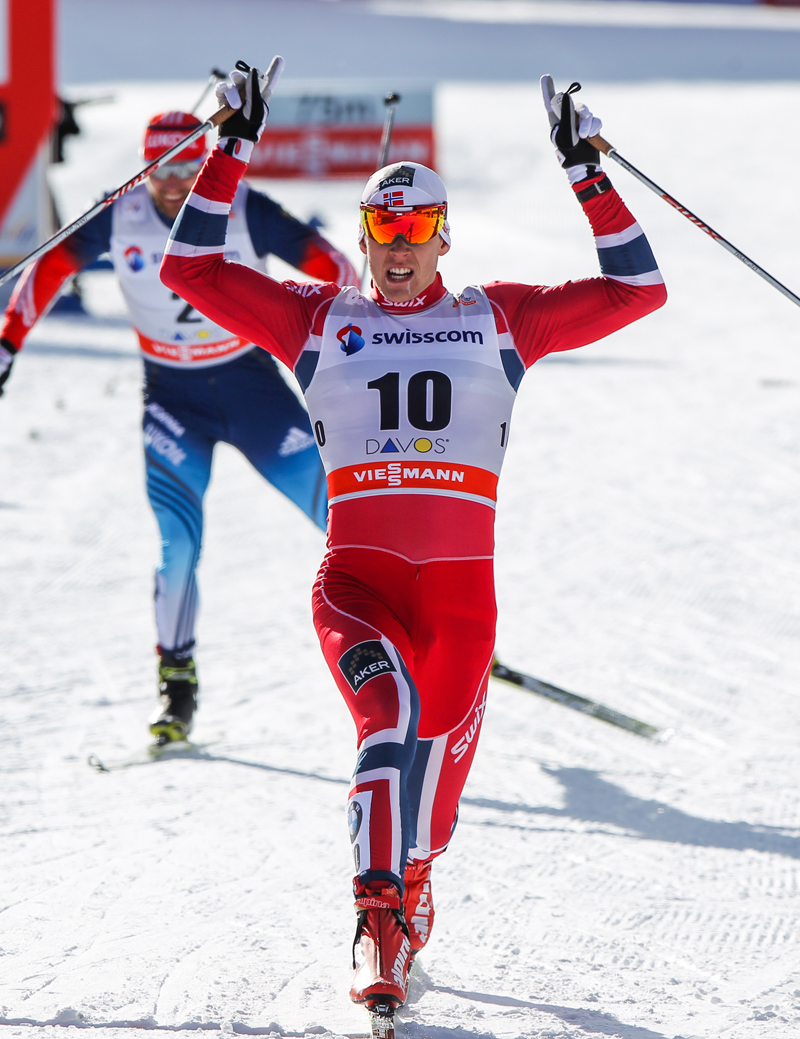
Norway’s Anders Gløersen celebrates his win as he crosses the finish line (Photo: Fischer/Nordic Focus)
Once the final rolled around, Gløersen had a pretty good read on Jylhä. The guy was gutsy, racing ahead and trying to break away on the main hill – which worked in his first two heats.
Early on in the final, which started with a casual pace, Pellegrino tried to jump to the front, but couldn’t quite make it. Petukhov then tried his luck without a whole much, and finally it was Jylhä’s turn.
Looking like someone who’s skied in World Cup sprint finals a time or two before, Jylhä took charge. Gløersen sat back, waiting for the anticipated downfall of the less-experienced Finn.
Then again, Gløersen hadn’t won a skate sprint since 2010 in Oslo, Norway. He made the podium twice last season in the Canadian World Cup freestyle individual and team sprints in Canmore and Quebec, respectively, but that was a year ago. He was just as hungry for a win, which could secure his Olympic bid.
Gløersen gave Jylhä a taste of his own tactic when he attacked up the same climb before the long descent toward the stadium. Jylhä held on and tried to draft him, while the two Russians – Petukhov and Ustiugov – hovered around third and fourth.
As the group rounded the final corner into the finishing stretch, Gløersen turned up the jets and started to gap the field, ultimately finishing by a clear margin in 2:38.74. Jylhä was next across the line, then Ustiugov, who ended up edging Petukhov for third by 0.31 seconds.
Petukhov finished fourth, Finn Hågen Krogh placed fifth (+2.14) and Pellegrino ran out of gas to place sixth (+11.81).
“The finals went very well,” Gløersen told NRK on the anniversary of his first World Cup win, which he notched in six years ago in Rybinsk, Russia. “I was really tired when I started, but I thought the others were more tired. … I was lucky to go in the first heat in the quarter and semifinals.”
“It was a long time since I won … too long,” he added. “So this was a real good feeling. It was time to step up again.”
With the same amount of rest as Gløersen, Jylhä struggled to find his position in the final, but when he saw an opening, he said he went for it.
“Anders worked very hard; I could not overtake him, but second place is like a victory,” Jylhä said.
A smiling Ustiugov told reporters: “It feels great to be on the podium. … The course fit me very well in Davos. I tried to keep the pace high and stay in front. I gave everything I had in the home stretch.”
Earlier in the day, Persson mimicked Jylhä’s strategy in the second semifinal and led from the start. Norway’s Krogh and Eirik Brandsdal chased the 22-year-old Swede, along with Russia’s Nikita Kriukov. About halfway through the race, Petukhov leapt to the front and held his position around the final corner, where Brandsdal and Persson collided and fell out of contention.
The men’s podium. Martti Jylhae, Anders Gløersen, and Sergey Ustiugov. (Photo: Fischer/Nordic Focus)
Kriukov, who finished second to teammate Petukhov in the semifinal, was blamed for the penalty and disqualified as a result (keeping him from the final). But Norwegian news agencies sided with Brandsdal and blamed Persson, who stumbled earlier in the semifinal on one of the two climbs.
“I don’t know what he did,” Brandsdal told NRK, according to a translation. “I feel he should have kept outer [lane] instead of cutting in.”
Second-to-last in the heat, Brandsdal ended up eighth and Persson finished ninth overall.
“This … happens,” Brandsdal said. “But I’ve had a good day, so I’ll take it with me.”
In his first World Cup back since a long bout with illness, Sweden’s Emil Jönsson placed 22nd after finishing fifth in his quarterfinal (which Petukhov won). Jönsson told reporters he lost a lot of training and was unable to find his top gear on Sunday. Not too upset with the result, he said his goal was to come to Davos and see where he stood.
“Out in the quarter is not the best there is …” Jönsson tweeted. “[Next] time!”