From the FasterSkier archive — posts syndicated from athletes’ and coaches’ own blogs between 2004 and 2012, kept online as published. Current coverage is at fasterskier.com.
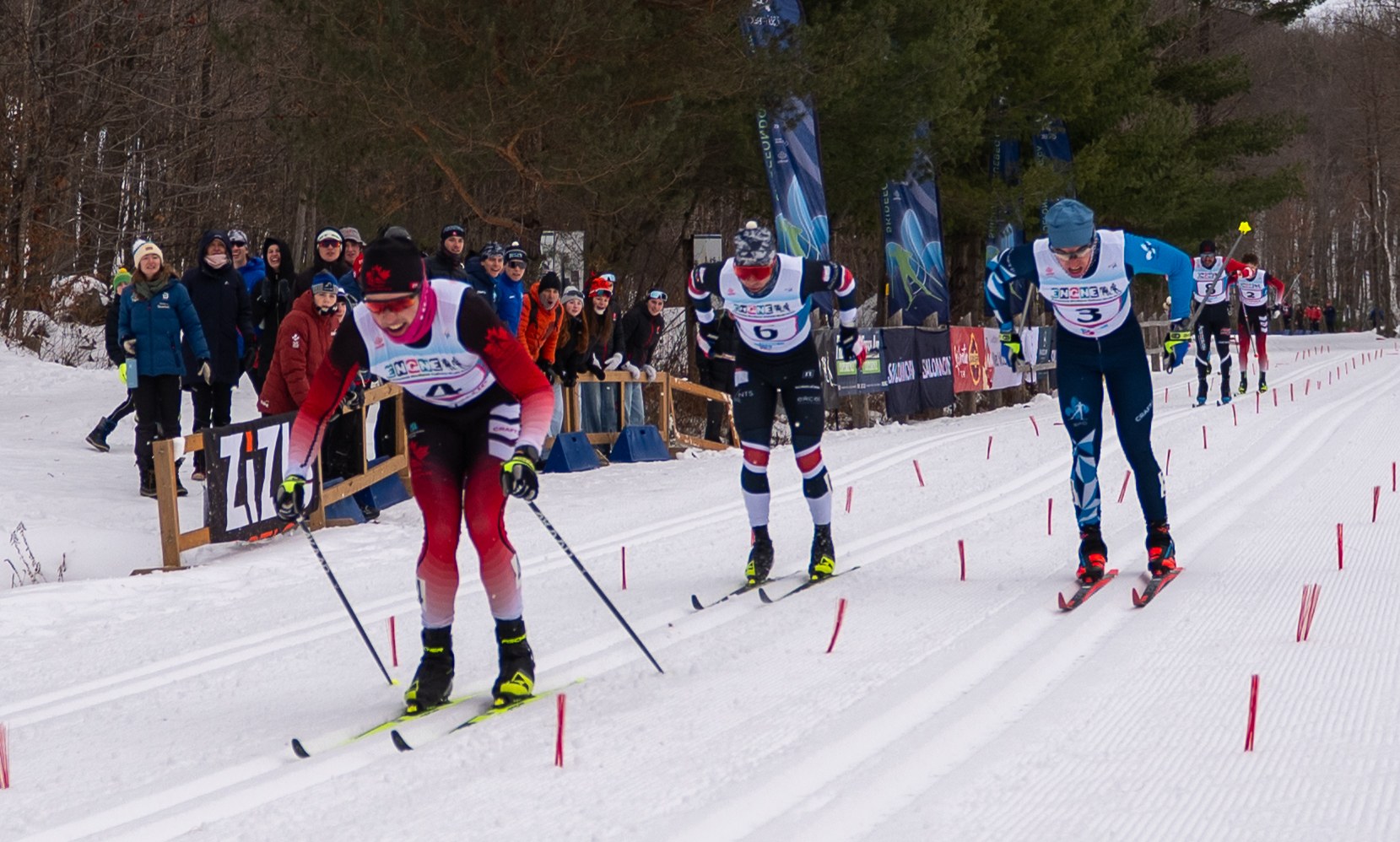
A classic sprint for the line at the Candy Cane Cup in December 2025. (Photo: Rob Smith)
The series, taking place in Gatineau, Quebec (near Ottawa), kicks off with the Canadian World Junior and U23 Championship trials, Dec. 18-21, and concludes with the Eastern Canadian Championships, Feb. 5-7. These FIS races, organized by Évènements Nordiques Gatineau Nordic Events (ENGNE), take place at Nakkertok Ski Club with the support of Ville de Gatineau and Tourisme Outaouais, longtime sponsors of the events and of skiing in the region.
Nakkertok is known for its excellent grooming and for race trails supported by an extensive snowmaking system, and for a very experienced organizing committee (nakkertok.ca).
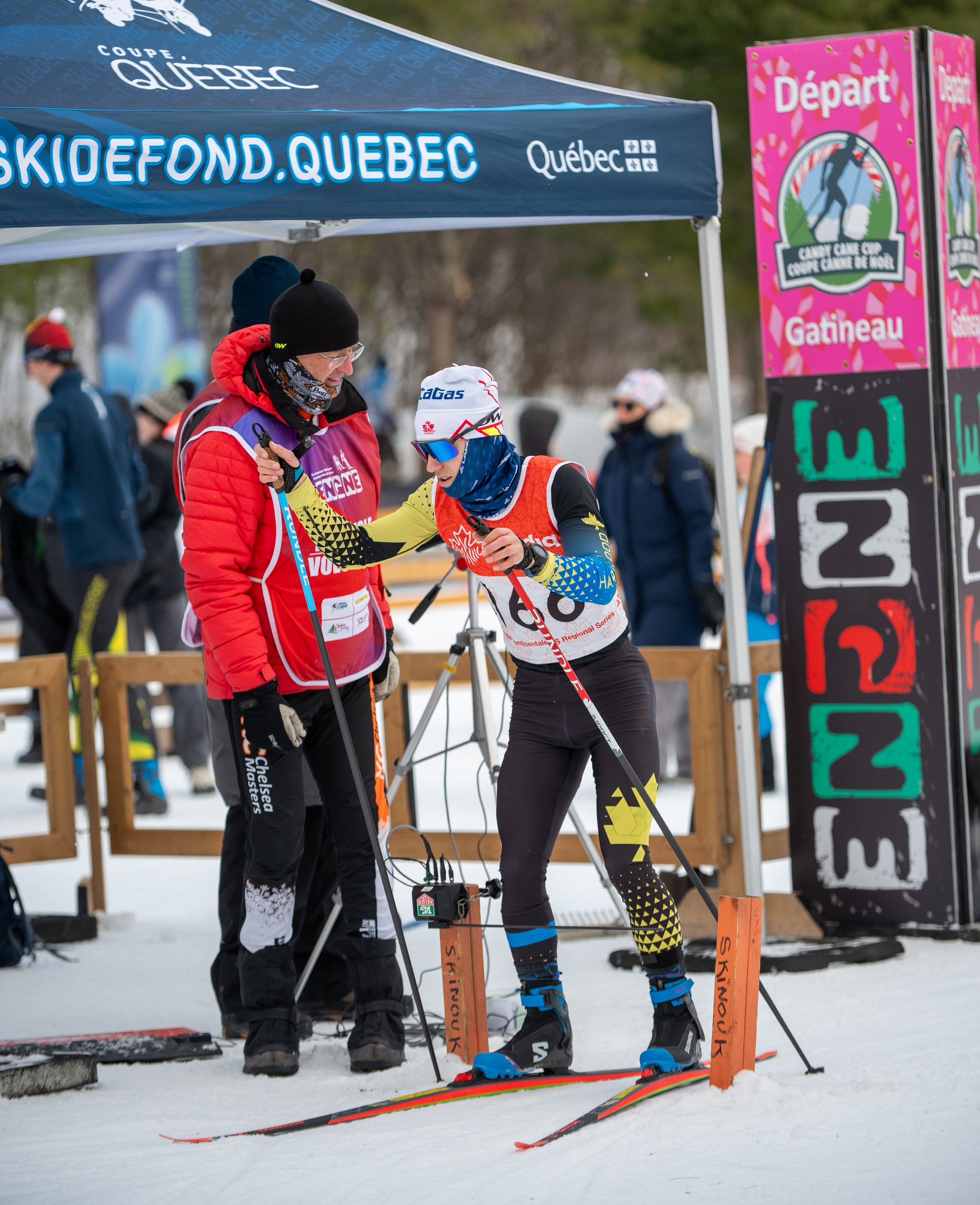
A racer leaves the start gate at the Candy Cane Cup in Gatineau, December 2025. (Photo: Rob Smith)
The Candy Cane Cup
The December races, also known as the Candy Cane Cup, will feature Canada’s best Junior and U23 athletes as they battle for positions on the Canadian team at the FIS Championships in Otepää, Estonia. The Candy Cane Cup is also the second Nordiq Canada NorAm event of the 2026-2027 season, identifying senior athletes for the Period 3 FIS World Cups. Winners in the Open class will claim $500 per race, with the overall winner receiving an additional $1,000 as a Hall Mark of Excellence (HME) Award. Junior race winners will receive $200 per race and $500 overall. Additional prize money will be awarded for other placings and categories, including ParaNordic events, with racers selected for the Canadian teams receiving an additional cash bonus.
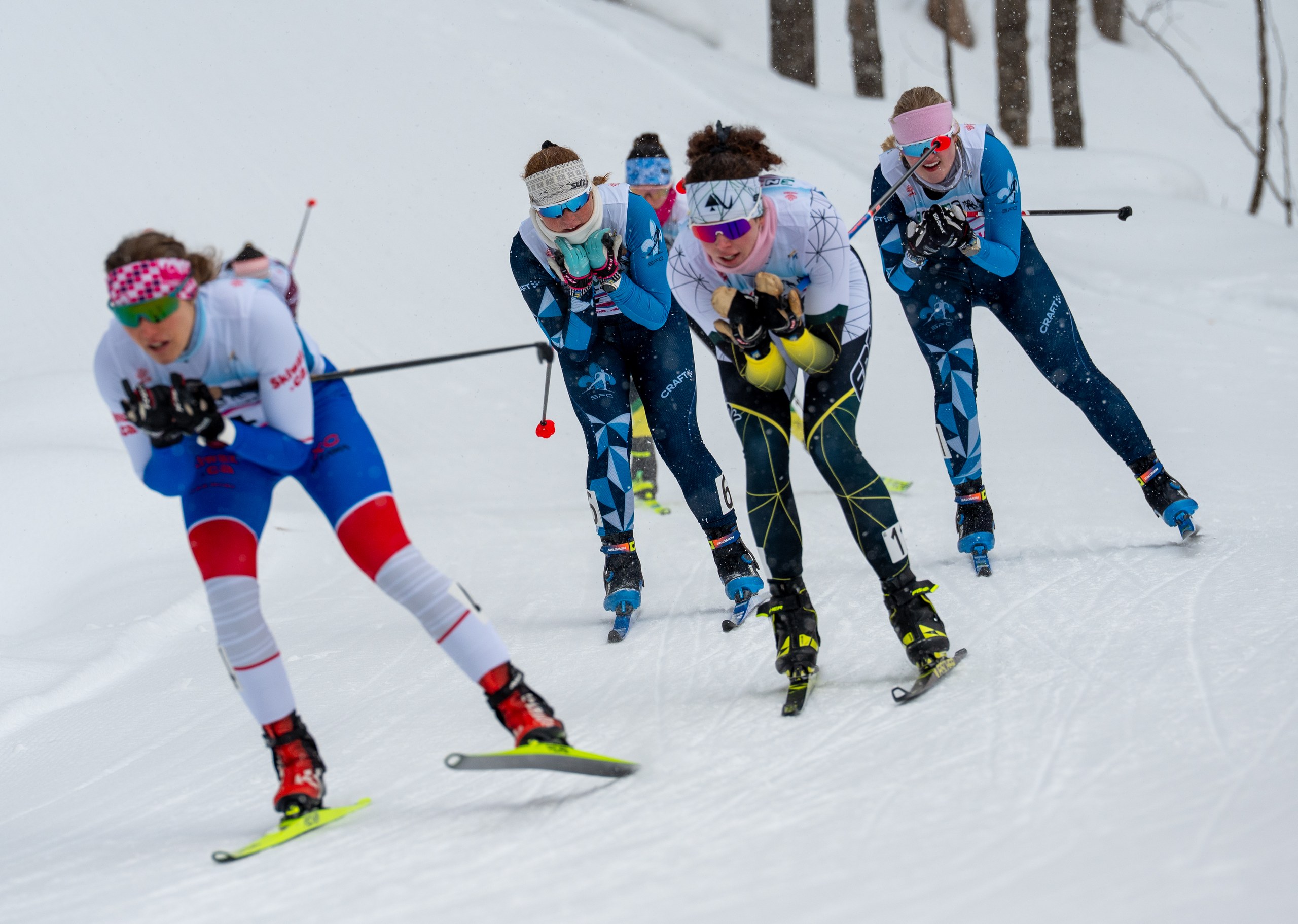
A chase group tucks through falling snow at the 2026 Eastern Canadian Championships. (Photo: Rob Smith)
The Eastern Canadian Championships
February’s Eastern Canadian Championships start the Friday following the NorAm and SuperTour races in Lake Placid, 2.5 hours “up the road,” and have a similar prize structure. Athletes who participate in both events will be eligible for the additional $2,700 in HME prize money for overall performances.
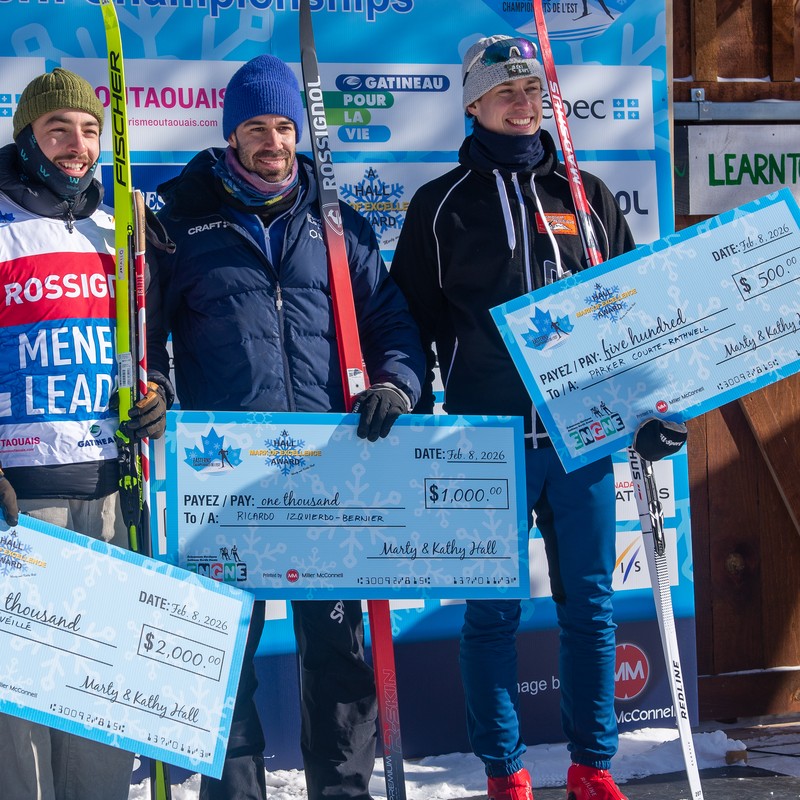
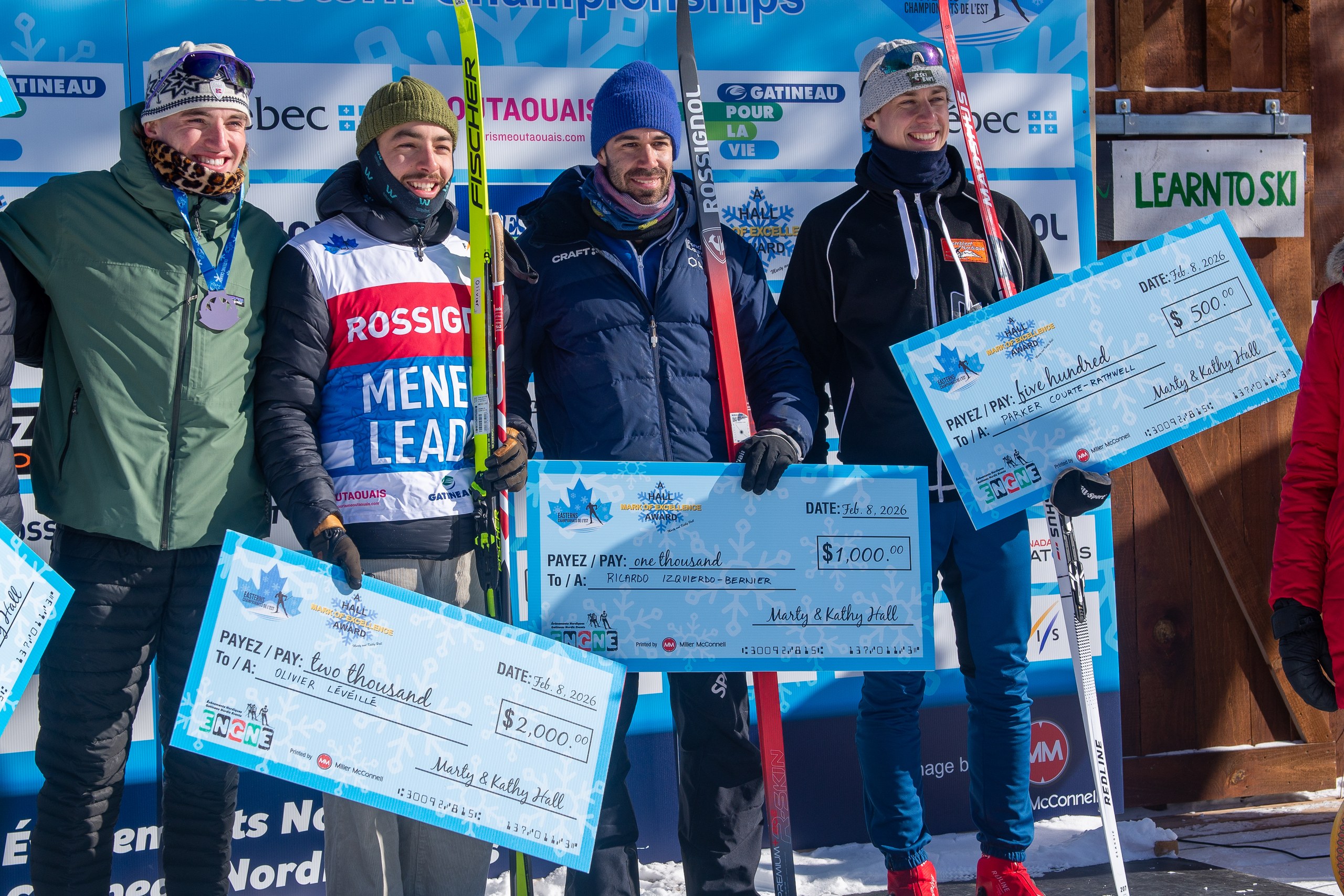
Hall Mark of Excellence checks for $2,000, $1,000 and $500 presented at the 2026 Eastern Canadian Championships, made out to Olivier Léveillé, Ricardo Izquierdo-Bernier and Parker Courte-Rathwell, respectively. (Photo: Rob Smith)
The Hall Mark of Excellence Award
The Hall Mark of Excellence Award program, founded by Marty and Kathy Hall, has provided over $70,000 of prize money at ENGNE events over the last six years, providing much needed financial support to athletes. As Kathy Hall described, “The intent of our program is to inspire and reward skiers, ultimately to enable them to continue to develop their potential and pursue their success at whatever level of skiing they choose.”
For the 2026-27 season events the HME is contributing $18,000, with an additional $17,000 provided by ENGNE and $8,600 by Nordiq Canada for the NorAm event.
“Nordiq Canada is pleased to contribute financially toward the December NorAm at Nakkertok and to work alongside ENGNE and the local organizing team to deliver a strong competition opportunity for Canada’s athletes,” said Beckie Scott, CEO of Nordiq Canada. “Investing in our domestic competition calendar is an important part of creating a high-quality pathway for athletes to develop, compete and prepare for international racing. We’re grateful to ENGNE and its partners for continuing to raise the standard of racing in the Ottawa-Gatineau region and for their commitment to supporting Canadian athletes.”
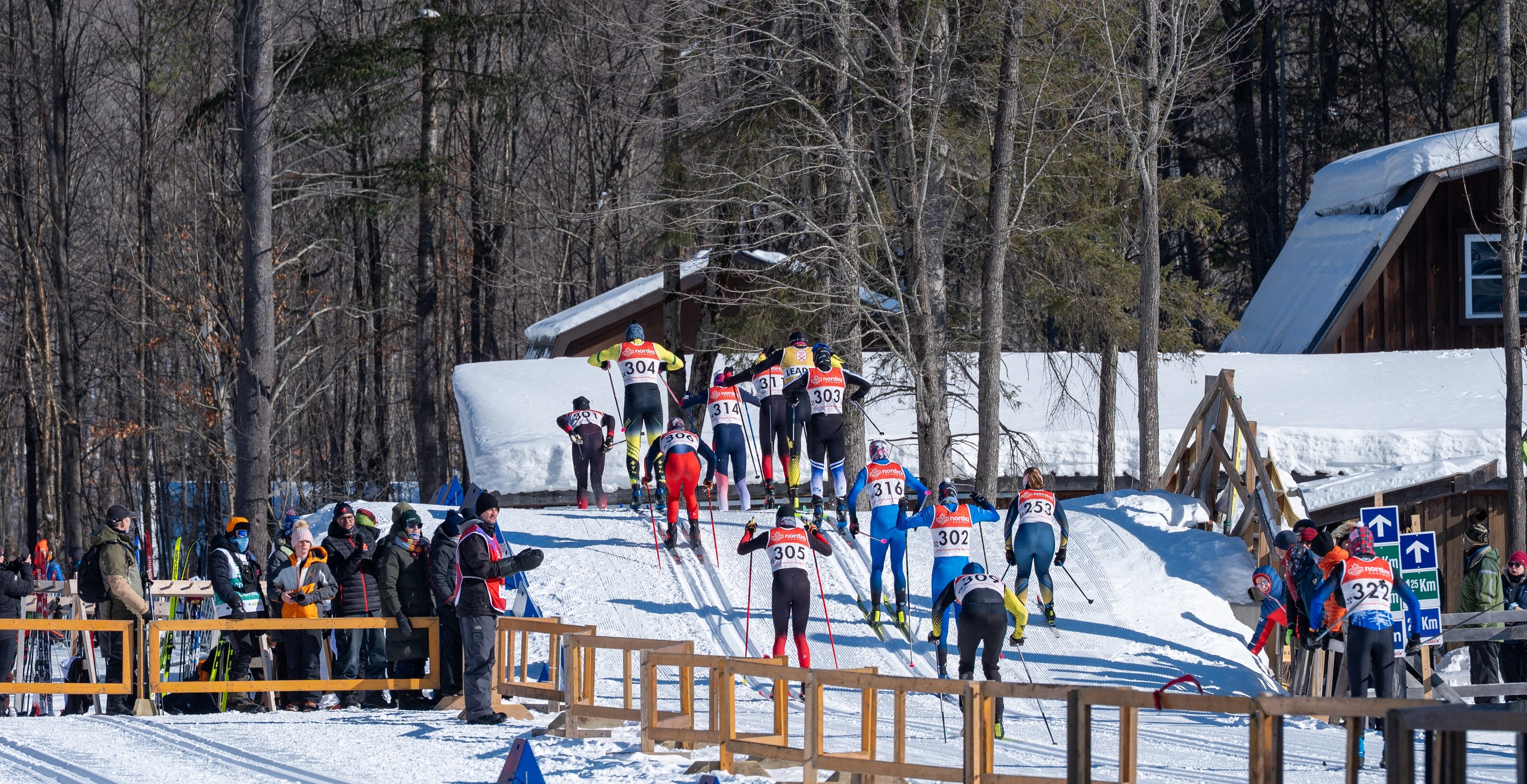
The field double-poles over a small climb early in the 2026 Eastern Canadian Championships. (Photo: Rob Smith)
A Record Year at Nakkertok
ENGNE has been organizing races in the Ottawa/Gatineau area since being formed to run the 2016 World Cup event as part of Ski Tour Canada. “A larger prize purse was important to us this season: it helps ease the financial load for athletes heading to World Championships,” said John Halvorsen, ENGNE President. “With the support of Nordiq Canada and Kathy Hall, we’ve set a record year for prize money at Nakkertok Nordic Ski Club, cementing its place as eastern Canada’s hub for world-class ski racing.”
As well as the Nakkertok trails, the Ottawa/Gatineau area has over 200 kilometres of ski trails, including Gatineau Park, home of the Gatineau Loppet, and an extensive urban trail system. It is a great area in which to train, explore and relax. We look forward to welcoming you to our winter ski home.
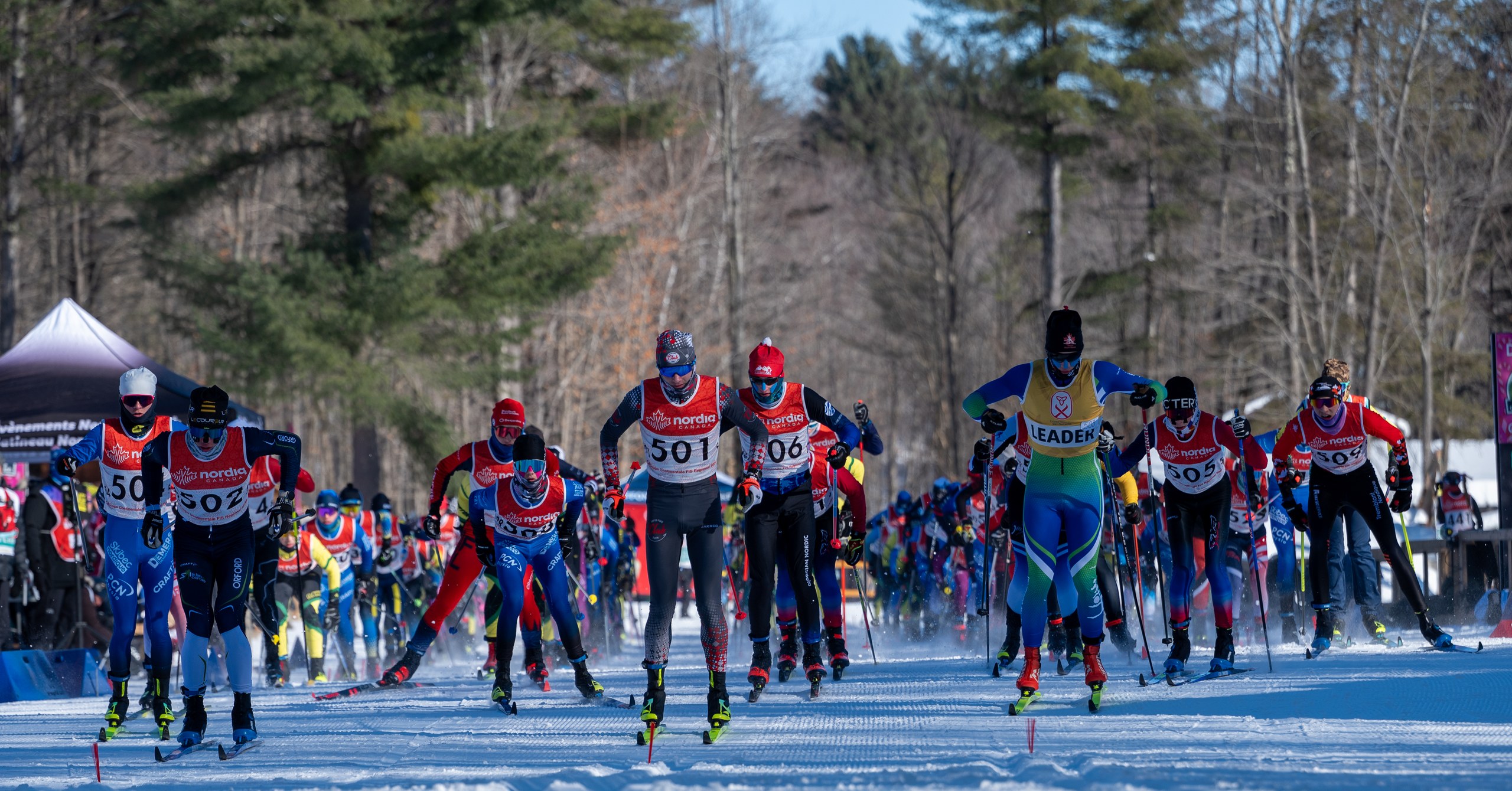
The mass start rolls out at the 2026 Eastern Canadian Championships. (Photo: Rob Smith)
Publishing press releases is a service we offer to the ski community, so please note these articles are not written by FasterSkier and therefore do not necessarily represent our thoughts and standards.
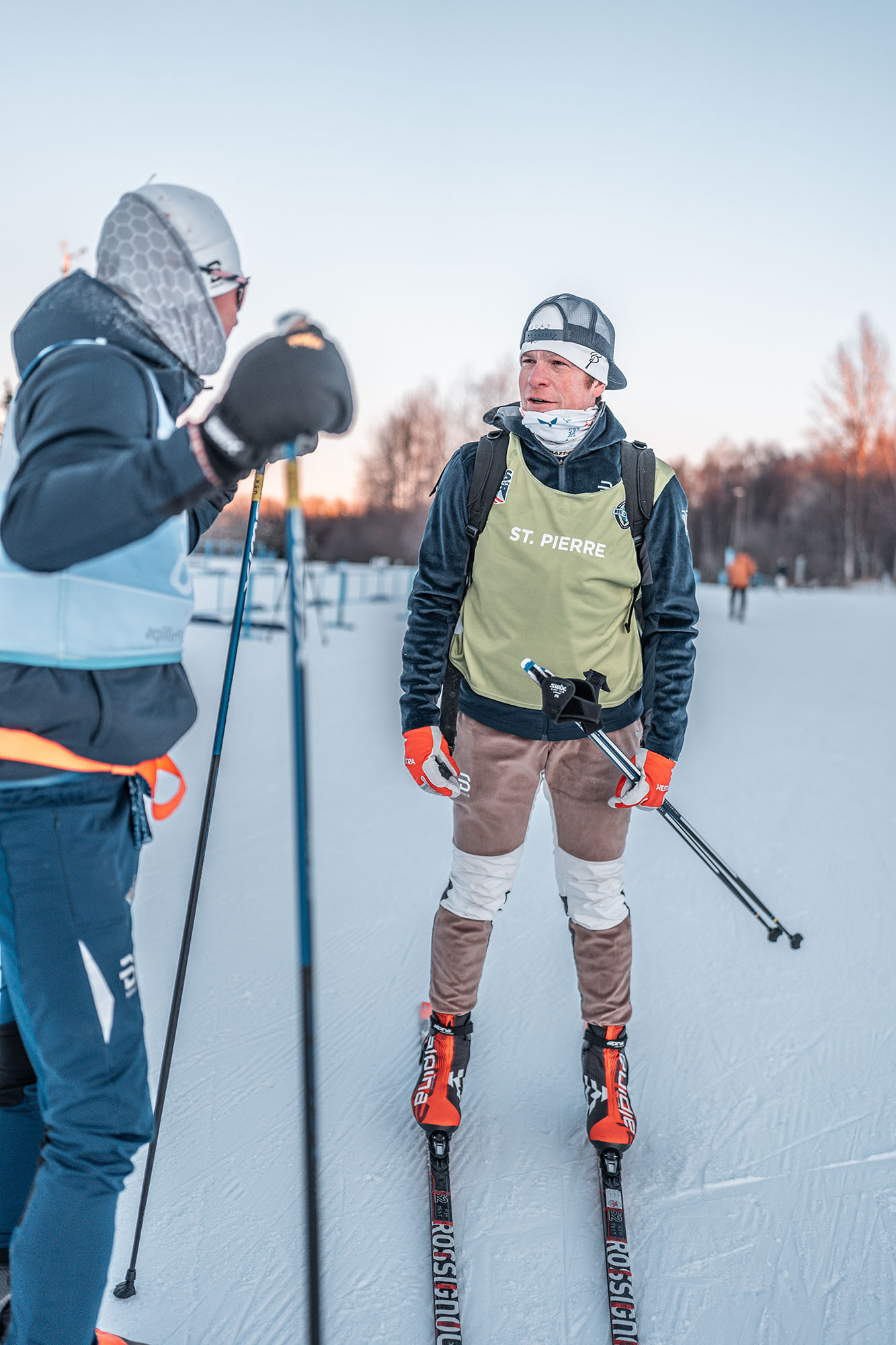
Adam Coaching at US Nationals in Alaska. (Photo: Tobias Albrigtsen)
Adam St. Pierre finished second to last in the first cross-country ski race of his life. The one skier he beat had crashed into a tree.
He was a sophomore at Fall Mountain Regional High School, a rural school in Charlestown, New Hampshire, and he tells the story with the flat delivery of a man who has told it before and enjoys it every time. “Charlestown doesn’t really have a claim to fame,” he said. Forty-five minutes due south of Hanover, close enough to know Dartmouth was up the road, far enough that the world of club skiing might as well have been on another continent. He had never heard of it. What he knew was soccer, basketball, and track, in roughly that order, and he had no intention of adding a fourth sport that involved falling down in the cold.
Then his freshman year fell apart. He hurt his knee playing soccer. He slogged through a basketball season he had come to hate. And in the spring, his track coach, who happened to also coach the ski team, made him an offer that sounded reasonable at the time. Come out for skiing next winter, the coach said. It will get you in better shape for soccer and track.
So he showed up. That first race was a classic race, and he had only ever skated. He survived it, barely, ahead of the kid who met the tree, and somewhere in the weeks after, the thing that has kept a lot of people in this sport quietly got its hooks into him.
Fall Mountain was not a fancy place, and that turns out to be central to the story. It was a working rural school with a barn, animal husbandry classes, agricultural mechanics, a metal shop, and forestry classes that maintained the trails and tapped the maple trees where the team ran and skied. The ski coach was the metal shop teacher. When the program needed grooming, the metal shop and ag-mechanics kids bought an old PistonBully and kept it running themselves. St. Pierre came up through a program held together by shop-class ingenuity and a snowbank at the edge of the football field, and he has never once been snobbish about it.
“I have a high respect for high school skiing, because it is an entry point,” he said. “Otherwise I wouldn’t have found the sport.”
A team that needed a fifth man
He nearly didn’t find the next part either. Right before he graduated, his coach, Larry Sayers, told him that Colby College’s ski team wasn’t very good and that St. Pierre could probably walk on. He filed it away and didn’t think much of it. He had his sights on soccer and track. But once he got to Colby and started running into the skiers at various events around campus, something clicked, and it had nothing to do with the skiing.
“These are the kind of people I like,” he remembered thinking.
The timing was almost comically good. The coach, then Tracey Theyerl, now Tracey Cote, was 29 and in her second year running the team. She had just cut most of the upperclassmen, which left her with four men and an opening. St. Pierre walked on as the fifth. His introduction to roller skiing came shortly after, when Cote put him on a pair of classic roller skis and sent him out for a time trial. “I survived,” he said. From that point on, he was in, and again, the pull was the people as much as the training.
Adam St. Pierre (left) and former Bowdoin skier and BNJRT coach Sam Shaheen at the start of the 2019 American Birke. (Photo: courtesy Adam St. Pierre)
From the lab to the wax room
He majored in physics at Colby and minored in biochemistry, and when he graduated, he had no clear idea what came next. He looked at teaching jobs. Nothing landed. Then a skier friend from high school told him about a graduate program at the University of New Hampshire where, as St. Pierre understood it, they paid you to study exercise. That sounded like a good deal. He enrolled in a master’s program in kinesiology and exercise science, working under a UNH physiologist whose research centered on hydration and thirst. His thesis was, in his words, pretty brutal to run: sensations of thirst in dehydrated subjects in cold versus ambient environments. “A little bit of everything when it comes to making people uncomfortable,” he said.
It was during those UNH years that the sport handed him his first coaching job, and it did so in the roundabout, relational way that his whole career seems to follow. He had started dating a Bowdoin College skier while he was at Colby. She was a year behind him, still racing, and he was driving up to Brunswick most weekends to see her. Her coach was Marty Hall.
Anyone who knows North American skiing knows the name, yet St. Pierre’s version of a Marty Hall story is smaller and more human, and it starts with the legend sizing up the kid who kept turning up in his wax room.
“I need an assistant coach,” St. Pierre remembers Hall telling him, and he does a passable Marty voice when he gets there. “And you’re up here every weekend anyway. You want the job?”
He took it. He thinks he was paid around 1,500 dollars total, which covered the gas. He coached under Hall for two years, and it confirmed something he had already begun to suspect: he wanted to spend his life doing this.
Adam and his family out for a ski.
Building from the bottom in Boulder
When his wife got into law school at the University of Colorado, the two of them moved to Boulder, and St. Pierre walked into the next accident of his career. He had been hired to be the head coach of the Boulder Nordic Junior Racing Team, replacing Eric Pepper. Then Pepper decided to stay. Rather than lose St. Pierre, the club invented a role for him and made him its first development coach, responsible for the youngest kids, the u14s and u12s, or as they were then called, the j3s and j4s. Many of them were the little siblings of the older racers. His whole job was to grow the program from the bottom.
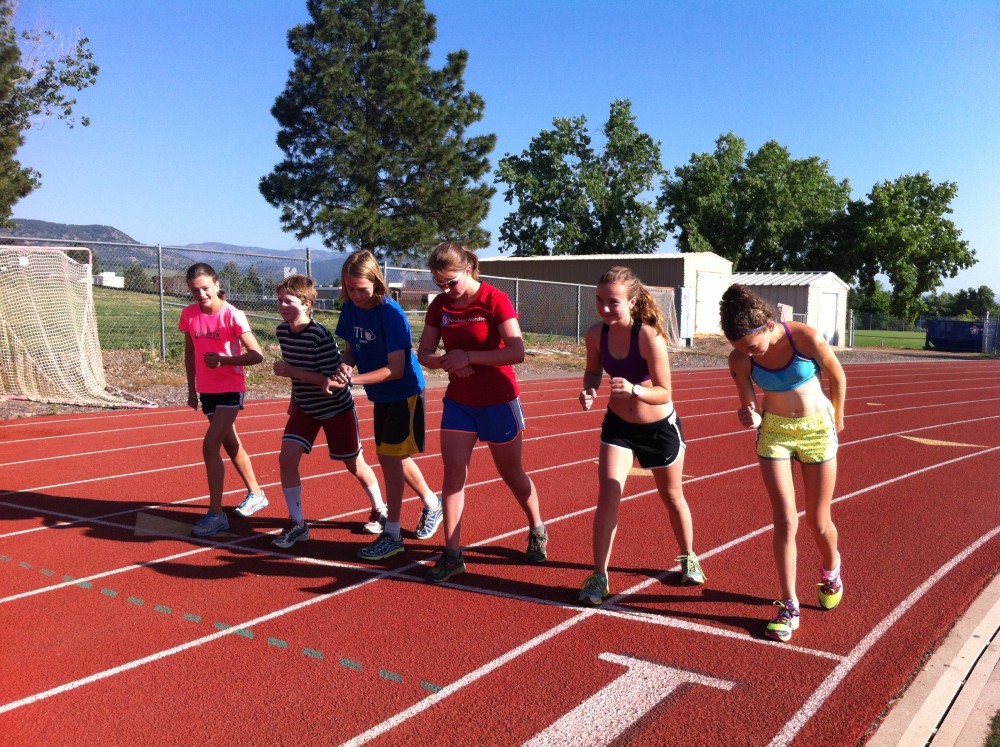
Boulder Nordic Junior Racing Team athletes prepare for the start of a 3,000 kilometer running time trial on the track in 2013. (Photo: Adam St. Pierre)
He did. When Pepper eventually moved on and St. Pierre took over as head coach and program director, he watched the club climb from 15 or 20 kids to nearly 70 at its peak, in a place he is quick to say is a genuinely hard town to be a skier. There is no snow in Boulder itself. You drive for it, and it is expensive, and the parents who commit anyway earn their real respect.
One of those little kids was Lauren Jortberg. St. Pierre started working with her when she was six or seven, and he coached her through high school. She was, by his telling, agonizingly consistent at exactly the wrong number: four straight Junior National Championships and 11th place in what felt like every race. “All she wanted was that top 10,” he said. She had setbacks. She stuck it out.
Years earlier, in his first season of coaching in Boulder, St. Pierre had said out loud that one of his goals was to someday coach a kid who would reach the Olympics. This past February, Jortberg made the U.S. team for the Milano-Cortina Games and qualified for the quarterfinals of the Olympic sprint, the culmination of a long and interrupted road that ran through back surgery, ankle surgery, and a lost senior season at Dartmouth. St. Pierre is careful not to claim more than his share.
“I can’t take responsibility for much,” he said, and then, a beat later, “Goosebumps. Proud of her.”
Boulder was where the rest of his professional life took shape, too. He worked at the Boulder Center for Sports Medicine as a clinical physiologist, running lactate thresholds and VO2 max tests and metabolic evaluations, and working alongside physical therapists on running biomechanics, teaching and reteaching people how to run without breaking. He got into ultrarunning and knocked off a number of 100-mile races, mostly for the pleasure of being out in the mountains all day. Around 2016 or 2017, he left the Boulder Nordic team and hung out his own shingle as an online coach. The flexibility made sense with two young kids and a wife commuting to Denver. But he missed the in-person part, the standing-in-the-snow part, more than he expected to.
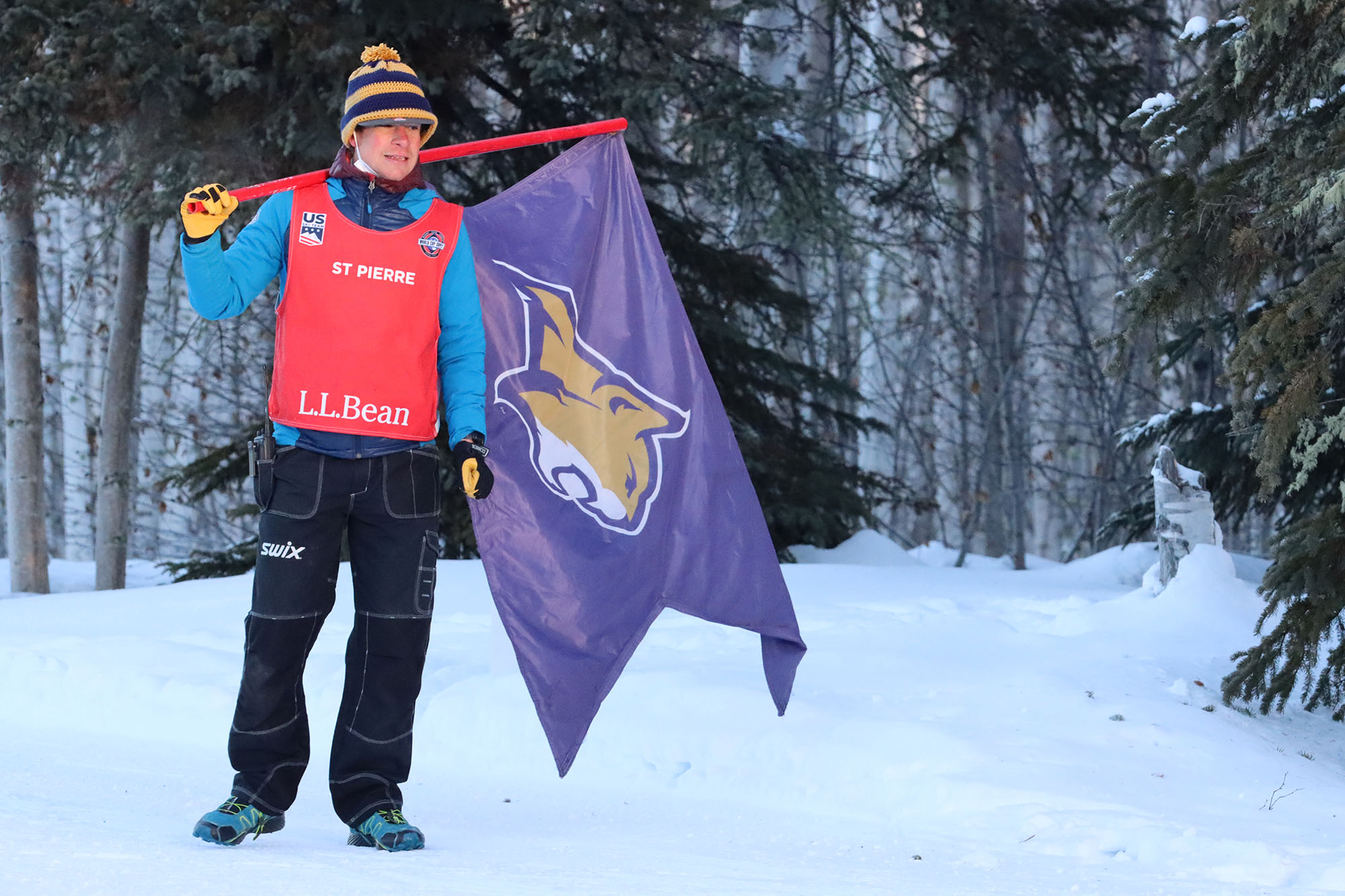
Adam repping the MSU team flag in Houghton, Michigan. (Photo: Tobias Albrigtsen)
The job he had been aiming at
He had known for a long time where he wanted to end up. College coaching had been the goal since around 2009. The appeal was simple: at the junior level, a coach spends a lot of energy convincing kids they might want to be ski racers, keeping every other door open in case they choose running or mountain biking instead. At the college level, the athletes have already decided. “They’ve decided they are cross-country ski racers,” he said. “I wanted to coach ski racers.”
The Montana State job had come open once before, in 2015, and he had applied and been the runner-up. When it opened again during the strange fall of 2020, he jumped. He was hired that November and moved to Bozeman alone that winter while his wife and kids finished out the year in Boulder, riding out the online-school chaos he credits her with surviving. The family joined him the following June. Bozeman had been near the top of the short list of places they wanted to live anyway, a real ski town with snow in town, Crosscut 20 minutes up the road, and Bridger Bowl close enough to grab powder runs before cross-country skiing in the afternoon.
Which is to say, the kid who finished second to last, who backed into the sport to get in shape for soccer, who took a coaching job largely because he was already driving to Brunswick every weekend, ended up exactly where he had been quietly aiming for a decade. The path was accidental in its particulars and not accidental at all in its direction. He kept following the people, and the people kept turning out to be skiers.
What he does with those skiers once he has them, and why he thinks so much of American training gets the easy days wrong, is its own story. That is part two.
Help Support Our Coverage!
If you value the thoughtful work and access FasterSkier provides, please consider becoming a Voluntary Subscriber. Your support directly fuels our work to cover the people, places, and moments that make our sport special.
As many of you know, we lost a vital ambassador and supporter of North American cross-country skiing earlier this week. For those of you who might not be aware, Marty Hall was a lot more than the person, along with his wife Kathy, who supported our World Cup coverage. Marty was a friend.
As a younger man, Marty had been a football player, nordic skier, and track star at the University of New Hampshire before becoming the US Ski Team’s first full-time coach, where he worked with some of our most legendary American skiers.
Marty revolutionized training methodologies, trail grooming, and race formats, leaving an enduring impact on the sport. He was instrumental in the development of the Birkie Trails in Wisconsin, home to the American Birkebeiner.
Marty wearing a camera helmet for ABC in the 1979 American Birkie. Is this the first GoPro? (Photo: Courtesy Photo)
Kathy and he eventually moved to Canada so he could take on head coaching duties with the Canadian team.
After his coaching career, Marty and Kathy were passionate supporters of UNH skiing, the New England Nordic Ski Association (NENSA), the Birkie Trails, Nakkertok Nordic in Ontario, and of course, the Halls have been the presenting sponsor of FasterSkier’s World Cup coverage for many years now. Their generosity and dedication strengthened the sport at all levels.
Many of us at FasterSkier have had the privilege of spending a lot of meaningful time with Marty and Kathy: Matt also skied for UNH and has spent many hours on the phone and in person with the Halls, Nat skied for Marty at Bowdoin College, his final coaching stop, and so many of Marty’s former athletes and friends have reached out to us to share stories over the last few days, which we hope to compile soon, but we thought it might be best to share the words and memories from the FasterSkier team member who Marty had the most significant impact on.
Marty and Kathy Hall
Marty Hall, as our Devon Kershaw remembers:
Marty was a real firecracker and a passionate advocate of the merits of competitive cross-country ski racing. Was he brash at times? Irritating? Of course, he was, but he was always unapologetically himself, a paramount quality if one wants to compete at the upper echelons of anything.
Marty taught his athletes, whom he worked closely with, to get the most out of themselves. They were part of historic teams and achieved results in the USA and Canada. Some of the photos from that iconic era are legendary—as were his eyebrows.
Later, when he was done coaching at the highest level, he was never afraid to speak his mind—a through-line of his life. He was always ‘no holds barred’ with his opinions of what he thought teams or individuals should be doing, and nobody was safe. Not Beckie Scott, not me, not anyone. It was amusing when you weren’t involved and/or racing well enough to have his criticisms or opinions wash over you like water off the back of an otter’s soaked coat. Still, it could be irritating to be receiving his unsolicited advice—especially when things weren’t going so well on the ski tracks. Yet, he always stood by his opinions, and that ‘tough love’ aspect was just so ‘Marty.’ He just wanted—always did—for athletes to get the most out of themselves. There’s no better quality in a mentor, coach, or sparring partner.
He was persuasive, too. This story is funny and perhaps hyperbolic, but I may have never been a cross-country ski racer at the highest level without Marty.
I recall that Dave Wood and Marty came by my house – in Sudbury, ON (I still don’t understand why, haha – I wouldn’t go to Sudbury willingly), most likely on their way to some event somewhere in Northern Ontario. We sat in our family room, and Marty peppered me with questions. At the time, I was very on the fence between giving up top-level skiing – accepting instead a running scholarship, of which I had many offers to run in the NCAA – and, of course, Marty was having none of it. Tried as I might to explain how I loved both sports and that running was a more ‘pure’ competition with fewer variables, he turned it all on its head, educating me (preaching in pure Marty style) in the facts that those plethora of variables are what allow Canadians to win at the highest level. Mind you, no Canadian at that time had won anything in cross-country skiing for a very long time. It was over a decade since Pierre Harvey—the only Canadian to win then—did so in 1988. But he was able to beat me down to accept the reality that the chance to be the best in the world on a day was more realistic in cross-country skiing when compared to distance running as a young Canadian (I recall him being very stubborn about this—something like, “there’s no way you can be the world’s best at 5000m as a Canadian” or something like that, haha).
Then came the war stories. Marty was a great storyteller, and the evening was filled with him and Dave—mostly Marty (there was not enough oxygen in the room for others)—telling anecdotes of the World Cup, the Olympics, the World Championships, and everything that life entailed. I drank it all up. I sat there on my sofa, totally quiet, and listened.
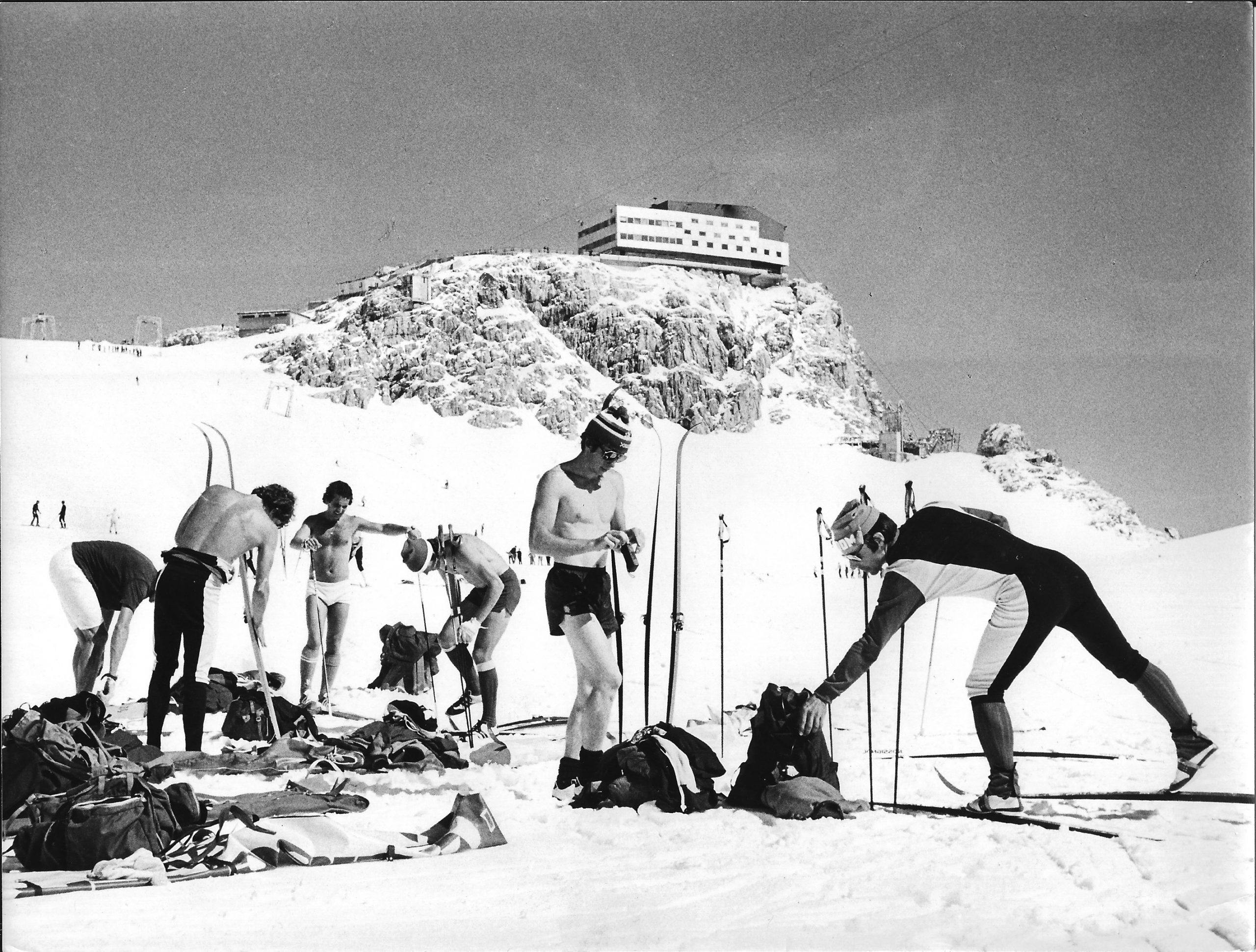
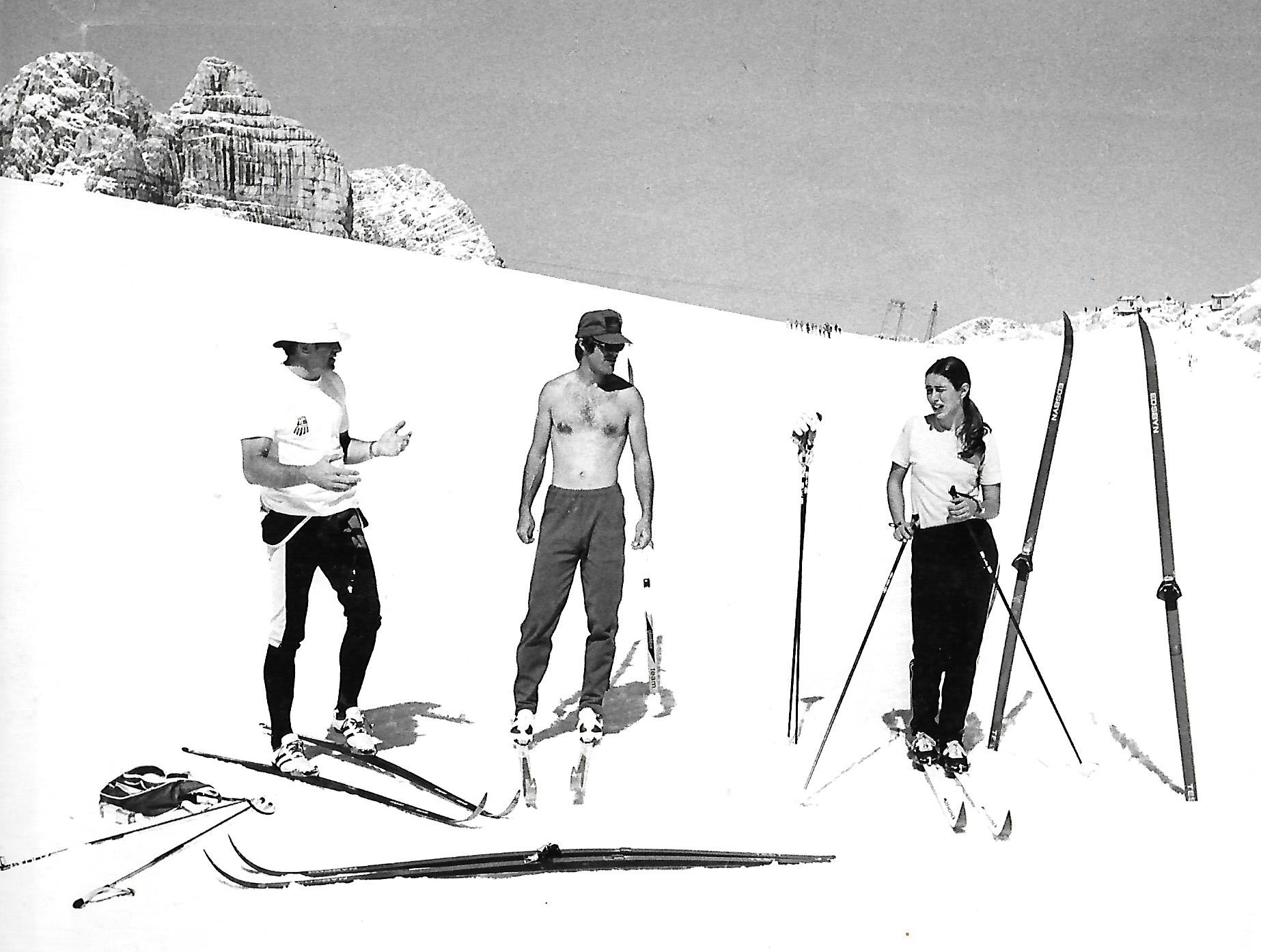
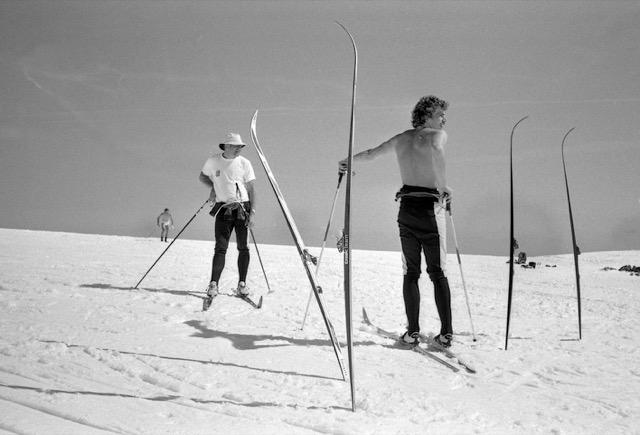
U.S. Ski Team, 1976. on the Dachstein Glacier. (Photo: Courtesy Marty Hall)
I finished my cross-country running season that autumn of that visit – and it was successful. The transition for me between running and skiing was always abrupt and violent. I had no upper body strength, and racing in November (when we still did that in Silver Star) was as challenging as always. I was a 2nd year Junior Boy, a club skier for a scrappy club that trained in some horrendous training conditions in a rough Northern town in the middle of nowhere. But we were driven and trained hard. A few months later, our club – Laurentian Nordic – was in Val Cartier, QC, for that year’s World Junior Trials. I had no illusions of making the team, I hadn’t even traveled to Quebec with my passport – it lay safely back in Sudbury. I barely even knew what ‘World Juniors’ was, if I’m honest. I knew that a club teammate had competed at the World Juniors a few years earlier in Canmore (Pirkko Penttila). In that first race, a 30km classic competition, I finished third, shockingly. I explicitly told my club coach, Dave Battison – that there must have been a mistake and coerced him to check with the timing staff to ensure the results were correct. There was no mistake with the results; I had finished 3rd and was now in the running to make the team. All I needed was one more good race in the 10km skate – a race that was, at best, scattershot for me (distance skating – then throughout my career, was sometimes great, other times a disaster). Shockingly, I also finished 3rd in that competition, making my first World Junior team less than a month after turning 17.
My mom drove home to Sudbury directly after that 10km skate, over 10 hours, and couriered my passport to me in Mont Ste Anne, where we were staying for a short ‘pre-camp’ before flying to Europe. I didn’t even have running shoes (why would someone run in the winter?!), and I came to those championships with three pairs of skis (one skate, two classic), all different brands (Fischer skate skis, Atomic and Madshus classic).To say I was green would be an understatement.
That trip changed my life. I had never been to Europe before and fell in love with the exoticness of it all—the different foods, cars, architecture, and mountains. I always loved the mountains more than anything, and we had a pre-camp in Lavaze Pass, just above Val di Fiemme. That is still one of my favorite places to cross-country ski. The alpenglow on the Dolomites is something to experience.
1976 on the Dachstein Glacier: Marty Hall (left), women’s coach Rob Kiesel (center), Lynn Spencer-Galanes (right). (Photo: Courtesy Marty Hall)
It was also the first time I had competed in an international competition, and we even did a time trial in the infamous Val di Fiemme stadium, where a few years later, as a first-year senior, I would compete in my first World Sr. Championships. The adventure of it all, the camaraderie with the other athletes (all were last year juniors), and representing Canada internationally was both an honor and addictive. It lit a fire in me to want more. I hated to lose and really hated to get my ass kicked. I vowed to come back stronger, to do what I could to be the best I could be – like Marty was ranting about that autumn evening in one of Canada’s worst cities – Sudbury, ON. To say I believed fully would be a lie, but I fell in love with chasing a ridiculous dream.
That spring, I gave up on running competitively – or ‘training’ for running. One dream faded into the mists while the other became clearer. It wasn’t an easy journey. As some might know, I lost my girlfriend in a tragic cycling accident in June of 2001- as I was graduating from high school – and left Northern Ontario hating everything that Sudbury represented. I resented the countless training sessions where things were thrown at me out of truck windows, and the countless times I’d been run off the road by jackasses came to have a new meaning. Three weeks after the accident, I moved west to Canmore, a shattered version of myself. Canmore saved my life. That community was, and is, so phenomenal. I will forever be grateful to the people there who lifted me out of a deep, deep sadness and pit of despair. I tried to race for Sofie, even writing DIFS on the tips of all my skis (Do it for Sofie). I shattered myself in training, using hard training to distract me from the sadness that overcame me – when my pulse got over a certain threshold or the training session became long enough, I wouldn’t think. After a really disappointing season, I almost gave up on skiing again that spring after using training as a ‘therapy’ method left me crushed. But that spring, I used wax remover to wipe away “DIFS” and came to Spring Series in the US to race for myself. Of course, it went phenomenally well, and the results were fantastic; I was in the top 3 in the senior category.
Where am I going with this?
Marty reached out and congratulated me for making that first World Juniors Team – even though I got my ass kicked in Slovakia back in 2000. Alain Parent (then the junior national team coach) couldn’t believe I showed up with no passport, no running shoes and not even a pair of ‘warm-up skate skis’ to a World Championship.
Marty Hall (left) Doug Peterson (right). (Photo: Courtesy Marty Hall)
As a young senior, when I finally broke out and hit my first World Cup podium 3 months after turning 23 years old, again, Marty reached out. He reminded me that I had made the right choice – shockingly recalling his visit to Sudbury- but also reminded me that I wasn’t the best in the world just yet. 3rd was good, but it’s not 1st. It would take another 4.5 years before I crossed the line first – beating both Petter Northug and Dario Cologna in Toblach, ITA in early January of 2011.
Marty and Kathy Hall with recently retired UNH Ski Coach Cory Schwartz. (Photo: Courtesy Photo)
Tough love was part of Marty’s whole deal, but he was always honest and always believed. No excuses. Hard work over time gives results, but you have to believe. That American swagger, no doubt. As the years ticked by, he probably didn’t even remember that afternoon/evening on that dark sofa in some nondescript living room, with a skinny running kid hanging on his every word. But I do. It greatly impacted my career and life as I sit here in Norway. All of it is unimaginable for a young 16-year-old back then in Nickel City.
Marty will be missed. There was no one quite like him. May his fire and passion never be extinguished, and may the next leaders of Canadian skiing inspire tomorrow’s skiing greats to take a chance, not give a shit what others think, and offer no respect to the international competitors. Because to channel Marty, God dammit, Canadians can and have won in this European-dominated sport we all love and devote our life to pursuing.
From all of us at FasterSkier, Marty, you will be missed, and Kathy, we send you our love and support. Please know we are always here for you.
Marty and Kathy Hall outside the UNH Field House. (Photo: Courtesy Photo)
Since the opening of the U.S. Ski & Snowboard Hall of Fame in 1956 there have been 448 members inducted, only two of whom are female cross-country skiers. The Hall of Fame website states that, “the honored members voted into the U.S. Ski & Snowboard Hall of Fame represent the highest level of national achievement in America, featuring prominent athletes and snow sport builders whose accomplishments showcase American skiing and snowboarding.”
The first woman cross-country skier to receive this honor was Martha Rockwell, who was inducted in 1986. Thirty-four years later, Rockwell’s teammate and a trailblazer in the sport, Alison Owen-Bradley was admitted to the Hall of Fame as a member of the Class of 2020.
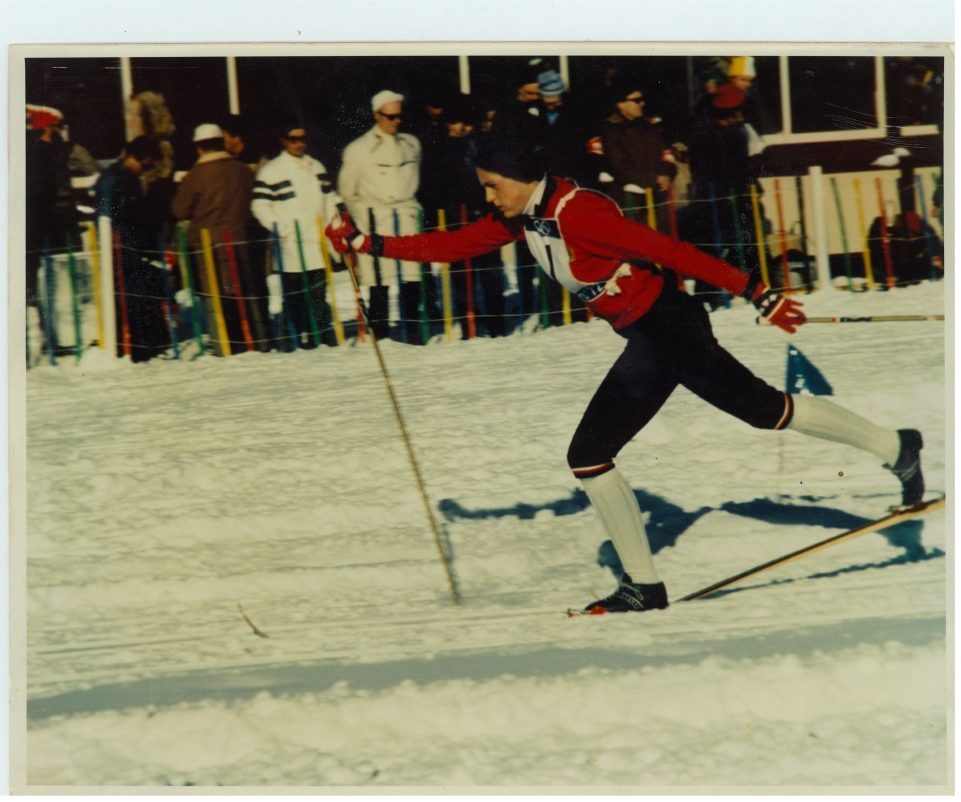
Heading out in bib #1 is Alison Owen-Bradley at the Sapporo Winter Olympics in 1972. (Courtesy photo)
The list of Owen-Bradley’s accomplishments is lengthy. A brief glance at her race results highlights her prowess as an athlete, beginning around 1970 when she competed at World Championships in Czechoslovakia at the age of sixteen. Speaking to this formative experience, Owen-Bradley said, “I was so involved in sport and loved the sports that are now pretty common for girls, but there wasn’t really a place for it [yet], and so we made our own places. I got to go to the national team camp with the U.S. Ski Team and then Europe and see these women racing, and really fit, and loving their sports and it was like, yeah I want this life…
“It heightened my world view of what was possible for a young girl from Washington to pursue.”
Owen-Bradley went on to represent the United States at two Olympics (Sapporo 1972 and Lake Placid 1980). In 1978 in Telemark, WI she won the first-ever women’s World Cup cross-country race (although FIS categorizes this race as a “test” event). At the conclusion of the 1978/79 race season, Owen-Bradley finished seventh in the FIS World Cup standings, the highest ranking for a U.S. woman for the next 33 years. The following season, she finished second in the Holmenkollen 10k in Oslo, Norway. “We had tremendous results [in that era] that I think sometimes aren’t known, or they’re overlooked,” reflected Owen-Bradley.
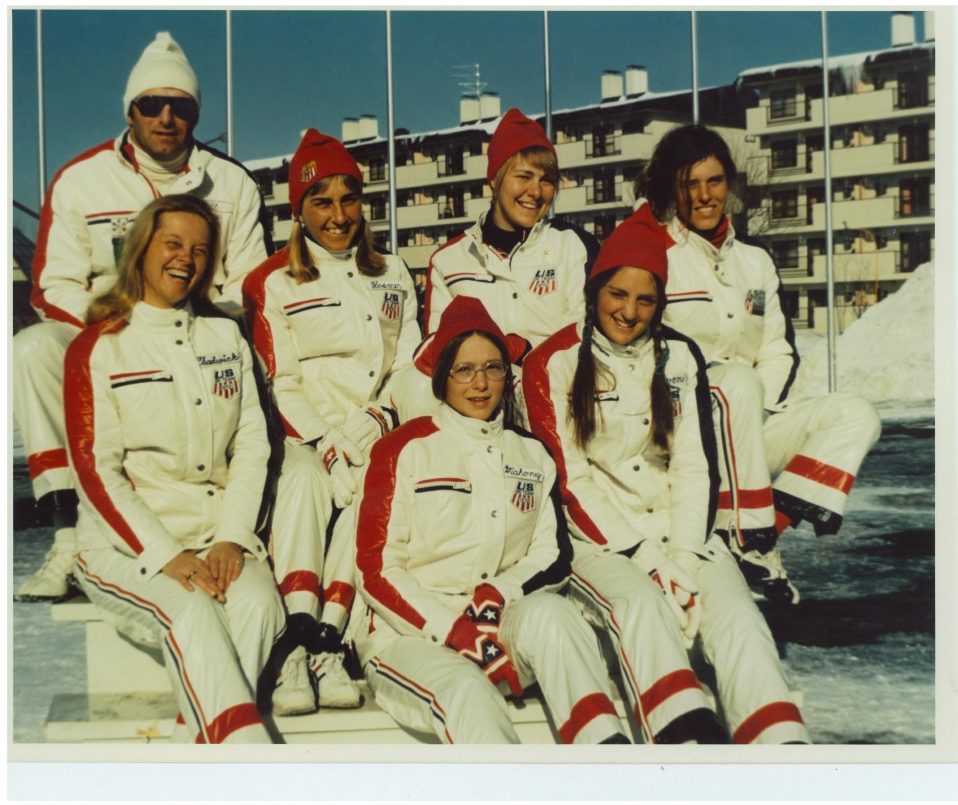
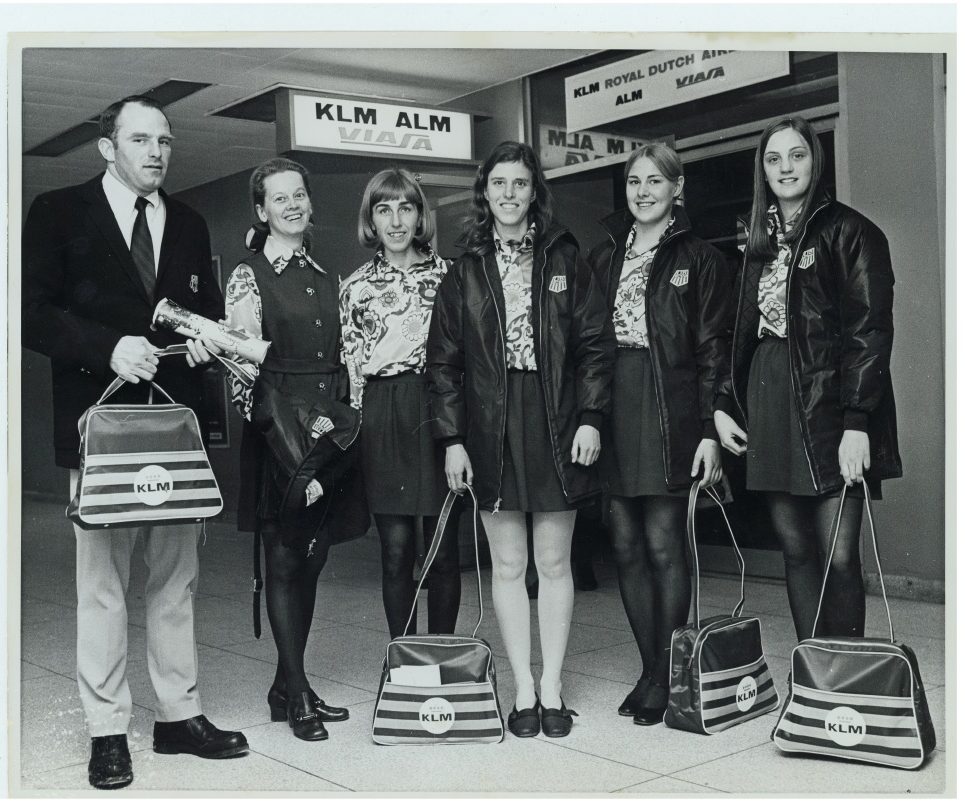
The first Women’s cross-country Olympic Team. The 1972 Games were held in Sapporo, Japan. Top Row: Marty Hall, Trina Hosmer, Barbara Britch, Martha Rockwell. Bottom row: Gloria Chadwick, pseudo Chaperone, Margie Mahoney, Alison Owen. (Courtesy photo)
But numbers on a page are only half of the story. Owen-Bradley’s contribution to skiing, particularly to women’s skiing, goes far beyond her race results. Growing up in Wenatchee, WA as a member of an active family, Owen-Bradley started nordic skiing after her father saw an ad in the paper for the local cross-country ski team. “He said, ‘Hey, let’s go try that because we love running and hiking and [other outdoor sports],’ so we started that and it was all new,” explained Owen-Bradley. Not long after, Owen-Bradley became the first girl to compete at Junior Nationals. She relayed the story of how at the pre-race meeting the organizers wouldn’t let her compete, stating that “this is a race for boys.”
A team leader from the Pacific Northwest (PNSA) delegation responded, “show me that rule.” Since that rule couldn’t be found in writing, Owen-Bradley was allowed to compete. “I raced and then, the next year, and from then on, they had a place for girls,” she explained. “It was a fun time because women weren’t racing marathons, they weren’t really allowed or incorporated into the endurance sports world, and it was just fun to watch it [explode] like popcorn, it was happening everywhere,” she said, speaking to the rise of women competing in sports. “It was really fun to be there [at Junior Nationals] as the first girl, I think I was like 13 or 14 or something and almost everything you’re doing is new in your life, so that was just one more new thing.”
Owen-Bradley’s coach at the time was Herb Thomas, and it was he who presented Owen-Bradley her medal at the Hall of Fame induction ceremony. Thomas came from Middlebury to start the ski program in Wenatchee which she joined. “He let me do it. You know, he encouraged me. He broke open the door for me to do it,” said Owen-Bradley. In the years that followed, there were other men who played an integral role in Owen-Bradley’s success.
“At the beginning, for me, not having a lot of opportunity in sport, I can say that the opportunities I did have came from men,” she explained. “There were no women breaking trail for me, you know, I didn’t have them as coaches, I didn’t have women cheering me on.”
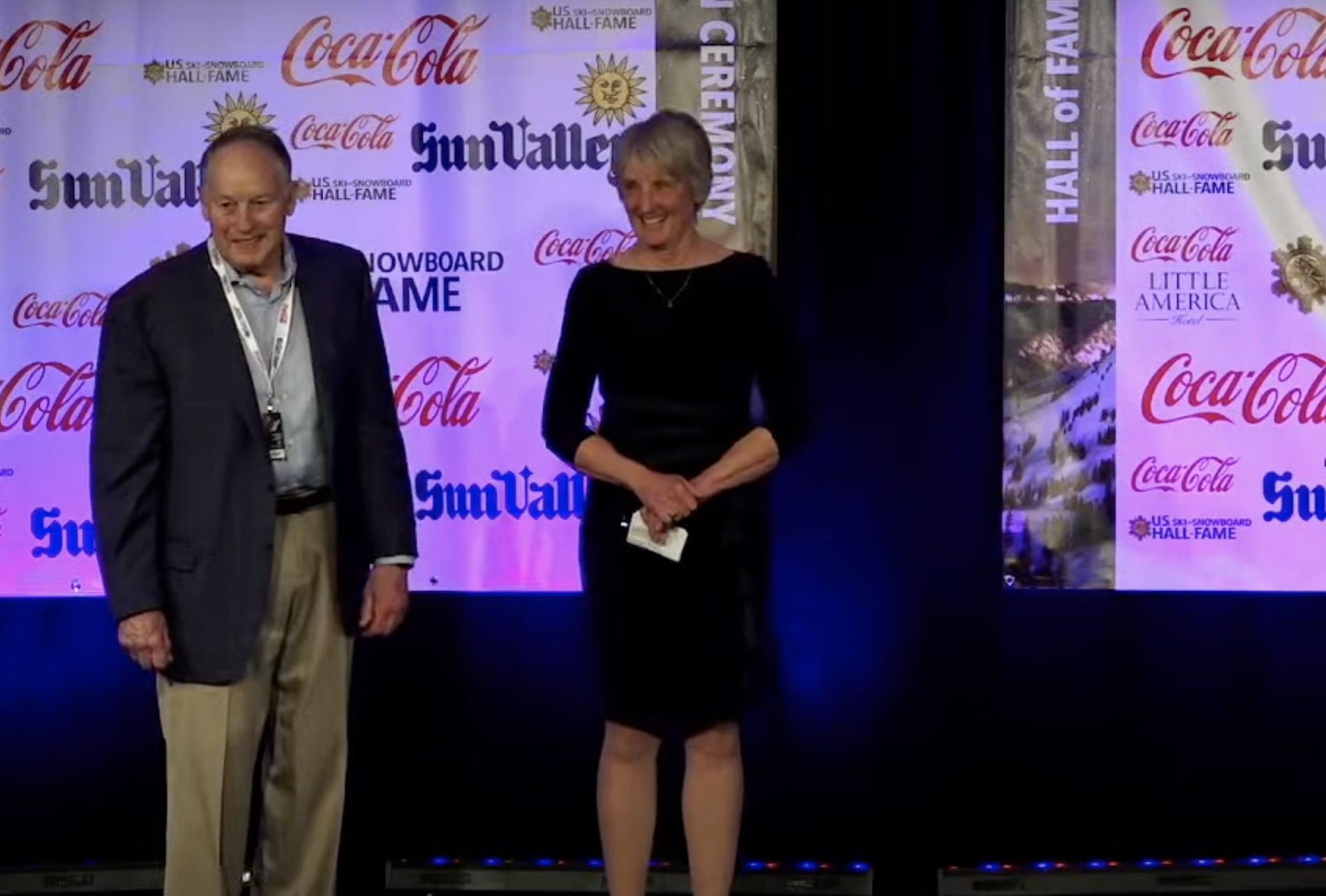
Herb Thomas and Alison Owen-Bradley at the U.S. Ski and Snowboard Hall of Fame induction ceremony (photo: USSSHOF livestream)
In particular, Owen-Bradley singled out Marty Hall in her acceptance speech, saying he was perhaps the most important person to thank in regards to her success. She shared an example of how when they traveled to Europe to compete, the first U.S. women’s national team coach was given the runaround by the European coaches with wrong addresses, no translator, and the more. It soon became clear that something needed to change and so Hall headed to Europe to take over. “He really made a place for us,” Owen-Bradley explained, “They didn’t hire him in the first place, because he was a bit strong and maybe not sensitive and everything, but he was strong in the coaches meetings. He read the rule books, he knew what was going on, legally, and he made them speak English.”
At a time when women’s racing was just being established this was more important than ever. “He kept a place for us,” said Owen-Bradley, “that we had a possibility to get good and we weren’t on the sidelines, we were right in the middle of it all, he knew what was going on and he made a place for us on the world stage.”
For his part, Hall corroborated this story and added, “my athletes meant everything to me. I would fight to the death for them.” When asked about Owen-Bradley specifically, Hall described her as “a woman before her time.” He said that she “had all the components.”
“Some of the things that she got pushed into or taken to go way beyond when she should have been ready, but it didn’t bother her,” he reflected. “She didn’t crack, never had any problems doing what she was supposed to do.” Hall shared that it is great to coach an athlete like this. “She understands movement real well, she was good at anything she did as an athlete,” he said.
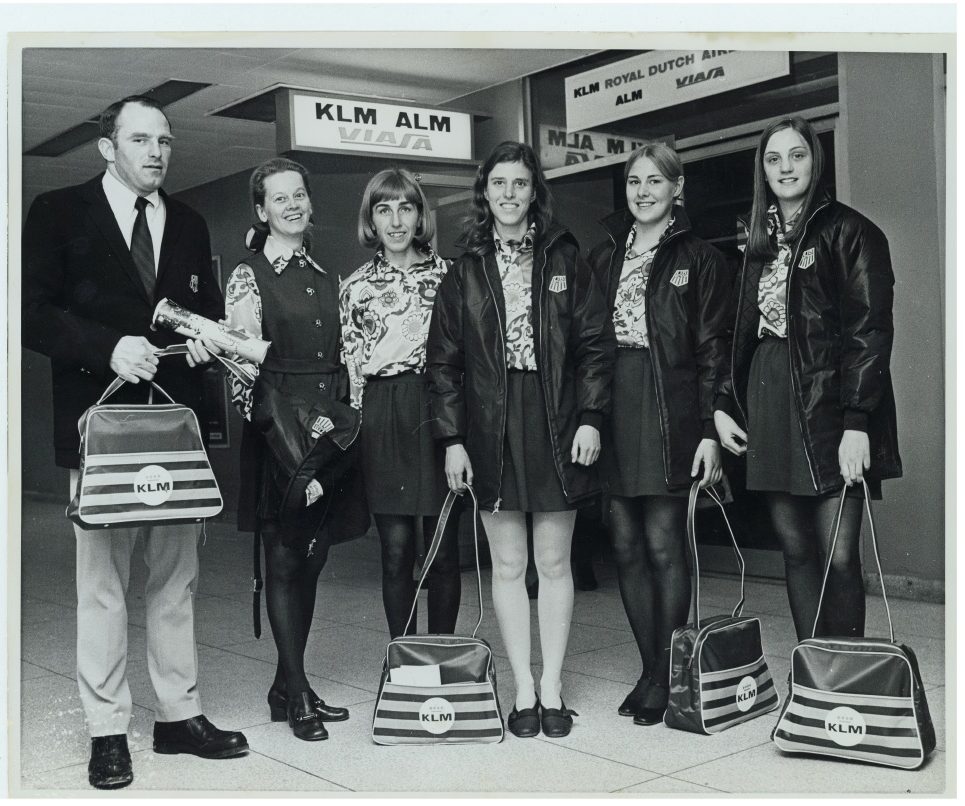
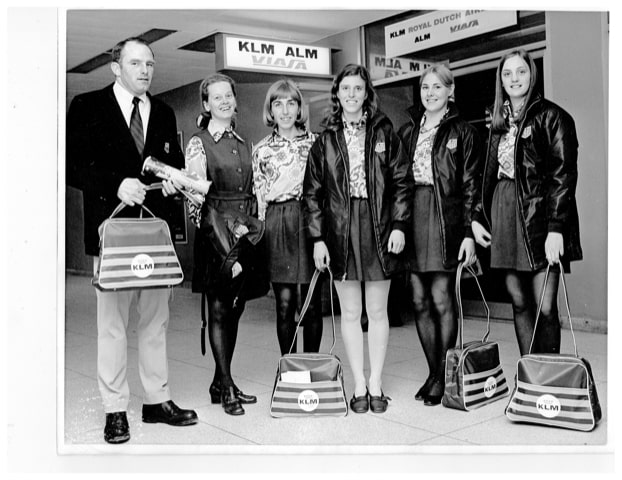
The first U.S. women’s World Championship cross-country team on the way to Czechoslovakia in 1970. From left to right: coach Marty Hall, Coach, chaperone Gloria Chadwick, Trina Hosmer, Martha Rockwell, Barbara Britch, and Alison Owen. The U.S. team took four skiers as the relay at that time was a three-person format. (Courtesy photo)
When asked about important elements in the progress of women’s skiing, Owen-Bradley responded, “I really appreciate the men who said ‘no, come on women do this. It’s really fun. There’s no reason women can’t do this stuff.’” She emphasized the important role these men played saying, “I really appreciate the men in my life, who opened the door, kept them open, kept the naysayers away- and then as things have evolved and grown, obviously, naturally, women are taking more of a role in allowance in helping other girls and women do that.” She went on to say, “and that’s awesome. That’s, you know, the natural progression, and I love to see that. And that’s why, with US NOW, the Olympic women’s group, taking initiative, giving awards, leading the way for other women and showing that we are a leader in sport and with each other. So that’s the natural evolution of it that I see.”
In her acceptance speech at the Hall of Fame ceremony, Owen-Bradley reflected on how much progress there has been in women’s skiing since she first began saying, “where are we going to be in another 50 years?…[it’s] so exciting to think of the barriers we break.” Particularly in light of the recent Olympic results from the U.S. women’s team, Owen- Bradley said, “even now, it makes me so teary eyed, to think about that in in one lifetime, my lifetime, to go from girls not having sports, not having a place, to being a shining star on the world stage of a sport that that was there was no place for girls. It’s so fulfilling.” She gave a shout-out to Kikkan Randall as well, saying, “and the icing on the cake of that was Kikkan doing the absolute best coverage, covering her teammates… She brought so much understanding and furthered everyone’s knowledge.”
Having witnessed the sport achieve these major milestones, Owen-Bradley pondered the future of cross-country skiing, “You know, it just feels like my life journey of being in sport, and being in cross-country especially, where will we be in the next year? That’s for this generation to lead now. And where are we going and what’s next for the women, but also the men, of our nordic community and sports community?”
She continued by saying:
“It’s not an easy road ever, but you know, that’s why we’re in it because we challenge ourselves and if we didn’t want challenge, we wouldn’t be in sport. And what you do is you come up against your weaknesses and you figure out how to get through them or you don’t get better… I mean, that’s the cool thing about sport is you test yourself and then you get better.”
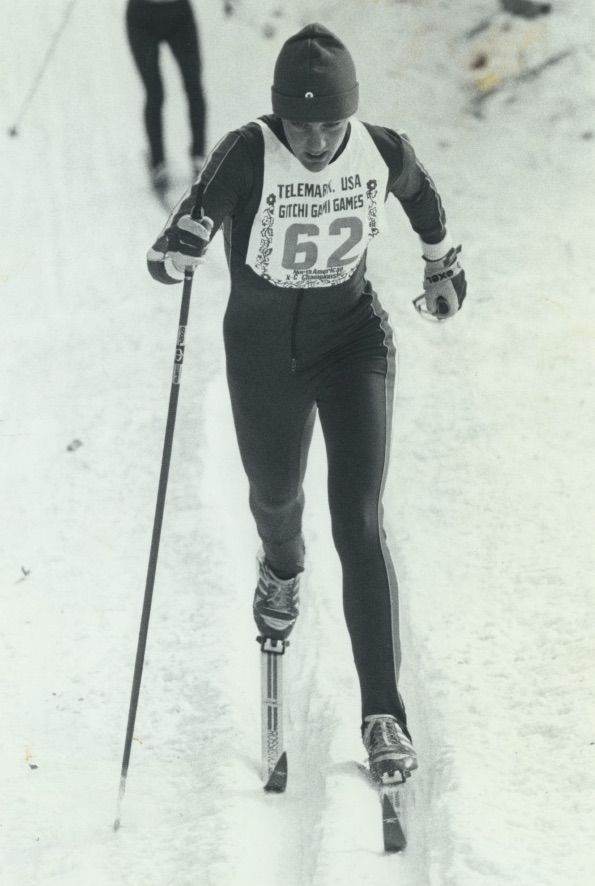
Alison Owen-Bradley racing to first in the inaugural women’s World Cup event in 1978 in in Telemark, Wisconsin. (Courtesy photo)
When asked what it means to both her and to the cross-country sport community, to receive recognition for her achievements and to be the second female cross-country skier inducted to the Hall of Fame, Owen-Bradley replied, “Well, it is interesting that I’m getting the recognition now.” She explained that they give the award for different categories and said, “maybe part of the recognition comes from, you know, a lifetime involvement in skiing. I think maybe I cross over a little bit, you know, my life has been very influenced by and I participate in a lot of ways in cross-country skiing.” She continued by saying, “I think it’s important because it shows where we’ve been, and hopefully, where we’re going. So, it’s fun to get the award.” Owen-Bradley acknowledged that her “life has moved on.”
Though skiing still occupies much of her time, “I’m focused on a lot of things,” she explained, “ I didn’t wait for [the award] to happen to make my life good or anything. I’m doing a lot of really great things that I enjoy.”
Alison Owen-Bradley and her daughter, Kaelin, high in the Bridgers (Courtesy photo)
These days, Owen-Bradley can be found near Boise, Idaho on a small farm she calls her “sanctuary”. Still quite active, she is an engaged participant in a program called, Starting Strength. “It’s a weightlifting program that I have found a lot of benefits for myself,” she explained. Additionally, Owen-Bradley is very involved with her family; she has three grandkids and a daughter who coaches skiing in Bozeman, Montana. “It’s really fun to have that continuity,” she said, referring to generations of skiing families. “I think it really helps to have grown up in it, and [to have] parents that know about it and can pass it on and build it generation to generation.”
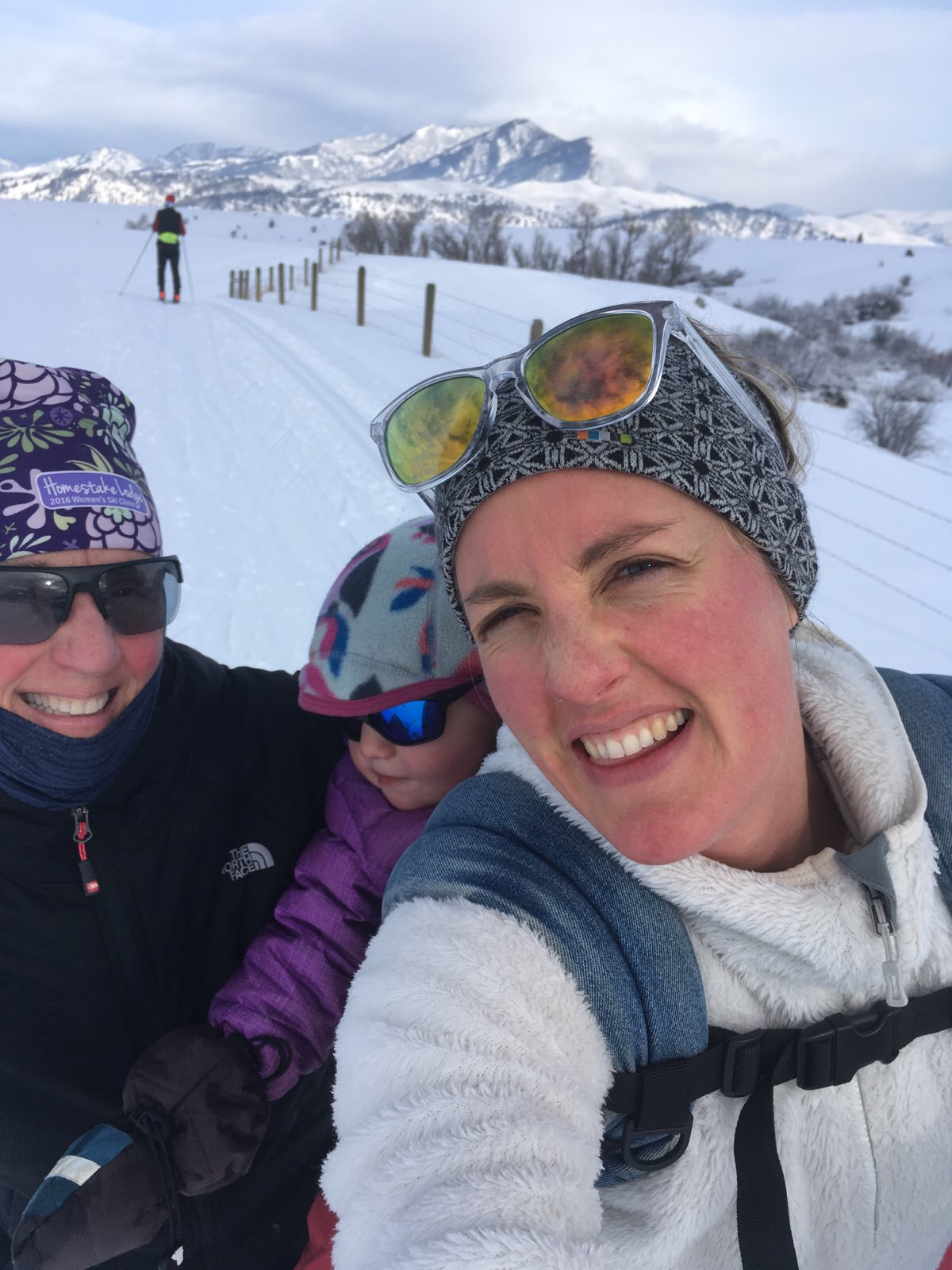
Three generations of Bradley skier women. “I wouldn’t have been in a backpack with my Mom and Grandma out enjoying winter when I was my Granddaughters age. Love how it’s normal now” says Owen-Bradley (Courtesy photo)
Speaking more broadly to the growth of a cross-country ski community and culture in the U.S., Owen-Bradley emphasized the importance of recognizing the contributions of those who have encouraged and shaped this growth. “There’s a lot of people that have [put] their life-force energy on building the ski culture in our country, and that’s why I like to see more awards given.” She explained that she is working on nominating another woman for the Hall of Fame to “shine the light that the women’s lives have been growing the sport and yet [we] only have two women in the Hall of Fame after sixty years.” Given the numerous different categories that you can be nominated for, Owen-Bradley has a list of ideas and possibilities.
“There’s a lot of women that deserve a lot of credit for where the women’s program is now. Men too, but I’m focused on the women.”
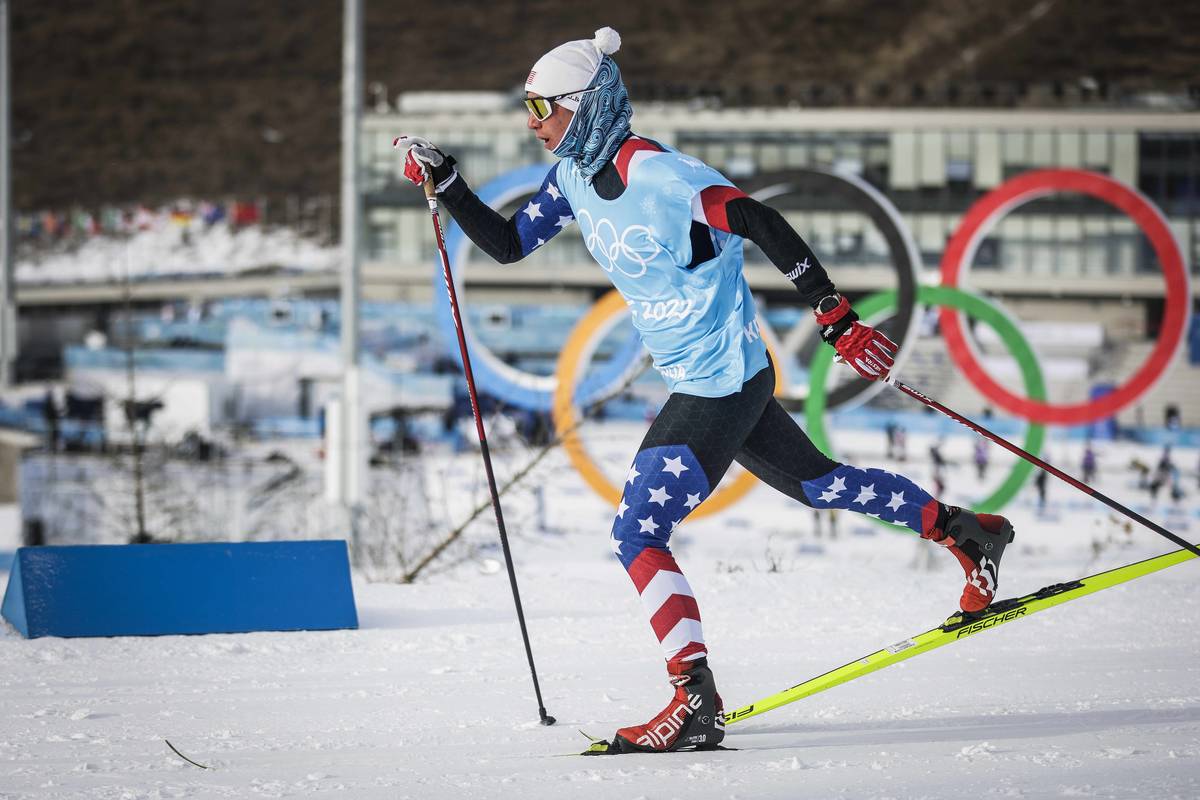
Julia Kern prepares for her Olympic debut on the tracks in Zhangjiakou, CNH. (Photo: NordicFocus)
FasterSkier recently shared a press release on behalf of the US Nordic Olympic Women (US NOW) announcing Julia Kern as the 2022 recipient of the fourth annual Gold Rush Award. The release included comments from 2021 winner Jessie Diggins on the qualities that she, along with the other past winners, recognized made Kern deserving of this year’s award, but it became clear that there was a gap in FasterSkier’s coverage on the history of US NOW and the evolution of the award.
To learn more, FasterSkier connected with the spark that launched Gold Rush Award into existence: recent U.S. Ski & Snowboard hall of fame inductee and early groundbreaker for American women’s skiing, Alison Owen-Bradley. It was Owen-Bradley who planted the seeds to bring together the generations of women who have represented United States in cross-country skiing at an Olympic Games, bringing US NOW into fruition.
According to Owen-Bradley, US NOW filled a gaping hole in connection among the women who helped set the foundation for what is now one of the most successful women’s ski programs in the world. Though each of the 53 women Olympians had played a role in propelling the next generation forward, opportunity for connection between the generations had been lacking. With individual efforts, a network amongst these women slowly began to connect sooner, but when the World Cup swung through Quebec City in March 2019, it provided an ideal opportunity to reunite as a collective.
“We ended up having quite a few Olympic women there,” recalled Owen-Bradley in a call. “And it was fun because we wore our vintage clothing to the race, so we had all kinds of different eras of Olympic clothes. It was so congruent because we were really cheering on the latest, greatest women racing but we were also together with our teammates from the past, and it kind of just kind of grew from there.”
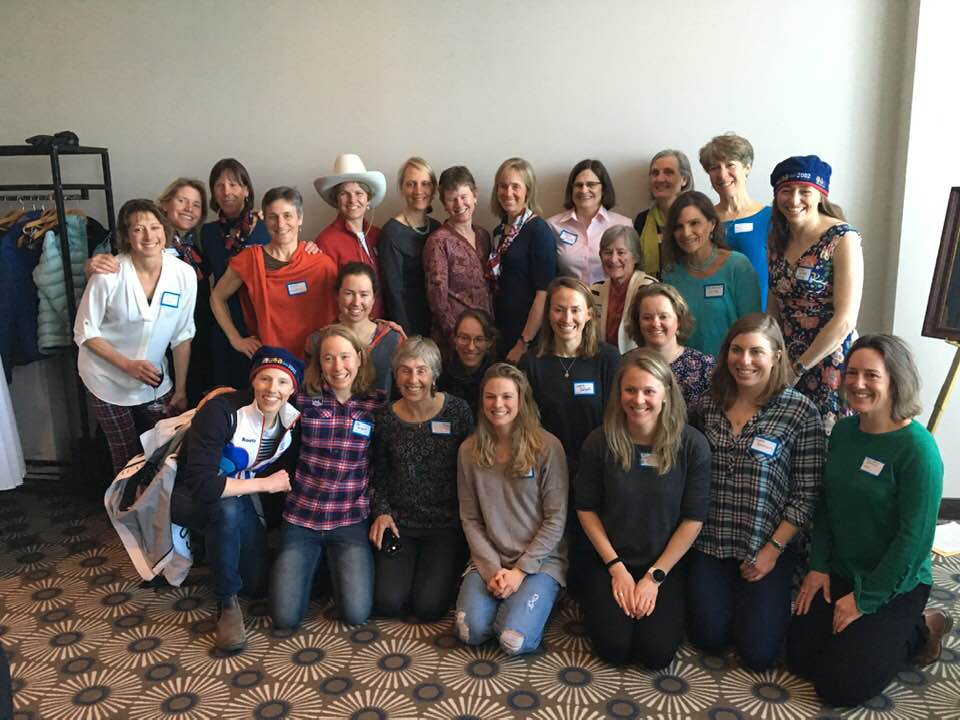
An intergenerational collective of Olympic women reunite at the 2019 World Cup Finals in Quebec City. (Photo: Peggy Shinn)
Having been teammates long before the era of Facebook – in fact, some well before the internet – it had been hard for these women to feel connected and maintain ties after careers ended. Owen-Bradley said that before the reunion, she didn’t have contact information for many of these women, and consequently didn’t feel the relationships had been sufficiently developed among the various generations.
With some word-smithing to nail a catchy acronym, the energy and camaraderie established at this reunion evolved into US NOW. But there’s much more to the name than meets the eye.
“US NOW – being retired from ski racing, who are we now? What have we learned? There’s so much gold in that for mining, in a metaphoric way. All these women, what have they learned? What have they gone on to do? How was it good and bad in their lives to devote their time to this? I don’t think we’ve even come close to exploring that and getting the nuggets [of wisdom] out of what women went through and and got from those experiences. But also, how hard was that? And was it worth it? And what would have made it more worth it? And then to just go forward in a way that uses that wisdom.”
And so, the organization was built by Olympic women and for future generations of Olympic women.
The first Women’s cross-country Olympic Team. The 1972 Games were held in Sapporo, Japan. Bottom row—Gloria Chadwick, pseudo Chaperone, Margie Mahoney, Alison Owen Top Row—Marty Hall, Trina Hosmer, Barbara Britch, Martha Rockwell. (Photo: courtesy Alison Owen-Bradley)
When the coach of the first women’s Olympic team, Marty Hall, was inducted into the U.S. Ski & Snowboard Hall of Fame in the spring of 2018, he invited Owen-Bradley to attend the ceremony, having been one of his original athletes. While traveling through Norway to race at World Masters, a print inspired by the Birkebeiner story caught her eye; instead of the image she was familiar with, which depicted two warriors valiantly carrying Prince Haakon to safety on their trek through the mountains, it was an image of Prince Haakon’s mother, Queen Inga. She too had made the arduous journey on skis to save her son, and yet, Owen-Bradley had never seen her included in the story’s artwork.
Finding it symbolic of the emergence of women’s cross-country skiing in the US over the last 50 years, Owen-Bradley purchased the print, and decided it would be a fitting gift to honor Hall at the ceremony. “He had been the first Olympic coach for women and had kind of gotten us on the map.”
However, the piece of artwork was large. She laughed as she recalled giving it to him, but also telling him it did not need to take up a wall in his home.
“We decided that it would be a traveling picture, and we would pick someone every year to give it to, and so out of that came this idea [for the award].”
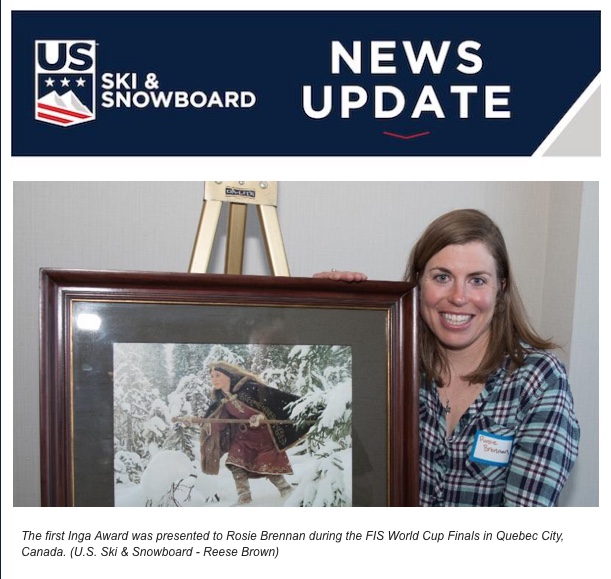
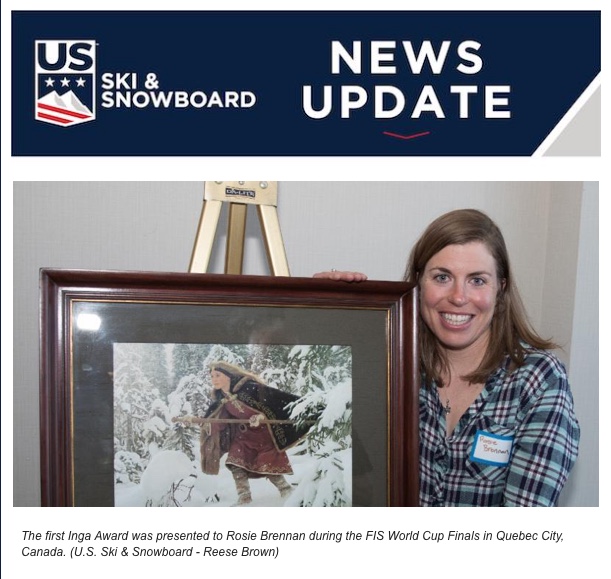
In 2019, following the World Cup, the Inga Award was presented to its first recipient: Rosie Brennan. Having rebounded from a season impaired by the effects of the mononucleosis virus, Brennan was selected based on the “courage, fortitude, grit, determination and raw talent [it took] to achieve an extremely high level of success on the international ski racing circuit [that] season.”
Over the next year, however, Owen-Bradley began to dwell on why the image of a Norwegian woman should be the symbol for the efforts of the women in the American cross-country program. She began looking for inspiration closer to home, eventually finding an equally strong, noteworthy, and under-recognized alternative.
“I changed it to the Gold Rush award because in the High Sierras during the Gold Rush era, women were nordic racing. Not on the same levels that we do it [now], but they had cross country races that that women raced in… So I thought, ‘Oh, what a cool thing — the Gold Rush.’”
She also noted the ties between racing for gold medals at the Olympics, which Kikkan Randall and Jessie Diggins achieved in 2018. Working with artist Andy Rogers, a new image was created, superimposing the image of a woman on skis in the High Sierra on the bust and profile of a determined and modern-looking woman in a race headband and sport sunglasses. In 2019, this image was presented to co-recipients Sadie Maubet Bjornsen and Sophie Caldwell Hamilton.
Gold Rush Award: (Artist Andy Rogers)
While each of the women mentioned to this point have unquestionably racked up an impressive resume of results, the award is not meant to recognize what happens on the race course directly. Rather, Owen-Bradley explained a recipient is selected for the award by “exemplifying and showing the grit and the grace that it takes to be successful.” It’s what happened behind the scenes to get the result, not the result itself.
“An example would be Sophie whose mother died [in 2019] and she still went on with such grace and was so successful through all of that. And Sadie because of all the injuries she worked through and kept going… So, to me, it’s been about the grit and the grace of what it takes to be a woman nordic ski racer at that level.”
Approaching the 50-year mark of her own Olympic debut and now focusing more of her time and energy on her small farm in Idaho rather than the cross-country ski world, Owen-Bradley explained that this year, she felt less directly connected to the potential recipients for the Gold Rush award. She decided the decision should be made collectively amongst the four previous winners, to which she would add a fifth vote. After some discussion, the group voted unanimously for Julia Kern.
Jessie Diggins and Julia Kern celebrate a second-place team sprint finish in Dresden, GER in December, 2021. (Photo: NordicFocus)
A member of the U.S. Ski Team since 2017, Kern’s progression on the international level has been steady, but non-linear. Alongside leaps forward, she’s faced her fair share of injuries and setbacks. Both the 2020/2021 season and her first Olympic appearances in 2022 left her wanting more, but interjecting these lows during the 2021/22 race season were a slew of career highlights. Her top results include two individual fourth-place sprint finishes on the World Cup, a team sprint podium in Dresden, a handful of other World Cup top tens, and finishing the year winning three out of four events at the joint U.S SuperTour Finals / Canadian National Championships in Whistler, BC.
And in February 2023, she’s heading into a World Championship which will take place at the venue where she earned her first World Cup podium in December 2019: Planica, Slovenia.
Sophie Caldwell Hamilton / Julia Kern
Julia Kern / USST Coaches
Smiles and hugs all-around to celebrate Julia Kern’s first World Cup podium in Planica, Slovenia in December 2019. Kern finished third in the freestyle sprint, with Sophie Caldwell Hamilton just behind in fourth. (Photos: NordicFocus)
According to the past award recipients on the selection committee, it was the juxtaposition of these celebrations and challenges over the last few seasons that highlighted Kern’s candidacy for the award this spring.
“To me, what is special about this award, is first that it was voted on by this very incredible group of women who all share tenacity and drive to get through challenges and be better on the other side and second, that it awards just that and not results,” explained Brennan in an email. “Julia exemplifies this in her ability to be a strong teammate, no matter what the circumstances are. She holds her head high and goes out of her way to never bring people down when things are tough, aren’t going her way, or she’s faced with a challenge. When something doesn’t work out for her, she immediately jumps gears and does literally whatever she can to help her teammates have success.
“On top of that, she doesn’t lose faith in herself, she continues to fight, look for opportunity and carry an optimistic outlook towards her future. She has shown this many times after coming off a slump, injury, or some other challenge to find herself notching career bests. I think these things aren’t mutually exclusive and that we all have a lot to learn from Julia’s ability to be an exceptional teammate and in turn have that give her energy to continue chasing her own goals.”
Smooth and powerful, Julia Kern races through the heats during a classic sprint in Falun, SWE in March 2022. (Photo: NordicFocus)
Commenting on her nomination, Kern attributed her own success to the efforts of the women who came before her, including those who would present her with the award.
“I am incredibly honored to be given the Gold Rush Award by such an incredible group of women. US NOW is a group of women who have paved the way for U.S. skiing, many of whom have been personal role models and mentors to me in skiing and in life. I would not have had the opportunities, experience and knowledge without their hard work and passion for giving back to the younger generations. The past few years have been challenging for a variety of factors, and it was rewarding to come back stronger with my best season yet.”
As the list of award winners grows and US NOW builds momentum, Owen-Bradley hopes the award can be expanded to include a monetary prize in addition to the print and tribute. Acknowledging the increase in representation for women across various aspects of skiing, such as coaching and waxing, she would love to see new awards developed to recognize these important examples also.
When Owen-Bradley began skiing as a child in the 1960’s, her only option was to join the boys program; Title IX did not pass until June 1972, at which point she was 19 and had already raced at a World Championship. As she reflected on the amount of opportunity for women in cross-country skiing now, and what the creation of US NOW and the Gold Rush Award means to Owen-Bradley personally, she expressed feelings of joy and optimism.
“For me to go from not having a place, to having these strong women’s teams – it’s just so fun.”
Alison Owen-Bradley, a pioneer of elite level women’s cross-country skiing in the U.S. (courtesy photo)
U.S. Ski Team, 1976, on the Dachstein Glacier. (Photo: Courtesy Marty Hall)
A lack of on-snow opportunities. Although a major first-world problem, that’s been on the mind of some this offseason. Here and there, we’ve published stories about a strict dryland diet for elite skiers this season. Meaning, no on-snow training. Mostly, that strict diet has applied to North Americans who normally access snow in late spring and summer at a variety of venues.
The Haig Glacier and its Beckie Scott High Altitude Training Center have been a Canadian go-to for years. The same can be said for APU’s Thomas Training Center on Alaska’s Eagle Glacier. In Europe, where glacier infrastructure is more common, access to higher altitude snow in summer has been part of the elite cross-country skier training plan for decades. Austria’s Dachstein Glacier and it’s groomed nordic trails are a world-class benchmark for those seeking summer snow.
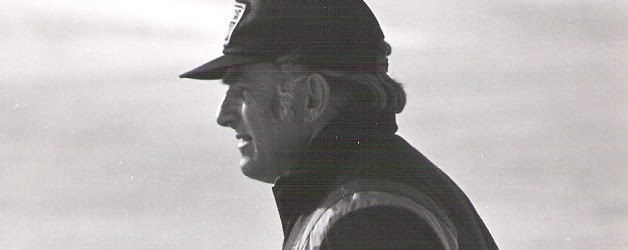
Former U.S. and Canadian National Team Coach Marty Hall
Which brings us to 83-year-old Marty Hall. For those who a new to ski racing, Hall was both a U.S. and Canadian head cross-country ski coach and groundbreaker. He was and still is keen on expanding his knowledge. That was the case in the mid-’70s when Hall began taking U.S. skiers to the Dachstein as part of his plan to expose athletes to European training methods.
1976 on the Dachstein Glacier: Marty Hall (left), women’s coach Rob Kiesel (center), Lynn Spencer-Galanes (right). (Photo: Courtesy Marty Hall)
In this episode, we speak with Hall to learn about the first trips to the Dachstein and how it all came about. It’s part history lesson, part walk down memory lane.
Thanks for listening and stay safe out there.
Marty Hall (left) Doug Peterson (right). (Photo: Courtesy Marty Hall)
50th anniversary of the first U.S. women’s team to compete in a World Championship-level event: The U.S. women’s Nordic World Championship Team in 1970: Head Coach Marty Hall; Gloria Chadwick, chaperone; skiers Trina Hosmer, Martha Rockwell, Barbara Britch and Alison Owen (l-r). (Photo: Hall collection)
This week a healthy gathering of the US Nordic Olympic Women, (US NOW), came together in a virtual meeting organized by group members Kikkan Randall, Alison Bradley and Sue Wemyss. The group had planned to meet up at this year’s Minneapolis World Cup, after having met and enjoyed their first reunion last March, at the Quebec City World Cup. Determined not to be deterred by the World Cup cancellation, modern day technology and the online possibility afforded by Zoom meetings allowed for this modified second reunion to proceed.
Twenty-three of the fifty-three total women who have represented the US in cross country skiing at the Winter Olympics were present. They spanned the five decades of American women’s teams at the Games, from the first one in 1972, through the most recent in 2018. Despite their wide ranging spread of home locations, from Maine to Alaska, they were able to meet on their computer screens, get to know each other a bit more, and reconnect with teammates they may not have seen for years.
The meeting, led by US NOW President Kikkan Randall, began with each woman introducing herself, and sharing personal information including Olympic year(s), current location and current occupation. A central piece of the meeting was the introduction of the newly renamed “Gold Rush Award,” and its presentation to two very deserving co-winners this year.
For some background, at the group’s first reunion during the March 2019 Quebec City World Cup event, the Inga Award was presented to Rosie Brennan for her courage and determination in coming back from mononucleosis to achieving her best international race season to date. Since then, the award has been given a new moniker: The Gold Rush Award. Founding members of US NOW decided to make this change to honor American ski heroines of both the past and present, rather than the Norwegian mother of baby prince Haakon of Birkebeiner fame.
Researching early women’s skiing in the US revealed that in the High Sierra during the Gold Rush era, women skied cross country for long distances, had races and were highly regarded for their skiing skills. The US NOW members pursued gold of a different sort in their quest to stand atop an Olympic podium. This goal was finally achieved at the 2018 Olympics in PyeongChang, where Kikkan Randall and Jessie Diggins earned the Gold Medal in the Team Sprint.
This year the award was given to current US Ski Team members Sadie Maubet Bjornsen and Sophie Caldwell for their exceptional grit and grace dealing with exceptional challenges and continuing to push ahead in their ski careers and life with positivity and success. A unique watercolor picture, depicting the qualities of grit and grace in women’s cross country skiing from a long past era to today, was created by artist Andy Rogers of Alaska. Maubet Bjornsen and Caldwell will receive their own copies of this painting, while the original will land in the U.S. Ski Team’s Center of Excellence in Park City, Utah.
Sophie Caldwell. (Photo: NordicFocus)
Sadie Maubet Bjornsen. (Photo: NordicFocus)
The meeting ended discussing ways to continue keeping the group active and engaged, as well as potential projects to continue the legacy of US NOW. Continuing a book project sharing the histories of past US cross country women skiers that was begun by the current USST members is one goal for the group, combined with the collection of oral histories of these women who raced over the span of five decades. US NOW has made a couple applications for grant money to help cover the costs of these projects. A book project committee was formed and is accepting new members and any available assistance. The virtual meeting closed with gratitude and well wishes amongst the members, and a spirit of connection and support for both past and present women’s cross country skiing and skiers in the United States.
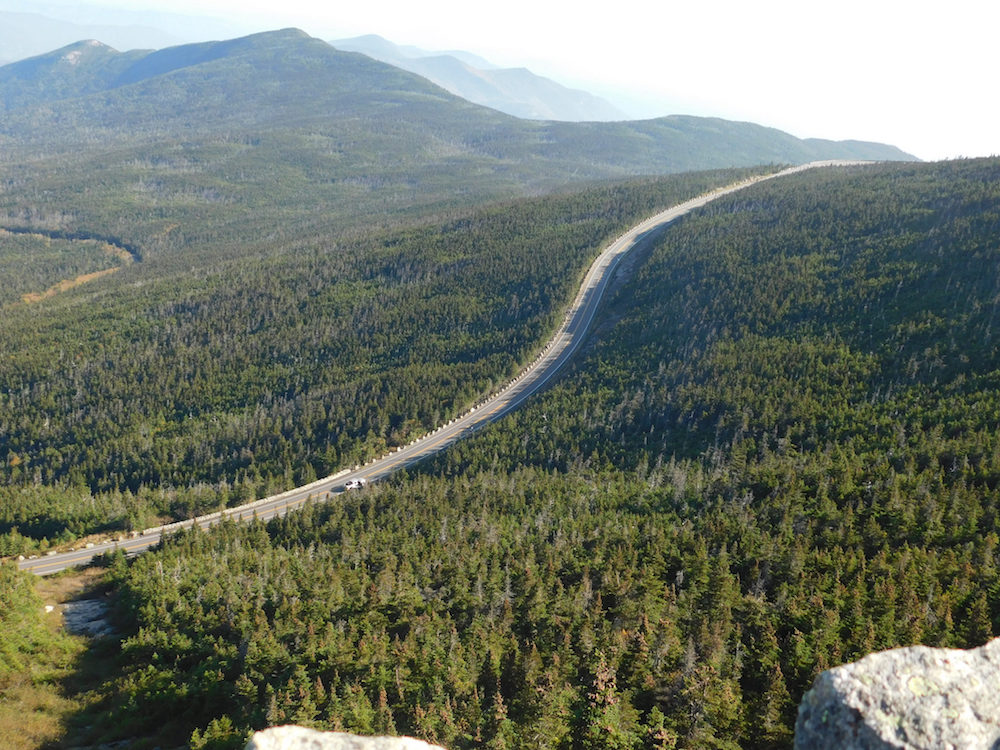
Looking down at the Whiteface Veterans Memorial Highway, a five-mile toll road to the top of Whiteface Mountain in Wilmington, N.Y., as seen on Sunday, Sept. 24, for the 2017 NYSEF Climb to the Castle rollerski race. (Photo: NYSEF)
On the eve before a full weekend of rollerski racing in Lake Placid, New York, we spoke with NENSA’s Justin Beckwith and cross-country ski supporter Marty Hall about their involvement with developing rollerski races in the Northeast.
Here’s an audio short of the interview with two people making things happen.
Now 65, Alison Owen-Bradley was once the American skier to chase to the top of the podium in North America and on the highest tier of international cross-country ski racing. Long before Kikkan Randall, Jessie Diggins, Sophie Caldwell, and Sadie Bjornsen attracted a wave of attention to high-performance skiing with regular World Cup podiums and ultimately an Olympic gold, Owen-Bradley made the U.S. women’s nordic team relevant when considering podium and medal potential. (You may also remember her as Alison Kiesel, as she was married to the late U.S. Ski Team coach Rob Kiesel at one time.)
Heading out in bib #1: Alison Owen-Bradley at the 1972 Winter Olympics in Sapporo, Japan. (Courtesy photo)
In this episode of Nordic Nation, in light of all the success of the U.S. Ski Team’s women’s side over the last eight years or so, and of course the icing on the cake with the Randall-Diggins PyeongChang gold, we wanted to take a step back and reflect on one of the original U.S. Ski Team’s building blocks: Owen-Bradley.
Alison Owen-Bradley racing to first in the inaugural women’s World Cup event in 1978 in Telemark, Wisconsin. (Courtesy photo)
For about an hour here on Nordic Nation, we’ll get the privilege of learning more about the early years of women’s cross-country ski racing in the U.S. and about one of the sport’s real pioneers.
The first U.S. women’s World Championship cross-country team on the way to Czechoslovakia in 1970. From left to right: coach Marty Hall, Coach, chaperone Gloria Chadwick, Trina Hosmer, Martha Rockwell, Barbara Britch, and Alison Owen. The U.S. team took four skiers as the relay at that time was a three-person format. (Courtesy photo)
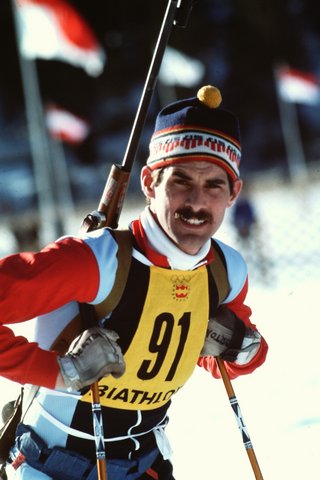
John Morton at the 1976 Winter Olympics in Innsbruck, Austria (Courtesy photo)
The following was submitted to FasterSkier by John Morton, a former U.S. biathlete and two-time Olympian (1972 and 1976) who has attended 10 Winter Olympics as “either an athlete, a coach, the Biathlon Team Leader, Chief of Course or, more recently as a spectator,” according to his bio (at end of article). Today, Morton, 71, lives in Thetford, Vermont, and works in trail design.
***
I’ve had the remarkable good fortune of attending 10 Winter Olympic Games. I was a member of the U.S. Biathlon Team in 1972 at Sapporo and again in ’76 at Innsbruck (where, following a workout, a few of U.S. ski-shooters wandered over to the adjacent cross-country stadium and watched Bill Koch win his monumental silver medal in the men’s 30 km). I was an assistant coach for the U.S. biathletes at the 1980 Games in Lake Placid, where late in the schedule, I accepted a complementary ticket to a hockey game, not even knowing which teams were playing. It turned out to be the USA’s remarkable victory over the Soviet Union, probably the most inspiring sporting event I’ll ever witness. I served as Team Leader for the U.S. biathletes at Calgary in ‘88, Albertville in ‘92 and Lillehammer in ‘94. Then, in 2002, I was the Chief of Course for the biathlon events during the Salt Lake City Olympics, a volunteer position that was every bit as stressful as competing back in ’72 and ‘76.
At the most recent three Winter Games, Vancouver, Sochi and PyeongChang, my wife and I have enjoyed the relative luxury of attending as spectators, cheering on America’s cross-country skiers and biathletes. As the jet lag from out trip home from South Korea begins to wear off, I can’t help thinking about the dramatic changes these two sports have experienced over the past 46 years. It seems to me that many of these changes can be traced to three factors: innovations by the athletes, technological improvements and the influence of television.
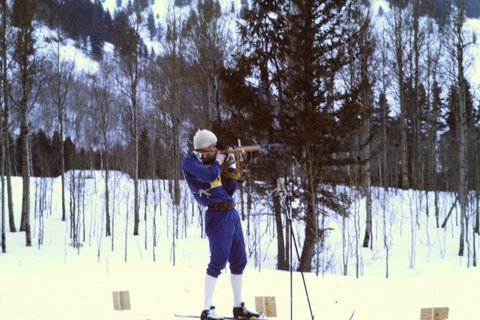
John Morton at 1972 biathlon Olympic trials in Jackson, Wyoming. (Courtesy photo)
Back in ’72 we were on wooden skis, kick-waxed the entire length. There were two biathlon events, the 20 km individual and the 4 x 7.5 km relay. We shot large-caliber rifles on a 150-meter range using paper targets for the 20 km and glass disks for the relay. It was impossible to determine the winner of the 20 km until all the paper targets had been carefully inspected, sometimes hours after the conclusion of the event. A typical biathlon course consisted of three, independent, 4 km loops, with cutoffs for the relay. Women didn’t compete in biathlon at the Olympics until Albertville in 1992.
Men’s cross-country has been part of the Winter Olympics since the beginning in 1924 at Chamonix, France, when there was a 15 km event as well as the legendary 50 km. The first cross-country event for women was a 10 km, which debuted in 1952. In those days, Nordic race courses consisted of roughly one-third climbing, one-third descent and one-third relatively flat terrain. Well into the 1960s, courses were prepared by soldiers boot-packing or snowshoeing the course, followed by skiers stomping in the parallel tracks through the forests and fields. Competitors typically started at one-minute intervals, disappeared into the woods, only to reappear exhausted, often hours later, covered with frost and mucus. The men’s 50 km cross-country event at the 1932 Winter Olympics in Lakes Placid consisted of a 25 km loop skied twice, and was won by Finland’s Veli Saarinen in 4 hours, 28 minutes.
In my view, the first significant change came at the 1974 Nordic World Championships when Sweden’s Thomas Magnusson won the men’s 30 km on Kneissl synthetic skis. Fiberglass and metal had replaced wooden Alpine skis years earlier, but the faster, plastic bases wouldn’t hold Nordic kick wax. But in wet, heavy, painfully, slow snow, Magnusson took a chance on the fiberglass Austrian skis and dominated the race. The headline in the Oslo paper the next day read something like, “Magnusson wins gold, Norwegian ski industry in peril.”
The next major breakthrough occurred at the 1976 Innsbruck Olympics two years later. Marty Hall, head coach of the U.S. Cross-Country Team recruited Rob Kiesel from Alpine skiing as his assistant. Together they determined that it was possible to wax the tips and tails of the new fiberglass skis for speed with Alpine wax, restricting the much slower cross-country kick wax to a short segment under the athlete’s foot. This made the skis of the Americans faster than those of their European rivals and certainly contributed to Bill Koch’s memorable silver medal in the 30 km, America’s first, and only Olympic medal in Nordic skiing until Kikkan Randall and Jessie Diggins struck gold in PyeongChang.
Following the success of the Innsbruck Olympics, expectations were high for U.S. Nordic skiers at the 1980 Olympics in Lake Placid. With a theoretical “home court advantage,” Bill Koch’s 13th in the men’s 50 km and Lyle Nelson’s 19th in the biathlon 10 km sprint fell short of the results which the public had been led to expect.
Discouraged, Koch elected to ski the international ski marathon circuit the following year rather than the Nordic World Cup. There, on trails groomed wide by Alpine-area Sno-Cats for thousands of citizen racers, he observed elite competitors pulling away from the throng by putting one ski in the set track and pushing off, skating-style with the other. He quickly mastered this marathon-skate technique and began to experiment by skating with both skis. When he returned to the World Cup circuit a year later, he threw the Nordic world into turmoil by abandoning the relatively slow kick wax altogether and skating entire courses on skis waxed purely for speed. The result of Koch’s persistence and innovation was a cumulative World Cup victory for the season, America’s first in cross-country skiing.
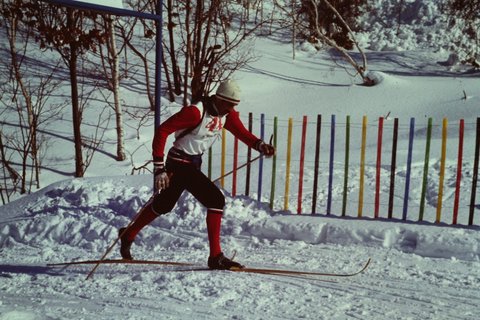
U.S. biathlete John Morton racing at the 1972 Winter Olympics in Sapporo, Japan. (Courtesy photo)
When the dust (or more accurately, snow) finally settled, Nordic skiing had two disciplines, classic (the traditional kicking and gliding) and freestyle (skating). Because biathlon was already complicated enough with skiing and shooting, they decided to go with skating as their designated technique, as did Nordic Combined. In a type of mutual re-enforcement cycle, the use of large, Sno-Cat-type grooming machines on cross-country trails, which originally made the evolution of the skating technique possible, became a requirement once skating was accepted as a part of the sport.
Enter television. The first Winter Olympics to be televised were the 1956 Games in Cortina, Italy, and it quickly became apparent how powerful the new medium could be. Figure skating, ice hockey and ski jumping immediately gained popularity, largely because they were relatively easy to cover. Alpine skiing, bobsled and Nordic skiing lagged behind because they were more difficult and expensive to film. The sports favored by TV prospered, enjoying increased funding from sponsors and a wave of young Olympic hopefuls. Meanwhile, those sports that were less telegenic scrambled to make their events more appealing to the camera. Nordic skiing and biathlon added mass-start and pursuit format events, making it easy for spectators to see who was winning. In terms of spectator interest, biathlon had the advantage of the shooting range. With the adoption of the modern, knock-down targets and television cameras’ abilities to zoom in on an athlete’s targets as he/she is shooting, the popularity of the sport took off. In recent years, biathlon has become the most-watched winter sport in Europe with World Cup events rivaling the popularity of Monday Night Football in America.
In cross-country, one of the unintended consequences of the skating revolution was a focus on upper-body strength, which in turn, led some athletes to abandon kick wax in classic events and double pole the entire course, especially in the shorter, sprint races. This led the FIS (the international governing body for skiing) to require tougher courses with more challenging climbs.
Finland’s Iivo Niskanen after winning the men’s 50 k classic mass start at the 2018 Winter Olympics in PyeongChang, South Korea. (Photo: FlyingPointRoad)
As a result, what we saw in PyeongChang for both cross-country and biathlon, were trails 30-feet wide, capable of accommodating three skaters, side by side (without obstructing each other), with steeper climbs and faster, more challenging descents. Aside from the spacious start/finish stadiums, the traditional one-third of relatively flat terrain has disappeared. There was also an effort to loop the trails back within sight of the spectators so that they saw more than just the start and finish of the events. For example, the men’s 50km, perhaps the most iconic of the cross-country events, was conducted on two, 4.16 km loops which brought the competitors through the stadium, in front of the cheering crowd a dozen times. The men’s 50 km classic in PyeongChang was won by Finland’s Iivo Niskanen in a time of 2 hours, 8 minutes (less than half the time it took for his countryman to complete the same distance in 1932 at Lake Placid).
Perhaps the most dramatic change, was the scheduling of many of the Nordic skiing events at night (which allowed them to be televised live in Europe and the eastern U.S. at a reasonable hour). In addition to the expense of lighting and minimizing the number of TV camera platforms, another motivation for shorter ski loops is the growing need, thanks to climate change, to cover the entire trail with machine-made snow. Early in the winter the biathlon and cross-country courses were blanketed with a deep layer of machine-made snow, enough to survive warm temperatures and thaws well beyond the Olympic schedule in February.
While there have been advancements and technological improvements in other Winter Olympic sports, I can think of none more dramatic than what we’ve experienced in Nordic skiing. From a single biathlon event held at the 1960 Squaw Valley Games, there were 10 biathlon competitions on the schedule in PyeongChang. With the advent of the skating technique, fiberglass skis and fluorocarbon waxes, times for cross-country events have been cut in half in less than a generation. Thanks to machine-made snow, the 2022 Winter Olympic Games will be hosted by Beijing, China, a city previously not known for winter sports. And through the development of LED lighting and high-definition television, the excitement of Nordic skiing events can be broadcast live, in prime time, to homes around the world.
*****
John Morton has participated in ten Winter Olympic Games as either an athlete, a coach, the Biathlon Team Leader, Chief of Course or, more recently as a spectator. He has published two books and numerous articles dealing with Nordic skiing.
After 11 years as Head Coach of Men’s Skiing at Dartmouth College, he founded Morton Trails, and has spent the past 28 years designing more than 220 recreational trails and competition venues across the country. He currently has projects underway in a dozen U.S. states as well as two projects in China. More information regarding his trail design work can be found at www.mortontrails.com. He lives with his wife Kay, at the end of a dirt road in Thetford, VT, surrounded by trails.
Marty Hall coached both the U.S. Ski Team (1968-1878) and Canadian National Team (1982-1992).
Marty Hall, 78, often needs no introduction. He’s established a canon of strongly worded comments and articles about the past and current state of cross-country ski racing. If there’s an opinion to be had, he’s got one.
Hall was interviewed for the FasterSkier podcast on Nov. 13. We spoke mainly about doping and sport in light of newly released WADA report. That report, The Independent Commission Report #1, was released Nov. 9. The interview was split into two segments; episode 1 and episode 2.
“You know, I read this thing and I said, ‘Holy Cow,’ they got ‘em. They did it the right way,’ ” Hall said. “But you know what I’m worried about? They’ll let them off the hook. Everyone of those son-of-a-biscuits should be cooked. Out. Gone. That’s how I feel.”
Marty Hall on Doping: Episode 1
Hall’s thoughts are based on experience. What may seem reactionary or knee-jerk is grounded in where he’s been and what he’s done. Hall’s relationship with cross-country skiing goes back decades. Having learned to ski as a child in the backwoods of New Hampshire — he move there at the end of World War II from New York City — Hall fell in love with the sport. From pine boards and toe straps, to composites and fluoros, Hall has seen and been a part of it all. He skied for the University of New Hampshire and eventually climbed the coaching ranks, spending a decade with the U.S. Ski Team (1968-1978) in a variety of roles. He led both the women’s and men’s squads and served as head coach. In 1982, he headed north to Canada where he became the Canadian National Team head coach. He remained in that role until 1992.
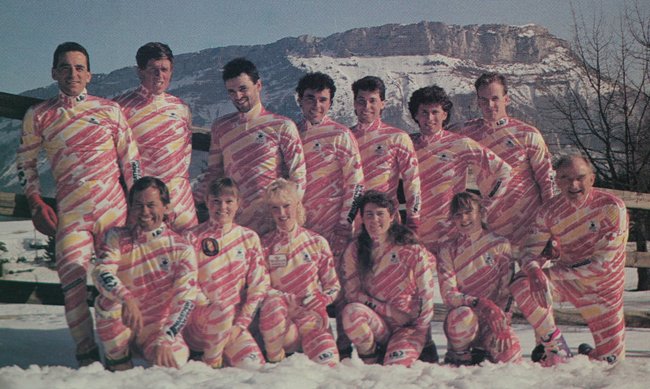
Canada’s 1992 Albertville Olympic team: (from left to right) Top: Alain Masson, Dave Wood (Wax Technician), Dany Bouchard, Yves Bilodeau, Darren Derochie, Al Pilcher, Wayne Dustin. Bottom: Laurent Roux (Head Coach) Jane Vincent, Lucy Steele, Lorna Daudrich, Rhonda De Long, Marty Hall (NST Director), Absent Angela Schmidt-Foster. (Photo: Cross Country Canada)
He then helped revolutionize how cross country skiing is viewed in person and on television. When planning the 1995 Thunder Bay World Championships, rather than one long 25-kilometer loop, with skiers away in the woods for long periods, Hall suggested a smaller loop, around 5 k, which would regularly bring athletes through the main stadium. If you enjoy watching today’s easier-to-view international events, Hall had a hand in that.
But his contributions to sport come with something Hall is comfortable with. He speaks his mind. That can be tough to digest for many.
““I’m a tough guy and you’ll hear it straight from me. … When you cross over and do something stupid you’re gonna hear about it,” he said.
Marty Hall on Doping: Episode 2
Back in 1988, as head of the Canadian National Team, a scandal erupted at the Calgary Winter Olympics. At a post-race press conference, he tacitly accused the Russians of doping. Although he’d been suspicious of dopers since 1974, he remained relatively quiet. Until Calgary.
“How about the Sport Minister,” Hall said. “He told me to shut up! And he wrote me a letter and said, ‘Oh your venue up there is beautiful. I had a great day watching the race. But … Marty shut up. You’re in hot water.’ ”
The fallout from those accusations took awhile to settle. And Hall didn’t step down until 1992, four years later. But it certainly left a few questions unanswered. Like how much doping was going on back then? Who was involved?
As the WADA report and its implications play out, it doesn’t appear Hall holds a gripe. For him, it seems a matter of righting a wrong and serving his former athletes like Pierre Harvey, who Hall claims was robbed of a fair race at his home Olympics. Glad to see the report’s findings, Hall hopes the sport he loves benefits from the report in the end.
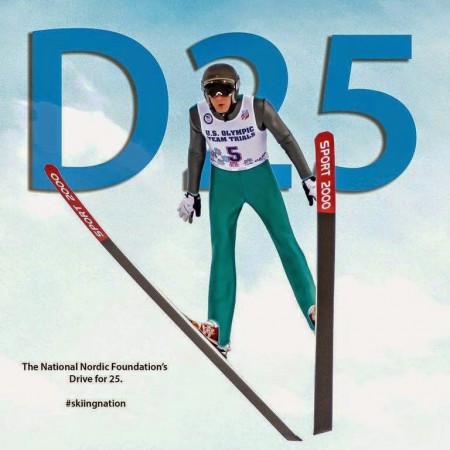
2014 D25
The “Old Timers’ Challenge” – Marty Hall Throws Down
In 1967 Marty Hall worked for the USEASA, the organization that became NENSA. Until 1978, Marty was the Eastern Nordic Program Director before moving on to become the Assistant National Team Program Director and head coach of the US team.
“Nordic skiing requires a lot of heavy lifting. I’m reaching to the folks that I worked with during these early years,” Marty explained. Marty is challenging any of these “old timers” to join Marty and his wife, Kathy, with a $500.00 donation to the Drive for 25.
Is this you? Are you an old timer? Check out the Drive today.
You can say a lot about Marty Hall—and, in fact, most of it has probably already been said.
The former coach of the American and Canadian national cross-country ski teams is an outspoken and prolific observer of the sport today, but that’s nothing new. He famously implied that the Russians were doping at the 1988 Olympic Games, and an Ottawa newspaper story upon his departure from the Canadian squad referred to him as the “opinionated and controversial Marty Hall.”
Former US and Canadian National Team Coach Marty Hall
Even if you take issue with Hall’s positions, though, one thing should be acknowledged: even as he creeps up into his mid-70s, the man still doesn’t miss much. From his previous home in Quebec, and from his new home in New Hampshire, Hall remains plugged into cross-country skiing. As you’ll see below, he consumes ski media voraciously—he even reads tweets!—and writes a column, Hallmarks, for SkiTrax Magazine. Halfway through a reporter’s visit to his house this summer, he stopped an interview to show a YouTube video of a strength workout by members of the Russian ski team.
FasterSkier Editor-at-Large Nathaniel Herz caught up with Hall, his former coach at Bowdoin College, in August, for a wide-ranging discussion about cross-country skiing. They talked about the exploits of Alex Harvey and his father, Pierre—who Hall coached—the meteoric rise of Jessie Diggins, convoluted World Cup race formats, and Hall’s own epic 16-minute victory in his age class at the Birkie.
The interview has been edited and condensed.
FasterSkier: Are you coaching anyone right now?
Marty Hall: I was coaching four girls up there in Ottawa—three older ladies. I’d work with them fairly extensively—I’d see them once or twice a week and organize their programs. They’re all in their 40s and 50s, that type of thing. Nobody hot.
FS: So, how would you characterize your involvement in the sport of cross-country skiing right now?
MH: I read everything. I read everything. I got a little pissed off this spring when I chastised the Canadian National Team for being all split apart, all over the place, and doing different things, and Chad Salmela came in and kind of insinuated that I was old-fashioned. Well, you know, I was going to write a long thing back, and I said, ‘forget it.’ But, he said we’re old-fashioned. I can remember crust cruising back in 1962. I can remember one of the first camps that we had in Putney [in Vermont]—I’ll
Hall reviewing video with the interviewer.
bet you we had 100 kids. John Caldwell would remember it. Anybody who was anybody at the higher levels of nordic combined, cross-country in this country were at this camp, plus all the divisional-type people.
You talk about hill-running? One hundred people hill-running in Putney. I mean, the sport has not changed that much. It has changed, but don’t think that you’ve reinvented the wheel. The changes that took place were in the early 1970s—’74, ‘75, ’76 and there, that was the revolution. And then you know, there’s been small little renaissances along the way and that kind of stuff, but it hasn’t changed that much. I mean, I had my people in the weight room in the ‘70s, and we were lifting big weights back then. Martha Rockwell, okay—she’s 125-pound girl, she could bench press 150 pounds, live. Okay? So it hasn’t changed that much, the stuff that we’re doing. So I think, I could give you my book that I wrote. You could read it. And I can tell you, you’d say, ‘this isn’t that far off from what we’re doing.’
FS: So do people ever consult with you? Do you ever hear from Justin Wadsworth, the Canadian head coach?
MH: None of those guys. But [former U.S. Ski and Snowboard Association Nordic Director] John Farra, two springs ago, called me up and said, ‘I’m going to ask you a bunch of questions, and I want you to shoot from the hip, okay? And tell us what we’re not doing.’ You know that [the U.S. program is] is now at Seiser Alm?
FS: Yup. (The U.S. Ski Team spent time training at Seiser Alm in Italy last winter.) MH: That was one of the things. I said, ‘look. You guys keep going to Davos [Switzerland].’ Every time they have a break over there, they go to Davos. For cross-country skiers, that’s like going nowhere, because it’s in between [in altitude]. It’s nice. [But] Seiser Alm’s nice! I can guarantee it’s nice. Everybody else is down in Seiser Alm, at altitude. And they can regulate the training, anything from 1,000 meters, to 2,300 meters, for skiing.
That was one of the things. The other thing is, I said, ‘I think you’re spending way too much money, and you think New Zealand’s great, but you’re down there alone. You’re isolated. Can’t be going there.’
Don’t think I’m not in the know. I’m a feel guy. I’m not a huge scientific…I’m into science, but I’m not a scientific type person. Yes, I’m not old-fashioned.
The other thing is, I can say now, I’ve been paying taxes down here, and I’ve been paying taxes up there [in Canada]. I want to see my money spent right. It’s as simple as that. I mean, especially in Canada,
Kikkan Randall racing last winter.
those guys get a crapload of money from the government. They don’t know what to do with it all.
FS: Name two American athletes and two American coaches that you admire the most right now.
MH: Kikkan [Randall]. That’s easy.
FS: Why Kikkan?
MH: Well, just take a look at what she was three years ago. She’s 37th in the overall World Cup. She’s now fifth. She’s done some things.
One of the other guys would be Erik Flora [Randall’s coach at her Alaska Pacific University club program], and a guy would be [former APU coach] Jim Galanes. He’s one of the better brains.
Coaches are real easy. Who the other American athlete would be—if I could have a choice, it would be Devon Kershaw.
FS: We’ll get to Canada. You’ve got to pick an American.
MH: Okay, another American. It would be Kochie [1976 Olympic medalist Bill Koch].
FS: Nope. Somebody still skiing.
MH: Somebody still skiing? Then it’s going to be Jessie Diggins.
FS: What do you think about her?
MH: Gotta be glad she chose our sport, because she’s a hell of an athlete. To be where she is—I don’t have a clue, but her training program can’t be that big when she was 16, 17, 18. But look at the frickin’ results! So, she’s got big lungs, big heart—I’d love to know what’s going on in there.
So, she’s born with speed. Everything comes down to speed, because we can train it. If you don’t do the training, the speed doesn’t play out in our sport. But if you do the training, the speed really becomes…You’ve got a question on your brain [referring to interviewer].
FS: So, what does Diggins need to do, and what do other people need to do with her, over the next five years?
Jessie Diggins in action.
MH: Keep doing what they’re doing. Those two girls [Randall and Diggins], I mean, the only thing that can frick them up is sickness, and injury. They know what they’re doing now.
That’s the other thing about this computer right here [points]. Not only have you shrunk North America. You’ve shrunk the world. You see that video right there that we just watched, from Russia? You think we had access to that crap, back in my time? No. Plus, if we were able to get it, we’d be watching ‘em stick themselves with needles. [laughs] I’m serious!
Look, 1974, everyone says I’m a freak when it comes to the drug thing. [In] 1974, World Championships, Martha Rockwell’s 10th. One k to go she was sixth; she got knocked down, so she lost four places. The makeup of that top-10: seven eastern country people, and three non-eastern countries. I knew. That ain’t right.
So, anyway: just keep doing what they’re doing. And the other thing is, just hope that the base is continuing to expand and grow, because the bigger the base, more chances you have of kicking out a Diggins, a Diggins, another Diggins, another Diggins, a [Noah] Hoffman, maybe. He hasn’t quite shown through like she has, but you’re looking for that kind of talent to come through. I mean, he’s kind of worked his way up the ladder. Still is. Men’s thing is a little tougher than the women, I think. Where there’s 90 men, there’s only 50 women, at races.
FS: So, what do you think: Jessie Diggins, how many athletes did you see like her in your coaching career?
MH: Boy…Kochie. But, you know what? Kochie had an amazing ability, talent, for squeaking everything out of himself. He’s not as amazing a physiological talent as she is. This guy—he did things that were unbelievable. He was an asthmatic, and he dreamed himself off being an asthmatic. But it caused him problems later on—he crashed a couple times when he was trying to make comebacks, because of asthma. Just an amazing guy. Just a truly amazing guy. And you know, the thing about him was, it was him. He was so singular in his focus on himself, and on getting the most out of himself, using all the information, but gleaning it down so it worked for Kochie. I don’t think…get Kochie in a weight room? Forget it. Look at his build. And he double-poled places nobody ever double-poled.
FS: So, anyway, you’re saying that he had to squeeze a little more out of his talent than Jessie does right now?
MH: Yup. That’s my opinion. I can’t say that I’ve watched her. But I’ve seen how she exploded on the scene last year. Holy cow.
FS: So, you’re saying there are basically two people with that level of talent that you’ve seen?
MH: Ohhhhh, I can’t say that. There’s a lot of people. I’ve dealt with a lot of athletes—there’s a whole scad of ‘em that are, and were talented. I could name a couple that I think are talented, but don’t want to train. They want to race, but they don’t want to train.
FS: All right. So, let’s go to Canadians.
MH: Devon Kershaw.
FS: What do you like about him so much?
MH: He does everything the way he’s supposed to do it. And if he doesn’t, he’s trying. I think he’s a talent, and I know that, because I first met him when he was in high school. I was going around with a guy by the name of Alain Parent. You know when core strength was on the forefront? The national team approached me to go with this guy Alain Parent, who is a junior coach. We went all over the country showing people how to do core strength.
So, we went into Sudbury [Ontario], and stayed overnight at Kershaw’s house. He was in high school—he was a junior, or he might have been a senior. And he asked me—we talked about his running. He was a hell of a footrunner. He was top one or two guys [in the province]. But he had made his decision he wanted to ski. And so he came to me, we talked about it, and he said, ‘what can I do? I don’t want to do that.’
And I said, ‘look. You’re the boss here. You’re the talent. Your running coach needs you. You don’t need
Devon Kershaw racing in Sweden last winter
him. You just tell him you’ll be at the championships, and you’ll be at this race or that race. You pick the races you want to go to, and do what you have to do, but then do all cross-country training. If you want to do intensities cross-country, and you don’t want to do ‘em running, you tell him you won’t be there.’
[He was] second in [Ontario] that year. And then, you know where he is now.
He just, in my estimation, is the real, full-time, 24-hour consummate athlete. And he’s still having a great life—just read his latest blog.
FS: Do you talk to him ever?
MH: I just sent him an email.
FS: What’d you say?
MH: I told him two things. Ever hear of Golf Boys?
FS: No.
MH: You know [PGA Tour golfer] Bubba Watson? That name?
FS: Yeah.
MH: There are four young guys on the circuit that put together a group called the golf guys, and goof off: singing, karaoke, that kind of stuff. And so, I sent, to him, the YouTube, from Golf Boys, and said, ‘come on, we need a Cross-Country Ski Boys, or Nordic Boys, and you’re the guy to get it going.’ I said, ‘when you’re sitting in all these camps, with nothing to do, come on! Put this thing together!’
And then, the other thing is, [SkiTrax Magazine Publisher] Benji [Sadavoy] is trying to get him to write for the magazine. I said, ‘hey, I hear Benji’s approached you. I know you’re not sure what you want to do.’ I said, ‘look, I can tell you that what you would write is so important to young kids. Don’t worry about pleasing anybody else. You know what you read in your day, and what it did for you to inspire you.’ I said, ‘you’re the motivational guy now. There are two things you could write about that I think are really important: how you got into cross-country skiing. And then the other thing that you could write about is how you’re going to regulate your schedule this winter, for Tour de Ski, and World Championships.’
Day later, he told Benji, ‘I’m writing.’
FS: Did you hear back from him?
MH: No, no. The only one I communicate with, every now and then, is Chandra [Crawford]. I spent a lot of time talking to her this winter.
So, Devon’s the big guy. Of course, Alex [Harvey]. I think Alex is more talented, but I think he’s got himself spread too thin. He’s in the same position his dad was. [Harvey’s father Pierre was an Olympian in the 1980s in both cross-country skiing and cycling; Hall coached him.]
Because he’s such a hero in Quebec, it’s hard for him to say no. They want him all the time. And, you know, when he wins those athlete-of-the-year awards, that’s against all those pros! The football players that are in there, and the hockey players—he beats those guys out! So, he’s up on a pedestal there. And I can tell you, he’s probably making pretty good money from [sponsor] Quebecor.
Those guys are making big money now, too. I try to talk about it—not a lot, but I try to make sure that I’m talking about it. Because you can say you’re not racing for the money, but it sure makes it a lot easier to think about it when there is that money out there.
FS: How do you compare Alex to his father?
MH: I can’t fault the way Alex trains. I fault all the extraneous stuff—I mean, his going to [law] school is detracting. He can say whatever he wants to.
Pierre was not—he was a physiological talent…not a great athlete. Loved to work. A guy who was really in control of his training.
I think Alex is built somewhat the same; I’d love to see ‘em together. But, Pierre was one of these guys that was really slim down through [his waist]. Very muscular. But then he had this massive chest cavity.
FS: That’s kind of how Alex is—you see the guy.
Alex and Pierre Harvey
MH: I see Alex as being the epitome of what you’d want a cross-country skier to look like. Tallish, maybe 6’1”, so he has big levers. Good musculature on him, and when you see him from behind, he just has that upper body mass. And you know there’s some good lungs in there, and a big heart in there. And so, he’s made for cross-country skiing, in my estimation.
FS: You think more so than his dad, maybe?
MH: Yes, better talent. And his dad would admit that, too.
Alex is really crafty—very knowledgeable about the sport. Very clever about the way he skis, and stuff.
The thing that’s great for me, also—one of the other things that’s great now is we can watch every race on TV now, on computers. And so you learn. Of course, I was living in Canada when the [2010] Olympics were on, and I knew in that 50 k, I said, ‘Alex is going to stay there, but he ain’t going to be on the podium.’ You could just see the way he was skiing. You could see it. But this guy, Yves Bilodeau, the [Canadian wax] technician? He was the cleverest guy I’d ever seen, skiing. He started relays for us—it didn’t matter what was going on. He was coming in with the first group. He could have the crappiest skis, and he’d make it happen, and I think that’s Alex, too.
FS: Is there something about the Quebecois mentality?
MH: Well, I think he grew up being a cross-country skier, so he’s seen everything, at least once, if not twice, or three or four or five times. That’s been his environment. He watched his dad. He got exposed.
FS: Alex has, definitely, some swagger, kind of. Was Pierre like that?
MH: No. Shy. Really shy. You know, he used to love to come to training camps, because, he says, ‘I don’t have to talk on the phone. I don’t have to say “no.”’
[Alex], they keep him in his province, he’s king. He’s recognized. And that hasn’t happened to many cross-country skiers anywhere in North America, ever. Those guys are getting to the point where they’re getting so much press, they’re pretty well-known all over the country.
FS: What is the last cross-country ski race you did?
FS: I don’t think that’s embarrassing. It’s embarrassing for everyone else.
MH: So, I’ve started racing again. I race every year, for the last three years, four years, five, six, seven times a year. Essentially, the only guy that’s beaten me…I had a bad year last year.
FS: You only won your class by 16 minutes.
MH: Well, the thing is, I had some other races. In December, I had cataract surgery, so I couldn’t train. So, I lost a whole month. You know, I’d go out and walk around, but you couldn’t do any hard stuff.
FS: How much of a difference does the base training make at your age, though? Don’t you kind of already have that? Or are you doing intervals?
MH: No, I can tell. Like, I started up again [this year]. I was surprised—went good for about three or four weeks, but with all the moving [from Canada to New Hampshire], the thing I’m running out of is energy. You know, I’m going to be 75 in another couple weeks here, so I don’t have that everyday energy. If I do a hard day of training, it might take two days to recover, so I can go train again and not kill myself or get sick or break down. So, I think I can get to a reasonable peak…I can’t wait too much longer [from now], to have another good year. But [last year], I lost that whole month, right in December. And then I’m trying to dig my way out of there—I had a couple of races where I had lactic acid right out in the hair. I had to quit. Everything hurt. I was barely walking. But, you know, I just picked up my program, and the last three races, I had one good one, one medium-plus, and then: Birkie. It was too bad I didn’t race more after that.
These guys that I race in my age group at the Birkie, I’ve raced ‘em for the last 20 years. But back then, in the ‘90s, we used to go back and forth. They’d beat me. I’d beat them. Blah, blah, blah. Starting three years ago, I won by 10 minutes, then I won by, I think, 12 or 14 minutes, then I won by 16.
This is the short race. I don’t race long any more, because it’s not racing for us. It’s 23 k at the Birkie. If you want an idea, my per-kilometer time at the Birkie was four minutes this year—the year before, it was 3:40, which is…not bad.
FS: So, when you’re racing now, is it much different than when you were racing when you were in college—what you’re feeling?
MH: Um…no. I think better. I think better. I know more about the sport, and I know where my body is and what I need to do. Like, two years ago, I’m still in Wave 1 in the Birkie. The classic race. So all the long distance guys are starting with me. There’s 1,000 of us standing there. So, we took off, and I thought, ‘oh, man, I’m feeling good, I’m going with all these young kids!’
I got to seven k’s, and I said, ‘frick, bud, you’re in trouble!’ So, I cut it back for a k. I mean, walked. Got everything undone before I got myself in a hole I couldn’t get out of. Got back on track, whoosh, then, we broke off—little short course at nine k’s went this way, the big boys went that way, and I, just, was gassing it, from there on in.
I have a huge advantage—there’s two things that I know I’m doing that those guys aren’t doing. One that I’m born with—I was a good alpine skier when I was in college. Really good. So, that course at the Birkie was made for me. Lot of vertical. Carry a lot of speed off of things—I’m good enough that I can coast over the hills, and I know maybe those guys don’t do it. And then the other thing is that thing right down there. [Points at an Exergenie, a strength-training device on his floor.] Specific strength.
FS: Will you write yourself out a training plan?
MH: No. I have so little I can do. I can ski walk, and run with poles—and it’s not really running, it’s fast walking, because I can’t run any more. Weights, and rollerskiing.
FS: And you’ll do easy, or hard?
MH: Mostly, I’m a hard guy. If I go over an hour and a half, I’m usually zone three, training.
FS: So, let’s talk about some World Cup stuff. You have some strong feelings about the tours on the circuit, huh? Like the World Cup opening in Finland, the finale in Sweden, and the Tour de Ski.
MH: I think this pursuit race that they do, when you have three races, you earn [bonus] seconds, and the guys starts out with the lead…[The International Ski Federation calls them] stage races. They’re not called World Cups. Someone like Marit Bjoergen has been racing a long time, and she’s trying to break
Dario Cologna racing in last year’s Tour de Ski…with no chasers in sight.
[the] record for most World Cups—well, they’re screwing her, and I think they’re doing it on purpose.
FS: Why?
MH: Why? Because they don’t want nordic beating alpine. And she has a really good chance to do it. And [Dario] Cologna’s coming along, and he can be doing the same thing.
But they’re getting credit for one or two victories in the Tour de Ski that are considered World Cup races. They get gypped out of two in [Finland]; they get gypped out of two in [Sweden]. That’s wrong.
Plus, the races. The first time that I tuned into that first pursuit race, two years ago, and there were two people going across this meadow, and that was it! For two minutes, three minutes! Everyone’s sitting back there!
FS: In the Tour de Ski? You mean in the hill climb finale? Everyone has to wait after Cologna starts, have a sandwich…
MH: And who out on the course understands what the hell’s going on?! The announcers for Eurosport—they even talk about it! They complain about it. Because it’s meaningless. How do you announce a race that’s meaningless?
And then, [Cologna] gets World Cup [points] for winning the overall Tour, but he placed eighth that day!?
FS: So, they need to fix it?
MH: Yup. Just make it a straight race, and then, all those races should be World Cup races.
FS: So, you would say, start everyone at once?
MH: Yup. And make those guys race for that big money.
FS: Well, I mean, I think their argument for running the last Tour stage that way is, the first guy across the line is the guy who wins the whole Tour. It’s easy to understand.
MH: Big deal. Make it so he starts with everybody else. I bet you Cologna could still win the race, straight up. Who cares if you go back to paper?
FS: For fans, though, I think it’s easier for the International Ski Federation to tell them who won the overall.
MH: I don’t think it’s that meaningful. Ask the racers.
FS: Well, I’m kind of playing devil’s advocate here. I mean, you think about the Tour de France, on the last day, it’s not like Lance Armstrong starts with a four-minute lead. He never won on the Champs Elysees and people still understood that he won the overall.
MH: Tour de Ski—last day, results are in, how many podiums are there? One set of podiums, or two sets of podiums? One for the race overall, and one for the race?
FS: Right.
MH: Is there?
FS: Yeah.
MH: There’s two podiums?
FS: Yeah.
MH: Two recognitions?
FS: Oh yeah.
MH: Two separate recognitions?
FS: Uh-huh.
MH: You sure?
FS: Uh-huh.
MH: Okay. I can accept that. But I still can’t accept—if they’re recognizing the winners of the overall and the winners for the day, that’s fair. But the process is not interesting. Boring. Totally boring. And the thing that’s wrong, in a way—and maybe it’s always going to be that way—is that there’s a Cologna, and there’s a Marit. Okay? Because they’re starting out 1:40 [ahead], and he’s starting 2:40. And it hasn’t worked well yet, in my point of view. So I don’t like it.
Former USST coach Rob Kiesel died in Joseph, Ore., on October 24th. While the nordic community across the globe mourns his loss, Kiesel was also remembered for his innovative work during the glide-wax revolution. Marty Hall, a former US Ski Team coach in his own right remembers Rob in this piece. You can read the FasterSkier article on Rob here.
I feel a responsibility to relate a piece of history that Rob was very involved with that is still impacting every classical skier whether they are on no-wax or waxed skis. But, just in case you are seeing this for the first time and don’t even know who Rob Kiesel is, please read this earlier article from October on Rob’s passing away.
Rob had just become my Assistant Coach in the Spring of 1975 and that fall in the very first days of November we started our on-snow efforts on really good snow in Cooke City, MT., which is reached by coming out of Yellowstone Park’s northeast exit. It is sort of the unknown exit or entrance and in the winter the plowing stops here in Cooke City—like it is the last outpost to no where.
Here we were, at least 30-40 strong with both the XC and Nordic Combined National Teams in full preparation for the ’76 Olympics in Innsbruck, Austria just a few months away. We were here until just a couple days before Thanksgiving when everyone would go home for a 5 day break and then onto Quebec City for more training and racing.
The weather changed on us and soon we were skiing on a double tracked loop that was circular and maybe 800-900 meters long and existed only because it was in the shadow of a mountain. Even though the days were cold the snow was evaporating. The USST was in its first year of a contract with Subaru—we had about a dozen of their little station wagons that became our snow haulers, so we could keep the track replenished and eventually build a small hill into the loop. We were skiing weeks before we normally would , so the kids had no problem staying in the harness(tracks)–it amazed me.
Some time in the early days of the camp, Don Johnson, Product Manager, for Trak Ski company showed up at the camp much to our surprise. I think there had been some discussions about no-wax skis for racing in the future as they had just started using the fish scale(FS) base on their skis. He now had a dilemma, as they had applied the FS base on their skis the previous year, covering the whole base with this pattern. Needless to say they had enough kick on these skis to climb a wall and hardly any glide to come back down, so he was here to work with us to come up with the ideal wax pocket-giving their touring skis the best kick and glide dynamics. Little did we realize where this was going to lead us!
Of course we were now beginning our 2nd year on the new synthetic skis that had been introduced by Fischer and Kniessl at the ’74 World Championships in Falun, Sweden that had started the equipment revolution. The ski companies were advocating a wax pocket that was equal in length starting at the balance point(BP) and going 12-15 inches forward and backwards from this point. Also, the SOP for glide waxing was to use a Universal wax that Toko put out and would come under our scrutiny before we left Cooke City.
Well, we had a starting point and the heavy thinking and discussions began for a number of evenings over a few beers. Discussion points were the forward body position, how fast the ski left the snow after the legs together position when kicking. Two things stood out real quick the forward body position applied pressure to the front part of the kick zone and the ski leaving the snow in the back started us on the path of doing away with the kick behind the heal of the ski. All of this would have been a lot easier if we had any form of video or Polarvision, but we didn’t. Observation in the tracks was the best we could do.
So, to the tracks we went. Because of the short loop we could adjust the wax pocket on the skis and give them to the skiers in a blind test and get immediate feed back on how they liked one ski versus the other as the pockets had been adjusted differently in length. The new concept was in play. It wasn’t many days before we, the coaches and Don realized that we were on to a revolution of our own. The wax pocket as we knew it was going to be different and we had a “secret”. Our testing now took on a different focus. Rather then just a few loops on our short track now we were doing whole workouts and we were learning about the fact every ski had its own wax pocket, not some pre-determined number of inches in front of the BP and behind the DP. We lost no performance when it came to shortening all kickers to the heel of the boot and sometimes into the arch, but we had also soon discovered that because of the shortening, that our skis were faster—WOW—we did have a real secret! The modern wax pocket was conceived!
When we went to Europe we kept this under our hats and it wasn’t long before Gerhard Thaller, the Fischer racer chaser boss, was on to us—he knew we were doing something different , but not what we were doing. We cleaned our wax cabin every night, took all the garbage with us and really had the kids tuned into not giving our secrets away. We made it through races in Reit-im-Winkl and Ramsau and almost all the way through the Olympics before the cat got out of the bag.
Gerhard had given Kochie a pair of skis with mohair strips relieved into the ski base and Kochie was giving them a try and kind of liked them. Only the strips were too long and he went to Gerhard and had him adjust them to our parameters for a kick pocket. Gerhard now knew that secret. Gerhard, still did not know about us using alpine wax for glide and what our testing process was for finding the right glide wax for the day. Yes, Kochie ended up using this pair of skis in the relay and as he said after the race—he had the fastest skis on his leg and wasn’t man enough to use all the kick they gave him. He ran the 3rd leg on the team and left us in 3rd place when he tagged off to our 4th leg skier, Ron Yeager. We ended up in 6th place, a best ever for this team in US history.
Rob, was a huge part of all this and his mark is still on every pair of classic skis be it recreational, no-wax or racing when you go classic skiing—this all took place 36 years ago—-and that is the history of it.
Rob Kiesel — Photo courtesy of Sun Valley Ski Heritage Museum
“Perhaps it was the wine of the cool autumn breeze. Or perhaps as climbers sometimes we meet, we met. Rob Kiesel was an aggressive downhill racer. Perhaps it was his single-minded drive, which induced success. Nevertheless he was somewhat new to climbing and this would be no leisurely climb.”
— Excerpt from Gregory Lowe’s “Half Dome in the Winter” as it appeared in The American Alpine Journal (Vol. 15, Issue 1) by the American Alpine Club.
***
Note: This story has been updated to include additional photos and comments from Harald Bjerke, as well as a quote from Ruff Patterson.
One of Kiesel’s longtime friends, Bob Rosso, laughed as he remembered a photo of the climb — one of the first winter ascents of Yosemite’s 4,737-foot granite dome. A rope jutted straight out from the rock to support Kiesel and his companions as they hovered in a cloud 3,000 feet above ground.
Rob Kiesel built his first log home in Ketchum, Idaho, as pictured here in 1977. Photo courtesy of Harald Bjerke.
That year in 1972, Kiesel was a mountaineer as well as a skier. He started as a competitive alpine racer, making the U.S. ski team and breaking his leg in Sun Valley, Idaho. Upon leaving the hospital there, he decided that was the area he wanted to live in. That was the story he told Marty Hall, his predecessor as head of the U.S. national cross-country ski team. It was Hall who more or less discovered Kiesel through their interactions in Sun Valley, where Kiesel helped found the first nordic team around the time he summited Half Dome.
Kiesel always had questions — good, pointed ones — and great ideas, Hall said. His extensive knowledge of alpine wax gave made Kiesel a nordic pioneer in the glide-waxing revolution, and he went on to a 28-year career with Swix Sport.
On Monday, Kiesel died suddenly near his small ranch in Joseph, Ore., after apparently having flu-like symptoms. Private and unassuming by nature, he did not worry too much, delayed a doctor’s visit and may have passed away while outside exercising. Friends estimated he was 65 or 66 — a testament to the fact that he never drew attention to himself and preferred seclusion.
That’s why he chose Joseph as his home upon retiring from Swix a few years ago.
“He just loved being there, removed from everybody and everything,” said Rosso, who owned an outdoors shop in Ketchum, Idaho. “He’s just one of those people with enormous accomplishments, but just shy.”
Born in Ventura, Calif., in 1945, Kiesel was the son of an Olympian — Bob Kiesel — who won gold and set a world record in the 4×100-meter relay at the 1932 Los Angeles Games.
The younger, more snowbound Kiesel moved to Ketchum in 1971. There in the same building that Rosso now owns, Kiesel started a climbing and backpacking store called Snug Mountaineering with Bob Gorton, who went on to a lengthy career at North Face. Rosso helped them develop a climbing school, and it wasn’t long before Kiesel delved into nordic.
Recognizing a rising interest in backcountry ski touring, Kiesel decided to sell cross-country items. He also kept an eye on what was going on in Sun Valley, where he first started working with children in alpine. In 1971, Leif Odmark initiated the area’s first nordic team, attracting a small group of high-school athletes to the sport and coaching them for one race of the season — the Sun Valley Club race — with about 30 competitors.
“I wouldn’t be coaching today, nor begun coaching if it weren’t for Rob. Both my sister Susie and brother Pete wouldn’t have had the Alpine skiing careers they had if it weren’t for Rob. My brother Pete wouldn’t be guiding in Greenland or Nepal if it weren’t for Rob. More importantly, Rob was an integral part of our family.”
— as written in an email by Ruff Patterson, Dartmouth College men’s nordic ski coach
The following winter, Kiesel took over the program after convincing the Sun Valley Ski Education Foundation to incorporate nordic. At the time, it was an alpine-only operation in an area that had just recently discovered cross-country skiing.
The organization agreed to let Kiesel head a nordic team, and he chose Rosso — who said he only knew how to coach swimming — as his assistant. Over the next few years, Kiesel developed the program and attracted skiers to Sun Valley for its racing culture and innovative grooming.
According to Rosso, Kiesel liked to tinker and experiment. He spent time finding new ways to set cross-country track, perhaps most notably along the 32-kilometer Harriman Trail. There in the Wood River Valley, Kiesel helped develop one of the country’s first distance races for cross-country skiers — the Boulder Mountain Tour — in 1973.
“There were these epic stories of Rob grooming a point-to-point trail with archaic 1970s snowmobile stuff,” said SVSEF Nordic Program Director Rick Kapala.
One of the first to dream up a year-round trail from Galena Lodge to the Sawtooth recreation area near Sun Valley, Kiesel had to route the trail. Kapala recalled stories of him driving into the river on his snowmobile.
In recent years, the annual race closed out at about 1,000 participants. Since Kiesel did not want a memorial service, Rosso said the race organizers intended to quietly dedicate the 2012 Boulder Mountain Tour to him.
“It’s so hard for the rest of us to have closure,” Rosso said. “You want to celebrate his life and his accomplishments.”
“Young and stupid, I didn’t realize then how valuable Rob’s largessewas to our small program. (Young and stupid, I also didn’t know thenhow largely Rob had contributed to skiing.) Older and slightly lessstupid, I know now that I’m indebted to Rob, very personally for thetime and kindness he showed me, but also as a member of the larger USski community, since Rob belonged to a very select group of US skiingpioneers, who help to carve out a place for us at the larger table ofskiing and who invited anyone who cared to pull up a chair.”
– Andrew Gardner, Middlebury College head nordic ski coach
Forward Thinking
Not long after Kiesel began working with young skiers and creating programs to certify adult instructors, he made an impression on the USST. Regular rendezvous in Sun Valley gave Hall — the U.S. head coach at the time — an opportunity to meet Kiesel, and he noticed Kiesel’s direct contributions there.
Meanwhile, the U.S. team was eager to get on snow as early as possible. Around 1974, Hall and his staffers discovered a small patch of snow at the northeast entrance of West Yellowstone in Cooke City, Mont. The team began a season-opening ritual there, beginning as early as October and staying in a nearby hotel for almost month. While the racers skied in circles, the coaching staff experimented — most notably with the wax pocket.
Kiesel came onto the national ski scene in 1975, when Hall hired him as assistant coach. His extensive knowledge of the alpine glide wax, which was leaps and bounds ahead of nordic technology, gave the U.S. team an edge and helped them gain recognition internationally.
“We had a wax combination that I’m sure the Europeans knew about,” Hall said of their trip to the 1976 Innsbruck Olympics. “But they didn’t pay much attention to us.”
That February in Austria, Bill Koch put the Americans on center stage, winning a silver medal in the 30 k. He finished an impressive sixth in the 15 k, and his relay team missed the podium by about 30 seconds in the 4×10 k relay.
“We had some guys on radios, and they said these (coaches) out here don’t have a clue what we’re doing,” Hall said. “But the athletes were screaming at their coaches saying their splits are screwed up. … Not only had we hit the wax, but out skis were way faster than their skis.”
It wasn’t long before their competitors realized what the Americans were doing in their wax room. Soon, the brown universal blob of wax was out, and Kiesel’s use of alpine wax, with different temperature and humidity ranges, was the norm.
“He was the perfect guy at the perfect time,” Hall said. “The kids loved him. He and I got along real well. … He was really instrumental at that time.”
Kiesel as the USST head coach in 1980. Photo courtesy of Harald Bjerke.
In 1978, Hall left the USST and put Kiesel in charge. He filled the head coach role through the 1980 Olympics in Lake Placid, N.Y.
One of his athletes, Tim Caldwell, remembered him as an innovator in the mid ’70s, when the world was switching from wood to fiberglass skis.
“He knew a lot of stuff about this part of the sport that we knew nothing about,” Caldwell said. “He helped us a lot certainly with that transition … and trying to lead us, but without being too overly controlling with what we were doing. I think we all enjoyed working with him.”
Known for his steady attitude, Kiesel reacted similarly to good and poor performances, which Caldwell liked. Kiesel wasn’t one for excessive attention and seemed puzzled when he received any.
“He wasn’t interested in talking to the press; he was just a quiet guy,” Hall said. “Great worker, great thinker. It just popped into my own brain, ‘Marty, you did a good thing (hiring him).’ I liked him.”
Keep on Giving
After leaving the team in 1980, Kiesel moved back to Idaho and landed a research and development position with Swix Sport. Through the company, he worked closely with his college roommate from Denver University, Harald Bjerke, now the chief hardgoods product manager at Swix.
The two met regularly in Norway during Kiesel’s annual trips to the mountains to brainstorm waxing methods with the gurus. Roger Knight, the director of team and eastern operations at Boulder Nordic Sport, said Kiesel might have been the only American invited to the exclusive meetings with the Europeans.
“He was sort of a mythical figure, so to speak,” said Knight, who was personally mentored by Kiesel.
Former USST alpine racer, Kiesel showing off his downhill skills at Winter Park in 1964. Kiesel was on the alpine team at Denver University before taking up nordic in the 1970s. Photo courtesy of Harald Bjerke.
When Knight began working for Swix in the late ’90s, he said it was Kiesel who helped him earn a full-time position as the Swix USA nordic product manager. Later on, Kiesel regularly came to help at big racing events, such as nationals, Knight said. He wasn’t paid, but wanted to work.
“He’d never tell you what to do, but he’d always offer wisdom if you needed it,” Knight said. “People would say, ‘Who is this old guy in the way room?’ and he would leave, and I would say, ‘That’s the guy who invented fiberlene and fibertex.’ ”
Another one of his disciples, Chris Hall started as an assistant ski coach at Sun Valley. Kiesel knew he was interested in ski service and recommended him to Swix Norway. From there, Chris began working with the Swix Racing Service on a special project before the 2002 Olympics, and went on to become the head service tech for the USST.
Now the nordic race director for Fischer Skis US and also the Swix US nordic racing service director, Chris said Kiesel gave him the opportunities and confidence to move forward.
He remembered thanking him at an SVSEF team banquet about eight years ago.
“One of my speaking points was to thank Rob for the opportunity to take the ball and run with it, so to speak,” Chris wrote in an email. “Rob was a little taken back, as I believe he saw it as just doing the right thing.”
Last January, Kiesel was inducted into the first annual Sun Valley Ski Hall of Fame. Kapala and Rosso were among those who helped select the nominees, and both were nervous Kiesel wouldn’t show.
“When we talked to him about it, he couldn’t have been happier,” Kapala said. “He was just so gracious.”
For many, it was the last time they caught a glimpse of the man, whom a few described as reclusive. Rosso said he occasionally drove 5 ½ hours from his ranch to visit him at the shop in Ketchum, but the visits dwindled once he retired.
Kiesel was survived by his two children: his 28-year-old son, Jess, and younger daughter, Kaelin, 26, who had her first child a few months ago. Kapala said he coached Kiesel’s two children at Sun Valley, and both won junior national championships. Back then, Kiesel kept a respectful distance while supporting Kapala was in the coaching role he founded some 30 years earlier.
“It’s just sort of a very abrupt ending,” Kapala said.
“There’s just a lot of people out there that knew him well,” Rosso said. “He was just larger than life.”
***
An excerpt from an email written by Harald Bjerke, Kiesel’s longtime friend and college roommate:
Rob never talked loud about his achievements. He did not want to be in focus. Rob had a lot of interests from gardening, reading, mountain climbing, cycling and food to motorcycles. It was always interesting to discuss with Rob because he had such a broad perspective of life.
The eternal question of cross-country ski training: how much to train? This is a debate that will never find resolution, for the simple reason that there is no one answer. A recent FasterSkier interview with Matt Gelso stimulated renewed discussion on a topic that has become most heated when the role of collegiate skiing is added to the mix.
We asked three coaches from different arenas of elite ski racing to weigh in on the question. Marty Hall (former U.S. Ski Team and Bowdoin College coach), Pete Vordenberg (former U.S. Ski Team Head Coach, current U.S. Ski Team coach), and Eli Brown (University of Utah head coach) shared their opinions on how elite ski racers should look at hours. None of these coaches have seen what the others wrote, so this is no debate or argument – merely three different perspectives.
Marty Hall
Training Hour Charts
First off, let me say that the template for these charts are from the Cross Country Canada’s (CCC) coach’s education program. The original chart is singular in it’s presentation with the prescribed hours being more towards the feminine side of the curve. I have designed and adjusted the hours for a separate men’s and women’s set of charts over the past 20 to 30 years. I think I remember asking Toni Scheier, CCC’s Coaching Coordinator, way back then for use of the template, but not the numbers.
I would encourage you to read the following article and comments (http://fasterskier.com/2010/06/after-ncaa-championship-gelso-to-join-sun-valley/) to give you background, so you may better understand where this is all coming from. One of the keys for any young skier using these charts would be to do it with you club or program coach, so you can decide how you are going to jump into these numbers with potentially some good discussions. Remember, the success to any yearly program is the constant monitoring as the season progresses as to how you are handling your training load, and making adjustments accordingly.
If there is any number that sticks out in my mind over the years, it is the 500 hour year, as it comes down to doing 1.5 hours of training a day. If you are serious about your training preparation, you would expect to be out for at least 1.5 hours in any training session, so that would be a great starting point. And if you are a serious skier in your preparation, you definitely have a training log that you and your coach can refer to for what your training hours looked like this past year, and which may give you your starting point for the new year.
Adjusting your hours is a yearly process you’ll do every spring, hopefully with a coach you’ve been working with, and operating from that well-kept training log.
As you see, there are high limits for the hours when you reach your mid to late twenties, and you will hear stories of people cutting their hours after a few years of these high hours. That would be part of the evaluation process, with discussions between you and your coach. I know Kochie [Bill Koch] did it late in his career–his own decision, and most likely done to prolong his career.
It bothers me that these kinds of numbers are not available anywhere for the xc ski racing community to refer to. We have a great majority of the young ski racing population that are so far behind in international hours right from the get-go, it is almost impossible to catch up.
You can argue all you want to about this, but it is standard operating procedure in Europe–just look at the examples I referenced in the above-mentioned article I asked you to read. One other point is that we all have certain levels of talent (genetics), but you have to be in the same ball park with your preparation if you are going to ever be competitive. We have the programs, we have the skiers, we have the coaches, we have the technicians–we have won medals in both countries, so we can be successful and we know how to get there. Now we need more skiers with the right training base of hours to bring more depth to our programs.
I hope this helps you and your coach get you on track to realizing your potential.
Eli Brown
Training Hours and College Skiing
Training has always been about quality more so than quantity, but total volume of hours is indeed an important piece in the development process. The question is commonly asked; Can a developing athlete with World Cup – Olympic aspirations train enough in a college setting to continue their development towards international success? Yes…
For me, the question isn’t whether or not college fits into development, because it has to! The collective resources that make up college skiing in this country are TOO HUGE NOT TO! From coaching, scholarships, medical, team atmosphere, education-life balance, and support, college skiing is a huge resource. We have to use our college system for athlete development. No, that doesn’t mean everyone needs to ski in college, but for those who make do that choice, coaches and programs need to support their long term development goals. College programs need to embrace the challenge of communication and collaboration set by the U.S. Ski Team. And the greater ski community as a whole needs to embrace the resources at hand and make college skiing a strong option for our best developing athletes.
You could say, “but Eli, you haven’t sent a skier onto World Cup, and not many others have either, so how can you support this?” That’s true, but the basic framework is there. And the resources are tremendous. For the record, there have been and will be former college skiers on the World Cup and at the Olympics: Garrott Kuzzy, Torin Koos, and Simi Hamilton all made the most recent U.S. Olympic Team after skiing in college. Additionally, there are former college skiers racing at World Cup or close to that level in Europe: Sara Svendsen, Kjetil Dammen, and Snorri Einarsson are a few examples.
The most important thing for a developing athlete to decide is their lifestyle–they could stay out of school and on their own (probably tough), out of school and in a club (solid plan), no school plus job (can be tough depending on situation), in school and working (tough, but necessary for some), school and strong commitment to training (very possible path to success).
So back to training hours. How many is good? Well, a typical year hour progression from junior to senior to World Cup is familiar to us all. No matter what the numbers are, the young athlete to senior athlete development step is a big one. Skiers need to set up their lifestyles to put in a lot of training. Here at Utah, we have a majority of athletes on a 600 hour a year plan. The highest I have had is 750 hours–and that athlete was successful. Training hours can be very individual, but they probably need to be at or above 600 hours during early senior years.
In college, there are tons of opportunities and tons of options. It’s a matter of taking advantage of school and a ski team, simplifying the rest of your life, and putting it all on the line. At Utah, we try to set up seven to 10 workouts together, as a group, every week. We work with academic departments to get the most flexible schedules possible for training, and some athletes maximize training time by taking the NCAA minimum of 12 credits a semester. Most importantly, we work to set up a culture of success on the team, support outside racing and training, and work with athletes year-round, within NCAA rules, to maximize the support they receive, to help them reach their long-term goals. The most important thing that coaches and support networks can provide our early senior athletes is the opportunity to love the sport enough to continue through and after college. Dream and develop, and set a course of action.
Pete Vordenberg
The internet is interesting. You can find a lot of stuff, ideas, thoughts, opinions. But you don’t necessarily know how good the information is, or take the right steps in learning to apply the info, even if it is good.
To tell a short story – I trained a bit with Torgny Mogren in the fall of 1994. He said he never trained more than 600 hours his whole career, and generally less. That may be so, but the time I trained with him was damn hard training! The point is that it is dangerous to just look at hours.
The good thing about looking at them is that if you (an athlete) are way off, you probably need to adjust what you are doing, especially if your results are not in line with your goals. But it is much better to focus on what needs to make up the hours of training – which is why I like the more specific documents, and why I like even more that coaches go through the education system, and as always, why it is better to communicate directly with each other and with us than to hunt the web.
Elite Development pipeline: Shows the steps all along the way. To see mention of hours see Page 2, stage 5 and 6.
Athlete Competencies: This is a document I really like, that gets into very specific ideas for all age groups. These specifics are certainly more important than the hours, as it shows what the hours need to be made up of. To see suggested hours see page 13.
Swedish development model: This is another good document, but so far it is just in Swedish.
For their hour recommendations they start on page 4 and 5 and even break down the type of training. Page 4 outlines traditional training; page 5 is sprint training. Alder is age, Tjejer is girls, Killar is boys, etc. They even show where someone’s V02 needs to be–Dam means women, Herr means men, and then it shows the V02 by age. Nice touch.
Their training recommendations in this document, hour-wise, are a bit different from ours. But I think anyone can see the progression of hours, and in general (within, say, 100 hours at most), they do show the sort of work that needs to get done. This sort of information has been out there forever.
I have old documents from Norway and Sweden since I was a kid searching for this information myself. I have training from Vegard [Ulvang] and [Thomas] Aalsgard and [Bjorn] Daehlie among others. It is not all the same. People look differently at certain types of training, how to lay it out, etc. But interestingly, the specific workout types and the very general theme has been very, very similar since I started paying attention: train hard, rest well.
This link also has some great info. Check out the training plan and the training log, and also, the compartment syndrome paper is timely and quite good. I would also look at the articles from Sverre Caldwell and Erik Flora, from the 2009 coaches’ education conference, as really good info.
If you go here, you can see the very simple presentation of development pipeline (phases of development). I typed up all this information for the National Cross Country Ski Education Foundation, so let me know if it isn’t clear.
Since I won’t be involved in a blog-ish conversation or internet drama please email me at pvordenberg@ussa.org with questions or ideas. Thank you all.