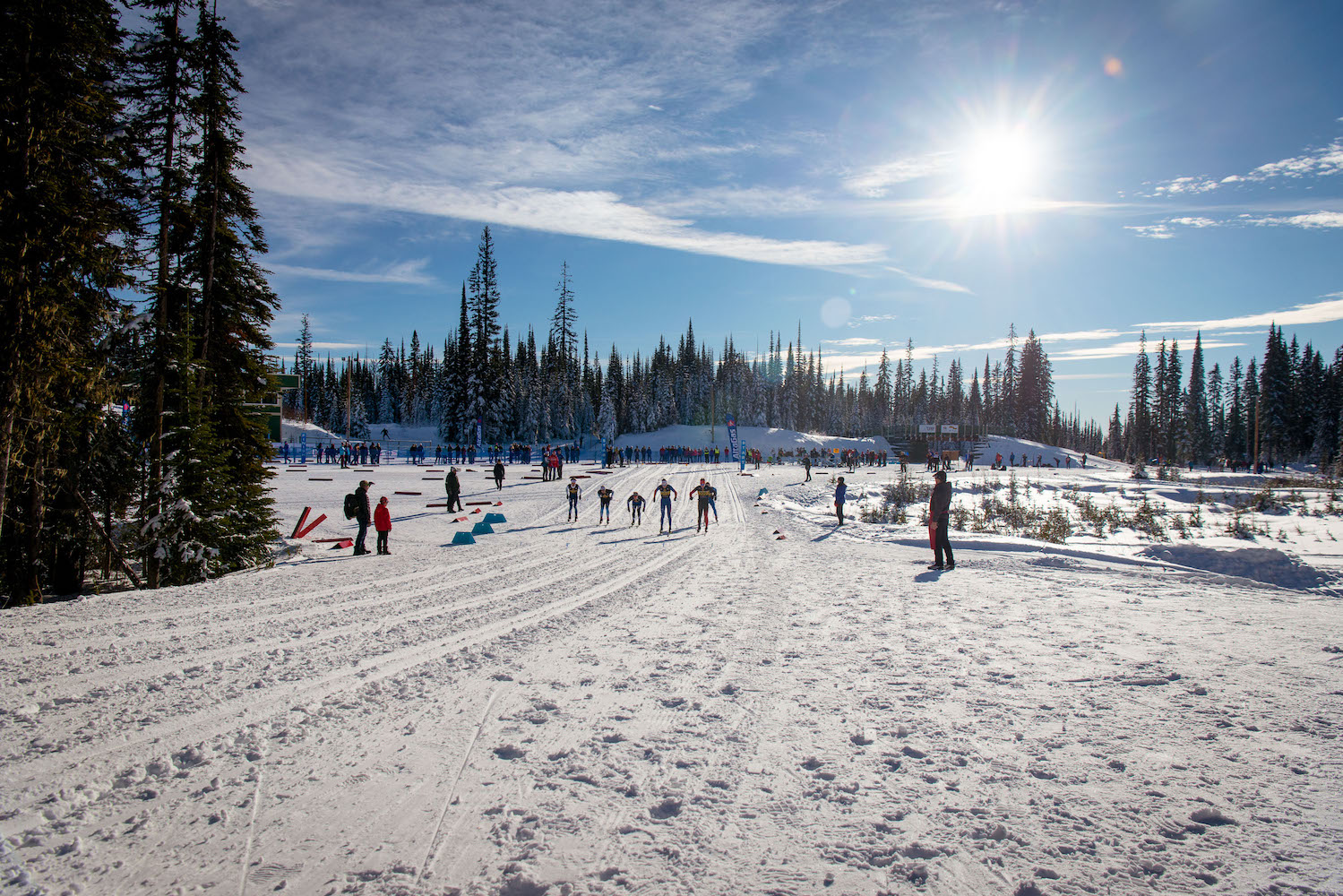
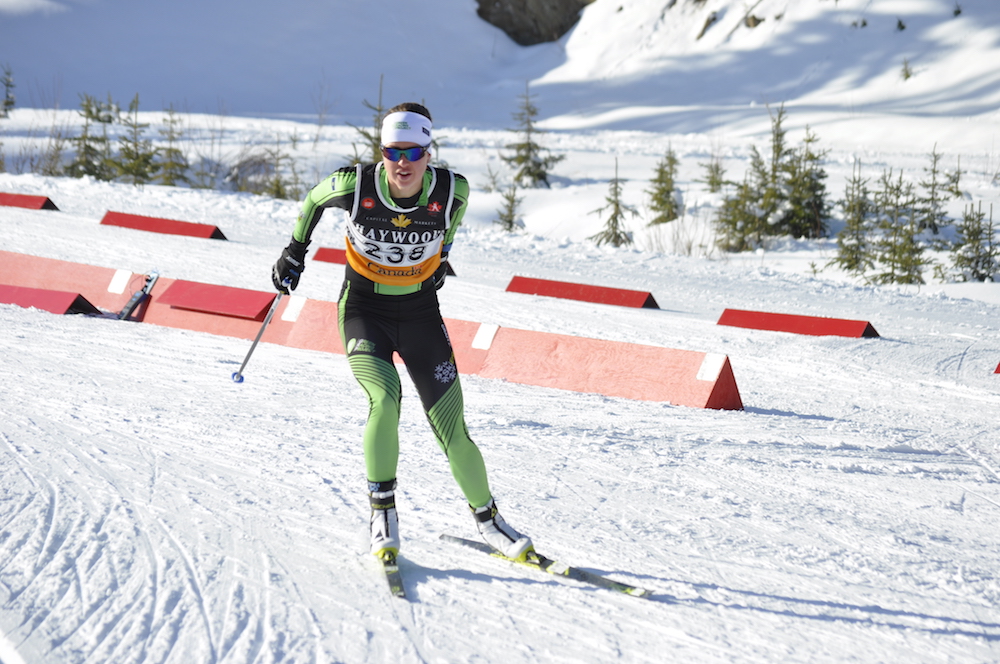
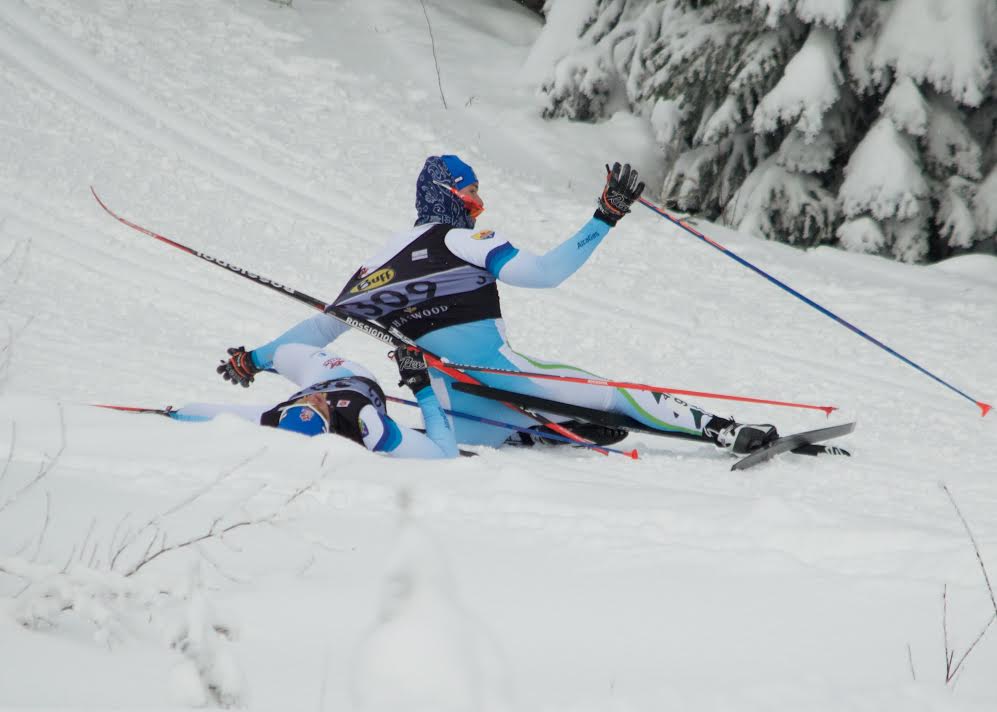
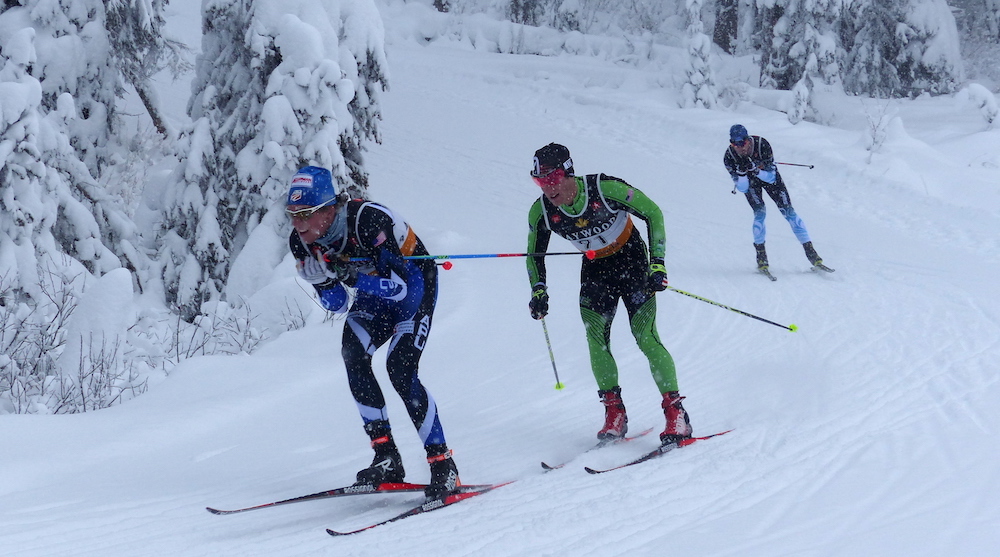
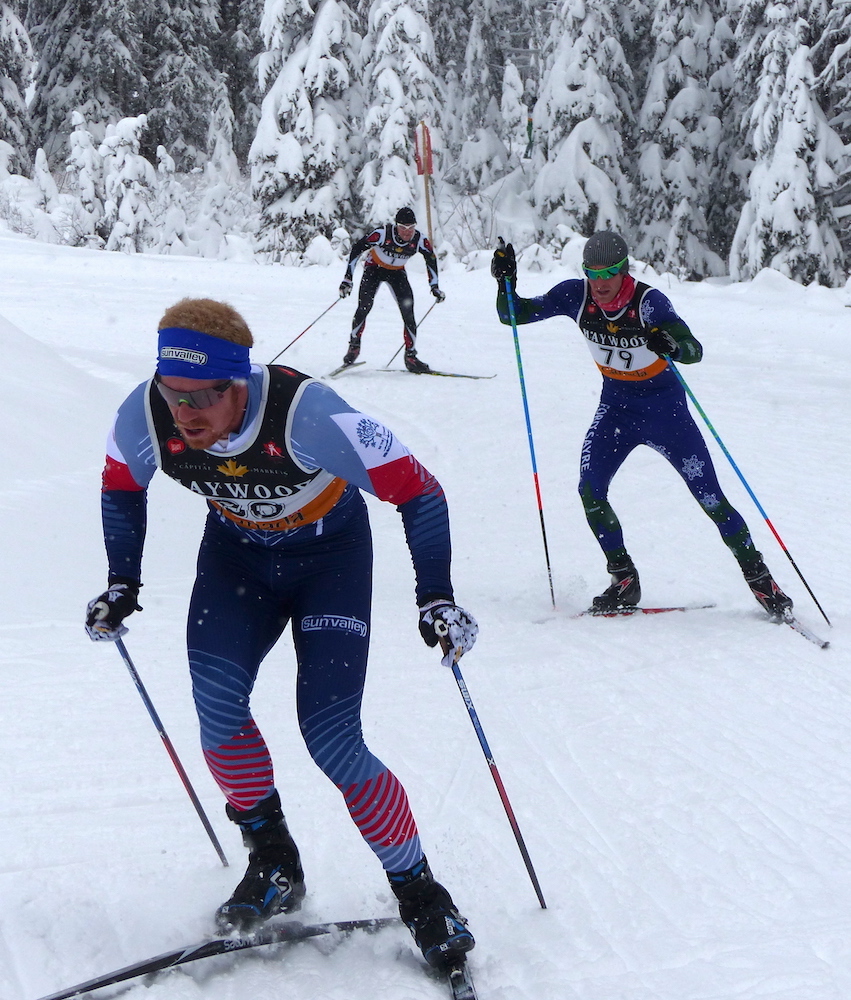
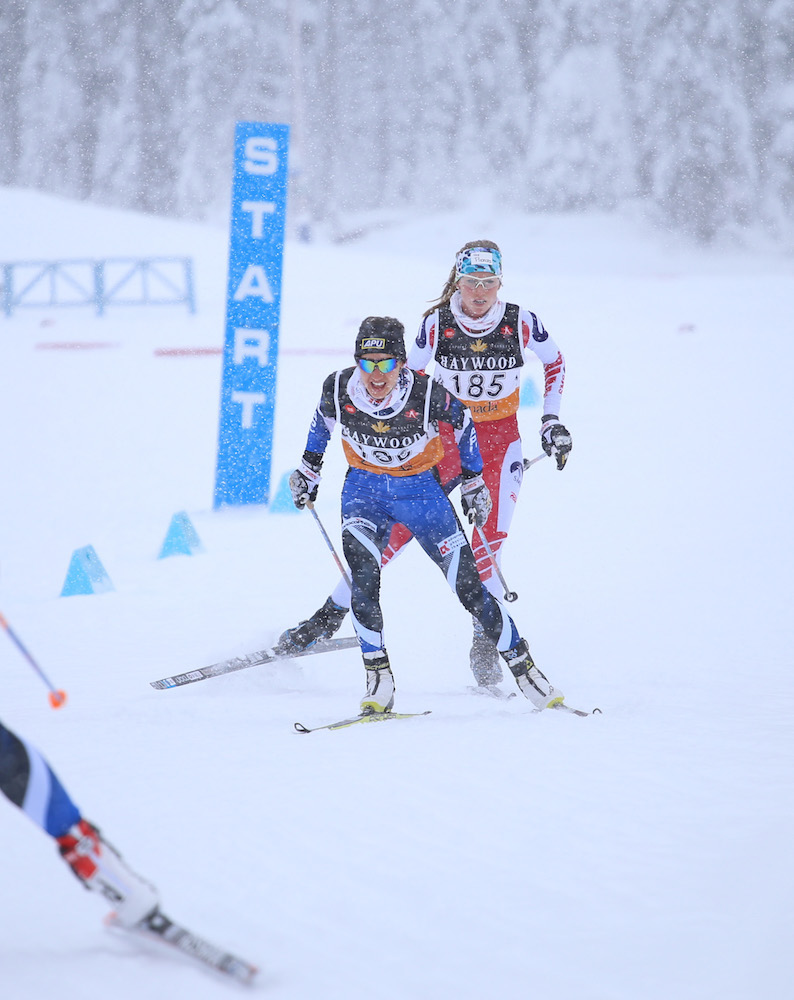
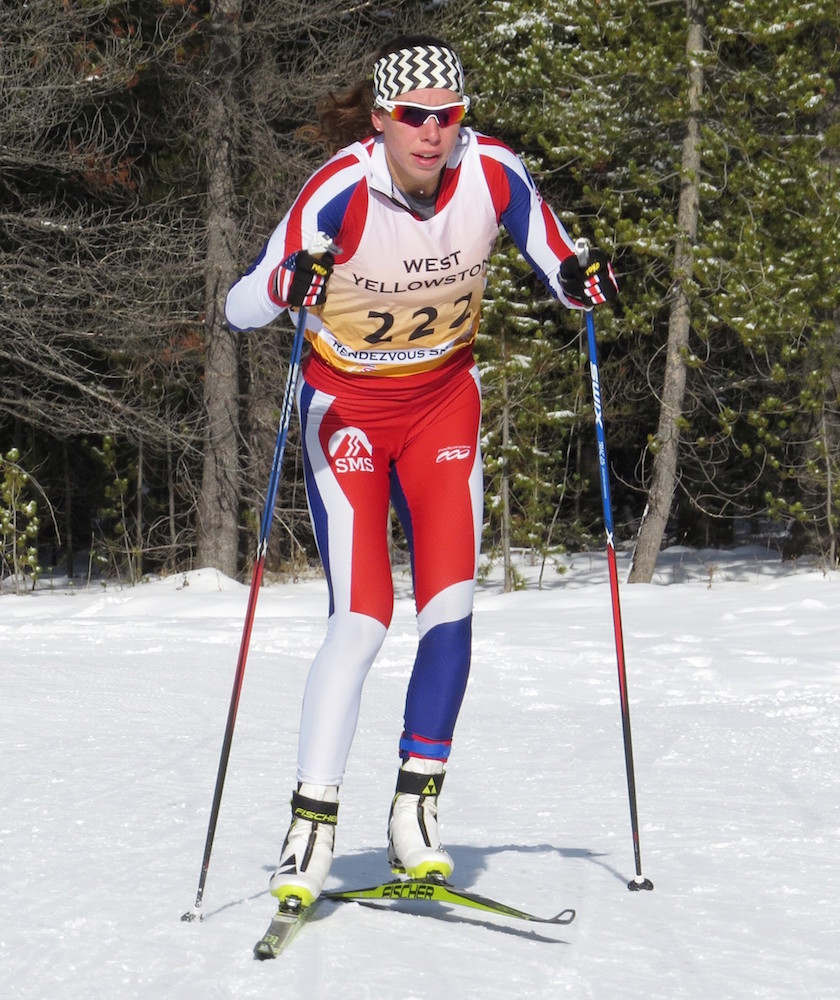
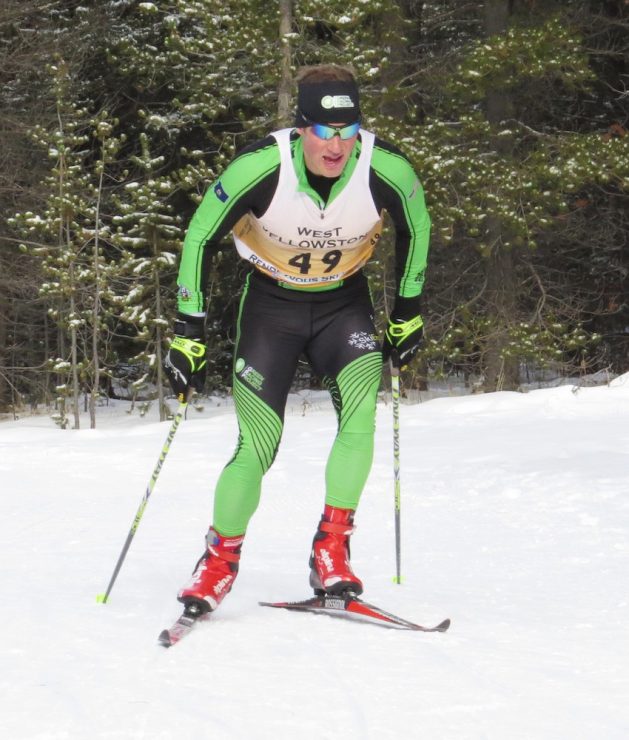
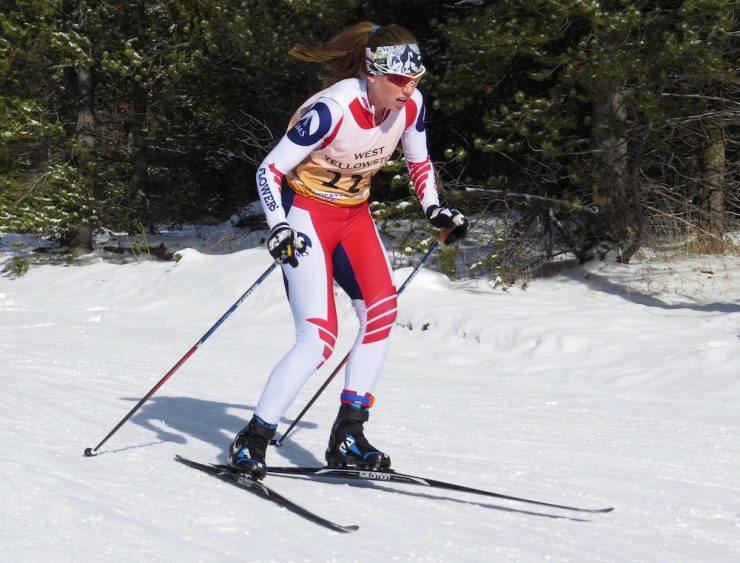
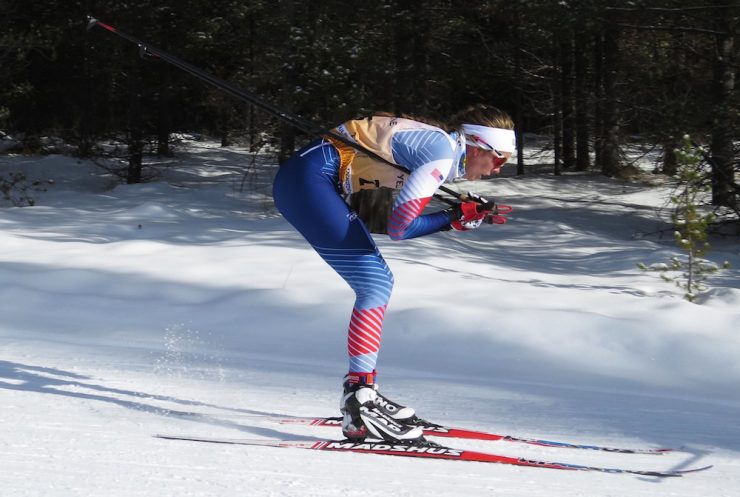
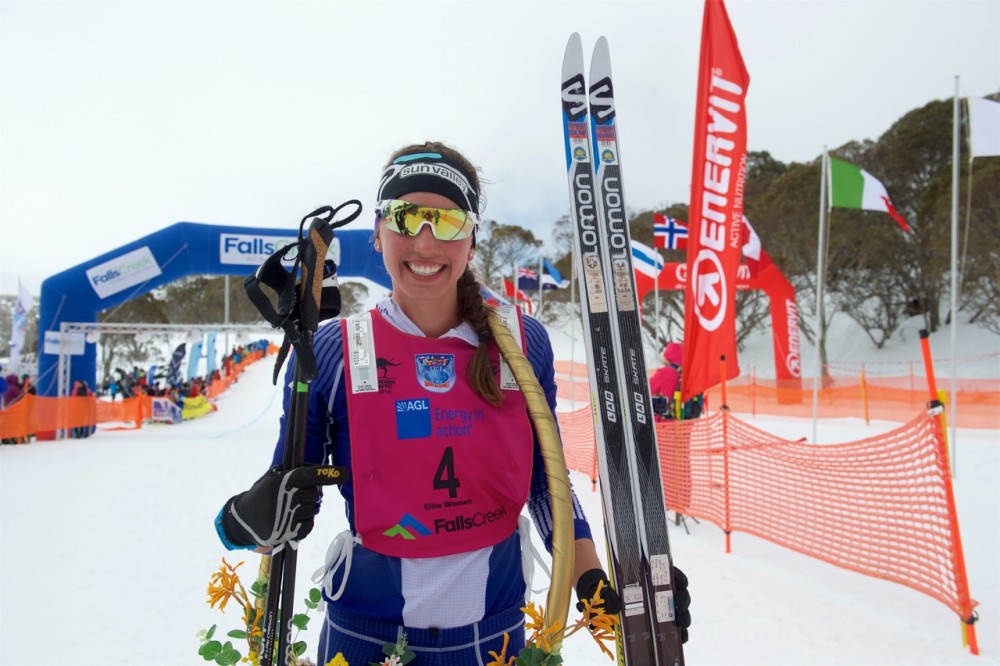
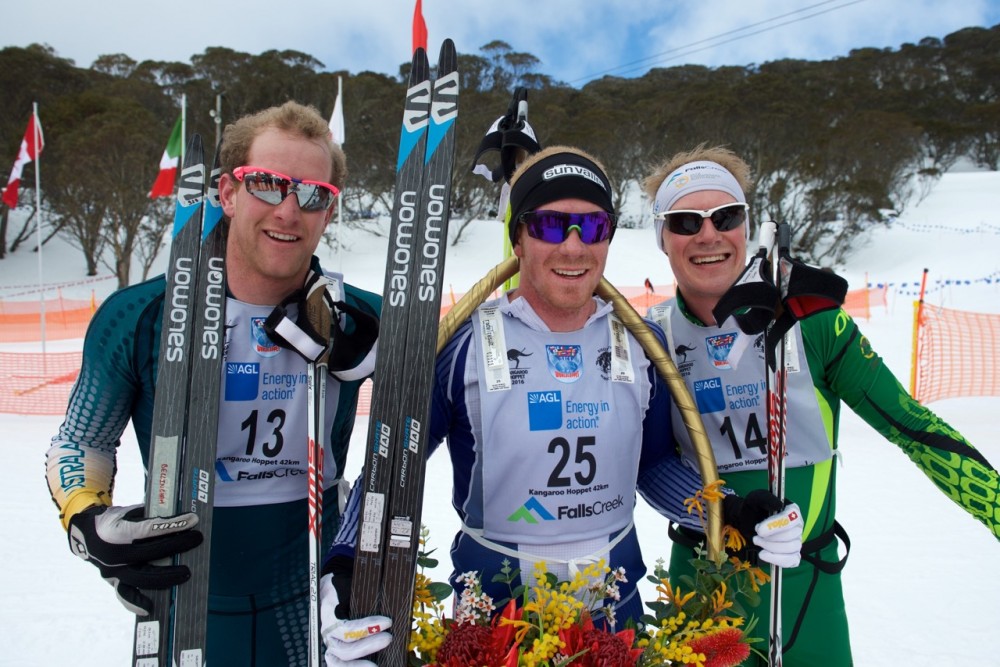
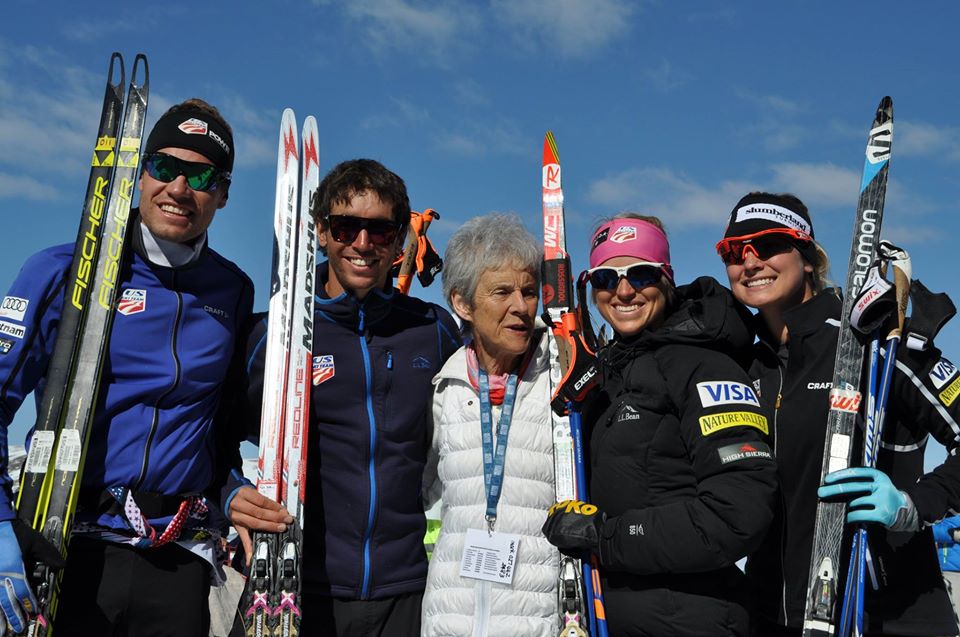
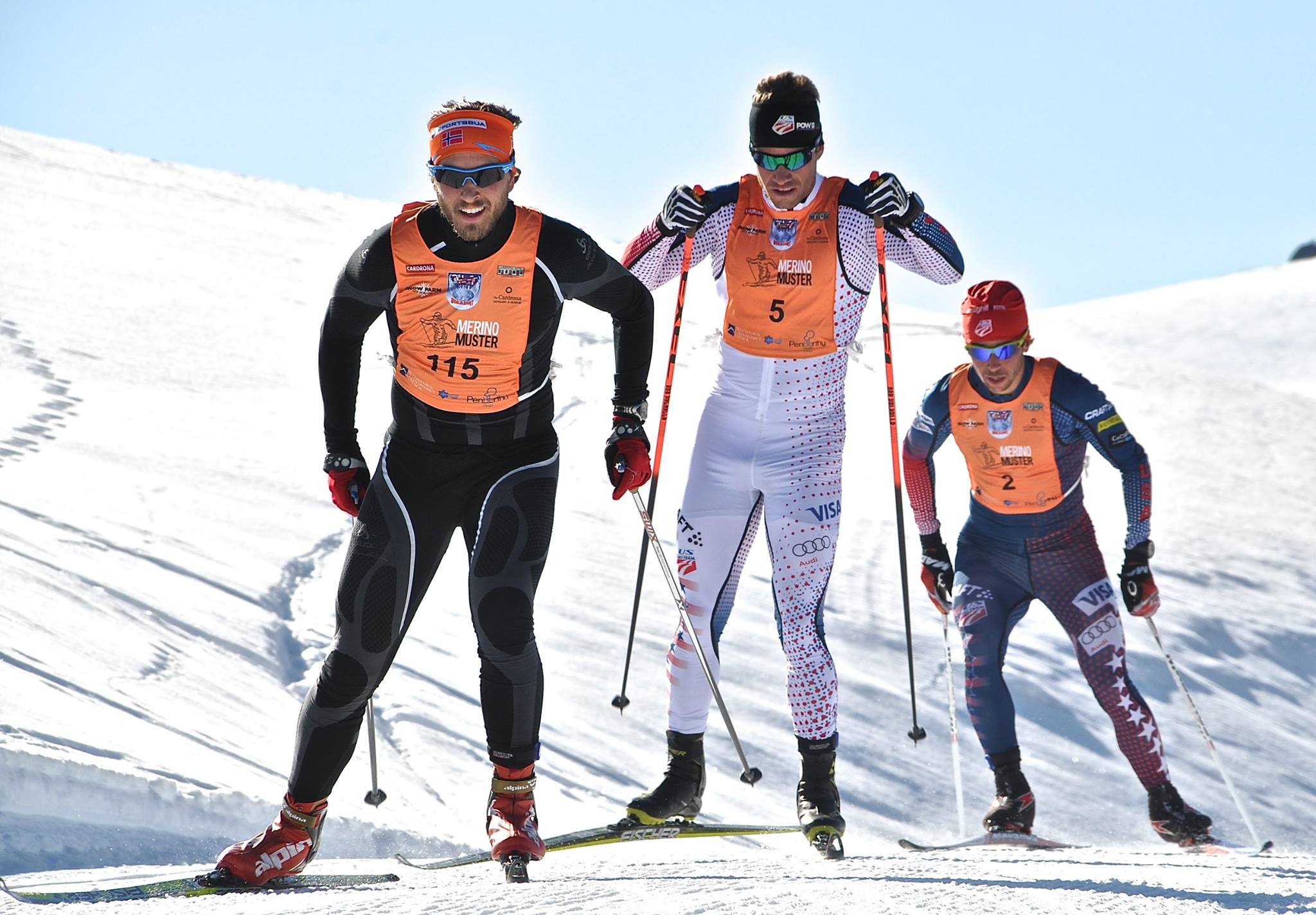
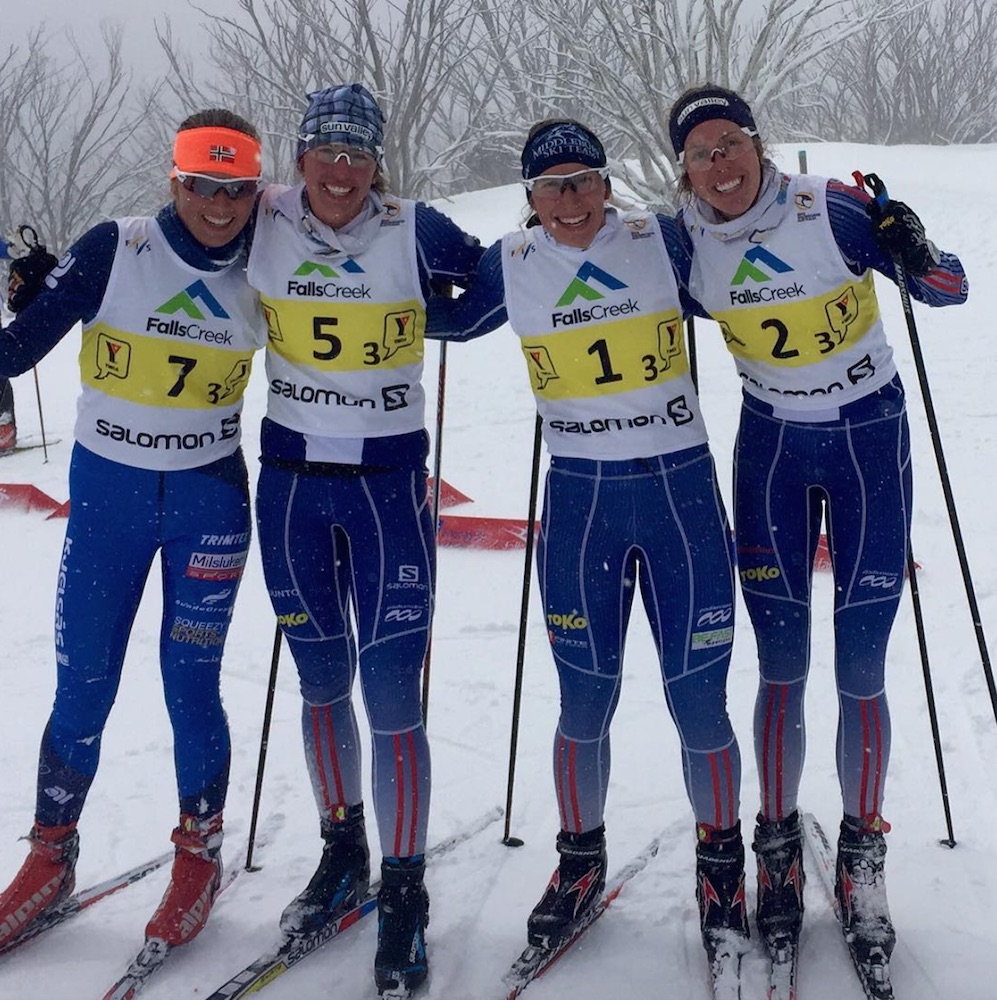
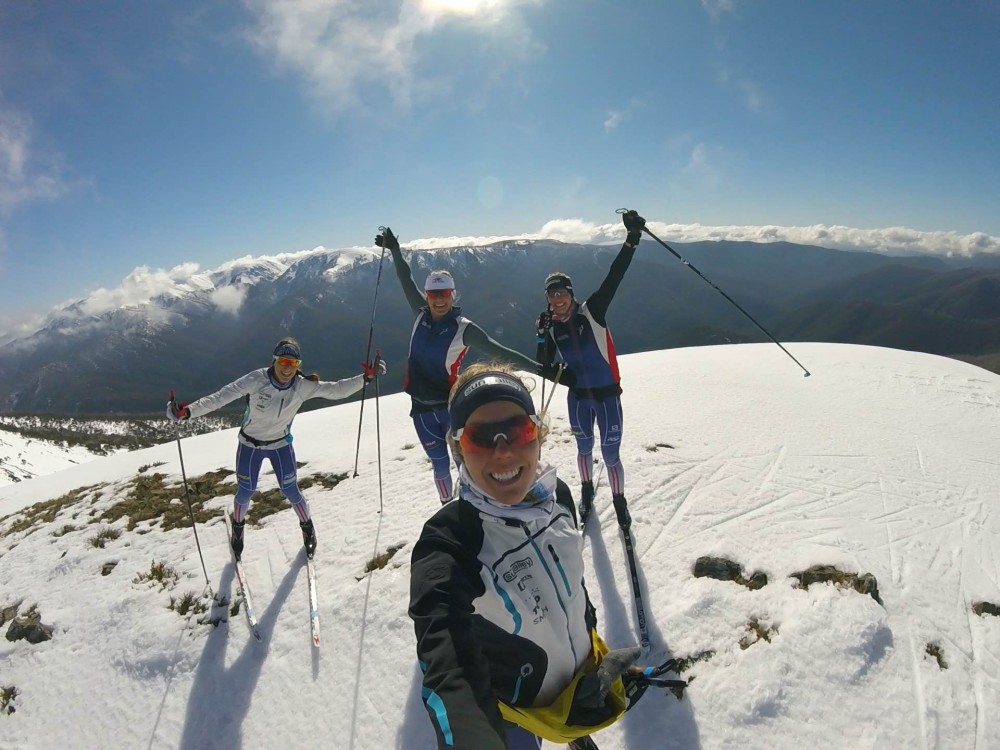
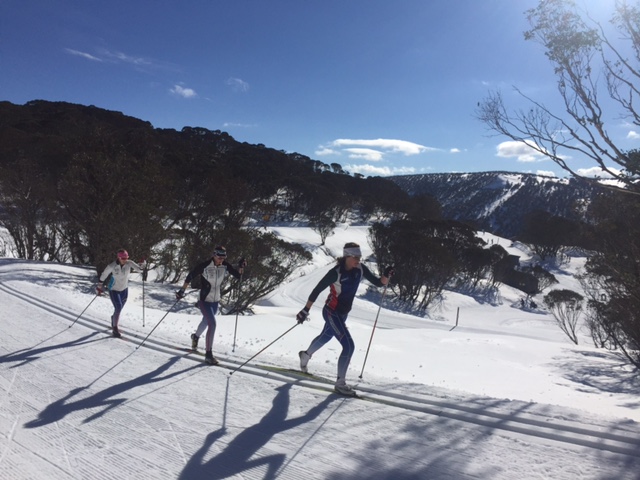
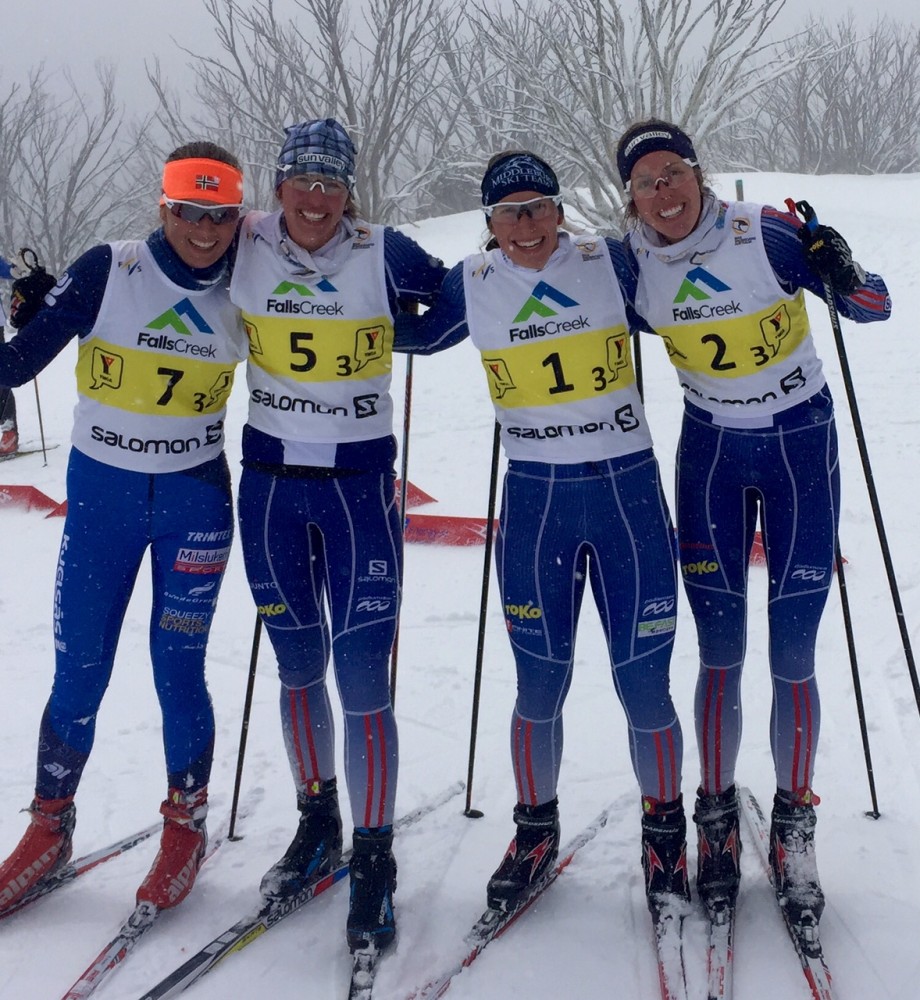
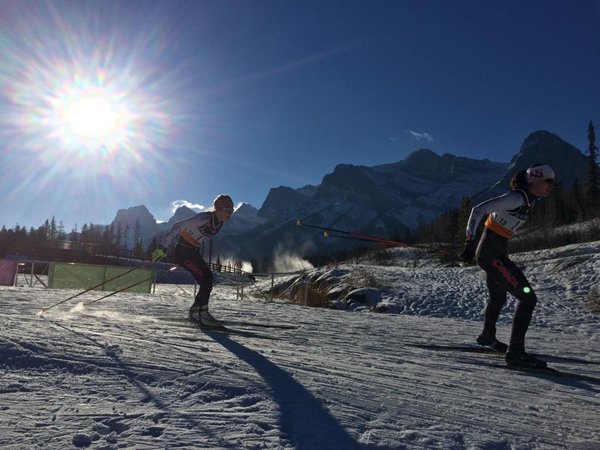
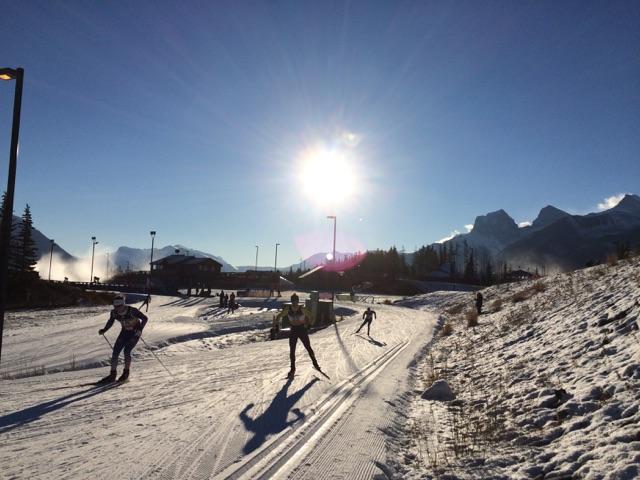
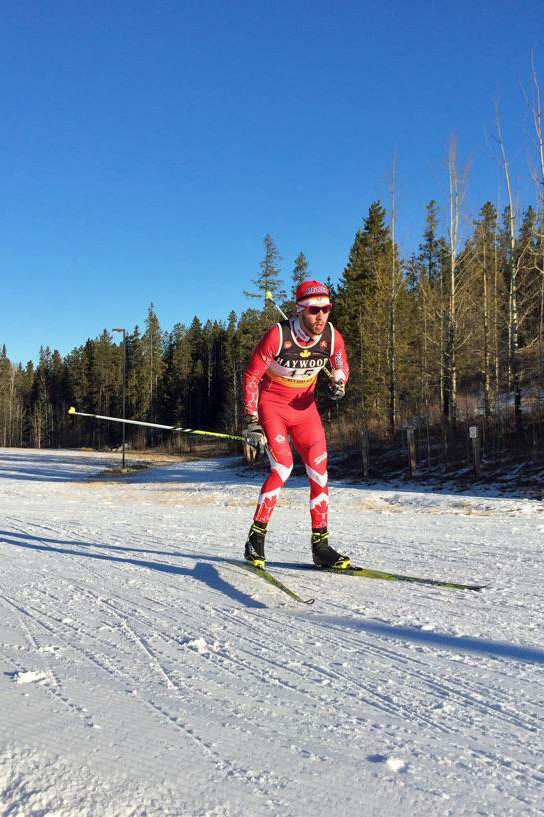
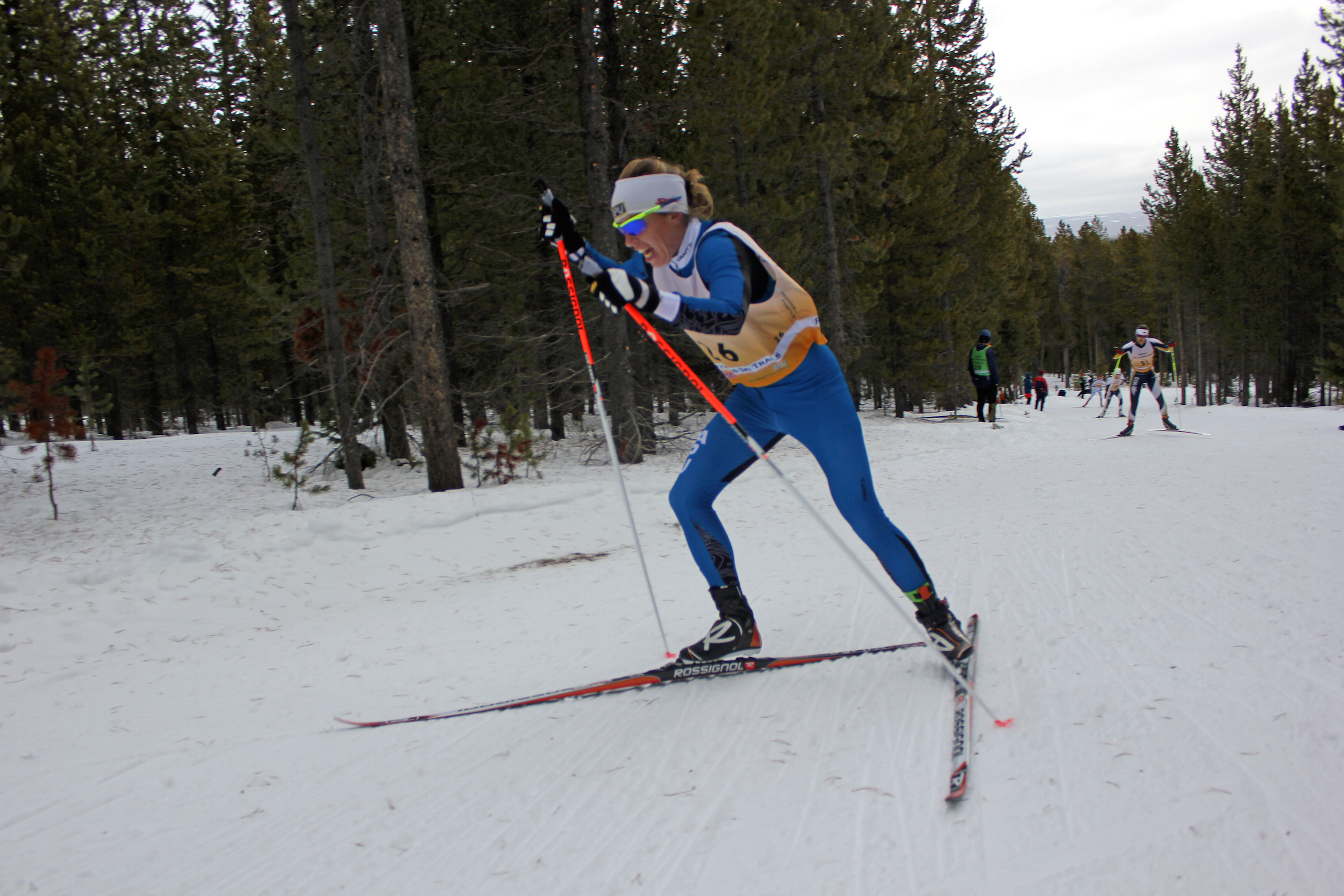
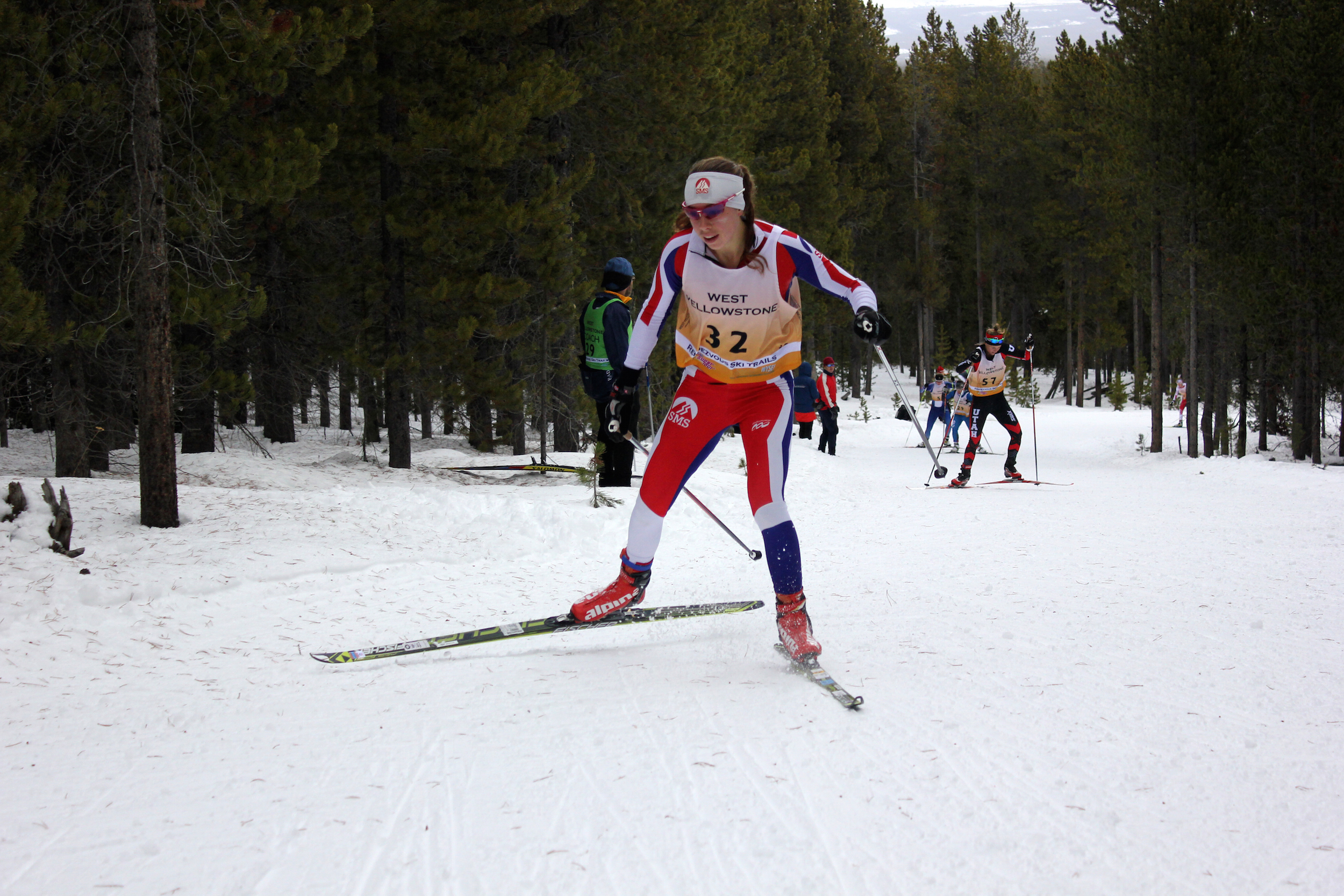
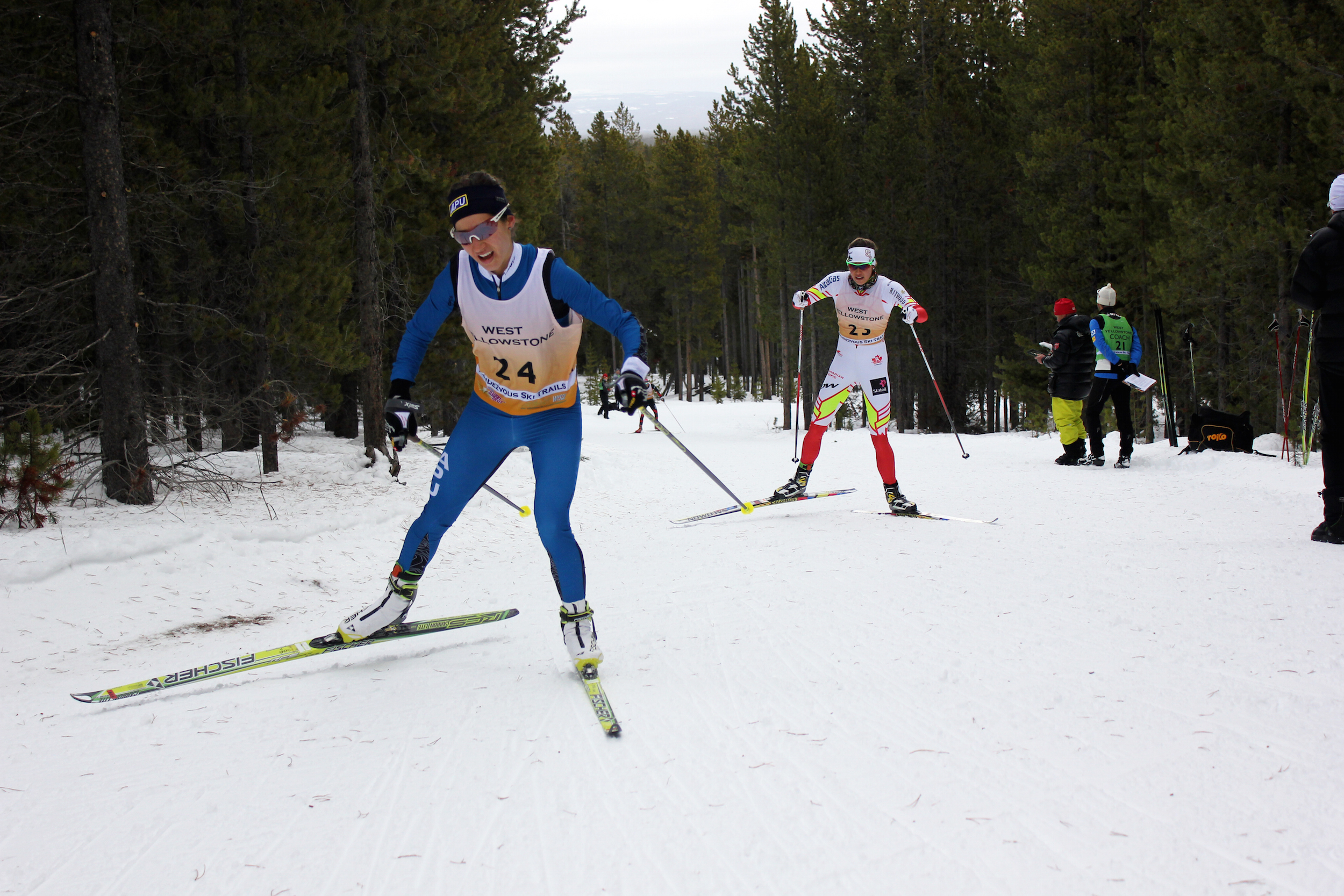
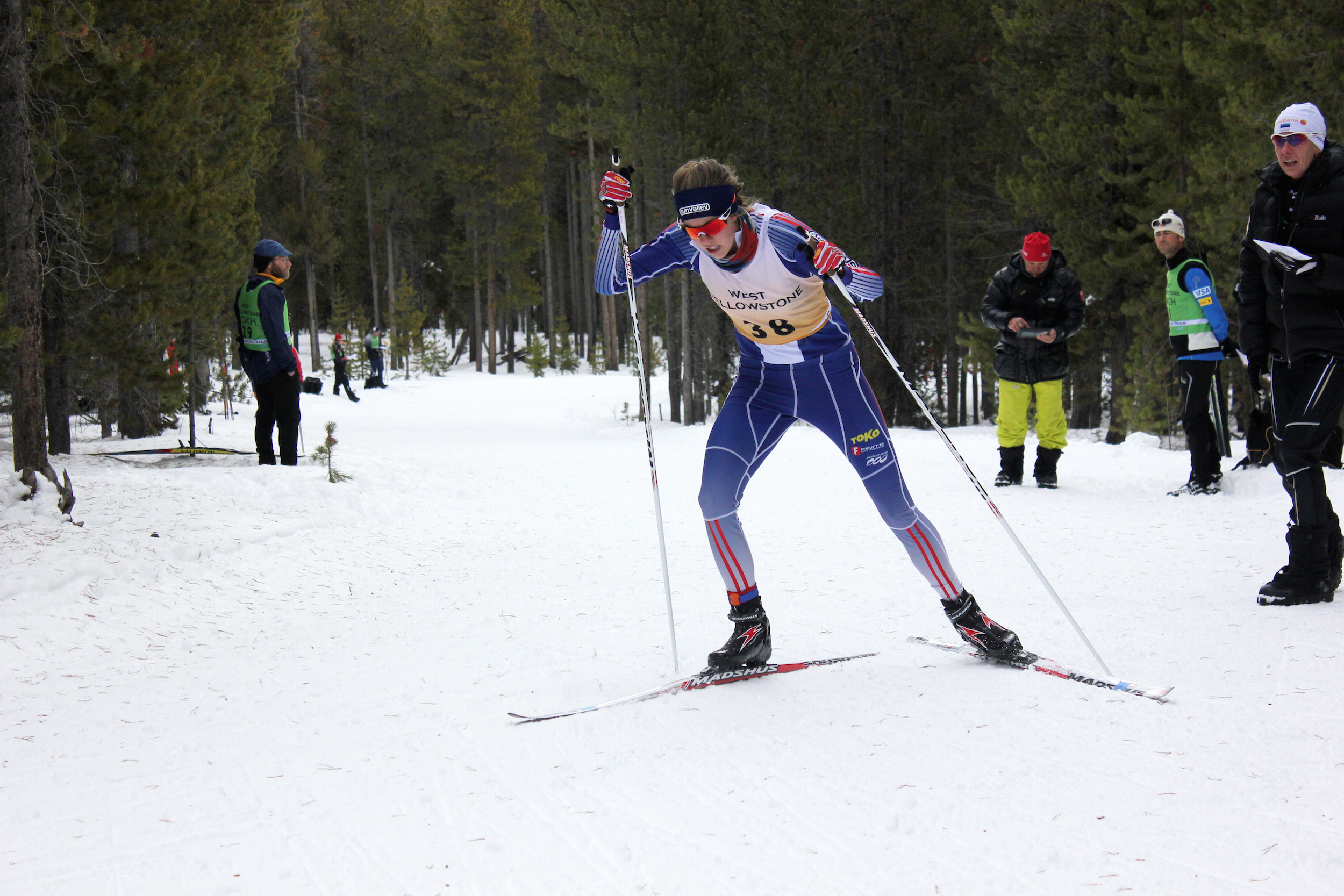
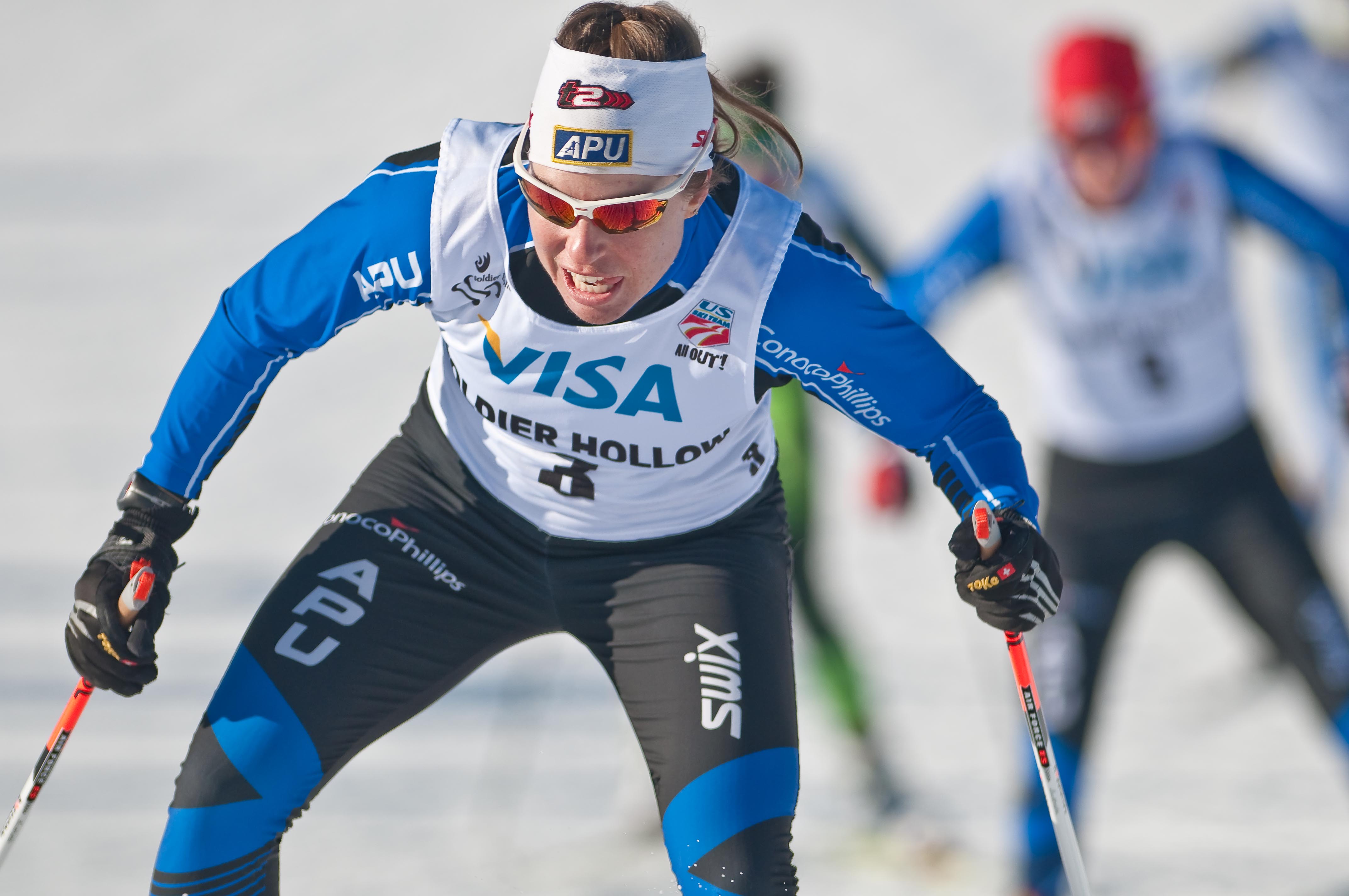
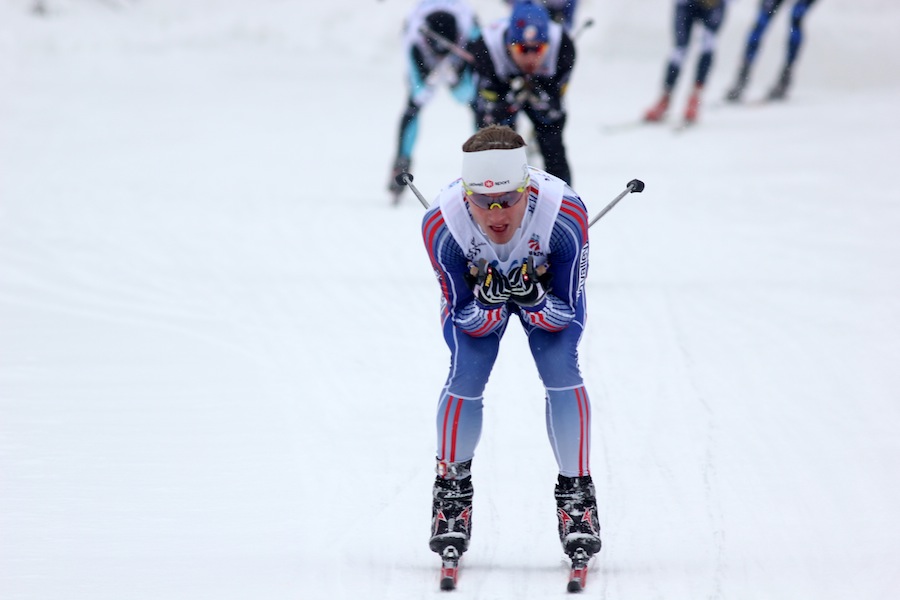
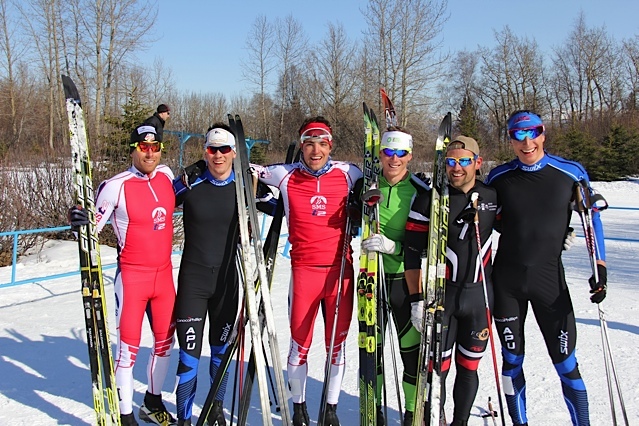
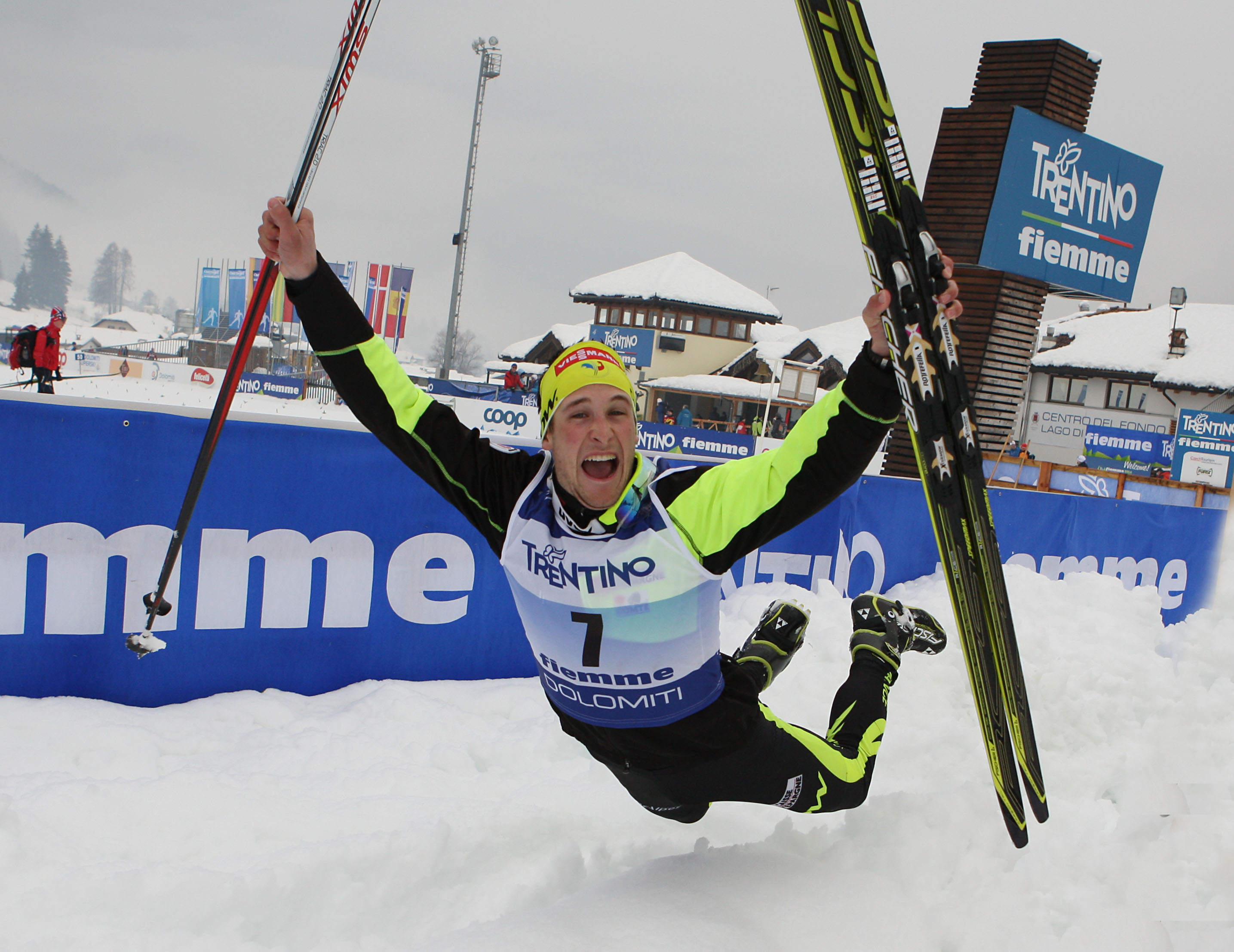
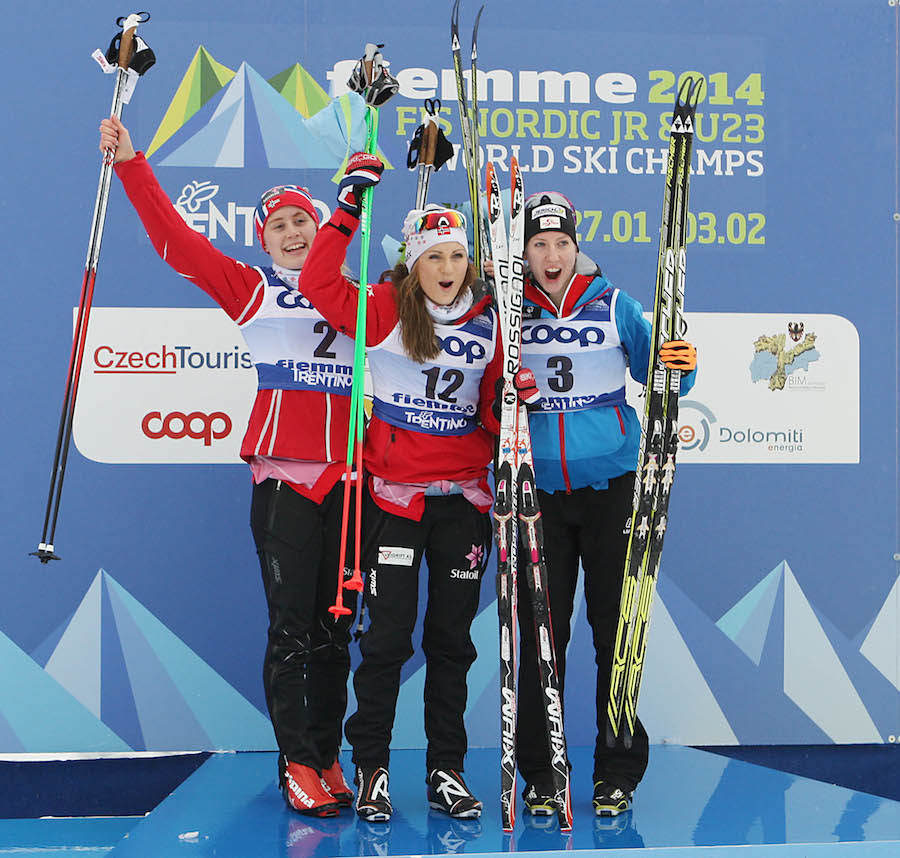
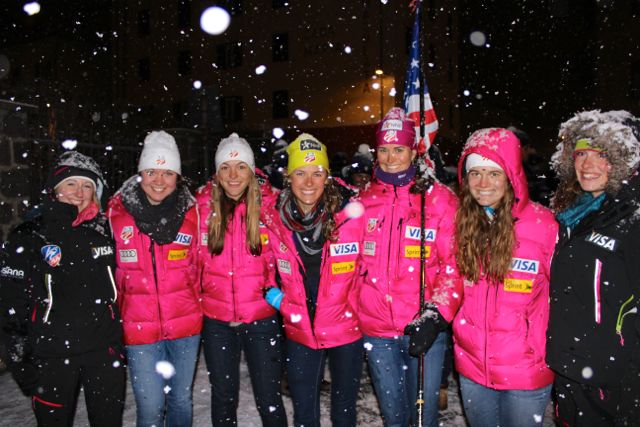
Classic sprint day at the Sovereign Lake Nordic Centre on Saturday, Dec. 9. The NorAm opening weekend also counted as SuperTour races. (Photo: SilverStar Mountain Resort)
VERNON, British Columbia — For the second consecutive year, the Sovereign Lake NorAm was combined with the SuperTour for an expanded field of racers. The warm, sunny, and windless conditions on both days were a welcome change from the previous season’s cold weather and falling snow. What didn’t change was the ‘south of the border’ feel to the leaderboard.
The race formats were similar to that of the Davos World Cup, just nine time zones later: Saturday was a classic sprint (Davos was a skate sprint) and Sunday included 10- and 15-kilometer freestyle interval starts.
With temperatures around -2 degree Celsius and dry, untransformed snow, the waxing was straightforward both days with ski choice dominating the discussions. More than 400 racers competed, including 140 men and 84 women in the open categories.
Classic Sprint
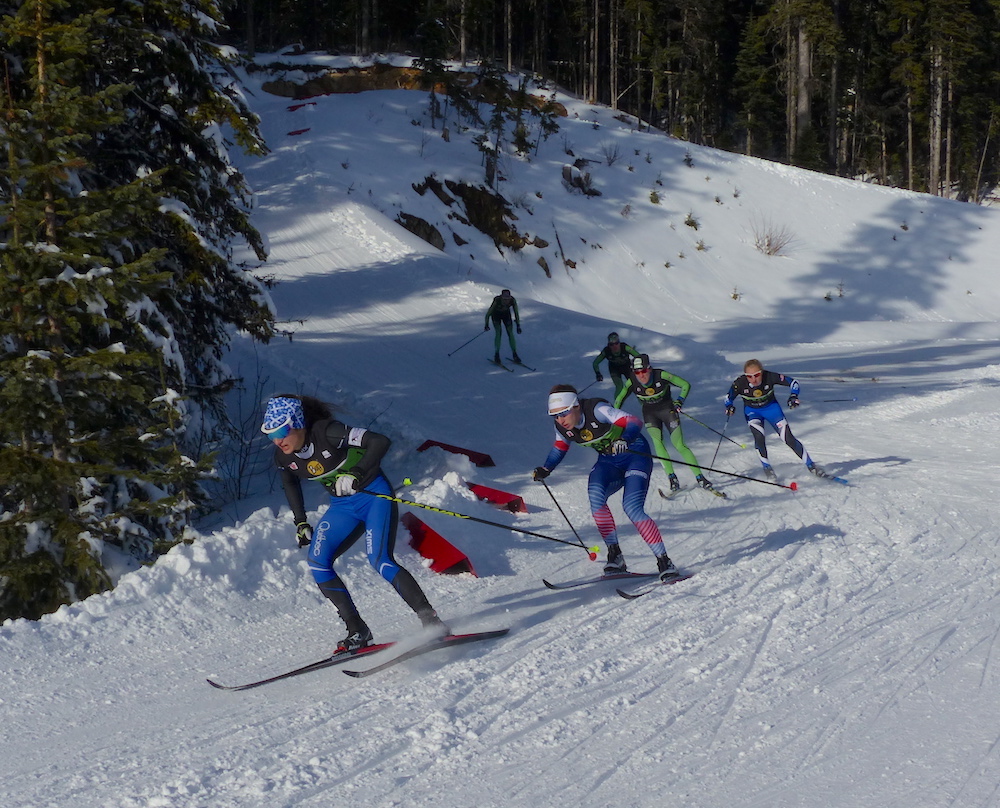
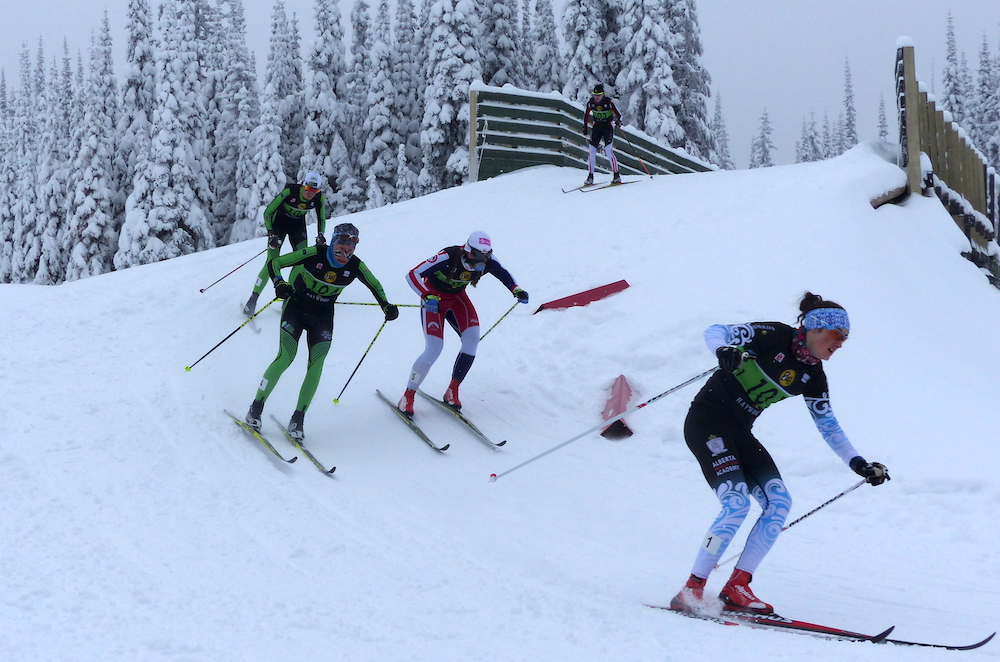
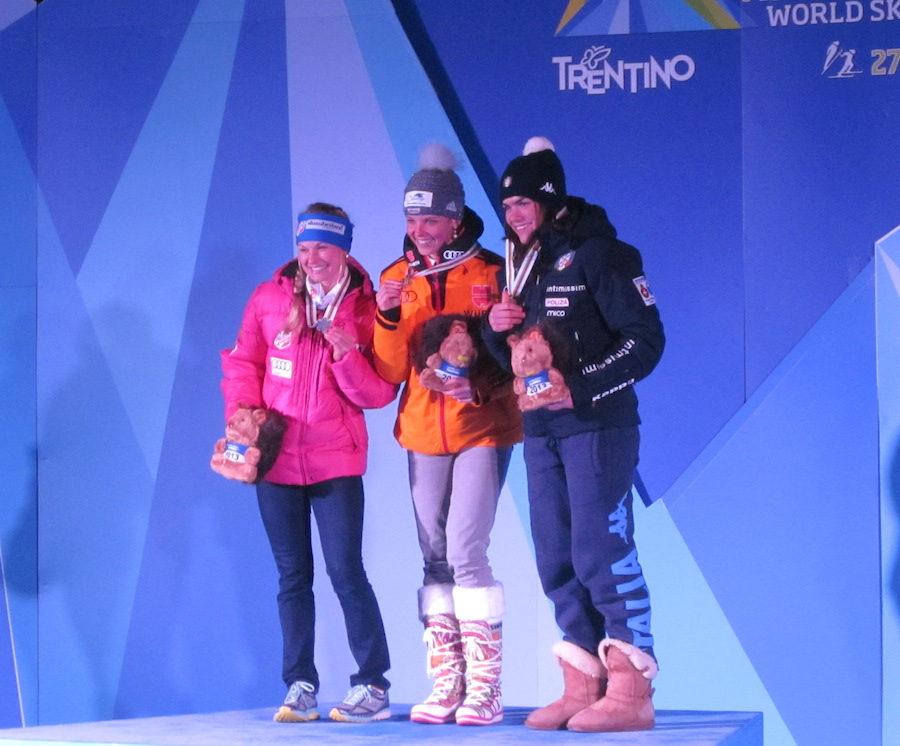
Sophie Carrier-Laforte (Pierre-Harvey National Training Centre) leading the women’s classic sprint final at the Sovereign Lake NorAm/SuperTour on Dec. 9, ahead of Sun Valley’s Kelsey Phinney (second from l), Craftsbury’s Kaitlynn Miller (third from l) and APU’s Hannah Halvorsen (far r). (Photo: Peggy Hung)
Sovereign’s 1.3-kilometer sprint course doesn’t feature large climbs, but it does reward good tactics. There were a few minor incidents off the start when the six tracks became four, and the final 270-degree turn off the bridge into the finishing straight punished tired legs and tight groups.
American Kaitlynn Miller of the Craftsbury Green Racing Project (CGRP) dominated the open women’s sprint, winning the qualifier and all of her heats. In the A-final, Canadian Sophie Carrier-Laforte, of the Pierre-Harvey National Training Centre (CNEPH), pushed the pace from the start, using her double-poling power to stretch the field over the first three climbs. Miller was last into the hole and used the big climb to work her way to the front, where she was able to control the group through the tricky final turn and get first lane choice to take the win in 2:57.53 minutes. Miller’s teammate, Caitlin Patterson powered past Hannah Halvorsen, of Alaska Pacific University (APU) and the U.S. Ski Team (USST) D-team, to take second, 0.93 seconds behind Miller. Halvorsen claimed third (+2.59), Kelsey Phinney, of the Sun Valley Ski Education Foundation (SVSEF) took fourth (+2.59), and a third Craftsbury skier Liz Guiney placed fifth (+3.53). The lone Canadian in the women’s final, Carrier-Laforte, finished sixth (+4.38).
The ‘technique zone’, where only diagonal stride or herringbone techniques are permitted, wasn’t a factor for the women. Finland’s Jasmi Joensuu, a junior at the University of Denver, had tested early in the week and decided to use grip wax for the one steep climb. Joensuu added some excitement the B-final, as she changed clothes and switched to skate skis for her planned cooldown before discovering that the NorAm series does B-finals. Luckily, her classic race skis were still in the start area and she was able to finish third in that heat for ninth overall.
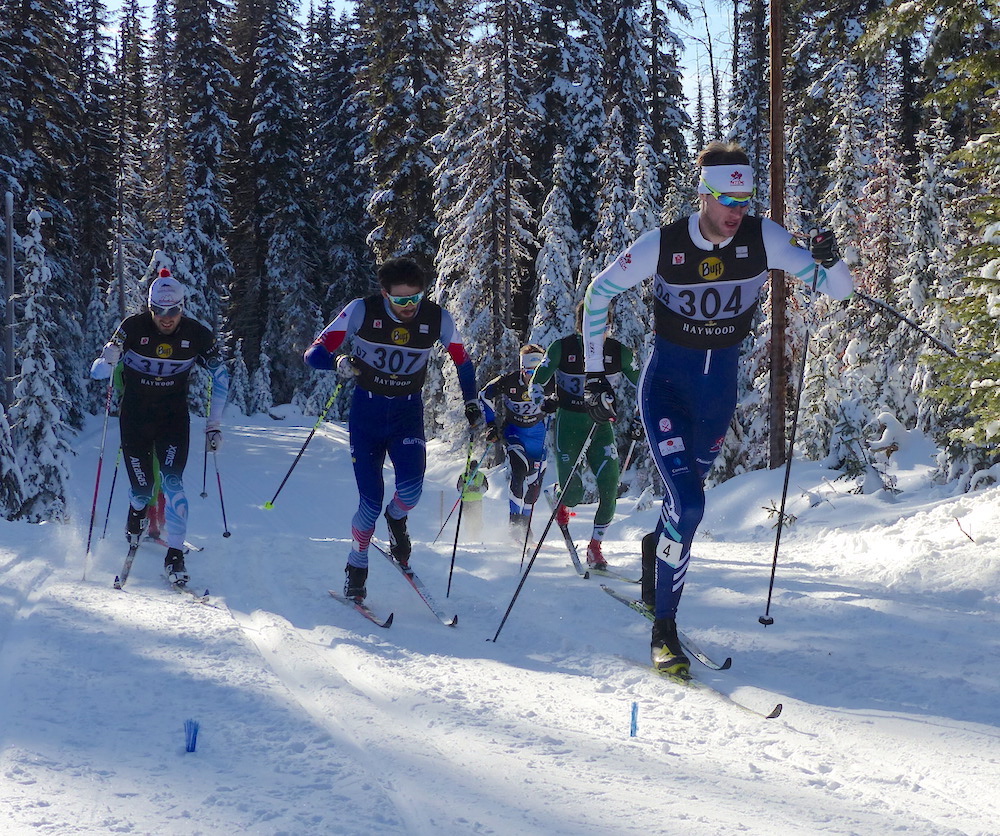
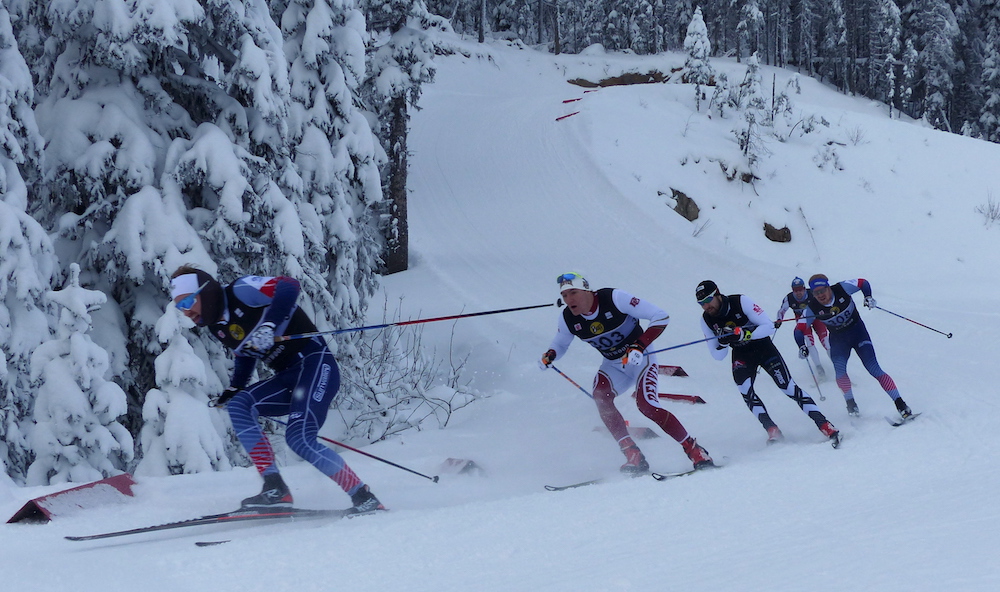
Bob Thompson (304) of NTDC Thunder Bay leading Sun Valley’s Jack Hegman (307) and Patrick Stewart-Jones (317) of the AWCA during their quarterfinal of the NorAm men’s 1.3 k classic sprint on Saturday at Sovereign Lake near Vernon, B.C. (Photo: Peggy Hung)
In the men’s race, Bob Thompson, of the National Team Development Centre (NTDC) Thunder Bay, salvaged Canadian pride with a win after qualifying fourth and placing second in his quarter and semi heats. Thompson was the only Canadian in the A-final, closing a gap to the leading three on the bridge turn and double poling from fourth to first to finish in 2:29.31. American Ben Saxton of the Stratton Mountain School (SMS) Elite Team finished just three-hundredths of a second back for second place, and Cole Morgan edged out his SVSEF teammate Jack Hegman by 0.03 seconds for third (+0.48). APU’s Reese Hanneman and Tyler Kornfield followed in fifth (+7.75) and sixth (+ 7.90), respectively, after being gapped early and losing the battle for the four lanes on the first hill.
In the B-final, the lone Canadian in that heat, Evan Palmer-Charrette (NTDC Thunder Bay) recovered from finishing sixth in his semifinal to take the win (for seventh overall) and earn some important series points.
The technique zone was a larger challenge for the men as they carried more speed into the start of the zone, keeping the jury busy, although only one athlete was disqualified. Many of the top men used just enough grip wax to prevent ‘gliding herringbone’ and the resulting DQ. There were broken poles and one protest at the merge to four lanes off the start, resulting in one verbal warning from the jury, along with a few quarterfinal crashes on the final turn.
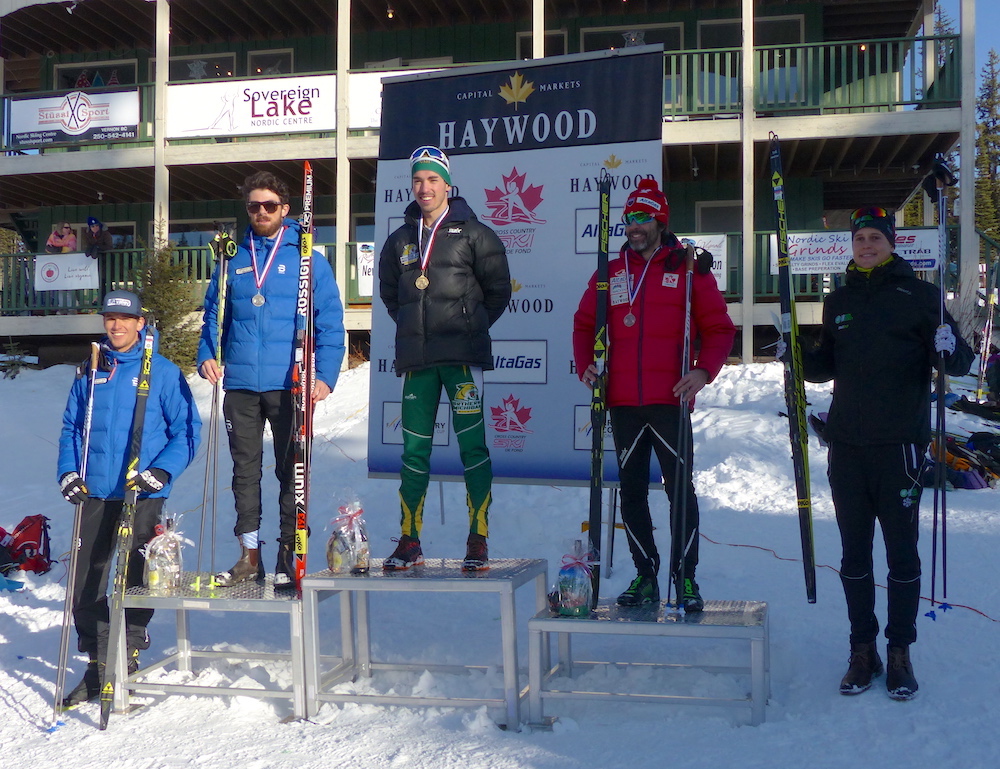
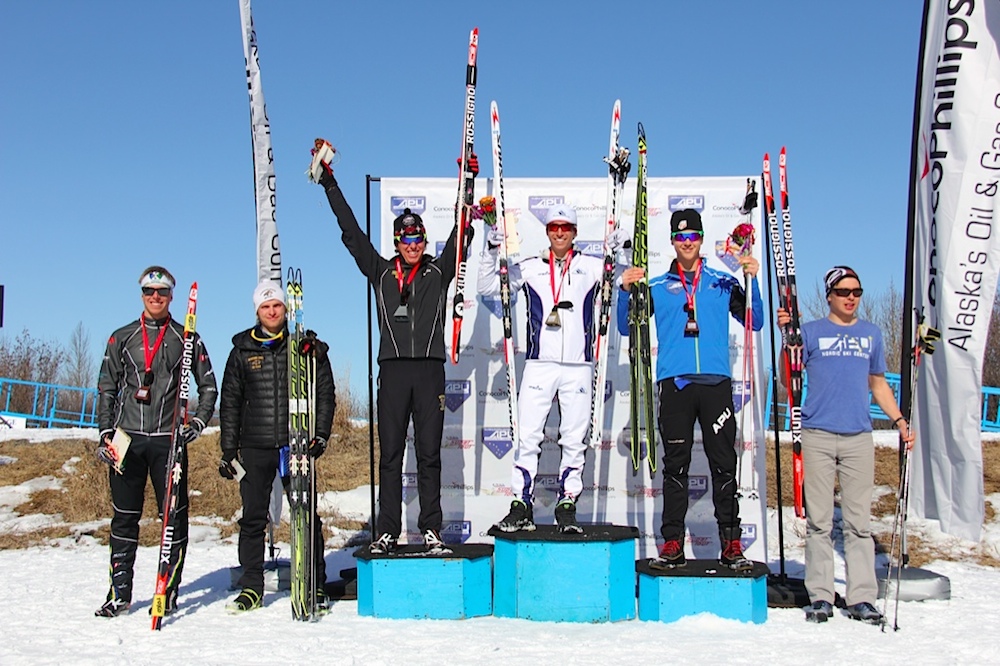
The men’s 15 k freestyle podium on Day 2 of the NorAm opening weekend at Sovereign Lake near Vernon,B.C., with (pictured) Ian Torchia (NMU/USST D-Team) in first, Jack Hegman (SVSEF) in second, Brian McKeever (Canadian Para-Nordic Team) in third, Kevin Bolger (SVSEF) in fourth (far left), Adam Martin (CGRP) in fifth (far right). (Photo: Peggy Hung)
The 5-kilometer ‘Upper World Cup’ course is not obviously difficult to someone casually skiing it in Zone 1; there is one mildly challenging corner, one steep climb (‘the wall’), and the total climb is at the lower limit of the International Ski Federation (FIS) homologation range. But racing it is another story, as evidenced by several top finishers after Sunday’s 10/15 k freestyle interval starts who used words like “nightmare”, “hardest”, and “most painful” in post-race interviews.
In the men’s 15 k, Ian Torchia, a Northern Michigan University (NMU) junior and member of the USST D-team, was on fire, ranking fourth after two of three laps. He described suffering on the last lap and relying on a ride to keep his speed up, but still managed to ski the fastest final lap (in 12:15.7) to take the victory in 36:29.7.
Hegman placed second, 19.0 seconds back, improving on his fourth place from the sprint. Canadian Para-Nordic skier Brian McKeever, who skipped the Canmore International Paralympic Committee (IPC) World Cup to race at Sovereign, notched third (+22.6). Sun Valley’s Kevin Bolger skied three very even laps (11-second variation from fastest to slowest) to finish fourth. Craftsbury’s Adam Martin took fifth (+28.3), just edging out Para-Nordic guide Graham Nishikawa, who led Torchia into the finish and placed sixth (+29.1).
A perennial podium threat at Sovereign and the previous weekend’s SuperTour distance winner, Brian Gregg, of Team Gregg, Central Cross Country (CXC) and Loppet Nordic Racing (LNR), took the lead after Lap 1 with a time of 11:49.8. But by the end of Lap 2, he was visibly losing power, clocking the 18th-fastest lap time, before his 13:10.4 final lap ranked 45th for 16th overall (+1:09).
Thompson, wearing the NorAm leader’s bib after his victory on Saturday, finished 19th (+1:17.2). The combined NorAm and SuperTour fields made for a highly competitive event, with the top 40 men finishing within two minutes of first.
Caitlin Patterson (Craftsbury Green Racing Project) racing to the win in the women’s 10 k freestyle on Dec. 10 at the Sovereign Lake NorAm/SuperTour. (Photo: XTS Photography)
In the women’s 10 k, Patterson moved up from her sprint second place to notch her first win of the season in 27:13.0. She was 30.7 seconds clear of runner-up Rosie Frankowski (APU), and Frankowski claimed second by just one second over Caitlin Gregg (CXC/LNR/Team Gregg) in third.
Katherine Ogden, a Dartmouth College freshman and member of the Stratton Mountain School (SMS) and USST D-team, placed fourth (+50.1), just ahead of Becca Rorabaugh (APU) in fifth (+52.7) and Mary Rose (SVSEF) in sixth (+1:00.9).
Retired biathlete Zina Kocher was the top Canadian in eighth (+1:31.2). Kocher (who raced at Frozen Thunder in November under her new married name of Lawson) will compete as Kocher this season as FIS requires a new passport to register a name change. Not surprisingly for a former biathlete, she enjoyed the skate distance race much more than the classic sprint.
CNEPH’s distance specialist Frédérique Vézina was the second Canadian in 12th overall (+2:03.3).
If you didn’t get your fill of video links above, the local tv station visited the day before the sprints and presciently chose Thompson for their first interview. They also talked to APU’s Erik Flora.
Sprint Photos
The junior men descending after the second climb. (Photo: Anna Sellers)
Men’s X final drops off the bridge into the 270. (Photo: Anna Sellers)
Sunshine on the third descent. (Photo: Anna Sellers)
Ben Saxton leads the way to the bridge. (Photo: Anna Sellers)
Top of the last climb. (Photo: Anna Sellers)
(Photo: Anna Sellers)
Bob Thompson leads early in the men’s A final. (Photo: Peggy Hung)
The men’s A final in the finishing straight. (Photo: Peggy Hung)
Ben Saxton (l) leads Bob Thompson (r) with 50m to go. (Photo: Peggy Hung)
Sophie Carrier-Laforte was pushing hard on the double-pole climbs. (Photo: Peggy Hung)
Caitlin Patterson leads the A final. (Photo: Peggy Hung)
Distance Photos
For more distance photos, find XTS Photography on FaceBook.
This is what retirement looks like for Brittany Webster. (Photo: Peggy Hung)
Caitlin Gregg leads Mary Rose. (Photo: Peggy Hung)
Recovery time for Caitlin Gregg and Mary Rose
. (Photo: Peggy Hung)
Dakota Blackhorse-von Jess on the wall climb. (Photo: Peggy Hung)
Evan Palmer-Charrette (l) chases American Thomas O’Harra in the 15 k skate at the Sovereign Lake NorAm near Vernon, B.C. (Photo: Peggy Hung)
A sparkling race
for biathlete Karen Messenger. (Photo: Peggy Hung)
Photo: Peggy Hung)
Seeing double? Nope, this is Chad Gregg. (Photo: Peggy Hung)
Graham Nishikawa opened a gap on Ian Torchia on the wall climb. (Photo: Peggy Hung)
The trains were forming. (Photo: Peggy Hung)
Former biathlete Zina Kocher likes skate distance more than classic sprints, and the selection race schedule might not work in the current NorAm leader’s favor. (Photo: Peggy Hung)
Looking down from the wall climb. (Photo: Peggy Hung)
Caitlin Patterson is ready to start. (Photo: XTS Photography)
Local national team junior Hannah Mehain entering the stadium. (Photo: XTS Photography)
Brian McKeever blasting the final short climb. (Photo: XTS Photography)
Ian Torchia leads a group on his way to the win. (Photo: XTS Photography)
Jack Hegman chasing the podium. (Photo: XTS Photography)
Jack Hegman has his focus. (Photo: XTS Photography)
Are there photos we are missing? Share with info@fasterskier.com and include photo credit information.
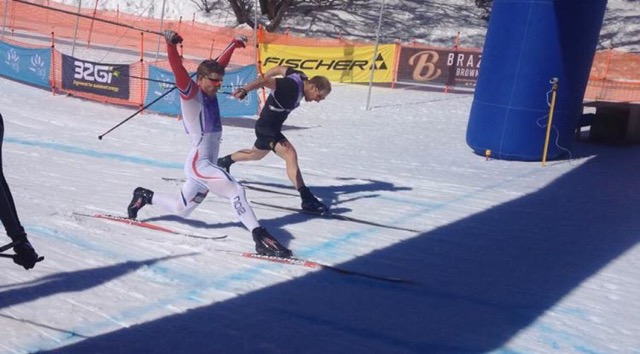
Miles Havlick (l) outlunges Australian national team member Phillip Bellingham for the win in the 42-kilometer 2017 Kangaroo Hoppet on Aug. 26 at Falls Creek in Victoria, Australia. (Photo: AUSXC)
When Australian Phillip Bellingham lunged for the finish line in the men’s 2017 Kangaroo Hoppet a week ago on Saturday, Aug. 26, in Falls Creek, Victoria, it wasn’t his fellow national team member Callum Watson he had to worry about. Nor was it anyone sporting a suit with the Australian flag. It was a skier wearing the colors of Norway.
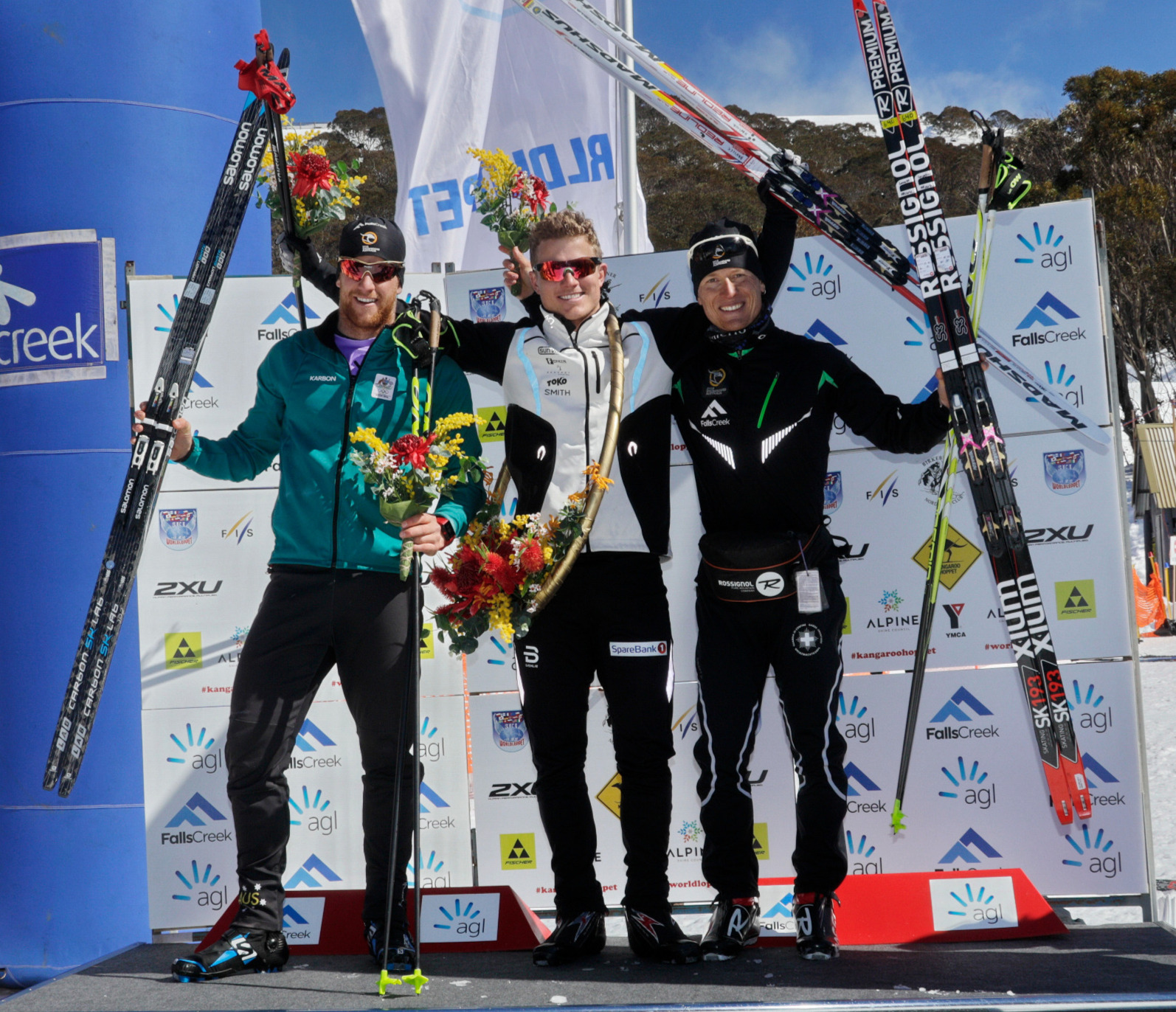
The men’s 2017 Kangaroo Hoppet podium, with American Miles Havlick (c) in first, Australian Phillip Bellingham (l) in second, and Switzerland’s Valerio Leccadi in third. (Photo: Hoppet.com.au)
The winner, however, was not Norwegian. It was American Miles Havlick, a 27-year-old Boulder, Colo., native. Why was he sporting a Scandinavian suit while racing in the Southern Hemisphere? School.
After retiring from professional skiing and leaving the Sun Valley Ski Education Foundation (SVSEF) Gold Team in 2016, Havlick enrolled at the Norwegian University of Science and Technology (NTNU) in Trondheim, Norway, to obtain a master’s degree in exercise physiology (he received an undergraduate degree in exercise physiology from the University of Utah in 2013) through NTNU’s two-year program.
When the Norwegian university went on summer “holiday”, Havlick spent it the way any diehard skier might: on snow. From the beginning of July until the end of August, Havlick worked as the international guest coach for the Birkebeiner Ski Club in Mount Beauty, a small town in Victoria, Australia. Along with leading adult ski clinics, Havlick worked with local primary school and high schoolers as well.
“They have a very welcoming and passionate ski community down there and it was great to experience the skiing culture in the Southern Hemisphere,” Havlick wrote in an email to FasterSkier. “Obviously, I spent a lot of time on snow over the past few months which provided a good opportunity to try to burn off some Tim Tams in between coaching sessions.”
That appeared to be enough for Havlick’s Hoppet performance, which came at the end of his two-month break from school. He, Bellingham, Watson, and Switzerland’s Valerio Leccardi broke away from the pack by 1o k on the course’s infamous “Paralyzer Climb”. From there, the four exchanged the lead until the final push to the finish.
“The last kilometer was pretty hectic with finishers from the Joey and Birkie events clogging up the trail which made weaving around other competitors pretty tactical,” Havlick wrote of the busy race day. “Going into the race, I knew I probably wasn’t in as great of shape as the others but if I could just manage to hang on until the end I would have a shot in the final kick. The race organizers and volunteers did an amazing job with this event and I will certainly be back!”
Havlick outlunged Bellingham by two-tenths of a second for the win in a time of 1:37:24.2 hours. Bellingham claimed second, just one second ahead of Leccardi in third (+1.2).
Missing the podium by 2.8 seconds was Watson in fourth, four seconds back from Havlick’s winning time. A second American and Havlick’s former teammate, Matt Gelso (SVSEF) finished fifth, 4 minutes and 36.2 seconds after Havlick. Gelso won last year’s Kangaroo Hoppet, and returned this year, arriving in Australia a week prior to the event.
“My race played out much differently with me getting dropped relatively early but that wasn’t entirely unexpected,” Gelso, 29, wrote in an email. “I of course was going for the win again this year but it was not to be. Mainly I was happy to be out racing and training after a very frustrating and challenging last 2 months.”
Gelso and his SVSEF teammate Mary Rose spent seven days in Australia before joining their other Gold Team teammates and head coach Chris Mallory in New Zealand.
“Now I am in New Zealand to put in some good specific volume training and do some more racing,” Gelso wrote. “As for more marathons, I am not totally sure. I will possibly race in the Merino Muster down here at Snow Farm but other than that I have not planned out next race season beyond US Nationals.”
Also finishing in the men’s top 10 was American Andre Lovett in seventh (+7:56.2). American Jeremy Hecker placed 14th (+13:25.5), Canadian Caelan Pangman McLean was 15th (+13:30.0), American Jeffery Clarke 68th (+44:04.2), Canadian Dayle Gilliatt 109th (+1:03:04.0), American Aris Apostolou 111th (+1:03:30.5), Canadian Robert Palliser 114th (+1:04:38.3), Canadian Pierre Ethier 126th (+1:09:52.0), Canadian John Wragg 153rd (+1:22:44.5), American Charlie Dee 157th (+1:27:51.9), American Jay Wiener 202nd (+2:13:32.4), and American Robert Saalfeld 205th (+2:22:06.4).
Rose’s Podium Repeat
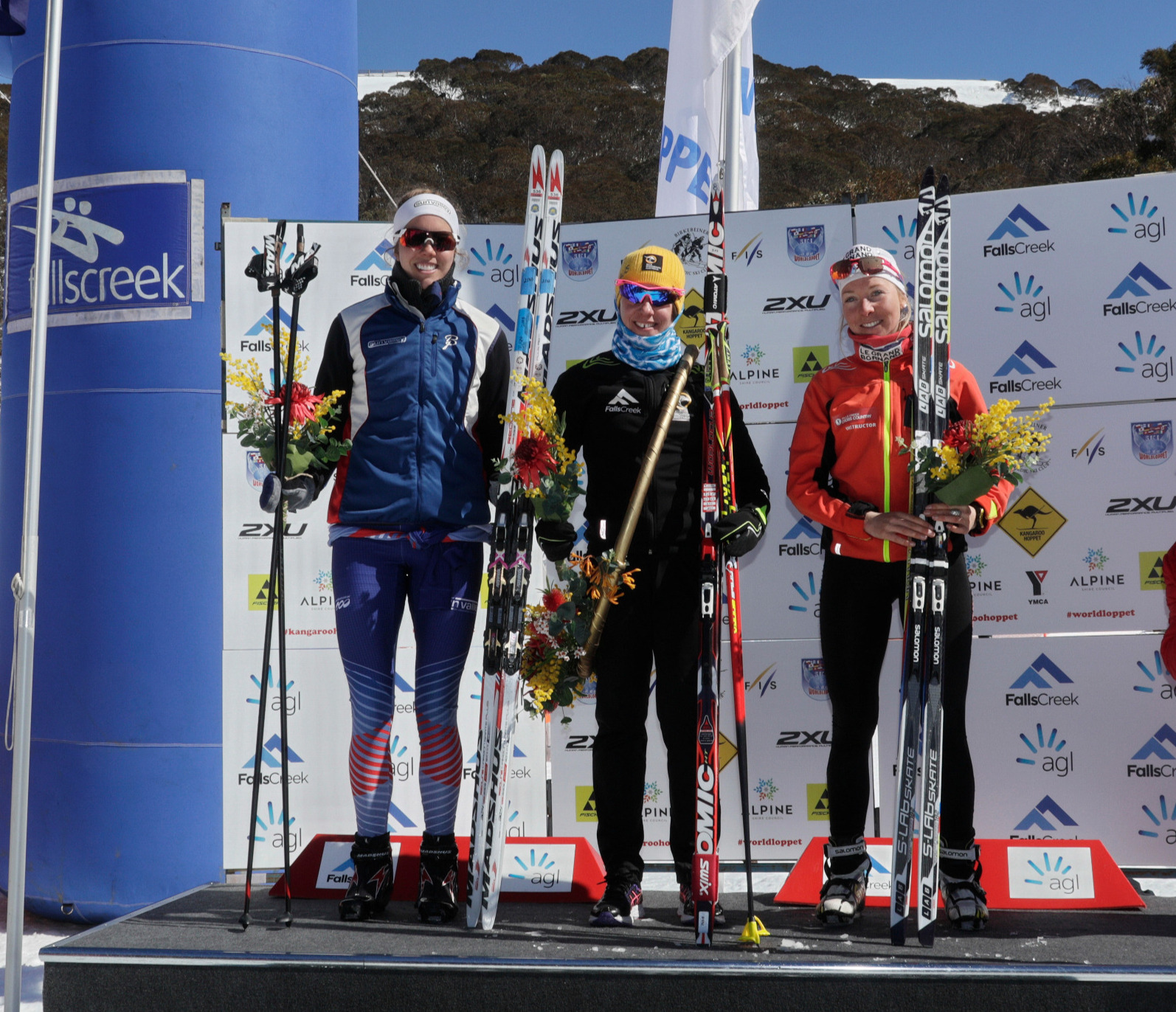
The women’s 2017 Kangaroo Hoppet podium, with Australia’s Barbara Jezersek (c) in first, American Mary Rose (l) in second, and France’s Iris Pessey in third. (Photo: Hoppet.com.au)
In the women’s 42 k race, Australian Barbara Jezersek won in a time of 1:46:59.8. Rose placed second, 5 minutes, 42.8 seconds later. It was Rose’s second straight year as the Hoppet runner-up, having been edged by her SVSEF teammate Deedra Irwin last year.
“I competed in the Hoppet last year and absolutely loved the event!” Rose wrote in an email. “It is exciting to be racing in August and surrounded by over 1,000 cross-country skiing enthusiasts. It is a unique event and one that I plan on attending well after I am done skiing at the elite level.”
Rose’s week in Australia was intended to be used as a chance to adjust to the time zone prior to her club team’s on-snow camp in New Zealand and to get a longer race effort in.
“Like any race, I wanted to win,” Rose wrote of the Hoppet. “I knew that was a lofty goal but one that I thought was achievable.”
The pace set by Jezersek, however, held off Rose from the win and gave the 26-year-old Steamboat Springs, Colo., native a second Hoppet place finish for the second year in a row.
“Barbara Jezersek is a very strong skier and has some notable finishes on the World Cup and at the Olympics,” Rose wrote. “From the start Barbara was skiing very strong and aggressively weaving in and out of all the elite-wave racers. It was difficult to follow her and hold her pace while navigating everyone around us. Once she broke away I skied with 3 other guys until the last 15km and then had to push it in solo. It was an awesome event this year with perfect weather and lots of snow!”
Following Rose was France’s Iris Pessey in third (+8:40.6). The only other North American senior woman to participate in the event, American Kayla Billett, raced to 16th (+47:34.5).
Close to 230 men and 62 women raced the 2017 Hoppet, Australia’s international ski marathon and a Worldloppet. Though Havlick, this year’s male winner, indicated that racing is no longer his priority, he does have a few more marathons he’s keeping in mind.
“At the moment, I hope to compete in the China Tour de Ski during the first week of January which includes the Chinese Vasa and then maybe a marathon or two this spring if it works with my school schedule,” Havlick wrote. “For the most part, my ski racing days are behind me but it was pretty fun to jump into the mix for the Hoppet and come out on top!”
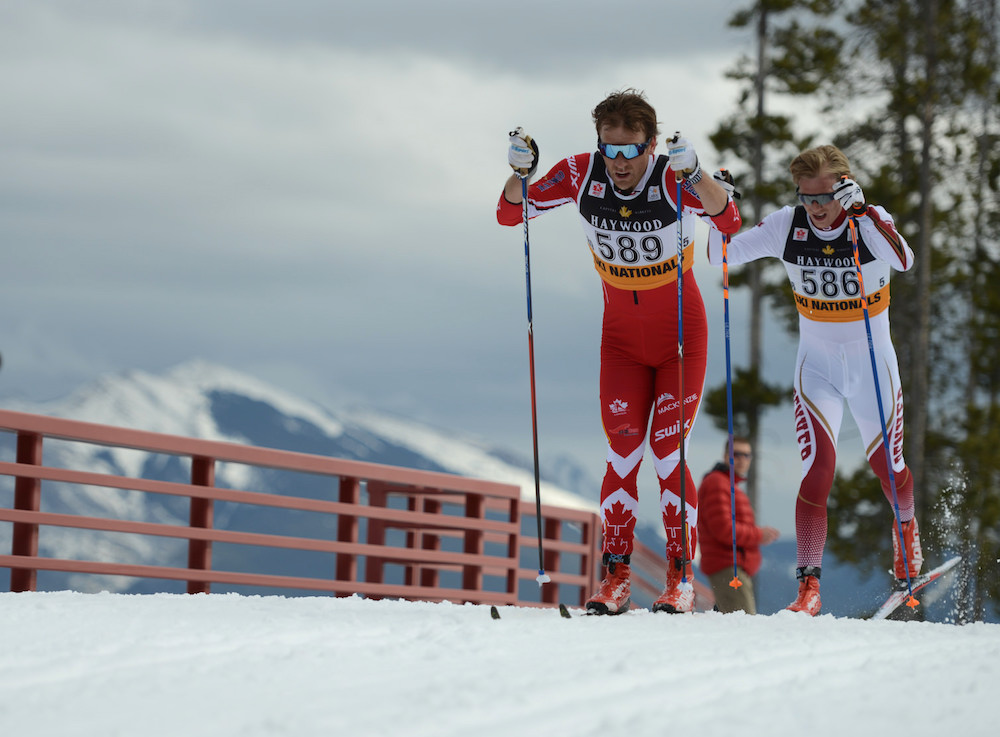
Devon Kershaw (589) leads University of Denver skier Eivind Romberg Kvaale during the men’s 15 k classic interval start on Tuesday at Canadian Ski Nationals at the Canmore Nordic Centre in Canmore, Alberta. Kershaw went on to win and Kvaale placed sixth. (Photo: W. James MacLean)
2017 Canadian Ski Nationals (Canmore, Alberta): Days 1, 2 & 3
On the third day of Canadian Ski Nationals in Canmore, Alberta, World Cup skiers Devon Kershaw and Emily Nishikawa — both fresh off World Cup Finals in Quebec City — picked up victories in the men’s and women’s classic interval starts on Tuesday.
Kershaw won the men’s 15 k in 45:05.3 minutes, 44.6 seconds ahead of two University of Denver (DU) skiers Dag Frode Trollebø and Moritz Madlener.
Both of Tuesday’s second- and third-place men’s finishers reached the podium at NCAA Skiing Championships earlier this month. On Tuesday, Trollebø, who’s originally from Norway, finished second, 44.6 seconds behind Kershaw. Madlener, of Germany, was another 2.2 seconds back in third (+46.8). World Cup skier Graeme Killick was the second Canadian in fourth overall (+1:09.2), and David Palmer, of the Black Jack Ski Club, placed fifth (+1:22.5).
“It was so hard, hot, and the conditions were vicious,” Kershaw said, according to a Cross Country Canada (CCC) press release. “I cramped up with five kilometres to go. It was a really hard day. But this is my home. I love Canmore and I think it is important for the kids to see that even after a hard World Cup season you should come and support the national championships.”
“That was a massive effort for me,” he added. “The conditions were just really, really slow, but I wanted to do this race to end the season.”
Nishikawa won the women’s 10 k classic by nearly 1 1/2 minutes in 29:07.6. American Mary Rose, of the Sun Valley Ski Education Foundation (SVSEF) finished second (+1:24.8), Katherine Stewart-Jones (NTDC Thunder Bay/Canadian U25 Team) was the second Canadian in third overall (+1:27.9) and Frédérique Vézina, of the Pierre Harvey Training Centre (CNEPH), placed fourth (+2:44.7).
“It was great to be back racing today in Canmore and see so many friendly faces out there,” Nishikawa said, according to CCC. “It was tough racing today, having raced three races last weekend in Quebec and then travel, but I was so happy to be able to race.
“I had great skis and was able to have another solid race,” she added. “It is always an honour to win a National Title. I love racing at Nationals.”
“I think it is really important for the next generation to get a chance to compete against, and meet National Team athletes,” she continued. “When I was a juvenile racing at Nationals, I was so inspired to be able to meet some of my idols who were on the National Team, so it’s important to me that I am here.”
While many of the 30 Canadians that competed at World Cup Finals last Friday through Sunday flew directly to Canmore for nationals, the races started without them, with a brand-new collegiate relay cross event on Saturday, March 18, and 10/15 k freestyle interval starts (for the open class) on Sunday, March 19.
The relays put university teams head to head on obstacle courses, with two skiers per team.
The women’s relay win went went to the University of Alberta’s Ember Large and Kathryn Stone, with a team name of “Largely Stoned” as a play on their last names. They won in 13:05.1, just 1 second ahead of Jenn Jackson and Makaila Hudson, representing Lakehead University, in second. The Rouge et Or (University of Laval) first team of Christel Pichard-Jolicoeur and Camille Burbidge Izquierdo placed third, 15.3 seconds back.
In the men’s relay, Rouge et Or/University of Laval, with Alexis Turgeon and William Dumas, took the win in 10:36.7, 17.5 seconds ahead of Lakehead’s first team, Noah Thompson and Gavin Shields, in second. Christopher Weller and Carrington Pomeroy of Carleton University’s first team reached the podium in third (+33.5).
On Sunday, Madlener won the men’s 10 k skate by 6.8 seconds over Graham Nishikawa, a guide for the Canadian Para-Nordic Ski Team, in 23:58.0. Another DU skier, Eivind Romberg Kvaale placed third (+13.4), ahead of Jack Carlyle (Alberta World Cup Academy) in fourth (+20.3). Michael Somppi (NTDC Thunder Bay) was the third Canadian in fifth overall (+25.3).
Retire biathlete Zina Kocher won the women’s 5 k skate by 14.6 seconds over Jenn Jackson (Lappe Nordic) in 13:08.7. Sun Valley took third through sixth with Deedra Irwin in third (+34.1), Kelsey Phinney in fourth (+35.2), Annie Pokorny in fifth (+38.6), and Rose in sixth (+41.7).
Racing continues at the Canmore Nordic Centre on Wednesday with classic sprints. The sprints on Wednesday and Thursday will be streamed live on YouTube. Details here: skinationals2017.com.
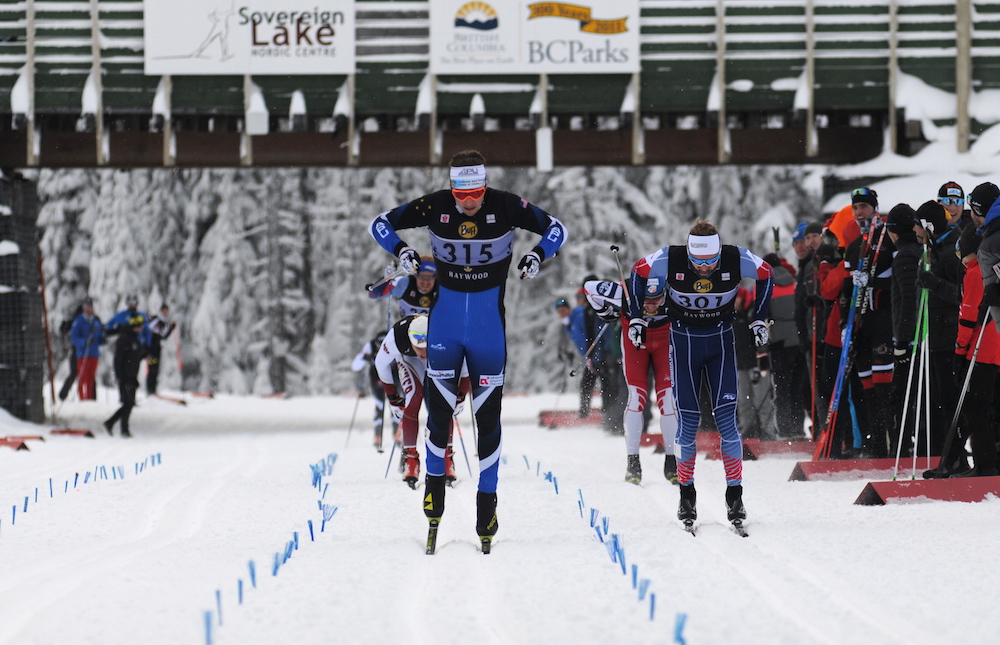
APU’s Reese Hanneman (315) leading down the finishing stretch of the Sovereign Lake NorAm/SuperTour men’s classic sprint final on Dec. 10, with Sun Valley’s Cole Morgan (r), the University of Denver’s Moritz Madlener (behind Hanneman), Stratton’s Ben Saxton (behind Morgan), and Sun Valley’s Matt Gelso (behind Madlener) chasing. (Photo: Doug Stephen)
VERNON, B.C. — It might’ve been the first Canadian NorAm of the season, but the Americans made it all about themselves in what also doubled as their second stop on the U.S. SuperTour circuit this past weekend at the Sovereign Lake Nordic Centre.
U.S. skiers kept Canada off the podium in the classic sprints and freestyle intervals starts on Saturday, Dec. 10, and Sunday, Dec. 11, with Olivia Bouffard-Nesbitt, of the Alberta World Cup Academy (AWCA) and Canadian U25 Team, coming closest in fourth on Day 1.
On Saturday, Bouffard-Nesbitt started off the very first NorAm race, a 1.2 k classic sprint, with a qualifying win. She went on to advance in second in her quarterfinal and third in her semifinal, before finishing fourth in the A-final, 1.49 seconds out of first.
American Julia Kern of the Vermont-based Stratton Mountain School (SMS) Elite Team (formerly the T2 Team) won the women’s final in 3:17.04, after qualifying fifth and placing second in both her quarterfinal and semifinal. Kern led two Craftsbury Green Racing Project (CGRP) teammates, Liz Guiney and Kaitlynn Miller, in second (+0.67) and third (+0.91) on the podium, respectively.
Olivia Bouffard-Nesbitt (AWCA) leads the Americans through the bridge turn in the women’s classic sprint A-final on Saturday, Dec. 10, at the Sovereign Lake NorAm/SuperTour. Stratton’s Julia Kern (second from r) made a tactical choice more than a minute earlier, which gave her the inside position on Craftsbury’s Kaitlynn Miller (l) and the advantage she needed to win. (Photo: Peggy Hung)
Bouffard-Nesbitt led the six finalists into the finishing straight after opening up a wide gap at the top of the second climb.
“Yeah, those Americans,” Bouffard-Nesbitt told FasterSkier after the race. “I was in first until we hit the final finishing straight, and then I just got out-double poled by three of the girls.”
Kern, a U.S. Ski Team Development Team member and Dartmouth student, credited tactical choices for her victory.
“In the quarterfinal, I made the mistake of not taking the outside, which turned into the inside turn on the second downhill,” Kern said.
The second downhill on Sovereign’s sprint course has a gentle right turn leading into a high-speed left, followed by the long climb and then two sharp left turns to the finish. Keeping control of the inside for the last three turns gave Kern the ideal position to take the second skied-in finish lane to cross the line first.
Guiney followed Kern to second, leaving Miller with the fresh snow in lane three.
“I was in third the first half of the course, just stayed in the mix,” Miller said of the final. “I really like the striding hill at the end.”
Despite being slowed in the final straight, Miller loved the conditions.
“This course is really nice, the conditions are awesome,” she said. “I love all the fresh snow. We had really great skis today, so that always helps.”
While Bouffard-Nesbitt was disappointed that there wasn’t a Canadian on the podium, she was happy with her day.
“I haven’t really sprinted this year,” she said, referring to a stress fracture in her foot that put her on crutches for several months this summer. “The intensity I’ve done since I’ve been back on my feet has been almost exclusively controlled Zone 3.”
The fourth American in the top five, Jennie Bender of the Bridger Ski Foundation (BSF) qualified third and finished fifth overall (+3.8). The SuperTour leader after West Yellowstone’s first two races of the season, she was disappointed with fifth.
“It was a tough field out there,” Bender said. “It’s a really short course, lots of turns, three different 180-degree turns. I kind of got swallowed up on the last downhill and lost a little gusto.”
Asked if she was tempted to double-pole the course, Bender laughed and said, “I was! I might of been interested to do it during the qualifier, but I was third, and yeah, I’ll keep the striding.”
A third Craftsbury skier in the A-final, Heather Mooney qualified ninth and went on to finish sixth in the final (+19.84).
“It’s a really fun course, fun with lots of transitions,” Mooney said. “Off the start of the final, I was really excited that we had three from our team. I just didn’t quite have it at the beginning, caught back up a little bit, but I was definitely on and off the back of the pack. Came in last, but it was a good day.”
All six of the women’s B-finalists were American, with Becca Rorabaugh of Alaska Pacific University (APU)ultimately placing seventh, Erika Flowers (SMS Elite) eighth, Mary O’Connell (CGRP) ninth, Jessica Yeaton (APU) 10th, Mary Rose of the Sun Valley Ski Education Foundation (SVSEF) 11th, and Anne Hart (SMS Elite) 12th.
“I definitely wasn’t skiing as fast as I would like to be,” MacIsaac-Jones said, “but I am definitely just happy to be racing and on snow.”
She was eliminated after placing fifth in her quarterfinal and skipped the 10 k freestyle on Sunday for a distance training session instead.
***
The men’s final on the first downhill at the Sovereign Lake NorAm/SuperTour on Dec. 10 near Vernon, B.C. Sun Valley’s Cole Morgan leads Denver’s Moritz Madlener, CNEPH’s Antoine Briand, Sun Valley’s Matt Gelso, and Stratton’s Ben Saxton Saxton in pursuit of APU’s Reese Hanneman (not shown). (Photo: Peggy Hung)
The men’s classic sprint shared the same 1.2 k course and the same American domination of the podium after a semifinal crash took three Canadians out of contention.
Reese Hanneman (APU) double poled to the win in 2:38.08 after qualifying 15th. Cole Morgan (SVSEF) and Ben Saxton (SMS Elite) rounded out the podium in second (+0.87) and third (+1.92), respectively.
“I had a really bad qualifier, for me. I chose a classic ski,” Hanneman said of his qualification round. “But I think [grip wax] was much slower, as the heats showed.”
He described the A-final as fast from the start.
“I had a decent start; I was in second behind Cole up until the top of the first climb. I made a pass, double poled by him, and I was kind of leading into the big climb,” Hanneman recalled.
“Then he and I were side by side, one and two, with a little gap. Then up the steep pitch, he took the lead and I tucked in behind him and just followed him over the bridge. I was able to close down the gap and then pass him and then turn on the jets coming in the final double-pole section.”
Morgan, who won the qualifier and was one of the four others on skate skis in the final, was also pleased with his tactics.
“I did the same tactic as I did in every heat, try to be in second place coming into the big downhill before the last hill,” Morgan said. “[I] was able to lead over the top, but didn’t have the same finish as Reese did.”
Saxton double poled all four laps, as did Hanneman, Morgan and many of the top men.
“I think that was the faster call, but it was definitely a physical task those last heats there,” Saxton said.
Another double poler in the final, the University of Denver’s Moritz Madlener ended up fourth (+1.92) after qualifying third.
“Considering how much we trained the last couple of weeks, it was a great result,” he said.
For Madlener, who is originally from Germany, this marked his first visit to Canada.
“This is German territory. The last time there was a World Cup here, the first five were Germans,” he said, probably not realizing that it was 11 years to the day since that 30 k pursuit event.
The lone finalist on grip wax, Matt Gelso (SVSEF) finished fifth (+3.88) after winning his crash-marred semifinal. Antoine Briand of the Pierre-Harvey National Training Centre (CNEPH) was the lone Canadian in the A-final, with a lucky loser time that was faster than Gelso’s winning time from the other semifinal.
Angus Foster (309) untangles himself after a semifinal crash at the Sovereign Lake NorAm/SuperTour on Dec. 10, as his NTDC Thunder Bay teammate Evan Palmer-Charrette tries to get his breath back. The ski through the bib belongs to Simon Lapointe. (Photo: Shelley Woodman)
For a few Canadian athletes, the crash in the second semifinal was the defining moment of the day. Only 50 metres into the race, Gelso used his inside position in the tight pack to pull in front of Angus Foster, of the Thunder Bay National Team Development Center (NTDC), but Gelso skied over Foster’s ski, triggering a chain reaction.
“[Gelso] got through, but I went down, had two other Canadians go down with me,” Foster said after. “Probably the hardest crash we’ve ever had.”
Foster fell sideways in front of NTDC teammate Evan Palmer-Charrette.
“I just got unlucky, [Foster] fell right in front of me, and I just pitchforked over him, got the wind knocked out of me pretty bad,” Palmer-Charrette said. “Unfortunate, but that’s racing.”
CNEPH’s Simon Lapointe was the third skier in the tangle. Lapointe got up quickly, but a broken binding required him to wait for a coach to run over with a spare ski.
Palmer-Charrette was slow to get up, leaving Foster pinned in place. Foster finished the heat with three holes in the back of his race bib and likely a few ski-shaped bruises underneath.
Lapointe, one of the top Canadians sprinters, was the most frustrated with the semifinal crash. He left the finish area with a quick French-language “nothing to say” before going on to win the B-final by 1.06 seconds over Palmer-Charrette in 2:43.31.
None of the three Canadians protested to the jury member at the finish. Asked directly about whether there was cause for a protest, Foster said “That wasn’t a clean move, but that happens. People make mistakes. Still frustrating, but….”
Gelso was surprised to find only one skier with him at the top of the second climb. “We both went for a track at the same time, and I don’t know what happened,” Gelso said later, “but I’ve been on both ends of that.”
Everyone interviewed spoke favorably of the combined NorAm/SuperTour weekend.
“It’s really nice to get some deeper fields, to get the Americans and Canadians racing together,” Foster said. “It wasn’t so fun to watch the podium here.”
APU’s Scott Patterson leading Canadian junior Ty Godfrey (Team R.A.D.) during the men’s 15 k freestyle interval start on Sunday, Dec. 11, at the Sovereign Lake NorAm/SuperTour. (Photo: Peggy Hung)
Day 2 at Sovereign proved to be more populated with Americans sweeping the top five and nearly the top 10 in the men’s and women’s distance freestyle interval starts.
In the men’s 15 k, Scott Patterson (APU) topped the field by 13.2 seconds with a winning time of 40:00.2. Gelso reached the podium in second — his third this season in four SuperTour races — and Tad Elliott (Ski Club Vail) placed third (+26.6).
The U.S. swept the top eight with Brian Gregg (Team Gregg) in fourth (+54.8), Paddy Caldwell (SMS Elite/Dartmouth/USST) in fifth (+1:20.5), Ben Lustgarten (CGRP) in sixth (+1:27.4), Madlener in seventh (+1:31.3), and Kyle Bratrud (CXC Team) in eighth (+1:33.5).
Russell Kennedy of the Canmore-based Team R.A.D. was the top Canadian* in ninth (+1:38.8), and John Hegman (SVSEF) finished 10th (+1:44.2).
(*While Kennedy lives and trains in Canada, he is originally from Truckee, Calif.)
Out of 112 finishers in the men’s race, nearly 50 were American, and two were Australian national team members.
“Gelso’s definitely in good shape so it was good to hear splits out there that I was leading,” Patterson said. He started in bib 94 behind Gelso in bib 80.
“Fifteen k skate’s kind of been my game, one race I can always fall back to and know I can ski pretty fast,” Patterson added.
Asked about the event doubling as a SuperTour, he said it added competition.
“I would have loved to see the Canadians in West [Yellowstone], but it’s a weird course, makes sense to skip it,” he said of the SuperTour’s usual first stop on the circuit (one of the few places in the U.S. with reliable early season snow) at the Rendezvous Ski Trails in West Yellowstone, Mont. The SuperTour opener was originally scheduled for Bozeman, Mont., which would have been a NorAm as well, but moved because of low snow.
“It’s always fun to have a bunch of people that you don’t know all that well,” Patterson added. “This is my first time in Silver Star and it’s been great. Real winter, and we’ve been lacking that in Anchorage [Alaska].”
After spending a good chunk of last season in Europe on the World Cup, Patterson noted that even those venues tend to rely on manmade snow.
“It’s nice to have dumping snow out here,” he said.
“I think the third lap, things started to slow down,” Patterson added about the race itself. “I was getting ice through my glasses and eyes. It made things feel a little more closed in, feel like it’s snowing harder. I think it slowed down a little bit, but maybe that’s just getting tired, too.”
Sun Valley’s Matt Gelso (front) charging a false flat on his first lap of the men’s three-lap 15 k freestyle on Dec. 11 at the Sovereign Lake NorAm/SuperTour, followed by Welly Ramsey (Ford Sayre). (Photo: Peggy Hung)
Gelso recalled a slower last lap as well, but was pleased with his effort.
“It’s a great course, and it was fun,” he said.
Gelso was strongly in favor of combining the two North American circuits whenever possible, recalling a conversation he had with some U.S. and Canadian national-team members at 2015 World Championships.
“Devon Kershaw and a bunch of the Canadians and Americans were staying in the same hotel, and we were talking about how cool … instead of having one Canadian, one American that goes to the World Cup on the Continental Cup, why [doesn’t the International Ski Federation] give North America three spots for Canada and the US, and all of our races are together?” he said. “Sometimes it will be three Americans, sometimes it will be three Canadians, sometimes it will be two and one, whoever’s racing fast. The more we are racing together, I think the better we’re going to fare internationally.”
“I mean, we’re friends with these guys, we know who they are,” Elliott said of racing with Canadians. “Michael Somppi, Kevin Sandau, they’ve been visited us at U.S. nationals last year. Silver Star’s gorgeous, great skiing, great course, well-run races, so it’s always a pleasure to visit here.”
Elliott, a former U.S. Ski Team distance skier, described feeling surprised with his effort on Sunday after what he called a “great sprint” in West Yellowstone (in which he placed 14th) followed by a head cold, which forced him to skip the West Yellowstone distance race.
“I rested all week indoors, and I felt incredible today,” he said.
Kennedy in ninth called his race a solid start, but had hoped to finished a “little higher up.”
“The U.S. guys are skiing super-strong right now, you could just see it out there,” Kennedy said. “I thought I was skiing pretty well, and then got some splits off of Gelso, and OK, they’re moving. I am hoping when we have [World Championships] trials in Park City, we’ll be a little bit more up there, but we’ll see. It’s good to have that competition, too. You can’t rest anywhere, you have to push everywhere, so that’s good.”
Asked about the NorAm/SuperTour combo, he was also positive.
“It’s good for us to have the extra competition and it’s good to race new faces,” Kennedy said. “Especially in sprints, you get used to the same tactics from the same people. When you have someone new, it’s nice to have to adjust your tactics and be prepared for what they’re going to do when you don’t know them as well. In distance, it’s really cool to have new guys to chase. I can kind of know the Canadians, what’s happening with them, but I was chasing down David [Norris] today, and he kind of surprised me how strong he was on the last lap, it was good to have that extra push, for sure.”
The second-fastest Canadian man of the day, Alexis Dumas (CNEPH) placed 15th (+2:13.1).
“I feel really fast on the one-skate, and the uphill was good, too,” Dumas said after. “I improved a lot my offset this summer, so it was good for this course.”
In terms of season goals, he’s looking to qualify for U23 World Championships, where he’d like to achieve a top 20.
***
Chelsea Holmes leads Erika Flowers at the 5 k mark of the women’s 10 k freestyle interval start on Sunday, Dec. 11, at the Sovereign Lake NorAm/SuperTour. (Photo: Marie-Éve Bilodeau-Corriveau)
In the women’s 10 k, Chelsea Holmes (APU) took the win in 30:42.9, topping the time of the race’s previous leader, Katharine Ogden (SMS Elite) by 13.4 seconds. Stratton had two on the podium with Flowers in third, 36.4 seconds back from Holmes.
“The course was really hard, but my techs and coaches gave us really good skis,” Holmes said after. “Today, I had the most amazing team, all the boys finished and they were cheering so hard.”
Holmes started 30 seconds after Flowers and 1 minute behind her APU teammate Rosie Frankowski.
“Chelsea started right behind me, and her and Frankie [Frankowski] and I all skied together for most of it, which made it a lot more fun cruising through the snow,” Flowers recalled. “We had a good little crew going, so it was hard, but hard with friends.”
Frankowski finished with Holmes and 59.9 seconds off her winning time in sixth place, behind Gregg in fourth (+40.8) and Rose in fifth (+51.7). APU had three in the top seven with Rorabaugh in seventh (+1:09.8). Craftsbury’s Guiney placed eighth (+1:17.9), Deedra Irwin (SVSEF) was ninth (+1:18.4), and Kern, Saturday’s sprint winner, 10th (+1:24.8).
For the second day in a row, Bouffard-Nesbitt was the top Canadian woman, placing 13th (+1:51.8). Of the top 20, the U.S. swept all but three places: 13th, 18th with NTDC’s Annika Richardson, and 20th with Sovereign Lake’s own Hannah Mehain. (Both Richardson and Mehain belong to Canada’s Junior National Team.)
“I’ve never had an easy race at Silver Star,” Bouffard-Nesbitt said after Sunday’s 10 k. “It was really hard as usual. To be honest, all morning, I feel pretty wrecked from yesterday’s race. Whole body, that sprint really took a toll on me. I was kind of just trying to play the hand I was dealt the best I could, make the most of it. I think I’m happy with it.”
Asked how she felt about being the top Canadian for the second-straight day, albeit outside the top 10, she replied, “Let’s say, bittersweet. Obviously, we want to have Canadians represented at the top of these fields, among the Americans, but of course I’m happy to be top Canadian.”
Regardless, she was glad to have the competition.
“We not coming here to have easy wins; we’re coming here to be challenged,” Bouffard-Nesbitt said. “I’m very happy to have them here, and I’m very happy when they can show us what fast racing looks like.”
Sixty-two women finished the distance race, and about half were American. Most of the NorAm field is headed to Rossland, B.C., for next weekend’s NorAm, which is not a SuperTour and will not count toward the U.S. Ski & Snowboard Association’s (USSA) national ranking list.
Toko Designer
Elite ski racer Mary Rose introduces the designer color in the Toko drink belt, buff, and race hat.
Online Toko Retailers
This is a list of Toko dealers that have online shopping capability and a decent selection of Toko products.
Another great option is to order from TokoUS.com where every product, option, and color is in stock. We use a system that gives dealers in the same region as you the option to claim orders if they have the product in stock. This way you can see and order every Toko product but at the same time support local dealers. All orders over $50 yield free shipping until Christmas!
Wax Clinic
Ian Harvey will be giving a General Wax Clinic for Nordic skiers at the Aspen Cross Country Center on Monday December 5 at 5:30 pm. For a schedule of other Nordic wax clinics throughout the country, click here. Monitor this because we are adding clinics every week.
How to Wash Down Items
Do you have a down jacket or sleeping bag this is now dirty and you are afraid to wash it? Use Toko ECO Down Wash! This video gives a brief explanation. One bottle of Toko ECO Down Wash yields 7-10 washes depending on how hard the water is and how big the load is.
Katharine Ogden (SMS/USST) racing to an 11-second win in the women’s 5 k freestyle FIS race on Friday in West Yellowstone, Mont. (Photo: Ian Harvey/Toko)
The first official cross-country ski races of the season in the Lower 48 were held Friday in West Yellowstone, Mont., and for the first time in a long time, they weren’t U.S. SuperTour races.
But they were International Ski Federation (FIS) sanctioned and once again a big part of the West Yellowstone Ski Festival, which has been known to attract 3,500 skiers and has been an early season tradition for more than 30 years.
Paddy Caldwell, of the U.S. Ski Team’s D-team, Dartmouth College and the Stratton Mountain School (SMS) T2 Team, won the men’s 10-kilometer freestyle on Friday at the Rendezvous Ski Trails. He bested nearly 90 in the men’s race, putting down the fastest time in 20:32.4 minutes, which was 26.7 seconds ahead of runner-up Rogan Brown, of the Sun Valley Ski Education Foundation (SVSEF). Mads Strøm, a Norwegian-born University of Colorado-Boulder (CU) senior and two-time NCAA champion, placed third, 31.1 seconds behind Caldwell.
Just 0.2 seconds off the podium, Sun Valley’s Jack Hegman placed fourth (+31.3), and Ben Lustgarten, of theCraftsbury Green Racing Project (CGRP), was close behind in fifth (+32.4), as was Silas Talbot, of the Bridger Ski Foundation (BSF) Elite Team, in fifth (+37.4).
Rounding out the top 10, Karsten Hokanson (Montana State University) placed seventh (+53.6), Patrick Johnson (Far West) was eighth (+56.7), and Norway’s Petter Reistad (CU) and Welly Ramsey (Farmington Ski Club) tied for ninth (+57.6). Oscar Ivars (University of Utah) took the next spot in 11th (+1:01.5).
In the women’s 5 k freestyle, Katharine Ogden, another U.S. Ski Team (USST) D-team member who trains with SMS, took the win. She beat out CU’s Petra Hyncicova, originally from the Czech Republic, by 11.8 seconds with a winning time of 11:45. One of Ogden’s training partners, Erika Flowers (SMST2) placed third (+13.3).
Craftsbury’s Liz Guiney took fourth (+19.4), Jennie Bender (BSF) was fifth (+22.4), Mary Rose (SVSEF) sixth (+27.0), Anne Hart (SMST2) seventh (+32.8), Christina Rolandsen (CU) eighth (+34.7), Kaitlynn Miller (CGRP) ninth (+36.5), and Hannah Halvorsen (Sugar Bowl Elite Team/USST D-team) 10th (+36.8) in a tighter women’s field, which included 76 finishers.
FIS racing continues at the Rendezvous Trails on Saturday, with 5/10 k classic races scheduled.
In related news, the first SuperTour races of the season — which were supposed to take place next weekend, Dec. 3-4 — were canceled. At the top of the Bridger Ski Foundation’s SuperTour event page, it now reads: “Bozeman SuperTour Cancelled: Due to lack of snowfall the races are not able to be run.” The SuperTour opener doubled as the first races of the Canadian NorAm season as well.
Just like in the U.S., Cross Country Canada (CCC) intended to use Bozeman as part of its selection races for 2017 World Championships and the Continental Cup leader (COC) World Cup spots. Now instead of considering an athlete’s best three results out of seven race days, CCC will consider three out of five.
“Bozeman was part of our NorAm COC series selection process; however now that Bozeman is cancelled it’s not in the picture,” CCC High Performance Director Thomas Holland wrote in an email to FasterSkier on Friday night.
“Are you ready for some more West Yellowstone fun? ‘Cuz we’re hosting the SuperTour next weekend December 3 & 4,” the post read. “Saturday Freestyle Sprints, Sunday 15k/10k Classic; 5k U16 Classic. Registration site is in progress but will be on ysfraces.athlete360.com. And can you volunteer? Send us a message at info@skirunbikemt.com to give us your info. Thanks!”
“The altitude at West Yellowstone is too high to use it as a selection race for the Canadian team – will not count for the FIS COC series,” Holland wrote.
We’ll post more information as it becomes available.
Liz Stephen celebrating her win and new course record at the 2014 Climb to the Castle. Stephen has the most women’s wins in 10 years of the Climb, winning five of those races, and also holds the women’s course record.
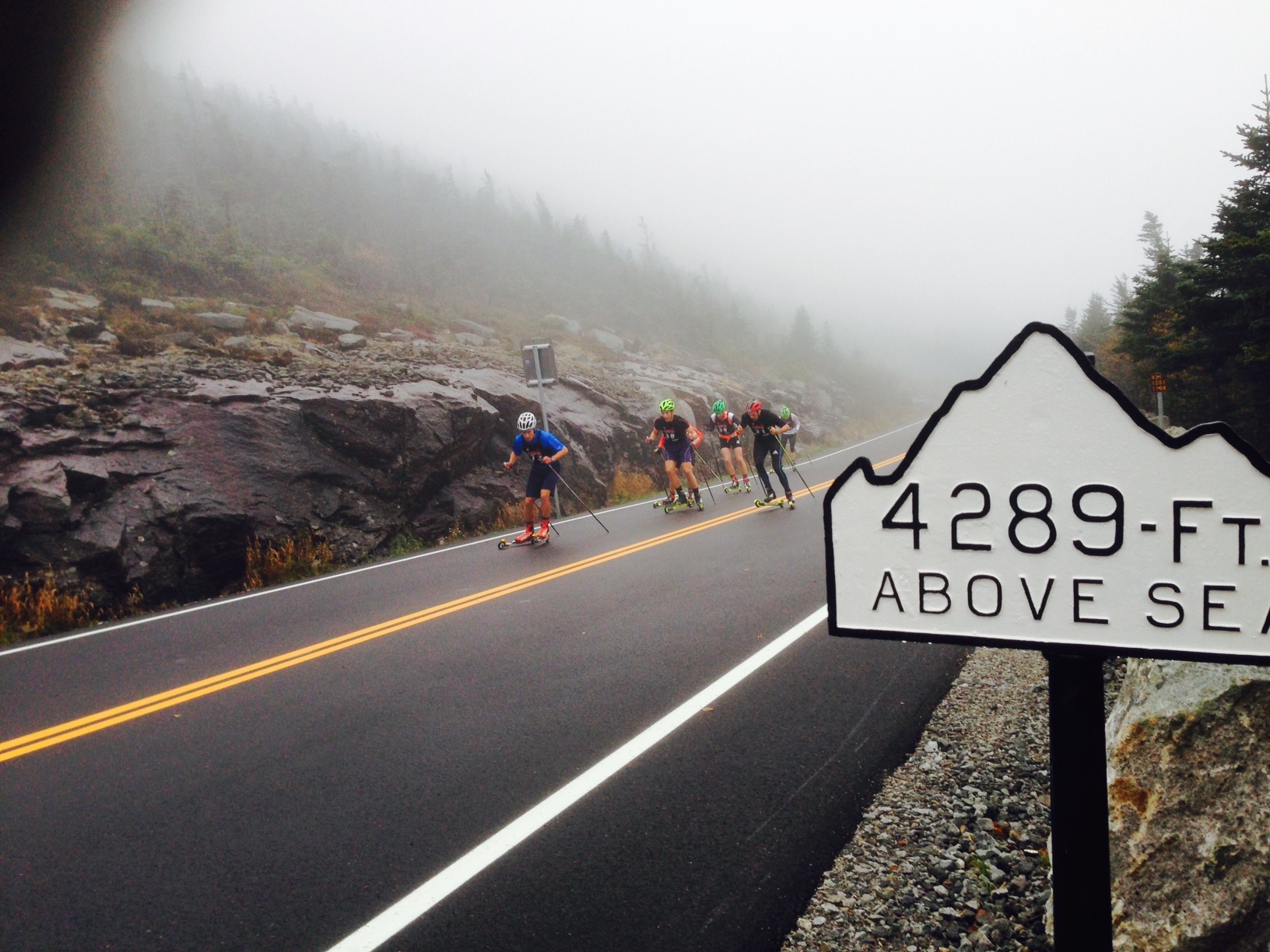
For the last decade, the Climb to the Castle has been a fall staple in northeastern New York. It’s been a circled on the calendars of the U.S. Ski Team and US Biathlon national team almost every year since its inception and attracts 75 to 100 no-joke skiers to Wilmington (near Lake Placid, N.Y.) each year.
Following the 10th annual rollerski race up Whiteface Mountain’s toll road, a five-mile grind with an average 8 percent grade, we thought it would be worth looking at course records and some of the climb’s legendary winners.
***
Most wins: Liz Stephen (5), Duncan Douglas (3)
Course records: Duncan Douglas (34:56.6) 2007, Liz Stephen (41:50) 2014
***
Paddy Caldwell (black shirt, yellow helmet) of the U.S. Ski Team D-team and SMST2 Team chases Rogan Brown (l) around mile four at the 2015 Climb to the Castle. Caldwell won the race, followed by biathletes Russell Currier and Tim Burke in second and third, respectively. Brown (SVSEF) placed fourth and Kyle Bratrud (CXC) was fifth. (Photo: Tim Cowan)
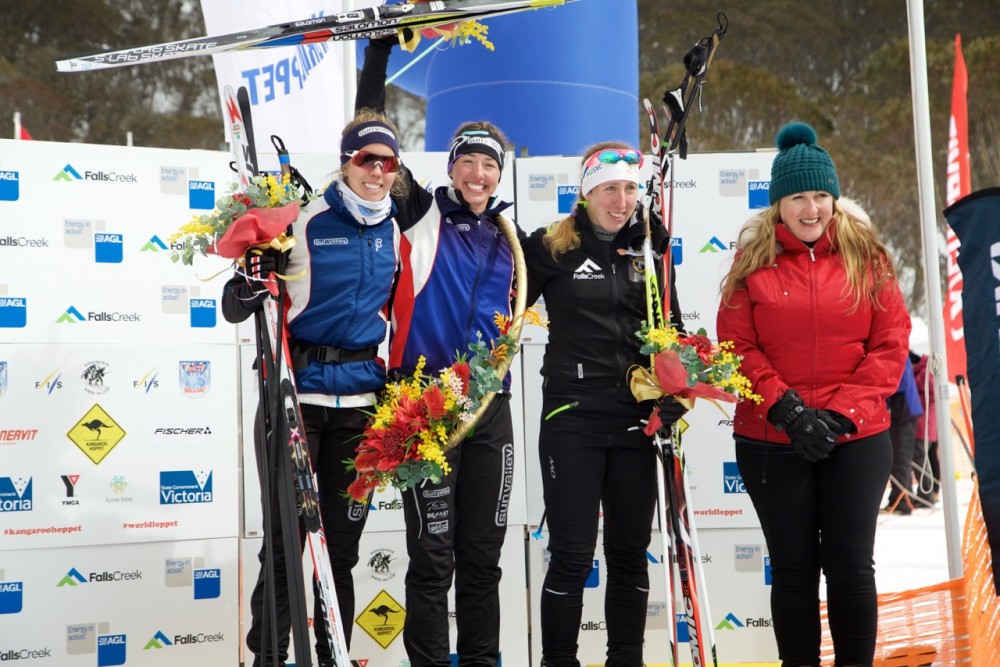
Americans Mary Rose (l) and Deedra Irwin (second from l), both of the Sun Valley Ski Education Foundation (SVSEF), along with Australian Aimee Watson on the podium at the women’s Kangroo Hoppet 42-kilometer freestyle marathon on Saturday, Aug. 27, in Falls Creek, Australia. (Photo: Kangroo Hoppet)
Note: This article has been updated to include official results from the Merino Muster.
In their first ski marathon south of the equator, a few Sun Valley Education Foundation (SVSEF) Gold Team team members founds themselves on the podium two weekends ago at the Kangaroo Hoppet on Aug. 27.
After spending nearly a month training on snow in the land down under, SVSEF teammates Deedra Irwin and Matt Gelso finished their Australian training camp on top of the podium, winning the respective women’s and men’s 42-kilometer Hoppet, part of the Worldloppet marathon race series, in Falls Creek, Australia.
“Not many people can say that they’ve skied and raced a marathon in Australia,” Irwin wrote in an email. “The Nordic ski community down there is also really supportive and was excited to have us there. There were lots of people cheering for us along the way.”
Irwin skied most of the 42 k freestyle race alongside her Sun Valley teammate Mary Rose. From start to finish, Irwin explained it was predominately a race between the two of them, with Irwin outlasting Rose by 0.6 seconds with a winning time of 2 hours, 8 minutes and 15.6 seconds. Finishing more than 12 minutes later, Aimee Watson was the leading Australian in third place (+12:17.7).
“The competition was mostly just Mary and I from the start,” Irwin wrote. “The race came down to a sprint … I got in front of her at the right time and was able to push through the finish first. Skiing with her during the Hoppet taught me a lot about marathon racing. She is a really strong skier and it was fun to be with her during the race and try to match her moves.”
Sun Valley’s Deedra Irwin after winning the 2016 Kangaroo Hoppet on Saturday Aug. 27, in Falls Creek, Australia. (Photo: Kangaroo Hoppet)
Rose pointed out that there was plenty of competition besides her teammate.
“Most of the Australian National Team competed, along with some AUS legends like Esther Bottomley,” Rose wrote in an email.
Both Irwin and Rose plan to race another marathon this coming winter, the 2017 American Birkebeiner in February, which is also part of the Worldloppet marathon series. And next summer, Rose indicated that she might return to the Kangaroo Hoppet.
“I don’t have any marathons on my race schedule for this coming year, except the Birkie,” Rose wrote. “I will for sure be returning to Australia to compete in this event, hopefully next year!”
First across the line in the men’s race, Gelso beat out Australian national-team athletes Phillip Bellingham and Nick Montgomery, who finished in second and third, respectively. Just over the halfway point, Gelso explained the front group gradually began to dwindle.
“It split up into five guys, maybe with 20 k left,” he said on the phone from Australia. “At 5 k I kind of blew off the front … and in the last 4 k it turned into, like, three separate people.”
Gelso has raced at least two marathons before, finishing seventh in the 2014 American Birkie and 16th at the 2014 Engadin in Switzerland.
For winning the Hoppet, both Irwin and Gelso received $1,300 Australian dollars, as well as a wooden plaque, compression socks and a mug. More than 230 men competed, and 64 women finished this year’s edition of the race.
“The organizers of the events and the volunteers involved put on a race that I will never forget,” Irwin wrote. “Thank you to the Australian ski community for having us there and letting us enjoy their beautiful winter.”
American winner Matt Gelso (c) with Australian runner-up Phillip Bellingham (l), and third-place finisher Nick Montgomery (r), also from Australia, after the men’s Kangaroo Hoppet 42-kilometer maration, on Saturday Aug. 27 in Falls Creek, Australia. (Photo: Kangaroo Hoppet)
After the Hoppet, most of the SVSEF skiers headed back to the U.S. for a recovery week in Sun Valley, Idaho, before resuming training. Gelso and Rose opted to take their recovery week exploring Sydney and Melbourne, Australia, prior to flying home this coming Wednesday.
“Everybody else is back, it’s just Mary and I here now,” Gelso said. “We’re kind of doing a recovery week right now, but when we get back, we’ll obviously have to get back into time zone … That’s kind of the plan: get back, get recovered and then get back into full training before we head to Frozen Thunder [in Canmore, Alberta].”
Soaking up the Southern Hemisphere sun and a few last days of rest were also a part of Rose’s schedule.
“I am hanging out in Sydney for a week visiting a friend,” she explained. “So I am putting in some beach time and being a tourist.”
The U.S. Ski Team took first and second in both the men’s and women’s races at the 22nd Merino Muster 42 k freestyle, with Noah Hoffman (second from l) winning the men’s race over Simi Hamilton (l), and Jessie Diggins (r) outlasting Liz Stephen (second from r) for the women’s win. Here, those top finishers pose with Wanaka’s Mary Lee at the Snow Farm in Wanaka, New Zealand. (Photo: USSA Nordic/Facebook)
This past weekend in New Zealand, the U.S. Ski Team (USST) swept the overall top four in the 42 k Merino Muster at the Snow Farm in Wanaka. Noah Hoffman beat out his USST teammate Simi Hamilton for the overall victory, and Jessie Diggins was the fastest woman in third overall, 12 seconds ahead of teammate Liz Stephen in fourth.
U.S. Ski Team members Simi Hamilton (c) and Noah Hoffman during the 2016 Merino Muster at the Snow Farm in Wanaka, New Zealand. Hoffman won the 42 k freestyle race, and Hamilton placed second. (Photo: USSA Nordic/Facebook)
Hoffman won the skate race in 1:45:08 and Hamilton finished 23 seconds later in second place. U.S. coach Matt Whitcomb told the Otago Daily Times that Hoffman, the team’s leading distance skier, was working to improve his sprinting, while Hamilton, who has podiumed in World Cup sprints, wanted to improve his distance skiing.
Two years ago, Hoffman placed second in the 2014 Merino Muster behind Poland’s three-time race champion Maciej Kreczmer. Canadian Para-Nordic visually impaired legend Brian McKeever won last year’s edition (as well as 2010 and 2011), ahead of his teammate and guide in Paralympic events, Graham Nishikawa.
Clocking in third at 1:59:12 was Diggins and Stephen followed 12 seconds later as the second woman.
Of 10 USST members in New Zealand, four raced — finishing first or second in their respective men’s and women’s races. Whitcomb told the Otago Times that the U.S. has held training camps at the Snow Farm for more than 16 years.
This year, all but six of its athletes are there. Of those six, at least four — Alaska Pacific University skiers Kikkan Randall, Rosie Brennan, and Sadie and Erik Bjornsen — are training at home in Alaska on snow at Eagle Glacier.
Sun Valley Ski Education Foundation Gold Team members Kelsey Phinney, Annie Pokorny, Mary Rose, and Deedra Irwin skiing at Falls Creek Resort in Victoria, Australia, earlier this month. (Photo: Mary Rose)
Getting there means 24 hours are lost somewhere in limbo and layovers that are more than cause for lethargy. But even with a disappearing day and assured hours of drowsy adjustment, traveling to the Land Down Under presents a unique opportunity for any western traveler, especially those who nordic ski. That’s because in the state of Victoria in southeastern Australia, nearly a four-hour drive north of the country’s second-most populated city, Melbourne, Falls Creek boasts accommodations, trails and most importantly, a winter season with snow.
For those of us in the Northern Hemisphere, the months of June, July and August often bring heat waves rising off the blacktop, but in Falls Creek, this the season for a mixture of snow flurries and sun.
SVSEF Gold Team members (right to left) Annie Pokorny, Mary Rose and Kelsey Phinney classic skiing at Falls Creek Resort in Victoria, Australia. (Photo: Colin Rodgers)
With the promise of the latter from early June to late September — the peak season taking place in July and August — and a decent deal on plane tickets, several Sun Valley Ski Education Foundation (SVSEF) Gold Team members decided that when it came to the month of August, Falls Creek was where they wanted be.
“The team has never been here before, but one of our SVSEF coaches, Tom Smith, spent a summer coaching down here and told us how great the training was,” Colin Rodgers, SVSEF Gold Team head coach, wrote in an email from Australia. “We decided we had a great opportunity to come here and train this year because the airline tickets were quite inexpensive from the Western USA. Overall the skiing has been great so far!”
Along with Rogers, five Gold Team skiers made the trek to Falls Creek on Aug. 1, including Annie Pokorny, Kelsey Phinney, Mary Rose, Deedra Irwin, and Matt Gelso. The crew planned to remain in Australia for on-snow training until the end of the month, returning to the U.S. on Aug. 29.
This past weekend, the Sun Valley women swept the freestyle-sprint podium at Australian Cross-Country Ski Championships on Saturday, with Phinney winning the International Ski Federation (FIS) Australia/New Zealand Cup race, Rose placing second and Irwin taking third. Norway’s Nora Ulvang finished fourth just ahead of Pokorny in fifth.
The women’s skate sprint podium at 2016 Australian Cross-country Ski Championships on Saturday, Aug. 20, in Falls Creek, Victoria. Kelsey Phinney (1) placed first, Mary Rose (2) took second, Deedra Irwin (5) was third, and Norway’s Nora Ulvang (7) was fourth. (Photo: XCGoldTeam/Instagram)
“The races this past weekend were a very unique experience,” Rose wrote in an email. “Not often do you have a chance to race in the middle of August. The conditions were very challenging for everyone. I took this weekend as a great opportunity to practice skiing through all the sprint heats as well as learning to deal with less than ideal race conditions. Living in the West, I don’t get much opportunity to race in the pouring rain. This was a great learning experience!”
The men’s freestyle sprint and 15 k classic results were not available at press time. Due to a cold, Gelso did not race this past weekend.
While much of the Gold Team’s camp revolved around logging hours and kilometers on snow, Rodgers also anticipated his group would jump into a few races, including the Kangaroo Hoppet 42 k skate marathon on Aug. 27.
According to him, the opportunity to travel to Australia and compete was largely due to the international relationships the SVSEF has fostered.
“Our club has hosted several Australian skiers over the past few seasons (Kat Paul, Casey Wright, Mark Pollock- to name a few) so we have established a good relationship with many of the athletes,” Rodgers wrote. “They have all always told us we should come to Australia to ski. It seemed like a far off dream, but then we started looking at the details and all of a sudden we realized we could make it happen without breaking the bank. The Australian Jr and U23 team is coming to prepare for the Soldier Hollow World Jr/ U23 World Championships in Sun Valley this winter. They will be in Ketchum for about 8 weeks leading into those Championships so we have a nice partnership growing.”
“This is not spending a week on a glacier in summer. This is turning August into February.” — SVSEF Gold Team memberMatt Gelso on training on snow in Australia
New to the SVSEF Gold Team, Pokorny reflected that the chance to travel to Australia to train has been somewhat surreal. This year marked one of her first summer snow-skiing experiences.
“This year, with support from SVSEF and the Australian race organizers, I’m able to get my first summer skis AND do it during one of the biggest training blocks of the year,” Pokorny wrote in an email. “I’ve gotten to work on technique and put in big hours while exploring a part of the world I’d never thought I would get to visit, which has made this trip incredibly valuable to me both athletically and personally.”
Sun Valley Ski Education Foundation Gold Team member Matt Gelso takes in the view during a ski at Falls Creek Resort in Victoria Australia in August. (Photo: Colin Rodgers)
“This is not spending a week on a glacier in summer, this is turning August into February, and it is a new experience for me, but a very positive one for ski training,” Gelso wrote in an email. “Not only getting on snow and getting the feel for skis, but being here for long enough that I can actually make gains is huge.”
Both Pokorny and Gelso pointed out that spending a month skiing in Australia is a memory they won’t forget.
“I have been wrapping my head around the sun being in the northern sky, and the north slopes being the warm, sunny side…. Pretty different,” Gelso wrote. “Also the trees, they have these Snowgum trees that don’t lose their leaves, it feels like the coast, it has taken some time to get used to it all.”
“My favorite part, by far, has been the landscapes we see on our long skis,” Porkorny wrote. “Snow capped mountains over green jungles, burned and growing gum trees, and violently changing weather have kept every training session interesting.”
Sun Valley Ski Education Foundation Gold Team member Matt Gelso during a ski at Falls Creek Resort in Victoria Australia in August. (Photo: Mary Rose)
Sun Valley Ski Education Foundation Gold Team members skiing at Falls Creek Resort in Victoria Australia in August. (Photo: Mary Rose)
Left to right: Sun Valley Ski Education Foundation Gold Team members Annie Pokorny, Mary Rose, Matt Gelso, and Kelsey Phinney during some dry land training in Falls Creek, Victoria, Australia (Photo: Colin Rogers)
Two skiers from the Sun Valley Ski Education Foundation Gold Team skiing at Falls Creek Resort in Victoria Australia in August. (Photo: Mary Rose)
The women’s skate sprint podium at Australian national championships in Falls Creek, Victoria. 1st Kelsey Phinney (center), 2nd Mary Rose (r), 3rd Deedra Irwin (not shown), 4th Nora Ulvang (Norway). (Photo: Mary Rose)
Sun Valley Ski Education Foundation Gold Team member Annie Pokorny during a classic ski at Falls Creek Resort in Victoria Australia in August. (Photo: Colin Rogers)
1. Who was your skiing role model when you were growing up and why? Growing up, my older teammates were who I looked up to. Watching their success with cross-country skiing inspired me year to year.
2. What skier inspires you currently and why? Maria Nordstrom is my current skiing role model. I skied with Maria at the University of Colorado during the 2013 NCAA season. Her motivation was contagious and has inspired me ever since. She has made big gains in her skiing, including a top-30 World Cup finish, and is now a member of the Swedish National Development Team. Maria’s work ethic, success, and improvements motivate me day to day.
3. Favorite race course and why? My favorite place to race is the Steamboat Springs NCAA 5k course. It is one of the most challenging courses I have ever skied. Not only do you climb for 3k at the beginning, you have a 1.5k descent at the end that is fairly technical. It is super fun and challenging course and is unlike any other course I have skied.
4. Favorite workout and why? My go-to workout is a sustained threshold running workout up Bald Mountain (the alpine ski mountain) in Ketchum, ID. The single track up Bald Mountain has varying terrain all the way to the top. You are constantly having to transition between a ski walk and a run. On top of going threshold for 1 hour, you climb a total of 3,000ft. The workout is extremely hard but that is why I am obsessed with it.
5. Favorite place to train and why? My favorite place to train is Ketchum, ID. There are a wide variety of activities surrounding Ketchum so training is never boring or repetitive. Paved bike paths surround town, so rollerskiing is safe (no cars). Ketchum also has 5 mountain ranges surrounding it, so weekend adventures are always epic. In the winter we have over 100km of groomed trails. Ketchum offers the best training opportunities in the world, in my humble opinion.
6. Favorite movie line and why? “I take [my coffee] black…like my [Toko Gloves] ” – Airplane
I can’t live without coffee, especially taking my coffee black. So naturally this line really resonates with me.
7. Favorite Toko glove model (and/or color) and why? I have chronic cold hand issues and thankfully Toko makes an incredible Racing Overmitt. I use the Overmitt for training every single day (no overstatement) and sometimes during races if it is really windy or if the temperatures are brutally cold. Toko Racing Overmitt’s are a must for every cross-country skier. Overmitt’s = warm hands!
“You’re the best! My gf loves those gloves you gave her. Her hands are always so cold, but we skied at 0F the other day and literally her direct quote was ‘wow, at first I thought there’s no way they would be very warm cause they’re not really thick, but my hands are so hot in these things!!’
Anything that keeps my girlfriend warm while she skis is a good product.”
– Reese Hanneman, 2014 US National Champion
(The Toko Arctic Mitt is also available in Black)
Caitlin Gregg preparing for the Gallivare World CupsIda Sargent is ready in Ruka for the first World Cup races. Ida is wearing the Toko Convertible gloves which are a Classic glove with a removable cover that can be used when the weather gets colder or wetter.
First Look – Toko T18 Digital Wax Iron
The power cord exits from the side instead of the back.
Toko has a new digital T-18 wax iron that they’re rolling out, with commercial availability scheduled for mid-2015.
I got my hands on one a bit early, and have been using it here in the shop at Ultratune, for evaluation, and thought I’d share some information and my impressions.
The new T-18 is a step up in performance and price from the Toko T-14 digital iron that has been very popular the past few years. The new T-18 is clearly a different design and fabrication entirely. In fact, it shares a lot of the design with the translucent blue Star digital iron, but is updated.
The T-18 has a pretty stout aluminum base plate, smooth, with no grooves. It’s beveled along the rear edge for ramping up on wax (or powders) without “plowing”, but the beveling is on the back edge only — no bevels on the sides or front edge.
The T-18 is an 800W iron. With the big base plate and a very good thermostat, I find it to be very well regulated and accurate, and in fact I feel that this is the biggest improvement in performance over the T-14.
In addition, the power cord exits from the side instead of the back. If your wax bench is set up so that the ski tip is on the right side, and you drive the iron right-to-left (using the beveled edge), then the cord hangs out the front, nicely out of the way. I really like this little feature. Not a huge deal, but if you’re using an iron a lot, then little details like this make a difference.
The smooth face of the T18
Another feature that I like is that the T-18 remembers the temperature setting you’re using.
T-18 has a thick base plate. Beveled back edge.
With the less expensive T-14 iron, every time you power-up the iron you need to adjust the temp setting. This can be good or bad. If you were cooking some high temperature top-coats into the skis (at, say, 160 C) and then shut down the iron, and then re-start it tomorrow to do a simple cleaning wax, then the T-14 will re-boot at the regular 130C setting, and you won’t smoke your yellow hydrocarbon wax. On the other hand, if you’re commonly running the iron at 120C, then it gets a bit annoying to have to turn down the iron every single time you power it up.
Easy to read digital display
With the T-18, the iron remembers the thermostat setting you were using when it was turned off, and re-starts at the same temperature. For me, that’s a very minor little detail, but here in the shop where I’m laying down a base layer of soft thermo-box wax on lots and lots of skis, it’s handy that the T-18 remembers my basic setting.
What do I not like? I think the front and side edges are abrupt, and could have a little bit of a bevel to make it easier to use the iron in a variety of orientations. As it is, straight from the box, the T-18 really needs to be driven down the ski in one orientation only. For myself, I will likely bevel the front and side edges myself with a bit of careful hand-tool work. This is really minor, and I definitely plan to continue using the T-18 as my primary iron here at Ultratune at my wax bench.
The T-18 is not an inexpensive iron. It will sell for roughly two-and-a-half times as much money as the T-14 iron (yes, somewhere over $300 but exact pricing is TBD). Is it a better iron than the T-14? Yes it is. Will it inherently make your skis faster than another iron? No it won’t.
For me, the Toko T-18 digital wax iron is a very nice professional-level tool that I’ll be using in the shop here at Ultratune, and I’ll have a few on hand in the shop for sale, too. But I expect that the T-14 will still hit the sweet spot on price and performance for most skiers.
This was an unsolicited 3rd party review from Nordic Ultratune in Winthrop, Washington. To read it on their website, click here
Introducing the Toko Stars and Stripes Glove Collection
Rosanna Crawford (right) and Emma Lunder on course at the Frozen Thunder 8 k skate race. The pair of national team biathletes went 1-2 in the women’s rankings. Photo: Rosanna Crawford/Instagram.
“Putting a bib on always adds that extra bit of excitement and nerves!” Rosanna Crawford wrote in an email on Sunday.
One of Canada’s top biathletes, Crawford had bested a field of North American nordic athletes the day before in an 8 k skate competition at Frozen Thunder, the saved-snow loop in Canmore, Alberta.
“We’ve done a few biathlon [time trials] on snow, but it’s always fun to leave the rifle at home and just focus on the skiing,” wrote Crawford, who was 17.2 seconds faster than national team teammate Emma Lunder. “Going round and round the 900m [loop] made for a tough race, there isn’t much rest on that loop and you always have to be working.”
“I do feel that the increased amounts of intensity this year have helped me with speed – I feel quite strong going into this season, and it seems that my body is better at recovering from tougher workouts,” Lunder wrote in an email. “During the race Rosanna and I worked together for six out of the 8 loops which was great. We took turns leading and pulling and it was super fun to practice racing tactics with her. I think (especially for myself) skiing together helped us race even faster with the constant chasing/chase going on. It was motivating to try and react to her every move, and I was pretty psyched to actually lead us for a few of the loops.”
Mary Rose of the Sun Valley Ski Education Foundation Gold Team finished third, another 18.5 seconds behind Crawford.
“Putting a bib on and racing on snow is always an exciting experience,” the American skier, who won the Climb to the Castle rollerski race earlier this autumn, wrote in an email. “This time trial helped flush out the cobwebs and allowed me to focus on my race routine. This felt like a real race because it wasn’t just Sun Valley SEF Gold Team but several Canadians and the Canadian National Team. It was fun to get into the mix with athletes you don’t usually race with!”
Crawford noted that with recent cold weather, she had been hoping for a longer loop in the Canmore woods.
“It’s unfortunate the Nordic Centre wasn’t a bit more on top of having the snow guns out,” she wrote. “We had about 10days of below -5 temps at night and could have had a 3-4km loop by now! …It almost looks like the race season should have started in Canmore will how snow looks in Europe right now!”
She’s not wrong. Although Norwegian ski areas pour money into saving and making snow to provide early skiing, the weather in central and northern Europe has not been cooperating this year and some early-season venues are struggling to provide quality on-snow training.
Annika Hicks of Canmore Nordic was the top Canadian cross-country skier, finishing fourth. Her time was a minute and 17 seconds slower than Crawford.
In the men’s 10 k race, Graeme Killick of the Canadian National Ski Team took an 8.1-second victory over Kevin Sandau of the Alberta World Cup Academy. Spandau in turn eked out a time just 0.9 seconds faster than National Ski Team stalwart Ivan Babikov to secure second place.
Rose’s Sun Valley teammate Rogan Brown placed fourth, +27.3.
From here the athletes are headed either to Europe for the opening races of the World Cup season, or to other locations in North America to kick off domestic points series.
“I always look forward to the start of the season, heading to Sweden, knowing I get to visit my favourite Euro yarn store in Östersund, seeing all your friends and getting ready to see if all your hard work in the summer has paid off,” Crawford wrote. “We have a few more weeks until the first race, so training is still intense, a mix of volume and intensity. I seem to be strong in December and then not quiet as good the rest of the year. So we are trying a bit of a different approach to keep a better fitness through out the year.”
Rose will race next in West Yellowstone, Montana.
“The first races of the season will be in West Yellowstone, MT during Thanksgiving week,” explained Rose, who writes on her website that her sights are set on the Ski Tour Canada World Cup races later in the season. “From there we head home to Sun Valley for the second set of SuperTour races… My fitness is where I want it to be right now, but there is obviously room for improvement in the coming weeks. My goal is to keep building fitness as the season progress.”
Others don’t know yet where they are headed: Lunder wrote that the biathlon team has time trials November 10th and 13th to determine who will go to the World Cup (of the positions which were not pre-selected) and who will go to the second-tier IBU Cup.
The Sun Valley Ski Education Foundation (SVSEF) Gold Team hiking down from Mount Mansfield, Vermont’s highest peak, in early September. (Photo: Paige Schember)
For this week’s workout, we turned to Mary Rose of the Sun Valley Ski Education Foundation (SVSEF) Gold Team. On Sunday, Rose, 24, won the ninth-annual Climb to the Castle by 32 seconds over US Biathlon’s Annelies Cook. After two weeks of dryland training on the East Coast, first with the Stratton Mountain School (SMS) T2 Team in Vermont, then with the National Elite Group (NEG) and U.S. Ski Team in Lake Placid, N.Y., Rose sent us this workout — Level 4 uphill rollerski intervals — from her travels.
***
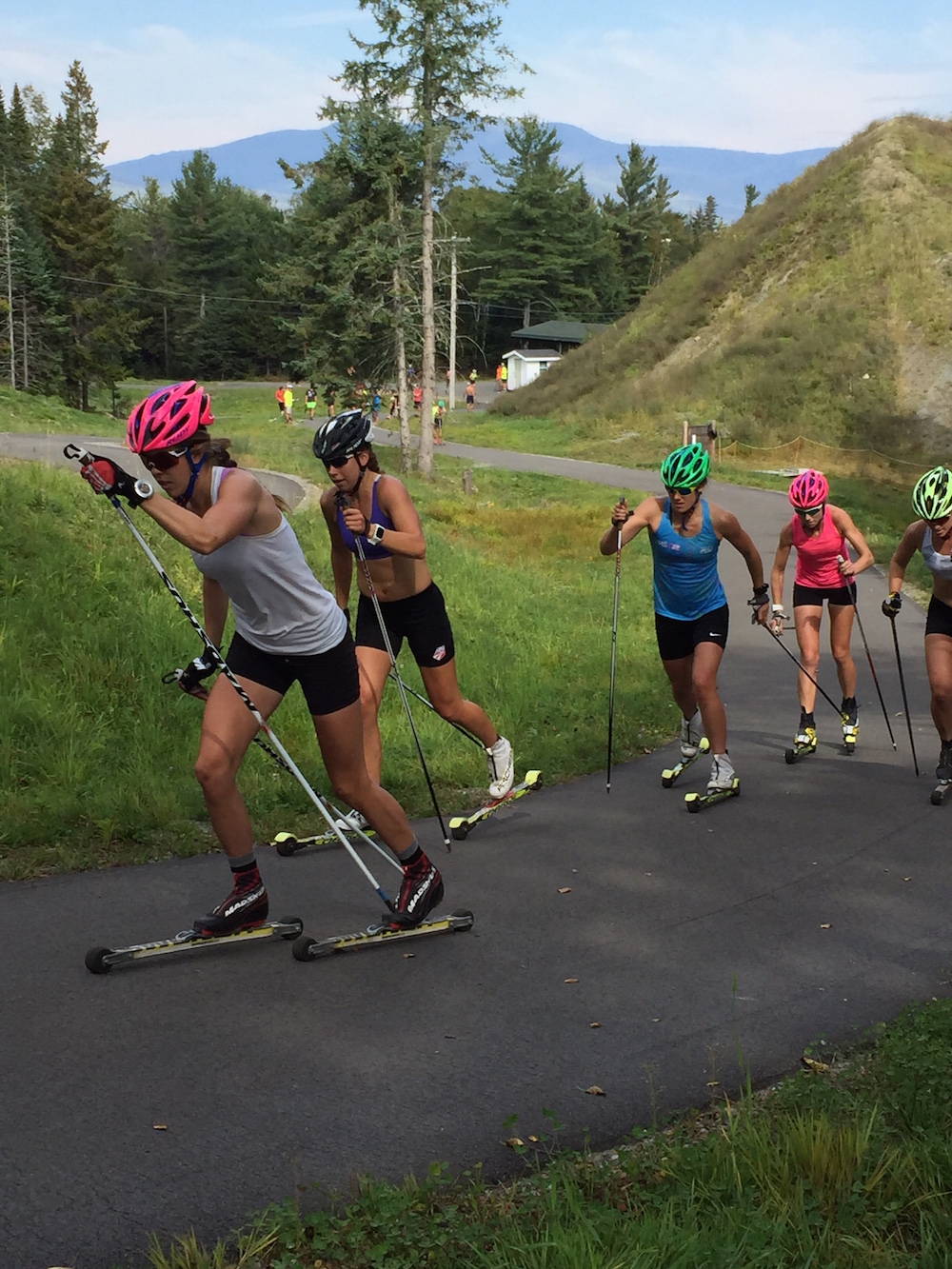
Sun Valley’s Mary Rose (l) leads Katherine Ogden (SMST2/USST), Annie Pokorny (SMST2), Erika Flowers (SMST2), and Paige Schember (SVSEF) during a sprint simulation at the Olympic Jumping Complex rollerski trails in Lake Placid, N.Y. (Photo: Colin Rodgers)
Every individual has his or her strengths and weaknesses when it comes to cross-country skiing. It is important to train your weakness because there is usually a lot of room for improvement.
The Sun Valley SEF Gold Team spent two weeks out East in Stratton, VT and Lake Placid, NY for a low-elevation training block. This camp was extremely productive for all of us because we were able to train some of our weaknesses: speed and pacing at low elevation, and rollerskiing in steep terrain.
One of the most beneficial workouts during this training block was a Level 4 uphill rollerski interval session. This is a great session if you don’t have a strong V1, are not strong climbing in skate, or if you need to build capacity in your legs. For me, this was an important workout because living in Sun Valley, ID, we lack the super steep, sustained uphill terrain (for rollerskiing) that can be found on the east coast. This is ironic, I know but the roads in Sun Valley are in the bottoms of the valleys and there are not very many of them.
The Workout: Uphill Rollerski 4-6 x 4 minutes at L4
Where: Find a location that offers a long uphill climb (8%-10% grade)
Warmup:
Rollerski easy (Level 1) for 20-25 minutes. Start the warmup on rolling terrain and then gradually move onto steeper terrain to get the body used to climbing.
Do 5-10 minutes of mobility/stretching exercises, targeting every major part of your body. This part of warmup is important to help get the blood flowing to all parts of your body and to get all the muscles ready to work hard. Think of this as injury prevention!
Rollerski easy for an additional 5-10 minutes.
During warmup focus on where you can make technique gains and apply that to the workout.
Now the fun part: 4-6 x 4 minutes at Level 4.
The first interval should start at threshold (Level 3) or right above it and gradually work into Level 4. Take full recovery (4 minutes) between each interval. Make sure to ski very easy during the recovery. Intervals 2-6 should be at a solid Level 4 the entire time.
Try to complete at least four intervals, but listen to your body and take a moment to assess where you are at. If you feel completely drained and your technique has taken a turn for the worse or your pace has dropped off, call it a day and cool down.
Cool down: Should consist of 15-20 minutes of easy skiing. Once your cool down is complete, you should hydrate, eat and sleep!
During this workout, I did a total of five intervals and left one in the tank, meaning that I could have done one more quality interval, but I held back due of the amount of intensity sessions I had already done that week and the amount of intensity sessions yet to come.
You want to feel good for all of the intervals, so remember that before pushing yourself too much. There is no need to do all six intervals if you are feeling tired. In this case, less is more. Important thing to remember is that ALL the intervals should feel great!
Sun Valley Gold Team members Paige Schember and Mary Rose after the 2015 Climb to the Castle on Sept. 20. (Photo: Mary Rose)
Paddy Caldwell (black shirt, yellow helmet) of the U.S. Ski Team D-team and SMST2 Team chases Rogan Brown (l) around mile four of five in Sunday’s Climb to the Castle up Whiteface Mountain in Wilmington, N.Y. Caldwell won the race, followed by biathletes Russell Currier and Tim Burke in second and third, respectively. Brown (SVSEF) placed fourth and Kyle Bratrud (CXC) was fifth. (Photo: Tim Cowan)
Note: Two photo captions have been corrected to reflect the leader of the men’s race around mile four in the 2015 Climb to the Castle. Rogan Brown of Sun Valley led the pack at the time.
For years, U.S. Nordic Ski Team athletes and their coaches trucked themselves up to the start of the Whiteface Veterans Memorial Highway, clicked into their rollerskis and allowed an ample amount of time for warming up before ascending New York’s fifth highest peak.
Before it became an official race nine years ago, it was a workout: a five-mile grind to the summit of Whiteface Mountain, 4,867 feet above sea level in Wilmington, N.Y.
Now, for many top-level skiers, especially those based on the East Coast, the annual Climb to the Castle an offseason staple. And if you win, you get a T-shirt and a medal for your efforts.
Mary Rose (SVSEF) leads US Biathlon’s Annelies Cook up the Whiteface Mountain toll road during the annual Climb to the Castle. Rose won and Cook finished second, 32 seconds later. (Photo: Tim Cowan)
“Climb to the Castle was a blast this year!” wrote women’s winner Mary Rose of Idaho’s Sun Valley Ski Education Foundation (SVSEF) Gold Team. “My goal going into this race was to have good energy the whole time, focus on technique and hopefully put together a good effort.”
She reached the top on Sunday in 45:15.1 and topped her competition — the closest of which was US Biathlon’s Annelies Cook — by 32.6 seconds.
“It was a fun, tough effort,” men’s winner Patrick Caldwell of the U.S. Ski Team D-team and Stratton Mountain School (SMS) T2 Team said in an interview after the finish.
The 21-year-old Caldwell outlasted biathletes Russell Currier and Tim Burke by 5 and 11.5 seconds, respectively. Caldwell won in 37:05.2, Currier was second and Burke was third.
“Right from the start, we stayed pretty much together against a decent headwind,” Burke said after the finish. “I think a lot of us were fatigued at the end of a big camp, so I didn’t really want to push like crazy.”
The US Biathlon and U.S. Nordic teams spent at least the last week training in Lake Placid, N.Y., with biathletes like Burke logging five race efforts in nine days preceding the Climb.
“I decided today instead of going for time, I wanted to go for the win,” said Burke, a defending multiple-time Climb to the Castle (C2C) champion. “So I decided to sit in and push that last half mile.”
Rogan Brown (l) of Sun Valley leads Tim Burke (second from l) and Paddy Caldwell (third from l) and Russell Currier and Kyle Bratrud around mile four in Sunday’s Climb to the Castle up Whiteface Mountain in Wilmington, N.Y. (Photo: Tim Cowan)
He said he “did a lot of pulling and got some help towards the end.” Rogan Brown (SVSEF) led around mile four, and Burke explained that five men battled in the lead pack for the last two miles.
“I broke my pole in the last couple hundred meters, that kind of took me out of it,” he explained.
Caldwell took the blame what he called an “unfortunate incident” in the final 200 meters. “I broke Tim Burke’s pole,” he said. He did so when Burke made his final attack toward the finish.
“Aside from that, it was a good, solid race,” Caldwell said.
“It’s a good way to end it,” Burke said after 10 days of hard training.
Currier, who placed second, called it an “entertaining race” with five men contending throughout.
“For a rare change I was able to be on the better side of tactics and consistently stay in the back of the pack,” Currier wrote in an email. “On the other hand, the final 100 meters came up a lot earlier than I expected and didn’t give much time to react. The pace picked up and Tim Burke lost a pole tip. The next thing I knew there was an opening for the lead. I’m not much of a sprinter and didn’t do much to challenge Patrick, but was I was still pleased to break out of the back of the pack just in time for the podium.”
A former US Biathlon (USBA) B-team member, Currier, who trains with the Maine Winter Sports Center, was not renamed to the team this spring and is working towards making the cut via a series of trials ending in October.
“The status for the National team is still very unclear,” he wrote. “… All I can do is make the best of every training session and go for better results. The second round of trials is coming up in October. A couple of good enough results there should help my cause for the coming race season.”
Brown placed fourth in the men’s race, 4.3 seconds from the podium and 15.8 seconds after Caldwell. Brown edged Kyle Bratrud of Central Cross Country (CXC) by 0.3 seconds, and behind them, another CXC skier Duncan Douglas placed sixth.
USBA’s Sean Doherty and Lowell Bailey finished seventh and eighth, respectively, Miles Havlick (SVSEF) was ninth and developing biathlete Max Durtschi finished 10th of 61 men.
The start of the women’s race at the 2015 Climb to the Castle up Whiteface Mountain in Wilmington, N.Y. (Photo: Peter Minde)
In the women’s race, Rose and Cook pushed each other to the top. Rose recalled it being just the two of them shortly after the start. A perennial contender, USBA’s Susan Dunklee had some pole issues at the very beginning, Rose explained in an email.
“I knew I needed to break away about 1/2 mile to the finish because I can’t beat [Cook] in a sprint,” Rose wrote. “I fought pretty hard through the ‘wind tunnel’ and I think that is where I broke away.”
Overnight rain left the toll road wet, and wind dried out its lower sections. From about the halfway point to the finish, skiers pushed through mist on wet pavement and faced a steady wind blowing 10 to 20 miles per hour throughout the race. After starting in temperatures around 47 degrees Fahrenheit, they met temperatures in the mid-30’s at the top.
“It sounds weird to say it aloud, but I actually had fun doing the climb to the castle,” Cook wrote in an email. “Mary and I skied together the entire time and switched leads back and forth. I usually get bored doing the climb and lose focus and switching back and forth with her kept me in the game mentally.
“She got me at the last turn right before the finish when I suddenly flooded with lactic acid and had no chance,” she added. “But I don’t really think of myself as a climber and so it was fun to be the two people leading the race. That doesn’t happen too often! Of course, the usual suspects were not there and that obviously made it difference.”
With the exception of Paddy Caldwell, the U.S. Ski Team (USST) skipped the Climb this year for the first time in years.
“As hard as it is to miss it because it is a fantastic event, it just didn’t play well athletically for the needs of the group,” USST Head Coach Chris Grover said on the phone last week. “We wanted to do more sprint-specific training and short intensity as opposed to giving up a whole workout or two to do the Climb to the Castle.”
The USST camp was also only a week long, compared to the two weeks the team usually spends in Lake Placid this time of year. On the other hand, the largely Lake-Placid-based US Biathlon team did either time trials or Level 5 (race-pace) workouts for last 10 days.
“I had my personal best by quite a lot and I felt strong skiing,” Cook said of the Climb. “It felt good to end a really tough ten days on a good note. … I think we are all pretty glad to be done.”
The Climb marked the end of a two-week training block for Rose and her Sun Valley teammates, who were in Stratton, Vt., with the SMST2 team for the first week.
“We had some super hard intensity sessions over the past two weeks and all were very productive,” Rose wrote.
USBA’s Hannah Dreissigacker, who placed third, 2:05.9 after Rose, explained in an email that the women’s race broke up quickly.
“Mary and Annelies started off a little faster than I really wanted to be going, and I tried to hold on for a bit but then gave up pretty quickly and lost contact,” Dreissigacker wrote. “My goal in the Climb to the Castle is always to not start too fast and then blow up. Then I skied with Susan for a mile or so and then slowly inched ahead of her a bit. Eventually we skied into a cloud and I lost sight of Annelies and Mary and just skied the whole second half by myself.”
She finished 1:10.9 ahead of Dunklee, who placed fourth, while wearing a figure-skating tutu she wore the first time she did the race.
“The lacy elbows really allowed for added breathability and the rhinestones gave me some extra motivation on those long hard stretches when I was all alone,” Dreissigacker wrote.
Another biathlete, Clare Egan finished fifth, Paige Schember (SVSEF) was sixth, Erin Perryman (St. Lawrence University) was seventh, Jackie Garso of the local New York Ski Education Foundation (NYSEF) was eighth, St. Michael’s assistant coach Silke Hynes was ninth, and Stratton U16 skier Anna Lehmann was 10th of 25 women.
CRAFTSBURY, Vt. — Kris Freeman earned his third win of the weekend Sunday, with a 20.4-second lead in the men’s 15-kilometer classic mass start on the snowy trails of the Craftsbury Outdoor Center. With snow falling throughout the entirety of the three-lap course, Freeman overcame the elements to create a large gap over his competitors at the 10 k mark in the SuperTour and Eastern Cup race.
He skied alone for the final 5 k of race, plowing through the fresh snow with ease and strength.With a time of 42:46.4 Freeman crossed the line with no one else in sight. He raised his hands above his head, celebrating his many wins in Craftsbury. Freeman’s success comes before his eighth career World Championships which will take place in Falun, Sweden Feb. 18. Freeman travels to Europe Thursday to prepare for the event.
In a battle for second, Gordon Vermeer of the Craftsbury Green Racing Project and Lex Treinen of Alaska Pacific University charged down the finishing stretch, lunging to see who would claim the second rung of the podium. In the end it was Vermeer who would come out on top, besting Treinen by 0.01 seconds. The two finished 20.4 and 20.5 seconds behind Freeman.
In fourth and fifth were Eric Packer of APU and Justin Freeman skiing for Holderness. Packer finished 27.1 seconds back from the first Freeman. The victor’s brother, Justin Freeman, finished 28.6 seconds behind his training partner.
In the women’s 10 k classic mass start it was Becca Rorabaugh who rocketed to the top of the podium to earn her first SuperTour win. After skiing the seventh-fastest split at the 5 k mark, she accelerated to make contact with the lead pack of Anja Gruber of Far West Elite, Chelsea Holmes of APU, and Mary Rose of the Sun Valley Ski Education Foundation. With roughly a kilometer to go, Rorabaugh was sitting in with the lead pack but took command into the stadium after utilizing a strong double-pole. She crossed the the line with a time of 33:24.0.
Close behind was Mary Rose who earned her second podium of the weekend after winning Saturday’s 10 k freestyle. She trailed Rorabaugh by 0.9 seconds. Third went to Gruber, who came across the line 4.1 seconds back from the leader.
Rounding out the top-5 were Kaitlynn Miller and Caitlin Patterson, both of the Craftsbury Green Racing Project. The two
In the junior women’s 5 k Mae Chalmers won with a time of 17:51.2. Her male counterpart, Adam Gluek of Ford Sayre, won the junior men’s 5 k. He crossed the line in 15:03.4.
Sunday’s races concluded the three-day weekend of the Craftsbury SuperTour, Dartmouth Carnival, and Eastern Cup. SuperTour racing continues Feb. 21 in Haywood, Wisconsin at the American Birkebiener.
The above video is of the men’s 10 k individual start. Having trouble viewing the video? Watch here.
CRAFTSBURY, Vt. — Kris Freeman (Freebird) has been racing at high level for many years, and his veteran status showed on the trails of the Craftsbury Outdoor Center. As the 34-year-old prepares for his eighth World Championships – set to begin later this month in Falun, Sweden – he skied to his second win in as many days with a victory in Saturday’s 10 kilometer freestyle individual start.
Saturday welcomed warmer temperatures than Friday’s freestyle sprints, with racers facing 15 degree weather and lightly falling snow throughout the day. Although an inch or two of snow fell overnight, the course was hard-packed and fast for the SuperTour, EISA College, and Eastern Cup races.
Freeman skied a conservative first lap and trailed split-leader Rogan Brown of the University of Vermont at the 5 k mark. In the second lap of the race, Freeman powered through the challenging course to vastly overcome the deficit and finish with a time of 25:04.3. Brown was able to maintain a podium position and skied to second overall, 38.3 seconds behind Freeman. Brown was the top college skier and led a trio of Vermont skiers, including fifth and seventh place finishers Jørgen Grav and Jack Hegmen, to sweep the Dartmouth Carnival podium and win the day of college racing.
“I had a hot lap,” Brown said of his first lap in a post-race interview. “After that I focused on skiing smooth. I’ve always loved this course.”
In third was Alaska Pacific University’s Lex Trienen, who trailed Freeman by 1:04.0 as he crossed the finish line. He was followed by Grav (+1:05.4) in fourth and APU teammate David Norris (+1:13.9) in fifth.
In the women’s 10 k individual start Mary Rose employed similar tactics to Freeman. At her 5 k split Rose sat in third and trailed race-leaders Chelsea Homes of APU and Anja Gruber of Far West Elite by several seconds. With her finish time of 30:10.3, however, Rose outpaced the entire field by over 10 seconds.
“I was really focused on not having a negative split.” Rose said in a post-race interview. She explained one of her main motivations in Saturday’s race was to catch the women in front of her an not be caught by any starters behind her. Her strategy was to ski hard from the start and maintain the her speed throughout the course.
Behind Rose was a tie for second place between Stratton Mountain School T2’s Erika Flowers and University of New Hampshire’s Anika Taylor. With a time of 30:20.5, both Flowers and Taylor earned a rare equal placement and an even rarer podium tie. Taylor led the UNH Wildcats to earn the most points in the women’s nordic portion of the Dartmouth Carnival.
In fourth and fifth were Gruber and APU’s Becca Rorabaugh, who trailed Rose by 17.0 and 17.9 seconds. Holmes (+18.8) finished her day in sixth.
In the junior 5 k individual freestyle races, Russel Boswell of SMS won with a time of 14:11.1. He was followed by Adam Glueck (+4.1) of Ford Sayre and Walker Bean (+10.8) of Green Mountain Valley School (GMVS) in second and third.
Olivia Cunio of GMVS won the junior women’s 5 k with a time of 16:22.3. In second and third were Mae Chalmers (+37.7) of SMS and Kristen Miller (+37.7).
Although the Dartmouth Carnival concluded Saturday, SuperTour and Eastern Cup racing will continue Sunday with 5/10/15 k classic mass starts beginning at 9:30 a.m. EST. FasterSkier will be live streaming the races. Watch them here.
Rosie Brennan (APU) had the fastest time in the first of two laps and held on to win the women’s 10 k individual start freestyle in West Yellowstone, Mont.
Note: This article has been corrected to state that Katharine Ogden is a member of Stratton Mountain School (SMS), not the Stratton Mountain School T2 Team (SMST2).
WEST YELLOWSTONE, Mont. — Rosie Brennan surged into the lead with a strong first lap, then maintained her advantage over 17-year-old Katharine Ogden to win Saturday’s women’s individual-start 10 k freestyle in West Yellowstone, Mont., the weekend’s second SuperTour race.
Brennan, of Alaska Pacific University (APU), had a 19-second lead over Ogden, of Stratton Mountain School (SMS), and teammate Chelsea Holmes after the first 5 k loop. While Ogden skied an impressive second lap – the fastest in the field – she was overcome by Brennan, as the 26-year-old won with a time of 26:59.9, while Ogden ended up 8.3 seconds behind.
Katharine Ogden (SMS) posted the fastest second lap in the field en route to a second-place finish in the women’s 10 k individual start freestyle in West Yellowstone, Mont.
Holmes skied a strong race especially on the hills, but lost ground to the leaders on the second lap and finished 26.2 seconds behind. Caitlin Patterson of the Craftsbury Green Racing Project (CGRP) maintained her position after the first lap to finish in fourth (+42.6) while Sun Valley’s Mary Rose did the same to take fifth (+54.8).
Joanne Reid, a former University of Colorado star and NCAA Champion in the 15 k freestyle, took seventh (+1:01.0). However, the 10 k marked her first time racing on the national circuit since attending graduate school last year.
Though temperatures were above freezing, athletes encountered strong winds and blowing snow, adding challenge to a course that already offered no rest.
“Racing in West Yellowstone, it’s hard to actually feel good when you’re racing; it’s kind of brutal,” Brennan said. However, the Park City native said she was accustomed to the altitude – West Yellowstone is situated at 6,667 feet – and established a comfortable pace that she was able to maintain throughout the race. The result follows what she said was a “really good summer of training.”
Brennan explained that the race meant a lot to her, as her father passed away in August.
“Just to be able to put together a race is huge for me, so I’m just really psyched to be able to race,” she said.
APU Head Coach Erik Flora was thrilled with Brennan’s performance.
“Her training has been going really well, and you can see that she’s been ready to race, so today she skied strong. She’s made a lot of technical improvements over the year and she showed all those today,” Flora explained.
Though Ogden put together an impressive performance, she said that she did not have much of a strategy, saying she likes the hills and altitude and “was just thinking of not blowing up.”
Chelsea Holmes (APU) is pursued by Heidi Widmer (AWCA-NST) in the women’s 10 k individual start freestyle in West Yellowstone, Mont. Holmes finished in third while Widmer would finish in ninth place.
“I started out and I was cold, which wasn’t good. But I warmed up pretty quickly and felt really good. I was mostly thinking about pushing off my legs because I usually don’t do that enough,” she said.
The 30-second interval start allowed her to catch up to and ski behind teammate Erika Flowers, of SMST2. “I like skiing with her. She has really good technique and it makes mine better,” Ogden said.
Ogden would eventually pass Flowers who ended up in 15th (+1:41.6).
Though just barely missing the podium, Patterson was satisfied with herself and her effort. She said she felt “bogged down” and was experiencing tired leg muscles right from the start, but maintained a strong V2 wherever she could and made up time on the numerous corners.
The wind was a noticeable factor in the race, Patterson said.
“I was certainly wishing I had someone to draft out there, but with the interval start race and the 30-second intervals we were all very well spaced out. I think I maybe passed one or two people, but I wasn’t able to tuck in behind anyone,” she explained. “It’s a bit of wind in your face, but you go with it.”
Mary Rose (Sun Valley SEF) conquered the hills and managed a fifth-place finish in the women’s 10 k individual start freestyle in West Yellowstone, Mont.
Rose attributed her fifth-place finish to the nature of the course, saying she is a climber and the course had plenty of hills she could use to her advantage. Though she went out “kind of easy” at the beginning of the race, she said she pushed herself through the hills and “kept charging.”
However, Rose did not attach too much significance to the result, saying she is taking it weekend by weekend.
Meanwhile, there was a worrisome scene on the course as APU’s Rosie Frankowski collapsed 7.5 kilometers into her race. Coach Flora was unsure of exactly what occurred — whether it was dehydration, the altitude or something else — saying she simply “blacked out” at the top of a climb.
Course officials and spectators immediately covered Frankowski with coats after she collapsed, and she was soon transported back to the warming hut at the starting line. Flora said once they got her warmed up, she was back on her feet and “feeling good.”
SuperTour racing continues next weekend at Bohart Ranch Cross Country Ski Center near Bozeman, Mont., with a classic sprint on Saturday and a classic mass start on Sunday.
The men’s 15 k freestyle individual start podium at the 2014 SuperTour Finals in Anchorage, with (from l-r) Patrick Johnson (6th), David Norris (4th), Scott Patterson (2nd), winner Noah Hoffman, Erik Bjornsen (3rd), and Lex Treinen (5th). (Photo: Rob Whitney)
Note: This article has been corrected to describe the race women’s SuperTour leader Caitlin Gregg is shooting for at World Championships: the 10 k skate.
WEST YELLOWSTONE, Mont. — National racing begins Friday as the SuperTour kicks off in West Yellowstone, Mont., and the excitement on the Rendezvous trails couldn’t be higher. The best skiers from around the country have been training for at least a week in the little Montana town as they prepare to compete for American dominance and possible positions on World Cup and World Championship teams.
With several departures from the racing scene including, Olympian Torin Koos (BSF), Rose Kemp (SVSEF), and Kate Fitzgerald (APU), and a multitude of up-and-coming racers on the cusp of success, the 2015 SuperTour will be anyone’s game.
When the USST selected four men (Erik Bjorsen, Brian Gregg, Koos and Kris Freeman) and no women from outside the regular World Cup team, it left many skiers hungry to show that they could perform well on the international level.
This year they’ll have another shot with the 2014 Nordic World Championships in Falun, Sweden.
While the U.S. is allotted 12 spots for each gender in Falun, USST head coach Chris Grover explained that he and his staff would select eight skiers per gender at most.
World Championship team selection will be based on several criteria. Those skiers ranked in the top 50 in the World Cup sprint or distance standings as of January 18 will be named to the team. After that coaches’ discretion kicks in. If coaches feel that the World Championship team could benefit from additional skiers after their discretionary picks, they will then begin selections from the USSA points list.
The selection is identical to last year’s Olympic process, with the exception of the USSA points. When making selections for the Olympics, coaches picked three non-USST skiers from the FIS points list to fill in the gaps.
According to USST Head Coach Chris Grover, the reason for the switch to USSA points is to emphasize domestic racing so that potential candidates for the championships will be racing against each other, rather than chasing FIS points across the globe like many did last season.
Due to the emphasis on USSA points this season, the SuperTour will be where non-World Cup team athletes will have the chance to prove they have what it takes.
The Veterans
Brian Gregg (Team Gregg) will be a top competitor in 2015. Photo: flyingpointroad.com.
On the men’s side, 2014 overall SuperTour champion Reese Hanneman (APU) will be competing in the first period World Cup races and will return to the national circuit in Houghton, Mich. for the 2015 U.S. Cross Country Championships. While the benefits of early-season World Cup racing are considered mixed, Hanneman can expect his chances of racing in Falun to increase if he demonstrates that he can keep up with the Europeans and his fellow American teammates.
With Hanneman out of the picture in West Yellowstone and Bozeman, the men’s SuperTour favorites are the remaining two non-USST members to attend the 2014 Olympics – Brian Gregg and Kris Freeman.
Freeman, a 34-year-old former USST member, will be racing in West Yellowstone for the first time in nine years. Freeman, who lost his position on the USST in 2013, was one of three non-USST members to qualify for the 2014 Olympics. Despite high hopes of his best olympics yet, he struggled in Sochi. This season he is looking to turn around his skiing and earn a spot on the World Championship team. As one of most experienced skiers on the SuperTour circuit he will have an advantage over much of the competition.
Gregg, like Freeman, will also enter the 2015 SuperTour with a multitude of experience. The 2013/2014 season saw Gregg on the SuperTour podium several times, most notably with his two second place finishes in the 2013 West Yellowstone 15 k freestyle and in the 2014 U.S. Nationals 30 k freestyle. At the Olympics, he constantly finished in the 40s and 50s.
As he starts the season, Gregg acknowledged that the first races of the season would be challenging.
“Kris is in really good shape so I think there are going to be some very competitive races. I’m excited,” Gregg said from West Yellowstone Tuesday.
Joining Freeman and Gregg as veterans of the SuperTour are Matt Gelso of the Sun Valley Gold Team and Dakota Blackhorse-von Jess of the Bend Endurance Academy. Gelso will be looking to build on past results while Blackhorse-von Jess will pursue success in sprinting, especially since U.S. sprint champion Torin Koos retired from competition.
After disappointment in the freestyle sprint at the 2014 U.S. Cross Country Championships and a failure to qualify for the 2014 Olympics, Blackhorse von-Jess said that nothing has changed in his career trajectory.
“I’m re-energized after the disappointment of the Olympics with the reaffirmation that I still want this and believe I have what it takes… My career/goal trajectory hasn’t changed in the least: I’m focused on racing my best in the biggest international competitions and just need to make sure I do what is necessary to make those trips and come to the starting line in Falun prepared to light it up,” he wrote in an email.
Matt Liebsch of Team XC United will also be returning to racing after missing out on Olympic qualification. However, Liebsch, who works near full time for Gear West, has lightened his training load as is looking to “maximize fun and earning potential ” rather than qualify for international events.
“I’m not going to be chasing FIS points around the world or country necessarily. If they fall in my lap because I’m racing well, that’s great, but I’m not going to be stressing about it… It’s not really a change for me. I’m still going to try to race as fast as I can only I won’t be training as much,” he said in a phone interview.
Ryan Scott, living and training independently in Boulder, Colo., will also return to competition, but, like Liebsch, has cut back his training as a result of work.
For the women, one name has particularly dominated the domestic circuit for years – Caitlin Gregg.
Gregg, like Hanneman, will start her season on the World Cup after earning the women’s overall title at the SuperTour finals in Anchorage last season. Gregg said earlier this fall that she is as motivated as ever and has her sights set on a particular race: the 2015 World Championships 10 k skate. To get to Sweden, however, she’ll need to demonstrate that she’s on par with USST and dominate when she returns for the U.S. championships in January. In the meantime, she’s excited for the 5 k next weekend in Lillehammer and aims to earn a start in that race.
With the absence of Gregg, the West Yellowstone and Bozeman SuperTours are anyone’s for the taking.
Rosie Brennan (APU) leading her semifinal in the 2014 U.S. Cross Country Championships. (Photo: http://bertboyer.zenfolio.com).
Always a strong skier, APU’s Rosie Brennan will once again attempt to demonstrate her mettle as she makes a bid for World Championships. Last year Brennan started her season on the World Cup and returned to the U.S. exhausted, but earned a national title at U.S. Nationals in addition to several podiums. This year she will enter the season with fresh energy despite a turbulent fall after loosing her father in August.
Joining Brennan at the top of the SuperTour expectations are APU teammates Chelsea Holmes and Becca Rorabaugh.
Rorabaugh won the 10 k interval start classic at the 2014 U.S. Cross Country Championships for her first national title, and is looking to have even more time upon the podium as she continues through the season.
Last year Bridger Ski Foundation’s Jennie Bender repeated a national title in the freestyle sprint. While she’s dealt with illness and injury for the past two years, Bender told FasterSkier that her summer training this year was her best to date, and that she is looking to find success domestically and qualify for World Championships.
The Wild Cards
While the veterans of the 2015 SuperTour are names we’ve seen at the top of the result sheets for years, there are several skiers who have an excellent opportunity to shake up the status quo and make a name for themselves on the domestic circuit.
Sun Valley Ski Education Foundation’s Miles Havlick didn’t have the season he wanted in 2014, but has come back with a vengeance in 2015. While he has yet to face his competitors on-snow, Havlick has won a slew of time trials including the USST1o k freestyle rollerski time trial in Park City, Utah against the country’s best. He also broke a 25-year-old record in the Baldy Hill Climb this year.
According to Havlick, he has the all the ingredients for a breakout season. Now it’s only a matter of time.
“I think on any given day – when I am mentally competent, carrying confidence from previous races, focused, and my wax is good – I can be the best skier out there. The college skiing is when I was really able to prove that to myself. Last year was kind of tough because I felt like I was spinning my wheels by the end, but I think I’ve made some adjustments this year that can fix that,” he said in a phone interview in October.
Havlick also has gained the attention of Grover and the USST.
Erika Flowers racing to the fastest women’s time in the inaugural Tim Burke Uphill Run Test at Whiteface Mountain this fall.
“I’m excited to see how Miles Havlick is going to ski. He’s had a great fall. He won our US ski team time trial that we did in Soldier Hollow. He set a new course record on the Baldy Hill climb that stood for 26 years or something. There’s some new emerging faces to keep an eye on,” he said.
For the women, a possible 2015 wild card is a less well known. However, despite her lack of national attention Stratton Mountain School T2’s Erika Flowers has all the makings of an up and coming skier.
Flowers has always been a strong and consistent skier with the majority of her SuperTour results landing in the top-ten. However, when she traveled to Europe in the spring of 2014 she demonstrated her potential, wining a 10 k mass start in Silvapalana, Switzerland. Several weeks later she placed 14th in the Alpen Cup mini-tour. She finished the tour as the second American behind Holmes and had the fifth-fastest time in the final 10 k pursuit.
While Flowers has struggled with sprinting in the past, she demonstrated that she could stick with the best of them at the 2014 Frozen Thunder races in Canmore, Alberta ending the day in 7th.
The following day she finished 7th in the 7.2 k freestyle at Frozen Thunder. She was the 3rd American, and placed ahead of several notable Olympians including Jessie Diggins.
The Rest
In addition to Havlick, there are several other men who could make the domestic season anyone’s game.
Recent college graduates Ben Lustgarten of SVSEF, David Norris of APU, and David Sinclair of Green Mountain Valley School will be looking to take their success from NCAA racing to the SuperTour.
Scott Patterson (APU) is another notable graduate who had success on the SuperTour both at the 2014 Nationals and 2014 SuperTour finals. According to his family, Patterson will not be starting his season in West Yellowstone due to a skiing accident that occurred Oct. 31st in which he was impaled by a broken ski in his upper leg. While the leg wound healed, Patterson developed a pulmonary embolism (blood clots in his lungs) which has limited his exercise to walking. However, according to his family, Patterson is optimistic that he will return to racing at U.S. Nationals.
Ben Saxton (SMST2) and Paddy Caldwell (SMST2/Dartmouth) will be the sole USST members starting the season in West Yellowstone. Saxton who was second in the freestyle sprint at U.S. Nationals last year, is aiming perform well in Friday’s sprint. Caldwell, who has yet to decide whether or not he will ski for Dartmouth this year is a strong distance skier and will be vying for top results amongst the country’s best.
“They need to prove themselves and make those teams just like any other athlete that is on the domestic scene. Obviously those guys are younger guys and they’re still focused on the U23 World Champs,” Grover said of the two USST D-Team athletes.
Welley Ramsey (MWSC), Tad Elliott (SSCV), and a slew of other men from APU and Craftsbury will also look to challenge the national favorites as the season gets underway.
On the women’s side recent graduates Anne Hart (SMST2), Rosie Frankowski (APU), and Anja Gruber (Far West Elite) are new to full-time racing on the national circuit after having successful college careers. While the adjustment from college skiing to professional racing is often difficult, these women will still be a strong force to contend with.
Annie Pokorny (SMST2), Caitlin Patterson (CGRP), Liz Guiney (CGRP), and Mary Rose (SVSEF) are shaping up to be strong competitors in the 2014/2015 season after a productive summer and fall trainings with their respective teams.
It’s an amiable atmosphere at Spring Series in Anchorage, Alaska, as seen here after Sunday’s classic-sprint final. Teams will compete for a national title on Tuesday in Kincaid Park in the coed 4 x 5 k, the first race of U.S. Distance Nationals. From left to right: Andy Newell (SMST2/USST), Reese Hanneman (APU/USST), Ben Saxton (SMS), Pat O’Brien (CGRP), Dakota Blackhorse-von Jess (BEA), and Tyler Kornfield (APU). (Photo: Rob Whitney)
When the U.S. Ski and Snowboard Association (USSA) met last spring, they decided it was time for a bit of a change at the season-ending SuperTour Finals and U.S. Distance Nationals. Instead of a hill climb, they opted for a team relay at the races in Anchorage, Alaska, scheduled for the following March 22-28.
According to the event’s race director James Southam, a two-time Olympian from Anchorage, athletes brought up the idea of a team event last year. An opening in the schedule made the 4 x 5-kilometer relay possible for 2014.
But unlike most four-person relays, the one going off Tuesday at 5 p.m. Alaska time will be coed with a male scramble classic leg tagging to a female classic skier, then male freestyle skier, and finally, a female freestyle anchor.
“I think it’s gonna be fun,” Southam said. “The last distance relay I remember doing was I think in Bend [Ore.] in 1998 or something like that for nationals. I think having the coed is going to be cool. … You don’t need four good guys or four good girls; I think it makes it a little more competitive.”
Eighteen official teams (including two junior squads), each made up of two males and two females from the same USSA club, will compete for a national title — and $750 dollars in prize money to split four ways. The second-place team will receive $500, and third gets $300.
It’s the second-to-last competition before Friday’s 30 and 50 k classic mass starts, which will be held at a different venue than the rest of the races at Kincaid Park, at the Hillside Trail System on the east side of town.
Teams to watch include Alaska Pacific University’s first team, with Reese Hanneman, Sadie Bjornsen, Erik Bjornsen, and Kikkan Randall, in that order. The top team from Stratton Mountain School T2, Andy Newell, Sophie Caldwell, Simi Hamilton, and Jessie Diggins will also contend for the title, along with Craftsbury’s Patrick O’Brien, Ida Sargent, Gordon Vermeer, and Caitlin Patterson, and Sun Valley’s Mikey Sinnott, Mary Rose, Matt Gelso, and Chelsea Holmes.
Several college teams, such as the University of Vermont, Northern Michigan, New Mexico, and the University of Alaska-Anchorage will also be vying with the best of them.
There are also few unofficial teams with skiers from different clubs that have a shot at winning for glory rather than cash. Fastest of the Fast Twitch includes Brian Gregg (Team Gregg/Madshus), Liz Stephen of the U.S. Ski Team (USST), Noah Hoffman (SSCV/Team HomeGrown/USST), and Caitlin Gregg (Team Gregg/Madshus). The Vagabonds are Karl Nygren (Podiumwear), Jennie Bender (Bridger Ski Foundation), Mark Iverson (Rossignol), and Cambria McDermott (independent).
Each competitor will ski two laps of either a roughly 3.3 k classic loop (for 6.6 k total) or a 2.6 k skate loop (for approximately 5.2 k).
As for the 5 p.m. start? It’s all about getting the best bang for the buck in terms of participation, volunteers and spectators.
“We want as many of the kids from around town to be able to race in it as well and to come out and watch it,” Southam said. “When you have midweek races at 11 o’clock it’s hard to get the kids out to watch. One of the big reasons we wanted to host these races is, after the Olympics people have been paying attention to skiing all winter long and it’s pretty powerful for kids coming up to be able to watch Olympians and world champions.”
Of the 26 teams entered in Tuesday’s relay, the two official junior squads are from APU. One unofficial team includes three men and a woman, another has four junior males, and one has three males, which will complete three legs and then call it a race.
Adrien Backscheider of France celebrates his first title at U23 World Championships after winning Saturday’s 30 k skiathlon in Val di Fiemme, Italy. (Photo: Fiemme2014)
(Note: This article has been updated to include Annika Taylor, originally from Truckee, Calif., who competed at U23 World Championships for Great Britain. Comments from Ben Saxton also follow.)
For most skiers, skiathlons are somewhat of a rarity, something you might compete a couple times, or even the first time, in your career.
When you’re under 23, chances are you’ve had even less experience with the half-classic-half freestyle distance format — which makes it all the more fun.
France and Norway perhaps had the best time of anyone on Saturday at U23 World Championships, with Adrien Backscheider and Damien Tarantola of France going 1-2 in the men’s 30-kilometer skiathlon, and Martine Ek Hagen and Ragnhild Haga placing first and second in the women’s 15 k.
The women’s 15 k skiathlon podium at U23 World Championships on Saturday, with Norwegian winner Martine Ek Hagen (c), her teammate and runner-up Ragnhild Haga (l), and Teresa Stadlober of Austria in third (r). (Photo: Fiemme2014)
The best part about Saturday’s men’s race was that Backscheider and Tarantola pushed each other to the line, with Backscheider getting the 0.1-second edge for his first U23 title in 1:24:27.9. Norway’s Daniel Stock rounded out the podium in third, 6.4 seconds after Backscheider.
“Today we proved that France has a great team and really good equipment,” Backscheider, 21, told FIS on Saturday. “I am satisfied with my performance throughout the competition and I had very good skis. We have been training a lot for these championships and we showed what we are capable of. In addition to these two medals, we have to add the one won in the cross-country sprint. I think that bringing home these three medals for cross-country skiing is really amazing.”
Tarantola said that silver was “simply amazing, both for me and the whole French team. The weather conditions were pretty bad and the race got harder and harder due to the rain. Nevertheless, I never gave up and I did my best … I’m really proud of our achievements.”
According to a press release, the men’s 15/15 k proved to be tactical, with Armenian Sergey Mikayelyan attacking on the final climb of the penultimate of 12 laps. Seven skiers went with him: Russia’s Kiril Vichuzhanin, Norway’s Martin Loewstroem Nyenget, Sindre Bjørnestad Skar, Mathias Rundgreen, Tarantola, Backscheider, and Stock.
On the second climb of the last lap, the group dwindled to five when Nyenget attacked and Vichuzhanin, Tarantola, Backscheider, and Stock followed. Right before the last hill, Nyenget lost his balance and fell as Backscheider made a move. Vichuzhanin stuck with the leaders over the top but crashed on the downhill into the stadium. Norway ended up taking third through sixth with Stock, Rundgreen, Skar, and Nyenget, respectively.
In the women’s 7.5/7.5 k, the 22-year-old Hagen led for much of the first half of the race, holding off attacks from Italy’s Francesca Baudin and Debora Agreiter, who looked to have superior skis on the wet tracks.
All together heading into the skate portion, Hagen picked up the pace and Haga, Austria’s Teresa Stadlober and Agreiter initially kept her in sight. Hagen went on to ski the remaining 7.5 k on her own, winning by 22.4 seconds in 44:37.5.
“I’m so glad for the gold medal, of course, it means so much for me,” Hagen said to FIS about her second-straight win at this year’s U23 championships, and her third total. “These competitions are much harder than what you may think, and on top of that, the rain didn’t stop falling today, making the snow wet and heavy. These weather conditions didn’t help us today and made the race even tougher. Today’s a very special day for our team, Ragnhild won the silver medal and I’m really happy for her, too.”
“I understood I wouldn’t be able to catch up to first place even though I was hoping for the gold for more than one lap, but Martine was very strong,” Haga said. “I dedicate this silver medal to my family. We hoped for the double victory, it turned out really well and it is great fun to be on the podium with another Norwegian.”
Stadlober placed third, 42.2 seconds after Hagen,and Agreiter was another 13.1 seconds back in third.
Patterson Repeats in 18th for U.S.
In his second race of his first U23 championships, University of Vermont (UVM) senior Scott Patterson placed 18th — again. He notched 18th two days earlier in the 15 k classic individual start.
Team USA, with female juniors, U23s and ski jumpers at the 2014 Junior/U23 World Championships opening ceremonies. (Annie Pokorny courtesy photo)
Rosie Frankowski, a senior at Northern Michigan University, finished 26th in the women’s race for a career best at her first U23’s after placing 38th in the 10 k classic on Jan. 30.
Annie Pokorny (Stratton Mountain School T2 Team) finished 31st for her second-best result in her second U23’s after she placed 29th in two events last year.
“I really wanted to keep my cool and ski a nice, relaxed race,” Pokorny wrote in an email. “I knew that the pace would be hot off the start, so I wanted to be warmed up, but also wanted to conserve as much energy as I could through all 15 k’s.”
By the time she got to the venue, Pokorny explained it had already started raining. That turned to downpour for the women’s race, but the tracks held up throughout their three classic laps.
Pokorny did her best to stay in the main pack out of the start. “The accordion factor was pretty serious through the end of our first lap and I had trouble skiing in the lanes, so I dropped pretty far off the top 30 and started working my way up from there,” she wrote.
“When I came through the transition, I was fighting for 35th place. The minute I stepped onto them, I knew I had amazing skis, and was able to work the transitions to my advantage all around the course. When I caught girls, it was mostly on the flats after uphills, where my skis allowed me to carry speed over the top.”
Heading into the last lap with a top-30 within reach, Pokorny explained she improved from 32nd to 30th at the top of the course before getting passed on the last climb into the stadium.
Jessie Diggins of the U.S. Ski Team (l) on the podium after winning silver in the first race of U23 World Championships, the freestyle sprint on Nov. 29 in Val di Fiemme, Italy. (Liz Guiney courtesy photo)
“I knew that I still had a chance so I pushed as hard as I could down the finishing stretch, no-pole skiing and chanting ‘Jessie, Jessie, Jessie’ hoping to channel my teammate [Jessie Diggins],” she wrote. “I got close to the 30th place spot, but she just edged me out at the finish. It was really exciting for me, and even though I didn’t make the top 30, I was proud of how I skied.”
While she felt short of her goals, Pokorny focused on the fact that she was having fun.
“This championship has been a blast. The Olympic year has changed the competition, there’s no avoiding its influence, and being a part of these races has been challenging and exciting.”
Another American in the top 35, Ben Lustgarten, a Middlebury College senior, finished 34th in the men’s race. In the preceding 15 k classic, he placed 30th. His goal was to beat that.
After getting off to a strong start, Lustgarten explained in an email he tried to ski relaxed in a good position at the back of the lead pack while avoiding tangles and broken poles.
“The pace was fast but I was expecting that, I’m glad I could hang on for the whole classic portion,” he wrote. “The skate leg turned out pretty miserably and I lost a lot there. I crashed early on really hard and hit my head (turned out to be a minor concussion) which made me a bit dizzy. I was also pretty tired and losing that much momentum was not ideal. Then I broke a pole going up a hill and by that point I just wanted to finish the race, I knew I could not make up any ground and I was pretty beat physically and emotionally.”
The 2014 U.S. Junior/U23 World Championships team (Ben Lustgarten courtesy photo)
He finished and that’s what mattered most to him.
“I am not super happy with my result today due to the fall and breaking a pole, but I am very happy with my classic portion of today’s race,” he wrote on Saturday. “The world championships experience has been amazing! I was not racing at my full potential this week but I had some good parts of races and it is an excellent learning experience. The trip itself has been extremely fun and very valuable as a whole to understand how travel and racing in Europe really feels like.”
Annika Taylor, a junior captain at the University of New Hampshire, raced for Great Britain, where her dad was born and she technically has citizenship. According to Far West junior trip coordinator Mark Nadell, she contacted the British team’s nordic coach and inquired about racing for them.
Before competing at her first world championships for Great Britain, Taylor raced at Swiss nationals and tallied two top 10’s. On Saturday, she was 35th — her first top-40 in Val di Fiemme.
Mary Rose (Sun Valley Ski Education Foundation) finished 38th, after placing 34th in the 10 k classic on Jan. 30.
“My goal was to ski in the top 25 and hang on for dear life. That didn’t happen at all today,” Rose, 22, wrote in an email. “I had a pretty good start and made my way into the top 15, I think. That only lasted for about 1k and then I am not sure what happened. I was off the back and skiing with Annie Pokorny and Elizabeth Guiney.”
She and Guiney, of the Craftsbury Green Racing Project, stayed together for the rest of the classic leg, and Guiney ultimately finished 14.6 behind Rose in 41st.
“For the skate, I had a much better race,” Rose wrote. “I felt like I could actually ski and made up a lot of time on the girls in front of me. I was going pretty hard on the last lap trying to catch the 2 or 3 girls in front of me. I was in a sprint at the finish and lost to a foot throw with Olivia [Bouffard-Nesbitt] on the Canadian team!”
Bouffard-Nesbitt (Rocky Mountain Racers) led the Canadians in 37th, beating Rose by 0.1 seconds. She wrote that she felt strongest in the classic leg, but had “just enough juice at the end” to outsprint Rose.
“I absolutely love any opportunity I am given to race mass starts because it gives me the chance to ski with the pack and test myself head to head with the other skiers,” Bouffard-Nesbitt wrote. “I like to try to just hang on to the lead pack as long as I can because as that’s as fun as racing gets for me … The price to pay for that race tactic is that you fatigue really quickly, and in my case I just slowed down from that point on and struggled to stay with the girls that were passing me. I lost a lot of positions, but I don’t regret going out too fast because it’s very rare that we get the opportunity to race with the best in the world, and I think it’s really valuable to ski up there with them.”
Cendrine Browne (Pierre-Harvey Training Centre/Canadian Senior Development Team) racing to 31st in the 10 k classic on Jan. 30 at U23 World Championships. She placed 39th after crashing early in Saturday’s 15 k skiathlon. (Photo: FlyingPointRoad.com/All proceeds go to the National Nordic Foundation)
Also for Canada, Cendrine Browne of the Pierre-Harvey Training Centre placed 39th.
“Today my goal was to do the top 20, but I had no luck at the start,” Browne wrote. “After the first 500 meters, I was part of a tangle up. A girl stepped on my ski and pole and I fell on her. Then, the hole pack went by me by the time we got untangled. I was far from the rest of the pack.
“At first, I thought I could catch up, but it was impossible,” she continued. “On top of that, my classic skis weren’t that great. I didn’t have much grip compared to the other skiers. For a moment, I thought: what is the most embarrassing between quitting or being last at World’s … My answer to myself was: I’ve never quit a race and I won’t start doing that today. So I fought, alone, trying to catch girls in front of me.”
Disappointed with her result, Browne, a 20-year-old member of Canada’s Senior Development Team, explained she’s proud of placing 31st in the 10 k classic — a discipline that isn’t usually her best.
“I find it kind of sad that there are no relays for U-23… Relays were so fun when I was in the junior category!” she added.
Guiney wrote that she didn’t have many expectations for her first international skiathlon. “I was hoping for a top 30 if everything went well,” she wrote.
“The pace off the gun was incredibly fast. I actually got an outside track with not many girls in front of me so the first hill went well, but after that people started to pull away,” Guiney continued. “After the classic leg I was pretty much by myself, not really in danger of being caught but also pretty far from the people in front of me. So that was a little tough, just convincing myself to keep up the pace and keep pushing.”
Overall, she explained her U23 experience has been great.
“It’s funny coming to Italy because you expect sunshine and great tracks, but we’ve had some of the most challenging weather conditions I’ve raced in all year during our races. I felt a lot more prepared than last year, but the level of competition here is so high that I keep realizing how much farther I have to go and how much work I have to do to reach the top.”
Patrick Stewart-Jones (Alberta World Cup Academy) led the Canadian men in 41st, and American Ben Saxton (SMS) finished 14.3 seconds later in 42nd.
“I basically just missed out on the lead pack at the end of the classic race, which was frustrating,” Saxton wrote in an email on Sunday. “However I was in a good group for the skate leg, when I took a tumble coming down from Brink hill. I took the inside line and due to the conditions, my entire ski went under the snow and I got whipped into the ground. I was ok, but from that point on I was in kind of a no mans land, trying to bridge the gap back to my group and to other skiers.
“The American team had a killer week, and it’s hard not to be feeling the positivity from Jessie’s podium, Paddy [Caldwell’s] top 10 [in the Junior skiathlon], and the numerous top 30’s we’ve accrued over the week,” Saxton added. “On a personal note I’m definitely not satisfied with how my racing went this week. It was a big step up from the Junior level, and I think the results reflected that, but it’s huge motivation for me moving forward. I’m ready to get back out and ski with these guys next year.”
Four North American men were lapped: Knute Johnsgaard (Yukon Elite Squad) in 48th, Tyler Kornfield (Alaska Pacific University) in 49th, Sebastien Townsend (AWCA) in 52nd, and Andy Shields (NDC Thunder Bay) in 53rd.
The skiathlon concluded the U23 championships, with junior races continuing with 5/10 k classic individual starts on Sunday and relays on Monday.
Erik Bjornsen (U.S. Ski Team) strides to 17th place in the 15 k at the 2014 U23 World Championships in Val di Fiemme, Italy. (Photo: flyingpointroad.com/NNF)
Satisfied, yet unfulfilled was the sentiment of the North Americans who competed in the 2014 U23 World Championship 10 k and 15 k individual classic races at Val di Fiemme, Italy on Thursday. With fresh snow falling on the challenging course of Lago di Tesero, the best U23 skiers from North America put their best efforts forward in an attempt to make their mark on the international stage. While they were able to conquer the challenging conditions with ease, both the U.S. and Canadian squads had mixed performances, with five skiers between the two teams breaking into the top 30.
The best result of the day came from American Erik Bjornsen (U.S. Ski Team/APU) who finished 17th in the men’s 15 k individual classic.
Skiing with the signature Bjornsen smoothness, he increased his pace every lap. As the Washington native powered through the falling snow, he moved up seven spots throughout the race, advancing from a 24th place split at the 2.3 k mark to 17th at the finish.
“I’m really happy with where my fitness is at,” Bjornsen wrote in an email. “I had a smoking fast last lap and I got to the finish feeling like I had more left in the tank. I’m happy to have finished in the top 20 and I think with a different race strategy I could have been 25 seconds faster which would have put me in the top 10.”
Bjornsen will be able to put a new race strategy to the test this upcoming weekend. In a change of plans, he left immediately after Thursday’s race to meet up with the U.S. Ski Team in Toblach, Italy where he will compete in the World Cup 15 k individual classic to prepare for the Sochi Olympics.
“I’m so excited for the Olympics, I think my fitness is just coming into form so it should be perfect timing. It was a blast being with the WJ/U23 crew,” he said.
Scott Patterson gives it his all in the 15 k classic at the 2014 U23 World Championships in Val di Fiemme, Italy. Patterson finished 18th overall. (Photo: flyingpointroad.com/NNF)
Scott Patterson finished just behind Bjornsen in 18th position. The University of Vermont racer had fast skis, great kick, and a relaxed mindset throughout the 15 k, which served him well. Although he finished roughly three seconds back from Bjornsen, the 22-year-old had maintained a lead over the 17th place finisher up until the 14.7 k mark, and was disappointed that he was unable to hold the lead over his teammate.
“I am reasonably happy with my result. I think I could have easily been fighting for a top 15 and maybe even a top 10 on a really good day,” he wrote in an email. “The main disappointment for me is that Erik Bjornsen got me in the end. It almost feels like I was out-sprinted which I never enjoy. Its a friendly competition going all the way back to my first JOs in 2006. However, he skied a solid race but I think has much more potential for the world cup and Olympics.”
Canadian Knute Johnsgaard finished 21st, marking Canada’s top result of the day. After fighting off weariness in the Canadian Olympic Trials, Johnsgaard was feeling rested before the Championships and was motivated to have top results. After taking a long break from racing after the trials, the 21-year-old was excited to be racing again.
Ben Lustgarten of Middlebury College, who impressed the domestic field with his sixth place finish in the 15 k individual classic at U.S. Nationals earlier this month, placed 30th, a career best finish for Lustgarten in the international racing scene.
Ben Lustgarten skiing to 30th place in the 15 k individual classic at the 2014 U23 World Championships. (Photo: flyingpointroad/NNF)
The Burlington, Vermont native knew he could have ranked better, but is looking forward to the 30 k skiathlon on Saturday.
“I am not as happy with my result as I would like, which actually surprises me. But its a great place to start,” he said.
New to international racing, Lustgarten didn’t want to make excuses about fatigue from the lengthy travel or overwhelming feelings associated with racing in Europe. However, he admitted they might have played a factor in Thursday’s result. “I just need to rest up and try and be positive about it, move on, and get pumped for the 30k,” he said.
Like Lustgarten, Patterson is looking forward to the 30 k.
“Saturday will be lots of fun and I am feeling quite a bit more confident after today,” he said.
He also believes his experiences at the Championships have not only opened his eyes to individual possibilities, but also to the American’s potential in international racing.
“I got a really good feel for more things to work on for the rest of this season and beyond; from watching others and my own splits,” he wrote. “There is no reason for the U.S. skiers not to be competitive with the best U20s and U23s. I think everyone will be bringing back motivation and personal insights into their skiing.”
Not too far from Lustgarten was Patrick Stewart-Jones in34th, whose strategy to start fast brought him roughly seven seconds out of the top 30. American Ben Saxton (SMST2) finished in 38th and was followed by Canadians Andy Sheilds in 43rd and Sebastien Townsend in 57th.
Annie Pokorny racing to 33rd in the 10 k classic at the 2014 U23 World Championships in Val di Fiemme, Italy. (Photo: flyingpointroad.com/NNF)
In the women’s 10 k, Heidi Widmer of Canada was the fastest North American on course, finishing 30th. After ranking 35th at the 2.8 k mark, the Canadian was able to accelerate her pace and gain five spots.
Widmer, who was unavailable for comment, will also be competing in the Sochi Olympics in roughly a week and a half.
Not far behind Widmer was fellow Canadian Cendrine Browne, who placed 31st.
“I am very happy of this result because I almost did a top 30, which is very good for my first year in the U23 category,” she wrote in an email. “I am also happy of my performance because I came in right after Heidi Widmer, who just qualified for the Olympics in Sochi.”
With the the absence of yesterday’s second place finisher, Jessie Diggins, the U.S. women were led by Annie Pokorny (SMST2) who finished 33rd. For Pokorny, who also competed in last year’s U23 Championships in Liberec, Czech Republic, the fresh snow created some variable conditions.
“The snow started falling right before my start and picked up throughout the race, but our skis rivaled the fastest teams in both glide and kick,” she said. “Due to the variance, it became a competition for who could handle the changes the most gracefully, which I probably could improve on.”
Pokorny was hoping for more from the 10 k classic, but was pleased with her effort. For now, the 21-year-old is planning on resting as much as possible before Saturday’s skiathlon.
Mary Rose in the 10 k classic at the 2014 U23 World Championships in val di Fiemme, Italy. Rose went on to finish 34th. (Flyingpointroad.com/NNF)
“Going into the 15 K it’s going to be really important for me to recover from the last two days’ efforts and focus on keeping my composure in the mass starts. If the support and team energy continues as it has been, we could be in for a really successful day!”
Behind Pokorny was American Mary Rose of the Sun Valley Ski Education Foundation who finished in 34th. Lauding her great skis, Rose sited her fatigue as the reason for a slower pace in the latter part of the race. “I went into the race with a the game plan of hammering from the start. In hindsight that probably wasn’t the best because I was pretty tired for the second lap,” she said.
“I am definitely not jumping up and down with excitement because I know I can ski better. However, it was a good learning experience.”
Heading into Saturday’s 15 k, Rose hopes to use the experience as a tool to help her land a place in the top 25.
The rest of the North American squad was rounded out by Canadian Olivia Bouffard-Nesbitt in 35th, and Americans Rosie Frankowski and Mackenzie Kanady in 38th and 49th.
The U23 World Championships continue on Saturday with a 15 k and 30k skiathlon on the trails of Val di Fiemme.
![Sovereign NorAm/SuperTour Rewind: Craftsbury Women on Top; Thompson and Torchia Take Wins [Updated Photo Gallery]](https://cms.fasterskier.com/wp-content/blogs.dir/1/files/2017/12/Sov2017FLCPatterson2.jpg)