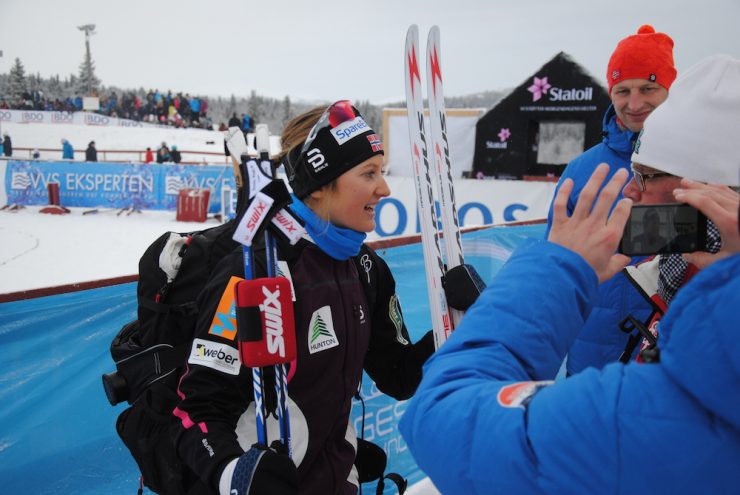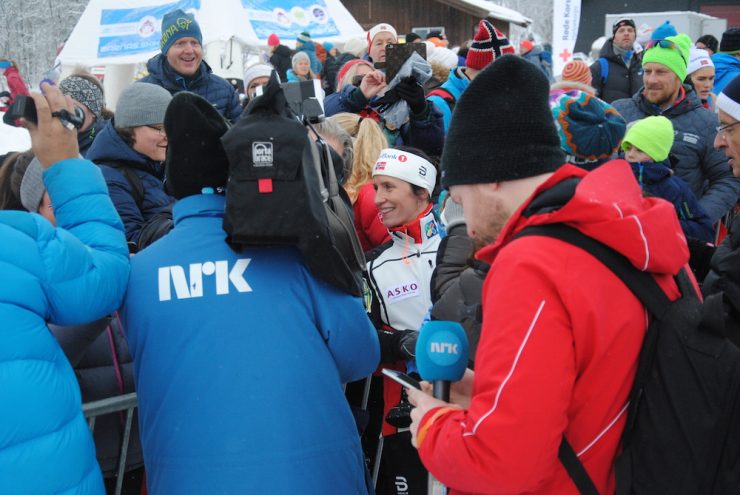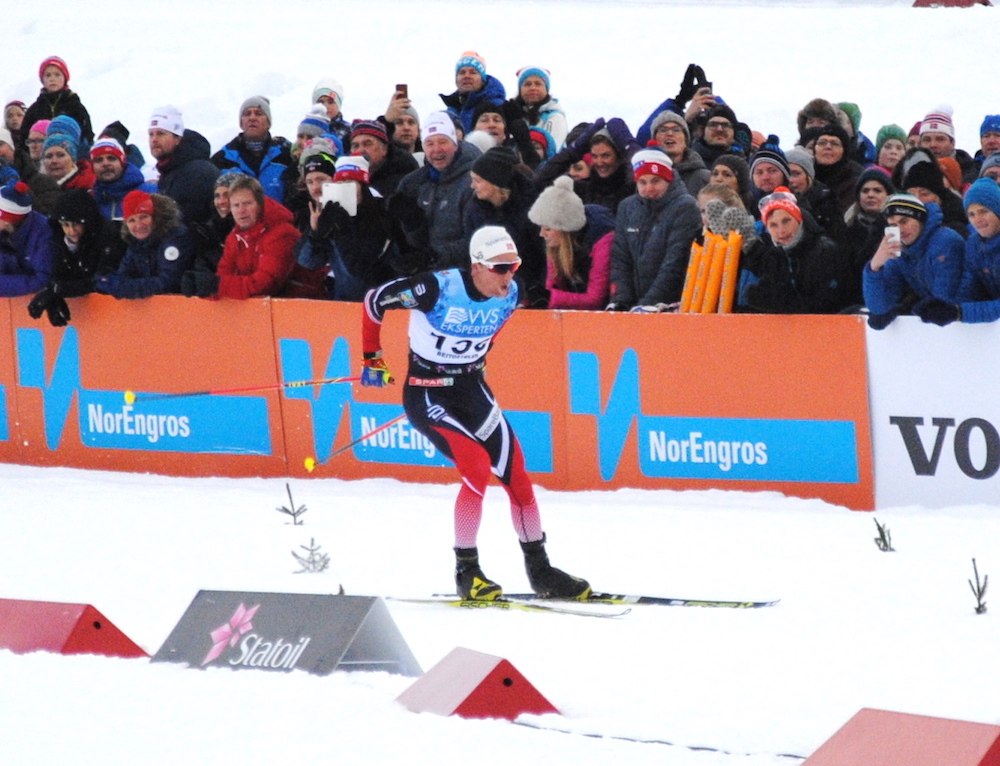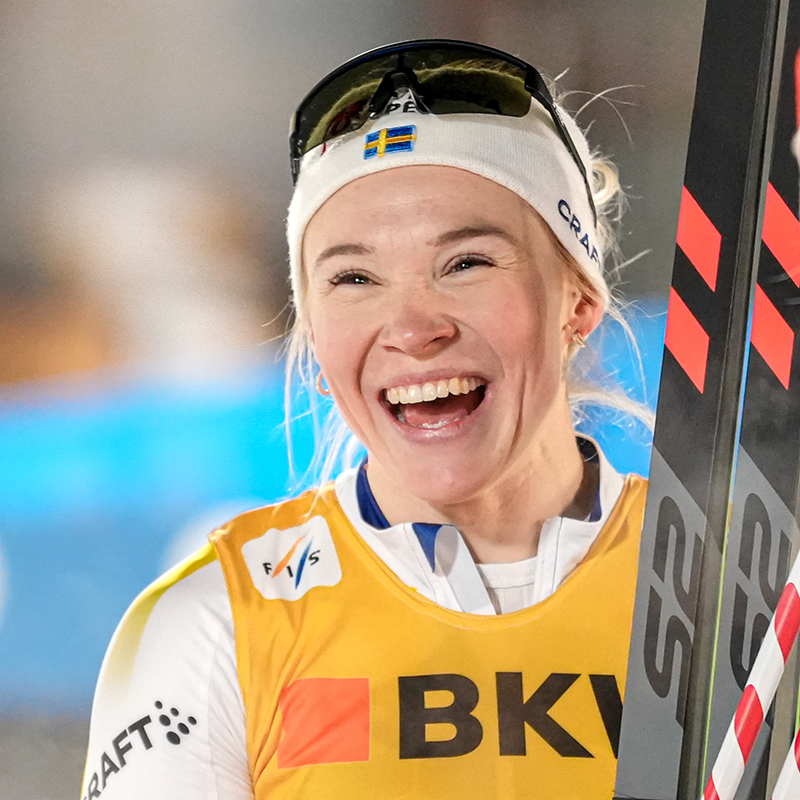

This coverage is made possible through the generous support of Marty and Kathy Hall and A Hall Mark of Excellence Award. To learn more about A Hall Mark of Excellence Award, or to learn how you can support FasterSkier’s coverage, please contact info@fasterskier.com.
The night sprint in Davos has a way of making the sport feel louder than it usually allows itself to be. The course is short, the laps repeat, the crowd sees the same faces twice, and the organizers lean into the spectacle—music, lights, flames—until the whole thing starts to resemble a winter street festival that happens to include the fastest skiers in the world. “They deliberately design this event to feel like a rock concert,” U.S. head coach Matt Whitcomb said, pointing to the night racing, the lighting, and the two-lap format that keeps the athletes close and visible.
But the women’s sprint on Saturday didn’t need help finding drama. It had its own: a final that turned into a study in timing and patience, a surprise runner-up, a home-country podium that felt like the whole point of staging a race like this in the first place, and an American women’s team day that—depending on where you stood—looked either like incremental progress or a reminder of how narrow the margins are when you’re trying to turn good skiing into the kind of skiing that survives the heats.
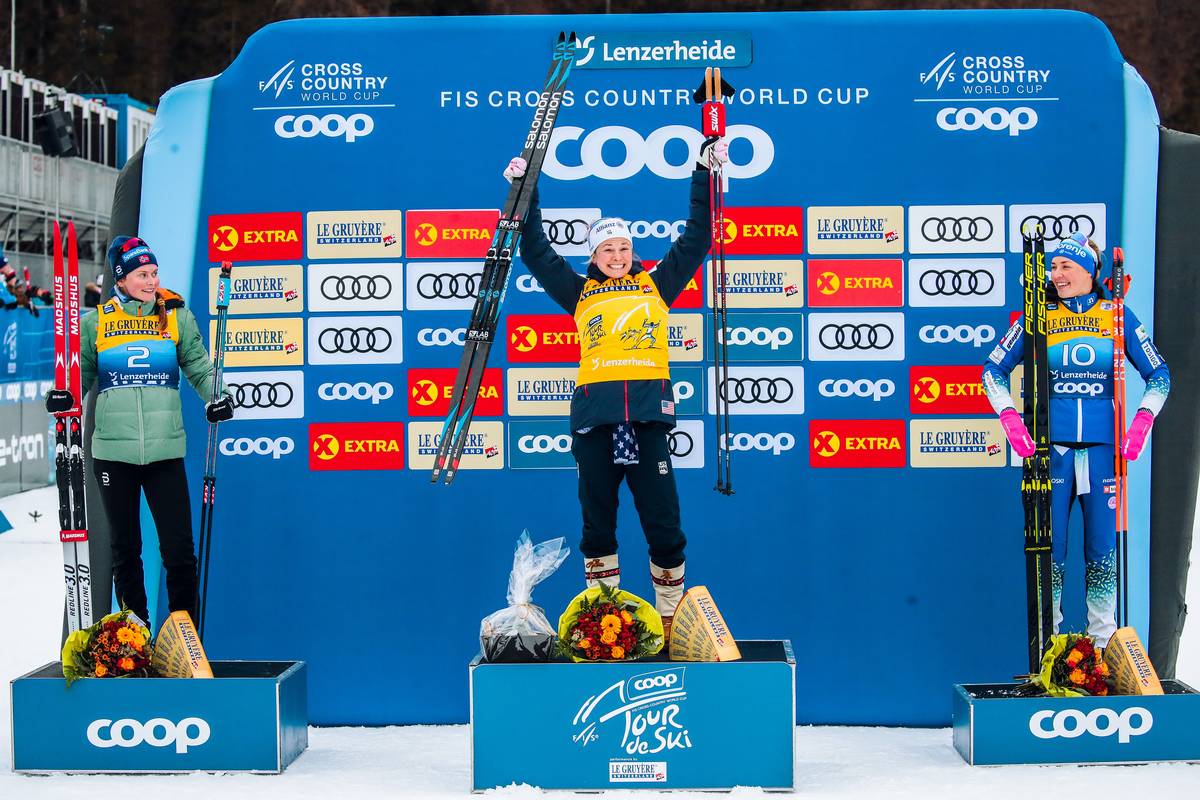
At the front, Jonna Sundling (Sweden) won the women’s sprint free in 2:31.86, edging Mathilde Myhrvold (Norway) by 0.08 seconds (2:31.94). Nadine Fähndrich (Switzerland) rounded out the podium in third at +2.60, a result made sweeter by the route she took to get there: she advanced into the final as a lucky loser and still skied her way onto the podium when it mattered most.
Behind them, the final was saturated with familiar sprint power: Maja Dahlqvist (Sweden) finished fourth, Linn Svahn (Sweden) fifth, and Laura Gimmler (Germany) sixth—three Swedes in a Davos final, again, in a venue that has long amplified Sweden’s particular talent for fast, hard, repeated efforts under bright lights.
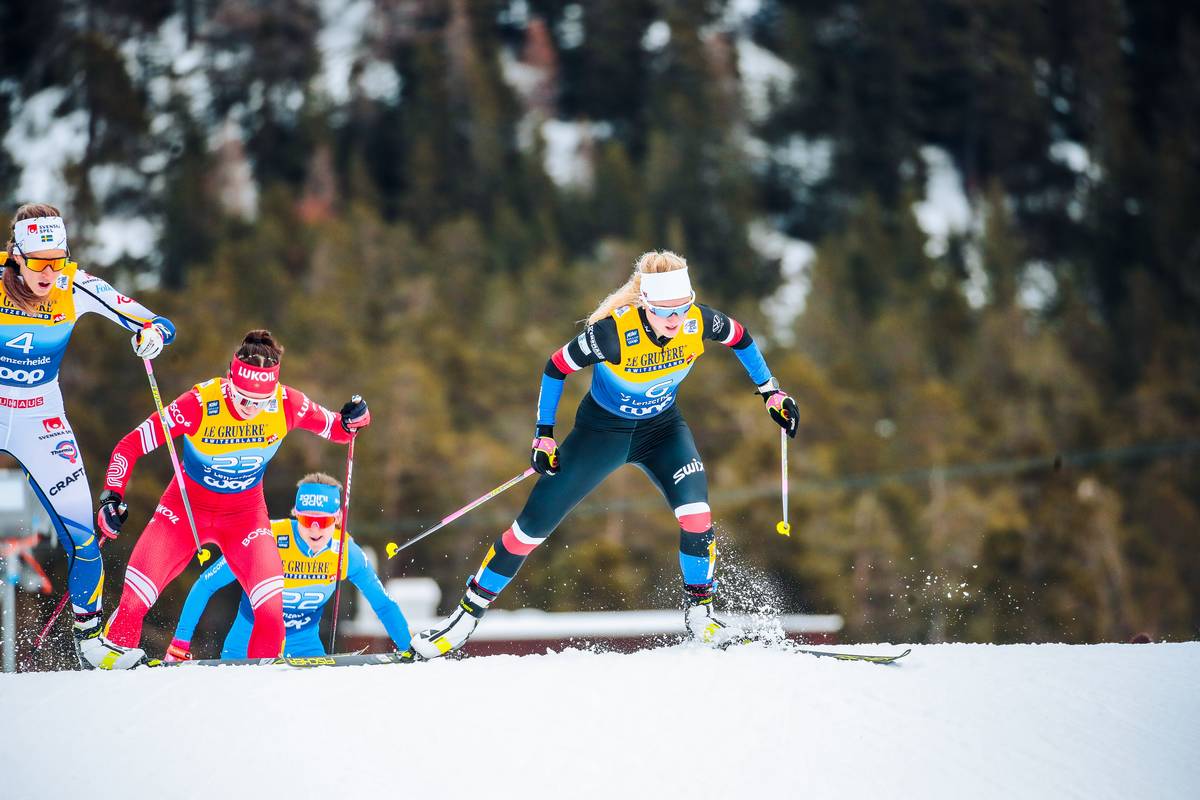
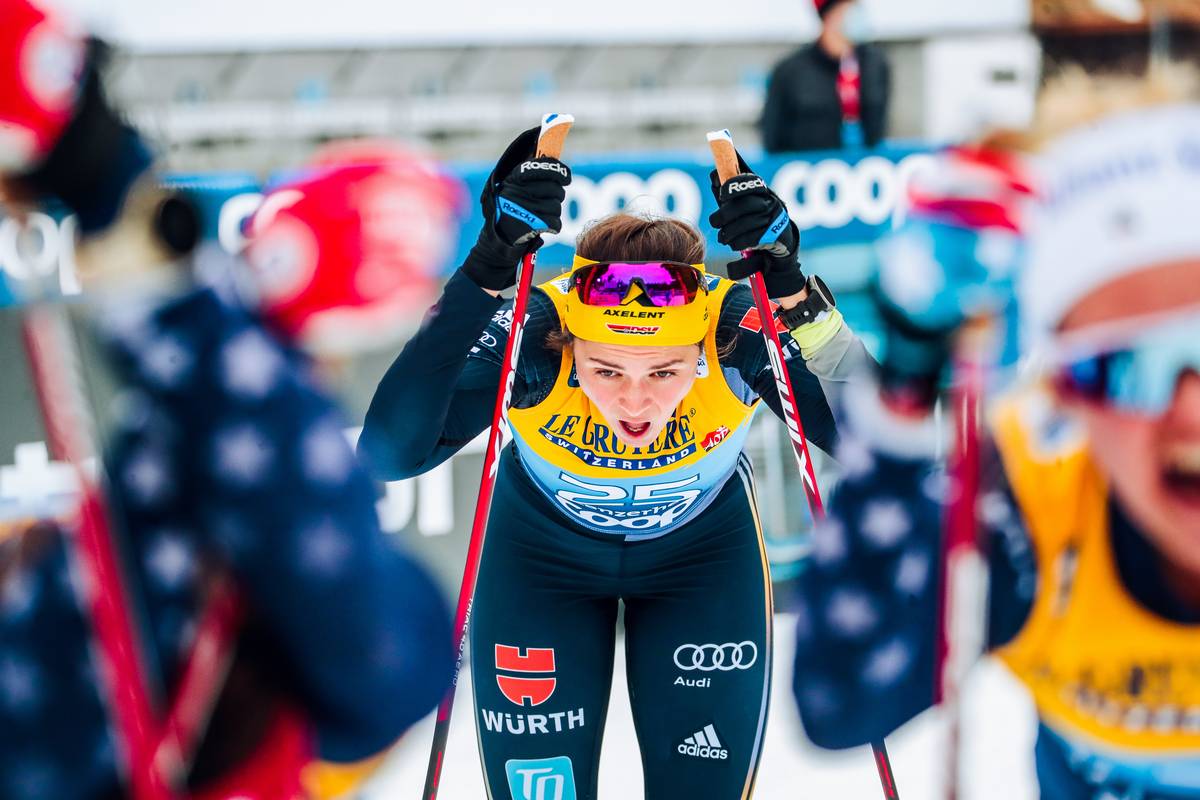
Kristine Stavaas Skistad (NOR), Laura Gimmler (GER), Jonna Sundling (SWE), Nadine Faehndrich (SUI), (l-r) during the sprint heats in Davos (SUI). (Photo: Vanzetta/NordicFocus)
A course that asks for control more than courage
Davos is not a long sprint, but it’s demanding in the way short races can be demanding: there’s nowhere to hide, and every mistake is immediate. The compact two-lap circuit rewards rhythm and positioning—especially on the downhill into the technical corner that has been a recurring storyline in Davos when the surface hardens.
Whitcomb, talking about the venue more broadly, framed Davos as a place where experience matters —not only experience racing hard, but racing smart: managing altitude, managing risk, and understanding that “good” in Davos can disappear fast if you’re constantly reacting rather than shaping.
That’s why Sundling’s win felt so Sundling: not flamboyant, not chaotic, but efficient—an athlete with enough power to force the pace and enough composure to let the final come to her.
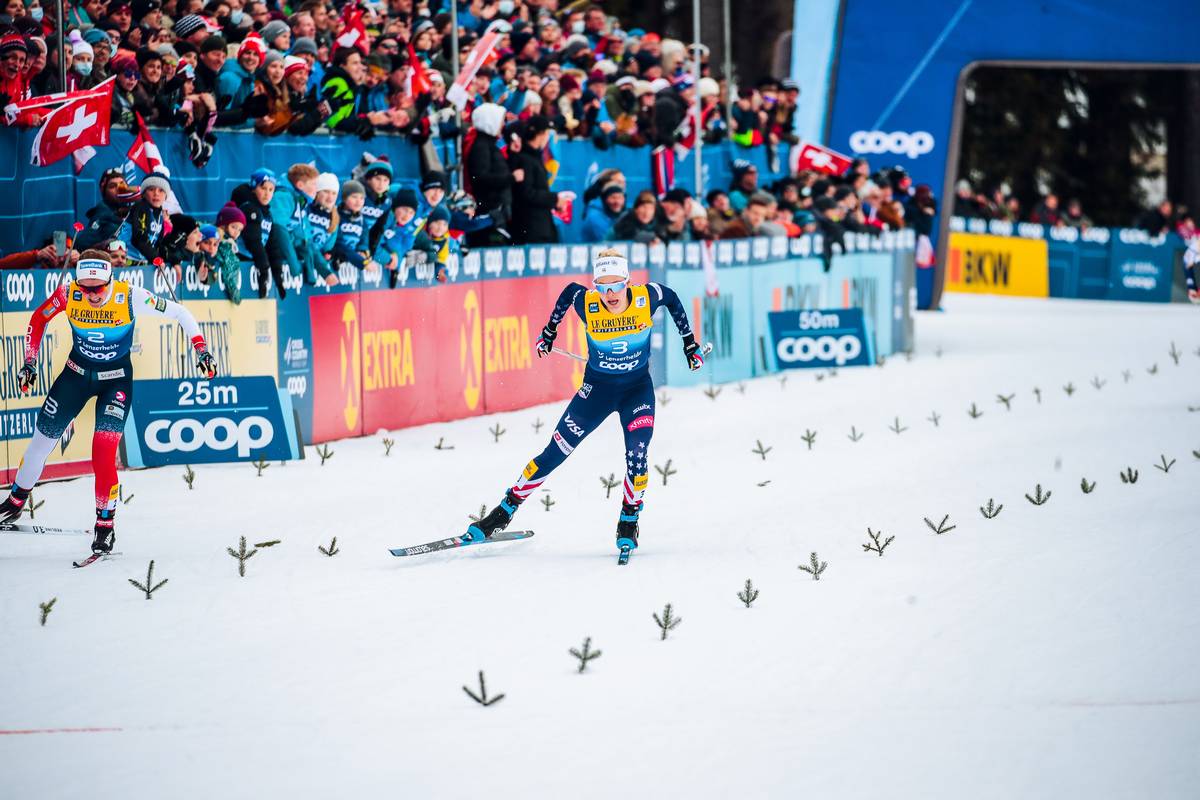
Mathilde Myhrvold (NOR) and Jonna Sundling (SWE), (l-r) lunge for the sprint final finish line in Davos (SUI). (Photo: Vanzetta/NordicFocus)
The final: Sundling’s patience, Myhrvold’s moment, Fähndrich’s home lift
If you didn’t know the result, you might have expected a Swedish one-two. Sundling and Dahlqvist were both in the final, and Sweden brought three athletes onto the start line. But sprint finals aren’t always about the most decorated name; they’re about who can keep their speed intact after a day of qualifiers, quarters, and semis—after the accumulation of small sprints that feel, by the end, like one long race done in pieces.
Sundling and Myhrvold made the final feel like a contest of timing. Sundling’s skiing had the taut confidence of someone who knows exactly what she wants from the last 200 meters; Myhrvold skied like someone who believed she could take it from her. They hit the line separated by less than a tenth of a second.
And then there was Fähndrich—third, at home, on a night designed for the crowd to matter. If Sundling’s win was clinical, Fähndrich’s podium was emotional in a quieter Swiss way: the sense that the event’s atmosphere wasn’t just decoration; it was fuel.
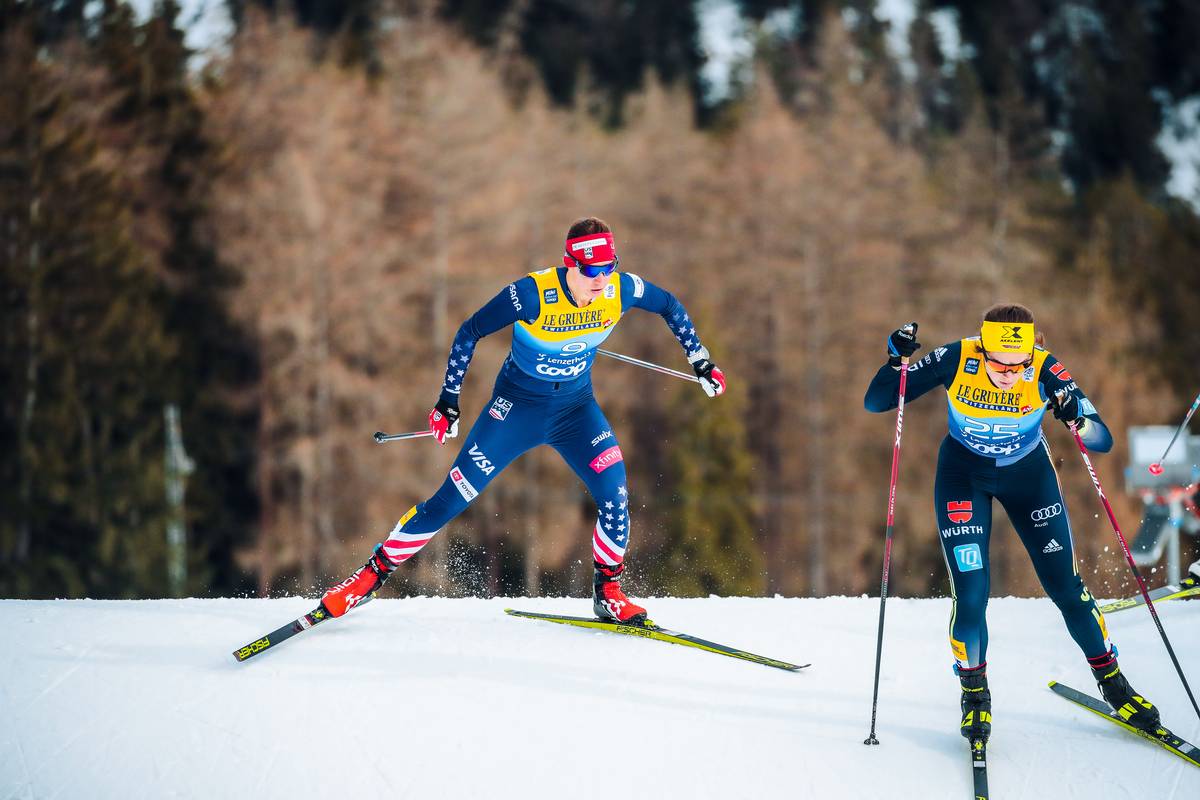
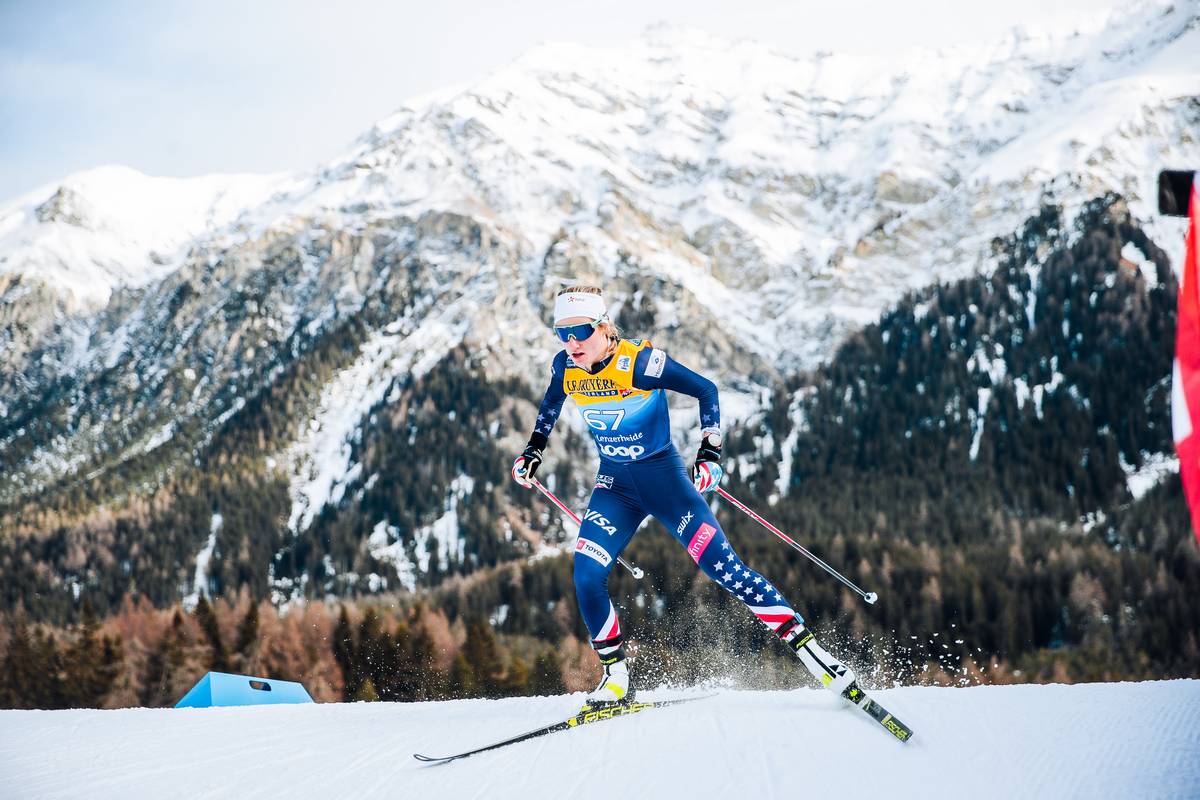
Julia Kern (USA) and Nicole Monsorno (ITA), (l-r) in the quarterfinals in Davos (SUI). (Photo: Vanzetta/NordicFocus)
The U.S. women: progress, frustration, and the line between them
For the U.S. women, Davos was not the same kind of headline day the men had produced a few hours earlier. But it also wasn’t empty. It was the kind of day coaches talk about carefully: pieces moving in the right direction, while also acknowledging that “right direction” still has to show up in a bracket.
Whitcomb didn’t sugarcoat the overall result. “Honestly, a little lackluster on the women’s side today,” he said, adding that the athletes themselves would agree with that assessment. At the same time, he pointed to specific positives—the kind that matter in the arc of a season.
He said Jessie Diggins “skied competitively” and “narrowly missed advancing,” and he emphasized that the difference between making semifinals and missing them is often a single decision in a single corner. He also singled out Julia Kern as an athlete whose level is rising: “Julia is definitely skiing on another level than she has been for the first couple of weekends,” Whitcomb said, framing it less as a sudden leap and more as a build—more weekends of consistent racing, more reps in heats, more time at speed until the pieces become routine.
Kern’s own description of her day fit that exact narrative: detailed plan, sharper qualifier, more of a feeling of normalcy returning—plus the kind of bad luck sprinting specializes in.
“I’m proud of making a detailed race plan and starting faster in the qualifier today,” Kern said. “I felt much more like myself out there and was able to play the tactical game with some good moves, even though it ended with an obstruction by another athlete. I’m excited to take this fresher energy into tomorrow and build on the endurance base I feel like I have going into the distance race.”
It’s a very Kern quote: pragmatic, technical, forward-looking. Not a lament—more a calibration.
The deeper truth of sprinting is that it doesn’t always reward “feeling better” immediately. Sometimes it rewards it tomorrow, or next week, or in the next venue where a better qualifier and a cleaner first heat finally align. That’s why Whitcomb’s view was pointed but not pessimistic: he sees the level rising, and he sees that the team standard is higher than the day’s outcome.
“We should be putting multiple women in the semifinals,” he said. “And it’s time to start doing that.”
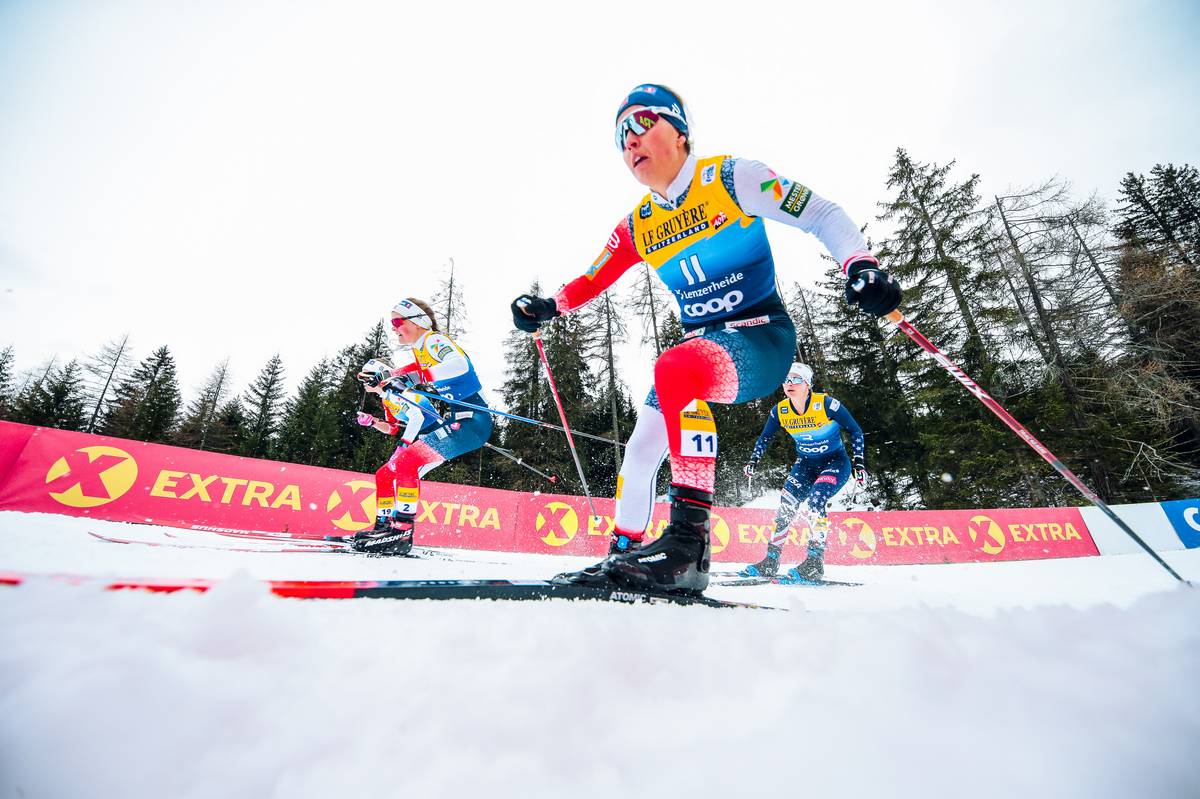
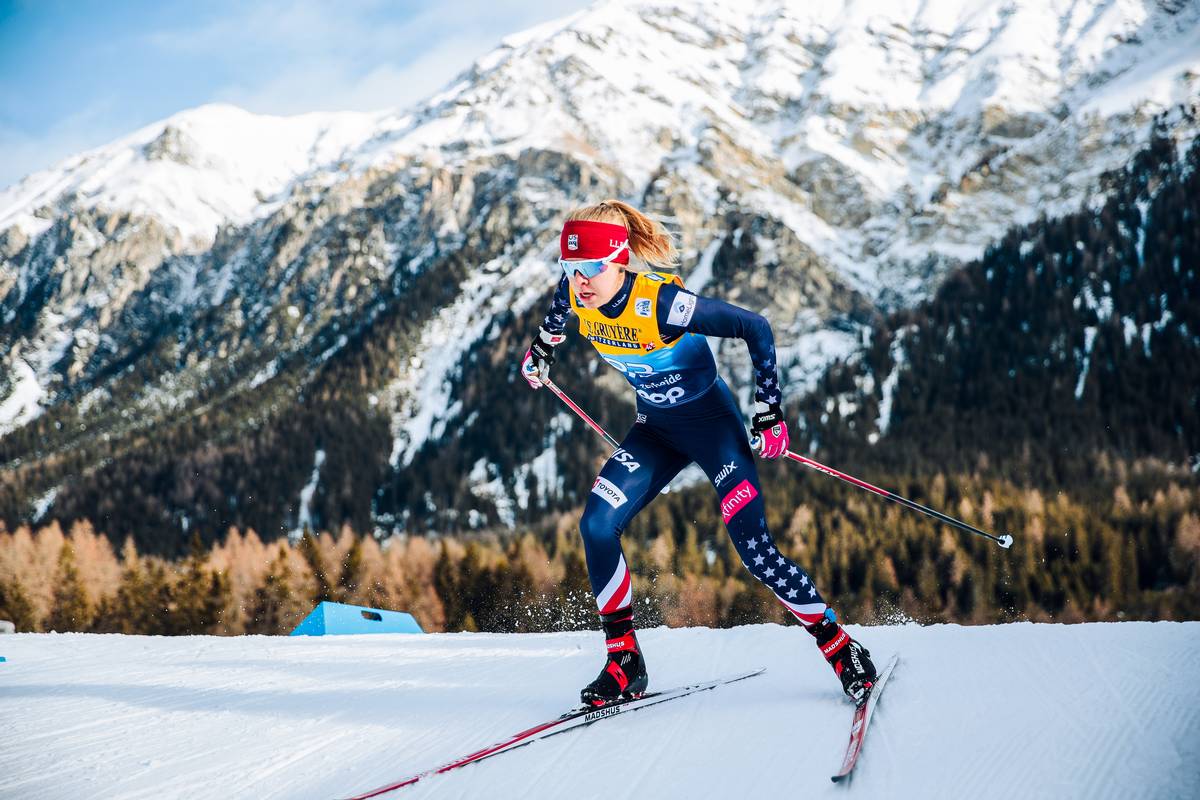
Jessie Diggins (USA) during qualification in Davos (SUI). (Photo: Modica/NordicFocus)
Why Davos matters beyond the podium
Davos is always a little odd in the calendar. It arrives after the first wave of races has introduced the season’s storylines, but before the season has fully decided what it wants to be. It’s high enough to punish sloppy energy management, tight enough to punish poor positioning, and loud enough to make athletes feel—at least for one night—that they’re racing in an arena rather than on a trail.
That can be destabilizing, in a good way. It can pull surprise finalists into the light. It can elevate a lucky-loser path into a podium. It can turn a planned, steady day into a messy one. And it can expose the difference between skiing fast and getting through rounds—a difference that isn’t always about fitness.
For Sweden, Davos once again looked like a venue built for their sprint depth: three in the final, the winner on top. For Norway, Myhrvold’s second place was a reminder that the sport is always producing new sprint threats, even in an era dominated by familiar names. For Switzerland, Fähndrich’s third place felt like the perfect use of home advantage and crowd energy.
And for the U.S. women, it was a day that asked a familiar question: how close is “close,” really?
Kern’s answer—embedded in her quote—was that she’s trending toward the skier she knows she is, and she’s carrying that energy forward into the distance race. Whitcomb’s answer was both sharper and more structural: good signs are not the same as results, but good signs are still worth something if they’re backed by consistent racing.
Recap: Women’s Sprint Free, Davos
Jonna Sundling (SWE) — 2:31.86
Mathilde Myhrvold (NOR) — +0.08
Nadine Fähndrich (SUI) — +2.60
Maja Dahlqvist (SWE)
Linn Svahn (SWE)
Laura Gimmler (GER)
Mathilde Myhrvold (NOR), Jonna Sundling (SWE), and Nadine Faehndrich (SUI), (l-r) share the sprint podium in Davos (SUI). (Photo: Vanzetta/NordicFocus)
The quieter ending Davos can leave you with
By the time the final ends, the flames are still there, the music is still there, and the crowd is still leaning over the fencing as if the night could produce one more surprise. But the athletes are already drifting toward tomorrow—toward the distance race, toward the next chance to turn “better” into “through,” toward the next bracket that won’t care how good your plan was unless it shows up as a place on the right side of the line.
That’s the strange promise of Davos: it amplifies everything. It amplifies winners. It amplifies near-misses. It amplifies the feeling that a season can pivot in a single night sprint—sometimes in front of flames and floodlights, sometimes in a quiet tactical mistake that only the skier can feel.
Sundling won because she was the best sprinter on the night and skied like she knew it. Myhrvold took second because she refused to concede the finish until the last step. Fähndrich climbed onto the podium because sprinting still leaves room for the athlete who keeps the door open long enough to walk through it.
And the U.S. women left Davos with a different kind of narrative—less celebratory, more unfinished. Kern put it plainly: she felt more like herself, she played the tactical game, and she’s taking that energy into tomorrow. In a season built out of weekends, that’s how momentum often begins: not with a single clean headline, but with the gradual return of a feeling an athlete recognizes—and a plan that, sooner or later, stops being interrupted.
Feature stories like this one take time, access, and care to produce. If you value thoughtful storytelling and independent ski journalism, please consider becoming a Voluntary Subscriber. Your support directly fuels the work we do to cover the people, places, and moments that make our sport special.
This World Cup coverage is made possible through the generous support of Marty and Kathy Hall and A Hall Mark of Excellence Award. To learn more about A Hall Mark of Excellence Award, or to learn how you can support Fasterskier’s coverage, please contact info@fasterskier.com.
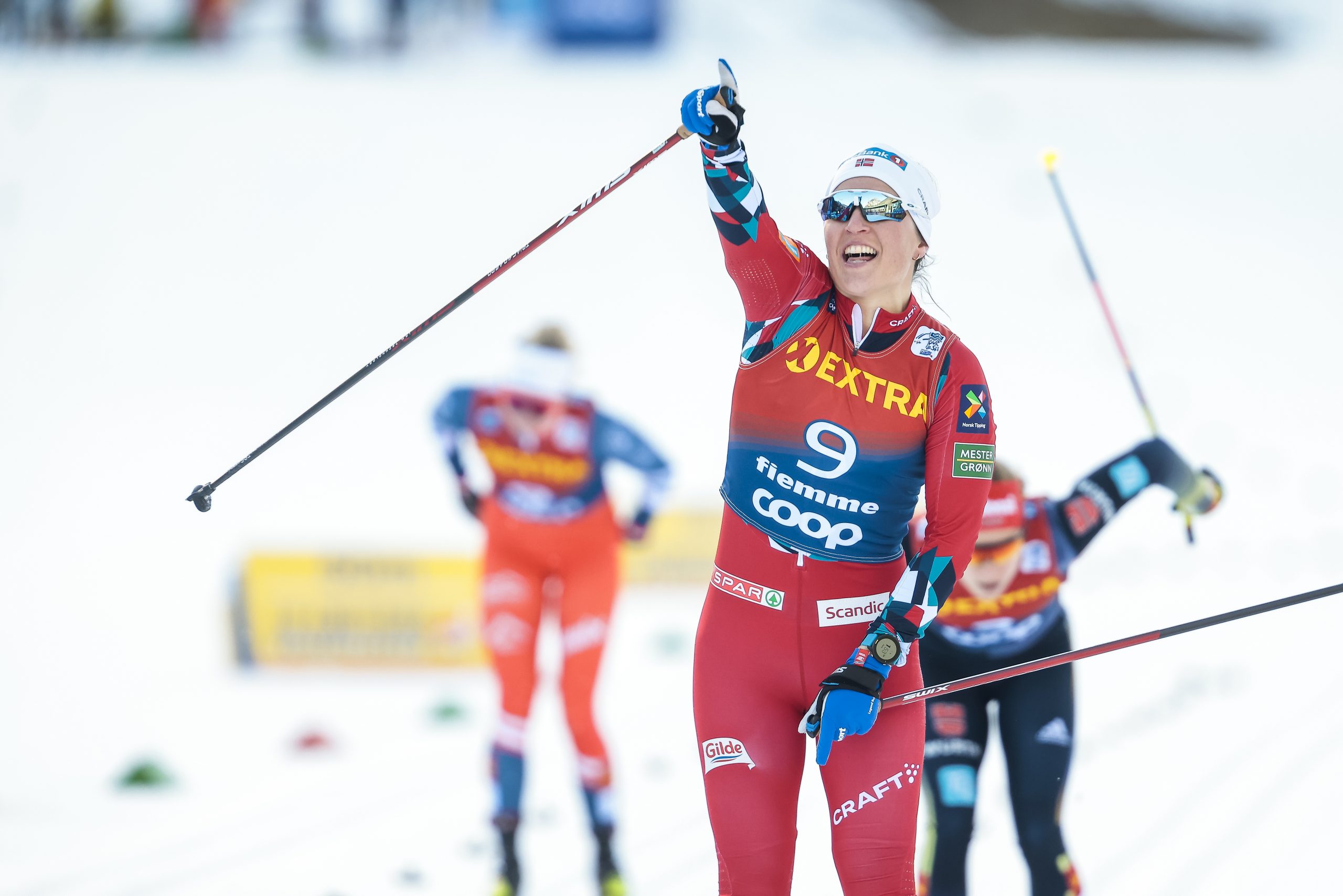
Lotta Udnes Weng (NOR) celebrates her victory in the Stage 5 Women’s Sprint at the 2023 Tour de Ski in Val di Fiemme, Italy. She shared the podium with her twin sister, Tiril Undnes Weng (NOR), who finished second. (Photo: NordicFocus)
Stage 5 of the 2023 Tour de Ski was a sprint, but not a “normal” sprint. Typically, sprint races are won by pure sprinters, those who control the pace of heats, and rely on mad dashes in the homestretch to secure victory. Unlike a typical World Cup sprint race, Val di Fiemme’s sprint stage was a race that was bound to affect the overall Tour de Ski standings: any distance skier who could advance to the later heats would be sure to rise in the ranks with just two more stages remaining. A number of significant sprint specialists were absent from the Tour de Ski startlist, and other skiers normally known for distance prowess were vying for sprint advancement. Those skiers would use the tools available to them to make that possible. Predictably, the pacing was fast, and the tactics merciless. This was not a sprint that could be taken: this was a sprint that would be earned.
A number of those all-arounders advanced to the final, including Finland’s Krista Parmakoski who set a brutal pace in both her quarterfinal and semifinal heats. The final podium was pure Norwegian red: Lotta Udnes Weng in first, her twin sister Tiril Udnes Weng second, and Myhrvold third.
Canadians in the final standings included Catherine Stewart-Jones who qualified 28th, but did not advance beyond her quarterfinal (finishing 29th), and Dahria Beatty 34th.
Americans failed to advance to the final, but had fine showings, nonetheless. With a hard-fought 10th place finish, Rosie Brennan showed that her form is returning to the world-challenging status that’s become her norm in recent seasons. Week after week on the World Cup tour, Brennan delivers a level of consistency that rivals that of any American skier from the present, or the past. While this week’s Sprint in Val di Fiemme was not a stand-out result for her, it was an indication that Brennan is once again rounding into form, and preparing herself to contend in races—both sprint and distance—in the remainder of the World Cup season.
“I was very happy to make the semi finals today,” Brennan said. “Sprinting has been such a struggle for me this year, so it felt good to make a small step forward. There isn’t much snow here and it’s warm so the tracks were fast and breaking down, but everything held on just enough and my skis were good. I lacked the punch I needed to make the final, but any step forward is all you can ask for. There is still a lot left in the Tour, so I’m still just trying to focus one day at a time and take things as they come. ”
Behind Brennan’s 10th place finish, American finishers included Julia Kern 14th, Jessie Diggins 21st, Alayna Sonnesyn 38th , and Sophia Laukli 44th
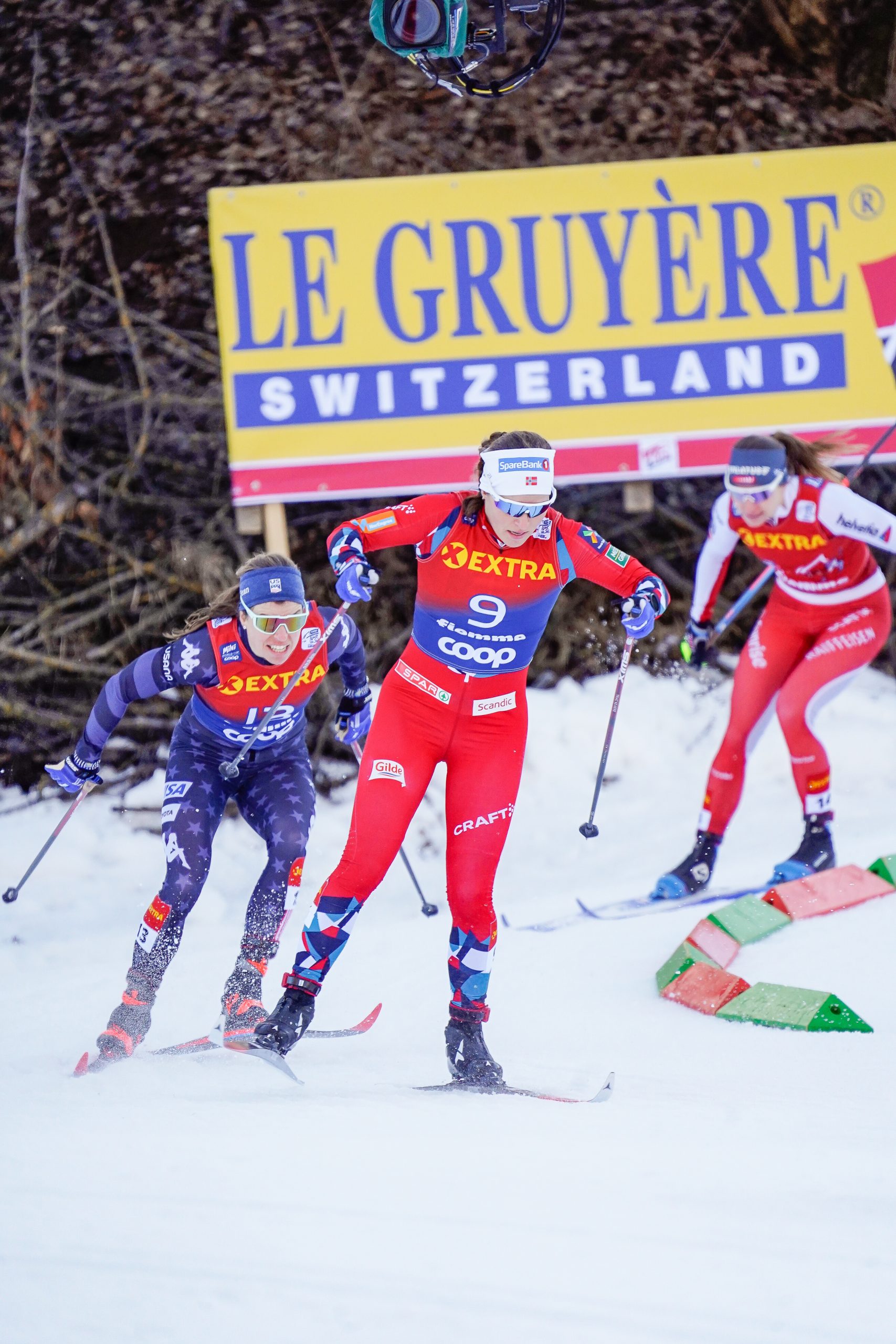
Rosie Brennan (USA), Lotta Udnes Weng (NOR), and Nadine Faehndrich (SUI) in a blistering quarterfinal heat that set the tone for the day in Val di Fiemme, Italy. (Photo” NordicFocus)
Women’s Sprint
Val di Fiemme offers a rolling sprint course with very little time for recovery. An initial uphill is followed by a rolling middle section. Later in the loop, the racers navigate a tight, tactically significant lefthand bend, a narrow spot in the course where speed can be gained, or lost. A wax-revealing downhill needs to be timed to create a slingshot effect over the final small rise.
With a number of Team Sweden’s sprint specialists sitting out the Tour de Ski, the Women’s field would be marked by racing that was likely to affect the overall standings (with a 60 second bonus for the winner). Distance skiers had great motivation to attempt to reach the later heats, meaning that the heats would be fast: no sprinters jockeying for position. It would come as no surprise that sprinters would be a bit tired after four challenging stages of Tour de Ski racing, and race strategy was dictated by the pace of the distance skiers.
The quarterfinals turned into tests of sustained speed. Heat times were incredibly fast, with blistering paces set by Parmakoski, Kerttu Niskanen (FIN), Eva Urevec (SLO), and current Tour de Ski leader Frida Karlsson (SWE). The sprinters appeared surprised by the early pace, with specialists like Dahlqvist and Faendrich finding themselves needing to accelerate late in their quarterfinal heats in order to advance. But those efforts took too much out of both of them, and neither would advance beyond the semifinals.
In her quarterfinal heat, Diggins found herself cut off at the narrow lefthand turn, and was unable to recover her speed by the finish. she would finish fourth in her quarterfinal. Julia Kern avoided that traffic jam in the same heat, but was only able to finish third. Neither would advance to the semifinals.
Semifinals
Semifinal 1 pitted the season’s dominant sprinter (Faehndrich) against four of the main TDS contenders: Parmakoski, Katherina Hennig (GER), L. Weng, and T.Weng. Parmakoski returned to her original strategy, driving the pace at the front and stringing out the semifinal field. Appearing exhausted, Faehndrich dangled off the back early on, and would not be a factor in the outcome of the heat. T. Weng and Hennig both caught Parmakoski in the finishing straight, with Brennan finishing fifth, and Faehndrich sixth.
Semifinal 2 was the days first race that was not run all-out, but stayed tightly grouped for most of the lap, seemingly playing to the advantage of Dahlqvist. Tereza Beranova (CZE) charged forward at the sharp left turn, but did not manage to gap the field. Finishing lanes became totally clogged behind her at the finish with Anna Dyvik (SWE) and Dahlqvist literally having nowhere to go. Mathilde Myhrvold (NOR) found an unobstructed lane, sprinting forward to win the semifinal, followed across the line by Beranova.
Women’s Sprint Final
The women’s final involved Parmakoski, Myhrvold, Beranova, T. Weng, L. Weng, Hennig. Parmakoski had already succeeded in gaining time on Karlsson, who failed to advance beyond the quarterfinal. Her goals accomplished on the day, she seemed content to let the more others set the pace in the final. Hennig, on the other hand, seemed determined to make the other racers work for the win: she drove the pace through the rolling middle of the course, marked comfortably by T. Weng. Beranova lingered at the rear with L. Weng.
Racers crowded through the notoriously tight left-hander. Hennig exited in the lead, but both T. Weng and L. Weng executed the hill slingshot to perfection, passing Hennig in the finishing straight where she also lost the battle with Myhrvold for third.
Norwegians—and Twin sisters—atop the Tour de Ski podium. Lotta Udnes Weng with the win, followed by her twin sister, T. Weng, and Myhrvold in third. In a post-race interview, Lotta Weng commented on her victory: “We planned to let the other girls do the job, and we can just chill behind them.The waxers are doing a great job,” she continued. “That makes it easy for us.”
The overall Tour de Ski standings are tightening. Karlsson continues to lead, though with a smaller the margin over T. Weng, Parmakoski, and L. Weng. Brennan moves into 7th overall with two stages remaining.
Tiril Udnes Weng (NOR), Lotta Udnes Weng (NOR), Mathilde Myhrvold (NOR), (l-r) celebrate a Norwegian sweep of the podium at the 2023 Tour de Ski Women’s Sprint in Val di Fiemme, Italy. (Photo: NordicFocus)
Spectators line the course in Lenzerheide, Switzerland for the first stop of this year’s Tour de Ski. (Photo: NordicFocus)
This World Cup coverage is made possible through the generous support of Marty and Kathy Hall and the A Hall Mark of Excellence Award. To learn more about A Hall Mark of Excellence Award or to learn how you can support FasterSkier’s coverage please contact info@fasterskier.com.
The 16th edition of the Tour de Ski kicked off today in Lenzerheide, Switzerland, beginning with a two-lap 1.5-kilometer skate sprint. In past years, the Tour has been a longer event with eight or more stage races. This year’s edition however, has six stages taking place over the course of eight days, to accommodate preparations for the upcoming Olympics in Beijing.
As a reminder to readers who may have forgotten over the course of the past twelve months, Jessie Diggins claimed the overall victory in last year’s Tour de Ski, making her the first non-European athlete (male or female) to achieve that title. After a convincing win in today’s first stage event, Diggins looks to be in contention for the overall win once more in 2022.
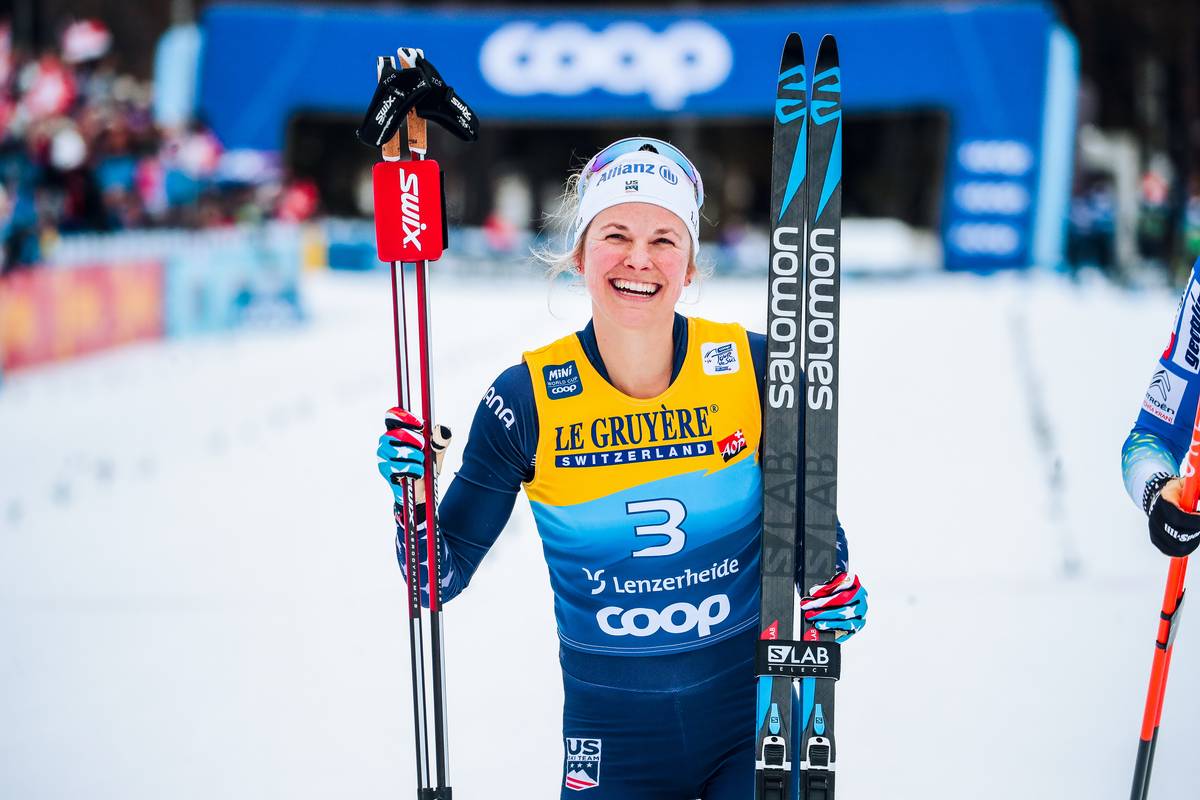
Jessie Diggins (USA) all smiles after finishing first in the 1.5 k skate sprint (Photo: NordicFocus)
The Tour last visited Lenzerheide in the 2019/20 season where Slovenian Anamarija Lampic earned her first World Cup victory, with Diggins finishing fourth. The sprint course is a 2 x 0.75k loop, with a climb out of the start, leading into a long downhill on the back stretch of the course, and a fast corner into the lap/finish lanes. Looking at the surrounding mountains and meadows, there seemed to be little snow and the temperature hovered around freezing as the sprint rounds began.
With three American women in the top thirty in qualification, the first quarter-final heat featured two of them, Jessie Diggins, who qualified 3rd with a time of 3:03.4 and Hailey Swirbul who qualified in 27th (3:09.49). Also in the first heat was Nadine Fähndrich of Switzerland, who posted the fastest qualifying time of the day (3:02.54). Swirbul, Fähndrich and Diggins were quick off the line with Diggins gaining the lead over the crest of the hill. Heading down, Fähndrich used the draft to gain speed and draw even with Diggins. As they rounded the corner heading towards the lap Fähndrich lost her balance and fell, sliding wide and taking out Swirbul in the process.
Nadine Fähndrich (SUI) leads Hailey Swirbul (USA) in the first quarter-final, before a fall. (Photo: NordicFocus)
With two competitors down, Diggins held the lead for most of the second lap, using her freeskate to gain space on the descent though once again, she was overtaken as Anne Kjersti Kalvå of Norway slingshot around Diggins and claimed first. Diggins finished second and both advanced to the semi-final rounds.
Hailey Swirbul (USA) racing in the quarter-finals (Photo: NordicFocus)
“I felt I raced my best today,” wrote Swirbul after the race. “I did not have the build up to the Tour that I had planned due to some unforeseen stresses, but that’s the way life goes sometimes. That won’t stop me from giving my best every day and leaving it all out there. I am really excited to hopefully build into the Tour this year and follow the strong skiing set by my teammates today! I thought our team skied really well overall, and our service team and medical/nutrition staff were top notch.”
Reflecting on her quarter-final, Swirbul wrote, “I had a surprisingly good start for myself and found myself in a good position early on. I tried to stay on the leaders the best I could but flew into the side-boards at the bottom of that first downhill… ouch! I’m glad to be okay, just a bit scraped and bruised. Looking forward to tomorrow.”
The second quarter-final heat saw an easy pace and a tight pack with Mathilde Myhrvold (NOR) and Johanna Hagström coming through as the fastest two.
In heat three, the Czech skier Katerina Janatova led most of the two laps, only to be passed by Anna Dyvik (SWE) and Tiril Udnes Weng (NOR) on the descent. Entering the finish lanes, Natalia Nepryeava of Russia turned on the pace and passed Dyvik to finish 2nd, though the Swede advanced to the semis as well given the fast time of the heat.
Katerina Janatova (CZE), Anna Dyvik (SWE) and Natalia Nepryaeva (RUS), (l-r) in quarterfinal number three. (Photo: NordicFocus)
In heat four, Laurien Van Der Graaff of Switzerland, a crowd favorite, followed a similar tactic to that of Janatova from the previous heat. Once again, this proved not to be the best strategy as Lampic (SLO) used the draft to pass Van Der Graaff on the final corner and easily take the win. Laura Gimmler of Germany came from behind and out-lunged Van Der Graaff to take the second qualifying position.
The final quarter-final heat featured the third American, Julia Kern who qualified in 9th position with a time of 3:05.24. This heat only had five racers as Eva Urec of Slovenia, who qualified in 16th, did not start the rounds. Moa Lundgren of Sweden led the first lap while Kern sat in fourth. As they headed through the lap, Kern made a move to the front and crested the hill in the lead. Despite a slight loss of balance on the corner, Kern was able to break the pattern from the previous four heats and became the first person to lead on the final downhill and hold onto that lead all the way to the finish line. Coletta Rydzek of Germany finished second behind Kern and Kerttu Niskanen of Finland earned the final lucky loser spot.
Julia Kern (USA) follows Coletta Rydzek (GER), (l-r) in the semi-final rounds. (Photo: NordicFocus)
As the men raced their quarter-final rounds, course conditions appeared to be getting faster and it got cloudier and the temperature dropped. When the women returned for the semi-final heats, Diggins was once again in the first heat. This time she stayed in the pack, near the back for the entire first loop. Taking a wide lane through the lap she gained the lead and created a gap to the rest of the field over the hill. With the pack strung out behind her Diggins held her lead and finished first, with Myhrvold of Norway taking second.
Tiril Udnes Weng (NOR) navigates a corner with Mathilde Myhrvold (NOR) on the outside (Photo: NordicFocus)
In semi-final number two, Lampic (SLO) had an early lead while Kern followed in second. Rounding the corner for the first time, Kern overtook the Slovenian and upped the pace. These two held off other challenges to secure first and second qualifying positions and thanks to the fast time of their heat, Rydzek (GER) and Dyvik (SWE) also came through as lucky losers.
Thus, the final featured two Americans (Diggins and Kern), one Slovenian (Lampic), one Norwegian (Myhrvold), one Swede (Dyvik), and a German (Rydzek). Out of the start gate the pace was conservative, nobody really wanting to be the leader on the first descent. Heading into the second and final loop, Diggins found space through the middle of the pack while Kern worked wide, both Americans coming to the fore. Up the hill, Lampic worked her way into second, Kern in third with Myhrvold (NOR) close behind. Diggins held the lead, taking a good corner and fending off a challenge from Myhrvold at the last minute.
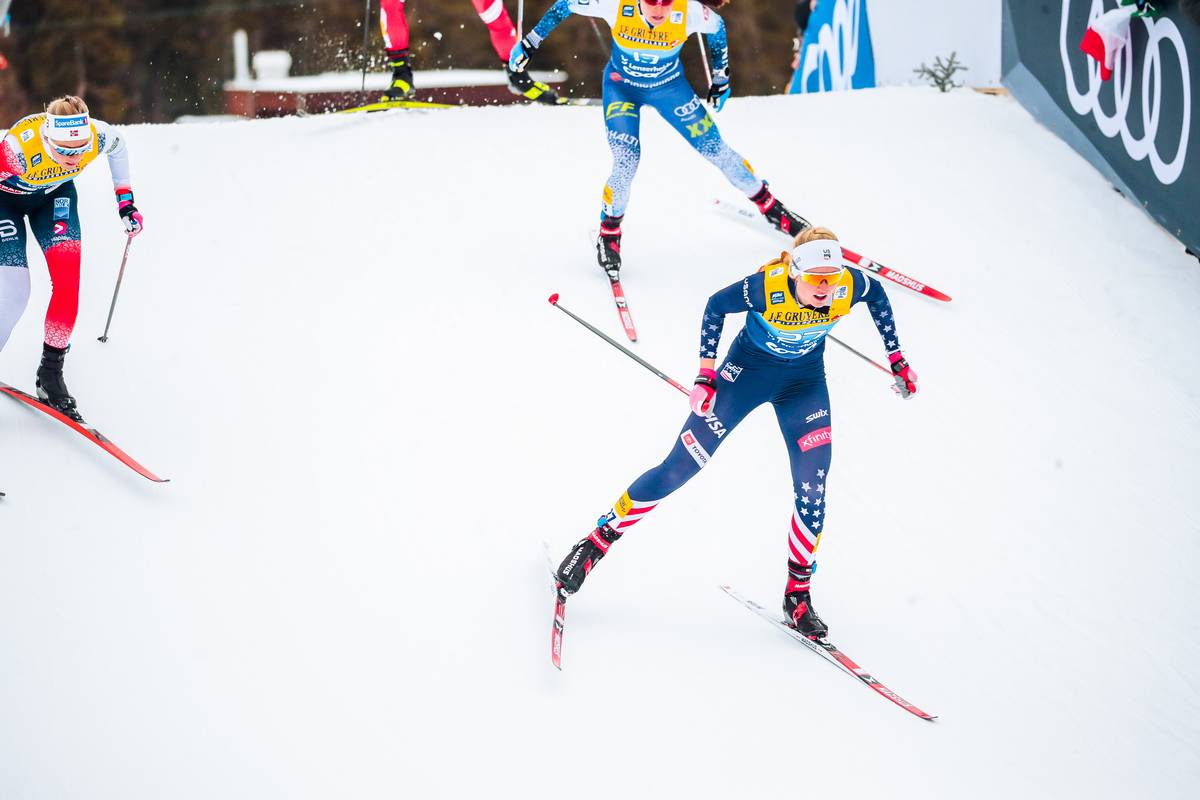
Jessie Diggins (USA) pushing hard towards the finish with Myhrvold (NOR) to her right (Photo: NordicFocus)
With first place going to Diggins, the twenty-three year old Myhrvold earned her first World Cup podium in second place. Lampic out-sprinted Kern to finish third, with Kern coming in fourth. Dyvik (SWE) came in 5th and Rydzek (GER) finished 6th, her best World Cup finish to date.
Coletta Rydzek (GER) finished sixth, her first time making a sprint final. (Photo: NordicFocus)
“The rounds today were definitely tactical,” wrote Kern after the race, “but also rewarded just skiing hard. The track got faster as the day went on after some light precipitation before the qualifier, which glazed the track a bit as the temps got warmer. There was definitely a draft on the downhill, but skating really hard into the downhill and being in the front position was the most important, which made the tactics a bit tricky with both leading and following. I felt strong all day, my skis were ripping fast, and body was feeling good!”
Kern sat out in Davos due to a stomach bug and she wrote, “Dresden allowed me to rebuild that momentum that I was feeling after Lillehammer. After the Dresden weekend, I didn’t even want a break, I just wanted to keep rolling so I was very much looking forward to today.”
Anticipating tomorrow’s 10 k classic she wrote, “I am really excited to finally get to classic ski again after eight skate races in a row. I haven’t done a classic race since the opener in Ruka so I am curious to see how my classic skiing is coming along, and also how my fitness carries over to some distance racing after a few weeks off from distance racing as well. Overall, the team energy is great, we have an awesome support staff and I am excited for more races to come!’
Diggins, whose parents and sister were at the venue in Lenzerheide, was all smiles after the race. “Thanks to my family for the cheering,” she said in a post-race FIS interview, “I’m just in a really happy place, and for me happiness is fast.” When asked about her preparation for the next few days of racing she said she plans to “eat a lot, sleep a lot, and see how it goes.”
Here are some additional post-race comments from Diggins and Kern, interviewed by Tom Horrocks, U.S. Ski & Snowboard Cross Country communications manager, who will be on-site through the Tour.
The Tour continues tomorrow with a 10 k classic on tap for the women. Diggins currently holds the lead ahead of Myhrvold (NOR) by +0:05 seconds.
Novie McCabe (USA) racing to 46th in her first Tour de Ski competition (Photo: NordicFocus)
Also competing in the Tour for the Americans is Novie McCabe, who finished 46th (3:12.89), and Katharine Ogden who was 55th (3:14.74). SuperTour leader who recently joined the American squad in Europe, Alayna Sonnesyn skied to 58th (3:15.11), with Sophia Laukli rounding out the American women in 76th (3:20.43). There are no Canadian women taking part in this year’s TdS.
Post-race interview with Matt Whitcomb on the course in Lenzerheide, which has suited Americans well over the years, along with additional comments on the men’s and women’s races.
Sophia Laukli (USA) finished 76th in her first TdS event (Photo: NordicFocus)
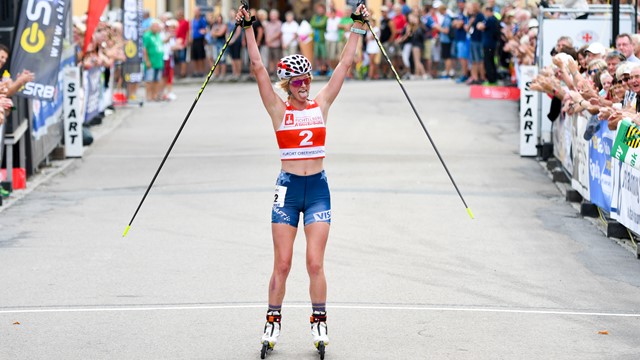
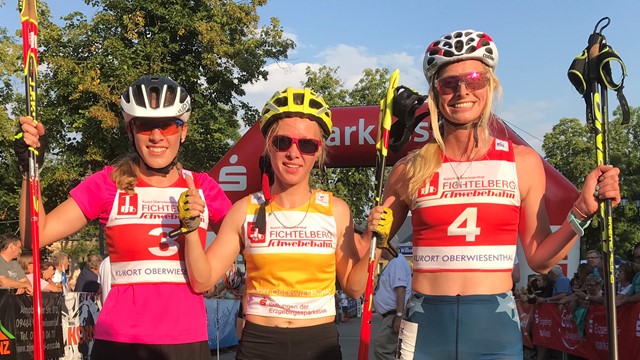
Tara Geraghty-Moats winning Sunday’s normal hill/5 k Gundersen at the 2018 Women’s Nordic Combined Summer Grand Prix in Oberwiesenthal, Germany. (Photo: Romina Eggert/FIS)
Two North Americans posted impressive results at nordic events in Germany and Norway over the last week, with Vermont native Tara Geraghty-Moats racing to first overall in the first-ever Women’s Nordic Combined Summer Grand Prix and Quebec’s Alex Harvey placing second, fifth and 10th in three races at the Toppidrettsveka rollerski series.
Geraghty-Moats 1st and 2nd at Inaugural Women’s NoCo Grand Prix
Brand new to nordic combined as well as the jump hill in Oberwiesenthal, Germany, Geraghty-Moats took the inaugural women’s Nordic Combined Summer Grand Prix by storm this past weekend, placing first and second in two competitions. That tied her for first place in the overall Grand Prix standings, alongside Russia’s Stefaniya Nadymova — the defending champion of last winter’s inaugural women’s Nordic Combined Continental Cup.
On Sunday, Geraghty-Moats, 25, of USA Nordic and the New York Ski Education Foundation (NYSEF), handily beat Nadymova and the rest of the 10-woman field after starting the 5-kilometer Gundersen rollerski race in second, four seconds behind Germany’s Jenny Nowak. While Nowak had posted the best jump of 96 meters on Oberwiesenthal’s 106-meter “normal” hill, Geraghty-Moats tied for the second-best-scoring jump (94.5 meters), with Austria’s Lisa Hirner (95 meters). From there, Geraghty-Moats dropped Hirner, Nadymova and Nowak on the first of three laps in the rollerski race and went on to finish in 11:04.8. Nowak ultimately placed third, 1:29.2 behind Geraghty-Moats.
“I was really satisfied by how my first weekend of being a nordic combined-er went, and I think the patience of waiting to be a nordic combined-er really paid off,” Geraghty-Moats told the International Ski Federation (FIS) after. “I struggled with the jump a little bit the first couple days. I had never jumped this hill before, and I sort of figured it out today so I got to ski a little bit easier than yesterday, but I was also happy that yesterday I was able to have a good fight and ski fast to my potential and end up on the podium.”
The women’s individual normal hill/5 k Gundersen podium on Saturday at the 2018 Women’s Nordic Combined Summer Grand Prix, with Russia’s Russia’s Stefaniya Nadymova (c) in first, American Tara Geraghty-Moats (r) in second, and Germany’s Jenny Nowak (l) in third in Oberwiesenthal, Germany. (Photo: FIS/Silke Tegethof)
“It was a dream come true to finally be able to compete in women’s Nordic Combined on an international level,” Geraghty-Moats told FIS on Saturday. “I’m using this weekend to learn the level I have to be at to have success in Nordic Combined. I made some mistakes today and learned a lot but I came away with a good result and having had a huge amount of fun competing with small but strong field.”
Eleven women competed in Saturday’s normal hill/5 k.
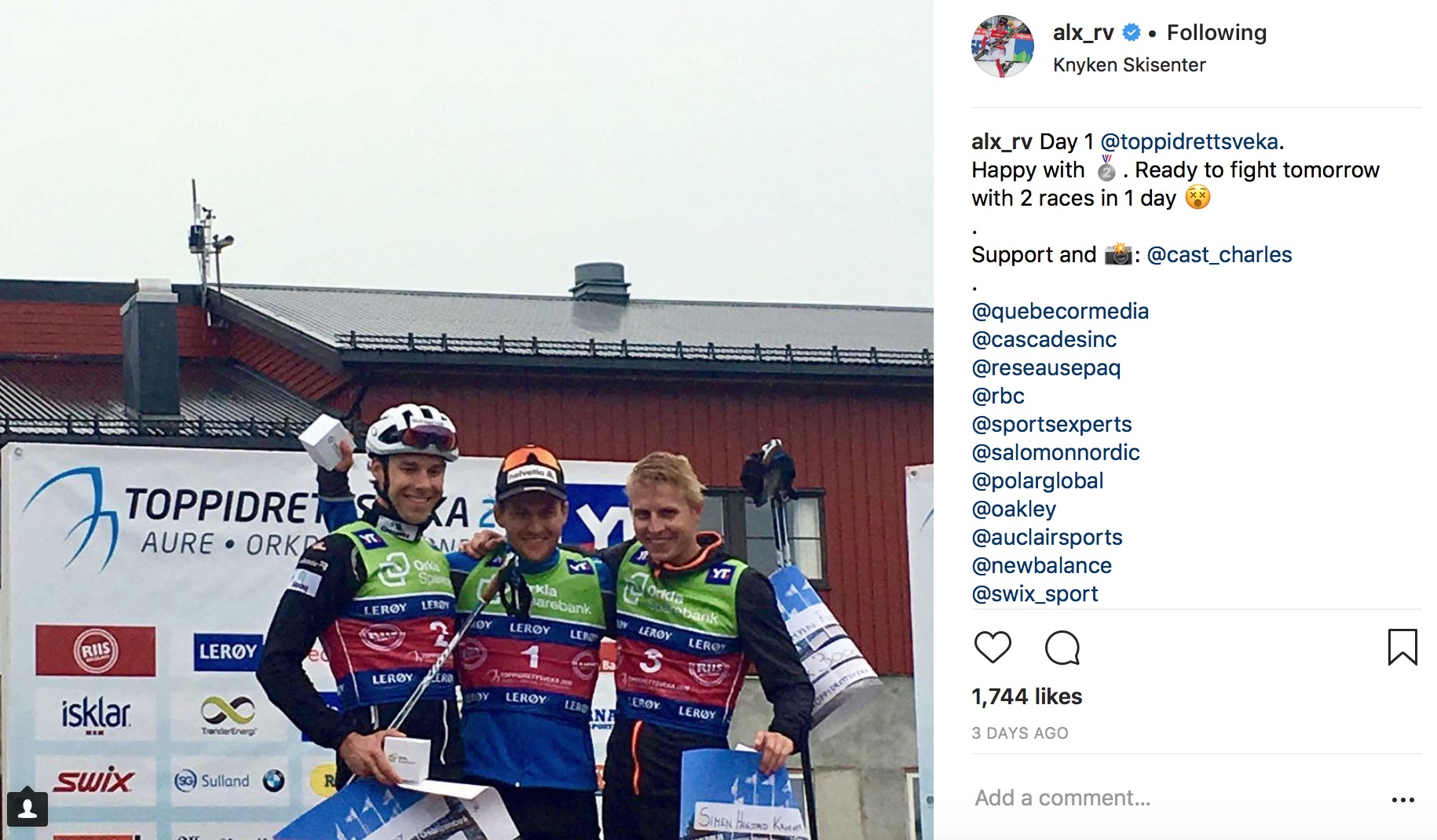
Alex Harvey (l) on the podium with Roman Furger (c) and Simen Hegstad Krüger (r) at the 2018 Toppidrettsveka rollerski festival in Norway last Thursday, Aug. 16. (Photo: Alex Harvey/Instagram)
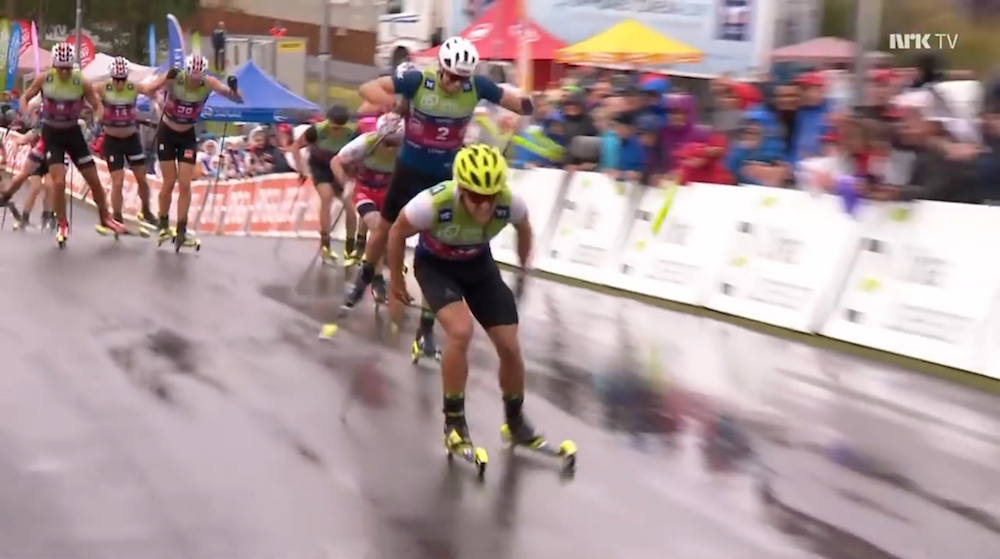
At the Toppidrettsveka rollerski festival in Norway, Canada’s Alex Harvey raced to second in the 15 k skiathlon last Thursday in Orkdal, missing out on first by just 0.6 seconds to Switzerland’s Roman Furger, who won in 30:43.3. Norway’s Simen Hegstad Krüger, the reigning Olympic skiathlon champion, finished third, 1.5 seconds back. In a stacked international field of 125 men, Canada’s Evan Palmer-Charrette placed 75th in that race (+2:14.4), Bob Thompson was 84th (+2:32.7), and Scott Hill 89th (+2:52.5).
Canada’s Alex Harvey (2) gunning for first in the men’s 15 k skiathlon on Aug. 16 at the Toppidrettsveka rollerski festival in Orkdal, Norway. (Screenshot: NRK broadcast)
Heidi Weng beat her cousin Tiril Udnes Weng by 0.7 seconds in the women’s 10 k skiathlon that day, finishing in 22:52.1. Norway swept the top five of the women’s race, with Anne Kjersti Kalvå reaching the podium in third (+1.3), and national-team members Kathrine Harsem and Astrid Uhrenholdt Jacobsen placing fourth (+1.4) and fifth (+1.5), respectively, out of 43 women.
In the men’s 24 k classic mass start aroundAure/Brekka on Friday, Harvey finished fifth, 19 seconds after Krüger, who won in 59:57.5. Norway’s Hans Christer Holund placed second in that race (+2.6), Norway’s Magnus Stensås was third (+13.0), and Switzerland’s Dario Cologna fourth (+17.1). Also for Canada, Palmer-Charrette finished 61sth (+2:30.9), Hill 78th (+4:02.3), Thompson 86th (+5:40.3), and Maks Zechel 88th (+7:01.4) out of 125.
Heidi Weng repeated in first in the women’s 24 k mass start, finishing in 1:10:02.4 hours, while Tiril Udnes Weng again placed second, 25.4 seconds back, and Jacobsen reached the podium in third (+27.7).
Later on Friday in Aure, Norway’s Sondre Turvoll Fossli topped the men’s freestyle sprint final ahead of four other Norwegians, including Pål Trøan Aune in second and Jan Thomas Jenssen in third, and Switzerland’s Furger in fifth, while Harvey did not qualify for the heats and ended up 37th overall. Palmer-Charrette was once again 61st in qualification, Hill 107th and Thompson 109th out of 121.
In the women’s sprint, Norway’s Mathilde Myhrvold won the final in 2:56.54, 1.05 seconds ahead of Slovenia’s Katja Visnar in second. Heidi Weng placed third in the final (+1.97), ahead of Tiril Weng (+2.64) in fourth, another Norwegian Anna Svendsen in fifth (+2.76), and another Slovenian Alenka Cebasek in sixth (+3.73).
In the final race of the series, the classic pursuit on Saturday, Harvey started second, 10 seconds behind Furger in first. The Canadian went on to place 10th, 4.2 seconds out of first, in the 15 k race, while Stensås took the win in 37:45.5 after starting seventh. (Furger slipped to 55th and 1:55.5 behind at the finish.) Norway’s Mikael Gunnulfsen rose from eighth to second (+0.7) and France’s Jean-Marc Gaillard made it all the way up to third (+1.7) after starting 15th.
Palmer-Charrette finished the pursuit in 59th (+2:04.2), Thompson placed 80th (+2:55.2), Hill 87th (+3:41.5), and Zechel 93rd (+3:48.9) out of 105.
Jacobsen ended the weekend as the women’s 12 k mass start winner, after the entire women’s field (of 33) started at the same time. She crossed the line first in 34:20.8, 0.4 seconds ahead of Heidi Weng in second and 1.2 seconds ahead of Kalvaa in third.
American Julia Kern (second from r) chasing Russia’s Polina Nekrasova (r) in the first semifinal of the women’s classic sprint on Monday at 2017 Junior World Championships at Soldier Hollow in Midway, Utah. While the Russian won the semifinal (and ultimately the final), Kern finished fifth after a crash for ninth overall. (Photo: FlyingPointRoad.com)
Germany, Germany, Germany. That was the way the women’s 1.3-kilometer classic sprint started on Monday at the first day of Junior World Championships at Soldier Hollow in Midway, Utah, with Antonia Fräbel putting down the fastest qualifying time in 3:40.83, a full 6.15 and 8.03 seconds faster than her German teammates Coletta Rydzek and Julia Richter, who qualified in second and third, respectively.
The 10th woman to qualify (out of 30), Russia’s Polina Nekrasova, was nearly 13 seconds slower than Fräbel around Soldier Hollow’s new sprint course at the 2002 Olympic venue.
But the qualifier is the qualifier; the heats are what ultimately matter.
There, in the quarterfinals, the 18-year-old Nekrasova won the first quarterfinal in 3:38.13, a time that bested Fräbel’s qualifier by more than two seconds, while American Julia Kern crossed the line 0.19 seconds later in second. Fräbel was in that quarterfinal, too, and finished third (+0.91).
Kern, in her third Junior World Championships, explained that her strategy for that heat had been to stick to Fräbel like glue.
“I knew I didn’t want to lead on the downhills since the draft set up really well today and I knew I would be strong coming into the finish,” the 19-year-old Kern, a member of U.S. Ski Team development team (D-team) and Stratton Mountain School (SMS) Elite Team, wrote in an email.
Fortunately for her, the plan worked. Kern followed Fräbel up the first two climbs before Fräbel and Nekrasova gapped her slightly on the final uphill.
“I pushed really hard off the top and my skis were rockets (thanks to our awesome techs!) so I skied right up to them by the turn,” Kern wrote. “I held my ground and took the inside on the 180 turn, pushing the German to the outside and then all three of us double poled hard into the finish head to head.”
The fourth-place finisher in that heat, Italy’s Veronika Broll, finished nearly 14 seconds later. The top three advanced to the semifinals, which Nekrasova and Fräbel both went on to win. A crash caused Kern to finish fifth in the first semifinal, 28.05 seconds behind Nekrasova in first.
American Julia Kern (Stratton Mountain School Elite Team/U.S. Ski Team D-team) during her semifinal of the women’s classic sprint on Monday at 2017 Junior World Championships at Soldier Hollow in Midway, Utah. (Photo: FlyingPointRoad.com)
“I didn’t have a great start in the semi final but that didn’t worry me,” Kern reflected. “I knew my skis were fast and that the second part of the course played to my strength.”
She followed the pack up the first hill, pushing hard over the top and put herself in a position to start passing people on the final climb.
“There was definitely some pushing and shoving by other girls as we crested the top,” Kern wrote.
The California native (who grew up outside Boston) began the final descent toward the stadium in fourth, “right where I wanted to be to hang in the draft,” she wrote.
Coming out of it, the three women ahead of Kern lined up in the second lane while Norway’s Marte Maehlum Johanson moved to the third lane.
“My skis were feeling awesome and I was gliding into the other girls quickly so I made a move to the fourth track to set up wide for the 180 turn,” Kern wrote. “Unfortunately, as [Johanson] switched to the 3rd lane, she placed both skis in one track and started to fall. I hopped into the fourth lane but as she fell, I think her pole flung out into my track and my ski went over it, stopping the ski and sending my momentum forward and onto one ski. I almost saved it with a funky one-leg balance drill but my momentum was flying so fast forward that I went for the straight penguin dive for 10 feet across the snow.
“I quickly hopped back on my feet in hopes that I could make a miracle come back but I soon realized I was at a complete stop at the highest speed part of the downhill and the pack was already rounding the corner,” Kern continued. “I still wanted to get top 10 (my goal for the day), so I quickly started to ski until I rounded the corner and realized the Norwegian was still lying on the ground. I decided then to ski it in easy and soak up the amazing atmosphere of my family and friends cheering me on, on home soil with the sun shining and beautiful hard track classic skiing.”
While Kern didn’t advance to the final, she ended up ninth on the day for her first individual top 10 at Junior Worlds.
“It is pretty bittersweet,” Kern wrote of her result. “It is easy to get caught up on the ‘what if’s’, especially since I was exactly positioned how I wanted to in the last downhill and I was in the mix to fight for the A-final spot I have always dreamed of. However, today I skied exactly how I wanted to and I didn’t leave anything out there and that is all that matters; an unlucky crash out of my control is just part of sprint racing and I don’t think that should put a damper on what is still my best ever sprint result at World Juniors!”
Russia’s Polina Nekrasova looks back after decisively gapping two Germans for the win in the women’s classic sprint on Monday at 2017 Junior World Championships at Soldier Hollow in Midway, Utah. Germany’s Antonia Fräbel placed second (+3.56) and Coletta Rydzek was third (+4.58). (Photo: FlyingPointRoad.com)
Meanwhile, Nekrasova and Fräbel met in the final, along with Rydzek, Finland’s Anita Korva, Norway’s Mathilde Myhrvold, and Sweden’s Emma Ribom. There, Nekrasova outlasted the two Germans for the win in 3:34.6, crossing the line 3.56 seconds clear of Fräbel in second and 4.58 seconds ahead of Rydzek, the younger sister of German nordic-combined standout Johannes Rydzek, in third.
“I trained and prepared for this only this; all year I prepared for this start,” said Nekrasova, a two-time Junior Worlds competitor, in a post-race interview with the U.S. Ski Team media. “So that is why I’m here.”
The Russian had been on the podium before, taking bronze in the junior women’s relay at 2016 Junior Worlds in Rasnov, Romania. But this was her first individual podium (after placing 18th in last year’s freestyle sprint) and first gold medal.
Fräbel in second was ecstatic about silver.
The women’s classic sprint podium on Day 1 of Junior World Championships at Soldier Hollow, with Russia’s Polina Nekrasova (c) in first, Germany’s Antonia Fräbel (l) in second and Germany’s Coletta Rydzek (r) in third. (Photo: FlyingPointRoad.com)
“I haven’t got any words, I’m unbelievably happy and so happy that my friend Coletta is with me on the podium,” she told the U.S. Ski Team media. “I can’t say any more, my feeling is so strong.”
Asked specifically about the course, Fräbel said it was “so hard.”
“The height is 1800 meters, so hard for us Germans,” she said of Soldier Hollow’s elevation, nearly 5,900 meters above sea level.
For someone like Hannah Halvorsen, who hails from Truckee, Calif, and trains with the Sugar Bowl Academy 7,000 feet above sea level on Donner Summit, the air in SoHo was thicker than at home. Halvorsen, also a U.S. Ski Team D-team member, raced to 13th in Monday’s qualifier, 13.32 seconds behind Fräbel, and went on to win her quarterfinal.
“Being that we got to ski this course at senior nationals a couple weeks ago I felt confident I could ski it well and was hoping for a top five in the prelim,” wrote the 18-year-old Halvorsen, who finished 11th in the senior freestyle sprint at U.S. nationals earlier this month.
While she competed at 2016 Youth Olympic Games, this marked her first Junior Worlds.
“My strategy [for the quarterfinal] was to ski smart and come into the final downhill in second. Our skis were running really fast so this pulled me into first for the final straightaway,” she explained.
In the fifth quarterfinal, Halvorsen led two Russians across the finish, with Olga Kucheruk in second (+0.75) and Mariya Istomina in third (+1.25). The third-fastest qualifier, Germany’s Richter finished 2.21 seconds back in fourth and did not advance to the semifinals.
American Hannah Halvorsen (Sugar Bowl Academy/U.S. Ski Team D-team) racing to 13th in the women’s classic sprint qualifier on Monday at 2017 Junior World Championships at Soldier Hollow in Midway, Utah. She finished sixth in her semifinal for 11th overall. (Photo: FlyingPointRoad.com)
With the win, Halvorsen guaranteed herself a spot in that next round and she raced in the second semifinal with Fräbel, Rydzek, Ribom, and Myhrvold, and Kucheruk, the first four of which would continue on to the final (Kucheruk in fifth did not). Halvorsen finished sixth in that heat, 8.14 seconds behind Fräbel, for 11th overall.
“I felt confident that I skied tactically well in the quarter and that if I did the same and still felt strong I could move on from the semi. Unfortunately the pace was just too fast for me,” Halvorsen wrote. “I am really happy with my first world junior race. I have been looking forward to this race for a long time and I dreamed of a podium. However I skied my best and I wasn’t fast enough today.”
Three U.S. women reached the heats, with Lauren Jortberg (Dartmouth College) qualifying in 27th (+20.12) then finishing fourth in the second quarterfinal, 4.4 seconds behind Norway’s Kristine Stavås Skistad in first. That put Jortberg 20th on the day at her first Junior Worlds. The fourth U.S. woman racing on Monday, Taeler McCrerey (University of Denver) finished 40th, also in her Junior Worlds debut.
Canada entered four women as well, with Claire Grall-Johnson (Nakkertok) leading them in 39th, followed by Natalie Hynes (Whitehorse) in 42nd, Annika Richardson (NTDC Thunder Bay) in 44th, and Lisle Compton (NTDC Thunder Bay) in 45th.
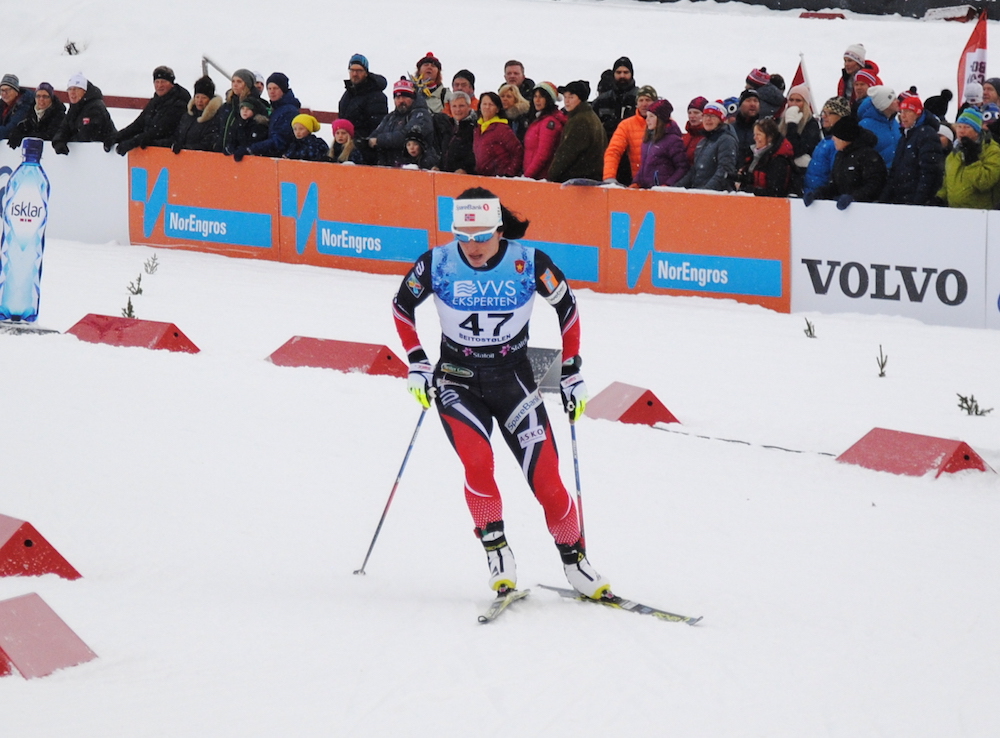
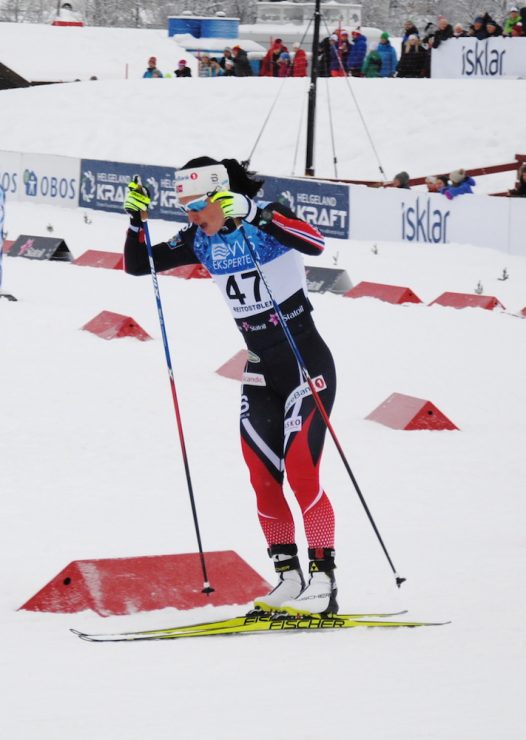
Norway’s Marit Bjørgen racing to first in the women’s 10 k freestyle on Saturday in Beitostølen, Norway. It was her first FIS race since March of 2015. (All photos: Aleks Tangen)
BEITOSTØLEN, Norway — Saturday’s 10-kilometer freestyle individual start was, from the start, all about Marit Bjørgen. Her previous race was 603 days earlier on March 27, 2015in Harstad, Norway, but that didn’t seem to affect Norway’s six-time Olympic gold medalist one bit.
“I’ll admit that I have had my doubts,” she told Dagbladet about returning to competition. “And I’ve been tired, but I made it through it and I’ve appreciated the good times.”
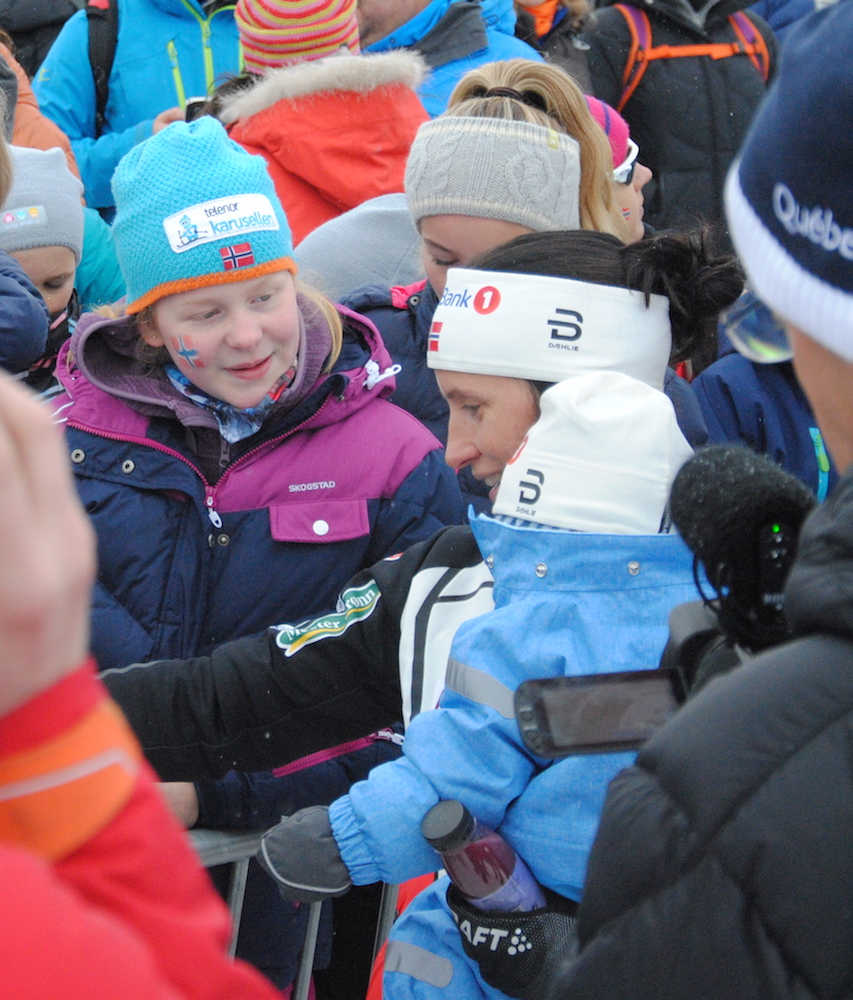
Norway’s Marit Bjørgen with her baby, Marius, and fans in Beitostølen, Norway, following Bjørgen’s first race since having a child in December 2015. Saturday marked Bjørgen’s first race back since March 2015. (Photo: Aleks Tangen)
The 36-year-old Bjørgen led Saturday’s International Ski Federation (FIS) race at every split mark and crossed the finish line in 24:40.3 minutes.
Fellow Norwegian national-team member Heidi Weng followed in second, 11.7 seconds behind. After placing second to teammate Ingvild Flugstad Østberg in Friday’s 10 k classic, Weng told VG that Bjørgen, who sat out the race with a cold, was “probably sitting at home and laughing at how slow it went went. She will race fast and I think will see Marit Bjørgen as good as she has been in the past. She’s done great during the summer and fall training.”
After her second-straight second-place finish, Weng told Dagbladet that she opened fast on Saturday, but her muscles tired as the race progressed.
“It’s irritating, but I really had no chance toward the end, and it’s not that bad, really, because I don’t think I’ve ever had a better season opener. I’m a little surprised by that really,” she said.
When asked by FasterSkier if she thought she could match her performances in Sunday’s skate sprint, Weng said, “I didn’t make it through from the prologue last year so I’m hoping that I can do better than that, but we’ll see.”
The race for third place proved to be the most exciting with Østberg crossing the finish line 28.2 seconds behind Bjørgen and just 1.7 seconds in front of Norway’s Astrid Uhrenholdt Jacobsen, who finished fourth. Norway swept the top eight as Kari Øyre Slind followed 2.9 seconds later in fifth and her sister Silje Øyre Slind was sixth, another 17.5 seconds behind.
Østberg told FasterSkier that she will not be competing in Sunday’s sprint. “If the World Cup weekend had been two weeks away then maybe, but after doing two tough races in two days and since sprints takes a lot of energy rest is probably the best,” she said.
Nonetheless, a first and third place finish in Beitostølen is Østberg’s best start to a season yet.
“It is without a doubt my best season opener, and I’m super happy,” she told both FasterSkier and Oppland Arbeiderblad, a regional newspaper from her hometown of Gjøvik.
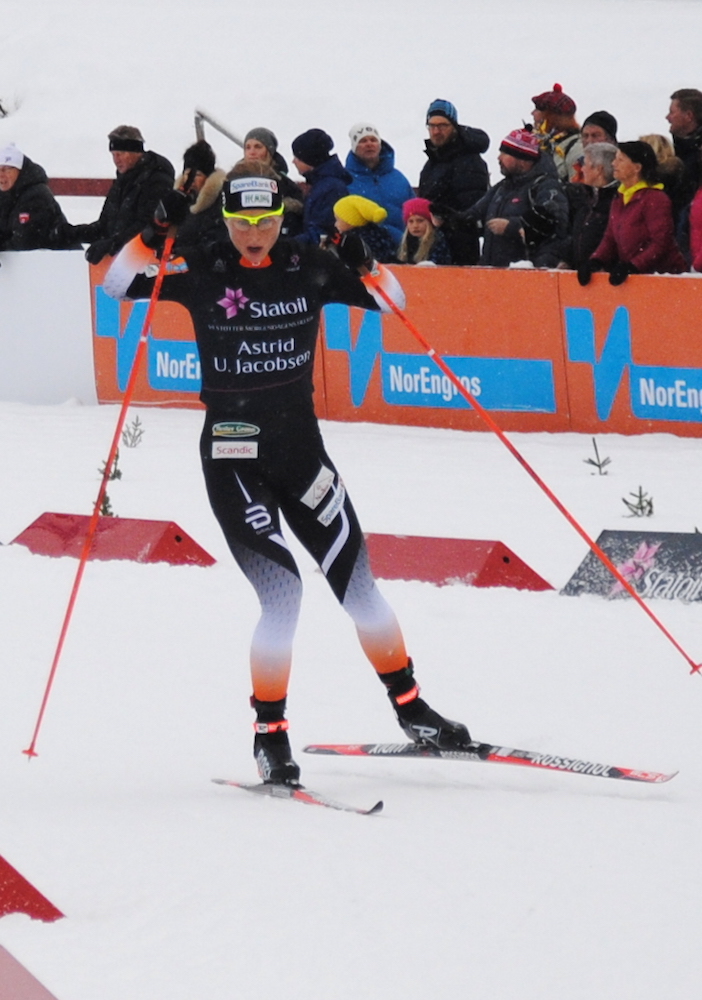
Astrid Uhrenholdt Jacobsen (Norway) racing to fourth in the women’s 10 k freestyle FIS race on Saturday in Beitostølen, Norway. (Photo: Aleks Tangen)
Jacobsen narrowly missed the podium after crossing the finish line 1.7 seconds slower than Østberg.
“I feel like I’m not quite there yet,” Jacobsen told FasterSkier after. “I still have some work to do in order to be in top shape, but I still ski relatively fast and I feel like I have a very good base condition so I think it can be a good year.”
Asked what it was like to have Bjørgen back, Jacobsen replied, “She wins as expected. I skied with her on my second lap and I definitely think she can ski faster. This race wasn’t Marit in her top shape.”
When asked about Bjørgen’s ability to perform as well as she did on Saturday, considering she hasn’t raced since 2015, Jacobsen smiled and waited a moment before she answered, “That’s something only Marit can do.”
Eighteen-year-old Norwegian Mathilde Myhrvold finished 27th (+3:49.7) of 48 finishers on Saturday. In 2014, she competed in the track and field World Junior Championships in Eugene, Oregon, and last season she won the Norwegian Cup. Saturday stood as her first race this season.
“Slightly after finishing the first lap I started feeling a little tired and then I skied a little slower, but I improved toward the finish and I’m happy about that,” Myhrvold said. “I may have started a little too fast and maybe that’s why I was tired.”
She figured a few races would help her return to top shape, and for the rest of the season, she’s focused on improving her conditioning for FIS Junior World Championships trials.
One spot ahead of her on the results sheet, American Cambria McDermott, who is living and training in Norway, finished 26th (+3:33.6). Canada’s Isabella Howden and Madison Fraser, both of Team Hardwood, placed 45th (+6:19.6) and 47th (+6:59), respectively.
(Story continues below)
Marit Bjørgen racing to first in the women’s 10 k freestyle FIS race on Saturday in Beitostølen, Norway. It was her first FIS race since March of 2015. (Photo: Aleks Tangen)
Norway’s Ingvild Flugstad Østberg (black headband) and Marit Bjørgen (white headband) being interviewed after Saturday’s 10 k freestyle FIS race in Beitostølen, Norway. It was Bjørgen’s first FIS race since March 2015. (Photo: Aleks Tangen)
Norway’s Ingvild Flugstad Østberg being interviewed after Saturday’s 10 k freestyle FIS race in Beitostølen, Norway. (Photo: Aleks Tangen)
Norway’s Marit Bjørgen with fans and media after Saturday’s 10 k freestyle FIS race in Beitostølen, Norway. It was her first FIS race since March 2015. (Photo: Aleks Tangen)
Another ‘W’ for Tønseth
Norway’s Didrik Tønseth repeated his podium-topping performance from Friday’s 15 k classic and won Saturday’s 15 k freestyle in 33:20.9. But the biggest surprise of the men’s race was second-place finisher Simen Hegstad Krüger, who crossed the finish line in a time that was only six seconds slower than Tønseth.
Norway’s Didrik Tønseth racing to his second-straight win of the weekend in the 15 k freestyle FIS race on Saturday in Beitostølen, Norway.
“I had nothing more to give, but this podium finish is incredibly satisfying,” the 23-year-old Krüger, who won the 15 k freestyle at U23 World Championships last season, told NRK after Saturday’s race.
“I’m hoping for a spot on the team for the World Cup in Lillehammer, but it might be too late for that,”
Norwegian men’s coach Tor-Arne Hetland seemed open to placing Krüger on the team for Lillehammer in two weeks.
“We’ll be choosing the team on Monday and I think the mini tour will suit him well, so he may receive a positive message in the coming week,” he told NRK.
Tønseth had the advantage of starting five bibs after Krüger and told NRK that he felt like he was in good shape and that he was ready to start the season. The 2017 World Championships in Lahti, Finland, are his main focus.
Norway swept the top five after a close fight for third, which Simen Andreas Sveen took, 32.6 seconds behind Tønseth. Anders Nøstedahl Gløersen was another 1.9 seconds back in fourth (+34.5), Mathias Rundgreen placed fifth (+36.9) and Andrew Musgrave of Great Britain finished sixth (+37.0).
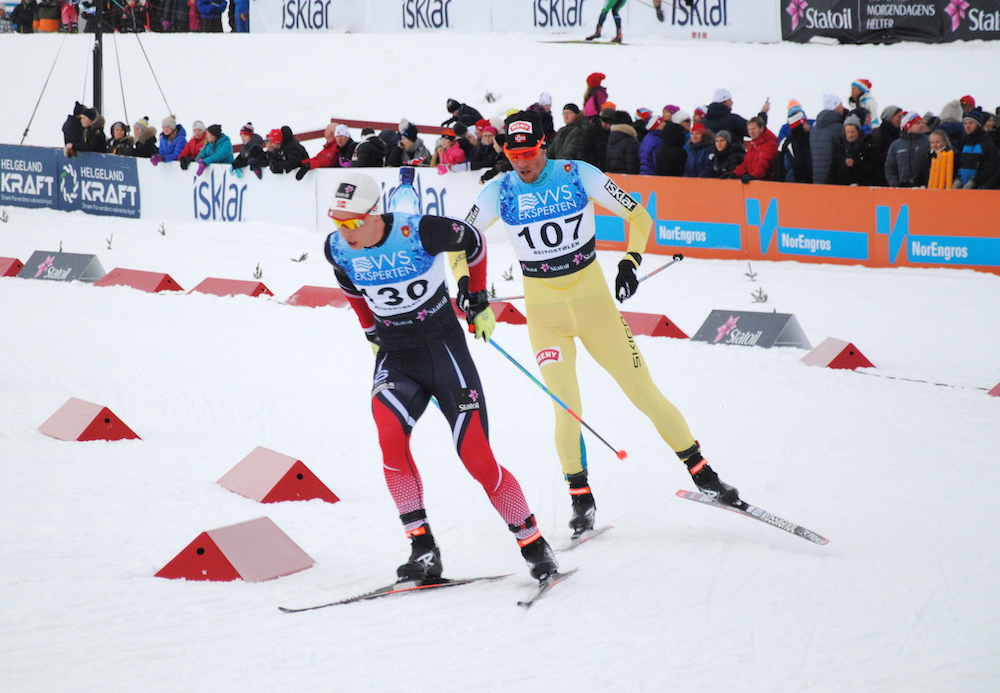
Norway’s 25-year-old Mathias Rundgreen (130) leads 33-year-old Chris Jespersen (107), also of Norway, in the men’s 15 k freestyle FIS race in Beitostølen, Norway. Rundgreen placed fifth and Jespersen finished eighth on Saturday.
“I feel good about the race, but I felt a little limply in the beginning,” Musgrave told FasterSkier after. “Though I was able to close some of the gap toward the end, but not enough.”
Like most World Cup skiers, Musgrave’s goal for the season is World Championship and he’ll be in both Kuusamo, Finland, and Lillehammer over the next two weekends to compete in the World Cup.
One place behind Musgrave was Norwegian Sjur Røthe in seventh (+37.2), who told FasterSkier that he felt “heavy during the start.” In a post-race interview with NRK, Røthe said he’s focused on the World Championships 50 k. He planned to skip Sunday’s sprint to recharge for the World Cup.
Petter Northug (Norway) approaching the finish of Saturday’s 15 k freestyle FIS race in Beitostølen, Norway. (Photo: Aleks Tangen)
Petter Northug finished Friday’s race like it was a workout, and during the start of Saturday’s race, it appeared that he was on the path to a podium, but such was not the case. Northug led the race at the 1.2 and 2.1 k marks, but for the rest of the race, he was unable to maintain the same speed as the other top finishers and ended up 15th (+1:02.6). However, Northug didn’t seem to be affected by his fading speed, telling Dagbladet, “I am where I want to be. I’ve had two good workouts now and I’m confident that the job is done. I am excited for the important races that are approaching.”
But he did offer some explanation for what happened.
“I opened too hard and during the second lap I felt like it would be too much to maintain the tempo,” Northug told NRK.
Out of 123 male finishers, Jack Carlyle (NDC Thunder Bay) led several Canadian juniors in 90th (+3:48.4). His NDC teammate Scott James Hill finished 101st (+4:25.6), Joey Foster (Pierre-Harvey Training Centre) was 103rd (+4:31), and Team Hardwood skiers Ryan Jackson was 106th (+4:50.4) and Kieran Jones was 115th (+6:11.5).